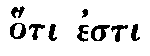
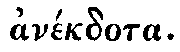
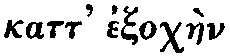
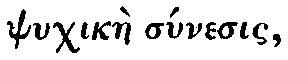
Coleridge's Literary Remains
volume 4
collected and edited by
Henry Nelson Coleridge
1839
Table of Contents
Extended Contents, or Index
- Notes on:
-
- Luther's Table Talk
-
- The Epistle Dedicatory
- Chap. I. p. 1, 2, 4, 9, 12, 21, 25, 32
- Chap. II. p. 37, 54, 54 cont., 61, 62
- Chap. VI. p. 103.
- Chap. VII. p. 113., 120
- Chap. VII. p. 120 cont., 121
- Chap. VII. p. 121 cont., 122
- Chap. VIII. p. 147.
- Chap. IX. p. 160., 161, 163, 163 cont., p. 165.
- Chap. X. p. 168, 9, 174.
- Chap. XII. p. 187, 189., 190, 190 cont., 197, 197 cont., 200, 203, 205, 205 cont., 205 cont. again., 206, 207.
- Chap. XIII. p. 208., 210-11, 211, 213, 214., 219-20, 226, 227
- Chap. XIV. p. 230, 231-2
- Chap. XV. p. 233-4.
- Chap. XVI. p. 247., 247 cont., 248
- Chap. XVII. p. 249, 249 cont., 250
- Chap. XXI. p. 276.
- Chap. XXII. p. 290., 291, 291 cont., 297
- Chap. XXVII. p. 335., 337
- Chap. XXVIII. p. 347.
- Chap. XXIX. p. 349, 351, 351 cont., 352
- Chap. XXXII. p. 362., 364, 365, 365 cont.
- Chap. XXXIII. p. 367.
- Chap. XXXIV. p. 369, 370, 371
- Chap. XXXV. p. 388., 389, 389 cont.
- Chap. XXXVI. p. 389., 390
- Chap. XXXVII. p. 398., 398 cont., 399, 403, 404
- Chap. XLIV. p. 431., 432
- Chap. XLVIII. p. 442., 442 cont.
- Chap. XLIX. p. 443.
- Chap. L. p. 446, 447, 450
- Chap. LIX. p. 481.
- Chap. LX. p. 483.
- Chap. LXX. p. 503.
-
- Baxter's Life of himself
-
- Book I. Part I. p. 2., 5, 6, 22, 22 cont., 23, 23 cont., 24, 25, 27, 27 cont., 27 cont. again, 34, 40, 41, 47, 59, 62, 66, 71, 75, 76, 77, 77 cont., 77 cont. again, 79, 80, 82, 84, 87, 128, 129, 131, 135, 136
- Book I. Part II. p.139., 141, 142, 143, 177, 179, 185, 188, 189, 194, 198, 201, 203, 222, 222 cont., 224, 225, 226, 246, 248, 249, 249 cont., 250, 254, 254 cont., 257, 269, 272, 273, 308, 337341, 343, 368, 368 cont., 369, 369 cont., 369 cont. again, 370, 373, 374, 375, 398, 401, 405, 412, 435
- Part III. p. 59., 60, 65, 67, 69, 69 cont., 144, 153, 155, 180, 181, 186, 191
- Appendix II. p. 37, 37 cont., 45
- Appendix. III. p. 55.
- In fine.
-
- Leighton
-
- Comment Vol. I. p. 2., 13-15, 63-4, 68, 75, 76, 104-5, 121, 122, 124, 138, 158, 166, 170, 174-5, 194, 200, 211, 216, 229
- Vol. II. p. 242., 293
- Vol. III. p. 20. Serm. I., p. 63. Serm. V., p. 68, 73, p. 77. Serm. VI., p. 104. Serm. VII., p. 107. Serm. VIII., Serm. IX. p. 12., p. 12 cont., p. 12 cont. again, Serm. XV. p. 196., Serm. XVI. p. 204.
- Lecture IX. vol. IV. p. 96., 105, Lect. XI. p. 113., Lect. XV. p. 152., Lect. XIX. p. 201, Lect. XXI. p. 225., Lect. XXIV. p. 245., Exhortation to the Students, p. 252.
-
- Sherlock's Vindication of the Doctrine of the Trinity
-
- Sect. I. p. 3., 4, 4 cont., 6
- Sect. II. p. 13., 14., 18
- Sect. III. p. 23., 26, 27, 28
- Sect. IV. p. 50., 64, 68, 72, 72 cont., 81, 88, 97, 98, 98-9
- Sect. V. p. 102., 110-13, 115-16, 117, 120, 120 cont., 121, 121 cont., 124, 126, 127, 133
- Sect. VI. pp. 147-8., 149, 150, 153, 154, 156, 159, 160, 161-3, 164, 168, 171, 177, 177 cont., 177 cont. again, 186, 222
-
- Waterland's Vindication of Christ's Divinity
-
- In Initio
- Query I. p. 1., 2, 3
- Query II. p. 43.
- Query XV. p. 225-6., 226, 226 cont., 227-8
- Query XVI. p. 234., 235, 237, 239, 251
- Query XVII.
- Query XVIII. p. 269, 274
- Query XIX. p. 279.
- Query XX. p. 302.
- Query XXI. p. 303., 316-7
- Query XXIII. p. 351., 354, 357, 359
- Query XXIV. p. 371.
- Query XXVI. p. 412., 412 cont., 414, 415, 421
- Query XXVII. p. 427., 432, 436
-
- Waterland's Importance of the Doctrine of the Holy Trinity
-
- Chap. I. p. 18.
- Chap. IV. p. 111., 114, 114 cont., 123, 126, 127, 128, 129, 130
- Chap. V. p. 140., 187
- Chap. VI. p. 230., 233, 236, 238, 250, 257, 257 cont., 259, 266, 268, 272, 286, 288, 292, 338, 340
- Chap. VII. p. 389., 41-2 etc.
-
- Skelton's Works
-
- Burdy's Life of Skelton, p. 22., 67, 106
- Vol. I. p. 177-180., 182, 185, 186, 214.; End of Discourse II., 234, 251, 265, 267, 268, 276, 276 cont., 279, 280, 281, 287, 318, 327, Disc. VIII., 374-8, Disc. XIV. pp. 500-502.
- Vol. III., 393, 394, 446, 478
- Vol. IV. p. 28. Deism Revealed., 35, 37, 243, 249, 268, 281
-
- A Barrister's Hints on Evangelical Preaching
-
- In Initio
- Part I. p. 49., 51, , 56, 60, 60 cont., 68, 68 cont., 71, 72, 75-9, 84, 86, 94, 95, 97, 97 cont., 102, 105, 114, 115-6, 118, 133
- Part II. p. 14., 26, 29, 30, 30 cont., 31, 32, 33, 34, 37, 39, 40., 40 cont., 41, 42, 43, 46, 47, 50, 52, 53, 54
- Part III. p. 5., 12, 16, 17, 24, 27, 30-1, 35-6, 45-6, 55-6, 55-6, 63-4, 75, 78, 82, 86, 88, 89, 97, 98, 102-3, 106, 107, 108, 110, 113
- Part IV. p. 1., 7, 10, 13-4, 15, 29, 56, 60-1
-
- Davison's Discourses on Prophecy
-
- Disc. IV. Pt. I. p. 140., 160, 162, 164, 168
- Disc. IV. Pt. II. p. 180.
- Disc. V. Pt. II. p. 234.
- Disc. VI. Pt. I. p. 283., Pt. II. p. 289., Pt. IV. p. 325., 336, 370, 373
- Disc. VII. p. 375., 392
- Disc. VIII. p. 416., 431
- Disc. IX. p. 453, 4.
- Disc. XII. p. 519., 521, 522-3, 533
-
- Irving's Ben-Ezra
-
- Preliminary Discourse, p. lxxx.
- Ben-Ezra. Part I. c. v. p. 67., 73-4, 85, c. vi. p. 108., 110, ch. vii. p. 118., ch. ix. p. 127., Part II. p. 145., 153, 253, 254, 297
For some remarks on the character of this publication, the Editor begs
to refer the Reader to the Preface to the third volume of these Remains.
That volume and the present are expressly connected together as one
work.
The various materials arranged in the following pages were preserved,
and kindly placed in the Editor's hands, by Mr. Southey, Mr. Green, Mr.
Gillman, Mr. Alfred Elwyn of Philadelphia, United States, Mr. Money, Mr.
Hartley Coleridge, and the Rev. Edward Coleridge; and to those gentlemen
the Editor's best acknowledgments are due.
Lincoln's Inn,
9th May, 1839.
Contents / Index
Notes on Luther's Table Talk1
I cannot meditate too often, too deeply, or too devotionally on the
personeity of God, and his personality in the Word,
and thence on the individuity of the responsible
creature;—that it is a perfection which, not indeed in my intellect,
but yet in my habit of feeling, I have too much confounded with that
complexus
of visual images, cycles or customs of sensations, and
fellow-travelling circumstances (as the ship to the mariner), which make
up our empirical self: thence to bring myself to apprehend livelily the
exceeding mercifulness and love of the act of the Son of God, in
descending to seek after the prodigal children, and to house with them
in the sty. Likewise by the relation of my own understanding to the
light of reason, and (the most important of all the truths that have
been vouchsafed to me!) to the will which is the reason,— will in the
form of reason—I can form a sufficient gleam of the possibility of the
subsistence of the human soul in Jesus to the Eternal Word, and how it
might perfect itself so as to merit glorification and abiding union with
the Divinity; and how this gave a humanity to our Lord's righteousness
no less than to his sufferings. Doubtless, as God, as the absolute
Alterity of the Absolute, he could not suffer; but that he could not lay
aside the absolute, and by union with the creaturely become affectible,
and a second, but spiritual Adam, and so as afterwards to be partaker of
the absolute in the Absolute, even as the Absolute had partaken of
passion
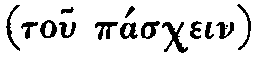
and infirmity in it, that is, the finite
and fallen creature; —this can be asserted only by one who
(unconsciously perhaps), has accustomed himself to think of God as a
thing,—having a necessity of constitution, that wills, or rather tends
and inclines to this or that, because it is this or that, not as being
that, which is that which it wills to be. Such a necessity is truly
compulsion; nor is it in the least altered in its nature by being
assumed to be eternal, in virtue of an endless remotion or retrusion of
the constituent cause, which being manifested by the understanding
becomes a foreseen despair of a cause.
Sunday 11th February, 1826.
One argument strikes me in favour of the tenet of Apostolic succession,
in the ordination of Bishops and Presbyters, as taught by the Church of
Rome, and by the larger part of the earlier divines of the Church of
England, which I have not seen in any of the books on this subject;
namely, that in strict analogy with other parts of Christian history,
the miracle itself contained a check upon the inconvenient consequences
necessarily attached to all miracles, as miracles, narrowing the
possible claims to any rights not proveable at the bar of universal
reason and experience. Every man among the Sectaries, however ignorant,
may justify himself in scattering stones and fire squibs by an alleged
unction of the Spirit. The miracle becomes perpetual, still beginning,
never ending. Now on the Church doctrine, the original miracle provides
for the future recurrence to the ordinary and calculable laws of the
human understanding and moral sense; instead of leaving every man a
judge of his own gifts, and of his right to act publicly on that
judgment. The initiative alone is supernatural; but all beginning is
necessarily miraculous, that is, hath either no antecedent, or one
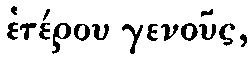
which therefore is not its, but merely an,
antecedent,—or an incausative alien co-incident in time; as if, for
instance, Jack's shout were followed by a flash of lightning, which
should strike and precipitate the ball on St. Paul's cathedral. This
would be a miracle as long as no causative
nexus
was conceivable
between the antecedent, the noise of the shout, and the consequent, the
atmospheric discharge.
The Epistle Dedicatory
But this will be your glory and inexpugnable, if you cleave in truth
and practice to God's holy service, worship and religion: that
religion and faith of the Lord Jesus Christ, which is pure and
undefiled before God even the Father, which is to visit the fatherless
and widows in their affliction, and to keep yourselves unspotted from
the world.
James i. 27.
Few mistranslations (unless indeed the word used by the translator of
St. James meant differently from its present meaning), have led astray
more than this rendering of
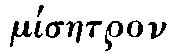
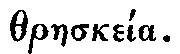
(outward or ceremonial
worship,
cultus
, divine service,) by the English
religion
.
St. James sublimely says: What the
ceremonies
of the law were to
morality,
that
morality itself is to the faith in Christ, that
is, its outward symbol, not the substance itself.
Chap. I. p. 1, 2.
That the Bible is the word of God (said Luther) the same I prove as
followeth: All things that have been and now are in the world; also
how it now goeth and standeth in the world, the same was written
altogether particularly at the beginning, in the first book of Moses
concerning the creation. And even as God made and created it, even so
it was, even so it is, and even so doth it stand to this present day.
And although King Alexander the Great, the kingdom of Egypt, the
Empire of Babel, the Persian, Grecian and Roman monarchs; the Emperors
Julius and Augustus most fiercely did rage and swell against this
Book, utterly to suppress and destroy the same; yet notwithstanding
they could prevail nothing, they are all gone and vanished; but this
Book from time to time hath remained, and will remain unremoved in
full and ample manner as it was written at the first.
A proof worthy of the manly mind of Luther, and compared with which the
Grotian pretended demonstrations, from Grotius himself to Paley, are
mischievous underminings of the Faith, pleadings fitter for an Old
Bailey thieves' counsellor than for a Christian divine. The true
evidence of the Bible is the Bible,— of Christianity the living fact of
Christianity itself, as the manifest
archeus
or predominant of
the life of the planet.
Ib. p. 4.
The art of the School divines (said Luther) with their speculations in
the Holy Scriptures, are merely vain and human cogitations, spun out
of their own natural wit and understanding. They talk much of the
union of the will and understanding, but all is mere fantasy and
fondness. The right and true speculation (said Luther) is this,
Believe in Christ; do what thou oughtest to do in thy vocation, &c.
This is the only practice in divinity. Also, Mystica Theologia
Dionysii is a mere fable, and a lie, like to Plato's fables.
Omnia sunt non ens, et omnia sunt ens; all is something, and
all is nothing, and so he leaveth all hanging in frivolous and idle
sort.
Still, however,
du theure Mann Gottes, mein verehrter Luther
!
reason, will, understanding are words, to which real entities
correspond; and we may in a sound and good sense say that reason is the
ray, the projected disk or image, from the Sun of Righteousness, an echo
from the Eternal Word—
the light that lighteth every man that cometh
into the world
; and that when the will placeth itself in a right
line with the reason, there ariseth the spirit, through which the will
of God floweth into and actuates the will of man, so that it willeth the
things of God, and the understanding is enlivened, and thenceforward
useth the materials supplied to it by the senses symbolically; that is,
with an insight into the true substance thereof.
Ib. p. 9.
The Pope usurpeth and taketh to himself the power to expound and to
construe the Scriptures according to his pleasure. What he saith, must
stand and be spoken as from heaven. Therefore let us love and
preciously value the divine word, that thereby we may be able to
resist the Devil and his swarm.
As often as I use in prayer the 16th verse of the 71st Psalm, (in our
Prayer-book version), my thoughts especially revert to the subject of
the right appreciation of the Scriptures, and in what sense the Bible
may be called the word of God, and how and under what conditions the
unity of the Spirit is translucent through the letter, which, read as
the letter merely, is the word of this and that pious but fallible and
imperfect man. Alas for the superstition, where the words themselves are
made to be the Spirit! O might I live but to utter all my meditations on
this most concerning point!
Ib. p. 12.
Bullinger said once in my hearing (said Luther) that he was earnest
against the Anabaptists, as contemners of God's word, and also against
those which attributed too much to the literal word, for (said he)
such do sin against God and his almighty power; as the Jews did in
naming the ark, God. But, (said he) whoso holdeth a mean between both,
the same is taught what is the right use of the word and sacraments.
Whereupon (said Luther) I answered him and said; Bullinger, you err,
you know neither yourself, nor what you hold; I mark well your tricks
and fallacies: Zuinglius and Œcolampadius likewise proceeded too far
in the ungodly meaning: but when Brentius withstood them, they then
lessened their opinions, alleging, they did not reject the literal
word, but only condemned certain gross abuses. By this your error you
cut in sunder and separate the word and the spirit, &c.
In my present state of mind, and with what light I now enjoy,—(may God
increase it, and cleanse it from the dark mist into the
lumen
siccum
of sincere knowledge!)—I cannot persuade myself that this
vehemence of our dear man of God against Bullinger, Zuinglius and
Œcolampadius on this point could have had other origin, than his
misconception of what they intended. But Luther spoke often (I like him
and love him all the better therefor,) in his moods and according to the
mood. Was not that a different mood, in which he called St. James's
Epistle a 'Jack-Straw poppet'; and even in this work selects one verse
as the best in the whole letter,—evidently meaning, the only verse of
any great value? Besides he accustomed himself to use the term, 'the
word,' in a very wide sense when the narrower would have cramped him.
When he was on the point of rejecting the Apocalypse, then 'the word'
meant the spirit of the Scriptures collectively.
Ib. p. 21.
I, (said Luther), do not hold that children are without faith when
they are baptized; for inasmuch as they are brought to Christ by his
command, and that the Church prayeth for them; therefore, without all
doubt, faith is given unto them, although with our natural sense and
reason we neither see nor understand it.
Nay, but dear honoured Luther! is this fair? If Christ or Scripture had
said in one place,
Believe, and thou mayest be baptized
; and in
another place,
Baptize infants
; then we might perhaps be allowed
to reconcile the two seemingly jarring texts, by such words as "faith is
given to them, although, &c." But when no such text, as the latter, is
to be found, nor any one instance as a substitute, then your conclusion
seems arbitrary.
Ib. p. 25.
This argument (said Luther), concludeth so much as nothing; for,
although they had been angels from heaven, yet that troubleth me
nothing at all; we are now dealing about God's word, and with the
truth of the Gospel, that is a matter of far greater weight to have
the same kept and preserved pure and clear; therefore we (said
Luther), neither care nor trouble ourselves for, and about, the
greatness of Saint Peter and the other Apostles, or how many and great
miracles they wrought: the thing which we strive for is, that the
truth of the Holy Gospel may stand; for God regardeth not men's
reputations nor persons.
Oh, that the dear man Luther had but told us here what he meant by the
term, Gospel! That St. Paul had seen even St. Luke's, is but a
conjecture, grounded on a conjectural interpretation of a single text,
doubly equivocal; namely, that the Luke mentioned was the same with the
Evangelist Luke; and that the
evangelium
signified a book; the
latter, of itself improbable, derives its probability from the
undoubtedly very strong probability of the former. If then not any book,
much less the four books, now called the four Gospels, were meant by
Paul, but the contents of those books, as far as they are veracious, and
whatever else was known on equal authority at that time, though not
contained in those books; if, in short, the whole sum of Christ's acts
and discourses be what Paul meant by the Gospel; then the argument is
circuitous, and returns to the first point,—What
is
the Gospel?
Shall we believe you, and not rather the companions of Christ, the eye
and ear witnesses of his doings and sayings? Now I should require strong
inducements to make me believe that St. Paul had been guilty of such
palpably false logic; and I therefore feel myself compelled to infer,
that by the Gospel Paul intended the eternal truths known ideally from
the beginning, and historically realized in the manifestation of the
Word in Christ Jesus; and that he used the ideal immutable truth as the
canon and criterion of the oral traditions. For example, a Greek
mathematician, standing in the same relation of time and country to
Euclid as that in which St. Paul stood to Jesus Christ, might have
exclaimed in the same spirit: "What do you talk to me of this, that, and
the other intimate acquaintance of Euclid's? My object is to convey the
sublime system of geometry which he realized, and by that must I
decide." "I," says St. Paul, "have been taught by the spirit of Christ,
a teaching susceptible of no addition, and for which no personal
anecdotes, however reverendly attested, can be a substitute." But
dearest Luther was a translator; he could not, must not, see this.
Ib. p. 32.
That God's word, and the Christian Church, is preserved against the
raging of the world.
The Papists have lost the cause; with God's word they are not able to
resist or withstand us. * * * The kings of the earth stand up, and
the rulers take counsel together, &c. God will deal well enough
with these angry gentlemen, and will give them but small thanks for
their labor, in going about to suppress his word and servants; he hath
sat in counsel above these five thousand five hundred years, hath
ruled and made laws. Good Sirs! be not so choleric; go further from
the wall, lest you knock your pates against it. Kiss the Son lest
he be angry, &c. That is, take hold on Christ, or the Devil will
take hold on you, &c.
The second Psalm (said Luther), is a proud Psalm against those
fellows. It begins mild and simply, but it endeth stately and
rattling. * * * I have now angered the Pope about his images of
idolatry. O! how the sow raiseth her bristles! * * The Lord saith:
Ego suscitabo vos in novissimo die: and then he will call and
say: ho! Martin Luther, Philip Melancthon, Justus Jonas, John Calvin,
&c. Arise, come up, * * * Well on, (said Luther), let us be of good
comfort.
A delicious paragraph. How our fine preachers would turn up their
Tom-tit beaks and flirt with their tails at it! But this is the way in
which the man of life, the man of power, sets the dry bones in motion.
Chap. II. p. 37.
This is the thanks that God hath for his grace, for creating, for
redeeming, sanctifying, nourishing, and for preserving us: such a
seed, fruit, and godly child is the world. O, woe be to it!
Too true.
Ib. p. 54.
That out of the best comes the worst.
Out of the Patriarchs and holy Fathers came the Jews that crucified
Christ; out of the Apostles came Judas the traitor; out of the city
Alexandria (where a fair illustrious and famous school was, and from
whence proceeded many upright and godly learned men), came Arius and
Origenes.
Poor Origen! Surely Luther was put to it for an instance, and had never
read the works of that very best of the old Fathers, and eminently
upright and godly learned man.
Ib.
The sparrows are the least birds, and yet they are very hurtful, and
have the best nourishment.
Ergo digni sunt omni persecutione
. Poor little Philip Sparrows!
Luther did not know that they more than earn their good wages by
destroying grubs and other small vermin.
Ib. p. 61.
He that without danger will know God, and will speculate of him, let
him look first into the manger, that is, let him begin below, and let
him first learn to know the Son of the Virgin Mary, born at Bethlehem,
that lies and sucks in his mother's bosom; or let one look upon him
hanging on the Cross. ** But take good heed in any case of high
climbing cogitations, to clamber up to heaven without this ladder,
namely, the Lord Christ in his humanity.
To know God as God (
the living God) we must assume
his personality: otherwise what were it but an ether, a
gravitation?—but to assume his personality, we must begin with his
humanity, and this is impossible but in history; for man is an
historical—not an eternal being.
Ergo
. Christianity is of
necessity historical and not philosophical only.
Ib. p. 62.
What is that to thee? said Christ to Peter. Follow thou
me—me, follow me, and not thy questions, or cogitations.
Lord! keep us looking to, and humbly following, thee!
Chap. VI. p. 103.
The philosophers and learned heathen (said Luther) have described God,
that he is as a circle, the point whereof in the midst is every where;
but the circumference, which on the outside goeth round about, is no
where: herewith they would shew that God is all, and yet is nothing.
What a huge difference the absence of a blank space, which is nothing,
or next to nothing, may make! The words here should have been printed,
"God is all, and yet is no thing;" For what does 'thing' mean? Itself,
that is, the
ing
, or inclosure, that which is contained within an
outline, or circumscribed. So likewise to
think
is to inclose, to
determine, confine and define. To think an infinite is a contradiction
in terms equal to a boundless bound. So in German
Ding, denken
;
in Latin
res, reor
.
Chap. VII. p. 113.
Helvidius alleged the mother of Christ was not a virgin; so that
according to his wicked allegation, Christ was born in original sin.
O, what a tangle of impure whimsies has this notion of an immaculate
conception, an Ebionite tradition, as I think, brought into the
Christian Church! I have sometimes suspected that the Apostle John had a
particular view to this point, in the first half of the first chapter of
his Gospel. Not that I suppose our present Matthew then in existence, or
that, if John had seen the Gospel according to Luke, the
Christopædia
had been already prefixed to it. But the rumor might
have been whispered about, and as the purport was to give a
psilanthropic explanation and solution of the phrases, Son of God and
Son of Man,—so Saint John met it by the true solution, namely, the
eternal Filiation of the Word.
Ib. p. 120. Of Christ's riding into Jerusalem.
But I hold (said Luther) that Christ himself did not mention that
prophecy of Zechariah, but rather, that the Apostles and Evangelists
did use it for a witness.
Worth remembering for the purpose of applying it to the text in which
our Lord is represented in the first (or Matthew's) Gospel, and by that
alone, as citing Daniel by name. It was this text that so sorely, but I
think very unnecessarily, perplexed and gravelled Bentley, who was too
profound a scholar and too acute a critic to admit the genuineness of
the whole of that book.
Ib.
The Prophets (said Luther) did set, speak, and preach of the second
coming of Christ in manner as we now do.
I regret that Mr. Irving should have blended such extravagancies and
presumptuous prophesyings with his support and vindication of the
Millennium, and the return of Jesus in his corporeal individuality,
—because these have furnished divines in general, both Churchmen and
Dissenting, with a pretext for treating his doctrine with silent
contempt. Had he followed the example of his own Ben Ezra, and argued
temperately and learnedly, the controversy must have forced the
momentous question on our Clergy:—Are Christians bound to believe
whatever an Apostle believed,—and in the same way and sense? I think
Saint Paul himself lived to doubt the solidity of his own literal
interpretation of our Lord's words.
The whole passage in which our Lord describes his coming is so
evidently, and so intentionally expressed in the diction and images of
the Prophets, that nothing but the carnal literality common to the Jews
at that time and most strongly marked in the disciples, who were among
the least educated of their countrymen, could have prevented the
symbolic import and character of the words from being seen. The whole
Gospel and the Epistles of John, are a virtual confutation of this
reigning error—and no less is the Apocalypse whether written by, or
under the authority of, the Evangelist.
The unhappy effect which St. Paul's (may I not say) incautious language
respecting Christ's return produced on the Thessalonians, led him to
reflect on the subject, and he instantly in the second epistle to them
qualified the doctrine, and never afterwards resumed it; but on the
contrary, in the first Epistle to the Corinthians, c. 15, substitutes
the doctrine of immortality in a celestial state and a spiritual body.
On the nature of our Lord's future epiphany or phenomenal person, I am
not ashamed to acknowledge, that my views approach very nearly to those
of Emanuel Swedenborg.
Ib. p. 121.
Doctor Jacob Schenck never preacheth out of his book, but I do, (said
Luther), though not of necessity, but I do it for example's sake to
others.
As many notes,
memoranda
, cues of connection and transition as
the preacher may find expedient or serviceable to him; well and good.
But to read in a manuscript book, as our Clergy now do, is not to preach
at all. Preach out of a book, if you must; but do not read in it, or
even from it. A read sermon of twenty minutes will seem longer to the
hearers than a free discourse of an hour.
Ib.
My simple opinion is (said Luther) and I do believe that Christ for us
descended into hell, to the end he might break and destroy the same,
as in Psalm xvi, and Acts ii, is shewed and proved.
Could Luther have been ignorant, that this clause was not inserted into
the Apostle's Creed till the sixth century after Christ? I believe the
original intention of the clause was no more than
vere mortuus
est
—in contradiction to the hypothesis of a trance or state of
suspended animation.
Chap. VII. p. 122.
When Christ (said Luther) forbiddeth to spread abroad or to make known
his works of wonder; there he speaketh as being sent from the Father,
and doth well and right therein in forbidding them, to the end that
thereby he might leave us an example, not to seek our own praise and
honor in that wherein we do good; but we ought to seek only and alone
the honor of God.
Not satisfactory. Doubtless, the command was in connection with the
silence enjoined respecting his Messiahship.
Chap. VIII. p. 147.
Doctor Hennage said to Luther, Sir, where you say that the Holy Spirit
is the certainty in the word towards God, that is, that a man is
certain of his own mind and opinion; then it must needs follow that
all sects have the Holy Ghost, for they will needs be most certain of
their doctrine and religion.
Luther might have answered, "positive, you mean, not certain."
Chap. IX. p. 160.
But who hath power to forgive or to detain sins? Answer; the Apostles
and all Church servants, and (in case of necessity) every Christian.
Christ giveth them not power over money, wealth, kingdoms, &c; but
over sins and the consciences of human creatures, over the power of
the Devil, and the throat of Hell.
Few passages in the Sacred Writings have occasioned so much mischief,
abject slavishness, bloated pride, tyrannous usurpation, bloody
persecution, with kings even against their will the drudges, false
soul-destroying quiet of conscience, as this text,
John
xx. 23.
misinterpreted. It is really a tremendous proof of what the
misunderstanding of a few words can do. That even Luther partook of the
delusion, this paragraph gives proof. But that a delusion it is; that
the commission given to the Seventy whom Christ sent out to proclaim and
offer the kingdom of God, and afterwards to the Apostles, refers either
to the power of making rules and ordinances in the Church, or otherwise
to the gifts of miraculous healing, which our Lord at that time
conferred on them; and that
per figuram causce pro effecto
,
'sins' here mean diseases, seems to me more than probable. At all
events, the text surely does not mean that the salvation of a repentant
and believing Christian depends upon the will of a priest in absolution.
Ib. p. 161.
And again, they are able to absolve and make a human creature free and
loose from all his sins, if in case he repenteth and believeth in
Christ; and on the contrary, they are able to detain all his sina, if
he doth not repent and believeth not in Christ.
In like manner if he sincerely repent and believe, his sins are
forgiven, whether the minister absolve him or not. Now if M + 5 =5, and
5-M = 5, M = O. If he be impenitent and unbelieving, his sins are
detained, no doubt, whether the minister do or do not detain them.
Ib. p. 163.
Adam was created of God in such sort righteous, as that he became of a
righteous an unrighteous person; as Paul himself argueth, and withall
instructeth himself, where he saith, The law is not given for a
righteous man, but for the lawless and disobedient.
This follows from the very definition or idea of righteousness;-it is
itself the law;—
Ib.
The Scripture saith, God maketh the ungodly righteous; there he
calleth us all, one with another, despairing and wicked wretches; for
what will an ungodly creature not dare to accomplish, if he may but
have occasion, place, and opportunity?
That is with a lust within correspondent to the temptation from without.
A Christian's conscience, methinks, ought to be a
Janus
bifrons
,—a Gospel-face retrospective, and smiling through penitent
tears on the sins of the past, and a Moses-face looking forward in frown
and menace, frightening the harlot will into a holy abortion of sins
conceived but not yet born, perchance not yet quickened. The fanatic
Antinomian reverses this; for the past he requires all the horrors of
remorse and despair, till the moment of assurance; thenceforward, he may
do what he likes, for he cannot sin.
Ib. p. 165.
All natural inclinations (said Luther) are either against or without
God; therefore none are good. We see that no man is so honest as to
marry a wife, only thereby to have children, to love and to bring them
up in the fear of God.
This is a very weak instance. If a man had been commanded to marry by
God, being so formed as that no sensual delight accompanied, and refused
to do so, unless this appetite and gratification were added,—then
indeed!
Chap. X. p. 168, 9.
Ah Lord God (said Luther), why should we any way boast of our
free-will, as if it were able to do anything in divine and spiritual
matters were they never so small? * * * I confess that mankind hath a
free-will, but it is to milk kine, to build houses, &c., and no
further: for so long as a man sitteth well and in safety, and sticketh
in no want, so long he thinketh he hath a free-will which is able to
do something; but, when want and need appeareth, that there is neither
to eat nor to drink, neither money nor provision, where is then the
free will? It is utterly lost, and cannot stand when it cometh to the
pinch. But faith only standeth fast and sure, and seeketh Christ.
Luther confounds free-will with efficient power, which neither does nor
can exist save where the finite will is one with the absolute Will. That
Luther was practically on the right side in this famous controversy, and
that he was driving at the truth, I see abundant reason to believe. But
it is no less evident that he saw it in a mist, or rather as a mist with
dissolving outline; and as he saw the thing as a mist, so he ever and
anon mistakes a mist for the thing. But Erasmus and Saavedra were
equally indistinct; and shallow and unsubstantial to boot. In fact, till
the appearance of Kant's
Kritiques
of the pure and of the
practical Reason the problem had never been accurately or adequately
stated, much less solved.
26 June, 1826.
Ib. p. 174.
Loving friends, (said Luther) our doctrine that free-will is dead and
nothing at all is grounded powerfully in Holy Scripture.
It is of vital importance for a theological student to understand
clearly the utter diversity of the Lutheran, which is likewise the
Calvinistic, denial of free-will in the unregenerate, and the doctrine
of the modern Necessitarians and (
proh pudor!
) of the later
Calvinists, which denies the proper existence of will altogether. The
former is sound, Scriptural, compatible with the divine justice, a new,
yea, a mighty motive to morality, and, finally, the dictate of common
sense grounded on common experience. The latter the very contrary of all
these.
Chap. XII. p. 187.
This is now (said Luther), the first instruction concerning the law;
namely, that the same must be used to hinder the ungodly from their
wicked and mischievous intentions. For the Devil, who is an Abbot and
a Prince of this world, driveth and allureth people to work all manner
of sin and wickedness; for which cause God hath ordained magistrates,
elders, schoolmasters, laws, and statutes, to the end, if they cannot
do more, yet at least that they may bind the claws of the Devil, and
to hinder him from raging and swelling so powerfully (in those which
are his) according to his will and pleasure.
And (said Luther), although thou hadst not committed this or that sin,
yet nevertheless, thou art an ungodly creature, &c. but what is done
cannot he undone, he that hath stolen, let him henceforward steal no
more.
Secondly, we use the law spiritually, which is done in this manner;
that it maketh the transgressions greater, as Saint Paul saith; that
is, that it may reveal and discover to people their sins, blindness,
misery, and ungodly doings wherein they were conceived and born;
namely, that they are ignorant of God, and are his enemies, and
therefore have justly deserved death, hell, God's judgments, his
everlasting wrath and indignation. Saint Paul, (said Luther),
expoundeth such spiritual offices and works of the law with many words.
Rom. vii.
Nothing can be more sound or more philosophic than the contents of these
two paragraphs. They afford a sufficient answer to the pretence of the
Romanists and Arminians, that by the law St. Paul meant only the
ceremonial law.
Ib. p. 189.
And if Moses had not cashiered and put himself out of his office, and
had not taken it away with these words, (where he saith, The Lord
thy God will raise up unto thee another prophet out of thy brethren;
Him shall thou hear. (Deut. xviii.)) who then at any time would or
could have believed the Gospel, and forsaken Moses?
If I could be persuaded that this passage (
Deut
. xviii. 15-19.)
primarily referred to Christ, and that Christ, not Joshua and his
successors, was the prophet here promised; I must either become a
Unitarian psilanthrophist, and join Priestley and Belsham,—or abandon
to the Jews their own Messiah as yet to come, and cling to the religion
of John and Paul, without further reference to Moses than to Lycurgus,
Solon and Numa; all of whom in their different spheres no less prepared
the way for the coming of the Lord,
the desire of the nations
.
Ib. p. 190.
It is therefore most evident (said Luther), that the law can but only
help us to know our sins, and to make us afraid of death. Now sins and
death are such things as belong to the world, and which are therein.
Both in Paul and Luther, (names which I can never separate),—not indeed
peculiar to these, for it is the same in the Psalms, Ezekiel, and
throughout the Scriptures, but which I feel most in Paul and Luther,
—there is one fearful blank, the wisdom or necessity of which I do not
doubt, yet cannot help groping and straining after like one that stares
in the dark; and this is Death. The law makes us afraid of death. What
is death?—an unhappy life? Who does not feel the insufficiency of this
answer? What analogy does immortal suffering bear to the only death
which is known to us?
Since I wrote the above, God has, I humbly trust, given me a clearer
light as to the true nature of the
death
so often mentioned in
the Scriptures.
Ib.
It is (said Luther), a very hard matter: yea, an impossible thing for
thy human strength, whosoever thou art (without God's assistance) that
(at such a time when Moses setteth upon thee with his law, and
fearfully affrighteth thee, accuseth and condemneth thee, threateneth
thee with God's wrath and death) thou shouldest as then be of such a
mind; namely, as if no law nor sin had ever been at any time:—I say,
it is in a manner a thing impossible, that a human creature should
carry himself in such a sort, when he is and feeleth himself assaulted
with trials and temptations, and when the conscience hath to do with
God, as then to think no otherwise, than that from everlasting nothing
hath been, but only and alone Christ, altogether grace and deliverance.
Yea, verily, Amen and Amen! For this short heroic paragraph contains the
sum and substance, the heighth and the depth of all true philosophy.
Most assuredly right difficult it is for us, while we are yet in the
narrow chamber of death, with our faces to the dusky falsifying
looking-glass that covers the scant end-side of the blind passage from
floor to ceiling,—right difficult for us, so wedged between its walls
that we cannot turn round, nor have other escape possible but by walking
backward, to understand that all we behold or have any memory of having
ever beholden, yea, our very selves as seen by us, are but shadows, and
when the forms that we loved vanish, impossible not to feel as if they
were real.
Ib. p. 197.
Nothing that is good proceedeth out of the works of the law, except
grace be present; for what we are forced to do, the same goeth not
from the heart, neither is acceptable.
A law supposes a law-giver, and implies an actuator and executor, and
consequently rewards and punishments publicly announced, and distinctly
assigned to the deeds enjoined or forbidden; and correlatively in the
subjects of the law, there are supposed, first, assurance of the being,
the power, the veracity and seeingness of the law-giver, in whom I here
comprise the legislative, judicial and executive functions; and
secondly, self-interest, desire, hope and fear. Now from this view, it
is evident that the deeds or works of the Law are themselves null and
dead, deriving their whole significance from their attachment or
alligation to the rewards and punishments, even as this diversely shaped
and ink colored paper has its value wholly from the words or meanings,
which have been arbitrarily connected therewith; or as a ladder, or
flight of stairs, of a provision-loft, or treasury. If the architect or
master of the house had chosen to place the store-room or treasury on
the ground floor, the ladder or steps would have been useless. The life
is divided between the rewards and punishments on the one hand, and the
hope and fear on the other: namely, the active life or excitancy belongs
to the former, the passive life or excitability to the latter. Call the
former the afficients, the latter the affections, the deeds being merely
the signs or impresses of the former, as the seal, on the latter as the
wax. Equally evident is it, that the affections are wholly formed by the
deeds, which are themselves but the lifeless unsubstantial shapes of the
actual forms (
formæ formantes
), namely, the rewards and
punishments. Now contrast with this the process of the Gospel. There the
affections are formed in the first instance, not by any reference to
works or deeds, but by an unmerited rescue from death, liberation from
slavish task-work; by faith, gratitude, love, and affectionate
contemplation of the exceeding goodness and loveliness of the Saviour,
Redeemer, Benefactor: from the affections flow the deeds, or rather the
affections overflow in the deeds, and the rewards are but a continuance
and continued increase of the free grace in the state of the soul and in
the growth and gradual perfecting of that state, which are themselves
gifts of the same free grace, and one with the rewards; for in the
kingdom of Christ which is the realm of love and inter-community, the
joy and grace of each regenerated spirit becomes double, and thereby
augments the joys and the graces of the others, and the joys and graces
of all unite in each;—Christ, the head, and by his Spirit the bond, or
unitive
copula
of all, being the spiritual sun whose entire image
is reflected in every individual of the myriads of dew-drops. While
under the Law, the all was but an aggregate of subjects, each striving
after a reward for himself, —not as included in and resulting from the
state,—but as the stipulated wages of the task-work, as a loaf of bread
may be the pay or bounty promised for the hewing of wood or the breaking
of stones!
Ib.
He (said Luther), that will dispute with the Devil, &c.
Queries.
-
Abstractedly from, and independently of, all sensible substances,
and the bodies, wills, faculties, and affections of men, has the
Devil, or would the Devil have, a personal self-subsistence? Does he,
or can he, exist as a conscious individual agent or person? Should the
answer to this query be in the negative: then—
-
Do there exist finite and personal beings, whether with composite
and decomponible bodies, that is, embodied, or with simple and
indecomponible bodies, (which is all that can be meant by disembodied
as applied to finite creatures), so eminently wicked, or wicked and
mischievous in so peculiar a kind, as to constitute a distinct
genus of beings under the name of devils?
-
Is this second hypothesis compatible with the acts and
functions attributed to the Devil in Scripture? O! to have had these
three questions put by Melancthon to Luther, and to have heard his
reply!
Ib. p. 200.
If (said Luther) God should give unto us a strong and an unwavering
faith, then we should he proud, yea also, we should at last contemn
Him. Again, if he should give us the right knowledge of the law, then
we should be dismayed and fainthearted, we should not know which way
to wind ourselves.
The main reason is, because in this instance, the change in the relation
constitutes the difference of the things. A. considered as acting
ab
extra
on the selfish fears and desires of men is the Law: the same
A: acting
ab intra
as a new nature infused by grace, as the mind
of Christ prompting to all obedience, is the Gospel. Yet what Luther
says is likewise very true. Could we reduce the great spiritual truths
or ideas of our faith to comprehensible conceptions, or (for the thing
itself is impossible) fancy we had done so, we should inevitably be
'proud vain asses.'
Ib. p. 203.
And as to know his works and actions, is not yet rightly to know the
Gospel, (for thereby we know not as yet that he hath overcome sin
death and the Devil); even so likewise, it is not as yet to know the
Gospel, when we know such doctrine and commandments, but when the
voice soundeth, which saith, Christ is thine own with life, with
doctrine, with works, death, resurrection, and with all that he hath,
doth and may do.
Most true.
Ib. p. 205.
The ancient Fathers said: Distingue tempora et concordabis
Scripturas; distinguish the times; then may we easily reconcile
the Scriptures together.
Yea! and not only so, but we shall reconcile truths, that seem to repeal
this or that passage of Scripture, with the Scriptures. For Christ is
with his Church even to the end.
Ib.
I verily believe, (said Luther) it (the abolition of the Law) vexed to
the heart the beloved St. Paul himself before his conversion.
How dearly Martin Luther loved St. Paul! How dearly would St. Paul have
loved Martin Luther! And how impossible, that either should not have
done so!
Ib.
In this case, touching the distinguishing the Law from the Gospel, we
must utterly expel all human and natural wisdom, reason, and
understanding.
All reason is above nature. Therefore by reason in Luther, or rather in
his translator, you must understand the reasoning faculty:— that is,
the logical intellect, or the intellectual understanding. For the
understanding is in all respects a medial and mediate faculty, and has
therefore two extremities or poles, the sensual, in which form it is St.
Paul's
; and the intellectual pole, or the
hemisphere (as it were) turned towards the reason. Now the reason
(
lux idealis seu spiritualis
) shines down into the understanding,
which recognizes the light,
id est, lumen a luce spirituali quasi
alienigenum aliquid
, which it can only comprehend or describe to
itself by attributes opposite to its own essential properties. Now these
latter being contingency, and (for though the immediate objects of the
understanding are
genera et species
, still they are particular
genera et species
) particularity, it distinguishes the formal
light (
lumen
) (not the substantial light,
lux
) of reason
by the attributes of the necessary and the universal; and by irradiation
of this
lumen
or
shine
the understanding becomes a
conclusive or logical faculty. As such it is
Ib. 206.
When Satan saith in thy heart, God will not pardon thy sins, nor be
gracious unto thee, I pray (said Luther) how wilt thou then, as a poor
sinner, raise up and comfort thyself, especially when other signs of
God's wrath besides do beat upon thee, as sickness, poverty, &c. And
that thy heart beginneth to preach and say, Behold, here thou livest
in sickness, thou art poor and forsaken of every one, &c.
Oh! how true, how affectingly true is this! And when too Satan, the
tempter, becomes Satan the accuser, saying in thy heart:—"This sickness
is the consequence of sin, or sinful infirmity, and thou hast brought
thyself into a fearful dilemma; thou canst not hope for salvation as
long as thou continuest in any sinful practice, and yet thou canst not
abandon thy daily dose of this or that poison without suicide. For the
sin of thy soul has become the necessity of thy body, daily tormenting
thee, without yielding thee any the least pleasurable sensation, but
goading thee on by terror without hope. Under such evidence of God's
wrath how canst thou expect to be saved?" Well may the heart cry out,
"Who shall deliver me from the
body of this death
,—from this
death that lives and tyrannizes in my body?" But the Gospel
answers—"There is a redemption from the body promised; only cling to
Christ. Call on him continually with all thy heart, and all thy soul, to
give thee strength, and be strong in thy weakness; and what Christ doth
not see good to relieve thee from, suffer in hope. It may be better for
thee to be kept humble and in self-abasement. The thorn in the flesh may
remain and yet the grace of God through Christ prove sufficient for
thee. Only cling to Christ, and do thy best. In all love and well-doing
gird thyself up to improve and use aright what remains free in thee, and
if thou doest ought aright, say and thankfully believe that Christ hath
done it for thee." O what a miserable despairing wretch should I become,
if I believed the doctrines of Bishop Jeremy Taylor in his Treatise on
Repentance, or those I heard preached by Dr.——; if I gave up the
faith, that the life of Christ would precipitate the remaining dregs of
sin in the crisis of death, and that I shall rise in purer capacity of
Christ; blind to be irradiated by his light, empty to be possessed by
his fullness, naked of merit to be clothed with his righteousness!
Ib. p. 207.
The nobility, the gentry, citizens, and farmers, &c. are now become so
haughty and ungodly, that they regard no ministers nor preachers; and
(said Luther) if we were not holpen somewhat by great princes and
persons, we could not long subsist: therefore Isaiah saith well,
And kings shall be their nurses, &c.
Corpulent nurses too often, that overlay the babe; distempered nurses,
that convey poison in their milk!
Chap. XIII. p. 208.
Philip Melancthon said to Luther, The opinion of St. Austin of
justification (as it seemeth) was more pertinent, fit and convenient
when he disputed not, than it was when he used to speak and dispute;
for thus he saith, We ought to censure and hold that we are justified
by faith, that is by our regeneration, or by being made new creatures.
Now if it be so, then we are not justified only by faith, but by all
the gifts and virtues of God given unto us. Now what is your opinion
Sir? Do you hold that a man is justified by this regeneration, as is
St. Austin's opinion?
Luther answered and said, I hold this, and am certain, that the true
meaning of the Gospel and of the Apostle is, that we are justified
before God gratis, for nothing, only by God's mere mercy,
wherewith and by reason whereof, he imputeth righteousness unto us in
Christ.
True; but is it more than a dispute about words? Is not the regeneration
likewise
gratis
, only by God's mere mercy? We, according to the
necessity of our imperfect understandings, must divide and distinguish.
But surely justification and sanctification are one act of God, and only
different perspectives of redemption by and through and for Christ. They
are one and the same plant, justification the root, sanctification the
flower; and (may I not venture to add?) transubstantiation into Christ
the celestial fruit.
Ib. p. 210-11.
Melancthon's sixth reply.
Sir! you say Paul was justified, that is, was received to everlasting
life, only for mercy's sake. Against which, I say, if the piece-meal
or partial cause, namely our obedience, followeth not; then we are not
saved, according to these words, Woe is me if I preach not the
Gospel. 1. Cor. ix.
Luther's answer.
No piecing or partial cause (said Luther) approacheth thereupto: for
faith is powerful continually without ceasing; otherwise, it is no
faith. Therefore what the works are, or of what value, the same they
are through the honor and power of faith, which undeniably is the sun
or sun-beam of this shining.
This is indeed a difficult question; and one, I am disposed to think,
which can receive its solution only by the idea, or the act and fact of
justification by faith self-reflected. But, humanly considered, this
position of Luther's provokes the mind to ask, is there no receptivity
of faith, considered as a free gift of God, prerequisite in the
individual? Does faith commence by generating the receptivity of itself?
If so, there is no difference either in kind or in degree between the
receivers and the rejectors of the word, at the moment preceeding this
reception or rejection; and a stone is a subject as capable of faith as
a man. How can obedience exist, where disobedience was not possible?
Surely two or three texts from St. Paul, detached from the total
organismus
of his reasoning, ought not to out-weigh the plain
fact, that the contrary position is implied in, or is an immediate
consequent of, our Lord's own invitations and assurances.
where a
something is attributed to the will
.
Chap. XIII. p. 211.
To conclude, a faithful person is a new creature, a new tree.
Therefore all these speeches, which in the law are usual, belong not
to this case; as to say A faithful person must do good works.
Neither were it rightly spoken, to say the sun shall shine: a good
tree shall bring forth good fruit, &c. For the sun shall not
shine, but it doth shine by nature unbidden, it is thereunto created.
This important paragraph is obscure by the translator's ignorance of the
true import of the German
soll
, which does not answer to our
shall;
but rather to our
ought
, that is,
should
do
this or that,—is under an obligation to do it.
Ib. p. 213.
And I, my loving Brentius, to the end I may better understand this
case, do use to think in this manner, namely, as if in my heart were
no quality or virtue at all, which is called faith, and love, (as the
Sophists do speak and dream thereof), but I set all on Christ, and
say, my formalis justitia, that is, my sure, my constant and
complete righteousness (in which is no want nor failing, but is, as
before God it ought to be) is Christ my Lord and Saviour.
Aye! this, this is indeed to the purpose. In this doctrine my soul can
find rest. I hope to be saved by faith, not by my faith, but by the
faith of Christ in me.
Ib. p. 214.
The Scripture nameth the faithful a people of God's saints. But here
one may say; the sins which daily we commit, do offend and anger God;
how then can we be holy?
Answer. A mother's love to her child is much stronger than are
the excrements and scurf thereof. Even so God's love towards us is far
stronger than our filthiness and uncleanness.
Yea, one may say again, we sin without ceasing, and where sin is,
there the holy Spirit is not: therefore we are not holy, because the
holy Spirit is not in us, who maketh holy.
Answer. (John xvi. 14.) Now where Christ is, there is the holy
Spirit. The text saith plainly, The holy Ghost shall glorify me,
&c. Now Christ is in the faithful (although they have and feel
sins, do confess the same, and with sorrow of heart do complain
thereover); therefore sins do not separate Christ from those that
believe.
All in this page is true, and necessary to be preached. But O! what need
is there of holy prudence to preach it aright, that is, at right times
to the right ears! Now this is when the doctrine is necessary and thence
comfortable; but where it is not necessary, but only very comfortable,
in such cases it would be a narcotic poison, killing the soul by
infusing a stupor or counterfeit peace of conscience. Where there are no
sinkings of self-abasement, no griping sense of sin and worthlessness,
but perhaps the contrary, reckless confidence and self-valuing for good
qualities supposed an overbalance for the sins,—there it is not
necessary. In short, these are not the truths, that can be preached
in season and out of season
. In
declining life, or at any time in the hour of sincere humiliation, these
truths may be applied in reference to past sins collectively; but a
Christian must not, a true however infirm Christian will not, cannot,
administer them to himself immediately after sinning; least of all
immediately before. We ought fervently to pray thus:—"Most holy and
most merciful God! by the grace of thy holy Spirit make these promises
profitable to me, to preserve me from despairing of thy forgiveness
through Christ my Saviour! But O! save me from presumptuously perverting
them into a pillow for a stupified conscience! Give me grace so to
contrast my sin with thy transcendant goodness and long-suffering love,
as to hate it with an unfeigned hatred for its own exceeding sinfulness."
Ib. p. 219-20.
Faith is, and consisteth in, a person's understanding, but hope
consisteth in the will. * * Faith inditeth, distinguisheth and
teacheth, and it is the knowledge and acknowledgment. * * Faith
fighteth against error and heresies, it proveth, censureth and judgeth
the spirits and doctrines. * * Faith in divinity is the wisdom and
providence, and belongeth to the doctrine. * * Faith is the
dialectica, for it is altogether wit and wisdom.
Luther in his Postills discourseth far better and more genially of faith
than in these paragraphs. Unfortunately, the Germans have but one word
for faith and belief—
Glaube
, and what Luther here says, is
spoken of belief. Of faith he speaks in the next article but one.
Ib. p. 226.
"That regeneration only maketh God's children.
The article of our justification before God (said Luther) is, as it
useth to be with a son which is born an heir of all his father's
goods, and cometh not thereunto by deserts."
I will here record my experience. Ever when I meet with the doctrine of
regeneration and faith and free grace simply announced— "So it
is!"—then I believe; my heart leaps forth to welcome it. But as soon as
an explanation nation or reason is added, such explanations, namely, and
reasonings as I have any where met with, then my heart leaps back again,
recoils, and I exclaim, Nay! Nay! but not so.
25th of September, 1819.
Ib. p. 227.
"Doctor Carlestad (said Luther) argueth thus: True it is that faith
justifieth, but faith is a work of the first commandment; therefore it
justifieth as a work. Moreover all that the Law commandeth, the same
is a work of the Law. Now faith is commanded, therefore faith is a
work of the Law. Again, what God will have the same is commanded: God
will have faith, therefore faith is commanded."
"St. Paul (said Luther) speaketh in such sort of the law, that he
separateth it from the promise, which is far another thing than the
law. The law is terrestrial, but the promise is celestial.
"God giveth the law to the end we may thereby be roused up and made
pliant; for the commandments do go and proceed against the proud and
haughty, which contemn God's gifts; now a gift or present cannot be a
commandment."
"Therefore we must answer according to this rule, Verba sunt
accipienda secundum subjectam materiam. * * St. Paul calleth that
the work of the law, which is done and acted through the knowledge of
the law by a constrained will without the holy Spirit; so that the
same is a work of the law, which the law earnestly requireth and
strictly will have done; it is not a voluntary work, but a forced work
of the rod."
And wherein did Carlestad and Luther differ? Not at all, or essentially
and irreconcilably, according as the feeling of Carlestad was. If he
meant the particular deed, the latter; if the total act, the agent
included, then the former.
Chap. XIV. p. 230.
"The love towards the neighbour (said Luther) must be like a pure
chaste love between bride and bridegroom, where all faults are
connived at, covered and borne with, and only the virtues regarded."
In how many little escapes and corner-holes does the sensibility, the
fineness, (that of which refinement is but a counterfeit, at best but a
reflex,) the geniality of nature appear in this
son of thunder!
O
for a Luther in the present age!
, Charles
! with the very
handcuffs of his prejudices he would knock out the brains (nay, that is
impossible, but,) he would split the skulls of our
Cristo-galli
,
translate the word as you like:—French Christians, or coxcombs!
Ib. p. 231-2.
"Let Witzell know, (said Luther) that David's wars and battles, which
he fought, were more pleasing to God than the fastings and prayings of
the best, of the honestest, and of the holiest monks and friars; much
more than the works of our new ridiculous and superstitious friars."
A cordial, rich and juicy speech, such as shaped itself into, and lived
anew in, the Gustavus Adolphuses.
Chap. XV. p. 233-4.
"God most certainly heareth them that pray in faith, and granteth when
and how he pleaseth, and knoweth most profitable for them. We must
also know, that when our prayers tend to the sanctifying of his name,
and to the increase and honor of his kingdom (also that we pray
according to his will) then most certainly he heareth. But when we
pray contrary to these points, then we are not heard; for God doth
nothing against his Name, his kingdom, and his will."
Then (saith the understanding,
) what doth
prayer effect? If A—prayer = B., and A + prayer = B, prayer = O. The
attempt to answer this argument by admitting its invalidity relatively
to God, but asserting the efficacy of prayer relatively to the pray-er
or precant himself, is merely staving off the objection a single step.
For this effect on the devout soul is produced by an act of God. The
true answer is, prayer is an idea, and
ens spirituale
, out of the
cognizance of the understanding.
The spiritual mind receives the answer in the contemplation of the idea,
life as
deitas diffusa
. We can set the life in efficient motion,
but not contrary to the form or type. The errors and false theories of
great men sometimes, perhaps most often, arise out of true ideas
falsified by degenerating into conceptions; or the mind excited to
action by an inworking idea, the understanding works in the same
direction according to its kind, and produces a counterfeit, in which
the mind rests.
This I believe to be the case with the scheme of emanation in Plotinus.
God is made a first and consequently a comparative intensity, and matter
the last; the whole thence finite; and thence its conceivability. But we
must admit a gradation of intensities in reality.
Chap. XVI. p. 247.
"When governors and rulers are enemies to God's word, then our duty is
to depart, to sell and forsake all we have, to fly from one place to
another, as Christ commandeth; we must make and prepare no uproars nor
tumults by reason of the Gospel, but we must suffer all things."
Right. But then it must be the lawful rulers; those in whom the
sovereign or supreme power is lodged by the known laws and constitution
of the country. Where the laws and constitutional liberties of the
nation are trampled on, the subjects do not lose, and are not in
conscience bound to forego, their right of resistance, because they are
Christians, or because it happens to be a matter of religion, in which
their rights are violated. And this was Luther's opinion. Whether, if a
Popish Czar shall act as our James II. acted, the Russian Greekists
would be justified in doing with him what the English Protestants
justifiably did with regard to James, is a knot which I shall not
attempt to cut; though I guess the Russians would, by cutting their
Czar's throat.
Ib.
'But no man will do this, except he be so sure of his doctrine and
religion, as that, although I myself should play the fool, and should
recant and deny this my doctrine and religion (which God forbid), he
notwithstanding therefore would not yield, but say, "If Luther, or an
angel from heaven, should teach otherwise, Let him be
accursed."'
Well and nobly said, thou rare black swan! This, this is the Church.
Where this is found, there is the Church of Christ, though but twenty in
the whole of the congregation; and were twenty such in two hundred
different places, the Church would be entire in each. Without this no
Church.
Ib. p. 248.
"And he sent for one of his chiefest privy councillors, named Lord
John Von Minkwitz, and said unto him; 'You have heard my father
say, (running with him at tilt) that to sit upright on horseback
maketh a good tilter. If therefore it be good and laudable in temporal
tilting to sit upright; how much more is it now praiseworthy in God's
cause to sit, to stand, and to go uprightly and just!'"
Princely. So Shakspeare would have made a Prince Elector talk. The
metaphor is so grandly in character.
Chap. XVII. p. 249.
"Signa sunt subinde facta, minora; res autem et facta subinde
creverunt."
A valuable remark. As the substance waxed, that is, became more evident,
the ceremonial sign waned, till at length in the Eucharist the
signum
united itself with the
significatum
, and became
consubstantial. The ceremonial sign, namely, the eating the bread and
drinking the wine, became a symbol, that is, a solemn instance and
exemplification of the class of mysterious acts, which we are, or as
Christians should be, performing daily and hourly in every social duty
and recreation. This is indeed to re-create the man in and by Christ.
Sublimely did the Fathers call the Eucharist the extension of the
Incarnation: only I should have preferred the perpetuation and
application of the Incarnation.
Ib.
A bare writing without a seal is of no force.
Metaphors are sorry logic, especially metaphors from human and those too
conventional usages to the ordinances of eternal wisdom.
Ib. p. 250.
Luther said, "No. A Christian is wholly and altogether sanctified. * *
We must take sure hold on Baptism by faith, as then we shall be, yea,
already are, sanctified. In this sort David nameth himself holy."
A deep thought. Strong meat for men. It must not be offered for milk.
Chap. xxi. p. 276.
Then I will declare him openly to the Church, and in this manner I
will say: "Loving friends, I declare unto you, how that N. N. hath
been admonished: first, by myself in private, afterwards also by two
chaplains, thirdly, by two aldermen and churchwardens, and those of
the assembly: yet notwithstanding he will not desist from his sinful
kind of life. Wherefore I earnestly desire you to assist and aid me,
to kneel down with me, and let us pray against him, and deliver him
over to the Devil."
Luther did not mean that this should be done all at once; but that a day
should be appointed for the congregation to meet for joint consultation,
and according to the resolutions passed to choose and commission such
and such persons to wait on the offender, and to exhort, persuade and
threaten him in the name of the congregation: then, if after due time
allowed, this proved fruitless, to kneel down with the minister, &c.
Surely, were it only feasible, nothing could be more desirable. But
alas! it is not compatible with a Church national, the congregations of
which are therefore not gathered nor elected, or with a Church
established by law; for law and discipline are mutually destructive of
each other, being the same as involuntary and voluntary penance.
Chap. xxii. p. 290.
Wicliffe and Huss opposed and assaulted the manner of life and
conversation in Popedom. But I chiefly do oppose and resist their
doctrine; I affirm roundly and plainly that they teach not aright.
Thereto am I called. I take the goose by the neck, and set the knife
to the throat. When I can maintain that the Pope's doctrine is false,
(which I have proved and maintained), then I will easily prove and
maintain that their manner of life is evil.
This is a remark of deep insight:
verum vere Lutheranum
.
Ib. p. 291.
Ambition and pride (said Luther), are the rankest poison in the Church
when they are possessed by preachers. Zuinglius thereby was misled,
who did what pleased himself * * * He wrote, "Ye honorable and good
princes must pardon me, in that I give you not your titles; for the
glass windows are as well illustrious as ye."
One might fancy, in the Vision-of-Mirza style, that all the angry,
contemptuous, haughty expressions of good and zealous men, gallant
staff-officers in the army of Christ, formed a rick of straw and
stubble, which at the last day is to be divided into more or fewer
haycocks, according to the number of kind and unfeignedly humble and
charitable thoughts and speeches that had intervened, and that these
were placed in a pile, leap-frog fashion, in the narrow road to the gate
of Paradise; and burst into flame as the zeal of the individual
approached,—so that he must leap over and through them. Now I cannot
help thinking, that this dear man of God, heroic Luther, will find more
opportunities of showing his agility, and reach the gate in a greater
sweat and with more blisters
a parte post
than his brother hero,
Zuinglius. I guess that the comments of the latter on the Prophets will
be found almost sterile in these tiger-lilies and brimstone flowers of
polemic rhetoric, compared with the controversy of the former with our
Henry VIII., his replies to the Pope's Bulls, and the like.
By the by, the joke of the 'glass windows' is lost in the translation.
The German for illustrious is
durchlauchtig
, that is, transparent
or translucent.
Ib.
When we leave to God his name, his kingdom and will, then will he also
give unto us our daily bread, and will remit our sins, and deliver us
from the devil and all evil. Only his honor he will have to himself.
A brief but most excellent comment on the Lord's Prayer.
Ib. p. 297.
There was never any that understood the Old Testament so well as St.
Paul, except only John the Baptist.
I cannot conjecture what Luther had in his mind when he made this
exception.
Chap. XXVII. p. 335.
I could wish (said Luther) that the Princes and States of the Empire
would make an assembly, and hold a council and a union both in
doctrine and ceremonies, so that every one might not break in and run
on with such insolency and presumption according to his own brains, as
already is begun, whereby many good hearts are offended.
Strange heart of man! Would Luther have given up the doctrine of
justification by faith alone, had the majority of the Council decided in
favor of the Arminian scheme? If not, by what right could he expect
Œcolampadius or Zuinglius to recant their convictions respecting the
Eucharist, or the Baptists theirs on Infant Baptism, to the same
authority? In fact, the wish expressed in this passage must be
considered as a mere flying thought shot out by the mood and feeling of
the moment, a sort of conversational flying-fish that dropped as soon as
the moisture of the fins had evaporated. The paragraph in p. 336, of
what Councils ought to order, should be considered Luther's genuine
opinion.
Ib. p. 337.
The council of Nice, held after the Apostles' time, (said Luther) was
the very best and purest; but soon after in the time of the Emperor
Constantine, it was weakened by the Arians.
What Arius himself meant, I do not know: what the modern Arians teach, I
utterly condemn; but that the great council of Ariminum was either Arian
or heretical I could never discover, or descry any essential difference
between its decisions and the Nicene; though I seem to find a serious
difference of the pseudo-Athanasian Creed from both. If there be a
difference between the Councils of Nicea and Ariminum, it perhaps
consists in this; —that the Nicene was the more anxious to assert the
equal Divinity in the Filial subordination; the Ariminian to maintain
the Filial subordination in the equal Divinity.
both there are three
self-subsistent and only one self-originated: —which is the substance
of the idea of the Trinity, as faithfully worded as is compatible with
the necessary inadequacy of words to the expression of ideas, that is,
spiritual truths that can only be spiritually discerned
.
18th August, 1826.
Chap. XXVIII. p. 347.
God's word a Lord of all Lords.
Luther every where identifies the living Word of God with the written
word, and rages against Bullinger, who contended that the latter is the
word of God only as far as and for whom it is the vehicle of the former.
To this Luther replies: "My voice, the vehicle of my words, does not
cease to be my voice, because it is ignorantly or maliciously
misunderstood." Yea! (might Bullinger have rejoined) the instance were
applicable and the argument valid, if we were previously assured that
all and every part of the Old and New Testament is the voice of the
divine Word. But, except by the Spirit, whence are we to ascertain this?
Not from the books themselves; for not one of them makes the pretension
for itself, and the two or three texts, which seem to assert it, refer
only to the Law and the Prophets, and no where enumerate the books that
were given by inspiration: and how obscure the history of the formation
of the Canon, and how great the difference of opinion respecting its
different parts, what scholar is ignorant?
Chap. XXIX. p. 349.
Patres, quamquam sæpe errant, tamen venerandi propter testimonium
fidei.
Although I learn from all this chapter, that Luther was no great
Patrician, (indeed he was better employed), yet I am nearly, if not
wholly of his mind respecting the works of the Fathers. Those which
appear to me of any great value are valuable chiefly for those articles
of Christian Faith which are, as it were,
ante Christum
JESUM,
namely, the Trinity, and the primal Incarnation spoken of by John i, 10.
But in the main I should perhaps go even farther than Luther; for I
cannot conceive any thing more likely than that a young man of strong
and active intellect, who has no fears, or suffers no fears of worldly
prudence to cry, Halt! to him in his career of consequential logic, and
who has been
innutritus et juratus
in the Grotio-Paleyan scheme
of Christian evidence, and who has been taught by the men and books,
which he has been bred up to regard as authority, to consider all inward
experiences as fanatical delusions;—I say, I can scarcely conceive such
a young man to make a serious study of the Fathers of the first four or
five centuries without becoming either a Romanist or a Deist. Let him
only read Petavius and the different Patristic and Ecclesiastico-historical tracts of Semler, and have no better philosophy than that of
Locke, no better theology than that of Arminius and Bishop Jeremy
Taylor, and I should tremble for his belief. Yet why tremble for a
belief which is the very antipode of faith? Better for such a man to
precipitate himself on to the utmost goal: for then perhaps he may in
the repose of intellectual activity feel the nothingness of his prize,
or the wretchedness of it; and then perhaps the inward yearning after a
religion may make him ask;—"Have I not mistaken the road at the outset?
Am I sure that the Reformers, Luther and the rest collectively, were
fanatics?"
Ib. p. 351.
Take no care what ye shall eat. As though that commandment did
not hinder the carping and caring for the daily bread.
For 'caring,' read, 'anxiety!'
Sit tibi curæ, non autem solicitudini,
panis quotidianus
.
Ib.
Even so it was with Ambrose: he wrote indeed well and purely, was more
serious in writing than Austin, who was amiable and mild. * * *
Fulgentius is the best poet, and far above Horace both with sentences,
fair speeches and good actions; he is well worthy to be ranked and
numbered with and among the poets.
Der Teufel
! Surely the epithets should be reversed. Austin's
mildness—the
durus pater infantum
! And the
super
-Horatian
effulgence of Master Foolgentius! O Swan! thy critical cygnets are but
goslings.
N.B. I have, however, since I wrote the above, heard Mr. J. Hookham
Frere speak highly of Fulgentius.
Ib. p. 352.
For the Fathers were but men, and to speak the truth, their reputes
and authorities did undervalue and suppress the books and writings of
the sacred Apostles of Christ.
We doubtless find in the writings of the Fathers of the second century,
and still more strongly in those of the third, passages concerning the
Scriptures that seem to say the same as we Protestants now do. But then
we find the very same phrases used of writings not Apostolic, or with no
other difference than what the greater name of the authors would
naturally produce; just as a Platonist would speak of Speusippus's
books, were they extant, compared with those of later teachers of
Platonism;—'He was Plato's nephew-had seen Plato—was his appointed
successor, &c.' But in inspiration the early Christians, as far as I can
judge, made no generic difference, let Lardner say what he will. Can he
disprove that it was declared heretical by the Church in the second
century to believe the written words of a dead Apostle in opposition to
the words of a living Bishop, seeing that the same spirit which guided
the Apostles dwells in and guides the Bishops of the Church? This at
least is certain, that the later the age of the writer, the stronger the
expression of comparative superiority of the Scriptures; the earlier, on
the other hand, the more we hear of the
Symbolum
, the
Regula
Fidei
, the Creed.
Chap. XXXII. p. 362.
The history of the Prophet Jonas is so great that it is almost
incredible; yea, it soundeth more strange than any of the poets'
fables, and (said Luther) if it stood not in the Bible, I should take
it for a lie.
It is quite wonderful that Luther, who could see so plainly that the
book of Judith was an allegoric poem, should have been blind to the book
of Jonas being an apologue, in which Jonah means the Israelitish nation.
Ib. p. 364.
For they entered into the garden about the hour at noon day, and
having appetites to eat, she took delight in the apple; then about two
of the clock, according to our account, was the fall.
Milton has adopted this notion in the Paradise Lost—not improbably from
this book.
Ib. p. 365.
David made a Psalm of two and twenty parts, in each of which are eight
verses, and yet in all is but one kind of meaning, namely, he will
only say, Thy law or word is good.
I have conjectured that the 119th Psalm might have been a form of
ordination, in which a series of candidates made their prayers and
profession in the open Temple before they went to the several synagogues
in the country.
Ib.
But (said Luther) I say, he did well and right thereon: for the office
of a magistrate is to punish the guilty and wicked malefactors. He
made a vow, indeed, not to punish him, but that is to be understood,
so long as David lived.
O Luther! Luther! ask your own heart if this is not Jesuit morality.
Chap. XXXIII. v. 367.
I believe (said Luther) the words of our Christian belief were in such
sort ordained by the Apostles, who were together, and made this sweet
Symbolum so briefly and comfortable.
It is difficult not to regret that Luther had so superficial a knowledge
of Ecclesiastical antiquities: for example, his belief in this fable of
the Creed having been a
picnic
contribution of the twelve
Apostles, each giving a sentence. Whereas nothing is more certain than
that it was the gradual product of three or four centuries.
Chap. XXXIV. p. 369.
An angel (said Luther) is a spiritual creature created by God without
a body for the service of Christendom, especially in the office of the
Church.
What did Luther mean by a body? For to me the word seemeth capable of
two senses, universal and special:—first, a form indicating to A. B. C.
&c., the existence and finiteness of some one other being
demonstrative
as
hic
, and
disjunctive
as
hic et
non ille
; and in this sense God alone can be without body: secondly,
that which is not merely
hic distinctive
, but
divisive
;
yea, a product divisible from the producent as a snake from its skin, a
precipitate and death of living power; and in this sense the body is
proper to mortality, and to be denied of spirits made perfect as well as
of the spirits that never fell from perfection, and perhaps of those who
fell below mortality, namely, the devils.
But I am inclined to hold that the Devil has no one body, nay, no body
of his own; but ceaselessly usurps or counterfeits bodies; for he is an
everlasting liar, yea, the lie which is the colored shadow of the
substance that intercepts the truth.
Ib. p. 370.
The devils are in woods, in waters, in wildernesses, and in dark pooly
places, ready to hurt and prejudice people, &c.
"The angel's like a flea,
The devil is a bore;—"
No matter for that! quoth S.T.C.
I love him the better therefore.
Yes! heroic Swan, I love thee even when thou gabbiest like a goose; for
thy geese helped to save the Capitol.
Ib. p. 371.
I do verily believe (said Luther) that the day of judgment draweth
near, and that the angels prepare themselves for the fight and combat,
and that within the space of a few hundred years they will strike down
both Turk and Pope into the bottomless pit of hell.
Yea! two or three more such angels as thyself, Martin Luther, and thy
prediction would be, or perhaps would now have been, accomplished.
Chap. XXXV. p. 388.
Cogitations of the understanding do produce no melancholy, but the
cogitations of the will cause sadness; as, when one is grieved at a
thing, or when one doth sigh and complain, there are melancholy and
sad cogitations, but the understanding is not melancholy.
Even in Luther's lowest imbecilities what gleams of vigorous good sense!
Had he understood the nature and symptoms of indigestion together with
the detail of subjective seeing and hearing, and the existence of
mid-states of the brain between sleeping and waking, Luther would have
been a greater philosopher; but would he have been so great a hero? I
doubt it. Praised be God whose mercy is over all his works; who bringeth
good out of evil, and manifesteth his wisdom even in the follies of his
servants, his strength in their weakness!
Ib. p. 389.
Whoso prayeth a Psalm shall be made thoroughly warm.
Expertus credo
.
19th Aug. 1826.
I have learnt to interpret for myself the imprecating verses of the
Psalms of my inward and spiritual enemies, the old Adam and all his
corrupt menials; and thus I am no longer, as I used to be, stopped or
scandalized by such passages as vindictive and anti-Christian.
Ib.
The Devil (said Luther) oftentimes objected and argued against me the
whole cause which, through God's grace, I lead. He objecteth also
against Christ. But better it were that the Temple brake in pieces
than that Christ should therein remain obscure and hid.
Sublime!
Ib.
In Job are two chapters concerning Behemoth the whale, that by
reason of him no man is in safety. * * These are colored words and
figures whereby the Devil is signified and showed.
A slight mistake of brother Martin's. The
Behemoth
of Job is
beyond a doubt neither whale nor devil, but, I think, the hippopotamus;
who is indeed as ugly as the devil, and will occasionally play the devil
among the rice-grounds; but though in this respect a devil of a fellow,
yet on the whole he is too honest a monster to be a fellow of devils.
Vindiciæ Behemoticæ
.
Chap. XXXVI. p. 390.
Of Witchcraft.
It often presses on my mind as a weighty argument in proof of at least a
negative inspiration, an especial restraining grace, in the composition
of the Canonical books, that though the writers individually did (the
greater number at least) most probably believe in the objective reality
of witchcraft, yet no such direct assertions as these of Luther's, which
would with the vast majority of Christians have raised it into an
article of faith, are to be found in either Testament.
the
Ob
and
Oboth
of Moses are no authorities for this absurd
superstition, has been unanswerably shewn by Webster
.
Chap. XXXVII. p. 398.
To conclude, (said Luther), I never yet knew a troubled and perplexed
man, that was right in his own wits.
A sound observation of great practical utility. Edward Irving should be
aware of this in dealing with conscience-troubled (but in fact
fancy-vexed) women.
Ib.
It was not a thorn in the flesh touching the unchaste love he bore
towards Tecla, as the Papists dream.
I should like to know how high this strange legend can be traced. The
other tradition that St. Paul was subject to epileptic fits, has a less
legendary character. The phrase
thorn in the flesh
is scarcely
reconcilable with Luther's hypothesis, otherwise than as doubts of the
objectivity of his vision, and of his after revelations may have been
consequences of the disease, whatever that might be.
Ib. p. 399.
Our Lord God doth like a printer, who setteth the letters backwards;
we see and feel well his setting, but we shall see the print yonder in
the life to come.
A beautiful simile. Add that even in this world the lives, especially
the autobiographies, of eminent servants of Christ, are like the
looking-glass or mirror, which, reversing the types, renders them
legible to us.
Ib. p. 403.
Indignus sum, sed dignus fui—creari a Deo, &c. Although I am
unworthy, yet nevertheless I have been worthy, in that I
am created of God, &c.
The translation does not give the true sense of the Latin. It should be
was
and
to be
. The
dignus fui
has here the sense of
dignum me habuit Deus
. See Herbert's little poem in the Temple:
Sweetest Saviour, if my soul
Were but worth the having,
Quickly should I then control
Any thought of waving;
But when all my care and pains
Cannot give the name of gains
To thy wretch so full of stains,
What delight or hope remains?
Ib. p. 404.
The chiefest physic for that disease (but very hard and difficult it
is to be done) is, that they firmly hold such cogitations not to be
theirs, but that most sure and certain they come of the Devil.
More and more I understand the immense difference between the
Faith-article of
the Devil
and the
superstitious fancy of devils:
animus objectivus dominationem in
affectans
;
.
Chap. XLIV. p. 431.
I truly advise all those (said Luther) who earnestly do affect the
honor of Christ and the Gospel, that they would be enemies to Erasmus
Roterodamus, for he is a devaster of religion. Do but read only his
dialogue De Peregrinatione, where you will see how he derideth
and flouteth the whole religion, and at last concludeth out of single
abominations, that he rejecteth religion, &c.
Religion here means the vows and habits of the religious or those bound
to a particular life;—the monks, friars, nuns, in short, the regulars
in contradistinction from the laity and the secular Clergy.
Ib. p. 432.
Erasmus can do nothing but cavil and flout, he cannot confute. If
(said Luther) I were a Papist, so could I easily overcome and beat
him. For although he flouteth the Pope with his ceremonies, yet he
neither hath confuted nor overcome him; no enemy is beaten nor
overcome with mocking, jeering, and flouting.
Most true; but it is an excellent pioneer and an excellent
corps de
reserve
, cavalry for pursuit, and for clearing the field of battle,
and in the first use Luther was greatly obliged to Erasmus. But such
utter unlikes cannot but end in dislikes, and so it proved between
Erasmus and Luther. Erasmus, might the Protestants say, wished no good
to the Church of Rome, and still less to our party: it was with him
Rot her and Dam us
!
Chap. XLVIII. p. 442.
David's example is full of offences, that so holy a man, chosen of
God, should fall into such great abominable sins and blasphemies;
when as before he was very fortunate and happy, of whom all the
bordering kingdoms were afraid, for God was with him.
If any part of the Old Testament be typical, the whole life and
character of David, from his birth to his death, are eminently so. And
accordingly the history of David and his Psalms, which form a most
interesting part of his history, occupies as large a portion of the Old
Testament as all the others. The type is two-fold-now of the Messiah,
now of the Church, and of the Church in all its relations, persecuted,
victorious, backsliding, penitent. N.B. I do not find David charged with
any vices, though with heavy crimes. So it is with the Church. Vices
destroy its essence.
Ib.
The same was a strange kind of offence (said Luther) that the world
was offended at him who raised the dead, who made the blind to see,
and the deaf to hear, &c.
Lord alluded to the verse that immediately follows and completes his
quotations from Isaiah
. I, Jehovah, will come and do this. That he
implicitly declared himself the Jehovah, the Word,—this was the
offence.
Chap. XLIX. p. 443.
God wills, may one say, that we should serve him freewillingly, but he
that serveth God out of fear of punishment of hell, or out of a hope
and love of recompence, the same serveth and honoreth God not freely;
therefore such a one serveth God not uprightly nor truly.
Answer. This argument (said Luther) is Stoical, &c.
A truly wise paragraph. Pity it was not expounded. God will accept our
imperfections, where their face is turned toward him, on the road to the
glorious liberty of the Gospel.
Chap. L. p. 446.
It is the highest grace and gift of God to have an honest, a
God-fearing, housewifely consort, &c. But God thrusteth many into the
state of matrimony before they be aware and rightly bethink
themselves.
The state of matrimony (said Luther) is the chiefest state in the
world after religion, &c.
Alas! alas! this is the misery of it, that so many wed and so few are
Christianly married! But even in this the analogy of matrimony to the
religion of Christ holds good: for even such is the proportion of
nominal to actual Christians;—all
christened
, how few baptized!
But in true matrimony it is beautiful to consider, how peculiarly the
marriage state harmonizes with the doctrine of justification by free
grace through faith alone. The little quarrels, the imperfections on
both sides, the occasional frailties, yield to the one thought,— there
is love at the bottom. If sickness or other sorer calamity visit me, how
would the love then blaze forth! The faults are there, but they are not
imprinted. The prickles, the acrid rind, the bitterness or sourness, are
transformed into the ripe fruit, and the foreknowledge of this gives the
name and virtue of the ripe fruit to the fruit yet green on the bough.
Ib. p. 447.
The causers and founders of matrimony are chiefly God's commandments,
&c. It is a state instituted by God himself, visited by Christ in
person, and presented with a glorious present; for God said, It is
not good that the man should be alone: therefore the wife should
be a help to the husband, to the end that human generations may be
increased, and children nurtured to God's honour, and to the profit of
people and countries; also to keep our bodies in sanctification.
(Add) and in mutual reverence, our spirits in a state of love and
tenderness; and our imaginations pure and tranquil.
In a word, matrimony not only preserveth human generations so that the
same remain continually, but it preserveth the generations human.
Ib. p. 450.
In the synod at Leipzig the lawyers concluded that secret contractors
should be punished with banishment and be disinherited. Whereupon
(said Luther) I sent them word that I would not allow thereof, it were
too gross a proceeding, &c. But nevertheless I hold it fitting, that
those which in such sort do secretly contract themselves, ought
sharply to be reproved, yea, also in some measure severely punished.
What a sweet union of prudence and kind nature! Scold them sharply, and
perhaps let them smart a while for their indiscretion and disobedience;
and then kiss and make it up, remembering that young folks will be young
folks, and that love has its own law and logic.
Chap. LIX. p. 481.
The presumption and boldness of the sophists and School-divines is a
very ungodly thing, which some of the Fathers also approved of and
extolled; namely of spiritual significations in the Holy Scripture,
whereby she is pitifully tattered and torn in pieces. It is an apish
work in such sort to juggle with Holy Scripture: it is no otherwise
than if I should discourse of physic in this manner: the fever is a
sickness, rhubarb is the physic. The fever signified! the sins
—rhubarb is Jesus Christ, &c.
Who seeth not here (said Luther) that such significations are mere
juggling tricks? Even so and after the same manner are they
deceived that say, Children ought to be baptized again, because they
had not faith.
For the life of me, I cannot find the 'even so' in this sentence. The
watchman cries, 'half-past three o'clock.' Even so, and after the same
manner, the great Cham of Tartary has a carbuncle on his nose.
Chap. LX. p. 483.
George in the Greek tongue, is called a builder, that buildeth
countries and people with justice and righteousness, &c.
A mistake for a tiller or boor, from
Bauer
,
bauen
. The
latter hath two senses, to build and to bring into cultivation.
Chap. LXX. p. 503.
I am now advertised (said Luther) that a new astrologer is risen, who
presumeth to prove that the earth moveth and goeth about, not the
firmament, the sun and moon, nor the stars; like as when one who
sitteth in a coach or in a ship and is moved, thinketh he sitteth
still and resteth, but the earth and the trees go, run, and move
themselves. Therefore thus it goeth, when we give up ourselves to our
own foolish fancies and conceits. This fool will turn the whole art of
astronomy upside-down, but the Scripture sheweth and teacheth him
another lesson, when Joshua commanded the sun to stand still, and not
the earth.
There is a similar, but still more intolerant and contemptuous anathema
of the Copernican system in Sir Thomas Brown, almost two centuries later
than Luther.
Though the problem is of no difficult solution for reflecting minds, yet
for the reading many it would be a serviceable work, to bring together
and exemplify the causes of the extreme and universal credulity that
characterizes sundry periods of history (for example, from A.D. 1400 to
A.D. 1650): and credulity involves lying and delusion—for by a seeming
paradox liars are always credulous, though credulous persons are not
always liars; although they most often are.
It would be worth while to make a collection of the judgments of eminent
men in their generation respecting the Copernican or Pythagorean scheme.
One writer (I forget the name) inveighs against it as Popery, and a
Popish stratagem to reconcile the minds of men to Transubstantiation and
the Mass. For if we may contradict the evidence of our senses in a
matter of natural philosophy,
a fortiori
, or much more, may we be
expected to do so in a matter of faith.
In my Noetic, or Doctrine and Discipline of Ideas =
logice,
Organon
—I purpose to select some four, five or more instances of
the sad effects of the absence of ideas in the use of words and in the
understanding of truths, in the different departments of life; for
example, the word
body
, in connection with resurrection-men,
&c.—and the last instances, will (please God!) be the sad effects on
the whole system of Christian divinity.
must remember Asgill's book
.
Religion necessarily, as to its main and proper doctrines, consists of
ideas, that is, spiritual truths that can only be spiritually discerned,
and to the expression of which words are necessarily inadequate, and
must be used by accommodation. Hence the absolute indispensability of a
Christian life, with its conflicts and inward experiences, which alone
can make a man to answer to an opponent, who charges one doctrine as
contradictory to another,—"Yes! it is a contradiction in terms; but
nevertheless so it is, and both are true, nay, parts of the same
truth."—But alas! besides other evils there is this,—that the Gospel
is preached in fragments, and what the hearer can recollect of the sum
total of these is to be his Christian knowledge and belief. This is a
grievous error. First, labour to enlighten the hearer as to the essence
of the Christian dispensation, the grounding and pervading idea, and
then set it forth in its manifold perspective, its various stages and
modes of manifestation. In this as in almost all other qualities of a
preacher of Christ, Luther after Paul and John is the great master. None
saw more clearly than he, that the same proposition, which, addressed to
a Christian in his first awakening out of the death of sin was a most
wholesome, nay, a necessary, truth, would be a most condemnable
Antinomian falsehood, if addressed to a secure Christian boasting and
trusting in
his
faith—yes, in
his
own faith, instead of
the faith of Christ communicated to him.
I cannot utter how dear and precious to me are the contents of pages
197-199, to line 17, of this work, more particularly the section
headed:
How we ought to carry ourselves towards the Law's accusations.
to these the last two sections of p. 201
. the last touching St.
opinion
especially.
, the first half of p. 202
. But indeed the whole of the 12th chapter 'Of the Law and the
Gospel' is of inestimable value to a serious and earnest minister of the
Gospel. Here he may learn both the orthodox faith, and a holy prudence
in the time and manner of preaching the same.
July, 1829.
Doctoris Martini Lutheri Colloquia Mensalia:
or Dr.
Martin Luther's Divine Discourses at his Table, &c. Collected first
together by Dr. Antonius Lauterbach, and afterwards disposed into
certain common-places by John Aurifaber, Doctor in Divinity. Translated
by Capt. Henry Bell.
Folio
London, 1652.
N. B.
I should not have written the above note in my
present state of light;—not that I find it false, but that it may have
the effect of falsehood by not going deep enough. July, 1829.
Charles Lamb.—
Ed
.
"Out of the number of 400, there were but 80 Arians at the utmost. The
other 320 and more were really orthodox men, induced by artifices to
subscribe a Creed which they understood in a good sense, but which,
being worded in general terms, was capable of being perverted to a bad
one."
Waterland, Vindication
, &c., c. vi.—
Ed
.
The Displaying of supposed Witchcraft, &c. London.
folio
. 1677.
Ed
.
Isaiah xxxv. 4. lxi 1.
Ed
. Luke iv. 18, 19.
"An argument proving that, according to the covenant of eternal life,
revealed in the Scriptures, man may be translated from hence, without
passing through death, although the human nature of Christ himself
could not be thus translated, till he had passed through death."
See
Table Talk. 2nd Edit
. p. 127.
Ed
.
We must preach the Law (said Luther) for the sakes of the
evil and wicked, &c.
The opinion of St. Austin is (said Luther) that the Law
which through human strength, natural understanding and wisdom is
fulfilled, justifieth not, &c.
Whether we should preach only of God's grace and mercy or
not. From "Philip Melancthon demanded of Luther"—to "yet we must press
through, and not suffer ourselves to recoil."
Contents / Index
Notes on The Life of St. Theresa1
Pref. Part I. p. 51. Letter of Father Avila to Mother Teresa de Jesu.
Persons ought to beseech our Lord not to conduct them by the way of
seeing; but that the happy sight of him and of his saints be reserved
for heaven; and that, here he would conduct them in the plain, beaten
road, &c. * * But if, doing all this, the visions continue, and the
soul reaps profit thereby, &c.
In what other language could a young woman check while she soothed her
espoused lover, in his too eager demonstrations of his passion? And yet
the art of the Roman priests,—to keep up the delusion as serviceable,
yet keep off those forms of it most liable to detection, by medical
commentary!
Life, Part I. Chap. IV. p. 15.
But our Lord began to regale me so much by this way, that he
vouchsafed me the favor to give me quiet prayer; and sometimes it came
so far as to arrive at union; though I understood neither the one nor
the other, nor how much they both deserve to be prized. But I believe
it would have been a great deal of happiness for me to have understood
them. True it is, that this union rested with me for so short a time,
that perhaps it might arrive to be but as of an Ave Maria; yet
I remained with so very great effects thereof, that with not being
then so much as twenty years old, methought I found the whole world
under my feet.
Dreams, the soul herself forsaking;
Fearful raptures; childlike mirth.
Silent adorations, making
A blessed shadow of this earth!
Ib. Chap. V. p. 24.
I received also the blessed Sacrament with many tears; though yet, in
my opinion, they were not shed with that sense and grief, for only my
having offended God, which might have served to save my soul; if the
error into which I was brought by them who told me that some things
were not mortal sins, (which afterward I saw plainly that they were)
might not somewhat bestead me. *** Methinks, that without doubt my
soul might have run a hazard of not being saved, if I had died then.
Can we wonder that some poor hypochondriasts and epileptics have
believed themselves possessed by, or rather to be the Devil himself, and
so spoke in this imagined character, when this poor afflicted spotless
innocent could be so pierced through with fanatic pre-conceptions, as to
talk in this manner of her mortal sins, and their probable eternal
punishment;—and this too, under the most fervent sense of God's love
and mercy!
Ib. p. 43.
True it is, that I am both the most weak, and the most wicked of any
living.
What is the meaning of these words, that occur so often in the works of
great saints? Do they believe them literally? Or is it a specific
suspension of the comparing power and the memory, vouchsafed them as a
gift of grace?—a gift of telling a lie without breach of veracity—a
gift of humility indemnifying pride.
Ib. Chap. VIII. p. 44.
I have not without cause been considering and reflecting upon this
life of mine so long, for I discern well enough that nobody will have
gust to look upon a thing so very wicked.
Again! Can this first sentence be other than madness or a lie? For
observe, the question is not, whether Teresa was or was not positively
very wicked; but whether according to her own scale of virtue she was
most and very wicked comparatively. See post Chap. X. p. 57-8.
That relatively to the command
Be ye perfect even as your Father in
Heaven is perfect
, and before the eye of his own pure reason, the
best of men may deem himself mere folly and imperfection, I can easily
conceive; but this is not the case in question. It is here a comparison
of one man with all others of whom he has known or heard;—
ergo
,
a matter of experience; and in this sense it is impossible, without loss
of memory and judgment on the one hand, or of veracity and simplicity on
the other. Besides, of what use is it? To draw off our conscience from
the relation between ourselves and the perfect ideal appointed for our
imitation, to the vain comparison of one individual self with other men!
Will their sins lessen mine, though they were greater? Does not every
man stand or fall to his own Maker according to his own being?
Ib. p. 45.
I see not what one thing there is of so many as are to be found in the
whole world, wherein there is need of a greater courage than to treat
of committing treason against a king, and to know that he knows it
well, and yet never to go out of his presence. For howsoever it be
very true that we are always in the presence of God; yet methinks that
they who converse with him in prayer are in his presence after a more
particular manner; for they are seeing then that he sees them; whereas
others may, perhaps, remain some days in his presence, yet without
remembering that he looks upon them.
A very pretty and sweet remark: truth in new feminine beauty!
In fine
.
How incomparably educated was Teresa for a mystic saint, a mother of
transports and fusions of spirit!
-
A woman;
-
Of rank, and reared delicately;
-
A Spanish lady;
-
With very pious parents and sisters;
-
Accustomed in early childhood to read "with most believing heart" all
the legends of saints, martyrs, Spanish martyrs, who fought against the
Moors;
-
In the habit of privately (without the knowledge of the superstitious
Father) reading books of chivalry to her mother, and then all night to
herself.
-
Then her Spanish sweet-hearting, doubtless in the true Oroondates
style—and with perfect innocence, as far as appears; and this giving of
audience to a dying swain through a grated window, on having received a
lover's messages of flames and despair, with her aversion at fifteen or
sixteen years of age to shut herself up for ever in a strict nunnery,
appear to have been those mortal sins, of which she accuses herself,
added, perhaps to a few warm fancies of earthly love;
-
A frame of exquisite sensibility by nature, rendered more so by a
burning fever, which no doubt had some effect upon her brain, as she was
from that time subject to frequent fainting fits and deliquia:
-
Frightened at her Uncle's, by reading to him Dante's books of Hell
and Judgment, she confesses that she at length resolved on nunhood
because she thought it could not be much worse than Purgatory— and that
purgatory here was a cheap expiation for Hell for ever;
-
Combine these (and I have proceeded no further than the eleventh
page of her life) and think, how impossible it was, but that such a
creature, so innocent, and of an imagination so heated, and so well
peopled should often mistake the first not painful, and in such a frame,
often pleasurable approaches to deliquium for divine raptures;
and join the instincts of nature acting in the body of a mind
unconscious of them, in the keenly sensitive body of a mind so loving
and so innocent, and what remains to be solved which the stupidity of
most and the roguery of a few would not simply explain?
-
One source it is almost criminal to have forgotten, and which p. 12.
of the first Part brought back to my recollection; I mean, the
effects—so super-sensual that they may easily and most venially pass
for supernatural, so very glorious to human nature that, though in truth
they are humanity itself in the contradistinguishing sense of that awful
word, it is yet no wonder that, conscious of the sore weaknesses united
in one person with this one nobler nature we attribute them to a
divinity out of us, (a mistake of the sensuous imagination in its
misapplication of space and place, rather than a misnomer of the thing
itself, for it is verily
 ,)
the effects, I mean, of the moral force after conquest, the state of the
whole being after the victorious struggle, in which the will has
preserved its perfect freedom by a vehement energy of perfect obedience
to the pure or practical reason, or conscience. Thence flows in upon and
fills the soul that peace which passeth understanding, a state
affronted and degraded by the name of pleasure, injured and
mis-represented even by that of happiness, the very corner stone of that
morality which cannot even in thought be distinguished from religion,
and which seems to mean religion as long as the instinctive craving, dim
and dark though it may be, of the moral sense after this unknown state
(known only by the bitterness where it is not) shall remain in human
nature! Under all forms of positive or philosophic religion, it has
developed itself, too glorious an attribute of man to be confined to any
name or sect; but which, it is but truth and historical fact to say, is
more especially fostered and favoured by Christianity; and its frequent
appearance even under the most selfish and unchristian forms of
Christianity is a stronger evidence of the divinity of that religion,
than all the miracles of Brahma and Veeshnou could afford, even though
they were supported with tenfold the judicial evidence of the Gospel
miracles2.
,)
the effects, I mean, of the moral force after conquest, the state of the
whole being after the victorious struggle, in which the will has
preserved its perfect freedom by a vehement energy of perfect obedience
to the pure or practical reason, or conscience. Thence flows in upon and
fills the soul that peace which passeth understanding, a state
affronted and degraded by the name of pleasure, injured and
mis-represented even by that of happiness, the very corner stone of that
morality which cannot even in thought be distinguished from religion,
and which seems to mean religion as long as the instinctive craving, dim
and dark though it may be, of the moral sense after this unknown state
(known only by the bitterness where it is not) shall remain in human
nature! Under all forms of positive or philosophic religion, it has
developed itself, too glorious an attribute of man to be confined to any
name or sect; but which, it is but truth and historical fact to say, is
more especially fostered and favoured by Christianity; and its frequent
appearance even under the most selfish and unchristian forms of
Christianity is a stronger evidence of the divinity of that religion,
than all the miracles of Brahma and Veeshnou could afford, even though
they were supported with tenfold the judicial evidence of the Gospel
miracles2.
The works of the Holy Mother St. Teresa of Jesus Foundress
of the Reformation of the Discalced Carmelites. Divided into two parts.
Translated into English. MDCLXXV.
Ed
.
London 1685.
Contents / Index
Notes on Burnet's Life of Bishop Bedell1
1810.
p. 12-14.
Here I must add a passage, concerning which I am in doubt whether it
reflected more on the sincerity, or on the understanding of the
English Ambassador. The breach between the Pope and the Republic was
brought very near a crisis, &c.
These pages contain a weak and unhandsome attack on Wotton, who
doubtless had discovered that the presentation of the Premonition
previously to the reconciliation as publicly completed, but after it had
been privately agreed on, between the Court of Rome and the Senate of
Venice, would embarrass the latter: whereas, delivered as it was, it
shewed the King's and his minister's zeal for Protestantism, and yet
supplied the Venetians with an answer not disrespectful to the king.
Besides, what is there in Wotton's whole life (a man so disinterested,
and who retired from all his embassies so poor) to justify the remotest
suspicion of his insincerity? What can this word mean less or other than
that Sir H. W. was either a crypt-Papist, or had received a bribe from
the Romish party? Horrid accusations!—Burnet was notoriously rash and
credulous; but I remember no other instance in which his zeal for the
Reformation joined with his credulity has misled him into so gross a
calumny. It is not to be believed, that Bedell gave any authority to
such an aspersion of his old and faithful friend and patron, further
than that he had related the fact, and that he and the minister differed
in opinion as to the prudence of the measure recommended. How laxly too
the story is narrated! The exact date of the recommendation by Father
Paul and the divines should have been given;—then the date of the
public annunciation of the reconciliation between the Pope and Venetian
Republic; and lastly the day on which Wotton did present the book;—for
even this Burnet leaves uncertain.
p. 26
It is true he never returned and changed his religion himself, but his
son came from Spain into Ireland, when Bedell was promoted to the
Bishopric of Kilmore there, and told him, that his father commanded
him to thank him for the pains he was at in writing it. He said, it
was almost always lying open before him, and that he had heard him
say, "He was resolved to save one." And it seems he instructed his son
in the true religion, for he declared himself a Protestant on his
coming over.
Southey has given me a bad character of this son of the unhappy convert
to the Romish Church. He became, it seems, a spy on the Roman Catholics,
availing himself of his father's character among them, a crime which
would indeed render his testimony null and more than null; it would be a
presumption of the contrary. It is clear from his letters to Bedell that
the convert was a very weak man. I owe to him, however, a complete
confirmation of my old persuasion concerning Bishop Hall, whom from my
first perusal of his works I have always considered as one of the blots
(alas! there are too many) of the biography of the Church of England; a
self-conceited, coarse-minded, persecuting, vulgar priest, and (by way
of
anti-climax
) one of the first corrupters of and
epigrammatizers of our English prose style. It is not true, that Sir
Thomas Brown was the prototype of Dr. Johnson, who imitated him only as
far as Sir T. B. resembles the majority of his predecessors; that is, in
the pedantic preference of Latin derivations to Saxon words of the very
same force. In the balance and construction of his periods Dr. Johnson
has followed Hall, as any intelligent reader will discover by an
attentive comparison.
p. 158
Yea, will some man say, "But that which marreth all is the opinion of
merit and satisfaction." Indeed that is the School doctrine, but the
conscience enlightened to know itself, will easily act that part of
the Publican, who smote his breast, and said, God be merciful to me
a sinner.
Alas! so far from this being the case with ninety nine out of one
hundred in Spain, Italy, Sicily, and Roman Catholic Germany, it is the
Gospel tenets that are the true School doctrine, that is confined to
books and closets of the learned among them.
p. 161
And the like may be conceived here, since, especially, the idolatry
practised under the obedience of mystical Babylon is rather in false
and will-worship of the true God, and rather commended as profitable
than enjoined as absolutely necessary, and the corruptions there
maintained are rather in a superfluous addition than retraction in any
thing necessary to salvation.
This good man's charity jarring with his love and tender recollections
of Father Paul, Fulgentio, and the Venetian divines, has led him to a
far, far too palliative statement of Roman idolatry. Not what the Pope
has yet ventured to thunder forth from his Anti-Sinai, but what he and
his satellites, the Regulars, enforce to the preclusion of all true
worship, in the actual practice, life-long, of an immense majority in
Spain, Italy, Bavaria, Austria, &c. &c.—this must determine the point.
What they are themselves,—not what they would persuade Protestants is
their essentials or Faith,—this is the main thing.
p.164
I answer, under correction of better judgments, they have the ministry
of reconciliation by the communion which is given at their Ordination,
being the same which our Saviour left in his Church:—whose sins ye
remit, they are remitted, whose sins ye retain, they are retained.
Could Bishop Bedell believe that the mere will of a priest could have
any effect on the everlasting weal or woe of a Christian! Even to the
immediate disciples and Apostles could the text (if indeed it have
reference to sins in our sense at all,) mean more than this,—Whenever
you discover, by the spirit of knowledge which I will send unto you,
repentance and faith, you shall declare remission of sins; and the sins
shall be remitted;-and where the contrary exists, your declaration of
exclusion from bliss shall be fulfilled? Did Christ say, that true
repentance and actual faith would not save a soul, unless the priest's
verbal remission was superadded?
In fine
If it were in my power I would have this book printed in a convenient
form, and distributed through every house, at least, through every
village and parish throughout the kingdom. A volume of thought and of
moral feelings, the offspring of thought, crowd upon me, as I review the
different parts of this admirable man's life and creed. Only compare his
conduct to James Wadsworth (probably some ancestral relative of my
honoured friend, William Wordsworth: for the same name in Yorkshire,
from whence his father came, is pronounced Wadsworth) with that of the
far, far too highly rated, Bishop Hall; his letter to Hall tenderly
blaming his (Hall's) bitterness to an old friend mistaken, and then his
letter to that friend defending Hall! What a picture of goodness! I
confess, in all Ecclesiastical History I have read of no man so
spotless, though of hundreds in which the biographers have painted them
as masters of perfection: but the moral tact soon feels the truth.
In one of the volumes of this work used by the Editor for
ascertaining the references, the following note is written by a former
owner.
"October 12, 1788. Begged of the Most Blessed Virgin Mary to take my
salvation on herself, and obtain it for Saint Hyacinthe's sake; to
whom she has promised to grant any thing, or never to refuse any thing
begged for his sake."
It would be very interesting to know how far the feeling expressed in
this artless effusion coexisted with a faith in the atonement and
mediation of the one Lord Jesus Christ.—
Ed
.
Contents / Index
Notes on Baxter's Life of himself1
1820.
Among the grounds for recommending the perusal of our elder writers,
Hooker—Taylor—Baxter—in short almost any of the folios composed from
Edward VI. to Charles II. I note:
-
The overcoming the habit of deriving your whole pleasure passively
from the book itself, which can only be effected by excitement of
curiosity or of some passion. Force yourself to reflect on what you read
paragraph by paragraph, and in a short time you will derive your
pleasure, an ample portion of it, at least, from the activity of your
own mind. All else is picture sunshine.
-
The conquest of party and sectarian prejudices, when you have on the
same table before you the works of a Hammond and a Baxter, and reflect
how many and momentous their points of agreement, how few and almost
childish the differences, which estranged and irritated these good men.
Let us but imagine what their blessed spirits now feel at the retrospect
of their earthly frailties, and can we do other than strive to feel as
they now feel, not as they once felt? So will it be with the disputes
between good men of the present day; and if you have no other reason to
doubt your opponent's goodness than the point in dispute, think of
Baxter and Hammond, of Milton and Taylor, and let it be no reason at
all.
-
It will secure you from the idolatry of the present times and
fashions, and create the noblest kind of imaginative power in your soul,
that of living in past ages; wholly devoid of which power, a man can
neither anticipate the future, nor even live a truly human life, a life
of reason in the present.
-
In this particular work we may derive a most instructive lesson, that
in certain points, as of religion in relation to law, the medio
tutissimus ibis is inapplicable. There is no medium possible;
and all the attempts, as those of Baxter, though no more required than
"I believe in God through Christ," prove only the mildness of the
proposer's temper, but as a rule would be equal to nothing, at least
exclude only the two or three in a century that make it a matter of
religion to declare themselves Atheists, or else be just as fruitful a
rule for a persecutor as the most complete set of articles that could be
framed by a Spanish Inquisition.
For to 'believe,' must mean to believe aright —and 'God' must mean the
true God—and 'Christ' the Christ in the sense and with the attributes
understood by Christians who are truly Christians. An established Church
with a Liturgy is a sufficient solution of the problem de jure
magistratus. Articles of faith are in this point of view
superfluous; for is it not too absurd for a man to hesitate at
subscribing his name to doctrines which yet in the more awful duty of
prayer and profession he dares affirm before his Maker! They are
therefore in this sense merely superfluous;—not worth re-enacting, had
they ever been done away with;— not worth removing now that they exist.
-
The characteristic contradistinction between the speculative
reasoners of the age before the Revolution, and those since, is this:
—the former cultivated metaphysics, without, or neglecting, empirical
psychology; the latter cultivate a mechanical psychology to the neglect
and contempt of metaphysics. Both therefore are almost equi-distant from
pure philosophy. Hence the belief in ghosts, witches, sensible replies
to prayer, and the like, in Baxter and in a hundred others. See also
Luther's Table Talk.
-
The earlier part of this volume is interesting as materials for
medical history. The state of medical science in the reign of Charles I.
was almost incredibly low.
The saddest error of the theologians of this age is,

, the disposition to urge the histories of the miraculous actions
and incidents, in and by which Christ attested his Messiahship to the
Jewish eye-witnesses, in fulfilment of prophecies, which the Jewish
Church had previously understood and interpreted as marks of the
Messiah, before they have shewn what and how excellent the religion
itself is including the miracles as for us an harmonious part of the
internal or self-evidence of the religion. Alas! and even when our
divines do proceed to the religion itself as to a something which no man
could be expected to receive except by a compulsion of the senses, which
by force of logic only is propagated from the eye witnesses to the
readers of the narratives in 1820—(which logic, namely, that the
evidence of a miracle is not diminished by lapse of ages, though this
includes loss of documents and the like; which logic, I say, whether it
be legitimate or not, God forbid that the truth of Christianity should
depend on the decision!)—even when our divines do proceed to the
religion itself, on what do they chiefly dwell? On the doctrines
peculiar to the religion? No! these on the contrary are either evaded or
explained away into metaphors, or resigned in despair to the next world
where faith is to be swallowed up in certainty.
But the worst product of this epidemic error is, the fashion of either
denying or undervaluing the evidence of a future state and the survival
of individual consciousness, derived from the conscience, and the holy
instinct of the whole human race. Dreadful is this:—for the main force
of the reasoning by which this scepticism is vindicated consists in
reducing all legitimate conviction to objective proof: whereas in the
very essence of religion and even of morality the evidence, and the
preparation for its reception, must be subjective;—
Blessed are they
that have not seen and yet believe
. And dreadful it appears to me
especially, who in the impossibility of not looking forward to
consciousness after the dissolution of the body (
corpus
phoenomenon
,) have through life found it (next to divine grace.) the
strongest and indeed only efficient support against the still recurring
temptation of adopting, nay, wishing the truth of Spinoza's notion, that
the survival of consciousness is the highest prize and consequence of
the highest virtue, and that of all below this mark the lot after death
is self-oblivion and the cessation of individual being. Indeed, how a
Separatist or one of any other sect of Calvinists, who confines
Redemption to the comparatively small number of the elect, can reject
this opinion, and yet not run mad at the horrid thought of an
innumerable multitude of imperishable self-conscious spirits
everlastingly excluded from God, is to me inconceivable.
Deeply am I persuaded of Luther's position, that no man can worthily
estimate, or feel in the depth of his being, the Incarnation and
Crucifixion of the Son of God who is a stranger to the terror of
immortality as ingenerate in man, while it is yet unquelled by the faith
in God as the Almighty Father.
Book I. Part I. p. 2.
But though my conscience would trouble me when I sinned, yet divers
sins I was addicted to, and oft committed against my conscience; which
for the warning of others I will confess here to my shame.
-
I was much addicted when I feared correction to lie, that I might
scape.
-
I was much addicted to the excessive gluttonous eating of apples
and pears, &c.
-
To this end, and to concur with naughty boys that gloried in evil,
I have oft gone into other men's orchards, and stolen their fruit,
when I had enough at home, &c.
There is a childlike simplicity in this account of his sins of his
childhood which is very pleasing.
Ib. p. 5, 6.
And the use that God made of books, above ministers, to the benefit of
my soul made me somewhat excessively in love with good books; so that
I thought I had never enough, but scraped up as great a treasure of
them as I could. * * * It made the world seem to me as a carcase that
had neither life nor loveliness; and it destroyed those ambitious
desires after literate fame which were the sin of my childhood. * * *
And for the mathematics, I was an utter stranger to them, and never
could find in my heart to divert any studies that way. But in order to
the knowledge of divinity, my inclination was most to logic and
metaphysics, with that part of physics which treateth of the soul,
contenting myself at first with a slighter study of the rest: and
there had my labour and delight.
What a picture of myself!
Ib. p. 22.
In the storm of this temptation I questioned awhile whether I were
indeed a Christian or an Infidel, and whether faith could consist with
such doubts as I was conscious of.
One of the instances of the evils arising from the equivoque between
faith and intellectual satisfaction or insight. The root of faith is in
the will. Faith is an oak that may be a pollard, and yet live.
Ib.
The being and attributes of God were so clear to me, that he was to my
intellect what the sun is to my eye, by which I see itself and all
things.
Even so with me;—but, whether God was existentially as well as
essentially intelligent, this was for a long time a sore combat between
the speculative and the moral man.
Ib. p. 23.
Mere Deism, which is the most plausible competitor with Christianity,
is so turned out of almost all the whole world, as if Nature made its
own confession, that without a Mediator it cannot come to God.
Excellent.
Ib.
All these assistances were at hand before I came to the immediate
evidences of credibility in the sacred oracles themselves.
This is as it should be; that is, the evidence
a priori
, securing
the rational probability; and then the historical proofs of its reality.
Pity that Baxter's chapters in
The Saints' Rest
should have been
one and the earliest occasion of the inversion of this process, the
fruit of which is the Grotio-Paleyan religion, or
minimum
of
faith; the maxim being,
quanto minus tanto melius
.
Ib. p. 24.
And once all the ignorant rout were raging mad against me for
preaching the doctrine of Original Sin to them, and telling them that
infants, before regeneration, had so much guilt and corruption as made
them loathsome in the eyes of God.
No wonder;—because the babe would perish without the mother's milk, is
it therefore loathsome to the mother? Surely the little ones that Christ
embraced had not been baptized. And yet
of such is the Kingdom of
Heaven
.
Ib. p. 25.
Some thought that the King should not at all be displeased and
provoked, and that they were not bound to do any other justice, or
attempt any other reformation but what they could procure the King to
be willing to. And these said, when you have displeased and provoked
him to the utmost, he will be your King still. * * * The more you
offend him, the less you can trust him; and when mutual confidence is
gone, a war is beginning. * * * And if you conquer him, what the
better are you? He will still be King. You can but force him to an
agreement; and how quickly will he have power and advantage to violate
that which he is forced to, and to be avenged on you all for the
displeasure you have done him! He is ignorant of the advantages of a
King that cannot foresee this.
This paragraph goes to make out a case in justification of the Regicides
which Baxter would have found it difficult to answer. Certainly a more
complete exposure of the inconsistency of Baxter's own party cannot be.
For observe, that in case of an agreement with Charles all those
classes, which afterwards formed the main strength of the Parliament and
ultimately decided the contest in its favour, would have been
politically inert, with little influence and no actual power,—I mean
the Yeomanry, and the Citizens of London: while a vast majority of the
Nobles and landed Gentry, who sooner or later must have become the
majority in Parliament, went over to the King at once. Add to these the
whole systematized force of the High Church Clergy and all the rude
ignorant vulgar in high and low life, who detested every attempt at
moral reform,—and it is obvious that the King could not want
opportunities to retract and undo all that he had conceded under
compulsion. But that neither the will was wanting, nor his conscience at
all in the way, his own advocate Clarendon and others have supplied
damning proofs.
Ib. p. 27.
And though Parliaments may draw up Bills for repealing laws, yet hath
the King his negative voice, and without his consent they cannot do
it; which though they acknowledge, yet did they too easily admit of
petitions against the Episcopacy and Liturgy, and connived at all the
clamors and papers which were against them.
How so? If they admitted the King's right to deny, they must admit the
subject's right to entreat.
Ib.
Had they endeavoured the ejection of lay-chancellors, and the reducing
of the dioceses to a narrower compass, or the setting up of a
subordinate discipline, and only the correcting and reforming of the
Liturgy, perhaps it might have been borne more patiently.
Did Baxter find it so himself—and when too he had the formal and
recorded promise of Charles II. for it?
Ib.
But when the same men (Ussher, Williams, Morton, &c.) saw that greater
things were aimed at, and episcopacy itself in danger, or their
grandeur and riches at least, most of them turned against the
Parliament.
This, and in this place, is unworthy of Baxter. Even he, good man, could
not wholly escape the jaundice of party.
Ib. p. 34.
They said to this;—that as all the courts of justice do execute their
sentences in the King's name, and this by his own law, and therefore
by his authority, so much more might his Parliament do.
A very sound argument is here disguised in a false analogy, an
inapplicable precedent, and a sophistical form. Courts of justice
administer the total of the supreme power retrospectively, involved in
the name of the most dignified part. But here a part, as a part, acts as
the whole, where the whole is absolutely requisite,—that is, in passing
laws; and again as B. and C. usurp a power belonging to A. by the
determination of A. B. and C. The only valid argument is, that Charles
had by acts of his own ceased to be a lawful King.
Ib. p. 40.
And that the authority and person of the King were inviolable, out of
the reach of just accusation, judgment, or execution by law; as having
no superior, and so no judge.
But according to Grotius, a king waging war against the lawful
copartners of the
summa potestas
ceases to be their king, and if
conquered forfeits to them his former share. And surely if Charles had
been victor, he would have taken the Parliament's share to himself. If
it had been the Parliament, and not a mere faction with the army, that
tried and beheaded Charles, I do not see how any one could doubt the
lawfulness of the act, except upon very technical grounds.
Ib. p. 41.
For if once legislation, the chief act of government, be denied to any
part of government at all, and affirmed to belong to the people as
such, who are no governors, all government will hereby be overthrown.
Here Baxter falls short of the subject, and does not see the full
consequents of his own prior, most judicious, positions. Legislation in
its high and most proper sense belongs to God only. A people declares
that such and such they hold to be laws, that is, God's will.
Ib. p. 47.
In Cornwall Sir Richard Grenvill, having taken many soldiers of the
Earl of Essex's army, sentenced about a dozen to be hanged. When they
had hanged two or three, the rope broke which should have hanged the
next. And they sent for new ropes so oft to hang him, and all of them
still broke, that they durst go no further, but saved all the rest.
The soldiers, doubtless, contrived this from the aversion natural to
Englishmen of killing an enemy in cold blood; and because they foresaw
that there would be Tit for Tat.
Ib. p. 59.
It is easy to see from Baxter's own account, that his party ruined their
own cause and that of the kingdom by their tenets concerning the right
and duty of the civil magistrate to use the sword against such as were
not of the same religion with themselves.
Ib. p. 62.
They seem not to me to have answered satisfactorily to the main
argument fetched from the Apostle's own government, with which Saravia
had inclined me to some Episcopacy before: though miracles and
infallibility were Apostolical temporary privileges, yet Church
government is an ordinary thing to be continued. And therefore as the
Apostles had successors as they were preachers, I see not but that
they must have successors as Church governors.
Was not Peter's sentence against Ananias an act of Church government?
Therefore though Church government is an ordinary thing in some form or
other, it does not follow that one particular form is an ordinary thing.
For the time being the Apostles, as heads of the Church, did what they
thought best; but whatever was binding on the Church universal and in
all times they delivered as commands from Christ. Now no other command
was delivered but that all things should conduce to order and
edification.
Ib. p. 66.
And therefore how they could refuse to receive the King, till he
consented to take the Covenant, I know not, unless the taking of the
Covenant had been a condition on which he was to receive his crown by
the laws or fundamental constitutions of the kingdom, which none
pretendeth. Nor know I by what power they can add anything to the
Coronation Oath or Covenant, which by his ancestors was to be taken,
without his own consent.
And pray, how and by whom were the Coronation Oaths first imposed? The
Scottish nation in 1650 had the same right to make a bargain with the
claimant of their throne as their ancestors had. It is strange that
Baxter should not have seen that his objections would apply to our
Magna Charta
. So he talks of the "fundamental constitutions,"
just as if these had been aboriginal or rather
sans
origin, and
not as indeed they were extorted and bargained for by the people. But
throughout it is plain that Baxter repeated, but never appropriated, the
distinction between the King as the executive power, and as the
individual functionary. What obligation lay on the Scottish Parliament
and Church to consult the man Charles Stuart's personal likes and
dislikes? The Oath was to be taken by him as their King. Doubtless, he
equally disliked the whole Protestant interest; and if the Tories and
Church of England Jacobites of a later day had recalled James II., would
Baxter have thought them culpable for imposing on him an Oath to
preserve the Protestant Church of England and to inflict severe
penalties on his own Church-fellows?
Ib. p. 71.
And some men thought it a very hard question, whether they should
rather wish the continuance of a usurper that will do good, or the
restoration of a rightful governor whose followers will do hurt.
And who shall dare unconditionally condemn those who judged the former
to be the better alternative? Especially those who did not adopt
Baxter's notion of a
jus divinum
personal and hereditary in the
individual, whose father had broken the compact on which the claim
rested.
Ib. p. 75.
One Mrs. Dyer, a chief person of the Sect, did first bring forth a
monster, which had the parts of almost all sorts of living creatures,
some parts like man, but most ugly and misplaced, and some like
beasts, birds and fishes, having horns, fins and claws; and at the
birth of it the bed shook, and the women present fell a vomiting, and
were fain to go forth of the room.
This babe of Mrs. Dyer's is no bad emblem of Richard Baxter's own
credulity. It is almost an argument on his side, that nothing he
believed is more strange and inexplicable than his own belief of them.
Ib. p. 76.
The third sect were the Ranters. These also made it their business, as
the former, to set up the light of nature under the name of Christ in
men, and to dishonour and cry down the Church, &c.
But why does Baxter every where assert the identity of the new light
with the light of nature? Or what does he mean exclusively by the
latter? The source must be the same in all lights as far as it is light.
Ib. p. 77.
And that was the fourth sect, the Quakers; who were but the Ranters
turned from horrid profaneness and blasphemy to a life of extreme
austerity on the other side.
Observe the
but
.
Ib.
Their doctrine is to be seen in Jacob Behmen's books by him that hath
nothing else to do, than to bestow a great deal of time to understand
him that was not willing to be easily understood, and to know that his
bombasted words do signify nothing more than before was easily known
by common familiar terms.
This is not in all its parts true. It is true that the first principles
of Behmen are to be found in the writings of the Neo-Platonists after
Plotinus, and (but mixed with gross impieties) in Paracelsus;—but it is
not true that they are easily known, and still less so that they are
communicable in common familiar terms. But least of all is it true that
there is nothing original in Behmen.
Ib.
The chiefest of these in England are Dr. Pordage and his family.
It is curious that Lessing in the Review, which he, Nicolai, and
Mendelssohn conducted under the form of Letters to a wounded Officer,
joins the name of Pordage with that of Behmen. Was Pordage's work
translated into German?
Ib. p. 79.
Also the Socinians made some increase by the ministry of one Mr.
Biddle, sometimes schoolmaster in Gloucester; who wrote against the
Godhead of the Holy Ghost, and afterwards of Christ; whose followers
inclined much to mere Deism.
For the Socinians till Biddle retained much of the Christian religion,
for example, Redemption by the Cross, and the omnipresence of Christ as
to this planet even as the Romanists with their Saints. Luther's
obstinate adherence to the ubiquity of the Body of Christ and his or
rather its real presence in and with the bread was a sad furtherance to
the advocates of Popish idolatry and hierolatry.
Ib. p. 80.
Many a time have I been brought very low, and received the sentence of
death in myself, when my poor, honest, praying neighbours have met,
and upon their fasting and earnest prayers I have been recovered. Once
when I had continued weak three weeks, and was unable to go abroad,
the very day that they prayed for me, being Good Friday, I recovered,
and was able to preach, and administer the Sacrament the next Lord's
Day, and was better after it, &c.
Strange that the common manuals of school logic should not have secured
Baxter from the repeated blunder of
Cum hoc, ergo, propter hoc
;
but still more strange that his piety should not have revolted against
degrading prayer into medical quackery.
Before the Revolution of 1688, metaphysics ruled without experimental
psychology, and in these curious paragraphs of Baxter we see the effect:
since the Revolution experimental psychology without metaphysics has in
like manner prevailed, and we now feel the result. In like manner from
Plotinus to Proclus, that is, from A. D. 250 to A. D. 450, philosophy
was set up as a substitute for religion: during the dark ages religion
superseded philosophy, and the consequences are equally instructive. The
great maxim of legislation, intellectual or political, is
Subordinate, not exclude
. Nature in her ascent leaves nothing
behind, but at each step subordinates and glorifies:—mass, crystal,
organ, sensation, sentience, reflection.
Ib. p. 82.
Another time, as I sat in my study, the weight of my greatest folio
books brake down three or four of the highest shelves, when I sat
close under them, and they fell down every side me, and not one of
them hit me, save one upon the arm; whereas the place, the weight, the
greatness of the books was such, and my head just under them, that it
was a wonder they had not beaten out my brains, &c.
Ib. p. 84.
For all the pains that my infirmities ever brought upon me were never
half so grievous an affliction to me, as the unavoidable loss of my
time, which they occasioned. I could not bear, through the weakness of
my stomach, to rise before seven o'clock in the morning, &c.
Alas! in how many respects does my lot resemble Baxter's; but how much
less have my bodily evils been; and yet how very much greater an
impediment have I suffered them to be! But verily Baxter's labours seem
miracles of supporting grace. Ought I not therefore to retract the note
p. 80? I waver.
Ib. p. 87.
For my part, I bless God, who gave me even under a Usurper, whom I
opposed, such liberty and advantage to preach his Gospel with success,
which I cannot have under a King to whom I have sworn and performed
true subjection and obedience; yea, which no age since the Gospel came
into this land did before possess, as far as I can learn from history.
Sure I am that when it became a matter of reputation and honour to be
godly, it abundantly furthered the successes of the ministry. Yea, and
I shall add this much more for the sake of posterity, that as much as
I have said and written against licentiousness in religion, and for
the magistrate's power in it, and though I think that land most happy,
whose rulers use their authority for Christ as well as for the civil
peace; yet in comparison of the rest of the world, I shall think that
land happy that hath but bare liberty to be as good as they are
willing to be; and if countenance and maintenance be but added to
liberty, and tolerated errors and sects be but forced to keep the
peace, and not to oppose the substantials of Christianity, I shall not
hereafter much fear such toleration, nor despair that truth will bear
down adversaries.
What a valuable and citable paragraph! Likewise it is a happy instance
of the force of a cherished prejudice in an honest mind—practically
yielding to the truth, but yet with a speculative, "Though I still
think, &c."
Ib. p. 128.
Among truths certain in themselves, all are not equally certain unto
me; and even of the mysteries of the Gospel I must needs say, with Mr.
Richard Hooker, that whatever some may pretend, the subjective
certainty cannot go beyond the objective evidence. * * * Therefore I
do more of late than ever discern the necessity of a methodical
procedure in maintaining the doctrine of Christianity. * * * My
certainty that I am a man is before my certainty that there is a God.
* * * My certainty that there is a God is greater than my certainty
that he requireth love and holiness of his creature, &c.
There is a confusion in this paragraph, which asks more than a marginal
note to disentangle. Briefly, the process of acquirement is confounded
with the order of the truths when acquired. A tinder spark gives light
to an Argand's lamp: is it therefore more luminous?
Ib. p. 129.
And when I have studied hard to understand some abstruse admired book,
as de Scientia Dei, de Providentia circa malum, de Decretis, de
Prædeterminatione, de Libertate creaturæ, &c. I have but attained
the knowledge of human imperfection, and to see that the author is but
a man as well as I.
On these points I have come to a resting place. Let such articles, as
are either to be recognized as facts, for example, sin or evil having
its origination in a will; and the reality of a responsible and (in
whatever sense freedom is presupposed in responsibility,) of a free will
in man;—or acknowledged as laws, for example, the unconditional
bindingness of the practical reason;—or to be freely affirmed as
necessary through their moral interest, their indispensableness to our
spiritual humanity, for example, the personeity, holiness, and moral
government and providence of God;—let these be vindicated from
absurdity, from self-contradiction, and contradiction to the pure
reason, and restored to simple incomprehensibility. He who seeks for
more, knows not what he is talking of; he who will not seek even this is
either indifferent to the truth of what he professes to believe, or he
mistakes a general determination not to disbelieve for a positive and
especial faith, which is only our faith as far as we can assign a reason
for it. O! how impossible it is to move an inch to the right or the left
in any point of spiritual and moral concernment, without seeing the
damage caused by the confusion of reason with the understanding.
Ib. p. 131.
My soul is much more afflicted with the thoughts of the miserable
world, and more drawn out in desire of their conversion than
heretofore. I was wont to look but little further than England in my
prayers, as not considering the state of the rest of the world;—or if
I prayed for the conversion of the Jews, that was almost all. But now
as I better understand the care of the world, and the method of the
Lord's Prayer, so there is nothing in the world that lieth so heavy
upon my heart, as the thought of the miserable nations of the earth.
I dare not not condemn myself for the languid or dormant state of my
feelings respecting the Mohammedan and Heathen nations; yet know not in
what degree to condemn. The less culpable grounds of this languor are,
first, my utter ignorance of God's purposes with respect to the
Heathens; and second, the strong conviction, I have that the conversion
of a single province of Christendom to true practical Christianity would
do more toward the conversion of Heathendom than an army of
Missionaries. Romanism and despotic government in the larger part of
Christendom, and the prevalence of Epicurean principles in the
remainder;—these do indeed lie heavy on my heart.
Ib. p. 135.
Therefore I confess I give but halting credit to most histories that
are written, not only against the Albigenses and Waldenses, but
against most of the ancient heretics, who have left us none of their
own writings, in which they speak for themselves; and I heartily
lament that the historical writings of the ancient schismatics and
heretics, as they were called, perished, and that partiality suffered
them not to survive, that we might have had more light in the Church
affairs of those times, and been better able to judge between the
Fathers and them.
It is greatly to the credit of Baxter that he has here anticipated those
merits which so long after gave deserved celebrity to the name and
writings of Beausobre and Lardner, and still more recently in this
respect of Eichhorn, Paulus and other Neologists.
Ib. p. 136.
And therefore having myself now written this history of myself,
notwithstanding my protestation that I have not in anything wilfully
gone against the truth, I expect no more credit from the reader than
the self-evidencing light of the matter, with concurrent rational
advantages from persons, and things, and other witnesses, shall
constrain him to.
I may not unfrequently doubt Baxter's memory, or even his competence, in
consequence of his particular modes of thinking; but I could almost as
soon doubt the Gospel verity as his veracity.
Book I. Part II. p.139.
The following Book of this Work is interesting and most instructive as
an instance of Syncretism, and its Epicurean
clinamen
, even when
it has been undertaken from the purest and most laudable motives, and
from impulses the most Christian, and yet its utter failure in its
object, that of tending to a common centre. The experience of eighteen
centuries seems to prove that there is no practicable
medium
between a Church comprehensive (which is the only meaning of a Catholic
Church visible) in which A. in the North or East is allowed to advance
officially no doctrine different from what is allowed to B. in the South
or West;—and a co-existence of independent Churches, in none of which
any further unity is required but that between the minister and his
congregation, while this again is secured by the election and
continuance of the former depending wholly on the will of the latter.
Perhaps the best state possible, though not the best possible state, is
where both are found, the one established by maintenance, the other by
permission; in short that which we now enjoy. In such a state no
minister of the former can have a right to complain, for it was at his
own option to have taken the latter;
et volenti nulla fit
injuria
. For an individual to demand the freedom of the independent
single Church when he receives £500 a year for submitting to the
necessary restrictions of the Church General, is impudence and
Mammonolatry to boot.
Ib. p. 141.
They (the Erastians) misunderstood and injured their brethren,
supposing and affirming them to claim as from God a coercive power
over the bodies or purses of men, and so setting up imperium in
imperio; whereas all temperate Christians (at least except
Papists) confess that the Church hath no power of force, but only to
manage God's word unto men's consciences.
But are not the receivers as bad as the thief? Is it not a poor evasion
to say:—"It is true I send you to a dungeon there to rot, because you
do not think as I do concerning some point of faith;—but this only as a
civil officer. As a divine I only tenderly entreat and persuade you!"
Can there be fouler hypocrisy in the Spanish Inquisition than this?
Ib. p. 142.
That hereby they (the Diocesan party) altered the ancient species of
Presbyters, to whose office the spiritual government of their proper
folks as truly belonged, as the power of preaching and worshiping God
did.
I could never rightly understand this objection of Richard Baxter's.
What power not possessed by the Rector of a parish, would he have wished
a parochial Bishop to have exerted? What could have been given by the
Legislature to the latter which might not be given to the former? In
short Baxter's plan seems to do away Archbishops—
—but for the rest to name our present Rectors and Vicars
Bishops. I cannot see what is gained by his plan. The true difficulty is
that Church discipline is attached to an Establishment by this world's
law, not to the form itself established: and his objections from
paragraph 5 to paragraph 10 relate to particular abuses, not to
Episcopacy itself.
Ib. p. 143.
But above all I disliked that most of them (the Independents) made the
people by majority of votes to be Church governors in
excommunications, absolutions, &c., which Christ hath made an act of
office; and so they governed their governors and themselves.
Is not this the case with the Houses of Legislature? The members taken
individually are subjects; collectively governors.
Ib. p. 177.
The extraordinary gifts of the Apostles, and the privilege of being
eye and ear witnesses to Christ, were abilities which they had for the
infallible discharge of their function, but they were not the ground
of their power and authority to govern the Church. * * * Potestas
clavium was committed to them only, not to the Seventy.
I wish for a proof, that all the Apostles had any extraordinary gifts
which none of the LXX. had. Nay as an Episcopalian of the Church of
England, I hold it an unsafe and imprudent concession, tending to weaken
the governing right of the Bishops. But I fear that as the law and right
of patronage in England now are, the question had better not be stirred;
lest it should be found that the true power of the keys is not, as with
the Papists, in hands to which it is doubtful whether Christ committed
them exclusively; but in hands to which it is certain that Christ did
not commit them at all.
Ib. p. 179.
It followeth not a mere Bishop may have a multitude of Churches,
because an Archbishop may, who hath many Bishops under him.
What then does Baxter quarrel about? That our Bishops take a humbler
title than they have a right to claim;—that being in fact Archbishops,
they are for the most part content to be styled as one of the brethren!
Ib. p. 185.
I say again, No Church, no Christ; for no body, no head; and if no
Christ then, there is no Christ now.
Baxter here forgets his own mystical regenerated Church. If he mean
this, it is nothing to the argument in question; if not, then he must
assert the monstrous absurdity of, No unregenerate Church, no Christ.
Ib. p. 188.
Or if they would not yield to this at all, we might have communion
with them as Christians, without acknowledging them for Pastors.
Observe the inconsistency of Baxter. No Pastor, no Church; no Church, no
Christ; and yet he will receive them as Christians: much to his honor as
a Christian, but not much to his credit as a logician.
Ib. p. 189.
We are agreed that as some discovery of consent on both parts (the
pastors and people) is necessary to the being of the members of a
political particular Church: so that the most express declaration of
that consent is the most plain and satisfactory dealing, and most
obliging, and likest to attain the ends.
In our Churches, especially in good livings, there is such an
overflowing fullness of consent on the part of the Pastor as supplies
that of the people altogether; nay, to nullify their declared dissent.
Ib. p. 194.
By the establishment of what is contained in these twelve propositions
or articles following, the Churches in these nations may have a holy
communion, peace and concord, without any wrong to the consciences or
liberties of Presbyterians, Congregational, Episcopal, or any other
Christians.
Painfully instructive are these proposals from so wise and peaceable a
divine as Baxter. How mighty must be the force of an old prejudice when
so generally acute a logician was blinded by it to such palpable
inconsistencies! On what ground of right could a magistrate inflict a
penalty, whereby to compel a man to hear what he might believe dangerous
to his soul, on which the right of burning the refractory individual
might not be defended as well?
Ib. p. 198.
To which ends * * I think that this is all that should be required of
any Church or member ordinarily to be professed: In general I do
believe all that is contained in the sacred canonical Scriptures, and
particularly I believe all explicitly contained in the ancient Creed,
&c.
To a man of sense, but unstudied in the context of human nature, and
from having confined his reading to the writers of the present and the
last generation unused to live in former ages, it must seem strange that
Baxter should not have seen that this test is either all or nothing. And
the Creed! Is it certain that the so called Apostles' Creed was more
than the mere catechism of the Catechumens? Was it the Baptismal Creed
of the Eastern or Western Church, especially the former? The only test
really necessary, in my opinion, is an established Liturgy.
Ib. p. 201.
As reverend Bishop Ussher hath manifested that the Western Creed, now
called the Apostles' (wanting two or three clauses that now are in it)
was not only before the Nicene Creed, but of much further antiquity,
that no beginning of it below the Apostles' days can be found.
Remove these two or three clauses, and doubtless the substance of the
remainder must have been little short of the Apostolic age. But so is
one at least of the writings of Clement.
great question is: Was this
the Baptismal Symbol, the
Regula Fidei
, which it was forbidden to
put in writing;—or was it not the Christian A. B. C. of the
Catechumeni
previously to their Baptismal initiation into the
higher mysteries, to the
strong meat
which was not for
babes
?
Ib. p. 203.
Not so much for my own sake as others; lest it should offend the
Parliament, and open the mouths of our adversaries, that we cannot
ourselves agree in fundamentals; and lest it prove an occasion for
others to sue for a universal toleration.
That this apprehension so constantly haunted, so powerfully actuated,
even the mild and really tolerant Baxter, is a strong proof of my old
opinion,—that the dogma of the right and duty of the civil magistrate
to restrain and punish religious avowals by him deemed heretical,
universal among the Presbyterians and Parliamentary Churchmen, joined
with the persecuting spirit of the Presbyterians,—was the main cause of
Cromwell's despair and consequent unfaithfulness concerning a
Parliamentary Commonwealth.
Ib. p. 222.
I tried, when I was last with you, to revive your reason by proposing
to you the infallibility of the common senses of all the world; and I
could not prevail though you had nothing to answer that was not
against common sense. And it is impossible any thing controverted can
be brought nearer you, or made plainer than to be brought to your eyes
and taste and feeling; and not yours only, but all men's else. Sense
goes before faith. Faith is no faith but upon supposition of sense and
understanding: if therefore common sense be fallible, faith must needs
be so.
This is one of those two-edged arguments, which not indeed began, but
began to be fashionable, just before and after the Restoration. I was
half converted to Transubstantiation by Tillotson's common senses
against it; seeing clearly that the same grounds
totidem verbis et
syllabis
would serve the Socinian against all the mysteries of
Christianity. If the Roman Catholics had pretended that the phenomenal
bread and wine were changed into the phenomenal flesh and blood, this
objection would have been legitimate and irresistible; but as it is, it
is mere sensual babble. The whole of Popery lies in the assumption of a
Church, as a numerical unit, infallible in the highest degree, inasmuch
as both which is Scripture, and what Scripture teaches, is infallible by
derivation only from an infallible decision of the Church. Fairly
undermine or blow up this: and all the remaining peculiar tenets of
Romanism fall with it, or stand by their own right as opinions of
individual Doctors.
An antagonist of a complex bad system,—a system, however,
notwithstanding—and such is Popery,—should take heed above all things
not to disperse himself. Let him keep to the sticking place. But the
majority of our Protestant polemics seem to have taken for granted that
they could not attack Romanism in too many places, or on too many
points;—forgetting that in some they will be less strong than in
others, and that if in any one or two they are repelled from the
assault, the feeling of this will extend itself over the whole. Besides,
what is the use of alleging thirteen reasons for a witness's not
appearing in Court, when the first is that the man had died since his
subpoena
? It is as if a party employed to root up a tree were to
set one or two at that work, while others were hacking the branches, and
others sawing the trunk at different heights from the ground.
N. B. The point of attack suggested above in disputes with the Romanists
is of special expediency in the present day: because a number of pious
and reasonable Roman Catholics are not aware of the dependency of their
other tenets on this of the infallibility of their Church decisions, as
they call them, but are themselves shaken and disposed to explain it
away. This once fixed, the Scriptures rise uppermost, and the man is
already a Protestant, rather a genuine Catholic, though his opinions
should remain nearer to the Roman than the Reformed Church.
Ib.
But methinks yet I should have hope of reviving your charity. You
cannot be a Papist indeed, but you must believe that out of their
Church (that is out of the Pope's dominions) there is no salvation;
and consequently no justification and charity, or saving grace. And is
it possible you can so easily believe your religious father to be in
hell; your prudent, pious mother to be void of the love of God, and in
a state of damnation, &c.
This argument
ad affectum
is beautifully and forcibly stated; but
yet defective by the omission of the point;—not for unbelief or
misbelief of any article of faith, but simply for not being a member of
this particular part of the Church of Christ. For it is possible that a
Christian might agree in all the articles of faith with the Roman
doctors against those of the Reformation, and yet if he did not
acknowledge the Pope as Christ's vicar, and held salvation possible in
any other Church, he is himself excluded from salvation! Without this
great distinction Lady Ann Lindsey might have replied to Baxter:—"So
might a Pagan orator have said to a convert from Paganism in the first
ages of Christianity; so indeed the advocates of the old religion did
argue. What! can you bear to believe that Numa, Camillus, Fabricius, the
Scipios, the Catos, that Cicero, Seneca, that Titus and the Antonini,
are in the flames of Hell, the accursed objects of the divine hatred?
Now whatever you dare hope of these as heathens, we dare hope of you as
heretics."
Ib. p. 224.
But this is not the worst. You consequently anathematize all
Papists by your sentence: for heresies by your own sentence cut off
men from heaven: but Popery is a bundle of heresies: therefore it cuts
off men from heaven. The minor I prove, &c.
This introduction of syllogistic form in a letter to a young Lady is
whimsically characteristic.
Ib. p. 225.
You say, the Scripture admits of no private interpretation. But you
abuse yourself and the text with a false interpretation of it in these
words. An interpretation is called private either as to the subject
person, or as to the interpreter. You take the text to speak of the
latter, when the context plainly sheweth you that it speaks of the
former. The Apostle directing them to understand the prophecies of the
Old Testament, gives them this caution;—that none of these Scriptures
that are spoken of Christ the public person must be interpreted as
spoken of David or other private person only, of whom they were
mentioned but as types of Christ, &c.
It is strange that this sound and irrefragable argument has not been
enforced by the Church divines in their controversies with the modern
Unitarians, as Capp, Belsham and others, who refer all the prophetic
texts of the Old Testament to historical personages of their time,
exclusively of all double sense.
Ib. p. 226.
As to what you say of Apostles still placed in the Church:—when any
shew us an immediate mission by their communion, and by miracles,
tongues, and a spirit of revelation and infallibility prove
themselves Apostles, we shall believe them.
This is another of those two-edged arguments which Baxter and Jeremy
Taylor imported from Grotius, and which have since become the universal
fashion among Protestants. I fear, however, that it will do us more hurt
by exposing a weak part to the learned Infidels than service in our
combat with the Romanists. I venture to assert most unequivocally that
the New Testament contains not the least proof of the
linguipotence
of the Apostles, but the clearest proofs of the
contrary: and I doubt whether we have even as decisive a victory over
the Romanists in our Middletonian, Farmerian, and Douglasian dispute
concerning the miracles of the first two centuries and their assumed
contrast
in genere
with those of the Apostles and the Apostolic
age, as we have in most other of our Protestant controversies.
N. B. These opinions of Middleton and his more cautious followers are no
part of our real Church doctrine. This passion for law Court evidence
began with Grotius.
Ib. p. 246.
We conceived there needs no more to be said for justifying the
imposition of the ceremonies by law established than what is contained
in the beginning—of this Section.... Inasmuch as lawful authority
hath already determined the ceremonies in question to be decent and
orderly, and to serve to edification: and consequently to be agreeable
to the general rules of the Word.
To a self-convinced and disinterested lover of the Church of England, it
gives an indescribable horror to observe the frequency, with which the
Prelatic party after the Restoration appeal to the laws as of equal
authority with the express words of Scripture;—as if the laws, by them
appealed to, were other than the vindictive determinations of their own
furious partizans;—as if the same appeals might not have been made by
Bonner and Gardiner under Philip and Mary! Why should I speak of the
inhuman sophism that, because it is silly in my neighbour to break his
egg at the broad end when the Squire and the Vicar have declared their
predilection for the narrow end, therefore it is right for the Squire
and the Vicar to hang and quarter him for his silliness:—for it comes
to that.
Ib. p. 248.
To you it is indifferent before your imposition: and therefore you may
without any regret of your own consciences forbear the imposition, or
persuade the law makers to forbear it. But to many of those that
dissent from you, they are sinful, &c.
But what is all this, good worthy Baxter, but saying and unsaying? If
they are not indifferent, why did you previously concede them to be
such? In short nothing can be more pitiably weak than the conduct of the
Presbyterian party from the first capture of Charles I. Common sense
required, either a bold denial that the Church had power in ceremonies
more than in doctrines, or that the Parliament was the Church, since it
is the Parliament that enacts all these things;—or if they admitted the
authority lawful and the ceremonies only, in their mind, inexpedient,
good God! can self-will more plainly put on the cracked mask of tender
conscience than by refusal of obedience? What intolerable presumption,
to disqualify as ungodly and reduce to null the majority of the country,
who preferred the Liturgy, in order to force the long winded vanities of
bustling God-orators on those who would fain hear prayers, not spouting!
Ib. p. 249.
The great controversies between the hypocrite and the true Christian,
whether we should be serious in the practice of the religion which we
commonly profess, hath troubled England more than any other;—none
being more hated and divided as Puritans than those that will make
religion their business, &c.
Had not the Governors had bitter proofs that there are other and more
cruel vices than swearing and careless living;—and that these were
predominant chiefly among such as made their religion their business?
Ib.
And whereas you speak of opening a gap to Sectaries for private
conventicles, and the evil consequents to the state, we only desire
you to avoid also the cherishing of ignorance and profaneness, and
suppress all Sectaries, and spare not, in a way that will not
suppress the means of knowledge and godliness.
The present company, that is, our own dear selves, always excepted.
Ib. p. 250.
Otherwise the poor undone Churches of Christ will no more believe you
in such professions than we believed that those men intended the
King's just power and greatness, who took away his life.
Or who, like Baxter, joined the armies that were showering cannon balls
and bullets around his inviolable person! Whenever by reading the
Prelatical writings and histories, I have had an over dose of
anti-Prelatism in my feelings, I then correct it by dipping into the
works of the Presbyterians, and their fellows, and so bring myself to
more charitable thoughts respecting the Prelatists, and fully subscribe
to Milton's assertion, that "Presbyter was but Old Priest writ large."
Ib. p. 254.
The apocryphal matter of your lessons in Tobit, Judith, Bel and the
Dragon, &c., is scarce agreeable to the word of God.
Does not Jude refer to an apocryphal book?
Ib.
Our experience unresistibly convinceth us that a continued prayer doth
more to help most of the people, and carry on their desires, than
turning almost every petition into a distinct prayer; and making
prefaces and conclusions to be near half the prayers.
This now is the very point I most admire in our excellent Liturgy. To
any particular petition offered to the Omniscient, there may be a
sinking of faith, a sense of its superfluity; but to the lifting up of
the soul to the Invisible and there fixing it on his attributes, there
can be no scruple.
Ib. p. 257.
The not abating of the impositions is the carting off of many hundreds
of your brethren out of the ministry, and of many thousand Christians
out of your communion; but the abating of the impositions will so
offend you as to silence or excommunicate none of you at all. For
example, we think it a sin to subscribe, or swear canonical obedience,
or use the transient image of the Cross in Baptism, and therefore these
must cast us out, &c.
As long as independent single Churches, or voluntarily synodical were
forbidden and punishable by penal law, this argument remained
irrefragable. The imposition of such trifles under such fearful threats
was the very bitterness of spiritual pride and vindictiveness;—after
the law passed by which things became as they now are, it was a mere
question of expediency for the National Church to determine in relation
to its own comparative interests. If the Church chose unluckily, the
injury has been to itself alone.
It seems strange that such men as Baxter should not see that the use of
the ring, the surplice and the like, are indifferent according to his
own confession, yea, mere trifles, in comparison with the peace of the
Church; but that it is no trifle, that men should refuse obedience to
lawful authority in matters indifferent, and prefer the sin of schism to
offending their taste and fancy. The Church did not, upon the whole,
contend for a trifle, nor for an indifferent matter, but for a principle
on which all order in society must depend. Still this is true only,
provided the Church enacts no ordinances that are not necessary or at
least plainly conducive to order or (generally) to the ends for which it
is a Church. Besides, the point which the King had required them to
consider was not what ordinances it was right to obey, but what it was
expedient to enact or not to enact.
Ib. p. 269.
That the Pastors of the respective parishes may be allowed not only
publicly to preach, but personally to catechize or otherwise instruct
the several families, admitting none to the Lord's Table that have not
personally owned their Baptismal covenant by a credible profession of
faith and obedience; and to admonish and exhort the scandalous, in
order to their repentance: to hear the witnesses and the accused
party, and to appoint fit times and places for these things, and to
deny such persons the communion of the Church in the holy Eucharist,
that remain impenitent, or that wilfully refuse to come to their
Pastors to be instructed, or to answer such probable accusations; and
to continue such exclusion of them till they have made a credible
profession of repentance, and then to receive them again to the
communion of the Church;—provided there be place for due appeals to
superior power.
Suppose only such men Pastors as are now most improperly, whether as
boast or as sneer, called Evangelical, what an insufferable tyranny
would this introduce! Who would not rather live in Algiers? This alone
would make this minute history of the ecclesiastic factions invaluable,
that it must convince all sober lovers of independence and moral
self-government, how dearly we ought to prize our present Church
Establishment with all its faults.
Ib. p. 272.
Therefore we humbly crave that your Majesty will here declare, that it
is your Majesty's pleasure that none be punished or troubled for not
using the Book of Common Prayer, till it be effectually reformed by
divines of both persuasions equally deputed thereunto.
The dispensing power of the Crown not only acknowledged, but earnestly
invoked! Cruel as the conduct of Laud and that of Sheldon to the
Dissentients was, yet God's justice stands clear towards them; for they
demanded that from others, which they themselves would not grant. They
were to be allowed at their own fancies to denounce the ring in
marriage, and yet impowered to endungeon, through the magistrate, the
honest and peaceable Quaker for rejecting the outward ceremony of water
in Baptism, as seducing men to take it as a substitute for the spiritual
reality;—though the Quakers, no less than themselves, appealed to
Scripture authority—the Baptist's own contrast of Christ's with the
water Baptism.
Ib. p. 273.
We are sure that kneeling in any adoration at all, in any worship, on
any Lord's Day in the year, or any week day between Easter and
Pentecost, was not only disused, but forbidden by General Councils,
&c.—and therefore that kneeling in the act of receiving is a novelty
contrary to the decrees and practice of the Church for many hundred
years after the Apostles.
Was not this because kneeling was the agreed sign of sorrow and personal
contrition, which was not to be introduced into the public worship on
the great day and the solemn seasons of the Church's joy and
thanksgiving? If so, Baxter's appeal to this usage is a gross sophism, a
mere pun.
Ib. p. 308.
Baxter's Exceptions to the Common Prayer Book.
-
Order requireth that we begin with reverent prayer to God for his
acceptance and assistance, which is not done.
Enunciation of God's invitations, and promises in God's own words, as in
the Common Prayer Book, much better.
- That the Creed and Decalogue containing the faith, in which we
profess to assemble for God's worship, and the law which we have
broken by our sins, should go before the confession and Absolution; or
at least before the praises of the Church; which they do not.
Might have deserved consideration, if the people or the larger number
consisted of uninstructed
catechumeni
, or mere candidates for
Church-membership. But the object being, not the first teaching of the
Creed and Decalogue, but the lively reimpressing of the same, it is much
better as it is.
- The Confession omitteth not only original sin, but all actual sin
as specified by the particular commandments violated, and almost all
the aggravations of those sins.... Whereas confession, being the
expression of repentance, should be more particular, as repentance
itself should be.
Grounded, on one of the grand errors of the whole Dissenting party,
namely, the confusion of public common prayer, praise, and instruction,
with domestic and even with private devotion. Our Confession is a
perfect model for Christian communities.
- When we have craved help for God's prayers, before we come to them,
we abruptly put in the petition for speedy deliverance—(O God,
make speed to save us: O Lord make haste to help us,) without any
intimation of the danger that we desire deliverance from, and without
any other petition conjoined.
-
It is disorderly in the manner, to sing the Scripture in a plain
tune after the manner of reading.
-
(The Lord be with you. And with thy spirit,) being petitions
for divine assistance, come in abruptly in the midst or near the end
of morning prayer: And (Let us pray.) is adjoined when we were
before in prayer.
Mouse-like squeak and nibble.
- (Lord have mercy upon us: Christ have mercy upon us: Lord have
mercy upon us.) seemeth an affected tautology without any special
cause or order here; and the Lord's Prayer is annexed that was before
recited, and yet the next words are again but a repetition of the
aforesaid oft repeated general (O Lord, shew thy mercy upon us.)
Still worse. The spirit in which this and similar complaints originated
has turned the prayers of Dissenting ministers into irreverent
preachments, forgetting that tautology in words and thoughts implies no
tautology in the music of the heart to which the words are, as it were,
set, and that it is the heart that lifts itself up to God. Our words and
thoughts are but parts of the enginery which remains with ourselves; and
logic, the rustling dry leaves of the lifeless reflex faculty, does not
merit even the name of a pulley or lever of devotion.
- The prayer for the King (O Lord, save the King.) is without
any order put between the foresaid petition and another general
request only for audience. (And mercifully hear us when we call
upon thee).
A trifle, but just.
- The second Collect is intituled (For Peace.) and hath not a
word in it of petition for peace, but only for defence in assaults
of enemies, and that we may not fear their power. And the
prefaces (in knowledge of whom standeth, &c. and whose
service, &c.) have no more evident respect to a petition for peace
than to any other. And the prayer itself comes in disorderly, while
many prayers or petitions are omitted, which according both to the
method of the Lord's Prayer, and the nature of the things, should go
before.
-
The third Collect intituled {For Grace.) is disorderly,
&c.... And thus the main parts of prayer, according to the rule of the
Lord's Prayer and our common necessities, are omitted.
Not wholly unfounded: but the objection proceeds on an arbitrary and (I
think) false assumption, that the Lord's Prayer was universally
prescriptive in form and arrangement.
- The Litany ... omitteth very many particulars, ... and it is
exceeding disorderly, following no just rules of method. Having begged
pardon of our sins, and deprecated vengeance, it proceedeth to evil in
general, and some few sins in particular, and thence to a more
particular enumeration of judgments; and thence to a recitation of the
parts of that work of our redemption, and thence to the deprecation of
judgments again, and thence to prayers for the King and magistrates,
and then for all nations, and then for love and obedience, &c.
The very points here objected to as faults I should have selected as
excellencies. For do not the duties and temptations occur in real life
even so intermingled? The imperfection of thought much more of language,
so singly successive, allows no better representation of the close
neighbourhood, nay the co-inherence of duty in duty, desire in desire.
Every want of the heart pointing Godward is a chili agon that touches at
a thousand points. From these remarks I except the last paragraph of s.
12:
(As to the prayer for Bishops and Curates and the position of the
General Thanksgiving, &c.)
which are defects so palpable and so easily removed, that nothing but
antipathy to the objectors could have retained them.
- The like defectiveness and disorder is in the Communion Collects
for the day.... There is no more reason why it should be appropriate
to that day than another, or rather be a common petition for all days,
&c.
I do not see how these supposed improprieties, for want of
appropriateness to the day, could be avoided without risk of the far
greater evil of too great appropriation to particular Saints and days as
in Popery. I am so far a Puritan that I think nothing would have been
lost, if Christmas day and Good Friday had been the only week days made
holy days, and Easter the only Lord's day especially distinguished. I
should also have added Whitsunday; but that it has become unmeaning
since our Clergy have, as I grieve to think, become generally Arminian,
and interpreting the descent of the Spirit as the gift of miracles and
of miraculous infallibility by inspiration have rendered it of course of
little or no application to Christians at present. Yet how can Arminians
pray our Church prayers collectively on any day? Answer. See a
boa
constrictor
with an ox or deer. What they do swallow, proves so
astounding a dilatability of gullet, that it would be unconscionable
strictness to complain of the horns, antlers, or other indigestible
non-essentials being suffered to rot off at the confines,
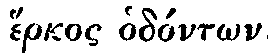
. But to write seriously on so serious a subject, it is
mournful to reflect that the influence of the systematic theology then
in fashion with the anti-Prelatic divines, whether Episcopalians or
Presbyterians, had quenched all fineness of mind, all flow of heart, all
grandeur of imagination in them; while the victorious party, the
Prelatic Arminians, enriched as they were with all learning and highly
gifted with taste and judgment, had emptied revelation of all the
doctrines that can properly be said to have been revealed, and thus
equally caused the extinction of the imagination, and quenched the life
in the light by withholding the appropriate fuel and the supporters of
the sacred flame. So that, between both parties, our transcendant
Liturgy remains like an ancient Greek temple, a monumental proof of the
architectural genius of an age long departed, when there were giants in
the land.
Ib. p. 337.
As I was proceeding, Bishop Morley interrupted me according to his
manner, with vehemency crying out * * The Bishop interrupted me again
* * I attempted to speak, and still he interrupted me * * Bishop
Morley went on, talking louder than I, &c.
The Bishops appear to have behaved insolently enough. Safe in their
knowledge of Charles's inclinations, they laughed in their sleeves at
his commission. Their best answer would have been to have pressed the
anti-impositionists with their utter forgetfulness of the possible, nay,
very probable differences of opinion between the ministers and their
congregations. A vain minister might disgust a sober congregation with
his
extempore
prayers, or his open contempt of their kneeling at
the Sacrament, and the like. Yet by what right if he acts only as an
individual? And then what an endless source of disputes and preferences
of this minister or of that!
Ib. p. 341.
The paper offered by Bishop Cosins.
-
That the question may be put to the managers of the division,
Whether there be anything in the doctrine, or discipline, or the
Common Prayer, or ceremonies, contrary to the word of God; and if they
can make any such appear; let them be satisfied.
-
If not, let them propose what they desire in point of expediency,
and acknowledge it to be no more.
This was proposed, doubtless, by one of your sensible men; it is so
plain, so plausible, shallow,
nihili, nauci, pili, flocci-cal
.
Why, the very phrase "contrary to the word of God" would take a month to
define, and neither party agree at last. One party says:
The Church has power from God's word to order all matters of order so as
shall appear to them to conduce to decency and edification: but
ceremonies respect the orderly performance of divine service: ergo, the
Church has power to ordain ceremonies: but the Cross in baptizing is a
ceremony; ergo, the Church has power to prescribe the crossing in
Baptism. What is rightfully ordered cannot be rightfully withstood:—but
the crossing, &c., is rightfully ordered:—
ergo
, the crossing
cannot be rightfully omitted.
To this, how easily would the other party reply;
- That a small number of Bishops could not be called the Church:
-
That no one Church had power or pretence from God's word to prescribe
concerning mere matters of outward decency and convenience to other
Churches or assemblies of Christian people:
-
That the blending an unnecessary and suspicious, if not
superstitious, motion of the hand with a necessary and essential act
doth in no wise respect order or propriety:
Lastly, that to forbid a man to obey a direct command of God because he
will not join with it an admitted mere tradition of men, is contrary to
common sense, no less than to God's word, expressly and by breach of
charity, which is the great end and purpose of God's word. Besides;
might not the Pope and his shavelings have made the same proposition to
the Reformers in the reign of Edward VI., in respect to the greater part
of the idle superfluities which were rejected by the Reformers, only as
idle and superfluous, and for that reason contrary to the spirit of the
Gospel, though few, if any, were in the direct teeth of a positive
prohibition? Above all, an honest policy dictates that the end in view
being fully determined, as here for instance, the preclusion of
disturbance and indecorum in Christian assemblies, every addition to
means, already adequate to the securing of that end, tends to frustrate
the end, and is therefore evidently excluded from the prerogatives of
the Church, (however that word may be interpreted) inasmuch as its power
is confined to such ceremonies and regulations as conduce to order and
general edification. In short it grieves me to think that the Heads of
the most Apostolical Church in Christendom should have insisted on three
or four trifles, the abolition of which could have given offence to none
but such as from the baleful superstition that alone could attach
importance to them effectually, it was charity to offend;-when all the
rest of Baxter's objections might have been answered so triumphantly.
Ib. p. 343.
Answer to the foresaid paper.
-
That none may be a preacher, that dare not subscribe that there is
nothing in the Common Prayer Book, the Book of Ordination, and the 39
Articles, that is contrary to the word of God.
I think this might have been left out as well as the other two articles
mentioned by Baxter. For as by the words "contrary to the word of God"
in Cosins's paper, it was not meant to declare the Common Prayer Book
free from all error, the sense must have been, that there is not
anything in it in such a way or degree contrary to God's word, as to
oblige us to assign sin to those who have overlooked it, or who think
the same compatible with God's word, or who, though individually
disapproving the particular thing, yet regard that acquiescence as an
allowed sacrifice of individual opinion to modesty, charity, and zeal
for the peace of the Church. For observe that this eighth instance is
additional to, and therefore not inclusive of, the preceding seven:
otherwise it must have been placed as the first, or rather as the whole,
the seven following being motives and instances in support and
explanation of the point.
Ib. p. 368.
Let me mediate here between Baxter and the Bishops: Baxter had taken for
granted that the King had a right to promise a revision of the Liturgy,
Canons and regiment of the Church, and that the Bishops ought to have
met him and his friends as diplomatists on even ground. The Bishops
could not with discretion openly avow all they meant; and it would be
bigotry to deny that the spirit of compromise had no indwelling in their
feelings or intents. But nevertheless it is true that they thought more
in the spirit of the English Constitution than Baxter and his
friends.—"This," thought they, "is the law of the land,
quam nolumus
mutari
; and it must be the King with and by the advice of his
Parliament, that can authorize any part of his subjects to take the
question of its repeal into consideration. Under other circumstances a
King might bring the Bishops and the Heads of the Romish party together
to plot against the law of the land. No! we would have no other secret
Committees but of Parliamentary appointment. We are but so many
individuals. It is in the Legislature that the congregations, the party
most interested in this cause, meet collectively by their
representatives."—Lastly, let it not be overlooked, that the root of
the bitterness was common to both parties,—namely, the conviction of
the vital importance of uniformity;—and this admitted, surely an
undoubted majority in favor of what is already law must decide whose
uniformity it is to be.
Ib. p. 368.
We must needs believe that when your Majesty took our consent to a
Liturgy to be a foundation that would infer our concord, you meant not
that we should have no concord but by consenting to this Liturgy
without any considerable alteration.
This is forcible reasoning, but which the Bishops could fairly leave for
the King to answer;—the contract tacit or expressed, being between him
and the anti-Prelatic Presbytero-Episcopalian party, to which neither
the Bishops nor the Legislature had acceded or assented. If Baxter and
Calamy were so little imbued with the spirit of the Constitution as to
consider Charles II. as the breath of their nostrils, and this dread
sovereign Breath in its passage gave a snort or a snuffle, or having led
them to expect a snuffle surprised them with a snort, let the reproach
be shared between the Breath's fetid conscience and the nostrils'
nasoductility. The traitors to the liberty of their country who were
swarming and intriguing for favor at Breda when they should have been at
their post in Parliament or in the Lobby preparing terms and
conditions!—Had all the ministers that were afterwards ejected and the
Presbyterian party generally exerted themselves, heart and soul, with
Monk's soldiers, and in collecting those whom Monk had displaced, and,
instead of carrying on treasons against the Government
de facto
by mendicant negociations with Charles, had taken open measures to
confer the sceptre on him as the Scotch did,—whose stern and truly
loyal conduct has been most unjustly condemned,—the schism in the
Church might have been prevented and the Revolution of 1688 superseded.
N. B. In the above I speak of the Bishops as men interested in a
litigated estate. God forbid, I should seek to justify them as
Christians.
Ib. p. 369.
Quære. Whether in the 20th Article these words are not
inserted;—Habet Ecclesia auctoritatem in controversiis fidei.
Strange, that the evident antithesis between power in respect of
ceremonies, and authority in points of faith, should have been
overlooked!
Ib.
Some have published, That there is a proper sacrifice in the Lord's
Supper, to exhibit Christ's death in the post-fact, as there
was a sacrifice to prefigure it in the Old Law in the
ante-fact, and therefore that we have a true altar, and not
only metaphorically so called.
Doubtless a gross error, yet pardonable, for to errors nearly as gross
it was opposed.
Ib.
Some have maintained that the Lord's Day is kept merely by
ecclesiastical constitution, and that the day is changeable.
Where shall we find the proof of the contrary?—at least, if the
position had been worded thus: The moral and spiritual obligation of
keeping the Lord's Day is grounded on its manifest necessity, and the
evidence of its benignant effects in connection with those conditions of
the world of which even in Christianized countries there is no reason to
expect a change, and is therefore commanded by implication in the New
Testament, so clearly and by so immediate a consequence, as to be no
less binding on the conscience than an explicit command. A., having
lawful authority, expressly commands me to go to London from Bristol.
There is at present but one safe road: this therefore is commanded by
A.; and would be so, even though A. had spoken of another road which at
that time was open.
Ib. p. 370.
Some have broached out of Socinus a most uncomfortable and desperate
doctrine, that late repentance, that is, upon the last bed of
sickness, is unfruitful, at least to reconcile the penitent to God.
This no doubt refers to Jeremy Taylor's work on Repentance, and is but
too faithful a description of its character.
Ib. p. 373.
A little after the King was beheaded, Mr. Atkins met this priest in
London, and going into a tavern with him, said to him in his familiar
way, "What business have you here? I warrant you come about some
roguery or other." Whereupon the priest told it him as a great secret,
that there were thirty of them here in London, who by instructions
from Cardinal Mazarine, did take care of such affairs, and had sat in
council, and debated the question, whether the King should be put to
death or not;—and that it was carried in the affirmative, and there
were but two voices for the negative, which was his own and another's;
and that for his part, he could not concur with them, as foreseeing
what misery this would bring upon his country. Mr. Atkins stood to
the truth of this, but thought it a violation of the laws of
friendship to name the man.
Richard Baxter was too thoroughly good for any experience to make him
worldly wise; else, how could he have been simple enough to suppose,
that Mazarine would leave such a question to be voted
pro
and
con
, and decided by thirty emissaries in London! And, how could
he have reconciled Mazarine's having any share in Charles's death with
his own masterly account, pp. 98, 99, 100? Even Cromwell, though he
might have prevented, could not have effected, the sentence. The
regicidal judges were not his creatures. Consult the Life of Colonel
Hutchinson upon this.
Ib. p. 374.
Since this, Dr. Peter Moulin hath, in his Answer to Philanax
Anglicus, declared that he is ready to prove, when authority will
Call him to it, that the King's death, and the change of the
government, was first proposed both to the Sorbonne, and to the Pope
with his Conclave, and consented to and concluded for by both.
The Pope in his Conclave had about the same influence in Charles's fate
as the Pope's eye in a leg of mutton. The letter intercepted by Cromwell
was Charles's death-warrant. Charles knew his power; and Cromwell and
Ireton knew it likewise, and knew that it was the power of a man who was
within a yard's length of a talisman, only not within an arm's length,
but which in that state of the public mind, could he but have once
grasped it, would have enabled him to blow up Presbyterian and
Independent both. If ever a lawless act was defensible on the principle
of self-preservation, the murder of Charles might be defended. I suspect
that the fatal delay in the publication of the
Icon Basilike
is
susceptible of no other satisfactory explanation. In short it is absurd
to burthen this act on Cromwell and his party, in any special sense. The
guilt, if guilt it was, was consummated at the gates of Hull; that is,
the first moment that Charles was treated as an individual, man against
man. Whatever right Hampden had to defend his life against the King in
battle, Cromwell and Ireton had in yet more imminent danger against the
King's plotting. Milton's reasoning on this point is unanswerable: and
what a wretched hand does Baxter make of it!
Ib. p. 375.
But if the laws of the land appoint the nobles, as next the King, to
assist him in doing right, and withhold him from doing wrong, then be
they licensed by man's law, and so not prohibited by God's, to
interpose themselves for the safety of equity and innocency, and by
all lawful and needful means to procure the Prince to be reformed, but
in no case deprived, where the sceptre is inherited! So far Bishop
Bilson.
Excellent! O, by all means preserve for him the benefit of his rightful
heir-loom, the regal sceptre; only lay it about his shoulders, till he
promises to handle it, as he ought! But what if he breaks his promise
and your head? or what if he will not promise? How much honester would
it be to say, that extreme cases are
ipso nomine
not
generalizable,—therefore not the subjects of a law, which is the
conclusion
per genus singuli in genere inclusi
. Every extreme
case must be judged by and for itself under all the peculiar
circumstances. Now as these are not foreknowable, the case itself cannot
be predeterminable. Harmodius and Aristogiton did not justify Brutus and
Cassius: but neither do Brutus and Cassius criminate Harmodius and
Aristogiton. The rule applies till an extreme case occurs; and how can
this be proved? I answer, the only proof is success and good event; for
these afford the best presumption, first, of the extremity, and
secondly, of its remediable nature—the two elements of its
justification. To every individual it is forbidden. He who attempts it,
therefore, must do so on the presumption that the will of the nation is
in his will: whether he is mad or in his senses, the event can alone
determine.
Ib. p. 398.
The governing power and obligation over the flock is essential to the
office of a Pastor or Presbyter as instituted by Christ.
There is,
, one flaw in Baxter's plea for his
Presbyterian form of Church government, that he uses a metaphor, which,
inasmuch as it is but a metaphor, agrees with the thing meant in some
points only, as if it were commensurate
in toto
, and virtually
identical. Thus, the Presbyter is a shepherd as far as the watchfulness,
tenderness, and care, are to be the same in both; but it does not follow
that the Presbyter has the same sole power and exclusive right of
guidance; and for this reason,—that his flock are not sheep, but men;
not of a natural, generic, or even constant inferiority of judgment; but
Christians, co-heirs of the promises, and therein of the gifts of the
Holy Spirit, and of the interpretation of the Holy Scriptures. How then
can they be excluded from a share in Church Government? The words of
Christ, if they may be transferred from their immediate application to
the Jewish Synagogue, suppose the contrary;—and that highest act of
government, the election of the officers and ministers of the Church,
was confessedly exercised by the congregations including the Presbyters
and Arch-presbyter or Bishop, in the primitive Church. The question,
therefore, is:—Is a national Church, established by law, compatible
with Christianity? If so, as Baxter held, the representatives (King,
Lords, and Commons,) are or may be representatives of the whole people
as Christians as well as civil subjects;—and their voice will then be
the voice of the Church, which every individual, as an individual,
themselves as individuals, and,
a fortiori
, the officers and
administrators appointed by them, are bound to obey at the risk of
excommunication, against which there would be no appeal, but to the
heavenly Cæsar, the Lord and Head of the universal Church. But whether
as the accredited representatives and plenipotentiaries of the national
Church, they can avail themselves of their conjoint but distinct
character, as temporal legislators, to superadd corporal or civil
penalties to the spiritual sentence in points peculiar to Christianity,
as heretical opinions, Church ceremonies, and the like, thus destroying
discipline
, even as wood is destroyed by combination with
fire;—this is a new and difficult question, which yet Baxter and the
Presbyterian divines, and the Puritans of that age in general, not only
answered affirmatively, but most zealously, not to say furiously,
affirmed with anathemas to the assertors of the negative, and spiritual
threats to the magistrates neglecting to interpose the temporal sword.
In this respect the present Dissenters have the advantage over their
earlier predecessors; but on the other hand they utterly evacuate the
Scriptural commands against schism; take away all sense and significance
from the article respecting the Catholic Church; and in consequence
degrade the discipline itself into mere club-regulations or the by-laws
of different lodges;—that very discipline, the capability of exercising
which in its own specific nature without superinduction of a destructive
and transmutual opposite, is the fairest and firmest support of their
cause.
20th October, 1829.
Ib. p. 401.
That sententially it must be done by the Pastor or Governor of that
particular Church, which the person is to be admitted into, or cast
out of.
This most arbitrary appropriation of the words of Christ, and of the
apostles, John and Paul, by the Clergy to themselves exclusively, is the

, the fatal error which has practically excluded
Church discipline from among Protestants in all free countries. That it
is retained, and an efficient power, among the Quakers, and only in that
Sect, who act collectively as a Church,—who not only have no proper
Clergy, but will not allow a division of majority and minority, nor a
temporary president,—seems to supply an unanswerable confirmation of
this my assertion, and a strong presumption for the validity of my
argument. The Wesleyan Methodists have, I know, a discipline, and the
power is in their consistory,—a general conclave of priests cardinal
since the death of Pope Wesley. But what divisions and secessions this
has given rise to; what discontents and heart-burnings it still
occasions in their labouring inferior ministers, and in the classes, is
no less notorious, and may authorize a belief that as the Sect
increases, it will be less and less effective; nay, that it has
decreased; and after all, what is it compared with the discipline of the
Quakers?—Baxter's inconsistency on this subject would be inexplicable,
did we not know his zealotry against Harrington, the Deists and the
Mystics;—so that, like an electrified pith-ball, he is for ever
attracted towards their tenets concerning the pretended perfecting of
spiritual sentences by the civil magistrate, but he touches only to fly
off again. "Toleration! dainty word for soul-murder! God grant that my
eye may never see a toleration!" he exclaims in his book against
Harrington's Oceana.
Ib. p. 405.
As for the democratical conceit of them that say that the Parliament
hath their governing power, as they are the people's representatives,
and so have the members of the convocation, though those represented
have no governing power themselves, it is so palpably
self-contradicting, that I need not confute it.
Self-contradicting according to Baxter's sense of the words "represent"
and "govern." But every rational adult has a governing power: namely,
that of governing himself.
Ib. p. 412.
That though a subject ought to take an oath in the sense of his rulers
who impose it, as far as he can understand it; yet a man that taketh
an oath from a robber to save his life is not always bound to take it
in the imposer's sense, if he take it not against the proper sense of
the words.
This is a point, on which I have never been able to satisfy myself.—The
only safe conclusion I have been able to draw, being the folly,
mischief, and immorality of all oaths but judicial ones,—and those no
farther excepted than as they are means of securing a deliberate
consciousness of the presence of the Omniscient Judge. The inclination
of my mind is at this moment, to the principle that an oath may deepen
the guilt of an act sinful in itself, but cannot be detached from the
act; it being understood that a perfectly voluntary and self-imposed
oath is itself a sin. The man who compels me to take an oath by putting
a pistol to my ear has in my mind clearly forfeited all his right to be
treated as a moral agent. Nay, it seems to be a sin to act so as to
induce him to suppose himself such. Contingent consequences must be
excluded; but would, I am persuaded, weigh in favour of annulling on
principle an oath sinfully extorted. But I hate casuistry so utterly,
that I could not without great violence to my feelings put the case in
all its bearings. For example:—it is sinful to enlarge the power of
wicked agents; but to allow them to have the power of binding the
conscience of those, whom they have injured, is to enlarge the power,
&c. Again: no oath can bind to the perpetration of a sin; but to
transfer a sum of money from its rightful owner to a villain is a sin,
&c. and twenty other such. But the robber may kill the next man!
Possibly: but still more probably, many, who would be robbers if they
could obtain their ends without murder, would resist the temptation if
no extenuations of guilt were contemplated;—and one murder is more
effective in rousing the public mind to preventive measures, and by the
horror it strikes, is made more directly preventive of the tendency,
than fifty civil robberies by contract.
Ib. p. 435.
That the minister be not bound to read the Liturgy himself, if
another, by whomsoever, be procured to do it; so be it he preach not
against it.
Wonderful, that so good and wise a man as Baxter should not have seen
that in this the Church would have given up the best, perhaps the only
efficient, preservative of her Faith. But for our blessed and truly
Apostolic and Scriptural Liturgy, our churches' pews would long ago have
been filled by Arians and Socinians, as too many of their desks and
pulpits already are.
Part III. p. 59.
As also to make us take such a poor suffering as this for a sign of
true grace, instead of faith, hope, love, mortification, and a
heavenly mind; and that the loss of one grain of love was worse than a
long imprisonment.
Here Baxter confounds his own particular case, which very many would
have coveted, with the sufferings of other prisoners on the same
score;—sufferings nominally the same, but with few, if any, of Baxter's
almost flattering supports.
Ib. p. 60.
It would trouble the reader for me to reckon up the many diseases and
dangers for these ten years past, in or from which God hath delivered
me; though it be my duty not to forget to be thankful. Seven months
together I was lame with a strange pain in one foot, twice delivered
from a bloody flux; a spurious cataract in my eye, with incessant webs
and networks before it, hath continued these eight years, * * * so
that I have rarely one hour's or quarter of an hour's ease. Yet
through God's mercy I was never one hour melancholy, &c.
The power of the soul, by its own act of will, is, I admit, great for
any one occasion or for a definite time, yea, it is marvellous. But of
such exertions and such an even frame of spirit, as Baxter's were, under
such unremitting and almost unheard-of bodily derangements and pains as
his, and during so long a life, 1 do not believe a human soul capable,
unless substantiated and successively potentiated by an especial divine
grace.
Ib. p. 65.
The reasons why I make no larger a profession necessary than the Creed
and Scriptures, are, because if we depart from this old sufficient
Catholic rule, we narrow the Church, and depart from the old
Catholicism.
Why then any Creed? This is the difficulty. If you put the Creed as in
fact, and not by courtesy, Apostolic, and on a parity with Scripture,
having, namely, its authority in itself, and a direct inspiration of the
framers, inspired
ad id tempus et ad eam rem
, on what ground is
this to be done, without admitting the binding power of tradition in the
very sense of the term in which the Church of Rome uses it, and the
Protestant Churches reject it? That it is the sum total made by
Apostolic contributions, each Apostle casting, as into a helmet, a
several article as his
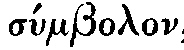
, is the tradition; and this is
holden as a mere legendary tale by the great majority of learned
divines. That it is simply the Creed of the Western Church is affirmed
by many Protestant divines, and some of these divines of our Church. Its
comparative simplicity these divines explain by the freedom from
heresies enjoyed by the Western Church, when the Eastern Church had been
long troubled therewith. Others, again, and not unplausibly, contend
that it was the Creed of the Catechumens preparatory to the Baptismal
profession of faith, which other was a fuller comment on the union of
the Father, the Son, and the Holy Ghost, into whose name (or power) they
were baptised. That the Apostles' Creed received additions after the
Apostolic age, seems almost certain; not to mention the perplexing
circumstance that so many of the Latin Fathers, who give almost the
words of the Apostolic Creed, declare it forbidden absolutely to write
or by any material form to transmit the
Canon Fidei
, or
Symbolum
or
Regula Fidei
, the Creed
, by analogy of which the question whether such a book was
Scripture or not, was to be tried. With such doubts how can the
Apostles' Creed be preferred to the Nicene by a consistent member of the
Reformed Catholic Church?
Ib. p. 67.
They think while you (the Independents) seem to be for a stricter
discipline than others, that your way or usual practice tendeth to
extirpate godliness out of the land, by taking a very few that can
talk more than the rest, and making them the Church, &c.
Had Baxter had as judicious advisers among his theological, as he had
among his legal, friends; and had he allowed them equal influence with
him; he would not, I suspect, have written this irritating and too
egometical paragraph. But Baxter would have disbelieved a prophet who
had foretold that almost the whole orthodoxy of the Non-conformists
would he retained and preserved by the Independent congregations in
England, after the Presbyterian had almost without exception become,
first, Arian, then Socinian, and finally Unitarian: that is, the
demi-semi-quaver
of Christianity, Arminianism being taken for the
semi-breve
.
Ib. p. 69.
After this I waited on him (Dr. John Owen) at London again, and he
came once to me to my lodgings, when I was in town near him. And he
told me that he received my chiding letter and perceived that I
suspected his reality in the business; but he was so hearty in it that
I should see that he really meant as he spoke, concluding in these
words, "You shall see it, and my practice shall reproach your
diffidence" * * *. About a month after I went to him again, and he had
done nothing, but was still hearty for the work. And to be short, I
thus waited on him time after time, till my papers had been near a
year and a quarter in his hand, and then I advised him to return them
to me, which he did, with these words, "I am still a well-wisher to
those mathematics;"—without any other words about them, or ever
giving me any more exception against them. And this was the issue of
my third attempt for union with the Independents.
Dr. Owen was a man of no ordinary intellect. It would be interesting to
have his conduct in this point, seemingly so strange, in some measure
explained: The words "those mathematics" look like an innuendo, that
Baxter's scheme of union, by which all the parties opposed to the
Prelatic Church were to form a rival Church, was, like the mathematics,
true indeed, but true only in the idea, that is, abstracted from the
subject matter. Still there appears a very chilling want of
open-heartedness on the part of Owen, produced perhaps by the somewhat
overly and certainly most ungracious resentments of Baxter. It was odd
at least to propose concord in the tone and on the alleged ground of an
old grudge.
Ib.
I have been twenty-six years convinced that dichotomizing will not do
it, but that the divine Trinity in Unity hath expressed itself in the
whole frame of nature and morality * * *. But he, Mr. George Lawson,
had not hit on the true method of the vestigia Trinitatis, &c.
Among Baxter's philosophical merits, we ought not to overlook, that the
substitution of Trichotomy for the old and still general plan of
Dichotomy in the method and disposition of Logic, which forms so
prominent and substantial an excellence in Kant's Critique of the Pure
Reason, of the Judgment, and the rest of his works, belongs originally
to Richard Baxter, a century before Kant;—and this not as a hint, but
as a fully evolved and systematically applied principle. Nay, more than
this:—Baxter grounded it on an absolute idea presupposed in all
intelligential acts: whereas Kant takes it only as a fact in which he
seems to anticipate or suspect some yet deeper truth latent, and
hereafter to be discovered.
On recollection, however, I am disposed to consider
this
alone as
Baxter's peculiar claim, I have not indeed any distinct memory of
Giordano Bruno's
Logice Venatrix Veritatis
; but doubtless the
principle of Trichotomy is necessarily involved in the Polar Logic,
which again is the same with the Pythagorean
Tetractys
, that is,
the eternal fountain or source of nature; and this being sacred to
contemplations of identity, and prior in order of thought to all
division, is so far from interfering with Trichotomy as the universal
form of division (more correctly of distinctive distribution in logic)
that it implies it.
Prothesis
being by the very term anterior to
Thesis
can be no part of it. Thus in
|
Prothesis |
|
| Thesis |
|
Antithesis |
|
Synthesis |
|
have the Tetrad indeed in the intellectual and intuitive
contemplation, but a Triad in discursive arrangement, and a Tri-unity in
result
.
Ib. p. 144.
Seeing the great difficulties that lie in the way of increasing
charities so as to meet the increase of population, or even so as to
follow it, and the manifold desirableness of parish Churches, with the
material dignity that in a right state of Christian order would attach
to them, as compared with meeting-houses, chapels, and the like—all
more or less
privati juris
, I have often felt disposed to wish
that the large majestic Church, central to each given parish, might have
been appropriated to Public Prayer, to the mysteries of Baptism and the
Lord's Supper, and to the
quasi sacramenta
, Marriage, Penance,
Confirmation, Ordination, and to the continued reading aloud, or
occasional chanting, of the Scriptures during the intervals of the
different Services, which ought to be so often performed as to suffice
successively for the whole population; and that on the other hand the
chapels and the like should be entirely devoted to teaching and
expounding.
Ib. p. 153.
And I proved to him that Christianity was proved true many years
before any of the New Testament was written, and that so it may be
still proved by one that doubted of some words of the Scripture; and
therefore the true order is, to try the truth of the Christian
religion first, and the perfect verity of the Scriptures afterwards.
With more than Dominican virulence did Goeze, Head Pastor of the
Lutheran Church at Hamburg, assail the celebrated Lessing for making and
supporting the same position as the pious Baxter here advances.
This controversy with Goeze was in 1778, nearly a hundred years after
Baxter's writing this.
Ib. p. 155.
And within a few days Mr. Barnett riding the circuit was cast by his
horse, and died in the very fall. And Sir John Medlicote and his
brother, a few weeks after, lay both dead in his house together.
This interpreting of accidents and coincidences into judgments is a
breach of charity and humility, only not universal among all sects and
parties of this period, and common to the best and gentlest men in all;
we should not therefore bring it in charge against any one in
particular. But what excuse shall be made for the revival of this
presumptuous encroachment on the divine prerogative in our days?
Ib. p. 180.
Near this time my book called A Key for Catholics, was to be
reprinted. In the preface to the first impression I had mentioned with
praise the Earl of Lauderdale. * * * I thought best to prefix an
epistle to the Duke, in which I said not a word of him but truth. * *
* But the indignation that men had against the Duke made some blame
me, as keeping up the reputation of one whom multitudes thought very
ill of; whereas I owned none of his faults, and did nothing that I
could well avoid for the aforesaid reasons. Long after this he
professed his kindness to me, and told me I should never want while he
was able, and humbly entreated me to accept twenty guineas from him,
which I did.
This would be a curious proof of the slow and imperfect intercourse of
communication between Scotland and London, if Baxter had not been
particularly informed of Lauderdale's horrible cruelties to the Scotch
Covenanters:—and if Baxter did know them, he surely ran into a greater
inconsistency to avoid the appearance of a less. And the twenty guineas!
they must have smelt, I should think, of more than the earthly brimstone
that might naturally enough have been expected in gold or silver, from
his palm. I would as soon have plucked an ingot from the cleft of the
Devil's hoof.
Ib. p. 181.
About that time I had finished a book called Catholic Thoughts; in
which I undertake to prove that besides things unrevealed, known to
none, and ambiguous words, there is no considerable difference between
the Arminians and Calvinists, except some very tolerable difference in
the point of perseverance.
What Arminians? what Calvinists?—It is possible that the guarded
language and positions of Arminius himself may be interpreted into a
"very tolerable" compatibility with the principles of the milder
Calvinists, such as Archbishop Leighton, that true Father of the Church
of Christ. But I more than doubt the possibility of even approximating
the principles of Bishop Jeremy Taylor to the fundamental doctrines of
Leighton, much more to those of Cartwright, Twiss, or Owen.
Ib. p. 186.
Bishop Barlow told my friend that got my papers for him, that he could
hear of nothing that we judged to be sin, but mere inconveniences.
When as above seventeen years ago, we publicly endeavoured to prove
the sinfulness even of many of the old impositions.
Clearly an undeterminable controversy; inasmuch as there is no
centra-definition possible of sin and inconvenience in religion: while
the exact point, at which an inconvenience, becoming intolerable, passes
into sin, must depend on the state and the degree of light, of the
individual consciences to which it appears or becomes intolerable.
Besides, a thing may not be only indifferent in itself, but may be
declared such by Scripture, and on this indifference the Scripture may
have rested a prohibition to Christians to judge each other on the
point. If yet a Pope or Archbishop should force this on the consciences
of others, for example, to eat or not to eat animal food, would he not
sin in so doing? And does Scripture permit me to subscribe to an
ordinance made in direct contempt of a command of Scripture?
If it were said,—In all matters indifferent and so not sinful you must
comply with lawful authority:—must I not reply, But you have yourself
removed the indifferency by your injunction? Look in Popish countries
for the hideous consequences of the unnatural doctrine—that the Priest
may go to Hell for sinfully commanding, and his parishioners go with him
for not obeying that command.
Ib. p. 191.
About this time died my dear friend Mr. Thomas Gouge, of whose life
you may see a little in Mr. Clark's last book of Lives:—a wonder of
sincere industry in works of charity. It would make a volume to recite
at large the charity he used to his poor parishioners at Sepulchre's,
before he was ejected and silenced for non-conformity, &c.
I cannot express how much it grieves me, that our Clergy should still
think it fit and expedient to defend the measures of the High Churchmen
from Laud to Sheldon, and to speak of the ejected ministers, Calamy,
Baxter, Gouge, Howe, and others, as schismatics, factionists, fanatics,
or Pharisees:—thus to flatter some half-dozen dead Bishops, wantonly
depriving our present Church of the authority of perhaps the largest
collective number of learned and zealous, discreet and holy, ministers
that one age and one Church was ever blest with; and whose authority in
every considerable point is in favor of our Church, and against the
present Dissenters from it. And this seems the more impolitic, when it
must be clear to every student of the history of these times, that the
unmanly cruelties inflicted on Baxter and others were, as Bishops Ward,
Stillingfleet, and others saw at the time, part of the Popish scheme of
the Cabal, to trick the Bishops and dignified Clergy into rendering
themselves and the established Church odious to the public by laws, the
execution of which the King, the Duke, Arlington, and the Popish priests
directed towards the very last man that the Bishops themselves (the
great majority at least) would have molested.
Appendix II. p. 37.
If I can prove that it hath been the universal practice of the Church
in nudum apertum caput manus imponere, doth it follow that this
is essential, and the contrary null?
How likewise can it be proved that the imposition of hands in Ordination
did not stand on the same ground as the imposition of hands in sickness;
that is, the miraculous gifts of the first preachers of the Gospel? All
Protestants admit that the Church retained several forms so originated,
after the cessation of the originating powers, which were the substance
of these forms.
Ib.
If you think not only imposition to be essential, but also that
nothing else is essential, or that all are true ministers that are
ordained by a lawful Bishop per manuum impositionem, then do
you egregiously tibi ipsi imponere.
Baxter, like most scholastic logicians, had a sneaking affection for
puns. The cause is,—the necessity of attending to the primary sense of
words, that is, the visual image or general relation expressed, and
which remains common to all the after senses, however widely or even
incongruously differing from each other in other respects. For the same
reason, schoolmasters are commonly punsters. "I have indorsed your Bill,
Sir," said a pedagogue to a merchant, meaning he had flogged his son
William.—My old master the Rev. James Bowyer, the
Hercules
furens
of the phlogistic sect, but else an incomparable
teacher,—used to translate,
Nihil in intellectu quod non prius in
sensu
,—first reciting the Latin words, and observing that they were
the fundamental article of the Peripatetic school,—"You must flog a
boy, before you can make him understand;"—or, "You must lay it in at
the tail before you can get it into the head."
Ib. p. 45.
Then, that the will must follow the practical intellect whether right
or wrong,—that is no precept, but the nature of the soul in its
acting, because that the will is potentia cæca, non nata ad
intelligendum, sed ad volendum vel nolendum intellectum.
This is the main fault in Baxter's metaphysics, that he so often
substantiates distinctions into dividuous self-subsistents. As
here;—for a will not intelligent is no will.
Appendix. III. p. 55.
And for many ages no other ordinarily baptised but infants. If Christ
had no Church then, where was his wisdom, his love, and his power?
What was become of the glory of his redemption, and his Catholic
Church, that was to continue to the end?
But the Antipœdo-Baptists would deny any such consequences as
applicable to them, who are to act according to the circumstances, in
which God, who ordains his successive manifestations in due
correspondence with other lights and states of things, has placed them.
He does not exclude from the Church of Christ (say they) those whom we
do not accept into the communion of our particular Society, any more
than the House of Lords excludes Commoners from being Members of
Parliament. And we do this because—we think that such promiscuous
admission would prolong an error which would be deadly to us, though not
to you who interpret the Scriptures otherwise.
In fine.
There are two senses in which the words, 'Church of England,' may be
used;—first, with reference to the idea of the Church as an estate of
this Christian Realm, protesting against the Papal usurpation,
comprising, first, the interests of a permanent learned class, that is,
the Clergy;—secondly, those of the proper, that is, the infirm poor,
from age or sickness;—and thirdly, the adequate proportional
instruction of all in all classes by public prayer, recitation of the
Scriptures, by expounding, preaching, catechizing, and schooling, and
last, not least, by the example and influence of a pastor and a
schoolmaster placed as a germ of civilization and cultivation in every
parish throughout the land. To this idea, the Reformed Church of England
with its marriable and married Clergy would have approximated, if the
revenues of the Church, as they existed at the death of Henry VII., had
been rightly transferred by his successor;—transferred, I mean, from
reservoirs, which had by degeneracy on the one hand, and progressive
improvement on the other, fallen into ruin, and in which those revenues
had stagnated into contagion or uselessness,—transferred from what had
become public evils to their original and inherent purpose of public
benefits, instead of being sacrilegiously alienated by a transfer to
private proprietors. That this was impracticable, is historically true;
but no less true is it philosophically, that this impracticability,
arising wholly from moral causes, (namely, the loose manners and corrupt
principles of a great majority in all classes during the dynasty of the
Tudors,) does not prevent this wholesale sacrilege, from deserving the
character of the "first and deadliest wound inflicted on the
Constitution of the kingdom; which term, in the body politic, as in
bodies natural, expresses not only what is and has been evolved, but
likewise whatever is potentially contained in the seminal principle of
the particular body, and which would in its due time have appeared but
for emasculation in its infancy.
, however, is the first sense of
the words, Church of England
.
The second is the Church of England as now by law established, and by
practice of the law actually existing. That in the first sense it is the
object of my admiration and the earthly
ne plus ultra
of my
religious aspirations, it were superfluous to say: but I may be allowed
to express iny conviction, that on our recurring to the same ends and
objects, (the restoration of a national and circulating property in
counterpoise of individual possession, disposable and heritable) though
in other forms and by other means perhaps, the decline or progress of
this country depends. In the second sense of the words I can sincerely
profess, that I love and honour the Church of England, comparatively,
beyond any other Church established or unestablished now existing in
Christendom; and it is wholly in consequence of this deliberate and most
affectionate filial preference, that I have read this work, and Calamy's
historical writings, with so deep and so melancholy an interest. And I
dare avow that I cannot but regard as an ignorant bigot every man who
(especially since the publicity and authentication of the contents of
the Stuart Papers, Memoirs and Life of James II. &c.) can place the far
later furious High Church compilations and stories of Walker and others
in competition with the veracity and general verity of Baxter and
Calamy; or can forget that the great body of Non-conformists to whom
these great and good men belonged, were not dissenters from the
established Church willingly, but an orthodox and numerous portion of
the Church. Omitting then the wound received by religion generally under
Henry VIII., and the shameless secularizations clandestinely effected
during the reigns of Elizabeth and the first James, I am disposed to
consider the three following as the grand evil epochs of our present
Church. First, The introduction and after-predominance of
Latitudinarianism under the name of Arminianism, and the spirit of a
conjoint Romanism and Socinianism at the latter half or towards the
close of the reign of James I. in the persons of Montague, Laud, and
their confederates. Second, The ejection of the two thousand ministers
after the Restoration, with the other violences in which the Churchmen
made themselves the dupes of Charles, James, the Jesuits, and the French
Court. (See the Stuart Papers
passim
). It was this that gave
consistence and enduring strength to Schism in this country, prevented
the pacation of Ireland, and prepared for the separation of America at a
far too early period for the true interest of either country. Third, The
surrender by the Clergy of the right of taxing
themselves, and the Jacobitical follies that combined with the former to
put it in the power of the Whig party to deprive the Church of her
Convocation,—a bitter disgrace and wrong, to which most unhappily the
people were rendered indifferent by the increasing contrast of the
sermons of the Clergy with the Articles and Homilies of the Church
itself,—but a wrong nevertheless which already has avenged, and will
sooner or later be seen to avenge, itself on the State and the governing
classes that continue this boast of a short-sighted policy; the same
policy which in our own days would have funded the property of the
Church, and, by converting the Clergy into salaried dependents on the
Government
pro tempore
, have deprived the Establishment of its
fairest honor, that of being neither enslaved to the court, nor to the
congregations; the same policy, alas! which even now pays and patronizes
a Board of Agriculture to undermine all landed property by a succession
of false, shallow, and inflammatory libels against tithes.
These are my weighed sentiments: and fervently desiring, as I do, the
perpetuity and prosperity of the established Church, zealous for its
rights and dignity, preferring its forms, believing its Articles of
Faith, and holding its Book of Common Prayer and its translation of the
Scriptures among my highest privileges as a Christian and an Englishman,
I trust that I may both entertain and avow these sentiments without
forfeiting any part of my claim to the name of a faithful member of the
Church of England.
June 1820.
N. B. As to Warburton's Alliance of the Church and State, I object to
the title (Alliance), and to the matter and mode of the reasoning. But
the inter-dependence of the Church and the State appears to me a truth
of the highest practical importance. Let but the temporal powers protect
the subjects in their just rights as subjects merely: and I do not know
of any one point in which the Church has the right or the necessity to
call in the temporal power as its ally for any purpose exclusively
ecclesiastic. The right of a firm to dissolve its partnership with any
one partner, breach of contract having been proved, and publicly to
announce the same, is common to all men as social beings.
I spoke above of "Romanism." But call it, if you like, Laudism, or
Lambethism in temporalities and ceremonials, and of Socinianism in
doctrine, that is, a retaining of the word but a rejecting or
interpreting away of the sense and substance of the Scriptural
Mysteries. This spirit has not indeed manifested itself in the article
of the Trinity, since Waterland gave the deathblow to Arianism, and so
left no alternative to the Clergy, but the actual divinity or mere
humanity of our Lord; and the latter would be too impudent an avowal for
a public reader of our Church Liturgy: but in the articles of original
sin, the necessity of regeneration, the necessity of redemption in order
to the possibility of regeneration, of justification by faith, and of
prevenient and auxiliary grace,—all I can say with sincerity is, that
our orthodoxy seems so far in an improving state, that I can hope for
the time when Churchmen will use the term Arminianism to express a habit
of belief opposed not to Calvinism, or the works of Calvin, but to the
Articles of our own Church, and to the doctrine in which all the first
Reformers agreed.
Note—that by Latitudinarianism, I do not mean the particular tenets of
the divines so called, such as Dr. H. More, Cudworth and their compeers,
relative to toleration, comprehension, and the general belief that in
the greater number of points then most controverted, the pious of all
parties were far more nearly of the same mind than their own
imperfections, and the imperfection of language allowed them to see: I
mean the disposition to explain away the articles of the Church on the
pretext of their inconsistency with right reason;—when in fact it was
only an incongruity with a wrong understanding, the faculty which St.
Paul calls
, the rules of which having been all
abstracted from objects of sense, (finite in time and space,) are
logically applicable to objects of the sense alone. This I have
elsewhere called the spirit of Socinianism, which may work in many whose
tenets are anti-Socinian.
Law is—
conclusio per regulam generis singulorum in genere isto
inclusorum
. Now the extremes
et inclusa
are contradictory
terms. Therefore extreme cases are not capable subjects of law
a
priori
, but must proceed on knowledge of the past, and anticipation
of the future, and the fulfilment of the anticipation is the proof,
because the only possible determination, of the accuracy of the
knowledge. In other words the agents may be condemned or honored
according to their intentions, and the apparent source of their motives;
so we honor Brutus, but the extreme case itself is tried by the event.
Relliquiæ Baxterianæ
: or Mr. Richard Baxter's
Narrative of the most memorable passages of his life and times.
Published from his manuscript, by Matthew Sylvester.—London,
folio
. 1699.
See Hooker E. P. V. xviii. 3. Vol. II. p. 80. Keble.
Ed
.
See
Table Talk
, p. 162. 2nd edit.
Ed.
See the
Church and State
, p. 73, 3rd edit.—
Ed.
Contents / Index
Notes on Leighton1
Surely if ever work not in the sacred Canon might suggest a belief of
inspiration,—of something more than human,—this it is. When Mr. Elwyn
made this assertion, I took it as the hyperbole of affection: but now I
subscribe to it seriously, and bless the hour that introduced me to the
knowledge of the evangelical, apostolical Archbishop Leighton.
April 1814.
Next to the inspired Scriptures—yea, and as the vibration of that once
struck hour remaining on the air, stands Leighton's Commentary on the
1st Epistle of St. Peter.
Comment Vol. I. p. 2.
—their redemption and salvation by Christ Jesus; that inheritance of
immortality bought by his blood for them, and the evidence and
stability of their right and title to it.
By the blood of Christ I mean this. I contemplate the Christ,
-
As Christus agens, the Jehovah Christ, the Word:
-
As Christus patiens, The God Incarnate.
In the former he is
relative ad intellectum humanum, lux lucifica,
sol intelligibilis: relative ad existentiam humanam, anima animans,
calor fovens
. In the latter he is
vita vivificans, principium
spiritualis, id est, veræ reproductionis in vitam veram
. Now this
principle, or
vis vitæ vitam vivificans
, considered in
forma
passiva, assimilationem patiens
, at the same time that it excites
the soul to the vital act of assimilating—this is the Blood of Christ,
really present through faith to, and actually partaken by, the faithful.
Of this the body is the continual product, that is, a good life-the
merits of Christ acting on the soul, redemptive.
Ib. pp. 13-15.
Of their sanctification: elect unto obedience, &c.
That the doctrines asserted in this and the two or three following pages
cannot be denied or explained away, without removing (as the modern
Unitarians), or (as the Arminians) unsettling and undermining, the
foundations of the Faith, I am fully convinced; and equally so, that
nothing is gained by the change, the very same logical consequences
being deducible from the tenets of the Church Arminians;—scarcely more
so, indeed, from those which they still hold in common with Luther,
Zuinglius, Calvin, Knox, and Cranmer and the other Fathers of the
Reformation in England, and which are therefore most unfairly entitled
Calvinism—than from those which they have attempted to substitute in
their place. Nay, the shock given to the moral sense by these
consequences is, to my feelings, aggravated in the Arminian doctrine by
the thin yet dishonest disguise. Meantime the consequences appear to me,
in point of logic, legitimately concluded from the terms of the
premisses. What shall we say then? Where lies the fault? In the original
doctrines expressed in the premisses? God forbid. In the particular
deductions, logically considered? But these we have found legitimate.
Where then? I answer in deducing any consequences by such a process, and
according to such rules. The rules are alien and inapplicable; the
process presumptuous, yea, preposterous. The error,

, lies in the false assumption of a logical deducibility at all,
in this instance.
First:—because the terms from which the conclusion must be
drawn-(
termini in majore præmissi, a quibus scientialiter et
scientifice demonstrandum erat
) are accommodations and not
scientific—that is, proper and adequate, not
per idem
, but
per quam maxime simile
, or rather
quam maxime dissimile
:
Secondly;—because the truths in question are transcendant, and have
their evidence, if any, in the ideas themselves, and for the reason; and
do not and cannot derive it from the conceptions of the understanding,
which cannot comprehend the truths, but is to be comprehended in and by
them, (
John
i. 5.):
Lastly, and chiefly;—because these truths, as they do not originate in
the intellective faculty of man, so neither are they addressed primarily
to our intellect; but are substantiated for us by their correspondence
to the wants, cravings, and interests of the moral being, for which they
were given, and without which they would be devoid of all
meaning,—
vox et præterea nihil
. The only conclusions, therefore,
that can be drawn from them, must be such as are implied in the origin
and purpose of their revelation; and the legitimacy of all conclusions
must be tried by their consistency with those moral interests, those
spiritual necessities, which are the proper final cause of the truths
and of our faith therein. For some of the faithful these truths have, I
doubt not, an evidence of reason; but for the whole household of faith
their certainty is in their working. Now it is this, by which, in all
cases, we know and determine existence in the first instance. That which
works in us or on us exists for us. The shapes and forms that follow the
working as its results or products, whether the shapes cognizable by
sense or the forms distinguished by the intellect, are after all but the
particularizations of this working; its proper names, as it were, as
John, James, Peter, in respect of human nature. They are all derived
from the relations in which finite beings stand to each other; and are
therefore heterogeneous and, except by accommodation, devoid of meaning
and purpose when applied to the working in and by which God makes his
existence known to us, and (we may presume to say) especially exists for
the soul in whom he thus works. On these grounds, therefore, I hold the
doctrines of original sin, the redemption therefrom by the Cross of
Christ, and change of heart as the consequent; without adopting the
additions to the doctrines inferred by one set of divines, the modern
Calvinists, or acknowledging the consequences burdened on the doctrines
by their antagonists. Nor is this my faith fairly liable to any
inconvenience, if only it be remembered that it is a spiritual working,
of which I speak, and a spiritual knowledge,—not through the
medium
of image, the seeking after which is superstition; nor yet
by any sensation, the watching for which is enthusiasm, and the conceit
of its presence fanatical distemperature. "Do the will of the Father,
and ye shall
know
it."
We must distinguish the life and the soul; though there is a certain
sense in which the life may be called the soul; that is, the life is the
soul of the body. But the soul is the life of the man, and Christ is the
life of the soul. Now the spirit of man, the spirit subsistent, is
deeper than both, not only deeper than the body and its life, but deeper
than the soul; and the Spirit descendent and supersistent is higher than
both. In the regenerated man the height and the depth become one—the
Spirit communeth with the spirit—and the soul is the
inter-ens
,
or
ens inter-medium
between the life and the spirit;—the
participium
, not as a compound, however, but as a
medium
indifferens
—in the same sense in which heat may be designated as
the indifference between light and gravity. And what is the Reason?—The
spirit in its presence to the understanding abstractedly from its
presence in the will,—nay, in many, during the negation of the latter.
The spirit present to man, but not appropriated by him, is the reason of
man:—the reason in the process of its identification with the will is
the spirit.
Ib. pp. 63-4.
Can we deny that it is unbelief of those things that causeth this
neglect and forgetting of them? The discourse, the tongue of men and
angels cannot beget divine belief of the happiness to come; only He
that gives it, gives faith likewise to apprehend it, and lay hold upon
it, and upon our believing to be filled with joy in the hopes of it.
Most true, most true!
Ib. p. 68.
In spiritual trials that are the sharpest and most fiery of all, when
the furnace is within a man, when God doth not only shut up his
loving-kindness from its feeling, but seems to shut it up in hot
displeasure, when he writes bitter things against it; yet then to
depend upon him, and wait for his salvation, this is not only a true,
but a strong and very refined faith indeed, and the more he smites,
the more to cleave to him. * * * Though I saw, as it were, his hand
lifted up to destroy me, yet from that same hand would I expect
salvation.
Bless God, O my soul, for this sweet and strong comforter! It is the
honey in the lion.
Ib. p. 75.
This natural men may discourse of, and that very knowingly, and give a
kind of natural credit to it as to a history that may be true; but
firmly to believe that there is divine truth in all these things, and
to have a persuasion of it stronger than of the very things we see
with our eyes; such an assent as this is the peculiar work of the
Spirit of God, and is certainly saving faith.
Lord I believe: help thou my unbelief!
My reason acquiesces, and
I believe enough to fear. O, grant me the belief that brings sweet hope!
Ib. p. 76.
Faith * * causes the soul to find all that is spoken of him in the
word, and his beauty there represented, to be abundantly true, makes
it really taste of his sweetness, and by that possesses the heart more
strongly with his love, persuading it of the truth of those things,
not by reasons and arguments, but by an inexpressible kind of
evidence, that they only know that have it.
Either this is true, or religion is not religion; that is, it adds
nothing to our human reason;
non religat
. Grant it, grant it me,
O Lord!
Ib. pp. 104-5.
This sweet stream of their doctrine did, as the rivers, make its own
banks fertile and pleasant as it ran by, and flowed still forward to
after ages, and by the confluence of more such prophecies grew greater
as it went, till it fell in with the main current of the Gospel in the
New Testament, both acted and preached by the great Prophet himself,
whom they foretold to come, and recorded by his Apostles and
Evangelists, and thus united into one river, clear as crystal. This
doctrine of salvation in the Scriptures hath still refreshed the city
of God, his Church under the Gospel, and still shall do so, till it
empty itself into the ocean of eternity.
In the whole course of my studies I do not remember to have read so
beautiful an allegory as this; so various and detailed, and yet so just
and natural.
Ib. p. 121.
There is a truth in it, that all sin arises from some kind of
ignorance * * *. For were the true visage of sin seen at a full light,
undressed and unpainted, it were impossible, while it so appeared,
that any one soul could be in love with it, but would rather flee from
it as hideous and abominable.
This is the only (defect, shall I say? No, but the only) omission I have
felt in this divine Writer—for him we understand by feeling,
experimentally—that he doth not notice the horrible tyranny of habit.
What the Archbishop says, is most true of beginners in sin; but this is
the foretaste of hell, to see and loathe the deformity of the wedded
vice, and yet still to embrace and nourish it.
Ib. p. 122.
He calls those times wherein Christ was unknown to them, the times
of their ignorance. Though the stars shine never so bright, and
the moon with them in its full, yet they do not, altogether, make it
day: still it is night till the sun appear.
How beautiful, and yet how simple, and as it were unconscious of its own
beauty!
Ib. p. 124.
You were running to destruction in the way of sin, and there was a
voice, together with the Gospel preaching to your ear, that spake into
your heart, and called you back from that path of death to the way of
holiness, which is the only way of life. He hath severed you from the
mass of the profane world, and picked you out to be jewels for
himself.
O, how divine! Surely, nothing less than the Spirit of Christ could have
inspired such thoughts in such language. Other divines,—Donne and
Jeremy Taylor for instance,—have converted their worldly gifts, and
applied them to holy ends; but here the gifts themselves seem unearthly.
Ib. p. 138.
As in religion, so in the course and practice of men's lives, the
stream of sin runs from one age to another, and every age makes it
greater, adding somewhat to what it receives, as rivers grow in their
course by the accession of brooks that fall into them; and every man
when he is born, falls like a drop into this main current of
corruption, and so is carried down it, and this by reason of its
strength, and his own nature, which willingly dissolves into it, and
runs along with it.
In this single period we have religion, the spirit,—philosophy, the
soul,—and poetry, the body and drapery united;—Plato glorified by St.
Paul; and yet coming as unostentatiously as any speech from an innocent
girl of fifteen.
Ib. p. 158.
The chief point of obedience is believing; the proper obedience to
truth is to give credit to it.
This is not quite so perspicuous and single-sensed as Archbishop
Leighton's sentences in general are. This effect is occasioned by the
omission of the word "this," or "divine," or the truth "in Christ." For
truth in the ordinary and scientific sense is received by a spontaneous,
rather than chosen by a voluntary, act; and the apprehension of the same
(belief) supposes a position of congruity rather than an act of
obedience. Far otherwise is it with the truth that is the object of
Christian faith: and it is this truth of which Leighton is speaking.
Belief indeed is a living part of this faith; but only as long as it is
a living part. In other words, belief is implied in faith; but faith is
not necessarily implied in belief.
The devils believe.
Ib. p. 166.
Hence learn that true conversion is not so slight a work as we
commonly account it. It is not the outward change of some bad customs,
which gains the name of a reformed man in the ordinary dialect; it is
new birth and being, and elsewhere called a new creation. Though it
be but a change in qualities, yet it is such a one, and the
qualities so far distant from what they before were, &c.
I dare not affirm that this is erroneously said; but it is one of the
comparatively few passages that are of service as reminding me that it
is not the Scripture that I am reading. Not the qualities merely, but
the root of the qualities is trans-created. How else could it be a
birth,—a creation?
Ib. p. 170.
This natural life is compared, even by natural men, to the vainest
things, and scarce find they things light enough to express it vain;
and as it is here called grass, so they compare the generations of men
to the leaves of trees. * * * Man that is born of a woman is of few
days, and full of trouble. He cometh forth like a flower and is cut
down. Job xiv. 1, 2. Psalm xc. 12; xxxix. 4.
It is the fashion to decry scholastic distinctions as useless
subtleties, or mere phantoms—
entia logica, vel etiam verbalia
solum
. And yet in order to secure a safe and Christian
interpretation to these and numerous other passages of like phrase and
import in the Old Testament, it is of highest concernment that we should
distinguish the personeity or spirit, as the source and principle of
personality, from the person itself as the particular product at any one
period, and as that which cannot be evolved or sustained but by the
co-agency of the system and circumstances in which the individuals are
placed. In this latter sense it is that
man
is used in the
Psalms, in Job, and elsewhere—and the term made synonymous with flesh.
That which constitutes the spirit in man, both for others and itself, is
the real man; and to this the elements and elementary powers contribute
its bulk (
videri et tangi
) wholly, and its phenomenal
form in part, both as co-efficients, and as conditions. Now as these are
under a law of vanity and incessant change,
—so must all be, to the production and continuance of
which they are indispensable. On this hangs the doctrine of the
resurrection of the body, as an essential part of the doctrine of
immortality;—on this the Scriptural (and only true and philosophical)
sense of the soul,
psyche
or life, as resulting from the
continual assurgency of the spirit through the body;—and on this the
begetting of a new life, a regenerate soul, by the descent of the divine
Spirit on the spirit of man. When the spirit by sanctification is fitted
for an incorruptible body, then shall it be raised into a world of
incorruption, and a celestial body shall burgeon forth thereto, the germ
of which had been implanted by the redeeming and creative Word in this
world. Truly hath it been said of the elect:—They fall asleep in earth,
but awake in heaven. So St. Paul expressly teaches: and as the passage
(1.
Cor
. xv. 35—54,) was written for the express purpose of
rectifying the notions of the converts concerning the Resurrection, all
other passages in the New Testament must be interpreted in harmony with
it. But John, likewise,—describing the same great event, as subsequent
to, and contra-distinguished from, the partial or millennary
Resurrection—which (whether we are to understand the Apostle
symbolically or literally) is to take place in the present
world,—beholds
a new earth
and
a new heaven
as antecedent
to, or coincident with, the appearance of the New Jerusalem,—that is,
the state of glory, and the resurrection to life everlasting. The old
earth and its heaven had passed away from the face of Him on the throne,
at the moment that it gave up the dead.
Rev
. xx.-xxi.
Ib. pp. 174-5.
But the word of the Lord endureth for ever.
And with respect to those learned men that apply the text to God, I
remember not that this abiding for ever is used to express
God's eternity in himself.
No; nor is it here used for that purpose; but yet I cannot doubt but
that either the Word,
, or the Divine
promises in and through the incarnate Word, with the gracious influences
proceeding from him, are here meant—and not the written
or Scriptures.
Ib. p. 194.
If any one's head or tongue should grow apace, and all the rest stand
at a stay, it would certainly make him a monster; and they are no
other that are knowing and discovering Christians, and grow daily in
that, but not at all in holiness of heart and life, which is the
proper growth of the children of God.
Father in heaven, have mercy on me! Christ, Lamb of God, have mercy on
me! Save me, Lord, or I perish! Alas! I am perishing.
Ib. p. 200.
A well-furnished table may please a man, while he hath health and
appetite; but offer it to him in the height of a fever, how unpleasant
it would be then! Though never so richly decked, it is then not only
useless, but hateful to him. But the kindness and love of God is then
as seasonable and refreshing to him, as in health, and possibly more.
To the regenerate;—but to the conscious sinner a source of terrors
insupportable.
Ib. p. 211.
These things hold likewise in the other stones of this building,
chosen before time: all that should be of this building are
fore-ordained in God's purpose, all written in that book beforehand,
and then in due time they are chosen, by actual calling, according to
that purpose, hewed out and severed by God's own hand from the quarry
of corrupt nature;—dead stones in themselves, as the rest, but made
living by his bringing them to Christ, and so made truly
precious, and accounted precious by him that hath made them so.
Though this is not only true, but a most important truth, it would yet
have been well to have obviated the apparent carnal consequences.
Ib. p. 216.
All sacrifice is not taken away; but it is changed from the offering
of those things formerly in use, to spiritual sacrifices. Now these
are every way preferable; they are easier and cheaper to us, and yet
more precious and acceptable to God.
Still understand,—to the regenerate. To others, they are not only not
easy and cheap, but unpurchaseable and impossible too. O God have mercy
upon me!
Ib. p. 229.
Though I be beset on all hands, be accused by the Law, and mine own
conscience, and by Satan, and have nothing to answer for myself; yet
here I will stay, for I am sure in him there is salvation, and no
where else.
"Here I
will
stay." But alas! the poor sinner has forfeited the
powers of willing; miserable wishing is all he can command. O, the
dreadful injury of an irreligious education! To be taught our prayers,
and the awful truths of religion, in the same tone in which we are
taught the Latin Grammar,—and too often inspiring the same sensations
of weariness and disgust!
Vol. II. p. 242.
And thus are reproaches mentioned amongst the sufferings of Christ in
the Gospel, and not as the least; the railings and mockings that were
darted at him, and fixed to the Cross, are mentioned more than the
very nails that fixed him. And (Heb. xii. 2,) the shame
of the Cross, though he was above it, and despised it, yet that shame
added much to the burden of it.
I understand Leighton thus: that though our Lord felt it not as
shame
, nor was wounded by the revilings of the people in the way
of any correspondent resentment or sting, which yet we may be without
blame, yet he suffered from the same as sin, and as an addition to the
guilt of his persecutors, which could not but aggravate the burden which
he had taken on himself, as being sin in its most devilish form.
Ib. p. 293.
This therefore is mainly to be studied, that the seat of humility be
the heart. Although it will be seen in the carriage yet as little as
it can * * *. And this I would recommend as a safe way: ever let thy
thoughts concerning thyself be below what thou utterest; and what thou
seest needful or fitting to say to thy own abasement, be not only
content (which most are not) to be taken at thy word, and believed to
be such by them that hear thee, but be desirous of it; and let that be
the end of thy speech, to persuade them, and gain it of them, that
they really take thee for as worthless a man as thou dost express
thyself.
Alas! this is a most delicate and difficult subject: and the safest way,
and the only safe general rule is the silence that accompanies the
inward act of looking at the contrast in all that is of our own doing
and impulse! So may praises be made their own antidote.
Vol. III. p. 20. Serm. I.
They shall see God. What this is we cannot tell you, nor can
you conceive it: but walk heavenwards in purity, and long to be there,
where you shall know what it means: for you shall know him as he
is.
We say; "Now I see the full meaning, force and beauty of a passage,—we
see them through the words." Is not Christ the Word—the substantial,
consubstantial Word,
—not as
our words, arbitrary; nor even as the words of Nature phenomenal merely?
If even through the words a powerful and perspicuous author—(as in the
next to inspired Commentary of Archbishop Leighton,—for whom God be
praised!)—I identify myself with the excellent writer, and his thoughts
become my thoughts: what must not the blessing be to be thus identified
first with the Filial Word, and then with the Father in and through Him?
Ib. p. 63. Serm. V.
In this elementary world, light being (as we hear,) the first visible,
all things are seen by it, and it by itself. Thus is Christ, among
spiritual things, in the elect world of his Church; all things are
made manifest by the light, says the Apostle, Eph. v.
13, speaking of Christ as the following verse doth evidently testify.
It is in his word that he shines, and makes it a directing and
convincing light, to discover all things that concern his Church and
himself, to be known by its own brightness. How impertinent then is
that question so much tossed by the Romish Church, "How know you the
Scriptures (say they) to be the word of God, without the testimony of
the Church?" I would ask one of them again, How they can know that it
is daylight, except some light a candle to let them see it? They are
little versed in Scripture that know not that it is frequently called
light; and they are senseless that know not that light is seen and
known by itself. If our Gospel be hid, says the Apostle, it
is hid to them that perish: the god of this world having blinded
their minds against the light of the glorious Gospel, no wonder if
such stand in need of a testimony. A blind man knows not that it is
light at noon-day, but by report: but to those that have eyes, light
is seen by itself.
On the true test of the Scriptures. Oh! were it not for my manifold
infirmities, whereby I am so all unlike the white-robed Leighton, I
could almost conceit that my soul had been an emanation from his! So
many and so remarkable are the coincidences, and these in parts of his
works that I could not have seen—and so uniform the congruity of the
whole. As I read, I seem to myself to be only thinking my own thoughts
over again, now in the same and now in a different order.
Ib. p. 68.
The Author of the Epistle to the Hebrews calls him (Christ)
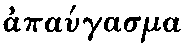
,
the brightness of his Father's glory, and the character
of his person, (i. 3.) And under these expressions lies that
remarkable mystery of the Son's eternal relation to the Father, which
is rather humbly to be adored, than boldly to be explained, either by
God's perfect understanding of his own essence, or by any other
notion.
Certainly not by a transfer of a notion, and this too a notion of a
faculty itself but notional and limitary, to the Supreme Reality. But
there are ideas which are of higher origin than the notions of the
understanding, and by the irradiation of which the understanding itself
becomes a human understanding. Of such
veritates verificæ
Leighton himself in other words speaks often. Surely, there must have
been an intelligible propriety in the terms,
Logos
, Word,
Begotten before all creation
,—an adequate idea or
icon
,
or the Evangelists and Apostolic penmen would not have adopted them.
They did not invent the terms; but took them and used them as they were
taken and applied by Philo and both the Greek and Oriental sages. Nay,
the precise and orthodox, yet frequent, use of these terms by Philo, and
by the Jewish authors of that traditionalæ wisdom,—degraded in after
times, but which in its purest parts existed long before the Christian
æra,—is the strongest extrinsic argument against the Arians, Socinians,
and Unitarians, in proof that St. John must have meant to deceive his
readers, if he did not use them in the known and received sense. To a
Materialist indeed, or to those who deny all knowledges not resolvable
into notices from the five senses, these terms as applied to spiritual
beings must appear inexplicable or senseless. But so must spirit. To me,
(why do I say to me?) to Bull, to Waterland, to Gregory Nazianzen,
Basil, Athanasius, Augustine, the terms, Word and generation, have
appeared admirably, yea, most awfully pregnant and appropriate;—but
still as the language of those who know that they are placed with their
backs to substances—and which therefore they can name only from the
correspondent shadows—yet not (God forbid!) as if the substances were
the same as the shadows;—which yet Leighton supposed in this his
censure,—for if he did not, he then censures himself and a number of
his most beautiful passages. These, and two or three other
sentences,—slips of human infirmity,—are useful in reminding me that
Leighton's works are not inspired Scripture.
Postscript
On a second consideration of this passage, and a revisal of my marginal
animadversion— yet how dare I apply such a word to a passage written by
a minister of Christ so clearly under the especial light of the divine
grace as was Archbishop Leighton?—I am inclined to think that Leighton
confined his censure to the attempts to "explain" the Trinity,—and this
by "notions,"—and not to the assertion of the adorable acts implied in
the terms both of the Evangelists and Apostles, and of the Church before
as well as after Christ's ascension; nor to the assent of the pure
reason to the truths, and more than assent to, the affirmation of the
ideas.
Ib. p. 73.
This fifth Sermon, excellent in parts, is yet on the whole the least
excellent of Leighton's works,—and breathes less of either his own
character as a man, or the character of his religious philosophy. The
style too is in many places below Leighton's ordinary style—in some
places even turbid, operose, and catechrestic;—for example,—"to
trample on smilings with one foot and on frownings with the other."
Ib. p. 77. Serm. VI.
Leighton, I presume, was acquainted with the Hebrew Language, but he
does not appear to have studied it much. His observation on the
heart
, as used in the Old Testament, shews that he did not know
that the ancient Hebrews supposed the heart to be the seat of intellect,
and therefore used it exactly as we use the head.
Ib. p. 104. Serm. VII.
This seventh Sermon is admirable throughout, Leighton throughout. O what
a contrast might be presented by publishing some discourse of some Court
divine, (South for instance,) preached under the same state of affairs,
and printing the two in columns!
Ib. p. 107. Serm. VIII.
In all love three things are necessary; some goodness in the object,
either true and real, or apparent and seeming to be so; for the soul,
be it ever so evil, can affect nothing but which it takes in some way
to be good.
This assertion in these words has been so often made, from Plato's times
to ours, that even wise men repeat it without perhaps much examination
whether it be not equivocal—or rather (I suspect) true only in that
sense in which it would amount to nothing—nothing to the purpose at
least. This is to be regretted—for it is a mischievous equivoque, to
make 'good' a synonyme of 'pleasant,' or even the
genus
of which
pleasure is a
species
. It is a grievous mistake to say, that bad
men seek pleasure because it is good. No! like children they call it
good because it is pleasant. Even the useful must derive its meaning
from the good, not
vice versa
.
Postscript.
The lines in p. 107, noted by me, are one of a myriad instances to prove
how rash it is to quote single sentences or assertions from the
correctest writers, without collating them with the known system or
express convictions of the author. It would be easy to cite fifty
passages from Archbishop Leighton's works in direct contradiction to the
sentence in question—which he had learnt in the schools when a lad, and
afterwards had heard and met with so often that he was not aware that he
had never sifted its real purport. This eighth Sermon is another most
admirable discourse.
Ib. Serm. IX. p. 12.
The reasonable creature, it is true, hath more liberty in its actions,
freely choosing one thing and rejecting another; yet it cannot be
denied, that in acting of that liberty, their choice and refusal
follow
A the sway of their nature and condition.
A
: I would fain substitute for 'follow,' the words, 'are most often
determined, and always affected, by.' I do not deny that the will
follows the nature; but then the nature itself is a will.
Ib.
As the angels and glorified souls, (their nature being perfectly holy
and unalterably such,) they cannot sin; they can delight in nothing
but obeying and praising that God, in the enjoyment of whom their
happiness consisteth.
If angels be other than spirits made perfect, or, as Leighton writes,
"glorified souls,"—the "unalterable by nature" seems to me rashly
asserted.
Ib.
The mind,
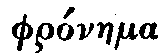
. Some render it the prudence or wisdom of
the flesh. Here you have it, the carnal mind; but the word signifies,
indeed, an act of the mind, rather than either the faculty itself, or
the habit of prudence in it, so as it discovers what is the frame of
both those.
I doubt.
. signifies an act: and so far I agree with
Leighton. But
is
the flesh
(that is, the
natural man,) in the act or habitude of minding—but those acts, taken
collectively, are the faculty—the understanding.
How often have I found reason to regret, that Leighton had not clearly
made out to himself the diversity of reason and the understanding!
Ib. Serm. XV. p. 196.
A narrow enthralled heart, fettered with the love of lower things, and
cleaving to some particular sins, or but some one, and that secret,
may keep foot a while in the way of God's commandments, in some steps
of them; but it must give up quickly, is not able to run on to the end
of the goal.
One of the blessed privileges of the spiritual man (and such Leighton
was,) is a piercing insight into the diseases of which he himself is
clear.
Ib. Serm. XVI. p. 204.
Know you not that the redeemed of Christ and He are one? They live one
life, Christ lives in them, and if any man hath not the Spirit of
Christ, he is none of his, as the Apostle declares in this
chapter. So then this we are plainly to tell you, and consider it; you
that will not let go your sins to lay hold on Christ, have as yet no
share in him.
But on the other side: the truth is, that when souls are once set upon
this search, they commonly wind the notion too high, and subtilize too
much in the dispute, and so entangle and perplex themselves, and drive
themselves further off from that comfort that they are seeking after;
such measures and marks they set to themselves for their rule and
standard; and unless they find those without all controversy in
themselves, they will not believe that they have an interest in
Christ, and this blessed and safe estate in him.
To such I would only say, Are you in a willing league with any known
sin? &c.
An admirable antidote for such as, too sober and sincere to pass off
feverous sensations for spiritualities, have been perplexed by Wesley's
assertions—that a certainty of having been elected is an indispensable
mark of election. Whitfield's ultra-Calvinism is Gospel gentleness and
Pauline sobriety compared with Wesley's Arminianism in the outset of his
career. But the main and most noticeable difference between Leighton and
the modern Methodists is to be found in the uniform selfishness of the
latter. Not "Do you wish to love God?" "Do you love your neighbour?" "Do
you think, 'O how dear and lovely must Christ be!'"— but—"Are you
certain that Christ has saved
you
; that he died for
you—you—you—yourself
?" on to the end of the chapter. This is
Wesley's doctrine.
Lecture IX. vol. IV. p. 96.
For that this was his fixed purpose, Lucretius not only vows, but also
boasts of it, and loads him (Epicurus) with ill-advised praises, for
endeavouring through the whole course of his philosophy to free the
minds of men from all the bonds and ties of religion.
But surely in this passage
religio
must be rendered superstition,
the most effectual means for the removal of which Epicurus supposed
himself to have found in the exclusion of the
gods many and lords
many
, from their imagined agency in all the
phœnomena
of
nature and the events of history, substituting for these the belief in
fixed laws, having in themselves their evidence and necessity. On this
account, in this passage at least, Lucretius praises his master.
Ib. p. 105.
They always seemed to me to act a very ridiculous part, who contend,
that the effect of the divine decree is absolutely irreconcilable with
human liberty; because the natural and necessary liberty of a rational
creature is to act or choose from a rational motive, or spontaneously,
and of purpose: but who sees not, that, on the supposition of the most
absolute decree, this liberty is not taken away, but rather
established and confirmed? For the decree is, that such an one
shall make choice of, or do some particular thing freely. And whoever
pretends to deny, that whatever is done or chosen, whether good or
indifferent, is so done or chosen, or, at least, may be so, espouses
an absurdity.
I fear, I fear, that this is a sophism not worthy of Archbishop
Leighton. It seems to me tantamount to saying—"I force that man to do
so or so without my forcing him." But however that may be, the following
sentences are more precious than diamonds. They are divine.
Ib. Lect. XI. p. 113.
For that this world, compounded of so many and such heterogeneous
parts, should proceed, by way of natural and necessary emanation, from
that one first, present, and most simple nature, nobody, I imagine,
could believe, or in the least suspect * * *. But if he produced all
these things freely, * * how much more consistent is it to believe,
that this was done in time, than to imagine it was from eternity!
It is inconceivable how any thing can be created in time; and production
is incompatible with interspace.
Ib. Lect. XV. p. 152.
The Platonists divide the world into two, the sensible and
intellectual world * * *. According to this hypothesis, those parables
and metaphors, which are often taken from natural things to illustrate
such as are divine, will not be similitudes taken entirely at
pleasure; but are often, in a great measure, founded in nature, and
the things themselves.
have asserted the same thing, and more fully shown wherein the
difference consists of symbolic and metaphorical, in my first Lay
Sermon; and the substantial correspondence of the genuine Platonic
doctrine and logic with those of Lord Bacon, in my Essays on Method, in
the Friend
.
Ib. Lect. XIX. p. 201.
Even the philosophers give their testimony to this truth, and their
sentiments on the subject are not altogether to be rejected; for they
almost unanimously are agreed, that felicity, so far as it can be
enjoyed in this life, consists solely, or at least principally, in
virtue: but as to their assertion, that this virtue is perfect in a
perfect life, it is rather expressing what were to be wished, than
describing things as they are.
And why are the philosophers to be judged according to a different rule?
On what ground can it be asserted that the Stoics believed in the actual
existence of their God-like perfection in any individual? or that they
meant more than this—"To no man can the name of the Wise be given in
its absolute sense, who is not perfect even as his Father in heaven is
perfect!"
Ib. Lect. XXI. p. 225.
In like manner, if we suppose God to be the first of all beings, we
must, unavoidably, therefrom conclude his unity. As to the ineffable
Trinity subsisting in this Unity, a mystery discovered only by the
Sacred Scriptures, especially in the New Testament, where it is more
clearly revealed than in the Old, let others boldly pry into it, if
they please, while we receive it with our humble faith, and think it
sufficient for us to admire and adore.
But surely it having been revealed to us, we may venture to say,—that a
positive unity, so far from excluding, implies plurality, and that the
Godhead is a fulness,
Ib. Lect. XXIV. p. 245.
Ask yourselves, therefore, what you would be at, and with what
dispositions you come to this most sacred table?
In an age of colloquial idioms, when to write in a loose slang had
become a mark of loyalty, this is the only L'Estrange vulgarism I have
met with in Leighton.
Ib. Exhortation to the Students, p. 252.
Study to acquire such a philosophy as is not barren and babbling, but
solid and true; not such a one as floats upon the surface of endless
verbal controversies, but one that enters into the nature of things;
for he spoke good sense that said, "The philosophy of the Greeks was a
mere jargon, and noise of words."
If so, then so is all philosophy: for what system is there, the elements
and outlines of which are not to be found in the Greek schools? Here
Leighton followed too incautiously the Fathers.
Works of Leighton, 4 vols. 8vo. London 1819.
Ed.
Statesman's Manual
, p. 230. 2nd edit.
Friend
, III.
3d edit.
Ed
.
Contents / Index
Notes on Sherlock's Vindication of the Doctrine of the Trinity1
Sect. I. p. 3.
Some new philosophers will tell you that the notion of a spirit or an
immaterial substance is a contradiction; for by substance they
understand nothing but matter, and then an immaterial substance is
immaterial matter, that is, matter and no matter, which is a
contradiction; but yet this does not prove an immaterial substance to
be a contradiction, unless they could first prove that there is no
substance but matter; and that they cannot conceive any other
substance but matter, does not prove that there is no other.
Certainly not: but if not only they, but Dr. Sherlock himself and all
mankind, are incapable of attaching any sense to the term substance, but
that of matter,—then for us it would be a contradiction, or a
groundless assertion. Thus: By 'substance' I do not mean the only notion
we can attach to the word; but a somewhat, I know not what, may, for
aught I know, not be contradictory to spirit! Why should we use the
equivocal word, 'substance' (after all but an
ens logicum
),
instead of the definite term 'self-subsistent?' We are equally conscious
of mind, and of that which we call 'body;' and the only possible
philosophical questions are these three:
-
Are they co-ordinate as agent and re-agent;
-
Or is the one subordinate to the other, as effect to cause, and which
is the cause or ground, which the effect or product;
-
Or are they co-ordinate, but not inter-dependent, that is, per
harmonium præstabilitam.
Ib. p. 4.
Now so far as we understand the nature of any being, we can certainly
tell what is contrary and contradictious to its nature; as that
accidents should subsist without their subject, &c.
That accidents should subsist (rather, exist) without a subject, may be
a contradiction, but not that they exist without this or that subject.
The words 'their subject' are
a petitio principii
.
Ib.
These and such like are the manifest absurdities and contradictions of
Transubstantiation; and we know that they are so, because we know the
nature of a body, &c.
Indeed! Were I either Romanist or Unitarian, I should desire no better
than the admission of body having an
esse
not in the
percipi
, and really subsisting,
as tne
supporter of its accidents. At all events, the Romanist, declaring the
accidents to be those ordinarily impressed on the senses
by bread and wine, does at the same time
declare the flesh and blood not to be the
so called, but the
.
There is therefore no contradiction in the terms, however reasonless the
doctrine may be, and however unnecessary the interpretation on which it
is pretended. I confess, had I been in Luther's place, I would not have
rested so much of my quarrel with the Papists on this point; nor can I
agree with our Arminian divines in their ridicule of Transubstantiation.
The most rational doctrine is perhaps, for some purposes, at least, the
rem credimus, modum nescimus
; next to that, the doctrine of the
Sacramentaries, that it is
signum sub rei nomine
, as when we call
a portrait of Caius, Caius. But of all the remainder, Impanation,
Consubstantiation, and the like, I confess that I should prefer the
Transubstantiation of the Pontifical doctors.
Ib. p. 6.
The proof of this comes to this one point, that we may have sufficient
evidence of the being of a thing whose nature we cannot conceive and
comprehend: he who will not own this, contradicts the sense and
experience of mankind; and he who confesses this, and yet rejects the
belief of that which he has good evidence for, merely because he
cannot conceive it, is a very absurd and senseless infidel.
Here again, though a zealous believer of the truth asserted, I must
object to the Bishop's logic. None but the weakest men have objected to
the Tri-unity merely because the
modus
is above their
comprehension: for so is the influence of thought on muscular motion; so
is life itself; so in short is every first truth of necessity; for to
comprehend a thing, is to know its antecedent and consequent. But they
affirm that it is against their reason. Besides, there seems an
equivocation in the use of 'comprehend' and 'conceive' in the same
meaning. When a man tells me, that his will can lift his arm, I conceive
his meaning; though I do not comprehend the fact, I understand
him
. But the Socinians say;—"We do not understand
you
. We
cannot attach to the word 'God,' more than three possible meanings;
either,
-
A person, or self-conscious being;
-
Or a thing;
-
Or a quality, property, or attribute.
If you take the first, then you admit the contradiction; if either of
the latter two, you have not three Persons and one God, but three
Persons having equal shares in one thing, or three with the same
attributes, that is, three Gods. Sherlock does not meet this.
Let me repeat the difficulty, if possible, more clearly. The argument of
the philosophic Unitarians, as Wissowatius, who, mistaken as they were,
are not to be confounded with their degenerate successors, the
Priestleyans and Belshamites, may be thus expressed. "By the term, God,
we can only conceive you to suppose one or other of three meanings.
-
Either you understand by it a person, in the common sense of an
intelligent or self-conscious being; —or,
-
a thing with its qualities and properties; —or,
-
certain powers and attributes, comprised under the word nature.
If we suppose the first, the contradiction is manifest, and you
yourselves admit it, and therefore forbid us so to interpret your words.
For if by God you mean Person, then three Persons and one God, would be
the same as three Persons and one Person. If we take the second as your
meaning, as an infinite thing is an absurdity, we have three finite
Gods, like Jupiter, Neptune, and Pluto, who shared the universe between
them. If the latter, we have three Persons with the same
attributes;—and if a Person with infinite attributes be what we mean by
God, then we have either three Gods, or involve the contradiction above
mentioned. It is unphilosophic, by admission of all philosophers, they
add, to multiply causes beyond the necessity. Now if there are three
Persons of infinite and the same attributes, dismiss two, and you lose
nothing but a numerical phantom."
The answer to this must commence by a denial of the premisses
in
toto
: and this both Bull and Waterland have done most successfully.
But I very much doubt, whether Sherlock on his principles could have
evaded the Unitarian logic. In fact it is scarcely possible to acquit
him altogether of a
quasi-Tritheism
.
Sect. II. p. 13.
For like as we are compelled by the Christian verity to acknowledge
every Person by himself to be God and Lord;—
(That is, by especial revelation.)
So are we forbidden by the Catholic religion to say, There are
three Gods, or three Lords.
That is, by the religion contained in, and given in accompaniment with,
the universal reason,
the light that lighteth every man that cometh
into the world
.
Ib. p. 14.
This Creed (Athanasian) does not pretend to explain how there are
three Persons, each of which is God, and yet but One God, (of which
more hereafter,) but only asserts the thing, that thus it is, and thus
it must be if we believe a Trinity in Unity; which should make all
men, who would be thought neither Arians nor Socinians, more cautious
how they express the least dislike of the Athanasian Creed, which must
either argue, that they condemn it, before they understand it, or that
they have some secret dislike to the doctrine of the Trinity.
The dislike commonly felt is not of the doctrine of the Trinity, but of
the positive anathematic assertion of the everlasting perdition of all
and of each who doubt the same;—an assertion deduced from Scripture
only by a train of captious consequences, and equivocations. Thus, A.:
"I honour and admire Caius for his great learning." B.: "The knowledge
of the Sanscrit is an important article in Caius's learning." A.: "I
have been often in his company, and have found no reason for believing
this." B.: "O! then you deny his learning, are envious, and Caius's
enemy." A.: "God forbid! I love and admire him. I know him for a
transcendant linguist in the Hebrew, Greek, Latin, and modern European
languages;—and with or without the Sanscrit, I look up to him, and rely
on his erudition in all cases, in which I am concerned. And it is this
perfect trust, this unfeigned respect, that is the appointed criterion
of Caius's friends and disciples, and not their full acquaintance with
each and all particulars of his superiority." Thus without Christ, or in
any other power but that of Christ, and (subjectively) of faith in
Christ, no man can be saved; but does it follow, that no man can have
Christian faith who is ignorant or erroneous as to any one point of
Christian theology? Will a soul be condemned to everlasting perdition
for want of logical
acumen
in the perception of consequences?
—If he verily embrace Christ as his Redeemer, and unfeignedly feel in
himself the necessity of Redemption, he implicitly holds the Divinity of
Christ, whatever from want or defect of logic may be his notion
explicite
.
Ib. p. 18.
But the whole three Persons are co-eternal, and co-equal. And
yet this we must acknowledge to be true, if we acknowledge all three
Persons to be eternal, for in eternity there can be no afore, or
after other.
It must, however, be considered as a serious defect in a Creed, if
excluding subordination, without mentioning any particular form, it
gives no hint of any other form in which it admits it. The only
minus
admitted by the Athanasian Creed is the inferiority of
Christ's Humanity to the Divinity generally; but both Scripture and the
Nicene Creed teach a subordination of the Son to the Father, independent
of the Incarnation of the Son. Now this is not inserted, and therefore
the denial in the assertion
none is greater or less than another
,
is universal, and a plain contradiction of Christ speaking of Himself as
the co-eternal Son;
My Father is greater than I
. Speaking of
himself as the co-eternal Son, I say;—for how superfluous would it have
been, a truism how unworthy of our Lord, to have said in effect, that "a
creature is less than God!" And after all, Creeds assuredly are not to
be imposed
ad libitum
—a new Creed, or at least a new form and
choice of articles and expressions, at the pleasure of individuals. Now
where is the authority of the Athanasian Creed? In what consists its
necessity? If it be the same as the Nicene, why not be content with the
Nicene?
it differs, how dare we retain both
? If the Athanasian
does not say more or different, but only differs by omission of a
necessary article, then to impose it, is as absurd as to force a
mutilated copy on one who has already the perfect original. Lastly, it
is not enough that an abstract contains nothing which may not by a chain
of consequences be deduced from the books of the Evangelists and
Apostles, in order for it to be a Creed for the whole Christian Church.
For a Creed is or ought to be a
syllepsis
of those primary
fundamental truths that are, as it were, the starting-post, from which
the Christian must commence his progression. The full-grown Christian
needs no other Creed than the Scriptures themselves. Highly valuable is
the Nicene Creed; but it has its chief value as an historical document,
proving that the same texts in Scripture received the same
interpretation, while the Greek was a living language, as now.
Sect. III. p. 23.
If what he says is true: He that errs in a question of faith, after
having used reasonable diligence to be rightly informed, is in no
fault at all; how comes an atheist, or an infidel, a Turk, or a
Jew, to be in any fault? Does our author think that no atheist or
infidel, no unbelieving Jew or heathen, ever used reasonable diligence
to be rightly informed? * * * If you say, he confines this to such
points as have always been controverted in the churches of God, I
desire to know a reason why he thus confines it? For does not his
reason equally extend to the Christian Faith itself, as to those
points which have been controverted in Christian Churches?
And the Notary might ask in his turn: "Do you believe that the
Christians either of the Greek or of the Western Church will be damned,
according as the truth may be respecting the procession of the Holy
Ghost? or that either the Sacramentary or the Lutheran? or again, the
Consubstantiationist, or the Transubstantiationist? If not, why do you
stop here? Whence this sudden palsy in the limbs of your charity? Again,
does this eternal damnation of the individual depend on the supposed
importance of the article denied? Or on the moral state of the
individual, on the inward source of this denial? And lastly, who
authorized either you, or the pseudo-Athanasius, to interpret Catholic
faith by belief, arising out of the apparent predominance of the grounds
for, over those against, the truth of the positions asserted; much more,
by belief as a mere passive acquiescence of the understanding? Were all
damned who died during the period when
totus fere mundus factus est
Arianus
, as one of the Fathers admits? Alas! alas! how long will it
be ere Christians take the plain middle road between intolerance and
indifference, by adopting the literal sense and Scriptural import of
heresy, that is, wilful error, or belief originating in some perversion
of the will; and of heretics, (for such there are, nay, even orthodox
heretics), that is, men wilfully unconscious of their own wilfulness, in
their limpet-like adhesion to a favourite tenet?"
Ib. p. 26.
All Christians must confess, that there is no other name given under
heaven whereby men can be saved, but only the name of Christ.
Now this is a most awful question, on which depends whether Christ was
more than Socrates; for to bring God from heaven to reproclaim the Ten
Commandments, is
too too
ridiculous. Need I say I incline to
Sherlock? But yet I cannot give to faith the meaning he does, though I
give it all, and more than all, the power. But if that Name, as power,
saved the Jewish Church before they knew the Name, as name, how much
more now, if only the will be not guiltily averse? Any miracle does in
kind as truly bring God from heaven as the Incarnation, which the
Socinians wholly forget, as in other points. They receive without
scruple what they have learned without examination, and then transfer to
the first article which they do look into, all the difficulties that
belong equally to the former: as the Simonidean doubts concerning God to
the Trinity, and the like.
Ib. p. 27.
The Eclectic Neo-Platonists (Sallustius and others,) justified their
Polytheism on much the same pretext as is in fact involved in the
language of this page;
This
indeed seems to me decisive in favour of Waterland's scheme against this
of Sherlock's;—namely, that in the latter we find no sufficient reason
why in the nature of things this intermutual consciousness might not be
possessed by thirty instead of three. It seems a strange confounding
to answer, "True; but the latter only happens to
be the fact!"—just as if we were speaking of the number of persons in
the Privy Council.
Ib. p. 28.
Notes. By keeping this faith whole and undefiled, must
be meant that a man should believe and profess it without adding to it
or taking from it. * * * First, for adding. What if an honest plain
man, because he is a Christian and a Protestant, should think it
necessary to add this article to the Athanasian Creed;—I believe
the Holy Scriptures of the Old and New Testament to be a divine,
infallible and complete rule both for faith and manners. I hope no
Protestant would think a man damned for such addition; and if so, then
this Creed of Athanasius is at least an unnecessary rule of faith.
Answer. That is to say, it is an addition to the Catholic Faith
to own the Scriptures to be the rule of faith; as if it were an
addition to the laws of England to own the original records of them in
the Tower.
This Notary manages his cause most weakly, and Sherlock
fibs
him
like a scientific pugilist. But he himself exposes weak parts, as in p.
27. The objection to the Athanasian Creed urged by better men than the
Notary, yea, by divines not less orthodox than Sherlock himself, is
this: not that this Creed adds to the Scriptures, but that it adds to
the original
Symbolum Fidei
, the
Regula
, the
Canon
,
by which, according to the greater number of the
ante
-Nicene
Fathers, the books of the New Testament were themselves tried and
determined to be Scripture. Now this
Symbolum
was to bring
together all that must be believed, even by the babes in faith, or to
what purpose was it made? Now, say they, the Nicene Creed is really
nothing more than a verbal explication of the common Creed, but the
clause in the Athanasian (
which faith
, &c.), however fairly
deduced from Scripture, is not contained in the Creed, or selection of
certain articles of Faith from the Scriptures, or not at least from
those preachings and narrations, of which the New Testament Scriptures
are the repository. Might not a Papist plead equally in support of the
Creed of Pope Pius: "The new articles are deduced from Scripture; that
is, in our opinion, and that most expressly in our Lord's several and
solemn addresses to St. Peter." So again Sherlock's answer to this
paragraph from the Notes is evasive,—for it is very possible, nay, it
is, and has been the case, that a man may believe in the facts and
doctrines contained in the New Testament, and yet not believe the Holy
Scripture to be either divine, infallible, or complete.
Sect. IV. p. 50.
We know not what the substance of an infinite mind is, nor how such
substances as have no parts or extension can touch each other, or be
thus externally united; but we know the unity of a mind or spirit
reaches as far as its self-consciousness does, for that is one spirit,
which knows and feels itself, and its own thoughts and motions, and if
we mean this by circum-incession, three persons thus intimate
to each other are numerically one.
The question still returns; have these three infinite minds, at once
self-conscious and conscious of each other's consciousness, always the
very same thoughts? If so, this mutual consciousness is unmeaning, or
derivative; and the three do not cease to be three because they are
three sames. If not, then there is Tritheism evidently.
Ib. p. 64.
St. Paul tells us, 1 Cor. ii. 10. That the Spirit searcheth all
things, yea the deep things of God. So that the Holy Spirit knows
all that is in God, even his most deep and secret counsels, which is
an argument that he is very intimate with him; but this is not all: it
is the manner of knowing, which must prove this consciousness of which
I speak: and that the Apostle adds in the next verse, that the Spirit
of God knows all that is in God, just as the spirit of a man knows all
that is in man: that is, not by external revelation or communication
of this knowledge, but by self-consciousness, by an internal
sensation, which is owing to an essential unity. For what man
knoweth the things of a man, save the spirit of a man which is in him;
even so the things of God knoweth no man but the Spirit of God.
It would be interesting, if it were feasible, to point out the epoch at
which the text mode of arguing in polemic controversy became
predominant; I mean by single texts without any modification by the
context. I suspect that it commenced, or rather that it first became the
fashion, under the Dort or systematic theologians, and during the so
called Quinquarticular Controversy. This quotation from St. Paul is a
striking instance:—for St. Paul is speaking of the holy spirit of which
true spiritual Christians are partakers, and by which or in which those
Christians are enabled to search all things, even the deep things of
God. No person is here spoken of, but reference is made to the
philosophic principle, that can only act immediately, that is,
interpenetratively, as two globules of quicksilver, and co-adunatively.
Now, perceiving and knowing were considered as immediate acts relatively
to the objects perceived and known:—
ergo
, the
principium
sciendi
must be one (that is, homogeneous or consubstantial) with
the
principium essendi quoad objectum cognitum
. In order
therefore for a man to understand, or even to know of, God, he must have
a god-like spirit communicated to him, wherewith, as with an inward eye,
which is both eye and light, he sees the spiritual truths. Now I have no
objection to his calling this spirit a 'person,' if only the term
'person' be so understood as to permit of its being partaken of by all
spiritual creatures, as light and the power of vision are partaken of by
all seeing ones. But it is too evident that Sherlock supposes the
Father, as Father, to possess a spirit, that is, an intellective
faculty, by which he knows the Spirit, that is, the third co-equal
Person; and that this Spirit, the Person, has a spirit, that is, an
intellective faculty, by which he knows the Father; and the
Logos
in like manner relatively to both. So too, the Father has a
logos
with which he distinguishes the
Logos
;—and the
Logos
has
a
logos
, and so on: that is to say, there are three several
though not severed triune Gods, each being the same position three times
realiter positum
, as three guineas from the same mint, supposing
them to differ no more than they appear to us to differ;—but whether a
difference wholly and exclusively numerical is a conceivable notion,
except under the predicament of space and time; whether it be not absurd
to affirm it, where interspace and interval cannot be affirmed without
absurdity—this is the question; or rather it is no question.
Ib. p. 68.
Nor do we divide the substance, but unite these three Persons in one
numerical essence: for we know nothing of the unity of the mind, but
self-consciousness, as I showed before; and therefore as the
self-consciousness of every Person to itself makes them distinct
Persons, so the mutual consciousness of all three divine Persons to
each other makes them all but one infinite God: as far as
consciousness reaches, so far the unity of a spirit extends, for we
know no other unity of a mind or spirit, but consciousness.
But this contradicts the preceding paragraph, in which the Father is
self-conscious that he is the Father and not the Son, and the Son that
he is not the Father, and that the Father is not he. Now how can the
Son's being conscious that the Father is conscious that he is not the
Son, constitute a numerical unity? And wherein can such a consciousness
as that attributed to the Son differ from absolute certainty? Is not God
conscious of every thought of man;—and would Sherlock allow me to
deduce the unity of the divine consciousness with the human? Sherlock's
is doubtless a very plain and intelligible account of three Gods in the
most absolute intimacy with each other, so that they are all as one; but
by no means of three persons that are one God. I do not wonder that
Waterland and the other followers of Bull were alarmed.
Ib. p. 72.
Even among men it is only knowledge that is power. Human power, and
human knowledge, as that signifies a knowledge how to do anything, are
commensurate; whatever human skill extends to, human power can effect:
nay, every man can do what he knows how to do, if he has proper
instruments and materials to do it with.
This proves that perfect knowledge supposes perfect power: and that they
are one and the same. "If he have proper instruments:"— does not this
show that the means are supposed co-present with the knowledge, not the
same with it?
Ib.
For it is nothing but thought which moves our bodies, and all the
members of them, which are the immediate instruments of all human
force and power: excepting mechanical motions which do not depend upon
our wills, such as the motion of the heart, the circulation of the
blood, the concoction of our meat and the like. All voluntary motions
are not only directed but caused by thought: and so indeed it must be,
or there could be no motion in the world; for matter cannot move
itself, and therefore some mind must be the first mover, which makes
it very plain, that infinite truth and wisdom is infinite and almighty
power.
Even this, though not ill-conceived, is inaccurately expressed.
Ib. p. 81.
There is no contradiction that three infinite minds should be
absolutely perfect in wisdom, goodness, justice and power; for these
are perfections which may be in more than one, as three men may all
know the same things, and be equally just and good: but three such
minds cannot be absolutely perfect without being mutually conscious to
each other, as they are to themselves.
Will any man in his senses affirm, that my knowledge is increased by
saying "all" three times following? Is it not mere repetition in time?
If the Son has thoughts which the Father, as the Father, could not have
but for his interpenetration of the Son's consciousness, then I can
understand it; but then these are not three Absolutes, but three modes
of perfection constituting one Absolute; and by what right Sherlock
could call the one Father, more than the other, I cannot see.
Ib. p. 88.
And yet if we consider these three divine Persons as containing each
other in themselves, and essentially one by a mutual consciousness,
this pretended contradiction vanishes: for then the Father is the one
true God, because the Father has the Son and the Holy Spirit in
himself: and the Son may he called the one true God, because the Son
has the Father and the Holy Ghost in himself, &c.
Nay, this is to my understanding three Gods, and Sherlock seems to have
brought in the material phantom of a thing or substance.
Ib. p. 97.
But if these three distinct Persons are not separated, but essentially
united unto one, each of them may be God, and all three but one God:
for if these three Persons,—each of whom
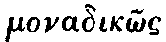
, as it is
in the Creed, singly by himself, not separately from the other divine
Persons, is God and Lord, are essentially united into one, there can
be but one God and one Lord; and how each of these persons is God, and
all of them but one God, by their mutual consciousness, I have already
explained.
—"That is,—if the three Persons are not three;"—so might the Arian
answer, unless Sherlock had shown the difference of separate and
distinct relatively to mind. "For what other separation can be conceived
in mind but distinction? Distinction may be joined with imperfection, as
ignorance, or forgetfulness; and so it is in men:—and if this be called
separation by a metaphor from bodies, then the conclusion would be that
in the Supreme Mind there is distinction without imperfection; and then
the question is, whence comes plurality of Persons? Can it be conceived
other than as the result of imperfection, that is, finiteness?
Ib. p. 98.
Thus each Divine Person is God, and all of them but the same one God;
as I explained it before.
O no! asserted it.
Ib. p. 98-9.
This one supreme God is Father, Son, and Holy Ghost, a Trinity in
Unity, three Persons and one God. Now Father, Son, and Holy Ghost,
with all their divine attributes and perfections (excepting their
personal properties, which the Schools call the modi
subsistendi, that one is the Father, the other the Son, and the
other the Holy Ghost, which cannot be communicated to each other) are
whole and entire in each Person by a mutual consciousness; each feels
the other Persons in himself, all their essential wisdom, power,
goodness, justice, as he feels himself, and this makes them
essentially one, as I have proved at large.
Will not the Arian object, "You admit the
modus subsistendi
to be
a divine perfection, and you affirm that it is incommunicable. Does it
not follow therefore, that there are perfections which the All-perfect
does not possess?" This would not apply to Bishop Bull or Waterland.
Sect. V. p. 102.
St. Austin in his sixth book of the Trinity takes notice of a common
argument used by the orthodox fathers against the Arians, to prove the
co-eternity of the Son with the Father, that if the Son be the Wisdom
and Power of God, as St. Paul teaches (1 Cor. i.) and God was
never without his Wisdom and Power, the Son must he co-eternal with
the Father. * * * But this acute Father discovers a great
inconvenience in this argument, for it forces us to say that the
Father is not wise, but by that Wisdom which he begot, not being
himself Wisdom as the Father: and then we must consider whether the
Son himself, as he is God of God, and Light of Light, may be said to
be Wisdom of Wisdom, if God the Father be not Wisdom, but only begets
Wisdom.
The proper answer to Augustine is, that the Son and Holy Ghost are
necessary and essential, not contingent: and that
his
argument
has a still greater inconvenience, as shewn in note p. 98.
Ib. pp. 110-113.
But what makes St. Gregory dispute thus nicely, and oppose the common
and ordinary forms of speech? Did he in good earnest believe that
there is but one man in the world? No, no! he acknowledged as many men
as we do; a great multitude who had the same human nature, and that
every one who had a human nature was an individual man, distinguished
and divided from all other individuals of the same nature. What makes
him so zealous then against saying, that Peter, James and John are
three men? Only this; that he says man is the name of nature, and
therefore to say there are three men is the same as to say, there are
three human natures of a different kind; for if there are three human
natures, they must differ from each other, or they cannot be three;
and so you deny Peter, James, and John to be
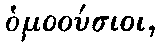
or
of the same nature; and for the same reason we must say that though
the Father be God, the Son God, and the Holy Ghost God, yet there are
not three Gods, but
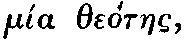
one Godhead and Divinity.
Sherlock struggles in vain, in my opinion at least, to clear these
Fathers of egregious logomachy, whatever may have been the soundness of
their faith, spite of the quibbles by which they endeavoured to evince
its rationality. The very change of the terms is suspicious. "Yes! we
might say three Gods" (it would be answered,) "as we say and ought to
say three men: for man and humanity,
and
are not the same terms;— so if the Father be God, the Son
God, and the Holy Ghost God, there would be three Gods, though not
—that is, three Godheads."
Ib. p. 115-16.
Gregory Nyssen tells us that

is
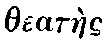
and
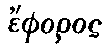
, the inspector and governor of the world, that is, it
is a name of energy, operation and power; and if this virtue, energy,
and operation be the very same in all the Persons of the Trinity,
Father, Son, and Holy Ghost, then they are but one God, but one power
and energy. * * * The Father does nothing by himself, nor the Son by
himself, nor the Holy Ghost by himself; but the whole energy and
operation of the Deity relating to creatures begins with the Father,
passes to the Son, and from Father and Son to the Holy Spirit; the
Holy Spirit does not act anything separately; there are not three
distinct operations, as there are three Persons,


—but one
motion and disposition of the good will, which passes through the
whole Trinity from Father to Son, and to the Holy Ghost, and this is
done

without any distance of time, or
propagating the motion from one to the other, but by one thought, as
it is in one numerical mind and spirit, and therefore, though they are
three Persons, they are but one numerical power and energy.
But this is either Tritheism or Sabellianism; it is hard to say which.
Either the
subsists in the Son, and in the Holy Ghost,
and not merely passes through them, and then there would be three
numerical
, as well as three numerical Persons:
ergo
,
(according to Gregory
Nyssen's shallow and disprovable etymology), which would be Tritheism:
or
, and then the Son and Holy Ghost are
but terms of relation, which is Sabellianism. But in fact this Gregory
and the others were Tritheists in the mode of their conception, though
they did not wish to be so, and refused even to believe themselves such.
Gregory Nyssen, Cyril of Alexandria, Maximus and Damascen were charged
with "a kind of Tritheism" by Petavius and Dr. Cudworth, who, according
to Sherlock, have "mistaken their meaning." See pp. 106-9, of this
"Vindication."
Ib. p. 117.
For I leave any man to judge, whether this

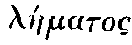
, this one single motion of will, which is in the same
instant in Father, Son, and Holy Ghost, can signify anything else but
a mutual consciousness, which makes them numerically one, and as
intimate to each other, as every man is to himself, as I have already
explained it.
Is not God conscious to all my thoughts, though I am not conscious of
God's? Would Sherlock endure that I should infer:
ergo
, God is
numerically one with me, though I am not numerically one with God? I
have never seen, but greatly wish to see, Waterland's controversial
tracts against Sherlock. Again: according to Sherlock's conception, it
would seem to follow that we ought to make a triad of triads, or an
ennead.
- Father—Son—Holy Ghost.
- Son—Father—Holy Ghost.
- Holy Ghost—Son—Father.
Else there is an
x
in the Father which is not in the Son, a
y
in the Son which is not in the Father, and a
z
in the
Holy Ghost which is in neither: that is, each by himself is not total
God.
Ib. p. 120.
But however he might be mistaken in his philosophy, he was not in his
divinity; for he asserts a numerical unity of the divine nature, not a
mere specific unity, which is nothing but a logical notion, nor a
collective unity, which is nothing but a company who are naturally
many: but a true subsisting numerical unity of nature; and if the
difficulty of explaining this, and his zeal to defend it, forced him
upon some unintelligible niceties, to prove that the same numerical
human nature too is but one in all men, it is hard to charge him with
teaching, that there are three independent and co-ordinate Gods,
because we think he has not proved that Peter, James, and John, are
but one man. This will make very foul work with the Fathers, if we
charge them with all those erroneous conceits about the Trinity, which
we can fancy in their inconvenient ways of explaining that venerable
mystery, especially when they compare that mysterious unity with any
natural unions.
So that after all this obscuration of the obscure, Sherlock ends by
fairly throwing up his briefs, and yet calls out, "Not guilty!
Victoria
!" And what is this but to say: These Fathers did indeed
involve Tritheism in their mode of defending the Tri-personality; but
they were not Tritheists:—though it would be far more accurate to say,
that they were Tritheists, but not so as to make any practical breach of
the Unity;—as if, for instance, Peter, James, and John had three silver
tickets, by shewing one of which either or all three would have the same
thing as if they had shewn all three tickets, and
vice versa
, all
three tickets could produce no more than each one; each corresponding to
the whole.
Ib.
I am sure St. Gregory was so far from suspecting that he should be
charged with Tritheism upon this account, that he fences against
another charge of mixing and confounding the
Hypostases or
Persons, by denying any difference or diversity of nature,

which argues that he
thought he had so fully asserted the unity of the divine essence, that
some might suspect he had left but one Person, as well as one nature
in God.
This is just what I have said, p. 116. Whether Sabellianism or
Tritheism, I observed is hard to determine. Extremes meet.
Ib. p. 121.
Secondly, to this homo-ousiotes the Fathers added a numerical
unity of the divine essence. This Petavius has proved at large by
numerous testimonies, even from those very Fathers, whom he before
accused for making God only collectively one, as three men are one
man; such as Gregory Nyssen, St. Cyril, Maximus, Damascen; which is a
demonstration, that however he might mistake their explication
of it, from the unity of human nature, they were far enough from
Tritheism, or one collective God.
This is most uncandid. Sherlock, even to be consistent with his own
confession, § 1. p. 120, ought to have said, "However he might mistake
their
intention
, in consequence of their inconvenient and
unphilosophical explication;" which mistake, in fact, consisted in
taking them at their word.
Ib.
Petavius greatly commends Boethius's explication of this mystery,
which is the very same he had before condemned in Gregory Nyssen, and
those other Fathers.—That Father, Son, and Holy Ghost are one God,
not three Gods: hujus conjunctionis ratio est indifferentia:
that is, such a sameness of nature as admits of no difference or
variety, or an exact homo-ousiotes, as he explains it. * *
Those make a difference, who augment and diminish, as the Arians do;
who distinguish the Trinity into different natures, as well as
Persons, of different worth and excellency, and thus divide and
multiply the Trinity into a plurality of Gods. Principium enim
pluralitatis alteritas est. Præter alteritatem enim nec pluralitas
quid sit intelligi potest.
Then if so, what becomes of the Persons? Have the Persons attributes
distinct from their nature;—or does not their common nature constitute
their common attributes?
Principium enim, &c.
Ib. p. 124.
That the Fathers universally acknowledged that the operation of the
whole Trinity, ad extra, is but one, Petavius has proved beyond
all contradiction; and hence they conclude the unity of the divine
nature and essence; for every nature has a virtue and energy of its
own; for nature is a principle of action, and if the energy and
operation be but one, there can be but one nature; and if there be two
distinct and divided operations, if either of them can act alone
without the other, there must be two divided natures.
Then it was not the Son but the whole Trinity that was crucified: for
surely this was an operation
ad extra
.
Ib. p. 126.
But to do St. Austin right, though he do not name this consciousness,
yet he explains this Trinity in Unity by examples of mutual
consciousness. I named one of his similitudes before, of the unity of
our understanding, memory, and will, which are all conscious to
each other; that we remember what we understand and will; we
understand what we remember and will; and what we will we remember and
understand; and therefore all these three faculties do penetrate and
comprehend each other.
Which
! The
man
is self-conscious alike when he remembers,
wills, and understands; but in what sense is the generic term "memory"
conscious to the generic word "will?" This is mere nonsense. Are memory,
understanding, and volition persons,—self-subsistents? If not, what are
they to the purpose? Who doubts that Jehovah is consciously powerful,
consciously wise, consciously good; and that it is the same Jehovah, who
in being omnipotent, is good and wise; in being wise, omnipotent and
good; in being good, is wise and omnipotent? But what has all this to do
with a distinction of Persons? Instead of one Tri-unity we might have a
mille-unity. The fact is, that Sherlock, and (for aught I know) Gregory
Nyssen, had not the clear idea of the Trinity, positively; but only a
negative Arianism.
Ib. p. 127.
He proceeds to shew that this unity is without all manner of confusion
and mixture, * * for the mind that loves, is in the love. * * * And
the knowledge of the mind which knows and loves itself, is in the
mind, and in its love, because it loves itself, knowing, and knows
itself loving: and thus also two are in each, for the mind which knows
and loves itself, with its knowledge is in love, and with its love is
in knowledge.
Then why do we make tri-personality in unity peculiar to God?
The doctrine of the Trinity (the foundation of all rational theology, no
less than the precondition and ground of the rational possibility of the
Christian Faith, that is, the Incarnation and Redemption), rests
securely on the position,—that in man
omni actioni præit sua propria
passio; Deus autem est actus purissimus sine ulla potentialitate
. As
the tune produced between the breeze and Eolian harp is not a
self-subsistent, so neither memory, nor understanding, nor even love in
man: for he is a passive as well as active being: he is a patible agent.
But in God this is not so. Whatever is necessarily of him, (God of God,
Light of Light), is necessarily all act; therefore necessarily
self-subsistent, though not necessarily self-originated. This then is
the true mystery, because the true unique; that the Son of God has
origination without passion, that is, without ceasing to be a pure act:
while a created entity is, as far as it is merely creaturely and
distinguishable from the Creator, a mere
passio
or recipient.
This unicity we strive, not to
express
, for that is impossible;
but to designate, by the nearest, though inadequate, analogy,—
Begotten
.
Ib. p. 133.
As for the Holy Ghost, whose nature is represented to be love, I do
not indeed find in Scripture that it is any where said, that the Holy
Ghost is that mutual love, wherewith Father and Son love each other:
but this we know, that there is a mutual love between Father and Son:
the Father loveth the Son, and hath given all things into his
hands.—John iii. 35. And the Father loveth the Son, and
sheweth him all things that himself doeth.-John v. 20; and our
Saviour himself tells us, I love the Father.—John xiv. 31. And
I shewed before, that love is a distinct act, and therefore in God
must be a person: for there are no accidents nor faculties in God.
This most important, nay, fundamental truth, so familiar to the elder
philosophy, and so strongly and distinctly enunciated by Philo Judæus,
the senior and contemporary of the Evangelists, is to our modern divines
darkness and a sound.
Sect. VI. pp. 147-8.
Yes; you'll say, that there should be three Persons, each of which is
God, and yet but one God, is a contradiction: but what principle of
natural reason does it contradict?
Surely never did argument vertiginate more! I had just acceded to
Sherlock's exposition of the Trinity, as the Supreme Being, his reflex
act of self-consciousness and his love, all forming one supreme mind;
and now he tells me, that each is the whole Supreme Mind, and denies
that three, each
per se
the whole God, are not the same as three
Gods! I grant that division and separation are terms inapplicable, yet
surely three distinct though undivided Gods, are three Gods. That the
Father, Son, and Holy Ghost, are the one true God, I fully believe; but
not Sherlock's exposition of the doctrine. Nay, I think it would have
been far better to have worded the mystery thus:— The Father together
with his Son and Spirit, is the one true God.
"Each
per se
God." This is the
of
Sherlock's scheme. Each of the three is whole God, because neither is,
or can be
per se
; the Father himself being
a se
, but not
per se
.
Ib. p. 149.
For it is demonstrable that if there be three Persons and one God,
each Person must be God, and yet there cannot be three distinct Gods,
but one. For if each Person be not God, all three cannot be God,
unless the Godhead have Persons in it which are not God.
Three persons having the same nature are three persons;—and if to
possess without limitation the divine nature, as opposed to the human,
is what we mean by God, why then three such persons are three Gods, and
will bethought so, till Gregory Nyssen can persuade us that John, James,
and Peter, each possessing the human nature, are not three men. John is
a man, James is a man, and Peter is a man: but they are not three men,
but one man!
Ib. p. 150.
I affirm, that natural reason is not the rule and measure of
expounding Scripture, no more than it is of expounding any other
writing. The true and only way to interpret any writing, even the
Scriptures themselves, is to examine the use and propriety of words
and phrases, the connexion, scope, and design of the text, its
allusion to ancient customs and usages, or disputes. For there is no
other good reason to be given for any exposition, but that the words
signify so, and the circumstances of the place, and the apparent scope
of the writer require it.
This and the following paragraph are excellent.
O si sic omnia
!
Ib. p. 153.
Reconcile men to the doctrine (of the Trinity), and the Scripture is
plain without any farther comment. This I have now endeavoured; and I
believe our adversaries will talk more sparingly of absurdities and
contradictions for the future, and they will lose the best argument
they have against the orthodox expositions of Scripture.
Good doctor! you sadly over-rated both your own powers, and the docility
of your adversaries. If so clear a head and so zealous a Trinitarian as
Dr. Waterland could not digest your exposition, or acquit it of
Tritheism, little hope is there of finding the Unitarians more
persuadable.
Ib. p. 154.
Though Christ be God himself, yet if there be three Persons in the
Godhead, the equality and sameness of nature does not destroy the
subordination of Persons: a Son is equal to his Father by nature, but
inferior to him as his Son: if the Father, as I have explained it, be
original mind and wisdom, the Son a personal, subsisting, but reflex
image of his Father's wisdom, though their eternal wisdom be equal and
the same, yet the original is superior to the image, the Father to the
Son.
But why? We men deem it so, because the image is but a shadow, and not
equal to the original; but if it were the same in all perfections, how
could that, which is exactly the same, be less? Again, God is all
Being:—consequently there can nothing be added to the idea, except what
implies a negation or diminution of it. If one and the same Being is
equal to the Father, as touching his Godhead, but inferior as man; then
it is +
m-x
, which is not = +
m
. But of two men I may say,
that they are equal to each other. A. = + courage-wisdom. B. = +
wisdom-courage. Both wise and courageous; but A. inferior in wisdom, B.
in courage. But God is all-perfect.
Ib. p. 156.
So born before all creatures, as
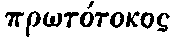
also signifies,
that by him were all things created.
All things were created by him, and for him, and he is before all
things, (which is the explication of

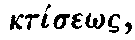 begotten before the whole creation
, and therefore no
part of the creation himself.)
This is quite right. Our version should here be corrected.
or
is here an intense
comparative,—
infinitely before
.
Ib. p. 159.
That he being in the form of God, thought it not robbery to be
equal with God, &c.—Phil. ii. 8, 9.
I should be inclined to adopt an interpretation of the unusual phrase
somewhat different both from the Socinian and the
Church version:—"who being in the form of God did not
think equality
with God a thing to be seized with violence
, but made, &c."
Ib. p. 160.
Is a mere creature a fit lieutenant or representative of God in
personal or prerogative acts of government and power? Must not every
being be represented by one of his own kind, a man by a man, an angel
by an angel, in such acts as are proper to their natures? and must not
God then be represented by one who is God? Is any creature capable of
the government of the world? Does not this require infinite wisdom and
infinite power? And can God communicate infinite wisdom and infinite
power to a creature or a finite nature? That is, can a creature be
made a true and essential God?
This is sound reasoning. It is to be regretted that Sherlock had not
confined himself to logical comments on the Scripture, instead of
attempting metaphysical solutions.
Ib. pp. 161-3.
I find little or nothing to
object to
in this exposition, from
pp. 161-163 inclusively, of
Phil
. ii. 8, 9. And yet I seem to
feel, as if a something that should have been prefixed, and to which all
these considerations would have been excellent seconds, were missing. To
explain the Cross by the necessity of sacrificial blood, and the
sacrificial blood as a type and
ante
-delegate or pre-substitute
of the Cross, is too like an
argumentum in circulo
.
Ib. p. 164.
And though Christ be the eternal Son of God, and the natural Lord and
heir of all things, yet
God hath in this
highly exalted
him and given
him a name which is above every name, that at
(or in

)
the name of Jesus every knee should bow, of
things in heaven, &c.—Phil. ii. 9, 10, 11.
Never was a sublime passage more debased than by this rendering of
by
at
, instead of
in
;—
at
the
phenomenon
, instead of
in
the
noumenon
. For such is
the force of
nomen
, name, in this and similar passages, namely,
in vera et substantiali potestate Jesu
: that is,
the true
noumenon
or
ens intelligibile
of
Christ. To bow at hearing the
cognomen
may become a universal,
but it is still only a non-essential, consequence of the former. But the
debasement of the idea is not the worst evil of this false
rendering;—it has afforded the pretext and authority for un-Christian
intolerance.
Ib. p. 168.
The Father judgeth no man, but hath committed all judgment to the
Son.—John v. 22. Should the Father judge the world he must
judge as the maker and sovereign of the world, by the strict rules of
righteousness and justice, and then how could any sinner be saved?
(Why? Is mercy incompatible with righteousness? How then can the Son be
righteous?)
But he has committed judgment to the Son, as a mediatory king, who
judges by the equity and chancery of the Gospel.
This article required exposition incomparably more than the simple
doctrine of the Trinity, plain and evident
simplici intuitu
, and
rendered obscure only by diverting the mental vision by terms drawn from
matter and multitude. In the Trinity all the
Hows
? may and should
be answered by
Look
! just as a wise tutor would do in stating the
fact of a double or treble motion, as of a ball rolling north ward on
the deck of a ship sailing south, while the earth is turning from west
to east. And in like manner, that is,
per intuitum
intellectualem
, must all the mysteries of faith be contemplated;
—they are intelligible
per se
, not discursively and
per
analogiam
. For the truths are unique, and may have shadows and
types, but no analogies. At this moment I have no intuition, no
intellectual diagram, of this article of the commission of all judgment
to the Son, and therefore a multitude of plausible objections present
themselves, which I cannot solve —nor do I expect to solve them till by
faith I see the thing itself.—Is not mercy an attribute of the Deity,
as Deity, and not exclusively of the Person of the Son? And is not the
authorizing another to judge by equity and mercy the same as judging so
ourselves? If the Father can do the former, why not the latter?
Ib. p. 171.
And therefore now it is given him to have life in himself, as the
Father hath life in himself, as the original fountain of all life, by
whom the Son himself lives: all life is derived from God, either by
eternal generation, or procession, or creation; and thus Christ hath
life in himself also; to the new creation he is the fountain of life:
he quickeneth whom he will.
The truths which hitherto had been metaphysical, then began to be
historical. The Eternal was to be manifested in time. Hence Christ came
with signs and wonders; that is, the absolute, or the anterior to cause
and effect, manifested itself as a
phenomenon
in time, but with
the predicates of eternity;—and this is the only possible definition of
a miracle
in re ipsa
, and not merely
ad hominem
, or
ad
ignorantiam
.
Ib. p. 177.
His next argument consists in applying such things to the divinity of
our Saviour as belong to his humanity; that he increased in wisdom,
&c.:—that he knows not the day of judgment;—which he evidently
speaks of himself as man: as all the ancient Fathers confess. In St.
Mark it is said, But of that day and that hour knoweth no man, no,
not the angels that are in heaven, neither the Son, but the
Father. St. Matthew does not mention the Son: Of that day and
hour knoweth no man, not the angels of heaven, but my Father only.
How much more politic, as well as ingenuous, it had been to have
acknowledged the difficulty of this text. So far from its being evident,
the evidence would be on the Arian side, were it not that so many
express texts determine us to the contrary.
Ib.
Which shows that the Son in St. Matthew is included in the
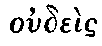
none, or no man, and therefore concerns him only as a man: for
the Father
includes the whole Trinity, and therefore includes
the Son, who seeth whatever his Father doth.
This is an
argumentum in circulo
, and
petitio rei sub
lite
. Why is he called the Son in
antithesis
to the Father,
if it meant, "no not the Christ, except in his character of the
co-eternal Son, included in the Father?" If it "concerned him only as a
man," why is he placed after the angels? Why called the
Son
simply, instead of the Son of Man, or the Messiah?
Ib.
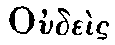
is not

, but,
no one:
as in John i. 18.
No one hath seen God at any time; that is, he
is by essence invisible.
This most difficult text I have not seen explained satisfactorily. I
have thought that the
must here be taken in the primary
sense of the word, namely, as messengers, or missionary Prophets: Of
this day knoweth no one, not the messengers or revealers of God's
purposes now in heaven, no, not the Son, the greatest of Prophets,—that
is, he in that character promised to declare all that in that character
it was given to him to know.
Ib. p. 186.
When St. Paul calls the Father the One God, he expressly opposes it to
the many gods of the heathens. For though there be that are called
gods, &c. but to us, there is but one God, the Father, of whom are all
things; and one Lord Jesus Christ, by whom are all things, and we by
him: where the one God and one Lord and Mediator is
opposed to the many gods and many lords or mediators which were
worshipped by the heathens.
But surely the
one Lord
is as much distinguished from the
one
God
, as both are contradistinguished from the
gods many and lords
many
of the heathens. Besides
the Father
is not the term used
in that age in distinction from the gods that are no gods; but
Ib. p. 222.
The Word was with God; that is, it was not yet in the world, or
not yet made flesh; but with God.—John i. 1. So that to be
with God, signifies nothing but not to be in the world.
The Word was with God.
Grotius does say, that this was opposed to the Word's being made
flesh, and appearing in the world: but he was far enough from thinking
that these words have only a negative sense: * * * for he tells us
what the positive sense is, that with God is

,
with the Father, * * and explains it by what Wisdom says,
Prov.
vii. 30.
Then I was by him, &c. which he does not think a
prosopopoeia, but spoken of a subsisting person.
But even this is scarcely tenable even as Greek. Had this been St.
John's meaning, surely he would have said,
not
in the nearest proximity that is not confusion. But it
is strange, that Sherlock should not have seen that Grotius had a
hankering toward Socinianism, but, like a
shy cock
, and a man of
the world, was always ready to unsay what he had said.
A Vindication of the Doctrine of the Holy and ever Blessed
Trinity and the Incarnation of the Son of God, occasioned by the Brief
Notes on the Creed of St Athanasius, and the Brief History of the
Unitarians, or Socinians. and containing an answer to both. By Wm.
Sherlock, London. 8vo. 1690.
The third General Council, that at Ephesus in 431, decreed
"that it should not be lawful for any man to publish or compose
another Faith or Creed than that which was defined by the Nicene
Council."
Ed
.
Contents / Index
Notes on Waterland's Vindication of Christ's Divinity1
In initio
.
It would be no easy matter to find a tolerably competent individual who
more venerates the writings of Waterland than I do, and long have done.
But still in how many pages do I not see reason to regret, that the
total idea of the 4=3=1,—of the adorable Tetractys, eternally
self-manifested in the Triad, Father, Son, and Spirit,—was never in its
cloudless unity present to him. Hence both he and Bishop Bull too often
treat it as a peculiarity of positive religion, which is to be cleared
of all contradiction to reason, and then, thus negatively qualified, to
be actually received by an act of the mere will;
sit pro ratione
voluntas
. Now, on the other hand, I affirm, that the article of the
Trinity is religion, is reason, and its universal
formula
; and
that there neither is, nor can be, any religion, any reason, but what
is, or is an expansion of the truth of the Trinity; in short, that all
other pretended religions, pagan or
pseudo
-Christian (for
example, Sabellian, Arian, Socinian), are in themselves Atheism; though
God forbid, that I should call or even think the men so denominated
Atheists. I affirm a heresy often, but never dare denounce the holder a
heretic.
On this ground only can it be made comprehensible, how any honest and
commonly intelligent man can withstand the proofs and sound logic of
Bull and Waterland, that they failed in the first place to present the
idea itself of the great doctrine which they so ably advocated. Take my
self, S.T.C. as a humble instance. I was never so befooled as to think
that the author of the fourth Gospel, or that St. Paul, ever taught the
Priestleyan Psilanthropism, or that Unitarianisn (presumptuously, nay,
absurdly so called), was the doctrine of the New Testament generally.
But during the sixteen months of my aberration from the Catholic Faith,
I presumed that the tenets of the divinity of Christ, the Redemption,
and the like, were irrational, and that what was contradictory to reason
could not have been revealed by the Supreme Reason. As soon as I
discovered that these doctrines were not only consistent with reason,
but themselves very reason, I returned at once to the literal
interpretation of the Scriptures, and to the Faith.
As to Dr. Samuel Clarke, the fact is, every generation has its one or
more over-rated men. Clarke was such in the reign of George I.; Dr.
Johnson eminently so in that of George III.; Lord Byron being the star
now in the ascendant.
In every religious and moral use of the word, God, taken absolutely,
that is, not as a God, or the God, but as God, a relativity, a
distinction in kind
ab omni quod non est Deus
, is so essentially
implied, that it is a matter of perfect indifference, whether we assert
a world without God, or make God the world. The one is as truly Atheism
as the other. In fact, for all moral and practical purposes they are the
same position differently expressed; for whether I say, God is the
world, or the world is God, the inevitable conclusion, the sense and
import is, that there is no other God than the world, that is, there is
no other meaning to the term God. Whatever you may mean by, or choose to
believe of, the world, that and that alone you mean by, and believe of,
God. Now I very much question whether in any other sense Atheism, that
is, speculative Atheism, is possible. For even in the Lucretian, the
coarsest and crudest scheme of the Epicurean doctrine, a hylozism, a
potential life, is clearly implied, as also in the celebrated
lene
clinamen
becoming actual. Desperadoes articulating breath into a
blasphemy of nonsense, to which they themselves attach no connected
meaning, and the wickedness of which is alone intelligible, there may
be; but a La Place, or a La Grand, would, and with justice, resent and
repel the imputation of a belief in chance, or of a denial of law,
order, and self-balancing life and power in the world. Their error is,
that they make them the proper and underived attributes of the world. It
follows then, that Pantheism is equivalent to Atheism, and that there is
no other Atheism actually existing, or speculatively conceivable, but
Pantheism. Now I hold it demonstrable that a consistent Socinianism,
following its own consequences, must come to Pantheism, and in ungodding
the Saviour must deify cats and dogs, fleas and frogs. There is, there
can be, no
medium
between the Catholic Faith of Trinal Unity, and
Atheism disguised in the self-contradicting term, Pantheism;—for every
thing God, and no God, are identical positions.
Query I. p. 1.
The Word was God.—John i. 1. I am the Lord, and there is
none else; there is no God besides me.—Is. xiv. 5, &c.
In all these texts the
was
, or
is
, ought to be rendered
positively, or objectively, and not as a mere connective:
The Word Is
God
, and saith,
I Am the Lord; there is no God besides me
,
the Supreme Being,
Deitas objectiva
. The Father saith,
I Am in
that I am,—Deitas subjectiva
.
Ib. p. 2.
Whether all other beings, besides the one Supreme God, be not excluded
by the texts of Isaiah (to which many more might be added), and
consequently, whether Christ can be God at all, unless He be the same
with the Supreme God?
The sum of your answer to this query is, that the texts cited from
Isaiah, are spoken of one Person only, the Person of the Father, &c.
O most unhappy mistranslation of
Hypostasis
by Person! The Word
is properly the only Person.
Ib. p. 3.
Now, upon your hypothesis, we must add; that even the Son of God
himself, however divine he may be thought, is really no God at all in
any just and proper sense. He is no more than a nominal God, and
stands excluded with the rest. All worship of him, and reliance upon
him, will be idolatry, as much as the worship of angels, or men, or of
the gods of the heathen would be. God the Father he is God, and he
only, and him only shall thou serve. This I take to be a clear
consequence from your principles, and unavoidable.
Waterland's argument is absolutely unanswerable by a worshipper of
Christ. The modern
ultra
-Socinian cuts the knot.
Query II. p. 43.
And therefore he might as justly bear the style and title of Lord
God, God of Abraham, &c. while he acted in that capacity, as he
did that of Mediator, Messiah, Son of the Father, &c. after
that he condescended to act in another, and to discover his personal
relation.
And why, then, did not Dr. Waterland,— why did not his great
predecessor in this glorious controversy, Bishop Bull,—contend for a
revisal of our established version of the Bible, but especially of the
New Testament? Either the unanimous belief and testimony of the first
five or six centuries, grounded on the reiterated declarations of John
and Paul, and the writer of the Epistle to the Hebrews, were erroneous,
or at best doubtful;—and then why not wipe them off; why these
references to them?—or else they were, as I believe, and both Bull and
Waterland believed, the very truth; and then why continue the
translation of the Hebrew into English at second-hand through the
medium
of the Septuagint? Have we not adopted the Hebrew word,
Jehovah,? Is not the
, or Lord, of the LXX. a Greek
substitute, in countless instances, for the Hebrew Jehovah? Why not then
restore the original word, and in the Old Testament religiously render
Jehovah by Jehovah, and every text of the New Testament, referring to
the Old, by the Hebrew word in the text referred to? Had this been done,
Socinianism would have been scarcely possible in England.
Why was not this done?—I will tell you why. Because that great truth,
in which are contained all treasures of all possible knowledge, was
still opaque even to Bull and Waterland; —because the Idea itself—that
Idea Idearum
, the one substrative truth which is the form,
manner, and involvent of all truths,— was never present to either of
them in its entireness, unity, and transparency. They most ably
vindicated the doctrine of the Trinity, negatively, against the charge
of positive irrationality. With equal ability they shewed the
contradictions, nay, the absurdities, involved in the rejection of the
same by a professed Christian. They demonstrated the utterly
un-Scriptural and contra-Scriptural nature of Arianism, and
Sabellianism, and Socinianism. But the self-evidence of the great Truth,
as a universal of the reason,—as the reason itself—as a light which
revealed itself by its own essence as light—this they had not had
vouchsafed to them.
Query XV. p. 225-6.
The pretence is, that we equivocate in talking of eternal generation.
All generation is necessarily
without dividuous
beginning, and herein contradistinguished from creation.
Ib. p. 226.
True, it is not the same with human generation.
Not the same
eodem modo
, certainly; but it is so essentially the
same that the generation of the Son of God is the transcendent, which
gives to human generation its right to be so called. It is in the most
proper, that is, the fontal, sense of the term, generation.
Ib.
You have not proved that all generation implies beginning; and what is
more, cannot.
It would be difficult to disprove the contrary. Generation with a
beginning is not generation, but creation. Hence we may see how
necessary it is that in all important controversies we should predefine
the terms negatively, that is, exclude and preclude all that is not
meant by them; and then the positive meaning, that is, what is meant by
them, will be the easy result,—the post-definition, which is at once
the real definition and impletion, the circumference and the area.
Ib. p. 227-8.
It is a usual thing with many, (moralists may account for it), when
they meet with a difficulty which they cannot readily answer,
immediately to conclude that the doctrine is false, and to run
directly into the opposite persuasion;—not considering that they may
meet with much more weighty objections there than before; or that they
may have reason sufficient to maintain and believe many things in
philosophy and divinity, though they cannot answer every question
which may be started, or every difficulty which may be raised against
them.
O, if Bull and Waterland had been first philosophers, and then divines,
instead of being first, manacled, or say articled clerks of a guild;—if
the clear free intuition of the truth had led them to the Article, and
not the Article to the defence of it as not having been proved to be
false,—how different would have been the result! Now we feel only the
inconsistency of Arianism, not the truth of the doctrine attacked.
Arianism is confuted, and in such a manner, that I will not reject the
Catholic Faith upon the Arian's grounds. It may, I allow, be still true.
But that it is true, because the Arians have hitherto failed to prove
its falsehood, is no logical conclusion. The Unitarian may have better
luck; or if he fail, the Deist.
Query XVI. p. 234.
But God's thoughts are not our thoughts.
That is, as I would interpret the text;—the ideas in and by which God
reveals himself to man are not the same with, and are not to be judged
by, the conceptions which the human understanding generalizes from the
notices of the senses, common to man and to irrational animals, dogs,
elephants, beavers, and the like, endowed with the same senses.
Therefore I regard this paragraph, p. 223-4, as a specimen of admirable
special pleading
ad hominem
in the Court of eristic Logic; but I
condemn it as a wilful resignation or temporary self-deposition of the
reason. I will not suppose what my reason declares to be no position at
all, and therefore an impossible sub-position.
Ib. p. 235.
Let us keep to the terms we began with; lest by the changing of words
we make a change of ideas, and alter the very state of the question.
This misuse, or rather this
omnium-gatherum
expansion and
consequent extenuation of the word, Idea and Ideas, may be regarded as a
calamity inflicted by Mr. Locke on the reigns of William III. Queen
Anne, and the first two Georges.
Ib. p. 237.
Sacrifice was one instance of worship required under the Law; and it is
said;—He that sacrificeth unto any God, save unto the Lord only, he
shall be utterly destroyed (Exod. xxii. 20.) Now suppose any person,
considering with himself that only absolute and sovereign sacrifice was
appropriated to God by this law, should have gone and sacrificed to
other Gods, and have been convicted of it before the judges. The apology
he must have made for it, I suppose, must have run thus: "Gentlemen,
though I have sacrificed to other Gods, yet I hope you'll observe, that
I did it not absolutely: I meant not any absolute or supreme sacrifice
(which is all that the Law forbids), but relative and inferior only. I
regulated my intentions with all imaginable care, and my esteem with the
most critical exactness. I considered the other Gods, whom I sacrificed
to, as inferior only and infinitely so; reserving all sovereign
sacrifice to the supreme God of Israel." This, or the like apology must,
I presume, have brought off the criminal with some applause for his
acuteness, if your principles be true. Either you must allow this, or
you must be content to say, that not only absolute supreme sacrifice (if
there be any sense in that phrase), but all sacrifice was by the Law
appropriate to God only, &c. &c.
How was it possible for an Arian to answer this? But it was impossible;
and Arianism was extinguished by Waterland, but in order to the increase
of Socinianism; and this, I doubt not, Waterland foresaw. He was too
wise a man to suppose that the exposure of the folly and falsehood of
one form of Infidelism would cure or prevent Infidelity. Enough, that he
made it more bare-faced—I might say, bare-breeched; for modern
Unitarianism is verily the
sans-culotterie
of religion.
Ib. p. 239.
You imagine that acts of religious worship are to derive their
signification and quality from the intention and meaning of the
worshippers: whereas the very reverse of it is the truth.
Truly excellent. Let the Church of England praise God for her Saints—a
more glorious Kalendar than Rome can show!
Ib. p. 251.
The sum then of the case is this: If the Son could be included as
being uncreated, and very God; as Creator, Sustainer, Preserver of all
things, and one with the Father; then he might be worshipped upon
their (the Ante-Nicene Fathers') principles, but otherwise could not.
Every where in this invaluable writer I have to regret the absence of
all distinct idea of the I Am as the proper attribute of the Father; and
hence, the ignorance of the proper Jehovaism of the Son; and hence, that
while we worship the Son together with the Father, we nevertheless pray
to the Father only through the Son.
Query XVII.
And we may never be able perfectly to comprehend the relations of the
three persons, ad intra, amongst themselves; the ineffable
order and economy of the ever-blessed co-eternal Trinity.
"Comprehend!" No. For how can any spiritual truth be comprehended? Who
can comprehend his own will; or his own personeity, that is, his I-ship
(
Ichheit
); or his own mind, that is, his person; or his own life?
But we can distinctly apprehend them. In strictness, the Idea, God, like
all other ideas rightly so called, and as contradistinguished from
conception, is not so properly above, as alien from, comprehension. It
is like smelling a sound.
Query XVIII. p. 269.
From what hath been observed, it may appear sufficiently that the
divine
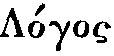
was our King and our God long before; that he
had the same claim and title to religious worship that the Father
himself had—
only not so distinctly revealed.
Here I differ
toto orbe
from Waterland, and say with Luther and
Zinzendorf, that before the Baptism of John the
Logos
alone had
been distinctly revealed, and that first in Christ he declared himself a
Son, namely, the co-eternal only-begotten Son, and thus revealed the
Father. Indeed the want of the Idea of the 1=3 could alone have
prevented Waterland from inferring this from his own query II. and the
texts cited by him pp. 28-38. The Father cannot be revealed except in
and through the Son, his eternal
exegesis
. The contrary position
is an absurdity. The Supreme Will, indeed, the Absolute Good, knoweth
himself as the Father: but the act of self-affirmation, the I Am in that
I Am, is not a manifestation
ad extra
, not an
exegesis
.
Ib. p. 274.
This point being settled, I might allow you that, in some sense,
distinct worship commenced with the distinct title of Son or Redeemer:
that is, our blessed Lord was then first worshipped, or commanded to
be worshipped by us, under that distinct title or character; having
before had no other title or character peculiar and proper to himself,
but only what was common to the Father and him too.
Rather shall I say that the Son and the Spirit, the Word and the Wisdom,
were alone worshipped, because alone revealed under the Law. See
Proverbs, i. ii.
The passage quoted from Bishop Bull is very plausible and very eloquent;
but only
cum multis granis salis sumend
.
Query XIX. p. 279.
That the Father, whose honour had been sufficiently secured under the
Jewish dispensation, and could not but be so under the Christian also,
&c.
Here again! This contradiction of Waterland to his own principles is
continually recurring;— yea, and in one place he involves the very
Tritheism, of which he was so victorious an antagonist, namely, that the
Father is Jehovah, the Son Jehovah, and the Spirit Jehovah;—thus making
Jehovah either a mere synonyme of God—whereas he himself rightly
renders it
which St. John every where, and St. Paul no
less, makes the peculiar name of the Son,
—; or he affirms the same absurdity, as if
had said: The Father is the Son, and the Son is the Son, and the Holy
Ghost is the Son, and yet there are not three Sons but one Son. N. B.
is the verbal noun of
not of
It is strange how little use has been made of that profound
and most pregnant text,
John
i. 18!
Query XX. p. 302.
The
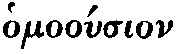
itself might have been spared, at least out of
the Creeds, had not a fraudulent abuse of good words brought matters
to that pass, that the Catholic Faith was in danger of being lost even
under Catholic language.
Most assuredly the very 'disputable' rendering of
by
consubstantial, or of one substance with, not only might have been
spared, but should have been superseded. Why not—as is felt to be for
the interest of science in all the physical sciences—retain the same
term in all languages? Why not
usia
and homoüsial, as well as
hypostasis
, hypostatic, homogeneous, heterogeneous, and the
like;—or as Baptism, Eucharist, Liturgy, Epiphany and the rest?
Query XXI. p. 303.
The Doctor's insinuating from the 300 texts, which style the Father
God absolutely, or the one God, that the Son is not strictly and
essentially God, not one God with the Father, is a strained and remote
inference of his own.
Waterland has weakened his argument by seeming to admit that in all
these 300 texts the Father,
distinctive
, is meant.
Ib. p. 316-17.
The simplicity of God is another mystery. * * When we come to inquire
whether all extension, or all plurality, diversity, composition of
substance and accident, and the like, be consistent with it, then it
is we discover how confused and inadequate our ideas are. * * To this
head belongs that perplexing question (beset with difficulties on all
sides), whether the divine substance be extended or no.
Surely, the far larger part of these assumed difficulties rests on a
misapplication either of the senses to the sense, or of the sense to the
understanding, or of the understanding to the reason;—in short, on an
asking for images where only theorems can be, or requiring theorems for
thoughts, that is, conceptions or notions, or lastly, conceptions for
ideas.
Query XXIII. p. 351.
But taking advantage of the ambiguity of the word hypostasis,
sometimes used to signify substance, and sometimes person, you
contrive a fallacy.
And why did not Waterland lift up his voice against this mischievous
abuse of the term
hypostasis
, and the perversion of its Latin
rendering,
substantia
as being equivalent to
? Why
should not have been rendered by
essentia
, I
cannot conceive.
Est
seems a contraction of
esset
, and
ens
of
essens
:
=
essens,
essentis, essentia
.
Ib. p. 354.
Let me desire you not to give so great a loose to your fancy in divine
things: you seem to consider every thing under the notion of extension
and sensible images.
Very true. The whole delusion of the Anti-Trinitarians arises out of
this, that they apply the property of imaginable matter—in which A. is,
that is, can only be imagined, by exclusion of B. as the universal
predicate of all substantial being.
Ib. p. 357.
And our English Unitarians * * have been still refining upon the
Socinian scheme, * * and have brought it still nearer to Sabellianism.
The Sabellian and the Unitarian seem to differ only in this;—that what
the Sabellian calls union with, the Unitarian calls full inspiration by,
the Divinity.
Ib. p. 359.
It is obvious, at first sight, that the true Arian or Semi-Arian
scheme (which you would be thought to come up to at least) can never
tolerably support itself without taking in the Catholic principle of a
human soul to join with the Word.
Here comes one of the consequences of the Cartesian Dualism: as if
the living body, could be or exist without a soul, or a
human living body without a human soul!
is not Greek for
carrion, nor
for carcase.
Query XXIV. p. 371.
Necessary existence is an essential character, and belongs equally to
Father and Son.
Subsistent in themselves are Father, Son and Spirit: the Father only has
origin in himself.
Query XXVI. p. 412.
The words

he construes thus: "not as
eternally generated," as if he had read
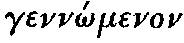
, supplying
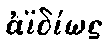
by imagination. The sense and meaning of the word
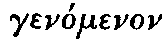
, signifying made, or created, is so fixed and
certain in this author, &c.
This is but one of fifty instances in which the true Englishing of
&c. would have prevented all mistake. It is
not
made
, but
became
. Thus here:—begotten eternally, and
not as one that became; that is, as not having been before. The
only-begotten Son never
became
; but all things
became
through him.
Ib. 412.
Et nos etiam Sermoni atque Rationi, itemque Virtuti, per quæ omnia
molitum Deum ediximus, propriam substantiam Spiritum inscribimus; cui
et Sermo insit prænuntianti, et Ratio adsit disponenti, et Virtus
perficienti. Hunc ex Deo prolatum didicimus, et prolatione generatum,
et idcirco Filium Dei et Deum dictum ex unitate
substantiæ.
Tertull. Apol. c. 21.
How strange and crude the realism of the Christian Faith appears in
Tertullian's rugged Latin!
Ib. p. 414.
He represents Tertullian as making the Son, in his highest capacity,
ignorant of the day of judgment.
Of the true sense of the text,
Mark
xiii. 32., I still remain in
doubt; but, though as zealous and stedfast a Homoüsian as Bull and
Waterland themselves, I am inclined to understand it of the Son in his
highest capacity; but I would avoid the inferiorizing consequences by a
stricter rendering of the
. The
of St. Matthew xxiv. 36. is here omitted. I think Waterland's a very
unsatisfying solution of this text.
Ib. p. 415.
Exclamans quod se Deus reliquisset, &c. Habes ipsum exclamantem in
passione, Deus meus, Deus meus, ut quid me dereliquisti? Sed hæc vox
carnis et animæ, id est, hominis; nec Sermonis, nec Spiritus,
&c.—Tertull. Adv. Prax. c. 26. c. 30.
The ignorance of the Fathers, and, Origen excepted, of the Ante-Nicene
Fathers in particular, in all that respects Hebrew learning and the New
Testament references to the Old Testament, is shown in this so early
fantastic misinterpretation grounded on the fact of our Lord's
reminding, and as it were giving out aloud to John and Mary the
twenty-second Psalm, the prediction of his present sufferings and after
glory.
the entire passage in Tertullian, though no proof of his
Arianism, is full of proofs of his want of insight into the true sense
of the Scripture texts. Indeed without detracting from the inestimable
services of the Fathers from Tertullian to Augustine respecting the
fundamental article of the Christian Faith, yet commencing from the
fifth century, I dare claim for the Reformed Church of England the
honorable name of
of Trinitarianism, and the
foremost rank among the Churches, Roman or Protestant: the learned
Romanist divines themselves admit this, and make a merit of the
reluctance with which they nevertheless admit it, in respect of Bishop
Bull
.
Ib. p. 421.
It seems to me that if there be not reasons of conscience obliging a
good man to speak out, there are always reasons of prudence which
should make a wise man hold his tongue.
True, and as happily expressed. To this, however, the honest
Anti-Trinitarian must come at last: "Well, well, I admit that John and
Paul thought differently; but this remains my opinion."
Query XXVII. p. 427.

—Athanas. Cont. Gent.
The just and literal rendering of the passage is this: 'The true God
who in reality is such, namely, the Father of Christ.'
The passage admits of a somewhat different interpretation from this of
Waterland's, and of equal, if not greater, force against the Arian
notion: namely, taking
distinctively from
—the
Ens omnis entitatis, etiam suæ
, that is, the
I Am the Father, in distinction from the
Ens Supremum
, the Son.
It cannot, however, be denied that in changing the
formula
of the
Tetractys
into the
Trias
, by merging the
Prothesis
in the
Thesis
, the Identity in the Ipseity, the Christian Fathers
subjected their exposition to many inconveniences.
Ib. p. 432.

—Justin
Mart. Dial. p. 180.
The meaning is, that that divine Person, who called himself God, and
was God, was not the Person of the Father, whose ordinary character is
that of maker of all things, but another divine Person, namely, God
the Son. * * It was Justin's business to shew that there was a divine
Person, one who was God of Abraham, Isaac, and Jacob, and was not the
Father; and therefore there were two divine Persons.
At all events, it was a very incautious expression on the part of
Justin, though his meaning was, doubtless, that which Waterland gives.
The same most improper, or at best, most inconvenient because equivocal
phrase, has been, as I think, interpolated into our Apostles' Creed.
Ib. p. 436.

—Greg. Naz.
Orat. 29.
We may, as I conceive, preserve (the doctrine of) one God, by
referring both the Son and Holy Ghost to one cause, &c.
Another instance of the inconvenience of the Trias compared with the
Tetractys.
A Vindication of Christ's Divinity: being a defence of some
queries relating to Dr. Clarke's scheme of the Holy Trinity, &c. By
Daniel Waterland. 2nd edit. Cambridge, 1719.
Ed
.
Y sino ahí está el Doctor Jorge Bull Profesor de
Teología, y Presbitero de la Iglesia Anglicana, que murió Obispo de San
David el año de 1716, cuyas obras teologico—escolasticas, en folio,
nada deben á las mas alambicadas que se han estampado en Salamanca y en
Coimbra; y como los puntos que por la mayor parte trató en ellas son
sobre los misterios capitales de nuestra Santa Fé, conviene á saber,
sobre el misterio de la Trinidad, y sobre el de la Divinidad de Cristo,
en los cuales su Pseudaiglesia Anglicana no se desvia de la Catolica, en
verdad, que los manejó con tanto nervio y con tanta delicadeza, que los
teologos ortodojos mas escolastizados, como si dijéramos electrizados,
hacen grande estimacion de dichas obras. Y aun en los dos Tratados que
escribió acerca de la Justification, que es punto mas resvaladizo, en
los principios que abrazó, no se separó de los teologos Catolicos; pero
en algunas consecuencias que infirio, ya dió bastantemente á entender la
mala leche que habia mamado.
Fray. Gerundio. ii. 7.
Ed.
Contents / Index
Notes on Waterland's Importance of the Doctrine of the Holy Trinity1
Chap. I. p. 18.
It is the property of the Divine Being to be unsearchable; and if he
were not so, he would not be divine. Must we therefore reject the most
certain truths concerning the Deity, only because they are
incomprehensible, &c.?
It is strange that so sound, so admirable a logician as Waterland,
should have thought
unsearchable
and
incomprehensible
synonymous, or
at least equivalent terms:—and this, though St. Paul hath made it the
privilege of the full-grown Christian,
to search out the deep things
of God himself
.
Chap. IV. p. 111.
The delivering over unto Satan seems to have been a form of
excommunication, declaring the person reduced to the state of a
heathen; and in the Apostolical age it was accompanied with
supernatural or miraculous effects upon the bodies of the persons so
delivered.
Unless the passage, (
Acts
v. 1-11.) be an authority, I must doubt
the truth of this assertion, as tending to destroy the essential
spirituality of Christian motives, and, in my judgment, as
irreconcilable with our Lord's declaration, that his kingdom was
not
of this world
. Let me be once convinced that St. Paul, with the
elders of an Apostolic Church, knowingly and intentionally appended a
palsy or a consumption to the sentence of excommunication, and I shall
be obliged to reconsider my old opinion as to the anti-Christian
principle of the Romish Inquisition.
Ib. p. 114.
'A man that is a heretic, after the first and second admonition,
reject; knowing that he that is such, is subverted, and sinneth, being
condemned of himself'.—Tit. iii. 10, 11.
This text would be among my minor arguments for doubting the Paulinity
of the Epistle to Titus. It seems to me to breathe the spirit of a later
age, and a more established Church power.
Ib.
Not every one that mistakes in judgment, though in matters of great
importance, in points fundamental, but he that openly espouses such
fundamental error. * * Dr. Whitby adds to the definition, the
espousing it out of disgust, pride, envy, or some worldly principle,
and against his conscience.
Whitby went too far; Waterland not far enough. Every schismatic is not
necessarily a heretic; but every heretic is virtually a schismatic. As
to the meaning of
Waterland surely makes too
much of a very plain matter. What was the sentence passed on a heretic?
A public declaration that he was no longer a member of—that is, of one
faith with—the Church. This the man himself, after two public notices,
admits and involves in the very act of persisting. However confident as
to the truth of the doctrine he has set up, he cannot, after two public
admonitions, be ignorant that it is a doctrine contrary to the articles
of his communion with the Church that has admitted him; and in regard of
his alienation from that communion, he is necessarily
—though in his pride of heart he might say with the man
of old, "And I banish you."
Ib. p. 123.
—as soon as the miraculous gifts, or gift of discerning spirits,
ceased.
No one point in the New Testament perplexes me so much as these (so
called) miraculous gifts. I feel a moral repugnance to the reduction of
them to natural and acquired talents, ennobled and made energic by the
life and convergency of faith;—and yet on no other scheme can I
reconcile them with the idea of Christianity, or the particular
supposed, with the general known, facts. But, thank God! it is a
question which does not in the least degree affect our faith or
practice. I mean, if God permit, to go through the Middletonian
controversy, as soon as I can procure the loan of the books, or have
health enough to become a reader in the British Museum.
Ib. p. 126.
And what if, after all, spiritual censures (for of such only I am
speaking,) should happen to fall upon such a person, he may be in some
measure hurt in his reputation by it, and that is all. And possibly
hereupon his errors, before invincible through ignorance, may be
removed by wholesome instruction and admonition, and so he is
befriended in it, &c.
Waterland is quite in the right so far;—but the penal laws, the
temporal inflictions—would he have called for the repeal of these?
Milton saw this subject with a mastering eye,—saw that the awful power
of excommunication was degraded and weakened even to impotence by any
the least connection with the law of the State.
Ib. p. 127.
—who are hereby forbidden to receive such heretics into their houses,
or to pay them so much as common civilities. This precept of the
Apostle may he further illustrated by his own practice, recorded by
Irenaeus, who had the information at second-hand from Polycarp, a
disciple of St. John's, that St. John, once meeting with Cerinthus at
the bath, retired instantly without bathing, for fear lest the bath
should fall by reason of Cerinthus being there, the enemy to truth.
Psha! The 'bidding him God speed',—
—(2
'John', 11,) is a spirituality, not a mere civility. If St. John knew or
suspected that Cerinthus had a cutaneous disease, there would have been
some sense in the refusal, or rather, as I correct myself, some
probability of truth in this gossip of Irenæus.
Ib. p. 128.
They corrupted the faith of Christ, and in effect subverted the
Gospel. That was enough to render them detestable in the eyes of all
men who sincerely loved and valued sound faith.
O, no, no, not
them
!
Error quidem, non tamen homo errans,
abominandus
: or, to pun a little,
abhominandus
. Be bold in denouncing
the heresy, but slow and timorous in denouncing the erring brother as a
heretic. The unmistakable passions of a factionary and a schismatic, the
ostentatious display, the ambition and dishonest arts of a sect-founder,
must be superinduced on the false doctrine, before the heresy makes the
man a heretic.
Ib. p. 129.
—the doctrine of the Nicolaitans.
Were the Nicolaitans a sect, properly so called? The word is the Greek
rendering of 'the children of Balaam;' that is, men of grossly immoral
and disorderly lives.
Ib. p. 130.
For if he who shall break one of the least moral commandments, and
shall teach men so, shall be called least in the kingdom of heaven,
(Mat. v. 19,) it must be a very dangerous experiment, &c.
A sad misinterpretation of our Lord's words, which from the context most
evidently had no reference to any moral, that is, universal commandment
as such, but to the national institutions of the Jewish state, as long
as that state should be in existence; that is to say, until
the Heaven
or the Government, and
the Earth
or the People or the Governed, as one
corpus politicum
, or nation, had 'passed away'. Till that time,—which
was fulfilled under Titus, and more thoroughly under Hadrian,— no Jew
was relieved from his duties as a citizen and subject by his having
become a Christian. The text, together with the command implied in the
miracle of the tribute-money in the fish's mouth, might be fairly and
powerfully adduced against the Quakers, in respect of their refusal to
pay their tithes, or whatever tax they please to consider as having an
un-Christian destination. But are they excluded from the kingdom of
heaven, that is, the Christian Church? No; —but they must be regarded
as weak and injudicious members of it.
Chap. V. p. 140.
Accordingly it may be observed, how the unbelievers caress and
compliment those complying gentlemen who meet them half way, while
they are perpetually inveighing against the stiff divines, as they
call them, whom they can make no advantage of.
Accordingly it may be observed, how the unbelievers caress and
compliment those complying gentlemen who meet them half way, while
they are perpetually inveighing against the stiff divines, as they
call them, whom they can make no advantage of.
Ib. p. 187.
And therefore it is infallibly certain, as Mr. Chillingworth well
argues with respect to Christianity in general, that we ought firmly
to believe it; because wisdom and reason require that we should
believe those things which are by many degrees more credible and
probable than the contrary.
Yes, where there are but two positions, one of which must be true. When
A. is presented to my mind with probability=5, and B. with
probability=15, I must think that B. is three times more probable than
A. And yet it is very possible that a C. may be found which will
supersede both.
Chap. VI. p. 230.
The Creed of Jerusalem, preserved by Cyril, (the most ancient perhaps
of any now extant,) is very express for the divinity of God the Son,
in these words: "And in our Lord Jesus Christ, the only begotten Son
of God; true God, begotten of the Father before all ages, by whom all
things were made" * *.

I regard this, both from its antiquity and from the peculiar character
of the Church of Jerusalem, so far removed from the influence of the
Pythagoreo-Platonic sects of Paganism, as the most important and
convincing mere fact of evidence in the Trinitarian controversy.
Ib. p. 233.
—true Son of the Father, 'invisible' of invisible, &c.
How is this reconcilable with
John
i. 18—(
no one hath seen God at
any time: the only begotten Son, which is in the bosom of the Father, he
hath declared him
,—) or with the
express image
, asserted above.
Invisible
, I suppose, must be taken in the narrowest sense, that is,
to bodily eyes. But then the one
invisible
would not mean the same as
the other.
Ib. p. 236.
Symbola certe Ecclesiæ ex ipso Ecclesiæ sensu, non ex hæreticorum
cerebello, exponenda sunt.—Bull. Judic. Eccl. v.
The truth of a Creed must be tried by the Holy Scriptures; but the sense
of the Creed by the known sentiments and inferred intention of its
compilers.
Ib. p. 238.
The very name of Father, applied in the Creed to the first Person,
intimates the relation he bears to a Son, &c.
No doubt: but the most probable solution of the apparent want of
distinctness of explication on this article, in my humble judgment,
is—that the so-called Apostles' Creed was at first the preparatory
confession of the catechumens, the admission-ticket, as it were
(
symbolum ad Baptismum
), at the gate of the Church, and gradually
augmented as heresies started up. The latest of these seems to have
consisted in the doubt respecting the entire death of Jesus on the
Cross, as distinguished from suspended animation. Hence in the fifth or
sixth century the clause—"and he descended into Hades," was
inserted;—that is, the indissoluble principle of the man Jesus, was
separated from, and left, the dissoluble, and subsisted apart in
Scheol
or the abode of separated souls;—but really meaning no more
than
vere mortuus est
.. Jesus was taken from the Cross dead in the very
same sense in which the Baptist was dead after his beheading.
Nevertheless, well adapted as this Creed was to its purposes, I cannot
but regret the high place and precedence which by means of its title,
and the fable to which that title gave rise, it has usurped. It has, as
it appears to me, indirectly favoured Arianism and Socinianism.
Ib. p. 250.
That St. John wrote his Gospel with a view to confute Cerinthus, among
other false teachers, is attested first by Irenæus, who was a
disciple of Polycarp, and who flourished within less than a century of
St. John's time.
I have little trust and no faith in the gossip and hearsay-anecdotes of
the early Fathers, Irenæus not excepted. "Within less than a century of
St. John's time." Alas! a century in the paucity of writers and of men
of education in the age succeeding the Apostolic, must be reckoned more
than equal to five centuries since the use of printing. Suppose,
however, the truth of the Irenæan tradition;—that the Creed of
Cerinthus was what Irenæus states it to have been; and that John, at the
instance of the Asiatic Bishops, wrote his Gospel as an antidote to the
Cerinthian heresy;—does there not thence arise, in his utter silence,
an almost overwhelming argument against the Apostolicity of the
'Christopædia', both that prefixed to Luke, and that concorporated with
Matthew?
Ib. p. 257.
In him was life, and the life was the light of men. The same Word
was life, the
and

both one. There was no occasion
therefore for subtilly distinguishing the Word and Life into two Sons,
as some did.
I will not deny the possibility of this interpretation. It may be,—nay,
it is,—fairly deducible from the words of the great Evangelist: but I
cannot help thinking that, taken as the primary intention, it degrades
this most divine chapter, which unites in itself the three characters of
sublime, profound, and pregnant, and alloys its universality by a
mixture of time and accident.
Ib.
And the light shineth in darkness, and the darkness cometh not upon
it. So I render the verse, conformable to the rendering of the same
Greek verb,

, by our translators in another place
of this same Gospel. The Apostle, as I conceive, in this 5th verse of
his 1st chapter, alludes to the prevailing error of the Gentiles, &c.
O sad, sad! How must the philosopher have been eclipsed by the shadow of
antiquarian erudition, in order that a mind like Waterland's could have
sacrificed the profound universal import of
comprehend
to an allusion
to a worthless dream of heretical nonsense, the mushroom of the day! Had
Waterland ever thought of the relation of his own understanding to his
reason? But alas! the identification of these two diversities—of how
many errors has it been ground and occasion!
Ib. p. 259.
And the Word was made flesh—became personally united with the man
Jesus; and dwelt among us,—resided constantly in the human nature
so assumed.
Waterland himself did but dimly see the awful import of
—the mystery of the alien ground—and the truth, that as the
ground such must be the life. He caused himself to 'become flesh', and
therein assumed a mortal life into his own person and unity, in order
himself to transubstantiate the corruptible into the incorruptible.
Waterland's anxiety to show the anti-heretical force of St. John's
Gospel and Epistles, has caused him to overlook their Catholicity—their
applicability to all countries and all times—their truth, independently
of all temporary accidents and errors;—which Catholicity alone it is
that constitutes their claim to Canonicity, that is, to be Canonical
inspired writings.
Ib. p. 266.
Hereupon therefore the Apostle, in defence of Christ's real humanity,
says, This is he that came by water and blood.
Water and blood,
that is
serum
and
crassamentum
, mean simply
blood
, the blood of the animal or carnal life, which, saith Moses,
is
the life
. Hence
flesh
is often taken as, and indeed is a form of, the
blood,—blood formed or organized. Thus
blood
often includes
flesh
,
and
flesh
includes
blood
.
Flesh and blood
is equivalent to blood
in its twofold form, or rather as formed and formless.
Water and blood
has, therefore, two meanings in St. John, but which
in idem
coincidunt
:
-
true animal human blood, and no celestial ichor or phantom:
-
the whole sentiently vital body, fixed or flowing, the pipe and the
stream.
For the ancients, and especially the Jews, had no distinct apprehension
of the use or action of the nerves: in the Old Testament
heart
is used
as we use
head
.
The fool hath said in his heart
—is in English: "the
worthless fellow (
vaurien
) hath taken it into his head," &c.
Ib. p. 268.
The Apostle having said that the Spirit is truth, or essential truth,
(which was giving him a title common to God the Father and to Christ,)
&c.
Is it clear that the distinct
hypostasis
of the Holy Spirit, in the
same sense as the only-begotten Son is hypostatically distinguished from
the Father, was a truth that formed an immediate object or intention of
St. John? That it is a truth implied in, and fairly deducible from, many
texts, both in his Gospel and Epistles, I do not, indeed I cannot,
doubt;—but only whether this article of our faith he was commissioned
to declare explicitly?
It grieves me to think that such giant
archaspistæ
of the Catholic
Faith, as Bull and Waterland, should have clung to the intruded gloss (1
John
v. 7), which, in the opulence and continuity of the evidences, as
displayed by their own master-minds, would have been superfluous, had it
not been worse than superfluous, that is, senseless in itself, and
interruptive of the profound sense of the Apostle.
Ib. p. 272.
He is come, come in the flesh, and not merely to reside for a time, or
occasionally, and to fly off again, but to abide and dwell with man,
clothed with humanity.
Incautiously worded at best. Compare our Lord's own declaration to his
disciples, that he had dwelt a brief while
with
or
among
them, in
order to dwell
in
them permanently.
Ib. p. 286.
It is very observable, that the Ebionites rejected three of the
Gospels, receiving only St. Matthew's (or what they called so), and
that curtailed. They rejected likewise all St. Paul's writings,
reproaching him as an apostate. How unlikely is it that Justin should
own such reprobates as those were for fellow-Christians!
I dare avow my belief—or rather I dare not withhold my avowal—that
both Bull and Waterland are here hunting on the trail of an old blunder
or figment, concocted by the gross ignorance of the Gentile Christians
and their Fathers in all that respected Hebrew literature and the
Palestine Christians. I persist in the belief that, though a refuse of
the persecuted and from neglect degenerating Jew-Christians may have
sunk into the mean and carnal notions of their unconverted brethren
respecting the Messiah, no proper sect of Ebionites ever existed, but
those to whom St. Paul travelled with the contributions of the churches,
nor any such man as Ebion; unless indeed it was St. Barnabas, who in his
humility may have so named himself, while soliciting relief for the
distressed Palestine Christians;—"I am Barnabas the beggar." But I will
go further, and confess my belief that the (so-called) Ebionites of the
first and second centuries, who rejected the 'Christopædia', and whose
Gospel commenced with the baptism by John, were orthodox Apostolic
Christians, who received Christ as the Lord, that is, as Jehovah
'manifested in the flesh'. As to their rejection of the other Gospels
and of Paul's writings, I might ask:—"Could they read them?" But the
whole notion seems to rest on an anachronical misconception of the
'Evangelia'. Every great mother Church, at first, had its own Gospel.
Ib. p. 288.
To say nothing here of the truer reading ("men of your nation"), there
is no consequence in the argument. The Ebionites were Christians in a
large sense, men of Christian profession, nominal Christians, as
Justin allowed the worst of heretics to be. And this is all he could
mean by allowing the Ebionites to be Christians.
I agree with Bull in holding
the most
probable reading in the passage cited from Justin, and am by no means
convinced that the celebrated passage in Josephus is an interpolation.
But I do not believe that such men, as are here described, ever
professed themselves Christians, or were, or could have been, baptized.
Ib. p. 292.
Le Clerc would appear to doubt, whether the persons pointed to in
Justin really denied Christ's divine nature or no. It is as plain as
possible that they did.
Le Clerc is no favourite of mine, and Waterland is a prime favourite.
Nevertheless, in this instance, I too doubt with Le Clerc, and more than
doubt.
Ib. p. 338.
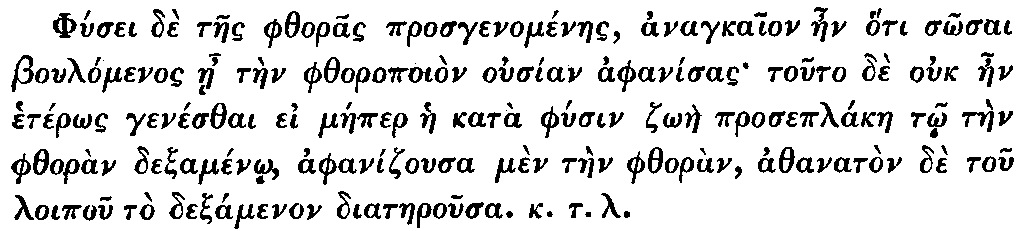
—Just. M.
Here Justin asserts that it was necessary for essential life, or life
by nature, to be united with human nature, in order to save it.
Waterland has not mastered the full force of
If indeed he had taken in the full force of the whole of this
invaluable fragment, he would never have complimented the following
extract from Irenæus, as saying the same thing "in fuller and stronger
words." Compared with the fragment from Justin, it is but the flat
common-place logic of analogy, so common in the early Fathers.
Ib. p. 340.
Qui nude tantum hominem eum dicunt ex Joseph generatum * * moriuntur.
Non nude hominem
—not a mere man do I hold Jesus to have been and to
be; but a perfect man and, by personal union with the Logos, perfect
God. That his having an earthly father might be requisite to his being a
perfect man I can readily suppose; but why the having an earthly father
should be more incompatible with his perfect divinity, than his having
an earthly mother, I cannot comprehend. All that John and Paul believed,
God forbid that I should not!
Chap. VII. p. 389.
It is a sufficient reason for not receiving either them (Arian
doctrines), or the interpretations brought to support them, that the
ancients, in the best and purest times, either knew nothing of them,
or if they did, condemned them.
As excellent means of raising a presumption in the mind of the falsehood
of Arianism and Socinianism, and thus of preparing the mind for a docile
reception of the great idea itself—I admit and value the testimonies
from the writings of the early Fathers. But alas! the increasing
dimness, ending in the final want of the idea of this
all-truths-including truth of the Tetractys eternally manifested in the
Triad;—this, this is the ground and cause of all the main heresies from
Semi-Arianism, recalled by Dr. Samuel Clarke, to the last setting ray of
departing faith in the necessitarian Psilanthropism of Dr. Priestley.
Ib. p. 41-2, &c.
I cannot but think that Waterland's defence of the Fathers in these
pages against Barbeyrac, is below his great powers and characteristic
vigour of judgment. It is enough that they, the Fathers of the first
three centuries, were the lights of their age, and worthy of all
reverence for their good gifts. But it appears to me impossible to deny
their credulity; their ignorance, with one or two exceptions, in the
interpretation of the Old Testament; or their hardihood in asserting the
truth of whatever they thought it for the interest of the Church, and
for the good of souls, to have believed as true. A whale swallowed
Jonah; but a believer in all the assertions and narrations of Tertullian
and Irenæus would be more wonder-working than Jonah; for such a one must
have swallowed whales.
The Importance of the Doctrine of the Holy Trinity
asserted, in reply to some late pamphlets. 2nd edit. Lond. 1734.
Contents / Index
Notes on Skelton's Works1
1825.
Burdy's Life of Skelton, p. 22.
She lived until she was a hundred and five. The omission of his
prayers on the morning it happened, he supposed ever after to be the
cause of this unhappy accident. So early was his mind impressed with a
lively sense of religious duty.
In anecdotes of this kind, and in the instances of eminently good men,
it is that my head and heart have their most obstinate falls out. The
question is:—To what extent the undoubted subjective truth may
legitimately influence our judgment as to the possibility of the
objective.
Ib. p. 67.
The Bishop then gave him the living of Pettigo in a wild part of the
county of Donegal, having made many removals on purpose to put him in
that savage place, among mountains, rocks, and heath, * * *. When he
got this living he had been eighteen years curate of Monaghan, and two
of Newtown-Butler, during which time he saw, as he told me, many
illiterate boys put over his head, and highly preferred in the Church
without having served a cure.
Though I have heard of one or two exceptions stated in proof that
nepotism is not yet extinct among our Prelates, yet it is impossible to
compare the present condition of the Church, and the disposal of its
dignities and emoluments with the facts recorded in this Life, without
an honest exultation.
Ib. p. 106.
He once declared to me that he would resign his living, if the
Athanasian Creed were removed from the Prayer Book; and I am sure he
would have done so.
Surely there was more zeal than wisdom in this declaration. Does the
Athanasian or rather the
pseudo
-Athanasian Creed differ from the
Nicene, or not? If not, it must be dispensable at least, if not
superfluous. If it does differ, which of the two am I to follow;—the
profession of an anonymous individual, or the solemn decision of upwards
of three hundred Bishops convened from all parts of the Christian world?
Vol. I. p. 177-180.
No problem more difficult or of more delicate treatment than the
criteria
of miracles; yet none on which young divines are fonder of
displaying their gifts. Nor is this the worst. Their charity too often
goes to wreck from the error of identifying the faith in Christ with the
arguments by which they think it is to be supported. But surely if two
believers meet at the same goal of faith, it is a very secondary
question whether they travelled thither by the same road of argument. In
this and other passages of Skelton, I recognize and reverence a vigorous
and robust intellect; but I complain of a turbidness in his reasoning, a
huddle in his sequence, and here and there a semblance of arguing in a
circle—from the miracle to the doctrine, and from the doctrine to the
miracle. Add to this a too little advertency to the distinction between
the evidence of a miracle for A, an eye-witness, and for B, for whom it
is the relation of a miracle by an asserted eye-witness; and again
between B, and X, Y, Z, for whom it is a fact of history. The result of
my own meditations is, that the evidence of the Gospel, taken as a
total, is as great for the Christians of the nineteenth century, as for
those of the Apostolic age. I should not be startled if I were told it
was greater. But it does not follow, that this equally holds good of
each component part. An evidence of the most cogent clearness, unknown
to the primitive Christians, may compensate for the evanescence of some
evidence, which they enjoyed. Evidences comparatively dim have waxed
into noon-day splendour; and the comparative wane of others, once
effulgent, is more than indemnified by the
synopsis
which we enjoy, and by the standing miracle of a Christendom
commensurate and almost synonymous with the civilized world. I make this
remark for the purpose of warning the divinity student against the
disposition to overstrain particular proofs, or rest the credibility of
the Gospel too exclusively on some one favourite point. I confess, that
I cannot peruse page 179 without fancying that I am reading some Romish
Doctor's work, dated from a community where miracles are the ordinary
news of the day.
P. S.
By the by, the Rev. Philip Skelton is of the true Irish breed;
that is, a brave fellow, but a bit of a bully. "Arrah, by St. Pathrick!
but I shall make cold mutton of you, Misther Arian."
Ib. p. 182.
If in this he appears to deal fairly by us, proving such things as
admit of it, by reason; and such as do not, by the authority of his
miracles, &c.
Are
we
likely to have miracles performed or pretended before our eyes?
If not, what may all this mean? If Skelton takes for granted the
veracity of the Evangelists, and the precise verity of the Gospels, the
truth and genuineness of the miracles is included:—and if not, what
does he prove? The exact accordance of the miracles related with the
ideal of a true miracle in the reason, does indeed furnish an argument
for the probable truth of the relation. But this does not seem to be
Skelton's intention.
Ib. p. 185.
But to remedy this evil, as far as the nature of the thing will
permit, a genuine record of the true religion must be kept up, that
its articles may not be in danger of total corruption in such a sink
of opinions.
Anything rather than seek a remedy in that which Scripture itself
declares the only one. Alas! these bewilderments (the Romanists urge)
have taken place especially through and by the misuse of the Scriptures.
Whatever God has given, we ought to think necessary;— the Scriptures,
the Church, the Spirit. Why disjoin them?
Ib. p. 186.
Now a perpetual miracle, considered as the evidence of any thing, is
nonsense; because were it at first ever so apparently contrary to the
known course of nature, it must in time be taken for the natural
effect of some unknown cause, as all physical phænomena, if far
enough traced, always are; and consequently must fall into a level, as
to a capacity of proving any thing, with the most ordinary appearances
of nature, which, though all of them miracles, as to the primary cause
of their production, can never be applied to the proof of an
inspiration, because ordinary and common.
I doubt this, though I have no doubt that it would be pernicious. The
yearly blossoming of Aaron's rod is against Skelton, who confounds
single facts with classes of
phænomena
, and he draws his conclusion
from an arbitrary and, as seems to me, senseless definition of a
miracle.
Ib. p. 214. End of Discourse II.
Skelton appears to have confounded two errors very different in kind and
in magnitude;—that of the Infidel, against whom his arguments are with
few exceptions irrefragable; and that of the Christian, who, sincerely
believing the Law, the Prophecies, the miracles and the doctrines, all
in short which in the Scriptures themselves is declared to have been
revealed, does not attribute the same immediate divinity to all and
every part of the remainder. It would doubtless be more Christian-like
to substitute the views expressed in the next Discourse (III.); but
still the latter error is not as the former.
Ib. p. 234.
But why should not the conclusion be given up, since it is possible
Christ may have had two natures in him, so as to have been less than
the Father in respect to the one, and equal to him in respect to the
other.
I understand these words (
My Father is greater than I
) of the
divinity—and of the Filial subordination, which does not in the least
encroach on the equality necessary to the unity of Father, Son, and
Spirit. Bishop Bull does the same. See too Skelton's own remarks in
Discourse V. p. 265.
Ib. p. 251.
This was necessary, because their Law was ordained by angels.
Now this is an instance of what I cannot help regarding as a
superstitious excess of reverence for single texts. We know that long
before the Epistle to the Hebrews was written, the Alexandrian Church,
which by its intercourse with Greek philosophers, chiefly Platonists,
had become ashamed of the humanities of the Hebrew Scriptures, in
defiance of those Scriptures had pretended, that it was not the Supreme
Being who gave the Law in person to Moses, but some of his angels. The
author of the Epistle to the Hebrews, arguing
ad homines
, avails
himself of this, in order to prove that on their own grounds the Mosaic
was of dignity inferior to the Christian dispensation. To get rid of
this no-difficulty in a single verse or two in the Epistles, Skelton
throws an insurmountable difficulty on the whole Mosaic history.
Ib. p. 265.
Therefore, he saith, I (as a man) can of myself do nothing.
Even of this text I do not see the necessity of Skelton's parenthesis
(as a man). Nay it appears to me (I confess) to turn a sublime and most
instructive truth into a truism. "But if not as the Son of God,
therefore
a fortiori
not as the Son of man, and more especially, as
such, in all that refers to the redemption of mankind."
Ib. p. 267.
To this glory Christ, as God, was entitled from all eternity; but did
not acquire a right to it as man, till he had paid the purchase by his
blood.
I too hold this for a most important truth; but yet could wish it to
have been somewhat differently expressed; as thus:—"but did not acquire
it as man till the means had been provided and perfected by his blood."
Ib. p. 268.
If Christ in one place, (John xiv. 28,) says, My Father is greater
than I; he must be understood of his relation to the Father as his
Son, born of a woman.
I do not see the necessity of this: does not Christ say,
My Father and
I will come and we will dwell in you?
Nay, I dare confidently affirm
that in no one passage of St. John's Gospel is our Lord declared in any
special sense the Son of the First Person of the Trinity in reference to
his birth from a woman. And remember it is from St. John's Gospel that
the words are cited. So too the answer to Philip ought to be interpreted
by ch. i. 18. of the same Gospel.
Ib. p. 276.
I confess I do not agree with Skelton's interpretation of any of these
texts entirely. Because I hold the Nicene Faith, and revere the doctrine
of the Trinity as the fundamental article of Christianity, I apply to
Christ as the Second Person, almost all the texts which Skelton explains
of his humanity. At all events 1 consider
the first-born of every
creature
as a false version of the words, which (as the argument and
following verse prove) should be rendered
begotten before
, (or rather
superlatively before
),
all that was created or made; for by him
they
were made.
Ib.
Of that day, and that hour knoweth no man, no not the angels which
are in heaven, neither the Son, but the Father.
I cannot explain myself here; but I have long thought that our Saviour
meant in these words
—and that
like the problem proposed by him to the Scribes, they were intended to
prepare the minds of the disciples for this awful mystery—
—"unless, or if not, as the Father knows it;" while in
St. Matthew the equivalent sense is given by the omission of the
and its inclusion in the Father.
As the Father knoweth
me, so know I the Father
.
It would have been against the general rule of Scripture prophecies, and
the intention of the revelation in Christ, that the first Christians
should have been so influenced in their measures and particular actions,
as they could not but have been by a particular foreknowledge of the
express and precise time at which Jerusalem was to be destroyed. To
reconcile them to this uncertainty, our Lord first teaches them to
consider this destruction the close of one great epoch, or
as the type of the final close of the whole world of time, that
is, of all temporal things; and then reasons with them thus:—"Wonder
not that I should leave you ignorant of the former, when even the
highest order of heavenly intelligences know not the latter,
; nor should I myself, but that the
Father knows it, all whose will is essentially known to me as the
Eternal Son. But even to me it is not revealably communicated." Such
seems to me the true sense of this controverted passage in Mark, and
that it is borne out by many parallel texts in St. John, and that the
correspondent text in Matthew, which omits the
conveys the same sense in equivalent terms, the word
including the Son in the
. For to his only-begotten
Son before all time the Father showeth all things.
Ib. p. 279.
But whether we can reconcile these words to our belief of Christ's
prescience and divinity, or not, matters little to the debate about
his divinity itself; since we can so fully prove it by innumerable
passages of Scripture, too direct, express, and positive, to be
balanced by one obscure passage, from whence the Arian is to draw the
consequence himself, which may possibly be wrong.
Very good.
Ib. p. 280.
We know that the Son of God is come, and hath given us an
understanding that we may know him that is true; and we are in him
that is true, even in his Son Jesus Christ. This is the true God, and
eternal life.—l John v. 20. The whole connection evidently shows the
words to be spoken of Christ.
That the words comprehend Christ is most evident. All that can be fairly
concluded from 1 Cor. viii. 6, is this:—that the Apostles, Paul and
John, speak of the Father as including and comprehending the Son and the
Holy Ghost, as his Word and his Spirit; but of these as inferring or
supposing the Father, not comprehending him. Whenever, therefore,
respecting the Godhead itself, containing both deity and dominion, the
term God is distinctively used, it is applied to the Father, and Lord to
the Son.
Ib. p. 281.
But, farther, it is objected that Christ cannot be God, since God
calls him his servant more than once, particularly 'Isaiah' xlii. 1.
The Prophets often speak of the anti-type, or person typified, in
language appropriate to, and suggested by, the type itself. So, perhaps,
in this passage, if, as I suppose, Hezekiah was the type immediately
present to Isaiah's imagination. However, Skelton's answer is quite
sufficient.
Ib. p. 287.
Hence it appears, that in the passage objected, (1 'Cor'. xv. 24, &c.)
Christ is spoken of purely as that Man whom God had highly exalted,
and to whom he had given a name which is above every name, that at the
name of Jesus every knee should bow. (Phil. ii. 9, 10.)
I must confess that this exposition does not quite satisfy me. I cannot
help thinking that something more and deeper was meant by the Apostle;
and this must be sought for in the mystery of the Trinity itself,
in
which
(mystery)
all treasures of knowledge are hidden
.
Ib. p. 318.
Hence, perhaps, may be best explained what St. Peter says in the
second Epistle, after pleading a miracle. We have also a more sure
word of prophecy, whereunto you do well that you take heed.
I believe that St. Peter neither said it, nor meant this; but that
follows
the prophetic word
. We have also the word
of prophecy more firm;—that is; we have, in addition to the evidence of
the miracles themselves, this further confirmation, that they are the
fulfilment of known prophecies.
Ib. p. 327.
Agreeable to these passages of the Prophet, St. Peter tells us (Acts x. 38), God anointed Jesus of Nazareth with the Holy Ghost and
power.
I have often to complain that too little attention is paid by
commentators to the history and particular period in which certain
speeches were delivered, or words written. Could St. Peter with
propriety have introduced the truth to a prejudiced audience with its
deepest mysteries? Must he not have begun with the most evident facts?
Ib. Disc. VIII.
The Doctrine of the Holy Trinity vindicated.
Were I a Clergyman, the paragraphs from p. 366 to p. 370, both
inclusive, of this Discourse should form the conclusion of my Sermon on
Trinity Sunday,—whether I preached at St. James's, or in a country
village.
Ib. pp. 374-378.
As a reason why we should doubt our own judgment, it is quite fair to
remind the objector, that the same difficulty occurs in the scheme of
God's ordinary providence. But that a difficulty in a supposed article
of revealed truth is solved by the occurrence of the same or of an
equivalent difficulty in the common course of human affairs—this I find
it hard to conceive. How was the religious, as distinguished from the
moral, sense first awakened? What made the human soul feel the necessity
of a faith in God, but the apparent incongruity of certain dispensations
in this world with the idea of God, with the law written in the heart?
Is not the reconciling of these facts or
phænomena
with the divine
attributes, one of the purposes of a revealed religion? But even this is
not a full statement of the defect complained of in this solution. A
difficulty which may be only apparent (like that other of the prosperity
of the wicked) is solved by the declaration of its reality! A difficulty
grounded on the fact of temporal and outward privations and sufferings,
is solved by being infinitely increased, that is, by the assertion of
the same principle on the determination of our inward and everlasting
weal and woe. That there is nothing in the Christian Faith or in the
Canonical Scriptures, when rightly interpreted, that requires such an
argument, or sanctions the recourse to it, I believe myself to have
proved in the
Aids to Reflection
. For observe that "to solve" has a
scientific, and again a religious sense, and that in the latter, a
difficulty is satisfactorily solved, as soon as its insolvibility for
the human mind is proved and accounted for.
Ib. (Disc. XIV. pp. 500-502.)
Christianity proved by Miracles.
I cannot see and never could, the purpose, or
cui bono
, of this
reasoning. To whom is it addressed? To a man who denies a God, or that
God can reveal his will to mankind? If such a man be not below talking
to, he must first be convinced of his miserable blindness respecting
these truths; for these are clearly presupposed in every proof of
miracles generally.
Again, does he admit the authenticity of the Gospels, and the veracity
of the Evangelists? Does he credit the facts there related, and as
related? If not, these points must be proved; for these are clearly
presupposed in all reasoning on the particular miracles of the Christian
dispensation. If he does, can he deny that many acts of Christ were
wonderful;—that reanimating a dead body in which putrefaction had
already commenced,—and feeding four thousand men with a few loaves and
fishes, so that the fragments left greatly exceeded the original total
quantity,—were wonderful events? Should such a man, 'compos mentis',
exist, (which I more than doubt,) what could a wise man do but
stare—and leave him? Christ wrought many wonderful works, implying
admirable power, and directed to the most merciful and beneficent ends;
and these acts were such signs of his divine mission, as rendered
inattention or obstinate averseness to the truths and doctrines which he
promulgated, inexcusable, and indeed on any hypothesis but that of
immoral dispositions and prejudices, utterly inconceivable. In what
respect, I pray, can this statement be strengthened by any reasoning
about the nature and distinctive essence of miracles 'in abstracto'?
What purpose can be answered by any pretended definition of a miracle?
If I met with a disputatious word-catcher, or logomachist, who sought to
justify his unbelief on this ground, I should not hesitate to
say—"Never mind whether it is a miracle or no. Call it what you
will;—but do you believe the fact? Do you believe that Christ did by
force of his will and word multiply instantaneously twelve loaves and a
few small fishes, into sufficient food for a hungering multitude of four
thousand men and women?" When I meet with, or from credible authority
hear of, a man who believes this fact, and yet thinks it no sign of
Christ's mission; when I can even conceive of a man in his right senses
who, believing all the facts and events related in the New Testament,
and as there related, does yet remain a Deist, I may think it time to
enter into a disquisition respecting the right definition of a miracle;
and meantime, I humbly trust that believing with my whole heart and soul
in the wonderful works of our Lord and Saviour Jesus Christ, I shall not
forfeit my title of Christian, though I should not subscribe to this or
that divine's right definition of his
idea
of a miracle; which word is
with me no
idea
at all, but a general term; the common surname, as it
were, of the wonderful works wrought by the messengers of God to man in
the Patriarchal, Mosaic, and Christian dispensations.
It is to these notions and general definitions, far more than to the
facts themselves, that the arguments of Infidels apply; and from which
they derive their plausibility. Nor is this all. The Infidel imitates
the divine, and adopts the same mode of arguing, namely, by this
substantiation of mere general or collective terms.
instance, Hume's
argument (stated, by the by, before he was born, and far more forcibly,
by Dr. South, who places it in the mouth of Thomas,)
—reduce it to
the particular facts in question, and its whole speciousness vanishes. I
am speaking of the particular facts and actions of the Gospel; of those,
and those only. Now that I should be deceived, or the eye-witnesses have
been deceived, under all the circumstances of those miracles, with all
antecedents, accompaniments, and consequents, is quite as contrary to,
that is, unparalleled in my experience, as the return to life of a dead
man.
again in the second paragraph of page 502
, the position is true
or false according to the definition of a miracle. In the narrower sense
of the term, miracle,—that is, a consequent presented to the outward
senses without an adequate antecedent,
ejusdem generis
,—it is not only
false but detractory from the Christian religion. It is a main, nay, an
indispensable evidence; but it is not the only, no, nor if comparison be
at all allowable, the highest and most efficient; unless, indeed, the
term evidence is itself confined to grounds of conviction offered to the
senses, but then the position is a mere truism.
There is yet another way of reasoning, which I utterly dislike; namely,
by putting imaginary cases of imaginary miracles, as Paley has done. "If
a dozen different individuals, all men of known sense and integrity,
should each independently of the other pledge their everlasting weal on
the truth, that they saw a man beheaded and quartered, and that on a
certain person's prayer or bidding, the quarters reunited, and then a
new head grew on and from out of the stump of the neck: and should the
man himself assure you of the same, shew you the junctures, and identify
himself to you by some indelible mark, with which you had been
previously acquainted,—could you withstand this evidence?" What could a
judicious man reply but—"When such an event takes place, I will tell
you; but what has this to do with the reasons for our belief in the
truth of the written records of the Old and New Testament? Why do you
fly off from the facts to a gigantic fiction,—when the possibility of
the
If
with respect to a much less startling narration is the point in
dispute between us?"
Such and so peculiar, and to an honest mind so unmistakeable, is the
character of veracity and simplicity on the very countenance, as it
were, of the Gospel, that every remove of the inquirer's attention from
the facts themselves is a remove of his conversion. It is your business
to keep him from wandering, not to set him the example.
Never, surely, was there a more unequal writer than Skelton;—in the
discourses on the Trinity, the compeer of Bull and Waterland; and yet
the writer of these pages, 500-501! Natural magic! a stroke of art! for
example, converting the Nile into blood! And then his definition of a
miracle. Suspension of the laws of nature! suspension—laws—nature!
Bless me! a chapter would be required for the explanation of each
several word of this definition, and little less than omniscience for
its application in any one instance. An effect presented to the senses
without any adequate antecedent,
ejusdem generis
, is a miracle in the
philosophic sense. Thus: the corporeal ponderable hand and arm raised
with no other known causative antecedent, but a thought, a pure act of
an immaterial essentially invisible imponderable will, is a miracle for
a reflecting mind. Add the words,
præter experientiam
: and we have the
definition of a miracle in the popular, practical, and appropriated
sense.
Vol. III.
That all our thoughts and views respecting our Faith should be
consistent with each other, and with the attributes of God, is most
highly desirable: but when the great diversities of men's
understandings, and the unavoidable influence of circumstances on the
mind, are considered, we may hope from the Divine mercy, that the
agreement in the result will suffice; and that he who sincerely and
efficiently believes that Christ left the glory which he had with the
Father before all worlds, to become man and die for our salvation,—that
by him we may, and by him alone we can, be saved,—will be held a true
believer,—whether he interprets the words
sacrifice, purchase,
bargain, satisfaction
, of the creditor by full payment of the
debt
, and the like as proper and literal expressions of the redeeming
act and the cause of our salvation, as Skelton seems to have done;—or
(as I do) as figurative language truly designating the effects and
consequences of this adorable act and process.
Ib. p. 393.
But were the prospect of a better parish, in case of greater
diligence, set before him by his Bishop, on the music of such a
promise, like one bit by a tarantula, we should probably soon see
him in motion, and serving God, (O shameful!) for the sake of Mammon,
as if his torpid body had been animated anew by a returning soul.
Without any high-flying in Christian morality, I cannot keep shrinking
from the wish here expressed; at all events, I cannot sympathize with,
or participate in, the expectation of "an infinite advancement" from men
so motived.
Ib. p. 394.
Yet excommunication, the inherent discipline of the Church, which it
exercised under persecution, which it is still permitted to exercise
under the present establishment.
Rarely I suspect, without exposing the Clergyman to the risk of an
action for damages, or some abuse. There are few subjects that more need
investigation, yet require more vigour and soundness of judgment to be
rightly handled, than this of Christian discipline in a Church
established by law. It is indeed a most difficult and delicate problem,
and supplied Baxter with a most plausible and to me the only perplexing
of his numerous objections to our Ecclesiastical Constitution. On the
other hand, I saw clearly that he was requiring an impossibility; and
that his argument carried on to its proper consequences concluded
against all Church Establishment, not more against the National Church
of which he complained, than the one of his own clipping and shaping
which he would have substituted; consequently, every proof (and I saw
many and satisfactory proofs) of the moral and political necessity of an
Established Church, was at the same time a pledge that a deeper insight
would detect some flaw in the reasoning of the Disciplinarians. For if
A. be right and requisite, B., which is incompatible with A., cannot be
rightly required.
this it was, that first led me to the distinction
between the
Ecclesia
and an
Enclesia
, concerning which see my Essay
on Establishment and Dissent, in which I have met the objection to my
position, that Christian discipline is incompatible with a Church
established by law, from the fact of the discipline of the Church of
Scotland
. Who denies that it is in the power of a legislature to
punish certain offences by ignominy, and to make the clergy magistrates
in reference to these? The question is, whether it is wise or expedient,
which it may be, or rather may have been, in Scotland, and the contrary
in England? Wise or unwise, this is not discipline, not Christian
discipline, enforced only by spiritual motives, enacted by spiritual
authority, and submitted to for conscience' sake.
Ib. p. 446.
Be this as it may, the foreknowledge and the decree were both eternal.
Here now it is a clear point that the moral actions of all accountable
agents were, with certainty, fore-known, and their doom unalterably
fixed, long before any one of them existed.
Strange that so great a man as Skelton should first affirm eternity of
both, yet in the next sentence talk of "long before."
Reflections
are excellent, but here Skelton offends against his own canons. I
should feel no reluctance, moral or speculative, in accepting the
apparent necessity of both propositions, as a sufficient reason for
believing both; and the transcendancy of the subject as a sufficient
solution of their apparent incompatibility. But yet I think that another
view of the subject, not less congruous with universal reason and more
agreeable to the light of reason in the human understanding, might be
defended, without detracting from any perfection of the Divine Being.
Nay, I think that Skelton needed but one step more to have seen it.
Ib. p. 478.
In fine.
To what purpose were these Reflections, taken as a whole, written? I
cannot answer. To dissuade men from reasoning on a subject beyond our
faculties? Then why all this reasoning?
Vol. IV. p. 28. Deism Revealed.
| Shepherd |
Were you ever at Constantinople, Sir? |
| Dechaine |
Never. |
| Shepherd |
Yet I believe you have no more doubt there is such a city,
than that the three angles of a triangle are equal to two right ones. |
| Temp. |
I am sure 1 have not. |
| Dechaine |
Nor I; but what then? |
| Shepherd |
Pray, Mr. Dechaine, did you see Julius Cæsar assassinated in
the Capitol? |
| Dechaine |
A pretty question! No indeed, Sir. |
| Shepherd |
Have you any doubts about the truth of what is told
us by the historians concerning that memorable transaction? |
| Dechaine |
Not the least. |
| Shepherd |
Pray, is it either self-evident or demonstrable to you, at
this time and place, that there is any such city as Constantinople, or
that there ever was such a man as Cæsar? |
| Dechaine |
By no means. |
| Shepherd |
And you have all you know concerning the being of either the
city, or the man, merely from the report of others, who had it from
others, and so on, through many links of tradition? |
| Dechaine |
I have. |
| Shepherd |
You see then, that there are certain cases, in which the
evidence of things not seen nor either sensibly or demonstrably
perceived, can justly challenge so entire an assent, that he who
should pretend to refuse it in the fullest measure of acquiescence,
would be deservedly esteemed the most stupid or perverse of mankind. |
That there is a sophism here, every one must feel in the very fact of
being 'non-plus'd' without being convinced. The sophism consists in the
instance being 'haud ejusdem generis'
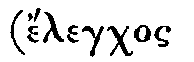

; and what the allogeneity is between the assurance of the
being of Madrid or Constantinople, and the belief of the fact of the
resurrection of Christ, I have shown elsewhere. The universal belief of
the 'tyrannicidium' of Julius Cæsar is doubtless a fairer instance, but
the whole mode of argument is unsound and unsatisfying. Why run off from
the fact in question, or the class at least to which it belongs? The
victory can be but accidental—a victory obtained by the unguarded
logic, or want of logical foresight of the antagonist, who needs only
narrow his positions to narrations of facts and events, in our judgment
of which we are not aided by the analogy of previous and succeeding
experience, to deprive you of the opportunity of skirmishing thus on No
Man's land. But this is Skelton's ruling passion, sometimes his
strength—too often his weakness. He must force the reader to believe:
or rather he has an antagonist, a wilful infidel or heretic always and
exclusively before his imagination; or if he thinks of the reader at
all, it is as of a partizan enjoying every hard thump, and smashing
'fister' he gives the adversary, whom Skelton hates too cordially to
endure to obtain any thing from him with his own liking. No! It must be
against his will, and in spite of it. No thanks to him—the dog could
not help himself! How much more effectual would he have found it to have
commenced by placing himself in a state of sympathy with the supposed
sceptic or unbeliever;—to have stated to him his own feelings, and the
real grounds on which they rested;—to have shown himself the difference
between the historical facts which the sceptic takes for granted and
believes spontaneously, as it were,—and those, which are to be the
subject of discussion; and this brings the question at once to the
proof. And here, after all, lies the strength of Skelton's reasoning,
which would have worked far more powerfully, had it come first and
single, and with the whole attention directed towards it.
Ib. p. 35.
| Templeton |
Surely the resurrection of Christ, or any other man,
cannot be a thing impossible with God. It is neither above his power,
nor, when employed for a sufficient purpose, inconsistent with his
majesty, wisdom, and goodness. |
This is the ever open and vulnerable part of Deism. The Deist, as a
Deist, believes,
implicite
at least, so many and stupendous miracles
as to render his disbelief of lesser miracles, simply because they are
miraculous, gross inconsistencies. To have the battle fairly fought out,
Spinoza, or a Bhuddist, or a Burmese Gymnosoph, should be challenged.
Then, I am deeply persuaded, would the truth appear in full evidence,
that no Christ, no God,—and, conversely, if the Father, then the Son. I
can never too often repeat, that revealed religion is a
pleonasm.—Religion is revelation, and revelation the only religion.
Ib. p. 37.
| Shepherd |
Those believers, whose faith is to rely on the truth of the
Christian history, rest their assent on a written report made by
eye-witnesses; which report the various Churches and sects, jealous of
one another, took care to preserve genuine and uncorrupted, at least
in all material points, and all the religious writers in every age
since have amply attested. |
A divine of the present day who shall undertake the demonstration of the
truth of Christianity by external evidences, or historically, must not
content himself with assuming or asserting this. He must either prove
it; or prove that such proof is not necessary. I myself should be quite
satisfied if I proved the former position in respect to the fourth
Gospel, and showed that the evidence of the other three was equivalent
to a record by an eye-witness: which would not be at all inconsistent
with my contending at the same time for the authenticity of the first
Gospel, or rather for the Catholic interpretation of the title-words
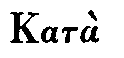
as the more probable opinion, which a sound
divine will neither abandon nor overload, neither place it in the
foundation, nor on the other hand suffer it to be extruded from the
wall. Believe me, there is great, very great, danger in these broad
unqualified assertions that Skelton deals in. Even though the balance of
evidence should be on his side, yet the inquirer will be unfavourably
affected by the numerous doubts and difficulties which an acquaintance
with the more modern works of Biblical criticism will pour upon him, and
for which his mind is wholly unprepared. To meet with a far weaker
evidence than we had taken it for granted we were to find, gives the
same shake to the mind, that missing a stair gives to the body.
Ib. p. 243.
| Temp. |
ou, Mr. Dechaine, seem to forget that God is just; and you,
Mr. Shepherd, that he is merciful |
| Dechaine |
I insist, that, as God is merciful, he will forgive. |
| Shepherd |
And I insist, that, as he is just, he will punish. |
| Temp. |
Pray Mr. Dechaine, are you able, upon the Deistical scheme to
rid yourself of this difficulty? |
| Dechaine |
I see no difficulty in it at all. God gives us laws only for
our good, and will never suffer those laws to become a snare to us,
and the occasion of our eternal misery. |
Here is the
cardo
! The man of sense asserts that it is necessary for
the good of all, that a code of laws should exist, while yet it is
impossible that all should at all times be obeyed by each person: but
what is impossible cannot be required. Nevertheless, it may be required
that no
iota
of any one of these laws should be wilfully and
deliberately transgressed, nor is there any one for the transgression of
which the transgressor must not hold himself punishable. "And yet" (says
our man of sense,) "what may not be said of any one point, or any one
moment, cannot be denied of the collective agency of a whole life, or
any considerable section of it. Here we find ourselves constrained by
our best feelings to praise or condemn, to reward or punish, according
as a great predominance of acts of obedience or disobedience, and a
continued love of the better, or the lusting after the worst, manifests
the maxim (
regula maxima
), the radical will and proper character of
the individual. So parents judge of their children; so schoolmasters of
their scholars; so friends of friends, and even so will God judge his
creatures, if we are to trust in our common sense, or believe the
repeated declarations in the Old Testament." And now I should be glad to
hear any satisfactory
sensible
reply to this, or any answer that does
not fly higher than 'sense' can follow, and pierce into "the thick
clouds" of decried metaphysics! For no fair reply can be imagined, but
one which would find the root of the moral evil, the true
in this very impossibility.
Ib. p. 249.
| Cunningham |
But how does all this discourse about sacrifices and the
natural light show that your faith does not ascribe injustice to God
in putting an innocent person to death for the transgressions of the
guilty? |
| Shepherd |
Was Christ innocent? |
| Cunningham |
He was without sin. |
| Shepherd |
And he was put to death by the appointment and
predetermination of God? |
| Cunningham |
The Jews put him to death. |
| Shepherd |
Do not evade the question. Was he not the Lamb slain from the
foundation of the world? Was he not so delivered by the
determinate counsel and foreknowledge of God, that the Jews, having
taken him, by wicked hands crucified and slew him? |
| Cunningham |
And what then? |
| Shepherd |
Nothing; but that you are to answer, as well as I, for saying
that God predetermined the death of this only innocent person. |
I am less pleased with this volume than with any of the preceding. Ask
your own heart and conscience whether (for instance,) they are satisfied
with this defence
duri per durius
: or whether frightening a modest
query into silence by perverting it into an accusation of the Almighty,
by virtue of a conclusion borrowed from the Calvinistic theory of
Predestination, is not more in the spirit of Job's comforters, than
becomes a minister of the Apostolic Church of England and Ireland? Such
arguments are but edge-tools at the safest, but more often they may
rather be likened to the two-edged blade of Parysatis's knife, the one
of which was poisoned. Leave them to Calvin, or those who dare
appropriate Calvin's words, that "God's absolute will is the only rule
of his justice;"—thus dividing the divine attributes. Yet Calvin
himself distinguishes the hidden from the revealed God, even as the
Greek Fathers distinguished the
the absolute
ground of all being, from the
as the cause
and disposing providence of all existence.
But I disapprove of the plan and spirit of this work, (Deism Revealed.)
The cold-hearted, worldly-minded, cunning Deist, or the coarse sensual
Infidel, is of all men the least likely to be converted; and the
conscientious, inquiring, though misled and perplexed, Sceptic will
throw aside a book at once, as not applicable to his case, which treats
every doubt as a crime, and supposes that there is no doubt at all
possible but in a bad heart and from wicked wishes. Compare this with
St. Paul's language concerning the Jews.
So again, pp. 225, &c. of this volume. Do not the plainest intuitions of
our moral and rational being confirm the positions here attributed to
the Deist, Dechaine? Are they not the same by which Melancthon
de-Calvinized, at least de-Augustinized, the heroic Luther;— those
which constitute one of the only two essential differences between the
Augsburg Confession and the Calvinistic Articles of Faith? And can
anything be more flittery and special-pleading than Skelton's
objections? And again, p. 507, "and that prayer which he (Tindal) is
reported to have used a little before his death, 'If there is a God, I
desire he may have mercy on me;'"—was it Christian-like to publish and
circulate a blind report—so improbable and disgusting, as to demand the
strongest and most unsuspicious testimony for its reception?
Ib. p. 268.
| Shepherd |
Pray, Mr. Dechaine, if a person, whom you knew to be an honest
and clear-sighted man, should solemnly assure you he saw a dead man
restored to life, what would you think of his testimony? |
| Dechaine |
As I could not possibly have as strong an assurance of his
honesty, clear-sightedness, and penetration, as of the great
improbability of the fact, I should not believe him. |
| Shepherd |
Well; it is true he might be deceived himself, or intend to
impose on you. But in case ten such persons should all, at different
times, confirm the same report, how would this affect you? |
There is one inconvenience, not to say danger, in this argument of Mr.
Shepherd's; namely, that of its not standing in the same force, when it
comes to be repeated in the particular miraculous facts in support of
which it is adduced.
Ib. p. 281.
No other ancient book can be so well proved to have been the work of
the author it is now ascribed to, as every book of the New Testament
can be proved to have been written by him whose name it hath all along
borne.
This is true to the full extent that the defence of the divinity of our
religion needs, or perhaps permits, and I see no advantage gained by
asserting more. I must lose all power of distinction, before I can
affirm that the genuineness of the first Gospel,—that in its present
form it was written by Matthew, or is a literal translation of a Gospel
written by him,—rests on as strong external evidence as Luke's, or on
as strong internal evidence as St. John's. Sufficient that the evidence
greatly preponderates in its favor.
The complete Works of the late Rev. Philip Skelton, Rector
of Fintona. 6. vols. 8vo. London, 1824.
Ed.
See South's Works, vol. iii. p. 500. Clarendon edit. 1823
—
Ed.
But it will be proper to observe, that it strikes directly
at the very root of Revelation, which cannot possibly give any other
evidence of itself, as the dictate of God, but what must be drawn from
miracles, wrought to prove the divine mission of those who publish it to
the world.
The Editor is not aware of the existence of the Essay here
mentioned. But see for the distinction of the
Ecclesia
and
Enclesia
,
the Church and State, 3rd edit.—
Ed.
On Predestination, as far as p. 445.
Contents / Index
Notes on Andrew Fuller's Clavinistic and Socinian Systems Examined and Compared1
1807.
Letter III. p. 38.
They (the Jews) did not deny that to be God's own Son was to be equal
with the Father, nor did they allege that such an equality would
destroy the divine unity: a thought of this kind never seems to have
occurred to their minds.
In so truly excellent a book as this is, I regret that this position
should rest on an assertion. The equality of Christ would not, indeed,
destroy the unity of God the Father, considered as one Person: but,
unless we presume the Jews in question acquainted with the great truth
of the Tri-unity, we must admit that it would be considered as implying
Ditheism. Now that some among the Jews had made very near approaches,
though blended with errors, to the doctrine taught in John, c. i., we
can prove from the writings of Philo;—and the Socinians can never prove
that these Jews did not know at least of the doctrine of their schools
concerning the only-begotten Word—
— not as
an attribute, much less as an abstraction or personification—but as a
distinct
Hypostasis
:-and hence it might be shown
that their offence was that the carpenter's son, the Galilean, should
call himself the
This might have been rendered
more than probable by the concluding sentence of Christ's answer to the
disciples of John;—
and blessed is he, whosoever shall not be offended
in me
(Luke vii. 23.); which appears to have no adequate or even
tolerable meaning, unless in reference to the passage in Isaiah, (lxi.
1, 2.) prophesying that Jehovah himself would come among them, and do
the things which our Saviour states himself to have done. Thus, too, I
regret that the answer of our Lord, (John x. 34-36.) being one of the
imagined strong-holds of the Socinians, should not have been more fully
cleared up. I doubt not that Fuller's is a true interpretation; and that
no other is consistent with our Lord's various other declarations. But
the words in and by themselves admit a more plausible misinterpretation
than is elsewhere the case of Socinian displanations. In short, I think
both passages would have been better deferred to a further part of the
work.
Let me add that a mighty and comparatively new argument against the
Socinians may be most unanswerably deduced from this reply of our
Lord's, even were it considered as a mere
argumentum ad
homines
:—namely, that it was not his Messiahship that so offended the
Jews, but his Sonship; otherwise, our Saviour's language would have
neither force, motive, or object. "Even were I no more than the Messiah,
in your meanest conceptions of that character, yet after what I have
done before your eyes, nothing but malignant hearts could have prevented
you from adopting a milder interpretation of my words, when in your own
Scriptures there exists a precedent that so much more than merely
justifies me." And this I believe to be the meaning of the words as
intended to be understood by the Jews in question; though, doubtless,
Fuller's sense exists
implicite
. No candid person would ever call it
an evasion, to prove the injustice and malignity of an accuser even from
his own grounds:—"You charge me falsely; but even were your charge
true, namely, that I am a mere man, and yet call myself the Son of God,
still it would not follow that I have been guilty of blasphemy." But as
understood by the modern Unicists, it would verily, verily, be an
evasive ambiguity, most unworthy of Christian belief concerning his
Saviour. Common charity would have demanded of him to have said:— "I am
a mere man: I do not pretend to be more; but I used the words in analogy
to the words,
Ye are as Gods
; and I have a right to do so: for though
a mere man, I am the great Prophet and Messenger which Moses promised
you."
Letter V. p. 72.
If Dr. Priestley had formed his estimate of human virtue by that great
standard which requires love to God with all the heart, soul, mind,
and strength, and our neighbour as ourselves,—instead of representing
men by nature as having "more virtue than vice,"—he must have
acknowledged with the Scripture, that the whole world lieth in
wickedness—that every thought and imagination of their heart is only
evil continually—and that there is none of them that doeth good, no
not one.
To this the Unicists would answer, that by
the whole world
is meant
all the worldly-minded;—no matter in how direct opposition to half a
score other texts! "One text at a time!" sufficient for the day is the
evil thereof!—and in this way they go on pulling out hair by hair from
the horse's tail, (say rather, dreaming that they do so,) and then
conclude with a shout that the horse never had a tail! For why? This
hair is not a tail, nor that, nor the third, and so on to the very last;
and how can all do what none of all does?—Ridiculous as this is, it is
a fair image of Socinian logic. Thank God, their plucking out is a mere
fancy;—and the sole miserable reality is the bare rump which they call
their religion;— but that is the ape's own growth.
Ib. p. 77.
First, that all punishments are designed for the good of the whole,
and less or corrective punishments for the good of the offender, is
admitted. * * God never inflicts punishment for the sake of punishing.
This is not,
sufficiently guarded. That all
punishments work for the good of the whole, and that the good of the
whole is included in God's design, I admit: but that this is the sole
cause, and the sole justification of divine punishment, I cannot, I dare
not, concede;— because I should thus deny the essential evil of guilt,
and its inherent incompatibility with the presence of a Being of
infinite holiness. Now, exclusion from God implies the sum and utmost of
punishment; and this would follow from the very essence of guilt and
holiness, independently of example, consequence, or circumstance.
Letter VI. p. 90.
(The systems compared as to their tendency to promote morality in
general.)
I have hitherto made no objection to, no remark on, any one part of this
Letter; for I object to the whole—not as Calvinism, but—as what Calvin
would have recoiled from. How was it that so good and shrewd a man as
Andrew Fuller should not have seen, that the difference between a
Calvinist and a Priestleyan Materialist-Necessitarian consists in
this:—The former not only believes a will, but that it is equivalent to
the
ego ipse
, to the actual self, in every moral agent; though he
believes that in human nature it is an enslaved, because a corrupt,
will. In denying free will to the unregenerated he no more denies will,
than in asserting the poor negroes in the West Indies to be slaves I
deny them to be men. Now the latter, the Priestleyan, uses the word
will,—not for any real, distinct, correspondent power, but,—for the
mere result and aggregate of fibres, motions, and sensations; in short,
it is a mere generic term with him, just as when we say, the main
current in a river.
Now by not adverting to this, and alas! misled by Jonathan Edwards's
book, Fuller has hidden from himself and his readers the damnable nature
of the doctrine—not of necessity (for that in its highest sense is
identical with perfect freedom; they are definitions each of the other);
but—of extraneous compulsion. O! even this is not adequate to the
monstrosity of the thought. A denial of all agency;—or an assertion of
a world of agents that never act, but are always acted upon, and yet
without any one being that acts;—this is the hybrid of Death and Sin,
which throughout this letter is treated so amicably! Another fearful
mistake, and which is the ground of the former, lies in conceding to the
Materialist,
explicite et implicite
, that the
the
intelligibile
, the
ipseitas super sensibilis
, of guilt is in time,
and of time, and, consequently, a mechanism of cause and effect;—in
other words, in confounding the
—all which belong to time, and cannot be even thought of
except as effects necessarily predetermined by the precedent causes,
(themselves in their turn effects of other causes),— with the
transsensual ground or actual power.
After such admissions, no other possible defence can be made for
Calvinism or any other
ism
than the wretched recrimination: "Why,
yours, Dr. Priestley, is just as bad!"—Yea, and no wonder:—for in
essentials both are the same. But there was no reason for Fuller's
meddling with the subject at all,—metaphysically, I mean.
Ib. p. 95.
If the unconditionality of election render it unfriendly to virtue, it
must be upon the supposition of that view of things, "which attributes
more to God, and less to man," having such ascendancy; which is the
very reverse of what Dr. Priestley elsewhere teaches, and that in the
same performance.
But in both systems, as Fuller has erroneously stated his own, man is
annihilated. There is neither more nor less; it is all God; all, all are
but
Deus infinite modificatus
:—in brief, both systems are not
Spinosism, for no other reason than that the logic and logical
consequency of 10 Fullers + 10 X 10 Dr. Priestleys, piled on each other,
would not reach the calf of Spinoza's leg. Both systems of necessity
lead to Spinosism, nay, to all the horrible consequences attributed to
it by Spinoza's enemies. O, why did Andrew Fuller quit the high vantage
ground of notorious facts, plain durable common sense, and express
Scripture, to delve in the dark in order to countermine mines under a
spot, on which he had no business to have wall, tent, temple, or even
standing-ground!
The Calvinistic and Socinian Systems examined and compared,
as to their moral tendency; in a series of Letters addressed to the
friends of vital and practical religion; especially those amongst
Protestant Dissenters. By Andrew Fuller. Market Harborough. 1793.
Contents / Index
Notes on Whitaker's Origin of Arianism Disclosed1
1810.
Chap. I. 4. p. 30.
Making himself equal with God.
Whoever reads the four verses (John v. 16-19,) attentively, judging of
the meaning of each part by the context, must needs, I think, see that
the
(18) refers,—not to the
(18) or the
(17), but—to the
(17). The 19th
verse, which is directly called Jesus' reply, takes no notice whatever
of the
(17), but consists wholly of a
justification of the
.
1803.
The above was written many years ago. I still think the remark
plausible, though I should not now express myself so positively. I
imagined the Jews to mean: "he has evidently used the words
—not in the sense in which all good men may use them,
but—in a literal sense, because by the words that followed,
he makes himself equal to God." To justify
these words seemed to me to be the purport of Christ's reply.
Chap. II. 1. p. 34.

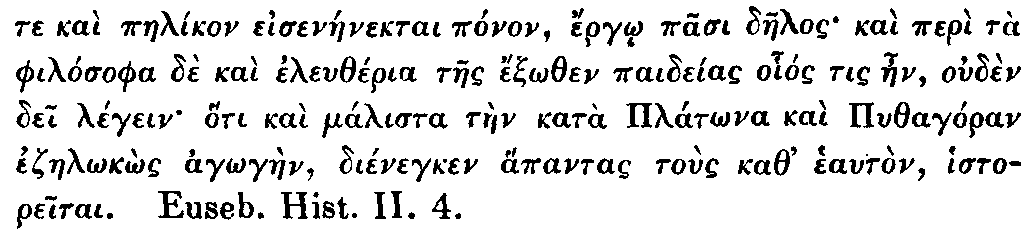
Philo's acquaintance with the doctrines of the heathens was known only
by historical report to Eusebius; while the writings of Philo
displayed his knowledge in the religion of the Jews.
Strange comment. Might I not, after having spoken of Dun Scotus's works,
say;—"he is reported to have surpassed all his contemporaries in
subtlety of logic:"—yet still mean no other works than those before
mentioned? Are not Philo's works full of, crowded with, Platonic and
Pythagorean philosophy? Eusebius knew from his works that he was a great
Platonic scholar; but that he was greater than any other man of his age,
he could only learn from report or history. That Virgil is a great poet
I know from his poems; but that he was the greatest of the Augustan age,
I must learn from Quinctilian and others.
Ib. p. 35.
Philo and the author of the Wisdom of Solomon,—(or rather, perhaps,
authors; for the first ten chapters form a complete work of
themselves,)—were both Cabalistico-Platonizing Jews of Alexandria. As
far as, being such, they must agree, so far they do agree; and as widely
as such men could differ, do they differ. Not only the style of the
Wisdom of Solomon is generically different from Philo's,—so much so
that I should deem it a free translation from a Hebrew original,—but
also in all the
minutiæ
of traditional history and dogma it
contradicts Philo. Philo attributes the creation of man to angels; and
they infused the evil principle through their own imperfections. In the
Book of Wisdom, God created man spotless, and the Devil tempting him
occasioned the Fall. So the whole account of the plagues of Egypt
differs as widely as possible, even to absolute contradiction. The
origin of idolatry is explained altogether differently by Philo, and by
the Book of Wisdom. In short, so unsupported is the tradition that many
have supposed an elder Philo as the author. That the second and third
chapters allude to Christ is a groundless hypothesis. The
just man
is
called
the son of God
, Jehovah,
;—but Christ's
specific title which was deemed blasphemous by the Jews, was
Ben
Elohim
,
;—and the fancy that Philo was a
Christian in heart, but dared not openly profess himself such, is too
absurd. Why no traces in his latest work, or those of his middle age?
Why not the least variation in his religious or philosophical creeds in
his latter works, written long after the resurrection, from those
composed by him before, or a few years after, Christ's birth? Some of
Philo's earlier works must have been written when our Lord was in his
infancy, or at least boyhood.
In short, just take all those passages of Philo which most closely
resemble others in the Wisdom of Solomon, and contain the same or nearly
the same thoughts, and write them in opposite columns, and no doubt will
remain that Philo was not the composer of the Book of Wisdom. Philo
subtle, and with long involved periods knit together by logical
connectives: the Book of Wisdom sententious, full of parallelisms,
assertory and Hebraistic throughout. It was either composed by a man who
tried to Hebraize the Greek, or, if a translator, by one who tried to
Greecise the Hebraisms of his original—not to disguise or hide
them—but only so as to prevent them from repelling or misleading the
Greek reader. The different use of the Greek particles in the Wisdom of
Solomon, and in the works of Philo, is sufficient to confute the
hypothesis of Philo being the author. As little could it have been
written by a Christian. For it could not have been a Christian of
Palestine, from the overflowing Alexandrine Platonism;—nor a Christian
at all; for it contradicts the doctrine of the resurrection of the body,
and in no wise connects any redemptory or sacrificial virtue with the
death of his
just man
;—denies original sin in the Christian sense,
and explains the vice and virtue of mankind by the actions of the souls
of men in a state of pre-existence. No signs or miracles are referred to
in the account of
the just man
; and that it was intended as a
generalization is evident from the change of the singular into the
plural number in the third chapter.
The result is, in my judgment, that this Book was composed by an unknown
Jew of Alexandria, either sometime before, or at the same time with,
Christ. I do not think St. Paul's parallel passages amount to any proof
of quotation or allusion;—they contain the common doctrine of the
spiritualized Judaism in the Cabala;—and yet the work could scarcely
have been written long before Christ, or it would certainly have been
quoted or mentioned by Philo, and most probably by Josephus. And this,
too, is an answer to the splendid and well-supported hypothesis of its
being a translation from a Chaldaic original, composed by Jerubbabel.
The variations of the Syriac translation,— which are so easily
explained by translating the passage into the Chaldaic, when the cause
of the mistake in the Greek or of the variation in the Syriac, is seen
at once,—are certainly startling; but they are too free; and how could
the Fathers, Jerome for example, remain ignorant of the existence of
this Chaldaic original? My own opinion is, as I said before, that the
Book was written in Greek by an Alexandrian Jew, who had formed his
style on that of the LXX., and was led still further to an imitation of
the Old Testament manner by the nature of his fiction, and as a dramatic
propriety, and yet deviated from it partly on account of the very
remoteness of his Platonic conceptions from the simplicity and poverty
of the Hebrew; and partly because of the wordy rhetoric epidemic in
Alexandria: and that it was written before the death, if not the birth,
of Christ, I am induced to believe, because I do not think it probable
that a book composed by a Jew, who had confessed Christ after the
resurrection, would so soon have been received by the Christians, and so
early placed in the very next rank to works of full inspiration.
Taken, therefore, as a work
ante
, or at least
extra, Christum
, it is
most valuable as ascertaining the opinions of the learned Jews on many
subjects, and the general belief concerning immortality, and a day of
judgment. On this ground Whitaker might have erected a most formidable
battery, that would have played on the very camp and battle-array of the
Socinians, that is, of those who consider Christ only as a teacher of
important truths.
In referring to the Cabala, I am not ignorant of the date of the oldest
Rabbinical writings which contain or refer to this philosophy, but I
coincide with Eichorn, and very many before Eichorn, that the
foundations of the Cabala were laid and well known long before Christ,
though not all the fanciful superstructure. I am persuaded that new
light might be thrown on the Apocalypse by a careful study of the Book
Sohar, and of whatever else there may be of that kind. The introduction
(i. 4,) is clearly Cabala:—the
= 3, and the
seven spirits
= 10
Sephiroth
, constituting
together the
Adam Kadmon
, the second Adam of St. Paul, the incarnate
one in the Messiah.
Were it not for the silence of Philo and Josephus, which I am unable to
explain if the Wisdom of Solomon was written so long before Christ, I
might perhaps incline to believe it composed shortly after, if not
during, the persecution of the Jews in Egypt under Ptolemy Philopator.
This hypothesis would give a particular point to the bitter exposure of
idolatry, to the comparison between the sufferings of the Jews, and
those of idolatrous nations, to the long rehearsal and rhetorical
declaration of the plagues of Egypt, and to the reward of 'the just man'
after a death of martyrdom; and would besides help to explain the
putting together of the first ten chapters, and the fragment contained
in the remaining chapters. They were works written at the same time, and
by the same author: nay, I do not think it absurd to suppose, that the
chapters after the tenth were annexed by the writer himself, as a long
explanatory appendix; or, possibly, if they were once a separate work,
these nine concluding chapters were parts of a book composed during the
persecution in Egypt, the introduction and termination of which, being
personal and of local application, were afterwards omitted or expunged
in order not to give offence to the other Egyptians,—perhaps, to spare
the shame of such Jews as had apostatized through fear, and in general
not to revive heart-burnings. In modern language I should call these
chapters in their present state a Note on c. x. 15-19.
On a reperusal of this Book, I rather believe that these latter chapters
never formed part of any other work, but were composed as a sort of long
explanatory Postscript, with particular bearing on certain existing
circumstances, to which this part of the Jewish history was especially
applicable. Nay, I begin to find the silence of Philo and Josephus less
inexplicable, and to imagine that I discover the solution of this
problem in the very title of the Book. No one expects to find any but
works of authenticity enumerated in these writers; but to this a work,
calling itself the Wisdom of Solomon, both being a fiction and never
meant to pass for anything else, could make no pretensions. To have
approximated it to the Holy Books of the nation would have injured the
dignity of the Jewish Canon, and brought suspicion on the genuine works
of Solomon, while it would have exposed to a charge of forgery a
composition which was in itself only an innocent dramatic monologue.
N.
B.
This hypothesis possesses all the advantages, and involves none of
the absurdity of that which would attribute the 'Ecclesiasticus' to the
infamous Jason, the High Priest. More than one commentator, I find, has
suspected that the Wisdom of Solomon and the second book of Maccabees
were by the same author. I think this nothing.
Ib. p. 36.
Philo throws out a number of declarations, that shew his own and the
Jewish belief in a secondary sort of God, a God subordinate in origin
to the Father of all, yet most intimately united with him, and sharing
his most unquestionable honours.
The belief of the Alexandrian Jews who had acquired Greek philosophy, no
doubt;—but of the Palestine Jews?
Ib. 2. p. 48.
St. John also is witnessed by a heathen (Amelius,) and by one who put
him down for a barbarian, to have represented the Logos as "the Maker
of all things," as "with 'God'," and as "God." And St. John is
attested to have declared this, "not even as shaded over, but on the
contrary as placed in full view."
Stranger still. Whitaker could scarcely have read the Greek. Amelius
says, that these truths, if stripped of their allegorical dress,
would be
plain;—that is, that John in an allegory, as of one particular man, had
shadowed out the creation of all things by the Logos, and the after
union of the Logos with human nature,—that is, with all men. That this
is his meaning, consult Plotinus.
Ib. 9. p. 107.
"Seest thou not," adds Philo, in the same spirit of subtilizing being
into power, and dividing the Logos into two.
Who that had even rested but in the porch of the Alexandrian philosophy,
would not rather say,
of substantiating powers and attributes into
being?
What is the whole system from Philo to Plotinus, and thence to
Proclus inclusively, but one fanciful process of hypostasizing logical
conceptions and generic terms? In Proclus it is Logolatry run mad.
Chap. III. 1. p. 131-2.
Such would be the evidence for that divinity, to accompany the Book of
Wisdom, if we considered it to be as old as Solomon, or only as the
Son of Sirach. But I consider it to be much later than either, and
actually a work of Philo's. * * The language is very similar to
Philo's; flowing, lively and happy.
How is it possible to have read the short Hebraistic sentences of the
Book of Wisdom, and the long involved periods that characterize the
style of all Philo's known writings, and yet attribute both to one
writer? But indeed I know no instance of assertions made so audaciously,
or of passages misrepresented and even mistranslated so grossly, as in
this work of Whitaker. His system is absolute naked Tritheism.
Ib.
The righteous man is shadowed out by the author with a plain reference
to our Saviour himself. "'Let us lie in wait for the righteous'," &c.
How then could Philo have remained a Jew?
Ib. 2. p. 195.
In all effects that are voluntary, the cause must be prior to the
effect, as the father is to the son in human generation. But in all
that are necessary, the effect must be coeval with the cause; as the
stream is with the fountain, and light with the sun. Had the sun been
eternal in its duration, light would have been co-eternal with it.
A just remark; but it cuts two ways. For these necessary effects are not
really but only logically different or distinct from the cause:—the
rays of the sun are only the sun diffused, and the whole rests on the
sensitive form of material space. Take away the notion of material
space, and the whole distinction perishes.
Chap. IV. 1. p. 266.
Justin accordingly sets himself to shew, that in the beginning, before
all creatures, God generated a certain rational power out of himself.
Is it not monstrous that the Jews having, according to Whitaker, fully
believed a Trinity, one and all, but half a century or less before
Trypho, Justin should never refer to this general faith, never reproach
Trypho with the present opposition to it as a heresy from their own
forefathers, even those who rejected Christ, or rather Jesus as
Christ?—But no!— not a single objection ever strikes Mr. Whitaker, or
appears worthy of an answer. The stupidest become authentic—the most
fantastic abstractions of the Alexandrine dreamers substantial
realities! I confess this book has satisfied me how little erudition
will gain a man now-a-days the reputation of vast learning, if it be
only accompanied with dash and insolence. It seems to me impossible,
that Whitaker can have written well on the subject of Mary, Queen of
Scots, his powers of judgment being apparently so abject. For instance,
he says that the grossest moral improbability is swept away by positive
evidence:—as if positive evidence (that is, the belief I am to yield to
A. or B.) were not itself grounded on moral probabilities. Upon my word
Whitaker would have been a choice judge for Charles II. and Titus Oates.
Ib. p. 267.
Justin therefore proceeds to demonstrate it, (the pre-existence of
Christ,) asserting Joshua to have given only a temporary inheritance
to the Jews, &c.
A precious beginning of a precious demonstration! It is well for me that
my faith in the Trinity is already well grounded by the Scriptures, by
Bishop Bull, and the best parts of Plotinus, or this man would certainly
have made me either a Socinian or a Deist.
Ib. 2. p. 270.
The general mode of commencing and concluding the Epistles of St.
Paul, is a prayer of supplication for the parties, to whom they were
addressed; in which he says, Grace to you and peace from God our
Father, and—from whom besides?—the Lord Jesus Christ; in which
our Saviour is at times invoked alone, as the Grace of our Lord Jesus
Christ be with you all; and is even invoked the first at times as,
the Grace of the Lord Jesus Christ, and the love of God, and the
communion of the Holy Ghost, be with you all; shews us plainly, &c.
Invoked! Surely a pious wish is not an invocation. "May good angels
attend you!" is no invocation or worship of angels. The essence of
religions adoration consists in the attributing, by an act of prayer or
praise, a necessary presence to an object—which not being
distinguishable, if the object be sensuously present, we may safely
define adoration as an acknowledgement of the actual and necessary
presence of an intelligent being not present to our senses. "May lucky
stars shoot influence on you!" would be a very foolish
superstition,—but to say in earnest! "O ye stars, I pray to you, shoot
influences on me," would be idolatry. Christ was visually present to
Stephen; his invocation therefore was not perforce an act of religious
adoration, an acknowledgment of Christ's deity.
The Origin of Arianism Disclosed. By John Whitaker, B.D.
London, 1791.
Contents / Index
Notes on Oxlee on The Trinity and Incarnation1
1827.
Strange—yet from the date of the book of the Celestial Hierarchies of
the pretended Dionysius the Areopagite to that of its translation by
Joannes Scotus Erigena, the contemporary of Alfred, and from Scotus to
the Rev. John Oxlee in 1815, not unfrequent—delusion of mistaking
Pantheism, disguised in a fancy dress of pious phrases, for a more
spiritual and philosophic form of Christian Faith! Nay, stranger
still:—to imagine with Scotus and Mr. Oxlee that in a scheme which more
directly than even the grosser species of Atheism, precludes all moral
responsibility and subverts all essential difference of right and wrong,
they have found the means of proving and explaining, "the Christian
doctrines of the Trinity and Incarnation," that is, the great and only
sufficient antidotes of the right faith against this insidious poison.
For Pantheism—trick it up as you will—is but a painted Atheism. A mask
of perverted Scriptures may hide its ugly face, but cannot change a
single feature.
Introduction, p. 4.
In the infancy of the Christian Church, and immediately after the
general dispersion which necessarily followed the sacking of Jerusalem
and Bither, the Greek and Latin Fathers had the fairest opportunity of
disputing with the Jews, and of evincing the truth of the Gospel
dispensation; but unfortunately for the success of so noble a design,
they were totally ignorant of the Hebrew Scriptures, and so wanted in
every argument that stamp of authority, which was equally necessary to
sanction the principles of Christianity, and to command the respect of
their Jewish antagonists. For the confirmation of this remark I may
appeal to the Fathers themselves, but especially to Barnabas, Justin,
and Irenæus, who in their several attempts at Hebrew learning betray
such portentous signs of ignorance and stupidity, that we are covered
with shame at the sight of their criticisms.
Mr. Oxlee would be delighted in reading Jacob Rhenferd's Disquisition on
the Ebionites and other supposed heretics among the Jewish Christians.
And I cannot help thinking that Rhenferd, who has so ably anticipated
Mr. Oxlee on this point, and in Jortin's best manner displayed the gross
ignorance of the Gentile Fathers in all matters relating to Hebrew
learning, and the ludicrous yet mischievous results thereof, has formed
a juster though very much lower opinion of these Fathers, with a few
exceptions, than Mr. Oxlee. I confess that till the light of the
twofoldness of the Christian Church dawned on my mind, the study of the
history and literature of the Church during the first three or four
centuries infected me with a spirit of doubt and disgust which required
a frequent recurrence to the writings of John and Paul to preserve me
whole in the Faith.
Prop. I. ch. i. p. 16.
The truth of the doctrine is vehemently insisted on, in a variety of
places, by the great R. Moses ben Maimon; who founds upon it the unity
of the Godhead, and ranks it among the fundamental articles of the
Jewish religion. Thus in his celebrated Letter to the Jews of
Marseilles he observes, &c.
But what is obtained by quotations from Maimonides more than from
Alexander Hales, or any other Schoolman of the same age? The metaphysics
of the learned Jew are derived from the same source, namely, Aristotle;
and his object was the same, as that of the Christian Schoolmen, namely,
to systematize the religion he professed on the form and in the
principles of the Aristotelian philosophy.
By the by, it is a serious defect in Mr. Oxlee's work, that he does not
give the age of the writers whom he cites. He cannot have expected all
his readers to be as learned as himself.
Ib. ch. iii. p. 26.
Mr. Oxlee seems too much inclined to identify the Rabbinical
interpretations of Scripture texts with their true sense; when in
reality the Rabbis themselves not seldom used those interpretations as a
convenient and popular mode of conveying their own philosophic opinions.
Neither have I been able to admire the logic so general among the
divines of both Churches, according to which if one, two, or perhaps
three sentences in any one of the Canonical books appear to declare a
given doctrine, all assertions of a different character must have been
meant to be taken metaphorically.
Ib. p. 26-7.
The Prophet Isaiah, too, clearly inculcates the spirituality of the
Godhead in the following declaration: But Egypt is man, and not God:
and their horses flesh, and not spirit. (c. xxxi. 3.) * * *. In the
former member the Prophet declares that Egypt was man, and not God;
and then in terms of strict opposition enforces the sentiment by
adding, that their cavalry was flesh, and not spirit; which is just as
if he had said: But Egypt, which has horses in war, is only a man,
that is, flesh, and not God, who is spirit.
Assuredly this is a false interpretation, and utterly unpoetical. It is
even doubtful whether
(
ruach
) in this place means
spirit
in contradistinction to
matter
at all, and not rather air or wind. At all events, the poetic decorum,
the proportion, and the antithetic parallelism, demand a somewhat as
much below God, as the horse is below man. The opposition of
flesh
and
spirit
in the Gospel of St. John, who thought in Hebrew, though he
wrote in Greek, favours our common version,—
flesh and not spirit
:
but the place in which this passage stands, namely, in one of the first
forty chapters of Isaiah, and therefore written long before the
Captivity, together with the majestic simplicity characteristic of
Isaiah's name gives perhaps a greater probability to the other:
Egypt
is man, and not God; and her horses flesh, and not wind
. If Mr. Oxlee
renders the fourth verse of Psalm civ.—
He maketh spirits his
messengers
, (for our version—
He maketh his angels spirits
—is
without a violent inversion senseless), this is a case in point for the
use of the word,
spirits
, in the sense of incorporeal beings. (Mr.
Oxlee will hardly, I apprehend, attribute the opinion of some later
Rabbis, that God alone and exclusively is a Spirit, to the Sacred
Writers, easy as it would be to quote a score of texts in proof of the
contrary.) I, however, cannot doubt that the true rendering of the
above-mentioned verse in the Psalms is;—
He maketh the winds his angels
or messengers, and the lightnings his ministrant servants
.
As to Mr. Oxlee's
abstract intelligences,
I cannot but think
abstract
for
pure
, and even pure intelligences for incorporeal, a
lax use of terms. With regard to the point in question, the truth seems
to be this. The ancient Hebrews certainly distinguished the principle or
ground of life, understanding, and will from ponderable, visible,
matter. The former they considered and called
spirit
, and believed it
to be an emission from the Almighty Father of Spirits: the latter they
called
body
; and in this sense they doubtless believed in the
existence of incorporeal beings. But that they had any notion of
immaterial beings in the sense of Des Cartes, is contrary to all we know
of them, and of every other people in the same degree of cultivation.
Air, fire, light, express the degrees of ascending refinement. In the
infancy of thought the life, soul, mind, are supposed to be air—
anima,
animus
, that is,
spiritus,
In the
childhood, they are fire,
mens ignea, ignicula
, and God himself
Lastly, in the youth of thought, they
are refined into light; and that light is capable of subsisting in a
latent state, the experience of the stricken flint, of lightning from
the clouds, and the like, served to prove, or at least, it supplied a
popular answer to the objection;—"If the soul be light, why is it not
visible?" That the purest light is invisible to our gross sense, and
that visible light is a compound of light and shadow, were answers of a
later and more refined period. Observe, however, that the Hebrew
Legislator precluded all unfit applications of the materializing fancy
by forbidding the people to
imagine
at all concerning God. For the ear
alone, to the exclusion of all other bodily sense, was he to be
designated, that is, by the Name. All else was for the mind—by power,
truth, wisdom, holiness, mercy.
Prop. II. ch. ii. p. 36.
I fear I must surrender my hope that Mr. Oxlee was an exception to the
rule, that the study of Rabbinical literature either finds a man
whimmy
, or makes him so. If neither the demands of poetic taste, nor
the peculiar character of oracles, were of avail, yet morality and piety
might seem enough to convince any one that this vision of Micaiah, (2
Chron
. c. xviii. 18, &c.) was the poetic form, the veil, of the
Prophet's meaning. And a most sublime meaning it was. Mr. Oxlee should
recollect that the forms and personages of visions are all and always
symbolical.
Ib. pp. 39-40.
It will not avail us much, however, to have established their
incorporeity or spirituality, if what R. Moses affirms be true * * *.
This impious paradox * *. Swayed, however, by the authority of so
great a man, even R. David Kimchi has dilapsed into the same error,
&c.
To what purpose then are the crude metaphysics of these later Rabbis
brought forward, differing as they do in no other respect from the
theological
dicta
of the Schoolmen, but that they are written in a
sort of Hebrew. I am far from denying that an interpreter of the
Scriptures may derive important aids from the Jewish commentators: Aben
Ezra, (about 1150) especially, was a truly great man. But of this I am
certain, that he only will be benefited who can look down upon their
works, whilst studying them;—that is, he must thoroughly understand
their weaknesses, superstitions, and rabid appetite for the marvellous
and the monstrous; and then read them as an enlightened chemist of the
present day would read the writings of the old alchemists, or as a
Linnæus might peruse the works of Pliny and Aldrovandus. If he can do
this, well;— if not, he will line his skull with cobwebs.
Ib. pp. 40, 41.
But how, I would ask, is this position to be defended? Surely not by
contradicting almost every part of the inspired volumes, in which such
frequent mention occurs of different and distinct angels appearing to
the Patriarchs and Prophets, sometimes in groups, and sometimes in
limited numbers * *. It is, indeed, so wholly repugnant to the general
tenor of the Sacred Writings, and so abhorrent from the piety of both
Jew and Christian, that the learned author himself, either forgetting
what he had before advanced, or else postponing his philosophy to his
religion, has absolutely maintained the contrary in his explication of
the Cherubim, &c.
I am so far from agreeing with Mr. Oxlee on these points, that I not
only doubt whether before the Captivity any fair proof of the existence
of Angels, in the present sense, can be produced from the inspired
Scriptures,—but think also that a strong argument for the divinity of
Christ, and for his presence to the Patriarchs and under the Law, rests
on the contrary, namely, that the Seraphim were images no less
symbolical than the Cherubim. Surely it is not presuming too much of a
Clergyman of the Church of England to expect that he would measure the
importance of a theological tenet by its bearings on our moral and
spiritual duties, by its practical tendencies. What is it to us whether
Angels are the spirits of just men made perfect, or a distinct class of
moral and rational creatures? Augustine has well and wisely observed
that reason recognizes only three essential kinds;—God, man, beast. Try
as long as you will, you can never make an Angel anything but a man with
wings on his shoulders.
Ib. ch. III. p. 58.
But this deficiency in the Mosaic account of the creation is amply
supplied by early tradition, which inculcates not only that the angels
were created, but that they were created, either on the second day,
according to R. Jochanan, or on the fifth, according to R. Chanania.
Inspired Scripture amply supplied by the Talmudic and Rabbinical
traditions!—This from a Clergyman of the Church of England!
I am, I confess, greatly disappointed. I had expected, I scarce know
why, to have had some light thrown on the existence of the Cabala in its
present form, from Ezekiel to Paul and John. But Mr. Oxlee takes it as
he finds it, and gravely ascribes this patch-work of corrupt Platonism
or Plotinism, with Chaldean, Persian, and Judaic fables and fancies, to
the Jewish Doctors, as an original, profound, and pious philosophy in
its fountain-head! The indispensable requisite not only to a profitable
but even to a safe study of the Cabala is a familiar knowledge of the
docimastic philosophy, that is, a philosophy, which has for its object
the trial and testing of the weights and measures themselves, the first
principles, definitions, postulates, axioms of logic and metaphysics.
But this is in no other way possible but by our enumeration of the
mental faculties, and an investigation of the constitution, function,
limits, and applicability
ad quas res
, of each. The application to
this subject of the rules and forms of the understanding, or discursive
logic, or even of the intuitions of the reason itself, if reason be
assumed as the first and highest, has Pantheism for its necessary
result. But this the Cabalists did: and consequently the Cabalistic
theosophy is Pantheistic, and Pantheism, in whatever drapery of pious
phrases disguised, is (where it forms the whole of a system) Atheism,
and precludes moral responsibility, and the essential difference of
right and wrong. One of the two contra-distinctions of the Hebrew
Revelation is the doctrine of positive creation. This, if not the only,
is the easiest and surest criterion between the idea of God and the
notion of a
mens agitans molem
. But this the Cabalists evaded by their
double meaning of the term, 'nothing', namely as nought = 0, and as no
thing
; and by their use of the term, as designating God. Thus in words
and to the ear they taught that the world was made out of nothing; but
in fact they meant and inculcated, that the world was God himself
expanded.
is not, therefore, half a dozen passages respecting the
first three
proprietates
in the Sephiroth, that will lead a wise
man to expect the true doctrine of the Trinity in the Cabalistic scheme:
for he knows that the scholastic value, the theological necessity, of
this doctrine consists in its exhibiting an idea of God, which rescues
our faith from both extremes, Cabalo-Pantheism, and Anthropomorphism. It
is, I say, to prevent the necessity of the Cabalistic inferences that
the full and distinct developement of the doctrine of the Trinity
becomes necessary in every scheme of dogmatic theology. If the first
three
proprietates
are God, so are the next seven, and so are all ten.
God according to the Cabalists is all in each and one in all. I do not
say that there is not a great deal of truth in this; but I say that it
is not, as the Cabalists represent it, the whole truth. Spinoza himself
describes his own philosophy as in substance the same with that of the
ancient Hebrew Doctors, the Cabalists—only unswathed from the Biblical
dress.
Ib. p. 61.
Similar to this is the declaration of R. Moses ben Maimon. "For that
influence, which flows from the Deity to the actual production of
abstract intelligences flows also from the intelligences to their
production from each other in succession," &c.
How much trouble would Mr. Oxlee have saved himself, had he in sober
earnest asked his own mind, what he meant by emanation; and whether he
could attach any intelligible meaning to the term at all as applied to
spirit.
Ib. p. 65.
Thus having, by variety of proofs, demonstrated the fecundity of the
Godhead, in that all spiritualities, of whatever gradation, have
originated essentially and substantially from it, like streams from
their fountain; I avail myself of this as another sound argument, that
in the sameness of the divine essence subsists a plurality of Persons.
A plurality with a vengeance! Why, this is the very scoff of a late
Unitarian writer,—only that he inverts the order. Mr. Oxlee proves ten
trillions of trillions in the Deity, in order to deduce
a fortiori
the
rationality of three: the Unitarian from the Three pretends to deduce
the equal rationality of as many thousands.
Ib. p. 66.
So, if without detriment to piety great things may be compared with
small, I would contend, that every intelligency, descending by way of
emanation or impartition from the Godhead, must needs be a personality
of that Godhead, from which it has descended, only so vastly unequal
to it in personal perfection, that it can form no part of its proper
existency.
Is not this to all intents and purposes ascribing partibility to God?
Indeed it is the necessary consequence of the emanation
scheme?—Unequal!—Aye, various
wicked
personalities of the
Godhead?—How does this rhyme?— Even as a metaphor, emanation is an
ill-chosen term; for it applies only to fluids.
Ramenta
, unravellings,
threads, would be more germane.
The Christian Doctrines of the Trinity and Incarnation
considered and maintained on the principles of Judaism. By the Rev. John
Oxlee. London, 1815.
That is, Intelligence or the Crown, Knowledge, Wisdom.
Ed.
Contents / Index
Notes on A Barrister's Hints on Evangelical Preaching1
1810.
For only that man understands in deed
Who well remembers what he well can do;
The faith lives only where the faith doth breed
Obedience to the works it binds us to.
And as the Life of Wisdom hath exprest—
'If this ye know, then do it and be blest'.
LORD BROOK.
In Initio
There is one misconception running through the whole of this Pamphlet,
the rock on which, and the quarry out of which, the whole reasoning, is
built;—an error therefore which will not indeed destroy its efficacy as
a
or anti-philtre to inflame the scorn of the enemies
of Methodism, but which must utterly incapacitate it for the better
purpose of convincing the consciences or allaying the fanaticism of the
Methodists themselves; this is the uniform and gross mis-statement of
the one great point in dispute, by which the Methodists are represented
as holding the compatibility of an impure life with a saving faith:
whereas they only assert that the works of righteousness are the
consequence, not the price, of Redemption, a gift included in the great
gift of salvation;—and therefore not of merit but of imputation through
the free love of the Saviour.
Part I. p. 49.
It is enough, it seems, that all the disorderly classes of mankind,
prompted as they are by their worst passions to trample on the public
welfare, should know that they are, what every one else is convinced
they are, the pests of society, and the evil is remedied. They are not
to be exhorted to honesty, sobriety, or the observance of any laws,
human or divine—they must not even be entreated to do their best.
"Just as absurd would it be," we are told, "in a physician to send
away his patient, when labouring under some desperate disease, with a
recommendation to do his utmost towards his own cure, and then to come
to him to finish it, as it is in the minister of the Gospel to
propose to the sinner to do his best, by way of healing the disease
of the soul—and then to come to the Lord Jesus to perfect his
recovery. The only previous qualification is to know our misery,
and the remedy is prepared." See Dr. Hawker's Works, vol. vi. p. 117.
For "know," let the Barrister substitute "feel;" that is, we know it as
we know our life; and then ask himself whether the production of such a
state of mind in a sinner would or would not be of greater promise as to
his reformation than the repetition of the Ten Commandments with
paraphrases on the same.—But why not both? The Barrister is at least as
wrong in the undervaluing of the one as the pseudo-Evangelists in the
exclusion of the other.
Ib. p. 51.
Whatever these new Evangelists may teach to the contrary, the present
state of public morals and of public happiness would assume a very
different appearance if the thieves, swindlers, and highway robbers,
would do their best towards maintaining themselves by honest labour,
instead of perpetually planning new systems of fraud, and new schemes
of depredation.
That is, if these thieves had a different will—not a mere wish, however
anxious:—for this wish "the libertine" doubtless has, as described in
p. 50,—but an effective will. Well, and who doubts this? The point in
dispute is, as to the means of producing this reformation in the will;
which, whatever the Barrister may think, Christ at least thought so
difficult as to speak of it, not once or twice, but uniformly, as little
less than miraculous, as tantamount to a re-creation. This Barrister may
be likened to an ignorant but well-meaning Galenist, who writing against
some infamous quack, who lived by puffing and vending pills of mercurial
sublimate for all cases of a certain description, should have no
stronger argument than to extol
sarsaparilla
, and
lignum vitæ
, or
senna
in contempt of all mercurial preparations.
Ib. p. 56.
Not for the revenues of an Archbishop would he exhort them to a duty
unknown in Scripture, of adding their five talents to the five they
have received, &c.
All this is mere calumny and wilful misstatement of the tenets of
Wesley, who never doubted that we are bound to improve our
talents
,
or, on the other hand, that we are equally bound, having done so, to be
equally thankful to the Giver of all things for the power and the will
by which we improved the talents, as for the original capital which is
the object of the improvement. The question is not whether Christ will
say,
Well done thou good and faithful servant
, &c.;—but whether the
servant is to say it of himself. Now Christ has delivered as positive a
precept against our doing this as the promise can be that he will impute
it to us, if we do not impute it to our own merits.
Ib. p. 60.
The complaints of the profligacy of servants of every class, and of
the depravity of the times are in every body's hearing:—and these
Evangelical tutors—the dear Mr. Lovegoods of the day—deserve the
best attention of the public for thus instructing the ignorant
multitude, who are always ready enough to neglect their moral duties,
to despise and insult those by whom they are taught.
All this is no better than infamous slander, unless the Barrister can
prove that these depraved servants and thieves are Methodists, or have
been wicked in proportion as they were proselyted to Methodism. O folly!
This is indeed to secure the triumph of these enthusiasts.
Ib.
It must afford him (Rowland Hill) great consolation, amidst the
increasing immorality * * * that when their village Curate exhorts
them, if they have faith in the doctrine of a world to come, to add
to it those good works in which the sum and substance of religion
consist, he has led them to ridicule him, as chopping a
new-fashioned logic.
That this is either false or nugatory, see proved in
The Friend
.
Ib. p. 68.
Tom Payne himself never laboured harder to root all virtue out of
society.—Mandeville nor Voltaire never even laboured so much.
Indeed!
Ib.
They were content with declaring their disbelief of a future state.
In what part of their works? Can any wise man read Mandeville's
Fable of
the Bees
, and not see that it is a keen satire on the inconsistency of
Christians, and so intended.
Ib. p. 71.
When the populace shall be once brought to a conviction that the
Gospel, as they are told, has neither terms nor conditions * * *, that
no sins can be too great, no life too impure, no offences too many or
too aggravated, to disqualify the perpetrators of them
for—salvation, &c.
Merely insert the words "sincere repentance and amendment of heart and
life, and therefore for" salvation,—and is not this truth, and Gospel
truth? And is it not the meaning of the preacher? Did any Methodist ever
teach that salvation may be attained without sanctification? This
Barrister for ever forgets that the whole point in dispute is not
concerning the possibility of an immoral Christian being saved, which
the Methodist would deny as strenuously as himself, and perhaps give an
austerer sense to the word immoral; but whether morality, or as the
Methodists would call it, sanctification, be the price which we pay for
the purchase of our salvation with our own money, or a part of the same
free gift. God knows, I am no advocate for Methodism; but for fair
statement I am, and most zealously—even for the love of logic, putting
honesty out of sight.
Ib. p. 72.
"In every age," says the moral divine (Blair), "the practice has
prevailed of substituting certain appearances of piety in the place of
the great duties of humanity and mercy," &c.
Will the Barrister rest the decision of the controversy on a comparison
of the lives of the Methodists and non-Methodists? Unless he knows that
their "morality has declined, as their piety has become more ardent," is
not his quotation mere labouring—nay, absolute pioneering—for the
triumphal chariot of his enemies?
Ib. pp. 75-79.
He will preface it with the solemn and woful communication of the
Evangelist John, in order to show how exactly they accord, how clearly
the doctrines of the one are deduced from the Revelation of the other,
and how justly, therefore, it assumes the exclusive title of
evangelical. And I saw the dead * * * and the dead were judged out of
those things which were written in the books, according to their works.
And the sea gave up the dead * * and they were judged every man
according to his works. Rev. xx. 12, 13. Let us recall to mind the
urgent caution conveyed in the writings of Paul * * Be not deceived;
God is not mocked; for whatsoever a man soweth, that shall he also
reap. And let us further add * * the confirmation * * of the Saviour
himself:—When the Son of Man shall come in his glory, * * * but the
righteous into life eternal. Matt. xxv. 31, ad finem. Let us now
attend to the Evangelical preacher, (Toplady). "The Religion of Jesus
Christ stands eminently distinguished, and essentially differenced, from
every other religion that was ever proposed to human reception, by this
remarkable peculiarity; that, look abroad in the world, and you will
find that every religion, except one, puts you upon doing something,
in order to recommend yourself to God. A Mahometan * * A Papist * * * It
is only the religion of Jesus Christ that runs counter to all the rest,
by affirming—that we are 'saved' and called with a holy calling, not
according to our works, but according to the Father's own purpose and
grace, which was not sold to us on certain conditions to be fulfilled
by ourselves, but was given us in Christ before the world began."
Toplady's Works: Sermon on James ii. 18.
Si sic omnia!
All this is just and forcible; and surely nothing can be
easier than to confute the Methodist by shewing that his very
'no-doing', when he comes to explain it, is not only an act, a work, but
even a very severe and perseverant energy of the will. He is therefore
to be arraigned of nonsense and abuse of words rather than of immoral
doctrines.
Ib. p. 84.
The sacred volume of Holy Writ declares that true (pure?) religion
and undefiled before God and the Father is this, to visit the
fatherless and widow in their affliction, and to keep himself
unspotted from the world. James i. 27
This is now at least, whatever might have been the meaning of the word
religion
in the time of the Translators, a false version. St. James is
speaking of persons eminently zealous in those public or private acts of
worship, which we call divine service,
It should be
rendered,
True worship
, &c. The passage is a fine burst of rhetoric,
and not a mere truism; just as when we say;—"A cheerful heart is a
perpetual thanksgiving, and a state of love and resignation the truest
utterance of the Lord's Prayer." St. James opposes Christianity to the
outward signs and ceremonial observances of the Jewish and Pagan
religions. But these are the only sure signs, these are the most
significant ceremonial observances by which your Christianity is to be
made known,—
to visit the fatherless
, &c. True religion does not
consist
quoad essentiam
in these acts, but in that habitual state of
the whole moral being, which manifests itself by these acts—and which
acts are to the religion of Christ that which ablutions, sacrifices and
Temple-going were to the Mosaic religion, namely, its genuine
That which was the religion of Moses is the ceremonial or
cult of the religion of Christ. Moses commanded all good works, even
those stated by St. James, as the means of temporal felicity; and this
was the Mosaic religion; and to these he added a multitude of symbolical
observances; and these formed the Mosaic cult, (
cultus religionis
,
)
commands holiness out of perfect love, that
is, Christian religion; and adds to this no other ceremony or symbol
than a pure life and active beneficence; which (says St. James) are the
true cult
.
Ib. p. 86.
There is no one whose writings are better calculated to do good, (than
those of Paley) by inculcating the essential duties of common life,
and the sound truths of practical Christianity.
Indeed! Paley's whole system is reducible to this one precept:—"Obey
God, and benefit your neighbour, because you love yourself above all."
Christ has himself comprised his system in—"Love your neighbour as
yourself, and God above all." These "sound truths of practical
Christianity" consist in a total subversion, not only of Christianity,
but of all morality;— the very words virtue and vice being but lazy
synonymes of prudence and miscalculation,—and which ought to be
expunged from our vocabularies, together with Abraxas and Abracadabra,
as charms abused by superstitious or mystic enthusiasts.
Ib. p. 94.
Eventually the whole direction of the popular mind, in the affairs of
religion, will be gained into the hands of a set of ignorant fanatics
of such low origin and vulgar habits as can only serve to degrade
religion in the eyes of those to whom its influence is most wanted.
Will such persons venerate or respect it in the hands of a sect
composed in the far greater part of bigotted, coarse, illiterate, and
low-bred enthusiasts? Men who have abandoned their lawful callings, in
which by industry they might have been useful members of society, to
take upon themselves concerns the most sacred, with which nothing but
their vanity and their ignorance could have excited them to meddle.
It is not the buffoonery of the reverend joker of the Edinburgh Review;
not the convulsed grin of mortification which, sprawling prostrate in
the dirt from "the whiff and wind" of the masterly disquisition in the
Quarterly Review, the itinerant preacher would pass oft' for the broad
grin of triumph; no, nor even the over-valued distinction of
miracles,—which will prevent him from seeing and shewing the equal
applicability of all this to the Apostles and primitive Christians. We
know that Trajan, Pliny, Tacitus, the Antonines, Celsus, Lucian and the
like,—much more the ten thousand philosophers and joke-smiths of
Rome,—did both feel and apply all this to the Galilean Sect; and
yet—
Vicisti, O Galilæe!
Ib. p. 95.
They never fail to refer to the proud Pharisee, whom they term
self-righteous; and thus, having greatly misrepresented his
character, they proceed to declaim on the arrogance of founding any
expectation of reward from the performance of our moral
duties:—whereas the plain truth is that the Pharisee was not
righteous, but merely arrogated to himself that character; he had
neglected all the moral duties of life.
Who told the Barrister this? Not the Gospel, I am sure.
The Evangelical has only to translate these sentences into the true
statement of his opinions, in order to baffle this angry and impotent
attack; the self-righteousness of all who expect to claim salvation on
the plea of their own personal merit. "Pay to A. B. at sight— value
received by me."—To Messrs. Stone and Co. Bankers, Heaven-Gate. It is a
short step from this to the Popish. "Pay to A. B.
or order
." Once
assume merits, and I defy you to keep out supererogation and the old
Monte di Pietà
.
Ib. p. 97.
—and from thence occasion is taken to defame all those who strive to
prepare themselves, during this their state of trial, for that
judgment which they must undergo at that day, when they will receive
either reward or punishment, according as they shall be found to have
merited the one, or deserved the other.
Can the Barrister have read the New Testament? Or does he know it only
by quotations?
Ib.
—a swarm of new Evangelists who are every where teaching the people
that no reliance is to be placed on holiness of life as a ground of
future acceptance.
I am weary of repeating that this is false. It is only denied that mere
acts, not proceeding from faith, are or can be holiness. As surely
(would the Methodist say) as the Holy Ghost proceeds from the Son, so
surely does sanctification from redemption, and not vice versa,—much
less from self-sanctifiedness, that ostrich with its head in the sand,
and the plucked rump of its merits staring on the divine
venatrix
!
Ib. p. 102.
He that doeth righteousness is righteous. Since then it is plain
that each must himself be righteous, if he be so at all, what do
they mean who thus inveigh against self-righteousness, since Christ
himself declares there is no other?
Here again the whole dispute lies in the word "himself." In the outward
and visible sense both parties agree; but the Methodist calls it "the
will in us," given by grace; the Barrister calls it "our own will," or
"we ourselves." But why does not the Barrister reserve a part of his
wrath for Dr. Priestley, according to whom a villain has superior claims
on the divine justice as an innocent martyr to the grand machinery of
Providence;—for Dr. Priestley, who turns the whole dictionary of human
nature into verbs impersonal with a perpetual
subauditur
of
Deus
for
their common nominative case;—which said
Deus
, however, is but
another
automaton
, self-worked indeed, but yet worked, not properly
working, for he admits no more freedom or will to God than to man? The
Lutheran leaves the free will whining with a broken back in the ditch;
and Dr. Priestley puts the poor animal out of his misery!—But
seriously, is it fair or even decent to appeal to the Legislature
against the Methodists for holding the doctrine of the Atonement? Do we
not pray by Act of Parliament twenty times every Sunday
through the
only merits of Jesus Christ
? Is it not the very nose which (of flesh or
wax) this very Legislature insists on as an indispensable qualification
for every Christian face? Is not the lack thereof a felonious deformity,
yea, the grimmest feature of the
lues confirmata
of statute heresy?
What says the reverend critic to this?
he not rise in wrath against
the Barrister,—he the Pamphagus of Homilitic, Liturgic, and Articular
orthodoxy,—the Garagantua, whose ravenous maw leaves not a single word,
syllable, letter, no, not one
iota
unswallowed, if we are to believe
his own recent and voluntary manifesto
? What says he to this
Barrister, and his Hints to the Legislature?
Ib. p. 105.
If the new faith be the only true one, let us embrace it; but let not
those who vend these new articles expect that we should choose them
with our eyes shut.
Let any man read the Homilies of the Church of England, and if he does
not call this either blunt impudence or blank ignorance, I will plead
guilty to both! New articles!! Would to Heaven some of them at least
were! Why, Wesley himself was scandalized at Luther's Commentary on the
Epistle to the Galatians, and cried off from the Moravians (the
strictest Lutherans) on that account.
Ib. p. 114.
The catalogue of authors, which this Rev. Gentleman has pleased to
specify and recommend, begins with Homer, Hesiod, the Argonautics,
Æschylus, Sophocles, Euripides, Pindar, Theognis, Herodotus,
Thucydides, Xenophon, Polybius, Diodorus Siculus. * * *. This
catalogue, says he, might be considerably extended, but I study
brevity. It is only necessary for me to add that the recommendation of
these books is not to be considered as expressive of my approbation of
every particular sentiment they contain. It would indeed be grievous
injustice if this writer's reputation should be injured by the
occasional unsoundness of opinion in writers whom it is more than
probable he may never have read, and for whose sentiments he ought no
more to be made answerable than the compiler of Lackington's
Catalogue, from which it is not unlikely that his own was abridged.
Very good.
Ib. p. 115-16.
These high-strained pretenders to godliness, who deny the power of the
sinner to help himself, take good care always to attribute his saving
change to the blessed effect of some sermon preached by some one or
other of their Evangelical fraternity. They always hold themselves
up to the multitude as the instruments producing all those marvellous
conversions which they relate. No instance is recorded in their
Saints' Calendar of any sinner resolving, in consequence of a
reflective and serious perusal of the Scriptures, to lead a new life.
No instance of a daily perusal of the Bible producing a daily progress
in virtuous habits. No, the Gospel has no such effect. —It is
always the Gospel Preacher who works the miracle, &c.
Excellent and just. In this way are the Methodists to be attacked:—even
as the Papists were by Baxter, not from their doctrines, but from their
practices, and the spirit of their Sect. There is a fine passage in Lord
Bacon concerning a heresy of manner being not less pernicious than
heresy of matter.
Ib. p. 118.
But their Saints, who would stop their ears if you should mention with
admiration the name of a Garrick or a Siddons;—who think it a sin to
support such an infamous profession as that through the medium of
which a Milton, a Johnson, an Addison, and a Young have laboured to
mend the heart, &c.
Whoo! See Milton's Preface to the
Samson Agonistes
.
Ib. p. 133.
In the Evangelical Magazine is the following article: "At —— in
Yorkshire, after a handsome collection (for the Missionary Society) a
poor man, whose wages are about 28s. per week, brought a donation of
20 guineas. Our friends hesitated to receive it * * when he answered *
*—Before I knew the grace of our Lord I was a poor drunkard: I never
could save a shilling. My family were in beggary and rags; but since
it has pleased God to renew me by his grace, we have been industrious
and frugal: we have not spent many idle shillings; and we have been
enabled to put something into the Bank; and this I freely offer to the
blessed cause of our Lord and Saviour. This is the second donation of
this same poor man to the same amount!" Whatever these Evangelists may
think of such conduct, they ought to be ashamed of thus basely taking
advantage of this poor ignorant enthusiast, &c.
Is it possible to read this affecting story without finding in it a
complete answer to the charge of demoralizing the lower classes? Does
the Barrister really think, that this generous and grateful enthusiast
is as likely to be unprovided and poverty-stricken in his old age, as he
was prior to his conversion? Except indeed that at that time his old age
was as improbable as his distresses were certain if he did live so long.
This is singing
Io Pæan!
for the enemy with a vengeance.
Part II. p. 14.
It behoved him (Dr. Hawker in his Letter to the Barrister) to show in
what manner a covenant can exist without terms or conditions.
According to the Methodists there is a condition,—that of faith in the
power and promise of Christ, and the virtue of the Cross. And were it
otherwise, the objection is scarcely appropriate except at the Old
Bailey, or in the Court of King's Bench. The Barrister might have framed
a second law-syllogism, as acute as his former. The laws of England
allow no binding covenant in a transfer of goods or chattels without
value received. But there can be no value received by God:—
Ergo
,
there can be no covenant between God and man. And if Jehovah should be
as courteous as the House of Commons, and acknowledge the jurisdiction
of the Courts at Westminster, the pleading might hold perhaps, and the
Pentateuch be quashed after an argument before the judges. Besides, how
childish to puff up the empty bladder of an old metaphysical foot-ball
on the 'modus operandi interior' of Justification into a shew of
practical substance; as if it were no less solid than a cannon ball!
Why, drive it with all the vehemence that five toes can exert, it would
not kill a louse on the head of Methodism. Repentance, godly sorrow,
abhorrence of sin as sin, and not merely dread from forecast of the
consequences, these the Arminian would call means of obtaining
salvation, while the Methodist (more philosophically perhaps) names them
signs of the work of free grace commencing and the dawning of the sun of
redemption. And pray where is the practical difference?
Ib. p. 26.
Jesus answered him thus—Verily, I say unto you, unless a man be born
of water and of the spirit, he cannot enter into the kingdom of
God.—The true sense of which is obviously this:—Except a man be
initiated into my religion by Baptism, (which at that time was
always preceded by a confession of faith) and unless he manifest his
sincere reception of it, by leading that upright and spiritual life
which it enjoins, he cannot enter the kingdom of heaven, or be a
partaker of that happiness which it belongs to me to confer on those
who believe in my name and keep my sayings.
Upon my faith as a Christian, if no more is meant by being born again
than this, the speaker must have had the strongest taste in metaphors of
any teacher in verse or prose on record, Jacob Behmen himself not
excepted. The very Alchemists lag behind. Pity, however, that our
Barrister has not shown us how this plain and obvious business of
Baptism agrees with ver. 8. of the same chapter:
The wind bloweth where
it listeth
, &c. Now if this does not express a visitation of the mind
by a somewhat not in the own power or fore-thought of the mind itself,
what are words meant for?
Ib. p. 29.
The true meaning of being born again, in the sense in which our
Saviour uses the phrase, implies nothing more or less, in plain terms,
than this:—to repent; to lead for the future a religious life instead
of a life of disobedience; to believe the Holy Scriptures, and to pray
for grace and assistance to persevere in our obedience to the end. All
this any man of common sense might explain in a few words.
Pray, then, (for I will take the Barrister's own commentary,) what does
the man of common sense mean by grace? If he will explain grace in any
other way than as the circumstances
ab extra
(which would be mere
mockery and in direct contradiction to a score of texts), and yet
without mystery, I will undertake for Dr. Hawker and Co. to make the new
birth itself as plain as a pikestaff, or a whale's foal, or Sarah
Robarts's rabbits.
Ib. p. 30.
So that they go on in their sin waiting for a new birth, &c.
"So that they go on in their sin!"—Who would not suppose it notorious
that every Methodist meeting-house was a cage of Newgate larks making up
their minds to die game?
Ib.
The following account is extracted from the Methodist Magazine for
1798: "The Lord astonished 'Sarah Roberts' with his mercy, by setting
her at liberty, while employed in the necessary business of washing
for her family, &c.
N. B.
Not the famous rabbit-woman.—She was Robarts.
Ib. p. 31.
A washerwoman has all her sins blotted out in the twinkling of an
eye, and while reeking with suds is received in the family of the
Redeemer's kingdom. Surely this is a most abominable profanation of
all that is serious, &c.
And where pray is the absurdity of this? Has Christ declared any
antipathy to washerwomen, or the Holy Ghost to warm suds? Why does not
the Barrister try his hand at the "abominable profanation," in a story
of a certain woman with an issue of blood who was made free by touching
the hem of a garment, without the previous knowledge of the wearer?
Rode, caper, vitem: tamen hinc cum stabis ad aras, In tua quod fundi
cornua possit, erit.
Ib. p. 32.
The leading design of John the Baptist * * was * this:—to prepare the
minds of men for the reception of that pure system of moral truth
which the Saviour, by divine authority, was speedily to inculcate, and
of those sublime doctrines of a resurrection and a future judgment,
which, as powerful motives to the practice of holiness, he was soon to
reveal.
What then? Did not John the Baptist himself teach a pure system of moral
truth? Was John so much more ignorant than Paul before his conversion,
and the whole Jewish nation, except a few rich freethinkers, as to be
ignorant of the "sublime doctrines of a resurrection and a future
judgment?" This, I well know, is the strong-hold of Socinianism; but
surely one single unprejudiced perusal of the New Testament,—not to
suppose an acquaintance with Kidder or Lightfoot—would blow it down,
like a house of cards!
Ib. p. 33.
—their faiths in the efficacy of their own rites, and creeds, and
ceremonies, and their whole train of substitutions for moral duty,
was so entire, and in their opinion was such a saving faith, that
they could not at all interpret any language that seemed to dispute
their value, or deny their importance.
Poor strange Jews! They had, doubtless, what Darwin would call a
specific
paralysis
of the auditory nerves to the writings of their own
Prophets, which yet were read Sabbath after Sabbath in their public
Synagogues. For neither John nor Christ himself ever did, or indeed
could, speak in language more contemptuous of the folly of considering
rites as substitutions for moral duty, or in severer words denounce the
blasphemy of such an opinion. Why need I refer to Isaiah or Micah?
Ib. p. 34.
Thus it was that this moral preacher explained and enforced the duty
of repentance, and thus it was that he prepared the way for the
greatest and best of teachers, &c.
Well then, if all this was but a preparation for the doctrines of
Christ, those doctrines themselves must surely have been something
different, and more difficult? Oh no! John's preparation consisted in a
complete rehearsal of the
Drama didacticum
, which Christ and the
Apostles were to exhibit to a full audience!—Nay, prithee, good
Barrister! do not be too rash in charging the Methodists with a
monstrous burlesque of the Gospel!
Ib. p. 37.
—the logic of the new Evangelists will convince him that it is a
contradiction in terms even to suppose himself capable of doing any
thing to help or bringing any thing to recommend himself to the
Divine favour.
Now, suppose the wisdom of these endless attacks on an old abstruse
metaphysical notion to be allowed, yet why in the name of common candour
does not the Barrister ring the same
tocsin
against his friend Dr.
Priestley's scheme of Necessity;—or against his idolized Paley, who
explained the will as a sensation, produced by the action of the
intellect on the muscles, and the intellect itself as a catenation of
ideas, and ideas as configurations of the organized brain? Would not
every syllable apply, yea, and more strongly, more indisputably? And
would his fellow-sectaries thank him, or admit the consequences? Or has
any late Socinian divine discovered, that
Do as ye would be done unto
,
is an interpolated precept?
Ib. p. 39.
"Even repentance and faith," (says Dr. Hawker,) "those most essential
qualifications of the mind, for the participation and enjoyment of the
blessings of the Gospel, (and which all real disciples of the Lord
Jesus cannot but possess,) are never supposed as a condition which
the sinner performs to entitle him to mercy, but merely as evidences
that he is brought and has obtained mercy. They cannot be the
conditions of obtaining salvation."
Ought not this single quotation to have satisfied the Barrister, that no
practical difference is deducible from these doctrines? "Essential
qualifications," says the Methodist:—"terms and conditions," says the
spiritual higgler. But if a man begins to reflect on his past life, is
he to withstand the inclination? God forbid! exclaim both. If he feels a
commencing shame and sorrow, is he to check the feeling? God forbid! cry
both in one breath! But should not remembrancers be thrown in the way of
sinners, and the voice of warning sound through every street and every
wilderness? Doubtless, quoth the Rationalist. We do it, we do it, shout
the Methodists. In every corner of every lane, in the high road, and in
the waste, we send forth the voice—Come to Christ, and repent, and be
cleansed! Aye, quoth the Rationalist, but I say Repent, and become
clean, and go to Christ— Now is not Mr. Rationalist as great a bigot as
the Methodists, as he is,
me judice
, a worse psychologist?
Part II. p. 40.
The former authorities on this subject I had quoted from the Gospel
according to St. Luke: that Gospel most positively and most solemnly
declares the repentance of sinners to be the condition on which
alone salvation can be obtained. But the doctors of the new divinity
deny this: they tell us distinctly it cannot be. For the future,
the Gospel according to Calvin must be received as the truth. Sinners
will certainly prefer it as the more comfortable of the two beyond all
comparison.
Mercy! but only to read Calvin's account of that repentance, without
which there is no sign of election, and to call it "the more comfortable
of the two?" The very term by which the German New-Birthites express it
is enough to give one goose-flesh—
das Herzknirschen
—the very heart
crashed between the teeth of a lock-jaw'd agony!
Ib.
What is faith? Is it not a conviction produced in the mind by adequate testimony?
No! that is not the meaning of faith in the Gospel, nor indeed anywhere
else. Were it so, the stronger the testimony, the more adequate the
faith. Yet who says, I have faith in the existence of George II., as his
present Majesty's antecessor and grandfather?—If testimony, then
evidence too;—and who has faith that the two sides of all triangles are
greater than the third? In truth, faith, even in common language, always
implies some effort, something of evidence which is not universally
adequate or communicable at will to others. "Well! to be sure he has
behaved badly hitherto, but I have faith in him." If it were otherwise,
how could it be imputed as righteousness? Can morality exist without
choice;—nay, strengthen in proportion as it becomes more independent of
the will? "A very meritorious man! he has faith in every proposition of
Euclid, which he understands."
Ib. p. 41.
"I could as easily create a world (says Dr. Hawker) as create either
faith or repentance in my own heart." Surely this is a most monstrous
confession. What! is not the Christian religion a revealed religion,
and have we not the most miraculous attestation of its truth?
Just look at the answer of Christ himself to Nicodemus,
John
iii. 2,
3. Nicodemus professed a full belief in Christ's divine mission. Why? It
was attested by his miracles. What answered Christ? "Well said, O
believer?" No, not a word of this; but the proof of the folly of such a
supposition.
Verily, verily, I say unto thee; except a man be born
again, he cannot see the kingdom of God
,—that is, he cannot have faith
in me.
Ib. p. 42.
How can this evangelical preacher declaim on the necessity of
seriously searching into the truth of revelation, for the purpose
either of producing or confirming our belief of it, when he has
already pronounced it to be just as possible to arrive at conviction
as to create a world?
Did Dr. Hawker say that it was impossible to produce an assent to the
historic credibility of the facts related in the Gospel? Did he say that
it was impossible to become a Socinian by the weighing of outward
evidences? No! but Dr. Hawker says,—and I say,—that this is not,
cannot be, what Christ means by faith, which, to the misfortune of the
Socinians, he always demands as the condition of a miracle, instead of
looking forward to it as the natural effect of a miracle. How came it
that Peter saw miracles countless, and yet was without faith till the
Holy Ghost descended on him? Besides, miracles may or may not be
adequate evidence for Socinianism; but how could miracles prove the
doctrine of Redemption, or the divinity of Christ? But this is the creed
of the Church of England.
It is wearisome to be under the necessity, or at least the constant
temptation, of attacking Socinianism, in reviewing a work professedly
written against Methodism. Surely such a work ought to treat of those
points of doctrine and practice, which are peculiar to Methodism. But to
publish a
diatribe
against the substance of the Articles and Catechism
of the English Church, nay, of the whole Christian world, excepting the
Socinians, and to call it "Hints concerning the dangerous and abominable
absurdities of Methodism," is too bad.
Ib. p. 43.
But this Calvinistic Evangelist tells us, by way of accounting for the
utter impossibility of producing in himself either faith or
repentance, that both are of divine origin, and like the light, and
the rain, and the dew of heaven, which tarrieth not for man, neither
waiteth for the sons of men, are from above, and come down from the
Father of lights, from whom alone cometh every good and perfect gift!
Is the Barrister—are the Socinian divines—inspired, or infallibly sure
that it is a crime for a Christian to understand the words of Christ in
their plain and literal sense, when a Socinian chooses to give his
paraphrase,—often, too, as strongly remote from the words, as the old
spiritual paraphrases on the Song of Solomon?
Ib. p. 46.
According to that Gospel which hath hitherto been the pillar of the
Christian world, we are taught that whosoever endeavours to the best
of his ability to reform his manners, and amend his life, will have
pardon and acceptance.
As interpreted by whom? By the Socini, or the Barrister?—Or by Origen,
Chrysostom, Jerome, the Gregories, Eusebius, Athanasius?—By Thomas
Aquinas, Bernard, Thomas-a-Kempis?—By Luther, Melancthon, Zuinglius,
Calvin?—By the Reformers and martyrs of the English Church?—By
Cartwright and the learned Puritans?—By Knox?—By George Fox?—With
regard to this point, that mere external evidence is inadequate to the
production of a saving faith, and in the majority of other opinions, all
these agree with Wesley. So they all understood the Gospel. But it is
not so!
Ergo
, the Barrister is infallible.
Ib. p. 47.
When the wicked man turneth away from the wickedness which he hath
committed, and doeth that which is lawful and right, he shall save his
soul alive. This gracious declaration the old moral divines of our
Church have placed in the front of its Liturgy.
In the name of patience, over and over again, who has ever denied this?
The question is, by what power, his own, or by the free grace of God
through Christ, the wicked man is enabled to turn from his wickedness.
And again and again I ask:—Were not these "old moral divines" the
authors and compilers of the Homilies? If the Barrister does not know
this, he is an ignorant man; if knowing it, he has yet never examined
the Homilies, he is an unjust man; but if he have, he is a slanderer and
a sycophant.
Is it not intolerable to take up three bulky pamphlets against a recent
Sect, denounced as most dangerous, and which we all know to be most
powerful and of rapid increase, and to find little more than a weak
declamatory abuse of certain metaphysical dogmas concerning free will,
or free will forfeited, 'de libero vel servo arbitrio'—of grace,
predestination, and the like;—dogmas on which, according to Milton, God
and the Logos conversed, as soon as man was in existence, they in
heaven, and Adam in paradise, and the devils in hell;—dogmas common to
all religions, and to all ages and sects of the Christian
religion;—concerning which Brahmin disputes with Brahmin, Mahometan
with Mahometan, and Priestley with Price;—and all this to be laid on
the shoulders of the Methodists collectively: though it is a notorious
fact, that a radical difference on this abstruse subject is the ground
of the schism between the Whitfieldite and Wesleyan Methodists; and that
the latter coincide in opinion with Erasmus and Arminius, by which
latter name they distinguish themselves; and the former with Luther,
Calvin, and their great guide, St. Augustine? This I say is
intolerable,—yea, a crime against sense, candour, and white paper.
Ib. p. 50.
"For so very peculiarly directed to the sinner, and to him only (says
the evangelical preacher) is the blessed Gospel of the Lord Jesus,
that unless you are a sinner, you are not interested in its saving
truths."
Does not Christ himself say the same in the plainest and most
unmistakable words?
I come not to call the righteous, but sinners to
repentance. They that be whole need not a physician, but they that are
sick,
Can he, who has no share in the danger, be interested in the
saving? Pleased from benevolence he may be; but interested he cannot be.
Estne aliquid inter salvum et salutem; inter liberum et libertatem?
Salus est pereuntis, vel saltem periditantis: redemptio, quasi pons
divinus, inter servum et libertatem,—amissam, ideoque optatam
.
Ib. p. 52.
It was reserved for these days of new discovery to announce to
mankind that, unless they are sinners, they are excluded from the
promised blessings of the Gospel.
Merely read
that unless they are sick they are precluded from the
offered remedies of the Gospel
; and is not this the dictate of common
sense, as well as of Methodism? But does not Methodism cry aloud that
all men are sick—sick to the very heart?
If we say we are without sin,
we deceive ourselves, and the truth is not in us.
This shallow-pated
Barrister makes me downright piggish, and without the stratagem of that
famed philosopher in pig-nature almost drives me into the Charon's hoy
of Methodism by his rude and stupid tail-hauling me back from it.
Ib. p. 53.
I can assure these gentlemen that I regard with a reverence as pure
and awful as can enter into the human mind, that blood which was shed
upon the Cross.
That is, in the Barrister's creed, that mysterious flint, which with the
subordinate aids of mutton, barley, salt, turnips, and potherbs, makes
most wonderful fine flint broth. Suppose Christ had never shed his
blood, yet if he had worked his miracles, raised Lazarus, and taught the
same doctrines, would not the result have been the same?—Or if Christ
had never appeared on earth, yet did not Daniel work miracles as
stupendous, which surely must give all the authority to his doctrines
that miracles can give? And did he not announce by the Holy Spirit the
resurrection to judgment, of glory or of punishment?
Ib. p. 54.
Let them not attempt to escape it by quoting a few disconnected
phrases in the Epistles, but let them adhere solely and steadfastly to
that Gospel of which they affect to be the exclusive preachers.
And whence has the Barrister learnt that the Epistles are not equally
binding on Christians as the four Gospels? Surely, of St. Paul's at
least, the authenticity is incomparably clearer than that of the first
three Gospels; and if he give up, as doubtless he does, the plenary
inspiration of the Gospels, the personal authority of the writers of all
the Epistles is greater than two at least of the four Evangelists.
Secondly, the Gospel of John and all the Epistles were purposely written
to teach the Christian Faith; whereas the first three Gospels are as
evidently intended only as
memorabilia
of the history of the Christian
Revelation, as far as the process of Redemption was carried on in the
life, death, and resurrection of the divine Founder. This is the blank,
brazen, blushless, or only brass-blushing, impudence of an Old Bailey
Barrister, attempting to browbeat out of Court the better and more
authentic half of the witnesses against him. If I wished to understand
the laws of England, shall I consult Hume or Blackstone—him who has
written his volumes expressly as comments on those laws, or the
historian who mentions them only as far as the laws were connected with
the events and characters which he relates or describes? Nay, it is far
worse than this; far Christ himself repeatedly defers the publication of
his doctrines till after his death, and gives the reason too, that till
he had sent the Holy Ghost, his disciples were not capable of
comprehending them. Does he not attribute to an immediate influence of
especial inspiration even Peter's acknowledgment of his Filiation to
God, or Messiahship?—Was it from the Gospels that Paul learned to know
Christ?— Was the Church sixty years without the awful truths taught
exclusively in John's Gospel?
Part III. p. 5.
The 'nostrum' of the mountebank will he preferred to the prescription
of the regular practitioner. Why is this? Because there is something
in the authoritative arrogance of the pretender, by which ignorance is
overawed.
This is something; and true as far as it goes; that is, however, but a
very little way. The great power of both spiritual and physical
mountebanks rests on that irremovable property of human nature, in force
of which indefinite instincts and sufferings find no echo, no
resting-place, in the definite and comprehensible. Ignorance
unnecessarily enlarges the sphere of these: but a sphere there
is,—facts of mind and cravings of the soul there are,—in which the
wisest man seeks help from the indefinite, because it is nearer and more
like the infinite, of which he is made the image:—for even we are
infinite, even in our finiteness infinite, as the Father in his
infinity. In many caterpillars there is a large empty space in the head,
the destined room for the pushing forth of the
antennæ
of its next
state of being.
Ib. p. 12.
But the anti-moralists aver * * that they are quoted unfairly; —that
although they disavow, it is true, the necessity, and deny the value,
of practical morality and personal holiness, and declare them to be
totally irrelevant to our future salvation, yet that * * I might have
found occasional recommendations of moral duty which I have neglected
to notice.
The same
crambe bis decies cocta
of one self-same charge grounded on
one gross and stupid misconception and mis-statement: and to which there
needs no other answer than this simple fact. Let the Barrister name any
one gross offence against the moral law, for which he would shun a man's
acquaintance, and for that same vice the Methodist would inevitably be
excluded publicly from their society; and I am inclined to think that a
fair list of the Barrister's friends and acquaintances would prove that
the Calvinistic Methodists are the austerer and more watchful censors of
the two. If this be the truth, as it notoriously is, what but the
cataract of stupidity uncouched, or the thickest film of bigot-slime,
can prevent a man from seeing that this tenet of justification by faith
alone is exclusively a matter between the Calvinist's own heart and his
Maker, who alone knows the true source of his words and actions; but
that to his neighbours and fellow-creedsmen, his spotless life and good
works are demanded, not, indeed, as the prime efficient causes of his
salvation, but as the necessary and only possible signs of that faith,
which is the means of that salvation of which Christ's free grace is the
cause, and the sanctifying Spirit the perfecter. But I fall into the
same fault I am arraigning, by so often exposing and confuting the same
blunder, which has no claim even at its first enunciation to the
compliment of a philosophical answer. But why, in the name of common
sense, all this endless whoop and hubbub against the Calvinistic
Methodists? I had understood that the Arminian Methodists, or Wesleyans,
are the more numerous body by far. Has there been any union lately? Have
the followers of Wesley abjured the doctrines of their founder on this
head?
Ib. p. 16.
We are told by our new spiritual teachers, that reason is not to be
applied to the inquiry into the truth or falsehood of their doctrines;
they are spiritually discerned, and carnal reason has no concern with
them.
Even under this aversion to reason, as applied to religious grounds, a
very important truth lurks: and the mistake (a very dangerous one I
admit,) lies in the confounding two very different faculties of the mind
under one and the same name;—the pure reason or
vis scientifica
; and
the discourse, or prudential power, the proper objects of which are the
phænomena
of sensuous experience. The greatest loss which modern
philosophy has through wilful scorn sustained, is the grand distinction
of the ancient philosophers between the
and
This gives the true sense of Pliny—
venerare Deos
(that
is, their statues, and the like,)
et numina Deorum
, that is, those
spiritual influences which are represented by the images and persons of
Apollo, Minerva, and the rest.
Ib. p. 17.
Religion has for its object the moral care and the moral cultivation
of man. Its beauty is not to be sought in the regions of mystery, or
in the flights of abstraction.
What ignorance! Is there a single moral precept of the Gospels not to be
found in the Old Testament? Not one. A new edition of White's
Diatessaron
, with a running comment the Hebrew, Greek, and Roman
writers before Christ, and those after him who, it is morally certain,
drew no aids from the New Testament, is a grand
desideratum
; and if
anything could open the eyes of Socinians, this would do it.
Ib. p. 24.
The masculine strength and moral firmness which once distinguished the
great mass of the British people is daily fading away. Methodism with
all its cant, &c.
Well! but in God's name can Methodism be at once the effect and the
cause of this loss of masculine strength and moral firmness?—Did
Whitfield and Wesley blow them out at the first puff—these grand
virtues of masculine strength and moral firmness? Admire, I pray you,
the happy antithesis. Yet "feminine" would be an improvement, as then
the sense too would be antithetic. However, the sound is sufficient, and
modern rhetoric possesses the virtue of economy.
Ib. p. 27.
So with the Tinker; I would give him the care of kettles, but I would
not give him the cure of souls. So long as he attended to the
management and mending of his pots and pans, I would wish success to
his ministry: but when he came to declare 'himself' a "chosen vessel,"
and demand permission to take the souls of the people into his holy
keeping, I should think that, instead of a 'licence', it would be more
humane and more prudent to give him a passport to St. Luke's. Depend
upon it, such men were never sent by Providence to rule or to regulate
mankind.
Whoo! Bounteous Providence that always looks at the body clothes and the
parents' equipage before it picks out the proper soul for the baby! Ho!
the Duchess of Manchester is in labour:—quick, Raphael, or Uriel, bring
a soul out of the Numa bin, a young Lycurgus. Or the Archbishop's
lady:—ho! a soul from the Chrysostom or Athanasian locker.—But poor
Moll Crispin is in the throes with twins: —well! there are plenty of
cobblers' and tinkers' souls in the hold—John Bunyan!! Why, thou
miserable Barrister, it would take an angel an eternity to tinker thee
into a skull of half his capacity!
Ib. p. 30, 31.
"A truly awakened conscience," (these anti-moral editors of the
Pilgrim's Progress assure us,) "can never find relief from the law:
(that is, the moral law.) The more he looks for peace this way, his
guilt, like a heavy burden, becomes more intolerable; when he becomes
dead to the law,—as to any dependence upon it for
salvation,—by the body of Christ, and married to him, who was raised
from the dead, then, and not till then, his heart is set at liberty,
to run the way of God's commandments."
Here we are taught that the conscience can never find relief from
obedience to the law of the Gospel.
False. We are told by Bunyan and his editors that the conscience can
never find relief for its disobedience to the Law in the Law
itself;—and this is as true of the moral as of the Mosaic Law. I am not
defending Calvinism or Bunyan's theology; but if victory, not truth,
were my object, I could desire no easier task than to defend it against
our doughty Barrister. Well, but I repent—that is, regret it!—Yes! and
so you doubtless regret the loss of an eye or arm:—will that make it
grow again?—Think you this nonsense as applied to morality? Be it so!
But yet nonsense most tremendously suited to human nature it is, as the
Barrister may find in the arguments of the Pagan philosophers against
Christianity, who attributed a large portion of its success to its
holding out an expiation, which no other religion did.
but that
most affecting and instructive anecdote selected from the Hindostan
Missionary Account by the Quarterly Review
. Again let me say I am
not giving my own opinion on this very difficult point; but of one thing
I am convinced, that the 'I am sorry for it, that's enough'—men mean
nothing but regret when they talk of repentance, and have consciences
either so pure or so callous, as not to know what a direful and strange
thing remorse is, and how absolutely a fact
sui generis!
I have often
remarked, and it cannot be too often remarked (vain as this may sound),
that this essential heterogeneity of regret and remorse is of itself a
sufficient and the best proof of free will and reason, the co-existence
of which in man we call conscience, and on this rests the whole
superstructure of human religion—God, immortality, guilt, judgment,
redemption. Whether another and different superstructure may be raised
on the same foundation, or whether the same edifice is susceptible of
important alteration, is another question. But such is the edifice at
present, and this its foundation: and the Barrister might as rationally
expect to blow up Windsor Castle by discharging a popgun in one of its
cellars, as hope to demolish Calvinism by such arguments as his.
Ib. p. 35, 36.
"And behold a certain lawyer stood up and tempted him, saying,
Master, what shall I do to inherit eternal life?"
"He said unto him, What is written in the law? How readest thou?"
"And he answering said, Thou shalt love the Lord thy God with all thy
heart, with all thy soul, and with all thy strength, and with all
thy mind; and thy neighbour as thyself."
"And he said unto him, Thou hast answered right. This do, and thou
shall live."
Luke x. 25-28.
So would Bunyan, and so would Calvin have preached;—would both of them
in the name of Christ have made this assurance to the Barrister—
This
do, and thou shalt live.
But what if he has not done it, but the very
contrary?
what if the Querist should be a staunch disciple of Dr.
Paley: and hold himself "morally obliged" not to hate or injure his
fellow-man, not because he is compelled by conscience to see the
exceeding sinfulness of sin, and to abhor sin as sin, even as he eschews
pain as pain,—no, not even because God has forbidden it;—but
ultimately because the great Legislator is able and has threatened to
put him to unspeakable torture if he disobeys, and to give him all kind
of pleasure if he does not
? Why, verily, in this case, I do foresee
that both the Tinker and the Divine would wax warm, and rebuke the said
Querist for vile hypocrisy, and a most nefarious abuse of God's good
gift, intelligible language. What! do you call this '
oving the Lord
your God with all your heart, with all your soul, with all your
strength, and all your mind,—and your neighbour as yourself?
Whereas
in truth you love nothing, not even your own soul; but only set a
superlative value on whatever will gratify your selfish lust of
enjoyment, and insure you from hell-fire at a thousand times the true
value of the dirty property. If you have the impudence to persevere in
mis-naming this "love," supply any one instance in which you use the
word in this sense? If your son did not spit in your face, because he
believed that you would disinherit him if he did, and this were his main
moral obligation, would you allow that your son loved you—and with all
his heart, and mind, and strength, and soul?—Shame! Shame!
Now the power of loving God, of willing good as good, (not of desiring
the agreeable, and of preferring a larger though distant delight to an
infinitely smaller immediate qualification, which is mere selfish
prudence,) Bunyan considers supernatural, and seeks its source in the
free grace of the Creator through Christ the Redeemer:—this the Kantean
also avers to be supersensual indeed, but not supernatural, but in the
original and essence of human nature, and forming its grand and awful
characteristic. Hence he calls it
die Menschheit
—the principle of
humanity;—but yet no less than Calvin or the Tinker declares it a
principle most mysterious, the undoubted object of religious awe, a
perpetual witness of that God, whose image
it is; a
principle utterly incomprehensible by the discursive intellect;—and
moreover teaches us, that the surest plan for stifling and paralyzing
this divine birth in the soul (a phrase of Plato's as well as of the
Tinker's) is by attempting to evoke it by, or to substitute for it, the
hopes and fears, the motives and calculations, of prudence; which is an
excellent and in truth indispensable servant, but considered as master
and primate of the moral diocese precludes the possibility of virtue (in
Bunyan's phrase, holiness of spirit) by introducing legality; which is
no cant phrase of Methodism, but of authenticated standing in the ethics
of the profoundest philosophers—even those who rejected Christianity,
as a miraculous event, and revelation itself as far as anything
supernatural is implied in it. I must not mention Plato, I suppose,—he
was a mystic; nor Zeno,—he and his were visionaries:—but Aristotle,
the cold and dry Aristotle, has in a very remarkable passage in his
lesser tract of Ethics asserted the same thing; and called it "a divine
principle, lying deeper than those things which can be explained or
enunciated discursively."
Ib. p. 45, 46.
Sure I am that no father of a family that can at all estimate the
importance of keeping from the infant mind whatever might raise impure
ideas or excite improper inquiries will ever commend the Pilgrim's
Progress to their perusal.
And in the same spirit and for the same cogent reasons that the holy
monk Lewis prohibited the Bible in all decent families;—or if they must
have something of that kind, would propose in preference Tirante the
White! O how I abhor this abominable heart-haunting impurity in the
envelope of modesty! Merciful Heaven! is it not a direct consequence
from this system, that we all purchase our existence at the price of our
mother's purity of mind?
what Milton has written on this subject in
the passage quoted in the Friend in the essays on the communication of
truth
.
Ib. p. 47
Let us ask whether the female mind is likely to be trained to purity
by studying this manual of piety, and by expressing its devotional
desires after the following example. "Mercy being a young and
breeding woman longed for something," &c.
Out upon the fellow! I could find it in my heart to suspect him of any
vice that the worst of men could commit!
Ib. pp. 55, 56.
As by one man's disobedience many were made sinners, so by the
obedience of one shall many be made righteous. The interpretation of
this text is simply this:—As by following the fatal example of one
man's disobedience many were made sinners; so by that pattern of
perfect obedience which Christ has set before us shall many be made
righteous.
What may not be explained thus? And into what may not any thing be thus
explained? It comes out little better than nonsense in any other than
the literal sense. For let any man of sincere mind and without any
system to support look round on all his Christian neighbours, and will
he say or will they say that the origin of their well-doing was an
attempt to imitate what they all believe to be inimitable, Christ's
perfection in virtue, his absolute sinlessness? No—but yet perhaps some
particular virtues; for instance, his patriotism in weeping over
Jerusalem, his active benevolence in curing the sick and preaching to
the poor, his divine forgiveness in praying for his enemies?—I grant
all this. But then how is this peculiar to Christ? Is it not the effect
of all illustrious examples, of those probably most which we last read
of, or which made the deepest impression on our feelings? Were there no
good men before Christ, as there were no bad men before Adam? Is it not
a notorious fact that those who most frequently refer to Christ's
conduct for their own actions, are those who believe him the incarnate
Deity—consequently, the best possible guide, but in no strict sense an
example;—while those who regard him as a mere man, the chief of the
Jewish Prophets, both in the pulpit and from the press ground their
moral persuasions chiefly on arguments drawn from the propriety and
seemliness—or the contrary—of the action itself, or from the will of
God known by the light of reason? To make St. Paul prophesy that all
Christians will owe their holiness to their exclusive and conscious
imitation of Christ's actions, is to make St. Paul a false prophet;—and
what in such case becomes of the boasted influence of miracles? Even as
false would it be to ascribe the vices of the Chinese, or even our own,
to the influence of Adam's bad example. As well might we say of a poor
scrofulous innocent: "See the effect of the bad example of his father on
him!" I blame no man for disbelieving, or for opposing with might and
main, the dogma of Original Sin; but I confess that I neither respect
the understanding nor have confidence in the sincerity of him, who
declares that he has carefully read the writings of St. Paul, and finds
in them no consequence attributed to the fall of Adam but that of his
bad example, and none to the Cross of Christ but the good example of
dying a martyr to a good cause. I would undertake from the writings of
the later English Socinians to collect paraphrases on the New Testament
texts that could only be paralleled by the spiritual paraphrase on
Solomon's Song to be found in the recent volume of "A Dictionary of the
Holy Bible, by John Brown, Minister of the Gospel at Haddington:" third
edition, in the Article, Song.
Ib. p. 63, 64.
Call forth the robber from his cavern, and the midnight murderer from
his den; summon the seducer from his couch, and beckon the adulterer
from his embrace; cite the swindler to appear; assemble from every
quarter all the various miscreants whose vices deprave, and whose
villainies distress, mankind; and when they are thus thronged round in
a circle, assure them—not that there is a God that judgeth the
earth—not that punishment in the great day of retribution will await
their crimes, &c. &c.—Let every sinner in the throng be told that
they will stand justified before God; that the righteousness of
Christ will be imputed to them, &c.
Well, do so.—Nay, nay! it has been done; the effect has been tried; and
slander itself cannot deny that the effect has been the conversion of
thousands of those very sinners whom the Barrister's fancy thus
convokes. O shallow man! not to see that here lies the main strength of
the cause he is attacking; that, to repeat my former illustration, he
draws the attention to patients in that worst state of disease which
perhaps alone requires and justifies the use of the white pill, as a
mode of exposing the frantic quack who vends it promiscuously! He fixes
on the empiric's cures to prove his murders!—not to forget what ought
to conclude every paragraph in answer to the Barrister's Hints; "and
were the case as alleged, what does this prove against the present
Methodists as Methodists?" Is not the tenet of imputed righteousness the
faith of all the Scotch Clergy, who are not false to their declarations
at their public assumption of the ministry? Till within the last sixty
or seventy years, was not the tenet preached Sunday after Sunday in
every nook of Scotland; and has the Barrister heard that the morals of
the Scotch peasants and artizans have been improved within the last
thirty or forty years, since the exceptions have become more and more
common?—Was it by want of strict morals that the Puritans were
distinguished to their disadvantage from the rest of Englishmen during
the reigns of Elizabeth, James I. Charles I. and II.? And that very
period, which the Barrister affirms to have been distinguished by the
moral vigor of the great mass of Britons,—was it not likewise the
period when this very doctrine was preached by the Clergy fifty times
for once that it is heard from the same pulpits in the present and
preceding generation? Never, never can the Methodists be successfully
assailed, if not honestly, and never honestly or with any chance of
success, except as Methodists;—for their practices, their alarming
theocracy, their stupid, mad, and mad-driving superstitions. These are
their property
in peculio
; their doctrines are those of the Church of
England, with no other difference than that in the Church Liturgy, and
Articles, and Homilies, Calvinism and Lutheranism are joined like the
two hands of the Union Fire Office:-the Methodists have unclasped them,
and one is Whitfield and the other Wesley.
Ib. p. 75.
"For the same reason that a book written in bad language should never
be put into the hands of a child that speaks correctly, a book
exhibiting instances of vice should never be given to a child that
thinks and acts properly." (Practical Education. By Maria and R.L.
Edgeworth.)
How mortifying that one is never lucky enough to meet with any of these
'virtuosissimos', fifteen or twenty years of age. But perhaps they are
such rare jewels, that they are always kept in cotton! The Kilcrops! I
would not exchange the heart, which I myself had when a boy, while
reading the life of Colonel Jack, or the Newgate Calendar, for a
waggon-load of these brilliants.
Ib. p. 78.
"When a man turns his back on this world, and is in good earnest
resolved for everlasting life, his carnal friends, and ungodly
neighbours, will pursue him with hue and cry; but death is at his
heels, and he cannot stop short of the city of Refuge." (Notes to the
Pilgrim's Progress by Hawker, Burder, &c.) This representation of the
state of real Christians is as mischievous as it is false.
Yet Christ's assertion on this head is positive, and universal; and I
believe it from my inmost soul, and am convinced that it is just as true
A.D. 1810, as A.D. 33.
Ib. p. 82.
The spirit with which all their merciless treatment is to be borne is
next pointed out. * * "Patient bearing of injuries is true Christian
fortitude, and will always be more effectual to disarm our enemies,
and to bring others to the knowledge of the truth, than all
arguments whatever."
Is this Barrister a Christian of any sort or sect, and is he not
ashamed, if not afraid, to ridicule such passages as these? If they are
not true, the four Gospels are false.
Ib. p. 86.
It is impossible to give them credit for integrity when we behold the
obstinacy and the artifice with which they defend their system against
the strongest argument, and against the clearest evidence.
Modest gentleman! I wonder he finds time to write bulky pamphlets: for
surely modesty, like his, must secure success and clientage at the bar.
Doubtless he means his own arguments, the evidence he himself has
adduced:—I say doubtless, for what are these pamphlets but a long
series of attacks on the doctrines of the strict Lutherans and
Calvinists, (for the doctrines he attacks are common to both,) and if he
knew stronger arguments, clearer evidence, he would certainly have given
them;—and then what obstinate rogues must our Bishops be, to have
suffered these Hints to pass into a third edition, and yet not have
brought a bill into Parliament for a new set of Articles? I have not
heard that they have even the grace to intend it.
Ib. p. 88.
On this subject I will quote the just and striking observations of an
excellent modern writer. "In whatever village," says he, "the fanatics
get a footing, drunkenness and swearing,—sins which, being more
exposed to the eye of the world, would be ruinous to their great
pretensions to superior sanctity—will, perhaps, be found to decline;
but I am convinced, from personal observation, that every species of
fraud and falsehood—sins which are not so readily detected, but which
seem more closely connected with worldly advantage—will be found
invariably to increase." (Religion without Cant; by R. Fellowes, A.M.
of St. Mary's Hall, Oxford.)
In answer to this let me make a "very just observation," by some other
man of my opinion, to be hereafter quoted "from an excellent modern
writer;"—and it is this, that from the birth of Christ to the present
hour, no sect or body of men were zealous in the reformation of manners
in society, without having been charged with the same vices in the same
words. When I hate a man, and see nothing bad in him, what remains
possible but to accuse him of crimes which I cannot see, and which
cannot be disproved, because they cannot be proved? Surely, if Christian
charity did not preclude these charges, the shame of convicted parrotry
ought to prevent a man from repeating and republishing them. The very
same thoughts, almost the words, are to be found of the early
Christians; of the poor Quakers; of the Republicans; of the first
Reformers.—Why need I say this? Does not every one know, that a jovial
pot-companion can never believe a water-drinker not to be a sneaking
cheating knave who is afraid of his thoughts; that every libertine
swears that those who pretend to be chaste, either have their mistress
in secret, or far worse, and so on?
Ib. p. 89.
The same religious abstinence from all appearance of recreation on the
Lord's day; and the same neglect of the weightier matters of the moral
law, in the course of the week, &c.
This sentence thus smuggled in at the bottom of the chest ought not to
pass unnoticed; for the whole force of the former depends on it. It is a
true trick, and deserves reprobation.
Ib. p. 97.
Note. It was procured, Mr. Collyer informs us, by the merit of his
"Lectures on Scripture facts." It should have been "Lectures on
Scriptural Facts." What should we think of the grammarian, who,
instead of Historical, should present us with "Lectures on History
Facts?"
But Law Tracts? And is not
Scripture
as often used semi-adjectively?
Ib. p. 98.
"Do you really believe," says Dr. Hawker, "that, because man by his
apostacy hath lost his power and ability to obey, God hath lost his
right to command? Put the case that you were called upon, as a
barrister, to recover a debt due from one man to another, and you knew
the debtor had not the ability to pay the 'creditor', would you tell
your client that his debtor was under no legal or moral obligation to
pay what he had no power to do? And would you tell him that the very
expectation of his just right was as foolish as it was tyrannical?"
* * * I will give my reply to these questions distinctly and without
hesitation. * * * Suppose A. to have lent B. a thousand pounds, as a
capital to commence trade, and that, when he purchased his stock to
this amount, and lodged it in his warehouse, a fire were to break out
in the next dwelling, and, extending itself to 'his' warehouse, were
to consume the whole of his property, and reduce him to a state of
utter ruin. If A., my client, were to ask my opinion as to his right
to recover from B., I should tell him that this his right would exist
should B. ever be in a condition to repay the sum borrowed; * * * but
that to attempt to recover a thousand pounds from a man thus reduced
by accident to utter ruin, and who had not a shilling left in the
world, would be as foolish as it was tyrannical.
But this is rank sophistry. The question is: —Does a thief (and a
fraudulent debtor is no better) acquire a claim to impunity by not
possessing the power of restoring the goods? Every moral act derives
its character (says a Schoolman with an unusual combination of
profundity with quaintness)
aut voluntate originis aut origine
voluntatis.
Now the very essence of guilt, its dire and
incommunicable character, consists in its tendency to destroy the free
will;—but when thus destroyed, are the habits of vice thenceforward
innocent? Does the law excuse the murder because the perpetrator was
drunk? Dr. Hawker put his objection laxly and weakly enough; but a
manly opponent would have been ashamed to seize an hour's victory from
what a move of the pen would render impregnable.
Ib. p. 102, 3.
When at this solemn tribunal the sinner shall be called upon to answer
for the transgression of those moral laws, on obedience to which
salvation was made to depend, will it be sufficient that he declares
himself to have been taught to believe that the Gospel had neither
terms nor conditions, and that his salvation was secured by a
covenant which procured him pardon and peace, from all eternity: a
covenant, the effects of which no folly or after-act whatever could
possibly destroy?—Who could anticipate the sentence of condemnation,
and not weep in agony over the deluded victim of ignorance and
misfortune who was thus taught a doctrine so fatally false?
What then! God is represented as a tyrant when he claims the penalty of
disobedience from the servant, who has wilfully incapacitated himself
for obeying,—and yet just and merciful in condemning to indefinite
misery a poor "deluded victim of ignorance and imposture," even though
the Barrister, spite of his antipathy to Methodists, would "weep in
agony" over him! But before the Barrister draws bills of imagination on
his tender feelings, would it not have been as well to adduce some last
dying speech and confession, in which the culprit attributed his
crimes—not to Sabbath-breaking and loose company,—but to
sermon-hearing on the 'modus operandi' of the divine goodness in the
work of redemption? How the Ebenezerites would stare to find the
Socinians and themselves in one flock on the sheep-side of the
judgment-seat,—and their cousins, and fellow Methodists, the
Tabernaclers, all caprifled—goats every man:—and why? They held, that
repentance is in the power of every man, with the aid of grace; while
the goats held that without grace no man is able even to repent. A.
makes grace the cause, and B. makes it only a necessary auxiliary. And
does the Socinian extricate himself a whit more clearly? Without a due
concurrence of circumstances no mind can improve itself into a state
susceptible of spiritual happiness: and is not the disposition and
pre-arrangement of circumstances as dependent on the divine will as
those spiritual influences which the Methodist holds to be meant by the
word grace? Will not the Socinian find it as difficult to reconcile with
mercy and justice the condemnation to hell-fire of poor wretches born
and bred in the thieves' nests of St. Giles, as the Methodists the
condemnation of those who have been less favoured by grace? I have one
other question to ask, though it should have been asked before. Suppose
Christ taught nothing more than a future state of retribution and the
necessity and sufficiency of good morals, how are we to explain his
forbidding these truths to be taught to any but Jews till after his
resurrection? Did the Jews reject those doctrines? Except perhaps a
handful of rich men, called Sadducees, they all believed them, and would
have died a thousand deaths rather than have renounced their faith.
Besides, what is there in doctrines common to the creed of all
religions, and enforced by all the schools of philosophy, except the
Epicurean, which should have prevented their being taught to all at the
same time? I perceive, that this difficulty does not press on Socinians
exclusively: but yet it presses on them with far greater force than on
others. For they make Christianity a mere philosophy, the same in
substance with the Stoical, only purer from errors and accompanied with
clearer evidence:—while others think of it as part of a covenant made
up with Abraham, the fulfilment of which was in good faith to be first
offered to his posterity. I ask this only because the Barrister
professes to find every thing in the four Gospels so plain and easy.
Ib. p. 106.
The Reformers by whom those articles were framed were educated in the
Church of Rome, and opposed themselves rather to the perversion of its
power than the errors of its doctrine.
An outrageous blunder.
Ib. p. 107.
Lord Bacon was the first who dedicated his profound and penetrating
genius to the cultivation of sound philosophy, &c.
This very same Lord Bacon has given us his
Confessio Fidei
at great
length, with full particularity. Now I will answer for the Methodists'
unhesitating assent and consent to it; but would the Barrister subscribe
it?
Ib. p. 108.
We look back to that era of our history when superstition threw her
victim on the pile, and bigotry tied the martyr to his stake:—but we
take our eyes from the retrospect and turn them in thankful admiration
to that Being who has opened the minds of many, and is daily opening
the minds of more amongst us to the reception of these most important
of all truths, that there is no true faith but in practical goodness,
and that the worst of errors is the error of the life.
Such is the conviction of the most enlightened of our Clergy: the
conviction, I trust, of the far greater part * * *. They deem it
better to inculcate the moral duties of Christianity in the pure
simplicity and clearness with which they are revealed, than to go
aside in search of doctrinal mysteries. For as mysteries cannot be
made manifest, they, of course, cannot be understood; and that which
cannot be understood cannot be believed, and can, consequently, make
no part of any system of faith: since no one, till he understands a
doctrine, can tell whether it be true or false; till then, therefore,
he can have no faith in it, for no one can rationally affirm that he
believes that doctrine to be true which he does not know to be so; and
he cannot know it to be true if he does not understand it. In the
religion of a true Christian, therefore, there can be nothing
unintelligible; and if the preachers of that religion do not make
mysteries, they will never find any.
Who? the Bishops, or the dignified Clergy? Have they at length exploded
all "doctrinal mysteries?" Was Horsley "the one red leaf, the last of
its clan," that held the doctrines of the Trinity, the corruption of the
human Will, and the Redemption by the Cross of Christ? Verily, this is
the most impudent attempt to impose a naked Socinianism on the public,
as the general religion of the nation, admitted by all but a dunghill of
mushroom fanatics, that ever insulted common sense or common modesty!
And will "the far greater part" of the English Clergy remain silent
under so atrocious a libel as is contained in this page? Do they indeed
solemnly pray to their Maker weekly, before God and man, in the words of
a Liturgy, which, they know, "cannot be believed?" For heaven's sake, my
dear Southey, do quote this page and compare it with the introduction to
and petitions of the Liturgy, and with the Collects on the Advent, &c.
Ib. p. 110.
We shall discover upon an attentive examination of the subject, that
all those laws which lay the basis of our constitutional liberties,
are no other than the rules of religion transcribed into the judicial
system, and enforced by the sanction of civil authority.
What! Compare these laws, first, with Tacitus's account of the
constitutional laws of our German ancestors, Pagans; and then with the
Pandects and
Novellæ
of the most Christian Justinian, aided by all his
Bishops. Observe, the Barrister is asserting a fact of the historical
origination of our laws,—and not what no man would deny, that as far as
they are humane and just, they coincide with the precepts of the Gospel.
No, they were "transcribed."
Ib. p. 113.
Where a man holds a certain system of doctrines, the State is bound to
tolerate, though it may not approve, them; but when he demands a
license to teach this system to the rest of the community, he
demands that which ought not to be granted incautiously and without
grave consideration. This discretionary power is delegated in trust
for the common good, &c.
All this, dear Southey, I leave to the lash of your indignation. It
would be oppression to do—what the Legislature could not do if it
would—prevent a man's thoughts; but if he speaks them aloud, and asks
either for instruction and confutation, if he be in error, or assent and
honor, if he be in the right, then it is no oppression to throw him into
a dungeon! But the Barrister would only withhold a license! Nonsense.
What if he preaches and publishes without it, will the Legislature
dungeon him or not? If not, what use is either the granting or the
withholding? And this too from a Socinian, who by this very book has, I
believe, made himself obnoxious to imprisonment and the pillory—and
against men, whose opinions are authorized by the most solemn acts of
Parliament, and recorded in a Book, of which there must be one, by law,
in every parish, and of which there is in fact one in almost every house
and hovel!
Part IV. p. 1.
The religion of genuine Christianity is a revelation so distinct and
specific in its design, and so clear and intelligible in its rules,
that a man of philosophic and retired thought is apt to wonder by what
means the endless systems of error and hostility which divide the
world were ever introduced into it.
What means this hollow cant—this fifty times warmed-up bubble and
squeak? That such parts are intelligible as the Barrister understands?
That such parts as it possesses in common with all systems of religion
and morality are plain and obvious? In other words that ABC are so
legible that they are legible to every one that has learnt to read? If
the Barrister mean other or more than this, if he really mean the whole
religion and revelation of Christ, even as it is found in the original
records, the Gospels and Epistles, he escapes from the silliness of a
truism by throwing himself into the arms of a broad brazenfaced untruth.
What! Is the sixth chapter of St. John's Gospel so distinct and specific
in its design, that any modest man can wonder that the best and most
learned men of every age since Christ have deemed it mysterious? Are the
many passages concerning the Devil and demoniacs so very easy? Has this
writer himself thrown the least light on, or himself received one ray of
light from, the meaning of the word Faith;—or the reason of Christ's
paramount declarations respecting its omnific power, its absolutely
indispensable necessity? If the word mean only what the Barrister
supposes, a persuasion that in the present state of our knowledge the
evidences for the historical truth of the miracles of the Gospel
outweigh the arguments of the Sceptics, will he condescend to give us
such a comment on the assertion, that had we but a grain of mustard seed
of it, we might control all material nature, without making Christ
himself the most extravagant hyperbolist that ever mis-used language?
But it is impossible to make that man blush, who can seriously call the
words of Christ as recorded by St. John, plain, easy, common sense, out
of which prejudice, artifice, and selfish interest alone can compose any
difficulty. The Barrister has just as much right to call his religion
Christianity, as to call flour and water plum pudding:—yet we all admit
that in plum pudding both flour and water do exist.
Ib. p. 7.
Socinus can have no claim upon my veneration: I have never concerned
myself with what he believed nor with what he taught &c.
The Scripture is my authority, and on no other authority will I ever,
knowingly, lay the foundation of my faith.
Utterly untrue. It is not the Scripture, but such passages of Scripture
as appear to him to accord with his Procrustean bed of so called reason,
and a forcing of the blankest contradictions into the same meaning, by
explanations to which I defy him to furnish one single analogy as
allowed by mankind with regard to any other writings but the Old and New
Testament. It is a gross and impudent delusion to call a Book his
authority, which he receives only so far as it is an echo of his own
convictions. I defy him to adduce one single article of his whole faith,
(creed rather) which he really derives from the Scripture. Even the
arguments for the Resurrection are and must be extraneous: for the very
proofs of the facts are (as every
tyro
in theology must know) the
proofs of the authenticity of the Books in which they are contained.
This question I would press upon him:—Suppose we possessed the Fathers
only with the Ecclesiastical and Pagan historians, and that not a page
remained of the New Testament,—what article of his creed would it
alter?
Ib. p. 10.
If the creed of Calvinistic Methodism is really more productive of
conversions than the religion of Christianity, let them openly and at
once say so.
But Calvinistic Methodism? Why Calvinistic Methodism? Not one in a
hundred of the Methodists are Calvinists. Not to mention the impudence
of this crow in his abuse of black feathers! Is it worse in a Methodist
to oppose Socinianism to Christianity, that is, to the doctrines of
Wesley or even Whitfield, which are the same as those of all the
Reformed Churches of Christendom, and differ only wherein the most
celebrated divines of the same churches have differed with each
other,—than for the Barrister to oppose Methodism to Christianity (his
Christianity)—that is, to Socinianism, which in every peculiar doctrine
of Christianity differs from all divines of all Churches of all ages?
For the one tenet in which the Calvinist differs from the majority of
Christians, are there not ten in which the Socinian differs from all? To
what purpose then this windy declamation about John Calvin? How many
Methodists, does the Barrister think, ever saw, much less read, a work
of Calvin's? If he scorns the name of Socinus as his authority, and
appeals to Scripture, do not the Methodists the same? When do they refer
to Calvin? In what work do they quote him? This page is therefore mere
dust in the eyes of the public. And his abuse of Calvin displays only
his own vulgar ignorance both of the man, and of his writings. For he
seems not to know that the humane Melancthon, and not only he, but
almost every Church, Lutheran or Reformed, throughout Europe, sent
letters to Geneva, extolling the execution of Servetus, and returning
their thanks. Yet it was a murder not the less: Yes! a damned murder:
but the guilt of it is not peculiar to Calvin, but common to all the
theologians of that age; and, 'Nota bene,' Mr. Barrister, the Socini not
excepted, who were prepared to inflict the very same punishment on F.
Davidi for denying the adorability of Christ. If to wish, will, resolve,
and attempt to realize, be morally to commit, an action, then must
Socinus and Calvin hunt in the same collar. But, O mercy! if every human
being were to be held up to detestation, who in that age would have
thought it his duty to have passed sentence 'de comburendo heretico' on
a man, who had publicly styled the Trinity "a Cerberus," and "a
three-headed monster of hell," what would the history of the Reformation
be but a list of criminals? With what face indeed can we congratulate
ourselves on being born in a more enlightened age, if we so bitterly
abuse not the practice but the agents? Do we not admit by this very
phrase "enlightened," that we owe our exemption to our intellectual
advantages, not primarily to our moral superiority?
will be time
enough to boast, when to our own tolerance we have added their zeal,
learning, and indefatigable industry
.
Ib. p. 13, 14.
If religion consists in listening to long prayers, and attending long
sermons, in keeping up an outside appearance of devotion, and
interlarding the most common discourse with phrases of Gospel
usage:—if this is religion, then are the disciples of Methodism pious
beyond compare. But in real humility of heart, in mildness of temper,
in liberality of mind, in purity of thought, in openness and
uprightness of conduct in private life, in those practical virtues
which are the vital substance of Christianity,—in these are they
superior? No. Public observation is against the fact, and the
conclusion to which such observation leads is rarely incorrect. * *
The very name of the sect carries with it an impression of meanness
and hypocrisy. Scarce an individual that has had any dealings with
those belonging to it, but has good cause to remember it from some
circumstance of low deception or of shuffling fraud. Its very members
trust each other with caution and reluctance. The more wealthy among
them are drained and dried by the leeches that perpetually fasten upon
them. The leaders, ignorant and bigoted—I speak of them
collectively—present us with no counter-qualities that can conciliate
respect. They have all the craft of monks without their courtesy, and
all the subtlety of Jesuits without their learning.
In the whole
Bibliotlieca theologica
I remember no instance of calumny
so gross, so impudent, so unchristian. Even as a single robber, I mean
he who robs one man, gets hanged, while the robber of a million is a
great man, so it seems to be with calumny. This worthy Barrister will be
extolled for this audacious slander of thousands, for which, if applied
to any one individual, he would be in danger of the pillory. This
paragraph should be quoted: for were the charge true, it is nevertheless
impossible that the Barrister should know it to be true. He positively
asserts as a truth known to him what it is impossible he should
know:—he is therefore doubly a slanderer; for first, the charge is a
gross calumny; and were it otherwise, he would still be a slanderer, for
he could have no proof, no ground for such a charge.
Ib. p. 15.
Amidst all this spirit of research we find nothing—comparatively
nothing—of improvement in that science of all others the most important
in its influence * * *. Religion, except from the emancipating energy of
a few superior minds, which have dared to snap asunder the cords which
bound them to the rock of error * * * has been suffered to remain in its
principles and in its doctrines, just what it was when the craft of
Catholic superstition first corrupted its simplicity. So, so. Here it
comes out at last! It is not the Methodists; no; it is all and each of
all Europe, Infidels and Socinians excepted! O impudence! And then the
exquisite self-conceit of the blunderer!
Ib. p. 29.
—If of different denominations, how were they thus conciliated to a
society of this ominous nature, from which they must themselves of
necessity be excluded by that indispensable condition of admittance,
"a union of religious sentiment in the great doctrines:" which
very want of union it is that creates these different denominations?
No, Barrister! they mean that men of different denominations may yet all
believe in the corruption of the human will, the redemption by Christ,
the divinity of Christ as consubstantial with the Father, the necessity
of the Holy Spirit, or grace (meaning more than the disposition of
circumstances), and the necessity of faith in Christ superadded to a
belief of his actions and doctrines,—and yet differ in many other
points. The points enumerated are called the great points, because all
Christians agree in them excepting the Arians and Socinians, who for
that reason are not deemed Christians by the rest. The Roman Catholic,
the Lutheran, the Calvinist, the Arminian, the Greek, with all their
sub-divisions, do yet all accord in these articles:—the booksellers
might have said, all who repeat the Nicene Creed.
N. B.
I do not
approve, or defend, nay, I dislike, these "United Theological
Booksellers": but this utter Barrister is their best friend by attacking
them so as to secure to them victory, and all the advantages of being
known to have been wickedly slandered;—the best shield a faulty cause
can protend against the javelin of fair opposition.
Ib. p. 56.
Our Saviour never in any single instance reprobated the exercise of
reason: on the contrary, he reprehends severely those who did not
exercise it. Carnal reason is not a phrase to be found in his Gospel;
he appealed to the understanding in all he said, and in all he taught.
He never required faith in his disciples, without first furnishing
sufficient evidence to justify it. He reasoned thus: If I have done
what no human power could do, you must admit that my power is from
above, &c.
Good heavens! did he not uniformly require faith as the condition of
obtaining the "evidence," as this Barrister calls it—that is, the
miracle? What a shameless perversion of the fact! He never did reason
thus. In one instance only, and then upbraiding the base sensuality of
the Jews, he said: "If ye are so base as not to believe what I say from
the moral evidence in your own consciences, yet pay some attention to it
even for my works' sake." And this, an
argumentum ad hominem,
a bitter
reproach (just as if a great chemist should say;—Though you do not care
for my science, or the important truths it presents, yet, even as an
amusement superior to that of your jugglers to whom you willingly crowd,
pay some attention to me)—this is to be set up against twenty plain
texts and the whole spirit of the whole Gospel! Besides, Christ could
not reason so; for he knew that the Jews admitted both natural and
demoniacal miracles, and their faith in the latter he never attacked;
though by an
argumentum ad hominem
(for it is no argument in itself)
he denied its applicability to his own works. If Christ had reasoned so,
why did not the Barrister quote his words, instead of putting imaginary
words in his mouth?
Ib. 60, 61.
Religion is a system of revealed truth; and to affirm of any
revealed truth, that we cannot understand it, is, in effect, either
to deny that it has been revealed, or—which is the same thing—to
admit that it has been revealed in vain.
It is too worthless! I cannot go on. Merciful God! hast thou not
revealed to us the being of a conscience, and of reason, and of
will;—and does this Barrister tell us, that he "understands" them? Let
him know that he does not even understand the very word understanding.
He does not seem to be aware of the school-boy distinction between the
and the
? But to all these silly
objections religion must for ever remain exposed as long as the word
Revelation is applied to any thing that can be 'bona fide' given to the
mind
ab extra
, through the senses of eye, ear, or touch. No! all
revelation is and must be
ab intra
; the external
phænomena
can only
awake, recall evidence, but never reveal. This is capable of strict
demonstration.
Afterwards the Barrister quotes from Thomas Watson respecting things
above comprehension in the study of nature: "in these cases, the
fact
is evident, the cause lies in obscurity, deeply removed from all the
knowledge and penetration of man." Then what can we believe respecting
these causes? And if we can believe nothing respecting them, what
becomes of them as arguments in support of the proposition that we
ought, in religion, to believe what we cannot understand?
Are there not facts in religion, the causes and constitution of which
are mysteries?
Hints to the Public and the Legislature on the nature and
effect of Evangelical Preaching. By a Barrister. Fourth Edition, 1808.
See
Aids to Reflection
, p. 14, 4th edition.—
Ed.
Quart. Review
, vol. ii. p. 187.—
Ed.
See vol. i., p. 217.—
Ed.
"And from this account of obligation it follows, that we can he
obliged to nothing but what we ourselves are to gain or lose something
by; for nothing else can be a violent motive to us. As we should not
be obliged to obey the laws, or the magistrate, unless rewards or
punishments, pleasure or pain, somehow or other depended upon our
obedience; so neither should we, without the same reason, be obliged
to do what is right, to practise virtue, or to obey the commands of
God."
Paley's Moral and Polit. Philosophy
, B. II. c. 2.
"The difference, and the only difference, ('between prudence and
duty',) is this; that in the one case we consider what we shall gain
or lose in the present world; in the other case, we consider also what
we shall gain or lose in the world to come."
Ib.
c. 3.—
Ed.
Friend
, Vol. I. Essays X. and XI. 3rd edition—
Ed.
See
Table Talk
, pp. 282 and 304. 2d edit.—
Ed.
Contents / Index
Notes on Davison's Discourses on Prophecy1
1825.
Disc. IV. Pt. I. p. 140.
As to systems of religion alien from Christianity, if any of them have
taught the doctrine of eternal life, the reward of obedience, as a
dogma of belief, that doctrine is not their boast, but their burden
and difficulty; inasmuch as they could never defend it. They could
never justify it on independent grounds of deduction, nor produce
their warrant and authority to teach it. In such precarious and
unauthenticated principles it may pass for a conjecture, or pious
fraud, or a splendid phantom: it cannot wear the dignity of truth.
Ah, why did not Mr. Davison adhere to the manly, the glorious, strain of
thinking from p. 134 (
Since Prophecy
, &c.) to p. 139. (
that mercy
)
of this discourse? A fact is no subject of scientific demonstration
speculatively: we can only bring analogies, and these Heraclitus,
Socrates, Plato, and others did bring; but their main argument remains
to this day the main argument—namely, that none but a wicked man dares
doubt it. When it is not in the light of promise, it is in the law of
fear, at all times a part of the conscience, and presupposed in all
spiritual conviction.
Ib. p. 160.
Some indeed have sought the star and the sceptre of Balaam's
prophecy, where they cannot well be found, in the reign of David; for
though a sceptre might be there, the star properly is not.
Surely this is a very weak reason. A far better is, I think, suggested
by the words,
I shall see him—I shall behold him
;—which in no
intelligible sense could be true of Balaam relatively to David.
Ib. p. 162.
The Israelites could not endure the voice and fire of Mount Sinai.
They asked an intermediate messenger between God and them, who should
temper the awfulness of his voice, and impart to them his will in a
milder way.
Deut
. xviii. 15. Is the following argument worthy our consideration?
If, as the learned Eichhorn, Paulus of Jena, and others of their school,
have asserted, Moses waited forty days for a tempest, and then, by the
assistance of the natural magic he had learned in the temple of Isis,
initiated
the law, all our experience and knowledge of the way in
which large bodies of men are affected would lead us to suppose that the
Hebrew people would have been keenly excited, interested, and elevated
by a spectacle so grand and so flattering to their national pride. But
if the voices and appearances were indeed divine and supernatural, well
must we assume that there was a distinctive, though verbally
inexpressible, terror and disproportion to the mind, the senses, the
whole
organismus
of the human beholders and hearers, which might both
account for, and even in the sight of God justify, the trembling prayer
which deprecated a repetition.
Ib. p. 164.
To justify its application to Christ, the resemblance between him and
Moses has often been deduced at large, and drawn into a variety of
particulars, among which several points have been taken minute and
precarious, or having so little of dignity or clearness of
representation in them, that it would be wise to discard them from the
prophetic evidence.
With our present knowledge we are both enabled and disposed thus to
evolve the full contents of the word
like
; but I cannot help thinking
that the contemporaries of Moses (if not otherwise orally instructed,)
must have understood it in the first and historical sense, at least, of
Joshua.
Ib. p. 168.
A distinguished commentator on the laws of Moses, Michaelis,
vindicates their temporal sanctions on the ground of the Mosaic Code
being of the nature of a civil system, to the statutes of which the
rewards of a future state would be incongruous and unsuitable.
I never read either of Michaelis's Works, but the same view came before
me whenever I reflected on the Mosaic Code. Who expects in realities of
any kind the sharp outline and exclusive character of scientific
classification? It is the predominance of the characterizing constituent
that gives the name and class. Do not even our own statute laws, though
co-existing with a separate religious Code, contain many 'formulae' of
words which have no sense but for the conscience? Davison's stress on
the word
covet
, in the tenth commandment, is, I think, beyond what so
ancient a Code warrants;—and for the other instances, Michaelis would
remind him that the Mosaic constitution was a strict theocracy, and that
Jehovah, the God of all, was their
king
. I do not know the particular
mode in which Michaelis propounds and supports this position; but the
position itself, as I have presented it to my own mind, seems to me
among the strongest proofs of the divine origin of the Law, and an
essential in the harmony of the total scheme of Revelation.
Disc. IV. Pt. II. p. 180.
But the first law meets him on his own terms; it stood upon a present
retribution; the execution of its sentence is matter of history, and
the argument resulting from it is to be answered, before the question
is carried to another world.
This is rendered a very powerful argument by the consideration, that
though so vast a mind as that of Moses, though perhaps even a Lycurgus,
might have distinctly foreseen the ruin and captivity of the Hebrew
people as a necessary result of the loss of nationality, and the
abandonment of the law and religion which were their only point of
union, their centre of gravity,—yet no human intellect could have
foreseen the perpetuity of such a people as a distinct race under all
the aggravated curses of the law weighing on them; or that the obstinacy
of their adherence to their dividuating institutes in persecution,
dispersion, and shame, should be in direct proportion to the wantonness
of their apostasy from the same in union and prosperity.
Disc. V. Pt. II. p. 234.
Except under the dictate of a constraining inspiration, it is not easy
to conceive how the master of such a work, at the time when he had
brought it to perfection, and beheld it in its lustre, the labour of
so much opulent magnificence and curious art, and designed to be
exceeding magnifical, of fame, and of glory throughout all
countries, should be occupied with the prospect of its utter ruin and
dilapidation, and that too under the opprobrium of God's vindictive
judgment upon it, nor to imagine how that strain of sinister prophecy,
that forebodes of malediction, should be ascribed to him, if he had no
such vision revealed.
Here I think Mr. Davison should have crushed the objection of the
Infidel grounded on Solomon's subsequent idolatrous impieties. The
Infidel argues, that these are not conceivable of a man distinctly
conscious of a prior and supernatural inspiration, accompanied with
supernatural manifestations of the divine presence.
Disc. VI. Pt. I. p. 283.
In order to evade this conclusion, nothing is left but to deny that
Isaiah, or any person of his age, wrote the book ascribed to him.
This too is my conclusion, but (if I do not delude myself) from more
evident, though not perhaps more certain, premisses. The age of the
Cyrus prophecies is the great object of attack by Eichhorn and his
compilers; and I dare not say, that in a controversy with these men
Davison's arguments would appear sufficient. But this was not the
intended subject of these Discourses.
Disc. VI. Pt. II. p. 289.
But how does he express that promise? In the images of the
resurrection and an immortal state. Consequently, there is implied in
the delineation of the lower subject the truth of the greater.
This reminds me of a remark, I have elsewhere made respecting the
expediency of separating the arguments addressed to, and valid for, a
believer, from the proofs and vindications of Scripture intended to form
the belief, or to convict the Infidel.
Disc. VI. Pt. IV. p. 325.
When Cyrus became master of Babylon, the prophecies of Isaiah were
shewn or communicated to him, wherein were described his victory, and
the use he was appointed to make of it in the restoration of the
Hebrew people. (Ezra i. 1, 2.)
This I had been taught to regard as one of Josephus's legends; but upon
this passage who would not infer that it had Ezra for its
authority,—who yet does not expressly say that even the prophecy of the
far later Jeremiah was known or made known to Cyrus, who (Ezra tells us)
fulfilled it? If Ezra had meant the prediction of Isaiah by the words,
'he hath charged me', &c., why should he not have referred to it
together with, or even instead of, Jeremiah? Is it not more probable
that a living prophet had delivered the charge to Cyrus? See
Ezra
vi.
14.—Again, Davison makes Cyrus speak like a Christian, by omitting the
affix 'of Heaven to the Lord God' in the original. Cyrus speaks as a
Cyrus might be supposed to do,—namely, of a most powerful but yet
national deity, of a God, not of God. I have seen in so many instances
the injurious effect of weak or overstrained arguments in defence of
religion, that I am perhaps more jealous than I need be in the choice of
evidences. I can never think myself the worse Christian for any opinion
I may have formed, respecting the price of this or that argument, of
this or that divine, in support of the truth. For every one that I
reject, I could supply two, and these
Ib. p. 336.
Meanwhile this long repose and obscurity of Zerubbabel's family, and
of the whole house of David, during so many generations prior to the
Gospel, was one of the preparations made whereby to manifest more
distinctly the proper glory of it, in the birth of the Messiah.
In whichever way I take this, whether addressed to a believer for the
purpose of enlightening, or to an inquirer for the purpose of
establishing, his faith in prophecy, this argument appears to me equally
perplexing and obscure. It seems,
prima facie
, almost tantamount to a
right of inferring the fulfilment of a prophecy in B., which it does not
mention, from its entire failure and falsification in A., which, and
which alone, it does mention.
Ib. p. 370.
Behold I will send you Elijah the prophet before the great and
dreadful day of the Lord.
Almost every page of this volume makes me feel my own ignorance
respecting the interpretation of the language of the Hebrew Prophets,
and the want of the one idea which would supply the key. Suppose an
Infidel to ask me, how the Jews were to ascertain that John the Baptist
was Elijah the Prophet;—am I to assert the pre-existence of John's
personal identity as Elijah? If not, why Elijah rather than any other
Prophet? One answer is obvious enough, that the contemporaries of John
held Elijah as the common representative of the Prophets; but did
Malachi do so?
Ib. p. 373.
I cannot conceive a more beautiful synopsis of a work on the Prophecies
of the Old Testament, than is given in this Recapitulation. Would that
its truth had been equally well substantiated! That it can be, that it
will be, I have the liveliest faith;—and that Mr. Davison has
contributed as much as we ought to expect, and more than any
contemporary divine, I acknowledge, and honor him accordingly. But much,
very much, remains to be done, before these three pages merit the name
of a Recapitulation.
Disc. VII. p. 375.
If I needed proof of the immense importance of the doctrine of Ideas,
and how little it is understood, the following discourse would supply
it.
The whole discussion on Prescience and Freewill, with exception of the
page or two borrowed from Skelton, displays an unacquaintance with the
deeper philosophy, and a helplessness in the management of the
particular question, which I know not how to reconcile with the
steadiness and clearness of insight evinced in the earlier Discourses. I
neither do nor ever could see any other difficulty on the subject, than
what is contained and anticipated in the idea of eternity.
By Ideas I mean intuitions not sensuous, which can be expressed only by
contradictory conceptions, or, to speak more accurately, are in
themselves necessarily both inexpressible and inconceivable, but are
suggested by two contradictory positions. This is the essential
character of all ideas, consequently of eternity, in which the
attributes of omniscience and omnipotence are included. Now prescience
and freewill are in fact nothing more than the two contradictory
positions by which the human understanding struggles to express
successively the idea of eternity. Not eternity in the negative sense as
the mere absence of succession, much less eternity in the senseless
sense of an infinite time; but eternity,—the Eternal; as Deity, as God.
Our theologians forget that the objection applies equally to the
possibility of the divine will; but if they reply that prescience
applied to an eternal,
Entis absoluti tota et simultanea fruitio
, is
but an anthropomorphism, or term of accommodation, the same answer
serves in respect of the human will; for the epithet human does not
enter into the syllogism. As to contingency, whence did Mr. Davison
learn that it is a necessary accompaniment of freedom, or of free
action? My philosophy teaches me the very contrary.
Ib. p. 392.
He contends, without reserve, that the free actions of men are not
within the divine prescience; resting his doctrine partly on the
assumption that there are no strict and absolute predictions in
Scripture of those actions in which men are represented as free and
responsible; and partly on the abstract reason, that such actions are
in their nature impossible to be certainly foreknown.
I utterly deny contingency except in relation to the limited and
imperfect knowledge of man. But the misery is, that men write about
freewill without a single meditation on will absolutely; on the idea
without any idea; and so bewilder themselves in
the jungle of alien conceptions; and to understand the truth they
overlay their reason.
Disc. VIII. p. 416.
It would not be easy to calculate the good which a man like Mr. Davison
might effect, under God, by a work on the Messianic Prophecies,
specially intended for and addressed to the present race of Jews,—if
only he would make himself acquainted with their objections and ways of
understanding Scripture. For instance, a learned Jew would perhaps
contend that this prophecy of Isaiah (c. ii. 2-4,) cannot fairly be
interpreted of a mere local origination of a religion historically; as
the drama might be described as going forth from Athens, and philosophy
from Academus and the Painted Porch, but must refer to an established
and continuing seat of worship,
a house of the God of Jacob
. The
answer to this is provided in the preceding verse,
in the top of the
mountains
; which irrefragably proves the figurative character of the
whole prediction.
Ib. p. 431.
One point, however, is certain and equally important, namely, that the
Christian Church, when it comes to recognize more truly the obligation
imposed upon it by the original command of its Founder, Go teach all
nations, &c.
That the duty here recommended is deducible from this text is quite
clear to my mind; but whether it is the direct sense and primary
intention of the words; whether the first meaning is not
negative,—(
Have no respect to what nation a man is of, but teach it to
all indifferently whom you have an opportunity of addressing
,)—this is
not so clear. The larger sense is not without its difficulties, nor is
this narrower sense without its practical advantages.
Disc. IX. p. 453, 4.
The striking inferiority of several of these latter Discourses in point
of style, as compared with the first 150 pages of this volume, perplexes
me. It seems more than mere carelessness, or the occasional
infausta
tempora scribendi
, can account for. I question whether from any modern
work of a tenth part of the merit of these Discourses, either in matter
or in force and felicity of diction and composition, as many uncouth and
awkward sentences could be extracted. The paragraph in page 453 and 454,
is not a specimen of the worst. In a volume which ought to be, and which
probably will be, in every young Clergyman's library, these
maculæ
are
subjects of just regret. The utility of the work, no less than its great
comparative excellence, render its revision a duty on the part of the
author; specks are no trifles in diamonds.
Disc. XII. p. 519.
Four such ruling kingdoms did arise. The first, the Babylonian, was in
being when the prophecy is represented to have been given. It was
followed by the Persian; the Persian gave way to the Grecian; the
Roman closed the series.
This is stoutly denied by Eichhorn, who contends that the Mede or
Medo-Persian is the second—if I recollect aright. But it always struck
me that Eichhorn, like other learned Infidels, is caught in his own
snares. For if the prophecies are of the age of the first Empire, and
actually delivered by Daniel, there is no reason why the Roman Empire
should not have been predicted;—for superhuman predictions, the last
two at least must have been. But if the book was a forgery, or a
political poem like Gray's Bard or Lycophron's Cassandra, and later than
Antiochus Epiphanes, it is strange and most improbable that the Roman
should have escaped notice. In both cases the omission of the last and
most important Empire is inexplicable.
Ib. p. 521.
Yet we have it on authority of Josephus, that Daniel's prophecies were
read publicly among the Jews in their worship, as well as their other
received Scriptures.
It is but fair, however, to remember that the Jewish Church ranked the
book of Daniel in the third class only, among the
Hagiographic—passionately almost as the Jews before and at the time of
our Saviour were attached to it.
Ib. p. 522-3.
But to a Jewish eye, or to any eye placed in the same position of view
in the age of Antiochus Epiphanes, it is utterly impossible to admit
that this superior strength of the Roman power to reduce and destroy,
this heavier arm of subjugation, could have revealed itself so
plainly, as to warrant the express deliberate description of it.
Quære
. See Polybius.
Ib.
We shall yet have to inquire how it could be foreseen that this
fourth, this yet unestablished empire, should be the last in the line.
This is a sound and weighty argument, which the preceding does not, I
confess, strike me as being. On the contrary, the admission that by a
writer of the Maccabaic æra the Roman power could scarcely have been
overlooked, greatly strengthens this second argument, as naturally
suggesting expectations of change, and wave-like succession of empires,
rather than the idea of a last. In the age of Augustus this might
possibly have occurred to a profound thinker; but the age of Antiochus
was too late to permit the Roman power to escape notice; and not late
enough to suggest its exclusive establishment so as to leave no source
of succession.
Discourses on Prophecy, in which are considered its
structure, use and inspiration, being the substance of twelve Sermons
preached in the Chapel of Lincoln's Inn in the Lecture founded by the
Right Rev. William Warburton, Bishop of Gloucester. By John Davison,
B.D. 2nd edit. London, 1825.
Contents / Index
Notes on Irving's Ben-Ezra1
1827.
|
Christ the Word |
|
| The Scriptures |
The Spirit |
The Church |
|
The Preacher |
|
Such seemeth to me to be the scheme of the Faith in Christ. The written
Word, the Spirit and the Church, are co-ordinate, the indispensable
conditions and the working causes of the perpetuity and continued
re-nascence and spiritual life of Christ still militant. The Eternal
Word, Christ from everlasting, is the
prothesis
or identity;—the
Scriptures and the Church are the two poles, or the
thesis
and
antithesis
; the Preacher in direct line under the Spirit, but likewise
the point of junction of the written Word and the Church, being the
synthesis
.
here is another proof of a principle elsewhere by me
asserted and exemplified, that divine truths are ever a
tetractys
, or
a triad equal to a
tetractys
: 4=1 or 3=4=1. But the entire scheme is a
pentad—God's hand in the world
.
It may be not amiss that I should leave a record in my own hand, how
far, in what sense, and under what conditions, I agree with my friend,
Edward Irving, respecting the second coming of the Son of Man.
-
How far? First, instead of the full and entire conviction, the
positive assurance, which Mr. Irving entertains, I—even in those points
in which my judgment most coincides with his,—profess only to regard
them as probable, and to vindicate them as nowise inconsistent with
orthodoxy. They may be believed, and they may be doubted, salva
Catholica fide. Further, from these points I exclude all
prognostications of time and event; the mode, the persons, the places,
of the accomplishment; and I decisively protest against all parts of Mr.
Irving's and of Lacunza's scheme grounded on the books of Daniel or the
Apocalypse, interpreted as either of the two, Irving or Lacunza,
understands them. Again, I protest against all identification of the
coming with the Apocalyptic Millennium, which in my belief began under
Constantine.
-
In what sense? In this and no other, that the objects of the
Christian Redemption will be perfected on this earth;—that the kingdom
of God and his Word, the latter as the Son of Man, in which the divine
will shall be done on earth as it is in heaven, will come;—and that
the whole march of nature and history, from the first impregnation of
Chaos by the Spirit, converges toward this kingdom as the final cause of
the world. Life begins in detachment from Nature, and ends in union with
God.
-
Under what conditions? That I retain my former convictions
respecting St. Michael, and the ex-saint Lucifer, and the Genie Prince
of Persia, and the re-institution of bestial sacrifices in the Temple at
Jerusalem, and the rest of this class. All these appear to me so many
pimples on the face of my friend's faith from inward heats, leaving it
indeed a fine handsome intelligent face, but certainly not adding to its
comeliness.
Such are the convictions of S. T. Coleridge, May, 1827.
P. S.
I fully agree with Mr. Irving as to the literal fulfilment of all
the prophecies which respect the restoration of the Jews. (
Deuteron
.
xxv. 1-8.)
It may be long before Edward Irving sees what I seem at least to see so
clearly,—and yet, I doubt not, the time will come when he too will see
with the same evidentness,—how much grander a front his system would
have presented to judicious beholders; on how much more defensible a
position he would have placed it,—and the remark applies equally to Ben
Ezra (that is, Emanuel Lacunza)—had he trusted the proof to Scriptures
of undisputed catholicity, to the spirit of the whole Bible, to the
consonance of the doctrine with the reason, its fitness to the needs and
capacities of mankind, and its harmony with the general plan of the
divine dealings with the world,—and had left the Apocalypse in the back
ground. But alas! instead of this he has given it such prominence, such
prosiliency of relief, that he has made the main strength of his hope
appear to rest on a vision, so obscure that his own author and
faith's-mate claims a meaning for its contents only on the supposition
that the meaning is yet to come!
Preliminary Discourse, p. lxxx.
Now of these three, the office of Christ, as our prophet, is the means
used by the Holy Spirit for working the redemption of the
understanding of men; that faculty by which we acquire the knowledge
on which proceed both our inward principles of conduct and our outward
acts of power.
I
forbear expressing my regret that Mr. Irving has not adhered to
the clear and distinct exposition of the understanding,
genere et
gradu
, given in the
Aids to Reflection
.
What can be plainer than to say: the understanding is the medial faculty
or faculty of means, as reason on the other hand is the source of ideas
or ultimate ends. By reason we determine the ultimate end: by the
understanding we are enabled to select and adapt the appropriate means
for the attainment of, or approximation to, this end, according to
circumstances. But an ultimate end must of necessity be an idea, that
is, that which is not representable by the sense, and has no entire
correspondent in nature, or the world of the senses. For in nature there
can be neither a first nor a last:—all that we can see, smell, taste,
touch, are means, and only in a qualified sense, and by the defect of
our language, entitled ends. They are only relatively ends in a chain of
motives. B. is the end to A.; but it is itself a mean to C., and in like
manner C. is a mean to D., and so on. Thus words are the means by which
we reduce appearances, or things presented through the senses, to their
several kinds, or
genera
; that is, we generalize, and thus think and
judge. Hence the understanding, considered specially as an intellective
power, is the source and faculty of words;—and on this account the
understanding is justly defined, both by Archbishop Leighton, and by
Immanuel Kant, the faculty that judges by, or according to, sense.
However, practical or intellectual, it is one and the same
understanding, and the definition, the medial faculty, expresses its
true character in both directions alike. I am urgent on this point,
because on the right conception of the same, namely, that understanding
and sense (to which the sensibility supplies the material of outness,
materiam objectivam
,) constitute the natural mind of man, depends the
comprehension of St. Paul's whole theological system. And this natural
mind, which is named the mind of the flesh,
,
as likewise
, the intellectual power of the
living or animal soul, St. Paul everywhere contradistinguishes from the
spirit, that is, the power resulting from the union and co-inherence of
the will and the reason;—and this spirit both the Christian and elder
Jewish Church named,
sophia
, or wisdom.
Ben-Ezra. Part I. c. v. p. 67.
Eusebius and St. Epiphanius name Cerinthusas the inventor of many
corruptions. That heresiarch being given up to the belly and the
palate, placed therein the happiness of man. And so taught his
disciples, that after the Resurrection, * * *. And what appeared most
important, each would be master of an entire seraglio, like a Sultan,
&c.
I find very great difficulty in crediting these black charges on
Cerinthus, and know not how to reconcile them with the fact that the
Apocalypse itself was by many attributed to Cerinthus. But Mr. Hunt is
not more famous for blacking than some of the Fathers.
Ib. pp. 73, 4.
Against whom a very eloquent man, Dionysius Alexandrinus, a Father of
the Church, wrote an elegant work, to ridicule the Millennarian fable,
the golden and gemmed Jerusalem on the earth, the renewal of the
Temple, the blood of victims. If the book of St. Dionysius had
contained nothing but the derision and confutation of all we have just
read, it is certain that he doth in no way concern himself with the
harmless Millennarians, but with the Jews and Judaizers. It is to be
clearly seen that Dionysius had nothing in his eye, but the ridiculous
excesses of Nepos, and his peculiar tenets upon circumcision, &c.
Lacunza, I suspect, was ignorant of Greek: and seems not to have known
that the object of Dionysius was to demonstrate that the Apocalypse was
neither authentic nor a canonical book.
Ib. p. 85.
The ruin of Antichrist, with all that is comprehended under that name,
being entirely consummated, and the King of kings remaining master of
the field, St. John immediately continues in the 20th chapter, which
thus commenceth: And I saw an angel come down from heaven, &c. And I
saw thrones, &c. And when a thousand years are expired, Satan shall be
loosed out of his prison.
It is only necessary to know that the whole book from the first verse to
the last is written in symbols, to be satisfied that the true meaning of
this passage is simply, that only the great Confessors and Martyrs will
be had in remembrance and honour in the Church after the establishment
of Christianity throughout the Roman Empire. And observe, it is the
souls that the Seer beholds:—there is not a word of the resurrection of
the body;—for this would indeed have been the appropriate symbol of a
resurrection in a real and personal sense.
Ib. c. vi. p. 108.
Now this very thing St. John likewise declareth * * to wit, that they
who have been beheaded for the testimony of Jesus, and for the word of
God, and they who have not worshipped the beast, these shall live,
or be raised at the coming of the Lord, which is the first
resurrection.
Aye! but by what authority is this synonimizing "or" asserted? The Seer
not only does not speak of any resurrection, but by the word
souls, expressly asserts the contrary. In no sense of the word
can souls, which descended in Christ's train (
chorus sacer animarum et
Christi comitatus
) from Heaven, be said
resurgere
. Resurrection is
always and exclusively resurrection in the body;—not indeed a rising of
the
corpus
that is, the few ounces of carbon,
nitrogen, oxygen, hydrogen, and phosphate of lime, the
copula
of which
that gave the form no longer exists,—and of which Paul exclaims;—
Thou
fool! not this
, &c.—but the
corpus

But there is yet another and worse wresting of the text. Who that reads
Lacunza, p. 108, last line but twelve, would not understand that the
Apocalypt had asserted this enthronement of the souls of the Gentile and
Judæo-Christian Martyrs which he beheld in the train or suite of the
descending Messiah; and that he had first seen them in the descent, and
afterward saw thrones assigned to them? Whereas the sentence precedes,
and has positively no connection with these souls. The literal
interpretation of the symbols c. xx. v. 4, is, "I then beheld the
Christian religion the established religion of the state throughout the
Roman empire;—emperors, kings, magistrates, and the like, all
Christians, and administering laws in the name of Christ, that is,
receiving the Scriptures as the supreme and paramount law. Then in all
the temples the name of Jesus was invoked as the King of glory, and
together with him the old afflicted and tormented fellow-laborers with
Christ were revived in high and reverential commemoration," &c. But that
the whole Vision from first to last, in every sentence, yea, every word,
is symbolical, and in the boldest, largest style of symbolic language;
and secondly, that it is a work of disputed canonicity, and at no known
period of the Church could truly lay claim to catholicity;—but for
this, I think this verse would be worth a cartload of the texts which
the Romanist divines and catechists ordinarily cite as sanctioning the
invocation of Saints.
Ib. p. 110.
You will say nevertheless, that even the wicked will be raised
incorruptible to inherit incorruption, because being once raised,
their bodies will no more change or be dissolved, but must continue
entire, for ever united with their sad and miserable souls. Well, and
would you call this corruption or incorruptibility? Certainly this is
not the sense of the Apostle, when he formally assures us, yea, even
threatens us, that corruption cannot inherit incorruption. Neither
doth corruption inherit incorruption. What then may this singular
expression mean? This is what it manifestly means;—that no person,
whoever he may be, without any exception, who possesseth a corrupt
heart and corrupt actions, and therein persevereth unto death, shall
have reason to expect in the resurrection a pure, subtile, active and
impassible body.
This is actually dangerous tampering with the written letter.
Without touching on the question whether St. Paul in this celebrated
chapter (1
Cor
. xv.) speaks of a partial or of the general
resurrection, or even conceding to Lacunza that the former opinion is
the more probable; I must still vehemently object to this Jesuitical
interpretation of corruption, as used in a moral sense, and distinctive
of the wicked souls. St. Paul nowhere speaks dogmatically or
preceptively (not popularly and incidentally,) of a soul as the proper
I
. It is always 'we', or the man. How could a regenerate saint put off
corruption at the sound of the trump, if up to that hour it did not in
some sense or other appertain to him? But what need of many words? It
flashes on every reader whose imagination supplies an unpreoccupied,
unrefracting,
medium
to the Apostolic assertion, that corruption in
this passage is a descriptive synonyme of the material sensuous organism
common to saint and sinner,—standing in precisely the same relation to
the man that the testaceous offensive and defensive armour does to the
crab and tortoise. These slightly combined and easily decomponible
stuffs are as incapable of subsisting under the altered conditions of
the earth as an hydatid in the blaze of a tropical sun. They would be no
longer
media
of communion between the man and his circumstances.
A heavy difficulty presses, as it appears to me, on Lacunza's system, as
soon as we come to consider the general resurrection. Our Lord (in books
of indubitable and never doubted catholicity) speaks of some who rise to
bliss and glory, others who at the same time rise to shame and
condemnation. Now if the former class live not during the whole interval
from their death to the general resurrection, including the Millennium,
or
Dies Messiæ
,—how should they, whose imperfect or insufficient
merits excluded them from the kingdom of the Messiah on earth, be all at
once fitted for the kingdom of heaven?
Ib. ch. vii. p. 118.
It appears to me that this sentence, being looked to attentively,
means in good language this only, that the word quick, which the
Apostles, full of the Holy Spirit, set down, is a word altogether
useless, which might without loss have been omitted, and that it were
enough to have set down the word dead: for by that word alone is the
whole expressed, and with much more clearness and brevity.
The narrow outline within which the Jesuits confined the theological
reading of their
alumni
is strongly marked in this (in so many
respects) excellent work: for example, the "most believing mind," with
which Lacunza takes for granted the exploded fable of the Catechumens'
(
vulgo
Apostles') Creed having been the quotient of an Apostolic
pic-nic
, to which each of the twelve contributed his several
symbolum
.
Ib. ch. ix. p. 127.
The Apostle, St. Peter, speaking of the day of the Lord, says, that
that day will come suddenly, &c. (2 Pet. iii. 10.)
There are serious difficulties besetting the authenticity of the
Catholic Epistles under the name of Peter; though there exist no grounds
for doubting that they are of the Apostolic age. A large portion too of
the difficulties would be removed by the easy and nowise improbable
supposition, that Peter, no great scholar or grammarian, had dictated
the substance, the matter, and left the diction and style to his
amanuensis
, who had been an auditor of St. Paul. The tradition which
connects, not only Mark, but Luke the Evangelist, the friend and
biographer of Paul, with Peter, as a secretary, is in favour of this
hypothesis. But what is of much greater importance, especially for the
point in discussion, is the character of these and other similar
descriptions of the
Dies Messiæ
, the
Dies ultima
, and the like. Are
we bound to receive them as articles of faith? Is there sufficient
reason to assert them to have been direct revelations immediately
vouchsafed to the sacred writers? I cannot satisfy my judgment that
there is;—first, because I find no account of any such events having
been revealed to the Patriarchs, or to Moses, or to the Prophets; and
because I do find these events asserted, and (for aught I have been able
to discover,) for the first time, in the Jewish Church by uninspired
Rabbis, in nearly or altogether the same words as those of the Apostles,
and know that before and in the Apostolic age, these anticipations had
become popular, and generally received notions; and lastly, because they
were borrowed by the Jews from the Greek philosophy, and like several
other notions, taken from less respectable quarters, adapted to their
ancient and national religious belief. Now I know of no revealed truth
that did not originate in Revelation, and find it hard to reconcile my
mind to the belief that any Christian truth, any essential article of
faith, should have been first made known by the father of lies, or the
guess-work of the human understanding blinded by Paganism, or at best
without the knowledge of the true God. Of course I would not apply this
to any assertion of any New Testament writer, which was the final aim
and primary intention of the whole passage; but only to sentences
in
ordine ad
some other doctrine or precept,
illustrandi causa
, or
ad
hominem
, or
more suasorio sive ad ornaturam, et rhetorice
.
Ib. Part II. p. 145.
Second characteristic. The kingdom shall be divided.—Third
characteristic. The kingdom shall be partly strong and partly
brittle.—Fourth characteristic. They shall mingle themselves with
the seed of men: but they shall not cleave one to another.
How exactly do these characters apply to the Greek Empire under the
successors of Alexander,—when the Greeks were dispersed over the
civilized world, as artists, rhetoricians,
grammatici
, secretaries,
private tutors, parasites, physicians, and the like!
Ib. p. 153.
For to them he thus speaketh in the Gospel: And then shall they see
the Son of man coming in a cloud with power and great glory. And when
these things begin to come to pass, then look up, and lift up your
heads; for your redemption draweth nigh.
I cannot deny that there is great force and an imposing verisimilitude
in this and the preceding chapter, and much that demands silent thought
and respectful attention. But still the great question presses on
me:—
coming in a cloud
! What is the true import of this phrase? Has
not God himself expounded it? To the Son of Man, the great Apostle
assures us, all power is given in heaven and on earth. He became
Providence,—that is, a Divine Power behind the cloudy veil of human
agency and worldly events and incidents, controlling, disposing, and
directing acts and events to the gradual unfolding and final
consummation of the great scheme of Redemption; the casting forth of the
evil and alien nature from man, and thus effecting the union of the
creature with the Creator, of man with God, in and through the Son of
Man, even the Son of God made manifest. Now can it be doubted by the
attentive and unprejudiced reader of St. Matthew, c. xxiv, that the Son
of Man, in fact, came in the utter destruction and devastation of the
Jewish Temple and State, during the period from Vespasian to Hadrian,
both included; and is it a sufficient reason for our rejecting the
teaching of Christ himself, of Christ glorified and in his kingly
character, that his Apostles, who disclaim all certain knowledge of the
awful event, had understood his words otherwise, and in a sense more
commensurate with their previous notions and the prejudices of their
education? They communicated their conjectures, but as conjectures, and
these too guarded by the avowal, that they had no revelation, no
revealed commentary on their Master's words, upon this occasion, the
great apocalypse of Jesus Christ while yet in the flesh. For by this
title was this great prophecy known among the Christians of the
Apostolic age.
Ib. p. 253.
Never, Oh! our Lady! never, Oh! our Mother! shalt thou fall again into
the crime of idolatry.
Was ever blindness like unto this blindness? I can imagine but one way
of making it seem possible, namely, that this round square or
rectilineal curve—this honest Jesuit, I mean—had confined his
conception of idolatry to the worship of false gods;—whereas his saints
are genuine godlings, and his
Magna Mater
a goddess in her own
right;—and that thus he overlooked the meaning of the word.
Ib. p. 254.
The entire text of the Apostle is as follows:—Now we beseech you,
brethren, by the coming of our Lord Jesus Christ, and by our gathering
together unto him, that ye be not soon shaken in mind, &c. (2 Thess.
ii. 1-10.)
O Edward Irving! Edward Irving! by what fascination could your spirit be
drawn away from passages like this, to guess and dream over the
rhapsodies of the Apocalypse? For rhapsody, according to your
interpretation, the Poem undeniably is;—though, rightly expounded, it
is a well knit and highly poetical evolution of a part of this and our
Lord's more comprehensive prediction,
Luke
xvii.
Ib. p. 297.
On the ordinary ideas of the coming of Christ in glory and majesty, it
will doubtless appear an extravagance to name the Jews, or to take
them into consideration; for, according to those ideas, they should
hardly have the least particle of our attention.
In comparing this with the preceding chapter I could not help
exclaiming; What an excellent book would this Jesuit have written, if
Daniel and the Apocalypse had not existed, or had been unknown to, or
rejected by, him!
You may divide Lacunza's points of belief into two parallel
columns;—the first would be found to contain much that is demanded by,
much that is consonant to, and nothing that is not compatible with,
reason, the harmony of Holy Writ, and the idea of Christian faith. The
second would consist of puerilities and anilities, some impossible, most
incredible; and all so silly, so sensual, as to befit a dreaming
Talmudist, not a Scriptural Christian. And this latter column would be
found grounded on Daniel and the Apocalypse!
The Coming of Messiah in Glory and Majesty. By Juan Josafat
Ben-Ezra, a converted Jew. Translated from the Spanish, with a
preliminary Discourse. By the Rev. Edward Irving, A.M. London, 1827.
See
supra
, vol. iii. p. 93.—
Ed.
P. 157, 4th edit.—
Ed.
Contents / Index
Notes on Noble's Appeal1
1827.
How natural it is to mistake the weakness of an adversary's arguments
for the strength of our own cause! This is especially applicable to Mr.
Noble's Appeal. Assuredly as far as Mr. Beaumont's Notes are concerned,
his victory is complete.
Sect. IV. p. 210.
The intellectual spirit is moving upon the chaos of minds, which
ignorance and necessity have thrown into collision and confusion; and
the result will be a new creation. "Nature" (to use the nervous
language of an-old writer,) "will be melted down and recoined; and all
will be bright and beautiful."
Alas! if this be possible now, or at any time henceforward, whence came
the dross? If nature be bullion that can be melted and thus purified by
the conjoint action of heat and elective attraction, I pray Mr. Noble to
tell me to what name or
genus
he refers the dross? Will he tell me, to
the Devil? Whence came the Devil? And how was the pure bullion so
thoughtlessly made as to have an elective affinity for this Devil?
Sect. V. p. 286.
The next anecdote that I shall adduce is similar in its nature to the
last * * *. The relater is Dr. Stilling, Counsellor at the Court of
the Duke of Baden, in a work entitled Die Theorie der Geister-Kunde,
printed in 1808.
Mr. Noble is a man of too much English good sense to have relied on
Sung's (
alias
Dr. Stilling's) testimony, had he ever read the work in
which this passage is found. I happen to possess the work; and a more
anile, credulous, solemn fop never existed since the days of old Audley.
It is strange that Mr. Noble should not have heard, that these three
anecdotes were first related by Immanuel Kant, and still exist in his
miscellaneous writings.
Ib. p. 315.
"Can he be a sane man who records the subsequent reverie as matter of
fact? The Baron informs us, that on a certain night a man appeared to
him in the midst of a strong shining light, and said, I am God the
Lord, the Creator and Redeemer; I have chosen thee to explain to men
the interior and spiritual sense of the Sacred Writings: I will
dictate to thee what thou oughtest to write? From this period, the
Baron relates he was so illumined, as to behold, in the clearest
manner, what passed in the spiritual world, and that he could converse
with angels and spirits as with men," &c.
I remember no such passage as this in Swedenborg's works. Indeed it is
virtually contradicted by their whole tenor. Swedenborg asserts himself
to relate
visa et audita
,—his own experience, as a traveller and
visitor of the spiritual world,—not the words of another as a mere
amanuensis
. But altogether this Gulielmus must be a silly Billy.
Ib. p. 321.
The Apostolic canon in such cases is, 'Believe not every spirit, but
try the spirits whether they be of God'. (1 John iv. 1.) And the
touchstone to which they are to be brought is pointed out by the
Prophet: To the law and to the testimony: if they speak not according
to this word, it is because there is no truth in them. (Is. viii.
20.) But instead of this canon you offer another * * *. It is simply
this: Whoever professes to be the bearer of divine communications, is
insane. To bring Swedenborg within the operation of this rule, you
quote, as if from his own works, a passage which is nowhere to be
found in them, but which you seem to have taken from some biographical
dictionary or cyclopædia; few or none of which give anything like a
fair account of the matter.
Aye! my memory did not fail me, I find. As to insanity in the sense
intended by Gulielmus, namely, as
mania
,—I should as little think of
charging Swedenborg with it, as of calling a friend mad who laboured
under an
acyanoblepsia
.
Ib. p. 323.
Did you never read of one who says, in words very like your version of
the Baron's reverie: It came to pass, that, as I took my journey, and
was come nigh unto Damascus, about noon, suddenly there shone from
heaven a great light round about me: and I fell on the ground, and
heard a voice saying unto me, Saul, Saul, why persecutest thou me?
In the short space of four years the newspapers contained three several
cases, two of which I cut out, and still have among my ocean of papers,
and which, as stated, were as nearly parallel, in external
accompaniments, to St. Paul's as cases can well be:—struck with
lightning,—heard the thunder as an articulate voice,—blind for a few
days, and suddenly recovered their sight. But then there was no Ananias,
no confirming revelation to another. This it was that justified St. Paul
as a wise man in regarding the incident as supernatural, or as more than
a providential omen.
N.B.
Not every revelation requires a sensible
miracle as the credential; but every revelation of a new series of
credenda
. The prophets appealed to records of acknowledged authority,
and to their obvious sense literally interpreted. The Baptist needed no
miracle to attest his right of calling sinners to repentance. See
Exodus
iv. 10.
Ib. pp. 346, 7.
This sentiment, that miracles are not the proper evidences of doctrinal
truth, is, assuredly, the decision of the Truth itself; as is obvious
from many passages in Scripture. We have seen that the design of the
miracles of Moses, as external performances, was not to instruct the
Israelites in spiritual subjects, but to make them obedient subjects of
a peculiar species of political state. And though the miracles of Jesus
Christ collaterally served as testimonies to his character, he
repeatedly intimates that this was not their main design. * * * At
another time more plainly still, he says, that it is a wicked and
adulterous generation (that) seeketh after a sign; on which occasion,
according to Mark, he sighed deeply in his spirit. How characteristic
is that touch of the Apostle, The Jews require a sign, and the Greeks
seek after wisdom! (where by wisdom he means the elegance and
refinement of Grecian literature.)
Agreeing, as in the main I do, with the sentiments here expressed by
this eloquent writer, I must notice that he has, however, mistaken the
sense of the
which the Jews would have tempted our
Saviour to shew,—namely, the signal for revolt by openly declaring
himself their king, and leading them against the Romans. The
foreknowledge that this superstition would shortly hurry them into utter
ruin caused the deep sigh,—as on another occasion, the bitter tears.
Again, by the
of the Greeks their disputatious
is meant. The sophists pretended to teach wisdom as an art:
and
sophistæ
may be literally rendered, wisdom-mongers, as we say,
iron-mongers.
Ib. p. 350.
Some probably will say, "What argument can induce us to believe a man
in a concern of this nature who gives no visible credentials to his
authority?" * * * But let us ask in return, "Is it worthy of a being
wearing the figure of a man to require such proofs as these to
determine his judgment?" * * * "The beasts act from the impulse of
their bodily senses, but are utterly incapable of seeing from reason
why they should so act: and it might easily be shewn, that while a man
thinks and acts under the influence of a miracle, he is as much
incapable of perceiving from any rational ground why he should thus
think and act, as a beast is." "What!" our opponents will perhaps
reply, * * * "Was it not by miracles that the prophets (some of them)
testified their authority? Do you not believe these facts?" Yes, my
friends, I do most entirely believe them, &c.
There is so much of truth in all this reasoning on miracles, that I feel
pain in the thought that the result is false,—because it was not the
whole truth. But this is the grounding, and at the same time pervading,
error of the Swedenborgians;—that they overlook the distinction between
congruity with reason, truth of consistency, or internal possibility of
this or that being objectively real, and the objective reality as fact.
Miracles, 'quoad' miracles, can never supply the place of subjective
evidence, that is, of insight. But neither can subjective insight supply
the place of objective sight. The certainty of the truth of a
mathematical arch can never prove the fact of its existence. I
anticipate the answers; but know that they likewise proceed from the
want of distinguishing between ideas, such as God, Eternity, the
responsible Will, the Good, and the like,—the actuality of which is
absolutely subjective, and includes both the relatively subjective and
the relatively objective as higher or transcendant realities, which
alone are the proper objects of faith, the great postulates of reason in
order to its own admission of its own being,—the not distinguishing, I
say, between these, and those positions which must be either matters of
fact or fictions. For such latter positions it is that miracles are
required in lieu of experience. A.'s testimony of experience supplies
the want of the same experience for B. C. D., &c. For example, how many
thousands believe the existence of red snow on the testimony of Captain
Parry! But who can expect more than hints in a marginal note?
Sect. VI. pp. 378, 9; 380, 1.
In the general views, then, which are presented in the writings of
Swedenborg on the subject of Heaven and Hell, as the abodes,
respectively, of happiness and of misery, while there certainly is not
anything which is not in the highest degree agreeable both to reason
and Scripture, there also seems nothing which could be deemed
inconsistent with the usual conceptions of the Christian world.
What tends to render thinking readers a little sceptical, is the want of
a distinct boundary between the deductions from reason, and the
articles, the truth of which is to rest on the Baron's personal
testimony, his
visa et audita
. Nor is the Baron himself (as it appears
to me) quite consistent on this point.
Ib. p. 434.
Witness, again, the poet Milton, who introduces active sports among
the recreations which he deemed worthy of angels, and (strange indeed
for a Puritan!) included even dancing among the number.
How could a man of Noble's sense and sensibility bring himself thus to
profane the awful name of Milton, by associating it with the epithet
"Puritan?"
I have often thought of writing a work to be entitled
Vindiciæ
Heterodoxæ, sive celebrium virorum  defensio
 ;
that is, Vindication of Great Men unjustly branded; and at such times
the names prominent to my mind's eye have been Giordano Bruno, Jacob
Behmen, Benedict Spinoza, and Emanuel Swedenborg. Grant, that the origin
of the Swedenborgian theology is a problem; yet on which ever of the
three possible hypotheses—(possible I mean for gentlemen, scholars and
Christians)—it may be solved—-namely:
-
Swedenborg's own assertion
and constant belief in the hypothesis of a supernatural illumination;
or,
-
that the great and excellent man was led into this belief by
becoming the subject of a very rare, but not (it is said) altogether
unique, conjunction of the somniative faculty (by which the products of
the understanding, that is to say, words, conceptions and the like, are
rendered instantaneously into forms of sense) with the voluntary and
other powers of the waking state; or,
-
the modest suggestion that the first and second may not be so
incompatible as they appear—still it ought never to be forgotten that
the merit and value of Swedenborg's system do only in a very secondary
degree depend on any one of the three. For even though the first were
adopted, the conviction and conversion of such a believer must,
according to a fundamental principle of the New Church, have been
wrought by an insight into the intrinsic truth and goodness of the
doctrines, severally and collectively, and their entire consonance with
the light of the written and of the eternal word, that is, with the
Scriptures and with the sciential and the practical reason. Or say that
the second hypothesis were preferred, and that by some hitherto
unexplained affections of Swedenborg's brain and nervous system, he from
the year 1743, thought and reasoned through the 'medium' and
instrumentality of a series of appropriate and symbolic visual and
auditual images, spontaneously rising before him, and these so clear and
so distinct, as at length to overpower perhaps his first suspicions of
their subjective nature, and to become objective for him, that is, in
his own belief of their kind and origin,—still the thoughts, the
reasonings, the grounds, the deductions, the facts illustrative, or in
proof, and the conclusions, remain the same; and the reader might derive
the same benefit from them as from the sublime and impressive truths
conveyed in the Vision of Mirza or the Tablet of Cebes. So much even
from a very partial acquaintance with the works of Swedenborg, I can
venture to assert; that as a moralist Swedenborg is above all praise;
and that as a naturalist, psychologist, and theologian, he has strong
and varied claims on the gratitude and admiration of the professional
and philosophical student.—April 1827.
P. S.
Notwithstanding all that Mr. Noble says in justification of his
arrangement, it is greatly to be regretted that the contents of this
work are so confusedly tossed together. It is, however, a work of great
merit.
An Appeal in behalf of the views of the eternal world and
state, and the doctrines of faith and life, held by the body of
Christians who believe that a New Church is signified (in the
Revelation, c. xxi.) by the New Jerusalem, including Answers to
objections, particularly those of the Rev. G. Beaumont, in his work
entitled "The Anti-Swedenborg." Addressed to the reflecting of all
denominations. By Samuel Noble, Minister of Hanover Street Chapel,
London. London, 1826.
Ed.
Contents / Index
Faith may be defined, as fidelity to our own being—so far as such being
is not and cannot become an object of the senses; and hence, by clear
inference or implication, to being generally, as far as the same is not
the object of the senses: and again to whatever is affirmed or
understood as the condition, or concomitant, or consequence of the same.
This will be best explained by an instance or example. That I am
conscious of something within me peremptorily commanding me to do unto
others as I would they should do unto me;—in other words, a categorical
(that is, primary and unconditional) imperative;—that the maxim
(
regula maxima
or supreme rule) of my actions, both inward and
outward, should be such as I could, without any contradiction arising
therefrom, will to be the law of all moral and rational beings;—this, I
say, is a fact of which I am no less conscious (though in a different
way), nor less assured, than I am of any appearance presented by my
outward senses. Nor is this all; but in the very act of being conscious
of this in my own nature, I know that it is a fact of which all men
either are or ought to be conscious;—a fact, the ignorance of which
constitutes either the non-personality of the ignorant, or the guilt, in
which latter case the ignorance is equivalent to knowledge wilfully
darkened. I know that I possess this consciousness as a man, and not as
Samuel Taylor Coleridge; hence knowing that consciousness of this fact
is the root of all other consciousness, and the only practical
contradistinction of man from the brutes, we name it the conscience; by
the natural absence or presumed presence of which, the law, both divine
and human, determines whether X Y Z be a thing or a person:—the
conscience being that which never to have had places the objects in the
same order of things as the brutes, for example, idiots; and to have
lost which implies either insanity or apostasy. Well—this we have
affirmed is a fact of which every honest man is as fully assured as of
his seeing, hearing or smelling. But though the former assurance does
not differ from the latter in the degree, it is altogether diverse in
the kind; the senses being morally passive, while the conscience is
essentially connected with the will, though not always, nor indeed in
any case, except after frequent attempts and aversions of will,
dependent on the choice. Thence we call the presentations of the senses
impressions, those of the conscience commands or dictates. In the senses
we find our receptivity, and as far as our personal being is concerned,
we are passive;—but in the fact of the conscience we are not only
agents, but it is by this alone, that we know ourselves to be such; nay,
that our very passiveness in this latter is an act of passiveness, and
that we are patient (
patientes
)—not, as in the other case, 'simply'
passive. The result is, the consciousness of responsibility; and the
proof is afforded by the inward experience of the diversity between
regret and remorse.
If I have sound ears, and my companion speaks to me with a due
proportion of voice, I may persuade him that I did not hear, but cannot
deceive myself. But when my conscience speaks to me, I can, by repeated
efforts, render myself finally insensible; to which add this other
difference in the case of conscience, namely, that to make myself deaf
is one and the same thing with making my conscience dumb, till at length
I become unconscious of my conscience. Frequent are the instances in
which it is suspended, and as it were drowned, in the inundation of the
appetites, passions and imaginations, to which I have resigned myself,
making use of my will in order to abandon my free-will; and there are
not, I fear, examples wanting of the conscience being utterly destroyed,
or of the passage of wickedness into madness;—that species of madness,
namely, in which the reason is lost. For so long as the reason
continues, so long must the conscience exist either as a good
conscience, or as a bad conscience.
It appears then, that even the very first step, that the initiation of
the process, the becoming conscious of a conscience, partakes of the
nature of an act. It is an act, in and by which we take upon ourselves
an allegiance, and consequently the obligation of fealty; and this
fealty or fidelity implying the power of being unfaithful, it is the
first and fundamental sense of Faith. It is likewise the commencement of
experience, and the result of all other experience. In other words,
conscience, in this its simplest form, must be supposed in order to
consciousness, that is, to human consciousness. Brutes may be, and are
scions, but those beings only, who have an I,
scire possunt hoc vel
illud una cum seipsis
; that is,
conscire vel scire aliquid mecum
, or
to know a thing in relation to myself, and in the act of knowing myself
as acted upon by that something.
Now the third person could never have been distinguished from the first
but by means of the second. There can be no He without a previous Thou.
Much less could an I exist for us, except as it exists during the
suspension of the will, as in dreams; and the nature of brutes may be
best understood, by conceiving them as somnambulists. This is a deep
meditation, though the position is capable of the strictest
proof,—namely, that there can be no I without a Thou, and that a Thou
is only possible by an equation in which I is taken as equal to Thou,
and yet not the same. And this again is only possible by putting them in
opposition as correspondent opposites, or correlatives. In order to
this, a something must be affirmed in the one, which is rejected in the
other, and this something is the will. I do not will to consider myself
as equal to myself, for in the very act of constituting myself
I
, I
take it as the same, and therefore as incapable of comparison, that is,
of any application of the will.
then, I
minus
the will be the
thesis
; Thou
plus
will must be the
antithesis
, but the
equation of Thou with I, by means of a free act, negativing the sameness
in order to establish the equality, is the true definition of
conscience. But as without a Thou there can be no You, so without a You
no They, These or Those; and as all these conjointly form the materials
and subjects of consciousness, and the conditions of experience, it is
evident that the con-science is the root of all consciousness,—
a
fortiori
, the precondition of all experience,—and that the conscience
cannot have been in its first revelation deduced from experience. Soon,
however, experience comes into play. We learn that there are other
impulses beside the dictates of conscience; that there are powers within
us and without us ready to usurp the throne of conscience, and busy in
tempting us to transfer our allegiance. We learn that there are many
things contrary to conscience, and therefore to be rejected, and utterly
excluded, and many that can coexist with its supremacy only by being
subjugated, as beasts of burthen; and others again, as, for instance,
the social tendernesses and affections, and the faculties and
excitations of the intellect, which must be at least subordinated. The
preservation of our loyalty and fealty under these trials and against
these rivals constitutes the second sense of Faith; and we shall need
but one more point of view to complete its full import. This is the
consideration of what is presupposed in the human conscience. The answer
is ready. As in the equation of the correlative I and Thou, one of the
twin constituents is to be taken as
plus
will, the other as
minus
will, so is it here: and it is obvious that the reason or
super
-individual of each man, whereby he is man, is the factor we are
to take as
minus
will; and that the individual will or personalizing
principle of free agency (arbitrement is Milton's word) is the factor
marked
plus
will;—and again, that as the identity or coinherence of
the absolute will and the reason, is the peculiar character of God; so
is the
synthesis
of the individual will and the common reason, by the
subordination of the former to the latter, the only possible likeness or
image of the
prothesis
, or identity, and therefore the required proper
character of man. Conscience, then, is a witness respecting the identity
of the will and the reason effected by the self-subordination of the
will, or self, to the reason, as equal to, or representing, the will of
God. But the personal will is a factor in other moral
syntheses
; for
example, appetite
plus
personal will=sensuality; lust of power,
plus
personal will,=ambition, and so on, equally as in the
synthesis
, on
which the conscience is grounded. Not this therefore, but the other
synthesis
, must supply the specific character of the conscience; and
we must enter into an analysis of reason. Such as the nature and objects
of the reason are, such must be the functions and objects of the
conscience. And the former we shall best learn by recapitulating those
constituents of the total man which are either contrary to, or disparate
from, the reason.
-
Reason, and the proper objects of reason, are wholly alien from
sensation. Reason is supersensual, and its antagonist is appetite, and
the objects of appetite the lust of the flesh.
-
Reason and its objects do not appertain to the world of the senses
inward or outward; that is, they partake not of sense or fancy. Reason
is super-sensuous, and here its antagonist is the lust of the eye.
-
Reason and its objects are not things of reflection, association,
discursion, discourse in the old sense of the word as opposed to
intuition; "discursive or intuitive," as Milton has it. Reason does
not indeed necessarily exclude the finite, either in time or in space,
but it includes them eminenter. Thus the prime mover of the material
universe is affirmed to contain all motion as its cause, but not to
be, or to suffer, motion in itself.
Reason is not the faculty of the finite. But here I must premise the
following. The faculty of the finite is that which reduces the confused
impressions of sense to their essential forms,—quantity, quality,
relation, and in these action and reaction, cause and effect, and the
like; thus raises the materials furnished by the senses and sensations
into objects of reflection, and so makes experience possible. Without
it, man's representative powers would be a delirium, a chaos, a scudding
cloudage of shapes; and it is therefore most appropriately called the
understanding, or substantiative faculty. Our elder metaphysicians, down
to Hobbes inclusively, called this likewise discourse,
discursus,
discursio,
from its mode of action as not staying at any one object,
but running as it were to and fro to abstract, generalize, and classify.
Now when this faculty is employed in the service of the pure reason, it
brings out the necessary and universal truths contained in the infinite
into distinct contemplation by the pure act of the sensuous imagination,
that is, in the production of the forms of space and time abstracted
from all corporeity, and likewise of the inherent forms of the
understanding itself abstractedly from the consideration of particulars,
as in the case of geometry, numeral mathematics, universal logic, and
pure metaphysics. The discursive faculty then becomes what our
Shakspeare with happy precision calls "discourse of reason."
We will now take up our reasoning again from the words "motion in
itself."
It is evident then, that the reason, as the irradiative power, and the
representative of the infinite, judges the understanding as the faculty
of the finite, and cannot without error be judged by it. When this is
attempted, or when the understanding in its
synthesis
with the
personal will, usurps the supremacy of the reason, or affects to
supersede the reason, it is then what St. Paul calls the mind of the
flesh (
) or the wisdom of this world. The
result is, that the reason is super-finite; and in this relation, its
antagonist is the insubordinate understanding, or mind of the flesh.
-
Reason, as one with the absolute will, (In the beginning was the
Logos, and the Logos was with God, and the Logos was God,) and
therefore for man the certain representative of the will of God, is
above the will of man as an individual will. We have seen in III.
that it stands in antagonism to all mere particulars; but here it
stands in antagonism to all mere individual interests as so many
selves, to the personal will as seeking its objects in the
manifestation of itself for itself—sit pro ratione
voluntas;—whether this be realized with adjuncts, as in the lust
of the flesh, and in the lust of the eye; or without adjuncts, as in
the thirst and pride of power, despotism, egoistic ambition. The
fourth antagonist, then, of reason is the lust of the will.
Corollary
. Unlike a million of tigers, a million of men is very
different from a million times one man. Each man in a numerous society
is not only coexistent with, but virtually organized into, the multitude
of which he is an integral part. His
idem
is modified by the
alter
.
And there arise impulses and objects from this
synthesis
of the
alter
et idem
, myself and my neighbour. This, again, is strictly analogous to
what takes place in the vital organization of the individual man. The
cerebral system of nerves has its correspondent
antithesis
in the
abdominal system: but hence arises a
synthesis
of the two in the
pectoral system as the intermediate, and, like a drawbridge, at once
conductor and boundary. In the latter as objectized by the former arise
the emotions, affections, and in one word, the passions, as
distinguished from the cognitions and appetites. Now the reason has been
shown to be super-individual, generally, and therefore not less so when
the form of an individualization subsists in the
alter
, than when it
is confined to the
idem
; not less when the emotions have their
conscious or believed object in another, than when their subject is the
individual personal self. For though these emotions, affections,
attachments, and the like, are the prepared ladder by which the lower
nature is taken up into, and made to partake of, the highest room,—as
we are taught to give a feeling of reality to the higher
per medium
commune
with the lower, and thus gradually to see the reality of the
higher (namely, the objects of reason) and finally to know that the
latter are indeed and pre-eminently real, as if you love your earthly
parents whom you see, by these means you will learn to love your
Heavenly Father who is invisible;—yet this holds good only so far as
the reason is the president, and its objects the ultimate aim; and cases
may arise in which the Christ as the Logos or Redemptive Reason
declares,
He that loves father or mother more than me, is not worthy of
me
; nay, he that can permit his emotions to rise to an equality with
the universal reason, is in enmity with that reason. Here then reason
appears as the love of God; and its antagonist is the attachment to
individuals wherever it exists in diminution of, or in competition with,
the love which is reason.
In these five paragraphs I have enumerated and explained the several
powers or forces belonging or incidental to human nature, which in all
matters of reason the man is bound either to subjugate or subordinate to
reason. The application to Faith follows of its own accord. The first or
most indefinite sense of faith is fidelity: then fidelity under previous
contract or particular moral obligation. In this sense faith is fealty
to a rightful superior: faith is the duty of a faithful subject to a
rightful governor. Then it is allegiance in active service; fidelity to
the liege lord under circumstances, and amid the temptations, of
usurpation, rebellion, and intestine discord. Next we seek for that
rightful superior on our duties to whom all our duties to all other
superiors, on our faithfulness to whom all our bounden relations to all
other objects of fidelity, are founded. We must inquire after that duty
in which all others find their several degrees and dignities, and from
which they derive their obligative force. We are to find a superior,
whose rights, including our duties, are presented to the mind in the
very idea of that Supreme Being, whose sovereign prerogatives are
predicates implied in the subjects, as the essential properties of a
circle are co-assumed in the first assumption of a circle, consequently
underived, unconditional, and as rationally insusceptible, so probably
prohibitive, of all further question. In this sense then faith is
fidelity, fealty, allegiance of the moral nature to God, in opposition
to all usurpation, and in resistance to all temptation to the placing
any other claim above or equal with our fidelity to God.
The will of God is the last ground and final aim of all our duties, and
to that the whole man is to be harmonized by subordination, subjugation,
or suppression alike in commission and omission. But the will of God,
which is one with the supreme intelligence, is revealed to man through
the conscience. But the conscience, which consists in an inappellable
bearing-witness to the truth and reality of our reason, may legitimately
be construed with the term reason, so far as the conscience is
prescriptive; while as approving or condemning, it is the consciousness
of the subordination or insubordination, the harmony or discord, of the
personal will of man to and with the representative of the will of God.
This brings me to the last and fullest sense of Faith, that is, as the
obedience of the individual will to the reason, in the lust of the flesh
as opposed to the supersensual; in the lust of the eye as opposed to the
supersensuous; in the pride of the understanding as opposed to the
infinite, in the

in contrariety to the
spiritual truth; in the lust of the personal will as opposed to the
absolute and universal; and in the love of the creature, as far as it is
opposed to the love which is one with the reason, namely, the love of
God.
Thus then to conclude. Faith subsists in the 'synthesis' of the reason
and the individual will. By virtue of the latter therefore it must be an
energy, and inasmuch as it relates to the whole moral man, it must be
exerted in each and all of his constituents or incidents, faculties and
tendencies;—it must be a total, not a partial; a continuous, not a
desultory or occasional energy. And by virtue of the former, that is,
reason, faith must be a light, a form of knowing, a beholding of truth.
In the incomparable words of the Evangelist, therefore—'faith must be a
light originating in the Logos, or the substantial reason, which is
coeternal and one with the Holy Will, and which light is at the same
time the life of men'. Now as life is here the sum or collective of all
moral and spiritual acts, in suffering, doing, and being, so is faith
the source and the sum, the energy and the principle of the fidelity of
man to God, by the subordination of his human will, in all provinces of
his nature to his reason, as the sum of spiritual truth, representing
and manifesting the will Divine.
Contents / Index
end of volume four, the final volume.
This page prepared by Clytie Siddall, a volunteer member of Distributed Proofreaders.
I enjoy volunteer proofreading, and you might, too!
Anybody, from anywhere, from any language background, can contribute to putting thousands more free books online, by checking just one page at a time.
Interested? Check out Distributed Proofreaders, a non-profit, volunteer site where hundreds of people like you and me add up to a great team, helping Project Gutenberg make a hundred thousand books of all kinds available free, anywhere in the world, just one page at a time ...

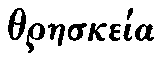
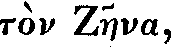
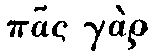

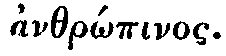

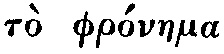
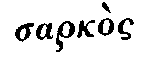
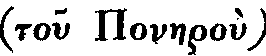



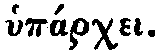




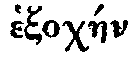



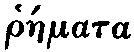
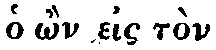


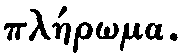


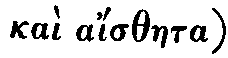

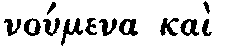


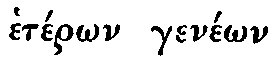
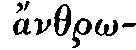

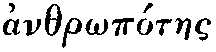
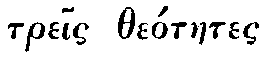
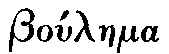
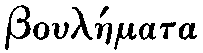
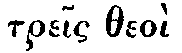
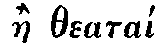

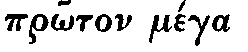
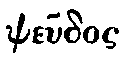
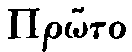
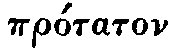
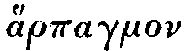
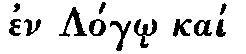
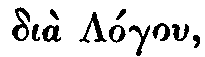
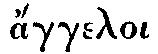
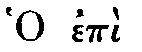
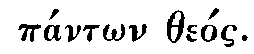
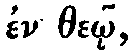
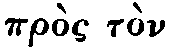

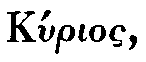
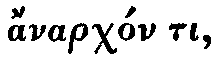
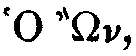

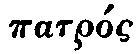



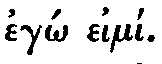
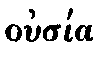
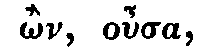
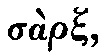
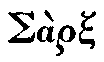
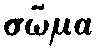

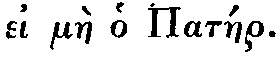
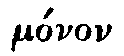
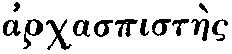


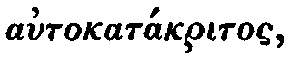
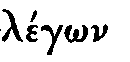
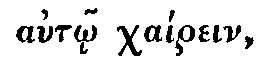
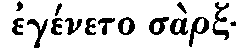

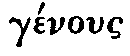
![Greek: hàe katà phúsin zôáe]](images/CG129.gif)