HISTORY OF THE AMERICAN NEGRO IN THE GREAT WORLD
WAR
HIS SPLENDID RECORD IN THE BATTLE ZONES OF EUROPE
INCLUDING A RESUME OF HIS PAST SERVICES TO HIS COUNTRY
IN THE WARS OF THE REVOLUTION, OF 1812, THE WAR OF THE REBELLION,
THE INDIAN WARS ON THE FRONTIER, THE SPANISH-AMERICAN WAR, AND
THE LATE IMBROGLIO WITH MEXICO.
BY
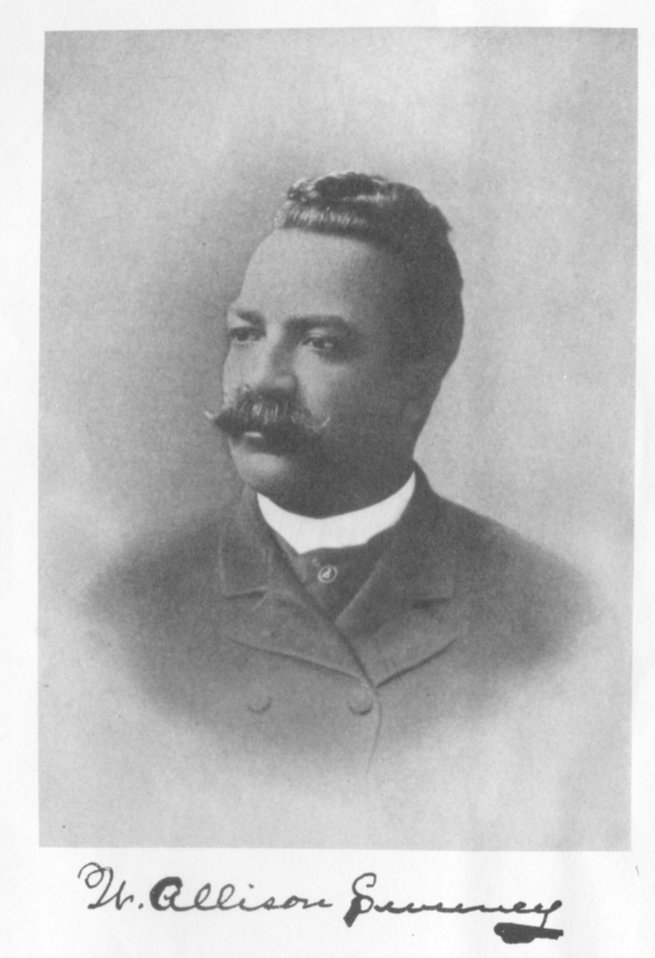
W. ALLISON SWEENEY CONTRIBUTING EDITOR OF THE CHICAGO
DEFENDER.
PROFUSELY AND BEAUTIFULLY ILLUSTRATED
1919
THIS HISTORY OF THE AMERICAN NEGRO IN THE GREAT WORLD
WAR IS REINFORCED BY THE OFFICIAL RECORDS OF THE WAR DEPARTMENT
INCLUDING TRIBUTES FROM FRENCH AND AMERICAN
COMMANDERS
SPOKEN AND WRITTEN WORDS BY
J.E. MORELAND INTERNATIONAL SECRETARY Y.M.C.A.
ROBERT SENGSTACKE ABBOTT EDITOR CHICAGO DEFENDER
RALPH TYLER EX-THIRD AUDITOR THE NAVY
JULIUS ROSENWALD PHILANTHROPIST
COLONEL CHARLES YOUNG UNITED STATES ARMY
WILLIS O. TYLER MEMBER LOS ANGELES BAR
CAPT. R.P. ROOTS VETERAN SPANISH-AMERICAN WAR
* * * * *
WITH A COMPLETE SUMMARY OF THE ACTIVITIES OF THE 370th "OLD
EIGHTH" IN THE WORLD WAR FROM THE COUNTRY'S CALL TO THE DAY OF
ITS MUSTERING OUT
BY CAPT. JOHN H. PATTON, ADJUTANT
HISTORY
OF THE
AMERICAN NEGRO
IN THE
GREAT WORLD WAR
CONTENTS
Chapter I. SPIRITUAL EMANCIPATION OF
NATIONS.
THE MARCH OF CIVILIZATION—WORLD SHOCKS TO STIR
THE WOULD HEART—FALSE DOCTRINES OF THE HUN—THE IRON
HAND CONCEALED—THE WORLD BEGINS TO AWAKEN—GERMAN
DESIGNS REVEALED—RUMBLINGS IN ADVANCE OF THE
STORM—TRAGEDY THAT HASTENED THE DAY—TOLSTOY'S
PROPHECY—VINDICATION OF NEGRO FAITH IN PROMISES OF THE
LORD—DAWN OF FREEDOM FOR ALL RACES
LIKENED TO BELSHAZZER—THE KAISER'S
FEASTS—IN HIS HEART BARBARIC PRIDE OF THE POTENTATES OF
OLD—GERMAN MADNESS FOR WAR—INSOLENT
DEMANDS—FORTY-EIGHT HOURS TO PREVENT A WORLD
WAR—COMMENT OF STATESMEN AND LEADERS—THE WAR
STARTS—ITALY BREAKS HER ALLIANCE—GERMANIC POWERS
WEIGHED AND FOUND WANTING—SPIRIT WINS OVER
MATERIALISM—CIVILIZATION'S LAMP DIMMED BUT NOT
DARKENED
GERMANY'S MACHINE—HER SCIENTIFIC ENDEAVOR TO
MOLD SOLDIERS—INFLUENCE ON THOUGHT AND LIVES OF THE
PEOPLE—MILITARISM IN THE HOME—THE STATUS OF
WOMAN—FALSE THEORIES AND FALSE GODS—THE SYSTEM
ORDAINED TO PERISH—WAR'S SHOCKS—AMERICA INCLINES TO
NEUTRALITY—GERMAN AND FRENCH TREATMENT OF NEUTRALS
CONTRASTED—EXPERIENCES OF AMERICANS ABROAD AND ENROUTE
HOME—STATUE OF LIBERTY TAKES ON NEW BEAUTY—BLOOD OF
NEGRO AND WHITE TO FLOW
PRESIDENT CLINGS TO NEUTRALITY—MONROE DOCTRINE
AND WASHINGTON'S WARNING—GERMAN CRIMES AND GERMAN
VICTORIES—CARDINAL MERCIER'S LETTER—MILITARY
OPERATIONS—FIRST SUBMARINE ACTIVITIES—THE LUSITANIA
OUTRAGE—EXCHANGE OF NOTES—UNITED STATES
AROUSED—ROLE OF PASSIVE ONLOOKER BECOMES
IRKSOME—FIRST MODIFICATION OF PRINCIPLES OF WASHINGTON AND
MONROE—OUR DESTINY LOOMS
TOWARD SHORES OF ATLANTIC—SPREAD RUIN AND
DEVASTATION—CAPITALS OF CIVILIZATION
ALARMED—ACTIVITIES OF SPIES—APOLOGIES AND
LIES—GERMAN ARMS WINNING—GAIN TIME TO FORGE NEW
WEAPONS—FEW VICTORIES FOR ALLIES—ROUMANIA
CRUSHED—INCIDENT OF U-53
A BEACON AMONG THE YEARS—TRYING PERIOD FOR
PRESIDENT WILSON—GERMANY CONTINUES DILATORY
TACTICS—PEACE EFFORTS FAIL—ALL HONORABLE MEANS
EXHAUSTED—PATIENCE CEASES TO BE A VIRTUE—ENEMY
ABANDONS ALL SUBTERFUGES—UNRESTRICTED SUBMARINE
WARFARE—GERMAN INTRIGUES WITH MEXICO—THE ZIMMERMAN
NOTE—AMERICA SEIZES THE SWORD—WAR IS
DECLARED—PERSHING GOES ABROAD—FIRST TROOPS
SAIL—WAR MEASURES—WAR OPERATIONS
SWIFT AND UNHALTING ARRAY—FEW PERMITTED TO
VOLUNTEER—ONLY NATIONAL GUARD ACCEPTED—NO NEW UNITS
FORMED—SELECTIVE DRAFT THEIR OPPORTUNITY—PARTIAL
DIVISION OF GUARDSMEN—COMPLETE DIVISION OF
SELECTIVES—MANY IN TRAINING—ENTER MANY BRANCHES OF
SERVICE—NEGRO NURSES AUTHORIZED—NEGRO Y.M.C.A.
WORKERS—NEGRO WAR CORRESPONDENT—NEGRO ASSISTANT TO
SECRETARY OF WAR—TRAINING CAMP FOR NEGRO OFFICERS FIRST
TIME IN ARTILLERY—COMPLETE RACIAL SEGREGATION
CONFRONTED BY RACIAL PREJUDICE—SPLENDID
ATTITUDE OF NEGRO SHAMED IT—KEPT OUT OF NAVY—ONLY ONE
PERCENT OF NAVY PERSONNEL NEGROES—MODIFIED MARINES
CONTEMPLATED—FEW HAVE PETTY OFFICERS' GRADES—SEPARATE
SHIPS PROPOSED—NEGRO EFFICIENCY IN NAVY—MATERIAL FOR
"BLACK SHIPS"—NAVY OPENS DOOR TO NEGRO
MECHANICS
SHOT HEARD AROUND THE WORLD—CRISPUS
ATTUCKS—SLAVE LEADS SONS OF FREEDOM—THE BOSTON
MASSACRE—ANNIVERSARY KEPT FOR YEARS—WILLIAM NELL,
HISTORIAN—3,000 NEGROES IN WASHINGTON'S FORCES—A
STIRRING HISTORY—NEGRO WOMAN SOLDIER—BORDER INDIAN
WARS—NEGRO HEROES
NEGRO IN WAR OF 1812—INCIDENT OF THE
CHESAPEAKE—BATTLE OF LAKE ERIE—PERRY'S FIGHTERS 10
PERCENT NEGROES—INCIDENT OF THE "GOVERNOR
TOMPKINS"—COLONISTS FORM NEGRO REGIMENTS—DEFENDERS OF
NEW ORLEANS—ANDREW JACKSON'S TRIBUTE—NEGROES IN
MEXICAN AND CIVIL WARS—IN THE SPANISH-AMERICAN
WAR—NEGROES IN THE PHILIPPINES—HEROES OF
CARRIZAL—GENERAL BUTLER'S TRIBUTE TO NEGROES—WENDELL
PHILLIPS ON TOUSSAINT L'OUVERTURE
NEGRO'S PATRIOTIC ATTITUDE—SELECTIVE DRAFT IN
EFFECT—FEATURES AND RESULTS—BOLD RELIANCE ON FAITH IN
PEOPLE—NO COLOR LINE DRAWN—DISTRIBUTION OF
REGISTRANTS BY STATES—NEGRO AND WHITE REGISTRATIONS
COMPARED—NEGRO PERCENTAGES HIGHER—CLAIMED FEWER
EXEMPTIONS—INDUCTIONS BY STATES—BETTER PHYSICALLY
THAN WHITES—TABLES, FACTS AND FIGURES
SUCH WORDS NOT IN HIS VOCABULARY—DESERTIONS
EXPLAINED—GENERAL CROWDER EXONERATES NEGRO—NO WILLFUL
DELINQUENCY—STRENUOUS EFFORTS TO MEET REGULATIONS—NO
"CONSCIENTIOUS OBJECTORS"—NO DRAFT EVADERS OR
RESISTERS—NEGRO'S DEVOTION SUBLIME—JUSTIFIES HIS
FREEDOM—FORGETS HIS SORROWS—RISES ABOVE HIS
WRONGS—TESTIMONY OF LOCAL BOARDS—GERMAN PROPAGANDA
WASTED—A NEW AMERICANISM
COMMISSIONED AT FORT DES MOINES—ONLY EXCLUSIVE
NEGRO TRAINING CAMP—MOSTLY FROM CIVILIAN LIFE—NAMES,
RANK AND RESIDENCE
BLACK THOUSANDS ASSEMBLE—SOLDIERS OF
LIBERTY—SEVERING HOME TIES—MAN'S WORK MUST BE
DONE—FIRST NEGROES IN FRANCE—MEETING WITH FRENCH
COLONIALS—EARLY HISTORY OF 15TH NEW YORK—THEY SAIL
AWAY—BECOME FRENCH FIGHTING MEN—HOLD 20 PERCENT OF
AMERICAN LINES—TERROR TO GERMANS—ONLY BARRIER BETWEEN
BOCHE AND PARIS—IMPERISHABLE RECORD OF NEW
YORKERS—TURNING POINT OF WAR
HENRY JOHNSON AND NEEDHAM ROBERTS—THE TIGER'S
CUBS—NEGRO FIRST TO GET PALM—JOHNSON'S GRAPHIC
STORY—SMASHES THE GERMANS—IRVIN COBB'S
TRIBUTE—CHRISTIAN AND MOHAMMEDAN NEGROES PALS—VALOR
OF 93RD DIVISION—LAUGHTER IN FACE OF DEATH—NEGRO AND
POILU HAPPY TOGETHER—BUTTE DE MESNIL—VALIANT AND
HUMOROUS ELMER MCCOWIN—WINNING WAR CROSSES—VERDICT OF
THE FRENCH—THE NEGRO'S FAITH
COLORED OFFICERS MAKE GOOD—WONDERFUL RECORD OF
THE 8TH ILLINOIS—"BLACK DEVILS" WIN DECORATIONS
GALORE—TRIBUTE OF FRENCH COMMANDER—HIS FAREWELL TO
PRAIRIE FIGHTERS—THEY FOUGHT AFTER WAR WAS OVER—HARD
TO STOP THEM—INDIVIDUAL DEEDS OF HEROISM—THEIR DEAD,
THEIR WOUNDED AND SUFFERING—A POEM
SPECIAL ARTICLE BY CAPTAIN JOHN H. PATTON, ADJUTANT
OF 8TH ILLINOIS—SUMMARIZES OPERATIONS OF THE
REGIMENT—FROM FIRST CALL TO MUSTERING OUT—AN
EYE-WITNESS ACCOUNT—IN TRAINING CAMPS, AT SEA, IN
FRANCE—SERVICE IN ARGONNE FOREST—MANY OTHER
ENGAGEMENTS—A THRILLING RECORD—BATTALION OPERATIONS
IN DETAIL—SPECIAL MENTION OF COMPANIES AND
INDIVIDUALS
LINCOLN'S PROPHETIC WORDS—NEGROES ALONGSIDE
BEST SOLDIERS IN THE WORLD—HOLD THEIR OWN—THE 372ND
REGIMENT—BRIGADED WITH VETERANS OF THE MARNE—FAMOUS
"RED HAND" DIVISION—OCCUPY HILL 304 AT VERDUN—NINE
DAYS BATTLE IN "BLOODY ARGONNE"—ADMIRATION OF THE
FRENCH—CONSPICUOUS COMPONENTS OF 372ND—CHRONOLOGY OF
SERVICE
POLICY OF SUBSTITUTING WHITE OFFICERS—INJUSTICE
TO CAPABLE NEGROES—DISAPPOINTMENT BUT NO OPEN
RESENTMENT—SHOWED THEMSELVES SOLDIERS—INTENSER
FIGHTING SPIRIT AROUSED—RACE FORGOTTEN IN PERILS OF
WAR—BOTH WHITES AND BLACKS GENEROUS—AFFECTION BETWEEN
OFFICERS AND MEN—NEGROES PREFERRED DEATH TO
CAPTIVITY—OUTSTANDING HEROES OF 371ST AND
372ND—WINNERS OF CROSSES
IN TRENCH AND VALLEY—THE OPEN PLAIN—ON
MOUNTAIN TOP—IN NO MAN'S LAND—TWO CLASSES OF NEGRO
SOLDIERS CONSIDERED—TRAINED GUARDSMEN AND
SELECTIVES—GALLANT 92ND DIVISION—RACE CAN BE PROUD OF
IT—HAD SIX HUNDRED NEGRO OFFICERS—SETS AT REST ALL
DOUBTS—OPERATIONS OF THE DIVISION—AT PONT A
MOUSSON—GREAT BATTLE OF METZ—SOME
REFLECTIONS—CASUALTIES CONSIDERED
OPERATIONS OF 368TH INFANTRY—NEGROES FROM
PENNSYLVANIA, MARYLAND AND SOUTH—IN ARGONNE
HELL—DEFEAT IRON CROSS VETERANS—VALIANT PERSONAL
EXPLOITS—LIEUTENANT ROBERT CAMPBELL—PRIVATE JOHN
BAKER—OPERATIONS OF 367TH INFANTRY—"MOSS'S
BUFFALOES"—365TH AND 366TH REGIMENTS—THE GREAT
DIVIDE—THEIR SOULS ARE MARCHING ON—PRAISED BY
PERSHING—SOME CITATIONS
167TH FIRST NEGRO ARTILLERY BRIGADE—"LIKE
VETERANS" SAID PERSHING—FIRST ARTILLERY TO BE
MOTORIZED—RECORD BY DATES—SELECTED FOR LORRAINE
CAMPAIGN—BEST EDUCATED NEGROES IN AMERICAN
FORCES—ALWAYS STOOD BY THEIR GUNS—CHAPLAIN'S
ESTIMATE—LEFT SPLENDID IMPRESSION—TESTIMONY OF FRENCH
MAYORS—CHRISTIAN BEHAVIOR—SOLDIERLY
QUALITIES
GLORY NOT ALL SPECTACULAR—BRAVE FORCES BEHIND
THE LINES—325TH FIELD SIGNAL BATTALION—COMPOSED OF
YOUNG NEGROES—SEE REAL FIGHTING—SUFFER
CASUALTIES—AN EXCITING INCIDENT—COLORED SIGNAL
BATTALION A SUCCESS—RALPH TYLER'S STORIES—BURIAL OF
NEGRO SOLDIER AT SEA—MORE INCIDENTS OF NEGRO VALOR—A
WORD FROM CHARLES M. SCHWAB
A STUDY OF WAR—ITS COMPENSATIONS AND
BENEFITS—ITS RAVAGES AND DEBASEMENTS—BURDENS FALL
UPON THE WEAK—TOLL OF DISEASE—NEGROES SINGULARLY
HEALTHY—NEGROES KILLED IN BATTLE—DEATHS FROM WOUNDS
AND OTHER CAUSES—REMARKABLE PHYSICAL STAMINA OF
RACE—HOUSEKEEPING IN KHAKI—HEALTHIEST WAR IN
HISTORY—INCREASED REGARD FOR MOTHERS—AN IDEAL FOR
CHILD MINDS—MORALE AND PROPAGANDA
NEGRO STEVEDORE, PIONEER AND LABOR UNITS—SWUNG
THE AXE AND TURNED THE WHEEL—THEY WERE
INDISPENSABLE—EVERYWHERE IN FRANCE—HEWERS OF WOOD,
DRAWERS OF WATER—NUMBERS AND DESIGNATIONS OF
UNITS—ACQUIRED SPLENDID REPUTATION—CONTESTS AND
AWARDS—PRIDE IN THEIR SERVICE—MEASURED UP TO MILITARY
STANDARDS—LESTER WALTON'S APPRECIATION—ELLA WHEELER
WILCOX'S POETIC TRIBUTE
MITIGATED THE HORRORS OF WAR—AT THE FRONT,
BEHIND THE LINES, AT HOME—CIRCLE FOR NEGRO WAR
RELIEF—ADDRESSED AND PRAISED BY ROOSEVELT—A NOTABLE
GATHERING—COLORED Y.M.C.A. WORK—UNSULLIED RECORD
OF ACHIEVEMENT—HOW THE "Y" CONDUCTED
BUSINESS—SECRETARIES ALL SPECIALISTS—NEGRO WOMEN IN
"Y" WORK—VALOR OF A NON-COMBATANT
HIS MECHANICAL ABILITY REQUIRED—SKILLED AT
SPECIAL TRADES—VICTORY DEPENDS UPON TECHNICAL
WORKERS—VAST RANGE OF OCCUPATION—NEGRO MAKES GOOD
SHOWING—PERCENTAGES OF WHITE AND COLORED—FIGURES FOR
GENERAL SERVICE
WOODROW WILSON, AN ESTIMATE—HIS PLACE IN
HISTORY—LAST OF GREAT TRIO—WASHINGTON, LINCOLN,
WILSON—UPHOLDS DECENCY, HUMANITY,
LIBERTY—RECAPITULATION OF YEAR 1918—CLOSING INCIDENTS
OF WAR
NEW YORK GREETS HER OWN—ECSTATIC DAY FOR OLD
15TH—WHITES AND BLACKS DO HONORS—A MONSTER
DEMONSTRATION—MANY DIGNITARIES REVIEW TROOPS—PARADE
OF MARTIAL POMP—CHEERS, MUSIC, FLOWERS AND
FEASTING—"HAYWARD'S SCRAPPING BABIES"—OFFICERS SHARE
GLORY—THEN CAME HENRY JOHNSON—SIMILAR SCENES
ELSEWHERE
BY JULIUS ROSENWALD, PRESIDENT SEARS, ROEBUCK &
CO, AND TRUSTEE OF TUSKEGEE INSTITUTE—A PLEA FOR INDUSTRIAL
OPPORTUNITY FOR THE NEGRO—TRIBUTE TO NEGRO AS SOLDIER AND
CIVILIAN—DUTY OF WHITES POINTED OUT—BUSINESS LEADER
AND PHILANTHROPIST SOUNDS KEYNOTE
AN EMANCIPATION DAY APPEAL FOR JUSTICE—BY W.
ALLISON SWEENEY
HELD—
BY DISTINGUISHED THINKERS AND WRITERS,
THAT THE NEGRO SOLDIER SHOULD BE GIVEN A CHANCE FOR PROMOTION AS
WELL AS A CHANCE TO DIE.
WHY—
WHITE OFFICERS OVER NEGRO
SOLDIERS?
THE OLD ORDER
CHANGETH, YIELDING PLACE TO NEW.
THROUGH THE
ARBITRAMENT OF WAR, BEHOLD A NEW AND BETTER AMERICA!
A NEW AND GIRDED NEGRO!
"THE WATCHES
OF THE NIGHT HAVE PASSED!"
"THE WATCHES
OF THE DAY BEGIN!"
FOREWORD
He was a red headed messenger boy and he handed me a letter in
a NILE GREEN ENVELOPE, and this is what I read:
Dear Mr. Sweeney:
When on the 25th of March the last instalment of the MSS of the
"History of the American Negro in the Great World War" was
returned to us from your hands, bearing the stamp of your
approval as to its historic accuracy; the wisdom and fairness of
the reflections and recommendations of the corps of compilers
placed at your service, giving you full authority to review the
result of their labors, your obligation to the publishers
ceased.
The transaction between us, a purely business one, had in every
particular upon your part been complied with. From thenceforward,
as far as you were obligated to the publishers, this History;
what it is; what it stands for; how it will be rated by the
reading masses—should be, and concretely, by your own
people you so worthily represent and are today their most
fearless and eloquent champion, is, as far as any obligation you
may have been under to us, not required of you to say.
Nevertheless, regardless of past business relations now at an
end, have you not an opinion directly of the finished work? A
word to say; the growth of which you have marked from its first
instalment to its last?
-The Publishers-
* * * * *
HAVE I—
A word to say? And of this fine book?
THE BEST HISTORY OF THE AMERICAN NEGRO IN THE GREAT WORLD WAR,
THAT AS YET HAS BEEN WRITTEN OR WILL BE FOR YEARS TO COME?
* * * * *
DOES—
The rose in bud respond to the wooing breath of the mornings of
June?
IS—
The whistle of robin red breast clearer and more exultant, as its
watchful gaze, bearing in its inscrutable depths the mystery of
all the centuries; the Omniscience of DIVINITY, discovers a
cherry tree bending to—
"The green grass"
from the weight of its blood red fruit?
* * * * *
DOES—
The nightingale respond to its mate; caroling its amatory
challenge from afar; across brake and dale and glen; beyond a
"Dim old forest" the earth bathed in the silver light of the
harvest moon!
* * * * *
EVEN SO—
And for the same reason which the wisest of us cannot explain,
that the rose, the robin and nightingale respond to the lure that
invites, the zephyrs that caress, I find myself moved to say not
only a word—a few, but many, of praise and commendation of
this book; the finished work, so graciously and so quickly
submitted for my inspection by the publishers.
THERE ARE—
Books and books; histories and histories, treatise after
treatise; covering every realm of speculative investigation;
every field of fact and fancy; of inspiration and deed, past and
present, that in this 20th century of haste and bustle, of
miraculous mechanical equipment, are born daily and die as
quickly. But there are also books, that like some men marked
before their birth for a place amongst the "Seats of the MIGHTY";
an association with the IMMORTALS, that
"Were not born to die."
This book seems of that glorious company.
* * * * *
IN THE—
Spiritualized humanity that broadened the vision and inspired the
pens of the devoted corps of writers, responding to my
suggestions and oversight in its preparation; the getting
together of data and facts, is reflected the incoming of a NEW
AND BROADER CHARITY—a stranger in our midst—of
glimpse and measurement of the Negro. Beyond the written word of
the text, the reader is gripped with a certain FELT but unprinted
power of suggestion, a sense of the nation's crime against him;
the Negro, stretching back through the centuries; the shame and
humiliation that is at last overtaking it, that has not been born
of the "Print Shops" since the sainted LINCOLN went his way,
leaving behind him a trail of glory, shining like the sun; in the
path of which, freed through the mandate of his great soul,
MARCHED FOUR MILLION NEGROES, now swollen to twelve, their story,
the saddest epic of the ages, of whom and in behalf of whom their
children; the generation now and those to come, this History was
collated and arranged. It is an EVANGEL proclaiming to the world,
their unsullied patriotism; their rapid fire loyalty, that
through all the years of the nation's life, has never
flickered—
"Has burned and burned
Forever the same",
from Lexington to the cactus groves of Mexico; in the slaughter
hells of Europe; over fields and upon spots where, in the
centuries gone, the legions of Caesar, of Hannibal and Attila, of
Charlemagne and Napoleon had fought and bled, and perished!
Striding "Breast forward" beneath the Stars and Stripes as this
History crowds them on your gaze, through the dust of empires and
kingdoms that; before the CHRIST walked the earth; before
Christianity had its birth, wielded the sceptres of power when
civilization was young, but which are now but vanishing
traditions.
You are thrilled! History nor story affords no picture more
inspiring.
MAKING DUE ALLOWANCE—
For its nearness to the living and dead, whose heroic and
transcendant achievements on the battle spots of the great war
secured for them a distinction and fame that will endure
until—
"The records of valor decay",
it is a most notable publication, quite worthy to be draped in
the robes that distinguishes History from narrative; from "a tale
that is told"; a story for the entertainment of the moment.
AS INTERPOLATED—
By the writers of its text; read between the lines of their
written words; it is a History; not alone of the American Negro
on the "tented field"; the bloody trenches of France and Belgium,
it is also a History and an arraignment, a warning and a
prophecy, looking backwards and forward, the Negro being the
objective focus, of many things.
IT PRESENTS—
For the readers retrospection, as vividly as painted on a canvas,
a phantasmagoric procession of past events, and of those to come
in the travail of the Negro; commencing with the sailing of the
first "Slaver's Ship" for the shores of the "New World", jammed
fore and aft, from deck to hold, with its cargo of human beings,
to the conclusion of the great war in which, individually and in
units he wrote his name in imperishable characters, and high on
the scroll on which are inscribed the story of those, who, in
their lives wrought for RIGHT and, passing, died for MEN! For a
flag; beneath and within its folds his welcome has been measured
and parsimonious;—a country; the construing and application
of its laws and remedies as applied to him, has inflicted
intolerable INJUSTICE: Has persecuted more often than blessed.
And so and thus, its perusal finished, its pages closed and laid
aside, you are shaken and swayed in your feelings, even as a
tree, bent and riven before the march and sweep of a mighty
hurricane.
* * * * *
LOOKING BACKWARDS—
The spell of the book strong upon you, you see in your mind's
eye, thousands of plantations covering a fourth of a continent of
a new and virgin land. The toilers "Black Folk"; men, women and
children—SLAVES!
* * * * *
YOU HEAR—
The crack of the "driver's" lash; the sullen bay of pursuing
hounds.
* * * * *
JUST OVER YONDER—
Is the "Auction Block". You hear the moans and screams of mothers
torn from their offspring. You see them driven away, herded like
cattle, chained like convicts, sold to "master's" in the "low
lands", to toil—
"Midst the cotton and the cane."
YOU LISTEN—
Sounding far off, faint at first, growing louder each second, you
hear the beat of drums; the bugle's blast, sounding to arms; You
see great armies, moving hitherward and thitherward. Over one
flies the Stars and Stripes, over the other the Stars and Bars; a
nation in arms! Brother against brother!
* * * * *
YOU LOOK—
And lo, swinging past are many Black men; garbed in "Blue",
keeping step to the music of the Union. You see them fall and
die, at Fort Pillow, Fort Wagner, Petersburg, the Wilderness,
Honey Hill—SLAUGHTERED! Above the din; the boom of cannon,
the rattle of small arms, the groans of the wounded and dying,
you hear the shout of one, as shattered and maimed he is being
borne from the field; "BOYS, THE OLD FLAG NEVER TOUCHED THE
GROUND!"
* * * * *
THE SCENE SHIFTS—
Fifty years have passed. You hear the clamor, the murmur and
shouts of gathering mobs. You see Black men and women hanging by
their necks to lamp posts, from the limbs of trees; in lonely
spots—DEAD! You see smoke curling upwards from BURNING
HOMES! There are piles of cinders and—DEAD MENS BONES!
* * * * *
NEARING ITS END—
The procession sweeps on. Staring you in the face; hailing from
East, West, North and South are banners; held aloft by unseen
hands, bearing on them—the quintessence of AMERICA'S
INGRATITUDE,—these devices:
"For American Negroes:
JIM CROW steam and trolley cars;
JIM CROW resident districts;
JIM CROW amen corners;
JIM CROW seats in theatres;
JIM CROW corners in cemeteries."
* * * * *
HEREIN—
Lies the strength and worth of this unusual book, well and
deservingly named: A History of the American Negro in the Great
World War. Beyond merely recounting that story; than which there
has been nothing finer or more inspiring since the long away
centuries when the chivalry of the Middle Ages, in nodding plume
and lance in rest, battled for the Holy Sepulchre, it brings to
the Negro of America a message of cheer and reassurance. A sign,
couched in flaming characters for all men to see, appealing to
the spiritualized divination of the age, proclaiming that God is
NOT DEAD! That a NEW day is dawning; HAS dawned for the Negro in
America. A NEW liberty; broader and BETTER. A NEW Justice,
unshaded by the spectre of: "Previous condition!" That the unpaid
toil of thirty decades of African slavery in America is at last
to be liquidated. That the dead of our people, upon behalf of
this land that it might have a BIRTH, and having it might not
PERISH FROM THE EARTH, did not die in vain. That, in their
passage from earth, heroes—MARTYRS—in a superlative
sense they were seen and marked of the Father; were accorded a
place of record in the pages of the great WHITE BOOK with golden
seals, in the up worlds; above the stars and beyond the flaming
suns.
IT IS A HISTORY—
That will be read with instruction and benefit by thousands of
whites, but, and mark well this suggestion, it is one that should
be OWNED AND READ BY EVERY NEGRO IN THE LAND.
* * * * *
TYPOGRAPHICALLY—
Mechanically; that is to say, in those features that reflect the
finished artistic achievement of the Print, Picture and Binding
art; as seen in the bold clear type of its text, its striking and
beautiful illustrations, its illuminating title heads of division
and chapter; indicating at a glance the information to follow;
the whole appealing to the aesthetic; the sticklers for the rare
and beautiful; not overlooking its superb binding, it is most
pleasing to the sight, and worthy of the title it bears.
HISTORY OF THE AMERICAN NEGRO IN THE GREAT WORLD WAR
CHAPTER I.
SPIRITUAL EMANCIPATION OF NATIONS.
THE MARCH OF CIVILIZATION—WORLD SHOCKS TO STIR THE WORLD
HEART—FALSE DOCTRINES OF THE HUN—THE IRON HAND
CONCEALED—THE WORLD BEGINS TO AWAKEN—GERMAN DESIGNS
REVEALED—RUMBLINGS IN ADVANCE OF THE STORM—TRAGEDY
THAT HASTENED THE DAY—TOLSTOY'S PROPHECY—VINDICATION
OF NEGRO FAITH IN PROMISES OF THE LORD—DAWN OF FREEDOM FOR
ALL RACES.
The march of civilization is attended by strange influences.
Providence which directs the advancement of mankind, moves in
such mysterious ways that none can sense its design or reason out
its import. Frequently the forces of evil are turned to account
in defeating their own objects. Great tragedies, cruel wars,
cataclysms of woe, have acted as enlightening and refining
agents. Out of the famines of the past came experiences which
inculcated the thrift and fore-handedness of today.
Out of man's sufferings have come knowledge and fortitude. Out of
pain and tribulation, the attribute of sympathy—the first
spiritual manifestation instrumental in elevating the human above
the beast. Things worth while are never obtained without payment
of some kind.
Individual shocks stir the individual heart and conscience. Great
world shocks are necessary to stir the world conscience and
heart; to start those movements to right the wrongs in the world.
So long as peace reigned commerce was uninterrupted, and the
acquisition of wealth was not obstructed, men cared little for
the intrigues and ambitions of royalty. If they sensed them at
all, they lulled themselves into a feeling of security through
the belief that progress had attained too far, civilization had
secured too strong a hold, and democracy was too firmly rooted
for any ordinary menace to be considered.
So insidious and far reaching had become the inculcation of false
philosophies summed up in the general term Kultur, that the
subjects of the autocratic-ridden empires believed they were
being guided by benign influences. Many enlightened men; at least
it seems they must have been enlightened, in Germany and
Austria—men who possessed liberated intellects and were not
in the pay of the Kulturists—professed to believe that
despotism in the modern world could not be other than
benevolent.
The satanic hand was concealed in the soft glove; the cloven hoof
artistically fitted into the military boot; the tail carefully
tucked inside the uniform or dress suit; fiendish eyes were
taught to smile and gleam in sympathy and humor, or were masked
behind the heavy lenses of professorial dignity; the serpent's
hiss was trained to song, or drowned in crashing chords and given
to the world as a sublime harmony.
Suddenly the world awoke! The wooing harmony had changed to a
blast of war; the conductor's baton had become a bayonet; the
soft wind instrument barked the rifle's tone; its notes were
bullets that hissed and screamed; tinkling cymbals sounded the
wild blare of carnage, and sweet-throated horns of silver and
brass bellowed the cannon's deadly roar.
Civilization was so shocked that for long the exact sequence of
events was not comprehended. It required time and reflection to
clear away the brain benumbing vapors of the dream; to reach a
realization that liberty actually was tottering on her throne.
German propagandists had been so well organized, and so
effectively did they spread their poison; especially in the
western world that great men; national leaders were deceived,
while men in general were slow to get the true perspective; much
later than those at the seat of government.
A few far-seeing men had been alive to the German menace. Some
English statesmen felt it in a vague way, while in France where
the experience of 1870-71, had produced a wariness of all things
German, a limited number of men with penetrating, broadened
vision, had beheld the fair exterior of Kaiserism, even while
they recognized in the background, the slimy abode of the
serpent. For years they had sounded the warning until at last
their feeble voices attracted attention.
France, with her traditions of Napoleon, Moreau, Ney, Berthier
and others, with rare skill set about the work of perfecting an
army under the tutelage and direction of Joffre and Foch. The
defense maintained by its army in the earlier part of the
struggle provided the breathing space required by the other
allies. All through the struggle the staying power of the French
provided example and created the necessary morale for the
co-operating Allied forces, until our own gallant soldiers could
be mustered and sent abroad for the knockout blow.
As is usual where conspiracies to perform dark deeds are hatched
a clew or record is left behind. In spite of Germany's
protestations of innocence, her loud cries that the war was
forced upon her, there is ample evidence that for years she had
been planning it; that she wanted it and only awaited the
opportune time to launch it. It was a gradual unearthing and
examination of this evidence that at length revealed to the world
the astounding plot.
It is not necessary to touch more than briefly the evidence of
Germany's designs, and the intrigues through which she sought
world domination and the throttling of human liberty. The facts
are now too well established to need further confirmation. The
ruthless manner in which the Kaiser's forces prosecuted the war,
abandoning all pretense of civilization and relapsing into the
most utter barbarism, is enough to convince anyone of her
definite and well prepared program, which she was determined to
execute by every foul means under the sun.
She had skillfully been laying her lines and building her
military machine for more than forty years. As the time
approached for the blow she intended to strike, she found it
difficult to conceal her purposes. Noises from the armed
camp—bayings of the dogs of war—occasionally stirred
the sleeping world; an awakening almost occurred over what is
known as the Morocco incident.
On account of the weakness of the Moroccan government,
intervention by foreign powers had been frequent. Because of the
heavy investment of French capital and because the prevailing
anarchy in Morocco threatened her interests in Algeria, France
came to be regarded as having special interests in Morocco. In
1904 she gained the assent of Britain and the cooperation of
Spain in her policy. Germany made no protest; in fact, the German
Chancellor, von Bulow, declared that Germany was not specially
concerned with Moroccan affairs. But in 1905 Germany demanded a
reconsideration of the entire question.
France was forced against the will of her minister of foreign
affairs, Delcasse, to attend a conference at Algeciras. That
conference discussed placing Morocco under international control,
but because France was the only power capable of dealing with the
anarchy in the country, she was left in charge, subject to
certain Spanish rights, and allowed to continue her work. The
Germans again declared that they had no political interests in
Morocco.
In 1909, Germany openly recognized the political interests of
France in Morocco. In 1911 France was compelled by disorders in
the country to penetrate farther into the interior. Germany under
the pretext that her merchants were not getting fair treatment in
Morocco, reopened the entire question and sent her gunboat
Panther, to Agadir on the west coast of Africa, as if to
establish a port there, although she had no interests in that
part of the country. France protested vigorously and Britain
supported her.
Matters came very close to war. But Germany was not yet ready to
force the issue. Her action had been simply a pretext to find out
the extent to which England and France were ready to make common
cause. She recalled her gunboat and as a concession to obtain
peace, was permitted to acquire some territory in the French
Congo country. But German newspapers and German political
utterances showed much bitterness. Growling and snarling grew
apace in Germany, and to those who made a close study of the
situation it became evident that Germany sooner or later intended
to launch a war.
One of the characteristic German utterances of the time, came
from Albrect Wirth, a German political writer of standing, in
close touch with the thought and aims of his nation. The
utterance about to be quoted may, in the light of later events,
appear indiscreet, as Germany wished to avoid an appearance of
responsibility for the world war; but the minds of the German
people had to be prepared and this could not be accomplished
without some of the writers and public men letting the cat out of
the bag. Wirth said:
"Morocco is easily worth a big war, or several. At best—and
even prudent Germany is getting to be convinced of this—war
is only postponed and not abandoned. Is such a postponement to
our advantage? They say we must wait for a better moment. Wait
for the deepening of the Kiel canal, for our navy laws to take
full effect. It is not exactly diplomatic to announce publicly to
one's adversaries, 'To go to war now does not tempt us, but three
years hence we shall let loose a world war'—No; if a war is
really planned, not a word of it must be spoken; one's designs
must be enveloped in profound mystery; then brusquely, all of a
sudden, jump on the enemy like a robber in the darkness." The
heavy footed German had difficulty in moving with the stealth of
a robber, but the policy here recommended was followed.
In 1914, the three years indicated by Wirth had expired. There
began to occur dark comings and goings; mysterious meetings and
conferences on the continent of Europe. The German emperor,
accompanied by the princes and leaders of the German states,
began to cruise the border and northern seas of the Fatherland,
where they would be safe from listening ears, prying eyes,
newspapers, telephones and telegraphs. It became known that the
Kaiser was cultivating the weak-minded Russian czar in an attempt
to win his country from its alliance with England and France.
There were no open rumblings of war, but the air was charged with
electricity like that preceeding a storm.
An unaccountable business depression affected pretty much the
entire world. Money, that most sensitive of all things, began to
show nervousness and a tendency to go into hiding. The bulk of
the world was still asleep to the real meaning of events, but it
had begun to stir in its dreams, as if some prescience, some
premonition had begun to reach it even in its slumbers.
Finally the first big event occurred—the tragedy that was
not intended to accomplish as much, but which hastened the dawn
of the day in which began the Spiritual Emancipation of the
governments of earth. The Archduke Francis Ferdinand, nephew of
the emperor of Austria, heir to the throne of Austria-Hungary and
commander in chief of its army, and his wife the duchess of
Hohenburg, were assassinated June 28, 1914, by a Serbian student,
Gavrio Prinzip. The assassination occurred at Sarajevo in Bosnia,
a dependency, or rather, a Slavic state that had been seized by
Austria. It was the lightning flash that preceeded the thunder's
mighty crash.
Much has been written of the causes which led to the tragedy.
Prinzip may have been a fanatic, but he was undoubtedly aided in
his act by a number of others. The natural inference immediately
formed was that the murder was the outcome of years of ill
feeling between Serbia and Austria-Hungary, due to the belief of
the people in the smaller state, that their aspirations as a
nation were hampered and blocked by the German element in the
Austrian empire. The countries had been on the verge of war
several years before over the seizure of Bosnia and Herzegovina
by Austria, and later over the disposition of Scutari and certain
Albanian territory conquered in the Balkan-Turkish struggle.
Events are coming to light which may place a new construction on
the causes leading to the assassination at Sarajevo. It was
undoubtedly the pretext sought by Germany for starting the great
war. Whether it may not have been carefully planned to serve that
object and the Serbian Prinzip, employed as a tool to bring it
about, is not so certain.
Several years prior to the war, the celebrated Russian, Tolstoy,
gave utterance to a remarkable prophecy. Tolstoy was a mystic,
and it was not unusual for him to go into a semi-trance state in
which he professed to peer far into the future and obtain visions
of things beyond the ken of average men. The Russian czar was
superstitious and it is said that the German emperor had a strong
leaning towards the mystic and psychic. In fact, it has been
stated that the Kaiser's claim to a partnership with The Almighty
was the result of delusions formed in his consultations with
mediums—the modern descendants of the soothsayers of olden
times.
Tolstoy stated that both the Czar and the Kaiser desired to
consult with him and test his powers of divination. The three had
a memorable sitting. Some time afterwards the results were given
to the world. Tolstoy predicted the great war, and he stated his
belief that the torch which would start the conflagration would
be lighted in the Balkans about 1913.
Tolstoy was not a friend of either Russian or German autocracy,
hence his seance may have been but a clever ruse to discover what
was in the minds of the two rulers. Germany probably was not
ready to start the war in 1913, but there is abundant warrant for
the belief that she was trimming the torch at that time, and, who
knows, the deluded Prinzip may have been the torch.
The old dotard Francis Joseph who occupied the throne of
Austria-Hungary, was completely under the domination of the
Germans. He could be relied upon to further any designs which the
Kaiser and the German war lords might have.
The younger man, Francis Ferdinand, was not so easy to handle as
his aged uncle. Accounts agree that he was arrogant, ambitious
and had a will of his own. He was unpopular in his country and
probably unpopular with the Germans. Being of the disposition he
was, it is very likely that the Kaiser found it difficult to bend
him completely to his will. Being a stumbling block in the way of
German aims, is it not reasonably probable that Germany desired
to get rid of him, thus leaving Austria-Hungary completely in the
power of its tool and puppet, Francis Joseph, and in the event of
his death, in the power of the young and suppliant Karl; another
instrument easily bent to the German will?
The wife of the archduke, assassinated with him, was a Bohemian,
her maiden name being Sophie Chotek. She was not of noble blood
as Bohemia had no nobles. They had been driven out of the country
centuries before and their titles and estates conferred on
indigent Spanish and Austrian adventurers. Not being of noble
birth, she was but the morgantic wife of the Austrian heir.
Titles were afterwards conferred upon her. She was made a
countess and then a duchess. Some say she had been an actress;
not unlikely, for actresses possessed an especial appeal to
Austrian royalty. The cruel Hapsburgs rendered dull witted and
inefficient by generations of inbreeding, were fascinated by the
bright and handsome women of the stage. At any rate, Sophie
Chotek belonged to that virile, practical race Bohemians, (also
called Czechs) that gave to the world John Huss, who lighted the
fires of religious and civil liberty in Central Europe, giving
advent later to the work of Martin Luther.
Bohemians had always been liberty-loving. They had been anxious
for three centuries to throw off the yoke of Austria. There is no
record that Sophie Chotek sympathized with the aims of her
countrymen or that she was not in complete accord with the views
of her husband and the political interests of the empire. But the
experiences of the Germans and Austrians had taught them that a
Bohemian was likely to remain always a Bohemian and that his
freedom-loving people would not countenance plans having in view
the enslavement of other nations. The Germans may have looked
with suspicion upon the Bohemian wife of the archduke and thought
it advisable to remove her also.
Prinzip was thrown into prison and kept there until he died. No
statement he may have made ever had a chance to reach the world.
No one knows whether he was a German or a Serbian tool. He does
not seem to have been an anarchist; neither does he seem to have
been of the type that would commit such a crime voluntarily,
knowing full well the consequences. It is not hard to believe
that he was under pay and promised full protection.
Probably no Bohemian considers Sophie Chotek a martyr; indeed,
the evidence is strong that she was not. Her heart and soul
probably were with her royal spouse. But an interesting outcome
is, that her assassination, a contributing cause to the war,
finally led to the downfall of Germany, the wreck of Austria, the
freedom of her native country, and that Spiritual Emancipation of
nations and races, then so gloriously under way.
Also, to the thoughtful and philosophic observer of maturing
symptoms transpiring continuously in the affairs of mankind; the
fate of those nations of earth that in their strength and
arrogance mock the Master, furnish a striking corroborative
vindication of the Negro's faith in the promises of the Lord; the
glory and power of His coming. From the date, reckoning from
moment and second, that Gavrio Prinzip done to death the heir to
the throne of Austria-Hungary and his duchess, there commenced
not alone a new day, a new hope and Emancipation of the whites of
earth; empire kingdom, principality and tribe, but of the blacks;
the Negro as well, so mysteriously; bewilderingly, moves God His
wonders to perform.
It was that subliminated faith in the ubiquity and omniscience of
God; the unchangeableness of His word; than which the world has
witnessed; known nothing finer; the story of the concurrent
causes that projected the Negro into the World War, from whence
he emerged covered with glory, followed by the plaudits of
mankind, that became the inspiration of this work—his story
of devotion, valor and patriotism; of unmurmuring sacrifice;
worthy the pens of the mighty, but which the historian, as best
he may will tell: "NOTHING extenuate, nor set down
AUGHT in malice."
CHAPTER II.
HANDWRITING ON THE WALL.
Likened to Belshazzar—The Kaiser's Feasts—In His
Heart Barbaric Pride of the Potentates of Old—German
Madness for War—Insolent Demands—Forty-eight Hours to
Prevent a World War—Comment of Statesmen and
Leaders—The War Starts—Italy Breaks Her
Alliance—Germanic Powers Weighed and Found
Wanting—Spirit Wins Over Materialism—Civilization's
Lamp Dimmed but not Darkened.
Belshazzar of Babylon sat at a feast. Very much after the fashion
of modern kings they were good at feasting in those olden days.
The farthest limits of the kingdom had been searched for every
delight and delicacy. Honeyed wines, flamingo's tongues, game
from the hills, fruits from vine and tree, spices from grove and
forest, vegetables from field and garden, fish from stream and
sea; every resource of Mother Earth that could contribute to
appetite or sensual pleasure was brought to the king's table.
Singers, minstrels, dancers, magicians, entertainers of every
description were summoned to the palace that they might
contribute to the vanity of the monarch, and impress the
onlooking nations about him.
He desired to be known and feared as the greatest monarch on
earth; ruling as he did over the world's greatest city. His
triumphs had been many. He had come to believe that his power
proceeded directly from the god Bel, and that he was the chosen
and anointed of that deity.
This was the period of his prime; of Babylon's greatest glory;
his kingdom seemed so firmly established he had no thought it
could be shaken. But misleading are the dreams of kings; his
kingdom was suddenly menaced from without, by Cyrus of Persia,
another great monarch. There were also dangers from within, but
courtiers and flatterers kept this knowledge from him. Priests of
rival gods had set themselves up within the empire; spies from
without and conspirators within were secretly undermining the
power of the intrenched despot.
Such was Belshazzar in his pride; such his kingdom and empire.
And, so it was, this was to be an orgy that would set a record
for all time to come.
Artists and artisans of the highest skill had been summoned to
the work of beautifying the enormous palace; its gardens and
grounds, innumerable slaves furnishing the labor. The gold and
silver of the nation was gathered and beaten into ornaments and
woven into beautiful designs to grace the occasion. There was a
profusion of the most gorgeous plumage and richest fabrics, while
over all were sprinkled in unheard of prodigality, the rarest
gems and jewels. It was indeed to be a fitting celebration of the
glory of Bel, and the power and magnificence of his earthly
representative; heathen opulence, heathen pride and sensuality
were to outdo themselves.
The revel started at a tremendous pace. No such wines and viands
ever before had been served. No such music ever had been heard
and no such dancers and entertainers ever before had appeared,
but, fool that he was, he had reckoned without his host; had made
a covenant with Death and Hell and had known it not, and the hour
of atonement was upon him; the handwriting on the wall of the
true and outraged God, conveyed the information; short and crisp,
that he had been weighed; he and his kingdom in the balance and
found wanting; the hour—his hour, had struck; the time of
restitution and atonement long on the way, had come; Babylon was
to fall—FELL!—and for twenty-five centuries its glory
and its power has been a story that is told; its magnificence but
heaps of sand in the desert where night birds shriek and wild
beasts find their lair.
In the Kaiser's heart was the same barbaric pride, the same
ambition, the same worship of a false god and the same belief
that he was the especial agent of that deity.
His extravagances of vision and ambition were no less
demoralizing to humanity and civilization, than those that
brought decay and ruin to the potentates of old. He graced them
with all the luxury and exuberance that modern civilization,
without arousing rebellious complaint among his subjects, would
permit. His gatherings appeared to be arranged for the bringing
together of the bright minds of the empire, that there might be
an exchange of thought and sentiment that would work to the good
of his country and the happiness of the world. Frequently
ministers, princes and statesmen from other countries were
present, that they might become acquainted with the German
idea—its kultur—working for the good of humanity.
Here was The Beast mentioned in Revelations, in a different
guise; wearing the face of benevolence and clothed in the raiment
of Heaven. There were feasts of which the German people knew
nothing, and to which foreign ambassadors were not invited. At
these feasts the wines were furnished by Belial. They were
occasions for the glorification of the German god of war; of
greed and conquest; ambition and vanity; without pity, sympathy
or honor.
Ruthless, vain, arrogant minds met the same qualities in their
leader. Some knew and welcomed the fact that the devil was their
guest of honor; perhaps others did not know it. Deluded as they
all were and blinded by pride and self-seeking, the same
handwriting that told Belshazzar of disaster was on the wall, but
they could not or would not see it. There was no Daniel to
interpret for them.
German madness for war asserted itself in the ultimatum sent by
Austria to Serbia after the assassination at Sarajevo. Sufficient
time had hardly elapsed for an investigation of the crime and the
fixing of the responsibility, before Austria made a most insolent
demand upon Serbia.
The smaller nation avowed her innocence of any participation in
the murder; offered to make amends, and if it were discovered
that the conspiracy had been hatched on Serbian soil, to assist
in bringing to justice any confederates in the crime the assassin
may have had.
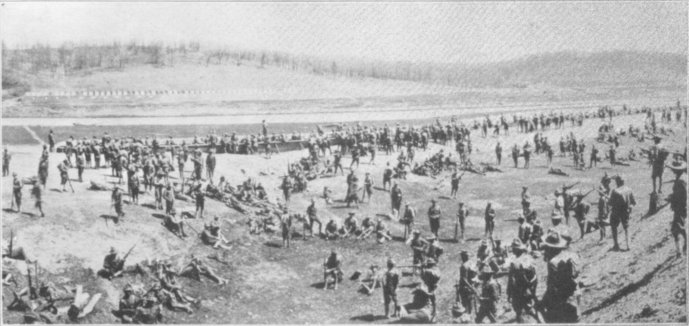 |
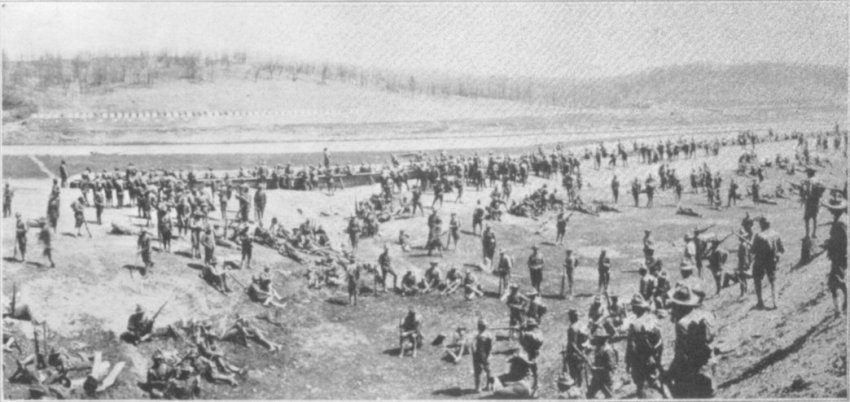
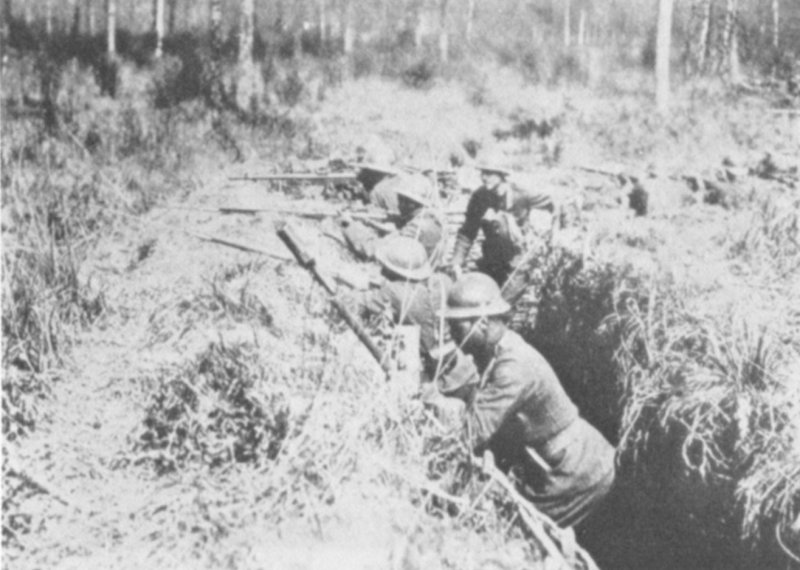
| NEGRO SOLDIERS ON THE RIFLE RANGE AT CAMP GRANT, ILLINOIS.
BEING TAUGHT MARKSMANSHIP. AN IDEAL LOCATION RESEMBLING BATTLE
AREAS IN FRANCE. |
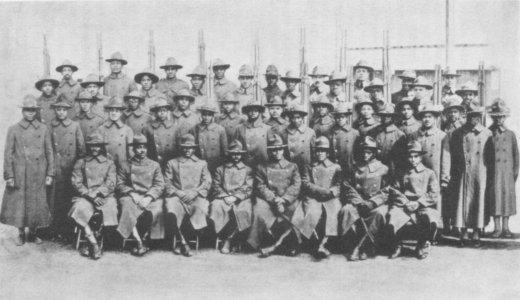 |
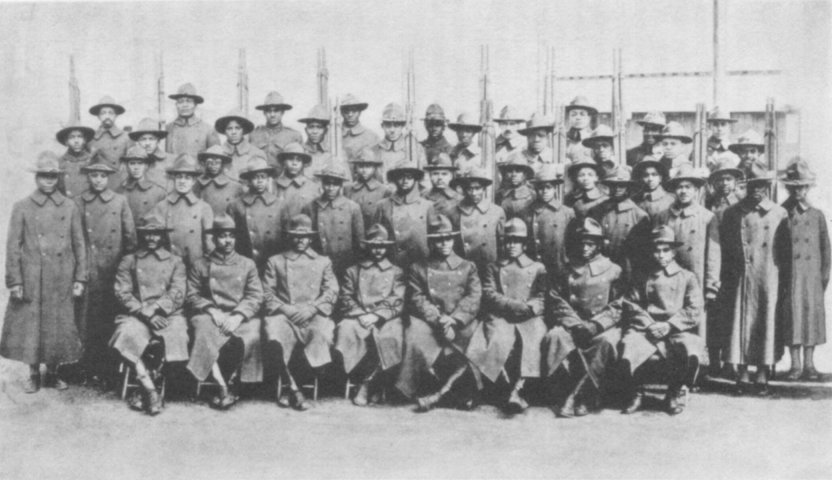
| MEDICAL DETACHMENT 365TH INFANTRY. A REPRESENTATIVE GROUP OF
MEDICAL OFFICERS AND THEIR FIELD ASSISTANTS. THIS BRANCH OF THE
92ND DIVISION RENDERED MOST VALOROUS SERVICE. |
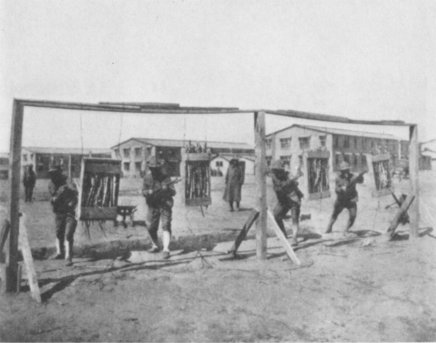 |
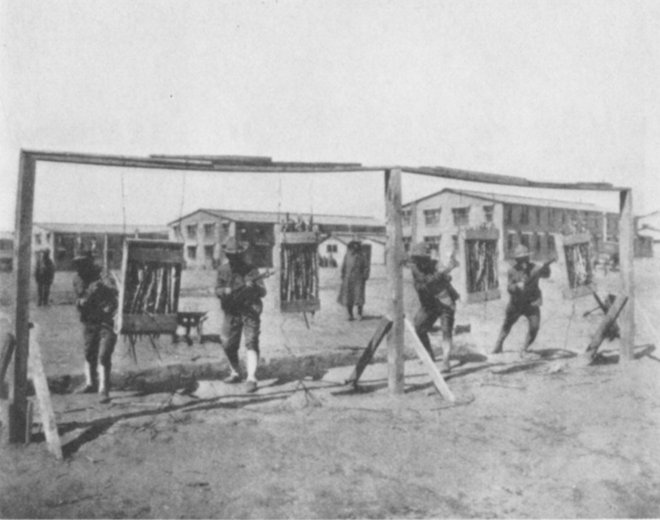
| BAYONET EXERCISES IN THE TRAINING CAMP. |
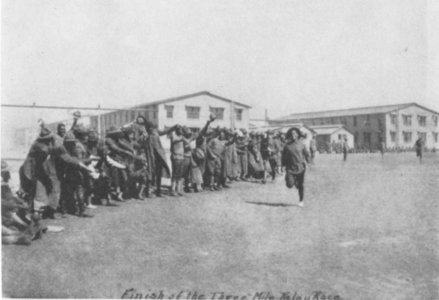 |
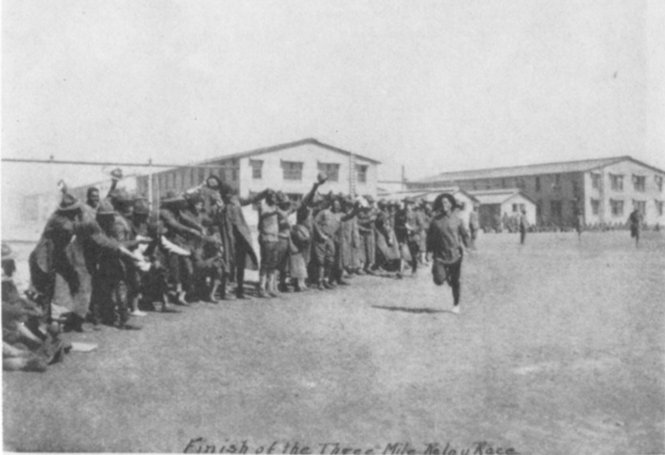
| SPORTS AND PHYSICAL EXERCISE IN THE TRAINING CAMP. |
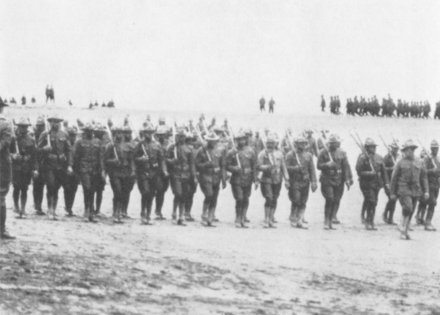 |
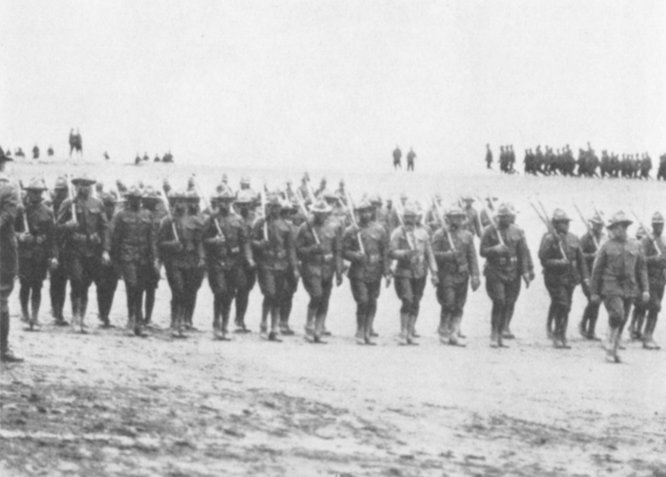
| NEGRO TROOPS DRILLING. SCENE AT CAMP MEADE, MD., WHERE A
PORTION OF THE 93RD DIVISION AND OTHER EFFICIENT UNITS WERE
TRAINED. |
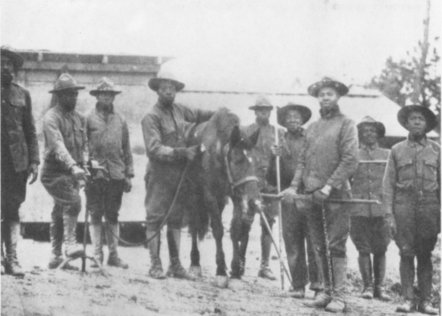 |
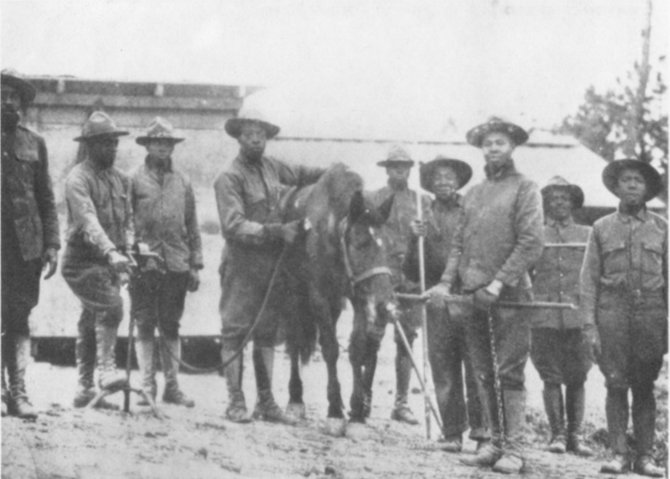
| AN EQUINE BARBER SHOP NEAR THE CAMP. ONE OF THE DUTIES
INCIDENT TO THE TRAINING CAMP. |
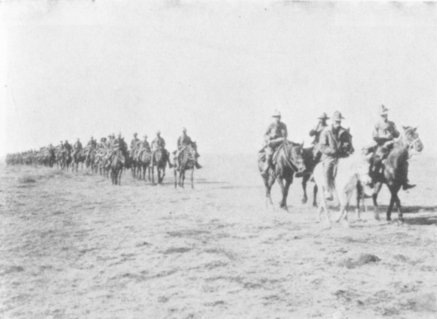 |
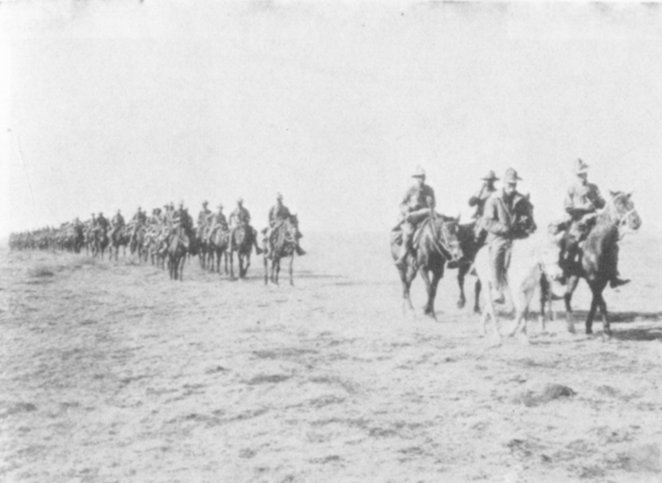
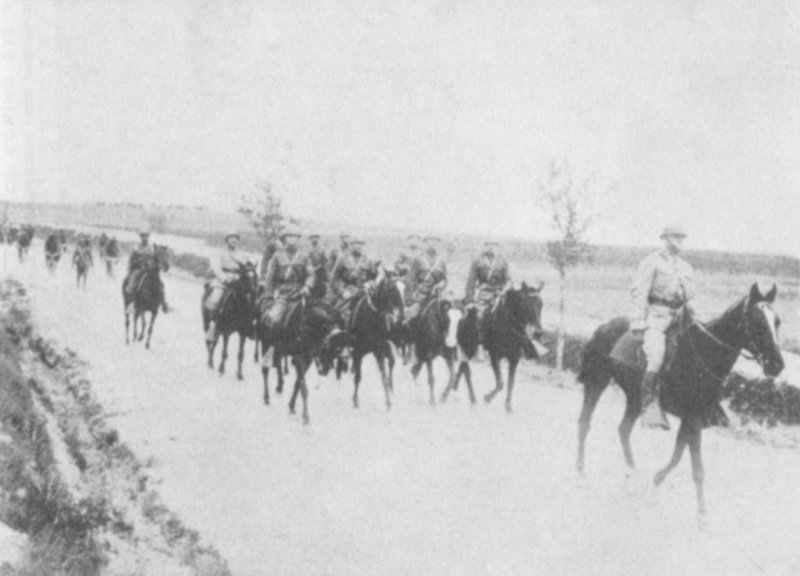
| TROOPERS OF 10TH CAVALRY GOING INTO MEXICO. THESE HEROIC
NEGRO SOLDIERS WERE AMBUSHED NEAR CARRIZAL AND SUFFERED A LOSS OF
HALF THEIR NUMBER IN ONE OF THE BRAVEST FIGHTS ON RECORD. |
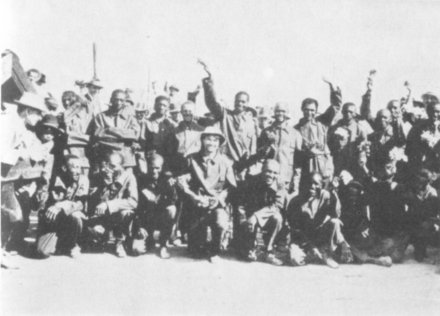 |
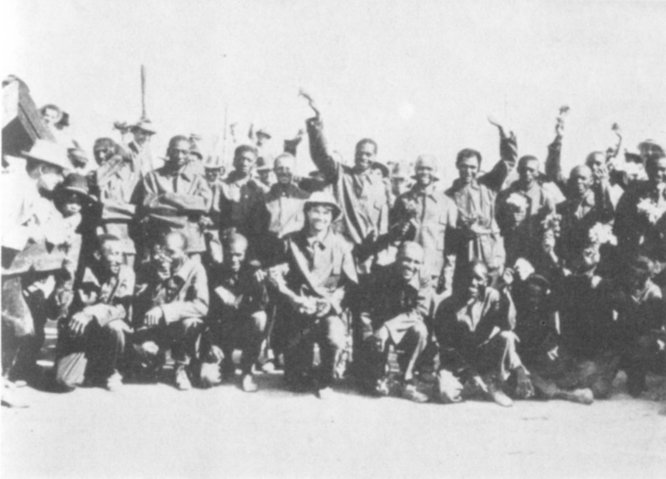
| TENTH CAVALRY SURVIVORS OF CARRIZAL. DESPOILED OF THEIR
UNIFORMS BY THE MEXICANS THEY ARRIVE AT EL PASO IN OVERALLS. LEM
SPILLSBURY, WHITE SCOUT IN CENTER. EACH SOLDIER HAS A BOUQUET OF
FLOWERS. |
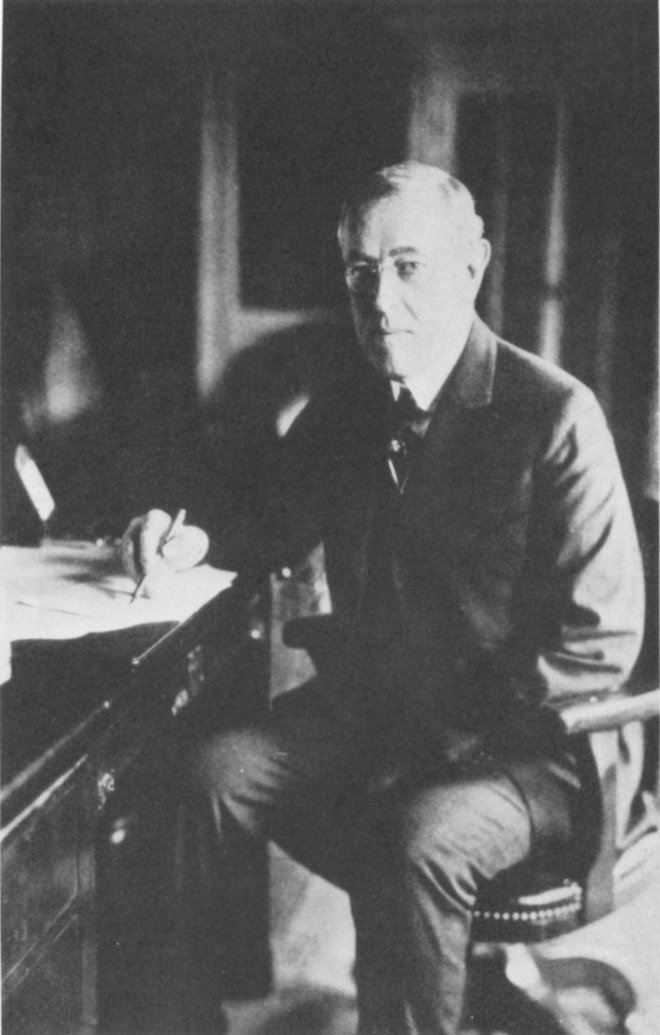
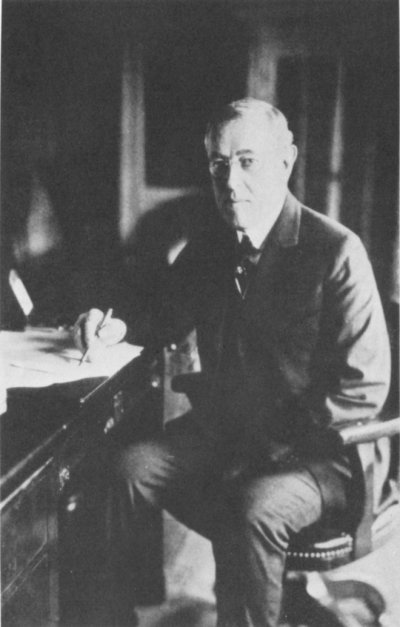 |
| AMERICA'S WAR TIME PRESIDENT. THIS PHOTOGRAPH OF WOODROW
WILSON WAS ESPECIALLY POSED DURING THE WAR. IN HIS STUDY AT THE
WHITE HOUSE. |
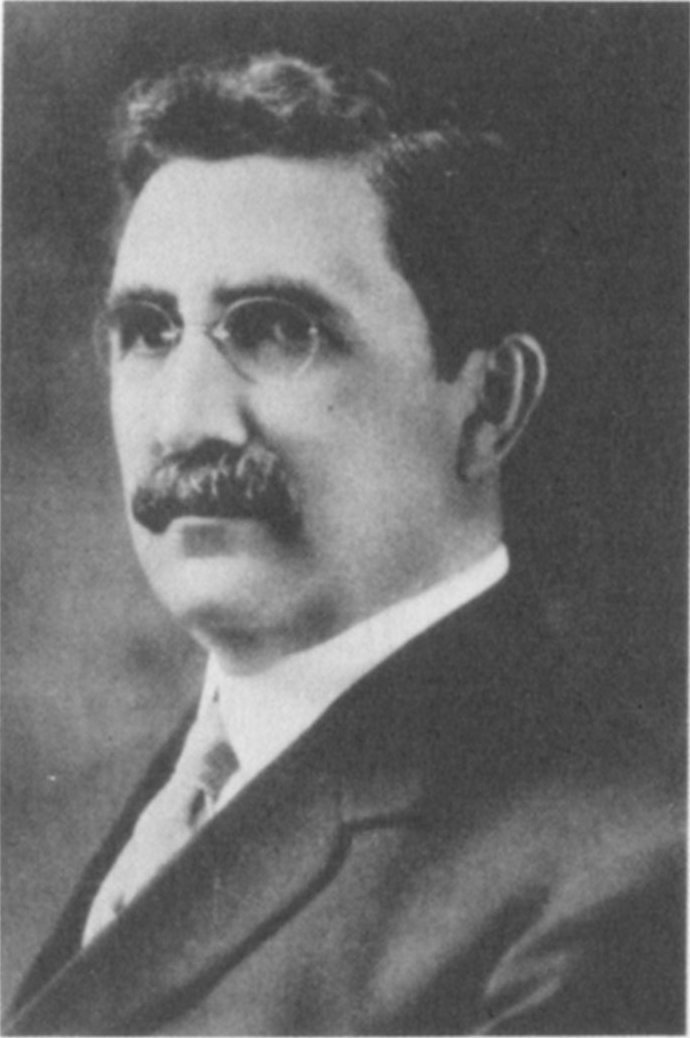
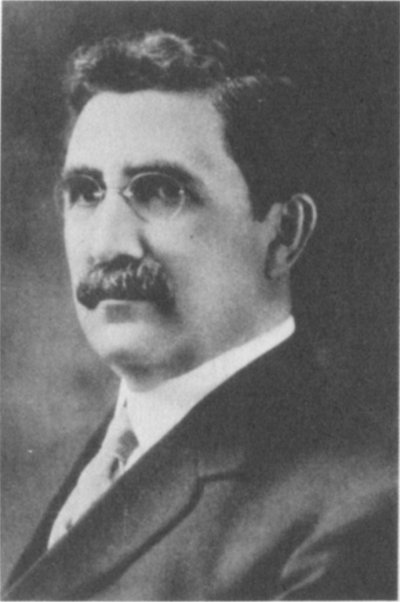 |
| DR. J.E. MOORLAND, SENIOR SECRETARY OF COLORED MEN'S DEPT.,
INTERNATIONAL Y.M.C.A. THE MAN LARGELY RESPONSIBLE FOR SUCCESS OF
HIS RACE IN "Y" WORK. |
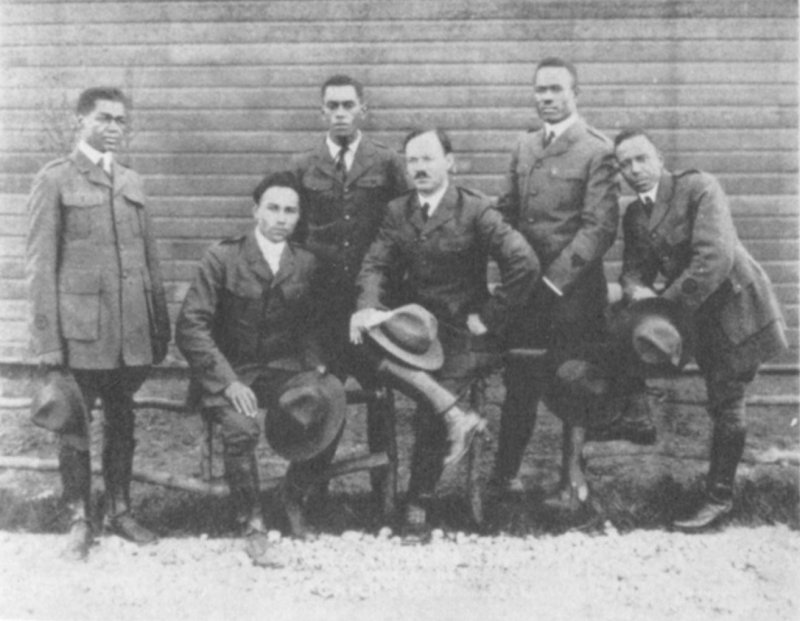
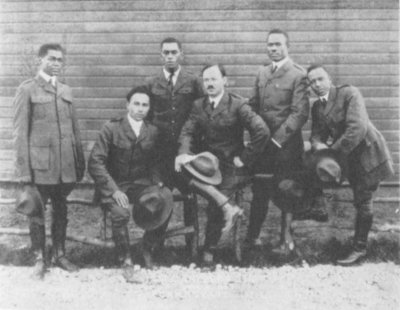 |
| A TYPICAL GROUP OF "Y" WORKERS, SECRETARY SNYDER AND STAFF.
Y.M.C.A. NO.7, CAMP GRANT, ILLINOIS. |
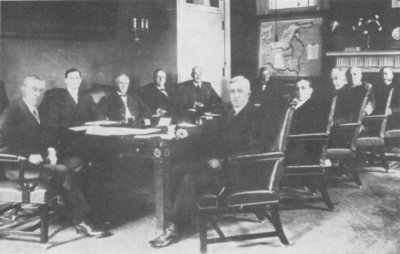 |
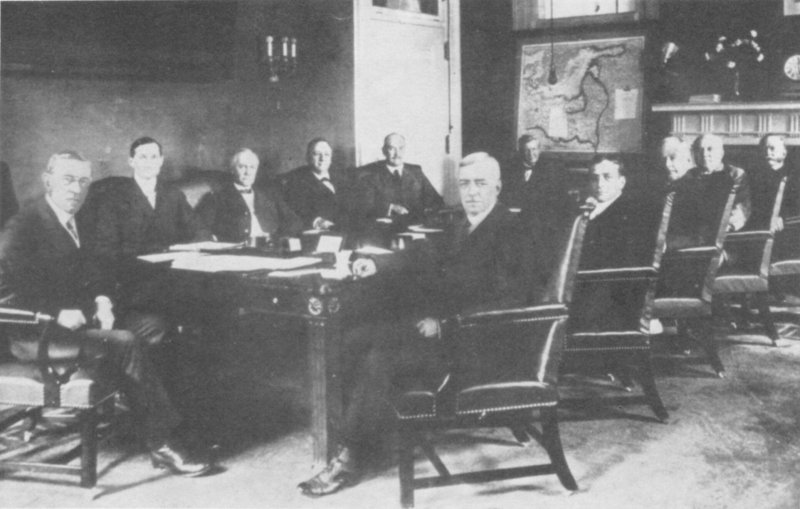
| PRESIDENT WOODROW WILSON (AT HEAD OF TABLE) AND HIS WAR
CABINET. LEFT—W.G. MCADOO SECRETARY OF THE TREASURY; THOMAS
W. GREGORY, ATTY. GENL.; JOSEPHUS DANIELS, SEC. OF NAVY; D.F.
HOUSTON, SEC. OF AGRICULTURE; WILLIAM B. WILSON, SEC. OF LABOR.
RIGHT—ROBERT LANSING, SEC. OF STATE; NEWTON D. BAKER, SEC.
OF WAR; A.S. BURLESON, POSTMASTER-GENERAL; FRANKLIN K. LANE, SEC.
OF INTERIOR; WILLIAM C. REDFIELD, SEC. OF COMMERCE. |
With a war likely to involve the greater part of Europe
hanging on the issue, it was a time for cool judgment, sober
statesmanship and careful action on all sides. Months should have
been devoted to an investigation.
But Germany and Austria did not want a sober investigation. They
were afraid that while it was proceeding the pretext for war
might vanish. As surmised above, they also may have feared that
the responsibility for the act would be placed in quarters that
would be embarrassing to them.
On July 23, 1914, just twenty-five days after the murder, Austria
delivered her demands upon Serbia and placed a time limit of
forty-eight hours for their acceptance. With the fate of a nation
and the probable embroiling of all Europe hanging on the outcome,
forty-eight hours was a time too brief for proper consideration.
Serbia could hardly summon her statesmen in that time.
Nevertheless the little country, realizing the awful peril that
impended, and that she alone would not be the sufferer, bravely
put aside all selfish considerations and practically all
considerations of national pride and honor.
The records show that every demand which Austria made on Serbia
was granted except one, which was only conditionally refused.
Although this demand involved the very sovereignty of
Serbia—her existence as a nation—the government
offered to submit the matter to mediation or arbitration. But
Austria, cats-pawing for Germany, did not want her demands
accepted. The one clause was inserted purposely, because they
knew it could not be accepted. With Serbia meeting the situation
honestly and going over ninety percent of the way towards an
amicable adjustment, the diplomacy that could not obtain peace
out of such a situation, must have been imbecile or corrupt to
the last degree.
An American historian discussing causes in the early stages of
the war, said:
"The German Imperial Chancellor pays no high
compliment to the intelligence of the American people when he
asks them to believe that 'the war is a life-and-death struggle
between Germany and the Muscovite races of Russia', and was due
to the royal murders at Sarajevo.
"To say that all Europe had to be plunged into the most
devastating war of human history because an Austrian subject
murdered the heir to the Austrian throne on Austrian soil in a
conspiracy in which Serbians were implicated, is too absurd to be
treated seriously. Great wars do not follow from such causes,
although any pretext, however trivial, may be regarded as
sufficient when war is deliberately sought.
"Nor is the Imperial Chancellor's declaration that 'the war is a
life-and-death struggle between Germany and the Muscovite races
of Russia' convincing in the slightest degree. So far as the
Russian menace to Germany is concerned, the Staats-Zeitung is
much nearer the truth when its editor, Mr. Ridder, boasts that
'no Russian army ever waged a successful war against a
first-class power.'
"The life-and-death struggle between Germany and the Muscovite
races of Russia is a diplomatic fiction invented after German
Autocracy, taking advantage of the Serbian incident, set forth to
destroy France. It was through no fear of Russia that Germany
violated her solemn treaty obligations by invading the neutrality
of Belgium and Luxemburg. It was through no fear of Russia that
Germany had massed most of her army near the frontiers of France,
leaving only six army corps to hold Russia in check. Germany's
policy as it stands revealed by her military operations was to
crush France and then make terms with Russia. The policy has
failed because of the unexpected resistance of the Belgians and
the refusal of Great Britain to buy peace at the expense of her
honor."
A nearer and equally clear view is expressed for the French by M.
Clemenceau, who early in the war said:
"For twenty-five years William II has made Europe
live under the weight of a horrible nightmare. He has found sheer
delight in keeping it in a state of perpetual anxiety over his
boastful utterances of power and the sharpened sword.
"Five threats of war have been launched against us since 1875. At
the sixth he finds himself caught in the toils he had laid for
us. He threatened the very springs of England's power, though she
was more than pacific in her attitude toward him.
"For many years, thanks to him, the Continent has had to join in
a giddy race of armaments, drying up the sources of economic
development and exposing our finances to a crisis which we shrank
from discussing. We must have done with this crowned comedian,
poet, musician, sailor, warrior, pastor; this commentator
absorbed in reconciling Hammurabi with the Bible, giving his
opinion on every problem of philosophy, speaking of everything,
saying nothing." M. Clemenceau summed up the Kaiser as "another
Nero; but Rome in flames is not sufficient for him—he
demands the destruction of the universe."
The Socialist, Upton Sinclair, speaking at the time, blamed
Russia as well as Germany and Austria. He also inclined to the
view that the assassination at Sarajevo was instigated by
Austria. He said:
"I assert that never before in human history has
there been a war with less pretense of justification. It is the
supreme crime of the ages; a blow at the very throat of
civilization. The three nations which began it, Austria, Russia
and Germany, are governed, the first by a doddering imbecile, the
second by a weak-minded melancholic, and the third by an
epileptic degenerate, drunk upon the vision of himself as the war
lord of Europe. Behind each of These men is a little clique of
blood-thirsty aristocrats. They fall into a quarrel among
themselves. The pretext is that Serbia instigated the murder of
the heir apparent to the Austrian throne. There is good reason
far believing that as a matter of fact this murder was instigated
by the war party in Austria, because the heir apparent had
democratic and anti-military tendencies. First they murder him
and then they use his death as a pretext for plunging the whole
of civilization into a murderous strife."
Herman Ridder, editor of the Staats-Zeitung of New York
contributed a German-American view. Mr. Ridder saw the
handwriting on the wall and he very soundly deprecated war and
pictured its horrors. But he could not forget that he was
appealing to a large class that held the German viewpoint. He
therefore found it necessary to soften his phrase with some
hyphenated sophistry. He dared not say that Germany was the
culprit and would be the principal sufferer. His article was:
"Sooner or later the nations engaged in war will find
themselves spent and weary. There will be victory for some,
defeat for others, and profit for none. There can hardly be any
lasting laurels for any of the contending parties. To change the
map of Europe is not worth the price of a single human life.
Patriotism should never rise above humanity.
"The history of war is merely a succession of blunders. Each
treaty of peace sows the seed of future strife.
"War offends our intelligence and outrages our sympathies. We can
but stand aside and murmur 'The pity of it all. The pity of it
all.'
"War breeds socialism. At night the opposing hosts rest on their
arms, searching the heavens for the riddle of life and death, and
wondering what their tomorrow will bring forth. Around a thousand
camp fires the steady conviction is being driven home that this
sacrifice of life might all be avoided. It seems difficult to
realize that millions of men, skilled by years of constant
application, have left the factory, the mill, or the desk to
waste not only their time but their very lives and possibly the
lives of those dependent on them to wage war, brother against
brother.
"The more reasonable it appears that peace must quickly come, the
more hopeless does it seem. I am convinced that an overwhelming
majority of the populations of Germany, England and France are
opposed to this war. The Governments of these states do not want
war.
"War deals in human life as recklessly as the gambler in
money.
"Imagine the point of view of a commanding general who is
confronted with the task of taking a fortress; 'That position
will cost me five thousand lives; it will be cheap at the price,
for it must be taken.'
"He discounts five thousand human lives as easily as the
manufacturer marks off five thousand dollars for depreciation.
And so five thousand homes are saddened that another flag may fly
over a few feet of fortified masonry. What a grim joke for Europe
to play upon humanity."
There were not wanting those to point out to Mr. Ridder that the
sacrifice of life could have been avoided had Germany and its
tool Austria, played fair with Serbia and the balance of Europe.
Also, his statement that the government of Germany did not want
the war has been successfully challenged from a hundred different
sources.
H.G. Wells, the eminent English author, contributed a prophecy
which translated very plainly the handwriting on the wall. He
said:
"This war is not going to end in diplomacy; it is
going to end diplomacy.
"It is quite a different sort of war from any that have gone
before. At the end there will be no conference of Europe on the
old lines, but a conference of the world. It will make a peace
that will put an end to Krupp, and the spirit of Krupp and
Kruppism and the private armament firms behind Krupp for
evermore."
Austria formally declared war against Serbia, July 28, 1914.
During the few days intervening between the dispatch of the
ultimatum to Serbia and the formal declaration of war, Serbia and
Russia, seeing the inevitable, had commenced to mobilize their
armies. On the last day of July, Germany as Austria's ally,
issued an ultimatum with a twelve hour limit demanding that
Russia cease mobilization. They were fond of short term
ultimatums. They did not permit more than enough time for the
dispatch to be transmitted and received, much less considered,
before the terms of it had expired. Russia demanded assurances
from Austria that war was not forthcoming and it continued to
mobilize. On August 1, Germany declared war. France then began to
mobilize.
Germany invaded the duchy of Luxemburg and demanded free passage
for its troops across Belgium to attack France at that country's
most vulnerable point. King Albert of Belgium refused his consent
on the ground that the neutrality of his country had been
guaranteed by the powers of Europe, including Germany itself, and
appealed for diplomatic help from Great Britain. That country,
which had sought through its foreign secretary, Sir Edward Grey,
to preserve the peace of Europe, was now aroused. August 4, it
sent an ultimatum to Germany demanding that the neutrality of
Belgium be respected. As the demand was not complied with,
Britain formally declared war against Germany.
Italy at that time was joined with Germany and Austria in what
was known as the Triple Alliance. But Italy recognized the fact
that the war was one of aggression and held that it was not bound
by its compact to assist its allies. The sympathies of its people
were with the French and British. Afterwards Italy repudiated
entirely its alliance and all obligations to Germany and Austria
and entered the war on the side of the allies. Thus the country
of Mazzini, of Garibaldi and Victor Emmanuel, ranged itself on
the side of emancipation and human rights.
The refusal of Italy to enter a war of conquest was the first
event to set the balance of the world seriously thinking of the
meaning of the war. If Italy refused to join its old allies, it
meant that Italy was too honorable to assist their purposes;
Italy knew the character of its associates. When it finally
repudiated them altogether and joined the war on the other side,
it was a terrific indictment of the Germanic powers, for Italy
had much more to gain in a material way from its old alliance. It
simply showed the world that spirit was above materialism; that
emancipation was in the air and that the lamp of civilization
might be dimmed but could not be darkened by the forces of
evil.
CHAPTER III.
MILITARISM AND AUTOCRACY DOOMED.
GERMANY'S MACHINE—HER SCIENTIFIC ENDEAVOR TO MOLD
SOLDIERS—INFLUENCE ON THOUGHT AND LIVES OF THE
PEOPLE—MILITARISM IN THE HOME—THE STATUS OF
WOMAN—FALSE THEORIES AND FALSE GODS—THE SYSTEM
ORDAINED TO PERISH—WAR'S SHOCKS—AMERICA INCLINES TO
NEUTRALITY—GERMAN AND FRENCH TREATMENT OF NEUTRALS
CONTRASTED—EXPERIENCES OF AMERICANS ABROAD AND ENROUTE
HOME—STATUE OF LIBERTY TAKES ON NEW BEAUTY—BLOOD OF
NEGRO AND WHITE TO FLOW.
Those who had followed the Kaiser's attitudes and their
reflections preceeding the war in the German military party, were
struck by a strange blending of martial glory and Christian
compunction. No one prays more loudly than the hypocrite and none
so smug as the devil when a saint he would be.
During long years the military machine had been under
construction. Human ingenuity had been reduced to a remarkable
state of organization and efficiency. One of the principal phases
of Kultur was the inauguration of a sort of scientific discipline
which made the German people not only soldiers in the field, but
soldiers in the workshop, in the laboratory and at the desk. The
system extended to the schools and universities and permeated the
thought of the nation. It particularly was reflected in the home;
the domestic arrangements and customs of the people. The German
husband was the commander-in-chief of his household. It was not
that benevolent lordship which the man of the house assumes
toward his wife and family in other nations. The stern note of
command was always evident; that attitude of "attention!" "eyes
front!" and unquestioning obedience.
German women always were subordinate to their husbands and the
male members of their families. It was not because the man made
the living and supported the woman. Frequently the German woman
contributed as much towards the support of the family as the
males; it was because the German male by the system which had
been inculcated into him, regarded himself as a superior being
and his women as inferiors, made for drudgery, for child-bearing,
and for contributors to his comforts and pleasures. His attitude
was pretty much like that of the American Indian towards his
squaw.
Germany was the only nation on earth pretending to civilization
in which women took the place of beasts of burden. They not only
worked in the fields, but frequently pulled the plow and other
implements of agriculture. It was not an uncommon sight in
Germany to see a woman and a large dog harnessed together drawing
a milk cart. When it became necessary to deliver the milk the
woman slipped her part of the harness, served the customer,
resumed her harness and went on to the next stop. In Belgium, in
Holland and in France, women delivered the milk also, but the
cart always was drawn by one or two large dogs or other animals
and the woman was the driver. In Austria it was a strange sight
to foreigners, but occasioned no remark among the people, to see
women drawing carts and wagons in which were seated their lords
and masters. Not infrequently the boss wielded a whip.
The pride of the German nation was in its efficient workmen.
Friends of the country and its system have pointed to the fact of
universal labor as its great virtue; because to work is good.
Really, they were compelled to work. Long hours and the last
degree of efficiency were necessary in order to meet the
requirements of life and the tremendous burdens of taxation
caused by the army, the navy, the fortifications and the military
machine in general; to say nothing of the expense of maintaining
the autocratic pomp of the Kaiser, his sons and satellites. Every
member of the German family had his or her task, even to the
little three-year-old toddler whose business it was to look after
the brooms, dust rags and other household utensils. There was
nothing of cheerfulness or even of the dignity of labor about
this. It was hard, unceasing, grinding toil which crushed the
spirits of the people. It was part of the system to cause them to
welcome war as a diversion.
To the German mind everything had an aspect of seriousness. The
people took their pleasures seriously. On their holidays, mostly
occasions on which they celebrated an event in history or the
birthday of a monarch or military hero, or during the hours which
they could devote to relaxation, they gathered with serious,
stolid faces in beer gardens. If they danced it was mostly a
cumbersome performance. Generally they preferred to sit and blink
behind great foaming tankards and listen to intellectual music.
No other nation had such music. It was so intellectual in itself
that it relieved the listeners of the necessity of thinking.
There was not much of melody in it; little of the dance movement
and very little of the lighter and gayer manifestations of life.
It has been described as a sort of harmonious discord, typifying
mysterious, tragic and awe-inspiring things. The people sat and
ate their heavy food and drank their beer, their ears engaged
with the strains of the orchestra, their eyes by the movements of
the conductor, while their tired brains rested and digestion
proceeded.
To the average German family a picnic or a day's outing was a
serious affair. The labor of preparation was considerable and
then they covered as much of the distance as possible by walking
in order to save carfare. In the parade was the tired, careworn
wife usually carrying one, sometimes two infants in her arms. The
other children lugged the lunch baskets, hammocks, umbrellas and
other paraphernalia. At the head of the procession majestically
marched the lord of the outfit, smoking his cigar or pipe; a
suggestion of the goose-step in his stride, carrying nothing,
except his dignity and military deportment. With this kind of
start the reader can imagine the good time they all had.
MILITARISM AND AUTOCRACY DOOMED Joy to the German mind in mass
was an unknown quantity. The literature on which they fed was
heavier and more somber than their music. When the average German
tried to be gay and playful he reminded one of an elephant trying
to caper. Their humor in the main, manifested itself in coarse
and vulgar jests.
For athletics they had their turn vereins in which men went
through hard, laborious exercises which made them muscle-bound.
Their favorite sports were hunting and fencing—the desire
to kill or wound. They rowed some but they knew nothing of
baseball, boxing, tennis, golf or the usual sports so popular
with young men in England, France and America. Aside from
fencing, they had not a sport calculated to produce agility or
nimbleness of foot and brain.
Their emotions expanded and their sentiments thrilled at the
spectacle of war. Uniforms, helmets and gold lace delighted their
eyes. The parade, the guard mount, the review were the finest
things they knew. To a people trained in such a school and
purposely given great burdens that they might attain fortitude,
war was second nature. They welcomed it as a sort of pastime.
In the system on which Kultur was based, it was necessary to
strike deeply the religious note; no difference if it was a false
note. The German ear was so accustomed to discord it could not
recognize the true from the false. The Kaiser was heralded to his
people as a deeply religious man. In his public utterances he
never failed to call upon God to grant him aid and bless his
works.
One of the old traditions of the Fatherland was that the king,
being specially appointed by God, could do no wrong. To the
thinking portion of the nation this could have been nothing less
than absurd fallacy, but where the majority do not think; if a
thing is asserted strongly and often enough, they come to accept
it. It becomes a belief. The people had become so impressed with
the devoutness of the Kaiser and his assumption of Divine
guidance, that the great majority of them believed the kaiser was
always right; that he could do no wrong. When the great blow of
war finally was struck the Kaiser asked his God to look down and
bless the sword that he had drawn; a prayer altogether consistent
coming from his lips, for the god he worshipped loved war, was a
god of famine, rapine and blood. From the moment of that appeal,
military autocracy and absolute monarchy were doomed. It took
time, it took lives, it took more treasure than a thousand men
could count in a lifetime. But the assault had been against
civilization, on the very foundation of all that humanity had
gained through countless centuries. The forces of light were too
strong for it; would not permit it to triumph.
The President of the United States, from the bedside of his dying
wife, appealed to the nations for some means of reaching peace
for Europe. The last thoughts of his dying helpmate, were of the
great responsibility resting upon her husband incident to the
awful crisis in the lives of the nations of earth, that was
becoming more pronounced with each second of time.
The Pope was stricken to death by the great calamity to
civilization. A few minutes before the end came he said that the
Almighty in His infinite mercy was removing him from the world to
spare him the anguish of the awful war.
The first inclination of America was to be neutral. She was far
removed from the scenes of strife and knew little of the hidden
springs and causes of the war. Excepting in the case of a few of
her public men; her editors, professors and scholars, European
politics were as a sealed book. The president of the United
States declared for neutrality; that individual and nation should
avoid the inflaming touch of the war passion. We kept that
attitude as long as was consistent with national patience and the
larger claims of HUMANITY and universal
JUSTICE.
As an evidence of our lack of knowledge of the impending
conflict, a party of Christian men were on the sea with the
humanitarian object in view of attending a world's peace
conference in Constance, Germany—Germany of all places,
then engaged in trying to burn up the world. Arriving in Paris,
the party received its first news that a great European war was
about to begin. Steamship offices were being stormed by crowds of
frantic American tourists. Martial law was declared. The streets
were alive with soldiers and weeping women. Shops were closed,
the clerks having been drafted into the army. The city hummed
with militarism.
Underneath the excitement was the stern, stoic attitude of the
French in preparing to meet their old enemy, combined with their
calmness in refraining from outbreaks against German residents of
Paris. One of the party alluding to the incongruous position in
which the peace delegates found themselves, said:
"It might be interesting to observe the unique and
almost humorous situation into which these peace delegates were
thrown. Starting out a week before with the largest hope and most
enthusiastic anticipation of effecting a closer tie between
nations, and swinging the churches of Christendom into a clearer
alignment against international martial attitudes, we were
instantly 'disarmed,' bound, and cast into chains of utter
helplessness, not even feeling free to express the feeblest
sentiment against the high rising tide of military activity. We
were lost on a tempestuous sea; the dove of peace had been
beaten, broken winged to shore, and the olive branch lost in its
general fury."
Describing conditions in Paris on August 12, he says:
"We are in a state of tense expectation, so acute
that it dulls the senses; Paris is relapsing into the condition
of an audience assisting at a thrilling drama with intolerably
long entr'acts, during which it tries to think of its own
personal affairs.
"We know that pages of history are being rapidly engraved in
steel, written in blood, illuminated in the margin with glory on
a background of heroism and suffering, not more than a few score
miles away.
"The shrieking camelots (peddlers) gallop through the streets
waving their news sheets, but it is almost always news of
twenty-four hours ago. The iron hand of the censor reduces the
press to a monotonous repetition of the same formula. Only
headlines give scope for originality. Of local news there is
none. There is nothing doing in Paris but steady preparation for
meeting contingencies by organizing ambulances and relief for the
poor."
From the thousands of tales brought back by American tourists
caught in Germany at the outbreak of the war, there is more than
enough evidence that they were not treated with that courtesy
manifested towards them by the French. They were arrested as
spies, subjected to all sorts of embarrassments and indignities;
their persons searched, their baggage and letters examined, and
frequently were detained for long periods without any explanation
being offered. When finally taken to the frontier, they were not
merely put across—frequently they were in a sense thrown
across.
Nor were the subjects of other nations, particularly those with
which Germany was at war, treated with that fine restraint which
characterized the French. Here is an account by a traveller of
the treatment of Russian subjects:
"We left Berlin on the day Germany declared war against Russia.
Within seventy-five miles of the frontier, 1,000 Russians in the
train by which they were travelling were turned out of the
carriage and compelled to spend eighteen hours without food in an
open field surrounded by soldiers with fixed bayonets.
"Then they were placed in dirty cattle wagons, about sixty men,
women and children to a wagon, and for twenty-eight hours were
carried about Prussia without food, drink or privacy. In Stettin
they were lodged in pig pens, and next morning were sent off by
steamer to Rugen, whence they made their way to Denmark and
Sweden without money or luggage. Sweden provided them with food
and free passage to the Russian frontier. Five of our
fellow-passengers went mad."
The steamship Philadelphia—note the name, signifying
brotherly love, so completely lost sight of in the
conflict—was the first passenger liner to reach America
after the beginning of the European war. A more remarkable crowd
never arrived in New York City by steamship or train. There were
men of millions and persons of modest means who had slept side by
side on the journey over; voyagers with balances of tens of
thousands of dollars in banks and not a cent in their
pocketbooks; men able and eager to pay any price for the best
accommodations to be had, yet satisfied and happy sharing bunks
in the steerage.
There were women who had lost all baggage and had come alone,
their friends and relatives being unable to get accommodations on
the vessel. There were children who had come on board with their
mothers, with neither money nor reservations, who were happy
because they had received the very best treatment from all the
steamship's officers and crew and because they had enjoyed the
most comfortable quarters to be had, surrendered by men who were
content to sleep in most humble surroundings, or, if necessary,
as happened in a few cases, to sleep on the decks when the
weather permitted.
Wealthy, but without funds, many of the passengers gave jewelry
to the stewards and other employees of the steamship as the tips
which they assumed were expected even in times of stress. The
crew took them apologetically, some said they were content to
take only the thanks of the passengers. One woman of wealth and
social position, without money, and having lost her check book
with her baggage, as had many others of the passengers, gave a
pair of valuable bracelets to her steward with the request that
he give them to his wife. She gave a hat—the only one she
managed to take with her on her flight from Switzerland—to
her stewardess.
The statue of Liberty never looked so beautiful to a party of
Americans before. The strains of the Star Spangled Banner, as
they echoed over the waters of the bay, were never sweeter nor
more inspiring. As the Philadelphia approached quarrantine, the
notes of the American anthem swelled until, as she slowed down to
await the coming of the physicians and customs officials, it rose
to a great crescendo which fell upon the ears of all within many
hundred yards and brought an answering chorus from the throngs
who waited to extend their hands to relatives and friends.
There was prophecy in the minds of men and women aboard that
ship. Some of them had been brought into actual contact with the
war; others very near it. In the minds of all was the vision that
liberty, enlightenment and all the fruits of progress were
threatened; that if they were to be saved, somehow, this land
typified the spirit of succor; somehow the aid was to proceed
from here.
Liberty never had a more cherished meaning to men of this
Republic. In the minds of many the conviction had taken root,
that if autocracy and absolute monarchy were to be overthrown;
that "government of the people, by the people, for the people"
should "not perish from the earth," it would eventually require
from America that supreme sacrifice in devotion and blood that at
periods in the growth and development of nations, is their last
resort against the menace of external attack, and, regardless of
the reflections of theorists and philosophers, the best and
surest guarantee of their longevity; that the principles upon
which they were builded were something more than mere words,
hollow platitudes, meaning nothing, worthy of nothing, inspiring
nothing. It was the dawning of a day; new and strange in its
requirements of America whose isolation and policy, as bequeathed
by the fathers, had kept it aloof from the bickerings and
quarrels of the nations that composed the "Armed Camp" of Europe,
during which, as subsequent events proved, the blood of the
Caucasian and the Negro would upon many a hard fought pass; many
a smoking trench in the battle zone of Europe, run together in
one rivulet of departing life, for the guarantee of liberty
throughout all the earth, and the establishment of justice at its
uttermost bounds and ends.
CHAPTER IV.
AWAKENING OF AMERICA.
PRESIDENT CLINGS TO NEUTRALITY—MONROE DOCTRINE AND
WASHINGTON'S WARNING—GERMAN CRIMES AND GERMAN
VICTORIES—CARDINAL MERCIER'S LETTER—MILITARY
OPERATIONS—FIRST SUBMARINE ACTIVITIES—THE LUSITANIA
OUTRAGE—EXCHANGE OF NOTES—UNITED STATES
AROUSED—ROLE OF PASSIVE ONLOOKER BECOMES
IRKSOME—FIRST MODIFICATION OF PRINCIPLES OF WASHINGTON AND
MONROE—OUR DESTINY LOOMS.
August 4, 1914, President Wilson proclaimed the neutrality of the
United States. A more consistent attempt to maintain that
attitude was never made by a nation. In an appeal addressed to
the American people on August 18th, the president implored the
citizens to refrain from "taking sides." Part of his utterance on
that occasion was:
"We must be impartial in thought as well as in
action, must put a curb upon our sentiments as well as upon every
transaction that might be construed as a preference of one party
to the struggle before another.
"My thought is of America. I am speaking, I feel sure, the
earnest wish and purpose of every thoughtful American that this
great country of ours, which is, of course, the first in our
thoughts and in our hearts, should show herself in this time of
peculiar trial a nation fit beyond others to exhibit the fine
poise of undisturbed judgment, the dignity of self-control, the
efficiency of dispassionate action; a nation that neither sits in
judgment upon others, nor is disturbed in her own counsels, and
which keeps herself fit and free to do what is honest and
disinterested and truly serviceable for the peace of the
world.
American poise had been somewhat disturbed over the treatment of
American tourists caught in Germany at the outbreak of the war.
American sentiment was openly agitated by the invasion of Belgium
and the insolent repudiation by Germany of her treaty
obligations. The German chancellor had referred to the treaty
with Belgium as "a scrap of paper." These things had created a
suspicion in American minds, having to do with what seemed
Germany's real and ulterior object, but in the main the people of
this county accepted the president's appeal in the spirit in
which it was intended and tried to live up to it, which attitude
was kept to the very limit of human forbearance.
A few editors and public men, mostly opposed to the president
politically, thought we were carrying the principle of neutrality
too far; that the violation of Belgium was a crime against
humanity in general and that if we did not at least protest
against it, we would be guilty of national stultification if not
downright cowardice. Against this view was invoked the
time-honored principles of the Monroe Doctrine and its great
corollary, Washington's advice against becoming entangled in
European affairs. Our first president, in his farewell address,
established a precept of national conduct that up to the time we
were drawn into the European war, had become almost a principle
of religion with us. He said:
"Against the insidious wiles of foreign influence (I
conjure you to believe me, fellow citizens) the jealousy of a
free people ought to constantly awake, since history and
experience prove that foreign influence is one of the most
baneful foes of republican government—Europe has a set of
primary interests which to us have none or a very remote
relation. Hence she must be engaged in frequent controversies,
the causes of which are essentially foreign to our concern.
Hence, therefore, it must be unwise in us to implicate ourselves
by artificial ties in the ordinary vicissitudes of her politics
or the ordinary combinations and collisions of her friendships or
enmities."
The Monroe Doctrine was a statement of principles made by
President Monroe in his famous message of December 2, 1823. The
occasion of the utterance was the threat by the so-called Holy
Alliance to interfere forcibly in South America with a view to
reseating Spain in control of her former colonies there.
President Monroe, pointing to the fact that it was a principle of
American policy not to intermeddle in European affairs, gave
warning that any attempt by the monarchies of Europe "to extend
their system to any portion of this hemisphere" would be
considered by the United States "as dangerous to our peace and
safety." This warning fell in line with British policy at the
time and so proved efficacious.
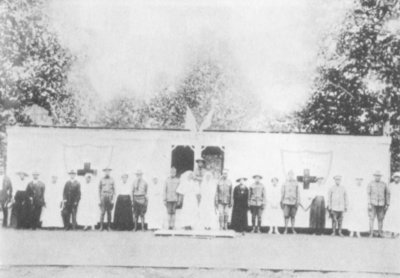 |
| OFFICIAL RED CROSS PHOTOGRAPHS NEGRO SOLDIERS AND RED CROSS
WORKERS IN FRONT OF CANTEEN, HAMLET, N.C. |
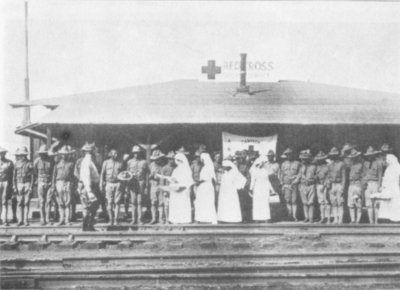 |
| PHOTO FROM UNDERWOOD & UNDERWOOD, N.Y. COLORED RED CROSS
WORKERS FROM THE CANTEEN AT ATLANTA, GA., FEEDING SOLDIERS AT
RAILWAY STATION. |
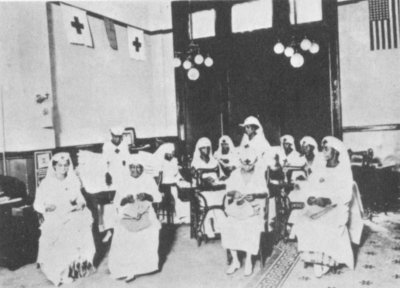 |
| OFFICIAL RED CROSS PHOTOGRAPHS COLORED WOMEN IN HOSPITAL
GARMENTS CLASS OF BRANCH NO. 6. NEW ORLEANS CHAPTER, AMERICAN RED
CROSS. LOUISE J. ROSS, DIRECTOR. |
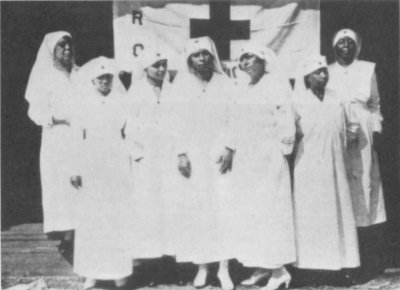 |
| PHOTO FROM UNDERWOOD & UNDERWOOD, N.Y. RED CROSS WORKERS.
PROMINENT COLORED WOMEN OF ATLANTA, GA., WHO ORGANIZED CANTEEN
FOR RELIEF OF NEGRO SOLDIERS GOING TO AND RETURNING FROM
WAR. |
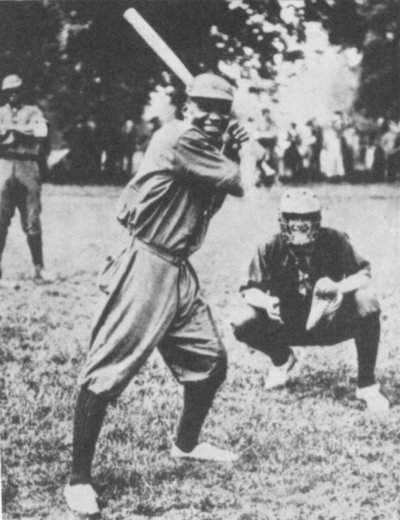 |
| THE GAME IS ON. A BASEBALL MATCH BETWEEN NEGRO AND WHITE
TROOPS IN ONE OF THE TRAINING AREAS IN FRANCE. |
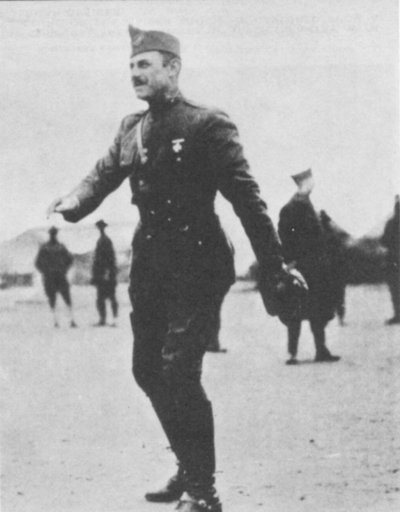 |
| OFFICIAL PHOTOGRAPHS, U.S. ARMY COL. WILLIAM HAYWARD OF 369TH
INFANTRY PLAYING BASEBALL WITH HIS NEGRO SOLDIERS AT ST. NAZAIRE,
FRANCE. |
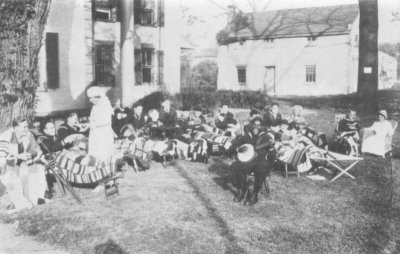 |
| JAZZ AND SOUTHERN MELODIES HASTEN CURE. NEGRO SAILOR
ENTERTAINING DISABLED NAVY MEN IN HOSPITAL FOR
CONVALESCENTS. |
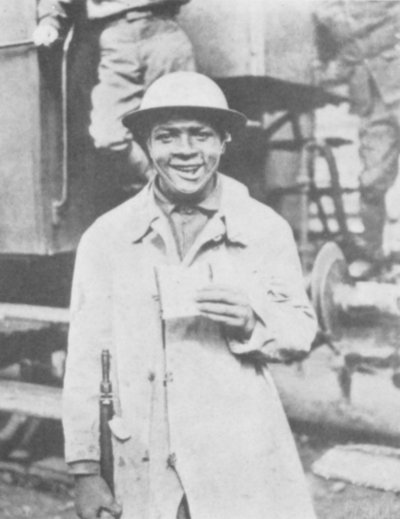 |
| ENJOYING A BIT OF CAKE BAKED AT THE AMERICAN RED CROSS
CANTEEN AT IS-SUR-TILLE, FRANCE. |
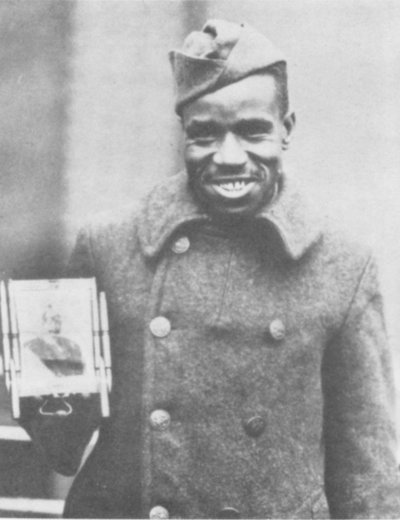 |
| CORPORAL FRED. McINTYRE OF 369TH INFANTRY, WITH PICTURE OF
THE KAISER WHICH HE CAPTURED FROM A GERMAN OFFICER. |
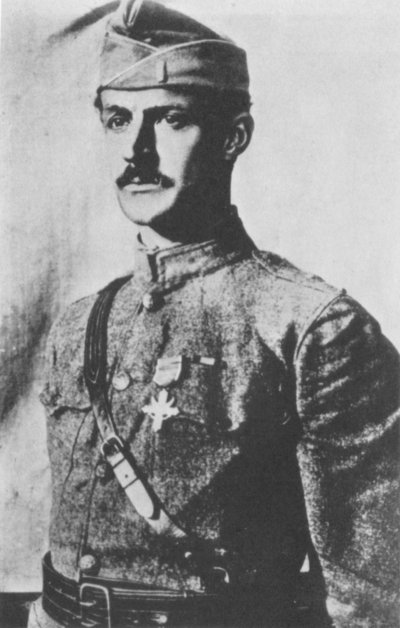 |
| LIEUT. ROBERT L. CAMPBELL, NEGRO OFFICER OF THE 368TH
INFANTRY WHO WON FAME AND THE D.S.C. IN ARGONNE FOREST. HE
DEVISED A CLEVER PIECE OF STRATEGY AND DISPLAYED GREAT HEROISM IN
THE EXECUTION OF IT. |
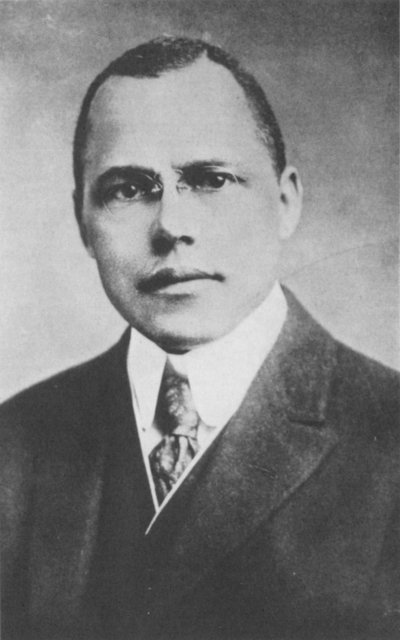 |
| EMMETT J. SCOTT, APPOINTED BY SECRETARY BAKER, AS SPECIAL
ASSISTANT DURING THE WORLD WAR. HE WAS FORMERLY CONFIDENTIAL
SECRETARY TO THE LATE BOOKER T. WASHINGTON. |
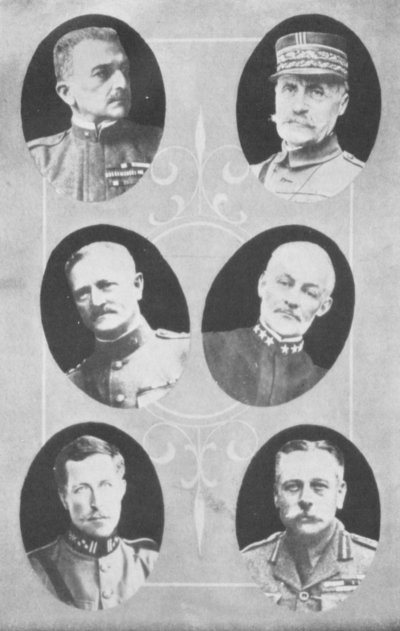 |
(TOP)—GENERAL DIAZ, COMMANDER-IN-CHIEF ITALIAN ARMIES.
MARSHAL FOCH, COMMANDER-IN-CHIEF ALLIED FORCES.
(CENTER)—GENERAL PERSHING, COMMANDER-IN-CHIEF AMERICAN
ARMIES. ADMIRAL SIMS, IN CHARGE OF AMERICAN NAVAL OPERATIONS
OVERSEAS.
(BOTTOM)—KING ALBERT, COMMANDER-IN-CHIEF BELGIAN ARMY.
FIELD MARSHAL HAIG, HEAD OF BRITISH ARMIES. |
In a later section of the same message the proposition was also
advanced that the American continent was no longer subject to
colonization. This clause of the doctrine was the work of
Monroe's secretary of state, John Quincy Adams, and its occasion
was furnished by the fear that Russia was planning to set up a
colony at San Francisco, then the property of Spain, whose
natural heir on the North American continent, Adams held, was the
United States. It is this clause of the document that has
furnished much of the basis for its subsequent development.
In 1902 Germany united with Great Britain and Italy to collect by
force certain claims against Venezuela. President Roosevelt
demanded and finally, after threatening to dispatch Admiral Dewey
to the scene of action, obtained a statement that she would not
permanently occupy Venezuelan territory. Of this statement one of
the most experienced and trusted American editors, avowedly
friendly to Germany, remarked at the time, that while he believed
"it was and will remain true for some time to come, I cannot, in
view of the spirit now evidently dominant in the mind of the
emperor and among many who stand near him, express any belief
that such assurances will remain trustworthy for any great length
of time after Germany shall have developed a fleet larger than
that of the United States." He accordingly cautioned the United
States "to bear in mind probabilities and possibilities as to the
future conduct of Germany, and therefore increase gradually our
naval strength." Bismarck pronounced the Monroe Doctrine "an
international impertinence," and this has been the German view
all along.
Dr. Zorn, one of the most conservative of German authorities on
international affairs, concluded an article in Die Woche of
September 13, 1913, with these words: "Considered in all its
phases, the Monroe Doctrine is in the end seen to be a question
of might only and not of right."
The German government's efforts to check American influence in
the Latin American states had of late years been frequent and
direct. They comprised the encouragement of German emigration to
certain regions, the sending of agents to maintain close contact,
presentation of German flags in behalf of the Kaiser, the placing
of the German Evangelical churches in certain South American
countries under the Prussian State Church, annual grants for
educational purposes from the imperial treasury at Berlin, and
the like.
The "Lodge resolution," adopted by the senate in 1912, had in
view the activities of certain German corporations in Latin
America, as well as the episode that immediately occasioned it;
nor can there be much doubt that it was the secret interference
by Germany at Copenhagen that thwarted the sale of the Danish
West Indies to the United States in 1903.
In view of a report that a Japanese corporation, closely
connected with the Japanese government, was negotiating with the
Mexican government for a territorial concession off Magdalena
Bay, in lower California, the senate in 1912 adopted the
following resolution, which was offered by Senator Lodge of
Massachusetts:
"That when any harbor or other place in the American
continent is so situated that the occupation thereof for naval or
military purposes might threaten the communications or the safety
of the United States, the government of the United States could
not see without grave concern, the possession of such harbor or
other place by any corporation or association which has such a
relation to another government, not American, as to give that
government practical power of control for naval or military
purposes."
All of the above documents, arguments and events were of the
greatest importance in connection with the great European
struggle. America was rapidly awakening, and the role of a
passive onlooker became increasingly irksome. It was pointed out
that Washington's message said we must not implicate ourselves in
the "ordinary vicissitudes" of European politics. This case
rapidly was assuming something decidedly beyond the "ordinary."
As the carnage increased and outrages piled up, the finest
sensibilities of mankind were shocked and we began to ask
ourselves if we were not criminally negligent in our attitude; if
it was not our duty to put forth a staying hand and use the
extreme weight of our influence to stop the holocaust.
From August 4 to 26, Germany overran Belgium. Liege was occupied
August 9; Brussels, August 20, and Namur, August 24. The stories
of atrocities committed on the civil population of that country
have since been well authenticated. At the time it was hard to
believe them, so barbaric and utterly wanton were they. Civilized
people could not understand how a nation which pretended to be
not only civilized, but wished to impose its culture on the
remainder of the world, could be so ruthless to a small adversary
which had committed no crime and desired only to preserve its
nationality, integrity and treaty rights.
Germany did not occupy Antwerp until October 9, owing to the
stiff resistance of the Belgians and engagements with the French
and British elsewhere. But German arms were uniformly victorious.
August 21-23 occurred the battle of Mons-Charleroi, a serious
defeat for the French and British, which resulted in a dogged
retreat eventually to a line along the Seine, Marne and Meuse
rivers.
The destruction of Louvain occurred August 26, and was one of the
events which inflamed anti-German sentiment throughout the world.
The beautiful cathedral, the historic cloth market, the library
and other architectural monuments for which the city was famed,
were put to the torch. The Belgian priesthood was in woe over
these and other atrocities. Cardinal Mercier called upon the
Christian world to note and protest against these crimes. In his
pastoral letter of Christmas, 1914, he thus pictures Belgium's
woe and her Christian fortitude:
"And there where lives were not taken, and there
where the stones of buildings were not thrown down, what anguish
unrevealed! Families hitherto living at ease, now in bitter want;
all commerce at an end, all careers ruined; industry at a
standstill; thousands upon thousands of workingmen without
employment; working women; shop girls, humble servant girls
without the means of earning their bread, and poor souls forlorn
on the bed of sickness and fever crying: 'O Lord, how long, how
long?'—God will save Belgium, my brethren; you can not
doubt it. Nay, rather, He is saving her—Which of us would
have the heart to cancel this page of our national history? Which
of us does not exult in the brightness of the glory of this
shattered nation? When in her throes she brings forth heroes, our
mother country gives her own energy to the blood of those sons of
hers. Let us acknowledge that we needed a lesson in
patriotism—For down within us all is something deeper than
personal interests, than personal kinships, than party feeling,
and this is the need and the will to devote ourselves to that
most general interest which Rome termed the public thing, Res
publica. And this profound will within us is
patriotism."
Meanwhile there was a slight offset to the German successes.
Russia had overrun Galicia and the Allies had conquered the
Germany colony of Togoland in Africa. But on August 26 the
Russians were severely defeated in the battle of Tannenburg in
East Prussia. This was offset by a British naval victory in
Helgoland Bight. (August 28.) So great had become the pressure of
the German armies that on September 3 the French government
removed from Paris to Bordeaux. The seriousness of the situation
was made manifest when two days later Great Britain, France and
Russia signed a treaty not to make peace separately. Then it
became evident to the nations of the earth that the struggle was
not only to be a long one, but in all probability the most
gigantic in history.
The Germans reached the extreme point of their advance,
culminating in the Battle of the Marne, September 6-10. Here the
generalship of Joffre and the strategy of Foch overcame great
odds. The Germans were driven back from the Marne to the River
Aisne. The battle line then remained practically stationary for
three years on a front of three hundred miles.
The Russians under General Rennenkampf were driven from East
Prussia September 16. Three British armored cruisers were sunk by
a submarine September 22. By September 27 General Botha had
gained some successes for the Allies, and had under way an
invasion of German Southwest Africa. By October 13 Belgium was so
completely occupied by the Germans that the government withdrew
entirely from the country and established itself at Le Havre in
France. By the end of the year had occurred the Battle of Yser in
Belgium (October 16-28); the first Battle of Ypres (decisive day
October 31), in which the British, French and Belgians saved the
French channel ports; De Wet's rebellion against the British in
South Africa (October 28); German naval victory in the Pacific
off the coast of Chile (November 1); fall of Tsingtau, German
possession in China, to the Japanese (November 7); Austrian
invasion of Serbia (Belgrade taken December 2, recaptured by the
Serbians December 14); German commerce raider Emden caught and
destroyed at Cocos Island (November 10); British naval victory
off the Falkland Islands (December 8); South African rebellion
collapsed (December 8); French government returned to Paris
(December 9); German warships bombarded West Hartlepool,
Scarborough and Whitby on the coast of England (December 16). On
December 24 the Germans showed their Christian spirit in an
inauguration of the birthday of Christ by the first air raid over
England. The latter part of the year 1914 saw no important action
by the United States excepting a proclamation by the president of
the neutrality of the Panama canal zone.
The events of 1915 and succeeding years became of great
importance to the United States and it is with a record of those
having the greatest bearing on our country that this account
principally will deal.
On January 20 Secretary of State Bryan found it necessary to
explain and defend our policy of neutrality. January 28 the
American merchantman William P. Frye was sunk by the German
cruiser Prinz Eitel Friedrich. On February 10 the United States
dispatched a note to the German government holding it to a
"strict accountability if any merchant vessel of the United
States is destroyed or any American citizens lose their lives."
Germany replied February 16 stating that her "war zone" act was
an act of self-defense against illegal methods employed by Great
Britain in preventing commerce between Germany and neutral
countries. Two days later the German official blockade of Great
Britain commenced and the German submarines began their campaign
of piracy and pillage.
The United States on February 20 sent an identic note to Germany
and Great Britain suggesting an agreement between them respecting
the conduct of naval warfare. The British steamship Falaba was
sunk by a submarine March 28, with a loss of 111 lives, one of
which was an American. April 8 the steamer Harpalyce, in the
service of the American commission for the aid of Belgium, was
torpedoed with a loss of 15 lives. On April 22 the German embassy
in America sent out a warning against embarkation on vessels
belonging to Great Britain. The American vessel Cushing was
attacked by a German aeroplane April 28. On May 1 the American
steamship Gullflight was sunk by a German submarine and two
Americans were lost. That day the warning of the German embassy
was published in the daily papers. The Lusitania sailed at 12:20
noon.
Five days later occurred the crime which almost brought America
into the second year of the war. The Cunard line steamship
Lusitania was sunk by a German submarine with a loss of 1,154
lives, of which 114 were Americans. After the policy of
frightfulness put into effect by the Germans in Belgium and other
invaded territories, the massacres of civilians, the violation of
women and killing of children; burning, looting and pillage; the
destruction of whole towns, acts for which no military necessity
could be pleaded, civilization should have been prepared for the
Lusitania crime. But it seems it was not. The burst of
indignation throughout the United States was terrible. Here was
where the terms German and Hun became synonomous, having in mind
the methods and ravages of the barbaric scourge Attilla, king of
the Huns, who in the fifth century sacked a considerable portion
of Europe and introduced some refinements in cruelty which have
never been excelled.
The Lusitania went down twenty-one minutes after the attack. The
Berlin government pleaded in extenuation of the sinking that the
ship was armed, and German agents in New York procured testimony
which was subsequently proven in court to have been perjured, to
bolster up the falsehood. In further justification, the German
government adduced the fact that the ship was carrying ammunition
which it said was "destined for the destruction of brave German
soldiers." This contention our government rightly brushed aside
as irrelevant.
The essence of the case was stated by our government in its note
of June 9 as follows:
"Whatever be the other facts regarding the Lusitania,
the principal fact is that a great steamer, primarily and chiefly
a conveyance for passengers, and carrying more than a thousand
souls who had no part or lot in the conduct of the war, was sunk
without so much as a challenge or a warning, and that men, women
and children were sent to their death in circumstances
unparalleled in modern warfare."
Three notes were written to Germany regarding the Lusitania
sinking. The first dated May 13 advanced the idea that it was
impossible to conduct submarine warfare conformably with
international law. In the second dated June 9 occurs the
statement that "the government of the United States is contending
for something much greater than mere rights of property or
privileges of commerce. It is contending for nothing less high
and sacred than the rights of humanity." In the third note dated
July 21, it is asserted that "the events of the past two months
have clearly indicated that it is possible and practicable to
conduct submarine operations within the so-called war zone in
substantial accord with the accepted practices of regulated
warfare." The temper of the American people and the president's
notes had succeeded in securing a modification of the submarine
campaign.
It required cool statesmanship to prevent a rushing into war over
the Lusitania incident and events which had preceded it. There
was a well developed movement in favor of it, but the people were
not unanimous on the point. It would have lacked that cooperation
necessary for effectiveness; besides our country was but poorly
prepared for engaging in hostilities. It was our state of
unpreparedness continuing for a long time afterwards, which
contributed, no doubt, to German arrogance. They thought we would
not fight.
But the United States had become thoroughly awakened and the
authorities must have felt that if the conflict was to be unduly
prolonged, we must eventually be drawn into it. This is reflected
in the modified construction which the president and others began
to place on the Monroe Doctrine. The great underlying idea of the
doctrine remained vital, but in a message to congress delivered
December 7, 1915, the president said:
"In the day in whose light we now stand there is no claim of
guardianship, but a full and honorable association as of partners
between ourselves and our neighbors in the interests of America."
Speaking before the League to Enforce Peace at Washington, May
27, 1916, he said: "What affects mankind is inevitably our
affair, as well as the affair of the nations of Europe and of
Asia." In his address to the senate of January 22, 1917, he said:
"I am proposing, as it were, that the nations should with one
accord adopt the doctrine of President Monroe as the doctrine of
the world—that no nation should seek to extend its policy
over any other nation or people, but that every people should be
left free to determine its own policy, its own way of
development, unhindered, unthreatened, unafraid, the little along
with the great and powerful." This was a modifying and enlarging
of the doctrine, as well as a departure from Washington's warning
against becoming entangled with the affairs of Europe.
CHAPTER V.
HUNS SWEEPING WESTWARD.
TOWARD SHORES OF ATLANTIC—SPREAD RUIN AND
DEVASTATION—CAPITALS OF CIVILIZATION
ALARMED—ACTIVITIES OF SPIES—APOLOGIES AND
LIES—GERMAN ARMS WINNING—GAIN TIME TO FORGE NEW
WEAPONS—FEW VICTORIES FOR ALLIES—ROUMANIA
CRUSHED—INCIDENT OF U-53.
The powerful thrusts of the German armies toward the English
channel and the Atlantic ocean, the pitiless submarine policy,
and the fact that Germany and Austria had allied with them
Bulgaria and Turkey, began to spread alarm in the non-belligerent
nations of the world.
That Germany was playing a Machiavellian policy against the
United States soon became evident. After each submarine outrage
would come an apology, frequently a promise of reparation and an
agreement not to repeat the offense, with no intention, however,
of keeping faith in any respect. As a mask for their duplicity,
the Germans even sent a message of sympathy for the loss of
American lives through the sinking of the Lusitania; which but
intensified the state of mind in this country.
Less than three weeks after the Lusitania outrage the American
steamship Nebraskan was attacked (May 25) by a submarine. The
American steamship Leelanaw was sunk by submarines July 25. The
White Star liner Arabic was sunk by a submarine August 19;
sixteen victims, two American.
Our government received August 24 a note from the German
ambassador regarding the sinking of the Arabic. It stated that
the loss of American lives was contrary to the intention of the
German government and was deeply regretted. On September 1
Ambassador von Bernstorff supplemented the note with a letter to
Secretary Lansing giving assurance that German submarines would
sink no more liners.
The Allan liner Hesperian was sunk September 4 by a German
submarine; 26 lives lost, one American.
On October 5 the German government sent a communication
regretting again and disavowing the sinking of the Arabic, and
stating its willingness to pay indemnities.
Meanwhile depression existed among the Allies and alarm among
nations outside the war over the German conquest of Russian
Poland. They captured Lublin, July 31; Warsaw, August 4;
Ivangorod, August 5; Kovno, August 17; Novogeorgievsk, August 19;
Brest-Litovsk, August 25, and Vilna, September 18.
Activities of spies and plottings within the United States began
to divide attention with the war in Europe and the submarine
situation. Dr. Constantin Dumba, who was Austro-Hungarian
ambassador to the United States, in a letter to the Austrian
minister of foreign affairs, dated August 20, recommended "most
warmly" to the favorable consideration of the foreign office
"proposals with respect to the preparation of disturbances in the
Bethlehem steel and munitions factory, as well as in the middle
west."
He felt that "we could, if not entirely prevent the production of
war material in Bethlehem and in the middle west, at any rate
strongly disorganize it and hold it up for months."
The letter was intrusted to an American newspaper correspondent
named Archibald, who was just setting out for Europe under the
protection of an American passport. Archibald's vessel was held
up at Falmouth, England, his papers seized and their contents
cabled to the United States. On September 8 Secretary Lansing
instructed our ambassador at Vienna to demand Dr. Dumba's recall
and the demand was soon acceded to by his government.
On December 4 Captain Karl Boy-Ed, naval attache of the German
embassy in Washington, was dismissed by our government for
"improper activity in naval affairs." At the same time Captain
Franz von Papen, military attache of the embassy, was dismissed
for "improper activity in military matters." In an intercepted
letter to a friend in Germany he referred to our people as "those
idiotic Yankees."
As a fitting wind-up of the year and as showing what the German
promise to protect liners amounted to, the British passenger
steamer Persia was sunk in the Mediterranean by a submarine
December 30, 1915.
The opening of 1916 found the president struggling with the grave
perplexities of the submarine problem, exchanging notes with the
German government, taking fresh hope after each disappointment
and endeavoring by every means to avert the impending strife and
find a basis for the preservation of an honorable peace.
It was now evident to most thinking people that the apparent
concessions of the Germans were granted merely to provide them
time to complete a larger program of submarine construction. This
must have been evident to the president; but he appears to have
possessed an optimism that rose above his convictions.
Our government, January 18, put forth a declaration of principles
regarding submarine attacks and inquired whether the governments
of the allies would subscribe to such an agreement. This was one
of the president's "forlorn hope" movements to try and bring
about an agreement among the belligerents which would bring the
submarine campaign within the restrictions of international law.
Could such an agreement have been effected, it would have been of
vast relief to this country and might have kept us out of the
war. The Allies were willing to subscribe to any reasonable
agreement provided there was assurance that it would be
maintained. They pointed out, however, the futility of treating
on the basis of promises alone with a nation which not only had
shown a contempt for its ordinary promises, but had repudiated
its sacred obligations.
A ray of hope gleamed across our national horizon when Germany,
on February 16, sent a note acknowledging her liability in the
Lusitania affair. But the whole matter was soon complicated again
by the "armed ship" issue. Germany had sent a note to the neutral
powers that an armed merchant ship would be treated as a warship
and would be sunk on sight. Secretary Lansing made the statement
for this government that by international law commercial ships
have a right to arm themselves for self-defense. It was an
additional emphasis on the position that the submarine campaign
as conducted by Germany was simply piracy and had no standing in
international law. President Wilson, in a letter to Senator Stone
February 24, said that American citizens had a right to travel on
armed merchant ships, and he refused to advise them against
exercising the right.
March 24 the French steamer Sussex, engaged in passenger traffic
across the English channel, was torpedoed and sunk without
warning. About eighty passengers, including American citizens,
were killed or wounded.
Several notes passed between our government and Germany on the
sinking of the Sussex and other vessels. Our ambassador at Berlin
was instructed to take energetic action and to insist upon
adequate attention to our demands. April 18 our government
delivered what was considered an ultimatum to the effect that
unless Germany abandoned her methods of submarine warfare, the
United States would sever diplomatic relations. The president
addressed congress on the matter the following day.
Germany had not yet completed her program of submarine building
and thought it wise to temporize with the American government for
a while longer. May 4 she replied to the ultimatum of April 18,
acknowledged the sinking of the Sussex and in the main acceded to
all the demands of the United States. There were certain phases
which indicated that Germany wished to use this country as a
medium for securing certain agreements from the Allies. The
president accepted the German conditions generally, but made it
clear in his reply that the conditions could not depend upon any
negotiations between this country and other belligerents. The
intimation was plain enough that the United States would not be a
catspaw for German aims.
Up to this time in the year 1916 the advantage in arms had been
greatly on the side of Germany and her allies. In January the
British had evacuated the entire Gallipoli peninsula and the
campaign in Turkey soon came to grief. Cettinje, the capital of
Montenegro, had also fallen to the Teutonic allies, and that
country practically was put out of the war.
The British had made important gains in the German colonies in
Africa and had conquered most of the Kamerun section there.
Between February and July the Germans had been battling at the
important French position of Verdun, with great losses and small
results. Practically all the ground lost was slowly regained by
the French in the autumn. The Russians had entered Persia in
February, and April 17 had captured the important city of
Trebizond in Armenia from the Turks. But on April 29 General
Townshend surrendered his entire British force to the Turks at
Kut el Amara, after being besieged for 143 days and finally
starved into submission.
Throughout the balance of the year the advantage was greatly on
the side of the Germans, for the latter part of the year saw the
beginning of the crushing of Roumania, which had entered the war
August 27 on the side of the Allies. Bucharest, the capital, fell
to the Germans December 6; Dobrudja, January 2, and Focsani,
January 8 of the ensuing year, 1917. The crushing of Roumania was
accomplished almost entirely by treachery. The Germans knew the
plans of all the principal fortifications; the strength and plans
of the Roumanian forces, and every detail calculated to be of
benefit. The country had been honeycombed with their spies prior
to and during the war, very much as Russia had been. It is quite
evident that men high in the councils of the Roumanian government
and in full possession of the military secrets of the country
were simply disguised German agents.
Between July and November had occurred the great battles of the
Somme during which the Allies had failed to break the German
lines. The Austrians in June had launched a great attack and made
much progress against the Italians in the Trentino. The principal
offsets to the German gains during the last seven months of the
year 1916 were the Russian offensive in Volhynia and Bukovina,
and the counter drive of the Italians against the Austrians. The
Russians captured Czernovitz June 17, and by the end of the month
had overrun the whole of Bukovina. The Italians drove out the
Austrians between August 6 and September 1, winning August 9 the
important city and fortress of Gorizia.
Submarine incidents important to this government were not lacking
during the latter half of the year. The German submarine U-53
suddenly appeared October 8 in the harbor at Newport, R.I. The
commander delivered letters for the German ambassador and
immediately put to sea to begin ravages on British shipping off
the Nantucket coast. Among the five or six vessels sunk was the
steamer Stephano, which carried American passengers. The
passengers and crews of all the vessels were picked up by
American destroyers and no lives were lost. The episode, which
was an eight-day wonder, and resulted in a temporary tie-up of
shipping in eastern ports, started numerous rumors and several
legal questions, none of which, however, turned out finally to
have been of much importance, as U-53 vanished as suddenly as it
had appeared, and its visit was not succeeded by any like craft.
It is not improbable that the purpose of the German government in
sending the boat to our shores was to convey a hint of what we
might expect if we should become involved with Germany. October
28 the British steamer Marina was torpedoed with a loss of six
American lives.
The straining of President Washington's advice and the Monroe
Doctrine were again evident throughout the year. President Wilson
in an address before the League to Enforce Peace, May 27, had
said that the United States was ready to join any practical
league for preserving peace and guaranteeing the political and
territorial integrity of nations. November 29 our government sent
a protest to Germany against the deportation of Belgians.
Almost immediately upon the invasion of Belgium the German
authorities, in pursuance of their system of terrorization,
shipped to Germany considerable groups of the population. On
October 12, 1915, a general order was issued by the German
military government in Belgium providing that persons who should
"refuse work suitable to their occupation and in the execution of
which the military administration is interested," should be
subject to one year's imprisonment or to deportation to Germany.
Numerous sentences, both of men and women, were imposed under
that order.
The wholesale deportation of Belgian workmen to Germany, which
began October 3, 1916, proceeded on different grounds, for,
having stripped large sections of the country of machinery and
raw materials, the military authorities now came forward with the
plea that it was necessary to send the labor after it. The number
of workmen deported is variously estimated at between one and
three hundred thousand.
"The rage, the terror, the despair" excited by this measure all
over Belgium, our minister, Brand Whitlock, reported, "were
beyond anything we had witnessed since the day the Germans poured
into Brussels. I am constantly in receipt of reports from all
over Belgium that bear out the stories of brutality and
cruelty.
"In tearing away from nearly every humble home in the land a
husband and a father or a son and brother, the Germans have
lighted a fire of hatred that will never go out. It is one of
those deeds that make one despair of the future of the human
race, a deed coldly planned, studiously matured, and deliberately
and systematically executed, a deed so cruel that German soldiers
are said to have wept in its execution, and so monstrous that
even German officers are now said to be ashamed." Poland and the
occupied parts of France experienced similar treatment.
CHAPTER VI.
THE HOUR AND THE MAN.
A BEACON AMONG THE YEARS—TRYING PERIOD FOR PRESIDENT
WILSON—GERMANY CONTINUES DILATORY TACTICS—PEACE
EFFORTS FAIL—ALL HONORABLE MEANS EXHAUSTED—PATIENCE
CEASES TO BE A VIRTUE—ENEMY ABANDONS ALL
SUBTERFUGE—UNRESTRICTED SUBMARINE WARFARE—GERMAN
INTRIGUES WITH MEXICO—THE ZIMMERMANN NOTE—AMERICA
SEIZES THE SWORD—WAR IS DECLARED—PERSHING GOES
ABROAD—FIRST TROOPS SAIL—WAR MEASURES—WAR
OPERATIONS
An enormous beacon light in history will attach to the year 1917.
The outstanding feature of course was the entry of the United
States into the great war—the deciding factor in the
struggle. It marked the departure of America from the traditional
policy of political isolation from Europe. History will record
that it was not a voluntary, but a forced, departure, due to the
utter disregard by Germany of our rights on the seas, at home and
elsewhere.
The first thirty days of the year found the man at the head of
our government still hoping against hope, still struggling with
all the odds against him, still courageously engaged in efforts
for peace. It was a particularly trying time for President
Wilson, as a large portion of his own party and most of the
nation was arrayed against him. The people in general felt that
the time for writing notes, for parleying had passed.
On December 12, 1916, Germany, in a formal note, had offered to
enter into peace negotiations, but did not specify any terms. The
note referred in boastful language to the victorious German
armies. It was rejected by the Allies as empty and insincere. The
president on December 18, 1916, had addressed all the beligerents
asking them to indicate precisely the terms on which, they would
make peace. Germany's reply to this note was no more satisfactory
than before. The Allies replied demanding restorations,
reparation and indemnities.
On the 22nd of January the president appeared before the senate
in his famous "peace without victory" address, in which he
advocated a world league for peace. His views were received
sympathetically, though the Allies pointed out that no peace
based on the condition of things before the war could be durable,
and that as matters stood it would be a virtual victory for
Germany. It was the president's last effort to bring peace to the
world without resorting to armed force.
The most biased historian is bound to affirm that Woodrow Wilson
exhausted every effort not only to keep the United States
honorably at peace, but to bring about a pacific attitude and
understanding among the belligerents. When finally he saw that no
argument save that of the sword would avail, when finally the
hour struck, he became the man of the hour courageously and
nobly.
After President Wilson's failure to bring about even a pacific
attitude among the warring nations, no peace appeal from any
quarter calculated to receive respectful attention was made,
excepting that issued by Pope Benedict August 15, four months
after the United States had declared war. The President
summarized the Pope's proposals as follows:
"His Holiness in substance proposes that we return to
the status existing before the war, and that then there be a
general condonation, disarmament, and a concert of nations based
upon an acceptance of the principle of arbitration; that by a
similar concert freedom of the seas be established; and that the
territorial claims of France and Italy, the perplexing problems
of the Balkan States and the restitution of Poland be left to
such conciliatory adjustments as may be possible in the new
temper of such a peace, due regard being paid to the aspirations
of the peoples whose political fortunes and affiliations will be
involved."
The president's reply to the Pope forcibly stated the aim of the
United States to free the world from the menace of Prussian
militarism controlled by an arrogant and faithless autocracy.
Distinguishing between the German rulers and the people,
President Wilson asserted that the United States would willingly
negotiate with a government subject to the popular will. The note
disavowed any intention to dismember countries or to impose
unfair economic conditions. In part the President's language was:
"Responsible statesmen must now everywhere see, if
they never saw before, that no peace can rest securely upon
political or economic restrictions meant to benefit some nations
and cripple or embarrass others, upon vindictive action of any
sort, or any kind of revenge or deliberate injury. The American
people have suffered intolerable wrongs at the hands of the
Imperial German Government, but they desire no reprisal upon the
German people, who have themselves suffered all things in this
war, which they did not choose. They believe that peace should
rest upon the rights of peoples, not the rights of
governments—the rights of peoples great or small, weak or
powerful—their equal right to freedom and security and self
government and to a participation upon fair terms in the economic
opportunities of the world, the German people, of course,
included, if they will accept equality and not seek
domination."
About five weeks prior to the Pope's proposition, the Germans had
again put forth a peace feeler. On July 19, the German reichstag
adopted resolutions in favor of peace on the basis of mutual
understanding and lasting reconciliation among the nations. The
resolutions sounded well but they were accompanied by expressions
to the effect that Germany in the war was the victim of
aggression and that it approved the acts of its government. They
referred to the "men who are defending the Fatherland," to the
necessity of assuring the freedom of the seas, and to the
impossibility of conquering a united German nation. There was no
doubt in the mind of any neutral or any belligerent opposing
Germany that the German government was the real aggressor and
that the freedom of the seas had never been restricted except by
Germany herself, hence there was no tendency to accept this as a
serious bid for peace. The resolutions figured largely in German
internal politics but were without effect elsewhere.
Stockholm, Sweden was the scene of a number of peace conferences
but as they were engineered by socialists of an extreme type and
others holding views usually classed as anarchistic, no serious
attention was paid to them. The "pacifists" in the Allied and
neutral countries were more or less active, but received little
encouragement. Their arguments did not appeal to patriotism.
Going back to the beginning of the year, within a week after the
President's "peace without victory" speech before the senate,
Germany replied to it by announcing that beginning February 1, it
would begin unrestricted submarine warfare in certain extensive
zones around the British Isles, France and Italy. It would,
however, out of the kindness of its heart, permit the United
States to use a narrow track across the sea with a landing at
Falmouth, one ship a week, provided the American ships were
painted red and white and carried various kinds of distinguishing
marks.
This of course was a direct repudiation by Germany of all the
promises she had made to the United States. The President saw the
sword being forced into his hands but he was not yet ready to
seize it with all his might. He preferred first to exhaust the
expediency of an armed neutrality. On February 3, he went before
a joint session of the house and senate and announced that
Ambassador von Bernstorff had been given his passports and all
diplomatic relations with the Teuton empire severed. On February
12, an attempt at negotiation came through the Swiss minister who
had been placed in charge of German diplomatic interests in this
country. The President promptly and emphatically replied that no
negotiations could be even considered until the submarine order
had been withdrawn.
On February 26, the lower house of congress voted formal
permission for the arming of American merchant ships as a
protection against submarine attacks, and appropriated one
hundred million dollars for the arming and insuring of the ships.
A similar measure in the senate was defeated by Senator Robert M.
LaFollette of Wisconsin, acting under a loose rule of the senate
which permitted filibustering and unlimited debate. The session
of congress expired March 4, and the President immediately called
an extra session of the senate which amended its rules so that
the measure was passed.
Senator LaFollette's opposition to the war and some of his public
utterances outside the senate led to a demand for his expulsion
from that body. A committee of investigation was appointed which
proceeded perfunctorilly for about a year. The senator was never
expelled but any influence he may have had and any power to
hamper the activities of the government, were effectually killed
for the duration of the war. The suppression of the senator did
not proceed so much from congress or the White House, as from the
press of the country. Without regard to views or party, the
newspapers of the nation voluntarily and patriotically entered
what has been termed a "conspiracy of silence" regarding the
activities of the Wisconsin senator. By refusing to print his
name or give him any sort of publicity he was effectively
sidetracked and in a short time the majority of the people of the
country forgot his existence. It was a striking demonstration
that propaganda depends for its effectiveness upon publicity, and
has given rise to an order of thought which contends that the
newspapers should censor their own columns and suppress movements
that are detrimental or of evil tendency, by ignoring them.
Opposed to this is the view that the more publicity a movement
gets, and the fuller and franker the discussion it evokes, the
more quickly will its merits or demerits become apparent.
If any evidence was lacking of German duplicity, violation of
promises and general double-dealing, it came to light in the
famous document known as the "Zimmermann Note" which came into
the hands of the American state department and was revealed
February 28. It was a confidential communication from Dr. Alfred
Zimmermann, German Foreign Minister, addressed to the German
Minister in Mexico and proposed an alliance of Germany, Mexico
and Japan against the United States. Its text follows:
"On the 1st of February we intend to begin submarine
warfare unrestricted. In spite of this it is our intention to
endeavor to keep neutral the United States of America. If this
attempt is not successful, we propose an alliance on the
following basis with Mexico: That we shall make war together and
together make peace. We shall give general financial support, and
it is understood that Mexico is to reconquer the lost territory
in New Mexico, Texas and Arizona. The details are left to you for
settlement. You are instructed to inform the president of Mexico
of the above in the greatest confidence as soon as it is certain
there will be an outbreak of war with the United States, and
suggest that the president of Mexico on his own initiative,
should communicate with Japan suggesting adherence at once to
this plan; at the same time offer to mediate between Germany and
Japan. Please call to the attention of the President of Mexico
that the employment of ruthless submarine warfare now promises to
compel England to make peace in a few months."
The American steamers City of Memphis, Vigilancia and Illinois
had been sunk and fifteen lives lost in pursuance of the German
submarine policy to torpedo without warning and without any
regard to the safety of crews or passengers, all ships found
within the barred zones. The President could no longer postpone
drawing the sword. Being convinced that the inevitable hour had
struck, he proved himself the man of the hour and acted with
energy. A special session of congress was called for April 2. The
day is bound to stand out in history for in the afternoon the
President delivered his famous message asking that war be
declared against Germany. He said that armed neutrality had been
found wanting and in the end would only draw the country into war
without its having the status of a belligerent. One of the
striking paragraphs of the message follows:
"With a profound sense of the solemn and even
tragical character of the step I am taking, and of the grave
responsibility which it involves, but in unhesitating obedience
to what I deem my constitutional duty, I advise that the congress
declare the recent course of the imperial German government to be
in fact nothing less than war against the government and people
of the United States; that it formally accept the status of
belligerent which has thus been thrust upon it and that it take
immediate steps not only to put the country in a more thorough
state of defence, but also to exert all its power and employ all
its resources to bring the government of the German empire to
terms and end the war."
Congress voted a declaration of war April 6. Only six senators
out of a total of 96, and fifty representatives out of a total of
435, voted against it. Congress also, at the request of the
President, voted for the creation of a national army and the
raising to war strength of the National Guard, the Marine corps
and the Navy. Laws were passed dealing with espionage, trading
with the enemy and the unlawful manufacture and use of
explosives. Provision was made for the
insurance of soldiers
and sailors
, for priority of shipments, for the seizure and
use of enemy ships in American harbors, for conserving and
controlling the food and fuel supply of the country, for
stimulating agriculture, for enlarging the aviation branch of the
service, for extending credit to foreign governments, for issuing
bonds and for providing additional revenues by increasing old and
creating new taxes.
The extra session of congress lasted a few days over six months.
In that time it passed all the above measures and others of less
importance. It authorized the expenditure of over nineteen
billions of dollars ($19,321,225,208). Including the amount
appropriated at the second session of the preceeding congress,
the amount reached the unheard of total of over twenty-one
billions of dollars ($21,390,730,940).
German intrigues and German ruthlessness created an additional
stench in the nostrils of civilization when on September 8, the
United States made public the celebrated "Spurlos Versenkt"
telegram which had come into its possession. It is a German
phrase meaning "sunk without leaving a trace" and was contained
in a telegram from Luxburg, the German minister at Buenos Aires.
The telegram (of May 19, 1917) advised that Argentine steamers
"be spared if possible or else sunk without a trace being left."
The advice was repeated July 9. The Swedish minister at Buenos
Aires sent these messages in code as though they were his own
private dispatches.
On August 26, the British Admiralty had communicated to the
International Conference of Merchant Seaman, a statement of the
facts in twelve cases of sinkings during the previous seven
months in which it was shown how "spurlos versenkt" was applied.
It was shown that in these cases the submarine commanders had
deliberately opened fire on the crews of the vessels after they
had taken to their small boats or had attempted to dispose of
them in some other way.
Within six weeks after the declaration of war our government was
preparing to send troops to France. An expeditionary force
comprising about one division of Regulars was announced May 14.
General Pershing who was to command arrived in England June 8,
and in France June 13. The first body of our troops reached
France June 27 and the second a little later. The safe passage of
these troops was remarkable, as their departure had been made
known to Germany through her spies, and submarines laid in wait
for the transports. The vigilance of our convoying agencies
continued throughout the war and was one of the high spots of
excellence reached in our part of the struggle. Of a total of
over 2,000,000 soldiers transported to France and many thousands
returned on account of sickness and furloughs, only 661 were lost
as a direct result of German submarine operations.
On December 7, the United States declared war against
Austria-Hungary. This was largely on the insistence of Italy and
was valuable and gratifying to that ally.
President Wilson on December 26, issued a proclamation taking
over the railroads of the country, W.G. McAdoo was appointed
director general. The proclamation went into effect two days
later and the entire rail transportation system, for the first
time in the history of the nation, passed under the control and
management of the government.
Excepting the revolution in Russia which led to the abdication of
Czar Nicholas II (March 11-15) and so disorganized the country
that it never figured effectively in the war afterwards, the year
was one of distinct advantage to the Allies.
Kut el Amara was retaken by the British February 24. Bagdad fell
to the same forces March 11. From March 17th to 19th the Germans
retired to the "Hindenburg Line" evacuating a strip of territory
in France 100 miles long and averaging 13 miles in width, from
Arras to Soissons. Between April 9 and May 14, the British had
important successes in the Battle of Arras, capturing Vimy Ridge
April 9. Between April 16 and May 6 the French made gains in the
Battle of the Aisne, between Soissons and Reims. Between May 15
and September 15 occurred an Italian offensive in which General
Cadorna inflicted severe defeats on the Austrians on the Carso
and Bainsizza plateaus.
The British blew up Messines Ridge, south of Ypres, June 7 and
captured 7,500 German prisoners. June 12 King Constantine of
Greece was forced to abdicate and on June 29, Greece entered the
war on the side of the Allies. A mutiny in the German fleet at
Wilhelmshaven and Kiel occurred July 30 and a second mutiny
September 2.
August 20-24 the French recaptured high ground at Verdun, lost in
1916. October 23-26 a French drive north of the Aisne won
important positions including Malmaison fort. The Germans
retreated from the Chemin de Dames, north of the Aisne, November
2. Between November 22 and December 13 occurred the Battle of
Cambrai in which the British employed "tanks" to break down the
wire entanglements instead of the usual artillery preparations.
Bourlon Wood dominating Cambrai was taken November 26. A surprise
counterattack by the Germans December 2, compelled the British to
give up one-fourth of the ground gained. Jerusalem was captured
by the British December 9.
The British national labor conference on December 29, approved a
continuation of the war for aims similar to those defined by
President Wilson.
Aside from the collapse of Russia, culminating in an armistice
between Germany and the Bolsheviki government of Russia at
Brest-Litovsk, December 15, the most important Teutonic success
was in the big German-Austrian counterdrive in Italy, October 24
to December 1. The Italians suffered a loss of territory gained
during the summer and their line was shifted to the Piave river,
Asiago plateau and Brenta river.
Brazil declared war on Germany October 26.
CHAPTER VII.
NEGROES RESPOND TO THE CALL.
SWIFT AND UNHALTING ARRAY—FEW PERMITTED TO
VOLUNTEER—ONLY NATIONAL GUARD ACCEPTED—NO NEW UNITS
FORMED—SELECTIVE DRAFT THEIR OPPORTUNITY—PARTIAL
DIVISION OF GUARDSMEN—COMPLETE DIVISION OF
SELECTIVES—MANY IN TRAINING—ENTER MANY BRANCHES OF
SERVICE—NEGRO NURSES AUTHORIZED—NEGRO Y.M.C.A.
WORKERS—NEGRO WAR CORRESPONDENT—NEGRO ASSISTANT TO
SECRETARY OF WAR—TRAINING CAMP FOR NEGRO
OFFICERS—FIRST TIME IN ARTILLERY—COMPLETE RACIAL
SEGREGATION.
When the call to war was sounded by President Wilson, no response
was more swift and unhalting than that of the Negro in America.
Before our country was embroiled the black men of Africa had
already contributed their share in pushing back the Hun. When
civilization was tottering and all but overthrown, France and
England were glad to avail themselves of the aid of their
Senegalese, Algerian, Soudanese and other troops from the tribes
of Africa. The story of their valor is written on the
battlefields of France in imperishable glory.
Considering the splendid service of the—in many
cases—half wild blacks from the region of the equator, it
seems strange that our government did not hasten sooner and
without demur to enlist the loyal Blacks of this country with
their glowing record in former wars, their unquestioned mental
attainments, their industry, stamina and self reliance. Yet at
the beginning of America's participation in the war, it was plain
that the old feeling of intolerance; the disposition to treat the
Negro unfairly, was yet abroad in the land.
He was willing; anxious to volunteer and offered himself in large
numbers at every recruiting station, without avail. True, he was
accepted in numerous instances, but the condition precedent, that
of filling up and rounding out the few Negro Regular and National
Guard organizations below war strength, was chafing and
humiliating. Had the response to the call for volunteers been as
ardent among all classes of our people; especially the foreign
born, as it was from the American Negro, it is fair to say that
the selective draft would not necessarily have been so
extensive.
It was not until the selective draft was authorized and the
organization of the National Army began, that the Negro was given
his full opportunity. His willingness and eagerness to serve were
again demonstrated. Some figures dealing with the matter, taken
from the official report of the Provost Marshall General (General
E.H. Crowder) will be cited later on.
Of the four colored regiments in the Regular Army, the 24th
infantry had been on the Mexican border since 1916; the 25th
infantry in Hawaii all the years of the war; the Ninth cavalry in
the Philippines since 1916, and the 10th cavalry had been doing
patrol and garrison duty on the Mexican border and elsewhere in
the west since early in 1917. These four regiments were all
sterling organizations dating their foundation back to the days
immediately following the Civil war. Their record was and is an
enviable one. It is no reflection on them that they were not
chosen for overseas duty. The country needed a dependable force
on the Mexican border, in Hawaii, the Philippines, and in
different garrisons at home.
A number of good white Regular Army regiments were kept on this
side for the same reasons; not however, overlooking or minimizing
the fact not to the honor of the nation in its final resolve,
that there has always been fostered a spirit in the counsels and
orders of the Department of War, as in all the other great
government departments, to restrain rather than to encourage the
patriotic and civic zeal of their faithful and qualified Negro
aids and servants. That is to say, to draw before them a certain
imaginary line; beyond and over which the personal ambitions of
members of the race; smarting for honorable renown and promotion;
predicated on service and achievement, they were not permitted to
go. A virtual "Dead Line"; its parent and wet nurse being that
strange thing known as American Prejudice, unknown of anywhere
else on earth, which was at once a crime against its marked and
selected victims, and a burden of shame which still clings to it;
upon the otherwise great nation, that it has condoned and still
remains silent in its presence.
Negro National Guard organizations had grown since the
Spanish-American war, but they still were far from being numerous
in 1917. The ones accepted by the war department were the Eighth
Illinois Infantry, a regiment manned and officered entirely by
Negroes, the 15th New York Infantry all Negroes with five Negro
officers, all the senior officers being white; the Ninth Ohio, a
battalion manned and officered by Negroes; the 1st Separate
Battalion of the District of Columbia, an infantry organization
manned and officered by Negroes; and Negro companies from the
states of Connecticut, Maryland, Massachusetts and Tennessee.
Massachusetts also had a company known as the 101st Headquarters
company and Military Police. The Eighth Illinois became the 370th
Infantry in the United States army; the 15th New York became the
369th Infantry; the Ninth Ohio battalion and the companies from
Connecticut, Maryland, Massachusetts and Tennessee, as well as
the District of Columbia battalion, were all consolidated into
the 372nd Infantry.
When the above organizations had been recruited up to war
strength there were between 12,000 and 14,000 colored men
representing the National Guard of the country. With a population
of 12,000,000 Negroes to draw from; the majority of those
suitable for military service anxious to enlist, it readily can
be seen what a force could have been added to this branch of the
service had there been any encouragement of it. There was not
lacking a great number of the race, many of them college
graduates, competent to act as officers of National Guard units.
Many of those commissioned during the Spanish-American war had
the experience and age to fit them for senior regimental
commands. The 8th Illinois was commanded by Colonel Franklin A.
Denison, a prominent colored attorney of Chicago and a seasoned
military man. He was the only colored man of the rank of Colonel
who was permitted to go to France in the combatant or any other
branch of the service. After a brief period in the earlier
campaigns he was invalided home very much against his will.
The 15th New York was commanded by Colonel William Hayward, a
white man. He was devoted to his black soldiers and they were
very fond of him. Officers immediately subordinate to him were
white men. The District of Columbia battalion might have retained
its colored commander, Major James E. Walker, as he was a fine
soldierly figure and possessed of the requisite ability, but he
was removed by death while his unit was still training near
Washington. Some of the Negro officers of National Guard
organizations retained their commands, but the majority were
superseded or transferred before sailing or soon after arrival in
France.
The 369th, the 370th and the 372nd infantry regiments in the
United States army, mentioned as having been formed from the
colored National Guard units, became a part of the 93rd division.
Another regiment, the 371st, formed from the draft forces was
also part of the same division. This division was brigaded with
the French from the start and saw service through the war
alongside the French poilus with whom they became great friends.
There grew up a spirit of which, side by side, they faced and
smashed the savage Hun, never wavered or changed. Besides the
soldiers from Illinois, New York, Ohio, District of Columbia,
Connecticut, Maryland and Tennessee, there were Negro contingents
from Mississippi and South Carolina in the 93rd division. One of
the regiments of this division, the 369th (15th New York) was of
the first of the American forces to reach France, following
mutual admiration between these two widely different
representatives of the human family, that during the period in
the expeditionary force of Regulars which reached France June 13,
1917; being among the first 100,000 that went abroad. However,
the 93rd division, exclusively Negro, had not been fully formed
then and the regiment did not see much real fighting until the
spring and summer of 1918.
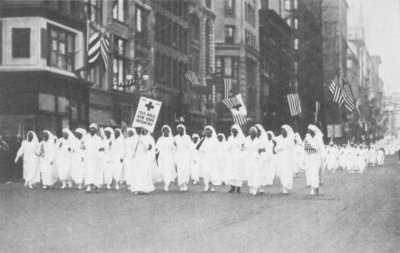 |
| NEGRO NURSES CARRYING BANNER OF FAMOUS NEGRO REGIMENT.
MARCHING DOWN FIFTH AVENUE, NEW YORK. IN GREAT PARADE WHICH
OPENED RED CROSS DRIVE. |
The 92nd division was another exclusively Negro division. There
were many more Negro troops in training in France and large
numbers at training camps in this country, but the 92nd and 93rd,
being the earlier formed and trained divisions, saw practically
all the fighting. Units belonging to one or both divisions fought
with special distinction in the Forest of Argonne, near Chateau
Thierry, Belleau Wood, St. Mihiel district, Champagne sector, at
Metz and in the Vosges mountains.
In the 92nd division was the 325th Field Signal battalion, the
only Negro signal unit in the American army. The division also
contained the 349th, 350th and 351st Artillery regiments, each
containing a machine gun battalion; the 317th Trench Mortar
battery; the balance being made up of Negro engineers, hospital
units, etc., and the 365th, 366th, 367th and 368th Infantry
regiments.
Enlisted, drafted and assigned to active service, upwards of
400,000 Negroes participated in the war. The number serving
abroad amounted to about 200,000. They were inducted into the
cavalry, infantry, field and coast artillery, radio (wireless
telegraphy, etc.), medical corps, ambulance and hospital corps,
sanitary and ammunition trains, stevedore regiments, labor
battalions, depot brigades and engineers. They also served as
regimental clerks, surveyors and draftsmen.
Sixty served as chaplains and over 350 as Y.M.C.A. secretaries,
there being a special and highly efficient Negro branch of the
Y.M.C.A. Numerous others were attached to the War Camp Community
Service in cities adjacent to the army camps.
Negro nurses were authorized by the war department for service in
base hospitals at six army camps—Funston, Sherman, Grant,
Dix, Taylor and Dodge. Race women also served as canteen workers
in France and in charge of hostess houses in this country.
One Negro, Ralph W. Tyler, served as an accredited war
correspondent, attached to the staff of General Pershing, Dr. R.
R. Moton, who succeeded the late Booker T. Washington as head of
the Tuskegee Institute, was sent on a special mission to France
by President Wilson and Secretary Baker.
A race woman, Mrs. Alice Dunbar Nelson of Wilmington, Delaware,
was named as a field worker to mobilize the Negro women of the
country for war work. Her activities were conducted in connection
with the Women's Committee of the Council of National
Defense.
The most conspicuous honor paid to a Negro by the administration
and the war department, was in the appointment, October 1, 1917,
of Emmett J. Scott as special assistant to the Secretary of War.
This was done that the administration might not be accused of
failing to grant full protection to the Negroes, and that a
thorough examination might be made into all matters affecting
their relation to the war and its many agencies.
Having been for 18 years confidential secretary to Booker T.
Washington, and being at the time of his appointment secretary of
the Tuskegee Normal and Industrial Institute for Negroes, Mr.
Scott was peculiarly fitted to render necessary advice to the war
department with respect to the Negroes of the various states, to
look after all matters affecting the interests of Negro
selectives and enlisted men, and to inquire into the treatment
accorded them by the various officials connected with the war
department. In the position occupied by him, he was thus enabled
to obtain a proper perspective both of the attitude of selective
service officials to the Negro, and of the Negro to the war,
especially to the draft. In a memorandum on the subject addressed
to the Provost Marshall General, December 12, 1918, he wrote:
"The attitude of the Negro was one of complete acceptance of the
draft, in fact of an eagerness to accept its terms. There was a
deep resentment in many quarters that he was not permitted to
volunteer, as white men by the thousands were permitted to do in
connection with National Guard units and other branches of
military service which were closed to colored men. One of the
brightest chapters in the whole history of the war is the Negro's
eager acceptance of the draft and his splendid willingness to
fight. His only resentment was due to the limited extent to which
he was allowed to join and participate in combatant or 'fighting'
units. The number of colored draftees accepted for military duty,
and the comparatively small number of them claiming exemptions,
as compared with the total number of white and colored men called
and drafted, presents an interesting study and reflects much
credit upon this racial group."
Over 1,200 Negro officers, many of them college graduates, were
commissioned during the war. The only training camp exclusively
for Negro officers was at Fort Des Moines, Iowa. This camp ran
from June 15, 1917, to October 15, 1917. A total of 638 officers
was graduated and commissioned from the camp. Negro Regulars and
Negro National Army men who had passed the tests for admission to
officers training camps were sent mainly to the training schools
for machine gun officers at Camp Hancock, Augusta, Georgia; the
infantry officers training school at Camp Pike, Little Rock,
Arkansas, and the artillery officers training school at Camp
Taylor, Louisville, Kentucky. They were trained along with the
white officers. The graduates from these camps along with a few
National Guardsmen who had taken the officers' examinations, and
others trained in France, made up the balance of the 1,200
commissioned.
In connection with the artillery training an interesting fact
developed. It had been charged that Negroes could not develop
into artilleryman. A strong prejudice against inducting them into
that branch of the service had always existed in the army. It was
especially affirmed that the Negro did not possess the
mathematical ability necessary to qualify as an expert artillery
officer. Nevertheless, out of a number of Negro aspirants, very
small in comparison with the white men in training for officers'
commissions at the camp, five of the Negroes stood alongside
their white brothers at the head of the class. The remainder were
sprinkled down the line about in the same proportion and
occupying the same relative positions as the whites. The
prejudice against the Negro as an artilleryman was further and
effectually dispelled in the record made by the 349th, 350th and
351st artillery regiments and their machine gun battalions in the
92nd division.
With the exception of the training camp for officers at Des
Moines, Iowa, no important attempt was made to establish separate
Negro training camps. In the draft quotas from each state were
whites and blacks and all with few exceptions, were sent to the
most convenient camp. Arrangements existed, however, at the
different camps for the separate housing and training of the
Negro troops. This was in line with the military policy of the
Government, as well as in deference to the judgment of both white
and black officers. It undoubtedly was necessary to separate the
two races. Furthermore, as the military policy called for
regiments, battalions and, divisions made up entirely of Negroes,
it was proper to commence the organization at the training camps.
Companies formed in this manner thus became homogeneous,
accustomed to one another individually and to their officers.
The situation was different from the Spanish-American war, where
Negro units, at least in one case, served in white regiments.
Racial strife and rivalry were eliminated. The only rivalry that
existed was the good-natured and healthy one of emulation between
members of the same race. On the field of battle there was
rivalry and emulation between the whites and blacks, but it was
the rivalry of organizations and not of races. The whole was
tempered by that splendid admiration and fellow-feeling which
comes to men of all races when engaged as partners in danger or
near death; in the defense and promotion of a great cause; the
eternal verities of Justice and Humanity.
CHAPTER
VIII.
RECRUDESCENCE OF SOUTH'S INTOLERANCE.
CONFRONTED BY RACIAL PREJUDICE—- SPLENDID ATTITUDE OF
NEGRO SHAMED IT—KEPT OUT OF NAVY—ONLY ONE PER CENT OF
NAVY PERSONNEL NEGROES—MODIFIED MARINES
CONTEMPLATED—FEW HAVE PETTY OFFICERS' GRADES—SEPARATE
SHIPS PROPOSED—NEGRO EFFICIENCY IN NAVY—MATERIAL FOR
"BLACK SHIPS"—NAVY OPENS DOOR TO NEGRO MECHANICS.
Old feelings of race prejudice and intolerance, appearing mainly
in the South, confronted the Negro at the beginning of the war.
The splendid attitude of the Negro shamed and overcame this
feeling in other sections of the country, and was beginning to
have its effect even in the South. It is true that men of the
race were not accepted for voluntary enlistment in numbers of
consequence in any section, but had the voluntary system
continued in vogue, the willingness and desire of the race to
serve, coupled with the very necessities of the case, would have
altered the condition.
No new Negro volunteer units were authorized, but the demand for
men would soon have made it imperative. It would have been
combatted by a certain element in the South, but the friends of
the few volunteer units which did exist in that section were firm
in their championship and were winning adherents to their view
that the number should be increased. The selective draft with its
firm dictum that all men within certain ages should be called and
the fit ones chosen, put an end to all contention. The act was
not passed without bitter opposition which developed in its
greatest intensity among the Southern senators and
representatives; feelings that were inspired entirely by
opposition to the Negro.
It would have been a bad thing for the country and would have
prolonged the war, and possibly might have lost it, if the
selective draft had been delayed. But it would have been
interesting to see how far the country, especially the South,
would have progressed in the matter of raising a volunteer army
without accepting Negroes. Undoubtedly they soon would have been
glad to recruit them, even in the South.
Unfortunately for the Negro, the draft was not able to prevent
their being kept out of the Navy. It is a very desirable branch
of the service vitiated and clouded, however, with many
disgusting and aristocratic traditions. When the Navy was young
and the service more arduous; when its vessels were merely armed
merchantmen, many of them simply tubs and death traps and not the
floating castles of today, the services of Negroes were not
disdained; but times and national ideals had changed, and, the
shame of it, not to the credit of a Commonwealth, for whose birth
a Negro had shed the first blood, and a Washington had faced the
rigors of a Valley Forge, a Lincoln the bullet of an
assassin.
The annual report of the Chief of the Bureau of Navigation,
rendered to the Secretary of the Navy and covering the fiscal
year ending June 30, 1918, showed that in the United States Navy,
the United States Naval Reserve Force and the National Naval
Volunteers, there was a total of 435,398 men. Of that great
number only 5,328 were Negroes, a trifle over one percent.
Between June and November 1918, the Navy was recruited to a total
force somewhat in excess of 500,000 men. Carrying out the same
percentage, it is apparent that the aggregate number of Negroes
serving, in the Navy at the close of the war, could not have been
much in excess of 6,000.
Some extra enlistments of Negroes were contemplated, as the Navy
had in process of establishment just prior to the armistice, a
new service for Negro recruits. It was to be somewhat similar to
the Pioneer units of the army, partaking in some degree of the
character of Marines, just as the Pioneers partake of the
character of infantry, but in general respects resembling more
the engineer and stevedore units. About 600 men had been selected
for this service when the project was abandoned on account of the
ending of the war.
With the exception of a very limited number who have been
permitted to attain the rank of petty officer, Negroes in the
Navy were confined to menial occupations. They were attached to
the firing forces as coal passers, while others served as cooks
assistants, mess attendants and in similar duties. Quite a number
were full rated cooks. A few were water tenders, electricians and
gunners' mates, each of which occupations entitled them to the
aforesaid rank of petty officer. Among the petty officers some
had by sheer merit attained the rank of chief petty officer,
which is about equal to the rank of sergeant in the army.
The idea of separate ships for the Negro might to some degree
ameliorate the sting incident to race prohibition in that arm of
government service. The query is advanced that if we can have
black colonels, majors, captains and lieutenants in the army, why
cannot we have black commanders, lieutenants, ensigns and such in
the Navy?
Negroes have often and in divers ways displayed their
intelligence and efficiency in the Navy. Take, for instance, the
case of John Jordan, a Negro of Virginia, who was chief gunner's
mate on Admiral Dewey's flagship the "Olympia" during the
Spanish-American war, and was the man who fired the first shot at
the enemy at Manila Bay. A Negro chief electrician, Salisbury
Brooks, was the originator of inventions which were adopted
without reservation by the Navy designers and changed the
construction of modern battle ships.
One of the principal instructors on the U.S.S. Essex, the
government training ship at Norfolk, is Matthew Anderson, a
Negro. He has trained thousands of men, many of them now
officers, in the art and duties of seamanship. Scores of Negroes;
men of the type of these in the Navy, would furnish the nucleus
for officers and crews of separate Negro ships.
In a recent issue of "Our Navy" a magazine devoted entirely to
naval affairs, especially as regards the enlisted man, a writer
reflects the opinion of these men in the following article:
"Whether you like the black man or not, whether you
believe in a square deal for him or not, you can't point an
accusing finger at his patriotism, his Americanism or his
fighting ability. It is fair to neither the white man nor the
black man to have the black man compete with the white man in the
Navy. True, we have black petty officers here and there in the
Navy, and in some cases black chief petty officers. It stands to
reason that they must have been mighty good men to advance. They
surely must know their business—every inch of it—to
advance to these ratings. Yet they are not wanted in these
ratings because they involve the black man having charge of white
men under him. Outside of the messman branch you will find
comparatively few Negroes in the Navy today.
"There should be 'black ships' assigned to be manned by American
Negroes. These are days of democracy, equality and freedom,"
continues the writer. "If a man is good enough to go over the top
and die for these principles, he is good enough to promote in the
Navy. Why not try it? Put the black men on their own ships.
Promote them, rate them, just the same as the white man. But
above all keep them on their own ships. It is fair to them and
fair to the white men. The Brazilian and Argentine navies have
'black ships.'"
Recruiting officers of the Navy have recently opened the doors to
discharged Negro soldiers, and some civilians. If physically fit
they are permitted to enlist as machinists and electricians. The
Navy has opened a school for machinists at Charleston, S.C., and
a school for electricians at Hampton Roads, Va.
Men for the machinists' school are enlisted as firemen 3rd class.
While in training they are paid $30 a month. They also receive
their clothing allotment, their food, dry comfortable quarters in
which to live, and all text books and practical working tools. In
return for this chance to become proficient in a very necessary
trade, all that is required of those enlisting is a knowledge of
common fractions, ambition to learn the trade, energy and a
strict attention to the instruction given them.
Subjects taught in the course are arithmetic, note book
sketching, practical engineering, theoretical engineering,
clipping and filing, drilling, pipe fitting, repair work,
rebabbiting, brazing, tin smithing, lathes, shapers, milling
machines and grinders. It will be seen that they get a vast
amount of mechanical knowledge and practically two trades,
machinists and engineering.
In the electrical school the course is equally thorough. The men
get a high grade of instruction, regardless of cost of material
and tools. The best text books that can be had are available for
their use.
This liberality in order to get machinists and electricians in
the Navy, argues that some change of attitude towards the Negro
is contemplated.
It may evolve into the establishment of "black ships." The Negro
sailor has been pleading for years that his color has been a bar
to him. With a ship of his own, would come his chance. He would
strive; do all within his power to make it a success and would
succeed.
CHAPTER IX.
PREVIOUS WARS IN WHICH THE NEGRO FIGURED.
SHOT HEARD AROUND THE WORLD—CRISPUS ATTUCKS—SLAVE
LEADS SONS OF FREEDOM—THE BOSTON MASSACRE—ANNIVERSARY
KEPT FOR YEARS—WILLIAM NELL, HISTORIAN—3,000 NEGROES
IN WASHINGTON'S FORCES—A STIRRING HISTORY—NEGRO WOMAN
SOLDIER—BORDER INDIAN WARS—NEGRO HEROES
Our American school histories teach us that the "shot which was
heard around the world",—the opening gun of the
Revolutionary war, was fired at Lexington in 1775. The phrase
embodies a precious sentiment; time has molded many leaders, the
inspiration for almost a century and a half of the patriotic
youth of our land. This is as it should be. All honor and all
praise to the deathless heroes of that time and occasion.
But why has not history been more just; at least, more explicit?
Why not say that the shot which started the Revolution—that
first great movement for human liberty and the emancipation of
nations—was fired five years earlier; was fired not by, but
at, a Negro, Crispus Attucks? The leader of the citizens in that
event of March 5, 1770, known as the Boston Massacre, he was the
first man upon whom the British soldiers fired and the first to
fall; the pioneer martyr for American independence.
It is perhaps fitting; a manifestation of the inscrutable ways of
Providence, that the first life given in behalf of a nation about
to throw off a yoke of bondage, was that of a representative of a
race; despised, oppressed and enslaved.
Botta the historian, in speaking of the scenes of the 5th of
March says:
"The people were greatly exasperated. The multitude
ran towards King street, crying, 'Let us drive out these ribalds;
they have no business here.' The rioters rushed furiously towards
the Custom House; they approached the sentinel, crying 'Kill him,
kill him!' They assaulted him with snowballs, pieces of ice, and
whatever they could lay their hands upon.
"The guard were then called, and in marching to the Custom House,
they encountered a band of the populace, led by a mulatto named
Attucks, who brandished their clubs and pelted them with
snowballs. The maledictions, the imprecations, the execrations of
the multitude, were horrible. In the midst of a torrent of
invective from every quarter, the military were challenged to
fire. The populace advanced to the points of their bayonets.
"The soldiers appeared like statues; the cries, the howlings, the
menaces, the violent din of bells still sounding the alarm,
increased the confusion and the horrors of these moments; at
length the mulatto Attucks and twelve of his companions, pressing
forward, environed the soldiers and striking their muskets with
their clubs, cried to the multitude: 'Be not afraid, they dare
not fire; why do you hesitate, why do you not kill them, why not
crush them at once?'
"The mulatto lifted his arms against Captain Preston, and having
turned one of the muskets, he seized the bayonet with his left
hand, as if he intended to execute his threat At this moment,
confused cries were heard: 'The wretches dare not fire!' Firing
succeeds. Attucks is slain. Other discharges follow. Three were
killed, five severely wounded and several others
slightly."
Attucks was killed by Montgomery, one of Captain Preston's
soldiers. He had been foremost in resisting and was first slain.
As proof of a front engagement, he received two balls, one in
each breast. The white men killed with Attucks were Samuel
Maverick, Samuel Gray and Jonas Caldwell.
John Adams, afterwards President of the United States, was
counsel for the soldiers in the investigation which followed. He
admitted that Attucks appeared to have been the hero of the
occasion and the leader of the people. Attucks and Caldwell, not
being residents of Boston, were buried from Faneuil Hall, the
cradle of liberty. The citizens generally participated in the
solemnities.
If the outrages against the American colonists had not been so
flagrant, and so well imbedded as indisputable records of our
history; if the action of the military authorities had not been
so arbitrary, the uprising of Attucks and his followers might be
looked upon as a common, reprehensible riot and the participants
as a band of misguided incendiaries. Subsequent reverence for the
occasion, disproves any such view. Judge Dawes, a prominent
jurist of the time, as well as a brilliant exponent of the
people, alluding in 1775 to the event, said:
"The provocation of that night must be numbered among
the master-springs which gave the first motion to a vast
machinery—a noble and comprehensive system of national
independence."
Ramsey's History of the American Revolution, says:
"The anniversary of the 5th of March was observed
with great solemnity; eloquent orators were successively employed
to preserve the remembrance of it fresh in the mind. On these
occasions the blessings of liberty, the horrors of slavery, and
the danger of a standing army, were presented to the public view.
These annual orations administered fuel to the fire of liberty
and kept it burning with an irresistible flame."
The 5th of March continued to be celebrated for the above reasons
until the anniversary of the Declaration of American Independence
was substituted in its place; and its orators were expected to
honor the feelings and principles of the former as having given
birth to the latter. On the 5th of March 1776, Washington
repaired to the intrenchments. "Remember" said he, "It is the 5th
of March, and avenge the death of your brethren."
In the introduction to a book entitled "The Colored Patriots of
the American Revolution" by William C. Nell, a Negro historian,
Harriet Beecher Stowe said in 1855:
"The colored race have been generally considered by
their enemies, and sometimes even by their friends, as deficient
in energy and courage. Their virtues have been supposed to be
principally negative ones." Speaking of the incidents in Mr.
Nell's collection she says: "They will redeem the character of
the race from this misconception and show how much injustice
there may often be in a generally accepted idea". Continuing, she
says:
"In considering the services of the colored patriots of the
Revolution, we are to reflect upon them as far more magnanimous,
because rendered to a nation which did not acknowledge them as
citizens and equals, and in whose interests and prosperity they
had less at stake. It was not for their own land they fought, not
even for a land which had adopted them, but for a land which had
enslaved them, and whose laws, even in freedom, oftener oppressed
than protected. Bravery, under such circumstances, has a peculiar
beauty and merit.
"And their white brothers—may remember that generosity,
disinterested courage and bravery, are of no particular race and
complexion, and that the image of the Heavenly Father may be
reflected alike by all. Each record of worth in this oppressed
and despised people should be pondered, for it is by many such
that the cruel and unjust public sentiment, which has so long
proscribed them, may be reversed, and full opportunities given
them to take rank among the nations of the earth."
Estimates from competent sources state that not less than 3,000
Negro soldiers did service in the American army during the
Revolution. Rhode Island first made her slaves free men and then
called on them to fight. A black regiment was raised there, of
which Colonel Christopher Green was made commander. Connecticut
furnished a black battalion under command of Colonel David
Humphrey.
Prior to the Revolution, two Virginia Negroes, Israel Titus and
Samuel Jenkins, had fought under Braddock and Washington in the
French and Indian war.
It has been said that one of the men killed when Major Pitcairn
commanding the British advance on Concord and Lexington, April
19, 1775, ordered his troops to fire on the Americans, was a
Negro bearing arms. Peter Salem a Negro did service during the
Revolution, and is said to have killed this same Major Pitcairn,
at the battle of Bunker Hill. In some old engravings of the
battle, Salem is pictured as occupying a prominent position.
These pictures were carried on some of the currency of the
Monumental bank of Charlestown, Massachusetts and the Freeman's
bank of Boston. Other black men fought at Bunker Hill, of whom we
have the names of Salem Poor, Titus Coburn, Alexander Ames,
Barzillai Lew and Gato Howe. After the war these men were
pensioned.
Prince, a Negro soldier, was Colonel Barton's chief assistant in
capturing the British officer, Major General Prescott at Newport,
R.I. Primus Babcock received an honorable discharge from the army
signed by General Washington. Lambo Latham and Jordan Freeman
fell with Ledyard at the storming of Fort Griswold. Freeman is
said to have killed Major Montgomery, a British officer who was
leading an attack on Americans in a previous fight. History does
not record whether or not this was the same or a related
Montgomery to the one who killed Crispus Attucks at Boston.
Hamet, one of General Washington's Negroes, was drawing a pension
as a revolutionary soldier as late as 1839, Oliver Cromwell
served six years and nine months in Col. Israel Shreve's regiment
of New Jersey troops under Washington's immediate command.
Charles Bowles became an American soldier at the age of sixteen
years and served to the end of the Revolution. Seymour Burr and
Jeremy Jonah were Negro soldiers in a Connecticut regiment.
A Negro whose name is not known obtained the countersign by which
Mad Anthony Wayne was enabled to take Stony Point, and guided and
helped him to do so.
Jack Grove was a Negro steward on board an American vessel which
the British captured. He figured out that the vessel could be
retaken if sufficient courage were shown. He insisted and at
length prevailed upon his captain to make the attempt, which was
successful.
There was in Massachusetts during those Revolutionary days one
company of Negro men bearing a special designation, "The Bucks."
It was a notable body of men. At the close of the war its fame
and services were recognized by John Hancock presenting to it a
beautiful banner.
The European struggle recently ended furnished a remarkable
example of female heroism and devotion to country in the case of
the Russian woman who enlisted as a common soldier in the army of
the Czar, served with distinction and finally organized an
effective unit of female soldiers known as the "Battalion of
Death." More resourceful and no less remarkable and heroic, is
the case of Deborah Gannet, a Negro woman soldier of the
Revolution, which may be summed up in the following resolution
passed by the General Court of Massachusetts during the session
of 1791:—
"XXIII—Whereas, it appears to this court that
the said Deborah Gannett enlisted, under the name of Robert
Shurtliff, in Capt Webb's company, in the Fourth Massachusetts
regiment, on May 20, 1782, and did actually perform the duties of
a soldier, in the late army of the United States to the 23rd day
of October, 1783, for which she has received no compensation;
and, whereas, it further appears that the said Deborah exhibited
an extraordinary instance of female heroism by discharging the
duties of a faithful, gallant soldier, and at the same time
preserving the virtue and chastity of her sex unsuspected and
unblemished, and was discharged from the service with a fair and
honorable character, therefore,
"Resolved, that the Treasurer of this Commonwealth be, and he
hereby is, directed to issue his note to the said Deborah for the
sum of thirty-four pounds, bearing interest from October 23,
1783."
There is not lacking evidence that Negroes distinguished
themselves in the struggles of the pioneer settlers against the
Indians. This was particularly true of the early history of
Kentucky. The following incidents are recorded in Thompson's
"Young People's History of Kentucky:"
"Ben Stockton was a slave in the family of Major
George Stockton of Fleming county. He was a regular Negro, and
though a slave, was devoted to his master. He hated an Indian and
loved to moralize over a dead one; getting into a towering rage
and swearing magnificently when a horse was stolen; handled his
rifle well, though somewhat foppishly, and hopped, danced and
showed his teeth when a prospect offered to chase 'the yaller
varmints'. His master had confidence in his resolution and
prudence, while he was a great favorite with all the hunters, and
added much to their fun on dull expeditions. On one occasion,
when a party of white men in pursuit of Indians who had stolen
their horses called at Stockton's station for reinforcements,
Ben, among others, volunteered. They overtook the savages at
Kirk's Springs in Lewis county, and dismounted to fight; but as
they advanced, they could see only eight or ten, who disappeared
over the mountain. Pressing on, they discovered on descending the
mountain such indications as convinced them that the few they had
seen were but decoys to lead them into an ambuscade at the base,
and a retreat was ordered. Ben was told of it by a man near him;
but he was so intent on getting a shot that he did not hear, and
the order was repeated in a louder tone, whereupon he turned upon
his monitor a reproving look, grimaced and gesticulated
ludicrously, and motioned to the man to be silent. He then set
off rapidly down the mountain. His white comrade, unwilling to
leave him, ran after him, and reached his side just as he leveled
his gun at a big Indian standing tiptoe on a log and peering into
the thick woods. At the crack of Ben's rifle the savage bounded
into the air and fell. The others set up a fierce yell, and, as
the fearless Negro said, 'skipped from tree to tree like
grasshoppers.' He bawled out: 'Take dat to 'member Ben—de
black white man!' and the two beat a hasty retreat.
"In the family of Capt. James Estill, who established a station
about fifteen miles south of Boonesborough, was a Negro slave,
Monk, who was intelligent, bold as a lion, and as faithful to his
pioneer friends as though he were a free white settler defending
his own rights. About daylight, March 20, 1782, when all the men
of the fort except four were absent on an Indian trail, a body of
the savages came upon Miss Jennie Glass, who was outside, but
near the station, milking—Monk being with her. They killed
and scalped Miss Glass and captured Monk. When questioned as to
the force inside the walls, the shrewd and self-possessed Negro
represented it as much greater than it was and told of
preparations for defense. The Indians were deceived, and after
killing the cattle, they retreated across the river. When the
battle of Little Mountain opened two days later, Monk, who was
still a prisoner with the Indians cried out: 'Don't give way,
Mas' Jim! There's only about twenty-five redskins and you can
whip 'em!' This was valuable and encouraging information to the
whites. When the Indians began to advance on Lieutenant Miller,
when he was sent to prevent a flank movement and guard the
horse-holders, Monk called also to him to hold his ground and the
white men would win. Instead of being instantly killed as was to
be apprehended, even though the savages might not understand his
English, he made his escape before the fight closed and got back
to his friends. On their return to the station, twenty-five
miles, without sufficient horses for the wounded, he carried on
his back, most of the way, James Berry, whose thigh was broken.
He had learned to make gunpowder, and obtaining saltpetre from
Peyton's Cave, in Madison county, he frequently furnished this
indispensable article to Estill's Station and Boonesborough. He
has been described as being five feet five inches high and
weighing two hundred pounds. He was a respected member of the
Baptist church, when whites and blacks worshipped together. He
was held in high esteem by the settlers and his young master,
Wallace Estill, gave him his freedom and clothed and fed him as
long as he lived thereafter—till about 1835.
"A year or two after the close of the Revolutionary war, a Mr.
Woods was living near Crab Orchard, Kentucky, with his wife, one
daughter (said to be ten years old), and a lame Negro man. Early
one morning, her husband being away, Mrs. Woods when a short
distance from the house, discovered seven or eight Indians in
ambush. She ran back into the house, so closely pursued that
before she could fasten the door one of the savages forced his
way in. The Negro instantly seized him. In the scuffle the Indian
threw him, falling on top. The Negro held him in a strong grasp
and called to the girl to take an axe which was in the room and
kill him. This she did by two well-aimed blows; and the Negro
then asked Mrs. Woods to let in another that he with the axe
might dispatch him as he came and so, one by one, kill them all.
By this time, however, some men from the station nearby, having
discovered that the house was attacked, had come up and opened
fire on the savages, by which one was killed and the others put
to flight."
CHAPTER X.
FROM LEXINGTON TO CARRIZAL.
NEGRO IN WAR OF 1812—INCIDENT OF THE
CHESAPEAKE—BATTLE OF LAKE ERIE—PERRY'S FIGHTERS 10
PERCENT NEGROES—INCIDENT OF THE "GOVERNOR
TOMPKINS"—COLONISTS FORM NEGRO REGIMENTS—DEFENSE OF
NEW ORLEANS—ANDREW JACKSON'S TRIBUTE—NEGROES IN
MEXICAN AND CIVIL WARS—IN THE SPANISH-AMERICAN
WAR—NEGROES IN THE PHILIPPINES—HEROES OF
CARRIZAL—GENERAL BUTLER'S TRIBUTE TO NEGROES—WENDELL
PHILLIPS ON TOUSSAINT L'OUVERTURE.
Prior to the actual war of 1812 and one of the most conspicuous
causes leading to it, was the attack on the Chesapeake, an
American war vessel. Here the Negro in the Navy figured in a most
remarkable degree. The vessel was hailed, fired upon and forced
to strike her colors by the British. She was boarded, searched
and four persons taken from the crew charged with desertion from
the English navy. Three of these were Negroes and one white. The
charge against the Negroes could not have been very strong, for
they were dismissed, while the white man was hanged.
The naval history of our second war with Great Britain is replete
with incidents concerning the participation of the Negro.
Mackenzie's history of the life of Commodore Perry states that at
the famed battle of Lake Erie, fully ten percent of the American
crews were blacks. Perry spoke highly of their bravery and good
conduct. He said they seemed to be absolutely insensible to
danger. His fighters were a motley collection of blacks, soldiers
and boys. Nearly all had been afflicted with sickness. Mackenzie
says that when the defeated British commander was brought aboard
the "Niagara" and beheld the sickly and parti-colored beings
around him, an expression of chagrin escaped him at having been
conquered by such men.
The following extract is from a letter written by Commodore
Nathaniel Shaler of the armed schooner "Governor Tompkins", dated
January 1, 1813. Speaking of a fight with a British frigate, he
said:
"The name of one of my poor fellows who was killed
ought to be registered in the book of fame and remembered with
reverence as long as bravery is considered a virtue. He was a
black man by the name of John Johnson. A twenty-four-pound shot
struck him in the hip and tore away all the lower part of his
body. In this state the poor brave fellow lay on the deck and
several times exclaimed to his shipmates: 'Fire away, boys; don't
haul the colors down.' Another black man by the name of John
Davis was struck in much the same way. He fell near me and
several times requested to be thrown overboard, saying he was
only in the way of the others. When America has such tars, she
has little to fear from the tyrants of the ocean."
With the history fresh in mind of the successful Negro
insurrection in St. Domingo, bringing out so conspicuous a
military and administrative genius as Toussaint L'Ouverture, it
is not surprising that the services of Negroes as soldiers were
not only welcomed, but solicited by various states during the War
of 1812. Excepting the battle of New Orleans, almost all the
martial glory of the struggle was on the water. New York,
however, passed a special act of the legislature and organized
two regiments of Negro troops, while there was heavy recruiting
in other states.
When in 1814 New Orleans was in danger, the free colored people
of Louisiana were called into the field with the whites. General
Andrew Jackson's commendatory address read to his colored troops
December 18, 1814, is one of the highest compliments ever paid by
a commander to his troops. He said:
"Soldiers!—when, on the banks of the Mobile, I
called you to take up arms, inviting you to partake of the perils
and glory of your white fellow-citizens, I expected much from
you; for I was not ignorant that you possessed qualities most
formidable to an invading enemy. I knew with what fortitude you
could endure hunger and thirst, and all the fatigues of a
campaign. I knew well how you loved your native country, and that
you, as well as ourselves had to defend what man holds most
dear—his parents, wife, children and property. You have
done more than I expected. In addition to the previous qualities
I before knew you to possess, I found among you a noble
enthusiasm, which leads to the performance of great things.
"Soldiers! The President of the United States shall hear how
praiseworthy was your conduct in the hour of danger, and the
representatives of the American people will give you the praise
your exploits entitle you to. Your General anticipates them in
applauding your noble ardor."
Many incidents are on record of the gallantry of Negro soldiers
and servants also serving as soldiers, in the war with Mexico.
Colonel Clay, a son of Henry Clay, was accompanied into the thick
of the battle of Buena Vista, by his Negro servant. He remained
by his side in the fatal charge and saw Clay stricken from his
horse. Although surrounded by the murderous Mexicans he succeeded
in carrying the mangled body of his master from the field.
It has been stated and the evidence seems strong, that a Negro
saved the life of General Zachary Taylor at the battle of
Monterey. The story is that a Mexican was aiming a deadly blow at
the General, when the Negro sprang between them, slew the Mexican
and received a deep wound from a lance. The Negro was a slave at
the time, but was afterwards emancipated by President Taylor.
Upwards of 200,000 colored soldiers were regularly enlisted in
the Federal army and navy during the Civil war. President Lincoln
commissioned eight Negro surgeons for field and hospital duty.
Losses sustained by the Negro troops amounting to upwards of
37,000 men, are shown to have been as heavy in proportion to the
numbers engaged, as those of the white forces.
The record of the Negro troops in the Civil war is one of uniform
excellence. Numerous official documents attest this fact, aside
from the spoken and written commendations of many high officers.
Their bravery was everywhere recognized; many distinguished
themselves and several attained to the rank of regularly
commissioned officers. Conspicuous in Negro annals of that time
is the case of Charles E. Nash, afterwards a member of congress.
He received a primary education in the schools of New Orleans,
but had educated himself largely by his own efforts. In 1863 he
enlisted in the 83rd regiment, United States Chasseurs d'Afrique
and became acting sergeant-major of that command. At the storming
of Fort Blakely he lost a leg and was honorably discharged.
Another, William Hannibal Thomas, afterwards became prominent as
an author, teacher, lawyer and legislator. His best known book
was entitled, "The American Negro: What he was, what he is, and
what he may become." He served as a soldier during the Civil War
and lost an arm in the service.
The exploit of Robert Smalls was so brilliant that no amount of
unfairness or prejudice has been able to shadow it. It is well
known to all students of the War of the Rebellion and is recorded
in the imperishable pages of history.
Smalls was born a slave at Beaufort, South Carolina, but managed
to secure some education. Having led a sea-faring life to some
extent, the early part of the war found him employed as pilot of
the Rebel transport Planter. He was thoroughly familiar with the
harbors and inlets of the South Atlantic coast. On May 31, 1862,
the Planter was in Charleston harbor. All the white officers and
crew went ashore, leaving on board a colored crew of eight men in
charge of Smalls. He summoned aboard his wife and three children
and at 2 o'clock in the morning steamed out of the harbor, passed
the Confederate forts by giving the proper signals, and when
fairly out of reach, ran up the Stars and Stripes and headed a
course for the Union fleet, into whose hands he soon surrendered
the ship. He was appointed a pilot in the United States navy and
served as such on the monitor Keokuk in the attack on Fort
Sumter; was promoted to captain for gallant and meritorious
conduct, December 1, 1863, and placed in command of the Planter,
a position which he held until the vessel was taken out of
commission in 1866. He was a member of the South Carolina
Constitutional Convention, 1868; elected same year to the
legislature, to the state senate 1870 and 1872, and was a member
of the Forty-fourth and Forty-fifth Congresses.
Among the most inspiring pages of Civil War history written by
the Negro, were the campaigns of Port Hudson, Louisiana; Fort
Wagner, South Carolina and Fort Pillow, Kentucky. Negro troops
participated in the siege of the former place by the Federal
forces under General Banks, which began in May 1863, and ended in
the surrender of the fort July 8, 1863. Fort Wagner was one of
the defenses of Charleston. It was reduced by General Gilmore,
September 6, 1863 and Negro troops contributed in a glorious and
heroic manner to the result. Fort Pillow had been taken by the
Federals and was garrisoned by a Negro regiment and a detachment
of cavalry. It was recaptured April 12, 1864 by the Confederates
under General Forrest. Practically the entire garrison was
massacred, an act that will stain forever the name of Forrest,
and the cause for which he struggled.
By the close of the Civil war, the value and fitness of the Negro
as a soldier had been so completely demonstrated that the
government decided to enlarge the Regular army and form fifty
percent of the increase from colored men. In 1866 eight new
infantry regiments were authorized of which four were to be
Negroes and four new cavalry regiments of which two were to be
Negroes. The Negro infantry regiments were numbered the 38th
39th, 40th and 41st. The cavalry regiments were known as the 9th
and 10th.
In 1869 there was a general reduction in the infantry forces of
the Regular army and the 38th and 41st were consolidated into one
regiment numbered the 24th and the 39th and 40th into one
regiment numbered the 25th. The strength and numerical titles of
the cavalry were not changed. For over forty years the colored
American was represented in our Regular Army by those four
regiments. They have borne more than their proportionate share of
hard service, including many Indian campaigns. The men have
conducted themselves so worthily as to call forth the best praise
of the highest military authorities. General Miles and General
Merritt, actively identified with the Indian wars, were
unstinting in their commendation of the valor and skill of Negro
fighters.
Between 1869 and 1889, three colored men were regularly graduated
and commissioned from the United States military academy at West
Point and served in the Regular Army as officers. They were John
H. Alexander, Charles Young and H.O. Flipper. The latter was
dismissed. All served in the cavalry. Alexander died shortly
before the Spanish-American war and up to the time of his demise,
enjoyed the confidence and esteem of his associates, white and
black. Young became major in the volunteer service during the
Spanish-American war and was placed in command of the Ninth
Battalion of Ohio volunteers. After the Spanish-American war he
returned to the Regular Army with a reduced rank, but ultimately
became a Major in that service. Upon America's entry into the
European war he was elevated to the rank of Colonel.
At the breaking out of the Spanish-American war in 1898, Negro
military organizations existed principally in the Regular Army.
These were soon filled to their maximum strength and the desire
of Negroes north and south to enlist, seemed likely to meet with
disappointment. Congress, to meet the insistence of colored men
for service, authorized the raising of ten Negro volunteer
regiments of "immunes"—men who had lived in sections where
the yellow fever and other malignant or malarial visitations had
occurred, and who had suffered from them or shown evidences that
they in all probability would be immune from the diseases. The
plan to place white men in all commands above the grade of second
lieutenant, prevented Negroes from enlisting as they otherwise
would have done. Four immune regiments were organized—the
7th, 8th, 9th and 10th.
Several of the states appreciating the value of the Negro as a
soldier and in response to his intense desire to enlist, placed
volunteer Negro organizations at the disposal of the government.
There were the Third Alabama and Sixth Virginia Infantry; Eighth
Illinois Infantry; Companies A and B Indiana Infantry;
Thirty-third Kansas Infantry, and a battalion of the Ninth Ohio
Infantry. The Eighth Illinois was officered by colored men
throughout. J.R. Marshall its first colonel commanded the
regiment during the Spanish-American war and did garrison duty in
Santiago province for some time after the war; being for a while
military governor of San Luis.
Gov. Russell of North Carolina, called out a Negro regiment, the
Third Infantry, officered by colored men throughout. Colonel
Charles Young commanding. It was not mustered into the
service.
Company L. Sixth Massachusetts Infantry, was a Negro company
serving in a white regiment. John L. Waller, deceased, a Negro
formerly United States Consul to Madagascar, was a captain in the
Kansas regiment.
About one hundred Negro second-lieutenants were commissioned in
the volunteer force during the Spanish-American war. There was a
Negro paymaster, Major John R. Lynch of Mississippi, and two
Negro chaplains, the Rev. C.T. Walker of Georgia and the Rev.
Richard Carroll of South Carolina.
Owing to the briefness of the campaign in Cuba, most of the
service of Negro troops devolved upon the Regulars who were fit
and ready. But all troops were at mobilization or training bases
and willing and anxious to serve. No pages in the history of this
country are more replete with the record of good fighting,
military efficiency and soldierly conduct, than those recording
the story of Negro troops in Cuba. Colonel Roosevelt said that
the conduct of the Ninth and Tenth Cavalry reflected honor upon
the whole American people, especially on their own race. He could
hardly say otherwise in view of the splendid support given by
those two regiments that—such is, and will continue to be
the verdict of history, saved him and his "Rough Riders" from
annihilation at San Juan Hill.
Cuba, in her struggles for freedom, had among her own people two
splendid Negro leaders, Antonio and Jose Maceo.
Following the Cuban campaign, Negro troops saw distinguished
service in the Philippine Islands uprisings. They have from time
to time since garrisoned and preserved order in those
possessions. A very limited number of Negro officers have been
attached to their racial contingents in the Philippines, and
there will be found but a few of competent military authority in
this country, who will deny that educated, intelligent and
qualified Negroes, are fitted for positions of leadership and
command.
The Negro of this country is primarily and essentially concerned
with the destiny and problems of his race. His work encouraged as
it must be, by the laws and spirit of the age, will determine his
future and mark the commencement of the elimination of the
shameful prejudice against him in the land, for which, from
Lexington to the bloody trenches of France, he has given of his
blood to preserve.
Before leaving the subject of the Negro in previous wars, it is
highly fitting to review the heroic incident of June 21, 1916, at
Carrizal, Mexico. Here is a tale of daring that to duplicate,
would tax the imagination of war fiction writers, and among
incidents of fact will range along with the Texans' defense of
the Alamo, where men fought and perished against great odds.
The occasion was the celebrated expedition conducted by General
J.J. Pershing into Mexico in pursuit of the bandit leader Villa.
A picked detachment consisting of portions of Troops C and K of
the colored Tenth Cavalry, was dispatched from Pershing's main
force towards the town of Villa Ahumada. The force was commanded
by Captain Charles T. Boyd of Troop C and Captain Lewis Morey of
Troop K. Lieutenant Adair was second in command in Troop C to
Captain Boyd. Including officers and civilian scouts, the force
numbered about 80 men.
Early on the morning of June 21, the detachment wishing to pass
through the garrisoned town of Carrizal, sought the permission of
the Mexican commander. Amidst a show of force, the officers were
invited into the town by the commander, ostensibly for a parley.
Fearing a trap they refused the invitation and invited the
Mexicans to a parley outside the town. The Mexican commander came
out with his entire force and began to dispose them in positions
which were very threatening to the Americans. Captain Boyd
informed the Mexican that his orders were to proceed eastward to
Ahumada and protested against the menacing position of the
Mexican forces. The Mexican replied that his orders were to
prevent the Americans from proceeding in any direction excepting
northward, the direction from which they had just come.
Captain Boyd refused to retreat, but ordered his men not to fire
until they were attacked. The Mexican commander retired to the
flank and almost immediately opened with machine gun fire from a
concealed trench. This was quickly followed by rifle fire from
the remainder of the force. The Mexicans outnumbered the troopers
nearly two to one and their most effective force was intrenched.
The Americans were on a flat plain, unprotected by anything
larger than bunches of cactus or sage brush. They dismounted,
laid flat on the ground and responded to the attack as best they
could. The horses were mostly stampeded by the early firing.
The spray of lead from the machine gun had become so galling that
Captain Boyd decided to charge the position. Not a man wavered in
the charge. They took the gun, the Captain falling dead across
the barrel of it just as the last Mexican was killed or put to
flight. Lieutenant Adair was also killed. The Mexicans returned
in force and recaptured the position.
Captain Morey had been concerned in warding off a flank attack.
His men fought no less bravely than the others. They finally were
driven to seek refuge in an adobe house, that is; all who were
able to reach it. Here they kept the Mexicans at bay for hours
firing through windows and holes in the walls. Captain Morey
seriously wounded, with a few of his survivors, finally escaped
from the house and hid for nearly two days in a hole. The
soldiers refused to leave their officer. When they finally were
able to leave their place of concealment, the several that were
left assisted their Captain on the road towards the main force.
Arriving at a point where reinforcements could be summoned, the
Captain wrote a report to his commander and sent his men to
headquarters with it. They arrived in record time and a party was
sent out, reaching the wounded officer in time to save his
life.
About half of the American force was wiped out and most of the
others were taken prisoners. They inflicted a much heavier loss
on the Mexicans. Among the killed was the Mexican commander who
had ordered the treacherous attack.
It may be that "someone had blundered." This was not the concern
of the black troopers; in the face of odds they fought by the
cactus and lay dead under the Mexican stars.
In closing this outline of the Negro's participation in former
wars, it is highly appropriate to quote the tributes of two
eminent men. One, General Benjamin F. Butler, a conspicuous
military leader on the Union side in the Civil War, and Wendell
Phillips, considered by many the greatest orator America ever
produced, and who devoted his life to the abolition movement
looking to the freedom of the slave in the United States. Said
General Butler on the occasion of the debate in the National
House of Representatives on the Civil Rights bill; ten years
after the bloody battle of New Market Heights; speaking to the
bill, and referring to the gallantry of the black soldiers on
that field of strife:
"It became my painful duty to follow in the track of
that charging column, and there, in a space not wider than the
clerk's desk and three hundred yards long, lay the dead bodies of
543 of my colored comrades, fallen in defense of their country,
who had offered their lives to uphold its flag and its honor, as
a willing sacrifice; and as I rode along among them, guiding my
horse this way and that way, lest he should profane with his
hoofs what seemed to me the sacred dead, and as I looked on their
bronzed faces upturned in the shining sun, as if in mute appeal
against the wrongs of the country whose flag had only been to
them a flag of stripes, on which no star of glory had ever shone
for them—feeling I had wronged them in the past and
believing what was the future of my country to them—among
my dead comrades there I swore to myself a solemn oath, 'May my
right hand forget its cunning and my tongue cleave to the roof of
my mouth, if I ever fail to defend the rights of those men who
have given their blood for me and my country this day, and for
their race forever,' and, God helping me, I will keep that
oath."
Mr. Phillips in his great oration on Toussaint L'Ouverture, the
Black of St. Domingo; statesman, warrior and
LIBERATOR,—delivered in New York City, March 11, 1863, said
among other things, a constellation of linguistic brilliants not
surpassed since the impassioned appeals of Cicero swept the Roman
Senate to its feet, or Demosthenes fired his listeners with the
flame of his matchless eloquence;
"You remember that Macaulay says, comparing Cromwell
with Napoleon, that Cromwell showed the greater military genius,
if we consider that he never saw an army till he was forty; while
Napoleon was educated from a boy in the best military schools in
Europe. Cromwell manufactured his own army; Napoleon at the age
of twenty-seven was placed at the head of the best troops Europe
ever saw. They were both successful; but, says Macaulay, with
such disadvantages, the Englishman showed the greater genius.
Whether you allow the inference or not, you will at least grant
that it is a fair mode of measurement.
"Apply it to Toussaint. Cromwell never saw an army until he was
forty; this man never saw a soldier till he was fifty. Cromwell
manufactured his own army—out of what? Englishmen—the
best blood in Europe. Out of the middle class of Englishmen, the
best blood of the island. And with it he conquered what?
Englishmen—their equals. This man manufactured his army out
of what? Out of what you call the despicable race of Negroes,
debased, demoralized by two hundred years of slavery, 100,000 of
them imported into the island within four years, unable to speak
a dialect intelligible even to each other. Yet out of this mixed,
and, as you say, despicable mass, he forged a thunderbolt, and
hurled it at what? At the proudest blood in Europe, the Spaniard,
and sent him home conquered; at the most warlike blood in Europe,
the French, and put them under his feet; at the pluckiest blood
in Europe, the English, and they skulked home to
Jamaica."
The world is acquainted with the treacherous infamy inspired by
the great Napoleon, that inveigled the Black Chieftain and
liberator of his people on shipboard, the voyage to France, and
his subsequent death—STARVED!—in the dungeon of the
prison castle of St. Joux.
Whittier, the poet evangelist, whose inspired verse contributed
much to the crystallization of the sentiment and spirit that
finally doomed African slavery in America, thus referred to the
heartless tragedy and the splendid Black who was its victim:
"Sleep calmy in thy dungeon-tomb,

  Beneath Besancon's alien sky,

Dark Haytien!—for the time shall come,

  Yea, even now is nigh—

When, everywhere, thy name shall be

Redeemed from color's infamy;

And men shall learn to speak of thee,

As one of earth's great spirits, born

In servitude, and nursed in scorn,

Casting aside the weary weight

And fetters of its low estate,

In that strong majesty of soul,

  Which knows no color, tongue or clime,

Which still hath spurned the base control

  Of tyrants through all time!"
CHAPTER XI.
HOUR OF HIS NATION'S PERIL.
NEGRO'S PATRIOTIC ATTITUDE—SELECTIVE DRAFT IN
EFFECT—FEATURES AND RESULTS—BOLD RELIANCE ON FAITH IN
A PEOPLE—NO COLOR LINE DRAWN—DISTRIBUTION OF
REGISTRANTS BY STATES—NEGRO AND WHITE REGISTRATIONS
COMPARED—NEGRO PERCENTAGES HIGHER—CLAIMED FEWER
EXEMPTIONS—INDUCTIONS BY STATES—BETTER PHYSICALLY
THAN WHITES—TABLES, FACTS AND FIGURES.
As stated in a previous chapter, the Negro's real opportunity to
show his patriotic attitude did not come until the passage of the
compulsory service law; selective draft, was the name attached to
it later and by which it was generally known.
On May 18, 1917, the day the law was enacted by congress, no
advocate of preparedness could with confidence have forecasted
the success of it. There were many who feared the total failure
of it. The history of the United States disclosed a popular
adherence to the principle of voluntary enlistment, if not a
repudiation of the principle of selection or compulsory military
service.
It was to be expected that many people would look upon the law as
highly experimental; as an act that, if it did not produce grave
disorders in the country, would fall short of the results for
which it was intended. It was fortunate for the country at this
time, that the military establishment possessed in the person of
General Crowder, one who had made a special study of selective
drafts and other forms of compulsory service, not alone in this
country, but throughout the nations of the world and back to the
beginning of recorded history. He had become as familiar with all
phases of it as though it had been a personal hobby and lifetime
pursuit.
The law was extremely plain and permitted of no guessing or legal
quibbling over its terms. It boldly recited the military
obligations of citizenship. It vested the president with the most
complete power of prescribing regulations calculated to strike a
balance between the industrial, agricultural and economic needs
of the nation on the one hand and the military need on the
other.
Within 18 days between May 18, when the law was approved, and
June 5, the day the president had fixed as registration day, a
great, administrative machine was built. Practically the entire
male citizenship of the United States within the age limits fixed
by law, twenty-one to thirty years inclusive, presented itself at
the 4,000 enrollment booths with a registered result of nearly
10,000,000 names. The project had been so systematized that
within 48 hours almost complete registration returns had been
assembled by telegraph in Washington.
The order in which the ten-million registrants were to be called
was accomplished on July 20 by a great central lottery in
Washington.
The boards proceeded promptly to call, to examine physically and
to consider claims for exemption of over one and one half million
men, a sufficient number to fill the first national quota of
687,000. Thus in less than three and one-half months the nation
had accepted and vigorously executed a compulsory service
law.
On June 5, 1918, 753,834 men were added to the rolls. On August
24, 1918, that number was increased by 159,161; finally on
September 12, 1918, under the provision of the act of August
31,1918, 13,228,762 were added to the lists of those available
for military service, which, including interim and other
accessions, amounted to a grand total of 24,234,021 enrolled and
subject to the terms of the Selective Service law. This
tremendous exhibition of man power struck terror to the heart of
the Hun and hastened him to, if possible, deliver a telling blow
against the Allies before the wonderful strength and resources of
the American nation could be brought to bear against him.
Commenting on the facility with which the selective draft was put
into effect, the report of the Provost Marshall General stated in
part:
"The expedition and smoothness with which the law was
executed emphasized the remarkable flexibility, adaptability and
efficiency of our system of government and the devotion of our
people. Here was a gigantic project in which success was staked
not on reliance in the efficiency of a man, or an hierarchy of
men, or, primarily, on a system. Here was a bold reliance on
faith in a people. Most exacting duties were laid with perfect
confidence on the officials of every locality in the nation, from
the governors of states to the registrars of elections, and upon
private citizens of every condition, from men foremost in the
industrial and political life of the nation to those who had
never before been called upon to participate in the functions of
government. By all administrative tokens, the accomplishment of
their task was magic."
No distinction regarding color or race was made in the selective
draft law, except so far as non-citizen Indians were exempt from
the draft. But the organization of the army placed Negro soldiers
in separate units; and the several calls for mobilization, were,
therefore, affected by this circumstance, in that no calls could
be issued for Negro registrants until the organizations were
ready for them. Figures of total registration given previously in
this chapter include interim accessions and some that
automatically went on the rolls after September 12, 1918.
Inasmuch as the tables prepared by the Provost Marshall General's
department deal only with those placed on the rolls on regular
registration days and do not include the accessions mentioned,
comparisons which follow will be based on those tables. They show
the total registration as 23,779,997, of which 21,489,470 were
white and 2,290,527 were black. Following is a table showing the
distribution of colored and white registrants by states:
                                   Colored
                     Total         registrants
                     Colored       June 5, 1917  Colored      Total
                     and white     Colored       registrants  colored
                     registrants.  to Sept 11,   Sept 12,     registrants.
                                   1918.         1918.
--------------------------------------------------------------------------
United States        23,779,097    1,078,331     1,212,196    2,290,527
                     =====================================================
Alabama                 444,692       81,963        81,410      163,373
Arizona                  93,078          295           680          975
Arkansas                365,754       51,176        53,659      104,835
California              787,676        3,308         6,404        9,712
Colorado                215,178        1,103         1,867        2,970
Connecticut             373,676        3,524         4,659        8,183
Delaware                 55,215        3,798         4,448        8,246
District of Columbia     89,808       11,045        15,433       26,478
Florida                 208,931       39,013        43,019       82,032
Georgia                 549,020      112,593       108,183      220,781
Idaho                   103,740          254           255          509
Illinois              1,571,717       21,816        35,597       57,413
Indiana                 639,431       11,289        16,549       27,838
Iowa                    523,957        2,959         3,022        5,981
Kansas                  381,315        5,575         7,448       13,023
Kentucky                486,599       25,850        30,182       56,032
Louisiana               391,654       76,223        82,256      158,479
Maine                   159,350          163           179          342
Maryland                313,255       26,435        32,736       59,171
Massachusetts           884,030        6,044         8,056       14,100
Michigan                871,410        6,979         8,950       15,929
Minnesota               540,003        1,541         1,809        3,350
Mississippi             344,506       81,548        91,534      173,082
Missouri                764,428       22,796        31,524       54,320
Montana                 196,999          320           494          814
Nebraska                286,147        1,614         2,417        4,031
Nevada                   29,465           69           112          172
New Hampshire            95,035           77            98          175
New Jersey              761,238       14,056        19,340       33,396
New Mexico               80,158          235           350          595
New York              2,503,290       25,974        35,299       61,273
North Carolina          480,901       73,357        69,168      142,525
North Dakota            159,391           65           165          230
Ohio                  1,387,830       28,831        35,156       63,987
Oklahoma                423,864       14,305        23,253       37,563
Oregon                  176,010          144           534          678
Pennsylvania          2,067,023       39,363        51,111       90,474
Rhode Island            134,232        1,573         1,913        3,486
South Carolina          307,229       74,265        74,912      149,177
South Dakota            142,783          144           171          315
Tennessee               474,253       43,735        51,059       94,794
Texas                   989,571       83,671        82,775      166,446
Utah                    100,038          169           392          561
Vermont                  71,464           63            89          152
Virginia                464,903       64,358        75,816      140,174
Washington              319,337          373         1,353        1,726
West Virginia           324,975       13,292        14,652       27,944
Wisconsin               584,639          718         1,117        1,835
Wyoming                  58,700          280           570          850


                                     White
                                     registrants   White       Total
                       Percent of    June 5, 1917  registrants white         Percent
                       total         to Sept 11    Sept 12,    registrants.  of total
                       registrants.  1918.         1918.                     registrants.
-----------------------------------------------------------------------------------------
United States          9.83          9,562,515     11,926,955  21,480,470    90.37
                      ===================================================================
Alabama               36.74            124,247        157,072     281,319    63.26
Arizona                1.05             39,884         52,219      92,103    98.95
Arkansas              28.66            117,111        143,808     260,919    71.34
California             1.23            312,994        464,970     777,964    98.77
Colorado               1.38             90,453        121,755     212,208    98.62
Connecticut        .   2.19            171,296        194,197     365,493    97.81
Delaware              14.93             20,761         26,208      46,969    85.07
District of Columbia  29.45             25,625         37,795      63,420    70.56
Florida               39.26             55,572         71,327     126,899    60.74
Georgia               40.22            147,604        180,635     328,239    59.78
Idaho                  0.49             45,224         58,007     103,231    99.51
Illinois               3.65            685,254        829,050   1,514,304    96.35
Indiana                4.35            272,442        339,151     611,593    95.65
Iowa                   1.14            237,744        280,232     517,976    98.86
Kansas                 3.41            161,691        206,602     368,293    96.59
Kentucky              11.52            190,060        240,507     430,567    88.43
Louisiana             40.46            103,718        129,467     233,185    59.54
Maine                  0.22             67,941         91,067     159,008    99.73
Maryland              18.89            110,066        144,018     254,084    81.11
Massachusetts          1.60            391,654        478,276     869,930    93.40
Michigan               1.83            404,040        451,441     855,481    98.17
Minnesota              0.62            247,750        288,903     538,653    99.38
Mississippi           50.24             75,977         95,447     171,424    49.76
Missouri               7.11            372,106        398,002     710,108    92.89
Montana                0.41             96,753        101,432     198,185    99.59
Nebraska               1.42            130,493        151,623     282,116    98.58
Nevada                 0.58             12,581         16,712      29,293    99.42
New Hampshire          0.18             41,617         53,243      94,860    99.82
New Jersey             4.39             18,615        409,225     727,840    95.61
New Mexico             0.74             36,776         42,787      79,563    99.26
New York               2.44          1,092,061      1,349,956   2,442,617    97.56
North Carolina        29.63            155,102        183,274     338,376    70.37
North Dakota           0.15             72,837         85,324     159,161    98.85
Ohio                   4.61            588,170        735,673   1,323,843    95.39
Oklahoma               8.86            173,851        212,450     386,301    91.15
Oregon                 0.38             69,376        105,956     175,332    99.62
Pennsylvania           4.38            353,106      1,113,443   1,976,549    95.62
Rhode Island           2.59             57,433         73,313     130,746    12
South Carolina        48.56             70,395         87,657     158,052    51.44
South Dakota           0.23             64,896         77,572     142,468    99.77
Tennessee             19.99            169,674        209,785     379,459    80.01
Texas                 16.82            376,385        446,740     823,125    83.18
Utah                   0.56             45,930         53,547      99,477    99.44
Vermont                0.21             30,819         40,493      71,312    99.79
Virginia              30.15            141,714        183,015     324,727    69.85
Washington             0.54            123,752        193,859     317,611    99.46
West Virginia          8.60            128,852        168,179     297,031    91.40
Wisconsin              0.31            265,501        317,303     582,804    99.69
Wyoming                1.45             24,612         33,238      57,850    98.56
Results of the classification of December 15, 1917 to September
11, 1918, in respect to colored and white registrants are shown
in the following table:
Colored and white classification compared.    Number.     Percent       Percent
                                                          of total         of
                                                          classified.   classified.
-----------------------------------------------------------------------------------
Total colored and white registered:
  June 5, 1917, to Sept. 11, 1918            10,640,846   100.00         -----
    Total colored registered                  1,078,331    10.13        100.00
      Class I                                   556,917    -----         51.65
      Deferred classes                          521,414    -----         -----
    Total white registered                    9,562,515    89.87        100.00
      Class I                                 3,110,659    -----         32.53
      Deferred classes                        6,451,856    -----         -----
Percentage accepted for service on calls before Dec. 15, 1917 (report for 1917).
                                  Colored         -----    -----         36.23
                                  White           -----    -----         24.75
It will be seen that a much higher percentage of Negroes were
accepted for service than of white men. It is true that
enlistments which were permitted white men but denied Negroes,
depleted the whites eligible to Class 1 to some extent. Probably
there were more Negro delinquents in proportion to their numbers
in the south than white delinquents. The conditions under which
they lived would account for that. Delinquents, under the
regulations, were placed in Class 1. Then there is the undoubted
fact that the Negro sought and was granted fewer exemptions on
the ground of dependency. Many Negroes in the south, where the
rate of pay was low, were put in Class 1 on the ground that their
allotment and allowances while in the army, would furnish an
equivalent support to their dependents. But whatever the reason,
the great fact stands out that a much greater percentage of
colored were accepted for service than white men. The following
table gives the colored and white inductions by states:
                     Total colored  Colored                     Colored   Per
                     and white      registrants,  Percentage    inducted  Percent of
                     registrants,   June 5,       of colored    June 5,   colored
                     June 5, 1917,  1917, to      and white     1917, to  registrants.
                     to Sept. 11,   Sept. 11,     registrants.  Nov. 11,
                     1918.          1918.                       1918.
----------------------------------------------------------------------------------------
United States         10,640,846    1,078,331     10.13        367,710    34.10
                     ===================================================================
Alabama                  206,210       81,963     39.75         25,874    31.57
Arizona                   40,179          295       .73             77    26.10
Arkansas                 168,287       51,176     30.4l         17,544    34.28
California               316,302        3,308      1.05            919    27.78
Colorado                  91,556        1,103      1.20            317    28.74
Connecticut              174,820        3,524      2.02            941    26.70
Delaware                  24,559        3,798     15.46          1,365    35.93
District of Columbia      36,670       11,045     30.12          4,000    36.22
Florida                   94,585       39,013     41.25         12,904    33.08
Georgia                  260,197      112,593     43.27         34,303    30.47
Idaho                     45,478          254       .56             95    37.40
Illinois                 707,070       21,816      3.09          8,754    40.13
Indiana                  283,731       11,289      3.98          4,579    40.56
Iowa                     240,703        2,959      1.23            929    31.40
Kansas                   167,266        5,575      3.33          2,127    38.15
Kentucky                 215,910       25,850     11.98         11,320    43.79
Louisiana                179,941       76,223     42.36         28,711    37.67
Maine                     68,104          163       .24             50    30.67
Maryland                 136,501       26,435     19.37          9,212    34.85
Massachusetts            397,698        6,044      1.52          1,200    19.85
Michigan                 411,019        6,979      1.70          2,395    34.32
Minnesota                249,291        1,541       .62            511    53.16
Mississippi              157,525       81,548     51.77         24,066    29.51
Missouri                 334,902       22,796      6.81          9,219    40.44
Montana                   97,073          320       .33            198    61.87
Nebraska                 132,107        1,614      1.22            642    39.78
Nevada                    12,640           59       .47             26    44.07
New Hampshire             41,694           77       .18             27    35.07
New Jersey               332,671       14,056      4.23          4,863    34.60
New Mexico                37,011          235       .63             51    21.70
New York               1,118,035       25,974      2.32          6,193    23.84
North Carolina           228,459       73,357     32.11         20,082    27.38
North Dakota              72,902           65       .09             87    -----
Ohio                     617,001       28,831      4.67          7,861    27.27
Oklahoma                 188,156       14,305      7.60          5,694    39.80
Oregon                    69,520          144       .21             68    47.22
Pennsylvania             902,469       39,363      4.36         15,392    39.10
Rhode Island              59,006        1,573      2.67            291    18.50
South Carolina           144,660       74,265     51.34         25,798    34.74
South Dakota              65,040          144       .22             62    43.06
Tennessee                213,409       43,735     20.59         17,774    40.64
Texas                    460,056       83,671     18.19         31,506    37.65
Utah                      46,099          169       .37             77    45.56
Vermont                   30,882           63       .20             22    34.92
Virginia                 206,072       64,358     31.23         23,541    36.57
Washington               124,125          373       .30            173    46.38
West Virginia            142,144       13,292      9.35          5,492    41.32
Wisconsin                266,219          718       .27            224    31.20
Wyoming                   24,892          280      1.12             95    23.93
Alaska                                                               5
Hawaii
Porto Rico


                     White         Percent of    White
                     registrants,  colored       inductions,  Percent
                     June 5,       and           June 5,      of white
                     1917, to      white         1917, to     registrants.
                     Sept. 11,     registrants.  Nov. 11,
                     1918.                       1918.
--------------------------------------------------------------------------
United States        9,562,515     89.87         2,299,157    24.04
                     =====================================================
Alabama                124,247     60.25            33,881    27.27
Arizona                 39,884     99.27             8,036    20.15
Arkansas               117,111     69.59            31,768    27.13
California             312,994     98.95            60,148    21.13
Colorado                90,453     98.80            22,487    24.86
Connecticut            171,296     97.98            31,598    18.45
Delaware                20,761     84.54             3,628    17.48
District of Columbia    25,625     69.88             5,631    21.97
Florida                 55,572     58.75            12,012    21.62
Georgia                147,604     56.73            32,538    32.04
Idaho                   45,224     99.44            12,471    27.58
Illinois               685,254     96.91            68,729    24.62
Indiana                272,442     96.02            65,170    23.92
Iowa                   237,744     98.77            65,935    27.73
Kansas                 161,691     96.67            39,778    21.60
Kentucky               190,060     88.02            47,010    24.60
Louisiana              103,718     57.64            27,494    26.51
Maine                   67,941     99.76            15,216    22.40
Maryland               110,066     80.63            24,655    22.40
Massachusetts          391,654     98.48            75,367    19.24
Michigan               404,040     98.30            94,085    23.29
Minnesota              247,750     99.38            73,169    29.53
Mississippi             75,977     48.23            19,296    25.40
Missouri               312,106     93.19            83,624    26.79
Montana                 96,753     99.67            27,142    28.O5
Nebraska               130,493     98.78            29,165    22.35
Nevada                  12,581     99.53             8,138    24.94
New Hampshire           41,617     99.82             8,377    20.13
New Jersey             318,615     95.77            66,527    20.88
New Mexico              36,776     99.37             8,811    23.96
New York             1,092,061     97.68           247,396    22.65
North Carolina         155,102     67.89            38,359    24.73
North Dakota            72,837     99.91            18,508    25.41
Ohio                   568,170     95.83           130,287    22.15
Oklahoma               173,851     92.40            59,247    34.08
Oregon                  69,376     99.79            16,090    23.19
Pennsylvania           863,106     95.64           185,819    21.53
Rhode Island            57,433     97.33            10,885    18.95
South Carolina          70,395     48.66            18,261    25.94
South Dakota            64,896     99.78            21,193    32.66
Tennessee              169,674     79.51            42,104    24.81
Texas                  376,385     81.81            85,889    22.82
Utah                    45,93O     99.63            10,711    23.32
Vermont                 30,819     99.80             6,607    21.44
Virginia               141,714     68.77            34,796    24.55
Washington             123,752     99.70            28,513    23.04
West Virginia          128,852     90.65            39,863    30.94
Wisconsin              265,501     99.73            70,758    26.65
Wyoming                 24,612     98.88             7,828    31.81
Alaska                                               1,957
Hawaii                                               5,406
Porto Rico                                          15,734
Further light on the question of more Negroes in proportion to
their numbers being selected for service than white men, is found
in a comparison of the Negroes and whites rejected for physical
reasons. The following table gives the figures for the period
between December 15, 1917 and September 11, 1918:
Colored and white physical rejections compared.  Number.   Percent of  Percent of
                                                           examined    partial
                                                                       disqualifications.
-----------------------------------------------------------------------------------------
Total, colored and white examined Dec. 15, 1917,
  to Sept. 11, 1918                              3,208,446  100.00      -----
    Group A                                      2,259,027   70.41      -----
    Disqualified partly or totally                 949,419   -----     100.00
      Group B                                       88,436    2.76       9.31
      Group C                                      339,377   10.58      35.75
      Group D                                      521,606   16.25      54.94
Total, colored examined                            458,838  100.00      -----
    Group A                                        342,277   74.60      -----
    Disqualified partly or totally                 116,561   -----     100.00
      Group B                                        9,605    2.09       8.24
      Group C                                       27,474    5.99      23.57
      Group D                                       79,482   17.32      68.19
Total white examined                             2,749,608  100.00      -----
    Group A                                      1,916,750   69.71      -----
    Disqualified partly or totally                 832,858   -----     100.00
      Group B                                       78,831    2.87       9.47
      Group C                                      311,903   11.34      37.45
      Group D                                      442,124   16.08      53.08
The percentage of Negroes unqualifiedly accepted for service, was
74.60% of the number examined; the white men accepted numbered
69.71% of the number examined. The Negroes it will be seen rated
about 5% higher physically than the whites. No better refutation
could be desired of the charge, having its inspiration in the
vanquished, but unrepentant defenders of Negro slavery, mourning
about its dead carcass, that the Negro is deteriorating
physically, or that the so-called degenerative influences of
civilization affect him in greater degree than they do the white
man.
CHAPTER XII.
NEGRO SLACKERS AND PACIFISTS UNKNOWN.
SUCH WORDS NOT IN HIS VOCABULARY—DESERTIONS
EXPLAINED—GENERAL CROWDER EXONERATES NEGRO—NO WILLFUL
DELINQUENCY—STRENUOUS EFFORTS TO MEET REGULATIONS—NO
"CONSCIENTIOUS OBJECTORS"—NO DRAFT EVADERS OR
RESISTERS—NEGRO'S DEVOTION SUBLIME—JUSTIFIES HIS
FREEDOM—FORGETS HIS SORROWS—RISES ABOVE HIS
WRONGS—TESTIMONY OF LOCAL BOARDS—GERMAN PROPAGANDA
WASTED—A NEW AMERICANISM.
The only phase of the selective draft in which the Negro seemed
to be discredited in comparison with his white brother, was in
the matter of desertions. At first glance and without proper
analysis, the record appeared to be against the Negro. Upon
detailed study, however, the case takes on a different aspect.
The records of the Provost Marshall General show that out of
474,861 reported deserters, 369,030 were white registrants, and
105,831 colored, the ratio of white reported deserters to white
registrants being 3.86, and the ratio of colored reported
deserters to colored registrants being 9.81. Everyone knows now
that many, yes, the bulk of the reported desertions among both
whites and blacks, were not desertions at all. Circumstances
simply prevented the men from keeping in touch with their local
boards or from reporting when called.
Desertions among white registrants might have shown a greater
percentage had they not availed themselves of the exemption
feature of the law. Negroes did not understand this clause in the
act so well. Besides, as previously stated, many Negroes were
placed in Class 1, even where they had dependants, because their
rate of pay in the army would enable them to contribute as much
to the support of their dependants as would their earnings
outside of army service.
This was a policy with many draft boards, but it is not exactly
clear in view of the increased earning power of the Negroes
through wartime demands for their labor. Following are the
complete figures on so-called desertions, the variances in the
several states being given:
                      Total
                      white
                      and colored
                      registrants,
                      June 5,
                      1917, to     Total         Reported     Percent of    Percent of
                      Sept. 11,    white         desertions,  total         white
                      1918.        registrants.  white.       registrants.  registrants.
----------------------------------------------------------------------------------------
United States         10,640,846   9,562,515     380,030      3.47          3.86
========================================================================================
Alabama                  206,210     194,247       3,672      1.78          2.96
Arizona                   40,179      39,884       6,930     17.36         17.40
Arkansas                 168,287     117,111       2,476      1.47          2.11
California               316,302     313,994      15,323      4.84          4.90
Colorado                  91,556      90,463       4,910      5.38          5.43
Connecticut              174,820     171,296      12,416      7.10          7.25
Delaware                  24,559      20,761         686      2.79          3.30
District of Columbia      36,670      25,625         390      1.06          1.52
Florida                   94,585      55,572       1,823      1.93          3.28
Georgia                  260,197     147,001       4,499      1.73          3.05
Idaho                     45,478      45,224       2,242      4.93          4.96
Illinois                 707,070     685,254      21,673      3.07          3.16
Indiana                  283,731     272,442       5,252      1.85          1.93
Iowa                     240,703     237,744       5,283      2.19          2.21
Kansas                   167,266     161,691       3,172      1.90          1.96
Kentucky                 215,910     190,060       2,830      1.03          1.23
Louisiana                179,941     103,718       2,250      1.25          2.17
Maine                     68,104      67,941       2,553      3.74          3.76
Maryland                 136,501     110,066       3,831      2.81          3.48
Massachusetts            397,698     391,654      19,841      4.99          5.07
Michigan                 411,019     404,040      17,222      4.19          4.26
Minnesota                249,291     247,750      10,108      4.05          4.08
Mississippi              157,525      75,977       1,713      1.09          2.25
Missouri                 334,902     312,106      10,549      3.14          3.38
Montana                   97,073      96,753       7,835      8.13          8.16
Nebraska                 132,107     130,493       2,608      1.97          2.00
Nevada                    12,640      12,581       1,392      1.10         11.06
New Hampshire             41,694      41,617       1,428      3.42          3.43
New Jersey               332,671     318,815      15,114      4.54          4.74
New Mexico                37,011      36,776       3,217      8.69          8.75
New York               1,118,035   1,092,061      57,021      5.10          5.22
North Carolina           228,459     155,102       1,175      5.14           .76
North Dakota              72,902      72,837       2,520      3.46          3.46
Ohio                     617,001     588,170      22,846      3.70          3.88
Oklahoma                 188,156     173,851       5,860      3.11          3.37
Oregon                    69,520      69,376       2,023      2.91          2.92
Pennsylvania             902,469     863,106      31,739      3.52          3.68
Rhode Island              59,006      57,433       2,340      3.97          4.07
South Carolina           144,660      70,395       1,107       .77          1.57
South Dakota              65,040      64,896       1,243      1.91          1.92
Tennessee                213,409     169,674       4,389      2.05          2.58
Texas                    460,056     376,385      19,209      4.18          5.10
Utah                      46,099      45,930       1,735      3.76          3.78
Vermont                   30,882      30,819         690      2.23          2.71
Virginia                 206,072     141,714       3,090      1.50          2.18
Washington               124,125     123,752       7,261      5.85          5.87
West Virginia            142,144     128,852       4,803      3.38          3.73
Wisconsin                266,219     265,501       4,663      1.75          1.76
Wyoming                   24,892      24,612       1,734      6.96          7.05
Alaska                                               601
Hawaii                                               184
Porto Rico                                            15


                       Total         Reported     Percent       Percent
                       colored       desertions,  of total      of colored
                       registrants.  colored.     registrants.  registrants.
----------------------------------------------------------------------------
United States          1,078,331     105,831       .99          9.81
============================================================================
Alabama                   81,963      10,835      5.25         13.22
Arizona                      295          64       .16         21.69
Arkansas                  51,176       4,770      2.83          9.32
California                 3,303         268       .08          8.10
Colorado                   1,103          91       .10          8.25
Connecticut                3,524         682       .39         19.35
Delaware                   3,798         303      1.23          7.98
District of Columbia      11,045         616      1.68          5.58
Florida                   39,013       8,319      8.71         21.32
Georgia                  112,593       8,969      3.45          7.97
Idaho                        254         108       .23         42.51
Illinois                  21,816       2,911       .41         13.34
Indiana                   11,289       1,199       .42         10.62
Iowa                       2,959         517       .21         17.47
Kansas                     5,575         255       .15          4.57
Kentucky                  25,850       1,524       .71          5.90
Louisiana                 76,223       5,962      3.31          7.82
Maine                        163          29       .04         17.79
Maryland                  26,435       2,410      1.77          9.12
Massachusetts              6,044         665      1.67         11.00
Michigan                   6,979       1,015       .25         14.54
Minnesota                  1,541         621       .25         40.30
Mississippi               81,548       8,112      5.15          9.95
Missouri                  22,796       1,791       .53          7.86
Montana                      320         114       .12         35.63
Nebraska                   1,614         229       .17         14.19
Nevada                        59           3       .02          6.08
New Hampshire                 77           3       .01          3.90
New Jersey                14,056       1,535       .46         10.92
New Mexico                   235          40       .11         17.02
New York                  25,974       4,062       .36         15.64
North Carolina            73,357       4,937      2.16          6.73
North Dakota                  65          19       .03         29.23
Ohio                      28,831       4,048       .66         14.04
Oklahoma                  14,305       1,223       .65          8.56
Oregon                       144          18       .03         12.59
Pennsylvania              39,363       6,599       .73         16.76
Rhode Island               1,573         251       .43         15.96
South Carolina            74,265       4,589      3.14          6.18
South Dakota                 144          27       .04         18.75
Tennessee                 43,735       3,573      1.67          8.17
Texas                     83,671       5,388      1.17          6.44
Utah                         169          11       .02          6.51
Vermont                       63           4       .01          6.35
Virginia                  64,358       4,935      2.39          7.67
Washington                   373          30       .02          8.04
West Virginia             13,292       2,013      1.41         15.14
Wisconsin                    718          73       .03         10.17
Wyoming                      280          63       .25         22.50
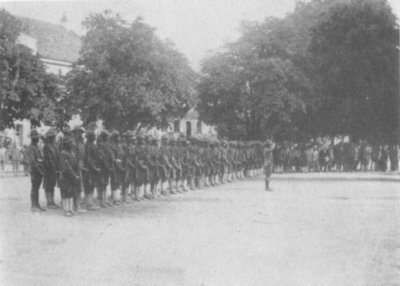 |
| NEGRO TROOPS NEWLY ARRIVED IN FRANCE, LINED UP FOR
INSPECTION. |
 |
| NEGRO TROOPS ON A PRACTICE RUN NEAR THEIR CAMP IN
FRANCE. |
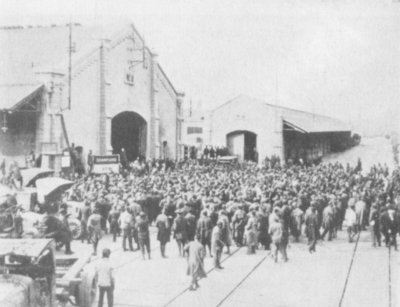 |
| OFFICIAL PHOTOGRAPHS, U.S. ARMY PRESENTATION OF BANNER TO
NEGRO STEVEDORES FOR WINNING FIRST WEEK'S "RACE TO BERLIN",
MARSEILLES, FRANCE. |
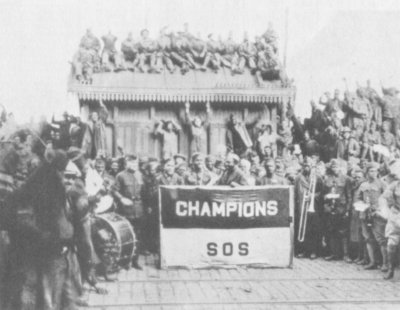 |
| OFFICIAL PHOTOGRAPHS, U.S. ARMY NEGRO WINNERS IN STEVEDORE
CONTEST BEING ENTERTAINED BY 134TH INFANTRY QUARTET AND BAND AT
MARSEILLES, FRANCE. |
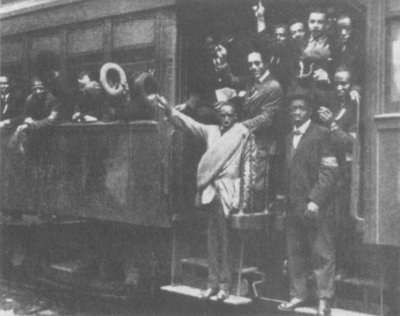 |
| GOING TO FIGHT FOR UNCLE SAM. TYPICAL GROUP OF NEGRO
SELECTIVE SERVICE MEN LEAVING FOR THE TRAINING CAMP. |
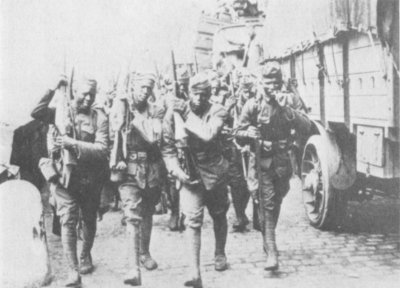 |
| NEGRO TROOPS ARRIVING IN FRANCE. A COMPARISON WITH THE UPPER
PICTURE SHOWS THE RAPID TRANSFORMATION FROM CIVILIANS TO FIGHTING
MEN. |
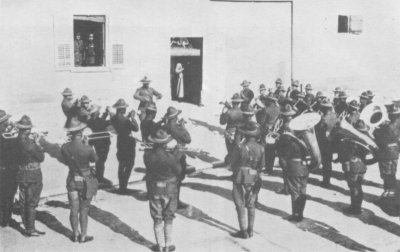 |
| "MOSS'S BUFFALOES" (367TH INFANTRY), SERENADING FAMOUS
MILITARY CHIEFTAINS IN FRANCE. IN WINDOW AT LEFT STANDS GENERAL
JOHN J. PERSHING, COMMANDER-IN-CHIEF OF AMERICAN EXPEDITIONARY
FORCES; AT RIGHT GENERAL GOURAUD, COMMANDER OF THE FOURTH FRENCH
ARMY . |
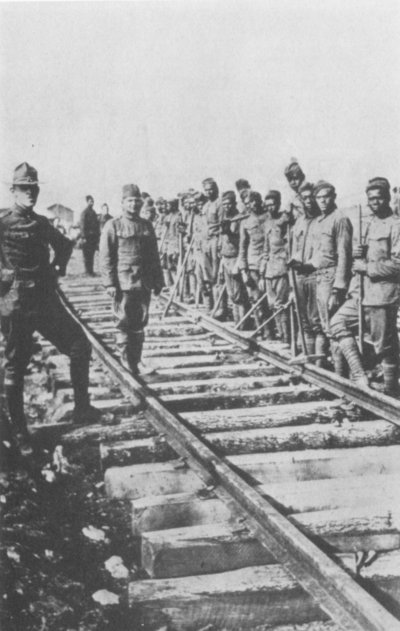 |
| HEROES OF THE BRAWNY ARM WHOSE SERVICE WAS NO LESS EFFECTIVE
THAN THAT OF THE COMBATANTS. A DETAIL OF NEGRO RAILWAY BUILDERS
ENGAGED ON THE LINE FROM BREST TO TOURS . |
 |
| NEGRO ENGINEERS BUILDING ROADS IN FRANCE. AN INDISPENSABLE
FEATURE OF THE SERVICE OF SUPPLY. |
 |
| NEGRO TROOPS IN FRANCE ENJOY AN OLD-FASHIONED MEAL. |
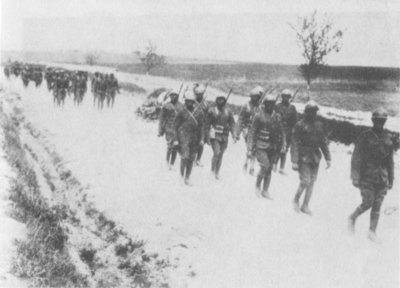 |
| NEGRO MACHINE GUNNERS ON THE ROAD NEAR MAFFRECOURT, FRANCE.
PART OF 369TH INFANTRY. |
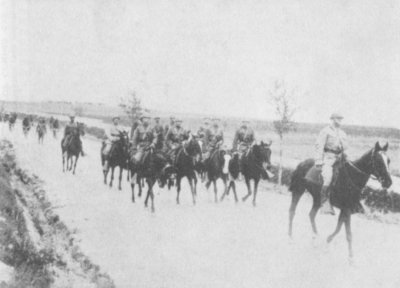 |
| CAPTAIN HINTON AND OFFICERS OF 1ST BATTALION. 369TH NEGRO
INFANTRY ON ROAD NEAR MAFFRECOURT, FRANCE. |
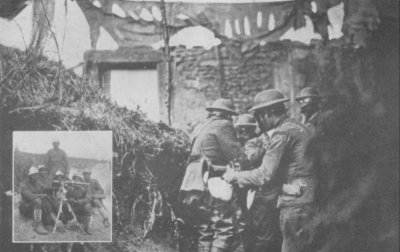 |
| AUTO HORN WARNS AMERICANS OF COMING GAS ATTACK. SOLDIERS DON
MASKS AND SOUND THE ALARM. INSERT, LEFT CORNER, MACHINE
GUNNERS. |
No elaborate defense of the Negro will be attempted in the
matter of the desertion record. It is not necessary. The words of
Provost Marshall General Crowder, the man who knew all about the
selective draft and who engineered it through its wonderfully
successful course, completely absolved the Negro in this
connection. The following quotation in reference to the above
figures is taken verbatim from the report of General Crowder to
the Secretary of War, dated December 20, 1918.
"These figures of reported desertions, however, lose
their significance when the facts behind them are studied. There
is in the files of this office, a series of letters from
governors and draft executives of southern states, called forth
by inquiry for an explanation of the large percentage of Negroes
among the reported deserters and delinquents. With striking
unanimity the draft authorities replied that this was due to two
causes; first, ignorance and illiteracy; especially in the rural
regions, to which may be added a certain shiftlessness in
ignoring civic obligations; and secondly, the tendency of the
Negroes to shift from place to place. The natural inclination to
roam from one employment to another has been accentuated by
unusual demands for labor incident to the war, resulting in a
considerable flow of colored men to the north and to various
munition centers. This shifting reached its height in the summer
of 1917, shortly after the first registration, and resulted in
the failure of many men to keep in touch with their local boards,
so that questionnaires and notices to report did not reach
them.
"With equal unanimity the draft executives report that the amount
of willful delinquency or desertion has been almost nil. Several
describe the strenuous efforts of the Negroes to comply with the
regulations, when the requirements were explained to them, many
registrants travelling long distances to report in person to the
adjutant general of the state. 'The conviction resulting from
these reports' says General Crowder, 'is that the colored men as
a whole responded readily and gladly to their military
obligations once their duties were understood."
So far as the records show, there were neither "slackers" nor
"pacifists" among the Negroes. Hon. Emmett J. Scott, Special
Assistant to the Secretary of War, said that the war department
had heard of only two colored "conscientious objectors". When
those two were cross-examined it was revealed that they had
misinterpreted their motives and that their objections proceeded
from a source very remote from their consciences.
Pacifists and conscientious objectors came principally from the
class who held religious scruples against war or the taking up of
arms. The law permitted these to enter a special so-called
non-combatant classification.
It is a well known fact that Negro religionists are members of
the church militant, so they could not be included in the
self-declared conscientious pacifistic sects.
Neither was the Negro represented in that class known as draft
resisters or draft evaders. A very good reason exists in the fact
that opposition to the draft came from a class which did not
admit the Negro to membership. Practically all draft resistance
was traceable to the activities of radicals, whose fantastic
dreams enchanted and seduced the ignorant and artless folk who
came under their influence.
The resisters were all poor whites led by professional agitators.
Negroes had no such organizations nor leaders.
The part played by the Negro in the great world drama upon which
the curtain has fallen, was not approached in sublime devotion by
that displayed by any other class of America's heterogeneous
mixture of tribe and race, hailing from all the ends of the
earth, that composes its great and wonderful population. Blind in
a sense; unreasoning as a child in the sacredness and
consecration of his fealty; clamoring with the fervor of an
ancient crusader; his eye on heaven, his steps turned towards the
Holy Sepulchre, for a chance to go; a time and place to die, HIS
was a distinct and marked patriotism; quite alone in "splendid
isolation" but shining like the sun; unstreaked with doubt;
unmixed with cavil or question, which, finally given reign on
many a spot of strife in "Sunny France"; the Stars and Stripes
above him; a prayer in his heart; a song upon his lips, spelt
death, but death glorious; where he fell—HOLY GROUND!
"The fittest place where man can DIE Is where he dies
for man!"
A product of slavery, ushered into a sphere of civil and
political activity, clouded and challenged by the sullen
resentment of his former masters; his soul still embittered by
defeat; slowly working his way through many hindrances toward the
achievement of success that would enable both him and the world
to justify the new life of freedom that had come to him; faced at
every hand by the prejudice born of tradition; enduring wrongs
that "would stir a fever in the blood of age"; still the slave to
a large extent of superstition fed by ignorance, is it to be
wondered at that some doubt was felt and expressed by the best
friends of the Negro, when the call came for a draft upon the man
power of the nation; whether, in the face of the great wrongs
heaped upon him; the persecutions he had passed through and was
still enduring, he would be able to forgive and forget; could and
would so rise above his sorrows as to reach to the height and the
full duty of citizenship; would give to the Stars and Stripes the
response that was due? On the part of many leaders among the
Negroes, there was apprehension that the sense of fair play and
fair dealing, which is so essentially an American characteristic,
when white men are involved, would not be meted out to the
members of their race.
How groundless such fears, may be seen from the statistical
record of the draft with relation to the Negro. His race
furnished its quota uncomplainingly and cheerfully. History,
indeed, will be unable to record the fullness and grandeur of his
spirit in the war, for the reason that opportunities, especially
for enlistment, as heretofore mentioned, were not opened to him
to the same extent as to the whites. But enough can be gathered
from the records to show that he was filled not only with
patriotism, but of a brand, all things considered, than which
there was no other like it.
That the men of the Negro race were as ready to serve as the
white is amply proved by the reports of local boards. A
Pennsylvania board, remarking upon the eagerness of its Negro
registrants to be inducted, illustrated it by the action of one
registrant, who, upon learning that his employer had had him
placed upon the Emergency Fleet list, quit his job. Another
registrant who was believed by the board to be above draft age
insisted that he was not, and in stating that he was not married,
explained that he "wanted only one war at a time."
The following descriptions from Oklahoma and Arkansas boards are
typical, the first serving to perpetuate one of the best epigrams
of the war:
"We tried to treat the Negroes with exactly the same
consideration shown the whites. We had the same speakers to
address them. The Rotary Club presented them with small silk
flags, as they did the whites. The band turned out to escort them
to the train; and the Negroes went to camp with as cheerful a
spirit as did the whites. One of them when asked if he were going
to France, replied: 'No, sir; I'm not going "to France". I am
going "through France".'"
"In dealing with the Negroes," the Arkansas board report says,
"the southern boards gained a richness of experience that is
without parallel. No other class of citizens was more loyal to
the government or more ready to answer the country's call. The
only blot upon their military record was the great number of
delinquents among the more ignorant; but in the majority of cases
this was traced to an ignorance of the regulations, or to the
withholding of mail by the landlord, often himself an
aristocratic slacker, in order to retain the man's
labor."
Many influences were brought to bear upon the Negro to cause him
to evade his duty to the government. Some effort in certain
sections of the country was made to induce them not to register.
That the attempt to spread German propaganda among them was a
miserable failure may be seen from the statement of the Chief of
the Bureau of Investigation of the Department of Justice, made to
the United States Senate committee:
"The Negroes didn't take to these stories, however,
as they were too loyal. Money spent in the south for propaganda
was thrown away."
Then too, these evil influences were more than offset by the
various publicity and "promotion of morale" measures carried on
through the office of the special assistant to the Secretary of
War, the Hon. Emmet J. Scott, and his assistants. Correspondence
was kept up with influential Negroes all over the country.
Letters, circulars and news items for the purpose of effecting
and encouraging continued loyalty of Negro citizens, were
regularly issued to the various papers comprising both the white
and Negro press. A special committee of 100 colored speakers was
appointed to deliver public patriotic addresses all over the
country, under the auspices of the Committee on Public
Information, stating the war aims of the government and seeking
to keep unbroken the spirit of loyalty of Negro American
citizens. A special conference of Negro editors was summoned to
Washington in June, 1918 by the same committee in order to gather
and disseminate the thought and public opinion of the various
leaders of the Negro race. Such was only a part of the work of
the department of the special assistant to the Secretary of War
in marshalling the man power of the nation.
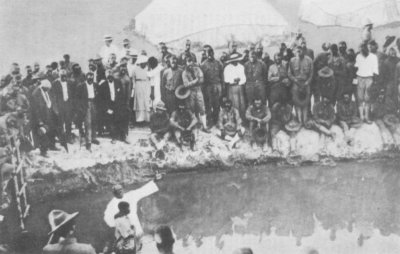 |
| NEGRO TROOPS OF U.S. ARMY RECEIVING HOLY BAPTISM WHILE IN
TRAINING FOR OVERSEAS DUTY AT NORCROSS RIFLE RANGE. CAMP CORDON,
GA. |
It is only fair to quote the opinion and appreciation of this
representative of the Negro race of the selective service
administration, especially as it affected the Negro and in
reference to occasional complaints received. The extract is from
a memorandum addressed to the office of the Provost Marshal
General on September 12, 1918 and is copied from the report of
that official to the Secretary of War:
"Throughout my tenure here I have keenly appreciated
the prompt and cordial cooperation of the Provost Marshall
General's office with that particular section of the office of
the Secretary of War especially referred to herein. The Provost
Marshall General's office has carefully investigated and has
furnished full and complete reports in each and every complaint
or case referred to it for attention, involving discrimination,
race prejudice, erroneous classification of draftees, etc., and
has rectified these complaints whenever it was found upon
investigation that there was just ground for same. Especially in
the matter of applying and carrying out the selective service
regulations, the Provost Marshall General's office has kept a
watchful eye upon certain local exemption boards which seemed
disinclined to treat the Negro draftees on the same basis as
other Americans subject to the draft law. It is an actual fact
that in a number of instances where flagrant violations have
occurred in the application of the draft law, to Negro men in
certain sections of the country, local exemption boards have been
removed bodily and new boards have been appointed to supplant
them. In several instances these new boards so appointed have
been ordered by the Provost Marshall General to reclassify
colored men who had been unlawfully conscripted into the army or
who had been wrongfully classified; as a result of this action
hundreds of colored men have had their complaints remedied and
have been properly reclassified."
It is also valuable to note the opinion of this representative of
his race as to the results of the negroes' participation in the
war:
"In a word, I believe the Negro's participation in
the war, his eagerness to serve, and his great courage and
demonstrated valor across the seas, have given him a new idea of
Americanism and likewise have given to the white people of our
country a new idea of his citizenship, his real character and
capabilities, and his 100 per cent Americanism. Incidentally the
Negro has been helped in many ways physically and mentally and
has been made into an even more satisfactory asset to the
nation."
Of the Negroes inducted into service, nearly all were assigned to
some department of the army or to special work in connection with
the army. Of the few who were permitted to enlist, a very small
percentage was permitted to enlist in the Navy. Of this small
number only a few were allowed the regular training and
opportunities of combatants, to the DISCREDIT of our nation, not
as yet, grown to that moral vision and all around greatness, NOT
to be small.
CHAPTER
XIII.
ROSTER OF NEGRO OFFICERS.
COMMISSIONED AT FORT DES MOINES—ONLY EXCLUSIVE NEGRO
TRAINING CAMP—MOSTLY FROM CIVILIAN LIFE—NAMES, RANK
AND RESIDENCE.
Fort Des Moines, Iowa, was the only training camp established in
the United States exclusively for Negro officers. A few were
trained and commissioned at Camps Hancock, Pike and Taylor, and a
few received commissions at officers' training camps in France,
but the War Department records do not specify which were white
and which Negro. The Fort Des Moines camp lasted from June until
October 1917. Following is the roster of Negro officers
commissioned. With the exception of those specified as from the
United States Army or the National Guard, all came from civilian
life:
Cleve L. Abbott, first lieutenant, Watertown, S.D.
Joseph L. Abernethy, first lieutenant, Prairie View, Tex.
Ewart G. Abner, second lieutenant, Conroe, Tex.
Charles J. Adams, first lieutenant, Selma, Ala.
Aurelious P. Alberga, first lieutenant, San Francisco, Calif.
Ira L. Aldridge, second lieutenant, New York, N.Y.
Edward I. Alexander, first lieutenant, Jacksonville, Fla.
Fritz W. Alexander, second lieutenant, Donaldsville, Ga.
Lucien V. Alexis, first lieutenant, Cambridge, Mass.
John H. Allen, captain, U.S. Army.
Levi Alexander, Jr., first lieutenant, Ocala, Fla.
Clarence W. Allen, second lieutenant, Mobile, Ala.
Richard S. Allen, second lieutenant, Atlantic City, N.J.
James W. Alston, first lieutenant, Raleigh, N.C.
Benjamin E. Ammons, first lieutenant, Kansas City, Mo.
Leon M. Anderson, first lieutenant, Washington, D.C.
Levi Anderson, first lieutenant, Washington, D.C.
Robert Anderson, first lieutenant, U.S. Army.
David W. Anthony, Jr., first lieutenant, St. Louis, Mo.
James C. Arnold, first lieutenant, Atlanta, Ga.
Russell C. Atkins, second lieutenant, Winston-Salem, N.C.
Henry O. Atwood, captain, Washington, D.C.
Charles H. Austin, second lieutenant, U.S. Army.
George J. Austin, first lieutenant. New York, N.Y.
Herbert Avery, captain, U.S. Army.
Robert S. Bamfield, second lieutenant, Wilmington, N.C.
Julian C. Banks, second lieutenant, Kansas City, Mo.
Charles H. Barbour, captain, U.S. Army.
Walter B. Barnes, first lieutenant, U.S. Army.
William I. Barnes, first lieutenant, Washington, D.C.
Stephen B. Barrows, second lieutenant, U.S. Army.
Thomas J. Batey, first lieutenant, Oakland, Cal.
Wilfrid Bazil, second lieutenant, Brooklyn, N.Y.
James E. Beard, first lieutenant, U.S. Army.
Ether Beattie, second lieutenant, U.S. Army.
William H. Benson, first lieutenant, Atlanta, Ga.
Albert P. Bentley, first lieutenant, Memphis, Tenn.
Benjamin Bettis, second lieutenant, U.S. Army.
Harrison W. Black, first lieutenant, Lexington, Ky.
Charles J. Blackwood, first lieutenant, Trinidad, Colo.
William Blaney, first lieutenant, U.S. Army.
Isaiah S. Blocker, first lieutenant, Atlanta, Ga.
William D. Bly, first lieutenant, Leavenworth, Kans.
Henry H. Boger, second lieutenant, Aurora, Ill.
Elbert L. Booker, first lieutenant, Wymer, Wash.
Virgil M. Boutte, captain, Nashville, Tenn.
Jas. F. Booker, captain, U.S. Army.
William R. Bowie, second lieutenant, Washington, D.C.
Clyde R. Brannon, first lieutenant, Fremont, Neb.
Lewis Broadus, captain, U.S. Army.
Deton J. Brooks, first lieutenant, Chicago, Ill.
William M. Brooks, second lieutenant, Des Moines, Ia.
Carter N. Brown, first lieutenant, Atlanta, Ga.
Emmet Brown, first lieutenant, St. Louis, Mo.
George E. Brown, second lieutenant, New York City, N.Y.
Oscar C. Brown, first lieutenant, Edwards, Miss.
Rosen T. Brown, first lieutenant, U.S. Army.
Samuel C. Brown, second lieutenant, Delaware, Ohio.
William H. Brown, Jr., first lieutenant, U.S. Army.
Arthur A. Browne, first lieutenant, Xenia, Ohio.
Howard R.M. Browne, first lieutenant, Kansas City, Kans.
Sylvanus Brown, first lieutenant, San Antonio, Tex.
Charles C. Bruen, first lieutenant, Mayslick, Ky.
William T. Burns, first lieutenant, U.S. Army.
James A. Bryant, first lieutenant, Indianapolis, Ind.
William L. Bryson, captain, U.S. Army.
John E. Buford, second lieutenant, Langston, Okla.
Thomas J. Bullock, second lieutenant, New York City, N.Y.
John W. Bundrant, second lieutenant, Omaha, Neb.
John P. Burgess, first lieutenant, Mullens, S.C.
Dace H. Burns, first lieutenant, Chicago, Ill.
William H. Burrell, second lieutenant, Washington, D.C.
John M. Burrell, second lieutenant, East Orange, N.J.
Herman L. Butler, first lieutenant, U.S. Army,
Homer C. Butler, first lieutenant, New York, N.Y.
Felix Buggs, second lieutenant, U.S. Army.
Napoleon L. Byrd, first lieutenant, Madison, Wis.
John B. Cade, second lieutenant, Ellerton, Ga.
Walter W. Cagle, first lieutenant, U.S. Army.
Charles W. Caldwell, second lieutenant, Orangeburg, S.C.
Andrew B. Callahan, second lieutenant, Montgomery, Ala.
Alvin H. Cameron, first lieutenant, Nashville, Tenn.
Alonzo Campbell, captain, U.S. Army.
Lafayette Campbell, second lieutenant, Union, W. Va.
Robert L. Campbell, first lieutenant, Greensboro, N.C.
William B. Campbell, first lieutenant, Austin, Tex.
Guy W. Canady, first lieutenant, Atlanta, Ga.
Lovelace B. Capehart, Jr., second lieutenant, Raleigh, N.C.
Adolphus F. Capps, second lieutenant, Philadelphia, Pa.
Curtis W. Carpenter, second lieutenant, Baltimore, Md.
Early Carson, captain, U.S. Army.
John O. Carter, first lieutenant, Washington, D.C.
Wilson Cary, second lieutenant, U.S. Army.
Robert W. Cheers, second lieutenant, Baltimore, Md.
David K. Cherry, captain, Greensboro, N.C.
Frank R. Chisholm, first lieutenant, Brooklyn, N.Y.
Robert B. Chubb, captain, U.S. Army.
Ewell W. Clark, first lieutenant, Giddings, Tex.
Frank C. Clark, second lieutenant, National Guard, Washington, D.C.
William H. Clarke, first lieutenant, Birmingham, Ala.
William H. Clarke, first lieutenant, Helena, Ark.
Roscoe Clayton, captain, U.S. Army.
Lane G. Cleaves, second lieutenant, Memphis, Tenn.
Joshua W. Clifford, first lieutenant, Washington, D.C.
Sprigg B. Coates, captain, U.S. Army.
Frank Coleman, first lieutenant, Washington, D.C.
William Collier, second lieutenant, U.S. Army.
William N. Colson, second lieutenant, Cambridge, Mass.
Leonard O. Colston, first lieutenant, U.S. Army.
Jones A. Coltrane, first lieutenant, Spokane, Wash.
John Combs, first lieutenant, U.S. Army.
Barton W. Conrad, first lieutenant, Cambridge, Mass.
Lloyd F. Cook, first lieutenant, U.S. Army.
Charles C. Cooper, captain, National Guard, District of Columbia.
George P. Cooper, first lieutenant, U.S. Army.
Joseph H. Cooper, first lieutenant, Washington, D.C.
Chesley E. Corbett, first lieutenant, Wewoka, Okla.
Harry W. Cox, first lieutenant, Sedalia, Mo.
James W. Cranson, captain, United States Army.
Horace R. Crawford, first lieutenant, Washington, D.C.
Judge Cross, first lieutenant, U.S. Army.
Clarence B. Curley, first lieutenant, Washington, D.C.
Merrill H. Curtis, first lieutenant, Washington, D.C.
Edward L. Dabney, first lieutenant, Hampton, Va.
Joe Dabney, captain, U.S. Army.
Victor R. Daly, first lieutenant, Corona, Long Island, N.Y.
Eugene A. Dandridge, first lieutenant, National Guard, District of
  Columbia.
Eugene L.C. Davidson, first lieutenant, Cambridge, Mass.
Henry G. Davis, first lieutenant, Atlanta, Ga.
Irby D. Davis, first lieutenant, Sumter, S.C.
William E. Davis, captain, Washington, D.C.
Charles C. Dawson, first lieutenant, Chicago, Ill.
William S. Dawson, first lieutenant, Chicago, Ill.
Aaron Day, Jr., captain, Prairie View, Tex.
Milton T. Dean, captain, U.S. Army.
Francis M. Dent, first lieutenant, Washington, D.C.
Thomas M. Dent, Jr., first lieutenant, Washington, D.C.
James B. Dickson, second lieutenant, Asheville, N.C.
Spahr H. Dickey, captain, San Francisco, Cal.
Elder W. Diggs, first lieutenant, Indianapolis, Ind.
William H. Dinkins, first lieutenant, Selma, Ala.
Beverly L. Dorsey, captain, U.S. Army.
Edward C. Dorsey, captain, U.S. Army.
Harris N. Dorsey, first lieutenant, U.S. Army.
Seaborn Douglas, second lieutenant, Hartford, Conn.
Vest Douglas, first lieutenant, U.S. Army.
Frank L. Drye, first lieutenant, Little Rock, Ark.
Edward Dugger, first lieutenant, Roxbury, Mass.
Jackson E. Dunn, first lieutenant, U.S. Army.
Benjamin F. Dunning, second lieutenant, Norfolk, Va.
Charles J. Echols, Jr., captain, U.S. Army.
Charles Ecton, captain, U.S. Army.
George E. Edwards, first lieutenant, U.S. Army.
Leonard Edwards, second lieutenant, Augusta, Ga.
James L. Elliott, second lieutenant, Atlanta, Ga.
Charles J. Ellis, second lieutenant, Springfield, Ill.
Harry C. Ellis, first lieutenant, Patrick, Ia.
Roscoe Ellis, captain, U.S. Army.
Leslie H. Engram, second lieutenant, Montezuma, Ga.
Alexander E. Evans, first lieutenant, Columbia, S.C.
Will H. Evans, second lieutenant, Montgomery, Tex.
Norwood C. Fairfax, second lieutenant, Eagle Rock, Va.
John R. Fairley, first lieutenant, Kansas City, Mo.
Clifford L. Farrer, first lieutenant, El Paso, Tex.
Leonard J. Faulkner, first lieutenant, Columbus, O.
William H. Fearence, first lieutenant, Texarkana, Tex.
Charles H. Fearing, first lieutenant, St. Louis, Mo.
Robert W. Fearing, second lieutenant, Brooklyn, N.Y.
Alonzo G. Ferguson, first lieutenant, Washington, D.C.
Gurnett E. Ferguson, captain, Dunbar, W. Va.
Thomas A. Firmes, captain, U.S. Army.
Dillard J. Firse, first lieutenant, Cleveland, O.
Octavius Fisher, first lieutenant, Detroit, Mich.
James E. Fladger, second lieutenant, Kansas City, Mo.
Benjamin F. Ford, first lieutenant, U.S. Army.
Edward W. Ford, second lieutenant, Philadelphia, Pa.
Frank L. Francis, second lieutenant, U.S. Army.
Henry O. Franklin, second lieutenant, San Francisco, Cal.
Ernest C. Frazier, second lieutenant, Washington, D.C.
Arthur Freeman, first lieutenant, U.S. Army.
Sewell G. Freeman, second lieutenant, Aragon, Ga.
Edward S. Gaillard, first lieutenant, Indianapolis, Ind.
Tacitus E. Gaillard, second lieutenant, Kansas City, Mo.
James H.L. Gaines, second lieutenant, Little Rock, Ark.
Ellsworth Gamblee, first lieutenant, Cincinnati, O.
Lucian P. Garrett, second lieutenant, Louisville, Ky.
William L. Gee, first lieutenant, Gallipolis, Ohio.
Clayborne George, first lieutenant, Washington, D.C.
Warmith T. Gibbs, second lieutenant, Cambridge, Mass.
Howard C. Gilbert, first lieutenant, Columbus, Ohio.
Walter A. Giles, first lieutenant, St. Louis, Mo.
Archie H. Gillespie, captain, U.S. Army
William Gillum, captain, U.S. Army.
Floyd Gilmer, first lieutenant, U.S. Army.
William Glass, captain, U.S. Army.
Jesse J. Gleeden, second lieutenant, Little Rock, Ark.
Leroy H. Godman, captain, Columbus, Ohio.
Edward L. Goodlett, second lieutenant, Atlanta, Ga.
Nathan O. Goodloe, second lieutenant, Washington, D.C.
Frank M. Goodner, first lieutenant, U.S. Army.
Elijah H. Goodwin, first lieutenant, U.S. Army.
James A. Gordon, first lieutenant, St. Joseph, Mo.
Herbert R. Gould, first lieutenant, Dedham, Mass.
James E. Gould, first lieutenant, Dedham, Mass.
Francis H. Gow, first lieutenant, Charleston, W. Va.
William T. Grady, second lieutenant, Dudley, N.C.
Jesse M.H. Graham, second lieutenant, Clarksville, Tenn.
William H. Graham, captain, U.S. Army.
Towson S. Grasty, first lieutenant, Pittsburgh, Pa.
Thornton H. Gray, first lieutenant, Fairmount Heights, Md.
Miles M. Green, captain, U.S. Army.
Thomas E. Green, first lieutenant, U.S. Army.
Walter Green, captain, U.S. Army.
Jesse J. Green, first lieutenant, Georgetown, Ky.
Thomas M. Gregory, first lieutenant, Newark, N.J.
Jefferson E. Grigsby, second lieutenant, Chapelle, S.C.,
Thomas Grundy, captain, U.S. Army.
William W. Green, captain, U.S. Army.
George B. Greenlee, first lieutenant, Marion, N.C.
Nello B. Greenlee, second lieutenant, New York, N.Y.
Herbert H. Guppy, second lieutenant, Boston, Mass.
George C. Hall, captain, U.S. Army.
Leonidas H. Hall, Jr., second lieutenant, Philadelphia, Pa.
George W. Hamilton, Jr., first lieutenant, Topeka, Kans.
Rodney D. Hardeway, second lieutenant, Houston, Tex.
Clarence W. Harding, first lieutenant, U.S. Army.
Clifton S. Hardy, second lieutenant, Champaign, Ill.
Clay Harper, first lieutenant, U.S. Army.
Ted O. Harper, second lieutenant, Columbus, Ohio.
Tillman H. Harpole, first lieutenant, Kansas City, Mo.
Bravid W. Harris, Jr., first lieutenant, Warrenton, N.C.
Edward H. Harris, first lieutenant, U.S. Army.
Eugene Harris, captain, U.S. Army.
William Harris, first lieutenant, U.S. Army.
Byrd McD. Hart, captain, U.S. Army.
Albert L. Hatchett, first lieutenant, San Antonio, Tex.
Lawrence Hawkins, second lieutenant, Bowie, Md.
Charles M. Hayes, second lieutenant, Hopkinsville, Ky.
Merriam C. Hayson, first lieutenant, Kenilworth, D.C.
Alonzo Heard, captain, U.S. Army.
Almando Henderson, first lieutenant, U.S. Army.
Douglas J. Henderson, first lieutenant, Washington, D.C.
Robert M. Hendrick, first lieutenant, Tallahassee, Fla.
Thomas J. Henry, Jr., first lieutenant, Atlanta, Ga.
Vodrey Henry, first lieutenant, U.S. Army.
Jesse S. Heslip, first lieutenant, Toledo, Ohio.
Lee J. Hicks, captain, Ottawa, Kans.
Victor La Naire Hicks, second lieutenant, Columbia, Mo.
Arthur K. Hill, first lieutenant, Lawrence, Kans.
Daniel G. Hill, Jr., second lieutenant, Cantonsville, Md.
Walter Hill, first lieutenant, U.S. Army.
William Hill, captain, U.S. Army.
Clarence O. Hilton, first lieutenant, Farmville, Va.
Lowell B. Hodges, first lieutenant, Houston, Tex.
Horatio B. Holder, first lieutenant, Cairo, Ga.
George A. Holland, captain, U.S. Army.
James G. Hollingsworth, captain, U.S. Army.
George C. Hollomand, second lieutenant, Washington, D.C.
Wayne L. Hopkins, second lieutenant, Columbus, Ohio.
James L. Horace, second lieutenant, Little Rock, Ark.
Reuben Homer, captain, U.S. Army.
Charles S. Hough, second lieutenant, Jamestown, Ohio.
Charles H. Houston, first lieutenant, Washington, D.C.
Henry C. Houston, captain, U.S. Army.
Cecil A. Howard, first lieutenant, Washington, D.C.
Clarence K. Howard, second lieutenant, Montgomery, Ala.
Charles P. Howard, first lieutenant, Des Moines, Ia.
Arthur Hubbard, first lieutenant, U.S. Army.
Jerome L. Hubert, first lieutenant, Houston, Tex.
William H. Hubert, second lieutenant, Mayfield, Ga.
Jefferson E. Hudgins, first lieutenant, U.S. Army.
Samuel M. Huffman, first lieutenant, Columbus, Ohio.
Samuel A. Hull, first lieutenant, Jacksonville, Fla.
John R. Hunt, first lieutenant, Washington, D.C.
Bush A. Hunter, second lieutenant, Lexington, Ky.
Benjamin H. Hunton, first lieutenant, Newport News, Va.
Frederick A. Hurt, first lieutenant, Washington, D.C.
Walter L. Hutcherson, first lieutenant, Amherst, Va.
Samuel B. Hutchinson, Jr., second lieutenant, Boston, Mass.
James E. Ivey, second lieutenant, Atlanta, Ga.
Beecher A. Jackson, first lieutenant, Texarkana, Tex.
George W. Jackson, first lieutenant, Ardmore, Mo.
Joseph T. Jackson, first lieutenant, Charleston, W. Va.
Landen Jackson, first lieutenant, U.S. Army.
Matthew Jackson, captain, U.S. Army.
Maxey A. Jackson, second lieutenant, Marian, Ky.
Joyce G. Jacobs, second lieutenant, Chicago, Ill.
Wesley H. Jamison, second lieutenant, Topeka, Kans.
Charles Jefferson, second lieutenant, U.S. Army.
Benjamin R. Johnson, first lieutenant, New York, N.Y.
Campbell C. Johnson, first lieutenant, Washington, D.C.
Ernest C. Johnson, second lieutenant, Washington D.C.
Everett W. Johnson, first lieutenant, Philadelphia, Pa.
Hanson Johnson, captain, U.S. Army.
Hillery W. Johnson, second lieutenant, Philadelphia, Pa.
Joseph L. Johnson, second lieutenant, Philadelphia, Pa.
Merle O. Johnson, first lieutenant, U.S. Army.
Robert E. Johnson, second lieutenant, Washington, D.C.
Thomas Johnson, captain, U.S. Army.
Virginius D. Johnson, first lieutenant, Richmond, Va.
William N. Johnson, second lieutenant, Omaha, Neb.
William T. Johnson, first lieutenant, U.S. Army.
Willie Johnson, first lieutenant, U.S. Army.
Charles A. Jones, second lieutenant, San Antonio, Tex.
Clifford W. Jones, first lieutenant, U.S. Army.
Dee Jones, captain, U.S. Army.
Edward D. Jones, second lieutenant, Hartford, Conn.
James W. Jones, captain, Washington, D.C.
James O. Jones, second lieutenant, Paulding, Ohio.
Paul W. Jones, first lieutenant, Washington, D.C.
Percy L. Jones, second lieutenant, U.S. Army.
Vivian L. Jones, second lieutenant, Des Moines, Ia.
Warren F. Jones, captain, U.S. Army.
William Jones, first lieutenant, U.S. Army.
Charles G. Kelly, captain, Tuskegee, Ala.
Elliott H. Kelly, first lieutenant, Camden, S.C.
John B. Kemp, captain, U.S. Army.
John M. Kenney, captain, U.S. Army.
Will Kernts, first lieutenant, U.S. Army.
Otho E. Kerr, first lieutenant, Hampton, Va.
Orestus J. Kincaid, first lieutenant, U.S. Army.
Jesse L. Kimbrough, first lieutenant, Los Angeles, Cal.
Moses King, first lieutenant, U.S. Army.
Laurence E. Knight, first lieutenant, U.S. Army.
Edward C. Knox, first lieutenant, U.S. Army.
John W. Knox, second lieutenant, Washington, D.C.
Azzie B. Koger, first lieutenant, Reidsville, N.C.
Linwood G. Koger, first lieutenant, Washington, D.C.
Charles E. Lane, Jr., first lieutenant, Washington, D.C.
David A. Lane, Jr., first lieutenant, Washington, D.C.
Frank L. Lane, second lieutenant, Houston, Tex.
Benton R. Latimer, first lieutenant, Warrenton, Ga.
Ernest W. Latson, first lieutenant, Jacksonville, Fla.
Laige I. Lancaster, first lieutenant, Hampton, Va.
Oscar G. Lawless, first lieutenant, New Orleans, La.
Samuel Lawson, second lieutenant, Philadelphia, Pa.
Wilfred W. Lawson, first lieutenant, Washington, D.C.
Geo. E. Lee, second lieutenant, Washington, D.C.
George W. Lee, second lieutenant, Memphis, Tenn.
Lawrence A. Lee, second lieutenant, Hampton, Va.
John E. Leonard, first lieutenant, U.S. Army.
Garrett M. Lewis, first lieutenant, San Antonio, Tex.
Henry O. Lewis, first lieutenant, Boston, Mass.
Everett B. Liggins, second lieutenant, Austin, Tex.
Victor C. Lightfoot, second lieutenant, South Pittsburg, Tenn.
John Q. Lindsey, first lieutenant, U.S. Army.
Redden L. Linton, second lieutenant, Boston, Ga.
Glenda W. Locust, second lieutenant, Sealy, Tenn.
Aldon L. Logan, first lieutenant, Lawrence, Kans.
James B. Lomack, first lieutenant, National Guard, Dist. of Columbia.
Howard H. Long, first lieutenant, Washington, D.C.
Victor Long, first lieutenant, U.S. Army.
Lonnie W. Lott, second lieutenant, Austin, Tex.
Charles H. Love, second lieutenant, Atlanta, Ga.
Edgar A. Love, first lieutenant, Baltimore, Md.
Frank W. Love, captain, U.S. Army.
George B. Love, first lieutenant, Greensboro, N.C.
John W. Love, first lieutenant, Baltimore, Md.
Joseph Lowe, captain, U.S. Army.
Walter Lowe, first lieutenant, St Louis, Mo.
Charles C. Luck, Jr., second lieutenant, San Marcus, Tex.
Walter Lyons, first lieutenant, U.S. Army.
Harry J. Mack, second lieutenant, Cheney, Pa.
Amos B. Madison, first lieutenant, Omaha, Neb.
Edgar F. Malone, second lieutenant, U.S. Army.
Edgar O. Malone, captain, U.S. Army.
Earl W. Mann, first lieutenant, Champaign, Ill.
Vance H. Marchbanks, captain, U.S. Army.
Leon F. Marsh, first lieutenant, Berkeley, Cal.
Alfred E. Marshall, second lieutenant, Greenwood, S.C.
Cyrus W. Marshall, second lieutenant, Baltimore, Md.
Cuby Martin, first lieutenant, U.S. Army.
Joseph H. Martin, first lieutenant, Washington, D.C.
Eric P. Mason, first lieutenant, Giddings, Tex.
Denis McG. Matthews, first lieutenant, Los Angeles, Cal.
Joseph E. Matthews, second lieutenant, Cleburne, Tex.
Anderson N. May, captain, Atlanta, Ga.
Walter H. Mazyck, first lieutenant, Washington, D.C.
Peter McCall, captain U.S. Army.
Milton A. McCrimmon, captain, U.S. Army.
Robert A. McEwen, second lieutenant, E. St. Louis, Ill.
Osceola E. McKaine, first lieutenant, U.S. Army.
James E. McKey, first lieutenant, U.S. Army.
Carey McLane, first lieutenant, U.S. Army.
Archie McLee, first lieutenant, New York, N.Y.
Leonard W. McLeod, first lieutenant, Hampton, Va.
Albert McReynolds, first lieutenant, U.S. Army.
Marshall Meadows, first lieutenant, U.S. Army.
Louis R. Mehlinger, captain, Washington, D.C.
Louis R. Middleton, first lieutenant, Washington, D.C.
Benjamin H. Mills, first lieutenant, U.S. Army.
Harry W. Mills, captain, U.S. Army.
Warren N. Mims, first lieutenant, U.S. Army.
J. Wardlaw Mitchell, second lieutenant, Milledgeville, Ga.
Pinkney L. Mitchell, second lieutenant, Austin, Tex.
John H. Mitcherson, first lieutenant, U.S. Army.
Ralph E. Mizell, second lieutenant, Champaign, Ill.
Hubert M. Moman, second lieutenant, Tougaloo, Miss.
John M. Moore, first lieutenant, Meridian, Miss.
Loring B. Moore, second lieutenant, Brunswick, Ga.
Elias A. Morris, first lieutenant, Helena, Ark.
Thomas E. Morris, captain, U.S. Army.
James B. Morris, second lieutenant, Des Moines, Ia.
Cleveland Morrow, first lieutenant, U.S. Army.
Henry Morrow, first lieutenant, U.S. Army.
Abraham Morse, first lieutenant, U.S. Army.
Benjamin H. Mosby, first lieutenant, St. Louis, Mo.
Benedict Mosley, first lieutenant, U.S. Army.
Scott A. Moyer, second lieutenant, U.S. Army.
Albert C. Murdaugh, second lieutenant, Columbia, S.C.
Alonzo Myers, captain, Philadelphia, Pa.
Thomas J. Narcisse, second lieutenant, Jeanerette, La.
Earl H. Nash, second lieutenant, Atlanta, Ga.
Homer G. Neely, first lieutenant, Palestine, Tex.
Gurney E. Nelson, second lieutenant, Greensboro, N.C.
William S. Nelson, first lieutenant, Washington, D.C.
William F. Nelson, first lieutenant, Atlanta, Ga.
James P. Nobles, first lieutenant, U.S. Army.
Grafton S. Norman, first lieutenant, Atlanta, Ga.
Richard M. Norris, first lieutenant, U.S. Army.
Ambrose B. Nutt, second lieutenant, Cambridge, Mass.
Benjamin L. Ousley, second lieutenant, Tougaloo, Miss.
Charles W. Owens, captain, United States Army.
Charles G. Owlings, second lieutenant, Norfolk, Va.
William W. Oxley, first lieutenant, Cambridge, Mass.
Wilbur E. Pannell, second lieutenant, Staunton, Va.
Charles S. Parker, second lieutenant, Spokane, Wash.
Walter E. Parker, second lieutenant, Little Rock, Ark.
Clemmie C. Parks, first lieutenant, Ft. Scott, Kans.
Adam E. Patterson, captain, Chicago, Ill.
Humphrey C. Patton, first lieutenant, Washington, D.C.
Clarence H. Payne, first lieutenant, Chicago, Ill.
William D. Peeks, captain, U.S. Army.
Robert R. Penn, first lieutenant, New York, N.Y.
Marion R. Perry, second lieutenant, Pine Bluff, Ark.
Hanson A. Person, second lieutenant, Wynne, Ark.
Harry B. Peters, second lieutenant, Atlanta, Ga.
James H. Peyton, second lieutenant, Montgomery, Ala.
Joseph Phillips, captain, Columbus, Ohio.
David A. Pierce, second lieutenant, Clarksville, Tenn.
Harrison J. Pinkett, first lieutenant, Omaha, Nebr.
James C. Pinkston, first lieutenant, U.S. Army.
Percival R. Piper, first lieutenant, Washington, D.C.
Anderson F. Pitts, first lieutenant, Chicago, Ill.
Fisher Pride, first lieutenant, U.S. Army.
Herman W. Porter, second lieutenant, Cambridge, Mass.
James C. Powell, first lieutenant, Washington, D.C.
Wade H. Powell, second lieutenant, Atlanta, Ga.
William J. Powell, first lieutenant, Chicago, Ill.
Gloucester A. Price, second lieutenant, Fort Meyer, Fla.
John F. Pritchard, first lieutenant, U.S. Army.
Henry H. Proctor, first lieutenant, Atlanta, Ga.
John H. Purnell, first lieutenant, Trappe, Md.
Howard D. Queen, captain, U.S. Army.
Richard R. Queen, second lieutenant, Washington, D.C.
Harold L. Quivers, first lieutenant, Washington, D.C.
Washington H. Racks, second lieutenant, U.S. Army.
John E. Raiford, second lieutenant, Atlanta, Ga.
Hazel L. Raine, first lieutenant, U.S. Army.
Fred D. Ramsey, first lieutenant, Wedgefleld, S.C.
James O. Redmon, second lieutenant, Newton, Iowa.
Charles G. Reed, first lieutenant, Charleston, S.C.
Rufus Reed, captain, U.S. Army.
Lightfoot H. Reese, second lieutenant, Newman, Ga.
William L. Reese, second lieutenant, Bennetsville, S.C.
Robert S. Reid, second lieutenant, Newman, Ga.
Samuel Reid, captain, U.S. Army.
Adolph Reyes, second lieutenant, Philadelphia, Pa.
Elijah Reynolds, captain, U.S. Army.
John F. Rice, first lieutenant, Chicago, Ill.
Douglas C. Richardson, second lieutenant, Washington, D.C.
Harry D. Richardson, first lieutenant, Washington, D.C.
Leonard. H. Richardson, first lieutenant, Oakland, Cal.
Maceo A. Richmond, second lieutenant, Des Moines, Ia.
Francis E. Rivers, first lieutenant, New Haven, Conn.
Marion C. Rhoten, first lieutenant, U.S. Army.
Charles E. Roberts, first lieutenant, Atlantic City, N.J.
Clyde Roberts, second lieutenant, U.S. Army.
Edward Robertson, second lieutenant, U.S. Army.
Charles W. Robinson, second lieutenant, Cleveland, Ohio.
George C. Robinson, first lieutenant, Atlanta, Ga.
Peter L. Robinson, first lieutenant, Washington, D.C.
William W. Robinson, first lieutenant, U.S. Army.
Julian P. Rogers, first lieutenant, Montgomery, Ala.
John W. Rowe, first lieutenant, Danville, Ky.
Thomas Rucker, captain, U.S. Army.
Edward P. Rudd, first lieutenant, New York City.
Mallalieu W. Rush, first lieutenant, Atlanta, Ga.
John Russell, captain, U.S. Army.
Louis H. Russell, second lieutenant, New York, N.Y.
Earl Ryder, second lieutenant, Springfield, Ill.
Chester Sanders, captain, U.S. Army.
Joseph B. Sanders, second lieutenant, U.S. Army.
Walter R. Sanders, captain, U.S. Army.
Clifford A. Sandridge, captain, U.S. Army.
Lorin O. Sanford, captain, U.S. Army.
Elliott D. Saunders, second lieutenant, U.S. Army.
Walker L. Savoy, second lieutenant, Washington, D.C.
Elmer P. Sawyer, second lieutenant, Providence, R.I.
George S. Schuyler, first lieutenant, U.S. Army.
James E. Scott, second lieutenant, Washington, D.C.
James E. Scott, first lieutenant, Hampton, Va.
Joseph H. Scott, first lieutenant, Darlington, S.C.
Walter W. Scott, second lieutenant, Brooksville, Miss.
William F. Scott, captain, U.S. Army.
Fletcher Sewell, captain, U.S. Army.
Shermont R. Sewell, first lieutenant, Washington, D.C.
Charles A. Shaw, first lieutenant, Atlanta, Ga.
Warren B. Shelton, second lieutenant, Hot Springs, Ark.
Robert T. Shobe, first lieutenant, U.S. Army.
Hal Short, first lieutenant, Iowa City, Ia.
Harry W. Short, second lieutenant, Iowa City, Ia.
Ogbon N. Simmons, first lieutenant, Waldo, Fla.
Richard Simmons, captain, U.S. Army.
William E. Simmons, first lieutenant, Burlington, Vt.
Austin Simms, second lieutenant, Darien, Ga.
John H. Simms, Jr., first lieutenant, Jacksonville, Fla.
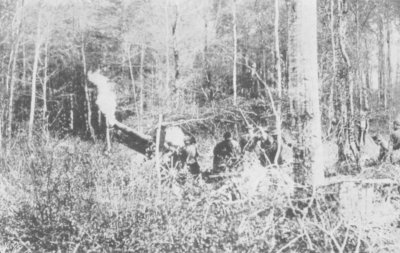 |
| ARTILLERY AT WORK IN A FRENCH FOREST. THIS WAS A PHASE OF
OPERATION IN WHICH THE NEGRO UNITS OF THE 167TH BRIGADE
DISTINGUISHED THEMSELVES IN THE CLOSING DAYS OF THE WAR |
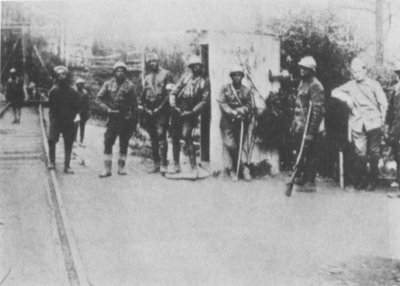 |
| SENTRY BOX OUTSIDE OF REGIMENTAL HEADQUARTERS WITH WARNING
HORN FOR GAS ATTACKS. CAMOUFLAGED GATE ON THE LEFT. |
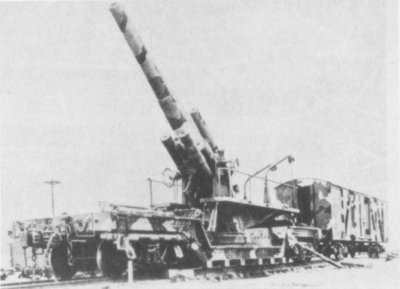 |
| ONE OF THE HUGE GUNS, 16-INCH CALIBER OF THE AMERICAN RAILWAY
ARTILLERY, WHICH DID SUCH FRIGHTFUL EXECUTION NEAR THE CLOSE OF
THE WAR. CAMOUFLAGED THROUGHOUT. |
 |
| A RAILROAD IN FRANCE. THIS ONE WAS USED BY A PORTION OF THE
93RD DIVISION IN THE CHAMPAGNE TO TRANSPORT TROOPS AND SUPPLIES
TO THE FRONT. |
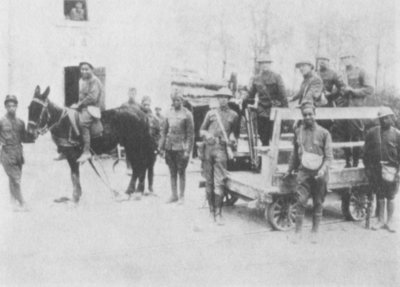 |
| PASSENGER CARS USED BY FAMOUS 93RD. NEGRO DIVISION IN
CHAMPAGNE, FRANCE. |
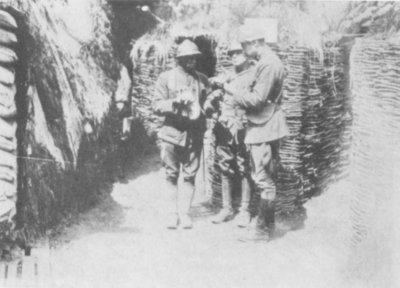 |
| SENDING MESSAGE BY CARRIER PIGEON. OFFICER AND SOLDIERS OF
369TH INFANTRY OUTSIDE OF DUGOUT IN FRANCE. |
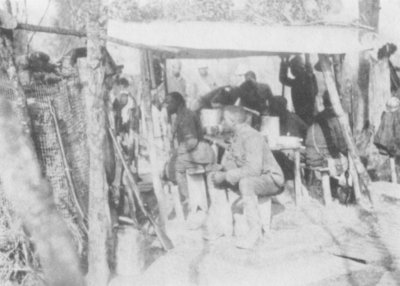 |
| KITCHEN AND DINING QUARTERS AT THE FRONT. SOLDIERS BELONG TO
FAMOUS 93RD DIVISION AMERICAN NEGRO SOLDIERS BRIGADED WITH THE
FRENCH. |
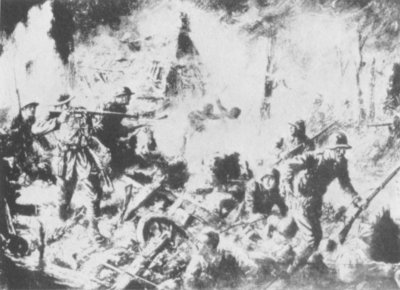 |
| INFANTRY AND GUNNERS AT CLOSE GRIPS. DRAWING REPRESENTS A
BRILLIANT COUNTER-ATTACK IN A SHELL-TORN WOOD IN FRANCE. |
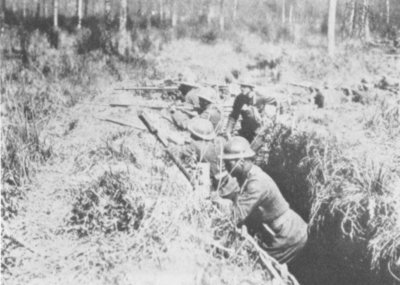 |
| A TYPICAL TRENCH SCENE. NEGROES OF THE 93RD DIVISION SERVING
WITH FRENCH IN THE CHAMPAGNE. |
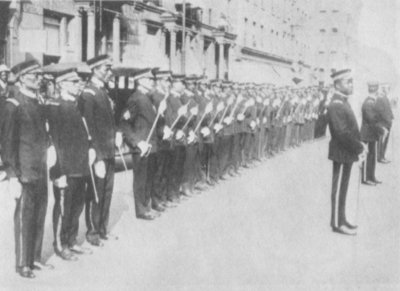 |
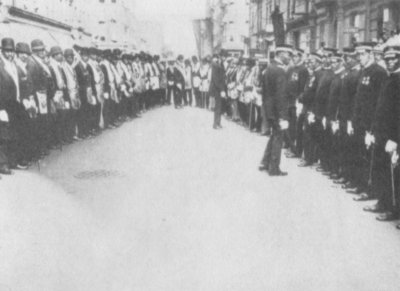 |
| SECRET ORGANIZATIONS PRESENT AT THE BREAKING OF THE GROUND
FOR McDONOUGH MEMORIAL HOSPITAL, W. 133RD STREET, NEW YORK. NAMED
IN HONOR OF MR. DAVID KEARNEY McDONOUGH, PIONEER NEGRO PHYSICIAN
OF THAT CITY. TO BE USED AS A BASE UNIT FOR COLORED
SOLDIERS. |
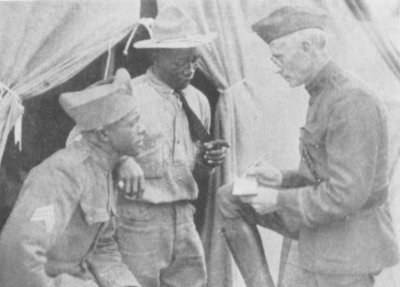 |
| LIEUT. JOHN APPLEBEE OF THE RED CROSS HOME SERVICE,
COMFORTING AND REASSURING SOLDIERS ANXIOUS ABOUT THE WELFARE OF
THEIR FAMILIES. CAMP NO. 43. GIEVRES. FRANCE. |
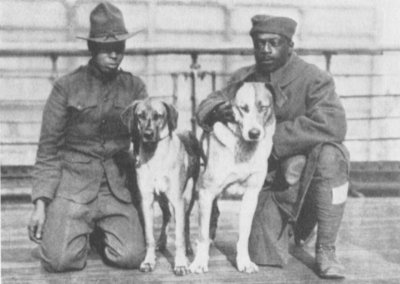 |
| CROWN PRINCE AND KAISER BILL. TWO GERMAN DOGS AND THEIR
CAPTORS. THE SOLDIERS ARE PRIVATES ROBINSON CLEVE, 539TH
ENGINEERS AND DANIEL NELSON, 372ND INFANTRY. |
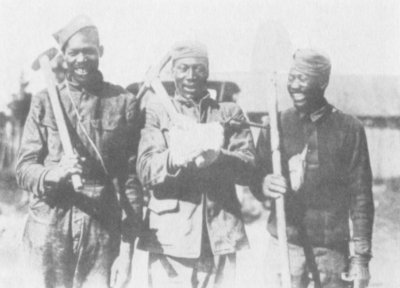 |
| TYPES OF NEGRO ENGINEERS WHO WERE SUCH IMPORTANT FACTORS IN
OUR OVERSEAS FORCES. |
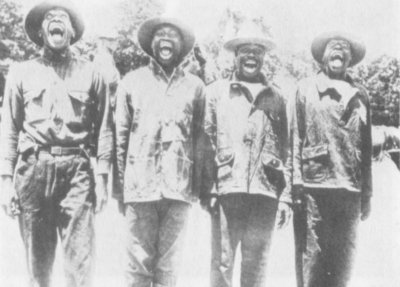 |
| FOUR CAVERNS, STUDDED WITH IVORY, FURNISH HARMONY IN THE
TRAINING CAMP. |
Abraham L. Simpson, captain, Louisville, Ky.
Lawrence Simpson, first lieutenant, Chicago, Ill.
William R. Smalls, first lieutenant, Manassas, Va.
Daniel Smith, captain, U.S. Army.
Enos B. Smith, second lieutenant, U.S. Army.
Ernest Smith, second lieutenant, Philadelphia, Pa.
Fairel N. Smith, first lieutenant, Orangeburg, S.C.
Joseph W. Smith, second lieutenant, Concord, S.C.
Oscar H. Smith, first lieutenant, U.S. Army.
Pitman E. Smith, first lieutenant, Columbus, Ohio.
Russell Smith, first lieutenant, U.S. Army.
Walter H. Smith, first lieutenant, Chattanooga, Tenn.
Levi E. Southe, second lieutenant, Chicago, Ill.
Carlos Sowards, second lieutenant, U.S. Army.
Edward W. Spearman, captain, U.S. Army.
Walter R. St. Clair, second lieutenant, Philadelphia, Pa.
Lloyd A. Stafford, captain, U.S. Army.
Moody Staten, captain, U.S. Army.
Percy H. Steele, first lieutenant, Washington, D.C.
Waddell C. Steele, first lieutenant, U.S. Army.
Grant Stewart, first lieutenant, U.S. Army.
Robert K. Stephens, captain, U.S. Army.
Leon Stewart, first lieutenant, U.S. Army.
Thomas R. Stewart, first lieutenant, Ft. Wayne, Ind.
William A. Stith, first lieutenant, U.S. Army.
James M. Stockett, Jr., first lieutenant, Providence, R.I.
Wilbur F. Stonestreet, second lieutenant, Topeka, Kans.
Daniel T. Taylor, second lieutenant, U.S. Army.
Hannibal B. Taylor, second lieutenant, Guthrie, Okla.
Pearl E. Taylor, first lieutenant, St. Louis, Mo.
Benjamin F. Thomas, captain, U.S. Army.
Bob Thomas, captain, U.S. Army.
Vincent B. Thomas, second lieutenant, Washington, D.C.
Charles M. Thompson, first lieutenant, Columbia, S.C.
Joseph Thompson, captain, U.S. Army.
Pierce McN. Thompson, first lieutenant, Albany, Ga.
Richard C. Thompson, first lieutenant, Harrisburg, Pa.
Toliver T. Thompson, first lieutenant, Houston, Tex.
William H. Thompson, first lieutenant, Jacksonville, Fla.
William W. Thompson, captain, United States Army.
James W. Thornton, first lieutenant, West Raleigh, N.C.
Leslie J. Thurman, captain, U.S. Army.
Samuel J. Tipton, captain, U.S. Army.
Frederick H. Townsend, second lieutenant, Newport, R.I.
Anderson Trapp, first lieutenant, U.S. Army.
Charles A. Tribbett, first lieutenant, New Haven, Conn.
Joseph E. Trigg, captain, Syracuse, N.Y.
Archibald R. Tuck, second lieutenant, Oberlin, O.
Victor J. Tulane, first lieutenant, Montgomery, Ala.
William J. Turnbow, first lieutenant, U.S. Army.
Allen Turner, first lieutenant, U.S. Army.
Edward Turner, first lieutenant, Omaha, Nebr.
Samuel Turner, second lieutenant, U.S. Army.
Shadrach W. Upshaw, second lieutenant, Austin, Tex.
Ferdinand S. Upshur, second lieutenant, Philadelphia, Pa.
George L. Vaughn, first lieutenant, St. Louis, Mo.
Austin T. Walden, captain, Macon, Ga.
John P. Walker, first lieutenant, U.S. Army.
Lewis W. Wallace, captain, U.S. Army.
Thomas H. Walters, first lieutenant. New York, N.Y.
Robert L. Ward, first lieutenant, Detroit, Mich.
James H.N. Waring, Jr., first lieutenant, Washington, D, C.
Genoa S. Washington, captain, U.S. Army.
George G. Washington, second lieutenant, U.S. Army.
Bolivar E. Watkins, first lieutenant, St. Louis, Mo.
Alstyne M. Watson, second lieutenant, Tallapoosa, Ga.
Baxter W. Watson, second lieutenant, U.S. Army.
Louis L. Watson, first lieutenant, Washington, D.C.
William H. Weare, first lieutenant, U.S. Army.
Walter T. Webb, first lieutenant, Baltimore, Md.
Carter W. Wesley, first lieutenant, Houston, Tex.
Harry Wheeler, first lieutenant, U.S. Army.
Chauncey D. White, first lieutenant, Mathews, Va.
Emmett White, captain, U.S. Army.
Journee W. White, second lieutenant, Los Angeles, Cal.
Lorenzo C. White, second lieutenant, Hampton, Va.
Johnson C. Whittaker, first lieutenant, Lawrence, Kans.
Horace G. Wilder, second lieutenant, U.S. Army.
Arthur R. Williams, second lieutenant, Edwards, Miss.
Everett B. Williams, first lieutenant, Syracuse, N.Y.
Gus Williams, first lieutenant, U.S. Army.
James B. Williams, first lieutenant, Baltimore, Md.
John Williams, second lieutenant, U.S. Army.
Oscar H. Williams, second lieutenant, New York, N.Y.
Richard A. Williams, captain, Lawnside, N.J.
Robert G. Williams, first lieutenant, U.S. Army.
Seymour E. Williams, second lieutenant, Muskogee, Okla.
Major Williams, second lieutenant, U.S. Army.
Walter B. Williams, captain, U.S. Army.
William H. Williams, captain, U.S. Army.
Elmore S. Willie, first lieutenant, U.S. Army.
Harry E. Wilson, first lieutenant, Des Moines, Ia.
John E. Wilson, first lieutenant, Leavenworth, Kans.
William H. Wilson, second lieutenant, Greensboro, N.C.
Meredith B. Wily, first lieutenant, El Paso, Tex.
Christopher C. Wimbish, first lieutenant, Atlanta, Ga.
Hugh H. Wimbish, second lieutenant, Atlanta, Ga.
Rolland T. Winstead, second lieutenant, Rocky Mount, N.C.
George W. Winston, captain, United States Army.
Ernest M. Wood, second lieutenant, Mebane, N.C.
Benjamin F. Wright, second lieutenant, New York, N.Y.
Elbert S. Wright, second lieutenant, Baldwin, Kans.
John Wynn, second lieutenant, U.S. Army.
Edward York, captain, United States Army.
Charles Young, first lieutenant, U.S. Army.
William A. Young, second lieutenant, Sumter, S.C.
Charles G. Young, first lieutenant, Washington, D.C.
CHAPTER XIV.
ACROSS DIVIDING SEAS.
BLACK THOUSANDS ASSEMBLE—SOLDIERS OF
LIBERTY—SEVERING HOME TIES—MAN'S WORK MUST BE
DONE—FIRST NEGROES IN FRANCE—MEETING WITH FRENCH
COLONIALS—EARLY HISTORY OF 15TH NEW YORK—THEY SAIL
AWAY—BECOME FRENCH FIGHTING MEN—HOLD 20% OF AMERICAN
LINES—TERROR TO GERMANS—ONLY BARRIER BETWEEN BOCHE
AND PARIS—IMPERISHABLE RECORD OF NEW YORKERS—TURNING
POINT OF WAR.
"Doan you see the black clouds ris'n ober yondah
Like as tho we's gwan ter hab a storm?
No, you's mistaken, dem's "Loyal BLACK FOLKS
Sailing off ter fight fer Uncle Sam."
From the plantations of the South, from the mines, the workshops
and factories; from the levees of the Mississippi, the cities,
villages, farms of the North, the East, the South, the West; from
the store, the counting house, the office and the institution of
learning they came—the black thousands to strike for their
altars and their homes; to fight for Uncle Sam. How splendid was
the spectacle of their response! "Their's not to ask the WHY;
their's but to do and die."
Bearing the burden placed upon them by white men as they have for
centuries, nevertheless, in this supreme moment of their
country's life; "a day that shall live in story"; many of them
did not know what it all was about; where Germany was located,
nor the significance attaching to the word Hun. In a vague way
they understood that across the sea an armed and powerful nation
was threatening the happiness of mankind; the freedom of the
world.
In the presence of this contemplated crime, they were wide-eyed,
open-souled, awake! Their sires had known bondage, and they,
their children, had felt and knew the effects of it. America
which for centuries had oppressed their forefathers had finally
through the arbitrament of war, freed them. White men and black
men; in the dark days of '61-'65, numbering many thousands, had
lain down their lives to save the Union, and in doing so had
brought them freedom.
They had been told that America was threatened; that was enough.
It was to them a summons; sharp, quick, incisive to duty. It was,
although one hundred and forty years after, the voice of
Washington at Valley Forge; the call of Perry to their fathers,
needing soldiers at the battle of Lake Erie; of Jackson at New
Orleans. It was to their listening ears the echo of Bull Run, of
Santiago, of Manila, and later of Carrizal; Uncle Sam needed
them! That was enough; what more was to be said?
Denied the opportunity to enlist, the Negro's patriotic, patient
soul asserted itself; if he must go as a drafted soldier, it
would be in the same fine spirit that would have inspired him as
a loyal enlisted man.
Life, as to all men, was sweet to them. They had mothers,
fathers, sisters and brothers, wives and sweethearts; the ties of
association; of home, from all of which they would be separated
and for all of which they cherished that love, which alone of
human fires: "Burns and burns, forever the same, for nature feeds
the pyre."
Above and over all these things, tending to augment the
seriousness of the sacrifice he was to be called upon to make,
was the spirit, the optimism, the joy of life that attends
vigorous youth and young manhood.
Nature in all of its enticing charm and beauty, was smiling in
the home places these men were leaving; flowers bloomed; birds
sang; insects buzzed cheerily. There were green fields and
babbling brooks; the stately beauty of trees, and the delights of
lake, river and vale. The cities from which they came, were many
of them, splendid monuments of the work of man. The sun clothed
in glory the days, moon and stars gave a loveliness to the
nights. Leaving these things to face suffering and hardship;
possible death in strange lands, caused many a pang; but a man's
work had to be done, and they were there to do it.
Well they knew there would be no chance in France to follow the
wild bee to its tree; to track the fox or hunt the 'possum or the
coon. The hum they would hear would be that of machine gun
bullets; their sting, death or serious wounding. For game they
would hunt the Hun; would kill or be by him killed.
There were busy times in thousands of homes when the young
Negroes of the land; from East, West, North and South went forth
to war.
Bright faces hiding the pangs of parting; happy, singing lads
left their homes to enter a new life on earth or, the tragedy of
it; also the glory; a new life in the great Beyond; beyond the
stars and flaming suns. The training camp was their first
destination and was to be their home for months.
Correspondents in France wrote of Negro soldiers being among the
first expeditionary force to set foot upon the soil of the battle
torn Republic. This force arrived there in June, 1917, and was
composed of marines and infantry from the Regular army. Floyd
Gibbons, the intrepid representative of the Chicago Tribune,
speaking of the first Negro contingents in his remarkable book
entitled, "And They Thought We Wouldn't Fight", said:
"There was to be seen on the streets of St. Nazaire
that day some representative black Americans, who had also landed
in that historical first contingent. There was a strange thing
about these Negroes. It will be remembered that in the early
stages of our participation in the war it had been found that
there was hardly sufficient khaki cloth to provide uniforms for
all of our soldiers. That had been the case with these American
negro soldiers.
"But somewhere down in Washington, somehow or other, someone
resurrected an old, large heavy iron key and this, inserted into
an ancient rusty lock, had opened some long forgotten door in one
of the Government arsenals. There were revealed old dust-covered
bundles wrapped up in newspapers, yellow with age, and when these
wrappings of the past were removed, there were seen the uniforms
of old Union blue that had been laid away back in
'65—uniforms that had been worn by men who fought and bled
and died to save the Union, and ultimately free those early
'Black Americans'.
"And here on this foreign shore, on this day in June more than
half a century later, the sons and grandsons of those same freed
slaves wore those same uniforms of Union blue as they landed in
France to fight for a newer freedom; freedom for the white man no
less than themselves, throughout all the earth.
"Some of these Negroes were stevedores from the lower Mississippi
levees; who sang as they worked in their white army undershirts,
across the chest of which were penciled in blue and red, strange
mystic devices, religious phrases and other signs, calculated to
contribute the charm of safety to the running of the submarine
blockade.
"Two of these American Negroes, walking up the main street of St.
Nazaire, saw on the other side of the thoroughfare a brother of
color wearing the lighter blue uniform of a French soldier. This
French Negro was a colonial black from the north of Africa and of
course had spoken nothing but French from the day he was born.
One of the American Negroes crossed the street and accosted
him.
"'Looka here, boy', he inquired good-naturedly, 'what can you all
tell me about this here wah?'
"'Comment, monsieur?' responded the non-understanding French
black, and followed the rejoinder with a torrent of excited
French.
"The American Negro's mouth fell open. For a minute he looked
startled, and then he bulged one large round eye suspiciously at
the French black while he inwardly debated on the possibility
that he had become color-blind. Having reassured himself,
however, that his vision was not at fault, he made a sudden
decision and started on a new tack.
"'Now, never mind that high-faluting language' he said, 'you all
just tell me what you know about this here wah and quit you'
putting on aihs.'
"The puzzled French Negro could only reply with another explosion
of French interrogations, coupled with vigorous gesticulations.
The American Negro tried to talk at the same time and both of
them endeavoring to make the other understand, increased the
volumes of their tones until they were standing there waving
their arms and shouting into one another's faces. The American
gave it up.
"'My Gawd', he said shaking his head as he recrossed the street
and joined his comrades, 'this is sure some funny country. They
got the ignorantest colored people here I ever
saw.'"
It has been noted that the first Negro combatant regiment to
reach France was the celebrated National Guard organization known
as the 15th New York Infantry, rechristened the 369th when made a
part of the 93rd division of the United States army. This was
such a well drilled and equipped regiment that early in the war
it was permitted to go across with the first 100,000; all of
which was due to the aggressiveness and insistence of its white
commander, Colonel William Hayward. He simply gave the war
department no rest, stating that he was willing his men should
unload ships, fell trees and build docks or cantonments so long
as they were permitted to sail.
The regiment had been organized by Colonel Hayward at the
suggestion of Governor Whitman of New York. It was to be
patterned after the 8th Illinois where colored men of means
sufficient to support commissions, were the officers. The
regiment was started in June 1916 and by October had 1,000 in the
ranks. Colonel Hayward was the only white officer, the Negro
commission-holders at that time being Captain Marshall, Captain
Fillmore, Lieutenant Lacey, Lieutenant Reed and Lieutenant
Europe. The latter was attached to the Machine Gun section but
became later the famous musician of the outfit. He was the only
Negro officer who remained with the regiment throughout, the
others being superseded or transferred after several months
service in France.
Early in 1917, the Federal government said it would recognize the
regiment if it could muster fifty-one officers. As recruiting had
been slow and a Negro regiment in New York was looked upon as an
experiment, Colonel Hayward was obliged to secure the needed
officers from among his friends in the 7th New York, the Motor
Battery, Squadron A and other organizations. By this time the
enlisted strength had grown to 1,200. On April 8, 1917, two days
after the United States entered the war, the regiment was
inspected by Federal officers and a week later was recognized as
a regular unit of the Federal Guard.
But, as the Colonel expressed it, they were a "street urchin of a
regiment." They had no armory, no place to drill except in the
open and no place where more than a single company at a time
could meet. In his post-war observations, the Colonel has noted
that when the regiment returned to these shores and was feasted
and entertained by the people of New York in the 71st regiment
armory, it was the first occasion on which the old 15th was ever
assembled under one roof.
After its Federal recognition the regiment was sent to the
Peekskill rifle range to learn to shoot, a valuable experience as
developed later. Many of the boys became expert marksmen, a skill
that became of precious value to them and their comrades. In
June, 1917, they went to a war strength of 2,000 men and 56
officers. One battalion did pioneer work at Camp Upton, another
at Camp Dix. A third guarded 600 miles of railroads in New York,
New Jersey and Pennsylvania. The Machine Gun company guarded
2,000 interned spies and pro-German prisoners at Ellis Island.
Colonel Hayward has pointed with pride to the fact that in all
their territory there was not a wreck, an explosion, an escaped
prisoner or any other trouble. Two battalions later went to
Spartanburg for training, but remained there only a couple of
weeks.
"I wonder what got those colored boys to volunteer"
someone asked their colonel as they were embarking for France. He
replied: "I have often thought of that. With many the cause was
sheer patriotism. Others said they had gone into the 15th for
social reasons, to meet with their friends. One—this seemed
to me a most pathetic touch—said: 'I j'ined up because when
Colonel Hayward asked me it was the first time anyone had ever
asked me to j'ine up with anything in my whole
lifetime.'"
If any great amount of superstition had existed among the men or
officers of the New York regiment, they would have been greatly
depressed over the series of incidents that preceded their
arrival in France. In the first place they had been assigned to
police and pioneer duty at camps near New York, a duty which no
fighting man relishes. They embarked on the transport Pocahontas
November 12, 1917. Two hundred miles at sea a piston rod was bent
and the vessel put back to port. They got away again December 3,
were out a day and had to return on account of fire in the coal
bunkers. A third attempt on December 12, in a blizzard, was
frustrated by a collision with a tanker in New York harbor.
After this series of bad starts, anyone inclined to indulge in
forebodings would have predicted the certainty of their becoming
prey for the submarines on the way over. But the fourth attempt
proved successful and they landed in France on December 27, 1917.
They had hoped to celebrate Christmas day on French soil, but
were forced by the elements and the precautions of convoys and
sailing master to observe the anniversary on board the ship.
The Colonel undoubtedly thought that those first in France would
be the first to get a chance at the Boche, but the department
took him at his word, and for over two months his men were kept
busy in the vicinity of St. Nazaire, largely as laborers and
builders. Early in 1918 they went into training quarters near St.
Nazaire. The 371st, another Negro regiment, made up of draft
selectives principally from South Carolina, was later given
quarters nearby.
The black soldiers of the 369th were brigaded as a part of the
16th division of the 8th Corps of the 4th French Army. From St.
Nazaire they went to Givrey-En-Argonne, and there in three weeks
the French turned them into a regulation French regiment. They
had Lebel rifles, French packs and French gas masks. For 191 days
they were in the trenches or on the field of battle. In April,
1918, the regiment held 20 percent of all the territory held by
American troops, though it comprised less than one percent of all
the American soldiers in France.
Officers of the 369th reported for an entire year only six cases
of drunkenness, and twenty-four of serious disease. The regiment
fought in the Champagne, in the Vosges mountains, on the Aisne,
at Main de Massiges, Butte de Mesnil, Dormouse, Sechault, the
Argonne, Ripont, Kuppinase, Tourbe, and Bellevue Ridge. It was
the first unit of any of the Allied armies to reach the left bank
of the Rhine following the signing of the armistice, moving from
Thann on November 17th and reaching Blodesheim the next day.
Negro soldiers were a source of terror to the Germany throughout
the war, and objects of great curiosity to the German people
afterwards. Wherever they appeared in the area occupied by the
Americans they attracted great attention among the civilians. In
Treves, Coblenz and other places during the early days of the
occupation, crowds assembled whenever Negro soldiers stopped in
the streets and it became necessary for the military police to
enforce the orders prohibiting gatherings in the public
thoroughfares.
Returning soldiers have told how they were followed in the German
towns by great troops of stolid, wide-eyed German children who
could not seem to decide in their minds just what sort of being
these Negro fighters were. The curiosity of the children no doubt
was inspired by stories told among their elders of the ferocity
of these men.
The Associated Press has related a conversation with a discharged
German soldier in Rengsdorf, in which it is stated that the
German army early in the war offered a reward for the capture
alive of each Negro. The soldier said that throughout the war the
Germans lived in great terror of the Negroes, and it was to
overcome this fear that rewards were offered.
One evening on the front a scouting party composed of ten Germans
including the discharged soldier, encountered two French Negroes.
In the fight which followed two of the scouting party were
killed. One of the Negroes escaped the other being taken
prisoner. During the fight two of the Germans left their comrades
and ran to the protection of their own trenches, but these it was
explained, were young soldiers and untrained. The reward of 400
marks subsequently was divided among the remaining six Germans
for capturing the one French Negro.
The 93rd division, which was made up of the 369th, 370th, 371st
and the 372nd regiments of infantry, was put into service green,
so green they did not know the use of rockets and thought a gas
alarm and the tooting of sirens meant that the Germans were
coming in automobiles. The New York regiment came largely from
Brooklyn and the district around West 59th street in New York
City, called San Juan Hill in reference to certain notable
achievements of Negro troops at a place of that name in the
Spanish-American war.
They learned the game of war rapidly. The testimony of their
officers was to the effect that it was not hard to send them into
danger—the hard part being to keep them from going into it
of their own accord. It was necessary to watch them like hawks to
keep them from slipping off on independent raiding parties.
The New York regiment had a band of 40 pieces, second to none in
the American army. It is stated that the officers and men in
authority in the French billeting places had difficulty in
keeping the villagers from following the band away when it played
plantation airs and syncopations as only Negroes can play
them.
On April 12, 1918, the 369th took over a sector of 5-1/2
kilometers in the Bois de Hauzy on the left of a fringe of the
Argonne Forest. There they stayed until July 1st. There was no
violent fighting in the sector, but many raids back and forth by
the Negroes and the Germans, rifle exchanges and occasionally
some artillery action.
One important engagement occurred June 12th, which the soldiers
called the million dollar raid, because they thought the
preparatory barrage of the Germans must have cost all of that.
The Germans came over, probably believing they would find the
Negro outfit scared stiff. But the Negro lads let them have
grenades, accurate rifle fire and a hail from some concealed
machine gun nests. Sergt. Bob Collins was later given the Croix
de Guerre for his disposition of the machine guns on that
occasion.
While holding the sector of Hauzy Wood, the 369th was the only
barrier between the German army and Paris. However, had there
been an attempt to break through, General Gouraud, the French
army commander, would have had strength enough there at once to
stop it. About this time everyone in the Allied armies knew that
the supreme German effort was about to come. It was felt as a
surety that the brunt of the drive would fall upon the 4th French
Army, of which the 369th regiment and other portions of the
American 93rd Division were a part. This army was holding a line
50 kilometers long, stretching between Rheims and the Argonne
Forest. It was the intention of the Germans to capture Chalons
and then proceed down the Marne Valley to Paris. It was expected
that the big German drive would begin on July 4th, but as it
turned out it did not begin until the night of the 14th—the
French national holiday.
On July 1st, the 369th had been moved from its sector further
toward the east where the center of the attack was expected. Upon
the 14th of July the French made a raid for the purpose of
getting prisoners and information. This had a tremendous effect
upon the whole course of the war, for through it General
Gouraud's staff learned that at midnight the Boche artillery
preparation was to begin, and at 5:25 o'clock on the morning of
the 15th the Germans were coming over the top.
This phase of the operation is described by Col. Hayward as
follows:
"This is what Gen. Gouraud—Pa Gouraud we called
him—did: He knew the Boche artillery would at the appointed
hour start firing on our front lines, believing as was natural,
that they would be strongly held. So he withdrew all his forces
including the old 15th, to the intermediate positions, which were
at a safe distance back of the front lines. Then, at the point
where he expected would be the apex of the drive he sent out two
patrols, totalling sixteen men.
"These sixteen had certain camouflage to perform. They were to
set going a certain type of French machine gun which would fire
of its own accord for awhile after being started off. They were
to run from one of these guns to the other and start them. Also
the sixteen were to send up rockets, giving signals, which the
Germans of course knew as well as we. Then again they were to
place gas shells—with the gas flowing out of them—in
all the dugouts of the first line. Meanwhile the French artillery
had registered directly on our own front trenches, so that it
could slaughter the Germans when they came across, believing
those trenches to be occupied as usual.
"Everything worked out as expected, and as luck had it, most of
those gallant sixteen Frenchmen got back safely.
"Five minutes before the Germans started their artillery
preparation for the drive Gen. Gouraud started his cannon going
and there was a slaughter in the German lines. Then when the
German infantry crossed to our front line trenches (now entirely
vacant) they were smashed up because the French guns were firing
directly upon these positions, which they knew mathematically.
And those of the Boche who went down in the dugouts for safety
were killed by the gas which the Frenchmen had left there for
them.
"This battle—the supreme German drive—raged over
eighty-five kilometers (51 miles). West of Rheims the enemy broke
through the line, but they did not break through anywhere in Gen.
Gouraud's sector. Stonewall Gouraud stopped them. The American
units which took in the defense that was so successful were the
42nd Division, including the gallant 69th of New York, who were
to the west of us, our own little regiment, and the American
Railroad Artillery.
"That was the turning point of the war, because soon thereafter
began Marshal Foch's great counter thrust, in which the 1st and
2nd American Divisions participated so wonderfully about Belleau
Wood, Chateau-Thierry and that district. Gouraud in my belief,
turned the tide of the war, and I am proud that the New York City
colored boys had a share of that vital fight.
"Right here I may say that this orphan, urchin regiment of ours
placed in the pathway of the Boche in the most significant battle
the world has ever known, had only thirty-seven commissioned
officers, and four of those wounded, had to be carried in
stretchers to their positions in the trenches in order to direct
the fighting."
Colonel Hayward was himself in the hospital with a broken leg.
Disregarding the orders of the surgeons he went to the front line
on crutches and personally directed his men in the fight. In all
of his written and quoted utterances since the war, he has
refrained from mentioning this fact, but it is embodied in the
regimental records.
Shortly after the French national holiday, the 369th was sent
about 15 kilometers west to a position in front of the Butte de
Mesnil, a high hill near Maison en Champagne, occupied by the
Germans. Around that district they held half a dozen sectors at
different times with only one week of rest until September
26th.
Artillery duels were constant. It is related that near the Butte
de Mesnil the regiment lost a man an hour and an officer a day
from the shell fire of the Boche. So accurate were the gunners
handling the German 77s that frequently a solitary soldier who
exposed himself would actually be "sniped" off by a
cannoneer.
In the September fighting the 369th saw the toughest period of
its entire service. In company with a Moroccan Negro unit and
others, the regiment participated in the attack on the Butte de
Mesnil. The New Yorkers took the important town of Sechault and
it was for that exploit that their flag was decorated with the
Croix de Guerre.
Throughout the western Argonne fighting and the various sectors
of the Champagne in which the 369th operated, especially during
the months of July, August and September, their service was
typical of that of other units of the 93rd Division. The going
was tough for all of them and each contributed everlasting fame
to American arms and undying renown to the Negro race.
Heroes of the Old 15th Infantry.
Officers and men of the 369th New York colored regiment awarded
the Croix de Guerre for gallantry in Action:
Sergt. A.A. Adams
Corp. John Allen
Lieut. R.R. DeArmond
Lieut. G.A. Arnston
Corp. Farrandus Baker
Sergt. E.W. Barrington
Sergt M.W. Barron
Sergt. William D. Bartow
Capt. Aaron T. Bates
Corp. Fletcher Battle
Corp. R. Bean
Corp. J.S. Beckton
Pvt. Myril Billings
Sergt. Ed. Bingham
Lieut. J.C. Bradner
Pvt. Arthur Brokaw
Pvt. H.D. Brown
Pvt. T.W. Brown
Lieut. Elmer C. Bucher
Pvt. Wm. H. Bunn
Sergt. Wm. Butler
Pvt. J.L. Bush
Sergt. Joseph Carmen
Corp. T. Catto
Corp. G.H. Chapman
Sergt. Major Benedict W. Cheesman
Capt. John H. Clarke, Jr.
Lieut. P.M. Clendenin
Capt. Frederick W. Cobb
Sergt. Robert Collins
Lieut. J.H. Connor
Sergt. Wm. H. Cox
Sergt C.D. Davis
Lieut. Charles Dean
Pvt. P. Demps
Wagoner Martin Dunbar
Corp. Elmer Earl
Pvt. Frank Ellis
Sergt. Sam Fannell
Capt. Robt. F. Ferguson, Jr.
Capt. Charles W. Fillmore
Capt. Edward J. Farrell
Capt. Hamilton Fish, Jr.
Capt Edwin R.D. Fox
Lieut. Conrad Fox
Sergt. Richard W. Fowler
Pvt. Roland Francis
Pvt. B. Freeman
Pvt. I. Freeman
Sergt Wm. A. Gains
Wagoner Richard O. Goins
Pvt. J.J. Gordon
Lieut. R.C. Grams
Pvt. Stillman Hanna
Pvt. Hugh Hamilton
Pvt. G.E. Hannibal
Pvt. Frank Harden
Pvt. Frank Hatchett
Corp. Ralph Hawkins
Colonel Wm. Hayward
Lieut. E.H. Holden
Sergt. Wm. H. Holliday
Corp. Earl Horton
Pvt. G. Howard
Lieut. Stephen H. Howey
Sergt. Major Clarence C. Hudson
Pvt. Ernest Hunter
Sergt. S. Jackson
Corp. Clarence Johnson
Sergt. D.F. Johnson
Pvt. Gilbert Johnson
Sergt. George Jones
Lieut. Gorman R. Jones
Sergt. James H. Jones
Pvt. Smithfield Jones
Pvt. J.C. Joynes
Lieut. W.H. Keenan
Lieut. Elwin C. King
Lieut. Harold M. Landon
Lieut. Nils H. Larsen
Major David A. L'Esperance
Lieut. W.F. Leland
Pvt. D.W. Lewis
Pvt. W.D. Link
Major Arthur W. Little
Lieut. Walter R. Lockhart
Sergt. B. Lucas
Pvt. Lester A. Marshall
Pvt. Lewis Martin
Sergt. A.J. McArthur
Capt. Seth B. MacClinton
Pvt. Elmer McGowan
Pvt. Herbert McGirt
Capt. Comerford McLoughlin
Pvt. L. McVea
Sergt. H. Matthews
Sergt. Jesse A. Miller
Sergt Wm. H. Miller
Sergt. E. Mitchell
Pvt. Herbert Mills
Corp. M. Molson
Lieut. E.D. Morey
Sergt. W. Morris
Sergt. G.A. Morton
Lieut. E.A. Nostrand
Sergt. Samuel Nowlin
Capt. John O. Outwater
Lieut. Hugh A. Page
Lieut. Oliver H. Parish
Sergt. C.L. Pawpaw
Pvt. Harvey Perry
Sergt. Clinton Peterson
Lieut. Col. W.A. Pickering
Lieut. Richardson Pratt
Sergt. John Pratt
Sergt. H.D. Primas
Pvt. Jeremiah Reed
Lieut. Durant Rice
Pvt. John Rice
Sergt. Samuel Richardson
Sergt Charles Risk
Pvt. F. Ritchie
Lieut. G.S. Robb
Corp. Fred Rogers
Pvt. Lionel Rogers
Pvt. George Rose
Lieut. R.M. Rowland
Sergt. Percy Russell
Sergt. L. Sanders
Pvt. William Sanford
Lieut. H.J. Argent
Pvt. Marshall Scott
Capt. Lewis E. Shaw
Capt. Samuel Shethar
Lieut. Hoyt Sherman
Major G. Franklin Shiels
Pvt. A. Simpson
Sergt. Bertrand U. Smith
Pvt. Daniel Smith
Sergt. Herman Smith
Corp. R.W. Smith
Major Lorillard Spencer
Sergt. J.T. Stevens
Corp. Dan Storms
Lieut. George F. Stowell
Corp. T.W. Taylor
Lieut. Frank B. Thompson
Sergt. Lloyd Thompson
Sergt. A.L. Tucker
Sergt. George Valaska
Lieut. D.H. Vaughan
Capt. Edward A. Walton
Capt Charles Warren
Sergt. Leon Washington
Pvt. Casper White
Capt. James D. White
Sergt. Jay White
Sergt. Jesse J. White
Sergt. C.E. Williams
Pvt. Robert Williams
Sergt. Reaves Willis
Pvt. H. Wiggington
Sergt. L. Wilson
Pvt. Tim Winston
Sergt. E. Woods
Pvt. George Wood
Lieut. A.D. Worsham
Sergt. E.C. Wright
Sergt. Henry Johnson
Pvt. Needham Roberts
CHAPTER XV.
OVER THERE.
HENRY JOHNSON AND NEEDHAM ROBERTS—THE TIGER'S
CUBS—NEGRO FIRST TO GET PALM—JOHNSON'S GRAPHIC
STORY—SMASHES THE GERMANS—IRVIN COBB'S
TRIBUTE—CHRISTIAN AND MOHAMMEDAN NEGROES PALS—VALOR
OF 93RD DIVISION—LAUGHTER IN FACE OF DEATH—NEGRO AND
POILU HAPPY TOGETHER—BUTTE DE MESNIL—VALIANT AND
HUMOROUS ELMER McCOWIN—WINNING WAR CROSSES—VERDICT OF
THE FRENCH—THE NEGRO'S FAITH.
A most conspicuous Negro hero of the war, and for that matter of
any race serving with the American army, was Sergeant Henry
Johnson of Albany, N.Y. His exploit was shared by a company
mate, Needham Roberts. For pure bull dog grit and tigerish
fighting, the exploit has seldom, if ever, been equalled in the
annals of any war. It resulted in the War Crosses for each with a
special citation, and the whole French force in that section of
the Champagne lined up to see them get the decorations. Across
the red and green ribbon of Johnson's decoration was a golden
palm, signifying extraordinary valor. Johnson was the first
private of any race in the American army to get the palm with his
Croix de Guerre. Here is the story as told in Johnson's own words
after his arrival back in New York:
"There isn't so much to tell", said Johnson with
characteristic modesty. "There wasn't anything so fine about it.
Just fought for my life. A rabbit would have done that.
"Well, anyway, me and Needham Roberts were on patrol duty on May
15. The corporal wanted to send out two new drafted men on the
sentry post for the midnight-to-four job. I told him he was crazy
to send untrained men out there and risk the rest of us. I said
I'd tackle the job, though I needed sleep.
"German snipers had been shooting our way that night and I told
the corporal he wanted men on the job who knew their rifles. He
said it was imagination, but anyway he took those green men off
and left Needham and me on the posts. I went on at midnight. It
was moonlight. Roberts was at the next post. At one o'clock a
sniper took a crack at me from a bush fifty yards away. Pretty
soon there was more firing and when Sergeant Roy Thompson came
along I told him.
"'What's the matter men' he asked, 'You scared?'
"'No I ain't scared', I said, 'I came over here to do my bit and
I'll do it. But I was jes' lettin' you know there's liable to be
some tall scrappin' around this post tonight'. He laughed and
went on, and I began to get ready. They'd a box of hand grenades
there and I took them out of the box and laid them all in a row
where they would be handy. There was about thirty grenades, I
guess. I was goin' to bust that Dutch army in pieces if it
bothered me.
"Somewhere around two o'clock I heard the Germans cutting our
wire out in front and I called to Roberts. When he came I told
him to pass the word to the lieutenant. He had just started off
when the snippin' and clippin' of the wires sounded near, so I
let go with a hand grenade. There was a yell from a lot of
surprised Dutchmen and then they started firing. I hollered to
Needham to come back.
"A German grenade got Needham in the arm and through the hip. He
was too badly wounded to do any fighting, so I told him to lie in
the trench and hand me up the grenades.
"'Keep your nerve' I told him. 'All the Dutchmen in the woods are
at us, but keep cool and we'll lick 'em.' Roberts crawled into
the dugout. Some of the shots got me, one clipped my head,
another my lip, another my hand, some in my side and one smashed
my left foot so bad that I have a silver plate holding it up
now.
"The Germans came from all sides. Roberts kept handing me the
grenades and I kept throwing them and the Dutchmen kept
squealing, but jes' the same they kept comin' on. When the
grenades were all gone I started in with my rifle. That was all
right until I shoved in an American cartridge clip—it was a
French gun—and it jammed.
"There was nothing to do but use my rifle as a club and jump into
them. I banged them on the dome and the side and everywhere I
could land until the butt of my rifle busted. One of the Germans
hollered, 'Rush him! Rush him!' I decided to do some rushing
myself. I grabbed my French bolo knife and slashed in a million
directions. Each slash meant something, believe me. I wasn't
doing exercises, let me tell you.
"I picked out an officer, a lieutenant I guess he was. I got him
and I got some more of them. They knocked me around considerable
and whanged me on the head, but I always managed to get back on
my feet. There was one guy that bothered me. He climbed on my
back and I had some job shaking him off and pitching him over my
head. Then I stuck him in the ribs with the bolo. I stuck one guy
in the stomach and he yelled in good New York talk: 'That
black —— got me.'
"I was still banging them when my crowd came up and saved me and
beat the Germans off. That fight lasted about an hour. That's
about all. There wasn't so much to it."
No, there was not much to it, excepting that next morning the
Americans found four German bodies with plentiful indications
that at least thirty-two others had been put on the casualty list
and several of the German dead probably had been dragged back by
their comrades. Thirty-eight bombs were found, besides rifles,
bayonets and revolvers.
It was Irvin Cobb, the southern story writer, who first gave to
the world a brief account of the exploit of Johnson and Roberts
in the
Saturday Evening Post
during the summer of 1918. He
commented as follows:
"If ever proof were needed, which it is not, that the
color of a man's skin has nothing to do with the color of his
soul, this twain then and there offered it in
abundance."
Mr. Cobb in the same article paid many tributes to the men of the
369th and 371st serving at that time in that sector. Among other
things he said:
"They were soldiers who wore their uniforms with a
smartened pride; who were jaunty and alert and prompt in their
movements; and who expressed as some did vocally in my hearing,
and all did by their attitude, a sincere heartfelt inclination to
get a whack at the foe with the shortest possible
delay."
Continuing, Mr. Cobb uttered a sentiment that is sure to awaken a
glow in the hearts of all sympathizers and friends of the Negro
race. "I am of the opinion personally," he said, "and I make the
assertion with all the better grace, I think, seeing that I am a
Southerner with all the Southerner's inherited and acquired
prejudices touching on the race question—that as a result
of what our black soldiers are going to do in this war, a word
that has been uttered billions of times in our country, sometimes
in derision, sometimes in hate, sometimes in all
kindliness—but which I am sure never fell on black ears but
it left behind a sting for the heart—is going to have a new
meaning for all of us, South and North too, and that hereafter
n-i-g-g-e-r will merely be another way of spelling the word
American."
Many a man in the four regiments comprising the 93rd division
when he heard about the exploit of May 15th, oiled his rifle,
sharpened his bayonet and whetted his trench knife, resolved to
go Henry Johnson and Needham Roberts one better if the
opportunity came to him. It did come to many of them in the days
that followed and although none got a chance to distinguish
himself in equal degree with the redoubtable Johnson, it was
because the Boche had become too wary. They had cultivated a
healthy respect for the colored men and called them "blutlustige
schwartze manner," meaning "blood-thirsty black men." Another
nickname they had was "Hell Fighters."
When the 93rd division was brigaded with the French on the Aisne,
at least two of the component regiments were under a French
general having in his command several thousand Moroccan Negroes.
He placed them on the other side of the river fearing they would
quarrel over religious differences. However, it was impossible to
keep them from fraternizing. There were no religious disputes,
nor is it of record that the Americans attempted to convert the
Mohammedans. But they did initiate their turbaned comrades into
the mysteries of a certain American game and it is said that the
disciples of Allah experienced considerable hard luck.
Most of the 93rd division was under fire from the early days of
May, 1918, until the close of the war. The 369th, which left New
York with 56 officers and 2,000 men, returned with only 20
officers and 1,200 men of the original organization. A few had
been transferred to casual companies and other commands, but many
will never come back; their bodies being part of the soil of
France—killed in action, died of wounds or disease.
The tale of the 93rd is full of deeds of valor, laughter in the
face of death, of fearful carnage wrecked upon the foe, of
childlike pride in the homage their Allies paid them, and now and
then an incident replete with the bubbling Negro humor that is
the same whether it finds its outlet on the cotton-fields of
Dixie or the battlefields of France.
Between the French and the colored troops the spirit was superb.
The French poilu had not been taught that the color of a man's
skin made a difference. He had no prejudices. How could he have,
coming from a nation whose motto is LIBERTY, FRATERNITY,
EQUALITY? He formed his judgment from bravery and Manhood and
Honor. The Negro soldiers ate, slept and drank with the poilus.
They were happy together.
An incident of the valor of the 93rd division was in the fight at
Butte de Mesnil, as tough a spot as any in the line between the
sea and Switzerland. The ground had been fought over back and
forth, neither side holding it for long. The French said it was
the burying place of 200,000 of their troops and Germans, and
that it could not be held permanently. The Negro boys tackled the
job. In four days they had advanced fourteen kilometers (8.4
miles) and they NEVER retreated.
The Negro troops to a great extent went into action with little
training, but they learned quickly in the hard school of
experience. They excelled in grenade throwing and machine gun
work. Grenade throwing is very ticklish business. Releasing the
pin lights the fuse. Five seconds after the fuse is lighted the
grenade explodes. It must be timed exactly. If thrown too quickly
the enemy is liable to pick it up and hurl it back in time to
create the explosion in one's own lines. No one cares to hold a
grenade long after the fuse is lighted so the boys sometimes
threw them ahead of the signal.
"Shorty" Childress of B company, 371st Infantry, had been drilled
with dummy grenades. When given the real thing he released the
pin and immediately heard the fulminating fuse working its way
down into the charge. It was too much for his nerves. He threw
the grenade as far as he could send it. The lieutenant
reprimanded him severely.
"What do you mean," he said, "by hurling that explosive ahead of
the proper time. Do you want the Boches to pick it up, fire it
back here and blow us all to smithereens?"
"Shorty" was properly abashed. He hung his head and responded:
"Lieutenant, I begs your pardon, I didn't mean to heave it so
soon, but I could actually feel that thing a swellin' in my
hand."
But they soon acquired the idea, and after a short time very few
of the grenades reached the enemy either ahead of or behind
time.
Here is the valiant and humorous story of Elmer McCowin, 669
Lenox Avenue, New York City, a private in Company K, 369th
infantry, and how he won the Distinguished Service Cross. He
said:
"On September 26th, the captain asked me to carry
dispatches. The Germans pumped machine gun bullets at me all the
way, but I made the trip and got back safely. Then I was sent out
again. As I started the captain hollered to bring him back a can
of coffee. He was joking but I didn't know it.
"Being a foot messenger I had some time ducking those German
bullets. Those bullets seemed very sociable but I didn't care to
meet up with any of them, so I kept on traveling on high gear.
None touched my skin, though some skinned pretty close.
"On the way back it seemed the whole war was turned on me. One
bullet passed through my trousers and it made me hop, skip and
jump. I saw a shell hole six feet deep. Take it from me I dented
it another six feet when I plunged into it. In my fist I held the
captain's can of coffee.
"When I climbed out of the hole and started running again a
bullet clipped a hole in the can and the coffee started to run
out. But I turned around stopped a second, looked the Kaiser in
the face and held up the can of coffee with my finger plugging up
the hole to show the Germans they were fooled. Just then another
bullet hit the can and another finger had to act as a stopper. I
pulled out an old rabbit's foot that my girl had given me and
rubbed it so hard the hair almost came off.
"It must have been the good luck thing that saved my life because
the bullets were picking at my clothes and so many hit the can
that at the end all my fingers were in use to keep the coffee in.
I jumped into shell holes and wriggled along the ground and got
back safely. And what do you think? When I got back into our own
trenches I stumbled and spilled the coffee."
Not only did Lieutenant George Miller, battalion adjutant,
confirm the story, but he added:
"When that boy came back with the coffee his clothes
were riddled with bullets. Yet half an hour later he went out
into no man's land and brought back a number of wounded until he
was badly gassed. Even then he refused to go to the rear and went
out again for a wounded soldier. All this under fire. That's the
reason he got the D.S.C."
Corporal Elmer Earl, also of Company K, living in Middletown,
N.Y., won the D.S.C. He explained:
"We had taken a hill Sept. 26 in the Argonne. We came
to the edge of a swamp when the enemy machine guns opened fire.
It was so bad that of the 58 of us who went into a particular
strip, only 8 came out without being killed or wounded. I made a
number of trips out there and brought back about a dozen wounded
men."
The proudest recollection which Negro officers and privates will
carry through life is that of the whole-hearted recognition given
them in the matter of decorations by the French army authorities.
Four colored regiments of the 93rd division attained the highest
record in these awards. These regiments being brigaded with the
French, their conduct in action was thus under their observation.
Not only was each of these regiments cited as a unit for the
Croix de Guerre, but 365 individual soldiers received the coveted
decoration. A large number of Distinguished Service Crosses were
also distributed to the 93rd division by General Pershing. The
verdict pronounced by critical French commanders may be
considered as an unquestionable confirmation that the Negro
troops were under all conditions brave fighters. This fact and
the improved status of the Negro as a result of it was pointed to
by the New York Tribune, in a leading editorial in its issue of
February 14, 1919. It said:
"The bas-relief of the Shaw Memorial became a living
thing as the dusky heroes of the 15th cheered the Liberty statue
and happily swarmed down the gangplank. Appropriately the arrival
was on the birthday of the "revered Lincoln," and never was the
young and martyred idealist of Massachusetts filled with greater
pride than swelled in Colonel Hayward as he talked of his men the
best regiment, he said, with pardonable emphasis, 'of all engaged
in the great war.'
"These were men of the Champagne and the Argonne whose step was
always forward; who held a trench ninety days without relief,
with every night a raid night; who won 171 medals for conspicuous
bravery; who saw the war expire under their pressure in a
discouraged German cannonade. First class fighting men! Hats off
to them! The tribunal of grace does not regard skin color when
assessing souls.
"The boys cheered the Bartholdi statue. It makes some whites
uncomfortable. It converts into strange reading glib eulogies of
democratic principles.
"A large faith possesses the Negro. He has such confidence in
justice,—the flow—of which he believes will yet
soften hard hearts. We have a wonderful example of a patience
that defies discouragement; the "Souls of Black Folk"! When
values are truly measured, some things will be different in this
country."
CHAPTER XVI.
THROUGH HELL AND SUFFERING.
Negro Officers Make Good—Wonderful Record of the 8th
Illinois—"Black Devils" Win Decorations
Galore—Tribute of French Commander—His Farewell to
Prairie Fighters—They Fought After War Was Over—Hard
to Stop Them—Individual Deeds of Heroism—Their Dead,
Their Wounded and Suffering—A Poem.
In the past when the subject of the Negro's fighting ability was
under discussion, there were always found those whose grudging
assent to his merits as a soldier was modified by the assertion
that he had to be properly commanded; in other words must have
white officers. Never having been given a conspicuous opportunity
to demonstrate his capacity for leadership in battle, until the
formation of the 8th Illinois infantry in the Spanish-American
war, the Negro was forced to rest under the imputation that as a
follower he did fairly well, but as a leader he was a
failure.
Let anyone who still holds that view study the record of the 8th
Illinois, or the 370th, as it was rechristened when entering the
service of the general government in the recent war. Seventy-one
War Crosses with special citations for valor and merit, and
twenty-one Distinguished Service Crosses were awarded officers
and men of the regiment. Many men in the 370th were veterans of
the Spanish-American war as well as the campaign of 1916 on the
Mexican border, which, while not an actual war, was for some
months a locality of service and hard service at that; the
regiment passing through it with great credit.
It was organized as a single battalion in 1891, increased to a
regiment and sent to Cuba in 1898, every officer and man in the
regiment being a Negro. Upon its return, over half of the city of
Chicago turned out in greeting. Until July 12th, 1918, the
regiment had never had a white officer. Then its Colonel, F.A.
Denison, was relieved on account of illness and a white officer
in the person of Colonel Thomas A. Roberts for the first time was
placed in command. Shortly before the armistice two other white
officers were attached to the regiment, in the persons of Major
William H. Roberts, a brother of the colonel, and Captain John F.
Prout; Second Lieutenant M.F. Stapleton, white, also served as
adjutant of the First battalion.
The 370th received brief training at Camp Logan, Houston, Texas,
and landed in France April 22, 1918; going within a few weeks
into actual service. Like nearly all of the new regiments
arriving at that time its operations were confined mainly to
trench warfare.
Trench warfare continued until July 6, when the men got their
real baptism of fire in a section of the Argonne and were in all
the important engagements of their portion of the Champagne and
other fronts, fighting almost continuously from the middle of
July until the close of the war, covering themselves with a
distinction and glory, as Knights in the warfare for Mankind,
that will endure as long as the story of valorous deeds are
recorded.
Like the other regiments of the 93rd Division, the 370th was
brigaded with the French; first with the 73rd French Division and
later under direct command of General Vincendon of the 59th
Division, a part of the famous 10th French army under General
Mangin. Shortly after the signing of the armistice, the division
commander sent the regiment the following communication:
Officers, non-commissioned officers and men:
Your efforts have been rewarded. The armistice is signed. The
troops of the Entente to whom the armies of the American Republic
have nobly come to join themselves, have vanquished the most
powerful instrument of conquest that a nation could
forge—the haughty German Army acknowledges itself
conquered. However hard our conditions are, the enemy government
has accepted them all.
The 370th R.I.U.S. has contributed largely to the success of the
59th Division, and has taken in bitter strife both cannon and
machine guns. Its units, fired by a noble ardor, got at times
even beyond the objectives given them by the higher command; they
have always wished to be in the front line, for the place of
honor is the leading rank.
They have shown in our advance that they are worthy of being
there.
VINCENDON.
"Black Devils" was the name the Prussian Guard who faced them
gave to the men of the 370th. Their French comrades called them
"The Partridges," probably on account of their cockiness in
action (a cock partridge is very game), and their smart, prideful
appearance on parade.
A general outline of the service of the Illinois men after coming
out of the trenches, as well as an illustration of the affection
and high appreciation in which they were held by the French, is
contained in the following order issued by General Vincendon in
December:
Officers and soldiers of the 370th R.I.U.S.:
You are leaving us. The impossibility at this time that the
German Army can recover from its defeat, the necessity which is
imposed on the people of the Entente of taking up again a normal
life, leads the United States to diminish its effectiveness in
France. You are chosen to be among the first to return to
America. In the name of your comrades of the 59th Division I say
to you, au revoir. In the name of France, I thank you.
The hard and brilliant battles of Chavigny, Leury and the Bois de
Beaumont having reduced the effectiveness of the division, the
American government generously put your regiment at the
disposition of the French High Command. In order to reinforce us,
you arrived from the trenches of the Argonne.
We at first, at Mareuil Sur Ourcq, in September, admired your
fine appearance under arms, the precision of your review and the
suppleness of your evolutions that presented to the eye the
appearance of silk unrolling in wavy folds. We advanced to the
line. Fate placed you on the banks of the Ailette in front of the
Bois Mortier. October 12 you occupied the enemy trenches at Acier
and Brouze. On the 13th we reached the railroad of Laon le Fere;
the forest of Saint Gobain, the principal center of resistance of
the Hindenburg line was ours.
November 5th the Serre was at last crossed and the pursuit became
active. Major Prout's battalion distinguished Itself at the Val
St. Pierre, where it captured a German battery. Major Patton's
battalion was first to cross the Hirson railroad at the heights
of Aubenton, where the Germans tried to resist. Duncan's
battalion took Logny and, carried away by their ardor, could not
be stopped short of Gue d' Hossus on November 11th, after the
armistice. We have hardly time to appreciate you and already you
depart.
As Lieut. Colonel Duncan said November 28, in offering to me your
regimental colors as proof of your love for France and as an
expression of your loyalty to the 59th Division and our Army, you
have given us of your best and you have given it out of the
fullness of your hearts.
The blood of your comrades who fell on the soil of France mixed
with the blood of our soldiers, renders indissoluble the bonds of
affection that unite us. We have, besides, the pride of having
worked together at a magnificent task, and the pride of bearing
on our foreheads the ray of a common grandeur.
VINCENDON.
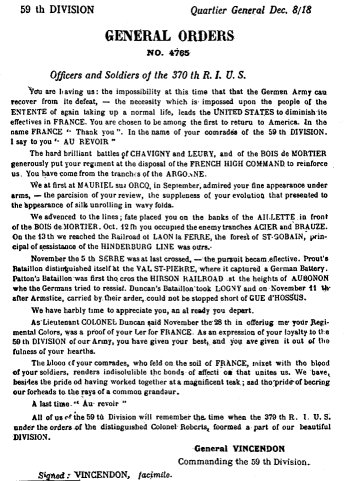 |
| This is a facsimile reproduction of the original, printed
hurriedly near the field of battle and also translated hurriedly
without eliminating errors. Corrected on page 155. |
To the 370th belongs the honor of the absolutely last engagement
of the war. An objective had been set for the regiment on the
morning of November 11th. General Vincendon heard of the hour at
which hostilities were to end and sent an order to the regiment
to shorten its objective. The order failed to arrive in time and
ten minutes after the fighting was over Lieut. Colonel Duncan led
the third battalion over the German line and captured a train of
fifty wagons. General Vincendon said:
"Colonel Duncan is the hardest man to stop fighting I ever saw.
He doesn't know when to quit."
One of the most daring exploits by a member of the regiment was
that performed by Sergeant Matthew Jenkins, a Chicago boy and
member of Company F. On September 20, at Mont des Singes, he went
ahead of his comrades and captured from the Boche a fortified
tunnel which by aid of his platoon was held for thirty-six hours
without food or ammunition, making use of the enemy machine gun
and munitions until relieved. This gained for Sergeant Jenkins
the Croix de Guerre with Palm and the Distinguished Service
Cross.
A deed of remarkable bravery accompanied by clever strategy was
performed by Captain Chester Sanders and twenty men mostly of
Company F. It won decorations for three and the unbounded
admiration of the French. Captain Sanders and his men offered
themselves as sacrifices in an effort to draw the fire of about a
dozen German machine guns which had been working havoc among the
Americans and French. The Illinois men ran into the middle of a
road knowing they were under German observation. Instantly the
Germans, suspecting a raid on their lines, opened fire on the
underbrush by the roadside, figuring the Americans would take
refuge there. Instead they kept right in the center of the road
and few were wounded. The ruse had revealed the whereabouts of
the German guns, and a short time later they were wiped out by
French artillery.
Another hero of Company F was Lieutenant Harvey J. Taylor, who
found himself in a nest of machine guns on July 16 in the western
part of the Argonne forest. He received wounds in both legs, a
bullet through one arm, a bullet in his side, had a front tooth
knocked out by a bullet and received a ruptured ear drum by
another. After all this he was back in the lines October 24th at
Soissons. The Germans were making a counter attack that day and
when the battling colored men needed supplies, Lieutenant Taylor,
who was regimental signal officer, proceeded to get the supplies
to them, though he had to pass through a German barrage. He was
badly gassed. He received the Croix de Guerre with a special
citation.
Lieutenant Elmer D. Maxwell won his Cross in the Champagne, six
miles northwest of Laon. He led a platoon of men against a nest
of machine guns, taking four guns and eighteen prisoners, not to
speak of leaving behind a number of Germans who were not in a
condition to be taken prisoner.
Many of the officers of the regiment were wounded. The escape of
many from death, considering the continuous fighting and unusual
perils through which they passed, was miraculous. The only
officer who made the supreme sacrifice was Lieutenant George L.
Giles of 3833 Calumet Avenue, Chicago. He was the victim of a
direct hit by a shell at Grandlut on November 1 while he was
heroically getting his men into shelter. Lieut. Giles was very
popular with the men and with his brother officers. He was
popular among the members of the race section in which he lived
in Chicago, and was regarded as a young man of great promise.
One of the engagements of the first battalion that received more
than honorable mention was on the morning of November 6th, when
the battalion crossed the Hindenburg line and after extremely
hard fighting captured on St. Pierre Mont, three 77 guns and two
machine guns. Captain James H. Smith of 3267 Vernon Avenue,
Chicago, commanded the company, and Lieutenant Samuel S. Gordon
of 3842 Prairie Avenue, Chicago, the assault forces making the
capture. The battalion continued across the Serre river and when
the armistice was signed was at a small place in Belgium.
Several of the officers passed through practically all of the
fighting with hardly a scratch, only to be taken ill at the
finish and invalided home. These men would have been greatly
disappointed had the war continued after they were put out of
action. Conspicuous among them was Lieutenant Robert A. Ward of
3728 South Wabash Avenue, Chicago, of the Trench Mortar platoon;
Lieutenant Benjamin A. Browning of 4438 Prairie Avenue, Chicago,
and Lieutenant Joseph R. Wheeler, 3013 Prairie Avenue,
Chicago.
Major Rufus Stokes led the first battalion on the initial raid at
Vauquois. They fired 300 shells from six trench mortars and
scored a notable success. In that raid Private William Morris of
Chicago, the only man in the regiment who was captured by the
Germans, was taken. He was reported missing at the time, but
weeks later his picture was found among a group of prisoners
portrayed in a German illustrated newspaper found in a captured
dugout.
Three men were killed and a large number of others had a
miraculous escape while entering Laon a few days prior to
November 1st. A German time mine exploded tearing up a section of
railroad track, hurling the heavy rails into the air, where they
spun around or flew like so many arrows.
First Lieutenant William J. Warfield, regimental supply officer,
a Chicago man, won the Distinguished Service Cross for
extraordinary heroism in action near Ferme de la Riviere,
September 28th.
Sergeant Norman Henry of the Machine Gun company, whose home is
in Chicago, won the Distinguished Service Cross for extraordinary
heroism in action near Ferme de la Riviere, September 30th.
Other members of the regiment upon whom the D.S.C. was conferred
by General Pershing were:
Captain William B. Crawford, home address, Denison, Texas; for
extraordinary heroism in action at Ferme de la Riviere, September
30th.
Sergeant Ralph Gibson, Company H, a Chicago man; for
extraordinary heroism at Beaume, November 8th.
Sergeant Charles T. Monroe, Headquarters Company; for
extraordinary heroism in action at Mont de Singes, September
24th. His home is at Senrog, Va.
Sergeant Emmett Thompson, Company L, home in Quincy, Illinois;
for extraordinary heroism at Mont de Singes, September 20th.
Supply Sergeant Lester Fossie, Company M, home at Metropolis,
Illinois; for extraordinary heroism at Ferme de la Riviere,
October 5th.
Private Tom Powell, deceased, Company H; for extraordinary
heroism near Beaume, November 8th.
Private Spirley Irby, Company H, home at Blackstone, Va.; for
extraordinary heroism in action at Beaume, November 8th.
Private Alfred Williamson, medical detachment, home at San Diego,
California; for extraordinary heroism in action near Beaume,
November 8th.
Private William G. Hurdle, Machine Gun Company No. 3, home at
Drivers, Va.; for extraordinary heroism in action at Ferme la
Folie, September 30th.
Private Harry Pearson, Machine Gun company No. 3, home at
Portland, Oregon; for extraordinary heroism in action near Ferme
la Folie, September 30th.
Private Alonzo Walton, Machine Gun Company No. 3, home at Normal,
Illinois; for extraordinary heroism in action at Rue Lamcher and
Pont D'Amy, November 7th and 9th.
Private Leroy Davis, Company L, home at Huntsville, Missouri; for
extraordinary heroism in action at Mont de Singes, September
18th.
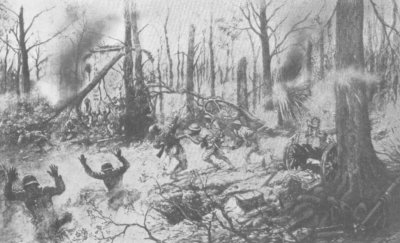 |
| NEGRO WARRIORS ADMINISTERING COLD STEEL. GERMANS UNABLE TO
STAND THE ATTACK. SURRENDERING. IN THE ARGONNE FOREST
FRANCE. |
About fifty percent of the 370th met casualties of some sort
during their service in France. Like the New York regiment
heretofore mentioned, they were singularly free from disease.
Only 65 men and one officer were killed in action and about
thirty died from wounds. The total number wounded and missing was
483. Probably 1,000 men were gassed and incapacitated at times,
as the regiment had three replacements, necessary to make up its
losses. The regiment went to France with approximately 2,500 men
from Chicago and Illinois, and came back with 1,260. Of course,
many of the wounded, sick and severely gassed were invalided home
or came back as parts of casual companies formed at hospital
bases. The replacement troops which went into the regiment were
mostly from the Southern states. A few of the colored officers
assigned to the regiment after its arrival in France, were men
from the officers training camps in this country and France.
The 370th boasted of the only race court martial in the army.
There were thirteen members, Lieutenant Colonel Duncan presiding.
Captain Louis E. Johnson was the judge advocate, and Lieutenant
Washington was his assistant. It is not of record that the
findings of the court martial were criticized. At least there was
no scandal as there was concerning court martial proceedings in
other divisions of the army. The fact is that there was very
little occasion for court martialing among the men of the 370th.
The behavior of the men was uniformly good, as is attested by the
fact that every town mayor in France where the men passed through
or were billeted, complimented the officers on the splendid
discipline and good behavior shown.
Colonel Roberts, a veteran cavalryman, was very fond of his men.
He has repeatedly paid them the highest compliments, not only for
their valor and soldierly qualities, but for their quick
intelligence, amenity to discipline, and for the clean living
which made them so remarkably free from disease. He has stated
that he would not know where to select a better group of men for
everything that goes to make up efficient, dependable soldiers.
Colonel Roberts received the Croix de Guerre, with the following
citation:
"A commander entirely devoted to duty, he succeeded by dint of
working day and night in holding with his regiment a difficult
sector, though the officers and men were without experience,
under heavy shelling. He personally took charge of a battalion on
the front line on October 12 and led it to the objectives
assigned by the crossing of the Ailette canal."
American historians may not give the Negro fighters the place to
which their records entitle them; that remains to be seen. From
the testimony of French commanders, however, it is evident that
the pages of French history will not be printed unless they
contain the valiant, patriotic, heroic deeds of the Illinois and
New York regiments with their comrades of the 93rd and 92nd
Divisions.
In the various sectors to which they were assigned, they were in
virtually every important fight. They met the flower of the
Kaiser's forces, held them and on more than one occasion made
them retreat. The Hun had misjudged them and it was fortunate
that he had. They endured their share of hardship, marching many
weary miles, day after day, without sufficient food. Nothing
could affect their spirit and dash. When the call came, they went
over the top, that the world might be made safe for
democracy.
Among the officers and men of the 370th were represented about
every calling in which the Negro of this day engages. There were
men of professional pursuits; lawyers, doctors and teachers;
students, mechanics, business men, farmers and laborers. The poet
of the regiment was Lieutenant Blaine G. Alston. The following
little poem, if properly digested and understood, tells volumes
within itself:
           "OVER THERE"
Did you ever hear a bullet whiz,
  Or dodge a hand grenade?
Have you watched long lines of trenches dug
  By doughboys with a spade?
Have you seen the landscape lighted up
  At midnight by a shell?
Have you seen a hillside blazing forth
  Like a furnace room in hell?
Have you stayed all night in a ruined town
  With a rafter for a bed?
With horses stamping underneath
  In the morning when they are fed?
Have you heard the crump-crump whistle?
  Do you know the dud shell's grunt?
Have you played rat in a dugout?—
  Then you have surely seen the front.
         —Lieut. Blaine G. Alston, 370th U.S. Troops.
CHAPTER
XVII.
NARRATIVE OF AN OFFICER.
Special Article by Captain John H. Patton, Adjutant of 8th
Illinois—Summarizes Operations of the Regiment—From
First Call to Mustering Out—An Eye Witness Account—In
Training Camps, at Sea, in France—Service in Argonne
Forest—Many Other Engagements—A Thrilling
Record—Battalion Operations in Detail—Special Mention
of Companies and Individuals.
Captain John H. Patton, regimental adjutant of the 370th, who
commanded the second battalion through most of its service,
presents a summary of the operations of the regiment from the
first call to the mustering out. Being in charge of the
organization's records, his account is detailed, authentic and
highly valuable as supplementing the data of the previous
chapter; gleaned from departmental records and other sources. It
carries additional interest as being the testimony of an
eye-witness, one who participated in the stirring events in a
marked and valorous degree. The recital in Captain Patton's own
words, the phrase of a highly trained and efficient military man,
follows:
Pursuant to the call of the President, under date of July 3,
1917, the 8th Illinois Infantry reported at the various
rendezvous on July 25, 1917, as follows: At Chicago, Illinois
regimental headquarters; Headquarters company, Machine Gun
company, Supply company, Detachment Medical Department, and
Companies A, B, C, D, E, F, G and H; at Springfield, Illinois,
Company I; at Peoria, Illinois, Company K; at Danville, Illinois,
Company L; at Metropolis, Illinois, Company M.
On the date the regiment responded to the call Colonel Franklin
A. Denison commanded the regiment, the other Field Officers being
Lieutenant Colonel James H. Johnson, Major Rufus M. Stokes, Major
Charles L. Hunt, Major Otis B. Duncan and Captain John H. Patton,
regimental adjutant.
The strength of the regiment a short time before responding to
the call was approximately one thousand officers and enlisted
men, and orders having been received to recruit to maximum
strength, 3604 enlisted men, an active recruiting campaign was
begun. On July 25, 1917, the strength was approximately 2,500.
Soon afterwards orders were received that the regiment would be
organized according to Minimum Strength Tables of Organization,
which gave it an authorized strength of 2,138 enlisted men. After
reporting that the regiment already had several hundred men in
excess of that strength, authority was granted to retain the
excess men. From this time until demobilized at Camp Grant in
March, 1919, the regiment had from 600 to 1,300 men in excess of
its authorized strength, and upon arrival in France in April,
1918, the entire personnel consisted of men who had voluntarily
enlisted.
Intensive training was begun immediately after the regiment
reported at the various armories and the public streets in the
vicinity were utilized for this purpose until October 12, 1917,
on which date the various organizations entrained for Camp Logan,
Houston, Texas, arriving a few days later.
While stationed at Camp Logan, the regiment was engaged in
intensive training. Officers and enlisted men attended the
various schools established by the 33rd Division to which the
regiment had been attached and acquitted themselves with
credit.
At the end of October, 1917, on the date of the closing of the
Second Liberty Loan Campaign, out of a total of 2,166 officers
and enlisted men belonging to the regiment at that time, 1,482
officers and men subscribed $151,400.00.
While at Camp Logan, approximately 96 percent of the regiment
took out $10,000.00 War Risk Insurance per man.
On December 1, 1917, the official designation of the regiment was
changed from the 8th Illinois Infantry to the 370th Infantry.
On March 6, 1918, the regiment left Camp Logan enroute to Camp
Stuart, Newport News, Va., arriving on March 10, 1918, and
immediately taking up its interrupted intensive training.
While at Camp Stuart, Va., Lieutenant Colonel James H. Johnson
was discharged from the service, and Major Otis B. Duncan, who
had commanded the 3rd battalion, was promoted to the grade of
lieutenant-colonel and Captain Arthur Williams was promoted to
the grade of major and placed in command of the 3rd
battalion.
On April 6, 1918, the regiment embarked on the S.S. President
Grant en route overseas. In attempting to get out to sea, the
vessel ran aground in Hampton Roads and three days later having
been refloated, the journey overseas was resumed. On account of
this delay the journey was begun without convoy, the warships
assigned to this duty having departed as scheduled on or about
April 6, 1918. On April 20, 1918, the steamer was met by a convoy
of torpedo boats which accompanied us to Brest, France, at which
place the regiment arrived on April 22, 1918.
The following day, April 23, 1918, the regiment debarked and
marched to camp at Pontanezen Barracks, near Brest, and two days
later entrained for Grandvillers (Haut-Rhin), arriving on April
27, 1918, and taking station.
The regiment, upon arrival at Grandvillers, was attached to the
73rd Division, French Army, and orders were given for the
reorganization and equipping of the regiment to conform to that
of a French regiment. All American arms, ammunition and equipment
were salvaged and French rifles, machine guns, ammunition, wheel
transportation, packs, helmets and other necessary equipment
furnished. Except for the uniform the regiment was outfitted
exactly as were the French regiments of that division. French
rations were issued with the exception of the wine component, for
which an extra allowance of sugar was substituted.
The Division sent officers to take charge of the instruction of
the regiment in every phase of the work to be later undertaken
and another period of intensive training was begun. Even French
cooks were present to instruct our cooks in the preparation and
conservation of the French rations.
After six weeks training at this place, the regiment entrained
enroute to the front, arrived at Ligny-en-Barrios (Meuse) on June
13, 1918, and moved up toward the lines by easy stages.
On June 21, 1918, the regiment began occupying positions in the
Saint Mihiel Sector, completing the occupation on June 24, 1918.
This being the first time the regiment had been actually in the
lines, the division commander deemed it advisable to intermingle
our troops with French troops in order that officers and men
might observe and profit by close association with the veteran
French troops. Thus the units of the 1st and 2nd battalions,
which had been assigned to the front lines were intermingled with
platoons and companies of the 325th regiment of infantry.
Many valuable lessons were learned while in this sector, which
was exceptionally quiet at the time. Except for occasional
shelling and some scattered machine gun and rifle fire, nothing
of interest occurred while in the sector, and there were no
casualties.
On the night of June 30-July 1, 1918, the regiment, having been
relieved in the sector, began withdrawing, and on July 3, 1918,
the withdrawal had been completed without any losses.
After resting a few days in the region of Lignieres (Meuse), the
regiment entrained en route to the Argonne Forest, arriving
behind the lines on July 6, 1918, the 1st Battalion, under
command of Major Stokes, moving up immediately into the reserve
positions at Brabant (S. Groupement Courcelles) and later into
the front lines in the Center of Resistance de la Foret,
Sub-Sector Hermont.
The 2nd Battalion under command of Major Hunt took station at
Rarecourt, the latter moved up to Locheres (Plateau of Gorgia) at
which place the Major located his Commanding Post. From this
position companies of the 2nd Battalion were sent into the lines
alternately, the companies being relieved after a five days' tour
of duty.
On July 12, 1918, Colonel Franklin A. Denison, who had commanded
the regiment up to this time and had become incapacitated through
illness contracted during the strenuous days incident to the
preparation of the regiment for service in the lines, was
relieved from command on this account and Colonel T.A. Roberts,
cavalry, assumed command of the regiment.
The 3rd battalion under command of Major Williams, was held in
reserve at Vraincourt, and only Company M of that battalion was
sent into the front lines. This company took up positions in the
supporting point at Buzemont on August 7, 1918, and remained
until August 14, 1918.
On August 1, 1918, the Stokes Mortar platoon under command of
Lieutenant Robert A. Ward took position in the lines in the
sub-sector Vaquois, and on August 4, 1918, took an active part in
a coup-de-main arranged by the French. His mission, filling in
the gaps in the French artillery barrage, was so successfully
accomplished that his entire platoon was highly commended for
their work by the commanding general of the division.
Although patrols were operating between the lines nightly and the
positions occupied were under artillery, machine gun and rifle
fire a number of times, the only losses sustained during the six
weeks in the Argonne Forest were 1 killed, 1 captured and 4
wounded.
On the night of August 15-16, 1918, the regiment was relieved
from its positions in the Forest and marched to Rampont and
entrained for villages in the vicinity of Fains (Meuse) for a
period of rest, arriving on August 18, 1918.
Upon arrival at the new stations, instruction was begun again,
more attention being paid to open warfare than to work incident
to trench warfare. This training proved of great value to the
officers and men in the latter days of the war, when the regiment
was actively engaged in the pursuit of the enemy to the Belgian
border.
On September 11, 1918, the regiment left its various stations and
proceeded by train to Betz, where it detrained and marched to
stations in villages in the vicinity of Mareuil-sur-Ourcq
(Meuse). On September 11, 1918, Majors Hunt and Williams having
become incapacitated through illness and injury, were relieved
from command of the 2nd and 3rd Battalions, respectively, and
Lieutenant Colonel Otis B. Duncan and Captain John H. Patton were
assigned to the command of those battalions.
The battles of Chavigny, Leury and the Bois de Beaumont having
reduced the effectives of the 59th French Division, the regiment
was placed at the disposition of the division and was assigned as
one of the three infantry regiments thereof. Upon joining this
division the effective strength of the regiment was approximately
double that of either of the two French regiments; and in future
operations a large share of the work of the division fell to our
lot.
On September 15, 1918, the regiment received orders to move again
toward the front. From Mareuil-sur-Ourcq to the region of
St. Bandry (Meuse) the movement was made in motor trucks. On
September 16, 1918, the journey was resumed, the regiment
proceeding by marching. Upon arrival at Tartier, Companies F and
G were sent to Monte Couve (Aisne) to join the 232nd Regiment of
Infantry, and Companies I and L pushed forward to Bagneux (Aisne)
to join the 325th Regiment. The 1st battalion proceeded the next
day to the caves in the vicinity of Les Tueries, the 3rd
battalion moved up into the reserve in the region of Antioch Farm
with the remainder of the 2nd battalion.
As soon as Companies F, G, I and L had moved up and taken
position in the lines opposite Mont des Signes an attack was
ordered. Attacks on the enemy positions on the plateau of Mont
des Signes were almost continuous from the date of arrival of
these companies until about September 21, 1918, when they were
withdrawn and joined their battalions. These companies acquitted
themselves with credit. One platoon under command of Sergeant
Matthew Jenkins, Company F, took a large section of the enemy
works for which the sergeant was awarded both the French Croix de
Guerre and the American Distinguished Service Cross.
About the 22nd of September, the regiment for the first time took
over a full regimental sector, the Battalion Stokes relieving the
Battalion Garnier in the positions outlined by La Folie-l'Ecluse
on the Canal l'Oise-l'Aisne and the Farm Gulliminet, the
Battalion Patton going into the support positions at Mont des
Tombes and the Battalion Duncan going into reserve at Tincelle
Farm. Colonel Roberts located his commanding post at Antioch
Farm. From the date of arrival in these positions until the enemy
began to retreat on October 12, 1918, the entire area occupied by
the regiment was almost constantly shelled, gas being used
frequently. The front lines were almost constantly under the fire
of enemy minnenwurfers and numerous machine guns located in the
Bois de Mortier, a very dense wood north of the canal.
On the night of September 26-27, 1918, the Battalion Patton was
ordered to relieve with like units one-half of each of the
companies of the Battalion Stokes in the front lines and soon
after the relief was completed an attack along the l'Oise-l'Aisne
Canal was ordered. By the extreme of effort the remainder of the
Battalion Patton was brought up and having completed the relief
of the Battalion Stokes, the attack began as ordered. The attack
continued until October 4th, on which date all objectives had
been gained and the enemy pushed back across the canal. On
September 30th the Battalion Duncan was thrown into the fight and
two companies of the Battalion Patton withdrawn to the support.
The Battalion Duncan was ordered to make a frontal attack which
necessitated an advance across the open fields. This was
successfully accomplished, the battalion being subjected to
intense artillery, machine gun and rifle fire continuously. The
Battalion Duncan, having gained its objectives, the Farm de la
Riviere and the railroad south of the canal, held on tenaciously
in spite of the intense fire of the enemy and held the positions
gained until the pursuit began on October 12, 1918, when it
passed into the reserve of the division.
During the occupancy of the sector, from September 22, 1918, to
October 12, 1918, patrols from the three battalions were out
night and day between the lines making necessary reconnaissances.
On October 4, 1918, a volunteer patrol of twenty men under
command of Captain Chester Sanders in an effort to discover
whether the enemy had abandoned the woods, penetrated the Bois de
Mortier to a point about 100 yards behind the enemy positions and
having been discovered were fired on from all sides by numerous
machine guns. The patrol returned to our lines intact. For this
exploit Captain Sanders was awarded the French Croix de Guerre
and the patrol received the commendation of the commanding
general of the division. On October 7, 1918, after 5 minutes
violent bombardment by our artillery, three raiding parties from
Company F made a dash for the triangle formed by the railroad,
the L'Oise-l'Aisne canal and the Vauxaillon road. One of these
parties gained the enemy trenches along the canal, ejecting the
enemy after a hand grenade fight. All parties returned to our
lines intact though several were wounded. Lieutenant William
Warfield of the Battalion Duncan single-handed took an enemy
machine gun nest which had been harassing his company, and after
disposing of the enemy machine gunners returned to our lines with
the gun. Numerous other acts of gallantry were performed in this
sector for which officers and men received both French and
American decorations.
At 9:20 a.m. on October 12, 1918, the alert was given for a
general advance by the entire division and the battalions
assembled at the zones of assembly previously designated. The
Battalion Stokes was given the mission of clearing the Bois de
Mortier and the Battalion Patton was placed at the disposition of
Lieutenant Colonel Lugand of the 232nd Infantry, and the 3rd
battalion was placed in the divisional reserve. At about 11:00 a.
m. the pursuit began, the 1st battalion clearing the Bois de
Mortier and successfully reaching its first objective,
Penancourt, the same date, and continuing the pursuit the next
day to a point west of Molinchart.
The Battalion Patton, having been assigned as the support
battalion of the 232nd Regiment of Infantry, took up the pursuit
via Anizy le Chateau, Cessieres and the Bois de Oiry, bivouacing
the night of October 13th in the vicinity of the Bois.
These battalions were commended by the commanding general. The
Battalion Stokes for its passage of the exceedingly strong
position in the Bois de Mortier and the 2nd for its well
conducted march in pursuit via Anizy le Chateau.
On account of the straightening out of the lines due to the
retreat of the enemy, the 59th Division was withdrawn on October
14th and sent back for rest, the regiment being sent into the St.
Gobain Forest and vicinity for this purpose. Ten of the twelve
days in this locality were spent in hard work on the roads and
the last two were given over to the re-equipping of the
regiment.
On October 22, 1918, Major Rufus M. Stokes was relieved from
command of the 1st battalion and assigned to duty as
administrative officer of the Regimental Combat and Supply
Trains. Captain John T. Prout was assigned to the command of the
1st battalion.
On October 27th, 1918, the regiment was again ordered into the
lines and at midnight on that date the 2nd battalion moved up
into support positions in the vicinity of Grandlup.
The 1st battalion on October 29, 1918, moved up into support
positions in the vicinity of the same village. During this time
the 3rd battalion was located at Manneaux Farm in reserve. The
battalions remained in various positions in the vicinity of
Grandlup until November 5, 1918, on which date the enemy again
began to retreat, and while thus occupied were subjected to
severe shelling and those units occupying front line positions to
much machine gun and rifle fire; casualties were few except in
Company A stationed in the vicinity of Chantrud Farm, where an
enemy shell fell in the midst of the company at mess, killing
thirty-five men and wounding fifty, thus causing the company to
be withdrawn from the lines.
On the morning of November 5th, a general advance was ordered and
the enemy retreated before it. The retreat of the enemy was so
rapid that our troops did not catch up with them until about
November 8th, on which date a general attack by the division was
ordered. The 2nd battalion on the left of the division was given
the task of clearing out the enemy from positions along the
Hirshon railroad and the Heights of Aubenton. After an all day
fight the battalion reached its objective about nightfall. The
French division on the left did not advance as anticipated, owing
to enemy resistance on their front, and the 2nd battalion having
advanced about two kilometers to the front suffered severely on
account of the exposed flank, three men being killed and two
officers and thirty-three enlisted men being wounded. On the
morning of the 9th the enemy again retreated and the 2nd
battalion continued the pursuit to Goncelin, resting there for
the night and on the morning of the both was ordered to
cantonment at Pont d'Any, where it was located at the taking
effect of the armistice.
On November 6th the 1st battalion took up the pursuit in support
of the Battalion Michel of the 325th Regiment of Infantry,
advancing via Brazicourt and Rapeire to Hill 150 near St.
Pierremont. Company C having passed on into the front lines at
the Brazicourt Farm, upon arrival near St. Pierremont were
ordered on the morning of November 6, 1918, to attack and occupy
St. Pierremont, cross the Serre River and take up a position
along the railroad track. The mission of the company was
successfully accomplished in spite of the strong resistance of
the enemy, St. Pierremont being occupied, the river crossed and
three pieces of enemy artillery as well as several machine guns
taken. For this operation Company C was cited and awarded the
French Croix de Guerre with a Palm, the highest French citation
received in the regiment. The battalion continued the pursuit
until arrival at Mont Plaisir, when it was ordered back to
Fligny, where it was in cantonment at the taking effect of the
armistice.
The 3rd Battalion took up the pursuit on November 5th, resting in
the open fields the nights of the 5th and 6th. The battalion in
moving up advanced via Bosmont and Mont Plaisir and passed on
into the front lines at the Rue Larcher on November 7, 1918. In
the afternoon of the 8th orders were received to deliver a cover
fire for French units which were to make an attack on the village
of Logny, which was strongly held by the enemy. Company M, having
been assigned for this work, moved out from Hurtebise and
advanced to a position where the cover fire could be effectively
delivered, and opened fire. About this time word was received
from the French commander that his troops could not advance on
account of the severe shell and machine gun fire, and Company M
having arrived at a position where it was safer to go ahead than
to retreat, attacked the town and drove the enemy therefrom. For
this action Lieutenant Osceola A. Browning, commanding Company M,
and several others received the French Croix de Guerre and
Sergeant Lester Fossie both the Croix de Guerre and the American
Distinguished Service Cross. On November 10, 1918, the advance
and pursuit was continued. At Etignieres the battalion was
temporarily stopped by intense shell fire. On November 11, 1918,
the pursuit was again taken up with Resinowez as the principal
objective. Later the objective was changed to Gue d'Hossus,
Belgium, which objective was reached a few minutes before the
taking effect of the armistice, an enemy combat train of about 50
vehicles being captured about this time.
A few days after the armistice, the regiment began to move
southward, taking station in villages in the vicinity of
Verneuil-sur-Serre.
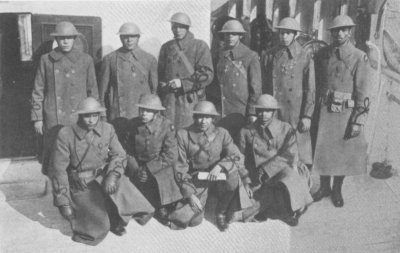 |
| SOME WAR CROSS WINNERS OF 8TH ILLINOIS (370TH INFANTRY).
FRONT ROW LEFT TO RIGHT: CAPT. G.M. ALLEN. LIEUT. O.A. BROWNING.
CAPT. D.J. WARNER. LIEUT. ROY B. TISDELL. STANDING LEFT TO RIGHT:
LIEUT. ROBT. P. HURD, LIEUT-COL. OTIS B DUNCAN. MAJOR J.R.
WHITE. CAPT. W.B. CRAWFORD, LIEUT. WM. WARFIELD. CAPT. MATTHEW
JACKSON. |
On December 12, 1918, the regiment formally passed from the
French command and to Brest via Soissons and Le Mans, arriving at
the latter place on January 10, 1919.
On February 2, 1919, the regiment embarked on the S.S. La France
IV, en route to the U.S., arriving on February 9, 1919, and
taking station at Camp Upton, Long Island, N.Y.
On February 17, 1919, the regiment left Camp Upton for Camp
Grant, Illinois, via Chicago, where it was accorded a wonderful
and never-to-be-forgotten reception by the citizens of
Chicago.
After arrival at Camp Grant, work incident to the demobilization
of the regiment was commenced. The majority of officers and
enlisted men were discharged from the service during the latter
part of February, and finally on March 12, 1919, orders were
issued declaring that the regiment had ceased to exist.
The health of the regiment while in the service was exceptional.
The Medical Detachment, under command of Major James R. White,
worked incessantly to protect the health of the command. Before
departure for France a number of cases of pneumonia of a very
severe type developed, but only two deaths resulted. The Medical
Detachment was divided among the various units, Captain Spencer
C. Dickerson having charge of the detachment attached to the 1st
battalion, Lieutenant James F. Lawson that of the 2nd battalion,
and Lieutenant Claudius Ballard that of the 3rd battalion. The
work of these detachments was at all times of a high order of
excellence, and during engagements both officers and men in
numerous instances went out into the open and rendered first aid
to the wounded after terrific fire. Each man wounded, however
slightly, was given an injection of anti-tetanic serum and as a
result no cases of tetanus were reported, nor were any cases of
gas baccilus infection reported. During the severe fighting
around the Guilliminet and de la Riviere Farms, more help was
needed and Lieutenant Park Tancil, dental surgeon, volunteered to
take charge of one of the first aid stations which was daily
receiving showers of shells from the enemy batteries. Lieutenant
Claudius Ballard, though wounded during the fighting, refused to
be evacuated and continued his duties administering to the
wounded. Major James R. White made daily rounds of the first aid
stations in the lines, disregarding the intense fire of the enemy
and personally dressing numbers of wounded. For their heroic
conduct in administering to the wounded under fire, Major White
and Lieutenants Tancil and Ballard as well as several enlisted
men of the Medical Detachment, were awarded the French Croix de
Guerre, and Private Alfred Williamson of the detachment was
awarded both the French Croix de Guerre and the American
Distinguished Service Cross.
* * * * *
ROSTER OF OFFICERS OLD 8TH ILLINOIS (370th Infantry)
(All Negroes unless otherwise designated.)
Field and Staff—F.A. Denison, commanding until July 12,
1918, invalided home; Col. T.A. Roberts (white), commanding after
July 12, 1918; Major James R. White, surgeon; Major W.H. Roberts
(white), operation officer; Capt. Charles W. Fillmore, personnel
officer; Capt. John H. Patton, commanding 2nd battalion; Capt.
James E. Dunjil, assistant to adjutant; 1st Lieut. George Murphy,
assistant to adjutant; 1st Lieut. Louis C. Washington,
administrative officer; 2nd Lieut. Noble Sissle, assistant to
administrative officer; 1st Lieut. Park Tancil, dentist; 1st
Lieut. John T. Clemons, chaplain.
First Battalion—Major Rufus M. Stokes, commanding; 2nd
Lieut. M.F. Stapleton (white), battalion adjutant; Capt. Spencer
C. Dickerson, medical officer; 1st Lieut. Harry W. Jones,
battalion supply officer.
Company A—Capt. Stewart A. Betts, 1st Lieut. John L.
McDonald, 1st Lieut. Robert L. Chavis, 2nd. Lieut. Wycham Tyler,
2nd Lieut. Howard F. Bell, 2nd Lieut. Willis Stearles.
Company B—Capt. Stuart Alexander, 1st Lieut. Robert P.
Hurd, 1st Lieut. Franklin McFarland, 1st Lieut. Samuel Ransom,
2nd Lieut. Fred K. Johnson, 2nd Lieut. Samuel Block.
Company C—Capt. James H. Smith, 1st Lieut. Samuel S.
Gordon, 1st Lieut. Harry N. Shelton, 1st Lieut. Arthur Jones, 2nd
Lieut. Elmer J. Myers, 2nd Lieut. Roy B. Tisdell.
Machine Gun Company—Captain Devere J. Warner, 1st Lieut.
George C. Lacey, 2nd Lieut. Thomas A. Painter, 2nd Lieut. Bernard
McGwin, 2nd Lieut. Homer C. Kelly, 2nd Lieut. Julian D.
Rainey.
Second Battalion—Capt. John H. Patton, commanding; 1st
Lieut. Samuel A. McGowan, battalion adjutant; 1st Lieut. James F.
Lawson, medical officer; 1st Lieut. Rufus H. Bacote, medical
officer; 1st Lieut. William Nichols, battalion supply
officer.
Company F—Capt. Rufus Reed, 1st Lieut. Carter W. Wesley,
2nd Lieut. Edward Douglas, 2nd Lieut. Robert A.D. Birchett.
Company G—Capt. George M. Allen, 1st Lieut. Durand Harding,
1st Lieut. Gerald C. Bunn, 1st Lieut. Harvey E. Johnson, 2nd
Lieut. Clarence H. Bouchane.
Company H—Capt. James C. Hall, 1st Lieut Harry L. Allen,
1st Lieut. George L. Amos, 1st Lieut Binga Dismond, 2nd Lieut
Lawrence Willette, 2nd Lieut. John A. Hall.
Machine Gun Company No. 2—Capt. Lilburn Jackson, 2nd Lieut.
Frank T. Logan, 2nd Lieut. Junius Walthall, 2nd Lieut. William A.
Barnett.
Third Battalion—Lieut. Col. Otis B. Duncan, commanding; 2nd
Lieut. Stanley B. Norvell, battalion adjutant; 1st Lieut.
Claudius Ballard, medical officer; 1st Lieut. William J.
Warfield, battalion supply officer.
Company I—Capt Lorin O. Sanford, 1st Lieut. Howard R.
Brown, 2nd Lieut. D. Lincoln Reid, 2nd Lieut. Edmond G. White,
2nd Lieut. Oswald Des Verney, 2nd Lieut. Harry J. Douglas.
Company L—Capt. William B. Crawford, 1st Lieut. Frank
Robinson, provost officer; 1st. Lieut Frank W. Bates, 2nd Lieut.
James H. Peyton, 2nd Lieut Luther J. Harris.
Company M—Capt. Edward W. Spearman, 1st Lieut Osceola A.
Browning, 1st Lieut. Jerome L. Hubert, 2nd Lieut. Lawson Price,
2nd Lieut. Irving T. Howe, 2nd Lieut. Larkland F. Hewitt.
Machine Gun Company No. 3—Capt. Matthew Jackson, 1st Lieut.
William C.P. Phillips, 2nd Lieut. Charles C. Jackson, 2nd Lieut
Clyde W. Donaldson, 2nd Lieut George F. Proctor.
Special Units
Headquarters Company—Capt. Lewis E. Johnson, 1st Lieut
Robert A.J. Shaw, 1st Lieut. Benote H. Lee, 2nd Lieut Elias F.E.
Williams, pioneer officer; 2nd Lieut. Rufus B. Jackson, Stokes
mortar; 2nd Lieut. Reginald W. Harang, signal officer.
Supply Company—Capt. Lloyd G. Wheeler, 1st Lieut. Harry
Wheeler, 1st Lieut. James A. Riggs, 1st Lieut. Dan M. Moore,
medical officer; 2nd Lieut Augustus M. Fisher, veterinary
surgeon.
Depot Company K—Capt Wm. H. Lewis, commanding; 2nd Lieut.
Alvin M. Jordan, adjutant; 1st Lieut. Norman Garrett, 1st Lieut.
Napoleon B. Roe, dentist; 1st Lieut. George W. Antoine, medical
officer; 2nd Lieut Avon H. Williams; 2nd Lieut. Edward L.
Goodlett, 2nd Lieut Frank Corbin, 2nd Lieut Frederick L. Slade,
2nd Lieut. Walter H. Aiken, 2nd Lieut. Rufus A. Atkins, 2nd Lieut
James T. Baker, 2nd Lieut. John S. Banks, 2nd Lieut. Marcus A.
Bernard, 2nd Lieut. Charles E. Bryant, 2nd Lieut Henry H. Carr,
2nd Lieut. Horace E. Colley, 2nd Lieut. Ira R. Collins, 2nd
Lieut. Charles H. Conley, 2nd Lieut. Bernie B. Cowan, 2nd Lieut.
Flenoid Cunningham, 2nd Lieut. Frank P. Dawson, 2nd Lieut. Samuel
A. Dillard, 2nd Lieut. John W. Harris.
ROLL OF HONOR
Heroes of Old 8th Illinois
Negro National Guardsmen known in France as the 370th Infantry,
who were decorated with the Croix de Guerre. The exploits of some
of these men and also of some of those in the appended list
decorated with the Distinguished Service Cross, are mentioned in
the chapters devoted to the regiment.
Col. T.A. Roberts (white)
Lieut. Col. Otis B. Duncan
Major James R. White
Capt. John H. Patton
Capt. Chester Sanders
Capt. John T. Prout
Capt. Samuel R. Gwynne
Capt. Devere J. Warner
Capt. Wm. B. Crawford
Capt. George M. Allen
Capt. James C. Hall
Capt. Stuart Alexander
Capt. Mathew Jackson
Capt. James H. Smith
Lieut. Park Tancil
Lieut. Osceola A. Browning
Lieut. George C. Lacey
Lieut. Frank Robinson
Lieut. Claudius Ballard
Lieut. Charles C. Jackson
Lieut. William J. Warfield
Lieut. Samuel S. Gordon
Lieut. Robert P. Hurd
Lieut. Henry N. Shelton
Lieut. Henry P. Cheatham
Lieut. Stanley B. Norvell
Lieut. Roy B. Tisdell
Lieut. Thomas A. Painter
Lieut. Lawson Price
Lieut. Lincoln D. Reid
Lieut. Elmer J. Myers
Sergt. Norman Henry
Sergt. Clarence T. Gibson
Sergt. Matthew Jenkins
Sergt. Cecil Nelson
Sergt. Howard Templeton
Sergt. Chas. T. Monroe
Sergt. Derry Brown
Corp. James R. Brown
Corp. Lewis Warner
Corp. Joseph Henderson
Corp. Maceo A. Tervalon
Corp. William Stevenson
Corp. Emil Laurent
Corp. Charles T. Brock
Pvt. Nathaniel C. White (deceased)
Pvt. Robert Pride
Pvt. George B. White
Pvt. Howard Sheffield
Pvt. Cornelius Robinson
Pvt. Ulysses Sayles
Pvt. William Cuff (deceased)
Pvt. Hugh Givens
Pvt. Arthur Johnson
Pvt. Rufus Pitts
Pvt. Olbert Dorsey
Pvt. William Hurdle
Pvt. Bee McKissic
Pvt. Jonas Paxton
Pvt. Harry Pearson
Pvt. Paul Turlington
Pvt. Reed J. Brown
Pvt. Paul Johnson
Pvt. Reedy Jones
Pvt. Alonzo Keller
Pvt. Leroy Lindsay
Pvt. Lavern Massey
Pvt. Josiah Nevees
Pvt. Ira Taylor
Pvt. Jesse Ferguson
Pvt. William M. Robinson
Awarded Distinguished Service Crosses by General Pershing:
Capt. William B. Crawford
Lieut. William J. Warfield
Sergt. Norman Henry
Sergt. Ralph Gibson
Sergt. Robert Barnes
Sergt. Charles T. Monroe
Sergt. Emmett Thompson
Sergt. Lester Fossie
Sergt. Matthew Jenkins
Pvt. Tom Powell (deceased)
Pvt. Andrew McCall
Pvt. Wm. Cuff (deceased)
Pvt. Spirley Irby
Pvt. Alfred Williamson
Pvt. William G. Hurdle
Pvt. Harry Pearson
Pvt. Alonzo Walton
Pvt. Leroy Davis
Pvt. James Fuquay
Pvt. Nathaniel C. White (deceased)
Pvt. Arthur Johnson
CHAPTER
XVIII.
BLOOD OF THE BLACK AND WHITE IN ONE RIVULET OF DEPARTING
LIFE.
LINCOLN'S PROPHETIC WORDS—NEGROES ALONGSIDE BEST SOLDIERS
IN THE WORLD—HOLD THEIR OWN—THE 372ND
REGIMENT—BRIGADED WITH VETERANS OF THE MARNE—FAMOUS
"RED HAND" DIVISION—OCCUPY HILL 304 AT VERDUN—NINE
DAYS BATTLE IN "BLOODY ARGONNE"—ADMIRATION OF THE
FRENCH—CONSPICUOUS COMPONENTS OF 372ND—CHRONOLOGY OF
SERVICE.
They will probably help in some trying time to keep the jewel of
liberty in the family of freedom.—Abraham Lincoln.
Prophetic words uttered by the Great Emancipator concerning the
Negroes of America. The Negroes helped. They would have helped in
much greater measure had they been given the opportunity.
Fighting for the first time on the soil of the world's most
famous battleground—Europe—and for the first time
brought into direct comparison with the best soldiers of the
world, they proved themselves able to hold their own where tests
of courage, endurance and aggressiveness were most severe.
They fought valiantly in the vicinity of Chateau Thierry, on the
Vesle, on the Aillette, in the Argonne, and various other
sectors; and in the final drive at Metz. They vanquished the
Germans who opposed them; the heaviest fire of the enemy failing
to stop their advance.
No part of the 93rd Division made a more gallant record than the
372nd regiment. Throughout its service in France it was a part of
the famous French 157th Division known as the "Red Hand"
division, under the command of General Goybet. It was this
division which first opposed the Huns at the Marne in 1914. To
brigade the Negro soldiers with such famous veterans was a rare
mark of distinction and placed the black men on their mettle at
all times.
The 372nd arrived in France on April 14 and went into training
with the French eleven days later. On May 29 the regiment took
over a sector in the Argonne and on June 20 was sent to the
trenches just west of Verdun, occupying the famous battle-swept
Hill 304, and sections at Four de Paris and Vauquois. On Hill 304
thousands of French and Germans had fallen as the battle line
swung back and forward. That this hill was given to the Negroes
to hold demonstrated that as soldiers they had already won the
confidence of the French.
The regiment's first engagement was in the Champagne sector with
Monthois as an objective. Here came the real test. The Negroes
were eager to get into the fight. They cheered and sang when the
announcement came that their opportunity had arrived—but
the question was; back of their enthusiasm had they the staying
qualities drilled into European troops through centuries of
training in the science of warfare.
The answer was that some of the heaviest and most effective
fighting of the day was done by the Negro regiment. From June 6th
to September 10th, the 372nd was stationed in the bloody Argonne
forest or in the vicinity of Verdun. On the night of September
25th they were summoned to take part in the Argonne offensive and
were in that terrific drive, one of the decisive engagements of
the war, from September 28th to October 7th.
In the nine days' battle the Negroes not only proved their
fighting qualities in an ordeal such as men rarely have been
called upon to face, but these qualities in deadly striking power
and stubborn resistance in crises, stood out with such
distinction that the coveted Croix de Guerre was bestowed upon
the regiment.
The casualty list of the 372nd in this and previous fighting
carried 500 names of men killed, wounded and gassed. For their
achievements they were at once cited for bravery and efficiency
in General Orders from the corps commander transmitted through
their French divisional chief. It was dated October 8th and read
as follows:
In transmitting you with legitimate pride the thanks
and congratulations of General Garnier Duplessis, allow me, my
dear friends of all ranks, American and French, to address you
from the bottom of the heart of a chief and soldier, the
expression of gratitude for the glory you have lent to our good
157th Division. During these nine days of hard fighting you have
progressed eight kilometers (4.8 miles) through powerfully
organized defenses, taken 600 prisoners, captured 15 heavy guns,
20 minenwerfers and nearly 150 machine guns, secured an enormous
amount of engineering material and important supplies of
artillery ammunition, and brought down by your fire three enemy
aeroplanes. The "Red Hand" sign of the division, has, thanks to
you, become a bloody hand which took the Boche by the throat and
made him cry for mercy. You have well avenged our glorious dead.
GOYBET.
In a communication delivered to the colonel of the regiment on
October 1st, General Goybet said:
Your troops have been admirable in their attack. You
must be proud of the courage of your officers and men, and I
consider it an honor to have them under my command. The bravery
and dash of your regiment won the admiration of the Moroccan
Division, who are themselves versed in warfare. Thanks to you,
during these hard days, the division was at all times in advance
of all other divisions of the Army Corps. I am sending you all my
thanks and beg you to transmit them to your subordinates. I call
on your wounded. Their morale is higher than any
praise.
The high honor of having its flag decorated with the Croix de
Guerre was bestowed upon the regiment in the city of Brest just a
few days before it embarked for the return to America. Vice
Admiral Moreau, the French commander of the port of Brest,
officially represented his government in, the ceremony. It was
intended as France's appreciation of the services of these Negro
fighters.
The decoration took place at one of the most prominent points in
the city and was witnessed by thousands of French soldiers and
civilians, as well as by sailors and soldiers of several
nations.
One of the conspicuous components of the 372nd was the battalion,
formed from what formerly was known as the 1st Separate Battalion
of the District of Columbia National Guard. This famous old
Washington organization has a long, proud history. Many of the
members were veterans of the Spanish-American war. At the close
of the European war, the organization numbered 480 men from the
city of Washington, twenty of whom had been decorated one or more
times for individual bravery under fire.
The battalion was first assembled at Potomac Park on the Speedway
in Washington, shortly after the declaration of war. The men
spent almost half a year at the camp, during which time they had
the important assignment of guarding railway and highway bridges
and adjacent points around the National Capitol. They also had
the proud distinction of guarding the secret archives and
departments at Washington, a duty which required unquestioned
loyalty and for which the Negroes were well selected.
It seemed at the time an inconspicuous bit of war time
soldiering, and they were long trying days to the men. But it was
a service which required intelligence and nerve, as the
likelihood was great that the enemy's agents in this country
would strike in the vicinity of the seat of government. That such
responsible duty was delegated to the Negroes was a high
compliment from the military authorities. The manner in which
they discharged the duty is shown in the fact that no enemy
depredations of any consequence occurred in the vicinity of
Washington.
After a period of training at Camp Stewart, Newport News, Va.,
the battalion was sent to France. Its colored commander was dead.
Other colored officers were soon superseded, leaving the
chaplain, Lieutenant Arrington Helm, the only colored officer
attached to the organization.
Arriving at St. Nazaire, France, April 14, 1918, the battalion
was soon sent to Conde en Barrois, where it underwent a period of
intensive training with special preparation for sector warfare.
The instructors were French. Lessons were hard and severe, but
the instructors afterwards had much cause for pride in their
pupils.
From the training camp the battalion and regiment proceeded to
the Argonne front, at first settling in the vicinity of La
Chalade. It was there the soldiers received their first taste of
warfare, and it was there their first casualties occurred.
September 13th the outfit withdrew and retired to the rear for a
special training prior to participation in the general attack
from Verdun to the sea. On the morning of September 28th the
District of Columbia battalion was sent to the front to relieve a
regiment of famous Moroccan shock troops. It was at this time
that the Champagne offensive took such a decided turn and the
Washington men from that time on were taking a most active and
important part in the general fighting. They distinguished
themselves at Ripont just north of St. Menehold. They suffered
greatly during their valiant support of an advanced position in
that sector. Despite its losses the battalion fought courageously
ahead. Prior to that it had occupied Hill 304 at Verdun. It had
the distinction of being the first American outfit to take over
that sector. The battalion fought doggedly and bravely at Ripont
and succeeded in gaining much valuable territory, as well as
enemy machine guns and supplies and ninety Hun prisoners.
Later the battalion held a front line position at Monthois, and
it finally formed a salient in the line of the 9th French Army
Corps. It was subjected to a long period of gruelling fire from
the Boches' famous Austrian 88s and machine guns, and an
incessant barrage from German weapons of high caliber.
The regiment moved south to the Vosges, where the battalion took
up a position in sub-sector B, in front of St. Marie Aux Mines,
where it was situated when word of the armistice came.
The record of the Negro warriors from the District of Columbia is
very succinctly contained in a diary kept by Chaplain Lieutenant
Arrington Helm. It relates the activities of the unit from the
time they sailed from Newport News, March 30, 1917, until the end
of the war. It is also a condensed account of the major
operations of the 372nd regiment. The diary follows:
March 30—Embarked from Newport News, Va., for overseas duty
on the U.S.S. Susquehanna.
April 17—Disembarked at St. Nazaire and marched to rest
camp.
April 21—Left rest camp. Base section No. 1 and entrained
for Vaubecourt.
April 23—Arrived at Vaubecourt at 7 p.m. Left Vaubecourt at
8:30 p.m. and hiked in a heavy rainstorm to Conde en Barrois.
April 25—Assigned to school under French officers.
May 26—Left Conde en Barrois at 8 a.m. in French motor
trucks for Les Senades.
May 29—Our regiment today took over the sector designated
as Argonne West.
May 31—In front line trenches.
June 20—Changed sectors, being assigned to the Vauquois
sector, a sub-sector of the Verdun front. The 157th Division is
stationed in reserve. The enemy is expected to attack.
July 13—Left for Hill 304 on the Verdun sector. Colonel
Young has been relieved from command and Colonel Herschell Tupes
has assumed command.
July 25—Left Sivry la Perche to take over Hill 304. Arrived
at Hill 304 at 9 p.m.
August 16—Heavily shelled by regiment of Austrians opposing
us. Two Americans and one Frenchman in the regiment killed.
August 20—Lieutenant James Sanford, Company A, captured by
the Germans.
August 21—Fight by French and German planes over our lines.
Very exciting.
September 8—Left Hill 304. Relieved by 129th infantry of
the 33rd Division. Hiked in rain and mud for Brocourt.
September 14—Arrived at Juvigny at noon.
September 17—Left Juvigny for Brienne la Chateau at 8 p.m.
Passed through Brienne la Chateau and reached Vitray la Francois
this afternoon. The city is near the Marne.
September 18—Hiked to Jessecourt. All colored officers left
the regiment today.
September 28—Arrived at Hans. The regiment was in action in
the vicinity of Ripont. The third battalion took up a battle
position near Ripont.
September 29—The third battalion went over the top. The
Germans are in retreat. Our positions are being bombarded. The
machine gun fire is terrific and 88 millimeter shells are falling
as thick and fast as hailstones. We are unable to keep up with
the enemy. This afternoon it is raining. This makes it bad for
the wounded of whom there are many.
September 30—The first battalion is now on our right and
advancing fast despite the rain and mud. The machine gun
opposition is strenuous. Our casualties are small. We have
captured a large number of prisoners.
October 1—Our advance is meeting with increased opposition.
The enemy has fortified himself on a hill just ahead. The ground
prevents active support by the French artillery. Still we are
giving the Germans no rest. They are now retreating across the
valley to one of their supply bases. The enemy is burning his
supplies. We have taken the village at Ardeuil. Our losses have
been heavy but the Germans have lost more in killed, wounded and
taken prisoner than have our forces. On our right the first
battalion has entered the village of Sechault, after some hard
fighting by Company A.
October 4—The Second battalion is going in this morning. We
are resting at Vieux three kilometers from Monthois, one of the
enemy's railroad centers and base hospitals. The enemy is
destroying supplies and moving wounded. We can see trains moving
out of Monthois. Our artillery is bombarding all roads and
railroads in the vicinity. The enemy's fire is intense. We expect
a counterattack.
October 5—The enemy's artillery has opened up. We are on
the alert. They have attacked and a good stiff hand to hand
combat ensued. The Germans were driven back with heavy losses. We
have taken many prisoners from about twelve different German
regiments. We continued our advance and now are on the outskirts
of Monthois.
October 6—The enemy is throwing a stiff barrage on the
lines to our left where the 333rd French Infantry is attacking.
We can see the Huns on the run. The liaison work of the 157th
Division is wonderful; not the slightest gap has been left open.
Our patrols entered Monthois early this morning and were driven
out by machine gun fire, but returned with a machine gun and its
crew. We will be relieved by the 76th infantry regiment at 8 p.m.
We hiked over the ground we had fought so hard to take to
Minnecourt, where the regiment proceeded to reorganize.
October 12—Left Valmy today and continued to Vignemont.
October 13—Arrived at Vignemont. Hiked fifteen kilometers
to St. Leonard.
October 15—Left St. Leonard for Van de Laveline in the
Vosges. We arrived at Van de Laveline at 10:15 p.m. and took over
a sector.
November 11—A patrol of Company A took several prisoners
from a German patrol. Received word of the signing of the
armistice at 11 a.m. today. Martial music was played. The colors
of the regiment are displayed in front of the post command.
It is related that the Washington fighters, as well as the other
members of the 372nd regiment, received the news of the armistice
with more of disappointment than joy, for they had made all
preparations to advance with the French through Lorraine.
CHAPTER XIX.
COMRADES ON THE MARCH. BROTHERS IN THE SLEEP OF DEATH.
POLICY OF SUBSTITUTING WHITE OFFICERS—INJUSTICE
TO CAPABLE NEGROES—DISAPPOINTMENT BUT NO OPEN
RESENTMENT—SHOWED THEMSELVES SOLDIERS—INTENSER
FIGHTING SPIRIT AROUSED—RACE FORGOTTEN IN PERILS OF
WAR—BOTH WHITES AND BLACKS GENEROUS—AFFECTION BETWEEN
OFFICERS AND MEN—NEGROES PREFERRED DEATH TO
CAPTIVITY—OUTSTANDING HEROES OF 371ST AND
372ND—WINNERS OF CROSSES
Changing from Negro to white officers was in accordance with the
military policy of the American Government; the generic
inspiration and root being found in national prejudice, incident
to the institution of slavery and the spirit of racial caste and
narrowness, that still disgraces it. Doubt was pretended to be
entertained of the ability of the colored man to command, and
although there were not lacking champions for the policy of
placing capable Negroes in command of Negro units, the weight of
opinion; superinduced and fostered by racial prejudice, inclined
to the opposite course.
In the light of the fine record made by such Negro officers as
were given responsible commands, let us hope for the future honor
of the nation; preening herself as being in the vanguard of the
progressive commonwealths of the age, that a policy so unjust,
narrow and unworthy will; as quickly as feasible be abandoned. In
favor of Negro commanders is the additional testimony of high
French generals, who knew no color distinction and could see no
reason why a Negro should not command his own race troops if he
had intelligence, courage and military skill. Indeed there are
not wanting in the annals of French warfare brilliant examples
where men of African blood commanded not only mulattoes and
blacks, but heroic whites as well. It is not of record that those
white Frenchmen showed any reluctance to follow such leaders or
viewed them with less affection than they did their white
officers.
One should not say that the Negro troops would have fought any
better under the men of their own race. They achieved all
possible glory as it was. They simply did their duty whether
their officers were white or black. But that they did not fight
any the less valiantly or efficiently under men of their own race
is abundantly proven by the record of the 370th, or the 8th
Illinois as the soldiers and their people still prefer to call
it; and other units which had Negroes in responsible
positions.
That there was disappointment, chagrin and anger in the rank and
file of the Negro soldiers when their own officers were taken
from them and white men substituted was natural and quite to be
expected.
However, there was little open murmuring. While the Negro
regarded the removal of the officers who had trained him and
were, in a sense, his comrades, unfair and uncalled for, his
fighting spirit, seemed to burn with an intenser heat; a
determination to do his best to show and shame the spirit that
robbed him of his own race leaders, and at the same time convince
his white commanders of the stuff he was made of.
There was much disappointment in the ranks of the District of
Columbia battalion, when the place of its old leader was taken by
Major Clark L. Dickson, twenty-seven years of age, one of the
youngest—if not the youngest—of battalion commanders
in the American army. But their disappointment was soon allayed,
for Major Dickson made an enviable record. He received the Croix
de Guerre with this citation:
"Most efficient officer, valorous and intrepid,
acting in dual capacity as regimental adjutant and operation
officer. Displayed the utmost energy in issuing operation orders
during the period between September 26th and October 6th, 1918,
and especially distinguished himself in crossing a roadway under
violent artillery fire to give assistance to a wounded brother
officer. His clear view of the situation at all times and the
accuracy with which he issued the necessary orders required of
him, contributed largely to the success of the
regiment."
Many of his men have stated that the citation only hinted at the
real accomplishments of Major Dickson.
In the rigors of war and the perils of battle, men serving side
by side, forget race. They simply realize that they are sharing
hardships in common; are beset by a common foe and are the
subjects of common dangers. Under such circumstances they become
comrades. They learn to admire each other and willingly give to
each other a full measure of praise and appreciation. The Negro
soldiers generally, have expressed unstintedly, approbation and
praise of their white officers; and the officers have been
equally generous. Here is an appreciation by one of the officers
of the 372nd regiment, Lieutenant Jerome Meyer of Washington,
concerning the men of that organization:
"Casualties were heavy because the colored lads
fought to the last, cheerfully accepting death in preference to
captivity. Their adeptness in mastering the throwing of hand
grenades and in operating the machine guns quickly won them the
esteem of the French. Remember, that the colored lads were quite
new to warfare. But in the Champagne they fought with a
persistence and courage that enabled them to hold permanently the
ground they gained and won for many of them their decorations.
Not a few of the prisoners taken by the regiment declared that
the Germans were in positive fear of the Negroes, who, they
complained, would never quit even under terrible
fire."
One of the outstanding heroes of the 372nd regiment was Sergeant
Ira Payne, of 325 Fifteenth Street, Washington, D.C. He won the
Croix de Guerre and the Distinguished Service Cross, and
according to his comrades, "was not afraid of the devil himself."
His story as related by himself on his return home, follows:
"During the fighting at Sechault the Germans were
picking off the men of my platoon from behind a bush. They had
several machine guns and kept up a deadly fire in spite of our
rifle fire directed at the bush. We did our best to stop those
machine guns, but the German aim became so accurate that they
were picking off five of my men every minute. We couldn't stand
for that.
"Well, I decided that I would get that little machine gun nest
myself, and I went after it. I left our company, detoured, and,
by a piece of luck got behind the bush. I got my rifle into
action and 'knocked off' two of those German machine gunners.
That ended it. The other Germans couldn't stand so much
excitement. The Boches surrendered and I took them into our
trenches as prisoners."
Not a long story for such an able and courageous exploit, yet it
contains the germ for an epic recital on bravery.
First Sergeant John A. Johnson a colored member of Company B, was
decorated with the Croix de Guerre with palm for exceptional
bravery during a charge over the top, and for capturing
single-handed, two Hun soldiers who later proved valuable as
sources of information. Sergeant Johnson's home was at 1117 New
Jersey Avenue, Washington, D.C. He was equally reticent about
boasting of his deeds.
"Near Sechault during the time the District men were
making a big effort to capture the town," said Johnson, "I was
put in the front lines not fifty feet away from the enemy. A
greater part of the time I was exposed to machine gun fire. I
suppose I got my medal because I stuck to my men in the trenches
and going over the top. Quite a few of the boys were bumped off
at that point."
Another hero was Benjamin Butler, a private. The citation with
his Croix de Guerre read: "For displaying gallantry and bravery
and distinguishing himself in carrying out orders during the
attack on Sechault, September 29, 1918, under heavy bombardment
and machine gun fire."
"I did very little," Butler said. "During this fight
with several others, I carried dispatches to the front line
trenches from headquarters. They decorated me, I suppose, because
I was the only one lucky enough to escape being knocked
off."
Private Charles E. Cross of 1157 Twenty-first street, Washington,
D.C. was awarded the Croix de Guerre, his citation reading: "For
his speed and reliability in carrying orders to platoons in the
first line under the enemy's bombardment on September 29, 1918."
In some cases he had to creep across No Man's Land and a greater
part of the time was directly exposed to the enemy's fire.
Private William H. Braxton, a member of the machine gun company
of the regiment, whose residence was at 2106 Ward Place,
Washington D.C., received the Croix de Guerre for "displaying
zealous bravery."
"An enemy party," reads his citation, "having
filtered through his platoon and attacked same in the rear.
Private Braxton displayed marked gallantry in opening fire on the
enemy and killing one and wounding several others, finally
dispersing the entire party."
"The men who stuck by me when death stared them in their faces,"
said Braxton, "deserve just as much credit as I do. I was only
the temporary leader of the men."
Corporal Depew Pryor, of Detroit, Michigan, was awarded the Medal
Militaire, one of the most coveted honors within the gift of the
French army, as well as the American Distinguished Service Cross.
Pryor saw Germans capture a Frenchman. Grabbing an armful of
grenades, he dashed upon the Germans killing, wounding or routing
a party of ten and liberating the Frenchman.
Sergeant Bruce Meddows, 285 Erskine street, Detroit, Michigan,
brought home the Croix de Guerre with silver star, which he won
for bringing down an aeroplane with an automatic rifle.
To have forty-six horses which he drove in carting ammunition up
to the front lines, killed in five months was the experience of
Arthur B. Hayes, 174 Pacific Avenue, Detroit, Michigan. He
returned home sick, with practically no wounds after risking his
life daily for months.
Sergeant George H. Jordan of Company L, whose home was in Boston,
Mass., won the Croix de Guerre and palm for taking charge of an
ammunition train at Verdun, when the commanding officer had been
killed by a shell. He saved and brought through eight of the
seventeen wagons.
Lieutenant James E. Sanford of Washington, D.C., one of the early
Negro officers of the 372nd, was captured in Avocourt Woods near
Verdun, August 19 , 918. He was endeavoring to gain a strategic
position with his men when he was met by an overpowering force
concealed behind camouflaged outposts, he was taken to Karlsruhe
and transferred to three other German prison camps, in all of
which he suffered from bad and insufficient food and the
brutality of the German guards.
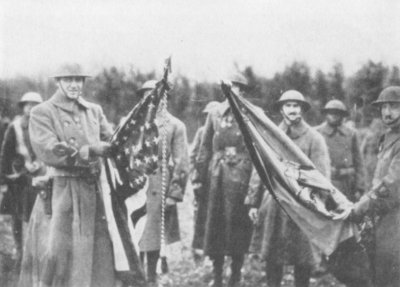 |
| U.S. FLAG AND 369TH REGIMENT FLAG, DECORATED WITH CROIX DE
GUERRE AT UNGERSHEIM, ALSACE, FRANCE. |
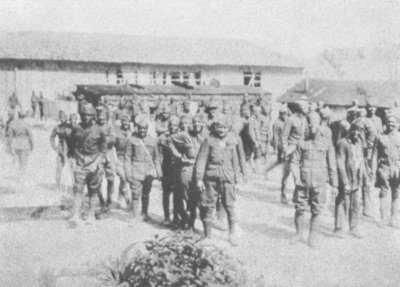 |
| THE 369TH INFANTRY IN REST BILLETS AT MAFFRECOURT, FRANCE.
HENRY JOHNSON. ONE OF FOREMOST HEROES OF THE WAR. WITH HIS FAMOUS
SMILE. IN RIGHT FOREGROUND. |
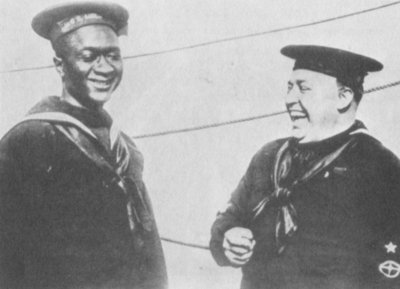 |
| THE JOKE SEEMS TO BE ON THE LAD AT THE LEFT. |
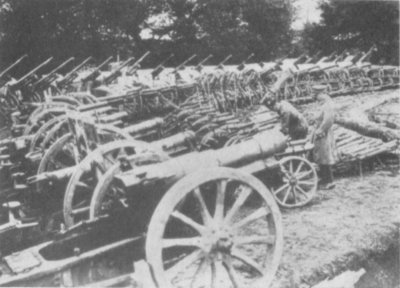 |
| A FEW OF THE MANY GUNS CAPTURED FROM THE GERMANS. |
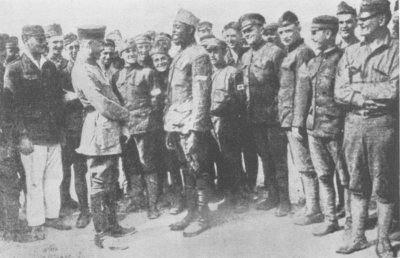 |
| AMERICANS IN PRISON CAMP. PRISONERS ARE AMUSED LISTENERS
WHILE JOVIAL NEGRO FIGHTER RELATES AN EPISODE OF WAR LIFE TO A
GERMAN OFFICER. |
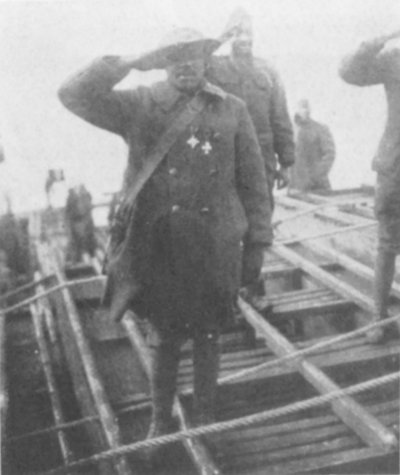 |
| ARTHUR JOHNSON, A DOUGHBOY OF THE 8TH ILLINOIS (370TH
INFANTRY), WINNER OF CROIX DE GUERRE AND THE DISTINGUISHED
SERVICE CROSS. |
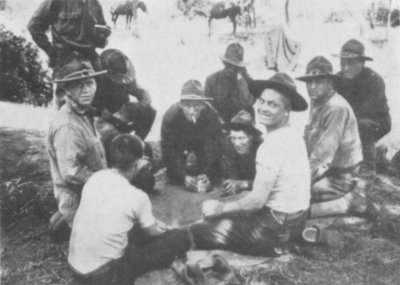 |
| GAME PROBABLY IS STRIP POKER AS TWO MEN HAVE ALREADY
DISCARDED THEIR SHIRTS. ONE HAS A LARGE SAFETY PIN FOR INSTANT
USE. BUT THEN, NOTE THE HORSESHOE ON HIS SHOE. |
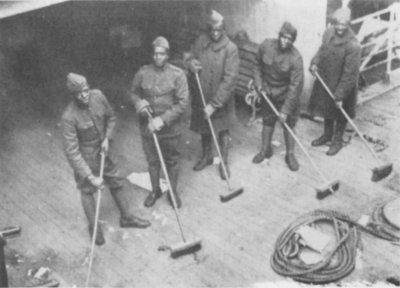 |
| KITCHEN POLICE ON BOARD THE CELTIC. THERE IS ALWAYS SOME DUTY
FOR UNCLE SAM'S MEN ON LAND OR SEA. |
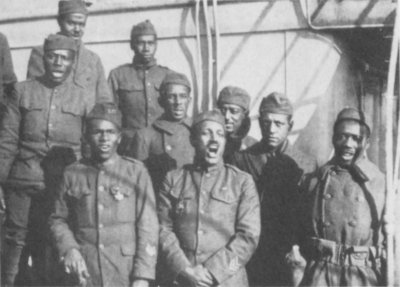 |
| MINSTRELS ON BOARD THE "SAXONIA." TYPICAL GROUP ORGANIZED ON
THE TRANSPORTS TO ENTERTAIN WOUNDED BOYS RETURNING FROM
FRANCE. |
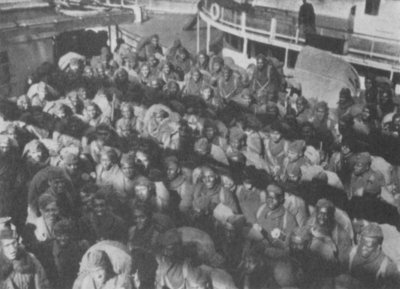 |
| FOUR CAVERNS, STUDDED WITH IVORY, FURNISH HARMONY IN THE
TRAINING CAMP. |
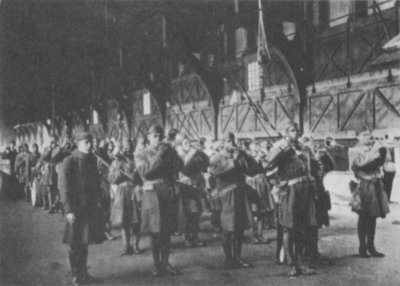 |
| LIEUT. MAXOM AND HIS BAND, WHO SAW DISTINGUISHED SERVICE IN
FRANCE. |
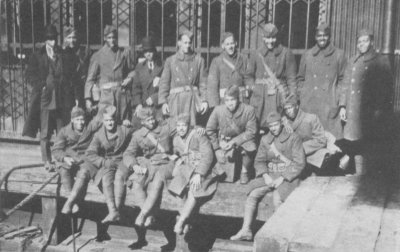 |
| GROUP ON EDGE OF PIER WAITING TO ENTRAIN FOR DEMOBILIZATION
CAMP. PART OF THE 351ST ARTILLERY UNIT SPECIALLY MENTIONED BY
GENERAL PERSHING. |
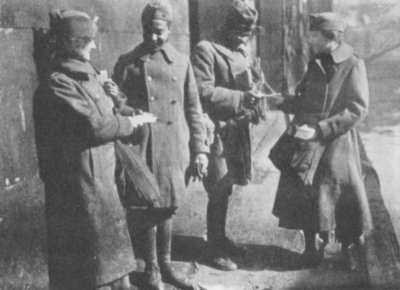 |
| SALVATION ARMY LASSIES HANDING OUT CHOCOLATE TO TWO SOLDIERS
OF 351ST ARTILLERY. . |
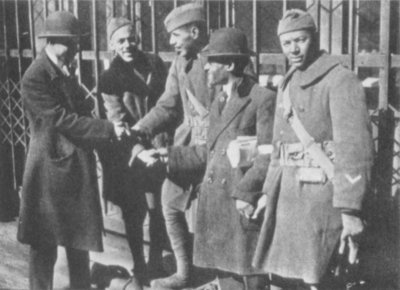 |
| HEROES OF 351ST ARTILLERY GREETING FRIENDS AFTER DEBARKING
FROM THE TRANSPORT LOUISVILLE. |
Major Johnson led his battalion of the 372nd in an attack in the
Champagne which resulted in the capture of a German trench, 100
prisoners, an ammunition dump, thirty machine guns and two
howitzers. He received the Croix de Guerre and the Legion of
Honor decoration from the French, as well as the Distinguished
Service Cross from General Pershing.
Company B of the 372nd, took at Sechault in a raid, seventy-five
prisoners and four machine guns.
One of the distinguished units of the 372nd, was the old and
famous Company L of the Massachusetts National Guard. This unit
was assembled at Camp Devens and left soon after the declaration
of war for the south. It was stationed for a time at Newport
News, and was then incorporated with the 372nd, went to France
with that organization and saw its share of service throughout
the campaign. Other distinguished units were the well known Ninth
Ohio Battalion National Guard, and National Guard companies from
Connecticut, Maryland and Tennessee.
Brigaded with the 372nd in the French "Red Hand" division, was
another Negro regiment, the 371st, made up principally of
selectives from South Carolina. It was commanded by Colonel P.L.
Miles. Among the officers were Major Thomas Moffatt and Captain
William R. Richey from Charleston.
The regiment saw practically the same service as the 372nd under
General Goybet, was mentioned in divisional and special orders,
was decorated by Vice Admiral Moreau, Maritime Prefect of Brest,
at the same time the honor was conferred on the 372nd. The two
regiments were together for seven months. The men of the 371st
especially distinguished themselves at Crete des Observatories,
Ardeuil and in the plains of Monthois. Seventy-one individual
members received the Croix de Guerre and some the Distinguished
Service Cross. Among the latter were the following:
Sergeant Lee R. McClelland, Medical Detachment, home address,
Boston, Mass., for extraordinary heroism in action near Ardeuil,
September 30, 1918.
Corporal Sandy E. Jones, Company C, home address Sumter, S.C.;
for extraordinary heroism in action in the Champagne, September
28 and 29, 1918.
Private Bruce Stoney, Medical Detachment, home address,
Allendale, S.C.; for extraordinary heroism in action near
Ardeuil, September 29, 1918.
Private Charlie Butler, Machine Gun Company, home address,
McComb, Miss.; for extraordinary heroism in action near Ardeuil,
September 29, 1918.
Private Willie Boston, Machine Gun Company, home address,
Roopville, Ga.; for extraordinary heroism in action near Ardeuil,
September 29, 1918.
Private Tillman Webster, Machine Gun Company, home address,
Alexandria, La.; for extraordinary heroism in action near
Ardeuil, September 29, 1918.
Private Ellison Moses, Company C, home address, Mayesville, S.C.;
for extraordinary heroism in action near Ardeuil, September 30,
1918.
Private Hunius Diggs, Company G, home address, Lilesville, N.C.;
for extraordinary heroism in action near Ardeuil, September 30,
1918.
The two regiments, besides the regimental Croix de Guerre,
awarded for gallantry in the Champagne, won individual
decorations amounting in the aggregate to 168 Croix de Guerre, 38
Distinguished Service Crosses, four Medal Militaire and two
crosses of the Legion of Honor.
An incident of the service of the 371st and particularly
emphasizing the honesty and faithfulness of the Negro Y.M.C.A.
and the regiment's medical detachment, was the case of Prof. H.O.
Cook, a teacher in the Lincoln High School at Kansas City, Mo.
Professor Cook, a Y.M.C.A. man attached to the sector which the
371st was holding during the great offensive in September, went
with the men to the front line trenches and rendered valuable aid
among the wounded until he was gassed. Owing to the fact that
there were no facilities at that particular time, for the safe
keeping of money and valuables, he carried on his person more
than 150,000 francs (in normal times $30,000) which boys in the
regiment had given him to keep when they went over the top.
After being gassed he was walked over for an hour before being
discovered. The money was found and sent by Sergeant Major White
also colored, to general headquarters at Chaumont. When Prof.
Cook was discharged from the hospital and made inquiry about the
money, it was returned to him. Not a cent was missing. Colonel
Miles recommended that General Pershing award Prof. Cook a
Distinguished Service Cross.
The men of the 93rd Division and other Negro divisions and
organizations will never forget their French comrades and
friends. It was a lad of the 371st regiment who wrote the
following to his mother. The censor allowed the original to
proceed but copied the extract as a document of human interest;
in that it was a boyish and unconscious arraignment of his own
country—for which he with many thousands of others, were
risking their lives.
"Mammy,
     these French people don't bother with no color line business. They
     treat us so good that the only time I ever know I'm colored is when
     I look in the glass."
The 371st regiment had 123 men killed in action and about 600
wounded or gassed. The casualties of the 372nd consisted of 91
killed in action and between 600 and 700 wounded or gassed. Like
the other Negro regiments of the 93rd Division, there was
comparatively little sickness among the men, outside of that
induced by hard service conditions.
HEROES OF THE 371ST AND 372ND.
The names listed below are cross and medal winners. The exploits
of some are told in detail in the chapters devoted to their
regiments. There are many known to have received decorations
whose names are not yet on the records.
Cross of the Legion of Honor
372ND REGIMENT.
Medal Militaire
372ND REGIMENT.
       Corp. Depew Pryor                 Corp. Clifton Morrison
                      Pvt. Clarence Van Allen
Distinguished Service Cross
371ST REGIMENT.
       Sergt Lee R. McClelland           Pvt. Willie Boston
       Corp. Sandy E. Jones              Pvt. Tillman Webster
       Pvt. Bruce Stoney                 Pvt. Ellison Moses
       Pvt. Charlie Butler               Pvt. Hunius Diggs
372ND REGIMENT.
       Major Johnson                     Sergt. Ira M. Payne
                       Corp. Depew Pryor
Croix de Guerre
372ND REGIMENT.
       Col. Herschell Tupes              Sergt. Homer Crabtree
       Major Johnson                     Sergt. Norman Winsmore
       Major Clark L. Dickson            Sergt. William A. Carter
       Lieut. Jerome Meyer               Sergt. George H. Jordan
       Sergt. Major Samuel B. Webster    Sergt. Bruce Meddows
       Sergt. John A. Johnson            Sergt. Harry Gibson
       Sergt. Ira M. Payne               Corp. John R. White
       Sergt James A. Marshall           Corp. Benjamin Butler
       Sergt. Norman Jones               Corp. March Graham
       Pvt. Warwick Alexander            Pvt. Joseph McKamey
       Pvt. George H. Budd               Pvt. William Dickerson
       Pvt. Thomas A. Frederick          Pvt. William Johnson
       Pvt. John S. Parks                Pvt. Walter Dennis
       Pvt. Charles H. Murphy            Pvt. Charles E. Cross
       Pvt. William N. Mathew            Pvt. William H. Braxton
       Pvt. Ernest Payne                 Pvt. Nunley Matthews
CHAPTER XX.
MID SHOT AND SHELL.
IN TRENCH AND VALLEY—THE OPEN PLAIN—ON
MOUNTAIN TOP—IN NO MAN'S LAND—TWO CLASSES OF NEGRO
SOLDIERS CONSIDERED—TRAINED GUARDSMEN AND
SELECTIVES—GALLANT 92ND DIVISION—RACE CAN BE PROUD OF
IT—HAD SIX HUNDRED NEGRO OFFICERS—SETS AT REST ALL
DOUBTS—OPERATIONS OF THE DIVISION—AT PONT A
MOUSSON—GREAT BATTLE OF METZ—SOME
REFLECTIONS—CASUALTIES CONSIDERED
History, as made in France by the Negro soldier, falls naturally
into two divisions; that which was made by the bodies of troops
which had an organization prior to the war, and whether trained
or not, could lay claim to an understanding of the first
principles of military science; and that made by the raw
selectives—the draft soldiers—to whom the art of war
was a closed book, something never considered as likely to affect
their scheme of life and never given more than a passing
thought.
We have followed the first phase of it in the wonderful
combat-records of the colored National Guard, its volunteers and
recruits. We have seen them like a stone wall bearing the brunt
of attack from the finest shock troops of the Kaiser's Army. We
have seen them undaunted by shot and shell, advancing through the
most terrific artillery fire up to that time ever concentrated;
rout those same troops, hold their ground and even advance under
the most powerful counter attack which the enemy could deliver.
We have followed them from trench to plain, to valley and into
the mountains and read the story of their battles under all those
varying conditions. We have pitied them in their trials,
sympathized with their wounded and ill, been saddened by their
lists of dead and finally have seen the survivors come home; have
seen them cheered and feted as no men of their race ever were
cheered and feted before.
Much of the nation's pride in them was due to the fact that it
knew them as fighting men; at least as men who were organized for
fighting purposes before the war. When they marched away and
sailed we had confidence in them; were proud of their appearance,
their spirit, their willingness to serve. The country felt they
would not fail to clothe with luster their race and maintain the
expectations of them. That they fulfilled every expectation and
more; had come back loaded with honors; finer, manlier men than
ever, increased the nation's pride in them.
Now we come to a contemplation of the other class; the men who
knew nothing of military life or military matters; who, most of
them, wished to serve but never dreamed of getting the
opportunity. Many of them employed in the cotton fields or
residing in the remote corners of the country, hardly knew there
was a war in progress. Some of them realized that events out of
the ordinary were transpiring through the suddenly increased
demand for their labor and the higher wages offered them. But
that Uncle Sam would ever call them to serve in his army and even
to go far across seas to a shadowy—to them, far off land,
among a strange people; speaking a strange language, had never
occurred to most of them even in dreams.
Then all of a sudden came the draft summons. The call soon
penetrated to the farthest nooks of our great land; surprised,
bewildered but happy, the black legions began to form.
It already has been noted that with the exception of the 371st
regiment, which went to the 93rd Division, the selectives who saw
service in the fighting areas, were all in the 92nd Division.
This was a complete American division, brigaded with its own
army, commanded through the greater part of its service by Major
General Ballou and towards the end by Major General Martin.
While the 92nd Division as a whole, did not get into the heavy
fighting until the last two weeks of the war, individual units
had a taste of it earlier. Service which the division as a whole
did see, was some of the most severe of the war. The Negroes of
the country may well be proud of the organization, for its record
was good all the way through and in the heavy fighting was
characterized by great gallantry and efficiency.
One of the outstanding features of the division was the fact that
it had about six hundred Negro commissioned officers. Its rank
and file of course, was composed exclusively of Negro soldiers.
The fine record of the division must forever set at rest any
doubts concerning the ability of Negro officers, and any
questions about Negro soldiers following and fighting under them.
It was a splendid record all the way through, and Negro officers
rendered excellent service at all times and under the most trying
circumstances. Many of these officers, be it understood, were
entirely new to military life. Some had seen service in the
National Guard and some had come up from the ranks of the Regular
Army, but the majority of them were men taken from civilian life
and trained and graduated from the officer's training camps at
Fort Des Moines, Camp Taylor, Camp Hancock and Camp Pike. A few
received commissions from the officers' training schools in
France.
The 92nd Division was composed of the 183rd Infantry Brigade,
consisting of the 365th and 366th Infantry Regiments and the
350th Machine Gun Battalion; the 184th Infantry Brigade, composed
of the 367th and 368th Infantry Regiments and the 351st Machine
Gun Battalion; the 167th Artillery Brigade consisting of the
349th, 350th and 351st Artillery Regiments; and the 349th Machine
Gun Battalion, the 317th Trench Mortar Battalion, the 317th
Engineers' Regiment, the 317th Engineers' Train, the 317th
Ammunition Train, the 317th Supply Train, the 317th Train
Headquarters, the 92nd Military Police Company; and the Sanitary
Train, comprising the 365th, 366th 367th and 368th Field Hospital
and Ambulance Companies.
Briefly summarized, the operations of the 92nd Division may be
stated as follows: Arrived in France the summer of 1918. After
the usual period of intensive training in the back areas it was
divided into several groups for training alongside the French in
front line trenches.
In August they took over a sector in the St. Die region near the
Lorraine border. September 2nd they repulsed an enemy raid at
LaFontenelle. On September 26th the division was a reserve of the
First Army Corps in the first phase of the Meuse-Argonne
offensive.
On October 10th they moved to the Marbache sector in the vicinity
of Pont a Mousson. November 10th they advanced, reaching Bois
Frehaut and Bois Cheminot, capturing 710 prisoners. These
positions were being consolidated on November 11th when the
armistice put an end to the fighting. Of course there was
fighting by some units of the division from the time early in the
summer when they went into the trenches.
When the Marbache sector was taken over by the 92nd Division, "No
Man's Land" was owned by the Germans and they were aggressively
on the offensive. They held Belie Farm, Bois de Tete D'Or, Bois
Frehaut, Voivrotte Farm, Voivrotte Woods, Bois Cheminot and
Moulin Brook. Raids and the aggressiveness of the patrols of the
92nd Division changed the complexion of things speedily. They
inflicted many casualties on the Germans and took many
prisoners.
Each of the places named above was raided by the doughty black
men as was also Epley, while their patrols penetrated north
nearly to the east and west line through Pagny. The Germans were
driven north beyond Frehaut and Voivrotte to Cheminot bridge. In
their desperation they tried to check the Americans by an attempt
to destroy the bridge over the Seille river. They succeeded in
flooding a portion of the adjacent country; these tactics
demonstrating that they could not withstand the Negro soldiers.
West of the Seille river excellent results followed the energetic
offensive, the Germans losing heavily in killed, wounded and
prisoners. In nearly every instance the raids were conducted by
Negro line officers.
Up to this time the division as a whole, had never been in a
major battle. The only regiment in it that had seen a big
engagement was the 368th infantry, which took part in the action
in the Argonne Forest in September.
The division's chance came in the great drive on Metz, just
before the end of the war. They were notified at 4 o'clock Sunday
morning, November 10th. The motto "See it through" of the 367th
infantry, known as the "Buffaloes," echoed through the whole
division.
They began their advance at 7 o'clock from Pont a Mousson. Before
them was a valley commanded by the heavy guns of Metz and by
innumerable nests of German machine guns. The Negroes seemed to
realize that here for the first time was the opportunity to show
their mettle—that for the first time they were going to
battle as a division. A sense of race pride seemed to stir and
actuate every man. Here was a chance to show what this great
body, composed of cotton-field Negroes, of stevedores, mechanics,
general laborers, trades, professional men and those from all
walks of civilian life who but recently had taken up the
profession of arms, could do. An opportunity to enact a mighty
role was upon them, and they played it well.
Not only were the black infantry and machine gun units up at the
front; in the thickest of it, but the artillery—the 167th
Brigade—was on the line behaving like veterans. They laid
down a barrage for the infantry that was wonderfully effective.
They established a reputation which has been made by but few,
among French, British or Americans, of laying down a barrage that
did not entrap; and fatally so, their own comrades.
It was a glorious day for the division. The casualty roll was
heavy for the sector was strongly fortified and the enemy made a
most determined resistance. Metz is considered by experts to be
the strongest fortified inland city in the world.
Indeed it is almost as strong, if not quite so, as Gibraltar or
the Dardanelles. But from the way the Americans hammered at it,
military authorities say that only the signing of the armistice
prevented the taking of it by assault. As it was, the close of
fighting saw Negro troops on German soil.
The fortitude and valor of the Negroes, especially in the action
against Metz, won them high praise from their commanding
officers. Entire units were decorated by the French with the
Croix de Guerre. Fourteen Negro officers and forty-three enlisted
men were cited for bravery in action and awarded the
Distinguished Service Cross by General Pershing. This is a
splendid showing considering that up to November 10th, 1918, the
greater portion of the division had to content itself with making
daily and nightly raids on the German front line trenches to
harass the foe and capture prisoners. This, however, required
daring and courage and, in some ways, was more trying and
dangerous than being in a big engagement. A total of 57 citations
by the American military authorities, besides honors bestowed by
the French, is a splendid showing for a division which won most
of its honors during its first great baptism of fire.
The casualties of the 92nd Division amounted to an aggregate of
1,511 of all kinds. Six officers were killed in action and one
died from wounds. Among the non-commissioned officers and
privates 103 were killed in action, 50 died from wounds, 47 were
missing in action and five were taken prisoner. Forty enlisted
men died from disease. Sixteen officers and 543 enlisted men were
wounded; thirty-nine officers and 661 enlisted men were gassed.
The number of gassed was unusually large, a reason being,
perhaps, that the men in the front line trenches were
exceptionally daring in making raids into the enemy's territory.
One of the main reliances of the Germans against these raids was
poison gas, a plentiful supply of which they kept on hand at all
times, and which they could utilize quickly and with great
facility.
The small number in this division who were taken prisoner by the
enemy verifies the assertion made before that the Negro would
sacrifice his life or submit to deadly wounds rather than be
captured. When only five out of a total of about 30,000 fell into
the Germans' hands alive, it gives some idea of the desperate
resistance they put up. Perhaps the stories they had heard about
the wanton slaughter of prisoners by the Hun or the brutalities
practiced on those who were permitted to live, had something to
do with the attitude of the Negroes against being captured; but a
more likely solution is that their very spirit to advance and win
and to accept death in preference to being conquered, caused the
small number in the prisoner list, and the large number in the
lists of other casualties.
Considering the desperate advance made by the 92nd Division from
Pont a Mousson the morning of November 10th, through a valley
swept by the tremendous guns of Metz and thousands of machine
guns, the casualty list really is slight.
Advancing over such dangerous ground to gain their objective, it
appears miraculous that the division was not wiped out, or at
least did not suffer more heavily than it did. An explanation of
this seeming miracle has been offered in the rapidity of the
advance.
No two battles are ever fought alike. Offensives and defensives
will be planned along certain lines. Then will suddenly obtrude
the element of surprise or something that could not be foreseen
or guarded against, which will overturn the most carefully
prepared plans.
No soldiers in the world were ever trained to a higher degree of
efficiency than the Germans. Mathematical precision ruled
everywhere; the ultimate detail had been considered; and all
students of military matters were forced to admit that they had
reduced warfare seemingly, to an exact science. But it was a
mistake. The Germans were the victims of surprise times
innumerable. Some of the greatest events of the war, notably the
first defeat at the Marne in its strategic features, was a
complete surprise to them.
Everything about war, can, it seems, be reduced to a science
except strategy. Certain rules can be laid down governing
strategy, but they do not always work. Generally speaking, it is
psychology; something which exists in the other man's mind. To
read the other man's mind or make a good guess at it, defeats the
most scientifically conceived strategy. Napoleon outwitted the
best military brains and was himself the greatest strategist of
his time, because he invariably departed from fixed military
customs and kept his opponent entirely at sea regarding what he
was doing or intended to do. Very seldom did he do the thing
which his enemy thought he would do; which seemed most likely and
proper according to military science. He thought and acted
quickly in crises, relied constantly on the element of surprise
and invented new strategy on the spur of the moment.
It was the big new strategy, the big new surprises, with which
the Germans found themselves unable to cope. The strategy of Foch
which developed in the offensive shortly after the battle of
Chateau Thierry in July and was well under way in the early part
of August, was a surprise to the Germans. Pershing surprised them
in his St. Mihiel and following operations, especially the
battles of Argonne Forest, and had a greater surprise in store
for them in the Lorraine campaign had the war continued.
Perhaps the Germans figured at Metz, that owing to the extreme
difficulty of the ground to be covered, their strong
fortifications and great gun power, any advance, especially of
Negro troops, would be slow. They accordingly timed their
artillery action and their defensive measures for a slow
assault.
But they were surprised again. Officers could not hold back the
Negro fighters and German guns and soldiers could not stop them.
They plunged on to Preny and Pagny, and they rushed into the Bois
Frehaut, and held for thirty-six hours, this place from which
picked Moroccan and Senegalese troops were forced to retreat in
ten minutes after they had entered it. The Bois Frehaut was an
inferno under the murderous fire of the Germans. Holding it for
thirty-six hours and remaining there until hostilities ceased, it
is surprising that the casualty list of the 92nd Division did not
amount to many times 1,511.
It is not intended to convey the impression that the Negroes were
entirely responsible for the victory before Metz. Many thousands
of white troops participated and fought just as valiantly. But
this History concerns itself with the operations of Negro
soldiers and with bringing out as many of the details of those
operations as the records at this time will supply.
CHAPTER XXI.
THE LONG, LONG TRAIL.
OPERATIONS OF 368TH INFANTRY—NEGROES FROM
PENNSYLVANIA, MARYLAND AND SOUTH—IN ARGONNE
HELL—DEFEAT IRON CROSS VETERANS—VALIANT PERSONAL
EXPLOITS—LIEUTENANT ROBERT CAMPBELL—PRIVATE JOHN
BAKER—OPERATIONS OF 367TH INFANTRY—"MOSS'S
BUFFALOES"—365TH AND 366TH REGIMENTS—THE GREAT
DIVIDE—THEIR SOULS ARE MARCHING ON—PRAISED BY
PERSHING—SOME CITATIONS.
When the history of the 92nd Division is written in detail, much
prominence will necessarily be given to the operations of the
368th Infantry. This unit was composed of Negroes mostly from
Pennsylvania, Maryland and the Southern states. They went abroad
happy, light-hearted boys to whom any enterprise outside of their
regular routine was an adventure. They received adventure a
plenty; enough to last most of them for their natural lives. They
returned matured, grim-visaged men who had formed a companionship
and a comradeship with death. For months they were accustomed to
look daily down the long, long trail leading to the Great Divide.
They left behind many who traveled the trail and went over the
Divide. Peril was their constant attendant, danger so familiar
that they greeted it with a smile.
It has been noted that this unit of the division saw real service
prior to the campaign leading from Pont Mousson to Metz. Their
first action was in August in the Vosges sector. This was largely
day and night raiding from front line trenches. A month later
they were in that bit of hell known as the Argonne Forest, where
on September 26th, they covered themselves with glory.
They were excellent soldiers with a large number of Negro
officers, principally men who had been promoted from the ranks of
non-commissioned officers in the Regular Army.
Their commander during the last six weeks of the war, the time
when they saw most of their hard service, was Lieutenant Colonel
T.A. Rothwell, a Regular Army officer. He went abroad as
commander of a machine gun battalion in the 80th Division, later
was transferred to the 367th infantry and finally to the 368th.
Many of the officers of the latter organization had served under
Colonel Rothwell as non-commissioned officers of the Regular
Army. He paid them a high tribute in stating that they proved
themselves excellent disciplinarians and leaders. He was also
very proud of the enlisted men of the regiment.
"The Negroes proved themselves especially good
soldiers during gas attacks," said Colonel Rothwell, "which were
numerous and of a very treacherous nature. During the wet weather
the gas would remain close to the ground and settle, where it was
comparatively harmless, but with the breaking out of the sun it
would rise in clouds suddenly and play havoc with the
troops."
Green troops as they were, it is related that there was a little
confusion on the occasion of their first battle, when the
regiment encountered barbed wire entanglements for the first time
at a place in the woods where the Germans had brought their crack
gunners to keep the line. But there was no cowardice and the
confusion soon subsided. They quickly got used to the wire, cut
their way through and cleaned out the gunners in record time.
Every one of the enemy picked up in that section of the woods was
wearing an iron cross; the equivalent of the French Croix de
Guerre or the American Distinguished Service Cross. It showed
that they belonged to the flower of the Kaiser's forces. But they
were no match for the "Black Devils," a favorite name of the
Germans for all Negro troops, and applied by them with particular
emphasis to these troops and others of the 92nd Division.
On October 10th, the regiment went to Metz and took part in all
the operations leading up to that campaign and the close of the
war. In the Argonne, before Metz and elsewhere, they were
subjected constantly to gas warfare. They behaved remarkably well
under those attacks.
Major Benjamin P. Morris, who commanded the Third Battalion, has
stated that in the drive which started September 26th, he lost
nearly 25 per cent of his men through wounding or gassing. The
battalion won eight Distinguished Service Crosses in that attack
and the Major was recommended for one of the coveted
decorations.
The regiment lost forty-four men killed in action, thirteen died
from wounds and eight were missing in action. The list of wounded
and gassed ran over three hundred.
Individual exploits were quite numerous and were valiant in the
extreme. Here is an instance:
It became necessary to send a runner with a message to the left
flank of the American firing line. The way was across an open
field offering no covering or protection of any kind, and swept
by heavy enemy machine gun fire.
Volunteers were called for. A volunteer under such circumstances
must be absolutely fearless. The slightest streak of timidity or
cowardice would keep a man from offering his services. Private
Edward Saunders of Company I, responded for the duty. Before he
had gone far a shell cut him down. As he fell he cried to his
comrades:
"Someone come and get this message. I am wounded."
Lieutenant Robert L. Campbell, a Negro officer of the same
company sprang to the rescue. He dashed across the shell-swept
space, picked up the wounded private, and, with the Germans
fairly hailing bullets around him, carried his man back to the
lines. There was the case of an officer who considered it more
important to save the life of a heroic, valuable soldier than to
speed a message. Besides the wounded man could proceed no farther
and there were other ways of getting the message through and it
was sent.
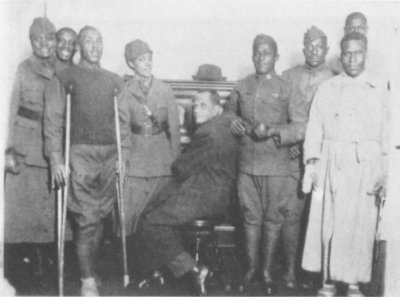 |
| WOUNDED NEGRO SOLDIERS CONVALESCING IN BASE HOSPITAL. IN THE
PICTURE ARE TWO COLORED WOMEN AMBULANCE DRIVERS. |
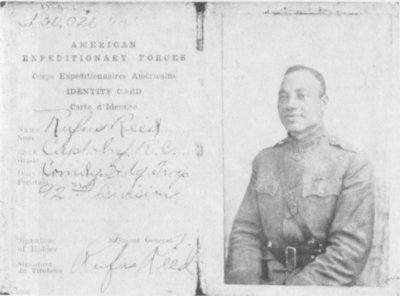 |
| SAMPLE OF IDENTITY CARD CARRIED BY SOLDIERS OF THE AMERICAN
EXPEDITIONARY FORCES. EACH IDENTIFICATION WAS PRINTED IN ENGLISH
AND FRENCH AND INCLUDED A PHOTOGRAPH OF THE OWNER. THE NUMBER ON
THE CARD CORRESPONDING WITH A METAL TAG ON THE MAN'S ARM. |
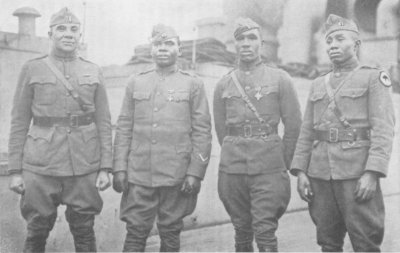 |
| NEGRO OFFICERS OF 366TH INFANTRY WHO ACHIEVED DISTINCTION IN
FRANCE. LEFT TO RIGHT. LIEUT C.L. ABBOTT, CAPT. JOS. L. LOWE,
LIEUT. A.R. FISHER, CAPT. E. WHITE. |
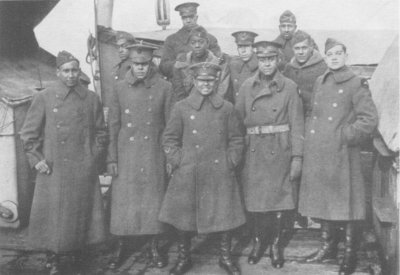 |
| DISTINGUISHED OFFICERS OF THE 6TH ILLINOIS (370TH INFANTRY).
FIRST ROW, LEFT TO RIGHT, CAPT. D.J. WARNER, A.H. JONES. LIEUT.
E.G. WHITE, LIEUT. J.D. RAINEY, LIEUT. BERNARD McGWIN. SECOND
ROW—LIEUT. LUTHER J. HARRIS, LIEUT. ALVIN M. JORDAN, LIEUT.
E.L. GOODLETT, LIEUT. J.T. BAKER. THIRD ROW, LIEUT. F.J. JOHNSON,
LIEUT. JEROME L. HUBERT. |
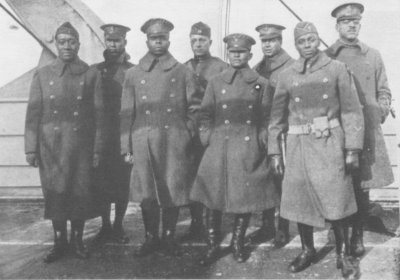 |
| DISTINGUISHED OFFICERS OF 8TH ILLINOIS (370TH INFANTRY). LEFT
TO RIGHT, LIEUT. LAWSON PRICE, LIEUT. O.A. BROWNING, LIEUT. W.
STEARLES, CAPT. LEWIS E. JOHNSON, LIEUT. EDMOND G. WHITE, LIEUT.
F.W. BATES, LIEUT. E.F.E. WILLIAMS, LIEUT. BINGA DISMOND. |
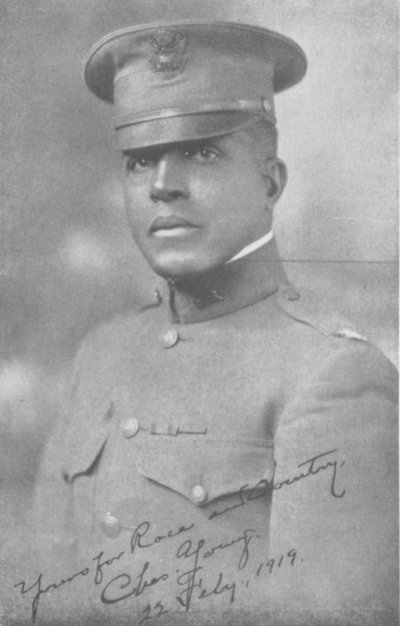 |
| COLONEL CHARLES YOUNG, RANKING NEGRO OFFICER OF THE REGULAR
ARMY. ONE OF THREE WHO HAVE BEEN COMMISSIONED FROM THE UNITED
STATES MILITARY ACADEMY AT WEST POINT. A VETERAN OFFICER OF THE
SPANISH-AMERICAN WAR AND WESTERN CAMPAIGNS. DETAILED TO ACTIVE
SERVICE, CAMP GRANT, ROCKFORD, ILLINOIS. DURING THE WORLD
WAR. |
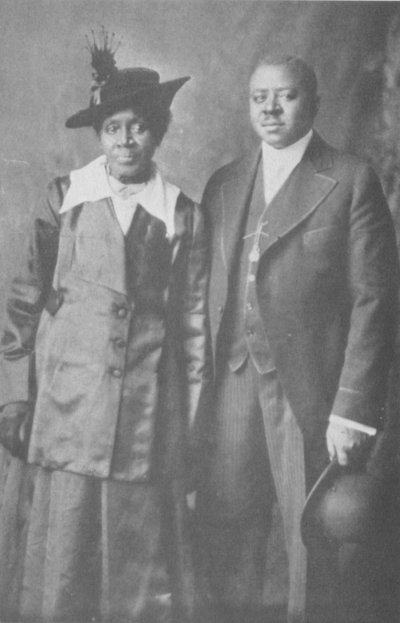 |
| TWO NOTED PARTISANS OF THE ALLIES IN THE GREAT WORLD WAR:
MRS. J.H.H. SENGSTACKE, AND HER FAMOUS SON, ROBERT SENGSTACKE
ABBOTT, EDITOR AND PUBLISHER OF THE CHICAGO DEFENDER. IT WAS MRS.
SENGSTACKE WHO, WHEN THE DEFENDER HAD REACHED THE ONE HUNDRED
THOUSAND MARK OF ITS CIRCULATION, STARTED THE PRESS THAT RAN OFF
THE EDITION, FLAMING WITH CHEER AN INSPIRATION FOR "OUR BOYS" IN
THE TRENCHES "OVER THERE." |
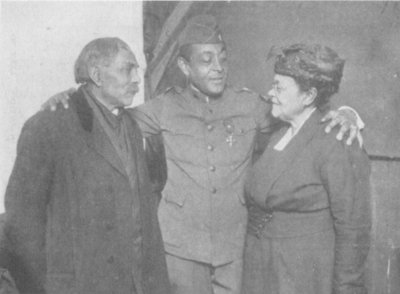 |
| REUNITED AND HAPPY. LIEUT. COLONEL OTIS B. DUNCAN OF 8TH
ILLINOIS (370TH INFANTRY), WHO CAME OUT OF THE WAR THE RANKING
NEGRO IN THE AMERICAN EXPEDITIONARY FORCES; HIS FATHER AND
MOTHER. |
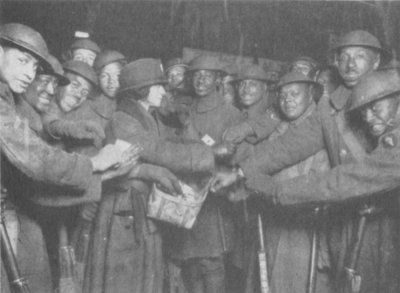 |
| MISS VIVIAN HARSH, MEMBER CHICAGO CHAPTER OF CANTEEN WORKERS,
PASSING OUT SMOKES TO RETURNED SOLDIERS OF 8TH ILLINOIS (370TH
INFANTRY). |
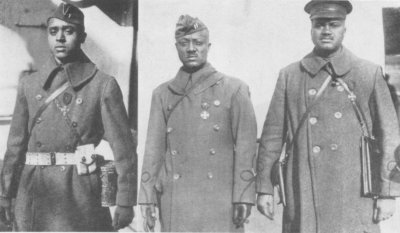 |
| OFFICERS OF 8TH ILLINOIS (370TH INFANTRY). DECORATED BY
FRENCH FOR GALLANTRY IN ACTION. LEFT TO RIGHT. LIEUT. THOMAS A.
PAINTER, CAPT. STEWART ALEXANDER, LIEUT. FRANK ROBINSON. |
For the valor shown both were cited for the Distinguished
Service Cross. Lieutenant Campbell's superiors also took the view
that in that particular instance the life of a brave soldier was
of more importance than the dispatch of a message, for as a
result, he was recommended for a captaincy.
Another single detail taken from the same Company I:
John Baker, having volunteered, was taking a message through
heavy shell fire to another part of the line. A shell struck his
hand, tearing away part of it, but the Negro unfalteringly went
through with the message.
He was asked why he did not seek aid for his wounds before
completing the journey. His reply was:
"I thought that the message might contain information
that would save lives."
Has anything more heroic and unselfish than that ever been
recorded? Nature may have, in the opinions of some, been unkind
to that man when she gave him a dark skin, but he bore within it
a soul, than which there are none whiter; reflecting the spirit
of his Creator, that should prove a beacon light to all men on
earth, and which will shine forever as a "gem of purest ray
serene" in the Unmeasurable and great Beyond.
Under the same Lieut. Robert Campbell, a few colored soldiers
armed only with their rifles, trench knives, and hand grenades,
picked up from shell holes along the way, were moving over a road
in the Chateau Thierry sector. Suddenly their course was crossed
by the firing of a German machine gun. They tried to locate it by
the sound and direction of the bullets, but could not. To their
right a little ahead, lay a space covered with thick underbrush;
just back of it was an open field. Lieutenant Campbell who knew
by the direction of the bullets that his party had not been seen
by the Germans, ordered one of his men with a rope which they
happened to have, to crawl to the thick underbrush and tie the
rope to several stems of the brush; then to withdraw as fast as
possible and pull the rope making the brush shake as though men
were crawling through it. The purpose was to draw direct fire
from the machine gun, and by watching, locate its position.
The ruse worked. Lieutenant Campbell then ordered three of his
men to steal out and flank the machine gun on one side, while he
and two others moved up and flanked it on the other side.
The brush was shaken more violently by the concealed rope. The
Germans, their eyes focused on the brush, poured a hail of
bullets into it. Lieutenant Campbell gave the signal and the
flanking party dashed up; with their hand grenades they killed
four of the Boches and captured the remaining three—also
the machine gun. There was an officer who could think and plan in
an emergency, and evolve strategy like a Napoleon.
First Lieutenant Edward Jones, of the Medical Corps of the
regiment, was cited for heroism at Binarville. On September 27th
Lieutenant Jones went into an open area subjected to direct
machine gun fire to care for a wounded soldier who was being
carried by another officer. While dressing the wounded man, a
machine gun bullet passed between his arms and body and a man was
killed within a few yards of him.
In a General Order issued by the commander of the division,
General Martin, Second Lieutenant Nathan O. Goodloe, one of the
Negro officers of the regimental Machine Gun Company, was
commended for excellent work and meritorious conduct. During the
operations in the Argonne forest, Lieutenant Goodloe was attached
to the Third Battalion. In the course of action it became
necessary to reorganize the battalion and withdraw part of it to
a secondary position. He carried out the movement under a
continual machine gun fire from the enemy. General Martin said:
"Lieutenant Goodloe's calm courage set an example that inspired
confidence in his men."
General Martin also cited for meritorious conduct near Vienne le
Chateau, Tom Brown, a wagoner, who as driver of an ammunition
wagon, displayed remarkable courage, coolness and devotion to
duty under fire. Brown's horses had been hurled into a ditch by
shells and he was injured. In spite of his painful wounds he
worked until he had extricated his horses from the ditch,
refusing to quit until he had completed the work even though
covered with blood from his hurts.
Private Joseph James of the 368th, received the Distinguished
Service Cross for extraordinary heroism in action, September
27th, in the Argonne forest.
A regiment of the 92nd Division which gained distinction,
received its share of decorations and was mentioned several times
in General Orders from the high officers, was the 367th Infantry,
"Moss's Buffaloes." This title was attached to them while they
were undergoing training at Yaphank, N.Y., under Colonel James A.
Moss of the Regular Army. It stuck to the outfit all through the
war and became a proud title, a synonym of courage and fighting
strength.
The 367th went to France in June 1918 and spent two months
training back of the lines. It was sent to supporting trenches
August 20th and finally to the front line at St. Die, near
Lorraine border. It remained there until September 21st and was
then transferred to the St. Mihiel salient where Pershing
delivered his famous blow, the one that is said to have broken
the German heart. It was at any rate, a blow that demonstrated
the effectiveness of the American fighting forces. In a few days
the overseas commander of the Yankee troops conquered a salient
which the enemy had held for three years and which was one of the
most menacing positions of the entire line.
On October 9th, the regiment was sent to the left bank of the
Moselle, where it remained until the signing of the
armistice.
Colonel Moss was taken from combatant duty early in October to
become an instructor at the training school at Gondrecourt, the
regiment passing under the command of Colonel W.J. Doane.
Composed of selectives mostly from the state of New York, the
regiment was trained with a view to developing good assault and
shock troops, which they were.
Casualties of all descriptions in the 367th, amounted to about
ten per cent of the regimental strength. A number of decorations
for personal bravery were bestowed, and the regiment as a whole
was cited and praised by General Pershing in his review of the
92nd Division at Le Mans.
The entire First Battalion of the 367th, was cited for bravery
and awarded the Croix de Guerre by the French. The citation was
made by the French Commission because of the splendid service and
bravery shown by the regiment in the last engagement of the war,
Sunday and Monday, November 10th and 11th in the drive to Metz.
The men went into action through the bloody valley commanded by
the heavy guns of Metz, and held the Germans at bay until the
56th regiment could retreat, but not until it had suffered a
heavy loss. The First Battalion was commanded by Major Charles L.
Appleton of New York, with company commanders and lieutenants,
Negroes.
Another distinguished component of the 92nd Division was the
365th Infantry made up of selectives principally from Chicago and
other parts of Illinois. This regiment saw about the same service
as the 367th, perhaps a little more severe, as the casualties
were greater. In the action at Bois Frehaut in the drive on Metz,
the 365th lost forty-three men killed in action and dead from
wounds. In addition there were thirty-two missing in action, most
of whom were killed or succumbed to wounds. About 200 were
wounded or gassed.
In General Orders, issued by the commander of the division, a
number of Negro officers, non-commissioned officers and privates
of the 365th were commended for meritorious conduct in the
actions of November 10th and 11th. Those named were; Captain John
H. Allen, First Lieutenants Leon F. Stewart, Frank L. Drye,
Walter Lyons, David W. Harris, and Benjamin F. Ford; Second
Lieutenants George L. Games and Russell C. Atkins; Sergeants
Richard W. White John Simpson, Robert Townsend, Solomon D.
Colson, Ransom Elliott and Charles Jackson; Corporals Thomas B.
Coleman, Albert Taylor, Charles Reed and James Conley, and
Privates Earl Swanson, Jesse Cole, James Hill, Charles White and
George Chaney.
Captain Allen of the Machine Gun Company of the 365th, died in
France of pneumonia. Only a short time before his death he had
been awarded the Distinguished Service Cross by General Pershing,
for exceptional gallantry before Metz.
Private Robert M. Breckenridge of Company B, 365th regiment, also
gave his life in France, but had received the Distinguished
Service Cross for extraordinary heroism in action at Ferme de
Belwir, October 29th, 1918.
Corporal Russell Pollard of Company H received his Distinguished
Service Cross shortly before his return home. He was cited for
extraordinary heroism in action in the first days battle at
Metz.
The remaining infantry regiment of the Division not heretofore
specially mentioned, was the 366th, a highly efficient
organization of selectives assembled from the mobilization and
training camps of various sections of the country. Like the other
regiments of the division, the greater number of these men were
assembled in the autumn of 1917, trained continuously in this
country until the early part of the summer of 1918, sent to
France and given at least two months' intensive training there.
During the training periods their instructors were mostly
officers from the Regular Army or the military instruction
schools of this country and France. Some English officers also
assisted in the training. That they possessed the requisite
intelligence for absorbing the instruction they received is
evidenced by the high type of soldier into which they developed,
their records in battle, and the unstinted praise which they
received from their superior officers, the French commanders and
others who witnessed or were familiar with their service.
The 366th went through the campaign in the Marbache sector and
suffered all its rigors and perils. In the final two days of
fighting they were right at the front and achieved distinction to
the extent that in the review at Le Mans they also were singled
out by General Pershing for special commendation. During the
campaign the regiment had a loss of forty-three men killed in
action or died of wounds. Seven men were missing in action. The
wounded and gassed were upwards of 200.
In General Orders issued by the commander of the division, First
Lieutenant John Q. Lindsey was cited for bravery displayed at
Lesseux; Sergeant Isaac Hill for bravery displayed at Frapelle
and Sergeant Walter L. Gross for distinguished service near
Hominville. These men were all colored and all of the 366th
regiment.
Wherever men were cited in General Orders or otherwise, it
generally followed that they received the Distinguished Service
Cross or some other coveted honor.
CHAPTER
XXII.
GLORY THAT WONT COME OFF.
167TH FIRST NEGRO ARTILLERY BRIGADE—"LIKE
VETERANS" SAID PERSHING—FIRST ARTILLERY TO BE
MOTORIZED—RECORD BY DATES—SELECTED FOR LORRAINE
CAMPAIGN—BEST EDUCATED NEGROES IN AMERICAN
FORCES—ALWAYS STOOD BY THEIR GUNS—CHAPLAIN'S
ESTIMATE—LEFT SPLENDID IMPRESSION—TESTIMONY OF FRENCH
MAYORS—CHRISTIAN BEHAVIOR—SOLDIERLY
QUALITIES.
To the 92nd Division belonged the distinction of having the first
artillery brigade composed entirely of Negroes, with the
exception of a few commissioned officers, ever organized in this
country. In fact, the regiments composing the brigade, the 349th,
the 350th and 351st were the first complete artillery regiments
of Negroes and the only important Negro organizations in the
artillery branch of the service, ever formed in this country.
Their record was remarkable considering the brief time in which
they had to distinguish themselves, and had the war continued,
they would surely have gained added glory; General Pershing in
the review at Le Mans complimenting them particularly, stating
that when the armistice came he was planning important work for
them. Following are the general's words which brought much pride
to the organization:
"Permit me to extend to the officers and men of the
167th Field Artillery Brigade, especially the 351st regiment, my
congratulations for the excellent manner in which they conducted
themselves during the twelve days they were on the front. The
work of the unit was so meritorious that after the
accomplishments of the brigade were brought to my attention I was
preparing to assign the unit to very important work in the second
offensive. You men acted like veterans, never failing to reach
your objective, once orders had been given you. I wish to thank
you for your work."
The unit was organized largely from men of Western Pennsylvania,
the District of Columbia, Maryland and Virginia. Camp Meade, near
Washington, D.C., was their principal training point from the
fall of 1917 until June, 1918, when they went abroad.
To the brigade belongs the additional distinction of being the
first in the service to be motorized. Tractors hauled the big
guns along the front at a rate of twelve miles an hour, much
better than could have been done with horses or mules.
Brigadier General W.E. Cole commanded the unit until about the
middle of September, 1918, when he was elevated to a major
generalship and the command of the 167th passed to Brigadier
General John H. Sherburne. In a General Order issued by the
latter shortly before he left the unit, he said:
"I will ever cherish the words of the Commander in
Chief, the compliment he paid, in all sincerity to this brigade,
when he watched it pass in review. I wish the brigade to
understand that those words of appreciation were evoked only
because each man had worked conscientiously and unflaggingly to
make the organization a success. The men went into the line in a
manner to win the praise of all."
The history of the brigade from the time it left Camp Meade until
the end of the war may be summarized as follows:
June 27—Disembarked from ship at Brest, France.
July 2—Started for the training area, reaching there July
4.
July 5—Began a period of six weeks training at Lathus in
the Montmorillion section.
August 20—Went to La Courtine and remained until September
16th, practicing at target range. Its gun squads excelled in
target work and the brigade, especially the 351st regiment, won
distinction there. October 4—Finished training at La
Courtine and moved into a sector directly in front of Metz, where
about three weeks were spent in obtaining the tractors and motor
vehicles necessary for a completely motorized artillery
outfit.
October 25—Preparing for action. The enemy had noted the
great movement of troops in the vicinity and German planes
constantly hovered over the unit dropping missiles of death upon
it.
The brigade supported the infantry of the division in its attacks
on Eply, Cheminot, Bouxieres, Bois Frehaut, Bois La Cote,
Champey, Vandieres, Pagny and Moulin Farm. Attacks of more than
mediocre importance were: Pagny, November 4 and 5; Cheminot,
November 6, Epley, November 7; Bois Frehaut, November 10; Bois La
Cote and Champey, November 11.
In addition to those attacks certain machine gun nests of the
enemy were destroyed and strategic points were bombarded. During
the entire advance the batteries of the brigade were in front
positions and very active. The attack on Bois La Cote and Champey
began at 4:30 in the morning and ended just fifteen minutes
before the beginning of the armistice. During the engagement the
batteries kept up such a constant fire that the guns were almost
white with heat.
Private Carl E. Southall of 2538 Elba street, Pittsburgh, Pa.,
claims to have fired the brigade's last shot. He was a member of
Battery D, 351st regiment. When the watch showed the last minute
of the war, he jumped forward, got to the gun ahead of his
comrades and fired.
Had the war continued the artillery brigade would have taken part
in the offensive which was to have begun after November 11 with
twenty French and six American divisions investing Metz and
pushing east through Lorraine.
The history of one regiment in the artillery outfit is
practically the same as another, with the exception that the
351st seems to have had the most conspicuous service. This unit
of the brigade was commanded by Colonel Wade H. Carpenter, a West
Pointer.
Owing to the technical requirements, a thorough knowledge of
mathematics especially being necessary before one can become a
good non-commissioned or commissioned officer of artillery, this
branch of the service appeals to men of schooling. It has been
claimed that the 351st regiment contained the best educated group
of Negroes in the American forces; most of them being college or
high school men. They were praised highly by their officers,
especially by Colonel Carpenter:
"When the regiment trained at Camp Meade," he said,
"the men showed the best desire, to make good soldiers. In France
they outdid their own expectations and shed glory for all.
"We didn't get into action until October 28th, but after that we
kept at the Germans until the last day.
"The men of the 351st were so anxious to get into service that
before they were ordered to the front they found it difficult to
restrain their impatience at being held back. However, their long
training in France did them a lot of good, the experience of
being taught by veteran Americans and Frenchmen proving of great
value when it came to actual battle.
"They never flinched under fire, always stood by their guns and
made the famous 155 millimeter French guns, with which we were
equipped, fairly smoke.
"I have been a regular army man for many years, and have always
been in command of white troops. Let me say to you that never
have I commanded a more capable, courageous and intelligent
regiment than this. It would give me the greatest pleasure to
continue my army career in command of this regiment of
Negroes.
"Not only was their morale splendid but they were especially
ready to accept discipline. They idolized their officers and
would have followed them through hell if necessary.
"Fortunately, though many were wounded by shrapnel and a number
made ill by gas fumes, we suffered no casualties in the slain
column. About twenty-five died of sickness and accidents, but we
lost none in action.
"When the armistice came our hits were making such tremendous
scores against the enemy that prisoners taken by the Americans
declared the destruction wrought by the guns was terrific. On the
last day and in the last hour of the war our guns fairly beat a
rat-a-tat on the enemy positions. We let them have it while we
could."
Lieutenant E.A. Wolfolk, of Washington, D.C., chaplain of the
regiment, aid:
"The morale and morals of the men were splendid.
Disease of the serious type was unknown. The men were careful to
keep within bounds. They gave their officers no trouble, and each
man strove to keep up the high standard expected of him. From the
time we reached France in June, 1918, until the time we quit that
country we worked hard to maintain a clean record and we
certainly succeeded."
At the Moselle river, Pont a Mousson and Madieres, the regiment
first saw action. The first and second battalions went into
action immediately in the vicinity of St. Genevieve and Alton.
The third battalion crossed the river and went into action in the
vicinity of Pont a Mousson. That was on October 31st. The balance
of the regiment's service corresponds to that of the brigade,
already mentioned.
As already gleaned from the reports of generals, regimental
officers and the testimony of the chaplain of the 351st, the
artillery boys created a good impression and left behind them a
clean record everywhere. It has remained for the officers of the
349th regiment to preserve this in additional documentary form in
the shape of regimental orders and letters from the mayors of
French towns in which the regiment stopped or was billeted. The
following are some of the bulletins and letters:
                          Headquarters 349th Field
                          Artillery, American Expeditionary
                          Forces, France, A.P.O. 722,
                          September 6, 1918.

     The following letter having been received, is published
for the information of the regiment, and will be read at retreat
Saturday, September 7, 1918. By order of
                             COLONEL MOORE.
          JOSEPH H. McNALLY, Captain and Adjutant.

                      FRENCH REPUBLIC
                 Town Hall of Montmorillion
                         (Vienne)
                         Montmorillion, August 12, 1918.
Dear Colonel:
     At the occasion of your departure permit me to express
to you my regrets and those of the whole population.
     From the very day of its arrival your regiment, by its
behavior and its military appearance, it excited the
admiration of all of us.
     Of the sojourn of yourself and your colored soldiers
among us we will keep the best memory and remember your
regiment as a picked one.
     From the beginning a real brotherhood was established
between your soldiers and our people, who were glad to
welcome the gallant allies of France.
     Having learned to know them, the whole population
holds them in great esteem, and we all join in saying the
best of them.
     I hope that the white troops replacing your regiment
will give us equal satisfaction; but whatever their attitude
may be, they cannot surpass your 349th Field Artillery.
Please accept the assurance of my best and most
distinguished feelings.
                             G. DE FONT-REAULX,
                                    Assistant Mayor.

                            Headquarters 349th Field
                            Artillery, American Expeditionary
                            Forces, France, A.P.O. 766,
                            January 25, 1919.

     The following letter having been received is published
for the information of the regiment. By order of
                                   COLONEL O'NEIL.
GEORGE B. COMPTON, Captain and Adjutant.

                     MAIRIE DE DOMFRONT
                          (Orne)
                           Domfront, January 22, 1919.
     The mayor of the town of Domfront has the very great
pleasure to state and declare that the 349th regiment of
the 167th Field Artillery Brigade, has been billeted at
Domfront from the 28th of December, 1918, to the 22nd of
January, 1919, and that during this period the officers
as well as the men have won the esteem and sympathy of all
the population.
     The black officers as well as the white officers have
made here many friends, and go away leaving behind them the
best remembrances. As to the private soldiers, their behavior
during the whole time has been above all praise.
     It is the duty of the mayor of Domfront to bid the
general, officers and men a last farewell, and to express to
all his thanks and gratitude for their friendly intercourse
with the civilian population.
                                    F. BERLIN, Mayor.
After such testimony who can doubt the Christianlike behavior and
soldierly qualities of the black man? It has been noted that the
artillerymen were in education considerably above the average of
the Negro force abroad, but no severe criticism has been heard
concerning the conduct of any of the Negro troops in any part of
France. The attitude of the French people had much to do with
this. The unfailing courtesy and consideration with which they
treated the Negroes awoke an answering sentiment in the natures
of the latter. To be treated as Men, in the highest sense of the
term, argued that they must return that treatment, and it is not
of record that they failed to give adequate return. Indeed the
record tends to show that they added a little for good measure,
although it is hard to outdo a Frenchman in courtesy and the
common amenities of life.
This showing of Negro conduct in France takes on increased merit
when it is considered that the bulk of their forces over there
were selectives; men of all kinds and conditions; many of them
from an environment not likely to breed gentleness, self
restraint or any of the finer virtues. But the leaders and the
best element seem to have had no difficulty in impressing upon
the others that the occasion was a sort of a trial of their race;
that they were up for view and being scrutinized very carefully.
They made remarkably few false steps.
CHAPTER
XXIII.
NOR STORIED URN, NOR MOUNTING SHAFT.
GLORY NOT ALL SPECTACULAR—BRAVE FORCES BEHIND THE
LINES—325TH FIELD SIGNAL BATTALION—COMPOSED OF YOUNG
NEGROES—SEE REAL FIGHTING—SUFFER CASUALTIES—AN
EXCITING INCIDENT—COLORED SIGNAL BATTALION A
SUCCESS—RALPH TYLER'S STORIES—BURIAL OF NEGRO SOLDIER
AT SEA—MORE INCIDENTS OF NEGRO VALOR—A WORD FROM
CHARLES M. SCHWAB.
Out of the glamor and spectacular settings of combat comes most
of the glory of war. The raids, the forays, the charges; the
pitting of cold steel against cold steel, the hand to hand
encounters in trenches, the steadfast manning of machine guns and
field pieces against deadly assault, these and kindred phases of
battle are what find themselves into print. Because they lend
themselves so readily to the word painter or to the artist's
brush, these lurid features are played to the almost complete
exclusion of others, only slightly less important.
There are brave forces behind the lines, sometimes in front of
the lines, about which little is written or pictured. Of these
the most efficient and indispensable is the Signal Corps. While
this branch of the service was not obliged to occupy front line
trenches; make raids for prisoners, or march in battle formation
into big engagements, it must not be supposed that it did not
have a very dangerous duty to perform.
One of the colored units that made good most decisively was the
325th Field Signal Battalion of the 92nd Division. The men of
this battalion had to string the wires for telegraphic and
telephonic connections at times when the enemy guns were trained
upon them. Therefore, in many respects, their duty took them into
situations fully as dangerous as those of the combatant
units.
This battalion was composed entirely of young Negroes excepting
the Lieutenant Colonel, Major and two or three white line
officers. With few exceptions, they were all college or high
school boys, quite a number of them experts in radio or electric
engineering. Those who were not experts when the battalion was
formed, became so through the training which they received.
Major Spencer, who was responsible for the formation of the
battalion, the only Negro signal unit in the American Army, was
firm in the belief that Negroes could make good, and he remained
with it long enough to see his belief become a realization.
After arriving at Brest, June 19, 1918, the battalion proceeded
to Vitrey, and from that town began a four-day hike to Bourbonne
les Baines. From that point it proceeded after a few days to
Visey, where the boys got their first taste of what was to be,
later, their daily duties. Here the radio (wireless telegraphy)
company received its quota of the latest type of French
instruments, a battery plant was established and a full supply of
wire and other equipment issued to Companies B and C. Here, too,
the Infantry Signal platoons of the battalion joined the outfit
and shared in the training.
A courage test and their first introduction into real fighting in
addition to stringing wires and sending and receiving radio
messages, came on the afternoon of September 27th. A party
including the Colonel, Lieutenant Herbert, the latter a Negro,
and some French liaison officers, advanced beyond the battalion
post and soon found themselves outside the lines and directly in
front of a German machine gun nest.
The colonel divided his men into small groups and advanced on the
enemy's position. The sortie resulted in the Signal boys
capturing eight prisoners and two machine guns, but it cost the
loss of Corporal Charles E. Boykin, who did not return. Two days
later during a general advance, Sergeant Henry E. Moody was
mortally wounded while at his post. Boykin was killed outright,
while Sergeant Moody died in the hospital, these being the first
two of the Signal Battalion to make the supreme sacrifice.
On the 10th of October the 92nd Division, having taken over the
Marbache sector and relieved the 167th French Division, the 325th
Field Signal Battalion took over all existing lines of
communication. In the days following they installed new lines and
made connections between the various units of the division. This
was no small duty, when it is remembered that an army sector
extends over a wide area of many square miles, including in it
from 50 to 100 cities and towns.
The Marbache sector was an active front and time and time again
the boys went ahead repairing lines and establishing new
communications under shell fire, with no heed to personal
danger—inspired only by that ideal of the Signal Corps
man—get communication through at any cost, but get it
through.
On the morning of November 10th, when the Second Army launched
its attack on the famous Hindenburg line before Metz, the 92nd
Division held the line of Vandieres—St. Michel, Xon and
Norry. The engagement lasted for twenty-eight hours continuously,
during which time the Signal Corps functioned splendidly and as
one man, keeping up communications, installing new lines and
repairing those shelled out.
One of the most exciting incidents was that participated in by
the First Platoon of the Signal Battalion on the first day of the
Metz battle. Shortly after the lighter artillery barrage was
lifted, the big guns of the enemy began shelling Pont a Mousson.
The first shells hit on the edge of the city and then they began
peppering the Signal Battalion's station.
Sergeant Rufus B. Atwood of the First Platoon was seated in the
cellar near the switchboard; Private Edgar White was operating
the switchboard, and Private Clark the buzzerphone. Several
officers and men were standing in the "dugout" cellar. Suddenly a
shell struck the top, passed through the ceiling and wall and
exploded, making havoc of the cellar.
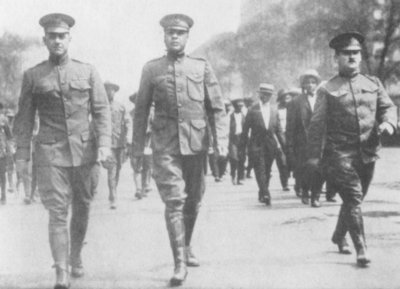 |
| OFFICERS OF THE 15TH NEW YORK (369TH INFANTRY), MARCHING IN
PARADE PRIOR TO THE WAR. LEFT TO RIGHT—COL. WM. HAYWARD,
BERT WILLIAMS. FAMOUS COMEDIAN AND DR. G. McSWEENEY. |
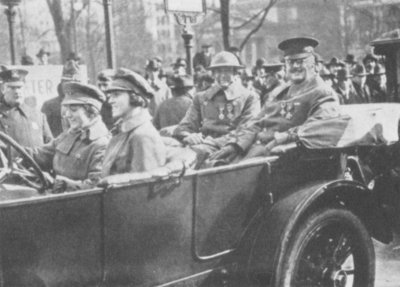 |
| AFTER THE WAR. ONE OF THE NUMBER OF AUTOMOBILES BEARING
WOUNDED OFFICERS AND SOLDIERS OF THE 15TH NEW YORK (369TH
INFANTRY). MAJOR DAVID L. 'ESPERANCE (WITH HELMET) AND MAJOR
LORRILARD SPENCER. |
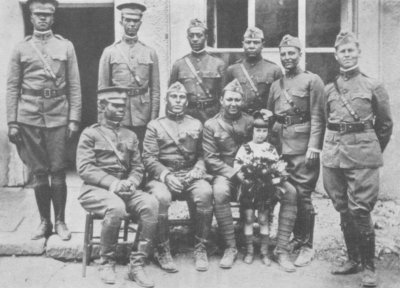 |
| A REPRESENTATIVE GROUP OF NEGRO OFFICERS OF "MOSS'S
BUFFALOES" (167TH INFANTRY). THE LITTLE LADY WITH THE BOUQUET IS
ONE OF THEIR FRENCH ACQUAINTANCES. |
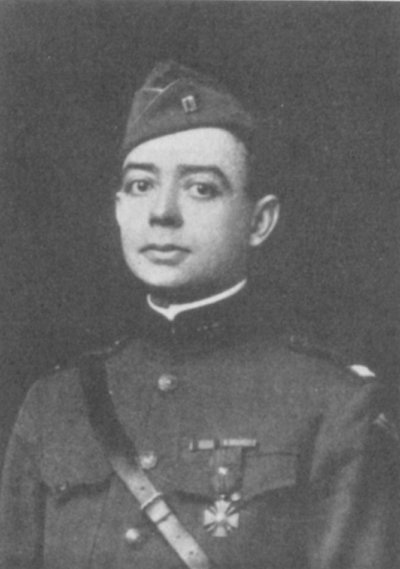 |
| CAPTAIN JOHN H. PATTON, REGIMENTAL ADJUTANT, 8TH ILLINOIS
INFANTRY. FROM JUNE 26, 1916, TO SEPTEMBER 11, 1918. COMMANDING
2ND BATTALION, 370TH INFANTRY, FROM SEPTEMBER 11, 1918, TO
DECEMBER 25, 1918. SAINT MIHIEL SECTOR FROM JUNE 21, 1918, TO
JULY 3, 1918. ARGONNE FOREST FROM JULY 6, 1916, TO AUGUST 15,
1918. BATTLES FOR MONT DES SIGNES, FROM SEPTEMBER 16 TO 30, 1918.
OISE-AISNE OFFENSIVE, FROM SEPTEMBER 30, 1918. TO NOVEMBER 11,
1918. AWARDED THE FRENCH CROIX DE GUERRE FOR MERITORIOUS SERVICE
COVERING PERIOD FROM SEPTEMBER 11 TO NOVEMBER 11, 1918. |
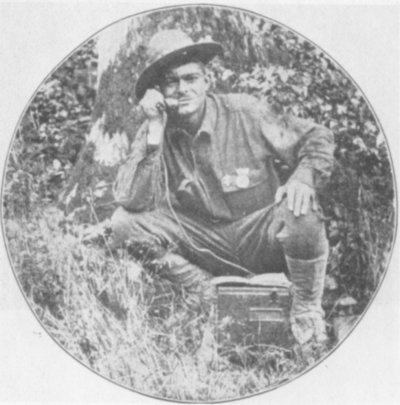 |
| EMIL LAURENT, NEGRO CORPORAL OF 8TH ILLINOIS (370TH
INFANTRY), A CROIX DE GUERRE WINNER, ENGAGED IN FIELD TELEPHONE
SERVICE IN A FRENCH WOOD. |
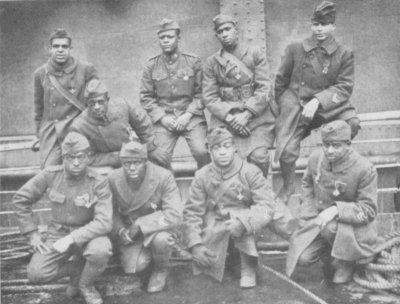 |
| GROUP OF "HELL FIGHTERS' (369TH INFANTRY) WITH THEIR JEWELRY
(CROIX DE GUERRE). FRONT ROW, LEFT TO RIGHT, "EAGLE EYE" EDWARD
WILLIAMS, "LAMP LIGHT" HERB TAYLOR, LEON TRAINOR, "KID HAWK"
RALPH HAWKINS, BACK ROW, LEFT TO RIGHT, SERGT. M.D. PRIMUS,
SERGT. DANIEL STORMS, "KID WONEY" JOE WILLIAMS, "KID BUCK" ALFRED
HANLY AND CORP. T.W. TAYLOR. |
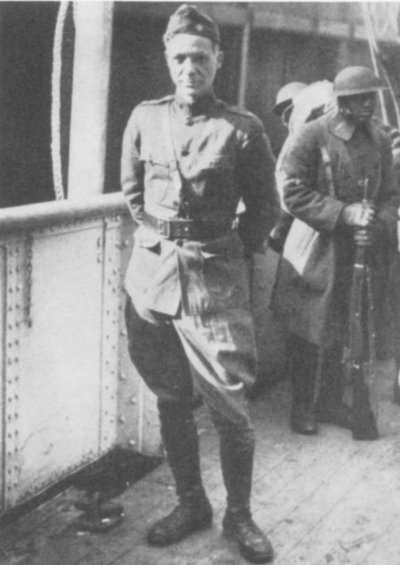 |
| DR. JOSEPH H. WARD ON TRANSPORT FRANCE. THE ONLY NEGRO
ATTAINING THE RANK OF MAJOR IN THE MEDICAL CORPS OF THE AMERICAN
EXPEDITIONARY FORCES. |
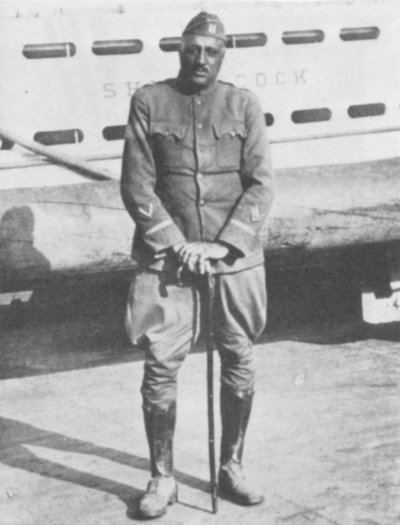 |
| CAPTAIN NAPOLEON B. MARSHALL, FAMOUS HARVARD ATHLETE, WHO
HELPED ORGANIZE 15TH NEW YORK AND WAS ONE OF ITS ORIGINAL NEGRO
OFFICERS. HE WAS SERIOUSLY WOUNDED AT METZ. |
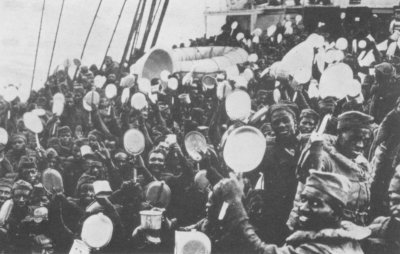 |
| BRAVE NEGROES HOMEWARD BOUND FROM WAR. FIRST CALL FOR
DINNER. |
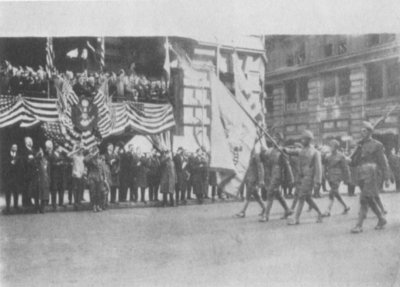 |
| "MOSS'S BUFFALOES" (367TH INFANTRY), REVIEWED BY GOVERNOR
WHITMAN AFTER FLAG PRESENTATION IN FRONT OF UNION LEAGUE CLUB,
NEW YORK. |
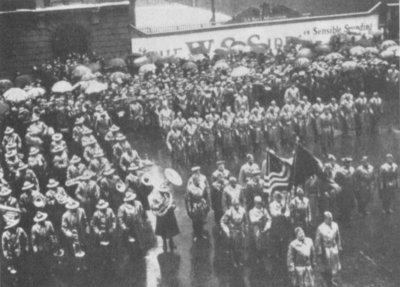 |
| THE "BUFFALOES" (367TH INFANTRY), RETURNING TO NEW YORK AFTER
VALIANT SERVICE IN FRANCE. THEIR COLORS STILL FLYING. |
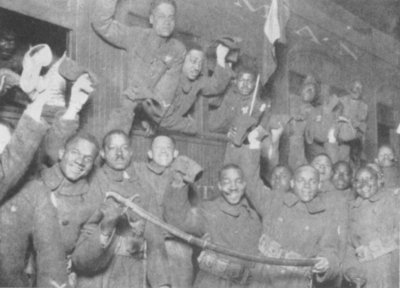 |
| SOLDIERS WHO DISTINGUISHED THEMSELVES AT THE FORTRESS OF
METZ. GROUP BELONGING TO 365TH INFANTRY ARRIVING AT CHICAGO
STATION. |
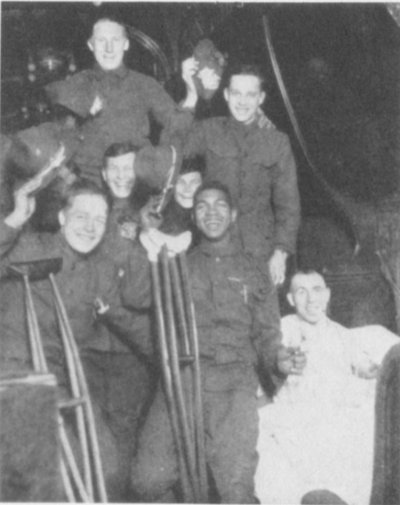 |
| HOMEWARD BOUND IN A PULLMAN CAR. NO "JIM CROWING THERE." THE
NEGRO BEARS ON HIS SHOULDER THE CITATION CORD AND EMBLEM DENOTING
VALOROUS SERVICE. |
Lieutenant Walker, who arrived just at this time, took hold of
matters with admirable coolness and presence of mind. Sergeant
Atwood tried out the switchboard and found all lines broken. He
also found on trying it the buzzerphone out. Lieutenant Walker
gave orders to Private White to stay on the switchboard and
Corporal Adolphus Johnson to stay on the buzzerphone. The
twelve-cord monocord board was nailed up by White and then began
the connecting up of the lines from outside to the monocord
board. All this time the shelling by the Germans was fierce and
deadly. Shells struck all around the boys and one struck a nearby
ammunition dump, causing the explosion of thousands of rounds of
ammunition, which created a terrific shock and extinguished all
the lights.
But still the men worked on and would not leave the dangerous
post, a veritable target for the enemy's big guns, until the
lieutenant of the Military Police arrived and ordered them
out.
The 325th Field Signal Battalion was a great success. What the
boys did not learn about radio, telephonic and telegraphic work
would be of little advantage to anyone. It will be of great
advantage to many of them in the way of making a living in times
of peace.
By the time the armistice stopped the fighting the different
units of the 92nd Division had taken many prisoners and gained
many objectives. They finally retired to the vicinity of Pont a
Mousson, where time was spent salvaging material and cleaning
equipment, while the men, knowing there was to be no more
fighting, anxiously awaited the time until they were ordered to
an embarkation point and thence home.
The trip home in February, 1919, was about as perilous to some of
them as the war had been. It was a period of unusually rough
weather. The north Atlantic, never very smooth during the winter
months, put on some extra touches for the returning Negro
soldiers. An experience common to many on several different
transports has been described by Mechanic Charles E. Bryan of
Battery B, 351st Artillery upon his return to his home, 5658
Frankstown Avenue, Pittsburgh, Pa. Asked about his impressions of
the war, he said that which impressed him the most was the storm
at sea on the way home.
"That storm beat the war all hollow," he said. "Me and my buddies
were messing when the ship turned about eighteen somersaults, and
we all pitched on the floor, spilling soup and beans and things
all over the ship.
"The lights went out and somehow the automatic bell which means
'abandon ship' was rung by accident. We didn't know it was an
accident, and from the way the ship pitched we thought she was on
her way down to look up one Mr. Davy Jones. So we made a break
for the decks, and believe me, some of those lads who had come
through battles and all sorts of dangers were about to take a
dive over the side if our officers had not started explaining in
time."
Stories of varying degrees of interest, some thrilling, some
humorous and some pathetic to the last degree, have been brought
back.
Ralph Tyler, the Negro newspaper man, who was sent to France as
the official representative of the Afro-American press by the
Committee on Public Information, has written many of the
incidents, and told others from the rostrum. He has told how the
small insignificant, crowded freight cars in which the soldiers
traveled looked like Pullman parlor coaches to the Negro
soldiers.
"To many of our people back in the 'States,'" wrote
Mr. Tyler from France, "who saw our boys embark on fine American
railroad coaches and Pullman sleepers to cover the first lap of
their hoped-for pilgrimage to Berlin, the coaches they must ride
in over here would arouse a mild protest. I stood at Vierzon, one
of France's many quaint old towns recently, and saw a long train
of freight cars roll in, en route to some point further distant.
In these cars with but a limited number of boxes to sit upon, and
just the floors to stand upon, were crowded some 1,000 of our own
colored soldiers from the States. But a jollier crowd never rode
through American cities in Pullman sleepers and diners than those
1,000 colored troopers. They accepted passage on these rude box
freight cars cheerfully, for they knew they were now in war, and
palace cars, downy coaches and the usual American railroad
conveniences were neither available nor desirable.
"The point I wish to convey to the people back home is that did
they but know how cheerfully, even eagerly our boys over here
accept war time conveniences, they would not worry quite so much
about how the boys are faring. They are being wholesomely and
plenteously fed; they are warmly clothed, they are cheerful and
uncomplaining as they know this is war and for that reason know
exactly what they must expect. To the soldier who must at times
sleep with but the canopy of heaven as a covering, and the earth
as a mattress, a box freight car that shields him from the rain
and wind is a real luxury, and he accepts it as such.
"There need not be any worry back home as to the maintenance of
our colored soldiers over here. They receive the same substantial
fare the white soldier receives, and the white soldier travels
from point to point in the same box freight cars as afford means
of passage for colored soldiers. In short, when it comes to
maintenance and equipment, and consideration for the comfort of
the American soldier, to use a trite saying, 'the folks are as
good as the people.' There is absolutely no discrimination, and
the cheerfulness of those 1,000 boys whose freight cars became,
in imagination, Pullman palace cars, was the proof to me that the
colored boys in the ranks are getting a fifty-fifty break."
"Two more stories have come to me," continues Mr. Tyler, "to
prove that our colored soldiers preserve and radiate their humor
even where shells and shrapnel fly thickest. A colored soldier
slightly wounded in the Argonne fighting—and let me assure
you there was 'some' fighting there—sat down beside the
road to wait for a chance to ride to the field hospital. A
comrade hastening forward to his place in the line, and anxious
for the latest news of the progressing battle, asked the wounded
brother if he had been in the fight; did he know all about it,
and how were things going at the front. 'I sure does know all
about it,' the wounded man replied. 'Well, what's happened to
them?' quickly asked the trooper on his way to the front. 'Well,
it was this way,' replied the wounded one, 'I was climbin' over
some barbed wire tryin' to get to those d—n Boches, and
they shot me; that's what I know about it.'
"A company water cart was following the advancing troops when a
German shell burst in the ditch almost beside the cart. The horse
on the shell side was killed, and the driver was wounded in the
head. While the blood from his wound ran freely down his face,
the driver took one look at the wreckage, then started stumbling
back along the road. A white lieutenant who had seen it all
stopped the driver of the cart and said:
"The dressing station is—"
"Before he could finish his sentence, the wounded driver, with
the blood flowing in rivulets down his face, said: 'Dressing
station hell; I'm looking for another horse to hitch to that cart
and take the place of the one the shell put out of
commission.'
"That was a bit of nerve, grim humor and evidence of fidelity to
duty. A mere wound in the head could not stop that driver from
keeping up with the troops with a needed supply of
water."
Dr. Thomas Jesse Jones, who went to France under the auspices of
the Y.M.C.A., sent back the following account of the burial of a
Negro soldier at sea:
"A colored soldier was buried at sea today. The flags
on all the ships of the fleet have been at half-mast all day. It
mattered not that the soldier came from a lowly cabin. It
mattered not that his skin was black. He was a soldier in the
army of the United States, and was on his way to fight for
Democracy and Civilization.
"The announcement of his death was signalled to every commander
and every ship prepared to do honor to the colored soldier. As
the sun was setting the guard of honor, including all the
officers from commander down, came to attention. The body of the
Negro trooper wrapped in the American flag, was tenderly carried
to the stern of the ship. The chaplain read the solemn burial
service. The engines of the fleet were checked. The troop ship
was stopped for the only time in the long trip from America to
Europe. The bugle sounded Taps and the body of the American
soldier was committed to the great ocean and to God.
"The comradeship of the solemn occasion was the comradeship of
real Democracy. There was neither black nor white, North nor
South, rich nor poor. All united in rendering honor to the Negro
soldier who died in the service of humanity."
First Lieutenant George S. Robb of the 369th Infantry was cited
for "conspicuous gallantry and intrepidity above and beyond the
call of duty" in action with the enemy near Sechault, September
29 and 30, 1918.
While leading his platoon in the assault at Sechault, Lieutenant
Robb was severely wounded by machine gun fire, but rather than go
to the rear for proper treatment, he remained with his platoon
until ordered to the dressing station by his commanding officer.
Returning within forty-five minutes, he remained on duty
throughout the entire night, inspecting his lines and
establishing outposts. Early the next morning he was again
wounded, once again displaying remarkable devotion to duty by
remaining in command of his platoon.
Later the same day a bursting shell added two more wounds, the
same shell killing the captain and two other officers of his
company. He then assumed command of the company and organized its
position in the trenches. Displaying wonderful courage and
tenacity at the critical times, he was the only officer of his
battalion who advanced beyond the town and, by clearing machine
gun and sniping posts, contributed largely to the aid of his
battalion in holding its objective. His example of bravery and
fortitude and his eagerness to continue with his mission despite
the several wounds, set before the enlisted men of his command a
most wonderful standard of morale and self-sacrifice. Lieutenant
Robb lived at 308 S. 12th Street, Salina, Kansas.
Second Lieutenant Harry C. Sessions, Company I, 372nd Infantry,
was cited for extraordinary heroism in action near Bussy Farm,
September 29, 1918.
Although he was on duty in the rear, Lieutenant Sessions joined
his battalion and was directed by his battalion commander to
locate openings through the enemy's wire and attack positions. He
hastened to the front and cut a large opening through the wire in
the face of terrific machine gun fire. Just as his task was
completed, he was so severely wounded that he had to be carried
from the field. His gallant act cleared the way for the rush that
captured enemy positions.
In August, 1918, back in the Champagne, a German raiding party
captured a lieutenant and four privates belonging to the 369th
Infantry, and was carrying them off when a lone Negro, Sergeant
William Butler, a former elevator operator, made his presence
known from a shell hole. He communicated with the lieutenant
without the knowledge of the Germans and motioned to him to flee.
The Lieutenant signalled to the four privates to make a run from
the Germans. As they started Butler yelled, "Look out, you Bush
Germans! Here we come," and he let go with his pistol. He killed
one Boche officer and four privates, and his own men made good
their escape. Later the German officer who had been in charge of
this raiding party was captured and his written report was
obtained. In it he said that he had been obliged to let his
prisoners go because he was attacked by an "overwhelming number
of blutlustige schwartzemaenner." The overwhelming number
consisted of Elevator Operator Bill Butler alone.
September 30th the 3rd Battalion, of the 370th Infantry, composed
of down-state Illinois boys from Springfield, Peoria, Danville
and Metropolis, achieved a notable victory at Ferme de la
Riviere. This battalion, under the brilliant leadership of
Lieutenant Colonel Otis B. Duncan, made an advance of one
kilometer against enemy machine gun nests and succeeded in
silencing them, thereby allowing the line to advance. This
battalion of the Illinois down-state boys succeeded in doing
what, after three similar attempts by their French comrades in
arms, had proven futile. During this engagement many were killed
and wounded and many officers and men were cited and given
decorations.
Company C, of the 370th, under the command of Captain James H.
Smith, a Chicago letter-carrier, signally distinguished itself by
storming and taking the town of Baume and capturing three pieces
of field artillery. For this the whole company was cited and the
captain was decorated with the Croix de Guerre and Palm.
Lieutenant Colonel Duncan, who has been attached to the office of
State Superintendent of Public Instruction of Illinois for over
twenty years, is one of the greatest heroes the Negroes of
America have produced. He returned as the ranking colored officer
in the American Expeditionary Forces. Instead of being merely an
assistant Colonel, he was actively in command of one of the
hardest fighting battalions in the regiment. He has been
pronounced a man of native ability, an able tactician and of
natural military genius.
Sergt. Norman Henry, 5127 Dearborn St., Chicago, attached to the
3d Machine Gun Company, 370th Infantry, won the Croix de Guerre
and Distinguished Service Cross. It was in the Soissons sector
September 30 in the first rush on the Hindenburg line.
All of the officers and men fell under a heavy machine gun
barrage except two squads of which Sergeant Henry was left in
command. They took two German dugouts and were cut off from their
own line without food. They held the Germans off with one machine
gun for three days. Often the gun became jammed, but they would
take it apart and fix it before the enemy could get to them.
Lieut. Samuel S. Gordon, 3934 Indiana Avenue, Chicago, of the
370th Infantry, exposed himself to open machine gun fire for six
hours and effected the rescue of two platoons which had been cut
off by the barrage.
Company H had been badly cut up in a sudden burst of machine gun
fire. Lieutenant Gordon with some men were rushed up to relieve
what was left of the company, and while reconnoitering were cut
off by the same fire. A stream of water four feet deep lay
between them and their trenches. By standing in the stream,
Lieutenant Gordon let the men crawl to the edge of the bank,
where he lifted them across without their having to stand up and
become targets.
Corporal Emile Laurent, 5302 So. Dearborn Street, Chicago, a
member of the 370th Infantry, had a busy time dodging machine gun
bullets one night near Soissons. Volunteering as a wire cutter,
he crawled out with his lieutenant's automatic in one hand and
the wire clippers in the other. Half a dozen machine guns were
opened upon him as he sneaked along the terrain. "Never touched
me," he would yell every time a chunk of steel parted his hair.
He was out for three hours and cut a broad line through the
charged wire. Then he crawled back without a mark on him.
Private Leroy Davis of the same regiment, won a decoration at the
Aillette Canal for bringing a comrade back under machine gun
fire. When he got back to his own lines he would not trust him
with the ambulance outfit, but carried him three miles to the
emergency dressing station and then he ran back to the canal to
get even. This little stunt saved his comrade's life.
Praise for the American soldier comes from Charles M. Schwab, the
eminent steel manufacturer, who was chosen by President Wilson to
head the Emergency Fleet Cororation, and rendered such
conspicuous service in that position. Returning in February,
1919, from a trip to Europe, Mr. Schwab said in an interview:
"I have come back with ten times the good opinion I
had of our soldiers for the work they did. Everywhere I went I
found that the American soldiers had left a good impression
behind and there was nothing but the greatest praise for
them.
"During the present voyage I have been among the colored troops
on board and talked with them and learned what American
soldiering has done for them. They are better men than they were
when they went away."
CHAPTER
XXIV.
THOSE WHO NEVER WILL RETURN.
A STUDY OF WAR—ITS COMPENSATIONS AND
BENEFITS—ITS RAVAGES AND DEBASEMENTS—BURDENS FALL
UPON THE WEAK—TOLL OF DISEASE—NEGROES SINGULARLY
HEALTHY—NEGROES KILLED IN BATTLE—DEATHS FROM WOUNDS
AND OTHER CAUSES—REMARKABLE PHYSICAL STAMINA OF
RACE—HOUSEKEEPING IN KHAKI—HEALTHIEST WAR IN
HISTORY—INCREASED REGARD FOR MOTHERS—AN IDEAL FOR
CHILD MINDS—MORALE AND PROPAGANDA.
It has been said that war has its compensations no less than
peace. This saying must have had reference largely to the
material benefits accruing to the victors—the wealth gained
from sacked cities, the territorial acquisitions and the
increased prestige and prosperity of the winners. There is also
an indirect compensation which can hardly be measured, but which
is known to exist, in the increased courage inculcated, the
banishment of fear, the strengthened sense of devotion, heroism
and self-sacrifice, and all those principles of manliness and
unselfishness which are inspired through war and react so
beneficially on the morals of a race. There are some, however,
who contend that these compensations do not overbalance the pain,
the heart-rending, the horrors, brutalities and debasements which
come from war. Viewed in the most favorable light, with all its
glories, benefits and compensations, war is still far removed
from an agreeable enterprise.
Like so many of the other material compensations of life, its
benefits accrue to the strong while its burdens fall upon the
weak. A contemplation of the maimed, the crippled and those
stricken with disease, fails to engender anything but somber
reflections.
Owing to the advancement of science, the triumph of knowledge
over darkness, the late war through the unusual attention given
to the physical fitness of the soldiers, probably conferred a
boon in sending back a greater percentage of men physically
improved than the toll of destroyed or deteriorated would show.
Yet with all the improvement in medical and sanitary science, the
fact remains that disease claimed more lives than bullets,
bayonets, shrapnel or gas.
Negro soldiers in the war were singularly free from disease.
Deaths from this cause were surprisingly few, the mortality being
much lower than it would have been among the same men had there
been no war. This was due to the general good behavior of the
troops as testified to by so many commanding officers and others.
The men observed discipline, kept within bounds and listened to
the advice of those competent to give it.
Out of a total of between 40,000 and 45,000 Negro soldiers who
went into battle or were exposed to the enemy's attack at some
time, about 500 were killed in action. Between 150 and 200 died
of wounds. Deaths from disease did not exceed 200 and from
accident not over fifty. Those who were wounded and gassed
amounted to about 4,000.
It speaks very highly for the medical and sanitary science of the
army as well as for the physical stamina of a race, when less
than 200 died out of a total of 4,000 wounded and gassed. The
bulk of the battle casualties were in the 93rd Division.
The figures as given do not seem very large, yet it is a fact
that the battle casualties of the American Negro forces engaged
in the late war were not very far short of the entire battle
casualties of the Spanish-American war. In that conflict the
United States lost less than 1,000 men in battle.
While battle havoc and ravages from disease were terrible enough,
and brought sadness to many firesides, and while thousands of
survivors are doomed to go through life maimed, suffering or
weakened, there is a brighter side to the picture. Evidences are
plentiful that "housekeeping in khaki" was not unsuccessful.
According to a statement issued by the War Department early in
1919, the entire overseas army was coming back 18,000 tons
heavier and huskier than when it went abroad. Many of the
returning soldiers found that they literally burst through the
clothing which they had left at home. Compared with the records
taken at time of enlistment or induction into the draft forces,
it is shown that the average increase in weight was twelve pounds
to a man.
Improvement of course was due to the healthful physical
development aided by the seemingly ceaseless flow of wholesome
food directed into the training camps and to France. Secretary
Baker was very proud of the result and stated that the late war
had been the healthiest in history. The test he applied was in
the number of deaths from disease. The best previous record, 25
per 1,000 per year was attained by the Germans in the
Franco-Prussian war. Our record in the late war was only eight
per 1,000 per year. The Medical Corps did heroic service in
keeping germs away, but cooks, clothing designers and other
agencies contributed largely in the making of bodies too healthy
to permit germ lodgments.
The hell of war brought countless soldiers to the realization
that no matter how much they believed they had loved their
mothers, they had never fully appreciated how much she meant to
them.
"I know, mother," cried one youth broken on the
field, whose mother found him in a hospital, "that I began to see
over there how thoughtless, indeed, almost brutal, I had always
been. Somehow, in spite of my loving you, I just couldn't talk to
you. Why, when I think how I used to close up like a clam every
time you asked me anything about myself——" He broke
off and with fervent humility kissed the hand in his own. "Please
forget it all, mother," he whispered. "It's never going to be
that way again. I found out over there—I knew what it was
not to have anyone to tell things to—and now, why you've
got to listen to me all the rest of your life,
mother."
Angelo Patri, the new York schoolmaster who has been so
successful in instilling ideals into the child mind has addressed
himself to the children of today, they who will be the parents of
tomorrow. His words are:
"Man has labored through the ages that you might be
born free. Man has fought that you might live in peace. He has
studied that you might have learning. He has left you the
heritage of the ages that you might carry on.
"Ahead are the children of the next generation. It's on, on, you
must be going. You, too, are torch-bearers of liberty. You, too,
must take your place in the search for freedom, the quest for the
Holy Grail. 'Twas for this you, the children of America were
born, were educated. Fulfill your destiny."
Morale and propaganda received more attention in the late war
than they ever did in any previous conflict. Before the end of
the struggle the subject of morale was taken up and set apart as
one of the highly specialized branches of the service. The
specialists were designated as morale officers. They had many
problems to meet and much smoothing over to do. In the army, an
Americanism very soon attached to them and they became known as
"fixers."
With respect to the Negro, the section of the War Department
presided over by Emmett J. Scott was organized and conducted
largely for purposes of morale and propaganda. Much of the work
was connected with good American propaganda to counteract
dangerous German propaganda.
It is now a known fact that the foe tried to lure the Negro from
his allegiance by lies and false promises even after he had gone
into the trenches. This has been attested to publicly by Dr.
Robert R. Moton, the head of Tuskegee Institute, who went abroad
at the invitation of President Wilson and Secretary Baker to
ascertain the spirit of the Negro soldiers there.
Dr. Moton was told of the German propaganda and the brazen
attempts made on members of the 92nd Division near Metz. He gave
the following as a sample:
"To the colored soldiers of the United States
Army.
"Hello, boys, what are you doing over there? Fighting the
Germans? Why? Have they ever done you any harm?
"Do you enjoy the same rights as the white people do in America,
the land of freedom and democracy, or are you not rather treated
over there as second class citizens? And how about the law? Are
lynchings and the most horrible crimes connected therewith a
lawful proceeding in a democratic country?
"Now, all this is entirely different in Germany, where they do
like colored people; where they treat them as gentlemen and not
as second class citizens. They enjoy exactly the same privileges
as white men, and quite a number of colored people have fine
positions in business in Berlin and other German cities.
"Why then fight the Germans? Only for the benefit of the Wall
street robbers and to protect the millions they have loaned the
English, French and Italians?
"You have never seen Germany, so you are fools if you allow
yourselves to hate us. Come over and see for yourselves. To carry
a gun in this service is not an honor but a shame. Throw it away
and come over to the German lines. You will find friends who will
help you along."
Negro officers of the division told Dr. Moton this propaganda had
no effect. He said the Negroes, especially those from the South,
were anxious to return home, most of them imbued with the
ambition to become useful, law-abiding citizens. Some, however,
were apprehensive that they might not be received in a spirit of
co-operation and racial good will. This anxiety arose mainly from
accounts of increased lynchings and persistent rumors that the Ku
Klux Clan was being revived in order, so the rumor ran, "to keep
the Negro soldier in his place."
After voicing his disbelief in these rumors, Dr. Moton said:
"The result of this working together in these war
activities brought the whites and Negroes into a more helpful
relationship. It is the earnest desire of all Negroes that these
helpful cooperating relationships shall continue."
In conversation with a morale officer the writer was told that
the principal problem with the Negroes, especially after the
selective draft, was in classifying them fairly and properly.
Some were in every way healthy but unfit for soldiers. Others
were of splendid intelligence and manifestly it was unjust to
condemn them to the ranks when so many had excellent qualities
for non-commissioned and commissioned grades. The Service of
Supply solved the problem so far as the ignorant were concerned;
all could serve in that branch.
The officer stated that the trouble with the War Department and
with too many other people, is the tendency to treat Negroes as a
homogeneous whole, which cannot be done. Some are densely
ignorant and some are highly intelligent and well educated. In
this officer's opinion, there is as much difference between
different types of Negroes as there is between the educated white
people and the uneducated mountaineers and poor whites of the
South; or between the best whites of this and other countries and
the totally ignorant peasants from the most oppressed nations of
Europe.
In the early stages of the war, there was a great scarcity of
non-commissioned officers—sergeants and corporals, those
generals in embryo, upon whom so much depends in waging
successful war. It was a great mistake in the opinion of this
informant, and he stated that the view was shared by many other
officers, to take men from white units to act as non-commissioned
officers in Negro regiments, when there were available so many
intelligent, capable Negroes serving in the ranks, who understood
their people and would have delighted in filling the
non-commissioned grades. He also thought the same criticism
applied to selections for commissioned grades.
It is agreeable to note that such views rapidly gained ground.
The excellent service of the old 8th Illinois demonstrated that
colored officers are capable and trustworthy. An action and
expression that will go far in furthering the view is that of
Colonel William Hayward of the old 15th New York, who resigned
command of the regiment which he organized and led to victory,
soon after his return from the war. Like the great magnanimous,
fair-minded man which he is and which helped to make him such a
successful officer, he said that he could not remain at the head
of the organization when there were so many capable Negroes who
could and were entitled to fill its personnel of officers from
colonel down. Colonel Hayward has been laboring to have the
organization made a permanent one composed entirely of men of the
Negro race. A portion of his expression on the subject follows:
"I earnestly hope that the state and city will not
allow this splendid organization to pass entirely out of
existence, but will rebuild around the nucleus of these men and
their flags from which hang the Croix de Guerre, a 15th New York
to which their children and grandchildren will belong; an
organization with a home of its own in a big, modern armory. This
should be a social center for the colored citizens of New York,
and the regiment should be an inspiration to them. It should be
officered throughout by colored men, though I and every other
white officer who fought with the old 15th will be glad and proud
to act in an honorary or advisory capacity. Let the old 15th
'carry on' as our British comrades phrase it."
It is to be hoped that we never have another war. Nevertheless
these Negro military organizations should be kept up for their
effect upon the spirit of the race. If they are ever needed
again, let us hope that by that time, the confidence of the
military authorities in Negro ability, will have so gained that
they will coincide with Colonel Hayward's view regarding Negro
officers for Negro units.
CHAPTER XXV.
QUIET HEROES OF THE BRAWNY ARM.
NEGRO STEVEDORE, PIONEER AND LABOR UNITS—SWUNG
THE AXE AND TURNED THE WHEEL—THEY WERE
INDISPENSABLE—EVERYWHERE IN FRANCE—HEWERS OF WOOD,
DRAWERS OF WATER—NUMBERS AND DESIGNATIONS OF
UNITS—ACQUIRED SPLENDID REPUTATION—CONTESTS AND
AWARDS—PRIDE IN THEIR SERVICE—MEASURED UP TO MILITARY
STANDARDS—LESTER WALTONS APPRECIATION—ELLA WHEELER
WILCOX'S POETIC TRIBUTE.
Some went forth to fight, to win deathless fame or the heroes'
crown of death in battle. There were some who remained to be
hewers of wood and drawers of water. Which performed the greater
service?
For the direct uplift and advancement of his race; for the
improved standing gained for it in the eyes of other races, the
heroism, and steadfastness and the splendid soldierly qualities
exhibited by the Negro fighting man, were of immeasurable
benefit. Those were the things which the world heard about, the
exemplifications of the great modern forces and factors of
publicity and advertising. In the doing of their "bit" so
faithfully and capably, the Negro combatant forces won just title
to all the praise and renown which they have received. Their
contribution to the cause of liberty and democracy, cannot be
discounted; will shine through the ages, and through the ages
grow brighter.
But their contribution as fighting men to the cause of Justice
and Humanity was no greater, in a sense than that of their
brethren: "Unwept, unhonored and unsung," who toiled back of the
lines that those at the front might have subsistence and the
sinews of conflict.
The most indispensable cog in the great machine which existed
behind the lines, was the stevedore regiments, the butcher
companies, the engineer, labor and Pioneer battalions, nearly all
incorporated in that department of the army technically
designated as the S.O.S. (Service of Supply). In the main these
were blacks. Every Negro who served in the combatant forces could
have been dispensed with. They would have been missed, truly; but
there were enough white men to take their places if necessary.
But how seriously handicapped would the Expeditionary forces have
been without the great army of Negroes, numbering over 100,000 in
France, with thousands more in this country designed for the same
service; who unloaded the ships, felled the trees, built the
railroad grades and laid the tracks; erected the warehouses, fed
the fires which turned the wheels; cared for the horses and mules
and did the million and one things, which Negro brawn and Negro
willingness does so acceptably.
Theirs not to seek "the bubble reputation at the cannon's mouth,"
that great composed, uncomplaining body of men; content simply to
wear the uniform and to know that their toil was contributing to
a result just as important as the work of anyone in the army. Did
they wish to fight? They did; just as ardently as any man who
carried a rifle, served a machine gun or a field piece. But some
must cut wood and eat of humble bread, and there came in those
great qualities of patience and resignation which makes of the
Negro so dependable an asset in all such emergencies.
How shall we describe their chronology or write their log? They
were everywhere in France where they were needed. As one officer
expressed it, at one time it looked as though they would chop
down all the trees in that country. Their units and designations
were changed. They were shifted from place to place so often and
given such a variety of duties it would take a most active
historian to follow them. In the maze of data in the War
Department at Washington, it would take months to separate and
give an adequate account of their operations.
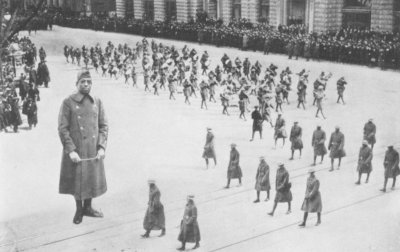 |
| BACK WITH THE HEROIC 15TH (369TH INFANTRY). LIEUT. JAMES
REESE EUROPE'S FAMOUS BAND PARADING UP LENOX AVENUE, HARLEM, NEW
YORK CITY. LIEUT. EUROPE SPECIALLY ENLARGED IN LEFT
FOREGROUND. |
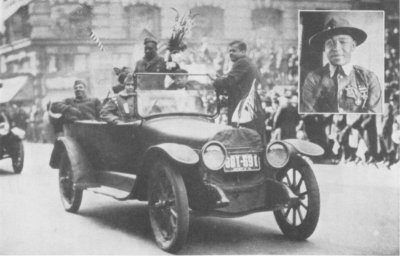 |
| SERGEANT HENRY JOHNSON (STANDING WITH FLOWERS), NEGRO HERO OF
369TH INFANTRY. IN NEW YORK PARADE. HE WAS THE FIRST SOLDIER OF
ANY RACE IN THE AMERICAN ARMY TO RECEIVE THE CROIX DE GUERRE WITH
PALM. NEEDHAM ROBERTS, HIS FIGHTING COMPANION, IN INSET. |
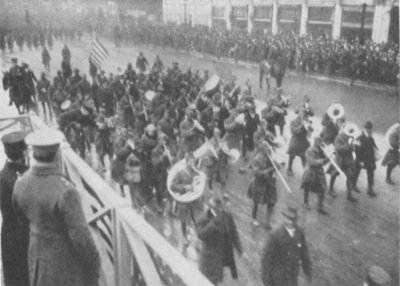 |
| RETURNING FROM THE WAR. MUSICIANS OF 365TH INFANTRY LEADING
PARADE OF THE REGIMENT IN MICHIGAN BOULEVARD. CHICAGO. |
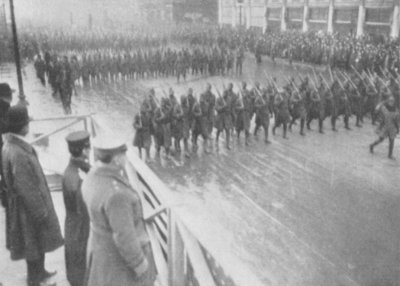 |
| SOLDIERS OF 365TH INFANTRY MARCHING DOWN MICHIGAN BOULEVARD.
CHICAGO. THIS REGIMENT WAS PART OF THE CELEBRATED 92ND DIVISION
OF SELECTIVE DRAFT MEN. |
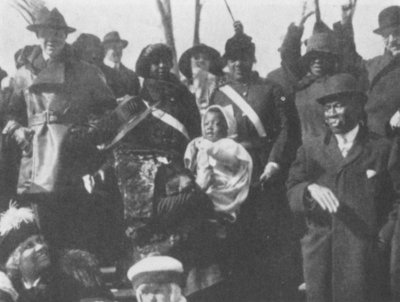 |
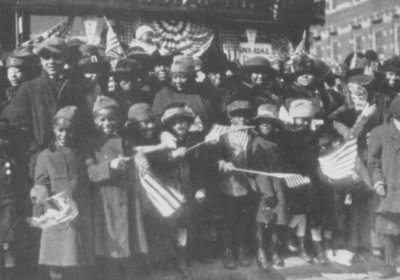 |
| THE SEVEN AGES OF MEN. CURBSTONE GROUPS IN NEW YORK LINED UP
TO GIVE THE HEROES WELCOME. THE SCENES WERE TYPICAL OF MANY IN
CITIES AND TOWNS ALL OVER THE COUNTRY. |
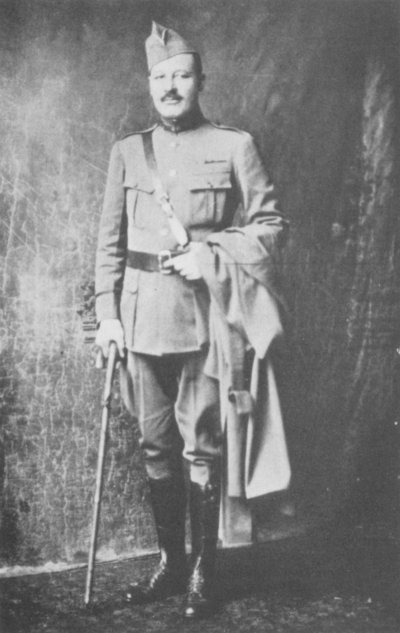 |
| COLONEL FRANKLIN A. DENISON, FORMER COMMANDER OF 8TH ILLINOIS
(370TH INFANTRY), INVALIDED HOME FROM FRANCE JULY 12, 1918. |
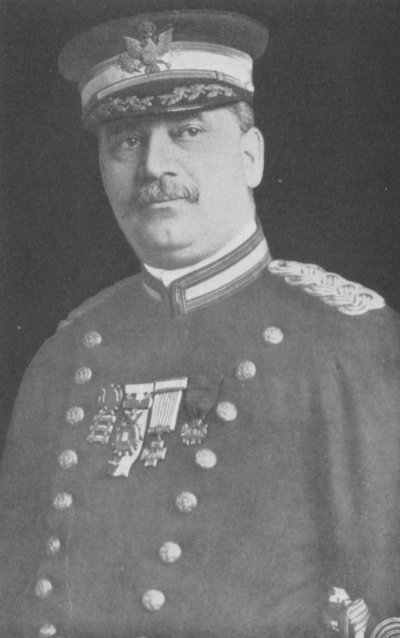 |
| FIRST COMMANDER OF THE 8TH ILLINOIS INFANTRY, COLONEL JOHN R.
MARSHALL, WHO INCREASED THE ORGANIZATION FROM A BATTALION TO A
REGIMENT, EVERY OFFICER AND MAN A NEGRO. UNDER COL. MARSHALL THE
REGIMENT SAW DISTINGUISHED SERVICE IN THE SPANISH-AMERICAN
WAR. |
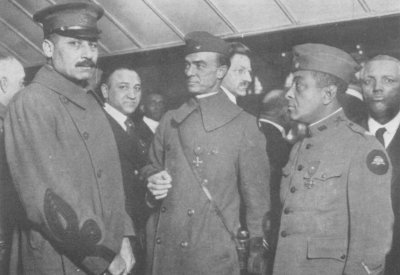 |
| FORMER OFFICERS OF 370TH INFANTRY (OLD 8TH). LEFT, COLONEL
FRANKLIN A. DENISON, COMMANDER UNTIL JULY, 1918; CENTER, COLONEL
T.A. ROBERTS (WHITE). SUCCEEDING COMMANDER; RIGHT, LIEUT. COLONEL
OTIS B. DUNCAN. APPOINTED COLONEL TO SUCCEED COLONEL T.A.
ROBERTS. |
 |
| CROWD ON THE LAKE FRONT IN CHICAGO ALMOST SMOTHERS RETURNING
SOLDIERS OF "FIGHTING 8TH" (370TH INFANTRY). |
It is known that a contingent of them accompanied the very first
forces that went abroad from this country. In fact, it may be
said, that the feet of American Negroes were among the first in
our forces to touch the soil of France. It is known that they
numbered at least 136 different companies, battalions and
regiments in France. If there were more, the records at
Washington had not sufficiently catalogued them up to the early
part of 1919 to say who they were.
In the desire to get soldiers abroad in 1918, the policy of the
administration and the Department seems to have been to make
details and bookkeeping a secondary consideration. The names of
all, their organizations and officers were faithfully kept, but
distinctions between whites and blacks were very obscure. Until
the complete historical records of the Government are compiled,
it will be impossible to separate them with accuracy.
Negro non-combatant forces in France at the end of the war
included the 301st, 302nd and 303rd Stevedore Regiments and the
701st and 702nd Stevedore Battalions; the 322nd and 363rd Butchery
Companies; Engineer Service battalions numbered from 505 to 550,
inclusive; Labor battalions numbered from 304 to 348, inclusive,
also Labor battalion 357; Labor companies numbered from 301 to
324, inclusive; Pioneer Infantry regiments numbered 801, 809,
811, 813, 815 and 816, inclusive. These organizations known as
Pioneers, had some of the functions of infantry, some of those of
engineers and some of those of labor units. They were prepared to
exercise all three, but in France they were called upon to act
principally as modified engineering and labor outfits. They also
furnished replacement troops for some of the combatant units.
Service was of the dull routine void of the spectacular, and has
never been sufficiently appreciated. In our enthusiasm over their
fighting brothers we should not overlook nor underestimate these.
There were many thousands of white engineers and Service of
Supply men in general, but their operations were mostly removed
from the base ports.
Necessity for the work was imperative. Owing to the requirements
of the British army, the Americans could not use the English
Channel ports. They were obliged to land on the west and south
coasts of France, where dock facilities were pitifully
inadequate. Railway facilities from the ports to the interior
were also inadequate. The American Expeditionary Forces not only
enlarged every dock and increased the facilities of every harbor,
but they built railways and equipped them with American
locomotives and cars and manned them with American crews.
Great warehouses were built as well as barracks, cantonments and
hospitals. Without these facilities the army would have been
utterly useless. Negroes did the bulk of the work. They were an
indispensable wheel in the machinery, without which all would
have been chaos or inaction.
Headquarters of the Service of Supply was at Tours. It was the
great assembling and distributing point. At that point and at the
base ports of Brest, Bordeaux, St. Nazaire and La Pallice most of
the Negro Service of Supply organizations were located. The
French railroads and the specially constructed American lines ran
from the base ports and centered at Tours.
This great industrial army was under strict military regulations.
Every man was a soldier, wore the uniform and was under
commissioned and non-commissioned officers the same as any
combatant branch of the service.
The Negro Service of Supply men acquired a great reputation in
the various activities to which they were assigned, especially
for efficiency and celerity in unloading ships and handling the
vast cargoes of materials and supplies of every sort at the base
ports. They were a marvel to the French and astonished not a few
of the officers of our own army. They sang and joked at their
work. The military authorities had bands to entertain them and
stimulate them to greater efforts when some particularly urgent
task was to be done. Contests and friendly rivalries were also
introduced to speed up the work.
The contests were grouped under the general heading of "A Race to
Berlin" and were conducted principally among the stevedores.
Prizes, decorations and banners were offered as an incentive to
effort in the contests. The name, however, was more productive of
results than anything else. The men felt that it really was a
race to Berlin and that they were the runners up of the boys at
the front.
Ceremonies accompanying the awards were quite elaborate and
impressive. The victors were feasted and serenaded. Many a
stevedore is wearing a medal won in one of these conquests of
which he is as proud, and justly so, as though it were a Croix de
Guerre or a Distinguished Service Cross. Many a unit is as proud
of its banner as though it were won in battle.
Thousands of Service of Supply men remained with the American
Army of Occupation after the war; that is, they occupied the same
relative position as during hostilities—behind the lines.
The Army of Occupation required food and supplies, and the duty
of getting them into Germany devolved largely upon the American
Negro.
Large numbers of them were stationed at Toul, Verdun, Epernay,
St. Mihiel, Fismes and the Argonne, where millions of dollars
worth of stores of all kinds were salvaged and guarded by them.
So many were left behind and so important was their work, that
the Negro Y.M.C.A. sent fifteen additional canteen workers to
France weeks after the signing of the armistice, as the stay of
the Service of Supply men was to be indefinitely prolonged.
The Rev. D.L. Ferguson, of Louisville, Ky., who for more than a
year was stationed at St. Nazaire as a Y.M.C.A. worker, and
became a great favorite with the men, says that during the war
they took great pride in their companies, their camps, and all
that belonged to the army; that because their work was always
emphasized by the officers as being essential to the boys in the
trenches, the term "stevedore" became one of dignity as
representing part of a great American Army.
How splendidly the stevedores and others measured up to military
standards and the great affection with which their officers
regarded them, Rev. Dr. Ferguson makes apparent by quoting
Colonel C.E. Goodwin, who for over a year was in charge of the
largest camp of Negro Service of Supply men in France. In a
letter to Rev. Dr. Ferguson he said:
"It is with many keen thrusts of sorrow that I am
obliged to leave this camp and the men who have made up this
organization. The men for whose uplift you are working have not
only gained, but have truly earned a large place in my heart, and
I will always cherish a loving memory of the men of this
wonderful organization which I have had the honor and privilege
to command."
Lester A. Walton, who went abroad as a correspondent for the New
York Age, thus commented on the stevedores and others of the same
service:
"I had the pleasure and honor to shake hands with
hundreds of colored stevedores and engineers while in France. The
majority were from the South, where there is a friendly, warm sun
many months of the year. When I talked with them no sun of any
kind had greeted them for weeks. It was the rainy season when a
clear sky is a rarity and a downpour of rain is a daily
occurrence. Yet, there was not one word of complaint heard, for
they were 'doing their bit' as expected of real soldiers.
Naturally they expressed a desire to get home soon, but this was
a wish I often heard made by a doughboy.
"Members of the 'S.O.S.' will not came back to America wearing
the Distinguished Service Cross or the Croix de Guerre for
exceptional gallantry under fire, but the history of the great
world war would be incomplete and lacking in authenticity if
writers failed to tell of the bloodless deeds of heroism
performed by non-combatant members of the American Expeditionary
Forces."
During the summer of 1918, Ella Wheeler Wilcox, the poetess, went
to France to write and also to help entertain the soldiers with
talks and recitations. While at one of the large camps in
Southern France, the important work of the colored stevedore came
to her notice and she was moved to write a poem which follows:
                      THE STEVEDORES
We are the Army Stevedores, lusty and virile and strong.
We are given the hardest work of the war, and the hours are long.
We handle the heavy boxes and shovel the dirty coal;
While soldiers and sailors work in the light, we burrow below like a mole.
But somebody has to do this work or the soldiers could not fight!
And whatever work is given a man is good if he does it right.
We are the Army Stevedores, and we are volunteers.
We did not wait for the draft to come, and put aside our fears.
We flung them away to the winds of fate at the very first call of our land.
And each of us offered a willing heart, and the strength of a brawny hand.
We are the Army Stevedores, and work we must and may,
The cross of honor will never be ours to proudly wear and sway.
But the men at the front could not be there, and the battles could not be won.
If the stevedores stopped in their dull routine and left their work undone.
Somebody has to do this work; be glad that it isn't you.
We are the Army Stevedores—give us our due.
CHAPTER
XXVI.
UNSELFISH WORKERS IN THE VINEYARD.
MITIGATED THE HORRORS OF WAR—AT THE FRONT,
BEHIND THE LINES, AT HOME—CIRCLE FOR NEGRO WAR
RELIEF—ADDRESSED AND PRAISED BY ROOSEVELT—A NOTABLE
GATHERING—COLORED Y.M.C.A. WORK—UNSULLIED RECORD
OF ACHIEVEMENT—HOW THE "Y" CONDUCTED
BUSINESS—SECRETARIES ALL SPECIALISTS—NEGRO WOMEN IN
"Y" WORK—VALOR OF A NON-COMBATANT.
Negroes in America are justly proud of their contributions to war
relief agencies and to the financial and moral side of the war.
The millions of dollars worth of Liberty Bonds and War Savings
stamps which they purchased were not only a great aid to the
government in prosecuting the war, but have been of distinct
benefit to the race in the establishing of savings funds among
many who never were thrifty before. Thousands have been started
on the road to prosperity by the business ideas inculcated in
that manner. Their donations to the Red Cross, the Y.M.C.A. and
kindred groups were exceptionally generous.
An organization which did an immense amount of good and which was
conducted almost entirely by Negro patriots, although they had a
number of white people as officers and advisers, was the "Circle
for Negro War Relief," which had its headquarters in New York
City.
At a great meeting at Carnegie Hall, November 2, 1918, the Circle
was addressed by the late Theodore Roosevelt. On the platform
also as speakers were Emmett J. Scott, Irvin Cobb, Marcel Knecht,
French High Commissioner to the United States; Dr. George E.
Haynes, Director of Negro Economics, Department of Labor; Mrs.
Adah B. Thorns, Superintendent of Nurses at Lincoln hospital, and
Dr. W.E.B. Du Bois, who presided.
Mr. Roosevelt reminded his hearers that when he divided the Nobel
Peace Prize money among the war charities he had awarded to the
Circle for Negro War Relief a sum equal to those assigned to the
Y.M.C.A., the Knights of Columbus, and like organizations.
"I wish to congratulate you," Mr. Roosevelt said,
"upon the dignity and self-restraint with which the Circle has
stated its case in its circulars. It is put better than I could
express it when your officers say: 'They, (the Negroes) like the
boys at the front and in the camps to know that there is a
distinctly colored organization working for them. They also like
the people at home to know that such an organization, although
started and maintained with a friendly cooperation from white
friends, is intended to prove to the world that colored people
themselves can manage war relief in an efficient, honest and
dignified way, and so bring honor to their race.
"The greatest work the colored man can do to help his race
upward," continued Mr. Roosevelt, "is through his or her own
person to show the true dignity of service. I see in the list of
your vice-presidents and also of your directors the name of
Colonel Charles Young, and that reminds me that if I had been
permitted to raise a brigade of troops and go to the other side,
I should have raised for that brigade two colored regiments, one
of which would have had all colored officers. And the colonel of
that regiment was to have been Colonel Charles Young.
"One of the officers of the other regiment was to have been 'Ham'
Fish. He is now an officer of the 15th, the regiment of Negroes
which Mr. Cobb so justly has praised, and when 'Ham' Fish was
offered a chance for promotion with a transfer to another
command, I am glad to say he declined with thanks, remarking that
he 'guessed he's stay with the sunburned Yankees."'
A guest of honor at the meeting was Needham Roberts, who won his
Croix de Guerre in conjunction with Henry Johnson. The cheering
of the audience stopped proceedings for a long time when Mr.
Roosevelt arrived and shook hands with Roberts.
"Many nice things were said at the meeting,"
commented the New York Age, "but the nicest of all was the
statement that after the war the Negro over here will get more
than a sip from the cup of democracy."
One of the splendid activities of the Circle was in the providing
of an emergency relief fund for men who were discharged or sent
back, as in the case of Needham Roberts, on account of sickness
or injuries. Many a soldier who was destitute on account of his
back pay having been held up was temporarily relieved, provided
with work or sent to his home through the agency of the
Circle.
While the war was in progress the Circle attended to a variety of
legal questions for the soldiers, distributed literature, candy
and smokes to the men going to the war and those at the front;
visited and ministered to those in hospitals, looked after their
correspondence and did the myriad helpful things which other
agencies were doing for white soldiers, including relief in the
way of garments, food, medicine and money for the families and
dependents of soldiers.
The organization had over three score units in different parts of
the country. They engaged in the same activities which white
women were following in aid to their race. Here is a sample
clipped from one of the bulletins of the Circle:
"On the semi-tropical island of St. Helena, S.C., the
native islanders have, in times past, been content to busy
themselves in their beautiful cotton fields or in their own
little palmetto-shaded houses, but the war has brought to them as
to the rest of the world broader vision, and now, despite their
very limited resources, 71 of them have formed Unit No. 29 of the
Circle. They not only do war work, but they give whatever service
is needed in the community. The members knit for the soldiers and
write letters to St. Helena boys for their relatives. During the
influenza epidemic the unit formed itself into a health committee
in cooperation with the Red Cross and did most effective work in
preventing the spread of the disease."
Similar and enlarged activities were characteristic of the units
all over the nation. They made manifest to the world the Negro's
generosity and his willingness in so far as lies in his power, to
bear his part of the burden of helping his own race.
After the war the units of the Circle did not grow weary. Their
inspiration to concentrate was for the relief of physical
suffering and need; to assist existing organizations in all sorts
of welfare work. As they had helped soldiers and soldiers'
families, they proposed to extend a helping hand to working
girls, children, invalids and all Negroes deserving aid.
To the lasting glory of the race and the efficient
self-sacrificing spirit of the men engaged, was the wonderful
work of the Negro Young Men's Christian Association among the
soldiers of this country and overseas. Some day a book will be
written dealing adequately with this phase of war activity.
The best writers of the race will find in it a theme well worthy
of their finest talents. The subject can be touched upon only
briefly here.
To the untiring efforts and great ability of Dr. J.E. Moorland,
senior secretary of the Negro Men's Department of the
International Committee, with his corps of capable assistants at
Washington, belongs the great credit of having organized and
directed the work throughout the war.
Not a serious complaint has come from any quarter about the work
of the Y.M.C.A. workers; not a penny of money was wrongfully
diverted and literally not a thing has occurred to mar the record
of the organization. Nothing but praise has come to it for the
noble spirit of duty, good will and aid which at all times
characterized its operations. The workers sacrificed their
pursuits and pleasures, their personal affairs and frequently
their remuneration; times innumerable they risked their lives to
minister to the comfort and well being of the soldiers. Some
deeds of heroism stand forth that rank along with those of the
combatants.
The splendid record achieved is all the more remarkable and
gratifying when the extensive and varied personnel of the service
is taken into consideration. No less than fifty-five Y.M.C.A.
centers were conducted in cantonments in America, presided over
by 300 Negro secretaries. Fourteen additional secretaries served
with Student Army Training Corps units in our colleges. Sixty
secretaries served overseas, making a grand total of 374 Y.M.C.A.
secretaries doing war work.
Excellent buildings were erected in the cantonments here and the
camps overseas, which served as centers for uplifting influences,
meeting the deepest needs of the soldier's life. In the battle
zones were the temporary huts where the workers resided, placed
as near the front lines as the military authorities could permit.
Many times the workers went into the most advanced trenches with
the soldiers, serving them tobacco, coffee, chocolate, etc., and
doing their utmost to keep up spirits and fighting morale. Much
of the uniform good discipline and behavior attributed to the
Negro troops undoubtedly was due to the beneficial influence of
the "Y" men and women.
As an example of the way the work was conducted it is well to
describe a staff organization in one of the buildings.
It was composed of a building secretary, who was the executive; a
religious work secretary, who had charge of the religious
activities, including personal work among the soldiers, Bible
class and religious meetings; an educational secretary, who
promoted lectures, educational classes and used whatever means he
had at hand to encourage intellectual development, and a physical
secretary, who had charge of athletics and various activities for
the physical welfare of the soldiers. He worked in closest
relationship with the military officers and often was made
responsible for all the sports and physical activities of the
camp. Then there was a social secretary, who promoted all the
social diversions, including entertainments, stunts and motion
pictures, and a business secretary, who looked after the sales of
stamps, post cards and such supplies as were handled, and who was
made responsible for the proper accounting of finances.
The secretaries were either specialists in their lines or were
trained until they became such. Some idea of their tasks and
problems, and of the tact and ability they had to use in meeting
them, may be gained by a contemplation of the classes with which
they had to deal. The selective draft assembled the most
remarkable army the world has ever seen. Men of all grades from
the most illiterate to the highly trained university graduate
messed together and drilled side by side daily. There were men
who had grown up under the best of influences and others whose
environment had been 370TH or vicious, all thrown together in a
common cause, wearing the same uniform and obeying the same
orders.
The social diversions brought out some splendid talent. A great
feature was the singing. It was essential that the secretary
should be a leader in this and possessed of a good voice. These
were not difficult to find, as the race is naturally musical and
most of them sing well. Noted singers were sent to sing for the
boys, but it is said that frequently the plan of the
entertainment was reversed, as they requested the privilege of
listening to the boys sing.
A wonderful work was done by "Y" secretaries among the
illiterates. Its fruits are already apparent and will continue to
multiply. They found men who hardly knew their right hand from
their left. Others who could not write their names are said to
have wept with joy when taught to master the simple
accomplishment. Many a poor illiterate was given the rudiments of
an education and started on the way to higher attainments.
Headquarters of the overseas work was at Paris, France, and was
in charge of E.C. Carter, formerly Senior Student secretary in
America, and when war was declared, held the position of National
Secretary of India. Much of the credit for the splendid
performance of the "Y" workers abroad belonged to him and to his
able aid, Dr. John Hope, president of Morehouse college, Atlanta,
Ga. The latter went over in August, 1918, as a special overseer
of the Negro Y.M.C.A.
Three distinguished Negro women were sent over as "Y" hostesses,
with a secretarial rating, during the war. Their work was so
successful that twenty additional women to serve in the same
capacities were sent over after the close of hostilities. They
were to serve as hostesses, social secretaries and general
welfare workers among the thousands of Negro soldiers who had
been retained there with the Army of Occupation and the Service
of Supply.
The first Negro woman to go abroad in the Y.M.C.A. service was
Mrs. Helen Curtis of 208 134th Street, New York, in May, 1918.
For a number of years she had been a member of the committee of
management of the Colored Women's Branch of the Y.M.C.A., and had
assisted at the Camp Upton hostess house. Her late husband, James
L. Curtis, was minister resident and consul general for the
United States to Liberia. Mrs. Curtis lived in Monrovia, Liberia,
until her husband's death there. She had also lived in France,
where she studied domestic art for two years. Being a fluent
speaker of the French language, her appointment was highly
appropriate.
So successful was the appointment of Mrs. Curtis that another
Negro secretary in the person of Mrs. Addie Hunton of 575 Greene
Avenue, Brooklyn, N.Y., followed the next month. Her husband was
for many years senior secretary of the International Committee of
the Y.M.C.A. Negro Men's Department, and her own work had always
been with the organization.
A short time later Miss Catherine Johnson of Greenville, Ohio,
followed in the wake of Mrs. Curtis and Mrs. Hunton. She is a
sister of Dr. Johnson of Columbus, Ohio, appointed early in 1919
minister to Liberia.
No less successful at home than abroad was the work of the
Y.M.C.A. among the Negroes in cantonments and training camps. It
is known that the services rendered by the Association to the
officers' training camp at Fort Des Moines had much to do with
making that institution such a remarkable success. From that time
on comment was frequent that the best work being done by the
Association in many of the camps was done by Negro
secretaries.
The heroic exploit of Professor Cook, the "Y" secretary, which
secured him a recommendation for the Distinguished Service Cross,
is mentioned elsewhere. It was only equalled by the valiant
performance of A.T. Banks of Dayton, Ohio, a Negro "Y" secretary
who went over the top with the 368th Infantry. Secretary Banks,
during the action, tarried to give aid to a wounded soldier. The
two were forced to remain all night in a shell hole. During the
hours before darkness and early the following morning they were
targets for a German sniper. The secretary succeeded in getting
the wounded man back to the lines, where he then proceeded to
organize a party to go after the sniper. They not only silenced
him, but rendered him unfit for any further action on earth. Mr.
Banks returned to America with the sniper's rifle as a souvenir.
His work was additionally courageous when it is considered that
he was a non-combatant and not supposed to engage in hostilities.
Had he been taken by the Germans he would not have been accorded
the treatment of a prisoner of war, but undoubtedly would have
been put to death.
Were the records sufficiently complete at the present time to
divulge them, scores of examples of valorous conduct on the part
of the "Y" workers, Red Cross and other non-combatants who
ministered to Negro soldiers could be recounted. The work of all
was of a noble character. It was accompanied by a heroic spirit
and in many cases by great personal bravery and sacrifice.
CHAPTER
XXVII.
NEGRO IN ARMY PERSONNEL.
HIS MECHANICAL ABILITY REQUIRED—SKILLED AT SPECIAL
TRADES—VICTORY DEPENDS UPON TECHNICAL WORKERS—VAST
RANGE OF OCCUPATIONS—NEGRO MAKES GOOD
SHOWING—PERCENTAGES OF WHITE AND BLACK—FIGURES FOR
GENERAL SERVICE.
In 1917 and 1918 our cause demanded speed. Every day that could
be saved from the period of training meant a day gained in
putting troops at the front.
Half of the men in the Army must be skilled at special trades in
order to perform their military duties. To form the units quickly
and at the same time supply them with the technical ability
required, the Army had to avail itself of the trade knowledge and
experience which the recruit brought with him from civil life. To
discover this talent and assign it to those organizations where
it was needed was the task of the Army Personnel
organization.
The army could hardly have turned the tide of victory if it had
been forced to train from the beginning any large proportion of
the technical workers it needed. Every combat division required
64 mechanical draughtsmen, 63 electricians, 142 linemen, 10 cable
splicers, 156 radio operators, 29 switchboard operators, 167
telegraphers, 360 telephone repairmen, 52 leather and canvas
workers, 78 surveyors, 40 transitmen, 62 topographers, 132 auto
mechanics, 128 machinists, 167 utility mechanics, 67 blacksmiths,
151 carpenters, 691 chauffeurs (auto and truck), 128 tractor
operators and 122 truckmasters.
Besides these specialists each division required among its
enlisted men those familiar with 68 other trades. Among the
latter were dock builders, structural steel workers, bricklayers,
teamsters, hostlers, wagoners, axemen, cooks, bakers, musicians,
saddlers, crane operators, welders, rigging and cordage workers,
stevedores and longshoremen. Add to these the specialists
required in the technical units of engineers, ordnance, air
service, signal corps, tanks, motor corps and all the services of
supply, and the impossibility of increasing an army of 190,000 in
March 1917, to an army of 3,665,000 in November, 1918, becomes
apparent unless every skilled man was used where skill was
demanded. To furnish tables showing the number of Negroes which
the selective draft produced for the various occupations
mentioned was at the compilement of this work not practicable. In
many cases the figures for white and black had not been
separated. The Army Personnel organization did not get into the
full swing of its work until well along in 1918.
A good general idea of the percentages of white and black can be
gained from the late drafts of that year. Figures for white
drafts were not available with the exception of that of September
3rd. But a very fair comparison may be made from the following
table showing some occupations to which both whites and blacks
were called. Take any of the three general service drafts made
upon Negro selectives and it makes a splendid showing alongside
the whites. Out of 100,000 men used as a basis for computation,
it shows that among the Negro selectives an average of slightly
over 25 percent were available for technical requirements,
compared with slightly over 36 percent among the whites. It
reveals a high number of mechanics and craftsmen among a race
which in the minds of many has been regarded as made up almost
entirely of unskilled laborers:
Supply per 100,000 in late Negro drafts for general service,
compared with supply of white men in same occupations for the
September 3rd draft.
                                             Misc. Figures Sept. 3

                                     Sept. 1    Sept 25  Upon        Draft
Occupation—                          Draft      Draft    59,826 Men  White

Mechanical engineer                      7         30        8           25
Blacksmith                             393         334     331          733
Dock builder                           ...         ...      15          ...
Carpenter                              862         571     670        2,157
Stockkeeper                            161         176     140          562
Structural steel worker                463         326     351          334
Chauffeur                            3,561       4,003   3,300        7,191
Chauffeur, heavy truck               1,304       1,356     987        2,061
Bricklayer                             189          99     132          223
Hostler                              3,351       1,433   2,062        3,559
Teamster or wagoner                  8,678      12,660   9,534       13,691
Transit and levelman                   ...           4       2           47
Axeman logger                        1,192       1,759   1,423        1,827
Clerical worker                        603         395     324        4,159
Baker and cook                       4,129       3,157   2,974        1,077
Musician                               105          17     115          160
Alto horn                               56          47      38           46
Baritone                                21          21      15           16
Bass horn                               35          21      18           16
Clarinet                                21          64      25           66
Cornet                                  98          56      67          132
Flute                                   21         ...       5           29
Saxaphone                                7          13      10           23
Trap drum                              217         197     100           46
Trombone                                42          69      40           67
Bugler                                  14          13      12           24
Saddler                                ...          26       3           12
Crane operator, hoistman                21          39      42           44
Crane operator, pile driver            ...          13      12            7
Crane operator, shovel                 ...          13       5           30
Oxy-acetylene welder                   ...          21       8           44
Rigger and cordage worker               49          77      57           40
Stevedore, cargo handler               161          34      68           10
Longshoreman                           652         664     651           15
                                      ----        ----     ----        ----
                                    26,413      27,708  23,544        38,473

     Figures are for general service drafts and do not include the enlarged
list of occupations for which both whites and Negroes were selected.
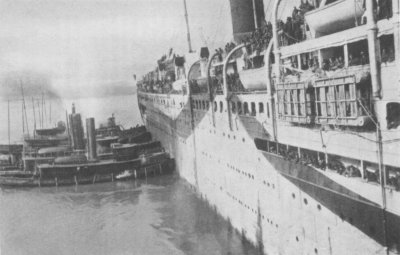 |
| FIVE SEA TUGS PUSHING TRANSPORT "FRANCE" INTO DOCK. SHIP
LADEN WITH MEMBERS OF NEW YORK'S "FIGHTING 15TH" (369TH INFANTRY)
AND CHICAGO'S "FIGHTING 8TH" (370TH INFANTRY) NEGRO HEROES FROM
BATTLEFIELDS OF EUROPE. |
CHAPTER
XXVIII.
THE KNOCKOUT BLOW.
WOODROW WILSON, AN ESTIMATE—HIS PLACE IN HISTORY—LAST
OF GREAT TRIO—WASHINGTON, LINCOLN, WILSON—UPHOLDS
DECENCY, HUMANITY, LIBERTY—RECAPITULATION OF YEAR
1918—CLOSING INCIDENTS OF WAR.
When sufficient years have elapsed for the forming of a correct
perspective, when the dissolving elements of time have swept away
misunderstandings and the influences engendered by party belief
and politically former opinions, Woodrow Wilson is destined to
occupy a place in the Temple of Fame that all Americans may well
be proud of. Let us analyze this and let us be fair about it,
whatever may be our beliefs or affiliations.
Washington gave us our freedom as a nation and started the first
great wave of democracy. Probably, had some of us lived in
Washington's time, we would have been opposed to him politically.
Today he is our national hero and is reverenced by all free
people of the earth, even by the nation which he defeated at
arms. Lincoln preserved and cemented, albeit he was compelled to
do it in blood, the democracy which Washington founded. He did
infinitely more; he struck the shackles from four million human
beings and gave the Negro of America his first opportunity to
take a legitimate place in the world. Lincoln's service in
abolishing slavery was not alone to the Negro. He elevated the
souls of all men, for he ended the most degrading institution
that Satan ever devised—more degrading to the master who
followed it, than to the poor subject he practiced it upon.
Unitedly, we revere Lincoln, yet there were those who were
opposed to him and in every way hampered and sneered at his
sublime consecration to the service of his country. It takes time
to obtain the proper estimate of men.
Enough light has already been cast on President Wilson and his
life work to indicate his character and what the finished
portrait of him will be.
We see him at the beginning of the European conflict, before any
of us could separate the tangled threads of rumor, of propaganda,
of misrepresentation, to determine what it was all about; before
even he could comprehend it, a solitary and monitory figure,
calling upon us to be neutral, to form no hasty judgments. We see
him later in the role of peacemaker, upholding the principles of
decency and honor. Eventually as the record of atrocities and
crimes against innocents enlarges, we see him pleading with the
guilty to return to the instincts of humanity. Finally as the
ultimate aim of the Hun is revealed as an assault upon the
freedom of the world; after the most painstaking and patient
efforts to avoid conflict, during which he was subjected to
humiliation and insult, we see him grasp the sword, calling a
united nation to arms in clarion tones, like some Crusader of
old; his shibboleth: DECENCY, HUMANITY, LIBERTY.
What followed? His action swept autocracy from its last great
stronghold and made permanent the work which Washington began and
upon which Lincoln builded so nobly. This of Woodrow Wilson; an
estimate—there can be no other thought, that will endure
throughout history.
In the earlier chapters are sketched the main events of the great
war up to the end of the year 1917, when the history of the Negro
in the conflict became the theme. It remains to give an outline
review of battles and happenings from the beginning of 1917 until
the end of hostilities; culminating in the most remarkable
armistice on record; a complete capitulation of the Teutonic
forces and their allies, and a complete surrender by them of all
implements and agencies for waging war. The terms of the
armistice, drastic in the extreme, were largely the work of
Marshal Ferdinand Foch, commander-in-chief of the Allied
armies.
Early in 1918 it became evident that England, France and Italy
were rapidly approaching the limit of their man power. It became
necessary for America to hasten to the rescue.
Training of men and officers in the various cantonments of
America was intensified and as rapidly as they could be brought
into condition they were shipped to France. The troop movement
was a wonderful one and before the final closing of hostilities
in November there were more than 2,000,000 American troops in
Europe. The navy was largely augmented, especially in the matter
of destroyers, submarine chasers and lighter craft.
Our troops saw little actual warfare during the first three
months of the year. Americans took over a comparatively quiet
sector of the French front near Toul, January 21. Engagements of
slight importance took place on January 30 and February 4, the
latter on a Lorraine sector which Americans were holding. On
March 1, they repulsed a heavy German raid in the Toul sector,
killing many. On March 6, the Americans were holding an eight
mile front alone.
On March 21 the great German offensive between the Oise and the
Scarpe, a distance of fifty miles, began. General Haig's British
forces were driven back about twenty miles. The French also lost
much ground including a number of important towns. The Germans
drove towards Amiens in an effort to separate the British and
French armies. They had some successes in Flanders and on the
French front, but were finally stopped. Their greatest advance
measured thirty-five miles and resulted in the retaking of most
of the territory lost in the Hindenburg retreat of the previous
year. The Allies lost heavily in killed, wounded and prisoners,
but the Germans being the aggressors, lost more.
While the great battle was at its height, March 28, the Allies
reached an agreement to place all their forces from the Arctic
Ocean to the Mediterranean, under one supreme command, the man
chosen for the position being General Foch of the French. On
March 29, General Pershing placed all the American forces at the
disposal of General Foch.
The Germans began a new offensive against the British front April
8 and won a number of victories in the La Basse canal region and
elsewhere. The battle of Seicheprey, April 20, was the Americans'
first serious engagement with the Germans. The Germans captured
the place but the Americans by a counter attack recovered it.
Another great offensive was started by the Germans, May 27,
resulting in the taking of the Chemin des Dames from the French
and crossing the river Aisne. On the following day they crossed
the Vesle river at Fismes. Here the Americans won their first
notable victory by capturing the village of Cantigny and taking
200 prisoners. They held this position against many subsequent
counter-attacks. By the 31st the Germans had reached Chateau
Thierry and other points on the Marne, where they were halted by
the French. They made a few gains during the first days of June.
On June 6, American marines made a gallant attack, gaining two
miles on a front two and one-half miles long near Veuilly la
Poterie. On the following day they assisted the French in
important victories. In the second battle northwest of Chateau
Thierry, the Americans advanced nearly two and one-half miles on
a six mile front, taking 300 prisoners. It was in these
engagements that the Americans established themselves as fighters
equal to any.
On June 9, the Germans began their fourth offensive, attacking
between Montdidier and the river Oise. They advanced about four
miles, taking several villages. In the operations of the
following day which gained them several villages, they claimed to
have captured 8,000 French. This day the American marines took
the greater portion of Belleau wood and completed the capture of
it June 11. The French at the same time defeated the Germans
between Robescourt and St. Maur. There were other battles on the
12th and 13th, but on the 14th it became evident that the German
offensive was a costly failure.
The fighting from this time until the end of June was of a less
serious nature, although the Americans in the Belleau and Vaux
regions gave the Germans no rest, attacking them continually and
taking prisoners. The Americans at this time were also engaged in
an offensive in Italy. July 2, President Wilson announced there
were 1,019,115 American soldiers in France.
The Fourth of July was celebrated in England, France and Italy as
well as in the United States. On that day Americans assisted the
Australians in taking the town of Hamel and many prisoners. On
the 8th and 9th the French advanced in the region of Longpont and
northwest of Compiegne. On the 12th they took Castel and other
strong points near the west bank of the Avre river. July 14, the
French national holiday was observed in America, and by the
American soldiers in France.
The fifth and last phase of the great offensive which the Germans
had started in March, began July 15, in an attack from Chateau
Thierry to Massignes, along a sixty-five mile front and crossing
the Marne at several places. At Chateau Thierry the Americans put
up a strong resistance but the enemy by persistent efforts
finally succeeded in getting a footing on the south bank. The
battle continued east and west of Rheims with the Allies holding
strongly and the Germans meeting heavy losses.
While the Germans were trying to force their way regardless of
cost, in the direction of Chalons and Epernay, General Foch was
preparing a surprise in the Villers-Cotterets forest on the
German right flank. In the large force collected for the surprise
were some of the best French regiments together with the famed
Foreign Legion, the Moroccan regiment and other crack troops
including Americans. On the morning of July 18, a heavy blow was
launched at the Germans all along the line from Chateau Thierry
on the Marne to the Aisne northwest of Soissons.
The foe was taken completely by surprise and town after town fell
with very little resistance. Later the resistance stiffened but
the Allies continued to advance. Cavalrymen assisted the infantry
and tanks in large numbers, helped to clean out the machine gun
nests. The Americans who fought side by side with the French won
the unbounded admiration of their comrades. Thousands of
prisoners were taken with large numbers of heavy cannon, great
quantities of ammunition and thousands of machine guns. By the
20th Soissons was threatened. The Germans finding themselves
caught in a dangerous salient and attacked fiercely on both
flanks, retreated hurriedly to the north bank of the Marne and
still farther.
Meanwhile things were going badly for the Austrians. After its
retreat in 1917 to the line of the Piave river, the Italian army
had been reorganized and strengthened under General Diaz, who had
succeeded General Cadorna in command. French and British
regiments had been sent to assist in holding the line, and later
some American forces.
The Austrians began an offensive June 15 along a 100-mile front,
crossing the Piave in several places. For three days they made
violent attacks on the Montello plateau, and along the Piave from
St. Andrea to San Dona and at Capo Sile, twenty miles from
Venice. Then the Italians, British, French and Americans
counter-attacked and within three days had turned the great
Austrian offensive into a rout, killing thousands, taking
thousands of prisoners, and capturing an immense amount of war
material including the Austrian's heavy caliber guns. The whole
Austrian scheme to advance into the fertile Italian plains where
they hoped to find food for their hungry soldiers, failed
completely. It was practically the end of Austria and the
beginning of the end for Germany. Bulgaria gave up September 26,
due to heavy operations by the French, Italians and Serbians
during July, August and September, in Albania, Macedonia and
along the Vardar river to the boundaries of Bulgaria. They signed
an armistice September 29 and the king of Bulgaria abdicated
October 3. Turkey being in a hopeless position through the
surrender of Bulgaria, and the success of the British forces
under General Allenby, kept up a feeble resistance until the end
of October when she too surrendered. The collapse of
Austria-Hungary followed closely on that of Turkey. They kept up
a show of resistance and suffered a number of disastrous defeats
until the end of October when they raised the white flag. An
armistice was signed by the Austrian representatives and General
Diaz for the Italians, November 3.
On the anniversary of Britain's entry into the war, August 4,
Field Marshall Haig, commander-in-chief of the British forces
issued a special order of the day, the opening paragraph of which
was:
"The conclusion of the fourth year of the war marks
the passing of the period of crisis. We can now with added
confidence, look forward to the future."
On August 4, General Pershing reported:
"The full fruits of victory in the counter offensive
begun so gloriously by Franco-American troops on July 18, were
reaped today, when the enemy who met his second great defeat on
the Marne, was driven in confusion beyond the line of the Vesle.
The enemy, in spite of suffering the severest losses, has proved
incapable of stemming the onslaught of our troops, fighting for
liberty side by side with French, British and Italian veterans.
In the course of the operations, 8,400 prisoners and 133 guns
have been captured by our men alone. Our troops have taken Fismes
by assault and hold the south bank of the Vesle in this
section."
On August 8, the British and French launched an offensive in
Picardy, pressed forward about seven miles on a front of 20
miles, astride the river Somme and captured several towns and
10,000 prisoners. It was in this engagement that the hard
fighting at Chipilly Ridge occurred, in which the Americans so
ably assisted, notably former National Guardsmen from Chicago and
vicinity. Montdidier was taken by the French August 10. The
British also continued to advance and by the 11th the Allies had
captured 36,000 prisoners and more than 500 guns. A French attack
August 19-20 on the Oise-Aisne front, netted 8,000 prisoners and
liberated many towns. On the 21st Lassigny was taken by the
French. This was the cornerstone of the German position south of
the Avre river. On August 29 the Americans won the important
battle of Guvigny. By September 2 the Germans were retreating on
a front of 130 miles, from Ypres south to Noyon. By the 9th the
Germans had been driven back to the original Hindenburg line,
where their resistance began to strengthen.
On September 12 the American army, led by General Pershing, won a
great battle in the attack on and wiping out of the famous St.
Mihiel salient. This victory forced the enemy back upon the
Wotan-Hindenburg line, with the French paralleling him from
Verdun to the Moselle. Pershing's forces continued fighting
steadily, wearing out the Germans by steady pressure. On
September 26 the Americans began another offensive along a front
of 20 miles from the Meuse river westward through the Argonne
forest. This developed into one of the bloodiest battles of the
war for the Americans. On September 29 American and British
troops smashed through the Hindenburg line at its strongest point
between Cambrai and St. Quentin. British troops entered the
suburbs of Cambrai and outflanked St. Quentin. Twenty-two
thousand prisoners and more than 300 guns were captured.
Meanwhile the Belgians tore a great hole in the German line, ten
miles from the North sea, running from Dixmude southward.
On October 3 the French launched three drives, one north of St.
Quentin, another north of Rheims, and a third to the east in
Champagne. All were successful, resulting in the freeing of much
territory and the capture of many prisoners. On October 4 the
Americans resumed the attack west of the Meuse. In the face of
heavy artillery and machine gun fire, troops from Illinois,
Wisconsin, Pennsylvania, Virginia, and West Virginia, forced the
Germans back to the so-called Kriemhilde line. In the Champagne,
American and French troops were moving successfully. On the 6th
the Americans captured St. Etienne; on the 9th they reached the
southern outskirts of Xivry and entered Chaune wood. On the same
day the armies of Field Marshall Haig made a clean break through
the Hindenburg system on the west. Through a twenty-mile gap,
they advanced from nine to twelve miles, penetrating almost to
the Le Selle and Sambre rivers.
On October 12 the British General Rawlinson, with whom an
American division had been operating, sent a telegram of
congratulation to the commander of the division, which comprised
troops from Tennessee, in which he highly praised the gallantry
of all the American troops. French troops on October 13 captured
the fortress of La Fere, the strongest point on the south end of
the old Hindenburg line. They also entered Laon and occupied the
forest of St. Gobain. On October 15 the Americans took and passed
St. Juvin after desperate fighting. On October 16 they occupied
the town of Grandpre, a place of great strategic importance,
being the junction of railways feeding a large part of the German
armies. The Germans now began a retreat on an enormous scale in
Belgium. So fast did they move that the British, French and
Belgians could not keep in touch with them. The North sea ports
of Belgium were speedily evacuated. Northwest of Grandpre the
Americans captured Talma farm October 23, after a stiff machine
gun resistance. Victories continued to be announced from day to
day from all portions of the front.
On November 1 the Americans participated in a heavy battle,
taking Champaigneulle and Landres et St. George, which enabled
them to threaten the enemy's most important line of
communication. On November 4 the Americans reached Stenay and on
the 6th they crossed the Meuse. By the 7th they had entered
Sedan, the place made famous by the downfall of Napoleon III in
the war of 1870. On other parts of the American front the enemy
retreated so fast that the infantry had to resort to motor cars
to keep in touch with him. It was the same on other fronts. The
Germans put up a resistance at the strong fortress of Metz, which
the Americans were attacking November 10 and 11.
Armistice negotiations had been started as early as October, 5,
and were concluded November 11th. This date saw the complete
collapse of the German military machine and will be one of the
most momentous days in history, as it marked the passing of an
old order and the inauguration of a new era for the world. In the
armistice terms every point which the Americans and Allies
stipulated was agreed to by the Germans. The last shot in the war
is thus described in an Associated Press dispatch of November 11:
"Thousands of American heavy guns fired the parting
shot to the Germans at exactly 11 o'clock this morning. The line
reached by the American forces was staked out this afternoon. The
Germans hurled a few shells into Verdun just before 11
o'clock.
"On the entire American front from the Moselle to the region of
Sedan, there was artillery activity in the morning, all the
batteries preparing for the final salvos.
"At many batteries the artillerists joined hands, forming a long
line as the lanyard of the final shot. There were a few seconds
of silence as the shells shot through the heavy mist. Then the
gunners cheered. American flags were raised by the soldiers over
their dugouts and guns and at the various headquarters. Soon
afterward the boys were preparing for luncheon. All were hungry
as they had breakfasted early in anticipation of what they
considered the greatest day in American history."
The celebration, which occurred November 11, upon announcement of
the news, has never been equalled in America. It spontaneously
became a holiday and business suspended voluntarily.
Self-restraint was thrown to the winds for nearly twenty-four
hours in every city, town and hamlet in the country. There was
more enthusiasm, noise and processions than ever marked any
occasion in this country and probably eclipsed anything in the
history of the world.
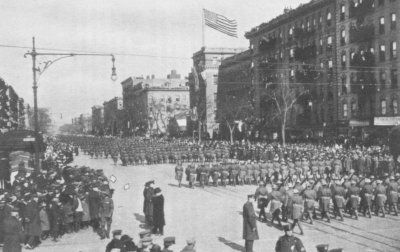 |
| RETURN OF THE 15TH NEW YORK, 369TH INFANTRY. SHOWN SWINGING
UP LENOX AVENUE. NEW YORK CITY WHERE THEY RECEIVED A ROYAL
WELCOME. |
CHAPTER
XXIX.
HOMECOMING HEROES.
NEW YORK GREETS HER OWN—ECSTATIC DAY FOR OLD
15TH—WHITES AND BLACKS DO HONORS—A MONSTER
DEMONSTRATION—MANY DIGNITARIES REVIEW TROOPS—PARADE
OF MARTIAL POMP—CHEERS, MUSIC, FLOWERS AND
FEASTING—"HAYWARD'S SCRAPPING BABIES"—OFFICERS SHARE
GLORY—THEN CAME HENRY JOHNSON—SIMILAR SCENES
ELSEWHERE.
No band of heroes returning from war ever were accorded such a
welcome as that tendered to the homecoming 369th by the residents
of New York, Manhattan Island and vicinity, irrespective of race.
Being one of the picturesque incidents of the war, the like of
which probably will not be repeated for many generations, if
ever, it well deserves commemoration within the pages of this
book.
Inasmuch as no more graphic, detailed and colorful account of the
day's doings has been printed anywhere, we cannot do better than
quote in its entirety the story which appeared in the great
newspaper, The World of New York, on February 18, 1919. The
parade and reception, during which the Negro troops practically
owned the city, occurred the preceeding day. The World account
follows:
"The town that's always ready to take off its hat and
give a whoop for a man who's done something—'no matter who
or what he was before,' as the old Tommy Atkins song has
it—turned itself loose yesterday in welcoming home a
regiment of its own fighting sons that not only did something,
but did a whole lot in winning democracy's war.
"In official records, and in the histories that youngsters will
study in generations to come, this regiment will probably always
be known as the 369th Infantry, U.S.A.
"But in the hearts of a quarter million or more who lined the
streets yesterday to greet it, it was no such thing. It was the
old 15th New York. And so it will be in this city's memory,
archives and in the folk lore of the descendants of the men who
made up its straight, smartly stepping ranks.
"New York is not race-proud nor race-prejudiced. That this 369th
Regiment, with the exception of its eighty-nine white officers,
was composed entirely of Negroes, made no difference in the
shouts and flagwaving and handshakes that were bestowed upon it.
New York gave its Old 15th the fullest welcome of its heart.
"Through scores of thousands of cheering white citizens, and then
through a greater multitude of its own color, the regiment, the
first actual fighting unit to parade as a unit here, marched in
midday up Fifth Avenue and through Harlem, there to be almost
assailed by the colored folks left behind when it went away to
glory.
"Later it was feasted and entertained, and this time very nearly
smothered with hugs and kisses by kin and friends, at the 71st
Regiment Armory. Still later, perfectly behaved and perfectly
ecstatic over its reception, the regiment returned to Camp Upton
to await its mustering out.
"You knew these dark lads a year and a half ago, maybe, as
persons to be slipped a dime as a tip and scarcely glanced it.
They were your elevator boys, your waiters, the Pullman porters
who made up your berths (though of course you'd never dare to
slip a Pullman porter a dime). But, if you were like many a
prosperous white citizen yesterday you were mighty proud to grasp
Jim or Henry or Sam by the hand and then boast among your friends
that you possessed his acquaintance.
"When a regiment has the medal honors of France upon its flags
and it has put the fear of God into Germany time after time, and
its members wear two gold stripes, signifying a year's fighting
service, on one arm, and other stripes, signifying wounds, on the
other, it's a whole lot different outfit from what it was when it
went away. And that's the old 15th N.Y. And the men are
different—and that's Jim and Henry and Sam.
"Col. William Hayward, the distinguished white lawyer and one
time Public Service Commissioner, who is proud to head these
fighters, was watching them line up for their departure shortly
after 6 o'clock last evening, when someone asked him what he
thought of the day.
"'It has been wonderful!' he said, and he gazed with unconcealed
tenderness at his men. 'It's been far beyond my expectations. But
these boys deserve it. There's only one thing missing. I wish
some of Gen. Gouraud's French boys, whom we fought beside, could
be here to see it.'
"The Colonel slapped his hand affectionately upon the shoulder of
his dark-skinned orderly.
"'How about that, Hamilton, old boy?' he inquired.
"'That's right, Colonel, sir; Gen. Gonraud's boys sure would have
enjoyed this day!' the orderly responded as he looked proudly at
the Colonel.
"There's that sort of paternal feeling of the white officers
toward their men, and that filial devotion of the men to their
officers, such as exists in the French Army.
"Much as the white population of the town demonstrated their
welcome to the Regiment, it was, after all, those of their own
color to whom the occasion belonged. And they did themselves
proud In making it an occasion to recall for years in Harlem, San
Juan Hill and Brooklyn, where most of the fighters were
recruited.
"At the official reviewing stand at 60th street, the kinsfolk and
admirers of the regimental lads began to arrive as beforehandedly
as 9 o'clock. They had tickets, and their seats were reserved for
them. The official committee had seen to that—and
nine-tenths of the yellow wooden benches were properly held for
those good Americans of New York whom birth by chance had made
dark-skinned instead of fair. BUT this was their Day of Days, and
they had determined (using their own accentuation) to BE there
and to be there EARLY.
"The first-comers plodded across 59th Street from the San Juan
Hill district, and it was fine to see them. There seemed to be a
little military swank even to the youngsters, as platoons of them
stepped along with faces that had been scrubbed until they shone.
Had a woman a bit of fur, she wore it. Had a man a top
hat—origin or vintage-date immaterial—he displayed
that. All heads were up, high; eyes alight. Beaming smiles
everywhere. No not quite everywhere. Occasionally there was to be
seen on a left sleeve a black band with a gold star, which told
the world that one of the Old 15th would never see the region
west of Columbus Circle, because he had closed his eyes in
France. And the faces of the wearers of these were unlaughing,
but they held themselves just as proudly as the rest.
"Few of the welcomers went flagless. No matter whether a man or
woman wore a jewel or a pair of patent leather boots as a sign of
"class," or tramped afoot to the stand or arrived in a limousine,
nearly every dark hand held the nation's emblem.
"Nearly every one wore white badges bearing the letters:
"Welcome, Fighting 15th," or had pennants upon which stood out
the regimental insignia—a coiled rattlesnake of white on a
black field.
"Those colored folk who could afford it journeyed to the stand in
closed automobiles. Gorgeously gowned women alighted with great
dignity beneath the admiring gaze of their humbler brethren.
Taxies brought up those whose fortunes, perhaps, were not of such
amplitude. Hansoms and hacks conveyed still others, and one party
came in a plumber's wagon, its women members all bundled up in
shawls and blankets against the cold, but grinning delightedly as
the whole stand applauded.
"Children by the thousands lined the east side of the
avenue—Boy Scouts and uniformed kids and little girls with
their school books under their arms, and they sang to the great
delight of the crowd.
"Just why it was that when Governor Smith and former Governor
Whitman and Acting Mayor Moran and the other reviewers appeared
behind a cavalcade of mounted policemen, the youngsters struck up
that army classic, "Oh, How I Hate to Get Up in the Morning," no
one could tell, but it gave the reviewers and the crowd a
laugh.
"With the state and city officials were the members of the Board
of Aldermen, the Board of Estimate, Major Gen. Thomas J. Barry,
Vice Admiral Albert Gleaves, Secretary of State, Francis Hugo;
Rodman Wannamaker and—in a green hat and big fur
coat—William Randolph Hearst. Secretary Baker of the War
Department was unable to attend, but he did the next best thing
and sent his colored assistant, Emmett J. Scott.
"The reviewers arrived at 11:30 and had a good long wait, for at
that time the paraders had not yet left 23rd Street. But what
with the singing, and the general atmosphere of joyousness about
the stand, there was enough to occupy everyone's time.
"There was one feature which took the eye pleasingly—the
number of babies which proud mothers held aloft, fat
pickaninnies, mostly in white, and surrounded by adoring
relatives. These were to see (and be seen by) their daddies for
the first time. Laughingly, the other day, Col. Bill Hayward
spoke of 'our boys' posthumous children,' and said he thought
there were quite a few of them.
"'Some of our boys had to go away pretty quickly,' he reminisced.
'Some of them were only married about twenty minutes or so.'
"'O Colonel!' said the modest Major Little on that occasion.
"'Well, maybe it was a trifle longer than twenty minutes,'
admitted Bill. But anyhow, there was the regiment's posthumous
children in the stand.
"It was 11:26 when the old 15th stepped away from 23rd Street and
Fifth Avenue. They looked the part of the fighting men they were.
At an exact angle over their right shoulders were their
long-bayonetted rifles. Around their waists were belts of
cartridges. On their heads were their 'tin hats,' the steel
helmets that saved many a life, as was attested by the dents and
scars in some of them. Their eyes were straight forward and their
chins, held high naturally, seemed higher than ever because of
the leather straps that circled them. The fighters wore spiral
puttees and their heavy hobbed hiking shoes, which caused a
metallic clash as they scraped over the asphalt.
"At the head of the line rode four platoons of mounted police,
twelve abreast, and then, afoot and alone, Col. Hayward, who
organized the 15th, drilled them when they had nothing but
broomsticks to drill with, fathered them and loved them, and
turned them into the fightingest military organization any man's
army could want.
"The French called them 'Hell Fighters.' The Germans after a few
mix-ups named them 'Blutlustige Schwartzmanner' (blood-thirsty
black men.) But Col. Bill, when he speaks of them uses the words
'those scrapping babies of mine,' and they like that best of all.
Incidentally (when out of his hearing) they refer tenderly to him
as 'Old Bill, that fightin' white man.' So it's fifty-fifty.
"The Colonel had broken a leg in the war, so there were those who
looked for him to limp as he strode out to face the hedge of
spectators that must have numbered a quarter of a million. But
nary a limp. With his full six feet drawn up erectly and his
strong face smiling under his tin hat, he looked every bit the
fighting man as he marched up the centre of the avenue, hailed
every few feet by enthusiasts who knew him socially or in the law
courts or in the business of the Public Service Commission.
"'Didn't your leg hurt you, Bill?' his friends asked him
later.
"'Sure it hurt me; he said, 'but I wasn't going to peg along on
the proudest day of my life!' Which this day was.
"Behind the Colonel marched his staff, Lieut. Col. W.A.
Pickering, Capt. Adjutant Robert Ferguson, Major E.A. Whittemore,
Regimental Sergt. Majors C.A. Connick and B.W. Cheeseman,
Regimental Sergts. L.S. Payne, H.W. Dickerson and W.W. Chisum,
and Sergts. R.C. Craig, D.E. Norman and Kenneth Bellups.
"The Police Band was at the front of the line of march, but it
was a more famous band that provided the music to which the Black
Buddies stepped northward and under the Arch of Victory—the
wonderful jazz organization of Lieut. Jimmie Europe, the one
colored commissioned officer of the regiment. But it wasn't jazz
that started them off. It was the historic Marche du Regiment de
Sambre et Meuse, which has been France's most popular parade
piece since Napoleon's day. As rendered now it had all the crash
of bugle fanfares which is its dominant feature, but an
additional undercurrent of saxaphones and basses that put a new
and more peppery tang into it.
"One hundred strong, and the proudest band of blowers and
pounders that ever reeled off marching melody—Lieut.
Jimmie's boys lived fully up to their reputation. Their music was
as sparkling as the sun that tempered the chill day.
"Four of their drums were instruments which they had captured
from the enemy in Alsace, and ma-an, what a beating was imposed
upon those sheepskins! 'I'd very much admire to have them bush
Germans a-watchin' me today!' said the drummer before the march
started. The Old 15th doesn't say 'Boche' when it refers to the
foe it beat. 'Bush' is the word it uses, and it throws in
'German' for good measure.
"Twenty abreast the heroes marched through a din that never
ceased. They were as soldierly a lot as this town, now used to
soldierly outfits, has ever seen. They had that peculiar sort of
half careless, yet wholly perfect, step that the French display.
Their lines were straight, their rifles at an even angle, and
they moved along with the jaunty ease and lack of stiffness which
comes only to men who have hiked far and frequently.
"The colored folks on the official stand cut loose with a wild,
swelling shriek of joy as the Police Band fell out at 60th Street
and remained there to play the lads along when necessary and
when—now entirely itself—the khaki-clad regiment
filling the street from curb to curb, stepped by.
"Colonel Hayward, with his hand at salute, turned and smiled
happily as he saw his best friend, former Governor Whitman,
standing with his other good friend, Governor Al Smith, with
their silk tiles raised high over their heads. It was the
Governor's first review in New York and the first time he and Mr.
Whitman had got together since Inauguration Day. They were of
different parties, but they were united in greeting Colonel Bill
and his Babies.
"From the stand, from the Knickerbocker Club across the street,
from the nearby residences and from the curbing sounded shouts of
individual greetings for the commander and his staff. But these
were quickly drowned as a roar went up for Lieutenant Europe's
band, with its commander at the head—not swinging a baton
like a common ordinary drum-major, but walking along with the
uniform and side-arms of an officer.
"'The Salute to the 85th,' which they learned from their comrade
regiment of the French Army of General Gouraud, was what they
were playing, a stirring thing full of bugle calls and drum
rolls, which Europe says is the best march he ever heard.
"So swiftly did the platoons sweep by that it took a quick eye to
recognize a brother or a son or a lover or a husband; but the
eyes in the stand were quick, and there were shouts of 'Oh,
Bill!' 'Hey, boy, here's your mammy!' 'Oliver, look at your
baby!' (It wasn't learned whether this referred to a feminine
person or one of those posthumous children Colonel Hayward spoke
about.) 'Hallelujah, Sam! There you are, back home again!'
"Half way down the ranks of the 2,992 paraders appeared the
colors, and all hats came off with double reverence, for the
Stars and Stripes and the blue regimental standard that two husky
ebony lads held proudly aloft had been carried from here to
France, from France to Germany and back again, and each bore the
bronze token with its green and red ribbon that is called the
Croix de Guerre. Keen eyes could see these little medals swinging
from the silk of the flags, high toward the top of the poles.
"At the end of the lines which filled the avenue came a single
automobile, first, with a round-faced smiling white officer
sitting in it and gazing happily from side to side. This was
Major Lorillard Spencer, who was so badly wounded that he came
back in advance of the outfit some weeks ago. There was a special
racket of cheers for him, and then another for Major David L.
'Esperance, also wounded and riding.
"Then a far different figure, but one of the most famous of the
whole war. Henry Johnson! That Henry, once a mild-mannered
chauffeur, who to protect his comrade, Needham Roberts, waded
into a whole patrol of 'bush Germans' with a lot of hand
grenades, his rifle and his trusty 'steel' in the shape of a bolo
knife, and waded into them so energetically that when the
casualties were counted there were four dead foemen in front of
him, thirty-four others done up so badly they couldn't even crawl
away, and heaven knows how many more had been put to flight.
"And now Henry, in commemoration of this exploit, was riding
alone in an open machine. In his left hand he held his tin hat.
In his right he held high over his head a bunch of red and white
lilies which some admirer had pressed upon him. And from side to
side Henry—about as black as any man in the outfit if not a
trifle blacker—bowed from the waist down with all the grace
of a French dancing master. Yes, he bowed, and he grinned from
ear to ear and he waved his lilies, and he didn't overlook a bet
in the way of taking (and liking) all the tributes that were
offered to him.
"A fleet of motor ambulances, back of Henry, carried the wounded
men who were unable to walk, nearly 200 of them. But though they
couldn't walk, they could laugh and wave and shout thanks for the
cheers, all of which they did.
"Almost before the happy colored folk could realize at the
official stand that here were their lads back home again, the
last of the parade rolled along and it was over. With that
formation and the step that was inspired by Lieutenant Europe's
band—and by the Police Band which stood at 60th Street and
kept playing after the music of the other died away—it
required only seventeen minutes for the regiment to pass.
"From this point north the welcome heightened in intensity. Along
the park wall the colored people were banked deeply, everyone
giving them the first ranks nearest the curb. Wives, sweethearts
and mothers began to dash into the ranks and press flowers upon
their men and march alongside with them, arm-in-arm. But this
couldn't be, and Colonel Hayward had to stop the procession for a
time and order the police to put the relatives back on the
sidewalks. But that couldn't stop their noise.
"The residents of the avenue paid fine tribute to the dusky
marchers. It seemed inspiring, at 65th Street, to see Mrs.
Vincent Astor standing in a window of her home, a great flag
about her shoulders and a smaller one in her left hand, waving
salutes. And Henry Frick, at an open window of his home at 73d
Street, waving a flag and cheering at the top of his voice.
"At the corner of 86th street was a wounded colored soldier
wearing the Croix de Guerre and the Victoria Cross as well.
Colonel Hayward pressed to his side with a hearty handshake,
exclaiming: 'Why, I thought you were dead!' It was one of his
boys long ago invalided home.
"No, sir, Colonel, not me. I ain't dead by a long ways yet,
Colonel, sir,' said the lad.
"'How's it going, Colonel?' asked a spectator.
"'Fine,' said the Commander. 'All I'm worrying about is whether
my boys are keeping step.' He needn't have worried.
"The real height of the enthusiasm was reached when, after
passing through 110th street and northward along Lenox Avenue,
the heroes arrived in the real Black Belt of Harlem. This was the
Home, Sweet Home for hundreds of them, the neighborhood they'd
been born in and had grown up in, and from 129th Street north the
windows and roofs and fireescapes of the five and six story
apartment houses were filled to overflowing with their nearest
and dearest.
"The noise drowned the melody of Lieut. Europe's band. Flowers
fell in showers from above. Men, women and children from the
sidewalks overran the police and threw their arms about the
paraders. There was a swirling maelstrom of dark humanity in the
avenue. In the midst of all the racket there could be caught the
personal salutations: 'Oh, honey!' 'Oh, Jim!' 'Oh, you Charlie!'
'There's my boy!' 'There's daddie!' 'How soon you coming home,
son?' It took all the ability of scores of reserve policemen
between 129th Street and 135th Street, where the uptown reviewing
stand was, to pry those colored enthusiasts away from their
soldiermen.
"There was one particular cry which was taken up for blocks along
this district: 'O-oh, you wick-ed Hen-nery Johnson! You wick-ed
ma-an!' and Henry the Boche Killer still bowed and grinned more
widely than ever, if possible.
"'Looks like a funeral, Henry, them lilies!' called one
admirer.
'"Funeral for them bush Germans, boy! Sure a funeral for them
bushes.' shouted Henry.
"The official reviewing party, after the parade had passed 60th
street, had hurried uptown, and so had the Police Band, and so
there were some doings as the old 15th breezed past 135th Street.
But no one up there cared for Governors or ex-Governors or
dignitaries. Every eye was on the Black Buddies and every throat
was opened wide for them.
"At 145th Street the halt was called. Again there was a
tremendous rush of men and women with outstretched arms; the
military discipline had to prevail, and the soldiers were not
allowed to break ranks, nor were the civilians (save the quickest
of them) able to give the hugs and kisses they were overflowing
with.
"As rapidly as possible the fighters were sent down into the
subway station and loaded aboard trains which took them down to
the 71st Regiment Armory at 34th Street and Fourth Avenue. Here
the galleries were filled with as many dusky citizens as could
find places (maybe 2,500 or 3,000) and so great was the crowd in
the neighborhood that the police had to block off 34th Street
almost to Fifth Avenue on the west and Third on the east.
"As each company came up from the subway the friends and
relatives were allowed to go through the lines, and, while the
boys stood still in ranks, but at ease, their kinsfolk were
allowed to take them in their arms and tell them really and
truly, in close-up fashion, what they thought about having them
back.
"When the entire regiment was in the Armory, the civilians in the
gallery broke all bounds. They weren't going to stay up there
while their heroes were down below on the drill-floor! Not they!
They swarmed past the police and depot battalion and so jammed
the floor that it was impossible for the tired Black Buddy even
to sit down. Most of the boys had to take their chicken
dinner—served by colored girls, and the chow, incidentally,
from Delmonico's—standing up with arms about them and
kisses punctuating assaults upon the plates.
"'Some chow, hey Buddy?' would be heard.
"'Pretty bon.' You'd get the answer. 'I'd like to have beaucoup
more of this chicken.' There was noticeable a sprinkling of
French words in the conversation of the Old 15th, and, indeed,
some of them spoke it fluently.
"'Sam told me,' one girl was heard to say, 'that he killed
nineteen of them Germans all his own self, but nobody saw him and
so he didn't get that Cross doo Gare.'"
Mustering out commenced at Camp Upton the following day. Thus
ended the service of the 369th. Their deeds are emblazoned on the
roll of honor. Sons and grandsons of slaves, welcomed by the
plaudits of the second largest city in the world. What a record
of progress in a trifle over half a century of freedom. What an
augury of promise for the future of the colored race, and what an
augury for the world freedom which they helped to create, and,
overshadowing all else, WHAT an object lesson it should be to our
country at large: east, west, north, south, that, "One touch of
nature makes 'all men' kin." That in her opinion and treatment of
her faithful, loyal black citizens; niggardly, parsimonious,
grudging and half-heartedly, how shameful she has been, how great
has been her sin; forgetting; or uncaring, even as Pharoh of old,
that: "God omnipotent liveth," and that "He is a JUST and a
vengeful God!"
New York's welcome to her returning Negro boys was fairly typical
of similar scenes all over the country. Chicago gave a tremendous
ovation to the heroes of the old 8th Infantry. In Washington,
Cleveland, and many other cities were great parades and
receptions when theirs came home. In hundreds of smaller towns
and hamlets the demonstrations were repeated in miniature.
CHAPTER XXX.
RECONSTRUCTION AND THE NEGRO.
BY JULIUS ROSENWALD, PRESIDENT SEARS, ROEBUCK &
CO, AND TRUSTEE OF TUSKEGEE INSTITUTE—A PLEA FOR INDUSTRIAL
OPPORTUNITY FOR THE NEGRO—TRIBUTE TO NEGRO AS SOLDIER AND
CIVILIAN—DUTY OF WHITES POINTED OUT—BUSINESS LEADER
AND PHILANTHROPIST SOUNDS KEYNOTE.
Although American sacrifices in the European War have been great,
we find compensation for them in many directions. Not the least
of these is the vastly increased number of opportunities the
reconstruction period will offer to many of our citizens.
Today the United States is the leading nation of the world in
virtually every line of activity. We have been thrust into a new
world leadership by the war. It behooves us to make the most of
our new opportunities. To equip ourselves creditably we must
utilize the best there is in the manhood and womanhood of our
nation, drawing upon the intellect and ability of every person
who has either to give.
Approximately ten percent of our present population is colored.
Every man, woman and child of this ten percent should be given
the opportunity to utilize whatever ability he has in the
struggle for the maintenance of world leadership which we now
face. Just insofar as we refuse to give this part of our
population an opportunity to lend its strength to helping us set
a pace for the rest of the world, as best it can, so do we weaken
the total strength of our nation. In other words, we can either
give our colored population the right and the opportunity to do
the best work of which it is capable and increase our efficiency,
or we can deny them their rights and opportunities, as we have
done in many instances, and decrease our efficiency
proportionately.
Of course, the question naturally arises as to how efficient the
colored man and the colored woman are when given the opportunity
to demonstrate their ability. No better answer can be found than
that given by the splendid work of the majority of our colored
people during the war. On the firing line, in the camps behind
the line, and in civil life our colored population has done well
indeed. Four hundred thousand Negroes offered their lives for
their country. Many more made noble sacrifices in civilian
life.
It was my privilege not only to observe the work done in civil
life by colored persons in this country during the war, but to
visit colored troops in France during hostilities.
There is no question that the Negro has given a splendid account
of himself both as an exceptionally fearless fighting man and as
a member of non-combatant troops. I made diligent effort to
ascertain the manner in which the Negro troops conducted
themselves behind the lines. It is much easier for a man to
become lax in his conduct there than in actual fighting. Without
exception every officer I questioned stated he could not ask for
more obedient, willing, harder working or more patriotic troops
than the Negro regiments had proven themselves to be. Every
account I have read regarding the engagement of colored men in
fighting units and every case in which I had the opportunity to
inquire personally regarding the bravery of colored troops has
led me to believe our colored men were as good soldiers as could
be found in either our own army or the armies of our allies,
regardless of color.
One needs only to scan the records of the War Department and the
official reports of General Pershing to find positive proof of
the valor, endurance and patriotism of the colored troops who
battled for liberty and democracy for all the world. The entire
nation notes with pride the splendid service of the 365th to the
372nd Infantry units, inclusive. When historians tell the story
of the sanguinary conflicts at Chateau Thierry, in the Forest of
Argonne, in the Champagne sector, Belleau Wood and at Metz, the
record will give reason to believe that the victories achieved on
those memorable fields might have shown a different result had it
not been for the remarkable staying and fighting abilities of the
colored troops. French, English and American commanding officers
unite in singing the praises of these gallant warriors and agree
that in the entire Allied Army no element contributed more
signally than did they to the final downfall of the German
Military Machine in proportion to their numbers.
Not only did the combatant units of the colored troops win
laurels across the sea, but the 301st Stevedore Regiment was
cited for exceptionally efficient work, having broken all records
by unloading and coaling the giant steamer "Leviathan" in
fifty-six hours, competing successfully with the best stevedore
detachments on the western front of France. Everywhere, behind
the lines as well as when facing shot, shell and gas, the colored
soldiers have given a most creditable account of themselves and
are entitled to the product of their patriotism and loyalty.
Those who remained at home during the war realize fully that the
patriotic service rendered by colored persons in civil life, both
in doing war work and in the purchase of Liberty Bonds and War
Savings Stamps is to be commended.
Surely after the many demonstrations of patriotism both on the
battlefield and at home the white people of this country will be
willing to accord the colored people a square deal by at least
giving them a fair opportunity to earn a livelihood in accordance
with their ability.
We have been asking the impossible of the colored man and the
colored woman. We have demanded that they be honest,
self-respecting citizens, and at the same time we have forced
them into surroundings which almost make this result impossible.
In many places they are deprived of a fair opportunity to obtain
education or amusement in a decent environment. Only the most
menial positions are offered them. An educated girl particularly
has practically no opportunity to earn a livelihood in the manner
for which her education fits her.
We whites of America must begin to realize that Booker T.
Washington was right when he said it was impossible to hold a man
in the gutter without staying there with him, because "if you get
up, he will get up." We do not want to remain in the gutter. We,
therefore, must help the
Negro to rise
.
If we are to obtain the best results from colored labor, unions
should admit it to their membership. It is not the universal
practice to admit colored persons to unions. The result, of
course, is that even if a colored man has the opportunity to
learn a trade, knowing he will not be permitted to enjoy the
benefits of a union, he does not have the highest incentive for
learning it. The north is especially neglectful in not providing
openings for the colored men in trades. In the south it is not
unusual to see a colored brick-mason working alongside a white
brick-mason. But in the north the best a colored man can hope for
on a building job now is a position as a hod-carrier or
mortar-mixer.
When the alien arrives in this country, he is given opportunity
for virtually every kind of employment. But the colored man who
is born in the United States, and, therefore,
should share in
its opportunities
, is not given as fair a chance as the alien
worker.
Naturally, we cannot hope that these conditions will be remedied
in a day or a month nor can the colored man expect that the
millennium will come to him through the action of white people
alone. He can improve his chances of securing greater rights and
opportunities in the United States, if he will make the most of
the limited opportunities now afforded him. He who does the best
he can with the tools he has at hand is bound in time to demand
by his good work better tools for the performance of more
important and profitable duties. The conviction is general that
"He that is faithful in that which is least is faithful also in
much."
The late Colonel Theodore Roosevelt, who was a good friend of the
black man as well as the white, struck the right note in his
introduction to the biography of Booker T. Washington when he
said:
"If there is any lesson more essential than any other
for this country to learn, it is the lesson that the enjoyment of
rights should be made conditional upon the performance of
duty."
There exist certain rights which every colored man and woman may
enjoy regardless of laws and prejudice. For instance, nothing can
prevent a colored person from practicing industry, honesty,
saving and decency, if he or she desires to practice them.
The helpfulness of the colored race to the Government need not be
confined to fighting in the army nor to service in the manifold
domestic callings. It is the duty of the colored citizens, as it
is their right, to have a part in the substantial development of
the nation and to assist in financing its operations for war or
peace. The colored people, as a rule, are industrious and thrifty
and have come to appreciate their importance as a factor in the
economic and financial world, as indicated by their prosperous
business enterprises, their large holdings in real estate, their
management of banks, and their scrupulous handling of the
millions of deposits entrusted to their care. This capital, saved
through sacrifice, has been placed in a most generous manner at
the disposal of the Government throughout its period of need, and
the list of corporations, fraternities and individuals who have
aided in bringing success to American arms by the purchase of
Liberty Bonds and War Savings Stamps and by contributions to
other war relief agencies, is indeed a long one.
Opportunities of the colored people to make safe investment of
their savings never were so great as they are today. The
financial program the Government has entered upon and is
continuing to carry out to meet the expense of the war gives a
chance to save in sums as small as twenty-five cents and makes an
investment upon which return of both principal and interest is
absolutely guaranteed. Too often colored people have entrusted
their savings to wholly irresponsible persons, lost them through
the dishonesty of these persons, and in discouragement abandoned
all attempts at saving. Today, however, there is no excuse for
any man not saving a certain amount of his earnings no matter how
small it may be. It is a poor person, indeed, who cannot invest
twenty-five cents at stated intervals in a Thrift Stamp. Many are
able also to buy small Liberty Bonds. It is a duty and a
privilege for colored persons to help the Government finance the
war, which was for both whites and blacks.
It is the particular duty of white persons, in cooperation with
the most influential members of their own race, to explain these
Government financial plans to the colored men and women that they
may make safe investments, acquire a competence, and thus become
better citizens.
It is my belief that the Negro soldier returning from France will
be a better citizen than when he left. He will be benefited
mentally and physically by his military training and experience.
He will have a broader vision. He will appreciate American
citizenship. He will know, I believe, that freedom, for which he
risked his life and all, is not license. He will find his
brothers at home who did not go overseas better for their war
sacrifices. Both the soldier and the civilian have proved their
devoted loyalty. Justice demands that they now be rewarded with
an equal chance with the white man to climb as high in the
industrial and professional world as their individual capacity
warrants.
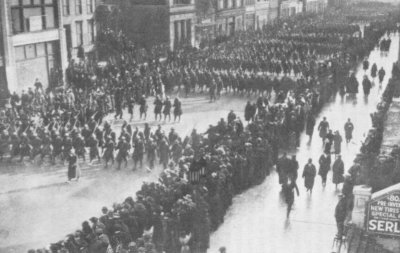 |
| HOMECOMING HEROES OF 8TH ILLINOIS (370TH INFANTRY). FAMOUS
NEGRO FIGHTERS MARCHING IN MICHIGAN BOULEVARD, CHICAGO. |
CHAPTER
XXXI.
THE OTHER FELLOW'S BURDEN.
An Emancipation Day Appeal for Justice.
By W. Allison Sweeney.
Publisher's Note: At our request, Mr. Sweeney
consented to the reproduction of this poem, which with the
accompanying letter from the late Dr. Booker T. Washington, and
the comment by the Chicago Daily News, appeared in that newspaper
just prior to New Years Day, 1914. We regard it as a powerful
argument, affecting the Negro's past condition and his
interests.
"President Lincoln signed the emancipation proclamation Sept. 22,
1862. It went into effect at the beginning of January, 1863. New
Year's day has thus become 'Emancipation day' to the colored
people of the United States and to all members of the white race
who realize the great significance of Lincoln's act of striking
off the shackles of an enslaved race. Services on that day
combine honor to Lincoln with appeals to the people of Lincoln's
nation to grant justice to the Negro. A remarkable appeal of this
sort is embodied in the poem here presented.
"W. Allison Sweeney, author of "The Other Fellow's Burden" is
well known among his people as writer, editor and lecturer. His
poem, which sketches with powerful strokes the lamentable history
of the colored race in America and tells of their worthy
achievements in the face of discouragements, deserves a
thoughtful reading by all persons. Of this poem and its author
Dr. Booker T. Washington writes as follows:
"TUSKEGEE INSTITUTE, ALA., Dec. 24, 1913.—To the Editor of
the Chicago Daily News: I have read with sincere interest and
appreciation W. Allison Sweeney's poem, 'The Other Fellow's
Burden.' All through Mr. Sweeney's poem there is an invitation
put in rather a delicate and persuasive way, but nevertheless it
is there, for the white man to put himself in the negro's place
and then to lay his hand upon his heart and ask how he would like
for the other fellow to treat him. If every man who reads this
poem will try sincerely to answer this question I believe that
Mr. Sweeney's poem will go a long way toward bringing about
better and more helpful conditions.
"Mr. Sweeney is, of course, a member of the Negro race and writes
from what might be called the inside. He knows of Negro
aspirations, of Negro strivings and of Negro accomplishments. He
has had an experience of many years as writer and lecturer for
and to Negroes and he knows probably as well as anyone wherein
the Negro feels that 'the shoe is made to pinch.' The poem, it
seems to me, possesses intrinsic merit and I feel quite sure that
Mr. Sweeney's appeal to the great American people, for fair play
will not fall upon deaf ears. Booker T. Washington."
The "white man's burden" has been
  told the world,
But what of the other fellow's—
The "lion's whelp"?
Lest you forget,
May he not lisp his?
Not in arrogance,
Not in resentment,
But that truth
May stand foursquare?
This then,
Is the Other Fellow's Burden.
       *       *       *       *       *
Brought into existence
Through the enforced connivance
Of a helpless motherhood
Misused through generations—
America's darkest sin!—
There courses through his veins
In calm insistence—incriminating irony
Of the secrecy of blighting lust!
The best and the vilest blood
Of the South's variegated strain;
Her statesmen and her loafers,
Her chivalry and her ruffians.
Thus bred,
His impulses twisted
At the starting point
By brutality and sensuous savagery,
Should he be crucified?
Is it a cause for wonder
If beneath his skin of many hues—
Black, brown, yellow, white—
Flows the sullen flood
Of resentment for prenatal wrong
And forced humility?
Should it be a wonder
That the muddy life current
Eddying through his arteries,
Crossed with the good and the bad,
Poisoned with conflicting emotions,
Proclaims at times,
Through no fault of his,
That for a surety the sins of fathers
Become the heritage of sons
Even to the fourth generation?
Or that murdered chastity,
That ravished motherhood—
So pitiful, so helpless,
Before the white hot,
Lust-fever of the "master"—
Has borne its sure fruit?
You mutter, "There should be no wonder."
Well, somehow, Sir Caucasian,
Perhaps southern gentleman,
I, marked a "whelp," am moved
To prize that muttered admission.
       *       *       *       *       *
But listen, please:
The wonder is—the greater one—
That from Lexington to San Juan hill
Disloyalty never smirched
His garments, nor civic wrangle
Nor revolutionary ebullition
Marked him its follower.
A "striker"? Yes!
But he struck the insurgent
And raised the flag.
An ingrate?
Treacherous?
A violator?
When—oh, spectacle that moved the world!
For five bloody years
Of fratricidal strife—
Red days when brothers warred—
He fed the babe,
Shielded the mother.
Guarded the doorsill
Of a million southern homes?
Penniless when freedom came? Most true;
But his accumulations of fifty years
Could finance a group of principalities.
Homeless? Yes; but the cabin and the hut
Of Lincoln's day—uncover at that name!—
Are memories; the mansion of today,
Dowered with culture and refinement,
Sweetened by clean lives,
Is a fact.
Unlettered? Yes;
But the alumni of his schools,
Triumphant over the handicap
Of "previous condition,"
Are to be found the world over
In every assemblage inspired
By the democracy of letters.
In the casting up what appears?
The progeny of lust and helplessness,
He inherited a mottled soul—
"Damned spots" that biased the looker on.
Clothed a freeman,
Turned loose in the land
Creditless, without experience,
He often stumbled, the way being strange,
Sometimes fell.
Mocked, sneered at from every angle,
spurned, hindered in every section,
North, south, east, west,
Refused the most primitive rights,
His slightest mistakes
Made mountains of,
Hunted, burned, hanged,
The death rattle in his throat
Drowned by shouts and laughter
And—think of it!—
The glee of little children.
Still he pressed on, wrought,
Sowed, reaped, builded.
His smile ever ready,
His perplexed soul lighted
With the radiance
Of an unquenchable optimism,
God's presence visualized,
He has risen, step by step.
To the majesty of the home builder,
Useful citizen,
Student, teacher,
Unwavering patriot.
This of the Other Fellow.
What of you, his judges and his patrons?
If it has been your wont
In your treatment of him
Not to reflect,
Or to stand by in idle unconcern
While, panting on his belly,
Ambushed by booted ruffianism,
He lapped in sublime resignation
The bitter waters
Of unreasoning intolerance,
Has not the hour of his deliverance,
Of your escape from your "other selves"
Struck?
If you have erred,
Will you refuse to know it?
Has not the time arrived
To discriminate between
Those who lower
Those who raise him?
You are shamed by your abortions,
Your moral half growths
Who flee God's eye
And stain his green earth,
But you are not judged by yours;
Should he be judged by his?
In his special case—if so, why?
Is manhood a myth,
Womanhood a toy,
Integrity unbelievable,
Honor a chimera?
Should not his boys and girls,
Mastering the curriculum of the schools,
Pricked on to attainment by the lure
Of honorable achievement,
Be given bread and not a stone
When seeking employment
In the labor mart,
At the factory gate
Or the office door?
Broadened by the spirit of the golden rule,
Will you not grant these children of Hagar
An even break?
Is the day not here, O judges,
When the Other Fellow
May be measured in fairness,
Just fairness?
       *       *       *       *       *
It is written men may rise
"On their dead selves to higher things;"
But can it be that this clear note of cheer
To sodden men and smitten races
Was meant for all save him?
Chants an immortal:
"He prayeth best who loveth best
All things both great and small;
For the dear God who loveth us,
He made and loveth all."
CHAPTER
XXXII.
AN INTERPOLATION.
HELD BY DISTINGUISHED THINKERS AND WRITERS, THAT THE NEGRO
SOLDIER SHOULD BE GIVEN A CHANCE FOR PROMOTION AS WELL AS A
CHANCE TO DIE—WHY WHITE OFFICERS OVER NEGRO SOLDIERS?
Ever since the conclusion of the conflict of '61-'65, in which
Negro troops numbered by thousands, took an active part upon
behalf of the Union, there has been a growing and insistent
wonder in the minds of many, why, given a chance to die in the
military service of the nation, they should not also at the same
time be given a chance for promotion.
Subsequent affairs engaged in by the government requiring the
intervention of its military arm, the Spanish-American war, the
Philippines investiture incident thereto, the Mexican
disagreement, the whole crowned by the stupendous World War; its
frightful devastation and din yet fresh to our sight, still
filling our ears, as it will for years; in all of which they have
contributed their share of loyalty and blood—of
LIVES!—have but added to, strengthened the wonder
mentioned.
Up to the beginning of the European muddle it was discussed if at
all, not so much as a condition demanding uncensored
condemnation, as one to continue to be patient with, trusting to
time and an awakened sense of fair play upon the part of the
nation at large to note the custom complained of, and banish the
irritation by abolishing the cause.
However, there has not been lacking those who have spoken out,
who have raised their voices in protest against what they deemed
an injustice to the loyal "fighting men" of their race, and so
feeling, have not hesitated to make their plea to those above
empowered to listen, regardless of the mood in which they did
so.
As long ago as the summer of 1915, or to be exact, August 26th of
that year, Capt. R.P. Roots of Seattle, Washington, addressed a
letter to the Hon. Lindley M. Garrison at Washington, at the time
Secretary of War, directing his attention to the discrepancy of
assignment complained of, accompanied with certain suggestions;
having to do with a condition that the government must eventually
face; that will not down, and must sooner or later be abrogated.
Captain Roots' communication to the Secretary of War, also one
addressed to the Hon. Joseph Tumulty, private secretary to
President Wilson, follows:
                                "Seattle, Wash., August 26, 1915.
"Hon. Lindley M. Garrison, Secretary of War,
Dear Sir: As an ex-officer of the Spanish-American war, having served as
Captain of Company "E" of the Eighth Illinois Volunteers, I am taking
the liberty to ask that, if you should recommend any increase in the
Army you give the Negro a chance in the manner, and for reasons I shall
further explain.
     You will notice by my service with the 8th Illinois that I am a
colored man, and as such am offering these suggestions, which, in the
main, are just.
     If the increase is sufficient, we should have:
     TWO COAST ARTILLERY COMPANIES.
     ONE REGIMENT OF FIELD ARTILLERY (In these branches we are not
represented at all).
     ONE REGIMENT OF CAVALRY.
     The above to be embodied in the Regular Army and to be officered as
you think fit.
     But my main object is: Three Regiments of Infantry officered from
COLONEL DOWN WITH COLORED MEN. I should not have these Infantry
Regiments of the regular service for the reason that to appoint officers
to the rank of Colonel, Majors, etc., would not be fair to the regular
service officers, and would interfere with the promotion of the same,
but I would have them rank as volunteers. Give them the name of
"IMMUNES," "FOREIGN SERVICE REGIMENTS," or any other name that you
choose.
     My further reasons are as to officering these regiments, that there
would be many misfits in such organizations and I would leave it so that
you or the President could remove them without prejudice from the
service, but to fill by OTHER COLORED MEN the vacancies that might
occur. I should officer these regiments with Spanish War veterans,
non-commissioned officers of the retired and regulars, but should
appoint all 2d Lieutenants from the schools of the country giving
military training.
     The 2d Lieutenants upon passing the regular army examination could be
placed in the eligible list of the regular army, but NOT until at least
two years' service with these regiments. You could set a time limit on
these regiments if you so desire, say ten or twelve years duration;
either mustered out or in the regular service.
     "Now Mr. Secretary, I have striven to meet any objections which might be
made by the Army on account of social prejudice, etc. With this thought
I should send these regiments to some foreign post to serve where there
are dark races; to the Philippines, Mexico, or Haiti. The object lesson
would be marked politically, both at home and abroad.
     "The 48th and 49th Regiments organized in 1899 and sent to Philippines
were unsatisfactory because of there being three social lines of
separation in those organizations—THE FIELD AND STAFF of these
regiments WERE WHITE, and the LINE OFFICERS WERE COLORED. In a social
way the line officers WERE ENTIRELY IGNORED, and even officially were
treated very little better than enlisted men or with no more courtesy,
to such an extent as to cause comment by both soldiers and natives.
     "Now as to the colored citizen of this country coming to its defense
there is no question, as he has always done so But, to use a late
phrase, he is beginning to want HIS "PLACE IN THE SUN"—he wants a
chance to rise on his merits AND TO KNOW WHEN HE SHOULDERS A GUN, THAT
IF HE IS DESERVING OF IT, HE WILL HAVE A CHANCE TO RISE. He can fight
and will, but will fight better with an incentive than without one. He
is a, citizen regardless of all laws to the contrary; also he is the NEW
Negro, and NOT of the "Uncle Tom" class, the passing of whom so many
white citizens regret.
     "He reads your literature, attends your theaters, goes to your schools,
observes you in his capacity as a waiter or porter, and is absorbing the
best you have in the ways of civilization, and in fact, in every walk of
life, he is a factor; and when he is asked to defend his country should
he not be given THE SAME CHANCE AS THE WHITE MAN?
     "You will say that he should go to West Point. Well and good; but who is
to send him? Next, who will defend him while there against the
"Unwritten Law" of the white students not to allow him to matriculate?
     "The first officers of such regiments could be easily picked, made from
Spanish War veterans and non-commissioned officers of the regular army,
and second lieutenants from graduates from colleges giving military
training. Such an organization officered in this manner would be ideal,
speaking from my experience as a veteran of the Spanish War.
     "One thing you may have overlooked: We are twelve million in this
country, WITH AN ESTIMATE OF A MILLION MEN FIT FOR SERVICE.
     "Suppose at such a crisis as is now transpiring in Europe, this country,
with its millions of foreign citizens, should suddenly find itself face
to face with a revolution. The presence and loyalty of these MILLION
NEGROES might mean much for the stability of this government.
     "I have spoken plainly because I am a citizen; this is my country. I was
born here, and shall at all times be found with the flag; hence I ask,
that in your recommendations, looking to the betterment and enlargement
of the army, you give THE BLACK PATRIOT such consideration, as I cannot
but feel is due him, the thousands of young colored men who have passed
through colleges and schools in an effort to prepare themselves for
filling a place in the world.
     "I am opposed to segregation, but as it seems, under the present
conditions of the races socially to be the ONLY way to a square deal, I
accept it. There are Irish regiments, German regiments, etc., let us
then have Negro regiments. The coming generations will look after the
rest. I am, very respectfully,
                                          R.P. ROOTS
400 26th Ave., North, Late Capt. 8th Ill. Vol. Infantry."


                                        "Seattle, Wash., Nov. 9, 1915.
"Hon Joseph Tumulty, Secretary to the President, Washington, D.C.
Dear Sir:—I am enclosing a copy of a letter sent to the Secretary of
War, which I would be very much pleased to have you call the President's
attention to, and ask if he can approve of it.
     "I was not fully informed as to the President's policy in regard to
Haiti at the time of writing, and am not now, except through such
information as received by the daily press. Taking that, in the main as
authentic, I wish to add that I think a Brigade of Colored Troops, such
as recommended in my letter to the Secretary for foreign service, would
be the proper thing for Haiti.
     "It being a Negro Republic, the racial feeling as to the Negro's
treatment in this country, which I need not mention, has been enlarged
upon and not understood by the Negroes of other parts of the world, so
that as it seems to me, to organize a constabulary officered by white
Americans, would be inviting murder; for agitators from other
governments, if they so desired, would soon cause a rebellion, and then
you would have it all to do over again.
     "Colored troops from this country, I mean officers as well, would tend
to cause a good feeling among the natives, not at first but later on as
each became used to the other. THE WHITE MAN THINKS HE IS SUPERIOR TO
ANY NEGRO, AND WOULD SHOW IT EVEN THOUGH HE TRIED NOT TO, and the
Haitian would be going around with a chip on his shoulder looking for
someone to knock it off.
     "You have three men in the regular army who could supervise the
organization of these troops, and one who is already a Colonel of the
Eighth Illinois National Guard, also several others if you wished to
consider them.
     "Hoping that you will see the advisability of such an organization for
diplomatic reasons and for JUSTICE TO THE AMERICAN NEGRO—who has been
loyal—and served from Bunker Hill until now, I am,
                               Very respectfully,
                               R.P. ROOTS,
400 26th St. N. Seattle, Wash., Late Capt. Eighth Illinois Volunteer
     Infantry during Spanish War."
As touching upon the above, Editor E.S. Abbott of THE CHICAGO
DEFENDER, made the following comment:
     "There may be reasons deemed good and sufficient upon the part of
President Wilson and Secretary Garrison for not having replied to
the very courteous and finely conceived letters of appeal and
suggestion, having to do with a new deal—with justice and fair
play in the future towards the Negro soldiery of our country,
written them some weeks ago by CAPT. R.P. ROOTS of Seattle.
     "It is not always meet, especially in times like these, of war and
stress, of worries and apprehension, reaching across the world, for
our rulers and servants facing great responsibilities and
perplexing situations, to respond to every query and satisfy all
curiosities. Much reticence must be permitted them. Much accepted,
as a matter of course, without pursuing curiosity to the limit.
     "There may be ideas conveyed by Captain Roots to the president,
through his communications to Secretaries Garrison and Tumulty that
some people may not agree with, but there can be no disagreement
over the proposition that the lot of colored soldiers in the armies
of the United States—in the past, and at the present, is much
different than that accorded to white soldiers; very little to
really be proud of; very, very much to be ashamed of—much that is
humiliating and depressing.
     "Because the present administration may be powerless in the matter,
afraid to touch it, fearing a live wire or something of that kind,
should OUR duty in the premises, TOWARD OUR OWN, be influenced
thereby?
     "I wonder—is the time not NOW—right now, to commence an attack
upon this intrenched scandal—this dirty, HUMILIATING AMERICANISM?
     "No other nation on earth, Christian or pagan, treats its
defenders, its soldiery, so meanly, so shabbily, as does this, her
black defenders; but whether the nation is more to blame, than we,
who so long have submitted without a murmur, is a question. 'The
trouble' shouted Cassius to Brutus, 'is not in our stars, that we
are Underlings, BUT IN OURSELVES.'
     "Shall we, responding to the initiative furnished by CAPTAIN ROOTS,
commence an organized assault upon this national vice against the
soldiers of our race? Is this the time, readers of The Defender? Is
this the time, brothers and editors of the contemporary press?
                                            R.S. ABBOTT."
Following in the footsteps of Captain Roots; apparently obsessed
by the same vision and spirit, Mr. Willis O. Tyler, eminent Los
Angeles race representative, attorney and Harvard graduate, also
makes a plea for justice for Negro troops in the regular army,
also for Negro officers, and proposes reforms and legislation for
utilizing the present force of Negro officers, and creating
enlarged opportunities for others. Says Mr. Tyler:
      "Officers in the regular army for the most part, are graduates of
West Point. They are commissioned second lieutenants at graduation.
No Negro has graduated from West Point in the past twenty-nine
years, and none has entered there in 32 years. Col. Charles Young
graduated in 1889, twenty-nine years ago,—he entered in 1884.
Henry W. Holloway entered in 1886, but attended only that year. In
all, only twelve Negroes have ever attended West Point and only
three have graduated. Of the three graduates, the first, Henry O.
Flipper (1877) was afterwards discharged.
      "The second, John H. Alexander (1887) died in 1894. The third and
last graduate, Charles Young (1889) has but recently been returned
to active duty. We understand he has attained the rank of Colonel.
The Negroes of the United States, to the number of twelve millions,
have only one West Point graduate in the regular army. There are
however four regiments of Colored troops, two of infantry, and two
of cavalry, and these have been maintained for 52 years, (since
1866), and more than two hundred officers find places in the four
Colored regiments. These two hundred officers, with about three
exceptions are white officers. In all, only twelve Negroes have
held commissions in the regular army. Of this number seven were
Chaplains and two were paymasters.
     "In 1917 there were two first lieutenants; and (then) Major Charles
Young in the regular army. Hence only two officers of the line and
only one of the staff (other than Chaplains), out of more than two
hundred who found places with the four colored regiments.
      "We need not stop for the reasons why Negroes have not been
attending West Point, nor even admitted there for the past 32
years. Certain it is they have not been attending the nation's
great military school, and certain it is that in law, good
conscience and right, one cadet at West Point in every twelve
should be a Negro.
      "The future lies before us. The four regiments of Colored Troops
have vindicated their right to be maintained as such by having made
for the army some of its finest traditions. Why not have the four
colored regiments officered by colored men from the Colonel down to
the second lieutenants?
      "The United States is just making an end to a glorious
participation in the great world's war. In this war the Negro
soldiers played well their part. They laughed in the face of death
on the firing line; they have been awarded the 'Ribbon' and the
Croix de Guerre—with palms. Who were their officers?
      "From the officers training camp at Fort Des Moines, Iowa, 639
colored men were commissioned. Since then 267 more have been
commissioned, not counting those in Medical Reserve Corps, nor the
41 Chaplains. Colored Captains and Lieutenants led colored soldiers
"Over the Top" and commanded them on march and in trench. Many
officers were given but three months in the officer's Training
camp; many of them had served as non-commissioned officers in one
of the four colored regiments. But not one word of criticism or
complaint of them has reached us. Their adaptability to their new
duties is beyond cavil. Their efficiency, bravery—leadership, are
all unquestioned and permanently established.
      "The future lies before us. What will our country do? Surely it
will not retire all of these fine young colored officers, who
responded so nobly to the call of their country, to private life
and continue the discrimination which in the past deprived them of
admission to West Point and of commissions in the regular army. I
do not believe it. I believe that the sense of justice and fair
play is deeply rooted in the American people. I believe that our
four colored regiments in the regular army will in the future be
officered by colored men. That the doors of West Point will be
opened in accordance with justice and fair play to a proper number
and proportion of colored Cadets. But this is not all nor is it
enough.
      "We believe that at present the nation owes the Colored people
certain legislation and that the nation being solvent and loud in
its protestations of kindness toward the Colored people for their
loyal and patriotic participation in the war both at home and on
the battlefield, should now pay its debt toward the colored people
and reward them to the extent that the best of the nearly one
thousand officers now serving in the National Army be transferred
to the Regular army, and assigned to duty in the four Colored
regiments, and that these be from colonel down to second
lieutenants. We also believe that in the future West Point and
Annapolis should 'lend a little colour' to their graduation
exercises in the presence of Colored graduates.
      "No doubt legislation will be needed to this end. At present
commissions are granted first to the graduates of West Point, and
even a fair and more liberal policy in this regard in the future
will not meet present needs. What is needed now is legislation
providing for the transfer (or at least the opportunity to enter)
into the regular army of a sufficient number of our Colored
Officers now with commissions to officer in toto the four Colored
regiments we now have.
      "Commissions are also granted at present to a limited number of
enlisted men who are recommended for these examinations, and who
succeed in passing. The candidates must be under 27 years of age
and unmarried. They must have had a certain amount of secondary
school, or college education which few privates or non com's
(colored) have had. This is the case because few young Colored men
with the necessary growth 'single blessedness,' and college
training, feel, or have heretofore felt that the door of 'equal
opportunity' announced by Mr. Roosevelt stands open to them in the
regular army. To trust the officering of four Colored Regiments to
this second mode of selecting and commissioning officers, would
prove fatal to our hopes and fail of accomplishment.
      "The third method of selecting officers at present is by
examinations of civilians, certain college presidents and other
civilians being permitted to recommend certain civilians, (students
and others) for examination for second lieutenants.
      "In this regard Negroes have met the same difficulties that they
have encountered in the past 32 years in their efforts to gain
admission to West Point. At best only a small percent of each
year's graduating class from West Point can get commissions in this
manner. Those selected have been white men, what we are after now
is a present day, practical way of utilizing the best material we
now have, holding commissions and making secure the opportunity for
other Colored men to enter the army as second lieutenants and by
dint of industry, close application, obedience, brains and time
gain their promotion step by step, just as white men have been
doing and can do now. This is the American—democratic, fair play,
reward and justice we seek for the twelve million Negro citizens of
our great republic. Congress could if it would, provide for the
present by an appropriate measure giving the right and opportunity
to our returning officers to stand examination for commissions in
the Regular army; Military experience and knowledge, and general
and special educational qualifications to determine the rank or
grade received.
      "In this way our four colored regiments could be officered by
colored men. Otherwise, the fine talents and desire for service to
the country held by the one thousand intelligent and courageous
young Negroes who are officers, will be lost and rejected by the
country, and the 12 million Negroes in the United States will
continue, notwithstanding their patriotism and devotion, to be
denied of their just representation in commissions in the regular
army.
      "We believe that once this is done the sense of fairness and
justice that, after all is said and done is so firmly imbedded in
the American people, will see to it that our proper and
proportionate number of young Colored men are admitted to West
Point and Annapolis annually and that the other avenues for gaining
admission in the army and navy will not be blocked, closed and
denied Negroes by the unreasonable race prejudice which has
heretofore done so.
     "Our country is either a country of 'equal opportunity' or it is
not. It is either a democracy or it is not.
     "Certainly the Negroes have failed to realize this 'equal
opportunity' in the matter of training at West Point and Annapolis,
and is gaining commissions in the Regular army.
     "The great war in Europe is closed or soon will be. We have again
shown our country that 'our hearts are on the right side.' What
will our country do for us? We ask only that the door of 'equal
opportunity' be unbarred—that we may enter."
CHAPTER
XXXIII.
THE NEW NEGRO AND THE NEW AMERICA.
"THE OLD ORDER
   Changeth, yielding place to new."
THROUGH THE
   Arbitrament of war, behold a new and better America!
   a new and girded Negro!
"The watches
   Of the night have PASSED!
"The watches
   Of the day BEGIN!"
Out of war's crucible new nations emerge. New ideas seize mankind
and if the conflict has been a just one, waged for exalted ideals
and imperishable principles and not alone for mere national
security and integrity, a new character, a broader national
vision is formed.
Such was the result of the early wars for democracy. The seeds of
universal freedom once sown, finally ripened not alone to the
unshackling of a race, but to the fecundity and birth of a spirit
that moved all nations and peoples to seek an enlarged liberty.
The finger of disintegration and change is never still; is always
on the move; always the old order is passing; always the new,
although unseen of man, is coming on. And so it is, that nations
are still in the throes of reconstruction after the great war.
That it was the greatest and most terrible of all wars, increases
the difficulties incident to the establishment of the new order,
precedent to a restoration of tranquil conditions.
So radical were some of the results of the conflict, such as the
overthrow of despotism in Russia, and a swinging completely to
the other extreme of the pendulum; similar happenings in Germany
and Austria transpiring, that subject peoples in general, finding
themselves in possession of a liberty which they did not expect
and were not prepared for, are in a sense bewildered; put to it,
as to just what steps to take; the wisest course to pursue.
At home we have a nearer view and can begin to see emerging a new
America. The men who fought abroad will be the dominant factor in
national affairs for many years. These men have returned, and
will return with a broadened vision and with new and enlarged
ideas regarding themselves and, quite to be expected, of progress
and human rights.
With the leaven of thought which has been working at home, added
to the new and illuminating; more liberal viewpoint regarding the
Negro attained by the American whites who served with him in
France, will come; is already born, a new national judgment and
charity of opinion and treatment, that will not abate; will grow
and flourish through the coming years, a belated sense of justice
and restitution due the Negro; a most wholesome sign of shame and
repentance upon the part of the nation. The old order based on
slavery and environment; the handicap of "previous condition" has
passed. Will never return! THAT, or the "Fatherhood of God and
Brotherhood of Man" is, and always was, an iridescent dream; a
barren ideality!
The new America owes much of its life to the Negro; guaranteed
through centuries of a devotion, than which, there has been
nothing like it; you seek in vain for a counterpart; a patriotism
and suffering and shed blood; the splendor and unselfishness of
which will germinate and flower through the ages; as long as
history shall be read; to the last moment of recorded time.
In days to come, now on the way, men will say, one to another:
"How could it have been that those faithful Blacks; those loyal
citizens; whose toil enriched; whose blood guaranteed the
perpetuity of our institutions; were discriminated
against—WRONGED?"
In a country based and governed on the principle that all men are
free and equal, discrimination or special privilege will eat at
the heart of national life. Capital must not have special
advantages over labor; neither labor over capital. Jew and
Gentile, protestant and catholic, Negro and White men, must be
equal; not alone in the spirit of the law but in the application
of it. Not alone in the spirit of industrialism, commerce and
ordinary affairs of life, but in their interpretation and
application as well.
Social discriminations and distinctions may prevail with no great
danger to the body politic, so long as people do not take them
too seriously—do not mistake the shadow for the substance,
and regard them the paramount things of life.
Obviously the Negro no less than the Caucasian, has a right, and
no government may challenge it, to say who his associates shall
be, who he shall invite into his house, but such rights are
misconstrued and exceeded when carried to the point of
proscribing, oppressing or hampering the development of other
men, regardless of the nationality of their competitors.
The logical growth of achievement for the Negro is first within
the lines of his own race, but, all things being equal; genius
being the handmaiden of no particular race or clime, he is not to
be hindered by the law of the land, the prejudice of sections or
individuals, from seeking to climb to any height.
The bugbear and slander, raised and kept alive by that section of
the land south of the imaginary line, to wit: that the Negro was
ambitious for "racial equality," only is entitled to reference in
these pages for the purpose of according it the contempt due it.
That the whites of the country have not a complete monopoly of
those unpleasing creatures known as "tuft hunters" and "social
climbers," is no doubt true, but that the Negro, as represented
by intelligence and race pride, ever worries over it; cares a rap
for it, is not true.
Humanity's great benefit coming from the war, which cannot be
changed or abridged, will consist of a newer, broader sense of
manhood; a demand for the inherent opportunities and rights
belonging to it; for all men of all colors, of all climes; and
beyond that; of more significance; as marking the dawn indeed of
a NEW AND BETTER DAY, will be a larger, juster sense; springing
up in the nation's heart; watered by her tears, of repentance of
past wrongs inflicted on the Negro. The Negro will become the
architect of his own growth and development. The South will not
be permitted; through the force of national opinion, to continue
to oppress him.
The talk of the revival of KuKlux societies to intimidate the
Negro; "to keep him in his place," is the graveyard yawp of a
dying monster. Are the thousands of Negroes who faced bullets in
the most disastrous war of history, and several hundred thousand
more who were ready and willing to undergo the same perils,
likely to be frightened by such a threat, such an antiquated,
silly, short-sighted piece of injustice and terrorism?
Men's necessities force a resort to common sense. Racial
prejudice and ignorant, contemptible intolerance, must disappear
under, and before the presence of the renewal of business
activity in the South, and the necessity for Negro labor. Each
soldier returning from Europe is a more enlightened man than when
he went away. He has had the broadening effect of travel, the
chance to mingle with other races and acquire the views born of a
greater degree of equality and more generous treatment.
These men desire to remain in their southern homes. Climatically
they are suited and the country offers them employment to which
they are accustomed; but more than all, it is home, and they are
bound to it by ties of association and affection.
With a mutual desire of whites and blacks to achieve an end,
common sense will find a basis of agreement. The Negro will get
better pay and better treatment. His status accordingly will be
improved. His employer will get better service, he also will be
broadened and improved by a new spirit of tolerance and
charity.
Cooperation among the white and black races received a decided
impetus during the war. A movement so strongly started is sure to
gather force until it attains the objects more desirious of
accomplishment. Some of these objects undoubtedly are far in the
distance, but will be achieved in time. When they are, the Negro
will be far advanced on the road of racial development. The day
has dawned and the start has been made. Before the noontime,
America will be prouder of her Negro citizens and will be a
happier, a more inspired and inspiring nation; a better home for
all her people.
One of the results of the war will be an improvement in the
government and condition of Negroes in Africa. Exploitation of
the race for European aggrandisement is sure to be lessened. No
such misgoverned colonies as those of Germany will be tolerated
under the new rule and the new spirit actuating the victorious
Allies. Evils in other sections of that continent will disappear
or receive positive amelioration.
The most hopeful sign in America is the tendency in some sections
where trouble has been prevalent in the past, to meet and discuss
grievances. In some sections of the South, men of prominence are
exhibiting a willingness to meet and talk over matters with
representatives of the race. Such a spirit of tolerance will grow
and eventually lead to a better understanding; perhaps a general
reconciling of differences.
Many concessions will be required before complete justice
prevails and the Negro comes into his own; before the soil can be
prepared for the complete flowering of his spirit.
Primarily, before attaining to the full growth and usefulness of
the citizen under the rights guaranteed to him by the
Constitution, the Negro, especially in the South, will require
better educational facilities. If he is to become a better
citizen, he must have the education and training necessary to
know the full duties of citizenship. He pays his share of the
school taxes and it is manifestly unjust to deny him the accruing
benefits.
He is ambitious too, and should be encouraged to own land, and to
that end should have the assistance without prejudice or
discrimination, of national and state farm loan bureaus.
Unjust suffrage restrictions must and shall be removed, giving to
the Negro the full rights of other citizens in this respect. With
better educational facilities and the ownership of real estate,
he will vote more intelligently, and there will be no danger that
his vote will be against the interests of the country at large or
the section in which he resides.
The withering taint of "Jim Crow"-ism, must be obliterated; wiped
out—will be. Railroads will be compelled to extend the same
accommodations to white and colored passengers. The traveller;
whatever his color, who pays the price for a ticket, must and
shall in this land of Equality and Justice, be accorded the same
accommodations.
Peonage, so-called, will end. It cannot endure under an awakened,
enlightened public opinion. Negroes, all other things equal, will
be admitted to labor unions, or labor unions will lose the
potentiality and force they should wield in labor and industrial
affairs.
The Negro's contribution to the recent war and to previous
conflicts, has earned him beyond question or challenge, a right
to just consideration in the military and naval establishment of
the nation. America, grudging as she has been in the past to
enlarge his rights, or even to guarantee those which she has
granted, has grown too great indeed. Her discipline has been too
real to deny him this fair consideration. There will be more
Negro units in the Regular Army and National Guard organizations;
untrammelled facilities for training, in government, state and
college institutions.
Selective draft figures having revealed the Negro as a better; if
not the best, physical risk, will make it easier for him to
secure life insurance, which; after all is a plain business
proposition. Insurance companies are after business and are not
concerned with racial distinctions where the risk is good. The
draft has furnished figures regarding the Negro's health and
longevity which hitherto were not available to insurance
actuaries. Now that they have them, no reason exists for denying
insurance facilities to the race.
With a growing, every minute, of a better understanding between
the races; with the Negro learning thrift through Liberty Bonds,
Savings Stamps and the lessons of the war; with an encouragement
to own property and take out insurance; being vastly enlightened
through his military service, and with improved industrial
conditions about to appear, he is started on a better road, to
end only when he shall have reached the full attainment belonging
to the majesty of AMERICAN CITIZENSHIP.
With this start, lynchings, the law's delays, the denial of full
educational advantages; segregation, insanitary conditions,
unjust treatment in reform and penal institutions, will vanish
from before him; will be conditions that were, but are no
more.
There is a predominance of Anglo-Saxon heritage in the white
blood of America. The Anglo-Saxon was the first to establish fair
play and make it his shibboleth. Should he deny it to the Negro;
his proudest and most vaunted principle would prove to be a
doddering lie; a shimmering evanescence.
HE WILL NOT DENY IT!
NOTE—UP TO THIS POINT THE TEXT FACES ONLY HAVE BEEN
NUMBERED. THE 64 FULL PAGES OF HALF-TONE PHOTOGRAPHS (OVER 100
SEPARATE PICTURES) AND THE PLATES, TINTED IN MANY COLORS (NOT
PRINTED ON BACK) BRING THE TOTAL NUMBER OF PAGES TO OVER FOUR
HUNDRED.
THE PEACE TREATY
The treaty of peace was drawn by the allied and associated powers
at Versailles, and was there delivered to the German Government's
delegation on May 5, 1919—the fourth anniversary of the
Lusitania sinking.
It stipulates in the preamble that war will have ceased when all
powers have signed and the treaty shall have come into force by
ratification of the signatures.
It names as party of the one part the United States, The British
Empire, France, Italy, Japan, described as the five allied and
associated powers, and Belgium, Bolivia, Brazil, China, Cuba,
Equador, Greece, Guatemala, Haiti, the Hedjaz, Honduras, Liberia,
Nicaragua, Panama, Peru, Portugal, Roumania, Serbia, Siam,
Czecho-Slovakia and Uruguay; and on the other side Germany.
The treaty contains agreements in substance as follows:
Section 1.
The League of Nations
—The league of
nations may question Germany at any time for a violation of the
neutralized zone east of the Rhine as a threat against the
world's peace. It will work out the mandatory system to be
applied to the former German colonies and act as a final court in
the Belgian-German frontier and in disputes as to the Kiel canal,
and decide certain economic and financial problems.
Membership
—The members of the league will be the
signatories of the covenant, and other states invited to accede.
A state may withdraw upon giving two years' notice, if it has
fulfilled all its international obligations.
Section 2. A permanent secretariat will be established at Geneva.
The league will meet at stated intervals. Each state will have
one vote and not more than three representatives.
The council will consist of representatives of the five great
allied powers, with representatives of four members selected by
the assembly from time to time. It will meet at least once a
year. Voting will be by states. Each state will have one vote and
not more than one representative.
The council will formulate plans for a reduction of armaments for
consideration and adoption. These plans will be revised every ten
years.
Preventing War
—Upon any war, or threat of war, the
council will meet to consider what common action shall be taken.
Members are pledged to submit matters of dispute to arbitration
or inquiry and not to resort to war until three months after the
award. If a member fails to carry out the award, the council will
propose the necessary measures. The council will establish a
permanent court of international justice to determine
international disputes or to give advisory opinions. If agreement
cannot be secured, the members reserve the right to take such
action as may be necessary for the maintenance of right and
justice. Members resorting to war in disregard of the covenant
will immediately be debarred from all intercourse with other
members. The council will in such cases consider what military or
naval action can be taken by the league collectively.
The covenant abrogates all obligations between members
inconsistent with its terms, but nothing in it shall affect the
validity of international engagements such as treaties of
arbitration or regional understandings like the Monroe doctrine,
for securing the maintenance of peace.
The Mandatory System
—Nations not yet able to stand
by themselves will be intrusted to advanced nations who are best
fitted to guide them. In every case the mandatory will render an
annual report, and the degree of its authority will be
defined.
International Provisions
—The members of the league
will in general, through the international organization
established by the labor convention to secure and maintain fair
conditions of labor for men, women and children in their own
countries, and undertake to secure just treatment of the native
inhabitants of territories under their control; they will intrust
the league with general supervision over the execution of
agreements for the suppression of traffic in women and children,
etc.; and the control of the trade in arms and ammunition with
countries in which control is necessary; they will make provision
for freedom of communications and transit and equitable treatment
for commerce of all members of the league, with special reference
to the necessities of regions devastated during the war; and they
will endeavor to take steps for international prevention and
control of disease.
Boundaries of Germany
—Germany cedes to France
Alsace-Lorraine 5,600 square miles to the southwest, and to
Belgium two small districts between Luxemburg and Holland,
totaling 989 square miles. She also cedes to Poland the
southeastern tip of Silesia, beyond and including Oppeln, most of
Posen and West Prussia, 27,686 square miles, East Prussia being
isolated from the main body by a part of Poland. She loses
sovereignty over the northeastern tip of East Prussia, forty
square miles north of the River Memel, and the internationalized
areas about Danzig, 729 square miles, and the basin of the Saar,
738 square miles, between the western border of the Rhenish
Palatinate of Bavaria and the southeast corner of Luxemburg; and
Schleswig, 2,767 square miles.
Section 3.
Belgium
—Germany consents to the
abrogation of the treaties of 1839 by which Belgium was
established as a neutral state, and agrees to any convention with
which the allied and associated powers may determine to replace
them.
Luxemburg
—Germany renounces her various treaties and
conventions with the grand duchy of Luxemburg, and recognizes
that it ceased to be a part of the German zolverein from January
1, 1919, and renounces all right of exploitation of the
railroads.
Left Bank of the Rhine
—Germany will not maintain any
fortifications or armed forces less than fifty kilometers to the
east of the Rhine, hold any maneuvers, nor within that limit
maintain any works to facilitate mobilization. In case of
violation she shall be regarded as committing a hostile act
against the powers who sign the present treaty and as intending
to disturb the peace of the world.
Alsace and Lorraine
—The territories ceded to Germany
by the treaty of Frankfort are restored to France with their
frontiers as before 1871, to date from the signing of the
armistice, and to be free of all public debts.
All public property and private property of German ex-sovereigns
passes to France without payment or credit. France is substituted
for Germany as regards ownership of the railroads and rights over
concessions of tramways. The Rhine bridges pass to France, with
the obligation for the upkeep.
Political condemnations during the war are null and void and the
obligation to repay war fines is established as in other parts of
allied territory.
The Saar
—In compensation for the destruction of coal
mines in northern France and as payment on account of reparation,
Germany cedes to France full ownership of the coal mines of the
Saar basin with the subsidiaries, accessories and facilities.
After fifteen years a plebiscite will be held by communes to
ascertain the desires of the population as to continuance of the
existing regime under the league of nations, union with France or
union with Germany. The right to vote will belong to all
inhabitants of over 20 years resident therein at the time of the
signature.
Section 4.
German Austria
—Germany recognizes the
total independence of German Austria in the boundaries
traced.
Germany recognizes the entire independence of the Czecho-Slovak
state. The five allied and associated powers will draw up
regulations assuring East Prussia full and equitable access to
and use of the Vistula.
Danzig
—Danzig and the district immediately about it
is to be constituted into the free city of Danzig under the
guaranty of the league of nations.
Denmark
—The frontier between Germany and Denmark
will be fixed by the self-determination of the population.
The fortifications, military establishments and harbors of the
islands of Helgoland and Dune are to be destroyed under the
supervision of the allies by German labor and at Germany's
expense. They may not be reconstructed, nor any similar
fortifications built in the future.
Russia
—Germany agrees to respect as permanent and
inalienable the independence of all territories which were part
of the former Russian empire, to accept abrogation of the
Brest-Litovsk and other treaties entered into with the Maximalist
government of Russia, to recognize the full force of all treaties
entered into by the allied and associated powers with states
which were a part of the former Russian empire, and to recognize
the frontiers as determined therein. The allied and associated
powers formally reserve the right of Russia to obtain restitution
and reparation of the principles of the present treaty.
SECTION 5.
German Rights Outside of Europe
—Outside
Europe, Germany renounces all rights, title and privileges as to
her own or her allied territories, to all the allied and
associated powers.
German Colonies
—Germany renounces in favor of the
allied and associated powers her overseas possessions with all
rights and titles therein. All movable and immovable property
belonging to the German empire or to any German state shall pass
to the government exercising authority therein. Germany
undertakes to pay reparation for damage suffered by French
nationals in the Kameruns or its frontier zone through the acts
of German civil and military authorities and of individual
Germans from January 1, 1900, to August 1, 1914.
China
—Germany renounces in favor of China all
privileges and indemnities resulting from the Boxer protocol of
1901, and all buildings, wharves, barracks, forts, munitions or
warships, wireless plants, and other property (except diplomatic)
in the German concessions of Tientsin and Hankow and in other
Chinese territory except Kiaochow, and agrees to return to China
at her own expense all the astronomical instruments seized in
1901. Germany accepts the abrogation of the concessions of Hankow
and Tientsin, China agreeing to open them to international
use.
Siam
—Germany recognizes that all agreements between
herself and Siam, including the right of extra territory, ceased
July 22, 1917. All German public property except consular and
diplomatic premises passes, without compensation, to Siam.
Liberia
—Germany renounces all rights under the
international arrangements of 1911 and 1912 regarding
Liberia.
Morocco
—Germany renounces all her rights, titles and
privileges under the act of Algeciras and the Franco-German
agreements of 1909 and 1911 and under all treaties and
arrangements with the sheriffian empire. All movable and
immovable German property may be sold at public auction, the
proceeds to be paid to the sheriffian government and deducted
from the reparation account.
Egypt
—Germany recognizes the British protectorate
over Egypt declared on December 19, 1914, and transfers to Great
Britain the powers given to the late sultan of Turkey for
securing the free navigation of the Suez canal.
Turkey and Bulgaria
—Germany accepts all arrangements
which the allied and associated powers make with Turkey and
Bulgaria with reference to any right, privileges or interests
claimed in those countries by Germany or her nationals and not
dealt with elsewhere.
Shantung
—Germany cedes to Japan all rights, titles
and privileges acquired by her treaty with China of March 6,
1897, and other agreements, as to Shantung. All German state
property in Kiaochow is acquired by Japan free of all
charges.
SECTION 6. The demobilization of the German army must take place
within two months. Its strength may not exceed 100,000, including
4,000 officers, with not over seven divisions of infantry, also
three of cavalry, and to be devoted exclusively to maintenance of
internal order and control of frontiers. The German general staff
is abolished. The army administrative service, consisting of
civilian personnel, not included in the number of effectives, is
reduced to one-tenth the total in the 1913 budget. Employes of
the German states, such as customs officers, first guards and
coast guards, may not exceed the number in 1913. Gendarmes and
local police may be increased only in accordance with the growth
of population. None of these may be assembled for military
training.
Armaments
—All establishments for the manufacturing,
preparation or storage of arms and munitions of war, must be
closed, and their personnel dismissed. The manufacture or
importation of poisonous gases is forbidden as well as the
importation of arms, munitions and war material.
Conscription
—Conscription is abolished in Germany.
The personnel must be maintained by voluntary enlistment for
terms of twelve consecutive years, the number of discharges
before the expiration of that term not in any year to exceed 5
per cent of the total effectives. Officers remaining in the
service must agree to serve to the age of 45 years and newly
appointed officers must agree to serve actively for twenty-five
years.
No military schools except those absolutely indispensable for the
units allowed shall exist in Germany. All measures of
mobilization are forbidden.
All fortified and field works within fifty kilometers (thirty
miles) east of the Rhine will be dismantled. The construction of
any new fortifications there is forbidden.
Control
—Interallied commissions of control will see
to the execution of the provisions, for which a time limit is
set, the maximum named being three months. Germany must give them
complete facilities, and pay for the labor and material necessary
in demolition, destruction or surrender of war equipment.
Naval
—The German navy must be demobilized within a
period of two months. All German vessels of war in foreign ports,
and the German high sea fleet interned at Scapa Flow will be
surrendered, the final disposition of these ships to be decided
upon by the allied and associated powers. Germany must surrender
forty-five modern destroyers, fifty modern torpedo boats, and all
submarines, with their salvage vessels; all war vessels under
construction, including submarines, must be broken up.
Germany is required to sweep up the mines in the North sea and
the Baltic. German fortifications in the Baltic must be
demolished.
During a period of three months after the peace, German high
power wireless stations at Nauen, Hanover and Berlin, will not be
permitted to send any messages except for commercial
purposes.
Air
—The armed forces of Germany must not include any
military or naval air forces except one hundred unarmed
seaplanes. No aviation grounds or dirigible sheds are to be
allowed within 150 kilometers of the Rhine or the eastern or
southern frontiers. The manufacture of aircraft and parts of
aircraft is forbidden. All military and aeronautical material
must be surrendered.
The repatriation of German prisoners and interned civilians is to
be carried out without delay and at Germany's expense.
Both parties will respect and maintain the graves of soldiers and
sailors buried on their territories.
Responsibility and Reparation
—The allied and
associated powers will publicly arraign William II of
Hohenzollern, formerly German emperor, before a special tribunal
composed of one judge from each of the five great powers, with
full right of defense.
Persons accused of having committed acts in violation of the laws
and customs of war are to be tried and punished by military
tribunals under military law.
SECTION 7.
Reparation
—Germany accepts responsibility
for all loss and damages to which civilians of the allies have
been subjected by the war, and agrees to compensate them. Germany
binds herself to repay all sums borrowed by Belgium from the
Allies. Germany irrevocably recognizes the authority of a
reparation commission named by the Allies to enforce and
supervise these payments. She further agrees to restore to the
Allies cash and certain articles which can be identified. As an
immediate step toward restoration, Germany shall pay within two
years $5,000,000,000 in either gold, goods, ships or other
specific forms of payment.
The measures which the allied and associated powers shall have
the right to take, in case of voluntary default by Germany, and
which Germany agrees not to regard as acts of war, may include
economic and financial prohibitions and reprisals and in general
such other measures as the respective governments may determine
to be necessary in the circumstances.
The commission may require Germany to give from time to time, by
way of guaranty, issues of bonds or other obligations to cover
such claims as are not otherwise satisfied.
The German government recognizes the right of the Allies to the
replacement, ton for ton and class for class, of all merchant
ships and fishing boats lost or damaged owing to the war, and
agrees to cede to the Allies all German merchant ships of sixteen
hundred tons gross and upward.
The German government further agrees to build merchant ships for
the account of the Allies to the amount of not exceeding 200,000
tons' gross annually during the next five years.
SECTION 8.
Devastated Areas
—Germany undertakes to
devote her economic resources directly to the physical
restoration of the invaded areas.
Coal
—Germany is to deliver annually for ten years to
France coal equivalent to the difference between annual pre-war
output of Nord and Pas de Calais mines and annual production
during above ten year period. Germany further gives options over
ten years for delivery of 7,000,000 tons coal per year to France,
in addition to the above, of 8,000,000 tons to Belgium, and of an
amount rising from 4,500,000 tons in 1919 to 1920 to 8,500,000
tons in 1923 to 1924 to Italy, at prices to be fixed as
prescribed. Coke may be taken in place of coal in ratio of three
tons to four.
Dyestuffs and Drugs
—Germany accords option to the
commission on dyestuffs and chemical drugs, including quinine, up
to 50 per cent of total stock to Germany at the time the treaty
comes into force, and similar option during each six months to
end of 1924 up to 25 per cent of previous six months' output.
Cables
—Germany renounces all title to specific
cables, value of such as were privately owned being credited to
her against reparation indebtedness.
Restitution
—As reparation for the destruction of the
library of Louvain, Germany is to hand over manuscripts, early
printed books, prints, etc., to the equivalent of those
destroyed, and all works of art taken from Belgium and
France.
SECTION 9.
Finances
—Germany is required to pay the
total cost of the armies of occupation from the date of the
armistice as long as they are maintained in German territory.
Germany is to deliver all sums deposited in Germany by Turkey and
Austria-Hungary in connection with the financial support extended
by her to them during the war and to transfer to the Allies all
claims against Austria-Hungary, Bulgaria or Turkey in connection
with agreements made during the war.
Germany guarantees to repay to Brazil the fund arising from the
sale of Sao Paulo coffee which she refused to allow Brazil to
withdraw from Germany.
Contracts
—Pre-war contracts between allied and
associated nations, excepting the United States, Japan and
Brazil, and German nationals, are canceled except for debts for
accounts already performed.
Opium
—The contracting powers agree, whether or not
they have signed and ratified the opium convention of January 23,
1912, or signed the special protocol opened at The Hague in
accordance with resolutions adopted by the third opium conference
in 1914, to bring the said convention into force by enacting
within twelve months of the time of peace the necessary
legislation.
Missions
—The allied and associated powers agree that
the properties of religious missions in territories belonging or
ceded to them shall continue in their work under the control of
the powers, Germany renouncing all claims in their behalf.
SECTION 11.
Air Navigation
—Aircraft of the allied
and associated powers shall have full liberty of passage and
landing over and in German territory; equal treatment with German
planes as to use of German airdromes, and with most favored
nation planes as to internal commercial traffic in Germany.
SECTION 13.—
Freedom of Transit
—Germany must
grant freedom of transit through her territories by rail or water
to persons, goods, ships, carriages and mail from or to any of
the allied or associated powers, without customs or transit
duties, undue delays, restrictions and discriminations based on
nationality, means of transport or place of entry or departure.
Goods in transit shall be assured all possible speed of journey,
especially perishable goods.
(The remainder of Section 12 concerns the use of European
waterways and railroads.)
SECTION 13.
International Labor
Organizations
—Members of the league of nations agree to
establish a permanent organization to promote international
adjustment of labor conditions, to consist of an annual
international labor conference and an international labor
office.
The former is composed of four representatives of each state, two
from the government and one each from the employers and the
employed; each of them may vote individually. It will be a
deliberative legislative body, its measures taking the form of
draft conventions or recommendations for legislation, which if
passed by two-thirds vote must be submitted to the lawmaking
authority in every state participating. Each government may
either enact the terms into law; approve the principles, but
modify them to local needs; leave the actual legislation in case
of a federal state to local legislatures; or reject the
convention altogether without further obligation.
The international labor office is established at the seat of the
league of nations as part of its organization. It is to collect
and distribute information on labor through the world and prepare
agents for the conference. It will publish a periodical in French
and English and possibly other languages. Each state agrees to
make to it, for presentation to the conference, an annual report
of measures taken to execute accepted conventions. The governing
body is its executive. It consists of twenty-four members, twelve
representing the government, six the employers and six the
employes, to serve for three years.
On complaint that any government has failed to carry out a
convention to which it is a party the governing body may make
inquiries directly to that government and in case the reply is
unsatisfactory may publish the complaint with comment. A
complaint by one government against another may be referred by
the governing body to a commission of inquiry nominated by the
secretary-general of the league. If the commission report fails
to bring satisfactory action, the matter may be taken to a
permanent court of international justice for final decision. The
chief reliance for securing enforcement of the law will be
publicity with a possibility of economic action in the
background.
The first meeting of the conference will take place in October,
1919, at Washington, to discuss the eight-hour day or forty-eight
hour week; prevention of unemployment; extension and application
of the international conventions adopted at Bern in 1906
prohibiting night work for women and the use of white phosphorus
in the manufacture of matches; and employment of women and
children at night or in unhealthful work, of women before and
after childbirth, including maternity benefit, and of children as
regards minimum age.
Nine principles of labor conditions are recognized on the ground
that the well-being, physical and moral, of the industrial wage
earners is of supreme international importance. With exceptions
necessitated by differences of climate, habits and economic
developments, they include: The guiding principle that labor
should not be regarded merely as a commodity or article of
commerce; right of association of employers and employes is
granted; and a wage adequate to maintain a reasonable standard of
life; the eight-hour day or forty-eight hour week; a weekly rest
of at least twenty-four hours, which should include Sunday
wherever practicable; abolition of child labor and assurance of
the continuation of the education and proper physical development
of children; equal pay for equal work as between men and women;
equitable treatment of all workers lawfully resident therein,
including foreigners, and a system of inspection in which women
shall take part.
SECTION 14.
Guaranties
—As a guaranty for the
execution of the treaty, German territory west of the Rhine,
together with bridgeheads, will be occupied by allied and
associated troops for fifteen years. If before the expiration of
the fifteen years Germany complies with all the treaty
undertakings, the occupying forces will be withdrawn.
Eastern Europe
—All German troops at present in
territories to the east of the new frontier shall return as soon
as the allied and associated governments deem wise.
SECTION 15. Germany agrees to recognize the full validity of the
treaties of peace and additional conventions to be concluded by
the allied and associated powers with the powers allied with
Germany; to agree to the decisions to be taken as to the
territories of Austria-Hungary, Bulgaria and Turkey, and to
recognize the new states in the frontiers to be fixed for
them.
Germany agrees not to put forward any pecuniary claim against any
allied or associated power signing the present treaty, based on
events previous to the coming into force of the treaty.
Germany accepts all decrees as to German ships and goods made by
any allied or associated prize court. The Allies reserve the
right to examine all decisions of German prize courts.
The treaty is to become effective in all respects for each power
on the date of deposition of its ratification.