E-text prepared by J. Paul Morrison
- This 15th edition of A
MUSEUM FOR YOUNG GENTLEMEN AND LADIES was published ca. 1799.
- Each page repeats the first word of the next page at the bottom
right - this has not been reproduced in this text version.
- As can be seen on the title page below, the book uses the long 's' (ſ) in
non-final positions - this has not been reproduced in this text
version, as it would make the text less easily searchable. A
non-final
double 's' is sometimes written with two long 's's, and sometimes with
a long 's' followed by a short (or final) 's' (somewhat like the
ß of German).
- 'st' and 'ct' are usually written with a ligature - this has not
been preserved in the text; 'ae' and 'oe' ligatures
have been preserved, however.
- Colons, semicolons, question marks, and brackets are usually
surrounded by spaces - in this
text, the modern convention has been followed.
- The book consistently uses '&c.' where we today use 'etc.' -
this has been preserved.
- The dimensions of the book are approx. 13½ cm. by 9 cm.,
so each line contains 8-9 words on average. This means that the
layout of the
following text does not usually match that of the book.
- Compound words like "every body" are often written with a space
in the middle - this has been preserved where it appears.
- Page numbers have been omitted.
- '[sic]' has been inserted at many places in the text to let the
reader know that the preceding word or phrase appeared as such in the
original. These appear in blue in the HTML version.
- A number of names are spelled differently from present-day usage,
e.g. Anna Bullen (Anne Boleyn) - in most cases, these have not been
marked.
- On one page, a letter is corrupted, and on the following line
letters appear to be missing - these have been marked with a comment in
square brackets.
- One major point of confusion should be mentioned: In the
section on the Seven Wonders of the World, what is usually described as
the Lighthouse of Pharos (shown in the woodcut) appears to have been
merged with the so-called Egyptian Labyrinth (described by Herodotus) -
see the title and the description in the text. In the next
section (the Pyramids of Egypt), there is a reference to a black marble
head on the third pyramid - perhaps this represents some confusion with
the Sphynx.
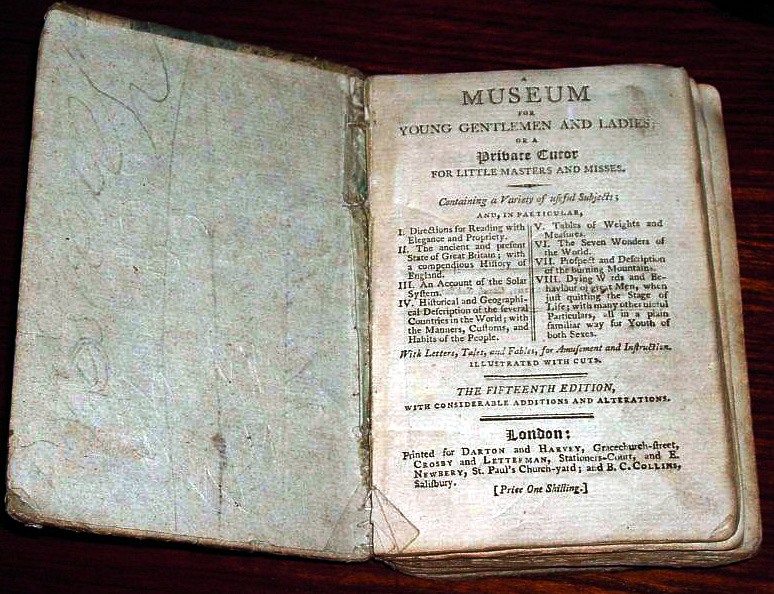
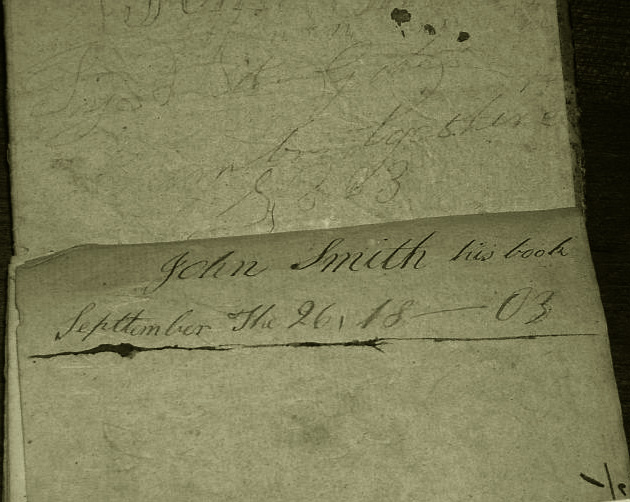 A
MUSEUM
FOR
YOUNG GENTLEMEN
AND LADIES
OR A
A
MUSEUM
FOR
YOUNG GENTLEMEN
AND LADIES
OR A
 FOR LITTLE
MASTERS AND
MISSES.
Containing
a Variety of
uſeful Subjects;
AND, IN
PARTICULAR,
FOR LITTLE
MASTERS AND
MISSES.
Containing
a Variety of
uſeful Subjects;
AND, IN
PARTICULAR,
With Letters, Tales and Fables, for
amuſement
and
Inſtruction.
ILLUSTRATED
WITH CUTS.
THE FIFTEENTH
EDITION,
WITH CONSIDERABLE ADDITIONS AND ALTERATIONS.

Printed
for DARTON and HARVEY,
Gracechurch-ſtreet, CROSBY and LETTERMAN, Stationers-Court, and
E. NEWBERY, St. Paul's Church-yard; and B.C. COLLINS,
Saliſbury.
[Price one Shilling.]
[Reverse
of title page]
Printed by B.C. COLLINS,
Canal,
Saliſbury.
THE
INTRODUCTION.
I AM very much concerned when I
see young gentlemen of fortune and quality so wholly set upon pleasure
and diversions, that they neglect all those improvements in wisdom and
knowledge which may make them easy to themselves and useful to the
world. The greatest part of our British youth lose their figure,
and grow out of fashion, by that time they are five and twenty.
As soon as the natural gaiety and amiableness of the young man wears
off, they have nothing left to recommend them, but
lie by
the rest of their lives
among the lumber and refuse of the species. It sometimes happens,
indeed, that for want of applying themselves in due time to the pursuit
of knowledge, they take up a book in their declining years, and
grow very hopeful scholars by the time they are threescore. I
must therefore earnestly press my readers, who are in the flower of
their youth, to labour at those accomplishments which may set off
their persons when their bloom is gone, and to
lay in
timely provisions for
manhood and old age. In short, I would advise the youth of
fifteen to be dressing up every day the man of fifty, or to consider
how to make himself venerable at threescore.
Young men, who are naturally ambitious, would do well to observe how
the greatest men of antiquity made it their ambition to excel all their
contemporaries in knowledge. Julius Cæsar and Alexander, the most
celebrated instances of human greatness, took a particular care to
distinguish themselves by their skill in the arts and sciences. We have
still extant several remains of the former, which justify the character
given of him by the learned men of his own age. As for the latter, it
is a known saying of his, that he was more obliged to Aristotle, who
had instructed him, than to Philip, who had given him life and empire.
There is a letter of his recorded by Plutarch and Aulus Gellius, which
he wrote to Aristotle upon hearing that he had published those lectures
he had given him in private. This letter was written in the
following words, at a time when he was in the height of his Persian
conquest:
ALEXANDER to ARISTOTLE, greeting.
"You have not done well to publish your books of select
knowledge; for what is there now, in which I can surpass others, if
those things which I have been instructed in are communicated to every
body? For my own part, I declare to you, I would rather excel others in
knowledge than in power."
"Farewel."
We see by this letter, that the love of conquest was but a second
ambition in Alexander's soul. Knowledge is indeed that, which,
next to virtue, truly and essentially raises one man above
another. It furnishes one half of the human soul. It makes
life pleasant to us, fills the mind with entertaining views, and
administers to it a perpetual series of gratifications. It gives
ease to solitude, and gracefulness to retirement. It fills a
public station with suitable abilities, and adds a lustre to those who
are in possession of them.
Learning, by which I mean all useful knowledge, whether speculative or
practical, is in popular and mixt governments the natural source
of wealth and honour. If we look into most of the reigns from the
conquest, we shall find that the favourites of each reign have been
those who have raised themselves. The greatest men are generally
the growth of that particular age in which they flourish. A
superior capacity for business, and a more extensive knowledge, are the
steps by which a new man often mounts to favour, and outshines the rest
of his contemporaries. But when men are actually born to titles,
it is almost impossible that they should fail of receiving additional
greatness, if they take care to accomplish themselves for it.
The story of Solomon's choice does not only instruct us in that point
of history, but furnishes out a very fine moral to us, namely, that he
who applies his heart to wisdom, does, at the same time, take the most
proper method for gaining long life, riches, and reputation, which are
very often not only the reward, but the effects of wisdom.
MUSEUM
FOR
YOUNG GENTLEMEN AND LADIES.
NOTES AND POINTS
USED IN
Writing and Printing.
Before I begin to lay down rules for
reading, it will be necessary to take notice of the several points or
marks used in printing or writing, for resting or stopping the voice,
which are four in number, called
1. The Comma
(,)
|
3. Colon
(:) |
| 2. Semicolon
(;) |
4.
Period (.) |
These points are to give a proper time for breathing when you read, and
to prevent confusion of sense in joining words together in a sentence.
The
Comma
stops the reader's
voice till he can tell
one
,
and divides the lesser parts of a sentence. The
Semicolon
divides the greater parts
of a sentence, and requires the reader to pause while he can count
two
.
The
Colon
is used where the
sense is
complete, and not the sentence, and rests the voice of the reader till
he can count
three
.
The
Period
is put when the
sentence is ended, and requires a pause while he can tell
four
.
But we must here remark, that the
Colon
and
Semicolon
are frequently
used promiscuously, especially in our bibles.
There are two other points, which may be called marks of affection; the
one of which is termed an
Interrogation
,
which signifies a question being asked, and expressed thus (?); the
other called an
Admiration
or
Exclamation
, and marked thus
(!). These two points require a pause as long as a period.
We have twelve other marks to be met with in reading, namely,
1. Apostrophe
(’)
|
7.
Section (§
)
|
2.
Hyphen (-)
|
8. Ellipsis
(―)
|
3. Parenthesis ( )
|
9. Index
( ) )
|
4.
Brackets [ ]
|
10. Asterisk (*)
|
5. Paragraph
(¶ )
|
11.
Obelisk (†)
|
6.
Quotation (“)
|
12.
Caret (^)
|
Apostrophe
is set over a word
where some letter is wanting, as in
lov'd
.
Hyphen
joins syllables and
words together, as in
pan-cake
.
Parenthesis
includes something
not necessary to the sense, as,
I
know that in me
(that is in my flesh)
liveth
, &c.
Brackets
include a word or words
mentioned as a matter of discourse, as,
The little word
[man]
makes a great noise
, &c.
They are also used to enclose a cited sentence, or what is to be
explained, and sometimes the explanation itself.
Brackets
and
Parenthesis
are
often used for each other
without distinction.
Paragraph
is chiefly used in the bible, and denotes the beginning of a new
subject.
Quotation
is
used to distinguish what is taken from an author in his own
words.
Section
shews
the division of a chapter.
Ellipsis
is used when part of a word or sentence is omitted, as p―ce.
Index
denotes some remarkable
passage.
Asterisk
refers to some note in the margin, or remarks at the bottom of the
page; and when many stand together, thus ***, they imply that
something is wanting, or not fit to be read, in the author. The
Obelisk
or
Dagger
, and also parallel lines
marked thus (||), refer to something in the margin. The
Caret
, marked thus (^), is made use
of in writing, when any line or word is left out, and wrote over where
it is to come in, as thus,
had
A certain man two sons:
^ |
Here the word
had
was left
out, wrote over, and
marked by the
Caret
where to
come in.
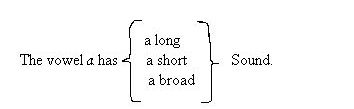
It may also in this place be proper to
mention the crooked lines or
Braces
,
which couple two or three
words or lines together that tend to the same thing; for
instance,
This is often used in poetry, where
three lines have the same rhyme.
The other marks relate to single words, as
Dialysis
or
Diæresis
, placed over vowels
to
shew they must be pronounced in distinct syllables, as
Raphaël
. The
Circumflex
is set over a vowel to
carry a long sound, as
Euphrâtes
.
An
Accent
is marked thus
(á), to shew where the emphasis must be placed, as
negléct
; or to
shew that the consonant following must be pronounced double, as
hómage
. To these
may be added the long ( ¯) and short ( ˘) marks, which denote the
quantity of syllables, as wātĕr.
RULES
FOR READING.
When you have gained a perfect knowledge
of the sounds of the letters, never guess at a word on sight, lest you
get a habit of reading falsely. Pronounce every word
distinctly. Let the tone of your voice be the same in reading as
in speaking. Never read in a hurry, lest you learn to
stammer. Read no louder than to be heard by those about
you. Observe to make your pauses regular, and make not any
where the sense will admit of none. Suit your voice to the
subject. Be attentive to those who read well, and remember to
imitate their pronunciation. Read often before good judges,
and thank them for
correcting you. Consider well the place of emphasis, and
pronounce it accordingly: For the stress of voice is the same
with regard to sentences as in words. The emphasis or force of
voice is for the most part laid upon the accented syllable; but if
there is a particular opposition between two words in a sentence, one
whereof differs from the other in parts, the accent must be removed
from its place: for instance,
The
sun shines upon the just and upon the unjust
. Here the
emphasis is laid upon the first syllable in
unjust
, because it is opposed to
just
in the same sentence, without
which opposition it would lie in its proper place, that is, on the last
syllable, as
we must not imitate the
unjust practices of others
.
The general rule for knowing which is the emphatical word in a
sentence, is,
to consider the design
of the whole
; for particular directions cannot be easily given,
excepting only where words evidently oppose one another in a sentence,
and those are always
emphatical
.
So frequently is the word that asks a question, as,
who
,
what
,
when
, &c. but not always.
Nor must the emphasis be always laid upon the same words in the same
sentence, but varied according to the principal meaning of the
speaker. Thus, suppose I enquire,
Did my father walk abroad yesterday?
If I lay the emphasis on the word
father
,
it is evident I want to know whether it was
he
,
or
somebody
else
. If I lay it upon
walk
, the person I speak to will
know, that I want to be informed whether he went on
foot
or rode on
horseback
. If I put the
emphasis upon
yesterday
, it
denotes, that I am satisfied that my father went abroad, and on foot,
though I want to be informed whether it was
yesterday
, or some time before.
RULES
TO READ VERSE.
There are two ways of writing on a subject, namely, in
prose
and
verse
.
Prose
is the common way of writing,
without being confined to a certain number of syllables, or having the
trouble of disposing of the words in any particular form.
Verse
requires words to be ranged
so, as the accents may naturally fall on particular syllables, and make
a sort of harmony to the ear: This is termed
metre
or
measure
, to which rhyme is
generally added, that is, to make two or more verses, near to each
other, and with the same sound; but this practice is not absolutely
necessary; for that which has no rhyme is called
blank verse
.
In metre the words must be so disposed, as that the accent may fall on
every
second
,
fourth
, and
sixth
syllable, and also on the
eighth
,
tenth
, and
twelfth
, if the lines run to that
length. The following verse of ten syllables may serve for an
example:
The
mónarch spóke, and stráit a múrmur
róse.
But
English
poetry allows of frequent variations from this rule, especially in the
first and second syllables in the line, as in the verse which rhymes
with the former, where the accent is laid upon the first syllable.
Lóud
as the súrges, whén the témpest blóws.
But there are two sorts of metre, which
vary from this rule; one of which is when the verse contains but seven
syllables, and the accent lies upon the
first
,
third
,
fifth
, and
seventh
, as below:
Cóuld
we, whích we
néver cán,
Strétch our
líves beyónd their spán;
Beáuty líke a
shádow flíes,
Ánd our yóuth
befóre us díes. |
The other sort has a hasty sound, and
requires an accent upon every third syllable; as,
'Tis the vóice of the
slúggard,
I heár him compláin,
You have
wák'd me too soón, I must slúmber
agáin. |
You must always observe to pronounce a verse as you do prose, giving
each word and syllable its natural accent, with these two
restrictions:
First
, If
there is no point at the end of the line, make a short pause before you
begin the next.
Secondly
,
If any word in a line has two sounds, give it that which agrees
best with the rhyme and
metre; for example the word
glittering
must sometimes be pronounced as of three syllables, and sometimes
glitt'ring
, as of two.
The
USE of CAPITALS, and the different LETTERS used in PRINTING.
The names of the letters made use of in printed books are distinguished
thus: The round, full, and upright, are called
Roman
; the long, leaning,
narrow letters are called
Italic
;
and the ancient black character is called
English
.
You have a specimen as
follows, viz.
The
Old English
is seldom
used but in acts of parliament, proclamations, &c. The
Roman
is chiefly in vogue for books
and pamphlets, intermixed with
Italic
,
to distinguish proper names, chapters, arguments, words in any foreign
language, texts of scripture, citations from authors, speeches or
sayings of any person, emphatical words, and whatever is strongly
significant.
The use of capitals, or great letters, is to begin every name of the
Supreme Being, as God, Lord, Almighty, Father, Son, &c.
All proper names of men
and things, titles of distinction, as King, Duke, Lord, Knight, &c.
must also begin with a capital. So ought every book, chapter,
verse, paragraph, and sentence after a period. A saying, or
quotation from any author, should begin with a capital; as ought every
line in a poem. I and O, when they stand single, must always be
capitals; any words, particularly names or substantives, may begin with
a capital; but the common way of beginning every substantive with a
capital is not commendable, and is now much disused.
Capitals are likewise often used for ornament, as in the title of
books; and also to express numbers, and abbreviations.
A CONCISE
ACCOUNT OF ANCIENT BRITAIN.
CHAP. I.
ENGLAND
and Scotland, though but
one
island, are two kingdoms, viz. the kingdom of England and the kingdom
of Scotland; which two kingdoms being united, were in the reign of
James
I. called Great-Britain. The shape of it is triangular, as thus
,
and 'tis surrounded by the seas. Its utmost extent or length is
812 miles, its breadth is 320, and its circumference 1836; and it is
reckoned one of the finest islands in Europe. The whole
island was anciently called Albion, which seems to have been
softened from Alpion; because the word alp, in some of the original
western languages, generally signifies very high lands, or hills; as
this isle appears to those who approach it from the Continent. It
was likewise called Olbion, which in the Greek signifies
happy
; but of those times there is
no certainty in history, more than that it had the denomination, and
was very little known by the rest of the world.
The people that first lived in this island, according to the best
historians, were the Gauls, and afterwards the Britons. These
Britons were tall, well made, and yellow haired, and lived frequently a
hundred and twenty years, owing to their sobriety and temperance, and
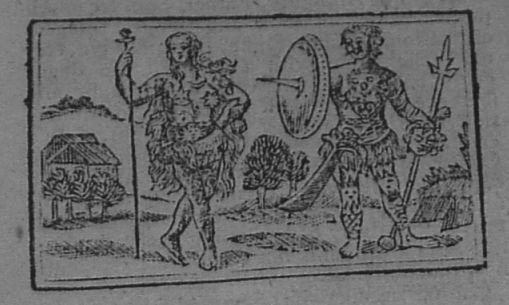
the wholesomeness of the air. The use of clothes was scarce known
among them. Some of them that inhabited the
southern parts covered their nakedness with the skins of wild beasts
carelessly thrown over them, not so much to defend themselves against
the cold as to avoid giving offence to strangers that came to traffic
among them. By way of ornament they used to cut the shape of
flowers, and trees, and animals, on their skin, and afterwards painted
it of a sky colour, with the juice of woad,
that
never wore out.
They lived in woods, in huts covered with skins, boughs, or
turfs. Their towns and villages were a confused parcel of huts,
placed at a little distance from each other, without any
order or distinction of streets. They were
generally in the middle of a wood, defended with ramparts, or mounds of
earth thrown up. Ten or a dozen of them, friends and brothers,
lived together, and had their wives in common. Their food was
milk and flesh got by hunting, their woods and plains being well
stocked with game. Fish and tame fowls, which they kept for
pleasure, they were forbid by their religion to eat.
The
chief commerce was with the the Phœnician merchants, who, after
the discovery of the island, exported every year great quantities of
tin, with which they drove a very gainful trade with distant nations.
In
this situation were the Ancient Britons when Julius Cæsar, the
first Emperor of Rome, and a great conqueror, formed a design of
invading their island, which the Britons hearing of, they endeavoured
to divert him from his purpose by sending ambassadors with offers of
obedience to him, which he refused, and in the 55th year before the
coming of our Saviour upon earth, he embarked in Gaul (that is France)
a great many soldiers on board eighty ships.
At his
arrival on the coast of Britain he saw the hills and cliffs that
ran out into the sea covered with troops, that could easily prevent his
landing, on which he sailed two leagues farther to a plain and open
shore, which the Britons perceiving sent their chariots and horse that
way,
whilst the rest of their army advanced to support them.
The largeness of Cæsar's vessels hindered them from coming near
the
shore, so that the Roman soldiers saw themselves under a necessity of
leaping into the sea, armed as they were, in order to attack their
enemies, who stood ready to receive them on the dry ground.
Cæsar perceiving that his soldiers did not exert their usual
bravery,
ordered some small ships to get as near the shore as possible, which
they did, and with their slings, engines, and arrows so pelted the
Britons, that their courage began to abate. But the Romans were
unwilling to throw themselves into the water, till one of the
standard-bearers leaped in first with his colours in his hand, crying
out aloud,
Follow me, fellow
soldiers, unless you will betray the Roman Eagle into the hands of the
enemy. For my part I am resolved to discharge my duty to Caesar
and the Commonwealth.
Whereupon all the soldiers followed
him, and began to fight. But their resolution was not able to
compel the Britons to give ground; nay, it was feared they would have
been repelled, had not Cæsar caused armed boats to supply them
with recruits, which made the enemy fall back a little. The
Romans improving this advantage advanced, and getting firm footing on
land, pressed the Britons so vigorously that they put them to the
rout. The Britons, astonished at the Roman valour, and fearing a
more obstinate resistance would but expose them to
greater mischiefs, sent to sue for peace and offer
hostages, which Cæsar accepted, and a peace was concluded four
days after their landing. Thus having given an account of Ancient
Britain, and Cæsar's invasion, we shall proceed to the History of
England, and the several Kings by whom it has been governed.
A COMPENDIOUS
HISTORY OF ENGLAND.
CHAP. II.
AS England was long governed by
Kings
who were natives of the country, so it may not be improper to
distinguish that tract of time by the name of the British Period.
Those Kings were afterwards subdued by the Romans, and the time that
warlike people retained their conquest we shall call the Roman
Period. When the Saxons brought this country under their
subjection, we shall denominate the time of their sway the Saxon
Period. Lastly, when the Danes invaded England, and conquered it,
we
shall term the series of years they possessed it the Danish Period.
This country was originally called Albion; but one Brutus, a Grecian
hero, having landed here about 1100 years
before Christ, changed the ancient name to
Britannia;
from which time, to the arrival of Julius Cæsar here, there had
reigned sixty-nine Kings, all natives of England.
In respect to the Roman Period we may observe, that Julius Cæsar
first landed in Britain from Gallia, and made it tributary to the
Romans; but soon after the birth of Christ the Emperor Claudius brought
this country entirely under his subjection, and the Emperor Adrian
built
the long wall between
England and Scotland.
In the beginning of the second century the Christian religion was
planted in England; and in the fifth century the Britons, finding
themselves overpowered by the Scots, called over the Saxons to their
assistance, who were so charmed with the country that they determined
to continue here, and subdue it.
The most remarkable occurrences in the Saxon Period are, that such of
them who embarked for England had been particularly distinguished by
the name of Angles, and from them the name of Britannia was changed to
that of Anglia. The Saxons also divided the country among
themselves into seven kingdoms, known by the name of the Saxon
Heptarchy, viz. 1. Kent, 2. Essex, 3. Sussex, 4. Wessex, 5. East
Anglia, 6. Mercia, 7. Northumberland. But at length Wessex
over-powering
the rest, formed them all into one monarchy.
One of those West-Saxon Kings, called Ina, made many good laws, some of
which are still extant: he also was the first that granted Peter's
pence to the Pope.
In regard to the Danish Period we shall only remark, that the Danes had
for a long time acted as pirates or sea robbers upon the English
coasts, and made several incursions into the country, when their King
Canute
possessed himself of the crown of England; however their government did
not continue long.
Canute reigned eighteen years, and left three sons, Harold, Canute, and
Sueno; to the first he gave
England, to the second Denmark, and to the third Norway.
Harold reigned five years, and was succeeded by his half-brother
Hardi-Canute,
who died two years after, and with him ended the tyrannical government
of the Danes in England.
THE
INTERMEDIATE HISTORY OF ENGLAND.
CHAP. III.
WE shall divide this part of our history
into four periods;
1. The Kings of the Norman
Line; 2. Those of the House of Anjou; 3. Of the House of Lancaster; 4.
Of the House of York.
The
NORMAN
KINGS.
WILLIAM I. sirnamed
[sic]
the Conqueror, gained a signal victory over King Harold, by which means
he procured the crown of England. This Prince was the son
of Robert, Duke of Normandy, by one of his mistresses called Harlotte,
from whom
some think the word harlot is derived; however, as this amour seems
odd, we shall entertain the reader with an account of it. The
Duke riding one day to take the air passed by a company of country
girls, who were dancing, and was so taken with the graceful carriage of
one of them, named Harlotte, a skinner's daughter, that he prevailed on
her to cohabit with him, and she was ten months after delivered of
William, who, having reigned 21 years, died at Rouen, in September,
1087.
WILLIAM II. sirnamed Rufus, succeeded his father; he built
Westminster-hall, rebuilt London-bridge, and made a new wall round the
Tower of London. In his time the sea overflowed a great part of
the estate belonging to Earl Goodwin, in Kent, which is at this day
called the Goodwin Sands. The King was killed accidentally by an
arrow in the New Forest, and left no issue. He reigned fourteen
years, and was buried in Winchester Cathedral.
HENRY I. youngest son of William the Conqueror, succeeded his brother
William II. in 1100. He reduced Normandy, and made his son Duke
thereof. This Prince died in Normandy of a surfeit, by eating
lampreys after hunting, having reigned 35 years.
STEPHEN, sirnamed of Blois, succeeded his uncle Henry I. in 1135; but
being continually harassed by the Scotch and Welsh, and having reigned
19 years in an uninterrupted series of troubles, he died at Dover in
1154, and was buried in the Abbey at Feversham, which he had erected
for the burial place of himself and family.
HENRY II. son of Geoffrey Plantagenet, Earl of Anjou, succeeded Stephen
in 1154. In him the Norman and Saxon blood was united, and with
him
began the race of the Plantagenets, which ended with Richard III.
In this King's reign Thomas à Becket, son to a tradesman in
London,
being made Lord High Chancellor, and
afterwards Archbishop of Canterbury, affected on
all occasions to oppose and to be independent of the court. The
King
hearing of his misbehaviour, complained that he had not one to revenge
him on a wretched priest for the many insults he had put upon
him. Hereupon four of his domestics, in hopes to gain favour, set
out immediately for Canterbury, and beat out Thomas's brains with
clubs, as he was saying vespers in his own cathedral, in so cruel a
manner, that the altar was covered with blood. King Henry subdued
Ireland, and died there in 1189, in the 34th year of his reign.
RICHARD I.
succeeded his father Henry II. and was no sooner crowned than he took
upon him the cross, and went with Philip, King of France, to the Holy
Land in 1192. On
his return he was detained by the Emperor
Henry VI. and was obliged to pay 100,000 marks for his ransom. In
a war which succeeded between England and France, Richard fought
personally in the field, and
gained a complete victory over the enemy, but was afterwards shot by an
arrow at the siege of the Castle of Chalus, and died of the wound April
6, 1199.
JOHN, the fourth son of Henry II. took possession of the crown on
Richard's decease, though his nephew Arthur of Bretagne, son of his
elder brother Geoffrey Plantagenet, had an undoubted title to it.
His encroachments on the privileges of his people called forth the
opposition of the spirited and potent Barons of that day: John
was reduced to great straits; and Pope Innocent III. with the usual
policy of the Holy Fathers, sided with John's disaffected subjects, and
fulminated the thunders of the church against him, till he had brought
him to his own terms: the King surrendered his crown at the feet of the
Pope's Legate, who returned it to him on his acknowledging that he held
it as the vassal of the Holy See, and binding himself and successors to
pay an annual tribute thereto. The Barons and their cause were to
be sacrificed to the Pope's interest, and the Legate commanded them to
lay down their arms; they were however bold enough to make head against
this powerful league, and by their steady opposition to the King, and
their moderate demands when their efforts were crowned with success,
immortalized their names: John was obliged to sign out two famous
charters -- the first called Magna Charta, or the Charter of Liberties;
the second the Charter of Forests; which two charters have since been
the foundation of the liberties of this nation. Some time after,
having thrown himself into a fever by eating peaches, he died at Newark
October 28, 1216.
HENRY III. succeeded his father John in 1216, being but nine years
old. He reigned 56 years, during the greatest part of which he
was
embroiled in a civil war. He founded the house of converts,
and an hospital, in Oxford, and died at St. Edmundsbury in 1272.
EDWARD I. though in the Holy Land when his father died, yet succeeded
him, and proved a warlike and successful Prince. He made France
fear him, and forced the King of Scotland to pay him homage. He
created his eldest son Prince of Wales, which title has been enjoyed by
the eldest son of all the Kings of England ever since. In his
last moments he exhorted his son to continue the war with Scotland, and
added, "Let my bones be carried before you, for I am sure the rebels
will never dare to stand the sight of them." He died of a bloody
flux at Burgh on the sands
[sic]
,
a small town in Cumberland, July 7, 1337, having reigned 34 years, and
lived 68.
EDWARD II. succeeded his father, but proved an unfortunate Prince,
being hated by his nobles, and slighted by the commons: he was first
debauched by Gaveston his favourite, and afterwards by the two
Spencers, father and son, whose oppressions he countenanced to the
hazard of his crown. But the Barons taking up arms against the
King, Gaveston was beheaded, the two Spencers hanged, and he himself
forced to to resign the crown to Prince Edward his son. Soon
after which he was barbarously murdered at Berkeley Castle, by means of
Mortimer, the Queen's favourite. He reigned twenty
years, and was buried at Gloucester.
EDWARD III. who succeeded his father on his resignation, claimed the
crown of France, and backed his claim by embarking a powerful army for
that country, where he made rapid conquests: the Scots favouring the
French, invaded Cumberland, but were defeated by Edward's Queen
Philippa, who took David Bruce, their King, prisoner. Edward's
eldest son, sirnamed the Black Prince, gained two surprizing
[sic]
victories, one at Cressi
,
the
other at Poitiers, in which he took King John, with his youngest son
Philip, prisoners. Thus England had the glory to make two Kings
prisoners in one year. This reign is also memorable for the
institution of the most noble Order of the Garter, and for the title of
Duke of Cornwall being first conferred upon the Black Prince, and
continued as a birthright to the Prince Royal of England.
In this reign lived John Wickliff, who strenuously opposed the errors
of the Romish Church. Peter's Pence were now also denied to the
church of Rome; and the manufacture of cloth was first brought into
England.
Edward the Black Prince died in 1336, and his untimely end hastened that
of his father, who died soon after at Shene, in Surry
,
having reigned thirty
years, and was buried at Westminster.
RICHARD II. son to Edward the Black Prince, succeeded his grandfather;
but he had neither his wisdom nor good fortune. He was born at
Bourdeaux in France: his
conduct in England made his reign very uneasy to his subjects, and at
last deprived him of his crown. He raised a tax of 5d. per head
,
which caused an insurrection by the influence of Wat Tyler, who being
stabbed by William Walworth, Mayor of London, the storm was quelled
.
The smothering of the
Duke
of Gloucester, and the unjust seizure of the Duke of Lancaster's
effects, with an intent to banish his son, were the two circumstances
which completed the King's ruin.
For after this tyranny and cruelty, being forced to resign the crown,
he was confined in Pomfret Castle, in Yorkshire, where being
barbarously murdered, he was buried at Langley, having reigned
twenty-two years. In his time lived Chaucer, the famous poet.
The
House of Lancaster, called the RED ROSE.
HENRY IV. who succeeded his cousin
Richard on his resignation in 1399, was the son of John of Gaunt, Duke
of Lancaster, who was fourth son of Edward III. In his turbulent
reign, which lasted thirteen years and a half, we find little
remarkable, except the act then passed for burning the Lollards or
Wickliffites,
who separated from the church of Rome.
HENRY V. succeeded his father, and, though a loose Prince in his youth,
proved a wise, virtuous and magnificent King. He banished all his lewd
companions from court, and claimed the English title to the crown of
France in so heroic and effectual a manner, that with 14,000 men he
beat the French at Agincourt, though 140,000 strong. Hereupon Queen
Katherine prevailed upon her husband Charles VI. then King of France,
to disinherit the Dauphin, and to give Katherine his daughter to Henry,
so that he was declared heir to the crown of France, and regent during
the King's life, which measures were ratified and confirmed by the
states of that kingdom, though he did not live to sit on the
throne. He reigned but ten years, died at Vincennes, a
royal palace near Paris, and was buried at Westminster, in 1422, in the
39th year of his age.
HENRY VI. when only eight years old, succeeded his father, but was no
less unfortunate at home than abroad; and though he was crowned at
Paris King of France, in the year 1423, yet he lost all that his
predecessors had acquired in that kingdom, Calais only excepted.
The crown of England was disputed between him and the house of York;
which occasioned such civil wars in England as made her bleed for 84
years, when all the Princes of York and Lancaster were either
killed in battle or beheaded. The
French laying hold of this favourable opportunity, shook off the
English yoke, and recovering their liberty in five years, placed the
young Dauphin upon the throne, who was then Charles VII. The
crown of England was now settled by Parliament upon the House of York
and their heirs, after the death of King Henry, whose heirs were
excluded for ever. This Prince passed through various changes of
life, and was at last stabbed to the heart by Richard Duke of
Gloucester, who had before murdered Edward, the only son of this
unfortunate King.
The
House of York, called the WHITE ROSE.
EDWARD IV. who had dispossessed Henry
VI. in 1460, was the first King of the line of York, and nobly
maintained his right to the crown by mere dint of arms; till at last
subduing the party which opposed him, he was crowned at Westminster
June 28, 1461. In this King's reign the ART OF PRINTING was first
brought into England. At this time also the King of Spain was
presented with some Cotswold sheep, from whose breed, 'tis said, came
the fine Spanish wool, to the prejudice of England. Edward
reigned 22 years, and was buried at Windsor in 1483.
EDWARD V. eldest son of Edward IV. succeeded his father when only
twelve years old; but his bloody uncle, Richard Duke of Gloucester,
caused both him and his brother to
be smothered in their beds in
the
Tower of London, in the second month of his reign, and before his
coronation.
RICHARD III. having dispatched his two nephews, succeeded to the crown,
and was the last King of the House of York. He was an usurper,
and his cruelty had incensed the Duke of Buckingham, his favourite, to
such a degree, that he contrived his ruin, and offered the crown to
Henry Earl of Richmond, the only surviving Prince of the House of
Lancaster, then at the court of France, on condition that he would
marry Elizabeth, the eldest daughter of Edward IV. in order to unite
the Houses of York and Lancaster -- Richard being informed of the
affair, ordered the Duke to be instantly beheaded without a
trial. However, this did not discourage Henry, who had accepted
the offer. He came over with a small force, and landed in Wales,
where he was born, his army increasing as he advanced. At length
having collected a body of 5000 men, he attacked King Richard in
Bosworth field, in Leicestershire, in 1485. Richard fought
bravely till he was killed in the engagement, which made way for Henry
to the crown of England.
THE
MODERN HISTORY OF ENGLAND.
CHAP. IV.
We shall divide this branch of English history into four periods,
namely: 1. The Kings of the House of Tudor. 2. The Kings of the
Stuart family. 3. King William of the House of Orange, and Queen
Anne. 4. The Kings of the House of Hanover.
The
House of TUDOR.
HENRY VII. succeeded Richard III. in
1485: he obtained the crown by force of arms, tho' he pretended a tight
to it by birth; being of the House of Lancaster. The name of his
father was Edmund Tudor, Earl of Richmond; and he married Elizabeth,
the daughter of King Edward IV. by which marriage the Houses of York
and Lancaster were united. This Prince had great sagacity, but
was very cruel and unjust. Edward Plantagenet, Earl of Warwick,
and the last Prince of the House of York, was beheaded by him for
attempting his escape, after being imprisoned from nine years old;
for which cruel
act Henry's name will be hated for ever. As he grew old, he
grew covetous, and to increase his treasure, he caused all penal laws
to be put in execution. His chief instruments herein were Empsom
and Dudley, who afterwards paid dear for their extortion. He
built the chapel at Westminster which is at this day called Henry the
Seventh's. The 48 gentlemen of the privy chamber, and the band of
gentlemen pensioners, were first settled in his reign. He died at
the palace of Richmond, which he built, and left in ready money to his
successor 1,800,000l. having reigned 24 years.
HENRY VIII. born at Greenwich, in 1491, the only surviving son of Henry
VII. came to the crown in the 18th year of his age, and in 1509.
He reigned for some years with great applause; but being vitiated by
Cardinal Woolsey, luxury and cruelty obscured his virtues, and stained
his former glory. He had six wives, of whom he divorced two, and
caused two to be publicly beheaded. In his reign began the
reformation; and the King was, by act of parliament, declared supreme
head of the church of England. Before he fell off from the Pope,
he wrote a book against Luther. On this account Pope Leo honoured
him with the title of defender of the faith; which the parliament made
hereditary to all succeeding Kings of England. His government was
more arbitrary and severe than that of any of his predecessors
since William the Conqueror. He reigned about 38 years, died Jan.
28, 1547, and was buried in Windsor chapel.
EDWARD VI. only son of Henry VIII. succeeded his father at ten years
old; and in the six years during which he reigned, he, by the
indefatigable zeal of Archbishop Cranmer, made a great progress in the
reformation. This good Prince founded our two famous hospitals,
called Christchurch and St. Thomas, one in the city of London, the
other in the suburbs. This reign is memorable for the discovery
of the north-east passage to Archangel, made by Richard Chalinour, till
then unknown, and since become the common passage from Asia into
Europe. Edward reigned but six years, and was buried at
Westminster.
MARY, eldest daughter of Henry VIII. by his first wife, succeeded her
half brother Edward VI. She restored the Roman Catholic Bishops,
and commenced a hot persecution against the protestants; in which
Archbishop Cranmer, and six other Bishops, were burnt alive. In
her reign, Calais was taken by the French, after it had been in our
possession 200 years; and the same year, which was 1558, she died of
grief for the loss of that city. With her life ended a reign,
begun,
continued, finished in blood, and happy in nothing but its short
duration. She was
buried at Westminster.
ELIZABETH, daughter
of Henry VIII. by Anna Bullen, his second wife, succeeded her
half-sister Mary. She proved an
excellent Queen, the glory of her sex, and admiration of the age she
lived in. She was crowned at Westminster, Jan. 15,
1558. In her time the protestant religion was again
restored. She humbled the pride of Spain, both in Europe and
America. Memorable is the year 1588, for the Spanish invasion
attempted by King Philip, with his invincible armada; the
greatest part of which was destroyed by the English fireships and a
providential storm. The very names of our chief commanders,
Howard, Norris, Essex, Drake, and Raleigh, struck a terror in her
enemies. They took and burnt several places in Spain,
particularly Cadiz and the Groyne;
intercepted their plate fleets, and
reduced that haughty monarch so low, that he has never since recovered
it. This Queen quelled the two rebellions of O'Neal
and
Tir-Owen
in Ireland. She protected the new republic of Holland,
and the protestants of France. She commanded the ocean, which
spread her fame around the globe, and made her name respected every
where. With much reluctance she signed the dead warrant
[sic]
for the execution of Mary
Queen of Scots, charged with high treason. She grieved much for
the death of the Earl of Essex, whose fall was owing to her favour, and
survived him only two years. In her reign the two English
inquisitions were erected, I mean the Star-Chamber, and the High
Commission Court, which grew oppressive, and the judges so arbitrary,
that they were suppressed by an act of Charles I. She had a
peculiar taste for learning, which flourished in her reign. She
spoke five or six different languages, translated several books from
the Greek and French, and took great pleasure in the study of
mathematics, geography, and history. She died in 1603, in the
45th year of her reign, and the 70th year of her age, leaving her
kinsman James VI. of Scotland, her successor.
The
STUART FAMILY.
JAMES I. of England, arrived at London
May 7, 1603, and the feast of St. James following was fixed for his
coronation. In 1604, Nov. 5, the powder plot was
discovered, the memory whereof has been hitherto religiously observed
.
Among the
remarkable things of this
reign, may be reckoned the two visits his Majesty received from
Christian IV. King of Denmark, whose sister Ann was King James's
consort: the creation of a new order called Baronets, next to a Baron,
and made hereditary: the fall of Lord Chancellor Bacon, and of Sir
Walter Raleigh, at the instigation of the Spanish Ambassador: the
office of the master of the ceremonies was first established. As
to the
character of this Prince, it must be confessed, that he was too much of
a scholar, and too little of the soldier. Though he was brought
up in the Scotch presbytery, he thought episcopacy so necessary for the
support of his crown, that he often used to say,
No Bishop, No King
. He died at
Theobalds, March 27, 1625, in the 23rd year of his reign, and 59th year
of his age. Thus ended a peaceable but inglorious, a plentiful
but luxurious reign, to make room for another more turbulent and
tragical.
CHARLES I. the only son of King James, succeeded next: he was born at
Dumferling, in Scotland, 1600, and crowned at Westminster, 1625.
His crown may be called a crown of thorns, as his reign ended in
blood. He married Henrietta, daughter to Henry IV. King of
France, who was bigotted to the catholic religion, and gained the
ascendancy over him. His wonderful compliance with the Queen
caused him to act in many respects contrary to the laws of the kingdom,
and his unbounded favour to the Duke of Buckingham, incensed the people
to that degree, that this favourite was afterwards stabbed by Felton,
merely for the public good. These, and such like weaknesses, made
him continually at variance with the parliament, which at last broke
out into a civil war. Several battles were fought between the
royalists and republicans or rumps.
The King
was taken prisoner by the Scots, who sold him to
the parliament for 200,000l.
Hereupon the parliament erected a high court of
justice, and gave them power to try the King; and though the
generality of the people were against such arbitrary proceedings, yet
they arraigned him of high-treason. The King maintained his
dignity, and refusing to acknowledge the authority of these pretended
judges, had sentence of death passed upon him, and was accordingly
beheaded on a scaffold erected for that purpose, before the palace,
Jan. 30, 1648. In this reign two great ministers, viz.
Archbishop Laud, and the Earl of Strafford, were beheaded.
CROMWELL, one of the most considerable members of the high court who
condemned King Charles, was now sent to subdue Ireland. After
which he marched against the Scots, who had taken up arms in favour of
the late King. The Dutch also, who had sent a fleet to assist the
King, having met with many losses and disappointments, sued for peace,
which Cromwell sold them at an exorbitant price. Now Cromwell was
made Lord Protector to the British dominions, and acted with the same
authority as if he had been King. He was a terror both to France
and Spain, and died Sept. 3, 1658. His son indeed succeeded to
that high station, which his father filled with universal applause; but
having neither an equal share of ambition, nor a head turned for
government, modestly resigned to the right heir
CHARLES II. son of Charles I. succeeded his father, but was
kept from
the crown above eleven years, during which time England was reduced to
a commonwealth. The King was at the Hague when his father was
beheaded. But on his yielding to some conditions imposed on him
by the kirk of Scotland, he was received by the Scots, and being
crowned at Scoon,
they sent an army with him into England to recover
that kingdom; which being totally defeated at Worcester, he wandered
about for six weeks, and made his escape to France, then to Spain, but
without any hopes of restoration, till the death of Oliver
Cromwell: when a free parliament, having met in April 1660, voted
the return of King Charles II. as lawful heir to the crown. The
power of the Rump Parliament, by the conduct and courage of General
Monk, had been on the decline for some time, and the King's interest
greatly increased, especially in the city of London, where he was
proclaimed May 8. He landed at Dover, and made a most magnificent
entry, May 29, 1660, being his birthday; and the 23d
[sic]
of April following, being
St. George's day, he was crowned at Westminster with great state and
solemnity. Among the remarkable things of this reign, we may
reckon the parting with Dunkirk to France for a paltry sum; the blowing
up Tangier in the Streights, after immense sums had been expended to
repair and keep it; the
shutting up the Exchequer when
full of loans,
to the ruin of numerous families; the two Dutch wars, which ended
with no
advantage on either side, but served only to promote the French
interest; the great plague with which this nation was visited during
the first Dutch war; the fire of London that happened soon after; and
the Popish plot, for which many suffered death. On the 2d of Feb.
1684, the King fell sick of an apoplexy; he died four days after, in
the 37th year of his reign, and was privately buried at Westminster.
JAMES II. succeeded his brother Charles, but proved very unfortunate to
himself and his people, on account of his zeal for the Romish
religion. He invaded the rights of the universities, and made
Magdalen
College in Oxford a prey to his violence. He sent seven bishops
as criminals to the tower, who upon trial were honourably
acquitted. Father Peters, a Jesuit, and several Popish Lords, sat
in the Privy Council, and some Popish Judges on the bench.
The Pope sent a Nuncio from Rome, who was suffered to make his public
entry in defiance of our constitution. These barefaced practices
made the Protestant party think it high time to check the growth of
popery. Hereupon the Prince of Orange was requested to vindicate
his consort's right, and that of the three nations. In the
beginning of this reign the Duke of Monmouth was proclaimed King in the
West, in opposition to King James; but his party being defeated, he was
beheaded July 15, 1685. Judge Jeffries was afterwards sent
by the King to try those who had
assisted the Duke, of whom he hanged no less than 600, glorying in his
cruelty, and affirming, that he had hanged more than all the Judges
since William the Conqueror. The Chevalier St. George
was born July 10, 1688, two days after the bishops were
imprisoned.
The Prince of Orange landed at Torbay Nov. 5, and King James abdicated
the crown, and went over to France, Dec. 23. Hereupon an
interregnum ensued till the 13th of February, 1688-9, when William and
Mary, Prince and Princess of Orange, were offered the Crown, and
accepted it.
The
House of ORANGE.
WILLIAM III. and MARY II. succeeded James II. upon the vote of the
Convention. The day after their arrival in London, which was Feb.
13, 1688-9, they were seated under a canopy of state in the
Banqueting-house, and both Houses of Convocation waited upon them,
proffering them the crown in the names of the Lords Spiritual and
Temporal, and the Commons, assembled at Westminster: Accordingly they
were proclaimed King and Queen of Great-Britain the following day, and
solemnly crowned at the Abbey on the 21st of April. Several plots
were formed against the King, but all of them proved abortive. He
carried out a war with France, and with King James's party in
Ireland, for nine years successively,
till at last France was obliged to acknowledge him lawful King of
Great-Britain, in the peace of Ryswic, 1697. He died March 8,
1701, aged 51, after he had survived his consort Mary Stuart, daughter
to James II. five years, who died Dec. 21, 1696, and whose funeral was
performed with great elegance and solemnity. July 2, 1700,
William Duke of Gloucester, the only surviving issue of Princess Anne
of Denmark, departed this life at Windsor, aged twelve years. And
King James died at St. Germains in Sept. 1721.
ANNE, second daughter to James II. succeeded King William, whose
death was joy to France, but a great misfortune to England. Anne
was
born Feb. 6, 1664, and married George Prince of Denmark, who was High
Admiral of England, and a happy assistant to her in steering the ship
of state. She was crowned Queen of Great-Britain April 23,
1702. On the 4th of May following war was proclaimed at
London, Vienna, and the Hague, against France and Spain. The
success of this war is worthy admiration
[sic]
,
and almost
incredible. The conquest of the Spanish Guelderland,
the Electorate of Cologn
[sic]
,
and the Bishopric of Liege; the prodigious
victory over the French and Bavarians at Blenheim, under the surprising
conduct of the Duke of Marlborough; the retaking of Landau; the
conquering all the estates of the Duke of Bavaria in Germany; the
forcing the French and Bavarians out of their
lines in Brabant, which was deemed a thing impracticable; the battle of
Ramillies; the victory at Oudenard; the taking of Lisle and Tournay;
the defeat of the French army at Blarenies; the reducing of Mons,
&c. &c. are such events as will render her Majesty's reign
famous to all posterity. If we look towards Spain, how bold and
successful was our attempt upon Vigo, where we took and destroyed their
whole plate fleet, both men of war and others, to the amount of 38
sail, of which not one escaped: Did we not also take Gibraltar
with a small force in one morning, and keep possession of it against
the joint strength of France and Spain? Barcelona likewise being
taken by the English and Dutch, under the conduct of the Earl of
Peterborough, was soon after besieged by King Philip with a great army,
which was soon forced to a shameful retreat into France. Hereupon
Catalonia, Arragon, Valencia, and other provinces, submitted to Charles
III. by the influence of
her
Majesty's arms. Who could have expected the dismal turn of the
affairs of France and Italy, which happened in 1707, by the powerful
interest of England? A numerous army of French and Spaniards were
destroyed before the walls of Turin, by the Duke of Savoy and Prince
Eugene. Thus Piedmont was abandoned, the Mantuan, the Milanese,
the Modenese, Parmasan, and Montferrat, yielded up.
This Queen also brought about the strict union between England and
Scotland, after sundry fruitless attempts of the same kind for a
century past. In short, the successes of her reign justly
denominate her one of the most triumphant Monarchs of former ages, and
her piety and virtue will ever be acknowledged by the British nation.
The four last years of Queen Anne's reign were attended with much
perplexity, which was owing to her Ministers, who prevailed upon her to
consent to the peace of Utrecht; and, 'tis said, her death was
occasioned by her ill conduct, which she laid too much to heart
.
She died Aug. 1, 1714;
and in her the
succession of the Stuart line ended.
The
House of HANOVER.
GEORGE I. who was heir-apparent to the crown of Great-Britain on the
death of Queen Anne, and which had been confirmed to him some years
before by various Acts of Parliament, and by a special article in the
peace of Utrecht, was born 1666, and proclaimed King the very day Queen
Anne expired. He landed at Greenwich Sept. 18, 1714, and was
crowned Oct. 20. A thorough change in the ministry was made on
his accession, wherein he distinguished his friends from his enemies
.
Among the latter
the chief were the Duke of Ormond, the Earl
of Oxford, and the Viscount Bolingbroke, who were deemed to be firmly
attached to the interest of the Pretender. In 1715 a plot
was
supposed to be brooding in the West, where several gentlemen were
suspected of having a design to bring in the Pretender, and to place
him on the throne of his ancestors. He had already been
proclaimed King of Scotland, by the Earl of Mar, against whom the Duke
of Argyle marched. On the 13th of November they came to a
decisive battle near Dumblain, where the rebels were defeated, and put
to flight. At the same time a body of 5000 rebels assembled at
Preston in Lancashire, headed by the Earl of Derwentwater, of whom
General Wills, who commanded some of his Majesty's troops on the
borders of Scotland, being informed, he marched directly against them,
and obliged them to surrender prisoners of war. They were
afterwards sent up to London, and many of the ringleaders tried and
condemned. Among these were the Earls of Derwentwater and
Kenmure, who were beheaded on Tower-Hill; several others were executed
at Tyburn, and the remainder pardoned. Some other conspiracies
were formed against the King's person; but, by timely discovery,
prevented from being carried into execution. Aug. 2, 1718, the
quadruple alliance was signed between their Imperial, Christian, and
Britannic Majesties;
and the Spanish fleet was destroyed in the Mediterranean by the
English. In 1720 Spain acceded to the quadruple alliance, and a
fleet was sent into the Baltic in favour of Sweden. This year was
also remarkable for the South-Sea scheme,
by which many families were deluded and entirely ruined; and the
government was obliged to interpose, to prevent the ill consequences of
the people's despair. On enquiry into the affair it appeared,
that besides stock-jobbers and directors some persons of distinction
were concerned in it. This fatal stroke to the British trade was
in some measure remedied by the assiento contract, concluded at Madrid
in 1722.
In the same year, the funeral of the Duke of Marlborough, who, since
the accession of King George, had been restored to the honours he so
justly deserved, was solemnized with great pomp. In 1723, a
conspiracy for raising an insurrection was discovered; hereupon the
Duke of Norfolk, Lord North and Grey, the Bishop of Rochester, and
Counsellor Layer, were taken into custody; after a long trial the
Bishop was banished, and Layer was hanged. In 1724, the Ostend
East-India Company was established. In 1725 the Hanover treaty
was agreed to, between France, Great-Britain, and Prussia. June
11,
1727, George I. died at Osnaburgh, in the very chamber where he
was born, in the 67th year of his age, and the 13th year of his reign.
GEORGE II. was proclaimed as soon as as the news of his father's death
came to London, and his coronation was solemnized in October
following. The new Parliament met on the 2d of January, and chose
for their Speaker Arthur Onslow, Esq. and loyal and affectionate
addresses were presented
to the King by both houses. The land forces were fixed at 22,950
men, and the number of seamen at 15,000. An enquiry was
made
into the state of the public gaols, and from this it appeared that
great cruelties and oppressions had been exercised on the prisoners,
particularly on Sir William Rich, Baronet, who was found in the fleet
prison loaded with irons, by order of the Warden. For these and
the like barbarities, Thomas Bambridge, the Warden, and several of his
accomplices, were committed to Newgate. In May, 1729, his Majesty
declared his intentions of visiting his German dominions, and leaving
the Queen as Regent. His design in going to Germany was to
compromise some differences that had lately arisen between the Regency
of Hanover and the King of Prussia; and about this time the Duke of
Mecklenburgh was deposed by the Emperor, for his cruelty, tyranny, and
oppression. By the fall of Emperors and Kings it is that we learn
the Omnipotence of the Almighty, whose arm strengthens and supports the
crown of the righteous and takes away the kingdom from unjust
Princes. About this time great licentiousness prevailed among all
ranks of people, particularly among those of the lower class, who
indulged themselves in every kind of wickedness; and among other
methods of injuring their fellow subjects, circulated incendiary
letters, demanding sums of money of certain individuals, on pain
of reducing their houses to ashes;
this species of
villainy had never been known before in England. In the course of
the summer seven Indian Chiefs were brought over to England. In
1731 a duel was fought in the Green Park, between Sir William Pulteney
and Lord Hervey, on account of a remarkable political pamphlet
.
Lord Hervey was wounded, and narrowly escaped with his life. The
Latin tongue was abolished in all law proceedings, which were ordered
for the future to be in English. Rich. Norton, Esq. of Southwick,
in Hampshire, left his estate of 600l.
per annum,
and a personal estate of 60,000l.
to
be disposed of in charitable uses by the
Parliament. One Smith, a book-binder, and his wife, being reduced
to extreme poverty, hanged themselves at the same time, and by common
consent, after having made away with their only child.
On the 27th of April, 1736, his Royal Highness Frederic, Prince of
Wales, espoused Augusta, sister to the Duke of Saxe Gotha.
In
the course of this year a remarkable riot happened at Edinburgh,
occasioned by the execution of one Wilson, a smuggler. Porteus,
captain of the city guard, a man of a brutal disposition, and abandoned
morals, being provoked by the insults of the mob, commanded his
soldiers to fire upon the crowd, by which precipitate orders several
innocent persons were killed; Porteus was tried and condemned to
die, but obtained a reprieve from the Queen, who was then
Regent. The mob, however, were
[sic]
determined to execute the
sentence; they accordingly rose in a tumultuous manner, forced open the
prison doors, dragged forth Porteus, and hanged him on a dyer's pole;
after which they quietly dispersed. On the 24th of May,
1738, the Princess of Wales was delivered of a Prince, who was
christened by the name of George, now our most gracious
Sovereign. One Buchanan, a sailor, who had been condemned for
murder, was cut down from the gallows by his companions, who actually
brought him to life, and carried him off in triumph.
War was declared in form against Spain, at London and Westminster, Oct.
23, 1739. The same year Admiral Vernon destroyed Porto Bello, and the
March following demolished Fort Chagre. In 1740 there was a
severe and lasting frost, which extended all over Europe, and
occasioned a fair to be kept on the River Thames. In 1741 Admiral
Vernon, with a strong fleet, joined with General Wentworth, who had a
considerable number of forces under his command, made an unsuccessful
attempt on Carthagena
[sic]
;
the greater part of the land forces being either killed or cut off by
an epidemical distemper. In 1742, Captain Middleton made a
fruitless attempt to discover the North West passage into the South
Seas. The year following the battle of Dettingen was
fought. There was also this year a bloody engagement before
Toulon, between the English fleet and that of the French and
Spaniards; when that brave commander
Captain Cornwall was killed in the Marlborough, after a most resolute
and surprising resistance. Commodore Anson returned to England,
having made a voyage round the globe; and war was mutually declared
between England and France.
In 1745 the battle of Fontenoy was fought, in which the French had the
advantage, which was followed by the taking of Tournay. A
rebellion broke out in Scotland; the rebels defeated Sir John Cope, at
Preston Pans, came forward into England, took Carlisle, and marched to
Derby, from whence they were obliged to make a precipitate retreat,
being closely pursued by the Duke of Cumberland, who retook
Carlisle. When the rebels were returned into Scotland, they
defeated the King's forces under General Hawley, near Falkirk, and laid
siege to Stirling, but raised it on the Duke's approach. This
year Cape-Breton was taken by Admiral Warren. In 1746 the
memorable battle of Culloden, in Scotland, was fought, wherein the
rebels were totally destroyed: The Earls of Balmerino and Kilmarnock,
with Mr. Ratcliff, brother to the late Earl of Derwentwater, were taken
prisoners, and beheaded on Tower-Hill; as was Lord Lovat in the year
following. Now also the French took all Dutch Flanders, and there
was a battle between them and part of the allied army, after which the
latter retreated under the cannon of Maestricht. Admirals Anson
and Warren, after a hot engagement, took several French men of
war in the Mediterranean, among which was the ship in which their
Admiral sailed. In 1748 a Congress was held at Aix-la-Chapelle
for a general pacification, and the articles of peace therein agreed to
were signed in April.
A Bill was passed for the encouragement of the British herring fishery;
and a proclamation issued for inciting disbanded soldiers and sailors
to settle in Nova Scotia. Mr. Pelham now lowered the interest of
money in the funds, first to three and a half per cent.
afterwards to three.
The importation of iron from America was allowed; and the African trade
laid open.
In the year 1752, the French spirited up the Indians against our
colonies of Nova Scotia, and built a chain of forts on the back of our
American settlements. This occasioned a new war, carried on with
great cruelty in those parts. Monckton drove the French from
their encroachments in Nova Scotia; and General Johnson gave them a
defeat; but Braddock, through his own rashness, was defeated and
slain. The English took many ships from the enemy, without
declaring war.
In 1756, the Hessians and Hanoverians were brought over, to the number
of ten thousand. Presently after Minorca was taken by the French;
and Admiral Byng was shot at Portsmouth for not having relieved
it. On the 17th of May, war was declared in form
,
and the King entered into
a treaty with the Empress of Russia
for the
security of Hanover; and afterwards into an alliance with
Prussia. This was followed by an unnatural
[sic]
treaty
between France and the
Queen of Hungary, to which the Empress of Russia acceded. And a
war
was
kindled by the
intrigues of France
between Prussia and
Sweden; while the Elector of Saxony favoured the Austrians. The
King of Prussia therefore entered Saxony, and obliged the Saxon troops
at Pirna to surrender prisoners of war. He invaded Bohemia,
defeated the Austrian General, and gained another victory near
Prague. But attacking the Austrians at a disadvantage near Kolin
,
he was defeated, and obliged
to raise
the siege of Prague.
The French now passed the Weser, and drove the Hanoverians before
them. They made a stand however at Hastenbeck, under the Duke of
Cumberland, where they were
attacked,
and forced to retreat towards Stade, and laid down their arms in
consequence of the treaty of Closterseven.
In the East-Indies we were also successful; for, by Colonel Clive's
vigilance and courage, the province of Arcot was cleared of the enemy,
the French
general taken prisoner, and the favourite Nabob, whom we supported, was
reinstated in his government. But some months after, the Viceroy
of Bengal declared against the English, and took Calcutta by
assault. Here one hundred and forty-six persons were crowded into
a narrow prison, called the Black-Hole, where they were suffocated
for want of air, only
twenty-three surviving; several of whom died by putrid fevers, after
they were set free.
The Dutch at Batavia now dispatched seven armed ships to Bengal, having
eleven hundred land forces, with orders strongly to fortify their
settlement at Chincura, and secure the salt-petre trade to
themselves. But the ships were all taken by three English
East-India ships, which were in the river, and their troops were
totally defeated at land by Colonel Ford.
Colonel Coote also took the city of Wandewash
,
reduced the
fortress of Carangoly, and defeated Lally.
This was followed by the surrender of the city of Arcot.
Pondicherry now sustained a siege in turn, and the French therein were
reduced to feed on dogs and cats. Eight crowns were given for the
flesh of a dog. At length the English took possession of the
place. And this conquest terminated the power of France in India.
Mr. Pitt was at the head of the English Ministry, when Louisbourg in
Cape Breton was besieged by General Amherst, and surrendered by
capitulation. The French lost a fine navy in the harbour.
Fort Du Quesne
also was taken. But the operations against Crown Point
and
Ticonderoga
miscarried.
The year 1759 was remarkable for the conquest of Canada. The
French deserted Crown Point and Ticonderoga, which were possessed by
General Amherst. Sir William Johnson defeated them, and
became master of the Fort of Niagara. And the
Admirals Saunders, Holmes, and Durel, sailed for Quebec, attended by a
land army, under General Wolfe. In the battle which ensued, both
Wolfe and Montcalm, the chief commanders on each side, were slain, and
Quebec surrendered.
In 1760 the French forces endeavoured to recover Quebec, but the place
was relieved by an English fleet under Lord Colvill. Montreal
submitted to General Amherst, and that extensive country fell totally
under the power of Great Britain; a larger territory than ever was
subject to the Roman empire. The prodigious march of Amherst, on
this occasion, can be compared only to that of Jenghiz Can,
or Tamerlane, who over-ran all Asia with their Tartars.
In Europe the operations of war were astonishing, and the great efforts
of the King of Prussia secured his safety beyond all human
expectation. Almost the whole power of the Continent was united
against him. The King of Great Britain, his only ally, seemed
inclined to forsake him. In this terrible situation he relied on
his natural subjects, and still adhered to his fortitude. Yet he
expostulated warmly, and his expostulations at last succeeded.
The French forces, and those of the Imperialists, had made a successful
campaign in the summer; yet seemed determined that the rigour of the
winter should not interrupt their proceedings. In the depth of
it, they laid siege to Leipsic,
and
were confident of carrying that important city. This greatly
alarmed his Prussian Majesty. He contrived his measures so
artfully, as to appear before the place when he was least
expected. Vanquished as he was, the terror of his arms raised the
siege. The French army, though greatly superior in number, rose
and retreated with precipitation.
His Prussian Majesty, not satisfied with having raised the siege of
Leipsic, followed the French army, whose fears, he imagined, would
befriend him. He came up with them near a little village, called
Rosbach. An action
came
on, and he obtained one of the most signal victories recorded in
history. Had not the night saved them, their whole army had been
devoted to destruction.
In another part of the empire the Austrians were again victorious, and
took the Prince of Bevern, the King of Prussia's Generalissimo,
prisoner. The King himself, in the depth of winter, made a march
of two hundred miles, and engaged the enemy in the neighbourhood of
Breslau, the capital of Silesia. He was much inferior in
strength, but his forces were disposed with such admirable
judgment
[sic]
,
that he
gained a compleat
[sic]
victory, in which he took
fifteen thousand prisoners. Breslau itself, after the battle,
surrendered to the Conqueror, tho' it had a garrison of ten thousand
men. These successes disheartened his enemies, and raised the
spirit of his friends.
The magnanimous King of Prussia now began to fight with his enemies
upon more equal terms. He attacked them every where, was attended
for the most part with remarkable success, and rarely met with any
considerable disadvantage. He carried on the campaign throughout
the winter, escaped many dangers, was exhausted by no fatigues, nor
terrified by any numbers.
England is so happily situated, that she has little need to concern
herself with the disturbances on the Continent. Yet the people in
general at this time seemed in a disposition to encourage and assist
the German subjects of their King.
At the meeting of the Parliament, the reasonableness of engaging in a
war upon the Continent was taken into consideration, and
admitted. Liberal supplies were granted, to enable the army, now
collected in the King's Hanoverian dominions, to act with vigour, in
conjunction with the King of Prussia. Supplies were also granted
to his Prussian Majesty.
A spirit of enterprise now seemed to animate all ranks of people.
A body of British forces was sent into Germany, under the command of
the Duke of Marlborough, to assist Prince Ferdinand of Brunswick and
the Hanoverians; and who afterwards behaved with great bravery.
The English fleet in the mean time invaded France, and burnt the French
shipping at St. Malo's. It then moved towards Cherburgh
,
but was obliged by the weather
to return home.
On the 1st of August, 1758, the fleet under Commodore Howe, with the
transports, again set sail for Cherburgh. They landed with little
opposition from the French, and entered the town. Immense sums
had been there laid out upon the fortifications, and the harbour was
one of the strongest in Europe. The work of all this labour and
expence
[sic]
was now
totally destroyed by the English, who found more difficulty in
demolishing than in conquering the place. All the ships in the
harbour were burnt, and a contribution raised upon the town.
On the 16th of August, the British fleet and army having remained in
France unmolested for ten days, set sail for Cherburgh, and carried off
all the brass cannon and mortars taken there.
The English troops landed again in the Bay of St. Lunar, in the
neighbourhood of St. Malo, but found it impracticable to make any
impression upon the place. While the troops were ashore the
Commodore found himself obliged, from the danger of the coast, to move
up to the Bay of St. Cas, about three leagues to the westward; while
the army marched over land to the same place, where they all embarked,
except the last division, consisting of the grenadiers of the army, and
the first regiment of guards. These were attacked by the Duke
d'Aiguillon, Governor of Brittany, at the head of twelve
battalions, and six squadrons of regulars,
besides two regiments of militia, against whom, though they made a most
gallant resistance, about six hundred of them were killed, and four
hundred taken prisoners, not being able to reach the boats.
The English had already made themselves masters of Senegal and Goree
,
in Africa; and
though they had
now lost Minorca, yet they remained victorious in the Mediterranean,
and continued to ruin the French marine.
Towards the end of the year, a squadron of nine ships of the line, with
sixty transports, containing six regiments of foot, was fitting out for
the conquest of Martinico.
But tho' a conquest of that island was
judged, after a slight attempt, to be impracticable, they achieved the
more important reduction of Guadaloupe.
On the 28th of July, the Hereditary Prince was detached with six
thousand men to cut off the enemy's communication with Paderborn.
And on the 29th, Prince Ferdinand advanced from his camp on the Weser,
leaving a body of troops under Wangenheim, on the borders of that river.
The next day was fought the battle of Minden, as glorious to the
English, as those of Cressy
and Agincourt had been to their ancestors. The centre of the
French was entirely composed of horse, who attacked six English
regiments, supported by two battalions of Hanoverian guards.
These sustained the whole shock of the battle, and, to the
amazement of the German General
himself, obtained a compleat victory. The French lost seven
thousand men, and the English twelve hundred.
The French were greatly disappointed in their views by sea this
year. Thurot, a marine freebooter
,
with three ships and a
considerable body of
land forces, landed in Ireland, and alarmed the people of Carrickfergus
. Putting to sea again, he was met by three British
frigates, of a force inferior to his own, and after a severe encounter
he was killed, and his ships led in triumph by the English commanders
to the Isle of Man.
A grand fleet was intended to invade England, under Marshal Conflans
and the Duke d'Aiguillon; but this fleet was ruined by Admiral Hawke on
the 20th of November.
In the year 1760, Lord George Sackville was tried by a court-martial
for his conduct in the battle of Minden, and declared incapable of
serving his Majesty for the future in any military capacity whatever
;
he was however afterwards
raised to the highest civil
employments, being secretary of state to George III. and having a
considerable share in those unfortunate councils, which severed for
ever thirteen provinces from the crown of England. On the 5th of
May, Lawrence Shirley, Earl Ferrers, was hanged at Tyburn for the
murder of Mr. Johnson, his steward. On the 25th of October,
between seven and eight o'clock in the morning, died King George II. in
the 77th year of his age, and the 34th of his reign. He had
risen at his
usual hour, called his page, drunk his chocolate, and inquired about
the wind, as if anxious for the arrival of foreign mails; soon after
which he fell speechless on the ground, and being laid on his bed,
expired in a few minutes.
GEORGE III. grandson of George II. and eldest son of the late Frederick
Prince of Wales, succeeded to the throne, and was proclaimed King on
the day after the death of his grand father. He was married on
the 8th of September, 1761, to his Queen, Charlotte, Princess of
Mecklenburgh Strelitz, and they were solemnly crowned together on the
22d of the same month.
The war was still carried on betwixt France and England, in Germany,
when Augsburgh was pitched upon by both parties as a proper place to
negociate
[sic]
a peace
in; and, with respect to the disputes in America, Mr. Bussey was named
by the French Court to repair to London, as Mr. Stanley was by the
English to treat at Paris.
The former of these offers a memorial
to the British minister, importing that the King of Spain apprehended a
new war, unless the British court would make satisfaction to Spain for
ships taken under Spanish colours; permit the claim of Spain to a share
in the Newfoundland fishery; and destroy the English fortifications in
the bay of Honduras. This put an end to the negociation.
The French and Spanish courts now entered into a Family Compact, in
which the two Sicilies were included; the most extraordinary treaty
which this age can produce; it being a consolidation of the rights and
interests of the two crowns and their subjects in all respects, but
those relating to the Spanish American commerce.
Mr. Pitt, the British minster, gained intelligence of the family
compact, and made strong remonstrances at the council-board for an
immediate declaration of war against Spain, which were not
relished. On this Mr. Pitt resigned.
The flota arrived in the bay of
Cadiz, and the Spaniards resolved on a war with England.
January 2, 1762, his Britannic Majesty's proclamation of war against
Spain was published in London. And the King of Spain proclaimed
war against England on the 16th of the same month.
The French and Spaniards insisted upon the King of Portugal's taking
part in the war against England. He declined the invitation, and
vindicated his alliance with England.
The Spanish army marched towards the frontiers of Portugal, and all
commerce between the two kingdoms was prohibited. And war was
declared by the King of Spain against that kingdom on the 15th of June.
Many English officers repaired to the assistance of the King of
Portugal, and were followed by large supplies of troops, artillery,
arms, provisions, and money.
A small army of English and Portuguese take the field. Count La
Lippe is sent over to command them. Brigadier Burgoyne
surprizes
[sic]
Valenca
d'Alcantara in Spain, and destroys one of their best regiments
there. A sejeant
[sic]
and six men only engage a Spanish subaltern with twenty-five dragoons,
unbroken, kill six of their men, and bring in the rest prisoners, with
every horse of the party. Soon after Brigadier Burgoyne and
Colonel Lee surprize the
Spanish camp at Villa Vehla; and the
Spaniards are obliged to leave Portugal, and to make winter quarters in
their own country.
On the 12th of August, his Royal Highness George Augustus-Frederick,
Prince of Wales, was born.
The English take Martinico and Granada
from the
French, and the city of Havannah,
in the island of Cuba, from the Spaniards. This induces both
powers to think of peace, for which a negociation was set on foot; and
the negociators on all sides having adjusted the points in dispute
between Great Britain and Portugal on the one side, and France
and Spain on the other, a definitive treaty was signed at Paris on the
10th of Feb. 1763; by which peace was once more restored to Europe.
By this glorious war, England acquired the large and extensive province
of Canada, East and West Florida, in America, together with several
large and valuable islands in the West Indies; among which is the
island of Granada, one of the most extensive and important colonies
belonging to the empire. This island, which produces
pine-apples, oranges, citrons, and all the most delicious tropical
fruits, is beautifully interspersed with an infinite variety of rivers,
which, with the warmth and salubrity of the climate, render it the most
pleasing situation between the tropics
;
it is the residence of a number of rich planters and merchants, who
have acquired large fortunes therein, and live in the greatest
splendour and hospitality. It is not improperly called the
Princess of the isles of the Western world.
From the year 1763 to 1774, England felt all the blessings of
peace;
agriculture
and
commerce were improved and extended; the polite arts, such as painting
and sculpture, were patronized by his Majesty, and a royal academy
instituted for the purpose, in the year 1768. We might call this
the Augustine age; and Great-Britain promised to its posterity
universal empire. But the colonies of North America revolted from
their allegiance to Great-Britain in the year 1775, and formed a
congress, under the title The
Congress of the Thirteen United Provinces, which assumed all the
powers of government; in the following year it declared the
States of America independent of the crown and parliament of
Great-Britain. The government of France assisted them against the
forces of this nation both by sea and land; and Spain also declared war
against this country, as a diversion to its arms in favour of
America. Holland also became
a
party in the cause, to humble a nation which had arrived to such a
pitch of greatness; and the general struggle at last terminated in the
peace of 1783, in which the government of Great-Britain acknowledged
the Americans to be independent; in consequence, the provinces of
Canada and Nova Scotia only remain to us, of all our immense
possessions on the continent of America.
This country, in the year 1787, began to arm in favour of the Prince
Stadtholder of the Seven United Provinces, who had been driven from his
palace by a French party; but that business was terminated by their
submission to the Duke of Brunswick, who entered Holland, and restored
the former government. The Spaniards dispossessing our settlers
at Nootka Sound, in 1790, was made the pretext for equipping a
formidable armament; and though the difference with the Spaniards was
speedily settled by negociation [sic],
the jealousy entertained of the French Anarchists occasioned our
Government to keep the country in armed preparation; till the
indignation universally excited by the decapitation of the unfortunate
French King, and the invasion of Holland by the armies of the French
Republic, caused us to enter into that war, whose wide-extended fluence
has deluged the continent of Europe with blood, tumbled the papal
throne in ruins, dethroned the Kings of Naples and Sardinia, the former
of whom is however yet struggling for his rights, annihilated the
ancient Republics
of
Venice, Genoa, &c. &c.
extinguished the authority of
the House of Orange in Holland, endangered the very existence of the
House of Austria and the Germanic Empire, and by the invasion of the
Egypt and Syria, has even alarmed the Sultan of the Turks for the
safety of his capital, whilst the hardy bands of Russia have been
called forth into action both to defend her former inveterate foes, and
to wrest the classic ground of Italy from the gripe [sic]
of the modern
Vandals, the French! Yet amid all this carnage, the horrors of
the
war, if we except the enormous expenditure attending it, have scarcely
been felt in this country; two attempts of invasion by the enemy have
been frustrated; the captured fleets of France, Spain, and Holland,
have been triumphantly brought into our harbours; our own Colonies and
distant settlements have been secured, many of the most important of
those of the enemy have been taken; and the India Company has
established its power, by the complete conquest of the kingdom of
Mysore, Tippoo Sultaun having fallen in defending his palace at
Seringapatam. But it is a remarkable feature in this war, that after so
sanguinary a contest for seven years, Peace appears, at the close of
the year 1799, more distant than it did at its commencement.
THE HISTORY
OF THE
PRESENT STATE OF ENGLAND.
Its
Situation.
SOUTH-BRITAIN, that is, properly
speaking, ENGLAND and WALES, is
situate in the Atlantic Ocean, between two degrees east, and six
degrees odd minutes western longitude, and between 49 degrees 55
minutes, and 55 degrees 55 minutes north latitude; and being of a
triangular figure, is bounded by Scotland on the north; the German sea,
which separates it from Germany and the Netherlands, on the east; by
the English Channel, which divides it from France, on the south; and by
St. George's Channel, which separates it from Ireland, on the
west. It is 525 statute miles in length on its west side, 345 on
its east side, and 340 on its south side, nearly in straight lines; and
about 100 only across the north.
Its Air
.]
Is much warmer
here than in the Netherlands and Germany, tho' under the same parallel;
and, unless in the fens and marshy grounds, it is for the most part
very healthy.
There are very few mountains; the
highest hills, however, are in Wales,
and in the west and north of England. The rest of the country
consists of moderate hills and vallies
[sic]
,
woodlands, pasture and
meadow grounds; extensive corn fields, and plains which feed numberless
flocks of sheep, horses, and other cattle. Though the largest
oxen,
horses, and sheep, are to be met with in Lincolnshire and
Leicestershire; yet the finest breed of horses for running and hunting
are produced in Yorkshire. And besides there are a great number
of royal forests, chaces,
and parks, which afford plenty of deer and
other game.
Its Soil.
] Is either
clay, or gravel, or sand; the clays produce excellent wheat and beans;
the gravel and sand, rye, barley, peas, and oats; and of late years the
light lands have been improved, and rendered as valuable as the clays,
by sowing them with turnips, clover, saintfoin, &c. but more
particularly in wet
years; a wet season, however, by no means agrees with the clay.
In such years, for the most part, there is a great scarcity of wheat;
but then, to compensate for that deficiency, there is a plenty of
pasture and other grain.
Its Trees.
] The
timber
that grows in England is oak, ash, elm, beech, and hornbeam. The
walnut-tree is particularly used in cabinets, and other curiosities of
the like nature. But besides these, there are a great
number of other trees, which, though they do not fall, indeed, under
the denomination of timber, serve for shade, ornament, and
inferior uses.
In Kent there are extensive orchards, the trees whereof produce
abundance of cherries. In Devonshire and Herefordshire likewise
are vast quantities of apple-trees, the produce whereof makes far
better cider than any other county whatever can boast of.
Its Plantations.
] In
Kent, as well as Worcestershire, Surrey, &c. are large plantations
of hops; and in divers other counties, of flax and hemp.
In Essex and Cambridgeshire are large plantations of saffron; and
in
Bedfordshire there are large fields of woad or wad
,
for
the use of dyers.
Its Rivers.
] Its
principal rivers are, 1. The Thames, 2. The Medway. 3. The
Trent. And, 4. The Severn.
The Thames, on which the two cities of London and Oxford stand,
runs
generally from west to east. This river is navigable for ships as
high as London, which is one of the largest ports in the world.
The Medway unites with the Thames near its mouth, and receives the
largest men of war as high as Chatham; where, if we except our own
arsenals at Portsmouth and Plymouth, are the finest docks, yards, and
magazines of naval stores, in Europe.
The Trent runs from the south-west to the north-east across
England,
and divides it into north and south. When united with other
streams near its mouth, it is called the Humber, which discharges
itself into the German ocean.
The Severn rises from North Wales, and, running for the most part
south, falls into the Irish sea. On this river stand the two
cities of Worcester and Gloucester.
Its Contents.
] In
England and Wales there are 52 counties, 2 archbishoprics, 24
bishoprics, 2 universities, 29 cities, upwards of 800 towns, and near
10,000 parishes; in which are about seven millions of people.
There are scarce any manufactures in Europe which are not brought to
great perfection in England.
Its Constitution.
]
England is a limited monarchy; the power of making and altering laws,
and raising taxes, being lodged in the King, Lords, and Commons.
Its Administration of Justice.
]
This is the business of the courts in Westminster-hall, viz. the Court
of Chancery, the Courts of King's Bench, Common Pleas, and Exchequer;
the courts of the respective corporations, the sheriffs, and other
inferior courts; the last resort, in all civil cases, being to the
House of Peers.
Its Ecclesiastical Government.
]
Is in the archbishops and bishops, who administer justice in their
respective courts by their chancellors, officials, archdeacons, and
other officers.
Of the Convocation.
]
Whenever a parliament is called, the King always convokes a national
synod of the clergy, to consider of the state of the church.
The clergy of the province of
Canterbury, of the generality, assemble
in St. Paul's cathedral, in London, and from thence adjourn to the
chapter-house, or Westminster.
In this province there are two houses, the upper and the lower; the
former consists of 22 bishops, of whom the archbishop is president; the
latter consists of all the deans, archdeacons, the proctors of every
chapter, and two proctors for the clergy of each diocese; in all 166.
The archbishop of York may hold a convocation of his clergy at the same
time; but neither the one nor the other has been suffered to enter upon
business for many years, though they are always regularly summoned to
meet with every parliament, being looked upon as an essential part of
the constitution.
Of the Parliament.
]
Every parliament is summoned by the King's writs to meet forty-eight
days before they assemble. A writ is directed to every particular
lord, spiritual and temporal, commanding him to appear at a certain
time and place, to treat and advise of certain weighty affairs relating
both to church and state.
Writs also are sent to the sheriff of every county to summon those who
have a right to vote for representatives, to elect two knights for each
county, two citizens for each city, and one or two burgesses for each
borough.
Every candidate for a county ought to be possessed of an estate of
600l. per annum; and every candidate for a city, or corporation, of
300l. per annum.
The Lord Chancellor, or keeper for the
time being, is always Speaker in
the House of Peers; but the Commons elect their Speaker, who must be
approved by the King.
No Roman Catholic can sit in either house; nor any member vote till he
has taken the oaths to the government.
The
ancient STATE of
ENGLAND.
Having thus given our young readers a
transient idea of the present state of South-Britain; we shall now
proceed to give a succinct account of the ancient state of England,
which, in regard to its constitution, was originally a monarchy, under
the primitive Britons; after that, a province, subordinate to the
Romans; then an heptarchical government under the Saxons; then again a
kingdom in subjection to the Danes; next after them, under the power
and dominion of the Normans; but at present, (after all the
before-mentioned revolutions,) a monarchy again under the English; of
all which we shall treat, as briefly as possible, in their proper order.
The whole island was anciently called Albion, which seems to have been
softened from the word Alpion; because the word Alp, in some of the
original western languages, generally signifies high lands, or hills,
as this isle appears to those who approach it from the Continent.
It was likewise called Olbion, which, in the Greek language,
signifies happy; but of those times there
is no certainty in history, more than that it had the denomination, and
was very little known by the rest of the world.
As the name of Britain, however, excepting that of Albion, or Olbion,
just before mentioned, has been liable to as many derivations as the
origin of the Britons; we shall content ourselves (for brevity's sake)
with the following extract from Camden, who has given (in our humble
opinion at least) the best and most natural derivation of the term.
"The ancient Britons (says he) painted their naked bodies and small
shields with woad of an azure-blue colour, which by them was called
Brith; on this account the inhabitants received the common appellation
from the strangers who came into the island to traffic from the coasts
of Gaul, or Germany; to which the Greeks, by adding the word tania, or
country, formed the word Britannia, or the country of the painted men,
and the Romans afterwards called it Britannia."
Here it may be observed, that the Romans were extremely fond of giving
their own terminations to many uncivilized countries, and of forming
easy and pleasant sounds out of the harshest and most offensive, to
such elegant tongues and ears as their own.
Their
GOVERNMENT.
Their government, like that of the ancient Gauls, consisted of several
small nations, under divers petty Princes, apparently the original
governments of the world, deduced from the natural force and right of
paternal dominion; such were the hords
[sic]
among the Goths, the clans
in Scotland, and the septs in Ireland: but whether these small British
principalities descended by succession, or were elected according to
merit, is uncertain.
Their language and customs were, for the most part, the same with those
of the Gauls before the Roman conquests in that province; but they were
entirely governed in their religion and laws by their Druids, Bards,
and Eubates.
Their Druids were held in such high veneration by the people, that
their authority was almost absolute. No public affairs were
transacted without their approbation; nor could any malefactor (though
his crimes were ever so heinous) be put to death without their consent.
Their Bardi, or Bards, were priests of an inferior order of their
Druids; their principal business being to celebrate the praises of
their heroes in verses and songs, which were set to music and sung to
their harps.
Their Eubates were a third sort of priests, who applied themselves to
the study of philosophy.
Each order of these priests led very simple and innocent lives, and
resided either in woods, caverns, or hollow trees. Their food
consisted of acorns, berries, or other mast
;
and their
drink was nothing but water. By this abstemious course of life,
however, they procured an universal esteem, not only for their superior
knowledge, but their generous contempt of all those enjoyments of life
which all others so highly valued, and so industriously pursued.
The
most remarkable TENETS of
their DRUIDS.
1. Every thing derives its
origin from heaven.
2. Great care is to be taken in the education of children.
3. Souls are immortal.
4. The souls of men after death go into other bodies.
5. If ever the world should happen to be destroyed, it will
be either by fire or water.
6. All commerce with strangers should be prohibited.
7. He who comes last to the Assembly of the states ought to
be punished with death.
8. Children should be brought up apart from their parents,
till they are fourteen years of age.
9. There is another world; and they who kill
themselves to accompany their friends thither will live with them there.
10. All masters of families are kings in their own houses; and
have a power of life and death over their wives, children, and
slaves.
Their
ANCIENT STATES.
STATES.
|
COUNTIES.
|
1. Danmonii,
|
Cornwall
and Devon.
|
2. Durotriges,
|
Dorset.
|
3. Belgæ,
|
Somerset,
Wilts, and the
north part of Hants.
|
4. Attrebatii,
|
Berks.
|
5. Regni,
|
Surrey,
Sussex, and the south
part of Hants.
|
6. Cantii,
|
Kent.
|
7. Trinobantes,
|
Middlesex,
Hertfordshire, &
Essex.
|
8. Iceni,
|
Suffolk,
Norfolk, Cambridge,
and Huntingdon.
|
9. Catieuchlani,
|
Bucks
and Bedford.
|
10. Dobuni,
|
Gloucester
and Oxford.
|
11. Silures,
|
Hereford,
Monmouth, Rad-
nor, Brecon, & Glamorgan.
|
12. Dimetæ,
|
Carmarthen,
Pembroke, and
Cardigan.
|
13. Ordovices,
|
Flint,
Denbigh, Merioneth,
Montgomery, & Carnarvon.
|
14.
Cornavii,
|
Chester,
Salop, Stafford,
Warwick, and Worcester.
|
15.
Coritani,
|
Lincoln,
Nottingham, Derby,
Leicester, Rutland, and
Northampton.
|
16.
Brigantes,
|
York,
Lancaster, Westmore-
land, Cumberland, &
Durham.
|
17.
Ottadini,
|
Northumberland.
|
Their
general CHARACTER.
They were a great and glorious people,
fond of liberty and property; but peculiarly remarkable for their rigid
virtue, and their readiness to die with pleasure for the good of their
country. They long lived in a perfect state of peace and
tranquility till the year of the world 3950
,
at
which time its
monarchy, by the boundless envy and ambition of Julius Cæsar,
(when
Rome was in the meridian of all her glory) was totally subverted, and
Britannia became a province subordinatte
[sic]
to the Romans.
The
ROMAN GOVERNMENT.
Cæsar, at his first landing on the island, found it not under a
sole
monarchy, but divided into divers provinces, or petty kingdoms.
Soon after having defeated Cassibelan
,
and taken several British provinces, he left the island, and the
Romans entirely abandoned it for ninety years and
upwards.
However, in the year of our Lord 42, Claudius Cæsar, the 5th
Emperor of Rome, sent his General Plautius, with great force, into
Britain, and following him soon after in person, subdued a great part
of the island, by which means he procured the title of Britannicus.
In the year 50, London is supposed to have been built by the Romans.
In this year Ostorius, the Roman general, defeated Caractacus
,
the
chief of the British Princes, and having taken him prisoner, carried
him to Rome.
The Christian religion, about this time, was first planted in Britain.
In the year 61, the Britons, under the conduct of Boadicea, a British
Queen, destroyed 70,000 Romans.
The next year Suetonius, the Roman general, defeated the Britons, and
killed 80,000 of them upon the spot; whereupon Boadicea poisoned
herself.
In the year 63, the gospel was first preached in Britain by Joseph of
Arimathea, and eleven of St. Philip's disciples.
The
PERSECUTIONS against the
CHRISTIANS
consequent thereupon.
1. First persecution was begun by Nero, soon after
he had burnt the city of Rome, which was in the year 65.
2. The second, by Flavius Domitian, in the year 83.
3. The third, by Ulpius Trajan, in the year 111.
4. In the year 162, the fourth was raised by Marcus
Aurelius Antoninus, and his associate Lucius Verus.
5. The fifth was begun by Septimus Severus, in the year 193.
6. In 235, the sixth was raised by Maximinus.
7. Trajanus began the seventh in the year 253.
8. In 255, the eighth was raised by Valerianus.
9. Valerianus Aurelianus began the ninth in the year
272. And
10. Dioclesian
[sic
]
and Maximianus carried on the
tenth with the utmost
severity.
After the Romans, however, had been in the possession of Britain for
near 500 years, they left it to its ancient inhabitants again, who
being at that time sunk into the lowest state of degeneracy, were soon
after invaded by the Scots and the Picts; and trembling at the
approaching storm, they were prevailed on by Vortigern, their chief
monarch, about the year 447, to send a deputation to the Saxons, who
were the only persons (as he insinuated) capable of giving them that
aid and assistance which the unhappy situation of their affairs
immediately required. This plausible pretence of that Prince
succeeded, and one and all concurred in his opinion; and by the
resolution which they then took thereupon, they brought on the
total destruction of their country.
Ambassadors from the Britons were accordingly sent to Witigisel
,
the
then Saxon general, who immediately summoned an assembly to hear what
the Britons had to propose. The latter (like men in absolute
despair) offered to submit to any terms that their said assembly should
think proper, provided they did but protect and stand by them so far in
their pressing necessities, as to enable them to drive their enemies
out of their country. The proposal was approved of, and the
negociation
[sic]
accordingly concluded.
The terms were, that the Saxons should send 9000 men into Britain, who
were to be put into possession of the Isle of Thanet, and to be paid
and maintained likewise at the expence
[sic]
of the Britons.
Hengist and Horsa, both sons of the Saxon General Witigisel, who were
brave and resolute men, fit for, and fond of such an expedition, were
appointed, in the year 450, to command the Saxon troops intended for
the relief of Britain.
Tho' these two heroes arrived at Ebbesfleet, in the island of Thanet,
with 1500 men only, instead of 9000, yet they were received with the
utmost respect by Vortigern, who put them immediately, according to
promise, in full possession of that island.
As the Picts and Scots, at that time, were advancing their forces
against the Britons, Hengist joined Vortigern, and inspiring the
British troops with new
courage, a battle was fought near Stamford, in Lincolnshire, wherein
the Picts and Scots were so absolutely defeated, that they were obliged
to abandon their conquests, and retire into their own country.
Hengist had a beautiful daughter, named Rowena, with whom Vortigern
fell deeply in love, and demanded her in marriage of her father, who,
ever attentive to enlarge his dominions, refused his consent, unless
the amorous Briton would put him in possession of the whole county of
Kent. The terms were readily accepted, and the match
concluded. In short, this love-sick passion, this seemingly
trivial circumstance, occasioned the greatest revolution that had ever
been felt in Britain.
The
SAXON HEPTARCHY.
We shall now take a transient view of
the Saxon Heptarchy, consequent thereupon.
I. The
Kingdom of Kent.
The first was the kingdom of Kent, founded by Hengist, in 453, and
contained only that county; being inhabited by the Jutes. It
continued 368 years, and ended in 823, having been governed by ten of
its own Kings, and seven doubtful or foreign Princes; of whom four were
Pagans and three Christians. Its principal places were
Canterbury, Dover, Rochester, Sandwich, Deal, Folkstone, and Reculver.
II. The
Kingdom of the South Saxons.
The second was the kingdom of the South
Saxons, founded by Ella in 491, and contained the counties of Sussex
and Surrey, whose principal city was Chichester. It continued
about 109 years, and ended about the year 600; having only five
monarchs, of whom two were Pagans, and three Christians: it was mostly
under the power of the Kings of Kent, and the West Saxons.
III. The
Kingdom of the West Saxons.
The third was the
kingdom of the West Saxons, founded by Cerdic in 419;
and contained Cornwall, Devonshire, Dorsetshire, Wiltshire,
Somersetshire, and Hampshire, with the Isle of Wight and Berkshire,
though the remains of the Britons likewise inhabited Cornwall: the
principal places were Winchester, Southampton, Portsmouth, Salisbury,
Dorchester, Sherborne, and Exeter: it continued till the Norman
Conquest, being 547 years, and ended in 1066, having been governed by
17 monarchs, during the heptarchy, of whom five were Pagans, and 12
Christians: the last of whom was Egbert, who, in 829, became sole
monarch of England.
IV. The
Kingdom of the East Saxons.
The fourth was the kingdom of the East Saxons, and contained
Middlesex, Essex, and part of Hertforshire; where the principal
places were London and
Colchester: it was founded in 527, by Erkenwin, and continued 220
years, ending in 747; having been governed by 12 monarchs, of whom two
were Pagans, and the rest Christians.
V. The
Kingdom of Northumberland.
The fifth was the kingdom of
Northumberland, founded by Ina, in 547, and contained Lancashire,
Yorkshire, Durham, Cumberland, Westmoreland, Northumberland, and part
of Scotland, as far as Edinburgh Frith
:
the principal places
being York, Durham, Carlisle, Hexham, and Lancaster: it continued 245
years, and ended in 792; having been governed by 20 Princes, of whom
four were Pagans, and the rest Christians, whose subjects were Angles,
and called the Northumbrian Angles.
VI. The
Kingdom of the East Angles.
The sixth was the kingdom of the East Angles, which contained Norfolk,
Suffolk, and Cambridgeshire, with the Isle of Ely; where the principal
places were Norwich, Thetford, Ely, and Cambridge. It was founded
by Uffa in 575, and continued 218 years, ending in 792, when it was
united to the kingdom of the Mercians.
VII. The
Kingdom of the Mercians.
The seventh and last was the kingdom of the Mercians, or the Middle
Angles, founded by Cridda in 582; and contained Gloucestershire,
Herefordshire, Worcestershire, Warwickshire, Leicestershire,
Rutlandshire, Northamptonshire, Lincolnshire, Huntingdonshire,
Bedfordshire, Buckinghamshire, part of Berkshire, Oxfordshire,
Staffordshire, Shropshire, Nottinghamshire, and Cheshire; the
principal places being Lincoln, Nottingham, Warwick, Leicester,
Coventry, Litchfield, Northampton, Worcester, Gloucester, Derby
,
Chester,
Shrewsbury, Stafford, Oxford, and Bristol: it continued 292 years, and
ended in 874; having been governed by 18 monarchs, of whom four were
Pagans, and the rest Christians.
Egbert
the Great, first King of England.
In the year 829, Egbert, the 17th King of the West Saxons, became sole
monarch of all the seven kingdoms, and was crowned at Winchester, in
Hampshire, by the unanimous consent both of the clergy and laity, King
of England; and immediately afterwards a proclamation was
published, whereby it was ordered, that no future distinctions should
be kept up among the Saxon kingdoms; but that they should all pass
under the common name of England.
Though Egbert was a wise and fortunate Prince, and though the English
were a brave and numerous people, after the expulsion of the Picts and
Scots; yet no sooner was he well established on the throne, but this
island was exposed to new invasions.
In 832, the Danes, having made two descents before, landed a third time
with great force at the Isle of Sheppey, in Kent; and in some few
months afterwards at Charmouth, in Dorsetshire, with 18,000 men.
In 835, they landed again in Cornwall; but Egbert was then prepared for
them, and gave them a total defeat. They renewed their
depredations, however, in 836, but were again repulsed. Soon
after which, this Prince having reigned King of the West Saxons 36
years, and sole monarch of England upwards of eight, died as great as
he lived, and was buried at Winchester, where he was crowned. He
was the father, in short, of the English monarchy, and therefore justly
entitled to the name of Egbert the Great.
Ethelwulf,
the Second King of England.
Ethelwulf, the elder surviving son of Egbert, succeeded his father in
836. Till he became a King, he had been only a priest, or, at
most, only bishop of Winchester. He obtained, however, a
dispensation from Pope Gregory IV. and assumed a secular life.
In the first year of his reign, the Danes landed at Southampton, in
Hampshire, but were routed with great slaughter. In 837, however,
they made a second descent upon Portland, in Dorsetshire, and succeeded
in their attempt.
In 838, they made another descent about Romney, in Kent, with such
success, and great slaughter, that they over-ran the country.
In short, they made fresh visits for several years afterwards
successively, for the sake of plunder only, without the least intention
of making a settlement in the kingdom.
Ethelwulf, however, in 852, assembled a numerous army, with the
assistance of his brother Athelstan, met them at Okely, in Surry
[sic]
;
and there, after a
desperate engagement, proved so victorious, that the slaughter of their
enemies was almost incredible.
In 855, Ethelwulf went to Rome, in order to pay a visit to the Pope in
person; and, on receiving his benediction, he not only gratified the
vanity of the papal see by his devotion, but satisfied likewise its
most avaricious expectations by his royal bounty.
In 857, after having reigned one and twenty years, he divided his
kingdom between his two eldest sons, Ethelbald and Ethelbert, and soon
after died, and was buried at Winchester.
III.
[sic] Ethelbald and Ethelbert, joint Kings of
England.
Ethelbald, whose reign was but short,
and no ways remarkable, died in 800, and was buried at Sherborne, in
Dorsetshire.
Ethelbert,
the fourth King of England.
Though Ethelbert bore an excellent character, yet he was no favourite
of fortune; for from his coronation in 860, to his death in 866,
he had one continued conflict with the Danes. He was interred at
Sherborne, near his brother.
Ethelred,
the fifth King of England.
In 866, Ethelred, third son of Ethelwulf, succeeded to the crown: in
whose reign the Danes committed great ravages through the kingdom.
Notwithstanding, in 868, a great famine and plague happened in England,
yet those merciless and blood-thirsty Pagans the Danes, in 869, through
their aversion to Christianity, set fire to the religious houses in the
city of York, murdered the monks, ravished the nuns, and made a
sacrifice of Edmund, titular King of the East Angles, by first shooting
his body full of arrows, and afterwards cutting off his head. He
was soon after interred at St. Edmundsbury, in the county of Suffolk,
from whom it has ever since been distinguished by that name, as the
manner of that Prince's death entitled him to the honour of martyrdom.
Ethelred, after having reigned six years, was buried at Winbourn, in
the county of Dorset.
Alfred
the Great, sixth King of England.
In the year 872, Alfred the Great (the fourth son of Ethelwulf)
succeeded his brother Ethelred, whose moral virtues endeared him
so far to his subjects, that
they honoured him with the appellation of the Father of the English
Constitution. He was
crowned at Winchester.
In the year 878, the Danes settled themselves in divers parts of
England, with whom Alfred fought many battles, with various success;
but at length gave them a total overthrow at Eddington, in
Somersetshire, and not only obliged their leader Guthrun
,
the
chiefs of
their army, and the main body of their people, to be baptized, but
afterwards to retire out of the kingdom.
This illustrious Prince, in 882, rebuilt the city of London, which had
been burnt and destroyed by the Danes in 839.
As he was an excellent scholar himself, he founded, or at least greatly
augmented, the University of Oxford.
In 893, the Danes, with 300 ships, under one Hastings
,
invaded England
again, but were defeated by Alfred's army, at Farnham, Surry
[sic]
.
In 897, a plague happened, and raged throughout the land for three
years successively.
In the year 900, Alfred died of a contraction of the nerves,
after he had lived 51 years, and reigned 29.
Edward
the Elder, seventh King of England.
On his decease, Edward the Elder (so called to distinguish him from
Edward the Martyr, and Edward the Confessor) succeeded his father, and
was crowned at Kingston upon Thames.
This Prince was a brave warrior, and tho' invaded by the Danes, in the
year 905, he defeated them in Kent.
In the year 911, he improved the University of Cambridge, much after
the same manner as Alfred his father had augmented Oxford.
In 921, he was in the height of his glory, all the Princes in Britain
either submitting to his allegiance, or courting his favour.
He died in the 24th year of his reign, at Farringdon, in Berkshire, and
was buried at Winchester.
Tho' he had three wives, and several children, yet Ethelstan, his son
by one Egwinna, a shepherd's daughter, succeeded to his kingdom.
Ethelstan,
eighth King of England.
He was crowned in the 13th year of his age, at Kingston upon Thames, in
the year 924.
In the year, 938, he defeated both the Danes and Scots, and made the
Princes of Wales pay him a tribute of 20 pounds of gold, 300 pounds of
silver, and 25,000 head of cattle.
The same year he caused the Bible to be translated into the Saxon,
which was then the mother tongue.
Much about this time the renowned Guy, Earl of Warwick, is said to have
encountered Colebrand, the famous Danish giant, and, after a
sharp contest, to have killed him on the spot at Winchester.
AN ACCOUNT
OF THE
SOLAR SYSTEM,
Adapted to the Capacities of Children.
THE SUN, which is the fountain
of
light
and heat, is placed in the
centre of the universe; and the several planets, namely, Luna,
(the moon); Mercury,
;
Venus,
; the Earth,
; Mars,
; Jupiter,
;
Saturn,

;
and Georgium Sidus;
move around him in their several orbs, and borrow
from
him their light and influence: on the surface of the sun are seen
certain dark spots, but what they are is not known. They often
change their place, number, and magnitude; and if they are really in
the sun's body, as to all appearance they are, we must suppose that he
moves around his axis in about twenty-five days and six hours;
otherwise those various changes and alterations cannot be accounted for
on the principles of reason and philosophy. The daily motion of
the sun from east to west is not real; for, as I have observed before,
the sun is fixed in the centre, and can have no motion but upon
its own axis, that is, of
turning round in the same space. The apparent motion, therefore,
from east to west, must arise from the true and real motion of the
earth on which we live, as I shall prove by and by. The body of
the sun is so immensely large, that his diameter or thickness is
computed to be 822,145 English miles,
and a million of times larger than the globe of
our earth; stupendous and amazing magnitude! which is supposed to
be all fire, and by whose beams of light the whole system of beings
about it is made visible.
The fixed stars which enamel and bespangle the concave expanse,
or
canopy of heaven, by numbers and lustre, make the night beauteous and
delightful, which would otherwise be dark and horrible. The
UNIVERSE has no determinate form or figure at all; for it is every way
infinite and unlimited, and is called the MUNDANE SPACE, in which all
worlds have their place and being.
The MOON, which is the next planet, or body, we are to
consider, is,
as
to matter and form, not unlike our earth; for her body is uneven and
spherical. The bright portions we see in her are the more
prominent and illuminated parts of the land, as mountains, islands,
promontories, &c. to which we are obliged for the light that is
reflected to us; for the dark parts, which are supposed to be seas,
lakes, vales, &c. are incapable of reflecting any light at
all. Some of our philosopers
[sic]
assert, that there is an atmosphere of
air about her; and, if so, then is she subject to the wind, clouds,
rain, thunder, lightning, and other meteors, as well as the earth, and
of consequence may be
inhabited by men and animals. The diameter or thickness of the
moon, is about 2175 English miles.
The moon revolves round the earth
in about 27 days, 7 hours, and 43 minutes. According to the
different position of the moon in her orb, with respect to the sun and
earth, she puts on different aspects or phases, as new, horned, full,
&c. And since, at the same distance from the sun, she never
appears of a different face, it is evident that she has a diurnal
motion round her own axis, which is completed in the same time as her
periodical revolution is about the earth. So that the Lunarians,
or people of the moon, (if there are such) have their days and months
perpetually of equal length.
The other planets, i.e. Mercury, Venus, the Earth, Mars, Jupiter,
Saturn, and the Georgium Sidus,* all revolve in the same manner about
the sun as the centre of the system; and in the order from the sun as
they are named in the following figure of the UNIVERSE.
* The Georgium Sidus is a later discovery, having two moons;
without the orb of Saturn, and not represented in the following scheme,
for want of room.
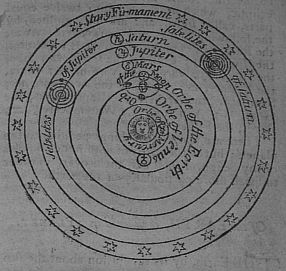
The real motion of them all is
from
west
to east, though sometimes they
appear to move from east to west; and at other times seem not to move
at all. And hence they are said to be direct, retrograde, and
stationary. The Earth, Jupiter, and Saturn, are often eclipsed by
the interposition of their respective moons, or satellites, between the
sun and themselves; and these eclipses are sometimes partial, sometimes
total, and sometimes central. The orbit of the earth (or the
circle which the sun seems
to describe round the earth), is called the ecliptic, which is
divided
into twelve equal parts, called signs, and are distinguished by the
following names and marks, viz. Aries, the Ram,
; Taurus, the Bull,
;
Gemini, the Twins,
;
Cancer, the Crab,
;
Leo, the Lion,
;
Virgo, the Virgin,
;
Libra, the Balance,
;
Scorpio, the Scorpion,
;
Sagittarius, the Archer,
;
Capricornus, the Goat,
;
Aquarius, the Water-bearer,
; Pisces, the Fishes,
.
There are many other things peculiar to the planets; but as
they are
not within the compass of my design, I shall pass them over, in order
to speak more particularly of the earth.
Of
the EARTH, considered as a
PLANET.
THE Earth, by its revolution about the sun in 365 days, 5 hours, and 49
minutes, makes that space
of time which we call a year.
The line, which the centre of the earth describes in its annual
revolution about the sun, is called the Ecliptic.
The annual motion of the earth about the sun, is in the order of the
signs of the zodiac; that is, from west to east.
Besides its annual revolution about the sun in the ecliptic, the earth
turns round also on its own axis in 24 hours.
The turning of the earth on its own axis
every 24 hours, whilst it
moves round the sun in a year, we may conceive by the rolling of a bowl
on
a bowling-green; in which not only the centre of the bowl hath a
progressive motion on the green, but the bowl, in going forward, turns
round about its own axis.
The turning of the earth on its own axis makes the differences of day
and night; it being day in those parts of the earth which are turned
towards the sun; and night in those parts which are in the shade, or
turned from the sun.
The annual revolution of the earth in the ecliptic is the cause of the
different seasons, and of the several lengths of days and nights, in
every part of the world, in the course of the year.
If the diameter of the sun be to the diameter of the earth as 48 to 1,
(as by some it is computed), the disk of the sun is above 2000 times
bigger than the disk of the earth; and the globe of the sun is about
100,000 times bigger than the globe of the earth.
The distance of the earth's orbit from the sun is above 20,000
semidiameters of the earth; so that if a cannon ball should come from
the sun with the same velocity it hath when discharged from the mouth
of a cannon, it would be 25 years in coming to the earth.
We shall now consider the earth in another sense, and speak of the
several divisions made by geographers.
OF THE CIRCLES,
Which are used by GEOGRAPHERS to explain
the Properties of the NATURAL
GLOBE.
You may suppose the following figure to
be a globe or sphere, representing the earth. The outermost
circle, marked with the letters A, D, B, C, is called the meridian; and
on this circle the latitude is reckoned, either from C towards A or B,
or else from D towards A and B.
The equator is the line C, D, which upon the globe is a circle, and is
sometimes called the equinoctial: Upon this circle the degrees of
longitude are reckoned, beginning at C, and counting all round the
globe till you come to C again; and O is the middle of the world
between A and B, which are the two poles thereof: A representing the
North Pole, B the South Pole.
The circles E F, and G H, are called the Tropics, beyond which the sun
never moves.
The line G F, which upon the
globe is
a
circle, is termed the Ecliptic,
in which the sun is perpetually moving from G to F, and F to G
again. When the sun is in O, he is then in the Equinoctial, and
the days and nights are of equal length to all the world, except under
the Poles. When he is at F, which is called the Tropic of Cancer,
days are at the longest to all those who dwell under the North side of
the Equator. When the sun is at G, which is called the Tropic of
Capricorn, days are at the longest to all those dwelling on the South
side of the Equator, and at the shortest to those on the North side.
The circles LM and I K are called the Polar Circles, because to
those
inhabitants who dwell under these circles, the longest day is 24 hours;
so that the sun sets not, but moves quite round their
horizon. Thus much may suffice for the circles of the sphere;
only note this, that every circle, whether great or small, is divided
into 360 equal parts or degrees; so that a degree is no certain
measure, but only the three hundred and sixtieth part of the circle;
and these degrees are again supposed to be divided into sixty equal
parts, which are called minutes. Now, therefore, if a circle
which will reach round the earth be divided into 360 parts, then one of
those parts is equal to a degree, which was looked upon by the ancients
to be equal to sixty miles, and thus one mile was exactly equal to a
minute.
Of
the ZONES.
The Zones are certain tracts of
land,
whose boundaries are made by the
circles before described, and are five in number, namely, the Torrid
Zone; the Northern Temperate Zone; the Southern Temperate Zone; the
Northern Frigid Zone; the Southern Frigid Zone. 1.The Torrid Zone
contains all that space of land which lies between the circles E F and
G H; for to those inhabitants who dwell betwixt the said limits, the
sun, at some time of the year, becomes vertical, i.e. right over their
heads. 2. The Northern Temperate Zone is all that space
betwixt the circle E F, named the Tropic of Cancer, and the line L M,
called the Northern Polar Circle; and to all the inhabitants within
this compass, the sun, when in their several meridians, casteth their
shadows directly
north. 3. The Southern Temperate Zone is that tract of land
which lies between the circular line G H, called the Tropic of
Capricorn, and the Southern Polar Circle I K. To all the
inhabitants within this space, the sun, when in their meridian,
casteth their shadows full south. 4. The Northern Frigid
Zone, is that part of the earth which lies between the Northern Polar
Circle L M, and the North Pole at A; to all these inhabitants the
sun, at a certain season, and when in the Tropic of Cancer, does not
set, but moves in view quite round the horizon, casting their shadows
every way. 5. The Southern Frigid Zone is that part of the
earth which lies between the Southern Polar Circle I K, and the South
Pole at B. To all the inhabitants within these limits, the sun,
when in the Tropic of Capricorn, sets not, but moves in sight as
before, casting their shadows also every way.
Of
the CLIMATES.
The Climates are reckoned from
the
Equator to the Poles; under the
Equator the day is always 12 hours long, and under the Polar Circles
the longest day is 24 hours. Geographers make 24 climates between
the Equator and each of the Polar Circles, because there are 24 half
hours difference between the length of day under the Equator, and the
longest day under the Polar Circle; so that any place where the longest
day in that place is half an hour longer or shorter than that of
another place, is of a different
climate. The first climate begins at the Equator; the second
where the longest day is 12 hours and a half; the third where it is 13
hours, and so on. There are in all 48 climates of hours, that is,
four
[sic]
from the
Equator to the Polar Circle, either Northward or Southward.
Besides the aforesaid 48 climates of hours, there are 12 more, called
climates of months, that is, six from each of the Polar Circles to the
Poles. They are called climates of months, because the longest
day in the end of the first climate is one whole month, the longest day
at the end of the second two whole months, and so on.
Of
LAND and WATER.
The whole globe of the earth is
called
terraqueous, consisting of two
bodies, namely, Land and Water, which may be divided in the following
manner, viz.
LAND into Continents, Islands, Peninsulas, Isthmuses,
Promontories,
Mountains.
1. A Continent is a large tract of land, comprehending
divers
countries, kingdoms, and states, joining altogether, without any
separation of its parts by water, of which we have four, viz. Europe,
Asia, Africa, and America.
2. An Island is a part of land encompassed round with water.
3. A Peninsula, called also Chersonesus, is a piece of dry land
every
where environed with water, save only a narrow neck
of
land adjoining the same to the
Continent.
4. An Isthmus is that narrow neck of land which
joins the
Peninsula to the Continent, by which people go from one to the other.
5. A Promontory is a high piece of land, stretching out
into
the
sea, the extremity whereof is commonly called a Cape.
6. A Mountain is a rising part of dry land, overtopping the
adjacent
country, and appearing the first at a distance.
WATER is divided into Oceans, Seas, Gulfs, Straits, Lakes, and
Rivers.
7. Ocean is a vast collection of water, environing a
considerable
part of the Continent.
8. The Sea is a smaller body of water, intermixed with
Islands,
and for the most part environed with land.
9. A Gulf is a part of the Sea, every where encompassed
with
land, except only one passage, whereby it communicates with the main
ocean.
10. A Strait is a narrow passage, either joining a Gulf
to the
neighbouring Sea or Ocean, or one part of the Sea or Ocean to another.
11. A Lake is a small collection of deep standing water,
surrounded by land, and having no visible communication with the Sea.
12. A River is a considerable stream of fresh water,
rising out
of one, or various fountains, continually gliding along in one or more
currents, till it empties itself into the sea or ocean.
OF THE
FOUR QUARTERS OF THE WORLD,
AND FIRST OF EUROPE.
A
Swedish Man and Woman in their proper
Dresses.
 An Historical and Geographical
Account of
An Historical and Geographical
Account of
SWEDEN, DENMARK,
and NORWAY.
SWEDEN is one of the Northern Kingdoms,
great and populous; is bounded on the North by Lapland, Norway, and the
Frozen Sea; on the East by Muscovy; on the South by the Baltic Sea; on
the West by Denmark and Norway. It is divided into six parts,
contains seventeen cities, the capital is Stockholm; the air is cold,
but wholesome; it abounds with all the necessaries of life; the
inhabitants are long-lived; they trade in brass, lead, iron, steel,
copper, skins, furs, deals, oak, pitch, and tar: They
are civil, and so industrious that a beggar is not to be seen among
them; good soldiers, strong and healthy. It was formerly
elective, but now hereditary. It is governed by a King and the
States, which consist of the nobility, clergy, and the merchants; their
religion is Lutheranism, and dialect Teutonic and German.
An
Account of DENMARK.
DENMARK lies to the North of England, is but a small kingdom,
Copenhagen is the metropolis. The King of Denmark is also
Sovereign of Norway, Greenland, Fero,
&c. The air is very cold, the country fruitful; there is
store of deer, elks, horses, cattle, &c. also fish, especially
herrings; their commodities are chiefly tallow, timber, hides, and
rigging for ships: The crown is hereditary, the government
entirely in the power of the King, and their religion the same as in
Sweden.
An
Account of NORWAY.
NORWAY is a kingdom on the North-West shore of Europe, belongs to the
King of Denmark, is separated from Sweden by a ridge of mountains
always covered with snow; the chief town is Drontheim
.
It is mountainous, barren, and extremely cold, therefore but thinly
peopled; they are a plain people, of the same religion as those of
Denmark. The produce of the country is good for timber, oak,
pitch, tar, copper, and iron; and their seas abound with fish, which
the inhabitants dry upon the rocks without salt, and sell them to most
nations in Europe, to victual their ships in long voyages. They
have very little corn grown in the country; and the inhabitants feed on
the flesh of bears, wolves, and foxes; and the poorer sort make bread
of dried fish ground to powder, while the better sort exchange the
commodities above-mentioned for corn, fruits, wine, and other
necessaries. Their longest day in the northern parts is two
months, and shortest in the southern about eight hours.
A
Moscovite, or Russian Man and Woman
in
their proper Dresses.
 An
account of
An
account of MOSCOVY, or RUSSIA.
MOSCOVY is the largest country in
Europe, and which comprehends all that vast country which obeys the
Czar, or Czarina. It is bounded by the Northern Ocean on the
North; the rivers Oby and Tanais on the East; the Little Tanais, the
rivers Desna and Sosa, with Lesser Tartary, on the South; Narva
,
Poland, Sweden, and Norway on the West: It contains about forty
provinces; is a marshy country, not well inhabited, full of forests and
rivers; the winter is long, and very cold; they sow only rye
before winter, and the other corn in May, though their harvest is
in July and
August. They have plenty of fruit, melons, fowl, and fish;
and their commodities are salt, brimstone, pitch, tar, hemp, flax,
iron, steel, copper, and Russian leather, much valued in England.
They wear long beards, short hair, and gowns down to their heels; are a
mistrustful and cruel people, cunning in trading, and deceive with
impunity, it being counted industry; naturally lazy and drunken
,
and
lie on the ground or benches, all excent
[sic]
the gentry. Until
Czar Peter the Great (who polished the
people, as well as enriched and improved the country), they were
barbarous and savage; but he setting up printing-houses and schools in
his dominions, banished ignorance, and introduced the liberal
arts. Their government is hereditary and absolute, their religion
is that of the Greek church. They have a number of clergy, and
divers monasteries for friars and nuns. The Emperor of Moscovy is
called the Czar, and Empress the Czarina.
A
French Man and Woman in their
proper Dresses.
 An Historical and Geographical
Account of
An Historical and Geographical
Account of FRANCE
.
FRANCE is one of the finest and largest
countries in Europe, lies in the middle of the Temperate Zone, is
washed by the ocean to the west, by the Mediterranean Sea to the South,
joins to the Low Countries to the North, Germany and Italy lie to the
East, and Spain to the South. Its length and breadth is about 225
leagues each. Its chief city is Paris; there are ten
universities, and many very stately palaces, the chief of which is that
at Versailles, about eleven miles from Paris, where their Kings used to
reside. It abounds with all the necessaries of life, which made
the Emperor Maximilian say, "That if it were possible he himself were
God, his eldest son should succeed him, and the second should be
King of France." The common people were reckoned industrious,
and the better sort very polite, well bred, extremely gay in dress, and
civil to strangers, till their late wonderful revolution destroyed all
distinctions, and involved them in a contest with the rest of
Europe; which seems to have reversed their manners, and renders
it impossible to say what will in future be the distinguishing traits
of the national character, when they shall again cultivate the arts of
peace. Their commodities are brandy, wine, salt, silks, linen and
woollen, hemp, canvas, paper, soap, almonds, olives, &c. To
take a view of the country, their fields are long and open, intermixed
with corn and vines, and every hedge so beset with choice fruits, that
eyes can hardly have fairer objects.
'Twas in this country that Master Tommy Courtly and his sister, who
went over with their papa, learnt all that good manners and genteel
behaviour, which made every body love and admire them so much at their
return home; which had such an effect on their brother Jack, (who was a
rude, ill-natured, slovenly boy), that he soon grew better; and to
prevent himself being utterly despised, and turned out of doors, by his
papa and mamma, for his undutiful behaviour, he immediately mended his
manners, and in a very little time was beloved and admired, almost
equally with his brother Tommy. It has now, however, ceased to be
the school of Europe; and as the late extraordinary events, which
brought their Monarch to the block, and occasioned the people to
declare for a
Republican government, have been attended with a total loss of trade,
and the destruction of the arts, it must be many years before
travellers can again visit this country with hope of similar advantages.
Germans
in their proper Habits.
 An Account of
 GERMANY.
GERMANY is a large, fruitful, and pleasant country, which has the title
of an Empire. It is bounded on the North by the Baltic Sea,
Denmark, and the German Ocean; on the East by Hungary, Prussia,
and Poland; on the South by the Alps; on the West by the Netherlands,
Lorrain, and French Compte.
It is divided into higher and
lower; its whole length is about 840 Italian miles, and breadth
about 740; the
soil is very fertile, and furnishes every thing necessary; the chief
rivers are the Danube, the Rhine, Elbe, Oder, and Weser. Tacitus,
speaking of the Ancient Germans, says, "They sung
[sic]
when they marched to
fight, and judged of the success by the shouts and huzzas at the
onset. Their wives, as martial as themselves, accompanied them to
the war to dress their wounds, and provide them with necessaries.
They esteemed nothing so infamous as to throw away or lose their
shield. They buried the bodies of their noblemen on a funeral
pile, with their arms and horse." The Germans of our age are
laborious,
simple,
and brave, but ready to serve for money, constant in their religion,
true friends, open enemies.
The inventions of printing, gunpowder, and fire-arms are attributed to
them. There are above three hundred different Sovereignties in
Germany, most of which are subject to the supreme head, the Emperor,
who is chosen by the nine Electors, viz. the Archbishops of Mentz,
Triers, and Cologn; the King of Bohemia; the Duke of Bavaria; the Duke
of Saxony; the Marquis of Brandenburgh, (King of Prussia); the Prince
Palatine of the Rhine; and the Elector of Hanover, (King of
England). The Electors are the principal members of the Empire,
and absolute Sovereigns in their own dominions. Their religion,
for the greatest part, is Popery; but in several states and cities,
particularly Prussia, the Protestant prevails. The chief
city is
Vienna, in the Dukedom of Austria, which is the seat of the Emperor.
A Dutch Man and Woman in their proper
Habits.
HOLLAND and FLANDERS, which are
called the Seven Provinces, and the Netherlands, are inhabited by the
Dutch.
This country is also in Germany, though mostly independent of the
Empire; the greatest part belongs to the Dutch, part to the
French, and part to the Emperor: Its capital city is Amsterdam, a
place of vast trade and riches. The air is moist and foggy; the
country, lying low, is naturally wet and fenny, and employed chiefly in
grazing of cattle; little corn grows there, but they import abundance
from other countries; the soil is fertile, the natural produce
is chiefly butter and cheese, in which their trade has been great,
but that of herrings the most considerable; and they had manufactures
of various kinds, carrying on a prodigious trade to most parts of the
world. They are a plain and frugal people, and very laborious.
Their form of government was very peculiar; but their independence
having been absorbed in the vortex of the French revolution, it is
uncertain what form it may assume in a short period. Their
language is a dialect of the German. The reformed religion,
according to the doctrines of Calvin, is the established one, though
all are tolerated.
A
Spanish Man and Woman in their
proper
Habits.
 An Account of
 SPAIN.
SPAIN is separated from France by the
Pyrenean Hills, and on all other sides is surrounded by the
Mediterranean Sea, the Straits of Gibraltar, and the Atlantic
Ocean. The King has the
most lands of any Prince in the world, on which account some of their
predecessors have boasted, "That the sun never sets in their dominions,
as having possessions in all the four parts of the world." He is
stiled
[sic]
his Catholic
Majesty. His Court is different from all others, he gives
audience but one day in a week, and the rest he is shut up in his
palace, the courts of which are full of merchants' shops, and resemble
the cloisters of religious houses. The air of Spain is pure and
dry, but very hot; the soil is sandy, and mostly barren, though
where fertile not well cultivated, through the pride and laziness of
the people, to which they are much addicted; though what they want in
corn is made up in a variety of excellent fruits and wines, of which
they have great plenty. Their chief commodities are wine, oil,
fruits of various sorts, wool, lamb-skins, honey, cork, &c.
The people are grave and majestic, faithful to their Monarch, delicate
in point of honour, jealous, lascivious, and tyrants over a vanquished
enemy; look upon husbandry and the mechanical arts with the greatest
contempt. Their government is an absolute Monarchy, and their
crown hereditary as well to females as to males. Their religion
is Roman Catholic, nor is any other tolerated. Madrid is their
capital city, which stands near the middle of the country, on top of a
hill, by the little river Manzanares.
A
Portuguese Man and Woman in their
proper Habits.
 An
Account of
An
Account of PORTUGAL.
PORTUGAL joins to Spain, and to the East is bounded by Spanish
provinces; the capital city is Lisbon, a place of great trade and
riches, with an excellent harbour: The soil of this country is poor,
and produces but little, except wine and fruit. The nobility and
gentry are magnificent and hospitable, but the common people much
addicted to thieving. It is governed by its own King, who is by
much the richest crowned head in Europe. His government is
absolute, and crown hereditary. The established religion is
Popery, though others are tolerated, but are under a necessity of being
very reserved and cautious, for fear of the inquisition, which is
a court or tribunal for the
examination and punishment of offenders, whom they torture in the most
cruel manner.
Lisbon, the capital city, as before-mentioned, is about six miles in
length, built on seven hills, surrounded with a wall, on which are 77
towers, and 36 gates; is reckoned to contain 30,000 houses, and 150,000
inhabitants, (whose foreign trade is equal to any city in Europe,
except London and Amsterdam.) There is a cathedral, 37 parish
churches, 23 cloisters, several handsome squares, and sumptuous
buildings, the largest of which is the King's palace. Such was
the state of this opulent city till the 1st of November, 1755, when the
greatest part of it was reduced to a heap of ruins by a most tremendous
earthquake, which was followed by a terrible fire. A gentleman
who was present, giving an account of the calamity to his friend in
England, says, "It is not to be expressed by human tongue, how dreadful
and awful it was to enter the city after the disaster; in looking
upwards one was struck with terror, in beholding frightful ruined
fronts of houses, some leaning one way, some another; then, on the
contrary, one was struck with horror in beholding dead bodies, by six
or seven in a heap, crushed to death, half buried, half burnt; and if
one went through the broad squares, nothing to be met with but people
bewailing their misfortunes, wringing their hands, and crying
the world was at
an end
: In short, 'twas the most lamentable scene that
eyes could behold."
The King, in his letter on the melancholy occasion to the King of
Spain, concludes thus: "I am without a house, in a tent, without
servants, without subjects, without money, and without bread."
An
Italian Man and Woman in their proper Habits.
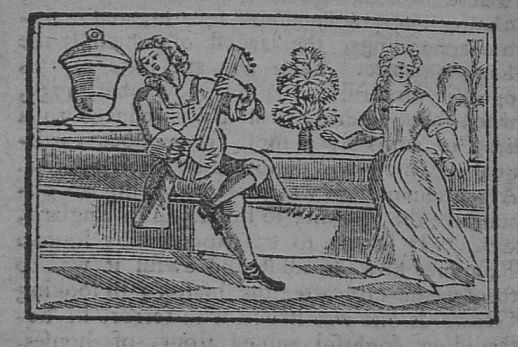 An Historical Description of
 ITALY
.
ITALY in the scriptures is called
Chittim, and Mesech.
Pliny (an ancient Latin
writer) gives it this character: "Italy is the nurse-mother of all
nations, elected by the Gods to make the Heavens more glorious, and
unite the dispersed governments of the world." &c.
The situation is very advantageous, being towards the midst of the
Temperate Zone. It is bounded by the Alps on the North, which
separates it from Germany; on the East by the Adriatic Sea; on the
South by Mare Inferum, or the Sea of Tuscany; and on the West by a part
of the Alps, and the River Var, which are its bounds towards France and
Savoy. The air of this country is temperate and healthful; the
soil so fruitful, that there seems to be a continual spring: It
abounds with grain, fruits, and flowers, and a variety of living
creatures, as well for pleasure as profit; on which account Italy is
called the Garden of Europe. The people are polite, dexterous
[sic]
,
prudent, and ingenious, extremely revengeful, jealous, and great
formalists; their genius lies much for poetry, music,
antiquities, &c. and, in short, all the liberal arts. Their
tongue is derived from the ancient Latin. The cities are fair,
well built, and magnificent; Rome is looked on as the capital,
and is called the
Holy
,
Naples the
Noble
, Florence
the
Fair
, Genoa the
Proud
, Milan the
Great
, Venice the
Rich
, Padua the
Learned
, and Bonia the
Fat
. There are 300
bishoprics in it, and many universities. It was governed of old
by Kings, then by Consuls, and last of all by Emperors, who raised it
to the highest pitch of glory. Only the Roman Catholic religion
is professed in Italy; neither are the Protestants suffered there,
though the Jews are permitted in some cities. This country
affords more entertainment to
travellers than any other in the world, in which may be seen many
remains of the greatest, wisest, and bravest people that ever lived,
namely, the old Romans.
The
present people
are inured to slavery,
harassed with tyrannies and impositions of their priests. The
country is but badly cultivated; its commodities are wine, oil, corn,
rice, velvets, silk, glass, &c.
A
Turkish Man and Woman in their proper Habits.
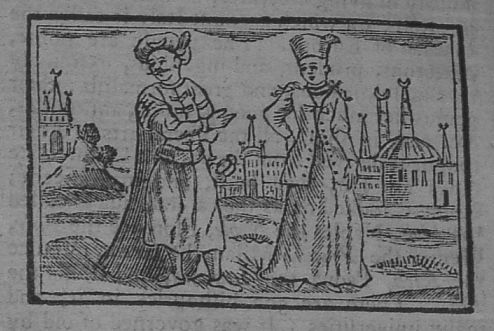 An Account of
 TURKEY
.
TURKEY,
or the Empire of the Turks, comprehends many provinces in Europe, Asia,
and Africa; so it is with reason the Sultan is called Grand
Signior. The empire is divided into
25 governments, of which there are seven in Europe, seventeen in Asia,
and Egypt makes one of itself; two of the governments have what they
call Beglerbergs at the
head of them, and the
rest are governed by Bashaws.
Most of these
countries are fruitful, but neglected through the laziness of the
Turks, and oppressions the Christians lie under, who chuse
[sic]
rather to let the land lie
untilled, than cultivate it for others. It is thin of
inhabitants, occasioned by frequent plagues and continual wars, which
carry off great numbers. They are very temperate, robust, and
good soldiers. Their religion, whereof Mahomet was the author,
comprehends six general precepts, viz. circumcision, prayer, fasting,
alms, pilgrimage, and abstinence from wine. Friday is their most
solemn day of the week, which they distinguish only by being longer at
prayer on that than other days. They observe an extraordinary
fast on the ninth month, which whoever breaks is certainly punished
with death: They keep it so strict, that labourers ready to faint
with thirst dare not taste a drop of water. They have a sort of
monks called Dervises
[sic]
,
who live a very austere life, keeping a
profound silence, go barefoot, with a leather girdle round their
bodies, full of sharp points to mortify the flesh, and sometimes beat
and burn themselves with hot irons: they are very charitable, and spare
nothing for the maintenance of the poor. The government is
monarchial; the Grand Signior, or Sultan, is absolute
master of the lives and fortunes of his subjects; his orders are above
the laws, which are but few. If his ministers grow rich, they
certainly suffer death, right or wrong, their wealth (which goes to the
Sultan) being esteemed a clear proof of their guilt.
The customs and ways of the Turks are very different from ours: the
left is the upper hand with them; they bury in the dark, and carry the
dead head-foremost; their books are all manuscripts, for they suffer no
printing among them. Their commodities are chiefly raw silks,
oil, leather, cake-soap, honey, wax, and various fruits and
drugs. Constantinople, which was formerly Thrace, by the
Turks called Stamboul, is their capital, and seat of the Ottoman or
Turkish Emperor.
ASIA.
A Man and Woman of Tartary in their
proper
Habits.
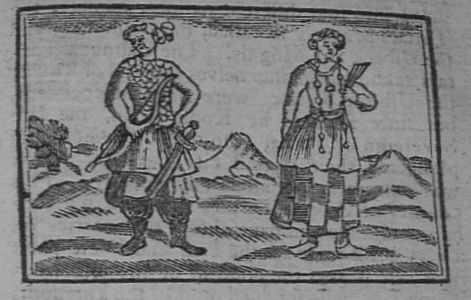 An Account of
 TARTARY
.
TARTARY, which is the same country as
the ancient Scythia,
comprehends
all the North of Europe, and almost a third part of Asia. At
present the Russians possess the North part and have given it the name
of Siberia. It is a cold barren country, generally covered with
snow, and very thinly inhabited.
Their wealth consists in cattle, and their employment in grazing.
They carry on neither manufacture nor trade, except in slaves and
horses, and rove about in herds or clans. The Emperor of Russia
is supreme Lord of the Western as well as North part of Tartary,
especially since the time of
the late Czar Peter the Great, who
extended his conquests even to the Northern coast of the Caspian Sea.
The Chinese are masters of the South and East parts of Tartary. The
Tartars are divided into four different nations, namely, the Tartars
properly so called, the Calmucks, and the Usbeck and Moguls. The
Calmuck Tartars acknowledge themselves subjects of Russia; the Usbeck
Tartars were once independent, but since subdued by Kouli Khan, the
late Sovereign of Persia,
who took possession and plundered their
capital city Bochara, which was extremely populous and wealthy. This
country of Usbeck Tartary is situate in a very happy climate and
fruitful soil, and carries on a very brisk trade to the East and West
parts of Asia: it was the country of the victorious Tamerlane, who
subdued most of the kingdoms of Asia.
The Tartars, as to stature, are generally thick and short,
having
flat square faces, little eyes, little round short noses, and an olive
complexion. They are reckoned the best archers in the world, and eat
all manner of flesh but hog's-flesh. They are very hospitable, and take
a pleasure in entertaining strangers. Their religion is mostly
Paganism, they worship the Sun, Moon, and Stars, and a variety of
images, but not in temples or churches, for they worship in groves and
on the tops of monntains
[sic]
;
but those that live near the Mahometan
countries are mostly Mahometans. The Southern provinces lie
in a
temperate climate, and would produce all manner of corn and vegetables;
but the inhabitants pay no regard to it, and lead a rambling life,
driving great herds of cattle before them to such parts of the country
where they can meet with the best pasture, and here they pitch their
tents, but seldom remain long enough in a place to reap a crop of corn,
even if they were to plough the land and sow it.
A Chinese Man and Woman in their
proper Habits.
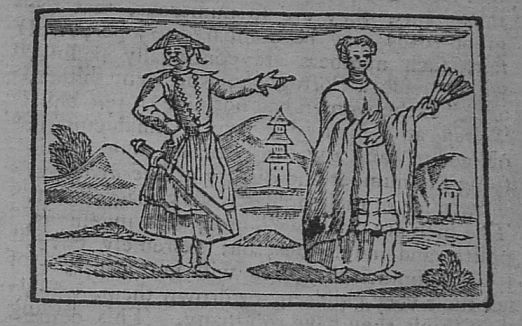
An Account of CHINA.
THE Empire of China is a great and spacious country, on the East of
Asia, famed for its fruitfulness, wealth, beautifulness of towns, and
incredible number of inhabitants.
It is divided into seventeen kingdoms, which contain 160 large
cities, 240 lesser, and 1200 towns; the chief of all is Pekin.
The air is pure and serene, and the inhabitants live to a great
age. Their riches consist in gold and silver mines, pearls,
porcelain or China ware; japanned or varnished works; spices, musk,
true ambergris, camphire
[sic]
,
sugar, ginger, tea, linen, and silk; of the latter there is such
abundance, that they are able to furnish all the world with it.
Here are also mines of quicksilver, vermillion, azure-stone
,
vitriol,
&c. So much for the wealth: Now as to the inhabitants, they
are so numerous, that the great roads may be compared to a perpetual
fair, such numbers are continually passing, which made a Portuguese,
who went thither, ask, "If the women had not nine or ten children at a
birth?" Every inhabitant is obliged to hang a writing over
his door, signifying the number and quality of the dwellers. The
inside of their houses is very magnificent. The men are civil,
well-bred, very ingenious, polite, and industrious, but extremely
covetous, insomuch that they will not scruple to sell their very
children, or drown them, when they think they have too many. This
desire of wealth lets them never be idle, and makes them have a great
aversion to strangers that come to settle among them. The men go
neatly dressed, and carry a fan in their hand, and when they salute
each other (for they are very courteous) they never put off their hat,
but with their hands joined before their breast bow their
bodies. Here is no Nobility but what depends on learning, without
any regard to birth, except the Royal Families; and the more learned
any one is, the more he is advanced in honour and government. The
King, who is called the Tartar,
keeps a guard of forty
thousand
men. When he dies his body is buried on a pile of paper, and with
him all his jewels, and every thing else, except living creatures, that
he made use of in his life-time. His Counsellor, Priest, and
Concubines, that devoted themselves wholly to his soul, sacrifice their
lives as soon as he dies; but have the liberty to chuse what kind
of death they please, which is generally beheading. In this
country there is a stupendous wall, built to prevent the incursions of
the Tartars, which is at least 1700 miles long, near 30 feet high, and
broad enough for several horsemen to travel on it abreast. Their
established religion is what they call the Religion of Nature, as
explained by their celebrated Philosopher Confucius; but the greatest
part of them are Idolaters, and worship the Idol Fo
.
The Mahometans
have been
long since tolerated, and the Jews longer. Christianity had
gained a considerable footing here by the labour of the Jesuits, till
the year 1726, when the missionaries being suspected of a design
against the Government, were quite expelled.
An Indian Man and Woman in their
proper Habits.
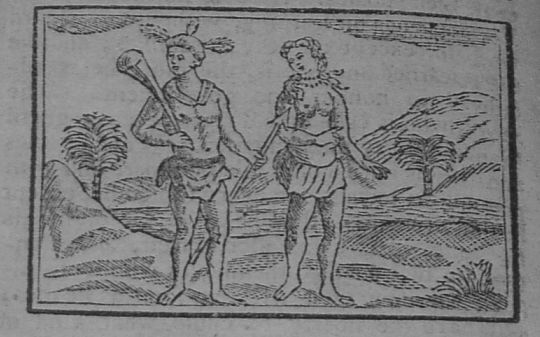 An Account of
 INDIA
.
INDIA, one of the greatest regions of
Asia, is bounded on the East by China, on the West by Persia, North by
Great Tartary, and on the South by the Indian Sea. It is divided
into three parts, viz. Indostan, or the Empire of the Great Mogul;
India on this side the Ganges, and India beyond; the cities of Deli
[sic]
and Agra are the two
chief, and, by turns, the residence of the Great Mogul, at each of
which he has a very splendid palace. The most noted city on the
coast is Surat, a place of great trade, where the English have a
factory. India on this side the Ganges contains many petty
kingdoms. On the coast are Goa, belonging to the Portuguese,
which is their staple for East-India goods; and Bombay, a little island
and town belonging to the English. On this coast are
Pondicherry,
Fort St. David, and Fort
St. George, which belong to
the English, who
in fact possess the supreme dominion of the country, most of the native
princes being either dependent on them, or happy to enter into alliance
with them. India beyond the Ganges, is also divided into various
kingdoms, and contains a great number of large and populous cities, of
which we have no knowledge besides their names. The people are
for the most part tawny, strong, and big, but very lazy. They eat
on beds, or tapestry spread on the ground. They burn most of
their dead, and their wives glory in being thrown into the funeral
piles, and there consumed to ashes.
The Great Mogul is a
Mahometan, and esteemed the richest King in the world in jewels; one of
his thrones is said to have cost five millions sterling
.
Their commodities are silks, cottons, callicoes, muslins, sattins
[sic]
,
carpets, gold, silver,
diamonds, pearls, porcelain, rice, ginger, rhubarb
,
aloes, amber,
indigo, cinnamon, cocoa, &c. They are mostly Pagans, and
worship idols of various shapes, and the rest are Mahometans, except a
few Christians. Their monarch is absolute, and so are all the
petty Kings; who are so fond of titles that they often take them from
their jewels, furnitures, equipage, and elephants, to make up a
number. This country is so exceeding rich, that it is thought by
many to be the Land of Ophir, where Solomon sent for gold.
Of
TURKEY in ASIA.
THIS vast continent takes in Natolia,
Arabia, Phœnicia, Judea, or Palestine, and the Euphratian
Provinces. The people are chiefly Mahometans, though there are
many Jews and Christians in some places among them. There are
various governments, but they are all subject to the Grand Signior, who
depopulates these fine countries, and discourages industry; so that the
Phœnicians, formerly famous for commerce, are at present a poor
despicable people; and Judea, the land which heretofore flowed with
milk and honey, is in general still fruitful, abounding in corn, wine,
and oil, where cultivated, and might supply the neighbouring countries
with all these, as they anciently did, were the inhabitants equally
industrious. The parts above Jerusalem, its once famous capital,
are mostly mountainous and rocky; but they feed numerous herds and
flocks, and yield plenty of honey, wine, and oil, and the vallies
[sic]
abound with large crops of
corn.
Shaw's
Travels.
AFRICA.
An Egyptian Man and Woman in their
proper
Habits.
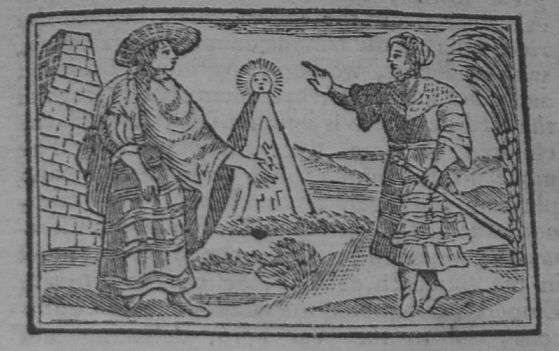 An Account of
 EGYPT
.
EGYPT, a country in Africa, is parted
from Asia by the Red Sea, and bounded on the north by the
Mediterranean; on the east by Arabia Petræa; on the south by
Æthiopia
and Nubia; and on the west by Barbary. The air of this country is
very unhealthy, occasioned by the heat of the climate. The soil
is made fruitful by the river Nile, which overflows the country
annually, from the middle of June to September, and supplies the want
of rain, of which there is very seldom any. It abounds with corn,
and does not want for rice, sugar, dates, sena
[sic]
,
cassia, balm, leather,
flax and linen cloth, which
they export. Diodorus Siculus relates, that there had been
formerly in Egypt, eighteen thousand great towns; the most noted of
which was Alexandria. In the eastern parts, beyond the river
Nile, is the famous country of Thebais, with its desarts
[sic]
,
where St. Anthony, St.
Paul, and other anchorets, had their cells. Beyond the Red Sea
there is
another desart, where the children of Israel lived forty years.
The modern inhabitants are fine swimmers, handy, pleasant, and
ingenious, but lazy. This kingdom was first governed by the
Pharaohs; afterwards conquered by Alexander the Great; and in the
sixteenth century, Selim, the Turkish Emperor, conquered the Mamulucks,
or Saracens; for in the year 1516,
defeating and killing Camson,
Soldan
of Egypt, and Tomumbey
the next year after, Egypt was perfectly conquered by the Ottomans or
Turks, who have governed it ever since by their Bashaws. The old
religion
of this country was idolatry, but now Mahometanism prevails most,
through there are some few Christians.
An
Account of BARBARY.
BARBARY is bounded by Egypt on the east,
Mount Atlas on the south, the Atlantic Ocean on the west, and the
Mediterranean to the north. Though this country be under the
Torrid Zone, yet the mountains and sea coasts, between the
Straits of Gibraltar and Egypt, are more
cold than hot. The men of this country are allowed many wives
though they seldom are married to more than one. The women are
always veiled in the presence of men; so that a man knows no more of
the beauty of the woman he marries, than what he learns from her
parents, till they are actually married. The people are of a good
mild humour, and such as live abroad under tents, as the Arabians or
shepherds, are laborious, valiant, and liberal; but they who live in
cities are proud, covetous, and revengeful; and though they traffic
much, know but very little, and have neither banks nor bills of
exchange. Their commodities are beef, hides, linen, and cotton;
raisins, figs, and dates. It is a rich country, and governed,
part of it, as Fez and Morocco, by Kings; and the other, as Algiers,
Tunis, and Tripoli, by Bashaws from the Grand Seignior
[sic]
.
As for
religion, they have the Christian, Jewish, and Mahometan, and they who
live in the mountains and fields with their flocke
[sic]
,
which are a great number,
have hardly any at all. When any one dies, his friends have women
that cry and scratch their faces, and take on seemingly with great
grief for the deceased. They live mostly on rice, beef, veal,
mutton; but wine is forbidden by Mahomet's law.
A
Description of ZAARA, or the
Great Desarts
of AFRICA.
THE air of this country is very hot, so
that the people are forced to keep in their little huts, or seek
refreshment in caverns, the most part of the day; these desarts have a
great number of lions, tigers, and ostriches. The inhabitants are
unpolished, savage, and very bold, for they will stand and meet the
fiercest lion or tiger. They are divided into families or clans,
each head of a family is sovereign in his own canton, and the eldest is
always head; they follow the Mahometan religion, but are no strict
observers of it. The country is a mere desart, as the name
imports, and so parched for want of water, that the caravans from
Morocco to Negroland are obliged to carry both water and provisions,
the province producing hardly any thing for the support of life.
A
Negroe Man and Woman in their
proper
Habits.
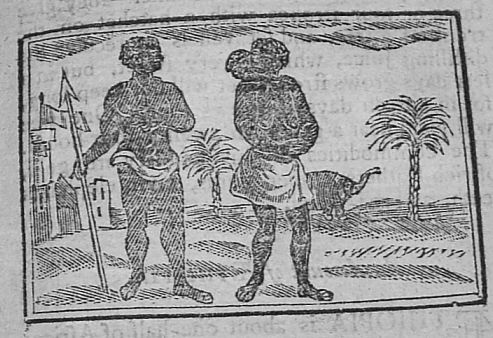 An Account of the Land of the
 NEGROES
.
THIS country lies along the
river Niger,
on both sides of it, between Zaara and Guinea. It contains
fourteen kingdoms. The inhabitants of the sea coast are
somewhat civilized by their commerce with the Portuguese; but those
that dwell up higher in the country are savage and brutal. They
are continually at war with one another, and all the prisoners they
take in war they sell for slaves. They sow neither wheat nor
barley, but only millet; and their chief food is roots and nuts, pease
and beans. The country is surrounded with woods, and abounds with
elephants. They have no wine, but a pleasant
sort of liquor,
which they get from a certain sort of palm trees, in this manner --
they give three or four strokes with a hatchet on the trunk of a tree,
and set vessels to receive the distilling juice, which is very sweet,
but in a few days grows strong, yet will not keep long, for in fifteen
days it grows sour. One tree will yield near a gallon in
twenty-four hours. The commodities of this country are gold,
ostrich feathers, amber, gums, civit
[sic]
,
elephants teeth, and
red-wood.
An
Account of ÆTHIOPIA.
ÆTHIOPIA is about one-half of
Africa,
and divided into the Upper and Lower Æthiopia. This country
is
pretty full of mountains much higher than the Alps or Pyrenees, but
level, spacious, and well inhabited, and fruitful on the top; the soil
near the Nile is fruitful, but at a distance chiefly sandy
desarts. The people comely and well shaped, though black or
swarthy. Their cattle are very large, their horses and camels
courageous and stout. Their kings sit at table alone. Their
messes not being very neat or costly, are served in black clay dishes,
covered with straw caps finely woven; they use neither knives nor
forks, spoons nor napkins, and think it beneath them to feed
themselves, and so have youths on purpose to put the meat in their
mouths. They have no towns, but live in tents, which are so
very numerous where the King is, that they resemble a great city; and
they have also their officers to prevent disorder, and things are so
well managed, that they can remove speedily on all occasions without
confusion. Their commodities are metals, gems, cattle, corn,
sugar, canes, wine, and flax. They are a mixture of Jews,
Mahometans, Pagans, and Christians. The government is subject to
an Emperor, who is called Prestor
[sic]
John. In Lower
Æthiopia the commodities are
silver, gold, ivory, pearls, musk, ambergris, oil, lemons, citrons,
rice, millet, &c. The people have hitherto been esteemed
barbarous and savage; but if the relations of Bruce
,
the
celebrated traveller, are in the least to be depended on, we have done
them great injustice in this respect; and we are well assured that they
are not generally canibals
[sic]
,
as we have been accustomed to think them. The Hottentots
inhabit part of the country,
who
are the most odious of all the human species, for they besmear their
bodies with grease and all manner of filth, and adorn themselves with
hanging the guts of bears about their arms, legs and necks
.
An
Account of GUINEA.
GUINEA is a kingdom of Africa; the
country is very extensive, and the people of Europe drive a great trade
in it. The French were the first who discovered it, about the
year 1346. The soil of this country is fertile, but the heat
insupportable by any but the natives, who are counted the blackest of
all the Negroes, and most of them go quite naked. Ignorance and
stuperstition
[sic]
reign
among them, and it is said that they offer human sacrifices. They
look on God to be a good being, and for that reason only are civil to
him; they worship the devil, and pray earnestly he may do them no
mischief. Their commodities are cotton, rice, sugar, canes,
elephants, peacocks, apes, and pearls. Several small Princes and
states in the inland country, who are generally at war, sell their
prisoners for slaves to the Europeans; others traffic to different
countries for purchasing slaves, or steal them, and bring them down to
the coast; and some will sell their children and nearest relations, if
they have an opportunity.
AMERICA.
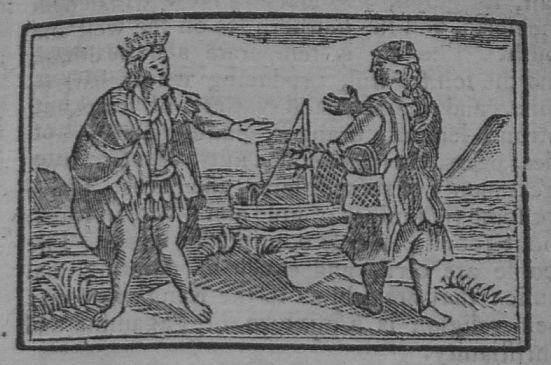 An American Man and Woman in their
proper
Habits.
An American Man and Woman in their
proper
Habits.
AMERICA, the fourth and last quarter of
the world, is divided into North and South America. North America
contains Mexico, (or New Spain,) New Mexico, and California, Florida,
Canada, (or New France,) Nova Scotia, New England, New York, New
Jersey, Pennsilvania
[sic]
,
Maryland, Virginia, and Carolina. South America contains Terra
Firma, the land of the Amazons, Brazil, Peru, Chili
[sic]
,
Paraguay, and Terra
Magellanica.
An
Account of MEXICO, or
NEW SPAIN.
MEXICO is so called from its chief city;
and New Spain since the Spaniards settled there. It has the sea
of Mexico on the east, its gulph
[sic]
,
Florida, and New Mexico on the north, and the southern sea on the west
and south. The air is temperate and healthful, and the soil
fruitful, producing wheat, barley, pulse, and maize; and variety of
fruits, as citrons, lemons, oranges, pomegranates, apples, pears,
cherries, cocoa nuts, figs, &c. with great plenty of roots, plants,
and herbs. There are some rich mines of gold and silver, in which
about 4000 Spaniards continually work. The people are civil, and
excel in painting and music: they are subject to the King of Spain:
their religion is a mixture of Paganism and Christianity.
An
Account of NEW MEXICO, or
GRANADA.
THIS part of the world is not fully
discovered by the Europeans. The soil is sandy and barren, the
air healthful and temperate, but not a little subject to hurricanes,
thunder and lightning. There are some silver mines, turquoise,
emeralds, crystal, &c. The natives are naturally good and
civil, governed by a captain named Casich,
whom they choose
themselves. They are given to idolatry, and some adore the sun,
others believe in a God, and some of them have no religion at all.
An
Account of FLORIDA.
FLORIDA is a large and fruitful country
in North America, bounded on the north-east by Carolina, on the south,
and some part of the west, by New Galicia and some
countries not yet discovered. The air is very temperate, and soil
extremely fertile, and produces grain, herbs, and fruit in great
abundance. Ferdinando Soto, after the conquest of Peru, entered
this country May 25, 1538, and gave it the name Florida, because the
flowers were then on the ground, but died of grief, for being
disappointed of the treasures which he expected. The native
inhabitants were extirpated by the Spaniards, who disregarded every
principle of humanity when the security of their acquisitions in the
New World was in question; but this fine country was conquered from
them by the English, to whom it was confirmed by the peace of Paris
;
its importance was however never sufficiently considered by them, and
to gratify the jealousy of Spain it was restored to her at the peace of
1783. It was
divided into East and West: St. Augustine and
Pensacola are its chief towns; and its commodities furs, pearls, and
the most delicious fruits. The Spaniards regard it as forming a
desirable frontier between them and the United States of America; but
as the soil and climate are inferior to none in the world, it will
doubtless one day emerge from its obscurity, become populous, and hold
a high rank in the world.
An
Account of CANADA.
CANADA is the chief province now possessed by the English in America;
it is bounded by New Britain
and Honduras Bay on the North
and East; by
Nova Scotia, New England, and New York on the South; and by some of the
great lakes, the new settlements of the United States, and the yet
remaining possessions of the native Indians, on the West. The
soil and climate are not very different from those of New
England, though it has a much severer winter; but the air is very
clear, the summer hot and pleasant. The meadow grounds are well
watered, yield excellent grass, and breed vast numbers of cattle.
This country was originally settled by the French; and in so doing
Louis XIV. seems to have formed the vast design of consolidating all
North America under his dominion: the English, under Wolf
[sic]
,
Amherst, and Monkton
[sic]
,
conquered it in the years
1759 and 1760; and it was confirmed to us at the peace of
1763. The inhabitants were guaranteed in all their privileges;
and
the Roman Catholic religion is yet the most prevalent, though all
others are tolerated. It has been lately divided into two
provinces, Upper and Lower Canada, each having its separate government
and legislature. Its trade and population are annually and
rapidly increasing.
Quebec, its capital, is situated at the confluence of the rivers St.
Laurence and St. Charles, about 320 miles from the sea, and is very
strong both by nature and art; when taken by the immortal Wolfe it was
supposed to contain about 15,000 inhabitants, independent of the
garrison, and has since had considerable additions. The trade
between Canada and England, the greater part of which centers here, is
supposed to employ eight sail of shipping, and near 2000 seamen.
An
Account of TERRA FIRMA.
TERRA FIRMA, or the Firm Land, is a
large
country of South America, and contains eleven governments, subject to
the King of Spain. The air here is extremely hot, though
wholesome, the soil very fertile, when well manured. The natives
are tawney
[sic]
,
robust,
healthful, long lived, and go naked about the middle. The
commodities are gold, silver, and other metals; balsam, rosin, gum,
long pepper, emeralds, sapphire, jasper, &c. Here is one
Spanish archbishopric and four bishoprics; but the natives are
idolaters.
An
Account of PERU.
PERU is in South America, a large country, divided into six
provinces. The air in some parts is very hot, in others sharp and
piercing. The soil is the richest of all the Spanish
plantations, abounding with exceeding high mountains and large
pleasant vallies. The commodities are vast quantities of gold and
silver, valuable pearls, medicinal drugs, cochineal
,
tobacco, abundance
of cotton, &c. The natives are of a copper colour, tall and
well made; but are so depressed by the Spaniards, it is impossible to
form any judgment of their genius, virtues, or vices.
Of
the Land of the AMAZONS.
THIS country is very little known, but as far as discovered the air is
temperate, and the soil fertile. There are on the banks of the
river Amazon about fifty nations of fierce savage people, said to eat
human flesh. The commodities are gold, silver, sugar, ebony,
cocoa,
tobacco, &c. Their religion is Paganism, and language unknown.
An
Account of BRAZIL.
BRAZIL is in the east of South America, bounded on the east by the
Atlantic Ocean, on the west by some undiscovered countries between it
and the mountains called Andes, on the north by Guiana, and on the
south by Paraguay. It was discovered by the Portuguese in 1501,
and is still in great part subject to them. The air is very
temperate and wholesome, though under the torrid zone; the soil
fertile, and the country produces red or Brazil wood, sugar,
amber, rosin, balm, tobacco, train oil
,
confectionary, &c. The natives are reckoned cruel, but
ingenious; have faint notions of religion, and speak several different
languages, though they cannot pronounce either of the three letters L,
F, R. They are all naked, and neither sow nor reap, but live by
hunting and by the fruits which the land produces of its own accord.
An
Account of CHILI.
CHILI is also a great
country of South America,
400 leagues in length from north to south, is divided into three
governments, and subject to the King of Spain. In summer the air
of this country is very warm, but in winter so extremely cold that it
often kills man and beast. The mountainous parts are generally
dry and barren, but the vallies exceedingly fertile in maize, wheat,
and other grain. The people are white, tall, courageous, an
warlike, but very gross Idolaters, the chief object of their worship
being the devil, whom they call Eponamon,
i.e.
powerful. The country is
enriched with several mines of gold, and great quarries of jaspar
[sic]
.
The commodities are
gold, silver, maize, corn, honey, ostriches, and metals. Most of
them use the Spanish tongue, but some their ancient jargon.
A
Persian Man and Woman in their
proper
Habits.
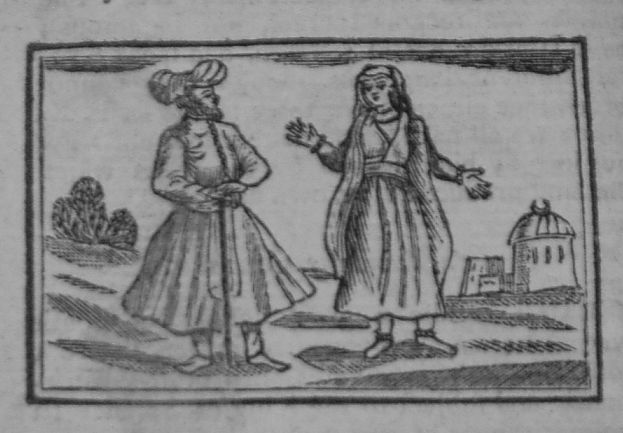 An Account of
 PERSIA.
PERSIA is a famous kingdom of Asia,
called by the inhabitants Farsistan, and the Empire of the Sophy
.
It is bounded by the Caspian Sea, India, Persian Gulph, and Arabia
Deserta. The air of this country is temperate towards the north,
but very hot in the summer towards the south. Their grain is
barley, millet, lentil, pease, beans, and oats; and all their provinces
produce cotton, which grows upon bushes; their fruits are excellent,
and they have vines in abundance, but in obedience to Mahomet's
commands drink no wine, but sell it all to the Arminians
[sic]
.
They are
suffered to make a syrup of sweet wine, to which they add an acid,
and it serves them for their common drink. They have a great
number of mulberry trees for silk worms, silk being the principal
manufacture in this country. The people are of a middle stature,
well set and thick, and of a tawny complexion; are neat and sharp, have
good judgment, are civil to strangers, and very free of their
compliments. Thus a Persian that desires his
friend to come to his house usually says, "I entreat you to honour my
house with your presence: I so devote myself to your desires, that the
apple of my eye shall be a path to your feet," &c. They are just in
their dealings; and their commodities are rich silks, carpets, tissues,
gold, silver, seal skins, goat skins, alabaster, metals, myrrh, fruits,
&c. Their religion is Mahometanism, and their language has a
great tincture of the Arabic. Ispahan is the capital city.
The kingdom is hereditary, and government so despotic, that the Sophy,
or King, makes his will his law, and disposes as he pleases both of the
lives and estates of his subjects, who are very obedient, and never
speak of their sovereign but with extraordinary respect.
An
Account of DAYS, WEEKS,
MONTHS, and
YEARS.
THE day is either natural or artificial;
the natural day is the space of twenty-four hours, (including both the
dark and light part) in which time the sun is carried by the first
mover from the east into the west, and so round the world into the east
again. The artificial day consists of twelve hours,
i.e.
from the sun's rising to its
setting; and the artificial night is from the sun's setting to its
rising. The day is accounted with us for payment of money between
the sun's rising and setting; but for indictment for murder the day is
accounted from midnight to midnight, and so likewise are fasting days.
The Hebrews and Chaldeans begin their days at sun rising, and end at
the next rising.
The Jews and Italians from sun-set to sun-set. The Romans at
midnight. The Egyptians from noon to noon, which account astronomers
follow.
A week consists of seven mornings, or seven days, which the Gentiles
call by the names of the seven planets (which they worshipped as Gods);
the first day of the sun; the second day of the moon, &c. In
a week God made the world,
i.e.
in six days, and rested the seventh.
All civilized nations observe one day in seven, as a stated time of
worship; the Turks and Mahometans keep the sixth day of the week, or
Friday; the Jews the seventh, or Saturday; the Christians the first, or
Sunday.
Of months there are various kinds; a solar month is the space of thirty
days, in which time the sun runneth through one sign of the
zodiac.
A lunar month is that interval of time which the moon spendeth in
wandering from the sun, in her oval circuit, through the twelve signs,
until she returns to him again, (being sometimes nearer, sometimes
farther from the earth)
i.e.
from the first day of her appearing next after her change, to the last
day of her being visible, before her next change, which may be greater
or lesser, according to her motion.
The usual or common months are those set down in our almanacks,
containing some 30, some 31, and February but 28 days, according to
these verses:
Thirty days hath September,
April, June, and November;
February twenty-eight alone,
All the rest have thirty-one;
But when leap-year comes, that time
Has February twenty-nine. |
A year is the space of time in which the sun runs through all
the 12
signs of the zodiac: containing 12 solar months, 13 lunar months,
52 weeks, 365 days, and six hours, which six hours, in four
years
time, being added together, make one day, which day on every fourth
year is added to February, making that month 29 days, which at other
times is but 28; and this year with the additional day is called
leap-year.
To
find the Leap-Year.
Divide the year of our Lord by 4, and if there be no remainder, it
is leap-year; but if there remains 1, 2, or 3, then that denotes the
first, second, or third after leap-year.
TABLES
OF
WEIGHTS AND MEASURES.
24
|
Grains
---
|
1
|
Pennyweight
|
dwt.
|
20
|
Pennyweights
|
1
|
Ounce ---
|
oz.
|
12
|
Ounces ---
|
1
|
Pound
|
lb.
|
By this weight are weighed jewels,
gold, silver, corn, and all liquors.
16
|
Drams
---
|
1
|
Ounce
---
|
oz.
|
16
|
Ounces ---
|
1
|
Pound ---
|
lb.
|
28
|
Pounds
--- |
1
|
Quar. of a hun.
|
qr.
|
20
|
Hundreds --
|
1
|
Ton ---
|
ton.
|
By this weight, which is now generally used in England, are weighed
butter, cheese, groceries, &c.
N.B.
One pound avoirdupois is
equal to 14 oz. 11 dwts. 15½ grains troy; and one ounce troy is
equal to 1 oz. 1 dram, and something above an half, avoirdupois.
Apothecaries' Weight.
|
Char.
|
20
|
Grains
|
1
|
Scruple
---
|

|
3
|
Scruples ---
|
1
|
Dram ---
|

|
8
|
Drams
----
|
1
|
Ounce
---
|

|
12
|
Ounces ---
|
1
|
Pound ---
|

|
By this weight apothecaries compound their medicines; but buy and sell
their drugs by avoirdupois weight.
2
|
Pints ---
|
1
|
Quart
|
qrt.
|
4
|
Quarts ---
|
1
|
Gallon ---
|
gall..
|
63
|
Gallons ---
|
1
|
Hogshead ---
|
hhd.
|
2
|
Hogsheads ---
|
1
|
Pipe ---
|
pipe.
|
2
|
Pipes ---
|
1
|
Tun ---
|
tun.
|
2
|
Pints ---
|
1
|
Quart
---
|
qrt.
|
4
|
Quarts ---
|
1
|
Gallon ---
|
gall.
|
9
|
Gallons ---
|
1
|
Firkin ---
|
firk.
|
2
|
Firkins ---
|
1
|
Kilderkin ---
|
kild.
|
2
|
Kilderkins --
|
1
|
Barrel ---
|
bar.
|
| 1½ |
Barrel ---
|
1
|
Hogshead --
|
hhd.
|
3
|
Barrels, or 2 hhds.
|
1
|
Butt ---
|
butt.
|
N.B.
Eight gallons make a
firkin of ale.
4
|
Nails ---
|
1
|
Quarter ---
|
qr.
|
4
|
Quarters --
|
1
|
Yard ---
|
yd.
|
Note, An ell English is 5 quarters of a yard, and an ell Flemish is 3
quarters.
60
|
Seconds ---
|
1
|
Minute
|
60
|
Minutes ---
|
1
|
Hour
|
24
|
Hours ---
|
1
|
Natural Day
|
7
|
Days
|
1
|
Week
|
4
|
Weeks
|
1
|
Month
|
13
|
Months, 1 day, and 6 hours, is
|
|
One
|
52
|
Weeks, 1 day, and 6 hours, is
|
|
Julian
|
365
|
Days, and 6 hours, is
|
|
Year.
|
8766
|
Hours, is
|
|
|
Note,
An exact solar year is
equal to 365 days, 5 hours, 48 minutes, 48 seconds, 57 thirds: and one
lunar month is equal to 29 days, 12 hours, and 45 minutes.
8
|
Pints ---
|
1
|
Gallon ---
|
gall.
|
2
|
Gallons ---
|
1
|
Peck ---
|
peck.
|
4
|
Pecks ---
|
1
|
Bushel ---
|
bush.
|
4
|
Bushels ---
|
1
|
Coomb --
|
coomb.
|
2
|
Coombs --
|
1
|
Quarter --
|
qr.
|
5
|
Quarters --
|
1
|
Wey ----
|
wey.
|
2
|
Weys ---
|
1
|
Last ---
|
last.
|
40
|
Square Perches ---
|
1
|
Rood
|
4
|
Roods ----
|
1
|
Acre
|
Note, 5 feet is a geometrical pace, and
1056 geometrical paces 1 English mile.
Long
Measure.
12
|
Inches
----
|
1
|
Foot
|
3
|
Feet
---
|
1
|
Yard
|
5
|
Yards and
½ ---
|
1
|
Pole or perch
|
40
|
Poles
---
---
|
1
|
Furlong
|
8
|
Furlongs or 1760 yards
|
1
|
English mile
|
A
MULTIPLICATION TABLE.
1
|
2
|
3
|
4
|
5
|
6
|
7
|
8
|
9
|
2
|
4
|
6
|
8
|
10
|
12
|
14
|
16
|
18
|
3
|
6
|
9
|
12
|
15
|
18
|
21
|
24
|
27
|
4
|
8
|
12
|
16
|
20
|
24
|
28
|
32
|
36
|
5
|
10
|
15
|
20
|
25
|
30
|
35
|
40
|
45
|
6
|
12
|
18
|
24
|
30
|
36
|
42
|
48
|
54
|
7
|
14
|
21
|
28
|
35
|
42
|
49
|
56
|
63
|
8
|
16
|
24
|
32
|
40
|
48
|
56
|
64
|
72
|
9
|
18
|
27
|
36
|
45
|
54
|
63
|
72
|
81
|
THE use of this table is to find how
many any one figure multiplied by another will make: suppose I wanted
to know, how many seven times eight is, I look into the table for
7 in the first rank of figures on the left hand, and for 8 in the top
line; then carrying my finger strait from 7 in the first rank of
figures, till I come to that which has the figure 8 on the top of
it, I there find 56, which is the exact number of 7 times 8, or 8
multiplied by 7. So in all other instances look for the
first figure in the left-hand rank or column, and for the figure you
want to multiply by in the first or top line, and which ever square
these two meet in, there is the amount.
The
PENCE TABLE.
20
|
Pence is
|
1
|
shilling and
|
8
|
pence
|
30
|
---
|
2
|
----
|
6
|
|
40
|
---
|
3
|
---- |
4
|
|
50
|
---
|
4
|
---- |
2
|
|
60
|
---
|
5
|
---- |
--
|
|
70
|
---
|
5
|
---- |
10
|
|
80
|
---
|
6
|
---- |
8
|
|
90
|
---
|
7
|
---- |
6
|
|
100
|
---
|
8
|
---- |
4
|
|
110
|
---
|
9
|
---- |
2
|
|
120
|
---
|
10
|
---- |
--
|
|
130
|
---
|
10
|
---- |
10
|
|
140
|
---
|
11
|
---- |
8
|
|
150
|
---
|
12
|
---- |
6
|
|
160
|
---
|
13
|
---- |
4
|
|
170
|
---
|
14
|
---- |
2
|
|
180
|
---
|
15
|
---- |
--
|
|
190
|
---
|
15
|
---- |
10
|
|
200
|
---
|
16
|
---- |
8
|
|
210
|
---
|
17
|
---- |
6
|
|
220
|
---
|
18
|
---- |
4
|
|
230
|
---
|
19
|
---- |
2
|
|
240
|
---
|
20
|
---- |
--
|
|
The above table shews how many shillings
are contained in any number of pence from 20 to 240, and likewise how
many pence there are in any number of shillings from 1 to 20; which
will be found a great use in reckoning ma
[letter
corrupted]
ll money, and
ought to be
learned by heart, os
[so
as? (letters apparently dropped)]
to be
ready on all occasions.
A BRIEF ACCOUNT OF THE
SEVEN WONDERS OF THE WORLD.
THO' the Pagans were grossly ignorant of
the most important truths, with respect to God and religion; yet the
virtuosi of this and preceding ages have been forced to acknowledge,
that their tastes were elegant, sublime, and well-formed, with respect
to works of sculpture, statuary, and architecture. As a proof of
this, in behalf of the ancients, 'tis only requisite we should take a
cursory view of those noble and magnificent productions of art,
commonly called THE SEVEN WONDERS OF THE WORLD.
The
TEMPLE
of EPHESUS.
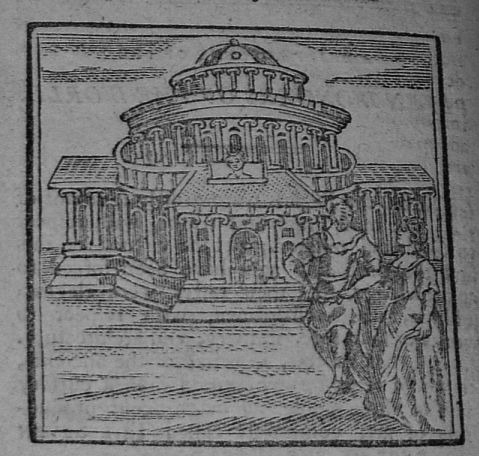
THE first of these Seven Wonders was the Temple of Ephesus, founded by
Ctesiphon, consecrated to Diana, and, (according to the conjectures of
natural philosophers) situated in a marshy soil, for no other reason
than that it might not be exposed to the violent shocks of earthquakes
and volcanos. This noble structure, which was 425 feet
long, and 220 feet broad, had not its bulk alone to raise it above the
most stately monuments of art, since it was adorned with 127
lofty and well proportioned pillars of Parian
marble, each of which had an opulent monarch for its erector and
finisher; and so high did the spirit of emulation run in this point,
that each succeeding potentate endeavoured to outstrip his predecessor
in the richness, grandeur, and magnificence of his respective
pillar. As it is impossible for a modern to form a just and
adequate idea of such a stupendous piece of art, 'tis sufficient to
inform him, that the rearing of the Temple of Ephesus employed several
thousands of the finest workmen of the times for 200 years: but as no
building is proof against the shocks of time, and the injuries of the
weather, so the Temple of Ephesus falling into decay, was, by the
command of Alexander the Great, rebuilt by Dinocrates, his own
engineer, the finest architect then alive.
The WALLS
of BABYLON.
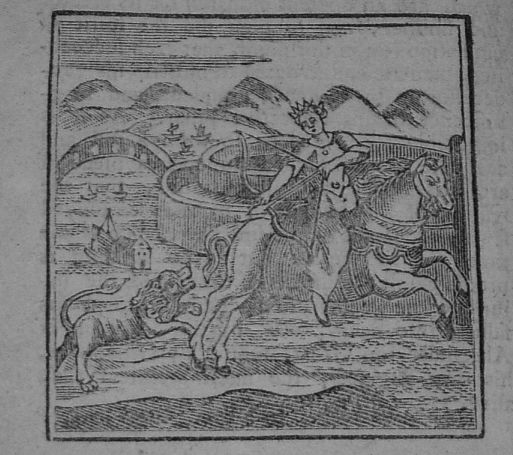
THE works of the cruel, though ingenious
and enterprising Semiramis, next command our wonder and
admiration. These consisted of the walls erected about Babylon,
and the pleasant gardens formed for her own delight. This
immense, or rather inconceivable profusion of art and expence
[sic]
,
employed 30,000 men for
many years successively, so that we need not wonder when we are told by
historians, that these walls were 300 or 350 stadia in circumference
(which amount to 22
English miles), fifty cubits high,
and so broad that they could afford
room for two or three coaches a-breast without any danger. Though
ancient records give us no particular accounts of the gardens, yet we
may reasonably presume, that if so much time and treasure were laid out
upon the walls, the gardens must not have remained without their
peculiar beauties: thus 'tis more than probable that the gardens of
Semiramis charmed the wondering eye with unbounded prospect, consisting
of regular vistas, agreeable avenues, fine parterres, cool grottos and
alcoves, formed for the delicious purposes of love, philosophy,
retirement, or the gratification of any other passion, to which great
and good minds are subject.
The
TOMB
of PHAROS.
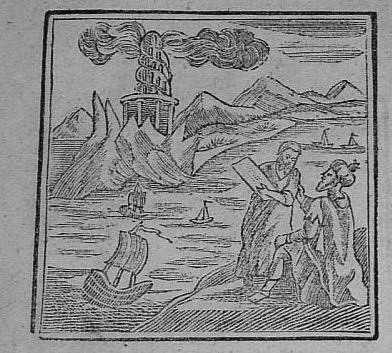
WE shall next take a view of the
splendid and sumptuous Tomb of Pharos,
commonly called the Egyptian Labyrinth
[sic]
.
This structure, though
designed for the interment of the dead, had nevertheless the pomp of a
palace designed for a monarch, who thought he was to live for ever;
since it contained sixteen magnificent apartments, corresponding to the
sixteen provinces of Egypt; and it so struck the fancy of the
celebrated Dedalus, that from it he took the model of that renowned
labyrinth which he built in
Crete, and which has eternized
[sic]
his
name, for one of the finest artists in the world.
Of
the PYRAMIDS
of
EGYPT.
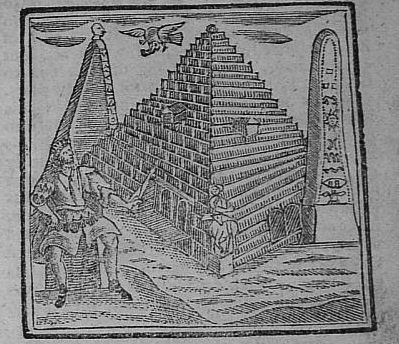
IF the amazing bulk, the regular form,
and the almost inconceivable
duration of public or monumental buildings call for surprize
[sic]
and
astonishment, we have certainly just reason to give the Pyramids of
Egypt a place among the Seven Wonders. These buildings remain almost as
strong and beautiful as ever, 'till this very time.
There are three of them; the largest of which was erected by Chemnis,
one of the Kings of Egypt, as a monument of his power when alive, and
for a receptacle of his body when dead
.
It was situated about 16 English miles from Memphis, now known by the
name of Grand Cairo, and was about 1440 feet in height, and about 143
feet long, on each side of the square basis. It was built of hard
Arabian stones, each of which is about 30 feet long. The building
of it is said to have employed 600,000 men for twenty years.
Chemnis however was not interred in this lofty monument, but was
barbarously torn to pieces in a mutiny of his people. Cephas, his
brother, succeeding him, discovered an equally culpable vanity, and
erected another, though a less magnificent pyramid. The third was
built by King Mycernius according to some, but, according to others, by
the celebrated courtesan Rhodope. This structure is rendered
still more surprising, by having placed upon its top a head of black
marble, 102 feet round the temples, and about 60 feet from the chin to
the crown of the head.
The
TOMB
of MAUSOLUS.
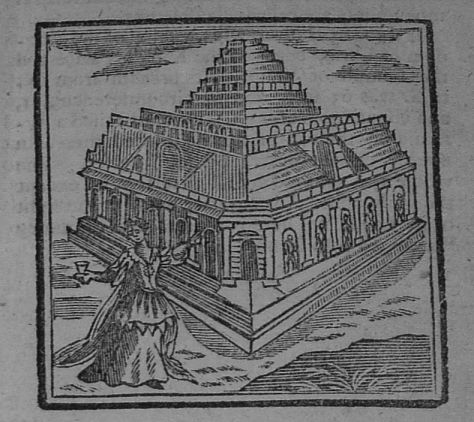
THE next is the celebrated monument of
conjugal love, known by the name of the Mausoleum, and erected by
Artemesia, Queen of Caria, in honour of her husband Mausolus, whom she
loved so tenderly, that, after his death, she ordered his body to be
burnt, and put his ashes in a cup of wine, and drank it, that she might
lodge the remains of her husband as near to her heart as she possibly
could. This structure she enriched with such a profusion
of art and expence, that it was justly looked upon as one of the
greatest wonders of the world, and ever since magnificent funeral
monuments are called Mausoleums.
It stood in Halicarnassus, capital of the kingdom of Caria, between the
King's Palace and the Temple of Venus. Its breadth from N. to S.
was 63 feet, and in circumference 411, and about 120 feet high.
Pyrrhus raised a pyramid on the top of it, and placed thereon a marble
chariot drawn by four horses. The whole was admired by all that
saw it, except the philosopher Anaxagoras, who, at the sight of it,
cried, "There is a great deal of money changed into stone."
The
COLOSSUS
of the SUN.
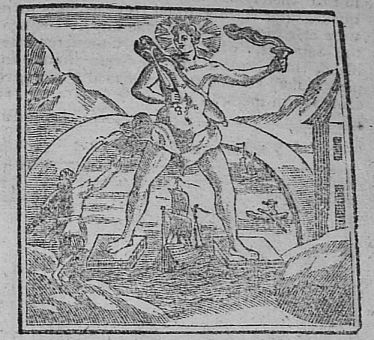
THE Colossus of Rhodes, is justly
accounted the sixth Wonder; a statue of so prodigious a bulk, that it
could not have been believed, had it not been recorded by the best
historians. It was made of brass by one Chares of Asia
Minor, who consumed twelve years in finishing it. It was
erected over the entry of the harbour of the city, with the right foot
on one side, and the left on the other. The largest ships could
pass between the legs without lowering their masts. It is said to
have cost 44,000l. English money. It was 800
feet in height, and all its members proportionable; so that when
it was
thrown down by an earthquake, after having stood 50 years, few men were
able to embrace its little finger. When the Saracens, who
in 684 conquered the island, had broken this immense statue to pieces,
they are said to have loaded above 900 camels with the brass of it.
The
IMAGE
of Jupiter.
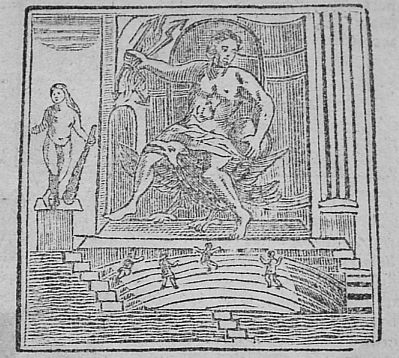
THE last, most elegant, and curious of
all these works, known by the name of the Seven Wonders, was the
incomparable statue of Jupiter Olympus, erected by the Elians, a
people of Greece, and
placed in a magnificent temple consecrated to Jupiter. This
statue represented Jupiter sitting in a chair, with his upper part
naked, but covered down from the girdle, in his right hand holding an
eagle, and in his left a sceptre. This statue was made by the
celebrated Phidias, and was 150 cubits high. The body is
said to have been of brass, and the head of pure gold. Caligula
endeavoured to get it transported to Rome, but the persons employed in
that attempt were frightened from their purpose by some unlucky
accident.
Thus having given an
Account of the
Seven Wonders of the World, let us take a View of the Burning
Mountains, or Volcanos, called Mount Vesuvius and Mount Ætna;
than
which there is, perhaps, nothing in the whole Course of Nature more
worthy our Notice [sic] , or so capable of raising our Admiration;
and which, when considered in a religious sense, may, with Justice, be
said to be one of the wonderful Works of GOD.
MOUNT VESUVIUS stands about six
miles from the city of Naples, and on the side of the Bay towards the
East. The plains round it form a beautiful prospect, and on one
side are seen fruitful trees of different kinds, and vineyards that
produce the most excellent wine; but when one ascends higher, on the
side which looks to the South, the face of things is entirely changed,
and one sees a tract of ground, which presents only images of horror,
viz. a desolate country covered with ashes, pumice-stones, and cinders;
together with rocks burned up with the fire, and split into dreadful
precipices. It is reckoned four miles high, and the top of it is
a wide naked plain, smoking with sulphur in many places; in the midst
of which plain stands another high hill, in the shape of a
sugar-loaf, on the top of which is
a vast mouth or cavity, that goes shelving down on all sides about a
hundred yards deep, and about four hundred over; from whence proceeds a
continual smoke, and sometimes those astonishing and dreadful eruptions
of flame, ashes, and burning matter, that fill the inhabitants around
with consternation, and bear down and destroy all before it.
Among the many eruptions which it has had, at different times, we
need instance only one, which happened on the fifth of June, 1717, and
is thus related by Mr. Edward Berkley, who was present at the time, in
his letter to Dr. Arbuthnot in England, viz. That he with much
difficulty, reached the top of Vesuvius on the 17th of April, 1717,
where says he, I saw a vast aperture full of smoke, and heard within
that horrid gulph certain odd sounds, as it were murmuring, sighing,
throbbing, churning, dashing of waves; and, between while, a noise like
that of thunder or cannon, attended constantly, from the belly of the
mountain, with a clattering like that of tiles falling from the tops of
houses into a street. After an hour's stay, the smoke being
moved by the wind, I could discern two furnaces, almost contiguous; one
on the left, which seemed to be about three yards diameter, glowed with
red flames, and threw up red hot stones with a hideous noise, which, as
they fell back, caused the fore-mentioned clattering.
On May 8, ascending to the top of Vesuvius, I had a full prospect of
the crater, which appeared to be about a mile in circumference,
and a hundred yards deep,
with a conical mount in the middle of the bottom, made of stones thrown
up and fallen back again into the crater: And the left-hand
furnace, mentioned before, threw up every three or four minutes, with a
dreadful bellowing, a vast number of red hot stones, sometimes more
than a 1000, but never less than 300 feet higher than my head, as I
stood upon the brink, which fell back perpendicularly into the crater,
there being no wind. This furnace or mouth was in the vortex of
the hill, which it had formed round it. The other mouth was
lower, in the side of the same new-formed hill, and filled with such
red hot liquid matter as we see in a glass-house furnace, which raged
and wrought as the waves in the sea, causing a short abrupt noise, like
what may be imagined from a sea of quicksilver dashing among uneven
rocks. This stuff would sometimes spew over, and run down the
convex side of the conical hill, and appearing at first red hot, it
changed colour, and hardened as it cooled, shewing the first rudiments
of an eruption, or an eruption in miniature: All which I could
exactly survey by the favour of the wind, for the space of an hour and
a half; during which it was very observable, that all the vollies
[sic]
of smoke, flame, and
burning stone, came only out of the hole to our left, while the liquid
stuff in the other mouth worked and overflowed.
On June 5, after a horrid noise, the mountain was seen, at Naples, to
spew a little out of the crater, and so continued till about two
hours before night on the
7th, when it made hideous bellowing, which continued all that night,
and the next day till noon, causing all the windows, and, as some
affirm, the very houses in Naples (about six miles distant) to
shake. From that time it spewed vast quantities of melted stuff
to the South, which streamed down the side of the mountain, like a pot
boiling over.
On the 9th, at night, a column of fire shot at intervals out of its
summit.
On the 10th, the mountain grew very outrageous again, roaring and
groaning most dreadfully, sounding like a noise made up of a raging
tempest, the murmur of a troubled sea, and the roaring of thunder and
artillery, confused altogether. This moved my curiosity to
approach the mountain. Three or four of us were carried in a
boat, and landed at Torre del Greco, a town situate at the foot of
Vesuvius to the S.W. whence we rode between four and five miles before
we came to the burning river, which was about midnight; and as we
approached, the roaring of the volcano grew exceeding loud and
terrible. I observed a mixture of colours in the cloud over
the crater, green, yellow, red, and blue. There was likewise a
ruddy dismal light in the air, over the tract of land where the burning
river flowed; ashes continually showering on us all the way from the
sea-coast, which horrid scene grew still more extraordinary, as we came
nearer the stream. Imagine a vast torrent of liquid fire rolling
from the top down the side of the mountain, and with irresistible
fury bearing down and consuming
vines, olives, fig-trees, houses, and, in a word, every thing that
stood in its way.
Death, in a thousand forms,
destructive frown'd,
|
And
Woe, Despair, and Horror rag'd around.
|
Æneid II. by Pitt.
The largest stream of fire seemed half a
mile broad at least, and five miles long. During our return, at
about three o'clock in the morning, we constantly heard the murmur and
groaning of the mountain, which sometimes burst out into louder peals,
throwing up huge spouts of fire, and burning stones, which, falling
down again, resembled stars in our rockets. Sometimes I observed
two, and at others three distinct columns of flames, and sometimes one
vast one, that seemed to fill the whole crater; which burning columns,
and the fiery stones, seemed to be shot 1000 feet perpendicular above
the summit of the volcano.
On the 11th, at night, I observed it from a terrace, at Naples, to
throw up incessantly a vast body of fire, and great stones, to a
surprising height.
On the 12th, in the morning, it darkened the sun with smoke and ashes,
causing a sort of an eclipse. Horrid bellowings, on this and the
foregoing day, were heard at Naples, whither part of the ashes also
reached.
On the 13th we saw a pillar of black smoke shoot upright to a
prodigious height.
On the 15th, in the morning, the court and walls of our house in Naples
were covered with ashes. In the evening a flame appeared in the
mountain through the clouds.
On the 17th, the smoke appeared much diminished, fat, and greasy.
And
On the 18th, the whole appearance ended, the mountain remaining
perfectly quiet.
To this memorable account it cannot be amiss to add, that the first
notice we have of this volcano's casting out flames, was in the reign
of the Emperor Titus. At which first eruption, we are informed,
that it flowed with that vehemence, that it entirely overwhelmed and
destroyed the two great cities Herculaneum and Pompeia,
and very much damaged Naples itself, with its stones and ashes.
In 471, if we may credit tradition, this mountain broke out again so
furiously, that its cinders and liquid fire were carried as far as
Constantinople; which prodigy was thought, by superstitious minds, to
presage the destruction of the empire, that happened immediately after,
by that inundation of Goths, which spread itself all over Europe.
There are several other eruptions recorded, but not so considerable as
the former, until 1631, when the earth shook so much as to endanger the
total destruction of Naples and Benevento. This did inestimable
damage to the neighbouring places; and it is computed near 10,000 lost
their lives in the flames and ruins.
The air was infected with such noxious vapours that it caused a plague,
which lasted a long time, and spread as far as the neighbourhood of
Rome. Since which
time, the most memorable are the
eruptions in
1701, (of which Mr. Addison, who saw it, has left us a good
description), and in 1717, as described above, by a curious spectator.
There have been eight eruptions within the last 30 years; of some of
which Sir Wm. Hamilton has favoured the world with very particular and
interesting accounts.
What tongue the dreadful
slaughter could disclose;
|
Or, oh! what tears could answer half their woes?
|
Explanation
of the Cut of Mount
Vesuvius.
- The Southern Summit, out of which the fire proceeds.
- The Northern Summit.
- The Rocks on the North.
- The Valley between the two Summits.
- The Opening on the Side where the fiery Torrent broke out.
- The first Opening, called the Plain.
- The Course which the last fiery Torrent took.
- The Chapel of St. Januarius.
HAVING been so particular in describing Vesuvius, we need say the less
concerning ÆTNA, which is the greatest mountain in Sicily, eight
miles high, and sixty in compass. There are many of its furious
eruptions recorded in history, some of which have proved very fatal to
the neighbourhood; we shall instance only one, that began the 11th of
March, 1669, and is thus described in the Philosophical Transactions,
viz.
It broke out towards the evening, on the south-east side of the
mountain, about twenty miles from the old mouth, and ten from the city
of Catanea. The bellowing noise of the eruption was heard a
hundred miles off, to which distance the ashes were also carried.
The matter thrown out was a stream of metal and minerals, rendered
liquid by the fierceness of the fire, which boiled up at the mouth like
water at the head of a great river; and having run a little way, the
extremity thereof began to crust and cruddle,
turning into large porous stones, resembling cakes of burning
sea-coal. These came rolling and tumbling one over another,
bearing down any common building by their weight, and burning whatever
was combustible. At first the progress of this inundation was at
the pace of three miles in 24 hours, but afterwards scarcely a furlong
in a day.
It thus continued for fifteen or sixteen days together, running into
the sea close by the walls of Catanea, and at length over the walls
into the city, where it did no considerable damage, except to a
convent, which it almost destroyed.
In its course it overwhelmed fourteen towns and villages, containing
three or four thousand inhabitants; and it is very remarkable, that
(during the whole time of this eruption, which was fifty-four days),
neither sun nor stars appeared.
But though Catanea had at this time the good fortune to escape the
threatened destruction, it was almost totally ruined in 1692 by an
earthquake, one of the most terrible in all history. This was not
only felt all over Sicily, but likewise in Naples and Malta. The
shock was so violent, that the people could not stand on their legs,
and those that lay on the ground were tossed from side to side, as if
upon a rolling billow. The earth opened in several places,
throwing up large quantities of water, and great numbers perished in
their houses by the fall of rocks, rent from the mountains.
The sea was violently agitated, and roared dreadfully. Mount
Ætna threw up vast spires of flame, and the shock was attended
with a
noise exceeding the loudest claps of thunder. Fifty-four cities
and towns, with an incredible number of villages, were destroyed, or
greatly damaged; and it was computed, that near 60,000 people perished
in different parts of the island, very few escaping the general and
sudden destruction.
There have been ten other eruptions, one of which, subsequent to the
preceding in 1753, was a very large one. Mr. Brydone, in his tour
of Sicily and Malta, has given many ingenious particulars concerning it.
Explanation
of NUMBERS expressed by
Letters.
N.B.
A less Numerical Letter,
set before a greater, takes away from the greater so many as the letter
stands for; but being set after the greater, adds so many to it as the
letter stands for. For example, V stands for five alone,
but
put I before it, thus IV, and it stands for four; and put I on the
other side, thus VI, and it stands for six. So X alone stands for
ten, but put I before it, thus IX, and it stands for nine; and put I to
it on the other side, thus XI, and it becomes eleven. So L stands
for fifty; put X before it, thus XL, and it stands for forty, but put
the X on the other side, thus LX, and it is sixty. So C stands
for one hundred, place X before it, thus XC, and it is but ninety;
again, put the X on the other side, thus CX, and it is one hundred and
ten. So in all other cases.
LETTERS, TALES AND FABLES,
FOR
AMUSEMENT AND INSTRUCTION.
A Letter from Master
JACKY
CURIOUS,
in London, to his Mamma in
the Country, giving a Description of the Tower, Monument, and St.
Paul's Church.
Honoured Madam,
AT my departure, I remember you ordered me to send you accounts of
every thing I saw remarkable in London; I will obey your commands as
well as I can; but pray excuse my defects, and let my will plead for my
inability, to entertain my absent friends.
I am just now come from seeing the tower, monument and St. Paul's
cathedral, (places which I remember to have heard much talk of in the
country, and which scarce any body that comes to London omits
seeing). The tower, which stands by the Thames, is a large strong
building, surrounded with a high wall, about a mile in compass, and a
broad ditch supplied with water out of the River Thames. Round
the outward wall are guns planted, which on extraordinary occasions are
fired. At the entrance, the first thing we saw was a collection
of wild beasts, viz. lions, panthers, tygers
[sic]
,
&c. also eagles and
vultures: These are of no sort of use, and kept only for curiosity and
shew. We next went to the mint, (which is in the tower observe)
where we saw the manner of coining money, which is past my art,
especially in the compass of a letter, to describe. From thence
we went to the jewel room, and saw the crown of England, and other
regalia, which are well worth seeing, and gave me a great deal of
pleasure. The next is the horse armory, a grand sight indeed;
here are fifteen of our English monarchs on horseback, all dressed in
rich armour, and attended by their guards; but I think it not so
beautiful as the next thing we saw, which was the small armory:
This consists of pikes, muskets, swords, halberts
[sic]
,
and pistols, sufficient,
as they told us, for three-score thousand men; and are all placed
in such different figures, representing the sun, star and garter, half
moons, and such like, that I was greatly delighted with it; and they
being all kept clean and scowered, made a most brilliant
appearance. Hence we went and saw the train of artillery, in the
grand storehouse, as they call it, which is filled with cannon and
mortars, all extremely fine: Here is also a diving-bell, with
other curiosities too tedious to mention; which having examined, we
came away and went to the monument, which was built in remembrance of
the fire of London: It is a curious lofty pillar, 200 feet high, and on
the top a gallery, to which we went by tedious winding stairs in
the inside: from this gallery we had
a survey of the whole city: And here having feasted our eyes with
the tops of houses, ships, and multitude of boats on the River Thames,
we came down and went to St. Paul's Cathedral, which is a most
magnificent pile, and stands on high ground, near the centre of the
city. This noble building struck me with surprise, and is admired
by the whole world, as well for its beautiful architecture as height
and magnitude; it has a grand awful choir, chapel, a
dome finely painted by that masterly hand Sir J. Thornhill, a
whispering gallery, and other curiosities, with which I conclude my
first letter, and am,
Madam,
Your very dutiful son,
JOHN CURIOUS.
LETTER II.
Honoured Madam,
I NOW proceed to acquaint you with my next excursion, in search of the
curiosities of this famous city; which was to Westminster Abbey.
This is really a magnificent ancient building; but what most surprised
me, was the vast number of beautiful monuments and figures with which
the inside is adorned. Among such as were pointed out to me, as
being remarkable either for their costliness or beauty, I
remember were those of the Duke of Newcastle, a magnificent
and expensive piece, Sir Isaac Newton, General Stanhope, the Earl of
Chatham, General Wolf, and that exquisite statue of Shakepeare, which,
I am told, is inimitable. When I had for some time enjoyed the
pleasure of gazing at these, I was conducted into that part of the
church where the Royal monuments are placed. These, I thought,
were exceeding grand. But nothing surprised and delighted me so
much as King Henry the Seventh's chapel, which, for beauty and
magnificence, I am told, far surpasses any thing of that kind in
Europe. Here too I saw the chair in which the Kings of
England are crowned, which, I believe, is more regarded for its
antiquity, and the honourable use it is assigned to, than for any great
beauty it has, at least that I could discover.
The next sight that entertained me, was the effigies of King William
and Queen Mary in wax, as large as the life, standing in their
coronation robes; they are said to be very well done, and to bear a
great resemblance to the life. Queen Anne, the Duchess of
Richmond, the Duke of Buckingham, &c. all of the same composition,
and richly dressed, are there also. In short, there are so many
curiosities contained in this venerable repository, that, to describe
one half of them would as far exceed the compass of a letter, as of my
abilities to do justice to them: However, I shall just mention
some which appeared to me most worthy of notice. But these
must be the subject of a future
letter, from,
Honoured Madam,
Your, &c.
LETTER III.
Honoured Madam,
AS I have the pleasure to find that my letters, however mean in
themselves, are agreeable to my dear parent, I shall continue my
account of some of those many curiosities which I saw in
Westminster-Abbey. Among the monuments of our ancient Kings is
that of Henry V. whose effigy has lost its head, which being of silver,
I am told, was stolen in the civil wars.
Here are two coffins covered with velvet, in which are said to be the
bodies of two Ambassadors, detained here for debt; but what were their
names, or what Princes they served, I could not learn.
Our guide next showed us the body of King Henry the Fifth's Queen,
Catherine, in an open coffin, who is said to have been a very beautiful
Princess; but whose shrivelled skin, much resembling discoloured
parchment, may now serve as a powerful antidote to that vanity with
which frail beauty is apt to inspire its possessors.
Among the waxen effigies, I had almost forgot to mention King Charles
II. and his faithful servant General Monk, whose furious aspect has
something terrible in it.
Not far from these is the figure of a lady, one of the Maids of Honour
to Queen Elizabeth, who is said to have bled to death by
only pricking her finger with a needle
.
I must now return to those monuments, which are in the open part of
the church, and free to every one's sight; for those I have been
speaking of are inclosed
[sic]
,
and not to be seen without a small gratuity to the conductor.
Among these, then, on the north side, stands a magnificent monument
erected to Lady Carteret, for whose death some reports assign a cause
something odd, viz. the late French King Louis the XIV.'s saying, That
a lady (whom one of his Nobles compared to Lady Carteret) was handsomer
than she.
Near this stands a grand monument of Lord De Courcy, with an
inscription, signifying that one of his ancestors had obtained a
privilege of wearing his hat before the King.
Next these follow a groupe
[sic]
of Statesmen, Warriors, Musicians, &c. among whom is Col.
Bingfield, who lost his head by a cannon ball, as he was remounting the
Duke of Marlborough, whose horse had been shot under him.
The famous musicians Purcell, Gibbons, Blow, and Crofts, have here
their respective monuments and inscriptions; as has also that eminent
painter Sir Godfrey Kneller, with an elegant epitaph by Mr.
Pope. As you enter the west door of the
church, on the right hand stands a monument with a curious figure of
Secretary Craggs, on whom likewise Mr. Pope has bestowed a beautiful
epitaph. On the south side is a costly monument, erected by Queen
Anne to the memory of that brave Admiral Sir Cloudesley Shovel, who was
shipwrecked on the rocks of Scilly. In the same aisle, and nearly
opposite to this, is a beautiful monument of white marble, to the
memory of Thomas Thynne, of Long-Leat, in the county of Wilts, Esq. who
was shot in his coach, on Sunday the 12th of February,
1682: In the front is cut the figure of him in his coach,
with those of the three assassins who murdered him. At the end of
this aisle, and on one side of what is called the Poets' Row, lies
covered with a handsome monument, and his effigy a large as the life,
the very famous Dr. Busby, Master of Westminster School, whose strict
discipline and severity are every where so much talked of.
I must now take notice of the Poets, whose monuments stand mostly
contiguous. Here are the ancient monuments of Chaucer and
Spencer, with those of Ben Johnson, Drayton, Milton, and Butler; also
of the great Dryden, the ingenious Phillips, the divine Cowley, the
harmonious Prior, and the inimitable Shakespeare, of whose curious
effigy I have spoken before: nor must I omit the gentle Mr. John Gay,
to whose memory his Grace the Duke of Queensberry has erected a noble
monument, which Mr. Pope has adorned with a very elegant
inscription in
verse. I must here end my remarks, but cannot take leave of this
venerable place, without observing, that it has many curious painted
windows, a noble choir, a fine organ, and a magnificent altar-piece.
I am, Honoured Madam, &c.
A
memorable Saying of the Duke de ORLEANS, at the Surrender of Gravelling, with a
generous Action of that Prince.
WHEN Gravelling was surrendered to the Duke of Orleans, just as
he entered into town he was heard to say these words: "Let us
endeavour, by generous actions, to win the hearts of all men; so we may
hope for a daily victory. Let the French learn from me this new
way of conquest, to subdue men by mercy and clemency."
With
what a matchless virtue did
this Prince dismiss a gentleman that was hired to murder him!
This assassin was suffered to pass into the Duke's bedchamber one
morning early, pretending business of grave moment from the
Queen. As soon as the Duke cast his eyes on him, he spoke
thus: "I know thy business, friend: thou art sent to take away my
life. What hurt have I done thee? It is now in my power,
with a word, to have thee cut in pieces before my face. But I
pardon thee; go thy way, and see my face no more."
The
gentleman, stung with his own guilt, and astonished at the
excellent nature of this Prince, fell on his knees, confessed his
design, and who employed him; and having promised eternal gratitude for
his Royal favour, departed without any other notice taken of him; and
fearing to tarry in France, entered himself into the service of the
Spanish King. It was his fortune afterwards to encounter the Duke
of Orleans in a battle in Flanders. The Duke, at that instant,
was oppressed with a crowd of Germans, who surrounded him; and, in the
conflict, he lost his sword; which this gentleman perceiving, nimbly
stept to him, and delivered one into the Duke's hand, saying withal,
"Now reap the fruit of thy former clemency. Thou gavest me my
life, now I put thee in a capacity to defend thy own." The Duke
by this means at length escaped the danger he was in; and that day the
fortune of war was on his side. The French had a considerable
victory.
You see by this, that heroic actions have something divine in them, and
attract the favours of Heaven. No man was a loser by good works;
for though he be not presently rewarded, yet, in length of time, some
happy emergency arises to convince him, "That virtuous men are the
darlings of Providence."
The
remarkable Story of GIOTTO, an
Italian Painter, and his Crucifix.
IT
was a cruel and inhuman caprice of an
Italian Painter (I think his name was Giotto), who designing to draw a
crucifix to the life, wheedled a poor man to suffer himself to be bound
to the cross an hour, at the end of which he should be released again,
and receive a considerable gratuity for his pains. But instead of
this, as soon as he had him fast on the cross, he stabbed him dead, and
then fell to drawing. He was esteemed the greatest master in all
Italy at that time; and having this advantage of a dead man hanging on
a cross before him, there is no question but he made a matchless piece
of work on't.
As soon as he had finished his picture he carried it to the Pope, who
was astonished, as at a progidy [sic]
of art, highly extolling the exquisiteness of the features and limbs,
the languishing pale deadness of the face, the unaffected sinking of
the head: In a word, he had drawn to the life not only that
privation of sense and motion which we call death, but also the very
want of the least vital symptom.
This is better understood than expressed. Every body knows that it
is a master-piece to represent a passion or a thought well and
natural. Much greater is it to describe the total absence of
these interior
facilities, so as to dis
tinguish
the figure of a dead man from one that is only asleep.
Yet all this, and much more, could the Pope discern in the admirable
draught which Giotto presented him. And he liked it so well, that
he resolved to place it over the altar of his own chapel. Giotto
told him, since he liked the copy so well he would shew him the
original, if he pleased.
What dost thou mean by the original, said the Pope?
Wilt
thou shew me Jesus Christ on the
cross in his own person? No, replied Giotto, but I'll shew your
Holiness the original from whence I drew this, if you will absolve me
from all punishment. The good old father suspecting something
extraordinary from the painter's thus capitulating with him, promised,
on his word, to pardon him, which Giotto believing, immediately told
him where it was; and attending him to the place, as soon as they were
entered, he drew a curtain back which hung before the dead man on the
cross, and told the Pope what he had done.
The Holy Father, extremely troubled at so inhuman and barbarous an
action, repealed his promise, and told the painter he should surely be
put to an exemplary death.
Giotto seemed resigned to the sentence pronounced upon him, and only
begged leave to finish the picture before he died, which was granted
him. In the mean while a guard was set upon him to prevent his
escape. As soon as the Pope had caused the picture to be
delivered
into his hands, he takes a brush, and dipping it into a sort of stuff
he had ready for that purpose, daubs the picture all over with it, so
that nothing now could be seen of the crucifix, for it was quite
effaced in all outward appearance.
This made the Pope stark mad; he stamped, foamed, and raved like one in
a phrenzy: he swore the painter should suffer the most cruel death that
could be invented, unless he drew another full as good as the former,
for if but the least grace was missing, he would not pardon him; but if
he would produce an exact parallel he should not only give him life,
but an ample reward in money.
The painter, as he had reason, desired this under the Pope's signet,
that he might not be in danger of a second repeal; which was granted
him; and then he took a wet sponge, and wiped off the varnish he had
daubed on the picture, and the crucifix appeared the same in all
respects as it was before.
The Pope, who looked upon this as a great secret, being ignorant of the
arts which the painters use, was ravished at the strange
metamorphosis. And to reward the painter's triple ingenuity, he
absolved him from all his sins, and the punishment due them; ordering
moreover his steward to cover the picture with gold, as a farther
gratuity for the painter. And, they say, this crucifix is the
original, by which the most famous crucifixes in Europe are drawn.
FABLE
of the HARE and many FRIENDS.
By Mr. GAY.
FRIENDSHIP,
like love, is but a name,
Unless to one you stint the flame,
The child whom many fathers share,
Hath seldom known a father's care;
'Tis thus in friendship; who depend
On many, rarely find a friend.
A hare, who, in a civil way,
Complied with ev'ry thing, like Gay,
Was known by all the bestial train
Who haunt the wood, or graze the plain;
Her care was, never to offend,
And ev'ry creature was her friend.
As forth she went at early dawn,
To taste the dew-besprinkled lawn,
Behind she hears the hunter's cries,
And from the deep-mouth'd thunder flies;
She starts, she stops, she pants for breath;
She hears the near advance of death;
She doubles to mislead the hound,
And measures back her mazy round;
'Till, fainting in the public way,
Half dead with fear she gasping lay.
What transports in her bosom grew,
When first the horse appear'd in view!
Let me, says she, your back ascend,
And owe my safety to a friend;
You know my feet betray my flight,
To friendship every burden's light.
The horse replied, poor honest puss,
It grieves my heart to see thee thus;
Be comforted, relief is near,
For all your friends are in the rear.
She next the stately bull implor'd,
And thus replied the mighty lord;
Since every beast alive can tell
That I sincerely wish you well,
I may, without offence, pretend
To take the freedom of a friend;
Love calls me hence; a fav'rite cow
Expects me near yon barley mow;
And when a lady's in the case,
You know all other things give place.
To leave you thus might seem unkind,
But see, the goat is just behind.
The goat remark'd her pulse was high,
Her languid head, her heavy eye;
My back, says he, may do you harm;
The sheep's at hand, and wool is warm.
The sheep was feeble, and complain'd
His sides a load of wool sustain'd,
Said he was slow, confest his fears;
For hounds eat sheep as well as hares.
She now the trotting calf addrest,
To save from death a friend distrest.
Shall I, says he, of tender age,
In this important care engage?
Older and abler past you by;
How strong are those! how weak am I!
Should I presume to bear you hence,
Those friends of mine may take offence:
Excuse me then. You know my heart,
But dearest friends, alas, must part!
How shall we all lament: Adieu!
For see the hounds are just in view.
|
The
dying Words and Behaviour of
three great
Men, when just quitting the Stage of
Life.
SIR
Francis Walsingham, towards the end
of his life, grew very melancholy, and writ to the Lord Burleigh to
this
purpose: "We have lived long enough to our country,. to our fortunes,
and to our Sovereign; it is high time we begin to live to
ourselves, and to our God."
Sir Henry Wotton, who had gone on several embassies, and was intimate
with the greatest Princes, chose to retire from all, saying, The
utmost happiness a man could attain to, was to be at leisure to be, and to do good; never reflecting on
his former years, but with tears, he would say, "How much time have I
to repent of! and how little to do it in!"
Philip III. King of Spain, seriously reflecting upon the life he had
led in the world, cried out upon his death-bed, How happy were I, had I
spent those twenty-three years that I have held my kingdom, in a retirement! saying to
his confessor, "My concern is for my soul, not my body."
FINIS.
SALISBURY: Printed by B.C. COLLINS.