I
Title: Ladies' old-fashioned shoes
Author: T. Watson Greig
Release date: November 24, 2025 [eBook #77314]
Language: English
Original publication: Edinburgh: David Douglas, 1885
Other information and formats: www.gutenberg.org/ebooks/77314
Credits: Mairi, Matthew Everett, and the Online Distributed Proofreading Team at https://www.pgdp.net (This file was produced from images generously made available by The Internet Archive)
| PLATE | |
|---|---|
| Shoe said to have belonged to Mary Queen of Scots, | I. |
| Miss Langley’s Shoe, | II. |
| Countess of Portsmouth’s Shoe, | III. |
| Mrs Woodcock’s Shoe, | IV. |
| Shoe of Lilias, Daughter of the 12th Earl of Eglinton, | V. |
| Lady Mary Mordaunt’s Shoe (Black), | VI. |
| Lady Mary Mordaunt’s Shoe (Yellow), | VII. |
| Mrs Brown’s Shoe, | VIII. |
| Unknown, | IX. |
| Unknown, | X. |
| Unknown, | XI. |
| PAGE | ||
|---|---|---|
| I. | ||
| Lord William Pitt Lennox on Shoes, | 1 | |
| II. | ||
| Shoes in the Antiquarian Museum in Edinburgh, | 1 | |
| III. | ||
| Shoes at the Exhibition at Cluny, in Paris, in 1883, by R. Heath, | 1 | |
| IV. | ||
| Shoes at Westminster Abbey, in Pictures, and mentioned in Evelyn’s Diary, | 9 | |
THE following Illustrations of Old Shoes are intended to preserve in an intelligible form what is fast crumbling into dust; and it has been my endeavour to collect the very best and most authentic specimens, as well as to show the variety of shapes and the excellence of the workmanship and design used by our ancestors.
I have to thank Sir Bernard Burke; Sir Robert Menzies, of that Ilk; Mrs Bourne, of Breachoak; Mrs M’Queen, of Braxfield; and Messrs Cassell & Co., for their kind assistance.
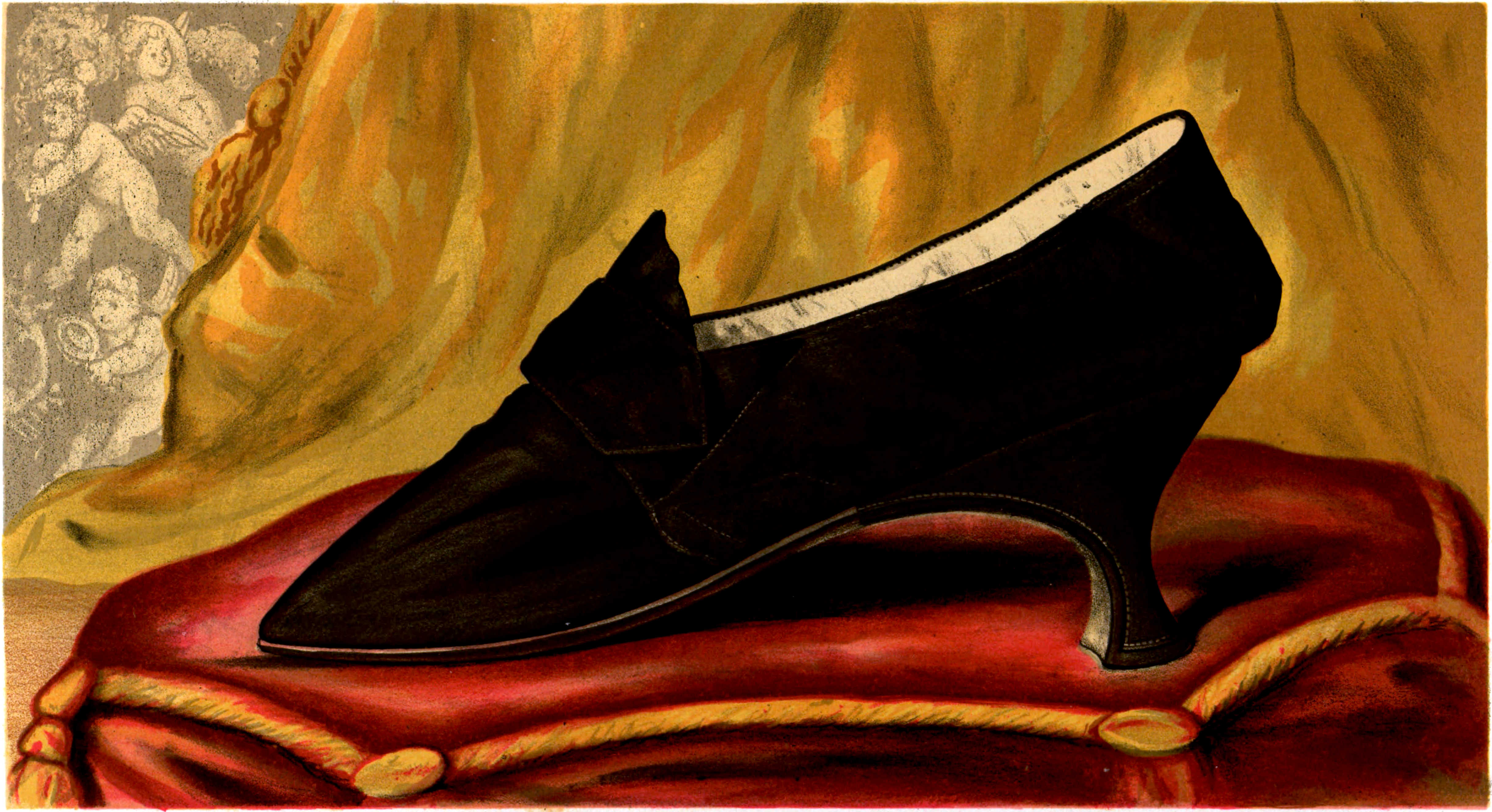
This shoe is supposed to have belonged to the beautiful and unfortunate Mary Queen of Scots. Though remarkable for the smallness of its size, it is by no means a specimen of the elaborate workmanship of former days, being made of plain black satin; the simplicity of which, however, would in all probability be relieved by a diamond buckle to fasten, as was the fashion in olden times, the straps which were made to overlap each other across the instep. It is interesting and valuable to the antiquarian on account of its antiquity, and because of the rank and historical celebrity of its quondam wearer.
I
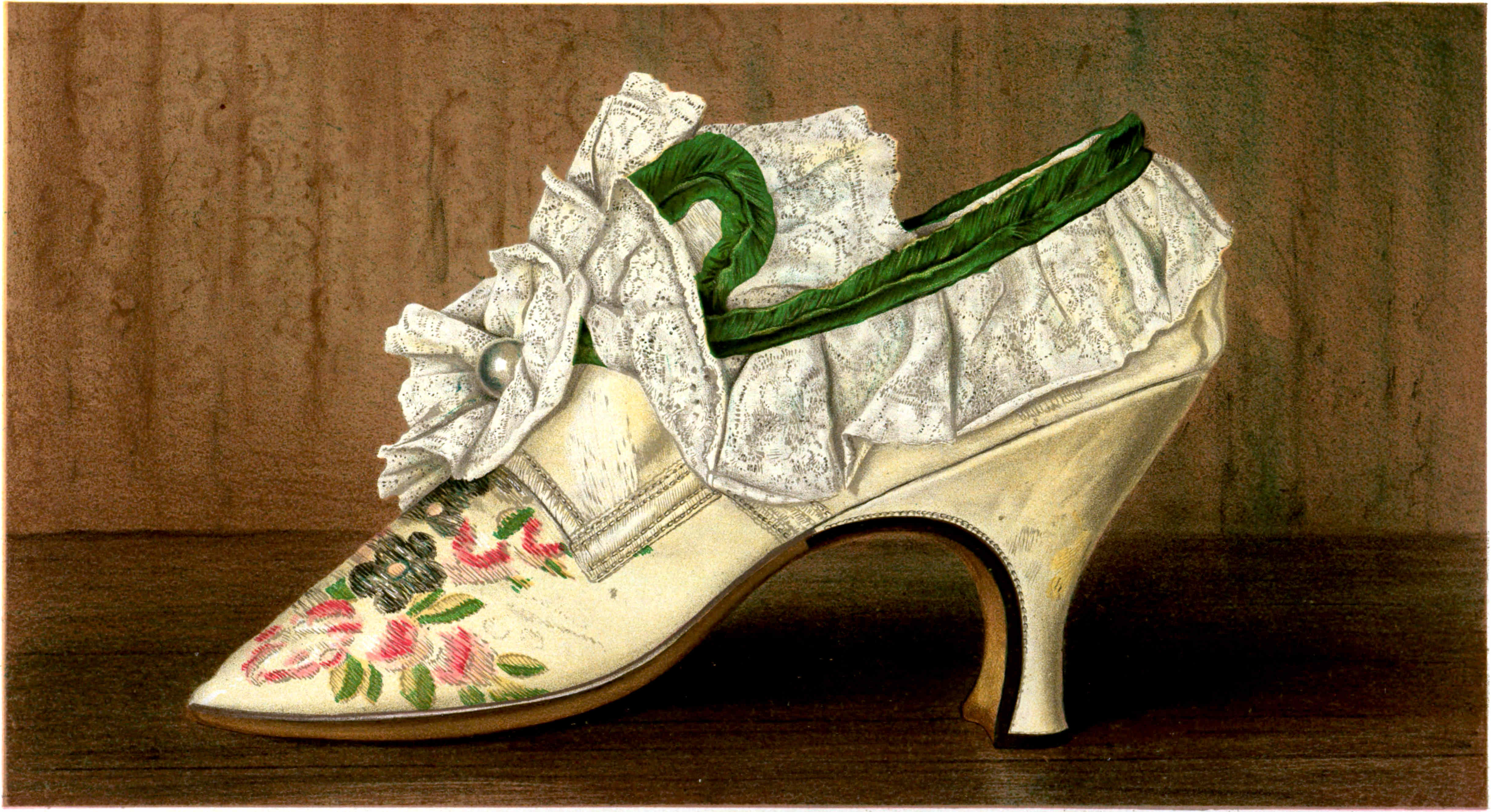
Miss Langley, to whom this shoe belonged, lived in the reign of Charles II. Made of pale silk, most beautifully embroidered, the shoe may be considered as a chef-d’œuvre in shoe manufacture of the times; while the lace, of an intricate pattern and delicate as a spider’s web, is very old and of much value. It is ornamented on the instep by a single pearl, and its tout-ensemble is altogether pretty and graceful, and says much for the taste and dexterity of the shoemakers in the days of Charles II.
II
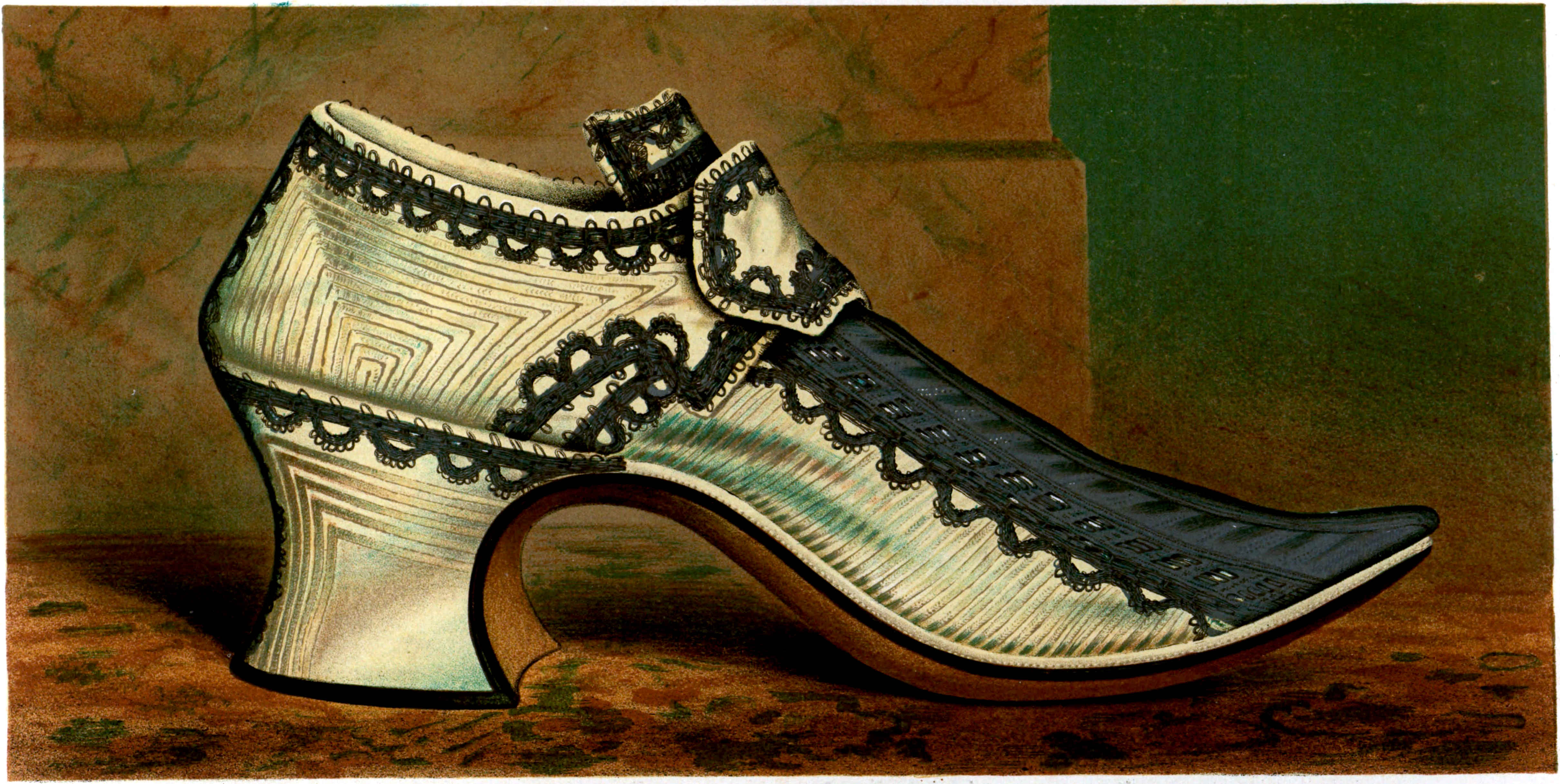
Grace, only daughter of Fletcher Norton, Speaker of the House of Commons, and afterwards created Lord Grantley, married John Charles, Earl of Portsmouth. The shoe was found amongst the effects of the late Lady Menzies of Menzies, who had received it from her aunt, and was worn by the Countess of Portsmouth with fancy dress. It is made of pale silk striped with blue, and is richly embroidered in steel. The form and style is apparently that of the last century. The inside is beautifully finished, being lined with pale pink silk and white kid; while a welt of the latter, extending in height about half an inch from the sole upwards, and in length from instep to toe, thus prevented any danger of the splitting of the material of which the shoe was made. This practice has now, for some reason or other, become impossible to the modern shoemaker. The heel is very large, and the toe pointed.
III
This shoe belonged to Anna Frances, wife of Walter Woodcock, and daughter of William Lea, of Halesowen Grange, Shropshire, by Frances, his wife, grand-daughter of Edward Ward, Lord Dudley, and Frances his wife, daughter of Sir William Brereton, Bart. Mrs Woodcock was consequently great-grand-daughter of Frances, Lady Dudley, and lived in the beginning of the last century. The stuff of which the shoe is composed is fine-spotted silk brocade of a yellowish colour, and ornamented with a pattern of pale blue silk embroidery above the toe. The shoe was worn with a buckle, has a small heel and round pointed toe.

IV
This shoe is made of lavender-coloured kid, with slashes of white satin “let in” in front, forming a pattern narrow at the toe, and widening towards the instep. The bottom of the heel is in the form of a heart, which peculiarity cannot be observed in the illustration, though perfectly apparent in the original. It belonged to Lilias, daughter of the 12th Earl of Eglinton, and was worn by her at her marriage about the middle of the eighteenth century. The height of the heel is what is worn at present, but the toe is pointed, and filled up for half an inch with wadding.

V
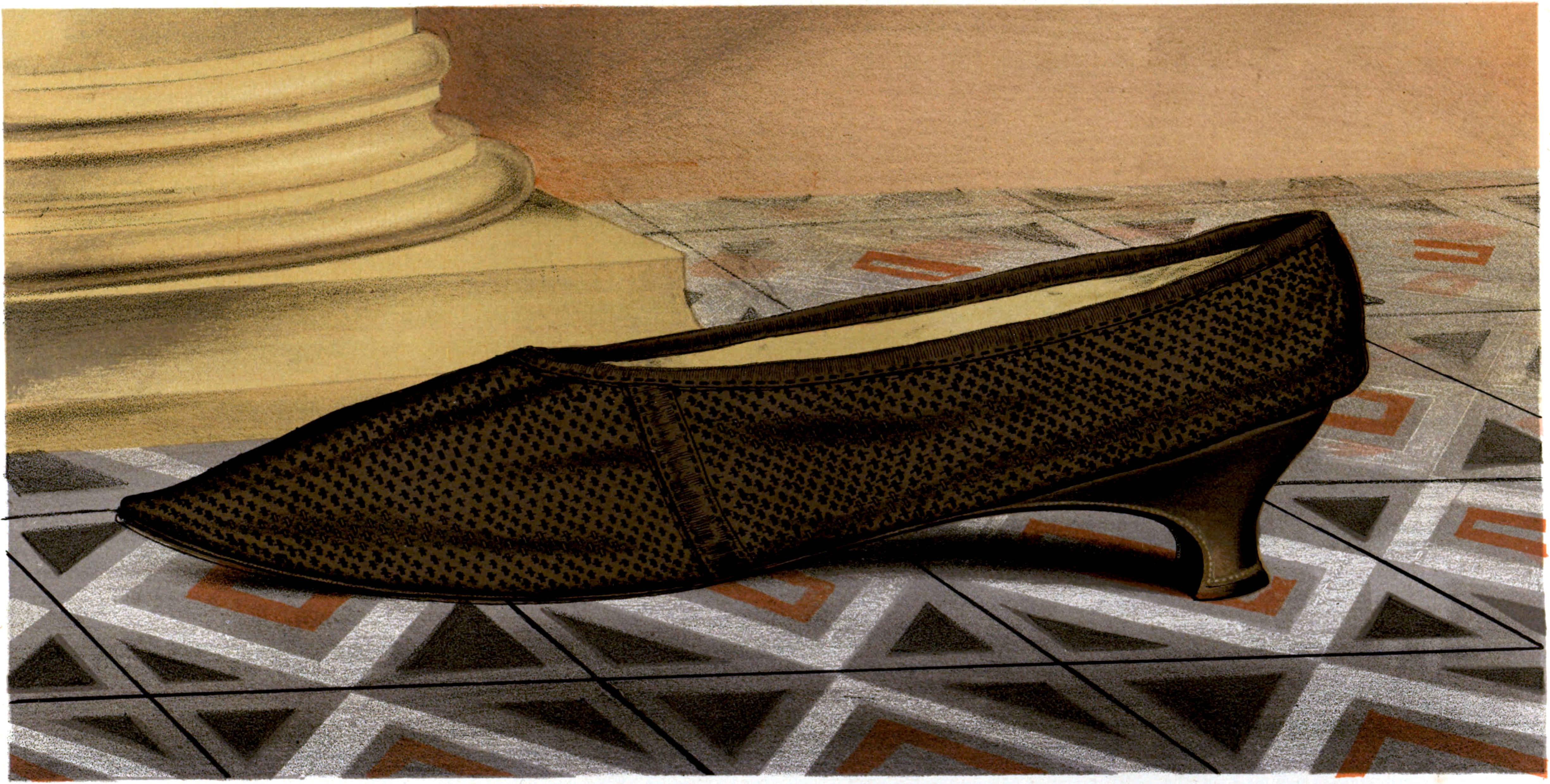
Lady Mary Mordaunt was the owner of this shoe, the material of which is closely spotted black silk. The shoe is without bow, tie, or straps, and has a plain and insignificant appearance; and its low heel makes it partake rather too much of the nature of a slipper.
VI
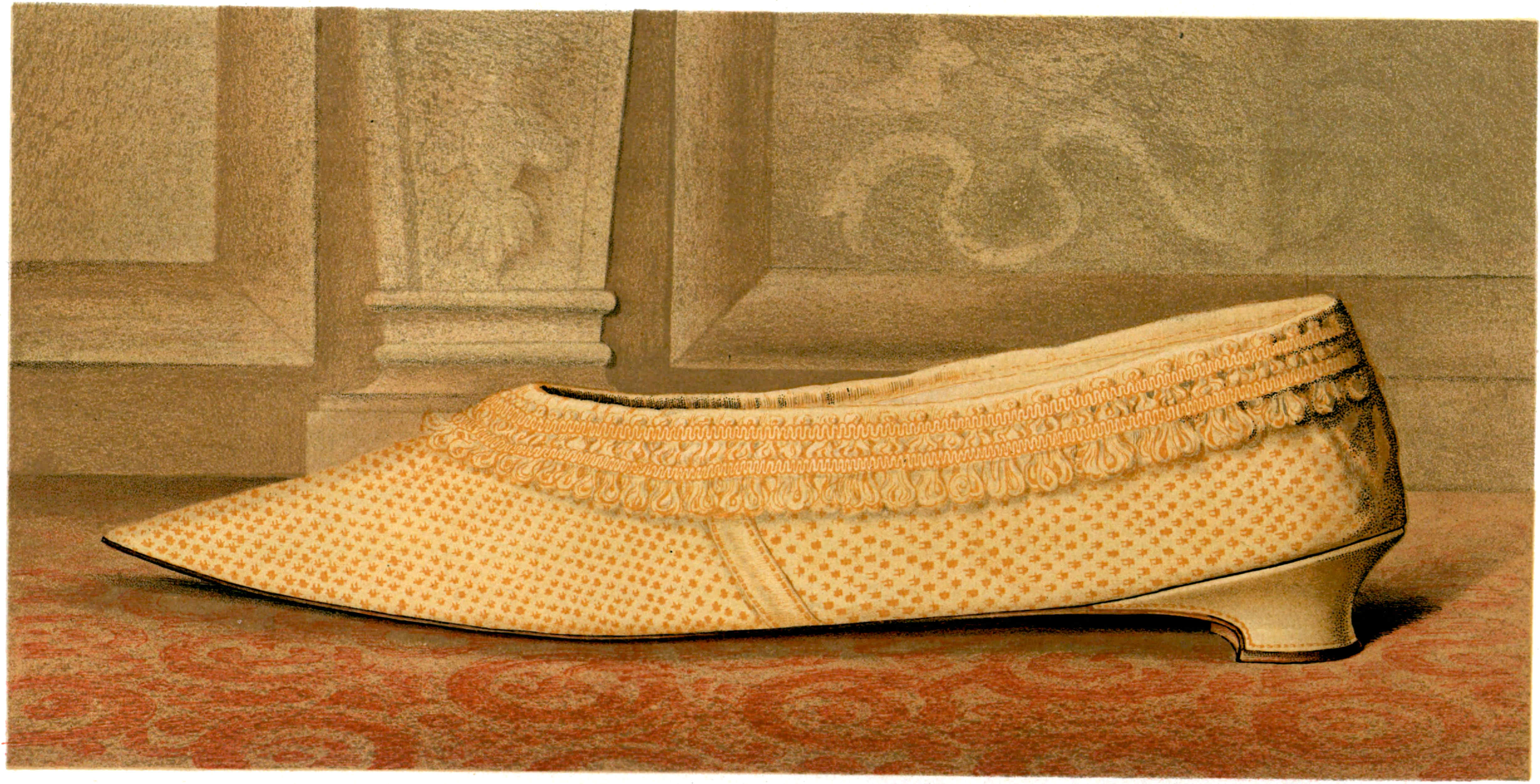
This shoe also belonged to Lady Mary Mordaunt. The material is the same as that of the black one, but its bright colour and elaborate gimp trimming transforms it into a smarter and more stylish shoe. The point of the toe is so extremely sharp and elongated, that it had to be well stuffed with cotton-wool to preserve the shape.
VII
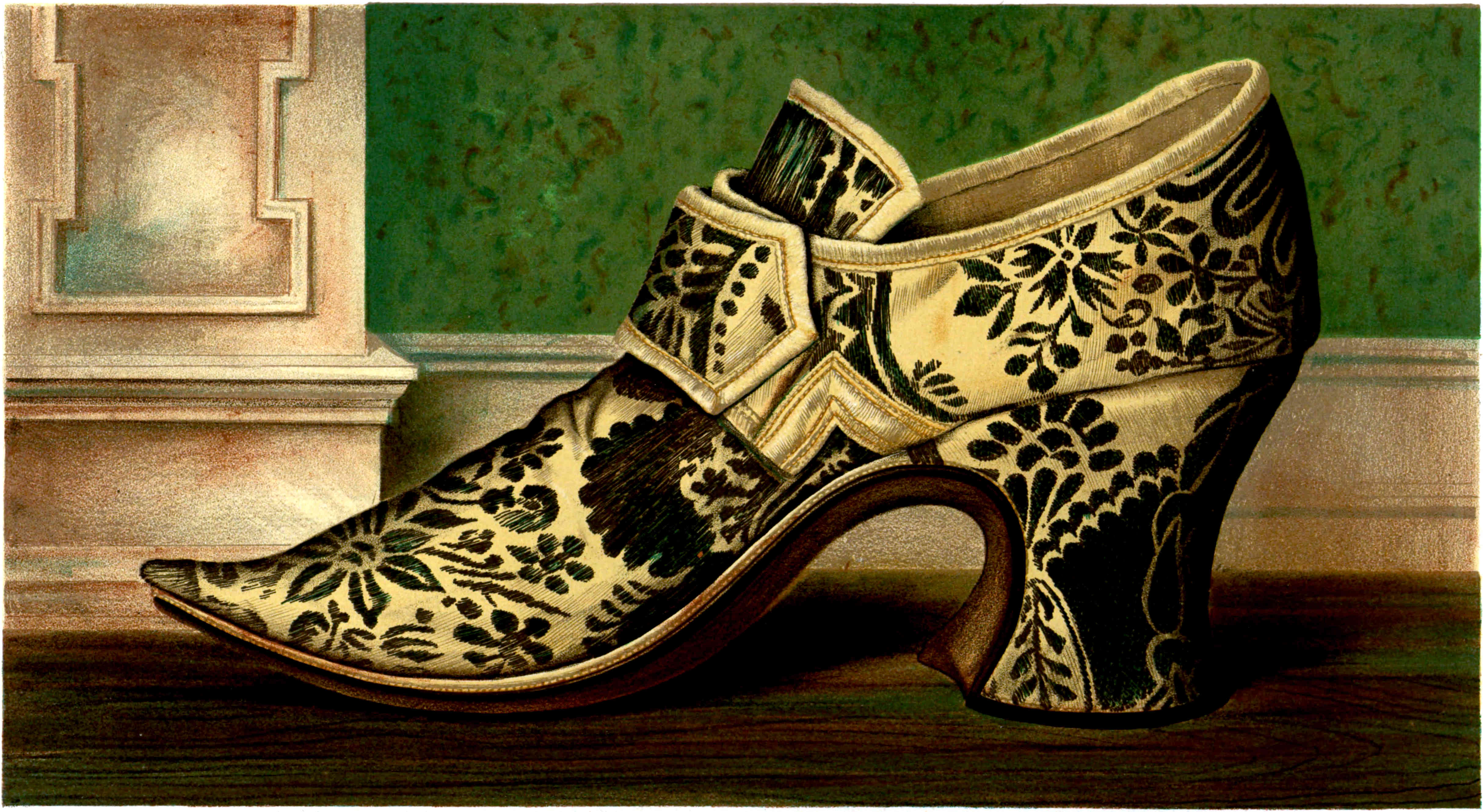
Nothing can be ascertained about Mrs Brown, the owner of this magnificent shoe, except her name. It is made of cloth of gold; of which, although for the most part the threads of the brocade are now tarnished and blackened with age, there still remain a few inches which have withstood the ravages of time, and which serve to indicate with what brilliancy and effect the chaussure must have gleamed and sparkled when fresh from the hands of the maker. This shoe was worn with a large buckle, has an immense heel and pointed toe. It dates about the time of Queen Elizabeth, and as it was procured in the vicinity of Kenilworth (namely at Leamington) may have figured at the revels and festivities there in its grand days.
VIII
From its appearance this shoe must be a very old one, but the date and name of its wearer cannot be discovered. It differs from many of the preceding ones by the fact that the heel, instead of being covered with the same material as the shoe, is formed of dark red leather. The old brocade is very rich in texture, and harmonious in colouring; and the flap above the instep is kept in place by a ribbon strap of a corresponding hue.

IX
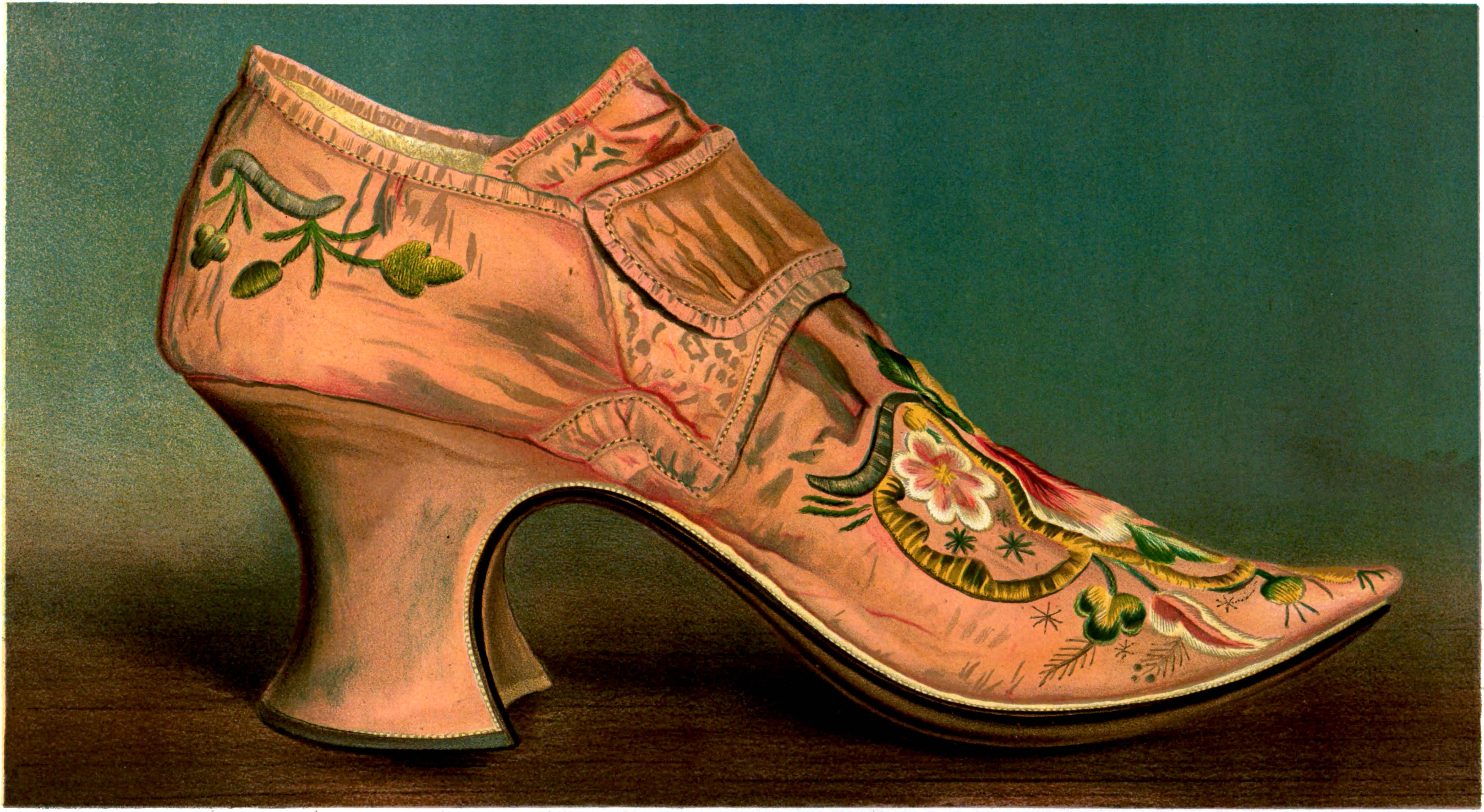
This large buckled shoe was worn in the reign of Queen Anne, though, unfortunately, the name of its owner cannot be ascertained. The material is pink silk; the embroidery in silks and metallic threads is very rich, and the colours wonderfully preserved. The heel is of an immense height and breadth, and the toe so extravagantly pointed, that it must have protruded for a considerable distance beyond the foot.
X
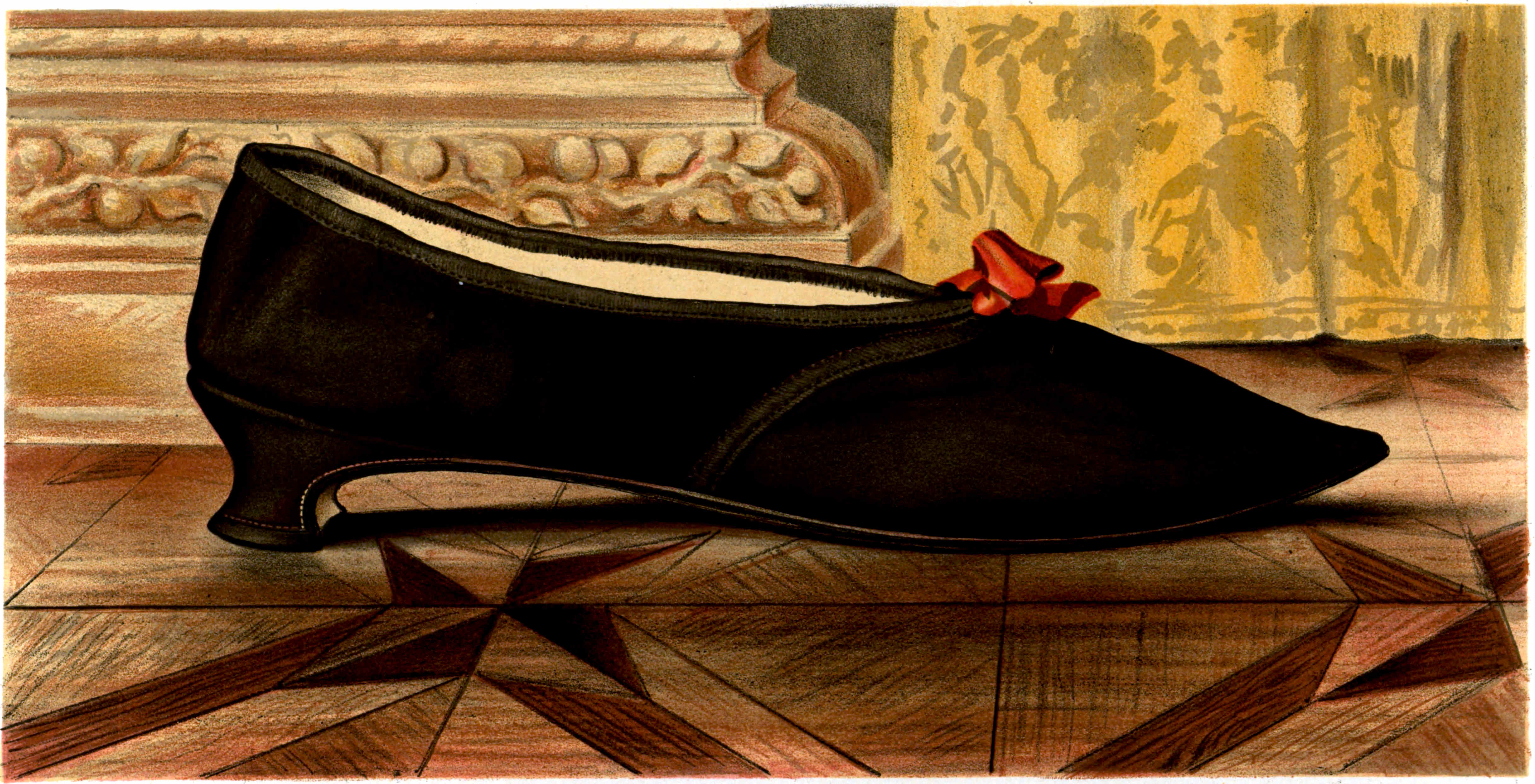
This shoe is fastened by a ribbon tie, instead of the overlapping straps with ornamental buckle. It is made of plain black satin, with the silk binding that is usual at the present day. The heel is neatly shaped, and not of such extravagant height as that of other shoes of a corresponding date, probably about the middle or end of the last century; toe pointed.
XI
The following is an extract from “Fashions Then and Now,” by Lord William Pitt Lennox:—“From caps we descend ‘au pied.’ We have seen dancing-shoes four inches in height at the heel, shoes of no measure, some as broad as a tea-cup’s brim, some as narrow as the china circle the cup stands upon. While upon the subject of shoes, I may remark that some sixty years ago fashionable ladies turned ‘cordonniers,’ and having purchased a wooden last, tools, leather, soles, silk, satin, and prunella, furnished their evening ‘chaussures.’ So long as the wearers remained in-doors, or drove out in a carriage, all went well; but when these articles, ‘warranted’ (as the cheap bootmakers announce) to be made at home, were put to the test in the promenade or ball-room, the chances were ten to one they would not stand the wear, and that a heel or ball of the foot would obtrude.”
1. Series of Specimens of Ornamental Shoe-Buckles of the 17th and 18th centuries.
2. Pair of Jack Boots as worn in the middle of the 17th century.
3. Sandal, dug up in the Magdalen Yard, Dundee, Forfarshire.—A. Sutherland, 1827.
4. Old Celtic Shoe, with open-work, found six feet below the surface, near Callander, Perthshire.
5. Soles of Shoes, found in the “Moray Vault,” under St Giles’ Church, Edinburgh.—A. Ritchie, 1837.
6–11. Ladies’ Shoes, viz.:—(6) High-heeled Shoe and pair of Clogs, as worn in the middle of last century; (7) High-heeled Crimson Satin Shoes, with plated buckles—George Sim, F.S.A. Scot., 1863; (8) Pair of Sky-blue Satin high-heeled Shoes, with buckles; (9) Pair of Black Satin Shoes, high heels, with ribband tie; (10, 11) Two Pairs lemon-coloured, sharp-pointed, high-heeled, Kid Shoes, with ribband rosettes, worn in the beginning of the present century—Dr John Alexander Smith, F.S.A. Scot., 1861.
12. Pair of Rivlins, or Shetland Shoes of untanned hide.—Gilbert Goudie, F.S.A. Scot., 1873.
13–16. Shoes of Satin and Embroidered Work.
The collection of foot-gear at Cluny is full of interest not only for artists, archæologists, and ethnologists, but for every student of human nature. Originally formed by the eminent French engraver, the late Jules Jacquemart, it was acquired by the Musée de Cluny in 1880. Further enriched by the purchase of the collection of Baron Schvitter, it is in every respect unique, not merely in its subject-matter, but because it is at once very choice and singularly universal. Here are not only examples of boots and shoes from ancient times, the Middle Ages, the Renaissance, and every period since, but boots and shoes from every quarter of the globe.
BOOTS AND SHOES.—I.
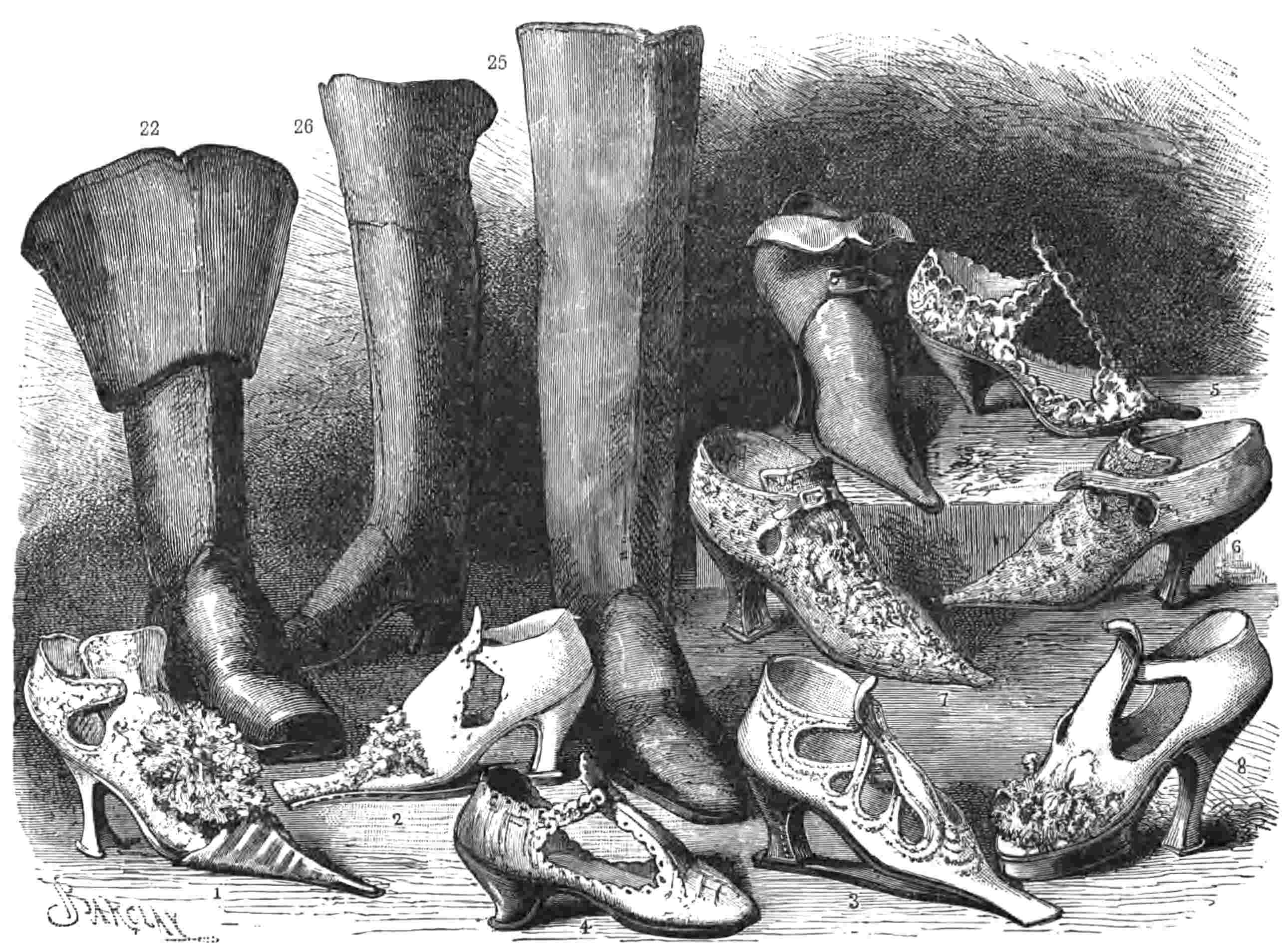
The chief interest naturally centres in that portion which is most complete, and which illustrates the female fashions that have prevailed in France and Italy from the time of the Valois to that of the First Empire. One of the earliest examples is a female shoe of the age of Henri II. (1). It is of white stuff, ornamented on the instep with a large rosette of silver lace and a long metal point of gilt copper engraved in chevrons. The heel is so enormously high, that the lady must literally have stood on her toes. The long metal point is a remnant of a fashion which prevailed from the Eleventh to the Fifteenth Century, and which, though stigmatised by the bishops as immoral and impious, and moreover rendered illegal in France by royal decree, and in England by Act of Parliament, refused to do more than retire into temporary banishment, reappearing in the reign of Louis XI. under a form more offensive than ever. This was the long-peaked shoe, called in France the chaussure à poulaine, from the resemblance of the point to the prow of a ship. William of Malmesbury attributes its origin to a certain follower of William Rufus, and evidently regards it as part and parcel of the disgraceful morals of the Anglo-Norman court. In France it is traced back to Geoffrey Plantagenet, father of Henry II. of England, who is said to have had a great excrescence at the end of his foot, obliging him to wear a peculiar form of shoe. The cordwainer appears to have hit the public taste; for the Plantagenet shoe at once became the fashion, and every one wore a long point, which gradually became elongated to two feet, and had to be attached to the knee by a metal chain. Its full proportions, however, were confined to princes and great nobles; lords and very rich people were permitted to wear toes a foot long, but the middle-class might not exceed six inches. These protuberances were embroidered and trimmed with lace, the ends being shaped like a horn, a claw, or some other grotesque point. This prevailed until the last quarter of the Fourteenth Century, when the fashion gave way to a kind of slipper with a very broad toe just rounded off. But in another hundred years the peaked toes reappeared, and this time men wore points of iron a foot long, through the end of which a chain was passed, so that they were held aloft in the air. The same fashion appears to have obtained in England, for Camden speaks of “shoes and patterns being snowted and piked more than a finger long, looking upwards.” And here in this shoe we have evidence of a lady as late as the days of Henri II. wearing a long metal point. When we find such remarkable persistency in a fashion apparently unreasonable, we suspect that in some way it peculiarly expressed the spirit of the latter Middle Ages. In the shoe before us, the union of the high heel with the peaked toe produces a foot which very truly represents a court in which the men were satyrs and the women sirens.
The next female shoe of interest comes from the wardrobe of Catherine de Medici (2). The long toe has lost its point, and developed into something like a duck’s bill, covered as far as the instep with a piece of silk, on which are worked rosettes of silver lace placed so close as to give the appearance of a metal surface. This shoe is made of white leather, and seems to have lost its ornamentation. Both this example and another of the Sixteenth Century (3) are peculiar in having soles which connect the toe and the heel in the form of a patten. The second is made of white leather, and cut out lozenge-wise with eight thongs, which unite in a central one going up the instep; the heel is painted red, and made of leaves of leather pressed together. The most reasonable shoe of the Valois epoch, and indeed of the whole series from the French courts, belongs to the time of Henri III. (4). It is made to the natural shape of the foot, and has a heel of moderate height. Of fawn-coloured leather, it is cut out at the sides in large lozenge-shaped openings, and fastened by two straps, which spring from the neck and embrace the central thong, the edges throughout being scalloped, and the shoe embroidered with fine blue.
No specimen of woman’s wear under Henri IV. is given, but to judge from a child’s shoe, the same fashion prevailed as that last illustrated. With Louis XIII. the high heels and pointed toes reappear. An Italian example (5) of this date resembles the Henri III. specimen in its open sides, its scalloped edges, and its method of fastening; but the toe, tending to a point, ends in a fine duck’s bill. The heel is painted red. A German shoe of about the same time is tasteful, but more domestic. It is of grey kid, embroidered on the upper with a bold design in black silk. The toe is pointed and slightly raised; and the heel towards the centre of the foot is painted pink.
We now come to the Ludovican period, the early part of which coincides with that of Charles II. of England, a period whose extreme frivolity and heartlessness are well expressed in its costume. What can be more tasteless than the specimens (6, 7, 8) we have engraved of the fashion of Louis XIV., with their hard shapes, their crude glaring colours, and the recrudescence of the peaked toe? The heels have again risen enormously, and turn the foot into the cloven hoof of the early Valois period. The first is of damask, embroidered with white, blue, and silver, and fastened with narrow straps: it is elevated on a very high narrow heel, widening out at the base. The second somewhat reproduces the shoe of Henri II.: the wearer must have stood on her toes. The material is of yellow silk, embroidered from top to instep with a tasteless covering of silver lace; the very high heel is in red morocco; it is fastened just below the ankle with a strap and buckle. If these two shoes show how the art of the Renaissance had declined in France, the specimen from Italy of the same period (8) is even worse. One can hardly believe that such a shoe was made for anything but a goat. Thus shod, it is difficult to imagine how any creature less sure-footed could maintain its balance. The toe is ornamented with rosettes in cerise and yellow ribbons.
The Regency (1715–1723) is represented by a boot (9) which, apart from its high heel, shaped like a barber’s wig-stand, would not be very ugly. The front is even graceful in its lines, the flying flaps giving it a floral appearance. The next series, belonging to the reign of Louis XV., cannot be denied a certain piquant grace. Later on I shall have to remark the singular resemblance between the typical form (10) of this reign and that prevalent in Mohammedan countries and in Japan. Only, the beauty observable in Oriental and African specimens, due to innate harmony, is here destroyed by the elevation of the shoe on pegs to a height which gives it the appearance of springing from the middle of the foot. In one example, the whole form of the shoe, even to the treading down of the heel, is Oriental; but, perched on its stand, it has exactly the form of an old coal-scuttle (11). These pegs, it would seem, were helpful in dancing, for Gay writes in his “Trivia,”—
The slippers of this period are also quite Oriental in character, being merely a sole covered luxuriously at the toes.
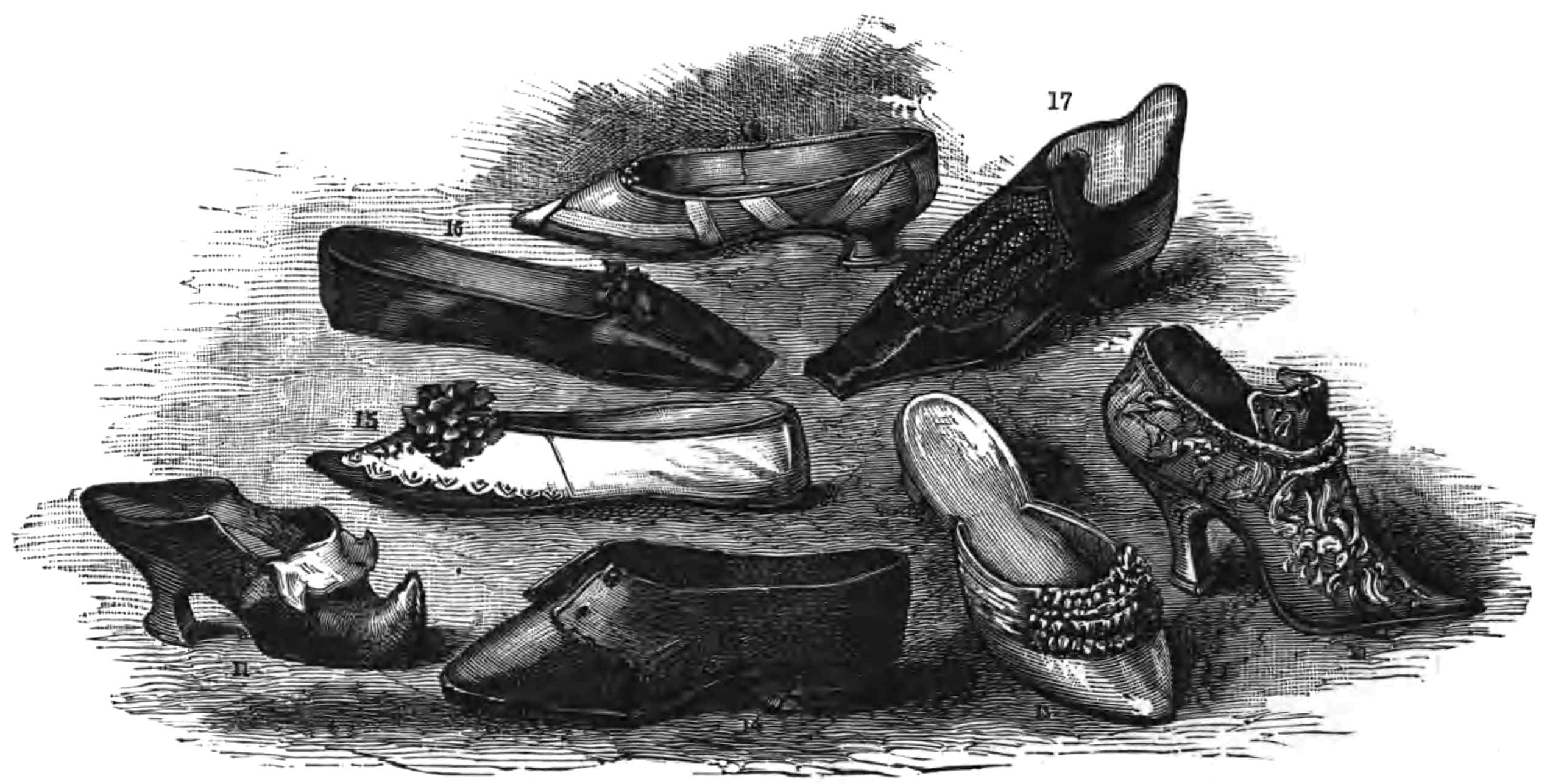
The Louis XV. shape prevailed in the early years of Louis XVI., but gradually gave way to a more natural and sober fashion. Among the earlier specimens is a shoe which appears to have been worn by the ordinary public. It has still much of the old style, but its proportions are very modest. The covering is black spotted silk, with a sort of puff-ball ornament over the toe, also in black silk. The pointed toe continued some time, but the heel got flattened and began to recede into its normal place. A specimen of this period is a slipper (12) said to have belonged to the unfortunate Princess de Lamballe. It is sharply pointed, but delicate in form. The material is pale green silk, set off with yellow ribbons. But the shoe that must be considered typical of the reign of Louis XVI. has a very low heel, and a toe which, at first oval, becomes what botanists distinguish as ovate. The collection affords several examples of this gradual change in the shape of the toe, commencing with a very obtuse point, which in the end is quite lost. The specimen engraved (13) is an extremely pretty slipper in green morocco, with a red heel and a double ruche of red taffetas.
BOOTS AND SHOES.—II.
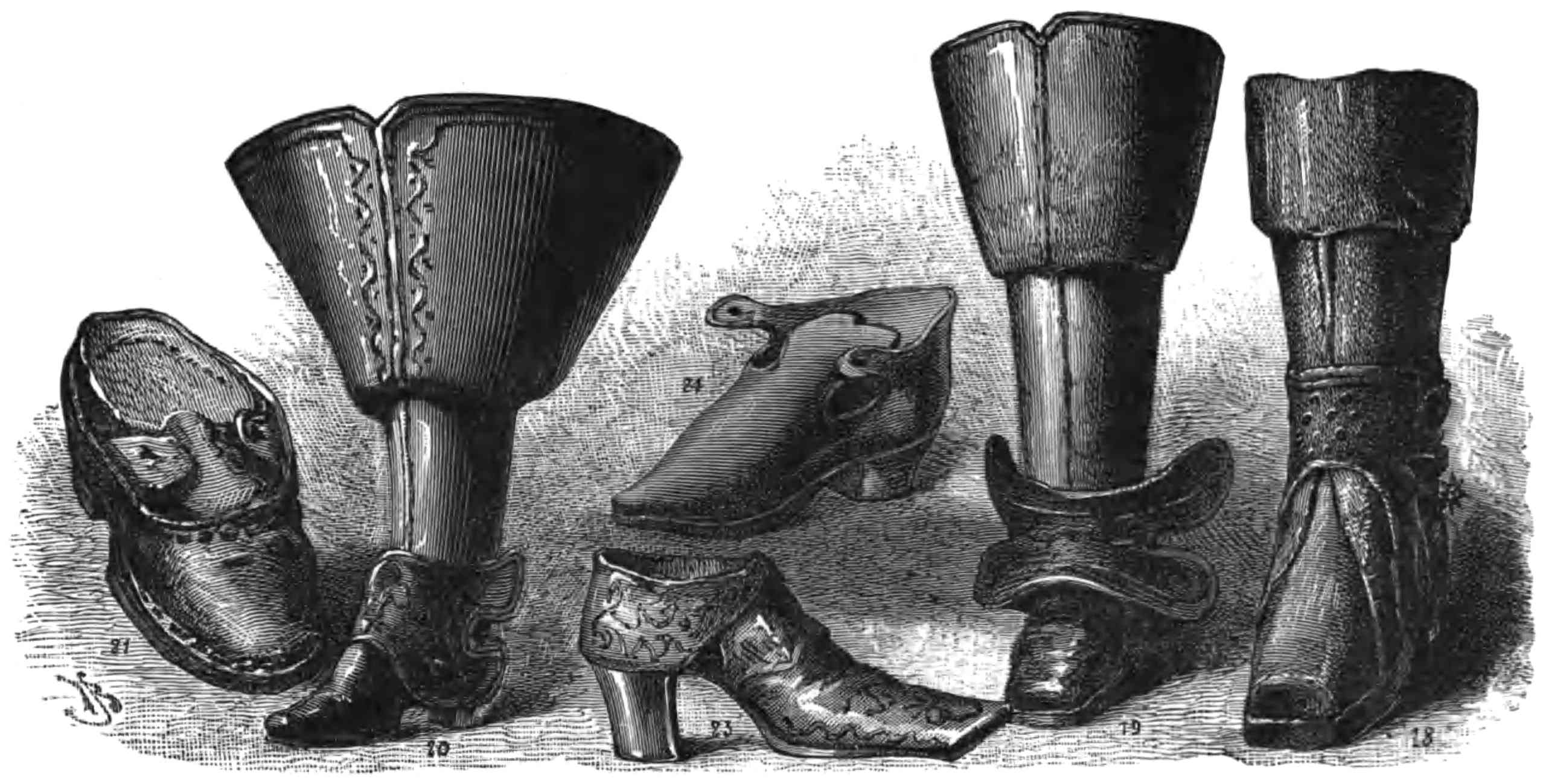
These dainty shoekins must begin their last dance, and many will be whirled away in the tumbrils. The galleries of Versailles and the Tuileries resound with the noisy tread of the daughters of the people. M. Jacquemart has wisely preserved a specimen of their foot-gear (14). It is oval-toed, with a flap on both sides of the instep; the front, opening slightly, is tied by a narrow ribbon, as also the flaps could be if required, there being holes pierced for the purpose. The heels are painted red. Then the Republic gives place to the Empire, and one of the first changes in fashion is the reappearance of the pointed toe. Otherwise, the shoes affected during the Consulate and first days of the Empire are in the antique taste. The shoe we give (15) is in pearl-grey linen, with a very restrained ornamentation in green silk; it might have been worn by the women of Etruria. Born of republican admiration for Greek and Roman liberty, the fashion soon passed away, and a singularly dull mode set in. The specimen from the Empress Josephine’s wardrobe (16) is indicative of the bourgeois character of the imperial court. This fashion of neat, square, low-heeled shoes prevailed during the Restoration with both sexes. From 1820 we get a man’s evening dress shoe of varnished leather (17). The instep is cut away, and the opening made to represent an embroidered stocking by a tracery of black kid on white leather. Between this and the wear of Louis XV. there is a great lack of male foot-gear. This is to be regretted, as a number of interesting boots and shoes occur in this period. We should have the various military boots under the Empire, especially the Hessian boot so common in the early part of this century, and which in England was not quite given up until the Wellington supplanted it. If it be true that Bonaparte’s lack of boots kept him out of India, and led him into the jaws of temptation, the boots in vogue in 1795 may be regarded as historic, and ought to be represented in a French collection. We should like also to see a specimen of the pumps of the Directory, and the top-boots of the Revolution, an outcome of that Anglomania which was one of its early symptoms. But with the exception of a small boy’s boot of the age of Louis XVI., we get nothing in the way of male foot-gear until we come to a postillion’s boot (18) of the time of Louis XV. To the same period probably belongs a long flexible boot in shagreen leather, made to completely cover the leg. It was tightened by means of buckles at the top and below the knee.
Of the age of Louis XIV. we have three remarkable boots with funnel tops—imperious, adventurous, impressive. One is an example of the bellows boot, the botte à soufflet; another of the cauldron boot, the botte à chaudron (19). The latter has a singular appendage round the ankle. The piece which held the spur is a sort of double flap, apparently very inconvenient for riding or walking. The former is a handsome boot, the leg being made square rather than round. The third (20) is carefully made, with a top so enormous that a man could hardly wear a pair without straddling. This is the more likely as the foot is remarkably small. Evidently it belonged to some petit maître of the court of the Grand Monarque. Compare it with our next, of the same period (21), and you have a vivid idea of what it cost humanity to produce the pretty little furbelowed Louis Quatorze seigneurs.
The Louis Treize boot (22), included in our first group, differed little from the botte à soufflet just described, except that the heel was higher, and that the upper part fell back more upon the leg. Of the same period is an historical shoe (23) which belonged to the godson of Henri IV., the unfortunate Henri de Montmorenci, beheaded at Toulouse in 1632. It is of ordinary leather, very long, with a square flat toe; the upper is adorned with a fleur-de-lis, and on the band are the initials of the duke, surrounded by arabesques. It is interesting as showing the fashion of the courts of Louis XIII. and Charles I. Among other very singular shapes of the Seventeenth Century is one described as of Flemish origin. Perhaps the others are of the same fashion. Whether they are simply bootmakers’ freaks (28), or appertain to any particular class, I cannot say. They appear unique, and they may possibly be dated two or three centuries after their time. They are dated 1752; and as they are more easily pictured than described, I shall return to them on a future occasion. Of the Sixteenth Century we have a tall pair of military boots of the reign of Henri III. (25), fitting close to the leg, and having a low heel and rounded toe. A similar boot is the great Spanish boot of the age of Philip II. (26). It is made in three distinct parts, and nearly covers the whole leg; the heel is wedge-shaped. It reminds us that one who was often arrayed in such foot-gear, the victor of Lepanto, Don John of Austria, was believed by some to have been poisoned by means of his boots. Brantôme, who tells the story, says, “It is generally held that he (Juan d’Autriche) died poisoned par des bottines parfumées.”
A Bohemian legend represents the illustrious dynasty of the Przemysl, which for six centuries reigned in that land, as founded by a labouring man whom Queen Libussa took from the plough that he might be her husband and the chief of the people. That her descendants should not forget their rustic origin and the duties it imposed, she caused the great peasant-shoes their father had worn to be preserved; and they were bequeathed to the son who succeeded him on the throne. Certain it is that there is no article of dress so intimately associated with a wearer’s personality as his shoes. Those frightful souliers à vilain (21) of which I spoke in a previous part of this paper threw a light on the old régime. The spirit of the gaunt and wretched peasant who for long ages bore the burdens of royal and aristocratic France peered grimly at us through their eyelets.
BOOTS AND SHOES.—III.
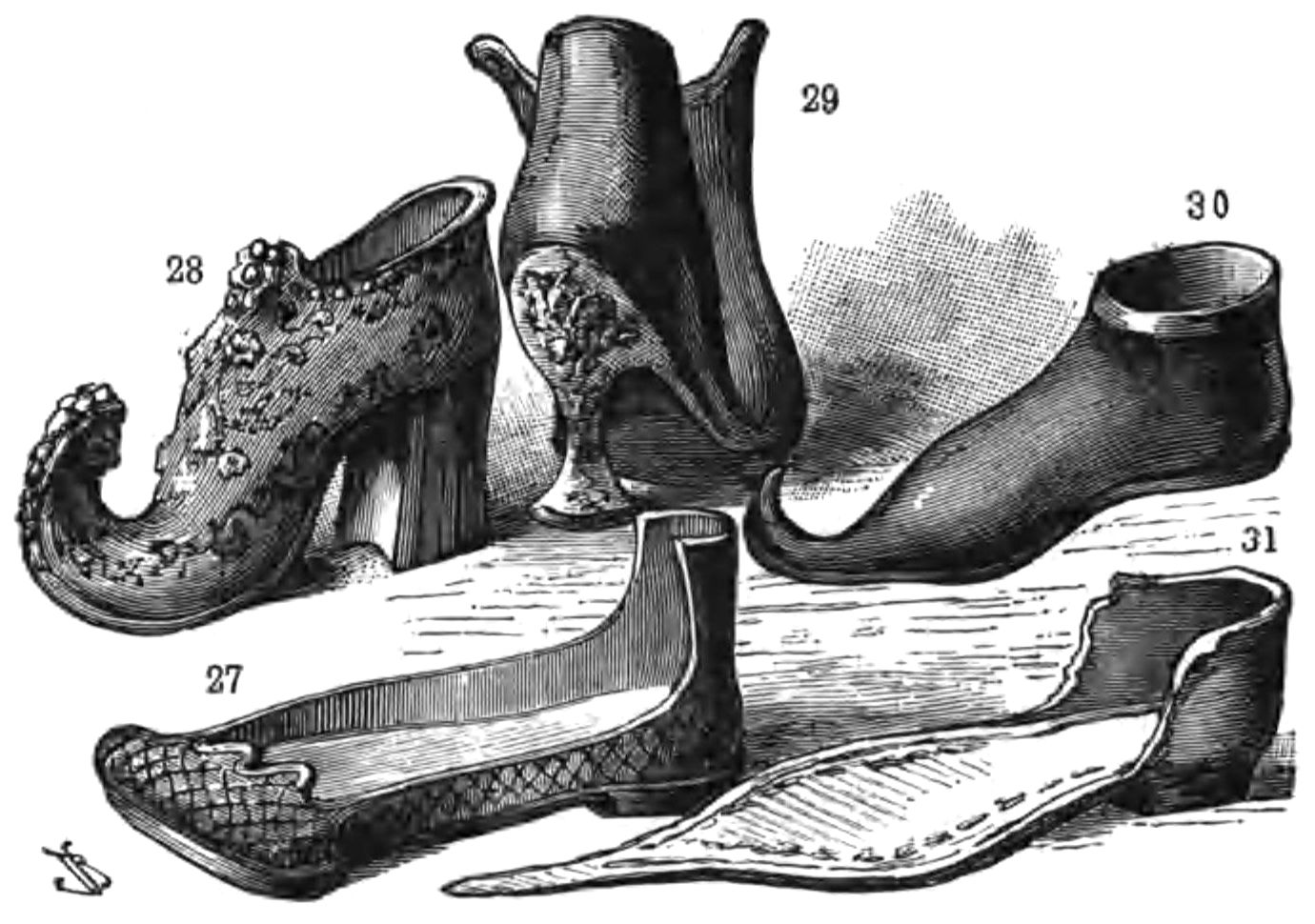
The four oldest examples of European foot-gear at Cluny are boots and shoes worn by the bourgeoisie, or poorer classes. A Flemish shoe depicted in the third illustration (24) belongs to the Sixteenth Century. It was found in the storehouses of the hospital at Ghent, and dates from 1530. It affords an example of the foot-gear worn by the martyrs of religious liberty and social equality in the great struggle of which Motley has recounted the partial victory. Perhaps one of the most curious examples of foot-gear is a carefully made specimen of German shoe of the Sixteenth Century (27). The toe seems intended as an emphatic protest against the long peaks; it is in the fashion of a turnover, and spreads out on both sides far beyond the width of the foot. The outside is stamped with a lozenge pattern, the inside with flowers and threads. From two specimens at Cluny (28 and 29), it would seem as if the broad-toed German shoe ran at times into the extravagances of the pointed shoe. The wear numbered 28 appears at Cluny in two materials: in leather and in wood. In a previous reference to this extraordinary shoe, I suggested that it was perhaps only a bootmaker’s freak; but I have since met with a shoe similarly shaped, minus the heel, on the foot of a German court-jester of the Sixteenth Century. The other quaintness (29) is dated 1752, and is said to be Flemish. The heel and hind-quarters are of the same fashion as the foot-gear of the time of the Regency in France; the extraordinary elongation is in harmony with the tendency of the fashion of the middle of the last century, but is too extreme to permit us to believe that it was made for serious wear. A still older specimen (30) is a little German shoe of the first half of the Sixteenth Century, which proves that the chaussure à poulaine had not then died out in Germany. The beak rises and curves backward; the ankle is adorned with an engraved copper ring. This prepares us for the oldest specimen of all (31), a chaussure à poulaine of the Fifteenth Century, of which nothing remains but the sole and the heel leather. This shoe, of which the hinder part is made of red morocco, may be completed from a figure given in Fairholt’s “Book of Costume” (p. 450), depicting one of the “long-peaked shoon” found in a mediæval rubbish-heap upon which some excavators came while digging deep in Whitefriars. This, with the exception of the long toe, was very like the cloth boots lacing at the sides which ladies wore not many years ago.
The first obvious impression produced by the Cluny collection is that Boots and Shoes, occupying to the rest of the human apparel much the same relation that the labouring classes do in society, are, like their human antitypes, extremely tenacious of old forms, and never alter except under the energising influence of Christian civilisation, and even then only repeat through various stages the changes between the pointed and square toe. This impression would be sustained by any other collection of foot-gear, special or general. There is, for example, a case of Roman shoes in the Guildhall Museum, in which there is a woman’s half-boot so nearly resembling those worn in our own times, that it would be very easy at the first glance to doubt its authenticity, and to imagine it nothing more than an English roadside relic, the cast wear of a modern tramp.
Mediæval chroniclers trace back the peaked shoes to individual necessity, or the whims of an impious court; but we have found the twisted pointed toe as early as the Ninth Century, and existing both in Italy and Germany long before Fulk suffered from bunions, or the Red King’s courtiers indulged in base and worthless eccentricities. It is less doubtful that the pointed shoe turned back on the instep is a fashion universal throughout the East and Northern Africa, and that it has been so from ancient times. I have grouped on Fig. VI. (page 8) a number of specimens shown at Cluny: from India, ancient and modern, Persia, Africa, China, Annam, Albania, and Lapland, showing how general the fashion is, and how similar are the forms it takes in lands remote and strange. From these examples it will be seen how very slight is the difference in form between the shoes worn by the ladies of the court of Louis XV. and those of Algeria and the far East, the advantage in true beauty and grace being entirely in favour of the latter.
BOOTS AND SHOES.—IV.
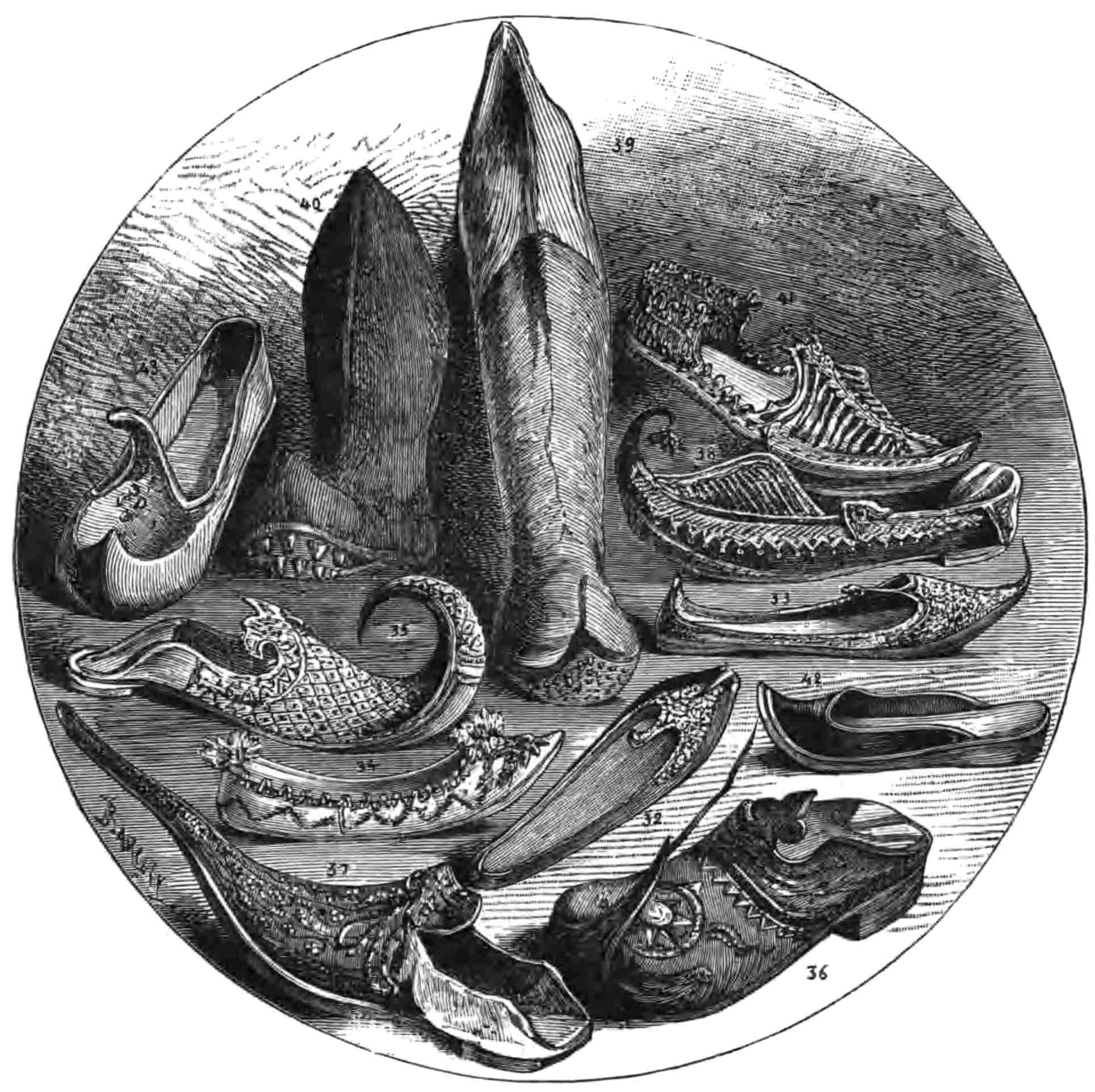
The epithets of pretty and piquant are appropriate enough to some of the shoes in the European collection; but for pure elegance we must go to Hindoo and Mohammedan lands. In the small case of Indian shoes at Cluny there is more than one pair of shoes that will tell us why the story of the Glass Slipper took such a hold on the Oriental imagination. The exquisite form of one (32) suggests Cinderella; the pure and beautiful lines of another (33) render it worthy of the foot of that noblest among the types of female character, brave Seventee Bai. The first has a linen upper, embroidered with silver thread and spangles; the second is embroidered with gold, except the curious little tongue on the instep, which is minutely ornamented with gold and silver, mingling with the glittering shards of insects. A boat-like slipper (34) from Northern Africa is also extremely elegant and delicate, and looks light as an eggshell, which it nearly resembles in colour. This appearance of lightness is enhanced by an ornamentation of puffs in white and rose-coloured silks. Boots are little used in India; even the native soldiery wear shoes. In Mohammedan countries, however, boots are women’s wear. Thus at Cluny there is a pair of women’s half-boots of yellow leather finely cut, and so arranged that the toe-piece and sole look like an over-shoe. This recalls the description in “Eothen” of those “coffin-shaped” bundles which stand for a Mohammedan lady taking a walk with her servants. “Painfully struggling against the obstacles to progression interposed by the many folds of her clumsy drapery, by her big mud boots, and especially by her two pair of slippers, she works her way full awkwardly enough, closely followed by her women-slaves.”
The use of the boot marks a conquering race. In mediæval Germany it was forbidden to the serfs; and this explains why, when they rose for justice after ages of oppression, they chose for their cognisance and standard of defiance a great peasant’s shoe, whence their Confederation was known as the Bundschuh.
It has been suggested to me that the origin of the pointed shoe is to be found in the mediæval horror of witchcraft. Thus, a writer on Bavarian superstitions says: “As the twelfth hour struck came the witch, but she could do nothing against the servant, who had taken the precaution to have shoes with the points upwards.” I have a more utilitarian theory. Of the Indian shoes at Cluny two have been engraved. In the modern Indian wear (35) the peak has become merely an ornament, but in the older fashions (36) its use is plain. The point is so long, and of so soft a material that it must have been attached by some means to the instep. A shoe from the Punjaub (37) and one from Persia (38) suggest that it was designed to prevent the foot from kicking up the dust, peculiarly unpleasant in hot countries. The name given in the Middle Ages in France to the peaked shoe was suggested, as I have said, by its resemblance to the prow of a boat; but here in Persia we get shoes which look like little models of boats. Our example only wants a mast and sail, and you might imagine it lying in some Oriental river. The pointed toe, then, comes from the East, and its origin was a simple necessity of common life. Fashion, ever ignorant and careless, elongated it into an ornament beautiful or barbarous, or reduced it to a mere rat’s tail, as it appears in some Persian boots (39). Or, doing away entirely with the strap, Fashion left it a curved point, as in the Chinese military boot (40); the curious shoe from Southern Albania (41); the pretty slipper from Cochin-China or Annam (42), and the comfortable shoe from Lapland (43).
Shoes in India are only worn by the higher classes, and among a few of the lower castes. This habit of going shoeless seems to render the toes of the Hindoo foot almost as lissom as fingers. A blacksmith with a piece of iron to file fixes it between the jaws of a small pair of tongs, grasps them between the toes of both feet, and holds them so firmly that he is able to file with all the strength of his arms. As he works sitting on the ground, he occasionally stretches out a leg, and picks up some article which happens to be beyond the reach of his arm. Such a workman’s foot tends to assume the character of a hand; not only does the great toe become prehensile, but there is an actual enlargement of the distance between it and the other toes.
To go barefooted in India must at times be a positive luxury. The higher classes in some parts wear no stockings, only covering their feet with white embroidered slippers. The colour of Oriental shoes appears to be of importance, indicating, I suppose, the rank and caste of the owner. Red and yellow are the favourite hues, the sole being often red, or black tipped with red. Yellow is the Mohammedan colour. An old writer tells a story which seems to show that it was jealously protected as the distinctive mark of a Turk. Some charitable persons having given a Christian beggar an old pair of yellow slippers, the unfortunate man’s feet caught the Sultan’s eye: his explanation could not save his life. While the Turks of that day wore yellow slippers, the Janissaries were obliged to wear red shoes. Another Oriental traveller in the early part of the Seventeenth Century expresses surprise at finding green the favourite colour for boots and shoes in Persia, inasmuch as in Turkey it was quite unlawful. This is the colour of the great Persian boot (39) in my engraving.
BOOTS AND SHOES.—V.
I have remarked upon the formless square-toed shoes of the Empire. We meet the same uncomely shapes in the shoes worn by the women of Manilla in the Philippines, and in those which come from Mexico. The latter are entirely in open-work, and made of vegetable silk. It would be interesting to notice how far a flat broad-toed shoe is indicative of societies formed or existing under repressive rule, religious or political, and how far the pointed shoe bears witness to a state of things tending towards dissolution and social anarchy. From Mexico we pass naturally to the shoes of the Red Men. The mocassin is the simplest form of shoe, being a wrapping of leather or cloth fitted to the foot, and more or less beautifully ornamented. These shoemakers did not expect the foot to suit itself to the shoe, but modelled the shoe to the foot. This is as much as to say that they had the idea of rights and lefts. The early ornaments are simple forms embroidered on the leather; but in some the work is very pretty, and the designs are laboriously worked on cloth in silk or in beads. The nearest approach to the simplicity of American-Indian cordwainery is to be found in the sacerdotal shoe. There are several gorgeous specimens at Cluny, one of which belonged to the excellent pontiff Clement XIV. (1765–1773). Of crimson velvet, or red or white satin, embroidered with gold, the shapes of these shoes take us back to the time when the first bishops and deacons of Rome wore the carbatina, the shoe of the ordinary citizen. It consisted of a piece of ox-hide which did duty as a sole, and was then raised at the sides and over the toes, and tied upon the instep and round the lower part of the leg by straps which pass through holes made for the purpose. This form of foot-gear is still that of the peasants of the Roman Campagna.
The Papal mula is thought by some to have a grander origin. Its name suggests that it is the representative of the mullens, a form of shoe worn by the highest Roman authorities, to whom it had come down from the kings of Alba. It is to be noted that the priests of all religions have made a point of wearing the simplest foot-gear, and have therefore longest adhered to that most primitive form of shoe, the sandal. The Egyptian priests wore sandals of papyrus or palm. In the British Museum is a fine collection of Egyptian sandals, many of them of tasteful workmanship. Such were the wear of Rhodope, the Cinderella of old Nile. Rhodope had the loveliest foot in Egypt. One day she was bathing, when an eagle stooped from heaven and carried off her sandal. She watched him soar with his treasure, and presently he vanished with it into space. When at last he let it drop, it fell at the feet of King Psammeticus, as he sat in the open air administering justice. He was charmed with its beauty, and commanded a search to be made for its owner. Rhodope was quickly discovered, and became the Queen of Egypt.
At Cluny there are not only examples of Egyptian sandals, but specimens of those worn in various parts of Africa, by the negroes on the Gambia and by the Malagasy; with some of Arab origin, and some from India. One pair of Indian sandals of antique make, in black leather cut into innumerable thongs, have such a diabolical appearance that they might well be the foot-gear of a Rakshah—an ogre.
BOOTS AND SHOES.—VI.
The collection at Cluny would hardly be representative of French foot-gear if it did not contain several examples of the sabot. There are some which date from the Seventeenth Century. Sabots do not appear to be an ancient wear; nevertheless their origin is involved in obscurity. A specimen in elaborate open-work suggests long periods of forced leisure; and it is not unlikely that the sabot originated in those great forests of Germany and France, where, during the winter, the people are compelled to cease their ordinary work, and to take up with some in-door employment. What more natural than that wood-cutters should carve for themselves and for their children shoes that should be proof against mud and briars alike? Now, sabots are shapen by machinery.
A number of pattens are exhibited at Cluny. This old-fashioned wet-weather wear, like the modern goloshe, derives its name from the French patin, and not as Gay writes:—
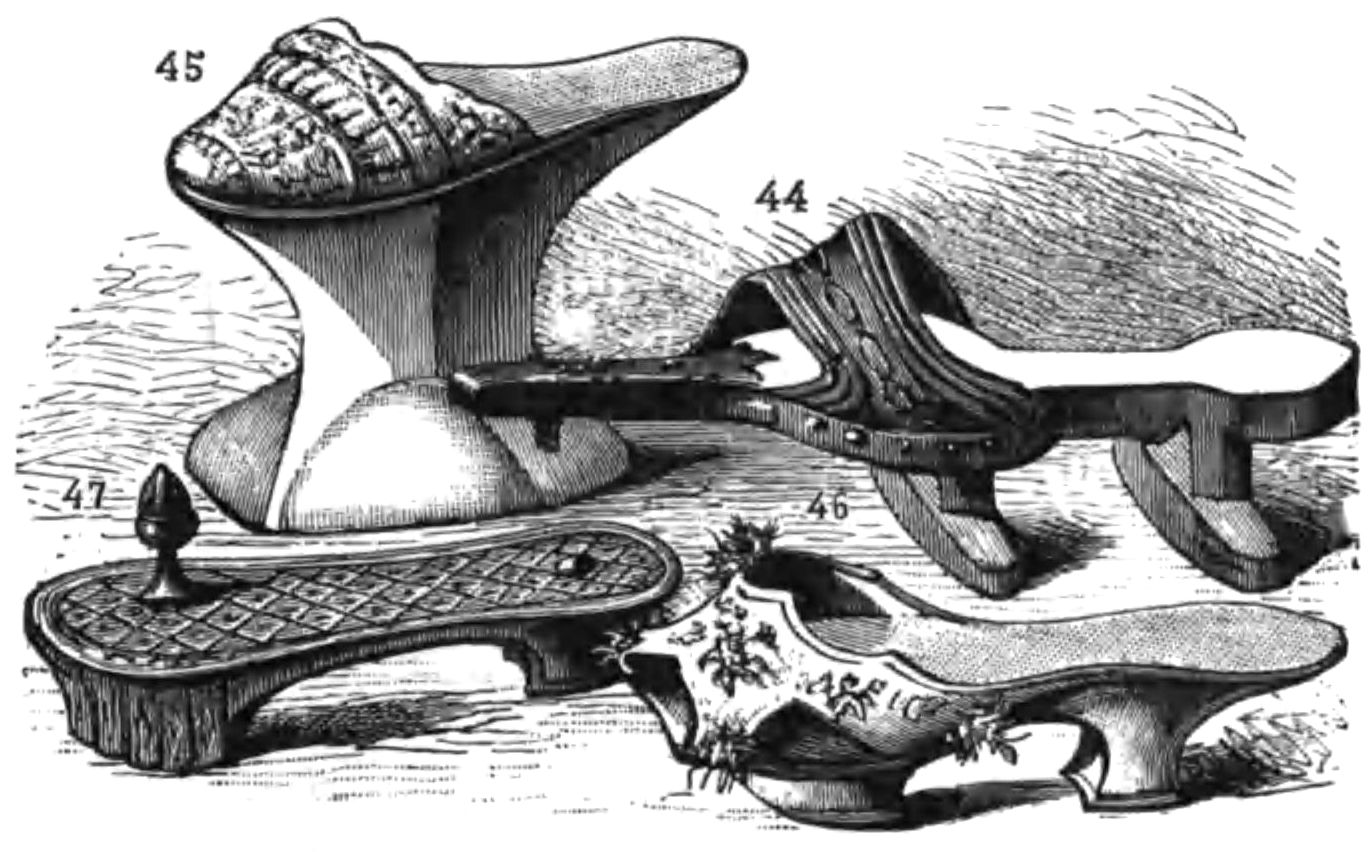
One, of the Fifteenth Century, is a contemporary of the long-peaked shoe, a specimen of the last expiring burst of the folly of mediæval fashion in the Middle Ages, the clog (44). Fairholt has reproduced a ludicrous picture of a king of England in foot-gear of this sort. It is taken from one of the Cotton MSS., where an able artist has represented, in the costume of the reign of Henry VI., the line of English kings from the Conqueror downwards. Richard III. and Buckingham clumping about on the Tower walls in abominable clogs, made doubly maleficent by the protruding toe, and clad in “rotten armour,” must indeed have looked a “marvellous ill-favoured” pair; nor could it have been difficult for Buckingham to counterfeit suspicion, “pry on every side, tremble and start at wagging of a straw.”
There are also several examples of goloshes belonging to the time of Louis XIV.; but the most curious pattens are those worn by the Sixteenth Century Venetian ladies. The shoe is of white leather, stamped with an ornamentation, the stand of wood being also covered with white leather (45). Another is of such enormous length as to almost be a stilt. Tom Coryate, in his “Crudities” (1611), says that these “chapineys,” as he calls them, were so common in Venice, that no woman ventured out of her house without them, and that some were half a yard high. And this is corroborated by the statement of Raymond, who, in his journey in Italy in 1648, speaks of “shoes elevated as high as a man’s leg.” The Venetian ladies had in consequence to be assisted when they took their walks abroad, otherwise they ran the risk of taking a fall. Thus the “tottering willows” of China have had their parallel at their antipodes in Christian Italy. The fashion was still in vogue in the days of Evelyn, who describes the Venetian ladies as stalking about in their “choppines,” and notes the ridiculous figures they cut in attempting to crawl out of their gondolas.
But wisdom or folly—all comes from the East. These Venetian chopines were of Oriental origin. In the time of Queen Elizabeth, George Sandys, an old traveller, saw them on the feet of Turkish ladies; and here at Cluny are several examples of a patten made for the baths of Constantinople and Damascus. The Mohammedan patten, however, has nothing of the ugliness which marks the Venetian imitation. It is simply a good piece of cabinet-work, inlaid with mother-of-pearl. Another patten of Venetian origin (46), decorated in a Moorish style, and evidently intended for gala days when the road was stainless and not a puddle to be seen, recalls the old-fashioned patten of our grandmothers. But perhaps the most curious pattens of all come from India. One pair are shaped like epaulettes, and richly ornamented with satin of various colours. Others are formed of soles made of wood, and mounted on stands, with a button between the great and second toe to keep it on the foot. This make is also found in Java. In some Indian specimens (47) there is a spring in the heel, which, communicating with a red lotus flower which acts as the maintaining button, causes it at every step the wearer makes to open its six lobes and display its corolla.
On the wax figures in Westminster Abbey, which can be seen by an order from the Dean, and which were said to have been carried at the funeral of the person dressed in their clothes, on Queen Elizabeth and the Duchess of Marlborough the large-heeled shoes can be seen, but so covered with dust, that beyond being the colour of the dress, with a large round rosette fastened in the centre with a round button, nothing could be made of them. Shoes can also be seen in portraits, but seldom in a distinct form. Evelyn mentions shoes constantly in his diary.