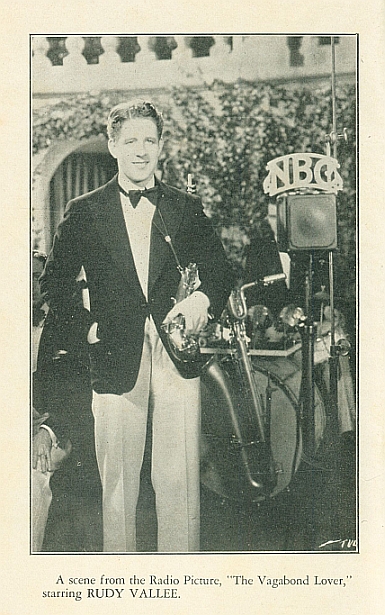
A scene from the Radio Picture, "The Vagabond Lover,"
starring RUDY VALLEE.
Title: The vagabond lover
Author: Charleson Gray
James Ashmore Creelman
Release date: December 2, 2025 [eBook #77384]
Language: English
Original publication: New York: A. L. Burt Company, 1929
Other information and formats: www.gutenberg.org/ebooks/77384
Credits: Al Haines
A scene from the Radio Picture, "The Vagabond Lover,"
starring RUDY VALLEE.
Novelized by
CHARLESON GRAY
from the Scenario
by
JAMES A. CREELMAN
Illustrated with scenes
from the
RADIO PICTURE
starring
RUDY VALLEE
A. L. BURT COMPANY
Publishers New York
Printed in the U. S. A.
Copyright, 1929
By A. L. BURT COMPANY
THE VAGABOND LOVER
CONTENTS
CHAPTER
I The Unrewarded Quest
II Roadhouse
III Bravado
IV Revelry
V Conflict
VI Celebration
VII Homegoing
VIII The Old Home Town
IX Flight
X Engagement
XI A Decision
XII Portrait of a Celebrity
XIII False Colors
XIV A Personal Appearance
XV The Wings of Song
XVI Delay
XVII Escape
XVIII For The Benefit of All Concerned
XIX Dénouement
THE VAGABOND LOVER
A failure!
Rudy Bronson sat looking down at the puncture pattern on the tips of his shoes, his mouth twisted in a grim, unhappy line. He was a slim, apparently sensitive boy, with a crest of waving blond hair and eyes in which the spirit of the dreamer was fused with that of the romantic. With the late afternoon sun profiling his head and shoulders, casting a nimbus of warm light about his tousled hair and lighting up the clean lines of his features, a stranger might have found difficulty in understanding the phrase that came so harshly from his tense lips: "A failure!"
And what else was he? A whole year here at the State University, enjoying its every detail in his own quiet way, and then what? He kicked at a crumpled slip of paper on the worn carpet of the dormitory floor. He knew every brief line of its message, its succinct and banishing message: The Registrar wishes to inform you that, due to an insufficiency of passing grades, it will not be permissible for you to register in the University for the fall semester.
Flunked out! Like a dumb athlete. And for what? His eyes traveled mechanically across the room to where a tarnished and battered saxophone rested on a small table. Just because he had spent so much time practicing in an effort to make the school band that his studies naturally had suffered.
Nor was that all. The bandmaster had listened sourly to his try-out, and then dismissed him with the curt information that his playing was "just a little worse than rotten." He closed his eyes, as if seeking by the physical gesture to shut out a mental image which but stood clearer in the darkness.
It all returned with a rush. The full muster of the University's musically inclined had met on the bare stage of the auditorium. Brasses, woodwinds, string instruments, drums—each had been called in turn. Detained by a late class, Rudy had appeared at the end of the rehearsal, and been forced to make his attempt under the critical eyes of the other aspirants.
But despite them, relieved that their own trials were over and ready to laugh at the first false note, he had taken his place and started on his best piece... His hands clenched at the memory of the ensuing fiasco. Of course something had been wrong with his instrument. But no one was prepared for explanations or excuses. Their laughter had drowned him out before he had played two cracked bars, and the director had waved him down with the same condescending manner he might have used toward a half-wit.
It had all been terrible and humiliating past the understanding of one not so sensitive as Rudy Bronson. Yet it was but the next to the last failure of a collegiate career filled with failures. He kicked again at the paper on the floor. There was the last failure.
How different it all had turned out from his great expectations! Back home, with all the longing for distant places encouraged by life in a small town, he had looked forward to the State University as the end of the rainbow, a sort of dwelling place of dreams come true. He knew that his father had embarrassed himself financially in order to get him even this one year of higher schooling—and he had repaid the old gentleman by failing at everything he had attempted.
Too slender for football, not fast enough for baseball or basketball, he had been dropped from the freshman squads of those sports within a week of their inception. Distressed by his lack of athletic prowess, his natural shyness had deepened, and he had been overlooked in the rush for fraternity material. And with that failure to be pledged (he had felt) had departed his best chance of meeting Jean Whitehall.
As always, his heart quavered at the mere thought of her name. Jean Whitehall, the acknowledged queen of the campus, whose casual passing was enough to fill an unnoticed freshman's whole day with sunlight! How he had thought of her, dreamed of her, hoped to meet her! Now in his hour of defeat he honestly acknowledged to himself that his attempts to make the freshman teams had been prompted more by the desire to bring himself to Jean's notice than to win athletic glory.
The same wish had encouraged him to try and win recognition in the musical circles of the school. Seeing that he was not destined for a sporting career, he had turned a natural inclination toward music into a devout study of the instrument that might win him a welcome on Sorority Row—the saxophone.
Everyone knew that a good saxophonist was always in demand at the University dances. And if he couldn't be invited as a guest to Jean's exclusive organization—well, he might appear in the humble but willing role of musician. Being near her, having the chance to rest his eyes on her youthful loveliness was all he asked... And he had been denied even that.
"Just a little worse than rotten," the band-master had said—and put the mark of disapproval on his last, and therefore most desperately hoped for, attempt to bring himself above the level of the school's colorless and characterless nonentities. He had failed. Failed!
A brisk rap on the door punctuated his mental tirade. He looked up in surprise. He had few callers, and these ordinarily failed to knock. "Come in," he called.
The door opened immediately, and around it peered a fresh, roguish face decorated by an enormous pair of horn-rimmed glasses. For a moment Rudy had difficulty in recognizing Sport O'Malley. "Ah, there," greeted the newcomer. "Saw you sitting in the window and thought I would run up to ask how the saxophone lessons were progressing?"
Rudy smiled. He was fond of Sport O'Malley. The careless laughing youth was his one contact with the gayer side of the University; and though Rudy did not now see as much of him as he had when they had been together in high school back home, he nevertheless considered Sport to be his best friend in the institution.
"Not so good, Sport. The course calls for twenty lessons, and I've only got to the seventh. I was only on the fourth when I had my try-out for the school band. That's why I didn't do better. Why, I bet even Ted Grant couldn't have gotten by with only three lessons!"
"Probably not. But don't forget that musicians are born and not made. There's the chance that Ted Grant didn't take a lesson in his life. You've got to have something besides practice to become the greatest saxophonist in the world."
"I'll say you do," Rudy admitted. He said the words readily enough, but his tone was spiritless and disheartened. Sport was quick to change his manner.
"Don't take it that way! Gee, we can't all be Ted Grants—or else look how many orchestras would be cutting each other's throats! And look how many of us hopefuls would be blowing fish-horns instead of brasses."
"Oh, I don't mean to seem down, Sport. But it's tough. I put every possible hour into studying that sax, trying to get a break, trying to win a place on the band with the rest of you fellows—and all I got was the razzberry."
"That wasn't given you by the regulars," Sport was quick to say. "It was just those mutts who think that if they give the other guy the bird, they'll have a better chance themselves."
"It's all right," Rudy said wearily. "Whoever it was, I deserved it. I was rotten. I missed my chance. And now look." He pointed at the offending notice on the floor.
Sport whistled. It was apparent that from both experience and the color of the paper, he knew the significance of that communication. "Flunk?"
Rudy nodded. "Flat! No make-ups. No chance to register next year. No nothing!"
"Wam—that's tough! But I won't feel too sorry for you just yet a while. I haven't been over to my own diggings yet. I forgot that those little pals were coming out to-day. And there'll probably be one there to make me wish I'd not been reminded."
"Well, if there is," Rudy laughed, "we can hold each others heads on the train going home. What are you doing this summer, Sport?"
"Going to try and get up an orchestra and play at some of the hotels. You know, travel around like a special attraction. Those fellows with the puppet show from Yale have been cleaning up for several summers. People fall for that 'college' line in your billing. I think a hot band ought to go good."
"It should," Rudy agreed enthusiastically. "And if you should want a good saxophonist, you needn't look any farther than here."
Sport looked away, uncomfortable before the other's eagerness. "Gee, Rudy; you put me in sort of a tough spot. I know you're practicing hard on your instrument, and all—but you've only got to the seventh lesson, and I don't imagine that Ted Grant himself was much of a saxophonist at his seventh lesson."
"But you forget—great musicians are born, not made." Rudy laughed to cover the discomfort which they both felt; but he was stung by the abrupt dismissal of his offer to help. Was it going to be that way all his life—no chance to prove that he really had the stuff, just simply ticketed as incompetent and given no consideration at all? Why was it? Why was it?
He crossed the room, holding his head slightly averted so that Sport could not see his face. But Sport, with the keen perception granted to warm-hearted people, saw that he had hurt the shy, reserved boy whom he had known for years without really knowing him at all. He instantly sought some means of assuaging Rudy's injured pride.
"But why worry about all that? It isn't time to start fretting over summer jobs just yet a while—what concerns us just now are these failure slips. I think they deserve a party. And by the great god Whoopee, that's what they're going to have. A party in honor of the fact that the quietest boy in the whole University got shipped! That's a record that ought to stand for lo! these many years."
"What kind of a party?" Rudy asked. "Do you mean here, or up at your place?"
"Neither!" Sport cried. "We'll get the gang and go out to The Magic Lantern."
"The Magic Lantern!" How often Rudy had heard this rendezvous of the campus' more ardent spirits mentioned in jocular tones. Sport looked at him curiously. "Never been out there, Rudy?" He paused, smiling. "Say, I guess you haven't had a very good time here, all in all. Well, this is going to be one time that you'll have a good time!"
"That's mighty nice of you, Sport. No, I haven't had a particularly good time, socially. I've—been so busy with other things. Trying to make the teams, and practising on Ted Grant's correspondence course for the saxophone——"
"And you've gone to no dances? Parties? Had no heavy dates with the campus hot numbers?" As Rudy shook his head, Sport whistled shrilly. "My hat! You are a strange one, Rudy. But that's enough of that! I'll fix you up a party that they'll remember as long as one of the old school's stones stands upon another."
"How," said Rudy thoughtfully, "about girls? I'm not very well acquainted down on Sorority Row."
"Easily fixed," Sport assured him expansively. "The girls will all be crazy to come to this affair. Is there any baby that you'd like particularly? Just name her and she's yours!"
"I'd like Jean Whitehall," Rudy told him quietly.
Sport's jaw dropped. "I said you were strange," he gasped. "Boy, you're nuts! Why, she's the classiest number on the campus. She only goes out with varsity captains, when she isn't with the student body president or the manager of the welfare board!"
Rudy shrugged. "You asked me who I wanted," Rudy answered, "and I told you. And if you can't fix it, nobody else will do. I accept no substitutes."
"What a man!" Sport breathed. "Here I had you tagged as aching to step out with the janes—and you calmly tell me that if you can't have the best looker in the University for a partner, you won't have any. Why, Rudy," he added, "much as I hate to admit that being a sophomore keeps me from anything in this noble institution, I've got to break down and confess that the high and mighty Miss Jean Whitehall, girl-friend of our more ritzy seniors, doesn't even know I'm on earth."
"Then," said Rudy decisively, "our party will be a stag."
Sport touched him lightly on the arm. "You're too subtle for a roughneck like me, Rudy Bronson. But you're there. And I like you; damn it, I like you!"
There is a Magic Lantern near every American coeducational university. Sometimes its placard reads Paradise Pavilion, sometimes The Royal Palms, or The Moonlight Gardens. But usually the wording is The Magic Lantern. Dancing. Refreshments.
Even though there chances to be some slight variation in this legend, the place itself is unvaryingly the same. A plain, barn-like structure on the outskirts of town. A "hot" orchestra, a good dance floor, a number of tables, and a great many small booths. The menu is composed almost exclusively of startling combinations of the sandwich theme, and the rather dingy waiters seem to take for granted that you will want ginger ale—as a beverage, or a vehicle.
But herein the policy of this particular Magic Lantern differed from its fellows to so marked a degree that it might have been named something like The Coffee Pot. It was generally insisted that the ginger ale which its waiters dispensed was supposed to be for thirst-quenching purposes only. The menu bore a line: "Kindly do not embarrass the management by bringing intoxicating liquors to this establishment," and the floor-man had instructions to whisper politely but firmly in the ear of any young man who appeared to have enlargement of the hip. Thus was kept a tolerant attitude on the part of the University officials.
The "no drinking" edict was, of course, rather a startling position for a roadhouse to assume—especially a collegiate roadhouse. It seemed impossible that business could continue in the face of such strictness. But business did. The proprietor, asked for a reason, would point to the excellent sandwiches, the superlative floor, and the fact that his orchestra leader had come to his establishment by way of Paul Whiteman with stops for tutelage under Vincent Lopez and Roger Wolfe Kahn. Sport O'Malley, however, would have given a different answer.
Boys like Sport—whoopee-makers, the careless, riotous playboys of the university playgrounds—aside from knowing all the newest, smartest chatter and the freshest dance steps, customarily also know where liquor may be obtained. And Sport O'Malley knew that despite the advertised status of The Magic Lantern toward electrifying beverages, those beverages were to be had by anyone who had three dollars for a fifth of gin, or seven for a quart of whisky.
The proprietor of The Magic Lantern had seen them come—and go—these Sport O'Malleys. Each semester, sooner or later, every type of the whole collegiate world drifted into his place—looking for fun or for trouble, in curiosity or boredom, or merely in search of companionship. He liked them all from the grinds to the rowdies, and some he even respected. Others he did not. Others—like Rudy Bronson's friend.
Sport O'Malley knew of his rating with old Bland, and, oddly enough, it worried him. Oddly, because it is a self-evident fact that the Sport O'Malleys of American universities do not worry about anything—much less the esteem of roadhouse proprietors. Their one anxiety traditionally is maintained for those forbidding men, the deans; their only fear that they will fail to continue to escape official notice.
Of course they are well-known to everyone else on the campus, both for their personalities and their aims—which are modest, concentrated, and founded on logic. Their ambition solely is to have fun for a few of their best years, and they pursue that desire with the caution of a good cause. Wisely, theirs is never an active part among the noisy, conspicuous projects of the college; for, prefacing a distaste for labor, is the knowledge that the life of an "active" man is only one or two years. An attempt to tarry longer in the spotlight invariably leads to the discovery of clay feet—whereas there is no limit save that of inclination on the time a playboy may spend in school.
In fact, such is the usual Sport O'Malley's aptitude for glittering the social life of the institution, his stay is encouraged. No foes are bred among office-seekers to complain about the length of his record; no attention is focused by having rival coaches wail "That guy just can't be eligible again this year!" He avoids the dating evidence of program committees, centers his escapades far enough from the campus to escape unwanted official attention, and semester after semester glides gaily along.
Old Bland had seen them come and go, these Sport O'Malleys. Consequently, knowing both the attraction and the dangers of the type for impressionable young women, he was careful that his daughter should have as little to do with them as possible.
Molly Bland was that most delectable of creatures, a cute blonde. She had an impertinent small nose always quivering just a little because of the merriment which seemed always to be bubbling within her, and an impertinent small mouth always parted just a little as if in an instant she expected to receive a most delightful kiss. Sport O'Malley truthfully thought her one of the most engaging members of the opposing sex that he ever had encountered; and watching her in her role of hostess to the customers of The Magic Lantern, he now was plunged more deeply than ever in a conviction of injustice concerning the elder Bland's forbidding attitude.
Wasn't it fierce? Here was the old man always insinuating that he, Sport O'Malley, could balance a chair on his chin and walk under a worm, while all the while the proprietor was pouring his cheap, cut alcohol into the undergraduates of a university which had not banned his place only because it was supposed to be straight. Most of the fellows knew that all you had to do was drop a hint to one of the waiters, and after a bit a bottle would be slid into your lap! As a consequence of these ruminations, the opinion of customer for owner was even less than that of owner for customer. Old Bland thought Sport O'Malley worthless; but Sport thought of Molly's father as a two-faced crook.
"It gets me!" he burst out to Rudy. "In fact it gets me down!"
"What does?" Rudy inquired. He was looking about the long, table strewn room, drinking in his first contact with that stimulating atmosphere peculiarly associated with night resorts. "It all looks pretty swell to me."
"I'm talking about old Bland, who owns this place. I've got a crush on his daughter—see her over there? The little blonde? What a grand kid she is! I love her, Rudy, but her old man won't let me come near her. Treats me as if I were a leper or something."
"She's a very pretty girl," Rudy admitted. "What does he seem to object to about you—in particular, I mean?"
Sport grinned. "Oh, just the fact that I don't take life as seriously as—well, you do. He'd love you, Rudy. You're just the kind of young man that older people trust. Why wasn't I born with an appealing pan?"
"It hasn't seemed to bother you much so far," Rudy reminded him.
"Not in some places. But with fathers, for instance, it isn't so good. They trust eggs like you, who look honest and sincere and all that sort of thing." Suddenly his eyes lighted. "Say, I've a grand idea! I'll introduce you as my brother from home. He'll take a look at you—and then maybe he'll think that there's some good in the O'Malley family after all."
"But——"
"No buts! I need your help in this, and I'm going to get it or straighten the curl out of your hair with a table leg." He stood hurriedly. "Come on. The other fellows will be here any minute. With that gang around to crab our act, deception will be about as easy for us as skating is on one leg!"
Reluctantly, Rudy got to his feet and followed Sport across the dance floor. He was painfully embarrassed, not only because he felt that he lacked the necessary acting ability to carry out the masquerade, but because he hated deception of any kind. Too, he was rather worried about lending his so-called honest face to any project which Sport, with his eccentric notions of right and wrong, might introduce.
Rudy was no prude, but back of him was a line of New England forebears who had taken the truth as a serious business, who had asked honesty and straightforwardness before all things. Their shades restrained him now, and wending his way through the press of the dance, he was in a turmoil of indecision. He hated to let Sport down—but he hated more to lie.
Yet there seemed little he could do about the matter without causing the sort of scene from which his sensitive nature characteristically rebelled. And when Sport touched a short fat man upon the shoulder and said, "Mr. Bland, just to prove to you that we O'Malleys are not thoroughly a bad lot, I want you to meet my brother," there was little that Rudy could do but put out his hand and mutter, "Pleased to meet you."
"Rudy is just down from home. He's going to take me back in his flivver." Suddenly the good points of his improvisation struck him. He turned to Rudy. "You are going to take me back home in your flivver, aren't you, Rudy."
"Why, certainly," Rudy said. "If you want me to."
"Want you to!" snorted Mr. Bland. "Well, what else did you come down here for?"
"Oh," said Sport hastily, "coming down for me was only part of it. You see, Rudy is very anxious to be a good saxophone player. He's been taking a correspondence course from Ted Grant, the greatest saxophonist in the world. And he heard about your remarkable leader over there, and decided that the logical thing to do was come down and meet him. You know, one fine musician paying his respects to another."
It was evident that the canny Irishman had played on a sensitive chord in the proprietor's make-up. "Well, that's right nice of you, Mr. O'Malley," he said to Rudy. "I rather pride myself on having the best band in the state, insofar as regards places like this. And I've always thought that Bennie needn't take his hat off to any of them. Come on over and meet him."
"Sure," said Sport, "Bennie'll be happy to meet one of his admirers."
"Why, I—," Rudy began.
"Go along with him, Rudy. I'll follow in a minute. I've just seen a fellow over here that I've got to speak to."
With few doubts as to the sex of the "fellow" whom Sport had to talk to, Rudy allowed himself to be led over for an introduction to Mr. Bland's greasy little orchestra leader. That devil Sport! Making him lie in order that he might snatch a few minutes with his current flame! He was more than a little minded to tell Mr. Bland of the trick that had been played upon his credulity; but the old fellow was so obviously tickled that someone should have wished to compliment the music of his establishment that Rudy could not find it in his heart to disappoint him.
Bennie bowed condescendingly when the little proprietor made the introduction. "Oh, yes," he said, "I have a great many fans who I never have seen. It has become noised about that I played with Whiteman and Lopez, and—" as he talked on with the insufferable conceit of a small mind, Rudy began desperately to seek some way of escape.
But Sport was gone, and though the other members of their party by this time had arrived, he was unacquainted with them, and therefore to approach their table alone would have been an impossibility for one of his reserved temperament.
"You see," Bennie was going on patronizingly, while plump Mr. Bland beamed his pride, "after my experience with the leading orchestras of the country, I find it difficult to keep musicians in out-of-the-way places up to concert pitch. Most small town orchestras are recruited locally, and you boys, while undoubtedly willing——"
Rudy's face flamed. The gentlest and most inoffensive of young men, the oily leader's rambling barrage of self-praise at last had touched a point which he was unable to pass in silence.
"Perhaps you underestimate some of us, Mr. Harris," he said curtly. "It is true that I come from a small town. But it also happens that I am a pupil under the direct instruction of Ted Grant."
"Ted Grant!" Bennie's arrogance fell away like a dropped mantle. "You're studying under Ted Grant, the greatest saxophonist in the world?"
"None other," Rudy answered with a touch of pride. "Not only that, but the last time I heard from him he said that he was very pleased with my progress. He said that I showed the makings of a great musician."
Instantly Bennie stepped down from the slightly raised platform on which he stood. "Then," he said, "you must play for us! All my life I have been envious—and respectful—of Ted Grant. Many times I have tried to get into his band, to study his methods. And now you, one of his prize pupils, are right here where I can watch you play."
Rudy gulped. "But—but I haven't my instrument."
The leader immediately thrust his own saxophone into the boy's unwilling hands. "You will play mine. It is a genuine Ted Grant saxophone, his best model."
"But——"
Mr. Bland clapped him heavily on the shoulder. "Excellent, my boy! What an advertisement for my place to have a Ted Grant pupil play for us." He signaled to the drummer for a roll; and when he had the attention of the whole room, he climbed to the platform with outstretched arms.
"Ladies and gentlemen. We are greatly honored by having with us to-night the star pupil of Ted Grant, young Mr. O'Malley. Mr. O'Malley kindly has consented to play a number for us."
A great burst of applause rolled across to the trembling figure of Ted Grant's star pupil. But he did not hear it. Across the room he had caught sight of the open mouth and horror-stricken eyes of Sport O'Malley.
Sport was signaling frantically, shaking his head and waving his arms, giving every sign of protest aside from an actual shout that he wanted anything but for Rudy to play.
But his "brother" only grinned, rather painfully, and climbed up on the platform.
Rudy Bronson was that most astonishing of youths, a sensitive boy who, goaded into a hated situation, would go through with the task before him with a totally unsuspected power.
Balancing Bennie's saxophone in his hands, he was taken by a sense of capability regarding the instrument which heretofore had been totally alien to him. This was a real Ted Grant sax! How different it was from his own clumsy instrument; how delicate and yet how strong it felt beneath his touch.
"Just play anything that you like, Mr. O'Malley," he heard the plump proprietor of The Magic Lantern say. "Anything at all will be a treat."
Glancing toward Bennie, Rudy thought he noted a shade of malice in the orchestra leader's narrowly watching eyes. It suddenly was borne upon him that Bennie's offer to let him play a solo had been prompted by no other desire than that which he had stated—the chance to observe at close range some of the celebrated Ted Grant technique in operation.
Well, there was no backing out now. A wave of fright passed over Rudy at the thought. He looked over the floor of upturned faces beneath him. Faces waiting to be entertained; and if he failed them in that, ready to criticize, to give him the sort of razzing which he had received the day of the try-out for the school band.
Oh, why had he acted upon the crazy impulse which had caused Mm to fall in with Bland's wishes! Certainly it was absurd to think that he could offer a brand of playing equal to that of the old man's regular saxophonist. Bennie was good; of that there was no doubt. But here he was—and there now was nothing to do but play.
The first elements of the Ted Grant technique were a clean, rapid tongueing, accompanied by a similar nicety of fingering. With his old saxophone he often had sought for the precision in these attributes upon which his lessons had been so insistent. With this marvelous bit of metal within his hand, he felt that such skill would not only be possible, but inevitable.
Raising the mouthpiece to his lips, he blew gently and was gratified at the clear, melodious tone which ensued. Emboldened, he began one of the newer fox-trots, a lilting, catchy melody which he had been practicing for hours in his room without any great degree of success. But with the wonderful Ted Grant saxophone within his grasp, he did not feel that there could be a piece in the whole literature of syncopation beyond his capabilities. Not one.
As he played, he occasionally heard a note that did not seem to be quite all that it should be. But with closed eyes, deeply engrossed in the operation of the instrument he had come to love, he paid no heed to the world about him. He was in a world alone with his music—and the thought that beyond all things he wished that Jean Whitehall was there to hear him.
And with that wish was born the determination which one day was to bear surprising fruit. Sometime, some place, he vowed, he would play for Jean; would sing to her all the love songs which he had been keeping for the one girl in all the world for him.
With the last note of the number, he lowered the saxophone and bowed to an amount of applause quite unbecoming to a star pupil of Ted Grant. In fact, the only applause he received seemed to be that supplied by Sport O'Malley and his friends. Mr. Bland and Bennie clapped perfunctorily, and the head-waiter turned away without committing himself.
"Perhaps you had some difficulty with the strange instrument?" Bennie asked.
"To the contrary," Rudy answered, smiling his pleasure. "I found it the best sax I've ever played."
The leader frowned. "That's funny," he commented. "It sounded to me as if you were off key about two-thirds of the time."
Rudy bit his lip, flushing painfully. But before he could open his mouth to speak, the smooth voice of Sport O'Malley interposed: "You small-town yokels ought to get wise to yourselves," he said tartly. "Is that anyway to treat a guest star? Here my brother is, doing his stuff for you for nothing—and just because you don't know that the new Ted Grant technique calls for a tone just off key, you have the nerve to make a smart crack! It's an outrage, Mr. Bland!"
But the old proprietor had been listening to syncopation long enough not to be fooled by any such facile explanation. "Run along, Sport. I can thank your brother without any help from you." He turned to the unhappy Rudy, evidently taken by the boy's quiet and unassuming manner. "Good or bad, I thank you, Mr. O'Malley. And whether you're a good musician or a rotten one—if you always try as sincerely as you were doing up there just now, I don't see how anybody's got a right to complain."
"Thank you, Mr. Bland," Rudy answered. "That was mighty decent of you to say, if you thought I was rotten. Personally, I thought I never sounded better. But that's just an honest difference of opinion."
"Sure," interrupted Sport, "and now Rudy, my lad, we will go to yon table where await our convivial friends and pledge thee in a beaker of—" he glanced suddenly at Mr. Bland—"ginger ale!"
The convivial friends greeted Rudy boisterously. It was apparent that they were illuminated by spirits somewhat stronger than those naturally induced by the occasion. But loud as were their assurances that Rudy was the greatest saxophonist in the world, he was unable to derive much pleasure from their praise.
So he had been rotten, terrible! Even with a Ted Grant saxophone, he had been unable to play through one simple piece in a manner worthy of high recommendation other than that of a lot of half-boiled night owls. Rudy sat unhappily staring at the glass which had been placed before them. But he'd show them! He'd show them all—this crowd of kidders, that smirking little Bennie, Sport, yes, and Jean Whitehall, too, that he could bring as sweet a melody out of a saxophone as any man that ever lived!
"Drink up, Rudy!" Sport called. "This is your big night."
Smiling to cover his grim frame of mind, Rudy Bronson lifted his glass. His big night, indeed—though probably not in the manner which Sport had meant. But big nevertheless; because it was the night which had fired him with a definite ambition, given him a mark at which to shoot, had set for him a goal!
He got to his feet, his face alight with the flame of his newly fired purpose. "To my big night, men! Here's how!"
Caught by the ringing sincerity of his tone, there was a moment of silence as the little ring of young men answered his toast. Then Sport O'Malley shattered the seriousness of the tableau with a shouted "Skoal!" And the party was on.
College boys on a party are traditionally opposed to quiet, and Sport O'Malley's "coming out" party for Rudy Bronson scarcely was an exception to the rule. Within an hour, the booth in which the half dozen boys were crowded had become the focus of general attention. Within two, their hilarity was such that old Bland replaced his frowns and warnings with the even sterner edict that they quit the place.
This the whoopee-makers were loath to do. The evening was nearing its height. Bennie, the orchestra leader, had his men drawn to the last possible notch of syncopation. He was showing well what he had learned under Whiteman and Lopez and Ben Bernie. Showing it so well that the floor was packed with dancers.
Around the gliding figures, seeking booth openings, waiters scurried like black and white rabbits. Sound blazed like light. And over all was that tremulous, excited note which comes to a festivity only when its participants are very young and very alive.
"Aw, we don't want to go just yet, Mr. Bland!" Sport cried, waving his arms at The Magic Lantern's proprietor. "Gee, things are just beginning to get good. I'll make these guys be quiet."
"Yes, and who's going to make you keep quiet?" Bland demanded. "You're the noisiest one of the bunch."
"Why, Mr. Bland, I am surprised!"
"I'll make him quiet down, Mr. Bland," Rudy interposed. "I guess we have been pretty noisy. But we'll cool off a little bit."
"Sure, we will that," Sport seconded him. "Fact is, I'll go out and cool off now." He rose majestically, pointing at the others. "And if there is so much as one peep out of you bozos before I get back, I'll help Mr. Bland throw you forth upon your ears."
"You and who else?"
"Me and Mr. Bland, of course. He's all right."
"Who's all right?"
As one voice they answered: "Bland's all right."
Rudy got the uproarious Sport by the arm, and pulled him toward the door. "Lay off that stuff," he cautioned. "Gosh, I came down here and masqueraded as your brother, and gave a solo, just to get you in right—and then you try to toss away all that I've done for you by yelling like a hoodlum!"
"I know," Sport admitted. "But that guy burns me up, Rudy. Why can't he have some of the good traits of his daughter?"
"You're pretty fond of this girl, aren't you, Sport?" Rudy asked slowly.
"Oh, boy! You're conservative! I'm cuh-razy about that baby."
Rudy studied Sport for a moment. He liked the gay and light-hearted sophomore, and he knew that the boy was doing himself anything but good by the terrific pace he was hitting. The thought crossed his mind that perhaps this girl Molly, with her influence over Sport, might cause him to change some of the habits that eventually must be his undoing.
"You wait here a minute, Sport," he said, as they reached a bench under a tree outside the long, lighted building. "I want to go in and get some cigarettes. Stay here, now; I'll be right back."
"Oke," said Sport, relaxing comfortably against the tree trunk. "I'll be delighted to wait, old son."
In the doorway of The Magic Lantern, Rudy stood for an agitated moment, seeking in all that mad scene to win a glimpse of Molly Bland. A number of hails went up for him from the booth he so recently had quitted with Sport in tow, but he paid no more attention to them than to the university songs booming out under the baton of the orchestra leader. He frowned. That girl might be able to do Sport incalculable good.
The door to Bland's office gave directly upon the resort's main room, and to this door he now saw Molly Bland making her way across the dance floor. He plunged forward. "Miss Bland!"
The girl turned, acknowledged the hail with a cold glance, but failed to pause. Scowling, Rudy hurried to her side. "There's something I'd like to say to you!" he said, putting out a detaining hand.
Brushing away his hand, the girl stopped. Her eyes were cold in a pink face. "And there's something I want to say to you! What kind of a brother are you to let Sport drink the way he does? If you think it's smart—or amusing, or anything else—you have far different opinions than I do!"
Rudy grinned. "That's fine!" he cried. "That's exactly what I wanted to hear! You see," he explained hurriedly, "Sport's introduction of me as his brother was just a little joke. I'm not his brother—but I am his friend. And I hate to see him use liquor the way he does almost as much as you do. He's outside now—I wondered if perhaps I might ask you to go out and speak to him about it?"
The girl's eyes softened. "Say, you are nice," she said. "Where have you been? I wish that Sport had a few more friends like you."
"Never mind that," Rudy returned, his color heightening. "You just go out there and talk to Sport the way you talked to me."
"I will!" Molly assured him decisively, and with a brisk run of steps went through the door and out into the night. Rudy sank into an unoccupied booth. What fools young men were! How they wasted themselves and their opportunities in idle folly. Here was Sport O'Malley, one of the cleverest chaps he knew, burning his candle at both ends—and attacking the middle with an acetylene torch!
And to what purpose? Little that had anything to do with the career in modern music upon which he had pinned his rather casual ambitions. Well, it would be different in his own case. He would allow nothing to stand in his way. Nothing! And there would be no need for any girl to go out and berate him for destroying himself. He smiled ironically. Which was probably a good thing—so long as there was no girl who cared enough about him to mind whether or not he drank himself blind.
At that moment there was a small burst of newcomers, accompanied by an obligato of youthful laughter. Rudy's pulses quickened as he saw that among them was Jean Whitehall. She was escorted by the very attentive captain of the football team, while the president of the student body hung on the outskirts of the crowd, glowering with a resentment doubtless caused by that fact. In his official capacity, he frowned on The Magic Lantern, and he was there only because Jean had insisted upon seeing the place as a sort of prelude to the farewell dance her sorority was giving that night.
Rudy sank more deeply into the obscurity of the booth. For some odd reason he did not wish Jean to see him there—in his role of inconspicuous freshman. Rather, a silent voice counseled, let him wait until he could bring himself to her notice in a fitting manner. And then there would be no recollection in her mind of the poor fumbling boy who had failed in everything he had attempted at the University.
He found her gorgeously beautiful. For the moment he could not take his eyes from her glittering presence. When the party had been seated, with Jean as the colorful hub around which it revolved, Rudy slipped out of the booth and made for the outside door. When he was Rudy Bronson, the famous musician, there would be time to think of her. But until then——
In the sudden transition from the blazing light of the interior of The Magic Lantern to the cool dark of the night, Rudy had difficulty in adjusting his sight. He stumbled forward, and was almost upon the tree beneath which he had left Sport when he heard Molly's voice speaking, quietly and yet with a strange dignity:
"Oh, I know you're not too potted to walk—or to talk, Sport. But you're under the influence of liquor, nevertheless. And," suddenly her voice flared, "I hate it! You can't know how I hate it! You see," she went on with more calm, "before we came here, Dad used to have a saloon. I was only a very little girl, then; but night after night I've listened for him to come home. I always could tell by his step on the walk whether or not he'd been drinking with his customers. That was in the old days, Sport. You probably don't know anything about saloons, but, oh, I do! I've listened to Dad and Mother go over the question time and time again."
Almost against his will Rudy was forced to remain as an eavesdropper to the girl's troubled story. To walk away now might startle her, cause her to cease the even flow of words which he was certain Sport O'Malley needed as much as he needed anything on earth.
"It went along that way for what seemed ages," Molly continued, "until I got to hate anything in any way associated with alcohol, and I've never lost my horror of it... So you see it's hardly because you're a drinker that I care for you. I'm not the kind of person who thinks it is smart for you boys to make whoopee. Fun is fun, of course; but I'll bet that quiet friend of yours, the blond, has as much fun as any of you."
At this interjection of his name into the discussion, Rudy thought it time to make his appearance. Coughing slightly, he came around the trunk of the tree, holding a packet of cigarettes in his hand.
"Ah, there," he said in greeting.
Sport looked up listlessly. "Hello, Rudy. Do you know Molly Bland? Her father owns the place here. She's just been telling me that I drink too much."
"I guess most of the fellows do quite a bit of that nowadays," Rudy answered. "Prohibition is a swell idea—but when are we going to have it?"
"That's just it," Sport said with the air of one who has done much thinking on a subject. "If the stuff were either not forbidden, or impossible to get, everything would be all right. But you're tempted both ways as it is now."
For an instant Rudy feared that Sport was about to let slip the fact that the liquor which had stimulated him had been purchased in The Magic Lantern. A sudden thought came to Rudy. He had been supposing that it was old Bland who was doing the bootlegging in the resort. But it easily might be Nick, the floor man, or one of the waiters. Characteristically, he was seeking to think well of a stranger until definite and indisputable evidence had been presented to cause him to think otherwise.
Glancing at Sport and Molly, Rudy saw in their absorption in one another that they wished to be alone. With a brief "Guess I'll be trotting back inside," he turned in the direction of The Magic Lantern. But almost to the lighted doorway he paused. He suddenly knew that he wanted anything except to rejoin the party in Sport's booth, busy, as he knew, at their hilarious game of slopping drinks surreptitiously together. Let them carry on without him.
Slipping around a corner of the building, he located a second bench and meditatively got out his cigarettes. Stranger though he was to the sort of entertainment that was bubbling inside the building at his back, it even lacked the fascination of the unknown.
He looked reflectively at the lighted end of his cigarette. Imagine getting to be like this Bland—lying to your family, holding yourself up as a sort of plaster saint to the college authorities, and peddling booze while you did it. Almost against his will he was being forced to the conclusion that it was the proprietor himself who was doing the bootlegging in the resort.
And if it were Bland, what a chance he was taking! Running the risk that some empty-headed college boy would expose him. And then what? Imagine having to face a break like that!
Naturally, if trouble came, it would mean the end of Molly's chances for any sort of success at the University, where she intended entering, Sport had said, in the fall. Why she would have even a worse time than he, Rudy Bronson, had had!
Voices sifted out into the night. "Everything is all fine. He can complain. Imagine what sort of a reception Bland would get if he went running down to the desk with the yelp that somebody had gone south with a load of his hooch! Just imagine, if you can!"
Rudy glanced around. Behind and above him he saw a pale blotch of window. "You're sure everything's all set down there?" Against the coarse, guttural tones which Rudy recognized as belonging to Nick, the head-waiter, a second man's voice scratched weakly.
"Sure, everything's set," the first speaker agreed heartily. "We'll be waiting with the cars by the S.P. bridge. All you have to do is pull up there—and give us a hand unloading the stuff. I'll have the cars there to take it where I want it to go. Then you turn around and come back, and tell Bland that you got hijacked." He'll steam a little, maybe; but don't worry about him cracking to anybody. There's nobody that he can crack to. Who me? I'll get mine! And you'll get yours, too, when I get it.
"But that ain't all. It ain't just the dough. I'm sicka this collitch bunch, and I'm sicka Bland. It was just like him to try and beat my time, after finding out what kind of dough I been making selling the stuff to these kids. Well, I'll show him who's going to do the peddling here! I'll give him a jolt that will send him back to his soda pop and sandwiches for keeps. And if he smells a rat and gives me the air, all right. I'm sicka it around here anyway."
Rudy slid along the wall and around a corner of the building, laughter bumping his heart against his ribs. A cross-up! A frame, which, at the prices current for liquor, would cost Bland plenty. His face tilted toward the stars. And how the old fool deserved it! Trying to destroy Molly's apparently authentic affection for Sport because Sport drank—and all the while making himself rich by encouraging other boys like Sport to the same habit! Yes, he deserved to lose every cent that he would lose, and the irony of the jest was that he must take that loss without complaint. For the head-waiter was right, there was nobody to whom Bland dared complain.
Then Rudy's laughter halted in mid-career. Nobody? But wasn't there? Would the old man take his loss quietly? Rudy lighted a fresh cigarette. Old Bland was apt to do anything but that! He had a temper—Sport's experiences with him was testimony to that—and before he stopped to think it over, he might get hot-headed and spill the whole affair to the police. And then where would he be? How would he explain that he owned any liquor at all—much less a truck-load? And then where would little Molly be? Gee!
There was only one thing to do. The old man must be told. He raced up the steps. Inside the door of The Magic Lantern he paused. Jean and her party had left. Rudy was glad. With the evening nearing its close, the revelry was at its noisiest pitch. The room was a swirling, trooping mass of figures, and Rudy saw immediately that finding the proprietor in the few precious minutes that remained before his hired man started out with the truck of liquor was going to be impossible unless luck favored him. His teeth caught fretfully on his lower lip. The old man just had to know!
Then, so close that he could touch him with an outstretched hand, he found Bland talking with a tall dark man. Rudy promptly broke in upon their conversation. "Say, Mr. Bland, there's something very important that you should know about! I'm not fooling!"
The proprietor eyed him coldly. "I thought I had your promise to keep those boys quiet, Mr. O'Malley." He motioned to the now vacant booth. "But they got even noisier than before—and out they went! I only let them stay because you were with them, and apparently sober, but when you walked out like that I saw that you weren't to be trusted any more than the rest of them."
"Sure, I know I did," Rudy began; "but listen——"
"I'm not interested! If you boys can't come here and conduct yourselves as you should, I don't want you to come. Rules are rules, and laws are laws. And that's all there is to it." He started with his companion in the direction of his office. "And now, excuse me."
"But, Mr. Bland!"
"You heard what I said." Bland's heavy shoulder shunted him to one side. The office door slammed. A latch clicked.
Crimsoning, Rudy regarded its solid paneling. And this was the man he was trying to save from a frame-up! What a pleasure it would be to see them get away with every nickel the wretched old hypocrite owned! ... But for the sake of Molly, the girl whom he knew to be the one person capable of putting Sport O'Malley on his feet, he dared not let that frame-up go through.
Rudy whirled, making for the exit. In the dusk outside he paused, searching for Sport. In an instant his eyes located him, sitting dejected and alone, on the bench by the tree.
Grasping him by the wrist, Rudy jerked him to his feet. "Don't ask any questions!" he cried. "Just come with me!" And then with the dazed Sport in tow, he plunged off down the road in the direction of the disappearing tail-light of old Bland's delivery truck.
There were two cars parked in the shadow of the S.P. bridge. Two large cars parked in shadows deepened by the dark clothing of the men who watched over them.
As a truck lumbered down the highway, one of these dark figures climbed out of his car and moved forward, signaling with his flashlight. "All right, Fred. It's me, Nick! Right up here."
The truck swung to the side of the road, stopped.
"Say, who's that with——"
On him, and on the second man who had climbed out of his car and joined him, an avalanche abruptly descended from the driver's seat—an avalanche which immediately separated into two distinct and belligerent halves, Rudy Bronson and Sport O'Malley.
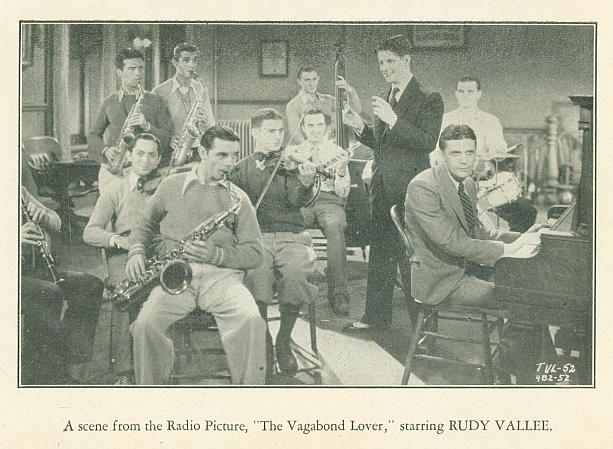
A scene from the Radio Picture, "The Vagabond Lover," starring RUDY VALLEE.
They had caught the truck three miles farther back, following Rudy's hasty explanation to Sport, and the driver who had started with it from The Magic Lantern now reposed in its bottom, neatly trussed. Sport had been in favor of administering a heavy cuffing; but Rudy had restrained him with: "Better save yourself. We might need that pep at the bridge."
He now saw the truth of his words realized. Jumping from the truck, he brought his first blow down with a force which, landing true, might have slain an ox. But it did not land true, and the head-waiter was a husky man. Nick reeled, but he came back a moment later, and came so fast that Rudy soon knew that Sport must attend to the other hijacker as best he could.
"Come on and fight," he snarled ragingly, and Nick obeyed.
It was a grand fight while it lasted, and it lasted a hard, long time. Nick was tough and willing, and not unskilled in the use of his fists. But Rudy, thoroughly aroused by his blows, fought with that grim ferocity of which only mild young men seem capable. He fought without much skill or science, but what he lacked of those attributes he more than compensated for in a determination that was not done even when Nick was stretched in a beaten heap on the highway.
When the head-waiter at last was down, Rudy turned, battered and torn, to see how Sport was faring. But it was apparent immediately that he need have no cause for worry in regard to Sport O'Malley. Sport's face hadn't been improved, and he was blowing like a porpoise as he rested—but it was upon Nick's companion that he rested. "Nice scrap, Rudy," Sport gasped, "I—didn't think—you had it——"
"A very nice scrap indeed!" echoed a voice.
Rudy lifted his throbbing head to face a little group coming forward from a touring car that had come to a stop behind the truck. A group headed by Bland himself. Good, now the old hypocrite could take his hooch and jump in the nearest lake. He was through. Rudy turned a little. And there was Molly. And Glen Patterson, the town's chief-of-police.
"A very nice scrap, indeed!"
Rudy stared at them for a hideous, suspended moment. So Bland had cracked! Had lost his head and cracked, just as he had feared! And here was Molly—Sport's girl—present to learn the truth as soon as Nick opened his mouth, which would be pretty quick now, for the head-waiter had attained his feet and was dizzily eyeing the crowd.
Rudy did not pause to think what he was doing. Across his mind flashed the knowledge that he had flunked out of school, that he was going home a failure. On the other hand, Molly and Sport had all the best of their college life still before them. Still shocked by the terrible beating he had taken, he gave no thought to the consequences of the gesture which he now made. Realizing only that Molly and Sport loved each other, and in his mind therefore must be protected at all cost, he stepped forward and spoke sharply:
"All right, Patterson," he said. "Let's cut the song and dance. There's booze in that truck—and it belongs to me! I guess Mr. Bland here heard that I was running it through to-night, and sent Nick and these other boys out to stop it. Well, they did. And here I am."
He stopped, reeling slightly. There was a silence. Bland's eyes did not move from Rudy's face. "What's in that truck, my boy?" he asked.
"I guess you know what's in there!" Rudy began angrily. Then he checked himself shortly. "Booze! What did you expect—soda-water?"
And then Bland laughed. Uproariously. "Yes, just that exactly. And if I don't find it I've spent a useless half-hour loading it!"
Patterson nudged his deputies toward Nick and the other hijacker. "You know who we came for. Do your stuff."
Rudy's head was whirling, but not so giddily that he could not hear Molly's voice excitedly explaining to Sport: "I saw you boys run after the truck and told Dad. He didn't know what to make of it until he remembered that Rudy had tried to speak to him. He suspected that Rudy had got wind of what Nick was going to do."
Sport caught feebly at the name. "Nick?"
"Yes, the head-waiter! Dad knew that he was selling liquor at The Magic Lantern. Of course he could have fired him outright—but you know how Dad is, always wanting to do a thing so thoroughly. He wanted to get Nick right. Naturally, he could have had him arrested for selling it at the place; but that would have caused a commotion he didn't want. So he fixed up the truck with this load of ginger-ale and had poor old Fred—what did you boys do with him?—hint to Nick that it was liquor."
"So that Nick——?"
"Would do just what he tried to do—hijack it."
"Oh," said Sport. Slowly he turned to look at Rudy. "And when it looked as though the cops had crashed in on our little plan to save Mr. Bland," he said slowly, "you stepped in and were going to shoulder the whole thing. Why did you do that, Rudy?"
Rudy turned away, his face blazing. Not for anything in the world would he have told these listening people that to his loveless life, love seemed the most precious thing in the world. He could not tell Sport that his quixotic gesture had been made to save a girl he scarcely knew—and, indirectly, Sport himself.
But Molly was a wise young woman. She looked from Sport's face to Rudy's. "I think I know why he did it, Sport. And if you think a moment, you'll realize why he did it, too. Can't you see that he thought by saving Dad he would be saving me—and us?"
Sport's hand shot out quickly, clasping Rudy's in a promise of everlasting regard. "Where have you been keeping yourself all this time, fella? Holy cow, you may be a bum saxophonist—but I'm thinking that you're just about the greatest guy in the world!"
There was not much conversation on the way back to The Magic Lantern. Rudy, riding with Mr. Bland in the front seat, could find little to say as the car bucketed over the uncertain roads. Sport, with her father's objections temporarily stayed, was quiet with Molly in the back seat.
At the resort, Mr. Bland pulled the car up with a roar of exhaust. The long building was darkened, its pale windows contrasting eerily with the somber darkness of the surrounding walls. The parked cars were gone, and the night seemed doubly silent because of its present variation from the scene which it had presented not long before.
"Well, here we are again," Sport observed in an attempt at lightness. "But too late to do anything but go home. What say, Rudy?"
"It's about time, I guess," Rudy agreed. He climbed from the car, and as Sport assisted Molly down, the girl came to him impulsively. "I just want to thank you again, Rudy," she said. "That was about the nicest, craziest thing I ever saw—and I want you to know that I appreciate it."
"It wasn't anything," Rudy protested.
"Boy, you're wrong!" Sport cried. "But let's be on our way. Mr. Bland wants to close up."
In truth, the squat proprietor seemed to wish to make some sort of speech of gratitude for what Rudy had attempted to do for him. But a natural inarticulateness hampered him, and he apparently was ready to let the praise of the others speak for him, too. He contented himself with, "Come and see us any time you feel like it, Mr. O'Malley," and tramped off in the direction of his office.
Sport bid Molly a brief good-night, and the two young men turned toward Sport's car. Thus the incident evidently was brought to a close. But both knew that it was the cornerstone of a friendship that was to gain an increasing value as time brought them more definitely together.
When the lights of the University lay ahead of them, Sport said: "I got my grades after I left you this afternoon, Rudy. No, I didn't roll out—but I came mighty close to it." He hesitated, as if loath to be seen in any but his usual, care-free frame of mind. "It's sort of brought me up short, seeing you flunk. It doesn't seem fair—you being expelled just because you wanted to do something that was beyond you—and me staying in when I've given hardly a thought to anything but whoopee-making."
Rudy slumped down on the base of his spine, his eyes looking straight down the road. "Maybe it's brought me up short, too, Sport. It's made me see that a chap who wants to succeed has got to work hard—harder than he ever thought of doing. Oh, I put in a lot of time on Ted Grant's course. But I haven't put in enough, that's obvious. I don't know of anything I want in this world quite so much as to be a top-notch musician—and I'm going to be one!"
"That's the boy!" Sport exclaimed enthusiastically. "You keep up that spirit, and I don't see how I can keep you off my band at home this summer."
"Do you mean that, Sport? That you'll give me a chance?"
"Give you a chance? I'll say I will!" They were trundling rapidly down the sacred precincts of Fraternity Row, past house after house of the great national organizations. Some showed splotches of light, betokening the studious; others were spectacular with the lights of late dances.
By University ruling, The Magic Lantern was forced to close at an earlier hour than that designated by the authorities as stopping time for the school affairs. On this last night of the college year, even this ban had been removed. Now, at close to one o'clock, several dances still were in progress.
"Want to crash one?" Sport asked carelessly.
Rudy shook his head. His characteristic shyness alarmed him at the idea which came to Sport with such little difficulty. "I guess I better be making for the hay," he said. "You go ahead, Sport, if you want to. I don't mind walking the rest of the way over to my dorm."
"Say, what do you take me for? Us separate on your last night in school? I should say not! I tell you, though," he went on; "so long as we're not dressed for any hop, let's go on over to my house and see if any of the dear brothers are still about looking for fun."
Rudy smiled. It was distressingly apparent that trying to curb Sport's eager spirit was like trying to put a check on a gushing, hilariously youthful waterfall. For an instant he was prompted to insist on going home to bed. But then he remembered that this was his last night as a member of the State University. With this single remaining bit of evening all that was left to him of the happy time toward which he had looked for so long, the idea of bed suddenly seemed obnoxious.
"A grand idea," he said. "I guess we've got it coming to us."
"That's talking!" Sport stepped on the accelerator, and soon they were drawing up in front of a large Colonial mansion set among a gracious grove of trees. "Here we are! Out you go!"
A wry smile twisted Rudy's lips as he followed Sport up the walk to the fraternity house. It struck him as rather cruelly funny that on his last night at the University he should be visiting one of its envied organizations for the first time.
In the living room they found two young men sitting on a long divan. As Sport and Rudy entered they glanced about. Then one of them once more lowered his face into his hands. The newcomers noted that it was reddened and pulpy with weeping. The second boy patted one of his rumpled shoulders. "'S all right, Mort. 'S all right. It's got to happen sometime—to everyone. Come on, kid, buck up!"
"What's the matter, Morton?" Sport asked. "You fellas know Rudy Bronson? Bill Morton, Fenwick Forbes," he introduced them. "My pal, Rudy Bronson."
Morton's handkerchief went to his nose. He bobbed his head at Rudy. "Sorry to be like this," he said with an effort at self-control. "But I flunked out today——
"Whoops," said Sport, "that puts you and Rudy here in the same boat."
The other youth on the divan fished a crumpled packet of cigarettes from his coat. "I was just telling him he ought to be yelping with joy," he commented. "No more books, nor teachers' dirty looks. Hot dog!"
"Aw," Morton again used his handkerchief, "that's just the trouble with you, Fen. Nothing means anything to you. You just live in a world of your own, and that satisfies you. But I'm different. If I like something I stay liking it. And I've got attached," a sob broke from him to mingle wretchedly with the ascending cigarette smoke, "I've got attached to the fellas and the University and everything. And I don't want to leave them. Any more than I'll bet Bronson there does!"
Sobs shuddered anew from the pillow in which he buried his face. Terrible sounds—a boy-man in pain.
"I know how he feels," Rudy said quietly.
Forbes and Sport did their best to console the unhappy Morton, but their efforts were of little avail. He rapidly was working himself into something close to hysteria. Suddenly Sport got to his feet and ran up the stairs to the floor above. In a few minutes he returned, a bottle in his hand.
"Up and at 'em, Mort, my son. Here is relief in a concentrated form." He held the cool glass against Morton's flushed face. "Imprisoned laughter of the maidens of Louisville. Now who's got a corkscrew?"
Morton grasped at the bottle. "How——?"
"Emery's trunk. Can you imagine it, he left his keys on his dresser—and after telephoning to his bootlegger in that bull-fiddle voice of his. He'll howl his head off——"
"Let him howl," Forbes said briefly. "I spent twenty bucks pledging that bimbo. Got a corkscrew, Mort?"
"No. Knock it out with the flat of your hand on the bottom of the bottle."
"Nothing stirring," said Sport. "The last time I did that the bottle broke and I nearly cut off my hand. Look at the scar."
"Tough—but come on. Bite the top off if you can't do anything else. If Emery comes in——"
"Let him come!"
Suddenly the cork yielded to the prying of Sport's penknife. Forbes ran out into the kitchen, to return with a quartet of glasses. "Why'nt you bring some clean ones?" Sport demanded. "What'll Rudy think of us?"
"Aw, you don't care about a little thing like that, do you, Rudy? Don't be an old woman, Sport."
"Say, talk nice to me or I won't play in your backyard!"
"No offence, Mr. O'Malley."
"'Pology accepted, Mr. Forbes."
"Come on, you guys," said Morton thirstily. It was apparent that the clever Sport successfully had diverted the boy's mind from himself and his troubles. Looking at Rudy, Sport wondered if he had been as successful there. But, Rudy, standing quietly with his glass in his hand and a slight smile on his handsome face, was as inscrutable and difficult for him to judge as ever. An odd one, this Rudy Bronson. But what a boy!
"Well, here's how!" Sport cried.
"Mud in your eye."
They took down their drinks, and exchanged water-dimmed glances, their mouths wryly puckered.
"Yow! Gimme a chaser of nitric acid!"
"You know," said Forbes bitterly. "I always was sorry I spent that twenty bucks on that egg Emery. Now I'm certain I am. Imagine buying such stuff."
Dubiously Sport inspected the label. "I wonder if he had another bottle of this. I haven't seen him around to-day, have you?"
"No, and I don't want to!"
"Oh, well——"
"All right, but let's get it down fast."
Rudy refused the second drink. "I haven't got this one finished yet," he protested.
"I don't blame you for hedging," Sport told him. "This stuff feels like a wildcat clawing down your throat. The only thing to do, though, is to get them down fast."
"To the sheepskin, Mr. Bronson," said Morton cheerfully. "To the sacred skin of the sheep for which we fought and bled and died countless deaths—only to get gypped and lose them."
"To the skins of our particular sheep, Mr. Morton," Rudy answered his toast.
"I stand corrected. Corrected as I can be. You know, fellas," he said. "This is just what I needed. My mind is beginning to expand. I quicken to life. I breathe. I expand."
They applauded him vigorously. He looked at them in surprise. "Do I sound silly? Am I getting tight?"
"Go right ahead," Rudy told him. "It's just what you needed."
"This is a swell kid, Sport," said Morton. "Where'd you get him? He's a philosopher. I like philosophers. The blinders are beginning to drop from my eyes. I see that before us lies—not the end—but the beginning. Do you see that, too, Rudy?"
"Yes," Rudy answered, "I see that, too. If you want a thing badly enough, there never is any end. You just keep going on, seeking, until you get it. And then you go on some more."
Suddenly Morton collapsed. "That's what I think, all right," he muttered. "Good egg, Rudy——"
Sport and Forbes lifted him, half carrying him, toward the stairs. "Poor kid's had a tough day, Rudy. We better take him up to bed."
"Fair enough," Rudy said. "I've got to get my things together if I'm leaving in the morning. You coming with me, Sport?"
"I'll say I am. I'll be ready when you come around. 'Night."
"'Night, Sport," Rudy said. "'Night, Forbes."
He went down the steps and out the walk. When he reached the sidewalk it behaved strangely. Objects passed in a blur. The little he had had to drink, coupled with his fatigue and excitement from the fight, had been enough to affect him.
Down the street he passed. He heard sounds of life going on about him, but was unable to attribute them to any definite source. It was all rather peculiar, and he paused to rid himself of the odd sensation.
Painfully his mental processes retraced their giddy path. The fraternity house, with its warm spirit of comradeship, the fight, The Magic Lantern, seeing Jean Whitehall——
Jean Whitehall. At thought of that magic name a sudden consciousness was borne to Rudy of the major reason why he had attempted to prevent any injury to the love of Molly and Sport. It was because he mentally had replaced Molly with Jean, and Sport with himself; and the idea of any danger coming to an event for which he wished so devoutly had been nothing short of insupportable.
A delicate tendril of music came to him, and looking about he saw that he was standing near the corner which held the local chapter house of one of the oldest and finest of national sororities. Jean's house!
Inside a dance was in progress. Across the lighted windows figures drifted as if under the influence of some deeply potent spell. He saw Jean pass by in the arms of the captain of the varsity. And as she did so, he caught a familiar melody from the orchestra.
Tempted by the curious aptness of the lyric, he waited until he thought Jean must be near the window again. Then, in a voice of gentle and persuasive loveliness, he began to sing:
"I love you, believe me, I love you,
This theme is the dream of my heart.
I need you, believe me, I need you,
I'll be blue when we two are apart—
You'll be my one inspiration,
You've changed my whole life from the start.
I love you, believe me, I love you,—
This theme is the dream of my heart!"
Then, not pausing to discover if he had been heard, Rudy broke into a run in the direction of his dormitory. His heart was high with a fierce and almost overwhelming delight. He had sung a love song to Jean—even though she had not heard!
But she had heard. Yet when she reached the window, there was no one in the street below.
"Just some punk freshman," the football captain told her.
Jean shook her head slowly. "Don't say that, Larry. I thought it was beautiful."
At ten o'clock the next morning Rudy had his belongings stacked in the middle of a denuded room. The walls were bare, the window seat had been shorn of its pillows, and the study table looked strange and forlorn minus its customary cargo of books and papers.
So this was the end of his college life! A far less spectacular departure than he had imagined. Those old dreams came back momentarily to haunt him—the Rudy Bronson he had pictured before entering the University, leaving in a blaze of glory on the shoulders of admiring classmates. Bells ringing, whistles shrilling, cheer-leaders leaping about with writhing arms as they cried: "Three big ones for the greatest hero the school has ever known. All right now—Bronson! Bronson! Bronson!"
He sighed. Quite different, this. With a last glance about the bare walls, he loaded himself with his meager possessions and went out the door and down the stairs.
The landlord appeared from his subterranean retreat as he was dumping his bags in the back of his flivver. "Sorry to see you go, Mr. Bronson. Heaven knows you've been a lot better tenant than most of the boys I get here. You've been quiet, and haven't broken a thing."
Rudy's mouth bent in a small smile. "Pretty model sort, eh? And yet the University says I better get out and stay out."
"You wouldn't have flunked if you had paid more attention to your studies and less to that saxophone," the old man told him. "Land sakes, the way you went at that thing a body would think you intended to take it up professionally."
"And that," Rudy answered coolly, "is just what I intend to do."
"But I thought you couldn't even make the school band!"
"That's true. But that was because I wasn't ready yet. I'm taking a course of lessons from Ted Grant, the greatest saxophonist in the world, and—" his hands clenched—"some time I'll show all these guys here that I'm a real musician! I haven't got very far along in my course yet—but when I've finished it, I bet there isn't an orchestra in the country but will be glad to have me in it!"
The landlord shook his head rather dolefully. "Well, ambition is a good thing, I guess. But never let it run away with you, says I. That's a rule I've always followed."
"Apparently," Rudy answered with a smile. He climbed beneath the wheel and tramped on the starter. "Good-by, Mr. Justin. Watch for my name in the papers."
The old man moved back into his house without a reply. But it was apparent what he was thinking.
Spinning in the direction of Sport O'Malley's fraternity house, Rudy's face was grim. Why was it that none of them were willing to credit him with any skill? Had he been so rotten that they thought he never could be any better? But he'd show them! He'd stick at his practise until one and all would be forced to admit they had been wrong about his natural ability. He would make good if he had to blow his heart out to do so!
Sport was, strangely enough, ready to leave when Rudy pulled up before the colonial front of his fraternity home. He came down the walk with two bulging suit cases. These he dropped unceremoniously in the tonneau with Rudy's things. "Waterville next stop," he said briefly.
Rudy pressed down the clutch and with a roar of ancient mechanism the little car put off in the direction of the small Connecticut town which the two boys called home.
"Like to stop at Bland's before we hit the highway?" Rudy asked.
Sport shook his head. "I said good-by on the telephone," he said. "Thanks to you, the old man's got a pretty good opinion of me now. If I went over there I might get sentimental, saying fond farewells to Molly, and get tossed out on my ear."
He spoke with his usual lightness, but there was a troubled and unhappy note in his voice which told Rudy that his casualness was mere pretense. "You'll be back next semester, Sport," he said comfortingly. "Don't take it so hard. You look as if you'd been drawn through a knot-hole."
Sport grinned. "Oh, I hate to leave all right. But that's only part of the reason I look tough. It's those examinations. I let everything go until the last minute, and then tried to crowd all my studying into a few nights. Gee! cramming like that is enough to sour you on the whole of college. And then you're not sure until the last minute whether or not you sopped up enough facts to get you through."
They rode for a few minutes in silence. Then Rudy suddenly asked. "Do you really think college is worth while, Sport?"
Sport shrugged. "Who can tell?"
"You can, of course!"
Sport did not answer for a time. "Really," he said at length, "I can't say. I like it, that's true enough. But if I should quit and go to work, whether I'd eventually be a better business man or barber or something else—well, that's something else. And as I see it that's not the important thing. College doesn't seem to me to fit you for the particular thing you want to do, but to, well, grease you so that you'll slip a little more readily through all of life."
"But what has it done for you thus far, Sport? Here you've been dashing about for two years, making whoopee, having a good time. And you'll probably do the same for two more, unless Molly takes you in hand. What if you'd stop now—or get stopped, like I did. Don't you think that you'd get a two years earlier start?"
"I guess that would be so if you're meaning the ordinary business routine, with the automatic method of advancing employees—one goes out and one goes up. But even if I did want to enter that kind of a business—which I don't!—what if some other industrious lad had hopped onto the adding machine sooner than I? Ye gods, you only work eight hours out of the twenty-four—what about the rest of the time?"
Rudy thought of his saxophone. "He might know that he was missing something, and study all the harder in his spare time."
But Sport's mind was fixed firmly on a different type of livelihood than that in Rudy's. "Maybe," he admitted, "but the chances are that while the boy who went to work was associating with his fellow clerks and salesmen, the one who didn't would be associating with people who happily didn't know an invoice from a bank messenger. On the other hand, they do know, perhaps, a great deal concerning the art of living."
"But are those people real? And is what they have to teach of any real value to you?"
Sport moved his shoulders negligently. "Outside of one or two or three, it will make little difference—either to them or to me—if our paths never cross again. But here's the point: we did learn from each other. Forbes and Morton and I, for instance, have traded contacts. If we never see each other again in all our lives, we will have gained that. We've taught each other to sharpen our social senses. And believe you me, that's no little thing!"
Rudy looked down the road. "That's pretty unsentimental talk from a fellow who has just walked out of his fraternity house."
"You're a nice kid, Rudy," Sport laughed, "but you take things too seriously. This fraternity brotherhood chatter is a lot of bunk. We're in fraternities because that's the nicest way to live while we're in college. But we don't join them because of any great and over-powering desire to become banded with a lot of men who, a week before we enter the University, we've never seen!"
"Maybe you'll think differently when September rolls around. But about this summer. Are you going to hit the ball? I should think you'd be a little tired of resting."
"Resting my eye! A fine lot of resting I've done in this past year! I don't know where all my time went—but I don't recall that much of it was spent in resting. Or studying or meditating or exercising, either, so far as that goes."
"Still, you're not sorry you went through it."
"Not in the least. There's plenty of time for me to do the things I should do. Maybe I'll do them next year." He stretched expansively. "College is a little bit of all right, Rudy. I'll be back next year, you can bet."
"Surely you will," Rudy agreed. "Everybody does—who can. A college career is sort of a modern need, like food. But I've been doing a lot of thinking since I rolled out. And I'm not so sorry as I was that I'm going to get started on my life's work sooner than I would have otherwise. Just think, Sport—can you put your finger on any actual good that you've gained during these past two years?"
"One of the James boys," Sport said, squinting at the sun, "I think it was William, cracked wise to the effect that college teaches you to know a good man when you see one. I think it did that for me; I think I can tell one. I think I can see through the sham and hocus-pocus of most characters pretty well now. Maybe I would have gained that anyway. I don't know. But somehow, somewhere during these two years at the University, I've gained an idea of what the word 'genuine' means. I sensed it in Molly Bland."
He hesitated momentarily. "And I might add, Rudy, my boy, that said qualification was the one which caused me to be attracted to you."
Immediately, however, as if fearful lest he be open to that most dreaded charge, sentiment, he burst into a shout of laugher. "But you wanted something definite, concrete, that I've gained. Very well! I'll tell you the one definite thing I've learned, my cross-examining friend! And the only thing of importance that I can admit having gained without seeming a rummy. And that is this—that youth is a time to be lived, and life a time to be loved! And with that the sage of Waterville craves to cease talking generalities and get down to the more actual business of wondering if the old home town has enough good musicians to form a first rate band?"
Rudy frowned—but not because he was worried over any lack on the part of Waterville in regard to prospective members of Sport's orchestra. To the contrary, he knew that the summer before, during the time Sport had spent in session at the University, there had been organized a small but very good jazz orchestra which had failed to continue only because of poor management.
Sport would not be long in learning of this defunct organization and reassembling it. Under his dynamic leadership there was little question of its success, and chance of attracting other good musicians. Musicians so good, in fact, that there would be no place in its personnel for Rudy Bronson.
But even with this knowledge, his sense of honesty compelled him to impart the information to Sport. This he did, hesitantly, but as fully as he was able.
Sport whistled gleefully. "Holy cow, the makings of a band all set up and ready to go! Can you imagine a break like that? But who are some of the boys, Rudy?"
"Oh, Sam McMahon, Swiftie Clarke, Al Monroe, Pete Heflin. They'll be able to tell you the others. They were strangers to me."
"But you forgot one who isn't a stranger to you."
"I did?" Rudy asked. "Who's that?"
"None other than Rudy Bronson."
"Sport! Do you mean—do you mean you'll give me a chance with your outfit?"
"Sure as my name is O'Malley," Sport informed him, "the first saxophonist who goes down on the list is thyself. Of course," he said more slowly, "whether or not you stay there depends on you. But——"
"That's all I want!" Rudy interrupted hastily. "Give me a break—and I'll show you that when Ted Grant teaches them, they stay taught!"
"Well, now that that's settled, how about the rest of the gang. I remember that Sam and Al and Pete used to be pretty clever when we were kids. But I don't remember any of them being able to sing for sour apples. And nowadays that's just about as important as the rest of the orchestra combined."
"Don't you remember that I used to sing in the choir?" Rudy asked. "I've been studying singing with syncopated music in sort of a new way. And I think it's pretty good."
Sport laughed. "Gee, Rudy, I don't know whether I should be afraid of you in that band or not. If you turn out to be as good as you seem to think you are, it's liable to be your band before long!"
"That," said Rudy sagely, "is the risk any orchestra leader takes when he hires a first-class performer."
"Bull's-eye!" Sport cried. "Let's go!"
The Bronson family lived on one of Waterville's less pretentious residential streets, in a house which was known to have passed its zenith of liveability. But the salary which the elder Bronson commanded as town clerk was scarcely sufficient to allow the two elderly people to move to one of the newer and finer districts.
This fact, however, was to them little reason for distress. They had lived in the old neighborhood for years, and they liked it. People of simple needs, they considered what had been good enough for them last year was good enough this, and therefore they made no attempt to pull up the roots put down by time.
But Rudy was of another generation—younger, desirous of the best that life had to offer, determined to achieve that which America always has held out to the ambitious and the strong. That which satisfied his parents was not satisfactory to him. He saw in their genteel poverty but an added spur to the ambition which now constantly was with him.
Mr. and Mrs. Bronson had taken his academic failure at the University with the good humor of fond parents. "Well, I never had a college education," said his father, "and I can't say that I've suffered greatly from the fact."
"Perhaps it is just as well," Mrs. Bronson added. "Rudy didn't know definitely what he wanted to do in the University. Probably it's a good thing that he's out. Now he can look around and find what he wants to do with himself."
"But I do know what I want, Mother!" Rudy exclaimed. "And that's why I'm not particularly cut up about having to leave the U. I want to go in for music!"
"Music?" they said in chorus.
"Yes, modern music—syncopation. Like Paul Whiteman, and Ted Lewis, and Ted Grant! When I was in school I started a correspondence course with Grant. You only have to pay a little down and a little a month," he explained hastily. "And I'm getting along fine. He writes that I'm one of his best pupils. I've decided to keep on with it."
"But where are you going to use it?" Mr. Bronson demanded. "We haven't any jazz bands here in Waterville."
"But you're going to have! Sport O'Malley is going to organize one."
"Sport O'Malley!" Mrs. Bronson raised her hands despairingly. "When there's any wild ideas hereabouts it seems that Sport O'Malley is responsible for them."
"But this isn't a wild idea!" Rudy protested. "It's a darned good one. The country is mad over syncopation. The old styles of orchestration have been routed completely. If we get in on the ground floor with a good band before there is too much competition, we'll make a name for ourselves that'll be a knockout. And say! If we do get there, don't fool yourself about the money that we'll make. Why, good bands make so much money nowadays that they're thinking of starting a new mint—just to print money for musicians alone!"
"Well, go to it," Mr. Bronson counseled. "You seem to have your heart set on it, and I've always figured that a real wish to do a thing had that thing already half accomplished. But in case you don't start making all this money right at the start, old Hesper was telling me this afternoon that he wanted a smart young man to run his soda fountain."
Rudy grinned. Hesper's drug store was the meeting place of most of the musically inclined youths of Waterville. He often had sat at the marble counter with a group of them, lending his soft sweet tenor to renditions of popular numbers of the hour. Nothing would please him more than to be close to this atmosphere of song and good fellowship for hours a day.
Hurrying down the shaded streets in the direction of Hesper's place of business, Rudy congratulated himself upon the fact that the old man always had seemed to like him. If another soda dispenser had not already been hired, he had small doubts but that Hesper would favor him. Several times he had helped out flurried workers behind the counter during an unusual rush of business, and he knew that his proficiency with the syrups and creams of the trade now should stand him in good stead.
Nor was he mistaken. "I was thinking about you, Rudy," old Hesper answered his inquiry concerning the job. "You always pitched in and helped the other boys when they needed it, and I was wondering if you might not be a good boy for the job when I asked your father if you were coming home. Sure, I'll try you. You'll find an apron in the closet and the salary is fifteen dollars a week."
Fifteen dollars a week! Rudy almost laughed aloud at the sum. But a moment of thought checked his desire for mirth. He was well aware that summer jobs were distressingly scarce in Waterville. The good ones doubtless had already been taken. Except for the smallness of the salary old Hesper offered to pay, Rudy could not list the job as unpromising.
"You've hired me, Mr. Hesper," he said. "When shall I go to work?"
"Right away, if you can. I'm shorthanded here, and that counter is driving me crazy. Why, it seems as though a pharmacist these days also has to be a master sandwich maker!"
Rudy laughed, going behind the counter. Hesper, with his salty observations on the town's people and affairs, long had been one of his interests. He felt that employment under the old fellow would be as palatable as would any that had nothing to do with music. The fifteen dollars, too, upon consideration, took on a friendlier aspect. He knew that his father had certain rigid ideas about being the head of the house. The elder Bronson felt himself capable of supporting his small family, and therefore no part of Rudy's wages would be asked for room and board.
Why, with that money coming in steadily every week, he soon would have enough to buy a Ted Grant saxophone, one of those beautiful instruments such as had been possessed by the orchestra leader at The Magic Lantern! His heart swelled with anticipation. With an instrument such as that, and steady application to his lessons and his singing, the end of the summer might see him well on the way to the top of the musical ladder.
In quest of a cool drink, Sport O'Malley drifted into the store late in the afternoon. His face shone with enthusiasm, and after congratulating Rudy on so promptly finding a job, he launched into a happy explanation of his smiles:
"Boy, you sure were right about that band. I've hunted up Sam and Swiftie Clarke and Al Monroe, and they're all keen about the idea. It seems that all they needed was an organizer, somebody with the executive ability for which I am justly celebrated. They fell for the idea of an orchestra like a ton of bricks. We're going to get together to-night to talk more about it."
He finished his drink and flipped a coin on the marble counter. "Over at my place 'bout nine, Rudy. Bring your sax, because we might want to go through a couple of numbers just to sort of get acquainted with each other."
"Sure." Rudy expertly removed the ring left by Sport's glass on the counter and rang up the coin. "I'll be there with bells on."
"O.K." Sport went on his leisurely way, leaving Rudy, despite his attempt at calm, the prey to an overwhelming fear. What if he should prove a bust? These chaps would be fully as critical of his ability as had been those of the University. Perhaps more so, for there was the added fact of his year away at school. They were just town boys, and ever eager to discover assumptions of superiority on the part of those with educational advantages greater than their own.
Rudy had no thought of trying to appear superior with them. Sam McMahon, Swiftie Clarke, Al Monroe and the others were as far from receiving any air of condescension from him as they would be from the most ardent democrat. But Rudy was, nevertheless, quick to appreciate that any slip on his part would be the signal for a never very deeply hidden dislike.
He squared his shoulders defiantly. Let them razz him, if they could! He might not as yet have attained top form, true enough. But he rapidly was doing so. Why, Ted Grant, in his last letter, had remarked on his gratifying progress! It would not be long before there would be nothing but general acclaim for his skill. And then—well, the sky was the limit.
It was after nine o'clock when he hurried up the front steps of Sport's home. He had been detained by a late rush of the thirsty at the fountain, but he hoped that, due to late-comers and the natural tendency of new projects to be slow in getting started, he had not missed much of the meeting.
This he found to be the case. Sport answered his ring and led him into the living room where the prospective band lounged. He apparently was the last member to arrive, for they greeted him with the usual sarcastic remarks which are the portion of the late-comer. Then, as if prompted by some latent sense of good manners, they clustered around him to tell him that they were glad he was back from the University.
They were a promising-looking bunch. With scarcely an exception, they could have been set down on the campus Rudy so recently had quitted, and attracted no more notice than that usually bestowed on the customary undergraduate. With movies, the radio, good roads and the automobile, the young, small-town yokel largely has become a thing of the past on the American scene. These boys were fully aware and in touch with that which was transpiring beyond the horizon of their particular community. This became evident by the serious manner in which they now settled to the business of organizing their band.
"Sport's right, fellows," said Swiftie Clarke. "The jazz orchestra of to-day has about the best chance to lift young men into the big dough of any racket there is. If we work hard, and figure out a campaign carefully, I don't see any reason why we shouldn't make the grade inside of a year!"
"First we've got to have a name," Sport said. "How about calling ourself 'Sport O'Malley and his Playboys'?"
There was an immediate dissension to this. "I guess there's no argument about you being the best musician of us all, Sport," said Al Monroe, "but I can't see why the orchestra should take your name, just because of that. Oh, you'll be the manager, all right. But I think it would be better if we just used the last part of that name—called ourselves The Playboys."
As a chorus of assent greeted this suggestion, Sport yielded gracefully. "Sure," he agreed. "I just thought it would label us a little more definitely. But whatever you guys say is all right with me." He paused. "You say I'm manager. That's O.K., too. And the first thing I'll do is to call a practise—right now. I told you all to bring your instruments. So break them out, laddies, and let's go!"
The young men promptly obeyed, and after a few minutes of adjustment were seated in a semicircle facing Sport at the piano. He passed out a wad of single sheets, professional copies of some of the latest numbers such as are used by musicians the musical world over. "Suppose we run through 'Texas Moon,'" he suggested. "It will give us sort of a warming-up exercise, and let us know a little of what we can expect from one another."
With a signal he led the way into the fox-trot and the others followed with a surprising agility. Even Rudy, who ordinarily had difficulty with strange pieces, acquitted himself without mishap. Sport's expression was pleased as the number closed. "That's fine!" he exclaimed. "What I mean, of course, is that it was bum. But for a gang who've never played together before, it wasn't bad at all."
"It would have been better if we'd had the chorus taken up vocally," Sam observed. "We've got to get a good voice, Sport. That's half the battle in an orchestra nowadays."
"Sure is," Sport said. "But I don't remember any of you guys having much in the way of voices. And I know darned well I haven't." He looked at Rudy. "I guess you're our best bet there, Rudy."
"I hope he's good at something," Al Monroe said surprisingly. "'Cause he sure can find a lot of flat notes on that sax of his."
"Who?" Rudy asked. "Me?"
"Yes," said Al, "you. You remind me of Fritz Kreisler."
"But Kreisler's no saxophone player!"
"Well, it doesn't sound to me like you are either."
Rudy reddened darkly at the thrust. To his own ears he had stayed on pitch with an unaccustomed fidelity, and the criticism therefore cut all the more deeply. Sport saw his chagrin and leaped quickly to his defense:
"Quit your kidding, Al. Rudy hasn't been playing as long as we have, but the way he's going I'll bet he shows us all up in the long run." He turned to Rudy. "I wouldn't pay any attention to a hyena like Al, Rudy. He wouldn't know a grace note if he heard one.... And say, do you know the vocalization on this number?"
Rudy nodded. "I'll sing the chorus. Take it through from the start and then all of you cork off except the piano. I can't sing against a whole orchestra."
With a flash of his hand, Sport once more started the piece. The band moved through the verse, and at the refrain Rudy dropped the saxophone from his lips and began to sing. He did not sing at all in the manner which from previous experience with orchestra singers, his companions expected. Rather, in a plaintive, persuasive manner, he crooned rather than sang. His voice was not very strong, but it was surpassingly pleasant and sweet, and when the number was done they all knew that that portion of their problem was settled.
"Great stuff, Rudy," Sport cried. "I bet when the dames hear you singing like that they won't know if they're afoot or horseback!"
"Yeah," said Al Monroe, "what a pity it is he can't handle the high notes on a saxophone the same way. Gee, on some of those passages it sounded as if we were passing through a vinegar mill."
"Don't you worry about that, big boy," Rudy told him with a trace of grimness. "I'm improving all the time—and I'll get there. I'm studying under Ted Grant, and if you know anything at all you know that he's the man who taught Ben Bernie and Ted Lewis. Just wait! One of these days people will be adding that he taught Rudy Bronson, too!"
The weeks passed swiftly. Days of pleasant labor behind Hesper's soda fountain, nights of practise with The Playboys. Rudy knew it to be the most profitable summer of his life, and he devoted himself to study with an increasing zeal.
He had been correct in assuming that his father would ask for no part of his small wages, and carefully saved, these now resulted in the arrival of a package for which he had hoped and of which he had dreamed since the night of his visit to The Magic Lantern. One afternoon the local expressman delivered to his home a long box bearing the conspicuous label Ted Grant Saxophone Company, New York.
Rudy ate no dinner that evening. His full hour off duty he devoted to a careful and most prayerful unpacking and inspection of the shining instrument. It was a beautiful saxophone, glittering with a virginal freshness, and he gazed upon it as upon a miracle.
The customers of Hesper's fountain received rather haphazard service when eventually he returned to duty. At occasional moments Rudy would run to the back of the shop and feast his eyes upon the lovely lines of the new sax, then hurry back to fill an impatient order. A real Ted Grant saxophone—his!
It sent him to the night's practise session on winged feet. He ran up the steps of Sport's home and entered the house with the air of one who has a stunning message to deliver. But the other members of the orchestra did not appear to share his excitement over the new possession. In fact, Al Monroe merely remarked that he was later than usual.
"I'd see that you were docked, if we were being paid salaries," he added.
"Yeah," said Sam, "if we were being paid salaries!"
"But look, gang!" Rudy exclaimed. "It's a beautiful new De Luxe, Silver Plated, Super Toned, Ted Grant Saxophone. Listen to these low notes."
As he played a few notes, Swiftie Clarke commented: "Giving himself the bird."
"Good enough, Rudy," Al admitted. "But what's interesting us just now is bank notes. And those don't seen to be exactly plentiful around here. And when Sport shows up we're going to tell him so."
"Sure," said Sam. "What's the use of blowing our lungs out, and never get any jobs?"
"Leave it to Sport," Rudy assured him. "He'll get us a job. Why, we've only been going in a decent manner for about a week."
"Well, that's a week, ain't it? What's the sense of going over stuff that you're already good at?"
Any answer to his question was forestalled by the appearance of Sport himself. He looked unusually jaunty, and seated himself at the piano after a greeting in which laughter mingled with self-assurance. "Sorry to be late, boys. But you know how it is with us executives. Now let's run through 'Lovable and Sweet.'"
When the number had run its more or less tuneful way, Sport sat back from his keyboard, frowning. "That was terrible! Say, Sam, keep your mind on your work, will you?"
"Aw, what's the matter now?" Sam demanded truculently.
"Nothing much," Sport informed him. "Except that the entire band is out of tune, except you."
Sam scowled. "Yeah? What you always picking on me for, Sport? Especially when you know that I can outplay anyone in the band."
"That's just the trouble, you not only can—but you do. Come on, now," he added, rapping on the keys, "let's see if we can all start and finish together, just once."
"Aw, what's the use?" Swiftie Clarke demanded. "There's no use getting too good."
"There's not much danger of that with you guys," Sport said shortly.
Al Monroe looked at the huge and indolent clarinetist. "Say, that guy'd make Sitting Bull look like a man of action."
Swiftie protested sleepily: "Aw, I can play it in my sleep."
"Come on," Sport said impatiently, "let's go."
"Go where," Al asked. "Doesn't look to me like we're going any place. Here we've been practising like a lot of galley slaves—and all we've got is the chance to hear our own music. For a manager you seem to be a washout, Sport."
Sport looked at them coolly. "So you bozos are dissatisfied with me, is that it? Think I have been falling down getting us jobs?"
"Don't worry about that, Sport," Rudy interposed. "Rome wasn't built in a day, you know."
"Aw nuts, Rudy!" Sam exclaimed. "Can that patience noise. What we want is a job—and soon!"
Sport hesitated. "Well, I guess I might as well tell you," he said, as if speaking to himself. "We've got a chance to fill an engagement at the new Laconia Hotel in New Hampshire." As a cheer started to break from their suddenly delighted faces, he held up his hand, frowning.
"Wait a minute. Maybe you won't be so tickled when you've heard the details. It's only a fill-in engagement until their regular orchestra gets loose from a contract in New York. Two or three weeks at most—and not at much money. If you fellows with jobs can't get vacations, you'll have to quit them; and it's a pretty long way up there, and back. Now what do you say?"
But to the orchestra members, fretting over the wait for work, the name of the hotel was a talisman of good fortune. "It's a start," cried Bud Dwight, and the words of the usually silent trombone player were immediately taken up by the others.
"Sure it is," Swiftie cried. "We'll go up there and knock them cold, and somebody'll give us a permanent job. Maybe they'll tell that New York bunch to go hop in the river, after they hear us!"
"But the salary naturally starts up there," Sport said. "How about transportation?"
"I've got a car," Rudy said quickly. "And so has Harry Ables. We'll just—vagabond over."
"Swell!" Sam McMahon cried. "That's what we'll call ourselves, too. If they think it's funny we arrive in flivvers we can say that's simply part of our atmosphere—The Vagabonds!"
And so it was settled.
In the morning Sport wired the manager of the New Hampshire hotel that The Vagabonds would be pleased to accept the short-term engagement offered them; and by evening most of the members had shorn themselves of what they now considered wholly superfluous jobs. One or two of the more cautious ones, like Bud Dwight, asked for leaves of absence. But the majority were so certain of an impending success that they cut loose in a frank and abrupt manner which left several employers in a state poised between bewilderment and rage.
Such, strangely enough, was the attitude taken by old Hesper when Rudy informed him of his approaching trip. Prompted by much the same feeling as the others regarding a certain success, he had nevertheless no wish to offend the proprietor of the drug store. But to his request for a vacation, the old man answered testily.
"You only been working a few weeks," he stormed, "and here you are wanting to lay off already. No, sir! If you go you don't come back—and that's final!"
"All right," Rudy said. "Then you better be getting some one for my place."
Hesper looked at him in dismay. "Do you really mean it?" he gasped. "Are you going to give up a good job here just to go galivanting around with that—that——"
"Vagabond Orchestra," Rudy prompted him.
"Vagabond is right! And that's just what you'll end up—vagabonds! Tramps! Well, when you do, you needn't come to me for any sympathy. A good steady fellow like you," he added in a more kindly tone, "hasn't any right going around with a rapscallion like that Sport O'Malley. I hate to see him leading you, Rudy."
Rudy smiled. "I hate to see him leading me, too, Mr. Hesper—though probably in a different way than you. I hate to see anyone leading an orchestra that I'm in—except Rudy Bronson!"
"Get out!" said his erstwhile employer. "Get out and stay out!"
Walking thoughtfully in the direction of his home, Rudy mused: "Well, that settles that." Although he had some disagreement with old Hesper as to the "goodness" of the job he had quitted, it had been, after all, a job. Now he was just a vagabond musician.
"Nothing venture, nothing gain," he said aloud. "Why, at one time even Ted Grant himself was no better off than I am!"
Cheering as he found the thought, however, when two days later he trundled his little car out of the garage and parked it in the street until he had said good-by to his mother, some misgivings troubled him. If the Hotel Laconia job was a failure, it would be awful to come back and be forced to accept the jeers of townspeople minded like old Hesper!
For the most part, the citizenry of Waterville took pride in the venture. The Clarion had run a story captioned Local Boys Make Good, which had brought no little satisfaction to all concerned. But there was also the ever-present group of scoffers, and these would welcome the chance to exercise their alleged wit.
"Good-by, son," said Mrs. Bronson, "and good luck."
"Thanks, Mother," Rudy answered. "And tell Dad 'so long' for me again." He smiled. "Maybe I'll be back pretty quick, you can't tell."
"If you do," Mrs. Bronson said, "you'll always find your home here waiting for you."
Rudy went down the walk to his flivver with something close to tears in his eyes. With such sustaining love and faith it was up to him to do anything but fail—and fail he would not. He couldn't, now.
At Sport's home, he found the rest of the organization gathered. Their silence told him that they must suddenly have found this leave-taking as serious as had he. Looking at the two over-loaded cars, Rudy realized that they truthfully had been named The Vagabonds.
Sport quickly stowed luggage and passengers in the yawning tonneau, and climbed in beside Rudy.
"Fame, next stop," he grinned, "let's go."
Rudy meshed the gears, and they swept down the narrow, tree-shaded street to the brighter light of the broad highway. As they rode Sport continually re-read a much thumbed letter. Rudy suspected that it was from Molly Bland, but he did not inquire. He merely hoped that some day he would be receiving such notes from Jean Whitehall.
His ruminations were checked by Sport's voice.
"Did you see that piece in the paper about the Whitehalls?"
Rudy's heart leaped. "No, what?"
"They're going to spend the summer in New England," Sport answered calmly. "Maybe they'll show up at the Laconia. I understand most society people do, sooner or later. And if so, you'll have a chance to feast thine eyes upon the girl friend!"
Sport grabbed at the wheel, as under the influence of the news on the driver, the old car headed for the ditch at the roadside.
"Of course that's just a guess on my part," Sport said with telling sarcasm. "Don't kill yourself until you know it's a fact!"
Rudy did not attempt to answer with words. But his foot went down on the accelerator until it touched the floorboards.
The Hotel Laconia was one of those New Hampshire hostelries which do their best business in the summer. Snow-locked and forbidding during the winter months, it found economy necessary during the paying portion of the year; and it was due to this economy policy that the management had found itself without a dance orchestra at the height of its season.
The manager himself greeted the Vagabonds. He was a plump, rosy man with eyes like faded marbles appearing incongruously in the freshness of his face. Calling a bellboy to show them to their quarters, he asked Sport to visit his office later to complete the financial arrangements. When he left them, his hard eyes made them all extremely conscious of the fact that they had arrived in two very worn Fords.
"Just a pal," remarked Al Monroe, when the door had closed upon his well-tailored back. "And all I got to say is that we better deliver for this baby right from the opening note, or it'll be back to Waterville for little us."
"That's right," Sport agreed, "except that if we flop, I'll be willing to go most any place except back to Waterville. We can't muff this, gang! The way I talked us up, he'll be expecting nothing less than music like Whiteman's. So let's try and get off to a good start. Get your tuxes out and send them down to be pressed. You take care of mine, will you, Rudy?" he asked. "I'll chase down and talk money with our genial host."
Thus ten tuxedos made a double descent in the elevator of the Hotel Laconia that afternoon. Creased and wrinkled from packing, they first went down to the valet service in the basement; and carefully draped on the somewhat apprehensive frames of ten young men, the second time they stopped off at the main floor.
The manager met them at the desk and ushered them with their instruments to the orchestral platform in one corner of the long dining room. "We don't have any dancing during the dinner hour," he explained in answer to their mystified looks. "Tables are set on the floor in the middle of the room. Later those will be removed and the dancing will take place there."
As The Vagabonds arranged themselves, he added: "Of course that means that during the dinner hour we won't want the usual syncopation. Give us something quieter—a little more highbrow." He left them without another word.
The orchestra exchanged mutual glances of chagrin. "Holy cow!" ejaculated Sport, "and us without even a semi-classical number in our repertoire!"
"This is a swell time to be thinking of that!" Al Monroe growled. "If we break out in a red-hot-mama number some of these old crows are liable to choke on their bird-seed."
"Don't worry, gang," Rudy Bronson said quietly. "We can play the hot numbers softly—and I won't sing any of the choruses except the ballads. So far as that goes, Sport can play the piano, and I'll piece out with some solos until the dance hour."
In their moment of extremity they were willing to jump at any solution of the unexpected problem. "Atta boy, Rudy!" Sport cried. "And for the love of great crying catfish, try and come through!"
"Yeah," said Swiftie Clarke, "because we're just about anything but anxious to go home."
"O.K., gang! We'll start with 'Loveable and Sweet.' For the chorus, instead of having Rudy sing, I'll do a piano solo. I'll dress it all up until they'll think they're hearing Beethoven."
Somehow the dinner hour was passed. Although an occasional diner was seen to cast curious glances in the direction of the orchestra, the majority apparently were able to consume their meals without the indigestion said inevitably to accompany modern music.

A scene from the Radio Picture, "The Vagabond Lover," starring RUDY VALLEE.
Rudy did a yeoman's service. As the band ran out of pieces which it could play in a manner that disguised a frankly jazz origin, he stepped into the breech with a long array of ballads. Most of these were popular, true enough, but by singing softly he was able to concentrate upon the sweetness of the music without calling much attention to the lyrics. When at last the floor was cleared for dancing, he sighed relievedly. Apparently they had come through the dangerous situation without difficulty.
He noted that the manager had been watching them closely, but the fellow's ever-present smile disguised whether he was pleased or inwardly raging. As the peppy music to which the boys were more accustomed allowed them to get on familiar ground, there seemed less room for worry. But the manner in which the manager kept his eye on them proved disconcerting to Sport.
"We haven't any more privacy than a lot of goldfish," he complained. "Take this next one big, boys. He's still watching."
"Let Rudy sing again," Sam suggested. "If he doesn't like that he wouldn't like his mother-in-law's life insurance."
Such assurances of good opinion are heartening to one's self-respect, and as the evening wore on Rudy gained in confidence. Knowing that his voice was not remarkably strong, he had hoped that its purity of tone would carry him over the shoal waters of criticism. This wish, to judge from the reaction of his fellow musicians, was being carried out in a manner that left nothing to be desired.
When the last number had been played, the orchestra gave a collective sigh of relief. "Well, at least that's over," said Sport. "And I don't think we were so rotten. But what a rehearsal we're going to have in the morning on semi-classical numbers!"
He was about to say more, when the appearance of the manager stopped him. "Ah, Mr. Loughboro, I hope you liked our music."
"Not bad," said the manager. "Not good—but not bad. Give the blond kid more numbers to sing. The women like him. I'd be sending for a new band to-night if it weren't for the fact that you had him with you." And with this cheering message he departed as abruptly as he had come.
Sport mopped his brow. "And just to think," he said, "that once I had some doubt about letting you play with us." He grinned at Rudy. "And now you save us our job."
"Such as it is," Rudy said coolly. "Don't worry, Sport. We're slated for bigger things than any country hotel. When we hit our stride there isn't a night club in New York that won't be busting its neck to get us."
"Well, I must say you've got confidence," commented Al Monroe.
"And," said Swiftie Clarke, "a voice that the ladies like. Which is more than I can say for nine other guys not very far from here."
"I'll say!" Sport agreed. "And it looks to me like its up to you to carry us through that dinner hour for the rest of the engagement, Rudy."
It was a truthful prophecy. With diligent morning practice, The Vagabonds were able to counterfeit a fair knowledge of semi-classical numbers for the dinner hour. But during this hour and those of the dancing period which followed, it was soon evident that Rudy's mellow voice was the cardinal point in their favor.
The two-week engagement closed on Saturday night. Sunday, no music was played, except that of a string quartet especially imported for the afternoon tea hour. On Monday the New York orchestra would arrive. As early as the middle of the first week, all hope had been abandoned that Mr. Loughboro would not bring the other band up from the city, and it was an unhappy group of young men who prepared for their last evening at the Hotel Laconia.
"It isn't that I hate leaving here so very much," Sport complained. "It's just that I hate having nowhere else to go—except home."
Rudy put two letters in his pocket, and straightened his tie. Both were from Waterville, one from his mother, the other from Ted Grant—the last letter he ever would receive from Grant as a pupil, for it signalized the completion of the course.
He was anything but happy. The hotel job had not led to the hoped-for future engagement, and return to Waterville seemed an impossibility. Both his mother's disappointment and the cackling of such tongues as old Hesper's would be equally unbearable. But what else was there to do?
The dinner hour passed uneventfully. With the two weeks of experience, the orchestra was able to put forth a nice medley of music suitable to the occasion, and Rudy appeared to be in even better voice than ever before. He had several encores, but refused to take a bow. "I'm just a part of the band," he said. "Let it go."
When the dance floor was cleared and the major business of the evening actually began, he strangely began to grow nervous. It was as if some secret voice were attempting to whisper of a coming event of peculiar significance. But shrugging off the premonition, he applied himself to the work prepared for him, refusing attention to anything save the immediate problem of making the Vagabonds seem a good orchestra.
With the evening nearing its close without anything of a startling nature having occurred, Rudy was tempted to wonder at the odd fancy which had affected him. And yet, it was at precisely the moment when he was scoffing the strongest at his strange hunch that he looked up to see Jean Whitehall entering the room with a party of friends.
His pulse quickened and his lips set tightly. So Sport had been right! Rudy found her more lovely than ever. She was so utterly desirable that he had to look determinedly to another section of the room. He remembered with what eagerness he had dreamed of finding her here at the Laconia. Now, in a flash, he wanted only to escape her notice. He had dreamed of success for the Vagabonds. They were not successes, however, as the fact that this was their last night testified. He had no wish to be seen in the ignominious role of saxophonist in a country town band that was not good enough to stay in even a summer hotel.
When he saw her party take a table out of a direct line of vision with the orchestra, Rudy's breath escaped in a little sigh of relief. She would not see him from her present position. Then he heard Sport say:
"You catch the chorus on this, Rudy."
Rudy mechanically set the music on his stand. To sing would surely be to draw Jean's attention. He shook his head as he silently made his decision. No, he couldn't do it—not if he wanted to, his throat was that constricted.
"No go, Sport," he said to that surprised individual.
"What's wrong?" Sport demanded.
"Throat's raw as a beefsteak. Let's stick to the music. It sounded good enough to-night."
Sport did not insist. Al Monroe, however, refused to let the moment pass without a word. "What's the matter? Afraid you'll crack and disappoint the ladies?"
"I'll say I'm afraid," Rudy grinned mirthlessly.
Jean danced several times. Once or twice she glanced in the direction of the orchestra platform; but he knew that from her distance its members were nothing more than an impersonal blur. And for this he was as thankful as that Sport had failed to notice her in the crowd.
Without appearing to do so, Rudy watched her party closely. They were older people, suggesting the thought that she must be visiting in the district. He was grateful for the pronounced age of one of the men in her party who apparently wished to leave. Evidently this gentleman had the authority to cause his wishes to be respected, for presently they gathered their forces and went toward the doorway.
Rudy was relieved, but saddened, too. There went Jean again! Must she always be going away from him? Going away! Would there ever be a time when he could meet her on the footing which he hoped for—when she must recognize him as a social equal? His hands clenched. That time must come!
Subconsciously he heard the orchestra launch into "I Love You, Believe Me, I Love You." His mind traveled back to the night when he had stood on Sorority Row, singing to the girl whom he believed had not heard him.
"I'll take the next chorus," he called to Sport.
Jean already had left the room. Rudy saw her crossing the verandah to a waiting motor. The elderly gentleman saw her into the ear and then entered with her. Slowly the motor moved away. Rudy closed his eyes and opened his lips. A limpid flow of golden notes that only emphasized the sincerity of his words filled the room:
"You'll be my one inspiration,
You've changed my whole life from the start,
I love you, believe me, I love you,
This theme is the dream of my heart."
The last words of the song drifted away. The Vagabonds were through. It took but a moment to gather up their instruments and scores. They were gone and the big room quite deserted when a girl rushed back from the verandah. It was Jean. Her car had been delayed by a traffic snarl; Rudy's song had reached her ears as clearly as it had reached them the night of the dance.
"The orchestra has left," she said in evident disappointment to her escort.
He smiled tolerantly. "You'll hear it again, Jean."
"It was the singer," she admitted. "His voice sounded so familiar."
Upstairs in his room, Rudy slumped down into a chair. Sport looked at him inquiringly. "What's wrong?"
"She was out there to-night—Jean," he muttered unhappily. "She didn't see me, though—fortunately."
"Say!" Sport cried. "What's the idea? You almost put us in the ditch when I tipped you off that she might blow into this hotel some night. And now you say you didn't want her to see you. What is this?"
"You don't understand, Sport. I was a bust in school, and to-night I'm playing the sax in a punk little band that couldn't hold a job in a country hotel. When I meet her, she won't have to apologize for me to her friends; she'll be proud of me—proud. I've got just two ideas—and she's one of them. I've got to amount to something, Sport. And I will!"
Sport looked at him soberly.
"You will," he declared without hesitation. "And don't ever forget that it was Sport O'Malley who discovered you!"
In the morning Sport visited the manager's office, received payment for the orchestra's services for the second week, and returned to his co-workers with the impression that in the opinion of Mr. Loughboro they had better go back to Waterville—and stay there.
The manager in addition had divulged one startling bit of information. "The blond chap who sings can stay, if he wants to. I don't know if the incoming troupe has a singer or not—they probably have. But he's gone over so well with the patrons at the dinner hour that I'm willing to keep him on just for that time alone. Send him in if he's interested."
When Sport had divided the money, he nervously cleared his throat and gave Rudy Mr. Loughboro's message. The silence which finished the announcement told him that which he already knew—that in the estimation of The Vagabonds, Rudy was half the band. Without Rudy, there wouldn't be any orchestra.
Rudy's eyes lighted. A chance to stay on as a soloist! He had known that he was favorably impressing the Laconia's guests, but he had not imagined that he was succeeding so markedly as that! Then he slowly became aware of the depressed expressions of his friends.
"Take it, Rudy," Sport was saying. "You'd be an awful chump to stick with a bum outfit like this when you've got a chance like that."
Rudy grinned. "What do you mean, a bum outfit?" he demanded. "Say, if you want my opinion, I don't think we've got to take the derbies off our trombones to anybody's band!"
"What's the use of kidding ourselves?" Sport asked dully. "We're a pretty good band, true enough; but without you we'd be just another ham outfit. We might as well face it—and go back to Waterville and face that."
Rudy looked at him. "Listen, Sport, do I honestly look like the sort of a fellow who would leave his friends in the lurch?"
Sport's eyes widened. "And then you won't leave us? You'll stick?"
"What made you think I'd do anything else?"
They were upon him in an instant, pounding him affectionately, describing his general appearance and capabilities in a manner which caused several guests on the same floor to ring the desk and ask for the house detective.
"But listen," Rudy said, when they finally had allowed him freedom from their expressions of joy, "I'll stay only on one condition."
"Name it and she's yours!" Sport cried.
"Maybe you won't be so sure when I do," Rudy told him. "I'll stay with the orchestra only if we hereafter are known as Rudy Bronson and his Vagabonds."
There was a little silence. But Al Monroe seemed to voice the general opinion when he said: "We ought to go a long way with a mouth-filling name like that."
"Then it's settled?"
"Sure it's settled," said Sport. "It's obvious who the big shot of this outfit is, and it might as well be named for you. But listen," he added, "that takes the responsibilities of managership out of my hands. You're it, Rudy. If we're to take your name it's up to you to get us jobs."
"And if you don't do any better than Sport did," Sam McMahon informed him, "we won't be named anything for long."
Packing his tuxedo thoughtfully in his suitcase, Rudy was reminded by a faint rustle of paper of yesterday's mail. Drawing the letters from the pocket of the coat, he looked again at the one from Ted Grant. "I suppose you fellows know," he said slowly, "that my improvement on the saxophone has been due to my study under Ted Grant?"
"What improvement?" inquired Al Monroe.
"Sure, we know, Rudy," Sport assured him. "Don't mind Al."
"Is that that correspondence-course fellow?" Bud Dwight asked.
"Yes," Rudy answered. "In addition to being the greatest saxophonist in the world, he discovered Ben Bernie and Ted Lewis. I read all about it in his ads."
Al Monroe snorted. "Do you believe everything you read, fella?"
"Never mind. Ted Grant's a remarkable man. Why, it was the ideal he set for me that made me practise hours every day for months!"
Seeing that the sarcastic Al Monroe was on the verge of another of his malicious remarks, Sport broke in hastily with: "He's a great guy, all right. I guess he's got one of the biggest band organizations in the country. If we only could hook up with him—as one of his outfits!"
Rudy nodded slowly. "I was thinking of something like that," he said.
"But, Rudy," said Sam McMahon, "do you think that Ted Grant would be interested in a small-time outfit like ours?"
"I don't see why not," Rudy answered. "He's almost a personal friend of mine." He unfolded the letter. "Why, just see how he writes to me. Here," as he pushed the letter into Sam's hand, "just read that last paragraph!"
Sam took the letter, and after a moment of delay, during which time his eyes skipped down the typewritten lines, began to read: "'And in concluding this course, let me tell you that at all times I shall follow your work, as my pupil, with heartfelt interest and hope that you will bring your problems of the future to me as to an old friend. Cordially, Ted Grant.'"
Hesitating a moment, Sam added: "There's a P.S. 'Please send the names of any acquaintances who would be interested in subscribing to this course under my direction.'
He laid the paper down, and looked at the others. "Say, that's pretty good!"
"Imagine it!" exclaimed little Bud Dwight, with biting irony. "Following the work of all his pupils like that!"
"And that isn't all," Rudy said expansively, ignoring Bud. "Here, Sam, read this. It's a clipping my mother sent me yesterday in her letter."
McMahon obediently took the printed strip. "'New blood,'" he began, "'is what the jazz band industry of this country needs,' said Ted Grant to the interviewer yesterday. 'And it is in the hope of finding young talent for my bands that I have instituted the Ted Grant Correspondence Course in Music. The crying need for players trained by such competent methods as the Grant Correspondence Method is——'"
"That," said Al Monroe, "sounds like another ad for his course."
"Oh, you don't know Ted Grant!" Rudy quickly protested. "He wouldn't stoop to such a thing as that. Read on further, Sam."
"'Mr. Grant has rented a home in the smart summer resort of Longport, L.I., where hereafter he will spend his idle hours scanning the work of his pupils, as received by mail, in the hope of finding promising material for the many profitable positions awaiting the graduates of the Ted Grant Correspondence Method.'"
"Well, that sounds promising enough," Sport O'Malley admitted. "But do you think it means what it says?"
Rudy leaped instantly to the defence of his hero. "Mean it? Why, of course he means it! You should see some of the letters he's sent me. Believe me, when Ted Grant says something, it goes."
"Talk's cheap," observed Al Monroe. "But it takes money to buy real whisky. Supposin' you wire this guy Grant and let him know that we're at liberty. And then see whether or not he means what he says."
Rudy flushed hotly at the suspicion thus cast upon the great saxophonist. "Sure, I'll wire," he said suddenly. "I'll wire him that we're coming!"
"What!"
"Just what I said. I'll send him a wire that we are on our way to join his organization; then we'll climb in our flivvers and go to Longport. I know he'll be glad to get a band like ours. That's the only way to do business with a man, go see him personally."
"And personally get thrown out on your ear," opined Al Monroe.
"You just let me handle this," Rudy retorted. "I'll have you boys all wearing diamonds before the snow flies."
Sport nodded thoughtfully. "Well, it's certain that we haven't anything to lose. And you never can tell, we might have a lot to gain."
"O.K.," Rudy said quickly. "Get your instruments and clothes together and go on down to the cars. I'll go down to the office and send the wire." As the boys moved to obey he hurried them cheerfully: "Come on, gang, let's go. Fame's waiting for us."
In the office he wrote out his message on a telegraph blank, paid the fee, and started toward the door. He was stopped by Mr. Loughboro.
"Did O'Malley tell you about my offer to let you stay and sing with the new orchestra?" he asked.
"And did you think that maybe he wouldn't?"
"No need to get huffy, son. I was not seeking to dispute O'Malley's honesty. It's just that I knew he knew your value to his orchestra—and thought he might have, well, forgotten to remember."
Rudy grinned. "Thanks for the compliment," he said. "And I'm sorry if I was hasty. Sport's my friend, you see."
"Well, what about the orchestra?"
"The orchestra is my orchestra now, Mr. Loughboro. It's Rudy Bronson and his Vagabonds. Sorry I can't take up your offer, but I'd have to be twins. We're going over to Longport and join the Ted Grant organization."
The manager's eyebrows went up a trifle. "Say, that's fine! Well, good luck to you." He held out his hand. "And if you should ever be in need of a job, come around and let me know."
"Thank you." Rudy went out the door and down the long flight of steps to the parkway. At a discreet distance from the swanky hotel, two worn Fords stood waiting. Surrounded by a group of young men loaded with luggage and band instruments, they looked pitiably incapable of carrying such a load to the next town, much less to Long Island.
Rudy smiled. With a good break under Ted Grant those old cars soon would be replaced by models more in keeping with the estate of successful makers of good dance music. The Vagabonds were good musicians; he knew that. A little raw, but under the eye of such a master as Ted Grant—well, there just wasn't any limit to what they might hope to accomplish.
"Alley oop!" he said climbing in beside Sport. "I let Mr. Grant know we're soon to be with him."
"I hope he's able to stand the strain of waiting," said Al Monroe.
Rudy's answer was lost as fender to fender the two tin conveyances roared down the driveway and again The Vagabonds were on the open road.
Leaving the hopeful young musicians to that uninspired method of travel peculiar to small cars, let us flash quickly across country to the Long Island home of the gentleman upon whom their aspirations centered.
Ted Grant was a short, stout, belligerent, rather pompous little man given to a Napoleonic egotism. Nervous of voice and temperament, his face showed the strain of his manner of life coupled with a naturally choleric disposition. Perhaps thirty years old, given to well-fitting Timesquarish clothes, he was sharply typical of the traditional jazz performer lifted to eminence by the sudden and overwhelming popularity of syncopation.
Strutting up and down the floor of his Longport home, belaboring a large, heavy-set man, he had the appearance of a particularly impudent poodle attacking a bewildered mastiff. "——and when I say you're dumb, Connors, I mean dumb!" he concluded a vituperative monologue. "You're wasting your talents managing me. You ought to be managing a war!"
The big man raised protesting hands. "Now see here, Ted—you haven't any right to talk to me like that. You don't appreciate the management I give you—doubling in two shows, with your radio dates and night club work and now the best money-making proposition that we've had yet—the correspondence school of music."
"Yes!" Grant cried. "The correspondence school of music! And what is driving me mad? The correspondence school of music! Me, the greatest living band leader—me, the man that made America jazz-minded—the man that discovered Ben Bernie, Ted Lewis, the Six Brown Brothers, and—and——"
"Don't forget Sousa," the manager said wearily. Ted Grant was a good money-maker, and that solely was why Connors allowed himself to be the butt of his tremendous egotism. He had no affection for the lofty little man; no one had. But there was no denying the fact that except for a little looseness with the names of people whom he claimed to have discovered, he was just about as good as he said he was. As much as any other man, he had, actually, made America jazz-minded.
"I'm too tired to think," he answered Connors' rather unsubtle dig. "Besides, why should a man of my ability have to remember all the musicians he's discovered?"
Connors shrugged, raising his eyes ceilingward. "No reason at all," he admitted.
But Grant was not to be placated. "Don't you think an artist needs any rest at all?" he demanded petulantly. "Answer me that! What do you think I moved down here for—the view?"
"I want you to get a rest," the manager insisted.
"Sure!" Grant crowed. "So you put out a lot of bum newspaper publicity about this Longport house that's caused me more annoyance in twenty-four hours than I'd get from a whole season in town. Phone calls, telegrams from nut amateurs in every part of the country——"
Connors moved his hands soothingly. "Yes, but don't you see that's advertising the correspondence course of music? You get ten per cent of the returns from it; and I think if we insisted, those people would give us more, seeing that it has gone over so well."
"Ten per cent of the money—and one hundred per cent of the troubles!" Grant barked. "I wish I'd never lent my name to it. Since I moved in yesterday, I'll bet I answered that phone forty times before I had the service cut off. They even come in person."
"Oh, be reasonable! So far there's only been one of them showed up in person."
"And he's equal to forty himself!"
"Well, just keep on refusing to see him," the manager counseled. "He'll soon wear himself out."
"Yeah, either himself or me. And I think it's liable to be me." He strode gloomily to the window and gave a morose inspection to the outlines of the house next door. "And that Mrs. Whitehall over there, I suppose she'll wear herself out, too!"
"She hasn't been around personally, Ted."
"No, but she called up three times and sent two messages. 'Will I play at her musicale to-night out of neighborliness?' Imagine me at a hick musical!" he snorted. "Imagine it!"
Connors again moved his heavy shoulders. "It might be a lot of laughs, at that. What you ought to have is more relaxation, Ted. And I don't mean the kind you get in a speak-easy." He hitched his chair forward insinuatingly. "I inquired about this Mrs. Whitehall. It seems that she's a big bug on celebrities. She and her niece, who is just home from college, are trying to crash the society gates around here. Say, Ted, she nearly went nuts when she heard that you had moved in next door to her yesterday."
"She's not the only one who's going nuts around here," Grant informed him shortly. "I can stand just so much, and then——"
His words were cut short by a strident and prolonged ringing of the door bell. "What's that?" Grant demanded.
"Yogi'll get it," the manager said. "It's probably just that kid from the village again."
"Ye gods! Well, if it is tell him I'm in bed with the smallpox, that I don't live here anyway—anything!"
In the hall there was a muffled scuffle. Yogi, opening the door a trifle, had been confronted by a local youth of persistent musical ambitions. The Japanese had attempted to shut the door in his face, but the youth had succeeded in pushing past it and into the house.
"I will see him!" he cried. "You won't keep me from him this time. I will see him."
"No, no, no, sir, no," Yogi persisted, ineffectually. The boy strode on into the living room. As he entered, Connors got quickly to his feet, and Ted Grant eyed him nervously. "Well, what the devil is this?"
"You don't know me, sir," the youth informed him, coming a step forward. "I'm——"
"Oh, yes I do," Grant interrupted him. "You're the guy I've refused to see five times already to-day, and right now makes it an even dozen!"
"But I want you to listen to me. I've something of importance to bring to your attention. You see, I——"
Connors shouldered forward. "Now see here, kid; you can't expect Mr. Grant to match his time, which is worth about a thousand bucks an hour, against yours, which I judge possibly to be worth about two bits a month——"
But the determined youth refused to be put aside. He brushed past the manager's burly form and again confronted the music master himself. "Now, Mr. Grant, as one artist to another——"
Grant's patience had reached the snapping point. But from some unknown source he brought up a kindly attitude and attempted to make an explanation of the difficulties which beset him. "Now listen, son, it's no use. I'm not looking for any more musicians, and I wouldn't listen to another amateur performer if he came from Texas Guinan herself. There are thousands of men trying to crash in on me all the time, attracted by the big money I get, and I'm getting mighty sick of it."
"But you don't understand," the boy protested. "I'm a graduate of the Ted Grant Correspondence School of Music!"
At the mention of the venture which had caused him so much trouble, the last vestige of Grant's self-control deserted him. "Get out!" he roared, shaking his hands wildly in front of the boy's amazed face. "If I hear that school mentioned again, I'm going nuts! Get out, I say—out!"
But rather than being overwhelmed by the attack, the boy's attitude stiffened. His jaw shot out, and an ugly look of determination came into his eyes. "Now listen, fella! If you think you can pull anything like that on me——"
Grant now was dancing with rage and exasperation. "Out!" he barked. "Throw him out! Out!"
Connors and Yogi grasped the prospective bandsman roughly by the arms and conveyed him, fighting and kicking, to the front door. Between wrenches and twistings, he gasped: "This isn't fair; I'm a graduate of the Ted Grant Correspondence School——"
The manager got the door open, and with a last shove the boy went through it and rolled down the steps. "And now that you're out, you stay out, hear?" Connors called somewhat breathlessly after him. When he returned to the living room he found Grant, purple of face, pacing the floor.
"And what a fine exhibition that was!" the little man exclaimed. "Here I am, the greatest saxophonist in the world—and have to be forced into scenes like that. Well, I won't stand it! Do you hear? With your dumbness in giving that story to the papers, we're liable to have dozens like that running down here, wanting to get into my orchestras!"
He peeked carefully through the window. "And he hasn't gone yet. He's down there by the gate, looking at the house. I tell you, fellows like that are dangerous! Did you see the look in his eye? He's bad. And I'm going back to town—where it's safe!"
"But we've got this place rented! You're here to take a rest," Connors exclaimed.
"Rest! And how much resting will I be able to do with savages like that popping in on me every time I turn around?"
"Well," Connors pointed out, "that just gives you an idea as to how widely read that publicity is. Why, you ought to be thankful——"
"Thankful? Thankful that my life is endangered for a measly ten per cent of what those grafters are making out of that course? Thankful, my eye!" He turned to Yogi. "Get my hat, I'm going back to town before one of them rams a trombone down my throat!"
"But, Ted——"
"And if you're wise you'll come with me. You engineered this thing; you better hike back to Times Square where the cops grow thick. This bucolic stuff sounds all right on paper—but it doesn't look so good, close up."
Connors grasped his lapels desperately. "Now be reasonable, Ted. Here we've come all this distance, and we no sooner get here than you want to turn around and head back. Be reasonable."
"You bet I'll be reasonable," Grant assured him. "So reasonable that I'm going back to Broadway—where they don't read the other fellow's publicity. If anybody calls, Yogi, tell them I've gone back to the city."
"But, Ted—" Connors began a fresh argument.
"Aw shut up, who's running this. Get your hat."
The manager saw the futility of further protest. "All right," he said, "but I think you're making a mistake."
"Mistake nothing! We'll drive back where there aren't any amateurs or neighbors or musicales or anything like them." He went rapidly out the front door and down the steps to his waiting car. Climbing beneath the wheel, he switched the huge motor into life and roared for the front gate.
With Connors holding his hat, they passed through the aperture in the surrounding wall at full speed, narrowly escaping the figure of the aspiring young musician who had come running forward as soon as they appeared from the house.
In a few flashing instants, the large car had disappeared down the highway. Sighing disconsolately, the youth turned back in the direction of the village and the steady if somewhat unromantic profession of mechanic. Never again would he believe in advertising matter. He had heeded that of Ted Grant's Correspondence School not wisely but too well.
After inquiring in the village as to the location of Grant's home, The Vagabonds lost no time in presenting themselves at its spacious entrance. "Well, here we are, Rudy," Sport said, "all set to fall into the welcoming arms of your fond teacher."
"You boys wait here," Rudy answered. "I'll go up to the house and let him know we've arrived. It might look sort of raw if we all barged in right away like a lot of hungry relatives."
Climbing out of the car, he slapped the dust from his clothes and went up the walk to the front door with the air of a returning prodigal. His first rings were unanswered; but presently a Japanese face presented itself at a crack in the slightly opened door.
"Tell Mr. Grant that Rudy Bronson is here," he said confidently. "Rudy Bronson and his Vagabonds."
"Mr. Grant no want to see any tramps," Yogi answered.
Before he could close the door, Rudy laughed. "You don't understand," he said good-naturedly. "We're not tramps. That's just the name of our orchestra."
"Mr. Grant no here," said the unimpressed servant.
"Not here! Why, he's expecting us!"
"Solly, Mr. Grant go away." Yogi opened the door and came out on the terrace. "And I got to go away, too. You come back when Mr. Grant here. No here now." And with that he put a small hat on his head and started down the walk, obviously bound for the village.
Rudy ran a few steps after him, and caught his arm. "But listen! This is important. I've got to see Mr. Grant."
It became apparent that Yogi was a well-trained servant. "I see Mr. Grant pretty soon," he said. "I tell him you're here." Thereupon he resumed his march toward the village—and, had Rudy but known it, the city.
Rudy started after him. Grant not here! But the fellow had said that he would see him soon. Doubtless the great musician was but in the village, perhaps replying to the telegram which he had sent. At all events he would be returning shortly, and there was nothing to do but wait.
Going back to the cars, he explained the situation to his friends. They seemed concerned about Grant's lack of hospitality. As Al Monroe pointed out, he not only had gone "but didn't tell the Chink to let us in."
"Are you sure he'll be as crazy to see us as you think, Rudy?" asked Bud Dwight.
"Why, of course he will!" Rudy insisted. "He's almost a personal friend of mine. He probably had to go to the village for something, and forgot to tell the Jap we were coming. I didn't say when we'd arrive, anyhow; so you can hardly expect the man to sit on the doorstep watching for us."
"Well, what'll we do now?" Al Monroe demanded. "Sit out here in this heat and wait for him to show up?"
A sudden thought occurred to Rudy. "Say!" he exclaimed. "That makes me think! Why not give him a real welcome when he comes back? We'll be all ready to play—and then when he shows up we'll do a number. And right off he'll see what a classy outfit we are!"
"Not bad," Sport cried. "Not bad at all!"
"I wonder if the doors are locked," asked Sam McMahon. "I don't like this idea of busting in places. Some of these country places are strict as all get-out about things like that."
"Aw, that's all right," said Bud Dwight. "Even if the place is locked we can go in. Rudy's a friend of this guy's. Anyway, there's sure to be a door open."
But he was wrong. The doors were all securely closed and locked. One of the long French windows on the verandah came open beneath Swiftie Clarke's tuggings, and they trooped into the large living room.
"Some dump!" Harry Ables exclaimed. "Must have been furnished for a queen or something."
"No," said Rudy, "for a king—of syncopation. But let's get set up so that when he comes we'll be ready for him."
"I don't like this much," said Sam McMahon. "I had a cousin who got put away for going into houses where he didn't belong."
"But we belong here," Sport said. "We'll be working for Grant as soon as he hears us."
"That's right," said Rudy. "So let's give him something good to hear. Let's run over 'You're Nobody's Sweetheart Now.' That ought to knock him dead."
"O.K.," said Sport, "let's go."
They rippled melodiously through the introductory passage, and then Rudy took up the chorus:
"You're nobody's sweetheart now—
They don't baby you, somehow—
Fancy hose, silken gown,
Say, you'd be out of place in your own home town.
When you walk down the Avenue,
Folks just can't believe that it's you!
Painted lips, painted eyes—
And wearing a bird of paradise,
It seems all wrong somehow—
That you're nobody's sweetheart now!"
As the number closed there was, in lieu of any applause, a commotion at the front door. The band looked in the direction of the disturbance. "Who's that knocking at my door?" sang Sport O'Malley in a falsetto. "You better go and open, Rudy. Maybe it's Grant back, forgotten his key or something."
Sam McMahon had glanced out the window. "It's a couple of women with—jumping juniper, if he's not a cop I'm a Chinaman!"
"A cop!"
There was a concerted rush to the window.
"It sure looks like one, all right," Sport said. As the knocking was renewed on the door, he added: "Well, we might as well go and see what it's all about, Rudy."
Rudy nodded, and together they crossed the room and flung open the door. On the threshold stood a large woman of fifty, fashionably dressed, with a frightened face, and a man who undisputably was a police officer. And with them, Rudy was amazed to see Jean Whitehall! Rudy and Sport exchanged an agonized glance.
"Stand where you are!" the officer cried, flourishing a large service revolver. "Do not move, any of you. Step in, Mrs. Whitehall, I've got them covered."
Mrs. Whitehall obeyed, saying: "Those are the men all right, Mr. Tuttle."
"Sure you recognize them?" the policeman asked.
"Certainly, I do. I saw them breaking in the side window not five minutes ago. I was in my room with my niece, and we saw them snooping around the house, and finally break in. After that robbery of two weeks ago I wasn't taking any chances. I called the station at once."
The officer moved his gun menacingly. "Breaking in, huh? I s'pose you know there's a law about house-breaking?"
"Law?" Rudy repeated.
"The last gang I caught got a year," the policeman informed him triumphantly. "Yes, sir!"
"But we weren't house-breaking!"
With Jean so near he was having difficulty keeping his mind on the officer. He knew that with this incident, all his plans for raising himself in her eyes had come to nothing. Yet, such was the effect of her lovely presence upon his wits, that no matter how bad was the situation, he was unable to summon any ideas as to how to remedy it. "We weren't house-breaking," he repeated mechanically.
"No? Then what are you doing with all this junk?" The revolver waved in the direction of the musical instruments held by the frightened clump of youths in the living room.
"That isn't junk," Rudy said. "Those are band instruments."
"I know what they are, young fellow," the officer said testily. "What I want to know is what you are doing with them."
Rudy's color deepened. How could he ever explain the crazy whim which had prompted them to enter a stranger's house? And with Jean present to hear any explanation he might give, there was the best of chances that he would forever damage himself in her eyes. There was no way to avoid her inspection, or memory, now. She was examining him straightly.
"Well?" the officer said.
"But we weren't stealing them," Rudy said. "If you had listened, you might have heard us playing them. I'm—I'm the leader here."
"Leader, huh? Well, you better get ready to lead this bunch to jail!"
Then Jean Whitehall laughed. Pure musical laughter, but with an underlying note of embarrassment. "Oh, what a foolish mistake! Don't you see, Auntie?" she asked the older woman. "This is Mr. Grant, himself, with his band!"
But Mrs. Whitehall was unimpressed. "Ho! Ho! What nonsense! Do you mean to say that Mr. Grant would break into his own house?"
Suddenly Sport O'Malley came into the conversation with a demonstration of the quick wit for which he was noted.
"That's it exactly," he said. "Forgot his keys. That's right, isn't it, Mr. Grant?"
Rudy groaned inwardly, at once angry for the lie and relieved that Sport had made no mention of the fact that they had been at the University with Jean.
In a sudden excited movement Sam McMahon burst from the circle of the orchestra. "Why that's it, of course, Officer! Mr. Grant forgot his keys! Didn't you, Mr. Grant?"
All eyes were upon Rudy. All of his old hatred of deceit surged up within him in an effort to force the truth from his lips. But he beat it down with a realization of what the truth would mean. Jail, disgrace in the eyes of Jean. Yes, deceit was the lesser of two evil choices.
"Why, yes," he said. "I—I—forgot my key."
As an eager babble of confirmation broke from the rest of the young men, the officer looked at Rudy suspiciously.
"Yeah? Well, I must say that you don't look like any saxophony wizard to me."
"But he is!" Sport exclaimed. "He's a wonderful saxophone player, isn't he, boys?"
Once more the chorus of assent went up. Al Monroe tapped the officer on the shoulder. "He's a great saxophone player," he said, "except when he forgets the key."
But Mr. Tuttle apparently had small use for levity. He continued to look suspiciously at Rudy, scratching his chin, at a loss as to what he should do. It was evident that he took his duties seriously; but that he also had no wish to arrest innocent men.
"Yeah," he said presently, "maybe you're Ted Grant all right. But if you are, let's hear you and this band play something on those instruments."
Rudy agreed in relief, and the boys quickly assembled for work. "What'll it be, Mr. Grant?" asked Al Monroe.
Rudy felt Jean Whitehall's eyes upon him. Without looking in her direction he answered: "'I Love You, Believe Me, I Love You.'"
The Vagabonds never had played more earnestly. Nor, when it came time for him to take up the vocal refrain, had Rudy ever sung more earnestly than he did in singing:
"I love you, believe me, I love you.
This theme is the dream of my heart.
I need you, believe me, I need you,
I'll be blue when we two are apart.
You'll be my one inspiration,
You've changed my whole life from the start.
I love you, believe me, I love you—
This theme is the dream of my heart!"
Their combined sincerity was convincing. Mrs. Whitehall came forward with outstretched hand. "Oh, Mr. Grant, I am so pleased to meet you! How could we make such a silly mistake?"
Jean greeted him, too; but there was that in her glance and the clasp of her hand, the almost self-conscious manner in which she spoke, which denoted that she had heard something more in the song than had the others. Once more her thoughts were back on Sorority Row—and that mysterious voice at the Laconia.
"Thank you, Mr. Grant. It has been a real pleasure to hear you in person."
"Yes," said Sport O'Malley. "He sounds a little different over the radio, but I think he's better this way, don't you?"
"Indeed I do," answered Mrs. Whitehall. "And I'm so pleased that we're to be neighbors. And this," she added, indicating Jean, "is my niece, Jean Whitehall."
"You mustn't mind Auntie, Mr. Grant," Jean said. "She so wanted to meet you. That's why she was so anxious to protect your property."
"Did you want to meet me, too?" Rudy asked, his voice husky with emotion.
"I've always wanted to meet Ted Grant," the girl answered, lowering her glance.
"Then," Rudy said decisively, "that's who I am!"
Mrs. Whitehall smiled. "Then you got my notes about the musicale?"
"Oh, yes," Rudy said, with an agonized glance at Sport. "Yes—I got them all right."
With a smile of impending victory, Mrs. Whitehall nodded her head. "And you're coming? Oh, dear Mr. Grant, please say that you'll come."
"Come?" Rudy asked. "Where to?"
"Why, to play at the musicale. You didn't answer me," she went on, heedless of his expression of growing alarm. "But I shan't chastise you, for I know you're going to come. Oh, imagine!" she added rapturously. "Imagine what Mrs. Todhunter will think when she knows Ted Grant is going to play for us!"
Jean smiled at Rudy's mystification. "That's Auntie's hated social rival," she explained. "It does seem silly, but it's so important to her."
"Not at all," Mrs. Whitehall cut her short. "Not at all, my dear! It is simply because I resent very much the way she's acting on our Benefit Committee meetings, trying to run the whole show and everything, just because she knows a lot of opera singers. Oh, Mr. Grant," she turned to Rudy, "she's going to bring them with her to our musicale to-night, just to show everybody how important she is. Really, really, it's just too annoying."
"It certainly is," Rudy admitted.
Mrs. Whitehall leaped forward like a hound ready for the kill. "Oh, Mr. Grant—if you would come to our little affair and bring your boys with you, then we could introduce you as our friends——"
Rudy gulped. "Well, I tell you, Mrs. Todhunter——"
"Oh!" said Mrs. Whitehall.
Her shocked eyes told him of his mistake.
"—I mean, Mrs. Whitehall, we had originally intended to leave town on the six o'clock train——"
The words seemed to shock Tuttle into the need for action. Suspicion came back into his gaze.
"Hey," he demanded, "what's this?"
For a few minutes he had been digesting the contents of a note which he had found stuck in the door-panel, apparently left there by the departing Yogi.
Rudy was attempting to explain:
"Well, it's just that to-morrow is Sunday and the first train doesn't go through until six o'clock. We thought that maybe——"
"I don't mean that," Tuttle said. "I mean this note. It says, 'Notice to tradesmen. Mr. Grant away until Tuesday. Please hold all deliveries.'"
"Oh," said Rudy, "that."
"Yes," Tuttle answered, "that! It says you're away. But you're not away. You're here. How do you explain if?"
Rudy tapped him confidentially on the lapel. "You know, it's getting so that you can't believe anything you read."
But the officer was not to be put off from what appeared a fresh clue.
"Trying to kid the country cop, huh? Well——"
Sport O'Malley stepped easily forward, smiling.
"He means that he was thinking of going, and then changed his mind. That's all."
"Oh," Tuttle said disappointedly, "and you left the note on the door, huh?"
"Yes," Rudy answered quickly, "that's it. We were just thinking of going."
"But you're not going now?" Tuttle persisted.
Rudy shook his head. "No, of course not—why should we?"
"Why indeed?" in the voice of Sam McMahon came from the grouped orchestra. "Why indeed?"
Mrs. Whitehall smiled, extending her hand.
"Then you'll be here for our musicale to-night, won't you, Mr. Grant?"
Rudy cast one desperate glance at Sport.
"Why, yes," he said haltingly, "so far as I know, I guess we will."
A look of intense satisfaction came into Mrs. Whitehall's face and she looked triumphantly at Jean.
"That's so good of you, Mr. Grant," she said. "Oh, imagine my party—Mr. Grant and his band, too! Really, I'm eternally grateful!"
Jean looked at Rudy. "And so am I."
In returning her glance, some of the misery went out of Rudy's face.
"We're delighted, aren't we, boys?" he asked the Vagabonds. There was a slight assent of "Yeah," but with a reassuring smile at Jean, he added: "Don't worry, we'll be there."
"I think you're very nice, Mr. Grant," she told him. "We won't forget. Good-by."
At the door, Mrs. Whitehall turned, making sure of her victory.
"Don't forget, at eight o'clock, Mr. Grant. Good-by for the moment."
"I won't forget," Rudy said. "Good-by."
Mrs. Whitehall put forth her hand, her face cordial.
"Jean and I hope to see a great deal of you while you are here, Mr. Grant," she said. "You know I really don't care for opera; I love jazz. It does something to me. I'm purely American," she explained, "just an Indian at heart—just an Indian!"
She laughed. "So with a great musician like you so close—I'll be keeping my eyes on you!"
The police officer followed her out the door. On the threshold he paused, still struggling with his suspicions.
"She won't be the only one keeping an eye on you," he said at last. "I'll be keeping one on you, to boot."
"Always glad to have protection," Sport assured him. "What with all the robberies and so on that I hear have been happening around here, Mr. Grant will be only too glad to have the knowledge that he is being guarded. Isn't that right, Mr. Grant?" he asked, turning to Rudy.
But Rudy's eyes were on the figure of Jean Whitehall, disappearing down the walk.
As if by common consent, the Vagabonds moved into the living room. Rudy turned to Sport, his eyes blazing.
"Why did you tell them I was Ted Grant?" he demanded.
Sport shivered. "I hate jails. They're so damp."
"That's what my cousin said," interjected McMahon.
"But that was a deliberate deception," Rudy protested. "A lie. I hate doing a thing like that."
"Don't hand us any of that!" Al Monroe jeered. "Say, when that girl said she was crazy to meet Ted Grant, I bet you looked more like him than he looks like himself!"
Rudy nodded. "I'm as much to blame as anybody. I entered this thing deliberately. That's why I feel so rotten now. I don't know why I didn't say we were impostors when there was a chance."
"What do you mean?" Sport demanded.
"That we could have told the truth—explained."
"Not to that cop!"
But Rudy refused to yield. "Yes, we could," he insisted. "But I stood for it because—well, because I wanted to make a hit with that girl."
Rudy paused and surveyed them frankly. "Boys," he went on, "there's no sense in keeping the truth from you; Sport knows and the rest of you may as well. I love that girl. We were at the University together," he went on. "She never heard of me, a scrub freshman. Varsity captains were her speed. When I left school I told Sport I was going to make something of myself because of her. I wanted her to be proud to know me."
He stopped, shaking his head. "Well, I surely made a mess of it. You remember that last night at the Laconia? She was there. She didn't see me. I was glad. I wanted to be big—like Ted Grant—before she met me."
Sport put his arm around Rudy affectionately. "Don't worry, son, you came through for Molly and me and I'll come through for you. Whoever would have thought she'd be living next door to Ted Grant?"
"He can square everything when he comes," Sam declared in an effort to cheer Rudy. "All we gotta do is wait."
"I'm not so sure about that," Rudy said hopelessly; "but I've got only myself to blame. I know I'm a boob. She'll never have anything to do with me now. In trying to make a hit with her, I had to let her think I was somebody else. I've made a boob of myself with her for life. I must have been crazy, to try and impress her by thinking I was Ted Grant; crazy to try and put myself over under false colors. And now I've gone and balled up everything forever."
As he sank down on a chair, Sport placed a reassuring hand on his shoulder.
"No you haven't, old boy." He thought for a moment, then continued quickly with:
"I tell you what we'll do. We'll play at this trick party to-night because, because—well, because we have to now. Then we'll stay here until things quiet down, and that sleuth is off guard—and then we'll climb in the flivvers and hike!"
Sam McMahon applauded. "The farther we get away from this guy Tuttle, the sooner I'll feel safe."
"Aw, why be scared of a small town dick?" asked Harry Ables. "There's nothing to be afraid of."
"Of course not," seconded Al Monroe; "by this time he's probably back in the firehouse, fast asleep."
Bud Dwight had been peeking cautiously through the window for some time. Now he called to them.
"Come here, you wise guys, and take a look."
They approached the window, and peered through the draperies into the gardens. Tuttle was still outside, looking thoughtfully at the house.
"Well," said Sport, "at least that washes up the thought of ducking out now. The only thing for us to do is to get our glad rags out of the cars, get dressed, and when the time comes to go over to Mrs. Whitehall's—to go!"
"Fellows, I can't go through with this ghastly joke," Rudy announced with a grim air of finality.
"But you've got to go through with it now," Sam insisted for the others. "You can't give us away! We'll be arrested if you do!"
"He's right," Sport agreed. "We'll play at Mrs. Whitehall's—let them think we are really Ted Grant and his band—and then beat it! When they learn the truth, it will be a laugh, that's all. Why, it's simple as rolling off a log."
"Too simple, if you ask me," said Al Monroe.
"I don't ask you to think of me and what this means personally—losing her and all the rest of it—but aside from that, we're imposing on Mr. Grant. He may not think it's a joke."
"But he won't be back until Tuesday—the note says so," Sport flung back. "It will be too late for him to do anything but like it. But you're borrowing trouble. After all, Rudy," he went on cheerfully, "you're a graduate of the Ted Grant Correspondence School—and what a graduate! Why, when he can play a sax like you can, he'll knock them all cold!"
Rudy failed to respond to the good-humored raillery of his friends. He made an effort not to appear too serious, but his mood grew heavier with each moment, a weight which their developing light-heartedness increased and which successfully bore down on any attempt at anything but misery over the situation.
Nor did he feel much better when, with Tuttle at last gone and the suitcases brought into the house, he started dressing for the musicale. The Vagabonds had not been long in making themselves at home.
Swiftie Clarke and Al Monroe, much against the earnest advice of Sam McMahon, had invaded the kitchen and there plundered the ice box and cupboard. When "dinner" was called, the others descended in various stages of undress, to find a table spread with a motley array of opened cans, weirdly sliced bread, coffee, a ham, and several glasses of jelly.
In proceeding upon it, even the objections of Sam McMahon disappeared. Rudy ate but little, unable to lift himself from the thought of his deception. But even the small amount of food he took had something of a cheering effect upon him, and as he finished dressing he was able to view the approaching visit to Jean's home with something of a freer spirit.
At least, he reflected, under whatever conditions the entry was being made, he would be able to spend an evening under the same roof that sheltered her—an opportunity that would surely never be his again.
Shortly after eight o'clock, The Vagabonds, dressed in their shining best, gathered their instruments and started across the lawn toward Mrs. Whitehall's house.
Did they but know it, that lady herself was at that moment congratulating herself on the nearness of their appearance. She was sitting with her social enemy, a thin, hawk-faced woman who always seemed to be a little cold. And at every opportunity this Mrs. Todhunter was doing her best to make Mrs. Whitehall feel that she, Mrs. Whitehall, as a social climber had but ascended the lowest rungs of the ladder.
As a plump operatic star finished a particularly gaudy number, Mrs. Whitehall leaned forward with a feigned cordiality.
"Dear Mrs. Todhunter," she said, "your friends sing beautifully."
Mrs. Todhunter made a slight and condescending movement of her well-groomed head.
"Really, they have made quite an occasion of your little party, haven't they, Mrs. Whitehall?"
Mrs. Whitehall flushed. "I almost feel as if it were your party, my dear."
"Well," Mrs. Todhunter admitted, "there is no use in denying that it does brighten a soirée if one can count among one's guests a few of the people who really amount to something."
"Yourself, for example, my dear Mrs. Todhunter," Mrs. Whitehall managed to say.
But the other woman appeared totally unconscious of any intent at malice.
"So nice of you to say so, my dear," she murmured. "By the way, I believe the pianist is trying to catch your eye."
Mrs. Whitehall rose. "Oh, yes, I must announce some other singers."
"Don't tell me that you, too, have some famous artist for us, Mrs. Whitehall!" Mrs. Todhunter exclaimed with a mocking lift of the eyebrows.
"Oh, no," Mrs. Whitehall said chokingly. "Just some poor little orphans. I thought if they sang it might help advertise our benefit to-morrow."
"Ah, yes," Mrs. Todhunter admitted. "It is difficult to make a program for these little musicales unless one knows the right people."
At that moment, Mrs. Whitehall caught a glimpse of Rudy and his musicians on the other side of the room, in Jean's care. She smiled gratefully. Indeed, to her harassed eyes, after the pointed remarks of Mrs. Todhunter, the newcomers seemed to her as more than friends in need. They seemed like saviors. What would this catty woman have to say when she announced that she had secured the great Ted Grant to play!
She bowed to Mrs. Todhunter, triumph in her eyes, as there had been when Rudy had agreed to appear.
"Precisely, my dear," she said. "Precisely."
Hurrying across the room, she mounted a small platform and called for the attention of the assembled guests. The drawing-room of Mrs. Whitehall's house reflected her social aspirations. The room itself was extremely ornate, with a wide arch opening into the hallway leading to the street door. At the rear another arch was suggested; this being to differentiate the drawing-room from a large library into which it gave access.
Both these rooms were crowded with people, smartly clothed, and rather bored by the entertainment thus far provided. Mrs. Whitehall had noted this, and her feeling of anticipation mounted. Just wait until they heard Ted Grant! But first the orphans must sing.
"Friends, friends," she called. "Ladies and gentlemen. I wish to announce as our next number some little girls from the orphans' home. As you know, to-morrow sees the opening of our benefit for these little children. A varied program each and every night in the week in the garden amphitheater so graciously donated by Mrs. Todhunter."
She paused to allow a little ripple of satisfaction to cross the room. Then she continued with:
"The benefit committee, of which I am chairman, hopes you will buy a great many tickets and bring your friends, for it must be a complete success or the orphanage cannot continue its work for this year."
With a bow she introduced the three rather frightened little girls who were to sing.
"The little children——"
The little children were cute, but scarcely musical. As their childish, strident voices rose in a song devoted to the doings of a modern Georgie Porgie, there was a noticeable movement in the direction of the supper-laden buffet and the punch bowl.
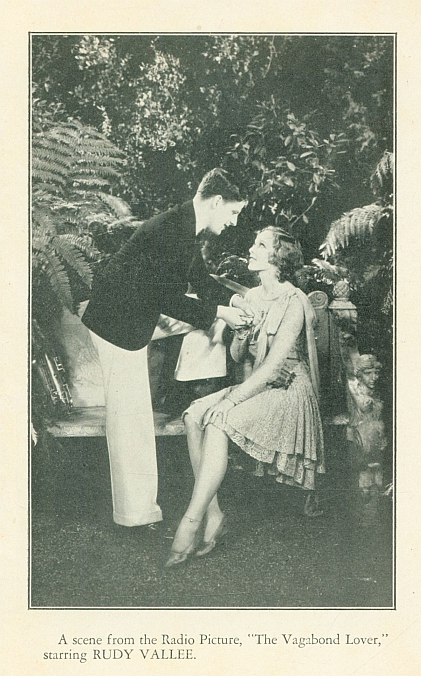
A scene from the Radio Picture, "The Vagabond Lover,"
starring RUDY VALLEE.
Here the members of The Vagabonds, having rid themselves of an initial nervousness, were attending to a hunger left unsatisfied by the sketchy meal in the Grant kitchen.
Only Sport O'Malley seemed unworried by the need of more food. Surrounded by a clump of girls, he was explaining the difficulties and joys of being a great musician.
"Well, no, girls," he admitted, "I wouldn't say I was marvelous at all kinds of music. Only at love songs. Sentiment."
"Why is that?" a blond debutante asked him with wide, appealing eyes.
"A musician can only put into his instrument what he has in himself," Sport told her.
"And what's that?" a second girl demanded eagerly.
Al Monroe removed a sandwich from his mouth long enough to say "Wind!"
"Wind!" the girl exclaimed.
Sport took her gently by the arm, drawing her away.
"Let's go some place where there aren't so many annoying people," he said. "Then I'll explain it all to you—with illustrations."
As they moved away, Jean, on a near-by bench with Rudy, smiled.
"They're cute, aren't they!"
Rudy looked at her in surprise. "You mean Sport? The boys?"
Jean shook her head, laughing. "No, those kiddies up there singing. I just love children."
"I guess we like about the same things," Rudy told her. "So do I."
"Oh, I do hope this benefit for the orphanage will be a success, Mr. Grant. I am so afraid that something may happen to spoil it."
"You think a lot of this orphanage fund, don't you?" Rudy inquired.
"It means so much to the children. So very, very much."
"You know," Rudy said slowly, "I've never met a girl like you before, so interested in a thing like a charity benefit."
"And I've never met a man like you before," Jean replied. "You're not at all the way I thought you would be," she confided. "Not a bit like a famous jazz band leader."
"Well," said Rudy, "you're a great deal better than I thought you'd be."
Jean's brow wrinkled in perplexity.
"I?" she asked. "Why you couldn't have thought of me before, you didn't even know that I was on earth!"
Realizing his slip, Rudy blushed desperately. But with a calm voice, he explained:
"Oh yes, I did. I always knew that I was going to meet a girl like you some day. You see——"
At that moment, his glance fell upon the members of The Vagabonds. Under the guidance of Mrs. Whitehall they were with their instruments being shepherded toward the platform on which they were to play. Rudy stood up quickly.
"I wrote a song about that girl," he said. "We'll play it. And when we get to the chorus, I'll sing."
He hesitated. "Perhaps when you hear it, you'll understand what I mean. Will you listen? Will you listen to what I have to say?"
For a long moment, Jean studied his handsome, anxious face. Then she slowly nodded her head.
"I'll listen," she murmured softly. She paused in hesitation. "By the way, Mr. Grant, I wanted to tell you that there is something hauntingly familiar about your voice—your singing, I mean."
Rudy stared at her uncertainly, not knowing what was coming. "You've heard Ted Grant on the radio——"
"I don't mean that. I mean that your singing reminds me of someone else—a boy back at school," she finished.
Rudy's pulse quickened as she continued: "I only heard him once. It was the last night of the year. We were having a dance at the house. He sang as he passed—the very song you sang this afternoon, 'I Love You.'"
She looked away. "There was something so plaintive and sincere about it that I shall never forget him."
With his lips sealed against telling her that it was he who sang, Rudy contented himself with a small, grim smile. "I hope you never do," he said.
Mrs. Whitehall again called for the attention of her assembled guests.
"My dear friends," she said with a glance at Mrs. Todhunter, "I now wish to announce the final number on our program. I take pleasure in introducing my very dear friend and neighbor, Mr. Ted Grant, who with his band has consented to come here as my guest and play for us!"
At the announcement an excited stir went over the room. The name of the famous radio entertainer was familiar to all, and the knowledge that they were about to hear in person the great musician known to everyone who possessed a radio had about it the importance of great news.
Rudy took his position in front of his orchestra with a set smile on his face. He had no qualms about his ability, either as a saxophonist or a singer, for his long hours of study had assured him of success there. For the moment he forgot the barrier to his dream of Jean and thought only of the message he was about to send her on the wings of melodious song.
"'If You Were the Only Girl,'" he said briefly.
Sport nodded, gave the signal, and the band launched into the number. As the chorus was repeated for the second time, Rudy, as was his custom, stood up and began to sing. He sang with closed eyes, and in every syllable of the song was a tender message for one girl in his audience.
"If you were the only girl in the world,
And I was the only boy,
Nothing else would matter in this world to-day;
We could go on loving in the same old way.
A garden of Eden just made for two,
With nothing to mar our joy;
I would say such wonderful things to you—
There would be such wonderful things to do—
If you were the only girl in the world,
And I was the only boy."
The Vagabonds, to immense applause, played several numbers. Rudy did not sing more than once. Sport asked why, but Rudy shook his head noncommittally. He was so anxious to hear Jean's reaction that he did not feel he could do justice to another number. So in the next piece his role was solely that of saxophonist.
When they had finished and come down from the platform he had his answer. Jean came forward, her lovely face alight.
"That was just beautiful," she said.
Rudy smiled. "I was singing about something beautiful."
Before either of them could speak again, Mrs. Whitehall came hurrying forward.
"Oh, Mr. Grant!" she exclaimed, "you were the hit of the evening." She turned to her friendly enemy for confirmation. "Wasn't he, Mrs. Todhunter?"
"It was quite interesting," admitted the social leader. "So different, though, from the trained operatic voices."
But Mrs. Whitehall was not to be checked.
"Wouldn't it be wonderful," she enthused, "if we could persuade Mr. Grant to head our benefit program to-morrow night!"
Rudy hastily applied a handkerchief to a suddenly damp brow.
"But we haven't secured our manager's permission!" he protested.
"Suppose we secure the permission?" asked the indefatigable Mrs. Whitehall.
Mrs. Todhunter interrupted coldly: "I'm afraid a plain jazz band wouldn't be quite suitable on a program with real concert and operatic artists," she said.
"Mr. Grant's is hardly a plain jazz band," Mrs. Whitehall bridled.
"Nevertheless," observed Mrs. Todhunter, "I'm sure my operatic friends would view it as such. I know the artistic temperament. They would never consent to appear on a program which lacked artistic dignity."
"And quite right," said Rudy with a heart-felt earnestness. "Quite right."
Mrs. Todhunter turned to Rudy with a cold smile.
"So good of you to say so, Mr. Grant," she said. "You understand——"
"Certainly," Rudy assured her as she swept away. "I understand exactly."
"Oh, Mr. Grant, I hope you are not offended," Mrs. Whitehall exclaimed nervously.
"Not at all, really," Rudy said. "I think there is a great deal in what she says."
"But you have every right to be offended," Mrs. Whitehall said bitterly. "I shan't let her off so easily. I'm going to bring the matter before the committee and insist that you head the program."
"But——"
"Don't fear, Mr. Grant! I have some influence with that committee, and I shall see that you have a proper courtesy extended to you!"
And with that she, too, left Jean and Rudy.
Jean smiled at him. "Well, it looks as if you're going to play. Auntie will insist to the committee. You may be sure of that."
"But I don't want her to insist!" Rudy protested.
"Don't worry," Jean assured him. "She won't let anyone be insulted in her house."
"An orphanage benefit can't have too much dignity," he said after a few desperate moments of thought. But he realized the inanity of the words even as he voiced them.
"Nobody can impose on Auntie when she gets her back up," Jean went on composedly. "She won't stop at anything to get even with anyone who tries to injure her social prestige."
"I imagine you are right," Rudy admitted dismally.
"Yes, she'll do anything when she's really angry. She's like one of those queens who chopped off the heads of people who opposed her—or sent them to prison on very restricted diets!"
"To prison!" Rudy exclaimed with a mounting alarm. "To prison!"
"If they stand in her way," Jean said. "Pretense is what Auntie hates."
Had Jean deliberately been trying to increase Rudy's feeling of discomfiture, she could not have chosen more apt words with which to do so. At each fresh instance of Mrs. Whitehall's manner of handling pretenders and those who in any way might damage the fabric of her social aspirations, his already tormented consciousness took on added realization of the plight into which the masquerade had plunged The Vagabonds.
"I tell you," he heard Jean continue, "I wouldn't be the person to have her after me for anything in the world. She had a dressmaker fined five thousand dollars once for pretending to sell her imported models. And then there was that cook who swindled her on the household accounts. She had him sent to jail, yes, actually to jail!"
She completed her fearsome description with a little movement of her hands.
"That's why I'm so glad she likes you, for she really does."
Rudy looked at her desperately.
"And you—do you think—do you like—I mean——"
Before he could finish his tangled and laborious sentence, he caught sight of Sport signaling him from the doorway. It was apparent from the other's frantic gestures that something was wrong.
"What were you saying?" Jean asked softly.
Rudy turned a miserable face.
"I guess I'll have to tell you later," he said. "Something seems to have happened that needs my attention just now."
"Something extremely important?"
Rudy looked again at the strained face of Sport across the room.
"Apparently very important," he said. "Can you wait a few minutes?"
Jean rose, a slight flush on her face.
"It doesn't matter," she said. "It's late, anyhow. The guests are going and I should be helping Auntie say her good-bys."
"But, Jean!" Rudy cried. "I want to talk to you!"
Jean smiled. "Won't it keep until to-morrow?"
Then, with a graceful, rapid stride, she left him.
Rudy watched her go with mingled emotions. To-morrow! Why, by to-morrow they hoped to be miles away. And—and——
"Rudy!"
It was Sport, who had crossed the room as Jean disappeared. He grinned, seeking to mask his distress.
"Boy, we got a tough break," he said. "The boys went out to load some stuff in the cars, and they found two of Harry Ables' tires blown. Overloaded, I guess; but that sure puts his car out of the running."
"Can't we all pile in mine?" Rudy asked.
"Ten of us? Why that bum set of tires of yours would pop before we'd gone a block. Nope, it looks like the train for us."
"Well, that's all right. We've enough money to pay fares home for half the boys."
"Sure, but the train doesn't leave until to-morrow around noon! We wanted to get out to-night. That cop Tuttle has been hanging around again."
Much as he realized the gravity of delay, Rudy could not force a dour expression over the news. He smiled.
"Well, we'll go to-morrow then," he said. "I guess my bus can carry five extra as far as the station, anyway."
"But don't you realize how dangerous it is to stick around here with Grant liable to find out at any minute that we've been impersonating him?"
"Surely it's dangerous," Rudy admitted. "But what are you going to do, take wings and fly? You should have thought of things like this when you told them that I was Ted Grant. But don't worry," he added in a comforting tone. "There isn't much can happen before to-morrow at noon."
But Sport for this once was inclined to look on the pessimistic angle of the affair.
"The boys are scared, Rudy. That guy Tuttle snooping around has got their goats. But I suppose you're right," he admitted. "There isn't anything we can do but wait for that train."
"Don't worry," Rudy repeated. "And now are you on your way?"
"Yeah. You coming? The gang has gone already."
Rudy hesitated. He wanted a final word with Jean alone, to tell her that now "to-morrow would do." But he had no wish to appear too presumptuous, and concluded that it would be best simply to leave with Sport.
"Alley oop," he said. "Let's shove off."
At the door, Mrs. Whitehall and Jean were saying good-by to the last of the guests.
"Good-night, Mr. Grant," she said. "It was so wonderful of you to come to-night. I do hope that you weren't offended by Mrs. Todhunter. But as you know, there is no explaining the actions of some people."
"I wasn't offended," Rudy said in a last attempt to free himself of the intolerable situation. "Really, I think there was a lot in what she said."
"Perhaps Mr. Grant doesn't want to play for our benefit, Auntie."
It was Jean who spoke, and looking at her, Rudy saw that the coils were tightening about him even more unbreakably than before. Sport, too, appeared to grasp the predicament into which he had been cast, and made some murmur of dissent.
"No," he said, "Mr. Grant and the band would like to play for you. But you see——"
"Don't you concern yourself, Jean," Mrs. Whitehall interrupted. "I can see by Mr. Grant's face that he isn't the kind of a young man who would fail a worthy charity. We'll see you to-morrow, gentlemen. Good-night."
"Yes," Jean repeated with an inscrutable smile. "We'll see you gentlemen to-morrow. Good-night."
The door closed and Rudy and Sport walked silently across the lawn in the direction of the Grant house. Neither felt like talking. Nor, indeed, was there much to say.
The second day of their stay in the Grant house found the Vagabonds up and about at an unusual hour for musicians. For the night they had disposed themselves about the house in varying attitudes of comfort; but as morning deepened, they appeared to question one another as to the approach of train time.
"The sooner we get out of here the better it will please yours truly," said Sam McMahon.
"Here, too," assented Al Monroe. "The things I could do to a real meal would be criminal."
Another haphazard meal had been assembled in the kitchen; but to judge from the number of complaints, Ted Grant's larder had not been stocked with an idea of entertaining ten young men.
Rudy moved about nervously, keeping his glance for the most part in the direction of the Whitehall home. When the others had divided the morning paper, or set themselves to a practice session with the instruments, he went out into the garden. He did not wish to miss a moment of Jean's company should she emerge from her home.
Evidently he had been observed strolling restlessly about, for it was not long before Jean appeared in her doorway.
"Don't you want to come over?" she called.
Obeying with an alacrity which brought a slight color to the girl's cheeks, Rudy passed through the hedge and swung up the steps.
"You're out early," she informed him.
"Well, you know what they say about the early bird," he returned.
Jean studied him with mock severity.
"Are you implying that I'm a worm, young man?"
"Hardly that," Rudy said hastily. "Some of those sayings sort of backfire."
As they went into the house, Jean asked: "Are you enjoying your stay?"
"It's been the happiest time of my life," Rudy said. "I wish I could explain—make you feel that it has."
Jean bent her head slightly.
"Maybe I understand. It's strange—but I feel, well, I feel that it's been better than all other days, too."
For a moment Rudy digested her meaning. It scarcely seemed possible that she could have spoken those words. Had they been phantoms, or mere figments of some extreme hope?
"It seems somehow that I've always known you, Jean."
And then Jean said a surprising thing:
"I wish we had always known one another. Are—are you a college man, Mr. Grant?"
As Rudy struggled for an answer, a strain of melody was carried across the soft morning air. The Vagabonds apparently were not wasting their time in idleness.
"Oh, what is that song?" Jean interrupted him.
Rudy smiled gratefully. "It's a song that was meant just for you." And because he could express himself better in song than in ordinary speech, he took up the words of the number softly.
"We'll be so happy,
We'll always sing
If we remember, one little thing,
A little kiss each morning, a little kiss each night.
"Who cares if hard luck may be ahead,
An empty cupboard,
A crust of bread—
A little kiss each morning, a little kiss each night.
"Dreams may disappoint us,
As they often do,
Bring your tears to me, dear,
I'll bring mine to you."
As he finished singing, Jean got nervously to her feet. She seemed in the grip of some emotion as powerful as it was puzzling.
"You have a marvelous voice," she said at length. "It sounds so—so sort of familiar to me. I could listen to it all day."
Rudy frowned. "Only until noon, I'm afraid. You see, we have to go into town for a rehearsal. I'm more sorry than I can tell you, but we've got to leave."
"Oh, I wish you didn't have to go," Jean exclaimed in a voice of genuine disappointment.
"I wish I didn't, too," Rudy answered. "You have made me forget all about my music."
"Flatterer! But it's nice to hear you say it, anyway. I've always wanted to meet a real musician—an artist with sincerity."
"Sincerity?"
"Yes," the girl returned. "That's what your music makes me feel about you. You just couldn't be anybody but yourself. When you sing like that, I wish you'd go on forever."
"Would you be willing to go on with me forever?" Rudy asked suddenly, bolder than he had dreamed of being.
"Why, I——"
Before Jean could complete the sentence, there was an interruption by the butler. He held a yellow envelope.
"Pardon me, is Mrs. Whitehall here?" he asked.
"No, Adams," Jean answered.
"I have a telegram for her."
"Just leave it on the table." As the man put down the telegram and left, Jean eyed it curiously.
"Now I wonder what that's about," she said.
"So do I," Rudy admitted.
"I wonder if anything has happened. It's funny that Auntie hasn't come home. She left the house early this morning, before I was up. Something must have detained her at her committee meeting."
As Jean noted that Rudy's mind was not upon her Aunt, she guessed the secret of his inattention.
"Will you be coming back to-morrow?" she asked.
"If I weren't, would you mind?" Rudy returned with the same light smile.
"What a silly question," Jean reproved him.
"Maybe not. I might have to stay in town, for instance."
"Then," Jean said decisively, "I'd come in to hear you play. From now on I'm going to be a Ted Grant fan."
For a minute Rudy was silent. Then he said:
"Well, supposing I weren't Ted Grant."
"If you weren't famous? Oh, I'd like you just the same, no matter who you were."
"Jean," Rudy said abruptly, "I've got to tell you something. Maybe I'll make you hate me—but I've got to tell you. I'm not what you think I am—I'm——"
"Oh, oh, Mr. Grant! What a relief to find you here!"
Rudy and Jean turned. In the doorway, her face reddened with excitement stood Mrs. Whitehall.
"Why, Auntie," Jean exclaimed. "What in the world is the matter?"
"I won," said Mrs. Whitehall with satisfaction.
"At what?" Rudy asked.
"At the committee meeting, of course. Your band plays to-night!"
"My band——!"
"Do you mean Mrs. Todhunter consented to let Mr. Grant head the program?" Jean asked.
"I should say she didn't!" Mrs. Whitehall exclaimed. "And what a piece of my mind I gave her! And the committee backed me up, especially when I told them how anxious Mr. Grant was to help us."
Rudy scratched his chin in bewilderment. The situation rapidly was getting beyond all attempt at salvage, he saw that. And yet something must be done to escape from it. But what?
"Of course, I did want to help," he said slowly, "but with the other artists on the program objecting, perhaps——"
"Oh, but they are not on the program any more! Oh, no, not at all! They have all motored back to New York."
"What!" cried Rudy and Jean in chorus.
Then Jean asked: "Do you mean that Mrs. Todhunter was responsible——"
"Exactly, my dear! She said they refused to appear on a program with a jazz band, no matter how famous, and as the committee insisted on having Mr. Grant, she withdrew their names. Oh, it was a complete triumph for me, I assure you!"
"But, Auntie," Jean said, "without the operatic stars, we can't make the benefit a success."
"The broadcasting people say that Mr. Grant is a far greater attraction," Mrs. Whitehall replied complacently. "Some of them have assisted in his broadcasts in New York, and they say that nobody on the air is as big a favorite."
"Do you mean that these men have been with Ted Grant—with me—personally?" Rudy asked.
"Why, yes," Mrs. Whitehall told him, "and I daresay that in the audience will be a number of your regular fans. They're sure to come when they learn you are to appear. Oh, with the debutante numbers, we'll have a great success!" she cried happily. She turned to Rudy. "And you will do your best to help us, won't you, Mr. Grant?"
Rudy shook his head doggedly, realizing that the break must be made at last.
"But Mrs. Whitehall, I've told you that it is impossible. We—we will have to secure our manager's permission."
"Oh, I've taken care of that," Mrs. Whitehall said with a bland smile. "I wired to your manager directly from the committee meeting."
"My manager?"
"Yes; I got his address from the broadcasting people in New York, told him you wanted to play for us, and offered to meet his terms."
"You said—said I was here, and wanted to play?" Rudy asked.
"Of course," she replied. "You and your whole band. That was right, wasn't it? The answer should be here by now," she added.
"Why," Jean began, "that must be——"
"Jean," Rudy said quickly, "please——"
"That must be what?" Mrs. Whitehall demanded.
As Jean looked at Rudy he shook his head; but with a slight frown she spoke again, having failed to grasp the meaning of his exclamation:
"Why that must have been why the butler was trying to find you!"
Rudy desperately took the girl's arm, drawing her toward the door. "What do you say to a little walk in the sunshine?" he asked nervously.
"Why was the butler trying to find me?" Mrs. Whitehall drove on. "Come, come, speak up!"
"Yes," said Rudy, and then in a whisper to Jean he pleaded, "Come, come outside!"
There was no mistaking his wish now, and Jean, although not understanding, was willing to assent to it.
"I—I—really have forgotten what Adams wanted," she told her aunt.
Mrs. Whitehall hurried toward the door.
"Well, I will see the butler. It must be the telegram. Excuse me."
When she had left them, Jean looked curiously at Rudy. "Why didn't you want Auntie to read that telegram?" she asked.
Rudy unhappily returned her gaze.
"Jean there was something I wanted to tell you," he said miserably. "But it's too late now."
"About the telegram?"
"Read it," he said simply, pointing to the table on which the yellow slip lay.
"But it's addressed to Auntie."
"It will concern you," he told her.
"Why," said Jean, "how strange you seem."
"Read it," Rudy repeated.
Jean picked up the envelope and ripped it open with quick fingers. Withdrawing the enclosure, she flipped open the paper and read aloud:
BAND OPERATING IN YOUR NEIGHBORHOOD A FAKE. HAVE WIRED POLICE TO ARREST ALL CONCERNED AND HOLD UNTIL I ARRIVE WITH MR. GRANT. IMPOSSIBLE TO PLAY YOUR BENEFIT AS CANNOT ARRIVE UNTIL LATE EVENING.
J. CONNORS, MANAGER.
There was a harsh silence. Rudy could not lift his eyes. His face red with shame, he stood with drooping shoulders, an effigy of contrite misery.
"I was going to tell you," he said. "I was trying to tell you."
"Then you're not Ted Grant?"
"No."
"You've been lying—imposing on us?"
"I didn't mean any harm," he protested. "It was just that we were—sort of caught up by a rolling snowball, and had to go along."
Jean turned stiffly away, her back uncompromising.
"You don't understand," Rudy pleaded. "Let me explain."
"I have no doubt but that you will be able to explain most glibly, Mr.— Mr.——"
"Bronson—Rudy Bronson!" At the sound of his own name, and the knowledge that at last he was free of the hated masquerade, his heart lightened amazingly.
"You see," he hurried on, "I had seen you at the University."
"At the University?" It was Jean's turn to be amazed.
"I was a freshman there," exclaimed Rudy. "Oh, this wasn't planned, Miss Whitehall, I swear it! But after it got started, why—why I couldn't stop it. The boys were afraid. I couldn't tell you the truth without giving them away. And then—I—I wanted to know you, to be near you, at any cost." He turned away disconsolately. "And now I've ruined my chance to do that—forever!"
Jean gazed at him for long seconds. He was so utterly crushed, so thoroughly penitent, that she could not forestall a suspicious mistiness that clouded her eyes. But before Rudy was aware of it, there came a tremendous ringing of the doorbell and a call of:
"Rudy! Quick!"
Adams opened the door upon a troupe of excited young men. They piled past him with the heedless haste of a stampede, only pausing when they came upon Rudy and Jean.
"What's the matter?" Rudy asked. "What happened?"
"Police!" Sam McMahon said without hesitation. "We saw them coming up the front walk, and we ducked out the back. You had the keys to your flivver," he admitted, "or we'd have been on our way by now. Come on, boy, let's be moving."
"That's right, Rudy," Sport O'Malley said. "All except about leaving you, of course. Come on, we've got to hike for that train."
"How far is the station?" Rudy demanded. "Even if we do make a break for it, if it's more than a mile, they are sure to overtake us before we get there. Remember that one ancient flivver can't go very fast with ten men."
He spoke dully and dispiritedly. The bottom had completely dropped out of his world, and the prospect of a trip to jail had for him none of the alarm which it caused the others. It would, in fact, be quite appropriate as a closing incident for the whole fiasco of his attempt to impress Jean.
Then he heard Jean say: "Wait a minute, I'll take you in my car."
"What?" they demanded in unison.
"What a girl!" Sport exclaimed.
"Hurry," Jean said. "We can still get out the back way."
Rudy attempted to detain her. "I can't let you do this, Jean."
"And I can't let you be arrested in Auntie's house," she flared.
"But we can't hide behind a woman's skirts!" he protested. "Can we, fellows?"
"Try and stop us!" bellowed Al Monroe.
"Come on!" Jean cried. "Let's go!"
Out the back entrance of the house they scrambled and into a long touring car. As they were making this exit, the officers were ringing the front doorbell; but of that they happily were ignorant. Only Mrs. Whitehall was left to explain, with the aid of the telegram, the catastrophe which had befallen her social ambitions.
In the car Rudy sat in silence, realizing only that he was being carried to safety by the girl he loved. And away from her. All his ancient hatred of pretense rose to mock him, that he should have allowed the thing he despised most to ruin his chance for happiness. The other members of the orchestra were too impressed by the dramatic manner of their escape to have much to say. With the exception of Sport O'Malley, sitting in the front seat with Jean, they were unusually quiet. And even Sport apparently was finding little to say to Jean.
The ride was quickly done, and the Vagabonds climbed gratefully out of the car. As they ran to the window to inquire if the hoped-for train were on time, Rudy went to Jean.
"How am I ever going to see you again?" he asked desperately. "If you only knew——"
"You aren't going to see me again," she said. "Ever."
"Oh, I know I've been to blame, Jean. It's a terrible mistake that I'd give anything to undo."
Far down the track there was the faint sound of a train whistle.
"You had better go," she said. "You'll miss your train."
Rudy shook his head. "I'm not going until I know that you've forgiven me. Oh, have I hurt you so much?" he asked. "I don't understand. If you hate me so—then why did you save us from the police?"
"Never ask a girl why," she told him. "Maybe it was because I couldn't see you punished that way."
"We deserved it."
"You don't know Auntie," Jean said. "She'd never forgive you. She'd make them give you a prison sentence, at least."
Rudy frowned. "I don't care about her. I just want you to know how sorry I am."
"Oh, it isn't myself that counts!" Jean burst out unhappily. "It isn't Auntie's humiliation. It's something far greater than any of us—something you and your friends have forgotten—that's the real sufferer."
"What is that?"
"The orphanage."
"Why," he asked, "what do you mean?"
"Can't you see that you've spoiled the whole benefit? Auntie trusted you and counted on you. The other artists have gone back to New York. Grant won't arrive until much later. There'll be no time to get anyone else to head the program this evening."
"I never thought of that," Rudy admitted.
"We'll have to return the ticket money," she went on. "What's left of the fund must go to the broadcasting people. It's hardly worth while to give the other performances if this one is to be such a failure."
"Isn't there something I can do?" Rudy asked miserably.
"It's too late to do anything, I'm afraid," Jean answered. "You've had your joke at the expense of a great charity, the one we've worked so hard for—and because of your thoughtlessness, children will suffer. I could never forgive you for that."
"Jean!"
The girl turned her face away from him, starting her car.
"I never want to see you again," she choked. "Never!"
Then with a roar of the mighty engine and a puff of acrid exhaust, she was gone.
Rudy stood looking down the road after her, his mouth in the same bitter, twisted line it had been that distant day when he had flunked out of the University. So this, too, was to be another failure. This, the loveliest thing that ever had come into his life.
With a screech of brakes, the train slid into the tiny station. The Vagabonds started toward its steps, with their instruments having the appearance of mammoth silver-bedecked bugs.
"Come on, Rudy!" Sport called. "We're leaving in a minute."
With a curt movement of the head, Rudy took his stand.
"I'm not going," he said.
Sport approached him, aghast. "What?"
"Jean's right about that benefit. We've ruined it by our foolishness."
"Well, suppose we have," Sport cried, "are we going to miss this train?"
Rudy nodded. "I am."
"Have you gone nuts, fella?"
"No, I've just got some sense. I can't run out on these people like this. I'm going back there and offer to sing, play or do anything that will help."
"Why, you're crazy," Sport insisted. "They'll jail you!"
"I don't care," Rudy answered doggedly. "I'm going to take my medicine."
Several of the others had approached, wondering about the delay. As soon as they gathered the reason for Rudy's stubbornness, they began to give, for the first time, a thought to the predicament into which they had plunged the charity-benefit committee.
"Oh, come on," said Al Monroe, "we can't help it now. Let's grab this train."
"You grab it, fellows," Rudy said. "I'll write you from the rockpile."
Sport O'Malley shrugged, and got out his cigarettes.
"You won't need to write to me, Rudy. I'll be right there alongside of you."
"What?"
"Say listen! After the way you stood up for me back at that Magic Lantern affair, do you think I'd pull out on you? Why, we're all in on this as much as you are."
"That's right," said little Bud Dwight, "we're all in on this together. If Rudy's game, let's stick, too."
"I can't let you do this," Rudy told them. "Go grab your train—and grab it fast."
Al Monroe thoughtfully fingered his tuba.
"If it'll help them for us to play, we'll play; and I'll bust anybody who says he won't!" He looked around the circle; but with the exception of Sam McMahon's alarmed face, it was apparent that they were in agreement.
"Oke," said Sport. "Hey, taxi," he called to the station hack. "Believe it or not, here's a fare."
"Looks more to me like ten fares," the driver returned, surveying them with dismay.
"That's all right," Sport assured him. "It isn't every driver who's had the chance to have the celebrated Vagabonds draped over his chariot. To the charity benefit, my friend."
"And," added Sam McMahon, "don't stop for any cops!"
In the library of the Whitehall home, Mrs. Whitehall sat surrounded by a circle of gentlemen from the press. Her face was harassed and marked with strain, and it was evident that she was making every effort to put up a semblance of composure. But under the eager scrutiny of the newspaper reporters, she rapidly was giving way to something close to panic.
"Tell me," one of them asked her, "who introduced this impostor to your friends as Ted Grant?"
"I did," answered the unfortunate woman.
"I see," the man continued, "and when did you first notice your niece's interest in him."
Mrs. Whitehall bowed her head. "When she ran away with him."
Another reporter introduced himself: "Clarke of the Herald, Mrs. Whitehall. Where can we get a photograph of your niece?"
Mrs. Whitehall's lips straightened.
"I don't intend to answer another question," she said coldly. "Too much has been said already."
"But you've got to!" Clarke insisted. "Why, this is front-page stuff."
"Sure," said the first speaker, "we're going to give you a million dollars worth of free publicity. We've learned that this fellow Bronson played at the Hotel Laconia, and they called themselves the Vagabonds." He turned to his companions. "Can't you just see that, boys? 'Heiress Elopes with Vagabond. Aunt Rages. Secret Love Nest.'"
"'Her Vagabond Lover!'" Clarke cried. "There's a head for you."
Another member of the group stepped forward.
"Pardon me, Mrs. Whitehall. I met you at Lathrop's at Palm Beach last winter."
"How nice of you to remember," Mrs. Whitehall assured him icily.
"Yes, I'm nice that way. Now, in the interest of the Gazette, might I ask if your niece was ever photographed in a bathing suit?"
Mrs. Whitehall got to her feet, her face blazing with fury.
"Go away; go away, all of you! I don't intend to answer another question!"
Officer Tuttle stepped forward to her aid.
"Now lookee here, boys—we don't know for sure that she did run away with these crooks."
"Maybe they ran away with her, eh?" Clarke asked sarcastically.
"Well," Tuttle admitted, "that's my theory."
"A kidnapping? Hot dog!"
"Do you think that hypnotism was used?" asked the Gazette representative.
"Well, I wouldn't say positively," Tuttle said. "But you might print the fact that Chief George C. Tuttle expects startling discoveries within twenty-four hours. Two t's in Tuttle."
"You mean an arrest?" Clarke asked hopefully.
Tuttle nodded emphatically, his chin bobbing in forceful illustration of his meaning.
"We're going to arrest these crooks and put them where they belong, as sure as my name is George C. Tuttle, attached to the 11th precinct."
"With two t's?" a voice queried.
But Tuttle went on without pause, adding:
"We'll show these city gangsters that they can't perpetrate their outrages in this town. I've had my eye on them all the time they been here. I thought they were trying to kid me—kid the country cop."
"Well," Clarke observed, "you can't blame a man for trying."
"Now, madam," the Gazette reporter returned to Mrs. Whitehall, "about that bathing-suit picture."
"Go away," he was answered. "I shan't speak to you. I shan't say another word. Officer Tuttle, I must ask you to clear the house of these men."
As Tuttle half-heartedly was about to carry out her instructions, the radio gave up the muffled dance music which it had been broadcasting in favor of a crisp masculine voice.
"This is the National Broadcasting Company," it announced, "operating from the charity benefit at the Todhunter estate at Longport, Long Island. Please stand by."
"Wait a minute," Clarke asked of Tuttle. "What was that?"
"Why," said Mrs. Whitehall, "they're announcing the charity benefit over the radio!"
"But I thought you said this benefit would have to be called off," one of the reporters reminded her.
"Sh," said Clarke as the voice began to speak again, "let's get this."
"This is Phillips Graham speaking," the radio voice commenced. "In behalf of Mrs. Whittington Todhunter, I wish to announce that the first performance of this monster benefit for the Orphan's Home will be broadcast over this station immediately. Mrs. Todhunter wishes me to explain that due to an unfortunate misunderstanding with Mrs. Ethelberta Whitehall, of the committee, the operatic stars expected will be unable to appear. Mrs. Whitehall promised to replace these singers with the Ted Grant band, but, again due to another unfortunate misunderstanding on the part of Mrs. Whitehall, this also will be impossible. However——"
Mrs. Whitehall gave a low moan. "Oh, dear, oh dear—this is terrible. I'm ruined!"
"However," the announcer continued, "rather than let the program suffer, Rudy Bronson and his Vagabonds, that famous musical organization which has just returned from a triumphal tour of the fashionable New England resorts, have volunteered to replace the Ted Grant band, with whom they were unfortunately confused by Mrs. Whitehall."
The announcement caused an excited stir in the room.
"That means those Vagabonds are right there at the benefit!"
"And so's the niece!"
"The nerve of them!" Tuttle cried. "I'll pinch the whole bunch!"
"Do you mean to tell me," Mrs. Whitehall asked, "that those young blackguards have had the impudence to appear at that benefit after what has happened?"
Tuttle nodded. "That's what the radio is saying."
Mrs. Whitehall wheeled upon the butler, crying:
"Adams, my car!"
"Wait!" Clarke said. "Here's comes something else."
Again the radio voice spoke: "Now folks, the benefit is about to begin. The band is going to play the first number, and then there will be specialty acts by various volunteers from the colony. I wish I could make you see this brilliant spectacle as it really is. Taking place on one of the most beautiful estates, the immense crowd, seated about the natural amphitheater, is probably the smartest gathering of the season. Flowers, new Paris gowns, Chinese lanterns, have turned the whole scene into a blaze of color. Here comes the band onto the outdoor stage. You can hear the crowd applauding——"
"Your car is here, Mrs. Whitehall," said the butler.
Mrs. Whitehall turned to Tuttle, her eyes like flames in the anger of her face.
"Officer, you may come with me, in my car, and make the arrests."
"I'll say I will," Tuttle agreed with alacrity. "That young smart aleck will do the rest of his singing in Sing Sing!"
Due to the proximity of the Whitehall and Todhunter estates, not much time was required for the hurrying car to bring its occupants to the scene of the charity benefit.
In his description of the Todhunter estate, the radio announcer had done scant justice to an impressive expenditure of both time and money. One of the more beautiful of the Long Island places, under the guidance of especially imported decorators, the house and gardens comprised an elaborate panorama of artificial splendor.
Myriad lights had been slung in long vari-colored loops all through the amphitheater, their focal point being the richly decorated stage. How upon row of cushioned seats faced this raised platform; and these were occupied by the type of audience only to be gathered by a leader of Mrs. Todhunter's eminence.
Mrs. Todhunter herself moved among her guests, apologizing for the "unfortunate misunderstanding" now generally credited to Mrs. Whitehall. There was small question in anyone's mind but that she would use this incident to its last implication to settle finally the race for social leadership which had been so bitterly contested by Mrs. Whitehall.
Leaving her car, Mrs. Whitehall at a glance understood the situation, and she turned to Tuttle with a renewed malice.
"Make your arrests just as soon as you possibly can. That young ruffian up there has caused me to lose the dearest thing I own. And I am going to make him regret it, you may count on that!"
"You're right," Tuttle agreed. "He's made a fool of me, too. Don't worry, Mrs. Whitehall, you'll find me just a little more than ready to take the whole bunch of them where they belong!"
On the stage, the Vagabonds were playing their best. And as they played, Rudy knew that they were doing anything but poorly. Yet he could find small comfort in the thought. After all, what could it matter if they played well or badly, now that Jean knew him for what he was?
An impostor! As he knew that he merited the term as fully as anyone ever had, chagrin engulfed him in a crashing, unhappy wave. Nor could he find relief in the thought that his deception had been without intent toward any gain. For it hadn't. He had entered into the masquerade in a simple need of safety, true enough; but there also had been that wish to bring himself to the attention of Jean Whitehall.
Well, he had done that well enough! After being careful that she did not see him at the University as an obscure student, or at the Hotel Laconia as a member of the jazz orchestra—he had caused her to uncover him in her own home as the pretender to another man's name!
The girls who had volunteered to dance to the music of the orchestra made their entrance and went gracefully through a rhythmic pattern of steps. Watching them, Rudy reflected that any one of them might be Jean. They were of her set, her social order. And he, Rudy Bronson, was simply a—a Vagabond.
"What a fool I was, ever to think of her," he thought. "I must have let that Ted Grant complex chase away the few brains that I had!"
But if he only were Ted Grant! Then he would be able to approach her without fear or shame, on the solid assurance of achievement. America asked nothing of anyone more than that he be excellent in his chosen profession. Oh, if only he had been able to speak to Jean as Rudy Bronson—but with the weight of Ted Grant's skill behind him!
As the girls finished their number, a wave of applause rolled up to the stage. The young ladies ran from the wings for a bow; then, with the sudden self-consciousness of amateur performers, hastily retreated to the safety of the canvas walls.
"How about a song on this next one, Rudy?" Sport asked. "We haven't seemed to wow them with either of our first two numbers."
"Why blame us?" Al Monroe demanded. "I could dance better'n any of that flock of skinny dames, with both my feet tied."
"Pipe down," Swiftie counseled, "or somebody around here is liable to tie your big mouth up with a nice big fist."
"Save that," Sam McMahon put in. "I saw Mrs. Whitehall coming in with that flatfoot cop in the middle of that number. And that," he added, "means that pretty soon you guys will be able to have all the fight that your little hearts desire!"
"Did she come?" Sport asked.
"Who?" demanded Bud Dwight, "the old lady?"
"Sure," Sam repeated, "I knew we should have taken that train."
"Aw, be your age," Al Monroe snarled. "We're in this, ain't we? And if we hadn't come here and played, the charity benefit would have been a bust, wouldn't it? I don't see that they've got any squawk coming when we've saved them all their dough."
"That's right," Sport agreed. "Do you think Mrs. Whitehall is apt to press charges against us, Rudy?"
"I don't know," Rudy answered. "Jean said that she sent her cook to jail for falsifying his household accounts."
"But we didn't steal anything from her," Sport protested. "Ted Grant is the man who could cause us trouble if he wanted to. And I don't imagine that he would object to having a pupil of his stay overnight in his house."
"That may be all right," Rudy admitted. "It's just that until we can get Grant to speak for us, she is apt to cause Tuttle to put us on a bread and water diet."
"Well," said Al Monroe, "I think that Swiftie's been eating too much lately anyway. He put on ten pounds at the Laconia."
"Yeah," said Swiftie, "and lost them when I left it!"
"Tell you what, gang," Sport said. "Let's give them everything we've got. We'll put over the best number we've got, and make them like it. If we're a hit, maybe even Mrs. Whitehall will feel a little more kindly toward us."
"That sounds good," said Bud Dwight.
"Anything would sound good that would do some good," said Sam McMahon. "But what's our best number, 'Lovable and Sweet'?"
"That's it," said Sport. "And you take up the chorus, eh, Rudy?"
As they adjusted their instruments, the brief pause between numbers having been dissipated, Rudy shook his head.
"No," he said, "not that one."
"Well, what one then?" Sport asked. "Let's make it snappy."
"No, not snappy, either. I want to sing 'I Love You, Believe Me, I Love You.'" Before there could be any remarks, he added: "That's the number that I do best, and if you want the best, why—
"Sure, that's all right," Sport said, "Let's go, gang."
He gave his signal, and the band, now a perfectly organized team, swept into the melody. Below them pale bulbs of faces swam in organized lines. The multi-colored hues of hundreds of dresses, offset by the more somber clothing of the gentlemen, lay like a gaudy blanket at their feet. It was a gay, smart crowd, craving amusement beyond all things, and Rudy instinctively knew that to please it would be to please the whole pleasure-loving world.
But he gave it the minutest part of his thought. It was not of the total assemblage of Mrs. Todhunter's guests that he was thinking—but of one. And it was to that one, Jean, that he stood to sing.
With closed eyes, shutting out all the world but the mental image of a slim, lovely girl, he poured forth his song:
"I love you, believe me, I love you,
This theme is the dream of my heart.
I need you, believe me, I need you,
I'll be blue when we two are apart."
And as he sang, he put far more sincerity into those simple words than even their author could have hoped for. It was his love-song, yes; but he knew it to be his swan song, too.
On the outskirts of the crowd stood a short, pompous man with the worried eyes of success in his chosen field, and a huge burly man who hovered by him protectively.
"Look at that, will you?" Connors demanded. "Can you beat it? What do you think of that," he demanded with the dull lack of originality of his type. "Can you feature it!"
Ted Grant's eyes were fixed beadily on the distant stage.
"Using the Ted Grant method, is he? Trying to steal my stuff. I'll—I'll——"
But Connors, with the born manager's eye for the crowd, had noted the response that was being given Rudy's number.
"Wait a minute," he said. "Let's get a load of this guy. He's sure to sing again after a hand like that!"
It seemed a just prophecy. The applause which had greeted the conclusion of the "I Love You" number had dwarfed all that preceded it. Rudy was forced to take a bow, and a second one.
"He sure went over," Ted Grant admitted. "Wonder who he is?"
"I'll scout around and find out," Connors said. "There seems to be real talent in these hills."
As the two men were about to move on, several figures approached from the dusk.
"Now I want two of you to sneak around there and come in behind those fellows. Do you get me?"
In the strident, nasal tone peculiar to a certain type of New Englander, there was no mistaking the malice behind the words. Grant and Connors looked around, to see Tuttle deploying his men toward the orchestra platform.
"And two of you others go in behind them from the right. Nail them right there. Does everybody understand?"
There was a general assent, and the little group of policemen moved off into the night, obviously on their way to put the performers on the stage under custody.
Grant whistled. "And what do you make of that?"
"Can't figure it," Connors replied. "Unless these kids have gotten in bad around here somehow."
"That'd be a shame," Grant exclaimed. "Why, they've got real stuff. I'd hate to see them get nabbed by any yokel cop on some small town complaint. Those boys ought to be in the big town!"
"Let's follow around and see what's up," said Connors. "Maybe we can give them a lift."
A few words came from the loudspeaker:
"The Vagabonds now will offer their final number, which also will be the closing number of our performance."
With evident determination to leave a good last impression on their audience, the Vagabonds had chosen one of their best pieces, "Then I'll Be Reminded of You." Rudy Bronson was notably good on the vocal rendition, and as he took up the chorus, they now saw that the choice had been a happy one. Rudy had never been in better voice.
"I'll gather some June dreams,
I'll search for some moonbeams,
Then I'll be reminded of you.
I'll walk by the mill stream,
I'll talk to the hill stream
Then I'll be reminded of you.
I'll climb to the rainbow and vigor anew,
I'll find Paradise and I'll keep it for you.
I'll spend all my hours, among fragrant flowers,
Then I'll be reminded of you."
Struck by the peculiar aptness of the lyric, Rudy completed the song in a cloud of unhappiness. Then I'll be reminded of you. Yes, and wouldn't he be reminded of Jean, of the girl he loved, by everything beautiful so long as he lived? Reminded to his everlasting regret for having allowed himself to try and win her esteem as a cheat....
The Vagabonds hurriedly were putting away their instruments. It was obvious that none of them was anxious to linger for the generous plaudits being given them on all sides. They had too much to lose by delay for even the vainest to wish to stay longer than was absolutely necessary on the Todhunter estate.
With his customary sanguineness, Sport O'Malley had convinced himself that with such a showing as they had made on the program, even Mrs. Whitehall would not be able to entertain much anger with them. But as he saw the dowager approach, her face creased in lines of disapproval, his feeling of assurance ebbed abruptly.
"Well, here it is, gang," he said, as he saw that beside her walked Tuttle.
Sam McMahon groaned. "And to think that by now we could be so far away from this place they couldn't catch us with a special delivery letter."
Four policemen, two upon each side of the stage, appeared from the wings. "Don't try and leave!"
Tuttle went directly to Rudy Bronson.
"Young man, we want to see you," he said heavily.
Rudy nodded. "I know. I'll take all the blame if you'll let the others go."
"What do you mean, you'll take all the blame?" Sport O'Malley said, coming forward. "Listen, fella, you seem to forget that you came through for me in a tight spot. Molly writes me that if I ever forget it, that I'd better forget her, too. But there's no need to worry about that." He turned to Tuttle. "Whatever this guy did, I did just as much, get that?"
"What do you intend to do with us, lady?" asked the tremulous voice of Bud Dwight.
"I intend to prosecute you fully for causing the failure of our benefit."
"The failure!" Sport exclaimed. "Listen, Mrs. Whitehall, Ted Grant himself couldn't have gotten a better hand than we did."
"What's the use of arguing, Sport?" Rudy asked. "I'll go with you, officer," he said to Tuttle. He got to his feet, looking at the swaying curtain which had blotted out all the approving hundreds of a few minutes ago. Was Jean out there, unconscious of what was taking place behind the lowered velvet? Or did she know—and approve?
As if summoned by his thoughts, Jean came from the wings, her hands full of telegrams, her face alight with excitement.
"Why, Jean," Mrs. Whitehall said, "where have you been?"
"At the radio, receiving telegrams," Jean answered. "And before you say another word to Mr. Bronson and his friends, I want you to look at these wires."
Mrs. Whitehall took a handful of the yellow envelopes.
"What on earth——?"
"The radio announcer says they always get a quick response from their public," Jean went on. "But he says they haven't had one so warm as this for ever so long!"
Mrs. Whitehall had opened the first telegram.
"Oh, dear," she cried, "just listen to this: 'If charity benefit is as delightful as orchestra now playing, count on us every night. Mr. and Mrs. Richmond.'"
Jean ripped open another of the envelopes.
"'All the patients in our hospital enjoyed the charity benefit orchestra greatly,'" she read. "And it is signed by the head nurse of the Montclair Hospital."
But Mrs. Whitehall had pleasant reading matter of her own.
"Oh, how sweet," she enthused. "'Never heard such a soothing voice and band. Am coming to the benefit just to see them. Mrs. Roger Hackett.'" She turned to Jean. "Mrs. Roger Hackett! Can you imagine that, my dear!"
"Look here," Jean answered. "'Hope that Rudy Bronson and his Vagabonds will be a permanent feature on the air. Congratulate benefit committee for having secured such a delightful artist. The Sherman family.'"
"The Shermans!" Mrs. Whitehall cried. "Let me see! Oh, dear," she added, examining the telegram, "this is too much!"
"The radio people say he's a hit,"' Jean told her. "A sensation. They knew it the minute they heard him out there. Oh, there are tons of other telegrams, too! Can't you see, Auntie," she asked, "he hasn't made your benefit a failure. He's put it over for you."
"Imagine!" was Mrs. Whitehall's only reply. Or, indeed, the only reply of which she was capable.
Rudy looked at Jean. His senses were in a whirl; things had happened so precipitately that he was unable for the moment to grasp the good fortune which had attended his efforts. But one fact stood forth with beacon clearness—and that was that Jean, the girl who had scorned him, had been the instrument which had delivered them from the waiting grasp of Officer Tuttle.
"Congratulations, Mrs. Whitehall!"
It was the radio announcer, freed of the press of his duties, coming forward with outstretched hand.
"It isn't everyone who has the genius to make a find like this and then exploit it so magnificently. You certainly showed superb showmanship. In fact I wonder that you don't take up promotion as a profession!"
"Yes?" Mrs. Whitehall murmured dazedly. "Yes?"
"The committee certainly owes a lot to you," the announcer went on. "I'm afraid that the operatic singers would have made of this just another boresome charity benefit. But with Mr. Bronson and his band, I assure you it has been the most entertaining affair that we have had the pleasure to broadcast all year."
Mrs. Whitehall had by now regained some of her customary composure.
"Oh, yes," she admitted, "I recognized the quality of Mr. Bronson and his hand the minute I heard them. I think you are right in saying they differ from the usual trained operatic singers. After all, this is a new country—and we should have new and modern ways of expressing ourselves. There is nothing to be gained by following the old, worn-out precedents of Europe!"
"I might add on that score that Europe seems to be following us, Mrs. Whitehall. Our contemporary music has taken the Continent by storm."
As all eyes turned to the speaker, he came more definitely into the group.
"Permit me to introduce myself. I am Ted Grant. And this is my manager, Mr. Jack Connors. We came down here under the impression that an imposition was about to be practised. And very happy I am that we came."
"Ted Grant!" Rudy breathed. "You mean—the Ted Grant."
"None other," the musician smiled. "And I want to talk to you, young fellow, as soon as you have time."
Before he could make his wishes more fully known, Mrs. Whittington Todhunter, amid a flurry of elegant skirts, pushed her way through the crowd.
"Have you arrested him yet?" she demanded.
"Arrested whom?" Mrs. Whitehall asked innocently.
"Why this young impostor. Just a few minutes ago you were saying——"
"My dear Mrs. Todhunter," Mrs. Whitehall cut her short. "This seems to be just another instance of your flair for making mistakes. Mr. Bronson is no impostor. He appeared on our bill under his own name—and, I may point out, scored one of the biggest hits that this gentleman from the broadcasting station has ever put on the air."
"That's right," the announcer assured her. "He'll be set from now on."
"I'll say he will," said Ted Grant.
"Then you aren't going to have him arrested?" Mrs. Todhunter persisted.
"Why, of course not!" Mrs. Whitehall replied. "That was just part of my superb—superb—whatever it was that I should take up professionally!"
Officer Tuttle had for some time been attempting to make himself heard. He now stepped into the circle of discussion.
"But lookee here," he said, "it's up to Mr. Grant himself to advise us on this charge. He's the one who made the complaint, and he's the injured party. It was his house that was broken into by these—these young vagabonds!"
"Why, Officer Pluffle—" Mrs. Whitehall protested weakly.
"Tuttle," he said snappishly, "Tuttle—with two t's!"
Ted Grant took him by the arm, confidentially.
"There seems to be something of a mistake here, Chief. I guess the best thing to do would be to call it that—and let the matter rest."
"Then you don't care to make a charge against this young fellow?" Tuttle asked, pointing to Rudy. "He's the ringleader of the crowd."
"Make a charge against Rudy?" Sport O'Malley asked. "Why, I guess you don't know that this young man is one of Mr. Grant's pupils—a graduate of the Ted Grant Correspondence School in Music."
"And," said Al Monroe, "a personal friend of Mr. Grant's. With letters and everything."
"You boys keep out of this," Tuttle advised. "It's Mr. Grant I'm talking to."
"But the boys are right," Grant returned. "You don't think I'd care to make a charge against one of my pupils. I tell you, I was never prouder of one of my graduates in all my life; and I might add that among my graduates have been Ted Lewis, Ben Bernie, and——"
"Sure," said Connors, "we're going to put this young fellow's name in our advertising along with the others."
"You bet we are!" Grant cried enthusiastically. "Why, he's the biggest find I've made since Paul Whiteman!"
Mrs. Whitehall slowly had been bristling. Now her indignation came to a head.
"The greatest find you've made, Mr. Grant?" she exclaimed. "Of course, I have no wish to take any credit away from you. But you must admit that it was through my superb courage and—and——"
"Showmanship," the announcer prompted her.
—"and showmanship that this appearance of Mr. Bronson's was made possible to-night."
But Ted Grant was paying small heed to any voice that sought to detract from the glamour of a new discovery via the roster of the Ted Grant Correspondence School.
"If you knew the effort it takes, developing new talent like Bronson, you'd appreciate my feelings when I heard this new find of mine——"
"New find of yours!" Mrs. Whitehall exploded. "Pardon me, Mr. Grant! I want to tell you that when I first heard that boy sing at my musicale, I knew he was——"
"And the beauty of it all is," Grant continued imperturbably, "is that he uses the Ted Grant technique perfectly, the method that has made me the greatest saxophone player in the world. Well, lest you think me boastful, I'll just leave any description of my skill to my manager here."
He turned to The Vagabonds, smiling beneficently.
"When you young men are ready to talk business," he said. "I'll be ready to talk with you. I have a spot for a first-class outfit in a new supper club just opening in New York, and I think you boys should fill the bill, and then some. Who's your manager?"
"Rudy himself is the manager," Sport O'Malley told him.
"Well, where did he go?" Grant asked. "He was here just a minute ago."
"He beat it with Miss Whitehall," Bud Dwight explained. "They were looking at each other all the time you people were talking, and then all at once Rudy got up and followed her out there," he pointed toward the wings, "into the garden."
Ted Grant grinned. "Oh," he said. "Well, I guess he won't feel like talking business any more to-night. At least not my kind of business."
"But look," said Swiftie Clarke, "Sport here used to be our manager before Rudy. How about him talking to you?"
"Nothing doing," Sport said, starting hastily away. "There's a girl I've got to wire to—and tell her that I've gone and got myself a real job. Is that right, Mr. Grant?"
"It sure is," Grant laughed. "And I guess that we can talk terms just as well in the morning as now. If it'll make any of the rest of you sleep better, however," he said to the circle of eager faces about him, "I might as well tell you that they'll be good ones."
"And what Mr. Grant says he'll do," Connors informed them, "you can bet your life he'll do!"
The shout which followed this statement carried to Rudy and Jean, standing in the garden amid a riotous cloud of perfume from the thousands of flowers about them.
"You were a great success with the show, Rudy," Jean said softly.
Rudy smiled. "Thanks—but was I a great success," he swallowed desperately, "was I a great success with you, Jean?"
Jean inclined her head. "You were game. You came back in spite of everything to help our little charity. And, Rudy! If you only knew how women admire gameness—in their men!"
"In their——?"
Scarcely crediting his ears, Rudy looked at her. But Jean had turned slightly away from him. Slowly he put out his hands and drew her face around to his. The message he read in her eyes sent the blood crashing through his heart like wine.
"I," he said, "I—I—I'm forgiven?"
With this great, hoped-for moment upon him, he knew that he was unable to express all the thousand dear and tremulous things that stirred within him. Unable to express them except in one way. With a wistful, whimsical smile, holding Jean close within his arms, he began to sing:
"We'll be so happy, we'll always sing,
If we remember one little thing,
A little kiss each morning, a little kiss each night.
Who cares if hard luck may be ahead ..."
But that was one song Rudy Bronson never finished. Jean stopped it with her lips.
"I've loved you from the moment I first saw you," he whispered. "That's why I sang to you that night at school. I was just a freshman—hardly even that, for I had flunked—so I just sang and ran and never suspected that you had heard."
"You—it was you, Rudy?" Jean gasped.
He nodded. "And I sang to you after you'd left at the Laconia."
"I remember," she sighed happily. "I came back, but you were gone. We seem to have always missed each other——"
"But never again, dear," Rudy assured her, "because—
"You are my one inspiration,
You've changed my life from the start.
I need you, believe me, I need you,
I'll be blue when we two are apart——"
THE END