![[Cover]](images/cover.jpg)
Title: The sultan of the mountains
the life story of Raisuli
Author: Rosita Forbes
Release date: December 29, 2025 [eBook #77563]
Language: English
Original publication: New York: Henry Holt and Company, 1924
Other information and formats: www.gutenberg.org/ebooks/77563
Credits: Galo Flordelis (This file was produced from images generously made available by The Internet Archive)
Large-size versions of illustrations are available by clicking on them.
THE SULTAN OF THE MOUNTAINS
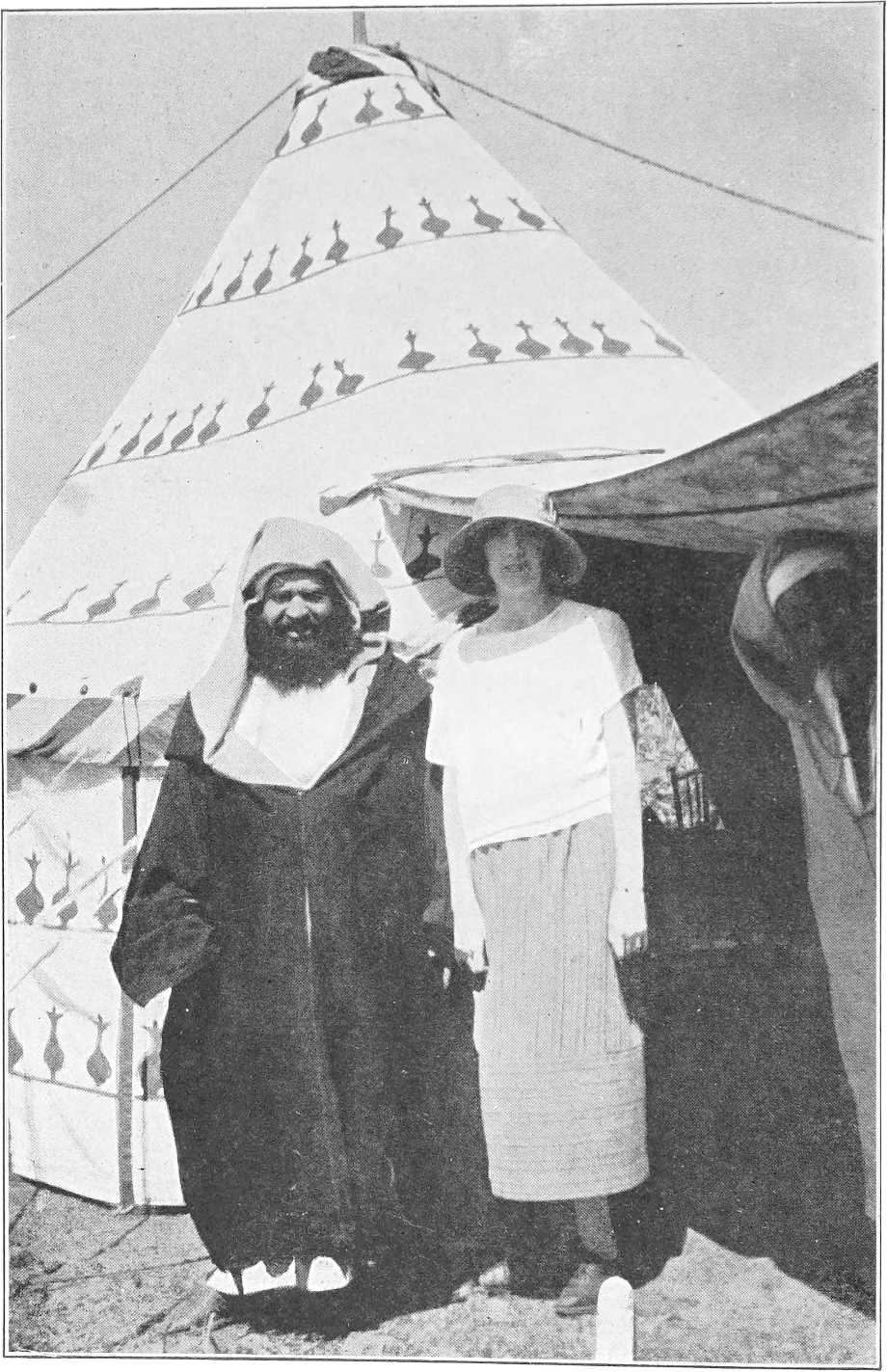
Raisuli and Rosita Forbes at Tazrut
By
ROSITA FORBES
Author of
“THE SECRET OF THE SAHARA: KUFARA”
“QUEST”, ETC.
![[Decoration]](images/logo.jpg)
NEW YORK
HENRY HOLT AND COMPANY
1924
Copyright, 1924
BY
HENRY HOLT AND COMPANY
Printed March, 1924
PRINTED IN
UNITED STATES OF AMERICA
VAIL-BALLOU PRESS, INC.
BINGHAMTON AND NEW YORK
| CHAPTER | PAGE | |
| I. | Into the Days of Haroun er Rashid | 3 |
| II. | The Wild Land of Raisuli | 10 |
| III. | Raisuli Himself | 19 |
| IV. | Pride of Race | 25 |
| V. | Early Prowess in War | 33 |
| VI. | Prison, Torture and Escape | 41 |
| VII. | Raisuli’s Two Hostages | 57 |
| VIII. | More Power; Governor of Tangier | 66 |
| IX. | Plotting and Counter Plotting | 75 |
| X. | Dealings With Mulai Hafid | 90 |
| XI. | Building the Palace at Azeila | 98 |
| XII. | Legends of Cruelty | 105 |
| XIII. | Strained Relations with Spain | 120 |
| XIV. | Alarums and Excursions | 136 |
| XV. | War with Spain | 152 |
| XVI. | Arabian Astuteness | 168 |
| XVII. | Raisuli’s Strategy | 183 |
| XVIII. | Plotting for Peace | 199 |
| XIX. | The Treaty of Peace | 215 |
| XX. | Gossip of the Harem | 230 |
| XXI. | More Fighting | 244 |
| XXII. | Jordana’s Death | 261 |
| XXIII. | Leader of a Holy War | 276 |
| XXIV. | Siege and Retreat | 291 |
| XXV. | Popular Myths and Superstitions | 307 |
| XXVI. | Peace Again with Spain | 323 |
| XXVII. | Farewell | 337 |
| Raisuli and Rosita Forbes at Tazrut | Frontispiece |
| PAGE | |
| Map of Spanish Morocco | 4 |
| Escort sent by Raisuli to meet Rosita Forbes | 10 |
| Powder play by Arabs | 10 |
| Snake eater at Suq el Khemis | 13 |
| Court of Raisuli’s palace | 16 |
| General view of Raisuli’s compound | 22 |
| Dinner at Tazrut | 22 |
| Rosita Forbes amidst Raisuli’s people | 32 |
| A halt on the way to Tazrut | 32 |
| Raisuli’s prison in Tazrut | 48 |
| Xauen with the ancient castle | 48 |
| Entry to Raisuli’s palace | 64 |
| Raisuli | 80 |
| Mulai Sadiq in his home at Tetuan | 96 |
| Nephew of El Raisuli | 96 |
| Sacred tree in Raisuli’s palace | 112 |
| Raisuli’s original house at Tazrut | 128 |
| Raisuli’s present house in Tazrut | 128 |
| Mulai Ahmed el Raisuli | 144 |
| Raisuli’s house at Tazrut | 160 |
| Raisuli’s qubba at Tazrut | 160 |
| Mohammed el Khalid | 176 |
| Raisuli’s house at the Fondak of Ain Yerida | 192 |
| Raisuli’s house—the Zawia—at Tazrut | 192 |
| Facsimile of a letter from Raisuli | 197 |
| [viii]Tazrut | 208 |
| Mosque at Tazrut | 208 |
| Spanish escort in Beni Aras | 234 |
| A Spanish port | 234 |
| A view of Tetuan, showing tower of mosque | 250 |
| Door of mosque at Tetuan | 266 |
| Azeila from the air | 282 |
| Gallery of Raisuli’s palace | 298 |
| The Sorceress mentioned by Raisuli | 314 |
| Gate of Raisuli’s Palace | 330 |
The 14th century of Islam has produced a number of remarkable personalities, but none is surrounded with such fabulous glamour as that of Mulai Ahmed er Raisuli Sherif, warrior and philosopher, saint, tyrant and psychologist. This Haroun er Raschid of Morocco is descended from the Prophet through an older branch of the imperial house which now reins in Fez.
By race, therefore, he is entitled to the respect of his people and he makes the most of the superstitious awe which has surrounded him since his childhood. Yet his personality is in no way the result of his great descent. Raisuli is a man whose mind, critical and peculiarly impersonal, must often have been at war with his spirit—a spirit steeped in the mysticism of the “baraka,” the traditional blessing which protects his house. Profoundly intelligent, with a knowledge of human nature, whether European or Arab, which is the result of unusual powers of observation, but which, to the Moor, appears supernatural, the Sherif’s audacity is as much mental as physical. He believes in the luck which invariably turns the most adverse circumstances to his final advantage, and is not above staking his remarkable immunity from danger against the credulity of his followers, but below this is the conviction of divine right. His charm, as powerful as it is elusive, is a revelation of the “baraka,” for it is purely spiritual and has no connection with the concentrated energy of his mind.
Raisuli represents to the Moors the champion of Islam against the Christian, of the old against the new; yet, from his youth, he foresaw the inevitable intervention of Europe[x] in Morocco and determined to manipulate such intervention to his own ends. The project, though ambitious, was not egoistic, for the Sherif conceives himself an instrument of fate—“This is my land and you are my people. While I live nothing shall be taken from me.” His ancient race is part of the soil of the mountains, and the 1,500 Alani Sherifs, of whom he is the head, are inseparable from the land they alternately oppress and protect.
Since there are no years in desert or hills, Mulai Ahmed has little idea of his age. A Spanish authority gives the date of his birth as 1868. Raisuli suggests 1871. As a child he was a student and a lover of books, with no other ambition than to write poetry and be a teacher of law and theology.
Adventure first called to him in the guise of a woman seeking redress against the bandits who had despoiled her house. The young Mulai Ahmed went to the hills with a band whose original quixotry was soon merged in lust of war and lust of gold—the two strongest passions in a primitive heart. The Sultan, Mulai Hassan, heard of the tribute levied on his caravans and ordered the arrest of the offenders. By treachery the capture was accomplished, and, for five years, Raisuli existed in the dungeons of Mogador. His imprisonment was probably the turning point of his life, for, with the Moslem heritage of patience and simplicity, he accepted his fate as “the will of Allah” and immersed himself in meditation. It is incredible to the European mind that any human being could support such tortures as the Sherif describes, but “What it is written, that shall a man endure.” Released before he was thirty, Raisuli had known the whole scale of suffering and emotion. His energy of mind and body had crystallized into a determination to wrest from circumstance a stable independence which should be the basis of his power. From this date[xi] (about 1900) he judged everything as a means to his ultimate end. The capture of Mr. Harris had neither financial nor political significance, but the American, Perdicaris, was used as a pawn in a great game. His seizure in 1904 forced 70,000 dollars from the American Government and the province of El Fahs from the Sultan.
Cruelty like morality, is a matter of latitude, for even tyranny is cherished if it is the result of tradition. Raisuli reduced his district to exemplary peacefulness, but the European Powers, objecting to their horizon being punctuated by decapitated heads, complained to the Sultan. The Sherif, as usual, retired to his mountains, successfully resisted the troops sent against him, and, in 1907, captured Sir Henry Maclean, which allowed him to make the last trick in a game played for profit rather than adventure. For the Englishman’s release, Raisuli acquired £20,000 and the protection of Great Britain. That such a transaction was but a step in his chosen career was proved when he waived his claim to both assets and identified himself with Mulai Hafid’s rebellion. In 1908 he visited the new Sultan at Fez, and, in secret, they swore the oath which affected the Sherif’s outlook as much as his subsequent life—“Never to cease from protecting the Moslem land and the Moslem people against the Christian.” It must have been a curious meeting between two such different characters, whose only bond was their mutual responsibility for the nation and the Faith in their charge. Both were far-seeing, but, whereas Mulai Hafid was afraid of a future in which he was destined to become the tool of France, Raisuli, arrogant because of his strength, a little baffled, perhaps, by the casuistry of a more subtle intelligence, saw only the need of unity among his co-religionists in face of a menace from which profit might yet be extracted. The compact between the roi fainéant who spent his last weeks of power haggling over[xii] the size of his pension, and the Sultan of the mountains to whom money was no more than the handmaid of power was sealed by the gift of the Western governorate, and it was never broken by Raisuli. The Sherif repaired to Azeila, where, as Pasha, he attempted to weld together different interests in the hopes of founding a united party among the educated which would be able to benefit by the advent of civilization.
Doubtless his projects were influenced by his friendship with Zugasti, the Spanish Consul at Larache, but from the beginning of his political life he chose Spain as the most suitable protector for his zone, believing her “strong enough to help the Arabs, but not strong enough to oppress them.” In accordance with the Sherif’s plan, Spanish troops landed at Larache in June, 1911, and the importance of his help can hardly be overestimated. It was a supreme step for a Moslem, the appointed champion of his Faith, to introduce a Christian army within the borders of the country he had sworn to hold inviolate, but Raisuli never wavered from his determination to benefit by the inevitable advent of Europe, rather than to oppose it. Had any other man but Silvestre, typical conquistador, been sent to command the Protectorate’s forces, the history of Morocco might have been different, but between two such imperious natures friction was inevitable. Raisuli protested against the General’s impatience, which made no allowance for circumstance and would brook neither advice nor the reasoning of a greater experience. Silvestre, dreaming of colonization rather than the gentle tutelage the situation demanded, was baffled by passive resistance and bewildered by the blunting of his most ardent weapons against walls of tradition and suspicion.
At one moment, owing to the Sherif’s eloquence, there was a rapprochement between the two men, during which[xiii] the Spaniard strongly recommended Mulai Ahmed for the vacant Kaliphate. Since this was the only logical solution of the problem, it is possible that Raisuli’s candidacy was tentatively approved by Madrid, but refused by France always afraid of his influence and suspicious of his attitude towards the Southern zone. The appointment of a puppet Kaliph, one Mulai el Mehdi, a cousin of the Sultan, was regarded by Raisuli as a deliberate betrayal, and the series of quarrels which ensued with Silvestre culminated in the Sherif’s departure for Tangier in January, 1913. From there he went to the hills and inaugurated a campaign which was defensive rather than offensive. At one time the Ulema of Xauen offered to proclaim him Sultan, on the ground that Mulai Adul Aziz was entirely in the hands of France and that Islam acknowledged no Kaliph under foreign protection. Raisuli refused, saying that he would resist the advance of his enemy Silvestre, but would not lead Moslem against Christian in a Jehad which must have disastrous results for his country. It is probable that at this time he still hoped to arrive at a satisfactory understanding with Spain, for he welcomed the High Commissioner’s conciliatory despatches from Tetuan while opposing Silvestre’s offensive from Larache. In May of 1915, owing to the unfortunate mistake of a subordinate, one of the Sherif’s envoys and intimate friends, Ali Alkali, was murdered while travelling with a Spanish “laisser passer.” General Marina (the High Commissioner), who had always been opposed to war, held himself responsible for the action, and sent in his resignation, insisting that Silvestre should follow his example.
The first action of the new High Commissioner, General Jordana, was to make peace with the Sherif, and, by the Pact of Khotot (September, 1915), Raisuli was virtually left in possession of the hill country, while Spain occupied the[xiv] littoral. For some months the mountaineers fought side by side with the Spanish army and the Tangier-Tetuan road was opened to Europeans, but this was the second year of the Great War and German intrigue was rife in Morocco.
The Sherif, determined that his country should benefit from whichever side won, kept in touch with both parties. While he paid little attention to the dazzling offers made by Mannisman, and categorically refused to attack the French zone, he considered the possibility of German protection for his son, made use of the Teuton arms and money which flowed into North Africa and took refuge in procrastination whenever Jordana wished to extend the active influence of the Protectorate.
The European Armistice and the death of Jordana occurred almost simultaneously (November, 1918). Consequently, at the very moment when Raisuli, relieved from the necessity of propitiating Germany, would have cooperated whole-heartedly with Spain, a new High Commissioner, Berenguer, arrived (in January, 1919) with the avowed intention of enforcing the authority of Spain by military occupation.
Raisuli gathered the tribes around him and succeeded in closing the Tangier-Tetuan road until October, 1919, when the key to inland communication, the famous Fondak of Ain Yerida was taken from him by a combined attack of three columns. During the summer he had been declared Sultan of the Jehad in a midnight ceremony before the tomb of his ancestor, Sidi Abd es Salaam, and it is probable that during the following year he had some 8,000 men behind him.
Xauen fell in October, 1920, and the Spanish armies, operating from there and from Larache attempted to effect a junction in the Ahmas Mountains south of the Sherif’s headquarters at Tazrut, thus completing the circle which[xv] enclosed Raisuli. The nature of the country made this impracticable, and, after a check at Akbar Kola, Berenguer advanced on Tazrut from the north through Beni Aros. After a three days’ bombardment the village was deserted and a few hundred mountaineers followed the Sherif to his last refuge among the forests and caves of Bu Hashim. The end of the war was in sight, when the “baraka,” or chance, intervened to save Raisuli from his enemies.
In July, 1921, news came of the disaster of Melilla and Berenguer hastened to the Eastern zone. Negotiations were begun with Raisuli, who took advantage of the respite, which he knew would only be temporary, to replenish his stores and ammunition. In September, the Spanish forces renewed the attack, and during the winter they captured the last outpost of the tribesmen, the Zawia of Teledi in the Ahmas. Still Raisuli held out. His people were starving, for the crops had been destroyed with the villages. Woman and children died from exposure and lack of food. All his most intimate friends had been killed. Every day deputations came to him imploring him to make peace. The illness, which is now expected to prove fatal, caused the man hours of agony when he could neither stand upright nor speak, but his answer was always the same: “It is Spain who will make peace.” “You talk of miracles, Sidi.” “A miracle will happen.” The miracle was the force of his personality which encouraged the doubting, strengthened the weak, imbued them with a reflection of his own faith. It is to the “baraka,” of course, that the Arabs attribute the fall of the Spanish Government early in 1922 and Berenguer’s recall, but it was on this that Raisuli, astute student of politics, had been counting.
Burguete was appointed High Commissioner in the summer of 1922, and, as soon as he arrived at Tetuan, he sent Zugasti and Cerdeira, lifelong friends of the Sherif, to arrange[xvi] a permanent peace. The conferences began in August, 1922, and an agreement was arrived at by which Spain was confirmed in her occupation of the whole Western zone. The Sherif disbanded his forces and returned to Tazrut. His nephews and other relatives were installed as Governors of the principal provinces, but Raisuli would accept no position nor stipend for himself, maintaining that his attitude had not changed since 1911. He would support the Spanish Protectorate, but he would not acknowledge the authority of the puppet Kaliph, Mulai el Mehdi.
True to this determination, Raisuli has never made his submission at Tetuan, though, at the urgent request of the High Commissioner, he sent some of his followers to represent him. He lives with the utmost simplicity in his mountain village, praying, fasting and studying. He is tired and his interests are mental rather than material, but the flame still burns. The flicker of it is seen when the tribesmen come in from the furthest limits of his country to consult him. He still manipulates the threads of Moroccan politics in those huge hands which, living, will never relax their hold.
Superficially Raisuli’s life appears one of wild adventure, of war, cruelty and political ambition, but his own story reveals him as a man of single purpose with considerable breadth of judgment. In so profound a nature there is room for many cross currents. One of the strongest and most secret of these is the mysticism which rises to the surface when he describes such ceremonies as the oath at Fez, his initiation at the hands of the Ulema of Xauen, his election as “Sultan el Jehad” on the moonlit peak of Jebel Alan. It is this faith, passionate, simple, indomitable, which marks him, in spite of his ruthless mentality, as a spiritual pilgrim, a searcher after Truth.
Rosita Forbes
[1]THE SULTAN OF THE MOUNTAINS
INTO THE DAYS OF HAROUN ER RASHID
“You go to see my cousin el Raisuli—to write about him,” said Mulai Sadiq at Tetuan. “For what reason? Between Africa and Europe there is a barrier higher than these mountains. You cannot cross it.”
I had gone to see the old Sherif with regard to my journey to Tazrut, for he acted as agent in Tetuan for his famous relative. His house was most attractive with its little court lined with mosaic and surrounded by white Moorish arches, from behind which peeped his slave-women, their brilliant crimson dresses showing through long coats of white muslin to match their turbans, corded with many-coloured silks. Mulai Sadiq is thin and wiry, aged about sixty, bald, with a grey beard. He has an ill-kept appearance, for he is an “alim” who considers that learning is very much preferable to cleanliness. He was willing to talk for hours of the adventures of ‘the Sherif,’[1] of whom he is the antithesis, since his face is intelligent and sympathetic and his hands talk even more expressively than his lips. When he got excited he took off his turban and thumped his fists on the ground, or flung them open above his head. I found him sitting on the floor, surrounded by immense tomes, with many others piled up behind him. He had to move a number before there was room for me to sit down, and then, with his spectacles pushed forward on his long nose, he began to talk about my journey.
“The Sherif will welcome you with great honour,” he said,[4] “but it is a long way and it is my duty to come with you, that you may travel in all respect.” Thus it was arranged, and he went off to telephone to the secretary of el Raisuli in primitive Tazrut!
The great Hispano-Suisa car flung itself on to the road as if it would devour the strip of dusty white which fled before it. The old walls of Tetuan disappeared. Away on the hillside a splash of green marked Samsa, where legend tells of a Portuguese Queen imprisoned in a subterranean maze. The dew was still on the sugar-cane, mist on the river. Peasants were driving their flocks to market; the men rode on donkeys, idle hands crossed on the pommel, the women, their haiks[2] bundled above their knees to show stout leather leggings, their hats, the size of umbrellas, hiding their faces, trudged behind their lords, bearing huge bundles of firewood or sacks of grain. A figure swathed in a burnous, rifle slung across his back, appeared on the skyline, and there was the watchword of Morocco—a veiled country, alert and suspicious.
Up and up soared the road, an incredible feat of engineering, and never for an instant did the driver slacken his pace. By precipices where the wheels spun on the edge of eternity, by nightmare twists and spirals where the path slipped eel-like from beneath us, the Spanish car took us into the land for which Spain and Raisuli had fought their amazing battle. Right and left rose the mountains, their first slopes thick with scrub and grass, their summits barren. Here and there a police post guarded the road, two or three men, shirts open to the sun, with their horses, and a tent as brown as the rocks. Where the river Hayera trickled through a wadi,[3] wild olives grew in profusion. Cactus lifted its spikes above thickets of pink oleanders,[5] the flower which the Arabs say brings death to any who sleep in its perfume. A Moorish village, the mud houses smothered under their weight of thatch, appeared among the boulders which strewed the landscape. On the hillside the Qubba of a saint drew white-robed figures to worship. A Sherif rode by on a mule with scarlet-trappings, and a servant running in front, crying, “Make way for the guest of God, the blessed one.”
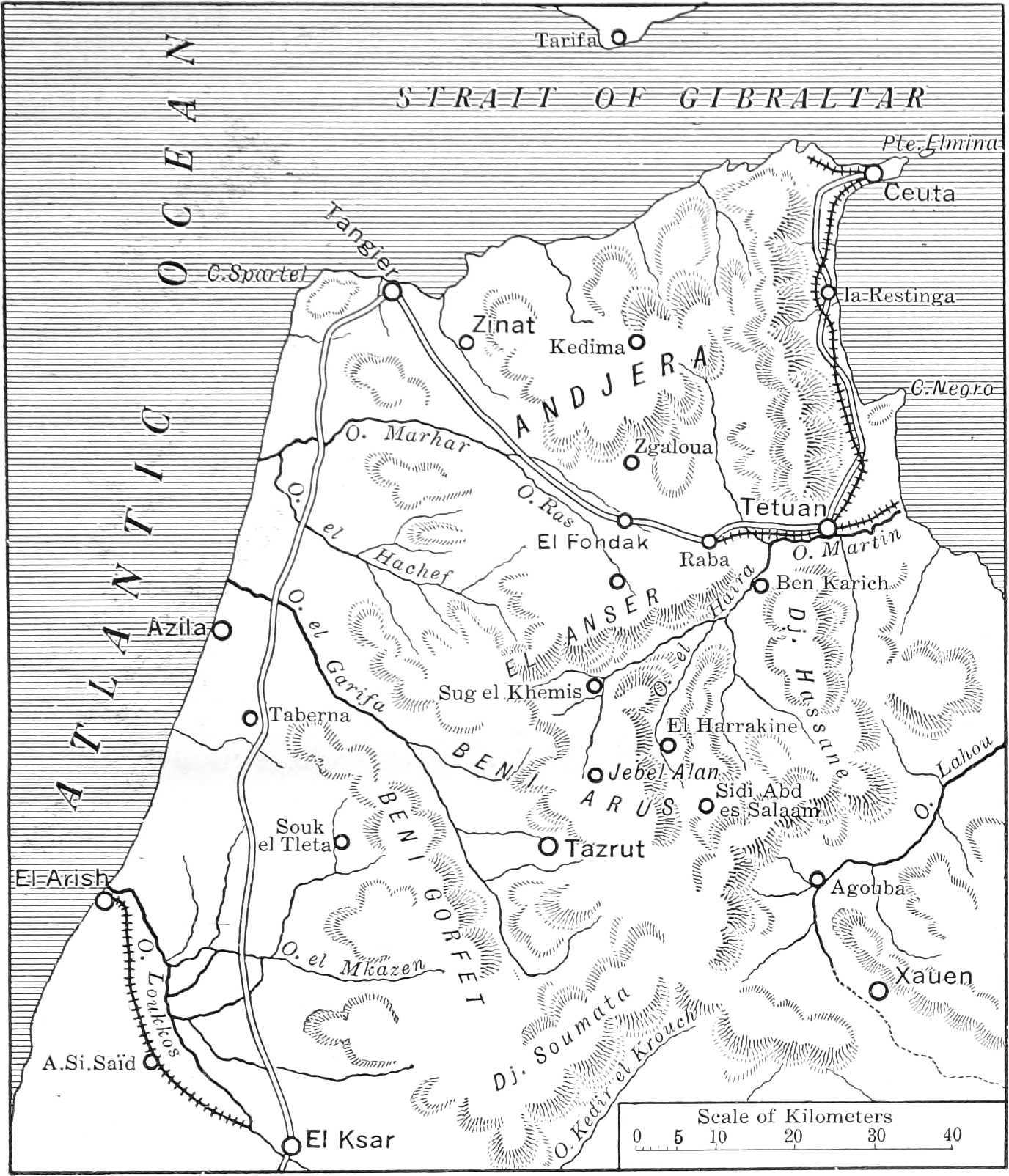
Spanish Morocco
The sun of Africa mellowed the scene, but, when a cloud crept over us, it showed a sinister land where the villages hid among rocks of their own colour and shape, so that one looked across a deserted prospect to the hills that tore the sky. A watchful land where a dozen of Raisuli’s snipers could hold up a Spanish column. Ben Karrish appeared as a serrated white wall. Here, the Spanish post is built round an old house of Raisuli’s to which the Sherif fled after the taking of Ain el Fondak. A few yards away is the mosque where he prayed for the miraculous intervention which his followers believe was afforded by the disaster of Melilla. A boy offered me flowers, a compressed bundle of morning-glory and yellow lilies. “There are but two good things in the world, flowers and women,” he said.
“Won’t you put the women first?”
“Ullah, they are the same thing! My master, the Sherif, has never refused the petition of a woman, but, Ullah, flowers are less trouble!”
Further on the road narrowed between wild vines and thickets of fig and dardara. “Raisuli’s tribesmen used to hide there and pick off our men like rabbits,” said the Spaniard who travelled with me. “Their chief is a strategist—we made war against shadows, and lost thirty men to their one.”
Across the hills in front toiled a line of great, grey beetles[6] which resolved themselves into lorries, packed with troops. The driver’s eye brightened. “It is possible that we may see some little thing, after all,” he vouchsafed, and spun past the nearest camion with two wheels down the bank. For an hour we overtook the various units of two columns en route for Dar Yacoba and the trouble that was reported vaguely “somewhere in the mountains to the East.”
A cloud of dust which looked like a battle surrounded a mountain battery and a long line of mules laden with Maxim-guns. Far up among the purple crags smoke appeared. “Is there really something doing?” murmured my companions, but I was unresponsive. It seemed to me very much too hot for any comfortable warfare.
One by one we left the marching columns and came into the purple wilderness of Jebel Maja, whose height so impresses the Moors that they say the daughter of Noah is buried on its topmost crag, the only one that showed above the Flood. Far up on every hilltop appeared a fort, its isolation emphasizing the inviolability of the land it watched. Goats strayed across the road, but the herdsmen were invisible. Then came the stir of guarded bridge-heads, and again the name of Raisuli—“Here a man was killed on either side of him, when he stopped at the height of the battle, a mark for the whole countryside, while his horse drank.” Rows of tents on the edge of a cliff, rows of mules tethered where those obstinate animals could have no desire to slip over it, showed us Dar Yacoba.
Then came the last steep kilometres to Xauen, the one-time city of mystery, of which men spoke in whispers, for it belongs to the Ahmas tribe, crudest and most savage of mountain folk. Twenty years ago they burned Christians in the market-place, and a certain street is still called the “Way of the burned.” The men of Xauen had a secret language, and, if a stranger could not give the password[7] at their gate, the most mercy he could expect was that his pickled head should adorn it, suspended by the ears. Xauen understands neither clocks nor calendars, and, when the Spanish troops entered in October, 1920, it was to find they had stepped back into the sixteenth century, from which the Jews, barefoot and bareheaded, hailed them with “Viva, viva, Elizabeth the Second!”[4]
Xauen’s claim to mystery lies in the fact that it is so deeply embedded in a cleft of the mountains as to be invisible till one is fifty yards from the walls. “We have arrived,” said the driver, and I looked blankly at the rocks and the deserted slopes. In another moment there was a town before us. By magic, white houses climbed one above another, madnas, tiled with the old faded green, soared from hedges of prickly-pear, and, below this huddled mass of roof and court, slipping like a cascade from the mountain-side, lay the great Berber castle, time-mellowed, sun-bleached, relic of an Empire whose very history is lost. We left the twentieth century outside the gate with the car, which could take us no further, and, preceded by a black slave carrying my luggage, passed into the days of Haroun er Rashid and the Thousand and one Nights. Veiled women stole into doors that looked as if it was the first time they had been opened since the beginning of time. Each arch, each window, was carved exquisitely and differently. A muazzin[5] cried the noon prayer from a mosque which overlooked the Qubba of a Rashid from Bagdad. The dim musk-perfumed shops framed the grey beards of Xauen’s “ulema,” a rosary between their fingers, their drapery flowing over the street.
One of these was a cousin of Raisuli’s, a man prematurely bent and worn. “He has been called upon to defend the[8] Sherif at moments when he would rather have been listening to his singing birds,” murmured a Kaid. A tiny scarlet door, with a lantern that once must have belonged to Aladdin, led us into the Qadi’s house. Slender Moorish arches surrounded a fountain, babbling to the swallows which perched in serried ranks upon the balconies.
Our host received us in a room whose ornamentation was particularly garish and crowded after the courts below. He had but two teeth, which hung from his mouth like tusks, but his manners were beautiful and unhurried. “The blessing of Allah, for you go to see the Sherif. He is a great man and the last of them.”
Seated on cushions and leaning against a wall lined with strips of satin, yellow, blue and red, we conversed gravely and with long silences, as befitted a first visit. “With el Raisuli will pass much of Morocco,” said our host. “You will not understand his ways—perhaps he will not speak at all—but, Ullah, his mind works all the time while he watches you. Nobody knows what he thinks, but he reads the minds of all men. That is his power.”
“It is true,” said the Spaniard. “He is an astute psychologist.”
The complicated apparatus necessary for a tea of ceremony was brought in by slaves, whose waistcoats paled the heaped-up colour in the room. Our host beckoned to another greybeard and slowly, meticulously, the tea was brewed with mint and spice and ambergris. “The Sherif likes mint—it is his only pleasure. There must always be fresh stores in his house. Otherwise he cares about nothing. He has no eye for beauty. He has never known love for anyone or anything.” Someone interrupted, “His son, Sidi Mohamed el Khalid. El Raisuli offered his whole fortune to anyone who would save his life when he was ill of fever.” The Qadi made a movement of protest. “It is[9] his race which lives in his son—the Sherifs of Jebel Alan. Besides, there is the curse. . . .” “What curse?” But somehow the question was not answered. Sweet cakes and biscuits were pressed upon us. Long-stemmed bottles of scent were offered that we might sprinkle our clothes, but the name of Raisuli was no more mentioned.
In the coolness after the early sunset, while the mountain walls turned slowly indigo, I explored the town. Its narrow streets ran downwards, steeply cobbled, by way of the Mosque and the Square where the Jews might not pass for fear of defiling its holiness. The suq, so narrow that two could hardly walk abreast, was roofed with mats, till it twisted abruptly to the cistern of ice-cold water that the Arabs believe will cure most ills. A leper bent over it, his face distorted to the semblance of a beast, and the Sheikh who was with me blessed him as we passed. “In the great war,” he said, “a German came here by night in disguise. He was the only European to see our town. Perhaps he came on business for the Sherif.” The German, of course, was Mannismann, the evil genius of North Africa.
THE WILD LAND OF RAISULI
Always there was the echo of the personality which had so impressed itself on Morocco that the soil of the mountains and the texture of men’s minds were equally impregnated with its forces. Here Raisuli saw a drunken Sherif, and, turning to the scornful onlookers, said, “The man is blessed of Allah. Your eyes see wrongly. He is in the throes of prophecy. Bring him to my camp.” The Sherif was never seen again, and legend says he was corporeally translated to Paradise!
Here Raisuli took shelter from the advancing Spaniards and, from the walls of Berber Castle, made the prophecy that is repeated from one end of the country to the other: “This is my country and you are my people. Nothing will be taken from me, but after my death it will all go.”
From Xauen it is possible to ride across the steep ridges of Jebel Hashim direct to Tazrut, but, because I wanted to see more of the country in which Raisuli had fought, we retraced our steps. Picking up the old Sherif, Mulai Sadiq, we continued by way of Wadi Ras and the Fondak of Ain Yerida, which was the Sherif’s headquarters for many months of war, to Azib el Abbas. There we left the main road and swung down through a desolate region, grey with boulders, to Beni Mesauer, the constant refuge of el Raisuli when hard-pressed. The house of el Ayashi Zellal, his sworn ally and father-in-law, is hidden somewhere among the crags, but we left the highlands for Wadi Harisha, where the olive trees are like round tents by a stream lost in vegetation,[11] and whole flocks shelter under their branches. For the first time I saw barley amidst the great stretches of millet. “These are the lands of the Sherif,” said the Mulai Sadiq, who had pulled forward the hood of his jellaba[6] till only a long nose and a pair of immense orange glasses were visible.
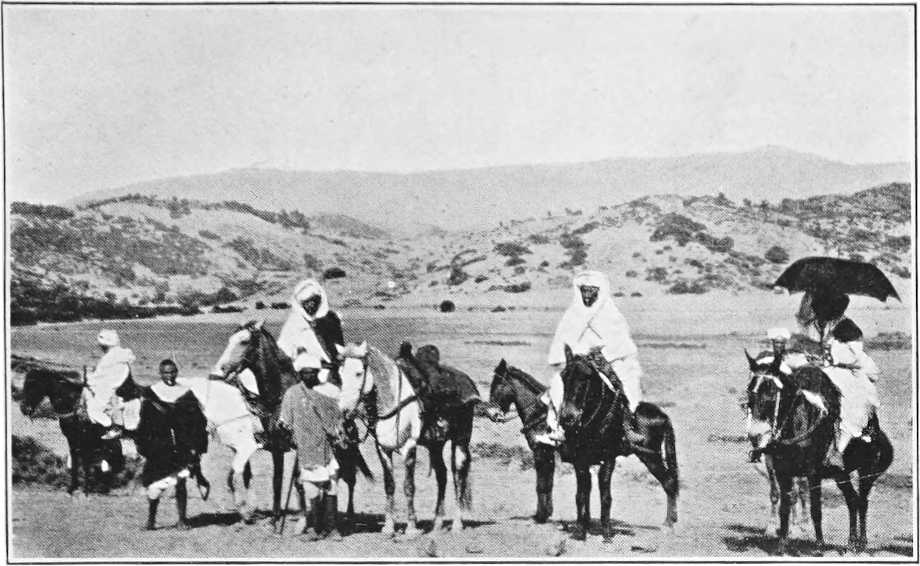
Escort sent by Raisuli to meet Rosita Forbes at Suq el Kemis. The white horse was for the author
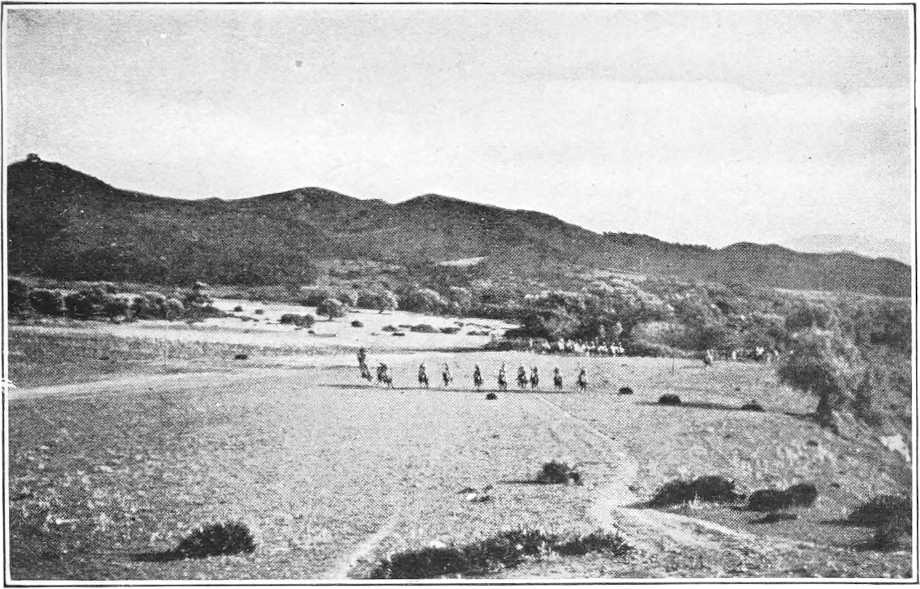
Powder play by Arabs
“Everything that you can see from now on belongs to him,” explained Mr. Cerdeira, the official interpreter between the Spanish Government and el Raisuli, who most kindly accompanied me to Tazrut, which he was the first European to visit, I believe. He added that, when Spain temporarily confiscated the properties of the Sherif during the recent war, they were valued at six million pesetas. Certainly these rolling downs, where villages were frequent, appeared to be excellent land for cultivation, though there were still as many acres of great, heavy-headed thistles as of grain. The post of Suq el Talata appeared on a hill-top in a haze of heat, and, after that, we clung panting to the sides of the car while we negotiated a track that, as the Sherif expressed it, after he had hit the hood several times, “jolted our backbones through our heads.” Sidi el Haddi, a valley where the stream made great pools between trees gnarled with lichen and thickets of the ubiquitous oleanders, gave us a little rest, and then up again by Sidi Buqir, a little white Morabit, where is buried one of the seven holy men of Beni Aros.
At last, when our throats were parched and our lips cracked, we had our first good view of Jebel Alan, on whose great peak was buried Sidi Abd es Salaam, the most famous of el Raisuli’s ancestors, and its twin mountain Jebel Hashim, the guardian of Tazrut. Below them, and most blessedly near, appeared the last big Spanish post, Suq el Khemis, and the little police camp of Sidi Ali. With a[12] series of mighty jerks the car leaped up and over the intervening track and deposited us, much exhausted, in the centre of a crowd which represented both the old Morocco and the new. On one side were the officers of the police post, cheerily apologetic because of a combination of pyjama jackets and puttees, speaking Arabic like natives, and saying that it was so long (two years) since they had seen a woman that they had forgotten what one looked like! On the other were the envoys of el Raisuli, with a guard of his mountaineers. Prominent among them, because of his bulk, appeared Sherif Badr Din el Bakali, and behind him, his jellaba turned back over a purple waistcoat and girt with a huge silver belt, the Kaid el Meshwar ed Menebbhe. These brought me greetings from the Sherif and expressed many ceremonious regrets that his eldest son, Mohamed el Khalid, had not been able to accompany them. I learned afterwards that the said youth, aged eighteen, having consistently neglected his studies during the festivities consequent upon his father’s recent wedding, had been put in irons by the Sherif, so that he might not be able to escape from his books!
It was then 108° Fahr. in the shade, and, personally, even in Arabia I have never felt anything hotter than the dry, burning wind, which appeared to issue from an oven among the hills. It was decided that while the Moslems prayed at the tomb of Sidi Mared, another of the sainted seven, fortunately conveniently near, the Christians should eat. We lunched with the hospitable officers, whose names I never knew, and a wonderful meal it was, not only on account of the inventive genius of the cook, but because no two people spoke the same language. Between us we mustered several different forms of Arabic and various European tongues, but the Tower of Babel would have been shaken by the efforts of the guests to communicate with[13] their hosts! We gave it up in the end and sat outside, in the largest patch of shade, looking over the plain where the great weekly market is held.
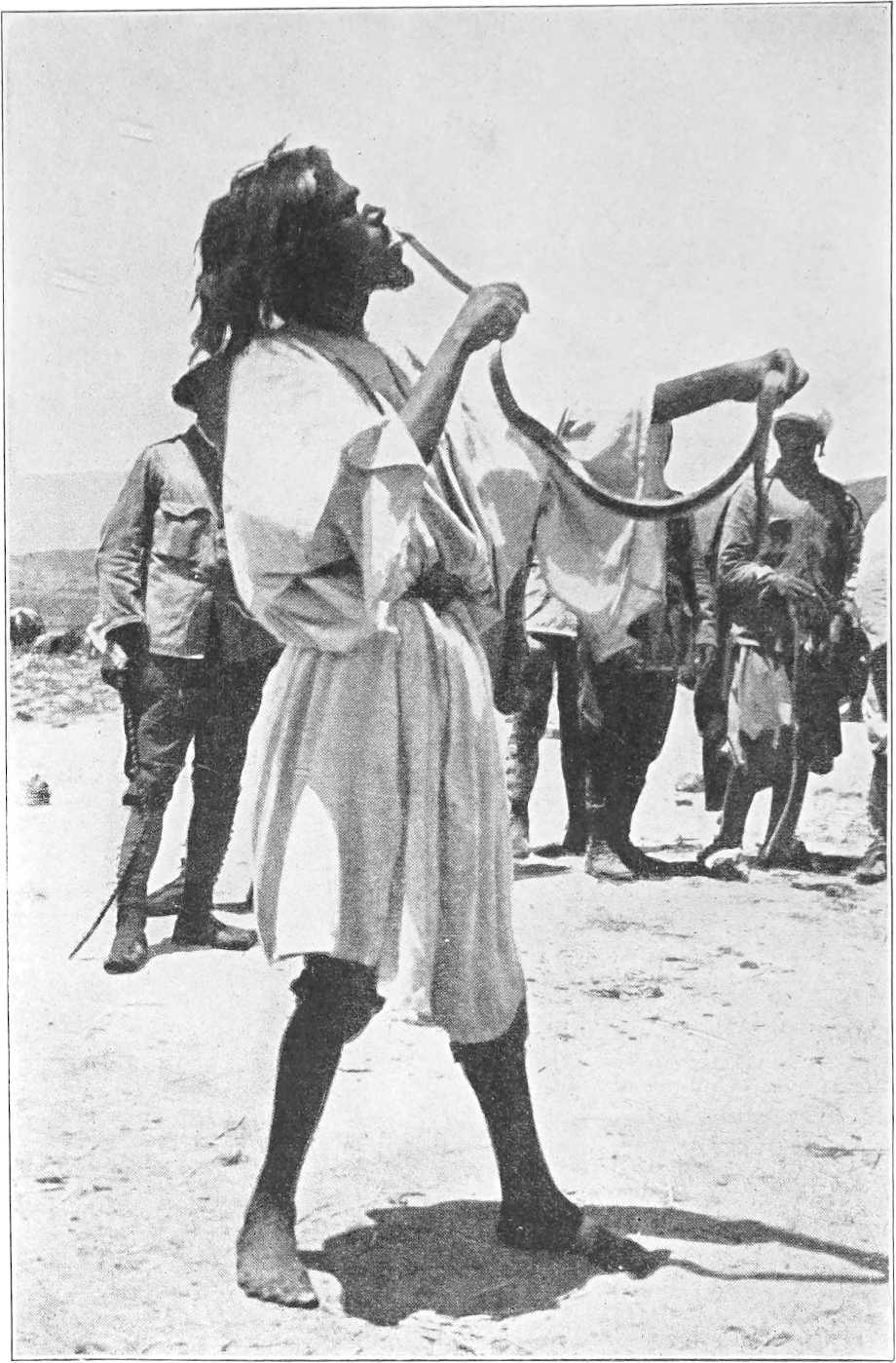
Snake eater at Suq el Khemis, one of the Hedowi gypsies
Hearing that strangers were in the camp, some gipsies came and stared at us over the edge of the sand-bags. One man held a snake in his hand to which he was crooning gently. Without much encouragement they began their unpleasant performance. A wild-looking youth with hair standing on end seized a glass and began crunching it up in his teeth. The man with the snake held it at arm’s-length and adjured it in the names of dead saints. Then, opening his mouth, from which foam dripped at the corners, he put out his tongue and let the reptile fix its fangs in it. Blood stained the foam and, with veins congested and eyes turned inwards, the gipsy began eating the living snake, first swallowing the head affixed to his tongue, and then chewing the body, which writhed up and struck him on the cheeks. All the time, the others kept up a curiously hypnotic chant which appeared to stimulate the hysteria or fervour of the performers, for, with a sudden shout, the eater of glass seized an iron mace which one of his companions was carrying. With this he struck his head so forcibly that the blood ran down under his matted hair. It was a disgusting spectacle, but evidently it delighted the remaining gipsies, who uttered bestial howls and flung themselves into a dance in which the maximum of contortion was achieved.
It was with great relief that I saw the approach of el Raisuli’s dignified envoys. “If we would arrive tonight, we must start,” said the Kaid, and, in another moment, there was the bustle of loading mules and mounting horses. The Kaid, evidently impressed by my boots, offered me his mount, a wild, grey stallion. “He is an Afrit[7]; so treat him with respect.” I did not need the warning. The look in[14] the Afrit’s eye was quite enough, but, fortunately, it is almost impossible to fall off an Arab saddle. Immensely wide and padded, with a high pommel back and front, it is girthed over half-a-dozen different-coloured saddle-cloths and has silver stirrups rather like coal-shovels.
The procession that moved away from Sidi Ali was imposing, for half-a-dozen officers, on their way to an outpost at Bugelia, rode with us, accompanied by their troopers; but, after we had clambered up and down a series of precipitous ridges, they left us, and we were in the hands of Raisuli.
The country became even wilder, the wadis a tangle of vine and blackberry, with high-growing shrubs nameless to me as to the Arabs, who called them “firewood.” First went the soldiers of the Sherif, stalwart mountaineers in short brown jellaba, with the rifles across their backs. They were followed by a couple of baggage-mules, behind whom rode a servant of the Kaid, a sporting Martini-Henry rifle ready for partridge or hare. His master was mounted on a gaily-caparisoned mule whose trappings went well with the gay colours of his turban and waistcoat. The Afrit and I danced uncomfortably behind him, generally sideways or in a series of bounds. Then came old Mulai Sadiq astride the plumpest of saddle-mules, his spectacles still balanced on the tip of his nose and a white umbrella over his head. Sidi Badr ed Din, his beard dyed with henna glittering in the sunshine, his horse almost hidden by his ample proportions, brought up the rear with the interpreter and some servants, who took off their outer garments one by one, to pile them on their heads against the fierceness of the sun.
For a couple of hours we rode across the mountains of Beni Aros, passing mud-built villages huddled under the shade of a cliff, their thatched roofs covered with wild vine, and wadis where the trees met above our heads, and grey[15] foxes slipped away into the bushes. After this there was only a goat track, which ran on the edge of a gully thick with blackberries, or across open pastures where the shepherds went armed, beside their flocks. The sun slipped low behind us as we clambered up the last rocks, blackened by recent fires, to the Qubba of Sidi Musa. There, at a well under wide-spreading trees, we stopped to rest. The Arabs said their afternoon prayers, bowing themselves till the earth grimed their foreheads, but I noticed that they drank out of the same cup as their Christian guest, without washing it. If the fanatics of Libia or Asir did such a thing by mistake, they would consider themselves defiled.
In the sunset we approached Tazrut, a cluster of white houses and green roofs, with the tower of the Mosque rising beside a thicket of oak. Seen across a stretch of scrub and rock, it looked an ideal hermitage for a saint and an admirable post of vantage for a warrior.
Tazrut is the strategical centre of Raisuli’s country. It lies midway between all his great positions and is within a day’s journey of most of them, yet it is in the heart of the mountains, commanding a wide expanse of country in front, where the hills of Beni Aros are piled, fold upon fold. Behind is the great barrier range, to whose summits the Spaniards are pushing their advance posts, but which a few years ago was only inhabited by wild pigs and monkeys. We pushed our tired horses across the last mullah[8] and found ourselves suddenly among ruins. On all sides were traces of the Spanish aeroplanes, which had bombed Tazrut for two days in 1922. Here were rough pits under the rocks, where the inhabitants had taken shelter, and great holes torn by bombs and shells. Not a house was undamaged. Roofless, with gaping walls and doors made of new sheets of galvanised iron or the wood of packing-cases,[16] they stood among cactus and thorn and curiously shaped boulders. I looked again, for there was something very odd about these rocks, and then I saw that, on the top of each, crouched an immobile figure in an earth-brown jellaba, with a rifle in his hands.
We passed various camps where mountain-men sat at the doors of their tents, profiting by the coolness, and then, among piled stones and broken walls, where the earth was gashed open below a mass of plaster, there appeared a splash of colour. “It is the sons of the Sherifs,” murmured someone, and I saw two vivid petunia jellabas, from the depth of whose hoods peered elfin faces with wild, tousled hair. In another moment we came to the paved road that runs between the mosque, miraculously untouched by war, the one complete building left in desolate Tazrut, and the dwelling of Raisuli. Slaves ran to hold out stirrups before the great arch which still kept some traces of its ancient carving. To the left was the domed tomb of Sidi Mohamed Ben Ali, a seventeenth-century ancestor of the Sherif; in front of us the passage leading into a space, half-yard, half-court. The compound was perhaps two hundred yards in length and, within its high walls, were various buildings. At one end was the Zawia, wherein were the rooms of el Raisuli, communicating with the old house which contained the family tomb and the women’s apartments. This was sacred ground, and no Christian might enter, but, during the Spanish occupation, photographs were taken of the interior court, one of which is reproduced in this book. Opposite was a large structure, temporarily roofed with corrugated iron. This contained, on the ground-floor, a series of storerooms and, above, a couple of reception chambers, where the Sherif ate with his friends and followers. At the other end of the yard was an old thatched building, once a residence of the Sherif, now his son’s school, with rooms for[17] visitors above. Near this was pitched a great black-and-white tent, with a fig-tree shading its porch, and various smaller tents behind.
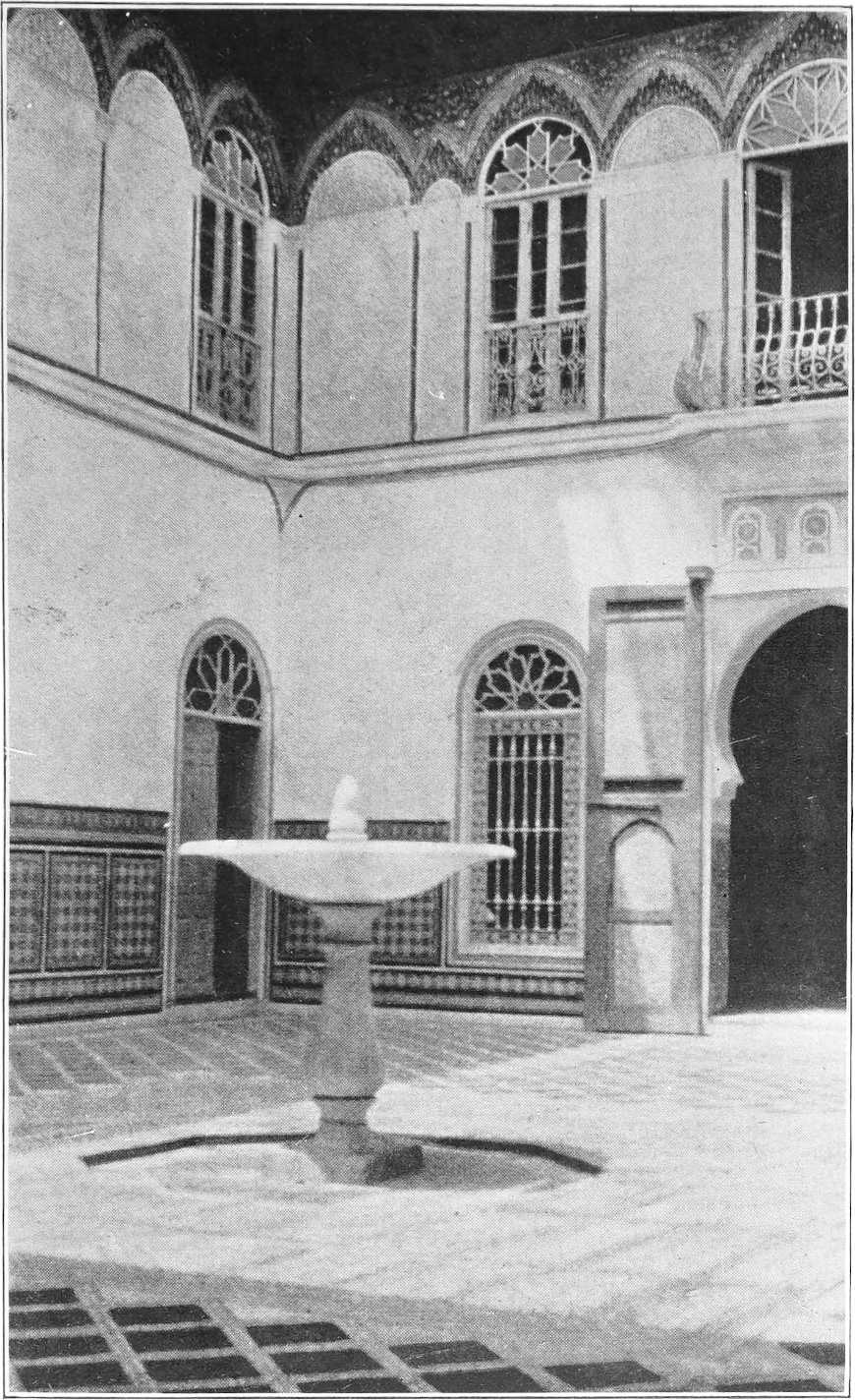
Court of Raisuli’s palace at Azeila
“This is your home,” said Sherif Badr ed Din, beckoning me to enter, “and we are your servants.” The pavilion was lined with gay damask and carpeted with rugs piled one upon another. It was about twenty feet in diameter and round the walls were mattresses covered with white linen, and rows of very hard cushions. There was also a table with two huge brass candlesticks and several long-stemmed silver flasks containing orange-water and home-made scent of roses, but presumably this was an ornament, for we always had our meals on the floor. As a peculiar honour, the Sherif had lent the chair made specially in Spain to suit his colossal proportions, and, sitting in one corner of its great expanse, I drank my first cup of green tea at Tazrut.
The moon had risen and, outside the tent door, the breeze stole whispering across beds of mint and poppies. The figures of Mulai Sadiq and Badr ed Din looked like ghostly monks, sunk under the hoods of their voluminous drapery. From far away came the sound of chanting. “It is in the mosque,” said the Kaid. “Sidi Mohamed Ben Ali is buried there. It was he who won the battle of Jebel Alan (in 1542), where three kings were killed. The power of the Shorfa Raisuli began after that day, for Sidi Mahamed arrived with the tribes of the Jebala, when the Moslems were hard-pressed. ‘Have courage in the name of Allah,’ he cried, ‘for I tell you a Christian head will not be worth more than fifteen uqueia today.’” The three kings referred to by el Menebbhe were Don Sebastian of Portugal, the Sultan of Morocco, and the Moorish Pretender.
After the prayers in the mosque were over, Sidi Mohamed el Khalid, released from his irons in order that he might perform his religious duties, came to see us. Fair-skinned as[18] a girl, with an indefinite nose and hair clipped two inches back from his forehead and then dyed with henna and allowed to grow long, the boy greeted us shyly. His manners were clumsy for an Arab of great race, and he whispered instead of speaking out loud. When the Sherif Badr ed Din rebuked him, he said, “All we Moslems are savages, and I am the worst of them. My father wants to make me into an alim[9], for the ulema[10] of Beni Aros are famous throughout Islam, but I do not like books.” “What do you like?” “Only one thing, war. It is a pity that we have finished fighting!” “What do you do to amuse yourself now?” “I shoot. Will you come into the mountains and hunt monkeys? It is great fun! We go at night, when there is a moon, but it is very rough country; so we must leave our horses and walk. The monkeys come out one after another, screaming, and we shoot them.” “I have no rifle with me.” “That does not matter. You can have a choice of all kinds here, German, Spanish, French, or revolvers, if you like; but hunting is not so exciting as war.”
After this there was silence, and Mulai Sadiq left us, to pray in the Zawia. Soon his voice was heard leading the aysha prayers. In spite of his age, his words rang across the compound, and it seemed to me that I was listening to the voice of old Morocco protesting against the Christians who trod her borders and penetrated even to the threshold of her sanctuaries.
RAISULI HIMSELF
It is a long way from London to Tazrut and, during the whole journey, thoughts of el Raisuli had filled my mind. His name met me on the coast of Morocco and, wherever I went afterwards, I heard legends which magnified or distorted his personality. Small wonder that, sitting in his chair, a guest of his house, the moonlight sending fantastic shadows across the rough garden, my excitement to see this strange man grew until I forgot my hunger, forgot the tedium of the long ride. I only remembered that in a few moments I should see el Raisuli.
It was very still, except for the crickets. Even the breeze had stopped. The chanting in the mosque died suddenly, and Sidi Badr ed Din rose. “The Sherif comes,” he said. With racing pulses, I turned to meet a presence which blocked the way beneath the bushes. An enormous man stood before me. At first glimpse he seemed almost as broad as he was tall, but it was the breadth of solid flesh and muscle, not of fat. His round, massive face was surrounded by a thicket of beard, dyed red, and a lock of long terra-cotta hair escaped from under his turban. The quantity of woollen garments he wore, one over another, added to his bulk, and when, seating himself in a chair which seemed incapable of supporting his weight, he rolled up his sleeves, baring arms of incredible girth, I found myself looking at them fascinated and repelled, while he gave me the usual courteous greetings. “All the mountain is yours. You are free to go where you will. My people are your[20] servants, and they have nothing to do but to please you. I am honoured because of your visit, for I have great friendship with your country.” His voice was guttural and rich, but it appeared to roll over his thick lips from a distance which made it husky. His manners were gracious and his dignity worthy of his ancient race. After a few minutes’ talk I had forgotten the unwieldy strength of his body and was watching his eyes, the only expressive feature in Raisuli’s face. They were watchful eyes, dominant and fierce, in the midst of flesh, which it seemed to me they used as a veil. Sometimes, when he spoke of small things, they softened till they were almost wistful, but generally they watched and judged and revealed nothing.
I presented the gold-sheathed sword I had brought, with the Arab saying, “There is but one gift for the brave—a weapon.” The Sherif smiled. “You ought to have been a man,” he said, “for you have speech as well as courage.” Then I offered him some rolls of vivid-coloured brocades, purple, orange, rose-red and emerald-green, with heavy patterns in gold and silver.
“I heard, even in England, that you had been recently married, and I hoped, perhaps, that you would give these to the Sherifa with my greetings.”
Raisuli accepted the gifts with the simplicity of every Arab who considers that generosity is as common as sight or hearing, and it is rather the donor than the recipient who is blessed. Then a row of slaves appeared, with brass trays on which was every form of meat, with chickens, eggs, watermelons and grapes. These were placed on a leather mat on the floor of my tent, and the Sherif, with a soft “Bismillah,” bade me enter. “Tomorrow I will eat with you, but today I fasted all the day; so I ate an hour ago, after the aysha prayers,” he said, and sat down on the thickest mattress, to make conversation while we fed. Occasionally he picked[21] up a quart-jug of water and drank it in two or three draughts. Mulai Sadiq crouched beside him, looking like an old hawk, as he peered at one dish after another, picking out the tenderest portions with bony, but unerring, fingers.
It was hot inside the tent, and the Sherif moved restlessly in the middle of a discourse which revealed an intimate knowledge of European politics. I offered him one of those little mechanical fans which are worked by pressing a button, and I think he preferred it to any of my expensive gifts. “Allah, it is good! In this way one has the wind always with one.” But his thumb was so thick that it was very difficult for him to hold and work the slight machine.
We talked far into the night, till my head was whirling and my eyelids fell with automatic regularity. For us the day had begun before the dawn, and there came a moment when, my answers having become so vague as to be incomprehensible, the Sherif noticed my exhaustion. “In the pleasure of your conversation, I forgot that, after all, you are a woman,” he said. “Sleep with peace.” Without any loss of dignity, he heaved himself up, and his face was unexpectedly kind as he made his formal farewell. “Tomorrow we will talk of many things,” he promised, “and you shall begin your work, but Mulai Sadiq is my biographer. He knows my life better than I do, and as for these two men,” (he indicated Badr ed Din and the Kaid) “one has been my political adviser for fifteen years, and I have been in no battle without the other for twenty-five.”
. . . . . . . . . .
During the time that I stayed with el Raisuli, I was hardly ever alone, and counted myself lucky if I had four hours uninterrupted sleep at night. By 6 A.M. the place was astir, and I used to hear the Haj Embarik, a man from Marrakesh, who had travelled a good deal and understood my Eastern Arabic, murmuring outside the tent. I knew[22] that he was wandering about with a ewer of hot water, kicking the tent-ropes to attract my attention; so I had to throw off my tasselled blankets of red and white camel’s hair and prepare for a strenuous day.
Breakfast consisted of a bowl of thick vegetable soup with bits of fat floating in it—the “harira” that is given to children during the great fast of Ramadan. After that there was a painful gap so far as food was concerned till 3 or 4 P.M., when an immense meal of many meat courses made its appearance, borne shoulder-high by a line of slaves. Sometimes, when Mulai Sadiq announced that he was tired, we were provided at odd hours with green tea and very sticky pastry, sweet and heavy.
El Raisuli is always out by 6 A.M., and any one of his friends or his household may approach him in the garden, where he holds an informal council, seated on a broken wall or the steps inside one of the doors. Before noon he retires into the Zawia, where none may go to him unless he specially sends for them, except his eldest son and the ten little slaves, all under twelve years old, who attend on the harem. These small boys are rather like monkeys, but sometimes, when they are feeling important, they wear huge cartridge-belts over their inadequate shirts, and oil their top-knots till they look like coils of silk. Besides these minute servitors, there are fifteen slaves, coal-black men from the Sudan and Somaliland, under the orders of old Ba Salim. They are not allowed into the house, but two of them, Mabarak and Ghabah, are the personal attendants of the Sherif. When he rides on his roan stallion, they walk one at each stirrup. In battle they range their horses on either side of him and each carries a spare rifle, for el Raisuli never fights with less than three. During my stay at Tazrut, they were assigned to my service, which[23] was one of the highest honours the Sherif could pay to a guest.
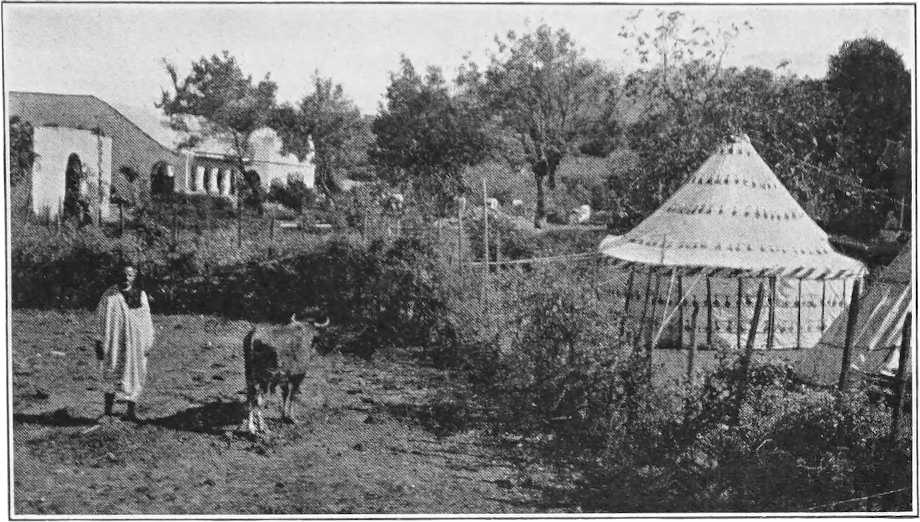
General view of Raisuli’s compound. Author’s tent in foreground
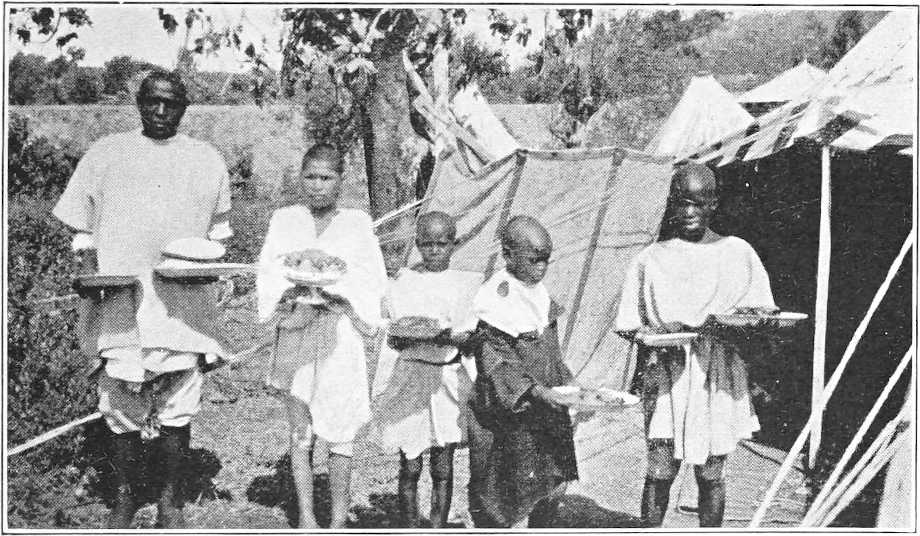
Arrival of my dinner at Tazrut
About 4 or 5 in the afternoon, el Raisuli makes a second appearance, and, from then till midnight, or a much later hour, he transacts work and receives messengers, with the numerous reports and petitions that come to him from all over the country. The interviews I had with him were nearly always in my tent, or in the garden, or in one of the guest-rooms where a slave would hurriedly spread mattresses and rugs. The Sherif is a facile raconteur, and his memory is astounding. He never hesitates for a date or a name, but his eloquence consists more in the wealth of his similes than the richness of his language. His vocabulary is small, and he uses the same words continually. He recounts conversations word by word, with an annoying repetition of “qultu” (I said to him) and “qali” (he said to me). Obviously he is used to telling the story of his life, but this is natural, for very little Arab biography is written, in any case, till long after the death of the subject. Facts and anecdotes are handed down verbally, and it is part of the work of disciples to know by heart the life of their master, of schoolboys to learn the history of their ancestors.
The Sherif did not tell me a consecutive story, for often he would think of incidents that he had omitted, and indulge in much repetition in order to bring in a certain anecdote, but at different times he reviewed most of his life with a wealth of detail. Of course the episodes that most interested him and upon which he dwelt at length were often not those which would appeal to a European biographer. On the contrary, he showed no interest in events which to me were of historical value, and it needed a great deal of tact and patience to induce him to talk of them at all. At times his point of view was so biassed that it was palpably[24] incorrect, but his story, even though it often either exaggerates or lacks detail, is a record of an amazing life—a web of philosophy and atrocities, of war and psychology, of politics, ambition, and Pan-Islamism.
When he became interested in his narrative, the Sherif lost all sense of time. Once he talked from about 7 in the morning till nearly 3 P.M. and often he would arrive before dinner and, hardly troubling to eat, talk without a pause till 2 or 3 A.M. Mulai Sadiq and Sidi Badr ed Din acted as a sort of Greek chorus, reinforced on certain occasions by the two favourite slaves, who emphasised the story with murmured confirmation. When the Sherif was in the Zawia, his cousin permanently kept us company, while others dropped in for an hour or two’s “short talk.” My notes were always scribbled in the wildest confusion as I grasped the meaning of the Moorish dialect, or as the interpreter rendered it in French, but I got quite used to writing them up while a violent argument was going on between the Spaniard and three or four Arabs as to whether a soldier found wounded in the mountains had been fired upon by a tribesman, or had accidentally shot himself. The Moorish voices rose to a pitch that would indicate incipient murder in any other country, as they revelled in the game at which they excelled—prevarication!—and I admired the persistence of the interpreter in outscreaming them. The fate of that soldier haunted my stay at Tazrut, and it was with the greatest difficulty that I managed to exclude him from my book!
PRIDE OF RACE
When a Sherif of Yemen tells his lineage he generally begins with Noah, and, passing through the legendary Kahtan and Johtan, explains the union of Ishmael the son of Abraham with an ancestress of the Koreish, of whom was the family of the blessed Mohamed. Mulai Ahmed ibn Mohamed ibn Abdullah el Raisuli el Hasani, el Alani, began his with the Prophet.
“My house is of the Beni Aros, who are descendants of Abd es Salam Sherif, buried on the highest point of Jebel Alan. We are the greatest of the Western Sherifs, whose power has always rivalled that of the Caliphs. Go to Tetuan and you will see the veneration paid to the Qubba of our ancestor, Sidi Ali ibn Isa, and all through the country you will hear of the Sherifs Raisuli. When we go to visit (the tomb of) Sidi Abd es Salaam, we are fifteen thousand of the line of Jebel Alan, his descendants, though of the family of Raisuli there are but seventy. We have held great posts in the past and stood between our people and the oppression of the Sultans. It is our duty to protect the people, for they honour us as holy. For us who have the “baraka,”[11] the blessing of Allah, they would give their lives and their property. If I tell a man, ‘Start today for Cairo, or for Mecca,’ he would ask no questions, but pick up his jellaba and go.
“No one dies of starvation in Islam, but a Sherif may sit at the door of his house and the whole countryside will[26] come to him to kiss the edge of his robe and pour their tribute into his basket. I remember when I was a boy, small so”—he made a gesture towards the ground—“my father, on whom be peace, was angry with a slave. He ordered him to go out and tell the others to beat him—so many lashes. I met the man on the way and asked him where he was going. He told me, to get so many lashes. I asked him what crime he had committed, and he answered, ‘I do not know, but the Sherif knows, and without doubt it is a bad one.’
“Once it was necessary that someone should die for a crime that had been done, and it was not politic that the murderer should be given up at Tangier. The Sherif sent for a poor man and said to him, ‘Would you have your family live in plenty, and yourself gain a paradise? If so, remember that on such-and-such a date, you killed a certain person.’ The man answered, ‘If the Sherif wills it—it must be that I am guilty,’ and the Lord gave him wisdom to answer all questions that were put to him.
“Such has been the power of my house, and that is why men follow me in battle. Death beside me is a blessing, and, were I to kill a man, his family would know that I had sent him to paradise. Oh! Mubarak, bring me my keys.” The slave, who had been listening eagerly, brought a great leather box and, from it, el Raisuli extracted a key. “I will show you a paper that you may understand my words and see that my family are greater than the line of Mulai Idris who ruled in Fez.” Here is the translation of the document laid before us:
“Praise be to Allah. The genealogical relation of our Master the Sherif, the gifted, the great, the venerated, the excellent, the unique of his epoch, the chosen among those endowed with majesty and goodness in these times, the majestuous by his origin, of whom there is no peer or equal[27] at this moment, my master and lord Ahmed el Raisuli, el Hasani, el Alani—may Allah grant him holiness and power. My lord Ahmed; the son of Sidi Mohamed; son of Sidi Abdullah; son of Sidi el Mecki, who was the first Sherif Raisuli and who, by order of our master, Mulai Ismail—whom may Allah receive in his bosom, conceding him mercy—for the purpose of ennobling this city, came to Tetuan, which longed for a bond of union with Allah, the Almighty, through the baraka (blessing) which, by reason of descent from the Prophet, this family possesses—May prayer and peace be with him. Sidi el Mecki was son of Sidi Buker, son of Sidi Ahmed; son of Sidi Ali; son of Sidi Hassani; our master and lord Mohamed; son of our lord and master Ali, he who was first to bear the name of Raisuli, who died in the year of the hejira 930; son of Sidi Aissa and of Lal-la Raisuli;[12] son of Sidi Abderrahman, son of Sidi Ali; son of Sidi Mohamed; son of Sidi Abd-Alah; son of Sidi Yunis, brother of Sidi Mechich the celebrated, very holy and powerful Mulana Abd es Salaam, most learned Imam, also known as Sidi Abi-el Hassam Chedli. May Allah keep him in his mercy and pity. Our master Yunis was the son of Sidi abu Beker; son of Sidi Ali; son of Sidi Hormat; son of Sidi Aissa; son of Sidi Salaam; son of Sidi Mazuar; son of our master and the Prince of the Faithful the Sultan of Morocco, Mulai Ali, who was known by the name of El Hidarat, he who is always in places of danger in battle; son of the Prince of the Faithful, Sidi Mohamed; son of the Emir Al-mumenina our master Mulai Idris, founder of the holy capital of Fez, the white city which shines from a distance, the noble, the generous and beautiful; son of the Prince of the Faithful Sidi Idris the Great, a Conqueror for Islam of the Empire of the West, el Aksa. His tomb is in Mt. Serhen, venerated by all Moslems who believe in God. He[28] was the son of Inulana Abdallah el Kamel the Perfect, pretender to the throne of his ancestors in the Orient, which was usurped by the Abasides who, having defeated him, caused him to die loaded with chains; son of Sidi Hassan el Muzenna. In the person of Muzenna the trunk of the descendants of the Prophet divides into two branches; one of these we have already followed, and the other is that of Alanien, in whose hands today is the sceptre of empire and who are the descendants of Sidi Mohamed el Nefs Ezzakia, brother of our master Abdallah el Kamel. They came to Morocco more than fifty years after the ancestors of the Shorfa Raisuli, which proves that these Sherifs possess a greater right to the throne than the present Emperors. Hassan el Muzenna is son of the Emir Almumenina, our lord and owner, Hassan the 7th—may God receive him in his mercy;—son of the Prince of the Faithful, the fourth Caliph of the Mehidie (the Reformers), Sidi Ali; son of Abu Talib, uncle of the Messenger of God;[13] may peace and prayer be upon him and may his face be venerated and may he be united before God with our mistress Fatima, the daughter of our owner, the Prophet of Allah on earth. As the rain from heaven falls, rejoicing the earth, may there fall upon him prayer and peace.”
The slave kissed the document when it was given back to him, and el Raisuli continued, his voice rumbling at the back of his throat: “Once, when I was a boy, I was riding with an important Sherif, and, as we went by the outskirts of a village, a man was lying on the ground in the shade of an olive. It was hot and he did not trouble to salute the traveller, who stopped his mule quickly and asked the reason. ‘The sun was in my eyes, Sidi,—I did not see,’ answered the man. ‘You do not use your eyes, so you have[29] no need of them,’ said the Sherif, and, from that moment, the man was blind.
“It is also told of one of the brothers of the Sultan that when he was in prison in Rabat, having rebelled against his ruler, he found, by means of his friends, that the way was open for him to escape. A sentry stood at the door and tried to stop him, as was his duty. ‘If you do not let me pass, you will go blind for the rest of your life,’ threatened the Sherif. The sentry hesitated, but he knew that he would lose his head if he allowed the prisoner to escape, so reluctantly he still barred the way. ‘Very well, then, you are blind,’ said the brother of the Sultan, and the man fell back, putting up his hands to his face, for he could see nothing.” There was a moment’s silence. Then the slave, Mubarak, murmured, “These things are well known, and all me know that those who disobey my master lose their sight.”
“Yes,” whispered the Spaniard, “that is quite true; but by means of hot coins pressed on the eyelids, not by autosuggestion!”
“How old am I?” said el Raisuli. “I can tell you I was born in the year of the hejira . . . (1871 A.D.), but what matter the number of my years? No Arab keeps count of time. Ask Mubarak—oh, man, then, how old are you?” “As old as my lord wills.” Then, evidently anxious to satisfy, “Ten, eleven perhaps . . . or thirty. By Allah, I do not know.”
“I was born at Zinat,” said the Sherif. “You have seen the village, small houses with great roofs that you cannot pick out at a distance, and the hedges of cactus that even the dogs cannot get through. It was but a gun-shot to the top of the mountain, which commanded a wide view. I used to sit up there for hours and look at the country—[30] not like these hills but a rolling plain, golden with corn. I could see the women gleaning, and imagine how they cried ‘A-ee, A-ee!’ when the thistles tore their skin like needles. They used to make a shelter out of a haik spread on a pole for the heat of noon, and later, when it was cool, they would sit in a circle among the corn-sheaves and beat out the grain with wooden flails. I could hear their song like a thread, and away by the river I could see the boys bathing, but I never wished to be with them. I was happier alone. On the horizon were the hills of Beni Mesauer, from which came my mother, and I used to wonder why the others were content to work in the plain, when there was a great country beyond, full of valleys and rocks, where one could hunt in a different mountain each day. The ideas of a boy!
“When I was ten or eleven, I was already a ‘talib’[14] able to read and write and repeat the sayings of the Prophet. For this reason an ‘alim,’ a very learned man who came to the village, was interested in me and told me many things. I used to look after his mule for him in order that he would talk the more. He had the gift of speech, and he could make men weep or laugh. I decided that I would do the same; so I collected some of my friends (many were older and bigger than myself), and we went round the neighbouring villages with small white flags, to collect money for the alim who, as many wise men, was very poor. Sometimes people laughed at us, and would not give. Then I spoke to them, and, remembering the eloquence of my master, my words became swords to pierce their hearts, and they said to us, ‘Take this and that,’ even more than they could afford.
“When, after some days, we returned and poured the money into the alim’s robe, he blessed me and said that I should travel much and acquire much wealth. After that[31] my spirit was restless, and I would make up speeches on the mountain and declaim them to the birds and the goats. All that was told me I could remember, and, to this day, I can repeat every word that has been said in conversation between such and such people on such and such days. It is a blessing from Allah, but it astonished my master, as did my love of history. I wanted to know everything that had happened in the past, for, in those days, I believed that all wisdom lay in books. The right was not with me, for it is the study of one’s neighbours that brings wisdom. What book can tell you that which lies in the heart of your enemy?—it matters not about your friend, for you will see your own thoughts there—and how can you conquer him if you do not know his designs?
“When my feet grew too restless, I collected the same boys once more and, with white handkerchiefs tied round our heads, and staffs cut from olive-trees, our jellabas kilted up, we made a pilgrimage round the shrines of the neighbourhood. You have seen them, perhaps,—a pile of whitewashed stones under a bush from which flutters a strip of white stuff, or a Qubba high on a hill. We took nothing with us, neither water nor food, but the villagers gave to us plentifully—we had no need to beg—and some of them, who remembered me, said, “Here is the little messenger. Tell us stories, oh, master! Make us a speech, so that we see if our ears played us tricks.” I told them many stories, but always of war.
“It was at Tetuan that I finished my education, and there I lived till the death of my father, who is buried in the tombs of our family in the mosque of Sidi Isa. By this time I had studied law and jurisprudence. I knew the four codes of Islam and could interpret them according to the Koran. The mountains were shut out by the walls of Tetuan, and I thought of them no more. It was my intention[32] to be a lawgiver and a poet, for my world was closed between the covers of my books. When I went back to Zinat, people said, ‘He is a Faqih,’[15] and came a long distance to consult me. In the daytime I used to explain to them the law of the Prophet and the solution of their difficulties, and, at night, I used to walk on the mountain-side and watch the stars. Have you thought how great a part the stars play in our lives?—how the Prophet (may Allah bless him) spent nights in the desert, communing with them, how Jesus, the Breath of God, and David the father of Solomon, studied them while they kept their flocks? It was in those nights that I wrote verses, but none that were worthy of remembrance. Most of my wealth I gave away, for it seemed to me then that earning and silver did not live well together. The people heard of this, and, knowing that I had the ‘baraka,’ they came to me the more for advice, and carried out all that I said to them.”
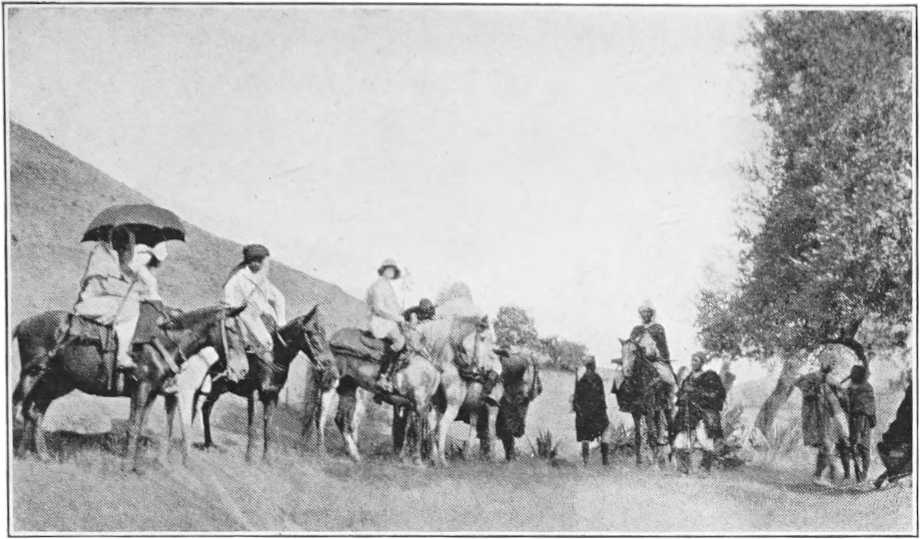
Rosita Forbes, on white horse, amidst Raisuli’s people on the way to Tazrut
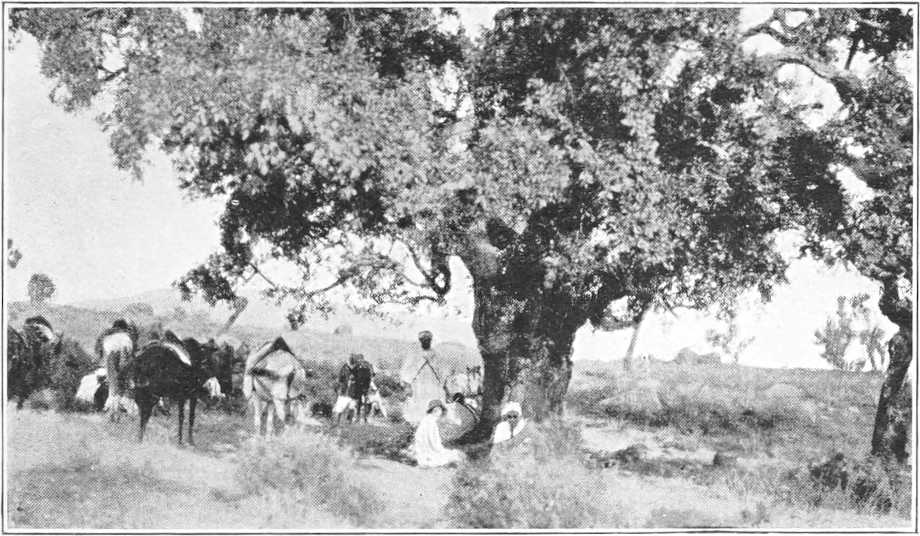
A halt on the way to Tazrut. Author and Mulai Sadiq seated
EARLY PROWESS IN WAR
“My life was good when, suddenly one evening, about the time of the fourth prayers, a woman came to Zinat. Her clothes were torn and there was blood on her arms. She had walked many hours in the heat and her eyes were a little mad. She said that robbers had killed her husband and son, and taken all that she possessed. The wives of the village would have taken her in and comforted her, for hospitality was their duty, but the woman was from the mountains and she asked only a gun, that she might go back and take her revenge. ‘Is there no man who will go with me?’ she said, and the soles of my feet itched, and I saw my mother looking at me. . . .
“There were many youths in the village, and life was hard, for it was a season of poor crops. We put the woman on a horse, and all that night we went with her through the darkness. She took us to her empty house on the side of Jebel Danet, and from there we followed the robbers step by step. Many had seen them pass, but had been afraid to stop them because of the power of their chief. So they went slowly and we came up with them in a wadi, where they sat and bathed their feet in a stream. It was wild country, overgrown with oleanders that were higher than a man’s head, and great trees that would have hidden us, but the woman seized the gun from a youth’s hand and fired. There was a fight and the noise of the shots was drowned in our shouts, for it was like a hunt and the game could not escape for the rocks. We killed every one, and[34] took back the mules and the furniture which had been stolen from the woman. She cut off the head of the man who had killed her family, and took it away, that his soul might be destroyed and his body be incomplete in paradise.
“By Allah, perhaps the life of el Raisuli was decided by a woman, for, from that day, I was discontented with my books. I had no wish for a roof over my head, and I remembered that it is said of Beni Mesauer and the house of my mother, ‘They are born in the saddle, a gun in their hands.’ I spoke to the young men who knew me, and we formed a band and went out and lived in the hills, where no man could take us. We were famous in the countryside, and many came to us for help, but we were very poor. Our castles were the rocks and the trees our tents. Sometimes we had only goat’s milk as food; but I was very strong. I could live for days without food, and master a stallion with my hands.”
From this period date the fabulous tales of el Raisuli’s cunning and audacity, for he had everything to appeal to the imagination of a lawless and adventurous race. His physique was Herculean and he was so much a fatalist that he had no fear. To this must be added the prestige of his race, his indubitable learning, his eloquence, which throughout his life has been of great service to him, his skill as a rider and a shot, together with a curious gift of intuition which accounts for what he calls the infallibility of his psychology. There were many bands of brigands in Morocco at that time, for the authority of the Sultan’s Maghsen[16] was so attenuated as to be negligible. Brigandage was a paying game, if you had a better gun than your neighbour, but, whereas most of the famous robbers came to an unpleasant end, such as the Sultan’s lions or the knife of a[35] rival, Raisuli’s power increased with the stories of his supernatural power.
“In those days,” said the Sherif, “it began to be told of me that no ordinary bullet could touch me. I have heard that one of my enemies had a bullet of gold specially constructed, but, praise be to Allah, it flew wide, and the man only wasted his money.”
“It is said of my lord,” interposed the slave gently, “that the one on his right and the one on his left shall fall, but he shall be untouched. Those who wish to gain heaven swiftly claim these posts in battle, and it has happened many times. Once, at the great fight at Wadi Ras, it was a Spaniard who stood beside him, and my lord told him to go, but he would not, and whutt! he was shot!”
“Many tales are told of me,” said Raisuli, “and some are true, but always it is due to the ‘baraka’ which is in me, and perhaps a little to these.” He fumbled in his voluminous robes and produced two small grimy objects, which he held carefully and would not allow me to touch. One was the inside of a gazelle’s ear, complete with the long white hair, and the other a square inch of sticky black amber, tied up with some shreds of silk from the robe of a sainted ancestor. “A very potent charm,” said the slave. “Doubtless it saved my lord’s life in the day of the curse.” The Sherif frowned, and his rebuke was venomous enough to arouse my curiosity. This was the second time I had heard of the curse.
“It is long ago that we lived in the hills, without shelter, and imposed our will on the villages, but I still remember the cold of the nights when our jellabas were old and the sharpness of the rocks when our shoes grew thin. But a few months ago, a Faqih travelling from Fez stayed to see me on the way. He had walked so far that but half of his[36] shoes were left, so he asked me for another pair. Then I remembered my youth, and, because of the days when my shoes were tied up with a string and stuffed with leaves, instead of a pair of babouches[17] I gave him two horses, two mules and two slaves.”
“My lord is generous,” muttered the slave, but the Sherif continued, unheeding, “When my friends among the villages came to us for help, we were swift in vengeance. Once some robbers had carried off all the stored corn of a poor family, who were left defenceless against the winter. The man came to me, knowing our password, and showed us which way the robbers had gone, high up over the mountains, where it is very barren and few men travel. We followed them and caught them while they slept, and, for a punishment, we emptied some of the sacks into our jellabas and brought the corn down in this way. Then we tied up the robbers, and put one man into each sack, securely fastened and weighted with stones. After this, we left them on a ledge in the mountains and went away.”
“What happened to them?”
“Allah alone knows.”
There was a long silence. Perhaps the Sherif was thinking of the villagers whom he had alternately protected and oppressed. Generous in the extreme, but, of course, with other people’s money, incredibly daring and astute enough to leave nothing to chance, believing implicitly in his luck, which it was said that only treachery could destroy, he soon dominated the mountain country. His host was increased by volunteers from the tribes of Anjera, Beni Aros, Beni Mesauer and Wadi Ras, while a noted Sheikh gave him a daughter in marriage. In lieu of, or in addition to, a dowry, el Raisuli deposited at the Chief’s gate, all neatly strung on a cord and ready to be used for decorative purposes,[37] the heads of half-a-dozen bandits who had been annoying his prospective father-in-law by stealing his sheep!
“As the numbers of my followers swelled like the flocks in spring-time, we established a sort of customs in the hills. Each caravan had to pay according to its wealth, and, if it refused, well, then, the sight of a traveller sitting impaled on a spike probably made the next one open his purse. It was all business. I never refused a request and never betrayed my word, but the townsfolk were ungenerous and close-fisted. It took a long time to teach them their lessons, and by that time Mulai Hassan, the then Sultan, had heard of my affairs. I had an army in the mountains, and every man obeyed me because of my strength and my knowledge. It is well when there is one head in a country, but when there are many, there is trouble. There are caves in Beni Mesauer where a company may be hidden and hear the feet of their pursuers overhead. The country is rough and cushioned with scrub, and between the bushes run great cracks where a band may hasten, one after another, and no one know they are coming. In this land I lived and fought the forces of the Maghsen. When they said, ‘Where is el Raisuli?’ the tribesmen answered, ‘We do not know,’ for they were frightened to give me up. The soldiers of Mulai Hassan went here and there like dogs which have lost the scent, for one day it was said, ‘El Raisuli is here. Was he not seen this morning at the threshing of so-and-so?’ and a few hours later he was a hundred miles away.
“We had a password, and, one night, some men, riding below our camp, gave it, and added that the troops of the Maghsen were approaching up a gully on the right. Away we went to the left. He goes furthest and fastest who has few possessions! It was a trick, and before we had got into our stride we had fallen into an ambush, but Allah was[38] with us. We had come so much sooner than expected that the soldiers were not ready. They picked me out, saying, ‘We must kill that one! He is the Chief,’ and the bullets went through my jellaba, but did not touch me. Then they thought I was a magician and, being ignorant men, fled.
“We had some silver buried in the place where we had camped; so I went back with two men to fetch it. We came noiselessly through the bushes, and there was the man who had betrayed us, searching for traces of our hoard. He did not look up till we were quite near, and then, when he saw my face, he screamed once—only once. . . . He was a coward, that one! We tore out his tongue.”
El Raisuli told these stories with an immobile face, and his voice was equally monotonous. One of the charms of the Arabs is the touch of childishness in even the gravest and the most learned Sheikh. His smile is a little wistful, and, when he smiles, it is as if he takes you into his heart, confident of approval, and in his boasting there is always something of a child’s ingenuousness. His gestures are graphic and his voice often diffident. El Raisuli rarely moved or gestured, and never smiled, during the recital of his life. His voice was a sort of soft rumble. Yet his words were vivid, and his personality so forceful that he made one see pictures. He spoke of his childhood and of the life of his village without any touch of youth. There was no impulsive interest in his manner, no spontaneity, yet, inside my tent, leaning against a pile of hard cushions and staring at the wall of the compound, I imagined I saw the olives and the fig-trees of Beni Mesauer, and the ragged horde they sheltered.
I understood also the gift of speech which has conquered Arabs and Spaniards alike, but I never knew whether the Sherif believed all that he told. The superstition of his people and their fanaticism have credited el Raisuli with[39] miraculous powers as well as with immunity from all weapons, but I do not know how far the Sherif fostered this belief for his own purposes.
“It is better to tell a lie than to be discourteous,” he said once, and again, “If you separate a man from his beliefs, he has no ground to stand on.” Eloquence is much appreciated by the Arabs, and a battle of words is to them as exciting as more dangerous warfare. There are regular trials of skill among orators, to discover which can argue the best, and I have seen a Bedouin sit rapt and open-mouthed while a demagogue harangued his tribe. At the end of the oration he has said, “I did not understand a word of it, but, by Allah, it was fine Arabic.”
El Raisuli, still telling of his guerilla warfare with the Sultan’s troops, recounted how it was necessary for him to acquire the friendship of a certain chief. “He was not my enemy, but relations between us were—um—so, so . . . I went to him one evening, after the sunset, claiming the law of ‘deafa,’[18] and, as he was obliged, he offered me food. That night we ate and said nothing, but next morning, after the dawn prayers, we sat under a tree by the wall of his house, and I talked to him for seven hours. That was my first speech. At noon he got up to pray, and, afterwards, he would have eaten, but I said, ‘I would have further speech with thee,’ and I talked to him till it was evening, and neither of us noticed that the light was gone. After that he was my friend. We were together and he helped me against the Maghsen.
“It was not difficult, for the troops of Mulai Hassan had no wish to fight. There was always one who would say, ‘We go to such and such a place. Take care that thou art absent.’ They had little money or food, and sometimes they would sell us their ammunition for a few douros, after[40] which, if their commander insisted on a battle, they got their bullets back again in a way which they did not like.
“On one occasion we dressed ourselves in the uniforms of some of the soldiers we had killed and put their fezzes on our heads. Then we went between their companies and burned a large farm in the country of our enemies, and took all that was of value in it, and the people thought, ‘It is the tyranny of the Maghsen. Let us not complain, or worse will happen to us.’
“In those days we took men from the houses near Tangier and held them for ransom. No one was safe who was against me, and, because of their fear and their respect for the Shorfa, the people dared not complain.
“At last the European politicians in Tangier protested to the Sultan, who sent a letter to Abderrahman Abd es Sadiq, the Bey of Tangier, demanding my instant capture. ‘Your head or his,’ wrote Mulai Hassan, and Sidi Abderrahman began to feel the strength of his shoulder-bones! What is written is written. There is no need for a man to worry about his fate. How otherwise could one live? There was an outlaw whom even the Spaniards called ‘The Courageous’. He captured many prisoners and killed and robbed, but in the end he died by the dagger of his brother, who was jealous. A knife is clean, but there was one el Roghbi, who was captured by the mehalla of Mulai Hassan. He was shut in a small cage made of his own gun-barrels and taken to Fez on the back of a camel. After he had been hung on the wall for days, for the people to see, the lions had what was left of him! That was in old Morocco. You have done away with these arrangements. To what purpose?”
PRISON, TORTURE AND ESCAPE
“Sidi Abderrahman tried many things against me. A wise man uses every tool, but the tools of the Bey broke in his hands. He could not take away the mountains, or make flat the whole country, and, wherever there was a ditch or a shrub, el Raisuli could hide in safety. Perhaps there would be a small boy driving goats along the hillside. He notices the troops of the Maghsen. One of his goats goes astray and he runs after it, crying and waving his stick. Another, threshing in the valley, sees him and beats his donkey with uplifted arms. So the news is carried, and no one knows where has flown the ‘Eagle of Zinat.’
“Many joined me in those days, and I grew rich, but I took nothing from the poor. To them I gave much, and they blessed me. To some of the great also I rendered service, so that, when it was finished, I had many friends, even among the Ministers and the Pashas, but the townsfolk dared not leave their walls. In every shadow they saw el Raisuli.
“With my share of the money we made under the noses of the Sultan’s troops, I bought land, so that I had farms in many places, but always in the names of my family. One day a collector of taxes came to my brother and said, ‘This house is not really yours. It was bought by Mulai Ahmed and, if the Maghsen knew that, they would confiscate it. Give me certain cattle and sheep, and I will say nothing.’ It happened that I came to the house while still my brother was arguing. When they told me what was[42] happening, I expounded the law of inheritance to the tax-collector, citing him verses from the Koran and the four Imams.[19] After this, as he was still obstinate, I cut off his head and sent it in a basket of fruit to Sidi Abderrahman. The Bey began to wonder if his own head would soon follow, and, as all his efforts against me had been useless, he took counsel of Haj el Arbi el Mo-allem of Wadi Ras, a man whose audacity and courage were equal to any enterprise.
“Truly it is said, ‘In difficulty, consult a friend, for the truth is not hidden from the minds of two,’ and also, ‘By means of a mirror a man may see his face, but by means of two he can see also his back.’ El Arbi was wise, and he knew the minds of men and their desires. So he came to me in the hills and hunted with me, and we talked of guns and war. Then he said to me, ‘Have you seen the rifles of the Bey of Tangier? By Allah, they are the newest and the most wonderful things yet invented. By means of them you can kill a bird out of sight.’ He extolled these rifles to such an extent that I became curious and begged him to arrange for me to see them. ‘That would be difficult,’ answered el Arbi, knowing that opposition always makes a man more determined, ‘for you are at war with the Bey, and he is your enemy.’
“‘Tell him that I am willing to treat with him. Arrange a meeting,’ I urged. El Arbi shook his head doubtfully, but, after much persuasion, he agreed to try and arrange the matter. You do not know what a gun is to an Arab—it is his son and his master. Note how lovingly he holds it across his knee, even at the council, or when eating. Without it he does not feel himself a man.
“Some days later, I received a letter from el Arbi, saying that the Bey would meet me and perhaps he would give me one of the rifles, if I would surrender some hostages I had[43] taken from the outskirts of Tangier. By Allah, I walked into that trap as the serpent into the hands of the charmer. Since then I have never made a pact with a townsman! On the appointed day I went to Tangier, with a few of my men, and the people ran into their houses, peeping out from behind their shutters, saying, ‘See, he has come! For what reason? What new thing is he plotting?’ I rode straight to the house of Sidi Abderrahman, who received me with great honour, but, before I went inside, I asked for bread, and they brought me some. I ate this on my horse, with my men beside me, their fingers on the trigger, for, if once you have partaken of a man’s hospitality, his house is yours, and you are safe.
“‘Welcome, in the name of Allah,’ said the Bey, and took me to the room where the food was prepared. There were many men present, both his friends and his servants. Sheep had been cooked whole and stuffed with rice and eggs—all the things that we do for the honour and entertainment of a guest. I looked round for el Arbi, but he was not there. ‘With health, with appetite!’ invited the host, but, as soon as I sat down, men threw themselves upon me and seized my weapons. I could have killed many in the open, for there was no man strong enough to oppose me, but I was seated and cramped for space, so that they overpowered me and dragged me to another room. All the time I called to Sidi Abderrahman, for he had broken the law of ‘deafa’ but he would not come; so they put chains on me and took me away to the prison of Mogador. It was written that el Raisuli should fall by treachery and not by the weapon of an enemy. My men, waiting outside, heard the noise, but were told that I was dead; so they were afraid, and escaped to the mountains.”
So far the Sherif had told his story in the presence of various retainers, but he would not speak before them of[44] his years in prison. It was on another occasion, when we were standing on the hillside above the mosque, from which there was a wide view of the tumbled mountain country sloping towards Suq el Khemis, that he began suddenly:
“It is good for a man to see far away, that he may judge of things in proportion. You think this land is empty—you see no one?”
I looked at the rough country and confessed that it appeared utterly deserted. “Watch,” said Raisuli, and strode forward on monstrous limbs. He gave a curious sort of cry, which carried very far, and, instantly, from behind each group of trees or rocks, appeared a tribesman. It seemed to me even that some of the stones had become men, so exactly did the rough brown jellabas match the surrounding earth.
“That is one of the results of Mogador,” said the Sherif; “I trust no man now, and tell none my plans. Each of my tribes sends me a guard, but they are changed every month, and I am the Captain of my guard; so I watch over myself. I sleep very little, and, at night, I go out and see that there is peace. You wish to hear about Mogador? The marks of the chains are still on my body! My gaolers were more afraid of me than I of them; so they heaped iron on me, a weight that no other man could have borne.
“It was the intention of the Government to send me to the island, from which no prisoner ever returns, being buried there for his life, till the will of Allah releases him. But the moving of the prisoners takes place on Saturdays. The first Saturday there was a great tempest, so that no boat could set out, and, for three Saturdays afterwards, the wind raged and it was not possible to launch a felucca.[20] Then they knew it was a sign that the ‘baraka’ was with me, and they said. ‘One day he will be a Sultan, and it is not the[45] will of Allah that he shall die,’ because we have a saying that the sea is a sultan and no king may travel on it, for it is not suitable that one sultan should put his foot on the back of another.
“At first I was chained in the patio of the Kashba, a collar round my neck, riveted to the wall.[21] The sun used to creep across the court till it licked my feet, and then my knees, so that my whole body burned and the sweat ran down into my eyes. There was no time, only torture. Days of heat that burned and blistered, nights which froze so that my bones rattled against the wall. The men of the mountains, who were my friends, came down to watch over me. They brought me food and water, but I said to them, ‘Come in the morning; then I will talk with you,’ and they used to sit with me, and I would lecture on the law and its interpretation. They went away, saying, ‘He is a Faqih, a saint, and above afflictions of the body.’ But one of the gaolers hated me, for my friends had rebuked him for his treatment of a Sherif, and one day when the sun was like fire, he upset the jar of water that my people had put beside me. When he saw the drops trickle into the dust he laughed; I would have thrown myself down to suck them from the filth but for the chain about my neck. My hand went out for the support of the walls, for my thoughts were clouded, and it happened that Allah provided a stone! I threw it with all my force, and the man dropped, the bones of his head showing and the blood running out faster than the water he had spilled.
“After that they sent for a mason to break the chains from the wall. ‘Allah make you strong,’ said the smith. ‘I had thought to do this only with your death.’ How long it was that I had been in the patio I do not know, but, after[46] this, they put me in a dungeon that was dark except for a little window, so shadowed by a wall that the sun never came in, and the light but for a few minutes at midday. Here I was chained to two other prisoners, and one of them was weak and could not support the weight of his fetters; so we lifted him between us when he would have moved. Seeing in his face that he would soon die, I occupied his attention by reciting the Koran, and he asked my blessing and recommended his family to my care. All this time my friends fed me, and they would have bribed the gaolers for my release, but for the strict orders of Sidi Abderrahman, who feared that if I were free, his life would not be a long one.
“It is good for a man to suffer. Here one sees with one’s eyes and does not consider. In prison one uses the eyes of the mind. I reflected deeply on my life and saw my mistakes. I knew that, in the future, I should be free, for my luck is indestructible, but how soon I did not know. It is useless to fight against the fate which is ordained before man is born. All must accept the will of Allah, but poets die in prison and politicians are born! ‘What will you do when you are free?’ asked the men who were with me, but, though, I wanted only two things, vengeance and my books, I would tell nobody my thoughts. The smell and the filth of the cell bred all sorts of vermin. After a little while they were the only things that moved, for we were too exhausted. Each end of the chain that held us together was riveted to a wall and the sick man was in the middle between us. The sores on our limbs festered and were black with flies and lice, but we did not feel them. Suffering comes to an end in time, and I was surprised one morning when the man on my right did not answer.
“At that time they had altered the chains so that I could not touch him. We had to wait till nearly noon, when the[47] light came faintly and we could just see that he was dead. It was summer and very foul, but for three days his corpse hung there rotting, for the gaolers did not dare to remove it for fear the Governor should say he had escaped. The rats came and ate the feet and the legs, and we could not keep them away; but truly he was mostly bones, and their meal was poor. When at last the corpse was taken away, the collar had sunk so deeply into the flesh that they had to tear it off, and it remained empty as a witness of man’s destiny.
“All this time my friends had worked for me, and even Sidi Mohammed Torres interceded for me, so that, in time, they gave me a better cell—one with a barred window, through which my people could pass food, but the light hurt my eyes and I did not wish to move. Effort seemed to me in vain. The Arab race is very old and it is used to resignation. You Europeans are so much in love with your possessions—you care for your houses and your lands more than your sons. We are different. At one moment a man has great wealth, with slaves and horses and property. It is good. Suddenly fortune changes, and he has nothing but a torn mantle and the shoes on his feet. He keeps the goats of one who was once his servant, but he is happy, for the time may come again when he will be great. Carpets and furniture and great rooms are not necessary to us, as they are to you. See that man asleep in the dust under the tree. He is so poor that he cannot buy food to keep the skin on his bones, but he is contented, for he is an Alim of Teledi, and the people of his village kiss his footsteps as he passes.
“That is why I did not die in prison. I had my thoughts. I cannot tell you how many years I was there, four or five perhaps, before I escaped with two others. A man of the Beni Aros brought me a loaf of bread with his lips pursed between his fingers. I broke it open at night, and there[48] was a file inside. Then, for many days, months probably, I worked when it was dark, till I had cut through each bar. A thousand times I thought someone would hear the noise, like the cry of a small animal; but the gaolers were careless. I had been there for so long, and, in the daytime, I pretended to be ill and unable to move.
“Just when my work was accomplished, two men were brought to my cell, and I was obliged to take them into my confidence, but they were weak and afraid to try and escape. One had received so many lashes that strips of his shirt had been beaten into his body and could not be removed. All day he lay silent and would not move, but the second night I showed him the broken bars, and the sight cheered him. He said, if I would wait four days more, he would come. As he was young and of my people, I would not leave him to die by repeated lashes.
“When my friends came with food, I told them to be ready with a boat on the fourth night. It was not written thus. The next day it was known that the Governor would make a tour of the prison, and most certainly he would discover the state of the bars, for there went with him a smith who tested the chains and other metals with a hammer. Therefore we decided to make an attempt that very night; but we had not realized the difficulty of our chains, which we did not have time to cut. I crawled out the first, with a noise that should have awakened the town. Then the man who had been beaten and who still had no strength of his own, was lifted up and, one pushing, one pulling, we dragged him through the window. The other followed, and when I found myself in the air, under the stars, I trembled and could hardly breathe. A soldier by the door had been bribed and gave no alarm when we climbed the wall where it was broken. Then we were in the town, dragging our chains and stumbling as we moved.
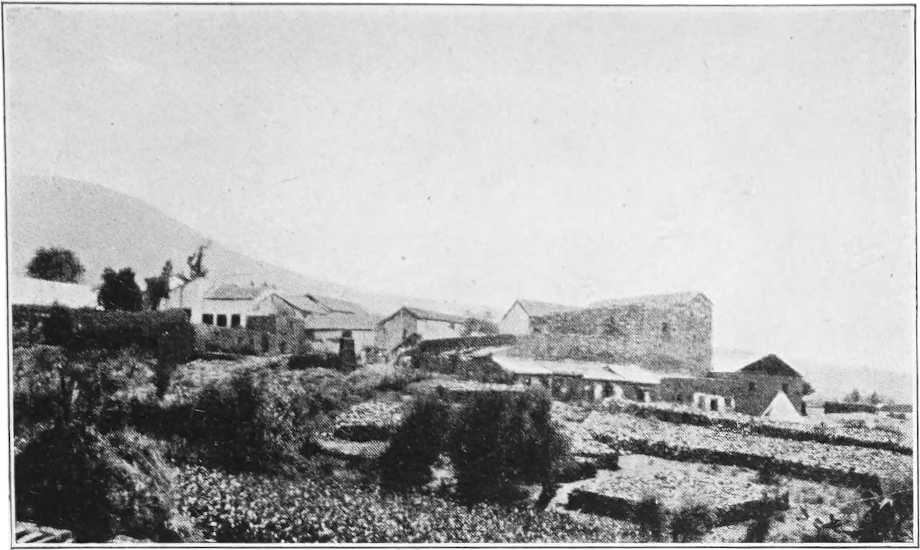
Raisuli’s prison in Tazrut
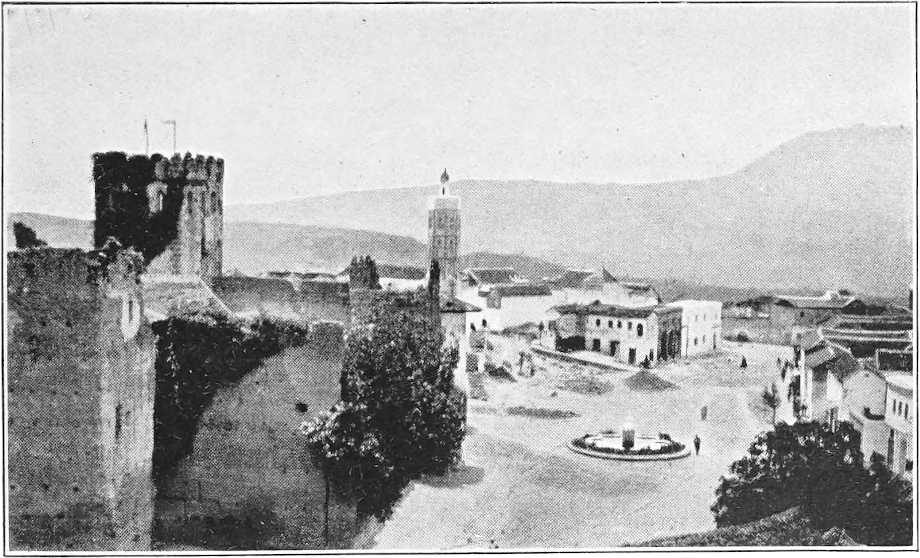
Xauen with the ancient castle, originally a Berber stronghold
[49]“There were some who saw us and hid, for my companion cried, ‘It is the Sherif el Raisuli, the great, the holy man, who will reward you.’ We got down to the sea with great difficulty, for our fetters were heavy, but there was no boat, for the escape had been planned for some nights later. We prayed on the shore, and said the ‘Fatha’[22] together, and then, as it was near dawn, we sought a hiding-place in the town. A man who was a friend of the youth offered us hospitality, but I would not accept it, for I knew that he would be punished for protecting Raisuli. My companions went into his house and he sheltered them, but I went on round the edge of the town, hoping to meet some people, for all the years that I was in prison men of the mountain tribes watch in Mogador.
“It was the first dawn that I had seen for very long, and I stopped to watch it and breathe the sea air. Suddenly, while I stood, forgetting my chains, two soldiers of the Maghsen came round the corner. Hidden by a doorway, I sprang suddenly upon them before they saw me. Truly it was not so much a leap as a fall! One went down beneath the weight of iron I carried, and I killed him with my hands. The other thought he was attacked by a Jinn, and ran, screaming. There was alarm in the town, and the news was brought to the Governor of the prison. I could hear a drum beating as I lay behind a buttress of the wall, but now I had a rifle and ammunition. I was a warrior again!
“When the soldiers of the Maghsen appeared at the end of the street, I looked along the barrel of the rifle and said to myself, ‘That old one on the right, he is not of much use.’ So I fired at him and he died. A shower of bullets like crickets shot over my head, but, in those days, the troops did not use the sights of their rifles, so that no missile went near me. Besides, the buttress protected me. I fired again,[50] and another man fell, writhing on the ground and crying out. Then I stood up and laughed when they could not hit me. ‘Don’t you know that I am Mulai Ahmed el Raisuli, and that no lead or steel can hurt me, for I have a special blessing from Allah? See, I have twenty bullets here, and for each of them a man will die.’ They believed me, for there was one there who had fought against me in the mountains.[23] There was much talk, but no more shots were fired, and, at last, the Governor came and spoke persuasively. ‘You are one against three hundred. What can you do? Give yourself up, and I promise you I will intercede with the Sultan for you.’
“It was a curious sight for the townsfolk who crowded on the roofs to see us—a prisoner in chains who treated with the Governor at the head of a troop! It was written that I should not escape, for the sea was behind me and the troops of the Maghsen in front. Truly I might have killed many others, but whether I could have escaped I doubt, for the fetters impeded my reach—and weighted down my feet. In any case, I was young, though much of my youth had been robbed, and I wanted life for my own purposes. So I said to the Kaid, ‘Swear to me before Allah that you will obtain my release, and say the Fatha as a covenant between us, in the presence of these soldiers; and I will give myself up.’ He did this, and I made him promise also that he would not search for my companions. ‘They are gone in a boat,’ I said, for sometimes a lie is permitted. Then I surrendered myself to the Kaid, and they took me back to the prison on a mule, for I could no longer walk.”
At the end of this story, coloured, I imagine, by el Raisuli’s appreciation of his own phraseology, my host[51] looked at me suspiciously. “I tell you this to show that, if I have tortured others, I myself have been tortured; but it is between me and thee, for it is not good that such things should be told of the Sherif.”
The Kaid of Mogador kept his promise, and, as Mulai Hassan had died and his son Abdul Aziz ruled in his stead, there was little difficulty in pardoning a criminal of the preceding reign. El Raisuli’s prestige must have been great, for so powerful an individual as Mohamed Torres, the Sultan’s representative at Tangier, added his intercession to that of the Kaid. The Minister of the moment was el Menebbhe, a wise and a just man, whose influence in Moroccan affairs has always been great. In signing the order of release for el Raisuli, he wrote the prologue of a friendship which lasted for a long time and developed into a business association, for the two shared various interests in land and property.
According to el Raisuli, he left his prison imbued with the desire for a life of study. “I wished to live in a secluded place, where there was much sun and space, and yet I wished to hear the voices of women babbling about common things: you permit me to say that generally the conversation of women does not interest me much, but, in prison, one loses a sense of proportion. At first I lived in Tangier, where I collected numbers of books, for there were many things I had forgotten at Mogador, and I wished to learn them again. I was contented, as men who have had nothing are contented with little.”
Apparently, however, the Sherif’s desire for vengeance grew as he recovered his health and strength, for not long after his release he is said to have instigated the murder of a cousin who had lately become the wife of a relation of his enemy, the Bey of Tangier. This was perhaps the most ruthless of all the Sherif’s acts, for, with his own relative,[52] were assassinated the old, half-crippled mother and young sister of her husband. El Raisuli would never talk about this affair, except to say that treachery was hateful in the sight of Allah, and that to live in the house of a traitor was to merit his fate. “I did not know that Arabs fought against women,” I told him. “In the countries of the East where I have travelled, no man would hurt ‘a woman, a Jew or a barber.’” El Raisuli very nearly smiled. “Here in Morocco, the Jews have much money, so how should we become rich unless we killed them? In the mountains we have no dealings with barbers, and, as for women, they fight as well as the men. It is they who carry the ammunition and load the rifles. Many a Berber woman can shoot better than a man.”
El Raisuli’s sisters seemed to have been the cause of a good deal of bloodshed, for it is told that one of them, who had been married for some years to a Moor of high standing, was very angry when her husband proposed to take a second wife. Possibly the destined bride was one of whom she particularly disapproved—history does not relate—for Islam permits four wives, and divorce is extremely simple, since it consists merely of saying, “I divorce thee,” three times in the presence of witnesses. However, on this occasion the first wife appealed to her powerful brother for help. No answer came, and the day of the wedding arrived. The feast was over, the musicians had departed, and the quivering cry of the woman was stilled. The bride sat in state on a pile of mattresses, awaiting her husband. Her mother was there waiting to untie the ceremonious knot in her haik. A negress stood by the door, with a bowl of milk and a platter of dates, signifying fertility and chastity.
Suddenly there was a sound of galloping hoofs, and shouts of warning came from the court, “Robbers, robbers!” The men rushed out with their guns, and the attacking party,[53] after firing a few shots, allowed themselves to be driven off towards the hills. The defenders followed. Then, while the house was deserted, except for the women who huddled together in an upper room, some men crept silently from the bushes where they had been hiding, and, with a warning cry to the sister of el Raisuli, “Cover yourself, lady,—we are the followers of your brother!” they burst into the Harem and dragged out the bride and her mother. When the men of the house returned, they found the bodies of the two women lying across the threshold where, only a few hours before, a bullock had been sacrificed for luck.
El Raisuli did not tell me of this episode, but when I asked him why his men had killed the girl, instead of merely removing her from his brother-in-law’s house, he answered, “It was better to kill her. She had been seen by men who were not of her family,” from which I imagine that the bride was town-bred and of a good family, for the mountain women work in the fields with the men, their faces uncovered and their garments kilted up over sturdy limbs.
El Raisuli explained his return to the wilderness in this manner: “The ways of the Maghsen were strange. When Mulai Abdul Aziz gave me my liberty, I had no wish for further war. The people of Tangier respected me as a learned and sainted Faqih, and I wrote on the interpretation of Koranic law, which is a high honour in Islam. I had many pupils, but one day when I wanted money to give to some of them who were in need, I learned that the Government had confiscated my property in El Fahs. I was told that it had been given to friends of the Sultan, and some of it was in the hands of my enemy, Abderrahman es Sadiq. I appealed to Fez for redress, but nothing was done. There was no answer to my letter and my property was being wasted by others.
“What I had done once I could do again, but this time,[54] when I returned to the mountains, it was with the intention of fighting Mulai Abdul Aziz. My flag flew again in Beni Mesauer, and from the house of Zellal my messengers went forth to the tribes. All the jebala was discontented with the rule of the Sultan. There was famine in Fez, and the soldiers were unpaid. El Roghbi—he of whom I told you—brought his forces to the walls of the capital, and the Sultan sent to Abd es Sadiq for help. The tribes of the mountains joined me, and I had an army greater than el Roghbi’s. News came that the Bey of Tangier had gathered a force for the relief of Fez. It was to be under the command of Kaid Abd el Melak, who was hated by all the tribes for his cruelty and rapacity. Abd es Sadiq was to travel with the mehalla[24] to ensure safety.
I was glad when I heard this, for I thought that, at last, I should hold my enemy in my hands. We lay in wait in a wadi where the road was a ribbon between the bushes. It was the hour before night, when a man may scarce distinguish if a thread is black or white. Below us we saw the mehalla approaching, but it was difficult to tell where was Abd es Sadiq. At last I picked out the stallion of the Bey with his personal guard, and the Kaid Abd el Malak beside him. Then I gave the signal, and the men rushed down on either side, till the enemy were squeezed between the two parties like a fruit in the fingers. Many were killed and others fled, but, when Abd el Malak had been captured, and we fought our way to the Bey’s horse as it was turned for flight, we saw a party riding swiftly towards Tangier, and we did not trouble about them, thinking them but servants or camp followers.
“There was furious fighting in the bed of the stream, while the Bey, cut off from escape, sat on his horse, watching, with his jellaba over his face. A man of Beni Mesauer[55] caught his bridle, and the stallion reared, striking out with his forefeet. ‘Take him alive,’ I ordered, for I wished to see his face. I had not looked on it since the day he broke faith with me after I had eaten his bread. At that moment the jellaba was blown back, and, by Allah, it was a slave dressed in the Bey’s robe and riding his horse! Sidi Abderrahman was nearing Tangier, and congratulating himself on the wisdom of a fox. He was right. It is well to be prepared for everything.
“The tribesmen judged Abd el Malak, and every man’s voice was against him, so his eyes, which had seen much injustice, were burned out with two red-hot coins, the size of a peseta. He deserved to die, but, when he heard of the affair, the Sherif of Wazzan, who was always inclined to mercy, pleaded for him, and I let him go.
“From that day I was supreme in the mountains, and even Mulai Abdul Aziz could not question my authority. The tribes of Tetuan joined me, and my rule extended to the farthest horizon—beyond that to Azeila, where my sister was married to one of the great, and to Al Kasr, where it is too hot for men to fight. Against Europe on the one side and the Sultan on the other I protected the rights of the people, for they were my people.”
From this moment el Raisuli appeared in a new rôle. He was no longer a brigand, alternately quixotic and ferocious. All his actions were governed by a definite purpose. It was as a potentate that he treated with the Sultan and, in his dealings with European Powers, he showed himself no mean politician. Before his imprisonment he had been illogically cruel and equally inconsequently generous. He had never looked ahead, living for the moment and the adventure thereof. Now he set to work deliberately to gain the power which would make him secure. He played off the tribes one against another until he had them all at his[56] service. He used his scientific and strategic knowledge, his eloquence and the ever-growing reputation for saintliness as means to ensure his alliance with other great houses. To the warriors of the mountains his courage and his still unbroken physique were sufficient appeal, but it was his fanaticism which won the Ulema[25] and the tribal Sheikhs. He stood for the old order that was passing, and they followed him to avoid the change which they presaged and could not understand. It says much for el Raisuli’s intelligence that, while treating at different times with various European Powers, and always to his material profit, he should yet represent to Morocco the champion of Islam against the Christian, of tradition against innovation.
RAISULI’S TWO HOSTAGES
“Do you know Mr. Harris?” asked Raisuli, one day when we were drinking green tea. The slaves had poured a perfect bath of orange-water over us, and our host, holding open his robes, had let the scent trickle down his chest and back. There had been a great argument as to whether the mint was fresh, which the Sherif had terminated by growling, “Well, is there mint or is there not? and if there is, why do you bring me this dung?”
Hoping to avoid one of those fits of morose silence which interfered with the progress of the memoirs, I remarked that it was a pity that Europeans could not make such good tea as the Arabs. “You have no patience,” said the Sherif; “you want to do everything quickly, at once. Tea is like a man’s acquaintance. It must be made slowly and with care. Now, Harris,” (pronounced Harrēēs), “is one who knows the ways of the Arabs, and his conversation is pleasant. He has the gift of speech, which is admirable.”
It is curious that an Arab will never say of a fellow-countryman that he is brave, or a good horseman, because he takes these attributes for granted, but he will praise his eloquence with enthusiasm. Raisuli continued, “I had known Harris for some time before he was a prisoner, for he went much into the mountains to shoot, and sometimes he wore the dress of our country, for he talked our language as well as his own. I visited his camp one day, and we spoke of many things, for it was under my protection that[58] he went swiftly through the mountains when he had need of news for his paper.”
Mr. Harris describes the Raisuli of those days as having a fascinating personality and being “tall, remarkably handsome, with the whitest of skins, a short dark beard and moustache, and black eyes, with profile Greek rather than Semitic, and eyebrows that formed a straight line across his forehead. He smiled sometimes, but seldom, and I never heard him laugh. With his followers he was cold and haughty, and they treated him with all the respect due to his birth.”[26]
A slave approached el Raisuli with a deprecating expression and a bundle of fresh green-stuff. The Sherif waved him away impatiently. “No, no, it is finished. I am busy.” He continued his story: “I told you how all the jebala tribes were with me, and how I ruled as Sultan of the mountains. When any man had a grievance he came to me for justice, whether it was against the Sultan or the Europeans. It happened one day that there was talk of building a cable station for the line from Gibraltar to Tangier, and it was said the English wished to put it in the territory of the Anjera tribe outside the town. The Sheikh Abd el Hannan, who was a great man of Anjera, sent messengers to me, saying, ‘With all my force I shall fight this new thing that the Christians would do to us. Come to my assistance with the tribes of El Fahs!’
“It was a good excuse to rise against the Maghsen, which was weak and full of traitors. The English could do nothing; so they appealed to Mulai Abdul Aziz, who sent a strong mehalla[27] against us. It camped in the plain near Tangier, on the banks of a wadi, but, by this time, we were used to fighting the troops of the Maghsen. We knew[59] that they would eat first and sleep, and that there would be no danger from them till they had satisfied their stomachs and were full. So we fell upon them in the morning while they were unprepared, and killed many, but one party we did not destroy, and they burned a part of my village at Zinat, and fled through the land of Anjera, looting and killing as they went. My people took many captives, and, because of the things that the Sultan’s troops had done to the tribesmen, burying them alive and hacking off their limbs, all the prisoners were killed. My people cut off their heads and other portions of them, which they put in the mouths, so that the women would laugh when they saw the bodies. This was a common custom.
“It was on that day that Harris was captured, for, having no fear and much curiosity, he had ridden out near to the battle to see the burning of Zinat. The tribesmen took him by surprise, for they were fifty or a hundred armed men. I was sitting under the trees, when I heard a great noise and much shouting. Men came to me, running, and said, ‘Sidi, they have taken a Christian, a European, and they are going to destroy him.’ So I went quickly to stop them, for I have always protected the Europeans. When I saw that the man was Harris, my friend, I said to the tribesmen, ‘No—give him to me, for he is my friend; he shall be my share of the loot of this battle.’ They refused, and there was much argument. Yet at last they desisted, and I took him to my house; but half of it was burned, and there was no rest for him. The tribesmen would have killed him, for the troops of the Maghsen had stolen their goods and destroyed what they could not carry; but I argued with them at length and would not leave him. I put a guard at the door of my house, and the Englishman was safe.”
El Raisuli was evidently determined to present his conduct in the best possible light, for Mr. Harris’ salvation[60] was, I believe, largely due to his own wit and presence of mind, and his friendship with some influential member of the Anjera tribe to whom he had extended hospitality at Tangier. He describes his imprisonment in Raisuli’s house in this way: “The room in which I found myself was very dark, light being admitted only by one small window near the roof, and it was some time before my eyes became accustomed to the gloom. When I was able to see more clearly, the first object that attracted my eyes was a body lying in the middle of the room. It was the corpse of a man who had been killed there in the morning by the troops, and formed a ghastly spectacle. Stripped of all clothing and shockingly mutilated, the body lay with extended arms. The head had been roughly hacked off, and the floor all round was swimming in blood. The soldiers had carried off the head as a trophy of war, and they had wiped their gory fingers on the whitewashed wall, leaving bloodstains everywhere. However, I was not to suffer the company of the corpse for long, for half-a-dozen men came in, washed the body, sewed it up in its winding-sheet and carried it away for burial; and a little later the floor was washed down, though no attempt was made to move the bloody finger-marks from the walls.”[28]
This episode occurred in June 1903, and the negotiations for Mr. Harris’ release were therefore conducted in the fierce heat of an African summer. “There was much coming and going,” said el Raisuli, “and, as some of my people accused me of harbouring a Christian and being in the pay of a strange Government, I conferred with men of Anjera to arrange some way of safety for Harris. One night their great men came down from their villages and took away the Englishman, for they were his friends, and had promised to treat him as a guest. The Sherif of Wazzan, the same[61] who had interceded for Abd el Melak, now acted as intermediary for Harris, but your Government wanted to hurry things, as is the way of European Governments. At first there was talk of money, but I would not receive one douro for a friend, and the tribesmen were agreed, so they asked but the release of certain prisoners, men who had been confined unjustly in the dungeons of the Maghsen. When this was agreed upon, Harris was sent in safety to Tangier.
“After this, since the Maghsen still held my lands, and others were eating my substance, I made myself responsible for the justice that was denied me. One here, one there, one in the city, one on the plains, I took men from their houses and held them until they restored to me that which was mine. There was one who had taken some of my money when I was in prison, and he had boasted in the suq, ‘See this silver belt and this dagger set with jewels? These I bought with the gold of Raisuli.’ One day he fell into my hands, for he could not always watch where he went. I said to him, ‘Give up the rest of that which you stole, and you shall go free,’ but he swore, ‘I know nothing of these things.’ Then I ordered my slaves to beat him with a knotted cord, and they gave him 500 lashes, but he would not speak, nor even cry out or complain. When he fainted, they carried him away and washed his wounds. The next day again, I said to him, ‘Before Allah, I will give you your freedom if you tell me where my money is hid,’ but he would not open his mouth. Before the 500 lashes were given, he fainted again, but he did not speak. The third day it was the same thing, and in silence he died under the whip. Not many men have conquered el Raisuli in this way.
“Again the Sultan sent a force against me, and I took refuge in Beni Aros, where all men were my friends. The mehalla established itself at Suier in Jebel Habib, and[62] ravaged the whole country, so that the tribesmen came to me to protect them against a government which ate their harvest and stole their property. They could have given me up and profited very much from the gratitude of the Sultan, but no man would do this. Perhaps they feared me. In my life I have been little loved and much hated, but, above all, I have been feared. I thought, ‘How can I repay the men of Beni Aros for all that they are losing on my account?’ Then I began capturing strangers and giving the money of their ransom to the tribesmen whom the troops of the Maghsen despoiled.
“At last I thought I would seize a European, an important man who would make the world realize my wrongs, so my people watched on the outskirts of Tangier and, one night, when it was dark, they crept up to the house of an American, Perdicaris. He was sitting reading, with the light beside him, and he had no idea of their presence. They rushed in through the windows, which were open, and dragged him out, with his relative who was with him. With rifles pressed to their necks—so—the prisoners were hurried off to the waiting horses, and before morning they were with me in Beni Aros. At last I could make terms with the Sultan, and show the nations of Europe what manner of man was el Raisuli. I received Perdicaris in a tent spread with carpets and sheep-skins. My slaves waited on him and brought him all that he asked for. Then I spoke to him as a brother, and I said this and this has the Sultan done to me. At the end of my speech, Perdicaris shook my hand and said, ‘You have done right. Had I been in your place I would have acted in the same manner. From this moment I am no longer your prisoner, I am your advocate.’ After that he wrote a number of letters to Europe and America, explaining the circumstances, and his family sent me many presents.[63] My prisoners were my guests, and they lived in comfort, walking about freely in the mountains and shooting with my guns, for there is much game in the jebala.”
The Sherif’s eloquence certainly hypnotized the American, for Mr. Perdicaris wrote of his captor, “El Raisuli is a well-educated man in every sense of the word. I go so far as to say that I do not regret having been his prisoner for some time. I think that, had I been in his place, I should have acted in the same way. He is not a bandit, not a murderer, but a patriot forced into acts of brigandage to save his native soil and his people from the yoke of tyranny.”
“While Perdicaris was shooting green plover and eating kous-kous in my hills,” said Raisuli, “the American Government[29] sent seven men-of-war to Tangier, and a battleship came also from England. The Sultan was frightened lest he should lose his throne, but he dare not despatch an army against me, for the life of the American was in my hands. One of the messengers who came to me from Mulai Abdul Aziz was an aide-de-camp famous for his cruelty. When he camped in any country he used to force the villagers to pay him tribute, the half of what they had, or the whole. If the money were not forthcoming quickly, he would have the women of the house seized and dragged out into the road, and beaten before all the village. If a man came to see him, riding a good horse, he would say to him, ‘How much will you take for that horse? It pleases me, and I would like to have it.’ The owner, frightened, would answer, ‘Of course I ask nothing; let my lord take it as a gift.’ The other would protest. ‘No, no, I must pay you its price. Leave the horse here, and I will send the money to your house. So the poor man would go away without[64] his horse, and with no chance of seeing his money.” Apparently the stealing of a horse and the beating of women ranked in the Sherif’s eyes as equal crimes.
“When the Sultan sent this man as a messenger to my camp, I said to him, ‘Through you I am going to be very rich.’ He answered, ‘Allah keep you, Sherif, do you think I am so valuable to my master that he will pay to get me back?’ ‘No, no, it is not with him that I shall treat, but with the villages where your name is cursed. Do you not believe that the men of such-and-such places will be glad to put your head upon their fences and show your hands and feet to their women?’ ‘It is the will of Allah,’ he said, but I saw his cheeks trembling beneath the jaw.
“To make an end of the matter, I sent news to certain tribesmen that I had some merchandise to sell them, and, when they came and saw what it was, they paid me many douros, and I delivered the man to them. They cut his throat skillfully, while I watched. After that, I think the Sultan must have had difficulty in finding messengers, but his men were poor and would do anything for money.
“I had no wish to lose Perdicaris—he had a good heart and much understanding—but when Mulai Abdul Aziz agreed to my terms, for he was a weak man and easily distressed, I sent him down from the mountains with an escort and many gifts. Truly, a high price had been paid for him, and at last I had vengeance on the Bey of Tangier, for, in addition to a great ransom (70,000 dollars), my friends were released from prison to make room for my enemies, and I became Governor of all the districts round Tangier, in the place of Sidi Abderrahman, who had betrayed me. In this last thing I was doubly justified, for all the country had protested against the cruelty and wickedness of the Bey, and had desired that I should rule in his stead. So at last I gained the power which I had always[65] wanted. Men think I care about money, but I tell you, it is only useful in politics. A man of much money has many friends, and often a man is judged by what he holds in his hand.”
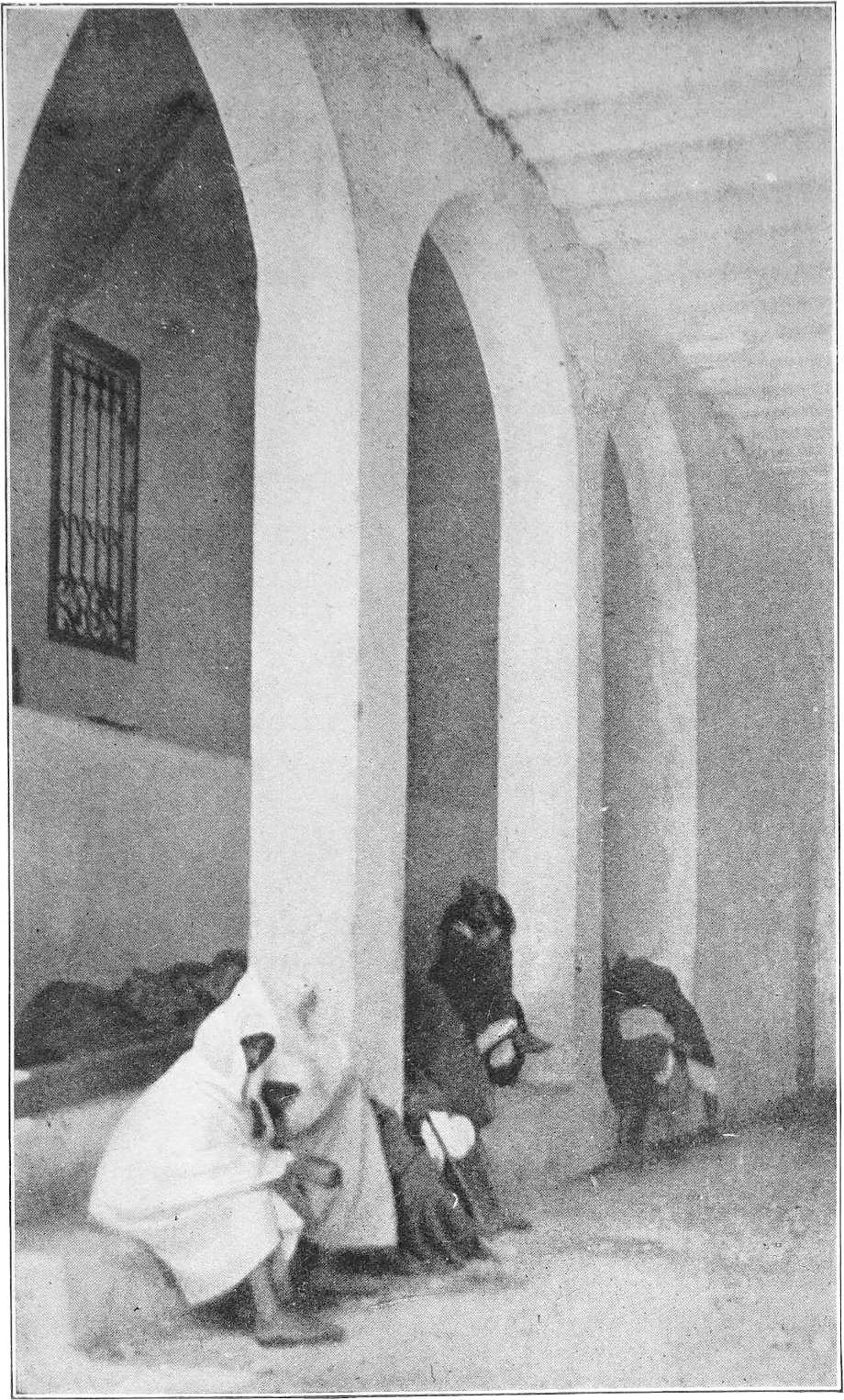
Entry to Raisuli’s palace at Azeila. Prisons on left
MORE POWER; GOVERNOR OF TANGIER
“When I became Governor of Tangier, there was much trouble in the neighbourhood because of the rebellion of Bou Hamara, an ignorant man who pretended that he was the elder brother of the Sultan, one Mulai Mohamed, son of Mulai Hassan, who was dead. He had been a secretary in the houses of the great at Meknes, and there he had seen letters from the Sultan, and the great seal which was attached to State documents. By some means he had a copy made of this seal, that he might use it to provide himself with money. He was a good Moslem and had some skill at writing, and there are always foolish people who will believe the first thing that is told them without proof. So, in the country to the East, between Fez and Taza, he declared himself Sultan, and the tribes joined him, because the government of Mulai Abdul Aziz was bad. The Sultan sent a force against him, but it was defeated, and so I thought it wise to make peace with him.
“Many letters passed between us, and, had it been necessary, I would have upheld his claim, for he had agreed that I should be Governor of all the Northern tribes, and independent in my zone. For many years he ruled like a Sultan, but at last (not until 1912) he was captured and brought in a cage to the court of Mulai Hafid, who had succeeded his brother. They hung him on a wall in the sun, and the Sultan and his ministers shot at him, seeing how near they could place the bullets without hitting him, but by mistake he was wounded many times. At night, when[67] he was tired of the game, Mulai Hafid ordered his prisoner to be put in the lion’s cage, but the lions were well-fed and would not touch him! In the morning, men came to the Sultan and said, ‘My lord the King, Bou Hamara is still alive. At this moment he is saying his prayers.’ The Sultan ordered that the lions should be given no food all the day, and, because of this, they devoured one of the man’s arms; but, to make an end of him, he was shot by the soldiers of the guard.
“However, when I came to Tangier, Bou Hamara’s influence was still great, and no caravan was safe. Men travelled in armed parties for protection, and made no fire in their camps at night. A lighted window was a good mark for a bullet, and thieves robbed in the by-ways of Tangier. I put an end to all this, and under my protection no caravan was robbed. He who was with the Sherif could go through the hills and the plains without a gun and with a bag of money in his hand. The great men of the jebala joined me, and my money flowed in the villages. It is easy to make money if you are a Governor. You do not understand our justice, because you do not realize the minds of the Arabs. You think you give them a great thing with your civilization. You see a man toiling slowly along the road, his jellaba crooked on a stick to make a little shade above his head, and you go to him and say, ‘Do not walk in the dust in this way. It will take you days to reach Fez. Here is a train which will take you there in a few hours.’ ‘The blessing of Allah on you,’ he will say, ‘but I have my donkey.’ ‘No, leave your donkey,’ you urge. ‘Here is a motor that will carry you more quickly than the train, or an aeroplane which will do the journey in forty minutes!’ ‘Allah make you strong,’ he will answer, ‘but I am not in a hurry.’
“It is the same with our justice. A man comes to you[68] and asks you the name of the Pasha of the town, for he has a complaint to make. You tell him to go to one of your officials. ‘No,’ he will reply, ‘that man is not a Pasha. He does not kill nor take bribes, nor do his slaves stand in the court to give lashes. Of what use is he?’ How can a man approve what he does not understand? When robbers were brought to me, and their crime was proved, there was a slave ready with the axe. With one stroke he severed a man’s arm, and the stump was plunged in pitch. If the black bungled his stroke, he got a beating and learned to steady his aim. Now, you depend on the evidence of men who can be bought, instead of on the law and your own knowledge.”
While Raisuli expounded his philosophy in this way, we had been standing just outside the door of the visitors’ house, to make the most of the cool evening wind. Suddenly the Sherif led the way inside. The white veranda was shadowed by the short twilight. Raisuli shuffled forward, and his heelless yellow slippers made no mark on the spotless pavement. Our riding-boots, on the contrary, left dark patches wherever we trod. The Sherif paused on the further threshold and pointed to the floor we had crossed. “That is like Morocco,” he said. “You cannot see the tracks of Islam, for it is of the country and suited to its needs, but you, wherever you go, leave a mark, for your ways are not ours.”
I protested in favour of civilisation, pointing out its obvious benefits. “You give a man safety,” countered Raisuli, “but you take away hope. In the old days, everything was possible. There was no limit to what a man might become. The slave might be a minister or a general, the scribe a sultan. Now a man’s life is safe, but for ever he is chained to his labour and his poverty.” “What of the doctors?” I asked, after a silence prolonged by my reflections.[69] “That is how Spain will conquer the country,” said Raisuli. “Already our doctors go into the harems when the women bear children: and there is a Sherif, a friend of mine, whose sight has been restored by an operation after six years of blindness.[30] Truly it is a greater miracle to give light than darkness.”
The Sherif lowered himself ponderously on to the piled mattresses. “I myself have had a tooth pulled out by one of your doctors. He would have thrown it away, but my servants sprang forward and took it from him. It was a very old tooth, so they were able to divide it among them and each wear a little bit, to bring them the ‘baraka.’”
El Raisuli is surrounded by a group of the most devoted men, who are more like disciples than servants. They hang upon his words and follow him about like dogs, looking at him with the same half-puzzled, half-hopeful expression, as a dog, when it does not understand what its master is doing. Three of them taste every dish before el Raisuli eats of it, and others sleep across the door of his chamber. They regard him with a veneration that is most heterodox in Islam, since the worship of saints is forbidden. No food that the Sherif has touched is thrown away, for it is supposed to have acquired curative powers, and the neighbouring villagers pay heavily for the privilege of eating a few dry crusts or sucking the bones from which el Raisuli has taken the meat.
“For a long time I ruled in the district of Tangier,” said the Sherif, gazing fixedly before him, “but the Europeans complained of my reign. I had brought security and peace to the country, but they feared a little blood spilt in the market-place or a few heads stuck on a wall. So the politicians of Tangier wrote to the Sultan. Mulai Abdul Aziz,[70] wishing to please them, for he did not know which way to look for money, sent an army against me, under Khad Ba Hamed Khergui.
“I was at my house in Beni Mesauer at that time, and Ba Hamed sent messengers to me, saying, ‘We have arrived at such-and-such a place, and I would have speech with you.’ I told him, ‘If you come here alone I will receive you, and, on my head and my eyes, you shall be safe.’ So he came in the evening, when it was neither light nor dark. ‘Greeting, O my brother,’ he said, and I knew he had come to make terms.
“We ate the flesh of a sheep roasted, and then he said to me, ‘It would be a pity if there were a battle between us, for we should both lose many men.’ I agreed with him, and he continued, ‘How many of my men, think you, you could kill in the mountains?’ And I answered, ‘Many hundreds, for you would be as the blind fighting against those who can see.’ He said, ‘And how many do you think, oh, my master, that we should kill of yours?—for certainly few of your men would die.’ I told him, ‘Perhaps fifty, perhaps sixty, if there is much fighting.’ At last he asked, ‘And how much is a man’s life worth to you, Sidi?’ Then I saw what he intended, and the matter was arranged. I paid him the blood-money, so much for each man, and he agreed not to advance beyond a certain place. In this way there was peace.”
The period of which el Raisuli was speaking was one of the most troubled in Moroccan history. It was the eve of European intervention, and the Sultan, ruined and held a prisoner by his ministers, was powerless. The tribes imagined that he had betrayed Islam and sold himself to the foreigners. On every side the Maghsen showed itself incapable of protecting the Europeans within its borders. A Frenchman, Monsieur Charbonier, was murdered[71] in Anjera, and two young Spaniards imprisoned in Beni Uriagel. The crew of a Spanish boat (the Joven Remedias) was seized by the tribesmen, off Cap Jubi. In Casablanca Christians were assaulted and robbed. Finally, Azeila was sacked by the mountaineers.
El Raisuli wished to add Sahel to his governorate of Tangier, and Mohamed Torres (Minister for Foreign Affairs) held out hopes that he would obtain the outpost, if he would go to Azeila to put down the insurrection there.
Mohamed Ben Abdul Khalak had been Governor of the town, but he had many enemies on account of his extortions, so the Beni Aros who had property near Azeila plotted to destroy him. “There were no rifles in the city,” said the Sherif, “for Abdul Khalak was a wise man and knew the danger of a careless shot; but two men of the Beni Aros, Berrian and Uidan, arrived at the gates one morning, with donkeys laden with bundles of straw. The guard let them pass, thinking they were farmers from the neighbouring villages, but inside the straw were rifles. These were hidden in the house of a friend, and, afterwards, the tribesmen entered without arms, as if for the market. One by one, they went secretly to the place of meeting, and, at night, when the signal was given, they rushed to the house of Abdul Khalak and took him prisoner. Then the townsmen joined them, with rejoicing, and the Kaid was kept in a dungeon, while the Beni Aros ruled the town.
“Remembering this trick, I said to myself, ‘A bird once snared will be so busy avoiding the same trap that it may well fall into another’; so I sent many rifles to Azeila by boat. They were hidden under fishing-nets and smuggled into the town by means of a rope let down over the wall. Then my followers went in with empty hands, not all at once but by twos and threes. The rifles were hidden in a mosque whose Imam was my friends, and, after some of[72] my men had established themselves in this mosque, and others had taken possession of a house overlooking the gate, they sent me word that they were ready. During the night they cut all communications in the town and, in the morning, they opened the doors to my troops. So was Azeila taken for a second time, and my promise to Mohamed Torres fulfilled, for I had said to him, ‘my mehallas shall capture the town and restore the rule of Abdul Khalak.’”
Simultaneously, however, the Corps Diplomatique sent a strong note to the Sultan, protesting against the frightful corporal punishments inflicted by el Raisuli, the excessive taxation he imposed, and his insistence on administering his own form of justice to Europeans within his jurisdiction. It is notable that the German Minister was, from the first, opposed to this step. On every possible occasion he upheld the authority of el Raisuli and assured him that his government considered the Sherif justified in all his actions. However, the insistence of the French Minister won the day. By the Pact of Algeciras it had been arranged that French police should patrol the International Zone outside Tangier, but Raisuli would not allow them in El Fahs. This was perhaps the beginning of the friction which has always existed between France and el Raisuli.
Mohamed Torres was obliged to cancel the proffered bribe of Sahel, and, on December 11th, 1906, he announced that two mehallas were on their way from Fez to re-establish the authority of the Pasha of Tangier and to banish el Raisuli. The Sherif took refuge in Zinat. From there he defied the European Powers, whose war-ships lay in the harbour waiting to enforce the Pact of Algeciras, and the Sultan, whose troops arrived early in January, prepared to act with more decision and vigour than usual.
“I had a great house at Zinat,” said el Raisuli. “It was a fortress built against the rocks, with many little windows[73] from which men could shoot. On the flat roof snipers could lie hidden behind the parapet and, from the towers, a watchman might see the whole plain. The army of the Maghsen had camped below us, but out of range, men dressed as soldiers, yet not knowing how to handle a rifle. The artillery was on the left and the cavalry guarded the flanks. It was a fine sight in the early morning, when the bugle sounded the advance. You could pick out the cloaks of the officers and the flags of the generals, Sidi Mohamed Guebbas, the Minister of War, and Sidi Mulai Abselam el Amarani. It was like a toy army as, without discipline, it moved forward, the companies so close one to another that they could have been mown down by a maxim like corn before the scythe. No answering bugle came from Zinat, but, from every hill-top behind us, to the far-away ridges of Beni Mesauer, a column of smoke arose from the fires of the tribesmen.
“When the army was quite near, so that the faces of the men were apparent, I said to my followers, ‘Now pick out each of you a man, and see that he dies.’ The rifles spoke from every loophole and each rock hid a sniper, but nothing was visible from below, for we used powder which has no smoke. The army replied with a crash of musketry, but there was nothing to aim at. They fired at the rocks and the trees, but most of the bullets went skyward. Then the artillery began. Zut!”
The Sherif banged one hand into the other with a rare gesture. “A shell whirred over our heads, to kill a few birds—and another—and another—
“Only one hit the house all day, but we took toll of those below. There were too many cowards in that army, who ran about shouting and firing, making much noise lest their lack of courage be discovered. The horsemen galloped wildly, as when we make entertainment for a guest.[74] Plomb! Plomb! The shells made holes all round, but never near us. There was much movement, but nobody advanced. At first the women had implored me to leave. ‘Fly and save yourself, for your life is important,’ they prayed, and kissed my knees; but I told them, ‘Be assured that nothing can hurt me, for I have the ‘baraka.’ It is true that I have never fled from any place before the bullets of an enemy. Where I have been at the moment, there I have stayed, whether before the shells of a cannon or the bombs of an aeroplane.
“At the end of that day no harm had been done us, save that a village had been burned round the flank of the mountain. The soldiers were so busy looting that they had no time to advance, and, at last, a slave-woman ran out and cursed them. ‘Aie! are you maidens preparing for marriage, that you carry away mattresses and furniture? Certainly you are not warriors, and no woman will be desolate because of your triggers!’ She stood on a rock, with her haik thrown back, but no one dared fire on her, for they thought her a witch. She called on my men to follow her, and, though I had said to them, ‘Let no man show himself, and hold your fire till you have chosen your enemy,’ they leaped from the wall and rushed down the rocks, as many as I can count on my fingers of both hands. At this moment the army retired, for the General had been hit, and a mule carried him out of the battle, so that these few men followed, shooting at the backs of hundreds!”
PLOTTING AND COUNTER PLOTTING
“That night there was much business at Zinat. Far away in the plain the army slept, but there was no sleep with us. In the darkness we slipped away to the mountains, which are ever hospitable. No one was left in all the village. The boys drove the flocks before them and the men guarded them with their rifles ready, but not a stallion neighed, nor a dog barked, and Allah made the night dark for us. The women carried children at the breast and great bundles on their heads. Each man took what he could lift, and piled the rest on mules, together with those who were old and sick. In a few hours a great company passed out of reach of the mehalla, but no sentinel gave the alarm and no patrol watched their movements. When all were gone I stood on the rocks outside my house and looked across the plain. My servants said to me, ‘My lord, they will burn your house, and everything will be destroyed.’ I replied to them, ‘For every stone they throw down they shall build me a wall, and for all that I lose they shall pay me. Have no doubt of these things.’
“Then he mounted our horses and rode up to the top of a hill, from where we could watch the day’s events, but the rest of my people went on to Beni Mesauer where they found a refuge with Zellal, of whom it is said, ‘His hand is open like a sieve and his wealth is a wadi which runs into the purses of others.’
“The troops of the Maghsen had become swollen like[76] barley after the rain, for reinforcements had come from Tangier, but there was no hurry to advance. There was a French gunner with the guns this day.[31] The shells no longer flew wide. Very soon I saw roofs crumble and the walls fly up like fountains, but I said nothing. That which is destructible is doomed to be destroyed, but material is everywhere on the ground and, for the Sherif, labour is but limited by the numbers of the population. Truly, building a house is no great matter. The sun was full overhead before the mehalla advanced. They came slowly, waveringly, as you see birds go down to the water, uncertain if there is a snare. At the distance where a man may shoot without aiming, they raised their rifles, and the noise of their firing reached us far away where we sat behind the rocks. Truly they must have killed every lizard and beetle in Zinat, so much lead did they pour into the village, but there was no answer.
“Zinat waited silently for what was written. At last the troops charged, but they were doubtful, each man wishing to keep behind his neighbour. I know not how soon they discovered that the village was empty, but then their courage was great. Shouting to each other triumphantly, they attacked the furniture we had left behind, and in a minute the whole army was turned into porters. If we had walked in among them, they would have paid no attention to us. Running to and fro, staggering beneath their burdens, we watched them, and then, suddenly, the houses burst into fire. The flames rolled up to the skies, and nothing could be seen but smoke. . . .”
Raisuli moved his huge body with an effort. “By Allah, a house is like this flesh of mine, an encumbrance, and a man moves quicker who has no possessions to guard. After[77] the destruction of Zinat, no one could say where I lived, for I could move quicker than the imagination of the Maghsen. At times I would be two or three days in the saddle without food, pausing only to pray or to drink a little water from the wadi, and, at others, I would live like a Sultan, eating a young sheep at every meal. We have a saying, ‘A man has no right to sleep on silk, till he has walked barefoot.’
“After a while Zellal was obliged to make his peace with the Maghsen, for he had relatives and much property in the towns, but, before this, we made a covenant that he should give me warning of any new move on the part of the Government. I had spies also in Tangier and Fez, who reported everything to me. Then I went further into the mountains, till I lived among the Ahmas tribe, who can never be defeated because their country is like the walls of this room and their houses the eyries of hawks. There is a story that they have a secret city so hidden that none may ever see it. It is said that here is an old library, with many books and marvellous parchments written in a strange language. Concerning this I made many enquiries, but heard nothing certain. It may be that there is something, for there are ulema among the Beni Aros who do not learn their wisdom at the schools.
“The Sultan made many attempts to capture me, and the armies of el Guebbas ate up the country till the people prayed against him in the mosques. Now there was in the service of the Sultan an Englishman called Maclean, a man of great courage and little learning. He was a friend of mine, for he liked the Arabs and lived after our fashion. When Mulai Aziz grew tired of trying to capture a man who was like a shadow changing with the position of the sun, he ordered Maclean, who was an instructor in his army, to write to me and arrange a meeting.”
[78]Sir Henry Maclean, about whose life el Raisuli seemed to know very little, was at that time, perhaps, the most picturesque figure in Morocco. From one who was at the British Legation in Tangier for several years, I understand that Sir Henry “started life as a subaltern in a Highland regiment quartered at Gibraltar, but, finding it impossible to make both ends meet in a crack regiment with but little private income, he had resigned his commission and crossed over to Morocco, in the hope of carving out a career for himself. Finding nothing to do in the coast towns, he had made his way to Fez, at that time an almost unknown city, as far as Europeans were concerned. After great difficulties he succeeded in obtaining an audience with the Sultan, to whom he commented in scathing tones on the state of the Moorish army, and guaranteed that, if he were given the post of Instructor-in-Chief, he would convert it into a disciplined force.
The Sultan, favourably impressed by the young Scotsman, gave him the appointment and saw to it that he was given every chance to make good his promise.”[32] At the time of which el Raisuli is speaking, Sir Henry Maclean had held this post for over thirty years, and had completely won the confidence, not only of the Sultan, but of many of the tribal chiefs.
It appears that, when he confided to the British Legation his scheme for the conciliation of the Sultan and the outlawed monarch of the mountains, he was warned against attempting a personal interview with el Raisuli. The Sherif told me much the same thing. “When el Maclean visited me in the neighbourhood of Al Kasr, the place arranged for our meeting, he related that his government was afraid of some treachery on my part. I said to him, ‘A man with a clean heart need fear nobody.’ We discussed the situation[79] for many hours, and he wanted me to accompany him to Fez, that he might arrange an interview with the Sultan, but I remembered the darkness and the pain of Mogador, and I said, ‘A bird does not fly into the same snare twice!’ Then he swore, ‘I will be responsible for your safety,’ but I trust no man’s word, for my life has made me suspicious. So I said to him, ‘Go back to Mulai Abdul Aziz and say to him this and this. Then return quickly, but bring me a letter from the Sultan, that I may have some surety.’ After this el Maclean journeyed back to Fez and stayed there a short time. Then I received a message from him, saying that all was well and that he would meet me at a certain place, to which I must come with only a few men. He would not trust himself in the farm where my mehalla was camped, so I thought to myself, ‘Either he has been warned again by his Minister, or else there is a snare being prepared for the rabbit, but how strange if the hunter falls into his own trap!’
“I went to the place arranged, with but ten horsemen, and when el Maclean joined me at the appointed time, he also had ten followers, so our forces were equal. Did I not tell you the ‘baraka’ was with me? Now listen what happened. At Fez the Sultan had written two letters. One was for me, and in it he called me his friend and said there should be peace between us. He appointed me a Governor and promised that all my property should be restored. He assured me that he had given orders for all his forces to retire, so that I might move freely where I chose. The other letter was addressed to el Guebbas, his Minister of War, and in it was written that, in answer to the prayers of Maclean, the Sultan had decided to pardon el Raisuli and had promised that he should be invested with the powers of a Governor, as soon as he made his submission. El Guebbas was to retire with all his army from the territory of the[80] Sherif, but, at the end, it was written that the General must in all ways acquire the confidence of el Raisuli, so that when he came down from the mountains it would be easy to seize him by stealth and imprison him. ‘Make all necessary concessions,’ wrote Mulai Abdul Aziz, ‘so that when a suitable moment arrives he will suspect nothing.’
“Now the ‘baraka’ has been very powerful in our family since the time of Sidi Abd es Salaam, to whose tomb on Jebel Alan all young men who are bridegrooms turn and make a salutation, saying, ‘I am under the protection of Allah and of thee, oh, blessed Abd es Salaam.’ Our ancestor was so humble that he would not allow a Qubba to be erected over his grave, saying, ‘The place where I am buried shall be flat like the earth around, for I am of no greater value than the earth.’ Many great Sherifs who were his descendants wished to build a mosque over his tomb, as would be fitted for so holy a man, but always it was said that the special blessing would depart from our family if the wish of Sidi es Salaam were set aside. So no Qubba has been built, and his protection is ever with us.
“It happened, therefore, that the wits of the scribes who copied the Sultan’s letters were muddled, and when Mulai Abdul Aziz had signed them and affixed the great seal of the Empire, his secretaries put the letters into the wrong envelopes and gave them into the hands of Maclean, unwitting of what they had done. It happened that when the Englishman came to me and found me seated on a carpet before my tent, for the heat of the day was past, he saluted me and said, ‘I congratulate you, O, Sherif, for all is arranged with the Sultan. There will be peace between you. You are to be reinstated as Governor, and el Guebbas is, from this moment, at your orders.’
“Then he handed me the letter from Mulai Abdul Aziz, and I read it three times, for it was the missive intended[81] for the Minister of War, and I saw at once the trick that it was intended to play upon me. Maclean, seeing me hesitate and being able to read nothing in my face, asked me, ‘Of what are you thinking?’ ‘That I am grateful to the Sultan for his pardon,’ I answered; but my thoughts were troubled, for Maclean had with him as many men as I had, so I could not seize him by force, for perhaps some of my men would have been killed and he would have escaped. I said to him, ‘Will you come into my tent and rest, while my men prepare for the march?’ ‘Where are you going to?’ asked Maclean. ‘I must go down to the army of el Guebbas to acquaint him with the news. I had a letter for him also, which I sent by a messenger.’ ‘I will write a reply to the Sultan,’ I said, ‘but first I must consult my brother, who is ill and could not come to meet you.’ ‘Where is he?’ asked el Maclean, who did not wish to leave me until he was sure of my intentions. ‘He is only a little way from here, in a farm. I will send him a message to say that I am coming.’
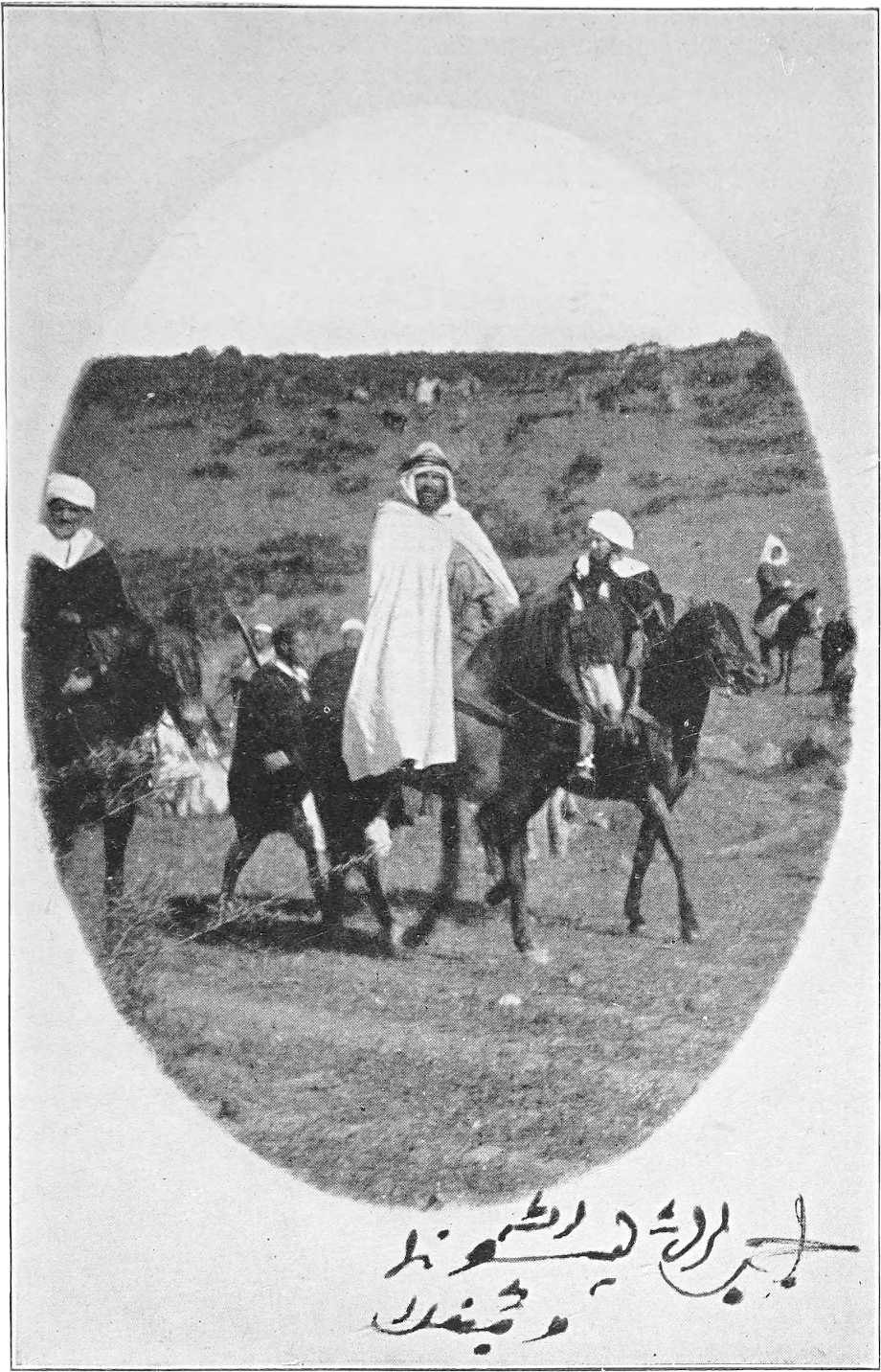
Raisuli (centre)
(Signature) “Ahmed el Raisuli. God be with him”
“Then I left the Englishman in my tent and I called a mountaineer who was swift of foot and sure, and I told him, ‘Go quickly to the place where my mehalla is camped and tell them to make ready for a long march. Let them be prepared to start as soon as I join them.’ He went, running like a fox, and I returned to Maclean. ‘Shall I ride with you?’ he asked. ‘As you like.’ ‘Yes, it is better that I ride with you. Then I can take your answer to el Guebbas.’ ‘Let us ride, then,’ I said; and we mounted.
“Now at that time I thought he was a traitor, and knew the intentions of the Sultan, and I said to myself, ‘So the strange thing has happened—who would have thought it?—and the hunter has fallen into the snare he made for his prey!’ But it displeased me to ride with him in this way, as if he were my guest. I would have liked to have tied[82] his arms together and bound them to my stirrup and made him run thus, but his men were still with him, and we were not yet in my country.
“We rode in silence, for I was thinking of the future, and I took him by roundabout ways so that the mehalla might have time to prepare. At last he said to me, ‘Where is the farm of your brother?’ ‘We draw near to it.’ ‘When shall we arrive?’ ‘Soon,’ I answered, and pressed my horse, for I saw the grove behind which were encamped my troops.
“‘What is this? What have you done?’ cried Maclean when we rode into the middle of the camp and he saw the force ready to march, the tents packed and each man prepared with his rifle. ‘Here is your answer,’ I said, and read him the letter of Mulai Abdul Aziz.
“El Maclean listened without speaking. Then he protested, ‘I too have been tricked. I knew nothing of this.’ With great sincerity he repeated that he had believed the words of Mulai Abdul Aziz. ‘In any case you are justified,’ he said. ‘I am your prisoner. I will go with you wherever you like.’ So we left that place and went up into the mountains of Ahmas, and I treated the Englishman as a guest.
“The Sultan was very angry that his plans should have been discovered, for the word of Moslem to Moslem is not lightly betrayed, so he wrote the Kaid of the district where I camped, saying to him, ‘Take all the armies that you will. Take all the money that is in my treasury. The country shall be under your orders, but capture el Raisuli alive or dead.’ Now the Kaid was my cousin, Mulai Sadiq er Raisuli, but he had always been with the Government and I had never seen him. There are many Sherifs Raisuli in the country and all of them have much influence. Mulai wrote to the Sultan and said, ‘I shall need 1,000 horses and 4,000 men to[83] capture Mulai Ahmed in these mountains,’ and the Sultan replied, ‘I will send double that number.’
“Two mehallas came from Fez and one was under the command of my cousin and the other under the uncle of Mulai Abdul Aziz. At that time I was at the Zawia of Sidi Jusuf el Teledi, and with me were fifteen men and Maclean. How can a handful of men fight an army? The tribesman came to me for my advice, and I said to them, ‘Do not waste your ammunition, when the earth is full of it,’ and I showed them the great stones of the mountains.
“There are few ways by which a man may climb into the Ahmas, and all night the mountaineers worked to loosen the rocks above them. In the morning, when the mehalla advanced, it was as if the mountain resented their presence, for whole cliffs fell upon them and many were killed. I sat on a boulder across the wadi, and, with a few followers, watched the rout. My jellaba was white and very clear against the hillside and, when the troops saw me, they said, ‘That is el Raisuli. He has bewitched the mountain, but he shall not leave it,’ and they fired at me many times. My companions cried out, ‘Hide yourself, Sidi—behind these rocks you will be safe, and you can still watch what is happening with comfort.’ But I answered them, ‘Go and take refuge in a safe place, but there is no danger for me.’ I stood up at the edge of the rocks, and the spent bullets, which had not been able to pierce my body, fell out of my clothes and rattled on the ground. When they saw this the people were afraid, for they knew it was a miracle. It was told throughout the country and added to the consternation of our enemies.”
In this way el Raisuli encouraged the superstitious reverence of his people, but, though the trick of the spent bullets was repeated on several occasions, the Sherif is not,[84] and never has been, a charlatan. Convinced that he has the ‘baraka’ and that no man can avert the fate which is ordained for him, he risks his life and his position with the same calmness that an inveterate gambler backs his luck when he feels that it is in. El Raisuli is superlatively ambitious, and astute enough to realise that the smallest details are often important factors in success or failure. Thus he makes use of every artifice to strengthen the position which has been won as much by mental as physical audacity, aided, of course, by an environment unique in this century.
“When it was known that the mehalla of my cousin, Mulai Sadiq, was defeated, terror spread through the army on the other side of the mountain,” continued the Sherif. “In vain the Sultan’s uncle encouraged the troops. They asked, ‘How can we fight against a man whom even the mountains help?’ But my followers were afraid, for they said, ‘We have defeated one army by a trick, but another will not be vanquished in the same way.’ I said to them, ‘Put your faith in Allah, for has he not saved us in the past? I tell you again that no harm will happen to you.’
“Before there was time for any other battle, there came messengers from Fez, telling that the Christians (the French) had landed in Casablanca, and were ordering the immediate return of the mehalla. Thus my people realised that I had spoken the truth. Scarcely had the Sultan’s troops returned to Fez when men came swiftly from Xauen with the news that my cousin had taken refuge there after the defeat of the army. The Ashraf[33] and Sheikhs of the town begged that I would bring an army to their rescue, for the tribe of Ahmas, within whose borders they are, had sworn to burn every house and level the walls to the ground. They said, ‘Your cousin, our master, sits all day on his roof,[85] firing shots from his rifle, but we have not enough weapons to defend the town.’ So I left Maclean with a strong guard and went down from Jusuf el Teledi.
“I took no mehalla with me, but travelled quickly with a few servants, and the tribesmen joined me on the way, so that, when I reached Xauen, I had hundreds at my back. All the people came out to meet me, and the women made their quivering noise as they do for a wedding or the birth of a son. I could hardly pass through the streets, the crowd was so great, and men flung themselves before me so as to kiss my robes as I passed. When I reached the house of the Pasha, the musicians were playing and all the people rejoicing, for they had been saved from the slaughter promised by the Ahmas.
“I asked, ‘Where is my cousin?’ They said, ‘He is still in his house.’ So I sent a messenger to him, asking, ‘Why do you not come to bid me welcome, for you are of my family?’ and he replied by some of his slaves, ‘I would not come with all the people, for I am older than you, and it is not good that a greybeard should disturb itself for youth, but if you will receive me alone, I will come to you at midnight, when the town is quiet.’ I answered, ‘My house is yours, and you are welcome at any hour.’ So he came when it was dark, and I made him sit in the place of honour. Then I said to him, ‘It was you who commanded the army against me?’ ‘That is the truth. I was the servant of the Government, and it was my duty to obey the orders of my master, the Sultan.’ ‘It was you who would have taken me a prisoner, so that I should have died in some foul dungeon?’ ‘Yes, it was my intention to take you by the neck and put chains upon you and carry you to Fez, but this was not permitted by the goodness of Allah.’ ‘Now that you are here with me, in my power, do you acknowledge that you are beaten?’ ‘Yes. Allah has so willed it. Your foot is on my neck.’[86] ‘Then there shall be peace between us, for it is not good that there be war among the members of one family.’ ‘As you will.’ ‘I will make you my Khalifa here and you shall govern for me.’ ‘By Allah, I will not stay here, for, seeing me defeated and humiliated, the people of this town have behaved badly to me and have been unwilling even to salute me in the street.’
“Upon hearing this I called in the great men of the town and said to them, ‘Do you know this man?’ Seeing my cousin seated on my right in the place of honour, they were afraid and began protesting, ‘We know him well. He is our Faqih, our dear Kaid and your honoured cousin.’ ‘You lie,’ cried Mulai Sadiq in great anger. ‘Because you see me prosperous, you think to wash out all your faults and negligences!’ but I interrupted him. ‘In future, their lives are in your hands, for you will be their Governor on my behalf,’ and so it was arranged.” From that moment, apparently, the cousins have been the closest allies, and Mulai Sadiq has held many important posts in the Governorates of the Sherif.
“Maclean was my prisoner for many months,” continued el Raisuli. “It was spring when he came with me to the mountains, but it was winter when he left. Your Government was slow to pay, and there was no money in the treasury of the Sultan. It was a long way to Tetuan and few dared act as messengers. Maclean was my friend and, to begin with, we hunted together and I sent to the city for those curious pipes like cushions full of air, which his people play. They make more noise than our music, and even the blacks cannot sing against them.
“There was much writing between the Government and myself, and each tried to trick the other. I said I would send them the head of Maclean, which I could not do because he had come with me willingly, as my guest. They threatened[87] to send British troops to rescue him. Allah! but it is a long way to Jebel Ahmas, so neither of us believed the other. I was tired of war and I wanted to rebuild my houses which had been destroyed, so I demanded in ransom for Maclean the protection of England and twenty-five thousand of your pounds. It was a small sum for a great nation to pay, for it is known that your wealth cannot be counted, but there were many difficulties, and Maclean would not help me. After a while we were no longer friends about this matter, thinking the same thoughts, and I said to him, ‘You know the ways of your Government. Write now a letter that will move them.’ But he refused, so I said, ‘By Allah, it shall be written before you sleep.’ Then he was angry and left me, so I sent for the drummers, who beat on great instruments of hide, and stationed them outside his door and ordered them to play.
“All that night and the next day they made a great noise, and then I sent for Maclean and said to him, ‘Without sleep a man can do nothing, and it is not easy to sleep beside that music.’ He was wild in his speech and said, ‘Kill me! and let us have done with this trickery.’ But I answered, ‘It is not the custom of Arabs to kill a guest. Your life is safe. Go back and think whether you will write again to your government.’ All night the drums continued, and in the morning I sent men to talk to Maclean, but he would not answer them. His head drooped before them and his eyes were red. I was afraid even the drums would not keep him awake, so I added to the musicians, men who clashed the cymbals, and instructed them to make much noise. Truly I disliked it myself, so I went away to avoid it. The third day Maclean said to me, ‘My head bursts. I hear nothing,’ but by his eyes I knew he lied, and all his muscles twitched as you see those of a hare when its leg is broken.
[88]“It was a good idea, that of the drums, for a host is obliged to provide music and entertainment for his guest and, at the same time, no man can bear so great a noise and sleep. I left the affair in the hands of a Wakil[34] whose invention was very great. He proved himself a master of noise, till all the men in the house held their ears and ran. After five days Maclean gave in, as he might have done before, for what harm was there in writing a letter?—but he was obstinate, like all men of great courage. A slave brought him paper and ink, but, when the drums stopped, he looked round as if he saw jinns, and his head fell forward on the couch, and he slept. The Wakil shook him by the shoulders, even lifted him up on to his feet, but without effect. So I let him sleep, because he was my guest.
“When he woke, after many hours, he wrote the letter, and perhaps he told about the drums, for the Government offered a great sum, which I agreed to accept, but there was not so much money in any treasury of Mulai Abdul Aziz and there was no one who dared bring it to me. The Sultan paid £10,000 to the English Minister at Tangier, and said, ‘Treat with Mulai Ahmed and make him accept the rest in instalments.’
“I would not leave the mountains, for fear of a trap, so still messengers came and went. At last Harris, the Englishman of whom I spoke, and another whose name I have forgotten, but he was a friend of el Menebbhe’s, came out to meet me, at a village near Tangier. I had several thousand men with me and the whole country was guarded. Not even a mehalla of the Sultan could have done me any harm. We had a conference and many things were explained. It was agreed that, in future, the Sultan should have no authority over me and that I should be[89] under the protection of your Government. It was arranged also that the money should be handed over at night, in the house of the English Consul at Tangier, in exchange for Maclean, whom the Sherif of Wazzan went to fetch. Had it been an Arab who made the suggestion I would not have accepted it, for always I shall remember that other time when I went down to Tangier believing in the word of a friend. But in this manner the affair was settled.”
The Sherif seemed to be meditating on some subject. At last he spoke, looking at me directly. “My prisoners have always been my friends,” he said. “I did not take them for any grudge against themselves, but because it was necessary that I should have some hostage to treat with the Governments who abused my people. I made them my advocates, and it was as if el Raisuli was at the mercy of his prisoners, saying to them, ‘Explain this thing, for I am in your hands, and you are my only means of reaching the ears of the Maghsen and attaining the justice of my desires.’”
DEALINGS WITH MULAI HAFID
After the successful termination of this episode, el Raisuli could have lived in peace and waxed rich and prosperous, without fear of retribution, for it would have been difficult to have haled so peculiar a type of British subject before the tribunal at Tangier; but, by this time, the Sherif had learned much of European politics. He understood that foreign Powers would soon intervene in Morocco, and the blend of religious fervour and ambition in his nature crystallised into a somewhat egotistic form of patriotism.
“All my life I have fought for the freedom of my people,” said the Sherif, “and I had no hairs on my face when I first took up a gun on their behalf. He who has shaped men cannot be content with building houses out of dead bricks and plaster. I went to Azeila and brought my family there, for I had the intention of constructing a great kasbah, but news came to me that Mulai Hafid had proclaimed himself Sultan at Marakesh. His brother, Abdul Aziz, had treated me very badly and he had no consideration for the country under his rule. He spent all his money on toys unfit for a king—he had a machine to take pictures, like yours[35] but made of gold and set with jewels. The palace was full of his playthings, and each one of them was worth the pay of a regiment. He had carriages which he could not drive because there were no roads, and all sorts of foolish things, of which perhaps his lions were the[91] most useful, for he fed them on his prisoners!” The Sherif actually smiled at his joke.
“He was so much in the hands of his Ministers that, even when Bou Hamara was at the walls of Fez, he did not know there was a rebellion. Mohamed Torres was talking to him one day, and he happened to mention the pretender. ‘Who is he?’ said Abdul Aziz. ‘I have not heard of him.’ Allah Mulai Hafid could not be deceived so easily! The Ministers kept everything from the Sultan, and, since one man may rule a country, but not many, it was written that he should fall.
“At that time we all thought Mulai Hafid, his brother, was a good Moslem and sincere, so I wrote to him saying that I would proclaim him as Sultan among the tribes, and he agreed, sending me the act of proclamation and ordering me to pitch my camp at Akbar el Hamara in the centre of the country. El Menebbhe was with me there, and we sent messengers to all the headmen, telling them of the new Sultan, who had now reached Fez. It was necessary that a deputation from each tribe should travel to the capital to make an oath before the Commander of the Faithful, so I gathered together ninety men, representatives of all the Jebala, and, with my cousin, Mulai Sadiq, we proceeded to Fez. Mulai Hafid received us with great honour, and we were lodged in the house of Mohamed Tazi in Abba Zarqui. It was a palace capable of sheltering all the ninety, and the Sultan spent 200 duros[36] a day for our food alone.
“I stayed there four months and three days, for there were many difficulties. I did not want to give up the protection of the English, but Mulai Hafid refused me a post in his Maghsen as long as I was a British subject. There was also the question of the ransom of Maclean, for only a third[92] of it had been paid. The rest was owing in instalments, spread over two or three years.
“I had many meetings with Mulai Hafid, and I found him well educated and worthy of respect. Often I was alone with him in a part of the palace called Bab el Deaf. There was a Qubba lined with coloured glass and very splendidly furnished with carpets and mirrors. Here we sat and talked while slaves kept the door, and I did not know that, from the beginning, Mulai Hafid was in the hands of the French, who supplied him with arms and money. I thought that he was loyal and would save his country which he saw threatened, for he was a man of pleasant speech and the twist in his tongue was not visible. He gave me many presents of silks, guns, carpets and furniture, and a horse that no man had yet been able to mount. Allah, it was killed under me in battle! So there was much talk and much discussion, and it seemed there was no ending to the matter.
“The tribes were anxious for my return, for my country is always desirous of war, and it is only my influence which holds it quiet.” He made a gesture of flattening something with both hands. “At last I agreed to renounce the protection of your Government and also the money which was due to me as the ransom of Maclean. I signed a paper to this effect, and in return the Sultan appointed me Governor of Azeila and of all the tribes in the district—the Wadi Ras and the Beni Mesauer, Beni Ider, Beni Leit and the Anjera, the Garbis, Dedrus, Sumata, Beni Isef, Sahel, the Kholot, who were always rebellious under my enemy the Kaid Ermiki, Ahel Serif and Beni Gorfet.
“Then, when all these matters were arranged, Mulai Hafid sent a message to me, saying, ‘I would speak with you alone.’ I thought it was finished between us, and my men were making preparations for departure. When they saw[93] the slave whispering in my ear, they said, ‘Allah knows if we shall leave this place before we die,’ but I went swiftly to the palace. It was the hour of noon, when no man receives a guest, but I was led straight to the private apartments of the Sultan and the doors were closed behind me. Mulai Hafid was sitting on a sofa, with his feet crossed under him, and he beckoned me to sit beside him, by which I saw the matter was one of friendship.
“He was troubled, and I thought I saw his thoughts for the first time. He spoke to me then about the Europeans and his fear that they would take the country. ‘I feel myself weak before them, and I need your friendship,’ he said; and I swore to him that I would render him any service at any time, but he was not satisfied. His mind was undecided like that of his brother, and he spoke of the future, when all would be taken from him. ‘My officials are like a flock of starlings fattening on the land,’ he said, ‘but if the Europeans come they will be like vultures, and it will be our bodies, not our lands, they will eat.’
“Then he got up and, making sure that we were alone, he brought the Koran from its case and unwrapped it before me. ‘Swear to me an oath’; he said, and laid the book between us. I answered, ‘An oath is not necessary, for my word is well known in the country. Many have broken faith with me, but my word is my manhood and my weapon. It is inviolable.’ Still he urged me, ‘In the name of Allah, swear to me that, till the day of your death, you will be with me for the defence of this country against the Christians.’ ‘Swear it with me,’ I said, and we kissed the Book and vowed never to cease from protecting the Moslem land and the Moslem peoples.
“That oath I have kept, and lost all things by doing it, except my honour, but Mulai Hafid was already leaning towards the French, and, in the end, he gave way to them[94] altogether. So he broke faith with Islam, but not with me, for we swore that neither would deceive the other and that, whatever the one asked, the other would do. This oath was always kept, and, for the sake of it, at the bidding of Mulai Hafid, I released my greatest enemy when he was my prisoner; but that was later.
“So I left Fez in peace, and the Sultan provided me with a mehalla, furnishing it with arms and equipment and providing the pay of the men, but the act appointing me Governor was not yet in my hands. Mulai Hafid said to me, ‘I require 300,000 douros from the tribes, for my treasury is empty.’ So I went back to Akbar el Hamara and told the mountaineers what was required of them. Many of them refused to pay this tribute, and there was war. Beni Ider and Beni Gorfet in Gebel Habib were strongest against me, for the Sheikh of the latter was a great warrior and a descendant of Khad Reilan, who fought the English in Tangier. Mulai Hafid had given me artillery and ammunition so, in spite of the courage of the tribesmen, I conquered them and made them pay the money the Sultan demanded, and 300 douros extra for each day they had fought against me.
“This was not among the hardest of my campaigns, but, at one time, the three tribes of Anjera, Wadi Ras and Beni Mesauer rose against me, and they came unexpectedly around the mountain where I was camped. There were 5,000 men below me—” “Allah knows it,” interrupted the Kaid, lying on a mattress behind his master, who was enthroned in the mighty chair; “but it was like sparrows attacking the eagle which flies far above them.” “With me, were el Menebbhe and perhaps 300 others,” said Raisuli. “It was the dawn when we began to fight, and we lay hidden behind the boulders and fired till our rifles grew so hot that we had to put them into buckets of oil. Mubarak[95] and Ghabah knelt one on each side of me, loading, till our fingers stiffened on the triggers. But the men of Beni Mesauer, Beni Aros and Anjera could not climb the mountain against the rain of our bullets. All day we fought and, at last, when the sun was low, I stood up on the rocks and picked out men like the hunter shoots hares, but none could touch me. In all my battles I have never been wounded. Then the tribesmen said: ‘It is enough! We have finished,’ but I shouted to them, ‘By Allah, it is not! You have visited me, and your greetings are buried in the flesh of my men. Be sure that I will return your visit!’
“It was then night, but the next day, before the barrels of our rifles had cooled, I led a force against the Anjera and burned their lands. They had thought, ‘He must be tired after the fight, so we shall have some days to rest,’ and, when they saw my army, they said, ‘We are lost, for Allah has strengthened him against us.’ The next day I went against Wadi Ras with another troop and defeated them, forcing them to pay tribute, so much for me, and so much for the family of each of my men who had been killed. Then I would have proceeded against Beni Mesauer, but they sent messengers to me, suing for peace. I was sitting under the trees at the edge of my camp when they came, and a red carpet was spread beside me, for I was about to pray. Then I said, ‘Let them take off their shoes before entering my camp, for this ground is my house and worthy of their respect!’ They came and stood before me, with their eyes downcast, as women in the presence of their master, and I granted their requests because Beni Mesauer is of my kin through my mother, and besides, it is not permitted that an Arab refuse a petition.
“By these means I collected the money that the Sultan had demanded, so much from each tribe, and it was Mulai Sadiq who had charge of it to send it to Fez. Mulai Hafid[96] was glad when he received it, for there were many who continued to eat his substance, and he sent to me his first Minister. ‘I bring you greater wealth than you have collected for my master,’ he said, and gave me the letter proclaiming me Governor of Azeila and the tribes of which I told you. The Kaid, Ermiki, one of my worst enemies, for he was chief of the Kholot tribe, was then Pasha of Azeila. Ullah, he had paid 120,000 douros to the Sultan for this post, and I do not know how much more to the Ministers, that his petition might be favourably received. He had not yet made this sum out of the province he oppressed, so that which had been rivalry between us became, on his side, hatred.
“I stayed three months at Al Kasr, after which I left my cousin, Mulai Sadiq, there as Kaid and went to Azeila. Sidi Badr ed Din was also with me at Al Kasr. Do you remember?” “Ullah, do I not, since it was there you gave me such a beating!” Old Mulai Sadiq chuckled. “Tell the story, oh, full moon!” he urged.
“It was not my fault, but the fault of another,” began the secretary, showing very white teeth in an unlined face. “It was a question of some letters which the Sherif had received from the Maghsen. They were private and very important. No one must see them, yet the Sherif had put them down somewhere, and it was now midnight.” “It was your duty to look after these things,” interposed Raisuli. “True, Sidi, but, after all, it was someone else who had moved them. When they could not be found, the Sherif was so angry that he beat me with his fists and afterwards with his slippers. Ullah, my master can be energetic! I ran down the stairs into the street, and he rushed after me and threw stones at me, calling me a dog! He came so swiftly that you would have thought it was a gazelle which was behind me.” The idea of the huge bulk[97] of the Sherif ever having the slightest resemblance to a gazelle was amusing, and Mulai Sadiq shrieked with laughter.
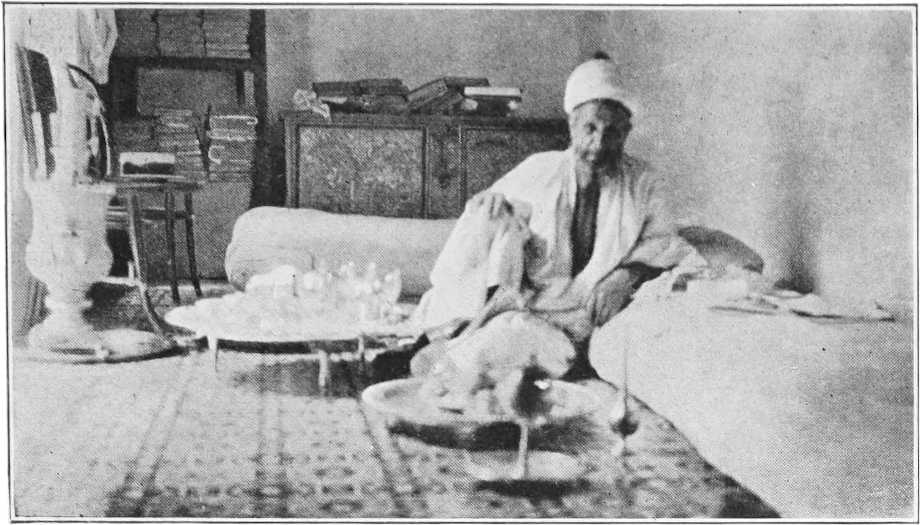
Mulai Sadiq in his home at Tetuan
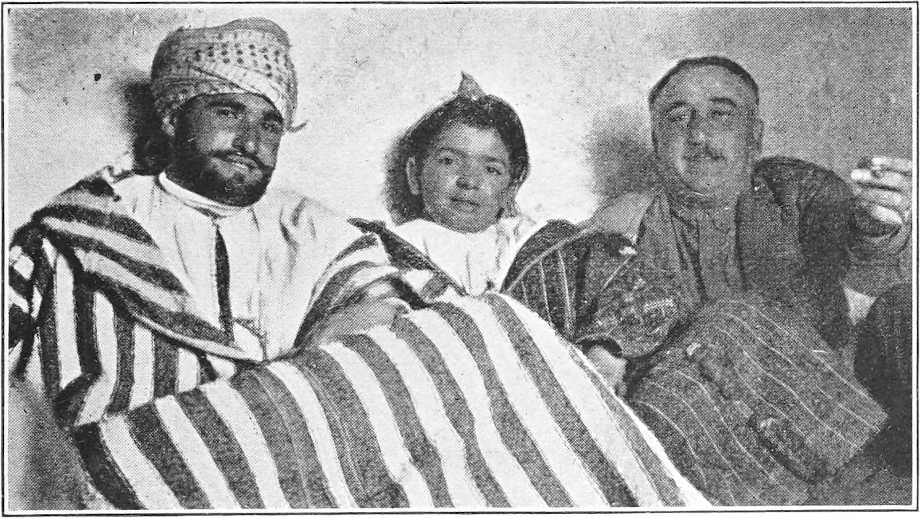
Nephew of El Raisuli, Mulai Ali er Raisuli, Governor of Beni Aras, and Mohammed el Khalid er Raisuli, eldest son of Raisuli
“Would you believe it?” he said. “It was thus I found them running through the streets of Al Kasr, at one in the morning, and the Sherif had not even waited for his slippers. I said to them, ‘Are you mad? Have the jinns got hold of you and taken possession of your senses? What will the people think, that a Sherif should behave thus?” Raisuli’s smile grew broader. “He abused us like a father,” he said; “but he forgot that he himself was shouting louder than we were. It is good for a man to be angry sometimes.” “Allah grant that it is not I who am in the way when next you are angry, Sidi,” said Badr ed Din piously. But it is quite obvious that all Raisuli’s household regard him with little less than adoration, and would not care what he did to them.
BUILDING THE PALACE AT AZEILA
“When I came to Azeila,” said the Sherif, “I found there had been much injustice, and where there is no justice, there is no security. I made peace between the tribes and brought safety to the town. As when I was Governor of el Fahs, merchandise could be left unguarded and no man needed a gun. When there was a rebellion among the tribes I put it down with a strong hand—for if you have a sore which is poisonous, it is better to cut it out at once, rather than to make a great many slashes which are useless. My name was protection enough for any traveller, and once again the suqs were full. At this time I tried to turn my enemies into my friends, for I saw that politics would be difficult in the future and that Moslems must stand together.
“The worst quality of the Moors is that they cannot look ahead. Every man and woman in England, perhaps even the children, know that France works for a great African Empire which shall reach from Casablanca to Alexandria, but the Arab is like a child who has seen a peseta fall in the dust, and is so busy digging for it that he can think of nothing else. France is a strong nation, but she will not share the land, except as a farmer who drives his mules shares with them the value of the grain they thresh.” “She has done much for Morocco,” I protested. “The material and the labour are Arab. Only the head is French. She has spent no money on the country and taken much out of it; but that is the way of the strong.[99] It is possible that our sons may bless her, but, as I tell you, no Arab looks beyond his own life. The civilization that you bring is like your wine, which goes to men’s heads and makes them foolish. You cannot make good Europeans out of us, but you can make bad Arabs.
“While I was Governor of Azeila I knew what was passing in Europe. I had men in Tangier who translated the foreign newspapers for me and sent me those paragraphs which concerned Morocco. There were others of my people in the post-offices and the markets, and all that was said came to my ears. The more I heard, the more I laboured to win the friendship of the educated, that I might teach them my views. At that time I was blind to treachery, and many sat beside me and ate my meat whose heads should rightly have been upon my gates. I said to myself, ‘If you can take the poison from a man’s heart he may be useful and pleasant,’ so to that end, my house was open to all men and none were denied.
“I began building my great palace by the sea, for there was no room to receive my guests in the little house where all my family were living. Because I wanted it done quickly, I said to all the country people, ‘Bring me material, so much for each man.’ All day they came in from the plain, bringing stones and bricks baked in the sun. Even the women carried their loads. Perhaps they hated me, but, doubtless, they thought, ‘Our Pasha must be very rich and mighty. He will be strong to protect us.’ They called my house ‘The House of Tears,’ because it had been built with forced labour, but it was very beautiful and, within a year, it was nearly finished. There was a great court, with a fountain which came from Italy. The floor was black and white marble, and the walls were decorated with mosaic. All day long men used to sit in a row by the door, with a basket of tiles beside them. The sound of their hammers[100] was like music, and always, as they chipped, the heap of coloured fragments grew. There were other men who made the designs and wrote verses from the Koran in white clay round the walls, and others who painted the ceilings in bright colours, red and blue and that vivid yellow which is made from the yolk of an egg.
“There were many rooms in my house, for always my Wakils said to the country people, ‘Bring more and more stones, and the taxes shall be remitted to you, and my lord will consider this better than any presents of sheep and grain that you may give him.’ There was a gallery with a number of arches, from which I could look out on to the sea, and, on clear days, I could see Cape Spartel, and the air was good for my health, like the air of the mountains, for I cannot breathe in towns.”
For once the Sherif’s descriptions were hardly adequate, for his palace at Azeila is a fine example of modern Moorish architecture. The main block, which is quadrangular, is approached by a covered way, on one side of which are a row of prisons and, on the other, a long seat for the general public who wish to have a speech with the Sherif. This passage leads into a courtyard, with the house on one side and the audience-chamber, where, as Governor, Raisuli conducted his tribunals, on the other. There was a mosque just inside the main door, but, when I saw the palace, this had been dismantled and was used as a store for rows of mighty saddles covered with red and green stuff, richly embroidered with silver. There is a stair-case at each corner of the court, and, on the first floor, the great rooms, marble-paved, with gorgeous ceilings and painted walls, run one into another. The furniture consists of modern carpets, chiefly the work of Rabat looms, with mattresses covered in gay prints and the cushions peculiar to Arab houses, which always seem to be stuffed with small potatoes. At[101] present Raisuli’s nephews, Mulai Ali, Governor of Beni Aros, and Mulai Mustapha, are living in the palace, and the walls of their rooms are hung with the newest maps of Morocco, in strange contrast to the riot of colour on the floor.
Wherever we went in the great house, it seemed that we followed in the footsteps of invisible women, who fled, whispering, before us, hurried away by their master’s Khalifa from the contamination of European eyes. Once or twice we almost caught up with them, and dark-skinned slave-girls, purposely the last of the scuttling throng, hid behind columns and peeped at us in a swirl of rose-red kaftans and muslin draperies.
The long gallery has a glazed-in front and, from it, we looked down the 90-ft. drop, over which it is said the Sherif forced the murderers, taken red-handed, to walk to instantaneous death upon the rocks. It is also said that one of them turned, unflinching to his judge and exclaimed, “Thy justice is great, Sidi, but these stones are more merciful than thou!” At one end of the cliff, half natural, half masonry, a bastion runs out to the sea, and on the top of it is an ancient cannon blest for all time, according to the devout Azeila, because the Sherif once sat upon it and, his beads in his hand, prayed from dawn till high noon.
“While I was Governor of Azeila,” said the Sherif, “there was no one hungry in the town. I gave bread and oil to anyone who asked for it, and in the court of my house there was always a bin full of loaves and jars brimming with oil from my olives. Men complained that I was severe, but never that I was unjust. It is sometimes wise to spend the lives of a few in order to buy the safety of many. The Arab has a short memory. He forgets his own troubles in a few days, and other people’s at once. You think, if you imprison a man, it will stop others committing his crime. I[102] tell you, the reason of a man’s absence is never remembered, but the presence of his head on the gate is a constant reminder!
“Even in those days the gun was not long out of my hand, for suddenly my cousin, Mulai Sadiq, whom I had appointed Kaid of Al Kasr, wrote to me that Ermiki had gathered together the tribes of Kholot and Telig, and was advancing on the town. ‘Before my messengers are with you, they will have surrounded it,’ he said. ‘They are 3,000 men, and I have but 500, and no walls to protect me.’
“Now Al Kasr is an old town and the streets are very narrow, so the people throw everything out in great heaps beyond the houses. There is a wall of mud-heaps which are a good protection for a man shooting. So I sent other messengers to Mulai Sadiq and mounted them on fast horses. I told him to post some soldiers at intervals along these mounds, and that they must keep up a great show of firing, so that Ermiki would think the whole force of the town was concentrated to resist an attack. After this he was to divide the rest of his people into three parties, and two of these were to leave the town secretly by night, so that the flank of the enemy might be cut off. Then I summoned a force of my cavalry without notice, and told them we should start at once against some farms that would not pay tribute. There was no opportunity for news to be carried to Ermiki, for no man knew where we were going. We started at midnight, and rode for four hours. Then, when I knew that Al Kasr was in front of me, I told them my plan. It is 70 or 75 kilometres between Azeila and Al Kasr, and our horses were tired, but I sent one man on to the town to warn Mulai Sadiq, and, when a cannon was fired as a signal, the third party issued from the city and we all ate up the camp of Ermiki, which was still asleep. Many were killed and the rest fled—the Kaid jumped on his horse[103] without his jellaba, and so escaped, but Ibn Jellali, who was with him, was captured and brought to Azeila. The Beni Kholot were so much surprised when bullets came from all sides that they carried away nothing in their flight. We found even the tea apparatus and the washing-basins and ewers.
“When I returned to Azeila, I sent for Ibn Jellali and said to him, ‘Is it not better to serve the lion than the fox?’ and he answered, ‘I cannot serve both.’ I kept him in my house and treated him as a guest, saying to him, ‘You are free to go. My horse is at your disposal.’ He said, ‘I have no gun, and so I am blind before my enemies.’ We were sitting together in a room upstairs, and I told a slave, ‘Go and fetch me a rifle, and see that it is loaded.’ He brought me one, and I gave it to Ibn Jellali, who placed it across his knees. Then I said to the slave, ‘Go away and tell the men at the gate that my guest departs.’ When we were alone Ibn Jellali said to me, ‘You have put your life in my hands!’ and I answered, ‘It is in the hands of Allah.’ So he stayed with me for days, and became my friend and, in the war with Spain, he was commander of my cavalry. Truly a man’s life is the least of his possessions. If he keeps his religion and his honour, he need not concern himself with guarding his life.
“A year afterwards I was at Akbar Hamara, and news came to me that el Ermiki was in camp some hours distant. The Kholot tribe had given me much trouble, for their Kaid had become a friend of Abdul Aziz, so I thought that this was my opportunity to make an end of matters.
“I took with me ten men and the two slaves whom you know, Mubarak and Ghabah, and we went quickly across the hills. It was a very dark night. There was no moon, and the way was difficult. We went so fast that the horses were exhausted and fell, but we had brought two extra[104] animals with us, which was good, for I killed four that night with the pace and the roughness of the road. Allah was with us, for we rode with a loose rein and the spurs driven in, and what should have been a two-days’ ride we accomplished in eight hours. We came out on the top of a hill, and saw the tents of Ermiki below us. Then we urged our horses downward, and, Ullah, they went because they could not stop, and the two men who had none held to the stirrups and ran. We fell on top of the camp and went through it, and certainly the ‘baraka’ was on us, for the men thought we were jinns, and none fired a shot, till we had surrounded Ermiki, and he cried out my name.
“We took him back to Azeila, and he was my prisoner for eight days, and then Mulai Hafid wrote to me, asking me to release him, for his family was large and had much influence. So, though he was my enemy and was always plotting against me, I set him free because of the oath which I had sworn to the Sultan. In the same way, whatever I asked of Mulai Hafid, he did.” After the Sherif had left, Badr ed Din told me that Ermiki, who is now in the Riff, had offered 50,000 douros to the Pasha of Azeila if he could arrange his peace with Raisuli.
LEGENDS OF CRUELTY
Many legends have grown up round the government of Raisuli at Azeila, but most of them are palpably untrue. It is said that he tortured his prisoners in dungeons where the light never entered, but there is not even a cellar in the “House of Tears.” The following is a typical fable. The townsfolk were protesting more indignantly than usual against the severity of the Pasha’s judgments, so it was decided to arrange a “miracle” for the benefit of the ignorant. In a yard near the hall of audience was a pit for baking tiles. The slabs of chalk are put into this depression and surrounded by live charcoal, after which a domed clay roof is built over them, with a hole for the smoke to escape. One day, when the pit was empty, the Sherif put a slave into it, and, after the cover had been duly erected, there was just one small hole through which the man could breathe. When the people were assembled, and Raisuli had pronounced his verdicts, the assembled townsfolk were surprised by his suddenly appealing to heaven. “Allah, they complain about my judgements, but thou knowest I am just,” he cried, and, from the depths of the earth beside him, came a voice which had strange echoes in it—“Thou art just and merciful in all thine acts, and in all the punishments which are inflicted by thine orders.” The terrified listeners flung themselves on their faces and could hardly be persuaded to look up, for fear of what they would see. When the hollow voice died away, they crept forward humbly to kiss the robes of the Sherif or the shoes which he had discarded on[106] the threshold. “The voice of God has spoken from the furnace,” said Raisuli. “Close up the hole, for it is sacred and cannot be used any more.” So the slave died of suffocation, but without uttering a sound, for it was the will of Allah and the Sherif.
It is obvious that such stories are without foundation, for Raisuli has always been deeply religious and, while capable of encouraging the superstitious credence of his followers by tricks, he would neither take the name of God in vain nor treacherously condemn to death a loyal servitor. His punishments have, at times, been terrible, even inhuman, but they have been a just rendering of that law which demands an eye for an eye and a life for a life. It is often said of the Sherif that he knows the guilt in a man’s heart from his face, but I have never heard it suggested by Arabs that the innocent suffered at his hands. He exacted implicit obedience and he was held in such awe that even his prisoners did not try to escape.
“Prisons were not necessary,” said Raisuli, “for I had only to tell a man that he was a captive, and, believing that my eye would follow him wherever he went, he would sit down in the market-place and say, ‘Allah is with the Sherif, and no one can escape from God.’ In those days many men walked freely about the town who were my prisoners, and if I sent for a man he came without protest, though he did not know his fate.”
“It is true,” interposed Badr ed Din, “for it happened one day that I was riding from Jebel Habib to Azeila, and I passed a man going slowly on a donkey. He was a Sheikh, so I asked him the object of his journey, and he answered, ‘The Sherif has sent for me. There was a dispute in my village, and my brother stole some of my grain, so I burned his house over him, and, because there was a wind, the fire spread, and fifteen perished in the flames.’ ‘Ullah, Sidi,[107] you will not long keep your head between your shoulder-blades, for the Pasha will put it on the gate,’ I told him. ‘If Allah wills,’ he returned. ‘But the Sherif has sent for me, and I must go to him.’”
“These occurrences were rare,” said Raisuli. “On the whole there was peace, and the country was quiet, till a band of the men of Beni Kholot established themselves in a certain hill and killed all who tried to pass. They had a secret hiding-place which my men could not find, and many complaints were brought to me, for the way was no longer safe, and the Ahl Serif were cut off from the coast. At last three of the bandits were killed and their heads were sent to me, for they had fallen into an ambush when they went to loot a village which they thought was undefended. Their fate frightened one of their leaders, and he wrote to me secretly, saying that if I would guarantee his security, he would come by night to Azeila and describe to me the hiding-place of the band.
“Treachery is of all things hateful in the sight of Allah, but I promised him his safety in order to ensure the capture of his followers. He came one morning when the sea was not distinguishable from the land, and I kept him waiting for many hours. He had much time to wonder if he had risked his head, and, when at last he was brought to me, he was uncertain, for a traitor is always a coward. I received him sitting on a carpet and, in front of me, were the heads of his friends. He trembled, and would have prostrated himself a long way off, but I beckoned to him to sit beside me on the carpet. ‘You are the guest of my house,’ I said, ‘and I cannot hurt you, but if ever we meet in the mountains, it will be your last day.’ Then he told me of the cave where his companions hid and of the way to reach it. When he ceased talking, I said nothing, and we sat in silence for a long time. Then I got up and[108] called to a slave. ‘Take this man and put him in safety outside the town. Give him also the carpet upon which we have been sitting, for it has been soiled by the dust from his feet, and can no longer stay in my house.’”
There was a pause, while a minute slave crept in and saluted the Sherif’s sleeve, touching it only with his lips. However unimportant the message, it was always whispered into the ears for which it was intended, and was completely inaudible to anyone else. “Perhaps it is a woman who asks for something, for that is one of the slaves of the harem,” murmured the Spaniard, but the Sherif took no notice of the little servitor, except a muttered “Later on; I am busy.”
“If you tell your thoughts to anyone,” he said, “you lose control over them, and they are no longer your own; but I had a friend who was like my brother. He was a Spaniard, by name Zugasti, and he was the Consul at Larache. Europe never had another like him. Whatever he asked me I would have done, for his spirit was like a mirror and all his thoughts were good. He had the courage of a lion, but he went about the country unarmed, for he said, ‘Spain must convince the people by her actions, not persuade them by force of powder and shot.’ Once there was a ship loaded with cartridges at the mouth of the Luccus. It was hot, and there was no one willing to work. The crew slept on the deck, and at first the men ashore took no notice of a little smoke issuing from her stern. Then it was seen that she was on fire, and everybody was afraid, for there would be a great explosion, and even the town might suffer. The crew woke up, but they could not extinguish the fire. Zugasti, passing, heard the shouts and, when he discovered what was the matter, he seized the revolver of a policeman and jumped into the first boat he saw. By force he made the men row out to the ship, and his coming was life to the crew. Under his orders they worked to sink the ship and, while people[109] expected every moment to hear an explosion, he sent the sailors ashore, but he was the last man to leave, and beneath him the water was sucking up the flames. Ullah, Zugasti was worthy of respect! The Arabs called him the Christian Sherif, and he would not gain one douro out of the country. He came to Larache richer than he left it. He was then about thirty or forty[37], but he had more wisdom than years. He had studied the customs and laws of Islam, and talked Arabic better than I do.
“To this man, my brother, I told some of my thoughts, for, like the sun in the morning, the French were creeping slowly nearer to my country. In the neighbourhood of Al Kasr I had a mehalla of 500 men, under the Kaid Bussa el Melsuni, and always it watched the progress of France. I knew that soon there would be a battle, and then, Allah forbid! we should have been lost, for the French never go back. Therefore I consulted with Zugasti and also with your Minister, Lister, and I thought, ‘The Spaniards are strong enough to help us, but not so strong that they will oppress us.’
“Then one night Zugasti came to me. He was covered with dust and the sweat ran into his eyes. His horse stood in the yard where he left it, and there was death in its eye. An enemy of mine, Tazya of the Beni Aros, had captured Hamed ben Malek and his two sons and had imprisoned them in his house at Mesmuda. He had taken their mules, their horses, all their possessions, and he threatened their lives, if a ransom were not paid. He demanded 24,000 dollars and a quantity of arms and tents. Now Hamed ben Malek was under the protection of Spain, as were many merchants in Larache and Al Kasr. In those days when a man wished to avoid the just punishment of his actions he put himself under the protection of[110] a European Power.” “As you did, Sidi, after the capture of Maclean,” I murmured. “Ullah, your tongue is a sword,” retorted the Sherif imperturbably. “Zugasti said to me, ‘If these things are allowed, it will be bad for the honour of my Government,’ but I was glad of this event, for I had been wondering how I could introduce the forces of Spain into the country, and what reason I could give to the people; so I answered, ‘Wait a few days, and all that you desire will happen.’
“Two ships came from Spain and anchored in the Luccus, and the next day news was brought that Hamed ben Malek had been killed, with his sons. The bodies had been disembowelled and stuffed with straw, and the heads had been mounted on posts from which fluttered the flags of the tribe. In this manner they were taken round the country, while Tazya incited men to rebellion, saying, ‘The Pasha is afraid to attack us.’ It would have been easy for my troops to put down the revolt, and I could have done to mine enemies the double of that which they had inflicted on Ibn Malek, but I saw that Allah was with me in my design and that the weapon I had sought was already in my hands. I said to Zugasti, ‘Do not doubt that the offenders will be punished, but, as you fear for the respect of your country, let your soldiers land from the boats and make a demonstration in the town, for if the weather is bad, the boats will have to leave, and then our opportunity will be lost.’
“The next day there was trouble in Al Kasr. A body of mountaineers rode into the town and fired on the people in the market. There was much alarm, and the cavalry turned out. The bandits were chased back to the hills, and some were killed, but the merchants protected by Spain appealed to their Consul, who reported the matter to Zugasti. There was a meeting between the European representatives, and then my friend came to me and said, “All are willing, but we[111] wait for your help. If a shot is fired at the landing of our troops, it will echo throughout Europe.’ I replied, ‘If Allah wills, you shall land in peace,’ and I looked out over the sea which has never belonged to the Arabs. What is written is written, but my responsibility was great. I remembered the oath which I had sworn to Mulai Hafid, and I said to Zugasti, ‘My country needs help, and you have promised to serve her interests, but a man cannot forget his own nation. Make a covenant with me that you will always be a friend to the Arabs, and that this thing you ask is for their good.’ He answered in our words, ‘On my head and my eyes it is so.’ Then I said, ‘You are of my family, and we will repeat the Fatha together, for if I have made a mistake, Allah witness my intentions were good.’ That is the only time I have said the Fatha with a Christian.
“The troops disembarked at night, for it was June and very hot by day. A red flag flew from the Consulate, and Spanish police patrolled the streets, but the peace of the town was in the charge of the Pasha, Mohamed Faddel Ben Zaich. The principal men had met in his house, and he had told them, ‘This is the will of the Sherif, and there must be no opposition,’ so all the hours of the night my people were in the streets, calming the citizens and consoling them. Wherever there was a group whose voices were raised and whose gestures became violent, there also was one of my men, murmuring, ‘It is in the hands of Allah and the Sherif. Do not interfere.’ The balconies and the roofs were crowded with people, who watched in silence.
“There were some who said, ‘We have been sold to the Christians,’ but others covered their faces and answered, ‘Allah alone knows.’ The Jews did not hide their rejoicing, for they had been subject to us and of little account. They were not allowed to wear shoes when they passed through a street wherein was a mosque, nor might they sit[112] down in the presence of the ulema. It happened perhaps that a man wanted money, and the Jews had it, though their wealth could not be judged by their clothes. The man might go to a Hebrew and demand charity, but if the Jew was not quick to open his purse, he got a few blows on the skull; yet, if such things were reported to me, I punished the offender and restored his property to the Jew, for the Prophet has said, ‘I came not to destroy, but to construct,’ and ‘Take what is good from every religion and leave what is bad.’ So, when the light failed, for the moon was hidden and there was a mist on the river, the Jews brought lanterns and hung them on sticks so that the troops might see. The Arabs were sad, but resigned, for they believed the words spread by the Pasha, and before the dawn it was finished. For the first time the sun rose on Spanish troops encamped in the Kasbah of Nadir Ras Remel, and all this was done by my help.
“After this began the mistakes, and nobody can tell whose was the fault. I thought Spain would be guided by my knowledge and that, very slowly, I could induce the tribes to recognise her protection, but the Government sent Silvestre to command the troops which had been disembarked, and he was impatient and wanted to go too quickly. Truly he has been the enemy of my life, just as Zugasti has been its friend, but, one by one, all my enemies have gone, and I remain. Mulai Abdul Aziz came against me, and he fell. He burned my houses, but they are rebuilt. In the same way, Silvestre opposed me, and he died from his own bullet, which is a forbidden thing; but I am still here. It is the ‘baraka’ which is strong.
“When Silvestre landed, the people of Larache had learned that the troops would not do them any harm. On the contrary, they spent money, and the Arab cannot see beyond a douro, so the Colonel was received with rejoicing[113] and the curious lined the streets to see him. Immediately he wished to march to Al Kasr, a town in the neighbourhood, which they regarded as an army in the pay of the Sherif. Truly he is great.”
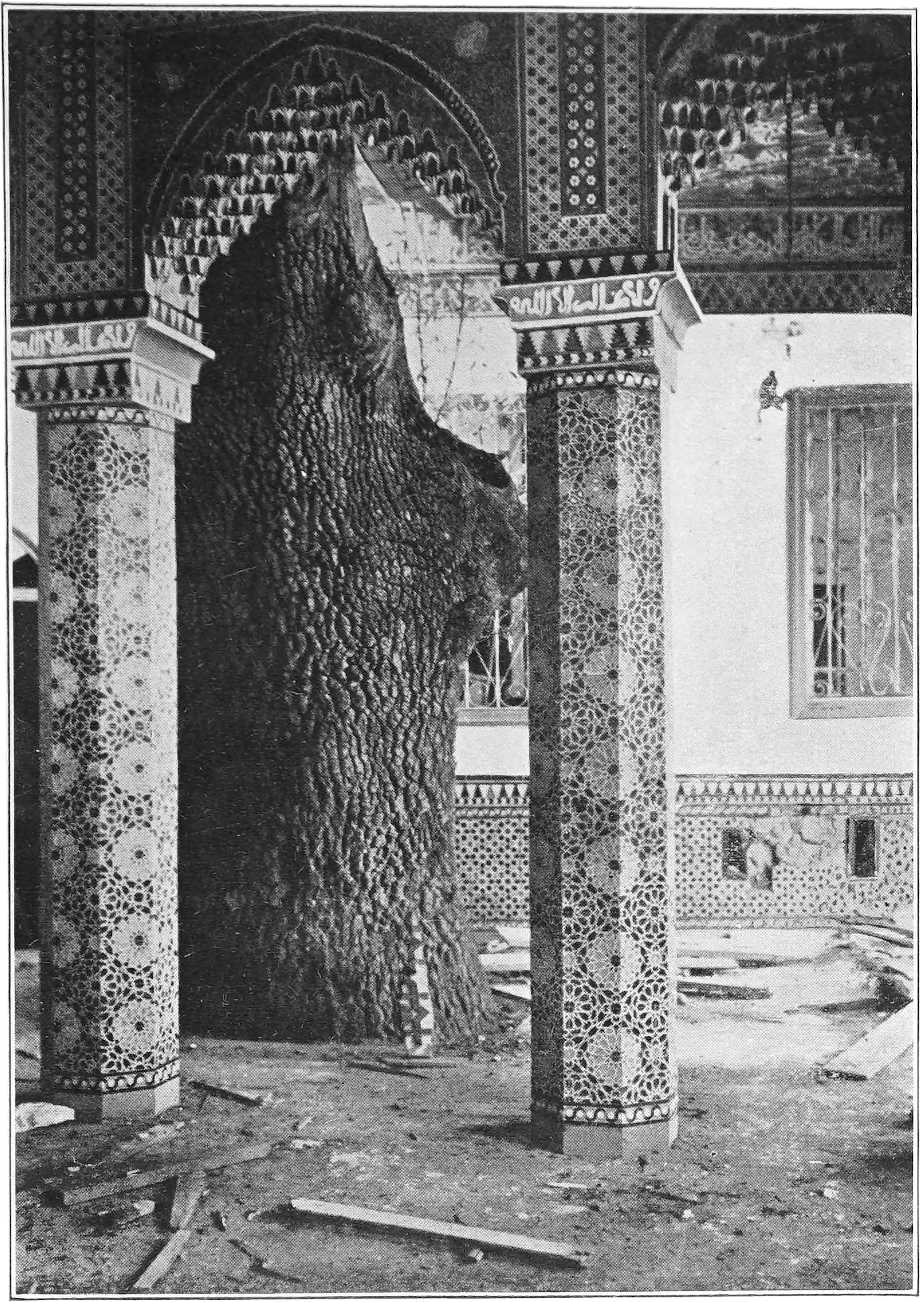
Sacred tree in Raisuli’s house, now enclosed in a room. Taken during Spanish occupation
“Between Larache and Al Kasr the country is flat. It is the richest land in Morocco, and the only place where there are no crops is in the sacred forest, where the trees are blessed with healing. It is said, a sick man may be cured of his illness under their branches, and many lepers used to go out and live there, hoping to lose their sores. There is no place for sudden attack, and the Spaniards came safely to Sidi Aissa, which is on my own property. It would have been better to wait a little at Al Kasr, for, in Morocco, all things must go slowly. An Arab’s imagination is like a lantern swinging in the wind, for it distorts the truth. But Silvestre was impatient. He was a conqueror dreaming of success, and his ambition was unlimited. Suq el Teleta was occupied by my help, but all the country was anxious, and, had I not been strong, there would have been much bloodshed.”
Sidi Badr ed Din, commenting on this story on a later occasion, said to me, “I have been with the Sherif all my life, and that is the only time I have seen him troubled. Even then he said nothing, and no man could tell it from his face, but I knew of his anxiety, for one of his family had died, and he went to make his Confession to the corpse. You do not know of that custom? It is common in our country, but, to my knowledge, Raisuli has only once followed it. You make your confession through a priest, who is no nearer God than yourselves, but in moments of great trouble, we whisper it into the ear of a dead man whose spirit is already with Allah. It is done when life has just passed and the soul is still linked with its yet unburied body. Its lips are sealed, so the secret is safe on earth, but the spirit is near[114] enough to hear and carry the words to God.” It was a revelation of Raisuli’s character, dominant and determined in his decisions, but aware of the vast responsibility they imposed on him. It was a great step for a Moslem, and the appointed champion of his country, to have introduced a Christian army within its borders. However much the Sherif regretted his action or apprehended its results, he would never confide in the living, but perhaps he whispered his hopes and his fears, perhaps even his dawning disappointment, into the ears of the dead.
El Raisuli once said of Silvestre, “He was a brave man, and in any other country I could have loved him, but there cannot be two lions in one forest.” This is the explanation of the wearisome sequence of quarrels which followed. Silvestre knew nothing of the Arabs and he believed too much of what was told him. Impulsive, hot-headed and courageous, he was a typical conquistador, and the last man who should have been sent to Morocco. He saw a country which appeared to be groaning under injustice, and he did not realise that even tyranny can be a cherished custom in the East. He rushed in to save a people who had not the slightest desire to be rescued, and found himself baffled by endless prevarication, and fighting, not against one man, but against the most complicated social system the world has yet invented. There is no place for change in the traditions of Islam, and the moment an Arab is hard-pressed, he forgets everything except that he is a Moslem. Full of good intentions and admirably sincere, Silvestre found himself among people who always said exactly the opposite of what they meant, and who abhorred strangers as being little less dangerous than the devil. Most unfortunately, he was unable to convince his Government, still less in sympathy with Arab politics, that Raisuli was the only hope of dealing with them.
[115]“After Suq el Telata had been occupied, Silvestre came to see me at Azeila,” said the Sherif. “He came with one called Ovila and eight men, and I received them with the greatest honour, and went out into the courtyard to meet them. It was the first time I had seen the Colonel, and, like Zugasti, he looked me straight in the eyes, but he was too quick in his speech. I remember he brought me five Mauser rifles, which is the best present you can give to an Arab, and he thanked me for my help, which I assured him would always be at his service. We talked of many things, but perhaps we were both blinded by our fear of a common enemy and we did not see the other difficulties which were before us. My influence has always extended from Al Kasr to Tetuan, and no man moves in the mountains without Raisuli knowing of it. I explained to Silvestre that Suq el Had must be occupied, for it was but an hour’s journey from Azeila, and the French used to go there twice a week to buy provisions and pay their police. On many of these occasions money filtered into the pockets of the Kaids, and the only way to stop this was to instal the Spaniards at Suq el Tzenin, which would cut off the French from the Had.
“It was agreed that this should be done and that Spain should undertake the payment of the garrisons at Al Kasr and Azeila, that there might be no question of a French protectorate. All these things I arranged, not because I dislike the French, for they are warriors, and the side on which they fight will never lose, but because they are too strong, and I wanted the boundaries of their country to be fixed. The Governor of Ceuta had asked for the release of some Angera prisoners, though they well deserved punishment, so I said to Silvestre, ‘They are yours. Take them with you. My men will point them out to you in the town,’ and he was surprised.
“After a while, he asked me how soon his troops could[116] arrive at the Fondak of Ain Yerida, and I told him, ‘If you wish to reap millet, you must first plant it. Perhaps the towns are ready for civilisation, but the mountains are not. You must prepare the ground carefully, and you cannot use rifles as ploughs. I suggested that he should send out patrols to make short marches in the neighbourhood, so that the people would get used to the sight of his soldiers and realise there was no danger from them. We parted as friends, and I asked him to assure his Government that the word of Raisuli would never be broken.”
After this memorable interview Silvestre wrote to Madrid, approximately in these terms: “My personal impression is that Raisuli at present serves us loyally and that the French work incessantly to bring him over to their cause, for which reason we should lose no time in assuring his unconditional support, gathering the fruit of what has already been conceded to the Pasha. If we do not lose any time, we may avoid that. In the end, he may, like a good Moor, become venal and change his affections. Taking advantage of the complications which today menace France through the exigences and suspicious attitude of Germany, we should occupy Suq el Tzenin and establish a post 20 kils. from Tangier, etc. . . .”
This letter shows complete lack of comprehension of Raisuli’s policy, which has never changed. It has always been to leave France undisturbed in her zone, but, by means of Spain, to protect his own. His way of expressing it is more picturesque. “If there is a hornet’s nest across the mountains, the wise man does not disturb it, but neither does he leave honey unguarded in his house. . . . After Silvestre came to see me, he sent an officer to Azeila to instruct my troops, and all my freed slaves joined the army because they liked his drill. He used also to pay the garrison, and there were some outside who were angry because[117] no money slipped into their hands, but they were ‘mesqueen,’[38] for my servants do not accept bribes.
“There was once a Spaniard who went into Jebel Bu Hashim to look for birds, and Ghabah went with him, that the mountaineers might know he was under protection of the Sherif. When they returned, the Spaniard gave my slave 25 pesetas, and would not allow him to refuse. The next day he came to me to take his leave and, after we had talked, I gave him a note for 25 pesetas. ‘What is this?’ he asked. ‘Why do you give me money?’ ‘It is yours. Are you unwilling to take it from me?’ I answered. ‘I do not understand this. I cannot take it,’ he repeated. ‘You were not ashamed to give money to my slave yesterday,’ I said, ‘so why should you be ashamed to take it from me today?’” “It is true,” said Badr ed Din. “No slave would receive a penny from a guest of the house. They are ignorant men, but very wise in their ignorance.” I remembered how two of the said slaves had watched a visitor at the camp nearest Tazrut performing violent exercises with a pair of dumb-bells. “Ullah, he seems angry! What is he doing?” asked one. “Be quiet!” said the other. “Do not disturb him. He is saying his prayers.”
The Sherif continued his story. “Silvestre wanted to send flying columns into the heart of the country, and always he wrote to me of Ain el Yerida, yet at the same time he had insisted on the release of the Anjera prisoners, while still men from Wadi Ras were held captives by the tribe.[39] When I told him of this he believed me, for he saw how the country waited on my word, but his Government wrote to him often, urging him to do the wrong things, so that he was between the two blades of the scissors. At one time he wrote to the Qadi of Al Kasr and ordered him not to sign[118] any documents for the sale of houses without his permission, especially in those districts occupied by Spanish troops. At this the people were indignant and cried out that their liberty was being interfered with. The French papers published an exaggerated account of the incident and the news spread through Morocco that Silvestre had forbidden the Qadi to pass any sentence without his approval, or to make any disposition concerning the public funds, even including the auqaf.[40] The Minister of the Sultan, El Guebbas, protested, and it was expected that there would be a rising throughout the country. Fortunately, through my secret agents, I heard all these things before they were whispered in the markets, and I made a little politics among the tribes, and the story was forgotten.
“Silvestre went on a journey along the Luccus, on the left banks of which were encamped the French, and was well received by all the people. He had a troop of cavalry with him and many officers, and the people brought out bullocks and sheep and sacrificed them in front of him, that he might listen to their petitions. Many thought, ‘Here is a new Pasha. Now is the time to triumph over our enemies and be revenged.’ And they told him numerous stories, while they cut off the forelegs of their bullocks, so that the animals sank down on their knees in an attitude of prayer, and so bled to death. Ullah, his camp was like a slaughter-house, for this was done at his tent-door for the more honour; and sometimes they cut the throats of sheep and laid them on his threshold as a gift. I told you the Moors were savages!” By this time Silvestre was finding his position very difficult, for he was appealed to on all sides by individuals who had grievances, real or imaginary, and he was confronted by the impossible task of introducing European law and order without interfering with the customs of the country. Moreover,[119] in attempting to do so, he was obliged to undermine the authority of the man who was his only guarantee of security.
Raisuli watched these manœuvres with considerable impassivity. Sometimes men came to him and asked the reasons of certain transactions. The Sherif’s reply is famous. “The blind have a special ‘baraka’—as to the meaning of these actions, Allah knows, and I would rather not!”
STRAINED RELATIONS WITH SPAIN
“A great deal of trouble came from the French zone,” said Raisuli, “for there were many powerful families there who did not understand the politics of the North. At one time the House of Wazzan was very inimical to Spain, and they have so much influence in the country that when one brother went mad and shot men by mistake, thinking they were hares, people said that death at his hands was an honour and made them sure of paradise! One married an Englishwoman who lives at Tangier and has done much good among the Arabs.
“The Sherifs of Wazzan consulted some of the chiefs of the neighbourhood, among them those of Mesmuda, Guezauia and Beni Mesara, and it was decided to hold a great meeting which should be a secret. The news came quickly to my ears, so I sent some of my most trusted men to mix among those of Beni Zernal, Beni Hamed, Ajainas and others who were going to Wazzan. The gathering took place in the Zawia of Sidi Ahl Serif and each man swore that he would repeat nothing of what was said within those walls. Then one of the Sherifs spoke to the tribesmen and told them that, as it was obviously the intention of Spain to take possession of the whole country, it was their duty to combine in order to prevent such a disaster. He suggested that, as the Europeans were too strong to be conquered except by a ruse, news should be spread in Al Kasr that Wassan had been attacked. When this had reached the ears of Silvestre a deputation would ride swiftly to see him,[121] confirming the news and offering submission to Spain, in return for the help of her forces to defend their city. As soon as these had started for Wazzan, the tribesmen would work round outside the Spanish patrols, till they could cut off Al Kasr. Then, in two columns and by night, they would fall upon the deserted town and massacre all Europeans before relief could arrive.
“The tribesmen asked what would be the attitude of the Sultan’s Government towards such a scheme, and the reply was that it was actually the Maghsen which would supply the arms and ammunition. The chief of Beni Zernal wished to know whether el Raisuli was aware of the plot, and suggested his being consulted. ‘For if the Sherif is not with us, the plan will fail,’ he said. The speaker answered that el Raisuli, being the Sultan’s Governor, could not take an active part in such a movement for fear of implicating the Maghsen, but that he knew of it and approved. Allah forgive him the lie! But the tribesmen were still anxious and they began to make excuses. One said there were not sufficient horses; another that the Spaniards would not leave Al Kasr unguarded; but, in the end, they were convinced, because of the respect which they had for the House of Wazzan, and, before leaving, each man swore that he would be ready when the signal was given to carry out all that had been arranged.
“All this my men described to me, and I reported it to the Spanish Legation at Tangier, urging them to increase their vigilance in case of surprise; but, Ullah, I do not know if they believed me, for politics were very complicated in those days. It was told to Silvestre that I wished to exaggerate the value of the services I had rendered, and perhaps he credited the lie, because every day men went to him and complained. He thought that all these people would side with him if it came to a war between us, for he did not[122] understand their feelings. It is the habit of the Arabs to take as much as they can from the Christians, but this is very different from fighting for them. Sometimes it happened even that a man would come to a tax-collector and ask that such and such a tribute should be remitted. When this was refused, he would say, ‘Allah be with you, I will now go to the foreigners—perhaps they will help me to pay it.’ And the official of the Maghsen would answer, ‘Go, and Allah keep you; but, if you succeed, do not forget that I am a poor man and your friend.’
“The ways of the Arabs are very curious to you, for our minds are different. I will tell you a story that is well known in these parts. There was one tribe which had long fought against the Europeans, for they were very fanatical and their mountains were so steep that none could come near them, but, at last, the Christians sent aeroplanes to drop bombs on their villages. The tribesmen were frightened, for they said, ‘These are the unbelieving Jinns whom the foreigners have taken into their service, and they drive great birds whose eggs bring death.’ So there was a consultation among all the headmen, and, for the sake of their farms which were being destroyed, they decided to make peace; but the Sheikh was an old man, and he would not look upon a Christian, so he said to his son, ‘I cannot change my ways and, if I do, I shall lose the respect of my people. This would be a shame for our house, yet we must make an agreement with our enemies, or they will conquer us by means of their magic, and then they will make our cousin, who is an evil man, Kaid of the tribe.’ The son agreed with the words of his father, but he said, ‘How can this thing be arranged?’ and the Sheikh replied, ‘I will not eat my words. Till the day of my death I will fight the Christians, but go you and make peace with them. Choose your words well and, in return for your help, they will[123] make you Kaid. Then lead the Europeans against us, and I will come out at the head of my troops, so that it will be easy for you to kill me, for I would rather die by the hand of a Moslem. When I am dead, our people will fly back into the hills, and you can make an agreement with the Christians and be Kaid of the tribe in place of our cousin, whose rule would be bad.’ So it was carried out, and all the headmen knew of the plan and agreed to it. How can a European understand these things?
“A son of the Shiekh of Wadi Musa complained to Silvestre that his father had been killed and his village burned, because my soldiers had not been able to collect the additional tribute I demanded. This was true, but he did not say that his father had invited my official into his house and had given him food and drink and said to him, ‘Rest awhile here, while I go and drive in the bull that I would offer to the Sherif as a gift.’ While the man slept, the Chief came with an axe that was used for breaking stones, and hit him on the head, for it happened that there was a blood feud between their families. So my servant died at the hands of his host, who avenged the blood of a cousin spilt while he was still a child; but it was ill done. If an enemy came to your house, he is safe by the law of ‘deafa,’ so the Shiekh of Wadi Ras had committed two crimes.”
“There was the story of Musa ben Hamed,” suggested Badr ed Din tentatively. “There is no interest in it,” answered the Sherif; but, later on, I heard the tale from the lips of the fat secretary. “It was when a certain tribe refused to pay tribute to my master, and they caught some of his soldiers and beat them and cut out their tongues. The men died on the mountains, and the Sherif swore ‘a head from the Kaid’s family for every man who has been hurt.’ Very soon the tribe was forced to submit, by the soldiers of the Maghsen, and then Musa ben Hamed, who was a[124] clever man but cowardly, broke through the guards and took refuge one night in the house of my lord. It is not permitted to refuse food and drink to a guest, so for three days our enemy lived with us and we served him, but my lord would not see him, and he had a room alone. Ullah, there was no way to get rid of him, but at last the mehalla brought back the heads of his two brothers and his son, so, while he slept, a slave crept in and placed one of the heads beside him, with green herbs stuck in the eyes—for this is an insult. Musa ben Hamed made no sign, so the next night the head of his son was placed beside him, and thus it went on; but our guest said nothing, nor did he turn from his food. At last the toll of heads was complete, one for each soldier who had been hurt, but ben Hamed was safe in our house. Then, one day, he went to the bath and left his outer garments and his arms on the mattress. When he returned he found a body, clothed in his waistcoat and jellaba, with his belt girt around it, lying in his place, but it had no head. A coward is easily frightened! That night he went away, and the soldiers could not fire on a guest.”
Relations were growing strained between Raisuli and the harassed Silvestre, who was not allowed to deal directly with the Sherif, but had to refer everything to the Ministry in Madrid. Thus delays and misunderstandings were inevitable. “Silvestre might not even come and see me without the permission of his Government,” said the Sherif, “and yet he was anxious to have someone watch my actions at Azeila, for he was worried by the complaints of the tribes and he believed that I exacted unjust tribute. There were many letters on the subject, and I grew weary. To deal with Europe one must be cleverer with the pen than the sword, and, in those days, the moon of Badr ed Din’s face was no longer full, but like the crescent in its first quarter!
“There was the matter of the officer whom Silvestre[125] wished to send to Azeila, that he might live on my property and oversee the payment of tribute. I would not agree, for I was the representative of Mulai Hafid, and this would have been dishonourable for us both before the tribes. The Colonel wrote to his Government and said that I levied more taxes in the part of my province that was in the Spanish zone than on the other side of the Luccus, which was French. He said that France beat my soldiers if they took presents from the Kaids, and that, in her protectorate, I was only able to levy the tribute due to the Sultan. This was not correct, because there are many ways of reaching a man’s pocket, and it is a custom that the tribes should give presents to the Governor. The Sherifs have a right to a certain tribute, and this is not fixed but a matter of good-will. You have seen the tribes coming to me now, when I have nothing and am living like a Bedouin. For us presents are a small thing, both in the giving and the receiving.
“Silvestre wished to employ his own men to collect the taxes, not knowing that the people would have said, ‘The land has been sold to the Christians. They have imprisoned the Sherif. See how they take the money which is his.’ There would have been a rising, and many shots would have been fired. He thought, if he remitted the tribute paid by the mountaineers and saved them from the cruelty of which they complained, he could count on their loyalty; so he wrote to his Government saying that the country was dissatisfied with my rule and would be glad to escape from it. Ullah, while there is one alive of the line of Jebel Alan, and there are 15,000 now recorded, the Jebala will obey no other house!”
It is probable that, like all Arab Governors, Raisuli did extract a considerable amount from the tribes to pay for the building of his palace, in addition to the taxes collected for[126] the Sultan. Doubtless his subordinates were none too merciful in their methods of ensuring payment, but, at least, there were no middlemen, no hosts of Kaids and police officials, waiting with palms open for a bribe before business could be transacted or judgment pronounced. Any man could go to Azeila and be sure of an interview with the Sherif. No difference was made between the rich and the poor. The long corridor leading to the hall of audience was daily thronged with Sheikhs and beggars; mountaineers and townsfolks; Ulema who knew by heart the Koran and the works of the four Imams; and peasants, who had difficulty in remembering their second names! Raisuli’s worst enemies have always been among the police, who used to make a fat living out of the tribesmen, until the course of the stream was altered and the bribes, now known as tribute, poured into the coffers of the Pasha. The people benefited in one way, for much of the stream poured out again in lavish hospitality.
The tales of the Sherif’s avarice are only equalled by those of his generosity. If he squeezed one village, it was to pay for the rebuilding of another, destroyed by one of those sudden fires, common in the hot weather, in which the thatched roofs blaze so fiercely that there is always a heavy casualty-list. If a widow appealed for her family, or the wife of a prisoner for often quite imaginary children, their names were added to the immense list of Raisuli’s pensioners.
“What I took with one hand I gave with the other, and but little fell into my own lap,” said the Sherif. “But Silvestre wished to have complete control over the villages near his camp, and he was angry when my men went to collect the taxes there. The people saw this and took advantage of it. Ullah, under European rule, the Arab[127] loses his few virtues! At this time there were many disputes between us, and I despatched a man to confiscate some of the horses of Beni Mesala, because they would not acknowledge the authority of a Kaid from Beni Maugud, whom I had sent to them in place of one of their own men who was dishonest. Perhaps the Chief of Beni Maugud was severe in his administration, for he was my friend and obliged to uphold my authority, but the tribesmen were rebellious and left their farms for the hills, and, when my man came to take their horses, they fired on him and drove him away. Therefore, at the request of the new Kaid, I sent sufficient arms and ammunition to restore peace in his district, but the rebels appealed to Spain, making a great demonstration of affection and loyalty. All these matters made bitterness between Silvestre and myself.
“I was afraid that he would instigate the tribes against me, so, in September (1911), I prepared a mehalla to guard my interests, and I added to my store of arms all that I could buy or that my friends could bring me as presents. There were many rumours about this mehalla. Some said it was to fight the Spaniards, others that it was for the aid of the Kaid of Beni Mesala, whom I had ordered to levy a fine of 5 pts. Hassani from every one of the rebels; but I told no one my intentions. The Pasha of Al Kasr, who was subsidised by Spain, was secretly helping the rebellion in Beni Mesala. It was told me that he sent guns and grain into the mountains, making it impossible for the Kaid to put down the revolt. War in the Jebala is like a flame in dry grass, so I wrote to Silvestre, asking that the Pasha, who was called Ben Asayeg, should be removed and one who was faithful to me put in his place. Difficulties were made with regard to my request, so I sent to the Pasha, ordering him to come to Azeila, but Silvestre, fearing for his safety, and[128] knowing that no other man would serve their interests so well, forbade his journey, making the excuse that there was much work and nobody to put in Ben Asayeg’s place.
“Silvestre’s letter saying all this, and speaking also of some prisoners which he wished released from a place in the mountains, came to me at the time of Aidh el Kebeer,[41] when I was busy receiving all the Sheikhs who came to greet me. My house was full, and each man was busy with the entertainment of guests, and so there was delay in answering the letter. Besides when a man is angry, he should never take a pen in his hand, and I was angry because of the disobedience of the Pasha.”
In the end Raisuli wrote one of the most completely oriental letters I have read. After polite greetings, wishing “felicity always to the Señor just and worthy of respect, the well-liked Colonel Silvestre,” he wasted a page in admirably-constructed sentences which meant nothing, before pointing out that he had no news of the prisoners. Short of saying that the Jinns had run away with them, he suggested every unlikely reason for their non-arrival—that they had lingered on the way, or stopped to rest, or visited friends, or missed the road—ending with, “although they tell me that two came out of prison very weak and ill.” With regard to Ben Asayeg, he insisted, with considerable dignity, that the action of Silvestre had done much to injure his prestige—“I had the indubitable right to send for the various Pashas in my Government to come and report to me, and, if I considered they were not doing their duty, to change them for others more trustworthy and more faithful. If I had judged good the conduct of Ben Asayeg, or if I had seen in it any error,” said the Sherif, “I would either have corrected him, or praised him, as the occasion deserved; but that he should disobey was bad for the discipline[129] of my province, and I wished to report the matter to El Guebbas at Fez.
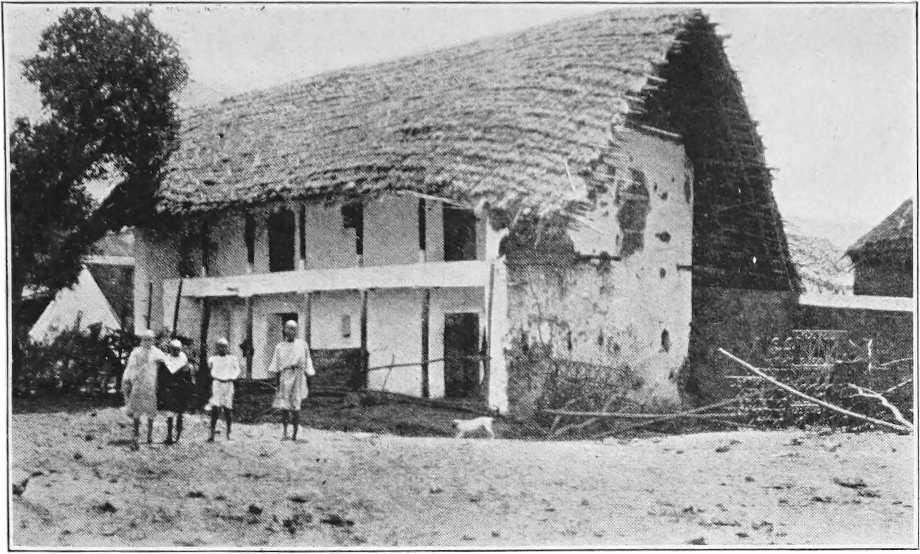
Raisuli’s original house at Tazrut—now his son’s school—damaged by Spanish aeroplanes
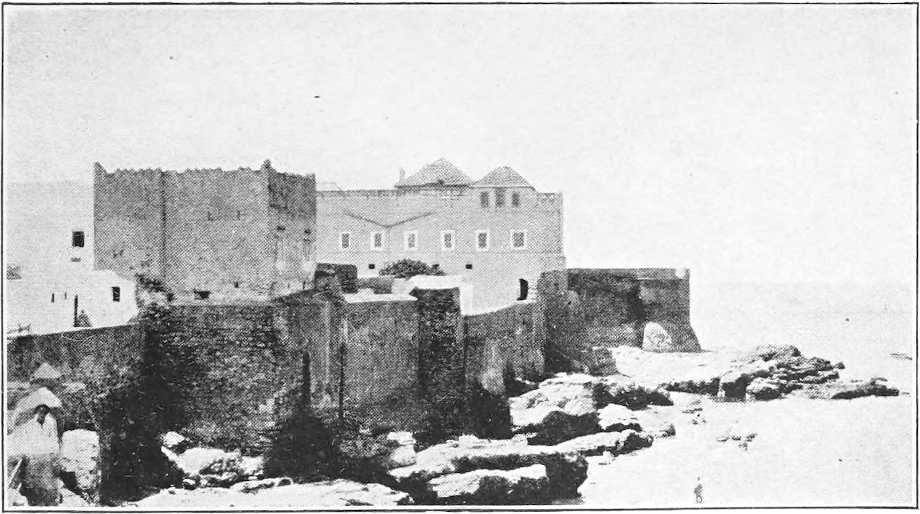
Raisuli’s palace at Azeila
“Silvestre wrote to his Minister, saying that if Ben Asayeg were removed, the Arabs would no longer have any faith in Spain, for all that the Pasha had done had been in the service of the protectorate. He reported also that I had been collecting large quantities of arms, and that a Frenchman from the legation at Tangier had spent several hours in my house. From this you will see how difficult matters had become. Silvestre wished to stop the tribesmen carrying rifles and, if a man passed by his camp with a gun across his shoulders, it was taken from him; and this is not good, for, without his arms, an Arab is but a woman and ashamed.
“There was once a Sheikh who was my prisoner, and he was condemned to death by the tribunal, for he had done much evil in the mountains. They gave him food and water, but he would not touch them, and he said, ‘My hands are empty, and I am too old to be deprived of that which I have held all my life. How can I say my prayers if I cannot make the Kibla[42] with my rifle before me?’ They told me these sayings, and I went and spoke to him, for once he had been my friend; and he said, ‘Oh, Sherif, it is disgraceful to kill a woman. Give me back my arms, that this shame may not be upon you.’ I made a sign to a slave, and he brought a rifle, and would have given it to him unloaded, but I said to the servants, ‘No, put bullets in it, for he is the prisoner of his word.’ The Sheikh took the gun and laid it across his knees, and smiled. ‘Allah would not have recognized me had I gone to him unarmed,’ he said; and the next day he was strangled, that there should be no blood upon his body.
“In the matter of the rifles, I was strong. Silvestre[130] wished that each man who carried a gun should have a paper, signed by myself, to show he was in my service, but, fortunately, at this time it was imagined that I was treating with the French, so the matter was not pressed. When two men meet face to face, much can be arranged, but a pen alters a man’s ideas, and he is guarded in what he writes. There was much dispute between Silvestre and his Government, for neither trusted the intelligence of the other. Allah knows one was too far removed from the events, and the other too much in the middle of them, to see clearly, for if a man is on the other side of the Luccus, he cannot watch a battle at Azeila, but, likewise, if he is in the middle of the fight, hard-pressed and defending his own life, he cannot judge of what is happening.
“At this time I consulted with my friends, and we said, ‘We have gone far enough. If we give in more to the Spaniards we shall have no honour left in the country!’ and I altered the taxes, without the consent of Silvestre, as was my right, and I told the men, ‘Go right up to the camps and take the aushur (a tenth part) from all the flocks and herds, even those that supply the army.’ This was done, and the people began to doubt if they had been wise in complaining to the Spaniards, and they sent presents to me secretly. When, by the orders of Silvestre, men of the Jebala, coming down from Ahl Serif or Kholot, were stopped as they came to the high road and their guns taken from them, I sent some soldiers to Al Kasr and they went to the door of the prison at noon, and took out two important prisoners. When the gaolers would have prevented them, they said, ‘It is by the orders of the Sherif,’ and the men were afraid, and let them go. I did this to show Silvestre how great was my influence when there was a question of actions and not words. After this the Spanish guards were redoubled, but the men who brought arms from the mountains[131] came now in large parties, so no one dared to interfere with them when they crossed the plain.
“Silvestre complained that I persecuted those Arabs who worked against me, but, except for a few merchants who made money out of the foreigners, all men were with me, either openly or in secret. At last I wrote again to the Pasha and to Mohamed ben Abal, another of the great men of the Al Kasr, ordering them to come to Azeila, and this time they dared not refuse, but asked only time to prepare for the journey and to make ready the gifts they would bring, for it was the Arab Easter. Silvestre, believing it was his duty to protect the Pasha and the other, both of whom came to him, saying, ‘We fear we shall never return, but our fate would be worse if we stayed,’ wrote to Madrid asking that he might be allowed to accompany them, or at least to visit me a little later. At the same time he wrote to me, asking me to guarantee the safety of Ben Asayeg and Sidi Mohamed, but I did not answer the letter, for all things were with Allah, and how could I make promises to a foreigner concerning the safety of my own people? It was a mistake that he asked it.
“All these things that I have told you happened quickly and (in October) Silvestre came to Azeila, and I invited him to visit me. My people said to me, ‘Why do you receive your enemy in this way? Bullets are more suitable than words,’ but I answered, ‘He will not be my enemy after I have spoken with him.’ I received him with even more honour than before, but there was silence between us and, to whatever the Spaniard asked, I answered, ‘If Allah wills,’ till at last his impatience mastered him, and he said through his interpreter, ‘None of us may know the will of God, but I have come here to understand the will of Raisuli.’
“Then I answered, ‘The will of Raisuli has always been[132] to help you, but you have disregarded it and gone your own way.’ ‘I have tried to bring justice to the country,’ he said. ‘Who has done that before me?’ ‘My armies,’ I replied, and, to everything he asked in this fashion, I answered, ‘My armies.’ Then I spoke to him about Ben Asayeg, and I said: ‘You have made him into a tool, so that he no longer acts wisely, for fear of offending you. He has no mind left, and is not fit to rule in Al Kasr. All these troubles with the villages in Sebbah and Utah and the affair of Beni Mesala were owing to his actions. He is trying to serve fire and water, which is not possible. He must go, before there is such trouble in Al Kasr that you yourselves will suffer. Remember, Sidi, in a Moslem country, it is always the strangers who suffer first. It is my duty to protect you, for you came here as my friends.’
“We talked for a long time and, at last, I persuaded him to leave Ben Asayeg in my hands and promised that he should have another post where he could do no harm. I told him that all matters could easily be settled if we could meet freely when there was anything to discuss, and he promised to consult his Government about this. He spoke to me of the radio telegraph, and I requested him to arrange for both the telegraph and telephone to be installed in Azeila. Ullah, so much of civilization is useful and, at the same time, annoying.”
Silvestre welcomed with delight the Sherif’s last suggestion, as it would give him the opportunity of sending a military operator to Azeila, which would be the first step to having an office in the forbidden city. The interview closed satisfactorily and, as the Arabs expressed it, ‘the Spaniard was the prisoner of the Sherif’s eloquence.’ It was certainly a triumph for Raisuli, for he had won, at least for the moment, a powerful ally, who wrote immediately to Madrid, urging the necessity of remaining on good terms[133] with the Sherif. The installation of telegraph and telephone were the excuse for several visits on the part of the Spanish commander, and each time he met the astute Raisuli, he was the more convinced of his sincerity, so much so that a deputation of Moors from Ahl Serif, asking to be allowed to appoint their own Kaid in lieu of Raisuli’s nominee, received an unexpected rebuff.
“About this time,” continued the Sherif, “El Guebbas wrote to me from Fez, saying that a body of French engineers, interested in the line from Tangier to Fez, would like to visit me on their way through Azeila. I received them, as I was bound to do, since my Governorate was from Mulai Hafid, but I was glad also, because I thought their visit would hasten the arrival of my own telephone, for Spain was still afraid that what she did not give me I should receive from France. Silvestre was very anxious after it had been told him that the French engineers had stayed with me for hours, so, in order to strengthen his hold on the country, he wrote to me, saying that Tzenin and Suq el Telata were nearer to Azeila than to Larache. He begged me to allow provisions to be disembarked at Azeila, that they might pass straight up to the camps. I agreed, because I wanted boats to come to the town, in order that they might bring me the materials I needed for my house, which I was still decorating and improving. Also it had always been my intention to bring the Spaniards to Azeila, but I wished to do it slowly, as between friends, so that the people might not say I was under Christian influence, for in that case I should have had no more power over them. In order to be pleasant to the Spaniards, I instructed the new Pasha of Al Kasr to allow them to acquire all the land that they required for their camps, and to do everything for their satisfaction; but still there was argument between us concerning the taxes. Silvestre complained of their severity, and I replied that[134] they had been much reduced. Truly it is not worthy that men should talk so much about money.
“In the beginning of the year, according to your counting (Feb. 1912), Zugasti, with whom I had long wanted to have speech, sent a friend to see me, for there was a dispute about the payment of the garrisons, but I would talk of nothing but my telegraph line.”
The unfortunate envoy wrote that he found the Sherif proud and unyielding, that he had had two interviews, in which Raisuli had not opened his lips, and that, during a third, his host had been in such a bad temper that he had thought it better to “give way in everything, lest the Sherif should refuse to treat further.” Silvestre, still convinced of Raisuli’s honesty, again travelled to Azeila. “I told him,” said the Sherif, “that he was welcome, for the sight of a friend is like morning after the night, but that there was no necessity for speech. I had already explained that any service I could render to Spain would be a duty which I should hasten to accomplish. He wished to speak again of taxes and garrisons, but I said to him, ‘Where is my telephone?’ He answered that it was on its way. Then he said that many provisions were being unloaded at Azeila and that it was necessary to build a storehouse to hold them. I agreed, and added that I would appoint a trusted man to look after them, and this was in order to test him, for I knew it was a trick to gain more foothold in Azeila. He answered that, as he would be responsible for the stores, he must send soldiers to guard them. I said nothing, and, after a silence, he asked if, for the lodging of the soldiers, he might build a hotel outside the walls of the town. I replied, ‘It is a wise man who hides the price of his merchandise till the bargain is concluded. Ullah, I see now how much my telephone will cost.’ But we were friends, and,[135] because I understood his mind, I forgave him. At the end he asked me if I would not become a Spanish-protected subject, and I answered that this was my greatest wish; for sometimes the truth is not courteous.”
ALARUMS AND EXCURSIONS
Mulai Hafid had signed a treaty with France in the preceding November, to the extreme discontent of most of his subjects. On the 17th of April the rebellion broke out in Fez. The Sultan, besieged within his palace walls, sent post-haste to Casablanca to ask for French troops. There was fighting round the sanctuary of Mulai Idris, one of the most venerated places in Morocco, and several European officers, who had been employed as instructors to the Sherifian forces, were killed and their mutilated bodies displayed to the excited populace. The hotel-keeper was shot on his own threshold, and the mutineers proceeded to massacre everyone in the building, except a few French officers who, after gallantly defending an outbuilding until it was set on fire, escaped to the house of a Sherif who was friendly to their country.
The celebrated Father Fabre, and one or two companions had barricaded themselves in a room of the hotel, and defended it so well that they effected the temporary retirement of the enemy. Unfortunately, cries from the street attracted the priest’s attention and he insisted on going out to give absolution to the dying. For a few moments the gallant Father was allowed to move among the bodies lying outside the hotel. He found one man who was seriously wounded but still alive, and tried to lift him into the shelter of an archway, for bullets were flying over them from both sides of the street. This action exasperated the short patience of the Moors, and one of them struck him[137] down with the butt of a rifle. His brains ran out over the man whom he had been trying to save!
The crowds shouted their approbation and proceeded to set fire to the hotel. Fortunately, the flames did not spread, for old Fez is like a rabbit-warren, where the eaves of the houses lean together, shutting out the light from the labyrinthine paths they border. The next day the massacre continued, and the victims, or such portions of them as remained after the vengeance of the mob had been satisfied, were hung on the gates of the town. The atrocities might have been even worse but for the intervention of the Sherif referred to, who secretly harboured all the Christians who came to him, and even sent his servants into the street to rescue the wounded.
French troops made forced marches from the coast, but they had some days’ fighting before they could take possession of the city. With their advent, peace was restored, but Mulai Hafid, realising that his reign was ended, retired to Rabat and spent his last months of sovereignty arguing with France as to the amount of pension he should receive, in return for his abdication. The repercussion of all this agitation was felt in the Spanish zone.
“Silvestre asked for more troops from Spain,” said Raisuli, “and I agreed with him that the situation was difficult, but the mountaineers have never had great friendship for the Sultan, and now their anger was directed against Mulai Hafid, not against the French. They said, ‘He has betrayed Islam! He has sold us to the Christians,’ and had he remained long in the country, not all his guards could have protected him. At this time Silvestre and I worked faithfully together to keep peace among the tribes, for had there been a Jehad, I should have been obliged, either to put myself at the head of it, or to lose the respect of my country for ever.
[138]“The Colonel was now fully persuaded of my sincerity and, when he was called to Madrid to report on the occurrences across the Luccus he promised me to press my claims for the Caliphate. Ullah, there is much mystery in Spanish politics. Do you see that beetle?” I watched a lumbering brown insect, unpleasantly like a cockroach, scuttling to and fro in aimless dashes. At one moment its rush brought it almost to Raisuli’s feet as he sat hunched up in the sagging chair. At another it scurried equally blindly towards the sunshine which gilded the carpets by the tent door. “That animal is like the policy of Spain. It has no decision, and it makes first for one object, then for another. A dozen times Spain could have conquered this country by force of arms, but always, at the last moment, her Government has fallen, or her officials here have been recalled. There are so many different interests, and each has its own plans. One comes to me here and says, ‘It is only the soldiers who have power. Make a bargain with them, for they are the friends of the King.’ Another arrives, and whispers, ‘Do not listen to the soldiers. They have no influence in politics. All the ministers are my friends. I can arrange matters for you.’ In war this has been my salvation, for I have dealt with all parties in turn, but in peace it has destroyed my influence, and men have said, ‘What is Spain, and what are her desires?’ It is a pity, for her rule in the towns is good. The Arabs in Tetuan are more prosperous than those in Tangier. But it is always ‘to-morrow.’ It is a year since the war stopped, and no agreement has been made. You are surprised, for it is generally Europe which hurries and Africa which delays.
“It was the same thing when Silvestre went to Madrid. At one time I believed that he cheated me, but now I think he kept his word. It was the Government which did not trust his knowledge, and they were troubled about France.[139] Perhaps they suggested Raisuli as Kaliph and Paris refused. Allah alone knows. France would always be afraid if there were a strong alliance between Spain and myself, and it is her plaything, Mulai Jesuf[43] who chooses the Kaliph between two names submitted to him. If Spain had been strong then, and given me in name what was already mine in fact, there would have been no war, and her flag would have been on every hilltop.”
As a matter of fact, Silvestre supported Raisuli’s candidature to the utmost of his ability. The two letters which he wrote on this subject to the Ministry and to the King are a matter of official record. He made a considerable amount of propaganda in Spain for the Sherif, but France was adamant in her refusal, and the Government was divided.
“In the middle of that year,” continued Raisuli, “I believed that Silvestre and I were friends, but two bulls cannot rule the same herd. The Colonel came to see me, and said his Government feared that he was too much under my influence and was not busying himself with the occupation of the country. He wanted to go by way of Beni Mesauer to Ain el Yerida, and, from there, join the General Alfau, who was at Ceuta. I did not like this plan, for Wadi Ras is dangerous country—any stone may hide a rifle, and the streams are so thick with flowers and trees that no man knows what is hid among them. Nevertheless, I offered to send soldiers with him and I resolved to write secretly to the Kaids of the tribes, warning them of the approach and saying, ‘Your head for his, if he dies,’ but the Government changed its ideas and wrote hastily, saying, ‘Do nothing until we have consulted on this matter.’
“Silvestre was anxious to bring his soldiers to Azeila. For long this had been his aim, for he feared the French, who were working on the telegraph line from Fez to Tangier.[140] I said to him, ‘This is my town; the only one I have kept for myself. You would blacken my face before the inhabitants if you come here,’ but he persisted, for there had been some more trouble over prisoners from Anjera, which tribe was always against me. Ullah, they were daring in their raids. Once they intercepted my mother, under whose feet is paradise, on her way to Beni Mesauer, where she went to visit her family. I was at Zinat, and they sent the news to me there, saying, ‘If you do not come to our village and submit to us, we will kill your mother.’ I answered, ‘A man is responsible before heaven for his mother. By Allah, I will come.’ So they were rejoiced, and thought their plan had succeeded, but I gathered together seventeen men, my closest friends, and we went by night over the hills, taking with us petrol and matches. I sent a small boy with a message to my mother, and he, crying because he had lost his goats, which had got mixed up with the Anjera flocks, came to the village to complain, but was not able to see my mother till nightfall. Then, when all were at prayer, he found her, and said, ‘My master sent me; and when, in the dawn, you hear the cry of a bird[44] on the hillside, go swiftly from the house and hide among those trees,’ and she answered, ‘If Allah wills, it shall be done.’
I divided my men in two parties and, when we arrived, before the light was clear, I stationed one in a thicket beyond the village. These made a great firing with their rifles and allowed themselves to be seen by the villagers, who thought they were attacked only from that side, and rushed out to drive away the enemy, who were few. Then we crept silently from behind the stones, each man in his earth-brown mantle, and, when we reached the first house, we poured petrol over it and set it on fire. The flames roared up from roof to roof, and the smoke belched forth like the breath of[141] an army in winter. The Anjera were frightened, and returned in haste to save their families and their property. I called out to them, ‘Why are you disturbed by my visit? You invited me, and I have come.’ ‘By Allah, you have destroyed your mother!’ screamed someone, but I knew she was safe behind the trees I had indicated, for the small goatherd had tied his kilt to his stick and was waving it to prevent his animals going back into the village, and this was the sign agreed upon.
“The men whom I had stationed in the grove joined me, and there was so much confusion in the village, where the fire was sucking up the houses as a wave gathers the sand in its maw, that no Anjera knew his friend from his foe. When a man fell, a woman picked up his rifle and fired, and one, who was but a girl, hid among the cactus and shot steadily at the place where I stood, but, as always, the ‘baraka’ was with me.”
The Sherif seemed to think the story was ended. He picked up a great jug which stood on the table and drank half its contents. “This water is tainted by the goatskin. I send specially to a spring in the mountains, where the water is very clear and cold, and they bring it down in jars, so that there is no taste. My cousin should have seen that you had this to drink, for the wells here are not good.” The Kaid cut short the apologies of Mulai Sadiq. “The Sherif has not told you what happened that night,” he said. “After we had put the Sherifa on a mule and sent her with an escort on her way, I said to my friends, ‘We have forgotten something,’ and we returned and lay hid among the rocks till some of the Anjera came out. They were quite close to us and we could see the hairs on their faces before we sprang up and killed them, each one choosing an enemy and using his knife so that no sound should reach the village. We cut off their heads and turned swiftly, but a woman[142] screamed among the cactus, and we saw men issuing from the ruins. Ullah, we did not wait, but ran like the foxes in the mountain, but each man carried a head, and, when we came to our own village, we set them up on posts, as a witness that Raisuli was still strong.
“That night we feared an attack from Anjera, who surely would revenge their dead, but it was a long way and none came. Guards had been posted all round the village, and there was a watchman on the hill, but they travelled far and were tired. Perhaps they slept. When it was near dawn I heard a shot, and I ran out, with my finger on the trigger, expecting the crash of musketry from the hedges, but there was only a faint cry, like an animal when it is wounded, and the sentry, who had fired, could not say what he had seen.
“He spoke of something white at the gate. ‘Fool, thou hast wasted my bullet on a donkey,’ I told him, but he insisted that it was a jinn, for it is in the early hours, when the light is neither white nor black, that the jinns come and do harm, wounding men and otherwise annoying them. After that, I woke up those who slept, in case some strategy was intended, but the sun rose and all was quiet. ‘Where did you see the jinn?’ I asked, and the man took me to the place, and, strange thing! there were but three heads on the posts instead of four. The Jebali was frightened. ‘Did I not tell you so, Sidi? But it was a ghoul who eats human flesh!’ ‘Empty words,’ I answered him. ‘These creatures do not leave blood upon the ground,’ for truly the earth was trampled hard by our feet and the dry stalks were red. I called to a slave, and he came with me.
“Together we followed the track, and a group came out of the village behind us. ‘Your jinn was badly wounded,’ I said. ‘It could not have gone far,’ but I was wrong. The blood ceased after a time, and we walked a long way,[143] for there was but one path towards Anjera. At last the slave said, ‘This is dangerous ground, master; let us return,’ but I was curious, and went on. We found a strip of white cotton stuff by the way, but it was soaked with blood, and after that the grass was red again. Very soon, under an olive-tree, we found our quarry. It was a girl, and she was dead. Her hair was matted with sweat and her garments stained, but she was little and young, and, in one arm, wrapped in the cleanest bit of her skirt and pressed against her bosom, she held the head of her man.” The Kaid stopped. “Women always make trouble,” said Mulai Sadiq, with a glance at me, but el Menebbhe went on, shyly, as if rather ashamed, “We covered her with a jellaba and sent news to her village that there was a truce, and that if they came to our town, they could return in safety with that which belonged to them.”
Raisuli looked at me curiously. “You like that story, eh? But the Kaid has a soft heart for women. His wife has just borne him a son, and, by Allah, I have not seen him for days. One would have thought it was he who gave birth, so anxious was his face.” There was general amusement, amidst which the Sherif sent for green tea, and I had to wait for the continuation of his story till several cups had been drunk, with loud sucking noises, expressive of supreme appreciation.
“Tea is very useful,” said Raisuli at last. “It mellows a man’s thoughts as well as helps his digestion, for there is no trouble between the teapot and the cup. I was telling you how Silvestre wished to occupy Azeila, and how I asked him to wait. Truly the blood was in his head and he was mad, for, one night, news was brought to me that a Spanish mehalla was marching from Larache to attack me. I said, ‘It is not possible, unless Allah has muddled their wits!’ but when I discovered it was true, I made hasty preparation in[144] the town and said, ‘Any man who fires will never see the sun again.’ The people wondered and whispered among themselves, but they feared me, and so peace was kept.
“I had the gates of the town shut, and sent a messenger to Silvestre, saying, ‘When a guest is uninvited, he is still welcome, but you should have given me warning. This is an unwise action which will have bad results. Do not come into the town, but make your camp at Aox.’ This was a height which was a convenient place for an army. I was angry with Silvestre for what he had done, for discourtesy is worse than treachery, and both are bad. I complained to the Legation at Tangier, but I received kindly the officers who came into the town, for I knew it was only politics, and done to prevent the French having influence in Azeila by means of their telegraph. Worse news came to me soon, for it was rumoured that Mulai el Mehdi, of the family of the Sultan, a weak man who has no standing in the country, was to be appointed Kaliph. Then I thought to myself that the Spaniards had broken faith with me and were no more to be trusted.
“The tribesmen came to me in large numbers and said, ‘Is this thing possible? We thought that the Sherif was well with the foreigners.’ In this way my prestige suffered, for Mulai el Mehdi was straw blown in the wind, and his minister, Ben Azuz, though an honest man and worthy of respect on that account, had no force behind his words. I told myself that I had been foolish to believe in any Christian promise, and, from that day, I have not put too much credence in the words of generals and ministers, for it seems to me that in all countries, when Europeans arrange treaties with natives, they make reservations, saying to themselves, ‘If this be to our interest it shall stand,’ but, if there be trouble between two of your[145] Powers, no compacts and no pledges will keep the Arab from being trampled on.
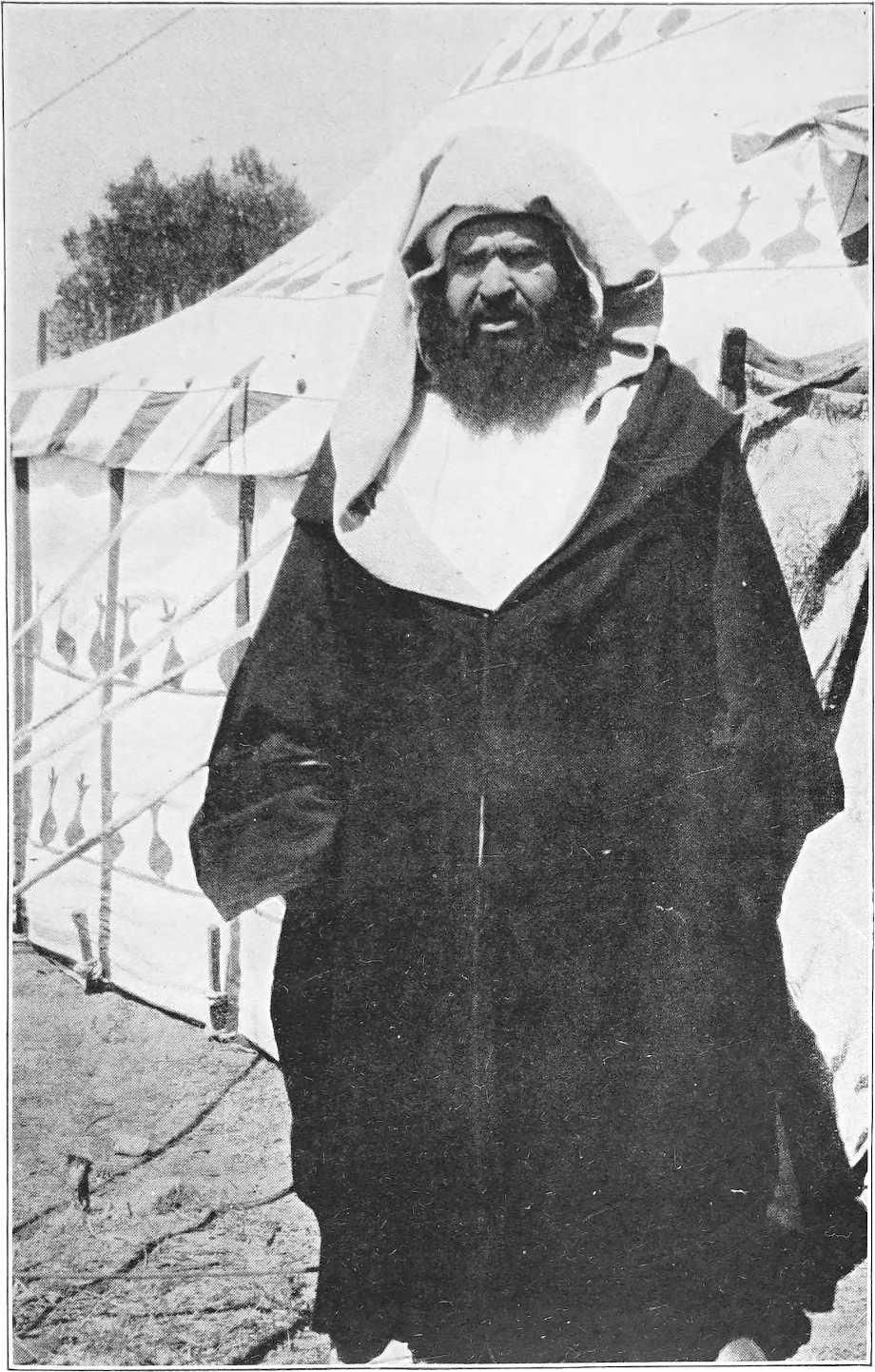
Mulai Ahmed el Raisuli
“At this time I had a mehalla at Bu Maiza. It was supported by the money of the Maghsen and it kept peace on the borders of Ahl Serif, which is always a rebellious tribe. Silvestre asked me to disband it, that there might be only one force in the country, and I said, ‘I will do this slowly, so that the Ahl Serif shall not think I am weak before them,’ but the Colonel pressed the matter, sending letters daily from Larache. I replied always, ‘The time is not suitable. There is much trouble among the tribes, and you should assist me to keep peace, not destroy my means of doing so.’
“I thought he had understood my words, but, suddenly, without any warning, he fell upon my mehalla, sending out two columns by night to eat it up. Kan haram! It was criminal, for my men were killed before they had time to defend themselves, and, when the Ahl Serif saw their distress, they came down from the rear and butchered those who remained. The commander of my army had been severe with the villages who refused to pay tribute, so the rebels took some of his men away into the mountains and buried them in the earth up to their necks, and left them there to die. The flies ate their eyes and the sun burned them, but it takes much to kill the men of Jebala, for they are strong, so at last the Ahl Serif brought their horses and galloped up and down over the heads, till they were knocked to pieces. When I heard this I swore vengeance.
“The destruction of my mehalla is one of the things I have never forgiven. The other is the murder of Alkali, of which I will tell you presently.
“The camp at Bu-Maiza was looted and nothing was left in it, not even the posts to which the horses had been fastened.[146] Remember, I was still a Governor of the Sultan, so the matter was not between Spain and me. An imperial force had been destroyed without reason, and it was no more possible to enforce my authority, nor could I control the tribes who wished to avenge this insult. I went to Tangier to protest to the Spanish Legation against this action of Silvestre’s, for I knew there was no accord between them and I had the intention of never returning to Azeila. The Minister (it was really the First Secretary, Lopez Robert) received me well, and made many apologies, and would have persuaded me to go back to my province, but he never answered any of my questions, nor would he say anything definite. Ullah, this is a bad policy with Moslems, for procrastination is our heritage, and if a European is evasive, it is easy for us to defeat him at this game. So nothing was settled, but the Government congratulated itself on keeping my friendship. They assured me that all questions would be answered at Azeila, and, because I had left my family there and news came to me that my mother, the peace of Allah be with her, was ill, I agreed to return there, spending several days on the journey and speaking to the tribes as I went.[45]
“I had no communication with Silvestre until it was nearly winter, when he came to present to me an officer whom he had stationed in the town. I delayed three days in receiving him, for a man must be polite to his guest and I considered that no speech could undo the wrongs which lay between us. I said I was ill, or that I was busy, or else that I was praying, by which polite answers an Arab would have understood that I neither wished to offend, nor to see him. Silvestre insisted, and entered the yard of the palace, saying that he would wait at the door till it was opened. I therefore received him with the honour which I have always[147] paid to his Government, for I still see in it our help.
“He talked to me of business before the mint was in the tea, and persisted in demanding the release of three Sheikhs of Beni Kholot, whom I had imprisoned because they would not pay tribute. I said to him, ‘I will free the men you speak of, if you wish, but do you not realise what you are doing? When you came to my country, all the people obeyed me, and, for that reason, I was able to help you. My assistance then was powerful. Now there are five tribes who dispute my rule. This is the result of your actions, and, if Raisuli falls, who do you think will keep peace? Every village will be at the throat of its neighbour, and no man’s life will be secure.’ I think in his heart he agreed with me, and, since the matter of Mulai el Mehdi was not yet settled, perhaps he hoped to prevail upon the Government in my favour.” “Thy words, Sidi, have always been of more value to thee than the blades of the jebala,” muttered Mulai Sadiq, but Raisuli gave no sign of hearing. Impassive and apparently bored, he continued, “Silvestre asked also for the release of the Ramla prisoners and, concerning this, I said we would talk later, for these villages had disobeyed my orders and fought against the Kaid whom I had appointed.
“I hoped then that the Colonel would leave, for it was late afternoon, and an unsuitable hour for speech, but he said to me, ‘How is it that you never return my visits nor offer me lodging in your house? The people talk of it and say it is your intention to avoid me and that there is no agreement between us.’ ‘I have no such intention,’ I answered, ‘but as for agreement, there are certain promises made to me by Zugasti and yourself which are still unfulfilled.’ There was silence, and I spoke no more, but he would not leave until I had agreed to accompany him round the camp at Aox, to show the natives that there was friendship[148] between us. ‘This I do out of respect for Spain,’ I said, but I was convinced that he was not dealing straightly with me. Ullah, perhaps I was wrong, for truly there is much harm in pen and paper, and each one reads a different meaning into the written word.
“When there is no sincerity, whatever the one does the other disapproves of. So it was with Silvestre and myself. He accused me of taking possession of land belonging to the Maghsen and using it for my own purposes. When I produced documents to prove my rights, he said they were forged. The land at Sahel had been mine for many years, but Silvestre would not believe it. Then I too became angry, and I imprisoned those Arabs who had been working for Silvestre against my interests. I heaped chains upon them and allowed no food to be given to them except a little oil. The Spanish minister at Tangier wrote to me asking for their release, but I did not answer, for I had begun building in two places, at Rekada and at Bir Musuk, and it was very annoying that my claim to the lands should be questioned. I had paid the man much money to make out the deeds properly, and no one was the poorer because of this arrangement.” Raisuli’s voice expressed mild indignation and he pressed together his thick, moist lips as if to hold back a flood of words.
“Silvestre went again to Madrid,[46] and, because I hoped something might be arranged from this visit, I released the prisoners they asked for. When he returned it was the feast of Aidh el Kebeer, when all the tribes brought tribute and, in addition, such presents as they could afford. Some men of Beni Aros went to Larache to complain that I had kept five of their men in prison for a long time and demanded 8,000 douros for their release. This was true, for it was the amount of the tribute they had failed to pay,[149] being obstinate people loving money more than freedom. It was many months that they had been in prison, chained on the same chain. The tribesmen sacrificed bullocks in front of Zugasti’s office and implored him to intercede for them, for they said, ‘You are the friend of the Sherif and he calls you his brother. Anything that you ask he will give you.’ They were right, and, had Zugasti come to me, all would have been well, but Silvestre was always between us, and I never saw my friend.”
About this time the Spanish police intercepted a letter to Raisuli from the commander of a small force which he had stationed in Beni Aros, to ensure the payment of a long-delayed tribute. It was signed by one Sid Hemed ben Musa and two others, and described in detail the burning of certain houses in Beni Ider, owing to the refusal of the “traitors” to pay the sum demanded. It is undoubted that deputations of indignant tribesmen constantly visited Silvestre, demanding relief from the extortions of the Sherif and complaining of the way their relations were imprisoned without a trial “during the pleasure of the Pasha.” It was also reported to him, but from not very reliable sources, that Raisuli was inciting the tribes to rebellion by means of letters which were to be read aloud by the Kaids. Rumour said that the Sherif proposed to lead an army in person against the mutinous Beni Aros, and Silvestre wrote hastily to Tangier urging the Minister to prevent Raisuli leaving that town, whither he had gone to make further complaints. As usual, however, the Legation was not in agreement with the military authorities, and the Sherif’s return to Azeila was unopposed. More tales of horrors were repeated to the unfortunate Silvestre, and he appealed to Raisuli by letter. The latter replied, “Let me govern in my own way, or let us break altogether.”
A number of tribesmen who had been friendly to Spain[150] took refuge in the camp at Aox. Fearing the reprisals of the Sherif, they poured their grievances into the ears of the Spaniards. Another letter was intercepted. This time it was from Raisuli’s Khalifa to Abd es Salaam at Taieb, one of the commanders of his mehalla, and it ordered the immediate imprisonment of all the “traitors” of Jaldien and other villages.[47] In obedience to this letter, which had been sent in duplicate, a section of the mehalla duly attacked the miserable Beni Aros and burned several farms. By this time both parties were “seeing red,” and neither thought of the results of their actions. Raisuli went to Zinat, and it was rumoured that he meant to visit the sanctuary of his ancestor, Sidi Abd es Salaam. This would have been a signal for a gathering of all the tribes. The mountain would have been alive with rifles, and, with the cry, “There is no God but Allah and Mohamed is his Prophet.” The Holy War would have been proclaimed from one end of the country to the other.
A few Moors from Beni Aros came with their arms and horses and offered to fight for Spain, upon which the Beni Mesauer promptly pillaged their houses. In Suq es Sabt the tribesmen cut off the head of a Kaid appointed by Raisuli, and, a few days later, the mountaineers swept down upon the village and murdered several merchants.
“Nobody knew my intentions,” said the Sherif, “and, until I made known my will, there was no security in the country. My brother, in whom I had great confidence, came to me and asked, ‘What are your intentions concerning Spain? Tell me, that I may know how to act, for there is but one will in our family.’ I said to him, ‘You are the son of my father, and it is your right to ask my plans, but, tell me, where have you left your family?’ He replied, ‘They are in Al Kasr with my uncle.’ Then I said[151] to him, ‘You have not seen them for some time. Go and visit them. Spend a few days with them, talk to them and take them gifts. Then return here and ask me my projects.’ He was surprised. ‘Why should I make this journey?’ he asked. ‘For the occasion is not suitable.’ I told him, ‘We are of the same house and I have confidence in you, so it is just that you should know what is in my mind; but, if I tell you, you will never again see your family. Therefore I advised you—go and visit your household now, and afterwards I will speak with you—for no man knows my plans and lives.”
WAR WITH SPAIN
“It was written that there should be war between Silvestre and myself,” said Raisuli. “We had tried to escape the fate that was intended for us, but at last (in January, 1913) he came to see me at Azeila. I was annoyed, for I did not wish to receive him and he had given me no warning. He waited below in the hall of my house, and he would not sit down, but paced up and down, up and down, like a beast which is caged. I sent my wakil to him that he might not be alone and worried by his own thoughts, but he pushed the man aside and tried to mount the stair-case. My slaves stopped him and I heard loud voices arguing. Then I said to myself, ‘It is the will of Allah. Let him come up.’ I greeted him restrainedly and wished him peace, but he did not even answer my salutations. ‘I want to see the prison,’ he said. ‘Let us go at once. I have no time to waste.’ I took no notice of his words, for certainly one does not talk business in this fashion at the beginning of an interview. I led him into the gallery, where there were mattresses and carpets, but he would not rest. ‘I have heard so much of your cruelty,’ he said, ‘so many complaints have come to me—I must see with my own eyes.’ ‘Justice is not cruelty,’ I answered, ‘and the eyes of a European are not a good judge of our ways.’ ‘Let us go at once,’ he interrupted sharply. I was surprised at his manner, for, though impatient, he was generally courteous.
“I sent for tea, hoping to calm him and make him see reason. It was long in coming and we sat in silence, but all[153] the time the Spaniard fidgeted and at last, when the trays came, I thought he would throw the glasses across the room. My secretary was making the tea, and the slave had forgotten the mint, so there was another wait.—Yes, Sayeda, you have guessed right. It is possible that this was done on purpose, for I did not want him to see the prisons and I wished to wear out his patience so that, in the end, he would leave me in anger.—After the first cup had been drunk he said, ‘I will taste no more until I have seen your prisoners,’ and the slaves looked at him, surprised at these new ways. He had been two hours, perhaps three, in the palace, and I could restrain him no longer. I said, ‘Today is not a suitable day, for tomorrow they will be fed and ready for your visit,’ but he went out of the room without answering, and stood outside the door, saying, ‘I am waiting. Are you ready?’
“A host is always under the orders of his guest, and it is not hospitality to sit while he stands, so I got up and went with him. In silence we went out of the house and walked towards the prison, he hastening in front, I slowly following, returning the salutations of those who came forward to kiss my sleeves.
“At the door there was no gaoler, and while the man was being found, I said, ‘You know best if what you have done is good or bad, but it is not thus in my country that matters are dealt with among the great,’ and he answered nothing. The gaolers came with the keys, and we went in. It had been cold outside, but here the air was fœtid and the heavy smell was like a blow to Silvestre, who grew pale on the threshold.
“‘Come in,’ I said. ‘It is your wish,’ but he stood there, staring as if his eyes were on sticks which pushed them out of his head. ‘Dios! are all the men in the country criminals?’ he asked. It was a small place, not much bigger[154] than this tent, so it looked crowded, for there were nearly 100 prisoners there. To make room, half of them had been fastened to the same chain, and one or two were perhaps dead, for the gaolers are always careless, and perchance there was no smith to break open the irons. It was very dark, and nothing could be seen clearly. The eyes of the men were like green lamps. Do you know when you look into a hole and, unexpectedly, you see twin points of light, and it is a face watching you? So the prisoners watched without moving. Some of them were almost naked and shivering. Others were so thin that their bones tore the rags which were on them. Truly the will of Allah is strange. The pleasure of crime is momentary and its punishment eternal.
“Silvestre would have spoken to them, but the smell caught him in the throat and drove him out. He held something across his face. ‘This is horrible; inhuman! I will not stand it in a country which is under our protection! How dare you do it? Are you not afraid of the consequences?’ ‘It is a weak man who fears what will arise out of his actions. I fear nothing but Allah.’ ‘Do you feed them?’ he asked. ‘They do not expect food in prison. It is not right that evil should fatten at the expense of the virtuous; but their friends bring them food, and few die of starvation.’ ‘But what have they done?’ he insisted. ‘They have broken the law, and my justice is exact.’ ‘Is there a register of their crimes?’ ‘Perhaps the Qadi has one. Have you seen enough?’ But here all the prisoners began to protest, moaning and crying out that they were innocent. ‘Do not listen to them,’ I said, ‘for they have become like dogs. A good Moslem never complains against the will of Allah.’ ‘It is your will only—’ interrupted Silvestre, but I put up my hand to stop him. ‘I have no will but Allah’s,’ I said.
[155]“Silvestre would not return to my house. He went straight to his office and sent messengers to bring him the register of the prison, but none could be found. The Qadi was busy and said, ‘Come tomorrow. Imsha-Allah I may have it then.’ Other officials were in the mosque, for it was now sunset and the day’s work was finished. ‘Later on,’ they said, ‘we will do as you wish, but this is not the time.’ Certain ‘mesqueen’[48] of the town, having heard of the affair and ready to fill their sails with his new wind, went to Silvestre and complained that their relations had been put in prison without cause, or because they refused me the money necessary for my houses at Tazrut and Zinat. Certainly I had to rebuild the last one, for it had been destroyed by the guns of Mulai Abdul Aziz, but I took only the presents which were my due and the labour which is always at the service of a Governor. It is the custom.
“Silvestre came again to my house and, standing at the door like a beggar, insisted that I should see him. Was it right that the representative of a great country should behave in this way? My servants told him that I was praying, but he said, ‘It is an excuse not to receive me,’ and he pushed past them and opened the door. My steward came to him in the hall and said, ‘The Sherif is in the Mosque. Listen; you can hear the prayers, but Silvestre was unbelieving, and he came and stood at the door of the room where I prayed. I took no notice of him and went on with the prescribed Raqua-at.
“At the end, and when I had finished my meditation, I turned and saw him still waiting. I gave him no greeting, but said, ‘Come,’ and led him upstairs, making him enter the room before me and sit in the place of honour. He was not long in speaking. ‘I have come to end this matter, for there has been too much delay. No register has been shown[156] me, and certainly your prisoners have committed no greater crime than failure to satisfy your greed. You have extorted all they have, and, because they could not pay more, you have condemned them to a living death. Spain will not permit this to be done under the shadow of her flag. These men must be released today.’ Then I spoke to him. ‘Spain has other and greater purposes than to interfere with our justice. The Sherif law permits my actions, no, insists on them. You should uphold my authority, not weaken it, as has been your purpose for a long time. Spain swore to support our religion and our law. You misunderstand your mission. You have no more right to meddle with our traditions and our customs than I have to tell you the food you eat is unclean. To each country its laws!’ But he would not listen. He ordered my slaves to bring some of the prisoners before him. The man looked at me questioningly. ‘My house is at the service of Spain,’ I said. ‘Do as he wishes.’
“There was silence between us, but, while I contemplated the breadth of wisdom that is in Islam, Silvestre fidgeted and moved first one foot, then another, hitting his boot with a stick. At last they brought three men into the room, and something had been done to cover their nakedness and their sores, but they were dreadful to look at. Silvestre said to them, ‘What crime have you committed? Why are you in prison?’ and one answered, ‘By Allah, I am innocent of all intention to offend,’ and another, ‘I could not pay the money demanded by the soldiers of the Sherif, for the harvest was bad and I had no grain to sell.’ Then Silvestre turned to me and asked loudly, ‘Do you hear that? What have you to say?’ I answered, ‘My justice is true and there is no further appeal.’ He insisted, ‘But don’t you understand of what they accuse you?’ I pitied him at that moment, for it was he who did not understand. ‘It is[157] not I who am accused,’ I said, ‘and words are the least valuable of a man’s merchandise. It is well not to trust them too implicitly.’
“Silvestre got up in anger and ordered all the prisoners to be released, but, before he could leave, I took him to a window and showed him a man sitting in the court. ‘Do you see that Faqih?’ I asked. ‘He has been sitting there for three days, and he has not eaten nor moved, except his lips for prayer. Do you understand that man’s mind? for he is content,’ and he answered, ‘No.’ Then I showed him a row of Sheikhs gathered in the shade of the wall. ‘These men have waited six days to see me, and they have not complained. They are content following the shade from wall to wall, and life is good for them. Do you understand their patience?’ Once again he said, ‘No.’ Lastly, I pointed across the roofs to a barred window very high up, and I said, ‘Behind that grille are women who have never seen the day. They live in one room, where they sleep and eat and bear children. They never leave the house until they go out to be buried; yet they are content. Do you understand their lives?’ ‘No’ he answered. ‘Then do not be so sure that you can judge our laws and our customs, for ignorance is a steep hill, with perilous rocks at the bottom,’ I said. And he went.”
There was a pause, and the Sherif looked at me gravely. “You, too, are wondering,” he said, “but purposely, I have made this affair neither black nor white, for you know something of the ways of the East. When I told you of my imprisonment at Mogador, you said, ‘How could you bear it? I should have died in three days,’ but it was not true. Death is in the hands of Allah, and it comes only by his will. What it is written that a man shall endure, that is his portion and he cannot get away from it. You trouble yourselves with much rebellion, and you eat up your years[158] the quicker, but we do not fight against that which is sent us, and that is why we can endure.”
It is impossible to express the heavy fatality of his voice, unhurried and devoid of emotion. I wanted to argue, but it would have been to fling oneself against something as hard as granite and as immovable. The words died breathless in my throat and I felt as if they had been crushed by a great weight. “Patience is the only thing left us,” said the Sherif. “Once our race was great, and you learned your science and philosophy at our feet. Our armies conquered the West and Islam was invincible, but we were not a productive people, for the mind of an Arab is always more agile than his fingers. You took our knowledge and manipulated it to your purpose. Our strength was expanded, and the East fell before your vigour. Now it is your turn to teach, and we are slow to learn, for there is with us yet the memory of greater things than you ever knew, but it is dim. Perhaps we must lose it altogether, before we can meet you in the open and wrest back our sovereignty. Do you see that man at the well, and how he draws the water? When one bucket empties, the other fills. It is so with the world. At present you are full of power, but you are spilling it slowly and wastefully, and Islam is lapping up the drops as they fall from your bucket. Some day, when we have profited by your schools and your factories, we shall retake what is ours, but it will not be in our lifetime nor yet in that of our children’s children. So Allah has given us patience.” There was another pause.
“Before Silvestre returned to Larache, he ordered his men to see that the prisoners were released—so there was war between us. My people came to me and said, ‘Why do you permit this thing? There are enough rifles to turn the Spaniards out of the country.’ But I answered, ‘The time is not yet come.’ Nevertheless I began sending rifles and[159] ammunition to the mountains where they would be safe. Every tribesman who came into the market with his sheep went out with the panniers of his mules stuffed with cartridges. Many carpets were bought in the town those days, and each roll hid a bundle of rifles. There were many ways of doing these things. Women going out to work in the fields carried ammunition packed in their skirts, for no man may look under their haiks, and truly, in those days, the stature of women swelled till all went to their work with hips so heavy that they could scarcely walk. In time this was reported to Silvestre, for, wherever there are strangers in a country, there also are traitors. Scum rises to the surface when the water is stirred. Hamdulillah, most of my stores were already in the hills, for the tribesmen brought in great bundles of thatch for the roof, and other villagers chose to buy it in the town, instead of procuring their own from the countryside, and this straw covered the journey of many guns. When the Spaniards put a guard on the maghsen,[49] more than the half was gone, but still they took possession of many thousand cartridges and quantities of rifles of all kinds.”
Spanish writers state that on this occasion they took 501 rifles, Martini and Gras, and 133,000 cartridges. They place the number of prisoners released as 98 or 91, and insist that nearly half of this number were Sheikhs who had refused to pay the tribute demanded by Raisuli. The Sherif’s story continued: “I have told you before that, as Governor, I was an official of the Sultan, so this action of Spain was an insult to his authority. Among the prisoners who were released were many thieves who had stolen even the jewellery of women and cut off their breasts when they struggled. There were also murderers, two of whom were notorious throughout the country. It had taken my soldiers[160] six months to catch them, for they lived among the trees of the mountains like apes, and existed on the fruit and the herbs. The tortures they had inflicted on people are beyond my telling, and they took boys from their homes and tortured them as is forbidden by Islam.
“These men were let loose, and two lions could not have done a tithe of the harm which was laid at their door. In place of these scoundrels, the Spaniards imprisoned my friends and the teacher of my son, because he was loyal to me and would not tell where certain of my papers were kept. They took also the gaoler of the prison, el Hiffa, whom they made responsible for the condition of the prisoners, saying that food sent by their friends never reached them, but was given by this man to his family. Some of the prisoners died, and there was more trouble; but I had left at once for Tangier to report the matter to the Legation.
“The Minister received me well, and wrote hastily to Silvestre, saying that he had been too overbearing in his actions, considering the necessity of maintaining good relations with the Sultan’s Government. Ullah, there were many words wasted in letters, but the harm was done. I had the intention of never returning to Azeila, but Silvestre, guessing this, put sentries at the doors of my house and allowed no one to go in or out. My son was there, whom you know, and all my women, and there was one whom I wished to have with me. I should not even have been told of Silvestre’s action, but for the wit of a slave, who was carried out of my house in a bundle of rugs which the servants said they must beat in the street, for there was much dust in them. The soldiers would not let them go out without permission of his officer, so the bundle was put down beside the door, and no one noticed it while the argument proceeded.
“How many hours the slave lay there, half stifled[161] among the wool, Ullah, I know not, but at last, when the attention of the guard was distracted, he slipped out and hid in the house of a friend, for he was well known as one of my favourites. The friend dressed him in women’s garments and put on him a haik and the handkerchief that is tied across the face, and, above that, the big hat which the peasants wear in the field. Then he put a rope of onions round his neck, as if he had just come from the market, and, in this way, my servant escaped from Azeila and came to me. I asked him, ‘What news?’ and he answered, ‘The news is bad. Allah forgive me for bringing it.’ I said, ‘The darkest day is better than the night. You are free, whatever your news,’ and he told me that my mother was ill and wished to see me before she went.
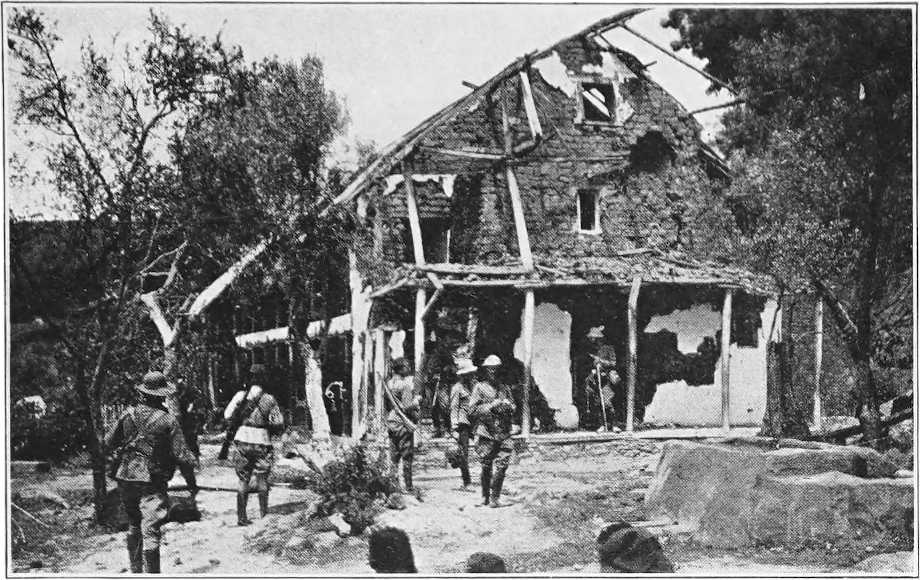
Raisuli’s house at Tazrut during Spanish occupation
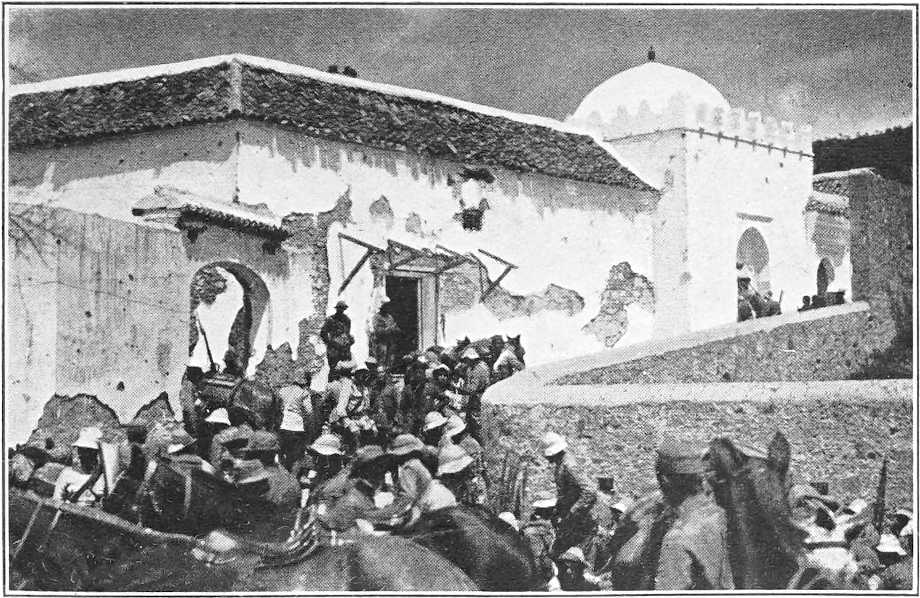
Raisuli’s qubba at Tazrut during Spanish occupation
“I did not desire war, but, if attacked, only a coward does not defend himself, so I took counsel with el Arbi, and sent him to Wadi Ras to warn the tribes to prepare. I wrote also to Zellal and asked him to prepare the flags of Beni Mesauer, so many men to each flag, and each from a different section of the tribe. I had a few hundred men waiting for my orders in the mountains, for I was unprepared for the struggle. These I sent out among the tribes, distributing rifles from my store and ordering them to be ready. There was a great meeting of the mountaineers at Jebel Habib, the home of the Bakalis, and the Sheikhs of Wadi Ras, Beni Mesauer, Beni Ider, Sumata and others consulted together as to how the flags (companies) should be arranged. Mohamed es Siba was appointed chief of the loyal men of Beni Aros, with the Sumata, Beni Gorfet, and Ahl Serif.
“It was circulated among the Jebala that the women of my household had been killed at Azeila and that all my property had been looted. I did not deny the rumour, for it was as wine in the throat of an unbeliever, and great oaths were[162] sworn in the mosques. It would have been a bad day for the Christians if I had loosed the leash. In peace, an Arab will say of the Europeans, ‘The word of the English is good,’ of the Frenchman that ‘he is brave,’ of the Spaniard that ‘he has a good heart,’ but, in war, he recognises no nationality. They are all Christians, and he is a Moslem. So it was now, and to add fuel to the fires which blazed from mountain to mountain, came the news that the Sherif was a prisoner at Tangier. It was already known that the arms and ammunition of the Maghsen had been confiscated at Azeila, and each man who had hoped to find his fingers on a new trigger vowed vengeance for the theft.
“There was a secret meeting in Beni Aros—down among those hills which you can see. Do you remember a wadi where the flowers (pink oleanders) grow over your head and the partridges call from thickets that even the hunter may not penetrate? It was there that each man came with his gun. Many of them were of the race of Jebel Alan, whose sons I shall always have at my back. Each mountaineer brought his food, and those who had horses left them where they would be ready for the march. ‘Praise to the Prophet—the messenger of God’ was whispered from mouth to mouth, while under the starlight the Kaid spoke to them in many words and told them, ‘It is your duty to protect the descendants of the Prophet, and the country that is yours. Life under the heel of the Nasrani[50] is hard, but death is an easy gate to paradise.’ So eloquent was his speech that they would have started at once for Azeila to exact vengeance for the blood of women.
“We do not treat our women as you do, but, if a tribesman lays his hand on the family of another, a gun will be hid for him behind every rock till the last of his men-folk is dead. I remember in Beni Aros, a woman ran away with[163] a man of Beni Gorfet, and, her husband being killed in the raid that followed, there was only left her brother, whose face was as smooth as yours, and he had no gun, for it was a poor family. So he sold himself for so many years’ labour as the price of a rifle, and he went out stealthily and lay hidden behind stones and trees, waiting for the men of Gorfet. He had great patience, and, one by one, he killed them and, before he himself was slain, he had shot seven and also cut the throat of his sister. . . .
“Surely Azeila would have had short mercy before the weapons of Beni Aros, but this was not my purpose, for I still hoped for peace by means of the Ministry at Tangier. I sent other messengers to the hills to hold the people in check, telling them that, when the time was ready, I myself would lead them to victory. There was indecision among the Spaniards, for some wanted to make peace with me, believing that this was to the benefit of both our countries, while Silvestre longed to occupy Zinat. My house there was rebuilt with strong walls and gates, and the people believed that any who attacked me would go blind, for they said, ‘Disaster has overtaken all his enemies, but he remains strong.’ The Government was afraid of the newspapers, which for long were my best friends. Ullah, you are surprised, but it is true. All through the war it was like this. My strongest allies were in Madrid, and they were worth more to me than all my guns and cartridges. There would be a battle, and perhaps many of my men would be killed, and only a few of yours, but, immediately, the Spanish newspapers would begin their cry: ‘Mothers, why do you send yours sons to die in a country that is not theirs? Sisters, why sacrifice your brothers in a cause which is sterile and unprofitable?’ I cannot remember all the words, but they were read to me at the time. Truly, my heaviest cannon came into action after the battle was over, and the echo of[164] their firing could be heard in the conferences at Tangier.
“It was difficult for the Government, for, on one side, the Spanish people feared they were fighting to no purpose, since the country is not rich and it is only for her honour and the protection of her coast that Spain would remain here. On the other, the soldiers, led by Silvestre, urged that the land must be taken by force, and in order to do this Raisuli must be imprisoned in Tangier. Perhaps even my life was uncertain, but Allah guarded it from all snares.
“When there is no leader, destruction forgets its purpose. So it was in Morocco. Men were killed in the suqs and on the highroads, whether they had arms or were without protection. The tribesmen attacked Tetuan by night and many were killed within the walls. A Jew had his throat cut, almost within sight of the Tabor at Ain Yerida, and the police would not interfere, for they did not know which side was strongest. The tribes themselves were waiting, but whenever there is war, there are evil men, thieves, murderers and brigands, who hang about on the edge of the armies and commit many crimes which are attributed wrongly to those who are fighting.
“Silvestre doubled the guard at Azeila, but there was always someone who brought me news. At first it was done by pigeons, for two or three carriers were smuggled in among a basket of fowls, but this was found out, and then it was more difficult; but walls have ears in Africa, and, from the roofs, every eye watched for the Sherif.
“Some of the discontented Arabs went to Silvestre with their arms, and offered to fight against me, but these were men of the plains who were afraid of attacks from the mountaineers. The plainsman suffers in war, for his country is the open road over which all armies pass. The Legation in Tangier was still trying to make peace with me, but I refused[165] to return to Azeila and demanded that my family should be sent to me in Tangier.”
The modus vivendi proposed by Spain was that Raisuli should send his brother, Mohamed, immediately to Azeila with full powers to act as his Khalifa; that he should follow himself within three weeks, and remain there until the appointment of Mulai ed Mehdi as Kaliph had been made public, after which he could remain as Pasha of Azeila if he wished; that his brother should take with him letters to the tribes confirming him as Raisuli’s agent, letters to be opened and to be read by the Spanish officer at Azeila before being sent on to their destination; that the native troops should be under the orders of the Spanish officers only, who would be responsible for keeping order throughout the country, while the Sherif would have the civil administration in his hands. In order to prevent a repetition of the horrors reported and witnessed by Silvestre, a Spanish official was to have the right to intervene if necessary. All orders were to be signed by Raisuli and, if Spanish intervention occurred, it was to be arranged in such a manner that the Sherif’s prestige should not suffer. Criers were to proclaim throughout the towns and villages that an agreement had been signed between the Spanish Government and Raisuli. As soon as Sidi Mohamed arrived at Azeila, the Sherif’s friends who were in prison were to be released, but nothing was arranged about his wives and family. Spain for once held the strongest cards, and wisely refused to give them up.
Raisuli played for time. He had not, I believe, the slightest intention of returning permanently to Azeila, but he wanted to secure the liberty of his household, and he knew that, if he delayed long enough, the friction between civil and military interests would serve his purpose. “I[166] knew my family were safe with the Spaniards,” he said, “but an Arab without his son is as one who has lost a limb.[51] Also I did not trust Dris ed Riffi, who was acting as my steward. At one time he was a very loyal servant, knowing not the value of money and having no interests but mine. Then he came under the influence of foreigners, and would have asked a reward for his services, so I said to him, ‘The labour that is paid is without confidence. Are you a slave that I should give you a gift when you please me?’ He was angry and muttered, ‘Anyone can accept service. It is only the great who serve.’
“Still I thought him faithful, till, one day, I sent him with my mehalla to exact tribute from a certain village. He returned, saying, ‘There has been a plague among their cattle and most of them are dead. Therefore the money is short, for there is nothing wherewith they can pay it.’ I knew then that he had been bribed by the Sheikh of the village, but I said, ‘It is the will of Allah.’ Later, I sent messengers to the tribe to find out exactly how much he had received, and this was not difficult. I thought to myself, ‘He has been my friend. Perhaps shame will drive the greed from his heart.’ So I sent for him and said, ‘It is nearing the feast, and I have a present for you.’ He looked surprised, but answered, ‘God make you strong.’ Then I made him sit down beside me, and I sent a slave for some money. He brought a bag and counted it out as I told him, and, when he reached the exact amount paid by the Sheikh, douro for douro, he stopped and went away. ‘That is my gift,’ I said. ‘Take it, and the blessing be with you.’ But he was afraid, and asked, ‘Why have you done this, Sidi?’ ‘Ullah,’ I said to him, ‘it is a pity that a man’s honour can be bought for so little, but I also[167] have paid the price.’ Then he got up and would have left the money between us, but I said to him, ‘There is no need to fear. Take the money, for you must surely have great need of it,’ and he went away.”
ARABIAN ASTUTENESS
“When Silvestre heard that his Government was treating with me,” said Raisuli, “he was very angry, for he had been told nothing about it, and believed that at last the policy which he had recommended would be followed. He sent in his resignation, but Spain would not accept it. Had she done so, the war might never have been fought, for, of all men, Silvestre was most unsuitable for this country.
“There were difficulties also in Azeila, for when Dris er Riffi heard that he was to be supplanted by my brother, Sidi Mohamed, he began to make friends with Spain. Since then, whatever time he can spare from the purpose of enriching himself, he has devoted to preparing traps for my life. Silvestre found him a blade which he had no need to sharpen!
“My brother had hardly started for Azeila when from Ziat, I went to visit some of the Anjera tribe. These people had never been my friends, but, at this moment, there was much hatred against the Christians and, when I received presents and messages from a certain village, I believed it was not so much for my sake as for Islam. I set out on a white horse which was a mark for all the countryside, and with me were Mohamed el Kharaji, who was later killed just outside Tazrut,[52] and perhaps six or seven others. When the sun was high we passed some tents, from which men greeted us, crying, ‘Sit down and rest yourselves. The meat is on the fire and there is nothing[169] lacking but the guests.’ One of my men said, ‘It is the Sherif. Do you not recognise him?’ and the other answered, ‘Allah keep him. We know him, and we know of his journey, and, for that reason, we have prepared food that my lord may bless our tents with his presence.’
“With us it is discourteous to refuse such a request; so we dismounted and sat in the shade of the tents. But as it was cold when the sun was not on us, they said, ‘Come inside, Sidi; all is prepared that you may honour us.’ We sat on sheepskins spread over the mats, and these men, who had come from the plains, told us the news of Azeila and how each night there were shots fired in the neighbourhood of the town. ‘But the war is won, Sidi,’ said one, ‘for the Christians have not yet learned to shoot and the bullet of an Arab is never wasted.’
“Meat was brought and set in front of us, but I was not hungry, for it was early, and a wise man eats at the end of his journey, not in the middle of it. However, it is not polite to refuse what the host offers; so when the sheep, roasted whole with its feet and its head, was placed before me, I took pieces of it in my fingers and ate with much noise, to show my appreciation. As we sat in the tent, with the flaps lifted to let in the air, a dog came up and lay behind me, sniffing at my garments. I thought to myself, ‘Here is a friend in my need,’ and I gave it a piece of meat that it should stay beside me. Ullah, the others ate so heavily that there was not much left of the sheep, and even Mohamed el Kharaji loosed his belt with satisfaction.
“Then my host took up the head of the animal and made great play of cracking it open with his fingers, which is a strong man’s feat and an honour done to the guest, but I noticed that the skull was already split, and I thought, ‘My friend, you are more powerful with your tongue than your hands.’ Then, holding the head in front of me, so that the[170] brains were apparent, he offered it to me, ‘In the name of Allah—with health, with enjoyment.’ I took the brains, as a refusal was not possible, but Allah, in his wisdom, caused there to be pain in my stomach, and I had no desire to eat. I thought, ‘If they are not looking, I will give it to the dog,’ but I expected every man’s eyes to be upon me at this moment of honour. Yet each looked at his fingers or spoke to his neighbour; so my hand stole out quickly, and the dog profited exceedingly. After this the tea came, and there was little ceremony in making it; then suddenly all spoke of the length of my journey and the difficulty of my road. I wondered then if there was an ambush prepared, for the plainsmen are not as loyal to their guests as the mountaineers. So I signalled to el Kharaji, and we rose and went out.
“The horses were brought quickly, and one held my stirrup as I mounted, kissing the skirt of my jellaba—was it not with a kiss that Issa,[53] whom we call ‘the breath of God,’ was betrayed? At that moment the yellow dog who had lain behind me ran out, howling as if a jinn had seized his tail. Someone threw a stone at him, but he paid no heed and, crying mournfully, with lips drawn back and gums bared, he writhed on the ground before us. ‘What has taken him?’ said el Kharaji. ‘Ullah, he has eaten poison!’ The dog raised itself on its haunches, but its hind legs moved no more. Its body was convulsed as if it were about to burst apart, and it died while we watched it. ‘A shot is a more merciful death,’ I said to our host. ‘Remember that when your time comes.’ Our eyes met and, for a minute, the hand of each man felt for his rifle. ‘It was well done, and worthy of your house, O Sheikh; but my life is under the baraka; none but Allah may take it,’ I said. We turned our horses swiftly, but as they would have[171] sprung forward, the Sheikh flung himself on his face in front of me. I pulled my horse aside that its hoofs might not touch him. ‘I will repay your hospitality,’ I said, ‘but not in your house or mine.’
“That was the work of Dris er Riffi, but it was not ended.
“When I returned to Tangier, I heard that Silvestre had been commanded to deal patiently with me, in order that the tribes might be pacified. Ullah, if a man has hunted a fox from its hole and set his dog on its heels, it is too late to tame it! The Colonel had forbidden my brother to visit my family, still imprisoned at Azeila. He wrote that much discourtesy was shown him and that he had been kept waiting with many others outside the door of the Political office. He wrote in his own hand, ‘Finish this matter quickly and let there be an end of it, for it is impossible that fire and water shall exist in the same place.’
“This was difficult for me, because of the hostages held by Silvestre. A son is a warrior and must endure the chances of battle, but women are to be protected, and it was my duty to look after them. Our women fear many things, but most of all the unknown. They are not like the peasants who work in the fields and who know the use of a trigger as well as any man. They are shy when there are strangers without, and their feet are too curved for rough ways. So I was evasive in my answers, saying, ‘Wait until my mourning is over,’ for my mother, the peace of Allah be with her, was dead, and for forty days I might not travel or take part in councils. I wrote carefully to the tribes, telling them to wait, but my letters were difficult to understand.
“The mountaineers were surprised at the delay, and no doubt some of them said, ‘He has been bought by the Christians,’ but the wise men knew about my family. The messengers who took my letters were frightened, for they were ordered to read them aloud to the tribes. One came[172] to me, limping and ragged, saying ‘Sidi, I took your paper to Suq el Habib, and when I called the people together in the market, they said, “It is the order to march,” and they were glad, and the Faqihs blessed them and everyone shouted, “Salli en Nebi er Rasul Allah,” and “God keep the Sherif!” Then I read the letter, and the noise died. They looked at each other and asked what it meant. Then one said, “The Sherif is very learned and we are but ignorant men,” and another, “The language is beautiful but the meaning is not in my head,” and others shouted, “It is not from the Sherif. The messenger lies. He has been bought by the Spaniards!” They flung themselves upon me, and I thought I was a dead man, but Allah saved me and the influence of my master. When they had finished beating me, I crept away and put oil on my wounds, and told one or two who would listen, “On my head, it is from the Sherif, and he but waits an opportunity, so be patient.”’ Then he showed me the cuts on his back, and they were deep; so I sent my intimates, who were known to be with me, among the tribes, and they explained matters to the Kaids.
“Still there were disturbances. The messengers who went to Beni Aros were beaten and put into prison, for the rifles of the tribesmen had been oiled for a long time! One day I received a letter without signature or date, ‘Allah keep the Sherif if he be with us, but our steel grows rusty and our fingers are stiffening from disuse!’ You have seen the Fondak of Ain Yerida? It is the key to Wadi Ras, which has ever been the gateway of Tetuan. A post of native police kept the key, but one sunset the hills above them were alive with men who cried, ‘The country is in arms, and this road but for Moslems.’ There was no fight—a few shots fired in the air, and the police, who had become too used to the safe end of a rifle, were driven out, closing the gate to the East. Thereafter no man went along that[173] road, except with a paper from Raisuli. The tribesmen heard of this, and, once again, I had difficulty in restraining their bullets. Ayashi Zellal of the Beni Mesauer, the Bakalis of Jebel Habib, Haj el Arbi of Wadi Ras, some of the Kaids of Beni Aros were with me in my efforts. Each gathered the leaders of his flags and told them that the final ammunition had not yet arrived, and that the Sherif was waiting for a last consignment of rifles. At the same time, they sent their own servants to mix among the mountaineers, saying that Raisuli was rich and powerful, that he was the Sultan’s representative, and would supply rifles and grain to all who fought with him.
“Enthusiasm spread like a flame, and in the weekly market of Beni Yusuf there was no trade done. The Sheikhs of Sumata and Beni Aros moved among the people, answering their questions and reassuring them—‘You have waited for years. Can you not wait for a few days?’ ‘When shall we march, Sidi?’ ‘When Allah wills.’ ‘What shall be the first work for our bullets? Where shall we go.’ ‘Where Allah wills.’ So the country waited. Yet there were deeds that I could not stop. A Berber girl who worked in a Spanish farm was shot by her brother as she returned from her labour, and another, who was suspected of warning the Jews whom she served, died at the hands of her father and her body was buried hurriedly as if it had been a dog’s.”
It is probable that Raisuli followed his usual policy of playing off one party against another. The Spaniards were forced to realise his ascendancy over the Jebala, but they were allowed to believe that the Sherif would still treat with them on certain terms. “I will never fight Spain,” he said, “but I will fight—and conquer—Silvestre if he comes against me.” As a last resort, the Legation at Tangier arranged a meeting between Raisuli and the leader of the[174] military party. Besides the two principals, there were present at this historic encounter the Marquis of Villasinda (the Spanish Minister), Colonel Barrera, and Zugasti, still Consul at Larache.
Raisuli’s description of the conference was as follows: “I had not thought to see my enemy again till one of us was approaching death before the rifle of the other, but when I found him waiting for me with his countrymen, I saluted him as if he had been my ally, for the guests of the same host share his friendship, and enmity dies on a threshold that is hospitable. Silvestre began at once to accuse me of breaking my word and I saw that this would be a repetition of our interview at Azeila, but, because of Zugasti, I answered quietly, ‘The tribesman who made such an accusation would die before the last word had fallen from his mouth, but you are safe under the same roof as my brother.’ ‘It is your influence which has raised the tribes against us,’ he accused me. ‘You are right; and it was my influence which kept them quiet for so long,’ I returned. ‘The country is full of complaints concerning your barbarity.’ ‘When a man is idle he finds time to complain. War is the best medicine for tongues which are too garrulous.’ ‘If you plunge the country into war, there will be enough bloodshed to separate us for this generation,’ he said. ‘It is not my work,’ I answered. ‘You have sown the crop, though I told you the ground was unprepared. Now you will reap it.’
Zugasti interposed, asking if there was no way of making peace between us, but Silvestre cried out, ‘He is a bandit! What is the use of speaking to him? My patience was exhausted long ago.’ ‘That is why I am stronger than you,’ I answered, ‘for, while I have life, I shall have patience.’ He shrugged his shoulders. ‘It is a matter of temperament. I am not willing to wait for things to be done next year or after twenty years! There can never be agreement between[175] us, unless you are honest.’ ‘It is true,’ I replied, ‘that there can never be peace between us, for you are the wind and I am the sea. You blow mightily and I am enraged. I am like the waves which fling themselves on the beach, crested with foam, and you are the tempest which drives them, but you cannot move them out of their boundaries. Yes, you are the wind and I am the sea. The wind passes, but the ocean remains.”
“I would have saluted them all and left, for words were of no further use, but the Minister interposed. ‘Where are you going?’ he asked. ‘To my house at Zinat.’ ‘Wait until tomorrow,’ he urged, ‘for the Prime Minister has sent you a present from Madrid, as a proof of the affection and friendship of his Government. It is a collection of carpets which have been specially woven for you. At least you will accept this?’ ‘Sidi,’ I replied, ‘this is not the moment for gifts, for a present received by me from you would be called by my people by another name.’ He insisted, ‘They are very fine carpets, designed to your taste.’ Then I said, ‘I congratulate you on your sense of justice.’ ‘What do you mean?’ ‘I will explain, if Allah has blinded your eyes—they say justice is blind! I had a house at Azeila, and you took it. I had a great store of guns and ammunition, and you took it. I had furniture, carpets and mattresses—you took them, leaving me not so much as a handkerchief. Now you offer me a roll of carpets. No, Sidi, let those go with the rest.’
“The Minister frowned when my speech was translated to him. ‘Nothing has been taken from you. All is waiting for you at Azeila,’ he said. ‘Inshallah, I shall never return to Azeila, for if the sea and the wind are in the same place, there is much turmoil.’ ‘Will you not go to visit your family?’ ‘My family is large. It is all over Morocco.’
“The Minister insisted that I would not speak frankly,[176] and that I was becoming an enemy of his country, and I answered, ‘I am the enemy of no country, but I am, first of all, the friend of my own. As for honesty between us, is it honest that you keep my family as prisoners? I did not know your nation made war on the harem.’ This struck him, because he had always been against Silvestre’s policy, but the Colonel, seeing it, broke in ‘I will give you my son as a hostage,’ he said. ‘Then each of us will have a pledge for the faith of the other.’ I remembered how, in Europe, you care for your children, giving them to others to look after and educate, but I answered, ‘It is to your honour that you think of such a thing.’ He went on, ‘I have only one son, and he is the child of the woman I love most in the world, but I will give him to you to ensure your friendship.’ Then I said to him, ‘Allah bless you with strength. Do you know what the son of an Arab is to him? We have no love of women, so there is but one person on whom our hopes are fixed. Our sons are our surest defence and the hope of our race. A man who is sonless is ashamed before his people, for Islam is the poorer because of him. Yet I would leave you my son and, knowing him in your hands, I would still be your enemy!’ So the conference ended.
“Silvestre returned to Larache and I went to Zinat, where the Legation still tried to communicate with me. Mulai el Medhi was proclaimed as Kaliph, but there was no road by which he could travel to Tetuan. The heart of the country was closed, and the people said, ‘Who is this friend of France who has been imposed upon us?’ El Mehdi went by sea to Ceuta, and, from there, Alfau, who was the first High Commissioner, occupied Tetuan. The Beni Hosmar would have opposed his advance, but I restrained them, for it was my idea that this city should be the capital of the Protectorate. Before we disputed over other matters, I[177] had talked to Silvestre about the project, but I would have had Spain go slowly, strengthening her supports as she advanced. The situation was strange. On the one side of me there was peace, and on the other, war, but both came from the same nation. Alfau wrote to me saying my help was necessary if Spain were to advance further, but he did not dare suggest what was in his mind. Tetuan had been occupied without the loss of a life, and, their pockets fattened by Spanish pesetas, a crowd welcomed the arrival of the Kaliph, but, when he wrote to the tribes, announcing his accession and demanding their allegiance, his letters were met, each one, with a bullet. None of his messengers returned, but, El Hamdulillah, cartridges have always been cheap.[54]
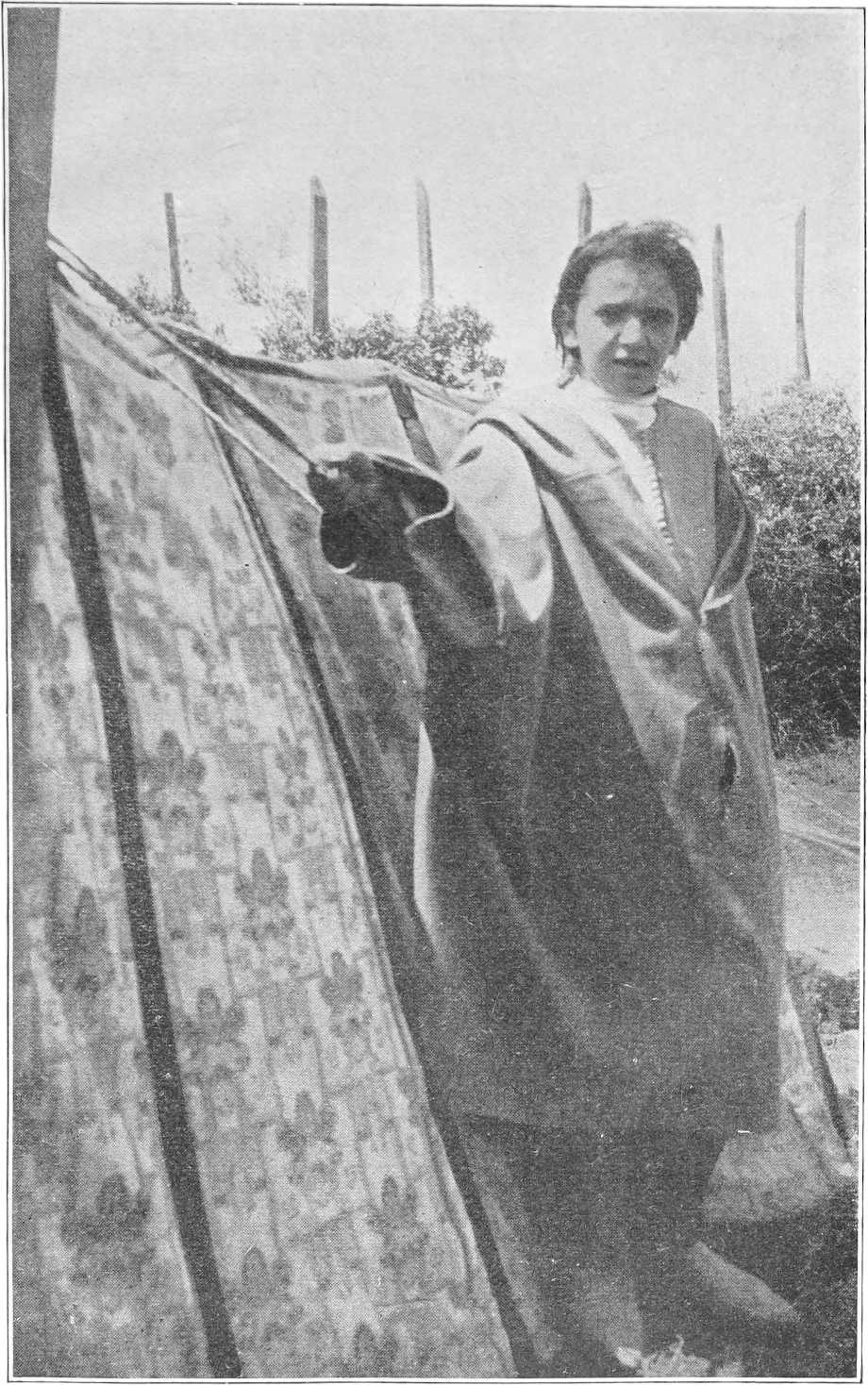
Mohammed el Khalid, Raisuli’s eldest son
“Then the Government wrote to Silvestre and told him that the only way of strengthening the authority of El Mehdi was that I should go and visit him. No Spaniard was foolish enough to write to me on the subject. They sent one of their men to me, a mesqueen who, because he wore suspenders, thought he was a European. The spirit of the Arabs was dead in him, and he had acquired more of your sins than your virtues. He sat in front of me and smoked, so I sent a slave for a brazier and ordered him to wave it round the room. After this he placed it beside the visitor, who was not pleased at the fumes, for I had told them to make it strong. ‘I have difficulty in speaking,’ he said. ‘You permit—?’ and would have ordered a slave to remove the brazier, but I looked at his cigarette—‘I thought you had so cultivated your speech that you had lost the power of smelling . . . but I have all my senses, as Allah intended them.’
“Then he stopped smoking and made excuses, and[178] told me why he had come. ‘If you will make peace with the Kaliph, the Spaniards will give you all that you ask,’ he said. I looked out of my house and was silent, for I marvelled that a man could be so stupid; but, after a long pause, when he had repeated his arguments many times, I said to him, ‘Look out into the fields, and tell me what are those birds circling in the air?’ He said, ‘I see a few kites, and one great bird that is perhaps an eagle. It is flying straight for the mountains.’ I answered, ‘Does the eagle make peace with the field-mouse, when the kite is preparing to pounce on it?’ and he was without words. When he would have left, I said to him, ‘How much have you lost by this failure? Tell my slave, and he will make it up to you, for you were once a man and of my people.’
“After this the Government forced Silvestre to send my family to Tangier, and they came with an escort in all comfort. This was in the spring, when the sun was just beginning to eat the grass, and the tribesmen who were against me were frightened, saying, ‘He has prevailed again over the Government! We are on the wrong side.’ They began burying all their possessions in caves, where they would be safe from my vengeance, and they wrote hurriedly to the Government, but some of their messengers fell into my hands and were killed.
“One of their letters was brought to me, and I found it full of prayers that I should not be allowed to leave Tangier. ‘Ullah, they think they are dealing with Moors,’ I said. ‘But the blades of Europe are slow. If my death is planned, I shall know it a week in advance,’ for they implored that the Government would have me imprisoned or murdered, as a proof of its strength. ‘Your nation is strong,’ they wrote, ‘but he is stronger, for you have been able to do nothing with him. We dare not sleep by night nor eat by day, for fear he will attack us when we are unprepared.[179] Tell us why you have not been able to hold him or kill him. Now that he has received back all his family and his goods he will have a still greater authority over us, for the tribes will say that even the Government cannot prevail against him.’ Ullah, they were frightened, so, to add to their fears, my men disembowelled the bodies of the messengers, stuffed them with straw and took them by night to the lands of the village which hoped for my death. Then, putting the letter in the mouths of the dead men, they impaled them on sticks and left them to greet their relatives in the dawn. It was a warning.
“The village was rich in rifles, so, to dry their blood and stop the wailing of the women, they lay in wait for some of my men whom I had sent on a mission to Beni Aros. It was well planned, and, where the rocks were steepest, my soldiers were fired upon from a distance, and two of them killed, but the others, seeing that there was no enemy to shoot at, flung themselves down as if they had been hit, and lay still, waiting. The villagers, who had been so well hidden that no bullet could have found them, sprang up with the battle-cry of their people. So anxious were they to mutilate the bodies and bring back to their women the proof that would still their voices, that they ran heedlessly towards the slain. My soldiers waited until they could see the gleam of the knives prepared for them. Then the bodies sprang to life and fired, for the enemy was now visible and in their hands. The slaughter was great on both sides, but at last the villagers fled. It was not safe to leave the wounded who could not walk, for the women would have come and destroyed their manhood, so they were dragged down the hill and buried swiftly before the breath was out of their bodies, and, if one protested, he was told, ‘Bismillah, you will soon be in heaven. Trouble not!’
“When the summer was already in Tangier, I sent my[180] family away and rode out openly to Zinat, for the way to the mountains was ready. From my properties near Al Kasr much grain and other foods had been sent up to Tazrut, and I had more rifles than men. The country was flooded with them, and arms were sold openly in the markets of Jebala. In the Zawia of Sidi Jusef el Teledi, after the Hezb had been said, the Imam addressed the people and told him that the war was holy, and Raisuli the chosen leader. Their lives were to be under his feet, and they were to carry him on their heads wherever he would go. A letter from the Sheikh of Beni Jusef was read to the assembly and, when they understood that it spoke of war, each man under his own flag, their ranks broke and they rushed forward to kiss the letter and hold it over their eyelids. Fragments were torn from the paper, and the tribesmen struggled each one for a morsel, believing that it would be an amulet and save him from danger. One man, afraid that he might lose a most precious particle on which it happened was written the Name (of Allah), cut open the flesh of his arm, buried the paper in the wound and sewed it up with leeches. These insects are better than stitches, for, when a row of these are placed across a cut, they bite hard, and no one can force open their mandibles. The bodies are severed and removed, but the pincers remain holding the skin closely together, and, by the time they fall to pieces, the wound is healed.
“About this time Silvestre wrote urging the appointment of a new Pasha, for, under the mandate of the Sultan, I was still Governor of Azeila. Alfau protested. There was no war in his zone, and he still dreamed of a peace won by scribes rather than by soldiers. Silvestre retorted that there must be someone to rule, and suggested dividing my province into three parts under Dris er Riffi at Azeila, Mohamed Fadal ben Zaich at Larache, and my enemy Ermiki at Al[181] Kasr. Certainly his weapons were tarnished, and the rust must have stained his hands, for er Riffi had deserted me when he thought I was weak. Poison had failed him, but I knew he would try some other means to destroy me, for as long as I lived, he would wake suddenly and feel his head rocking between his shoulder-blades. Truly a coward dies a thousand deaths before Allah summons him.
“As for Ermiki, his history is well known. I told you of his attack on Al Kasr, but, long before that, he was known as a man who had no truth in him. Accused of robbing the treasury of the Pasha who then ruled the town, he was sent to Mulai Abdul Aziz, who did not know enough to distinguish between the false and the true. All that Sidi el Ermiki had robbed from the Governor he paid in bribes to the Ministers who surrounded the Sultan. Consequently, instead of being punished, he returned to Al Kasr as Pasha, and his ferocity was such that men paid him their last ‘real’ rather than suffer his tortures. Much of this money he sent to Mulai Abdul Aziz, who was delighted, thinking that at last he had found a source to swell his sinking revenues. He ordered Ermiki to go out at the head of a mehalla and collect the taxes from the rebellious Beni Ahmas. Leaving blazing villages as torches to light his troops, Ermiki went through the country of Ahl Serif, Beni Jusef and Sumata and, to this day, people date their lives as before or after ‘the burning’ which is the name they gave to his journey. Allah was with the Beni Ahmas and they were strong among their mountains, which are invincible, so Ermiki could do no more than fire at the cliffs, which returned his shots slowly, each bullet finding its mark.
“The Ahl Serif, with much blood to avenge, fell upon him from behind, and he was defeated. His army vanished among the crags, and only the kites told where it lay. In the dress of a mountaineer, and riding a mule which had no[182] saddle but a sack, Sidi Buselhan[55] escaped to the plains, but by this time Mulai Hafid had taken his brother’s place upon the throne. The oath had been sworn between us, and the province was given to me as a Governorate, so Ermiki found himself dispossessed of everything at the same moment.
“It was this man whom Silvestre proclaimed as Pasha of Al Kasr, and there was no more hope of peace. I could have raised 10,000 men on the day the news was known. The Riffs came to join me from Gomara, 300 men with their rifles. The men of the plains by the Luccus sent word that they waited only to gather their harvest. My brother left Azeila for Zinat, and Zellal came also with his tribesmen. Flames signalled on the mountains by night, and smoke carried the news by day. The rifles were ready and everywhere they threatened the Christians.”
RAISULI’S STRATEGY
“War, with us,” said the Sherif, “is not as it is in Europe, for it is hidden among the rocks and trees.
“In the West there is a plain, and across that country Silvestre advanced. I could not fight him in the open, and there was little cover, so all my men did was to harass his movements and make raids where his posts were weakest. Sometimes they got right through his lines and attacked the towns on the coast, but my policy was defence, not attack. In this the Arabs are strong, and in the mountains, where even your aeroplanes are useless, they can hold up an army with a few rifles. At first my headquarters were at Garbia, from where I controlled all the tribes who were with me. Each tribe had its own commander and, under him, were so many flags,[56] with perhaps 200 men to each. These were led by their Kaids, or by men whom the Sheikh appointed, and they fought independently, but according to the plan which I made known to them. With me there was no army, only a guard of my own people, and a ‘flying column’ of messengers who took my orders to the tribes. This consisted of 100 men on foot and 50 on horses, and they were paid 10 pesetas and 15 pesetas Hassani a day, for their work was dangerous. Among them were spies who brought me news of the enemy, and men eloquent in speech, whom I could send among the villages to stimulate the fervour of the people. The tribesmen brought their own food and rifles, but, when necessary, I provided the ammunition, which I[184] was always able to get through Tangier. Each Sheikh was entrusted with a store of guns from which to supply deficiencies among his people. My idea was, not to attack Silvestre when my men would have been butchered by his cannon, but to let him see that the whole country was hostile, that death might come at any moment from the most unexpected place. At this game the Arabs excel, and no man’s life was safe, even were he locked into a room in his house.
“A soldier walking along the high-road between Ceuta and Tetuan saw nothing but a cart with many empty sacks in it. The old man who led the horse was half-clothed and had no weapon, but, hidden under the sacks, lay a mountaineer who killed the soldier as he passed. Some Spanish farmers lived in the middle of wide country where there was no shelter, for even the grain was cut. When they came out one morning there was nothing in sight except the stack beside the threshing ground, which they had made the previous day, and the mules who nibbled at the dry stalks. Yet the stack had been hollowed out in the night and, when the farmers approached, they were shot by the men whose rifles peeped out amidst the straw. At Rio Martin, soldiers were killed as they walked between the houses of their people. A camp of engineers was destroyed, when their agents reported no enemy within twenty miles. In every hedge of cactus lay a tribesman, his rifle ready for the unwary, till at last Alfau commanded that all hedges should be cut down and the country left bare as a youth’s face.
“In the towns it was easy, for there were always many who would help. It was necessary to have two parties and to choose a dark night. One group fired from a distance, emptying their rifles wildly at the flashes which had come out of the blackness. Instantly the other group, who had crept much closer, often wiggling like snakes on their bellies,[185] charged the guard before they had time to reload and, without anything more than a few scratches, they would be in the town, five or six against hundreds. They would rush down one street killing all they could see, for the loyal people had been warned to stay behind their locked doors, and, when the pursuit grew too furious, they would take refuge in the friendly houses of which they knew.
“No man gives up a guest, but once el Mudden and two others were hard-pressed, and when they slipped through the back door of an ally, the police were banging on the front, for it happened that the man was suspected. Four friends were sitting talking to the master of the house and the tea-trays were in front of them. The servants hurried in with wails of distress, but without a second’s hesitation, the Sheikh bade el Mudden and his followers lie flat beside the walls. Then he pushed the mattresses against them, arranged the cushions over them and sat down again with his friends. The police found the old man leaning against a few bolsters and drinking mint-scented tea, while they discussed the value of crops. ‘We must search the house,’ said the officer of the Tabor. ‘You are harbouring the assassins who broke in at the gate.’ ‘Empty words! You will find nobody but my servants. The house is at your disposal. Search everywhere, but return and drink with us before you go.’
“So it was all over the country. I ordered my men to take hostages wherever it was possible, so that I might have some goods to market! A brother and sister were captured within sight of the walls of Larache, but the Government would not treat quickly, and they died on the journey into the mountains, so after that I forbade the capture of women. Thus it was the first year. Silvestre advanced slowly, for his transport was bad, and often his men were as hungry as the tribesmen. Little came to him from[186] Spain, and the doctors cried out for instruments and the gunners for ammunition; but after the first harvest, we suffered badly, for the grain had been destroyed and there was no ploughing or sowing.
“In the East, the situation was different. Alfau advanced to Laucien, but it was a peaceable march and he was in communication with me all the time. He made no secret of his desire for peace, and I believe there was much argument between the leaders. As soon as Laucien was occupied, the tribesmen barred the way to the interior. I stationed three forces across the ways to Xauen, Suq el Khemis and Ain Yerida; and Alfau knew that he could advance no further without bloodshed.
“Ain Yerida is the gate of Tangier, for there the Tetuan road runs out of the mountains towards Zinat. Xauen is at the foot of Beni Ahmas and guards the last hiding-place of my people. Suq el Khemis is the sentinel at my own gate, and these three places are the most important positions in the West.
“When he found the tribesmen hostile, Alfau gave up his plan of joining Silvestre by way of Ain Yerida, and all through the first war I ordered Wadi Ras and Beni Mesauer to keep his attention occupied in the neighbourhood of Laucien. There was but one big fight between us, and this was at Ben Karrish, where I had a house. Slowly, and by way of many skirmishes, the Spaniards advanced towards the village. They paid toll at every olive-grove and the price was heavy.”
The Sherif paused to order the tent door to be closed, for the sun was creeping in across the carpets. Menebbhe raised himself from his crouching attitude behind the brazier, whose perfume drifted slowly on the hot, heavy air. “The Spaniards are brave,” he said, “but foolish. I remember we lay out on the hillside above the first fort beyond[187] Tetuan. There was neither wire nor bags full of sand, and every morning the officer used to make a walk (reconnaissance) with a few men, to see that the country was quiet. Ullah, we waited for the music that announced his coming, and while it was scarcely light we heard the bugle”—he beat the time merrily. “The gate opened, and out came six or seven riders, the captain leading on a white horse. They could be seen from every rock on the mountains, and we thought, ‘Allah has certainly delivered them into our hands.’ I said to my men, ‘Choose each of you one, and be sure that he falls. Take you the brown horse and you the grey. I will account for the leader myself.’
“On they came, riding by twos, with the captain in front, but, when we fired, they scattered like partridges. Ullah, my aim was bad. The white horse fell but the captain got up unhurt. His revolver was in his hand, and he looked round, as if uncertain. His men were running back to the fort—those who were still alive. The officer called to them, but they did not hear. Then he came up the hill alone, straight towards us, who were hidden from him. His hat had fallen off and his eyes were staring as if he would look through the rocks to the earth. He was talking to himself as he stumbled upwards, and I said to my men, ‘Wait. This is not the time to waste a bullet,’ so we lay still until he fell right among us, and then, before he could use his revolver, we dragged him down and cut off his head. He was brave, but he had no chance.” “How extraordinarily cowardly!” I exclaimed. “Why didn’t you take him prisoner?” The Kaid crushed up his lips between his fingers, and looked at me sideways. “We took no prisoners. Ask Badr ed Din. How could we? There was not enough food for ourselves.”
The Sherif continued his story as if there had been no[188] interruption. “Ben Karrish was difficult to take, for we held the hillside above it. There was fierce fighting, and a man came to me as I prayed in the mosque, and said, ‘Save yourself, Sidi. If you are killed, we shall be defeated.’ The blessing was with me, and I told them, ‘This is not the only place where the bullets will fall round me, for we shall be driven back to the walls of our country, but we shall not lose it. Fear for yourself, but not for me. I shall never fly before the rifles of the Christians.’ As he stood in the door of the mosque the man was killed, and I continued my prayers.
“In the night we went away, for thirty of my men were dead and nearly 200 Spaniards.[57] It is always the attackers who lose in this country, for the land protects its own. The news of this defeat was brought to the men of Beni Hosmar, and, disobeying the commands of their leaders, they flung themselves on Tetuan. It is not possible to take a walled city armed with cannon, but the Arabs had the blood of kinsmen to avenge. The war cry rippled along the ranks, and no one heeded the slain. It was like a hunt, and each man would be the first at the kill, and they shouted and laughed as they ran, but they could not approach Tetuan. In the flat stretch which is below the city the guns swept them away like thistle-heads in the wind and, when they returned to their villages, there was not a house without its mourning. The death-cry echoed through the night, but, in the morning, the Sheikhs gathered together their people and told them, ‘You would not listen for us, and you threw away the protection which Allah has given you. Now heed our advice and let there be no sleep in the town at night.’ So it was arranged and all the Christians feared the darkness, when the very cobbles in the streets seemed to rise up and shoot them. Many merchants[189] moved their households and their goods to Tangier, and others took refuge at Ceuta, where they said, ‘The sea is our friend.’
“Alfau sent again to treat with me, but the tribesmen did not understand this method of making war. They said, ‘What is in the mind of the Sherif for with one hand he fights the Spaniards and with the other he welcomes their messengers?’ In the West, Silvestre was strengthening his line, for he wished to cut off all my communications with the coast. In this he was helped by Dris er Riffi, who stole everything that was in my house. Even the lamps he took, and the railings which were cemented to the floor. All my properties were confiscated, and in one of my houses there was a hospital, but the Arabs thought this was unlucky. ‘The enemies of the Sherif will surely die under his roof,’ they said.
“In June, Al Kasr was attacked, not because the town could be taken, but to cover the exit of some stores which had been collected for me in secret. My men hid in an olive-grove and when the Spaniards charged through it, firing their rifles as if in play, the trees showered bullets on them instead of olives, for the tribesmen hid among the branches and shot carefully and without hurry. On that occasion many Spaniards were killed, and, under cover of the tumult, my caravan slipped away through my own properties, where there were always men ready to help.
“After this I went to Tangier to see the German Minister, who had been my friend. His country was very strong and I thought her support would be useful. I would have no enemies in Europe, but only one friend, and that my own country. He told me that he could send rifles and grain to the hills, if I could supply the beasts to carry them, and he talked of the aim of Germany, which was different from yours. France, England and Spain always wish to divide the[190] land of the Arabs. You set one tribe against another, hoping to profit by our quarrels. You support a ruler until you think he is strong enough to interfere with your plans, and then you instigate others against him. It is a bad policy. Germany wished to unite all the north of Africa under the Commander of the Faithful.[58] Turkey is not popular in Morocco, though all men prayed publicly in the mosque that she might win the war, but her rule is better than that of Europe, and Stamboul is far away. Each country would have its Kaliph,[59] and all the tribes would have been united under one ruler. This was a good policy, for, unless there is a strong head, the Arabs cannot unite. They do not understand how Europe makes use of them because of this. The prophet foretold it, and, as was written, we are divided into many sects, but there is still Islam, and, when Allah wills, it shall be again as it was in the time of the Omeiads.
“When I returned to Zinat, and heard of the famine in Beni Gorfet, whose villages had been burned by the Spaniards, so that the people were living in caves and eating herbs, I sent them many sacks of grain and as many arms as they desired. Then I wrote to the Kaids of Anjera, for it was in my mind to unite all the tribes to stand firm against Silvestre. Remember this first war was never with the intention of driving Spain from the country. It was forced upon us, and, though the tribesmen used the term ‘Nasrani’[60] as a match to their powder, this was never my idea.
“I thought, ‘If Spain finds she cannot advance, she will make peace,’ and I spoke in this way to the Shiekhs, saying, ‘Be patient, for your sufferings are fertile with the seed of the future. The foreigners will have learned a lesson from our stubbornness, and we shall be able to live with them in[191] peace.’ With regret I found the spirit of Moslems hardening against the Christians, for I knew that this would be the worst arm turned against peace. Yet, so difficult is it to unite our people, I was obliged to make use of this spirit to counteract the bribes offered by Silvestre, who sent his spies among the tribes to visit the Sheikhs and talk to them of the benefits they would receive from Spain. The people who were nearest the plains, such as the men of Jebel Habib, were inclined to listen to his promises, for their farms were open to attack, but, as they dared not break with me, they tried to be friends with either side, and generally betrayed both.
“About this time, a journalist came to visit me in Zinat. He wore Arab dress and spoke our language as one of us. He came in poor clothes, dusty, with torn shoes, and said he had travelled with his companions from Tetuan, and was seeking my protection that he might go further. My men caught him and would have killed him, for they suspected his disguise, but I came out and saw him among them, and thought I might make use of him. I brought him into my house, and he told me his name was Benani, Ahmed or Mohamed, and I did not let him see that I knew his trick. I talked to him much of my life, not as I have told it to you, for, being a woman, you love stories; but I told him my politics in the past. I said again, ‘I am not fighting Spain. I am defending myself from one who is my enemy; and Spain is not fighting Raisuli. She is battling with ignorance and savagery, and she cannot conquer it. The foreigners say to themselves, “If we take the road from Tetuan to Tangier, we shall have conquered,” but the tribesmen retire further into the mountains, and still there is war. Then they say, “If we capture Tazrut, it is the end,” but they are wrong. There are still the mountains on every side. If you destroy an Arab’s house, he goes and takes shelter[192] with a friend. If you burn his crops, he eats figs. If there are no figs, he lives on grass and what game he can shoot. If all his villages are burned, he goes away, saying, “It is the will of Allah,” and he sits down behind a rock and digs a little hole to sleep in. When that is discovered, he finds another and, always, he cleans his gun.’ It was a long conversation, and, after it, I sent the man to Tangier, but I said to him, ‘Do not come back, for I shall not speak twice through the same trumpet.’
“Dris er Riffi was still my worst enemy, for a man’s hatred is always bitterest against those he has wronged. Silvestre wished to destroy Zinat and, with that purpose, er Riffi gathered a force of discontented tribesmen, promising them the loot of my house; but their women were afraid and came out of the villages and clung to their relatives, weeping and saying that a curse would be on their children and misfortune would always be with them. So the harka[61] melted away, and nothing happened. You have seen one of those little whirls of dust, blown up above the fields by a wind, which dies as suddenly as it was born?
“My letters to the Kaids of Anjera had borne fruit and the rising spread among their tribesmen. Every day we grew stronger, and, when I sent some Sherifs to the neighbourhood of Ben Karrish to find out what was the attitude of the East, they reported this answer: ‘No peace with the Christians till even Tangier is returned to us!’
“It was full summer, and the posts of Silvestre crawled nearer across the plains, but el Binagri and his warriors held the roads. No man could pass without his authority, and there was no communication except by sea. The telegraph-posts were used in the rebuilding of our farms and the wire took the place of cut fences. Alfau resigned, for he was strongly opposed to the war, and each encounter[193] seemed to him a new disaster. Spain had many thousand troops in the country, perhaps 50,000,[62] but Silvestre could not cut the line to Tangier, from which I drew all my material.
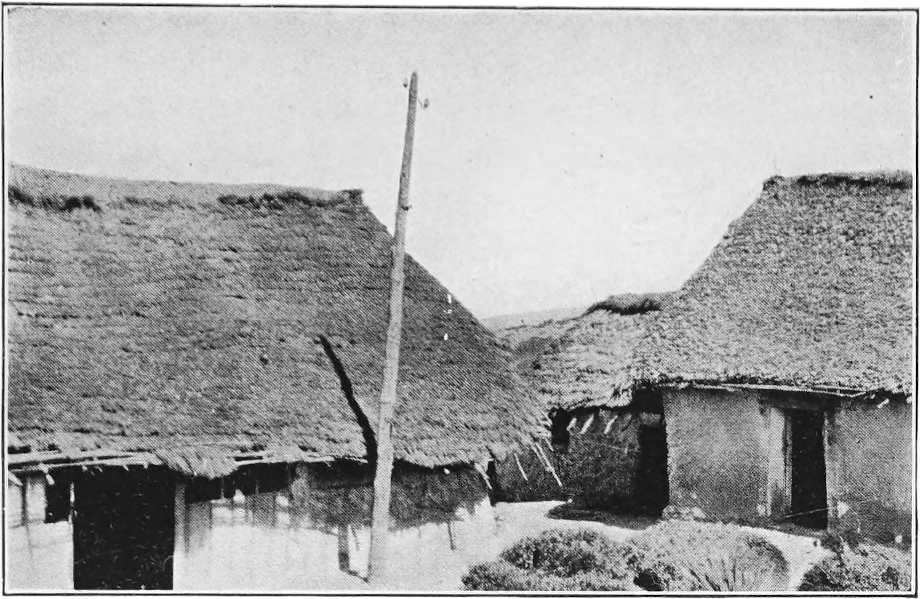
Raisuli’s house at the Fondak of Ain Yerida. “The great do not need great houses”
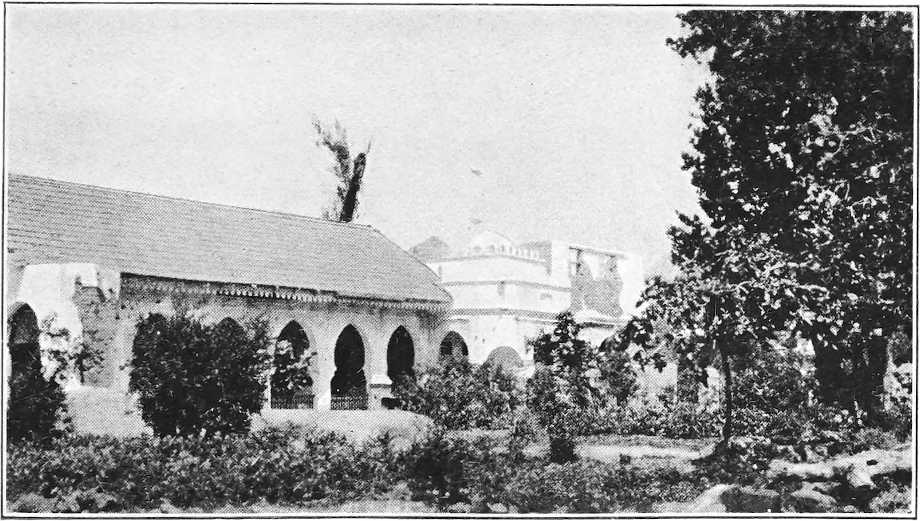
Raisuli’s house—the Zawia—at Tazrut, the sacred tree appearing through the roof of an inner room
“Marina came out as High Commissioner and, for some time, was indecisive. He would not support Silvestre because of my friends the journalists, who still cried, ‘Soldiers, lay down your arms, for you are shedding your blood among strangers, without profit to your country.’ Ullah, do all writers conceive such nonsense? Zugasti was then in the Arab Bureau at Tetuan, and, doubtless, he influenced Marina, for, once again, the negotiations began.
“I was in Jebel Habib and Silvestre had occupied Questa Colorada, which was a great step on the way to Tangier. When the summer was nearly over, there was a battle at Xarkia, and I moved out to see the extent of the fight. I pitched my camp in a wood at Meyabah, and there messengers reported to me. My men had not sufficient ammunition for this kind of fighting, but I could not risk losing the control of the roads. Binagri arrived when the tribesmen were tiring before the Maxims of the Spaniards. It was a pretty sight, for he charged the rear with his warriors, shouting and standing up in their stirrups as if it had been a race. They rode through the rear-guard as hares through corn, and hardly a saddle was empty. The Spaniards swung round to face them, but they were gone, and re-forming among the hills. My men took courage and their firing steadied, but, though Silvestre stayed his advance, we could not drive him back.
“The year of your great war arrived, and still we were fighting. Mulai Buselhan, Kudia el Abid, many places that you do not know of, were taken from us in the West, but the mountains were untouched, and, still, from the East[194] and the offices where Marina and Zugasti bent double over their correspondence, came offers of peace. There could be no peace for me while my enemy was still in the country. It has never been wide enough for us both.
“The war had become more general. All the hillmen took part in it and, at last, they proclaimed me Sultan of the Mountains. It happened in Xauen, where I had ridden to meet the Ulema[63] of Beni Gorfet, Ahl Serif and Ahmas. I came with a tired horse and men footsore from the pace of our journey, and, without warning, the people fell down in the streets and hailed me, ‘Allah keep my lord the King!’ Then the wise men said to me, ‘It is the will of the people. Be Sultan among us, for Mulai Jusef[64] is in the hands of the French and there is none to govern us,’ but I said, ‘Wait a little. These things must go slowly.’
“Next day there was a great gathering in the market-place, below the old castle where one of my race ruled 300 years ago. The people shouted, ‘The Commander of the Faithful may not be under Christian protection. So it is written. Therefore take the place which is empty, and we will obey you.’ They spread carpets in the streets and the women peeped out of the windows and threw scent upon us as we passed. The Ulema prepared a proclamation and it was read to the people before the last prayers. The market-place was ablaze with torches and every house had a lantern. It was an old man who read it, a Sheikh of much honour, and his voice was lost among the murmur of the people like the sea which will not be withheld. At the end they went into the mosque, and every male who was of age was present, so that there was no room within the walls for the worshippers. Men bowed themselves outside[195] till the dust was on their foreheads, and the thronged suq took up the prayer and repeated it under the stars.
“The brown robes of the mountaineers were indistinguishable in the darkness, and it seemed as if the whole earth worshipped God.
“I did not sleep that night, nor was there any rest in my house, for, till dawn, I talked to the Ulema and we said the first prayers together. Always I thought of the peace which must soon come, and I did not wish to complicate my policy with Spain. I wanted to treat with her as the representative of a united country, but not as the Kalipha of Islam, so I urged the Sheikhs to keep secret the doings of the night. I told them, ‘You look ahead but a year or two, and you see us victorious over Spain, but, if that is your object, look still further into the future, for the French bayonets will press hard upon the heels of Spain’s departure.’ They listened to me, but they were not convinced.
“I returned to Jebel Habib, and there I found news that Dris er Riffi wished to make peace with me. From the first I could not believe this, for he is not one to leave a successful master. I guessed that he had conceived a new plot against me, but I agreed to receive his messengers, for how else could I discover his purpose? They came, but they would not look at my face, and their words were evasive. They insisted that er Riffi desired to see me, but they were embarrassed about fixing the place of meeting. I thought it was because they meant to arrange an ambush, so I led them on and suggested a village at the foot of the mountains, without any intention of going, but in order to see what excuses they would offer. But they became worried and agreed to everything, saying, ‘If it is the will of the Sherif, our master will submit.’
“The interview ended uncertainly, and I was puzzled,[196] so, after the messengers had gone, I went to the mosque to pray. I had received the men in a hovel at the outskirts of the village, for I thought they might be spies come to see our strength, and there was nothing of mine there except the carpets that we sat on. When I came to the mosque I ceased troubling over the reason of er Riffi’s mission, though men came to me, asking anxiously, ‘What has happened between you?’ and I reassured them, saying, ‘The wisdom of Allah will make it plain. Come with me to pray.’ We entered, but had scarcely accomplished the first raqua-at, when thunder burst from the village. The explosion shook the mosque, and my companions would have run out, fearing that their people were being bombarded, but I restrained them—‘Nothing will happen to you, and what is more important than prayer?’ They stayed, and we finished the appointed raqua-at, but, though their lips moved and their bodies bowed themselves automatically, each man’s mind was outside.
“It was clear to me, of course, as soon as I heard the explosion, that the mission of er Riffi had been to place a bomb in my house. Possibly his messengers had hidden it under the cushions while they drank my tea and wished me peace in the name of their God! When we left the mosque and I saw the crowd all hastening in the same direction, I said to my friends, ‘You remember I told you that Allah would explain our difficulties? See now, how he has done it,’ and still they did not understand, but, when they saw the ruin of the house where I had entertained the envoys, they cried, ‘Sidi, the baraka is indeed with you! Allah has preserved you, praise be to him!’
“The story was spread among the tribes, so, out of the treacherous hand came good instead of harm, for the people believed it a miracle and knew that a special blessing was with me. My honour grew among Moslems, and many who[197] had been uncertain joined me. The country would no longer proclaim me Sultan, and the hillmen brought me wild pigs, for it is said there must always be one of these animals, a young male, in the stables of the king, to bring him good fortune and because the horses eat better on account of the boar’s smell.
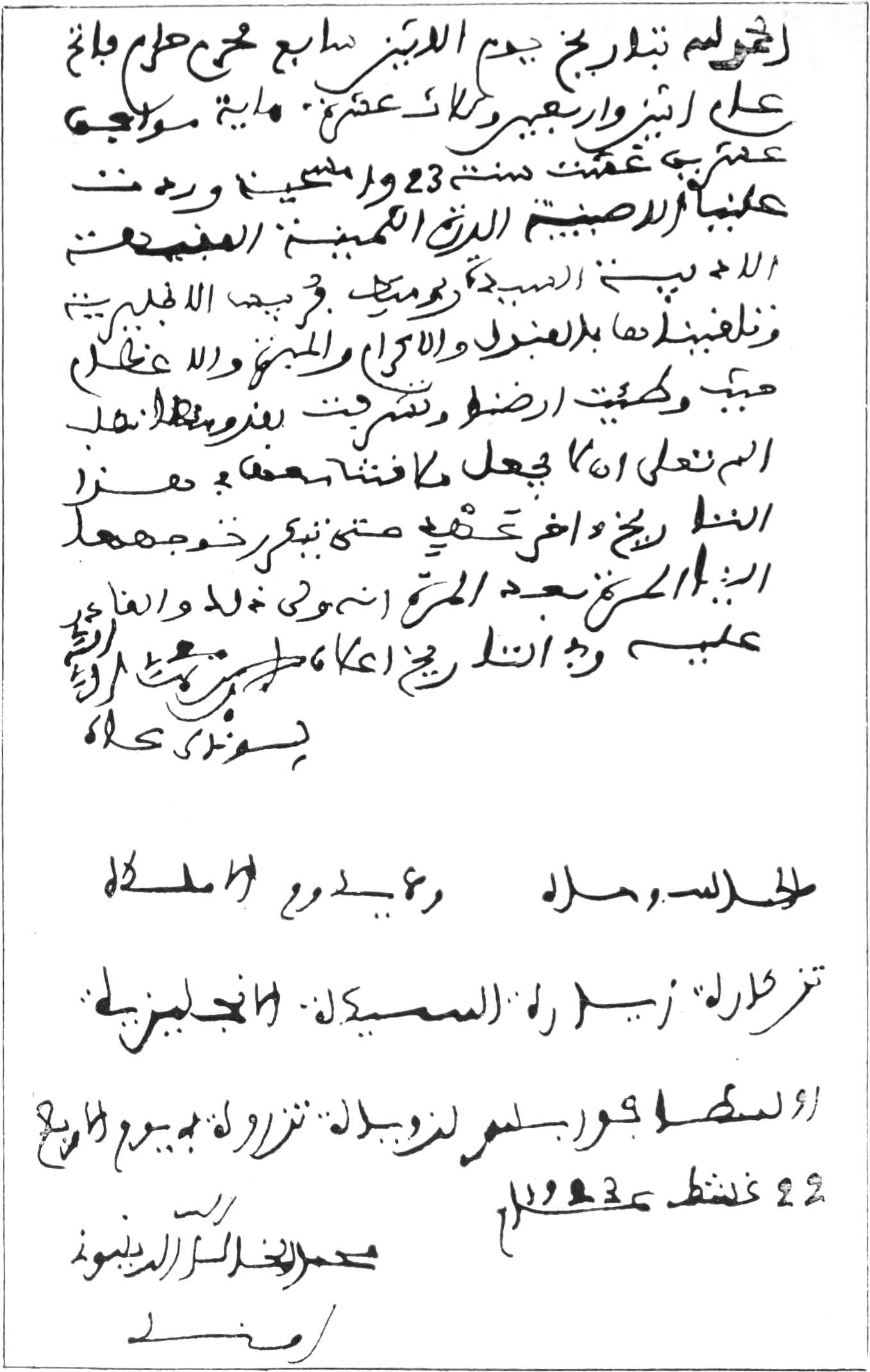
Facsimile of a letter from Raisuli to Rosita Forbes
“At Tazrut the proclamation was read at the door of the mosque where my ancestor is buried, and, throughout Ben Aros, at each of the seven shrines of my family, a messenger repeated it to the tribesmen who gathered from every side with offerings of beasts. But the sacrifice was not permitted, for, in war, there is a dispensation and each family had need of its cattle. Only one bullock was killed, dying on its knees before the Qubba, and its blood was splashed on the threshold and on the lintel. Men dipped their hands in it and left their finger-marks on the wall, believing that they would be recognized in heaven by this means.
“After this I withdrew from Jebel Habib to Tazrut, which is the centre of my country, but, though my illness had already begun and I suffered such pain that I groaned in the middle of my speech, I did not stay there for long. I went backwards and forwards among the mountains with Mubarak and Ghabah and a few chosen men. We travelled so fast and by way of such difficult places that the legend grew that the Sherif was in all parts at once. Men fought more fiercely because they never knew at what moment I would be with them, and often there was a cry of, ‘Here is the Sherif,’ stimulating the fervour of those who grew hopeless, when really el Raisuli was at the other end of the country. It was told that I could make myself invisible at will, and leaders shouted to their followers, ‘The Sherif watches us. He will reveal himself when we are victorious!’
“There were many nights when we slept on the ground, with our saddles for pillows, and there were days when we[198] rode without food, but I always ate less than my men, and watched often while they slept, so that they might realise my strength. There were hours when I could not eat because of the pain, but my foot was always ready for the stirrup and my hand the last to draw rein.”
PLOTTING FOR PEACE
“Towards the end of 1915,” announced Raisuli, fingering a Spanish map, “Silvestre occupied a line through Questa Colorada, Kesiba, Mulai Bu Salam and Tarkutz, to Al Kasr.” He pointed out the places with an unerring finger. “I think that the last big battle was fought near Megaret. Silvestre was anxious to push forward into the mountains, for he knew he had little time before peace would be signed. On that occasion I was fighting with my people, and we were hard-pressed. I rode on to a little rise, from where I commanded the enemy, and I sat there firing steadily till they noticed me. There was a shout of ‘The Sherif is here!’ My people raised their war-cry, but the Spaniards were determined to capture me. A party crept forward to surround my hillock, and, as I turned to find another post of vantage, my horse was shot under me. He fell like a stone, and I could hear the shouting of the enemy. A tribesman offered his horse, but, as I mounted, the servant holding my stirrup was killed, and the stallion, terrified, reared up before I was in the saddle. My slippers fell off as I struggled with him, and then, suddenly, all round us were foreigners, and I shouted, ‘Salli en Nebbi, Rasul Ullah!’[65] and we charged them. Allah alone knows why we did not fall headlong as we crashed down the hill, but we went through them and away before the main body came up.”
“That is one of the occasions on which the Sherif was[200] invisible,” added the Kaid gravely, “but his shoes were found by a rebel, who brought them to the Spaniards. It is said that Dris er Riffi, when he recognised them because of their size, bent and kissed them, though they were muddy and covered with the blood of the servant.” I suppose I looked surprised, for Raisuli explained, “In the most treacherous heart there must be some shame. The cloth which had covered my saddle, and which was very beautifully embroidered, was sent to Spain to the King. I was glad of this, for I have much admiration for him. He is a strong man, and, if we two could meet, there would be no difficulties between us. When I was in Tangier, Zugasti almost persuaded me to go to Madrid to see him, but my friends were afraid and, when the boat was in the harbour, they prevailed on me. If I had gone, perhaps there would have been no war. Recently I have written three times to the King to arrange a treaty that shall be permanent.
“After the affair near Megaret, I had to go back quickly to the high mountains, for I heard that Beni Ahmas and the Guezauia were fighting among themselves, and who knows how the feud would have ended? In our country a battle may begin with ten men and end with 500. In the morning a few men fight because there is blood between their houses. Shots are heard by their neighbours, and each man seizes his rifle and rushes to join one side or the other. After all, man is born for war, and woman for his relaxation and comfort. When a tribesman has nothing to do, he will always fight if there is a chance of loot. So by noon the encounter has swelled, and after that, perhaps, the Kaid comes along with his followers, to see what is happening; but his finger itches on the trigger, and he soon joins the party which is nearest to him. By sunset there is a great battle, and nobody knows for what reason. So it was with the Ahmas and Gezuia.
[201]“I sent news ahead that I was coming, but I found them still fighting, so I left my men at a distance and I rode between them on my big horse. They saw me coming down the Wadi alone, and they were surprised. There were still some who fired, and the bullets went over me and round me, but they did not touch me, and the sound of the rifles died away quietly. After that I made peace between the two parties and swore them to keep it, for it was a small matter that had begun the feud—a few goats which had gone astray, and, believing they were stolen, their owner had burned a farm for vengeance. For this thirty men had died in battle and many been wounded.
“When I returned to Tazrut, I had learned the extent of the famine which was oppressing the country, for some of the tribesmen were like shadows, so thin that their clothes would hold two of them. I saw dead children and women who had no milk for their babes. The hunger was terrible, for there was no harvest of any kind, and the people ate fungus and insects.
“Abd ul Melek wrote to me, saying, ‘If you make terms with Germany, you will have money enough to feed the whole people, for the Germans are very generous. It is certain that they are going to win the war, and they will make you Kalipha over all Morocco, as far south as Mogador.’ I remembered that the German Minister had promised me grain, but, so far, he had sent only rifles. I spoke to my nephews, Mulai Ali and Mulai Mustapha, who were with me in Tazrut, and it was decided to communicate with the Germans, but to make no agreement with them.
“I wrote also to the tribesmen, encouraging them and assuring them that Allah would give victory to the Faithful, reminding them that those who die fighting the infidel live for ever in the highest paradise.
“At the same time, Marina sent Zugasti and Cerdeira,[202] who is called by the Arabs ‘Abderrahman, the nephew of Raisuli,’ to see me. I said to them, ‘There will be no peace while Silvestre is in Morocco,’ and I told them the terms I desired, of which the most important was that the mountains should be left to the Arabs and not be entered without my permission. ‘Take all the towns,’ I said, ‘and when there is agreement between us, I will help you to occupy them, but leave me to keep peace in the mountains, and I will be responsible to you for their security.’
“Even while we were talking, Silvestre was occupying Sahel Haman, and his captain, Rueda, by means of the police, who were always my enemies since I stopped their depredations, was spreading propaganda against me in Jebel Habib. Rueda himself visited Sheikh Tazi and much of their conversation was reported to me. Sidi Abselam Tazi feared for his farms, and preferred the sound of threshing to the music of rifles, but he feared me more, so he tried, by vague promises, to make friends with the Spaniard. He alleged that he had rendered many services to Spain, but he asked, ‘What are your intentions towards the Sherif? It is said that you will make him Kalipha of all the country, and will pay all his armies for him. He has the Germans with him already, and they say there are many French deserters in his camp.’ So my propaganda was, after all, better than Rueda’s! Tazi wished to detach from me Ayashi Zellal, who had the whole of Beni Mesauer behind him, for he knew, if that tribe and Wadi Ras went against me, I should be cut off from Tangier, where Menebbhe[66] was my friend and served as my eyes and my ears. Now Zellal has always been my ally, and his word is the best thing in this country, so that he would not listen to Tazi, but I think some of Sidi Abselam’s[203] men were with Silvestre when he took Rogaia on the road to Tangier. This was in the winter (Nov. 1915), and, from this post, it is a very little way to Zinat. If your eyes are good, you can see the windows of the houses and the hedges which surround them.
“I realised that, at last, peace was necessary, and I sent my secretary, Sidi Ali Alkali, to Tangier to speak of these matters to my friends. Already Silvestre saw himself in the eagle’s eyrie, but Marina opposed his march to Zinat. Then Dris er Riffi made his last effort against me. The Kaid and Badr ed Din both saw it. They will tell you, for, by Allah, I remember only noise!”
“We were both very frightened,” began the secretary, “for we thought the Sherif had been killed. Some strangers had come amongst us, saying that the Spaniards had driven them out of their village, and we talked to them and offered them hospitality, but they did not see the Sherif. He was with Mulai Sadiq in a small house, and we had been ordered not to disturb their conversation. Suddenly, as we sat under some trees at a little distance, there was a great roar, and the house fell to pieces in front of us. It was as if the earth was sick and vomited destruction. We ran forward, shrieking, for no man could live after the explosion, and dragged away the roof, which had fallen in a heap with the walls. All was destroyed except two beams, which, propped one against the other, made a tent among the rubbish. Under this sat the Sherif and Mulai Sadiq, talking quietly as if nothing had happened. Ullah! I have never been so frightened in all my life!
“When the villagers heard what had happened they crowded to kiss the robes of the Sherif and the earth where he sat, and each one cut a fragment from the beams, using it as an amulet. Certainly their protection was assured!”
[204]Raisuli made a gesture of distaste. “There was much treachery in those days, but the worst has not yet been told you. I was now anxious to prepare the way for peace, and, being afraid that the Spaniards would begin to treat separately with the different tribes, I called a great meeting in Jebel Habib, in order to assure a unity of front against the foreigners. Representatives came from the Guezauia, Sumata, Beni Aros, Beni Mesauer, Beni Issef, Ahl Serif and Kholot, Jebel Habib, and I spoke to them of the famine that decimated their villages, and of the necessity of giving way a little, in order to obtain much. Some of the Sheikhs asked me, ‘What of the Germans?’ I answered, ‘The war in Europe is not yet won, and it seems to me that the Germans will not help us unless we agree to raid the French borders. Consider, is this the cheapest way of feeding your families?’ and they were silent, for all knew the strength of France. I continued my speech, saying, ‘It may be well to hand over the towns, where the Spaniards will build hospitals and schools, in order to save the mountains, which have no need of these things.’
“One answered, ‘The Spaniards will not leave us alone—they wish to Christianise all the Arabs.’ But I argued with them and said, ‘They can do nothing against us if we are united. It is a shameful thing that Moslems should quarrel among themselves when the foreigners are at our doors. From this day let it be known that each Moslem who disputes with his fellow is firing a shot for the Christians.’ Then it was agreed that a proclamation should be sent to all the villages and cried aloud in the Suqs, saying that Raisuli pardoned all who had fought against him, on condition that they would now join him. Each village was asked to supply five armed men, who would be paid 1 peseta 50 a day, and the Kaids were invited to come to Jebel Habib for the feast of[205] Mailud, in order to settle the form of the new government.[67]
“The meeting took place in the open, for there was no house large enough to hold us, and sentries were posted that we should not be disturbed. It was very cold, and each man had his jellaba muffled over his face, so that only his eyes could be seen. It was a strange council, for our seats were the rocks and the tea cooled before it reached our lips. There were men present from the Tuagena, Bu Maisa, Beni Mesare, Ulad Ali, Erhama, Guezauia, Beni Zecar, Beni Serual, Ahl Serif, Beni Aros, Beni Mesauer, Ben Ider, Jebel Habib, Beni Said, and the Riffs of Gomara, Beni Hasan and Sumata. Each man held his rifle across his knees and, one by one, with his finger on the trigger, swore the oath of allegiance, ‘I will be with thee in the name of Allah and our religion until the day of my death.’ Then we stood up and said the Fatha together, with our hands raised to heaven, and the Wakils of the new Government were appointed, one who was treasurer, one for the feeding of the people, one for propaganda among the villages; but the direction of war I kept in my own hands, for I thought I saw its ending.
“Of the great tribes, only Anjera sent no delegate to this meeting, and they had 6,000 rifles behind them. They have never been loyal to me, for they are near the coast and much in contact with foreigners.” The Sherif made a gesture of counting money. “It is like that with them. Gold is pleasanter in the sight of their youths than the first bride when she opens her haik. Many times Spain thought she had the whole of Anjera with her, but her money was taken by small men who had no influence. They promised great things, but they had no power to carry them out.
“The best weapon of my enemies was certainly Dris er[206] Riffi, for he was known to have been my servant, and, when he visited the tribes to make propaganda against me, the Kaids would say to him, ‘You were once in the house of Raisuli. How is it that you fight against him?’ and er Riffi would answer, ‘I grew tired of his cruelties and extortions, as you would have done. Let your hearts speak freely, for the Spaniards are generous and help all who come to them.’ Often the Kaid would protest, ‘Germany is stronger than Spain, and it is said that she is with the Sherif. What is the news from Europe? Are the Turks winning?’ Dris er Riffi had his answer ready. ‘This I tell you between your ear and my mouth, for you are worthy of confidence. The war in this country is only a pretence, though it costs you so many lives. Haven’t you observed how Marina stays his armies? How every week he writes to the Sherif? Raisuli is deceiving you. At this moment he receives 20,000 douros from Spain, and is meditating how he can hand you all over to the foreigners.’ ‘Ullah if that is the case,’ would exclaim the indignant Sheikh, ‘I would rather make peace with them on my own!’ ‘It is well said. I will arrange an opportunity,’ asseverated er Riffi.
“The native police officers were also very active against me, so I forbade the loyal mountaineers to have any communications with them, and, out of this, sprang the incident of Beni Aros. A policeman arrived late one night at a village where lived some of his kinsmen. He rested and ate at their farm, and they saw him on his way in safety, but before he was outside the limits of the village, he was shot by one who was most zealous in obeying my orders. The flash betrayed the sniper’s hiding place, and he was set upon by the friends of the policeman, who burned his house, while his women took refuge on the hillside, making the night noisy with their cries. When I heard[207] of the affair, I sent a party to enquire into it, but, by this time, there was war in Beni Aros, some upholding my authority, others protecting the family whose guest had been shot before the taste of their meat was out of his mouth. My men were ambushed as they approached the village, and there was fierce fighting. Two were killed, and three taken prisoners, but the latter were well treated, for it was known that my hand would be heavy on the village. Next day, reinforced by many loyalists, my people returned to the attack, but none fired on them till they reached the Suq. Then shots came from the windows and the roofs, and a Kaid was killed. There might have been a great battle after this, but one of my men, who was skilled in speech, picked up a spent bullet and, in the midst of the fighting, called out to the villagers, ‘Who wasted this cartridge? By Allah, he has saved a Christian life!’
“The men stopped fighting to listen to him, and he got up on a high place and addressed them. ‘Each bullet that we have spent should have accounted for the life of a foreigner! This is how the Christians conquer us, for we spend ourselves in quarrels which have no purpose, while the enemy takes our country.’ His eloquence was so great that all men put away their rifles and the women stole down from the hillside to wash the dead. The same night he led the chief among them to Jebel Alan and made them climb to the sanctuary which is on its highest point. Throughout the centuries Sidi Abd es Salaam had heard many vows. The Beni Aros swore that no man’s rifle should be turned against his neighbours, until the Christians had been driven out of the country, and he who broke his oath was to forfeit his possessions to the village.
“By this time I had made two journeys to meet Zugasti, who always urged me to make peace, but I insisted in my demands—‘The mountains for the Arab,’—and Marina[208] hesitated. Almost Zugasti persuaded me, for he was honest and he told me of the opinion in the towns, where there was no trade, and in the Western plain, where the farmers were ruined and eating the mules which should have threshed their corn. Zugasti had an English mother, and sometimes, when people pressed him to some action which was unpleasing to him, he would say, ‘Leave me alone. Don’t make a fuss. At these times I remember I am half English!’ Certainly it was impossible to embarrass him, for, like Zellal, he spoke nothing but the truth. His words made me think, and I sent for el Mudden and told him to bring me news from the coast.
“He went down to Larache with his men. Hiding their rifles in a suitable place, they dressed themselves in ragged shirts, took sticks in their hands and waited till the herdsmen slept in the heat of noon. Then they stole 80 cows from their pasture outside the walls, and the animals belonged to the Maghsen. They took also some beasts which were the property of a sergeant and, in order to confuse the wits of the pursuers, they broke up the herd which remained, and drove them in all directions, two here and three there. When the herdsmen awoke, they were obliged to chase their cattle from the sea-shore to the hills, and it was a long time before they discovered how many were lost. El Mudden brought most of the cattle to Jebel Habib, and, for a little while, the tribesmen grew fat on their flesh, but the ‘wild one’ brought me no news. So I decided to capture a merchant, a portly man of a certain age, who would know all that was happening in the towns and who would be able to pay well for my hospitality. Such a one was Abselam Bulifa, a protégé of Spain, and his piety was unfortunately his downfall, for he went in the evening to say his prayers at a sanctuary outside the town, and he never came back. In spite of his years, his struggles were so[209] violent that my men had to tie him up and put him in a sack. In this way he looked like a calf kicking, for he did not cease to protest till he was brought into my presence.
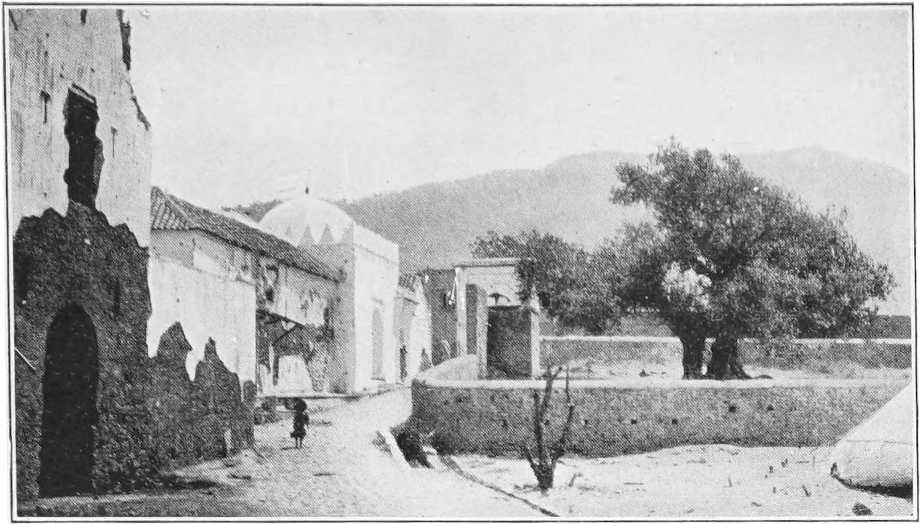
Tazrut—Tomb on left, where Raisuli’s ancestors are buried
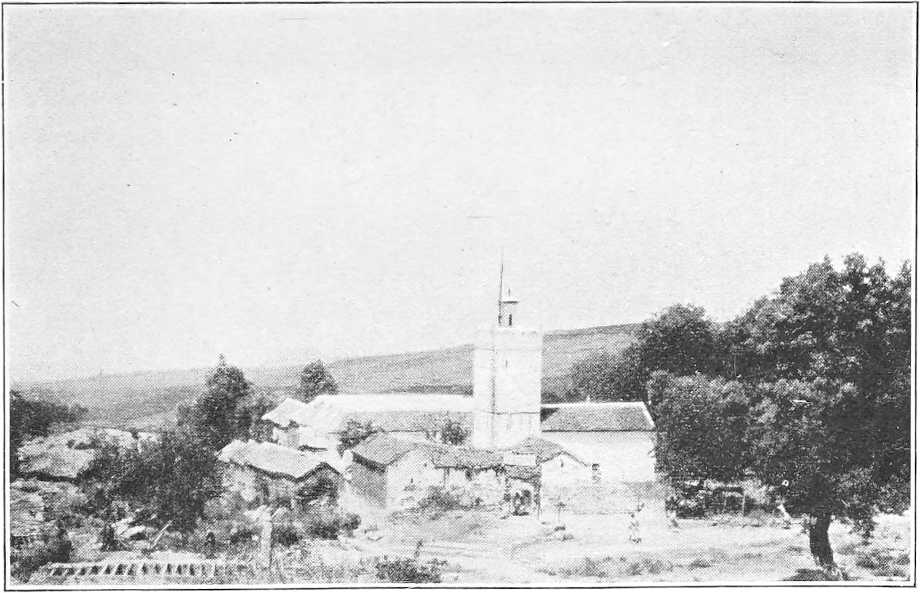
Mosque at Tazrut
“I said to him, ‘Salaam aleikum, O Sheikh, but it is not right that one of your honour should oppose the will of Allah. I had meant to ask 3,000 douros for your entertainment, but perhaps your spirit will be less rebellious if I double the sum.’ He said, ‘The Sherif is joking. I have not so much money, not even if I sell all my possessions.’ Upon which I answered, ‘The money is of little account. Pay it as you like, but show not so much avarice in your speech.’ At first he was evasive, and would tell me nothing, but the food at Tazrut was poor at the time and, when his face began to shrink, there was more room for his tongue. I learned from him that the disagreement between Silvestre and Marina was at its height, and that it was whispered the Colonel would disobey orders and occupy Zinat. ‘If he does that,’ said el Bulifa, ‘the Anjera tribe will join him—for a long time they have wanted to see your house in flames—and the whole army will advance to Ain Yerida. It will then be too late for Marina to interfere.’
“I thought a great deal over this news, and I sent a message hastily to Zugasti, saying, ‘My mind was inclined to make peace with you, but now I hear that Silvestre is preparing such and such things. If this is the case, how can I control the tribes and persuade them to treat with you?’ I ordered the messengers not to pause even to drink water at a stream, and to deliver the letter into Zugasti’s own hands. Then I sent for Ali Alkali, who was still in Tangier, saying to him, ‘Come quickly, for I have decided to sign the peace, and you must go to Tetuan on my behalf.’
“I spoke to you of treachery. Listen now how it happened.[210] Sidi Ali was known everywhere as my agent, and he had a pass, signed by Marina, permitting him to go to and fro through the lines as he would. He was not a fighter and carried arms only to protect himself against robbers. It was the same thing with Zugasti and Cerdeira. They had papers, bearing my signature, and they could go through the country as they chose. I sent escorts with them when they desired it, and no man raised his rifle against them. As soon as Alkali received my letter, he started from Tangier with his servant Hamed.[68] He arrived at Questa Colorada towards evening and was well received by the commandant, who exchanged news with him and begged him not to go till morning, as it was the hour when the Spanish police were withdrawn from the roads, and it was no longer safe for travellers. Sidi Ali insisted that he must be in Tazrut before morning, so the commandant rode a little way with him, as he himself was going to Larache, but, at the next post, the officer was less amiable.
“In spite of the passport, which he declared to be a forgery, the captain detained the travellers, and for two days they were in prison, unable to communicate with me. When the commandant of Questa Colorada heard this, he was very angry and ordered the immediate release of my agent. More than this, he went to meet Sidi Ali on the road, apologised for the mistake and offered him an escort. Alkali replied that much time had been wasted, and that he must ride faster than the horses of the escort would permit. It was then nearly sunset;[69] and the next thing that was heard of the travellers was that their horses had been seen in Zerska, but that Alkali had returned to Tangier. This I did not believe, and I sent my own men to enquire secretly what had happened. Zellal also sent men from Beni[211] Mesauer, but, for three days, there was no news. Then a fisherman on the banks of Sidi Hakhes announced that he had seen the body of a man floating near the estuary. The commandant of Questa Colorada sent his people to search in the river, but my spies were also there, and everything was reported to me.
“At first only a mutilated trunk was found, which nobody could recognise, for all but the drawers had been stripped from it. Then, when they dragged the bottom of the wadi, they brought up a sack made of a haik and filled with stones. In it was a body, headless and wearing a shirt which was supposed to be that of the servant Hamed. The corpses, which had been cut and disfigured to prevent recognition, were taken to Sidi Hamed and handed over to the family of Alkali, but the heads were not found. I sent privately, offering many douros for the head of my friend, for this would have brought comfort to his house, but it was useless.
“Many stories were told about the death of Sidi Ali—may Allah give him peace, which is his right, since he was murdered by Christians. They said that men of Beni Mesauer and Wadi Ras had lain in wait for him, believing that he carried letters from the Spanish Government which would force peace upon them. It was also said that a woman had caused him to be killed, because he had taken her husband and sent him as a prisoner to Tazrut; but these were empty words. Zellal held Beni Mesauer in his hands, and, as for the woman, it was a lie invented by the police to save themselves. Other rumours came to me that the assassination was arranged by the French, who had no wish for peace between Spain and el Raisuli.
“At last men whispered that Silvestre had investigated the murder, in order to make a breach which even[212] Zugasti could not span. This story was generally believed, for it was known that the Colonel would do anything to prevent an agreement being signed at the moment when his success seemed to be assured. For a while I, too, wondered if this were possible, but I have known Silvestre, and he was brave. When his blood was hot, he might have attacked with his sword or with his bare hands, but he was incapable of planning a murder for others to commit.
“It was not long before the truth was revealed . . . Sidi Ali and his servant had ridden swiftly till they came within sight of a Spanish post. Then, the place being suitable, for there was no fear of robbers, they dismounted for the evening prayers. The officer of the post, who was called Sota, saw them and sent messengers asking them to come in and drink tea with him, for he had been warned of their coming by Rueda. Allah alone knows why my friend accepted!—perhaps to rest his horse, perhaps to get information about the country. In any case, he entered the house and drank with his host, who begged him to stay the night, saying the country was not safe. Alkali refused, but Sota would not let him go without an escort. He said that he was responsible for the safety of travellers, and he kept his guest talking till it was very late. Then he came to the door and saw him mount. A dozen policemen were waiting, and they ranged their horses round Sidi Ali and his servant. ‘You will doubtless go quickly,’ said Sota, ‘but I myself will follow you for a little way, as I am anxious about your security. Do not wait for me.’ And he wished him ‘Ma salaama’ (With safety)!
“My friend had ridden only a little way when he noticed the demeanour of the police, who kept looking back as if they expected some signal. Alkali asked what was the matter, but the answers were evasive. At last, when the road was deserted, a shot was heard from a distance, and the[213] police flung themselves off their horses and seized the bridles of the men they were supposed to protect. ‘We are going to be attacked! We must hide!’ they cried, and pulled Sidi Ali and Hamed from their saddles, in spite of their protests. Two stayed to hold the horses. The others dropped all pretence and, hitting their prisoners on the heads and shoulders to stop their cries, they dragged them a little way from the road and strangled them.
“By this time the Lieutenant Sota had come up and ordered the heads to be cut off and the bodies mutilated, for fear of recognition. This was done, and the remnants tied up in native garments, which had been brought specially so that the blame would fall on Arabs. When the police rode back, they carried with them strange bundles tied to their saddles, and these were taken to the river and sunk in it with stones. One man was sent on with the horses, and he loosed them far away, leaving their saddles and bridles, which was a mistake, for by these they were recognised. So the story was told to me by one who had known the truth for some time, and I believe it is exact.”
The official version of the tragedy was sent by wire from Commandant Orgaz of Questa Colorada to General Marina, who had been telegraphing daily to insist on a thorough investigation. The message ran thus: “The death of Ali Alkali was effected by the Moors, Benbihas, El Metagui and Koroan, in the presence of Lieutenant Sota y Morales, ordered by Capt. Rueda, and the assassination was inspired by the Pasha of Azeila.”
General Marina lost no time in ordering the arrest of the accused Spanish officers and the suspension of Dris er Riffi, but he saw in this murder the ruin of all his hopes for a peaceful settlement. Though he made no secret of his intention of punishing his fellow-countrymen with the utmost severity of the law, he felt that Raisuli would neither[214] forgive the outrage nor place any further confidence in the word of Spain. He set out immediately for Questa Colorada, and requested Silvestre to join him there. The meeting must have been dramatic. “We have failed!” exclaimed the High Commissioner, ignoring the other’s greeting. “I do not consider I have failed,” retorted Silvestre. “I have always stuck to the same policy.” But General Marina would not be comforted. Overwhelmed by the treachery for which he held himself responsible, since he represented Spain, he insisted on his colleague’s resignation, and sent in his own at the same time.
Dris er Riffi and the two Spanish officers were imprisoned, the Moors were executed, and, as Raisuli said, “There was but one lion left in the forest.”
THE TREATY OF PEACE
Raisuli sat staring at the carpet when he had finished the story of the ill-fated Alkali. I was afraid of meeting his eyes, so I occupied myself with killing two or three bugs which had ventured from their comfortable quarters inside the mattress. “It is better to spare the life of a flea than to give a dirhem to a beggar,” quoted the Sherif suddenly. “I am tired of killing.”
There was another pause. “When I heard the true history of my friend’s death, I broke off relations with the Spaniards. For six days I saw no one, not even my own family. I had thoughts of proclaiming a Jehad (Holy War) and thus revenging the blood of my servant, but I was oppressed by the future. It is strange that the face of Allah is so persistently turned against his people.” The last sentence was muttered and almost inaudible.
“Jordana[70] was appointed High Commissioner. Villalba[71] took the place of Silvestre, but there was no further war. Since my enemy had left the country, the armies on the West were harmless, and there was traffic between their camps and ours. I waited for Jordana to move first; I made no sign that I knew of his arrival, and, when he sent to me Zugasti, Barera and Cerdeira, I received them gravely and asked what had been done to avenge Sidi Ali, though already I knew of the steps taken. They apologised many times for that betrayal, but they insisted that it was no[216] more to be attributed to Spain than the most foolish attempts of Dris er Riffi with his bombs.
“I asked if er Riffi still lived, and they were embarrassed. ‘It is certain that he suggested the crime,’ said one, ‘but there is no evidence against him.’ ‘Cannot all your scribes and your men learned in law invent some?’ I asked, for I wanted to disturb them. Certainly I would have defended the life of Sidi Ali with my own, but, since he was dead, he had put a new weapon in my hand. The Spaniards argued most eloquently in favour of peace, and I believed that, with the departure of Silvestre, I might realise the aims which he had frustrated.
“I took Zugasti aside and I said to him, ‘Do you remember the day we said the Fatha together at Azeila? Much blood lies between us now, and the country has suffered greatly, and you have not achieved the good that you promised. The land is divided into many parties, and where the tribesmen once kept the money which he received for his produce he now hoards bullets that he may add to his troubles.’ Zugasti said, ‘The fault is with you, for you have not always worked loyally with us,’ and I answered, ‘Do you nourish the snake which has crept into your house?’ He said, ‘There have been many mistakes between us, but there is a new policy now. With your help, there may still be peace in the country,’ and he repeated to me that the desire of Spain was to cooperate with the Arabs for the development of the country and the improvement of the people.
“At last I said to him, ‘I will not ever again say the Fatha with a Christian, but swear to me in your own way that the new policy is good.’ He said, ‘I am your friend, and so is Jordana. All that is promised will be fulfilled.’ I answered, ‘Return then in a few weeks, when I[217] have consulted the tribes,’ for I knew my greatest difficulty would be, not with Spain, but with my own people.
“When I spoke of peace to the Kaids, they said, ‘You are selling us to the Christians.’ I replied, ‘If it were not for me, the Christians would be in these mountains,’ but they were stubborn. This was in early summer,[72] before the great heat, and I sent messengers to every village in the mountains to make known my intentions to the tribesmen. Sometimes these messengers were ill-treated, but more often men listened in silence, for they remembered they had chosen me as Sultan.
“When Zugasti came to see me again I had gathered a great army of those who were loyal to me, and I was strong enough to enforce my orders. Also I had sent much grain to the hill villages, and the women blessed the name of the Sherif. So peace was signed in the autumn (September, 1915, the Peace of Khotot), and, by it, I regained all that had been taken from me. My properties were restored, and it was agreed that those of my houses which had been damaged should be rebuilt. The mountains were closed, and no one might enter my zone without my permission, but, with my help, the Spaniards were to occupy all the lowlands.
“For this purpose they supplied me with eight hundred rifles and much ammunition, charging themselves with the pay of one of my forces, which numbered a thousand. It was arranged that I should be Governor of all the tribes who submitted to the Maghsen, and that a large sum of money should be paid me, so that I could at once relieve the hunger of the Jebala. This treaty was not without its difficulties, for, when it was announced by criers among the villages that there was friendship between Raisuli and the Spaniards, the people were divided. Some said, ‘The Sherif is clever and[218] strong, for he has forced the foreigners to make peace, and now he is the only ruler in the land,’ but others protested, ‘He has betrayed us. He has taken money from the Christians.’
“I saw that the best policy was to impress them with my power, so I kept a great force always with me, and I fed a thousand men daily in my camp. I had a great tent made, as large as a house, and I put sentinels round it, and would see no one but my family and a few of the great Sheikhs who had always been my allies. When the Kaids came to see me, they were entertained lavishly, but kept waiting for several days, and then, perhaps, they only spoke with my secretary. I had musicians in the camp, who played the reveille at dawn and the buglers sounded every call to prayer. Afterwards, in Ramadan, I asked the Spaniards for a battery, and guns were fired daily for the beginning and the end of the fast. In those days I lived like a Sultan, and the people were much impressed and, from all sides, men came to join me. I imprisoned Tazi, the Sheikh of Jebel Habib, who had tried to serve both parties during the war, and the people said, ‘The Sherif has certainly conquered, for the foreigners cannot even protect those who served them.’
“There were still many who were against me, but, while I was with my mehalla, they could do nothing. When I went back to Tazrut, travelling with only a few men, they thought that their opportunity had come. A force from Beni Hassan, Beni Aros, Beni Leit, Beni Sif, Sumata and Beni Mesauer gathered quickly among the mountains and hastened to Tazrut. They killed all my people whom they met on the way, and they carried pickaxes to destroy my house, intending to leave no two stones together. News of their coming was brought to me, and my servants wished to take refuge in the mountains, but I said to them, ‘How[219] many times have you asked me to fly, and has any evil yet happened to me? Put your faith in Allah, who is strong.’ Then I posted my riflemen in the best places, from where they could command the approach of the enemy, and, when movement was seen among the hills, I ordered them to fire. There were less than a hundred men with me, but even the women took up rifles and boys carried guns which were bigger than themselves. The fight was not long, for Allah strengthened us. Before night the enemy retired, but they left many dead behind them. In this way the victory was given to a hundred men over nearly a thousand, but that is my ‘baraka.’”
Other accounts of this curious encounter differed very little from the version of Raisuli. Again and again, disaffected tribesmen would decide to attack him, but their courage always failed at the last moment. Firmly believing that he was under divine protection and that his life was miraculously preserved, their rebellions were invariably half-hearted and, when they saw him at the head of defence or attack, they fled, after exchanging a few shots.
“My cousin, Wuld Sid Lahsen, who led the force against me, had been proclaimed by his followers as Sultan in my place. He had been chief of my harka at Ben Karrish, but had deserted me when I made peace with Spain. As soon as the rebels had scattered before our bullets, I sent a summons to Jebel Bu Hashim, where I always keep a small force as an outpost. They came in to Tazrut by night, and I mounted them on my fastest horses and led them myself against Tagzat, the residence of my cousin. We came down upon them like a thunderbolt from the hills, and were through their defences before they knew what had happened. The first ranks carried rifles with which they shot any who opposed them, but the others bore blazing torches and, as they galloped through the village, they tossed them onto the[220] the thatched roofs, and fire leaped up behind us. Our pace carried up on into the darkness, and we looked back upon a sheet of flame, against which every man was a mark. We sat down comfortably, not even trying to hide ourselves, and shot everyone who came out of the village. Lahsen escaped only because of the swiftness of the horse upon which he fled, leaning far down from the saddle, so that it appeared to have no rider.
“When the dawn came there were no men in Tagzat, but women crouched weeping beside the still smoking ruins. I sent to find the family of my cousin, but they had hidden themselves under a pile of half-burned timber, so that it was some time before my men discovered them. When they were brought to me, the daughter flung herself on her knees and kissed the hem of my mantle, praying that I would have mercy on her mother. ‘You do not ask for yourself?’ I said, but she answered, ‘My life is under your feet, Sidi, but my mother is old and weak.’ I took them to Tazrut, and perhaps I wished that there was no feud between our houses, for the girl was pretty when she knelt to me, and her eyes were like those dark flowers beside the well. I gave them in charge of my family and said, ‘Give them of your clothing and your ornaments,’ for part of their garments had been burned and there was hardly enough left to cover them. My daughter came to me later and said, ‘The girl is like a sister already, but we cannot calm her fears!’ and I said to her, ‘Tell your guest that her father is safe as long as she remains in my house,’ for already I had decided what I would do. Not long after, when peace had been arranged with my cousin, the girl was given to me as a wife, and so the dark flowers bloomed in my garden! . . .
“When I returned to my mehalla, I found that there were many difficulties between the Spaniards and my people, but Jordana acted loyally towards me, and, when some[221] Sheikhs of Beni Ider went to Tetuan, asking to be protected against me, he sent them to my camp with a letter, and I made peace with them. Affairs in the West were less easy, for it had been arranged that I should not interfere with the zone occupied by the Spaniards and that they should not enter the territory which I ruled. Consequently there was intrigue along our borders, and thieves who wished to escape the justice of Spain sought refuge in my country, while those who feared my vengeance fled to the plains for security. It was said that I harboured deserters from the irregulars in the service of Villalba, but it was not true, for, if such men found shelter in my country, it was under the roofs of their friends, and their hiding-places were unknown to me. The police were always ready to make trouble, and at last I forbade them again to cross my borders or to have any dealings with my people.
“Still there were incidents which annoyed Jordana, for most of the tribesmen thought ‘The Sherif is more powerful than the Spaniards. He rules them and they do as he directs.’ It happened that in Jebel Habib an officer with a few soldiers rode from his frontier post to the Suq el Madi, but the Arabs murmured as he passed and drew away from his horse, turning their backs. The women were more violent in their actions, for they cried out that they wanted no Christians, and threw stones and mud at the foreigners. Before the officer could either explain or retire, there appeared some of the band of el Mudden, who would have hustled the Spaniards away, shouting that, without a pass signed by Raisuli, no stranger could enter the town. Many words were exchanged, so many, fortunately, that the bullets cooled in the barrels, for when a Moor employs his tongue he has no use for his trigger finger. Nobody was killed, though the tribesmen fired a few shots after the retiring Spaniards in order to show their good-will.
[222]“I wrote at once to the Kaid of the village, but the Arab does not understand two masters and, because Jebel Habib was always hoping to profit from the foreigners and there were many who worked secretly to undermine my influence, there was often trouble on that border. Nevertheless, there was a great sowing that year, and men grew fat in anticipation of the harvest. I had agreed with Jordana to help Spain to occupy the road between Tangier and Tetuan, but I did not wish them to hold it too strongly, lest, in case of another war, I should be unable to communicate with the coast. I kept my promise and, by my aid, many places were occupied without firing a shot. Amersam, El Barch, Sid Tellia, Melusa, Ain Guenen all became Spanish posts. At the repeated request of Jordana, I agreed to effect a junction between the armies of East and West, but I stipulated that Ain Yerida should be held by my troops in the name of Spain, for Fondak is the key to the whole country, and the wise Arab does not give the key of his house to any but a Moslem.
“The Spanish army was encamped at Rogaia, so between them and Tetuan lay the rebels of Wadi Ras, who would not come to terms with an infidel, and whose Sheikh proclaimed that he would rather lose his life than join Raisuli under a Christian flag. The men of Wadi Ras were strong, so it was arranged to attack them on two sides. I pitched my camp in Beni Mesauer, and there, among the great rocks, I had eight thousand men of my regular mehallas, with a small force of cavalry and some irregular levies drawn from tribes recently submitted. The Spaniards were to advance along the road to the Fondak and occupy the heights of the Amersam which overlooked the wadi. I sent them guides who knew the country, and suggested that they should move in several small columns, in order that there should be no[223] suspicion of a great attack. It would be rumoured only that some small place was to be occupied. I posted spies by the way who were to give me warning of the Spanish advance and, when I saw the smoke curling up from the appointed hill-top, I came down from Beni Mesauer with the whole of my army.
“I had expected to hear shots as Villalba occupied Amersam, but this was achieved in the early morning with no sound to arouse Wadi Ras. I pushed my cavalry to the top of a hill on the other side of the valley and, from there, I could see the Spaniards fortifying the position of their guns, but when the rebels woke, it was to find the sun glinting on steel behind them and in front. There was instant alarm in the wadi—shouting and waving of flags. Men rode swiftly towards the West, where the land opens into a plain. Here the millet was so high that it covered their saddles and, when they dismounted, they disappeared altogether amongst it. The brother of Haj el Arbi gathered a few hundred of the fighting men and, ignorant of the hidden guns, charged the bayonets of Spain. They rode in a long line, each man a few yards from his neighbour, crying on the name of the Prophet and shouting their war-cry. Long before they saw the enemy they had emptied their rifles and the warrior who led them made his horse dance, and waved his gun above his head as if it had been a game. The Spaniards waited till they were quite near, and then the guns spoke and the army toiling behind me through the ridges of Beni Mesauer must have heard their voice. The long rank broke, hung for a moment, then dispersed, each man seeking cover from the sons of the cannon.[73]
The river was very low, and its overhanging banks provided shelter, so that, when the Spanish cavalry charged,[224] expecting to ride through a beaten enemy, they found every crevice held a rifle. With several wounded they were forced to retire.
“By this time the signal fires blazed on every hill. The women seized great bundles of straw, and, indifferent to the bullets, carried them to the nearest eminence and set fire to them. One girl was shot as she reached her goal, but she had just strength enough to light her burden, and was scorched by the flames as she fell beside it. Her body was scarcely recognisable, but she had been promised marriage to one of my men, so I heard of the deed. You see, our women, also, are brave!
“I saw the plight of the enemy, so I gathered a few hundred riders, with the great Kaids who were with me, and some of my own slaves who ran, holding our stirrups. We came down the mountain at a gallop, the red flag flying before us and the green standard of Islam in the rear. I stood up in my stirrups and shouted, and my mantle flew out like a sail. Rank upon rank took up the cry—‘God is great,’—and each rider drove home his spurs. Like ships in full sail, the Kaids swept down the hill, and the music of the drums and cymbals went with us. Each man had a different cry, but the ‘Saleh en Nebbi’[74] pealed highest. No one could have withstood us that day, for all the great of Jebel Alan were with me, and the flag was the flag of our ancestors who had fought for it, died for it, but never lowered it. Allah, it was good!”
Raisuli had been almost chanting the last words, but, with a long sigh, his voice dropped to its usual level. “We rode straight across Wadi Ras and, after our passage, there was no man left on the banks. El Arbi was wounded, for he held his fire till we were almost upon him, and he only[225] saved himself by creeping between the cane, where he lay hid till the night. Still from the millet-fields and the lower ridges came a galling fire, so I turned my horse in the bed of the stream and answered it, with a few of my men. My slaves stood round me, holding my rifles and field-glasses, the stool with which I mounted, a gourd of water, for always I had a great thirst, and my prayer-carpet, which was of silk and came from Egypt.
“My horse was impatient, and his movements interfered with my aim, so I dismounted and stood, firing first a Spanish rifle and then a German, as Ghabah and Mubarak loaded for me. It was better than hunting, but a slave said to me, ‘Sidi, the men among the millet are watching you. In the name of Allah, take shelter.’ I replied, ‘You are right. I did not see them,’ and I turned round and altered the sights of my rifle, so that I might fire at them more easily. Then the slave touched my sleeve and said, ‘Sidi, it is the hour of prayer,’ and I knew that he said it in order to lead me away from the battle, so I answered, ‘Spread my carpet here.’
“They were afraid, but, putting my rifle in front of me for a kibla,[75] I turned towards the East and began the prescribed Raqua-at. One man was killed beside me, and his blood stained shoes, which I had placed at the edge of the carpet. I did not move nor interrupt prayers, for I wished to give them a lesson, but, hardly had I finished the last words, when Cerdeira ran towards me, crying, ‘You must take cover. Your life is too valuable to risk!’ And I answered, ‘What is going to happen today was written before you or I were born, and we cannot escape. Also I have noticed that, when men aim at me, it is my friends who die. The man on my right and the man on my left may fall, but I remain unhurt.’ I fired several more shots at[226] the enemy, but there were few in the whole of Wadi Ras. Then I called to a slave to bring my horse. My foot was in the stirrup when I turned to say something to Cerdeira, who stood beside me, and, at that moment, he was shot. ‘I told you the one on my left would fall,’ I reminded him, but, Hamdulillah, it was not a great wound.
“I pitched my camp opposite the heights occupied by the Spaniards, and the drums summoned the Kaids to pray with me. This was performed in the space outside my tent, and I acted as Imam for the rest. Then all the heads were collected that we might know how many had been slain, but the Spaniards protested against this custom and requested me urgently to bury them. The same thing happened whenever I fought with my Allies, and much time was wasted on burial.”
The point of view was so amusing that I could not help asking if it would not have been simpler to have ordered his men to refrain from cutting off the heads at all. “My people would not have understood,” said Raisuli, “for it is a custom. I have told you often that we are savages, but it is not very long since you were worse than we. I have read your history, and I know how long men took to die under your tortures. Your executioners were well paid for the inventiveness of their cruelty, and you did not spare women and children.[76] Now you have forgotten the crimes you committed a hundred years ago, and you call us barbarians. In another century or two, perhaps we shall say the same of you.”
In connection with the Sherif’s remarks, it may be apposite to quote a remarkable document now in the possession of the Capitania General del Deposito Maritimo of Cadiz. It is dated Ceuta, March 11th, 1799, and is a list of the charges to which the executioner is entitled.
[227]“Plaza de Ceuta.
“To hang one 150 reals.
“To cut a hand 75 reals.
“To dismember and cut one in quarters 375 reals.
“To cut the head 75 reals.
“To hang up the head, the members and the four quarters, 210 reals.
“To fry the hand 75 reals.
“To hang the head in public 30 reals.
“To flay a man with whips 32 reals.
“To any other form of justice 22 reals.
“In addition to this, the price of acid, coal and a stove. The executioner of this place is a government employé. He shall receive daily from the King 8 pennies and a bread; two reals from the city; and four from the military, every day; as well as a flail and a pair of tongs, with the obligation of keeping the scaffold clean and tidy.
ANTONIO MONDRAGAN,
Colonel of Infantry.”
“There had been peace between us for many months before I saw Jordana,” said Raisuli. “I could not visit him, for I have never recognised the Kaliphate of Mulai el Mehdi, but he is a good man, and I would not insult him by going to Tetuan and passing his door without entering. Therefore I never go to the city, though my ancestors are buried there. Jordana would not come to visit me, for he thought it was not consistent with his dignity.
“At last a meeting-place was arranged between his country and mine, and tents were sent out from Laucien to the hill of Guad Agraz. The conference was to be at midday, which is certainly a bad hour for talking, for a man, having[228] just prayed, is thinking of food. We say, ‘Lunch and rest. Dine and walk.’ I started with my mehalla before there was any light to discover the colour of our jellabas and, at every village on the way, a party waited by the roadside, with their mantles muffled across their faces. The Kaid came forward to kiss my shoulder and ride beside me. His men ranged themselves behind him. When each wadi and each hill had contributed its party of armed men, we were a great host, and the dust of our hoofs was like a cloud around us and behind. The standards of Islam and the Sultanate were borne in front of us, and each Kaid had his own flag. Beside me rode el Arbi, great in years and in beard, and each man knew his place, so there was no disorder in the ranks, as ever new bayonets joined us, with the sun glinting on them like snow in the mountains. The pipes played on either side and the drums were beaten loudly, so that the horses became excited and, when we saw in front of us, but a long way off, the tents of Jordana, they could no longer be restrained. Three hundred riders gave rein to their stallions, and, for a moment, the dust blinded us. High above it swirled the green flag and the red. Then fire pierced the cloud and, with shouting and songs, shooting over their heads, the tribesmen raced for the tents.
“I wonder if it was the first ‘Jerid’ the General had seen. To do it well, a man must be able to stop his horse at full gallop in the length of a gun. Riding now ahead (in orange waistcoat and dark-brown mantle, with the rolled turban of the Jebala), I watched them in full charge, and then, scarce five men’s lengths from the Spaniards, saw them pull up in a swirl of dust. The lines were unbroken. Each horse fell back on to its haunches, with its rider bent flat over the pommel. Cerdeira and others came out to meet me, and I dismounted in front of the great tent which had been spread with carpet and mattresses, as is our custom, but[229] there were also chairs, and, Ullah, I looked anxiously to find one big enough. Jordana came forward to meet me and would have shaken my hand, but I saluted him as I should have done the Sultan, yet even after that, he insisted on taking my hand.
“We sat down and looked at each other, for both wondered what would be written between us. He was a good man but perhaps not a great one, and he was always my friend. He loved Spain and for her sake he kept peace with me even when he believed I was wrong. He had a strong will and would not let others dictate to him. Like Silvestre, he was impatient, but he restrained all emotion, and only his eyes told his feelings. Had Jordana come to Azeila at the beginning, there would have been no war and no distrust, but, however much we two wished to walk together, there were many difficulties on either side.
“A few years ago the Arab and the Spaniard would have met, both (‘aqil’) wise and desirous of using their wisdom for Morocco. Now it was a conference between a Christian and a Moslem, and between them was the memory of treachery and death. Yet I liked Jordana and I respected him as I have done few Christians. Like Zugasti, he did not even see money when it lay before him, and, though he was not young, he had that hope which is in the heart of a boy when he stalks his first partridge and shoots it tremulously before it rises. Men say that I killed Jordana. He tried to change that which is unchangeable. It was not I who killed him, but the country and the burning of his own heart.”
GOSSIP OF THE HAREM
There came a day when el Raisuli would not talk. Seated on a slab of stone in the garden, with his chin sunk between his shoulders and his eyes downcast, he emitted a series of guttural grunts in answer to all questions. The mass of flesh, relaxed and shapeless, under the jellaba, appeared hardly human. Once the intense virility of the eyes was hidden, the face became expressionless, and there was something monstrous in the muscular folds which creased round the neck and wrists. Without paying the slightest attention to remarks made to him, the Sherif began twisting and tearing a piece of silk. His fingers were very strong, in spite of their shape, and, as I watched those gross rolls of flesh destroying the stuff, I realised quite suddenly the ruthlessness of the man. There was no reason for it. It was an instinctive picture. The tufts of hair on the knuckles rendered the hands peculiarly coarse, and they worried the silk as an animal worries the throat of its victim. With a shiver, I looked at the Sherif’s face, and now I felt it was blank not so much from indifference as from a tremendous concentration of will-power. The spirit of the man had withdrawn itself, and somewhere beyond those creased, moist lids, it was watching and appraising.
“Did you feel he could see us all the time, though his eyes were closed?” asked the Spaniard when, after unheeded farewells, we walked back to the end of the compound. “Yes, I did.” Thoughtfully I went into my tent,[231] feeling that I wanted to talk to someone exceedingly simple and human.
It was very hot and, as there seemed no possibility of lunch, I lay down and tried to sleep. The flies rendered this difficult, and, suddenly, I noticed one of the little slaves peering round the edge of the screen while he tried to attract my attention. I thought that perhaps the Sherif wished to speak to me, so I followed him into the yard, but, with finger on lips, he hurried me out of the main door and into the old house through a little court adjoining the Qubba. In another moment I found myself in the women’s quarters.
It was a big room, carpeted with modern rugs and hung with stuffs of different violent colours. Most of these were embroidered with tinsel to match the cushions below them, so that the place was like a box of striped candies tied up with Christmas-tree ribbons. At one end stood an enormous iron bedstead, canopied, frilled, quilted in the crudest pink, and covered with what looked like a pair of Nottingham lace curtains. Huddled in a corner of this erection was a small, pale girl in the dress of a bride. She did not look up when I came in. Her eyes stared straight in front of her with an expression of shy dreaminess. The ochre on her face, her stiff brocade robes, and the jewelry which seemed too heavy for her fragile figure, accentuated her youth. She had the feet and hands of a child.
“We have tried to talk to her, but she will not answer,” said a mountain girl with glossy black ringlets and features reminiscent of a Roman coin. “Too much thought is bad—the jinns are haunting her.” “Allah forbid!” broke in an older woman. “What empty words your tongue lets loose. Have you no work that you can do? Who will make tea for our guest?” With a good-natured shrug, the girl shuffled away, while the woman who had rebuked her leant[232] forward, her finger on her lips. “She is frightened—you understand.” Her eyes wandered to the figure on the bed. “She is young, and but a few days married. It will pass.”
Other women joined us, and we went through the usual questions and answers—how old was I, how many children had I, why had I left my husband. Tea interrupted the embarrassing monotony of the conversation. One Aysha (almost a generic name in harems) measured the leaves with an expression of intense mental pain. “We will keep the mint till the last, and then we will tell stories,” she murmured to her neighbour, who agreed. So, when the perfume of fresh herbs mingled with the scent of orange-water, an old black slave was urged to tell something to amuse the guest. With a cackle from toothless gums, she said, “All stories here are about our master.” Without more ado I was regaled with a series of personal anecdotes, all of them quite impossible, and of which, perhaps fortunately, I only understood about half.
At last the Jebala girl said she knew a story which was very funny. “You have perhaps seen Ahmed el Hamri,” she began. “Not long ago he was a very strong man, the swiftest of all, the best shot, the best rider. The Sherif was pleased with him and asked what he should do to reward him. Ahmed replied only, ‘Marry me, Sidi, marry me!’ ‘You are too young,’ said the Sherif. ‘Wait a little’—but every day Ahmed came to our master and said ‘Marry me, Sidi. Marry me!’ At last the Sherif, to gain peace, searched for a wife for him and found one, young, ardent. No more was Ahmed seen in the rooms of the Sherif. Men asked for him and were told, ‘He is in camp with his wife.’ Ullah, how he was changed! He shot no more. He rode no more. All day he sat drooping and quiet, till they rallied him and said, ‘Where is thy spirit gone?’ but Ahmed would not answer. Then one day there[233] was a stir in the camp. One of the Sherif’s stallions had got loose. It was a fine horse and very valuable, so everyone tried to catch it, but, snorting, plunging, it outdistanced them all, till it reached the tent where Ahmed sat unmoved, gazing at the ground. ‘Ya Walad! Don’t you see the horse? Catch it! stop it!’ Ahmed did not exert himself, and the horse disappeared in the distance. ‘What can we do?’ shouted the pursuers. ‘Allah knows the animal is always doing this.’ ‘Marry it,’ said Ahmed. ‘Marry it. I was once like that!’”
I think I went to sleep during the murmur of conversation that followed, for it was hot and stuffy in the women’s quarters and such air as percolated through the shuttered windows was heavy with scent. When I looked round again, the bride had not moved. She was like a Neapolitan, with her smooth olive skin and dark eyes, heavily fringed. Her mouth was a little open, she gazed fixedly at the nearest wall, and a strong gleam of sunlight played on the emeralds and rubies which weighted her fingers and trembled against her young, slim throat.
Most of the other women had withdrawn to the further corner, where there was a pile of mattresses. One very old dame stayed beside me. She was so wrinkled and seamed that she appeared to have gone beyond age altogether. Her voice came in a husky whisper, and her hands fascinated me, for they were like the claws of a vulture. “Pay no heed to her,” she said. “In time she will sleep and forget.” “Forget what?” “Her home—perhaps—her people. And, besides, the Sherif frightens many at first. It is foolish, because he is very kind, and whatever a woman asks he will do.” I stared at the old eyes which had seen so much that they no longer expressed anything at all except weariness.
“There was one, I remember, not so long ago, who cried and cried. When my lord went to her, she screamed. She[234] had never seen a man like that. She ran out of the room, and the slaves could not catch her—out of the house. Everyone searched, and there was much trouble. Then at last they heard someone crying. It seemed as if it came from the earth, so they were puzzled, and looked down, and thought perhaps it was the jinns. But, after a while, they came to a pit where corn was kept, and there was the girl, buried in the grain and crying, always crying. So they took her back to my lord, and all the husks were in her hair.”
The woman told the story without emotion or amusement, and, when it was finished, she said, as if it were part of it, “Ullah, I am tired!” and began rocking herself to and fro. “She will sleep like that,” said a slave. “She never lies down. By Allah, she has seen many weddings.” “Tell me about your weddings in this country. What are they like?” The black girl showed a row of surprisingly white teeth. “There is much to tell. It is the mothers who say to each other, ‘My son would be a suitable husband for thy daughter,’ and ‘Of a truth my daughter would be a good and pleasing wife to thy son.’ Then on a certain day the father of the boy visits the parent of the girl, bringing with him one of the learned men or a Sherif who has the ‘baraka.’ They discuss the matter of the dowry, which the bridegroom shall pay. One says so much, in dollars or cows or sheep, but always oil and corn and slippers for the girl and her family. Another says, ‘No, that is too much!’ but in the end it is the Sherif who arranges it. Perhaps the girl gets furniture for her house, a mirror, a carpet and a mattress, with some haiks, very fine and made of wool. Then the young men come and congratulate the girl’s father, and he gives them tea and kous-kous.”
“How much does a man pay for his bride?” “The Sherif must pay 200 dollars, perhaps more, and give many presents to the girl’s family, if she belongs to a tribe, but the[235] poor man pays only ten dollars.” She looked at the girl on the garish bed. “That was the matter of politics, so—” She made the gesture of arranging things, smoothing things, with expressive fingers. “She is a daughter of Sidi Zellal of the Beni Mesauer, and the Sherif wanted the friendship of the tribe. Zellal is a friend of the Spaniards, and he is a just man, well loved. They call him El Kilma—the Word,—for his promise is as his life. If he tells you, ‘Come,’ go, with all your jewels and all your money, and you will be safe. Our master is of his kin and he would ally himself more strongly with him.”
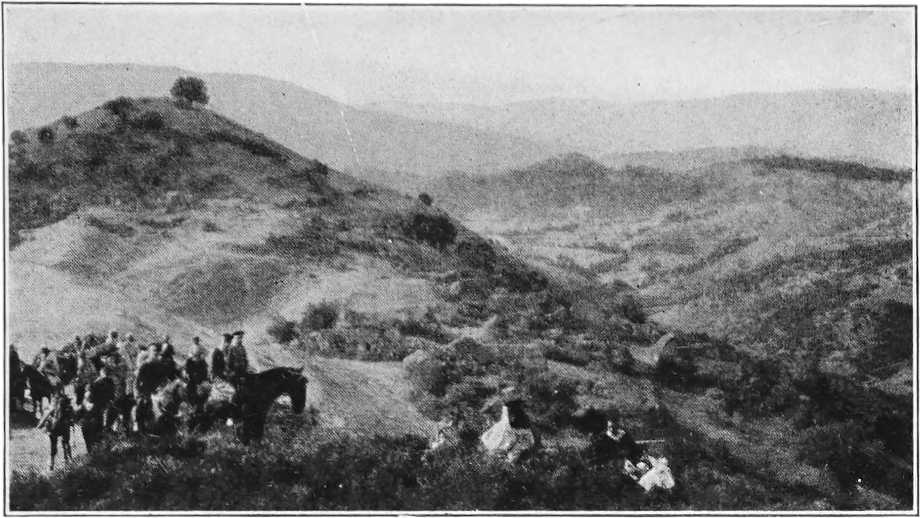
Spanish escort in Beni Aras, leaving author on her way to Tazrut
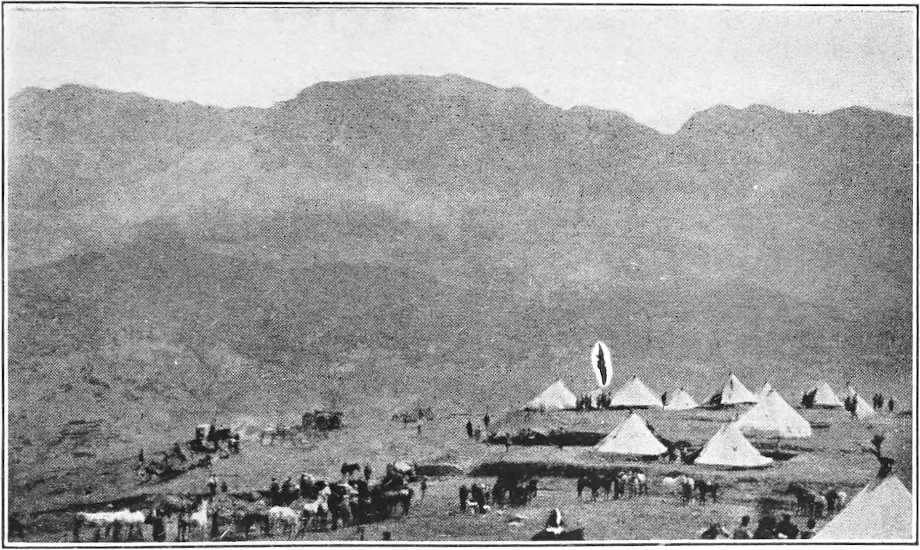
Spanish port (Dar Jacobus) opposite Jebel Waja, on top of which the Arabs say Noah’s daughter is buried
“Well, what happens when the dowry is settled?” “There is rejoicing. Guns are fired in the yard; there is a great heap of corn sprinkled with salt, to keep away the jinns. An egg is buried under the threshold of the house, that life may be white and without trouble. In the house of the bridegroom, the night before the wedding, there is music and drums. In the house of the bride, one who is blessed with many children, who has the love of her husband, being his only wife, comes to dress the bride and paint her hands and feet with henna. The next day all the unmarried girls bring presents of meat and kous-kous, but the bride weeps and none may stop her. At night the mule comes to her door with a beautiful box on it. Everybody sings while the bride is carried out to the box, and she clings to her people and weeps. They try to prevent her going, but the friends of the bridegroom lead away the mule, and even her brothers cannot stop her.”
The black girl was evidently visualising many nuptial scenes, for she began making the quivering, bubbling sound that always haunts an Arab wedding. “Is it thus that she was married?” I asked, nodding at the pink couch. “Lady, that is for a first wedding, when a youth has not yet untied his girdle, but my lord has been married many times, as befits[236] a Sherif.” “It is an honour and a blessing to be married to my lord,” said the old woman, flinging back her haik. “The mother of his sons is sure of paradise.
“Min zamaan—a very long time ago, a girl of the Ait Uriagel ran away from her family that she might be the servant of the Sherif. She could not approach his tent, so she hid among the trees till hunger overcame her, and then it was told to the Sherif that she was there. He gave her food and presents, and sent her back to her father, who beat her, for had she not brought dishonour on his family? Three days, four days afterwards, she came back again and found her way to the women’s tent, showing the marks on her back. The Sherif ordered that she should be beaten again, that the example of her father might be upheld.” The leather of the crone’s face wrinkled into something that might once have been a smile. “The girl stayed, for she was honoured by the interest of my master.” “She is here now?” I asked. “She has a daughter, whom you see there, but she herself has gone.”
Arab women never speak of death, if they can avoid it. They always say, “He went. The mercy of Allah is upon him.” “How many children has the Sherif?” I asked. The old woman pointed round the room, which seemed to have grown more crowded. “There are nine daughters, and the two oldest you see there, Zahrah and Mariam. None are yet married, for my lord is busy with war and politics. He has no thoughts for women.” I learned that there were three boys, of whom the eldest, Mohamed el Khalid, was the son of a Sherifa of Beni Halima, which house is also descended from Abid es Salaam; the second, Mohamed Juni, was the son of a slave, and the youngest, called Hashim, because he was born in Jebel Hashim, was the child of a Sherifa of Tagzat, who had died about a year ago.
[237]The Sherif had been married five times, but only two of his wives were living, and I only saw one, the speechless Khadija. It appears that her father gave her six slaves as a wedding present, for one of whom he paid about £90, which was considered a very high price. I saw the girl, a plump Sudanese, rather light-skinned, with better features than is usual with her race. She was almost as grandly dressed as the bride, in a purple silk kaftan, with a waistcoat of olive-green edged with silver, and a white over-garment belted with silver. I understood she was particularly skilled in the application of henna and in painting the hands and feet with a delicate tracery that gives the appearance of lace. Generally female slaves cost about £50, but the small boys can be bought for 100 douros, approximately £15. “Women are more expensive,” said Mariam, “because they are always useful. They stay in the house and serve, but the boys, once they grow up, are dangerous. The Arabs do not need blacks to fight for them, and what else can men do? So most grown-up slaves are given their liberty, for they cannot come into the house.”
The conversation languished, and I was thinking of taking my leave, when the old woman began whispering into my ear. It was difficult to understand her, but when she mentioned the word “curse,” I made a great effort to follow her story, and this is what I gathered. “It is said that my lord shall have no knowledge of love. All other things he has, but he may not love, for, if so, the person who holds his heart between his hands shall be killed. That is the curse, and truly my lord does not love easily. He is kind to all, for his heart is great, but women are as children to him. He takes care of them and is gentle, but he is a father to his wives, and one is no more than the other.”
The human remnant looked round her nervously, but no one was listening. “It happened so long ago,” she said.[238] “None of these saw it, but I was with the mother of my lord, and I saw many things. It was a time when my master made war on one of the tribes, before men knew of him, and, having attacked the house of the Sheikh at night, he killed two of his sons. For a long time there was war on this account, for there was blood to avenge, but at last my lord made peace with the men of that tribe, and the Sheikh gave him a daughter as a bride. It was said that the girl was unwilling, for much harm had been done to her people, and one of her brothers who had been killed was born at the same time as herself, of the same mother. But the men arranged the affair, and she had no choice.
“When she was brought to the house of el Raisuli, she would take no food. Neither water nor bread passed her lips, nor would she listen to the musicians, nor take part in any of the festivals. At last my lord went in to her, and I was one of the servants who stood at the door. She got up suddenly, and her hand was behind her back. The Sherif spoke to her with the blessing of Allah, and she answered, ‘There can be no blessing from thee to me, for we are enemies. There is the blood of my brothers between us, which there was no man to avenge. I have not touched thy gifts, but I bring thee a gift—see—” and she drew her hand from behind her, and in it was a knife. She struck swiftly, but my lord did not move, and the ‘baraka’ was with him. The blade slipped on the clasp of his belt, and he was not wounded. The knife fell on the floor between them, and the other woman who was beside me screamed; but the Sherif ordered us to be silent. He picked up the knife and gave it to her, who stood trembling but fierce—she was not like our women. ‘Take it,’ he said, and her fingers went out to it slowly. ‘You cannot hurt me. Your aim was bad, but try again, and do not hurry.’
“Then she stood back and cursed him—Allah have mercy[239] on her!—and told him that the ‘baraka’ would bring him no peace. His life would be without time for love and without rest, and there would be one person that he would care for, and he would be killed in his youth. Then, when I thought she would have struck my master, and I was afraid, she drove the knife into her own breast, and fell. My lord looked at her, and said nothing. The poor one! she had lived for so few years, and life had been hard for her. That is long ago, and it is best that such things are forgotten, but see now the way the Sherif looks at my master Mohamed. He would make him into an ‘Alim’ learned in books, but knowing nothing of war, yet the boy craves for a gun and a horse. Truly he will be a warrior in his time.”
I wondered much about this story, for I could get no confirmation of it. Harem women weave the most curious tales—it is their one occupation—and the life of el Raisuli lends itself to much romantic exaggeration. It was, of course, impossible to ask the serious councillors if such an event had happened, for curiosity dies at the door of the harem. They would not even have mentioned the name of their master’s wife. “Of that I know nothing,” would have been the answer.
However, because the story haunted me, when Mulai Sadiq and Badr ed Din joined me in my tent, I turned the conversation to women, and the Sherif of Tetuan was quite eloquent on the subject. “Of what use are women?” he said. “If the Sherif had had nine sons, he would have had nine rifles at his side in battle, but daughters are a misfortune. They eat up a man’s substance, which is very hard. Sons go with their father wherever he travels. They serve and defend him; but daughters must always stay in the house, and a man must leave servants to guard them and provide them with food and slaves.”
[240]“Don’t you care for your daughters at all?” I asked. The answer was a most emphatic “No. The only time that a woman is useful is when she marries and brings a man into the house, and then it is not always certain whether he will be good or bad.” “Don’t listen to him!” laughed Badr ed Din. “He married his daughter to a man of Xauen, and he spent 4,000 douros on the wedding. He won’t let his son-in-law leave Tetuan, for fear that he should do something bad, though the poor man wishes to return to his own town.” “Ullah! It is not my daughter I protect, but my honour,” assured Mulai Sadiq. “Men of my race do not like daughters. Before Islam they were buried alive, as babies . . . a good custom!”
He looked at me with something very like a twinkle in his faded eyes. Emboldened by this, I asked the old man if he had ever felt affection for any of the ladies he had married. The negative was scornful this time. “No! If they are ill, I give them medicine. When they are hungry I give them food, but no more. We Arabs are savages. I am capable of dying twenty times for a guest in my house, and no man may touch a woman of my kin, for that affects my honour; but what is this talk of love? Intelligent men do not know it. It is only the stupid who indulge in it. A wise man does not trouble himself with women’s affairs!” “Do not believe him,” said Badr ed Din. “He is like all Moors. When we desire one thing, we say just the reverse.” “He is an egoist,” I said. “Après moi, le déluge,” quoted the reprobate unexpectedly. “It is true,” said Badr ed Din, with an air of reflection, “when I was last in Tetuan, all the women of his family came to me and said they wished to leave his house altogether unless they received better treatment.”
After this I put in a few words as to the position of Englishwomen, and the Sherif el Bakali laughed. “You[241] have investments of your own,” he said, “so you are free. Our women come to us with nothing but a futah[77] and the henna on their feet!” “You need not complain,” retorted Mulai Sadiq. “Marriage is cheap in your tribe.” “That is true. It costs but a sheaf of grain, a sheep and the pay of the musicians. For six douros one may be married in the mountains.” At this point someone told Badr ed Din that he was a great fighter with his tongue, but expressed some doubt as to his courage with a rifle. The Bakali chuckled. “The man who follows a lion must be brave,” he said, “and I have followed el Raisuli for twenty-five years.”
By the time the long-delayed lunch made its appearance, after a succession of such remarks as “You told me we should eat, but was it today or tomorrow that you meant?” and “Allah knows if we shall eat before we go to paradise,” we learned that the Sherif was ill. Mohamed el Khalid, wearing his petunia jellaba over jade-green waistcoat and trousers, whispered the news into the secretary’s ear. “It is the will of Allah,” said the latter. “But does he suffer much?” Another whisper. “Ullah, they have put a cord from the ceiling, that he may pull on it and relieve his pain.”[78]
Our lunch was more silent than usual, though there was kous-kous with a chicken buried in it, mutton cooked with almonds and onions, a fruit which tasted like stewed wood, reposing upon piles of marrow, and a row of skewers on each of which were impaled a dozen bits of liver rolled up in fat. Mulai Sadiq insisted on fasting, as is his habit on Mondays and Thursdays, and after he had seen us satisfy our appetites, he went and sat in an isolated corner of the[242] compound, and remained contemplative and completely immobile for several hours.
Just before sunset the news went round that the Sherif was better, and, when the last rays were slanting over the hills of Beni Aros, he came out into the garden, a sky-blue jellaba on top of all his other robes. It was the feast of Aidh el Fatr, and, for some days, a deputation of the tribesmen of Guezauia had been waiting to see the Sherif. This tribe is really in French territory, a three-days’ journey from Tazrut, so their presence was a witness to the extent of el Raisuli’s influence in Morocco.
Having seated himself outside the room used as a mosque, the Sherif suddenly decided to receive the tribesmen. There was much bustle in the compound, and the little slaves ran about with the agility of monkeys. Sidi Badr ed Din stood on one side of Raisuli and the Kaid on the other. The mood of the morning had passed, and the Sherif was smiling. It is a rare thing, this smile of his, and infinitely charming. Seeing it, one realises that the essence of the man’s ‘baraka’ is his power of making friends. “No enemy goes out from the presence of Mulai Ahmed,” say his people, and it is true. When he talks earnestly, his sincerity is obvious, and his dignity so impressive that, however long the tribesmen have waited to see him, however much they have suffered at his hands, when leaving him they are his warmest partisans.
Hidden behind a tree, I watched a procession of the Guezauia come up the tiled path, led by Shiekh Ueld el Abudi. The headmen wore white jellabas with the hoods pulled forward like cowls; their followers were muffled in earth-brown camel-hair, and each man led a mule or a horse with bulging panniers—gifts of oil, grain and skins for the Sherif. Live sheep were tied one on each side of the saddles, and all this tribute of goodwill was laid before el[243] Raisuli as he sat, reserved and still, before the scarred walls of the Zawia. Shell-marks and bullet-marks seamed the plaster above him. His house was in ruins, his people scattered, but something remained, a force and a patience that was unconquerable. The Sheikhs bent and kissed his knees, murmuring a salutation in the name of Allah. The tribesmen pressed their lips to a fold of his jellaba. There was a little grave talk, and then the Azzan rang out from the mosque of Sidi Mohamed. One by one the mules clattered out of the compound. The hooded figures stole swiftly after them. There was a moment’s peace, broken by the murmur of the hezb from the Zawia. Then, loud and triumphant from the hillside, pealed the tribesmen’s prayers. “Haya alla fella, Haya alla sala! There is no God but God! and God is Great!” The old appeal to warrior Islam stirred the night with passion, and I imagined the thousand thousand swords that had flashed to meet the cry in the centuries that are dead.
MORE FIGHTING
“By my help,” said the Sherif, “the telegraph was established between Tangier and Tetuan, by way of the Fondak, and, after Wadi Ras had been occupied, for the first time Spanish troops camped in Ain Yerida. Three columns came from Ceuta, Tetuan and Larache, and I welcomed them in the great square of the Fondak, the Kaids with me, and our horses stabled in the surrounding patio. There were many thousand Spaniards with Villalba and Jordana, and it was the first meeting of the armies of the East and West. I felt again as I had done when I let the Spaniards into Larache, for this was a great step and one that could never be retraced. These men had been my friends and then my enemies. They were my friends again, but, while the tribesmen fired salvos of rejoicing, I wondered how long it would be before they found another use for their bullets. The flag of Spain was raised over one of the houses, but twice the post fell, because the supports were not strong enough. I looked up at the green flag over the Fondak, and thought perhaps it was a sign.
“The troops did not stay long in Ain Yerida, for I kept this place as my headquarters against the Anjera, who, well armed and well led, were our worst enemies. They got as many rifles as they wished from Tangier, and their Kaids were rich men who had interests with the merchants of the coast. Until this tribe submitted, there could be little peace in the country, for their emissaries went everywhere, stirring up the Jebala against me. There have[245] been many battles in Anjera, but never another like El Biut. I pitched my camp at Harkha, from which I commanded the easiest road to Anjera, by way of Wadi Khemis. It was agreed that the Spaniards should attempt to cut off the customary retreat of the Anjera to the International Zone, and they accomplished this by occupying Trafuatz and Dar Ain Said.
“The main attack was in my hands, and I divided my mehalla, which numbered 5,000 of my best warriors, into five columns, hoping that at least one or two of these would be able to approach unnoticed. We marched quickly, not even waiting to destroy the villages, and everybody who fled in front of us was killed, whether man or woman, lest warning should be given to the enemy. I flung out a line behind us, with orders to shoot anyone who tried to break through. The wadi gave us good shelter, for the trees were thick, and men held their jellabas over their rifles, so that the sun should not gleam on the barrels, but the columns on the hills travelled more slowly, for they had to climb up and down and pick out the best way among the scrub.
“Maaden and Beni Khelu were occupied while a man’s shadow was still longer than himself, and communication was established with Ovila, who commanded a mehalla of the Kaliphate. The first fight was at Suq el Khemis[79] but I had agents in the town who spread terror among the people, saying the whole of Jebala were at their doors. We wasted few bullets, but surrounded the town and let no man pass out armed, and none towards the front. We took such a quantity of arms and ammunition that, after this, most of my people carried two rifles, one on the back and one in the hand. If I had not been with the army, there would have been no more fighting that day, for Khemis is a large town and loot was plentiful. I left my place[246] at the head and rode in the rear, my gun ready, but not for the enemy. If a man dropped out to empty his shoes, or even turned to look back, he ran the risk of a bullet. In this way the march was swift and we were in the heart of Anjera before they knew of our coming.
“The worst stronghold of the tribe was El Biut. The gates were always decorated with the heads of the innocent, and bodies rotted outside the precincts. From far away kites could be seen hovering above the fortress of the brigands, and, by this sign, every traveller made a great circle to avoid the ‘house of death.’ This place was left to the Spaniards, and they lost several hundred dead before they took it.[80] At dawn three of their columns left Ceuta, but they had to fight their way from village to village. At last the heights of Haj el Hamara, Kudia Xerija and Ain Yir were occupied; but many wounded were left to the kites, who some said were jinns and familiars of the Kaids Abd el Kadu Kheragin, and el Jarru.
“El Biut was well placed for defence, for the country is very rough, with wadis which hid the snipers of Anjera and cliffs which acted as walls against an enemy. The tribesmen made sorties down the beds of the streams, and fighting was so fierce that, when a Moor died, his friends had no time to take his rifle and cartridges. The women, who generally load for their kinsmen, took up the guns of the dead and fought beside their fathers and brothers, firing, with a babe wrapped in the haiks, believing that, because of this, their sons would the sooner be warriors, with a blessing on their arms. The wounded dragged themselves into the bushes and fired painfully, till their blood clotted their triggers. The Anjera were outnumbered and surrounded, but they were fighting in their own country against men untrained to find a target for each bullet, and they might have prolonged[247] the battle, but for the guns which tore up their walls and blew their roofs into powder.
“Warships bombarded El Biut from the sea at El Marsa, and the men of Anjera, seeing their possessions destroyed, made a great charge, under the leadership of Ali el Hannani, and fought their way through the first line, but they could not face the guns. About 300 Spaniards died and many tribesmen. The castle was destroyed and the rest of the enemy mounted their horses, taking their women behind them, and fled into the wild country where Spain could not follow.
“It was a useful victory, for El Biut had always threatened Ceuta, which is only a few kilometres from it. The kites fed well for a week, and then they dispersed, for their meat was gone. Anjera could not be defeated with the loss of El Biut. With you, if a town is taken, it is the end. With us it means a few more guns in the mountains. I had pushed my columns through Ben Ayib, where three men would have held up our army—the Sheikh and his two sons, lying flat behind their roof only firing when they could see the eyes of my men! We came that night to Ait el Khamra and dispersed ourselves round the hills to sleep. Sentinels kept watch on every high place, and I visited them all during the night, but there was no disturbance. With the first light we came down and took the villages below, burning them after we had supplied ourselves with food and such arms as the tribesmen left. The women were sent back, behind my rearguard, which advanced always half a day’s journey behind us, keeping the ground clear of the enemy. I communicated with them by means of cavalry, divided into small parties and well mounted. I also had a force of irregular riders, who took no part in the battles but held themselves always ready to go to the aid of the rearguard.
[248]“It was my intention to say the evening prayers at Sidi Ali, which is near the boundary of Anjera and el Fahs, and then I proposed to turn north-eastwards and, cutting off the stragglers from El Biut, march right through the Anjera country to the sea. I lost many men in skirmishes, but we were too powerful an army for a great fight. Tribesmen would charge down on our column and harry it like a flocks of ibis round a herd, and then, when a few shots had been exchanged, scatter among the gullies, brown riders on dark horses, seen for a moment against the green, and then lost among the rocks which they simulated. The only way of enforcing submission was by burning the villages, and this I did systematically, for an Arab will risk his life to guard his property, but never pay money for his life! At last there were signs of distress, for the men of Anjera saw their wealth disappearing. Small Kaids came to treat with me, but I refused to speak to them. I said, ‘Let your Sheikhs come,’ and named certain of them, ‘and let them come with all their men, as it is right they should visit the Sultan.’
“It was then Ramadan, and, though men fight the fiercer for hunger, it is a bad month for negotiations. Peace should be arranged on a full stomach, when a man has no ill-will for anyone. The day’s fast was the longer because it was summer, and the sun rose early and set late. While we marched, every wadi seemed to contain a stream, which was a temptation of the devil, but there was no chance of surprises, for few slept at night. After sunset the whole camp was a kitchen, and, fortunately, the Anjera sheep were plentiful. Songs echoed among the mountains, with the sermons of the Imams and the cry, repeated even while men satisfied their hunger, ‘There is no God but God.’ One morning, when my servants were preparing the early meal which must be finished before the first rays come over the[249] horizon, news was brought of the approach of many horsemen. There was no shouting, and they came openly with their flags flying, so there was no question of battle. ‘There are many hundreds, Sidi,’ said my slave, whom I sent to discover the truth. ‘They come to make their submission with the Chiefs of their villages.’ A few minutes later came the rattle of many shots and the answering salute from my guards.
“My tent was in the middle of the camp, a great black and white pavilion like this one. The two flags flew on either side, and, in front, turned towards the House of Allah (Mecca), which they saluted night and morning, were four cannon. From where I sat, not moving or hurrying myself, I could hear all kinds of music, punctuated by occasional shots. Drums, pipes, cymbals, all the noise of the country was there in my honour, and my own men, not to be outdone, began beating military drums, and each man played differently, but the bugles were the most full of sound! Slowly up the hill came the white army, for each man wore his best jellaba, and the saddle-cloths of the Kaids, green and red, were decorated with silver and hung with fringes. Their bridles were heavy with silver and the manes of their horses plaited with tassels. Each tribesman was armed, except the Kaids, whose servants carried their guns before them. I still sat in my tent, but, when the music was very near, I called one of my captains and ordered him, ‘Tell the Sheikhs that if they would see me they must enter my camp without shoes. They have perhaps forgotten, but I told them this on another occasion, a long time ago.’
“There was a halt on the edge of the camp, and then a slave ran in to me, whispering, ‘They are coming.’ An army of many thousands was ranged behind my tent and the great of Anjera came to me alone, except for their drummers[250] and their standard-bearers, but the bareness of their feet could not be hidden. They stood outside my tent and I did not invite them to enter. I sat as I was, in silence, as if I did not know they were there. So it was for some minutes. Then they began to murmur among themselves, and, at last, one entered and kissed, not my shoulder, as was his right, but the edge of my sleeve. The others followed and, when they had all saluted me, I spoke to them, using the phrases of a Sultan to his subjects. I told them that they should have prostrated themselves and placed their turbans under my feet, and that I could not accept their submission until I had considered the matter with the Spaniards.
“While I sent messengers to Jordana, they were to camp in a certain place beyond the tents of my army, and I chose this spot because, to reach it, they would have to pass through the whole of my mehalla and would be impressed by its strength. They answered, ‘Allah has given us into your hands, but not into those of the Christians,’ and I replied, ‘If I choose to put a Christian foot on your necks you cannot prevent me; but I have made peace with Spain in order to preserve your liberty, not to destroy it.’ They would have disputed this with me, but I said, ‘Go now, for a man’s word is according to the number of his rifles. Judge now if mine is strong,’ and they said, ‘Your strength is great, but, Allah forgive us, you mistake the enemy.’
“All that day beasts were slaughtered before my tent, and, because of the heat and the flies, the smell was intolerable, for they died slowly, bellowing because of their cut knees, and, since it was Ramadan, no one might remove the meat till after sunset. But the night which followed was like noon in the camp. The men of Anjera had long been hungry, for their villages had been destroyed as a[251] blight passes over barley, and there was no time for them to save their stores, so each man took a portion of a bullock or sheep and, in every corner, there was a fire. The Kaids remained in their tents, consulting anxiously, for they had heard there were Spaniards in my camp; but the tribesmen ate together, mixing their songs with their music and, by the dawn, none could tell which was enemy and which friend.
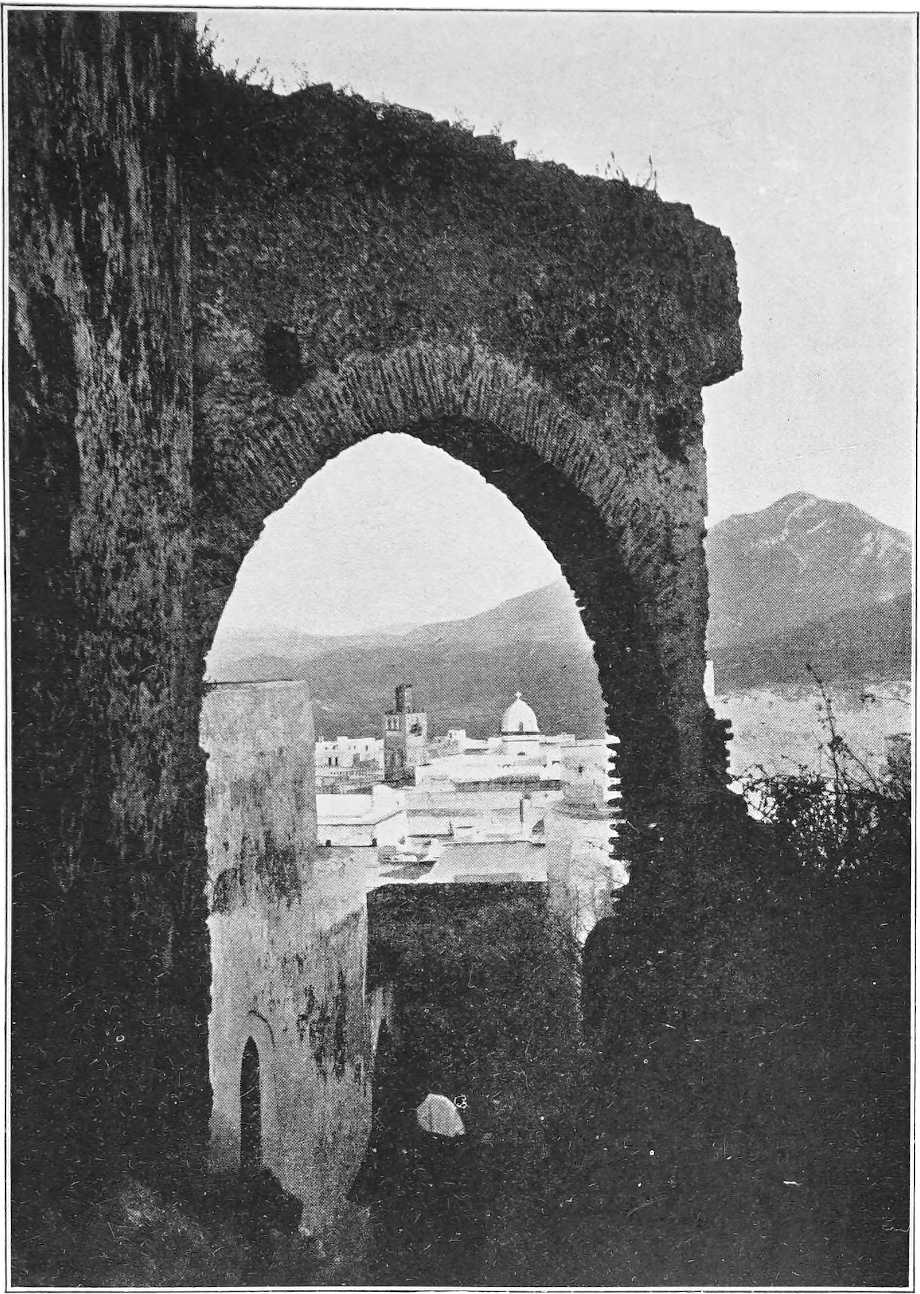
A view of Tetuan, showing tower of mosque
“With the submission of Anjera, the Spaniards should have been content. The sea coast was now clear for them, and what can they gain from the mountains, where a man lives by the toil of his women and the prowess of his own rifle? Near Melilla there is much wealth under the ground, and, for this reason, the Germans interested themselves in the country. When they said to Abdul Melek, ‘Raisuli shall be Kaliph of all Morocco and you shall have as much money as you wish,’ they asked in return all the mining rights in the mountains, as well as what they already possessed in the East. Yet I think our hills are barren. To this extent has Allah blessed us, for there is nothing to tempt the greed of Europe.
“By the end of that year of which I have been telling you, there was no more need to make war. Those of the tribes who were not with me were afraid to be against me, and, with my pass, a man might travel from one end of the mountains to the other. I remember a Spaniard was once with me, and he wanted to shoot hares or foxes in the Jebala. He had expended all his ammunition on the way, for game was plentiful, so he asked me, ‘Will you lend me some cartridges?’ I answered, ‘Count the grains of flour in that dish,’ for he was eating kous-kous. ‘I will give you a bullet for each one.’ He laughed, for the dinner had been prepared for many, and asked, ‘How far can I go with safety?’ I looked out over the hills, which[252] fell in innumerable folds, like a mantle that has been crumpled on the ground, and I answered, ‘Choose a horizon where you will, and go to it. Then look all round you, and choose another, the furthest. Go also to that, and you will be safe, if you say, ‘I am with the Sherif.’”[81]
After this Raisuli seemed inclined to keep silence for the rest of the day, but, urged to continue his story, he muttered, “War may be good for a man, but politics are certainly bad. While we fought together the Spaniards and I were friends, and when, in the spring,[82] Jordana sent 20,000 of his troops back to Spain, I was content, for I thought that at last matters were going as I had planned. It does not need an army to hold this country. It needs but two men who are in accord. I moved my great camp to Keitan, near Tetuan, so as to be in touch with Jordana, and, at one time while I was there, I had more than 10,000 men behind me. This was only for a few days, the time for which a man may bring his own rations, for I fed none but my own mehalla. The levies from the tribes supplied their own food, and when at war, every man lived on the country. This is the quickest way of forcing peace upon the enemy.
“Several times Moors came from Tangier to see me, saying, ‘The Germans are winning many battles. Why don’t you join them and make war on France?’ My answer was always the same, ‘Wait,’ for I thought, ‘Certainly if the Germans are strong enough to beat the whole of Europe, they are strong enough to crush Morocco until there is nothing left of us, not even our graves.’ In this case, it would be wise to be their friends, but I had given my word to Jordana, so I did nothing except keep hold of the Fondak and the way to Tangier. It was about this[253] time, I think, that Abdul Melek[83] paid me a last visit, but, Ullah, he had wasted millions of marks among the tribes and was no nearer his purpose. We met among the hills of Beni Mesauer, for I would not see him openly, and he spoke of Ahmed es Senussi, whom Germany would make ruler of all Egypt, and said to me, ‘This man is not even a Sherif. Would you be less powerful than he?’ I said to him, ‘My power does not depend on titles. Take care that you do not stretch your hand too far.’ He said, ‘If you were Kalipha I should be your Wazir in Taza, which is a profitable post.’ Truly he thought of nothing but money, and yet, a little later, when he fled from Tangier hoping to reach Marnei, the Anjera caught him and took all his wealth. They might also have taken his life, but that Zellal interceded for him and brought him into his house. The French offered a great prize for him, but el Ayashi (Zellal) would not give up his guest.
“This was perhaps the time of my greatest power, and my camp was never empty. Always some of the great Kaids were with me, and, as in Azeila, I gave food to all who asked for it, not according to the ways of the East, which says, ‘For two days shalt thou be my guest, but on the third day, by which time all that thou hast eaten on the first shall have passed out of thy body, thou shalt go thy ways,’ but for as long as they desired. The old trouble was growing with Jordana, in spite of the many gifts he made me, furniture and Spanish mules and great sheep from his own country. He wished me to acknowledge Mulai el Mehdi as Khalifa and to become his Grand Vizier. I told him often, ‘If I do this I shall have no authority left with the tribes, for no mountaineer will respect me if they see me inclining before a man of nothing.’
“I asked him what he complained of in my rule of the[254] mountains, and he said, ‘Your men pass freely through our zone and come in and out of the towns, but it is not possible for a Spaniard to move in the hills. You impose your own taxes without the permission of Spain, and we have no control over your justice. Men complain of cruelty and extortion, and why is this? You are so rich that you cannot need any more. Half the International Zone is yours. You have farms which contain the best land in the plains, and your houses are in every town. Why do you make the people discontented by taking so much of their produce?’ I answered, ‘It is the custom, and if I asked from them but one centime in the thousand, they would be just as indignant. It is the habit of the Arab to complain, and he is happiest when he has a good reason for his plaints.’
“Jordana said, ‘You have dispossessed the Kaids who were friendly to us and, without my authority, you have appointed many who were our enemies and who, even now, are not willing to work with us.’ I answered, ‘If a man can control his people it does not matter to me whether he is your friend or mine. It is a bad policy to put a man in a position of authority just because you are grateful to him. It is also bad to sell posts, as was the way of Abdul Aziz and Mulai Hafid, and truly the French are wise in this matter, for they make friends with the strongest Arabs and allow them to rule their own people.’
“Since the time when I was Governor of Azeila I have tried to keep peace with the great Kaids, and some were always with me, and I consulted them about the affairs of their own tribes. Mohamed el Kharaji was my most trusted adviser, and Zellal, who could have been Sultan in my place had he wished, Hamed el Harras of Beni Ider, Mohamed el Hartiti, Chief of Beni Hosmar, who regarded Tetuan each morning and prayed that it might be delivered into[255] his hands. After the fall of El Biut, Abderrahman Bulaich of Anjera joined me, and others of my companions were Abdul Ramin of Gaba, el Melanain, el Arbi Belkhidar, and Ben Hassem, another Sheikh of Anjera. There were more beside these, for this was my strength, and by means of my friends I ruled the land. A man who cannot use the strength of others will never make full use of his own.
“There were some tribes or families which never submitted to me for long, and of these were the Chiefs of Kherba, two brothers of whom the oldest was the leader. The land of Sumata is not fit for an army, so, when the villages refused to pay tribute, I sent a few men only, with the intent of arranging the matter peaceably, but el Kherba seized two of my soldiers and beat them before his women, which was a disgraceful thing. When this news came to me, I sent my nephew with a mounted column, telling him exactly how he was to surprise the village. The men of Sumata were watching. Night and day they posted sentinels among their hills, but my men left their horses with a friendly Kaid, and, scattering, came in twos and threes till they were within sight of the village. Then they hid themselves among the bushes, which are very low so that a man must creep on his knees, and even then his head may be seen. My soldiers tied branches round their rifles and plaited twigs and leaves over their heads, so that if any sentinel noticed a movement among the scrub, he would think it was the wind blowing, or some animal crawling into cover. In this manner they crept very slowly towards the houses, wriggling like snakes between the sentinels. Two they dragged down and killed before they had time to cry out, and at the time of the aysha prayer, when the Sheikhs were in the house of the Imam, they dashed into the village, shooting everyone whom they saw and setting fire to the thatch.
[256]“El Kherba crept out of a window of his house, while men broke in at the front, and, mounting his horse, fled straight into another party of the attackers. They took him prisoner and brought him down to Tazrut, though, three times, his men tried to rescue him. When he was led into my house with his hands tied, I said to the guards, ‘This is not the right treatment for a Sheikh,’ and they released him. Then I told him, ‘It is written in the Book that death shall be the punishment of the subject who rebels against the Sultan,’ and he answered, ‘I am not your subject, but it seems the will of Allah that I die.’ ‘It is a pity to waste good men,’ I said, ‘for the country needs them. Let your section of Sumata pay tribute to me, and there shall be peace between your house and mine.’
“He agreed, and went back to his people unhurt, but he did not keep faith for long. A caravan was attacked in his country and, when I sent men to enquire into the matter, they disappeared, and not even their bodies were found. I was very angry, and I sent el Kharaji with a picked force, telling him to bring back the head of el Kherba. I said, ‘Do not trouble about the village, or he may escape during the fighting. Hide yourselves well, and wait till you see where he goes; then kill him, or take him prisoner. Afterwards his tribe will submit, for it is only he who excites them against me, hoping to profit by his independence to enrich himself.’
“They did as I had ordered, but, as they went stealthily through the hills, a goatherd suddenly threw down his stick and fled towards the village. El Kharaji thought, ‘Even if he has seen us and warns the people of our approach, it does not matter, for we are double their number.’ He had divided his party and sent some round to the rear of the village and others to command it from a convenient height. Soon there was a sound of firing, and el Kharaji was puzzled.[257] Thinking that perhaps one of his other columns was being attacked, he advanced quickly up the hill till, hidden among the stones, he could see the village across a hollow. The firing came from among the houses and, when music broke out with shrill quivering of women’s songs, el Kharaji knew it was a wedding. With his field-glasses he could even see the mare standing before the house of the bride. Then women came out and hung two sacks on the saddle, one containing ‘taria’ (thin cakes of unleavened flour) and the other raisins. ‘It would be a pity to disturb the wedding,’ said el Kharaji. ‘Besides, many of the men will go out with the bride, and there will be few left to defend the village.’ So they waited, for it appeared that the goatherd had not given warning of their approach.
“Towards sunset the bride came out of the house, and she was wrapped in a new mantle which covered her completely, and many handkerchiefs were hung over her face, above which was a great straw hat sewn with silk cords. There was much shouting as the mare was led away, and stones were thrown after it to make the marriage happy.[84] Women sprinkled milk before the bride but she did not turn her head nor look at any who went with her. A girl walked beside her, holding the end of her haik, and the young men of the village ran in front and behind, firing their rifles and shouting. ‘Let us also salute the bride,’ urged one of my soldiers, but el Kharaji restrained him, and the procession passed out of sight.”
Raisuli looked at me expectantly, and Badr ed Din was laughing whole-heartedly. “She does not understand!” he teased. “Ullah, nor did Sidi Mohamed, for he waited till the last sounds had died away and the bride was, no doubt, in her new home! Then he gave the arranged signal, from all sides his men closed in on the village. . . . It was[258] empty except for the women and children and the old men who could not make two teeth meet. There was no sign of el Kherba, or of anybody else who could carry a gun. Under the eyes of my soldiers all the fighting men of the village had gone forth with their rifles, and with them rode the Kaid, in the disguise of a bride! Ullah, the old fox had even taken his latest wife with him, in the person of the maiden who held the end of her sister’s haik! After that day it was unwise to talk to el Kharaji of weddings.” Badr ed Din chuckled. “His daughters ran the risk of dying single, for the word ‘bride’ was a curse in his mouth!”
Raisuli continued, “A second time I made peace with el Kherba, for I thought a man of such resource would be useful in my councils. He wrote to me from the mountains, where he lived as an outlaw, begging that if he was to die, his head might be left on his body, and saying that, if this were promised, he would come down to Tazrut to surrender. I replied, ‘I have need of your head and your body together. Separate, they are no use to me. Return in peace to your village, but, if you break faith with me again, I will come at the head of a mehalla to punish you.’
“After this there was a truce between us, and he paid the tribute demanded, but unwillingly, making many excuses. At last he joined a section of the Beni Gorfet who had risen against me, and for some time he evaded my men. When the revolt was put down, he was captured, hiding in a cave where his friends brought him food secretly, when they could evade the eyes of my sentries. I had no wish for a blood feud with the Sumata, so I delivered him for trial to a tribunal of Qadis who were learned in the law. He was condemned to death, as was just, for he had murdered and stolen, and broken faith, as well as rebelling against his ruler. His brother also, who had aided him, was captured and should have had the same fate, but all the women of[259] their family came to me and threw themselves on the ground, putting their foreheads in the dust, wailing and weeping. They said, ‘These are the only two men left in our house, for the others have all been killed in war. If these also die, who will protect us?’ They kissed the edge of my robe and would not let me go.
“At last I said to them, ‘It is not I who condemn them, but the law of Islam,’ and they cried out, ‘My master the King may interpret the law with mercy. Do not make our sons fatherless, and may Allah make you father of many warriors.’ I answered, ‘Truly it is my right to modify the law, and, in this case, I will show mercy and spare the lives of your masters, but the hand of one shall be forfeit and the eyes of the other.’
“This was carried out as far as the younger brother was concerned, for with his own rifle he had shot two of the men who travelled with the caravan, and this was proved against him; but a trick was played on el Kherbi. It was told him that his eyes should be burned out with hot metal, and he said, ‘It is the will of Allah.’ Hot discs were put upon his eyelids and he made no sound. When it was finished and the smell of burning flesh was in his nostrils, they said to him, ‘Your sight is gone! Where your eyes were, there are now two pits.’ He could see nothing, and the pain made him stupid. They put a handkerchief round his head and left him in the prison. After some days I sent for him and said, ‘Have you repented of the crimes which you committed not only against me, but against Allah?’ and he said, ‘I have, for your punishment is just.’ Then I told him, ‘If your repentance is sincere, your sight will come back to you,’ and he was amazed and asked how this could happen, and I answered, ‘I do not know how or when, but my word is given that, if you speak truth about your repentance, you will see the sun.’ He went out doubtfully,[260] saying, ‘The truth of the Sherif is known.’ In a few weeks his eyes were healed and all Sumata acknowledged the miracle. Since then the tribe has been with me. But, in truth, only the man’s eyelids had been burned!”
JORDANA’S DEATH
“One of my worst disputes with Jordana,” said the Sherif, “was concerning some of his police from the neighbourhood of Larache, who had attacked a farm on my land and murdered one of the owners. This was a case of thieving. The men left all their clothes under a convenient bush and rubbed their bodies with oil so that they could not be held. They came at night to the farm, naked, but with their rifles in their hands, for they knew that the farmer had lately sold his grain and had the price of it still in his house. A boy saw their approach and gave the alarm. There were but two tribesmen in the place, and one was shot as he laid hands on his rifle. The other would have fought, but they overpowered him and demanded where the money was. He would not speak, so they lit a fire and put his feet into it, but still he was mute. He would have died under their tortures, but that one of them discovered the money at the bottom of an old sack. They waited to add a few more blows to the injuries the tribesman had already received, then fled with their booty.
“It is difficult to keep a thing secret in Morocco, and it was soon known who were the criminals, but justice was laggard, so I ordered el Mudden to fetch me the bandits. This was not difficult, for there is nothing more ready[85] than the hand of a policeman when he hears the chink of money! The robbers were sent to patrol a certain road, and el Mudden was waiting for them, but it was a short fight. I imprisoned[262] them in chains at Tazrut, waiting their sentence, and I sent an account of the matter to Jordana. He insisted that they were employees of Spain and liable only in her courts. I retorted that, by the pact of Khotot, it had been agreed I alone should be responsible for the people living on my properties. He answered that there was no evidence against the men, and demanded their immediate release. I answered, ‘It shall be as you wish, because of the friendship which is between us and because my desire is to serve Spain in all ways,’ but, before I released the men, I cut off the right hand of each, as a lesson that my people were not to be molested, and I said to them, ‘I have shown you great mercy, because of the intercession of the Governor, but your heads are still loose upon your shoulders. Take care that you do nothing to lose them.’
“When he heard what had happened, Jordana wrote to me angrily, accusing me of barbarity and injustice, but I replied, ‘Their lives were in my hand, for they were murderers. In justice I should have beheaded them, for this is our law. How could I rule my people, if it were known that I could not protect them? I have shown mercy, as you desired, and if, as you say, one of the men has died, it is the Will of Allah.’”
This affair was typical of the many which disturbed the relationship between the High Commissioner and Raisuli. Jordana was a man whose patriotism was only equalled by his nervous sensitiveness. He came to Morocco aware of the mistakes of his predecessors and determined that Spain should present a united front before the Moors. Convinced of the importance to his country of the turbulent colony he was sent to rule, but hampered on all sides by criticism, distrust and the kaleidoscopic changes which marked the foreign policy of his Government, he decided that an alliance with Raisuli was the only way of stabilising the situation.[263] He realised that the original occupation of Larache and Al Kasr was due to the influence of the Sherif, and he hoped that, with this once again on his side, further peaceful penetration would be possible. What he did not understand was that the Arab rarely forgets or forgives, and that these qualities would be essential on the part of both Spain and Raisuli.
It is obvious from his correspondence that he regarded the Peace of Khotot, with its rigid demarcation of zones, as but the first step to a better understanding which would open up the country for material development. His disappointment was great when he realised that, not only were the mountains finally closed to Europeans, but that the Sherif was fulfilling only the minimum of his promises with regard to the coastal districts. The Tangier-Tetuan road was nominally occupied, but no stranger might use it without a pass from Raisuli. Roads came to an end as soon as they neared the hills, because of the mysterious difficulty of procuring labour. The water supply of Tetuan remained inadequate, because Raisuli refused to allow the construction of an aqueduct from the mountains. The railway from Ceuta to Tetuan stuck at a certain bridge, on account of inexplicable disturbances. Whenever the Spaniards wished to occupy posts essential for the protection of the main road, the Sherif protested that such a step would rouse the dormant hostility of the tribesmen, alert for a recrudescence of war. In fact, Jordana found himself struggling against well-organised, but passive, resistance.
It is certain that, during the war, Raisuli played a waiting game. The Spaniards say that only their influence prevented him from entering the lists against France. This is unlikely, for the Sherif’s policy was one of consistent neutrality in order that he might be able to secure good terms from whichever side won. Doubtless some of the German[264] money which poured into Morocco found its way into the Sherif’s coffers, but he was too astute to commit himself to any definite aggression. As his power grew among the tribes, and with Arabs no propaganda is more popular than a display of force and prosperity, the Sherif used the powerful weapon which Jordana had unwittingly put into his hand.
Whenever his autocratic actions were questioned, he hinted at the possibility of a rupture, and the High Commissioner, interpreting such a possibility as the seal set on his failure, renewed his endeavours to propitiate. If it was an undignified situation, it was the result of Jordana’s passionate desire to serve the interests of his country, without costing her blood or money. The alternatives with which he was faced when he arrived in Tetuan seemed to him equally disastrous. They consisted in the evacuation of the country, which would be followed by the triumphal entry of France and the total loss of Spanish prestige, or a war which, judging by the fruitless efforts of his predecessors, he believed would have to be one of extermination.
He was tempted to take the middle course and the most distasteful to him. He forced himself to labour with a persistent patience wholly at variance to his nature, towards a solution which, though humiliating to his pride, would satisfy the conflicting interests in Madrid. Towards the end of 1918 he found that Raisuli was in the position of dictator, while the High Commissioner was regarded as a puppet. Under insistent orders against interference with the natives, inefficiency and laxity were rife among all classes of officials. In fact, the prestige of Spain, which Jordana hoped to vindicate at the cost of his own opinions, had been persistently lowered by giving way to the exigencies of the Sherif and his horde of deputies.
In one of the most pathetic letters ever written by a great pro-consul to his Government, Jordana traced his course[265] of action from its initiation and, acknowledged that he had, himself, undermined the road “which led to the forbidden mountains,” foreshadowed the possibility of that rupture which would prove how unprofitable had been his years of conciliation. With a hand that shook, he signed the long document, and the pages bear repetitive evidence of a mind strained beyond endurance. Then, dropping the pen, he fell forward over the table and died while the ink of his apologia was still wet!
“The news of Jordana’s death was brought to me at Tazrut,” said Raisuli, “and I was certain that this would mean the end of my relations with Spain, for I had been watching the course of politics, and the Madrid press was clamouring for change. I returned to my camp and at once offered to give up the arms and ammunition entrusted to me for the duration of the campaign against the rebel tribes. My offer was refused, and I was assured that there was no alteration in the attitude of Spain. Messengers came to me almost daily from the Residency in Tetuan, urging me to stay at Kheiton, and to keep a strong hold of the tribes until the new Governor should arrive.
“Certainly this was necessary, for, on all sides, there were displeasing incidents as a result of a rumour that the foreigners would soon attack us. A man was killed within a few yards of Tetuan, and some Jews robbed in the open Suq. I sent a column to patrol the neighbourhood of the town, and warned the Beni Hosmar that my arm was still strong enough to punish. News came that bandits from Beni Gorfet had attacked a Spanish farm. The landlord had been killed, his goods stolen and his wife carried away as a captive. Immediately I sent a strong force to Khemis, demanding the release of the woman, but the Kaid was obdurate, for he hoped for a ransom. There was a fight, and his house was burned. While all men rushed to put out[266] the flames, my soldiers saw some women running towards the hills, dragging one who went unwillingly. They pursued the party, and the women seized stones and earth to throw at them, abusing them for saving a Christian, but my troops took the Spaniard and brought her in safety to my camp.
“That is the first time a European woman had been my prisoner, though my house has always been at the disposal of your men! She was in rags, and I had none of my family with me, so I sent to Tazrut for clothes, and she dressed as an Arab. I had a tent pitched a little way off for her, and put soldiers to keep anyone from staring at her. I said to her, ‘You may go whenever you choose, and, if you tell me your destination, I will send an escort with you.’ My men recovered the half of the goats which had been stolen, and I told her the whole had been brought back, making up the number from my flocks. She stayed in camp for a few days, till she was no longer afraid, and then I sent her down to her people.
“There were many incidents of this sort, though the tribesmen concerned themselves only with men. Farmers were captured near Larache and forced to pay a tithe of their crops and their beasts before they were set at liberty, but, whenever this happened, I punished the offenders.
“There was a long gap between the death of Jordana and the appointment of a new High Commissioner. Nearly three months passed, and several times I wrote to Tetuan announcing my departure for the mountains, for the news from Madrid was disturbing, but each time I was held back with promises.
“At last[86] Berenguer came out as High Commissioner, and it was known at once that he wished to occupy the Jebala by force. He spread abroad that he would waste no time in making effective over the whole country the[267] Protectorate with which Spain had charged herself, but when I sent my cousin, Mulai Sadiq, to greet him, he received him courteously. Ullah, thou wert deceived in him, son of my relative!” The old man protested indignantly—“He spoke affectionately to me, and told me that his one wish was to help all Moslems and to make the towns safe for trade. He said his mission was peaceful and that he wanted only to restore order in the districts where there had been trouble.” “So you wrote,” remarked the Sherif, “but Berenguer’s first message to me was a reproach that I had not welcomed him personally in the city. I replied, ‘Never will Raisuli be seen in Tetuan.’ Then he wrote to me by the son of Jordana, who put the matter politely, but it was not difficult to see what lay behind.
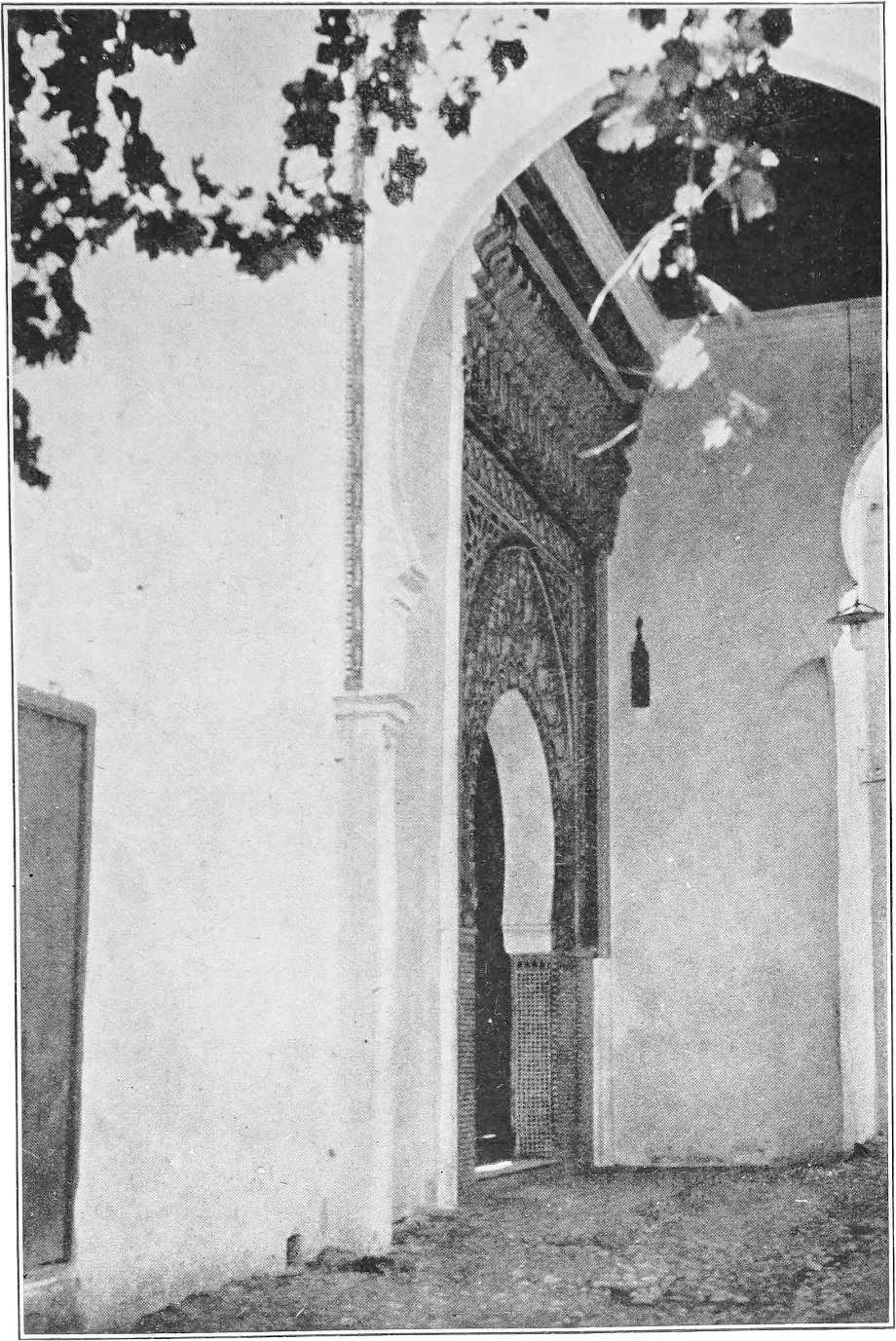
Door of mosque at Tetuan, where Raisuli’s ancestors are buried
“I answered that letter with many pages, and I remember the words which a Badr ed Din wrote for me. The sense of them was thus: ‘You say that I have not served the interests of Spain, but do you not know of the innumerable battles I have fought for you, and all the difficulties and suspicions I have suffered on your behalf? It is not I who have caused the trouble in Morocco, but the indefinite policy of your Government which is always changing. How often have I been told one thing in the morning and another in the evening! How often has the Governor applied to Spain for a pressing remedy, and received nothing, because of the political commotion! You say I have not written to welcome you, but to do this was impossible after the injudicious actions of Barera. Have you not heard how the military commanders of your posts lose no opportunity of detaining the tribesmen in the cities, of interfering with their fields and their sowing, taking from them their money and leaving many wounded by blows and other injuries? This has been the situation for a long time, and I was so angry at the passive attitude adopted by your officials that, as a[268] protest, I dismissed the two telephone engineers who were working at Ben Karrish in my zone. This was a sign to the tribes that political relations would soon be broken between your Government and mine.
“‘During the months before you came, I was instrumental in pacifying the tribes who would have risen to destroy your posts, but I told them that peace and tranquillity on our side must be unbroken, lest it should be said that war was the result of our actions. You say the root of your policy is your desire for peace and order. It would not appear thus, at least outwardly, for nothing is so true as actions which are unpremeditated. Since your arrival, incidents have been more frequent, and the offenders have not been punished. In proof, I will relate to you certain facts, and you will see that my silence was justified by the alarming news which was brought to me daily. Some of my labourers who were working at the edge of Beni Gorfet, in the vicinity of the Khotot, informed me that the chief of the military post at Tzenin had attacked them, taking away their herds, which were feeding peacefully in the stretch of grass, and had restored none of these, nor had they set at liberty the servants whom they had captured with the beasts.
“‘Tn Jebel Habib, artillery was employed against farms, not once but five times. Shells were dropped among the beasts, and it was impossible to continue the cultivation—all this because it was suspected that a soldier, who had deserted from the police, had passed through that country. The desertion of a policeman is not a strange thing. It occurs frequently, whether from your forces or mine, and it is impossible to avoid it. On the contrary, the use of cannon is a grave wrong, for it was agreed between the two parties[87] that artillery should not be employed against[269] farms whose inhabitants were faithful to us and only wished to live in peace and security under our rule.
“‘On the same day Your Excellency was expected in Tzenin, coming from Sidi Laimani, the captains of the military posts at Maila and Tzenin set out with mixed forces to round up the peoples of Bedauin and the labourers of Beni Aros, all subjects of my jurisdiction. Your soldiers forced these men to leave their walls by weight of blows, killing even the dogs who barked at them as they passed, and not omitting to tear off the clothes which the tribesmen wore upon their shoulders. They drove them into the town and ordered them to make a crowd to receive the High Commissioner. This was done to show the large numbers of those who had submitted to Barera, a false action, because, if I ordered these tribesmen and these labourers to leave all their possessions and join me, not one of them would delay for a night. All those who escaped from Tzenin and would not wait for Your Excellency’s arrival, were forced to pay a fine.
“‘Another thing—the chief of the military post at Sania in the Garbia attacked, during the night, certain farms situated in Jebel Rik, near our own fort of Gahar Ru Gas. Your troops took away the cattle and left one herdsman dead and two wounded, and the village lost a great quantity of beasts, many of whom died from the wounds received from your rifles. After this, the soldiers laid hold of a Sherif, a relative of mine, who had been peacefully occupying himself with the care of his crops and his herds. They maltreated him, despoiled him of his clothes and took him away, naked. They still hold him a prisoner, without taking into consideration that the Sherif is a personage of renown and fame, known as a peaceful and prudent subject of great discretion.
“‘These and many other occurrences, deplorable and[270] scandalous, occurred in your zone precisely when Your Excellency had established yourself in the Commissario.[88] Your officials have redoubled their campaign against my people, molesting them in every way, ill-treating them and giving as a reason that your jurisdiction extends over the whole country, without any difference between my subjects and yours. Added to this, there is the policy which Your Excellency is following with those of Anjera, who have always been against me and who were outlawed after the recent war, in which my forces fought by the side of your own. Your Excellency receives these traitors, appoints them as Sheikhs, and then attributes their nomination to Ben Azuz,[89] who, everyone knows, is your salaried captive, and who sits, like a blind man, with his mouth open, waiting for the charitable to come and drop food into it. It is the same thing with Ben Torres, who now promenades in his best silk clothes and would rule the Beni Hosmar. He forgets that, if it were not for my arms and my sentinels, he would not be able to wear such fine garments in security.
“‘Those who eat well and wear silk in Tetuan, who lie on soft carpets and have nothing to do but talk, spread lies about me. I live in a camp in the hills, with no comforts and no women. My foot is always ready for the stirrup, my finger for the trigger, watchful night and day, in spite of the illness Allah has sent me. I am too occupied with keeping peace in the mountains to have time to exchange words with them.
“‘It is the harder for me to put down disorder and revolt because of the conduct of Your Excellency. It is known that you are in communication with that worst of all devils, Darkan ben Sadiq, who leads a rebellious section of Gomara. It is even reported that, when Your Excellency[271] next embarked for Melilla, you have promised to speak with him as you pass by the Bay of Targa, and will receive him, with various of his followers, in your boat. Your Excellency receives men who have no standing in the country, which surprises and flatters them, and you believe the things which they promise you, but which they have no power to realise. Do you not understand that these tribesmen of Anjera and Gomara were all severely punished by our troops and have steadily refused to live in peace with us, preferring brigandage and the capture of travellers? For this reason, my mehalla is still camped, one portion near Xauen and one on the sea coast.
“‘In your letter you say that the end we pursue is the same; but, under these circumstances, I can see no similarity in our objects. If Your Excellency decides to hold a conference with me, it is very necessary that Zugasti should be present, in order that there may be complete confidence between us. You refer to the full and ample powers which are vested in you, but Jordana said the same thing. I have now in my possession many letters written in such terms, yet nothing was definitely completed, since, as soon as a project was begun, it was abandoned.
“‘Even yesterday we heard the sound of cannon from the region of Ben Aros. The firing lasted from three to six, and I do not know yet what has happened. This cannot continue, if the people are to have faith in my protection and your word. There is no peace anywhere in the country, except in the town of Tetuan where men fight with their words. You know well that the wound made by the tongue is more serious than that caused by a sword. For this last there is a remedy, but for the first there is none. You know well that the wall of wickedness is very low, and to jump it is not necessary to have either wisdom or intelligence. The most stupid of beings and the most undecided[272] can easily jump it, but the difficulty of all difficulties and the most arduous and the greatest, is to do good—such is the will of Allah, from whom are patience and resignation.’”
This letter from which Raisuli quotes is typical of his epistolary style, and it consists of between 6,000 and 7,000 words, as do most Arab screeds referring to any matters which the writer considers important. It still exists in the archives of the Spanish Government and is quoted at length in a recent work on Morocco.
Berenguer sent a frigid reply to the Sherif’s letter. Possibly he had in mind a not dissimilar list of Arab offences, for, at this period, there was a sort of guerilla warfare between the Spanish police posts and Raisuli’s irregulars. Attacks and reprisals may have been equally frequent on both sides. The High Commissioner wrote that his joy would be much greater on the day he received from Raisuli the spoken word rather than the written, but the Sherif knew that, if he once entered Tetuan, he would be obliged to acknowledge the authority of Mulai el Mehdi, so he remained in the hills and sent polite but somewhat equivocal messages. There was no further suggestion on his part of returning the Spanish munitions and guns. On the contrary, many innocent-looking caravans went up into the hills laden with stores and rifles for the Sherif. It is curious that Raisuli did not make a greater effort to meet the new High Commissioner, for, so far, his eloquence had served him at least as well as his mehallas. It is possible, judging only from Marina’s half-hearted campaigns and the little that Silvestre was allowed to do against him, that Raisuli underestimated the strength of any European Power, armed with the modern implements of war.
His reflections on the situation showed a surprising comprehension of Western politics. “The war in Europe had come to an end on the very day that Jordana died. Had[273] he lived, I could have worked with him more sympathetically, for the need of keeping in touch with Germany was past. The friendship of Spain was more than ever necessary to me, for France had counted her graves and she looked to Africa to supply substitutes for her dead. If she makes another war, it will be with her Arab citizens, and their way to Europe will be through my country. It is easy to see that, and why the roads are not swept in Tangier and the filth lies piled before the houses! This is also the reason why Abdul Krim is never short of rifles and why he boasts that he has gunners and engineers. The French-trained Moors are helping him, just as they helped me against Berenguer.
“When I saw that war was necessary, I went to Ben Karrish to arrange for the defence of the road to Xauen. It was told me that Barera, whose courage was undoubted, had ridden from Tetuan by way of the Fondak and Suq el Khemis, to the plains. This was the first time a Spaniard had gone without my passport. I sent word to my mehalla to close the road, and to cut down the telegraph, which was the main communication between East and West; but I was determined that the first shots should come from Spain. No warning had been given me. One day there were letters passing between my camp and the Residency. The next, troops were disembarked at Alcazar-Seghir, and a march forced through Anjera with the help of those chiefs who had always been rebellious. My spies brought me news of one of these traitors, and I was able to catch him while he hastened to poison the villages against me. Ullah, his journey to the mountains was not comfortable, for they tied his hands to the stirrups of two riders, one hand to each, and dragged him in this manner across the country, and, when he clamoured, they spurred their horses apart till his arms cracked. He arrived at my camp half-dead,[274] but he had enough time to recover before I let him go, for I demanded a large sum for his release, and, though the man of Anjera could not write his entreaties, I added them by means of an ear. Ullah, he was a bad Moslem, and deserved death!”
Perhaps Raisuli noticed my expressions, for he broke the thread of his discourse. “I will tell you a story,” he said. “Once a Spaniard sat in my tent and talked with me of matters that were very important. In the middle of our words, a slave came to me and whispered in my ear. I said to him, ‘Wait awhile,’ but he returned again and repeated his murmur. ‘If it is anything serious,’ said the Spaniard, ‘let us continue our conversation another time,’ but I answered, ‘It is of no importance. In a minute I will be at your service,’ and I whispered some directions to the slave, who said, ‘It is as the Sherif wills!’ and went away. ‘Forgive me,’ I said to my guest, ‘and let us finish our talk. I was only ordering a man 500 lashes, so it is not sufficient matter to disturb us.’ We continued our discussion concerning the policy of a certain tribe, but I observed that the Spaniard was nervous. He fidgeted and answered at random. At last I said to him, ‘Is anything the matter? It seems something troubles you,’ and he replied, ‘It is only that I cannot bear the cries of that man. Poor wretch! It is awful!’ I listened, and, certainly, the criminal had a strong voice, but presently it died away and my guest fixed his attention on his words.
“The slave returned after a while and said, ‘The will of my master has been carried out.’ I asked him, ‘Are you sure that you have given him the full number of lashes?’ and he answered, ‘I counted them myself, Sidi.’ ‘And the man lives?’ ‘He is very strong, Sidi.’ ‘Ullah, just give him another 500, to make sure. Perhaps, after all, you made a mistake.’ The Spaniard jumped up and protested.[275] ‘This is abominable,’ he said. ‘Have you no mercy, no pity?’ ‘What do these words mean in your language?’ I asked, and he explained, while I listened attentively. ‘Tell me,’ I said, ‘if you were walking between hedges of cactus and the road was barred behind you, and if a very poisonous and dangerous snake came out in front of you, what would you do? Supposing there were a heavy stone at hand, but otherwise there was no way of escape, tell me what would you do?’ The Spaniard laughed. ‘I should thank heaven for the stone, and pray it to guide my aim!’ he exclaimed. ‘Would you not have mercy or pity on the snake? No? Nor shall I have pity on one who is worse than a snake. Go out, and ask my slave what that man has done, for such crimes are not talked about among Arabs.’ We sat in silence, but no cries reached our ears, and at last the slave entered. ‘We could not carry out your orders, Sidi,’ he whispered, ‘for the man died before the fourth hundred was completed.’”
LEADER OF A HOLY WAR
“One of the first acts of Berenguer,” said the Sherif, “was to release Dris er Riffi from the prison in Tetuan where he had spent the years since Alkali’s death, and to reinstate him as Pasha of Azeila. His next blow was given in the name of Mulai el Mehdi, in the form of a second confiscation of my properties. Notice of this was spread through all the villages—‘Forfeit all that he possesses of goods, in cities, and camps, his horses, his herds, his farms, as well as all things which he has on his lands, and that which is in the hands of his bailiffs. He shall also be despoiled of those goods which he confiscated from the Zawia and the Aukaf.[90] It was a very fine notice, and it must have delighted my enemies, but the only goods that I cared for at that moment were rifles and grain. I knew that there would be another famine in the hills, and I tried to guard against it by storing quantities of millet and barley at Tazrut. Soon I heard that my old enemy Silvestre had been sent back to Morocco. He must have been glad of this chance to defeat me, but I swore that the end of the war should also be his end or mine. Men said to me, ‘It is a sign that no quarter will be given,’ and I answered, ‘He has returned to this country for the last time, nor will he again see his own.’ Silvestre was given a command at Ceuta, and it was my intention to meet him face to face.
“This time the Spaniards had arranged their plan beforehand. They operated with several columns, making themselves[277] masters of a circle of villages and then destroying whatever lay between them.” This plan of dividing the country into triangles and occupying the angles of each in turn was followed with success by the French in their zone. Berenguer, who was an able general, chose Larache, Rogaia and Tzenin as the first triangle; the famous Fondak, Al Kasr and Suq el Arbaa as the second; and Tazrut-Teffer-Xauen as the third.
“In this war,” said Raisuli, “the Spaniards received less help from the tribesmen than the first, for the Arabs remembered the fate of el Tazi and others, whom Jordana had not protected, when he made peace with me. Still, there were some who went against me, notably Haj el Merkadi, who was responsible for my defeat at Ben Karrish. This was the first battle of the war in which I fought myself. The Spaniards pressed us hard, for Ben Karrish is not easy to defend, and their guns forced us to retire to a hill beyond the village. From this height we commanded their advance, and our rifles picked them out, one by one, on the road. Here their guns could do us little harm, for, to kill one man, they expended many shells and blew up much of the hillside. We lay comfortably among the grass and fired at our ease. Suddenly behind us there came a body of men galloping and I thought we had been outflanked, but they rode openly, calling our names and shouting greeting. One said, ‘It is Ueld el Faqih (el Merkadi). He has brought his flag to our aid.’ The horsemen stopped over the brow of the ridge, and I went to meet them with some of my men.
“When we were quite close and the salaams were on our lips, el Merkadi put up his rifle. It was a signal, and every man followed his example. My people died before they had time to lift their arms, but I went forward untouched and some followed me. Ueld el Faqih turned in[278] his saddle and cried, ‘He will not die. We have finished. Let us go!’ My men came over the hill to support us, forgetting the Spaniards below. There was a short fight and some of the traitors were killed, but el Merkadi had chosen a good horse. He escaped, and his treachery was profitable to Spain, for a line of rifles had been pushed forward and the houses of Ben Karrish were in flames.
“I stayed some time on that hill and, through my field-glasses, I watched men struggling with the fires, till there was only a little smoke to tell of the battle. This was the second time the village had been taken from me, but no shot ever touched the mosque. From Ben Karrish we retreated to the Fondak, and there I remained many months. I lived in a hovel where the roof was so low that a tall man could not stand upright, but its beams were made of the telegraph-posts which we had cut. The great do not need great houses, but I regretted that I never saw my family. As soon as I occupied the Fondak, I set about preparing its defences, for I knew that soon there would be aeroplanes and we should not be safe above ground. No preparation is needed in the mountains, for there Allah has provided an abundance of caves, but at Ain Yerida the hills are bare, so my people dug ditches where the riflemen could lie, and holes under the earth where they might hide from the ‘jinn-birds who laid eggs of death.’[91] Ullah, the tribesmen were always frightened of aeroplanes! They thought the machines would sweep down and pick them up by the hairs of the head and drop them from a great height.
“From the Fondak I wrote to Sidi Abdesam ben Thami, who was my friend, and told him of the treachery of el Merkadi, saying to him, ‘It would be a good thing and pleasing to Allah, if you invited this wicked man to have an interview[279] with you, but outside your house, that he may not be your guest. Then you can arrange an ambush for him, or else send men to kill him in his own village.’ I wrote also to my friends in Tangier, asking for more ammunition. El Menebbhe and the son of Alkali who was killed, arranged this matter for me. There was also a farmer in the international zone whose house was at my service, and under his roof many curious changes occurred. Ben Alkali was head of my secret service, and he sent me warning of the movements of my enemies. When the road was clear of ambuscade, he would inform Menebbhe, who would arrange a caravan of mules, laden with goods for Azeila or Larache. Permission was obtained from the Spaniards for these harmless stores to pass into their zone. Fifty or sixty beasts would go out of Tangier, their panniers burdened for the needs of Larache, but, at a certain farm where they always arrived at night, their loads would be changed, as also the direction of their journey. Before dawn my ammunition was at my gates!
“Besides these supplies I had hand-grenades which Jordana had given me for use against the common enemy, and a certain number of guns, but few of my men knew how to use them. As always, my policy was to defend, not to attack, and, for this reason, I lost fewer men than my enemies. Great masses of troops are useless in this country. They are cramped and there is no room for them to disperse, when swept by hidden fire. I have seen Spaniards fall as quickly as hail in the mountains, because there were too many of them together. Berenguer’s advance was methodical, and he crowned each hill with a fort, surrounding it with wire or sandbags, but it is not difficult to besiege such places, and a good number fell into our hands. My men made a collection of Spanish uniforms, and sometimes[280] wearing them, they would approach quite close to a column, throw their bombs, and escape in the confusion.
“Once this had been done very successfully by some men of Beni Aros. Retiring swiftly from the fight, leaving the enemy with several dead, they came to a small wadi where the water was good. ‘Let us stay here and rest,’ said one. ‘The Spaniards are busy now with their spades.’ The leader urged that it was too near the lines of the enemy, but it was hot and there appeared to be no danger. So they stayed by the stream, and some lay down and opened their uniforms, for they did not like the tight jackets of the Spaniards. An hour or two passed, for there is no time in our country, and with an Arab a thought is always more valuable than a deed. Suddenly the watch they had posted looked over his shoulder and signalled the approach of an enemy. Before the others could hide themselves and while they still stared back the way they had come, imagining they were pursued, a Spanish column appeared from the opposite direction and walked almost on top of them. ‘Give us water,’ said the first rank, and fumbled for a second too long. Even then they got in the first shots, but one was killed and one wounded as they retreated, their leader shouting, ‘Buen Dios, you may have all the water that is left!’ He was determined to show off his Spanish!
“This was at the beginning of the war, when men still laughed and believed that the ‘baraka’ of the Sherif was stronger than the artillery of Spain. In those days I said often to the Ulema, ‘Allah will save us when it is his will, but we shall be driven to the edge of our country, and safety will not come from our arms.’
“At first the Spanish troops were insufficiently provided with material (of war), and my people rejoiced, for they thought it would be an easy matter to defeat them. Berenguer did not realise how many men he would lose, so[281] there were not enough hospitals. The transport was delayed by the roughness of the track. Maps were not reliable, and columns lost themselves among the hills. My captains were confident of success, but I knew that it would only be for a little. The Government at Madrid was composed of my enemies, for the Liberals have always been against me. Soon new troops would be disembarked and, though their very numbers might tell against them, we should be crushed by the weight of their metal. Under Allah, I trusted to two things—first, that the Government would fall in time, secondly, that the Spaniards would get disheartened by their heavy losses and that my old allies, the journalists, would come to my aid! It is easy to take every village in my country, but you cannot take the country itself. When every rock and cave is armed against an invader there is no one upon whom he can retaliate.
“All through the summer my headquarters were at the Fondak, which we held without much difficulty, though the Spaniards made a great effort to occupy Wadi Ras. It was in the hottest days of the year,[92] when sleeping is preferable to fighting. The Spanish columns advanced from Ceuta and Tetuan in order to take the hills north of the Wadi, but I had prepared a stratagem. The two columns were to come in sight of each other at a certain place, but they would not join until their objective was reached. Men of Anjera were to guide them through the tortuous defiles, and the Anjera have never been difficult to bribe! Money was the one thing that was always plentiful with us, for my wealth was banked, beyond reach of the Spaniards. The chosen guides lost themselves happily with a bag of douros, and some loyal men took their places. Thus one column was skilfully guided South-east and one South-west, and, when the officers complained, they were told it was in order to[282] avoid ground unfit for artillery. As the gap widened between them, a third column appeared, apparently also marching from the coast. It consisted of nearly two hundred men, dressed in grey uniforms, with mounted officers, who marched in European fashion, putting handkerchiefs and leaves under their helmets as a protection against the sun. With them were the mules of a mountain battery, and the leaders gave them orders in Spanish. In time, communication was established between this force and the one on their left, and the first waited on a ridge for the second to pass below it into the valley.
“The battery was out of sight of those beneath, and it should have worked havoc, but my men were slow at mounting it, and only one gun spoke. When the strange column halted on the high ground, the men had moved apart, as if to watch their comrades below, and each man was standing carelessly by a stone or a bush. The leader raised his field-glasses to look at a distant hill, and, at the signal, every soldier disappeared. In a second the ridge vomited fire, and the Spanish column was trapped. A few snipers had been posted opposite, and these made a great show of their firing, that the enemy might think they were between two large parties.
“There was slaughter in the valley, as you see before the hill Zawias on a feast day, or in the butcher’s precincts after a market. At first the Spaniards did not understand, and they fired wildly, not knowing where was the enemy. As half of them were killed and a man had only time to see that the one at his side was dead before he fell across him, panic arose, for there was no way out of the trap. Men screamed and dropped their rifles, stumbled over dead bodies, and were trampled among them. A few lay amidst the rocks and shot steadily at the smoke which rolled above them. One, who was brave, lay still with the dead,[283] and, when my men thought it was finished, and came down to take the rifles and cartridge-belts from the bodies, he killed two and wounded a third before they cut off his head. I think the Spaniards lost a hundred or a hundred and fifty men that day, and our casualties were perhaps six; but this did not occur again! Many heads were brought into the villages, and the women stuck twigs in their eyes and put them upon the topmost spikes of the hedges.
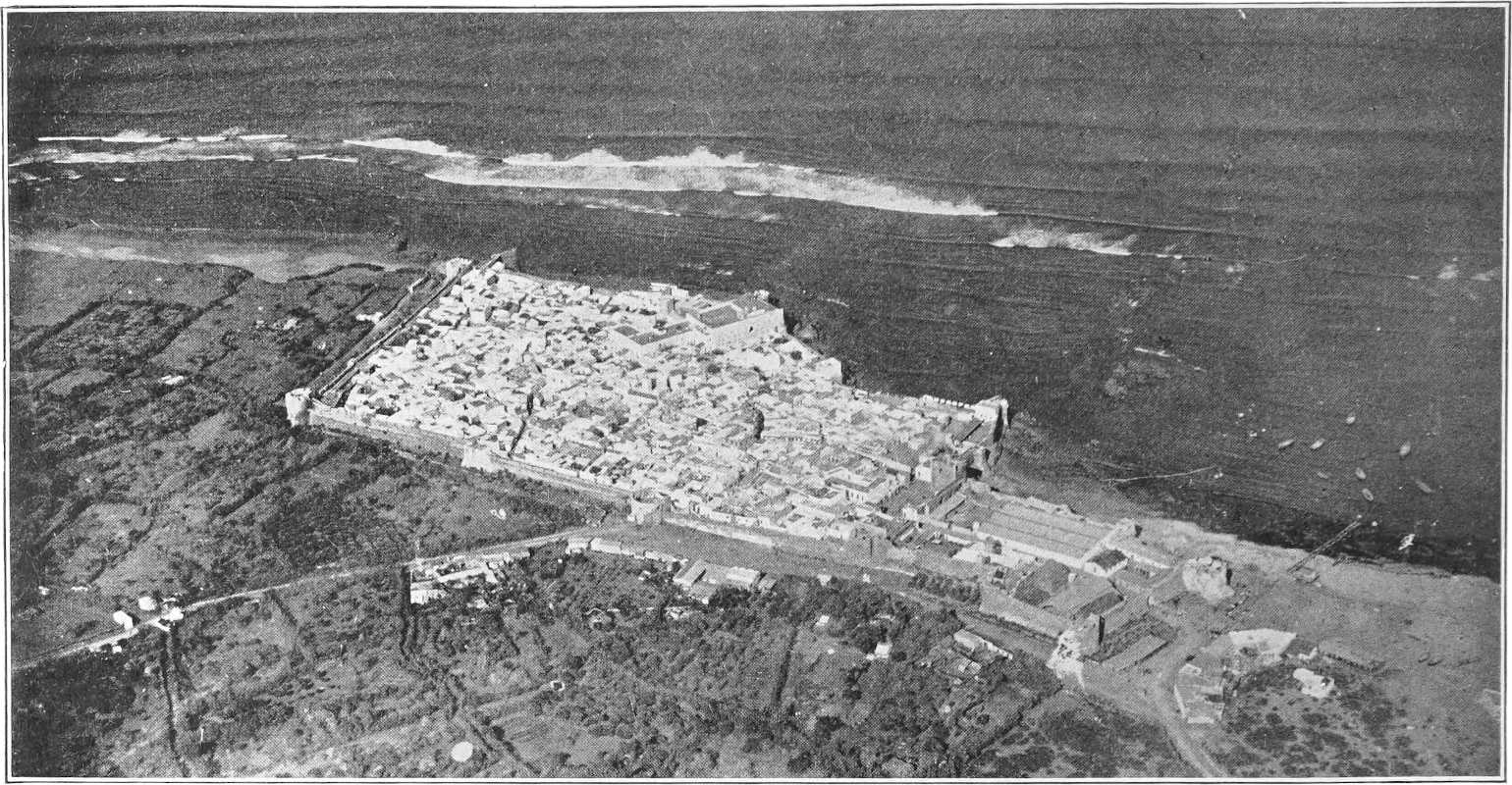
Azeila from the air
“When their work was done, the Anjera guides slipped away and found shelter behind our lines, but the man who led the other column was suspected of treachery, and they tied him to the tail of one of the horses, so that he could not escape, and, to save his life, he was obliged to lead the enemy to the point they had indicated to him. Things did not go much better for them there, for they had not enough food or ammunition with them, and I had posted a party of men with bombs to blow up the troop who brought their supplies. There is no wide road in Wadi Ras, and, everywhere, a few men can hide and do much damage. The bombers divided into several groups and threw their grenades from convenient places above the heads of the Spaniards. A few men were wounded, and three mules killed, but the others pressed on, thinking that the ambush was passed. A few hundred yards further on, the same thing happened, and, in great confusion, carrying their wounded on such mules as were left, the troop fell into the third trap. After this they retired, thinking that the whole valley was lined with death. This left the column at Wadi Ras isolated among the northern hills, where, if we had put a ring of snipers round them and besieged them, they would have been helpless, for their ammunition was low and they wasted their bullets.
“News had been brought to me that a force (under Barera) was on its way from Larache, so I saw that an end[284] must be made of the affair. I sent messengers from Beni Aros, of such families as had had dealings with the Spaniards, to inform Barera that he was too late. With much distress, they were to explain that the remnants of the columns had retired towards Ceuta and Tetuan, and that the forces of the sheriff were in strength at Wadi Ras. That night we set forth to render the words true! The enemy occupied a ridge which was steep on one side, but easy of access from the other. A few tribesmen made a pretence of attacking the gentle slopes, firing and shouting the war-cry of their people, as if it were only a sortie from some village which wanted to collect a few rifles. After they had drawn the attention of the Spaniards, some horsemen galloped up in a long line and blazed over the heads of the first party. They were good targets and a few were killed, upon which the others made a feint of retiring, but, in reality, as soon as they were out of sight, they dropped down among the scrub and waited. The horsemen stood up and urged their horses up the hill at full speed, firing as they rode, but, when the enemy would have met this charge, they wheeled round and fled, sliding over the rough ground on their haunches, still discharging their rifles and shouting. The enemy followed, but there were few wounded, for the voluminous robes of the Moors received more bullets than their bodies.
“The clamour was intentional, for it had covered the approach of the real force which crept goat-like up the crags, in single file. On this side the ridge was scarcely guarded, and the few sentries were easily overpowered by the first tribesmen who climbed, with a knife between their teeth. The end was very easy. My men were on the ridge before the majority of the enemy turned from chasing the horsemen of el Arbi. They fought stubbornly, sending several tribesmen to paradise, but they were overpowered and driven[285] backwards down the slopes to the ambush which awaited them.
“That was the second night of the battle in Wadi Ras, and on the third there was little left to do. The column from the West had not arrived, but there were still stragglers who had reformed from the others, intent on reaching the coast, and some isolated posts which had lost communication with the main body. Excited by their victory, the tribesmen would not be restrained, and they killed many hundreds of wounded and threw themselves recklessly upon any Spaniards who were still in the country. Once again there were murders in the coast towns, and, in one place, the Arabs laid a plot to destroy all the Christians. It was arranged that the tribesmen should enter the city secretly in small numbers, with no rifles and in the clothes of townsmen, but, under his waistcoat, each man would carry a revolver. They would meet in the square and mix separately with the people in the hour after sunset, when all the Europeans come out to profit by the cool. Then, at a given signal, each man would fire, and kill as many as he could.
“Allah was not with them, and there was a mistake. Many had entered the town safely, but the guard challenged one group at the gate. Frightened that the plot would be discovered, the tribesmen fired and killed some of the guard. They broke into the town, but warning had been given to the citizens, who rushed for their arms. The tribesmen were scattered, and there was little fighting, though some were killed with bullets which were fired without purpose. Three men were captured, but they knew nothing of the plot and had only used their weapons to be in company with the rest.
“After the battle in Wadi Ras, the tribes gave praise to Allah and thought that shortly there would not be a Christian left in the country. It was useless that I said to[286] them, ‘Our success has signed the judgment against us,’ for I knew that Silvestre would crush Spain between his hands for men and money to destroy me. I redoubled my efforts to supply the needs of Jebala against a long campaign. Even the prisons were used as stores, and no man was allowed to sell his harvest. Much grain had been destroyed by the enemy, and they had taken the beasts, or killed them, if they had no time to drive them away. This is against the law of Islam, by which it is forbidden to destroy the food, or poison the water, of an enemy.
“For two months we had little fighting, for the Spaniards were waiting for reinforcements. I knew what was before us, for I heard that the harbours were never empty of ships, and that, from them, were landed aeroplanes, and armoured cars, and bombs with gas in them that men cannot breathe. Ullah, what strange people you are! You say it is savage to cut men’s heads off when they are dead and their bodies without feeling, but it is civilised to stifle the living man with poisonous fumes, so that he dies slowly and his body decays while his spirit is still in it! Allah will decide between us!
“While all these preparations were being made against us and the coast was covered with troops, the wharves piled with ammunition, a deputation came to me from many tribes, including the Guezauia, the Riffs of Gomara, the Beni Gorfet, and the Sumata, who were the last to stop fighting against the Christians. They asked me to go up to Sidi Abd es Salaam to meet the Sheikhs of all the loyal tribes and to swear an oath with them. I agreed, for I knew that still more armaments must come before the attack would be renewed. I took with me my nephew and el Kharaji and the Jellali who commanded my cavalry; and the oldest of all my slaves, Ba Salim, held my stirrup as I rode.
“We started early in the dawn, and I remembered that other ride to meet Jordana at Guad Agraz, but this time my[287] salutations were for my own people—who knows the intentions of Allah! We stayed one night in Tazrut where I was joined by the Kaids of Beni Aros and two hundred of my soldiers. The next day we rode up Jebel Alan, but the start was delayed because, from all over the country, men hurried to ride with me, and the women were busy cooking rice and bread. When all had been fed and the morning prayer had been said in the mosque, for there was no room for the multitude in the Zawia, we left Tazrut and started up the first slopes. Below us the village was white and prosperous under the protection of the tree which is sacred in my family. If anything should destroy it, the fortunes of the Raisuli Sherifs would wither, so my house is built round it, and there are walls to protect its growth.
“It is said that my ancestor, Mohamed, said his prayers under a venerable oak,[93] and, because he was then hiding from his enemies, and had no food, he ate the acorns[94] that fell from it. The mercy of Allah turned them into bread in his mouth, and his hunger was satisfied. He renewed his prayers, and when he noticed that the old tree above him was falling, he planted one of the acorns in the ground and blessed it. Later on, when some of his disciples were restored to him, he brought them to Tazrut and showed them the acorn sprouting from the ground. ‘It is the child of the tree whose fruit saved me,’ he said, ‘and my children shall serve it.’ Then he told his disciples to build a fence round it and watch it, ‘for,’ said he, ‘my strength is ebbing with that of the old tree, but all shall be given to my house, more than my tongue can speak of, or my words embrace. They shall be the most powerful in the land as long as they remember the gratitude the Sherifs owe to this oak.’ It is said, also, that on the day he died, and there was mourning[288] among the villages of Beni Aros, a great wind came and blew down the tree, but the seedling remained, and it is now nearly as old as its ancestor. Some of its branches have been destroyed, but no bombs touched it, for it is the will of Allah that the Raisuli still live.
“We rode up to Jebel Alan in a long line which reached halfway down to the village, and it was sunset before we reached the sanctuary. Each man dismounted and said his prayers where he stood, and the mountain was one voice praising Allah, for there were many thousand tribesmen, more than I have ever seen before Sidi Abd es Salaam. There were strangers to me, even among the Kaids, and I knew that some great thing would happen. All kissed my sleeve, or even my shoe as it was in the stirrup, or the trappings that were on my horse, but there was no speech. In silence we reached the summit, and the tribesmen fell back, ranging themselves upon the ground, till every space was covered. The Ulema from the Zawia of Teledi, the wisest men in Morocco, had come down from the peaks of Ahmas, and the Sheikhs of Beni Aros were there in their full number, though some were so great in years that their strength had gone from their eyes to their beards.
“No man broke his fast that night, but all waited for the hour when the Hezb would be chanted. The moon was full, and there was no other light. It seemed as if the clouds of the sky had descended and the whole earth gathered itself together and listened. The Sheikhs’ white robes were immobile by the wall of Abd es Salaam, but the brown jellabas of the tribesmen stirred in the shadows. Murmurs that were not words ran among them, and Allah was in our midst. At last the cry of the first Azzan broke against the rocks, and the thousand voices echoed it, till all Jebel Alan was a tongue in prayer. The Imam of Teledi repeated the Hezb and the mountain bowed itself towards Mecca. There were[289] those who said the earth really moved and trembled under our feet. At the end of the prayers there was silence, and then, in moonlight, that was brighter than the day, the Sheikhs of the tribes spoke, each one in his turn. They told how it was ordered that battle should be made against the unbeliever, and they recited the life of the Prophet, showing his victories and also his defeats. They told how paradise waited for the slayer of the Christian and how the Prophet suffered when he, too, was homeless and fled from Mecca. ‘If your villages are destroyed by the enemy, your house is Islam,’ exclaimed a Sheikh of many years, whose voice tore the strength out of his body, and the tribesmen cried out that a foreigner should never rest his foot in the mountains.
“Men rocked themselves backwards and forwards, and repeated the name of Allah, till some foamed at the mouth and were sightless. Still the Sheikhs spoke of war, and the men of Beni Aros leaped up and shouted, ‘We follow the Sherif!’ Far away the cry echoed, like stones falling into a valley, and every throat bore it back again—‘We follow the Sherif! Allah protect the life of our master!’ Then the Imam of Teledi mounted on the wall and pointed over the falling hills. ‘That way lie the Christians, and it is your way; but the man who leads you is Sultan of the Jehad!’”[95]
Raisuli’s voice rang in momentary triumph. Then he was silent. Menebbhe gripped my arm and would not let me speak. . . . It was much later that the Sherif, rousing himself with an effort which was apparent, continued, “In this manner I was proclaimed the leader of the Holy War against the Christians, and it is against the echoes of that night that the Spaniards fight today in the Riff. When the Ulema had finished speaking, sound roared up the mountain like flames in a wind. Men laughed and sang, shouted and[290] prayed, and nobody knew what his neighbour was saying. A single shot rose above the voices, and instantly every rifle spoke. It was the voice of the mountain again, thundering her challenge against the threat of the Christians. When the shots ceased—and this was after a long time, for some were slow and some were far away, but all would swear their loyalty by the oath of lead—a Sheikh of Sumata spoke: ‘Your bullets are for the Christians. Do not waste them even before Allah.’ Then I mounted and would have ridden down a little way, but my horse stepped on men’s bodies, for the tribesmen threw themselves before me.” Again there was silence. A bee blundered against the curtain, buzzing, and, from outside, came the shrill, thin sound of a pipe. “You are greatly honoured,” whispered Badr ed Din. “I have never heard the Sherif talk of that day, nor has he ever spoken in this manner before.”
SIEGE AND RETREAT
After Raisuli had left us, Menebbhe and Badr ed Din murmured together under the shelter of their hands. Then the Kaid said, “Since the time of which he told you, the nature of the Sherif has changed. It is obvious to all of us, and many who are not in his confidence have observed it. Before that day, he cared for different things, but now he wishes only to make his peace with Allah. He fasts till, of a truth, the serpents eat his belly, and he prays even more than Mulai Sadiq. He accepts nothing from the Christians or from the Jews. There was once a case of tea which was sent up from Tetuan and, on the outside, was a picture of a woman dancing. The Sherif would not permit the tea to be used, for images are forbidden in Islam.
“In all things it is the same. Before Abd es Salaam, he had no regard for a man’s life, knowing it to be already forfeit to Allah, but since that day he has killed no man except in war, or by the order of a tribunal. Even his cousin who rebelled against him and laid an ambush for his son, Mohamed el Khalid, did not lose his head. He deserved death as well as any man, but the Sherif said, ‘If it is the will of Allah, he will die,’ and he sent him up to the mountains beyond Tazrut. There he was put into a covered corn-pit, dug in the ground, with only one small hole for him to breathe. It was very cold and he had but one mantle. Food was given him through the hole, only a little oil and some black bread, for the Sherif hoped that he would die. He was imprisoned in this manner for three[292] months and kept in chains so that he could not move about, yet he lived, so my master released him, saying that his death could not be pleasing to Allah.
“On one occasion some of the men of Beni Aros were ambushed among the hills of Mesauer, and it happened in this way. A village which had never acknowledged the authority of Zellal sent messengers to the Sherif, saying that their cattle had been taken by the Spaniards and they feared for the safety of their houses. My master sent a force to help them, and, by Allah, it would have fallen into the prepared trap, only that it was much stronger than they had expected and the tribesmen were divided among themselves. Some said, ‘Let us shoot,’ and others, ‘Let us fly, and make another opportunity when we have more men’; so a few shots came from uncertain hands, and the soldiers were warned. The tribesmen, seeing the result of their hesitation, fought furiously, taking advantage of the ground they had chosen, but the harka[96] forced them out of their cover, killed many and took some prisoners. When these were brought to the Sherif, he looked at them without speaking, and said, ‘Return them to me after the last prayers.’ So we brought them into his house at night, and they stood before him, in chains, with bare feet. My master did not speak, but sat for a long time staring at them, and they grew nervous. At last he said, ‘Allah has not given me a weapon against my brothers. Go with peace, but take your chains with you, that you may turn them into bullets to fight the Christians.’”
The Kaid dropped on his elbow, and Badr ed Din promptly used his shoulder as a cushion. “It is the truth. I have not known so great an alteration in any man as I see in the Sherif, since I rode behind him up the mountain.”
Raisuli never made any reference to a change in his outlook.[293] Next time he came to my tent, in a rose-pink kaftan smothered below layers of white woollen garments, with a dark jellaba over all, he began at once to talk about the Spanish occupation of the Fondak. “It was a day of triumph for Silvestre,” he said, “but it had been long delayed. It was in the autumn that I knew we could not hold Ain Yerida.[97] Since the meeting on Jebel Alan, the country was united against the propaganda which issued in a stream from Larache and Azeila, like the words of a woman when the thing she covets is denied her! Dris er Riffi was eloquent against me, and Barera, as clever in his politics as he was in his generalship, sent well-known townsmen to his outposts with instructions to talk to the people in the Suqs, impressing them with the power and generosity of Spain.
“If you can defeat an Arab in argument, you have won him to your side, for the educated among us love words as your men love women. Barera knew this, and his orators were skilful in their speeches, but, though Anjera and some others were with Spain, many of their own Kaids were doubtful. ‘Even if Spain wins,’ they said, ‘she will make peace with el Raisuli, for he has the ‘baraka,’ and, in one way or another, we shall certainly be given back into his hands, whether he rules for Spain or for himself!’ So there was doubt, and even men who had no friendship for me held back.
“For some time aeroplanes had bombarded Ain Yerida, and few of my followers lived above-ground. My house was always untouched, and the great square of the Fondak only lost a little plaster. At first men were terrified of these birds, and would fly, screaming, dropping their rifles as they ran, but I never moved from the place where I sat, and, seeing the little damage that was done, the tribesmen regained[294] their courage. There were some who thought they could shoot the aeroplanes with a rifle. When they flew low, this was tried, and the Spaniards could not waste a bomb for every sniper. But my men always thought the red mark on the body must be the heart of the bird, so they did little harm.
“The advance to the Fondak was slow, for the Arab troops[98] were not loyal, and sometimes they fell on the end of a Spanish column and ate it up, escaping to the mountains with their loot. The attack was delayed several times by incidents of this sort. Once there was a general rebellion among the police, and several Spanish officers were shot, but this was because the men complained that they had not received their pay, and that even the fodder for their horses was sold to others.
“Three columns converged on Ain Yerida, coming from Larache, Tetuan and Ceuta. The path of each was disputed by horsemen who harried their flanks, and by riflemen who lay hidden, a few here, a few there, where the aeroplanes could not find them, but it was impossible for any body of men to move against them, because of these birds who hovered more persistently than the kites of El Biut. Whenever a column moved, villages blazed in its wake. This is the way of your civilisation. Blood flows before it and fire follows behind. It is not so great a change from the campaigns of Mulai Hassan, whose troops ate up the country like flies on a corpse. The homeless people fled to the mountains, women carrying their children, boys shouldering the rifles of the dead. I feared for the supply of grain, and ordered that it should be rationed in the villages, but the people thought that money was still a thing which had value, and they offered it to the distributors who should have hoarded the grain. So the douros changed[295] hands, and soon there was nothing left that they could buy.
“The way to Tazrut by Suq el Khemis was always open for our retreat, for the columns advanced by the coast, the one from Larache fighting its way within sight of Zinat, down the road which I had closed for so long.
“Since the war the only road had been the sea, and this was the great difficulty of our enemies, for, as soon as they put up a telegraph-line, it would be cut down in the night, though there was no enemy in the neighbourhood. Ullah, I do not know how many troops were employed against the Fondak,[99] but there were many thousands, more than all the fighting men I had in the country. The enemy halted before the final attack, and made some of their little forts on the hill-tops, to guard their communications, while the artillery bombarded every yard which lay between us. I watched the shells bursting, and the explosives were so close that it reminded me of snow on Bu Hashim. All the bushes were burned, being first saturated with oil that destruction might be the swifter. All day the women toiled through our lines, homeless, often wounded and with singed clothes. The aeroplanes flew above us, and, after their passage, the earth was torn open at our feet. It was time to go.
“From the hills beyond we watched the Spaniards advance, preceded by a storm of shells, but none touched the red flag which we left guarding our property. The green standard we took with us, and it followed us to Sellalim and to the last outposts of the mountains. Before sunset the red strip had been torn down—it was the will of Allah. But today it flies again in Ain Yerida. Ullah, it is a pity that Silvestre cannot see it!
“The Spaniards concentrated a large force at the Fondak, making it the base from which to operate against Suq el[296] Khemis. This action cut my communications with Tangier, for Barera and Silvestre now held the line between Azeila and Ain Yerida. They began a methodical envelopment of Beni Mesauer, and I saw that, if this succeeded, I should not be able to get any more supplies, so I went to see Zellal, and I stayed with him some days at his house. It was agreed between us that he should make peace with the Spaniards, so that his men might pass freely to the coast. Mulai Mustapha, my nephew, was my agent at Tangier, and it would be easy for him to send the things which I needed to Beni Mesauer and Zellal could arrange for their further journey. At that meeting, el Ayashi promised me his daughter, that the marriage might be a bond between us, and it was agreed that, when the war was over, she should be brought to my house.
“The next day Zellal sent messengers to the Spaniards, offering his submission, and they were delighted, and received it gladly, for his influence was well known. At the same time, the portion of Anjera which was with me deserted and made peace with the Christians. There is no honesty in that tribe, and they look no further than their pockets! At this moment their Sheikh, Mulai Ali, is living in Tetuan and talks much about his friendship for Spain, but I think his eyes are already turned in another direction.[100]
“Beni Ider and Beni Hamid now lay across the path of Spain, and for many months there was fighting among their hills. The Spanish force had three objectives. From Tetuan and Ben Karrish an army advanced towards Xauen, and Mulai Ali, my nephew, was at the head of the flags which fought them. From Larache, Barera pushed forward into the mountains of Beni Gorfet, hoping in this manner to draw a circle round Tazrut, but the Sumata, who were[297] my best fighters, came south and blocked their passage. The third army operated from the Fondak, and Silvestre, looking up across the hills of Beni Aros, dreamed of the day he would set foot in the Zawia at Tazrut.
“There were no great battles, for the Spaniards had learned a lesson, and there were many days when they laid aside their rifles for spades and occupied themselves with shovelling earth into bags. Some of their small positions we took, but, though daily men died at the hands of hidden enemies, their artillery forced us back. Often their vanguard was on our heels as we slipped away into the hills, after eating up a post or breaking a column on the march. Often I have been so near them that Spanish soldiers dreamed of wealth, for the Government had offered a huge price for me, dead or alive. Ullah, I don’t think they would have complained of barbarity if my head had been brought to them, but the idea of so much gold unnerved their soldiers, and the bullets, as usual, went wide.”
“Allah was between you and your enemies,” broke in el Menebbhe, “and so it was made clear to me that time in the Wadi. In those days, the Sherif was more easily divided from his rifle than from me! Allah alone knows how many miles we have ridden together. Once we had fallen on the enemy in the early morning and killed some, but a relief came, and we were obliged to fly. My horse was lame, so the Sherif sent on all the others and stayed behind with me, with his two slaves. At noon we came to a wadi with high banks, and, in the bed of it, there was some sand and some clear pools. ‘It is the hour to pray,’ said the Sherif, and ordered Ghabah to hold our horses on the bank, while we went down to the water. The Spaniards were close behind us, so I urged him, ‘My master, let us go on a little further till we come to a safe country.’ And he answered. ‘It is already past the appointed time.’ ‘At least, then, let us hide[298] ourselves in a place from which we can see the approach of an enemy?’ But the Sherif would not listen, and Mubarak and I followed him into the wadi.
“We performed the ablutions in a pool, and the slave spread out the red carpet for his master. The Sherif laid his rifle in front of him and, looking neither to the right nor to the left, he began the prayers. Hardly was the first raqua-at finished when Ghabah signalled from above, but the Sherif paid no attention. Then I saw two policemen on the bank opposite, and each had a rifle aimed at my master. I cried, ‘In the name of Allah, save yourself!’ but the Sherif never turned his head. ‘Have you so little faith in God? In truth, you are a bad Moslem,’ he reproached me. Mubarak would have picked up his rifle, but el Raisuli forbade him. We stood there, the three of us, while, fifty yards away, the men covered us. I wondered why they did not fire, but I would not appear less brave than the Sherif, so I only looked sideways out of the corner of my eye, and then I saw that the two were fighting. At this I was so surprised that I almost missed a prostration. I looked again, and saw one man knock the other down and take possession of his rifle and his horse. The other ran away, and the first came down the bank towards us, leading both animals, with the two guns in his hands.
“The Sherif continued his prayers, paying no attention to anything that had happened, but, when he had finished the last raqua-at and saluted the angels on his right and on his left, he said to me, ‘Did I not tell you there was no danger?’ Then the policeman came up and kissed the shoes of the Sherif and held them for him to put on. ‘Why have you come to me?’ asked my master. ‘Why did you not shoot and earn the money that has been promised?’ ‘Allah forgive me! that was my intention when I first remarked you, but, when I saw that you took no notice, trusting[299] to the protection of Allah, I said to my brother, “We cannot kill such a good Moslem.” He argued, and would have fired, but I took his rifle. The blessing is with you, Sidi. May my service be under its protection?’”
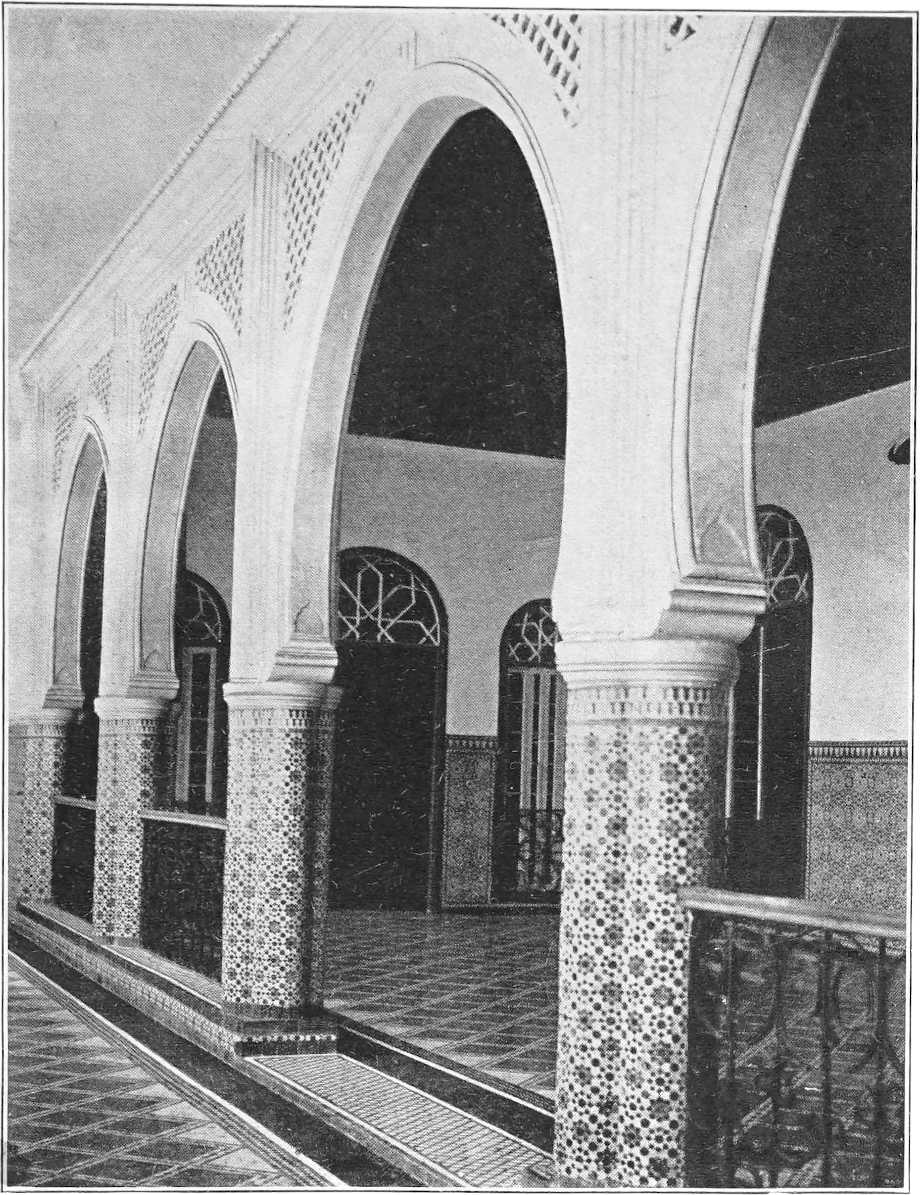
Gallery of Raisuli’s palace at Azeila
The Kaid looked up, smiling, with a gleam of strong teeth amidst the black of his beard. “Ullah, I was frightened that day, but the Sherif has never known fear!” Raisuli’s eyes wandered out of the tent to where Mohamed el Khalid was sitting on the edge of the well, and he made no comment.
“Xauen was taken after much loss on both sides,” he said. “Weight of guns and weight of men captured the hidden city (in October, 1920), which had been sacred to Moslems, and it was fitting that the Jews should rush out to welcome the sacrilege. It was again as at Larache, so many years before. The Arabs shut the doors of their houses, saying, ‘It is finished!’ while the Hebrews thronged the streets, singing and shouting in their joy. Since the war ended the Spaniards have done well in that country, and the new Pasha is a wise man and a friend of the Government. It was his influence which prevented a great massacre when the news of Melilla became known in Xauen. The bridges are no longer broken. The road is good. There will soon be a railway. Perhaps, after money has begun to drip into the hands of the Ahmas, and there is no more disease among their people, they will be content with that which has been sent them.” Raisuli paused, his thoughts evidently occupied with the future.
“When the mountains of Beni Ider had been crowned with their army, the Spaniards thought the war was at an end,” he said at last. “They could see the white houses of Tazrut on the side of Bu Hashim, and they wished to revenge themselves on these for the dead they had left in each wadi through which they had passed. Berenguer sent Dris er[300] Riffi from Azeila to start his propaganda on the outskirts of Beni Aros. Men wavered while they listened to his words, and thought of the harvest which had been wasted. We had been fighting for a year, and, step by step, we were crushed back into the hills; yet it was not the soldiers who defeated us, but the new inventions which they used against us. The air was thick with metal and the earth was mined under our feet. My people were frightened, for there seemed no end to the weapons of our enemy. As yet there was no famine, but men began to pull in their belts and lick their lips when they saw game on the hills.
“Barera pushed forward among the high peaks on the French frontier, urging that the army which occupied Xauen should come out to meet him beyond Bu Hashim. One of the largest forts was at Akba el Kola, a place difficult to hold, because of the cliffs which overlook it. In spite of this it was used as a base, and fortified with much wire. There were a good many troops there, with artillery and maxims which had been brought up with great difficulty, for this is on the edge of our worst mountains. The Ahmas tribe have never tolerated strangers. They waited only to be assured of the help of Sumata. Then they fell upon the fort. A small force hid in Beni Scar, with the help of the inhabitants, whose cattle had been taken by the enemy. Two other parties occupied the heights on either side of el Kola, and they all began firing together. The attack must have been unexpected, for, in order to escape a rain of bullets, many of the Spaniards tried to leap the wire, and became entangled in it. They were shot down as they struggled, and their bodies hung on the fence. A few gathered under the shelter of some rocks and attempted to defend themselves, but they had no time to use their artillery, and the tribesmen picked them off from the high ground. There[301] was scarcely a man left unwounded after the first hour, for some had fled before the fierceness of the attack.
“On the hills of Jerba and Bulerus there were smaller posts, and these too were surrounded, but they held off the Beni Ahmas till sunset, when they were eaten up by reinforcements from Sumata. This was one of the few battles that we won, and the slaughter was great among the Christians. The tribesmen secured many rifles, as well as the cannon that were left in the post; and the women came out by night to take the clothes of the dead. The Ahmas are savages, though good fighters, and they did not do more for the corpses than cut off their heads. Some bodies they stuck in the ovens where the soldiers’ food had been cooked. Others they left in the wire and, when the smell became bad, they went up onto the cliffs. Money was found in the office and a good many tinned stores, but the tribesmen could not use these for fear of pig-flesh being among them.[101]
“This defeat was a check to our enemies, for Barera saw there was no chance of the two armies joining south of Tazrut. In truth, their maps or their guides must have deceived them, for I have told you about those mountains whose sides are like the walls of a house. You can fire a gun across a ravine, and perchance hit a man on the opposite ridge, but it will take you a day to reach his body. Mulai Ali, my nephew, still held the Spaniards in the intricate country west of Xauen, and here the Christians paid heavily, for they had to build bridges before they could get their guns over the wadis, and, when winter came, the rains washed away half of their work. The Beni Hosmar hung on their rear, and there was no safety for them at any point. I have told you often that, in this country, taking the largest town is no more advantageous than taking a rock or a tree. The Spaniards were slow to learn this.
[302]“The second winter was hard on the tribesmen, and often there was only monkey-flesh in the pot. Once again the children died, and women fell before me, as I rode, and begged for food for their sons. I gave all that I had, and much came from Beni Mesauer. The Kaids were growing anxious, for the Spaniards had made a new plan, and the two armies crept forward from Larache and Xauen towards Bab es Sor, narrowing the triangle that was left to us. Berenguer had to go round Jebel Alan by way of Beni Leit, and here there was much fighting. Mulai Ali, my nephew, had five hundred men with him in the mountain, and they watched for opportunities of attacking the army which, divided into several columns, was struggling over the rough ground.
“At that time it was difficult to say who was loyal and who a traitor, for, in order to save their villages and their families, many had given the service of their tongues to the enemy. Perhaps one brother was with Spain and the other in my harka, but this was a matter of policy. Now, on one occasion, during the passage of Beni Leit, some relatives of Hamed es Succan, my dear friend, were guiding the enemy, and it happened that men of the same family were with Mulai Ali. It was therefore decided to lead the Spaniards into a trap. It was necessary that guides who were loyal to me should be substituted for those who were with the enemy. ‘That is an easy matter,’ said one Mohamed. ‘These men are my cousins. I will send them a message to run away in the night.’ ‘There is no use in that,’ protested another, ‘for the Spaniards would suspect treachery and take no more guides from our family.’ Mohamed thought for a few moments. ‘Ullah, we must then kill the sons of my relative, and it must not be known from where came the shots. After this, I, and one other, will go down and claim their bodies and make much mourning, clamouring against the Sherif and swearing to take vengeance. Thus the Spaniards, trusting[303] us, will be rejoiced to take us as guides, and we can lead them into the trap in whatever manner is arranged.’
“The wisdom of Mohamed was applauded, but one said to him, ‘Since the last surprise, the enemy have never trusted the honesty of their guides. They place them in the middle of soldiers, who have orders to shoot them at the first alarm. This is known to your relatives—otherwise they would have betrayed their new masters a long time ago.’ ‘It is known also to me,’ answered Mohamed, ‘and it is good, for thus will the blood of my cousins be avenged, and there will be no feud between our houses.’
“All agreed to the plan, and it was carried out as Mohamed had suggested. The Spaniards were led into a narrow place, where the rocks were rough under their feet and bushes clothed the hills on either side. Mulai Ali waited until they were in the centre of the Wadi. Then fire came from all round them, and the first ranks fell back upon the last, so that there was confusion and my people charged down upon them and completed their killing. The body of Mohamed was found without a rifle in the middle of the dead. It was sent back to his village, and his women mourned, but the men of the family were glad, for his bridge to paradise was covered with Christian heads.[102]
“There were many ambushes of this sort, and one of the best was concerned with cattle. The Spaniards would risk more for a fat herd than for a village, so some beasts used to be driven into a convenient wadi, where they could be seen from an enemy camp. A party would come down to capture them, and none of them would return. This trick was turned against us in the end, for one day, when the tribesmen[304] were lying in wait above the feeding cattle, they watched vainly for the approach of a troop. Instead of soldiers eager for fresh meat, came shells which destroyed the herd and tore up the hillside. The tribesmen fled but three of their number were killed as they ran.
“This was the time when men did not try to save their lives but thought only of killing many Christians for one Moslem. There was not a house left standing in the wake of the enemy, and even the women defended their villages. Once a Spanish column pushed into a wadi unexpectedly, and found no men in the place. The women watched them, afraid, but the officer ordered his men not to fire. Then he asked for the arms that he knew were hidden among the houses, and the women brought out old flint-locks and ancient weapons that would not have done harm to the birds, swearing that their kinsmen had taken the rest.
“The Spaniards made a long search among the hedges and outbuildings. Then he drove the women up on to the hillside, in order that he might burn the village. They scattered quickly among the bushes till there was not a haik in sight, but the one who led them, an old woman, who was called the Sorceress, because she could read the future by the sand or the fall of leaves in the wind, took them quickly to the place where the arms were buried. They dug with their bare hands and with staves, while the enemy looted the village and the police, who were with the column, stuck live fowls in their holsters and tied sheep across their saddle-bows. At last the earth gave up her secret, and the women seized the rifles and loaded them, creeping down the wadi with the weapons hidden under their garments. There was one place where the hills narrowed, but there was no cover, so they had to hide far up on the hillside.
“The Spaniards came slowly, with the flames roaring behind them and their horses burdened with loot. The[305] women waited, with eyes fixed on the first riders. As the ranks closed between the slopes, a cry rang out above them, the long, quivering cry of rejoicing that hails the new-made bride, or the new-born son. Fifty rifles spoke among the hills, and the Spaniards reeled from their saddles. Riderless horses charged backwards, and men, encumbered by their burdens, fired without aim or thought. The captain’s horse was shot under him, but he seized the bridle of another and called to his men to follow. At full gallop they charged through the wadi, and returned no fire till the land was open before them. Thinking the ambush was the reason for all the men’s absence, they imagined it strong and would not go back for their wounded. Shots echoed after them as they rode out of range, and by these, the truth might have been guessed, for no tribesman wasted bullets after the first year.
“When it was dark the women came down to strip the bodies and take the heads and the weapons of the dead. They caught also the horses and got back some of their own property. Then they mounted their children on the horses and, with the heads tied to the Spanish saddles and the rifles on their backs, they walked swiftly up to the mountains, telling the story as they went.
“These are small incidents of a great war, but generally there was nothing but hunger and burnt villages, crops destroyed, cattle taken, the killing of a few hidden snipers and the death of many Spaniards. Always the country narrowed around us, till Tazrut was shelled and the aeroplanes dropped bombs near my house. The door of the mosque was broken, but the building was preserved by Allah. Half my men were behind the lines of the enemy or among them, living like foxes in holes and shooting desperately whenever a Christian was within range. The Sheikhs came to me and said, ‘It is the will of Allah that we perish.[306] Is it not time to make peace?’ and I answered always, ‘Wait.’ They asked, ‘For what, Sidi?’ and I replied, ‘For that which Allah will send.’ I knew what was preparing in the East,[103] for communications had passed between Abdul Krim and myself, though I would not agree to an alliance, for he is a bad Moslem and our ways do not go together. For this reason I assured the people, ‘Have patience. The power is with Allah, and he will save us.’ They went away, saying, ‘The Sherif has no fear, and he is certain of success,’ but I knew that I could do nothing more. If it was the will of Allah, Abdul Krim’s blow would not be too long delayed.
“As the days lengthened (1921) it was a race. With every yard that we were pushed back, a new rumour of trouble came from the East. Disease spread in the villages, for the cattle were unburied in the pastures. The walls trembled from the shock of the cannon. There were no roofs against the rain. Men had ceased to tighten their belts and their eyes were like wolves. My illness grew so that I hung on the cord all day, and at night I prayed, with my face towards the East, where our succour delayed. All this was from Allah.” The heavy voice dropped on a note of finality. I looked up, passionately rebellious against the fatalism which suffered and accepted. The Sherif spoke sternly. “Much you have taken from us in the last centuries, but it was the will of Allah. Many marvels you have in the North, but we have our Faith. God is Great.”
POPULAR MYTHS AND SUPERSTITIONS
“I have told you nothing about Ali Ueld el Mudden,” said Raisuli, “but he was a good friend of mine throughout the war, and he was so clever that many thought he was possessed by jinns. He had a band of sixty men, living nobody knew where. Beni Aros was his headquarters and every cave in the mountains his house. It was like the time of my youth, when I had an army of boys encamped in the woods, for el Mudden was just as audacious and reckless as we were, and all the tribesmen said of him, ‘He has a laughing heart and a sixth finger which is a knife.’
“It was he who captured Lentisco, the railway engineer, and held him a captive for months, because the company refused a ransom. El Mudden had only fifteen men with him, and half of these he left to guard his retreat. With the others he appeared suddenly in the middle of the engineers’ camp near Tzenin and got hold of Lentisco. There was not much fight, for the Moors who were working on the line either ran away or stood still and looked on. Two Spaniards were killed and Lentisco slightly wounded. It was a great feat, for the prisoner was hurried off through the enemy country, without anyone daring to rescue him. A few shots were fired after the raiders, but these turned round and replied seriously, wounding several labourers. After this they were left in peace, and they went quickly to Harex, where the Spaniard was shut up in a house. He thought himself very miserable, because there was little light and no bed to sleep on except a few sacks, but this was in the[308] late spring,[104] and it was warm. He complained of the food, but he had the same fare as the tribesmen, black bread and oil. El Mudden came up at once to Tazrut to tell me of his escapade, and I told him, ‘Turn your prisoner into your friend but do not let him escape,’ for hostages were valuable to us, and, while still we had food, I said to my people, ‘Bring me Christians, that I may use them for negotiations,’ but the foreigners did not venture abroad, and it was difficult to catch them.
“I sent one of my secretaries back with el Mudden to question his prisoner, for, if he were a poor man, little ransom would be paid for him. Whatever was the prey of Sidi Ali, he always brought me the half, whether it were horses or cattle or money, and, truly, he was everywhere at once, burning an enemy village, cutting Spanish wire or capturing their herds, destroying their telegraph posts and even attacking their guards under the walls of the towns. Ullah, he had never heard of fear! Lentisco was not a satisfactory prisoner, for he quarrelled with his guards and demanded things which they could not give. Water is scarce in many of our villages, so, when they did not bring him enough, he complained that they wasted it performing their ablutions before the prayers. This angered the tribesmen, and they washed their feet and hands under his eyes and, when their devotions were finished, they offered him the dirty water, saying it was good enough for a Christian. ‘Ullah, it is too good,’ said one, ‘for it has contributed to the performance of the true religion,’ and he threw the water on the ground. Thereafter, for a few days, they gave the prisoner no water, but that which was dirty, and he became ill and wept.
“I learned of these things, and ordered that he should be better treated and given cooked beetroot with his bread.[309] Food was sent to him from Tangier, but the tribesmen kept it, saying a weapon had been contained in it. The railway was slow to pay the ransom, in spite of the many letters written by Lentisco. For five months the Spaniard was in the hands of el Mudden, who got tired of him at last and put chains on him, threatening to kill him if the money did not arrive. This I forbade, but the engineer suffered much fear, not knowing that his fate was already written and according to the will of Allah.
“At last the police of Larache began to treat for his release, and the officer suggested a meeting at the village of Saf near Megaret, where there was a Spanish post. El Mudden made conditions that the rescue party should come without arms and consist only of the officer and a few men, whose safety he guaranteed; but no answer came to this letter, so he suspected a trap. When he got to the appointed place, it was told him that a troop of police were advancing, but the officer was not with them. Swiftly an ambush was prepared and the enemy walked straight into it, emptying their rifles without effect on the hillside. El Mudden sent the men back on foot. ‘Tell the officer who disobeyed my instructions that some day I shall revenge myself,’ ordered Sid Ali, and took the police horses and rifles, most of which he sent to Tazrut.
“When his mind was not occupied with the hundred thousand douros which he hoped to receive for Lentisco, el Mudden was my best spy. He had the eyes of a kite and the ears of a lynx. It is easier to keep the stallion from the mare than news from that man! In the end the money was denied to him, for Lentisco persuaded one of his guards to release him, whether by the glamour of his words or the gold promised, I do not know. They fled in the middle of the night to Megaret, and the affair was finished.
“I wish I had had el Mudden with me in my youth, for[310] he had in his mind many things that I never thought of. Beni Aros was full of his disguises, and there were different ones in each house that was friendly to him. He had uniforms and European clothes, but, when these were not under his hands at the moment he desired them, he despoiled some citizen or soldier, assuring the former that it was an honour for a non-combatant to serve a warrior, but generally the man was dead and could not hear. With his band he would remain hid for days among the furthest mountains, not stirring when the cannon that heralded the Spanish advance tore up the hillside whereon he lay. Many of his people were killed in such affairs, but none moved, and, at last, the enemy would advance, believing that the country was empty before them. Then el Mudden would revenge the deaths of his men and for each unspent bullet there was a Christian head. Many villages would have submitted to the Spaniards, but that they feared the vengeance of el Mudden. Dris er Riffi’s words were as honey, but the retaliation of Sidi Ali was like burning oil.
“One day he knocked at the door of a Spanish house and told the farmer that he had come with a warning of attack by the band of el Mudden. The man must at once repair to the nearest Spanish camp with his family and all he could save. There was little time, for already the brigands were approaching. The farmer fled with his wife and children and his labourers, el Mudden guiding them tenderly to the post which was on the next hill. While he did this, his own men advanced swiftly, looted the farm and drove off all the beasts, without firing a shot, which would have aroused the attention of the neighbouring post well provided with artillery.
“On another occasion he dressed himself as an officer of police and, with a number of men mounted on police horses, with every detail of their uniform and saddlery correct, he[311] rode down to a village near Azeila which had submitted to the enemy. He told the Kaid he had come to arrange the new taxes, and, when the man demurred, he threatened him with his gun. Vainly the Sheikh pleaded that the Government had remitted his taxes and that all tithes had been paid to the Pasha. The police insulted him and tore off his turban, till he swore he would make his peace with the Sherif. Then el Mudden beat him, and, under pretext of warning him not to put himself into power of Raisuli for fear of his vengeance, told him of all the Sherif’s successes and how afraid the Spaniards were of him. Then he took the arms that were left in the village and drove away all the cattle, taking the calves across the saddles and the lambs about their shoulders. When the Kaid complained to the Pasha, he was told that he lied, which made him more angry. Then er Riffi sent to him, saying it was a trick on the part of Raisuli, and he was enraged, saying, ‘Am I so great in years that my eyes cannot see?’ and he waited for the first opportunity of deserting the Government.
“Such escapades were common even in the last months of the war. I myself have been among the enemy and they have not known me. Once, I remember, we were a few men and, of those you know, only el Menebbhe was with me. We were tired, for we had ridden from the valley below Ahmas, and we were now in Beni Aros. Also we had not broken our fast for two days. We saw a few houses in a hollow and went towards them to get food, but they were deserted, except for a woman who ran out crying to us to go back. ‘The Christians are coming,’ she said; ‘you will be surrounded, for their posts are also in front.’ I asked what the enemy consisted of, and she told me, besides the Spaniards, there were many Arab irregulars. So I hid the horses among the olive-trees, and some of us lay in the barn, where there was a pile of figs which we ate and appeased our[312] hunger. Then we looked out and saw the enemy coming, but they paid no attention to the village, for there were only a few houses and the crops had already been burned by the advance party.
“We waited till the Spaniards had gone on. Then we slipped out and mixed with the irregulars, who were tribesmen from the plains and unknown to us. Ullah, it was an amusing march, but we regretted the few figs we had left. On we went, turning west of the Spanish sentinels, and no man suspected us. Then when the road was clear to Bu Hashim, we slipped to one side of the column, ready for retreat. It was after sunset and, when the firing began, all men feared an ambush. For a moment none knew where the shots came from, though bodies dropped on all sides. Then they shouted that traitors were among them, and each man was suspicious of his neighbour, but we crept away while their rifles were still uncertain. Many had died because of our stratagem, and we had had an escort to the gates of our country!”
At the end of this story I looked doubtfully at Menebbhe. It seemed impossible that anyone could mistake the bulk of the Sherif, but the Kaid nodded his confirmation. “Allah blinded their eyes and they could not recognise my master. It is the ‘baraka.’ Many times I have thought I was alone, and, Ullah, there was Mulai Ahmed beside me. There was another occasion, when we were hiding in a wood. A Spanish column passed below us and we were but five men, so we dared not fire. We put our hands over the nostrils of our horses, and waited. It happened that just beside us there was a fig-tree, and one of the officers, seeing it, rode up to gather the fruit. The Sherif was as close to him as if they were both sitting in his tent and it was full day. I had my rifle ready, intending that, if he looked round, he should die, but he went on plucking the figs, eating them as[313] he stood in his stirrups. Then he turned, and I looked along the sights of my gun, but an insect or some of the fruit-juice was in his eyes and he rubbed them as he kicked his horse blindly down the hill.”
“His greed saved his life,” I suggested. “Allah forbid. It was the blessing of the Sherif, which is like a cloak around him. Even the Christians speak of it and believe.”
Raisuli sighed and pulled up his wide sleeves. “It is very hot, and we have talked much. Perhaps you are tired,” he said, and then, rather as an afterthought, “Would you not like to eat?” The suggestion was received with enthusiasm, for it was nearly three o’clock! but a slave, despatched to ascertain what progress the cooks were making, reported that the meat was still red. “With health, with appetite!” wished the Sherif, and departed to the Zawia. “The appetite is here, certainly,” said Haj Bu Meruit, an erstwhile henchman of Mannisman, who had been meekly waiting outside, “but of the health I am not so certain.” He felt his neck carefully. “The Jinns were about last night, and I think one twisted my shoulder-bones.” I thought it was a joke, and smiled politely, but Mulai Sadiq answered seriously, “You should have said ‘Bismillah!’ There is only one thing that affects the jinns, and that is the name of Allah.”
“In Asir,” I ventured, “the women smear the lintels and threshold of the door with white of egg, which is supposed to be a most potent charm.” “I don’t think that can be of much use,” retorted the Haj with contempt, “for I was once in a store when a man was hit on the head by a jinn, and the place was full of boxes of eggs.” “You are right,” returned Mulai Sadiq. “There are two kinds of jinns as you may read in the Koran. Those who are believing do not trouble Moslems, but the unbelieving kind are most dangerous, unless you have learned to control them.[314] This is a science which you must study carefully. It is called Ulm el Issem, and I worked at it for five years before I tried to have conversation with a jinn. I had been warned that he should appear in human form, with jellaba and turban, and, seating himself beside me, should talk to me in an ordinary voice and answer such questions as I put to him. But, if he came in any other form, it was bad, and I must have no dealings with him. I made all the necessary exhortations and, at the end, I saw a shape in front of me. It had two legs like a dog, with human feet, and its body was also a dog’s, but its neck was so long that it reached to the ceiling. I was in my house at Tetuan, and it seemed that the roof had become a funnel, so that the head of the beast was in the sky.”
Mulai Sadiq spoke as if he were relating a most normal experience, and, when I asked, somewhat breathlessly, what he had done in view of the unexpected appearance of the jinn, he answered impatiently, “Well, of course I knew I had made a mistake, so I began praying as hard as I could and, at each repetition of the name of Allah, the beast grew smaller and smaller, till finally it vanished altogether.” “Have you ever tried again?” “No, I have been much too frightened; but it is all a matter of learning. There is nothing that a man cannot do if he have enough will-power,” and he began talking of the mystics who can leave their bodies at home and make a spiritual pilgrimage to Mecca, being able to describe every scene and action of the Haj when it is over.
At this Bu Meruit loudly protested, feeling, perhaps, that he had wasted the few well-spent weeks of a life which, from his face, would appear to have been chiefly evil, but Mulai Sadiq countered swiftly, “Have you never heard of Mulai Abderrahman es Siuti? He was one of the most learned in El Azhar, and it happened that each one of his forty pupils[315] asked him to dine on the same night, without the knowledge of the others. The next morning there was much argument, for each declared that the Master had sat at his table, and it was only when it was proved that es Siuti had, in reality, dined with some of the other ulema, that his pupils realised it was the spirit, not the body, of their master they had entertained.” The Haj’s eyes brightened. Perhaps he saw vistas of endless simultaneous dinners, for he was comfort-loving and greedy, but fortunately at that moment lunch arrived, carried by breathless slaves who had evidently run down the garden, holding the food on the plates with hot black hands. “El Hamdulillah” said Mulai Sadiq, “I had nearly telephoned to Tetuan for them to send up a meal from my house.”
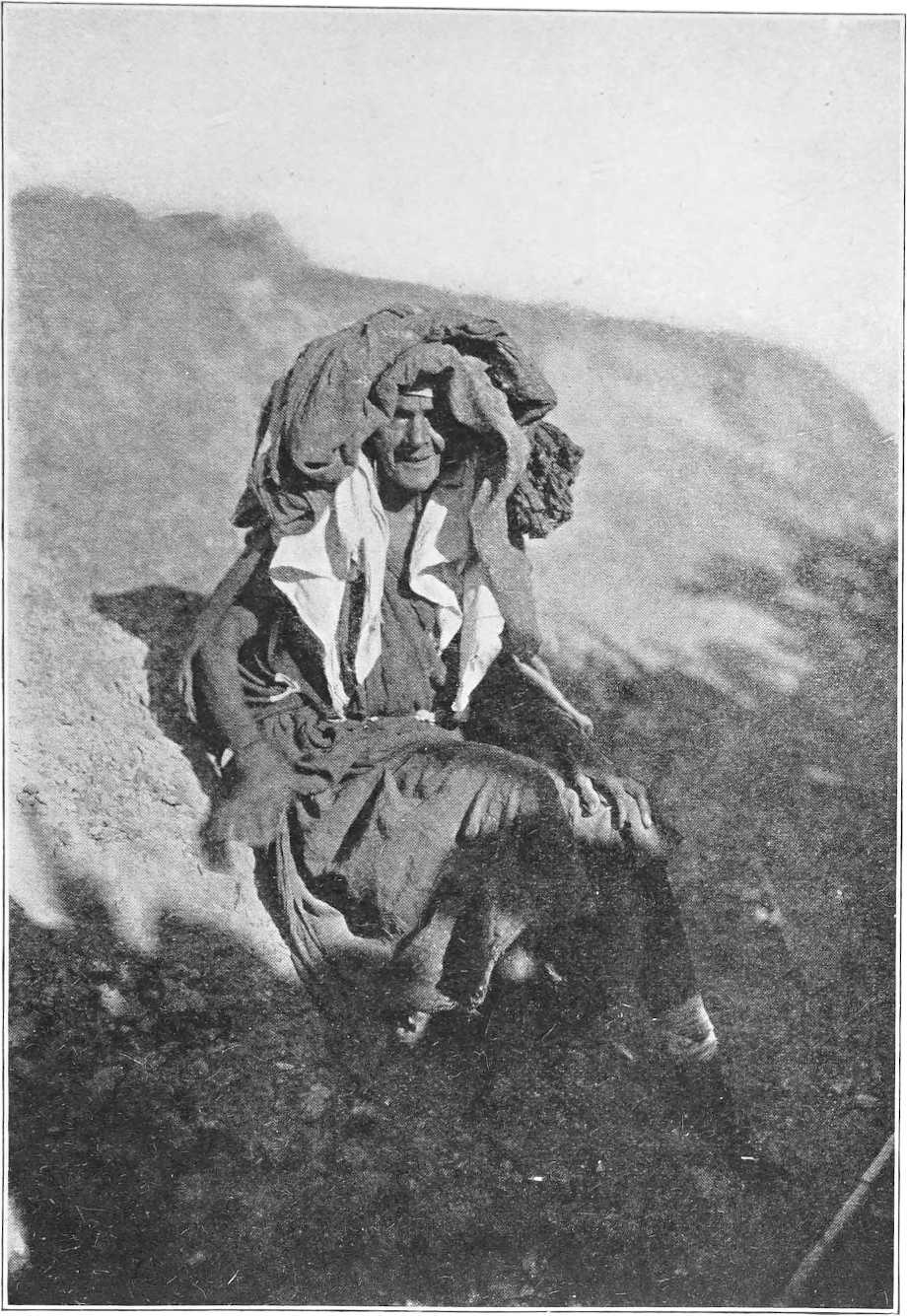
The Sorceress mentioned by Raisuli
This was a new joke, and we welcomed it appreciatively, but with our gaze fixed on the various dishes. I am afraid I was half-way through the wing of a chicken before I noticed that our hosts were not eating. “We fast,” said Badr ed Din, “but let not that interfere with your appetite.” Mohamed el Khalid, however, was not so stoical. He wandered out of the tent and looked wistfully at the sun. I noticed that the Haj was doing his best to make up for the abstinence of the others. “Because he has made the pilgrimage, he thinks that all is permitted to him,” said Badr ed Din. I pointed out firmly that a noted lawgiver had emphasised the necessity of at least eleven pilgrimages to Mecca before a man could be quite certain of heaven. “Ullah,” ejaculated the Haj, looking up, with greasy cheeks, “and did he ever come back to say if he got there?” The argument was unanswerable and the sinner continued triumphantly, “There will be a great deal of surprise in heaven when it is seen who is there and who is not. As for me, I do not need to fast, for I am well with Allah.” In answer to a murmur of protest, he explained further, “I have committed[316] no crimes. I have not cut off any heads or killed any people, which has been your daily business”—this to the Kaid—“so what have I to repent of? By Allah, were I in your shoes I should fast six days a week.” After which remarkable statement, he applied himself voraciously to his food. “He is a bad Moslem,” murmured Badr ed Din, “but one cannot turn out even the worst dog, if it belongs to the house!”
That evening Raisuli did not rejoin us. The sun set in a flutter of orange feathers across the hills, and I heard Mulai Sadiq asking wistfully, “Is there any Harira that I may break my fast?” and the answer of the dark-skinned henchman from Marrakesh, “Come to my house, Sidi, and I will give you some. Ullah, ullah, do not fear—you may walk knee-deep in the grain.” (Meaning that everything was plentiful.) I went out and sat beside the fig-tree, from where I had a good view of the Zawia. The procession of tribesmen from the mountains still came with their offerings. I watched ancient, white-bearded men struggling with saddle-bags and panniers, while the murmur of prayer swelled in the mosque. Badr ed Din and a visitor from the House of Wazzan were preparing to pray in the open.
I observed them standing among the shrubs, each with a mat in front of him, and I could not help thinking that the Sherifs of Morocco were most prosperously fat. Another huge figure loomed up beside them, and I spoke my thoughts aloud. “It is a contented mind,” said Ghabah, “for everything that a Sherif does is right. Even if he drinks wine it turns to milk upon his tongue, and so there is no sin in him.” “Perhaps,” said Mubarak, a darker shadow by my elbow, “it is also the offerings of the faithful, for, whenever the people want a charm or an amulet, whenever they need a blessing, they go to their Sherif, to ask for it.” “Why do they want charms?” I asked dreamily, for the night was[317] still and very white, with pools of velvet blackness under the trees. “Against the evil eye, which every man has at some time of his life, though generally he does not know it himself. Unless one wears an amulet one may suffer greatly by a chance meeting with it.” “Do you wear one?” “I am fortunate; I have some hairs from the head of the Sherif, so nothing can hurt me! The Sherif has long hair, down to his hips, so there is a blessing for many, if it is his will,” added Ghabah, “but he winds it up under his turban, and none see it.”
I should have liked to enquire more deeply into the danger of the evil eye, but Ba Salim appeared, his smile playing among a network of wrinkles, with a dish heaped high with dates, nuts and raisins. “This is part of the tithes which the tribes bring to my lord, and he sends it with his greeting, for, on this feast it is our custom to eat such food. The dates are from Marrakesh, so the goodwill has travelled far.”
At that moment a young man came in at the gate. Lean and strong, he walked with something feline in his gait, unlike the usual stride of the mountaineers, which is at once shambling and sure. His head was shaven and bare in the moonlight, for he had thrown back his dark jellaba, till it hung over his rifle like a shawl. Restless-eyed, firm-lipped, he stared at me for a minute, in contrast to the other Jebali, who kept their lids down as they passed. Then, noiselessly, he was gone, and I wondered if I had imagined the line of the cruel, clean jaw, and the hollows that threw up the cheekbones above it. “Who was that?” I asked abruptly. “It is Abd es Salaam Ben Ali Ueld el Mudden, about whom the Sherif told you. By Allah, he is almost as famous as Raisuli!”
It was the Southerner, Imbarek, who spoke, and he leaned against a tree-trunk, evidently prepared to tell stories. “Ullah, he has the devil in his heels and will[318] never be caught. He can make himself look so different that not even his brother would know him. They say there is a jinn who helps him, for he has made many studies.” The Haj fingered an amulet nervously. “He has one horse which goes faster than the wind, and there are some who believe it can fly. Certainly no ordinary man travels as he does, and one day, when he was known to be in Tangier, a stranger appeared suddenly before his house and pushed his way in. The servants tried to stop him, for he went towards the women’s place. He shook himself free, but they caught at his sleeves and held him. Then he turned round, and they saw it was their master!
“Once, Sidi Abd es Salaam heard that a man whom he had posted in the Spanish Consulate at Larache, in order to keep him informed of the doings of the enemy, had betrayed him, so he went down to kill him. The whole Spanish army lay in his way, for he had to cross the plain, where even the tribesmen were his enemies, so he advanced carefully to the first hillock. There he hid in the long grass and waited. In time two soldiers came out towards him. They both had rifles, but they were talking carelessly and did not see him. He waited till they were quite near. Then he fired several shots, that it might be supposed there were a number of attackers. One Spaniard fell. The other fired his rifle into space and ran back to the post.
“El Mudden leaped up, picked up the dead man—Allah save us, he has the strength of the jinns!—and ran with him on his shoulder till he came to a little cave. He was one man alone against an army, but, while still the post waited, fearing an attack, the brigand tore off the Spaniard’s uniform and dressed himself in it. He forgot nothing, and every button was fastened. The only thing he regretted was to exchange the Spaniard’s rifle for his own, which was a better one! He crept a little further away, to hide more[319] securely, and as soon as the light grew grey, he got up and went down into the plain. He passed through the lines of Spain, and no one discovered him. When challenged, he answered that he was going to Larache with a message from the post, where he had killed the soldier, but, as much as possible, he avoided the camps, and the next night he was within sight of the town. What a trick!” Haj Imbarek’s voice was full of admiration. “He passed through the gates and got right into the hall of the Consulate, before his disguise was discovered.” “What happened then?” The Haj shrugged his shoulders. “With all the men round him saying, ‘This is surely el Mudden!’ he disappeared. Perhaps, like the Sherif, he has the power of making himself invisible.” And that was the end of the story, as the man from Marrakesh knew it.
“There was another of his deeds, but perhaps you know of this one. It was the affair by the International Bridge, on the road to Tangier. El Mudden had heard that a motor was coming from the hills, full of Hassani piastres.[105] It was evening, and they could not see clearly, but at last they heard a car approaching quickly. There was little movement on the road in those days, so el Mudden thought it must be the expected motor, and he instructed his men at what moment to fire. There was a volley. The driver fell dead over his wheel, and a woman screamed. Then Sidi Abd es Salaam knew that there had been a mistake, and it was not the right car. They rushed up to it, and found the woman dying and a man, her husband, was trying to move the body from the driving-seat. There was another man, who had jumped out, and they took him prisoner, but when they found it was empty of money they let the motor go on. It was a pity that it was a woman.”
“What happened to the unfortunate hostage?” “He died[320] while he was up on the mountain, but not from ill-treatment. He had been sick for a long time and there was little food among the tribes in those days.” A reckless country, Morocco! I wondered what it would feel like to ride out of Tazrut and back again into the twentieth century, where death and starvation are still grim words.
That night, while some of us talked in the starlight, the guardian of the telephone, a wild-looking mountaineer, with bare feet and a shirt of torn sacking, rushed towards us. There had been a battle in Tetuan, he said. This was enough to surprise even old Mulai Sadiq, but further enquiry proved that a few Arabs had fired at the guard at the main gate, who had emptied their rifles into the dusk without effecting any casualties. Finding themselves unexpectedly successful, the bandits had rushed into the town, killing two people in front of the hotel which is not 100 yards from the walls. By this time everyone had picked up the nearest rifle and there was a good deal of indiscriminate shooting, during which at least four Spaniards and five Arabs had been killed. The originators of the mischief disappeared in the middle of it. Three men were captured with rifles in their hands, but this was no criterion of their guilt, for civilians and soldiers, Arabs and Europeans were all prepared to defend themselves against—nobody quite knew what or whom! The most heroic part was played by a Spanish officer who, wounded himself, limped down the street, across which bullets were flying without target or aim, and dragged into cover two men lying helpless under this fire.
Now, the Secretary-general was ringing up Tazrut to know if the Sherif thought the Beni Hosmar were attacking the town. Mulai Sadiq was frankly terrified of entering the Zawia at such an hour, upon such an errand, but everyone else was insistent. He went and put the question to his[321] cousin, doubtless wrapping it up in many apologies and excuses. Raisuli was magnificent. Driving one huge fist on to his thigh, with a force that seemed to shake the room, he said, “While Mulai Ahmed is alive and a friend of Spain, never, never shall the tribesmen set foot in Tetuan.” Mulai Sadiq did not dare to speak. “Go!” said the Sherif. “It is nothing—a few robbers perhaps,” and almost drove his cousin from the room.
PEACE AGAIN WITH SPAIN
“When Tazrut was first shelled,” said Raisuli, “there were many who were terrified and would have fled, but I ordered that no one should leave the town, and set guards on the hillside above it. It was summer, and still there was no news from the East. I had made all preparations for leaving the Zawia and already ammunition and a few stores had been hidden in different caves in Bu Hashim. It is hospitable, this mountain of my family, and all my people could take refuge in it in safety. There are great trees which make roofs against the sun, and streams whose waters are healing. Allah has provided cliffs that are ramparts against an enemy, and the earth is full of strange holes and shelters. I have always kept a reserve force in Bu Hashim, and there, too, I have a few houses and a prison.
“It was during the bombardment of Tazrut that there was a dispute between Mulai Ali and the brother of his father.[106] My nephew had been my best commander throughout the war, for his courage was also in his head, and his strategies were good.
“In the time of suffering that was long, many of my house had said to me, ‘The hour for peace has arrived. Send messengers to the Spaniards,’ and there were not few among my women who said it also. When the plaster fell from our walls and the roofs struck our heads, my relatives would have fled to Bu Hashim. Disobeying my orders, they crept out at night, and fell into the hands of the guards.[323] I was very angry when they were brought back to me, and I said, ‘Since it is only safety you want, you shall indeed be safe,’ and I sent them to my prison in the hills and put chains on them and set a guard at the door.
“Then they were sad, and sent messengers to their relative, Mulai Ali, and begged him to intercede for them, saying that they were old and their courage had left them. My nephew was then on the east of the mountain where his flag defended the Ahmas, but he came in six hours to Tazrut and spent a long time with me, praying and eating. At last he spoke of the prisoners, and said, ‘They are poor people who are weak and afraid. This is their only crime against you, and it is unjust that they should suffer. Have mercy upon them, for Allah has made them miserable,’ and I answered, ‘There is no appeal against my judgment.’
“I should have spoken of the bad example set to the whole country, that my own household should fly before the Christians, but he was under my orders, and I was angry that he should argue with me. In the end, he said, ‘Is this your last word to me, that you will not release them, though I make myself responsible for their actions?’ ‘No man can bear the responsibility which belongs to another, and punishment is in the hands of Allah. He can remit it, but it is written in the Book that men must suffer justly for their sins.’
“He went out without saluting me, and, from that day, we have never spoken together in friendship. Mulai Ali rode straight into Bu Hashim, with his men behind him, and, when they came to the prison, they overpowered the guards and broke open the doors. The chains of the prisoners were cut, and they were set free. Some of them went to the mountains, but others returned to Tazrut after many days. Mulai Ali took a heavy fetter that had been on the feet of his relative and gave it to the guard. ‘Go down[324] to the Zawia,’ he ordered, ‘and give this to the Sherif. Tell him his nephew has sent him a new chain for his watch!’ But the man was afraid and the message was brought to me later by others.
“I said nothing when I received it, nor did I answer when my family knelt to me and begged my forgiveness for my nephew. It was soon told me that Mulai Ali wished to lose his life, and, since suicide is forbidden in Islam, he placed himself always in the most dangerous places and ran towards the rifles of the enemy. The ‘baraka’ must be with him, for, though he exposed himself recklessly, attacking when there was no chance of success, and showing himself in a white robe when the artillery was in action, no missile touched him. When I heard of these deeds I sent some of my own men to join him, ordering them secretly to stand between him and the enemy. They carried out this duty and made a guard around Mulai Ali whenever he fought, saving him against his desire.
“When there was talk of peace, and Cerdeira came with Zugasti to see me, my people said again, ‘Will you not forgive Mulai Ali? He has been the most faithful and the most courageous.’ I answered no word, though they renewed their prayers each day, wearying me with their words. At last Mulai Ali came to the door of my tent and I saw him, but made no movement. He came in and kissed my sleeve, but I sat in the same position, without speaking. Then he bent himself before me and took off his turban and put it under my feet. This is our way of making submission. For ten minutes, perhaps more, he remained prostrate in front of me, but I neither looked at him nor spoke. At last he jumped up and put on his turban. ‘By Allah, I will have no more relations with you,’ he cried, ‘nor will I ever come into your house as a friend. It is finished between us’; and he left the tent[325] angrily. After this no one dared mention his name to me.
“When the war was over, the Spaniards said to me, ‘We want a strong man in whom you can rely—one who has your complete confidence—to govern the Jebala,’ and I answered, ‘I have only one such in the country—my nephew, Mulai Ali.’”
There was a pause, and Badr ed Din murmured behind me, “There is business between them, and the young man[107] comes to take orders from his uncle, but neither has made peace with the other.”
The Sherif continued a little more grimly than usual: “In the middle of the summer (July, 1921), when all men despaired and in every village they cried that Allah had delivered them into the hands of their enemy, news came to Tazrut at dusk. The Riff had risen as one man, had broken through the great Spanish army and poured down to the walls of Melilla. Many thousand prisoners were in the hands of Abdul Krim. Silvestre, rushing forward with his usual impetuousness, found himself cut off from the coast and hemmed in by a triumphant enemy. His desperate eyes saw nothing but his own dead and the magnitude of his mistake. He shot himself, amidst the panic which his death rendered ungovernable. Though he was my enemy, I was sorry, for he was brave.
“All through that night men came to me, discussing the news and asking, ‘How will this affect us?’ I listened to them for a little, and then I said, ‘Allah has sent this thing to save us. Praise be to him, for it is just in time.’ They asked, ‘What will be the action of the Spaniards?’ and I told them, ‘Allah alone knows, but one thing is certain. The Government will soon fall, and there will be a new High Commissioner.’
“For the first time in two years men walked boldly[326] through the mountains, not fearing an enemy, and I wrote hurriedly to Zellal, saying, ‘Take this opportunity to send me grain and cartridges.’ Very soon there arrived a letter from Cerdeira, suggesting that a way should be found to make peace. I did not reply hurriedly, nor let him know how urgently needed was the respite. News came that Berenguer had gone to Melilla and that, with a great army, he was trying to retake the country. I said, ‘Allah strengthen the hand of Abdul Krim until my stores are here,’ for I knew Berenguer. If matters went well in the East, he would not willingly let me escape from his net. For six weeks there was talk of peace, but, even while Cerdeira wrote letters imploring me to restrain the tribes who would have attacked Larache and Azeila, Barera continued his propaganda. ‘Spain has only one enemy,’ he announced, ‘and that is Raisuli.’
“There was a panic on the coast. The townsmen boarded the first boats in their efforts to escape the vengeance of the mountaineers, but there was no danger. There were a few incidents on the borders of Jebel Habib, and the tribesmen went boldly to the Suqs in armed bands and bought food under the eyes of the police. When the East winds began,[108] Barera, reassured by the reports from Melilla, made a sudden advance on Beni Yusef and, without warning, while the ink was still fresh on their peace proposals, again there was war.
“The hills beyond Xauen were occupied in the autumn and the main road to Ahmas was cleared. For so many months there had been fighting among these hills that each wadi was a graveyard and each ridge had its history. In the winter[109] Berenguer returned to Tetuan, and I was surprised, for I thought he would certainly have been recalled.[327] With fierce energy he pushed on the campaign, and it was told me that he was like an old man, bent and grey, with but one idea left to him. Suq el Khemis was taken, and Dris er Riffi made it the base of his campaign against me. Ullah, some have called me a murderer, but in Beni Aros, my own land, would there not have been many who would have brought me his head? Had I wished, there would have been a rifle by his bed, a knife in his food, for my spies were everywhere.
“For the first months of the new war, we had sufficient food, for many caravans had come up through Mesauer during the short truce. But that winter was terrible in the mountains. Almost all the villages had been destroyed. There were no roofs to shelter the people, who lived in caves and holes in the ground. The very old and the very young died from exposure, for there was much rain. The cattle had been almost exterminated, and the game had grown cunning and retired to the higher mountains. The wise men said nothing, for there were still ten thousand prisoners in the Riff, and it was known how Abdul Krim treated them; but the ignorant reproached me—‘The wisdom of Allah is with thee, Sidi, but our condition is worse than before. How can we now find safety?’ ‘Suffering is from Allah,’ I replied, ‘and by his will, it will end or it will continue. Allahu Akbar!’ They went away ashamed, but I waited for the newspapers as women waited for the scarce goat’s milk that might save their sons. All that time I had the news of Europe from Tangier, and my agents never failed me.
“Many of my friends were killed in those months, and the list of the Sheikhs who had been with me from the beginning, those who had seen the ceremonies of Xauen and Sidi Abd es Salaam, was daily shortened. Hamed es Succan, my blood brother, of Beni Aros, was shot in the defence of Afernum, which was taken by a combined attack[328] of three columns, and Mohamed el Kharaji died in the last skirmishes before Tazrut. As soon as the slopes of Afernum were lost to us, Jebel Alan could be raked by the artillery, and it was certain that Tazrut must soon fall.
“I sent all my family into the mountain to Dar el Haik, so called because the stream falls like the white garments of a woman. There was one old lady of my relatives who would not move. ‘I have lived all my life in the Zawia, and I will end it there,’ she said. I went myself to urge her to go, but she would not be persuaded. The servants came to her, crying, and saying, ‘Even the cats have left. They are wise animals, and they have gone ahead of our master to his camp.’ ‘I will die where I have lived,’ she repeated, and, in truth, she stayed there through most of the Spanish occupation. They were good to her, giving her food and all that she asked for, and leaving her room untouched, but she was a good Moslem, and said, ‘It is Allah who has ordered their minds.’
“When Tazrut was bombed for the second time, there were few men in the village, and these hid themselves securely in the holes which they had made. Everything was destroyed except the Mosque, the Qubba of our ancestors, and the tree which is the guardian of our house. These are the most prominent objects in the village, yet not one tile fell from the madna nor a fleck of plaster from the sanctuary. The walls of my house were made bare and the roofs torn off the Zawia. The building which is now made of iron was shattered, and only a few beams stuck out, as the teeth of those who are old. Where there were no ruins, there were pits in the heart of the earth, and, in the darkness, a man could not go two steps in safety. When my women went to Dar el Haik, I sent with them all my furniture, my carpets and mattresses, with the cushions and the tea services, and all the brass trays and other goods.[329] Afterwards I sent my horses and mules, including the tall brown one which Jordana had given me, but I waited in my house till the last minute, for I knew I was safe.
“At the height of his success Barera was recalled, and his place taken by Sanjurjo,[110] who immediately made a determined effort to occupy the high mountains. There was great fighting in Jebel Feddan at the entrance to the Ahmas, and many of my people were killed, for they showed themselves recklessly on the hills, charging the Spanish guns. A messenger came to me from the famous Zawia of el Teledi, and said, ‘If this holy place is taken by Spain, it will be the end of the war’; and I answered, ‘Bring me a map.’ When it came, I pointed out the Spanish posts one by one, and the messenger, who was a Sheikh of standing, watched me. ‘How many mountains and valleys are there between these camps?’ I asked, and he told me such-and-such. . . . Then I said, ‘When every hill and every wadi is in the hands of Spain, it will not be the end, for there will still be the rocks and the trees which will fight for us. Tell this to the Ulema of Teledi. When Allah gives us victory, then the war will end.’
“Every day in Tazrut could be heard the thunder of artillery either in the Ahmas behind us or in some mountain below. Aeroplanes flew around Bu Hashim and dropped bombs, but these were not dangerous, for the steepest slopes were out of their reach. As a precaution, I divided my mehalla into small parties, posting them in different parts of the mountain, where they commanded all the approaches. The tents of my family were covered with branches, so that they could not be seen among the trees. There was fierce war in the Ahmas, for still Berenguer and Sanjurjo dreamed of completing the circle which besieged us. The Valley of Menzora was occupied, but two hundred[330] Spaniards were killed in that campaign. At last, in the first months of summer, the enemy advanced to Tazrut, fighting at every ledge. A curtain of shells heralded their march, but my people lay snugly among the rocks and waited till the columns were so near that they could pick off the officers. Many of the enemy died during the three days of the advance, and I waited in the Zawia till Sidi Musa should be in their hands.
“Mubarak held my stallion at the further door, and Ghabah stood on a height to give notice of the Spanish movements. While we waited, a Sheikh said to me timidly, ‘Insha-allah, we shall not be long in the mountain?’ and I said to him, ‘How long was the Prophet of God an outcast? It is an honour that is done to us.’ ‘Is there no talk of peace, Sidi?’ ‘When Allah wills, the Spaniards will talk of it. There are still many camps between Tazrut and submission.’ A shot sounded above us, and we knew it was from Ghabah. As the Spanish outposts approached the village, we rode quickly up to Bu Hashim, which has always been the shelter of our race.
“Dris er Riffi moved his office of propaganda to Suq el Khemis, and the echoes of his eloquence reached me in Bu Hashim. ‘Spain has only one enemy,’ he repeated, ‘and that is Raisuli.’ The men of Sumata were still inviolate among their crags, and none of their Kaids would submit, but, among the other tribes, there were many weak ones who came to me, afraid. I said to them, ‘Go and make submission to the Christians, if that is your desire. Fatten your bodies on their grain, but I tell you the time draws near when the Faithful will be rewarded.’
“I knew that the Government must fall, but its hour was delayed, and we suffered. There was no flesh in our pots and little grain. The mountaineers used to bring small gifts, humbly, ashamed of their insignificance, and I told[331] them of how a man of Medina gave a few dates to a beggar, and behold it was the Prophet of God, who returned to his benefactor gardens of palms and all the land that could be seen from them. Women would bring two eggs or a thin fowl wrapped in their skirts. Men came with a few figs, or a hare they had shot, but often there was only a little bread and oil for our meal. A daughter of my house, who was a child and weak, died on the mountain, and the Spaniards allowed her body to be buried in the Zawia at Tazrut. In those days my rifle was idle and my tongue busy, for men came to me at all hours for reassurance. I said to them always, ‘The time is near,’ but I wondered whether el Teledi or the Government would fall first.
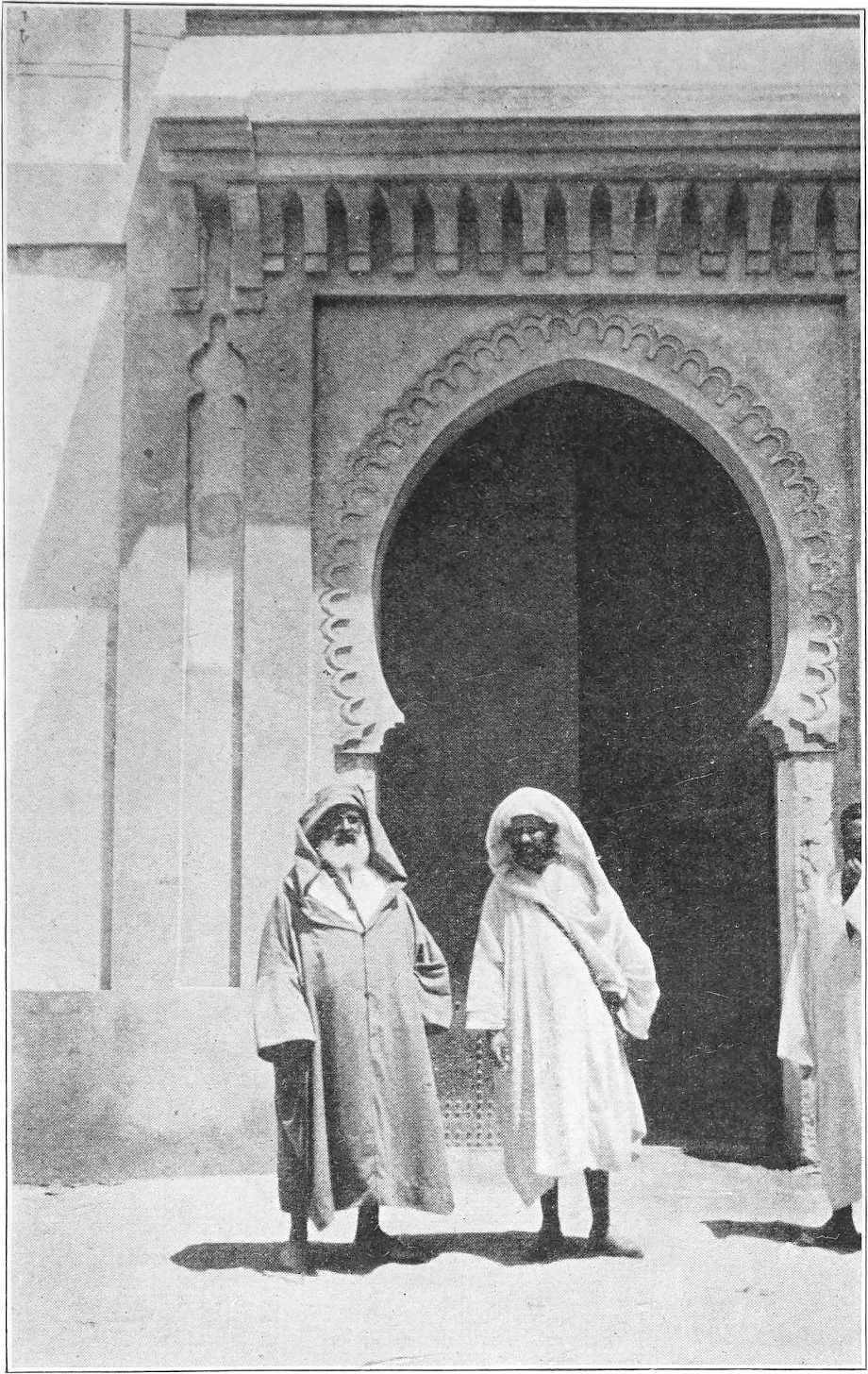
Gate of Raisuli’s Palace at Azeila. His bailiffs
“It was the will of Allah that the Zawia should be lost to us.[111] For many months the Ahmas had defended their sanctuary, and, in the end, even the students buried their books in a secret place and took up guns to protect themselves. The ulema fled to the edge of the country, carrying with them as much of their property as they could save, for there were interesting documents at Teledi, telling of the first coming of Islam and the war against the Berbers. Emissaries from Gomara came to me at this time, begging me to take refuge in their country and lead the Holy War against the Christians, but I told them that this was not the will of Allah, and that soon Spain would make peace with us. They answered, ‘This is a miracle that you speak of, Sidi!’ but I insisted, ‘Before the first snows there will be peace.’ After their visit I sent down to Beni Aros, to urge the house of Succan to procure me a little grain, that I might be able to entertain the missions who came to me.
“Before I had expected a reply, Mubarak told me that one Mohamed, the nephew of my friend, was in my camp. When he had saluted me, I asked him, ‘What news of my[332] stores?’ and he answered, ‘Sidi, I know not, but Berenguer has gone to Madrid.’
“Ullah, there was rejoicing that night among my tents, and as there were no gifts to reward this bearer of good news, the women sent him silks for his family, and I said to him, ‘When peace is signed, whatever you ask I will give you.’ After this it was soon known that the Government had fallen and Berenguer would return no more. From all sides, the mountaineers came to me, and those who had been faithful I welcomed gladly, assuring them that, as we had shared the evil, so, under Allah, we would share the good. To the others I said, ‘Allah deal with your weakness and reward you as you have deserved.’ Stores soon came to me at Sellalim, sugar, tea and candles, besides grain to feed the two hundred who were still with me. For the last weeks I had been moving my camp from one place to another, because of the aeroplanes which bombarded us, killing some of my people but leaving my tent and the green standard untouched. In all the war, the flag of the Prophet was inviolate.
“When the new High Commissioner, Burguete, arrived at Tetuan, his policy was not known, and there were some of my people who were still anxious; but, as soon as it was rumoured that Zugasti was with him, the signal fires leaped on the hills and the tribesmen whispered that the Sherif was responsible for ‘the miracle.’ The slopes of Bu Hashim were crowded by those who would kiss my robes, and amulets were cut from the bark of the trees, which had sheltered my camp.
“News came swiftly. The Riff was declared a civil Protectorate, and my enemy, Dris er Riffi, was sent there as Governor. Cerdeira wrote asking me to arrange a meeting, and in due time I appointed the village of Adiaz, which was in ruins. I sent my servants to prepare a place for the[333] conference, and they spread carpets and cushions within some walls where there was still a portion of roof to shade us. Cerdeira and Zugasti arrived with Castro Giria, all of whom were my friends. I rode down to meet them on my roan, with a green saddle-cloth embroidered in silver and the green umbrella of a Sultan carried over my head. All my slaves went with me, and, behind me, came a hundred warriors with those who had been my captains, Ueld el Muddan, el Tayeb and el Hartiti.
“One of my cousins prepared the food which Bu Hashim had been ransacked to produce. There was flesh, but Allah knows what it was, and curdled milk and pastry with eggs and rice, for in hospitality I was bound to feed my guests. Ullah, the slaves’ eyes were wet as they watched each morsel that was eaten!
“We talked till the sunset and I explained the things that I desired.[112] A month later there was another meeting at Sellalim, where I had tents pitched for my guests. This time we talked frankly, and I asked for many conditions—that all my properties should be restored to me and that my family should be allowed to live in my palace at Azeila, that Tazrut should be returned to me and that Spain should rebuild the portions of the Zawia which she had destroyed; that the Governors of the tribes should be chosen among men of great position who were my friends, that my army should receive all the pay which they had missed during the war, for, under Jordana, it had been agreed that certain forces should be supported by Spain. The delegates told me, ‘These things may be done, if you will go to Tetuan and make your submission to the Khalifa,’ but I replied, ‘Neither my policy nor my words can be changed. Raisuli will never set foot in Tetuan.’
“There was much journeying to the mountains in those[334] days, and I was hard-pressed between those tribesmen who were fanatical and opposed to any peace with the Christians and the Spaniards, to whom I said truly, ‘I have always been your friend. I have resisted the armies which you sent against me, but I have never fought your nation.’ On one occasion journalists came to see me, and they talked to me at length in my tent. After they had gone, I said to my servants, ‘Take up the carpets and carry out all the cushions. Clean them well, for the Christians have left the dust of their feet upon them.’ This was told afterwards to the Spaniard who was my friend, and when he protested, I said to him, ‘I did this thing on purpose, for the sake of the chiefs of Sumata. Do not think it is easy for me to make peace with you, after you have done us so much harm. By all means I must keep my influence with the tribes, in order that your country may benefit by it.’
“The conferences were prolonged through the autumn, but, at last, I agreed to send the men of my family to Tetuan to visit the Kalipha, and some months later three hundred of my people rode down to the city. Among them were many who had been with me on Sidi Abd es Salaam, and they were led by my nephews, Mulai Ali and Mulai Mustapha. El Mudden accompanied them, and the Sheikhs of Beni Hosmar, Beni Leit, Beni Ider, and Beni Aros. All these were received by Mulai el Mehdi, and there was a great rejoicing at Tetuan.
“In return for this, it was agreed that those Spanish officials who had persistently worked against me should be withdrawn. Ben Azuz resigned his post, before it was possible to take it from him, but others of my enemies were superseded by loyal men who would work with me. The Spaniards offered to make me Governor of Beni Aros, but I would accept no post under the Maghsen, saying, ‘I acknowledge and will serve the Protectorate, as has always[335] been my intention, but the Kalipha can never have any authority over the mountains.’ I refused also the great sum they would have paid me, equal to the sustenance of Mulai el Mehdi, accepting only the pay of one hundred and fifty soldiers who are my guards. I agreed to disband all my armies, except the small personal force which I keep in Bu Hashim, and to assist the Spaniards in the occupation of the whole Jebala.
“I have done this to such good effect that there is scarcely a hill which has not its camp. They must have at least a hundred and twenty thousand men in Morocco, though most of these are in the East. My nephew, Mulai Ali, is the Kaid of Beni Aros and his brother, Mulai Mustapha, is Governor of Azeila. Burguete fulfilled all his promises, and el Mudden was made Kaid of Beni Gorfet, el Hamali of Beni Kholot, el Fahilu of Wadi Ras, for it is necessary that there should be a friend to protect the communications between Tetuan and Tangier. In this manner peace was arranged, and it is now the Spanish forces which are responsible for the security of the country, for I have no soldiers. Lately, the Government asked me if they could reduce the garrison by a hundred and fifty posts, and I answered, ‘Not unless you give me back my Mehallas.’ In spite of this they took away eighty camps, and sometimes there is a shot in this place, and a man killed in another. That will always be, for the country will rebel against that which is new, until the new has become the old.
“If Spain would make an agreement with me, and England would act as guarantee, there need only be twenty thousand foreign troops in the country, and I would be responsible for its peace. It is not that I do not trust Spain, for there is affinity of blood between us, but I have seen the variability of her policy, and her Governments are of short duration. A protectorate should be as a wise[336] older brother training the younger one so that, when he comes of age, he may be rich and powerful, but not interfering with his ideas and habits. Spain has advanced by twisted ways, and now civil administration cannot be imposed on the Jebala with much hope of success, for fear of driving the mountaineers to the side of the Riff. The Kaids must be responsible for law and order among the people and, gradually, more and more authority can pass into the hands of the Maghsen. I said all this to the envoys whom Spain sent to me, and I told them also, ‘I have no good opinion of Abdul Krim, because he is fighting against that which is fore-ordained, instead of trying to benefit by what Allah has sent us.’ But, if Spain does not stick to one policy and keep faith with me, I shall have to reconsider my opinion about Abdul Krim.”
FAREWELL
“And that is all.” The Sherif gave a sigh and hitched up his jellaba till the rose-red kaftan[113] showed below it. “Now you know my life as well as I do.” “But not your mind, Sidi.” Dinner and its attendant tea-making were over, and we were sitting outside my tent in the moonlight. A little wind stirred the leaves of the fig-tree. A yellow cat sat in the shadows and regarded me with eyes which had turned into green lamps. “The mind of man is open at this hour,” said Raisuli. “Ask me questions, and I will answer them.”
“Tell me of the future. What is going to happen to Morocco?” “It is in the hands of Allah,” answered the Sherif. “But I am tired, and I would go to Egypt to rest.” “If you go, you take with you the one chance of peace.” “If I go, perhaps Spain will realize that I have been more her friend than her enemy. It is always the same thing. There is no change. What I said to the Spaniards at the beginning, I say to them now—there is only one medicine for Morocco, but they will not administer it. You have seen their forts and their soldiers, and, Ullah, all the country that they have taken is my country and under my influence. Had they gone the way I wanted, they could have occupied it without firing a shot. The people trusted me, and, if I had said to them, ‘This is good,’ they would have made no opposition.” He looked up at the stars, which[338] were so big that it seemed as if one could pick them out of the flower-bed that was the sky.
“If you allied yourself definitely with Spain, would not the people say you had sold yourself to the Christians, in which case you would lose your influence in face of their fanaticism?” I asked. “In any country that is ignorant, there are always ten per cent. who loathe the Nasrani, but the other ninety per cent. are willing to live in peace with him, as long as their laws and their religion are not interfered with. If they find that there are many changes, they join the ten per cent. who are savages.
“France rules for the mass of the people, without making exceptions. If she imposes a tax, it has to be paid without discussion. Spain rules for the individual, and that is good, for she searches how such and such a tax will affect different men, but a foreign rule must be very light. A protectorate should protect those who suffer from an injustice, but not interfere in the customs of the land. This is difficult, unless there is one man who can make things clear between the Government and the people. A tribesman runs from the Qadi, who has punished him justly, to an official who does not understand the matter, and the respect of the Qadi is lessened. In the police posts, an Arab has a grudge against another, so he goes to the officer and says, ‘This man has stolen the goats of So-and-so,’ and how is the Spaniard to know that the accused is his enemy? All ignorant men are liars, and it is only their own ulema who can convict them.”
There was a prolonged silence, and the yellow cat crept up and wound itself round and round the Sherif’s foot. He bent to stroke it. “Civilization must come slowly, and its interpreter must not be an army. The people see soldiers with rifles, and they think that some harm will be done them or that they will lose their lands, so their fingers fly[339] to the trigger, and for them civilization means death. The way must be better prepared.”
“Perhaps the next generation,” I murmured. “They will be worse,” retorted Raisuli, “for they have seen the evil that has been done to their parents. At present you are teaching our sons your knowledge that they may use it against you. Abdul Krim el Khattabi was educated at Madrid and studied to become an expert in the mines.[114] He is low-born, so he found no better use for his learning than destruction.”
“What about the Riff?” I asked. “If you had an agreement with Spain, could you deal with the Riff?” A chuckle came from old Mulai Sadiq, but the Sherif was impassive. “It would be an easy matter, for I have still many friends among the Riff. Abdul Krim is the result of circumstances. When he was a little boy, his father wrote to me and said that he wanted to send his son to Madrid to study. He asked me if I would use my influence with the Spaniards, or if I would take the child into my own house. I answered, ‘Wait until he is older.’ It is the same medicine which is required in the Riff.”
“How would you administer it?” “At present, Abdul Krim makes much politics (propaganda) against me, and I say nothing, for I am waiting; but if there was an agreement with Spain, the Riff would cost few Christian lives. Abdul Krim can raise 30,000 men against the Nasrani, and not one will betray him, for the Riffs are fanatical, though they are not good Moslems. But do you think a quarter or a fifth of the number who would be with me, would fight the Ashraf? When Moslem fights Moslem many of the bullets go wide. In fact, there would be some fighting by my mehallas and much propaganda, but peace would be swift.[340] Yet I think no Christian could rule the Riff—at least not in this generation—but others, well chosen, might do it in the name of Spain.
“It was thus that I thought things would go in the beginning, but there have been mistakes and misunderstandings. When the Spaniards landed it was by my help, and in the towns there were three kinds of men. There were some who bought a European hat and stick, and walked about the streets and thought they were equals of the Pasha. There were others who went into their houses and shut the doors, and said, ‘This is the end, but it is the will of Allah’; and there were some who did not even realise that anything new had happened. Only I looked ahead and hoped for the benefit of the country, for I liked the Spaniards. We have much in common—you see, we are all liars together!! I have fought against strangers, for all the Spaniards whom I met became my friends.”
“And now?” I queried after a silence. “Every man loves his own country, but I have written three times to the Government asking that I may go away, for what is the use of pretence in this land which only strength can control? The force is in my hands. You have seen it. You have felt it. There are posts on all the hills, but only my word keeps them there. The country is waiting and uncertain, but I hold it down—”
Our eyes met, at last, and I knew that the same thought was in both our minds. In a palace at Tetuan the ill-fated Kalipha was struggling with the effects of a poison administered in small doses by a cook who had been bribed by the Grand Vizier, now languishing in chains at Xauen. The doctors had ordered change of air, a journey to Ronda, but it was whispered that Mulai el Mehdi, weak, amiable and high-minded, would soon go on a longer journey. The pretence was wearing very thin.
[341]“Much has been written against me,” said Raisuli, “by men who do not know Africa. There have been many parties in Spain, and each one has followed his own policy, but here in Morocco there is no policy, only strength. Abdul Krim knows this, and he tolerates no dissension and no hesitation among his people. Each day that Spain delays, his power increases. She must choose quickly and finally. Either she can withdraw to the coast towns, and in that case Abdul Krim’s greed will stretch out to the West and yearly more will be lost to her, or she can make use of the weapon I put into her hand at Larache.”
The song of the crickets was persistent and the wind grew cold as it blew over the hills. “The same things I tell you tonight,” said the Sherif, “I told the Spaniards long ago, when I was great and powerful, not as I am now.” “If el Raisuli had but one tent and one mule,” interrupted Mulai Sadiq, “he would still be powerful.” The Sherif did not deny it. “Things do not change in Africa,” he said. “But you,” I asked, “have you changed?” “No,” answered el Raisuli, “I am a friend of Spain and of my own people, which should be the same, for all things come from Allah.” “There is but one God, and God is Great,” murmured Mulai Sadiq.
There were few hours left for sleep that night, for it had been arranged that we should start shortly after sunrise and arrive at Suq el Khemis while it was still moderately cool. Accordingly I got up yawning in the darkness and saw the dawn creep between the hill-tops. The chief of all the slaves, old Ba Salim, came to me, smiling. “Breakfast arrives,” he said, but of course it did not, nor did the mule for my baggage, and the world was very much awake when, at last, the familiar procession appeared.
This time our bowls of soup were reinforced with coffee and bread full of caraway seeds, thickly buttered on all[342] sides. After we had dealt with these luxuries, Ghabah brought an unexpected second course, consisting of very sweet pastry stuffed with rice. “Allah be praised—that is finished,” said Mulai Sadiq, who hated riding in the heat. “Not at all!” I replied woefully, and pointed down the path. Mubarak was approaching leisurely with an enormous platter, on which was a mountain of rice decorated with a chicken or two and some very hard apples. Inwardly groaning, we did our best to destroy the symmetry of the mountain, but, by this time, even the cats were surfeited.
“The Sherif comes,” announced Badr ed Din. “Now you will soon start.” We waited another hour, and it began to get hot. Then one of the small slaves was seen scuttling down the path. He kissed Mulai Sadiq’s sleeve hurriedly and almost choked over his whispered message. It appeared that the Sherif wished to see his English guest in the Zawia. This was a supreme honour, and quite unexpected, for, as long as Raisuli is within his house, no one may approach him or send him a message, and even Moslem visitors are received in the building opposite.
I followed the small messenger to the door, and there he disappeared, curling himself up under a ragged cloth and apparently going peacefully to sleep. After a few minutes the bolts were withdrawn, and Mohamed Khalid came out, took me ceremoniously by the hand and led me across the threshold. Still hand in hand, we went down the length of the porch, to another door, this time bright blue, which was opened by unseen fingers.
The next moment I found myself in the room which had been built round the great tree supposed to be intimately connected with the fortunes of Raisuli. The light was dim, because it filtered through windows of coloured glass. The floor was paved in black-and-white marble, the walls had a wide dado of mosaics, and the ceiling was carved and[343] painted. In the centre, was a quadrangle of Moorish arches, slender, with fretted curves, and, between these, stood the tree. All that was visible was a portion of the trunk, its girth so wide that two men could not span it with outstretched arms, for the rest soared through the roof which had been built around it.
Raisuli stepped out of the shadows to meet me, and I saw a different man. Without losing any of his dignity, he had put aside his reserve. His face was extraordinarily kindly and the size of it seemed to magnify its smile. “I want to show you my family,” he said. “They were very curious about the one European lady who has been to Tazrut.” He took my arm in fatherly fashion and pushed me gently towards a group of women, some of whom I had seen before, though I hardly recognised them in their splendour.
“They are all very shy,” he said, and beamed on them with obvious pride. The little bride kept her lashes down, but she no longer looked frightened. Her black hair was parted in the middle, and smoothed over her ears like silk, and the ends were plaited round a thick purple cord which fell to her feet. This apparently is the fashion on state occasions, for every woman had the same silk rope hanging from her head and caught in a loop at the waist, so that it looked like a tail. The bride, Khadija, was exquisite in gold-embroidered muslin over yellow silk, with a wide belt of brocade that slipped over her slender hips, and a mass of heavy jewellery. There was another wife, Zobeida, who was fair-skinned and plain, with faint pit-marks on her face; and the daughters ranged from the tall Kheizrana in flaming orange, who might have been a Circassian, to a child of four or five, who promptly toddled forward and caught the Sherif’s hand in fearless fingers. Raisuli beamed on her. “This is the smallest of them all,” he said, and patted the mop of red-dyed hair.
[344]I felt myself growing more and more bewildered, while I watched a benignant patriarch smiling on a flock of children, the sort of smile that, in Europe, denotes sweets in a grandfatherly pocket! In the background a group of slaves peered round the edge of the door, their waistcoats of bright purple or scarlet gleaming against the dim background. Twenty pairs of eyes watched me with growing curiosity, but the Sherif’s voice, with its new warm note, brought them expectantly to his face. “They want to give you a present,” he said, “as a remembrance of your visit.”
There was much smiling and whispering. Then Haula, the least shy, pushed something into her father’s hand. “It is not from me, but from them,” added the Sherif, and held out two heavy gold bangles. Vainly I protested. The throng closed round me like eager children, and Raisuli slipped the bracelets over my wrists. “We were afraid they might be too small, for you are taller than any of my family, but they fit well, el Hamdulillah!”
The interview was terminated by my incoherent thanks, while the youngest daughter sat down on the floor and solemnly stroked my riding-boots. As the Sherif passed them, the girls bent to kiss his knees, while he patted them on the shoulder, but, when the bride stooped, he caught her wrist and drew her up with murmured words, which made her fold closer the white shawl that half covered her head.
Out in the portico, with the blue door shut behind us, I looked curiously at Raisuli, and wondered how much of the real man I knew, for here was but a courteous host speeding a guest whom he was anxious to honour.
There was a crowd of servitors at the gate. Mulai Sadiq was already astride his red-saddled mule, his scarlet prayer-rug, the only luggage he had brought with him, laid across the pommel. A one-eyed mountaineer led the Afrit, who was doing his best to upset the composure of the baggage-beast[345] which bore my depleted suit-cases, in panniers obviously designed for grain. Badr ed Din and the Kaid murmured farewells—“Ma Salamah,” With safety—“Let not this be your last visit!” “Allah keep you—may the way be easy.”
Then Ghabah seized my stirrup, and I mounted amidst a chorus of good wishes. “Allah take you in safety to your country, and may your desire bring you back to us,” said the Sherif, and, as he stood framed in the archway, with his people a step or two below him, I caught a last glimpse of the other Raisuli, who could never refuse the prayer of a woman, and who sent three times to the mountain to fetch a half-starved yellow cat. . . .
The expression vanished as he turned to speak to the Kaid. Swiftly we clattered over the cobbles towards the hills of Beni Aros. Mulai Sadiq was determined to make up for lost time. It was not till we were nearing the sanctuary of Sidi Musa that he asked me, “Well, was your visit good? Are you satisfied?” I nodded, remembering, rather wistfully, those days spent in a strange world, wondering how much or how little I had learned in them. “Ullah,” said the old man, peering at me over the edge of his yellow spectacles, “this will not be your last visit, for the Sherif’s ‘baraka’ has affected you already!”
[1]Raisuli is generally called by his people “The Sherif.”
[2]A piece of woolen or cotton cloth worn by Arabs as an outer garment.
[3]A valley, a river; a ravine through which a stream flows.
[4]A Spanish queen who died 200 years ago.
[5]Muazzin—a Mohammedan crier of the hour of prayer.
[6]A cloak with a hood worn by natives of Morocco.
[7]A devil.
[8]Ravine, gully.
[9]A Moslem learned in religion and law.
[10]A college composed of the hierarchy, the immamo, muftio and cadio.
[11]A special blessing.
[12]The only woman mentioned in the genealogy.
[13]The prophet, Mohamed.
[14]An advanced student.
[15]A holy and wise Moslem.
[16]Government.
[17]An oriental slipper without heel or quarters.
[18]The custom of hospitality.
[19]The four great lawyers of Islam.
[20]A narrow fast sailing vessel.
[21]When el Raisuli left the prison he had the fetters which had been on his feet weighed, and found their aggregate weight was fifty pounds.
[22]The first verses of the Koran.
[23]Sidi Badr ed Din told me this same story, but he insisted that el Raisuli killed eleven men with a knife before the Governor would treat with him.
[24]Army of Arabs.
[25]Learned men.
[26]“Morocco as It Was,” by Walter Harris.
[27]Army of Arabs.
[28]“Morocco as It Was,” by Walter Harris.
[29]Roosevelt.
[30]A Spanish doctor in Xauen had recently operated successfully on twenty cases of cataract, and the natives consider him a saint.
[31]Here Raisuli was wrong. It was an Algerian, one Abderrahman ben Sedira, trained by the French Government.
[32]Mr. Frank Rattigan’s Diary.
[33]Plural of Sherif.
[34]Or Vakil—a native representative or authorized agent.
[35]A kodak.
[36]1,000 pesetas.
[37]Zugasti was born in 1886.
[38]“Rotters.”
[39]Ain el Fondak is in the middle of Wadi Ras.
[40]Religious endowments.
[41]The Great Feast (like our Christmas).
[42]Kibla is the prayer niche turned towards Mecca.
[43]The present Sultan.
[44]I think it was an owl.
[45]This was in August or September, 1912.
[46]December, 1912.
[47]See letter quoted in Appendix.
[48]Colloquialism—“rotters.”
[49]Store.
[50]Christian.
[51]Mohamed el Khalid can only have been about ten at this time.
[52]In 1922.
[53]Christ.
[54]It is significant that, even at the height of the war, they could be bought for twopence or threepence each.
[55]Ermiki.
[56]Companies.
[57]The official figures of this battle are 150 Spaniards dead and 300 Moors.
[58]The Turkish Sultan.
[59]Its ruler under the dominant authority of the Turkish Sultan.
[60]Christians.
[61]Force.
[62]40,000, in reality.
[63]Men learned in Moslem law.
[64]The Sultan at Fez.
[65]“Praise be to the Prophet, the Messenger of God!”
[66]Menebbhe, the Sultan’s Minister, not the Kaid Menebbhe.
[67]January, 1915.
[68]May, 1915.
[69]May 11th.
[70]General Jordana.
[71]The Marquis of Villalba.
[72]June, 1915.
[73]Shells.
[74]“Salutation to the Prophet.”
[75]The point towards which Mohammedans turn their faces in prayer.
[76]I think Raisuli was referring to the Inquisition.
[77]A towel.
[78]This is a common custom in Arab harems at the time of childbirth, and the woman is supposed to gain some relief from it.
[79]Not the Suq el Khemis of Beni Aros.
[80]June 29th, 1916.
[81]The officer in question was Captain Tubao.
[82]March, 1917.
[83]The German agent.
[84]By killing any evil spirits who might be lurking around.
[85]Open.
[86]In January 1919.
[87]At the peace of Khotot.
[88]The Residency.
[89]The Prime Minister of Mulai el Mehdi, the Kalipha.
[90]Religious Endowments.
[91]Aeroplanes.
[92]July, 1919.
[93]An evergreen oak.
[94]These are round berries.
[95]Sultan of the Holy War—the greatest honour of Islam.
[96]Arab force.
[97]September, 1919.
[98]The irregulars in the service of Spain.
[99]Probably from ten to twelve thousand.
[100]This remark shows the efficiency of Raisuli’s secret service, for, a fortnight later, Mulai Ali broke with the Spaniards.
[101]It happened in August, 1920.
[102]I think this must refer to the legend that, to gain heaven, the dead Moslem must walk across a bridge of red-hot iron, but all his good deeds come and make themselves into a carpet to protect his feet.
[103]Among the Riffs.
[104]May, 1921.
[105]Two Hassani piastres are equivalent to a Spanish one.
[106]Raisuli.
[107]Mulai Ali is about twenty-eight.
[108]September, 1921.
[109]December, 1921.
[110]In April, 1922.
[111]In June 1922.
[112]This conference was on August 6th, 1922.
[113]Kaftan or Caftan—Long gown fastened by a girdle and having sleeves that reach below the hands.
[114]A mining engineer.