LOST IN THE LAND OF ICE
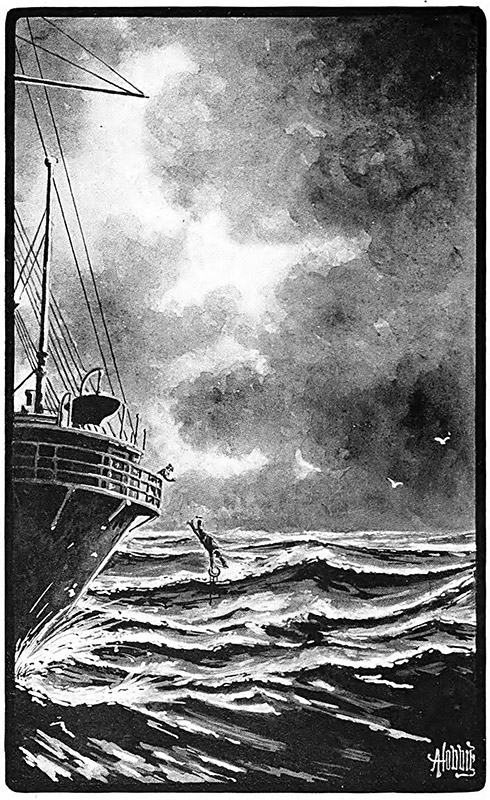
“HE MEASURED HIS DISTANCE AND DOVE STRAIGHT INTO THE SPUME.”
[Pg 1]
Title: Lost in the land of ice
or, Daring adventures around the South Pole
Author: Edward Stratemeyer
Release date: December 30, 2025 [eBook #77580]
Language: English
Original publication: New York: A. Wessels Company, 1902
Other information and formats: www.gutenberg.org/ebooks/77580
Credits: Aaron Adrignola, chenzw, and the Online Distributed Proofreading Team at https://www.pgdp.net (This book was produced from images made available by the HathiTrust Digital Library.)
LOST IN THE LAND OF ICE
“HE MEASURED HIS DISTANCE AND DOVE STRAIGHT INTO THE SPUME.”
[Pg 1]
BY
Captain Ralph Bonehill
Author of “Boys of the Fort,” “For the Liberty of
Texas,” “Tour of the Zero Club,” etc.
NEW YORK
A. WESSELS COMPANY
1902
[Pg 2]
Copyright, 1902,
by A. WESSELS CO.
[Pg 3]
“Lost in the Land of Ice” relates the adventures of a boy and a young man who, in company with a sturdy ship’s crew, go in search of a lost treasure ship said to be cast away somewhere in the region of the South Pole. Fortunately the young man who plays such an important part in the narrative is rich, hence the fitting out of the expedition becomes a comparatively easy matter. But enemies hear of the lost treasure ship and also go in quest of it, and this results in scenes of peril not altogether due to natural causes.
My main object in writing this tale was to acquaint young readers with something of the wonders of the region around the South Pole. While numerous expeditions have been sent north and volumes upon volumes have been written concerning these trips, hardly any expeditions have gone south, and the Land of Desolation, so called, is almost as much of a mystery to-day as it was a century ago, the nearest approach to the Pole being made by Sir James Clark Ross in 1842, and this being but little closer than the approach by Wendell, in 1823. [Pg 4]It is indeed a Land of Desolation, yet to-day scientists and daring explorers are accomplishing so much that I believe the near future will see the mystery of both the South and the North Pole cleared away, in spite of the ice, the intense cold, and other drawbacks.
In placing this new story in the hands of my youthful readers, I thank them for their appreciation of my former efforts to interest them and trust this volume will fulfil their every expectation.
Captain Ralph Bonehill.
[Pg 5]
| CHAPTER | PAGE | |
|---|---|---|
| I. | The Cold-Storage Warehouse, | 7 |
| II. | Barry to the Rescue, | 15 |
| III. | Bob’s Remarkable Story, | 21 |
| IV. | Bob and a Cake of Ice, | 29 |
| V. | Captain Fenlick, | 35 |
| VI. | In the Grasp of the Enemy, | 40 |
| VII. | Captain Fenlick Tries to Make Terms, | 49 |
| VIII. | The Attack in the Alley, | 56 |
| IX. | A Prisoner on the Vixen, | 63 |
| X. | “Crowd on All Steam!” | 71 |
| XI. | An Adventure in the Fog, | 79 |
| XII. | Off for South America, | 87 |
| XIII. | What Happened at Pernambuco, | 96 |
| XIV. | Five Stowaways, | 103 |
| XV. | Something About a Pistol, | 109 |
| XVI. | The Prisoners in the Hold, | 117 |
| XVII. | The Wild Patagonians, | 124 |
| XVIII. | Captain Gordon’s Offer, | 132 |
| XIX. | “We Must Fight!” | 141 |
| XX. | A Strange Meeting on the Beach, | 148 |
| XXI. | Adrift in a Storm, | 156 |
| XXII.[Pg 6] | The Contest for the Arrow, | 164 |
| XXIII. | The Voyage is Continued, | 172 |
| XXIV. | Three Polar Bears, | 180 |
| XXV. | Cast Away in the Ice, | 187 |
| XXVI. | Adventures on the Big Iceberg, | 193 |
| XXVII. | From One Difficulty to Another, | 199 |
| XXVIII. | Up into the Air, | 206 |
| XXIX. | “The Ship! The Ship!” | 212 |
| XXX. | The Magnetism of the South Pole, | 221 |
| XXXI. | Meeting of Father and Son, | 228 |
| XXXII. | Home Again—Conclusion, | 235 |
[Pg 7]
LOST IN THE LAND OF ICE
Dong! dong! dong! dong!
Loud and clear through the midnight air rang the warning gong of a long hook-and-ladder truck as the machine bowled along over the granite-block pavement of one of the lower streets of the city of New York.
The hour was well past midnight, yet New York never sleeps, and the streets were more or less alive with people, some going to their early work, others returning from a half night of pleasure.
Dong! dong! dong! dong!
Down past the Astor House on Broadway swept the heavy truck, filled with swaying firemen, who clung fast like so many monkeys as they donned their rubber coats and boots. Five minutes before, most of them had been sleeping on their cots in the truck house, half a dozen blocks away. But now every man was wide [Pg 8]awake and ready to do his duty to the utmost, no matter what the peril.
Dong! dong! dong! dong!
The long truck swept around the corner of Vesey street, and as it did so the clanging of the gong awoke many of the sleepers in the hotel with a start.
“What’s the matter?”
“Where is the fire?”
“Is the hotel burning?”
Such were some of the questions asked, as those in the rooms either ran into the hallway or craned their heads out of the many windows of the second, third, and fourth stories of the hotel.
“No danger here,” was the reply, which was quickly circulated. “The fire is at the Powell cold-storage warehouse, two blocks below here.”
“The Powell cold-storage warehouse,” repeated a tall and handsome youth, who was occupying an elegantly furnished apartment on the second floor. “You are sure of that?”
“Yes, sah,” replied the hallman.
“Then I’m going to dress and go to it,” went on Barry Filmore. “I am interested in that plant.”
“If you is, I’d be sorry to see it burn down,” remarked the hallman, for he had received many a generous tip from rich Barry Filmore, and he liked the young man very much.
[Pg 9]
“Oh, it’s insured, or at least it ought to be,” answered Barry; “although old Powell is such a queer stick, there is no telling what he is up to, half the time.” And he began to haul on his clothing with all speed.
Barry Filmore was a youth of nineteen, tall, strong, good looking, and well liked by all who knew him. He was the orphan son of a former Brooklyn millionaire, and at the death of his parents, three years previous to the opening of this story, had been placed in the care of Jasper Powell, a peculiar old man, who was at the head of the Powell Cold Storage Warehouse Company, and who was also the inventor of several systems of cold storage and refrigerating, in use both in warehouses and on freight trains.
Barry did not like Powell because of his peculiar ways; yet as the old man let him do very nearly as he pleased, the youth found little cause to complain. Powell was a bachelor, living at a cheap hotel on the east side. Barry did not live with him, but instead put up either at one of the leading hotels or on board of his own private steam yacht, the Arrow. The Arrow had been left to Barry by his father, who had also, by the terms of his will, left his only son two hundred dollars per month for living expenses until he should become twenty-one, when he was to inherit the whole of the Filmore fortune, less ten thousand dollars, which was [Pg 10]to go to Jasper Powell for his services as executor.
When Barry reached the street he found it crowded with people, all rushing in the direction of the fire. A steam engine had gone on ahead and now another followed, and then came a patrol wagon with several special policemen.
The Powell cold-storage warehouse was situated in the middle of a block, with other warehouses on either side of it. When Barry reached the vicinity, flames were shooting from the windows of the first floor, and thick, black smoke was puffing out from many windows above and from the roof.
“That building is doomed!”
“The firemen will be lucky if they save the buildings on both sides!”
“Where is the watchman?”
So the cries ran on, as the crowd surged closer and closer, until the police drove the people back. One steamer was already at work, and now a second began to pour two streams into the second-story window. But the crackling of the flames increased, and soon it was evident that the fire was crawling steadily up the rear of the structure to the roof.
Suddenly a wild shriek was heard, coming directly after a jingling of glass, and an old man with flowing white hair appeared in the frame of a third-story window. He had dashed out [Pg 11]the panes of glass with his hands, and the blood was flowing from those members.
“Save me!” he screamed. “Save me! Don’t let me die like a rat in a trap!”
“It’s old man Powell!” uttered half a dozen voices. “What is he doing in the building at this time of night?”
“Bring up a ladder, boys!” shouted the captain of the hook-and-ladder truck. “Step lively now, or we’ll be too late.”
“Save me!” continued Jasper Powell, dancing around on the window sill. “You dogs! Why don’t you save me? You want me to burn up, don’t you?” Always of a peculiar turn of mind, the fire had driven him almost insane.
The ladders were rushed forward and placed against the window, and up the first of them ran a truckman, followed by a fellow-fireman. But before the window was gained, Jasper Powell shook his fist at the advancing men.
“No, you don’t!” he snarled. “You shan’t learn my secret! Get back! I’ll come down alone!” And he continued to shake his fist at the two firemen.
“Keep cool, old man,” said the truckman, soothingly. “We’ll have you down, all safe and sound in a minute.”
“You shan’t learn my secret, I say!” roared Jasper Powell, frantically. “Get back! My secret has been my own for ten years! Get [Pg 12]back!” And then, as the truckman came up another step, the old man turned suddenly and disappeared from view.
“Well, blame him for a fool!” muttered the truckman. “Come back here, if you want to be saved.”
“He’s a goner!” yelled the crowd. “He’s gone crazy, and will rush right into the flames.”
Barry had listened to Jasper Powell’s words with keen interest.
“His secret!” he murmured. “I knew he had a secret last week, and last month, too, when he wouldn’t let me go near room 18. Whatever his secret is, it’s in room 18—and I’m going to find it out!” he added suddenly.
He was in the front rank of spectators, and darting past a policeman, made straight for the doorway of the burning building. The flames had now found an outlet at the rear of the building, so the hallway was comparatively free from smoke and fire.
“Hi, come back here!” yelled the officer of the law. “Do you want to be burnt up?”
“No; and I’m not going to be burnt up!” answered Barry. “I know what I am doing.”
“It’s sure death to go in there.”
“I’ll risk it.”
“Not much you won’t!” answered the policeman, and darted after Barry. But the youth [Pg 13]was not to be caught, and soon a puff of smoke drove the bluecoat back into the street.
In the course of the past few years Barry had paid the cold-storage warehouse many visits, and consequently he knew the building thoroughly. The elevator shaft was a mass of flames, but the stairs behind it were still untouched, and up these he went, three steps at a time.
“Mr. Powell! Mr. Powell! Where are you?” he called out at the top of his lungs.
No answer came back—only the crackling of the flames—and he mounted to the third story. He was passing through the upper hallway when he stumbled over something and fell headlong.
“Oh!” came in a groan, and he recognized Jasper Powell’s voice. The old man was in a chill of fear, with his limbs trembling violently and his teeth chattering.
“Go! leave me—leave me with my secret!” he gasped, staring wildly at Barry. “Go! go!”
“Mr. Powell, don’t you know me!” returned the youth. “It is your ward, Barry Filmore.”
“No! no! You are the demon of the South Pole, come to rob me of my secret! Begone, or the fiery furnace will open to receive you! Begone, I say!” And then the old man began to weep like a little child.
“As mad as a March hare!” murmured Barry.
[Pg 14]
“But he’s got a secret, sure!” he added mentally.
“Leave me, I say!” continued Jasper Powell. “You are the demon of the South Pole, but the secret of the land of ice is mine—all mine! And the gold of the treasure ship, too! All mine—all Jasper Powell’s! Ha! ha!” And leaping to his feet he flourished his arms wildly before Barry, and then darted swiftly toward the rear of the building, where the flames now made all as bright as day.
“Mr. Powell, come back! Please come back!” yelled Barry, hoarsely. The strangeness of the situation almost struck him dumb.
“Come back, to be robbed of my secret? Never!” screamed the old man. “Farewell, and when next we meet, let it be at the South Pole!”
And with one long cry which rang in Barry Filmore’s ears for days afterward, he rushed for the rear of the warehouse and plunged straight into the roaring flames, to be seen no more!
[Pg 15]
“Gone!”
The cold perspiration stood out upon Barry Filmore’s hot forehead as he gazed transfixed at the spot where Jasper Powell had disappeared.
“He has committed suicide, while temporarily insane—and he has taken his secret with him,” thought the youth. “What an awful thing to do!”
He started to go forward—to see what had actually become of the old man—but the flames grew hotter and he was forced to retreat.
The thick, choking smoke was now swirling everywhere above his head, and he had to crouch low to keep from being both blinded and suffocated.
As he retreated his foot struck something bright and kicked it ahead.
It was a key, and to it was attached a bit of flat brass stamped with the number 18.
“The key to that mysterious room,” thought Barry. “I wonder if I have time to follow up that mystery?”
It was taking a big risk, for the flames were [Pg 16]both below and behind him, and sweeping onward rapidly. Should he be caught, his life would pay the forfeit.
But Barry Filmore was used to taking chances, and was bound to take many more even more daring—otherwise this tale would never have been written. He had had his own way from childhood, and when he made up his mind to do a thing he always did it.
He knew where room 18 was located, on the floor above, almost at the front of the building. But could he climb those smoke-laden stairs and get back again before the fire should have a chance to cut him off?
“Here goes, anyway!” he muttered, half desperately. “If I’m lost, what does it matter? Nobody will be left to mourn over my death. I guess some of those fourth-handed relations out West will be glad to get hold of my money. They never cared for me.”
Up he went, swiftly but cautiously, crouching down like a whipped dog, that he might clear himself of the fatal smoke. Once a cloud swept over him and he had to shut his eyes and hold his breath. He breathed with difficulty and the tears ran down his cheeks like water.
Crash! boom! Something in the rear had given way, and up came a shower of sparks, burning him on the hands and neck and setting fire to his coat. But he slapped the tiny fire [Pg 17]out and rushed on, and a moment later took him to the door of room 18.
It was the work of an instant to insert the key in the lock and open the door. But then Barry gave a cry of dismay, for before him he beheld what looked like a large empty closet.
“Duped!” he muttered, when he stopped short, for the cry of a human voice—the voice of a boy—had reached his ears. The cry came from behind the opening he had discovered.
“Hullo!” cried Barry. “Who are you, and where are you?”
“Here I am—Bob Baxter!” was the muffled answer. “Let me out! I think there must be fire around here!”
“Think there must be fire?” repeated Barry. “There is fire, and lots of it. Where are you?”
“Here,” and then followed a thump on the boarding at the back of the closet.
A closer examination showed Barry that the back of the closet formed a thick, packed door leading to an inner apartment—the door being similar to that used on a butcher’s refrigerator. The handle was concealed by a slide of wood, but the youth quickly uncovered it.
To swing the ponderous door open was not easy, and Barry tugged and tussled with it for fully a minute before it yielded. When the door came open an icy blast reached him which caused him to shiver.
[Pg 18]
The scene which met his gaze caused him to cry in amazement.
In the middle of the apartment before him stood a tall, well-built boy of sixteen. He was clothed in nothing but a bathing suit. Around the left ankle of the boy was a band of iron, attached to a long iron chain, which was fastened to a ring in the floor. The apartment, which was cold, contained a cot, upon which the boy had been sleeping, a stand with a number of books, and two chairs. There were no windows to the apartment, but several ventilators, and an incandescent light burned close to the ceiling.
“By stars! What are you doing here—and with only that bathing suit on?” demanded Barry, when he had recovered sufficiently to speak. “Do you want to freeze to death?”
“I’m so glad to see somebody besides old Powell,” answered the boy, in an odd voice, for he was not used to speaking to any one. “I wish I could get away from here.”
“You shall get away, and mighty quick, too. Do you know the storage warehouse is burning up?”
“I knew it was getting warm in here, and I noticed the smoke. But how am I going to get away with that around my ankle?”
“Doesn’t it unlock?”
“Yes; but Powell has the key.”
“Then it’s gone for good, for Jasper Powell [Pg 19]has thrown himself into the fire. I have a bunch of keys and I’ll try to fix it. There, now you are free.”
“I’ll never forget you for that!” cried the lad, and caught Barry by the arm.
“Don’t talk now,” answered Barry. “We must get out, or it will be too late. Come.” And he led the way to the hallway.
But the flames had done their work, and escape in that direction was completely cut off.
“We will try the front windows—the firemen have ladders up,” said Barry. “Here, put on my overcoat.” For the night was so chilly that the youth had donned his light overcoat before leaving the Astor House.
They ran for the front windows and Barry raised one of the sashes. A firemen’s ladder was just below, but it was not quite high enough.
Willing hands raised up the ladder, putting on a bottom section.
“Shall we come up?” asked a fireman.
“No, we are all right,” answered Barry, and came out on the ladder, followed by the boy he had liberated. As both came down the ladder smoke and flames swirled all around them, but they reached the bottom in safety.
Then what a wild cheer went up!
Barry turned to his companion. “Come with me,” he said. “I have a room at the Astor House, only a few blocks from here. Come [Pg 20]on,” and before firemen or police could stop him he had the stranger out of the crowd and was hurrying him up Vesey street. They entered the hotel by the side entrance, and a minute later were safe in Barry’s apartment.
[Pg 21]
“Now, then, I would like to know who you are, and how you came to be locked up in that cold room,” said Barry, after he had taken a good look at the boy he had rescued.
“All right, I’ll tell you anything you wish to know,” was the ready reply. “But say, ain’t it hot in here!” And the boy threw off the overcoat Barry had loaned him.
“Hot!” Barry glanced at a near-by thermometer. “It’s only fifty-eight. I don’t call that hot.”
“Old Powell kept the thermometer at thirty-five in my room.”
“Thirty-five! Why that’s only three degrees above freezing!”
“Right you are!”
“And did he keep you there without regular clothing?”
“He did. I was never allowed to put on clothing, excepting when he took me out for an airing in the dead of winter. Then I used to wear a light suit, but no underclothing.”
“Gee Christopher! And what did he do that for?”
[Pg 22]
“It’s a long story.” The boy paused. “Who are you?”
“I am Barry Filmore, an orphan, the only son of my father, who was a Brooklyn millionaire. He’s dead now, and so are all of my folk. Who are you?”
“I am Bob Baxter. My father was Professor Amos Baxter, who sailed South a number of years ago, to hunt for the South Pole. All of my folk are dead, too.”
“And why was Jasper Powell keeping you in that cold room?”
“He was a peculiar man, and he had a notion that he could get me so toughened that I would never feel the cold. And to tell the truth, I never do feel the cold,” went on Bob. “If you don’t mind, I’ll open the window and get some fresh air.”
“Go ahead, and I’ll put on the overcoat,” laughed Barry, and did so. “Well, this is the funniest thing I ever heard of. It’s a wonder he didn’t freeze you stiff.”
“I used to kick first, but I soon got used to it, and now I rather like being cold.” Bob opened the window wide and drank in the cold night air. “Did you say old Powell was dead?”
“He must be,” and Barry gave the particulars of how the peculiar old man had acted. “He was a queer stick.”
“I guess he deserved what he got,” was Bob’s [Pg 23]comment. “But let me tell you, he knew a thing or two.”
“What about?”
“About lots of things—inventions and things to drink from little bottles to keep from starvation, and how to live so that the cold would not have any effect on you. He had it all planned that he and I were to sail for the South Pole next year, to hunt for my father who was lost, and to locate a strange country, said to be inhabited by a tribe of people unknown here.”
“Was he going in secret?”
“Yes. He said he would fit out an expedition at his own expense; that he was a millionaire.”
“I guess he was going to use my millions,” answered Barry, dryly. “He had all his money tied up in inventions. But how did he get his knowledge of a strange country at the South Pole? That region has never yet been explored.”
“I don’t know. But he had it all written in a little book, which he wanted me to learn by heart. Here is the book. I picked it up when I left the room over there and put it in the overcoat pocket.”
Bob Baxter held the volume in his hand and passed it over.
Barry opened it eagerly, to find that it contained half a dozen maps, drawn by hand in [Pg 24]red ink, and twenty-odd pages of closely written manuscript.
“I suppose you have studied it pretty well?” he said, as he began to read.
“Yes; I know it thoroughly.”
“And do you believe in this strange land?”
“I wouldn’t like to say as to that. But I would like to take a trip south and learn, if possible, what became of my father and his ship, the Comet,” answered Bob, soberly. “You know he went south to try to locate a treasure ship from California, which was wrecked off the coast of Terra del Fuego years ago. There was a rumor that the treasure ship had drifted toward the South Pole and had become fast in the ice there. The ship had over five million dollars’ worth of gold on board.”
“That would be a find worth making,” observed Barry. “But if you went down there you might become lost, just as your father before you.”
“I’d risk that. I have no ties here, and the cold of the South Pole would have no terrors for me.”
“Did your father leave you in Jasper Powell’s care when he sailed?”
“Yes. But old Powell wasn’t so peculiar in those days.”
“I know that.”
“Then you knew Powell? But of course you [Pg 25]did; otherwise you wouldn’t have been at the warehouse.”
“Powell was my guardian, too, although he used to let me do as I pleased. I guess he was wrapped up in his scheme to take you to the South Pole and turn you loose.” Barry paused and began to smile. “Do you know what I think of doing?”
“What?”
“Of taking you down to the South Pole myself. Of course I don’t think we can reach the pole, but we may come close to it, and we may locate that treasure ship and learn what became of your father.”
At the words Bob Baxter leaped up from his chair and grasped Barry by the hand.
“Will you do it? Can you do it?” he questioned. “I am so anxious to find out what really did become of my father. And it would be fine if we could locate all that gold.”
“Let me read this book thoroughly first, and study these maps,” answered Barry. “Luckily I always loved geography, and I know quite something of Cape Horn and its vicinity. But here, now you are out of Jasper Powell’s power, you must wear some regular clothing. Look into those trunks yonder and pick out what suits you.”
“I can’t wear anything heavy—it would kill me,” grumbled Bob. Nevertheless he went to [Pg 26]the trunks, and while Barry looked over the contents of the strange book, he put on some thin summer underwear and an equally thin suit of clothing, and likewise a pair of canvas shoes.
“Here are a lot of sailor togs,” observed Bob. “Do you do much sailing?”
“Occasionally—when the humor strikes me,” was the young man’s answer. “I own the Arrow, one of the fastest steam yachts afloat.”
“Would she do for a trip south?”
“Certainly, but if I was going to take her down among the ice of the South Pole I should want her bow steel plated, and want her frame re-enforced, to resist the pressure, you know.”
“That would cost money.”
“I wouldn’t mind the expense. I have all the money I need,” said Barry, carelessly.
“Then let’s go; and if we locate the treasure we can whack up on it.”
Barry laughed at Bob’s frankness.
“You believe in getting to the point,” he remarked. “If we do go, it can’t be right away. I’ve got to look after my personal affairs, now that Jasper Powell is dead. For all I know, he may have been squandering my fortune on the sly and I may be a poor man.”
“By the boots, I never thought of that!”
“This fire is going to cause a lot of trouble all around. You haven’t any relatives, you say?”
[Pg 27]
“Nary a relative!”
“Then supposing you stay with me, Bob?”
“It’s a whack, Barry—I mean Mr. Filmore.”
“Barry is good enough for me. You can stay with me and I will look out for your interests as well as my own. I’ll place the whole case in the hands of a first-class lawyer to-morrow morning.”
The two talked matters over for an hour longer, and then Barry, who had been out in his yacht half the night before, said he was too tired to remain up longer and went to bed, leaving Bob to rest on a luxurious couch near the open window. By this time the cold-storage warehouse had been flooded with water and the fire was out. Yet the building was practically a total loss.
The sleep of the boy and the young man was not of long duration. At seven o’clock came a loud knocking on the door.
“A gentleman to see you, Mr. Filmore,” said the bellboy, and Barry arose at once and dressed himself. The gentleman proved to be a detective from the nearest police precinct.
“Sorry to disturb you,” said the detective. “But I——” Then he caught sight of Bob. “You must be the boy I am after!” he cried.
“What boy are you after?” demanded Barry.
“The lad who set fire to the cold-storage [Pg 28]warehouse. Is this the boy who came down the ladder after you?”
“It is, but——”
“Then he is the rascal. Come with me.”
And the detective caught Bob by the arm and held him firmly.
[Pg 29]
For the moment Bob Baxter could not believe his ears. “I set fire to the warehouse?” he gasped. “It isn’t true!”
“You came out of there and you didn’t belong around the place, so the watchman says. You’ll come to the station house with me.”
“Not much I won’t!” cried Bob.
And wrenching himself from the detective’s grasp, he slipped past that individual and made for the door.
“Hi, stop!” roared the detective. “Stop, you rascal!”
“Don’t run. I’ll make it all right, Bob!” called out Barry, but Bob did not hear the latter words, for he was already out in the hallway and running for the stairs. Down the steps he went, three and four at a time, and a minute later found him out on Broadway. He crossed to the post-office and then went up Park Row to the Brooklyn Bridge and out on the broad promenade.
“They shan’t arrest me, not much!” he said to himself. “I’ve had enough of being locked [Pg 30]up. Now old Powell is gone I’m going to remain a free boy.”
He was hatless and penniless, but for this he did not care at first. But after reaching Brooklyn and wandering around the streets for a while he began to feel hungry.
Presently he came to a pork-packing establishment where two icemen were unloading a wagon of ice. The men were working hard and doing a lot of sweating in the bargain.
“Tough work,” said Bob. “Want any help?”
“Can’t pay for help,” answered one of the men. “Don’t make wages enough.”
“You ought to carry the ice in on your back,” went on Bob, struck with a sudden idea.
“On our backs!” ejaculated the second iceman. “Why?”
“It’s easier—if you’ll take off your coats and shirts.”
“Go on!” growled the iceman. “I’ve no time for fooling.”
“I’m not fooling. I always carry ice on my bare back,” grinned Bob.
“I’ll bet you a dollar you can’t carry one of these cakes on your bare back,” put in the first man who had spoken.
“Done!” cried Bob. He looked around and espied the owner of the pork-packing establishment. “You heard that bet, didn’t you?” he asked.
[Pg 31]
“Yes, and I’ll put another dollar to it,” said the pork packer. “But you’ve got to keep the ice on your back for at least two minutes.”
“I’ll keep it on five,” answered Bob.
The scene was in the yard of the establishment, which was surrounded by a high board fence. Soon Bob was stripped to the waist. The news of the bet began to circulate and a crowd collected.
“The boy will be frozen to death!”
“He can’t carry that ice on his bare back any more than he can carry a red-hot iron plate!”
So the talk ran on, but Bob paid no attention. Going to the ice wagon he raised up a cake weighing at least a hundred pounds and placed his back under it. The next instant the cake of ice was evenly balanced on his back, and he held it there by clasping his hands together under the bottom end.
“There you are!” he cried. “That’s the way to carry ice on your bare back!” And he walked slowly toward the pork-packing establishment with his load.
The spectators were astonished beyond measure, and the icemen could scarcely believe their eyes.
“How does your backbone feel?” questioned the pork packer.
“I’m all right, only it’s making me sweat a [Pg 32]little,” grinned Bob. “I like a job like this better in the dead of winter.”
“Whow!” gasped a newsboy who was witnessing the performance. “Dat feller must be from de Nort’ Pole! Say, wot do youse live on—snowballs?”
“No; hailstones and icicles,” laughed Bob. He turned to the icemen. “Want to try it?”
“Not much!” came from both.
Bob kept the ice on his back for over six minutes, then dumped it at the bottom of the pork-establishment lift.
“Now I’ll take my money,” he said quietly, and there was nothing to do but to pass over the two dollars which had been wagered. Soon the lad was in his clothing again, and then he left the neighborhood as quickly as possible, so that none of the crowd might follow him.
“You had better do that for a turn on the variety stage,” cried one man after him.
“No stage for me,” said Bob to himself. “I’m bound for the South Pole.”
Coming past a hat store, he went in and purchased a cheap hat. Then he sought out a restaurant and procured a light breakfast. He was not in the habit of eating much, for Jasper Powell had kept him on a light diet for many months.
After breakfast Bob began a systematic search for the Arrow, for Barry had told him she lay [Pg 33]at a wharf in Brooklyn. He found the craft in the middle of the afternoon, and went on board, to find an Irish sailor in charge.
“Yis, this is Mr. Barry Filmore’s yacht,” said Pat Caven, for such was the sailor’s name. “An’ what are ye afther wantin’ av him?”
Before Bob could answer he heard a footstep behind him and Barry appeared, having just come from New York.
“Good for you, Bob; I was thinking I might find you here,” cried the young owner of the steam yacht. “Come into the cabin.”
They entered the cabin, which was a dream of luxury and elegance, and here each told his story.
“I had it out with that detective after you left,” said Barry. “I told him just how Jasper Powell had been treating you.”
“Did he believe you?”
“He had to believe it. Then I went to see a lawyer, and he is going to investigate my money matters for me without delay. He knew something of Jasper Powell’s affairs, and he is afraid money matters are pretty well mixed up.”
“And what about going to the South Pole?”
“We’ll go, Bob, sooner or later. While I’m waiting to hear from my lawyer I’ll have the Arrow taken over to the shipyard and have some steel plates put on her, and I’ll also buy in the right stock of provisions for such a trip.”
[Pg 34]
“What of that book? I left it behind when I ran away.”
“I’ve got it in my pocket,” answered Barry.
He placed his hand in his pocket and then gave a start.
“By Jove!”
“What’s up?”
“The book is gone!”
“Gone!” groaned Bob. “You are certain?”
“Yes, it’s gone. And I had it safe when I was on the bridge cars, too.”
“If that book is gone, with the maps, the jig is up!” sighed Bob.
“Perhaps I dropped it on the dock. Let us look and see,” said Barry.
Leaving the Arrow, they began a close search along the dock and to the street beyond.
No trace of the precious book could be found, and unwilling to give up the hunt, Barry gradually led the way along until they reached a spot under the tracks of the elevated railroad.
“I stopped at a store here,” he said. “Perhaps I dropped it when I took my money out of my pocket.”
[Pg 35]
A little while later they entered the store the rich young man had mentioned and asked about the lost book. The proprietor of the shop shook his head.
“Haven’t seen it.”
“It was a small, square book, bound in a red cover,” said Bob.
The man scratched his head.
“’Pears to me I did see that book,” he said slowly. “A man was in right after you and he had some kind of a red covered book when he went out.”
“What kind of a looking man was it?” asked Barry.
“He looked like a seafaring man, and was dressed in a suit of blue with a blue cap to match.”
“Do you know his name?”
“No, he was a stranger to me,” answered the shopkeeper.
“Do you know where he went?”
“Down toward the docks, I imagine. I took a walk afterward and saw him in that neighborhood.”
[Pg 36]
No more could be learned of the book or the man, and Barry and Bob left the store.
“Let us take a look around the docks,” said the young owner of the Arrow.
The docks were soon gained and they gradually got back to the Arrow. As they approached the steam yacht Bob uttered a cry.
“There is a man in a blue suit now!”
“Where?”
“Just went on board of your yacht.”
Bob was right, and as they came up the stranger introduced himself as Captain Richard Fenlick.
“I used to run the Mohawk for Lincoln Vanderbilt,” said Captain Fenlick. “But the yacht was run down by an ocean steamer and so badly damaged they are not going to repair her, so I’m out of a job. I heard that you wanted a new captain.”
“I do,” answered Barry, for his old commander had retired to his home on Staten Island.
“Then perhaps we can come to terms. I know all about a craft like this—have run such yachts for years for some of the best families.”
“Well, I want a man who will take a long trip,” answered Barry, without stopping to think twice. “A trip almost to the South Pole.”
“The South Pole!” cried the stranger. “Why, I——” And then he stopped short.
[Pg 37]
“Did you pick up a book with some writings in it about the South Pole?” broke in Bob.
Captain Fenlick hesitated and his face changed color.
“No—that is—no,” he said, slowly.
“I lost such a book,” said Barry, eyeing the captain sharply.
“And what makes you think I picked the book up?” was the uneasy answer.
“Because somebody picked it up who was dressed as you are dressed, down in Radway’s store.”
“I don’t know anything of the store you mention.”
While the captain was speaking Bob had been eyeing his coat closely. There was a square bulge outside, over an inner pocket. The boy stepped closer.
“I would like to know what is in that pocket,” he said boldly, and at the same time drew the coat open. The top of the red-bound book was plainly revealed.
“Hi! stop!” cried Captain Fenlick savagely. “What do you mean by touching me?”
“You give up that book,” answered Bob, angrily. “It belongs to me. I didn’t like your look the minute I clapped eyes on you.”
“That’s the book,” put in Barry, “and you must give it up.”
At once Captain Fenlick began to fume, and [Pg 38]then he tried to back away. But both Bob and Barry held him, and in the end he was forced to give the book up.
“Now you’ve got the book, I reckon I can take myself off,” muttered the captain.
“We ought to have you arrested,” was Barry’s comment.
“What for? I didn’t steal the book. I found it in the doorway of the store you mentioned.”
“But you were going to keep it, after you knew it belonged to us,” said Bob. “I think you’re a bad egg.”
“Shut up!” roared the captain. “I guess you don’t want to hire me to run your steam yacht for you.”
“Not much!” retorted Barry. “You get out as fast as you can, and don’t you ever let me catch sight of you near my boat.”
“Humph! You think you’re on top, but some day it may be my turn,” growled Fenlick, and with a sour scowl on his dark face he leaped to the dock and walked swiftly toward the street. Barry and Bob watched him out of sight.
“He’s a rascal if ever there was one,” was the comment of the young yacht owner.
“We want to keep our eyes open for him,” returned Bob. “He’ll make trouble for us if he can. It’s too bad that he picked up the book. I wonder if he read the contents.”
[Pg 39]
“I don’t see how he could have had time, Bob.”
“But if he didn’t know the book was valuable why did he deny having it? If he had given it up at once it might have gotten him the job he was after.”
“True enough. But still I don’t believe he did more than glance at the book,” answered Barry.
But for once the young yacht owner was mistaken.
Immediately after finding the book Captain Fenlick had repaired to a near-by saloon, and there read its contents carefully while seated at a table drinking several glasses of liquor.
He had seen at once the importance of his discovery and he had wondered if it would be possible for him to interest anybody in an expedition south in search of the lost treasure ship.
He had been thinking of such an expedition when he had applied to Barry for a position, and the sudden turn of affairs had dazed him.
“I made a mess of it there,” he muttered to himself as he stole off. “But I’ll keep track of those two young fellows, and perhaps sooner or later something will turn up in my favor. I’m not going to let such a chance for money slip by—not much!”
[Pg 40]
After a long talk between Barry and Bob it was decided that for the present Bob should remain on board of the Arrow. Barry would stay at the Astor House in New York until he and his lawyer had settled the claim against Jasper Powell’s estate.
The fire at the warehouse had produced many complications in a business way, and it was held by the authorities that the conflagration had been started by the strange boy who had escaped down the ladder after Barry.
The detectives did their best to find Bob, but Barry gave Bob the tip, as it is called, and the latter wisely kept out of sight.
“It will only make more trouble if you expose yourself,” said Barry.
“But what about the money old Powell had, which was coming to me?”
“Wait until we see how Powell was fixed,” answered Barry.
At the end of two weeks affairs were fairly well straightened out.
It was found that Jasper Powell had used [Pg 41]some money, but only a few thousand dollars were missing from the Filmore fortune, so that Barry would still be a millionaire when he became of age.
There was a matter of two thousand dollars coming to one Bob Baxter, “said to be missing,” by the court.
“If I were you I’d stay missing for the present,” said Barry. “The money is safe so long as it is in the hands of the law.”
The lawyer in New York was appointed Barry’s guardian, but he was a whole-souled fellow and was willing to let Barry do as he pleased.
When the young man spoke about the trip to the South Pole he shook his head over the idea.
“It will prove a voyage full of unknown perils,” he said. “Take my advice, and give it up.”
But Barry was determined, and a few days later the Arrow left the dock in Brooklyn and sailed for Philadelphia, where she was to put up at the Standard Ship Yard for steel plates and additional bracing inside.
In the mean time Barry had run across an old sea captain named Robert Gordon, who had sailed around Cape Horn a number of times and who knew the coast of South America well, and this old sea dog had agreed to participate in the trip toward the South Pole.
With Gordon came several sailors who were used to the roughest and toughest life at sea, [Pg 42]and who agreed to go anywhere on a trip to last not over three years.
All told, the Arrow carried a crew of ten, including Pat Caven, previously mentioned, and Gus Stults, the German cook, as good-natured a fellow as could be met anywhere.
Stults soon made friends with Bob and the two became very intimate.
“Ve vos like brudders, hey?” he said one day. “Ve vos git along, I bet you, py chiminy!” And Bob laughed and said he hoped they would get along.
But if Bob liked Gus Stults, he cordially detested Pat Caven, not because he was Irish—Bob had a bit of Irish blood in him himself—but because Pat Caven was a natural born sneak. Caven was forever listening to the talk of others, and Bob once caught him at it when Barry was telling Captain Gordon in private about the lost treasure ship.
“You had better be at your work, Caven,” said the youth, severely. “You’ll never hear any good of yourself by playing the listener,” and Caven slunk away, but with a look that Bob did not readily forget.
When Philadelphia was reached the Arrow was immediately dry-docked and the work of plating her bow and sides with steel begun. Her ribs were all strengthened, and likewise her keel, to resist the pressure of any ice she might [Pg 43]have to cut through, and she was also provided with a new and extra heavy screw, the old one being stored in her hold, to be used in case the other became lost or broken.
While this was going on the provisions and coal for the long trip were purchased. When out of the dry-dock and loaded she sat deep in the water, for even her deck carried such bags of coal as could not be stored elsewhere.
One day, just before the Arrow was ready to sail, Pat Caven went ashore and made his way along the shipping until he came to where a small “tramp” steamer lay, one which had been engaged in the South American and South African trade.
A week before he had learned that Captain Fenlick had obtained command of the Vixen, as the steamer was called, and was about to take her on a trip to Rio de Janeiro, South America.
Caven knew Fenlick well, having sailed under the captain some years before.
The two had once been companions in a smuggling expedition, which, however, had fallen through at the last minute.
“We sail day after to-morrow,” said Caven to Fenlick. “I heard Filmore tell Captain Gordon.”
“And what is the first stopping place?”
“Pernambuco, Brazil.”
“Ha! that is where we stop, too,” cried the [Pg 44]captain of the Vixen. “I am glad you told me, Pat.”
“I knew you’d keep track of the yacht,” grinned Caven.
“Have you found out anything about the red book?”
“No; young Filmore keeps it in his safe, I am afther thinkin’, although I am not certain.”
“If we had that book we might make our fortunes, Pat.”
“How?”
“Never mind. We could make piles of money, I am sure of it.”
“I heard something about a treasure ship near the South Pole.”
“Yes, that’s the secret, and the red book tells all about it. Filmore and that young Baxter are going after it, I reckon.”
“They are afther something.”
“I wish I could collar young Baxter,” went on Captain Fenlick, savagely. “I might get the book through him.”
“How?”
“Oh, easy.”
“By threatening him?”
“You’ve struck it. I reckon he would rather give up the book than suffer.”
“Sure, an’ I think so meself,” laughed Caven. “Well, it’s easy to be afther doing.”
[Pg 45]
“You mean to collar him?”
“Yis.”
“How?”
“Barry Filmore goes off to-night to visit some old friend near Fairmount Park. When he’s gone ye can send a bogus letter to young Baxter, and——”
“Just the idea, Pat! I’ll do it. You must let me know as soon as Barry Filmore leaves the yacht.”
“I will let yez know.”
The two conversed for half an hour and had several drinks, and then Pat Caven returned to the Arrow.
Captain Gordon was away looking after some matters of business, and shortly after Caven came back Barry departed.
“I’ll be back by ten, Bob,” he said.
“All right,” returned Bob, carelessly. “I think I’ll take a cold bath; somehow I can’t get used to this warm weather.”
“Hankering after your room at the cold-storage plant, eh?”
“It must be that. I feel as if I was in an oven all the time.”
“You’ll get cold enough when we reach the South Pole. But I am afraid you’ll suffer in the journey across the equator. The thermometer goes up over a hundred at the line, you know.”
[Pg 46]
“Great Scott! there will be nothing left of me but a grease spot,” sighed Bob.
“Oh, well, we’ll cool you off in the ice box if you get too warm,” laughed Barry, and then left his chum to himself.
One of the comforts of the Arrow was an elegantly fitted up bathroom, with shower bath and all, and it did not take Bob long to disrobe and plunge into the water, which he used as cold as he could get it.
He was just enjoying the shower bath when Caven knocked on the door.
“What’s wanted?”
“A message for you,” announced the Irish sailor.
“All right,” answered Bob, and opened the door a few inches, so that Caven could give him the communication.
It was in lead pencil and ran as follows:
“Bob: I forgot the book. Bring it to me, up at the Rosemore Hotel. Have met an old friend who knows all about the Southern Ocean and South America, and I want him to give me some pointers. Come as soon as possible.
Barry.”
Bob read the note with interest. He was not familiar with Barry’s handwriting, otherwise he would have known that the communication was a forgery.
[Pg 47]
He dressed as rapidly as possible and then entered the general room of the yacht, where the ship’s safe was located.
Barry had given him the combination of the lock and he opened the door without trouble.
With the precious book tucked away in an inner pocket of his jacket, he went on deck.
“I am going off to meet Mr. Filmore,” he said to the sailor in charge of the yacht. “You must take care of things till Captain Gordon gets back.”
“Ay, ay, sir!” said the sailor, and touched his forelock.
Bob knew where the Rosemore Hotel was located, and to get there the quicker decided to take a street car running in that direction.
He had to walk several blocks to the thoroughfare upon which the cars ran and the way lay along a particularly dark street lined with low saloons and tenement houses.
Just as he was passing an alleyway two men rushed out upon him.
“Here he is!” said one of the men, and hurled himself on Bob.
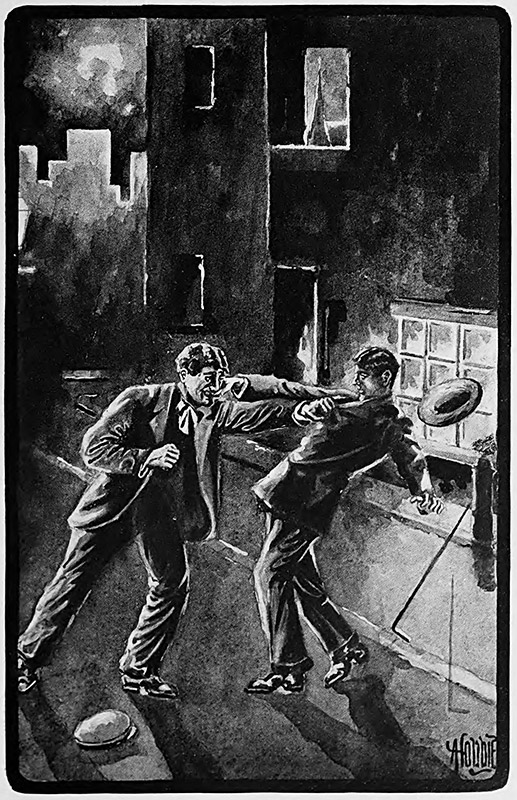
“ONE OF THE MEN HURLED HIMSELF ON BOB.”
Taken unawares, the lad fought as best he could, but hardly had he struck the first man when the second hit him a cruel blow on the head, rendering him unconscious.
Then the two men carried him into the alleyway [Pg 48]and up to the top floor of one of the tenements.
Here he was dropped on the floor and his hands and feet were securely bound.
Poor Bob was a prisoner of the enemy.
[Pg 49]
When Bob came to his senses all was pitch dark around him.
His head ached and there was a pain in his back which told that he had been treated anything but kindly since becoming unconscious.
He tried to rise to his feet, and then found how securely he was bound.
“A prisoner!” he thought. “I wonder what they are going to do with me.”
Slowly the night wore along until the first streaks of dawn began to show themselves through the dirty panes of the one window of which the tenement room boasted.
The filthy condition of the apartment made Bob shiver. Bugs were countless and the dirt in the corners was a foot deep and gave forth an odor which was vile.
“If somebody doesn’t come soon, I’ll die here,” he reasoned. “Phew! but isn’t it hot!” For the window was closed, cutting off every particle of ventilation.
Another hour went by and then came a rattle [Pg 50]at the keyhole of the door, followed by the entrance of Captain Fenlick.
“So you have come to your senses, eh?” remarked the captain of the Vixen, as he dropped on a bench which stood near.
“So it is you who attacked me,” cried Bob. “What did you do it for?”
“Ask me no questions and I’ll tell you no lies,” grinned the captain. “How do you feel?”
“Vile,” answered Bob, promptly. “Can’t you give a fellow some fresh air?”
“If I open the window you’ll be yelling for help.”
“How do you know that?”
“I know your kind. I’ve dealt with ’em before.”
“Why did you bring me here?”
“I told you before not to ask questions.”
“But I am going to ask them, just the same. You had no right to attack me.”
“Bah! Don’t talk like a kid. Might makes right, according to my notion.”
Suddenly Bob thought of the square red book and pressed his arm to his breast pocket.
“You stole that book!” he muttered angrily. “It was a put-up job, getting me away from the Arrow.”
“I admit it.”
“What are you going to do with that book?”
“Keep it.”
[Pg 51]
“You shan’t do it! It’s mine.”
“You little fool, don’t you realize that you are in my power?” roared Captain Fenlick savagely. “And, let me tell you, you won’t get out of it in a hurry.”
“Perhaps I shall.”
“Not much!” The captain rose to his feet and began to pace the dirty floor. “See here, let us come to terms. It will be best for you, mark my words.”
“What terms?”
“You are in my power.”
“Well?”
“I could kill you and nobody would be the wiser.”
At these words Bob could not help but shiver, yet he put on a bold front.
“You wouldn’t dare!” he cried.
“You don’t know me, Baxter. When I cut loose I stop at nothing. It will pay you to make terms with me.”
“I asked you before what terms you meant.”
“I mean this: You are in my power; you know the secret of the lost treasure ship, and so do I. You were going to hunt for the treasure ship with Barry Filmore, a very rich and very greedy young man. If you went with him and found the gold, what do you suppose he would do with you? He wouldn’t give you a cent of it.”
[Pg 52]
“He has promised me my fair share.”
“But he doesn’t mean to give it to you; on the contrary, I overheard him telling another man that if he got the gold he intended to leave you behind at the South Pole to shift for yourself.”
“Captain Fenlick, you are a first-class fraud!” cried Bob, hotly. “I can read faces, even though I am but a boy, and I would rather take Barry Filmore’s word than believe your oath, so there!”
“You imp!” snarled the captain of the Vixen, and striding forward he struck Bob a cruel blow on the mouth. “If you won’t come to terms now, I reckon you’ll do it when you get good and hungry.” And then he stalked out of the room again, locking the door as before.
The blow made Bob’s teeth bleed and gave him a nasty cut on the lip.
“Oh, if only my hands were free,” thought the lad. Then he crawled over to the window.
“Here goes, if I die for it!” And the next instant he had struck the lower sash such a blow that the six panes of glass it contained were shattered to atoms.
The sound of the falling glass had scarcely reached the bottom of the alleyway when Captain Fenlick rushed in once again.
“Thought you’d try a new game, eh?” he snarled. “I’ll fix you for it!”
“Help! help!” yelled Bob at the top of his [Pg 53]lungs and with his head close to the window. “Help! Hel——”
His cry was cut short by the captain, who pulled him back, threw him headlong, and then sat on his back.
“I’ve settled with your kind before,” he cried, and caught Bob by the windpipe. “Now will you be still!”
He held the boy so tight that soon Bob’s eyes were staring from their sockets and a flashing light danced before his eyes. When the youth was almost dead for the want of breath he let go his hold, and still resting on the body, made a gag of his big bandanna handkerchief, which he speedily stuffed into Bob’s mouth.
Then came a tramping in the hallway.
“Who’s there?” cried Captain Fenlick, in alarm.
“It’s me, cap’n,” came in a hoarse voice.
“All right, Basker. Stand on guard and don’t let anybody come up here.”
“Who broke out the window?”
“The boy. If anybody asks about it, say it was an accident.”
“Ay, ay!” And Basker walked away. He was one of the men from the Vixen and Captain Fenlick’s tool.
As soon as Basker was gone, the captain examined Bob’s bonds to see if they were still secure.
[Pg 54]
Satisfied on this point, he crossed the tenement room to where there was a closet filled with rubbish.
He threw the rubbish out, and then, catching up Bob’s body, forced the lad into the closet.
“Now you can stay there, and see how you like it,” he growled, and shut the door tight. There was no lock, but a strong button, and this he turned into place.
A moment later Bob found himself alone.
His situation was now ten times worse than before. If the air in the room had been stifling, that in the closet was positively unbearable.
With the gag in his mouth, Bob could scarcely breathe, and it was not long before his head began to swim.
He was hungry, yet his hunger was not half as great as his thirst. His mouth felt as dry as parchment, while the gag made him cough incessantly.
The day dragged by slowly until nightfall. By this time the youth was more than half unconscious.
Then Captain Fenlick appeared again. In one hand he held a big sack and some strong cord. He was followed by the sailor, Basker.
“Now then, out with you,” said the captain, and caught Bob by the collar.
The boy was too weak to sit up, and becoming alarmed, the captain fanned the prisoner.
[Pg 55]
“Fainted!” declared Basker. “Look’s ter me like he was most dead.”
“Reckon he’s playing off on us,” growled Captain Fenlick; nevertheless he removed the gag and pulled Bob closer to the broken window, that he might get some air.
As soon as the lad had revived a bit, the captain of the Vixen applied a sponge saturated with chloroform to his nose.
Bob went off in a stupor, and while in this he was placed in the bag, the top of which was tied over him.
Then both men carried him downstairs and out of the rear of the alleyway.
Here stood a covered wagon, into which the odd bundle was placed, Basker getting in beside the close prisoner. Then Captain Fenlick sprang up to the seat, caught up the reins, and a hurried start was made for the Vixen, which lay seven blocks away.
[Pg 56]
“Where is Bob?”
It was Barry who asked the question on returning from the visit to his friends up at Fairmount Park.
He had gone into the cabin expecting to find his chum reading or dozing in a chair. The stateroom was, of course, also empty.
“Sure, an’ I dunno where he is,” answered Caven. “He wint off siveral hours ago.”
“He tol’ me he vos goin’ to meet you,” put in Gus Stults, the German cook, who overheard the young yacht owner’s question.
Pat Caven scowled at the cook, for this announcement was not at all to his liking.
“I didn’t hear him say anything av the sort,” he muttered.
“Put dot is vot he did say,” answered Stults. “He said he vos got a letter to meet you.”
“A letter to meet me?” repeated Barry.
“Oxactly, Mr. Filmore.”
“I sent no letter,” said the young man thoughtfully.
Pat Caven looked daggers at the cook.
[Pg 57]
“Perhaps Stults is dramin’,” he ventured.
“No, I know chust vot I vas talk apout,” answered Stults, and he gave Caven a look which made the Irish sailor shut up instantly.
“Something is wrong,” murmured Barry. “Where did he go, Stults?”
“Dot I can’t say, exceptin’ he valked straight avay from der dock.”
Much perplexed, if not worried, Barry took a turn up and down the deck, and then went back to the cabin.
As he stepped in front of the safe a letter lying on the floor caught his eye.
It was the decoy sent to Bob, and he read it with keen interest.
“Some plot here, surely,” he muttered, and then opened the safe as quickly as he could. “The book is gone!”
He was more disturbed than ever. What had become of Bob and the precious book?
“I must investigate this,” he reasoned, “and perhaps it will be best to get the police to aid me.”
It was nearly midnight, yet he left the yacht and walked slowly away from the dock.
It looked like a hopeless task. Bob might be miles and miles away, and looking for him would be worse than looking for the proverbial pin in a haystack.
But Barry was not one to give up easily, and [Pg 58]as he hurried along he kept his eyes and ears wide open.
But his search, which lasted until after three o’clock in the morning, availed him nothing.
Tired and heart-sick, he returned to the yacht and went to bed to catch a few hours’ sleep.
Pat Caven had seen him return alone and downcast, and chuckled to himself.
“He didn’t discover anyt’ing!” he murmured. “Captain Fenlick is safe, an’ the money he promised me is mine.”
Eight o’clock found Barry dressed and on his way to police headquarters. Here he told his story, and word was at once sent out to look for Bob Baxter, and two special detectives were detailed on the case.
Left to himself that afternoon, he reasoned that if Bob had started for the Rosemore Hotel he had mostly likely walked in the direction of the street cars running past that hostelry.
“One of the car conductors may remember him,” he thought. “I’ll investigate. It’s better than sitting down doing nothing.”
His walk took him past the alleyway where Bob had been assaulted, and when close to the spot he came across a mob of boys and girls, who were poking fun at an old, half-crazy woman called Mad Lize.
“Lemme alone!” Mad Lize was crying, shrilly. “Don’t ye touch me!”
[Pg 59]
“Pelt her wid mud!” yelled one of the bigger boys, roughly. “Give it to her right in de face!”
“Let the poor woman alone!” ordered Barry, sternly. “Go away, every one of you!”
At his words the girls and some of the little street urchins ran off. But the big boy, a regular bully, and half a dozen of his cronies held their ground.
“Dis ain’t none of your business,” snarled the bully. “You skip yerself.”
“If you don’t leave this poor woman alone I’ll give you a sound thrashing,” answered Barry. “Move, now, and move lively.”
“I will not,” came from the bully, and he hurled another lump of mud at the old woman. It missed its mark and struck Barry on the arm.
Without waiting another second the young man rushed at the bully and grabbed him by the collar.
“Will you mind me now?” he cried, as he shook the fellow until his teeth rattled.
“Let—let up!” gasped the bully. “Hi, Jim! Shorty! Jack! Pitch inter him!” he added, appealing to his cronies, and at once the three other boys hurled themselves on Barry, pulling at his arms, his legs, and his coat, while one hit him in the back with a stone.
For the moment it looked as if the young [Pg 60]man would be overcome, not only by the mere force of numbers, but because all of the street boys were well grown and strong.
But Barry was not to be conquered thus easily, and finding himself surrounded by such a determined lot, he struck out right and left, and the bully and his cronies went down like so many ten-pins. They had picked up Barry for a weak dude, seeing his fine dress, but they were sadly mistaken.
“Oh! Oh!” spluttered the bully, and lost no time in retreating, at which all of the crowd took to their heels. But they remembered Barry and vowed to get square with him.
The half crazy woman was profuse in her thanks.
“You’re a real gent,” she said. “May riches be yer portion for evermore!”
“That’s all right,” answered Barry, carelessly. “Do you live near here? If you do, you had better go home.”
“I live at the end of the alley. It’s a splendid castle,” cried the half mad creature. “Do you want me to show it to ye?”
“Thanks, but I haven’t time.”
“And what are ye doin’ in a neighborhood like this? It’s not fit fer the likes of a gent, Rotten Alley ain’t.”
“I’m looking for a boy who is lost,” answered Barry. Then he added suddenly: “Were you [Pg 61]out here last night between eight and nine o’clock?”
“Sure an’ I was.” Mad Lize clutched his arm suddenly. “Maybe I seen the boy yer after. They knocked him down and dragged him to the tenement.”
“Who?”
“The two men. They looked like sailors.”
Barry was at once highly interested and listened to all the woman had to say. Her talk was rambling, yet he felt certain after she had finished that she had really seen Bob assaulted and carried to the tenement at the rear of the alleyway.
She led the way to the place, and as they approached the tenement Barry saw two men come out with a long bundle between them, and saw the bundle placed in a covered wagon.
As one of the men leaped on the seat of the wagon the young owner of the Arrow recognized Captain Fenlick.
“That’s one of the men!” cried Mad Lize. “An’ the other got into the wagon with the bundle.”
“You are right—and I know the game now!” answered Barry, and ran after the covered wagon with all of his speed.
He was less than a dozen feet away when Captain Fenlick saw him coming and muttered an imprecation.
[Pg 62]
“Keep back!” he roared. And then as Barry continued to come on, he drew a black-jack from his pocket and hurled it at the young man’s head.
His aim was true, and the young man went down as if shot.
[Pg 63]
“Hullo, where am I now?”
It was Bob who asked himself the question, as he sat up in darkness, a strange rocking motion taking possession of him.
“On board a ship,” he continued, dismally. “And bound for—where?”
The question was easy to ask but impossible, just then, to answer. But he was now free of his bonds, and that was one comfort. He rose slowly to his feet.
“As dry as a piece of punk, and as hungry as fourteen bears,” he went on, dismally. “Was ever a boy in such a pickle before?”
He felt around him, and his hand came in contact with several boxes and casks. Clearly he was in the hold of some vessel, and the vessel was at sea.
“If they don’t feed me soon, I’ll be food for the fishes!” he groaned. He tried to moisten his lips with his tongue, but the effort was a failure. “Gosh! what wouldn’t I give for a drink of water!”
Slowly and painfully he felt his way around [Pg 64]the tarry-smelling hold of the Vixen, until he reached a spot directly beneath the main hatch. Here a bit of the combing was broken away, and a thin shaft of light shot downward.
“Hi, you, up there!” he yelled, as loudly as his enfeebled condition would permit. “Let me out, somebody!”
For a time nobody paid any attention to his calls, but at last the hatch was drawn aside, and the face of Captain Fenlick peered down upon him.
“Stop your racket, boy!” called the captain of the Vixen. “Yelling like that won’t do you any good.”
“I want something to eat and to drink,” retorted Bob. “You’re a mean beggar to starve a boy like me.”
“Don’t call me names, or you’ll get nothing,” was the harsh answer. “Remember you are on shipboard now, and I am the captain.”
“You are no captain over me.”
“Well, I soon will be, if you want anything to eat.”
“What do you mean by that?”
“I mean that you have got to sign articles before you’ll get any of our grub.”
“Then if I won’t sign you’ll starve me?”
“That’s about the size of it—and I’ll give you a tanning in the bargain.”
“You’re a cheerful brute!”
[Pg 65]
“Don’t call me names, I won’t stand it!”
“Then sit down on it!” returned Bob. He was thoroughly reckless, and hardly cared what happened next.
“You’ll sing a different tune in a few hours,” said Captain Fenlick, with a hard, wicked laugh.
To this Bob did not reply, and a moment later the hatch was shut down again, leaving him once more to himself.
As he had said, he was truly “in a pickle,” and it was with a sober face he drew back and cast himself on a heap of old rope to review the situation.
“I am in that old rascal’s power,” he reasoned, “and he must have stolen that book from me. If I don’t give in to him, he’ll most likely starve me to death.”
He wished he had a light, and searching his pocket found a broken match, something Captain Fenlick had missed in going through his clothing. Striking the match, he lit a bit of the rope, which, being filled with tar, blazed up into quite a respectable torch.
Light in hand he made a tour of the hold, at the same time examining a number of the boxes and casks. One box he ran across was marked Fruit, and this he pried open—to discover nothing more palatable than dried apples.
“Creation, it won’t do to eat those, with nothing to drink!” he mused; nevertheless he ate [Pg 66]quite some of the apples. They made him thirstier than ever, and his craving for water was something pitiable to behold.
Reaching one end of the hold, he came to a bulkhead in the centre of which was a square door with a bar across it. He pulled out the bar and found the door free to open.
“A steward’s pantry,” he murmured, as he gazed through a crack of the door. “I wonder if anybody is around?”
Nobody appeared to be, and growing bolder, Bob entered the pantry, closing the hold door after him. On a shelf rested the half of a huckleberry pie, and this the half famished boy finished up in about one minute, washing the pie down with some cold coffee which he found in a pot, and some water from a cask at his feet. Then he discovered the remains of a Hamburger steak lying on a plate on the shelf, and this quickly followed the pie.
“Gosh! nothing ever tasted so good!” was what he told himself. “Now I feel almost new again!”
At that instant heavy footsteps alarmed him, and he had barely time enough to hide behind the stairs leading to the cook’s galley above, when a negro appeared, singing softly to himself:
[Pg 67]
The negro got no further, but gazed at the pantry shelf in astonishment.
“Who dun took dat steak an’ dat pie!” he roared, in a bull-like voice. “I lef’ dat steak dar less dan ten minits ago! Hi, you, Peter Jackson, did you dun took dat steak?”
“Wot’s dat?” came from the cook’s galley.
“Did you dun took dat steak an’ dat pie wot I lef’ on dis yere shelf?”
“Hain’t seen no steak ner no pie,” was the answer. “Reckon you dun eat ’em up yerself, Moses Brown.”
“Didn’t tech ’em. If you didn’t take ’em, den some of dem sailors must hab sneaked down yere,” went on Moses Brown, wrathfully. “Jess wait till I ketch ’em at it, dat’s all! Captain Fenlick’s allers growlin’ about de fings wot am eat up aboard dis yere ship. I’ll prove da is stolen away, dat’s wot!”
The cook rattled his dishes and took several of them to the galley. As for Bob, he scarcely dared to breathe, fearful that he might be exposed at any instant.
“Now, what’s to do?” the lad asked himself, after the cook had retired to the galley again. “I can’t stay here—and I’m not going back to that hold—no siree!” And he shook his head determinedly. He heard the two negroes talking above, and presently one went out of the galley, and a short while after the second followed.
[Pg 68]
Mounting the stairs, he peered into the galley. A number of articles were cooking on the big ship’s stove, and Bob could not resist the temptation to “fill up,” which he did to his heart’s content.
“Now I am good for another day of starvation, if necessary,” he reasoned. “Not that I want it. But there is no telling what will happen to me if I stay aboard this ship any longer.”
From the galley he could see that the Vixen was skirting the lower coast of New Jersey, and would soon be well out into the broad waters of Delaware Bay. Even though a “tramp” steamer, she was fast, and was sending up a stiff spray from her bow as she cut the salt water.
“If I don’t want to take in the whole trip I’ve got to get off soon,” thought Bob.
He looked at the distance to shore, and shook his head. The coast was nearly a mile away, and the sea was running strong and high. He could swim well, but not such a distance as that, in rough water.
“If I had a boat,” he mused, and then began to wonder if there was any small boat tied up behind, but soon came to the conclusion that all of the row-boats belonging to the Vixen were at the davits.
Bob knew he could not remain where he was, that he might be discovered at any moment. [Pg 69]Not far away was the forecastle. Would he be safer there?
“I might be, if I hid away in one of the bunks,” was what he told himself, and watching his chance, he ran toward the forecastle and gained it without being seen. Once inside, he lost no time in stowing himself out of sight.
By this time the cook returned to the galley. Finding the eatables again disturbed, he began to scold in such a loud voice that Captain Fenlick’s attention was attracted.
“What’s up, Mose?” asked the master of the ship.
“Dun got a t’ief on board, dat’s wot’s up!” howled the cook. “Eat up ma steak an’ ma pie, and now been in de stuff wot’s cookin’!”
“Humph!” muttered Captain Fenlick. “Suspect anybody?”
“No, sah, not persackly, sah. But it wasn’t de cat wot dun it, I’se suah ob dat.”
Suddenly Captain Fenlick’s face grew dark. “It is possible he has got free?” he muttered, and ran for the main hatch. Throwing the cover aside, he peered below. “Hullo, you!” he shouted.
Receiving no answer, he called again, and then a third time.
“Got out somehow, I’ll bet a new cap,” he muttered, and began to curse to himself. Then he ran toward the galley: “Have you seen anything [Pg 70]of that boy Basker and I brought aboard?” he demanded of the cook.
Moses Brown shook his head. “No, sah. Do you fink he gobbled dat stuff, sah?”
“He’s hungry enough to do it.”
Running down to the pantry, Captain Fenlick tried the door to the hold. It gave way suddenly, and he went pitching headlong into the darkness beyond.
“Hang the luck!” he roared. “This is the way he got out, but he must have had a light to do it. Ha! a bit of burnt rope. That explains it all. Now, where did he go to? If he’s on board of this ship, won’t I wax him good when I catch him!”
[Pg 71]
To go back to Barry, at the time he was struck down by Captain Fenlick.
Stunned, and bleeding from an ugly wound in the temple, he lay like a log until Mad Lize picked him up and dragged him to her apartment in the basement of a tenement opposite to that in which Bob had been confined.
“Poor boy! poor boy!” she mumbled over and over again. “Just like my Jack! Poor, poor boy!” In years gone by she had lost an only son, Jack, very suddenly, and this had somewhat turned her brain, although she was more simple-minded than crazy.
She ran for some water, washed the wound, and bound it up in as clean a rag as her means afforded. She was about to force a bit of liquor down Barry’s throat, when he gave a gasp and opened his eyes.
“Don’t—don’t hit me again!” he gasped.
“You’re all right, deary,” answered Mad Lize. “Nobody shall touch you again. Lie still.”
[Pg 72]
“But—but those men,” faltered Barry. “Where are they?”
“They drove off as if the old Nick was after ’em.”
Barry heaved a sigh. They had escaped. And he felt certain that they had Bob in their power.
“More than likely they have taken him to Captain Fenlick’s ship,” he mused. “I ought to go after them at once.”
But this was out of the question, for no sooner did he try to rise than his head swam around like a top, while all became black before his vision. He sank down, and for an hour he scarcely moved.
He was aroused by the yelling of a boy through the window of the basement. It was the bully who had attacked him when he had come to the aid of Mad Lize.
“Here he is, fellers, give it to him!” yelled the boy, and then a shower of mud and stones landed in the room.
The attack angered the old woman more than anything which had happened before, and regardless of consequences, she grabbed up a broom and went for the boys right and left, knocking the bully headlong, and loosening two of his front teeth. The downfall of the bully disconcerted the others, and they ran away, not to return, and the bully went after them.
[Pg 73]
It was long after nightfall before Barry felt strong enough to stand up. Then he asked Mad Lize to call a cab for him.
“Won’t no cabby listen to me,” mumbled the old lady.
“He will if you give him this,” replied Barry, and passed over a dollar bill. “And here is something for your trouble,” he went on.
The ten dollars he placed in her hands nearly staggered Mad Lize, and she gazed at it as if she did not see aright.
“I must be dreaming!” she gasped. “Is it really and truly ten dollars?”
“It is,” laughed the young owner of the Arrow. “And now please hurry for that cab.”
“You must be a—a Vanderbilt or an Astor,” went on Mad Lize, and then she ran off to get the cabman.
A quarter of an hour later Barry was being driven down to the docks. He had heard about the Vixen, and knew where she had been lying. A block off he saw a policeman standing on a corner.
“Stop!” he called to the driver of the cab, and then he motioned to the officer. “I want your aid,” he said.
“What’s up?”
“I am after two rascals who have abducted or killed a boy.”
“You don’t mean it!”
[Pg 74]
“I do. Come—the fellows are, I think, bound for a steamer tied up at one of these wharves.”
The policeman was willing, and they made their way along the wharves until they reached the spot where the Vixen had been lying.
The tramp steamer was nowhere in sight.
“Gone!” groaned Barry.
“What do you want?” asked a dock watchman, as he ran up, lantern in hand.
“We are looking for the Vixen,” answered Barry.
“She sailed two hours ago.”
“To where?”
“I dunno, exceptin’ she went down stream.”
“Did you see Captain Fenlick go on board with another man?”
“I did.”
“Did they have anything with them?”
“Yes, a long, heavy bundle done up in a piece of sacking.”
“It must have been Bob! Poor boy, what will they do with him?”
Both the policeman and the watchman, as well as the cabman, were interested, and Barry had to tell his story.
“We’ll have to set the harbor police on the track,” said the officer. “Come and make a complaint.”
“The authorities already know of the case. You send in word of what you have heard, and [Pg 75]get the river police to act. I am going after the Vixen myself.”
“You?”
“Yes, in my steam yacht. I reckon Captain Fenlick is bound straight for Delaware Bay and the Atlantic Ocean.”
Without further words Barry had the cabman drive him to the dock at which the Arrow lay. Rushing on board, he called Captain Gordon to him.
“Get up steam with all possible speed, captain,” he exclaimed. “We must move without delay,” and then he told of what had occurred, and how he hoped to catch the Vixen.
“I’m afraid she’ll slip up in the dark,” observed Captain Gordon, yet he was too good a sailor to find fault. He sent a speaking-tube message down to the engineer, and soon the thick, black smoke was pouring from the Arrow’s funnel.
Pat Caven had witnessed Barry’s return, and by the young man’s manner he surmised that something unusual was up. He tried to hear the talk between Barry and the captain, but his duty called him elsewhere.
“They must be going to follow the Vixen,” he said to himself.
Soon steam was up, and then the Arrow left her dock, and the trip down the Delaware River was begun. Philadelphia was left behind and [Pg 76]the Arrow continued on her course at full speed.
“I think the Arrow can outrun the Vixen, at least when put at her best speed,” said Barry to Captain Gordon. “And as it will be difficult to locate that other ship in the dark, the best thing for us to do is to run on ahead and then pull up and search around when daylight comes.”
“A very good suggestion,” answered Captain Gordon. “I’ll do my best with the Arrow, and I reckon we’ll be ahead by several miles afore daylight.”
It was a dark night, without a moon and with but few stars, and as the Arrow cut through the water only the thump-thump of her machinery broke the stillness. Barry, much worn out, lay down on his couch, yet thorough sleep was out of the question.
At last came daylight, and it found the Arrow out on the sparkling waters of Delaware Bay, and not far from the lighthouse on the north shore.
Barry brought out his glass and searched the horizon eagerly.
“Look!” he cried, pointing to the southeastward. “What sort of craft is that?”
Captain Gordon gave a long and careful look.
“A long, rakish appearin’ tramp steamer,” he answered, slowly.
“Painted black, with a yellow stripe?”
“Exactly.”
[Pg 77]
“Then it’s more than likely she is the Vixen!” cried Barry. “Crowd on the steam, and head directly for her.”
The orders of the young owner of the yacht were obeyed without delay, and soon the Arrow’s bow was cutting the water with such speed that the spray flew back far over the cabin.
“How far off do you suppose she is?” asked Barry, as he sat down to watch the chase.
“Not over a mile.”
“Do you think she is running fast?”
“Not over eight or nine knots an hour.”
“Then we ought to overtake her soon.”
“We will, Mr. Filmore, unless they get on to our game, and show us their heels.”
“But the Arrow ought to be able to catch that craft, anyway.”
“Oh, we can catch her in time—if the weather holds out.”
“It doesn’t look like a storm to me,” was Barry’s comment, as he gazed at the heavens and then at the skyline to the eastward.
“No, I’m not looking for a blow. But we may get one of those nasty fogs—and they are just as bad,” answered Captain Gordon. “Hullo! They are increasing their speed!”
“Have they discovered us?” came from Barry, and he reached for his glass again. “I believe they have.”
“Sure they have!” cried the captain, as he [Pg 78]took a squint. “Now for a chase of the good old-fashioned sort.”
“Crowd on all steam,” ordered the young owner of the Arrow. “Tell the engineer to spare no coal, for we can get more as soon as this chase is over.”
“All right; I’ll make him sit on the safety valve, if it is necessary,” grinned the captain, and hurried off to stir up the engineer.
His efforts were soon apparent, for the speed of the Arrow increased. The noble steam yacht quivered from stem to stern from the pressure she was under, and the indicator in the steam gauge ran dangerously high. Slowly but surely they began to cut down the Vixen’s lead.
[Pg 79]
Lying in the bunk in the forecastle, Bob heard nothing of the talk between Captain Fenlick and the negro cook of the Vixen.
But soon he heard footsteps approaching, and then came words in the voice of Basker.
“Let us take a look around the fo’castle, cap’n,” the burly sailor was saying. “He might have run in here, ye know.”
“If he did I’ll wax him good!” roared Captain Fenlick. He had picked up a rope’s-end, and now swung it around in his hand as if he meant business. Bob saw the pair approaching, and promptly dived out of sight under some bedding and a blanket. The smell was vile, but this could not be helped.
The two men came in and began to peer around, first in one corner and then another.
“Don’t see anything of him,” remarked Basker, presently, and when within two feet of Bob.
“Let us turn over some of these bunks,” answered the captain of the Vixen. “Some boys are regular rats for hiding.”
“Perhaps he jumped overboard.”
[Pg 80]
“Not much—he’s too much afraid of his life. He’s a regular coward.”
“Thank you for nothing!” muttered Bob to himself. “You’ll see if I’m a coward if you find me and try to cut me with that rope’s-end. I’ll give you as good as you send if I die for it!” and he shut his teeth determinedly.
Captain Fenlick approached the bunk in which Bob was lying, and grabbed hold of the blanket.
“If he——” he began, and then stopped short. “What’s that?”
“Somebody on deck is calling you,” said Basker.
“Captain Fenlick!” was the call. “You’re wanted. A steam yacht is following us.”
“The dickens!” growled the captain, as he started for the doorway. “A steam yacht? Can it be the Arrow?”
He ran out of the forecastle and straight for the main deck. Basker lingered for a few seconds longer, then followed his superior.
Bob listened to the cry from the deck with interest not unmixed with delight.
“A yacht is following,” he murmured. “Oh, I hope it is the Arrow, and that Barry is able to bring these scoundrels to justice!”
The heat in the stuffy forecastle was, for him, unbearable, and at his first opportunity he slid from the bunk and tiptoed his way to one of the [Pg 81]bull’s-eye lights open at the side of the apartment. From here he could get some fresh air, and likewise see what was going on.
Captain Fenlick was at the rail, with a spy-glass in his hand, and near by stood Basker.
“She’s the Arrow, right enough,” he heard the captain mutter. “We have got to crowd on steam if we want to leave her behind.”
“And you’ve got to crowd on a whole lot of it, too, to my way of thinking,” muttered Bob. “She’ll catch you, and don’t you forget it.”
Nobody came near the forecastle for over an hour, and during that time Bob remained at the little window drinking in the sea air, for the Vixen was now running directly for the ocean. So far the sun had been shining, but now the lad noticed that a haze was coming up.
“It’s going to be foggy,” he mused. “That will make chasing bad. I wish I could slip overboard and signal the Arrow to pick me up.”
The more he thought of this plan the more did it appeal to him, until at last Bob determined to leap overboard at the first opportunity.
“Both ships are running straight for sea, and the Arrow is bound to come directly for me,” he concluded. “I can keep afloat easily enough till picked up, if I can get hold of a life preserver.”
A short while after this a sailor came on the [Pg 82]run and darted into the forecastle before Bob had a chance to get out of sight.
“Hullo, what you do here?” asked the sailor, who was a big Swede.
“Taking it easy,” answered Bob, as coolly as he could.
“You de boy what de cap’n look for, hey?”
“Perhaps I am and perhaps I am not.”
“Vat’s dat? I no lak you make fun by me,” growled the sailor.
“Better talk United States, Dutchy,” grinned Bob. “How’s the weather outside?”
“Weather git much foggy. But say, you de boy de cap’n want catch, hey?”
“What do you want to know for?”
“I tell cap’n, dat’s all,” cried the Swede, and ran out as rapidly as he had come in.
“Now I am in for it!” thought Bob. Then his face changed. “Not much!” And he went out after the sailor. He did not follow the Swede far, however, but darted behind the forecastle.
At the rail rested several life preservers and a coil of rope. The rope was fast to one of the preservers, and the other preservers were tied up by strings.
While Bob was busy obtaining one of the life preservers, he heard a shout, and saw Captain Fenlick bearing down upon him.
“Hi! hi! you imp!” roared the master of the [Pg 83]Vixen. “So I’ve found you at last, have I? I’ll wax you good for breaking out of the hold! Come here.”
“Not to-day!” retorted Bob, and with the life preserver in his hand, he darted for the stern of the steamer.
Captain Fenlick made after him instantly, and a chase ensued to the very rear rail of the Vixen.
“If you don’t come back I’ll shoot you!” roared the captain.
“I don’t think you will,” answered Bob, and then balancing himself on the stern rail, he measured his distance and dived straight into the spume which the Vixen was leaving in her wake.
“Overboard!” gasped the master of the steamer, and gazed anxiously at the water. But Bob had taken a fine dive, and despite the life preserver, he remained hidden until the steamer was a good hundred feet away from him. Then he bobbed up like a cork, and shook the water from his head.
“Stop the steamer!” yelled Captain Fenlick. “That boy shan’t escape me.”
But it was no easy matter to stop such a large craft going at such a rate of speed, and before it could be accomplished the daring lad was nearly out of sight in the fog, which was growing denser every moment.
[Pg 84]
“Will you lower a boat?” asked Basker, who had tried to come to his superior’s assistance.
“Yes—no,” answered Captain Fenlick. “Hang the luck! If I lower a boat it may be captured by those on board the Arrow!”
“Right ye are, cap’n. If I was you I’d let the boy go.”
“Yes, but——”
“You’ve got the red book. What more do you want?”
“I wanted him to explain certain things in the book. He was in with that Jasper Powell, and he knows a good bit that isn’t in the book.”
“The fog is getting so thick that it’s dangerous,” went on Basker. “Look! You can’t make out the Arrow any more.”
“You’re about right. Ha! I have a thought. That boy evidently expected to be picked up by the Arrow. I wonder if those on board saw him leap overboard?”
“Not likely—they are still too far off.”
“Then I’ll sheer off to the southward, and put them off the track. In this fog I can readily go a bit close to them and then hide again.”
And at once Captain Fenlick turned to put his plan into execution.
In the mean time Bob was adjusting the life preserver under his arms. Once this was accomplished, he floated with ease, and then he [Pg 85]began to watch out for the approach of the Arrow.
“She ought to come up in a few minutes,” he told himself. “And as soon as I see her I’ll have to do some tall yelling—the fog is getting so thick.”
Several anxious minutes went by. He saw the Vixen move away, but never dreamed that her course had been changed.
Then came a thump-thump from a distance, and he knew the Arrow was approaching.
“Hi, help!” he yelled, at the top of his lungs. “Barry Filmore—help!”
The Arrow seemed to be coming closer, and he continued to yell.
“Help, Barry Filmore! It’s Bob Baxter, in the water! Help!”
He listened. What was that? The Arrow was passing to his left, instead of coming toward him! He would not be seen, after all.
Bob’s heart almost stopped beating at the thought, and again he raised his voice, louder, if possible, than before:
“Help! help!”
But no answer came back—only the sound of the swiftly-moving steam yacht, now farther off than ever. He strained his ears, refusing to believe his senses. Was he to be left alone there on the broad bosom of the ocean? The thought was maddening.
[Pg 86]
“Help! For the love of heaven, help!”
It was a last, despairing cry, and it was followed by absolute silence, for the Arrow had now passed out of hearing distance.
Bob raised himself up as far as possible and waited until the rolling of the sea carried him to the top of a wave which seemed mountainous. He gazed around him.
“Alone!” he cried, as his staring eyes met nothing but the water and the fog around him. “Deserted! What will become of me now?”
There was no answer to that question—only the mockery of the intense silence. The ocean rolled on in majestic swells and the fog continued to thicken. At one instant he found himself high in the air, the next he would go down and down, until the overtopping waves seemed ready to engulf him.
“I’m lost!” he thought, and gave a groan. “Nothing can save me now!”
[Pg 87]
“Alone on the wide ocean!”
Such were the words which forced themselves from Bob’s lips as he tried to pierce the heavy fog which had settled everywhere around him.
An hour had gone by since he had leaped overboard from the Vixen—an hour which seemed to him to be an age. Where was that craft now, and where was the Arrow?
“They must have had to give the chase up,” he reasoned, “for the Vixen could easily give the steam yacht the slip in this terrible fog. Oh, if only it would lift and let the sun shine once more!”
But this was not to be—instead the fog grew thicker, until it fairly clung to him like a pall and made him shiver, he knew not why. There was a coldness in the air to pierce one’s very marrow, but this did not affect him, for, as we well know, he was used to a low temperature.
Another hour drifted by and still he remained where he was, rising and falling like a cork on the rolling deep, that precious life preserver the only thing between the lad and death. What if [Pg 88]the preserver should slip away? But no, it was still tightly strapped up under his arms.
He would have tried to swim to shore, great as was the distance, but he had become completely bewildered in the fog and knew not which was north or south, or east or west.
“If I tried swimming I might steer right out into the Atlantic,” he groaned. “It will be best to keep where I am. This fog is bound to lift some time.”
But the fog did not lift until after nightfall and then it was as dark and darker than before, saving for the twinkling stars which shone in the wide firmament so far over his head. He was now exhausted from the pounding of the waves and his eyes kept going shut in spite of all he could do to keep them open.
“I must keep awake, I must keep awake!” he said, over and over again. “I mustn’t sleep, no, no! If I do I’ll go to the bottom sure!” And then his head would sink down until the water came up to his mouth when he would straighten up with a start, only to go through the same actions again.
At last, when ready to give in to the elements, he made out a light on the ocean, low down, as if coming from some approaching vessel. The light kept coming nearer and nearer and then he saw others—incandescent lights, [Pg 89]which could emanate only from the cabin of some large vessel.
He shouted out as loudly as his enfeebled condition permitted. The lights came closer, and he shouted again.
“Hullo, who calls?” came from the ship.
“Help! I am drowning!” he replied. “Save me!”
“We will, if we can!” was the reassuring answer, and a few seconds later a Bengal light flared up, lighting the scene for a hundred yards around.
“It’s a young man in the water!” Bob heard a somewhat familiar voice exclaim, and then followed some directions he could not hear.
The ship came closer, and another Bengal light was lit and then to Bob’s joy he made out the Arrow, with Captain Gordon at the rail, backed up by several sailors.
“Captain Gordon!” he cried. “Thank heaven! Save me before I go down!”
“By Jove, Bob Baxter!” ejaculated the captain of the Arrow. “Keep up, we are coming!”
A small boat was lowered with all speed and into it leaped the captain and two of his men. They were none too soon, for scarcely was Bob hauled on board than his nerves gave way completely and he sank on the bottom, limp and motionless.
[Pg 90]
Barry had gone to bed, to get some much-needed rest, but as soon as he heard the commotion he arose and demanded to know what was up.
“The captain has picked up Bob Baxter,” answered the cabin boy, a lad by the name of Paul Ferris.
“Bob! Is it possible!” burst from Barry’s lips, and then he hopped into his clothing with all speed. He met the captain and the others bringing Bob down the companionway.
“How is he?” he asked, anxiously.
“All right, only tuckered out,” answered the captain.
Restoratives were applied and later on Bob was given some warm food, and then he felt almost as well as ever.
Barry and Captain Gordon listened to his tale with close attention, and then the owner of the Arrow had to tell how he had followed up the trail, but how the Vixen had slipped them in the fog.
“He’s a daring rascal,” said Barry, referring to Captain Fenlick.
“Yes, and the worst of it is, he has got the red book,” added Bob.
“It’s a wonder to me he didn’t leave you behind—after he had gotten the book away from you.”
“I overheard him tell Basker, his tool, that [Pg 91]he wanted me to explain certain matters in the book.”
“I see.”
“Have you any idea where he has gone?”
“Not the slightest. We were cruising around hoping to get on to his trail again.”
The talk continued for the best part of an hour, but it brought forth nothing new, and presently Barry retired again, and Bob also went to rest, thankful that he could do so on a comfortable bed and not at the bottom of the ocean.
The morning came bright and clear, and the two chums were enjoying a late breakfast when Captain Gordon announced a ship off the port bow.
“She’s a sailing schooner,” he said. “Shall I hail her and ask her if she has seen anything of the Vixen?”
“By all means,” answered Barry. “I’ll be up as soon as I finish this omelet.”
The schooner was signalled and soon the two craft ran side by side.
“Seen anything of a tramp steamer painted black with a yellow stripe?” shouted Captain Gordon, through his trumpet.
“Yes, saw her a couple o’ hours ago,” answered the man in command of the fishing schooner.
“Whither bound?”
“Due south, I reckon, an’ going ahead at full [Pg 92]steam. Come nigh on to running us down, drat ’em!”
“Thanks, that’s all.”
“S’long!” and then the vessels parted and the captain ordered the Arrow ahead at full speed.
The day went by slowly and it was not until almost nightfall that they came in sight of the Vixen. The tramp steamer was hardly seen when darkness closed in on both vessels.
“But I don’t care—I’ve got his course,” declared Captain Gordon. “He can’t slip me unless he makes a big tack, and I don’t think he’ll do that, since he don’t know we are after him again.”
The night passed and the next day, and still they found themselves unable to catch up with the Vixen, although they had the big vessel in sight several times. The reason they could see the Vixen was because Barry owned an extra powerful marine glass and used it from the standing top of the yacht’s mainmast. To Captain Fenlick the Arrow was invisible, yet he kept to his course southward with all speed.
Barry had learned before leaving Philadelphia that the Vixen was loaded with a valuable cargo for Pernambuco, and he now made up his mind that the tramp steamer was heading almost directly for that Brazilian port.
“And how far is that from here?” asked Bob.
[Pg 93]
The young owner of the Arrow smiled.
“About five thousand miles.”
“Gee whiz! As far as that?”
“Yes, and more than that by the course we will have to take.”
“It will be a long journey—if you really follow the craft.”
“She can sail directly for Pernambuco, Bob, but we can’t.”
“Why not?”
“Our coal won’t hold out. We’ll have to stop at Porto Rico for a fresh supply, and most likely at Cayenne, too. That will break the trip into three parts.”
“And how long will it take us to reach Pernambuco?”
“A month or more. It will depend a good bit on the weather.”
“Well, they can’t do much better in nasty weather than we can.”
“A little better perhaps—if the waves run high—but not much.”
Two days later they sighted the Vixen again, bearing away to the southeastward, past a number of small islands to the north of the West Indies.
“Yes, she’s bound for South America beyond a doubt,” said Barry. “And Captain Fenlick is going to make the best of his time, too.”
As the steam yacht sped southward it grew [Pg 94]warmer, much to Bob’s discomfort, who now wore next to nothing.
“I’ll be stewed, I reckon, before I get past the equator,” he grumbled. “Never felt so hot in my life before!”
“You remember what I said,” laughed Barry. “If you get too warm you can crawl into the cook’s ice-box.”
The days slipped by until they began to approach the northeastern coast of Porto Rico. Then came an unusually hot night, followed by a clouding up of the sky which completely cut off the sunrise.
“We are up against a storm now,” observed Captain Gordon. “And when it comes I allow it will be a hummer!”
The captain was right. It soon began to blow, in fitful gusts at first and then a gale, which speedily became a hurricane. All of the ports were tightly closed and also the hatches.
As the storm increased, so did the thunder and lightning, until to the two chums it was as if the artillery of the heavens had broken loose. Both remained on deck in spite of the protestations of the captain of the Arrow.
“You can’t do any good here,” expostulated Captain Gordon. “Better go below—it’s safer.”
“Perhaps,” answered Barry. “But I——”
He got no farther, for just then came a blinding [Pg 95]flash of lightning and a sickening crash, which hurled Bob, Barry, and the captain flat on their backs. The Arrow had been struck and the electricity was playing all over her polished deck!
[Pg 96]
“Ugh!”
The grunt came from Captain Gordon, as he slowly turned over and staggered up. Then, in dazed fashion, he gazed at the two prostrate figures before him.
“Are you dead?” he questioned, hoarsely.
“I—I reckon not!” came from Bob, with an odd gulp. “But that was awful, wasn’t it!”
“Is the—the yacht on fire?” put in Barry, as he, too, sat up. His body felt as if a thousand needles had been stuck into it.
“I’ll see,” answered the captain, and reeled off like a drunken man. Soon the two chums followed him, with white, set faces, for the shock had been terrific and was not to be easily forgotten.
But the Arrow was safe, for the time being, having lost nothing more than a bit of the top-mast and a portion of her starboard railing. Several sailors were set to work to clear away the wreckage, and then Bob and Barry limped down into the cabin.
The thunder and lightning continued and all [Pg 97]told the storm lasted for six hours. In spite of himself, the awful pitching of the yacht made Bob seasick, and before the blow was over he had to take to his berth.
“I feel as if I was being turned inside out,” he told Barry. “And I never thought I would get sick!” And he turned his face to the wall to hide his misery.
“Never mind; the best of us get sick at times,” answered Barry. “If I remember rightly, you ate an extra heavy dinner last evening.”
When the storm had cleared away they were in sight of the coast of Porto Rico, and a few hours later they sped into the harbor of San Juan, the capital city.
Fortunately, Barry had brought considerable money with him, so there was no delay on that score, and soon the bunkers of the Arrow were being filled with coal. Coal was also placed in bags in other convenient spots. While this was going on the cook went ashore and bought up all necessary provisions.
By noon of the next day they were off again, and soon the steam yacht was skirting the southwestern coast of the Leeward Islands, on the trip to Cayenne, in French Guiana. The weather remained hot but clear, and they made rapid progress.
“The Arrow is a splendid yacht at sea,” remarked [Pg 98]Barry, one day. “I was afraid she wouldn’t stand it, being built mostly for coast and inland travel, but she takes to the ocean as naturally as a duck does to a mill-pond.”
The run to Cayenne occurred without special incident. At this city Bob and Barry took a run ashore, lasting several hours—a run which was full of interest. The city was filled with Frenchmen, Spaniards, and South American Indians, and was as bustling as it was dirty.
“And now straight for Pernambuco!” cried the owner of the Arrow, as the anchor came up and the engines were started.
“And may we soon get out of this all-fired hot weather!” returned Bob. “I tell you, Barry, it’s fearful. Why, the thermometer registered a hundred and eighteen in the shade yesterday. I thought I was being cooked in the open air!”
“Well, you must remember we are only a few hundred miles above the equator, Bob—the hottest place in the whole world. I think you had better crawl into that ice-box for a few days, I really do!” And Barry gave a laugh.
“It’s no joke!” grumbled Bob. “Some day you’ll wake up to find a grease spot in my berth. That will be what’s left of me.” And he sauntered off, to lie down in a shady spot, with some cracked ice in a canvas bag for a pillow, and [Pg 99]with some iced lime water in a bottle with which to quench his constantly raging thirst.
As they drew closer to the equator a lively breeze sprang up, otherwise Bob must have suffered still more. The wind was in the Arrow’s favor, and before many days Cape St. Roque was sighted, on the extreme eastern shore of Brazil. From here the run was due south down the coast to Pernambuco, and late one afternoon they ran into the harbor of that lively little seaport city.
As soon as possible, Bob and Barry went ashore and made inquiries concerning the Vixen. Nothing had been seen or heard of the tramp steamer.
“She has given us the slip!” groaned Bob.
“Perhaps not,” returned Barry. “She may be taking her time to get here—not knowing that we are after her.”
“That is true. What do you propose?”
“That we remain here for a few days and see if anything turns up.”
As there seemed nothing else to do they remained in Pernambuco, the yacht in the mean while coaling up again and getting in another stock of provisions.
During the days spent on shipboard since leaving San Juan, in Porto Rico, Pat Caven had managed to overhear much of the talk between Bob, Barry, and Captain Gordon, and he, consequently, [Pg 100]knew that those on the Arrow were waiting for Captain Fenlick, with the intention of accusing him of the abduction of Bob, and the theft of the precious red book.
“If they catch the cap’n, sure an’ they’ll be afther makin’ it warm fer him,” mused Caven. “If he comes in here I must try to warn him before they know he’s here.”
Caven knew something of the people to whom the cargo in the Vixen was assigned, and he went to see them and ask them if they knew anything of the steamer’s movements.
They said they knew nothing, but were looking for the steamer every day.
Much disappointed, the Irish sailor turned to walk away. As he did so he caught sight of Captain Fenlick at a distant corner of the street, and he ran to meet his man.
“Caven!” cried the master of the Vixen. “I was hoping to meet you.”
“An’ I was hopin’ to set eyes on you,” rejoined the Irish sailor. “Have ye brought yer ship in here?”
“No.”
“It’s good ye didn’t, fer Barry Filmore an’ Bob Baxter are after ye.”
“I was afraid of it. So Filmore picked Baxter up after he left the Vixen?”
“He did, an’ they are both down on ye an’ layin’ up a lot av trouble for ye.”
[Pg 101]
Captain Fenlick grated his teeth.
“I wish they were both dead!” he muttered.
“I thought ye wanted some information from Baxter.”
“So I do; but if he was dead I’d try to get along without it.”
Captain Fenlick wished to know all about the doings on board of the Arrow, and Caven gave him the particulars.
“My ship is up at Natal, undergoing a few repairs,” he said. “I thought I would come down here on horseback, to see if the coast was clear. When is the Arrow going to sail?”
“I don’t know. Filmore is waiting fer you.”
The two talked the matter over and then repaired to a French saloon, where they had several drinks.
It was agreed that Caven should keep a close watch on Bob and Barry, and report to Captain Fenlick if anything new turned up.
Another day slipped by, and Bob and Barry took it into their heads to take a ride around the vicinity of Pernambuco on horseback.
“Nothing like seeing a new country when you have the chance,” said the rich young man.
“That’s so, too,” answered Bob. “Yet I am anxious to get to the South Pole—or near it,” and he gave something of a sigh. Behind it all he was very anxious to learn if his father was [Pg 102]still alive. The treasure ship was of secondary importance.
A mile outside of Pernambuco they stopped at a wayside inn for some refreshments.
What was their astonishment on entering the inn to find themselves confronted by Captain Fenlick and his ever-ready tool, Basker!
“What, you!” stammered the master of the Vixen.
“Captain Fenlick!” shouted Bob. “You rascal!” And running up he caught the captain by the arm.
“Let go of me!” came in a snarl. “Let go, boy!”
“I will—not!” retorted Bob. “You’ll remember we are on land now. You are my prisoner!”
“Ha! ha! Boy, you talk like a fool!” answered the captain, yet he looked much disturbed.
“Don’t you dare to make trouble for the captain!” broke in Basker. “He’s done nothing to you.”
“That is for a court of law to decide,” said Barry. “Who are you?”
“He is the fellow who helped Fenlick make me a prisoner,” said Bob.
“Then he is a villain, too, and must come along,” went on Barry, and caught hold of Basker with a grip that was like steel, for the young owner of the Arrow was a thorough athlete.
[Pg 103]
By this time the loud talking had brought the landlord of the inn and several others to the doorway of the apartment.
Everybody was excited, and it was several minutes before Barry, who talked French, could explain the situation.
“Call some officers of the law,” said the young man, and this was speedily done, and inside of the hour all of the party were marched off to the Pernambuco prison.
The company that had been expecting the Vixen were notified and they came to see Captain Fenlick.
The captain tried to prove himself innocent of all wrongdoings and was at first believed.
But when his vessel was brought from Natal down to Pernambuco, an exposure came from an unexpected quarter.
The captain and Basker had had a quarrel with Moses Brown, the cook, and now Brown came forward and told, not only how Bob had been shanghaied aboard the Vixen, but also how Captain Fenlick and Basker had plotted to rob [Pg 104]the owners of the tramp steamer of the proceeds from the cargo.
The cook’s tale was verified in part by one of the sailors, and in the end, Captain Fenlick and Basker were ordered back to prison, to await trial, while Bob and Barry were allowed to go.
Along with a ship’s agent from Pernambuco, the two chums visited the Vixen, and in Captain Fenlick’s private stateroom found the precious red book which had been stolen.
On the day following the recovery of the red book, Barry had a quarrel with Pat Caven, for the Irish sailor was half drunk and very impudent.
Barry gave the sailor a good talking to, and this so enraged the rascal, that he vowed all sorts of revenge.
There was some difficulty in getting coal at Pernambuco, so that the Arrow was not ready to continue her voyage south until two days later.
In the mean time, Pat Caven managed to get shore leave, and unknown to those on the steam yacht, he paid a long visit to Captain Fenlick and Basker.
At this meeting a secret compact was made by which Caven agreed to do all in his power to help the two prisoners to escape.
That very night he sent them a basket of fruit, which included a bunch of bananas. In [Pg 105]the bananas were concealed a steel saw and several files.
On the following morning, much to the jailer’s astonishment, the two American prisoners were missing, having liberated themselves by sawing and filing away the bars of the cell window.
And not only were the Americans gone, but likewise three other prisoners—a negro and two Spaniards, who had been locked up in a cell adjoining.
The five prisoners had gone off together and as the three others were thorough rascals and sailors to boot, Captain Fenlick and Basker had taken them in tow.
That night Captain Fenlick met Pat Caven, as previously appointed, and then the captain unfolded a new scheme of his own.
This was that Caven should help him to smuggle himself and his four companions on board of the Arrow.
The party of five were to keep hidden away in the hold of the Arrow for several days or a week, until the steam yacht was well on her way south. During that time, Caven was to aid them in getting food.
At just the right time, some dark night, Caven was to give them the signal to come out of hiding. This was to be when Bob, Barry, and Captain Gordon were below asleep.
[Pg 106]
The three were to be locked fast in the cabin and then the six villains were to make a combined attack upon the rest of the crew of the Arrow.
“And we’ll do it at the point of the pistol,” concluded Captain Fenlick, “and those who won’t submit and join us, will have to walk the plank.”
The plan pleased Pat Caven, and he said he would do all in his power to push it through. He told the captain of a deserted warehouse close to where the Arrow was lying, and the five rascals made their way to the place.
The next night was foggy and pitch dark. It was Caven’s watch on deck from midnight to two o’clock, and during this time he stole off to the warehouse.
“If yez intend to come on board, now is the wan chance,” he said. “We sail by noon to-morrow.”
“Is the coast clear?” questioned Captain Fenlick, anxiously.
“It is. The captain and the other two are asleep, and most av the crew are ashore putting in their last night in havin’ a good time.”
“All right, then, Pat; lead the way,” said Captain Fenlick.
Then he turned to his four followers and bid them be cautious and move as silently as shadows.
[Pg 107]
Each of the five was heavily armed with pistols and daggers, procured by one of the Spaniards, with money provided by the ex-captain of the Vixen.
Without making the least bit of noise, the party stole after Caven until the dock was reached, where the Arrow lay.
Then Caven went aboard and took another look around.
The deck was still deserted, and walking to the rail he gave a low whistle as a signal.
Then up the side of the steam yacht came the five rascals.
Reaching the deck, the forward hatch was raised by Caven and Basker, and a rope ladder produced; and then Captain Fenlick’s party descended into the steam yacht’s hold.
It was a small place, now heavily loaded with provisions and coal, and the five had much difficulty in settling themselves in an out-of-the-way corner.
Pat Caven brought them a large basket of provisions and a keg of water and another of liquor, and promised to look after their comforts as much as opportunity would afford.
Should the attempted capture of the Arrow prove a success, Captain Fenlick promised to make Basker his first mate and Caven his second mate.
“And each of you shall have ten per cent. [Pg 108]of everything that the deal brings in,” he added.
After all was arranged, and the party below supplied with matches and a dark-lantern, Pat Caven placed the hatch in position again and continued his watch.
All went well, and at two o’clock one of the other sailors came to relieve him of his watch, and he went to the forecastle chuckling to himself.
“Now, Mr. Barry Filmore, we’ll soon see who is on top, you or me an’ me plucky mates,” he muttered to himself. “Whin we are in command av the Arrow it’s you as will git on yer knees an’ beg me pardon fer havin’ insulted me. An’ thin ye can walk the plank, anyhow!” he added, savagely. “And Bob Baxter wid ye!”
[Pg 109]
“Off at last, and glad of it! Hurrah for the South Pole and the finding of the treasure ship!”
It was Bob who uttered the words as he stood on the stern deck of the steam yacht, watching the harbor of Pernambuco fading rapidly in the distance.
“Glad to get away, eh, Bob?” replied Barry. “Well, I am not sorry, myself. Only I should have liked to hear what became of Captain Fenlick and Basker, after they broke jail.”
“We are well rid of those villains, Barry; I never want to see either of them again.”
“Neither do I. We have the red book back and can do very well without them.”
It was a perfect day, and long before nightfall the steam yacht was far out of sight of land and heading southwest by south, straight for Tierra del Fuego—the last stop to be made before pushing into the unknown regions of the Antarctic Circle.
Pat Caven overheard the talk between Bob and Barry, and smiled grimly to himself.
[Pg 110]
“Niver want to see Fenlick an’ Basker again, eh?” he muttered. “Well, yez will be afther seein’ ’em, mark me wurruds!”
The two days following the departure from Pernambuco were busy ones for the two chums and Captain Gordon.
At the seaport city they had invested in some charts delineating the vicinity of Cape Horn, and these were studied diligently, in connection with the maps and the written descriptions contained in the red book.
From these they learned that almost directly south of Cape Horn were the South Shetland Islands, with Trinity Land and Palmer Land still farther south. Palmer Land was reported to be covered with mountains from a mile to seven thousand feet in height, and covered continually with huge icebergs and snow. Beyond these points was the great unexplored region of the South Pole, called by many the Land of Desolation. Here were to be encountered thick fogs, terrific winds, perilous floating icebergs, and submarine eruptions such as no other portion of the globe knew.
“Not a cheerful prospect,” said Barry, with a shrug of his shoulders. “Does it make you feel like turning back, Bob?”
“No, I’ll go on as long as anybody will go with me,” was the sturdy answer. “We’ll come out on top, I feel it in my bones.”
[Pg 111]
“The Antarctic night is six months long,” went on the owner of the Arrow. “That’s a pretty good while to stay in darkness.”
“Pooh! We’ve got lamps on board and barrels and barrels of oil. What more do you want?”
“And they say the cold is something fierce. But I know that won’t hurt you. You’ll be for taking a swim whenever we strike open water, I suppose.”
“We are in for the trip, and there shall be no turning back,” said Captain Gordon. “We can at least go as far as others have gone. And if we go farther it will be a great feather in our caps, for all the world will hear of it.”
“That’s the way to talk!” cried Barry. “I was only testing Bob. I wouldn’t turn back now for anything.”
On and on sped the Arrow, as if understanding the honor of her mission and as if to do her level best. The weather remained fine, with just enough breeze to temper the equatorial heat, and as they drew southward it gradually grew cooler until, as Bob expressed it, “it was worth living again.”
So far, Pat Caven had taken food and drink to the stowaways three times without detection, but the fourth time he was noticed by Paul Ferris, the cabin boy.
“What are you doing with that stuff?” questioned [Pg 112]Paul, as he and Caven came together in an unfrequented gangway.
“It’s all right, me boy,” answered Pat, smoothly. “I’m obeyin’ orders, that’s all. You keep yer mouth shut about it, or you’ll git into trouble.”
“Does the cook know you have that stuff?” went on Paul.
“Av course he does,” answered Caven. “But don’t you say nuthin’ about it, or there will be trouble for ye, mind that!” And he shook his head, warningly, at the cabin boy.
Paul hardly knew what to do. At first he was for keeping silent, but later on he sounded Stults, the cook, on the subject.
The German was at once wrathful, for there was no love lost between him and Caven.
“He got no right to dake some eatings, not much, py chiminy!” he cried. “Of you cotch him at it again, you tole me kvick, und I vos tole Captain Gordon.”
“All right, I will tell you,” answered Paul. But in the future Pat Caven was so careful that nothing came of it until it was too late.
In the mean time, Caven had been sounding some of the members of the crew and had gotten one sailor named Logger to go into the mutiny with him.
“That will give us seven against nine,” said [Pg 113]Caven to Captain Fenlick when they met. “That cabin boy don’t count.”
Those in the hold of the Arrow were getting tired of the confinement, and Basker was for beginning the attack without delay, but the ex-captain of the Vixen told him they must not hurry or they might spoil the game.
“Caven must first doctor the weapons belonging to Filmore and the others,” he announced. “If that is done, we’ll have them at our mercy.”
This was a ticklish piece of business, for Barry and his friends kept their weapons in their staterooms and most of them were under lock and key.
After watching for several days, Pat Caven succeeded in getting at Barry’s pistols and a rifle in Captain Gordon’s stateroom, and he fixed the hammers of the firearms so that they could not be raised.
Then he made his way to Bob’s little stateroom.
He was at work over the best pistol Bob possessed when he heard footsteps in the cabin. He had just time enough to get out of sight behind a curtain when Bob came in.
Bob was humming gayly to himself and started to look for a certain book he was after when his eye rested upon the hook where the pistol had hung suspended by a leather strap.
[Pg 114]
“Hullo, the pistol’s gone!” he muttered. “Wonder if Barry took it?”
Then he got the book he was after and turned to leave the stateroom.
Pat Caven hardly dared to breathe, for Bob passed within a foot of him on his way out.
“Begorra, but that was a narrow escape,” said the Irishman to himself. “I’ll have to git out av this,” and he placed the pistol on the hook again and followed Bob out.
A quarter of an hour later Bob met Barry on the after deck and mentioned the pistol to the owner of the Arrow.
“I haven’t touched the pistol,” declared Barry. “It must have been somebody else. Better ask Captain Gordon.”
“I will,” answered Bob, and did so, and then asked Paul Ferris. Of course, neither knew anything about the pistol, and Bob was much mystified and even more so when, on returning to the stateroom, he found the pistol hanging in its accustomed place.
“This beats the Dutch!” he declared.
“You must have been dreaming,” answered Barry. “The pistol is just where it has always been.”
Bob shook his head, dubiously. “I can’t understand it at all, Barry. Somebody had that pistol and that is all there is to it.”
“Is the weapon all right?”
[Pg 115]
“Appears to be. I’ll tell you one thing, though.”
“What’s that?”
“I’m going to keep it where only myself can lay hands on it in the future.”
“There won’t be any harm in doing that, Bob. But whom are you afraid of?”
“I don’t know, excepting it is that Pat Caven.”
“Pat Caven? Has he given you any more back talk?”
“Not exactly. But I don’t like his looks. He acts as if he was planning to do me an injury.”
“If he tries it I’ll put him in irons, Bob.”
“I suppose your pistols are all right.”
“Why, of course.”
“Have you looked after them?”
“No, but I’m sure they are just where I left them.”
“Better look and make sure.”
Barry smiled and shrugged his shoulders.
“You are certainly getting nervous,” he said. “However, I’ll look after the pistols as soon as I go to my stateroom.”
Half an hour went by, when Captain Gordon came rushing up to where Bob and Barry sat reading.
“Tell me!” he cried. “Have either of you been tampering with my pistol?”
[Pg 116]
Bob and Barry leaped up in amazement.
“No!” came from both.
“It’s strange. Somebody has fixed my pistol so it won’t go off.”
Barry turned as pale as death.
“Wait,” he muttered, and ran for his stateroom. Inside of three minutes he was back, his face full of strange forebodings.
“My pistols and the rifle have also been doctored,” he ejaculated. “There is something wrong here.”
He had scarcely uttered the words when Gus Stults came running up, his round face full of fear.
“Captain—Mr. Filmore!” he gasped. “It vos awful—I can’t believe him!”
“What?” came from the three others.
“Dare vos strange mens in der hold—two udder dree udder more of dem. I vos shpot dem from der galley ven I go me town to git some perdaders.”
“Men!” thundered Captain Gordon. “Men, and my pistols gone!”
“Yah, und Pat Caven, he was steal food from der galley more as vonce.”
“Food stolen—men in the hold—our weapons tampered with,” groaned Barry. “What can it all mean?”
“It means mutiny!” answered Bob. “Somebody is going to try to take the Arrow from us!”
[Pg 117]
“Mutiny!” came from Barry’s lips.
“Bob must be right,” ejaculated Captain Gordon. “We must be on guard ere it is too late.”
“How many men hidden in the hold?” questioned Bob, of Stults.
The cook could not answer this question. But he had seen several moving cautiously around in the darkness and heard them conversing in whispers.
“It is undoubtedly a plot to capture the Arrow,” came from Barry. “And the question is, how are we to prevent the move?”
“Let us fight the mutineers,” said Bob, promptly.
“To be sure, we will fight,” returned Captain Gordon. “But we are placed at a disadvantage without our weapons.”
“My pistol is all right,” said Bob.
“I will go and see to mine instantly,” said Barry, and hurried off.
To get to his private stateroom he had to pass through a passageway leading through the cabin.
[Pg 118]
As he was walking along he heard footsteps behind him.
He turned swiftly, but it was too late.
Down came a club in the hands of Captain Fenlick, and the owner of the Arrow staggered and fell headlong.
Then all became a blank before his eyes, and Barry knew no more.
“Number One!” muttered Fenlick, savagely “That was easy.”
He had come from the hold but a few minutes before, followed by the others of his lawless crew.
“What’s the next move?” asked Caven, who had joined the crowd.
“Where are Captain Gordon and Bob Baxter?”
Captain Fenlick was informed and started in the direction, with Caven and one of the Spaniards at his heels.
In the mean time the second Spaniard, the negro, and the sailor from the Arrow who had joined the rascals, moved forward on the crew who were on the forward deck and in the forecastle.
Several minutes went by and Bob and Captain Gordon began to wonder why Barry did not return.
“I’ll wager he found something wrong with his pistols,” said Bob. “He must know——What’s [Pg 119]that? Captain Fenlick, by all that’s wonderful!”
“Surrender!” came from Fenlick, as he pointed a pistol at Captain Gordon’s head. “Raise a hand against us and you are a dead man!”
For the instant Captain Gordon could not speak.
He was taken completely by surprise.
In the mean time, Caven covered Bob with a pistol.
“It’s my turn now,” he said, with a wicked grin. “Don’t ye be afther movin’ a single hair o’ yer head, b’y!”
“What does this mean?” asked Captain Gordon, at last.
“It means that we are in possession of the Arrow,” answered Captain Fenlick. “Will you submit quietly or must we use force?”
“You in possession of the Arrow?” repeated Captain Gordon.
“Yes, I and my fourteen men,” went on Captain Fenlick, telling the falsehood with great smoothness.
“Mine cracious, fourteen mens!” groaned Stults.
“You keep quiet!” ordered Caven, and then Stults was covered with a pistol by the Spaniard and almost collapsed from nervousness.
“Do you know that your actions are treason [Pg 120]on the high seas and punishable by death?” said Captain Gordon.
“Bah! Don’t talk to me!” growled Fenlick. “Do you submit or not?”
“I presume we will have to submit.”
“That is where you show your common sense.”
“Where is Mr. Filmore?”
“He’s a close prisoner.”
“I don’t see why I should submit,” put in Bob, boldly.
“All right then, Baxter, we’ll put a ball through your head,” replied Captain Fenlick, coldly.
“No, no, don’t shoot the lad,” interposed Captain Gordon. “Bob, we had better submit, since they have the best of us.”
The youth was very wrathful, yet he could not help but see the wisdom of Captain Gordon’s words.
Accordingly he allowed himself to be made a prisoner, the Spaniard binding his hands behind him while Caven kept him covered with the pistol.
Captain Gordon was treated in a similar fashion and then the pair were marched off to the hold and tumbled into the darkness.
In the hold they stumbled over Barry, who was just returning to consciousness.
“Barry, are you much hurt?” asked Bob, tenderly.
[Pg 121]
“My head! It’s almost cracked open!” came with a groan.
“Who did it?”
“Captain Fenlick. He wants to take possession of the Arrow, I guess.”
“He has taken possession.”
Barry was made as comfortable as possible, and then the three sat down, wondering what would happen next.
They heard hasty footsteps on deck and several pistol shots, and then Stults was thrown into the hold, also bound.
“Der game vos up!” sputtered the German cook. “Dot Captain Fenlick and Pat Caven vos got der yacht to demselves!”
“What of the men?” questioned Captain Gordon, anxiously.
Before Stults could reply the question answered itself.
The hatch was opened and down came two of the crew, one wounded in the leg from a pistol ball and the second suffering from a crack of a club on the head.
They reported that Logger had joined the pirates—for such Captain Fenlick and his gang really were—and that the others were in the forecastle badly wounded and unable to do anything for themselves.
“There are six of ’em against us, cap’n,” said one of the wounded sailors.
[Pg 122]
“Six!” repeated Bob. “And we are but six here, and two badly hurt.”
“And they have all of the weapons,” put in Captain Gordon. “Boys, I am afraid we are in a pretty bad box.”
“Perhaps they will make us all walk the plank,” went on the sailor.
“Valk der blank!” cried Stults. “Ach!” And he raised his hands in despair.
The hatch had been closed and all was dark. One after another they sat down, Bob with Barry’s sore head resting in his lap. Certainly the turn of affairs looked gloomy enough.
Meanwhile, Captain Fenlick and his villanous crew had taken possession of the private cabin and were treating themselves to the best of the liquors and cigars on board.
“Drink what you will,” said the captain, “but don’t go it too strong. Remember, we are playing a game that will be worth millions to us!” And for a wonder, none of those under him got drunk excepting the negro, who filled up on whiskey and then went to the forecastle and almost scared the wounded sailors to death by flourishing a razor in their faces and offering to carve out their hearts if they uttered a word of protest.
As hour after hour went by, those below wondered if they were to be starved to death.
The negro had shipped with Captain Fenlick [Pg 123]as cook, but was too drunk to prepare any food.
One of the Spaniards went to the galley and did the best he could for himself and his comrades, but the prisoners were entirely neglected until noon of the next day.
By that time all had freed themselves of their bonds.
Yet they were prisoners in the hold, for all of the doorways leading to the cabin and other places had been tightly locked and barred.
At last the fore hatch was opened and a basket of food and a can of water were lowered by means of ropes.
“There’s yer hash an’ wather!” sang out Pat Caven, from above. “Be thankful yer gittin’ it and be sure an’ make it last ye, fer ye won’t git any more in a hurry.”
“Caven, I want to talk to Captain Fenlick,” said Barry, who was now feeling better.
“All right, I’ll call him,” was the answer.
Soon Fenlick came up and glared down upon those below.
“Want to make terms, eh?” he said. “All right, fire away.” And he sat down on the edge of the hatch to listen to what Barry might have to say.
[Pg 124]
“Captain Fenlick, I want to know what this outrage means?” began the young owner of the Arrow.
“Do you? All right, then. It means that I am now master of the Arrow and that you are my prisoners.”
“Do you know that you may be hanged for your actions?”
“Bah! If that is what you want to talk about I’ll leave you at once.”
“What do you intend to do with us?”
“That depends upon how you behave. If you cut up too bad we’ll make every mother’s son of you walk the plank.”
“And otherwise——”
“We’ll put you ashore soon and give you a chance for your lives.”
“Ashore! Where?” put in Bob.
“Somewhere at Tierra del Fuego.”
“Among the wild Patagonians!” ejaculated Captain Gordon. “They would kill us at once!”
“You will have to fight your way back to civilization,” [Pg 125]said Captain Fenlick, with a shrug of his shoulders.
“Are you going on in search of the treasure ship?” asked Barry.
“To be sure.”
“You are carrying matters with a high hand.”
“I am going to get square with you.”
“Your plan may fail.”
“If I fail to find the treasure ship I’ll still own the Arrow.”
“How did you escape from prison?”
“That is my business.”
“Will you let us come on deck? The air is very bad down here.”
“Can’t help it. I won’t trust you on deck.”
“Then give us another can of fresh water,” put in Bob.
“No more water until to-morrow.”
“You’re a brute!”
“Shut up, boy, unless you want to be shot down where you stand.”
With these words Captain Fenlick leaped up, replaced the hatch and stalked off, leaving them once more in darkness.
“We are in a pickle, truly,” was Barry’s comment.
“Captain Fenlick’s heart is like flint,” said Bob. “I wish I had him down here. I’d soon wring his neck for him.”
[Pg 126]
Four days passed, and during that time the steam yacht made rapid progress southward.
The prisoners received a scanty supply of food and drink, brought to them by the negro, who had now sobered up and taken his place as cook on board.
On the fifth day two of the sailors from the forecastle were lowered into the hold.
They were still weak from their wounds, but on the way to recovery. They said that Logger had joined the pirates and that another tar named Fargon was dead, and his body had been thrown overboard.
Then a dreary week went by.
Bob and Barry knew not what to do with themselves.
They tried by every means in their power to escape from the hold, and the others did their best to aid them.
Yet it was all useless, and they remained prisoners as before.
At last the Arrow approached the wild-looking coast of Patagonia and ran into a little bay surrounded by tall tropical trees and bushes.
Captain Fenlick went ashore to find the bay practically deserted.
“This will do for our purpose,” he said to Caven. “We’ll put them ashore here, and no one will ever be the wiser.”
[Pg 127]
The hatch was opened, and a rope ladder was lowered.
“Come up, one at a time,” said Captain Fenlick. “And mind, no treachery, if you value your lives.”
One after another the prisoners came up.
They were covered by pistols in the hands of the pirates, and each had to submit to having his hands again bound behind him.
Then the prisoners were taken ashore, two at a time, and compelled to line up on the beach.
When the last of the prisoners were ashore, Captain Fenlick stood up in the stern of the rowboat and waved them a mocking adieu.
“Good luck to you!” he cried. “You’re a long way from home, but I reckon walking is good.”
“Won’t you let us have at least one pistol or a gun?” asked Barry.
“No.”
“Let us have a few matches,” put in Bob.
“I’ll let you have nothing,” growled Captain Fenlick.
The prisoners said no more, and soon the rowboat was on its return to the Arrow.
A few minutes later the steam yacht pulled up anchor, the screw began to turn, and in a quarter of an hour the craft was out of sight behind a headland to the southward.
“Stranded!” muttered Bob.
[Pg 128]
“Marooned!” muttered Captain Gordon. “Boys, we are in a bad fix.”
“Untie me,” said Barry. “This cord is cutting the wrists off of me.”
He was quickly released, as were all of the others. Then they could not help but stare at one another, helplessly.
Their condition was certainly one not to be envied. Here they were, on an unknown coast, miles and miles from civilization, with no food, no firearms, and not even a match with which to build a fire.
“First of all we had better arm ourselves,” said Barry, after they had talked over the situation for some time. “Who knows but what in the forest behind us there may be wild animals ready to chew us up.”
“Mine cracious, ton’t say dot!” cried Stults, with a shiver. “I ton’t vont to see no ellefunts or tigers.”
“Or serpents!” put in one of the sailors. “Gosh, but that forest don’t look very inviting, does it?”
It certainly did not. The trees were tall, the tropical vines thick, and underneath the ground was black and boggy.
“Well, we can’t remain here and starve,” said Bob, after each had provided himself with a stick or a club. “Let us move on to somewhere. Perhaps we’ll strike some friendly natives.”
[Pg 129]
“And perhaps we’ll strike some that are not friendly,” put in Barry.
Yet he was as willing to move as anybody, and soon the party was on the march.
They turned southward, for to the north and west the ground was so boggy they felt sure it must lead to a regular swamp. They tramped on for perhaps a mile when Captain Gordon, who was in the lead, called a sudden halt.
“A noise ahead,” he announced. “I don’t know what it is.”
They waited and heard the noise quite plainly.
Then of a sudden an arrow whizzed through the air, followed by a squeal of pain from a wild hog.
“Somebody is out hunting!” cried Barry, and at that moment a native came into view, a tall Patagonian, dressed in skins and carrying a bow eight feet long.
The native saw them almost at the same time that they discovered him, and he stopped short for a full minute to gaze at them as if they were ghosts.
Then, as Captain Gordon advanced toward the Patagonian, the fellow turned and fled, yelling at the top of his voice as he did so.
“He’s scared,” said Bob, with a short laugh. “Reckon he has never seen a white man before.”
“He killed the hog,” said one of the sailors, [Pg 130]as the dead animal was brought into view. “Now, Stults, if you only had a fire and a kettle you could give us a good dinner.”
“Let us follow the native and take the hog along,” said Barry. “He may prove a friend, if once he gets to know us.”
The hog was turned over on his back, and four of the party took hold of the legs, and thus they moved on again, in the direction the native had taken.
But though they tramped for several hours they saw nothing of the Patagonian.
Reaching a little clearing on something of a hill they came to a halt, too exhausted to go another step.
They slacked their thirst at a near-by pool of water, but there was nothing at hand to eat but the hog meat, and no one cared to devour that raw.
“I’m going to try an experiment,” said Barry, and gathered some cotton-like pods which were growing near. These he picked apart and dried thoroughly, and then laid the mass on the edge of a sharp rock. After this he took off his well-worn shoe and began to scrape the nails of the heel over the rock. The sparks flew right and left, and by blowing he soon caught a tiny flame.
“Hurrah!” shouted Bob, and gathered some dry brushwood. Soon they had a roaring fire, [Pg 131]and then all set to work literally to tear the hog meat apart for cooking.
It was slow work, but they were too starved to give up, and at last they had a large chunk of the hog meat roasted, and all fell to and ate their fill.
“Never ate anything sweeter in my life,” said Captain Gordon, and the others agreed with him.
It was now growing dark, and they resolved to camp on the spot over night.
They drew lots as to who should remain on guard, and the duty fell to Bob and one of the sailors, each to watch four hours on a stretch.
Bob’s four hours passed without anything unusual happening. He was very sleepy, and he was glad enough to turn in when relieved.
It was just growing light when the sailor who was on guard awoke the camp with a wild shout.
“The Indians are on us!”
One after another leaped to his feet and gazed about him. The guard was right. Around the camp was a circle of wild Patagonians, each native armed with a bow and arrow, and many of the arrows were pointed at the Americans!
[Pg 132]
“Surrounded!”
Such was the single word which burst from Barry Filmore’s lips as he gazed at the wild Patagonians.
“What’s up?” demanded Bob as he roused himself and rubbed his eyes.
“The Patagonian Indians are upon us, Bob!”
“What!” Bob leaped to his feet. “Well, I never!”
“I wonder if they will prove to be our enemies?” came from Captain Gordon, as he surveyed the circle of natives thoughtfully.
“They look wicked enough,” answered one of the sailors. “Look at those arrows pointed at us.”
“Ton’t shoot! Ton’t shoot!” burst out Gus Stults, as he fell upon his knees in momentary terror. “I vos did you no harm alretty, not me!”
“Get up, Stults,” ordered Barry. “I don’t believe they intend to shoot us—at least, not yet.”
Bob turned to Captain Gordon.
[Pg 133]
“Can’t you talk to them, captain? I believe you said you had once travelled in these parts.”
“I will try,” was the answer, and Captain Gordon moved forward, his hands held high over his head.
“We are friends!” he called out in the native tongue. “Do not shoot!”
The words took the Patagonians by surprise. They looked first at the captain and then at their leader, a fierce-looking individual, fully seven feet tall.
“Keep your arrows up,” said the leader, Kinona by name. “I will talk with them,” and then he advanced to meet the captain.
A long talk followed, which was, of course, unintelligible to Bob and Barry. When it came to an end, Kinona turned to his followers and all lowered their weapons.
“Well, how have you made out?” asked Barry of Captain Gordon.
“I have told them our story and asked them for aid,” answered the captain. “I have told them we will give them enough silver to cover the face of the moon if they will help us back to civilization, and Kinona is disposed to accept the offer. But he says that several of his party are inclined to refuse him as their leader.”
“Well, what are they going to do?”
“They will take us to their village and make up their minds later.”
[Pg 134]
“Where is their village?” asked Bob.
“On the seacoast, fifteen or twenty miles below here. The party was out on a hunting tour and was about to return home when that first chap we saw discovered us and took the news to his fellows.”
There remained nothing to do but to accompany the Patagonians, and inside of an hour, after a hasty breakfast on what remained of the hog, they set out through the bushes and forests.
The natives still surrounded them, and if one of the party happened to stroll apart from the rest, he was quickly ordered back, the Patagonians shaking their bows and arrows in his face.
It was a damp day, and within an hour it began to storm heavily, so that the jungle became little better than a marsh land, and they had to walk along in mud and water up to their ankles.
“This isn’t pleasant,” observed Barry.
“And there is no telling how the adventure is going to end,” put in Bob. “All told, I think this is the worst luck yet. Even if we escape from these people we will still be in an unknown country, and our ship will be gone.”
“Ton’t mention it!” groaned Stults, dismally. “I vos gif all mine money of only I peen pack on der Arrow vonce more, ain’t it!”
[Pg 135]
“With Fenlick and his crew of cutthroats?” asked Barry.
“No, no! I mean mid our crowd!” sighed the German cook.
In the afternoon the storm became so violent that the Patagonians held a consultation. After it was over Kinona came to Captain Gordon.
“Big storm and high wind,” he said in the native tongue. “We go to cave house and be safe. Not safe to travel now.”
Then the march was taken up in another direction, and they began to ascend a small hill not far from the coast of the ocean.
At last they came to the entrance of a large cave, and all went inside the opening.
They were none too soon, for hardly were they under shelter when the very heavens seemed to part.
The downpour was something awful, the rain forming a perfect sheet and running in a river to the ocean beyond.
With the rain came a driving wind and fierce thunder and lightning, which shook the forest to its foundation.
A number of trees were struck by lightning and they came crashing down, adding to the horror of the storm.
“The worst I ever saw!” declared one of the old sailors. “And I’ve knocked around the world for nigh on to forty years.”
[Pg 136]
“It is a heavy blow,” said Bob. “I’m glad we are not out in it.”
Night found the storm still raging, and now it grew colder and sleet and hail came down with the rain.
A big fire was started in the centre of the cave, and all crouched around this, glad to get the benefit of the warmth thus afforded.
The Americans were, of course, still unarmed, while the Patagonians kept their bows and arrows, as well as their long hunting knives and war clubs, within easy reach.
Once Bob took up one of the knives to examine the richly carved handle, when the Indian snatched it away and made a move as if to bury the knife in the lad’s heart.
Bob squared off, and there would have been a fight then and there, had not Captain Gordon and Kinona interfered.
Matters were explained, and peace was restored, but the Americans realized then that they were prisoners and nothing less.
“They will do with us as they see fit,” said Barry, and he was right.
By morning the storm had cleared away and the march to the native village was resumed.
“I think we ought to get away from these fellows,” said Bob to Barry, as the two chums pushed on side by side. “They are not going to be any too friendly.”
[Pg 137]
“How can we get away? They would shoot us down before we had gotten a hundred yards.”
“Supposing they take it into their heads to eat us up?”
“I don’t believe they are cannibals.”
“There is no telling what they are. They look wild enough to do anything.”
“We can’t get away now. But we can watch our chances.”
The conversation was here interrupted by the natives, and no more could be said on the subject.
The morning passed slowly, and a little after noon they came within sight of the native village of Peontanili, occupied by about fifteen hundred Patagonian Indians, known as the Gumbolo tribe.
The Gumbolos are the most uneducated of all the South American Indians, and were in years gone by known as the Blood Suckers, because of their habit of sucking human blood.
The entrance of the hunters of the tribe into the village was made to the loud beating of tom-toms and a blowing of cow horns, accompanied by an odd dance of Patagonian maidens attired in flowers and feathers, fantastically arranged.
The Indians were much surprised to see the whites, and immediately surrounded them with fierce cries.
[Pg 138]
“We are in for it, that’s certain,” muttered Captain Gordon. He did not like the looks of the crowd at all.
Kinona held a long consultation with the chief of the village, an old man with a white beard that came to his waist and was tied up with strips of sheepskin.
At the end of the talk the whites were led to a big hut at the end of the village street, and told to enter and make themselves at home.
“You will soon be served with dinner,” said Kinona.
There was no use to resist, and the Americans proceeded to make themselves as comfortable as possible.
Around the hut was placed a guard of ten tall and strong-looking young Patagonians, each armed with bow and arrow, knife, and war club.
“Now we are prisoners for sure,” muttered Barry. “I wonder what the next move will be?”
“They’ll eat us sure!” said one of the sailors.
An hour went by, and a native woman came in carrying a big bowl of fish chowder.
Another woman followed with a couple of loaves of Indian corn bread and a few iron spoons.
“Not a Waldorf-Astoria feed, but better than nothing,” said Barry, “especially to a chap that is half starved.”
[Pg 139]
Then he took one of the iron spoons, dipped it into the chowder, and tasted the mess.
The next instant his face puckered up and he spat out the food.
“Ugh!” he ejaculated. “What a dose!”
“What does it taste like?” asked Bob.
“Cod-liver oil and burnt leather.”
Bob tried a mouthful and so did Captain Gordon.
Neither could swallow the stuff, and they and Barry had to content themselves with a chunk of corn bread apiece. Some of the sailors ate a little of the chowder, but one and all declared it a filthy mess.
Toward nightfall the Patagonians gathered around a large campfire and held council.
“I would like to know what is going on,” said Captain Gordon.
Presently he climbed to the top of the hut and put his head out of a hole in the thatching.
By listening intently he caught a few words of those spoken at the council.
There was a lively discussion, lasting far into the night.
Then the council broke up in a wild song that ended in blood-curdling shrieks.
When Captain Gordon came down from above, his face was white and set.
“We must get away from here,” he whispered. “And we must get away before sunrise, too.”
[Pg 140]
“Why, what is up now?” asked Barry.
“To-morrow these natives have their Feast of the White Head, and they have decided that all of us are to be bound hands and feet, rolled up in blankets of clay, and then roasted!”
[Pg 141]
“Roasted alive!” ejaculated Bob and Barry in a breath.
Gus Stults uttered a scream of anguish and fell upon his knees.
“I ton’t vont to be roasted, not me!” he moaned. “Blease, captain, tell dem I vos too tough to been roasted, vill you?”
“Hush, not so loud,” went on Captain Gordon. “If they suspect that we know what they are up to, they will guard us more closely than ever.”
“That’s so,” said Barry. “But get away we must, that’s settled.”
“How are we going to do it?” asked one of the sailors.
“Make a dash for it,” suggested one.
“Yes, let us fight ’em,” burst out Bob. “Anything is better than to sit still and let them murder us in cold blood.”
“Hot blood—if they roast us,” returned Captain Gordon, grimly. “Yes, I am in for fighting, too.”
A lively talk followed, in the midst of which [Pg 142]one of the Patagonians entered, brandishing a war club.
“Talk no more!” he roared in his native tongue. “Talk no more, or all of your heads shall be split open!”
He strode up to Barry and raised the club.
The next instant Bob leaped on him from the rear, and a jerk sent the Patagonian to the ground.
The club was twisted from the Indian’s grasp and a blow from the weapon laid him senseless.
But the attack was heard outside, and now a yell rent the air.
“The jig is up!” cried Barry. “We must fight or die!”
He ran to the doorway of the hut, and the others followed.
Here four gigantic Patagonians barred the way. Each native had his knife in one hand and his war club in the other.
For one brief instant the Americans hesitated, then in sheer desperation they hurled themselves at the natives.
There was a shock and a scream, and two of the natives went backward, one struck down by the club in Bob’s hand.
Barry caught one wild-eyed Patagonian by the throat and was choking the breath out of him when the fellow raised his long knife.
The blade would have entered Barry’s heart [Pg 143]had not Bob come to the rescue in a most unexpected manner.
Out shot the war club in the American lad’s hand, and down came the long knife with a force that sent the point two inches into the wood.
“Ugh!” grunted the Patagonian, and tried to withdraw the knife. But before he could do so Captain Gordon hit him a terrific blow in the ear with his fist, and he went down like a ten-pin.
The fight was now an open one on all sides, and the rest of the natives were hurrying up with all speed.
“Run for it!” shouted the captain. “Run, or it will be too late.”
And run they did, the natives coming after them like so many demons, yelling, screaming, flourishing their knives and war clubs, and shooting their arrows.
The party had just gained the edge of the forest when whizz! an arrow struck Bob in the side and he staggered and fell.
“Bob!” muttered Barry, hoarsely. “Oh, Bob! tell me you are not dead!”
“Go—go on!” gasped Bob. “Don’t—don’t mind m-me!”
“I shan’t leave you!” replied Barry, boldly, and in a twinkle he had his chum up and over his shoulder.
[Pg 144]
The rest had fled on ahead, and now Barry did his best to catch up with them.
But his strength was not equal to the task, and he could move on no faster than a dog trot.
“Better dro—drop me!” went on Bob, faintly. “Save your—yourself!”
“If you die, so will I,” replied Barry, bravely.
The Patagonians were quite close, when Barry saw a dense jungle ahead, with a small opening among a number of vines.
Into the opening he plunged and moved onward a distance of fifty yards.
It was almost as black as night in the depths of the forest, and soon he stumbled over a fallen tree and fell headlong.
And then something happened which fairly made his hair stand upon end.
From behind the fallen tree there emerged a powerful-looking jaguar, with a roar which was blood curdling.
The fierce creature had eyeballs which glowed like balls of fire, and these were turned full upon poor Bob at first and then upon Barry, who was struggling to get up.
Both of the chums felt that their last minutes upon earth were at hand, for the South American jaguar is as fierce as any lion or tiger that ever lived.
The jaguar crouched down, and its tail began [Pg 145]to swing slowly to and fro, for the beast was getting ready for a spring.
Behind the boys came the pattering of feet of the Patagonians, closer each moment.
Suddenly the jaguar raised its short ears as if to listen.
Then the head of the beast went up and its gaze was fixed upon the opening behind the chums.
It saw the Indians approaching and gave a roar which echoed and re-echoed throughout the jungle, and was answered by innumerable monkeys and small animals.
The Patagonians heard the roar and came to a quick halt.
One had his bow up, and in a twinkle an arrow sped forward and caught the jaguar in the left ear.
The wound was evidently a painful one, for the beast let out another roar of wild rage.
Then with a spring it cleared the bodies of the fallen chums and made straight for the Patagonians.
What a wild scattering followed! The natives hurried in all directions, shrieking with fright and never trying to bring down the beast that was after them.
Off they went into the open, and then plunged into another part of the jungle.
The jaguar kept after them, and in less than [Pg 146]three minutes a scream from one of the Patagonians told only too plainly that the beast had brought down its prey.
The crunching of bones could be plainly heard by Barry as he stood up over Bob’s body to listen.
Poor Bob heard nothing. He had fainted from loss of blood.
What to do next Barry did not know.
The others of the party had gone off in a different direction, and there was no telling where they were now.
Afraid that his chum was dead, Barry bent over Bob, to find him breathing faintly.
He opened Bob’s shirt and saw that the wound was in the side, directly under the arm.
There was some wet grass at hand, and with the water obtained from this he bathed the wound and then tied it up with the sleeves torn from his own shirt.
Would the jaguar come back to attack them?
This was the agonizing thought which entered Barry’s mind as he bathed Bob’s face.
But no, the beast had more than its fill on the dead Patagonian, so from that danger they were, for the time being, safe.
At last Barry picked up his chum once more and plunged into the jungle.
At a great distance he heard the Patagonians [Pg 147]shouting, but soon these sounds grew fainter and finally died out altogether.
The blackness of night and of the dense growth of the jungle was everywhere, and he could not see his hand before his face.
Of a sudden he stumbled with his burden and both fell, down and down, Barry knew not to where.
Then his senses forsook him and all became a blank.
[Pg 148]
“Barry! Where am I?”
This was the question which awoke the young owner of the Arrow.
He started up, to find it broad daylight, and Bob bending over him.
He had recovered from the shock of his fall during the night and had then gone to sleep, with Bob resting beside him.
“Don’t ask me where we are, Bob,” he answered. “How do you feel?”
“Better, but my side is very stiff.”
“It’s lucky the arrow didn’t go straight into your back; otherwise you would have been killed, old boy.”
Both sat up and gazed around them curiously. They had tumbled into a ravine, and at their feet ran a tiny watercourse. Above them towered the trees and brushwood of the jungle.
“Where is that terrible tiger that spotted us?” went on Bob.
“That was a jaguar, Bob, and it went off after the Patagonians and caught one, too.”
“Gosh! I don’t want him to catch me!”
[Pg 149]
“Nor I, and that being so, we had better get out of here before the beast or those Indians follow us.”
“Which way shall we go?”
“Let us follow the stream. That must flow into the ocean, and I would rather be on the sea coast than lost in this jungle.”
“So would I.”
Stiff, sore, and hungry, the two chums started down the watercourse, Bob leaning on Barry’s shoulder.
On the way they passed a number of berry bushes, but did not dare to eat the fruit for fear of being poisoned.
Nearly two miles were covered when they came in sight of the ocean at a point where there was a tall cliff split in two by the ravine they were following.
“The Atlantic!” cried Barry. “I tell you, it does a chap good to see the ocean once more.”
“See any sail?”
Barry ran up to the top of the cliff and gave a long, searching look.
“Nothing, Bob.”
“Too bad!”
“But I see something else on yonder beach which looks inviting.”
“What?”
“Oysters.”
“Good! We won’t starve just yet.”
[Pg 150]
Both made their way to the beach and were soon at work gathering up the oysters, some of which were larger than their hands.
The flavor of these oysters was rather rank, but to the starved ones nothing had ever tasted sweeter.
The water from the stream was fresh, and having eaten their fill of the bivalves, they procured a drink and then started along the seashore, hoping to get some trace of their missing friends.
Presently Bob clutched Barry by the arm.
“Hark!”
“What did you hear?”
“Voices.”
“The Patagonians?”
“No—Americans or Englishmen!”
“Perhaps it’s our crowd! Hurra——”
“Hush, Barry; I thought—get down, quick!”
Barry caught his chum by the arm and both dropped into a hollow of the cliff.
They had come to a turn of the shore, and just ahead was a little cove.
Here a sight greeted them which almost took away their breath.
In the cove rested a rowboat, and close at hand, on the beach, were Captain Fenlick, Basker, and one of the Spaniards who had helped to seize the Arrow!
“By jinks, the Arrow must be around somewhere,” [Pg 151]muttered Barry, as he surveyed the scene.
“Right you are—but where?”
“Let us draw closer and listen to what they are talking about.”
With caution they climbed up the cliff until they were at a point almost over the heads of the party from the rowboat.
“It was a fool move,” Captain Fenlick was saying. “I think I might have gotten along without Bob Baxter after all.”
“You ought never to have sent him off,” put in Basker. “He couldn’t have hurt us, being alone against so many.”
“If I knew where the Arrow was I wouldn’t care,” went on Captain Fenlick. “But that storm must have sent her all out of her bearings.”
“Maybe she ees smashed up on de rocka,” put in the Spaniard.
“Humph! I hope not,” growled Captain Fenlick. “We’d be in a fine pickle in that case—as badly off as the party we put ashore.”
“What are we to do?”
“I don’t know—excepting to walk along the shore and keep a lookout for the Arrow.”
“I’m hungry.”
“I am verra hungry,” added the Spaniard.
Captain Fenlick brought a black bottle from his pocket.
[Pg 152]
“Take a swig of this,” he said. “But mind, not too much, for it’s got to last until we get back to the steam yacht.”
All three took a drink and then started up the side of the cliff.
They came directly for the spot where our friends were in hiding, and in a minute more Bob and Barry were discovered.
“Hullo! You!” ejaculated Captain Fenlick.
“Exactly,” replied Barry, coldly. “I thought you had sailed off,” he added.
“We came back on an errand. Where is the rest of your crowd?”
“Not far off. Where is the Arrow?”
“She is—er—a bit down the coast,” stammered Captain Fenlick. He hardly knew how to proceed.
There was an awkward pause all around. Neither Bob nor Barry knew what to do, and Captain Fenlick and his companions were in the same predicament.
“How have you been making out?” went on the captain at length.
“All right. We had a terrible storm. How did the Arrow weather it?”
“Very well,” was the reply, but the captain’s looks belied his words.
Barry saw that all three of the party were armed.
[Pg 153]
“I wish one of you would give me a pistol,” he said, boldly.
“What for? So you could shoot us when we weren’t looking?”
“No, so I could bring down some game and get a square meal. The jungle is full of birds.”
“De gooda de idee!” shouted the Spaniard. “Shoota de bird—cooka heem—eata heem—verra gooda!” And he clapped his hands. He was not a bad sort, and had gone in with Captain Fenlick more for the fun of it than for any desire to commit crime.
He was soon on the edge of the jungle, and here brought down half a dozen birds in quick succession.
Then a fire was built and the birds were cooked to a turn. But when it came to dividing up the food, Bob and Barry got but a small portion, by Captain Fenlick’s order.
There was no use to grumble, and the chums said nothing.
The meal over, Captain Fenlick stretched himself on the sand to rest, and his companions did the same.
“You stay with us,” growled the captain. “If you try to run off I’ll shoot you down as I would a dog.”
“There would be no use in our running off,” answered Barry. “Back of the jungle live a tribe of wild Patagonians—the most bloodthirsty [Pg 154]Indians you ever saw. They wouldn’t like anything better than to get their hands upon us.” And then he told of what had happened at the village.
The tale affected Basker very much.
“In that case I move we get back to our boat,” he said. “We may want to take to the water in a hurry.”
“Oh, pshaw! don’t get scared, Basker,” growled Captain Fenlick. “I want to rest here for a while.”
So they rested an hour, during which time the sky grew dark again, as if another storm was coming up.
They were just preparing to return to the boat when a shout greeted them.
Looking up, they saw the top of the cliff crowded with Patagonians, many of whom had arrows pointed at them.
“Trapped!” roared Captain Fenlick, and pulled out his pistol.
Before he could discharge it an arrow knocked it from his hand.
The weapon fell at Barry’s feet, and in a twinkle he picked it up.
“The boat!” whispered Bob to his chum. “It is our only chance!”
And away went the pair before the others could recover from their astonishment.
The cove was gained and they leaped into [Pg 155]the rowboat. Looking back, they saw Captain Fenlick and his companions coming after them, followed by the howling Patagonians.
Arrow after arrow was discharged, and presently the Spaniard went down, to rise no more. Another arrow passed through Basker’s cap.
The oars were in the rowboat, and tossing the pistol to Bob, Barry caught up the blades and commenced to row swiftly.
“Stop! Take us on board!” roared Captain Fenlick. “Don’t leave us behind!”
“Not much!” answered Barry. “You left us behind before. Now you shall have a dose of the same medicine.”
Soon the rowboat was at the mouth of the cove, and making straight for the Atlantic.
But the Patagonians continued to aim arrows at the craft, and one of these hit Barry in the leg.
Then in a rage Basker pointed his pistol at Bob’s head.
“All right if you won’t come back!” he shouted. And then he fired at those in the boat.
[Pg 156]
Loud and clear came the report of Basker’s pistol. The weapon was aimed at Bob’s head, and it looked as if the youth must be either killed or mortally wounded.
But at that instant a heavy ocean swell caught the rowboat, and the bullet merely grazed Bob’s ear, leaving an ugly scratch behind.
The lad sank back on the seat.
“A close shave!” ejaculated Barry. “I’m afraid we can’t make it!”
Nevertheless he continued to row with might and main, straight out into the broad Atlantic.
The swells were long and heavy, and soon the rowboat was dancing up and down like a cork.
Basker was about to fire a second time, when two of the Patagonians threw him flat and took his pistol from him.
The Indians continued to aim their arrows at the occupants of the rowboat, but soon the craft was so far off that the arrows fell short.
It was not until the rowboat was a good two hundred yards from the beach that Barry rested [Pg 157]on the oars and stood up to watch the fate of those left behind.
He saw Captain Fenlick and Basker made prisoners, and saw the Spaniard was dead.
“They deserve their fate,” he said to Bob.
“So they do,” was the answer. “But what shall we do now?”
“Keep out on the ocean, at least until it grows dark.”
“Perhaps they have canoes handy and will come after us.”
“By Jove, I never thought of that. I’ll row down the coast.”
“I wish I could help you, Barry, but my side is that stiff——”
“You sit still, Bob. I reckon I can take it easy, for it’s not likely that they have canoes in the immediate vicinity.”
Down the seacoast went the rowboat until the vicinity of the cove was left far behind.
They watched eagerly for the Patagonians, but if the natives were following along-shore they kept out of sight behind the brushwood on the cliff.
A mile or more covered, Barry threw down the oars to rest.
The sky was overclouded, as if another storm were at hand, and by noon it began to rain.
Yet they did not dare to go ashore for fear of falling again into the hands of the Patagonians.
[Pg 158]
“We don’t want to drift too far out to sea,” said Bob. “If we do, we won’t be able to find our way back to the coast when it gets dark.”
“I wish I knew what had become of Captain Gordon and the others,” said the young owner of the Arrow.
Slowly the afternoon went by. The rain continued, and presently the wind came up, blowing southward.
“We’ll have to get to shore now,” said Bob. “If we don’t, we’ll be blown out to sea.”
“Right you are,” answered his chum, and took up the oars once more.
But the rain had made the blades slippery, and in a twinkle one of them went overboard.
Barry made a clutch at the blade but missed it.
“Gone!”
“What?”
“The oar!”
“Catch it! We can’t afford to lose it!”
In frantic haste both Barry and Bob tried to turn the rowboat around.
But the craft was heavy, and long before the task was accomplished they saw the oar drift far away.
Then the rowboat was swept along by the wind, and soon the blade was completely out of sight.
“Now we are in for it!” groaned Bob.
[Pg 159]
“Well, we’ll have to make the best of it,” answered Barry, philosophically.
“How are we drifting?”
“Down the coast, I believe.”
“And the storm is growing wilder each instant!”
“Right you are.”
After this came a long spell of silence, so far as talk was concerned.
It was growing dark, and the wind tore over the ocean in fitful gusts.
How would this strange adventure end?
They tried to turn the craft shoreward, but the most they could do with the one oar was to keep her head up to the swells of the ocean. Had they not done this they would have been swamped.
Night found them still driving before the wind, they knew not whither.
Both were cold, wet, and hungry, and Barry had long since sunk exhausted beside Bob.
Suddenly they heard the sound of breakers.
“The coast! We must be near the coast!” cried Bob, leaping to his feet.
“Or else a reef!” answered Barry.
Both strained their eyes, but could see nothing but the driving rain, which beat so pitilessly into their faces.
The sounds of the breakers came louder and louder.
[Pg 160]
Then of a sudden the rowboat struck and was tossed high into the air, and both youths found themselves thrown out into the sea.
The water boiled and foamed all around them.
Up they went upon a very mountain of the ocean, then down and down into a hollow which looked as if it would engulf them forever.
“Your hand!” screamed Barry. “We’ll live or die together!”
And Bob gave his hand willingly.
On and on they swept, now on top of the ocean, now under. They could see absolutely nothing. The shore might be close at hand, or it might be miles off.
Something struck Bob’s arm. It was a bit of driftwood, and he clutched at it as a drowning man is said to clutch at a straw.
“What have you, Bob?”
“A board. Catch hold. It is better than nothing.”
“No, you keep it. I——”
Barry got no further.
His feet had struck something. It was the bottom!
“The bottom, Bob! Put down your feet and run in!”
Bob tried to do as bidden. But another wave came along and swept them back, far beyond their depth.
Yet the returning wave carried them still [Pg 161]farther on, and they found themselves in water not above their waists. With might and main they pushed on, up a sandy beach and out of the element. At last they were safe, and threw themselves flat.
Safe! It was enough to make both crazy! All wet, tired, hungry as they were, they laughed hysterically.
“Thank heaven!” muttered Barry, and Bob said amen.
All through the wild night they lay under the trees which lined the sandy beach.
Nothing came to disturb them, and sunrise found them sleeping soundly.
In the mean time the storm went down and the ocean resumed its long, peaceful swells.
The birds began to sing, and their songs at last awoke Bob, who sat up and gazed around him in bewilderment.
Where were they now?
The question was easy to ask, but impossible to answer.
Before them was the broad Atlantic, behind them a jungle which looked impenetrable.
Slowly Bob arose and stretched himself, and then he walked down to the water’s edge.
Hunger was again uppermost in his mind, and he thought he might find some of the oysters with which he had before satisfied the inner man.
[Pg 162]
Oysters were there, sure enough, and also a number of strange-looking fish which the storm had cast up.
Soon he had all he could carry of the bivalves, and he took them to where Barry still slept.
“If only I could build a fire and broil some fish,” thought Bob.
He still had the pistol taken from the enemy, but it had been in the water, and might not go off.
“Anyway, I’ll get some wood together and try it,” he said to himself.
The shore was lined with wood, and this the sun was rapidly drying.
Soon he had a small armful, and again he returned to Barry’s side.
His chum was just stirring.
“Oysters, fish, and wood for a fire!” cried the young yacht owner. “Good enough. But how are you going to make a fire?”
“I’m going to try to fire the pistol into this bit of punky stuff,” answered Bob.
He was working over the driftwood, sorting out the dryest he could find.
Suddenly he uttered an exclamation of wonder.
“By ginger!”
“What now, Bob?”
“Look at this bit of wood.”
[Pg 163]
As he spoke he held up a bit of wood about two feet long.
The board was painted brown, and a part of it contained these letters:
ARRO
[Pg 164]
“It’s from the Arrow!” came from Barry.
“Exactly—the sign from the deck-house.”
“Then our steam yacht is gone!”
“It looks like it!”
The two chums surveyed the board critically.
They knew the sign well. It was indeed from the deck-house.
“Perhaps Captain Fenlick tore it off—being afraid to use the name,” suggested Bob, after a pause.
“No, the board was set into the front of the deck-house, Bob. If he didn’t want to use the name he could easily have painted it over. You know there were several pots of paint on board.”
“Then the Arrow must have been caught in the storm and gone to pieces on the rocks.”
“Let us go down to the beach and see if we can find any more wreckage.”
But both were hungry, and in the end they tried to light the fire first.
It was a troublesome task, but at last the fire blazed up and half an hour later they were dining [Pg 165]on broiled fish and roasted oysters, a meal, so Bob declared, “fit for a king.”
Then began the search for more evidence of the breaking up of the Arrow.
But though they hunted for the best part of an hour nothing more was brought to light.
Then they walked farther down the beach and presently came upon the rowboat, bottom side up and deeply buried in the sand.
“The boat!” cried Bob. “And see, here is the oar!”
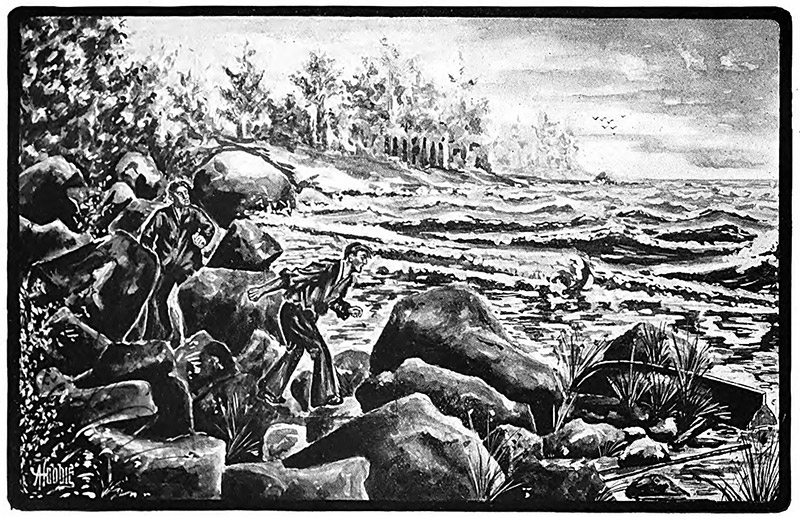
“‘A BOAT!’ CRIED BOB.”
“If only we had the other oar,” put in Barry.
“Don’t expect too much, Barry. Perhaps we can make an oar.”
“Without even a knife? It will be a tough job.”
“There is a bit of driftwood that might be used for an oar on a pinch.”
“Oh, that’s so! Let us turn the boat over and see if it’s sound.”
The craft was righted and examined with care. She seemed to be still water-tight, and the oar was as good as ever. Then Bob ran for the piece of driftwood which had been mentioned. With the rough end smoothed down by rubbing in the sand, it made a fairly good oar.
But though the chums had found something to eat and also the boat, they felt far from light-hearted. Where were they, and where were their friends? And how was this strange adventure to end?
[Pg 166]
“Let us cook some more fish and roast all the oysters we can find, while the fire lasts,” said Barry. “There is but one more cartridge in the pistol and we want to save that.”
So while Barry went back to the beach to pick up all the food possible, Bob returned to the fire and put on more driftwood.
Both were hard at work cooking some fish, when a sudden shout of joy greeted their ears.
The next moment the jungle behind them parted, and Captain Gordon, Gus Stults, and two of the sailors from the Arrow’s crew appeared.
“Hurrah!” shouted Bob.
“How glad I am to see you!” ejaculated Captain Gordon.
“Mine cracious, dis vos like von tream!” burst out the German cook. “And you vos got somedings to eat, too. I vos most starved alretty!”
The party just arrived looked thin and ready to drop.
They had eaten nothing for twenty-four hours, and their clothing was in rags.
They had had two brushes with the Patagonians, and the other sailors had been left behind, dead.
Just before coming down the coast they had run across the body of the dead Spaniard, and from this had procured a knife and a small box of matches.
[Pg 167]
They were about to look for fish to fry when they discovered Bob and Barry.
It was a joyous meeting, and everybody shook hands with everybody else. Bob felt like dancing a jig for joy.
It was decided that the newcomers should first be fed, after which all hands would enter the rowboat and proceed down the coast.
“If the Arrow was wrecked, we ought to find some trace of her below here,” said Captain Gordon.
It was three o’clock in the afternoon when they set off, the sailors taking turns at rowing.
Below them was a long curve of the seashore and it took them fully an hour to pass the point.
Beyond the point was a little land-locked bay, fringed with trees and bushes.
“The Arrow!”
The cry came simultaneously from everybody in the rowboat.
There in the bay lay the Arrow at anchor, only a sleepy-looking Spaniard on her deck.
The steam yacht was considerably battered, and the greater part of her deck-house was gone, and also much of her rigging.
“Safe, after all!” muttered Barry. “How fortunate!”
“If we can only recapture her!” replied Bob.
“We must do it.”
“So we must,” put in Captain Gordon.
[Pg 168]
Keeping out of sight behind the headland, they held a consultation.
It was decided to wait until nightfall, then creep upon the Arrow unawares.
It was already growing dark and they had not long to wait.
They saw a negro come on deck and talk to the Spaniard, and then two other men came up.
The latter were men who had deserted Captain Gordon at the time the Arrow had been captured by Captain Fenlick’s party.
“Four men,” said Captain Gordon. “We ought to be able to overcome them easily.”
Soon the rowboat was on its way toward the steam yacht.
The negro was on deck alone, but presently he, too, went below.
“Now is our chance!” cried Barry, and a few minutes later the rowboat swung alongside of the steam yacht.
Captain Gordon was first over the rail, and he was speedily followed by the others.
Footsteps were heard and the cabin boy, Paul Ferris, appeared.
“Oh!” he cried, thinking he had seen a ghost.
“Hush, Ferris!” ordered Barry. “Tell me, have you cast in your fortunes with the pirates?”
“No! no! I have only done what they made [Pg 169]me do,” was the nervous answer. “They told me if I didn’t mind them they would kill me!” and the boy shivered.
“Then you are willing to help us now?”
“Yes! yes!”
“How many are there on board?”
“Five, not counting myself.”
“All in the cabin?”
“Yes.”
“What are they doing?”
“Drinking and smoking. Captain Fenlick went ashore with two——”
“We know all about that. Are the men in the cabin armed?”
“I believe so.”
“Can you find us a few pistols or guns?”
Paul Ferris’ face brightened.
“I can. There are two pistols in the forecastle and a gun in the cook’s galley.”
“I’ll get them,” put in Bob, and ran off, followed by Paul Ferris.
Inside of ten minutes the boarding party was armed with two pistols, a shotgun and several long knives taken from the cook’s knife-box.
In the mean time the party in the cabin were having a glorious time—to their own way of thinking.
Several bottles of liquor had been consumed and the air was thick from tobacco smoke.
One of the Spaniards was singing a coarse [Pg 170]love song, and the negro was bawling out a plantation ditty.
“Call somebody on deck,” said Barry to Paul Ferris. “Tell them something is wrong.”
The cabin-boy went to the cabin.
“Come on deck, somebody!” he cried, and hurried away.
“Whatta ees dat?” questioned the Spaniard.
“You’re wanted on deck,” said one of the others, for in the absence of Captain Fenlick and Basker, the Spaniard was in command.
Up to the deck went the Spaniard.
He had hardly taken a dozen steps, when Captain Gordon came up behind him and threw him backward.
“Not a sound, if you value your life!” said the captain of the Arrow.
But the Spaniard began to yell, and this brought the others to the deck in a wild rush.
The negro had his pistol handy, and was about to kill Captain Gordon, when Bob shot him in the shoulder.
The Spaniard showed fight and so did Pat Caven, but the other two men hung back, as if ashamed of themselves. Presently both took to the cabin and locked themselves in.
In less than five minutes the fight was over. No one was seriously hurt, and the negro, Pat Caven, and the Spaniard were made close prisoners.
[Pg 171]
Then Captain Gordon, Barry, and Bob hurried to the door of the cabin.
“You had better surrender!” said the captain of the steam yacht. “The others are prisoners.”
“Captain, we want to make terms,” pleaded one of the sailors.
“What terms?”
“Forgive us for taking up with Fenlick, and we’ll serve you straight for the rest of the cruise.”
“Will you swear to that, Robertson?”
“Yes, captain; I’ll swear to it. I was a fool to go in with the pirates.”
The second sailor also promised to obey Captain Gordon if released.
“All right, I’ll give you another chance,” said the captain of the Arrow. “Open the cabin door.”
[Pg 172]
Half an hour later saw our friends in full possession of the steam yacht once more.
From the sailors who had been forgiven it was learned that after Captain Fenlick had gone ashore, the steam yacht had encountered the heavy storm and this had torn away a part of the deck-house and the upper rigging. But otherwise the craft was uninjured.
By a vote, it was decided that the Spaniard, Pat Caven, and the negro should be put ashore, and this was done early the next morning.
“You deserve death,” said Captain Gordon; “but we will give you this one chance for your lives.”
By noon the steam yacht was out of the bay and steaming southward in the direction of the South Shetland Islands and the Land of Desolation.
“Off for the South Pole at last!” cried Bob. “I trust we shall have no more adventures with men of the Fenlick stamp.”
A careful inspection of the ship’s stores showed that nothing had been tampered with, [Pg 173]and for this, Barry and the others were very thankful.
Captain Gordon gave the sailors who had rebelled a good lecture, and both promised faithfully to behave in the future, and it may be added here that they kept their word.
On and on sailed the Arrow, past Cape Horn and a number of small islands lying below the extreme southern point of South America. They were now in the Antarctic Ocean, and the weather grew decidedly colder.
“This ought to suit you, Bob,” remarked Barry, one day, as the two paced the deck.
“It does suit me,” was the answer. “I could stand it even colder.”
“Well, we’ll get it colder before long.”
Day after day went by, and nothing unusual happened. Occasionally they passed a small island, uninhabited and looking thoroughly forlorn.
“No wonder they call this the Land of Desolation,” remarked Bob. “It looks it.”
The course of the steam yacht was straight for Palmer’s Land. Here they came into dense banks of fog and ran close to numerous icebergs, each large enough to crush them. A close watch had to be kept day and night.
The cold was intense, and everybody on board but Bob was willing to put on all the furs he could get. As for Bob, he was just in his element.
[Pg 174]
The days were now growing shorter, and by three o’clock in the afternoon it was dark. The fogs became thicker, and for days they had to lie still for fear of running into rocks or icebergs.
Graham Land was found to contain mountains over a mile high, the tops covered perpetually with snow and ice. They were now in the same latitude South that Iceland is in the North—about 65 degrees.
“Thirty-five degrees more to the South Pole,” mused Bob, one day. “It doesn’t look as if we could reach it, does it?”
“Never despair,” answered Barry, with a faint smile.
“I don’t care so much about the South Pole as I do about my father and that treasure ship,” went on Bob. “If we find them I’ll let the Pole take care of itself.”
Slowly but surely they passed Palmer’s Land and now came to a wide, open sea, where the fogs were not so bad. But icebergs were more numerous, and among the bergs they saw many large whales, of a silvery-white color.
“This would make good fishing grounds for a whaler,” said Barry, “although the icebergs would be dangerous to any vessel built wholly of wood.”
The cold was now intense and for days those on board of the Arrow spent but little time on [Pg 175]deck. They had now passed the last point of land known to scientists and geographers. On their charts the territory beyond was left blank.
It was indeed the Land of Desolation. All around them was the icy sea, with its huge icebergs and its dense fogs, while off to the southeastward lay a rocky shore, covered with ice and snow. On the land there was no sign of vegetation of any kind. Once they saw some South Polar seals and white bears, but never another sign of animal life. Even the snowbirds were missing.
“It’s what I call stony lonely,” said Paul Ferris to Bob. “It makes me shiver to look at it. I’ll never come here again after this trip.”
“Right you are, Paul,” answered Bob. “The silence and gloom are enough to drive one mad.”
The sun shone only a few hours a day, and then it was partly hidden by the fog and mist. Everything about the steam yacht was wet, even the things in the cabin, where the steam heat was turned on night and day. The deck was covered with ice and frost, and out there only Bob could breathe with ease.
One night Barry and Bob were on the point of turning in, when there came a shock that pitched both to the floor. The steam yacht had run into an iceberg in the dense fog. There was a grinding and a crashing, a shiver and a [Pg 176]second shock, and then the vessel came to a dead stop.
As quickly as they could, the chums ran to the deck. Here they found Captain Gordon giving orders to back the yacht. But this was impossible. The Arrow had run into a split of the iceberg and was held as in a vise!
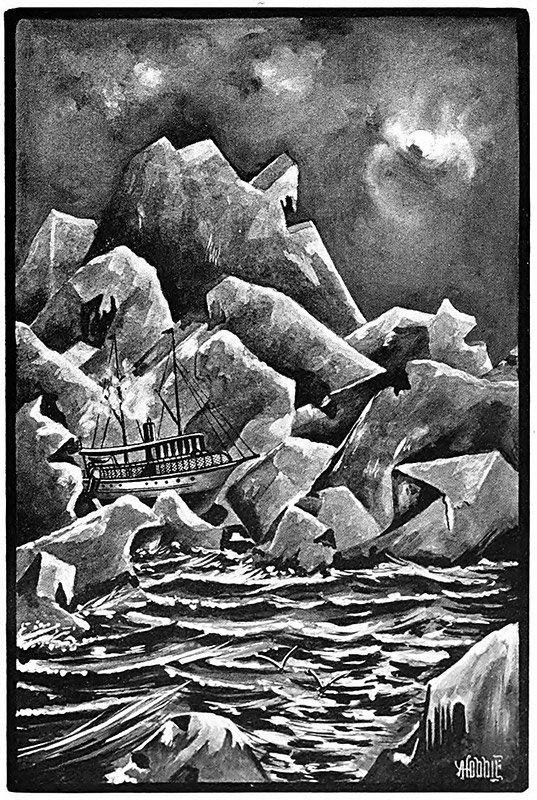
“THE ARROW CAUGHT IN THE SPLIT OF THE ICE-BERG AND WAS HELD AS IN A VISE.”
Nothing could be done in the darkness, and all waited eagerly until daylight. Then an examination was made, and it was found that the Arrow had suffered but little damage.
“But we can’t get away from the berg,” said Captain Gordon, “unless we blow our way out with dynamite.”
“Let us see how the berg is drifting first,” said Barry, and this was done; and to the astonishment of all, it was learned that the mountain of ice was moving almost directly for the South Pole!
“Let us remain as we are,” said Barry. “The berg will act as a guard for us against other bergs.”
Captain Gordon was doubtful, but he agreed, and for over a week they moved along in company with the mountain of ice. It now grew so cold that even Bob felt it and was glad to put on extra clothing. Some of those on board began to speculate upon the outcome of the voyage.
During those days Bob, Barry, and the captain diligently studied all the maps they had.
[Pg 177]
“Nobody has ever gotten very close to the South Pole,” observed Bob. “I see this map gives the most credit to Sir James Clark Ross, who got up to about 78 degrees in February, 1842, Wendell, who got up to 74 degrees in 1823, and Moore, who reached 71 degrees in 1845.”
“The trouble is as you have already learned, lad,” came from Captain Gordon. “The fog is something awful nearly all the time and a fellow can’t find out how he is drifting.”
“But your compass——” began Barry.
“The compass won’t be of much account soon, because of the southern magnetic pole, which lies at about 74 degrees latitude and about 141 degrees longitude east of Greenwich.”
“Then the real pole is not the magnetic pole?”
“Not by about 16 degrees—and it is on the other side of the real pole from where we are.”
“Then how are you going to steer?”
“We’ll do the best we can—nobody could do more,” answered the captain briefly.
The immense iceberg was a constant source of wonder to all on board and especially to Stults, who had never dreamed such a mass could exist.
“It was so high like dem Alps mountains alretty!” he sighed. “Of der top vos proke off [Pg 178]ve peen snowed under like neffer vos, I told you!”
“Let us hope the top doesn’t break off,” laughed Barry. “At least not while we are around.”
On the following morning the position of the ship was slightly shifted, so that a smooth plain of the iceberg came close to the stern of the Arrow.
“I’m going out on there for a walk,” said Bob. “I’ve been aching to stretch my legs.”
“Be careful,” said Captain Gordon. “We may part company with that berg before you know it.”
But Bob was determined to take a run over the ice, and in a minute more he had leaped from the rail to the icy plain, which was almost as smooth as the top of a table.
“It’s fine!” he called back to Barry. “Better come down.”
“I will,” answered his chum, and soon Barry was on the ice. They both set off toward the side of the berg.
The walk lasted the best part of an hour, and when the pair came back they felt much refreshed.
“See anything unusual?” demanded Captain Gordon.
“Nothing much,” answered Barry. “Bob thinks he saw a Polar bear and some seals, but I couldn’t make them out.”
[Pg 179]
“I did see the bear,” declared Bob. “About the seals I am not so sure.”
“The bear meat would come in handy—if there really is a bear.”
“I’m going after him to-morrow—that is, if the Arrow remains attached to the iceberg.”
“Don’t run too much of a risk.”
The following day, however, was one filled with fog, so that nothing could be done. It was as silent as a tomb and the hours on the Arrow proved unusually long to everybody.
But the next morning the sun shone as brightly as ever, and, as soon as breakfast was over, Bob declared himself ready to go and hunt the polar bear.
“I think I’ll go along,” said Barry. “I hate to remain cooped up on board, like a chicken in a market crate.”
Strange to say, Stults asked the young ship-owner if he might not accompany them.
“I vos a goot snow and ice climber alretty,” he declared. “In der old country I vos climb der Alps more as eleventeen times.”
“Then come ahead,” said Barry. “But if you get into trouble don’t blame me.”
And off the three started, never dreaming of the unusual adventures in store for them.
[Pg 180]
Each of the party was of course dressed warmly, and each carried either a shot-gun or a rifle, as well as a hunting knife, some matches, and also a small stock of provisions, slung in a knapsack over his shoulder.
“You won’t remain out late, will you?” called Captain Gordon to them, after they were over the side.
“Not over eight or ten hours at the most,” replied Barry. “If it gets foggy, blow the horn, so that we can locate the Arrow.”
“I will.”
The spot where Bob said he had seen the bear was to the north of the berg, around a bend from the ship. He led the way and the others came close behind.
“Perhaps ve peen lucky and pring down two or dree pears,” observed Stults, as they trudged along.
“We’ll be lucky if we get one, to my way of thinking,” answered Barry, with a laugh. “Polar bears are not so plentiful, especially in this region.”
[Pg 181]
“Any vild animals around here?”
“Polar bears are wild enough—if you get them cornered.”
“Yah, put I vos mean ellerfuns or taggers or like dot.”
“No elephants, Stults. An elephant would have to wear skates to get around here, and a tiger wouldn’t be any better off.”
“Dot’s so? Mine cracious, vot a country ennahow! Noddings put ice, ice, ice all ofer. I peen glad ven we get pack to der United States.”
“Well, I won’t be sorry myself. But we must locate the treasure ship first.”
“And find out what became of my father,” put in Bob. Now that they were so close to the Pole, Bob thought of his lost parent constantly.
On they tramped, around the bend and up a slight hill where the ice was covered with a hard, fine snow resembling salt. On the other side of the rise was another hollow, with tall peaks of ice still farther in the distance.
“The iceberg is a good deal larger than I had imagined,” said Barry. “It must be all of several miles long.”
“Perhaps the Arrow will never get clear of it,” returned Bob. “The berg may prove the steam yacht’s tomb.”
“Ton’t say dot!” cried Stults. “I ton’t vos vont to peen buried alife, not me!”
[Pg 182]
As they were passing around a ridge of ice Bob suddenly ran ahead, and then put up one hand.
“Stop!” he cried, in a low voice.
“What’s up?” asked Barry, in an equally low tone.
“The polar bears!”
“Where?”
“Straight ahead. They are resting on the ice and eating something they are holding in their forepaws.”
“How many vos dere of dem?” questioned Stults, as he brought around his shot-gun.
“Three.”
“Ha! didn’t I vos tole you! Dot is chust von all aroundt. Let us schoot dem kvick!”
“Hold on!” put in Barry, catching the German cook by the arm. “If you are not careful you’ll scare them away and we won’t get even one of them.”
“I vos a goot shot, I told you. I belong by dot Cherman sharpshooters verein,” cried Stults. On a target excursion he had once hit the bull’s-eye by accident, and he now thought he could bring down one of the bears without trouble.
He was soon quieted, however, and then they crept forward with great caution, until they were within a hundred yards of the game.
The three polar bears had been eating some [Pg 183]fish dug out of the ice. But the fish were not large and the repast soon came to an end. Then the bears arose and started to walk off.
“Da vos goin’!” roared the German cook. “Shtop dem!” and rushing forward, he discharged his shot-gun at the game.
His aim was wild, nevertheless some of the scattering shot took one of the bears in the left hind leg. At once the beast set up a terrific roar of mingled pain and alarm.
The noise of the shot, and the roar from their fellow, frightened the other bears, and in a twinkle they were off, over the ice, running with a speed which was surprising when their unusual bulk was considered.
“They are running off!” ejaculated Bob, and then he blazed away at the bear struck by the shot. Barry also fired, and both bullets took effect.
The wounded beast was not fatally struck, but one of the bullets passed through its left foreleg, so that running away became difficult.
It let out a howl louder than before, and now turned savagely toward those who had made the attack.
“Look owit!” shrieked Stults. “He vos coming for us! He vill chew us all up alretty!” And then, dropping his gun, he fled [Pg 184]over the ice for dear life, in the direction from which he had come.
Fortunately the weapon Barry carried was of the repeating pattern. As the bear came closer, he let the beast have another bullet, this time in the breast.
“Hurrah!” shouted Bob. “Give him another,” and he started to reload his own weapon with all possible speed.
Barry did try to give the bear another bullet. But his aim was not so good and the beast was not touched. Then the bear made a tremendous leap, and in a trice it had Barry down on his back and was standing over him.
It was a moment of extreme peril, and Bob’s heart almost stopped beating, for he fully expected to see the bear catch Barry by the throat and crush that part of his friend’s body.
But the beast paused for a second before continuing the attack. It had never seen a human being before, and it probably knew not how to proceed.
That second of time brought Bob to his senses, and aiming full at the bear’s head he fired his rifle.
His aim was true, and the bullet, going into the bear’s ear, entered the beast’s brain, killing it instantly.
The huge weight fell on Barry before the half stunned young man could save himself, and he [Pg 185]was pinned fast to the ice and the little remaining breath almost crushed out of him.
“Barry! Barry! are you safe?” questioned Bob, when he saw that the beast was indeed dead.
“I—I—take the—thing—off!” panted Barry. “It’s—crushing—in—my—ribs!”
“I will,” answered Bob, and threw down his rifle.
But removing such a heavy weight was no small task, and he had to exert all of his strength to lift even a corner of the game.
But at last the bear was turned over, and then Barry gave a sigh of relief. But it was a good five minutes before he felt like getting on his feet.
“What a whopper of a bear!” cried Bob, as he inspected the beast. “He must weigh about a ton!”
“Load the rifles,” said Barry. “Those other bears may take it into their heads to come back.”
“That’s so,” and Bob reloaded both of the weapons with all speed.
“Where is Stults?”
“He ran away as soon as the bear started for us.”
“Perhaps the other bears followed him.”
Barry had scarcely spoken when a yell reached their ears, coming from behind an icy ridge.
[Pg 186]
“Hellup! Hellup, somepody!”
“That’s Stults, and he’s in trouble,” gasped Barry.
“I’ll see what I can do for him,” answered Bob, and ran off, armed with the repeating rifle.
[Pg 187]
Poor Stults had indeed gotten into difficulty, but not with the two remaining bears.
In running off to save himself, he had missed the path back to the ship and floundered headlong into a crack in the iceberg.
The crack was shaped like the letter V and was all of ten feet wide at the top and twenty-five or thirty feet deep.
Poor Stults was now lying at the bottom of the crack, wedged in so tightly that he could scarcely move.
“Hi, Stults! Where are you?” called out Bob, as he drew close to the spot.
“Hellup!” came from the German cook. “Hellup, udder I vos froze to death alretty!”
“Where are you?”
“Py der bottom of der hole town! Vos dot you, Pob?”
“Yes.”
“Den git von rope and pull me owt kvick!”
“Are you in that crack?”
“Yah, dot’s me, and I vos sthuck so fast like neffer vos.”
[Pg 188]
Bob gave a hasty glance around and saw that no bears were within several hundred yards of the spot. Then he threw himself flat and crawled to the edge of the crevasse. Peering over he could just make out the huddled-up form below.
“Are you holding fast?” he asked.
“Holdin’ fast! Mine cracious, I ton’t haf to hold fast. Didn’t I told you I vos sthuck so fast like a fly on der fly-baber? Git a rope and bull me out, dot’s a goot poy, Pob!”
By this time Barry was coming up on a slow walk, bound to do what he could for his friends, should they prove to be in trouble.
“What are you doing there, Bob?”
“Stults is down there—stuck fast in the crack. He wants us to haul him out.”
“Then there are no bears around?”
“I don’t see any.”
Luckily the party had brought with them a rope, to be used in hauling any game they might bring down back to the ship. This was now produced, and one end was lowered into the crevasse.
“Catch hold, down there!” cried Bob.
“Hold of vot?” panted the German cook.
“Hold of the rope. I’ve tied a noose on the end. Put that under your arms and we’ll haul you out.”
But, as said before, Stults had gone into the crack head first.
[Pg 189]
Consequently to get hold of the noose, much less to place it under his arms, was out of the question.
“I can’t git hold!” he cried, after a struggle.
“You must!” called Bob. “It’s the only way we can help you. It will take both of us to haul you up.”
Poor Stults floundered around for several minutes. The sides of the opening were like glass and to get a purchase anywhere was impossible.
At last, however, he called upon them to haul away.
“I can’t do much,” sighed Barry. “That bear took all the strength out of me.”
Yet he took hold and did what he could, and between them they hauled their living burden to the top of the crevasse.
When Bob caught sight of the German cook he let out a roar of laughter.
Stults had been unable to get hold of the rope with his hands and so had done some fishing with his feet.
One foot had caught in the noose, and now he came up feet first with the rope around his left ankle and his body stretched out in spread-eagle fashion.
“Hurrah! he’s saved by a leg!” cried Bob.
“Yah, I vos safed, but I ton’t feel so goot as before I vent dot hole town,” said the cook, ruefully.
[Pg 190]
“You can be thankful you didn’t drop clean out of sight, under this iceberg,” said Bob.
“And that no bones were broken,” added Barry.
Stults wanted to know all about the three polar bears. He was very much ashamed over having run away at the critical moment.
“Put I dinks me ve vos all going to get chewed up alretty!” he explained. “Von of dose pears opened his mouth and I vos seen clear town into his stomach!”
As soon as the excitement was over and Barry and Stults felt like moving, the three walked back to where the dead bear lay. As they proceeded they kept their eyes and ears open for a sight of more game, but not a living thing appeared anywhere around them.
“The shooting has scared them off,” said Barry. “But even one bear is a good haul. It will mean fresh meat for a week or more for all hands.”
“If it doesn’t prove as strong and tough as old bull meat,” answered Bob.
“We can make it tender by freezing it for a few days.”
“Yah, dot is it,” put in Stults. “Dot ist der vay ve do mit all boultry in der Fadderlandt.”
When they arrived at the place where they had left the bear, they found the game undisturbed.
[Pg 191]
“Dot’s goot meat!” cried the cook, after an inspection. “I like me von steak from dot.”
“Yes, a bear steak won’t go bad,” put in Bob. “It will——”
The youth stopped short. A strange grinding noise had reached their ears. Now the iceberg trembled under their feet to such an extent that all three were hurled flat.
“What can this mean?” came from Barry. “Is the berg turning over?”
“If dot is so, ve vill all peen drowned!” wailed Stults. “Oh, vy didn’t I shtay by der ship alretty!”
The strange grinding and rocking lasted for fully two minutes, and then gradually ceased, and the vast plain under them remained as before.
Slowly they arose to their feet, gazing uneasily at each other.
“I must say, I don’t like this,” remarked Barry, gravely.
“Nor do I,” put in Bob. “What a shaking up it was!”
“Who vould like dot?” put in Stults. “To peen drown town like a nine-bin alretty!”
“You don’t understand,” continued the owner of the steam yacht. “The Arrow——” He stopped short and put up his hand. “Hark!”
They listened, and from a distance heard another grinding and a crashing.
[Pg 192]
“This iceberg must have struck some other berg!” cried Bob.
“More than likely.”
“What were you going to say about the Arrow? Do you think she has been wrecked?”
“I trust not. But we had better run back and make sure.”
“And leave dot pear?” asked Stults.
“For the present. We can come back later—if everything is O. K.”
Without further words they set off over the ice in the direction where the Arrow had been left.
It was a hard journey, especially to Barry, who had not yet fully recovered from the contact with the big polar bear.
But at last they gained a point where they could look ahead to the spot where the Arrow had been fast in the ice.
Then a cry of dismay burst from all three at once.
The steam yacht had disappeared!
[Pg 193]
“Gone!”
Bob and Barry uttered the single word simultaneously, while Stults let out nothing more than a groan.
Yes, the Arrow was gone, and look as sharply as they might in every direction not a trace of the steam yacht was to be found.
“This looks bad,” was Barry’s comment, when he could command his feelings sufficiently to speak.
“Bad?” echoed Bob. “Oh, Barry, do you think——”
“I don’t know what to think.”
“But if she went down—with all on board——”
“Oh my! Oh my!” came from the German cook. “Please ton’t vos say dot, Pob! Of she vent town vot vos ve to do, tole me dot?”
“Let us investigate,” said Barry.
They hurried forward, and as they drew closer to the spot where the Arrow had rested in her icy berth they noted that the appearance of the ice-field had changed somewhat. Part of the berg on the farther side was broken away and there were dangerous crevasses running in half a dozen directions.
[Pg 194]
“Something has been going on here sure,” observed the young yacht owner. “Do you know what I think?”
“That the Arrow has gone down?”
“I think the iceberg split apart, just as it split when our ship was caught fast, and then the two parts came together again.”
“And the Arrow——”
“Either backed out or else was smashed flat between the two sides when they came together.”
“I ton’t vos seen no wreck,” put in Stults.
“Nor do I see anything,” said Bob.
“Then let us hope that she escaped destruction.”
“But what are we to do, Barry?”
“I’m sure I don’t know, excepting to stay here and wait for something to turn up.”
“If the iceberg turns up we’ll be goners.”
“Yah, and dot vater vos so cold like neffer vos!” sighed the German cook.
“Well, I don’t see anything different to do. We can stay here awhile and see if anything more happens to this ice field.”
“If we have got to stay on the iceberg for some time we had better secure that game,” said Bob. “It will keep us from starving for a couple of weeks, on a pinch.”
Yet nobody felt like leaving the spot just then, and so they remained there the best part [Pg 195]of two hours looking for some trace of the Arrow.
But the search revealed absolutely nothing, and at last, with hearts as heavy as lead, they journeyed back to where they had left the dead polar bear.
The quaking of the iceberg had left numerous splits in the surface, and they had to proceed with extreme caution less they should fall into some hole, as Stults had done.
They found the bear as they had left it. High overhead circled a few birds, evidently of prey, but soon these disappeared.
The short day was now coming to an end, and knowing they must pass a long night on the ice, they prepared to make themselves as comfortable as possible.
This was not saying much, since they had brought no coverings with them.
With the coming of darkness a raw wind came up, which pierced them to the marrow of their bones.
“We will skin the bear,” said Barry, “and the skin ought to afford us some sort of shelter.”
The skinning was easily accomplished, and then the pelt was propped up on two of the guns to form a tiny wall against the gusts of air.
“Now if we could only build a fire, we might have some cooked meat,” said Barry. “But we can’t build a fire without wood.”
[Pg 196]
“Let us take bits of rope,” suggested Bob. “And we can melt out some of the fat in the bear and then use that.”
“Dot’s der talk!” burst out Stults. “Der fat vos chust der dings for a fire!”
With care they lit several ends of rope and propped them up so that they might burn like so many tarry wicks. Over the flame they held the fattiest portions of the bear they could find. Soon the fat began to drip and this they caught in an iron cup they possessed. Then the fat took fire, giving them a lively blaze.
“Hurrah! Quite a little fire after all!” cried Bob. “I’m glad we haven’t got to stay in the dark.”
“We’ll have to be careful of our stock of food and fat,” said Barry. “There is no telling how long we’ll have to stay on this iceberg.”
“Perhaps ve neffer got off!” sighed Stults, who had now begun to broil a steak. “Of I efer got pack by home again I vos stay dare, you pet me mine life!”
When the steak was done each ate his fill, and the remainder was stored away with care, along with what was left of the tried-out fat. Before putting the fat away Barry dipped a length of rope into it a number of times, thus making a candle of the old-fashioned sort.
It must be confessed that none of them slept soundly that night. The mind of each was [Pg 197]filled with speculations regarding the future. Would the Arrow come back for them, providing she still existed, or were they doomed to death in that Land of Desolation? And each of the party uttered a silent but earnest prayer that they might be saved.
In the morning Bob was the first to rouse up. As he arose, he gave a cry of dismay that quickly brought the others to their feet.
The awful fog of that location had again settled down, blotting out what little there had been of the landscape, or rather, icescape. They could not see a dozen feet in any direction.
“We are doomed!” cried Bob. “In this fog we won’t dare to move around. If we do we’ll surely fall into some opening.”
He spoke the truth and all were more than usually sober as they sat around their tiny fire and ate their breakfast of bear meat and some of the provisions in the knapsacks.
What to do next was the question, but nobody knew how to answer it. They knew they were Crusoes on an immense iceberg which was slowly drifting toward the South Pole. To do anything which would better their condition appeared impossible.
“This berg may go to smash at any moment,” said Barry. “And if it does there is no telling what will become of us.”
The fog was growing thicker and soon it was [Pg 198]so heavy that they breathed only with the greatest of difficulty. Bob did not mind this so much, but to Barry and Stults it was a severe trial.
Slowly the day wore away. The sun failed to appear and hardly a sound broke the awful stillness. Once came a grinding and a crashing from a distance, but that was all.
“Another iceberg gone to pieces,” said Bob, grimly. “Perhaps this will go next.”
That evening all ate but little, for they had had their fill of bear meat. The rude candle was lit and Stults tried out some more fat for future use. Then they went to bed as they had done the night before.
“I’ll tell you what, Barry,” whispered Bob, as they were resting. “We can’t stand this many days, especially with the fog. It’s enough to drive one crazy.”
“We must stand it, Bob. Why, we’ve been here only two days. What will you say after a week or a month has gone by?”
Bob could not answer this question, and so turned over to go to sleep.
The night was nearly gone, when Stults awoke his companions with a mad yelling:
“Hellup! De pears vos on us! Hellup!”
Bob and Barry leaped to their feet. Stults was right, the two bears had returned to the spot, and were now on the point of attacking them!
[Pg 199]
“The guns, quick!”
It was Barry who spoke, and as he did so he leaped for the rifle and banged away at the nearest bear.
Bob grabbed up a shot-gun and blazed away directly after his chum.
The aim of each was true, and the nearest brute stopped short, badly wounded in the head and the breast.
Stults now gathered his wits together, and determined not to run again as he had done before, caught up the third weapon and also fired at the nearest bear.
The three shots were too much for the beast and with a roar he fell back and rolled over and over in his pain.
Seeing this, the second bear stopped in surprise and then turned as if to retreat.
“He mustn’t get away,” said Bob, who was reloading with all possible haste.
Bang! bang! went the repeating rifle in Barry’s hands, and the second bear received two bullets, one in the breast and the other in his stomach.
[Pg 200]
His howling was louder than that of his companion, and the din made by both the beasts was almost deafening.
“We’ve got ’em!” cried Bob, and fired once more, and then Stults followed suit.
The battle had been short and decidedly one-sided from the start. Both bears could not get up, and consequently our friends took their own time about putting the beasts out of their misery.
“We won’t waste any more ammunition—we may need it later,” said Barry. “We will finish them with our hunting knives.” And in the course of half an hour, when every particle of fight had gone out of the dying beasts, this was done.
“Now we’ve got meat enough for two months,” said Bob, as he surveyed the carcasses. “And lots of fat for fires, too.”
“I hope there are no more bears on this berg,” said his chum.
Work on the bears kept them busy the best part of the day, which proved as foggy as that which had gone before. But by nightfall the fog cleared away, and when they slept again the air was drier than it had been for a long while.
“The sun at last!” cried Bob, on the morning of the day following. “How good it seems, after that awful fog!”
“Yes; we don’t know how good sunshine [Pg 201]is until we have to do without it,” answered Barry.
It was fairly blinding, after so much darkness, and all had to put on smoked glasses, which they had brought with them.
As soon as the morning meal was over, they set out on an exploring tour.
They took their guns with them, and also all the meat they could carry, not knowing how soon they would return to the spot.
It was well they took the meat, as later events proved.
The wind had gone down, but half an hour later it sprang up, blowing harder than ever.
From one end of the ice plain they journeyed to the other, and then did what they could toward climbing an icy summit.
This was hard work, but at last they gained a point where they could look around for miles.
On every side were immense icebergs, with the flowing sea and loose ice between.
“Not a sign of the ship,” said Bob, disappointedly. “It’s too bad.”
Stults heaved a mountainous sigh.
“Pad ain’t der vord,” he said. “It vos awful, Pob, chust awful! Of I got to shtay here long I vos go krazy alretty!”
“Let us hope for the best,” put in Barry, trying to cheer them up. But secretly he was as much downcast as his companions.
[Pg 202]
From the icy summit they proceeded to the eastern slope of the iceberg. Here were a series of ridges, where the berg had been broken from time to time.
The sky was now beginning to grow dark again, and presently the snow commenced to fall.
“Here, this won’t do!” cried Barry. “If it’s going to snow we had best get back to where we left the bear meat.”
The others were willing, and the return was begun without delay.
But inside of five minutes it was snowing so furiously that they could not see a rod ahead of them.
Presently Stults came to a halt.
“What’s the matter?” asked Bob.
“I vos lost mine bibe,” said the German cook, for he had been consoling himself with a smoke.
He tried in vain to recover the article. It was lost in the fast falling snow and could not be found.
On they went again. The snow was now thicker than ever, and they had to keep close together for fear of becoming separated.
“This is every bit as bad as the fog!” exclaimed Barry. The rapid walking was beginning to tell on him.
Half an hour went by, and they all stared at each other in perplexity.
“Where are we anyway?” asked Bob.
[Pg 203]
“I must admit I don’t know,” came from Barry.
“The bears ought to be somewhere around here.”
“Perhaps dot snow vos cover dem up?” suggested Stults.
They made a search and then went on. But the bears could not be found. Then they continued their walk.
Presently the German cook let out a cry. He had kicked up something in the snow.
“Mine bibe!”
“Your pipe?” ejaculated Barry.
“Oxactly so.”
“Then we’ve been tramping around in a circle!”
“That’s just what we have done,” came from Bob. “And we are just as far from our former camping place as ever.”
“Well, I’m too tired to go another step.”
“So am I.”
“I vos more as tired,” sighed Stults. “I could sleep der snow on midowit droubles alretty.”
“Then we might as well camp right here,” concluded Barry.
This was an easy thing to do, with no shelter to erect. At first they thought they might build a snow house, but as yet the snow was hardly deep enough. Huddled together, they lay down to sleep, and after awhile all dropped off into [Pg 204]blessed forgetfulness. Thoroughly exhausted, all slept soundly for over eight hours.
When they arose they found the snow nearly a foot and a half deep and still coming down, although not so heavily as before.
“What a scene!” exclaimed Barry, as he shook himself. “Bob, we are lost in the land of ice and no mistake.”
“The land of ice and the land of snow,” was the answer. “And I must say I don’t like it a bit.”
“We must locate those bears,” went on the owner of the Arrow. “If we don’t, we may be left to starve to death.”
Breakfast was soon over and they set off again.
This time they took care that they should not travel in a circle. Nevertheless, they lost the trail half a dozen times, and it was growing dark once more by the time they came in sight of their supply of meat.
A flock of birds had come down out of the snow-laden sky and were pecking vigorously at the bear carcasses.
The birds were immense creatures, with wings spreading out a yard or more. They were of the condor species, but different from those found in the Andes Mountains.
“Wait! I’ll take a shot at them!” cried Bob, and before Barry could stop him he had let drive with his shotgun.
[Pg 205]
The charge took two of the big birds fairly and squarely, and a wild fluttering of wings followed as the creatures tumbled down on top of the dead bears.
“Hurrah! that was a fine shot!” began Bob, and then stopped short.
For the other birds had circled upward only to swoop down again.
“Look out! They are coming for us!” ejaculated Barry, and Stults gave a shriek of terror.
Barry was right; the big birds were indeed coming for them, and in another instant one of them wheeled about and made a swoop directly for Bob’s face.
[Pg 206]
It was a moment of extreme peril, and nobody knew that better than did the three who were thus confronted by the gigantic birds of the South Polar circle.
Barry had heard of these birds before—from an old sea captain who had seen them twice and had a fierce fight with them—but he had not anticipated that they were quite so large and bloodthirsty.
For bloodthirsty they surely were, with their reddish eyes glaring wickedly, and their long, sharp beaks thrust out as if to run them through.
Bang! went Barry’s gun; for to withdraw from the encounter was now out of the question, and another of the birds fell down, to go swooping over the ice on its wings a moment later, uttering wild cries as it tore along.
The wounding of the second bird appeared to terrorize all but one of the number left, and they lost no time in ascending. But the one which was left was the largest of the flock, and now it renewed the attack with increased vigor.
Swish! the bird flew against Bob, hurling the [Pg 207]boy flat and knocking the wind from his body. Then the bird came for Barry, and in his haste to retreat Barry fell over Bob.
A wild yell from Stults followed, and he started to run. But the ice proved too slippery for him, and he pitched flat on his stomach.
This appeared to be just what the monstrous bird wanted, and in a twinkle it settled down upon the German cook and fastened its powerful talons in the man’s clothing. Then followed a rapid flapping of wings, and slowly but surely the bird arose in the air, carrying Stults along!
“My gracious! Look!” burst from Bob’s lips, as he caught sight of the spectacle. “The bird is going to carry Stults off!”
Barry turned over and stared in the direction, hardly willing to believe his eyesight.
“Hellup! hellup!” came faintly from poor Stults. “Der pird vos going to eat me up alretty! Hellup! Let me down der sky owit kvick!”
As soon as he was able, Barry sprang for his rifle and aimed the weapon at the bird. Bang! went the firearm, but the aim was poor, and the beast of the air remained unstruck.
By this time Bob had also partly recovered from the blow received, and he ran for the other rifle. But this was empty. Then he caught up the shotgun.
“Be careful!” came in a warning from Barry. [Pg 208]“You may put as many shot into Stults as in the bird.”
All this time the wings of the big bird were thrashing the air fiercely, for the load was a heavy one. It was not yet a hundred feet from the icy plain and had moved slightly to the northward. Bob ran in the direction, and a second later the shot-gun spoke up.
The youth had been careful to fire high, so that most of the leaden pellets entered the back and neck of the gigantic bird. The wounds were not fatal, but it was plain to see the beast of the air was sorely hurt, and slowly but surely it began to descend, until it was skimming over the ice almost within reach of those below.
There was now nothing to do but to give pursuit, and this Bob and Barry did, reloading their weapons as they ran.
Over the ice went the bird with poor Stults, the latter still crying for aid. Once or twice the German cook tried to reach the bird and do it injury, but each time the beast of the air reached down and gave him a peck that drew blood and made him feel as if he was being stabbed.
Presently the bird flew across an opening in the ice field a dozen or more feet wide. Reaching this opening, Bob and Barry had to halt.
“Blocked!” came laconically from the owner of the Arrow.
[Pg 209]
“The bird is going to settle on yonder summit!” cried Bob, pointing to the hill, which was several rods beyond the crevasse.
He was right, and in a moment more the beast of the air came down on the icy hill and pecking vigorously at Stults’ body.
The sight filled both Bob and Barry with horror, for they could see the German cook doing his best to protect his face, and especially his eyes, from assault. That the big bird meant to kill him there could be no doubt.
Crack! bang! The rifle and the shotgun spoke up as one piece and they saw the feathers fly in all directions. The bird let go its hold upon Stults and came fluttering toward those who had shot at it.
“He’s coming for us!” yelled Bob; but he had scarcely spoken, when the huge beast of the air reached the crevasse, fluttering for a moment on the brink, and then sank with a shrill cry into its depths, to be seen no more.
“He’s gone!” muttered Bob.
“Thank heaven for it,” was Barry’s comment.
Certain that the enemy had disappeared for good, they turned their attention to Stults. The German cook lay on the icy hill motionless.
“Can it be possible that he is dead—that we have killed him?” questioned Bob, in an unsteady voice.
Barry did not answer. He was looking for [Pg 210]some way by which the crevasse might be crossed.
At last a way was found, several hundred feet to the eastward, and they ran around as quickly as their feet could carry them. When they reached Stults, they found him muttering fiercely.
“Dake him off! Hellup! Dake me owit of der sky town kvick! Oh, blease ton’t pick mine eyes owit! Ton’t shoot me!” And thus he raved for a long time, for the carrying off had literally scared him out of his wits.
He was bruised in a dozen places, and two of the shot had entered his left foot. But none of his hurts was serious, and in an hour he quieted down and allowed them to lead him back to where the bears had been left. They approached with caution, but the other birds had disappeared, nor did any of the monsters of the air show themselves again.
“I dink me I vos going up into der clouds alretty,” remarked Stults, when he felt able to speak. “I neffer von’t me dot again, not for dree millions tollars; no, not me!” And he shook his head vigorously.
“I reckon none of us want it,” answered Barry. “One such adventure is enough.”
It was growing colder, and to protect themselves they now set to work to build a snow house. The fog had made the hard snow wet, [Pg 211]so that packing it became easy, and by the time they wanted to retire, the house was ready for them. It was built in true Esquimaux fashion, with a round, sloping roof, and a little doorway close to the bottom.
“There, that isn’t a palace, but it is much better than nothing,” remarked Barry, when the work was finished.
“If it doesn’t get too hot inside,” came from Bob.
“If you get too hot you can come out and cool off,” laughed Barry. “I know Stults and I won’t suffer from heat.”
“Oxactly so,” said the German cook. “Py chiminy! I vos most frozen alretty!”
Once inside the house, or hut, they lit several candles made of rope’s-end and bear fat, and these not only gave them light but also warmth. A steak was broiled over the lights, and to this it is perhaps needless to say all did full justice. Then the door was all but blocked up, a small hole was poked into the roof for ventilation, and they retired to sleep.
[Pg 212]
Two days went by slowly—so slowly that they seemed a week—and nothing out of the ordinary happened.
Nothing came near them in the shape of bird, beast, or man, and their feeling of loneliness increased.
“It’s queer there aren’t any Esquimaux up here,” said Bob on the second day, after a tramp of nearly a mile across the icy plain.
“They probably fear the fogs,” returned Barry. “But I don’t know as you could call them Esquimaux, Bob. They’d more than likely be Indians—down here.”
“Well, anybody would be better than nobody—providing they proved friendly.”
“I agree with you.”
“What do you think has become of the Arrow?”
“I can’t imagine. For all we know she may be at the bottom of the ocean.”
“If he managed to save the ship, surely Captain Gordon would do his best to find us.”
“I don’t doubt that. But saving the Arrow [Pg 213]couldn’t have been easy, when the breaking up of the iceberg began.”
That night, while they were sleeping, came another scare. The icy plain shook violently, sending the snow house tumbling about their heads. There was crash after crash, and a grinding that was sickening to their ears.
“Hellup!” shrieked Stults. “It vos an earthquake! Safe me!”
“I guess this berg has struck another berg,” said Barry. “It was an awful shock. I wish it was daylight.”
They all wished that, but daylight did not come until several hours later, and then with it came the fog once more, shutting out the view as before.
All felt depressed, and Stults cuddled up in a heap beside the ruin of the snow house.
“Vot’s der use?” he sighed. “Ve vos all going to been swallowed up by dem icebergs sooner as later, udder else starved to death so soon as der pear meat vos all gone. I dink me I vos sit town and die right avay now alretty!”
“Come, cheer up, man!” cried Barry. “You mustn’t give way in this fashion. Remember the old saying, ‘while there is life there is hope.’”
“Yah, but ven der pear meat gifes owit, Mr. Filmore, vot den, tole me dot, vill you?”
“But the bear meat isn’t gone yet, and won’t be for some time.”
[Pg 214]
“Vosn’t you sick of dot meat alretty?”
“Certainly, but it’s all we have, and so there is no use in grumbling. Come, let us go do a little exploring.”
“No, I vos sit right here. I got enough of dot exblorin’—mit dumbling dot hole town and being carried der sky up. I vos sit here and die.”
“Gosh, but Stults has got ’em bad!” burst out Bob. He felt depressed himself, but did not wish to show it. “He ought—Hark!”
There was no need for Bob to utter the last word, for every one of the party had heard the sound and leaped to his feet in joy.
“A ship’s gun!” burst from Barry. “It must come from the Arrow!”
“We’ll fire an answering signal,” said Bob, and catching up the shotgun he blazed away into the air.
Half a minute of intense suspense followed and then they heard the gun again, coming from the westward, as near as they could judge.
“The ship! the ship!” cried Bob, dancing with joy. “Come on, both of you!” And away he rushed over the icy plain.
The others were not slow to follow, even Stults being almost as quick to run as Barry. The course was over the plain and around several crevasses, and then up a long slope, where climbing was exceedingly difficult.
[Pg 215]
As they advanced, the gun boomed out once more, and Barry lost no time in answering with a shot from his rifle.
“We are getting closer!” said Bob. “Oh, I do hope it’s the Arrow!”
It seemed as if they would never reach the top of the icy slope. At one point the way was so slippery they had to brace against each other to keep from sliding clear down to the bottom.
“I can’t vos climb dot!” panted Stults. “I vos preak mine neck first!”
Bob was now crawling on hands and knees. He had his hunting knife in his hand, and with this he dug into the ice as he proceeded.
Again the gun boomed forth, and now the sound filled them with dread.
“It is farther off!” groaned Barry. “They are leaving us!”
“No! no! They must not leave us!” panted Bob. “Oh, if only I was at the top!”
On he went, clutching at the ice with his hand, and digging viciously with the keen knife point. He was but a dozen feet from the summit, and presently his head came on a level with the top, and he looked over.
“The ship! the ship!” he screamed in delight. “It is the Arrow!”
A perfect frenzy of joy seized him, and, standing on the icy summit, he yelled with all the [Pg 216]power of his lungs, and then took off his jacket and swung it in the air.
Was the signal seen? He waited with his heart in his throat. The Arrow was headed away from them, moving through a mass of loose ice surrounding the big berg.
“Fire the rifle again!” he called to Barry. “Quick!”
The weapon was discharged twice over, and Bob continued to wave his jacket. Then he saw the Arrow swing slowly around and come toward them.
“She sees us!” he gasped, “Come on!” And so speaking, he let himself slide down the opposite side of the icy summit. The force of the descent carried him to the very edge of the berg and there he stood waiting for those on the Arrow to reach him.
The steam yacht came up to the side of the iceberg with ease, and by this time Barry and Stults were also coming down the icy summit. Poor Stults, unlucky to the end, could not stop his descent, as had Bob and Barry, and went flying into the icy water, to be picked up later by Captain Gordon with a boat-hook.
“Mine cracious, vot a path!” yelled the German cook, as soon as his head came up. “Dake me out, or I vos froze so stiff as a cake of ice alretty kvick!”
Bob was the first on board, and Barry quickly [Pg 217]followed, and both they and Stults were welcomed back as from the grave.
They had to tell their story in detail, not once but several times, and to the narrative all those who had been left on the Arrow listened with keen interest.
“We, too, have had our share of adventures,” said Captain Gordon. “When that first breaking up of the iceberg came the Arrow almost turned over, and we shipped so much water that we had to work lively to keep from going to the bottom. Then we ran into a fog bank and got all twisted around, and, after that, we met a whale that insisted on coming on board, until we trained a gun on him and filled him with grape shot. I reckon the whale was as hungry as those big birds you met.”
Captain Gordon told them that the icebergs and the Arrow were moving steadily for the South Pole. It was decided to bring what remained of the bear meat on board without delay and then continue the journey.
Stults refused to leave the ship again, and kept to his cook’s galley. The meat was brought in by several sailors, accompanied by Bob, and the next day those on board had fresh meat for the first time in many days.
“But I don’t want to go after any more,” said Bob. “At least not if it is going to cost us as much trouble and worry as this meat has.”
[Pg 218]
“No, we’ll stick to the Arrow after this,” answered Barry. “To look back on the days spent on that iceberg makes me shudder.”
They were now within ten degrees of the South Pole, and the ocean itself was covered with an icy slush, the grinding up of thousands of icebergs. The water here was intensely salt, and this saltiness was what kept the ocean from becoming one vast field of ice.
“We are going to get to the South Pole after all,” said Barry. “We haven’t much farther to go.”
Yet progress was slow, for the icy slush interfered greatly with the Arrow’s screw. It was now night nearly all the time.
“It’s lucky we have a good stock of provisions on hand,” remarked Bob. “It looks as if we might have to remain here for a long while.”
“Well, we haven’t enough provisions to last forever,” replied Barry.
Ten days later found them running along a shore of rocks, thickly covered with ice and snow. It was clearer than usual, and for the first time in a week the sun shone brightly, although well down toward the horizon.
“I believe we’ll find it warmer directly at the South Pole than at a distance from that point,” observed Captain Gordon. “It is certainly warmer to-day than it was yesterday, [Pg 219]and yesterday it was warmer than the day before.”
“I have noticed that,” returned Bob. “I hope we do find it warmer.”
The hope seemed likely to be realized, for the next day it was warmer still, so that everybody was glad enough to come to the deck for fresh air. They were now less than two degrees from the South Pole.
“We’ll make it,” said Barry, on the following morning. “We lack less than a dozen miles of the distance now!”
“But what desolation!” murmured Bob. “Nothing but snow, ice, and water—not an animal, a bird, or a tree! It’s awful!”
The Arrow was moving along slowly but steadily, and before noon Captain Gordon, who was studying several scientific instruments, gave a loud hurrah.
“The South Pole! We have reached it at last!”
A ringing cheer followed. They had indeed gained the South Pole. How the civilized world would stare at them upon their return!
“We must go ashore and erect some sort of monument,” said Barry.
This was agreed to, and soon the Arrow was running for the nearest stretch of ice-covered rocks. The shore was still some distance away [Pg 220]when Bob let out what was little less than a scream.
“Look! look! The Black Eagle, the missing treasure ship!” he cried, hoarsely. “And a man is on her deck waving his hand to us. Can it be my father?”
[Pg 221]
The cry that Bob uttered thrilled to the heart all who heard it.
“It is the Black Eagle!” ejaculated Barry. “See, the name is on the bow!”
“The treasure ship!” murmured Captain Gordon.
From the strange craft there now came a cry, faint but distinct.
“Ship ahoy! Ahoy! ahoy!”
“Ahoy there!” answered several voices in return.
“Who are you?” screamed Bob. “Tell me your name!”
“My name is Amos Baxter!” was the answer.
“My father! Found at last!” murmured Bob. His heart was in his throat. He raised his voice as best he could: “Father, do you know me? It is your son, Bob.”
“Bob! My Bob? Impossible!” and the man on the treasure ship crowded forward to the bow of the craft, which was half buried in the ice. “I must be dreaming!” and he pressed his hands to his forehead.
[Pg 222]
“No, you are not dreaming,” answered the boy. “I am Bob Baxter, and we have come to rescue you.”
“My son! my son!” moaned the man, and then of a sudden he fell flat upon the deck, having fainted from joy.
Poor Bob was almost as much affected, and had to be supported by Barry.
“Don’t die from joy, Bob,” said the young owner of the steam yacht, who also felt a bit queer. “Take it easy.”
“I—I must get to my father at once,” said Bob. “Captain Gordon, can’t we lower a small boat and go over?”
“Certainly,” answered the captain.
The Arrow came to a stop and soon the rowboat was over the side and Bob, Barry, and Captain Gordon entered it. The captain and Barry took up the oars and Bob stood in the bow, ready to leap upon the deck of the Black Eagle as soon as a landing could be made upon the rocks and ice.
They saw that the treasure ship was badly battered, and almost ready to fall to pieces. Her masts were gone, and her bow was broken, while there was a gaping hole in her starboard quarter.
Less than a hundred yards separated the steam yacht from the rocky shore, yet as the rowboat approached the rocks those on board [Pg 223]felt a peculiar sensation steal over them and of a sudden the craft became stationary.
“What does this mean!” cried Captain Gordon. “I feel as if I were being stuck with a thousand needles!”
“It must be some magnetic or electric influence due to the nearness of the South Pole,” answered Barry. “Oh, my, I’m shaking like a leaf!”
And he was, and so was Bob. Try their best, they could not row the boat to the shore. It remained in one spot, spinning slowly around and around. In the mean time the piercing sensation became more painful than ever.
“We are caught by some Polar magnetism,” said Barry. “The best thing we can do is to get back to the Arrow and try to reach the Black Eagle by some other means.”
“And leave my father?” asked Bob, faintly. “No! no!” He leaped up. “I believe I can swim to that shore.”
“The water is icy!” said Captain Gordon.
“That won’t hurt me, you know. I have taken many a bath in ice water.”
Bob put his hand into the water. It had scarcely touched the fluid than he gave a gasp and fell back like one dead.
“He has been shocked!” muttered Barry, his face turning pale. “Pray Heaven he is not dead!” and he bent over his chum and felt of his heart, to find it beating faintly.
[Pg 224]
In the mean time, those left on the Arrow had watched the rowboat with keen interest.
“Something is wrong, dot’s certain,” said Stults. “Da can’t do noddings, py chiminy!”
“Arrow ahoy!” shouted Captain Gordon.
“What you vonts?” asked Stults.
“Throw us a line and pull us back to the yacht.”
“Why can’t we steam up to you?” asked the engineer of the yacht.
“No! no! We are caught by some Polar magnetism. Don’t bring the Arrow any closer, or she may not be able to get away again!”
A consultation was held on the steam yacht, and presently a long line was hurled forth.
The end fell over the rowboat’s stern, and Captain Gordon quickly made fast.
“Now sail away to the eastward!” cried the captain.
At once the engine of the steam yacht was put in motion.
Around and around flew the screw, churning up the water into a milky foam.
The yacht moved slowly, as if under a tremendous strain, and the rope became as tight as a whipcord.
Those in the rowboat felt as if they were filled with electricity, and when the small craft did finally leave the spot, it was as if the very hearts of the occupants were being pulled out of them.
[Pg 225]
But at last the rowboat was free and then the Arrow moved onward as if nothing out of the ordinary had ever occurred.
When Captain Gordon and Barry carried Bob upon the deck of the steam yacht, the cold perspiration stood out in great beads upon their foreheads.
“That was an awful experience,” said the captain. “I wouldn’t want to go through it again for ten thousand dollars!”
For a while nothing was done excepting to try to bring poor Bob to his senses.
It took a long time, and when the lad recovered, he appeared to be half dazed still.
“Father! Father!” he murmured, over and over again. “Where are you? Did I not see you?”
“You’re all right, Bob,” said Barry, tenderly. “You were shocked, don’t you remember?”
“I—I think I do.”
“We have returned to the Arrow.”
“But my father?”
“We will get to him as quickly as we can. But we must go by some other route.”
A consultation was now held, and several scientific instruments were used by the captain and Barry.
Both came to the conclusion that the exact centre of the South Pole was at the spot where the rowboat had acted so strangely.
[Pg 226]
“It’s a wonder the magnetism didn’t draw us under the water,” observed Barry.
“The rowboat did go down several inches,” answered the captain. Then he continued: “I have a plan.”
“Well?”
“We had better make a landing farther down the coast and approach the treasure ship from the opposite side.”
“That’s an idea!”
“And let us make the landing at once,” put in Bob, faintly.
Soon the course of the Arrow was altered, and they ran down the shore for nearly half a mile.
Then they approached the shore with caution.
There was some magnetism still to be felt, but it was not strong enough to do the steam yacht any harm.
The Arrow was run into a small, ice-encircled bay, and made fast to the rocky shore.
It was no easy matter to gain the rocks, which were covered with ice as hard as flint and more slippery than glass.
But at last nearly all on board left the vessel, and then a march was begun toward the treasure ship.
Bob was impatient to push on ahead of the others, and Barry had all he could do to keep his chum back.
[Pg 227]
“Remember, the walking may be dangerous,” said the young yacht owner.
“Yes, yes; but I wish to get to my father.”
“We will soon be there. But look out for holes and cracks in this icy cliff. You might drop into some place that had no bottom.”
“I will be careful,” answered Bob, and tried again to go on ahead. Barry came close upon his heels.
Thus half the distance to the treasure ship was covered.
The Black Eagle was now in sight once more, and unable to restrain himself, Bob broke into a dog trot.
He was thinking only of the father from whom he had so long been separated.
Suddenly he tried to stop short, for a black hole yawned before him at his very feet.
But he was going too fast, and though he threw himself backward, the action came too late.
Down he slid, and Barry made a frantic clutch at his arm.
“Help!”
That was the single cry Bob uttered.
Then he went down and down, out of the light into utter darkness, with Barry on top of him.
Both struck into a drift of snow and plunged clear out of sight!
[Pg 228]
“Bob!”
“Barry!”
“Where are you?”
“Here. And you?”
“Here.”
“And where are we both?”
“Down in some kind of a hole.”
“My ears are full of snow.”
“My mouth was full a minute ago. Are you hurt?”
“No.”
“Neither am I. It was a fortunate tumble after all.”
“Fortunate! How are we to get out?”
“I don’t know.”
“Then don’t say we are fortunate.”
For a moment after this there was silence, as both tried their best to get to the top of the snow, which had saved them from having their bones broken.
It was no easy task, and at first they sank deeper than ever.
In the mean time, those at the top of the opening were horrified over the turn of affairs.
[Pg 229]
“They are lost!” cried Captain Gordon. “Oh, but this is terrible!”
“And chust ven ve are py de end of der drip!” groaned Stults.
“We must do something for them.”
“Vot can ve do?”
“Did you bring the rope I mentioned?”
“Yah, captain.”
“I’ll tie it under my arms, and then you can let me down, and I’ll investigate. But don’t let me slip.”
The rope was speedily produced, and adjusted, and then the captain of the Arrow was let down over the edge of the split in the rocks.
He had just gained the top of the drifted snow when he saw a dark object coming to light.
It was Barry’s arm, and bending over he clutched at it and gave a pull.
Up came Barry, and with him, Bob; for the two chums had hold of each other’s hands.
“Good for you!” said Barry, as soon as he could speak.
“Haul us up!” shouted Captain Gordon, and those above did so. It was no easy task, and once it looked as if the rope would break.
But at last they stood again on the ice above, and none the worse for the unexpected adventure.
Looking round, they discovered a spot where the split could be crossed with ease, and here [Pg 230]they went over, and then continued the journey toward the treasure ship.
As before, Bob kept in the front, and he was up the side of the Black Eagle and on the deck fully a minute before the others.
“Father! father!” he cried, and rushed to his parent, who still lay on the deck in a dead faint. The sufferer was icy cold, and the youth did all in his power to restore circulation to his body.
“Let us take him to the cabin,” said Barry, and this was done.
It was plainly evident that Amos Baxter was the sole occupant of the treasure ship, for on the cabin table rested a single plate, cup and saucer, with a knife and fork near by. On a tiny stove some canned meat and vegetables were cooking. A black cat sat on a chair by the fire, purring contentedly.
“Well, he has been comfortable enough,” observed Captain Gordon. “But how lonely!”
The sufferer was rubbed down and given something warm to drink, yet it was nearly half an hour before he opened his eyes. Then he started up.
“Bob! Bob! Is it really you, or am I dreaming?” and the tears streamed down his weather-beaten face.
“You are not dreaming, father,” answered the boy, and folded his parent to his breast.
“Come, let us get out of here,” whispered [Pg 231]Barry to the others, and they considerately withdrew, leaving Bob and his father to themselves.
It was a meeting never to be forgotten. The heart of each was almost too full for utterance.
Amos Baxter’s story was a long one, too long to repeat here in all its details.
He told of his long hunt for the Black Eagle, and of how the ship Comet had been struck by an iceberg, and how he had gone overboard and been lost.
For nearly a month he had wandered around near the South Pole, almost dying from hunger. During that time he had lived upon raw whale’s meat, cut from a whale he had found frozen in the ice.
Then he had run across the Black Eagle, only to find all of her crew dead or missing. All that was alive on board was the black cat.
Weeks and months of lonely life had followed, nearly driving him crazy. Day after day he had looked for a sail, but none had appeared until the Arrow hove in sight.
The strain had told greatly upon him and he was reduced almost to a skeleton.
He had still food left for another month’s rations.
“And when that was gone I would have had to die of hunger,” he said.
“Well, father, you won’t have to suffer any [Pg 232]more,” replied Bob. “We will take good care of you.”
“On board of this ship are millions of dollars in gold,” went on Mr. Baxter. “Many a time I would have given all of that immense fortune to be back home once more.”
“I do not doubt it in the least.”
“And to think that you came to rescue me, Bob! It seems almost too good to be true.”
Then Bob told his parent of the cold-storage plant warehouse fire, and of the fate of Jasper Powell. Of course, Amos Baxter was astonished.
“I never thought that of Powell,” he said. “But he was always peculiar. He must have been crazy.”
An hour later the others came back and were introduced. Then the whole party went into the hold of the Black Eagle and inspected the gold piled up there.
They had never beheld so much of the yellow metal, and all were greatly impressed.
“Enough to make each of us independently rich for the rest of our lives!” declared Bob.
“Yes, indeed,” answered Mr. Baxter. “But I care not for gold. All I want is to get back to the United States and see my friends once more.”
He was glad enough to leave the Black Eagle and return with his son to the Arrow.
[Pg 233]
The elegance of the steam yacht greatly astonished him, and he said he felt as if he had returned to life from the dead.
He told them that he had often experienced the magnetism found at the South Pole.
“Sometimes it extended to the Black Eagle,” he said, “and then it was impossible to lift a piece of iron or anything made of metal.”
“It is queer,” observed Captain Gordon. “Perhaps we will have trouble in removing the gold.”
“Perhaps.”
The removal of the golden treasure to the Arrow was begun the next day.
It was no mean task, for each bar had to be carried half a mile over the icy rocks before being put on the rowboat for removal to the steam yacht.
But at the end of two weeks the task was accomplished.
“And now if you wish to get away this month you must sail at once,” said Amos Baxter.
“Why?” asked Captain Gordon.
“Because we are fixing for a storm. Inside of forty-eight hours the wind will be blowing a gale.”
“Then we will leave without delay!” cried Barry.
That afternoon the Arrow sailed.
She left the vicinity of the South Pole none [Pg 234]too soon, for by morning a gale was blowing which threatened to tear the ship into a thousand pieces.
The mainmast went by the board and the very bowsprit was cut off as by a knife.
Nobody could remain on deck, and they had to run along blindly, trusting to fate to see them safely through the storm.
[Pg 235]
“We will go to the bottom sure!”
So said more than one person on the Arrow the next day.
The storm lasted for thirty-six hours, yet the steam yacht held her own and, though much battered, did not spring even a small leak.
It was the last of the foul weather for many days. To be sure they encountered dense fogs around Graham’s Land and Alexander’s Land, but not so bad as those met with on the journey to the South Pole.
All on board of the gallant ship were in the best of spirits. And they had good cause to be, for Barry and the Baxters had promised to each a fair share of the golden treasure.
At last, after many weeks of fair and foul sailing, the Arrow reached the vicinity of Cape Horn.
It was a perfect day, and the steam yacht stood steadily for Tierra del Fuego.
Barry and Bob could not help but think of Captain Fenlick and Basker, as well as of the negro and the Spaniard who had been put ashore.
[Pg 236]
“They must be dead,” said Bob. “The natives would eat them up at the first chance.”
But Bob was mistaken.
None of the party was dead.
They had come together at one of the native villages, and here Captain Fenlick had met a Patagonian pirate who commanded a vessel which preyed upon ships going around Cape Horn.
The Cape Horn pirates are among the worst in the world.
To this pirate, Zekra by name, Fenlick told his tale, and he enlisted Zekra in a scheme to watch for the possible return of the Arrow with the golden treasure.
The pirate’s ship was named the Skull, and Captain Zekra took Fenlick, Basker, and the others on board with him.
Day after day the pirate watched for the Arrow, and in the mean time captured a small schooner which was in the coast trade.
At last the Arrow came in sight of the Skull.
“What a strange-looking craft!” said Barry, who was viewing the other ship through his glass.
“I’ll wager she is a pirate!” cried Captain Gordon. “I think we had better run away from her.”
But the Skull had up a flag of distress, and Barry was unwilling to leave a stranger if in trouble.
[Pg 237]
But no sooner had the steam yacht come close to the Skull, than the latter opened fire with a four-pounder, sending a ball through the deck-house.
“We’ll fix you for that!” cried Captain Gordon, in a rage, and ordered the yacht’s swivel to be loaded.
“Surrender!” came from the pirates’ ship, and Barry, looking through the glass, recognized Captain Fenlick, Basker, the Spaniard, and the negro.
He quickly told his friends of his discovery, and ordered Captain Gordon to show the Skull no mercy.
Bang! went the swivel gun, and a shot swept the deck of the pirate ship.
Captain Zekra tried his best to put a shot into the Arrow’s hull, but the steam yacht was too swift in her movements for him.
All on the yacht armed themselves, and fired on the pirates at every available opportunity.
Soon Captain Fenlick was laid low, and the negro followed.
Then a shot from the Skull tore through the Arrow’s stern.
But it was her last, for the next shot from the Arrow took the pirate craft fairly and squarely in the side, just below the water line, and slowly but surely she began to sink.
[Pg 238]
Many of the men jumped overboard and tried to swim in one direction or another.
But they could not save themselves, and in the end everybody who had been on the Skull was drowned, and the ship went down with them.
It was a fitting end to such wretches as Captain Fenlick, Basker, and their bloodthirsty companions.
“We are well rid of them,” said Bob, after the fight was over. “I never want any such enemies again.”
“Nor I,” answered Barry. “They were a decidedly bad crowd.”
Day after day passed, and one bright morning the Arrow dropped anchor in the harbor of Rio de Janeiro.
The steam yacht remained here for two weeks, getting on a new supply of provisions and coal and undergoing a thorough overhauling.
Everybody on the craft was cautioned not to say anything about the treasure on board, for fear some plot might be hatched out to steal the millions in gold.
From Rio de Janeiro the Arrow set a course for Santiago de Cuba, and this part of the trip passed without special incident. From this port the course was straight for New York.
Off Cape Hatteras another storm was encountered, and for several hours all on board feared [Pg 239]they and their gold would go to the bottom of the Atlantic.
“Wouldn’t it be awful if we should go down,” said Bob, “now we are so near home?”
“We must take what comes,” answered Barry, gravely.
But Captain Gordon was a thorough seaman and knew what he was doing, and in the end the Arrow came out of the storm with scarcely a scratch.
Then the run was straight to New York, and late one afternoon the Arrow entered the Narrows and dropped anchor some distance from the Statue of Liberty in the bay.
“Home at last!” cried Bob. “And my father is found!”
“And the treasure is ours!” added Barry. “But no more of the South Pole for me.”
“Nor for me,” returned Bob. “I have had adventures enough to last me a lifetime.”
Here I must bring our story to a close. Several years have passed since the events just narrated.
Bob Baxter is now at Yale College, having elected to become a lawyer. Barry Filmore has also taken up the law, and in time the two chums expect to become partners in that profession.
The golden treasure was fairly divided among [Pg 240]those who lived to tell of the wonderful expedition to the South Pole, and, as a consequence, each of the party became very wealthy.
Amos Baxter is now an old man and spends his leisure hours in scientific research. He has written a book upon the South Pole, and another upon Polar Electricity and Magnetism, and these works have made him known far and wide.
As a result of the Arrow’s wonderful voyage to the South Pole, several other expeditions have gone off in the same direction, but so far none of them has been able to get past the fogs and mists and the immense icebergs of the Land of Desolation.
“How we ever got through is a mystery to me,” says old Captain Gordon, now retired. “I can’t understand it at all.”
“I think I can explain it,” said Barry, with a faint smile. “You know how the magnet always points to the Pole?”
“Yes.”
“There is a magnetism between the Pole and the magnet.”
“Undoubtedly.”
“Well, blood is thicker than water, and Bob’s father was at the Pole, or very close to it. Bob was attracted to his father by the personal magnetism of his parent. That’s the only way I can explain it.”
[Pg 241]
At this most of the others laughed. But Bob did not laugh.
“Father,” he said, “Barry must be right. I always had a yearning to find you and I wasn’t satisfied until I reached your side.”
“And I looked for you, my son,” said Mr. Baxter, “I looked for you, day after day, as I stood upon the lonely, forsaken deck of the Black Eagle. I told myself you must come to me, and you did come. Yes, your friend Barry is right, Heaven bless him!”
It may be added, that after Bob returned to New York, and it was learned that he was wealthy, no more was said about the warehouse fire and the charge of incendiarism which had been lodged against him. The whole Jasper Powell matter was speedily cleared up, and that was the end of it.
And here we will ring down the curtain and bid friends and readers alike adieu.
THE END
TRANSCRIBER’S NOTES
Page number error in Table of Contents corrected.
Typographical errors corrected. However, inconsistencies in hyphenation and capitalization (especially after exclamation marks) have been left unchanged.