The Project Gutenberg eBook of Atoms and electrons
This eBook is for the use of anyone anywhere in the United States and
most other parts of the world at no cost and with almost no restrictions
whatsoever. You may copy it, give it away or re-use it under the terms
of the Project Gutenberg License included with this eBook or online
at www.gutenberg.org. If you are not located in the United States,
you will have to check the laws of the country where you are located
before using this eBook.
Title: Atoms and electrons
Author: J. W. N. Sullivan
Release date: January 11, 2026 [eBook #77675]
Language: English
Original publication: New York: George H. Doran Co., 1924
Credits: Thiers Halliwell, Tim Lindell and the Online Distributed Proofreading Team at https://www.pgdp.net (This file was produced from images generously made available by The Internet Archive)
*** START OF THE PROJECT GUTENBERG EBOOK ATOMS AND ELECTRONS ***
Transcriber’s
notes:
The text of this e-book has been preserved as similar
as possible to the original, but to assist readers, links to
relevant pages have been added to the index and the table of contents –
indicated by a black underline and coloured highlighting.
New original cover art included with this e-book is
granted to the public domain.
1
ATOMS AND ELECTRONS
J. W. N. Sullivan
2
DORAN’S MODERN
READERS’ BOOKSHELF
ST. FRANCIS OF ASSISI
Gilbert K. Chesterton
THE STORY OF THE RENAISSANCE
Sidney Dark
VICTORIAN POETRY
John Drinkwater
THE POETRY OF ARCHITECTURE
Frank Rutter
ATOMS AND ELECTRONS
J. W. N. Sullivan
EVERYDAY BIOLOGY
J. Arthur Thomson
Other Volumes in Preparation
3
ATOMS
AND ELECTRONS
BY
J. W. N. SULLIVAN
NEW
YORK
GEORGE H. DORAN COMPANY
4
COPYRIGHT, 1924,
BY GEORGE H. DORAN COMPANY
ATOMS AND ELECTRONS
—B—
PRINTED IN THE UNITED STATES OF AMERICA
5
GENERAL INTRODUCTION
Of all human ambitions an open
mind eagerly expectant of new discoveries
and ready to remold convictions
in the light of added knowledge and
dispelled ignorances and misapprehensions,
is the noblest, the rarest and the
most difficult to achieve.
James Harvey Robinson, in
“The Humanizing of Knowledge.”
It is the purpose of Doran’s Modern Readers’
Bookshelf to bring together in brief,
stimulating form a group of books that will be
fresh appraisals of many things that interest
modern men and women. Much of History,
Literature, Biography and Science is of intense
fascination for readers today and is lost to
them by reason of being surrounded by a forbidding
and meticulous scholarship.
These books are designed to be simple, short,
authoritative, and such as would arouse the
interest of intelligent readers. As nearly as possible
they will be intended, in Professor Robinson’s
6words quoted above, “to remold convictions
in the light of added knowledge.”
This “adding of knowledge” and a widespread
eagerness for it are two of the chief
characteristics of our time. Never before,
probably, has there been so great a desire to
know, or so many exciting discoveries of truth
of one sort or another. Knowledge and the
quest for it has now about it the glamour of an
adventure. To the quickening of this spirit in
our day Doran’s Modern Readers’ Bookshelf
hopes to contribute.
In addition to the volumes announced here
others are in preparation for early publication.
The Editors will welcome suggestions for the
Bookshelf and will be glad to consider any
manuscripts suitable for inclusion.
DIMENSIONS.—All physical magnitudes
are measured in terms of the three
fundamental quantities, Length, Mass, Time.
When we wish to particularise, we denote these
fundamental magnitudes by the letters L, M,
and T respectively. Any magnitude which is
not simply a length or a mass or a time is derived
from them. Thus an area is a length
multiplied by a length. If we wish to express
this fact we say that the Dimensions of an
Area = L × L = L2. Similarly, a velocity is a
length divided by a time. Its dimensions are
L/T. An acceleration is the rate of increase
of a velocity. A stone falling to the earth has
an acceleration, since it is moving faster and
faster. An acceleration is a velocity divided
12by a time, and therefore its dimensions are
L/T2. A momentum is a mass multiplied by a
velocity. Its dimensions are therefore ML/T.
These examples suffice to illustrate the general
idea.
Metric System.—Throughout all civilised
countries scientific men use the metric system of
units. The fundamental units are: for length,
1 centimetre; for mass, 1 gramme; for time, 1
second. This is called the centimetre-gramme-second
system or, as it is usually written, the
C.G.S. system. For those not used to measuring
quantities in centimetres and grammes, it
may be useful to see how they compare with
English units. A centimetre is about 0·39 of
an inch; a gramme is about 0·035 of an ounce.
The unit of velocity, on this system, is one centimetre
per second. The unit of momentum
would be one gramme moving with a velocity
of one centimetre per second. A very useful
notion in science is the notion of force. This
term has a perfectly precise meaning. The
force acting on a mass is measured by the velocity
imparted to that mass in the unit of time.
On the C.G.S. system, unit force is that force
13which gives to a mass of 1 gramme a velocity
of 1 centimetre per second in a second. This
unit of force is called a dyne.
In the metric system, a very convenient system
of prefixes is used which play the part of
multipliers or dividers. Thus the prefix “mega”
in front of some unit, such as a dyne
or a gramme, means a million dynes or
grammes. The prefix “milli,” on the other
hand, divides the unit by a thousand. Thus a
milligramme is a thousandth of a gramme.
We append a table of these prefixes.
mega is
equivalent
to
multiplying
the
unit
by
1,000,000
myria
"
"
"
"
"
"
10,000
kilo
"
"
"
"
"
"
1,000
hecto
"
"
"
"
"
"
100
deka
"
"
"
"
"
"
10
deci
"
"
dividing
"
"
"
10
centi
"
"
"
"
"
"
100
milli
"
"
"
"
"
"
1,000
micro
"
"
"
"
"
"
1,000,000
A centimetre, therefore, as its name denotes,
is the hundredth part of a metre. A kilogramme
is a thousand grammes. And so on.
Electrostatic and Electromagnetic Units.—The
reader of this book will notice that quantities
of electricity are sometimes expressed in
14what are called electrostatic units and sometimes
in electromagnetic units. Both systems
of units are constantly employed in physics,
and they exist because there are two radically
different ways of measuring electric magnitudes.
The reader probably knows that there
are two kinds of electricity, positive and negative.
Two electric charges of the same kind
repel one another; if of unlike minds, they attract
one another. It is on this property of attraction
or repulsion that the electrostatic
system is based. The electrostatic definition of
a unit quantity of electricity is as follows: The
unit quantity of electricity is that which, when
concentrated at a point at unit distance in air
from an equal and similar quantity, is repelled
with unit force. On the C.G.S. system the
unit distance is one centimetre and the unit
force one dyne. The unit magnetic charge, or
magnetic pole, as it is called, is defined in a
similar way.
The electromagnetic system, on the other
hand, starts with the dynamic, not the static,
properties of electricity. A wire conveying an
15electric current produces a magnetic field. The
lines of magnetic force exist as circles round the
wire. If we imagine the wire itself to form a
circle, we see that there will be a certain magnetic
force at the centre of this circle. This
leads us to the electromagnetic definition of
the unit quantity of electricity. We proceed
in two steps. We first define the unit current
as such that, if it is flowing in a circular arc 1
centimetre in length where the circular arc
forms part of a circle having a radius of 1
centimetre, then it will exert a force of 1 dyne
on a unit magnet pole placed at the centre of
the circle. This defines the unit current. We
get to the unit quantity of electricity by saying
that it is the quantity conveyed by the unit
current in 1 second. The electromagnetic unit
of quantity is enormously greater than the electrostatic
unit. It is thirty thousand million
times bigger. The ratio of the electromagnetic
to the electrostatic unit is, in fact, equal to the
velocity of light. This is no mere meaningless
coincidence. Maxwell showed that this
ratio gave the velocity of propagation of electromagnetic
16waves, and this velocity is precisely
the velocity of light. This was one of the chief
points confirming the theory that light itself
is an electromagnetic phenomenon.
Large and Small Numbers.—Physicists
often have to express very large and very small
quantities, and to that end they have adopted
a useful and simple convention. A large number
like ten million is not written 10,000,000
but as 107. The figure 7 shows how many 0’s
are to be written after the 1. If the number
had been thirty million it would have been
written 3 × 10⁷. Thus 100 = 102; 1,000 =
103; 10,000 = 104; and so on. Such numbers
as 1024 or 3·5 × 1024 would be tedious to write
out, and they are of frequent occurrence.
Similarly, very small numbers are expressed
much more conveniently in this way. But the
minus sign is prefixed to the figure above the
10. Thus one millionth is 10-6. One million
millionth is 10-12. Seven one hundred-thousandths
is 7 × 10⁻⁵. Thus 1⁄10 = 10-1; 1⁄100 =
10-2; 1⁄1000 = 10-3; 1⁄10000 = 10-4; and so on.
So that when we say that the weight of a
17hydrogen atom is 1·65 × 10-24 gramme, the
quantity we express in this way is
1·65/1,000,000,000,000,000,000,000,000
of a gramme. Similarly, when we say that the
velocity of light is 3 × 10¹⁰ centimetres per
second, the number we are expressing is 30,000,000,000
centimetres per second.
Chapter II: Atoms and Molecules
21
Chapter II
Atoms and Molecules
§ 1. The Atom
THE theory that any piece of matter may
be divided up into small particles which
are themselves indivisible was a speculation
familiar to the ancient Greeks. It is a theory
which, unless it be enunciated with some care,
has been found by some people to be ambiguous.
For the indivisibility attributed to the
ultimate particle or atom may have reference
either to practical or to mental operations.
There are philosophers who have worried themselves
as to how it is possible to conceive any
particle of matter, however small, as ultimately
indivisible. For, they argue, if the
small particle exists at all it must occupy space
and have a shape. Something still smaller,
therefore, something occupying only half the
space, could be imagined: the atom could be
pictured as divided into halves or quarters and
22so on. And yet, although it seems impossible
for thought to stop at any point in the process
of dividing up a piece of matter, it is also
very difficult, as can be shown by ingenious
arguments, for thought to go on with the process
indefinitely. And so an interesting impasse
is arrived at.
Now it must be clearly understood from the
beginning that this is not the sort of indivisibility
with which science is concerned. The
scientific use of the term has reference purely
to practical scientific methods. The indivisibility
ascribed to the atom was merely an enunciation
of the fact that smaller particles than
atoms were not found to occur in any of the
processes known to science. Nothing whatever
was asserted about any supposed “inherent indivisibility”
of the atom. An atom of a substance
was merely the smallest part of that
substance which took part in any known chemical
processes. The whole conception of the
atom was first made really definite and fruitful
by John Dalton in 1803. He asserted that
every irreducible substance, or “element,” was
composed of atoms indivisible in the sense described
23above. All the atoms of every given
element were precisely similar, and, in particular,
had the same weight. The atoms of different
elements were different and, in particular,
had different weights. But besides the
chemical elements, that is, substances which
cannot be dissociated into other substances,
there are chemical compounds. The atoms of
the elements constituting a compound unite
with one another in a perfectly definite way,
and Dalton gave the laws according to which
these combinations are effected.
The Atomic Theory of Dalton was a tremendous
success. The whole of chemistry
since his time has been based on it. To describe
even a small part of the consequences
of the atomic theory would be beyond our
scope, but we must here call attention to one
very important classification to which the
atomic theory led. By very careful measurements,
undertaken by many men and extending
over many years, the weights of the atoms
of all the different primary substances, or elements,
known to science have been determined.
The weights, as usually given, are, of course,
24relative weights. If we denote the weight of
an atom of oxygen by 16, then helium, for
example, will have the atomic weight 4, copper
will be 63·57, and hydrogen will be a little
greater than unity, viz., 1·008. The heaviest
element known, uranium, has an atomic
weight of 238·2.
Now when all the elements known are arranged
in order of increasing atomic weight the
highly interesting fact emerges that their properties
are not just chaotically independent of
one another. They fall into similar groups, recurring
at definite intervals. These relations,
although they are not of mathematical definition,
are quite unmistakable, and show that
there is a connection between chemical properties
and atomic weights. Such a connection is
quite inexplicable if each atom is regarded as
a perfectly simple and irreducible structure
having no essential relations to the atoms of
any other elements. If the atom be regarded
as something possessing a structure, then the
similarities between different elements may be
attributed to similarities in their atomic structures,
the heavier atoms being, as it were, more
25complicated versions of the same ground plan.
We shall see that there is much truth in this
view.
Even as early as 1815 the idea had been put
forward by Prout that all the chemical elements
were really combinations of one primordial
substance. Prout supposed this primordial
substance to be hydrogen. On comparing
different atomic weights he was led to
the conclusion that they were all whole multiples
of the atomic weight of hydrogen, so that if
the weight of hydrogen be represented by 1,
then all the other atomic weights would be
whole numbers. Every atom, in this case,
could be considered as built up from a definite
number of hydrogen atoms. The determinations
of atomic weights in Prout’s day were
not sufficiently accurate to warrant this conclusion,
and when more accurate measurements
showed that a large number of atomic weights
are not whole multiples of hydrogen, Prout’s
hypothesis was abandoned. But recent work,
as we shall see, has shown that Prout’s hypothesis
is much closer to reality than had been
supposed.
26
§ 2. Elements and Compounds
The theory that all matter is built up out of
atoms was invented, as a scientific theory, to
explain certain phenomena which belong to the
science of Chemistry. The universe of the
chemist is, at first sight, a very bewildering
universe. He is concerned to find out what he
can about the properties of all the substances
that exist. Now there are hundreds of thousands
of such substances. Gold, lead, iron,
table salt, air, water, gum, leather, etc., etc., is
the mere beginning of a list that it would take
months simply to write down. The chemist is
concerned with every one of these substances.
And if he found that all these substances were
quite independent of one another, that there
were no relations between them, then he would
probably give up his task in disgust. For, in
that case, he could do nothing but draw up a
gigantic catalogue which would, at most, be of
some practical use, but which would possess no
scientific interest. But even before the rise of
a true science of chemistry, men had become
aware that all the different substances on earth
27are not wholly unrelated to one another. The
old alchemists, chiefly by mixing different substances
together and then heating them, found
that they could change some substances into
others. Some of their results were perfectly
genuine; they did affect some of the transformations
they claimed to have effected. In
other cases, they were either mistaken or else
imposing on the credulity of their disciples.
Many of them claimed, for instance, that certain
“base” metals, on being mixed with other
substances and then heated, could be turned
into gold. We know that this is impossible.
But one main idea emerged from their work.
They learned to distinguish between the simple
substance and the compound substance. It
is true that this idea emerged in a very curious
form; they did not think so much of simple
substances as of primary principles, such as
maleness and femaleness, which were somehow
incorporated in different substances in different
degrees. But the idea of the simple and compound
substance, although in a vastly different
form, is the basis of the science of chemistry.
Out of all the substances known to exist,
28the chemist distinguishes a certain number as
being “elements.” An element is a substance
which cannot be decomposed into anything else.
It happens that there are remarkably few of
them. Nearly every one of the hundreds of
thousands of substances known can be decomposed
into other substances. When this decomposition
is carried as far as it will go, we
find that the substance in question is really
built up out of a certain number of the substances
called elements. There are about
ninety of these elementary substances. In the
little list of substances we have just given,
for instance, gold, lead, and iron are elements.
Table salt is a compound of two elements
called sodium and chlorine. Air is a mixture
of various elements of which nitrogen and oxygen
are the chief. Water is a compound of
two elements, hydrogen and oxygen. Gum and
leather are more complicated compounds.
Now it is interesting enough to know that
all substances are either elements or can be decomposed
into two or more elements. But the
most interesting aspect of this fact, and what
makes it of great scientific importance, is that
29when elements combine to form a substance
they always do so in exactly the same proportions.
When hydrogen combines with oxygen
to form water, for instance, exactly the same
proportions of hydrogen and oxygen are concerned.
We will illustrate this very important
law by considering the decomposition of that
well-known substance sal ammoniac. It is a
pure solid substance. If it be heated it turns
into a mixture of two gases. These two gases
can be separated from one another and are
found to be ammonia gas and hydrochloric acid
gas. Now the ammonia gas can in its turn be
decomposed into a mixture of the two gases,
nitrogen and hydrogen, and these two gases
can be separated from one another. The hydrochloric
acid gas can also be decomposed. It
can be decomposed into chlorine and hydrogen.
We have now decomposed our sal ammoniac
into three substances, nitrogen, hydrogen
and chlorine. Each of these three substances
is an element; no one of them can be
decomposed into anything else. And we can
find in what proportions they combine to make
sal ammoniac. If we began our experiment
30with 100 grammes of sal ammoniac we should
have at the end 26·16 grammes of nitrogen,
7·50 grammes of hydrogen, and 66·34 grammes
of chlorine, the combined weight of these substances
making up exactly 100 grammes. And
in whatever way we perform the decomposition
of sal ammoniac we always get these three
substances and always in exactly the same proportions.
By starting with nitrogen, hydrogen,
and chlorine in the above proportions we
can, of course, make sal ammoniac. And there
is no way of making sal ammoniac except with
just those proportions. No specimen of sal
ammoniac ever has slightly more chlorine or
nitrogen or slightly less hydrogen, for example,
than any other specimen. The same remarks
apply to every other compound. The
general law may be enunciated thus: the same
compound is always formed of the same elements
in exactly the same proportions.
In the above example we obtained, in our
preliminary dissociation of sal ammoniac, two
substances each of which contained hydrogen.
We obtained ammonia gas, which is made up
of nitrogen and hydrogen, and we obtained
31hydrochloric acid gas, which is made up of
chlorine and hydrogen. We might ask the question
whether there is any simple relation between
the amount of nitrogen which combines
with, say, one gramme of hydrogen, and the
amount of chlorine which combines with one
gramme of hydrogen. But before dealing with
this question we will deal with another which
has some bearing on it. Can two elements
combine in different proportions to form different
substances, and, if so, what is the relation
between the proportions? The answer
is that two substances can combine in different
proportions to form different substances, but
that, when this occurs, the proportions are
simple multiples of one another. Thus, 3
grammes of carbon can unite with 8 grammes
of oxygen to produce a substance called carbon
dioxide. But 3 grammes of carbon can unite
with 4 grammes of oxygen to produce a different
substance called carbon monoxide. It will
be noticed that the amount of oxygen in the
first case is just twice that in the second. This
example is typical. Whenever there is more
than one compound of two elements the ratio
32by weight of the elements in the two compounds
is always a simple number. This fact
is very suggestive, as we shall see.
We can now deal with our first question, and
we can make it more general. Consider, for
instance, hydrogen, oxygen, and carbon. We
can take 2 grammes of hydrogen and combine
them with 16 grammes of oxygen. The result
is water. Again, if we take 16 grammes of oxygen
and combine them with 12 grammes of
carbon we shall obtain carbon monoxide. Here
the 16 grammes of oxygen is the common factor.
The appetite of this amount of oxygen
for combination can be satisfied, apparently,
either with 2 grammes of hydrogen or 12
grammes of carbon. And the interesting fact
is that we can combine hydrogen and carbon
in precisely this proportion. Two grammes of
hydrogen combine with 12 grammes of carbon
to form a substance called olefiant gas.
Now these are the facts that the atomic
theory so beautifully explains. Let us see how
it is done. Dalton’s atomic theory is to the
effect that every element is built up of small
equal particles. These particles are indivisible
33in the sense that less than one of them cannot
take part in any chemical reaction. They
are called atoms. The smallest part of a compound
substance is called a molecule. It is
built up out of atoms of the elements which
unite to form that compound, and it is the
smallest part of the compound which can exist
as that definite substance. If a molecule were
split up we should simply get the constituent
elements again; the compound substance itself
would have ceased to exist. Consider, for instance,
a molecule of carbon monoxide. We
know that this molecule is formed from one
atom of carbon and one atom of oxygen. We
write it CO. The carbon dioxide molecule, on
the other hand, is formed from one atom of
carbon and two atoms of oxygen. We write it
CO2. A carbon dioxide molecule contains exactly
twice as much oxygen as does a carbon
monoxide molecule. It cannot possibly contain
11⁄2 times as much or 13⁄4 times as much, since
the amount of oxygen present in a molecule
must vary by at least one atom. Thus we see
how it is that the proportions are whole multiples.
34
The atomic theory gave so clear and simple
an account of the laws of combination that
there could be little doubt of its truth. The
ordinary chemical methods, however, did not
enable one to decide unambiguously what were
the exact relative weights of the atoms of the
different elements. This question is obviously
of great importance, but the law discovered by
Avogadro, called Avogadro’s hypothesis, enabled
the matter to be cleared up. This hypothesis
asserts that equal volumes of different
gases, under the same conditions of temperature
and pressure, contain equal numbers of
molecules. We may mention here that many
elements normally exist in a molecular form,
that is, their atoms unite together in twos or
threes to form molecules.
§ 3. Relative Weights of Atoms
We will now give the reasoning by which,
from Avogadro’s hypothesis, the relative
weights of atoms may be deduced. Suppose we
have a number of precisely similar vessels, each
having the same volume V, and each filled with
35a gas at the same temperature and pressure.
Then, according to Avogadro’s hypothesis, they
each contain the same number of molecules.
Suppose we take two of these vessels, one containing
hydrogen and the other oxygen, and
compare the weights of the two quantities of
gas. Since they have the same number of
molecules, the relative weights of the two quantities
of gas is the same as the relative weights
of their molecules. But is this sufficient to determine
the relative atomic weights of hydrogen
and oxygen? Obviously not, for the molecule
of hydrogen, for all we know, may contain two
or more atoms, and so may the molecule of
oxygen. This method will not give us the desired
result.
But we have said that the atom is the smallest
part of an element that takes part in any
chemical combination. What we really mean
by that is that the smallest part of an element
which takes part in any known chemical reaction
is called an atom. Suppose, therefore, we
consider all the compounds into which hydrogen
enters. Amongst these compounds there
will be one whose molecules contain a minimum
36amount of hydrogen. The molecules of
this compound contain, therefore, one atom of
hydrogen. The volume V of this compound,
in the gaseous state, and at a certain pressure
and temperature, contains a mass of hydrogen
which can be measured. Call this mass H.
Now, of all the oxygen compounds, select that
compound which contains the minimum weight
of oxygen. The molecules of this compound
contain one atom of oxygen. The volume V
of this compound, in the gaseous state, and at
the same pressure and temperature as the hydrogen
compound, has a known weight of oxygen.
Call this mass O. Both the oxygen and
the hydrogen compounds have the same number
of molecules, by Avogadro’s hypothesis.
Corresponding to each molecule of the hydrogen
compound is one atom of hydrogen, and
corresponding to each molecule of the oxygen
compound is one atom of oxygen. We have,
therefore, the same number of atoms of hydrogen
in the one vessel that we have of oxygen
in the other. The ratio of the weights of the
hydrogen and the oxygen—that is, the ratio of
37H and O—is therefore the ratio of their atomic
weights. By a similar process we find the relative
atomic weights of other elements, carbon,
chlorine, etc. For the purpose of comparing
these relative weights, oxygen is taken as the
standard, simply because oxygen occurs so frequently
in chemical combinations. It is nearly
16 times heavier than hydrogen, the lightest
atom. Its weight is therefore taken as exactly
16. Compared with this hydrogen is 1·008.
On this standard carbon’s atomic weight is 12,
and chlorine 35·456.
It is evident, from Avogadro’s hypothesis,
that 1·008 grammes of hydrogen contain as
many atoms as 16 grammes of oxygen or 12
grammes of carbon or 35·456 grammes of
chlorine, and so on. The number of grammes
of an element which is equal to its relative
atomic weight is called a gramme-atom of the
element. All gramme-atoms contain the same
number of atoms. This number is known. It
is 660,000 times a million billion. This is the
number of atoms in 1 gramme of hydrogen, 12
grammes of carbon, 16 grammes of oxygen,
38etc. The actual weight of an atom, therefore,
is to be obtained by dividing its gramme-atom
by this number.
§ 4. Some Experimental Evidence
The figure we have just given for the weight
of an atom is evidently exceedingly minute.
Such small quantities are, of course, altogether
below the limits of observation. Nevertheless,
there is a series of experiments which enables
us to see that the ultimate particles of matter
must be extremely minute. Gold-leaf, for instance,
can be prepared of a thickness of one
ten-thousandth of a millimetre. In this state,
gold-leaf is transparent and transmits a greenish
light. It cannot be beaten out more thinly
merely because of the difficulty of manipulating
such thin sheets without tearing them.
It is certain, therefore, that the diameter of a
gold atom is less than the thickness of one of
these sheets, that is, is less than 10-5 cm. The
weight of a cube of gold, having this length
for the length of its side, would be 10-14
gramme. The hydrogen atom is about 200
39times lighter than the gold atom. On this
showing, therefore, the mass of a hydrogen
atom is certainly less than 1⁄2 × 10-16 gramme.
The study of thin films takes us very much
further. The black spots so familiar to us on
soap bubbles are the thinnest part of the soapy
film. The blacker they are the thinner they
are. The thickness of these extremely thin
films can be measured, and is found to be about
4·5 × 10-7 cm. The films produced by letting
oil drops spread on water are even thinner.
Films no thicker than 1·1 × 10-7 cm. have been
obtained. The maximum possible diameter
for an oil molecule, therefore, would be about
1 × 10⁻⁷ cm. A hydrogen atom would weigh
nearly a thousand times less than one of these
oil molecules, and we can calculate, on this
basis, that the mass of a hydrogen atom would
be of the order of 10-24 gramme. The actual
mass of a hydrogen atom, as can be shown by
other calculations, is 1·65 × 10-24 gramme.
By actual experiment, therefore, we can obtain
films so thin that they are not much more than
one molecule in thickness.
40
§ 5. Molecular Movements
If two liquids are taken and one is placed
on top of the other, we know that they will
begin to mix. In some cases the mixing process
may take a long time and may seem to be
incomplete, as when water and ether are superposed,
for example. But even in this case we
would find, after a time, that every part of the
layer of ether contained some water, and that in
every part of the water there was some ether.
With most pairs of liquids the diffusion is more
rapid and obvious. Even solids diffuse very
slightly. With pairs of metals which have
been kept in contact for years, it is found that
the bottom layer of one and the top layer of
the other have become, to some extent, intermingled.
In the case of gases, diffusion is rapid
and complete. Berthollet took a globe containing
carbon dioxide, a heavy gas, and put it in
communication by means of a stop-cock with
another globe containing hydrogen, the lightest
of gases. The globe of hydrogen was above the
globe of carbon dioxide, and in each globe the
gas was at the same pressure. When the stopcock
41was opened it was found that, after a little
time, each globe contained as much carbon
dioxide as hydrogen. With any pair of gases
the result is the same.
This range of phenomena obviously points
to the existence of molecular motions. We
must imagine that each tiny particle of a liquid
or a gas is in incessant movement. Even in
the case of solids, there is some movement of
the molecules, although here the movement is
much more restricted. In a gas, in particular,
the molecules must be moving about in all directions,
perpetually colliding and changing
their directions. A rise in temperature increases
the velocity of these movements. All phenomena
of diffusion take place at a greater
rate the higher the temperature. What affects
our senses as heat is, in fact, the energy due to
these molecular movements. The hotter the
body the greater the energy of motion of its
molecules. Thus there is no such thing as a
greatest possible temperature. The temperature
of the outer layers of the sun is some thousands
of degrees; the temperature of the innermost
parts may be some millions of degrees.
42But there is an absolute zero of temperature; no
body can be colder than the absolute zero. As
the temperature of a body decreases its molecular
movements become feebler and feebler
until, at a sufficiently low temperature, they
cease altogether. This lowest possible temperature
is the same for all bodies. It is −273°C.
The hypothesis that a gas consists of a large
number of molecules moving about in all directions
with all velocities is called the Kinetic
Theory of Gases, and its mathematical development
enabled us to account for the known
laws of gases and to predict other phenomena
which have since been observed. At first sight
the problem appears to be a very complicated
one. We have to assume that the molecules
are moving at random; some are moving
slowly, some fast, some very fast, and so on.
They are moving in all directions; they are perpetually
colliding. Their motions are completely
chaotic. But this very fact, which
seems to make the problem insoluble, was
shown by James Clerk Maxwell to lead to its
solution. If we imagine our gas to be enclosed
in a box, for instance, then we may suppose
43that some of the molecules, at a given instant,
are moving towards one of the sides of the box
with a certain velocity—say 100 yards per second.
But besides having this motion, these
molecules will also, in general, be moving towards
a side at right angles to the first one and
also, it may be, towards the floor or ceiling of
the box. What do we know about these other
motions from the fact that these molecules are
moving towards one side at 100 yards per second?
According to Maxwell, we know nothing
whatever about these other motions. They
might be anything. And from this mere fact
he was able to deduce how different velocities
are distributed amongst the molecules of the
gas by applying the theory of probabilities.
The pressure exerted by a gas is due to the incessant
bombardment of its containing vessel
by its molecules. At a given temperature there
is a simple connection between the pressure and
the volume of the same mass of gas. If the volume
is halved the pressure is doubled; similarly,
if the volume is doubled the pressure is
halved. The general relation is that, at constant
temperature, the volume multiplied by
44the pressure is constant. In virtue of their motion,
the molecules possess energy, and Maxwell
showed that, for a given mass of gas, the
product of the pressure and volume of that
mass of gas is equal to two-thirds of the energy
of translation of its molecules. At the same
temperature, therefore, it does not matter
whether the same mass of gas occupies a large
volume or a small one; the energy due to its
molecular motions is the same. This energy is
considerable. If the molecular energy of 2
grammes of hydrogen could be utilised it would
be sufficient to raise a weight of 350 kilogrammes
through 1 metre. The speed of these
flying molecules is very considerable. At the
temperature of melting ice the average velocity
of oxygen molecules is about 425 metres per
second, which is nearly that of a rifle bullet.
At the same temperature, the hydrogen molecule
is moving four times as fast, namely, 1700
metres per second. These velocities are the
average velocities. Some molecules are moving
more slowly, and some faster. The molecules
are constantly colliding. The average distance
between successive collisions is called the mean
45free path, and can be calculated. For air at
normal temperature and pressure, the mean free
path is about one ten-thousandth part of a millimetre.
Collisions occur, therefore, about 5,000
million times a second.
§ 6. The Brownian Movement
We now come to a remarkable discovery
which gives us actual visible evidence of the
reality of these molecular movements. An
English botanist named Brown, using the improved
microscope objectives which had just
been introduced, noticed, in 1827, that very
small particles suspended in water were in a
state of constant movement. This phenomenon
was at first dismissed as being due to vibration
or to convection currents in the water.
More careful experiments showed that the motion
certainly was not due to such causes. It
does not occur only in water. It occurs in all
fluids, although the more viscous the fluid the
less active is the motion. The size of the small
particles is an important factor—the smaller
the particles the more lively the movement—but
46the substance or density of the particles
seems to be without effect. The movement
never ceases. It has been observed in liquid
which has been shut up in quartz for thousands
of years.
These movements have been very thoroughly
observed, under a variety of conditions, by
Perrin, and their theory has been worked out
by Einstein. The correspondence between
theory and observation is remarkably satisfactory,
and there can now be no doubt that the
Brownian movement is a direct manifestation
of the chaotic molecular movements of the
fluid. We must imagine each small particle
as being constantly bombarded by the molecules
of the fluid surrounding it. If the particle
be fairly large, these molecular impacts,
occurring irregularly and on every side of the
particle, cancel out. No resultant motion is
given to the particle. But if the particle be
small the chances are less that the irregular
impacts will cancel out. It may happen that,
for a time sufficient to produce visible motion
in a very small particle, the majority of the impacts
are in one direction. A moment afterwards,
47of course, the direction has changed. So
we get this incessant and extremely irregular
motion called the Brownian movement. The
way in which the agitation depends on the
molecular energy of the fluid, on its viscosity,
and on the dimensions of the particles has been
worked out by Einstein, and his results have
received experimental confirmation.
Chapter III: Constituents of the Atom
51
Chapter III
Constituents of the Atom
§ 1. The Electron
THE notion that matter consists of discrete
particles is, as we have seen, a very
satisfactory hypothesis. As opposed to the only
other possible theory, that matter is continuous,
the atomic theory is more successful in explaining
phenomena, and it also appears to be a
more natural theory, one more easily grasped.
The “continuum” theory has had its supporters,
however, amongst whom we may mention
Goethe, besides the more serious scientific
names of Mach and Ostwald. But whatever
arguments there may once have been in favour
of the continuous theory of matter, recent work
has caused the theory to be irretrievably abandoned.
But when we turn from matter to the
“imponderables” such as light, heat, electricity,
the case is rather different. Both heat and electricity
were for a long time regarded as fluids.
52These fluids were regarded as imponderable
and continuous. There was even a two-fluid
theory of electricity according to which the two
kinds of electricity, positive and negative, were
manifestations of two different fluids. According
to the one-fluid theory, the two kinds
of electricity were manifestations of the presence
of a defect or excess of the fluid. But
these theories, although occasionally written
about at length, were rather perfunctory. They
were little more than convenient mathematical
fictions. By assuming them, the mathematicians
were enabled to get on with their real interests,
which consisted in working out the laws
according to which electrified bodies acted on
one another. The whole of this early work
was purely formal. Experiment had shown
that the fundamental law of electrostatics
was of the same form as the Newtonian Law
of Gravitation. Electrified bodies were regarded
as geometrical shapes carrying electric
“charges” and attracting or repelling one another
according to the Newtonian law. “Action
at a distance” was assumed; that is to say,
the change of force between electrified bodies
53which accompanied change of position was assumed
to take place instantaneously, so that
the positions and charges at a given instant
gave the forces at that same instant. This was
the same assumption that underlay the Newtonian
Law of Gravitation, and it was open to
the same objection, namely, that it made it
very difficult to conceive how the action between
distant bodies was propagated through
the space separating them. If the notion of
propagation were given up the mutual action
between bodies not in contact became purely
miraculous; if the notion of propagation were
retained it had to be conceived as taking place
with infinite velocity.
A very great advance on these conceptions
was made by James Clerk Maxwell. He directed
attention to the “field,” to the space separating
electrified bodies, and he established
mathematical equations whereby the propagation
of electric and magnetic actions in space
could be followed from point to point and
from instant to instant. And he showed that
electromagnetic effects were propagated with
the velocity of light, i. e., 300,000 kilometres
54per second. Light itself was shown to be an
electromagnetic phenomenon, and hence the
theory is usually called the Electromagnetic
Theory of Light. Heinrich Hertz, a brilliant
follower of Maxwell, succeeded in producing
electromagnetic waves some metres in length,
and in showing that they could be reflected and
refracted and made to behave generally in
ways characteristic of light waves. Wireless
telegraphy was developed directly from Hertz’s
work, and electromagnetic waves were produced
several kilometres in length. Thus the
very important transition was made from the
action of a distance-theory to the field-theory
of electric and magnetic action.
In the meantime, the study of the electric
charges themselves had been comparatively
neglected. Certain phenomena attending the
conduction of electricity in solutions had, it is
true, given rise to speculations that electricity
was probably atomic in constitution, but it was
not until the so-called cathode rays were
studied that the existence of atoms of electricity,
disconnected from ordinary matter, was
experimentally confirmed. The apparatus necessary
55to produce cathode rays consists of a
glass tube in which an almost complete vacuum
exists. Through the walls of this tube two
metallic wires are passed, which are connected
to a source generating electricity. One of these
wires is terminated, on the inside of the tube,
by a metallic disc. If now the potential difference
between the two wires is sufficiently
high (some hundreds of volts) rays emanate
from the metallic disc (called the cathode) and
proceed in straight lines, producing a fluorescence
at the other end of the tube where they
strike the glass walls. That the rays proceed
in perfectly straight lines may be shown by
placing an object in the path of the rays—say
a cross or a circular disc—when its clear-cut
shadow is thrown on the far end of the tube.
Now the fact that these rays are deflected
when the tube is placed in an electric or magnetic
field shows that they consist of small electrified
particles in movement. Further, the nature
of the deflection shows that the electric
charges carried by these small particles are
charges of negative electricity. The question
arises: What is the nature of the small electrified
56particles? Are they, for instance, atoms
of matter carrying electric charges? Are they,
perhaps, larger than atoms? Can it be that
they are smaller than atoms, that in the
cathode rays we have matter existing in a
sub-atomic state? Certain measurements were
made which allowed this question to be
answered without ambiguity. Each little
electrified particle or corpuscle carried a charge
e and had a mass m. The measurements
did not determine either e or m directly, but
they did determine the ratio e/m of these two
quantities. The ratio turned out to have the
extraordinary value of 1·77 × 107 (electromagnetic)
units. Let us see just why this
value was so extraordinary.
If X-rays or the rays emitted by radium are
allowed to penetrate a gas, they have the
power of enabling that gas to conduct electricity.
The rays, in their passage through the
gas, produce positively and negatively charged
carriers of electricity. These carriers are called
Ions. Now the most important characteristic
of an ion is its electric charge, and an ingenious
experimental method enables this charge
57to be determined. If air be saturated with
water vapour and the air be then suddenly expanded,
the resultant cooling causes a cloud of
small drops of water to be formed. These
drops coalesce round the tiny dust particles
present in the air. If the air has been purified
of dust particles it is possible for a considerable
expansion to take place without the formation
of a cloud of drops. It was found, however,
that if ions are present they play the part of
dust particles. Small drops condense round the
ions and a cloud is formed. By taking suitable
precautions, a single drop can be observed
under the microscope. These drops fall under
their own weight. Now the rate of fall of such
a drop will depend on its size, its density, and
on certain properties of the gas through which
it is falling. The mathematical problem of
determining the velocity of the drop from these
other factors was solved by Sir George Stokes.
Now when the drops are formed round the little
electrified bodies called ions each drop carries
an electric charge. If, therefore, we cause
an electric force to act on the drop, say by letting
the drop fall between two parallel electrified
58plates, we can cause the electric force to act
either with or against the gravity of the drop
and so either hasten or retard its descent.
Knowing the rate of fall under gravity alone,
and also the rate of fall under a known electric
force, the actual charge carried by the drop can
be calculated. In this way it was found that
the smallest charge, the charge carried by a
single ion, is 4·77 × 10-10 (electrostatic)
units. Now the ion, besides having a charge
has also, of course, a certain mass. The lightest
ion known, the hydrogen-ion, which consists
of a single hydrogen atom carrying the
above charge, has for the ratio e/m, the ratio
of charge to mass, the value 9649·4 (electromagnetic)
units. Let us contrast this with the
ratio 1·77 × 107 obtained for the electrified
corpuscles of the vacuum tube. This latter
value is more than 1800 times greater than the
value for the hydrogen-ion. How is this to be
explained?
We might suppose that each electrified corpuscle
is an atom carrying a great many of the
elementary electric charges—i. e., the smallest
charge carried by a single ion. But if we suppose
59the corpuscles to be single atoms on which
many charges are heaped, we should hardly expect
the ration e/m to be always the same for
every corpuscle. It would seem that there
ought sometimes to be more and sometimes
fewer charges. But a grave objection is that
the ratio e/m for the corpuscles is quite independent
of the nature of the gas of which a
residuum is always left in the vacuum tube,
and is quite independent of the material constituting
the cathode. If the corpuscles are
electrified atoms, where do these atoms come
from? Atoms of different substances have different
weights. How, then, does it happen
that the ratio e/m always remains the same?
The only possible hypothesis which explains
all the facts is that the corpuscles consist of
elementary charges of electricity linked to a
mass about 1800 times smaller than the mass
of a hydrogen atom. The corpuscles are of
sub-atomic dimensions. These tiny particles
are called Electrons.
Of the existence of these bodies there can
no longer be any doubt. A great number and
variety of phenomena are now known which
60point to their existence; electric currents, radioactive
processes, the generation of X-rays,
various optical effects, all bear witness to the
existence of these sub-atomic electrified bodies.
Precise measurements enable us to give the
mass of an electron. It is 0·903 × 10-27
gramme. As a comparison, we give also the
mass of a hydrogen atom, which is 1·650 ×
10-24 gramme, a value about 1830 times greater
than that of the electron. The figure giving
the mass of an electron may be expressed by
saying that one thousand million million million
million electrons would have a mass rather
less than one gramme.
But the mass of an electron, although so
small, is not zero. What are we to suppose
are the origin and nature of this mass? Here
we are led to a very startling and novel conception.
We have always supposed that only
matter had mass; electricity has been classed as
an “imponderable,” that is, as something possessing
no mass. But this notion cannot be
maintained. An electric current in a wire, for
instance, is produced by the application of an
electromotive force, but the current does not
61attain its full strength instantly when the
force is applied. Similarly, when the force generating
the current is suppressed the current
does not instantly vanish. It shows a tendency
to persist. It seems to be endowed with inertia,
and inertia is a property of mass. Further, Sir
J. J. Thomson showed that an electrified material
sphere requires a greater force to set it in
motion than if it were unelectrified. The electric
charge acted as if it imparted some extra mass
to the sphere. Part of the mass of the sphere
could be attributed to its ordinary matter and
part to its electric charge. If we regard our
electrons, therefore, as small electrified spheres,
how much of their mass is to be referred to
their electric charge? We reach the startling
conclusion that the whole of the mass of an
electron is to be attributed to its electric charge.
This conclusion, we must mention, is not absolutely
proved. It is a very convenient and
plausible assumption to make, however, and
leads to a very simple conception of matter.
We shall see that all atoms may be conceived
as built up out of electrons, and since electrons
consist of nothing but electricity, we see that
62we reach an electric theory of matter, where
matter is held to consist of nothing but electric
charges, and to have no mass except the mass
that results from these charges.
The initial difficulty of this conception resides
wholly in its unfamiliarity. When we
become accustomed to the idea of attributing
mass to an electric charge, we shall find that
it has thereby acquired just the “materiality”
necessary for it to figure as what we mean by
matter. On the hypothesis that the mass of an
electron is due wholly to its electric charge we
find, assuming the electron to be a sphere, that
its radius is approximately 2 × 10-13 cm., or
two ten million-millionths of a centimetre.
This is about 50,000 times smaller than the
radius of an atom. As compared with an atom,
an electron would be like a fly in a cathedral,
to use Sir Oliver Lodge’s vivid image.
Although we have said that matter is built
up out of electrons, we cannot suppose it to
consist of nothing but such negatively electrified
corpuscles as are produced in a vacuum
tube. Ordinary matter is electrically neutral;
it does not exist in a state of permanent negative
63electrification. These negative charges
must therefore be somehow associated with exactly
compensatory positive charges. Now the
elementary positive charge of electricity, which
is of the same magnitude as the elementary negative
charge, is never found associated with a
smaller mass than that of the hydrogen atom.
The hydrogen-ion carries the same positive
charge that the electron carries negative charge,
but that positive charge is never found in a
“dissociated” state. We shall find, indeed, that
the elementary positive charge plays quite a
different rôle in the constitution of matter from
that played by the negatively charged electron.
§ 2. Radium
The theory we are introducing, that atoms
of matter are built up out of electric charges,
is magnificently illustrated by the phenomena
of radioactivity. It was in 1896 that the
French scientist Becquerel found that uranium
salts spontaneously emitted a radiation which
could, to some extent, pass through matter,
whether transparent or opaque, could influence
64a photographic plate, and could make air and
other gases conductors of electricity. Further
investigation showed that other substances also
had the power of emitting these radiations, and
some of them, such as Radium, possessed this
property in an extraordinary degree. About
forty radioactive substances are known at the
present day.
The question arises, What is the nature of
these radiations? To answer this question the
method of analysis was adopted that we have
already mentioned. The radiations, if they consist
of electrically charged particles, will be deflected
both by a magnetic and by an electric
field. Each of these deflections gives us some
information about the ratio e/m of the charge
to the mass of the particles, and also about the
velocity V with which the particles are moving.
From the information supplied by the two sets
of deflections we can determine these two quantities,
i. e., we can find e/m and also V. When
this method of analysis was applied it was
found that the radiations from radium consisted
of three kinds of rays having entirely different
properties. These three types are called
65α-, β-, and γ-rays. The γ-rays continued without
deflection; it became apparent that they
did not consist of electrically charged particles
at all. The β-rays proved to be negatively
charged, and the amounts of the electric and
magnetic deflections proved that they were of
exactly the same type as the streams of electrons
in a vacuum tube. The α-rays behaved
very differently. They turned out to be positively
instead of negatively charged, and also
to possess much greater masses than the β-rays.
It was found that the ratio e/m for an
α-particle was the same for all α-particles, from
whatever radioactive substance they were obtained.
This value was found to be 4823
(electromagnetic) units. Now this value is
one-half the value of the ratio e/m of a hydrogen-ion.
How is this to be explained? There
are three possibilities. We might say that the
α-particle carries a unit positive charge, the
same as the hydrogen-ion, but that this charge
is united with two hydrogen atoms. Or we
might say that it has a unit positive charge, but
attached to the atom of a new element which
has twice the mass of a hydrogen atom. The
66other possibility supposes that we are dealing
with a helium instead of with a hydrogen atom.
Now the atomic weight of helium is 4, i. e.,
an atom of helium has four times the mass of
an atom of hydrogen. If, therefore, we assume
that an α-particle is an atom of helium,
we must suppose it to be carrying two unit positive
charges. To distinguish between these
possibilities, it obviously becomes necessary to
measure the actual charge carried by an α-particle.
This was done by direct experiment.
The number of α-particles emitted from a
source can be counted directly, and the total
charge they carry can also be measured. The
charge carried by a single particle can thus be
determined. Its value proved to be twice the
value of the unit charge. The hypothesis,
therefore, that an α-particle consists of a
helium atom carrying two units of positive
charge is justified by experiment. Thus we
see that radioactive elements can emit positively
charged helium atoms. This conclusion
was directly confirmed by Rutherford and
Royds, who collected α-particles in an evacuated
space, and, on causing an electric discharge
67to pass, obtained the spectrum of helium.
The α-particles are easily absorbed in their
passage through matter. They can be stopped
by an ordinary sheet of writing-paper. The
velocity of the α-particles varies with the nature
of the radioactive substance which emits
them, but, speaking approximately, we may
say that their velocity is about 2 × 10⁹ centimetres
per second. This is much less than the
velocity of light, which is about 3 × 10¹⁰ centimetres
per second.
The β-particles, on the other hand, sometimes
have a velocity which is within one per
cent. of that of light itself. It is evident that
the radioactive process, whatever it may be,
must be tremendously energetic to produce
these high velocities. But although, on the
average, the velocity of a β-particle is ten times
that of an α-particle, the latter, owing to its
greater mass, has greater momentum and
energy. The β-particle, in its passage through
matter, is readily deflected, and is sometimes
deflected through a very considerable angle.
It may, in fact, be turned so much out of its
path as to emerge again on the same side that
68it entered. For this reason, it is difficult to say
just what penetrative power the β-radiations
have, but we may say, roughly, that they are
about 100 times as penetrating as α-rays.
The γ-rays, as we have said, do not consist
of electrified particles at all. They have the
character of extremely minute light-waves, although
they do not, of course, cause visibility.
They always accompany the emission of β-particles
from radioactive substances and their
penetrative powers are considerable, being
about 100 times greater than those of the β-rays.
We shall learn more of their properties in the
section discussing X-rays.
Now what are we to suppose is happening
during these radioactive processes, attended, as
they are, by so great an expenditure of energy?
The theory now universally accepted is that
the atoms of a substance manifesting radioactivity
are actually disintegrating. The atoms
of such substances are unstable and are breaking
up. The electrified particles, the α- and
the β-rays, are shot out by the atom in its process
of disruption. This process of disruption
cannot be hastened or retarded by any artificial
69means. It takes place, for a given substance,
at the same rate whether the temperature
be that of liquid air or of red-hot iron.
The atom, on breaking up, becomes transformed
into a different atom, having a different
atomic weight. The second atom may be, in
its turn, unstable, and disintegrate into yet another
atom. In this way, before a disrupting
atom settles down into a stable condition, it
may pass through quite a long series of states—transforming
itself from one substance into
another. Thus uranium, with an atomic weight
of 238, passes through a long series of changes
to reach stability finally as lead, with an
atomic weight of 206. This fact has led to a
method of determining the ages of some uranium
minerals. The amount of lead produced
by a known weight of uranium in a given time
can be determined, and the examination of the
amount of lead present in a uranium mineral
enables a maximum age for the mineral to be
calculated. The assumption is that the lead
present in the mineral has resulted from the
transformations of the uranium. In this way a
mineral of the Carboniferous period has been
70found to have an age of 340 million years, and
a pre-Cambrian mineral to have an age of 1640
million years. We have seen, also, that the α-particles
expelled during some radioactive processes
are really helium atoms. Now helium is
only found in large quantities in old minerals
rich in uranium or thorium (another radioactive
substance), and if the helium be supposed
to have resulted from the disintegration of these
substances the age of the mineral can be calculated.
But this value will be a minimum value
of the age of the mineral, since we must suppose
that some of the gas has been lost. In
this way figures have been obtained for different
geological strata ranging from 8 million to
700 million years.
§ 3. X-rays
It was in 1895 that Röntgen discovered that
invisible radiations of some kind passed through
the cathode tube and that these radiations had
great penetrative power.
He discovered that many substances, opaque
to ordinary light, are transparent to these Xrays,
71as they were called. The rays arose at
the point where the stream of electrons within
the tube struck the glass walls, and radiated
from these points of impact in all directions.
Ordinary deflection experiments showed that
the X-rays did not consist of electrified particles,
but were a form of wave motion. Now
there are two forms of wave motion, longitudinal
and transversal. If a rope, held by the
hand at one end and permanently fastened at
the other, be shaken, a wave motion is propagated
along it. The peculiarity of this motion
is that each point of the rope, as the disturbance
reaches it, moves in a direction at right
angles to the direction of propagation of the
wave. Such a wave motion is said to be transversal.
The wave motion which constitutes
ordinary light is known to be of this character.
But there is another form of wave motion
where each point of the medium set in motion
moves to and fro in the direction of propagation
of the wave. Sound consists of waves of this
type. Such waves are called longitudinal. The
question arose whether the waves constituting
X-rays were longitudinal or transverse. It was
72not till ten years later that this point was
definitely settled, and it was shown that X-rays,
like ordinary light, consist of transverse
waves, but waves which are, compared with
light-waves, of exceedingly small wave-length.
The waves constituting X-rays are about
10,000 times smaller than those constituting
ordinary light. It is this extraordinarily small
wave-length that gives them their great penetrative
power. Not all X-rays have the same
wave-length; their wave-length depends on the
manner in which they are generated. The
shorter the wave-length the greater the penetrative
power or “hardness” of the rays.
We have said that X-rays are produced
by the sudden stoppage of the electrons on
striking the wall of a cathode tube. The sudden
alteration in velocity creates the wave disturbance
called X-rays, and the greater the
velocity of the electrons the greater is the
“hardness” or penetrative power of the resultant
waves. In modern cathode tubes, it is
usual, instead of allowing the stream of electrons
to strike the glass tube, to direct the
stream on to a piece of metal having a high
73melting point, such as platinum. This piece
of metal, which receives the impact of the electrons,
is called the anti-cathode. Now the very
important discovery was made that the X-rays
which result from the bombardment of the anti-cathode
are of two kinds. The first kind is
due merely to the stoppage of the electrons, as
we have seen. But besides these, the anti-cathode,
under the influence of the bombardment,
sends out X-rays of its own. This second
group of X-rays is of particular wave-lengths,
the same for the same substance, but
different for different substances. The X-rays
so emitted are, in fact, entirely characteristic
of the substance that emits them. For a given
element these X-rays remain the same whether
the element is isolated or whether it is in chemical
combination with others. It is evident,
therefore, that these X-rays manifest some
property which belongs to the atoms of the element.
If we compare the X-rays characteristic
of elements of different atomic weights we find
that the heavier the atom the shorter the wave-lengths
of the characteristic X-rays. The
“hardness” of the X-rays proper to an element
74increases as the atomic weight of the element
increases. We shall find that this group of
X-rays, those proper to the substance itself,
throws much light on the structure of the atom.
The γ-rays, emitted by radioactive substances,
resemble X-rays in being waves of very
small wave-length and consequently great penetrative
power. They are much smaller even
than X-rays, for γ-rays can be obtained about
twenty times smaller even than the hardest X-rays.
But that they are essentially similar to
X-rays there can be no doubt, and it must be
supposed that they have a similar origin. We
have seen that X-rays are produced by sudden
alterations in the velocity of a moving electron.
We have also seen that the β-rays of radioactive
substances are electrons moving with
very high velocities, and we have further noted
that γ-rays always attend the expulsion of
β-rays. It is very reasonable to suppose, therefore,
that the γ-rays are produced by the β-rays
in their escape from the atom. But we cannot
go into this matter more closely until we know
more about the constitution of the atom.
Chapter IV: The Structure of the Atom
77
Chapter IV
The Structure of the Atom
§ 1. The Order of the Elements
WE have already said that the various
chemical elements are not entirely unrelated
to one another. The different chemical
elements fall naturally into groups, the
members of each group greatly resembling one
another in their chemical properties. This fact
particularly excited the attention of an Englishman
named Newlands, who, in 1864, tried
to show that the chemical elements fell into
sets of seven, analogous to “octaves” in music.
The subsequent discovery of other elements,
however, made this scheme unsatisfactory, and
the first really convincing attempt at arranging
the elements in this way was made by the Russian
chemist Mendeléev about 1870. In this
“periodic system,” as it is called, the elements
are arranged in the order of their atomic
weights, beginning with hydrogen and ending
with uranium. If we now number the elements
78in the order of their atomic weights we find a
curious and interesting relation between the
members of the elements which have similar
chemical properties. Elements numbered 3,
11, and 19 have similar properties. Elements
4, 12, and 20 have similar properties. The
properties of 5, 13, and 21 are similar; so are
those of 6, 14, and 22. And so on. We see
that, for the elements belonging to the same
group, their numbers succeed one another by
the same amount, viz., 8. Thus 11 − 3 =
19 − 11 = 8, and 12 − 4 = 20 − 12 = 8, and
so on. It is as if approximately the same set of
chemical properties belonged to each eighth
member of the table.
But the matter is not really as simple as this.
The rule works well enough provided we confine
our attention to the earlier part of the
table, i. e., to the elements having comparatively
low atomic weights. As we go farther
on in the table we find the recurrence of chemical
properties begins after the eighteenth instead
of the eighth member, and, still later on,
we have a group of no less than thirty-two elements
having different chemical properties.
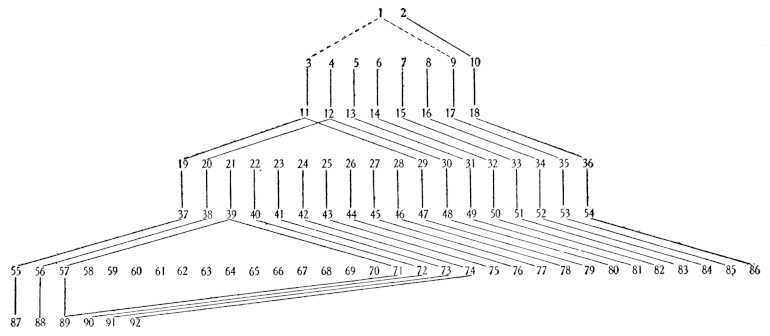
79These facts are clearly represented in the following
table, where the lines join elements having
similar properties.
It will be noticed that the table of the elements
terminates with a row containing six
members, the last of which is uranium. Uranium,
as we know, is not a stable substance; it
is disintegrating, and it is probable that no elements
heavier than uranium are met with, not
because they are theoretically impossible, but
because they would be too unstable to survive.
We have seen that, neglecting the last six
elements, all the other elements may be arranged
in rows in the following way: One row
of two elements, two rows of eight elements,
two rows of eighteen elements, and one row of
thirty-two elements.
80
ARRANGEMENT OF THE ELEMENTS IN GROUPS IN ORDER OF THEIR ATOMIC NUMBERS
Table showing the groups in the Periodic System and which elements are related to one another in the different groups
81
Names of Elements and their Atomic Weights
arranged in order of their Atomic Numbers.
No.
Name
Weight
No.
Name
Weight
1.
Hydrogen
1·008
47.
Silver
107·88
2.
Helium
4
48.
Cadmium
112·4
3.
Lithium
6·94
49.
Indium
114·8
4.
Beryllium
9·1
50.
Tin
118·7
5.
Boron
10·9
51.
Antimony
120·1
6.
Carbon
12
52.
Tellurium
127·5
7.
Nitrogen
14·01
53.
Iodine
126·92
8.
Oxygen
16
54.
Xenon
130·2
9.
Fluorine
19
55.
Cæsium
132·8
10.
Neon
20·2
56.
Barium
137·37
11.
Sodium
23
57.
Lanthanum
139
12.
Magnesium
24·3
58.
Cerium
140·2
13.
Aluminium
27·1
59.
Praseodymium
140·6
14.
Silicon
28·3
60.
Neodymium
144·3
15.
Phosphorus
31
61.
Unknown
—
16.
Sulphur
32·06
62.
Samarium
150·4
17.
Chlorine
35·456
63.
Europium
152
18.
Argon
39·9
64.
Gadolinium
157·3
19.
Potassium
39·1
65.
Terbium
159·2
20.
Calcium
40·07
66.
Dysprosium
162·5
21.
Scandium
44·5
67.
Holmium
163·5
22.
Titanium
48·1
68.
Erbium
167·7
23.
Vanadium
51
69.
Thulium
168·5
24.
Chromium
52
70.
Neoytterbium
172
25.
Manganese
55
71.
Lutecium
174
26.
Iron
55·8
72.
Hafnium
—
27.
Cobalt
58·97
73.
Tantalum
181
28.
Nickel
58·68
74.
Tungsten
184
29.
Copper
63·6
75.
Unknown
—
30.
Zinc
65·4
76.
Osmium
191
31.
Gallium
70·1
77.
Iridium
193·1
32.
Germanium
72·5
78.
Platinum
195
33.
Arsenic
74·96
79.
Gold
197·2
34.
Selenium
79·2
80.
Mercury
200·5
35.
Bromine
79·9
81.
Thallium
204
36.
Krypton
82·9
82.
Lead
207·2
37.
Rubidium
85·45
83.
Bismuth
208
38.
Strontium
87·63
84.
Polonium
210
39.
Yttrium
88·7
85.
Unknown
—
40.
Zirconium
90·6
86.
Niton
222
41.
Niobium
93·5
87.
Unknown
—
42.
Molybdenum
90
88.
Radium
226·4
43.
Unknown
—
89.
Actinium
(226–227)
44.
Ruthenium
101·7
90.
Thorium
232·1
45.
Rhodium
102·9
91.
Protoactinium
—
46.
Palladium
106·7
92.
Uranium
238·5
82
Two points must be mentioned about the
periodic table as we have represented it. In
the first place, we have left spaces for five elements
which have not yet been discovered, but
whose properties and places in the table can be
predicted. Such predictions have been made
before, and the elements, when discovered,
have completely verified the predictions. In
the second place, we have not, at every place
in the table, adhered to the order of the atomic
weights. There are four places where a heavier
element has been put before a lighter one. In
such cases we allow the whole complex of the
chemical properties of the element, considered
as a whole, to outweigh the considerations based
only on its atomic weight. In the table as now
arranged each element, including the five undiscovered
elements, receives a number corresponding
to its position in the table. These
numbers range from 1 to 92, and they are
called the atomic numbers of the elements.
The atomic number of an element is, in the
light of the new theories, a more fundamental
and important characteristic than the atomic
weight of the element. There is obviously a
close connection between the atomic number
and the atomic weight of an element, for the
order of the atomic weights is almost exactly
the same as the order of the atomic numbers
and, further, the atomic weight of an element
is, for the early part of the table, approximately
twice its atomic number, excepting, of
course, hydrogen, the first member of the table.
83This latter property, that the atomic weight is
twice the atomic number, is truer for the first
part of the table than for the latter part. As
we proceed along the table the atomic weights
seem to depend less and less directly on the
atomic number. It is obvious that we are not
dealing with a case of simple proportionality,
but that the atomic weight is, in reality, a quite
complicated function of the atomic number.
The fact that the periodic classification of
the elements is possible, that is to say, the fact
that elements having different atomic weights
can be arranged in groups because of the similarity
of their physical and chemical properties
lends great support to the theory that an atom
is not a single, simple entity. There must be
some similarity between the atoms of similar
elements, and it is difficult to see what this
similarity can be unless it be a similarity of
structure.
§ 2. The Atom as a Planetary System
It is time now that we began to consider
what sort of structure the atom may be supposed
84to possess. We have seen that the discovery
of electrons, and the phenomena of
radioactivity, lead us to suppose that electrons
somehow form part of the constitution of the
atom. We have seen further that, since atoms
are electrically neutral, we must suppose the
electrons to be associated with an equal positive
charge. How are we to suppose the electrons
and the positive charge to be distributed?
We shall see that certain experimental results
lead us to adopt a planetary configuration for
the atom. The positive charge is imagined as
placed at the centre of the system, and circulating
round it are a number of electrons sufficient
to balance its charge exactly. The simplest
conceivable case is of a unit positive
charge, and one electron circulating round it.
The distance of the electron from the positive
charge would be, of course, the radius of the
atom. It is supposed that the hydrogen atom
is built up in just this way, namely, that it consists
of a nucleus containing one positive unit
of charge and, circulating round this nucleus,
one electron. Such a conception is extremely
simple, but before it can be considered as satisfactory
85we must make it more definite. We
have seen that an electron has a mass which is
only 1⁄1800 part of that of a hydrogen atom.
If there is only one electron in a hydrogen
atom, therefore, we must imagine that practically
the whole mass of the atom is concentrated
in its positive nucleus. Besides the fact, therefore,
that the ultimate positive charge, the
nucleus, has an equal and opposite electrical
charge to that of the ultimate negative charge,
the electron, we must imagine that it is about
1800 times more massive than the electron.
The nucleus, deprived of its electron, would
still behave, so far as mass is concerned, like a
complete hydrogen atom. But it would behave
like a hydrogen atom carrying one unit of
positive charge. Such atoms are known.
Heavier atoms, containing several electrons
surrounding a nucleus having several positive
units of charge, could conceivably lose one, two,
three, four, or more electrons and consequently
manifest as an atom carrying one, two, three,
four, or more positive charges. But it would
be impossible, if our simple picture is right,
for the hydrogen atom ever to manifest more
86than one positive unit of charge. And, in
fact, no hydrogen atom has ever been discovered
which does manifest more than one positive
unit of charge, although heavier atoms
have been found which manifest several positive
charges.
The element that follows on hydrogen in
the order of atomic numbers is helium, and the
simplest hypothesis to make concerning the
structure of the helium atom is that it consists
of a nucleus containing two positive charges
and, circulating round it, two electrons. How
these two electrons are supposed to be arranged
is a problem of some difficulty. The most obvious
idea would be to suppose that they were
at opposite ends of a diameter and moving
round the nucleus in the same circle. But there
are reasons for thinking that this picture cannot
be true. We shall take up this question
later when we come to consider the general
group of problems relating to the distribution
of electrons within atoms. But, however they
may be arranged, we suppose the helium atom
to consist of two electrons circulating round a
87nucleus containing two positive charges. Now,
if this picture is correct, we cannot simply suppose
the helium nucleus to be composed of
two hydrogen nuclei. It is true that this would
give two positive charges for the nucleus, but
the weight of the nucleus would be wrong.
The atomic weight of helium is not 2, but 4,
and we have seen that practically the whole
mass of an atom is concentrated in its nucleus.
Since the nucleus of a helium atom has four
times the mass of a hydrogen atom, it follows
that the helium nucleus must contain no less
than four hydrogen nuclei. Yet its charge is
only two positive units. How is this to be accounted
for? We can only account for it by
giving the nucleus itself a rather complicated
structure. We must imagine that the helium
nucleus, besides containing four hydrogen
nuclei, contains also two electrons. The charge
of these two electrons neutralises the charge of
two of the hydrogen nuclei and leaves, for the
resultant positive charge of the helium nucleus,
two units. Thus we see that, if we are to consider
all atoms as built up out of hydrogen
88nuclei and electrons, it cannot be done by simply
adding hydrogen nuclei together in order
to produce the nucleus of another atom.
The principle is, we see, simple. The number
of hydrogen nuclei which go to make up the
nucleus of an atom must be equal to the atomic
weight of that atom, since it is from the hydrogen
nuclei that the atom acquires its weight. The
resultant positive charge on the nucleus, however,
is equal to the atomic number of the
atom. An atom of gold, for instance, has a mass
of 197. Its atomic number is 79. Its nucleus
consists, therefore, of 197 hydrogen nuclei and
118 electrons, since 197 − 118 = 79, and the
resultant positive charge on the nucleus is 79.
To balance this resultant positive charge of 79
there are 79 electrons circulating round the
nucleus. It is this resultant positive charge,
and the electrons circulating round it, which
determine the physical and chemical properties
of the atom. The actual mass of the atom
affects these properties only to a very small degree.
It is for that reason that it is not the
atomic weight, but the atomic number, which is
the fundamental characteristic of an atom. It
89is obvious, for instance, that we might obtain
the same resultant positive charge with quite a
different atomic weight. In the gold atom we
get a charge of 79 by combining 197 hydrogen
nuclei with 118 electrons. But if we had taken
198 hydrogen nuclei and 119 electrons we
should have had an atom of different
atomic weight, viz., 198 instead of 197, but of
equal charge, namely, 79, and therefore of the
same properties. We shall see that such variations
in atoms exist, i. e., we can have atoms of
the same substance but of different weights.
Our picture of the helium atom is perfectly
compatible with the fact that the α-particles
shot out by radium are found to consist of
helium atoms each of which carries two positive
units of charge. Each α-particle is, in fact,
a helium atom which has lost both its circulating
electrons and which manifests, in consequence,
two positive charges. In the same way that a
hydrogen atom could not manifest more than
one unit of positive charge, so a helium atom
cannot possibly manifest more than two units
of positive charge. But it is perfectly possible
for a helium atom to lose only one of its two
90electrons and therefore to manifest only one
unit of positive charge. Such atoms are known
to exist, whereas a helium atom carrying more
than two positive charges has never been discovered.
Of the next element, lithium, we need only
say briefly that its nucleus carries three positive
charges and that, circulating round the
nucleus, are three electrons. The lithium atom
which has lost one electron, and consequently
manifests one positive charge, is known, but
the lithium atom which is minus two electrons
has not yet been experimentally obtained.
Each step along the periodic table corresponds
to the increase of the resultant charge
on the nucleus by one positive unit and, consequently,
to the addition of one electron to
the circulating planetary system. By the time
we get to uranium we have an atom which has
92 electrons in its planetary system, circulating
round a nucleus containing a resultant positive
charge of 92 units. Such a system is enormously
complex. The complete mathematical
treatment of such systems would lead to the
elaboration of what is, at present, the practically
91non-existent science of mathematical
chemistry. But the mathematical difficulties
are enormous. They depend not only on the
large number of “planets” which have to be
treated, but on the peculiar difficulties offered
by the very extraordinary nature of the laws
which govern their motion. The further treatment
of this point, also, we must leave till
later.
§ 3. Experimental Evidence
When the α-particles from radium are passed
through matter they suffer a certain amount of
dispersion. In passing through a thin sheet of
metal, for instance, the α-particles are deviated
from the straight line they were pursuing when
they encountered the metal. The amount of
the deviation varies from one α-particle to another,
but, on the whole, the deviations are very
similar to those of shots round a target. The
cause of these deviations must be sought in the
encounters between the α-particles and the
atoms of the metal. The α-particles are, as we
have seen, the positively charged nuclei of
92helium atoms. In passing through the metal
sheet they will sometimes pass near or even
through a metallic atom and experience a deflection
due to the attraction of the electrons
of that atom. It may be that a number of such
encounters will happen to deflect the α-particle
in the same direction, so that the resultant deflection
may be considerable. But the chances
of this can be worked out, and we reach the
interesting conclusion that some of the observed
enormous deflections which α-particles occasionally
experience cannot be explained by any
such cumulative effects. Deflections of 150°,
i. e., an almost complete reversal of direction,
have been observed. It is true that such large
deflections are not numerous (on passing
through platinum, for instance, about 1 in 8000
α-particles are so affected), but the theory of
successive small deviations cannot explain
them. Also, the path of an α-particle through
air can, in certain circumstances, actually be
photographed, and the photographed path
sometimes exhibits extremely abrupt changes
of direction. Suddenly to deflect the massive
α-particle, travelling at about 20,000 miles a
93second, requires an intense force. It is necessary,
therefore, to consider where these intense
forces could come from.
As a result of measurements of the deflections
of α-particles, moving with various velocities
through different substances, Rutherford
came to the conclusion that the abnormal deflections
were produced when an α-particle happened
to approach very closely to the nucleus
of an atom. To account for the observed results
it was necessary to suppose that the charge
on the nucleus was concentrated within a very
small region. An α-particle which approached
sufficiently close to this highly concentrated
positive charge would experience an intense repulsive
force, and would be deflected in a hyperbolic
path. The deflections enabled the actual
positive charges carried by the nuclei of the
atoms of the different metals to be calculated,
and also the maximum value for the size of these
nuclei. The charge was found to be greater
the greater the atomic weight of the metallic
atom and to be, within the limits of experimental
error, equal to the atomic number of the
atom. Thus, the experimental values for
94platinum, silver, and copper were found to be
77·4, 46·3, and 29·3 respectively. The atomic
numbers are 78, 47, and 29, and these figures
agree with the experimental figures to within
the limits of experimental error. Thus we
have an experimental demonstration of the important
law that the positive charge on the
nucleus of an atom is equal to the atomic number
of that atom. The experiments also showed
that the maximum size that can be attributed
to the nucleus of an atom is exceedingly small.
Like the electron, the nucleus of an atom is
very much smaller than an atom; it is of subatomic
dimensions. There is reason to suppose,
indeed, that the hydrogen nucleus is small compared
even with an electron. It is probable
that the radius of a hydrogen nucleus is not
greater than 10-16 cm., which is about 1⁄2000
part of the radius of an electron.
One of the most interesting and striking confirmations
of our general theory is provided by
radioactive phenomena. We have said that
there are about 40 radioactive substances
known, and they are all substances having high
atomic weights. The nuclei of such heavy
95atoms must be very complicated structures,
built up, as the gold atom is built up, of a
large number of hydrogen nuclei and several
electrons. Now a radioactive substance, in the
course of its disintegration, may give rise to
several substances. Thus radium, in the course
of disintegrating, gives rise to the following
substances:—It produces Radium Emanation,
Radium-A, Radium-B, Radium-C, Radium-C′,
Radium-C″, Radium-D, Radium-E, Radium-F,
Radium-G. Radium-F is polonium and Radium-G
is lead. Two kinds of particles are
shot out during this series of disintegrations, α-particles
and β-particles. We have seen that
α-particles are helium nuclei and β-particles are
electrons. The question arises, Where do these
particles come from? The answer is that they
come from the nuclei of the heavy, disintegrating
atoms. It may astonish us that they are
helium nuclei and not hydrogen nuclei that are
shot out by the disrupting atoms. But we shall
see later that the helium nucleus, consisting of
4 hydrogen nuclei and 2 electrons, is a very
stable affair, so stable that it enters as a sort of
indivisible unit into the structure of more complicated
96nuclei. Now let us, remembering our
general theory, trace exactly what happens in
the above series of radium changes. A radium
atom turns into an atom of radium emanation
by losing an α-particle. The α-particle carries
two units of positive charge. It is shot out
from the nucleus of the radium atom, and therefore
the new nucleus is minus two positive
charges. That is to say, the nucleus of an
atom of radium emanation carries two charges
less than the nucleus of a radium atom. But
the charge on the nucleus is, as we have seen,
equal to the atomic number of the atom. It
follows that the radium emanation atom must
be placed two steps lower than the radium atom
in the periodic table. But the α-particle contains
four hydrogen nuclei. Therefore the
atomic weight of the radium emanation atom
must be four units less than that of the radium
atom. The result of an atom losing an α-particle,
therefore, is to give rise to a new atom
whose atomic weight is less by four units, and
which belongs to a place two steps back in the
periodic table. What is the effect of losing a
β-particle? The nucleus of every atom except
97a hydrogen atom contains, besides a number of
hydrogen nuclei, a smaller number of electrons.
These electrons neutralise an equal number of
the hydrogen nuclei contained in the nucleus of
the atom, leaving over a number of hydrogen
nuclei equal to the charge on the nucleus, which
is itself equal to the atomic number of the
atom. A β-particle shot out from the nucleus,
therefore, leaves one extra hydrogen nucleus
unneutralised. In consequence, the charge on
the atom’s nucleus increases by one unit, and
therefore the atomic number increases by one.
The new atom, therefore, moves one place up
in the periodic table. And what happens to its
atomic weight? Its atomic weight is unaffected,
for we have seen that electrons play almost
no part in contributing to the mass of an
atom. The loss of an electron makes practically
no difference to the weight of an atom.
Besides, the new atom soon captures a free
electron (of which there are always a large
number about) to compensate for its extra positive
charge. This electron does not fall into
the nucleus, but joins the group of electrons
which are rotating round the nucleus.
98
We are now in a position to understand
the series of radium changes given above.
Radium, with an atomic weight of 226, loses
an a-particle and becomes radium emanation,
with an atomic weight of 222. Radium emanation,
losing an α-particle, becomes radium-A
with an atomic weight of 218. The loss of
α-particles continues, and radium-A gives rise
to radium-B, with atomic weight 214. At
radium-B the process alters. Radium-B loses
a β-particle and turns into radium-C. The
atomic weight is, of course, unaltered, so radium-C
also has the atomic weight 214. Having
got as far as radium-C, a very interesting
thing happens. Some radium-C atoms, by
shooting out an α-particle, pass straight to
radium-C″, with an atomic weight of 210, and
then, through radium-C″ losing a β-particle, to
radium-D, also with an atomic weight of 210.
Other radium-C atoms, however, shoot out a
β-particle instead of an α-particle, and so become
radium-C′, with an unchanged atomic
weight of 214. Radium-C′ shoots out an α-particle
and so it also becomes radium-D,
atomic weight 210. Thus the two paths lead
99to the same result, viz., radium-D. Radium-D
is not stable, however; it loses a β-particle and
becomes radium-E. That also loses a β-particle
and becomes radium-F, i. e., polonium.
Both these substances, radium-E and polonium,
have, of course, the same atomic weight, 210,
as radium-D. Having reached polonium, the
series has one more step to go. Polonium, by
losing an α-particle, becomes lead, with an
atomic weight of 206. With lead, the process
of disruption seems to have stopped. There
is no evidence that lead is disintegrating; if it
is, it must be at an exceedingly slow rate
which has hitherto avoided all means of detection.
It must be noted here that the lead
reached in this way has not the same atomic
weight as ordinary lead. Ordinary lead has
the atomic weight 207·2. By taking a different
series of radioactive changes, starting
from thorium, we also reach lead as the final
substance. But the lead so obtained has an
atomic weight of 208. These curious facts,
and a number of others like them, we must
now proceed to consider.
100
§ 4. Isotopes
The chemical and physical properties of an
element depend on its atomic number, i. e., on
the positive charge carried by the nucleus of
an atom of that element. And this positive
charge is, as we have seen, a resultant charge.
It is a result of the combination of a number
of unit positive charges with a smaller number
of unit negative charges. We can obviously
reach the same resultant figure in as
many ways as we please. If the resultant
charge on the nucleus is to be 5, for instance,
then we could take the combinations +6 and
−1, or +7 and −2, or +8 and −3, and so
on. Each of these arrangements would give
atoms having identical chemical and physical
properties. But their atomic weights would be
different. The atomic weights depend, not on
the resultant positive charge, but on the actual
number of positive charges present in the
nucleus, including those that are compensated
for by negative charges as well as those that
are not. In the above case, for instance, our
atoms would have atomic weights 6, 7, 8, and
101so on. And this is the only difference they
would have. By no other chemical or physical
properties could they be distinguished one from
another.
It is therefore a very interesting fact, and
one fitting in beautifully with our theory, that
many elements have been shown to consist of
a mixture of atoms having different atomic
weights, but identical in every other respect.
The element chlorine, for example, has the
atomic weight 35·46. This number is about
as far removed as it could be from being a
whole number, and is therefore specially fatal
to the theory that all atomic weights are simple
multiples of the same unit. But it has
been shown that chlorine is really a mixture
of two groups of atoms, the atomic weight
of the atoms of one group being 35 and the
other 37. These groups are mixed together in
about the proportion of 3 to 1, and the ordinary
measured atomic weight of 35·46 is
really the average weight of the mixture.
Neon, again, whose atomic weight is ordinarily
given as 20·2, is found to consist of two
groups of atoms with atomic weights 20 and
10222. Much more complicated groupings have
been discovered. Thus krypton, whose atomic
weight is put as 82·92, is made up of groups of
atoms having the weights 78, 80, 82, 83, 84,
86. Such elements are called Isotopes, the name
indicating that the groups of atoms belonging
to these elements occupy the same place in the
periodic table. It will be noticed that the
atomic weights of these groups of atoms are all
whole numbers. This is on the basis of oxygen
taken as 16. On this basis hydrogen is not
exactly unity, but is 1·008. It appears probable,
then, that all atoms have atomic weights
which are nearly, but not quite, whole multiples
of hydrogen.
The existence of isotopes definitely destroys
the great importance that chemists had always
assigned to atomic weights. We have atoms
of different atomic weights but of the same
properties. Further, as we saw in studying the
disintegration of radium into lead, we have
elements of the same atomic weight but with
wholly different chemical and physical properties.
The atomic weight of an element,
therefore, by no means suffices to determine its
103chemical and physical properties. We see once
more that the really important quantity to be
known about an element is its atomic number,
i. e., its position in the periodic table. It is
worth noting that the existence of isotopes was
not suspected until comparatively recent times,
although very delicate determinations of atomic
weights have been practised for decades. The
most refined measurements customary in such
determinations never varied from sample to
sample of the same element. Exactly the
same mixture of atoms constitutes chlorine,
for instance, wherever the chlorine is obtained,
and always has done so ever since men began
to study chlorine. The groups of atoms which
make up chlorine or any other isotope must
have been thoroughly and universally mixed
long ages ago—in all probability before the
formation of the earth’s crust, when such universal
and complete diffusion would have been
possible.
§ 5. Relativity and the Atom
It is necessary, now, to say a little about the
Restricted Principle of Relativity, since certain
104points about the modern theory of atomic
structure cannot be understood without it. But
it is not necessary to explain the principle
itself. It is only necessary to describe the relation
between energy and mass that the theory
shows to exist. In pre-Relativity mechanics,
it was always assumed that the mass of a body
was completely independent of its velocity.
There was no reason to suppose otherwise.
Whether a body was moving fast or slow, or
whether it was at rest, its mass, when measured,
was always found to be the same. But
the theory of relativity asserts that the mass
of a body does vary with its velocity. As the
body moves faster its mass increases. The
mass increases in such a way that, at the speed
of light, it becomes infinite. This can only
mean that the velocity of light is a natural
limit, that no material body could possibly
exceed this speed. If it be true that the mass
of a body increases with its velocity, it might
be thought that experiment would long ago
have led us to suspect that fact. But the law
according to which the increase occurs is such
that the increase is not measurable except at
105very great speeds. Now we are not familiar
with bodies moving at very great speeds. We
know of velocities such as 100 miles per hour
and even, in astronomy, of velocities which
reach a few miles per second. But velocities
which are a considerable fraction of the velocity
of light, viz., 186,000 miles per second, are
practically unknown. It is the α- and the β-particles
which furnish us with examples of bodies
moving at speeds comparable with that of
light. And experiments on these bodies show
that their mass does increase with their velocity,
and precisely in the way predicted by
Einstein’s theory. So that the ratio e/m, the
ratio of charge to mass of an electron, varies
with the velocity of the electron. As the
velocity increases m increases and therefore
e/m grows smaller. The value of e/m usually
given, viz., 1·77 × 107 (electromagnetic) units,
is the value for low velocities, when m may be
taken as the mass of the electron at rest. We
will denote this value of m as mo; mo is the
mass of the stationary electron. At half the
velocity of light, the mass of the electron is
1·15 mo, i. e., it is about one-seventh greater.
106If the electron is moving at nine-tenths the
velocity of light its mass is 2·3 mo, or nearly
two and a half times greater. At ninety-nine-hundredths
of the velocity of light the mass of
the electron is seven times its value at rest, and
at the velocity of light itself, as we have said,
its mass is infinite.
This result of relativity theory must obviously
be borne in mind in any attempts to
ascertain in detail what goes on inside an atom.
If the mass of the rotating electrons is a quantity
which enters into our calculations, then
obviously we must remember that the mass
varies with the velocity of rotation we ascribe
to the electrons. Another important aspect of
this theory is that it shows we must ascribe
mass to energy. This, again, is a very novel
conception. We are used to thinking of energy
as something to which the property of possessing
mass cannot be ascribed. The two
things seem to have nothing to do with one
another. But it can be shown that energy
certainly does possess inertia, and the property
of possessing inertia is what we really mean
by mass. The mass of a body is, indeed, only
107another way of measuring the total amount of
energy it contains. Every piece of matter possesses
a vast store of internal energy. If the
piece of matter begins to move its energy is
increased in virtue of its motion. Its mass also
is increased. But the increase in mass due to
increase in energy is usually extremely small.
In any chemical combination which is attended
by the development of heat, for instance, there
is a certain loss of mass due to the energy
radiated away during the process of combination.
The resultant mass of the compound is
less than the sum of the original masses of its
constituents. But the loss which occurs in this
way during any chemical process is exceedingly
small, and the old law of the invariability of
mass is, in all such cases, quite good enough.
But there appears to be a beautiful and highly
interesting exception. We have seen that there
is reason to suppose that the helium nucleus,
which is shot out of radioactive bodies as an
α-particle, is a very stable structure. It is composed,
as we have said, of four hydrogen
nuclei and two electrons. The great stability
of this structure suggests that its formation
108was attended by a great expenditure of energy,
so that an enormous amount of energy would
have to be communicated to it to break it up.
Now the atomic weight of helium is 4, and the
atomic weight of hydrogen is not 1, but 1·008.
Four times the mass of the hydrogen atom
would give an atomic weight of 4·032. The
suggestion is that the difference between this
value and the actual measured value of 4, represents
the mass of the energy lost in the process
of combining the four hydrogen nuclei into the
helium nucleus. This gives a measure, also,
of the amount of energy that would be required
to split up the helium nucleus into its
original components. The amount of energy
represented by this figure is really enormous.
It is sixty-three million times greater than the
energy expended in ordinary chemical processes,
and this figure is a measure of how much
more stable the helium nucleus is than an
ordinary chemical compound. A chemical
compound can often be dissociated merely by
raising its temperature a few degrees, but even
the enormous energy possessed by the fastest
α-particles is only about a third of that required
to dissociate the helium nucleus.
Chapter V: Quantum Theory
111
Chapter V
Quantum Theory
§ 1. The Stability of the Atom
WE have seen that the theory we have
been describing, called the nuclear
theory of the atom, gives a very satisfactory
account of a large number of phenomena. The
observed scattering of α-particles on passing
through thin sheets of metal, the existence of
isotopes, the changes which occur in radioactive
phenomena, all receive very convincing
explanations. There can be no doubt that the
nuclear theory of the atom is essentially true,
that the atomic models we have imagined correspond
closely to actual atoms. But there is
a fatal objection to this theory of the atom,
as we have presented it hitherto. Such an atom
could not continue to exist!
According to the classical theory of electrodynamics
every change of motion on the part
of an electrically charged body is attended with
112a radiation of energy. In wireless telegraphy,
for instance, it is the rapid oscillations of the
electrons in the sending apparatus which produce
the electromagnetic waves. Each time
an electron suffers a change in the direction or
speed of its motion, or in both, it sends out
an electromagnetic wave. Such a process cannot
be kept up without a continual supply of
energy. In the atomic model, as we have presented
it, the outer electrons, which we imagine
to be continually circulating round the nucleus,
would be continually sending out energy. For
a circular motion is a perpetually changing
motion, and every change of motion on the
part of a charged body is accompanied by the
emission of energy. For an electron not to
radiate energy, according to the classical theory,
it must either be at rest, or be moving
uniformly in a straight line. It is obvious that
the outer electrons of our atom cannot be
imagined as at rest. They would be attracted
by the nucleus and simply fall into it, just as
the planets would fall into the sun if they
were robbed of their orbital motion. In order
to counterbalance the attraction of the nucleus
113the outer electrons must have a circular or
elliptical or some such motion. And any such
motion would be attended by a radiation of
energy. As a result of this radiation of energy
it can be shown that the orbit of the rotating
electron would grow smaller and its velocity
of rotation greater. This process would continue
until finally the electron fell into the
nucleus. That is to say, the atom, as we have
depicted it, is, on the classical theory of electrodynamics,
essentially unstable. The whole
material world, as we know it, ought to have
vanished long ago. Further, the spectrum of
any element contains perfectly sharp lines
which are situated in perfectly definite parts of
the spectrum. The radiations from the atoms
of a given element are perfectly definite; they
do not assume all values. But if the outer
electrons, from which these radiations proceed,
are continually changing their orbital distances
and velocities, then there ought to be a continuous
succession of lines in the spectrum of
that element, instead of the perfectly distinct
and permanent arrangement which exists in
fact.
114
So we see that, when we come to investigate
the mathematical theory of our atomic model
it turns out to be highly unsatisfactory. Are
we, therefore, to abandon our model completely?
Before we answer this question we
will look at one or two other phenomena
where similar extraordinary difficulties have
been found. We will consider, in the first
place, the phenomena of heat radiation, since
it is here that the insufficiency of the old theory
of electromagnetic radiation was first demonstrated.
Let us consider the heat rays radiated
by what is called a “black body.” A black
body is defined as one which absorbs the whole
of the radiant energy that it receives. There
is no substance which exactly satisfies this condition,
but it is possible to produce the equivalent
of it by artificial means. It was shown
by the German physicist Kirchhoff that a
space enclosed by an opaque envelope, and
maintained at a uniform temperature, is filled
with a radiation identical with that which
would be emitted by a black body at the same
temperature. If, therefore, a small hole be
made in the opaque envelope, the rays which
115escape through it will be the same as those that
would be produced by a black body. Several
physicists have studied these rays, and they
have reached extraordinarily interesting results.
The way in which the total amount of
energy radiated is distributed amongst the different
rays has been the chief object of their
researches. The rays which come from the
enclosure are of very different wave-lengths;
they vary between wide limits. Corresponding
to each wave-length is a certain fraction of the
total energy radiated, and this fraction depends
upon the length of the actual wave concerned
in a rather complicated way. It is found, as
the result of actual measurements, that the
longest waves have very little energy. As the
wave-lengths decrease the energy increases
until a certain wave-length is reached where
the energy has a maximum value. As we go
on past this point to shorter and shorter wave-lengths
the energy decreases, until for very
short wave-lengths it is practically zero. Now
this result is in the most flagrant contradiction
with the theoretical calculations. According to
the mathematical theory, the energy contained
116in the very short wave-lengths should be very
great. As the wave-lengths get shorter and
shorter, tending towards zero, the energy contained
in them should, according to the calculations,
tend towards infinity. Observation
shows that it tends towards zero. The contradiction
is as striking as it could be.
We can see how extraordinary this observed
result is if we consider an analogous case.
Suppose that we have a number of corks floating
on the surface of a bowl of water. Now
suppose that, by some means, we agitate these
corks, causing them to oscillate up and down
in the water, and then leave them to themselves.
We know that the oscillations will,
after a time, die down. The whole mass, water
and corks, will once again become quiescent.
The difference is that the water will be slightly
warmer. The energy which was contained in
the oscillating corks is ultimately transferred
to the molecules of the water and appears as
heat energy. Now this result is quite in accord
with the calculations. But if the result were
to be analogous to the radiation result mentioned
above, the corks would have to go on
117oscillating for ever with undiminished vigour.
We should all agree that such a phenomenon
was highly mysterious. The results obtained
in the radiation experiments are no less mysterious.
Let us turn to yet another phenomenon
which is entirely contradictory of our expectations.
It is found that light of high frequency,
i. e., of short wave-length, when allowed to
fall on a metal, liberates electrons from the
metal. The old scientific question of “How
much?” immediately, of course, comes to the
fore. We want to know the number of the
electrons liberated and their velocities. And
we want to know how these two quantities depend
on the light which is used. We find, as
the result of careful experiment, that the
number of electrons liberated depends on the
intensity of the light, but that the velocity of
the electrons depends on the frequency of the
light. This result is very surprising. We
should have expected that the more intense
the beam of light the higher the velocity of
the liberated electrons. But only the number
of electrons is influenced by the intensity. A
118very weak beam of high frequency light will
cause electrons to be shot out of the metal with
high velocity. We get a firmer grasp of the
paradoxical nature of this result if we first create
X-rays by bombarding an anti-cathode with
electrons, and then use the X-rays to liberate
electrons from a metal. X-rays, as we have
said, may be regarded as extremely high frequency
light-waves. Now let us suppose that
we produce some electrons in a cathode tube,
and cause them to bombard the anti-cathode,
so producing X-rays. The electrons will have
a certain velocity, depending upon the voltage
applied to the tube, and they will generate
X-rays having a certain frequency. The higher
the velocity of the electrons the higher the frequency
of the resulting X-rays. These X-rays
are now allowed to fall on a sheet of metal.
Immediately electrons are liberated from the
metal, and the astonishing discovery is made
that the electrons so produced have the same
velocity as the electrons which generated the
X-rays. We may illustrate this result by an
analogy used by Sir William Bragg. Imagine
that we drop a plank, from the height of a
119hundred feet, into the ocean. The impact produces
waves in the ocean which spread out in
circles around the point of impact. As the
waves spread out they naturally get feebler
and feebler, since the same total amount of
energy is distributed over a longer and longer
circumference. After travelling, say, two
miles, let us suppose that the outermost wave
reaches a ship. We are to imagine that, immediately
the wave reaches the ship, it causes
a plank to be shot up out of the ship to a height
of one hundred feet. This case seems precisely
analogous to the liberation of electrons by
X-rays. The X-rays have spread out in ever
increasing spheres from the point of impact,
and yet, wherever they touch a metal, they liberate
electrons having precisely the energy of
the electrons which generated the X-rays.
The key to these extraordinary results is to
be found in Planck’s Quantum Theory. It was
at the end of the year 1900 that Max Planck
published his theory that energy is not emitted
in a continuous fashion, but only in little finite
packets, as it were. An oscillating atom, for
instance, is to be conceived as sending out little
120doses of energy, one after the other. It does
not emit energy continually. And Planck asserted
that the size of these little packets depended
on the frequency of the oscillation, being
greater the greater the frequency. Such
an hypothesis is very strange, and is in entire
contradiction to the classical dynamical theory
on which the whole science of physics had been
built. Yet, strange as the theory was, the results
it was invented to explain certainly existed,
and it could be shown that the old dynamics
not only had not explained them, but
could not possibly explain them. It was clear
that any satisfactory explanation would have
to be something quite revolutionary in character.
And Planck’s theory did, as a matter of
fact, explain the observed radiation phenomena
extremely well. Planck calculated, on his
theory, how the energy of radiation should be
distributed amongst the different wave-lengths,
and his calculations precisely agreed with the
experimental results. It is possible that, even
so, this revolutionary theory would not have
obtained general acceptance. But Einstein applied
the theory to the phenomena attending
121the liberation of electrons from metals under
the influence of light, and his calculations, also,
were shown to be in precise agreement with the
evidence. The quantum theory, then, although
strange and, in many respects, little understood,
has become one of the great arms of
modern physical research. It is still attended
with very grave difficulties. The phenomena
of electron emission from metals, for instance,
certainly suggests that light energy exists in
small bundles, dotted about round the surface
of the sphere which was regarded as forming
the old “wave-front.” Each bundle, we may
suppose, contains sufficient energy to liberate
an electron with the velocity of the electron
which gave rise to the bundle. On the other
hand, certain well-known phenomena in light,
particularly the phenomenon of “interference,”
seem utterly irreconcilable with this assumption;
they are perfectly well explained on the
old wave theory of light, but they seem quite
inexplicable on the new quantum theory of
light. It depends on which phenomenon we
want to explain which theory we employ.
Neither of them seem in the least adequate to
122explain all the known phenomena, and they
also seem quite irreconcilable with one another.
The physicist must keep both and yet they cannot
live together. A compromise has been
tried. Sommerfeld and Debye, for instance,
have endeavoured to work out a theory whereby
the energy brought by the light waves has been
regarded as continuous, but as being able, in
some way, to accumulate until the amount contained
in a quantum “bundle” is reached.
Having accumulated to this amount, the energy
is then supposed to work suddenly and to shoot
out the electron with the requisite velocity.
But the period required for this accumulation
can be calculated, and it is found that, to explain
the effects produced by X-rays, an accumulation
period amounting to some years is required.
So that the emission of electrons under
the influence of X-rays should not take
place until some years had elapsed. It is
found, however, that the emission takes place
immediately the X-rays are applied, and ceases
instantly when they are discontinued. The
contradiction is complete.
But the quantum theory, however puzzling
123it may be in certain aspects, has shown itself
competent to deal with very baffling phenomena.
It was natural, therefore, faced by
the great puzzle presented by the stability
of the atom, to surmise that here, also, the
quantum theory would prove competent to
overcome the difficulties. In its original form,
the theory could not be applied to the atom.
It was first necessary to extend it. This was
first done, and the theory successfully applied,
by a brilliant young Danish physicist, Niels
Bohr.
§ 2. Bohr’s Atom
Before we go on to describe Bohr’s conception
of the atom we must make a few remarks
about spectra, since the explanation of spectrum
lines is one of the most important duties
that an atomic model has to fulfil. The whole
science of spectrum analysis began with Fraunhofer’s
discovery that light from the sun, if
spread out in a coloured band by a prism, contained,
besides its different colours, a large number
of fine dark lines crossing the band at right
angles to its length. Kirchhoff found that the
124light from incandescent gases, when treated in
the same way, also gave lines, although in this
case the lines were bright lines. But he further
found that a gas will absorb the same lines
that it emits, so that if light be passed through
a gas, dark lines will occur at the same positions
as the bright lines occur when the gas is
incandescent. Each chemical element was
found to have its own appropriate series of
lines, and these lines serve, with remarkable
delicacy and exactitude, as a means of recognising
the presence of these elements. The
lines in the sun’s spectrum, for instance, can be
disentangled into the groups belonging to each
separate chemical element in the sun. A similar
analysis, performed on the light from various
stars, enables us to say what chemical elements
are present in those stars.
Every incandescent substance sends out light
of several different wave-lengths. These different
rays are, in the ordinary way, jumbled
together, but, on being passed through a prism,
they are separated out in an orderly manner.
The spectrum ranges from the red to the violet.
The waves giving red light are the longest
125waves and those giving violet the shortest.
Waves longer than red waves, the so-called infra-red
waves, do not affect the retina of our
eye as light at all, and the same remark applies
to the waves shorter than violet waves,
the so-called ultra-violet waves. But such
waves, although they do not affect our eyes,
can be made to affect certain chemical preparations;
with ultra-violet waves, for instance,
photographs may be taken of invisible objects,
a fact perfectly well known to certain “spirit”
photographers. Now each line on a spectrum
corresponds to a definite wave-length. Light
which is all of one wave-length is called monochromatic
light; each line on a spectrum corresponds
to a certain wave-length of monochromatic
light. Corresponding to each line in the
spectrum of a given element the wave-length
can be measured, and the interesting question
arises as to whether there is any relation between
the lengths of the different waves emitted
by that element. We shall see that there
are such relations, and that Bohr’s theory of
the atom takes us some way towards explaining
them.
126
In the first place, we have to assume, in applying
quantum theory to the atom, that an
electron describes a circle or an ellipse round
the nucleus without radiating any energy.
This assumption is in flat disagreement with the
classical theory of electrodynamics, but it is in
agreement with the quantum theory. Another
assumption we must make, and which is not in
agreement with the old theory, is that the electron
can only move in certain orbits. If the
orbit be a circular one, for instance, then an
electron can only circulate round the nucleus
at certain definite distances from it. It could
not describe a circle whose radius was intermediate
between two of these distances. Whatever
one of the possible circles the electron is
on, it will continue to traverse that circle indefinitely
unless some external force acts on it.
If an external force does act on it, then
the electron passes directly to another of the
possible circles. During this transition from
one possible circle to another the electron radiates
energy, and this energy is monochromatic,
that is, it is energy of a perfectly definite wave-length.
And the amount of energy so emitted
127is a quantum of energy. The quantum of
energy belonging to a certain frequency depends
upon that frequency. Its amount is, in
fact, equal to the frequency multiplied by a
certain extremely small figure called Planck’s
constant. Thus the quantum, or the atom of
energy, is not an invariable thing. Like the
atoms of matter, energy atoms are of different
sizes. The higher the frequency the greater the
atom of energy. As we have said, a monochromatic
radiation is emitted by the electron in
passing from one possible orbit to another.
This radiation has, of course, a definite wave-length
and therefore a definite frequency corresponding
to it. This frequency, multiplied
by the quantity called Planck’s constant, is
equal to the total energy emitted by the
electron in passing from one orbit to the
other.
We have said that certain relations have
been found to exist between the lines in the
spectrum of a given element. It was in 1885
that Balmer discovered that the lines in the
spectrum of hydrogen could be represented by
a certain very simple formula. The frequencies
128corresponding to a certain prominent group
of lines in the hydrogen spectrum may be represented
by multiplying a certain constant figure
by the quantity (1⁄4 − 1/n2) where n takes
on the values 3, 4, 5, 6, 7. These are the
five strongest hydrogen lines, and for them the
quantity in the brackets becomes (1⁄4 − 1⁄9),
(1⁄4 − 1⁄16), (1⁄4 − 1⁄25), (1⁄4 − 1⁄36), (1⁄4 − 1⁄49).
Each of these values is to be multiplied
by a certain figure, the same in each case, and
the results will be the frequencies corresponding
to each of these five lines respectively. Another
series of lines in the hydrogen spectrum
is obtained by using, instead of the general
quantity in brackets given above, the quantity
1⁄9 − 1/n2, where n takes on the values 4, 5, 6,
etc. Still another series can be obtained from
the general formula 1⁄1 − 1/n2, where n has the
values 2, 3, 4, etc. It is easy to see that the
most general formula, including all these cases,
is 1/m2 − 1/n2. In the first formula we gave, for instance,
m = 2. In the second m = 3, and in
the third m = 1. Formulæ which are a trifle
more complicated were discovered later, and
were found to represent still other series of
129lines. And these formulæ were applied to
other elements besides hydrogen.
On Bohr’s theory, when an electron passes
from one orbit to another, it emits a certain
quantity of energy, and the energy so radiated
has a certain frequency. If, therefore, we subtract
the energy possessed by the electron in
its second orbit from the energy it possessed in
its first orbit, we have the total quantity of
energy emitted by it in passing from one to the
other. The frequency, therefore, could be calculated
from the subtraction of these two quantities.
Now it is suggestive that Balmer’s formula
for the frequency, given above, is expressed
by the subtraction of two quantities.
Bohr showed that this was no accident, and
that the two quantities in Balmer’s formula do
indeed correspond to the energies before and
after the transition of the electron from one
orbit to the other. In fact, Bohr was able, on
his theory, to deduce Balmer’s formula. It no
longer appeared as a mere empirical rule, but
as a theoretical consequence of the structure of
the atom. This result was a most striking success
for Bohr’s theory to achieve. He also deduced,
130from his theory, the value of the constant
figure which is used to multiply the different
quantities in brackets given above; his
calculated figure and the empirically ascertained
figure were in precise agreement. The
values of the different possible radii on which
the electron in a hydrogen atom can move were
also deduced by Bohr. The electron is most
stable when on its first orbit, the orbit nearest
the nucleus. This is the normal condition for
a hydrogen atom. The actual diameter of a hydrogen
atom in this condition can be calculated
on Bohr’s theory, and the value so obtained is
found to be in agreement with the value obtained
by quite other methods.
The fact that the spectrum of hydrogen possesses
a number of lines, therefore, shows us
that, in the immense number of atoms present
in any specimen of hydrogen, there are always
many whose electrons are passing from one orbit
to another. In one atom an electron will be
passing from the second to the first orbit, or
from the third to the second, or from the fourth
to the third, and so on. Such transitions must
always be going on, for it is only in virtue of
131them that the hydrogen atoms radiate any
energy at all. The state to which all these
changes tend is the most stable state, when the
electron is on its first orbit. We may say, then,
as Bohr puts it, that the spectrum of hydrogen
shows us the formation of the hydrogen atom,
since the transition to the successively decreasing
orbits may be regarded as stages in the process
by which the hydrogen atom reaches its
normal condition.
§ 3. The Fine Structure of Hydrogen Lines
We may summarise the theory of the hydrogen
atom we have given hitherto by saying
that the hydrogen atom consists of a positive
nucleus carrying one unit of charge, and that a
single electron is describing an elliptical orbit
about it. We can imagine a number of ellipses,
of different sizes, enclosing the nucleus. Each
of these ellipses will have a common focus, and
it is at this focus that the nucleus is situated.
The single electron can move on any one of
these ellipses, but only on these; it cannot describe
an intermediate orbit. Under the influence
132of an external force the electron may jump
from one of these ellipses to another. During
this jump it radiates energy in the form of
monochromatic waves. As long as it remains
on any one of these ellipses it is not radiating
energy. These elliptical motions are called
stationary states. The electron only radiates
energy, then, in passing from one stationary
state to another. This simple theory suffices to
explain the positions of the lines in the hydrogen
spectrum. We reach a formula which is
exactly like Balmer’s formula showing the distribution
of these lines.
When we come to look more closely into the
matter, however, we find that there is a factor
we have neglected in our calculations. We
have said that the electron describes an ellipse
about the nucleus. We suppose that it describes
this ellipse in obedience to the ordinary
laws which regulate the motion of a single
planet about the sun. It is a peculiarity of
such motion that the speed is not uniform. A
planet, in its elliptical orbit about the sun, is
sometimes moving faster and sometimes slower,
depending upon which part of the ellipse it is
133describing. At those parts of the ellipse which
are nearest the sun the planet is moving fastest.
At the parts most remote from the sun it is
moving most slowly. As precisely the same
laws apply to our electron moving round the
nucleus, we have to take into account the fact
that the speed of the electron in its orbit is
continually changing. This is where the theory
of relativity comes in. We have seen that it
is a consequence of that theory that the mass
of an electron varies with its velocity, becoming
greater the greater the velocity. Our electron,
therefore, is not only moving with a varying
speed; it is also moving with a varying
mass. What influence will this variation of
mass have on the motion?
This problem was solved by Sommerfeld.
The result is that the electron continues to
move in an almost elliptical orbit, but this orbit
itself is slowly and uniformly rotating. The
actual motion of the electron in space is a combination
of these two motions. The effect of
this on the spectrum of hydrogen will be that
corresponding to each hydrogen line there will
be two or three lines extremely close together.
134Each hydrogen line will really consist of more
than one line. These lines will be so close together
that it would be almost impossible to see
them separately. Nevertheless, measurements
have been made, and these measurements are in
agreement with Sommerfeld’s theory. The fine
structure, as it is called, of the hydrogen lines,
is due to the variations in mass of the electron
in describing its orbit about the hydrogen nucleus.
The complete explanation of the hydrogen
spectrum requires both quantum theory and
relativity theory; conversely, the striking agreement
between calculation and observation in
the hydrogen spectrum greatly supports both
these theories.
So far we have considered the theory, in detail,
only in its application to the hydrogen
atom. The hydrogen atom is the simplest
atom, and we should expect the theory to be
most adequate in dealing with this case. But
although the sheer complexity of the heavier
atoms has hitherto prevented so complete a description
of them being formulated, the general
theory of their structure, as we shall proceed
to show, has much that is of interest and value
to tell us.
Chapter VI: The Grouping of Atoms
137
Chapter VI
The Grouping of Atoms
§ 1. The Outer Electrons
ANY theory of the atom which is to secure
our assent must, in broad lines if not in
detail, account for the remarkable periodicity
in the properties of the chemical elements. We
have already shown that this periodicity, the recurrence
of similar physical and chemical properties,
led Mendeléev to construct the Periodic
Table. In each of the columns of the diagram
in Chapter IV the elements run through a cycle
of chemical properties which is approximately
repeated in the next column. This repetition
of properties is not perfectly regular. The
columns are of unequal length; some contain 8,
some 18, and some 32 elements. But the
periodicity, although not perfectly simple, is
quite unmistakable, and is one of the most important
and outstanding properties of the
chemical elements. Instead of arranging the
138atoms by their general chemical properties we
may arrange them according to some specific
property. We may, for instance, arrange them
in accordance with what is called their “atomic
volumes.” If we do this we again get a periodic
relation. Still other properties, such as
“compressibility,” “expansion coefficient,” etc.,
show the same intriguing peculiarity. All these
properties seem to be connected with the actual
amount of space taken up by the atom. They
are not properties of the nucleus; they are dependent
upon the outer electrons. And also, if
we study the visible spectra of the various elements,
we find the same curious recurrence.
All those elements which are called Alkalis, for
example, have spectra which seem to be constructed
on the same ground plan. The different
alkalis differ enormously from one another
in the complication of their structure; their
atomic numbers are 3, 11, 19, 37, 55, so that
we pass from a system containing three circulating
electrons to one containing fifty-five.
And yet their spectra are fundamentally the
same. Here, also, we are concerned with the
outermost electrons. The nuclei of these atoms
139are not concerned in their visible spectra. The
nuclei of the various atoms, arranged according
to their atomic numbers, simply show a
straightforward advance from complexity to
complexity. There is no kind of repetition or
recurrence in the properties which depend on
the nucleus. But the way in which the outer
electrons are arranged does show a recurrence,
and all those physical and chemical properties
which show a recurrence may be assumed to
depend on the outer electrons. Thus we may
say that the chemical properties of an atom depend
not on its nucleus, but on its outer electrons.
The visible spectrum, as we have said, depends
upon the arrangement of the outer electrons.
But X-rays also possess a spectrum.
The X-rays emitted from any source are not all
of the same wave-length and these waves, by a
method of which we shall learn more later, can
be arranged in order like those of visible light.
Now the X-ray spectra of the elements do not
manifest a recurrence. They advance, in a
straightforward way, with the atomic number.
They depend upon the inner part of the atom
140and not upon the outer electrons. And it is
because they originate in the neighbourhood of
the nucleus, where the atomic forces are most
intense, that the X-rays possess their great
penetrative power. Periodicity is not an inner,
but only an outer, property of the atom.
The great dominating factor which governs
the properties of an atom is the charge on its
nucleus. We see this very clearly in the case
of isotopes. Two isotopic varieties of an element
cannot be distinguished from one another
by their chemical properties. The outer electrons
are arranged in the same way in the two
varieties of atoms, and it is this arrangement
which determines the chemical properties.
Their visible spectra are also the same, and so
are the spectra in the ultra-violet region. This
fact furnishes an even more exact proof that
their outer electrons are arranged in the same
way than does the identity of their chemical
properties. Two isotopic elements also have
the same X-ray spectrum; therefore the inner
structure of the atoms, also, is the same in the
two cases. The whole structure of the atom is
evidently dependent on the charge carried by
141the nucleus; where this charge is the same the
atomic structure is the same.
The general question of how the electrons in
a heavy atom are to be supposed to be arranged
is one of great difficulty, and no perfectly precise
answer can yet be given. There are certain
general considerations, however, which enable
us to give a partial answer to the question.
In the periodic table each column ends with
what is called an “inert gas.” These elements
are so called because they possess great stability;
they are not in the least eager to enter into
combination with other elements. Let us consider
the element argon, for instance. It is an
inert gas, and occurs at the end of the second
group of eight in the periodic table. Its atomic
number is 18. It therefore contains 18 electrons
rotating round the nucleus. Owing to the
marked stability of argon we must suppose that
these 18 electrons are arranged in some peculiarly
stable configuration. The natural ideal
of every atom would be to reach so stable a
condition. It is a state to which every atom
aspires. The atom of chlorine, which just precedes
argon in the table, and therefore possesses
142only 17 electrons, shows a marked disposition
to capture one additional electron. It is
striving towards the perfect state of possessing
18 electrons—not because it requires the extra
electron to become electrically neutral, of
course, but because the extra electron gives it
greater mechanical stability. On the other
hand, the element potassium, which immediately
follows argon in the table, shows a
marked tendency to get rid of one of its 19
electrons—again in order to attain the perfect
state of possessing 18 electrons. If we go back
to sulphur, which has 16 electrons, or forward
to calcium, which has 20 electrons, the same
tendency manifests itself. Sulphur has a tendency
to capture two electrons and calcium has
a tendency to lose two electrons. We can understand,
therefore, why the Germans call the
inert gases, like argon, the “noble” gases. It
is not only that they are sublimely inactive,
but their condition is that to which all the
others aspire.
The great stability of the inert gases, and
the fact that they occur at the end of each
period in the periodic table, so that, immediately
143after each inert gas, the whole cycle of
chemical properties begins again, show us that
they are, as it were, the natural terminations of
the building schemes which led up to them.
After each inert gas a fresh building scheme
has to be adopted for the next group of atoms.
We have seen that each step along the periodic
table means the addition of a fresh electron.
We can imagine the outer electrons of an atom
to be arranged in a ring, or on the surface of
a sphere, or in what configuration we like.
When a fresh electron has to be added to produce
the atom one step on in the periodic table,
we may imagine that, in general, this new electron
joins the rest. It takes its place in the
ring or on the sphere or whatever it may be.
But there will come a moment when the addition
of a fresh electron will spoil the stability
of the whole structure. There will be no place
for it in the ring, and it will have to start a new
ring, by itself, outside the existing one. When
yet another electron joins up, it will help the
first one in establishing the new ring. Presently
the new ring will itself have all the members
it can stably hold, and further electrons
144will have to build up yet another ring. The
process will not be quite so simple as this, for
as outer rings continue to be built they will so
influence the inner rings that these will be able
to take more members than they could originally
accommodate. But, in the broadest outlines,
the process is as we have described.
Now the inert gases form such points of departure.
By the time an inert gas is reached
the system which led up to it has done all it
could; it has fulfilled itself in producing an
inert gas. If atom building is to continue, it
must be on a different system, although the system
of the new atom will, of course, resemble
the system of the atom to which it is connected
by a line in the periodic table. In just the
same way, all the different inert gases have
systems which resemble one another.
The inert gas which precedes argon is neon,
an element possessing ten electrons. There is
reason to suppose that it contains 2 inner and
8 outer electrons. The inert gas preceding neon
is helium, the first of the inert gases, and
helium has 2 electrons. With the obvious exception
of helium it is supposed that the chemical
145similarity of all the inert gases is due to
their possessing 8 outer electrons, however
many groups of inner electrons they may have.
The following table, showing the number and
arrangement of the electrons in successive
groups, going outwards from the nucleus, has
been proposed by Bohr.
Helium
2
Neon
2,
8
Argon
2,
8,
8
Krypton
2,
8,
18,
8
Xenon
2,
8,
18,
18,
8
Radium Emanation
2,
8,
18,
32,
18,
8
How are we to consider these different groups
of electrons to be arranged? No precise answer
can yet be given to this question, but the
whole trend of the most modern speculations
is to emphasise the fact that it is not sufficient
to regard the different groups as lying in plane
rings. It is necessary to investigate the spatial
configuration of the electronic orbits. It is
very probable that different electrons move in
orbits which are inclined at various angles to
one another. Even in the solar system, the
planets do not all rotate in precisely the same
146plane. In the electronic orbits, we must imagine
these differences to be much greater. It
has even been suggested that the number 8,
which occurs with such frequency in electronic
groups, may indicate that these groups of eight
are arranged like a cube, one electron being at
each corner. The idea has something to recommend
it, although it appears that such an arrangement
cannot be explained by the known
forces within the atom. But it serves as an indication
of the direction in which a solution is
being sought. We shall now deal with this
question in more detail.
§ 2. Hydrogen and Helium
Hydrogen and helium are the two members
of the first group in the periodic table, and
we shall now proceed to examine their atomic
structure. We have already described the
structure of the hydrogen atom in some detail.
We know that it consists of a single electron
rotating about a nucleus. The electron can
circulate on a number of different orbits, but
its most stable state is obtained when it circulates
147on the first orbit, the one nearest the
nucleus.
When we come to the helium atom the question
is much more complicated. A helium
atom which had but one electron would be
essentially similar to a hydrogen atom, with
the difference that the nucleus would carry two
positive charges instead of one. The real problem
of the helium atom is to determine the
way in which the second electron enters into
its constitution. A spectrum of helium consists
of two complete series of lines, and for
this reason helium was supposed to consist of
two different gases, called “orthohelium” and
“parhelium.” But it is now known that these
two series of lines arise from the fact that the
second electron can enter into the constitution
of the helium atom in two different ways. The
two electrons may be describing orbits of the
same kind, but inclined at an angle to one another,
or they may be describing orbits of different
kinds, one outside the other. The first
case gives the most stable state for the atom,
and in reaching it the atom emits the spectrum
which used to be referred to “parhelium.”
148The second case is less stable and the process
of reaching it gives the “orthohelium” spectrum.
This state was produced experimentally
by bombarding helium atoms with electrons.
Such a bombardment could produce what was
called a “metastable” condition of the helium
atom, and it was found that the atom could
not return to its normal condition merely by
radiating energy. The bombardment had
caused the second electron to move in an orbit
outside that of the first electron—an orbit of
a different kind. And, having once done this,
the second electron could not make a jump
back to its original orbit. Before it could return
to normal the “metastable” atom had to
interact with atoms of other elements—it had
to go through a sort of chemical reaction. In
its normal state, then, the helium atom may
be said to consist of two electrons moving
round the nucleus in similar circles, these two
circles being inclined at an angle of 120° to
one another. And owing to the interaction
between the two electrons the planes of these
two circles are slowly moving. So that already,
and when we are dealing with an atom
149containing only two electrons, we are in the
presence of very considerable complications.
The detailed working out of the constitution
of more complicated atoms would obviously
be a task of immense difficulty. Bohr has
been able, however, to say something about the
broad lines of their structure.
§ 3. Lithium—Neon
We now come to the second group of the
periodic table, a group possessing eight members.
We begin with lithium. Its atomic
number is 3, and therefore an atom of lithium
consists of 3 electrons revolving about a
nucleus. We shall assume that two of these
electrons move in orbits similar to those characteristic
of the normal helium atom, that is,
in orbits which are not in the same plane but
which are otherwise similar. This assumption
is very natural, for the normal structure of a
helium atom is a very stable condition. It is
distinctly more stable, for instance, than the
structure of the hydrogen atom. Helium is the
first of the inert gases. We assume, then, that
150two of the electrons in a lithium atom move
as do the two electrons of the helium atom.
How are we to suppose the third electron to
move? The spectrum of lithium shows us that
the third electron moves in orbits which are
altogether outside the region containing the
first two electrons. The spectrum also shows
that the third electron sometimes moves in
orbits which, although they lie outside the
region of the first two electrons for the greater
part of their length, yet, at their nearest point
to the nucleus, approach it as closely as do the
first two electrons. These are the orbits characteristic
of the lithium atom in its normal
state. The firmness with which the outer electron
is held in these orbits is only about one-third
of that with which the electron in a hydrogen
atom is held, and only about one-fifth
of that with which the helium electrons are
held. The chemical properties of these three
elements, therefore, depending, as they do, on
the outer electrons, should be very different, as,
in fact, they are.
We may assume that, in any atom, the third
electron moves in the same kind of orbit as does
151the third electron of the lithium atom. This
orbit is, as we have said, very excentric. It
may be regarded as markedly elliptical. That
part of it nearest the nucleus is within the
region in which the two inner electrons move.
The rest of it extends far beyond this region.
We may imagine that the fourth, fifth, and
sixth electrons move in similar orbits. There
is reason to suppose that the four electrons,
from the third to the sixth inclusive, which
move in these excentric orbits, are so distributed
as to form an exceptionally symmetrical
configuration. Each of these outer
electrons penetrates to the region occupied by
the inner electrons, but not at the same moment.
Bohr supposes that the outer electrons
reach their nearest point to the nucleus separately
at equal intervals of time.
This structure carries us as far as carbon,
which has six electrons. Lithium has one
outer electron, beryllium two, boron three and
carbon four. Each of these outer electrons
moves in very excentric orbits which enclose
and partly penetrate the approximately circular
orbits within which the two inner electrons
152move. This method of building reaches
completion in the carbon atom. If yet another
electron were added to the four outer
electrons of carbon the symmetry of the arrangement
would be destroyed. There is, as
it were, no room for five such orbits. Also, the
fact that the elements in the second half of
this group in the periodic table have very different
properties from those in the first half
suggests that a new system of building comes
into existence directly we proceed beyond carbon.
Bohr supposes that in nitrogen, an element
possessing seven electrons, the seventh
electron moves in a large and approximately
circular orbit. It lies completely outside the
two inner electrons, although the outermost
parts of the excentric orbits on which the other
four outer electrons lie extend beyond it. The
eighth, ninth and tenth electrons also move in
large circular orbits of this kind. The great
stability of the last element reached in this
way, the inactive gas neon, suggests that the
final arrangement possesses great symmetry.
We must suppose that, with this element, the
four large circular orbits are not only symmetrical
153amongst themselves, but also in relation
to the four elliptical orbits.
§ 4. Sodium—Argon
We have, so far, considered two types of
orbits, the approximately circular, and the
markedly elliptical. For the first two electrons
we assume circular motion. For the next
four we assume elliptical motion, and for the
next four we again assume circular motion.
In this way we have got as far as neon, and
we now begin another group of the periodic
table. Acting on the same general principles,
we shall assume that the eleventh electron inaugurates
a new era of elliptical orbits. These
orbits are very elliptical. For the most part
they are well outside the orbits of the first ten
electrons, but for part of their course they, like
the first group of elliptical orbits, penetrate
even closer to the nucleus than do the two
innermost electrons. The existence of such
markedly elliptical orbits, passing, during part
of their course, so close to the nucleus, greatly
helps the stability of the atom. In the distribution
154of the twelfth, thirteenth, and fourteenth
electrons we meet conditions similar to
those we encountered when considering the
fourth, fifth, and sixth electrons. There seems
to be an exception in the case of aluminium,
the element whose atom contains 13 electrons.
In this case the thirteenth electron seems to
move in a less markedly elliptical orbit. But
Bohr does not regard this behaviour as typical
for the thirteenth electron in all atoms; it is
peculiar to aluminium, where the thirteenth
electron is also the last electron. By the time
we get to silicon, containing 14 electrons, we
find the thirteenth electron, like the eleventh,
twelfth, and fourteenth, moving in the markedly
elliptical type of orbit inaugurated by the
eleventh electron. As in the preceding cases,
we suppose this type of construction to be completed
when we have four electrons describing
these new orbits. The fifteenth electron introduces
a new system, just as the seventh electron
did. But whereas the seventh electron introduced
an almost circular type of orbit, the
fifteenth electron continues with the excentric
type of orbit, although the excentricity is not
155so marked as in the case of the orbits we have
just left. These new orbits are excentric
enough to penetrate closer to the nucleus than
do the circular orbits inaugurated by the seventh
electron, but they do not reach the region
of the two innermost electrons. These orbits
will accommodate four members, so that this
type of construction will carry us up to the
atom possessing 18 electrons, i. e., up to the
element argon. Thus we again reach an inert
gas, and, allowing for the greater complexity,
we see that its symmetrical properties closely
correspond to those of the preceding inert gas,
neon.
§ 5. The Remaining Elements
The development we have been describing
hitherto is straightforward in the sense that
fresh groups of electrons have been regarded
as possessing fresh types of orbits which are,
as it were, independent of those previously
existing. We have not considered the later
electrons as causing any development of the
inner groups of electrons. That there must be
some interaction is obvious, but we have not
156found it necessary to assume that the interaction
is sufficient to cause any fundamental
modification of the orbits already established.
When we come to the fourth period of the
periodic table, however, matters are different.
As we see from the diagram in Chapter IV, the
fourth period contains 18 elements. At the
beginning of this period the atom continues to
develop in a way analogous to that we have
already studied. The first two elements of this
period are, as shown by the connecting lines,
analogous to the first two elements of the third
period. But then occurs a group of eight elements
which do not correspond, in our diagram,
to anything in the third period. And
after this group occur two elements which are
again analogous to the first two elements of
the third period. Why is it that we have this
interregnum, as it were, lasting over eight elements?
Bohr’s answer is that we are here concerned
with the development of one of the
inner groups of electrons. The normal system
of atom building, as we have sketched it, cannot
now proceed. The later electrons captured
157will now be concerned in the internal rearrangement,
and only when this is completed
will the normal process be able to proceed.
This theory gives an interesting explanation
of the facts that many elements of the fourth
period differ markedly from the elements of
the preceding periods in their magnetic properties
and also in the characteristic colours of
their compounds. That highly magnetic substance,
iron, for instance, occurs in the fourth
period. To understand the explanation, offered
by the theory, of the magnetic properties of
these elements, we must revert to the familiar
fact that an electric current is always attended
by magnetic force. Electric currents are constituted
by the movements of electrons, and
the moving electrons within an atom will give
rise to their appropriate magnetic forces. Now
we may imagine that, in any thoroughly symmetrical
arrangement of the electrons within
an atom, these magnetic forces form a closed
system within the atom, so that no resultant
external effects are manifested. With any
markedly unsymmetrical arrangement of the
158electrons, however, we may expect appreciable
external magnetic effects to manifest themselves.
Bohr supposes, therefore, that the
process of reorganisation within the atom
which characterises a group of elements in the
fourth period, is attended by the lack of symmetry
which would result in magnetic forces
being exhibited. Where the symmetry is at
last restored the magnetic effects cease. In
Bohr’s words: “On the whole a consideration
of the magnetic properties of the elements
within the fourth period gives us a vivid impression
of how a wound in the otherwise symmetrical
inner structure is first developed and
then healed as we pass from element to element.”
The characteristic colours to which we have
alluded also find an explanation on this theory.
These colours are due, of course, to the absorption
of light, and they are thus evidence that
energy changes are going on comparable with
those giving visible spectra. This is in contrast
to the elements of the earlier periods,
where the electrons are more firmly held and
where the less rigid conditions, due to the
development159 of an internal group of orbits, do
not occur.
ELEMENT.
ATOMIC NUMBER.
NUMBER OF ELECTRONS IN DIFFERENT TYPES OF ORBITS.
1
2
3
4
5
6
7
8
9
10
11
12
13
14
15
16
17
18
19
20
21
22
23
Helium
2
2
Neon
10
2
4
4
Argon
18
2
4
4
4
4
–
Krypton
36
2
4
4
6
6
6
4
4
–
–
Xenon
54
2
4
4
6
6
6
6
6
6
–
4
4
—
—
—
Niton
86
2
4
4
6
6
6
8
8
8
8
6
6
6
—
—
4
4
—
—
—
—
?
118
2
4
4
6
6
6
8
8
8
8
8
8
8
8
—
6
6
—
—
—
4
4
Table showing distribution of Electrons in the Inert Gases, including a hypothetical
element of atomic number 118.
160
The building up of the rest of the elements,
up to and including the seventh period, may
be supposed to take place on the broad lines
we have now laid down. The process is a
double one. New groups of outer orbits will
be formed, and also there will be a development
of groups of inner orbits. The whole
process is very complex, and no attempt has
yet been made to examine it in detail.
The seventh period ends abruptly with
uranium, whose atomic number is 92. The
last elements in this period are all radioactive,
and, as we have said before, it seems probable
that an element of higher atomic number than
92 would be too unstable to exist. Nevertheless,
on the principles we have followed hitherto
we can construct theoretically, and in its
main lines, the structure of an atom having
a higher atomic number than 92. The last
inert gas known to us, niton, has an atomic
number 86. The next inert gas, if it existed,
would have an atomic number 118. Bohr
gives a table, which we reproduce, showing in
161some detail the number of electrons and the
characters of their orbits for the six inert gases.
He includes, as a seventh, the imaginary gas
having an atomic number 118 and shows its
hypothetical construction.
Chapter VII: The Inner Regions
165
Chapter VII
The Inner Regions
§ 1. X-Ray Spectra
IN speaking of X-rays we have referred to
their wave-lengths and to their spectra, but
we have not yet given any indication as to how
these wave-lengths are measured. The most
satisfactory method of determining the wave-lengths
of ordinary light is by means of a
“diffraction grating.” This apparatus consists,
essentially, of a sheet of glass on which a large
number of very fine lines have been ruled very
close together. The lines should be parallel
and equidistant. Now the distance between
two adjacent lines should be of the same order
of magnitude as the wave-lengths to be measured.
The lengths of visible light waves are
comprised between 4 × 10⁻⁵ cm. and 7 × 10⁻⁵
cm., i. e., they lie between 4 and 7 hundred-thousandths
of a centimetre. X-rays, as we
have said, have wave-lengths about 10,000
166times smaller than this. It is difficult enough
to rule lines close enough together for the distances
to be comparable with the lengths of
light-waves; it is utterly impossible to rule
them ten thousand times closer still. The distance
between adjacent lines would have to be
of the order of 10-8 cm., i. e., of the same order
of magnitude as the molecular distances in a
solid body. Manifestly such an apparatus is
impossible to construct. But it so happens that
nature has provided such an apparatus.
Certain mineralogists and mathematicians
were long ago concerned to elucidate the regular
shape and structure of crystals in terms of
regular arrangements of their molecules or
atoms. These molecules or atoms were supposed
to be arranged in definite patterns, so
that a crystal consisted of layers, arranged one
behind the other, containing these regular assemblages.
The distance between the molecules
or atoms, so arranged, would be of the
order of 10-8 cm. A crystal of salt, for instance,
would have as the distance between its
molecules 5·6 × 10-8 cm. The brilliant idea
occurred to a German scientist named Laue
167that such an arrangement really constituted a
sort of diffraction grating and one, moreover,
of just the right dimensions to serve for the
measurement of X-ray wave-lengths. The
realisation of this idea was highly successful,
and the employment of crystals has not only
served to measure X-ray spectra, but has also
taught us a great deal about the structure of
the crystals themselves. It is now possible,
employing this method, to obtain photographs
of X-ray spectra.
As a result of these researches we now know
that the wave-lengths of X-rays vary within
fairly wide limits, according to the conditions
of their emission. The longest waves are about
12 × 10-8 cm. in length, while the shortest are
about 3 × 10⁻⁸ cm. The shorter the wave the
greater its penetrative power or “hardness.”
Now we have already said that each of the
chemical elements, on being bombarded by
cathode rays, emits a group of X-rays which
is characteristic of it. The hardness of these
X-rays varies with the substance that emits
them, and in such a way that the greater the
atomic number of the substance the harder are
168the emitted rays. We are concerned here with
a wholly atomic phenomenon, for if a substance
be chosen as the anti-cathode which is
a compound of two or more elements, it is
found that the resultant X-ray emission, when
the anti-cathode is bombarded, is really a combination
of the X-ray groups which would be
emitted separately by the elements that have
gone to make up the compound. These important
facts were discovered by Barkla, who
also discovered that there were two series of
X-rays in the characteristic X-ray emission
from an element. He called these two series
the K-group and the L-group. He observed
that the lighter elements (up to silver) gave
the K-group of X-rays, and that heavy metals
(such as gold and platinum) gave the L-group.
Of these two groups, the K-group is the more
penetrating. The harder or more penetrating
the X-rays, the greater the impact of the
cathode rays necessary to produce them, and
Barkla saw that the K-group, in the case of
the heavy metals, would be so hard that the
experimental methods known to him would not
suffice to produce them. Similarly, the L-group
169for the lighter elements would be too little
penetrating, too soft, to be observable by the
then known means. Barkla had determined
the hardness of the rays he obtained by measuring
their absorption by thin sheets of aluminium.
And he had established a relation, as
we have said, between hardness and atomic
weight.
These results were made much more precise
when the analysis of X-ray spectra by crystals
replaced the absorption method of measurement,
and when the wave-lengths so determined
were related, not to the atomic weight,
but to the atomic number. Besides the K- and
L-groups, a third group, called the M-group,
has been discovered. The M-group of rays is
still softer than the L-group. The K-group,
so far as our means of observation carry us,
begins with sodium, whose atomic number is
11. With this light element the K-group, the
hardest of the three groups, is distinctly weak.
As the atomic number advances the K-groups
emitted by the corresponding elements grow
harder and harder, reaching their extreme degree
of hardness with wolfram, whose atomic
170number is 74. For one and the same element,
emitting both the K-group and the L-group,
the L-group is much the softer. The L-group
has been observed with copper, whose atomic
number is 29, and here it is even weaker than
the K-group of sodium. From copper onwards
the L-group gets harder and harder, and it has
been observed right up to the last of the elements,
uranium. The still weaker M-group
has only been observed so far with the heaviest
elements, and even then special precautions
have to be taken to observe it at all. These
three groups of rays together make up the
X-ray spectrum.
§ 2. The K-Group
Moseley, probably the most gifted of the
young English men of science killed in the
war, was the first to make a considerable advance
on Barkla’s work. His first photographs
(1913) were devoted to the K-group, and extended
from calcium, with atomic number 20,
to copper, with atomic number 29. These elements
were used, successively, to form the anti-cathode
171of a cathode tube, and were therefore
bombarded directly by electrons. To obtain
the X-ray spectra he used, of course, the
method of crystal analysis, but not in its most
modern form. He established the following
results.
As the atomic number increases the corresponding
lines in the spectrum move regularly
in the direction of smaller wave-lengths, that
is, the hardness of the lines increases with the
atomic number. This result, in a less definite
form, was, as we have seen, already reached
by Barkla.
Each element gives two K-lines. The
stronger, more obvious, line corresponds to the
longer wave-length. This line in the K-spectrum
of an element is called the line. The
weaker line is the harder line, i. e., it corresponds
to the shorter wave-length. This line
is called the line.
The X-ray spectrum of an element is purely
a property of the atoms of that element.
Brass, for instance, which is an alloy of copper
and zinc, gives four K-lines, of which two
are the K-lines of copper, while the other pair
172are the K-lines of zinc. Thus the K-spectrum
of a complex substance is obtained by merely
adding together the K-spectra of its elementary
constituents.
The fourth result is of particular interest.
It will be remembered that, for a few places in
the periodic table, we inverted the order of the
elements as given by their atomic weights.
There are two or three places where a heavier
element is put before a lighter one. The whole
complex of the chemical and physical properties
of such pairs of elements is allowed to
determine their position in the periodic table,
even when this is not in agreement with the
atomic weight. Nickel and cobalt form such
a pair. Cobalt is heavier than nickel, with an
atomic weight of 58·97 as against an atomic
weight of 58·68. Nevertheless, cobalt is
written before nickel. This order, justified by
general considerations, was completely confirmed
by the X-ray spectra of these elements.
The K-group for nickel has harder lines than
the K-group for cobalt, and the increase in
hardness corresponds to an advance of one step
in the periodic table. Here we have a clear
173proof that the X-ray spectra follow the order
of the atomic numbers, not the order of the
atomic weights. To settle this point was the
original object of Moseley’s research.
The fifth result which emerges from these
researches is also of great interest. We have
spoken of gaps in the periodic table and we
have left spaces for elements which have not
yet been discovered, but to which we have
ascribed appropriate atomic numbers. In
Moseley’s original research there was a gap
between calcium and titanium. This gap was
immediately revealed by the X-ray spectra.
The advance in hardness from one element to
another is quite uniform, and in passing from
calcium to titanium a sudden jump was found,
corresponding to the omission of one element.
This missing element is known. It is the rare
substance named Scandium, with atomic number
21. Its absence from Moseley’s series was
at once revealed by the X-ray spectra. The
regularity of the growth in hardness of the
X-ray spectra enables us, without ambiguity,
to say precisely how many elements (up to
uranium) are yet undiscovered, and exactly
174whereabouts they occur in the periodic table.
Thus, corresponding to atomic number 43,
there is a missing element. It has received the
name Ekamanganese. Other gaps in the system
occur at atomic numbers 61, 75, 85, and
87. The study of the X-ray spectra of the
elements, therefore, enables us to say definitely
that five elements are missing.
Moseley’s results have been followed up,
and his experiments repeated with better apparatus.
The main discoveries that have been
made by these later researches on the K-group
are that there is a third line belonging to the
group, and that the K α-line really consists of
two lines very close together—what is called
a doublet. The third line of the K-group is
even weaker and harder than the K β-line. It
is called the K γ-line. The same law holds for
this third line as for the other two. Like them,
it increases in hardness for elements of increasing
atomic number.
The beautiful simplicity and precision of the
results make this research on the K-group one
of the most interesting in all the modern work
on the atom.
175
Of the L- and M-groups we need only say at
present that they contain a large number of
lines of which many are doublets. The general
law of their variation in hardness with the
atomic number is the same as for the K-group.
§ 3. The Electrons near the Nucleus
We shall now proceed to show how these experimental
facts are explained by the theory
of atomic structure that we have outlined. In
doing so we shall present the problem in a
rather simplified form, but one which serves, in
its main lines, as the basis for the detailed examination
which Bohr, and one or two others,
are attempting. We recall again the fact that
the atom is regarded as a kind of planetary
system, of which the nucleus is the central body
and the electrons the revolving planets. We
have already discussed the way in which we
may suppose these electrons to be arranged.
They exist in groups; each member of any one
group moves in the type of orbit characteristic
of that group. We shall find that it simplifies
our ideas and does not essentially disturb the
176main lines of the theory if we imagine these
groups of electrons to be situated on circles all
centring about the nucleus. The circles get
larger and larger, of course, as we proceed outwards
from the nucleus. The circle closest to
the nucleus we shall call the K-circle and the
others, as we go outwards from the nucleus, the
L-, M-, N-, etc., circles.
Let us now consider how we may suppose a
radiation belonging to the K-group to be
caused. We may suppose the first step to consist
in the removal of an electron from the K-ring
to the periphery of the atom, or else outside
the atom altogether. If this removal be
effected by a cathode-stream bombardment, we
may imagine that it is the result of the direct
impact of one of the bombarding electrons on
the electron of the K-ring. A certain minimum
amount of energy is necessary for this impact
to be powerful enough to remove the electron.
The electrons of the K-ring, the innermost
ring, are powerfully attracted by the nucleus,
and the bombarding electron must be moving
sufficiently fast for its impact to overcome this
attraction. There is therefore a certain minimum
177velocity below which the cathode-stream
bombardment cannot detach an electron from
the K-ring. The higher the atomic number the
greater the charge on the nucleus, and the more
firmly, therefore, the electrons in the K-ring
are held. For elements of high atomic numbers,
therefore, only the most intense bombardment
would suffice to detach an electron from
the K-ring.
When the electron is detached, the K-ring is
left incomplete, and an electron from another
ring will rush to take the vacant place. Now we
must remember that each ring corresponds to
a different level of energy, in accordance with
Bohr’s quantum theory of the atom. In passing
from one ring to another an electron passes
from one energy level to another. A certain
amount of energy is liberated by the process,
and this energy manifests itself as a radiation.
It will be what we have called a “monochromatic”
radiation, that is, it will be of one definite
wave-length. It will furnish a line in the
K-spectrum. Now it may happen that the electron
which rushes to take the vacant place comes
from the ring next to the K-ring, or from the
178ring next but one, or from the ring next but
two, and so on. It is not at all likely to come
from a very far-off ring, so we may say that it
will come from the L-ring, or the M-ring, or
the N-ring. But the farther off the ring from
which it comes the greater is the energy liberated,
and the higher the frequency of the resultant
radiation or, what comes to the same
thing, the greater the hardness of the resultant
radiation. So that an electron which falls from
the N-ring to the K-ring will give a harder
radiation, i. e., one of smaller wave-length,
than an electron which falls from an M-ring to
a K-ring, and harder still, of course, than an
electron which falls from an L-ring to a K-ring.
At the same time, it is more likely that
the missing K-ring electron will be replaced
from the ring next to it, the L-ring, than from
the other more distant rings. And, as between
the M-and the N-rings, an electron is more
likely to come from the M-ring than from the
N-ring. So that we should expect the least
hard line in the K-spectrum, the one due to
the passage of an electron from the L-ring to
the K-ring, to be also the strongest line, since
179the proportion of atoms where this particular
change is occurring is the largest proportion.
And, by the same reasoning, we should expect
the hardest line, the one due to the passage
of an electron from the N-ring to the K-ring,
to be also the weakest line. The other line,
the one due to the passage from the M-ring to
the K-ring, would be intermediate, of course,
both in strength and hardness. Thus our
theory explains the observed fact that the
hardest line is the weakest and that the softest
line is the strongest, while the other line is,
of course, intermediate in both respects.
A similar explanation holds good for the L- and
M-groups of the X-ray spectrum. The
bombardment will sometimes detach an electron
from the L-ring. It is to be noticed that
the energy necessary to do this is less than in
the case of the K-ring, and that for two reasons.
In the first place, the electrons in the
L-ring are farther removed from the nucleus
than the electrons in the K-ring, and in the
second place they are subject to a certain repulsive
effect from the electrons of the K-ring.
All electrons repel one another. An electron
180belonging to any ring is repelled by the other
members of that ring, as well as by the members
of other rings. As we get farther away
from the nucleus this effect becomes more
marked, and it acts, to a first approximation, as
if the charge on the nucleus had been reduced,
and therefore exerted a less firm binding effect
on the electron. It requires less energy, therefore,
in the case of any given element, to detach
an electron from the L-ring than from
the K-ring. The electron having been detached
the vacant place may be occupied by an electron
from any of the farther outlying rings.
And, here again, an electron is more likely to
come from the next farther ring than from a
more distant ring. At the same time, the passage
of the electron from the nearer ring will
radiate less energy than the passage from a
more distant ring. So that in this case also
the weaker line should be the harder. This
agrees with the experimental results.
The same general remarks apply to the detachment
and replacement of an electron from
the M-ring, with the difference that the detachment
is still easier than in the case of the
181L-ring. The M-ring is farther from the
nucleus and also the repulsive effect of the
inner electrons is more noticeable.
§ 4. Doublets
The simplicity of the K-spectrum is due to
the fact that we are here concerned only with
the innermost electrons of the atom and, in
this region, the charge on the nucleus exerts a
very firm control. The stability of the electrons
close to the nucleus is very considerable.
As we get farther away from the nucleus, however,
the conditions become more complicated
and the resulting spectra, indicating what
changes are going on, also become more complicated.
When we reach the outer electrons,
those concerned in producing the visible spectrum,
the changes going on are of the greatest
complexity. This growth in complexity is
apparent directly we pass from the K-spectrum
to the L-spectrum. The L-spectrum contains
more lines than the K-spectrum, and their
explanation is less simple. An interesting
feature of the L-spectrum is the large number
182of doublets it contains. It is found that close
pairs of lines may be distinguished in the
L-spectrum and that the distance between these
pairs is constant. It is this fact, that the
doublets are of the same size, as it were, that
calls for explanation. The explanation offered
by the theory is that the L-ring is not really a
single ring, but consists of two or more rings,
each ring corresponding to a slightly different
energy level. Let us suppose that the L-ring
really consists of two rings. Then an electron
from the M-ring may fall on to one or the
other of these two rings. We shall denote
these two L-rings by L1 and L2.
If an electron falls from the M-ring on to
the L1-ring, it will radiate an amount of energy
slightly different from that radiated by an
electron falling from the M-ring on to the
L2-ring. The wave-lengths corresponding to
these radiations will therefore be slightly different
and the corresponding lines in the spectrum,
indicating these wave-lengths, will therefore
consist of a pair of lines close together—a
doublet. Now let us consider what happens
when the electrons fall from the N-ring. The
183electron which falls from the N-ring, whether
it falls on the L1- or the L2-ring, will radiate
more energy than the electron from the M-ring.
But the difference in the energy radiated,
depending on whether it falls on to the L1- or
the L2-ring, is obviously the same as the corresponding
difference in the case of an electron
falling from the M-ring. It is the difference
in the two paths which is concerned, and this
difference is simply the distance between the
L1- and the L2-rings. In the case of electrons
falling from the N-ring, therefore, although
the actual amounts of energy radiated are
greater, and therefore the corresponding wavelengths
are shorter, yet the resulting pair of
lines are at the same distance apart as in the
case of the M-ring. Similar reasoning applies
to any pair of electrons which start from the
same outer ring and fall, one on the L1-ring,
and the other on the L2-ring. In each case, a
doublet is produced, and all these doublets
have their component lines separated by the
same interval.
This theory gives a satisfactory explanation
of the observed equality of the L-doublets, but
184we can go on to deduce a result from it which
can be used as a test. We have seen that the
K α-line in the K-spectrum is produced by the
passage of an electron from the L-ring to the
K-ring. But there are two L-rings. The passage
of an electron from each of these to the
K-ring should produce a line in the K-spectrum.
These two lines should be very close
together; they should form a doublet. Now
we have seen that the K α-line actually is a
doublet. But we can go further. The difference
in path, according to whether the electron
falls on the K-ring from the L1- or the L2-ring,
is the same as the difference in the paths of
two electrons, coming from the same outer
ring, but falling one on the L1-ring and the
other on the L2-ring. So that the interval between
the components of the K-doublet should
be the same as the interval between the components
of the L-doublets. This result is confirmed
by actual measurement. The “interval”
or “distance” between the components of a
doublet is really a difference, of course, in the
hardness of the corresponding waves.
We have said sufficient to make the main
185lines of the theory clear. We need only add
that the further explanation of the L-spectrum
and also of the M-spectrum requires us to assume
that the M-ring also is not a single ring,
but consists of two or more.

 YORK
YORK