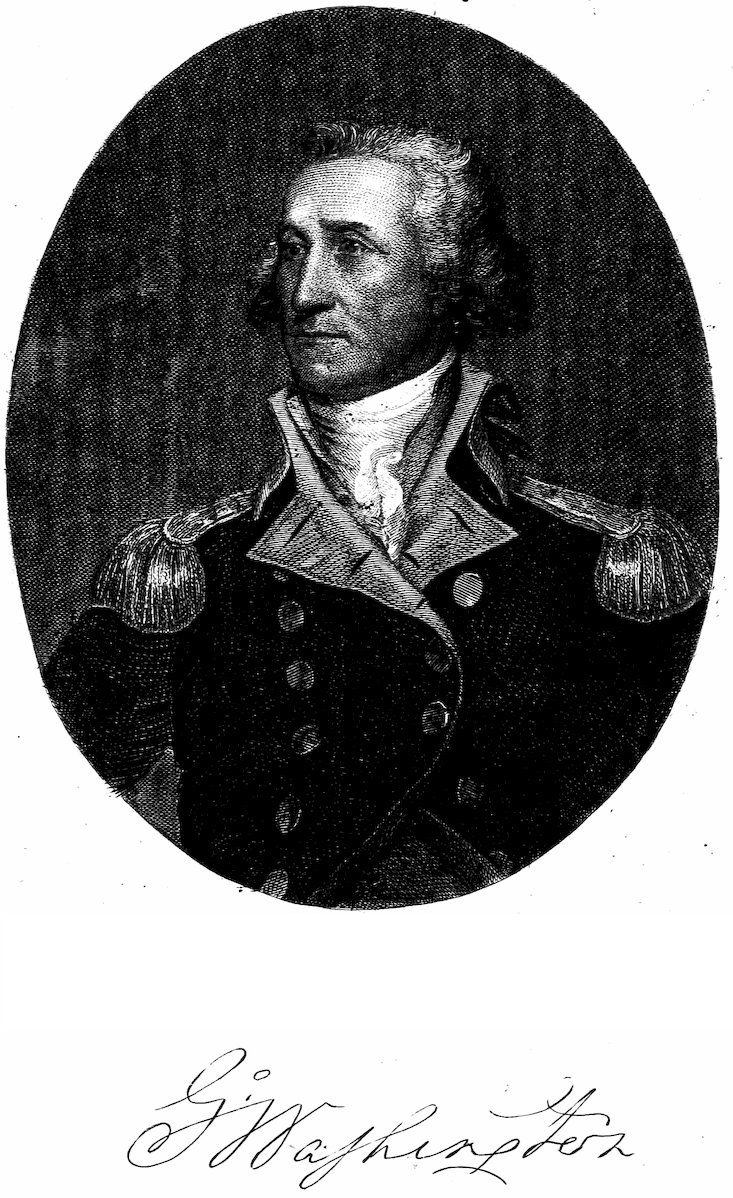
Col. John Trumbull.
(Engraved by the Anastatic process)
Title: Life of George Washington, volume 3 of 5
Author: Washington Irving
Release date: January 16, 2026 [eBook #77704]
Most recently updated: March 22, 2026
Language: English
Original publication: New York: G. P. Putnam, 1855
Other information and formats: www.gutenberg.org/ebooks/77704
Credits: Richard Tonsing, Emmanuel Ackerman and the Online Distributed Proofreading Team at https://www.pgdp.net (This file was produced from images generously made available by The Internet Archive)
Transcriber’s Note:
New original cover art included with this eBook is granted to the public domain.
Col. John Trumbull.
(Engraved by the Anastatic process)
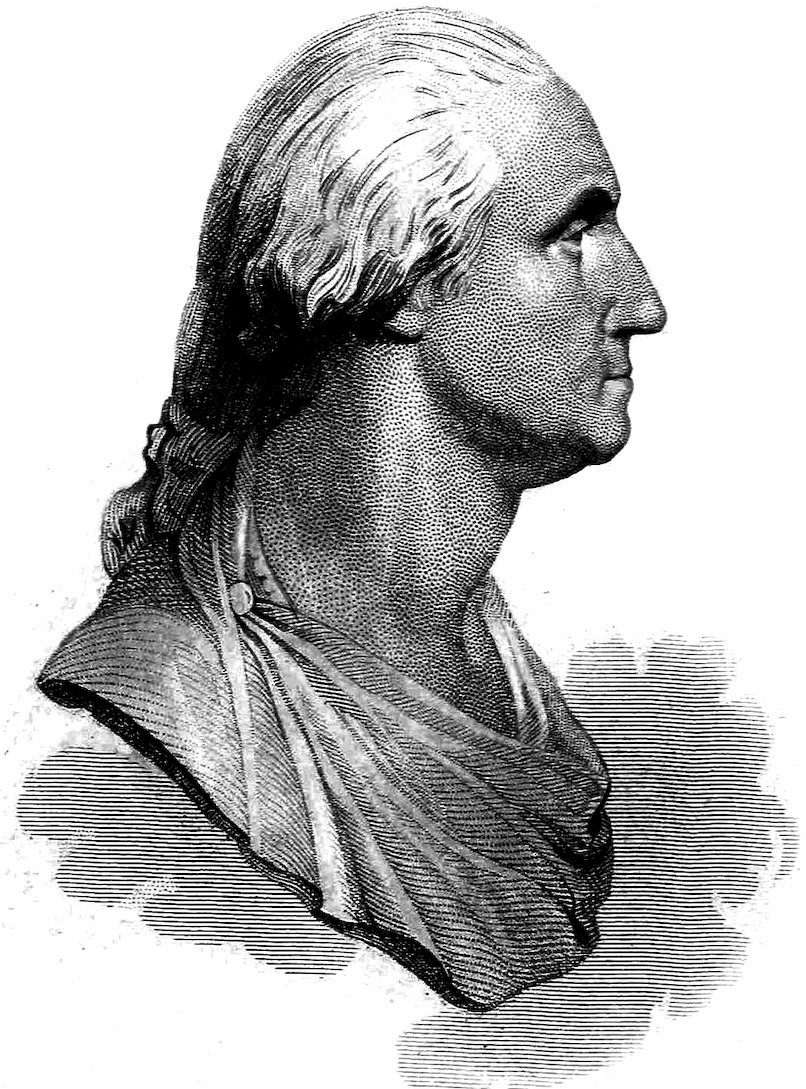
From Houdon’s Bust.
When the Author commenced the publication of this work, he informed his Publishers that he should probably complete it in three volumes. What he gave as a probability, they understood as a certainty, and worded their advertisements accordingly. His theme has unexpectedly expanded under his pen, and he now lays his third volume before the public, with his task yet unaccomplished. He hopes this may not cause unpleasant disappointment. To present a familiar and truthful picture of the Revolution and the personages concerned in it, required much detail and copious citations, that the scenes might be placed in a proper light, and the characters introduced might speak for themselves, and have space in which to play their parts.
The kindness with which the first two volumes have been received, has encouraged the author to pursue the plan he had adopted, and inspires the hope that the public good-will which has cheered him through so long a period of devious authorship, will continue with him to the approaching close of his career.
Sunnyside, June, 1856.
| CHAPTER I. | |
| PAGE | |
|---|---|
| Burke on the State of Affairs in America—New Jersey Roused to Arms—Washington grants Safe Conduct to Hessian Convoys—Encampment at Morristown—Putnam at Princeton—His Stratagem to Conceal the Weakness of his Camp—Exploit of General Dickinson near Somerset Court House—Washington’s Counter Proclamation—Prevalence of the Small-pox—Inoculation of the Army—Contrast of the British and American Commanders and their Camps, | 1 |
| CHAPTER II. | |
| Negotiations for Exchange of Prisoners—Case of Colonel Ethan Allen—Of General Lee—Correspondence of Washington with Sir William Howe about Exchanges of Prisoners—Referees Appointed—Letters of Lee from New York—Case of Colonel Campbell—Washington’s Advice to Congress on the Subject of Retaliation—His Correspondence with Lord Howe about the Treatment of Prisoners—The Horrors of the Jersey Prison-Ship and the Sugar House, | 11 |
| CHAPTER III. | |
| Exertions to Form a New Army—Calls on the Different States—Insufficiency of the Militia—Washington’s Care for the Yeomanry—Dangers in the Northern Department—Winter Attack on Ticonderoga Apprehended—Exertions to Reinforce Schuyler—Precarious State of Washington’s Army—Conjectures as to the Designs of the Enemy—Expedition of the British against Peekskill, | 24 |
| CHAPTER IV. | |
| Schuyler’s Affairs in the Northern Department—Misunderstandings with Congress—Gives offence by a Reproachful Letter—Office of Adjutant-General offered to Gates—Declined by him—Schuyler Reprimanded by Congress for his Reproachful Letter—Gates Appointed to the Command at Ticonderoga—Schuyler considers himself Virtually Suspended—Takes his Seat as a Delegate to Congress, and Claims a Court of Inquiry—Has Command at Philadelphia, | 31 |
| viii | |
| CHAPTER V. | |
| Foreign Officers Candidates for Situations in the Army—Difficulties in Adjusting Questions of Rank—Ducoudray—Conway—Kosciuszko—Washington’s Guards—Arnold Omitted in the Army Promotions—Washington takes his part—British Expedition against Danbury—Destruction of American Stores—Connecticut Yeomanry in Arms—Skirmish at Ridgefield—Death of General Wooster—Gallant Services of Arnold—Rewarded by Congress—Exploit of Colonel Meigs at Sag Harbor, | 40 |
| CHAPTER VI. | |
| Schuyler on the Point of Resigning—Committee of Inquiry Report in his Favor—His Memorial to Congress proves Satisfactory—Discussions Regarding the Northern Department—Gates Mistaken as to his Position—He Prompts his Friends in Congress—His Petulant Letter to Washington—Dignified Reply of the Latter—Position of Gates Defined—Schuyler Reinstated in Command of the Department—Gates Appears on the Floor of Congress—His Proceedings there, | 54 |
| CHAPTER VII. | |
| The Highland Passes of the Hudson—George Clinton in Command of the Forts—His Measures for Defence—Generals Greene and Knox examine the State of the Forts—Their Report—The General Command of the Hudson offered to Arnold—Declined by Him—Given to Putnam—Appointment of Dr. Craik in the Medical Department—Expedition Planned against Fort Independence—But Relinquished—Washington Shifts his Camp to Middlebrook—State of his Army—General Howe Crosses into the Jerseys—Position of the two Armies at Middlebrook and behind the Raritan—Correspondence between Washington and Colonel Reed, | 64 |
| CHAPTER VIII. | |
| Feigned Movements of Sir William Howe—Baffling Caution of Washington—Rumored Inroads from the North—Schuyler applies for Reinforcements—Renewed schemes of Howe to draw Washington from his Stronghold—Skirmish between Cornwallis and Lord Stirling—The Enemy Evacuate the Jerseys—Perplexity as to their next Movement—A Hostile Fleet on Lake Champlain—Burgoyne approaching Ticonderoga—Speculations of Washington—His Purpose of keeping Sir William Howe from ascending the Hudson—Orders George Clinton to call out Militia from Ulster and Orange Counties—Sends Sullivan towards the Highlands—Moves his own Camp back to Morristown—Stir among the Shipping—Their Destination surmised to be Philadelphia—A Dinner at Head-Quarters—Alexander Hamilton—Graydon’s Rueful Description of the Army—His Character of Wayne, | 76 |
| CHAPTER IX. | |
| ixBritish Invasion from Canada—The Plan—Composition of the Invading Army—Schuyler on the Alert—His Speculations as to the Enemy’s Designs—Burgoyne on Lake Champlain—His War-Speech to his Indian Allies—Signs of his Approach descried from Ticonderoga—Correspondence on the Subject between St. Clair, Major Livingston, and Schuyler—Burgoyne Intrenches near Ticonderoga—His Proclamation—Schuyler’s Exertions at Albany to forward Reinforcements—Hears that Ticonderoga is Evacuated—Mysterious Disappearance of St. Clair and his Troops—Amazement and Concern of Washington—Orders Reinforcements to Schuyler at Fort Edward, and to Putnam at Peekskill—Advances with his Main Army to the Clove—His Hopeful Spirit manifested, | 86 |
| CHAPTER X. | |
| Particulars of the Evacuation—Indian Scouts in the vicinity of the Fort—Outposts abandoned by St. Clair—Burgoyne secures Mount Hope—Invests the Fortress—Seizes and Occupies Sugar Hill—The Forts overlooked and in Imminent Peril—Determination to Evacuate—Plan of Retreat—Part of the Garrison depart for Skenesborough in the Flotilla—St. Clair crosses with the rest to Fort Independence—A Conflagration Reveals his Retreat—The British Camp aroused—Fraser Pursues St. Clair—Burgoyne with his Squadron makes after the Flotilla—Part of the Fugitives overtaken—Flight of the Remainder to Fort Anne—Skirmish of Colonel Long—Retreat to Fort Edward—St. Clair at Castleton—Attack of his Rear-Guard—Fall of Colonel Francis—Desertion of Colonel Hale—St. Clair reaches Fort Edward—Consternation of the Country—Exultation of the British, | 100 |
| CHAPTER XI. | |
| Capture of General Prescott—Proffered in Exchange for Lee—Reinforcements to Schuyler—Arnold sent to the North—Eastern Militia to repair to Saratoga—Further Reinforcements—Generals Lincoln and Arnold recommended for Particular Services—Washington’s Measures and Suggestions for the Northern Campaign—British Fleet puts to Sea—Conjectures as to its Destination—A Feigned Letter—Appearance and Disappearance of the Fleet—Orders and Counter Orders of Washington—Encamps at Germantown—Anxiety for the Security of the Highlands—George Clinton on Guard—Call on Connecticut, | 112 |
| CHAPTER XII. | |
| Gates on the Alert for a Command—Schuyler Undermined in Congress—Put on his Guard—Courts a Scrutiny, but not before an expected Engagement—Summoned with St. Clair to Head-Quarters—Gates appointed to the Northern Department—Washington’s Speculations on the Successes of Burgoyne—Ill-judged Meddlings of Congress with the Commissariat—Colonel Trumbull Resigns in consequence, | 123 |
| CHAPTER XIII. | |
| Washington’s Perplexities about the British Fleet—Putnam and Governor Clinton put on the Alert in the Highlands—Morgan and his Riflemen sent to the North—Washington at Philadelphia—His first Interview with Lafayette—Intelligence about the Fleet—Explanations of its Movements—Review of the Army—Lafayette Mistakes the nature of his Commission—His Alliance with Washington—March of the Army through Philadelphia—Encampment at Wilmington, | 130 |
| x | |
| CHAPTER XIV. | |
| Burgoyne at Skenesborough—Prepares to Move towards the Hudson—Major Skene the Royalist—Slow March to Fort Anne—Schuyler at Fort Miller—Painted Warriors—Langdale—St. Luc—Honor of the Tomahawk—Tragical Story of Miss McCrea—Its Results—Burgoyne Advances to Fort Edward—Schuyler at Stillwater—Joined by Lincoln—Burgoyne deserted by his Indian Allies, | 140 |
| CHAPTER XV. | |
| Difficulties of Burgoyne—Plans an Expedition to Bennington—St. Leger before Fort Stanwix—General Herkimer at Oriskany—High Words with his Officers—A Dogged March—An Ambuscade—Battle of Oriskany—Johnson’s Greens—Death of Herkimer—Spirited Sortie of Colonel Willett—Sir John Johnson driven to the River—Flight of the Indians—Sacking of Sir John’s Camp—Colonel Gansevoort maintains his Post—Colonel Willett sent in quest of Aid—Arrives at Schuyler’s Camp, | 148 |
| CHAPTER XVI. | |
| Schuyler hears of the Affair of Oriskany—Applies for Reinforcements—His Appeal to the Patriotism of Stark—Schuyler Superseded—His Conduct thereupon—Relief sent to Fort Stanwix—Arnold Volunteers to conduct it—Change of Encampment—Patriotic Determination of Schuyler—Detachment of the Enemy against Bennington—Germans and their Indian Allies—Baum, the Hessian Leader—Stark in the Field—Mustering of the Militia—A Belligerent Parson—Battle of Bennington—Breyman to the Rescue—Routed—Reception of the News in the Rival Camps—Washington urges New England to follow up the Blow, | 158 |
| CHAPTER XVII. | |
| Stratagem of Arnold to relieve Fort Stanwix—Yan Yost Cuyler—The Siege Pressed—Indians Intractable—Success of Arnold’s Stratagem—Harassed Retreat of St. Leger—Moral Effect of the two Blows given to the Enemy—Brightening Prospects in the American Camp—Arrival of Gates—Magnanimous Conduct of Schuyler—Poorly requited by Gates—Correspondence between Gates and Burgoyne concerning the Murder of Miss McCrea, | 171 |
| CHAPTER XVIII. | |
| Landing of Howe’s Army on Elk River—Measures to Check it—Exposed Situation of Washington in Reconnoitring—Alarm of the Country—Proclamation of Howe—Arrival of Sullivan—Foreign Officers in Camp—Deborre—Conway—Fleury—Count Pulaski—First Appearance in the Army of “Light-Horse Harry” of Virginia—Washington’s Appeal to the Army—Movements of the Rival Forces—Battle of the Brandywine—Retreat of the Americans—Halt in Chester—Scenes in Philadelphia during the Battle—Congress Orders out Militia—Clothes Washington with Extraordinary Powers—Removes to Lancaster—Rewards to Foreign Officers, | 179 |
| xi | |
| CHAPTER XIX. | |
| General Howe neglects to pursue his Advantage—Washington Retreats to Germantown—Recrosses the Schuylkill and prepares for another Action—Prevented by Storms of Rain—Retreats to French Creek—Wayne detached to Fall on the Enemy’s Rear—His Pickets Surprised—Massacre of Smallwood’s Men—Manœuvres of Howe on the Schuylkill—Washington sends for Reinforcements—Howe marches into Philadelphia, | 197 |
| CHAPTER XX. | |
| Dubious Position of Burgoyne—Collects his Forces—Ladies of Distinction in his Camp—Lady Harriet Ackland—The Baroness de Riedesel—American Army reinforced—Silent Movements of Burgoyne—Watched from the Summit of the Hills—His March along the Hudson—Position of the two Camps—Battle on the 19th Sept.—Burgoyne Encamps nearer—Fortifies his Camp—Promised Co-operation by Sir Henry Clinton—Determines to await it—Quarrel between Gates and Arnold—Arnold deprived of Command—Burgoyne waits for Co-operation, | 205 |
| CHAPTER XXI. | |
| Preparations of Sir Henry Clinton—State of the Highland Defences—Putnam Alarmed—Advance of the Armament up the Hudson—Plan of Sir Henry Clinton—Peekskill Threatened—Putnam Deceived—Secret March of the Enemy through the Mountains—Forts Montgomery and Clinton Overpowered—Narrow Escape of the Commanders—Conflagration and Explosion of the American Frigates—Rallying Efforts of Putnam and Governor Clinton—The Spy and the Silver Bullet—Esopus Burnt—Ravaging Progress of the Enemy up the Hudson, | 221 |
| CHAPTER XXII. | |
| Scarcity in the British Camp—Gates bides his Time—Foraging Movement of Burgoyne—Battle of the 7th October—Rout of the British and Hessians—Situation of the Baroness Riedesel and Lady Harriet Ackland during the Battle—Death of Gen. Fraser—His Funeral—Night Retreat of the British—Expedition of Lady Harriet Ackland—Desperate Situation of Burgoyne at Saratoga—Capitulation—Surrender—Conduct of the American Troops—Scenes in the Camp—Gallant Courtesy of Schuyler to the Baroness Riedesel—His Magnanimous Conduct towards Burgoyne—Return of the British Ships down the Hudson, | 234 |
| CHAPTER XXIII. | |
| Washington Advances to Skippack Creek—The British Fleet in the Delaware—Forts and Obstructions in the River—Washington Meditates an Attack on the British Camp—Battle of Germantown, | 258 |
| CHAPTER XXIV. | |
| Washington at White Marsh—Measures to cut off the Enemy’s Supplies—The Forts on the Delaware Reinforced—Colonel Greene of Rhode Island at Fort Mercer—Attack and Defence of that Fort—Death of Count Donop, | 269 |
| xii | |
| CHAPTER XXV. | |
| De Kalb Commissioned Major-General—Pretensions of Conway—Thwarted by Washington—Conway Cabal—Gates remiss in Correspondence—Dilatory in Forwarding Troops—Mission of Hamilton to Gates—Wilkinson Bearer of Despatches to Congress—A Tardy Traveller—His Reward—Conway Correspondence Detected—Washington’s Apology for his Army, | 271 |
| CHAPTER XXVI. | |
| Further Hostilities on the Delaware—Fort Mifflin Attacked—Bravely Defended—Reduced—Mission of Hamilton to Gates—Visits the Camps of Governor Clinton and Putnam on the Hudson—Putnam on his Hobby-Horse—Difficulties in procuring Reinforcements—Intrigues of the Cabal—Letters of Lovell and Mifflin to Gates—The Works at Red Rank Destroyed—The Enemy in Possession of the Delaware, | 284 |
| CHAPTER XXVII. | |
| Question of an Attack on Philadelphia—General Reed at Head-Quarters—Enemy’s Works Reconnoitred—Opinions in a Council of War—Exploit of Lafayette—Receives Command of a Division—Modification of the Board of War—Gates to Preside—Letter of Lovell—Sally Forth of General Howe—Evolutions and Skirmishes—Conway Inspector-general—Consultation about Winter-Quarters—Dreary March to Valley Forge—Hutting—Washington’s Vindicatory Letters—Retrospect of the Year, | 296 |
| CHAPTER XXVIII. | |
| Gates on the Ascendant—The Conway Letter—Suspicions—Consequent Correspondence between Gates and Washington—Warning Letter from Dr. Craik—Anonymous Letters—Projected Expedition to Canada—Lafayette, Gates, and the Board of War, | 315 |
| CHAPTER XXIX. | |
| Gates undertakes to explain the Conway Correspondence—Washington’s Searching Analysis of the Explanation—Close of the Correspondence—Spurious Letters Published—Lafayette and the Canada Expedition—His Perplexities—Counsels of Washington, | 326 |
| CHAPTER XXX. | |
| More Trouble about the Conway Letter—Correspondence between Lord Stirling and Wilkinson—Wilkinson’s Honor Wounded—His Passage at Arms with General Gates—His Seat at the Board of War uncomfortable—Determines that Lord Stirling shall Bleed—His Wounded Honor Healed—His Interviews with Washington—Sees the Correspondence of Gates—Denounces Gates and gives up the Secretaryship—Is thrown out of Employ—Closing Remarks on the Conway Cabal, | 337 |
| xiii | |
| CHAPTER XXXI. | |
| Committee of Arrangement—Reforms in the Army—Scarcity in the Camp—The Enemy revel in Philadelphia—Attempt to Surprise Light-Horse Harry—His Gallant Defence—Praised by Washington—Promoted—Letter from General Lee—Burgoyne returns to England—Mrs. Washington at Valley Forge—Bryan Fairfax visits the Camp—Arrival of the Baron Steuben—His Character—Disciplines the Army—Greene made Quartermaster-general, | 347 |
| CHAPTER XXXII. | |
| Fortifications of the Hudson—Project to Surprise Sir Henry Clinton—General Howe Forages the Jerseys—Ships and Stores Burnt at Bordentown—Plans for the Next Campaign—Gates and Mifflin under Washington’s Command—Downfall of Conway—Lord North’s Conciliatory Bills—Sent to Washington by Governor Tryon—Resolves of Congress—Letter of Washington to Tryon—Rejoicing at Valley Forge—The Mischianza, | 362 |
| CHAPTER XXXIII. | |
| Lafayette Detached to keep Watch on Philadelphia—His Position at Barren Hill—Plan of Sir Henry to Entrap him—Washington Alarmed for his Safety—Stratagem of the Marquis—Exchange of General Lee and Colonel Ethan Allen—Allen at Valley Forge—Washington’s Opinion of him—Preparations in Philadelphia to Evacuate—Washington’s Measures in consequence—Arrival of Commissioners from England—Their Disappointment—Their Proceedings—Their Failure—Their Manifesto, | 375 |
| CHAPTER XXXIV. | |
| Preparations to Evacuate Philadelphia—Washington calls a Council of War—Lee Opposed to any Attack—Philadelphia Evacuated—Movements in pursuit of Sir Henry Clinton—Another Council of War—Conflict of Opinions—Contradictory Conduct of Lee respecting the Command—The Battle of Monmouth Court House—Subsequent March of the Armies, | 385 |
| CHAPTER XXXV. | |
| Correspondence between Lee and Washington relative to the Affair of Monmouth—Lee asks a Trial by Court-Martial—The Verdict—Lee’s Subsequent History, | 404 |
| CHAPTER XXXVI. | |
| Arrival of a French Fleet—Correspondence of Washington and the Count D’Estaing—Plans of the Count—Perturbation at New York—Excitement in the French Fleet—Expedition against Rhode Island—Operations by Sea and Land—Failure of the Expedition—Irritation between the Allied Forces—Considerate Letter of Washington to the Count D’Estaing, | 415 |
| xiv | |
| CHAPTER XXXVII. | |
| Indian Warfare—Desolation of the Valley of Wyoming—Movements in New York—Counter Movements of Washington—Foraging Parties of the Enemy—Baylor’s Dragoons Massacred at Old Tappan—British Expedition against Little Egg Harbor—Massacre of Pulaski’s Infantry—Retaliation on Donop’s Rangers—Arrival of Admiral Byron—Endeavors to Entrap D’Estaing, but is Disappointed—Expedition against St. Lucia—Expedition against Georgia—Capture of Savannah—Georgia Subdued—General Lincoln sent to Command in the South, | 432 |
| CHAPTER XXXVIII. | |
| Winter Cantonments of the American Army—Washington at Middlebrook—Plan of Alarm Signals for the Jerseys—Lafayette’s Project for an Invasion of Canada—Favored by Congress—Condemned by Washington—Relinquished—Washington in Philadelphia—The War Spirit Declining—Dissensions in Congress—Sectional Feelings—Patriotic Appeals of Washington—Plans for the Next Campaign—Indian Atrocities to be Repressed—Avenging Expedition set on foot—Discontents of the Jersey Troops—Appeased by the Interference of Washington—Successful Campaign against the Indians, | 445 |
| CHAPTER XXXIX. | |
| Predatory Warfare of the Enemy—Ravages in the Chesapeake—Hostilities on the Hudson—Verplanck’s Point and Stony Point Taken—Capture of New Haven—Fairfield and Norwalk Destroyed—Washington Plans a Counter Stroke—Storming of Stony Point—Generous Letter of Lee, | 458 |
| CHAPTER XL. | |
| Expedition against Penobscot—Night Surprisal of Paulus Hook—Washington Fortifies West Point—His Style of Living there—Table at Head-Quarters—Sir Henry Clinton Reinforced—Arrival of D’Estaing on the Coast of Georgia—Plans in Consequence—The French Minister at Washington’s Highland Camp—Letter to Lafayette—D’Estaing Co-operates with Lincoln—Repulsed at Savannah—Washington Reinforces Lincoln—Goes into Winter-Quarters—Sir Henry Clinton sends an Expedition to the South, | 471 |
BURKE ON THE STATE OF AFFAIRS IN AMERICA—NEW JERSEY ROUSED TO ARMS—WASHINGTON GRANTS SAFE CONDUCT TO HESSIAN CONVOYS—ENCAMPMENT AT MORRISTOWN—PUTNAM AT PRINCETON—HIS STRATAGEM TO CONCEAL THE WEAKNESS OF HIS CAMP—EXPLOIT OF GENERAL DICKINSON NEAR SOMERSET COURT HOUSE—WASHINGTON’S COUNTER PROCLAMATION—PREVALENCE OF THE SMALL-POX—INOCULATION OF THE ARMY—CONTRAST OF THE BRITISH AND AMERICAN COMMANDERS AND THEIR CAMPS.
The news of Washington’s recrossing the Delaware, and of his subsequent achievements in the Jerseys, had not reached London on the 9th of January. “The affairs of America seem to be drawing to a crisis,” writes Edmund Burke. “The Howes are at this time in possession of, or able to awe the whole middle coast of America, from Delaware to the western boundary of Massachusetts Bay; the naval barrier on the side of Canada is broken. A great tract is open for the supply of the troops; the river Hudson opens a way into the heart of the provinces, and nothing can, in all probability, prevent an early and offensive 2campaign. What the Americans have done is, in their circumstances, truly astonishing; it is indeed infinitely more than I expected from them. But, having done so much for some short time, I began to entertain an opinion that they might do more. It is now, however, evident that they cannot look standing armies in the face. They are inferior in every thing—even in numbers. There seem by the best accounts not to be above ten or twelve thousand men at most in their grand army. The rest are militia, and not wonderfully well composed or disciplined. They decline a general engagement; prudently enough, if their object had been to make the war attend upon a treaty of good terms of subjection; but when they look further, this will not do. An army that is obliged at all times, and in all situations, to decline an engagement, may delay their ruin, but can never defend their country.”[1]
At the time when this was written, the Howes had learnt to their mortification, that “the mere running through a province, is not subduing it.” The British commanders had been outgeneralled, attacked and defeated. They had nearly been driven out of the Jerseys, and were now hemmed in and held in check by Washington and his handful of men castled among the heights of Morristown. So far from holding possession of the territory they had so recently overrun, they were fain to ask safe conduct across it for a convoy to their soldiers captured in battle. It must have been a severe trial to the pride of Cornwallis, when he had to inquire by letter of Washington, whether money and stores could be sent to the Hessians captured at Trenton, and a surgeon and medicines to the wounded at Princeton; and Washington’s reply must have conveyed a reproof still more mortifying: 3No molestation, he assured his lordship, would be offered to the convoy by any part of the regular army under his command; but “he could not answer for the militia, who were resorting to arms in most parts of the State, and were excessively exasperated at the treatment they had met with from both Hessian and British troops.”
In fact, the conduct of the enemy had roused the whole country against them. The proclamations and printed protections of the British commanders, on the faith of which the inhabitants in general had staid at home, and forbore to take up arms, had proved of no avail. The Hessians could not or would not understand them, but plundered friend and foe alike.[2] The British soldiery often followed their example, and the plunderings of both were at times attended by those brutal outrages on the weaker sex, which inflame the dullest spirits to revenge. The whole State was thus roused against its invaders. In Washington’s retreat of more than a hundred miles through the Jerseys, he had never been joined by more than one hundred of its inhabitants; now sufferers of both parties rose as one man to avenge their personal injuries. The late quiet yeomanry armed themselves, and scoured the country in small parties to seize on stragglers, and the militia began to signalize themselves in voluntary skirmishes with regular troops.
In effect, Washington ordered a safe conduct to be given to the Hessian baggage as far as Philadelphia, and to the surgeon and medicines to Princeton, and permitted a Hessian sergeant 4and twelve men, unarmed, to attend the baggage until it was delivered to their countrymen.
Morristown, where the main army was encamped, had not been chosen by Washington as a permanent post, but merely as a halting place, where his troops might repose after their excessive fatigues and their sufferings from the inclement season. Further considerations persuaded him that it was well situated for the system of petty warfare which he meditated, and induced him to remain there. It was protected by forests and rugged heights. All approach from the seaboard was rendered difficult and dangerous to a hostile force by a chain of sharp hills, extending from Pluckamin, by Boundbrook and Springfield, to the vicinity of the Passaic River, while various defiles in the rear afforded safer retreats into a fertile and well peopled region.[3] It was nearly equidistant from Amboy, Newark, and Brunswick, the principal posts of the enemy; so that any movement made from them could be met by a counter movement on his part; while the forays and skirmishes by which he might harass them, would school and season his own troops. He had three faithful generals with him: Greene, his reliance on all occasions; swarthy Sullivan, whose excitable temper and quick sensibilities he had sometimes to keep in check by friendly counsels and rebukes, but who was a good officer, and loyally attached to him; and brave, genial, generous Knox, never so happy as when by his side. He had lately been advanced to the rank of brigadier at his recommendation, and commanded the artillery.
Washington’s military family at this time was composed of his aides-de-camp, Colonels Meade and Tench Tilghman of Philadelphia; gentlemen of gallant spirit, amiable tempers and cultivated 5manners; and his secretary, Colonel Robert H. Harrison of Maryland; the “old secretary,” as he was familiarly called among his associates, and by whom he was described as “one in whom every man had confidence, and by whom no man was deceived.”
Washington’s head-quarters at first were in what was called the Freemason’s Tavern, on the north side of the village green. His troops were encamped about the vicinity of the village, at first in tents, until they could build log huts for shelter against the winter’s cold. The main encampment was near Bottle Hill, in a sheltered valley which was thickly wooded, and had abundant springs. It extended south-easterly from Morristown; and was called the Lowantica Valley, from the Indian name of a beautiful limpid brook which ran through it, and lost itself in a great swamp.[4]
The enemy being now concentrated at New Brunswick and Amboy, General Putnam was ordered by Washington to move from Crosswicks to Princeton, with the troops under his command. He was instructed to draw his forage as much as possible from the neighborhood of Brunswick, about eighteen miles off, thereby contributing to distress the enemy; to have good scouting parties continually on the look-out; to keep nothing with him but what could be moved off at a moment’s warning, and, if compelled to leave Princeton, to retreat towards the mountains, so as to form a junction with the forces at Morristown.
Putnam had with him but a few hundred men. “You will give out your strength to be twice as great as it is,” writes Washington; a common expedient with him in those times of scanty 6means. Putnam acted up to the advice. A British officer, Captain Macpherson, was lying desperately wounded at Princeton, and Putnam, in the kindness of his heart, was induced to send in a flag to Brunswick in quest of a friend and military comrade of the dying man, to attend him in his last moments and make his will. To prevent the weakness of the garrison from being discovered, the visitor was brought in after dark. Lights gleamed in all the college windows, and in the vacant houses about the town; the handful of troops capable of duty were marched hither and thither and backward and forward, and paraded about to such effect, that the visitor on his return to the British camp, reported the force under the old general to be at least five thousand strong.[5]
Cantonments were gradually formed between Princeton and the Highlands of the Hudson, which made the left flank of Washington’s position, and where General Heath had command. General Philemon Dickinson, who commanded the New Jersey militia, was stationed on the west side of Millstone River, near Somerset court house, one of the nearest posts to the enemy’s camp at Brunswick. A British foraging party, of five or six hundred strong, sent out by Cornwallis with forty waggons and upward of a hundred draught horses, mostly of the English breed, having collected sheep and cattle about the country, were sacking a mill on the opposite side of the river, where a large quantity of flour was deposited. While thus employed, Dickinson set upon them with a force equal in number, but composed of raw militia and fifty Philadelphia riflemen. He dashed through the river, waist deep, with his men, and charged the enemy so suddenly and vigorously, that, though supported by three field-pieces, 7they gave way, left their convoy, and retreated so precipitately, that he made only nine prisoners. A number of killed and wounded were carried off by the fugitives on light waggons.[6]
These exploits of the militia were noticed with high encomiums by Washington, while at the same time he was rigid in prohibiting and punishing the excesses into which men are apt to run when suddenly clothed with military power. Such is the spirit of a general order issued at this time. “The general prohibits, in both the militia and Continental troops, the infamous practice of plundering the inhabitants under the specious pretence of their being tories. * * * It is our business to give protection and support to the poor distressed inhabitants, not to multiply and increase their calamities.” After the publication of this order, all excesses of this kind were to be punished in the severest manner.
To counteract the proclamation of the British commissioners, promising amnesty to all in rebellion who should, in a given time, return to their allegiance, Washington now issued a counter proclamation (Jan. 25th), commanding every person who had subscribed a declaration of fidelity to Great Britain, or taken an oath of allegiance, to repair within thirty days to head-quarters, or the quarters of the nearest general officer of the Continental army or of the militia, and there take the oath of allegiance to the United States of America, and give up any protection, certificate, or passport he might have received from the enemy; at the same time granting full liberty to all such as preferred the interest and protection of Great Britain to the freedom and happiness of their country, forthwith to withdraw themselves and families within the enemy’s lines. All who should neglect or 8refuse to comply with this order were to be considered adherents to the crown, and treated as common enemies.
This measure met with objections at the time, some of the timid or over-cautious thinking it inexpedient; others, jealous of the extraordinary powers vested in Washington, questioning whether he had not transcended these powers and exercised a degree of despotism.
The small-pox, which had been fatally prevalent in the preceding year, had again broken out, and Washington feared it might spread through the whole army. He took advantage of the interval of comparative quiet to have his troops inoculated. Houses were set apart in various places as hospitals for inoculation, and a church was appropriated for the use of those who had taken the malady in the natural way. Among these the ravages were frightful. The traditions of the place and neighborhood, give lamentable pictures of the distress caused by this loathsome disease in the camp and in the villages, wherever it had not been parried by inoculation.
“Washington,” we are told, “was not an unmoved spectator of the griefs around him, and might be seen in Hanover and in Lowantica Valley, cheering the faith and inspiring the courage of his suffering men.”[7] It was this paternal care and sympathy which attached his troops personally to him. They saw that he regarded them, not with the eye of a general, but of a patriot, whose heart yearned towards them as countrymen suffering in one common cause.
A striking contrast was offered throughout the winter and spring, between the rival commanders, Howe at New York, and Washington at Morristown. Howe was a soldier by profession. 9War, with him, was a career. The camp was, for the time, country and home. Easy and indolent by nature, of convivial and luxurious habits, and somewhat addicted to gaming, he found himself in good quarters at New York, and was in no hurry to leave them. The tories rallied around him. The British merchants residing there regarded him with profound devotion. His officers, too, many of them young men of rank and fortune, gave a gayety and brilliancy to the place; and the wealthy royalists forgot in a round of dinners, balls and assemblies, the hysterical alarms they had once experienced under the military sway of Lee.
Washington, on the contrary, was a patriot soldier, grave, earnest, thoughtful, self-sacrificing. War, to him, was a painful remedy, hateful in itself, but adopted for a great national good. To the prosecution of it all his pleasures, his comforts, his natural inclinations and private interests were sacrificed; and his chosen officers were earnest and anxious like himself, with their whole thoughts directed to the success of the magnanimous struggle in which they were engaged.
So, too, the armies were contrasted. The British troops, many of them, perchance, slightly metamorphosed from vagabonds into soldiers, all mere men of the sword, were well clad, well housed, and surrounded by all the conveniences of a thoroughly appointed army with a “rebel country” to forage. The American troops for the most part were mere yeomanry, taken from their rural homes; ill sheltered, ill clad, ill fed, and ill paid, with nothing to reconcile them to their hardships but love for the soil they were defending, and the inspiring thought that it was their country. Washington, with paternal care, endeavored to protect them from the depraving influences of the camp. 10“Let vice and immorality of every kind be discouraged as much as possible in your brigade,” writes he in a circular to his brigadier-generals; “and, as a chaplain is allowed to each regiment, see that the men regularly attend divine worship. Gaming of every kind is expressly forbidden, as being the foundation of evil, and the cause of many a brave and gallant officer’s ruin.”
NEGOTIATIONS FOR EXCHANGE OF PRISONERS—CASE OF COLONEL ETHAN ALLEN—OF GENERAL LEE—CORRESPONDENCE OF WASHINGTON WITH SIR WILLIAM HOWE ABOUT EXCHANGES OF PRISONERS—REFEREES APPOINTED—LETTERS OF LEE FROM NEW YORK—CASE OF COLONEL CAMPBELL—WASHINGTON’S ADVICE TO CONGRESS ON THE SUBJECT OF RETALIATION—HIS CORRESPONDENCE WITH LORD HOWE ABOUT THE TREATMENT OF PRISONERS—THE HORRORS OF THE JERSEY PRISON-SHIP AND THE SUGAR HOUSE.
A cartel for the exchange of prisoners had been a subject of negotiation previous to the affair of Trenton, without being adjusted. The British commanders were slow to recognize the claims to equality of those they considered rebels; Washington was tenacious in holding them up as patriots ennobled by their cause.
Among the cases which came up for attention was that of Ethan Allen, the brave, but eccentric captor of Ticonderoga. His daring attempts in the “path of renown” had cost him a world of hardships. Thrown into irons as a felon; threatened with a halter; carried to England to be tried for treason; confined in Pendennis Castle; retransported to Halifax, and now a prisoner in New York. “I have suffered every thing short of death,” writes he to the Assembly of his native State, Connecticut. He had, however, recovered health and suppleness of limb, and with 12them all his swelling spirit and swelling rhetoric. “I am fired,” writes he, “with adequate indignation to revenge both my own and my country’s wrongs. I am experimentally certain I have fortitude sufficient to face the invaders of America in the place of danger, spread with all the horrors of war.” And he concludes with one of his magniloquent, but really sincere expressions of patriotism: “Provided you can hit upon some measure to procure my liberty, I will appropriate my remaining days, and freely hazard my life in the service of the colony, and maintaining the American Empire. I thought to have enrolled my name in the list of illustrious American heroes, but was nipped in the bud!”[8]
Honest Ethan Allen! his name will ever stand enrolled on that list; not illustrious, perhaps, but eminently popular.
His appeal to his native State had produced an appeal to Congress, and Washington had been instructed, considering his long imprisonment, to urge his exchange. This had scarce been urged, when tidings of the capture of General Lee presented a case of still greater importance to be provided for. “I feel much for his misfortune,” writes Washington, “and am sensible that in his captivity our country has lost a warm friend and an able officer.” By direction of Congress, he had sent in a flag to inquire about Lee’s treatment, and to convey him a sum of money. This was just previous to the second crossing of the Delaware.
Lee was now reported to be in rigorous confinement in New York, and treated with harshness and indignity. The British professed to consider him a deserter, he having been a lieutenant-colonel in their service, although he alleged that he had resigned his commission before joining the American army 13Two letters which he addressed to General Howe, were returned to him unopened, enclosed in a cover directed to Lieutenant-colonel Lee.
On the 13th of January, Washington addressed the following letter to Sir William Howe. “I am directed by Congress to propose an exchange of five of the Hessian field-officers taken at Trenton for Major-general Lee; or if this proposal should not be accepted, to demand his liberty upon parole, within certain bounds, as has ever been granted to your officers in our custody. I am informed, upon good authority, that your reason for keeping him hitherto in stricter confinement than usual is, that you do not look upon him in the light of a common prisoner of war, but as a deserter from the British service, as his resignation has never been accepted, and that you intend to try him as such by a court-martial. I will not undertake to determine how far this doctrine may be justifiable among yourselves, but I must give you warning that Major-general Lee is looked upon as an officer belonging to, and under the protection of the United Independent States of America, and that any violence you may commit upon his life and liberty, will be severely retaliated upon the lives or liberties of the British officers, or those of their foreign allies in our hands.”
In this letter he likewise adverted to the treatment of American prisoners in New York; several who had recently been released, having given the most shocking account of the barbarities they had experienced, “which their miserable, emaciated countenances confirmed.”—“I would beg,” added he, “that some certain rule of conduct towards prisoners may be settled; and, if you are determined to make captivity as distressing as possible, let me know it, that we may be upon equal terms, for your conduct shall regulate mine.”
14Sir William, in reply, proposed to send an officer of rank to Washington, to confer upon a mode of exchange and subsistence of prisoners. “This expedient,” observes he, “appearing to me effectual for settling all differences, will, I hope, be the means of preventing a repetition of the improper terms in which your letter is expressed and founded on the grossest misrepresentations. I shall not make any further comment upon it, than to assure you, that your threats of retaliating upon the innocent such punishment as may be decreed in the circumstances of Mr. Lee by the laws of his country, will not divert me from my duty in any respect; at the same time, you may rest satisfied that the proceedings against him will not be precipitated; and I trust that, in this, or in any other event in the course of my command, you will not have just cause to accuse me of inhumanity, prejudice, or passion.”
Sir William, in truth, was greatly perplexed with respect to Lee, and had written to England to Lord George Germaine for instructions in the case. “General Lee,” writes he, “being considered in the light of a deserter, is kept a close prisoner; but I do not bring him to trial, as a doubt has arisen, whether, by a public resignation of his half pay prior to his entry into the rebel army, he was amenable to the military law as a deserter.”
The proposal of Sir William, that all disputed points relative to the exchange and subsistence of prisoners, should be adjusted by referees, led to the appointment of two officers for the purpose; Colonel Walcott by General Howe, and Colonel Harrison, “the old secretary,” by Washington. In the contemplated exchanges was that of one of the Hessian field-officers for Colonel Ethan Allen.
The haughty spirit of Lee had experienced a severe humiliation 15in the late catastrophe; his pungent and caustic humor is at an end. In a letter addressed shortly afterwards to Washington, and enclosing one to Congress which Lord and General Howe had permitted him to send, he writes, “as the contents are of the last importance to me, and perhaps not less so to the community, I most earnestly entreat, my dear general, that you will despatch it immediately, and order the Congress to be as expeditious as possible.”
The letter contained a request that two or three gentlemen might be sent immediately to New York, to whom he would communicate what he conceived to be of the greatest importance. “If my own interests were alone at stake,” writes he, “I flatter myself that the Congress would not hesitate a single instant in acquiescing in my request; but this is far from the case; the interests of the public are equally concerned. * * Lord and General Howe will grant a safe conduct to the gentlemen deputed.”
The letter having been read in Congress, Washington was directed to inform General Lee that they were pursuing and would continue to pursue every means in their power to provide for his personal safety, and to obtain his liberty; but that they considered it improper to send any of their body to communicate with him, and could not perceive how it would tend to his advantage or the interest of the public.
Lee repeated his request, but with no better success. He felt this refusal deeply; as a brief, sad note to Washington indicates.
“It is a most unfortunate circumstance for myself, and I think not less so for the public, that Congress have not thought 16proper to comply with my request. It could not possibly have been attended with any ill consequences, and might with good ones. At least it was an indulgence which I thought my situation entitled me to. But I am unfortunate in every thing, and this stroke is the severest I have yet experienced. God send you a different fate. Adieu, my dear general.
“Yours most truly and affectionately,
How different from the humorous, satirical, self-confident tone of his former letters. Yet Lee’s actual treatment was not so harsh as had been represented. He was in close confinement, it is true; but three rooms had been fitted up for his reception in the Old City Hall of New York, having nothing of the look of a prison excepting that they were secured by bolts and bars.
Congress, in the mean time, had resorted to their threatened measure of retaliation. On the 20th of February, they had resolved that the Board of War be directed immediately to order the five Hessian field-officers and Lieutenant-colonel Campbell into safe and close custody, “it being the unalterable resolution of Congress to retaliate on them the same punishment as may be inflicted on the person of General Lee.”
The Colonel Campbell here mentioned had commanded one of General Fraser’s battalions of Highlanders, and had been captured on board of a transport in Nantasket road, in the preceding summer. He was a member of Parliament, and a gentleman of fortune. Retaliation was carried to excess in regard to him, for he was thrown into the common jail at Concord in Massachusetts.
From his prison he made an appeal to Washington, which at 17once touched his quick sense of justice. He immediately wrote to the council of Massachusetts Bay, quoting the words of the resolution of Congress. “By this you will observe,” adds he, “that exactly the same treatment is to be shown to Colonel Campbell and the Hessian officers, that General Howe shows to General Lee, and as he is only confined to a commodious house with genteel accommodations, we have no right or reason to be more severe on Colonel Campbell, who I would wish should upon the receipt of this be removed from his present situation, and be put into a house where he may live comfortably.”
In a letter to the President of Congress on the following day, he gives his moderating counsels on the whole subject of retaliation. “Though I sincerely commiserate,” writes he, “the misfortunes of General Lee, and feel much for his present unhappy situation, yet with all possible deference to the opinion of Congress, I fear that these resolutions will not have the desired effect, are founded on impolicy, and will, if adhered to, produce consequences of an extensive and melancholy nature.” * * *
“The balance of prisoners is greatly against us, and a general regard to the happiness of the whole should mark our conduct. Can we imagine that our enemies will not mete the same punishments, the same indignities, the same cruelties, to those belonging to us, in their possession, that we impose on theirs in our power? Why should we suppose them to possess more humanity than we have ourselves? Or why should an ineffectual attempt to relieve the distresses of one brave, unfortunate man, involve many more in the same calamities? * * * Suppose,” continues he, “the treatment prescribed for the Hessians should be pursued, will it not establish what the enemy have been aiming to effect by every artifice and the grossest misrepresentations, I mean an opinion of 18our enmity towards them, and of the cruel treatment they experience when they fall into our hands, a prejudice which we on our part have heretofore thought it politic to suppress, and to root out by every act of lenity and of kindness?”
“Many more objections,” added he, “might be subjoined, were they material. I shall only observe, that the present state of the army, if it deserves that name, will not authorize the language of retaliation, or the style of menace. This will be conceded by all who know that the whole of our force is weak and trifling, and composed of militia (very few regular troops excepted) whose service is on the eve of expiring.”
In a letter to Mr. Robert Morris also, he writes: “I wish, with all my heart, that Congress had gratified General Lee in his request. If not too late I wish they would do it still. I can see no possible evil that can result from it; some good, I think, might. The request to see a gentleman or two came from the general, not from the commissioners; there could have been no harm, therefore, in hearing what he had to say on any subject, especially as he had declared that his own personal interest was deeply concerned. The resolve to put in close confinement Lieutenant-colonel Campbell and the Hessian field-officers, in order to retaliate upon them General Lee’s punishment, is, in my opinion, injurious in every point of view, and must have been entered into without due attention to the consequences. * * * * * If the resolve of Congress respecting General Lee strikes you in the same point of view it has done me, I could wish you would signify as much to that body as I really think it fraught with every evil.”
Washington was not always successful in instilling his wise moderation into public councils. Congress adhered to their vindictive 19policy, merely directing that no other hardships should be inflicted on the captive officers, than such confinement as was necessary to carry their resolve into effect. As to their refusal to grant the request of Lee, Robert Morris surmised they were fearful of the injurious effect that might be produced in the court of France, should it be reported that members of Congress visited General Lee by permission of the British commissioners. There were other circumstances beside the treatment of General Lee, to produce this indignant sensibility on the part of Congress. Accounts were rife at this juncture, of the cruelties and indignities almost invariably experienced by American prisoners at New York; and an active correspondence on the subject was going on between Washington and the British commanders, at the same time with that regarding General Lee.
The captive Americans who had been in the naval service were said to be confined, officers and men, in prison-ships, which, from their loathsome condition, and the horrors and sufferings of all kinds experienced on board of them, had acquired the appellation of floating hells. Those who had been in the land service, were crowded into jails and dungeons like the vilest malefactors; and were represented as pining in cold, in filth, in hunger and nakedness.
“Our poor devoted soldiers,” writes an eye-witness, “were scantily supplied with provisions of bad quality, wretchedly clothed, and destitute of sufficient fuel, if indeed they had any. Disease was the inevitable consequence, and their prisons soon became hospitals. A fatal malady was generated, and the mortality, to every heart not steeled by the spirit of party, was truly deplorable.”[8] According to popular account, the prisoners 20confined on shipboard, and on shore, were perishing by hundreds.
A statement made by a Captain Gamble, recently confined on board of a prison-ship, had especially roused the ire of Congress, and by their directions had produced a letter from Washington to Lord Howe. “I am sorry,” writes he, “that I am under the disagreeable necessity of troubling your lordship with a letter, almost wholly on the subject of the cruel treatment which our officers and men in the naval department, who are unhappy enough to fall into your hands, receive on board the prison-ships in the harbor of New York.” After specifying the case of Captain Gamble, and adding a few particulars, he proceeds: “From the opinion I have ever been taught to entertain of your lordship’s humanity, I will not suppose that you are privy to proceedings of so cruel and unjustifiable a nature; and I hope, that, upon making the proper inquiry, you will have the matter so regulated, that the unhappy persons whose lot is captivity, may not in future have the miseries of cold, disease, and famine, added to their other misfortunes. You may call us rebels, and say that we deserve no better treatment; but remember, my lord, that, supposing us rebels, we still have feelings as keen and sensible as loyalists, and will, if forced to it, most assuredly retaliate upon those upon whom we look as the unjust invaders of our rights, liberties and properties. I should not have said thus much, but my injured countrymen have long called upon me to endeavor to obtain a redress of their grievances, and I should think myself as culpable as those who inflict such severities upon them, were I to continue silent,” &c.
Lord Howe, in reply (Jan. 17), expressed himself surprised at the matter and language of Washington’s letter, “so different 21from the liberal vein of sentiment he had been habituated to expect on every occasion of personal intercourse or correspondence with him.” He was surprised, too, that “the idle and unnatural report” of Captain Gamble, respecting the dead and dying, and the neglect of precautions against infection, should meet with any credit. “Attention to preserve the lives of these men,” writes he, “whom we esteem the misled subjects of the king, is a duty as binding on us, where we are able from circumstances to execute it with effect, as any you can plead for the interest you profess in their welfare.”
He denied that prisoners were ill treated in his particular department (the naval). They had been allowed the general liberty of the prison-ship, until a successful attempt of some to escape, had rendered it necessary to restrain the rest within such limits as left the commanding parts of the ship in possession of the guard. They had the same provisions in quality and quantity that were furnished to the seamen of his own ship. The want of cleanliness was the result of their own indolence and neglect. In regard to health, they had the constant attendance of an American surgeon, a fellow-prisoner; who was furnished with medicines from the king’s stores; and the visits of the physician of the fleet.
“As I abhor every imputation of wanton cruelty in multiplying the miseries of the wretched,” observes his lordship, “of treating them with needless severity, I have taken the trouble to state these several facts.”
In regard to the hint at retaliation, he leaves it to Washington to act therein as he should think fit; but adds he grandly, “the innocent at my disposal will not have any severities to apprehend from me on that account.”
22We have quoted this correspondence the more freely, because it is on a subject deeply worn into the American mind; and about which we have heard too many particulars, from childhood upwards, from persons of unquestionable veracity, who suffered in the cause, to permit us to doubt about the fact. The Jersey Prison-ship is proverbial in our revolutionary history; and the bones of the unfortunate patriots who perished on board, form a monument on the Long Island shore. The horrors of the Sugar House converted into a prison, are traditional in New York; and the brutal tyranny of Cunningham, the provost marshal, over men of worth confined in the common jail, for the sin of patriotism, has been handed down from generation to generation.
That Lord Howe and Sir William were ignorant of the extent of these atrocities we really believe, but it was their duty to be well informed. War is, at best, a cruel trade, that habituates those who follow it to regard the sufferings of others with indifference. There is not a doubt, too, that a feeling of contumely deprived the patriot prisoners of all sympathy in the early stages of the Revolution. They were regarded as criminals rather than captives. The stigma of rebels seemed to take from them all the indulgences, scanty and miserable as they are, usually granted to prisoners of war. The British officers looked down with haughty contempt upon the American officers, who had fallen into their hands. The British soldiery treated them with insolent scurrility. It seemed as if the very ties of consanguinity rendered their hostility more intolerant, for it was observed that American prisoners were better treated by the Hessians than by the British. It was not until our countrymen had made themselves formidable by their successes that they were treated, when prisoners, with common decency and humanity.
23The difficulties arising out of the case of General Lee interrupted the operations with regard to the exchange of prisoners; and gallant men, on both sides, suffered prolonged detention in consequence; and among the number the brave, but ill-starred Ethan Allen.
Lee, in the mean time, remained in confinement, until directions with regard to him should be received from government. Events, however, had diminished his importance in the eyes of the enemy; he was no longer considered the American palladium. “As the capture of the Hessians and the manœuvres against the British took place after the surprise of General Lee,” observes a London writer of the day, “we find that he is not the only efficient officer in the American service.”[9]
EXERTIONS TO FORM A NEW ARMY—CALLS ON THE DIFFERENT STATES—INSUFFICIENCY OF THE MILITIA—WASHINGTON’S CARE FOR THE YEOMANRY—DANGERS IN THE NORTHERN DEPARTMENT—WINTER ATTACK ON TICONDEROGA APPREHENDED—EXERTIONS TO REINFORCE SCHUYLER—PRECARIOUS STATE OF WASHINGTON’S ARMY—CONJECTURES AS TO THE DESIGNS OF THE ENEMY—EXPEDITION OF THE BRITISH AGAINST PEEKSKILL.
The early part of the year brought the annual embarrassments caused by short enlistments. The brief terms of service for which the Continental soldiery had enlisted, a few months perhaps, at most a year, were expiring; and the men, glad to be released from camp duty, were hastening to their rustic homes. Militia had to be the dependence until a new army could be raised and organized; and Washington called on the council of safety of Pennsylvania, speedily to furnish temporary reinforcements of the kind.
All his officers that could be spared were ordered away, some to recruit, some to collect the scattered men of the different regiments, who were dispersed, he said, almost over the continent. General Knox was sent off to Massachusetts to expedite the raising of a battalion of artillery. Different States were urged to levy and equip their quotas for the Continental army. “Nothing but the 25united efforts of every State in America,” writes he, “can save us from disgrace, and probably from ruin.”
Rhode Island is reproached with raising troops for home service before furnishing its supply to the general army. “If each State,” writes he, “were to prepare for its own defence independent of each other, they would all be conquered, one by one. Our success must depend on a firm union, and a strict adherence to the general plan.”[10]
He deplores the fluctuating state of the army while depending on militia; full one day, almost disbanded the next. “I am much afraid that the enemy, one day or other, taking advantage of one of these temporary weaknesses, will make themselves masters of our magazines of stores, arms and artillery.”
The militia, too, on being dismissed, were generally suffered by their officers to carry home with them the arms with which they had been furnished, so that the armory was in a manner scattered over all the world, and for ever lost to the public.
Then an earnest word is spoken by him in behalf of the yeomanry, whose welfare always lay near his heart. “You must be fully sensible,” writes he, “of the hardships imposed upon individuals, and how detrimental it must be to the public to have farmers and tradesmen frequently called out of the field, as militia men, whereby a total stop is put to arts and agriculture, without which we cannot long subsist.”
While thus anxiously exerting himself to strengthen his own precarious army, the security of the Northern department was urged upon his attention. Schuyler represented it as in need of reinforcements and supplies of all kinds. He apprehended that 26Carleton might make an attack upon Ticonderoga, as soon as he could cross Lake Champlain on the ice; that important fortress was under the command of a brave officer, Colonel Anthony Wayne, but its garrison had dwindled down to six or seven hundred men, chiefly New England militia. In the present destitute situation of his department as to troops, Schuyler feared that Carleton might not only succeed in an attempt on Ticonderoga, but might push his way to Albany.
He had written in vain, he said, to the Convention of New York, and to the Eastern States, for reinforcements, and he entreated Washington to aid him with his influence. He wished to have his army composed of troops from as many different States as possible; the Southern people having a greater spirit of discipline and subordination, might, he thought, introduce it among the Eastern people.
He wished also for the assistance of a general officer or two in his department. “I am alone,” writes he, “distracted with a variety of cares, and no one to take part of the burden.”[11]
Although Washington considered a winter attack of the kind specified by Schuyler too difficult and dangerous to be very probable, he urged reinforcements from Massachusetts and New Hampshire, whence they could be furnished most speedily. Massachusetts, in fact, had already determined to send four regiments to Schuyler’s aid as soon as possible.
Washington disapproved of a mixture of troops in the present critical juncture, knowing, he said, “the difficulty of maintaining harmony among men from different States, and bringing them to lay aside all attachments and distinctions of a local and provincial 27nature, and consider themselves the same people, engaged in the same noble struggle, and having one general interest to defend.”[12]
The quota of Massachusetts, under the present arrangement of the army, was fifteen regiments: and Washington ordered General Heath, who was in Massachusetts, to forward them to Ticonderoga as fast as they could be raised.[13]
Notwithstanding all Washington’s exertions in behalf of the army under his immediate command, it continued to be deplorably in want of reinforcements, and it was necessary to maintain the utmost vigilance at all his posts to prevent his camp from being surprised. The operations of the enemy might be delayed by the bad condition of the roads, and the want of horses to move their artillery, but he anticipated an attack as soon as the roads were passable, and apprehended a disastrous result unless speedily reinforced.
“The enemy,” writes he, “must be ignorant of our numbers and situation, or they would never suffer us to remain unmolested, and I almost tax myself with imprudence in committing the fact to paper, lest this letter should fall into other hands than those for which it is intended.” And again: “It is not in my power to make Congress fully sensible of the real situation of our affairs, and that it is with difficulty I can keep the life and soul of the army together. In a word, they are at a distance; they think it is but to say presto, begone, and every thing is done; they seem not to have any conception of the difficulty and perplexity of those who have to execute.”
The designs of the enemy being mere matter of conjecture, measures varied accordingly. As the season advanced, Washington 28was led to believe that Philadelphia would be their first object at the opening of the campaign, and that they would bring round all their troops from Canada by water to aid in the enterprise. Under this persuasion he wrote to General Heath, ordering him to send eight of the Massachusetts battalions to Peekskill instead of Ticonderoga, and he explained his reasons for so doing in a letter to Schuyler. At Peekskill, he observed, “they would be well placed to give support to any of the Eastern or Middle States; or to oppose the enemy, should they design to penetrate the country up the Hudson; or to cover New England, should they invade it. Should they move westward, the Eastern and Southern troops could easily form a junction, and this, besides, would oblige the enemy to leave a much stronger garrison at New York. Even should the enemy pursue their first plan of an invasion from Canada, the troops at Peekskill would not be badly placed to reinforce Ticonderoga, and cover the country around Albany.” “I am very sure,” concludes he, “the operations of this army will in a great degree govern the motions of that in Canada. If this is held at bay, curbed and confined, the Northern army will not dare attempt to penetrate.” The last sentence will be found to contain the policy which governed Washington’s personal movements throughout the campaign.
On the 18th of March he despatched General Greene to Philadelphia, to lay before Congress such matters as he could not venture to communicate by letter. “He is an able and good officer,” writes he, “who has my entire confidence, and is intimately acquainted with my ideas.”
Greene had scarce departed when the enemy began to give signs of life. The delay in the arrival of artillery, more than his natural indolence, had kept General Howe from formally 29taking the field; he now made preparations for the next campaign by detaching troops to destroy the American deposits of military stores. One of the chief of these was at Peekskill, the very place whither Washington had directed Heath to send troops from Massachusetts; and which he thought of making a central point of assemblage. Howe terms it “the port of that rough and mountainous tract called the Manor of Courtlandt.” Brigadier-general McDougall had the command of it in the absence of General Heath, but his force did not exceed two hundred and fifty men.
As soon as the Hudson was clear of ice, a squadron of vessels of war and transports, with five hundred troops under Colonel Bird, ascended the river. McDougall had intelligence of the intended attack, and while the ships were making their way across the Tappan Sea and Haverstraw Bay, exerted himself to remove as much as possible of the provisions and stores to Forts Montgomery and Constitution in the Highlands. On the morning of the 23d, the whole squadron came to anchor in Peekskill Bay; and five hundred men landed in Lent’s Cove, on the south side of the bay, whence they pushed forward with four light field-pieces drawn by sailors. On their approach, McDougall set fire to the barracks and principal storehouses, and retreated about two miles to a strong post, commanding the entrance to the Highlands, and the road to Continental Village, the place of the deposits. It was the post which had been noted by Washington in the preceding year, where a small force could make a stand, and hurl down masses of rock on their assailants. Hence McDougall sent an express to Lieutenant-colonel Marinus Willet, who had charge of Fort Constitution, to hasten to his assistance.
The British, finding the wharf in flames where they had 30intended to embark their spoils, completed the conflagration, beside destroying several small craft laden with provisions. They kept possession of the place until the following day, when a scouting party, which had advanced towards the entrance of the Highlands, was encountered by Colonel Marinus Willet with a detachment from Fort Constitution, and driven back to the main body after a sharp skirmish, in which nine of the marauders were killed. Four more were slain on the banks of Canopas Creek as they were setting fire to some boats. The enemy were disappointed in the hope of carrying off a great deal of booty, and finding the country around was getting under arms, they contented themselves with the mischief they had done, and re-embarked in the evening by moonlight, when the whole squadron swept down the Hudson.
SCHUYLER’S AFFAIRS IN THE NORTHERN DEPARTMENT—MISUNDERSTANDINGS WITH CONGRESS—GIVES OFFENCE BY A REPROACHFUL LETTER—OFFICE OF ADJUTANT-GENERAL OFFERED TO GATES—DECLINED BY HIM—SCHUYLER REPRIMANDED BY CONGRESS FOR HIS REPROACHFUL LETTER—GATES APPOINTED TO THE COMMAND AT TICONDEROGA—SCHUYLER CONSIDERS HIMSELF VIRTUALLY SUSPENDED—TAKES HIS SEAT AS A DELEGATE TO CONGRESS, AND CLAIMS A COURT OF INQUIRY—HAS COMMAND AT PHILADELPHIA.
We have now to enter upon a tissue of circumstances connected with the Northern department, which will be found materially to influence the course of affairs in that quarter throughout the current year, and ultimately to be fruitful of annoyance to Washington himself. To make these more clear to the reader, it is necessary to revert to events in the preceding year.
The question of command between Schuyler and Gates, when settled as we have shown by Congress, had caused no interruption to the harmony of intercourse between these generals.
Schuyler directed the affairs of the department with energy and activity from his head-quarters at Albany, where they had been fixed by Congress, while Gates, subordinate to him, commanded the post of Ticonderoga.
The disappointment of an independent command, however, still 32rankled in the mind of the latter, and was kept alive by the officious suggestions of meddling friends. In the course of the autumn, his hopes in this respect revived. Schuyler was again disgusted with the service. In the discharge of his various and harassing duties, he had been annoyed by sectional jealousies and ill will. His motives and measures had been maligned. The failures in Canada had been attributed to him, and he had repeatedly entreated Congress to order an inquiry into the many charges made against him, “that he might not any longer be insulted.”
“I assure you,” writes he to Gates, on the 25th of August, “that I am so sincerely tired of abuse, that I will let my enemies arrive at the completion of their wishes by retiring, as soon as I shall have been tried; and attempt to serve my injured country in some other way, where envy and detraction will have no temptation to follow me.”
On the 14th of September, he actually offered his resignation of his commission as major-general, and of every other office and appointment; still claiming a court of inquiry on his conduct, and expressing his determination to fulfil the duties of a good citizen, and promote the weal of his native country, but in some other capacity. “I trust,” writes he, “that my successor, whoever he may be, will find that matters are as prosperously arranged in this department as the nature of the service will admit. I shall most readily give him any information and assistance in my power.”
He immediately wrote to General Gates, apprising him of his having sent in his resignation. “It is much to be lamented,” writes he, “that calumny is so much cherished in this unhappy country, and that so few of the servants of the public escape the 33malevolence of a set of insidious miscreants. It has driven me to the necessity of resigning.”
As the command of the department, should his resignation be accepted, would of course devolve on Gates, he assures him he will render every assistance in his power to any officer whom Gates might appoint to command in Albany.
All his letters to Gates, while they were thus in relation in the department, had been kind and courteous; beginning with, “My dear General,” and ending with, “adieu” and “every friendly wish.” Schuyler was a warm-hearted man, and his expressions were probably sincere.
The hopes of Gates, inspired by this proffered resignation, were doomed to be again overclouded. Schuyler was informed by President Hancock, “that Congress, during the present state of affairs, could not consent to accept of his resignation; but requested that he would continue in the command he held, and be assured that the aspersions thrown out by his enemies against his character, had no influence upon the minds of the members of that House; and that more effectually to put calumny to silence, they would at an early day appoint a committee to inquire fully into his conduct, which they trusted would establish his reputation in the opinion of all good men.”
Schuyler received the resolve of Congress with grim acquiescence, but showed in his reply that he was but half soothed. “At this very critical juncture,” writes he, October 16, “I shall waive those remarks which, in justice to myself, I must make at a future day. The calumny of my enemies has arisen to its height. Their malice is incapable of heightening the injury. * * * * In the alarming situation of our affairs, I shall continue to act some time longer, but Congress must prepare to put the care of 34this department into other hands. I shall be able to render my country better services in another line: less exposed to a repetition of the injuries I have sustained.”
He had remained at his post, therefore, discharging the various duties of his department with his usual zeal and activity; and Gates, at the end of the campaign, had repaired, as we have shown, to the vicinity of Congress, to attend the fluctuation of events.
Circumstances in the course of the winter had put the worthy Schuyler again on points of punctilio with Congress. Among some letters intercepted by the enemy and retaken by the Americans, was one from Colonel Joseph Trumbull, the commissary-general, insinuating that General Schuyler had secreted or suppressed a commission sent for his brother, Colonel John Trumbull, as deputy adjutant-general.[14] The purport of the letter was reported to Schuyler. He spurned at the insinuation. “If it be true that he has asserted such a thing,” writes he to the president, “I shall expect from Congress that justice which is due to me.”
Three weeks later he enclosed to the president a copy of Trumbull’s letter. “I hope,” writes he, “Congress will not entertain the least idea that I can tamely submit to such injurious treatment. I expect they will immediately do what is incumbent on them on the occasion. Until Mr. Trumbull and I are upon a footing, I cannot do what the laws of honor and a regard to my own reputation render indispensably necessary. Congress can put us on a par by dismissing one or the other from the service.”
Congress failed to comply with the general’s request. They 35added also to his chagrin by dismissing from the service an army physician, in whose appointment he had particularly interested himself.
Schuyler was a proud-spirited man, and, at times, somewhat irascible. In a letter to Congress on the 8th of February, he observed: “As Dr. Stringer had my recommendation to the office he has sustained, perhaps it was a compliment due to me that I should have been advised of the reason of his dismission.”
And again: “I was in hopes some notice would have been taken of the odious suspicion contained in Mr. Commissary Trumbull’s intercepted letter. I really feel myself deeply chagrined on the occasion. I am incapable of the meanness he suspects me of, and I confidently expected that Congress would have done me that justice which it was in their power to give, and which I humbly conceive they ought to have done.”
This letter gave great umbrage to Congress, but no immediate answer was made to it.
About this time the office of adjutant-general, which had remained vacant ever since the resignation of Colonel Reed, to the great detriment of the service, especially now when a new army was to be formed, was offered to General Gates, who had formerly filled it with ability; and President Hancock informed him, by letter, of the earnest desire of Congress that he should resume it, retaining his present rank and pay.
Gates almost resented the proposal. “Unless the commander-in-chief earnestly makes the same request with your Excellency,” replies he, “all my endeavors as adjutant-general would be vain and fruitless. I had, last year, the honor to command in the second post in America; and had the good fortune to prevent the enemy from making their so much wished-for junction with General 36Howe. After this, to be expected to dwindle again to the adjutant-general, requires more philosophy on my part, and something more than words on yours.”[15]
He wrote to Washington to the same effect, but declared that, should it be his Excellency’s wish, he would resume the office with alacrity.
Washington promptly replied that he had often wished it in secret, though he had never even hinted at it; supposing Gates might have scruples on the subject. “You cannot conceive the pleasure I feel,” adds he, “when you tell me that, if it is my desire that you should resume your former office, you will with cheerfulness and alacrity proceed to Morristown.” He thanks him for this mark of attention to his wishes; assures him that he looks upon his resumption of the office as the only means of giving form and regularity to the new army; and will be glad to receive a line from him mentioning the time he would leave Philadelphia.
He received no such line. Gates had a higher object in view. A letter from Schuyler to Congress, had informed that body that he should set out for Philadelphia about the 21st of March, and should immediately on his arrival require the promised inquiry into his conduct. Gates, of course, was acquainted with this circumstance. He knew Schuyler had given offence to Congress; he knew that he had been offended on his own part, and had repeatedly talked of resigning. He had active friends in Congress ready to push his interests. On the 12th of March his letter to President Hancock about the proffered adjutancy was read, and ordered to be taken into consideration on the following day.
37On the 13th, a committee of five was appointed to confer with him upon the general state of affairs.
On the 15th, the letter of General Schuyler of the 3d of February, which had given such offence, was brought before the House, and it was resolved that his suggestion concerning the dismission of Dr. Stringer was highly derogatory to the honor of Congress, and that it was expected his letters in future would be written in a style suitable to the dignity of the representative body of these free and independent States, and to his own character as their officer. His expressions, too, respecting the intercepted letter, that he had expected Congress would have done him all the justice in their power, were pronounced, “to say the least, ill-advised and highly indecent.”[16]
While Schuyler was thus in partial eclipse, the House proceeded to appoint a general officer for the Northern department, of which he had stated it to be in need.
On the 25th of March, Gates received the following note from President Hancock: “I have it in charge to direct that you repair to Ticonderoga immediately, and take command of the army stationed in that department.”
Gates obeyed with alacrity. Again the vision of an independent command floated before his mind, and he was on his way to Albany, at the time that Schuyler, ignorant of this new arrangement, was journeying to Philadelphia. Gates was accompanied by Brigadier-general Fermois, a French officer, recently commissioned in the Continental army. A rumor of his approach preceded him. “What are the terms on which Gates is coming on?” was asked in Albany. “Has Schuyler been superseded, 38or is he to be so, or has he resigned?” For a time all was rumor and conjecture. A report reached his family that he was to be divested of all titles and rank other than that of Philip Schuyler, Esquire. They heard it with joy, knowing the carking cares and annoyances that had beset him in his command. His military friends deprecated it as a great loss to the service.[17]
When Gates arrived in Albany, Colonel Varick, Schuyler’s secretary, waited on him with a message from Mrs. Schuyler, inviting him to take up his quarters at the general’s house, which was in the vicinity. He declined, as the despatch of affairs required him to be continually in town; but took his breakfast with Mrs. Schuyler the next morning. He remained in Albany, unwilling to depart for Ticonderoga until there should be sufficient troops there to support him.
Schuyler arrived in Philadelphia in the second week in April, and found himself superseded in effect by General Gates in the Northern department. He enclosed to the committee of Albany the recent resolutions of Congress, passed before his arrival. “By these,” writes he, “you will readily perceive that I shall not return a general. Under what influence it has been brought about, I am not at liberty now to mention. On my return to Albany, I shall give the committee the fullest information.”[18]
Taking his seat in Congress as a delegate from New York, he demanded the promised investigation of his conduct during the time he had held a command in the army. It was his intention, when the scrutiny had taken place, to resign his commission, 39and retire from the service. On the 18th, a committee of inquiry was appointed, as at his request, composed of a member from each State.
In the mean time, as second major-general of the United States (Lee being the first), he held active command at Philadelphia, forming a camp on the western side of the Delaware, completing the works on Fort Island, throwing up works on Red Bank, and accelerating the despatch of troops and provisions to the commander-in-chief. During his sojourn at Philadelphia, also, he contributed essentially to reorganize the commissary department; digesting rules for its regulation, which were mainly adopted by Congress.
FOREIGN OFFICERS CANDIDATES FOR SITUATIONS IN THE ARMY—DIFFICULTIES IN ADJUSTING QUESTIONS OF RANK—DUCOUDRAY—CONWAY—KOSCIUSZKO—WASHINGTON’S GUARDS—ARNOLD OMITTED IN THE ARMY PROMOTIONS—WASHINGTON TAKES HIS PART—BRITISH EXPEDITION AGAINST DANBURY—DESTRUCTION OF AMERICAN STORES—CONNECTICUT YEOMANRY IN ARMS—SKIRMISH AT RIDGEFIELD—DEATH OF GENERAL WOOSTER—GALLANT SERVICES OF ARNOLD—REWARDED BY CONGRESS—EXPLOIT OF COLONEL MEIGS AT SAG HARBOR.
The fame of the American struggle for independence was bringing foreign officers as candidates for admission into the patriot army, and causing great embarrassment to the commander-in-chief. “They seldom,” writes Washington, “bring more than a commission and a passport; which we know may belong to a bad as well as a good officer. Their ignorance of our language, and their inability to recruit men, are insurmountable obstacles to their being engrafted in our Continental battalions; for our officers, who have raised their men, and have served through the war upon pay that has not hitherto borne their expenses, would be disgusted if foreigners were put over their head; and I assure you, few or none of these gentlemen look lower than field-officers’ commissions. * * * Some general mode of disposing of them must be adopted, for it is ungenerous to keep them in suspense, 41and a great charge to themselves; but I am at a loss to know how to point out this mode.”
Congress determined that no foreign officers should receive commissions who were not well acquainted with the English language, and did not bring strong testimonials of their abilities. Still there was embarrassment. Some came with brevet commissions from the French government, and had been assured by Mr. Deane, American commissioner at Paris, that they would have the same rank in the American army. This would put them above American officers of merit and hard service, whose commissions were of more recent date. One Monsieur Ducoudray, on the strength of an agreement with Mr. Deane, expected to have the rank of major-general, and to be put at the head of the artillery. Washington deprecated the idea of intrusting a department on which the very salvation of the army might depend, to a foreigner, who had no other tie to bind him to the interests of the country than honor; besides, he observed, it would endanger the loss to the service of General Knox, “a man of great military reading, sound judgment, and clear perceptions. He has conducted the affairs of that department with honor to himself and advantage to the public, and will resign if any one is put over him.”
In fact, the report that Ducoudray was to be a major-general, with a commission dated in the preceding year, caused a commotion among the American officers of that rank, but whose commissions were of later date. Congress eventually determined not to ratify the contract entered into between Mr. Deane and Monsieur Ducoudray, and resolved that the commissions of foreign officers received into the service, should bear date on the day of their being filled up by Washington.
42Among the foreign candidates for appointments was one Colonel Conway, a native of Ireland, but who, according to his own account, had been thirty years in the service of France, and claimed to be a chevalier of the order of St. Louis, of which he wore the decoration. Mr. Deane had recommended him to Washington as an officer of merit, and had written to Congress that he considered him well qualified for the office of adjutant or brigadier-general, and that he had given him reason to hope for one or the other of these appointments. Colonel Conway pushed for that of brigadier-general. It had been conferred some time before by Congress on two French officers, De Fermois and Deborre, who, he had observed, had been inferior to him in the French service, and it would be mortifying now to hold rank below them.
“I cannot pretend,” writes Washington to the president, “to speak of Colonel Conway’s merits or abilities of my own knowledge. He appears to be a man of candor, and, if he has been in service as long as he says, I should suppose him infinitely better qualified to serve us than many who have been promoted; as he speaks our language.”
Conway accordingly received the rank of brigadier-general, of which he subsequently proved himself unworthy. He was boastful and presumptuous, and became noted for his intrigues, and for a despicable cabal against the commander-in-chief, which went by his name, and of which we shall have to speak hereafter.
A candidate of a different stamp had presented himself in the preceding year, the gallant, generous-spirited, Thaddeus Kosciuszko. He was a Pole, of an ancient and noble family of Lithuania, and had been educated for the profession of arms at the 43military school at Warsaw, and subsequently in France. Disappointed in a love affair with a beautiful lady of rank with whom he had attempted to elope, he had emigrated to this country, and came provided with a letter of introduction from Dr. Franklin to Washington.
“What do you seek here?” inquired the commander-in-chief.
“To fight for American independence.”
“What can you do?”
“Try me.”
Washington was pleased with the curt, yet comprehensive reply, and with his chivalrous air and spirit, and at once received him into his family as an aide-de-camp.[19] Congress shortly afterwards appointed him an engineer, with the rank of colonel. He proved a valuable officer throughout the Revolution, and won an honorable and lasting name in our country.
Among the regiments which had been formed in the spring, one had been named by its officers “The Congress’s Own,” and another “General Washington’s Life Guards.” A resolve of Congress promptly appeared, pronouncing those appellations improper, and ordering that they should be discontinued. Washington’s own modesty had already administered a corrective. In a letter to the President of Congress, he declared that the regiments had been so named without his consent or privity. “As soon as I heard of it,” writes he, “I wrote to several of the officers in terms of severe reprehension, and expressly charged them to suppress the distinction, adding that all the battalions were on the same footing, and all under the general name of Continental.” No man was less desirous for all individual distinctions of the kind.
44Somewhat later he really formed a company for his guard. Colonel Alexander Spotswood had the selection of the men, four from each regiment; and was charged to be extremely cautious, “because,” writes Washington, “it is more than probable that, in the course of the campaign, my baggage, papers, and other matters of great public import, may be committed to the sole care of these men.” That the company might look well, and be nearly of a size, none were to be over five feet ten, nor under five feet nine inches in stature, and to be sober, young, active, and well-made, of good character, and proud of appearing clean and soldierlike. As there would be a greater chance for fidelity among such as had family connections in the country, Spotswood was charged to send none but natives, and, if possible, men of some property. “I must insist,” concludes Washington, “that, in making this choice, you give no intimation of my preference of natives, as I do not want to create any invidious distinction between them and the officers.”[20]
Questions of rank among his generals, were, as we have repeatedly shown, perpetual sources of perplexity to Washington, and too often caused by what the sarcastic Lee termed “the stumblings of Congress;” such was the case at present. In recent army promotions, Congress had advanced Stirling, Mifflin, St. Clair, Stephen, and Lincoln, to the rank of major-general, while Arnold, their senior in service, and distinguished by so many brilliant exploits, was passed over and left to remain a brigadier.
Washington was surprised at not seeing his name on the list, but supposing it might have been omitted through mistake, he 45wrote to Arnold, who was at Providence in Rhode Island, advising him not to take any hasty step in consequence, but to allow time for recollection, promising his own endeavors to remedy any error that might have been made. He wrote also to Henry Lee in Congress, inquiring whether the omission was owing to accident or design. “Surely,” said he, “a more active, a more spirited, and sensible officer, fills no department of your army. Not seeing him, then, in the list of major-generals, and no mention made of him, has given me uneasiness; as it is not presumed, being the oldest brigadier, that he will continue in service under such a slight.”
Arnold was, in truth, deeply wounded by the omission. “I am greatly obliged to your Excellency,” writes he to Washington, “for interesting yourself so much in respect to my appointment, which I have had no advice of, and know not by what means it was announced in the papers. Congress undoubtedly have a right of promoting those whom, from their abilities, and their long and arduous services, they esteem most deserving. Their promoting junior officers to the rank of major-generals, I view as a very civil way of requesting my resignation, as unqualified for the office I hold. My commission was conferred unsolicited, and received with pleasure only as a means of serving my country. With equal pleasure I resign it, when I can no longer serve my country with honor. The person who, void of the nice feelings of honor, will tamely condescend to give up his right, and retain a commission at the expense of his reputation, I hold as a disgrace to the army, and unworthy of the glorious cause in which we are engaged. * * * * In justice, therefore, to my own character, and for the satisfaction of my friends, I must request a court of inquiry into my conduct; and though I 46sensibly feel the ingratitude of my countrymen, yet every personal injury shall be buried in my zeal for the safety and happiness of my country, in whose cause I have repeatedly fought and bled, and am ready at all times to risk my life.”
He subsequently intimated that he should avoid any hasty step, and should remain at his post until he could leave it without any damage to the public interest.
The principle upon which Congress had proceeded in their recent promotions was explained to Washington. The number of general officers promoted from each State was proportioned to the number of men furnished by it. Connecticut (Arnold’s State) had already two major-generals, which was its full share. “I confess,” writes Washington to Arnold, “this is a strange mode of reasoning; but it may serve to show you that the promotion, which was due to your seniority, was not overlooked for want of merit in you.”
“The point,” observes he, “is of so delicate a nature, that I will not even undertake to advise. Your own feelings must be your guide. As no particular charge is alleged against you, I do not see upon what grounds you can demand a court of inquiry. Your determination not to quit your present command, while any danger to the public might ensue from your leaving it, deserves my thanks, and justly entitles you to the thanks of the country.”
An opportunity occurred before long, for Arnold again to signalize himself.
The amount of stores destroyed at Peekskill had fallen far short of General Howe’s expectations. Something more must be done to cripple the Americans before the opening of the campaign. Accordingly, another expedition was set on foot against a 47still larger deposit at Danbury, within the borders of Connecticut, and between twenty and thirty miles from Peekskill.
Ex-governor Tryon, recently commissioned major-general of provincials, conducted it, accompanied by Brigadier-general Agnew and Sir William Erskine. He had a mongrel force two thousand strong; American, Irish, and British refugees from various parts of the continent, and made his appearance on the Sound in the latter part of April, with a fleet of twenty-six sail, greatly to the disquiet of every assailable place along the coast. On the 25th, towards evening, he landed his troops on the beach at the foot of Canepo Hill, near the mouth of the Saugatuck River. The yeomanry of the neighbourhood had assembled to resist them, but a few cannon shots made them give way, and the troops set off for Danbury, about twenty-three miles distant; galled at first by a scattering fire from behind a stone fence. They were in a patriotic neighborhood. General Silliman, of the Connecticut militia, who resided at Fairfield, a few miles distant, sent out expresses to rouse the country. It so happened that General Arnold was at New Haven, between twenty and thirty miles off, on his way to Philadelphia for the purpose of settling his accounts. At the alarm of a British inroad, he forgot his injuries and irritation, mounted his horse, and, accompanied by General Wooster, hastened to join General Silliman. As they spurred forward, every farm house sent out its warrior, until upwards of a hundred were pressing on with them, full of the fighting spirit. Lieutenant Oswald, Arnold’s secretary in the Canada campaign, who had led the forlorn hope in the attempt upon Quebec, was at this time at New Haven, enlisting men for Lamb’s regiment of artillery. He, too, heard the note of alarm, 48and mustering his recruits, marched off with three field-pieces for the scene of action.[21]
In the mean while the British, marching all night with short haltings, reached Danbury about two o’clock in the afternoon of the 26th. There were but fifty Continental soldiers and one hundred militia in the place. These retreated, as did most of the inhabitants, excepting such as remained to take care of the sick and aged. Four men, intoxicated, as it was said, fired upon the troops from the windows of a large house. The soldiers rushed in, drove them into the cellar, set fire to the house, and left them to perish in the flames.
There was a great quantity of stores of all kinds in the village, and no vehicles to convey them to the ships. The work of destruction commenced. The soldiers made free with the liquors found in abundance; and throughout the greater part of the night there was revel, drunkenness, blasphemy, and devastation. Tryon, full of anxiety, and aware that the country was rising, ordered a retreat before daylight, setting fire to the magazines to complete the destruction of the stores. The flames spread to the other edifices, and almost the whole village was soon in a blaze. The extreme darkness of a rainy night made the conflagration more balefully apparent throughout the country.
While these scenes had been transacted at Danbury, the Connecticut yeomanry had been gathering. Fairfield and the adjacent counties had poured out their minute men. General Silliman had advanced at the head of five hundred. Generals Wooster and Arnold joined him with their chance followers, as did a few more militia. A heavy rain retarded their march; it 49was near midnight when they reached Bethel, within four miles of Danbury. Here they halted, to take a little repose and put their arms in order, rendered almost unserviceable by the rain. They were now about six hundred strong. Wooster took the command, as first major-general of the militia of the State. Though in the sixty-eighth year of his age, he was full of ardor, with almost youthful fire and daring. A plan was concerted to punish the enemy on their retreat; and the lurid light of Danbury in flames redoubled the provocation. At dawn of day, Wooster detached Arnold with four hundred men, to push across the country and take post at Ridgefield, by which the British must pass; while he with two hundred remained, to hang on and harass them in flank and rear.
The British began their retreat early in the morning, conducting it in regular style, with flanking parties, and a rear-guard well furnished with artillery. As soon as they had passed his position, Wooster attacked the rear-guard with great spirit and effect; there was sharp skirmishing until within two miles of Ridgefield, when, as the veteran was cheering on his men, who began to waver, a musket ball brought him down from his horse, and finished his gallant career. On his fall his men retreated in disorder.
The delay which his attack had occasioned to the enemy, had given Arnold time to throw up a kind of breastwork or barricade across the road at the north end of Ridgefield, protected by a house on the right, and a high rocky bank on the left, where he took his stand with his little force now increased to about five hundred men. About eleven o’clock the enemy advanced in column, with artillery and flanking parties. They were kept at bay for a time, and received several volleys from the barricade, 50until it was outflanked and carried. Arnold ordered a retreat, and was bringing off the rear-guard, when his horse was shot under him, and came down upon his knees. Arnold remained seated in the saddle, with one foot entangled in the stirrups. A tory soldier, seeing his plight, rushed towards him with fixed bayonet. He had just time to draw a pistol from the holster. “You’re my prisoner,” cried the tory. “Not yet!” exclaimed Arnold, and shot him dead. Then extricating his foot from the stirrup, he threw himself into the thickets of a neighboring swamp, and escaped, unharmed by the bullets that whistled after him, and joined his retreating troops.
General Tryon intrenched for the night in Ridgefield, his troops having suffered greatly in their harassed retreat. The next morning, after having set fire to four houses, he continued his march for the ships.
Colonel Huntingdon, of the Continental army, with the troops which had been stationed at Danbury, the scattered forces of Wooster which had joined him, and a number of militia, hung on the rear of the enemy as soon as they were in motion. Arnold was again in the field, with his rallied forces, strengthened by Lieutenant-colonel Oswald with two companies of Lamb’s artillery regiment and three field-pieces. With these he again posted himself on the enemy’s route.
Difficulties and annoyances had multiplied upon the latter at every step. When they came in sight of the position where Arnold was waiting for them, they changed their route, wheeled to the left, and made for a ford of Saugatuck River. Arnold hastened to cross the bridge and take them in flank, but they were too quick for him. Colonel Lamb had now reached the scene of action, as had about two hundred volunteers. Leaving to Oswald 51the charge of the artillery, he put himself at the head of the volunteers, and led them up to Arnold’s assistance.
The enemy, finding themselves hard pressed, pushed for Canepo Hill. They reached it in the evening, without a round of ammunition in their cartridge-boxes. As they were now within cannon shot of their ships, the Americans ceased the pursuit. The British formed upon the high ground, brought their artillery to the front, and sent off to the ships for reinforcements. Sir William Erskine landed a large body of marines and sailors, who drove the Americans back for some distance, and covered the embarkation of the troops. Colonel Lamb, while leading on his men gallantly to capture the British field-pieces, was wounded by a grape shot, and Arnold, while cheering on the militia, had another horse shot under him. In the mean time, the harassed marauders effected their embarkation, and the fleet got under way.
In this inroad the enemy destroyed a considerable amount of military stores, and seventeen hundred tents prepared for the use of Washington’s army in the ensuing campaign. The loss of General Wooster was deeply deplored. He survived the action long enough to be consoled in his dying moments at Danbury, by the presence of his wife and son, who hastened thither from New Haven. As to Arnold, his gallantry in this affair gained him fresh laurels, and Congress, to remedy their late error, promoted him to the rank of major-general. Still this promotion did not restore him to his proper position. He was at the bottom of the list of major-generals, with four officers above him, his juniors in service. Washington felt this injustice on the part of Congress, and wrote about it to the president. “He has certainly discovered,” said he, “in every instance where he has had an opportunity, 52much bravery, activity and enterprise. But what will be done about his rank? He will not act, most probably, under those he commanded but a few weeks ago.”
As an additional balm to Arnold’s wounded pride, Congress a few days afterwards voted that a horse, properly caparisoned, should be presented to him in their name, as a token of their approbation of his gallant conduct in the late action, “in which he had one horse shot under him and another wounded.” But after all he remained at the bottom of the list, and the wound still rankled in his bosom.
The destructive expeditions against the American depôts of military stores, were retaliated in kind by Colonel Meigs, a spirited officer, who had accompanied Arnold in his expedition through the wilderness against Quebec, and had caught something of his love for hardy exploit. Having received intelligence that the British commissaries had collected a great amount of grain, forage, and other supplies at Sag Harbor, a small port in the deep bay which forks the east end of Long Island, he crossed the Sound on the 23d of May from Guilford in Connecticut, with about one hundred and seventy men in whale-boats convoyed by two armed sloops: landed on the island near Southold; carried the boats a distance of fifteen miles across the north fork of the bay, launched them into the latter, crossed it, landed within four miles of Sag Harbor, and before daybreak carried the place, which was guarded by a company of foot. A furious fire of round and grape shot was opened upon the Americans from an armed schooner, anchored about one hundred and fifty yards from shore; and stout defence was made by the crews of a dozen brigs and sloops lying at the wharf to take in freight; but Meigs succeeded in burning these vessels, destroying every thing on 53shore, and carrying off ninety prisoners; among whom were the officer of the company of foot, the commissaries, and the captains of most of the small vessels. With these he and his party recrossed the bay, transported their boats again across the fork of land, launched them on the Sound, and got safe back to Guilford, having achieved all this, and traversed about ninety miles of land and water, in twenty-five hours. Washington was so highly pleased with the spirit and success of this enterprise, that he publicly returned thanks to Colonel Meigs and the officers and men engaged in it. It could not fail, he said, greatly to distress the enemy in the important and essential article of forage. But it was the moral effect of the enterprise which gave it the most value. It is difficult, at the present day, sufficiently to appreciate the importance of partisan exploits of the kind, in the critical stage of the war of which we are treating. They cheered the spirit of the people, depressed by overshadowing dangers and severe privations, and kept alive the military spark that was to kindle into the future flame.
SCHUYLER ON THE POINT OF RESIGNING—COMMITTEE OF INQUIRY REPORT IN HIS FAVOR—HIS MEMORIAL TO CONGRESS PROVES SATISFACTORY—DISCUSSIONS REGARDING THE NORTHERN DEPARTMENT—GATES MISTAKEN AS TO HIS POSITION—HE PROMPTS HIS FRIENDS IN CONGRESS—HIS PETULANT LETTER TO WASHINGTON—DIGNIFIED REPLY OF THE LATTER—POSITION OF GATES DEFINED—SCHUYLER REINSTATED IN COMMAND OF THE DEPARTMENT—GATES APPEARS ON THE FLOOR OF CONGRESS—HIS PROCEEDINGS THERE.
The time was at hand for the committee of inquiry on General Schuyler’s conduct to make their report to Congress, and he awaited it with impatience. “I propose in a day or two to resign my commission,” writes he to Washington on the 3d of May. “As soon as I have done it, I shall transmit to your Excellency my reasons for such a step.”
Washington was grieved at receiving this intimation. He had ever found Schuyler a faithful coadjutor. He knew his peculiar fitness for the Northern department from his knowledge of the country and its people; his influence among its most important citizens; his experience in treating with the Indians; his fiery energy; his fertility in expedients, and his “sound military sense.” But he knew also his sensitive nature, and the peculiar annoyances with which he had had to contend. On a 55former occasion he had prevented him from resigning, by an appeal to his patriotism; he no longer felt justified in interfering. “I am sorry,” writes he, “that circumstances are such as to dispose you to a resignation; but you are the best judge of the line of conduct most reconcilable to your duty, both in a public and personal view; and your own feelings must determine you in a matter of so delicate and interesting a nature.”[22]
Affairs, however, were taking a more favorable turn. The committee of inquiry made a report which placed the character of Schuyler higher than ever as an able and active commander, and a zealous and disinterested patriot.
He made a memorial to Congress explaining away, or apologizing for, the expressions in his letter of the 4th of February, which had given offence to the House. His memorial was satisfactory; and he was officially informed that Congress now “entertained the same favorable sentiments concerning him, that they had entertained before that letter was received.”
There were warm discussions in the House on the subject of the Northern department. Several of the most important of the New York delegates observed that General Gates misapprehended his position. He considered himself as holding the same command as that formerly held by General Schuyler. Such was not the intention of Congress in sending him to take command of the army at Ticonderoga. There had been a question between sending him to that post, or giving him the adjutancy general, and it had been decided for the former.
It would be nonsense, they observed, to give him command of the Northern department, and confine him to Ticonderoga and 56Mount Independence, where he could not have an extensive idea of the defence of the frontier of the Eastern States; but only of one spot, to which the enemy were not obliged to confine their operations, and, as it were, to knock their heads against a single rock. The affairs of the north-east, it was added, and of the State of New York in particular, were in a critical condition. Much disaffection prevailed, and great clashing of interests. There was but one man capable of keeping all united against the common enemy, and he stood on the books as commander-in-chief of the Middle, or, as it was sometimes called, the Northern department. His presence was absolutely necessary in his home quarters for their immediate succor, but if he returned, he would be a general without an army or a military chest; and why was he thus disgraced?
The friends of Gates, on the other hand, who were chiefly delegates from New England, pronounced it an absurdity, that an officer holding such an important post as Ticonderoga, should be under the absolute orders of another one hundred miles distant, engaged in treaties with Indians, and busied in the duties of a provedore. The establishment of commands in departments was entirely wrong; there should be a commander-in-chief, and commanders of the different armies.
We gather these scanty particulars from a letter addressed to Gates by Mr. Lovell. The latter expresses himself with a proper spirit. “I wish,” writes he, “some course could be taken which would suit you both. It is plain all the Northern army cannot be intended for the single garrison of Ticonderoga. Who then has the distribution of the members? This must depend on one opinion, or there can be no decision in the defence of the Northern 57frontiers. It is an unhappy circumstance that such is the altercation at the opening of the campaign.”
This letter produced an anxious reply: “Why,” writes Gates, “when the argument in support of General Schuyler’s command was imposed upon Congress, did not you or somebody say, ’the second post upon this continent next campaign will be at or near Peekskill. There General Schuyler ought to go and command, that will be the curb in the mouth of the New York tories, and the enemy’s army. He will then be near the convention, and in the centre of the colony, have a military chest, and all the insignia of office. This command in honor could not be refused, without owning there is something more alluring than command to General Schuyler, by fixing him at Albany. By urging this matter home you would have proved the man. He would have resigned all command, have accepted the government of New York, and been fixed to a station where he must do good, and which could not interfere with, or prevent any arrangement Congress have made, or may hereafter make. Unhappy State! That has but one man in it who can fix the wavering minds of its inhabitants to the side of freedom! How could you sit patiently, and, uncontradicted, suffer such impertinence to be crammed down your throats?”
“Why is it nonsense,” pursues Gates, “to station the commanding general in the Northern department at Ticonderoga? Was it not the uniform practice of the royal army all last war? Nothing is more certain than that the enemy must first possess that single rock before they can penetrate the country. * * * It is foolish in the extreme, to believe the enemy this year can form any attack from the northward but by Ticonderoga. Where, then, ought the commanding general to be posted? Certainly 58at Ticonderoga. If General Schuyler is solely to possess all the power, all the intelligence, and that particular favorite, the military chest, and constantly reside at Albany, I cannot, with any peace of mind, serve at Ticonderoga.”[23]
This letter was despatched by private hand to Philadelphia.
While Gates was in this mood, his aide-de-camp, Major Troup, reported an unsuccessful application to the commander-in-chief for tents. In the petulance of the moment, Gates addressed the following letter to Washington. “Major Troup, upon being disappointed in procuring tents at Fishkill, acquaints me that he went to head-quarters to implore your Excellency’s aid in that particular for the Northern army. He says your Excellency told him you should want every tent upon the continent for the armies to the southward, and that you did not see any occasion the Northern army could have for tents, for, being a fixed post, they might hut. Refusing this army what you have not in your power to bestow, is one thing,” adds Gates, “but saying that this army has not the same necessities as the Southern armies, is another. I can assure your Excellency the service of the northward requires tents as much as any service I ever saw.”[24]
However indignant Washington may have felt at the disrespectful tone of this letter, and the unwarrantable imputation of sectional partiality contained in it, he contented himself with a grave and measured rebuke. “Can you suppose,” writes he, “if there had been an ample supply of tents for the whole army, that I should have hesitated one moment in complying with your demand? I told Major Troup that on account of our loss at Danbury there would be a scarcity of tents; that our army would be 59a moving one, and that consequently nothing but tents would serve our turn; and that, therefore, as there would be the greatest probability of your being stationary, you should endeavor to cover your troops with barracks and huts. Certainly this was not a refusal of tents, but a request that you should, in our contracted situation, make every shift to do without them, or at least with as few as possible.
“The Northern army is, and ever has been, as much the object of my care and attention as the one immediately under my command. * * * * I will make particular inquiry of the quartermaster-general, concerning his prospect and expectations as to the article of tents; and if, as I said before, there appears a sufficiency for the whole army, you shall most willingly have your share. But, if there is not, surely that army whose movement is uncertain, must give up its claims for the present to that which must inevitably take the field the moment the weather will admit, and must continue in it the whole campaign.”[25]
Notwithstanding this reply, Gates persisted in imputing sectional partiality to the commander-in-chief, and sought to impart the same idea to Congress. “Either I am exceedingly dull or unreasonably jealous,” writes he to his correspondent Mr. Lovell, “if I do not discover by the style and tenor of the letters from Morristown, how little I have to expect from thence. Generals are so far like parsons, they are all for christening their own child first; but, let an impartial moderating power decide between us, and do not suffer Southern prejudices to weigh heavier in the balance than the Northern.”[26]
60A letter from Mr. Lovell, dated the 23d of May, put an end to the suspense of the general with respect to his position. “Misconceptions of past resolves and consequent jealousies,” writes he, “have produced a definition of the Northern department, and General Schuyler is ordered to take command of it. The resolve, also, which was thought to fix head-quarters at Albany, is repealed.”
Such a resolve had actually been passed on the 22d, and Albany, Ticonderoga, Fort Stanwix, and their dependencies, were thenceforward to be considered as forming the Northern department. The envoy of Gates, bearing the letter in which he had carved out a command for Schuyler at Peekskill, arrived at Philadelphia too late. The general was already provided for.
Schuyler was received with open arms at Albany, on the 3d of June. “I had the satisfaction,” writes he, “to experience the finest feelings which my country expressed on my arrival and reappointment. The day after my arrival, the whole county committee did me the honor in form to congratulate me.”
Gates was still in Albany, delaying to proceed with General Fermois to Ticonderoga until the garrison should be sufficiently strengthened. Although the resolve of Congress did but define his position, which had been misunderstood, he persisted in considering himself degraded, declined serving under General Schuyler, who would have given him the post at Ticonderoga in his absence; and obtaining permission to leave the department, set out on the 9th for Philadelphia, to demand redress of Congress.
General St. Clair was sent to take command of the troops at Ticonderoga, accompanied by Gen. de Fermois. As the whole force in the Northern department would not be sufficient to command 61the extensive works there on both sides of the lake, St. Clair was instructed to bestow his first attention in fortifying Mount Independence, on the east side, Schuyler considering it much the most defensible, and that it might be made capable of sustaining a long and vigorous siege.
“I am fully convinced,” writes he, “that between two and three thousand men can effectually maintain Mount Independence and secure the pass.”
It would be imprudent, he thought, to station the greater part of the forces at Fort Ticonderoga; as, should the enemy be able to invest it, and cut off the communication with the country on the east side, it might experience a disaster similar to that at Fort Washington.
The orders of Schuyler to officers commanding posts in the department, are characterized by his Dutch attention to cleanliness as to the quarters of the soldiers, their bedding, clothing, and equipments.
All officers mounting guard, were to have their hair dressed and powdered. The adjutants of the several corps were to be particularly careful that none of the non-commissioned officers and soldiers mount guard without having their hair dressed and powdered, their persons perfectly clean, and their arms and accoutrements in the most complete order.
While Schuyler was thus providing for the security of Ticonderoga, and enforcing cleanliness in his department, Gates was wending his way to Philadelphia, his bosom swelling with imaginary wrongs. He arrived there on the 18th. The next day at noon, Mr. Roger Sherman, an Eastern delegate, informed Congress that General Gates was waiting at the door, and wished admittance.
62“For what purpose?” it was asked.
“To communicate intelligence of importance,” replied Mr. Sherman.
Gates was accordingly ushered in, took his seat in an elbow chair, and proceeded to give some news concerning the Indians; their friendly dispositions, their delight at seeing French officers in the American service, and other matters of the kind; then, drawing forth some papers from his pocket, he opened upon the real object of his visit; stating from his notes, in a flurried and disjointed manner, the easy and happy life he had left to take up arms for the liberties of America; and how strenuously he had exerted himself in its defence; how that some time in March he had been appointed to a command in the Northern department; but that a few days ago, without having given any cause of offence, without accusation, without trial, without hearing, without notice, he had received a resolution by which he was, in a most disgraceful manner, superseded in his command. Here his irritated feelings got the better of his judgment, and he indulged in angry reproaches of Congress, and recitals of a conversation which had taken place between him and Mr. Duane, a member of the House, whom he considered his enemy. Here Mr. Duane rose, and addressing himself to the president, hoped the general would observe order, and cease any personal observations, as he could not, in Congress, enter into any controversy with him upon the subject of former conversations.
Other of the members took fire; the conduct of the general was pronounced disrespectful to the House, and unworthy of himself, and it was moved and seconded that he be requested to withdraw. Some of the Eastern delegates opposed the motion, and endeavored to palliate his conduct. A wordy clamor ensued, 63during which the general stood, his papers in his hand, endeavoring several times to be heard, but the clamor increasing, he withdrew with the utmost indignation. It was then determined that he should not again be admitted on the floor; but should be informed that Congress were ready and willing to hear, by way of memorial, any grievances of which he might have to complain.[27]
THE HIGHLAND PASSES OF THE HUDSON—GEORGE CLINTON IN COMMAND OF THE FORTS—HIS MEASURES FOR DEFENCE—GENERALS GREENE AND KNOX EXAMINE THE STATE OF THE FORTS—THEIR REPORT—THE GENERAL COMMAND OF THE HUDSON OFFERED TO ARNOLD—DECLINED BY HIM—GIVEN TO PUTNAM—APPOINTMENT OF DR. CRAIK IN THE MEDICAL DEPARTMENT—EXPEDITION PLANNED AGAINST FORT INDEPENDENCE—BUT RELINQUISHED—WASHINGTON SHIFTS HIS CAMP TO MIDDLEBROOK—STATE OF HIS ARMY—GENERAL HOWE CROSSES INTO THE JERSEYS—POSITION OF THE TWO ARMIES AT MIDDLEBROOK AND BEHIND THE RARITAN—CORRESPONDENCE BETWEEN WASHINGTON AND COLONEL REED.
The Highland passes of the Hudson, always objects of anxious thought to Washington, were especially so at this juncture. General McDougall still commanded at Peekskill, and General George Clinton, who resided at New Windsor, had command of the Highland forts. The latter, at the earnest request of the New York Convention, had received from Congress the command of brigadier-general in the Continental army. “My precarious state of health and want of military knowledge,” writes he, “would have rather induced me to have led a more retired life than that of the army, had I been consulted on the occasion; but as, early in the present contest, I laid it down as a maxim not to refuse my best, though poor services, to my country in any 65way they should think proper to employ me, I cannot refuse the honor done me in the present appointment.”[28]
He was perfectly sincere in what he said. George Clinton was one of the soldiers of the Revolution who served from a sense of duty, not from military inclination or a thirst for glory. A long career of public service in various capacities illustrated his modest worth and devoted patriotism.
When the “unhappy affair of Peekskill” had alarmed the Convention of New York for the safety of the forts on the Highlands, Clinton, authorized by that body, had ordered out part of the militia of Orange, Dutchess, and Westchester counties, without waiting for Washington’s approbation of the measure. He had strengthened, also, with anchors and cables, the chain drawn across the river at Fort Montgomery. “Had the Convention suffered me to have paid my whole attention to this business,” writes he to Washington (18th April), “it would have been nearly completed by this time.”
A few days later came word that several transports were anchored at Dobbs’ Ferry in the Tappan Sea. It might be intended to divert attention from a movement towards the Delaware; or to make incursions into the country back of Morristown, seize on the passes through the mountains, and cut off the communication between the army and the Hudson. To frustrate such a design, Washington ordered Clinton to post as good a number of troops from his garrison as he could spare, on the mountains west of the river.
In the month of May, he writes to General McDougall: “The imperfect state of the fortifications of Fort Montgomery gives me great uneasiness, because I think, from a concurrence of 66circumstances, that it begins to look as if the enemy intended to turn their view towards the North River instead of the Delaware. I therefore desire that General George Clinton, and yourself, will fall upon every measure to put the fortifications in such a state that they may at least resist a sudden attack, and keep the enemy employed till reinforcements may arrive. If the North River is their object, they cannot accomplish it unless they withdraw their forces from the Jerseys, and that they cannot do unknown to us.”
On the 12th of May, General Greene received instructions from Washington to proceed to the Highlands, and examine the state and condition of the forts, especially Fort Montgomery; the probability of an attack by water, the practicability of an approach by land; where and how this could be effected, and the eminences whence the forts could be annoyed. This done, and the opinions of the general officers present having been consulted, he was to give such orders and make such disposition of the troops as might appear necessary for the greater security of the passes by land and water. When reconnoitring the Highlands in the preceding year, Washington had remarked a wild and rugged pass on the western side of the Hudson round Bull Hill, a rocky, forest-clad mountain, forming an advance rampart at the entrance to Peekskill Bay. “This pass,” he observed, “should also be attended to, lest the enemy by a coup de main should possess themselves of it, before a sufficient force could be assembled to oppose them.” Subsequent events will illustrate, though unfortunately, the sagacity and foresight of this particular instruction.
General Knox was associated with General Greene in this visit of inspection. They examined the river and the passes of the Highlands in company with Generals McDougall, George Clinton, 67and Anthony Wayne. The latter, recently promoted to the rank of brigadier, had just returned from Ticonderoga. The five generals made a joint report to Washington, in which they recommended the completion of the obstructions in the river already commenced. These consisted of a boom, or heavy iron chain, across the river from Fort Montgomery to Anthony’s Nose with cables stretched in front to break the force of any ship under way, before she could strike it. The boom was to be protected by the guns of two ships and two row galleys stationed just above it, and by batteries on shore. This, it was deemed, would be sufficient to prevent the enemy’s ships from ascending the river. If these obstructions could be rendered effective, they did not think the enemy would attempt to operate by land; “the passes through the Highlands being so exceedingly difficult.”
The general command of the Hudson, from the number of troops to be assembled there, and the variety of points to be guarded, was one of the most important in the service, and required an officer of consummate energy, activity and judgment. It was a major-general’s command, and as such was offered by Washington to Arnold; intending thus publicly to manifest his opinion of his deserts, and hoping, by giving him so important a post, to appease his irritated feelings.
Arnold, however, declined to accept it. In an interview with Washington at Morristown, he alleged his anxiety to proceed to Philadelphia and settle his public accounts, which were of considerable amount; especially as reports had been circulated injurious to his character as a man of integrity. He intended, therefore, to wait on Congress, and request a committee of inquiry into his conduct. Beside, he did not consider the promotion conferred on him by Congress sufficient to obviate their previous 68neglect, as it did not give him the rank he had a claim to, from seniority in the line of brigadiers. In their last resolve respecting him, they had acknowledged him competent to the station of major-general, and, therefore, had done away every objection implied by their former omission. With these considerations he proceeded to Philadelphia, bearing a letter from Washington to the President of Congress, countenancing his complaints, and testifying to the excellence of his military character. We may here add, that the accusations against him were pronounced false and slanderous by the Board of War; that the report of the board was confirmed by Congress, but that Arnold was still left aggrieved and unredressed in point of rank.
The important command of the Hudson being declined by Arnold, was now given to Putnam, who repaired forthwith to Peekskill. General McDougall was requested by Washington to aid the veteran in gaining a knowledge of the post. “You are well acquainted,” writes he, “with the old gentleman’s temper; he is active, disinterested, and open to conviction.”
Putnam set about promptly to carry into effect the measures of security which Greene and Knox had recommended; especially the boom and chain at Fort Montgomery, about which General George Clinton had busied himself. Putnam had a peculiar fancy for river obstructions of the kind. A large part of the New York and New England troops were stationed at this post, not merely to guard the Hudson, but to render aid either to the Eastern or Middle States in case of exigency.
About this time, Washington had the satisfaction of drawing near to him his old friend and travelling companion, Dr. James Craik, the same who had served with him in Braddock’s campaign, and had voyaged with him down the Ohio; for whom he 69now procured the appointment of assistant director-general of the Hospital department of the middle district, which included the States between the Hudson and the Potomac. In offering the situation to the doctor, he writes, “you know how far you may be benefited or injured by such an appointment, and whether it is advisable or practicable for you to quit your family and practice at this time. I request, as a friend, that my proposing this matter to you may have no influence upon your acceptance of it. I have no other end in view than to serve you.” Dr. Craik, it will be found, remained his attached and devoted friend through life.
It had been Washington’s earnest wish in the early part of the spring, to take advantage of the inactivity of the enemy, and attempt some “capital stroke” for the benefit of the next campaign; but the want of troops prevented him. He now planned a night expedition for Putnam, exactly suited to the humor of the old general. He was to descend the Hudson in boats, surprise Fort Independence at Spyt den Duivel Creek, capture the garrison, and sweep the road between that post and the Highlands. Putnam was all on fire for the enterprise, when movements on the part of the enemy, seemingly indicative of a design upon Philadelphia, obliged Washington to abandon the project, and exert all his vigilance in watching the hostile operations in the Jerseys.
Accordingly, towards the end of May, he broke up his cantonments at Morristown, and shifted his camp to Middlebrook, within ten miles of Brunswick. His whole force fit for duty was now about seven thousand three hundred men, all from the States south of the Hudson. There were forty-three regiments, forming ten brigades, commanded by Brigadiers Muhlenberg, Weedon, Woodford, Scott, Smallwood, Deborre, Wayne, Dehaas, Conway, 70and Maxwell. These were apportioned into five divisions of two brigades each, under Major-generals Greene, Stephen, Sullivan, Lincoln and Stirling. The artillery was commanded by Knox. Sullivan, with his division, was stationed on the right at Princeton. With the rest of his force, Washington fortified himself in a position naturally strong, among hills, in the rear of the village of Middlebrook. His camp was, on all sides, difficult of approach, and he rendered it still more so by intrenchments. The high grounds about it commanded a wide view of the country around Brunswick, the road to Philadelphia, and the course of the Raritan, so that the enemy could make no important movement on land, without his perceiving it.
It was now the beautiful season of the year, and the troops from their height beheld a fertile and well cultivated country spread before them, “painted with meadows, green fields and orchards, studded with villages, and affording abundant supplies and forage.” A part of their duty was to guard it from the ravage of the enemy, while they held themselves ready to counteract his movements in every direction.
On the 31st of May, reports were brought to camp that a fleet of a hundred sail had left New York, and stood out to sea. Whither bound, and how freighted, was unknown. If they carried troops, their destination might be Delaware Bay. Eighteen transports, also, had arrived at New York, with troops in foreign uniforms. Were they those which had been in Canada, or others immediately from Germany? Those who had reconnoitred them with glasses could not tell. All was matter of anxious conjecture.
Lest the fleet which had put to sea should be bound farther south than Delaware Bay, Washington instantly wrote to Patrick 71Henry, at that time governor of Virginia, putting him on his guard. “Should this fleet arrive on your coast, and the enemy attempt to penetrate the country, or make incursions, I would recommend that the earliest opposition be made by parties and detachments of militia, without waiting to collect a large body. I am convinced that this would be attended with the most salutary consequences, and that greater advantages would be derived from it, than by deferring the opposition till you assemble a number equal to that of the enemy.”
The troops in foreign uniforms which had landed from the transports, proved to be Anspachers, and other German mercenaries; there were British reinforcements also; and, what was particularly needed, a supply of tents and camp equipage. Sir William Howe had been waiting for the latter, and likewise until the ground should be covered with grass.[29]
The country was now in full verdure, affording “green forage” in abundance, and all things seemed to Sir William propitious for the opening of the campaign. Early in June, therefore, he gave up ease and gayety, and luxurious life at New York, and crossing into the Jerseys, set up his head-quarters at Brunswick.
As soon as Washington ascertained that Sir William’s attention was completely turned to this quarter, he determined to strengthen his position with all the force that could be spared from other parts, so as to be able, in case a favorable opportunity presented, to make an attack upon the enemy; in the mean time, he would harass them with his light militia troops, aided by a few Continentals, so as to weaken their numbers by continual skirmishes. With this view, he ordered General Putnam to send down most 72of the Continental troops from Peekskill, leaving only a number sufficient, in conjunction with the militia, to guard that post against surprise. They were to proceed in three divisions, under Generals Parsons, McDougall, and Glover, at one day’s march distant from each other.
Arnold, in this critical juncture, had been put in command of Philadelphia, a post which he had been induced to accept, although the question of rank had not been adjusted to his satisfaction. His command embraced the western bank of the Delaware with all its fords and passes, and he took up his station there with a strong body of militia, supported by a few Continentals, to oppose any attempt of the enemy to cross the river. He was instructed by Washington to give him notice by expresses, posted on the road, if any fleet should appear in Delaware Bay; and to endeavor to concert signals with the camp of Sullivan at Princeton, by alarm fires upon the hills.
On the night of the 13th of June, General Howe sallied forth in great force from Brunswick, as if pushing directly for the Delaware, but his advanced guard halted at Somerset court house, about eight or nine miles distant. Apprised of this movement, Washington at daybreak reconnoitred the enemy from the heights before the camp. He observed their front halting at the court house, but a few miles distant, while troops and artillery were grouped here and there along the road, and the rear-guard was still at Brunswick. It was a question with Washington and his generals, as they reconnoitred the enemy with their glasses, whether this was a real move toward Philadelphia, or merely a lure to tempt them down from their strong position. In this uncertainty, Washington drew out his army in battle array along the heights, but kept quiet. In the present state of his forces 73it was his plan not to risk a general action; but, should the enemy really march toward the Delaware, to hang heavily upon their rear. Their principal difficulty would be in crossing that river, and there, he trusted, they would meet with spirited opposition from the Continental troops and militia, stationed on the western side under Arnold and Mifflin.
The British took up a strong position, having Millstone Creek on their left, the Raritan all along their front, and their right resting on Brunswick, and proceeded to fortify themselves with bastions.
While thus anxiously situated, Washington, on the 14th, received a letter from Colonel Reed, his former secretary and confidential friend. A coolness had existed on the general’s part, ever since he had unwarily opened the satirical letter of General Lee; yet he had acted towards Reed with his habitual highmindedness, and had recently nominated him as general of cavalry. The latter had deeply deplored the interruption of their once unreserved intercourse; he had long, he said, desired to have one hour of private conversation with Washington on the subject of Lee’s letter, but had deferred it in the hope of obtaining his own letter to which that was an answer. In that he had been disappointed by Lee’s captivity. On the present occasion, Reed’s heart was full, and he refers to former times in language that is really touching:
“I am sensible, my dear sir,” writes he, “how difficult it is to regain lost friendship; but the consciousness of never having justly forfeited yours, and the hope that it may be in my power fully to convince you of it, are some consolation for an event which I never think of but with the greatest concern. In the mean time, my dear general, let me entreat you to judge of me 74by realities, not by appearances; and believe that I never entertained or expressed a sentiment incompatible with that regard I professed for your person and character, and which, whether I shall be so happy as to possess your future good opinion or not, I shall carry to my grave with me.
“A late perusal of the letters you honored me with at Cambridge and New York, last year, afforded me a melancholy pleasure. I cannot help acknowledging myself deeply affected, in a comparison with those which I have since received. I should not, my dear sir, have trespassed on your time and patience at this juncture so long, but that a former letter upon this subject I fear has miscarried; and whatever may be my future destination and course of life, I could not support the reflection of being thought ungrateful and insincere to a friendship which was equally my pride and my pleasure. May God Almighty crown your virtue, my dear and much respected general, with deserved success, and make your life as happy and honorable to yourself as it has been useful to your country.”
The heart of Washington was moved by this appeal, and though in the midst of military preparations, with a hostile army at hand, he detained Colonel Reed’s messenger long enough to write a short letter in reply: “to thank you,” said he, “as I do most sincerely, for the friendly and affectionate sentiments contained in yours towards me, and to assure you that I am perfectly convinced of the sincerity of them.
“True it is, I felt myself hurt by a certain letter, which appeared at that time to be the echo of one from you; I was hurt—not because I thought my judgment wronged by the expressions contained in it, but because the same sentiments were not communicated immediately to myself. The favorable manner in 75which your opinions, upon all occasions, had been received, the impressions they made, and the unreserved manner in which I wished and required them to be given, entitled me, I thought, to your advice upon any point in which I appeared to be wanting. To meet with any thing, then, that carried with it a complexion of withholding that advice from me, and censuring my conduct to another, was such an argument of disingenuity, that I was not a little mortified at it. However, I am perfectly satisfied that matters were not as they appeared from the letter alluded to.”
Washington was not of a distrustful spirit. From this moment, we are told, that all estrangement disappeared, and the ancient relations of friendly confidence between him and Colonel Reed were restored.[30] His whole conduct throughout the affair bears evidence of his candor and magnanimity.
DEIGNED MOVEMENTS OF SIR WILLIAM HOWE—BAFFLING CAUTION OF WASHINGTON—RUMORED INROADS FROM THE NORTH—SCHUYLER APPLIES FOR REINFORCEMENTS—RENEWED SCHEMES OF HOWE TO DRAW WASHINGTON FROM HIS STRONGHOLD—SKIRMISH BETWEEN CORNWALLIS AND LORD STIRLING—THE ENEMY EVACUATE THE JERSEYS—PERPLEXITY AS TO THEIR NEXT MOVEMENT—A HOSTILE FLEET ON LAKE CHAMPLAIN—BURGOYNE APPROACHING TICONDEROGA—SPECULATIONS OF WASHINGTON—HIS PURPOSE OF KEEPING SIR WILLIAM HOWE FROM ASCENDING THE HUDSON—ORDERS GEORGE CLINTON TO CALL OUT MILITIA FROM ULSTER AND ORANGE COUNTIES—SENDS SULLIVAN TOWARDS THE HIGHLANDS—MOVES HIS OWN CAMP BACK TO MORRISTOWN—STIR AMONG THE SHIPPING—THEIR DESTINATION SURMISED TO BE PHILADELPHIA—A DINNER AT HEAD-QUARTERS—ALEXANDER HAMILTON—GRAYDON’S RUEFUL DESCRIPTION OF THE ARMY—HIS CHARACTER OF WAYNE.
The American and British armies, strongly posted, as we have shown, the former along the heights of Middlebrook, the other beyond the Raritan, remained four days grimly regarding each other; both waiting to be attacked. The Jersey militia, which now turned out with alacrity, repaired, some to Washington’s camp, others to that of Sullivan. The latter had fallen back from Princeton, and taken a position behind the Sourland Hills.
Howe pushed out detachments, and made several feints, as if to pass by the American camp and march to the Delaware; but Washington was not to be deceived. “The enemy will not move 77that way,” said he, “until they have given this army a severe blow. The risk would be too great to attempt to cross a river where they must expect to meet a formidable opposition in front, and would have such a force as ours in their rear.” He kept on the heights, therefore, and strengthened his intrenchments.
Baffled in these attempts to draw his cautious adversary into a general action, Howe, on the 19th, suddenly broke up his camp, and pretended to return with some precipitation to Brunswick, burning as he went several valuable dwelling-houses. Washington’s light troops hovered round the enemy as far as the Raritan and Millstone, which secured their flanks, would permit; but the main army kept to its stronghold on the heights.
On the next day came warlike news from the North. Amesbury, a British spy, had been seized and examined by Schuyler. Burgoyne was stated as being arrived at Quebec to command the forces in an invasion from Canada. While he advanced with his main force by Lake Champlain, a detachment of British troops, Canadians and Indians, led by Sir John Johnson, was to penetrate by Oswego to the Mohawk River, and place itself between Fort Stanwix and Fort Edward.
If this information was correct, Ticonderoga would soon be attacked. The force there might be sufficient for its defence, but Schuyler would have no troops to oppose the inroad of Sir John Johnson, and he urged a reinforcement. Washington forthwith sent orders to Putnam to procure sloops, and hold four Massachusetts regiments in readiness to go up the river at a moment’s warning. Still, if the information of the spy was correct, he doubted the ability of the enemy to carry the reported plan into effect. It did not appear that Burgoyne had brought any reinforcements from Europe. If so, he could not move with a greater force than 78five thousand men. The garrison at Ticonderoga was sufficiently strong, according to former accounts, to hold it against an attack. Burgoyne certainly would never leave it in his rear, and if he invested it, he would not have a sufficient number left to send one body to Oswego and another to cut off the communications between Fort Edward and Fort George. Such was Washington’s reasoning in a reply to Schuyler. In the mean time, he retained his mind unflurried by these new rumors; keeping from his heights a vigilant eye upon General Howe.
On the 22d, Sir William again marched out of Brunswick, but this time proceeded towards Amboy, again burning several houses on the way; hoping, perhaps, that the sight of columns of smoke rising from a ravaged country would irritate the Americans, and provoke an attack. Washington sent out three brigades under General Greene to fall upon the rear of the enemy, while Morgan hung upon their skirts with his riflemen. At the same time the army remained paraded on the heights ready to yield support, if necessary.
Finding that Howe had actually sent his heavy baggage and part of his troops over to Staten Island by a bridge of boats which he had thrown across, Washington, on the 24th, left the heights and descended to Quibbletown (now New Market), six or seven miles on the road to Amboy, to be nearer at hand for the protection of his advanced parties; while Lord Stirling with his division and some light troops was at Matouchin church, closer to the enemy’s lines, to watch their motions, and be ready to harass them while crossing to the island.
General Howe now thought he had gained his point. Recalling those who had crossed, he formed his troops into two columns, the right led by Cornwallis, the left by himself, and marched 79back rapidly by different routes from Amboy. He had three objects in view: to cut off the principal advanced parties of the Americans; to come up with and bring the main body into an engagement near Quibbletown; or that Lord Cornwallis, making a considerable circuit to the right, should turn the left of Washington’s position, get to the heights, take possession of the passes, and oblige him to abandon that stronghold where he had hitherto been so secure.[31]
Washington, however, had timely notice of his movements, and penetrating his design, regained his fortified camp at Middlebrook, and secured the passes of the mountains. He then detached a body of light troops under Brigadier-general Scott, together with Morgan’s riflemen, to hang on the flank of the enemy and watch their motions.
Cornwallis, in his circuitous march, dispersed the light parties of the advance, but fell in with Lord Stirling’s division, strongly posted in a woody country, and well covered by artillery judiciously disposed. A sharp skirmish ensued, when the Americans gave way and retreated to the hills, with the loss of a few men and three field-pieces; while the British halted at Westfield, disappointed in the main objects of their enterprise. They remained at Westfield until the afternoon of the 27th, when they moved toward Spanktown (now Rahway), plundering all before them, and, it is said, burning several houses; but pursued and harassed the whole way by the American light troops.[32]
Perceiving that every scheme of bringing the Americans to a general action, or at least of withdrawing them from their strongholds, was rendered abortive by the caution and prudence of 80Washington, and aware of the madness of attempting to march to the Delaware, through a hostile country, with such a force in his rear, Sir William Howe broke up his head-quarters at Amboy on the last of June, and crossed over to Staten Island on the floating bridge; his troops that were encamped opposite to Amboy struck their tents on the following day, and marched off to the old camping ground on the Bay of New York; the ships got under way, and moved down round the island; and it was soon apparent, that at length the enemy had really evacuated the Jerseys.
The question now was, what would be their next move? A great stir among the shipping seemed to indicate an expedition by water. But whither? Circumstances occurred to perplex the question.
Scarce had the last tent been struck, and the last transport disappeared from before Amboy, when intelligence arrived from General St. Clair, announcing the appearance of a hostile fleet on Lake Champlain, and that General Burgoyne with the whole Canada army was approaching Ticonderoga. The judgment and circumspection of Washington were never more severely put to the proof. Was this merely a diversion with a small force of light troops and Indians, intended to occupy the attention of the American forces in that quarter, while the main body of the army in Canada should come round by sea, and form a junction with the army under Howe? But General Burgoyne, in Washington’s opinion, was a man of too much spirit and enterprise to return from England merely to execute a plan from which no honor was to be derived. Did he really intend to break through by the way of Ticonderoga? In that case it must be Howe’s plan to co-operate with him. Had all the recent manœuvres of the enemy 81in the Jerseys, which had appeared so enigmatical to Washington, been merely a stratagem to amuse him until they should receive intelligence of the movements of Burgoyne? If so, Sir William must soon throw off the mask. His next move, in such case, would be to ascend the Hudson, seize on the Highland passes before Washington could form a union with the troops stationed there, and thus open the way for the junction with Burgoyne. Should Washington, however, on such a presumption, hasten with his troops to Peekskill, leaving General Howe on Staten Island, what would prevent the latter from pushing to Philadelphia by South Amboy or any other route?
Such were the perplexities and difficulties presenting themselves under every aspect of the case, and discussed by Washington in his correspondence with his accustomed clearness. In this dilemma he sent Generals Parsons and Varnum with a couple of brigades in all haste to Peekskill; and wrote to Generals George Clinton and Putnam; the former to call out the New York militia from Orange and Ulster counties; the latter to summon the militia from Connecticut; and as soon as such reinforcements should be at hand, to despatch four of the strongest Massachusetts regiments to the aid of Ticonderoga; at the same time the expediency was suggested to General Schuyler, of having all the cattle and vehicles removed from such parts of the country which he might think the enemy intended to penetrate.
General Sullivan, moreover, was ordered to advance with his division towards the Highlands as far as Pompton, while Washington moved his own camp back to Morristown, to be ready either to push on to the Highlands, or fall back upon his recent position at Middlebrook, according to the movements of the enemy. 82“If I can keep General Howe below the Highlands,” said he, “I think their schemes will be entirely baffled.”
Deserters from Staten Island and New York soon brought word to the camp that transports were being fitted up with berths for horses, and taking in three weeks’ supply of water and provender. All this indicated some other destination than that of the Hudson. Lest an attempt on the Eastern States should be intended, Washington sent a circular to their governors to put them on their guard.
In the midst of his various cares, his yeoman soldiery, the Jersey militia, were not forgotten. It was their harvest time; and the State being evacuated, there was no immediate call for their services; he dismissed, therefore, almost the whole of them to their homes.
Captain Graydon, whose memoirs we have heretofore had occasion to quote, paid a visit to the camp at this juncture, in company with Colonel Miles and Major West, all American prisoners on Long Island, but who had been liberated on parole. Graydon remarks that, to their great surprise, they saw no military parade upon their journey, nor any indication of martial vigor on the part of the country. Here and there a militia man with his contrasted colored cape and facings; doubtless some one who had received his furlough, and was bound home to his farm. Captains, majors, and colonels abounded in the land, but were not to be found at the head of their men.
When he arrived at the camp, he could see nothing which deserved the name of army. “I was told, indeed,” remarks he, “that it was much weakened by detachments, and I was glad to find there was some cause for the present paucity of soldiers. I could not doubt, however, that things were going on well. The 83commander-in-chief and all about him were in excellent spirits.” The three officers waited on Washington at his marquee in the evening. In the course of conversation, he asked them what they conceived to be the objects of General Howe. Colonel Miles replied, a co-operation with the Northern army by means of the Hudson. Washington acknowledged that indications and probabilities tended to that conclusion; nevertheless, he had little doubt the object of Howe was Philadelphia.
Graydon and his companions dined the next day at head-quarters; there was a large party, in which were several ladies. Colonel Alexander Hamilton, who, in the preceding month of April, had been received into Washington’s family as aide-de-camp, presided at the head of the table, and “acquitted himself,” writes Graydon, “with an ease, propriety, and vivacity which gave me the most favorable impression of his talents and accomplishments.”
We may here observe that the energy, skill, and intelligence displayed by Hamilton throughout the last year’s campaign, whenever his limited command gave him opportunity of evincing them, had won his entrance to head-quarters; where his quick discernment and precocious judgment were soon fully appreciated. Strangers were surprised to see a youth, scarce twenty years of age, received into the implicit confidence, and admitted into the gravest counsels, of a man like Washington. While his uncommon talents thus commanded respect, rarely inspired by one of his years, his juvenile appearance and buoyant spirit made him a universal favorite. Harrison, the “old secretary,” much his senior, looked upon him with an almost paternal eye, and regarding his diminutive size and towering spirit, used to call him 84“the little lion;” while Washington would now and then speak of him by the cherishing appellation of “my boy.”[33]
The following is Graydon’s amusing account of Wayne, whom he visited at his quarters. “He entertained the most sovereign contempt for the enemy. In his confident way, he affirmed that the two armies had interchanged their original modes of warfare. That for our parts, we had thrown away the shovel, and the British had taken it up; as they dared not face us without the cover of an intrenchment. I made some allowance for the fervid manner of the general, who, though unquestionably as brave a man as any in the army, was nevertheless somewhat addicted to the vaunting style of Marshal Villars, a man who, like himself, could fight as well as brag.”
Graydon speaks of the motley, shabby clothing of the troops. “Even in General Wayne himself, there was in this particular a considerable falling off. His quondam regimentals as colonel of the 4th battalion were, I think, blue and white, in which he had been accustomed to appear with exemplary neatness; whereas he was now dressed in character for Macheath or Captain Gibbet, in a dingy red coat, with a black rusty cravat and tarnished hat.” Wayne was doubtless still rusty from his campaigning in the north.
85Graydon, during his recent captivity, had been accustomed to the sight of British troops in the completeness of martial array, and looked with a rueful eye on patriotism in rags. From all that he saw at the camp, he suspected affairs were not in a prosperous train, notwithstanding the cheerful countenances at head-quarters. There appeared to be a want of animated co-operation both on the part of the government and the people. “General Washington, with the little remnant of his army at Morristown, seemed left to scuffle for liberty, like another Cato at Utica.”[34]
We will now turn to the North, and lift the curtain for a moment, to give the reader a glance at affairs in that quarter, about which there were such dubious rumors.
BRITISH INVASION FROM CANADA—THE PLAN—COMPOSITION OF THE INVADING ARMY—SCHUYLER ON THE ALERT—HIS SPECULATIONS AS TO THE ENEMY’S DESIGNS—BURGOYNE ON LAKE CHAMPLAIN—HIS WAR-SPEECH TO HIS INDIAN ALLIES—SIGNS OF HIS APPROACH DESCRIED FROM TICONDEROGA—CORRESPONDENCE ON THE SUBJECT BETWEEN ST. CLAIR, MAJOR LIVINGSTON, AND SCHUYLER—BURGOYNE INTRENCHES NEAR TICONDEROGA—HIS PROCLAMATION—SCHUYLER’S EXERTIONS AT ALBANY TO FORWARD REINFORCEMENTS—HEARS THAT TICONDEROGA IS EVACUATED—MYSTERIOUS DISAPPEARANCE OF ST. CLAIR AND HIS TROOPS—AMAZEMENT AND CONCERN OF WASHINGTON—ORDERS REINFORCEMENTS TO SCHUYLER AT FORT EDWARD, AND TO PUTNAM AT PEEKSKILL—ADVANCES WITH HIS MAIN ARMY TO THE CLOVE—HIS HOPEFUL SPIRIT MANIFESTED.
The armament advancing against Ticonderoga, of which General St. Clair had given intelligence, was not a mere diversion, but a regular invasion; the plan of which had been devised by the king, Lord George Germain, and General Burgoyne the latter having returned to England from Canada in the preceding year. The junction of the two armies,—that in Canada and that under General Howe in New York,—was considered the speediest mode of quelling the rebellion; and as the security and good government of Canada required the presence of Governor Sir Guy Carleton, three thousand men were to remain there with him: the residue of the army was to be employed upon two expeditions; 87the one under General Burgoyne, who was to force his way to Albany, the other under Lieutenant-colonel St. Leger, who was to make a diversion on the Mohawk River.
The invading army was composed of three thousand seven hundred and twenty-four British rank and file, three thousand sixteen Germans, mostly Brunswickers, two hundred and fifty Canadians, and four hundred Indians; beside these there were four hundred and seventy-three artillery men, in all nearly eight thousand men. The army was admirably appointed. Its brass train of artillery was extolled as perhaps the finest ever allotted to an army of the size. General Phillips, who commanded the artillery, had gained great reputation in the wars in Germany. Brigadiers-general Fraser, Powel, and Hamilton, were also officers of distinguished merit. So was Major-general the Baron Riedesel, a Brunswicker, who commanded the German troops.
While Burgoyne with the main force proceeded from St. Johns, Colonel St. Leger, with a detachment of regulars and Canadians about seven hundred strong, was to land at Oswego, and, guided by Sir John Johnson at the head of his loyalist volunteers, tory refugees from his former neighborhood, and a body of Indians, was to enter the Mohawk country, draw the attention of General Schuyler in that direction, attack Fort Stanwix, and, having ravaged the valley of the Mohawk, rejoin Burgoyne at Albany; where it was expected they would make a triumphant junction with the army of Sir William Howe.
General Burgoyne left St. Johns on the 16th of June. Some idea may be formed of his buoyant anticipation of a triumphant progress through the country, by the manifold and lumbering appurtenances of a European camp with which his army was encumbered. In this respect he had committed the same error in 88his campaign through a wilderness of lakes and forests, that had once embarrassed the unfortunate Braddock in his march across the mountains of Virginia.
Schuyler was uncertain as to the plans and force of the enemy. If information gathered from scouts and a captured spy might be relied on, Ticonderoga would soon be attacked; but he trusted the garrison was sufficient to maintain it. This information he transmitted to Washington from Fort Edward on the 16th, the very day that Burgoyne embarked at St. Johns.
On the following day Schuyler was at Ticonderoga. The works were not in such a state of forwardness as he had anticipated, owing to the tardy arrival of troops, and the want of a sufficient number of artificers. The works in question related chiefly to Mount Independence, a high circular hill on the east side of the lake, immediately opposite to the old fort, and considered the most defensible. A star fort with pickets crowned the summit of the hill, which was table land; half way down the side of a hill was a battery, and at its foot were strongly intrenched works well mounted with cannon. Here the French General de Fermois, who had charge of this fort, was posted.
As this part of Lake Champlain is narrow, a connection was kept up between the two forts by a floating bridge, supported on twenty-two sunken piers in caissons, formed of very strong timber. Between the piers were separate floats, fifty feet long and twelve feet wide, strongly connected by iron chains and rivets. On the north side of the bridge was a boom, composed of large pieces of timber, secured by riveted bolts, and beside this was a double iron chain with links an inch and a half square. The bridge, boom, and chain were four hundred yards in length. This immense work, the labor of months, on which no expense 89had been spared, was intended, while it afforded a communication between the two forts, to protect the upper part of the lake, presenting, under cover of their guns, a barrier, which it was presumed no hostile ship would be able to break through.
Having noted the state of affairs and the wants of the garrison, Schuyler hastened to Fort George, whence he sent on provisions for upwards of sixty days; and from the banks of the Hudson additional carpenters and working cattle. “Business will now go on in better train, and I hope with much more spirit,” writes he to Congress; “and I trust we shall still be able to put every thing in such order as to give the enemy a good reception, and, I hope a repulse, should they attempt a real attack, which I conjecture will not be soon, if at all; although I expect they will approach with their fleet to keep us in alarm, and to draw our attention from other quarters where they may mean a real attack.”
His idea was that, while their fleet and a small body of troops might appear before Ticonderoga, and keep up continual alarms, the main army might march from St. Francois or St. Johns towards the Connecticut River, and make an attempt on the Eastern States. “A manœuvre of this kind,” observes he, “would be in General Burgoyne’s way, and, if successful, would be attended with much honor to him. * * * * I am the more confirmed in this conjecture, as the enemy cannot be ignorant how very difficult, if not impossible, it will be for them to penetrate to Albany, unless in losing Ticonderoga we should lose not only all our cannon, but most of the army designed for this department.”
In the mean time, Burgoyne, with his amphibious and semibarbarous armament, was advancing up the lake. On the 21st 90of June he encamped at the river Boquet, several miles north of Crown Point; here he gave a war feast to his savage allies, and made them a speech in that pompous and half poetical vein in which it is the absurd practice to address our savages, and which is commonly reduced to flat prose by their interpreters. At the same time he was strenuous in enjoining humanity toward prisoners, dwelling on the difference between ordinary wars carried on against a common enemy, and this against a country in rebellion, where the hostile parties were of the same blood, and loyal subjects of the crown might be confounded with the rebellious. It was a speech intended to excite their ardor, but restrain their cruelty; a difficult medium to attain with Indian warriors.
The garrison at Ticonderoga, meanwhile, were anxiously on the look-out. Their fortress, built on a hill, commanded an extensive prospect over the bright and beautiful lake and its surrounding forests, but there were long points and promontories at a distance to intercept the view.
By the 24th, scouts began to bring in word of the approaching foe. Bark canoes had been seen filled with white men and savages. Then three vessels under sail, and one at anchor, above Split Rock, and behind it the radeau Thunderer, noted in the last year’s naval fight. Anon came word of encampments sufficient for a large body of troops, on both sides of Gilliland’s Creek, with bateaux plying about its waters, and painted warriors gliding about in canoes; while a number of smokes rising out of the forest at a distance beyond, gave signs of an Indian camp.
St. Clair wrote word of all this to Schuyler, and that it was supposed the enemy were waiting the arrival of more force; 91he did not, however, think they intended to attack, but to harass, for the purpose of giving confidence to the Indians.
Schuyler transmitted a copy of St. Clair’s letter to Washington. “If the enemy’s object is not to attack Ticonderoga,” writes he, “I suspect their movement is intended to cover an attempt on New Hampshire, or the Mohawk River, or to cut off the communication between Fort Edward and Fort George, or perhaps all three, the more to distract us and divide our force.” He urged Washington for reinforcements as soon as possible. At the same time he wrote to St. Clair, to keep scouts on the east side of the lake near the road leading from St. Johns to New Hampshire, and on the west, on the road leading to the north branch of the Hudson. This done, he hastened to Albany to forward reinforcements and bring up the militia.
While there, he received word from St. Clair, that the enemy’s fleet and army were arrived at Crown Point, and had sent off detachments, one up Otter Creek to cut off the communication by Skenesborough; and another on the west side of the lake to cut off Fort George. It was evident a real attack on Ticonderoga was intended. Claims for assistance came hurrying on from other quarters. A large force (St. Leger’s) was said to be arrived at Oswego, and Sir John Johnson with his myrmidons on his way to attack Fort Schuyler, the garrison of which was weak and poorly supplied with cannon.
Schuyler bestirs himself with his usual zeal amid the thickening alarms. He writes urgent letters to the committee of safety of New York, to General Putnam at Peekskill, to the Governor of Connecticut, to the President of Massachusetts, to the committee of Berkshire, and lastly to Washington, stating the impending dangers and imploring reinforcements. He exhorts 92General Herkimer to keep the militia of Tryon County in readiness to protect the western frontier and to check the inroad of Sir John Johnson, and he assures St. Clair that he will move to his aid with the militia of New York, as soon as he can collect them.
Dangers accumulate at Ticonderoga according to advices from St. Clair (28th). Seven of the enemy’s vessels are lying at Crown Point; the rest of their fleet is probably but a little lower down. Morning guns are heard distinctly at various places. Some troops have debarked and encamped at Chimney Point. There is no prospect, he says, of being able to defend Ticonderoga unless militia come in, and he has thought of calling in those from Berkshire. “Should the enemy invest and blockade us,” writes he, “we are infallibly ruined; we shall be obliged to abandon this side (of the lake), and then they will soon force the other from us, nor do I see that a retreat will in any shape be practicable. Every thing, however, shall be done that is practicable to frustrate the enemy’s designs; but what can be expected from troops ill armed, naked, and unaccoutred?”
Schuyler’s aide-de-camp, Major Livingston,[35] who had been detained at Ticonderoga by indisposition, writes to him (June 30th) in a different vein, and presents a young man’s view of affairs.
“The enemy, after giving us several alarms, made their appearance early this morning off Three Mile Point, in eighteen gunboats, and about nine landed a party of two or three hundred Indians and Canadians. These soon fell in with a scout from us, but being superior in number, obliged them to retreat, though 93without any loss on our side. The Indians then marched to the front of the French lines, drove in a picket guard, and came so near as to wound two men who were standing behind the works. They have stopped the communication between this and Lake George.
“We have a fair view of their boats, but cannot see that they have brought many regulars with them. At least the number of red coats in them is very small. The wind having been contrary for several days, has prevented their fleet from coming up. The first fair breeze I shall expect to see them. Many bets are depending that we shall be attacked in the course of this week. Our troops are determined, and in great spirits. They wish to be permitted to drive the savages from Three Mile Point, but General St. Clair chooses to act on the sure side, and risk nothing. The few alarms we have had have been of great service in making the men alert and vigilant; but I am afraid the enemy will repeat them so frequently as to throw them into their former indolence and inattention. General St. Clair has taken the precaution to move most of the stores to the mount [Independence]. This moment two ships and as many sloops have hove in sight. The spirits of the men seem to increase in proportion to the number of the enemy.
“I cannot but esteem myself fortunate that indisposition prevented my returning with you, as it has given me an opportunity of being present at a battle, in which I promise myself the pleasure of seeing our army flushed with victory.”[36]
The enemy came advancing up the lake on the 30th, their main body under Burgoyne on the west side, the German reserve 94under Baron Riedesel on the east; communication being maintained by frigates and gunboats, which, in a manner, kept pace between them. It was a magnificent array of warlike means; and the sound of drum and trumpet along the shores, and now and then the thundering of a cannon from the ships, were singularly in contrast with the usual silence of a region little better than a wilderness.
On the 1st of July, Burgoyne encamped four miles north of Ticonderoga, and began to intrench, and to throw a boom across the lake. His advanced guard under General Fraser took post at Three Mile Point, and the ships anchored just out of gunshot of the fort.
Here he issued a proclamation still more magniloquent than his speech to the Indians, denouncing woe to all who should persist in rebellion, and laying particular stress upon his means, with the aid of the Indians, to overtake the hardiest enemies of Great Britain and America wherever they might lurk.
General St. Clair was a gallant Scotchman, who had seen service in the old French war as well as in this, and beheld the force arrayed against him without dismay. It is true his garrison was not so numerous as it had been represented to Washington, not exceeding three thousand five hundred men, of whom nine hundred were militia. They were badly equipped also, and few had bayonets; yet, as Major Livingston reported, they were in good heart. St. Clair confided, however, in the strength of his position and the works which had been constructed in connection with it, and trusted he should be able to resist any attempt to take it by storm.
Schuyler at this time was at Albany, sending up reinforcements of Continental troops and militia, and awaiting the arrival 95of further reinforcements, for which sloops had been sent down to Peekskill.
He was endeavoring also to provide for the security of the department in other quarters. The savages had been scalping in the neighborhood of Fort Schuyler; a set of renegade Indians were harassing the settlements on the Susquehanna; and the threatenings of Brant, the famous Indian chief, and the prospect of a British inroad by the way of Oswego, had spread terror through Tryon County, the inhabitants of which called upon him for support.
“The enemy are harassing us in every quarter of this department,” writes he. “I am however, happily, thank God, in full health and spirits to enable me to extend my attention to those various quarters, and hope we shall all do well.”[37]
The enemy’s manœuvre of intrenching themselves and throwing a boom across the lake, of which St. Clair informed him, made him doubt of their being in great force, or intending a serious attack. “I shall have great hopes,” writes he to St. Clair, “if General Burgoyne continues in the vicinity of your post until we get up, and dares risk an engagement, we shall give a good account of him.”[38]
To General Herkimer, who commanded the militia in Tryon County, he writes in the same encouraging strain. “From intelligence which I have just now received from Ticonderoga, I am not very apprehensive that any great effort will be made against the Mohawk River. I shall, however, keep a watchful eye to the preservation of the western quarter, and have therefore directed Colonel Van Schaick to remain in Tryon County with the [Continental] troops under his command.
96“If we act with vigor and spirit, we have nothing to fear; but if once despondency takes place, the worst consequences are to be apprehended. It is, therefore, incumbent on you to labor to keep up the spirits of the people.”
In the mean time he awaited the arrival of the troops from Peekskill with impatience. On the 5th they had not appeared. “The moment they do,” writes he, “I shall move with them. If they do not arrive by to-morrow, I go without them, and will do the best I can with the militia.” He actually did set out at 8 o’clock on the morning of the 7th.
Such was the state of affairs in the north, of which Washington from time to time had been informed. An attack on Ticonderoga appeared to be impending; but as the garrison was in good heart, the commander resolute, and troops were on the way to reinforce him, a spirited, and perhaps successful resistance was anticipated by Washington. His surprise may therefore be imagined, on receiving a letter from Schuyler dated July 7th, conveying the astounding intelligence that Ticonderoga was evacuated!
Schuyler had just received the news at Stillwater on the Hudson when on his way with reinforcements for the fortress. The first account was so vague that Washington hoped it might prove incorrect. It was confirmed by another letter from Schuyler, dated on the 9th at Fort Edward. A part of the garrison had been pursued by a detachment of the enemy as far as Fort Anne in that neighborhood, where the latter had been repulsed; as to St. Clair himself and the main part of his forces, they had thrown themselves into the forest, and nothing was known what had become of them!
“I am here,” writes Schuyler, “at the head of a handful of 97men, not above fifteen hundred, with little ammunition, not above five rounds to a man, having neither balls, nor lead to make any. The country is in the deepest consternation; no carriages to remove the stores from Fort George, which I expect every moment to hear is attacked; and what adds to my distress is, that a report prevails that I had given orders for the evacuation of Ticonderoga.”
Washington was totally at a loss to account for St. Clair’s movement. To abandon a fortress which he had recently pronounced so defensible; and to abandon it apparently without firing a gun! and then the strange uncertainty as to his subsequent fortunes, and the whereabouts of himself and the main body of his troops! “The affair,” writes Washington, “is so mysterious that it baffles even conjecture.”
His first attention was to supply the wants of General Schuyler. An express was sent to Springfield for musket cartridges, gunpowder, lead, and cartridge papers. Ten pieces of artillery with harness and proper officers were to be forwarded from Peekskill, as well as intrenching tools. Of tents he had none to furnish, neither could heavy cannon be spared from the defence of the Highlands.
Six hundred recruits, on their march from Massachusetts to Peekskill, were ordered to repair to the reinforcement of Schuyler; this was all the force that Washington could venture at this moment to send to his aid; but this addition to his troops, supposing those under St. Clair should have come in, and any number of militia have turned out, would probably form an army equal, if not superior, to that said to be under Burgoyne. Beside, it was Washington’s idea that the latter would suspend his operations until General Howe should make a movement in 98concert. Supposing that movement would be an immediate attempt against the Highlands, he ordered Sullivan with his division to Peekskill to reinforce General Putnam. At the same time he advanced with his main army to Pompton, and thence to the Clove, a rugged defile through the Highlands on the west side of the Hudson. Here he encamped within eighteen miles of the river, to watch, and be at hand to oppose the designs of Sir William Howe, whatever might be their direction.
On the morning of the 14th came another letter from Schuyler, dated Fort Edward, July 10th. He had that morning received the first tidings of St. Clair and his missing troops, and of their being fifty miles east of him.
Washington hailed the intelligence with that hopeful spirit which improved every ray of light in the darkest moments. “I am happy to hear,” writes he, “that General St. Clair and his army are not in the hands of the enemy. I really feared they had become prisoners. The evacuation of Ticonderoga and Mount Independence is an event of chagrin and surprise not apprehended, nor within the compass of my reasoning. * * * This stroke is severe indeed, and has distressed us much. But, notwithstanding things at present have a dark and gloomy aspect, I hope a spirited opposition will check the progress of General Burgoyne’s army, and that the confidence derived from his success, will hurry him into measures that will in their consequences be favorable to us. We should never despair. Our situation before has been unpromising and has changed for the better, so I trust it will again. If new difficulties arise, we must only put forth new exertions, and proportion our efforts to the exigency of the times.”
His spirit of candor and moderation is evinced in another 99letter. “I will not condemn or even pass censure upon any officer unheard, but I think it a duty which General St. Clair owes to his own character, to insist upon an opportunity of giving his reasons for his sudden evacuation of a post, which, but a few days before, he, by his own letters, thought tenable, at least for a while. People at a distance are apt to form wrong conjectures, and if General St. Clair has good reasons for the step he has taken, I think the sooner he justifies himself the better. I have mentioned these matters, because he may not know that his conduct is looked upon as very unaccountable by all ranks of people in this part of the country. If he is reprehensible, the public have an undoubted right to call for that justice which is due from an officer, who betrays or gives up his post in an unwarrantable manner.”[39]
Having stated the various measures adopted by Washington for the aid of the Northern army at this critical juncture, we will leave him at his encampment in the Clove, anxiously watching the movements of the fleet and the lower army, while we turn to the north, to explain the mysterious retreat of General St. Clair.
PARTICULARS OF THE EVACUATION—INDIAN SCOUTS IN THE VICINITY OF THE FORT—OUTPOSTS ABANDONED BY ST. CLAIR—BURGOYNE SECURES MOUNT HOPE—INVESTS THE FORTRESS—SEIZES AND OCCUPIES SUGAR HILL—THE FORTS OVERLOOKED AND IN IMMINENT PERIL—DETERMINATION TO EVACUATE—PLAN OF RETREAT—PART OF THE GARRISON DEPART FOR SKENESBOROUGH IN THE FLOTILLA—ST. CLAIR CROSSES WITH THE REST TO FORT INDEPENDENCE—A CONFLAGRATION REVEALS HIS RETREAT—THE BRITISH CAMP AROUSED—FRASER PURSUES ST. CLAIR—BURGOYNE WITH HIS SQUADRON MAKES AFTER THE FLOTILLA—PART OF THE FUGITIVES OVERTAKEN—FLIGHT OF THE REMAINDER TO FORT ANNE—SKIRMISH OF COLONEL LONG—RETREAT TO FORT EDWARD—ST. CLAIR AT CASTLETON—ATTACK OF HIS REAR-GUARD—FALL OF COLONEL FRANCIS—DESERTION OF COLONEL HALE—ST. CLAIR REACHES FORT EDWARD—CONSTERNATION OF THE COUNTRY—EXULTATION OF THE BRITISH.
In the accounts given in the preceding chapter of the approach of Burgoyne to Ticonderoga, it was stated that he had encamped four miles north of the fortress, and intrenched himself. On the 2d of July, Indian scouts made their appearance in the vicinity of a block-house and some outworks about the strait or channel leading to Lake George. As General St. Clair did not think the garrison sufficient to defend all the outposts, these works with some adjacent saw-mills were set on fire and abandoned. The extreme left of Ticonderoga was weak, and might easily be turned; a post had therefore been established in the preceding 101year, nearly half a mile in advance of the old French lines, on an eminence to the north of them. General St. Clair, through singular remissness, had neglected to secure it. Burgoyne soon discovered this neglect, and hastened to detach Generals Phillips and Fraser with a body of infantry and light artillery, to take possession of this post. They did so without opposition. Heavy guns were mounted upon it; Fraser’s whole corps was stationed there; the post commanded the communication by land and water with Lake George, so as to cut off all supplies from that quarter. In fact, such were the advantages expected from this post, thus neglected by St. Clair, that the British gave it the significant name of Mount Hope.
The enemy now proceeded gradually to invest Ticonderoga. A line of troops was drawn from the western part of Mount Hope round to Three Mile Point, where General Fraser was posted with the advance guard, while General Riedesel encamped with the German reserve in a parallel line, on the opposite side of Lake Champlain, at the foot of Mount Independence. For two days the enemy occupied themselves in making their advances and securing these positions, regardless of a cannonade kept up by the American batteries.
St. Clair began to apprehend that a regular siege was intended, which would be more difficult to withstand than a direct assault; he kept up a resolute aspect, however, and went about among his troops, encouraging them with the hope of a successful resistance, but enjoining incessant vigilance, and punctual attendance at the alarm posts at morning and evening roll-call.
With all the pains and expense lavished by the Americans to render these works impregnable, they had strangely neglected the master key by which they were all commanded. This was 102Sugar Hill, a rugged height, the termination of a mountain ridge which separates Lake Champlain from Lake George. It stood to the south of Ticonderoga, beyond the narrow channel which connected the two lakes, and rose precipitously from the waters of Champlain to the height of six hundred feet. It had been pronounced by the Americans too distant to be dangerous. Colonel Trumbull, some time an aide-de-camp to Washington, and subsequently an adjutant, had proved the contrary in the preceding year, by throwing a shot from a six-pounder in the fort nearly to the summit. It was then pronounced inaccessible to an enemy. This Trumbull had likewise proved to be an error, by clambering with Arnold and Wayne to the top, whence they perceived that a practicable road for artillery might easily and readily be made. Trumbull had insisted that this was the true point for the fort, commanding the neighboring heights, the narrow parts of both lakes, and the communication between. A small, but strong fort here, with twenty-five heavy guns and five hundred men, would be as efficient as one hundred guns and ten thousand men on the extensive works of Ticonderoga.[40] His suggestions were disregarded. Their wisdom was now to be proved.
The British General Phillips, on taking his position, had regarded the hill with a practised eye. He caused it to be reconnoitred by a skilful engineer. The report was, that it overlooked, and had the entire command of Fort Ticonderoga and Fort Independence; being about fourteen hundred yards from the former, and fifteen hundred from the latter; that the ground could be levelled for cannon, and a road cut up the defiles of the mountain in four and twenty hours.
103Measures were instantly taken to plant a battery on that height. While the American garrisons were entirely engaged in a different direction, cannonading Mount Hope and the British lines without material effect, and without provoking a reply; the British troops were busy throughout the day and night cutting a road through rocks and trees and up rugged defiles. Guns, ammunition, and stores, all were carried up the hill in the night; the cannon were hauled up from tree to tree, and before morning the ground was levelled for the battery on which they were to be mounted. To this work, thus achieved by a coup de main, they gave the name of Fort Defiance.
On the fifth of July, to their astonishment and consternation, the garrison beheld a legion of red coats on the summit of this hill, constructing works which must soon lay the fortress at their mercy.
In this sudden and appalling emergency, General St. Clair called a council of war. What was to be done? The batteries from this new fort would probably be open the next day: by that time Ticonderoga might be completely invested, and the whole garrison exposed to capture. They had not force sufficient for one half the works, and General Schuyler, supposed to be at Albany, could afford them no relief. The danger was imminent; delay might prove fatal. It was unanimously determined to evacuate both Ticonderoga and Mount Independence that very night, and retreat to Skenesborough (now Whitehall), at the upper part of the lake, about thirty miles distant, where there was a stockaded fort. The main body of the army, led by General St. Clair, were to cross to Mount Independence and push for Skenesborough by land, taking a circuitous route through the woods on the east side of the lake, by the way of Castleton.
104The cannon, stores and provisions, together with the wounded and the women, were to be embarked on board of two hundred bateaux, and conducted to the upper extremity of the lake, by Colonel Long with six hundred men; two hundred of whom in five armed galleys were to form a rear-guard.
It was now three o’clock in the afternoon; yet all the preparations were to be made for the coming night, and that with as little bustle and movement as possible; for they were overlooked by Fort Defiance, and their intentions might be suspected. Every thing, therefore, was done quietly, but alertly; in the mean time, to amuse the enemy, a cannonade was kept up every half hour toward the new battery on the hill. As soon as the evening closed, and their movements could not be discovered, they began in all haste to load the boats. Such of the cannon as could not be taken were ordered to be spiked. It would not do to knock off their trunnions, lest the noise should awaken suspicions. In the hurry several were left uninjured. The lights in the garrison being previously extinguished, their tents were struck and put on board of the boats, and the women and the sick embarked. Every thing was conducted with such silence and address, that, although it was a moonlight night, the flotilla departed undiscovered; and was soon under the shadows of mountains and overhanging forests.
The retreat by land was not conducted with equal discretion and mystery. General St. Clair had crossed over the bridge to the Vermont side of the lake by three o’clock in the morning, and set forward with his advance through the woods toward Hubbardton; but, before the rear-guard under Colonel Francis got in motion, the house at Fort Independence, which had been occupied by the French General de Fermois, was set on fire—by 105his orders, it is said, though we are loth to charge him with such indiscretion; such gross and wanton violation of the plan of retreat. The consequences were disastrous. The British sentries at Mount Hope were astonished by a conflagration suddenly lighting up Mount Independence, and revealing the American troops in full retreat; for the rear-guard, disconcerted by this sudden exposure, pressed forward for the woods in the utmost haste and confusion.
The drums beat to arms in the British camp. Alarm guns were fired from Mount Hope: General Fraser dashed into Ticonderoga with his pickets, giving orders for his brigade to arm in all haste and follow. By daybreak he had hoisted the British flag over the deserted fortress; before sunrise he had passed the bridge, and was in full pursuit of the American rear-guard. Burgoyne was roused from his morning slumbers on board of the frigate Royal George, by the alarm guns from Fort Hope, and a message from General Fraser, announcing the double retreat of the Americans by land and water. From the quarter-deck of the frigate he soon had confirmation of the news. The British colors were flying on Fort Ticonderoga, and Fraser’s troops were glittering on the opposite shore.
Burgoyne’s measures were prompt. General Riedesel was ordered to follow and support Fraser with a part of the German troops; garrisons were thrown into Ticonderoga and Mount Independence; the main part of the army was embarked on board of the frigates and gunboats; the floating bridge with its boom and chain, which had cost months to construct, was broken through by nine o’clock; when Burgoyne set out with his squadron in pursuit of the flotilla.
We left the latter making its retreat on the preceding evening 106towards Skenesborough. The lake above Ticonderoga becomes so narrow that, in those times, it was frequently called South River. Its beautiful waters wound among mountains covered with primeval forests. The bateaux, deeply laden, made their way slowly in a lengthened line; sometimes under the shadows of the mountains, sometimes in the gleam of moonlight. The rear-guard of armed galleys followed at wary distance. No immediate pursuit, however, was apprehended. The floating bridge was considered an effectual impediment to the enemy’s fleet. Gayety, therefore, prevailed among the fugitives. They exulted in the secrecy and dexterity with which they had managed their retreat, and amused themselves with the idea of what would be the astonishment of the enemy at daybreak. The officers regaled merrily on the stores saved from Ticonderoga, and knocking off the necks of bottles of wine, drank a pleasant reveille to General Burgoyne.
About three o’clock in the afternoon of the succeeding day, the heavily laden bateaux arrived at Skenesborough. The disembarkation had scarcely commenced when the thundering of artillery was heard from below. Could the enemy be at hand? It was even so. The British gunboats having pushed on in advance of the frigates, had overtaken and were firing upon the galleys. The latter defended themselves for a while, but at length two struck, and three were blown up. The fugitives from them brought word that the British ships not being able to come up, troops and Indians were landing from them and scrambling up the hills; intending to get in the rear of the fort and cut off all retreat.
All now was consternation and confusion. The bateaux, the storehouses, the fort, the mill were all set on fire, and a general 107flight took place toward Fort Anne, about twelve miles distant. Some made their way in boats up Wood Creek, a winding stream. The main body under Colonel Long, retreated by a narrow defile cut through the woods; harassed all night by alarms that the Indians were close in pursuit. Both parties reached Fort Anne by daybreak. It was a small picketed fort, near the junction of Wood Creek and East Creek, about sixteen miles from Fort Edward. General Schuyler arrived at the latter place on the following day. The number of troops with him was inconsiderable, but, hearing of Colonel Long’s situation, he immediately sent him a small reinforcement, with provisions and ammunition, and urged him to maintain his post resolutely.
On the same day Colonel Long’s scouts brought in word that there were British red coats approaching. They were in fact a regiment under Lieutenant-colonel Hill, detached from Skenesborough by Burgoyne in pursuit of the fugitives. Long sallied forth to meet them; posting himself at a rocky defile, where there was a narrow pathway along the border of Wood Creek. As the enemy advanced he opened a heavy fire upon them in front, while a part of his troops crossing and recrossing the creek, and availing themselves of their knowledge of the ground, kept up a shifting attack from the woods in flank and rear. Apprehensive of being surrounded, the British took post upon a high hill to their right, where they were warmly besieged for nearly two hours, and, according to their own account, would certainly have been forced, had not some of their Indian allies arrived and set up the much-dreaded war-whoop. It was answered with three cheers by the British upon the hill. This changed the fortune of the day. The Americans had nearly expended their ammunition, and had not enough left to cope with this new enemy. They retreated, 108therefore, to Fort Anne, carrying with them a number of prisoners, among whom were a captain and surgeon. Supposing the troops under Colonel Hill an advance guard of Burgoyne’s army, they set fire to the fort and pushed on to fort Edward; where they gave the alarm that the main force of the enemy was close after them, and that no one knew what had become of General St. Clair and the troops who had retreated with him. We shall now clear up the mystery of his movements.
His retreat through the woods from Mount Independence continued the first day until night, when he arrived at Castleton, thirty miles from Ticonderoga. His rear-guard halted about six miles short, at Hubbardton, to await the arrival of stragglers. It was composed of three regiments, under Colonels Seth Warner, Francis and Hale; in all about thirteen hundred men.
Early the next morning, a sultry morning of July, while they were taking their breakfast, they were startled by the report of fire-arms. Their sentries had discharged their muskets, and came running in with word that the enemy were at hand.
It was General Fraser, with his advance of eight hundred and fifty men, who had pressed forward in the latter part of the night, and now attacked the Americans with great spirit, notwithstanding their superiority in numbers; in fact, he expected to be promptly reinforced by Riedesel and his Germans. The Americans met the British with great spirit; but at the very commencement of the action, Colonel Hale, with a detachment placed under his command to protect the rear, gave way, leaving Warner and Francis with but seven hundred men to bear the brunt of the battle. These posted themselves behind logs and trees in ‘backwood’ style, whence they kept up a destructive fire, and were evidently gaining the advantage, when General Riedesel came 109pressing into the action with his German troops; drums beating and colors flying. There was now an impetuous charge with the bayonet. Colonel Francis was among the first who fell, gallantly fighting at the head of his men. The Americans, thinking the whole German force upon them, gave way and fled, leaving the ground covered with their dead and wounded. Many others who had been wounded perished in the woods, where they had taken refuge. Their whole loss in killed, wounded and taken, was upwards of three hundred; that of the enemy one hundred and eighty-three. Several officers were lost on both sides. Among those wounded of the British was Major Ackland of the grenadiers, of whose further fortunes in the war we shall have to speak hereafter.
The noise of the firing when the action commenced had reached General St. Clair at Castleton. He immediately sent orders to two militia regiments which were in his rear, and within two miles of the battle ground, to hasten to the assistance of his rear-guard. They refused to obey, and hurried forward to Castleton. At this juncture St. Clair received information of Burgoyne’s arrival at Skenesborough, and the destruction of the American works there: fearing to be intercepted at Fort Anne, he immediately changed his route, struck into the woods on his left, and directed his march to Rutland, leaving word for Warner to follow him. The latter overtook him two days afterwards, with his shattered force reduced to ninety men. As to Colonel Hale, who had pressed towards Castleton at the beginning of the action, he and his men were overtaken the same day by the enemy, and the whole party captured, without making any fight. It has been alleged in his excuse, with apparent justice, that he and a large portion of his men were in feeble health, and unfit for 110action; for his own part, he died while yet a prisoner, and never had the opportunity which he sought, to vindicate himself before a court-martial.
On the 12th St. Clair reached Fort Edward, his troops haggard and exhausted by their long retreat through the woods. Such is the story of the catastrophe at Fort Ticonderoga, which caused so much surprise and concern to Washington, and of the seven days’ mysterious disappearance of St. Clair, which kept every one in the most painful suspense.
The loss of artillery, ammunition, provisions and stores, in consequence of the evacuation of these northern posts, was prodigious; but the worst effect was the consternation spread throughout the country. A panic prevailed at Albany, the people running about as if distracted, sending off their goods and furniture.[41] The great barriers of the North, it was said, were broken through, and there was nothing to check the triumphant career of the enemy.
The invading army, both officers and men, according to a British writer of the time, “were highly elated with their fortune, and deemed that and their prowess to be irresistible. They regarded their enemy with the greatest contempt, and considered their own toils to be nearly at an end, and Albany already in their hands.”
In England too, according to the same author, the joy and exultation were extreme; not only at court, but with all those who hoped or wished the unqualified subjugation and unconditional submission of the colonies. “The loss in reputation was greater to the Americans,” adds he, “and capable of more fatal consequences, 111than that of ground, of posts, of artillery, or of men. All the contemptuous and most degrading charges which had been made by their enemies, of their wanting the resolution and abilities of men, even in defence of what was dear to them, were now repeated and believed.” * * * “It was not difficult to diffuse an opinion that the war, in effect, was over, and that any further resistance would render the terms of their submission worse. Such,” he concludes, “were some of the immediate effects of the loss of those grand keys of North America, Ticonderoga and the lakes.”[42]
CAPTURE OF GENERAL PRESCOTT—PROFFERED IN EXCHANGE FOR LEE—REINFORCEMENTS TO SCHUYLER—ARNOLD SENT TO THE NORTH—EASTERN MILITIA TO REPAIR TO SARATOGA—FURTHER REINFORCEMENTS—GENERALS LINCOLN AND ARNOLD RECOMMENDED FOR PARTICULAR SERVICES—WASHINGTON’S MEASURES AND SUGGESTIONS FOR THE NORTHERN CAMPAIGN—BRITISH FLEET PUTS TO SEA—CONJECTURES AS TO ITS DESTINATION—A FEIGNED LETTER—APPEARANCE AND DISAPPEARANCE OF THE FLEET—ORDERS AND COUNTER ORDERS OF WASHINGTON—ENCAMPS AT GERMANTOWN—ANXIETY FOR THE SECURITY OF THE HIGHLANDS—GEORGE CLINTON ON GUARD—CALL ON CONNECTICUT.
A spirited exploit to the eastward was performed during the prevalence of adverse news from the North. General Prescott had command of the British forces in Rhode Island. His harsh treatment of Colonel Ethan Allen, and his haughty and arrogant conduct on various occasions, had rendered him peculiarly odious to the Americans. Lieutenant-colonel Barton, who was stationed with a force of Rhode Island militia on the mainland, received word that Prescott was quartered at a country house near the western shore of the island, about four miles from Newport, totally unconscious of danger, though in a very exposed situation. He determined, if possible, to surprise and capture him. Forty resolute men joined him in the enterprise. Embarking at night 113in two boats at Warwick Neck, they pulled quietly across the bay with muffled oars, undiscovered by the ships of war and guard boats; landed in silence; eluded the vigilance of the guard stationed near the house; captured the sentry at the door, and surprised the general in his bed. His aide-de-camp leaped from the window, but was likewise taken. Colonel Barton returned with equal silence and address, and arrived safe at Warwick with his prisoners. A sword was voted to him by Congress, and he received a colonel’s commission in the regular army.
Washington hailed the capture of Prescott as a peculiarly fortunate circumstance, furnishing him with an equivalent for General Lee. He accordingly wrote to Sir William Howe, proposing the exchange. “This proposition,” writes he, “being agreeable to the letter and spirit of the agreement subsisting between us, will, I hope, have your approbation. I am the more induced to expect it, as it will not only remove one ground of controversy between us, but in its consequences effect the exchanges of Lieutenant-colonel Campbell and the Hessian officers, for a like number of ours of equal rank in your possession.”
No immediate reply was received to this letter, Sir William Howe being at sea; in the mean time Prescott remained in durance. “I would have him genteelly accommodated, but strongly guarded,” writes Washington. “I would not admit him to parole, as General Howe has not thought proper to grant General Lee that indulgence.”[43]
Washington continued his anxious exertions to counteract the operations of the enemy; forwarding artillery and ammunition to Schuyler, with all the camp furniture that could be 114spared from his own encampment and from Peekskill. A part of Nixon’s brigade was all the reinforcement he could afford in his present situation. “To weaken this army more than is prudent,” writes he, “would perhaps bring destruction upon it, and I look upon the keeping it upon a respectable footing as the only means of preventing a junction of Howe’s and Burgoyne’s armies, which, if effected, may have the most fatal consequences.”
Schuyler had earnestly desired the assistance of an active officer well acquainted with the country. Washington sent him Arnold. “I need not,” writes he, “enlarge upon his well-known activity, conduct and bravery. The proofs he has given of all these have gained him the confidence of the public and of the army, the Eastern troops in particular.”
The question of rank, about which Arnold was so tenacious, was yet unsettled, and though, had his promotion been regular, he would have been superior in command to General St. Clair, he assured Washington that, on the present occasion, his claim should create no dispute.
Schuyler, in the mean time, aided by Kosciuszko the Pole, who was engineer in his department, had selected two positions on Moses Creek, four miles below Fort Edward; where the troops which had retreated from Ticonderoga, and part of the militia, were throwing up works.
To impede the advance of the enemy, he had caused trees to be felled into Wood Creek, so as to render it unnavigable, and the roads between Fort Edward and Fort Anne to be broken up; the cattle in that direction to be brought away, and the forage destroyed. He had drawn off the garrison from Fort George, who left the buildings in flames. “Strengthened by that garrison, who are in good health,” writes he, “and if the militia, who are 115here, or an equal number, can be prevailed on to stay, and the enemy give me a few days more, which I think they will be obliged to do, I shall not be apprehensive that they will be able to force the posts I am about to occupy.”
Washington cheered on his faithful coadjutor. His reply to Schuyler (July 22d) was full of that confident hope, founded on sagacious forecast, with which he was prone to animate his generals in times of doubt and difficulty. “Though our affairs for some days past have worn a dark and gloomy aspect, I yet look forward to a fortunate and happy change. I trust General Burgoyne’s army will meet sooner or later an effectual check, and, as I suggested before, that the success he has had will precipitate his ruin. From your accounts, he appears to be pursuing that line of conduct, which, of all others, is most favorable to us; I mean acting in detachment. This conduct will certainly give room for enterprise on our part, and expose his parties to great hazard. Could we be so happy as to cut one of them off, supposing it should not exceed four, five, or six hundred men, it would inspirit the people, and do away much of their present anxiety. In such an event they would lose sight of past misfortunes, and, urged at the same time by a regard to their own security, they would fly to arms and afford every aid in their power.”
While he thus suggested bold enterprises, he cautioned Schuyler not to repose too much confidence in the works he was projecting, so as to collect in them a large quantity of stores. “I begin to consider lines as a kind of trap;” writes he, “and not to answer the valuable purposes expected from them, unless they are in passes which cannot be avoided by the enemy.”
In circulars addressed to the brigadier-generals of militia in 116the western parts of Massachusetts and Connecticut, he warned them that the evacuation of Ticonderoga had opened a door by which the enemy, unless vigorously opposed, might penetrate the northern part of the State of New York, and the western parts of New Hampshire and Massachusetts, and, forming a junction with General Howe, cut off the communication between the Eastern and Northern States. “It cannot be supposed,” adds he, “that the small number of Continental troops assembled at Fort Edward, is alone sufficient to check the progress of the enemy. To the militia, therefore, must we look for support in this time of trial; and I trust that you will immediately upon receipt of this, if you have not done it already, march with at least one third of the militia under your command, and rendezvous at Saratoga, unless directed to some other place by General Schuyler or General Arnold.”
Washington now ordered that all the vessels and river craft, not required at Albany, should be sent down to New Windsor and Fishkill, and kept in readiness; for he knew not how soon the movements of General Howe might render it suddenly necessary to transport part of his forces up the Hudson.
Further letters from Schuyler urged the increasing exigencies of his situation. It was harvest time. The militia, impatient at being detained from their rural labors, were leaving him in great numbers. In a council of general officers, it had been thought advisable to give leave of absence to half, lest the whole should depart. He feared those who remained would do so but a few days. The enemy were steadily employed cutting a road toward him from Skenesborough. From the number of horse they were reported to have, and to expect, they might intend to bring their provisions on horseback. If so, they would be able to move with 117expedition. In this position of affairs, he urged to be reinforced as speedily as possible.
Washington, in reply, informed him that he had ordered a further reinforcement of General Glover’s brigade, which was all he could possibly furnish in his own exigencies. He trusted affairs with Schuyler would soon wear a more smiling aspect, that the Eastern States, who were so deeply concerned in the matter, would exert themselves, by effectual succors, to enable him to check the progress of the enemy, and repel a danger by which they were immediately threatened. From the information he had received, he supposed the force of the enemy to be little more than five thousand. “They seem,” said he, “to be unprovided with waggons to transport the immense quantity of baggage and warlike apparatus, without which they cannot pretend to penetrate the country. You mention their having a great number of horses, but they must nevertheless require a considerable number of waggons, as there are many things which cannot be transported on horses. They can never think of advancing without securing their rear, and the force with which they can act against you, will be greatly reduced by detachments necessary for that purpose; and as they have to cut out their passage, and to remove the impediments you have thrown in their way, before they can proceed, this circumstance, with the encumbrance they must feel in their baggage, stores, &c., will inevitably retard their march, and give you leisure and opportunity to prepare a good reception for them. * * * * I have directed General Lincoln to repair to you as speedily as the state of his health, which is not very perfect, will permit; this gentleman has always supported the character of a judicious, brave, active officer, and he is exceedingly popular in the State of Massachusetts, to which he belongs 118he will have a degree of influence over the militia which cannot fail of being highly advantageous. I have intended him more particularly for the command of the militia, and I promise myself it will have a powerful tendency to make them turn out with more cheerfulness, and to inspire them with perseverance to remain in the field, and with fortitude and spirit to do their duty while in it.”[44]
Washington highly approved of a measure suggested by Schuyler, of stationing a body of troops somewhere about the Hampshire Grants (Vermont), so as to be in the rear or on the flank of Burgoyne, should he advance. It would make the latter, he said, very circumspect in his advances, if it did not entirely prevent them. It would keep him in continual anxiety for his rear, and oblige him to leave the posts behind him much stronger than he would otherwise do. He advised that General Lincoln should have the command of the corps thus posted, “as no person could be more proper for it.”
He recommended, moreover, that in case the enemy should make any formidable movement in the neighborhood of Fort Schuyler (Stanwix), on the Mohawk River, General Arnold, or some other sensible, spirited officer, should be sent to take charge of that post, keep up the spirits of the inhabitants, and cultivate and improve the favorable disposition of the Indians.
The reader will find in the sequel what a propitious effect all these measures had upon the fortunes of the Northern campaign, and with what admirable foresight Washington calculated all its chances. Due credit must also be given to the sagacious counsels and executive energy of Schuyler; who suggested some of the 119best moves in the campaign, and carried them vigorously into action. Never was Washington more ably and loyally seconded by any of his generals.
But now the attention of the commander-in-chief is called to the seaboard. On the 23d of July, the fleet, so long the object of watchful solicitude, actually put to sea. The force embarked, according to subsequent accounts, consisted of thirty-six British and Hessian battalions, including the light-infantry and grenadiers, with a powerful artillery; a New York corps of provincials, or royalists, called the Queen’s Rangers, and a regiment of light-horse; between fifteen and eighteen thousand men in all. The force left with General Sir Henry Clinton for the protection of New York, consisted of seventeen battalions, a regiment of light-horse, and the remainder of the provincial corps.[45]
The destination of the fleet was still a matter of conjecture. Just after it had sailed, a young man presented himself at one of General Putnam’s outposts. He had been a prisoner in New York, he said, but had received his liberty and a large reward on undertaking to be the bearer of a letter from General Howe to Burgoyne. This letter his feelings of patriotism prompted him to deliver up to General Putnam. The letter was immediately transmitted by the general to Washington. It was in the handwriting of Howe, and bore his signature. In it he informed Burgoyne, that, instead of any designs up the Hudson, he was bound to the east against Boston. “If,” said he, “according to my expectations, we may succeed in getting possession of it, I shall, without loss of time, proceed to co-operate with you in the defeat of the rebel army opposed to you. Clinton is sufficiently strong 120to amuse Washington and Putnam. I am now making demonstrations to the southward, which I think will have the full effect in carrying our plan into execution.”
Washington at once pronounced the letter a feint. “No stronger proof could be given,” said he, “that Howe is not going to the eastward. The letter was evidently intended to fall into our hands. If there were not too great a risk of the dispersion of their fleet, I should think their putting to sea a mere manœuvre to deceive, and the North River still their object. I am persuaded, more than ever, that Philadelphia is the place of destination.”
He now set out with his army for the Delaware, ordering Sullivan and Stirling with their divisions to cross the Hudson from Peekskill, and proceed towards Philadelphia. Every movement and order showed his doubt and perplexity, and the circumspection with which he had to proceed. On the 30th, he writes from Coryell’s Ferry, about thirty miles from Philadelphia, to General Gates, who was in that city: “As we are yet uncertain as to the real destination of the enemy, though the Delaware seems the most probable, I have thought it prudent to halt the army at this place, Howell’s Ferry, and Trenton, at least till the fleet actually enters the bay and puts the matter beyond a doubt. From hence we can be on the proper ground to oppose them before they can possibly make their arrangements and dispositions for an attack. * * * That the post in the Highlands may not be left too much exposed, I have ordered General Sullivan’s division to halt at Morristown, whence it will march southward if there should be occasion, or northward upon the first advice that the enemy should be throwing any force up the North River. General Howe’s in a manner abandoning General Burgoyne, is so unaccountable 121a matter, that, till I am fully assured it is so, I cannot help casting my eyes continually behind me. As I shall pay no regard to any flying reports of the appearance of the fleet, I shall expect an account of it from you, the moment you have ascertained it to your satisfaction.”
On the 31st, he was informed that the enemy’s fleet of two hundred and twenty-eight sail, had arrived the day previous at the Capes of Delaware. He instantly wrote to Putnam to hurry on two brigades, which had crossed the river, and to let Schuyler and the commanders in the Eastern States know that they had nothing to fear from Howe, and might bend all their forces, Continental and militia, against Burgoyne. In the mean time he moved his camp to Germantown, about six miles from Philadelphia, to be at hand for the defence of that city.
The very next day came word, by express, that the fleet had again sailed out of the Capes, and apparently shaped its course eastward. “This surprising event gives me the greatest anxiety,” writes he to Putnam (Aug. 1), “and unless every possible exertion is made, may be productive of the happiest consequences to the enemy and the most injurious to us. * * * The importance of preventing Mr. Howe’s getting possession of the Highlands by a coup de main, is infinite to America; and, in the present situation of things, every effort that can be thought of must be used. The probability of his going to the eastward is exceedingly small, and the ill effects that might attend such a step inconsiderable, in comparison with those that would inevitably attend a successful stroke on the Highlands.”
Under this impression Washington sent orders to Sullivan to hasten back with his division and the two brigades which had recently left Peekskill and to recross the Hudson to that post as 122speedily as possible, intending to forward the rest of the army with all the expedition in his power. He wrote, also, to General George Clinton, to reinforce Putnam with as many of the New York militia as could be collected. Clinton, be it observed, had just been installed Governor of the State of New York; the first person elevated to that office under the Constitution. He still continued in actual command of the militia of the State, and it was with great satisfaction that Washington subsequently learnt he had determined to resume the command of Fort Montgomery in the Highlands: “There cannot be a more proper man,” writes he, “on every account.”
Washington, moreover, requested Putnam to send an express to Governor Trumbull, urging assistance from the militia of his State without a moment’s loss of time. “Connecticut cannot be in more danger through any channel than this, and every motive of its own interest and the general good demands its utmost endeavors to give you effectual assistance. Governor Trumbull will, I trust, be sensible of this.”
And here we take occasion to observe, that there could be no surer reliance for aid in time of danger than the patriotism of Governor Trumbull; nor were there men more ready to obey a sudden appeal to arms than the yeomanry of Connecticut; however much their hearts might subsequently yearn toward the farms and firesides they had so promptly abandoned. No portion of the Union was more severely tasked, throughout the Revolution, for military services; and Washington avowed, when the great struggle was over, that, “if all the States had done their duty as well as the little State of Connecticut, the war would have been ended long ago.”[46]
GATES ON THE ALERT FOR A COMMAND—SCHUYLER UNDERMINED IN CONGRESS—PUT ON HIS GUARD—COURTS A SCRUTINY BUT NOT BEFORE AN EXPECTED ENGAGEMENT—SUMMONED WITH ST. CLAIR TO HEAD-QUARTERS—GATES APPOINTED TO THE NORTHERN DEPARTMENT—WASHINGTON’S SPECULATIONS ON THE SUCCESSES OF BURGOYNE—ILL-JUDGED MEDDLINGS OF CONGRESS WITH THE COMMISSARIAT—COLONEL TRUMBULL RESIGNS IN CONSEQUENCE.
We have cited in a preceding page a letter from Washington to Gates at Philadelphia, requiring his vigilant attention to the movements of the enemy’s fleet; that ambitious officer, however, was engrossed at the time by matters more important to his individual interests. The command of the Northern department seemed again within his reach. The evacuation of Ticonderoga had been imputed by many either to cowardice or treachery on the part of General St. Clair, and the enemies of Schuyler had, for some time past, been endeavoring to involve him in the disgrace of the transaction. It is true he was absent from the fortress at the time, zealously engaged, as we have shown, in procuring and forwarding reinforcements and supplies; but it was alleged that the fort had been evacuated by his order, and that, while there, he had made such dispositions as plainly indicated an intention to deliver it to the enemy. In the eagerness to excite popular feeling against him, old slanders were revived, and the failure of the invasion 124of Canada, and all the subsequent disasters in that quarter, were again laid to his charge as commanding general of the Northern department. “In short,” writes Schuyler in one of his letters, “every art is made use of to destroy that confidence which it is so essential the army should have in its general officers, and this too by people pretending to be friends to the country.”[47]
These charges, which for some time existed merely in popular clamor, had recently been taken up in Congress, and a strong demonstration had been made against him by some of the New England delegates. “Your enemies in this quarter,” writes his friend, the Hon. William Duer (July 29th); “are leaving no means unessayed to blast your character, and to impute to your appointment in that department a loss which, rightly investigated, can be imputed to very different causes.
“Be not suprised if you should be desired to attend Congress, to give an account of the loss of Ticonderoga. With respect to the result of the inquiry I am under no apprehensions. Like gold tried in the fire, I trust that you, my dear friend, will be found more pure and bright than ever. * * * * * * From the nature of your department, and other unavoidable causes, you have not had an opportunity, during the course of this war, of evincing that spirit which I and your more intimate friends know you to possess; of this circumstance prejudice takes a cruel advantage, and malice lends an easy ear to her dictates. A hint on this subject is sufficient. You will not, I am sure, see this place till your conduct gives the lie to this insinuation, as it has done before to every other which your enemies have so industriously circulated.”[48]
125Schuyler, in reply, expressed the most ardent wish that Congress would order him to attend and give an account of his conduct. He wished his friends to push for the closest scrutiny, confident that it would redound to his honor. “I would not, however, wish the scrutiny to take place immediately,” adds he, “as we shall probably soon have an engagement, if we are so reinforced with militia as to give us a probable chance of success. * * * Be assured, my dear friend, if a general engagement takes place, whatever may be the event, you will not have occasion to blush for your friend.”[49]
It seemed to be the object of Mr. Schuyler’s enemies to forestall his having such a chance of distinguishing himself. The business was pushed in Congress more urgently than even Mr. Duer had anticipated. Beside the allegations against him in regard to Ticonderoga, his unpopularity in the Eastern States was urged as a sufficient reason for discontinuing him in his present command, as the troops from that quarter were unwilling to serve under him. This had a great effect in the present time of peril, with several of the delegates from the East, who discredited the other charges against him. The consequence was, that after long and ardent debates, in which some of the most eminent delegates from New York, who intimately knew his worth, stood up in his favor, it was resolved (Aug. 1st) that both General Schuyler and General St. Clair should be summoned to head-quarters to account for the misfortunes in the North, and that Washington should be directed to order such general officer as he should think proper to succeed General Schuyler in the command of the Northern department.
126The very next day a letter was addressed to Washington by several of the leading Eastern members, men of unquestionable good faith, such as Samuel and John Adams, urging the appointment of Gates. “No man, in our opinion,” said they, “will be more likely to restore harmony, order and discipline, and retrieve our affairs in that quarter. He has, on experience, acquired the confidence and stands high in the esteem of the Eastern troops.”
Washington excused himself from making any nomination, alleging that the Northern department had, in a great measure, been considered a separate one; that, moreover, the situation of the department was delicate, and might involve interesting and delicate consequences. The nomination, therefore, was made by Congress; the Eastern influence prevailed, and Gates received the appointment, so long the object of his aspirations, if not intrigues.
Washington deeply regretted the removal of a noble-hearted man, with whom he had acted so harmoniously, whose exertions had been so energetic and unwearied, and who was so peculiarly fitted for the varied duties of the department. He consoled himself, however, with the thought that the excuse of want of confidence in the general officers, hitherto alleged by the Eastern States for withholding reinforcements, would be obviated by the presence of this man of their choice.
With the prevalent wisdom of his pen, he endeavored to allay the distrusts and apprehensions awakened by the misfortune at Ticonderoga, which he considered the worst consequence of that event. “If the matter were coolly and dispassionately considered,” writes he to the council of safety of the State of New York, “there would be nothing found so formidable in General Burgoyne and the force under him, with all his successes, to 127countenance the least degree of despondency; and experience would show, that even the moderate exertions of the States more immediately interested, would be sufficient to check his career, and, perhaps, convert the advantages he has gained to his ruin. * * * * If I do not give so effectual aid as I could wish to the Northern army, it is not from want of inclination, nor from being too little impressed with the importance of doing it; but because the state of affairs in this quarter will not possibly admit of it. It would be the height of impolicy to weaken ourselves too much here, in order to increase our strength there; and it must certainly be considered more difficult, as well as of greater moment, to control the main army of the enemy, than an inferior and, I may say, dependent one; for it is pretty obvious that if General Howe can be kept at bay, and prevented from effecting his purposes, the successes of General Burgoyne, whatever they may be, must be partial and temporary.”
The sagacity and foresight of this policy will be manifested by after events.
On the same day on which the above letter was written, he officially announced to Gates his appointment, and desired him to proceed immediately to the place of his destination: wishing him success, and that he “might speedily be able to restore the face of affairs in that quarter.”
About this time took effect a measure of Congress, making a complete change in the commissariat. This important and complicated department had hitherto been under the management of one commissary-general, Colonel Joseph Trumbull of Connecticut. By the new arrangement there were to be two commissaries-general, one of purchases, the other of issues; each to be appointed by Congress. They were to have several deputy commissaries 128under them, but accountable to Congress, and to be appointed and removed by that body. These, and many subordinate arrangements, had been adopted in opposition to the opinion of Washington, and, most unfortunately, were brought into operation in the midst of this perplexed and critical campaign.
Their first effect was to cause the resignation of Colonel Trumbull, who had been nominated commissary of purchases; and the entrance into office of a number of inexperienced men. The ultimate effect was to paralyze the organization of this vital department; to cause delay and confusion in furnishing and forwarding supplies; and to retard and embarrass the operations of the different armies throughout the year. Washington had many dangers and difficulties to harass and perplex him throughout this complicated campaign, and not among the least may be classed the “stumblings of Congress.”
An author, eminent for his historical researches, expresses himself at a loss to explain the prejudice existing against General Schuyler among the people of the New England States. “There was not an individual connected with the Revolution,” observes he, “concerning whom there is more abundant evidence of his patriotism and unwearied services in the cause of his country.”
Wilkinson, at that time a devoted follower of Gates, and likely to know the influences that operated against his rival, traces this prejudice up to times prior to the Revolution, when Schuyler acted as commissioner on the part of New York in settling the partition line between that colony and Massachusetts Bay. This gave rise to the feuds and controversies concerning the Hampshire Grants, in which, according to Wilkinson, the parties were distinguished by the designations of Yankee and Yorker. The zealous exertions of Schuyler on behalf of New York, gained him the ill will of the Hampshire grantees, and of eastern men of the first rank with whom he came in collision. This feeling survived the controversy, and existed among the militia from those parts. On the other hand, Wilkinson observes, “It was General Gates’s policy to favor the views of 129the inhabitants of the Hampshire Grants, which made him popular with these people.”
Somewhat of the prejudice against Schuyler Wilkinson ascribes to social habits and manners, “those of New England at the time being democratic and puritanical, whilst in New York they were courtly and aristocratical.” Schuyler was a man of the world, and of society, cultivated, and well bred; he was an eléve too of Major-general Bradstreet in the seven years’ war; and had imbibed notions of military carriage and decorum in an aristocratic school; all this rendered him impatient at times of the deficiencies in these respects among the raw militia officers and made the latter consider him haughty and reserved.
WASHINGTON’S PERPLEXITIES ABOUT THE BRITISH FLEET—PUTNAM AND GOVERNOR CLINTON PUT ON THE ALERT IN THE HIGHLANDS—MORGAN AND HIS RIFLEMEN SENT TO THE NORTH—WASHINGTON AT PHILADELPHIA—HIS FIRST INTERVIEW WITH LAFAYETTE—INTELLIGENCE ABOUT THE FLEET—EXPLANATIONS OF ITS MOVEMENTS—REVIEW OF THE ARMY—LAFAYETTE MISTAKES THE NATURE OF HIS COMMISSION—HIS ALLIANCE WITH WASHINGTON—MARCH OF THE ARMY THROUGH PHILADELPHIA—ENCAMPMENT AT WILMINGTON.
For several days Washington remained at Germantown in painful uncertainty about the British fleet; whether gone to the south or to the east. The intense heat of the weather made him unwilling again to move his army, already excessively harassed by marchings and countermarchings. Concluding, at length, that the fleet had actually gone to the east, he was once more on the way to recross the Delaware, when an express overtook him on the 10th of August, with tidings that three days before it had been seen off Sinepuxent Inlet, about sixteen leagues south of the Capes of Delaware.
Again he came to a halt, and waited for further intelligence. Danger suggested itself from a different quarter. Might it not be Howe’s plan, by thus appearing with his ships at different places, to lure the army after him, and thereby leave the country 131open for Sir Henry Clinton with the troops at New York to form a junction with Burgoyne? With this idea Washington wrote forthwith to the veteran Putnam to be on the alert; collect all the force he could to strengthen his post at Peekskill, and send down spies to ascertain whether Sir Henry Clinton was actually at New York, and what troops he had there. “If he has the number of men with him that is reported,” observes Washington, “it is probably with the intention to attack you from below, while Burgoyne comes down upon you from above.”
The old general, whose boast it was that he never slept but with one eye, was already on the alert. A circumstance had given him proof positive that Sir Henry was in New York, and had roused his military ire. A spy, sent by that commander, had been detected furtively collecting information of the force and condition of the post at Peekskill, and had undergone a military trial. A vessel of war came up the Hudson in all haste, and landed a flag of truce at Verplanck’s Point, by which a message was transmitted to Putnam from Sir Henry Clinton, claiming Edmund Palmer as a lieutenant in the British service.
The reply of the old general was brief but emphatic
“Edmund Palmer, an officer in the enemy’s service, was taken as a spy lurking within our lines; he has been tried as a spy, condemned as a spy, and shall be executed as a spy; and the flag is ordered to depart immediately.
“P. S.—He has, accordingly, been executed.”
Governor Clinton, the other guardian of the Highlands, and actually at his post at Fort Montgomery, was equally on the alert. 132He had faithfully followed Washington’s directions, in ordering out militia from different counties to reinforce his own garrison and the army under Schuyler. “I never knew the militia come out with greater alacrity,” writes he; “but, as many of them have yet a great part of their harvests in the field, I fear it will be difficult to detain them long, unless the enemy will make some movements that indicate a design of coming this way suddenly, and so obvious as to be believed by the militia.”
At the same time, the worthy governor expressed his surprise that the Northern army had not been reinforced from the eastward. “The want of confidence in the general officers to the northward,” adds he, “is the specious reason. To me it appears a very weak one. Common gratitude to a sister State, as well as duty to the continent at large, conspire in calling on our eastern neighbors to step forth on this occasion.”
One measure more was taken by Washington, during this interval, in aid of the Northern department. The Indians who accompanied Burgoyne were objects of great dread to the American troops, especially the militia. As a counterpoise to them, he now sent up Colonel Morgan with five hundred riflemen, to fight them in their own way. “They are all chosen men,” said he, “selected from the army at large, and well acquainted with the use of rifles and with that mode of fighting. I expect the most eminent services from them, and I shall be mistaken if their presence does not go far towards producing a general desertion among the savages.” It was, indeed, an arm of strength, which he could but ill spare from his own army.
Putnam was directed to have sloops ready to transport them up the Hudson, and Gates was informed of their being on the way, and about what time he might expect them, as well as two regiments 133from Peekskill, under colonels Van Courtlandt and Livingston.
“With these reinforcements, besides the militia under General Lincoln,” writes Washington to Gates, “I am in hopes you will find yourself at least equal to stop the progress of Mr. Burgoyne, and, by cutting off his supplies of provisions, to render his situation very ineligible.” Washington was thus, in a manner, carrying on two games at once, with Howe on the seaboard and with Burgoyne on the upper waters of the Hudson, and endeavoring by skilful movements to give check to both. It was an arduous and complicated task, especially with his scanty and fluctuating means, and the wide extent of country and great distances over which he had to move his men.
His measures to throw a force in the rear of Burgoyne were now in a fair way of being carried into effect. Lincoln was at Bennington. Stark had joined him with a body of New Hampshire militia, and a corps of Massachusetts militia was arriving. “Such a force in his rear,” observed Washington, “will oblige Burgoyne to leave such strong posts behind as must make his main body very weak, and extremely capable of being repulsed by the force we have in front.”
During his encampment in the neighborhood of Philadelphia, Washington was repeatedly at that city, making himself acquainted with the military capabilities of the place and its surrounding country, and directing the construction of fortifications on the river. In one of these visits he became acquainted with the young Marquis de Lafayette, who had recently arrived from France, in company with a number of French, Polish, and German officers, among whom was the Baron de Kalb. The marquis was not quite twenty years of age, yet had already been 134married nearly three years to a lady of rank and fortune. Full of the romance of liberty, he had torn himself from his youthful bride, turned his back upon the gayeties and splendors of a court, and in defiance of impediments and difficulties multiplied in his path, had made his way to America to join its hazardous fortunes.
He sent in his letters of recommendation to Mr. Lovell, Chairman of the Committee of Foreign Affairs; and applied the next day at the door of Congress to know his success. Mr. Lovell came forth, and gave him but little encouragement; Congress, in fact, was embarrassed by the number of foreign applications, many without merit. Lafayette immediately sent in the following note: “After my sacrifices, I have the right to ask two favors; one is to serve at my own expense; the other, to commence by serving as a volunteer.”[50]
This simple appeal had its effect: it called attention to his peculiar case, and Congress resolved on the 31st of July, that in consideration of his zeal, his illustrious family and connections, he should have the rank of major-general in the army of the United States.
It was at a public dinner, where a number of members of Congress were present, that Lafayette first saw Washington. He immediately knew him, he said, from the officers who surrounded him, by his commanding air and person. When the party was breaking up, Washington took him aside, complimented him in a gracious manner on his disinterested zeal and the generosity of his conduct, and invited him to make head-quarters his home. “I cannot promise you the luxuries of a court,” said he, “but as you have become an American soldier, you will, doubtless, accommodate yourself to the fare of an American army.”
135Many days had now elapsed without further tidings of the fleet. What had become of it? Had Howe gone against Charleston? If so, the distance was too great to think of following him. Before the army, debilitated and wasted by a long march, under a summer sun, in an unhealthy climate, could reach there, he might accomplish every purpose he had in view, and reembark his troops to turn his arms against Philadelphia, or any other point, without the army being at hand to oppose him.
What, under these uncertainties, was to be done? remain inactive, in the remote probability of Howe’s returning this way; or proceed to the Hudson with a view either to oppose Burgoyne, or make an attempt upon New York? A successful stroke with respect to either, might make up for any losses sustained in the South. The latter was unanimously determined in a council of war, in which the Marquis Lafayette took part. As it was, however, a movement that might involve the most important consequences, Washington sent his aide-de-camp, Colonel Alexander Hamilton, with a letter to the President of Congress, requesting the opinion of that body. Congress approved the decision of the council, and the army was about to be put in march, when all these tormenting uncertainties were brought to an end by intelligence that the fleet had actually entered the Chesapeake, and anchored at Swan Point, at least two hundred miles within the capes. “By General Howe’s coming so far up the Chesapeake,” writes Washington, “he must mean to reach Philadelphia by that route, though to be sure it is a strange one.”
The mystery of these various appearances and vanishings which had caused so much wonder and perplexity, is easily explained. Shortly before putting to sea with the ships of war, Howe had sent a number of transports, and a ship cut down as a 136floating battery, up the Hudson, which had induced Washington to despatch troops to the Highlands. After putting to sea, the fleet was a week in reaching the Capes of Delaware. When there, the commanders were deterred from entering the river by reports of measures taken to obstruct its navigation. It was then determined to make for Chesapeake Bay, and approach, in that way, as near as possible to Philadelphia. Contrary winds, however, kept them for a long time from getting into the bay.
Lafayette, in his memoirs, describes a review of Washington’s army which he witnessed about this time. “Eleven thousand men, but tolerably armed, and still worse clad, presented,” he said, “a singular spectacle; in this parti-colored and often naked state, the best dresses were hunting shirts of brown linen. Their tactics were equally irregular. They were arranged without regard to size, excepting that the smallest men were the front rank; with all this, there were good-looking soldiers conducted by zealous officers.”
“We ought to feel embarrassed,” said Washington to him, “in presenting ourselves before an officer just from the French army.”
“It is to learn, and not to instruct, that I come here,” was Lafayette’s apt and modest reply; and it gained him immediate popularity.
The marquis, however, had misconceived the nature of his appointment; his commission was merely honorary, but he had supposed it given with a view to the command of a division of the army. This misconception on his part caused Washington some embarrassment. The marquis, with his characteristic vivacity and ardor, was eager for immediate employ. He admitted that he was young and inexperienced, but always accompanied the 137admission with the assurance that, so soon as Washington should think him fit for the command of a division, he would be ready to enter upon the duties of it, and, in the mean time, offered his services for a smaller command. “What the designs of Congress respecting this gentleman are, and what line of conduct I am to pursue to comply with their design and his expectations,” writes Washington, “I know not, and beg to be instructed.”
“The numberless applications for employment by foreigners under their respective appointments,” continues he, “add no small embarrassment to a command, which, without it, is abundantly perplexed by the different tempers I have to do with, and the different modes which the respective States have pursued in nominating and arranging their officers; the combination of all which is but too just a representation of a great chaos, from whence we are endeavoring, how successfully time only can show, to draw some regularity and order.”[51] How truly is here depicted one of the great difficulties of his command, continually tasking his equity and equanimity. In the present instance it was intimated to Washington, that he was not bound by the tenor of Lafayette’s commission to give him a command; but was at liberty to follow his own judgment in the matter. This still left him in a delicate situation with respect to the marquis, whose prepossessing manners and self-sacrificing zeal inspired regard; but whose extreme youth and inexperience necessitated caution. Lafayette, however, from the first attached himself to Washington with an affectionate reverence, the sincerity of which could not be mistaken, and soon won his way into a heart, which, with all its apparent coldness, was naturally confiding, and required 138sympathy and friendship; and it is a picture well worthy to be hung up in history,—this cordial and enduring alliance of the calm, dignified, sedate Washington, mature in years and wisdom, and the young, buoyant, enthusiastic Lafayette.
The several divisions of the army had been summoned to the immediate neighborhood of Philadelphia, and the militia of Pennsylvania, Delaware, and the northern parts of Virginia were called out. Many of the militia, with Colonel Proctor’s corps of artillery, had been ordered to rendezvous at Chester on the Delaware, about twelve miles below Philadelphia; and by Washington’s orders, General Wayne left his brigade under the next in command, and repaired to Chester, to arrange the troops assembling there.
As there had been much disaffection to the cause evinced in Philadelphia, Washington, in order to encourage its friends and dishearten its enemies, marched with the whole army through the city, down Front and up Chestnut Street. Great pains were taken to make the display as imposing as possible. All were charged to keep to their ranks, carry their arms well, and step in time to the music of the drums and fifes, collected in the centre of each brigade. “Though indifferently dressed,” says a spectator, “they held well burnished arms, and carried them like soldiers, and looked, in short, as if they might have faced an equal number with a reasonable prospect of success.” To give them something of a uniform appearance, they had sprigs of green in their hats.
Washington rode at the head of the troops attended by his numerous staff, with the Marquis Lafayette by his side. The long column of the army, broken into divisions and brigades, the pioneers with their axes, the squadrons of horse, the extended 139trains of artillery, the tramp of steed, the bray of trumpet, and the spirit-stirring sound of drum and fife, all had an imposing effect on a peaceful city unused to the sight of marshalled armies. The disaffected, who had been taught to believe the American forces much less than they were in reality, were astonished as they gazed on the lengthening procession of a host, which, to their unpractised eyes, appeared innumerable; while the whigs, gaining fresh hope and animation from the sight, cheered the patriot squadrons as they passed.
Having marched through Philadelphia, the army continued on to Wilmington, at the confluence of Christiana Creek and the Brandywine, where Washington set up his head-quarters, his troops being encamped on the neighboring heights.
We will now revert to the other object of Washington’s care and solicitude, the invading army of Burgoyne in the North; and will see how far his precautionary measures were effective.
BURGOYNE AT SKENESBOROUGH—PREPARES TO MOVE TOWARDS THE HUDSON—MAJOR SKENE THE ROYALIST—SLOW MARCH TO FORT ANNE—SCHUYLER AT FORT MILLER—PAINTED WARRIORS—LANGLADE—ST. LUC—HONOR OF THE TOMAHAWK—TRAGICAL HISTORY OF MISS MCCREA—ITS RESULTS—BURGOYNE ADVANCES TO FORT EDWARD—SCHUYLER AT STILLWATER—JOINED BY LINCOLN—BURGOYNE DESERTED BY HIS INDIAN ALLIES.
In a preceding chapter we left Burgoyne, early in July, at Skenesborough, of which he had just gained possession. He remained there nearly three weeks, awaiting the arrival of the residue of his troops, with tents, baggage and provisions, and preparing for his grand move toward the Hudson River. Many royalists flocked to his standard. One of the most important was Major Skene, from whom the place was named, being its founder, and the owner of much land in its neighborhood. He had served in the French war, but retired on half pay; bought “soldiers’ grants” of land lying within this township, at a trifling price, had their titles secured by royal patent, and thus made a fortune. Burgoyne considered him a valuable adjunct and counsellor, and frequently took advice from him in his campaign through this part of the country.
The progress of the army towards the Hudson was slow and difficult, in consequence of the impediments which Schuyler had 141multiplied in his way during his long halt at Skenesborough, bridges broken down had to be rebuilt; great trees to be removed which had been felled across the roads and into Wood Creek, which stream was completely choked. It was not until the latter part of July that Burgoyne reached Fort Anne. At his approach, General Schuyler retired from Fort Edward and took post at Fort Miller, a few miles lower down the Hudson.
The Indian allies who had hitherto accompanied the British army, had been more troublesome than useful. Neither Burgoyne nor his officers understood their language, but were obliged to communicate with them through Canadian interpreters; too often designing knaves, who played false to both parties. The Indians, too, were of the tribes of Lower Canada, corrupted and debased by intercourse with white men. It had been found difficult to draw them from the plunder of Ticonderoga, or to restrain their murderous propensities.
A party had recently arrived of a different stamp. Braves of the Ottawa and other tribes from the upper country; painted and decorated with savage magnificence, and bearing trophies of former triumphs. They were, in fact, according to Burgoyne, the very Indians who had aided the French in the defeat of Braddock, and were under the conduct of two French leaders; one, named Langlade, had command of them on that very occasion; the other, named St. Luc, is described by Burgoyne as a Canadian gentleman of honor and abilities, and one of the best partisans of the French in the war of 1756.
Burgoyne trusted to his newly arrived Indians to give a check to the operations of Schuyler, knowing the terror they inspired throughout the country. He thought also to employ them in a wild foray to the Connecticut River, to force a supply of provisions, 142intercept reinforcements to the American army, and confirm the jealousy which he had, in many ways, endeavored to excite in the New England provinces. He was naturally a humane man, and disliked Indian allies, but these had hitherto served in company with civilized troops, and he trusted to the influence possessed over them by St. Luc and Langlade, to keep them within the usages of war. A circumstance occurred, however, which showed how little the “wild honor” of these warriors of the tomahawk is to be depended upon.
In General Fraser’s division was a young officer, Lieutenant David Jones, an American loyalist. His family had their home in the vicinity of Fort Edward before the Revolution. A mutual attachment had taken place between the youth and a beautiful girl, Jane McCrea. She was the daughter of a Scotch Presbyterian clergyman of the Jerseys, some time deceased, and resided with her brother on the banks of the Hudson a few miles below Fort Edward. The lovers were engaged to be married, when the breaking out of the war severed families and disturbed all the relations of life. The Joneses were royalists; the brother of Miss McCrea was a stanch whig. The former removed to Canada, where David Jones was among the most respectable of those who joined the royal standard, and received a lieutenant’s commission.
The attachment between the lovers continued, and it is probable that a correspondence was kept up between them. Lieutenant Jones was now in Fraser’s camp; in his old neighborhood. Miss McCrea was on a visit to a widow lady, Mrs. O’Niel, residing at Fort Edward. The approach of Burgoyne’s army had spread an alarm through the country; the inhabitants were flying from their homes. The brother of Miss McCrea determined to 143remove to Albany, and sent for his sister to return home and make ready to accompany him. She hesitated to obey. He sent a more urgent message, representing the danger of lingering near the fort, which must inevitably fall into the hands of the enemy. Still she lingered. The lady with whom she was a guest was a royalist, a friend of General Fraser; her roof would be respected. Even should Fort Edward be captured, what had Jane to fear? Her lover was in the British camp; the capture of the fort would reunite them.
Her brother’s messages now became peremptory. She prepared, reluctantly, to obey, and was to embark in a large bateau which was to convey several families down the river. The very morning when the embarkation was to take place, the neighborhood was a scene of terror. A marauding party of Indians, sent out by Burgoyne to annoy General Schuyler, were harassing the country. Several of them burst into the house of Mrs. O’Niel, sacked and plundered it, and carried off her and Miss McCrea prisoners. In her fright the latter promised the savages a large reward, if they would spare her life and take her in safety to the British camp. It was a fatal promise. Halting at a spring, a quarrel arose among the savages, inflamed most probably with drink, as to whose prize she was, and who was entitled to the reward. The dispute became furious, and one, in a paroxysm of rage, killed her on the spot. He completed the savage act by bearing off her scalp as a trophy.
General Burgoyne was struck with horror when he heard of this bloody deed. What at first heightened the atrocity was a report that the Indians had been sent by Lieutenant Jones to bring Miss McCrea to the camp. This he positively denied, and his denial was believed. Burgoyne summoned a council of 144the Indian chiefs, in which he insisted that the murderer of Miss McCrea should be given up to receive the reward of his crime. The demand produced a violent agitation. The culprit was a great warrior, a chief, and the “wild honor” of his brother sachems was roused in his behalf. St. Luc took Burgoyne aside, and entreated him not to push the matter to extremities; assuring him that, from what was passing among the chiefs, he was sure they and their warriors would all abandon the army, should the delinquent be executed. The British officers also interfered, representing the danger that might accrue should the Indians return through Canada, with their savage resentments awakened, or, what was worse, should they go over to the Americans.
Burgoyne was thus reluctantly brought to spare the offender, but thenceforth made it a rule that no party of Indians should be permitted to go forth on a foray unless under the conduct of a British officer, or some other competent person, who should be responsible for their behavior.
The mischief to the British cause, however, had been effected. The murder of Miss McCrea resounded throughout the land, counteracting all the benefit anticipated from the terror of Indian hostilities. Those people of the frontiers, who had hitherto remained quiet, now flew to arms to defend their families and firesides. In their exasperation they looked beyond the savages to their employers. They abhorred an army, which, professing to be civilized, could league itself with such barbarians; and they execrated a government, which, pretending to reclaim them as subjects, could let loose such fiends to desolate their homes.
The blood of this unfortunate girl, therefore, was not shed in vain. Armies sprang up from it. Her name passed as a note of alarm, along the banks of the Hudson; it was a rallying word 145among the Green Mountains of Vermont, and brought down all their hardy yeomanry.[52]
As Burgoyne advanced to Fort Edward, Schuyler fell still further back, and took post at Saratoga, or rather Stillwater, about thirty miles from Albany. He had been joined by Major-general Lincoln, who, according to Washington’s directions, had hastened to his assistance. In pursuance of Washington’s plans, Lincoln proceeded to Manchester in Vermont, to take command of the militia forces collecting at that point. His presence inspired new confidence in the country people, who were abandoning their homes, leaving their crops ungathered, and taking refuge with their families in the lower towns. He found about five hundred militia assembled at Manchester, under Colonel Seth Warner; others were coming on from New Hampshire and Massachusetts, to protect their uncovered frontier. His letters, dated the 4th of August, expressed the expectation of being, in a few days, at the head of at least two thousand men. With these, according to Washington’s plan, he was to hang on the flank and rear of Burgoyne’s army, cramp its movements, and watch for an opportunity to strike a blow.
146Burgoyne was now at Fort Edward. “The enthusiasm of the army, as well as of the general, upon their arrival on the Hudson River, which had been so long the object of their hopes and wishes, may be better conceived than described,” says a British writer of the day. The enthusiasm of the general was soon checked, however, by symptoms of ill-humor among his Indian allies. They resented his conduct in regard to the affair of Miss McCrea, and were impatient under the restraint to which they were subjected. He suspected the Canadian interpreters of fomenting this discontent; they being accustomed to profit by the rapine of the Indians. At the earnest request of St. Luc, in whom he still had confidence, he called a council of the chiefs; when, to his astonishment, the tribe for whom that gentleman acted as interpreter, declared their intention of returning home, and demanded his concurrence and assistance.
Burgoyne was greatly embarrassed. Should he acquiesce, it would be to relinquish the aid of a force obtained at an immense expense, esteemed in England of great importance, and which really was serviceable in furnishing scouts and outposts; yet he saw that a cordial reconciliation with them could only be effected by revoking his prohibitions, and indulging their propensities to blood and rapine.
To his credit be it recorded, he adhered to what was right, and rejected what might be deemed expedient. He refused their proposition, and persisted in the restraints he had imposed upon them, but appealed to the wild honor, of which he yet considered them capable, by urging the ties of faith, of generosity, of every thing that has an influence with civilized man. His speech appeared to have a good effect. Some of the remote tribes made zealous professions of loyalty and adhesion. Others, of Lower 147Canada, only asked furloughs for parties to return home and gather in their harvests. These were readily granted, and perfect harmony seemed restored. The next day, however, the chivalry of the wilderness deserted by scores, laden with such spoil as they had collected in their maraudings. These desertions continued from day to day, until there remained in the camp scarce a vestige of the savage warriors that had joined the army at Skenesborough.[53]
DIFFICULTIES OF BURGOYNE—PLANS AN EXPEDITION TO BENNINGTON—ST. LEGER BEFORE FORT STANWIX—GENERAL HERKIMER AT ORISKANY—HIGH WORDS WITH HIS OFFICERS—A DOGGED MARCH—AN AMBUSCADE—BATTLE OF ORISKANY—JOHNSON’S GREENS—DEATH OF HERKIMER—SPIRITED SORTIE OF COLONEL WILLETT—SIR JOHN JOHNSON DRIVEN TO THE RIVER—FLIGHT OF THE INDIANS—SACKING OF SIR JOHN’S CAMP—COLONEL GANSEVOORT MAINTAINS HIS POST—COLONEL WILLETT SENT IN QUEST OF AID—ARRIVES AT SCHUYLER’S CAMP.
New difficulties beset Burgoyne at Fort Edward. The horses which had been contracted for in Canada, for draft, burthen and saddle, arrived slowly and scantily; having to come a long distance through the wilderness. Artillery and munitions, too, of all kinds, had to be brought from Ticonderoga by the way of Lake George. These, with a vast number of boats for freight, or to form bridges, it was necessary to transport over the carrying places between the lakes; and by land from Fort George to Fort Edward. Unfortunately, the army had not the requisite supply of horses and oxen. So far from being able to bring forward provisions for a march, it was with difficulty enough could be furnished to feed the army from day to day.
While thus situated, Burgoyne received intelligence that the part of his army which he had detached from Canada under 149Colonel St. Leger, to proceed by Lake Ontario and Oswego and make a diversion on the Mohawk, had penetrated to that river, and were actually investing Fort Stanwix, the stronghold of that part of the country.
To carry out the original plan of his campaign, it now behooved him to make a rapid move down the Hudson, so as to be at hand to co-operate with St. Leger on his approach to Albany. But how was he to do this, deficient as he was in horses and vehicles for transportation? In this dilemma Colonel (late major) Skene, the royalist of Skenesborough, to whom, from his knowledge of all this region, he had of late resorted for counsel, informed him that at Bennington, about twenty-four miles east of the Hudson, the Americans had a great depot of horses, carriages, and supplies of all kind, intended for their Northern army. This place, he added, might easily be surprised, being guarded by only a small militia force.
An expedition was immediately set on foot; not only to surprise this place, but to scour the country from Rockingham to Otter Creek, go down the Connecticut as far as Brattleborough, and return by the great road to Albany, there to meet Burgoyne. They were to make prisoners of all officers, civil and military, whom they might meet, acting under Congress; to tax the towns where they halted with every thing they stood in need of, and bring off all horses fit for the dragoons, or for battalion service, with as many saddles and bridles as could be found.
They were every where to give out that this was the vanguard of the British army, which would soon follow on its way to Boston, and would be joined by the army from Rhode Island. Before relating the events of this expedition, we will turn to notice those of the detachment under St. Leger, with which it 150was intended to co-operate, and which was investing Fort Schuyler.
This fort, built in 1756, on the site of an old French fortification, and formerly called Fort Stanwix, from a British general of that name, was situated on the right bank of the Mohawk River, at the head of its navigation, and commanding the carrying-place between it and Wood Creek, whence the boats passed to the Oneida Lake, the Oswego River, and Lake Ontario. It was thus a key to the intercourse between Upper Canada and the valley of the Mohawk. The fort was square, with four bastions, and was originally a place of strength; having bomb-proof magazines, a deep moat and drawbridge, a sally port, and covered way. In the long interval of peace subsequent to the French war, it had fallen to decay. Recently it had been repaired by order of General Schuyler, and had received his name. It was garrisoned by seven hundred and fifty Continental troops from New York and Massachusetts, and was under the command of Colonel Gansevoort of the New York line, a stout-hearted officer of Dutch descent, who had served under General Montgomery in Canada.
It was a motley force which appeared before it; British, Hessian, Royalist, Canadian and Indian, about seventeen hundred in all. Among them were St. Leger’s rangers and Sir John Johnson’s royalist corps, called his greens. Many of the latter had followed Sir John into Canada from the valley of the Mohawk, and were now returned to bring the horrors of war among their former neighbors. The Indians, their worthy allies, were led by the famous Brant.
On the 3d of August, St. Leger sent in a flag with a summons to surrender; accompanied by a proclamation in style and spirit similar to that recently issued by Burgoyne, and intended 151to operate on the garrison. Both his summons and his proclamation were disregarded. He now set his troops to work to fortify his camp and clear obstructions from Wood Creek and the roads, for the transportation of artillery and provisions, and sent out scouting parties of Indians in all directions, to cut off all communication of the garrison with the surrounding country. A few shells were thrown into the fort. The chief annoyance of the garrison was from the Indians firing with their rifles from behind trees on those busied in repairing the parapets. At night they seemed completely to surround the fort, filling the woods with their yells and howlings.
On the 6th of August, three men made their way into the fort through a swamp, which the enemy had deemed impassable. They brought the cheering intelligence that General Herkimer, the veteran commander of the militia of Tryon County, was at Oriskany, about eight miles distant, with upwards of eight hundred men. The people of that country were many of them of German origin; some of them Germans by birth. Herkimer was among the former; a large and powerful man, about sixty-five years of age. He requested Colonel Gansevoort, through his two messengers, to fire three signal-guns on receiving word of his vicinage; upon hearing which, he would endeavor to force his way to the fort, depending upon the co-operation of the garrison.
The messengers had been despatched by Herkimer on the evening of the 5th, and he had calculated that they would reach the fort at a very early hour in the morning. Through some delay, they did not reach it until between ten and eleven o’clock. Gansevoort instantly complied with the message. Three signal-guns were fired, and Colonel Willett, of the New York Continentals, with two hundred and fifty men and an iron three-pounder 152was detached to make a diversion, by attacking that part of the enemy’s camp occupied by Johnson and his royalists.
The delay of the messengers in the night, however, disconcerted the plan of Herkimer. He marshalled his troops by daybreak and waited for the signal-guns. Hour after hour elapsed, but no gun was heard. His officers became impatient of delay, and urged an immediate march. Herkimer represented that they were too weak to force their way to the fort without reinforcements, or without being sure of co-operation from the garrison, and was still for awaiting the preconcerted signals. High words ensued between him and two of his officers. He had a brother and other relatives among the enemy, and hence there were some doubts of his fidelity; though they subsequently proved to be unmerited. Colonels Cox and Paris were particularly urgent for an advance, and suspicious of the motives for holding back. Paris was a prominent man in Tryon County, and member of the committee of safety, and in compliance with the wishes of that committee, accompanied Herkimer as his volunteer aide. Losing his temper in the dispute, he accused the latter of being either a tory or a coward. “No,” replied the brave old man, “I feel toward you all as a father, and will not lead you into a scrape from which I cannot extricate you.” His discretion, however, was overpowered by repeated taunts, and he at length, about nine o’clock, gave the word to march; intimating, however, that those who were the most eager to advance, would be the first to run away.
The march was rather dogged and irregular. There was ill-humor between the general and his officers. Colonels Paris and Cox advised him to throw out a reconnoitring party in the advance, but he disregarded their advice, and perhaps in very opposition 153to it, neglected so necessary a precaution. About ten o’clock they came to a place where the road was carried on a causeway of logs across a deep marshy ravine, between high level banks. The main division descended into the ravine, followed by the baggage waggons. They had scarcely crossed it, when enemies suddenly sprang up in front and on each side, with deadly volleys of musketry, and deafening yells and war-whoops. In fact, St. Leger, apprised by his scouts of their intended approach, had sent a force to waylay them. This was composed of a division of Johnson’s greens, led by his brother-in-law, Major Watts; a company of rangers under Colonel Butler, a refugee from this neighborhood, and a strong body of Indians under Brant. The troops were stationed in front just beyond the ravine; the Indians along each side of the road. The plan of the ambuscade was to let the van of the Americans pass the ravine and advance between the concealed parties, when the attack was to be commenced by the troops in front, after which, the Indians were to fall on the Americans in rear and cut off all retreat.
The savages, however, could not restrain their natural ferocity and hold back as ordered, but discharged their rifles simultaneously with the troops, and instantly rushed forward with spears and tomahawks, yelling like demons, and commencing a dreadful butchery. The rear-guard, which had not entered the ravine, retreated. The main body, though thrown into confusion, defended themselves bravely. One of those severe conflicts ensued, common in Indian warfare, where the combatants take post with their rifles, behind rock and tree, or come to deadly struggle with knife and tomahawk.
The veteran Herkimer was wounded early in the action. A musket ball shattered his leg just below the knee, killing his 154horse at the same time. He made his men place him on his saddle at the foot of a large beach tree, against the trunk of which he leaned, continuing to give his orders.
The regulars attempted to charge with the bayonet; but the Americans formed themselves in circles back to back, and repelled them. A heavy storm of thunder and rain caused a temporary lull to the fight, during which the patriots changed their ground. Some of them stationed themselves in pairs behind trees; so that when one had fired the other could cover him until he had reloaded; for the savages were apt to rush up with knife and tomahawk the moment a man had discharged his piece. Johnson’s greens came up to sustain the Indians, who were giving way, and now was the fiercest part of the fight. Old neighbors met in deadly feud; former intimacy gave bitterness to present hate, and war was literally carried to the knife; for the bodies of combatants were afterwards found on the field of battle, grappled in death, with the hand still grasping the knife plunged in a neighbor’s heart. The very savages seemed inspired with unusual ferocity by the confusion and death struggle around them, and the sight of their prime warriors and favorite chiefs shot down. In their blind fury they attacked the white men indiscriminately, friend or foe, so that in this chance-medley fight many of Sir John’s greens were slain by his own Indian allies.
A confusion reigns over the accounts of this fight; in which every one saw little but what occurred in his immediate vicinity. The Indians, at length, having lost many of their bravest warriors, gave the retreating cry, Oonah! Oonah! and fled to the woods. The greens and rangers, hearing a firing in the direction of the fort, feared an attack upon their camp, and hastened to its defence, carrying off with them many prisoners. 155The Americans did not pursue them, but placing their wounded on litters made of branches of trees, returned to Oriskany. Both parties have claimed the victory; but it does not appear that either was entitled to it. The dead of both parties lay for days unburied on the field of action, and a wounded officer of the enemy (Major Watts) remained there two days unrelieved, until found by an Indian scout. It would seem as if each party gladly abandoned this scene of one of the most savage conflicts of the Revolution. The Americans had two hundred killed, and a number wounded. Several of these were officers. The loss of the enemy is thought to have been equally great as to numbers; but then the difference in value between regulars and militia! the former often the refuse of mankind, mere hirelings, whereas among the privates of the militia, called out from their homes to defend their neighborhood, were many of the worthiest and most valuable of the yeomanry. The premature haste of the Indians in attacking, had saved the Americans from being completely surrounded. The rear-guard, not having entered the defile, turned and made a rapid retreat, but were pursued by the Indians, and suffered greatly in a running fight. We may add that those who had been most urgent with General Herkimer for this movement, were among the first to suffer from it. Colonel Cox was shot down at the first fire, so was a son of Colonel Paris; the colonel himself was taken prisoner, and fell beneath the tomahawk of the famous Red Jacket.
As to General Herkimer, he was conveyed to his residence on the Mohawk River, and died nine days after the battle, not so much from his wound as from bad surgery; sinking gradually through loss of blood from an unskilful amputation. He died like a philosopher and a Christian, smoking his pipe and reading 156his Bible to the last. His name has been given to a county in that part of the State.[53]
The sortie of Colonel Willett had been spirited and successful. He attacked the encampments of Sir John Johnson and the Indians, which were contiguous, and strong detachments of which were absent on the ambuscade. Sir John and his men were driven to the river; the Indians fled to the woods. Willett sacked their camps; loaded waggons with camp equipage, clothing, blankets, and stores of all kinds, seized the baggage and papers of Sir John and of several of his officers, and retreated safely to the fort, just as St. Leger was coming up with a powerful reinforcement. Five colors, which he had brought away with him as trophies, were displayed under the flag of the fort, while his men gave three cheers from the ramparts.
St. Leger now endeavored to operate on the fears of the garrison. His prisoners, it is said, were compelled to write a letter, giving dismal accounts of the affair of Oriskany, and of the impossibility of getting any succor to the garrison; of the probability that Burgoyne and his army were then before Albany, and advising surrender to prevent inevitable destruction. It is probable they were persuaded, rather than compelled, to write the letter, which took its tone from their own depressed feelings and the misrepresentations of those around them. St. Leger accompanied the letter with warnings that, should the garrison persist in resistance, he would not be able to restrain the fury of the savages; who, though held in check for the present, threatened, if further provoked, to revenge the deaths of their warriors and 157chiefs by slaughtering the garrison, and laying waste the whole valley of the Mohawk.
All this failing to shake the resolution of Gansevoort, St. Leger next issued an appeal to the inhabitants of Tryon County, signed by their old neighbors, Sir John Johnson, Colonel Claus and Colonel Butler, promising pardon and protection to all who should submit to royal authority, and urging them to send a deputation of their principal men to overcome the mulish obstinacy of the garrison, and save the whole surrounding country from Indian ravage and massacre. The people of the county, however, were as little to be moved as the garrison.
St. Leger now began to lose heart. The fort proved more capable of defence than he had anticipated. His artillery was too light, and the ramparts, being of sod, were not easily battered. He was obliged reluctantly to resort to the slow process of sapping and mining, and began to make regular approaches.
Gansevoort, seeing the siege was likely to be protracted, resolved to send to General Schuyler for succor. Colonel Willett volunteered to undertake the perilous errand. He was accompanied by Lieutenant Stockwell, an excellent woodsman, who served as a guide. They left the fort on the 10th, after dark, by a sally port, passed by the British sentinels and close by the Indian camp, without being discovered, and made their way through bog and morass and pathless forests, and all kinds of risks and hardships, until they reached the German Flats on the Mohawk. Here Willett procured a couple of horses, and by dint of hoof arrived at the camp of General Schuyler at Stillwater. A change had come over the position of that commander four days previous to the arrival of Colonel Willett, as we shall relate in the ensuing chapter.
SCHUYLER HEARS OF THE AFFAIR OF ORISKANY—APPLIES FOR REINFORCEMENTS—HIS APPEAL TO THE PATRIOTISM OF STARK—SCHUYLER SUPERSEDED—HIS CONDUCT THEREUPON—RELIEF SENT TO FORT STANWIX—ARNOLD VOLUNTEERS TO CONDUCT IT—CHANGE OF ENCAMPMENT—PATRIOTIC DETERMINATION OF SCHUYLER—DETACHMENT OF THE ENEMY AGAINST BENNINGTON—GERMANS AND THEIR INDIAN ALLIES—BAUM, THE HESSIAN LEADER—STARK IN THE FIELD—MUSTERING OF THE MILITIA—A BELLIGERENT PARSON—BATTLE OF BENNINGTON—BREYMAN TO THE RESCUE—ROUTED—RECEPTION OF THE NEWS IN THE RIVAL CAMPS—WASHINGTON URGES NEW ENGLAND TO FOLLOW UP THE BLOW.
Schuyler was in Albany in the early part of August, making stirring appeals in every direction for reinforcements. Burgoyne was advancing upon him; he had received news of the disastrous affair of Oriskany, and the death of General Herkimer, and Tryon County was crying to him for assistance. One of his appeals was to the veteran John Stark, the comrade of Putnam in the French war and the battle of Bunker’s Hill. He had his farm in the Hampshire Grants, and his name was a tower of strength among the Green Mountain Boys. But Stark was soured with government, and had retired from service, his name having been omitted in the list of promotions. Hearing that he was on a visit to Lincoln’s camp at Manchester, Schuyler wrote to that general, “Assure General Stark that I have acquainted Congress of his 159situation, and that I trust and entreat he will, in the present alarming crisis, waive his right; the greater the sacrifice he makes to his feelings, the greater will be the honor due to him for not having suffered any consideration whatever, to come in competition with the weal of his country: entreat him to march immediately to our army.”
Schuyler had instant call to practise the very virtue he was inculcating. He was about to mount his horse on the 10th, to return to the camp at Stillwater, when a despatch from Congress was put into his hand containing the resolves which recalled him to attend a court of inquiry about the affair of Ticonderoga, and requested Washington to appoint an officer to succeed him.
Schuyler felt deeply the indignity of being thus recalled at a time when an engagement was apparently at hand, but endeavored to console himself with the certainty that a thorough investigation of his conduct would prove how much he was entitled to the thanks of his country. He intimated the same in his reply to Congress; in the mean time, he considered it his duty to remain at his post until his successor should arrive, or some officer in the department be nominated to the command. Returning, therefore, to the camp at Stillwater, he continued to conduct the affairs of the army with unremitting zeal. “Until the country is in safety,” said he, “I will stifle my resentment.”
His first care was to send relief to Gansevoort and his beleaguered garrison. Eight hundred men were all that he could spare from his army in its present threatened state. A spirited and effective officer was wanted to lead them. Arnold was in camp; recently sent on as an efficient coadjutor, by Washington; he was in a state of exasperation against the government, having just learnt that the question of rank had been decided against 160him in Congress. Indeed, he would have retired instantly from the service, had not Schuyler prevailed on him to remain until the impending danger was over. It was hardly to be expected, that in his irritated mood he would accept the command of the detachment, if offered to him. Arnold, however, was a combustible character. The opportunity of an exploit flashed on his adventurous spirit. He stepped promptly forward and volunteered to lead the enterprise. “No public nor private injury or insult,” said he, “shall prevail on me to forsake the cause of my injured and oppressed country, until I see peace and liberty restored to her, or nobly die in the attempt.”[54]
After the departure of this detachment, it was unanimously determined in a council of war of Schuyler and his general officers, that the post at Stillwater was altogether untenable with their actual force; part of the army, therefore, retired to the islands at the fords on the mouth of the Mohawk River, where it empties into the Hudson, and a brigade was posted above the Falls of the Mohawk, called the Cohoes, to prevent the enemy from crossing there. It was considered a strong position, where they could not be attacked without great disadvantage to the assailant.
The feelings of Schuyler were more and more excited as the game of war appeared drawing to a crisis. “I am resolved,” writes he to his friend Duane, “to make another sacrifice to my country, and risk the censure of Congress by remaining in this quarter after I am relieved, and bringing up the militia to the support of this weak army.”
As yet he did not know who was to be his successor in the 161command. A letter from Duane informed him that General Gates was the man.
Still the noble part of Schuyler’s nature was in the ascendant. “Your fears may be up,” writes he in reply, “lest the ill-treatment I have experienced at his hands, should so far get the better of my judgment as to embarrass him. Do not, my dear friend, be uneasy on that account. I am incapable of sacrificing my country to a resentment, however just; and I trust I shall give an example of what a good citizen ought to do when he is in my situation.”
We will now take a view of occurrences on the right and left of Burgoyne, and show the effect of Schuyler’s measures, poorly seconded as they were, in crippling and straitening the invading army. And first, we will treat of the expedition against Bennington. This was a central place, whither the live stock was driven from various parts of the Hampshire Grants, and whence the American army derived its supplies. It was a great deposit, also, of grain of various kinds, and of wheel carriages; the usual guard was militia, varying from day to day. Bennington was to be surprised. The country was to be scoured from Rockingham to Otter Creek in quest of provisions for the army, horses and oxen for draft, and horses for the cavalry. All public magazines were to be sacked. All cattle belonging to royalists, and which could be spared by their owners, were to be paid for. All rebel flocks and herds were to be driven away.
Generals Phillips and Riedesel demurred strongly to the expedition, but their counsels were outweighed by those of Colonel Skene, the royalist. He knew, he said, all the country thereabout. The inhabitants were as five to one in favor of the royal cause, and would be prompt to turn out on the first appearance 162of a protecting army. He was to accompany the expedition, and much was expected from his personal influence and authority.
Lieutenant-colonel Baum was to command the detachment. He had under him, according to Burgoyne, two hundred dismounted dragoons of the regiment of Riedesel, Captain Fraser’s marksmen, which were the only British, all the Canadian volunteers, a party of the provincials who perfectly knew the country, one hundred Indians, and two light pieces of cannon. The whole detachment amounted to about five hundred men. The dragoons, it was expected, would supply themselves with horses in the course of the foray; and a skeleton corps of royalists would be filled up by recruits.
The Germans had no great liking for the Indians as fellow-campaigners; especially those who had come from Upper Canada under St. Luc. “These savages are heathens, huge, warlike and enterprising, but wicked as Satan,” writes a Hessian officer. “Some say they are cannibals, but I do not believe it; though in their fury they will tear the flesh off their enemies with their teeth. They have a martial air, and their wild ornaments become them.”[55] St. Luc, who commanded them, had been a terror to the English colonists in the French war, and it was intimated that he possessed great treasures of “old English scalps.” He and his warriors, however, had disappeared from camp since the affair of Miss McCrea. The present were Indians from Lower Canada.
The choice of German troops for this foray, was much sneered at by the British officers. “A corps could not have been found 163in the whole army,” said they, “so unfit for a service requiring rapidity of motion, as Riedesel’s dragoons. The very hat and sword of one of them weighed nearly as much as the whole equipment of a British soldier. The worst British regiment in the service would march two miles to their one.”
To be nearer at hand in case assistance should be required Burgoyne encamped on the east side of the Hudson, nearly opposite Saratoga, throwing over a bridge of boats by which General Fraser, with the advanced guard, crossed to that place. Colonel Baum set out from camp at break of day, on the 13th of August. All that had been predicted of his movements was verified. The badness of the road, the excessive heat of the weather, and the want of carriages and horses were alleged in excuse; but slow and unapt men ever meet with impediments. Some cattle, carts and waggons, were captured at Cambridge; a few horses also were brought in; but the Indians killed or drove off all that fell into their hands, unless they were paid in cash for their prizes. “The country people of these parts,” writes the Hessian narrator, “came in crowds to Governor Skene, as he was called, and took the oath of allegiance; but even these faithless people,” adds he, “were subsequently our bitterest assailants.”
Baum was too slow a man to take a place by surprise. The people of Bennington heard of his approach and were on the alert. The veteran Stark was there with eight or nine hundred troops. During the late alarms the militia of the State had been formed into two brigades, one to be commanded by General William Whipple; Stark had with difficulty been prevailed upon to accept the command of the other, upon the express condition that he should not be obliged to join the main army, but should be left to his own discretion, to make war in his own partisan style, 164hovering about the enemy in their march through the country, and accountable to none but the authorities of New Hampshire.
General Lincoln had informed Stark of the orders of General Schuyler, that all the militia should repair to Stillwater, but the veteran refused to comply. He had taken up arms, he said, in a moment of exigency, to defend the neighborhood, which would be exposed to the ravages of the enemy, should he leave it, and he held himself accountable solely to the authorities of New Hampshire. This act of insubordination might have involved the doughty but somewhat testy old general in subsequent difficulty, had not his sword carved out an ample excuse for him.
Having heard that Indians had appeared at Cambridge, twelve miles to the north of Bennington, on the 13th, he sent out two hundred men under Colonel Gregg in quest of them. In the course of the night he learnt that they were mere scouts in advance of a force marching upon Bennington. He immediately rallied his brigade, called out the militia of the neighborhood, and sent off for Colonel Seth Warner (the quondam associate of Ethan Allen) and his regiment of militia, who were with General Lincoln at Manchester.
Lincoln instantly detached them, and Warner and his men marched all night through drenching rain, arriving at Stark’s camp in the morning, dripping wet.
Stark left them at Bennington to dry and rest themselves, and then to follow on; in the mean time, he pushed forward with his men to support the party sent out the preceding day, under Gregg, in quest of the Indians. He met them about five miles off in full retreat, Baum and his force a mile in their rear.
Stark halted and prepared for action. Baum also halted; posted himself on a high ground at a bend of the little river 165Walloomscoick, and began to intrench himself. Stark fell back a mile, to wait for reinforcements and draw down Baum from his strong position. A skirmish took place between the advance guards; thirty of Baum’s men were killed and two Indian chiefs.
An incessant rain on the 15th prevented an attack on Baum’s camp, but there was continual skirmishing. The colonel strengthened his intrenchments, and finding he had a larger force to contend with than he had anticipated, sent off in all haste to Burgoyne for reinforcements. Colonel Breyman marched off immediately, with five hundred Hessian grenadiers and infantry and two six-pounders, leaving behind him his tents, baggage, and standards. He, also, found the roads so deep, and the horses so bad, that he was nearly two days getting four and twenty miles. The tactics of the Hessians were against them. “So foolishly attached were they to forms of discipline,” writes a British historian, “that in marching through thickets they stopped ten times an hour to dress their ranks.” It was here, in fact, that they most dreaded the American rifle. “In the open field,” said they, “the rebels are not much; but they are redoubtable in the woods.”[56]
In the mean time the more alert and active Americans had been mustering from all quarters to Stark’s assistance, with such weapons as they had at hand. During the night of the 15th, Colonel Symonds arrived with a body of Berkshire militia. Among them was a belligerent parson, full of fight, Allen by name, possibly of the bellicose family of the hero of Ticonderoga. “General,” cried he, “the people of Berkshire have been 166often called out to no purpose; if you don’t give them a chance to fight now they will never turn out again.” “You would not turn out now, while it is dark and raining, would you?” demanded Stark. “Not just now,” was the reply. “Well, if the Lord should once more give us sunshine, and I don’t give you fighting enough,” rejoined the veteran, “I’ll never ask you to turn out again.”
On the following morning the sun shone bright, and Stark prepared to attack Baum in his intrenchments; though he had no artillery, and his men, for the most part, had only their ordinary brown firelocks without bayonets. Two hundred of his men, under Colonel Nichols, were detached to the rear of the enemy’s left; three hundred under Colonel Herrick, to the rear of his right; they were to join their forces and attack him in the rear, while Colonels Hubbard and Stickney, with two hundred men, diverted his attention in front.
Colonel Skene and the royalists, when they saw the Americans issuing out of the woods on different sides, persuaded themselves, and endeavored to persuade Baum, that these were the royal people of the country flocking to his standard. The Indians were the first to discover the truth. “The woods are full of Yankees,” cried they, and retreated in single file between the troops of Nichols and Herrick, yelling like demons and jingling cow bells. Several of them, however, were killed or wounded as they thus ran the gauntlet.
At the first sound of fire-arms, Stark, who had remained with the main body in camp, mounted his horse and gave the word, forward! He had promised his men the plunder of the British camp. The homely speech made by him when in sight 167of the enemy, has often been cited. “Now, my men! There are the red coats! Before night they must be ours, or Molly Stark will be a widow!”
Baum soon found himself assailed on every side, but he defended his works bravely. His two pieces of artillery, advantageously planted, were very effective, and his troops, if slow in march, were steady in action. For two hours the discharge of fire-arms was said to have been like the constant rattling of the drum. Stark in his despatches compared it to a “continued clap of thunder.” It was the hottest fight he had ever seen. He inspired his men with his own impetuosity. They drove the royalist troops upon the Hessians, and pressing after them stormed the works with irresistible fury. A Hessian eye-witness declares that this time the rebels fought with desperation, pressing within eight paces of the loaded cannon to take surer aim at the artillerists. The latter were slain; the cannon captured. The royalists and Canadians took to flight, and escaped to the woods. The Germans still kept their ground, and fought bravely, until there was not a cartridge left. Baum and his dragoons then took to their broadswords and the infantry to their bayonets, and endeavored to cut their way to a road in the woods, but in vain; many were killed, more wounded, Baum among the number, and all who survived were taken prisoners.[57]
The victors now dispersed, some to collect booty, some to attend to the wounded, some to guard the prisoners, and some to seek refreshment, being exhausted by hunger and fatigue. At this critical juncture, Breyman’s tardy reinforcement came, making its way heavily and slowly to the scene of action, joined by 168many of the enemy who had fled. Attempts were made to rally the militia; but they were in complete confusion. Nothing would have saved them from defeat, had not Colonel Seth Warner’s corps fortunately arrived from Bennington, fresh from repose, and advanced to meet the enemy, while the others regained their ranks. It was four o’clock in the afternoon when this second action commenced. It was fought from wood to wood and hill to hill, for several miles, until sunset. The last stand of the enemy was at Van Schaick’s mill, where, having expended all their ammunition, of which each man had forty rounds, they gave way, and retreated, under favor of the night, leaving two field-pieces and all their baggage in the hands of the Americans. Stark ceased to pursue them, lest in the darkness his men should fire upon each other. “Another hour of daylight,” said he in his report, “and I should have captured the whole body.” The veteran had had a horse shot under him, but escaped without wound or bruise.
Four brass field-pieces, nine hundred dragoon swords, a thousand stand of arms, and four ammunition waggons were the spoils of this victory. Thirty-two officers, five hundred and sixty-four privates, including Canadians and loyalists, were taken prisoners. The number of slain was very considerable, but could not be ascertained; many having fallen in the woods. The brave but unfortunate Baum did not long survive. The Americans had one hundred killed and wounded.
Burgoyne was awakened in his camp towards daylight of the 17th, by tidings that Colonel Baum had surrendered. Next came word that Colonel Breyman was engaged in severe and doubtful conflict. The whole army was roused, and were preparing to hasten to his assistance, when one report after another 169gave assurance that he was on his way back in safety. The main body, therefore, remained in camp at the Batten kiln; but Burgoyne forded that stream with the 47th regiment and pushed forward until 4 o’clock, when he met Breyman and his troops, weary and haggard with hard fighting and hard marching, in hot weather. In the evening all returned to their old encampments.[58]
General Schuyler was encamped on Van Schaick’s Island at the mouth of the Mohawk River, when a letter from General Lincoln, dated Bennington, Aug. 18th, informed him of “the capital blow given the enemy by General Stark.” “I trust,” replies he, Aug. 19th, “that the severity with which they have been handled will retard General Burgoyne’s progress. Part of his force was yesterday afternoon about three miles and a half above Stillwater. If the enemy have entirely left that part of the country you are in, I think it would be advisable for you to move towards Hudson River tending towards Stillwater.”
“Governor Clinton,” writes he to Stark on the same day, “is coming up with a body of militia, and I trust that after what the enemy have experienced from you, their progress will be retarded, and that we shall see them driven out of this part of the country.”
He now hoped to hear that Arnold had raised the siege of Fort Stanwix. “If that take place,” said he, “it will be possible to engage two or three hundred Indians to join this army, and Congress may rest assured that my best endeavors shall not be wanting to accomplish it.”
Tidings of the affair of Bennington reached Washington, just 170before he moved his camp from the neighborhood of Philadelphia to Wilmington, and it relieved his mind from a world of anxious perplexity. In a letter to Putnam he writes, “As there is not now the least danger of General Howe’s going to New England, I hope the whole force of that country will turn out, and, by following the great stroke struck by General Stark near Bennington, entirely crush General Burgoyne, who, by his letter to Colonel Baum, seems to be in want of almost every thing.”
We will now give the fate of Burgoyne’s detachment, under St. Leger, sent to capture Fort Stanwix, and ravage the valley of the Mohawk.
STRATAGEM OF ARNOLD TO RELIEVE FORT STANWIX—YAN YOST CUYLER—THE SIEGE PRESSED—INDIANS INTRACTABLE—SUCCESS OF ARNOLD’S STRATAGEM—HARASSED RETREAT OF ST. LEGER—MORAL EFFECT OF THE TWO BLOWS GIVEN TO THE ENEMY—BRIGHTENING PROSPECTS IN THE AMERICAN CAMP—ARRIVAL OF GATES—MAGNANIMOUS CONDUCT OF SCHUYLER—POORLY REQUITED BY GATES—CORRESPONDENCE BETWEEN GATES AND BURGOYNE CONCERNING THE MURDER OF MISS MC CREA.
Arnold’s march to the relief of Fort Stanwix, was slower than suited his ardent and impatient spirit. He was detained in the valley of the Mohawk by bad roads, by the necessity of waiting for baggage and ammunition waggons, and for militia recruits who turned out reluctantly. He sent missives to Colonel Gansevoort assuring him that he would relieve him in the course of a few days. “Be under no kind of apprehension,” writes he. “I know the strength of the enemy, and how to deal with them.”
In fact, conscious of the smallness of his force, he had resorted to stratagem, sending emissaries ahead to spread exaggerated reports of the number of his troops, so as to work on the fears of the enemy’s Indian allies and induce them to desert. The most important of these emissaries was one Yan Yost Cuyler, an eccentric half-witted fellow, known throughout the country as a rank tory. He had been convicted as a spy, and only 172spared from the halter on the condition that he would go into St. Leger’s camp, and spread alarming reports among the Indians, by whom he was well known. To insure a faithful discharge of his mission, Arnold detained his brother as a hostage.
On his way up the Mohawk Valley, Arnold was joined by a New York regiment, under Colonel James Livingston, sent by Gates to reinforce him. On arriving at the German Flats he received an express from Colonel Gansevoort, informing him that he was still besieged, but in high spirits and under no apprehensions. In a letter to Gates, written from the German Flats (August 21st), Arnold says, “I leave this place this morning with twelve hundred Continental troops and a handful of militia for Fort Schuyler, still besieged by a number equal to ours. You will hear of my being victorious—or no more. As soon as the safety of this part of the country will permit, I will fly to your assistance.”[59]
All this while St. Leger was advancing his parallels and pressing the siege; while provisions and ammunition were rapidly decreasing within the fort. St. Leger’s Indian allies, however, were growing sullen and intractable. This slow kind of warfare, this war with the spade, they were unaccustomed to, and they by no means relished it. Beside, they had been led to expect easy times, little fighting, many scalps, and much plunder; whereas they had fought hard, lost many of their best chiefs, been checked in their cruelty, and gained no booty.
At this juncture, scouts brought word that a force one thousand strong was marching to the relief of the fort. Eager to put his savages in action, St. Leger in a council of war offered to 173their chiefs to place himself at their head, with three hundred of his best troops, and meet the enemy as they advanced. It was agreed, and they sallied forth together to choose a fighting ground. By this time rumors stole into the camp doubling the number of the approaching enemy. Burgoyne’s whole army were said to have been defeated. Lastly came Yan Yost Cuyler, with his coat full of bullet holes, giving out that he had escaped from the hands of the Americans, and had been fired upon by them. His story was believed, for his wounded coat corroborated it, and he was known to be a royalist. Mingling among his old acquaintances, the Indians, he assured them that the Americans were close at hand and “numerous as the leaves on the trees.”
Arnold’s stratagem succeeded. The Indians, fickle as the winds, began to desert. Sir John Johnson and Colonels Claus and Butler endeavored in vain to reassure and retain them. In a little while two hundred had decamped, and the rest threatened to do so likewise, unless St. Leger retreated.
The unfortunate colonel found too late what little reliance was to be placed upon Indian allies. He determined on the 22d, to send off his sick, his wounded, and his artillery by Wood Creek that very night, and to protect them by the line of march. The Indians, however, goaded on by Arnold’s emissaries, insisted on instant retreat. St. Leger still refused to depart before nightfall. The savages now became ungovernable. They seized upon liquor of the officers about to be embarked, and getting intoxicated, behaved like very fiends.
In a word, St. Leger was obliged to decamp about noon, in such hurry and confusion that he left his tents standing, and his artillery, with most of his baggage, ammunition and stores, fell into the hands of the Americans.
174A detachment from the garrison pursued and harassed him for a time; but his greatest annoyance was from his Indian allies, who plundered the boats which conveyed such baggage as had been brought off; murdered all stragglers who lagged in the rear, and amused themselves by giving false alarms to keep up the panic of the soldiery; who would throw away muskets, knapsacks, and every thing that impeded their flight.
It was not until he reached Onondaga Falls, that St. Leger discovered by a letter from Burgoyne, and floating reports brought by the bearer, that he had been the dupe of a ruse de guerre, and that at the time the advancing foe were reported to be close upon his haunches, they were not within forty miles of him.
Such was the second blow to Burgoyne’s invading army; but before the news of it reached that doomed commander, he had already been half paralyzed by the disaster at Bennington.
The moral effect of these two blows was such as Washington had predicted. Fortune, so long adverse, seemed at length to have taken a favorable turn. People were roused from their despondency. There was a sudden exultation throughout the country. The savages had disappeared in their native forests. The German veterans, so much vaunted and dreaded, had been vanquished by militia, and British artillery captured by men, some of whom had never seen a cannon.
Means were now augmenting in Schuyler’s hands. Colonels Livingston and Pierre van Cortlandt, forwarded by Putnam, were arrived. Governor Clinton was daily expected with New York militia from the Highlands. The arrival of Arnold was anticipated with troops and artillery, and Lincoln with the New England militia. At this propitious moment, when every thing was ready 175for the sickle to be put into the harvest, General Gates arrived in the camp.
Schuyler received him with the noble courtesy to which he pledged himself. After acquainting him with all the affairs of the department, the measures he had taken and those he had projected; he informed him of his having signified to Congress his intention to remain in that quarter for the present, and render every service in his power; and he entreated Gates to call upon him for council and assistance whenever he thought proper.
Gates was in high spirits. His letters to Washington show how completely he was aware that an easy path of victory had been opened for him. “Upon my leaving Philadelphia,” writes he, “the prospect this way appeared most gloomy, but the severe checks the enemy have met with at Bennington and Tryon County, have given a more pleasing view of public affairs. Particular accounts of the signal victory gained by General Stark, and of the severe blow General Herkimer gave Sir John Johnson and the scalpers under his command, have been transmitted to your Excellency by General Schuyler. I anxiously expect the arrival of an express from General Arnold, with an account of the total defeat of the enemy in that quarter.
“I cannot sufficiently thank your Excellency for sending Colonel Morgan’s corps to this army. They will be of the greatest service to it; for, until the late success this way, I am told the army were quite panic-struck by the Indians, and their tory and Canadian assassins in Indian dress.”
Governor Clinton was immediately expected in camp, and he intended to consult with him and General Lincoln upon the best plan to distress, and, he hoped, finally to defeat the enemy. “We shall no doubt,” writes he, “unanimously agree in sentiment 176with your Excellency, to keep Generals Lincoln and Stark upon the flank and rear of the enemy, while the main body opposes them in front.”
Not a word does he say of consulting Schuyler, who, more than any one else, was acquainted with the department and its concerns, who was in constant correspondence with Washington, and had co-operated with him in effecting the measures which had produced the present promising situation of affairs. So far was he from responding to Schuyler’s magnanimity, and profiting by his nobly offered counsel and assistance, that he did not even ask him to be present at his first council of war, although he invited up General Ten Broeck of the militia from Albany to attend it.
His conduct in this respect provoked a caustic remark from the celebrated Gouverneur Morris. “The commander-in-chief of the Northern department,” said he, “may, if he please, neglect to ask or disdain to receive advice, but those who know him will, I am sure, be convinced that he wants it.”
Gates opened hostilities against Burgoyne with the pen. He had received a letter from that commander, complaining of the harsh treatment experienced by the royalists captured at Bennington. “Duty and principle,” writes Burgoyne, “made me a public enemy to the Americans who have taken up arms; but I seek to be a generous one; nor have I the shadow of resentment against any individual who does not induce it by acts derogatory to those maxims upon which all men of honor think alike.”
There was nothing in this that was not borne out by the conduct and character of Burgoyne; but Gates seized upon the occasion to assail that commander in no measured terms in regard to his Indian allies.
“That the savages,” said he, “should in their warfare mangle 177the unhappy prisoners who fall into their hands, is neither new or extraordinary; but that the famous General Burgoyne, in whom the fine gentleman is united with the scholar, should hire the savages of America to scalp Europeans: nay more, that he should pay a price for each scalp so barbarously taken, is more than will be believed in Europe, until authenticated facts shall in every gazette confirm the horrid tale.”
After this prelude, he went on to state the murder of Miss McCrea, alleging that her murderer was employed by Burgoyne. “Two parents,” added he, “with their six children, were treated with the same inhumanity while quietly resting in their once happy and peaceful dwelling. Upwards of one hundred men, women and children, have perished by the hands of the ruffians, to whom it is asserted you have paid the price of blood.”
Gates showed his letter to General Lincoln and Colonel Wilkinson, who demurred to its personality; but he evidently conceived it an achievement of the pen, and spurned their criticism.[60]
Burgoyne, in a manly reply, declared that he would have disdained to justify himself from such rhapsodies of fiction and calumny, but that his silence might be construed into an admission of their truth, and lead to acts of retaliation. He pronounced all the intelligence cited respecting the cruelties of the Indians to be false, with the exception of the case of Miss McCrea. This he put in its true light, adding, that it had been as sincerely lamented 178and abhorred by him, as it could be by the tenderest of her friends. “I would not,” declared he, “be conscious of the acts you presume to impute to me, for the whole continent of America; though the wealth of worlds was in its bowels, and a paradise upon its surface.”
We have already shown what was the real conduct of Burgoyne in this deplorable affair, and General Gates could and should have ascertained it, before “he presumed to impute” to a gallant antagonist and a humane and cultivated gentleman, such base and barbarous policy. It was the government under which Burgoyne served that was chargeable with the murderous acts of the savages. He is rather to be pitied for being obliged to employ such hellhounds, whom he endeavored in vain to hold in check. Great Britain reaped the reward of her policy in the odium which it cast upon her cause, and the determined and successful opposition which it provoked in the American bosom.
We will now shift the scene to Washington’s camp at Wilmington, where we left him watching the operations of the British fleet, and preparing to oppose the army under Sir William Howe in its designs upon Philadelphia.
LANDING OF HOWE’S ARMY ON ELK RIVER—MEASURES TO CHECK IT—EXPOSED SITUATION OF WASHINGTON IN RECONNOITRING—ALARM OF THE COUNTRY—PROCLAMATION OF HOWE—ARRIVAL OF SULLIVAN—FOREIGN OFFICERS IN CAMP—DEBORRE—CONWAY—FLEURY—COUNT PULASKI—FIRST APPEARANCE IN THE ARMY OF ‘LIGHT-HORSE HARRY’ OF VIRGINIA—WASHINGTON’S APPEAL TO THE ARMY—MOVEMENTS OF THE RIVAL FORCES—BATTLE OF THE BRANDYWINE—RETREAT OF THE AMERICANS—HALT IN CHESTER—SCENES IN PHILADELPHIA DURING THE BATTLE—CONGRESS ORDERS OUT MILITIA—CLOTHES WASHINGTON WITH EXTRAORDINARY POWERS—REMOVES TO LANCASTER—REWARDS TO FOREIGN OFFICERS.
On the 25th of August, the British army under General Howe began to land from the fleet in Elk River, at the bottom of Chesapeake Bay. The place where they landed was about six miles below the Head of Elk (now Elkton), a small town, the capital of Cecil County. This was seventy miles from Philadelphia; ten miles further from that city than they had been when encamped at Brunswick. The intervening country, too, was less open than the Jerseys, and cut up by deep streams. Sir William had chosen this circuitous route in the expectation of finding friends among the people of Cecil County, and of the lower counties of Pennsylvania; many of whom were Quakers and non-combatants, and many persons disaffected to the patriot cause.
180Early in the evening, Washington received intelligence that the enemy were landing. There was a quantity of public and private stores at the Head of Elk, which he feared would fall into their hands if they moved quickly. Every attempt was to be made to check them. The divisions of Generals Greene and Stephen were within a few miles of Wilmington; orders were sent for them to march thither immediately. The two other divisions, which had halted at Chester to refresh, were to hurry forward. Major-general Armstrong, the same who had surprised the Indian village of Kittaning in the French war, and who now commanded the Pennsylvania militia, was urged to send down, in the cool of the night, all the men he could muster, properly armed. “The first attempt of the enemy,” writes Washington, “will be with light parties to seize horses, carriages and cattle, and we must endeavor to check them at the outset.”
General Rodney, therefore, who commanded the Delaware militia, was ordered to throw out scouts and patrols toward the enemy to watch their motions; and to move near them with his troops, as soon as he should be reinforced by the Maryland militia.
Light troops were sent out early in the morning to hover about and harass the invaders. Washington himself, accompanied by General Greene and the Marquis de Lafayette and their aides, rode forth to reconnoitre the country in the neighborhood of the enemy, and determine how to dispose of his forces when they should be collected. The only eminences near Elk were Iron Hill and Gray’s Hill; the latter within two miles of the enemy. It was difficult, however, to get a good view of their encampment, and judge of the number that had landed. Hours were passed in riding from place to place reconnoitring, and taking 181a military survey of the surrounding country. At length a severe storm drove the party to take shelter in a farm house. Night came on dark and stormy. Washington showed no disposition to depart. His companions became alarmed for his safety, there was risk of his being surprised, being so near the enemy’s camp. He was not to be moved either by advice or entreaties, but remained all night under the farmer’s roof. When he left the house at daybreak, however, says Lafayette, he acknowledged his imprudence, and that the most insignificant traitor might have caused his ruin.
Indeed, he ran a similar risk to that which in the previous year had produced General Lee’s catastrophe.
The country was in a great state of alarm. The inhabitants were hurrying off their most valuable effects, so that it was difficult to procure cattle and vehicles to remove the public stores. The want of horses, and the annoyances given by the American light troops, however, kept Howe from advancing promptly, and gave time for the greater part of the stores to be saved.
To allay the public alarm, Howe issued a proclamation on the 27th, promising the strictest regularity and order on the part of his army; with security of person and property to all who remained quietly at home, and pardon to those under arms, who should promptly return to their obedience. The proclamation had a quieting effect, especially among the loyalists, who abounded in these parts.
The divisions of Generals Greene and Stephen were now stationed several miles in advance of Wilmington, behind White Clay Creek, about ten miles from the Head of Elk. General Smallwood and Colonel Gist had been directed by Congress to take command of the militia of Maryland, who were gathering 182on the western shore, and Washington sent them orders to co-operate with General Rodney and get in the rear of the enemy.
Washington now felt the want of Morgan and his riflemen, whom he had sent to assist the Northern army; to supply their place, he formed a corps of light troops, by drafting a hundred men from each brigade. The command was given to Major-general Maxwell, who was to hover about the enemy and give them continual annoyance.
The army about this time was increased by the arrival of General Sullivan and his division of three thousand men. He had recently, while encamped at Hanover in Jersey, made a gallant attempt to surprise and capture a corps of one thousand provincials stationed on Staten Island, at a distance from the fortified camp, and opposite the Jersey shore. The attempt was partially successful; a number of the provincials were captured; but the regulars came to the rescue. Sullivan had not brought sufficient boats to secure a retreat. His rear-guard was captured while waiting for the return of the boats, yet not without a sharp resistance. There was loss on both sides, but the Americans suffered most. Congress had directed Washington to appoint a court of inquiry to investigate the matter; in the mean time, Sullivan, whose gallantry remained undoubted, continued in command.
There were now in camp several of those officers and gentlemen from various parts of Europe who had recently pressed into the service, and the suitable employment of whom had been a source of much perplexity to Washington. General Deborre, the French veteran of thirty years’ service, commanded a brigade in Sullivan’s division. Brigadier-general Conway, the Gallicized Hibernian, was in the division of Lord Stirling. Beside these, 183there was Louis Fleury, a French gentleman of noble descent, who had been educated as an engineer, and had come out at the opening of the Revolution to offer his services. Washington had obtained for him a captain’s commission. Another officer of distinguished merit, was the Count Pulaski, a Pole, recommended by Dr. Franklin, as an officer famous throughout Europe for his bravery and conduct in defence of the liberties of his country against Russia, Austria, and Prussia. In fact, he had been commander-in-chief of the forces of the insurgents. He served at present as a volunteer in the light-horse, and as that department was still without a head, and the cavalry was a main object of attention among the military of Poland, Washington suggested to Congress the expediency of giving him the command of it. “This gentleman, we are told,” writes Washington, “has been, like us, engaged in defending the liberty and independence of his country, and has sacrificed his fortune to his zeal for those objects. He derives from hence a title to our respect, that ought to operate in his favor as far as the good of the service will permit.”
At this time Henry Lee of Virginia, of military renown, makes his first appearance. He was in the twenty-second year of his age, and in the preceding year had commanded a company of Virginia volunteers. He had recently signalized himself in scouting parties, harassing the enemy’s pickets. Washington, in a letter to the President of Congress (Aug. 30th), writes: “This minute twenty-four British prisoners arrived, taken yesterday by Captain Lee of the light-horse.” His adventurous exploits soon won him notoriety, and the popular appellation of “Light-horse Harry.” He was favorably noticed by Washington throughout the war. Perhaps there was something beside 184his bold, dashing spirit, which won him this favor. There may have been early recollections connected with it. Lee was the son of the lady who first touched Washington’s heart in his schoolboy days, the one about whom he wrote rhymes at Mount Vernon and Greenway Court—his “lowland beauty.”
Several days were now passed by the commander-in-chief almost continually in the saddle, reconnoitring the roads and passes, and making himself acquainted with the surrounding country; which was very much intersected by rivers and small streams, running chiefly from north-west to south-east. He had now made up his mind to risk a battle in the open field. It is true his troops were inferior to those of the enemy in number, equipments, and discipline. Hitherto, according to Lafayette, “they had fought combats, but not battles.” Still those combats had given them experience; and though many of them were militia, or raw recruits, yet the divisions of the army had acquired a facility at moving in large masses, and were considerably improved in military tactics. At any rate, it would never do to let Philadelphia, at that time the capital of the States, fall without a blow. There was a carping spirit abroad; a disposition to cavil and find fault, which was prevalent in Philadelphia, and creeping into Congress; something of the nature of what had been indulged respecting General Schuyler and the army of the North. Public impatience called for a battle; it was expected even by Europe; his own valiant spirit required it; though hitherto he had been held in check by superior considerations of expediency, and by the controlling interference of Congress. Congress itself now spurred him on, and he gave way to the native ardor of his character.
The British army having effected a landing, in which, by the 185way, it had experienced but little molestation, was formed into two divisions. One, under Sir William Howe, was stationed at Elkton, with its advanced guard at Gray’s Hill, about two miles off. The other division, under General Knyphausen, was on the opposite side of the ferry, at Cecil Court House. On the third of September the enemy advanced in considerable force, with three field-pieces, moving with great caution, as the country was difficult, woody, and not well known to them. About three miles in front of White Clay Creek, their vanguard was encountered by General Maxwell and his light troops, and a severe skirmish took place. The fire of the American sharpshooters and riflemen, as usual, was very effective; but being inferior in number, and having no artillery, Maxwell was compelled to retreat across White Clay Creek, with the loss of about forty killed and wounded. The loss of the enemy was supposed to be much greater.
The main body of the American army was now encamped on the east side of Red Clay Creek, on the road leading from Elkton to Philadelphia. The light-infantry were in the advance, at White Clay Creek. The armies were from eight to ten miles apart. In this position, Washington determined to await the threatened attack.
On the 5th of September he made a stirring appeal to the army, in his general orders, stating the object of the enemy, the capture of Philadelphia. They had tried it before, from the Jerseys, and had failed. He trusted they would be again disappointed. In their present attempt their all was at stake. The whole would be hazarded in a single battle. If defeated in that, they were totally undone, and the war would be at an end. Now then was the time for the most strenuous exertions. One bold 186stroke would free the land from rapine, devastation, and brutal outrage. “Two years,” said he, “have we maintained the war, and struggled with difficulties innumerable, but the prospect has brightened. Now is the time to reap the fruit of all our toils and dangers; if we behave like men this third campaign will be our last.” Washington’s numerical force at this time was about fifteen thousand men, but from sickness and other causes the effective force, militia included, did not exceed eleven thousand, and most of these indifferently armed and equipped. The strength of the British was computed at eighteen thousand men, but, it is thought, not more than fifteen thousand were brought into action.
On the 8th, the enemy advanced in two columns; one appeared preparing to attack the Americans in front, while the other extended its left up the west side of the creek, halting at Milltown, somewhat to the right of the American position. Washington now suspected an intention on the part of Sir William Howe to march by his right, suddenly pass the Brandywine, gain the heights north of that stream, and cut him off from Philadelphia. He summoned a council of war, therefore, that evening, in which it was determined immediately to change their position, and move to the river in question. By two o’clock in the morning, the army was under march, and by the next evening was encamped on the high grounds in the rear of the Brandywine. The enemy on the same evening moved to Kennet Square, about seven miles from the American position.
The Brandywine Creek, as it is called, commences with two branches, called the East and West branches, which unite in one stream, flowing from west to east about twenty-two miles, and emptying itself into the Delaware about twenty-five miles below 187Philadelphia. It has several fords; one called Chadd’s Ford, was at that time the most practicable, and in the direct route from the enemy’s camp to Philadelphia. As the principal attack was expected here, Washington made it the centre of his position, where he stationed the main body of his army, composed of Wayne’s, Weedon’s, and Muhlenberg’s brigades, with the light-infantry under Maxwell. An eminence immediately above the ford, had been intrenched in the night, and was occupied by Wayne and Proctor’s artillery. Weedon’s and Muhlenberg’s brigades, which were Virginian troops, and formed General Greene’s division, were posted in the rear on the heights, as a reserve to aid either wing of the army. With these Washington took his stand. Maxwell’s light-infantry were thrown in the advance, south of the Brandywine, and posted on high ground each side of the road leading to the ford.
The right wing of the army commanded by Sullivan, and composed of his division and those of Stephen and Stirling, extended up the Brandywine two miles beyond Washington’s position. Its light troops and videttes were distributed quite up to the forks. A few detachments of ill-organized and undisciplined cavalry, extended across the creek on the extreme right. The left wing, composed of the Pennsylvania militia, under Major-general Armstrong, was stationed about a mile and a half below the main body, to protect the lower fords, where the least danger was apprehended. The Brandywine, which ran in front of the whole line, was now the only obstacle, if such it might be called, between the two armies.
Early on the morning of the 11th, a great column of troops was descried advancing on the road leading to Chadd’s Ford. A skirt of woods concealed its force, but it was supposed to be 188the main body of the enemy; if so, a general conflict was at hand.
The Americans were immediately drawn out in order of battle. Washington rode along the front of the ranks, and was every where received with acclamations. A sharp firing of small-arms soon told that Maxwell’s light-infantry were engaged with the vanguard of the enemy. The skirmishing was kept up for some time with spirit, when Maxwell was driven across the Brandywine below the ford. The enemy, who had advanced but slowly, did not attempt to follow, but halted on commanding ground, and appeared to reconnoitre the American position with a view to an attack. A heavy cannonading commenced on both sides, about ten o’clock. The enemy made repeated dispositions to force the ford, which brought on as frequent skirmishes on both sides of the river, for detachments of the light troops occasionally crossed over. One of these skirmishes was more than usually severe: the British flank-guard was closely pressed, a captain and ten or fifteen men were killed, and the guard was put to flight; but a large force came to their assistance, and the Americans were again driven across the stream. All this while, there was the noise and uproar of a battle; but little of the reality. The enemy made a great thundering of cannon, but no vigorous onset, and Colonel Harrison, Washington’s “old secretary,” seeing this cautious and dilatory conduct on their part, wrote a hurried note to Congress, expressing his confident belief that the enemy would be repulsed.
Towards noon came an express from Sullivan, with a note received from a scouting party, reporting that General Howe, with a large body of troops and a park of artillery, was pushing 189up the Lancaster road, doubtless to cross at the upper fords and turn the right flank of the American position.
Startled by the information, Washington instantly sent off Colonel Theodoric Bland, with a party of horse, to reconnoitre above the forks and ascertain the truth of the report. In the mean time, he resolved to cross the ford, attack the division in front of him with his whole force, and rout it before the other could arrive. He gave orders for both wings to co-operate, when, as Sullivan was preparing to cross, Major Spicer of the militia rode up, just from the forks, and assured him there was no enemy in that quarter. Sullivan instantly transmitted the intelligence to Washington, whereupon the movement was suspended until positive information could be obtained. After a time came a man of the neighborhood, Thomas Cheyney by name, spurring in all haste, the mare he rode in foam, and himself out of breath. Dashing up to the commander-in-chief, he informed him that he must instantly move, or he would be surrounded. He had come upon the enemy unawares; had been pursued and fired upon, but the fleetness of his mare had saved him. The main body of the British was coming down on the east side of the stream, and was near at hand. Washington replied, that, from information just received, it could not be so. “You are mistaken, general,” replied the other vehemently; “my life for it, you are mistaken.” Then reiterating the fact with an oath, and making a draft of the road in the sand, “put me under guard,” added he, “until you find my story true.”
Another despatch from Sullivan corroborated it. Colonel Bland, whom Washington had sent to reconnoitre above the forks, had seen the enemy two miles in the rear of Sullivan’s 190right, marching down at a rapid rate, while a cloud of dust showed that there were more troops behind them.
In fact, the old Long Island stratagem had been played over again. Knyphausen with a small division had engrossed the attention of the Americans by a feigned attack at Chadd’s Ford, kept up with great noise and prolonged by skirmishes; while the main body of the army under Cornwallis, led by experienced guides, had made a circuit of seventeen miles, crossed the two forks of the Brandywine, and arrived in the neighborhood of Birmingham meeting-house, two miles to the right of Sullivan. It was a capital stratagem, secretly and successfully conducted.
Finding that Cornwallis had thus gained the rear of the army, Washington sent orders to Sullivan to oppose him with the whole right wing, each brigade attacking as soon as it arrived upon the ground. Wayne, in the mean time, was to keep Knyphausen at bay at the ford, and Greene, with the reserve, to hold himself ready to give aid wherever required.
Lafayette, as a volunteer, had hitherto accompanied the commander-in-chief, but now, seeing there was likely to be warm work with the right wing, he obtained permission to join Sullivan; and spurred off with his aide-de-camp to the scene of action. From his narrative, we gather some of the subsequent details.
Sullivan, on receiving Washington’s orders, advanced with his own, Stephen’s and Stirling’s divisions, and began to form a line in front of an open piece of wood. The time which had been expended in transmitting intelligence, receiving orders, and marching, had enabled Cornwallis to choose his ground and prepare for action. Still more time was given him from the apprehension of the three generals, upon consultation, of being outflanked upon the right; and that the gap between Sullivan’s and Stephen’s divisions 192was too wide, and should be closed up. Orders were accordingly given for the whole line to move to the right; and while in execution, Cornwallis advanced rapidly with his troops in the finest order, and opened a brisk fire of musketry and artillery. The Americans made an obstinate resistance, but being taken at a disadvantage, the right and left wings were broken and driven into the woods. The centre stood firm for a while, but being exposed to the whole fire of the enemy, gave way at length also. The British, in following up their advantage, got entangled in the wood. It was here that Lafayette received his wound. He had thrown himself from his horse and was endeavoring to rally the troops, when he was shot through the leg with a musket ball, and had to be assisted into the saddle by his aide-de-camp.
The Americans rallied on a height to the north of Dilworth, and made a still more spirited resistance than at first, but were again dislodged and obliged to retreat with a heavy loss.
While this was occurring with the right wing, Knyphausen, as soon as he learnt from the heavy firing that Cornwallis was engaged, made a push to force his way across Chadd’s Ford in earnest. He was vigorously opposed by Wayne with Proctor’s artillery, aided by Maxwell and his infantry. Greene was preparing to second him with the reserve, when he was summoned by Washington to the support of the right wing; which the commander-in-chief had found in imminent peril.
Greene advanced to the relief with such celerity, that it is said, on good authority, his division accomplished the march, or rather run, of five miles, in less than fifty minutes. He arrived too late to save the battle, but in time to protect the broken masses of the left wing, which he met in full flight. Opening his ranks from time to time for the fugitives, and closing them the 193moment they had passed, he covered their retreat by a sharp and well-directed fire from his field-pieces. His grand stand was made at a place about a mile beyond Dilworth, which, in reconnoitring the neighborhood, Washington had pointed out to him, as well calculated for a second position, should the army be driven out of the first; and here he was overtaken by Colonel Pinckney, an aide-de-camp of the commander-in-chief, ordering him to occupy this position and protect the retreat of the army. The orders were implicitly obeyed. Weedon’s brigade was drawn up in a narrow defile, flanked on both sides by woods, and perfectly commanding the road; while Greene, with Muhlenberg’s brigade, passing to the right took his station on the road. The British came on impetuously, expecting but faint opposition. They met with a desperate resistance and were repeatedly driven back. It was the bloody conflict of the bayonet; deadly on either side, and lasting for a considerable time. Weedon’s brigade on the left maintained its stand also with great obstinacy, and the check given to the enemy by these two brigades, allowed time for the broken troops to retreat. Weedon’s was at length compelled by superior numbers to seek the protection of the other brigade, which he did in good order, and Greene gradually drew off the whole division in face of the enemy, who, checked by this vigorous resistance, and seeing the day far spent, gave up all further pursuit.
The brave stand made by these brigades had, likewise, been a great protection to Wayne. He had for a long time withstood the attacks of the enemy at Chadd’s Ford, until the approach on the right, of some of the enemy’s troops who had been entangled in the woods, showed him that the right wing had been routed. He now gave up the defence of his post, and retreated by the Chester 194road. Knyphausen’s troops were too fatigued to pursue him; and the others had been kept back, as we have shown, by Greene’s division. So ended the varied conflict of the day.
Lafayette gives an animated picture of the general retreat, in which he became entangled. He had endeavored to rejoin Washington, but loss of blood compelled him to stop and have his wound bandaged. While thus engaged, he came near being captured. All around him was headlong terror and confusion. Chester road, the common retreat of the broken fragments of the army, from every quarter, was crowded with fugitives, with cannon, with baggage cars, all hurrying forward pell-mell, and obstructing each other; while the thundering of cannon, and volleying of musketry by the contending parties in the rear, added to the confusion and panic of the flight.
The dust, the uproar, and the growing darkness, threw every thing into chaos; there was nothing but a headlong struggle forward. At Chester, however, twelve miles from the field of battle, there was a deep stream with a bridge, over which the fugitives would have to pass. Here Lafayette set a guard to prevent their further flight. The commander-in-chief, arriving soon after with Greene and his gallant division, some degree of order was restored, and the whole army took its post behind Chester for the night.
The scene of this battle, which decided the fate of Philadelphia, was within six and twenty miles of that city, and each discharge of cannon could be heard there. The two parties of the inhabitants, whig and tory, were to be seen in separate groups in the squares and public places, waiting the event in anxious silence. At length a courier arrived. His tidings spread consternation among the friends of liberty. Many left their homes; 195entire families abandoned every thing in terror and despair, and took refuge in the mountains. Congress, that same evening, determined to quit the city and repair to Lancaster, whence they subsequently removed to Yorktown. Before leaving Philadelphia, however, they summoned the militia of Pennsylvania, and the adjoining States, to join the main army without delay; and ordered down fifteen hundred Continental troops from Putnam’s command on the Hudson. They also clothed Washington with power to suspend officers for misbehavior; to fill up all vacancies under the rank of brigadiers; to take all provisions, and other articles necessary for the use of the army, paying, or giving certificates for the same; and to remove, or secure for the benefit of the owners, all goods and effects which might otherwise fall into the hands of the enemy and be serviceable to them. These extraordinary powers were limited to the circumference of seventy miles round head-quarters, and were to continue in force sixty days, unless sooner revoked by Congress.
It may be as well here to notice in advance, the conduct of Congress toward some of the foreigners who had mingled in this battle. Count Pulaski, the Polish nobleman, heretofore mentioned, who acted with great spirit as a volunteer in the light-horse, riding up within pistol shot of the enemy to reconnoitre, was given a command of cavalry with the rank of brigadier-general. Captain Louis Fleury, also, who had acquitted himself with gallantry, and rendered essential aid in rallying the troops, having had a horse killed under him, was presented by Congress with another, as a testimonial of their sense of his merit.
Lafayette speaks, in his memoirs, of the brilliant manner in which General Conway, the chevalier of St. Louis, acquitted himself at the head of eight hundred men, in the encounter with 196the troops of Cornwallis near Birmingham meeting-house. The veteran Deborre was not equally fortunate in gaining distinction on this occasion. In the awkward change of position in the line when in front of the enemy, he had been the first to move, and without waiting for orders. The consequence was, his brigade fell into confusion, and was put to flight. He endeavored to rally it, and was wounded in the attempt; but his efforts were in vain. Congress ordered a court of inquiry on his conduct, whereupon he resigned his commission, and returned to France, complaining bitterly of his hard treatment. “It was not his fault,” he said, “if American troops would run away.”
GENERAL HOWE NEGLECTS TO PURSUE HIS ADVANTAGE—WASHINGTON RETREATS TO GERMANTOWN—RECROSSES THE SCHUYLKILL AND PREPARES FOR ANOTHER ACTION—PREVENTED BY STORMS OF RAIN—RETREATS TO FRENCH CREEK—WAYNE DETACHED TO FALL ON THE ENEMY’S REAR—HIS PICKETS SURPRISED—MASSACRE OF WAYNE’S MEN—MANOEUVRES OF HOWE ON THE SCHUYLKILL—WASHINGTON SENDS FOR REINFORCEMENTS—HOWE MARCHES INTO PHILADELPHIA.
Notwithstanding the rout and precipitate retreat of the American army, Sir William Howe did not press the pursuit, but passed the night on the field of battle, and remained the two following days at Dilworth, sending out detachments to take post at Concord and Chester, and seize on Wilmington, whither the sick and wounded were conveyed. “Had the enemy marched directly to Derby,” observes Lafayette, “the American army would have been cut up and destroyed; they lost a precious night, and it is perhaps the greatest fault in a war in which they have committed many.”[61]
Washington, as usual, profited by the inactivity of Howe; quietly retreating through Derby (on the 12th) across the Schuylkill to Germantown, within a short distance of Philadelphia, where he gave his troops a day’s repose. Finding them in good 198spirits, and in nowise disheartened by the recent affair, which they seemed to consider a check rather than a defeat, he resolved to seek the enemy again and give him battle. As preliminary measures, he left some of the Pennsylvania militia in Philadelphia to guard the city; others, under General Armstrong, were posted at the various passes of the Schuylkill, with orders to throw up works; the floating bridge on the lower road was to be unmoored, and the boats collected and taken across the river.
Having taken these precautions against any hostile movement by the lower road, Washington recrossed the Schuylkill on the 14th, and advanced along the Lancaster road, with the intention of turning the left flank of the enemy. Howe, apprised of his intention, made a similar disposition to outflank him. The two armies came in sight of each other, near the Warren Tavern, twenty-three miles from Philadelphia, and were on the point of engaging, but were prevented by a violent storm of rain, which lasted for four and twenty hours.
This inclement weather was particularly distressing to the Americans; who were scantily clothed, most of them destitute of blankets, and separated from their tents and baggage. The rain penetrated their cartridge-boxes and the ill-fitted locks of their muskets, rendering the latter useless, being deficient in bayonets. In this plight, Washington gave up for the present all thought of attacking the enemy, as their discipline in the use of the bayonet, with which they were universally furnished, would give them a great superiority in action. “The hot-headed politicians,” writes one of his officers, “will no doubt censure this part of his conduct, while the more judicious will approve it, as not only expedient, but, in such a case, highly commendable. It was, without doubt, chagrining to a person of his fine feelings, to 199retreat before an enemy not more in number than himself; yet, with a true greatness of spirit, he sacrificed them to the good of his country.”[62] There was evidently a growing disposition again to criticise Washington’s movements, yet how well did this officer judge of him.
The only aim, at present, was to get to some dry and secure place, where the army might repose and refit. All day, and for a great part of the night, they marched under a cold and pelting rain, and through deep and miry roads, to the Yellow Springs, thence to Warwick, on French Creek; a weary march in stormy weather for troops destitute of every comfort, and nearly a thousand of them actually barefooted. At Warwick furnace, ammunition and a few muskets were obtained, to aid in disputing the passage of the Schuylkill, and the advance of the enemy on Philadelphia.
From French Creek, Wayne was detached with his division, to get in the rear of the enemy, form a junction with General Smallwood and the Maryland militia, and, keeping themselves concealed, watch for an opportunity to cut off Howe’s baggage and hospital train; in the mean time, Washington crossed the Schuylkill at Parker’s Ford, and took a position to defend that pass of the river.
Wayne set off in the night, and, by a circuitous march, got within three miles of the left wing of the British encamped at Tredyffrin, and concealing himself in a wood, waited the arrival of Smallwood and his militia. At daybreak he reconnoitred the camp, where Howe, checked by the severity of the weather, had contented himself with uniting his columns, and remained under shelter. All day Wayne hovered about the camp; there were no 200signs of marching; all kept quiet, but lay too compact to be attacked with prudence. He sent repeated messages to Washington, describing the situation of the enemy, and urging him to come on and attack them in their camp. “Their supineness,” said he in one of his notes, “answers every purpose of giving you time to get up: if they attempt to move, I shall attack them at all events. * * * * There never was, nor never will be, a finer opportunity of giving the enemy a fatal blow than at present. For God’s sake push on as fast as possible.”
Again, at a later hour, he writes: “The enemy are very quiet, washing and cooking. I expect General Maxwell on the left flank every moment, and, as I lay on the right, we only want you in their rear to complete Mr. Howe’s business. I believe he knows nothing of my situation, as I have taken every precaution to prevent any intelligence getting to him, at the same time keeping a watchful eye on his front, flanks and rear.”
His motions, however, had not been so secret as he imagined. He was in a part of the country full of the disaffected, and Sir William had received accurate information of his force and where he was encamped. General Grey, with a strong detachment, was sent to surprise him at night in his lair. Late in the evening, when Wayne had set his pickets and sentinels, and thrown out his patrols, a countryman brought him word of the meditated attack. He doubted the intelligence, but strengthened his pickets and patrols, and ordered his troops to sleep upon their arms.
At eleven o’clock, the pickets were driven in at the point of the bayonet—the enemy were advancing in column. Wayne instantly took post on the right of his position, to cover the retreat of the left, led by Colonel Humpton, the second in command. The latter was tardy, and incautiously paraded his troops 201in front of their fires, so as to be in full relief. The enemy rushed on without firing a gun; all was the silent, but deadly work of the bayonet and the cutlass. Nearly three hundred of Humpton’s men were killed or wounded, and the rest put to flight. Wayne gave the enemy some well-directed volleys, and then retreating to a small distance, rallied his troops, and prepared for further defence. The British, however, contented themselves with the blow they had given, and retired with very little loss, taking with them between seventy and eighty prisoners, several of them officers, and eight baggage waggons, heavily laden.
General Smallwood, who was to have co-operated with Wayne, was within a mile of him at the time of his attack; and would have hastened to his assistance with his well-known intrepidity; but he had not the corps under his command with which he had formerly distinguished himself, and his raw militia fled in a panic at the first sight of a return party of the enemy.
Wayne was deeply mortified by the result of this affair, and, finding it severely criticised in the army, demanded a court-martial, which pronounced his conduct every thing that was to be expected from an active, brave, and vigilant officer; whatever blame there was in the matter fell upon his second in command, who, by delay, or misapprehension of orders, and an unskilful position of his troops, had exposed them to be massacred.
On the 21st, Sir William Howe made a rapid march high up the Schuylkill, on the road leading to Reading, as if he intended either to capture the military stores deposited there, or to turn the right of the American army. Washington kept pace with him on the opposite side of the river, up to Pott’s Grove, about thirty miles from Philadelphia.
The movement on the part of Howe was a mere feint. No 202sooner had he drawn Washington so far up the river, than, by a rapid countermarch on the night of the 22d, he got to the ford below, threw his troops across on the next morning, and pushed forward for Philadelphia. By the time Washington was apprised of this counter movement, Howe was too far on his way to be overtaken by harassed, barefooted troops, worn out by constant marching. Feeling the necessity of immediate reinforcements, he wrote on the same day to Putnam at Peekskill: “The situation of our affairs in this quarter calls for every aid and for every effort. I therefore desire that, without a moment’s loss of time, you will detach as many effective rank and file, under proper generals and officers, as will make the whole number, including those with General McDougall, amount to twenty-five hundred privates and non-commissioned fit for duty.
“I must urge you, by every motive, to send this detachment without the least possible delay. No considerations are to prevent it. It is our first object to defeat, if possible, the army now opposed to us here.”
On the next day (24th) he wrote also to General Gates, “This army has not been able to oppose General Howe’s with the success that was wished, and needs a reinforcement. I therefore request, if you have been so fortunate as to oblige General Burgoyne to retreat to Ticonderoga, or if you have not, and circumstances will admit, that you will order Colonel Morgan to join me again with his corps. I sent him up when I thought you materially wanted him; and, if his services can be dispensed with now, you will direct his immediate return.”
Having called a council of officers and taken their opinions, which concurred with his own, Washington determined to remain 203some days at Pott’s Grove, to give repose to his troops, and await the arrival of reinforcements.
Sir William Howe halted at Germantown, within a short distance of Philadelphia, and encamped the main body of his army in and about that village; detaching Lord Cornwallis with a large force and a number of officers of distinction, to take formal possession of the city. That general marched into Philadelphia on the 26th, with a brilliant staff and escort, and followed by splendid legions of British and Hessian grenadiers, long trains of artillery and squadrons of light-dragoons, the finest troops in the army all in their best array; stepping to the swelling music of the band playing God save the King, and presenting with their scarlet uniforms, their glittering arms and flaunting feathers, a striking contrast to the poor patriot troops, who had recently passed through the same streets, weary and way-worn, and happy if they could cover their raggedness with a brown linen hunting-frock, and decorate their caps with a sprig of evergreen.
In this way the British took possession of the city, so long the object of their awkward attempts, and regarded by them as a triumphant acquisition; having been the seat of the general government; the capital of the confederacy. Washington maintained his characteristic equanimity. “This is an event,” writes he to Governor Trumbull, “which we have reason to wish had not happened, and which will be attended with several ill consequences; but I hope it will not be so detrimental as many apprehend, and that a little time and perseverance will give us some favorable opportunity of recovering our loss, and of putting our affairs in a more flourishing condition.”
He had heard of the prosperous situation of affairs in the Northern Department, and the repeated checks given to the 204enemy. “I flatter myself,” writes he, “we shall soon hear that they have been succeeded by other fortunate and interesting events, as the two armies, by General Gates’s letter, were encamped near each other.”
We will now revert to the course of the campaign in that quarter, the success of which he trusted would have a beneficial influence on the operations in which he was personally engaged. Indeed the operations in the Northern Department formed, as we have shown, but a part of his general scheme, and were constantly present to his thoughts. His generals had each his own individual enterprise, or his own department to think about; Washington had to think for the whole.
DUBIOUS POSITION OF BURGOYNE—COLLECTS HIS FORCES—LADIES OF DISTINCTION IN HIS CAMP—LADY HARRIET ACKLAND—THE BARONESS DE RIEDESEL—AMERICAN ARMY REINFORCED—SILENT MOVEMENTS OF BURGOYNE—WATCHED FROM THE SUMMIT OF THE HILLS—HIS MARCH ALONG THE HUDSON—POSITION OF THE TWO CAMPS—BATTLE OF THE 19TH SEPT.—BURGOYNE ENCAMPS NEARER—FORTIFIES HIS CAMP—PROMISED CO-OPERATION BY SIR HENRY CLINTON—DETERMINES TO AWAIT IT—QUARREL BETWEEN GATES AND ARNOLD—ARNOLD DEPRIVED OF COMMAND—BURGOYNE WAITS FOR CO-OPERATION.
The checks which Burgoyne had received on right and left, and, in a great measure, through the spontaneous rising of the country, had opened his eyes to the difficulties of his situation, and the errors as to public feeling into which he had been led by his tory counsellors. “The great bulk of the country is undoubtedly with the Congress in principle and zeal,” writes he, “and their measures are executed with a secrecy and despatch that are not to be equalled. Wherever the king’s forces point, militia, to the amount of three or four thousand, assemble in twenty-four hours: they bring with them their subsistence, &c., and, the alarm over, they return to their farms. The Hampshire Grants, in particular, a country unpeopled and almost unknown last war, now abounds in the most active and most rebellious race of the continent, and hangs like a gathering storm upon my left.” What a 206picture this gives of a patriotic and warlike yeomanry. He complains, too, that no operation had yet been undertaken in his favor; the Highlands of the Hudson had not even been threatened: the consequence was that two brigades had been detached from them to strengthen the army of Gates, strongly posted near the mouth of the Mohawk River, with a superior force of Continental troops, and as many militia as he pleased.
Burgoyne declared, that had he any latitude in his orders, he would remain where he was, or perhaps fall back to Fort Edward, where his communication with Lake George would be secure, and wait for some event that might assist his movement forward; his orders, however, were positive to force a junction with Sir William Howe. He did not feel at liberty, therefore, to remain inactive longer than would be necessary to receive the reinforcements of the additional companies, the German drafts and recruits actually on Lake Champlain, and to collect provisions enough for twenty-five days. These reinforcements were indispensable, because, from the hour he should pass the Hudson River and proceed towards Albany, all safety of communication would cease.
“I yet do not despair,” adds he, manfully. “Should I succeed in forcing my way to Albany, and find that country in a state to subsist my army, I shall think no more of a retreat, but, at the worst, fortify there, and await Sir William’s operations.”[63]
A feature of peculiar interest is given to this wild and rugged expedition, by the presence of two ladies of rank and refinement, involved in its perils and hardships. One was Lady Harriet Ackland, daughter of the Earl of Ilchester, and wife of Major Ackland of the grenadiers; the other was the Baroness De 207Riedesel, wife of the Hessian major-general. Both of these ladies had been left behind in Canada. Lady Harriet, however, on hearing that her husband was wounded in the affair at Hubbardton, instantly set out to rejoin him, regardless of danger, and of her being in a condition before long to become a mother.
Crossing the whole length of Lake Champlain, she found him in a sick bed at Skenesborough. After his recovery, she refused to leave him, but had continued with the army ever since. Her example had been imitated by the Baroness De Riedesel, who had joined the army at Fort Edward, bringing with her her three small children. The friendship and sympathy of these two ladies in all scenes of trial and suffering, and their devoted attachment to their husbands, afford touching episodes in the story of the campaign. When the army was on the march, they followed a little distance in the rear, Lady Harriet in a two-wheeled tumbril, the Baroness in a calash, capable of holding herself, her children, and two servants. The latter has left a journal of her campaigning, which we may occasionally cite. “They moved,” she says, “in the midst of soldiery, who were full of animation, singing camp songs, and panting for action. They had to travel through almost impassable woods; in a picturesque and beautiful region; but which was almost abandoned by its inhabitants, who had hastened to join the American army.” “They added much to its strength,” observes she, “as they were all good marksmen, and the love of their country inspired them with more than ordinary courage.”[64]
The American army had received various reinforcements: the most efficient was Morgan’s corps of riflemen, sent by Washington. 208He had also furnished it with artillery. It was now about ten thousand strong. Schuyler, finding himself and his proffered services slighted by Gates, had returned to Albany. His patriotism was superior to personal resentments. He still continued to promote the success of the campaign, exerting his influence over the Indian tribes, to win them from the enemy. At Albany, he held talks and war feasts with deputations of Oneida, Tuscarora, and Onondaga warriors; and procured scouting parties of them, which he sent to the camp, and which proved of great service. His former aide-de-camp, Colonel Brockholst Livingston, and his secretary, Colonel Varick, remained in camp, and kept him informed by letter of passing occurrences. They were much about the person of General Arnold, who, since his return from relieving Fort Stanwix, commanded the left wing of the army. Livingston, in fact, was with him as aide-de-camp. The jealousy of Gates was awakened by these circumstances. He knew their attachment to Schuyler, and suspected they were prejudicing the mind of Arnold against him; and this suspicion may have been the origin of a coolness and neglect which he soon evinced toward Arnold himself. These young officers, however, though devotedly attached to Schuyler from a knowledge of his generous character, were above any camp intrigue. Livingston was again looking forward with youthful ardor to a brush with the enemy; but regretted that his former chief would not be there to lead it. “Burgoyne,” writes he to Schuyler exultingly, “is in such a situation, that he can neither advance nor retire without fighting. A capital battle must soon be fought. I am chagrined to the soul when I think that another person will reap the fruits of your labors.”[65]
209Colonel Varick, equally eager, was afraid Burgoyne might be decamping. “His evening guns,” writes he, “are seldom heard, and when heard, are very low in sound.”[66]
The dense forests, in fact, which covered the country between the hostile armies, concealed their movements, and as Gates threw out no harassing parties, his information concerning the enemy was vague. Burgoyne, however, was diligently collecting all his forces from Skenesborough, Fort Anne and Fort George, and collecting provisions; he had completed a bridge by which he intended to pass the Hudson, and force his way to Albany, where he expected co-operation from below. Every thing was conducted with as much silence and caution as possible. His troops paraded without beat of drum, and evening guns were discontinued. So stood matters on the 11th of September, when a report was circulated in the American camp, that Burgoyne was in motion, and that he had made a speech to his soldiers, telling them that the fleet had returned to Canada, and their only safety was to fight their way to New York.
As General Gates was to receive an attack, it was thought he ought to choose the ground where to receive it; Arnold, therefore, in company with Kosciuszko, the Polish engineer, reconnoitred the neighborhood in quest of a good camping ground, and at length fixed upon a ridge of hills called Bemis’s Heights, which Kosciuszko proceeded to fortify.
In the mean time, Colonel Colburn was sent off with a small party to ascend the high hills on the east side of the Hudson, and watch the movements of the enemy with glasses from their summits, or from the tops of the trees. For three days he kept thus 210on the look-out, sending word from time to time to camp of all that he espied.
On the 11th there were the first signs of movement among Burgoyne’s troops. On the 13th and 14th, they slowly passed over a bridge of boats, which they had thrown across the Hudson, and encamped near Fish Creek. Colburn counted eight hundred tents, including marquees. A mile in advance were fourteen more tents. The Hessians remained encamped on the eastern side of the river, but intervening woods concealed the number of their tents. There was not the usual stir of military animation in the camps. There were no evening nor morning guns.
On the 15th, both English and Hessian camps struck their tents, and loaded their baggage waggons. By twelve o’clock both began to march. Colburn neglected to notice the route taken by the Hessians; his attention was absorbed by the British, who made their way slowly and laboriously down the western side of the river, along a wretched road intersected by brooks and rivulets, the bridges over which Schuyler had broken down. The division had with it eighty-five baggage waggons and a great train of artillery; with two unwieldy twenty-four-pounders, acting like drag anchors. It was a silent, dogged march, without beat of drum, or spirit-stirring bray of trumpet. A body of light troops, new levies, and Indians, painted and decorated for war, struck off from the rest and disappeared in the forest, up Fish Creek. From the great silence observed by Burgoyne in his movements, and the care he took in keeping his men together, and allowing no straggling parties, Colonel Colburn apprehended that he meditated an attack. Having seen the army advance two miles on its march, therefore, he descended from the heights, and hastened to the American camp to make his report. A British prisoner, 211brought in soon afterwards, stated that Burgoyne had come to a halt about four miles distant.
On the following morning, the army was under arms at daylight; the enemy, however, remained encamped, repairing bridges in front, and sending down guard boats to reconnoitre; the Americans, therefore, went on to fortify their position. The ridge of hills called Bemis’s Heights, rises abruptly from the narrow flat bordering the west side of the river. Kosciuszko had fortified the camp with intrenchments three quarters of a mile in extent, having redoubts and batteries, which commanded the valley, and even the hills on the opposite side of the river; for the Hudson, in this upper part, is comparatively a narrow stream. From the foot of the height, an intrenchment extended to the river, ending with a battery at the water edge, commanding a floating bridge.
The right wing of the army, under the immediate command of Gates, and composed of Glover’s, Nixon’s, and Patterson’s brigades, occupied the brow of the hill nearest to the river, with the flats below.
The left wing, commanded by Arnold, was on the side of the camp furthest from the river, and distant from the latter about three quarters of a mile. It was composed of the New Hampshire brigade of General Poor, Pierre Van Courtlandt’s and James Livingston’s regiments of New York militia, the Connecticut militia, Morgan’s riflemen, and Dearborn’s infantry. The centre was composed of Massachusetts and New York troops.
Burgoyne gradually drew nearer to the camp, throwing out large parties of pioneers and workmen. The Americans disputed every step. A Hessian officer observes: “The enemy bristled up his hair, as we attempted to repair more bridges. At last, 212we had to do him the honor of sending out whole regiments to protect our workmen.”[67]
It was Arnold who provoked this honor. At the head of fifteen hundred men he skirmished bravely with the superior force sent out against him, and retired with several prisoners.
Burgoyne now encamped about two miles from General Gates, disposing his army in two lines; the left on the river, the right extending at right angles to it, about six hundred yards, across the low grounds to a range of steep and rocky hills, occupied by the élite; a ravine formed by a rivulet from the hills passed in front of the camp. The low ground between the armies was cultivated; the hills were covered with woods, excepting three or four small openings and deserted farms. Beside the ravines which fronted each camp there was a third one, midway between them, also at right angles to the river.[68]
On the morning of the 19th, General Gates received intelligence that the enemy were advancing in great force on his left. It was, in fact, their right wing, composed of the British line and led by Burgoyne in person. It was covered by the grenadiers and light-infantry under General Fraser and Colonel Breyman, who kept along the high grounds on the right; while they, in turn, were covered in front and on the flanks by Indians, provincial royalists and Canadians. The left wing and artillery were advancing at the same time, under Major-general Phillips and Riedesel, along the great road and meadows by the river side, but they were retarded by the necessity of repairing broken bridges. It was the plan of Burgoyne, that the Canadians and Indians should attack the central outposts of the Americans, and 213draw their attention in that direction, while he and Fraser, making a circuit through the woods, should join forces and fall upon the rear of the American camp. As the dense forests hid them from each other, signal-guns were to regulate their movements. Three, fired in succession, were to denote that all was ready, and be the signal for an attack in front, flank and rear.
The American pickets, stationed along the ravine of Mill Creek, sent repeated accounts to General Gates of the movements of the enemy; but he remained quiet in his camp as if determined to await an attack. The American officers grew impatient. Arnold especially, impetuous by nature, urged repeatedly that a detachment should be sent forth to check the enemy in their advance, and drive the Indians out of the woods. At length he succeeded in getting permission, about noon, to detach Morgan with his riflemen and Dearborn with his infantry from his division. They soon fell in with the Canadians and Indians, which formed the advance guard of the enemy’s right, and attacking them with spirit, drove them in, or rather dispersed them. Morgan’s riflemen, following up their advantage with too much eagerness, became likewise scattered, and a strong reinforcement of royalists arriving on the scene of action, the Americans, in their turn, were obliged to give way.
Other detachments now arrived from the American camp, led by Arnold, who attacked Fraser on his right, to check his attempt to get in the rear of the camp. Finding the position of Fraser too strong to be forced, he sent to head-quarters for reinforcements, but they were refused by Gates, who declared that no more should go; “he would not suffer his camp to be exposed.”[69] 214The reason he gave was that it might be attacked by the enemy’s left wing.
Arnold now made a rapid countermarch, and, his movement being masked by the woods, suddenly attempted to turn Fraser’s left. Here he came in full conflict with the British line, and threw himself upon it with a boldness and impetuosity that for a time threatened to break it, and cut the wings of the army asunder. The grenadiers and Breyman’s riflemen hastened to its support. General Phillips broke his way through the woods with four pieces of artillery, and Riedesel came on with his heavy dragoons. Reinforcements came likewise to Arnold’s assistance; his force, however, never exceeded three thousand men, and with these, for nearly four hours, he kept up a conflict almost hand to hand, with the whole right wing of the British army. Part of the time the Americans had the advantage of fighting under the cover of a wood, so favorable to their militia and sharpshooters Burgoyne ordered the woods to be cleared by the bayonet. His troops rushed forward in columns with a hurra! The Americans kept within their intrenchments, and repeatedly repulsed them; but, if they pursued their advantage, and advanced into open field, they were in their turn driven back.
Night alone put an end to a conflict, which the British acknowledged to have been the most obstinate and hardly fought they had ever experienced in America. Both parties claimed the victory. But, though the British remained on the field of battle, where they lay all night upon their arms, they had failed in their object; they had been assailed instead of being the assailants; while the American troops had accomplished the purpose for which they had sallied forth; had checked the advance of the enemy, frustrated their plan of attack, and returned exulting to their 215camp. Their loss, in killed and wounded, was between three and four hundred, including several officers; that of the enemy upwards of five hundred.
Burgoyne gives an affecting picture of the situation of the ladies of rank already mentioned, during this action. Lady Harriet had been directed by her husband, Major Ackland, to follow the route of the artillery and baggage, which was not exposed. “At the time the action began,” writes Burgoyne, “she found herself near a small uninhabited hut, where she alighted. When it was found the action was becoming general and bloody, the surgeons of the hospital took possession of the same place, as the most convenient for the first care of the wounded. Thus was the lady in hearing of one continued fire of cannon and musketry, for four hours together, with the presumption, from the post of her husband at the head of the grenadiers, that he was in the most exposed part of the action. She had three female companions, the Baroness of Riedesel, and the wives of two British officers, Major Harnage and Lieutenant Reynell; but in the event their presence served but little for comfort. Major Harnage was soon brought to the surgeons very badly wounded; and in a little time after came intelligence that Lieutenant Reynell was shot dead. Imagination wants no helps to figure the state of the whole group.”
Arnold was excessively indignant at Gates’s withholding the reinforcements he had required in the heat of the action; had they been furnished, he said, he might have severed the line of the enemy and gained a complete victory. He was urgent to resume the action on the succeeding morning, and follow up the advantage he had gained, but Gates declined, to his additional annoyance. He attributed the refusal to pique or jealousy, but 216Gates subsequently gave as a reason the great deficiency of powder and ball in the camp, which was known only to himself, and which he kept secret until a supply was sent from Albany.
Burgoyne now strengthened his position with intrenchments and batteries, part of them across the meadows which bordered the river, part on the brow of the heights which commanded them. The Americans likewise extended and strengthened their line of breastworks on the left of the camp; the right was already unassailable. The camps were within gunshot, but with ravines and woods between them.
Washington’s predictions of the effect to be produced by Morgan’s riflemen approached fulfilment. The Indians, dismayed at the severe treatment experienced from these veteran bush fighters, were disappearing from the British camp. The Canadians and royal provincials, “mere trimmers,” as Burgoyne called them, were deserting in great numbers, and he had no confidence in those who remained.
His situation was growing more and more critical. On the 21st, he heard shouts in the American camp, and in a little while their cannon thundered a feu de joie. News had been received from General Lincoln, that a detachment of New England troops under Colonel Brown had surprised the carrying-place, mills, and French lines at Ticonderoga, captured an armed sloop, gunboats and bateaux, made three hundred prisoners, beside releasing one hundred American captives, and were laying siege to Fort Independence.[70]
Fortunately for Burgoyne, while affairs were darkening in the North, a ray of hope dawned from the South. While the shouts 217from the American camp were yet ringing in his ears, came a letter in cipher from Sir Henry Clinton, dated the 12th of September, announcing his intention in about ten days to attack the forts in the Highlands of the Hudson.
Burgoyne sent back the messenger the same night, and despatched, moreover, two officers in disguise, by different routes, all bearing messages informing Sir Henry of his perilous situation, and urging a diversion that might oblige General Gates to detach a part of his army; adding, that he would endeavor to maintain his present position, and await favorable events until the 12th of October.[71]
The jealousy of Gates had been intensely excited at finding the whole credit of the late affair given by the army to Arnold: in his despatches to government he made no mention of him. This increased the schism between them. Wilkinson, the adjutant-general, who was a sycophantic adherent of Gates, pandered to his pique by withdrawing from Arnold’s division Morgan’s rifle corps and Dearborn’s light-infantry, its arm of strength, which had done such brilliant service in the late affair: they were henceforth to be subject to no order but those from head-quarters.
Arnold called on Gates on the evening of the 22d, to remonstrate. High words passed between them, and matters came to an open rupture. Gates, in his heat, told Arnold that he did not consider him a major-general, he having sent his resignation to Congress—that he had never given him the command of any division of the army—that General Lincoln would arrive in a day or two, and then he would have no further occasion for him, and would give him a pass to go to Philadelphia, whenever he chose.[72]
218Arnold returned to his quarters in a rage, and wrote a note to Gates requesting the proffered permit to depart for Philadelphia; by the time he received it his ire had cooled and he had changed his mind. He determined to remain in camp and abide the anticipated battle.
Lincoln, in the mean time, arrived in advance of his troops; which soon followed to the amount of two thousand. Part of the troops, detached by him under Colonel Brown, were besieging Ticonderoga and Fort Independence. Colonel Brown himself, with part of his detachment, had embarked on Lake George in an armed schooner and a squadron of captured gunboats and bateaux, and was threatening the enemy’s deposit of baggage and heavy artillery at Diamond Island. The toils so skilfully spread were encompassing Burgoyne more and more; the gates of Canada were closing behind him.
A morning or two after Lincoln’s arrival, Arnold observed him giving some directions in the left division, and quickly inquired whether he was doing so by order of General Gates; being answered in the negative, he observed that the left division belonged to him; and that he believed his (Lincoln’s) proper station was on the right, and that of General Gates ought to be in the centre. He requested him to mention this to General Gates, and have the matter adjusted.
“He is determined,” writes Varick, “not to suffer any one to interfere in his division, and says it will be death to any officer who does so in action.” Arnold, in fact, was in a bellicose vein, and rather blustered about the camp. Gates, he said, could not refuse him his command, and he would not yield it now that a battle was expected.
Some of the general officers and colonels of his division proposed 219to make him an address, thanking him for his past services particularly in the late action, and entreating him to stay. Others suggested that the general officers should endeavor to produce a reconciliation between the jarring parties. Lincoln was inclined to do so; but, in the end, neither measure was taken through fear of offending General Gates. In the mean time Arnold remained in camp, treated, he said, as a cipher, and never consulted; though when Congress had sent him to that department, at the request of General Washington, they expected the commander would at least have taken his opinion on public matters.
On the 30th, he gave vent to his feelings in an indignant letter to Gates. “Notwithstanding I have reason to think your treatment proceeds from a spirit of jealousy,” writes he, “and that I have every thing to fear from the malice of my enemies, conscious of my own innocency and integrity, I am determined to sacrifice my feelings, present peace and quiet, to the public good, and continue in the army at this critical juncture, when my country needs every support.
“I hope,” concludes he, “you will not impute this hint to a wish to command the army, or to outshine you, when I assure you it proceeds from my zeal for the cause of my country, in which I expect to rise or fall.”[73]
All this time the Americans were harassing the British camp with frequent night alarms and attacks on its pickets and outposts.
“From the 20th of September to the 7th of October,” writes Burgoyne, “the armies were so near, that not a night passed without firing, and sometimes concerted attacks upon our advanced pickets. I do not believe either officer or soldier ever slept in 220that interval without his clothes; or that any general officer or commander of a regiment passed a single night, without being upon his legs occasionally at different hours, and constantly an hour before daylight.”[74]
Still Burgoyne kept up a resolute mien, telling his soldiers, in a harangue, that he was determined to leave his bones on the field, or force his way to Albany. He yet clung to the hope, that Sir Henry Clinton might operate in time to relieve him from his perilous position.
We will now cast a look toward New York, and ascertain the cause of Sir Henry’s delay in his anxiously expected operations on the Hudson.
PREPARATIONS OF SIR HENRY CLINTON—STATE OF THE HIGHLAND DEFENCES—PUTNAM ALARMED—ADVANCE OF THE ARMAMENT UP THE HUDSON—PLAN OF SIR HENRY CLINTON—PEEKSKILL THREATENED—PUTNAM DECEIVED—SECRET MARCH OF THE ENEMY THROUGH THE MOUNTAINS—FORTS MONTGOMERY AND CLINTON OVERPOWERED—NARROW ESCAPE OF THE COMMANDERS—CONFLAGRATION AND EXPLOSION OF THE AMERICAN FRIGATES—RALLYING EFFORTS OF PUTNAM AND GOVERNOR CLINTON—THE SPY AND THE SILVER BULLET—ESOPUS BURNT—RAVAGING PROGRESS OF THE ENEMY UP THE HUDSON.
The expedition of Sir Henry Clinton had awaited the arrival of reinforcements from Europe, which were slowly crossing the ocean in Dutch bottoms. At length they arrived, after a three months’ voyage, and now there was a stir of warlike preparation at New York; the streets were full of soldiery, the bay full of ships; and water craft of all kinds were plying about the harbor. Between three and four thousand men were to be embarked on board of ships of war, armed galleys and flat-bottomed boats. A southern destination was given out, but shrewd observers surmised the real one.
The defences of the Highlands, on which the security of the Hudson depended, were at this time weakly garrisoned; some of the troops having been sent off to reinforce the armies on the 222Delaware and in the North. Putnam, who had the general command of the Highlands, had but eleven hundred continental and four hundred militia troops with him at Peekskill, his head-quarters. There was a feeble garrison at Fort Independence, in the vicinity of Peekskill, to guard the public stores and workshops at Continental Village.
The Highland forts, Clinton, Montgomery, and Constitution, situated among the mountains and forming their main defence, were no better garrisoned, and George Clinton, who had the command of them, and who was in a manner the champion of the Highlands, was absent from his post, attending the State Legislature at Kingston (Esopus), in Ulster County, in his capacity of governor.
There were patriot eyes in New York to watch the course of events, and patriot boats on the river to act as swift messengers. On the 29th of September Putnam writes to his coadjutor the governor: “I have received intelligence on which I can fully depend, that the enemy had received a reinforcement at New York last Thursday, of about three thousand British and foreign troops; that General Clinton has called in guides who belong about Croton River; has ordered hard bread to be baked; that the troops are called from Paulus Hook to King’s Bridge, and the whole troops are now under marching orders. I think it highly probable the designs of the enemy are against the posts of the Highlands, or of some part of the counties of Westchester or Dutchess.” Under these circumstances he begged a reinforcement of the militia to enable him to maintain his post, and intimated a wish for the personal assistance and counsel of the governor. In a postscript, he adds: “The ships are drawn up in the river, 223and I believe nothing prevents them from paying us an immediate visit, but a contrary wind.”
On receiving this letter the governor forthwith hastened to his post in the Highlands, with such militia force as he could collect. We have heretofore spoken of his Highland citadel Fort Montgomery, and of the obstructions of chain, boom, and chevaux-de-frise between it and the opposite promontory of Anthony’s Nose, with which it had been hoped to barricade the Hudson. The chain had repeatedly given way under the pressure of the tide, but the obstructions were still considered efficient, and were protected by the guns of the fort, and of two frigates and two armed galleys anchored above.
Fort Clinton had subsequently been erected within rifle shot of Fort Montgomery, to occupy ground which commanded it. A deep ravine and stream called Peploep’s Kill, intervened between the two forts, across which there was a bridge. The governor had his head-quarters in Fort Montgomery, which was the northern and largest fort, but its works were unfinished. His brother James had charge of Fort Clinton, which was complete. The whole force to garrison the associate forts did not exceed six hundred men, chiefly militia, but they had the veteran Colonel Lamb of the artillery with them, who had served in Canada, and a company of his artillerists was distributed in the two forts.
The armament of Sir Henry Clinton, which had been waiting for a wind, set sail in the course of a day or two and stood up the Hudson, dogged by American swift-rowing whale-boats. Late at night of the 4th of October came a barge across the river from Peekskill to Fort Montgomery, bearing a letter from Putnam to the governor. “This morning,” writes he, “we had information 224from our guard boats, that there were two ships of war, three tenders, and a large number of flat-bottomed boats, coming up the river. They proceeded up as far as Tarrytown, where they landed their men. This evening they were followed by one large man-of-war, five topsail vessels, and a large number of small craft. I have sent off parties to examine their route and harass their march, if prudent. By information from several different quarters, we have reason to believe they intend for this post. They are now making up, as we hear, for the Croton Bridge.”[75]
The landing of troops at Tarrytown was a mere feint on the part of Sir Henry to distract the attention of the Americans; after marching a few miles into the country, they returned and re-embarked; the armament continued across the Tappan Sea and Haverstraw Bay to Verplanck’s Point, where, on the 5th, Sir Henry landed with three thousand men about eight miles below Peekskill.
Putnam drew back to the hills in the rear of the village, to prepare for the expected attack, and sent off to Governor Clinton for all the troops he could spare. So far the manœuvres of Sir Henry Clinton had been successful. It was his plan to threaten an attack on Peekskill and Fort Independence, and, when he had drawn the attention of the American commanders to that quarter, to land troops on the western shore of the Hudson, below the Dunderberg (Thunder Hill), make a rapid march through the defiles behind that mountain to the rear of Forts Montgomery and Clinton, come down on them by surprise, and carry them by a coup de main.
Accordingly at an early hour of the following morning, taking 225advantage of a thick fog, he crossed with two thousand men to Stony Point, on the west shore of the river, leaving about a thousand men, chiefly royalists, at Verplanck’s Point, to keep up a threatening aspect towards Peekskill. Three frigates, also, were to stand up what is called the Devil’s Horse Race into Peekskill Bay, and station themselves within cannon shot of Fort Independence.
The crossing of the troops had been dimly descried from Peekskill, but they were supposed to be a mere detachment from the main body on a maraud.
Having accomplished his landing, Sir Henry, conducted by a tory guide, set out on a forced and circuitous march of several miles by rugged defiles, round the western base of the Dunderberg. At the entrance of the pass he left a small force to guard it, and keep up his communication with the ships. By eight o’clock in the morning he had effected his march round the Dunderberg, and halted on the northern side in a ravine, between it and a conical mount called Bear Hill. The possibility of an enemy’s approach by this pass had been noticed by Washington in reconnoitring the Highlands, and he had mentioned it in his instructions to Generals Greene and Knox, when they were sent to make their military survey, but they considered it impracticable, from the extreme difficulty of the mountain passes. It is in defiance of difficulties, however, that surprises are apt to be attempted, and the most signal have been achieved in the face of seeming impossibilities.
In the ravine between the Dunderberg and Bear Hill, Sir Henry divided his forces. One division, nine hundred strong, led by Lieutenant-colonel Campbell, was to make a circuit through the forest round the western side of Bear Hill, so as to 226gain the rear of Fort Montgomery. After Sir Henry had allowed sufficient time for them to make the circuit, he was to proceed with the other division down the ravine, towards the river, turn to the left along a narrow strip of land between the Hudson and a small lake called Sinipink Pond, which lay at the foot of Bear Hill, and advance upon Fort Clinton. Both forts were to be attacked at the same time.
The detachment under Campbell set off in high spirits; it was composed partly of royalists, led by Colonel Beverly Robinson of New York, partly of Emerick’s chasseurs, and partly of grenadiers, under Lord Rawdon, then about twenty-four years of age, who had already seen service at Bunker’s Hill. With him went Count Gabrouski, a Polish nobleman, aide-de-camp to Sir Henry Clinton, but who had sought to accompany his friend, Lord Rawdon, in this wild mountain scramble. Every thing thus far had been conducted with celerity and apparent secrecy, and complete surprise of both forts was anticipated. Sir Henry had, indeed, outwitted one of the guardians of the Highlands, but the other was aware of his designs. Governor Clinton, on receiving intelligence of ships of war coming up the Hudson, had sent scouts beyond the Dunderberg to watch their movements. Early on the present morning, word had been brought him that forty boats were landing a large force at Stony Point. He now, in his turn, apprehended an attack, and sent to Putnam for reinforcements, preparing, in the mean time, to make such defence as his scanty means afforded.
A lieutenant was sent out with thirty men from Fort Clinton, to proceed along the river-road and reconnoitre. He fell in with the advance guard of Sir Henry Clinton’s division, and retreated skirmishing to the fort. A larger detachment was sent out to 227check the approach of the enemy on this side; while sixty men, afterwards increased to a hundred, took post with a brass field-piece in the Bear Hill defile.
It was a narrow and rugged pass, bordered by shagged forests. As Campbell and his division came pressing forward, they were checked by the discharge of fire-arms and of the brass field-piece, which swept the steep defile. The British troops then filed off on each side into the woods, to surround the Americans. The latter, finding it impossible to extricate their field-piece in the rugged pass, spiked it, and retreated into the fort, under cover of the fire of a twelve-pounder, with which Lamb had posted himself on the crest of a hill.
Sir Henry Clinton had met with equally obstinate opposition in his approach to Fort Clinton; the narrow strip of land between Lake Sinipink and the Hudson, along which he advanced, being fortified by an abatis. By four o’clock the Americans were driven within their works, and both forts were assailed. The defence was desperate; for Governor Clinton was a hard fighter, and he was still in hopes of reinforcements from Putnam; not knowing that the messenger he sent to him had turned traitor, and deserted to the enemy.
About five o’clock, he was summoned to surrender in five minutes, to prevent the effusion of blood: the reply was a refusal. About ten minutes afterwards, there was a general attack upon both forts. It was resisted with obstinate spirit. The action continued until dusk. The ships under Commodore Hotham approached near enough to open an irregular fire upon the forts, and upon the vessels anchored above the chevaux-de-frise. The latter returned the fire; and the flash and roar of their cannonry in the gathering darkness and among the echoes 228of the mountains increased the terrors of the strife. The works, however, were too extensive to be manned by the scanty garrisons; they were entered by different places and carried at the point of the bayonet; the Americans fought desperately from one redoubt to another; some were slain, some taken prisoners, and some escaped under cover of the night to the river or the mountains. “The garrison,” writes Clinton, significantly, “had to fight their way out as many as could, as we determined not to surrender.”
His brother James was saved from a deadly thrust of a bayonet, by a garrison orderly book in his pocket; but he received a flesh-wound in the thigh. He slid down a precipice, one hundred feet high, into the ravine between the forts, and escaped to the woods. The governor leaped down the rocks to the river side, where a boat was putting off with a number of the fugitives. They turned back to receive him, but he generously refused to endanger their safety, as the boat was already loaded to the gunwale. It was only on receiving assurance of its being capable of bearing his additional weight, that he consented to enter. The boat crossed the Hudson in safety, and before midnight the governor was with Putnam, at Continental Village, concerting further measures.
Putnam had been completely outmanœuvred by Sir Henry Clinton. He had continued until late in the morning, in the belief that Peekskill and Fort Independence were to be the objects of attack. His pickets and scouts could not ascertain the number of the enemy remaining on the east side of the river; a large fire near Stony Point made him think the troops which had crossed were merely burning storehouses; while ships, galleys, and flat-bottomed boats seemed preparing to land forces at Fort 229Independence and Peekskill. In the course of the morning he sallied forth with Brigadier-general Parsons, to reconnoitre the ground near the enemy. After their return they were alarmed, he says, by “a very heavy and hot firing both of small-arms and cannon, at Fort Montgomery,” which must have made a tremendous uproar among the echoes of the Dunderberg. Aware of the real point of danger, he immediately detached five hundred men to reinforce the garrison. They had six miles to march along the eastern shore, and then to cross the river; before they could do so the fate of the forts was decided.
British historians acknowledge, that the valor and resolution displayed by the Americans in the defence of these forts were in no instance exceeded during the war; their loss in killed, wounded and missing, was stated at two hundred and fifty, a large proportion of the number engaged. Their gallant defence awakened no generous sentiment in the victors. “As the soldiers,” observes the British writer, “were much irritated, as well by the fatigue they had undergone and the opposition they met, as by the loss of some brave and favorite officers, the slaughter of the enemy was considerable.”[76]
Among the officers thus deplored, and bloodily revenged, was Colonel Campbell, who commanded the detachment. At his fall the command devolved on Colonel Beverly Robinson of the American loyalists. Another officer slain was Major Grant, of the New York volunteers. Count Gabrouski, the Polish aide-de-camp of Sir Henry Clinton, had gallantly signalized himself by the side of his friend, Lord Rawdon, who led the grenadiers in storming Fort Montgomery. The count received his death 230wound at the foot of the ramparts. Giving his sword to a grenadier: “Take this sword to Lord Rawdon,” said he, “and tell him the owner died like a soldier.”[77]
On the capture of the forts, the American frigates and galleys stationed for the protection of the chevaux-de-frise slipped their cables, made all sail, and endeavored to escape up the river. The wind, however, proved adverse; there was danger of their falling into the hands of the enemy; the crews, therefore, set them on fire and abandoned them. As every sail was set, the vessels, we are told, were soon “magnificent pyramids of fire;” the surrounding mountains were lit up by the glare, and a train of ruddy light gleamed along the river. They were in a part of the Highlands famous for its echoes: as the flames gradually reached the loaded cannon, their thundering reports were multiplied and prolonged along the rocky shores. The vessels at length blew up with tremendous explosions, and all again was darkness.[78]
On the following morning, the chevaux-de-frise and other obstructions between Fort Montgomery and Anthony’s Nose were cleared away: the Americans evacuated Forts Independence and Constitution, and a free passage up the Hudson was open for the British ships. Sir Henry Clinton proceeded no further in person, but left the rest of the enterprise to be accomplished by Sir James Wallace and General Vaughan, with a flying squadron of light frigates, and a considerable detachment of troops.
Putnam had retreated to a pass in the mountains, on the east side of the river, near Fishkill, having removed as much of the stores and baggage as possible from the post he had abandoned. 231The old general was somewhat mortified at having been outwitted by the enemy, but endeavored to shift the responsibility. In a letter to Washington (Oct. 8th), he writes: “I have repeatedly informed your Excellency of the enemy’s design against this post; but, from some motive or other, you always differed from me in opinion. As this conjecture of mine has for once proved right, I cannot omit informing you, that my real and sincere opinion is, that they now mean to join General Burgoyne with the utmost despatch. Governor Clinton is exerting himself in collecting the militia of this State. Brigadier-general Parsons I have sent off to forward in the Connecticut militia, which are now arriving in great numbers. I therefore hope and trust, that, in the course of a few days, I shall be able to oppose the progress of the enemy.”
He had concerted with Governor Clinton that they should move to the northward with their forces, along the opposite shores of the Hudson, endeavoring to keep pace with the enemy’s ships and cover the country from their attacks.
The governor was in the neighborhood of New Windsor, just above the Highlands, where he had posted himself to rally what he termed his “broken but brave troops,” and to call out the militia of Ulster and Orange. “I am persuaded,” writes he, “if the militia will join me, we can save the country from destruction, and defeat the enemy’s design of assisting their Northern army.” The militia, however, were not as prompt as usual in answering to the call of their popular and brave-hearted governor. “They are well disposed,” writes he, “but anxious about the immediate safety of their respective families (who, for many miles, are yet moving further from the river); they come in the 232morning and return in the evening, and I never know when I have them, or what my strength is.”[79]
On the 9th, two persons coming from Fort Montgomery were arrested by his guards, and brought before him for examination. One was much agitated, and was observed to put something hastily into his mouth and swallow it. An emetic was administered, and brought up a small silver bullet. Before he could be prevented he swallowed it again. On his refusing a second emetic, the governor threatened to have him hanged and his body opened. The threat produced the bullet in the preceding manner. It was oval in form and hollow, with a screw in the centre, and contained a note from Sir Henry Clinton to Burgoyne, written on a slip of thin paper, and dated (Oct. 8th) from Fort Montgomery. “Nous y voici (here we are), and nothing between us and Gates. I sincerely hope this little success of ours will facilitate your operations.”[80]
The bearer of the letter was tried and convicted as a spy, and sentenced to be hanged.
The enemy’s light-armed vessels were now making their way up the river; landing marauding parties occasionally to make depredations.
As soon as the governor could collect a little force, he pressed forward to protect Kingston (Esopus), the seat of the State legislature. The enemy in the mean time landed from their ships, routed about one hundred and fifty militia collected to oppose them, marched to the village, set fire to it in every part, consuming great quantities of stores collected there, and then retreated to their ships.
233Governor Clinton was two hours too late. He beheld the flames from a distance; and having brought with him the spy, the bearer of the silver bullet, he hanged him on an apple-tree in sight of the burning village.
Having laid Kingston, the seat of the State government, in ashes, the enemy proceeded in their ravages, destroying the residences of conspicuous patriots at Rhinebeck, Livingston Manor, and elsewhere, and among others the mansion of the widow of the brave General Montgomery: trusting to close their desolating career by a triumphant junction with Burgoyne at Albany.
SCARCITY IN THE BRITISH CAMP—GATES BIDES HIS TIME—FORAGING MOVEMENT OF BURGOYNE—BATTLE OF THE 7TH OCTOBER—ROUT OF THE BRITISH AND HESSIANS—SITUATION OF THE BARONESS RIEDESEL AND LADY HARRIET ACKLAND DURING THE BATTLE—DEATH OF GEN. FRAZER—HIS FUNERAL—NIGHT RETREAT OF THE BRITISH—EXPEDITION OF LADY HARRIET ACKLAND—DESPERATE SITUATION OF BURGOYNE AT SARATOGA—CAPITULATION—SURRENDER—CONDUCT OF THE AMERICAN TROOPS—SCENES IN THE CAMP—GALLANT COURTESY OF SCHUYLER TO THE BARONESS RIEDESEL—HIS MAGNANIMOUS CONDUCT TOWARD BURGOYNE—RETURN OF THE BRITISH DOWN THE HUDSON.
While Sir Henry Clinton had been thundering in the Highlands, Burgoyne and his army had been wearing out hope within their intrenchments, vigilantly watched, but unassailed by the Americans. They became impatient even of this impunity. “The enemy, though he can bring four times more soldiers against us, shows no desire to make an attack,” writes a Hessian officer.[81]
Arnold, too, was chafing in the camp, and longing for a chance, as usual, “to right himself” by his sword. In a letter to Gates he tries to goad him on. “I think it my duty (which nothing shall deter me from doing) to acquaint you, the army 235are clamorous for action. The militia (who compose great part of the army) are already threatening to go home. One fortnight’s inaction will, I make no doubt, lessen your army by sickness and desertion, at least four thousand men. In which time the enemy may be reinforced, and make good their retreat.
“I have reason to think, from intelligence since received that, had we improved the 20th of September, it might have ruined the enemy. That is past; let me entreat you to improve the present time.”
Gates was not to be goaded into action; he saw the desperate situation of Burgoyne, and bided his time. “Perhaps,” writes he, “despair may dictate to him to risk all upon one throw; he is an old gamester, and in his time has seen all chances. I will endeavor to be ready to prevent his good fortune, and, if possible, secure my own.”[82]
On the 7th of October, but four or five days remained of the time Burgoyne had pledged himself to await the co-operation of Sir Henry Clinton. He now determined to make a grand movement on the left of the American camp, to discover whether he could force a passage, should it be necessary to advance, or dislodge it from its position, should he have to retreat. Another object was to cover a forage of the army, which was suffering from the great scarcity.
For this purpose fifteen hundred of his best troops, with two twelve-pounders, two howitzers and six six-pounders, were to be led by himself, seconded by Major-generals Phillips and Riedesel, and Brigadier-general Fraser. “No equal number of men,” say the British accounts, “were ever better commanded; and it 236would have been difficult, indeed, to have matched the men with an equal number.”[83]
On leaving his camp, Burgoyne committed the guard of it on the high grounds to Brigadier-generals Hamilton and Specht, and of the redoubts on the low grounds near the river, to Brigadier-general Gall.
Forming his troops within three quarters of a mile of the left of the Americans, though covered from their sight by the forest, he sent out a corps of rangers, provincials and Indians, to skulk through the woods, get in their rear, and give them an alarm at the time the attack took place in front.
The movement, though carried on behind the screen of forests, was discovered. In the afternoon the advanced guard of the American centre beat to arms: the alarm was repeated throughout the line. Gates ordered his officers to their alarm posts, and sent forth Wilkinson, the adjutant-general, to inquire the cause. From a rising ground in an open place he descried the enemy in force, their foragers busy in a field of wheat, the officers reconnoitring the left wing of the camp with telescopes from the top of a cabin.
Returning to the camp, Wilkinson reported the position and movements of the enemy; that their front was open, their flanks rested on woods, under cover of which they might be attacked and their right was skirted by a height: that they were reconnoitring the left, and he thought offered battle.
“Well, then,” replied Gates, “order out Morgan to begin the game.”
A plan of attack was soon arranged. Morgan with his riflemen 237and a body of infantry was sent to make a circuit through the woods, and get possession of the heights on the right of the enemy, while General Poor with his brigade of New York and New Hampshire troops, and a part of Learned’s brigade, were to advance against the enemy’s left. Morgan was to make an attack on the heights as soon as he should hear the fire opened below.
Burgoyne now drew out his troops in battle array. The grenadiers, under Major Ackland, with the artillery, under Major Williams, formed his left, and were stationed on a rising ground, with a rivulet called Mill Creek in front. Next to them were the Hessians, under Riedesel, and British, under Phillips, forming the centre. The light-infantry, under Lord Balcarras, formed the extreme right; having in the advance a detachment of five hundred picked men, under General Fraser, ready to flank the Americans as soon as they should be attacked in front.
He had scarce made these arrangements, when he was astonished and confounded by a thundering of artillery on his left, and a rattling fire of rifles on the woody heights on his right. The troops under Poor advanced steadily up the ascent where Ackland’s grenadiers and Williams’ artillery were stationed; received their fire, and then rushed forward. Ackland’s grenadiers received the first brunt, but it extended along the line, as detachment after detachment arrived, and was carried on with inconceivable fury. The Hessian artillerists spoke afterwards of the heedlessness with which the Americans rushed upon the cannon, while they were discharging grape shot. The artillery was repeatedly taken and retaken, and at length remained in possession of the Americans, who turned it upon its former owners. Major Ackland was wounded in both legs, and taken prisoner. 238Major Williams of the artillery was also captured. The headlong impetuosity of the attack confounded the regular tacticians. Much of this has been ascribed to the presence and example of Arnold. That daring officer, who had lingered in the camp in expectation of a fight, was exasperated at having no command assigned him. On hearing the din of battle, he could restrain no longer his warlike impulse, but threw himself on his horse and sallied forth. Gates saw him issuing from the camp. “He’ll do some rash thing!” cried he, and sent his aide-de-camp, Major Armstrong to call him back. Arnold surmised his errand and evaded it. Putting spurs to his horse, he dashed into the scene of action, and was received with acclamation. Being the superior officer in the field his orders were obeyed of course. Putting himself at the head of the troops of Learned’s brigade, he attacked the Hessians in the enemy’s centre, and broke them with repeated charges. Indeed, for a time his actions seemed to partake of frenzy; riding hither and thither, brandishing his sword, and cheering on the men to acts of desperation. In one of his paroxysms of excitement, he struck and wounded an American officer in the head with his sword, without, as he afterwards declared, being conscious of the act. Wilkinson asserts that he was partly intoxicated; but Arnold needed only his own irritated pride and the smell of gunpowder to rouse him to acts of madness.
Morgan, in the mean time, was harassing the enemy’s right wing with an incessant fire of small-arms, and preventing it from sending any assistance to the centre. General Fraser with his chosen corps, for some time rendered great protection to this wing. Mounted on an iron-gray charger, his uniform of a field officer made him a conspicuous object for Morgan’s sharpshooters. 239One bullet cut the crupper of his horse, another grazed his mane. “You are singled out, general,” said his aide-de-camp, “and had better shift your ground.” “My duty forbids me to fly from danger,” was the reply. A moment afterwards he was shot down by a marksman posted in a tree. Two grenadiers bore him to the camp. His fall was as a death-blow to his corps. The arrival on the field of a large reinforcement of New York troops under General Ten Broeck, completed the confusion. Burgoyne saw that the field was lost, and now only thought of saving his camp. The troops nearest to the lines were ordered to throw themselves within them, while Generals Phillips and Riedesel covered the retreat of the main body, which was in danger of being cut off. The artillery was abandoned, all the horses, and most of the men who had so bravely defended it, having been killed. The troops, though hard pressed, retired in good order. Scarcely had they entered the camp when it was stormed with great fury; the Americans, with Arnold at their head, rushing to the lines under a severe discharge of grape shot and small-arms. Lord Balcarras defended the intrenchments bravely; the action was fierce, and well sustained on both sides. After an ineffectual attempt to make his way into the camp in this quarter at the point of the bayonet, Arnold spurred his horse toward the right flank of the camp occupied by the German reserve, where Lieutenant-colonel Brooks was making a general attack with a Massachusetts regiment. Here, with a part of a platoon, he forced his way into a sally port, but a shot from the retreating Hessians killed his horse, and wounded him in the same leg which had received a wound before Quebec. He was borne off from the field, but not until the victory was complete; for the Germans retreated from the 240works, leaving on the field their brave defender, Lieutenant-colonel Breyman, mortally wounded.
The night was now closing in. The victory of the Americans was decisive. They had routed the enemy, killed and wounded a great number, made many prisoners, taken their field-artillery, and gained possession of a part of their works which laid open the right and the rear of their camp. They lay all night on their arms, within half a mile of the scene of action, prepared to renew the assault upon the camp in the morning. Affecting scenes had occurred in the enemy’s camp during this deadly conflict.
In the morning previous to the battle, the Baroness De Riedesel had breakfasted with her husband in the camp. Generals Burgoyne, Phillips, and Fraser were to dine with her husband and herself, in a house in the neighborhood, where she and her children were quartered. She observed much movement in the camp, but was quieted by the assurance that it was to be a mere reconnaissance. On her way home she met a number of Indians, painted and decorated and armed with guns, and shouting war! war! Her fears were awakened, and scarce had she reached home when she heard the rattling of fire-arms and the thundering of artillery. The din increased, and soon became so terrible that she “was more dead than alive.” About one o’clock came one of the generals who were to have dined with her—poor General Fraser—brought upon a handbarrow, mortally wounded. “The table,” writes she, “which was already prepared for dinner, was immediately removed, and a bed placed in its stead for the general. I sat terrified and trembling in a corner. The noise grew more alarming, and I was in a continual agony and tremor, while thinking that my husband might soon, also, be brought in, 241wounded like General Fraser. That poor general said to the surgeon, ‘Tell me the truth, is there no hope?’—There was none. Prayers were read, after which he desired that General Burgoyne should be requested to have him buried on the next day at 6 o’clock in the evening, on a hill where a breastwork had been constructed.”
Lady Harriet Ackland was in a tent near by. News came to her that her husband was mortally wounded and taken prisoner. She was in an agony of distress. The baroness endeavored to persuade her that his wound might not be dangerous, and advised her to ask permission to join him. She divided the night between soothing attentions to Lady Harriet, and watchful care of her children who were asleep, but who she feared might disturb the poor dying general. Towards morning, thinking his agony approaching, she wrapped them in blankets and retired with them into the entrance hall. Courteous even in death, the general sent her several messages to beg her pardon for the trouble he thought he was giving her. At 8 o’clock in the morning he expired.[84]
Burgoyne had shifted his position during the night, to heights about a mile to the north, close to the river, and covered in front by a ravine. Early in the morning, the Americans took possession of the camp which he had abandoned. A random fire of artillery and small-arms was kept up on both sides during the day. The British sharpshooters stationed in the ravine did some execution, and General Lincoln was wounded in the leg while reconnoitring. Gates, however, did not think it advisable to force a desperate enemy when in a strong position, at the expense 242of a prodigal waste of blood. He took all measures to cut off his retreat and insure a surrender. General Fellows, with 1,400 men, had already been sent to occupy the high ground east of the Hudson opposite Saratoga Ford. Other detachments were sent higher up the river in the direction of Lake George.
Burgoyne saw that nothing was left for him but a prompt and rapid retreat to Saratoga, yet in this he was delayed by a melancholy duty of friendship; it was to attend the obsequies of the gallant Fraser, who, according to his dying request, was to be interred at six o’clock in the evening, within a redoubt which had been constructed on a hill.
Between sunset and dark, his body was borne to the appointed place by grenadiers of his division, followed by the generals and their staffs. The Americans seeing indistinctly what, in the twilight, appeared to be a movement of troops up the hill and in the redoubt, pointed their artillery in that direction. “Cannon balls flew around and above the assembled mourners,” writes the Baroness Riedesel, who was a spectator from a distance. “Many cannon balls flew close by me, but my whole attention was engaged by the funeral scene, where I saw my husband exposed to imminent danger. This, indeed, was not a moment to be apprehensive for my own safety. General Gates protested afterwards, that had he known what was going on, he would have stopped the fire immediately.”[85]
We have the scene still more feelingly described by Burgoyne.
“The incessant cannonade during the ceremony; the steady attitude and unaltered voice with which the chaplain officiated, 243though frequently covered with dust which the shot threw up on all sides of him; the mute, but expressive mixture of sensibility and indignation upon every countenance; these objects will remain to the last of life upon the mind of every man who was present. The growing darkness added to the scenery, and the whole marked a character of that juncture which would make one of the finest subjects for the pencil of a master that the field ever exhibited. To the canvas and to the faithful page of a more important historian, gallant friend! I consign thy memory. There may thy talents, thy manly virtues, their progress and their period, find due distinction: and long may they survive, long after the frail record of my pen shall be forgotten!”
General Fraser was well worthy of this eulogium. He was the most popular officer of the army, and one of the most efficient. He was one in whom Burgoyne reposed the most implicit confidence, and deeply must it have added to his gloom of mind at this dark hour of his fortunes, to have this his friend and counsellor, and brother in arms shot down at his side.
“The reflections arising from these scenes,” writes he, “gave place to the perplexities of the night. A defeated army was to retreat from an enemy flushed with success, much superior in front, and occupying strong posts in the country behind. We were equally liable upon that march to be attacked in front, flank, or rear.”
Preparations had been made to decamp immediately after the funeral, and at nine o’clock at night the retreat commenced. Large fires had been lighted, and many tents were left standing to conceal the movement. The hospital, in which were about three hundred sick and wounded, was abandoned, as were likewise several bateaux, laden with baggage and provisions.
244It was a dismal retreat. The rain fell in torrents; the roads were deep and broken, and the horses weak and half-starved from want of forage. At daybreak there was a halt to refresh the troops, and give time for the bateaux laden with provision to come abreast. In three hours the march was resumed, but before long there was another halt, to guard against an American reconnoitring party which appeared in sight. When the troops were again about to march, General Burgoyne received a message from Lady Harriet Ackland, expressing a wish to pass to the American camp, and ask permission from General Gates to join her husband. “Though I was ready to believe,” writes Burgoyne, “(for I had experience), that patience and fortitude, in a supreme degree, were to be found, as well as every other virtue, under the most tender forms, I was astonished at this proposal. After so long an agitation of spirits, exhausted not only for want of rest, but absolutely want of food, drenched in rains for twelve hours together, that a woman should be capable of such an undertaking as delivering herself to the enemy, probably in the night, and uncertain of what hands she might first fall into, appeared an effort above human nature. The assistance I was enabled to give her was small indeed; I had not even a cup of wine to offer her; but I was told she had found from some kind and fortunate hand, a little rum and dirty water. All I could furnish her was an open boat, and a few lines written upon dirty wet paper, to General Gates, recommending her to his protection.
“Mr. Brudenell, the chaplain of the artillery (the same gentleman who had officiated so signally at General Fraser’s funeral), readily undertook to accompany her, and with one female servant, and the major’s valet-de-chambre (who had a ball which he had 245received in the late action then in his shoulder), she rowed down the river to meet the enemy.”
The night was far advanced before the boat reached the American outposts. It was challenged by a sentinel who threatened to fire into it should it attempt to pass. Mr. Brudenell made known that it was a flag of truce, and stated who was the personage it brought; report was made to the adjutant-general. Treachery was apprehended, and word was returned to detain the flag until daylight. Lady Harriet and her companions were allowed to land. Major Dearborn, the officer on guard, surrendered his chamber in the guard-house to her ladyship; bedding was brought, a fire was made, tea was served, and her mind being relieved by assurances of her husband’s safety, she was enabled to pass a night of comparative comfort and tranquillity.[86] She proceeded to the American camp in the morning, when, Burgoyne acknowledges, “she was received and accommodated by General Gates, with all the humanity and respect that her rank, her merits, and her fortune deserved.”
To resume the fortunes of the retreating army. It rained terribly through the residue of the 9th, and in consequence of repeated halts, they did not reach Saratoga until evening. A detachment of Americans had arrived there before them, and were throwing up intrenchments on a commanding height at Fish Kill. They abandoned their work, forded the Hudson, and joined a force under General Fellows, posted on the hills east of the river. The bridge over the Fish Kill had been destroyed; the artillery could not cross until the ford was examined. Exhausted 246by fatigue, the men for the most part had not strength nor inclination to cut wood nor make fire, but threw themselves upon the wet ground in their wet clothes, and slept under the continuing rain. “I was quite wet,” writes the Baroness Riedesel, “and was obliged to remain in that condition for want of a place to change my apparel. I seated myself near a fire and undressed the children, and we then laid ourselves upon some straw.”
At daylight on the 10th, the artillery and the last of the troops passed the fords of the Fish Kill, and took a position upon the heights, and in the redoubts formerly constructed there. To protect the troops from being attacked in passing the ford by the Americans, who were approaching, Burgoyne ordered fire to be set to the farm houses and other buildings on the south side of the Fish Kill. Amongst the rest, the noble mansion of General Schuyler, with storehouses, granaries, mills, and the other appurtenances of a great rural establishment, was entirely consumed. Burgoyne himself estimated the value of property destroyed at ten thousand pounds sterling. The measure was condemned by friend as well as foe, but he justified it on the principles of self-preservation.
The force under General Fellows, posted on the opposite hills of the Hudson, now opened a fire from a battery commanding the ford of that river. Thus prevented from crossing, Burgoyne thought to retreat along the west side as far as Fort George, on the way to Canada, and sent out workmen under a strong escort to repair the bridges, and open the road toward Fort Edward. The escort was soon recalled and the work abandoned; for the Americans under Gates appeared in great force, 247on the heights south of the Fish Kill, and seemed preparing to cross and bring on an engagement.
The opposite shores of the Hudson were now lined with detachments of Americans. Bateaux laden with provisions, which had attended the movements of the army, were fired upon, many taken, some retaken with loss of life. It was necessary to land the provisions from such as remained, and bring them up the hill into the camp, which was done under a heavy fire from the American artillery.
Burgoyne called now a general council of war, in which it was resolved, since the bridges could not be repaired, to abandon the artillery and baggage, let the troops carry a supply of provisions upon their backs, push forward in the night, and force their way across the fords at or near Fort Edward.
Before the plan could be put in execution, scouts brought word that the Americans were intrenched opposite those fords, and encamped in force with cannon, on the high ground between Fort Edward and Fort George. In fact, by this time the American army, augmented by militia and volunteers from all quarters, had posted itself in strong positions on both sides of the Hudson, so as to extend three fourths of a circle round the enemy.
Giving up all further attempt at retreat, Burgoyne now fortified his camp on the heights to the north of Fish Kill, still hoping that succor might arrive from Sir Henry Clinton, or that an attack upon his trenches might give him some chance of cutting his way through.
In this situation his troops lay continually on their arms. His camp was subjected to cannonading from Fellows’ batteries on the opposite side of the Hudson, Gates’s batteries on the 248south of Fish Kill, and a galling fire from Morgan’s riflemen, stationed on heights in the rear.
The Baroness De Riedesel and her helpless little ones were exposed to the dangers and horrors of this long turmoil. On the morning when the attack was opened, General De Riedesel sent them to take refuge in a house in the vicinity. On their way thither the baroness saw several men on the opposite bank of the Hudson levelling their muskets and about to fire. Throwing her children in the back part of the carriage the anxious mother endeavored to cover them with her body. The men fired; a poor wounded soldier, who had sought shelter behind the carriage, received a shot which broke his arm. The baroness succeeded in getting to the house. Some women and crippled soldiers had already taken refuge there. It was mistaken for head-quarters and cannonaded. The baroness retreated into the cellar, laid herself in a corner near the door with her children’s heads upon her knees, and passed a sleepless night of mental anguish.
In the morning the cannonade began anew. Cannon balls passed through the house repeatedly with a tremendous noise. A poor soldier who was about to have a leg amputated, lost the other by one of these balls. The day was passed among such horrors. The wives of a major, a lieutenant and a commissary, were her companions in misery. “They sat together,” she says, “deploring their situation, when some one entered to announce bad news.” There was whispering among her companions, with deep looks of sorrow. “I immediately suspected,” says she, “that my husband had been killed. I shrieked aloud.” She was soothed by assurances that nothing had happened to him; and was given to understand by a sidelong glance, that the wife 249of the lieutenant was the unfortunate one; her husband had been killed.
For six days, she and her children remained in this dismal place of refuge. The cellar was spacious, with three compartments, but the number of occupants increased. The wounded were brought in to be relieved—or to die. She remained with her children near the door, to escape more easily in case of fire. She put straw under mattresses; on these she lay with her little ones, and her female servants slept near her.
Her frequent dread was, that the army might be driven off or march away, and she be left behind. “I crept up the staircase,” says she, “more than once, and when I saw our soldiers near their watchfires, I became more calm, and could even have slept.”
There was great distress for water. The river was near, but the Americans shot every one who approached it. A soldier’s wife at length summoned resolution, and brought a supply. “The Americans,” adds the baroness, “told us afterwards, that they spared her on account of her sex.”
“I endeavored,” continues she, “to dispel my melancholy, by constantly attending to the wounded. I made them tea and coffee, for which I received their warmest acknowledgments. I often shared my dinner with them.”
Her husband visited her once or twice daily, at the risk of his life. On one occasion, General Phillips accompanied him, but was overcome when he saw the sufferings and danger by which this noble woman and her children were surrounded, and of which we have given a very subdued picture. “I would not for ten thousand guineas see this place again,” exclaimed the general. “I am heart-broken with what I have seen.”
250Burgoyne was now reduced to despair. His forces were diminished by losses, by the desertion of Canadians and royalists, and the total defection of the Indians; and on inspection it was found that the provisions on hand, even upon short allowance, would not suffice for more than three days. A council of war, therefore, was called of all the generals, field-officers and captains commanding troops. The deliberations were brief. All concurred in the necessity of opening a treaty with General Gates, for a surrender on honorable terms. While they were yet deliberating, an eighteen pound ball passed through the tent, sweeping across the table round which they were seated.
Negotiations were accordingly opened on the 13th, under sanction of a flag. Lieutenant Kingston, Burgoyne’s adjutant-general, was the bearer of a note, proposing a cessation of hostilities until terms could be adjusted.
The first terms offered by Gates were that the enemy should lay down their arms within their intrenchments, and surrender themselves prisoners of war. These were indignantly rejected, with an intimation that, if persisted in, hostilities must recommence.
Counter proposals were then made by General Burgoyne, and finally accepted by General Gates. According to these, the British troops were to march out of the camp with artillery and all the honors of war, to a fixed place, where they were to pile their arms at a word of command from their own officers. They were to be allowed a free passage to Europe upon condition of not serving again in America, during the present war. The army was not to be separated, especially the men from the officers; roll-calling and other regular duties were to be permitted; the officers were to be on parole, and to wear their side-arms. All 251private property to be sacred; no baggage to be searched or molested. All persons appertaining to or following the camp, whatever might be their country, were to be comprehended in these terms of capitulation.
Schuyler’s late secretary, Colonel Varick, who was still in camp, writes to him on the 13th: “Burgoyne says he will send all his general officers at ten, in the morning, to finish and settle the business. This, I trust, will be accomplished before twelve, and then I shall have the honor and happiness of congratulating you on the glorious success of our arms. I wish to God I could say under your command.
“If you wish to see Burgoyne, you will be necessitated to see him here.”[87]
In the night of the 16th, before the articles of capitulation had been signed, a British officer from the army below made his way into the camp, with despatches from Sir Henry Clinton, announcing that he had captured the forts in the Highlands, and had pushed detachments further up the Hudson. Burgoyne now submitted to the consideration of officers, “whether it was consistent with public faith, and if so, expedient, to suspend the execution of the treaty and trust to events.” His own opinion inclined in the affirmative, but the majority of the council determined that the public faith was fully plighted. The capitulation was accordingly signed by Burgoyne on the 17th of October.
The British army, at the time of the surrender, was reduced by capture, death, and desertion, from nine thousand to five thousand seven hundred and fifty-two men. That of Gates, regulars and militia, amounted to ten thousand five hundred and 252fifty-four men on duty; between two and three thousand being on the sick list, or absent on furlough.
By this capitulation, the Americans gained a fine train of artillery, seven thousand stand of arms, and a great quantity of clothing, tents, and military stores of all kinds.
When the British troops marched forth to deposit their arms at the appointed place, Colonel Wilkinson, the adjutant-general, was the only American soldier to be seen. Gates had ordered his troops to keep rigidly within their lines, that they might not add by their presence to the humiliation of a brave enemy. In fact, throughout all his conduct, during the campaign, British writers, and Burgoyne himself, give him credit for acting with great humanity and forbearance.[88]
Wilkinson, in his Memoirs, describes the first meeting of Gates and Burgoyne, which took place at the head of the American camp. They were attended by their staffs and by other general officers. Burgoyne was in a rich royal uniform. Gates in a plain blue frock. When they had approached nearly within sword’s length they reined up and halted. Burgoyne, raising his hat most gracefully, said: “The fortune of war, General Gates, has made me your prisoner;” to which the other, returning his salute, replied, “I shall always be ready to testify that it has not been through any fault of your excellency.”
“We passed through the American camp,” writes the already cited Hessian officer, “in which all the regiments were drawn out beside the artillery, and stood under arms. Not one of them was 253uniformly clad, each had on the clothes which he wore in the fields, the church, or the tavern. They stood, however, like soldiers, well arranged, and with a military air, in which there was but little to find fault with. All the muskets had bayonets, and the sharpshooters had rifles. The men all stood so still that we were filled with wonder. Not one of them made a single motion as if he would speak with his neighbor. Nay more, all the lads that stood there in rank and file, kind nature had formed so trim, so slender, so nervous, that it was a pleasure to look at them, and we all were surprised at the sight of such a handsome, well-formed race.”[89] “In all earnestness,” adds he, “English America surpasses the most of Europe in the growth and looks of its male population. The whole nation has a natural turn and talent for war and a soldier’s life.”
He made himself somewhat merry, however, with the equipments of the officers. A few wore regimentals; and those fashioned to their own notions as to cut and color, being provided by themselves. Brown coats with sea-green facings, white linings and silver trimmings, and gray coats in abundance, with buff facings and cuffs, and gilt buttons; in short, every variety of pattern.
The brigadiers and generals wore uniforms and belts which designated their rank; but most of the colonels and other officers were in their ordinary clothes; a musket and bayonet in hand, and a cartridge-box or powder-horn over the shoulder. But what especially amused him was the variety of uncouth wigs worn by the officers; the lingerings of an uncouth fashion.
Most of the troops thus noticed were the hastily levied 254militia, the yeomanry of the country. “There were regular regiments also,” he said, “which, for want of time and cloth, were not yet equipped in uniform. These had standards with various emblems and mottoes, some of which had for us a very satirical signification.
“But I must say to the credit of the enemy’s regiments,” continues he, “that not a man was to be found therein who, as we marched by, made even a sign of taunting, insulting exultation, hatred, or any other evil feeling; on the contrary, they seemed as though they would rather do us honor. As we marched by the great tent of General Gates, he invited in the brigadiers and commanders of regiments, and various refreshments were set before them. Gates is between fifty and sixty years of age; wears his own thin gray hair; is active and friendly, and on account of the weakness of his eyes, constantly wears spectacles. At head-quarters we met many officers, who treated us with all possible politeness.”
We now give another page of the Baroness De Riedesel’s fortunes, at this time of the surrender. “My husband’s groom brought me a message to join him with the children. I once more seated myself in my dear calash, and, while riding through the American camp was gratified to observe that nobody looked at us with disrespect, but, on the contrary, greeted us, and seemed touched at the sight of a captive mother with her children. I must candidly confess that I did not present myself, though so situated, with much courage to the enemy, for the thing was entirely new to me. When I drew near the tents, a good-looking man advanced towards me, and helping the children from the calash, kissed and caressed them: he then offered me his arm and tears trembled in his eyes. ‘You tremble,’ said he; ‘do not 255be alarmed, I pray you.’ ‘Sir,’ cried I, ‘a countenance so expressive of benevolence, and the kindness you have evinced towards my children, are sufficient to dispel all apprehensions.’ He then ushered me into the tent of General Gates, whom I found engaged in friendly conversation with Generals Burgoyne and Phillips. General Burgoyne said to me, ‘You can now be quiet, and free from all apprehension of danger.’ I replied that I should indeed be reprehensible, if I felt any anxiety, when our general felt none, and was on such friendly terms with General Gates.
“All the generals remained to dine with General Gates. The gentleman who had received me with so much kindness, came and said to me, ‘You may find it embarrassing to be the only lady in such a large company of gentlemen; will you come with your children to my tent, and partake of a frugal dinner, offered with the best will?’ ‘By the kindness you show to me,’ returned I, ‘you induce me to believe that you have a wife and children.’ He informed me that he was General Schuyler. He regaled me with smoked tongues, which were excellent, with beefsteaks, potatoes, fresh butter and bread. Never did a dinner give me more pleasure than this, and I read the same happy change on the countenances of all those around me. That my husband was out of danger, was a still greater joy. After dinner, General Schuyler begged me to pay him a visit at his house at Albany, where he expected that General Burgoyne would also be his guest. I sent to ask my husband’s directions, who advised me to accept the invitation.” The reception which she met with at Albany, from General Schuyler’s wife and daughters, was not, she said, like the reception of enemies, but of the most intimate friends. “They loaded us with kindness,” 256writes she, “and they behaved in the same manner towards General Burgoyne, though he had ordered their splendid establishment to be burnt, and without any necessity, it was said. But all their actions proved, that in the sight of the misfortunes of others they quickly forgot their own.” It was, in fact, the lot of Burgoyne to have coals of fire heaped on his head by those with whom he had been at enmity. One of the first persons whom he had encountered in the American camp was General Schuyler. He attempted to make some explanation or excuse about the recent destruction of his property. Schuyler begged him not to think of it, as the occasion justified it, according to the principles and rules of war.
“He did more,” said Burgoyne, in a speech before the House of Commons: “he sent an aide-de-camp to conduct me to Albany; in order, as he expressed it, to procure better quarters than a stranger might be able to find. That gentleman conducted me to a very elegant house, and, to my great surprise, presented me to Mrs. Schuyler and her family. In that house I remained during my whole stay in Albany, with a table of more than twenty covers for me and my friends, and every other demonstration of hospitality.”
This was indeed realizing the vaunted courtesy and magnanimity of the age of chivalry.
The surrender of Burgoyne was soon followed by the evacuation of Ticonderoga and Fort Independence, the garrisons retiring to the Isle aux Noix and St. Johns. As to the armament on the Hudson, the commanders whom Sir Henry Clinton had left in charge of it, received, in the midst of their desolating career, the astounding intelligence of the capture of the army with which 257they had come to co-operate. Nothing remained for them, therefore, but to drop down the river and return to New York.
The whole expedition, though it had effected much damage to the Americans, failed to be of essential service to the royal cause. The fortresses in the Highlands could not be maintained, and had been evacuated and destroyed, and the plundering and burning of defenceless towns and villages, and especially the conflagration of Esopus, had given to the whole enterprise the character of a maraud, disgraceful in civilized warfare, and calculated only to inflame more deadly enmity and determined opposition.
The reader may desire to know the sequel of Lady Harriet Ackland’s romantic story. Her husband recovered from his wounds, and they returned together to England. Major Ackland retained a grateful sense of the kind treatment they had experienced from the Americans. At a dinner party he had warm words with another British officer, who questioned the American character for courage. A duel ensued, in which the major was killed. The shock to Lady Harriet produced mental derangement. She recovered in the course of a couple of years, and ultimately was married to Mr. Brudenell, the worthy chaplain who had been her companion and protector in the time of her distress.
WASHINGTON ADVANCES TO SKIPPACK CREEK—THE BRITISH FLEET IN THE DELAWARE—FORTS AND OBSTRUCTIONS IN THE RIVER—WASHINGTON MEDITATES AN ATTACK ON THE BRITISH CAMP—BATTLE OF GERMANTOWN.
Having given the catastrophe of the British invasion from the North, we will revert to that part of the year’s campaign which was passing under the immediate eye of Washington. We left him encamped at Pott’s Grove towards the end of September, giving his troops a few days’ repose after their severe fatigues. Being rejoined by Wayne and Smallwood with their brigades, and other troops being arrived from the Jerseys, his force amounted to about eight thousand Continentals and three thousand militia; with these he advanced, on the 30th of September, to Skippack Creek, about fourteen miles from Germantown, where the main body of the British army lay encamped; a detachment under Cornwallis occupying Philadelphia.
Immediately after the battle of Brandywine, Admiral Lord Howe with great exertions had succeeded in getting his ships of war and transports round from the Chesapeake into the Delaware, and had anchored them along the western shore from Reedy Island to Newcastle. They were prevented from approaching nearer by obstructions which the Americans had placed in the 259river. The lowest of these were at Billingsport (or Bylling’s Point), where chevaux-de-frise in the channel of the river were protected by a strong redoubt on the Jersey shore. Higher up were Fort Mifflin on Mud (or Fort) Island, and Fort Mercer on the Jersey shore; with chevaux-de-frise between them. Washington had exerted himself to throw a garrison into Fort Mifflin, and keep up the obstructions of the river. “If these can be maintained,” said he, “General Howe’s situation will not be the most agreeable; for if his supplies can be stopped by water, it may easily be done by land. To do both shall be my utmost endeavor; and I am not without hope that the acquisition of Philadelphia may, instead of his good fortune, prove his ruin.”[90]
Sir William Howe was perfectly aware of this, and had concerted operations with his brother by land and water, to reduce the forts and clear away the obstructions of the river. With this view he detached a part of his force into the Jerseys, to proceed, in the first instance, against the fortifications at Billingsport.
Washington had been for some days anxiously on the look-out for some opportunity to strike a blow of consequence, when two intercepted letters gave him intelligence of this movement. He immediately determined to make an attack upon the British camp at Germantown, while weakened by the absence of this detachment. To understand the plan of the attack, some description of the British place of encampment is necessary.
Germantown, at that time, was little more than one continued street, extending two miles north and south. The houses were mostly of stone, low and substantial, with steep roofs and protecting 260eaves. They stood apart from each other, with fruit trees in front and small gardens. Beyond the village, and about a hundred yards east of the road, stood a spacious stone edifice, with ornamented grounds, statues, groves and shrubbery, the country-seat of Benjamin Chew, chief justice of Pennsylvania previous to the Revolution: we shall have more to say concerning this mansion presently.
Four roads approached the village from above; that is, from the north. The Skippack, which was the main road, led over Chestnut Hil and Mount Airy down to and through the village toward Philadelphia, forming the street of which we have just spoken. On its right, and nearly parallel, was the Monatawny or Ridge road, passing near the Schuylkill, and entering the main road below the village.
On the left of the Skippack or main road, was the Limekiln road, running nearly parallel to it for a time, and then turning towards it, almost at right angles, so as to enter the village at the market-place. Still further to the left or east, and outside of all, was the Old York road, falling into the main road some distance below the village.
The main body of the British forces lay encamped across the lower part of the village, divided into almost equal parts by the main street or Skippack road. The right wing, commanded by General Grant, was to the east of the road, the left wing to the west. Each wing was covered by strong detachments, and guarded by cavalry. General Howe had his head-quarters in the rear.
The advance of the army, composed of the 2d battalion of British light-infantry, with a train of artillery, was more than two miles from the main body, on the west of the road, with an outlying picket stationed with two six-pounders at Allen’s house 261on Mount Airy. About three quarters of a mile in the rear of the light-infantry, lay encamped in a field opposite “Chew’s House,” the 40th regiment of infantry, under Colonel Musgrave.
According to Washington’s plan for the attack, Sullivan was to command the right wing, composed of his own division, principally Maryland troops, and the division of General Wayne. He was to be sustained by a corps de reserve, under Lord Stirling, composed of Nash’s North Carolina and Maxwell’s Virginia brigades, and to be flanked by the brigade of General Conway. He was to march down the Skippack road and attack the left wing; at the same time General Armstrong, with the Pennsylvania militia, was to pass down the Monatawny or Ridge road, and get upon the enemy’s left and rear.
Greene with the left wing, composed of his own division and the division of General Stephen, and flanked by McDougall’s brigade, was to march down the Limekiln road, so as to enter the village at the market-house. The two divisions were to attack the enemy’s right wing in front, McDougall with his brigade to attack it in flank, while Smallwood’s division of Maryland militia and Forman’s Jersey brigade, making a circuit by the Old York road, were to attack it in the rear. Two thirds of the forces were thus directed against the enemy’s right wing, under the idea that, if it could be forced, the whole army must be pushed into the Schuylkill, or compelled to surrender. The attack was to begin on all quarters at daybreak.[91]
About dusk, on the 3d of October, the army left its encampment at Matuchen Hills, by its different routes. Washington accompanied the right wing. It had fifteen miles of weary march 262to make over rough roads, so that it was after daybreak when the troops emerged from the woods on Chestnut Hill. The morning was dark with a heavy fog. A detachment advanced to attack the enemy’s out picket, stationed at Allen’s House. The patrol was led by Captain Allen McLane, a brave Maryland officer, well acquainted with the ground, and with the position of the enemy. He fell in with double sentries, whom he killed with the loss of one man. The alarm, however, was given; the distant roll of a drum and the call to arms, resounded through the murky air. The picket guard, after discharging their two six-pounders, were routed, and retreated down the south side of Mount Airy to the battalion of light-infantry who were forming in order of battle. As their pursuers descended into the valley, the sun rose, but was soon obscured. Wayne led the attack upon the light-infantry. “They broke at first,” writes he, “without waiting to receive us, but soon formed again, when a heavy and well-directed fire took place on both sides.”
They again gave way, but being supported by the grenadiers, returned to the charge. Sullivan’s division and Conway’s brigade formed on the west of the road, and joined in the attack; the rest of the troops were too far to the north to render any assistance. The infantry, after fighting bravely for a time, broke and ran, leaving their artillery behind. They were hotly pursued by Wayne. His troops remembered the bloody 20th of September, and the ruthless slaughter of their comrades. “They pushed on with the bayonet,” says Wayne, “and took ample vengeance for that night’s work.” The officers endeavored to restrain their fury towards those who cried for mercy, but to little purpose. It was a terrible melée. The fog, together with the smoke of the cannonry and musketry, made it almost as dark as night: 263our people mistaking one another for the enemy, frequently exchanged shots before they discovered their error. The whole of the enemy’s advance were driven from their camping ground, leaving their tents standing, with all their baggage. Colonel Musgrave, with six companies of the 40th regiment, threw himself into Chew’s House, barricaded the doors and lower windows, and took post above stairs; the main torrent of the retreat passed by pursued by Wayne into the village.
As the residue of this division of the army came up to join in the pursuit, Musgrave and his men opened a fire of musketry upon them from the upper windows of his citadel. This brought them to a halt. Some of the officers were for pushing on; but General Knox stoutly objected, insisting on the old military maxim, never to leave a garrisoned castle in the rear.
His objection unluckily prevailed. A flag was sent with a summons to surrender. A young Virginian, Lieutenant Smith, volunteered to be the bearer. As he was advancing, he was fired upon and received a mortal wound. The house was now cannonaded, but the artillery was too light to have the desired effect. An attempt was made to set fire to the basement. He who attempted it was shot dead from a grated cellar window. Half an hour was thus spent in vain; scarce any of the defenders of the house were injured, though many of the assailants were slain. At length a regiment was left to keep guard upon the mansion and hold its garrison in check, and the rear division again pressed forward.
This half hour’s delay, however, of nearly one half of the army, disconcerted the action. The divisions and brigades thus separated from each other by the skirmishing attack upon Chew’s House, could not be reunited. The fog and smoke rendered all 264objects indistinct at thirty yards’ distance; the different parts of the army knew nothing of the position or movements of each other, and the commander-in-chief could take no view nor gain any information of the situation of the whole. The original plan of attack was only effectively carried into operation in the centre. The flanks and rear of the enemy were nearly unmolested; still the action, though disconnected, irregular and partial, was animated in various quarters. Sullivan, being reinforced by Nash’s North Carolina troops and Conway’s brigade, pushed on a mile beyond Chew’s House, where the left wing of the enemy gave way before him.
Greene and Stephen, with their divisions, having had to make a circuit, were late in coming into action, and became separated from each other, part of Stephen’s division being arrested by a heavy fire from Chew’s House and pausing to return it: Greene, however, with his division, comprising the brigades of Muhlenberg and Scott, pressed rapidly forward, drove an advance regiment of light-infantry before him, took a number of prisoners, and made his way quite to the market-house in the centre of the village, where he encountered the right wing of the British drawn up to receive him. The impetuosity of his attack had an evident effect upon the enemy, who began to waver. Forman and Smallwood, with the Jersey and Maryland militia, were just showing themselves on the right flank of the enemy, and our troops seemed on the point of carrying the whole encampment. At this moment a singular panic seized our army. Various causes are assigned for it. Sullivan alleges that his troops had expended all their cartridges, and were alarmed by seeing the enemy gathering on their left, and by the cry of a light-horseman, that the enemy were getting round them. Wayne’s division, which had 265pushed the enemy nearly three miles, was alarmed by the approach of a large body of American troops on its left flank, which it mistook for foes, and fell back in defiance of every effort of its officers to rally it. In its retreat it came upon Stephen’s division and threw it into a panic, being, in its turn, mistaken for the enemy; thus all fell into confusion, and our army fled from their own victory.
In the mean time, the enemy, having recovered from the first effects of the surprise, advanced in their turn. General Grey brought up the left wing, and pressed upon the American troops as they receded. Lord Cornwallis, with a squadron of light-horse from Philadelphia, arrived just in time to join in the pursuit.
The retreat of the Americans was attended with less loss than might have been expected, and they carried off all their cannon and wounded. This was partly owing to the good generalship of Greene, in keeping up a retreating fight with the enemy for nearly five miles; and partly to a check given by Wayne, who turned his cannon upon the enemy from an eminence, near White Marsh Church, and brought them to a stand. The retreat continued through the day to Perkiomen Creek, a distance of twenty miles.
The loss of the enemy in this action is stated by them to be seventy-one killed, four hundred and fifteen wounded, and fourteen missing: among the killed was Brigadier-general Agnew. The American loss was one hundred and fifty killed, five hundred and twenty-one wounded, and about four hundred taken prisoners. Among the killed was General Nash of North Carolina. Among the prisoners was Colonel Mathews of Virginia, who commanded a Virginia regiment in the left wing. Most of his officers and 266men were killed or wounded in fighting bravely near the market-house, and he himself received several bayonet wounds.
Speaking of Washington’s conduct amidst the perplexities of this confused battle, General Sullivan writes, “I saw, with great concern, our brave commander-in-chief exposing himself to the hottest fire of the enemy, in such a manner, that regard for my country obliged me to ride to him, and beg him to retire. He, to gratify me and some others, withdrew to a small distance, but his anxiety for the fate of the day soon brought him up again, where he remained till our troops had retreated.”
The sudden retreat of the army gave him surprise, chagrin and mortification. “Every account,” said he, subsequently, in a letter to the President of Congress, “confirms the opinion I at first entertained, that our troops retreated at the instant when victory was declaring herself in our favor. The tumult, disorder, and even despair, which, it seems, had taken place in the British army, were scarcely to be paralleled; and it is said, so strongly did the ideas of a retreat prevail, that Chester was fixed on for their rendezvous. I can discover no other cause for not improving this happy opportunity, than the extreme haziness of the weather.”
So also Captain Heth of Virginia, who was in the action: “What makes this inglorious flight more grating to us is, that we know the enemy had orders to retreat, and rendezvous at Chester; and that upwards of two thousand Hessians had actually crossed the Schuylkill for that purpose; that the tories were in the utmost distress, and moving out of the city; that our friends confined in the new jail made it ring with shouts of joy; that we passed, in pursuing them, upwards of twenty pieces of cannon, their tents standing filled with their choicest baggage; in 267fine, every thing was as we could wish, when the above flight took place.”[92]
No one was more annoyed than Wayne. “Fortune smiled on us for full three hours,” writes he; “the enemy were broke, dispersed, and flying in all quarters—we were in possession of their whole encampment, together with their artillery, park, &c. &c. A wind-mill attack was made upon a house into which six light companies had thrown themselves, to avoid our bayonets. Our troops were deceived by this attack, thinking it something formidable. They fell back to assist,—the enemy believing it to be a retreat, followed,—confusion ensued, and we ran away from the arms of victory open to receive us.”
In fact, as has justly been observed by an experienced officer, the plan of attack was too widely extended for strict concert, and too complicated for precise co-operation, as it had to be conducted in the night, and with a large proportion of undisciplined militia; and yet, a bewildering fog alone appears to have prevented its complete success.
But although the Americans were balked of the victory, which seemed within their grasp, the impression made by the audacity of this attempt upon Germantown, was greater, we are told, than that caused by any single incident of the war after Lexington and Bunker’s Hill.[93]
A British military historian, a contemporary, observes: “In this action the Americans acted upon the offensive; and though repulsed with loss, showed themselves a formidable adversary, capable of charging with resolution and retreating with good 268order. The hope, therefore, entertained from the effect of any action with them as decisive, and likely to put a speedy termination to the war, was exceedingly abated.”[94]
The battle had its effect also in France. The Count De Vergennes observed to the American commissioners in Paris on their first interview, that nothing struck him so much as General Washington’s attacking and giving battle to General Howe’s army; that to bring an army raised within a year to this pass promised every thing.
The effect on the army itself may be judged from letters written at the time by officers to their friends. “Though we gave away a complete victory,” writes one, “we have learnt this valuable truth, that we are able to beat them by vigorous exertion, and that we are far superior in point of swiftness. We are in high spirits; every action gives our troops fresh vigor, and a greater opinion of their own strength. Another bout or two must make the situation of the enemy very disagreeable.”[95]
Another writes to his father: “For my own part, I am so fully convinced of the justice of the cause in which we are contending, and that Providence, in its own good time, will succeed and bless it, that, were I to see twelve of the United States overrun by our cruel invaders, I should still believe the thirteenth would not only save itself, but also work out the deliverance of the others.”[96]
WASHINGTON AT WHITE MARSH—MEASURES TO CUT OFF THE ENEMY’S SUPPLIES—THE FORTS ON THE DELAWARE REINFORCED—COLONEL GREENE OF RHODE ISLAND AT FORT MERCER—ATTACK AND DEFENCE OF THAT FORT—DEATH OF COUNT DONOP.
Washington remained a few days at Perkiomen Creek, to give his army time to rest, and recover from the disorder incident to a retreat. Having been reinforced by the arrival of twelve hundred Rhode Island troops from Peekskill, under General Varnum, and nearly a thousand Virginia, Maryland, and Pennsylvania troops, he gradually drew nearer to Philadelphia, and took a strong position at White Marsh, within fourteen miles of that city. By a resolution of Congress, all persons taken within thirty miles of any place occupied by British troops, in the act of conveying supplies to them, were subjected to martial law. Acting under the resolution, Washington detached large bodies of militia to scour the roads above the city, and between the Schuylkill and Chester, to intercept all supplies going to the enemy.
On the forts and obstructions in the river, Washington mainly counted to complete the harassment of Philadelphia. These defences had been materially impaired. The works at Billingsport had been attacked and destroyed, and some of the enemy’s 270ships had forced their way through the chevaux-de-frise placed there. The American frigate Delaware, stationed in the river between the upper forts and Philadelphia, had run aground before a British battery, and been captured.
It was now the great object of the Howes to reduce and destroy, and of Washington to defend and maintain, the remaining forts and obstructions. Fort Mifflin, which we have already mentioned, was erected on a low, green, reedy island in the Delaware, a few miles below Philadelphia, and below the mouth of the Schuylkill. It consisted of a strong redoubt, with extensive outworks and batteries. There was but a narrow channel between the island and the Pennsylvania shore. The main channel, practicable for ships, was on the other side. In this were sunk strong chevaux-de-frise, difficult either to be weighed or cut through, and dangerous to any ships that might run against them; subjected as they would be to the batteries of Fort Mifflin on one side, and on the other to those of Fort Mercer, a strong work at Red Bank on the Jersey shore.
Fort Mifflin was garrisoned by troops of the Maryland line, under Lieutenant-colonel Samuel Smith of Baltimore; and had kept up a brave defence against batteries erected by the enemy on the Pennsylvania shore. A reinforcement of Virginia troops made the garrison between three and four hundred strong.
Floating batteries, galleys, and fire-ships, commanded by Commodore Hazelwood, were stationed under the forts and about the river.
Fort Mercer had hitherto been garrisoned by militia, but Washington now replaced them by four hundred of General Varnum’s Rhode Island Continentals. Colonel Christopher Greene was put in command; a brave officer who had accompanied 271Arnold in his rough expedition to Canada, and fought valiantly under the walls of Quebec. “The post with which you are intrusted,” writes Washington in his letter of instructions, “is of the utmost importance to America. The whole defence of the Delaware depends upon it; and consequently all the enemy’s hopes of keeping Philadelphia, and finally succeeding in the present campaign.”
Colonel Greene was accompanied by Captain Mauduit Duplessis, who was to have the direction of the artillery. He was a young French engineer of great merit, who had volunteered in the American cause, and received a commission from Congress. The chevaux-de-frise in the river had been constructed under his superintendence.
Greene, aided by Duplessis, made all haste to put Fort Mercer in a state of defence; but before the outworks were completed, he was surprised (October 22) by the appearance of a large force emerging from a wood within cannon shot of the fort. Their uniforms showed them to be Hessians. They were, in fact, four battalions twelve hundred strong of grenadiers, picked men, beside light-infantry and chasseurs, all commanded by Count Donop, who had figured in the last year’s campaign.
Colonel Greene, in nowise dismayed by the superiority of the enemy, forming in glistening array before the wood, prepared for a stout resistance. In a little while an officer was descried, riding slowly up with a flag, accompanied by a drummer. Greene ordered his men to keep out of sight, that the fort might appear but slightly garrisoned.
When within proper distance, the drummer sounded a parley, and the officer summoned the garrison to surrender; with a threat of no quarter in case of resistance.
272Greene’s reply was, that the post would be defended to the last extremity.
The flag rode back and made report. Forthwith the Hessians were seen at work throwing up a battery within half a mile of the outworks. It was finished by four o’clock, and opened a heavy cannonade, under cover of which the enemy were preparing to approach.
As the American outworks were but half finished, and were too extensive to be manned by the garrison, it was determined by Greene and Duplessis that the troops should make but a short stand there; to gall the enemy in their approach, and then retire within the redoubt, which was defended by a deep intrenchment, boarded and fraised.
Donop led on his troops in gallant style, under cover of a heavy fire from his battery. They advanced in two columns, to attack the outworks in two places. As they advanced, they were excessively galled by a flanking fire from the American galleys and batteries, and by sharp volleys from the outworks. The latter, however, as had been concerted, were quickly abandoned by the garrison. The enemy entered at two places, and, imagining the day their own, the two columns pushed on with shouts to storm different parts of the redoubt. As yet, no troops were to be seen; but as one of the columns approached the redoubt on the north side, a tremendous discharge of grape shot and musketry burst forth from the embrasures in front, and a half-masked battery on the left. The slaughter was prodigious; the column was driven back in confusion. Count Donop, with the other column, in attempting the south side of the redoubt, had passed the abatis; some of his men had traversed the fosse; others had clambered over the pickets, when a similar tempest of artillery 273and musketry burst upon them. Some were killed on the spot, many were wounded, and the rest were driven out. Donop himself was wounded, and remained on the spot; Lieutenant-colonel Mingerode, the second in command, was also dangerously wounded. Several other of the best officers were slain or disabled. Lieutenant-colonel Linsing, the oldest remaining officer endeavored to draw off the troops in good order, but in vain; they retreated in confusion, hotly pursued, and were again cut up in their retreat by the flanking fire from the galleys and floating batteries.
The loss of the enemy in killed and wounded, in this brief but severe action, was about four hundred men. That of the Americans, eight killed and twenty-nine wounded.
As Captain Mauduit Duplessis was traversing the scene of slaughter after the repulse, he was accosted by a voice from among the slain: “Whoever you are, draw me hence.” It was the unfortunate Count Donop. Duplessis had him conveyed to a house near the fort, where every attention was paid to his comfort. He languished for three days, during which Duplessis was continually at his bedside. “This is finishing a noble career early,” said the count sadly, as he found his death approaching,—then, as if conscious of the degrading service in which he had fallen, hired out by his prince to aid a foreign power in quelling the brave struggle of a people for their liberty, and contrasting it with that in which the chivalrous youth by his bedside was engaged—“I die,” added he bitterly, “the victim of my ambition, and of the avarice of my sovereign.”[97] He was but thirty-seven years of age at the time of his death.
274According to the plan of the enemy, Fort Mifflin, opposite to Fort Mercer, was to have been attacked at the same time by water. The force employed was the Augusta of sixty-four guns; the Roebuck of forty-four, two frigates, the Merlin sloop of eighteen guns, and a galley. They forced their way through the lower line of chevaux-de-frise; but the Augusta and Merlin ran aground below the second line, and every effort to get them off proved fruitless. To divert attention from their situation, the other vessels drew as near to Fort Mifflin as they could, and opened a cannonade; but the obstructions in the river had so altered the channel that they could not get within very effective distance. They kept up a fire upon the fort throughout the evening, and recommenced it early in the morning, as did likewise the British batteries on the Pennsylvania shore; hoping that under cover of it the ships might be got off. A strong adverse wind, however, kept the tide from rising sufficiently to float them.
The Americans discovered their situation, and sent down four fire-ships to destroy them, but without effect. A heavy fire was now opened upon them from the galleys and floating batteries. It was warmly returned. In the course of the action, a red-hot shot set the Augusta on fire. It was impossible to check the flames. All haste was made with boats to save the crew, while the other ships drew off as fast as possible to get out of the reach of the explosion. She blew up, however, while the second lieutenant, the chaplain, the gunner, and several of the crew were yet on board, most of whom perished. The Merlin was now set on fire and abandoned; the Roebuck and the other vessels dropped down the river, and the attack on Fort Mifflin was given up.
These signal repulses of the enemy had an animating effect 275on the public mind, and were promptly noticed by Congress. Colonel Greene, who commanded at Fort Mercer, Lieutenant-colonel Smith of Maryland, who commanded at Fort Mifflin, and Commodore Hazelwood, who commanded the galleys, received the thanks of that body; and subsequently, a sword was voted to each, as a testimonial of distinguished merit.
DE KALB COMMISSIONED MAJOR-GENERAL—PRETENSIONS OF CONWAY—THWARTED BY WASHINGTON—CONWAY CABAL—GATES REMISS IN CORRESPONDENCE—DILATORY IN FORWARDING TROOPS—MISSION OF HAMILTON TO GATES—WILKINSON BEARER OF DESPATCHES TO CONGRESS—A TARDY TRAVELLER—HIS REWARD—CONWAY CORRESPONDENCE DETECTED—WASHINGTON’S APOLOGY FOR HIS ARMY.
We have heretofore had occasion to advert to the annoyances and perplexities occasioned to Washington by the claims and pretensions of foreign officers who had entered into the service. Among the officers who came out with Lafayette, was the Baron De Kalb, a German by birth, but who had long been employed in the French service, and though a silver-haired veteran, sixty years of age, was yet fresh and active and vigorous; which some attributed to his being a rigid water drinker. In the month of September, Congress had given him the commission of major-general, to date with that of Lafayette.
This instantly produced a remonstrance from Brigadier-general Conway, the Gallic Hibernian, of whom we have occasionally made mention, who considered himself slighted and forgot, in their giving a superior rank to his own to a person who had not rendered the cause the least service, and who had been his inferior in France. He claimed, therefore, for himself, the rank of 277major-general, and was supported in his pretensions by persons both in and out of Congress; especially by Mifflin, the quartermaster-general.
Washington had already been disgusted by the overweening presumption of Conway, and was surprised to hear that his application was likely to be successful. He wrote on the 17th of October, to Richard Henry Lee, then in Congress, warning him that such an appointment would be as unfortunate a measure as ever was adopted—one that would give a fatal blow to the existence of the army. “Upon so interesting a subject,” observes he, “I must speak plainly. The duty I owe my country, the ardent desire I have to promote its true interests, and justice to individuals, require this of me. General Conway’s merit as an officer, and his importance in this army, exist more in his own imagination than in reality. For it is a maxim with him to leave no service of his own untold, nor to want any thing which is to be obtained by importunity. * * * * I would ask why the youngest brigadier in the service should be put over the heads of the oldest, and thereby take rank and command of gentlemen who but yesterday were his seniors; gentlemen who, as I will be bound to say in behalf of some of them at least, are of sound judgment and unquestionable bravery. * * * * * * This truth I am well assured of, that they will not serve under him. I leave you to guess, therefore, at the situation this army would be in at so important a crisis, if this event should take place.”
This opposition to his presumptuous aspirations, at once threw Conway into a faction forming under the auspices of General Mifflin. This gentleman had recently tendered his resignation of the commission of major-general and quartermaster-general 278on the plea of ill health, but was busily engaged in intrigues against the commander-in-chief, towards whom he had long cherished a secret hostility. Conway now joined with him heart and hand, and soon became so active and prominent a member of the faction that it acquired the name of Conway’s Cabal. The object was to depreciate the military character of Washington, in comparison with that of Gates, to whom was attributed the whole success of the Northern campaign. Gates was perfectly ready for such an elevation. He was intoxicated by his good fortune, and seemed to forget that he had reaped where he had not sown, and that the defeat of Burgoyne had been insured by plans concerted and put in operation before his arrival in the Northern Department.
In fact, in the excitement of his vanity, Gates appears to have forgotten that there was a commander-in-chief, to whom he was accountable. He neglected to send him any despatch on the subject of the surrender of Burgoyne, contenting himself with sending one to Congress, then sitting at Yorktown. Washington was left to hear of the important event by casual rumor, and was for several days in anxious uncertainty, until he received a copy of the capitulation in a letter from General Putnam.
Gates was equally neglectful to inform him of the disposition he intended to make of the army under his command. He delayed even to forward Morgan’s rifle corps, though their services were no longer needed in his camp, and were so much required in the South. It was determined, therefore, in a council of war, that one of Washington’s staff should be sent to Gates to represent the critical state of affairs, and that a large reinforcement from the Northern army would, in all probability, reduce General Howe to the same situation with Burgoyne, 279should he remain in Philadelphia, without being able to remove the obstructions in the Delaware, and open a free communication with his shipping.
Colonel Alexander Hamilton, his youthful but intelligent aide-de-camp, was charged with this mission. He bore a letter from Washington to Gates, dated October 30th, of which the following is an extract.
“By this opportunity, I do myself the pleasure to congratulate you on the signal success of the army under your command, in compelling General Burgoyne and his whole force to surrender themselves prisoners of war; an event that does the highest honor to the American arms, and which, I hope, will be attended with the most extensive and happy consequences. At the same time, I cannot but regret that a matter of such magnitude, and so interesting to our general operations, should have reached me by report only; or through the channel of letters not bearing that authenticity which the importance of it required, and which it would have received by a line under your signature stating the simple fact.”
Such was the calm and dignified notice of an instance of official disrespect, almost amounting to insubordination. It is doubtful whether Gates, in his state of mental effervescence, felt the noble severity of the rebuke.
The officer whom Gates had employed as bearer of his despatch to Congress, was Wilkinson, his adjutant-general and devoted sycophant: a man at once pompous and servile. He was so long on the road that the articles of the treaty, according to his own account, reached the grand army before he did the Congress. Even after his arrival at Yorktown he required three days to arrange his papers, preparing to deliver them in style. 280At length, eighteen days after the surrender of Burgoyne had taken place, he formally laid the documents concerning it before Congress, preluding them with a message in the name of Gates, but prepared the day before by himself, and following them up by comments, explanatory and eulogistic, of his own.
He evidently expected to produce a great effect by this rhetorical display, and to be signally rewarded for his good tidings, but Congress were as slow in expressing their sense of his services, as he had been in rendering them. He swelled and chafed under this neglect, but affected to despise it. In a letter to his patron, Gates, he observes: “I have not been honored with any mark of distinction from Congress. Indeed, should I receive no testimony of their approbation of my conduct, I shall not be mortified. My hearty contempt of the world will shield me from such pitiful sensations.”[98]
A proposal was at length made in Congress that a sword should be voted to him as the bearer of such auspicious tidings: upon which Dr. Witherspoon, a shrewd Scot, exclaimed, “I think ye’ll better gie the lad a pair of spurs.”[99]
A few days put an end to Wilkinson’s suspense, and probably reconciled him to the world; he was breveted a brigadier-general.
A fortuitous circumstance, which we shall explain hereafter, apprised Washington about this time that a correspondence, derogatory to his military character and conduct, was going on between General Conway and General Gates. It was a parallel case with Lee’s correspondence of the preceding year; and Washington conducted himself in it with the same dignified forbearance, contenting himself with letting Conway know, by the 281following brief note, dated November 9th, that his correspondence was detected.
“Sir—A letter which I received last night contained the following paragraph—‘In a letter from General Conway to General Gates, he says, “Heaven has determined to save your country, or a weak general and bad counsellors would have ruined it.”’
“I am, sir, your humble servant,
The brevity of this note rendered it the more astounding. It was a hand-grenade thrown into the midst of the cabal. The effect upon other members we shall show hereafter: it seems, at first, to have prostrated Conway. An epistle of his friend Mifflin to Gates intimates, that Conway endeavored to palliate to Washington the censorious expressions in his letter, by pleading the careless freedom of language indulged in familiar letter writing; no other record of such explanation remains, and that probably was not received as satisfactory. Certain it is, he immediately sent in his resignation. To some he alleged, as an excuse for resigning, the disparaging way in which he had been spoken of by some members of Congress; to others he observed, that the campaign was at an end, and there was a prospect of a French war. The real reason he kept to himself, and Washington suffered it to remain a secret. His resignation, however, was not accepted by Congress; on the contrary, he was supported by the cabal, and was advanced to further honors, which we shall specify hereafter.
In the mean time, the cabal went on to make invidious comparisons between the achievements of the two armies, deeply derogatory to that under Washington. Publicly, he took no 282notice of them; but they drew from him the following apology for his army, in a noble and characteristic letter to his friend, the celebrated Patrick Henry, then governor of Virginia. “The design of this,” writes he, “is only to inform you, and with great truth I can do it, strange as it may seem, that the army which I have had under my immediate command, has not, at any one time, since General Howe’s landing at the Head of Elk, been equal in point of numbers to his. In ascertaining this, I do not confine myself to Continental troops, but comprehend militia. The disaffected and lukewarm in this State, in whom unhappily it too much abounds, taking advantage of the distraction in the government, prevented those vigorous exertions, which an invaded State ought to have yielded. * * * * * I was left to fight two battles, in order, if possible, to save Philadelphia, with less numbers than composed the army of my antagonist, whilst the world has given us at least double. This impression, though mortifying in some points of view, I have been obliged to encourage; because, next to being strong, it is best to be thought so by the enemy; and to this cause, principally, I think is to be attributed the slow movements of General Howe.
“How different the case in the Northern Department! There the States of New York and New England, resolving to crush Burgoyne, continued pouring in their troops, till the surrender of that army; at which time not less than fourteen thousand militia, as I have been informed, were actually in General Gates’s camp, and those composed, for the most part, of the best yeomanry in the country, well armed, and in many instances supplied with provisions of their own carrying. Had the same spirit pervaded the people of this and the neighboring States, we might before 283this time have had General Howe nearly in the situation of General Burgoyne. * * * * * *
“My own difficulties, in the course of the campaign, have been not a little increased by the extra aid of Continental troops, which the gloomy prospect of our affairs in the North immediately after the reduction of Ticonderoga, induced me to spare from this army. But it is to be hoped that all will yet end well. If the cause is advanced, indifferent is it to me where or in what quarter it happens.”
We have put the last sentence in capitals, for it speaks the whole soul of Washington. Glory with him is a secondary consideration. Let those who win, wear the laurel—sufficient for him is the advancement of the cause.
We subjoin an earnest appeal of Washington to Thomas Wharton, President of Pennsylvania, on the 17th of October, urging him to keep up the quota of troops demanded of the State by Congress, and to furnish additional aid. “I assure you, sir,” writes he, “it is a matter of astonishment to every part of the continent to hear that Pennsylvania, the most opulent and populous of all the States, has but twelve hundred militia in the field, at a time when the enemy are endeavoring to make themselves completely masters of, and to fix their quarters in, her capital.” And Major-general Armstrong, commanding the Pennsylvania militia, writes at the same time to the Council of his State:—“Be not deceived with wrong notions of General Washington’s numbers; be assured he wants your aid. Let the brave step forth, their example will animate the many. You all speak well of our commander-in-chief at a distance; don’t you want to see him, and pay him one generous, one martial visit, when kindly invited to his camp near the end of a long campaign? There you will see for yourselves the unremitting zeal and toils of all the day and half the night, multiplied into years, without seeing house or home of his own, without murmur or complaint; but believes and calls this arduous task the service of his country and of his God.”
FURTHER HOSTILITIES ON THE DELAWARE—FORT MIFFLIN ATTACKED—BRAVELY DEFENDED—REDUCED—MISSION OF HAMILTON TO GATES—VISITS THE CAMPS OF GOVERNOR CLINTON AND PUTNAM ON THE HUDSON—PUTNAM ON HIS HOBBY-HORSE—DIFFICULTIES IN PROCURING REINFORCEMENTS—INTRIGUES OF THE CABAL—LETTERS OF LOVELL AND MIFFLIN TO GATES—THE WORKS AT RED BANK DESTROYED—THE ENEMY IN POSSESSION OF THE DELAWARE.
The non-arrival of reinforcements from the Northern army continued to embarrass Washington’s operations. The enemy were making preparations for further attempts upon Forts Mercer and Mifflin. General Howe was constructing redoubts and batteries on Province Island, on the west side of the Delaware, within five hundred yards of Fort Mifflin, and mounting them with heavy cannon. Washington consulted with his general officers what was to be done. Had the army received the expected reinforcements from the North, it might have detached sufficient force to the west side of the Schuylkill to dislodge the enemy from Province Island; but at present it would require almost the whole of the army for the purpose. This would leave the public stores at Easton, Bethlehem and Allentown, uncovered, as well as several of the hospitals. It would also leave the post at Red Bank unsupported, through which Fort Mifflin was reinforced and supplied. 285It was determined, therefore, to await the arrival of the expected reinforcements from the North, before making any alteration in the disposition of the army. In the mean time, the garrisons of Forts Mercer and Mifflin were increased, and General Varnum was stationed at Red Bank with his brigade, to be at hand to render reinforcements to either of them as occasion might require.
On the 10th of November, General Howe commenced a heavy fire upon Fort Mifflin from his batteries, which mounted eighteen, twenty-four, and thirty-two pounders. Colonel Smith doubted the competency of his feeble garrison to defend the works against a force so terribly effective, and wrote to Washington accordingly. The latter in reply represented the great importance of the works, and trusted they would be maintained to the last extremity. General Varnum was instructed to send over fresh troops occasionally to relieve those in the garrison, and to prevail upon as many as possible of the militia to go over. The latter could be employed at night upon the works to repair the damage sustained in the day, and might, if they desired it, return to Red Bank in the morning.
Washington’s orders and instructions were faithfully obeyed. Major Fleury, a brave French officer, already mentioned, acquitted himself with intelligence and spirit as engineer; but an incessant cannonade and bombardment for several days, defied all repairs. The block-houses were demolished, the palisades beaten down, the guns dismounted, the barracks reduced to ruins. Captain Treat, a young officer of great merit, who commanded the artillery, was killed, as were several non-commissioned officers and privates; and a number were wounded.
The survivors, who were not wounded, were exhausted by 286want of sleep, hard duty, and constant exposure to the rain. Colonel Smith himself was disabled by severe contusions, and obliged to retire to Red Bank.
The fort was in ruins; there was danger of its being carried by storm, but the gallant Fleury thought it might yet be defended with the aid of fresh troops. Such were furnished from Varnum’s brigade: Lieutenant-colonel Russell, of the Connecticut line, replaced Colonel Smith. He, in his turn, was obliged to relinquish the command through fatigue and ill health, and was succeeded by Major Thayer of Rhode Island, aided by Captain (afterwards commodore) Talbot, who had distinguished himself in the preceding year by an attack on a ship-of-war in the Hudson. The present was an occasion that required men of desperate valor.
On the fourth day the enemy brought a large Indiaman, cut down to a floating battery, to bear upon the works; but though it opened a terrible fire, it was silenced before night. The next day several ships of war got within gunshot. Two prepared to attack it in front; others brought their guns to bear on Fort Mercer; while two made their way into the narrow channel between Mud Island and the Pennsylvania shore, to operate with the British batteries erected there.
At a concerted signal a cannonade was opened from all quarters. The heroic little garrison stood the fire without flinching; the danger, however, was growing imminent. The batteries on Province Island enfiladed the works. The ships in the inner channel approached so near as to throw hand-grenades into the fort, while marines stationed in the round-tops stood ready to pick off any of the garrison that came in sight.
The scene now became awful; incessant firing from ships, 287forts, gondolas and floating batteries, with clouds of sulphurous smoke, and the deafening thunder of cannon. Before night there was hardly a fortification to defend; palisades were shivered, guns dismounted, the whole parapet levelled. There was terrible slaughter; most of the company of artillery were destroyed. Fleury himself was wounded. Captain Talbot received a wound in the wrist, but continued bravely fighting until disabled by another wound in the hip.[100]
To hold out longer was impossible. Colonel Thayer made preparations to evacuate the fort in the night. Every thing was removed in the evening, that could be conveyed away without too much exposure to the murderous fire from the round-tops. The wounded were taken over to Red Bank accompanied by part of the garrison. Thayer remained with forty men until eleven o’clock, when they set fire to what was combustible of the fort they had so nobly defended, and crossed to Red Bank by the light of its flames.
The loss of this fort was deeply regretted by Washington, though he gave high praise to the officers and men of the garrison. Colonel Smith was voted a sword by Congress, and Fleury received the commission of lieutenant-colonel.
Washington still hoped to keep possession of Red Bank, and thereby prevent the enemy from weighing the chevaux-de-frise before the frost obliged their ships to quit the river. “I am anxiously waiting the arrival of the troops from the northward,” writes he, “who ought, from the time they have had my orders, to have been here before this. Colonel Hamilton, one of my aides, is up the North River, doing all he can to push them forward, 288but he writes me word, that he finds many unaccountable delays thrown in his way. The want of these troops has embarrassed all my measures exceedingly.”
The delays in question will best be explained by a few particulars concerning the mission of Colonel Hamilton. On his way to the head-quarters of Gates, at Albany, he found Governor Clinton and General Putnam encamped on the opposite sides of the Hudson, just above the Highlands; the governor at New Windsor, Putnam at Fishkill. About a mile from New Windsor, Hamilton met Morgan and his riflemen, early in the morning of the 2d of November, on the march for Washington’s camp, having been thus tardily detached by Gates. Hamilton urged him to hasten on with all possible despatch, which he promised to do. The colonel had expected to find matters in such a train, that he would have little to do but hurry on ample reinforcements already on the march; whereas, he found that a large part of the Northern army was to remain in and about Albany, about four thousand men to be spared to the commander-in-chief; the rest were to be stationed on the east side of the Hudson with Putnam, who had held a council of war how to dispose of them. The old general, in fact, had for some time past been haunted by a project of an attack upon New York, in which he had twice been thwarted, and for which the time seemed propitious, now that most of the British troops were reported to have gone from New York to reinforce General Howe. Hamilton rather disconcerted his project by directing him, in Washington’s name, to hurry forward two Continental brigades to the latter, together with Warner’s militia brigade; also, to order to Red Bank a body of Jersey militia about to cross to Peekskill.
Having given these directions, Hamilton hastened on to 289Albany. He found still less disposition on the part of Gates to furnish the troops required. There was no certainty, he said, that Sir Henry Clinton had gone to join General Howe. There was a possibility of his returning up the river, which would expose the arsenal at Albany to destruction, should that city be left bare of troops. The New England States, too, would be left open to the ravages and depredations of the enemy; beside, it would put it out of his power to attempt any thing against Ticonderoga, an undertaking of great importance, in which he might engage in the winter. In a word, Gates had schemes of his own, to which those of the commander-in-chief must give way.
Hamilton felt, he says, how embarrassing a task it was for one so young as himself to oppose the opinions and plans of a veteran, whose successes had elevated him to the highest importance; though he considered his reasonings unsubstantial, and merely calculated to “catch the Eastern people.” It was with the greatest difficulty he prevailed on Gates to detach the brigades of Poor and Patterson to the aid of the commander-in-chief; and, finding reinforcements fall thus short from this quarter, he wrote to Putnam to forward an additional thousand of Continental troops from his camp. “I doubt,” writes he subsequently to Washington, “whether you would have had a man from the Northern army, if the whole could have been kept at Albany with any decency.”
Having concluded his mission to General Gates, Hamilton returned to the camp of Governor Clinton. The worthy governor seemed the general officer best disposed in this quarter to promote the public weal, independent of personal considerations. He had recently expressed his opinion to General Gates, that the army under Washington ought at present to be the chief object 290of attention, “for on its success every thing worth regarding depended.”
The only need of troops in this quarter at present, was to protect the country from little plundering parties, and to carry on the works necessary for the defence of the river. The latter was the governor’s main thought. He was eager to reconstruct the fortresses out of which he had been so forcibly ejected; or rather to construct new ones in a better place, about West Point, where obstructions were again to be extended across the river.[101]
Putnam, on the contrary, wished to keep as much force as possible under his control. The old general was once more astride of what Hamilton termed his “hobby-horse,” an expedition against New York. He had neglected to forward the troops which had been ordered to the South: not the least attention had been paid by him to Hamilton’s order from Albany, in Washington’s name, for the detachment of an additional thousand of troops. Some, which had come down from Albany, had been marched by him to Tarrytown: he himself had reconnoitred the country almost down to King’s Bridge, and was now advanced to the neighborhood of White Plains. “Every thing,” writes Hamilton, “is sacrificed to the whim of taking New York.” The young colonel was perplexed how to proceed with the brave-hearted, but somewhat wrong-headed old general; who was in as bellicose a mood, now that he was mounted on his hobby, as when 291at the siege of Boston he mounted the prize mortar “Congress,” and prayed for gunpowder.
Hamilton, in his perplexity, consulted Governor Clinton. The latter agreed with him that an attempt against New York would be a mere “suicidal parade,” wasting time and men. The city at present was no object, even if it could be taken, and to take it would require men that could ill be spared from more substantial purposes. The governor, however, understood the character and humors of his old coadjutor, and in his downright way; advised Hamilton to send an order in the most emphatical terms to General Putnam, to despatch all the Continental troops under him to Washington’s assistance, and to detain the militia instead of them.
A little of the governor’s own hobby, by the way, showed itself in his councils. “He thinks,” writes Hamilton, “that there is no need of more Continental troops here than a few, to give a spur to the militia in working upon the fortifications.”
The “emphatical” letter of Hamilton had the effect the governor intended. It unhorsed the belligerent veteran when in full career. The project against New York was again given up, and the reinforcements reluctantly ordered to the South. “I am sorry to say,” writes Hamilton, “the disposition for marching in the officers, and men in general, of these troops, does not keep pace with my wishes, or the exigency of the occasion. They have unfortunately imbibed an idea that they have done their part of the business of the campaign, and are now entitled to repose. This, and the want of pay, make them adverse to a long march at this advanced season.”
Governor Clinton borrowed six thousand dollars for Hamilton, to enable him to put some of the troops in motion; indeed, writes 292the colonel, he has been the only man who has done any thing to remove these difficulties. Hamilton advised that the command of the post should be given to the governor, if he would accept of it, and Putnam should be recalled; “whose blunders and caprices,” said he, “are endless.”
Washington, however, knew too well the innate worth and sterling patriotism of the old general, to adopt a measure that might deeply mortify him. The enterprise, too, on which the veteran had been bent, was one which he himself had approved of when suggested under other circumstances. He contented himself, therefore, with giving him a reprimand in the course of a letter, for his present dilatoriness in obeying the orders of his commander-in-chief. “I cannot but say,” writes he, “there has been more delay in the march of the troops than I think necessary; and I could wish, that in future my orders may be immediately complied with, without arguing upon the propriety of them. If any accident ensues from obeying them, the fault will be upon me, not upon you.”
Washington found it more necessary than usual, at this moment, to assert his superior command, from the attempts which were being made to weaken his stand in the public estimation. Still he was not aware of the extent of the intrigues that were in progress around him, in which we believe honest Putnam had no share. There was evidently a similar game going on with that which had displaced the worthy Schuyler. The surrender of Burgoyne, though mainly the result of Washington’s far-seeing plans, had suddenly trumped up Gates into a quasi rival. A letter written to Gates at the time, and still existing among his papers, lays open the spirit of the cabal. It is without signature, but in the handwriting of James Lovell, member of Congress 293from Massachusetts; the same who had supported Gates in opposition to Schuyler. The following are extracts: “You have saved our Northern Hemisphere; and in spite of consummate and repeated blundering, you have changed the condition of the Southern campaign, on the part of the enemy, from offensive to defensive. * * * The campaign here must soon close; if our troops are obliged to retire to Lancaster, Reading, Bethlehem, &c. for winter-quarters, and the country below is laid open to the enemy’s flying parties, great and very general will be the murmur—so great, so general, that nothing inferior to a commander-in-chief will be able to resist the mighty torrent of public clamor and public vengeance.
“We have had a noble army melted down by ill-judged marches—marches that disgrace the authors and directors, and which have occasioned the severest and most just sarcasm and contempt of our enemies.
“How much are you to be envied, my dear general! How different your conduct and your fortune!
“A letter from Colonel Mifflin, received at the writing of the last paragraph, gives me the disagreeable intelligence of the loss of our fort on the Delaware. You must know the consequences—loss of the river boats, galleys, ships of war, &c.; good winter-quarters to the enemy, and a general retreat, or ill-judged, blind attempt on our part to save a gone character.
“Conway, Spotswood, Conner, Ross, and Mifflin resigned, and many other brave and good officers are preparing their letters to Congress on the same subject. In short, this army will be totally lost, unless you come down and collect the virtuous band who wish to fight under your banner, and with their aid save the Southern 294Hemisphere. Prepare yourself for a jaunt to this place—Congress must send for you.”[102]
Under such baleful supervision, of which, as we have observed, he was partly conscious, but not to its full extent, Washington was obliged to carry on a losing game, in which the very elements seemed to conspire against him.
In the mean time, Sir William Howe was following up the reduction of Fort Mifflin by an expedition against Fort Mercer, which still impeded the navigation of the Delaware. On the 17th of November, Lord Cornwallis was detached with two thousand men to cross from Chester into the Jerseys, where he would be joined by a force advancing from New York.
Apprised of this movement, Washington detached General Huntington, with a brigade, to join Varnum at Red Bank. General Greene was also ordered to repair thither with his division, and an express was sent off to General Glover, who was on his way through the Jerseys with his brigade, directing him to file off to the left towards the same point. These troops, with such militia as could be collected, Washington hoped would be sufficient to save the fort. Before they could form a junction, however, and reach their destination, Cornwallis appeared before it. A defence against such superior force was hopeless. The works were abandoned; they were taken possession of by the enemy, who proceeded to destroy them. After the destruction had been accomplished, the reinforcements from the North, so long and so anxiously expected, and so shamefully delayed, made their appearance. “Had they arrived but ten days sooner,” writes Washington to his brother, “it would, I think, have put 295it in my power to save Fort Mifflin, which defended the chevaux-de-frise, and consequently have rendered Philadelphia a very ineligible situation for the enemy this winter.”
The troops arrived in ragged plight, owing to the derangement of the commissariat. A part of Morgan’s rifle corps was absolutely unable to take the field for want of shoes, and such was the prevalent want in this particular, that ten dollars reward was offered in general orders for a model of the best substitute for shoes that could be made out of raw hides.
The evil which Washington had so anxiously striven to prevent had now been effected. The American vessels stationed in the river had lost all protection. Some of the galleys escaped past the batteries of Philadelphia in a fog, and took refuge in the upper part of the Delaware; the rest were set on fire by their crews and abandoned.
The enemy were now in possession of the river, but it was too late in the season to clear away the obstructions, and open a passage for the large ships. All that could be effected at present, was to open a sufficient channel for transports and vessels of easy burden, to bring provisions and supplies for the army.
Washington advised the navy board, now that the enemy had the command of the river, to have all the American frigates scuttled and sunk immediately. The board objected to sinking them, but said they should be ballasted and plugged, ready to be sunk in case of attack. Washington warned them that an attack would be sudden, so as to get possession of them before they could be sunk or destroyed;—his advice and warning were unheeded; the consequence will hereafter be shown.
QUESTION OF AN ATTACK ON PHILADELPHIA—GENERAL REED AT HEAD-QUARTERS—ENEMY’S WORKS RECONNOITRED—OPINIONS IN A COUNCIL OF WAR—EXPLOIT OF LAFAYETTE—RECEIVES COMMAND OF A DIVISION—MODIFICATION OF THE BOARD OF WAR—GATES TO PRESIDE—LETTER OF LOVELL—SALLY FORTH OF GENERAL HOWE—EVOLUTIONS AND SKIRMISHES—CONWAY INSPECTOR-GENERAL—CONSULTATION ABOUT WINTER-QUARTERS—DREARY MARCH TO VALLEY FORGE—HUTTING—WASHINGTON’S VINDICATORY LETTERS—RETROSPECT OF THE YEAR.
On the evening of the 24th of November Washington reconnoitred, carefully and thoughtfully, the lines and defences about Philadelphia, from the opposite side of the Schuylkill. His army was now considerably reinforced; the garrison was weakened by the absence of a large body of troops under Lord Cornwallis in the Jerseys. Some of the general officers thought this an advantageous moment for an attack upon the city. Such was the opinion of Lord Stirling; and especially of General Wayne, Mad Anthony, as he was familiarly called, always eager for some daring enterprise. The recent victory at Saratoga had dazzled the public mind, and produced a general impatience for something equally striking and effective in this quarter. Reed, Washington’s former secretary, now a brigadier-general, shared largely in this feeling. He had written a letter to Gates, congratulating him on having 297“reduced his proud and insolent enemy to the necessity of laying his arms at his feet;” assuring him that it would “enroll his name with the happy few who shine in history, not as conquerors, but as distinguished generals. I have for some time,” adds he, “volunteered with this army, which, notwithstanding the labors and efforts of its amiable chief, has yet gathered no laurels.”[103]
Reed was actually at head-quarters as a volunteer, again enjoying much of Washington’s confidence, and anxious that he should do something to meet the public wishes. Washington was aware of this prevalent feeling, and that it was much wrought on by the intrigues of designing men, and by the sarcasms of the press. He was now reconnnoitring the enemy’s works to judge of the policy of the proposed attack. “A vigorous exertion is under consideration,” writes Reed; “God grant it may be successful!”[104]
Every thing in the neighborhood of the enemy’s lines bore traces of the desolating hand of war. Several houses, owned probably by noted patriots, had been demolished; others burnt. Villas stood roofless; their doors and windows, and all the woodwork, had been carried off to make huts for the soldiery. Nothing but bare walls remained. Gardens had been trampled down and destroyed; not a fence nor fruit-tree was to be seen. The gathering gloom of a November evening heightened the sadness of this desolation.
With an anxious eye Washington scrutinized the enemy’s works. They appeared to be exceeding strong. A chain of redoubts extended along the most commanding ground from the Schuylkill to the Delaware. They were framed, planked, and of 298great thickness, and were surrounded by a deep ditch, enclosed and fraised. The intervals were filled with an abatis, in constructing which all the apple trees of the neighborhood, beside forest trees, had been sacrificed.[105]
The idea of Lord Stirling and those in favor of an attack, was, that it should be at different points at daylight; the main body to attack the lines to the north of the city, while Greene, embarking his men in boats at Dunk’s Ferry, and passing down the Delaware, and Potter, with a body of Continentals and militia, moving down the west side of the Schuylkill, should attack the eastern and western fronts.
Washington saw that there was an opportunity for a brilliant blow, that might satisfy the impatience of the public, and silence the sarcasms of the press; but he saw that it must be struck at the expense of a fearful loss of life.
Returning to camp, he held a council of war of his principal officers, in which the matter was debated at great length and with some warmth; but without coming to a decision. At breaking up, Washington requested that each member of the council would give his opinion the next morning in writing, and he sent off a messenger in the night for the written opinion of General Greene.
Only four members of the council, Stirling, Wayne, Scott and Woodford, were in favor of an attack; of which Lord Stirling drew up the plan. Eleven (including Greene) were against it, objecting, among other things, that the enemy’s lines were too strong and too well supported, and their force too numerous, well disciplined and experienced, to be assailed without great loss and the hazard of a failure.
299Had Washington been actuated by mere personal ambition and a passion for military fame, or had he yielded to the goadings of faction and the press, he might have disregarded the loss and hazarded the failure; but his patriotism was superior to his ambition; he shrank from a glory that must be achieved at such a cost, and the idea of an attack was abandoned.
General Reed, in a letter to Thomas Wharton, president of Pennsylvania, endeavors to prevent the cavilling of that functionary and his co-legislators; who, though they had rendered very slender assistance in the campaign, were extremely urgent for some striking achievement. “From my own feelings,” writes he, “I can easily judge of yours and the gentlemen round, at the seeming inactivity of this army for so long a time. I know it is peculiarly irksome to the general, whose own judgment led to more vigorous measures; but there has been so great a majority of his officers opposed to every enterprising plan, as fully justifies his conduct.” At the same time Reed confesses that he himself concurs with the great majority, who deemed an attack upon Philadelphia too hazardous.
A letter from General Greene received about this time, gave Washington some gratifying intelligence about his youthful friend, the Marquis de Lafayette. Though not quite recovered from the wound received at the battle of Brandywine, he had accompanied General Greene as a volunteer in his expedition into the Jerseys, and had been indulged by him with an opportunity of gratifying his belligerent humor, in a brush with Cornwallis’s outposts. “The marquis,” writes Greene, “with about four hundred militia and the rifle corps, attacked the enemy’s picket last evening, killed about twenty, wounded many more, and took about twenty prisoners. The marquis is charmed with the spirited behavior 300of the militia and rifle corps; they drove the enemy above half a mile, and kept the ground until dark. The enemy’s picket consisted of about three hundred, and were reinforced during the skirmish. The marquis is determined to be in the way of danger.”[106]
Lafayette himself, at the request of Greene, wrote an animated yet modest account of the affair to Washington. “I wish,” observes he, “that this little success of ours may please you, though a very trifling one, I find it very interesting on account of the behavior of our soldiers.”[107]
Washington had repeatedly written to Congress in favor of giving the marquis a command equal to his nominal rank, in consideration of his illustrious and important connections, the attachment he manifested to the cause, and the discretion and good sense he had displayed on various occasions. “I am convinced,” said he, “he possesses a large share of that military ardor which generally characterizes the nobility of his country.”
Washington availed himself of the present occasion to support his former recommendations, by transmitting to Congress an account of Lafayette’s youthful exploit. He received, in return, an intimation from that body, that it was their pleasure he should appoint the marquis to the command of a division in the Continental army. The division of General Stephen at this time was vacant; that veteran officer, who had formerly won honor for himself in the French war, having been dismissed for misconduct at the battle of Germantown, the result of intemperate habits, into which he unfortunately had fallen. Lafayette was forthwith appointed to the command of that division.
301At this juncture (November 27th), a modification took place in the Board of War, indicative of the influence which was operating in Congress. It was increased from three to five members: General Mifflin, Joseph Trumbull, Richard Peters, Colonel Pickering, and last, though certainly not least, General Gates. Mifflin’s resignation of the commission of quartermaster-general had recently been accepted; but that of major-general was continued to him, though without pay. General Gates was appointed president of the board, and the President of Congress was instructed to express to him, in communicating the intelligence, the high sense which that body entertained of his abilities, and peculiar fitness to discharge the duties of that important office, upon the right execution of which the success of the American cause so eminently depended; and to inform him it was their intention to continue his rank as major-general, and that he might officiate at the board or in the field, as occasion might require; furthermore, that he should repair to Congress with all convenient despatch, to enter upon the duties of his appointment. It was evidently the idea of the cabal that Gates was henceforth to be the master spirit of the war. His friend Lovell, chairman of the committee of foreign relations, writes to him on the same day to urge him on. “We want you at different places; but we want you most near Germantown. Good God! What a situation we are in; how different from what might have been justly expected! You will be astonished when you know accurately what numbers have at one time and another been collected near Philadelphia, to wear out stockings, shoes and breeches. Depend upon it, for every ten soldiers placed under the command of our Fabius, five recruits will be wanted annually during the war. The brave fellows at Fort Mifflin and 302Red Bank have despaired of succor, and been obliged to quit. The naval departments have fallen into circumstances of seeming disgrace. Come to the Board of War, if only for a short season. * * * * If it was not for the defeat of Burgoyne, and the strong appearances of a European war, our affairs are Fabiused into a very disagreeable posture.”[108]
While busy faction was thus at work, both in and out of Congress, to undermine the fame and authority of Washington, General Howe, according to his own threat, was preparing to “drive him beyond the mountains.”
On the 4th of December, Captain Allen McLane, a vigilant officer already mentioned, of the Maryland line, brought word to head-quarters, that an attack was to be made that very night on the camp at White Marsh. Washington made his dispositions to receive the meditated assault, and, in the mean time, detached McLane with one hundred men to reconnoitre. The latter met the van of the enemy about eleven o’clock at night, on the Germantown Road; attacked it at the Three Mile Run, forced it to change its line of march, and hovered about and impeded it throughout the night. About three o’clock in the morning the alarm-gun announced the approach of the enemy. They appeared at daybreak, and encamped on Chestnut Hill, within three miles of Washington’s right wing. Brigadier-general James Irvine, with six hundred of the Pennsylvania militia, was sent out to skirmish with their light advanced parties. He encountered them at the foot of the hill, but after a short conflict, in which several were killed and wounded, his troops gave way and fled in 303all directions, leaving him and four or five of his men wounded on the field, who were taken prisoners.
General Howe passed the day in reconnoitring, and at night changed his ground, and moved to a hill on the left, and within a mile of the American line. It was his wish to have a general action; but to have it on advantageous terms. He had scrutinized Washington’s position and pronounced it inaccessible. For three days he manœuvred to draw him from it, shifting his own position occasionally, but still keeping on advantageous ground. Washington was not to be decoyed. He knew the vast advantages which superior science, discipline and experience, gave the enemy in open field fight, and remained within his lines. All his best officers approved of his policy. Several sharp skirmishes occurred at Edge Hill and elsewhere, in which Morgan’s riflemen and the Maryland militia were concerned. There was loss on both sides, but the Americans gave way before a great superiority of numbers.
In one of these skirmishes General Reed had a narrow escape. He was reconnoitring the enemy at Washington’s request, when he fell in with some of the Pennsylvania militia who had been scattered, and endeavored to rally and lead them forward. His horse was shot through the head, and came with him to the ground; the enemy’s flankers were running to bayonet him, as he was recovering from his fall, when Captain Allen McLane came up in time with his men to drive them off and rescue him. He was conveyed from the field by a light-horseman.[109]
On the 7th there was every appearance that Howe meditated an attack on the left wing. Washington’s heart now beat high, 304and he prepared for a warm and decisive action. In the course of the day he rode through every brigade, giving directions how the attack was to be met, and exhorting his troops to depend mainly on the bayonet. His men were inspirited by his words, but still more by his looks, so calm and determined; for the soldier regards the demeanor more than the words of his general in the hour of peril.
The day wore away with nothing but skirmishes, in which Morgan’s riflemen, and the Maryland militia under Colonel Gist, rendered good service. An attack was expected in the night, or early in the morning; but no attack took place. The spirit manifested by the Americans in their recent contests, had rendered the British commanders cautious.
The next day, in the afternoon, the enemy were again in motion; but instead of advancing, filed off to the left, halted, and lit up a long string of fires on the heights; behind which they retreated, silently and precipitately, in the night. By the time Washington received intelligence of their movement, they were in full march by two or three routes for Philadelphia. He immediately detached light parties to fall upon their rear, but they were too far on the way for any but light-horse to overtake them.
An intelligent observer writes to President Wharton from the camp: “As all their movements, added to their repeated declarations of driving General Washington over the Blue Mountains, were calculated to assure us of their having come out with the determination to fight, it was thought prudent to keep our post upon the hills, near the church. I understand it was resolved if they did not begin the attack soon, to have fought them at all events, it not being supposed that they could, consistent with 305their own feelings, have secretly stolen into the city so suddenly after so long gasconading on what they intended to do.”[110]
Here then was another occasion of which the enemies of Washington availed themselves to deride his cautious policy. Yet it was clearly dictated by true wisdom. His heart yearned for a general encounter with the enemy. In his despatch to the President of Congress, he writes, “I sincerely wish that they had made an attack; as the issue, in all probability, from the disposition of our troops and the strong situation of our camp, would have been fortunate and happy. At the same time I must add, that reason, prudence, and every principle of policy forbade us from quitting our post to attack them. Nothing but success would have justified the measure; and this could not be expected from their position.”
At this time, one of the earliest measures recommended by the Board of War, and adopted by Congress, showed the increasing influence of the cabal; two inspectors-general were to be appointed for the promotion of discipline and reformation of abuses in the army; and one of the persons chosen for this important office was Conway, with the rank, too, of major-general! This was tacitly in defiance of the opinion so fully expressed by Washington of the demerits of the man, and the ruinous effects to be apprehended from his promotion over the heads of brigadiers of superior claims. Conway, however, was the secret colleague of Gates, and Gates was now the rising sun.
Winter had now set in with all its severity. The troops, worn down by long and hard service, had need of repose. Poorly clad, also, and almost destitute of blankets, they required a 306warmer shelter than mere tents against the inclemencies of the season. The nearest towns which would afford winter-quarters, were Lancaster, York and Carlisle; but should the army retire to either of these, a large and fertile district would be exposed to be foraged by the foe, and its inhabitants, perhaps, to be dragooned into submission.
Much anxiety was felt by the Pennsylvania Legislature on the subject, who were desirous that the army should remain in the field. General Reed, in a letter to the president of that body, writes: “A line of winter-quarters has been proposed and supported by some of his [Washington’s] principal officers; but I believe I may assure you he will not come into it, but take post as near the enemy, and cover as much of the country as the nakedness and wretched condition of some part of the army will admit. To keep the field entirely is impracticable, and so you would think if you saw the plight we were in. You will soon know the plan, and as it has been adopted principally upon the opinions of the gentlemen of this State, I hope it will give satisfaction to you and the gentlemen around you. If it is not doing what we would, it is doing what we can; and I must say the general has shown a truly feeling and patriotic respect for us on this occasion, in which you would agree with me, if you knew all the circumstances.”
The plan adopted by Washington, after holding a council of war, and weighing the discordant opinions of his officers, was to hut the army for the winter at Valley Forge, in Chester County, on the west side of the Schuylkill, about twenty miles from Philadelphia. Here he would be able to keep a vigilant eye on that city, and at the same time protect a great extent of country.
Sad and dreary was the march to Valley Forge; uncheered 307by the recollection of any recent triumph, as was the march to winter-quarters in the preceding year. Hungry and cold were the poor fellows who had so long been keeping the field; for provisions were scant, clothing worn out, and so badly off were they for shoes, that the footsteps of many might be tracked in blood. Yet at this very time we are told, “hogsheads of shoes, stockings and clothing, were lying at different places on the roads and in the woods, perishing for want of teams, or of money to pay the teamsters.”[111]
Such were the consequences of the derangement of the commissariat.
Arrived at Valley Forge on the 17th, the troops had still to brave the wintry weather in their tents, until they could cut down trees and construct huts for their accommodation. Those who were on the sick list had to seek temporary shelter wherever it could be found, among the farmers of the neighborhood. According to the regulations in the orderly book, each hut was to be fourteen feet by sixteen; with walls of logs filled in with clay, six feet and a half high; the fireplaces were of logs plastered; and logs split into rude planks or slabs furnished the roofing. A hut was allotted to twelve non-commissioned officers and soldiers. A general officer had a hut to himself. The same was allowed to the staff of each brigade and regiment, and the field officer of each regiment; and a hut to the commissioned officers of each company. The huts of the soldiery fronted on streets. Those of the officers formed a line in the rear, and the encampment gradually assumed the look of a rude military village.
Scarce had the troops been two days employed in these labors 308when, before daybreak on the 22d, word was brought that a body of the enemy had made a sortie toward Chester apparently on a foraging expedition. Washington issued orders to General Huntington and Varnum, to hold their troops in readiness to march against them. Their replies bespeak the forlorn state of the army. “Fighting will be far preferable to starving,” writes Huntington. “My brigade are out of provisions, nor can the commissary obtain any meat. I have used every argument my imagination can invent to make the soldiers easy, but I despair of being able to do it much longer.”
“It’s a very pleasing circumstance to the division under my command,” writes Varnum, “that there is a probability of their marching; three days successively we have been destitute of bread. Two days we have been entirely without meat. The men must be supplied, or they cannot be commanded.”
In fact, a dangerous mutiny had broken out among the famishing troops in the preceding night, which their officers had had great difficulty in quelling.
Washington instantly wrote to the President of Congress on the subject. “I do not know from what cause this alarming deficiency, or rather total failure of supplies arises; but unless more vigorous exertions and better regulations take place in that line (the commissaries’ department) immediately, the army must dissolve. I have done all in my power by remonstrating, by writing, by ordering the commissaries on this head, from time to time; but without any good effect, or obtaining more than a present scanty relief. Owing to this, the march of the army has been delayed on more than one interesting occasion, in the course of the present campaign; and had a body of the enemy crossed the Schuykill this morning, as I had reason to expect, the divisions 309which I ordered to be in readiness to march and meet them could not have moved.”
Scarce had Washington despatched this letter, when he learnt that the Legislature of Pennsylvania had addressed a remonstrance to Congress against his going into winter-quarters, instead of keeping in the open field. This letter, received in his forlorn situation, surrounded by an unhoused, scantily clad, half-starved army, shivering in the midst of December’s snow and cold, put an end to his forbearance, and drew from him another letter to the President of Congress, dated on the 23d, which we shall largely quote; not only for its manly and truthful eloquence, but for the exposition it gives of the difficulties of his situation, mainly caused by unwise and intermeddling legislation.
And first as to the commissariat:—
“Though I have been tender, heretofore,” writes he, “of giving any opinion, or lodging complaints, as the change in that department took place contrary to my judgment, and the consequences thereof were predicted; yet, finding that the inactivity of the army, whether for want of provisions, clothes, or other essentials, is charged to my account, not only by the common vulgar, but by those in power, it is time to speak plain in exculpation of myself. With truth, then, I can declare, that no man, in my opinion, ever had his measures more impeded than I have by every department of the army.
“Since the month of July, we have had no assistance from the quartermaster-general; and to want of assistance from this department, the commissary-general charges great part of his deficiency. To this I am to add, that notwithstanding it is a standing order, and often repeated, that the troops shall always have two days’ provisions by them, that they might be ready at 310any sudden call; yet an opportunity has scarcely ever offered of taking an advantage of the enemy, that it has not been either totally obstructed, or greatly impeded on this account. * * * As a proof of the little benefit received from a clothier-general, and as a further proof of the inability of an army, under the circumstances of this, to perform the common duties of soldiers (besides a number of men confined to hospitals for want of shoes, and others in farmers’ houses on the same account), we have, by a field return this day made, no less than two thousand eight hundred and ninety-eight men now in camp unfit for duty, because they are barefoot, and otherwise naked. By the same return, it appears that our whole strength in Continental troops, including the eastern brigades, which have joined us since the surrender of General Burgoyne, exclusive of the Maryland troops sent to Wilmington, amounts to no more than eight thousand two hundred in camp fit for duty; notwithstanding which, and that since the 4th instant, our numbers fit for duty, from the hardships and exposures they have undergone, particularly on account of blankets (numbers having been obliged, and still are, to sit up all night by fires, instead of taking comfortable rest in a natural and common way), have decreased near two thousand men.
“We find gentlemen, without knowing whether the army was really going into winter-quarters or not (for I am sure no resolution of mine could warrant the remonstrance), reprobating the measure as much as if they thought the soldiers were made of stocks or stones, and equally insensible of frost and snow; and moreover, as if they conceived it easily practicable for an inferior army, under the disadvantages I have described ours to be—which are by no means exaggerated—to confine a superior one, in 311all respects well appointed and provided for a winter’s campaign, within the city of Philadelphia, and to cover from depredation and waste the States of Pennsylvania and Jersey. But what makes this matter still more extraordinary in my eye, is, that these very gentlemen, who were well apprised of the nakedness of the troops from ocular demonstration, who thought their own soldiers worse clad than others, and who advised me near a month ago to postpone the execution of a plan I was about to adopt, in consequence of a resolve of Congress for seizing clothes, under strong assurances that an ample supply would be collected in ten days, agreeably to a decree of the State (not one article of which, by the by, is yet come to hand), should think a winter’s campaign, and the covering of those States from the invasion of an enemy, so easy and practicable a business. I can assure those gentlemen, that it is a much easier, and less distressing thing, to draw remonstrances in a comfortable room by a good fireside, than to occupy a cold, bleak hill, and sleep under frost and snow, without clothes or blankets. However, although they seem to have little feeling for the naked and distressed soldiers, I feel abundantly for them, and, from my soul, I pity those miseries, which it is neither in my power to relieve nor prevent.
“It is for these reasons, therefore, that I have dwelt upon the subject; and it adds not a little to my other difficulties and distress, to find that much more is expected from me than is possible to be performed, and that, upon the ground of safety and policy, I am obliged to conceal the true state of the army from public view, and thereby expose myself to detraction and calumny.”
In the present exigency, to save his camp from desolation, and to relieve his starving soldiery, he was compelled to exercise 312the authority recently given him by Congress, to forage the country round, seize supplies wherever he could find them, and pay for them in money or in certificates redeemable by Congress. He exercised these powers with great reluctance; rurally inclined himself, he had a strong sympathy with the cultivators of the soil, and ever regarded the yeomanry with a paternal eye. He was apprehensive, moreover, of irritating the jealousy of military sway, prevalent throughout the country, and of corrupting the morals of the army. “Such procedures,” writes he to the President of Congress, “may give a momentary relief; but if repeated, will prove of the most pernicious consequence. Beside spreading disaffection, jealousy and fear among the people, they never fail, even in the most veteran troops, under the most rigid and exact discipline, to raise in the soldiery a disposition to licentiousness, to plunder and robbery, difficult to suppress afterward, and which has proved not only ruinous to the inhabitants, but in many instances to armies themselves. I regret the occasion that compelled us to the measure the other day, and shall consider it the greatest of our misfortunes if we should be under the necessity of practising it again.”
How truly in all these trying scenes of his military career, does the patriot rise above the soldier!
With these noble and high-spirited appeals to Congress, we close Washington’s operations for 1777; one of the most arduous and eventful years of his military life, and one the most trying to his character and fortunes. He began it with an empty army chest, and a force dwindled down to four thousand half-disciplined men. Throughout the year he had had to contend, not merely with the enemy, but with the parsimony and meddlesome interference of Congress. In his most critical times that body had left him 313without funds and without reinforcements. It had made promotions contrary to his advice, and contrary to military usage; thereby wronging and disgusting some of his bravest officers. It had changed the commissariat in the very midst of a campaign, and thereby thrown the whole service into confusion.
Among so many cross-purposes and discouragements, it was a difficult task for Washington to “keep the life and soul of the army together.” Yet he had done so. Marvellous indeed was the manner in which he had soothed the discontents of his aggrieved officers, and reconciled them to an ill-requiting service; and still more marvellous the manner in which he had breathed his own spirit of patience and perseverance in his yeoman soldiery, during their sultry marchings and countermarchings through the Jerseys, under all kinds of privations, with no visible object of pursuit to stimulate their ardor, hunting, as it were, the rumored apparitions of an unseen fleet.
All this time, too, while endeavoring to ascertain and counteract the operations of Lord Howe upon the ocean, and his brother upon the land, he was directing and aiding military measures against Burgoyne in the North. Three games were in a manner going on under his supervision. The operations of the commander-in-chief are not always most obvious to the public eye; victories may be planned in his tent, of which subordinate generals get the credit; and most of the moves which ended in giving a triumphant check to Burgoyne, may be traced to Washington’s shifting camp in the Jerseys.
It has been an irksome task in some of the preceding chapters, to notice the under-current of intrigue and management by which some part of this year’s campaign was disgraced; yet even-handed justice requires that such machinations should be 314exposed. We have shown how successful they were in displacing the noble-hearted Schuyler from the head of the Northern department; the same machinations were now at work to undermine the commander-in-chief, and elevate the putative hero of Saratoga on his ruins. He was painfully aware of them; yet in no part of the war did he more thoroughly evince that magnanimity which was his grand characteristic, than in the last scenes of this campaign, where he rose above the tauntings of the press, the sneerings of the cabal, the murmurs of the public, the suggestions of some of his friends, and the throbbing impulses of his own courageous heart, and adhered to that Fabian policy which he considered essential to the safety of the cause. To dare is often the impulse of selfish ambition or harebrained valor: to forbear is at times the proof of real greatness.
GATES IN THE ASCENDANT—THE CONWAY LETTER—SUSPICIONS—CONSEQUENT CORRESPONDENCE BETWEEN GATES AND WASHINGTON—WARNING LETTER FROM DR. CRAIK—ANONYMOUS LETTERS—PROJECTED EXPEDITION TO CANADA—LAFAYETTE, GATES, AND THE BOARD OF WAR.
While censure and detraction had dogged Washington throughout his harassing campaign, and followed him to his forlorn encampment at Valley Forge, Gates was the constant theme of popular eulogium, and was held up by the cabal, as the only one capable of retrieving the desperate fortunes of the South. Letters from his friends in Congress urged him to hasten on, take his seat at the head of the Board of War, assume the management of military affairs, and save the country!
Gates was not a strong-minded man. Is it a wonder, then, that his brain should be bewildered by the fumes of incense offered up on every side? In the midst of his triumph, however while feasting on the sweets of adulation, came the withering handwriting on the wall! It is an epistle from his friend Mifflin. “My dear General,” writes he, “an extract from Conway’s letter to you has been procured and sent to head-quarters. The extract was a collection of just sentiments, yet such as should not have been intrusted to any of your family. General Washington 316enclosed it to Conway without remarks. * * * * My dear General, take care of your sincerity and frank disposition; they cannot injure yourself, but may injure some of your best friends. Affectionately yours.”
Nothing could surpass the trouble and confusion of mind of Gates on the perusal of this letter. Part of his correspondence with Conway had been sent to head-quarters. But what part? What was the purport and extent of the alleged extracts? How had they been obtained? Who had sent them? Mifflin’s letter specified nothing; and this silence as to particulars, left an unbounded field for tormenting conjecture. In fact, Mifflin knew nothing in particular when he wrote; nor did any of the cabal. The laconic nature of Washington’s note to Conway had thrown them all in confusion. None knew the extent of the correspondence discovered, nor how far they might be individually compromised.
Gates, in his perplexity, suspected that his portfolio had been stealthily opened and his letters copied. But which of them?—and by whom? He wrote to Conway and Mifflin, anxiously inquiring what part of their correspondence had been thus surreptitiously obtained, and “who was the villain that had played him this treacherous trick. There is scarcely a man living,” says he, “who takes a greater care of his letters than I do. I never fail to lock them up, and keep the key in my pocket. * * * * No punishment is too severe for the wretch who betrayed me and I doubt not your friendship for me, as well as your zeal for our safety, will bring the name of this miscreant to light.”[112]
Gates made rigid inquiries among the gentlemen of his staff 317all disavowed any knowledge of the matter. In the confusion and perturbation of his mind, his suspicions glanced, or were turned, upon Colonel Hamilton, as the channel of communication, he having had free access to head-quarters during his late mission from the commander in-chief. In this state of mental trepidation, Gates wrote, on the 8th of December, the following letter to Washington.
“Sir:—I shall not attempt to describe what, as a private gentleman, I cannot help feeling, on representing to my mind the disagreeable situation in which confidential letters, when exposed to public inspection, may place an unsuspecting correspondent; but, as a public officer, I conjure your Excellency to give me all the assistance you can in tracing the author of the infidelity which put extracts from General Conway’s letters to me into your hands. Those letters have been stealingly copied, but which of them, when, and by whom, is to me as yet an unfathomable secret. * * * * It is, I believe, in your Excellency’s power to do me and the United States a very important service, by detecting a wretch who may betray me, and capitally injure the very operations under your immediate directions. * * * The crime being eventually so important, that the least loss of time may be attended with the worst consequences, and it being unknown to me whether the letter came to you from a member of Congress, or from an officer, I shall have the honor of transmitting a copy of this to the president, that the Congress may, in concert with your Excellency, obtain as soon as possible a discovery which so deeply affects the safety of the States. Crimes of that magnitude ought not to remain unpunished.” A copy of this letter was transmitted by Gates to the President of Congress.
318Washington replied with characteristic dignity and candor. “Your letter of the 8th ultimo,” writes he (January 4th), “came to my hand a few days ago, and, to my great surprise, informed me that a copy of it had been sent to Congress, for what reason I find myself unable to account; but, as some end was doubtless intended to be answered by it, I am laid under the disagreeable necessity of returning my answer through the same channel, lest any member of that honorable body should harbor an unfavorable suspicion of my having practised some indirect means to come at the contents of the confidential letters between you and General Conway.
“I am to inform you, then, that Colonel Wilkinson, on his way to Congress, in the month of October last, fell in with Lord Stirling at Reading, and, not in confidence, that I ever understood, informed his aide-de-camp, Major McWilliams, that General Conway had written this to you: ‘Heaven has been determined to save your country, or a weak general and bad counsellors would have ruined it.’ Lord Stirling, from motives of friendship, transmitted the account with this remark: ‘The enclosed was communicated by Colonel Wilkinson to Major McWilliams. Such wicked duplicity of conduct I shall always think it my duty to detect.’”
Washington adds, that the letter written by him to Conway was merely to show that gentleman that he was not unapprised of his intriguing disposition. “Neither this letter,” continues he, “nor the information which occasioned it, was ever directly or indirectly communicated by me to a single officer in this army, out of my own family, excepting the Marquis de Lafayette, who, having been spoken to on the subject by General Conway, applied for and saw, under injunctions of secrecy, the letter which contained 319Wilkinson’s information; so desirous was I of concealing every matter that could, in its consequences, give the smallest interruption to the tranquillity of this army, or afford a gleam of hope to the enemy by dissensions therein.” * * * * “Till Lord Stirling’s letter came to my hands, I never knew that General Conway, whom I viewed in the light of a stranger to you, was a correspondent of yours; much less did I suspect that I was the subject of your confidential letters. Pardon me, then, for adding, that so far from conceiving the safety of the States can be affected, or in the smallest degree injured, by a discovery of this kind, or that I should be called upon in such solemn terms to point out the author, I considered the information as coming from yourself, and given with a view to forewarn, and consequently to forearm me, against a secret enemy, or in other words, a dangerous incendiary; in which character sooner or later this country will know General Conway. But in this, as in other matters of late, I have found myself mistaken.”
This clear and ample answer explained the enigma of the laconic note to Conway, and showed that the betrayal of the defamatory correspondence was due to the babbling of Wilkinson. Following the mode adopted by Gates, Washington transmitted his reply through the hands of the President of Congress, and thus this matter, which he had generously kept secret, became blazoned before Congress and the world.
A few days after writing the above letter, Washington received the following warning from his old and faithful friend, Dr. Craik, dated from Maryland, Jan. 6th. “Notwithstanding your unwearied diligence and the unparalleled sacrifice of domestic happiness and ease of mind which you have made for the good of your country, yet you are not wanting in secret enemies, who would 320rob you of the great and truly deserved esteem your country has for you. Base and villainous men, through chagrin, envy or ambition, are endeavoring to lessen you in the minds of the people, and taking underhand methods to traduce your character. The morning I left camp, I was informed that a strong faction was forming against you in the new Board of War, and in the Congress. * * * * The method they are taking is by holding General Gates up to the people, and making them believe that you have had a number three or four times greater than the enemy, and have done nothing; that Philadelphia was given up by your management, and that you have had many opportunities of defeating the enemy. It is said they dare not appear openly as your enemies; but that the new Board of War is composed of such leading men, as will throw such obstacles and difficulties in your way as to force you to resign.”[113]
An anonymous letter to Patrick Henry, dated from Yorktown, Jan. 12th, says among other things, “We have only passed the Red Sea; a dreary wilderness is still before us, and unless a Moses or a Joshua are raised up in our behalf, we must perish before we reach the promised land. * * * * But is our case desperate? By no means. We have wisdom, virtue and strength enough to save us, if they could be called into action. The Northern army has shown us what Americans are capable of doing with a general at their head. The spirit of the Southern army is no way inferior to the spirit of the Northern. A Gates, a Lee, or a Conway, would in a few weeks render them an irresistible body of men. The last of the above officers has accepted of the new office of inspector-general of our army, in 321order to reform abuses; but the remedy is only a palliative one. In one of his letters to a friend, he says, ‘a great and good God hath decreed America to be free, or the [general] and weak counsellors would have ruined her long ago.’”[114]
Another anonymous paper, probably by the same hand, dated January 17th, and sent to Congress under a cover directed to the president, Mr. Laurens, decried all the proceedings of the Southern army, declaring that the proper method of attacking, beating and conquering the enemy, had never as yet been adopted by the commander-in-chief; that the late success to the Northward was owing to a change of the commanders; that the Southern army would have been alike successful had a similar change taken place. After dwelling on the evils and derangements prevalent in every department, it draws the conclusion, “That the head cannot possibly be sound, when the whole body is disordered; that the people of America have been guilty of idolatry, by making a man their God, and the God of heaven and earth will convince them by woful experience, that he is only a man; that no good may be expected from the standing army until Baal and his worshippers are banished from the camp.”[115]
Instead of laying this mischievous paper before Congress, Mr. Laurens remitted it to Washington. He received the following reply: “I cannot sufficiently express the obligation I feel to you for your friendship and politeness, upon an occasion in which I am so deeply interested. I was not unapprised that a malignant faction had been for some time forming to my prejudice; which, conscious as I am of having ever done all in my power to answer the important purposes of the trust reposed in me, could 322not but give me some pain on a personal account. But my chief concern arises from an apprehension of the dangerous consequences which intestine dissensions may produce to the common cause.
“My enemies take an ungenerous advantage of me. They know the delicacy of my situation, and that motives of policy deprive me of the defence I might otherwise make against their insidious attacks. They know I cannot combat their insinuations, however injurious, without disclosing secrets which it is of the utmost moment to conceal. But why should I expect to be exempt from censure, the unfailing lot of an elevated station? Merit and talents, with which I can have no pretensions of rivalship, have ever been subject to it. My heart tells me, that it has ever been my unremitted aim to do the best that circumstances would permit; yet I may have been very often mistaken in my judgment of the means, and may in many instances deserve the imputation of error.”
Gates was disposed to mark his advent to power by a striking operation. A notable project had been concerted by him and the Board of War for a winter irruption into Canada. An expedition was to proceed from Albany, cross Lake Champlain on the ice, burn the British shipping at St. Johns, and press forward to Montreal. Washington was not consulted in the matter: the project was submitted to Congress, and sanctioned by them without his privity.
One object of the scheme was to detach the Marquis de Lafayette from Washington, to whom he was devotedly attached, and bring him into the interests of the cabal. For this purpose he was to have the command of the expedition; an appointment which it was thought would tempt his military ambition. Conway 323was to be second in command, and it was trusted that his address and superior intelligence would virtually make him the leader.
The first notice that Washington received of the project was in a letter from Gates, enclosing one to Lafayette, informing the latter of his appointment, and requiring his attendance at Yorktown to receive his instructions.
Gates, in his letter to Washington, asked his opinion and advice; evidently as a matter of form. The latter expressed himself obliged by the “polite request,” but observed that, as he neither knew the extent of the objects in view, nor the means to be employed to effect them, it was not in his power to pass any judgment upon the subject. He wished success to the enterprise, “both as it might advance the public good and confer personal honor on the Marquis de Lafayette, for whom he had a very particular esteem and regard.”
The cabal, however, had overshot their mark. Lafayette, who was aware of their intrigues, was so disgusted by the want of deference and respect to the commander-in-chief evinced in the whole proceeding, that he would at once have declined the appointment, had not Washington himself advised him strongly to accept it.
He accordingly proceeded to Yorktown, where Gates already had his little court of schemers and hangers on. Lafayette found him at table, presiding with great hilarity, for he was social in his habits, and in the flush of recent success. The young marquis had a cordial welcome to his board, which in its buoyant conviviality contrasted with the sober decencies of that of the thoughtful commander-in-chief in his dreary encampment at Valley Forge. Gates, in his excitement, was profuse of promises. 324Every thing was to be made smooth and easy for Lafayette. He was to have at least two thousand five hundred fighting men under him. Stark, the veteran Stark, was ready to co-operate with a body of Green Mountain Boys. “Indeed,” cries Gates, chuckling, “General Stark will have burnt the fleet before your arrival!”
It was near the end of the repast. The wine had circulated freely, and toasts had been given according to the custom of the day. The marquis thought it time to show his flag. One toast, he observed, had been omitted, which he would now propose. Glasses were accordingly filled, and he gave, “The commander-in-chief of the American armies.” The toast was received without cheering.
Lafayette was faithful to the flag he had unfurled. In accepting the command, he considered himself detached from the main army and under the immediate orders of the commander-in-chief. He had a favorable opinion of the military talents of Conway, but he was aware of the game he was playing; he made a point, therefore, of having the Baron de Kalb appointed to the expedition; whose commission being of older date than that of Conway, would give him the precedence of that officer, and make him second in command. This was reluctantly ceded by the cabal, who found themselves baffled by the loyalty in friendship of the youthful soldier.
Lafayette set out for Albany without any very sanguine expectations. Writing to Washington from Flemington, amid the difficulties of winter travel, he says: “I go on very slowly; sometimes drenched by rain, sometimes covered with snow, and not entertaining many handsome thoughts about the projected incursion 325into Canada. Lake Champlain is too cold for producing the least bit of laurel; and, if I am not starved, I shall be as proud as if I had gained three battles.”[116]
GATES UNDERTAKES TO EXPLAIN THE CONWAY CORRESPONDENCE—WASHINGTON’S SEARCHING ANALYSIS OF THE EXPLANATION—CLOSE OF THE CORRESPONDENCE—SPURIOUS LETTERS PUBLISHED—LAFAYETTE AND THE CANADA EXPEDITION—HIS PERPLEXITIES—COUNSELS OF WASHINGTON.
Washington’s letter of the 4th of January, on the subject of the Conway correspondence, had not reached General Gates until the 22d of January, after his arrival at Yorktown. No sooner did Gates learn from its context, that all Washington’s knowledge of that correspondence was confined to a single paragraph of a letter, and that merely as quoted in conversation by Wilkinson, than the whole matter appeared easily to be explained or shuffled off. He accordingly took pen in hand, and addressed Washington as follows, on the 23d of January: “The letter which I had the honor to receive yesterday from your Excellency, has relieved me from unspeakable uneasiness. I now anticipate the pleasure it will give you when you discover that what has been conveyed to you for an extract of General Conway’s letter to me, was not an information which friendly motives induced a man of honor to give, that injured virtue might be forearmed against secret enemies. The paragraph which your Excellency has condescended to transcribe, is spurious. It was 327certainly fabricated to answer the most selfish and wicked purposes.”
He then goes on to declare that the genuine letter of Conway was perfectly harmless, containing judicious remarks upon the want of discipline in the army, but making no mention of weak generals or bad counsellors. “Particular actions rather than persons were blamed, but with impartiality, and I am convinced he did not aim at lessening, in my opinion, the merit of any person. His letter was perfectly harmless; however, now that various reports have been circulated concerning its contents, they ought not to be submitted to the solemn inspection of those who stand most high in the public esteem.
“Anxiety and jealousy would arise in the breast of very respectable officers, who, sensible of faults which inexperience, and that alone, may have led them into, would be unnecessarily disgusted, if they perceived a probability of such errors being recorded.
“Honor forbids it, and patriotism demands that I should return the letter into the hands of the writer. I will do it; but, at the same time, I declare that the paragraph conveyed to your Excellency as a genuine part of it, was, in words as well as in substance, a wicked forgery.
“About the beginning of December, I was informed that letter had occasioned an explanation between your Excellency and that gentleman. Not knowing whether the whole letter or a part of it had been stealingly copied, but fearing malice had altered its original texture, I own, sir, that a dread of the mischiefs which might attend the forgery, I suspected would be made, put me some time in a most painful situation. When I communicated to the officers in my family the intelligence which 328I had received, they all entreated me to rescue their characters from the suspicions they justly conceived themselves liable to, until the guilty person should be known. To facilitate the discovery, I wrote to your Excellency; but, unable to learn whether General Conway’s letter had been transmitted to you by a member of Congress, or a gentleman in the army, I was afraid much time would be lost in the course of the inquiry, and that the States might receive some capital injury from the infidelity of the person who I thought had stolen a copy of the obnoxious letter. Was it not probable that the secrets of the army might be obtained and betrayed through the same means to the enemy? For this reason, sir, not doubting that Congress would most cheerfully concur with you in tracing out the criminal, I wrote to the president, and enclosed to him a copy of my letter to your Excellency.
“About the time I was forwarding those letters, Brigadier-general Wilkinson returned to Albany. I informed him of the treachery which had been committed, but I concealed from him the measures I was pursuing to unmask the author. Wilkinson answered, he was assured it never would come to light; and endeavored to fix my suspicions on Lieutenant-colonel Troup,[117] who, he said, might have incautiously conversed on the substance of General Conway’s letter with Colonel Hamilton, whom you had sent not long before to Albany. I did not listen to this insinuation against your aide-de-camp and mine.”
In the original draft of this letter, which we have seen among the papers of General Gates, he adds, as a reason for not listening to the insinuation, that he considered it even as ungenerous 329“But,” pursues he, “the light your Excellency has just assisted me with, exhibiting the many qualifications which are necessarily blended together in the head and heart of General Wilkinson, I would not omit this fact; it will enable your Excellency to judge whether or not he would scruple to make such a forgery as that which he now stands charged with, and ought to be exemplarily punished.” This, with considerable more to the same purport, intended to make Wilkinson the scape-goat, stands cancelled in the draft, and was omitted in the letter sent to Washington, but by some means, fair or foul, it came to the knowledge of Wilkinson, who has published it at length in his Memoirs, and who, it will be found, resented the imputation thus conveyed.
General Conway, also, in a letter to Washington (dated January 27th), informs him that the letter had been returned to him by Gates, and that he found with great satisfaction that “the paragraph so much spoken of did not exist in the said letter, nor any thing like it.” He had intended, he adds, to publish the letter, but had been dissuaded by President Laurens and two or three members of Congress, to whom he had shown it, lest it should inform the enemy of a misunderstanding among the American generals. He therefore depended upon the justice, candor, and generosity of General Washington, to put a stop to the forgery.
On the 9th of February, Washington wrote Gates a long and searching reply to his letters of the 8th, and 23d of January, analyzing them, and showing how, in spirit and import, they contradicted each other; and how sometimes the same letter contradicted itself. How, in the first letter, the reality of the extracts was by implication allowed, and the only solicitude shown was to find out the person who brought them to light; while, in the second letter, the whole was pronounced, “in word as well as in 330substance, a wicked forgery.” “It is not my intention,” observes Washington, “to contradict this assertion, but only to intimate some considerations which tend to induce a supposition, that, though none of General Conway’s letters to you contained the offensive passage mentioned, there might have been something in them too nearly related to it, that could give such an extraordinary alarm. If this were not the case, how easy in the first instance to have declared there was nothing exceptionable in them, and to have produced the letters themselves in support of it? The propriety of the objections suggested against submitting them to inspection may very well be questioned. ‘The various reports circulated concerning their contents,’ were perhaps so many arguments for making them speak for themselves, to place the matter upon the footing of certainty. Concealment in an affair which had made so much noise, though not by my means, will naturally lead men to conjecture the worst, and it will be a subject of speculation even to candor itself. The anxiety and jealousy you apprehend from revealing the letter, will be very apt to be increased by suppressing it.”
We forbear to follow Washington through his stern analysis, but we cannot omit the concluding paragraph of his strictures on the character of Conway.
“Notwithstanding the hopeful presages you are pleased to figure to yourself of General Conway’s firm and constant friendship to America, I cannot persuade myself to retract the prediction concerning him, which you so emphatically wish had not been inserted in my last. A better acquaintance with him, than I have reason to think you have had, from what you say, and a concurrence of circumstances, oblige me to give him but little credit for the qualifications of his heart, of which, at least, I 331beg leave to assume the privilege of being a tolerable judge. Were it necessary, more instances than one might be adduced from his behavior and conversation, to manifest that he is capable of all the malignity of detraction, and all the meanness of intrigue, to gratify the absurd resentment of disappointed vanity or to answer the purposes of personal aggrandizement, and promote the interest of faction.”
Gates evidently quailed beneath this letter. In his reply February 19th, he earnestly hoped that no more of that time, so precious to the public, might be lost upon the subject of General Conway’s letter.
“Whether that gentleman,” says he, “does or does not deserve the suspicions you express, would be entirely indifferent to me, did he not possess an office of high rank in the army of the United States. As to the gentleman, I have no personal connection with him, nor had I any correspondence previous to his writing the letter which has given offence, nor have I since written to him, save to certify what I know to be the contents of that letter. He, therefore, must be responsible; as I heartily dislike controversy, even upon my own account, and much more in a matter wherein I was only accidentally concerned,” &c. &c.
The following was the dignified but freezing note with which Washington closed this correspondence.
“Sir:—I yesterday received your favor of the 19th instant. I am as averse to controversy as any man; and, had I not been forced into it, you never would have had occasion to impute to me even the shadow of a disposition towards it. Your repeatedly and solemnly disclaiming any offensive views in those matters which 332have been the subject of our past correspondence, makes me willing to close with the desire you express of burying them hereafter in silence, and, as far as future events will permit, oblivion. My temper leads me to peace and harmony with all men; and it is peculiarly my wish to avoid any personal feuds or dissensions with those who are embarked in the same great national interest with myself, as every difference of this kind must, in its consequences, be very injurious. I am, sir,” &c.
Among the various insidious artifices resorted to about this time to injure the character of Washington, and destroy public confidence in his sincerity, was the publication of a series of letters purporting to be from him to some members of his family, and to his agent, Mr. Lund Washington, which, if genuine, would prove him to be hollow-hearted and faithless to the cause he was pretending to uphold. They had appeared in England in a pamphlet form, as if printed from originals and drafts found in possession of a black servant of Washington, who had been left behind ill, at Fort Lee, when it was evacuated. They had recently been reprinted at New York in Rivington’s Royal Gazette; the first letter making its appearance on the 14th of February. It had also been printed at New York in a handbill, and extracts published in a Philadelphia paper.
Washington took no public notice of this publication at the time, but in private correspondence with his friends, he observes: “These letters are written with a great deal of art. The intermixture of so many family circumstances (which, by the by, want foundation in truth) gives an air of plausibility, which renders the villainy greater; as the whole is a contrivance to answer the most diabolical purposes. Who the author of them is, I know 333not. From information or acquaintance he must have had some knowledge of the component parts of my family; but he has most egregiously mistaken facts in several instances. The design of his labors is as clear as the sun in its meridian brightness.”[118] And in another letter, he observes, “They were written to show that I was an enemy to independence, and with a view to create distrust and jealousy. It is no easy matter to decide whether the villainy or the artifice of these letters is greatest.”[119]
The author of these letters was never discovered. He entirely failed in his object; the letters were known at once to be forgeries.[120]
334Letters received at this juncture from Lafayette, gave Washington tidings concerning the expedition against Canada, set on foot without consulting him. General Conway had arrived at Albany three days before the marquis, and his first word when they met was that the expedition was quite impossible. Generals Schuyler, Lincoln and Arnold, had written to Conway to that effect. The marquis at first was inclined to hope the contrary, but his hope was soon demolished. Instead of the two thousand five hundred men that had been promised him, not twelve hundred in all were to be found fit for duty, and most part of these were “naked even for a summer’s campaign;” all shrank from a winter incursion into so cold a country. As to General Stark and his legion of Green Mountain Boys, who, according to the gasconade of Gates, might have burnt the fleet before Lafayette’s arrival, the marquis received at Albany a letter from the veteran, “who wishes to know,” says he, “what number of men, for what time, and for what rendezvous, I desire him to raise.”
Another officer, who was to have enlisted men, would have done so, had he received money. “One asks what encouragement his people will have; the other has no clothes; not one of them has received a dollar of what was due to them. I have applied to every body, I have begged at every door I could, these two days, and I see that I could do something were the expedition to be begun in five weeks. But you know we have 335not an hour to lose; and, indeed, it is now rather too late had we every thing in readiness.”
The poor marquis was in despair—but what most distressed him was the dread of ridicule. He had written to his friends that he had the command of the expedition; it would be known throughout Europe. “I am afraid,” says he, “that it will reflect on my reputation, and I shall be laughed at. My fears upon that subject are so strong, that I would choose to become again only a volunteer, unless Congress offers the means of mending this ugly business by some glorious operation.”
A subsequent letter is in the same vein. The poor marquis, in his perplexity, lays his whole heart open to Washington with childlike simplicity. “I have written lately to you my distressing, ridiculous, foolish, and indeed nameless situation. I am sent, with a great noise, at the head of an army for doing great things; the whole continent, France and Europe herself, and, what is worse, the British army, are in great expectations. How far they will be deceived, how far we shall be ridiculed, you may judge by the candid account you have got of the state of our affairs.—I confess, my dear general, that I find myself of very quick feelings whenever my reputation and glory are concerned in any thing. It is very hard that such a part of my happiness, without which I cannot live, should depend upon schemes which I never knew of but when there was no time to put them in execution. I assure you, my most dear and respected friend, that I am more unhappy than I ever was. * * * * I should be very happy if you were here, to give me some advice; but I have nobody to consult with.”
Washington, with his considerate, paternal counsels, hastened to calm the perturbation of his youthful friend, and dispel those 336fears respecting his reputation, excited only, as he observed, “by an uncommon degree of sensibility.” “It will be no disadvantage to you to have it known in Europe,” writes he, “that you have received so manifest a proof of the good opinion and confidence of Congress as an important detached command. * * * * * However sensibly your ardor for glory may make you feel this disappointment, you may be assured that your character stands as fair as ever it did, and that no new enterprise is necessary to wipe off this imaginary stain.”
The project of an irruption into Canada was at length formally suspended by a resolve of Congress; and Washington was directed to recall the marquis and the Baron de Kalb, the presence of the latter being deemed absolutely necessary to the army at Valley Forge. Lafayette at the same time received assurance of the high sense entertained by Congress of his prudence, activity and zeal, and that nothing was wanting on his part to give the expedition the utmost possible effect.
Gladly the young marquis hastened back to Valley Forge, to enjoy the companionship and find himself once more under the paternal eye of Washington; leaving Conway for the time in command at Albany, “where there would be nothing, perhaps, to be attended to but some disputes of Indians and tories.”
Washington, in a letter to General Armstrong, writes, “I shall say no more of the Canada expedition than that it is at an end. I never was made acquainted with a single circumstance relating to it.”[121]
MORE TROUBLE ABOUT THE CONWAY LETTER—CORRESPONDENCE BETWEEN LORD STIRLING AND WILKINSON—WILKINSON’S HONOR WOUNDED—HIS PASSAGE AT ARMS WITH GENERAL GATES—HIS SEAT AT THE BOARD OF WAR UNCOMFORTABLE—DETERMINES THAT LORD STIRLING SHALL BLEED—HIS WOUNDED HONOR HEALED—HIS INTERVIEW WITH WASHINGTON—SEES THE CORRESPONDENCE OF GATES—DENOUNCES GATES AND GIVES UP THE SECRETARYSHIP—IS THROWN OUT OF EMPLOY—CLOSING REMARKS ON THE CONWAY CABAL.
The Conway letter was destined to be a further source of trouble to the cabal. Lord Stirling, in whose presence, at Reading, Wilkinson had cited the letter, and who had sent information of it to Washington, was now told that Wilkinson, on being questioned by General Conway, had declared that no such words as those reported, nor any to the same effect, were in the letter.
His lordship immediately wrote to Wilkinson, reminding him of the conversation at Reading, and telling him of what he had recently heard.
“I well know,” writes his lordship, “that it is impossible you could have made any such declaration; but it will give great satisfaction to many of your friends to know whether Conway made such inquiry, and what was your answer; they would also be glad to know what were the words of the letter, and I should be very much obliged to you for a copy of it.”
338Wilkinson found that his tongue had again brought him into difficulty; but he trusted to his rhetoric, rather than his logic, to get him out of it. He wrote in reply, that he perfectly remembered spending a social day with his lordship at Reading, in which the conversation became general, unreserved and copious; though the tenor of his lordship’s discourse, and the nature of their situation, made it confidential. “I cannot, therefore,” adds he, logically, “recapitulate particulars, or charge my memory with the circumstances you mention; but, my lord, I disdain low craft, subtlety and evasion, and will acknowledge it is possible, in the warmth of social intercourse, when the mind is relaxed and the heart is unguarded, that observations may have elapsed which have not since occurred to me. On my late arrival in camp, Brigadier-general Conway informed me that he had been charged by General Washington with writing a letter to Major-general Gates, which reflected on the general and the army. The particulars of this charge, which Brigadier-general Conway then repeated, I cannot now recollect. I had read the letter alluded to; I did not consider the information conveyed in his Excellency’s letter, as expressed by Brigadier-general Conway, to be literal, and well remember replying to that effect in dubious terms. I had no inducement to stain my veracity, were I ever so prone to that infamous vice, as Brigadier Conway informed me he had justified the charge.
“I can scarce credit my senses, when I read the paragraph in which you request an extract from a private letter, which had fallen under my observation. I have been indiscreet, my lord, but be assured I will not be dishonorable.”
This communication of Lord Stirling, Wilkinson gives as the first intimation he had received of his being implicated in the 339disclosure of Conway’s letter. When he was subsequently on his way to Yorktown to enter upon his duties as secretary of the Board of War, he learnt at Lancaster that General Gates had denounced him as the betrayer of that letter, and had spoken of him in the grossest language.
“I was shocked by this information,” writes he; “I had sacrificed my lineal rank at General Gates’s request; I had served him with zeal and fidelity, of which he possessed the strongest evidence; yet he had condemned me unheard for an act of which I was perfectly innocent, and against which every feeling of my soul revolted with horror. * * * * I worshipped honor as the jewel of my soul, and did not pause for the course to be pursued; but I owed it to disparity of years and rank, to former connection and the affections of my own breast, to drain the cup of conciliation and seek an explanation.”
The result of these, and other considerations, expressed with that grandiloquence on which Wilkinson evidently prided himself, was a letter to Gates, reminding him of the zeal and devotion with which he had uniformly asserted and maintained his cause; “but, sir,” adds he, “in spite of every consideration, you have wounded my honor, and must make acknowledgment or satisfaction for the injury.”
“In consideration of our past connection, I descend to that explanation with you which I should have denied any other man. The enclosed letters unmask the villain and evince my innocence. My lord shall bleed for his conduct, but it is proper I first see you.”
The letters enclosed were those between him and Lord Stirling, the exposition of which he alleges ought to acquit him of 340sinister intention, and stamp the report of his lordship to General Washington with palpable falsehood.
Gates writes briefly in reply. “Sir,—The following extract of a letter from General Washington to me will show you how your honor has been called in question; which is all the explanation necessary upon that matter; any other satisfaction you may command.”
Then followed the extracts giving the information communicated by Wilkinson to Major McWilliams, Lord Stirling’s aide-de-camp.
“After reading the whole of the above extract,” adds Gates, “I am astonished, if you really gave Major McWilliams such information, how you could intimate to me that it was possible Colonel Troup had conversed with Colonel Hamilton upon the subject of General Conway’s letter.”
According to Wilkinson’s story he now proceeded to Yorktown, purposely arriving in the twilight, to escape observation. There he met with an old comrade, Captain Stoddart, recounted to him his wrongs, and requested him to be the bearer of a message to General Gates. Stoddart refused; and warned him that he was running headlong to destruction: “but ruin,” observes Wilkinson, “had no terrors for an ardent young man, who prized his honor a thousand fold more than his life, and who was willing to hazard his eternal happiness in its defence.”
He accidentally met with another military friend, Lieutenant-colonel Ball, of the Virginia line, “whose spirit was as independent as his fortune.” He willingly became bearer of the following note from Wilkinson to General Gates:
“Sir,—I have discharged my duty to you, and to my conscience; meet me to-morrow morning behind the English church, 341and I will there stipulate the satisfaction which you have promised to grant,” &c.
Colonel Ball was received with complaisance by the general. The meeting was fixed for eight o’clock in the morning, with pistols.
At the appointed time Wilkinson and his second, having put their arms in order, were about to sally forth, when Captain Stoddart made his appearance, and informed Wilkinson that Gates desired to speak with him. Where?—In the street near the door.—“The surprise robbed me of circumspection,” continues Wilkinson. “I requested Colonel Ball to halt, and followed Captain Stoddart. I found General Gates unarmed and alone, and was received with tenderness but manifest embarrassment; he asked me to walk, turned into a back street, and we proceeded in silence till we passed the buildings, when he burst into tears, took me by the hand, and asked me ‘how I could think he wished to injure me?’ I was too deeply affected to speak, and he relieved my embarrassment by continuing: ‘I injure you! it is impossible. I should as soon think of injuring my own child.’ This language,” observes Wilkinson, “not only disarmed me, but awakened all my confidence and all my tenderness. I was silent; and he added, ‘Besides, there was no cause for injuring you, as Conway acknowledged his letter, and has since said much harder things to Washington’s face.’
“Such language left me nothing to require,” continues Wilkinson. “It was satisfactory beyond expectation, and rendered me more than content. I was flattered and pleased; and if a third person had doubted the sincerity of the explanation, I would have insulted him.”
A change soon came over the spirit of this maudlin scene. 342Wilkinson attended as secretary at the War Office. “My reception from the president, General Gates,” writes he, “did not correspond with his recent professions; he was civil, but barely so, and I was at a loss to account for his coldness, yet had no suspicion of his insincerity.”
Wilkinson soon found his situation at the Board of War uncomfortable; and after the lapse of a few days set out for Valley Forge. On his way thither he met Washington’s old friend, Dr. Craik, and learnt from him that his promotion to the rank of brigadier-general by brevet, had been remonstrated against to Congress by forty-seven colonels. He therefore sent in his resignation, not wishing, he said, to hold it, unless he could wear it to the honor and advantage of his country; “and this conduct,” adds he, “however repugnant to fashionable ambition, I find consistent with those principles in which I early drew my sword in the present contest.”
At Lancaster, Wilkinson, recollecting his resolve that Lord Stirling “should bleed for his conduct,” requested his friend, Colonel Moylan, to deliver a “peremptory message” to his lordship. The colonel considered the measure rather precipitate, and suggested that a suitable acknowledgment from his lordship would be a more satisfactory reparation of the wrong than a sacrifice of the life of either of the parties. “There is not in the whole range of my friends, acquaintance, and I might add, in the universe,” exclaims Wilkinson, “a man of more sublimated sentiment, or who combined with sound discretion a more punctilious sense of honor, than Colonel Moylan.” Taking the colonel’s advice, therefore, he moderated his peremptory message to the following note: “My Lord,—The propriety or impropriety of your communicating to his excellency any circumstance which 343passed at your lordship’s board at Reading, I leave to be determined by your own feelings and the judgment of the public; but as the affair has eventually induced reflections on my integrity, the sacred duty I owe my honor obliges me to request from your lordship’s hand, that the conversation which you have published passed in a private company during a convivial hour.”
His lordship accordingly gave it under his hand, that the words passed under such circumstances, but under no injunction of secrecy. Whereupon Wilkinson’s irritable but easily pacified honor was appeased, and his sword slept in its sheath.
At Valley Forge Wilkinson had an interview with Washington, in which the subject of General Conway’s letter was discussed, and the whole correspondence between Gates and the commander-in-chief laid before him.
“This exposition,” writes Wilkinson, “unfolded to me a scene of perfidy and duplicity of which I had no suspicion.” It drew from him the following letter to Washington, dated March 28th. “I beg you to receive the grateful homage of a sensible mind for your condescension in exposing to me General Gates’s letters, which unmask his artifices and efforts to ruin me. The authenticity of the information received through Lord Stirling I cannot confirm, as I solemnly assure your Excellency I do not remember the conversation which passed on that occasion, nor can I recollect particular passages of that letter, as I had but a cursory view of it at a late hour. However, I so well remember its general tenor, that, although General Gates has pledged his word it was a wicked and malicious forgery, I will stake my reputation, if the genuine letter is produced, that words to the same effect will appear.”
344A few days afterwards, Wilkinson addressed the following letter to the President of Congress.
“Sir,—While I make my acknowledgments to Congress, for the appointment of secretary to the Board of War and Ordnance, I am sorry I should be constrained to resign that office; but, after the acts of treachery and falsehood in which I have detected Major-general Gates, the president of that board, it is impossible for me to reconcile it to my honor to serve with him.”[122]
After recording this letter in his Memoirs, Wilkinson adds: “I had previously resigned my brevet of brigadier-general, on grounds of patriotism; but I still retained my commission of colonel, which was never to my knowledge revoked; yet the dominant influence of General Gates, and the feuds, and factions, and intrigues which prevailed in Congress and in the army of that day, threw me out of employ.”—There we shall leave him; it was a kind of retirement which we apprehend he had richly merited, and we doubt whether his country would have been the loser had he been left to enjoy it for the remainder of his days.
Throughout all the intrigues and manœuvres of the cabal, a part of which we have laid before the reader, Washington had conducted himself with calmness and self-command, speaking on the subject to no one but a very few of his friends; lest a knowledge of those internal dissensions should injure the service.
In a letter to Patrick Henry he gives his closing observations concerning them. “I cannot precisely mark the extent of their views; but it appeared in general, that General Gates was to be 345exalted on the ruin of my reputation and influence. This I am authorized to say, from undeniable facts in my own possession, from publications, the evident scope of which could not be mistaken, and from private detractions industriously circulated. General Mifflin, it is commonly supposed, bore the second part in the cabal; and General Conway, I know, was a very active and malignant partisan; but I have good reason to believe that their machinations have recoiled most sensibly upon themselves.”
An able and truthful historian, to whose researches we are indebted for most of the documents concerning the cabal, gives it as his opinion that there is not sufficient evidence to prove any concerted plan of action or any fixed design among the leaders: a few aspiring men like Gates and Mifflin, might have flattered themselves with indefinite hopes, and looked forward to a change as promising the best means of aiding their ambitious views; but that it was not probable they had united in any clear or fixed purpose.[123]
These observations are made with that author’s usual candor and judgment; yet, wanting as the intrigues of the cabal might be in plan or fixed design, they were fraught with mischief to the public service, inspiring doubts of its commanders and seeking to provoke them to desperate enterprises. They harassed Washington in the latter part of his campaign; contributed to the dark cloud that hung over his gloomy encampment at Valley Forge, and might have effected his downfall, had he been more irascible in his temper, more at the mercy of impulse, and less firmly fixed in the affections of the people. As it was, they only tended to 346show wherein lay his surest strength. Jealous rivals he might have in the army, bitter enemies in Congress, but the soldiers loved him, and the large heart of the nation always beat true to him.
The following anecdote of the late Governor Jay, one of our purest and most illustrious statesmen, is furnished to us by his son Judge Jay:—
“Shortly before the death of John Adams, I was sitting alone with my father, conversing about the American Revolution. Suddenly he remarked, ‘Ah, William! the history of that Revolution will never be known. Nobody now alive knows it but John Adams and myself.’ Surprised at such a declaration, I asked him to what he referred? He briefly replied, ‘The proceedings of the old Congress.’ Again I inquired, ‘What proceedings?’ He answered, ‘Those against Washington; from first to last there was a most bitter party against him.’” As the old Congress always sat with closed doors, the public knew no more of what passed within than what it was deemed expedient to disclose.
COMMITTEE OF ARRANGEMENT—REFORMS IN THE ARMY—SCARCITY IN THE CAMP—THE ENEMY REVEL IN PHILADELPHIA—ATTEMPT TO SURPRISE LIGHT-HORSE HARRY—HIS GALLANT DEFENCE—PRAISED BY WASHINGTON—PROMOTED—LETTER FROM GENERAL LEE—BURGOYNE RETURNS TO ENGLAND—MRS. WASHINGTON AT VALLEY FORGE—BRYAN FAIRFAX VISITS THE CAMP—ARRIVAL OF THE BARON STEUBEN—HIS CHARACTER—DISCIPLINES THE ARMY—GREENE MADE QUARTERMASTER-GENERAL.
During the winter’s encampment in Valley Forge, Washington sedulously applied himself to the formation of a new system for the army. At his earnest solicitation Congress appointed a committee of five, called the Committee of Arrangement, to repair to the camp and assist him in the task.[124] Before their arrival he had collected the written opinions and suggestions of his officers on the subject, and from these, and his own observations and experience, had prepared a document exhibiting the actual state of the army, the defects of previous systems, and the alterations and reforms that were necessary. The committee remained three months with him in camp, and then made a report to Congress founded on his statement. The reforms therein recommended were generally adopted. On one point, however, there was much debate. Washington 348had urged that the pay of the officers was insufficient for their decent subsistence, especially during the actual depreciation of the currency; and that many resignations were the consequence. He recommended not only that their pay should be increased, but that there should be a provision for their future support, by half pay and a pensionary establishment; so as to secure them from being absolutely impoverished in the service of their country.
This last recommendation had to encounter a great jealousy of the army on the part of Congress, and all that Washington could effect by strenuous and unremitted exertions, was a kind of compromise, according to which officers were to receive half pay for seven years after the war, and non-commissioned officers and privates eighty dollars each.
The reforms adopted were slow in going into operation. In the mean time, the distresses of the army continued to increase. The surrounding country for a great distance was exhausted, and had the appearance of having been pillaged. In some places where the inhabitants had provisions and cattle they denied it, intending to take them to Philadelphia, where they could obtain greater prices. The undisturbed communication with the city had corrupted the minds of the people in its vicinage. “This State is sick even unto the death,” said Gouverneur Morris.
The parties sent out to forage too often returned empty-handed. “For some days past there has been little less than a famine in the camp,” writes Washington, on one occasion. “A part of the army has been a week without any kind of flesh, and the rest three or four days. Naked and starving as they are, we cannot enough admire the incomparable patience and fidelity of the soldiery, that they have not been, ere this, excited by their suffering to a general mutiny and desertion.”
349The committee, in their report, declared that the want of straw had cost the lives of many of the troops. “Unprovided with this, or materials to raise them from the cold and wet earth, sickness and mortality have spread through their quarters in an astonishing degree. Nothing can equal their sufferings, except the patience and fortitude with which the faithful part of the army endure them.” A British historian cites as a proof of the great ascendency of Washington over his “raw and undisciplined troops,” that so many remained with him throughout the winter, in this wretched situation and still more wretched plight; almost naked, often on short allowance, with great sickness and mortality, and a scarcity of medicines, their horses perishing by hundreds from hunger and the severity of the season.
He gives a striking picture of the indolence and luxury which reigned at the same time in the British army in Philadelphia. It is true, the investment of the city by the Americans rendered provisions dear and fuel scanty; but the consequent privations were felt by the inhabitants, not by their invaders. The latter revelled as if in a conquered place. Private houses were occupied without rendering compensation; the officers were quartered on the principal inhabitants, many of whom were of the Society of “Friends;” some even transgressed so far against propriety as to introduce their mistresses into the quarters thus oppressively obtained. The quiet habits of the city were outraged by the dissolute habits of a camp. Gaming prevailed to a shameless degree. A foreign officer kept a faro bank, at which he made a fortune, and some of the young officers ruined themselves.
“During the whole of this long winter of riot and dissipation,” continues the same writer, “Washington was suffered to remain undisturbed at Valley Forge, with an army not exceeding 350five thousand effective men; and his cannon frozen up and immovable. A nocturnal attack might have forced him to a disadvantageous action or compelled him to a disastrous retreat, leaving behind him his sick, cannon, ammunition and heavy baggage. It might have opened the way for supplies to the city, and shaken off the lethargy of the British army. In a word,” adds he, “had General Howe led on his troops to action, victory was in his power and conquest in his train.”[125]
Without assenting to the probability of such a result, it is certain that the army for a part of the winter, while it held Philadelphia in siege, was in as perilous a situation as that which kept a bold front before Boston, without ammunition to serve its cannon.
On one occasion there was a flurry at the most advanced post, where Captain Henry Lee (Light-horse Harry) with a few of his troops was stationed. He had made himself formidable to the enemy by harassing their foraging parties. An attempt was made to surprise him. A party of about two hundred dragoons, taking a circuitous route in the night, came upon him by daybreak. He had but a few men with him at the time, and took post in a large storehouse. His scanty force did not allow a soldier for each window. The dragoons attempted to force their way into the house. There was a warm contest. The dragoons were bravely repulsed, and sheered off, leaving two killed and four wounded. “So well directed was the opposition,” writes Lee to Washington, “that we drove them from the stables, and saved every horse. We have got the arms, some cloaks, &c., of their wounded. The enterprise was certainly daring, though the 351issue of it very ignominious. I had not a soldier for each window.”
Washington, whose heart evidently warmed more and more to this young Virginian officer, the son of his “lowland beauty,” not content with noticing his exploit in general orders, wrote a note to him on the subject, expressed with unusual familiarity and warmth. “My dear Lee,” writes he, “although I have given you my thanks in the general orders of this day, for the late instance of your gallant behavior, I cannot resist the inclination I feel to repeat them again in this manner. I needed no fresh proof of your merit to bear you in remembrance. I waited only for the proper time and season to show it; those I hope are not far off. * * * Offer my sincere thanks to the whole of your gallant party, and assure them, that no one felt pleasure more sensibly, or rejoiced more sincerely for your and their escape, than your affectionate,” &c.
In effect, Washington not long afterwards strongly recommended Lee for the command of two troops of horse, with the rank of major, to act as an independent partisan corps. “His genius,” observes he, “particularly adapts him to a command of this nature; and it will be the most agreeable to him of any station in which he could be placed.”
It was a high gratification to Washington when Congress made this appointment; accompanying it with encomiums on Lee as a brave and prudent officer, who had rendered essential service to the country, and acquired distinguished honor to himself and the corps he commanded.
About the time that Washington was gladdened by the gallantry and good fortune of “Light-horse Harry,” he received a letter from another Lee, the captive general, still in the hands 352of the enemy. It had been written nearly a month previously. “I have the strongest reason to flatter myself,” writes Lee, “that you will interest yourself in whatever interests my comfort and welfare. I think it my duty to inform you that my situation is much bettered. It is now five days that I am on my parole. I have the full liberty of the city and its limits; have horses at my command furnished by Sir Henry Clinton and General Robertson; am lodged with two of the oldest and warmest friends I have in the world, Colonel Butler and Colonel Disney of the forty-second regiment. In short, my situation is rendered as easy, comfortable and pleasant as possible, for a man who is in any sort a prisoner.”
Washington, in reply, expressed his satisfaction at learning that he was released from confinement, and permitted so many indulgences. “You may rest assured,” adds he, “that I feel myself very much interested in your welfare, and that every exertion has been used on my part to effect your exchange. This I have not been able to accomplish. However, from the letters which have lately passed between Sir William Howe and myself, upon the subject of prisoners, I am authorized to expect that you will return in a few days to your friends on parole, as Major-general Prescott will be sent in on the same terms for that purpose.”
Difficulties, however, still occurred; and General Lee and Colonel Ethan Allen were doomed for a few months longer to suffer the annoyance of hope deferred.
The embarkation of General Burgoyne and his troops from Boston, became also a subject of difficulty and delay; it being alleged that some stipulations of the treaty of surrender had not been complied with. After some correspondence, and discussion, 353it was resolved in Congress that the embarkation should be suspended, until a distinct and explicit ratification of the convention should be properly notified to that body by the court of Great Britain. Burgoyne subsequently obtained permission for his own return to England on parole, on account of ill health.
In the month of February, Mrs. Washington rejoined the general at Valley Forge, and took up her residence at head-quarters. The arrangements consequent to her arrival bespeak the simplicity of style in this rude encampment. “The general’s apartment is very small,” writes she to a friend; “he has had a log cabin built to dine in, which has made our quarters much more tolerable than they were at first.”
Lady Stirling, Mrs. Knox, the wife of the general, and the wives of other of the officers were also in the camp. The reforms in the commissariat had begun to operate. Provisions arrived in considerable quantities; supplies, on their way to the Philadelphia market to load the British tables, were intercepted and diverted into the hungry camp of the patriots; magazines were formed in Valley Forge; the threatened famine was averted; “grim-visaged war” gradually relaxed his features, and affairs in the encampment began to assume a more cheering aspect.
In the latter part of the winter, Washington was agreeably surprised by a visit from his old and highly esteemed friend, Bryan Fairfax. That gentleman, although he disapproved of the measures of the British government which had severed the colonies from the mother country, was still firm in allegiance to his king. This had rendered his situation uncomfortable among his former intimates, who were generally embarked in the Revolution. He had resolved, therefore, to go to England, and remain there until the peace. Washington, who knew his integrity 354and respected his conscientiousness, received him with the warm cordiality of former and happier days; for indeed he brought with him recollections always dear to his heart, of Mount Vernon, and Belvoir, and Virginia life, and the pleasant banks of the Potomac. As Mr. Fairfax intended to embark at New York, Washington furnished him with a passport to that city. Being arrived there, the conscience of Mr. Fairfax prevented him from taking the oaths prescribed, which he feared might sever him from his wife and children, and he obtained permission from the British commander to return to them. On his way home he revisited Washington, and the kindness he again experienced from him, so different from the harshness with which others had treated him, drew from him a grateful letter of acknowledgment after he had arrived in Virginia.
“There are times,” said he, “when favors conferred make a greater impression than at others, for, though I have received many, I hope I have not been unmindful of them; yet, that at a time your popularity was at the highest and mine at the lowest, and when it is so common for men’s resentments to run high against those who differ from them in opinion, you should act with your wonted kindness towards me, has affected me more than any favor I have received; and could not be believed by some in New York, it being above the run of common minds.”[126]
Washington, in reply, expressed himself gratified by the sentiments of his letter, and confident of their sincerity. “The friendship,” added he, “which I ever professed and felt for you, 355met with no diminution from the difference in our political sentiments. I know the rectitude of my own intentions, and believing in the sincerity of yours, lamented, though I did not condemn, your renunciation of the creed I had adopted. Nor do I think any person or power ought to do it, whilst your conduct is not opposed to the general interest of the people and the measures they are pursuing; the latter, that is our actions, depending upon ourselves, may be controlled; while the powers of thinking, originating in higher causes, cannot always be moulded to our wishes.”
The most important arrival in the camp was that of the Baron Steuben, towards the latter part of February. He was a seasoned soldier from the old battle fields of Europe; having served in the seven years’ war, been aide-de-camp to the great Frederick, and connected with the quartermaster-general’s department. Honors had been heaped upon him in Germany. After leaving the Prussian army he had been grand marshal of the court of the Prince of Hohenzollern-Hechingen, colonel in the circle of Suabia, lieutenant-general under the Prince Margrave of Baden, and knight of the Order of Fidelity; and he had declined liberal offers from the King of Sardinia and the Emperor of Austria. With an income of about three thousand dollars, chiefly arising from various appointments, he was living pleasantly in distinguished society at the German courts, and making occasional visits to Paris, when he was persuaded by the Count de St. Germain, French Minister of War, and others of the French cabinet, to come out to America, and engage in the cause they were preparing to befriend. Their object was to secure for the American armies the services of an officer of experience and a thorough disciplinarian. Through their persuasions he resigned 356his several offices, and came out at forty-eight years of age, a soldier of fortune, to the rude fighting grounds of America, to aid a half-disciplined people in their struggle for liberty. No certainty of remuneration was held out to him, but there was an opportunity for acquiring military glory; the probability of adequate reward should the young republic be successful; and it was hinted that, at all events, the French court would not suffer him to be a loser. As his means, on resigning his offices, were small, Beaumarchais furnished funds for his immediate expenses.
The baron had brought strong letters from Dr. Franklin and Mr. Deane, our envoys at Paris, and from the Count St. Germain. Landing in Portsmouth in New Hampshire, Dec. 1st, he had forwarded copies of his letters to Washington. “The object of my greatest ambition,” writes he, “is to render your country all the service in my power, and to deserve the title of a citizen of America by fighting for the cause of your liberty. If the distinguished ranks in which I have served in Europe should be an obstacle, I had rather serve under your Excellency as a volunteer, than to be an object of discontent among such deserving officers as have already distinguished themselves among you.”
“I would say, moreover,” adds he, “were it not for the fear of offending your modesty, that your Excellency is the only person under whom, after having served under the King of Prussia, I could wish to pursue an art to which I have wholly given myself up.”
By Washington’s direction, the baron had proceeded direct to Congress. His letters procured him a distinguished reception from the president. A committee was appointed to confer with him. He offered his services as a volunteer: making no condition for rank or pay, but trusting, should he prove himself worthy 357and the cause be crowned with success, he would be indemnified for the sacrifices he had made, and receive such further compensation as he might be thought to merit.
The committee having made their report, the baron’s proffered services were accepted with a vote of thanks for his disinterestedness, and he was ordered to join the army at Valley Forge. That army, in its ragged condition and squalid quarters, presented a sorry aspect to a strict disciplinarian from Germany, accustomed to the order and appointments of European camps; and the baron often declared, that under such circumstances no army in Europe could be kept together for a single month. The liberal mind of Steuben, however, made every allowance; and Washington soon found in him a consummate soldier, free from pedantry or pretension.
The evils arising from a want of uniformity in discipline and manœuvres throughout the army, had long caused Washington to desire a well organized inspectorship. He knew that the same desire was felt by Congress. Conway had been appointed to that office, but had never entered upon its duties. The baron appeared to be peculiarly well qualified for such a department; Washington determined, therefore, to set on foot a temporary institution of the kind. Accordingly he proposed to the baron to undertake the office of inspector-general. The latter cheerfully agreed. Two ranks of inspectors were appointed under him; the lowest to inspect brigades, the highest to superintend several of these. Among the inspectors was a French gentleman of the name of Ternant, chosen not only for his intrinsic merit and abilities, but on account of his being well versed in the English as well as the French language, which made him a necessary assistant to the baron, who, at times, needed an interpreter. The 358gallant Fleury, to whom Congress had given the rank and pay of lieutenant-colonel, and who had exercised the office of aide-major in France, was soon after employed likewise as an inspector.[127]
In a little while the whole army was under drill; for a great part, made up of raw militia, scarcely knew the manual exercise. Many of the officers, too, knew little of manœuvring, and the best of them had much to learn. The baron furnished his sub-inspectors with written instructions relative to their several functions. He took a company of soldiers under his immediate training, and after he had sufficiently schooled it, made it a model for the others, exhibiting the manœuvres they had to practise.
It was a severe task at first for the aide-de-camp of the Great Frederick to operate upon such raw materials. His ignorance of the language, too, increased the difficulty, where manœuvres were to be explained or rectified. He was in despair, until an officer of a New York regiment, Captain Walker, who spoke French, stepped forward and offered to act as interpreter. “Had I seen an angel from Heaven,” says the baron, “I could not have been more rejoiced.” He made Walker his aide-de-camp, and from that time, had him always at hand.
For a time, there was nothing but drills throughout the camp, then gradually came evolutions of every kind. The officers were schooled as well as the men. The troops, says a person who was present in the camp, were paraded in a single line with shouldered arms; every officer in his place. The baron passed in front, then took the musket of each soldier in hand, to see whether it was clean and well polished, and examined whether the men’s accoutrements were in good order.
359He was sadly worried for a time with the militia; especially when any manœuvre was to be performed. The men blundered in their exercise; the baron blundered in his English; his French and German were of no avail; he lost his temper, which was rather warm; swore in all three languages at once, which made the matter worse, and at length called his aide to his assistance; to help him curse the blockheads, as it was pretended—but no doubt to explain the manœuvre.[128]
Still the grand marshal of the court of Hohenzollern mingled with the veteran soldier of Frederick, and tempered his occasional bursts of impatience; and he had a kind, generous heart, that soon made him a favorite with the men. His discipline extended to their comforts. He inquired into their treatment by the officers. He examined the doctor’s reports; visited the sick; and saw that they were well lodged and attended.
He was an example, too, of the regularity and system he exacted. One of the most alert and indefatigable men in the camp; up at daybreak if not before, whenever there were to be any important manœuvres, he took his cup of coffee and smoked his pipe while his servant dressed his hair, and by sunrise he was in the saddle, equipped at all points, with the star of his order of knighthood glittering on his breast, and was off to the parade, alone, if his suite were not ready to attend him.
The strong good sense of the baron was evinced in the manner in which he adapted his tactics to the nature of the army and the situation of the country, instead of adhering with bigotry to the 360systems of Europe. His instructions were appreciated by all. The officers received them gladly and conformed to them. The men soon became active and adroit. The army gradually acquired a proper organization, and began to operate like a great machine; and Washington found in the baron an intelligent, disinterested, truthful coadjutor, well worthy of the badge he wore as a knight of the Order of Fidelity.
Another great satisfaction to Washington, was the appointment by Congress (March 3d) of Greene to the office of quartermaster-general; still retaining his rank of major-general in the army. The confusion and derangement of this department during the late campaign, while filled by General Mifflin, had been a source of perpetual embarrassment. That officer, however capable of doing his duty, was hardly ever at hand. The line and the staff were consequently at variance; and the country was plundered in a way sufficient to breed a civil war between the staff and the inhabitants. Washington was often obliged to do the duties of the office himself, until he declared to the Committee of Congress that “he would stand quartermaster no longer.”[129] Greene undertook the office with reluctance, and agreed to perform the military duties of it without compensation for the space of a year. He found it in great disorder and confusion, but, by extraordinary exertions and excellent system, so arranged it, as to put the army in a condition to take the field and move with rapidity the moment it should be required.[130] The favor in which Greene stood with the commander-in-chief, was a continual cause of mean jealousy and cavil among the intriguing and the envious, 361but it arose from the abundant proofs Washington had received in times of trial and difficulty, that he had a brave, affectionate heart, a sound head, and an efficient arm, on all of which he could thoroughly rely.
FORTIFICATIONS OF THE HUDSON—PROJECT TO SURPRISE SIR HENRY CLINTON—GENERAL HOWE FORAGES THE JERSEYS—SHIPS AND STORES BURNT AT BORDENTOWN—PLANS FOR THE NEXT CAMPAIGN—GATES AND MIFFLIN UNDER WASHINGTON’S COMMAND—DOWNFALL OF CONWAY—LORD NORTH’S CONCILIATORY BILLS—SENT TO WASHINGTON BY GOVERNOR TRYON—RESOLVES OF CONGRESS—LETTER OF WASHINGTON TO TRYON—REJOICING AT VALLEY FORGE—THE MISCHIANZA.
The Highlands of the Hudson had been carefully reconnoitred in the course of the winter by General Putnam, Governor Clinton, his brother James, and several others, and subsequently by a committee from the New York Legislature, to determine upon the most eligible place to be fortified. West Point was ultimately chosen: and Putnam was urged by Washington to have the works finished as soon as possible. The general being called to Connecticut by his private affairs, and being involved in an inquiry to be made into the loss of Forts Montgomery and Clinton, Major-general McDougall was ordered to the Highlands, to take command of the different posts in that department, and to press forward the construction of the works, in which he was to be assisted by Kosciuszko as engineer.
Before General McDougall’s arrival, Brigadier-general Parsons had command at West Point. A letter of Washington to the 363latter suggests an enterprise of a somewhat romantic character. It was no less than to pounce upon Sir Henry Clinton, and carry him off prisoner from his head-quarters in the city of New York. The general was quartered in the Kennedy house near the Battery, and but a short distance from the Hudson. His situation was rather lonely; most of the houses in that quarter having been consumed in the great fire. A retired way led from it through a back yard or garden to the river bank; where Greenwich street extends at present. The idea of Washington was, that an enterprising party should embark in eight or ten whale-boats at King’s Ferry, just below the Highlands, on the first of the ebb, and early in the evening. In six or eight hours, with change of hands, the boats might be rowed under the shadows of the western shore, and approach New York with muffled oars. There were no ships of war at that time on that side of the city; all were in the East River. The officers and men to be employed in the enterprise were to be dressed in red, and much in the style of the British soldiery. Having captured Sir Henry, they might return in their swift whale-boats with the flood tide, or a party of horse might meet them at Fort Lee. “What guards may be at or near his quarters, I cannot say with precision,” writes Washington, “and therefore shall not add any thing on this score. But I think it one of the most practicable, and surely it will be among the most desirable and honorable things imaginable to take him prisoner.”
The enterprise, we believe, was never attempted. Colonel Hamilton is said to have paralyzed it. He agreed with Washington that there could be little doubt of its success; “but, sir,” said he, “have you examined the consequences of it?” “In what respect?” asked the general. “Why,” replied Hamilton 364“we shall rather lose than gain by removing Sir Henry from the command of the British army, because we perfectly understand his character; and by taking him off we only make way for some other, perhaps an abler officer, whose character and dispositions we have to learn.” The shrewd suggestions of his aide-de-camp had their effect on Washington, and the project to abduct Sir Henry was abandoned.[131]
The spring opened without any material alteration in the dispositions of the armies. Washington at one time expected an attack upon his camp; but Sir William was deficient in the necessary enterprise; he contented himself with sending out parties which foraged the surrounding country for many miles, and scoured part of the Jerseys, bringing in considerable supplies. These forays were in some instances accompanied by wanton excesses and needless bloodshed; the more unjustifiable, as they met with feeble resistance, especially in the Jerseys, where it was difficult to assemble militia in sufficient force to oppose them.
Another ravaging party ascended the Delaware in flat-bottomed boats and galleys; set fire to public storehouses in Bordentown containing provisions and munitions of war; burnt two frigates, several privateers, and a number of vessels of various classes, some of them laden with military stores. Had the armed vessels been sunk according to the earnest advice of Washington, the greater part of them might have been saved.
A circular letter was sent by Washington on the 20th to all the general officers in camp, requesting their opinions in writing, which of three plans to adopt for the next campaign: to attempt the recovery of Philadelphia; to transfer the war to the north 365and make an attempt on New York; or to remain quiet in a secure and fortified camp, disciplining and arranging the army until the enemy should begin their operations; then to be governed by circumstances.
Just after the issue of this circular, intelligence received from Congress showed that the ascendency of the cabal was at an end. By a resolution of that body on the 15th, Gates was directed to resume the command of the Northern department, and to proceed forthwith to Fishkill for that purpose. He was invested with powers for completing the works on the Hudson, and authorized to carry on operations against the enemy should any favorable opportunity offer, for which purposes he might call for the artificers and militia of New York and the Eastern States: but he was not to undertake any expedition against New York without previously consulting the commander-in-chief. Washington was requested to assemble a council of major-generals to determine upon a plan of operations, and Gates and Mifflin, by a subsequent resolution, were ordered to attend that council. This arrangement, putting Gates under Washington’s order, evinced the determination of Congress to sustain the latter in his proper authority.
Washington in a reply to the President of Congress, who had informed him of this arrangement, mentioned the circular he had just issued. “There is not a moment to be delayed,” observed he, “in forming some general system, and I only wait the arrival of Generals Gates and Mifflin to summon a council for the purpose.” The next day (24th) he addressed a letter to Gates, requesting him, should he not find it inconvenient, to favor him with a call at the camp, to discuss the plan of operations for the 366campaign. A similar invitation was sent by him to Mifflin; who eventually resumed his station in the line.
And here we may note the downfall of the intriguing individual who had given his name to the now extinguished cabal. Conway, after the departure of Lafayette and De Kalb from Albany, had remained but a short time in the command there, being ordered to join the army under General McDougall, stationed at Fishkill. Thence he was soon ordered back to Albany, whereupon he wrote an impertinent letter to the President of Congress, complaining that he was “boxed about in a most indecent manner.”
“What is the meaning,” demanded he, “of removing me from the scene of action on the opening of the campaign? I did not deserve this burlesque disgrace, and my honor will not permit me to bear it.” In a word, he intimated a wish that the president would make his resignation acceptable to Congress.
To his surprise and consternation, his resignation was immediately accepted. He instantly wrote to the president, declaring that his meaning had been misapprehended; and accounting for it by some orthographical or grammatical faults in his letter, being an Irishman, who had learnt his English in France. “I had no thoughts of resigning,” adds he, “while there was a prospect of firing a single shot, and especially at the beginning of a campaign which in my opinion will be a very hot one.”
All his efforts to get reinstated were unavailing, though he went to Yorktown to make them in person. “Conway’s appointment to the inspectorship of the army, with the rank of major-general, after he had insulted the commander-in-chief,” observes Wilkinson, “was a splenetic measure of a majority of Congress, as factious as it was ill-judged.”
367They had become heartily ashamed of it; especially as it had proved universally unpopular. The office of inspector-general with the rank of major-general, with the proper pay and appointments, were, at Washington’s recommendation, voted by them on the 6th of May to Baron Steuben, who had already performed the duties in so satisfactory a manner.
As General Conway takes no further part in the events of this history, we shall briefly dispose of him. Disappointed in his aims, he became irritable in his temper, and offensive in his manners, and frequently indulged in acrimonious language respecting the commander-in-chief, that was highly resented by the army. In consequence of some dispute he became involved in a duel with General John Cadwalader, in which he was severely wounded. Thinking his end approaching, he addressed the following penitential letter to Washington.
Sir:—I find myself just able to hold the pen during a few minutes, and take this opportunity of expressing my sincere grief for having done, written, or said any thing disagreeable to your Excellency. My career will soon be over, therefore justice and truth prompt me to declare my last sentiments. You are in my eyes the great and good man. May you long enjoy the love, veneration, and esteem of these States, whose liberties you have asserted by your virtues.
Contrary to all expectation, he recovered from his wound; but, finding himself without rank in the army, covered with public opprobrium, and his very name become a byword, he abandoned a country in which he had dishonored himself, and embarked for France in the course of the year.
The capture of Burgoyne and his army was now operating with powerful effect on the cabinets of both England and France. With the former it was coupled with the apprehension that France was about to espouse the American cause. The consequence was Lord North’s “Conciliatory Bills,” as they were 368called, submitted by him to Parliament, and passed with but slight opposition. One of these bills regulated taxation in the American colonies, in a manner which, it was trusted, would obviate every objection. The other authorized the appointment of commissioners clothed with powers to negotiate with the existing governments; to proclaim a cessation of hostilities; to grant pardons, and to adopt other measures of a conciliatory nature.
“If what was now proposed was a right measure,” observes a British historian, “it ought to have been adopted at first and before the sword was drawn; on the other hand, if the claims of the mother country over her colonies were originally worth contending for, the strength and resources of the nation were not yet so far exhausted as to justify ministers in relinquishing them without a further struggle.”[132]
Intelligence that a treaty between France and the United States had actually been concluded at Paris, induced the British minister to hurry off a draft of the bills to America, to forestall the effects of the treaty upon the public mind. General Tryon caused copies of it to be printed in New York and circulated through the country. He sent several of them to General Washington, 15th April, with a request that they should be communicated to the officers and privates of his army. Washington felt the singular impertinence of the request. He transmitted them to Congress, observing that the time to entertain such overtures was past. “Nothing short of independence, it appears to me, can possibly do. A peace on other terms would, if I may be allowed the expression, be a peace of war. The injuries we have received from the British nation were so unprovoked, and have been so 369great and so many, that they can never be forgotten.” These and other objections advanced by him met with the concurrence of Congress, and it was unanimously resolved that no conference could be held, no treaty made with any commissioners on the part of Great Britain, until that power should have withdrawn its fleets and armies, or acknowledged in positive and express terms the independence of the United States.
On the following day, April 23d, a resolution was passed recommending to the different States to pardon, under such restrictions as might be deemed expedient, such of their citizens as, having levied war against the United States, should return to their allegiance before the 16th of June. Copies of this resolution were struck off in English and German, and enclosed by Washington in a letter to General Tryon, in which he indulged in a vein of grave irony.
“Sir,—Your letter of the 17th and a triplicate of the same were duly received. I had the pleasure of seeing the drafts of the two bills, before those which were sent by you came to hand; and I can assure you they were suffered to have a free currency among the officers and men under my command, in whose fidelity to the United States I have the most perfect confidence. The enclosed Gazette, published the 24th at Yorktown, will show you that it is the wish of Congress that they should have an unrestrained circulation.[133]
“I take the liberty to transmit to you a few printed copies of a resolution of Congress of the 23d instant, and to request that 370you will be instrumental in communicating its contents, so far as it may be in your power, to the persons who are the objects of its operations. The benevolent purpose it is intended to answer will, I persuade myself, sufficiently recommend it to your candor. I am, Sir,” &c.
The tidings of the capitulation of Burgoyne had been equally efficacious in quickening the action of the French cabinet. The negotiations, which had gone on so slowly as almost to reduce our commissioners to despair, were brought to a happy termination, and on the 2d of May, ten days after the passing by Congress of the resolves just cited, a messenger arrived express from France with two treaties, one of amity and commerce, the other of defensive alliance, signed in Paris on the 6th of February by M. Girard on the part of France, and by Benjamin Franklin, Silas Deane, and Arthur Lee on the part of the United States. This last treaty stipulated that, should war ensue between France and England, it should be made a common cause by the contracting parties, in which neither should make truce or peace with Great Britain without the consent of the other, nor either lay down their arms until the independence of the United States was established.
These treaties were unanimously ratified by Congress, and their promulgation was celebrated by public rejoicings throughout the country. The 6th of May was set apart for a military fête at the camp at Valley Forge. The army was assembled in best array; there was solemn thanksgiving by the chaplains at the head of each brigade; after which a grand parade, a national discharge of thirteen guns, a general feu de joie, and shouts of the whole army, “Long live the King of France—Long live the friendly European Powers—Huzza for the American States.” A 371banquet succeeded, at which Washington dined in public with all the officers of his army, attended by a band of music. Patriotic toasts were given and heartily cheered. “I never was present,” writes a spectator, “where there was such unfeigned and perfect joy as was discovered in every countenance. Washington retired at five o’clock, on which there was universal huzzaing and clapping of hands—‘Long live General Washington.’ The non-commissioned officers and privates followed the example of their officers as he rode past their brigades. The shouts continued till he had proceeded a quarter of a mile, and a thousand hats were tossed in the air. Washington and his suite turned round several times and cheered in reply.” Gates and Mifflin, if in the camp at the time, must have seen enough to convince them that the commander-in-chief was supreme in the affections of the army.
On the 8th, the council of war, ordered by Congress, was convened; at which were present Major-generals Gates, Greene, Stirling, Mifflin, Lafayette, De Kalb, Armstrong and Steuben and Brigadier-generals Knox and Duportail. After the state of the forces, British and American, their number and distribution, had been laid before the council by the commander-in-chief, and a full discussion had been held, it was unanimously determined to remain on the defensive, and not attempt any offensive operation until some opportunity should occur to strike a successful blow. General Lee was not present at the council, but afterwards signed the decision.
While the Conciliatory Bills failed thus signally of their anticipated effect upon the Congress and people of the United States, they were regarded with indignation by the royal forces in America, as offering a humiliating contrast to the high and arrogant tone hitherto indulged towards the “rebels.” They 372struck dismay too into the hearts of the American royalists and refugees; who beheld in them sure prognostics of triumph to the cause they had opposed, and of mortification and trouble, if not of exile, to themselves.
The military career of Sir William Howe in the United States was now drawing to a close. His conduct of the war had given much dissatisfaction in England. His enemies observed that every thing gained by the troops was lost by the general; that he had suffered an enemy with less than four thousand men to reconquer a province which he had recently reduced, and lay a kind of siege to his army in their winter-quarters;[134] and that he had brought a sad reverse upon the British arms, by failing to co-operate vigorously and efficiently with Burgoyne.
Sir William, on his part, had considered himself slighted by the ministry; his suggestions, he said, were disregarded, and the reinforcements withheld which he considered indispensable for the successful conduct of the war. He had therefore tendered his resignation, which had been promptly accepted, and Sir Henry Clinton ordered to relieve him. Clinton arrived in Philadelphia on the 8th of May, and took command of the army on the 11th.
Sir William Howe was popular among the officers of his army, from his open and engaging manners; and, perhaps, from the loose rule which indulged them in their social excesses. A number of them combined to close his inglorious residence in Philadelphia by a still more inglorious pageant. It was called the Mischianza (or Medley), a kind of regatta and tournament; the former on the Delaware, the latter at a country-seat on its banks.
373The regatta was in three divisions; each with its band of music, to which the oarsmen kept time.
The river was crowded with boats, which were kept at a distance from the squadrons of gayly decorated barges, and the houses, balconies, and wharves along the shore, were filled with spectators.
We forbear to give the fulsome descriptions of the land part of the Mischianza furnished by various pens; and will content ourselves with the following, from the pen of a British writer who was present. It illustrates sufficiently the absurdity of the scene.
“All the colors of the army were placed in a grand avenue three hundred feet in length, lined with the king’s troops, between two triumphal arches, for the two brothers, the Admiral Lord Howe and the General Sir William Howe, to march along in pompous procession, followed by a numerous train of attendants, with seven silken Knights of the Blended Rose, and seven more of the Burning Mountain, and fourteen damsels dressed in the Turkish fashion, to an area of one hundred and fifty yards square, lined also with the king’s troops; for the exhibition of a tilt and tournament, or mock fight of old chivalry, in honor of those two heroes. On the top of each triumphal arch was a figure of Fame bespangled with stars, blowing from her trumpet, in letters of light, Tes lauriers sont immortels (Thy laurels are immortal).” On this occasion, according to the same writer, “men compared the importance of Sir William’s services with the merit he assumed, and the gravity with which he sustained the most excessive praise and adulation.”
The unfortunate Major André, at that time a captain, was very efficient in getting up this tawdry and somewhat effeminate 374pageant. He had promoted private theatricals during the winter, and aided in painting scenery and devising decorations. He wrote a glowing description of the Mischianza, in a letter to a friend, pronouncing it as perhaps the most splendid entertainment ever given by any army to their general. He figured in it as one of the Knights of the Blended Rose. In a letter written to a lady, in the following year, he alludes to his preparations for it as having made him a complete milliner, and offers his services to furnish her supplies in that department.
At the time of this silken and mock heroic display, the number of British chivalry in Philadelphia was nineteen thousand five hundred and thirty, cooped up in a manner by an American force at Valley Forge, amounting, according to official returns to eleven thousand eight hundred men. Could any triumphal pageant be more ill-placed and ill-timed!
LAFAYETTE DETACHED TO KEEP WATCH ON PHILADELPHIA—HIS POSITION AT BARREN HILL—PLAN OF SIR HENRY TO ENTRAP HIM—WASHINGTON ALARMED FOR HIS SAFETY—STRATAGEM OF THE MARQUIS—EXCHANGE OF GENERAL LEE AND COLONEL ETHAN ALLEN—ALLEN AT VALLEY FORGE—WASHINGTON’S OPINION OF HIM—PREPARATIONS IN PHILADELPHIA TO EVACUATE—WASHINGTON’S MEASURES IN CONSEQUENCE—ARRIVAL OF COMMISSIONERS FROM ENGLAND—THEIR DISAPPOINTMENT—THEIR PROCEEDINGS—THEIR FAILURE—THEIR MANIFESTO.
Soon after Sir Henry Clinton had taken the command, there were symptoms of an intention to evacuate Philadelphia. Whither the enemy would thence direct their course was a matter of mere conjecture. Lafayette was therefore detached by Washington, with twenty-one hundred chosen men and five pieces of cannon, to take a position nearer the city, where he might be at hand to gain information, watch the movements of the enemy, check their predatory excursions, and fall on their rear when in the act of withdrawing.
The marquis crossed the Schuylkill on the 18th of May, and proceeded to Barren Hill, about half way between Washington’s camp and Philadelphia, and about eleven miles from both. Here he planted his cannon facing the south, with rocky ridges bordering the Schuylkill on his right; woods and stone houses on his 376left. Behind him the roads forked, one branch leading to Matson’s Ford of the Schuylkill, the other by Swedes’ Ford to Valley Forge. In advance of his left wing was McLane’s company and about fifty Indians. Pickets and videttes were placed in the woods to the south, through which the roads led to Philadelphia, and a body of six hundred Pennsylvania militia were stationed to keep watch on the roads leading to White Marsh.
In the mean time Sir Henry Clinton, having received intelligence through his spies of this movement of Lafayette, concerted a plan to entrap the young French nobleman. Five thousand men were sent out at night, under General Grant, to make a circuitous march by White Marsh, and get in the rear of the Americans; another force under General Grey was to cross to the west side of the Schuylkill, and take post below Barren Hill, while Sir Henry in person was to lead a third division along the Philadelphia road.
The plan came near being completely successful, through the remissness of the Pennsylvania militia, who had left their post of observation. Early in the morning, as Lafayette was conversing with a young girl, who was to go to Philadelphia and collect information, under pretext of visiting her relatives, word was brought that red coats had been descried in the woods near White Marsh. Lafayette was expecting a troop of American dragoons in that quarter, who wore scarlet uniforms, and supposed these to be them; to be certain, however, he sent out an officer to reconnoitre. The latter soon came spurring back at full speed. A column of the enemy had pushed forward on the road from White Marsh, were within a mile of the camp, and had possession of the road leading to Valley Forge. Another column was advancing on the Philadelphia road. In fact, the 377young French general was on the point of being surrounded by a greatly superior force.
Lafayette saw his danger, but maintained his presence of mind. Throwing out small parties of troops to show themselves at various points of the intervening wood, as if an attack on Grant was meditated, he brought that general to a halt, to prepare for action, while he with his main body pushed forward for Matson’s Ford on the Schuylkill.
The alarm guns at sunrise had apprised Washington that the detachment under Lafayette was in danger. The troops at Valley Forge were instantly under arms. Washington, with his aides-de-camp and some of his general officers, galloped to the summit of a hill, and anxiously reconnoitred the scene of action with a glass. His solicitude for the marquis was soon relieved. The stratagem of the youthful warrior had been crowned with success. He completely gained the march upon General Grant, reached Matson’s Ford in safety, crossed it in great order, and took a strong position on high grounds which commanded it. The enemy arrived at the river just in time for a skirmish as the artillery was crossing. Seeing that Lafayette had extricated himself from their hands, and was so strongly posted, they gave over all attack, and returned somewhat disconcerted to Philadelphia; while the youthful marquis rejoined the army at Valley Forge, where he was received with acclamations.
The exchange of General Lee for General Prescott, so long delayed by various impediments, had recently been effected; and Lee was reinstated in his position of second in command. Colonel Ethan Allen, also, had been released from his long captivity in exchange for Colonel Campbell. Allen paid a visit to the camp at Valley Forge, where he had much to tell of his various 378vicissitudes and hardships. Washington, in a letter to the President of Congress suggesting that something should be done for Allen, observes: “His fortitude and firmness seem to have placed him out of the reach of misfortune. There is an original something about him that commands admiration, and his long captivity and sufferings have only served to increase, if possible, his enthusiastic zeal. He appears very desirous of rendering his services to the States, and of being employed; and at the same time, he does not discover any ambition for high rank.”
In a few days, a brevet commission of colonel arrived for Allen; but he had already left camp for his home in Vermont, where he appears to have hung up his sword; for we meet with no further achievements by him on record.
Indications continued to increase of the departure of troops from Philadelphia. The military quarters were in a stir and bustle; effects were packed up; many sold at auction; baggage and heavy cannon embarked; transports fitted up for the reception of horses, and hay taken on board. Was the whole army to leave the city, or only a part? The former was probable. A war between France and England appeared to be impending: in that event, Philadelphia would be an ineligible position for the British army.
New York, it was concluded, would be the place of destination; either as a rendezvous, or a post whence to attempt the occupation of the Hudson. Would they proceed thither by land or water? Supposing the former, Washington would gladly have taken post in Jersey, to oppose or harass them, on their march through that State. His camp, however, was encumbered by upwards of three thousand sick; and covered a great amount of military stores. He dared not weaken it by detaching a sufficient 379force; especially as it was said the enemy intended to attack him before their departure.
For three weeks affairs remained in this state. Washington held his army ready to march toward the Hudson at a moment’s warning; and sent General Maxwell with a brigade of Jersey troops, to co-operate with Major-general Dickinson and the militia of that State, in breaking down the bridges and harassing the enemy, should they actually attempt to march through it. At the same time he wrote to General Gates, who was now at his post on the Hudson, urging him to call in as large a force of militia as he could find subsistence for, and to be on the alert for the protection of that river.
In the mean time, the commissioners empowered under the new Conciliatory Bills to negotiate the restoration of peace between Great Britain and her former colonies, arrived in the Delaware in the Trident ship-of-war. These were Frederick Howard, Earl of Carlisle; William Eden (afterwards Lord Ackland), brother of the last colonial governor of Maryland; and George Johnstone, sometimes called commodore, from having served in the navy, but more commonly known as Governor Johnstone, having held that office in Florida. He was now a member of Parliament, and in the opposition. Their secretary was the celebrated Dr. Adam Ferguson, an Edinburgh professor; author of a Roman History, and who in his younger days (he was now about fifty-five years of age) had been a “fighting chaplain at Fontenoy.”
The choice of commissioners gave rise to much criticism and cavil; especially that of Lord Carlisle, a young man of fashion, amiable and intelligent, it is true, but unfitted by his soft European habits for such a mission. “To captivate the rude members 380of Congress,” said Wilkes, “and civilize the wild inhabitants of an unpolished country, a noble peer was very properly appointed chief of the honorable embassy. His lordship, to the surprise and admiration of that part of the New World, carried with him a green ribbon, the gentle manners, winning behavior, and soft insinuating address of a modern man of quality and a professed courtier. The muses and graces with a group of little laughing loves were in his train, and for the first time crossed the Atlantic.”[135]
Mr. Eden, by his letter still in existence,[136] appears to have been unkindly disposed towards America. Johnstone was evidently the strongest member of the commission. Fox pronounced him “the only one who could have the ear of the people in America,” he alone had been their friend in Great Britain, and was acquainted with the people of Pennsylvania.
The commissioners landed at Philadelphia on the 6th of June, and discovered, to their astonishment, that they had come out, as it were, in the dark, on a mission in which but a half confidence had been reposed in them by government. Three weeks before their departure from England, orders had been sent out to Sir Henry Clinton to evacuate Philadelphia and concentrate his forces at New York; yet these orders were never imparted to them. Their letters and speeches testify their surprise and indignation at finding their plan of operations so completely disconcerted by their own cabinet. “We found every thing here,” writes Lord Carlisle, “in great confusion; the army upon the point of leaving the town, and about three thousand of the miserable inhabitants embarked on board of our ships, to 381convey them from a place where they think they would receive no mercy from those who will take possession after us.”
So Governor Johnstone, in speeches subsequently made in Parliament: “On my arrival, the orders for the evacuation had been made public—the city was in the utmost consternation: a more affecting spectacle of woe I never beheld.” And again: “The commissioners were received at Philadelphia with all the joy which a generous people could express. Why were you so long a-coming? was the general cry. Do not abandon us. Retain the army and send them against Washington, and the affair is over. Ten thousand men will arm for you in this province, and ten thousand in the lower counties, the moment you take the field and can get arms. The declarations were general and notorious, and I am persuaded, if we had been at liberty to have acted in the field, our most sanguine expectations would have been fulfilled.”
The orders for evacuation, however, were too peremptory to be evaded, but Johnstone declared that if he had known of them, he never would have gone on the mission. The commissioners had prepared a letter for Congress, merely informing that body of their arrival and powers, and their disposition to promote a reconciliation, intending quietly to await an answer; but the unexpected situation of affairs occasioned by the order for evacuation, obliged them to alter their resolution, and to write one of a different character, bringing forward at once all the powers delegated to them.
On the 9th June, Sir Henry Clinton informed Washington of the arrival of the commissioners, and requested a passport for their secretary, Dr. Ferguson, the historian, to proceed to Yorktown bearing a letter to Congress. Washington sent to Congress 382a copy of Sir Henry’s letter, but did not consider himself at liberty to grant the passport until authorized by them.
Without waiting the result, the commissioners forwarded, by the ordinary military post, their letter, accompanied by the “Conciliatory Acts” and other documents. They were received by Congress on the 13th. The letter of the commissioners was addressed “to His Excellency, Henry Laurens, the President and others, the members of Congress.” The reading of the letter was interrupted; and it came near being indignantly rejected, on account of expressions disrespectful to France; charging it with being the insidious enemy of both England and her colonies, and interposing its pretended friendship to the latter “only to prevent reconciliation and prolong this destructive war.” Several days elapsed before the Congress recovered sufficient equanimity to proceed with the despatches of the commissioners, and deliberate on the propositions they contained.
In their reply, signed by the president (June 17th), they observed, that nothing but an earnest desire to spare further effusion of blood, could have induced them to read a paper containing expressions so disrespectful to his most Christian Majesty, or to consider propositions so derogatory to the honor of an independent nation; and in conclusion, they expressed a readiness to treat as soon as the King of Great Britain should demonstrate a sincere disposition for peace, either by an explicit acknowledgment of the independence of the States, or by the withdrawal of his fleets and armies.
We will not follow the commissioners through their various attempts, overtly and covertly, to forward the object of their mission. We cannot, however, pass unnoticed an intimation conveyed from Governor Johnstone to General Joseph Reed, at this 383time an influential member of Congress, that effectual services on his part to restore the union of the two countries might be rewarded by ten thousand pounds sterling, and any office in the colonies in His Majesty’s gift. To this, Reed made his brief and memorable reply: “I am not worth purchasing; but such as I am, the King of Great Britain is not rich enough to do it.”
A letter was also written by Johnstone to Robert Morris, the celebrated financier, then also a member of Congress, containing the following significant paragraph: “I believe the men who have conducted the affairs of America incapable of being influenced by improper motives; but in all such transactions there is risk; and I think that whoever ventures, should be assured, at the same time, that honor and emolument should naturally follow the fortune of those who have steered the vessel in the storm and brought her safely into port. I think Washington and the President have a right to every favor that grateful nations can bestow, if they could once more unite our interest, and spare the miseries and devastation of war.”
These transactions and letters being communicated to Congress, were pronounced by them daring and atrocious attempts to corrupt their integrity, and they resolved that it was incompatible with their honor to hold any correspondence or intercourse with the commissioner who made it; especially to negotiate with him upon affairs in which the cause of liberty was concerned.
The commissioners, disappointed in their hopes of influencing Congress, attempted to operate on the feelings of the public, at one time by conciliatory appeals, at another by threats and denunciations. Their last measure was to publish a manifesto recapitulating their official proceedings; stating the refusal of 384Congress to treat with them, and offering to treat within forty days with deputies from all or any of the colonies or provincial Assemblies; holding forth, at the same time, the usual offers of conditional amnesty. This measure, like all which had preceded it, proved ineffectual; the commissioners embarked for England, and so terminated this tardy and blundering attempt of the British Government and its agents to effect a reconciliation—the last attempt that was made.
Lord Carlisle, who had taken the least prominent part in these transactions, thus writes in the course of them to his friend, the witty George Selwyn, and his letter may serve as a peroration. “I enclose you our manifesto, which you will never read. ’Tis a sort of dying speech of the commission; an effort from which I expect little success. * * * * Every thing is upon a great scale upon this continent. The rivers are immense; the climate violent in heat and cold; the prospects magnificent; the thunder and lightning tremendous. The disorders incident to the country make every constitution tremble. We have nothing on a great scale with us but our blunders, our misconduct, our ruin, our losses, our disgraces and misfortunes, that will mark the reign of a prince, who deserves better treatment and kinder fortunes.”
PREPARATIONS TO EVACUATE PHILADELPHIA—WASHINGTON CALLS A COUNCIL OF WAR—LEE OPPOSED TO ANY ATTACK—PHILADELPHIA EVACUATED—MOVEMENTS IN PURSUIT OF SIR HENRY CLINTON—ANOTHER COUNCIL OF WAR—CONFLICT OF OPINIONS—CONTRADICTORY CONDUCT OF LEE RESPECTING THE COMMAND—THE BATTLE OF MONMOUTH COURT HOUSE—SUBSEQUENT MARCH OF THE ARMIES.
The delay of the British to evacuate Philadelphia tasked the sagacity of Washington, but he supposed it to have been caused by the arrival of the commissioners from Great Britain. The force in the city in the mean time had been much reduced. Five thousand men had been detached to aid in a sudden descent on the French possessions in the West Indies; three thousand more to Florida. Most of the cavalry with other troops had been shipped with the provision train and heavy baggage to New York. The effective force remaining with Sir Henry was now about nine or ten thousand men; that under Washington was a little more than twelve thousand Continentals, and about thirteen hundred militia. It had already acquired considerable proficiency in tactics and field manœuvring under the diligent instructions of Steuben.
Early in June, it was evident that a total evacuation of the city was on the point of taking place; and circumstances convinced 386Washington that the march of the main body would be through the Jerseys. Some of his officers thought differently, especially General Lee, who had now the command of a division composed of Poor, Varnum, and Huntington’s brigades. Lee, since his return to the army, had resumed somewhat of his old habit of cynical supervision, and had his circle of admirers, among whom he indulged in caustic comments on military affairs and the merits of commanders.
On the present occasion he addressed a letter to Washington, dated June 15th, suggesting other plans which the enemy might have in view. “Whether they do or do not adopt any of these plans,” added he, “there can be no inconvenience arise from considering the subject, nor from devising means of defeating their purposes, on the supposition that they will.”
Washington, in his reply, gave the suggestions of Lee a candid and respectful consideration, but in the course of his letter took occasion to hint a little gentle admonition.
“I shall always be happy,” writes he, “in a free communication of your sentiments upon any important subject relative to the service, and only beg that they may come directly to myself. The custom which many officers have, of speaking freely, and reprobating measures, which, upon investigation, may be found to be unavoidable, is never productive of good, but often of very mischievous consequences.”
In consequence probably of the suggestions of Lee, Washington called a general council of war, on the 17th, to consider what measures to adopt; whether to undertake any enterprise against the enemy in their present circumstances—whether the army should remain in its actual position, until the final evacuation had taken place, or move immediately toward the Delaware—whether, 387should the enemy march through the Jerseys, it would be advisable to attack them while on the way, or to push on directly to the Hudson, and secure that important communication between the Eastern and Southern States? In case an attack while on the march were determined on, should it be a partial or a general one?
Lee spoke eloquently on the occasion. He was opposed to an attack of any kind. He would make a bridge of gold for the enemy. They were nearly equal in number to the Americans, and far superior in discipline; in fact, never had troops been better disciplined. An attack would endanger the safety of the cause. It was now in a prosperous state, in consequence of the foreign alliance just formed; all ought not to be put at risk at the very moment of making such an alliance. He advised merely to follow the enemy, observe their motions, and prevent them from committing any excesses.
Lee’s opinions had still great weight with the army; most of the officers, both foreign and American, concurred with him. Greene, Lafayette, Wayne, and Cadwalader, thought differently. They could not brook that the enemy should evacuate the city, and make a long march through the country unmolested. An opportunity might present itself, amid the bustle and confusion of departure, or while embarrassed in defiles with a cumbrous baggage train, of striking some signal blow, that would indemnify them for all they had suffered in their long and dreary encampment at Valley Forge.
Washington’s heart was with this latter counsel; but seeing such want of unanimity among his generals, he requested their opinions in writing. Before these were given in, word was brought that the enemy had actually evacuated the city.
388Sir Henry had taken his measures with great secrecy and despatch. The army commenced moving at three o’clock on the morning of the 18th, retiring to a point of land below the town formed by the confluence of the Delaware and Schuylkill, and crossing the former river in boats. By ten o’clock in the morning the rear-guard landed on the Jersey shore.
On the first intelligence of this movement, Washington detached General Maxwell with his brigade, to co-operate with General Dickinson and the New Jersey militia in harassing the enemy on their march. He sent General Arnold, also, with a force to take command of Philadelphia, that officer being not yet sufficiently recovered from his wound for field service; then breaking up his camp at Valley Forge, he pushed forward with his main force in pursuit of the enemy.
As the route of the latter lay along the eastern bank of the Delaware as high as Trenton, Washington was obliged to make a considerable circuit, so as to cross the river higher up at Coryell’s Ferry, near the place where, eighteen months previously, he had crossed to attack the Hessians.
On the 20th, he writes to General Gates: “I am now with the main body of the army within ten miles of Coryell’s Ferry. General Lee is advanced with six brigades, and will cross to-night or to-morrow morning. By the last intelligence the enemy are near Mount Holly, and moving very slowly; but as there are so many roads open to them, their route could not be ascertained. I shall enter the Jerseys to-morrow, and give you the earliest notice of their movements, and whatever may affect you.”
Heavy rains and sultry summer heat retarded his movements; but the army crossed on the 24th. The British were now at Moorestown and Mount Holly. Thence they might take 389the road on the left for Brunswick, and so on to Staten Island and New York; or the road to the right through Monmouth, by the Heights of Middletown to Sandy Hook. Uncertain which they might adopt, Washington detached Colonel Morgan with six hundred picked men to reinforce Maxwell, and hang on their rear; while he himself pushed forward with the main body toward Princeton, cautiously keeping along the mountainous country to the left of the most northern road.
The march of Sir Henry was very slow. His army was encumbered with baggage and provisions, and all the nameless superfluities in which British officers are prone to indulge. His train of wheel carriages and bat horses was twelve miles in extent. He was retarded by heavy rain and intolerable heat; bridges had to be built and causeways constructed over streams and marshes, where they had been destroyed by the Americans.
From his dilatory movements, Washington suspected Sir Henry of a design to draw him down into the level country, and then, by a rapid movement on his right, to gain possession of the strong ground above him, and bring him to a general action on disadvantageous terms. He himself was inclined for a general action whenever it could be made on suitable ground: he halted, therefore, at Hopewell, about five miles from Princeton, and held another council of war while his troops were reposing and refreshing themselves. The result of it, writes his aide-de-camp, Colonel Hamilton, “would have done honor to the most honorable society of midwives, and to them only.”[137] The purport was to keep at a distance from the enemy, and annoy them by detachments. Lee, according to Hamilton, was the prime mover of this 390plan, in pursuance of which a detachment of fifteen hundred men was sent off under Brigadier-general Scott, to join the other troops near the enemy’s line. Lee was even opposed to sending so large a number.
Generals Greene, Wayne, and Lafayette were in the minority in the council, and subsequently gave separately the same opinion in writing, that the rear of the enemy should be attacked by a strong detachment, while the main army should be so disposed as to give a general battle, should circumstances render it advisable. As this opinion coincided with his own, Washington determined to act upon it.
Sir Henry Clinton in the mean time had advanced to Allentown, on his way to Brunswick, to embark on the Raritan. Finding the passage of that river likely to be strongly disputed by the forces under Washington, and others advancing from the north under Gates, he changed his plan, and turned to the right by a road leading through Freehold to Navesink and Sandy Hook; to embark at the latter place.
Washington, no longer in doubt as to the route of the enemy’s march, detached Wayne with one thousand men to join the advanced corps, which, thus augmented, was upwards of four thousand strong. The command of the advance properly belonged to Lee as senior major-general; but it was eagerly solicited by Lafayette, as an attack by it was intended, and Lee was strenuously opposed to every thing of the kind. Washington willingly gave his consent, provided General Lee were satisfied with the arrangement. The latter ceded the command without hesitation, observing to the marquis that he was well pleased to be freed from all responsibility in executing plans which he was sure would fail.
391Lafayette set out on the 25th to form a junction as soon as possible with the force under General Scott; while Washington, leaving his baggage at Kingston, moved with the main body to Cranberry, three miles in the rear of the advanced corps, to be ready to support it.
Scarce, however, had Lee relinquished the command, when he changed his mind. In a note to Washington, he declared that, in assenting to the arrangement, he had considered the command of the detachment one more fitting a young volunteering general than a veteran like himself, second in command in the army. He now viewed it in a different light. Lafayette would be at the head of all the Continental parties already in the line; six thousand men at least; a command next to that of the commander-in-chief. Should the detachment march, therefore, he entreated to have the command of it. So far he spoke personally, “but,” added he, “to speak as an officer, I do not think that this detachment ought to march at all, until at least the head of the enemy’s right column has passed Cranberry; then if it is necessary to march the whole army, I cannot see any impropriety in the marquis’s commanding this detachment, or a greater, as an advanced guard of the army; but if this detachment, with Maxwell’s corps, Scott’s, Morgan’s and Jackson’s, is to be considered as a separate, chosen, active corps, and put under the marquis’s command until the enemy leave the Jerseys, both myself and Lord Stirling will be disgraced.”
Washington was perplexed how to satisfy Lee’s punctilious claims without wounding the feelings of Lafayette. A change in the disposition of the enemy’s line of march furnished an expedient. Sir Henry Clinton, finding himself harassed by light troops on the flanks, and in danger of an attack in the rear, 392placed all his baggage in front under the convoy of Knyphausen, while he threw the main strength of his army in the rear under Lord Cornwallis.
This made it necessary for Washington to strengthen his advanced corps; and he took this occasion to detach Lee, with Scott’s and Varnum’s brigades, to support the force under Lafayette. As Lee was the senior major-general, this gave him the command of the whole advance. Washington explained the matter in a letter to the marquis, who resigned the command to Lee when the latter joined him on the 27th. That evening the enemy encamped on high ground near Monmouth Court House. Lee encamped with the advance at Englishtown, about five miles distant. The main body was three miles in his rear.
About sunset, Washington rode forward to the advance, and anxiously reconnoitred Sir Henry’s position. It was protected by woods and morasses, and too strong to be attacked with a prospect of success. Should the enemy, however, proceed ten or twelve miles further unmolested, they would gain the heights of Middletown, and be on ground still more difficult. To prevent this, he resolved that an attack should be made on their rear early in the morning, as soon as their front should be in motion. This plan he communicated to General Lee, in presence of his officers, ordering him to make dispositions for the attack, keeping his troops lying on their arms, ready for action on the shortest notice; a disposition he intended to observe with his own troops. This done, he rode back to the main body.
Apprehensive that Sir Henry might decamp in the night, Washington sent orders to Lee before midnight, to detach six or seven hundred men to lie near the enemy, watch and give notice of their movements, and hold them in check when on the march 393until the rest of the troops could come up. General Dickinson was charged by Lee with this duty. Morgan was likewise stationed with his corps to be ready for skirmishing.
Early in the morning, Washington received an express from Dickinson, informing him that the enemy were in motion. He instantly sent orders to Lee to push forward and attack them, unless there should be powerful reasons to the contrary, adding, that he was coming on to support him. For that purpose he immediately set forward with his own troops, ordering them to throw by their knapsacks and blankets.
Knyphausen, with the British vanguard, had begun about daybreak to descend into the valley between Monmouth Court House and Middletown. To give the long train of waggons and pack horses time to get well on the way, Sir Henry Clinton with his choice troops remained in camp on the heights of Freehold, until eight o’clock, when he likewise resumed the line of march toward Middletown.
In the mean time Lee, on hearing of the early movement of the enemy, had advanced with the brigades of Wayne and Maxwell, to support the light troops engaged in skirmishing. The difficulty of reconnoitring a country cut up by woods and morasses, and the perplexity occasioned by contradictory reports, embarrassed his movements. Being joined by Lafayette with the main body of the advance, he had now about four thousand men at his command, independent of those under Morgan and General Dickinson.
Arriving on the heights of Freehold, and riding forward with General Wayne to an open place to reconnoitre, Lee caught sight of a force under march, but partly hidden from view by intervening woods. Supposing it to be a mere covering party of about 394two thousand men, he detached Wayne with seven hundred men and two pieces of artillery, to skirmish in its rear and hold it in check; while he, with the rest of his force, taking a shorter road through the woods, would get in front of it, and cut it off from the main body. He at the same time sent a message to Washington, apprising him of this movement and of his certainty of success.[138]
Washington in the mean time was on his march with the main body, to support the advance, as he had promised. The booming of cannon at a distance indicated that the attack so much desired had commenced, and caused him to quicken his march. Arrived near Freehold church, where the road forked, he detached Greene with part of his forces to the right, to flank the enemy in the rear of Monmouth Court House, while he, with the rest of the column, would press forward by the other road.
Washington had alighted while giving these directions, and was standing with his arm thrown over his horse, when a countryman rode up and said the Continental troops were retreating. Washington was provoked at what he considered a false alarm. The man pointed, as his authority, to an American fifer who just then came up in breathless affright. The fifer was ordered into custody to prevent his spreading an alarm among the troops who were advancing, and was threatened with a flogging should he repeat the story.
Springing on his horse, Washington had moved forward but a short distance when he met other fugitives, one in the garb of a soldier, who all concurred in the report. He now sent forward Colonels Fitzgerald and Harrison, to learn the truth, while he 395himself spurred past Freehold meeting-house. Between that edifice and the morass beyond it, he met Grayson’s and Patton’s regiments in most disorderly retreat, jaded with heat and fatigue. Riding up to the officer at their head, Washington demanded whether the whole advanced corps were retreating. The officer believed they were.
It seemed incredible. There had been scarce any firing—Washington had received no notice of the retreat from Lee. He was still almost inclined to doubt, when the heads of several columns of the advance began to appear. It was too evident—the whole advance was falling back on the main body, and no notice had been given to him. One of the first officers that came up was Colonel Shreve, at the head of his regiment; Washington, greatly surprised and alarmed, asked the meaning of this retreat. The colonel smiled significantly—he did not know—he had retreated by order. There had been no fighting excepting a slight skirmish with the enemy’s cavalry, which had been repulsed.
A suspicion flashed across Washington’s mind, of wrong-headed conduct on the part of Lee, to mar the plan of attack adopted contrary to his counsels. Ordering Colonel Shreve to march his men over the morass, halt them on the hill beyond and refresh them, he galloped forward to stop the retreat of the rest of the advance, his indignation kindling as he rode. At the rear of the regiment he met Major Howard; he, too, could give no reason for the retreat, but seemed provoked at it—declaring that he had never seen the like. Another officer exclaimed with an oath that they were flying from a shadow.
Arriving at a rising ground, Washington beheld Lee approaching with the residue of his command in full retreat. By this time he was thoroughly exasperated.
396“What is the meaning of all this, sir?” demanded he, in the sternest and even fiercest tone, as Lee rode up to him.
Lee for a moment was disconcerted, and hesitated in making a reply, for Washington’s aspect, according to Lafayette, was terrible.
“I desire to know the meaning of this disorder and confusion,” was again demanded still more vehemently.
Lee, stung by the manner more than the words of the demand, made an angry reply, and provoked still sharper expressions, which have been variously reported. He attempted a hurried explanation. His troops had been thrown into confusion by contradictory intelligence; by disobedience of orders; by the meddling and blundering of individuals; and he had not felt disposed, he said, to beard the whole British army with troops in such a situation.
“I have certain information,” rejoined Washington, “that it was merely a strong covering party.”
“That may be, but it was stronger than mine, and I did not think proper to run such a risk.”
“I am very sorry,” replied Washington, “that you undertook the command, unless you meant to fight the enemy.”
“I did not think it prudent to bring on a general engagement.”
“Whatever your opinion may have been,” replied Washington, disdainfully, “I expected my orders would have been obeyed.”
This all passed rapidly, and, as it were, in flashes, for there was no time for parley. The enemy were within a quarter of an hour’s march. Washington’s appearance had stopped the retreat. The fortunes of the day were to be retrieved, if possible 397by instant arrangements. These he proceeded to make with great celerity. The place was favorable for a stand; it was a rising ground, to which the enemy could approach only over a narrow causeway. The rallied troops were hastily formed upon this eminence. Colonels Stewart and Ramsey, with two batteries, were stationed in a covert of woods on their left, to protect them and keep the enemy at bay. Colonel Oswald was posted for the same purpose on a height, with two field-pieces. The promptness with which every thing was done showed the effects of the Baron Steuben’s discipline.
In the interim, Lee, being asked about the disposition of some of the troops, replied that he could give no orders in the matter; as he supposed General Washington intended he should have no further command.
Shortly after this, Washington, having made all his arrangements with great dispatch but admirable clearness and precision, rode back to Lee in calmer mood, and inquired, “Will you retain the command on this height or not? if you will, I will return to the main body, and have it formed on the next height.”
“It is equal to me where I command,” replied Lee.
“I expect you will take proper means for checking the enemy,” rejoined Washington.
“Your orders shall be obeyed; and I shall not be the first to leave the ground,” was the reply.
A warm cannonade by Oswald, Stewart, and Ramsey, had the desired effect. The enemy were brought to a stand, and Washington had time to gallop back and bring on the main body. This he formed on an eminence, with a wood in the rear and the morass in front. The left wing was commanded by Lord Stirling, 398who had with him a detachment of artillery and several field-pieces. General Greene was on his right.
Lee had maintained his advanced position with great spirit, but was at length obliged to retire. He brought off his troops in good order across a causeway which traversed the morass in front of Lord Stirling. As he had promised, he was the last to leave the ground. Having formed his men in a line, beyond the morass, he rode up to Washington. “Here, sir, are my troops,” said he; “how is it your pleasure I should dispose of them?” Washington saw that the poor fellows were exhausted by marching, counter-marching, hard fighting and the intolerable heat of the weather: he ordered Lee, therefore, to repair with them to the rear of Englishtown, and assemble there all the scattered fugitives he might meet with.
The batteries under the direction of Lord Stirling opened a brisk and well-sustained fire upon the enemy; who, finding themselves warmly opposed in front, attempted to turn the left flank of the Americans, but were driven back by detached parties of infantry stationed there. They then attempted the right; but here were met by General Greene, who had planted his artillery under Knox, on a commanding ground, and not only checked them but enfiladed those who were in front of the left wing. Wayne too, with an advanced party posted in an orchard, and partly sheltered by a barn, kept up a severe and well-directed fire upon the enemy’s centre. Repeated attempts were made to dislodge him, but in vain. Colonel Monckton of the royal grenadiers, who had distinguished himself and been wounded in the battle of Long Island, now undertook to drive Wayne from his post at the point of the bayonet. Having made a brief harangue to his men, he led them on in column. Wayne’s men reserved 399their fire, until Colonel Monckton, waving his sword, called out to his grenadiers to charge. At that instant a sheeted volley laid him low, and made great slaughter in his column, which was again repulsed.
The enemy at length gave way, and fell back to the ground which Lee had occupied in the morning. Here their flanks were secured by woods and morasses, and their front could only be approached across a narrow causeway.
Notwithstanding the difficulties of the position, Washington prepared to attack it; ordering General Poor with his own and the Carolina brigade, to move round upon their right, and General Woodford on their left; while the artillery should gall them in front. Before these orders could be carried into effect the day was at an end. Many of the soldiers had sunk upon the ground, overcome by fatigue and the heat of the weather; all needed repose. The troops, therefore, which had been in the advance, were ordered to lie on their arms on the ground they occupied, so as to be ready to make the attack by daybreak. The main army did the same, on the field of action, to be at hand to support them. Washington lay on his cloak at the foot of a tree, with Lafayette beside him, talking over the strange conduct of Lee; whose disorderly retreat had come so near being fatal to the army.
It was indeed a matter of general perplexity, to which the wayward character of Lee greatly contributed. Some who recollected his previous opposition to all plan of attack, almost suspected him of wilfully aiming to procure a defeat. It would appear, however, that he had been really surprised and thrown into confusion by a move of Sir Henry Clinton, who, seeing the force under Lee descending on his rear from Freehold heights, had 400suddenly turned upon it, aided by troops from Knyphausen’s division, to oblige it to call to its assistance the flanking parties under Morgan and Dickinson, which were threatening his baggage train. So that Lee, instead of a mere covering party which he had expected to cut off, had found himself front to front with the whole rear division of the British army; and that too, on unfavorable ground, with a deep ravine and a morass in his rear.
He endeavored to form his troops for action. Oswald’s artillery began to play, and there was some skirmishing with the enemy’s light-horse, in which they were repulsed. But mistakes occurred; orders were misunderstood; one corps after another fell back, until the whole retreated, almost without a struggle, before an inferior force. Lee, himself, seemed to partake of the confusion; taking no pains to check the retrograde movement, nor to send notice of it to the main body upon which they were falling back.
What opinions Washington gave on the subject, in the course of his conversation with the marquis, the latter does not tell us; after it was ended, he wrapped himself in his cloak, and slept at the foot of the tree, among his soldiers.
At daybreak the drums beat the reveillé. The troops roused themselves from their heavy sleep, and prepared for action. To their surprise, the enemy had disappeared: there was a deserted camp, in which were found four officers and about forty privates, too severely wounded to be conveyed away by the retreating army. Sir Henry Clinton, it appeared, had allowed his wearied troops but short repose on the preceding night. At ten o’clock, when the American forces were buried in their first sleep, he had set forward to join the division under Knyphausen, which, with the 401baggage train, having pushed on during the action, was far on the road to Middletown. So silent had been his retreat, that it was unheard by General Poor’s advance party, which lay near by.
The distance to which the enemy must by this time have attained, the extreme heat of the weather, and the fatigued condition of the troops, deterred Washington from continuing a pursuit through a country, where the roads were deep and sandy, and there was great scarcity of water. Besides, persons well acquainted with the country assured him that it would be impossible to annoy the enemy in their embarkation, as he must approach the place by a narrow passage, capable of being defended by a few men against his whole force. Detaching General Maxwell’s brigade and Morgan’s rifle corps, therefore, to hang on the rear of the enemy, prevent depredation and encourage desertions, he determined to shape his course with his main body by Brunswick toward the Hudson, lest Sir Henry should have any design upon the posts there.
The American loss in the recent battle was eight officers and sixty-one privates killed, and about one hundred and sixty wounded. Among the slain were Lieutenant-colonel Bonner of Pennsylvania, and Major Dickinson of Virginia, both greatly regretted.
The officers who had charge of the burying parties reported that they found two hundred and forty-five non-commissioned officers and privates, and four officers, left dead by the enemy on the field of battle. There were fresh graves in the vicinity also, into which the enemy had hurried their slain before retreating. The number of prisoners, including those found wounded, was upwards of one hundred.
Some of the troops on both sides had perished in the morass, 402some were found on the border of a stream which ran through it among alder bushes, whither, overcome by heat, fatigue and thirst, they had crawled to drink and die.
Among the gallant slain of the enemy was Colonel Monckton, who fell so bravely when leading on his grenadiers. His remains were interred in the burial-ground of the Freehold meeting-house, upon a stone of which edifice his name is rudely cut.[139]
After giving his troops a day’s repose Washington decamped on the 30th. His march lay through a country destitute of water, with deep, sandy roads wearying to the feet, and reflecting the intolerable heat and glare of a July sun. Many of the troops, harassed by previous fatigue, gave out by the way. Some few died, and a number of horses were likewise lost. Washington, ever considerate of the health and comfort of his men, encamped near Brunswick on open, airy grounds, and gave them time to repose; while Lieutenant-colonel Aaron Burr, at that time a young and enterprising officer, was sent on a reconnoitring expedition, to learn the movements and intentions of the enemy. He was authorized to despatch trusty persons into New York to make observations, collect reports, and get newspapers. Others were to be sent to the heights of Bergen, Weehawk and Hoboken, which command a view of the bay and river, to observe the situation of the enemy’s forces, and note whether any movement among the shipping gave signs of an expedition up the Hudson; the immediate object of solicitude.
Sir Henry Clinton with the royal army had arrived at the Highlands of Navesink, in the neighborhood of Sandy Hook, on the 30th of June. He had lost many men by desertion, Hessians 403especially, during his march through the Jerseys, which, with his losses by killed, wounded and captured, had diminished his army more than two thousand men. The storms of the preceding winter had cut off the peninsula of Sandy Hook from the main land, and formed a deep channel between them. Fortunately the squadron of Lord Howe had arrived the day before and was at anchor within the Hook. A bridge was immediately made across the channel with the boats of the ships, over which the army passed to the Hook on the 5th of July, and thence was distributed.
It was now encamped in three divisions on Staten Island, Long Island, and the island of New York: apparently without any immediate design of offensive operations. There was a vigorous press in New York to man the large ships and fit them for sea, but this was in consequence of a report that a French fleet had arrived on the coast.
Relieved by this intelligence from all apprehensions of an expedition by the enemy up the Hudson, Washington relaxed the speed of his movements, and halted for a few days at Paramus, sparing his troops as much as possible during the extreme summer heats.
CORRESPONDENCE BETWEEN LEE AND WASHINGTON RELATIVE TO THE AFFAIR OF MONMOUTH—LEE ASKS A TRIAL BY COURT-MARTIAL—THE VERDICT—LEE’S SUBSEQUENT HISTORY.
Having brought the army to a halt, we have time to notice a correspondence between General Lee and Washington immediately subsequent to the affair of Monmouth. The pride of the general had been deeply wounded by the rebuke he had received on the field of battle. On the following day (June 29th) he addressed a note to Washington on the subject. By mistake it was dated July 1st. “From the knowledge I have of your Excellency’s character,” writes he, “I must conclude that nothing but the misinformation of some very stupid, or misrepresentation of some very wicked person, could have occasioned your making use of so very singular expressions as you did on my coming up to the ground where you had taken post. They implied that I was guilty either of disobedience of orders, want of conduct, or want of courage. Your Excellency will therefore infinitely oblige me by letting me know on which of these three articles you ground your charge. I ever had, and hope ever shall have, the greatest respect and veneration for General Washington. I think him endowed with many great and good qualities; but in 405this instance, I must pronounce that he has been guilty of an act of cruel injustice towards a man, who certainly has some pretensions to the regard of every servant of this country. And I think, sir, I have a right to demand some reparation for the injury committed; and, unless I can obtain it, I must in justice to myself, when this campaign is closed, which I believe will close the war, retire from the service at the head of which is placed a man capable of offering such injuries. But at the same time, in justice to you, I must repeat that I from my soul believe that it is not a motion of your own breast, but instigated by some of those dirty earwigs, who will for ever insinuate themselves near persons high in office: for I really am convinced that when General Washington acts from himself, no man in his army will have reason to complain of injustice or indecorum.”
The following was Washington’s reply:
“Sir,—I received your letter (dated through mistake the 1st of July), expressed as I conceive in terms highly improper. I am not conscious of making use of any very singular expressions at the time of meeting you, as you intimate. What I recollect to have said was dictated by duty and warranted by the occasion. As soon as circumstances will permit, you shall have an opportunity of justifying yourself to the army, to Congress, to America, and to the world in general; or of convincing them that you were guilty of a breach of orders, and of misbehavior before the enemy on the 28th instant, in not attacking them as you had been directed, and in making an unnecessary, disorderly, and shameful retreat. I am,” &c., &c.
To this Lee rejoined, in a note, misdated 28th June. “Sir, 406you cannot afford me greater pleasure than in giving me the opportunity of showing to America the sufficiency of her respective servants. I trust that temporary power of office, and the tinsel dignity attending it, will not be able, by all the mists they can raise, to offuscate the bright rays of truth. In the mean time, your Excellency can have no objection to my retiring from the army,” &c.
Shortly after despatching this note, Lee addressed another to Washington. “I have reflected on both your situation and mine,” writes he, “and beg leave to observe, that it will be for our mutual convenience that a court of inquiry should be immediately ordered: but I could wish that it might be a court-martial; for, if the affair is drawn into length, it may be difficult to collect the necessary evidences, and perhaps might bring on a paper war betwixt the adherents to both parties, which may occasion some disagreeable feuds on the continent; for all are not my friends, nor all your admirers. I must entreat, therefore, from your love of justice, that you will immediately exhibit your charge, and that on the first halt I may be brought to a trial.”
Washington in reply acknowledged the receipt of the two last notes, and added, “I have sent Colonel Scammel and the adjutant-general, to put you under arrest, who will deliver you a copy of the charges on which you will be tried.”
The following were the charges.
1st. Disobedience of orders, in not attacking the enemy on the 28th June, agreeably to repeated instructions.
2d. Misbehavior before the enemy on the same day, by making an unnecessary, disorderly, and shameful retreat.
3d. Disrespect to the commander-in-chief in two letters, dated the 1st of July, and the 28th of June.
407A court-martial was accordingly formed on the 4th of July, at Brunswick, the first halting place. It was composed of one major-general, four brigadiers, and eight colonels, with Lord Stirling as president. It moved with the army, and convened subsequently at Paramus, Peekskill, and Northcastle, the trial lasting until the 12th of August. From the time it commenced, Washington never mentioned Lee’s name when he could avoid it, and when he could not, he mentioned it without the smallest degree of acrimony or disrespect.
Lee, on the contrary, indulged his natural irritabilty of temper and sharpness of tongue. When put on his guard against any intemperate railings against Washington, as calculated to injure his cause, he spurned at the advice. “No attack, it seems, can be made on General Washington but it must recoil on the assailant. I never entertained the most distant wish or intention of attacking General Washington. I have ever honored and respected him as a man and a citizen; but if the circle which surrounds him chooses to erect him into an infallible divinity, I shall certainly prove a heretic; and if, great as he is, he can attempt wounding every thing I ought to hold dear, he must thank his priests if his deityship gets scratched in the scuffle.”[140]
In the repeated sessions of the court-martial and the long examinations which took place, many of the unfavorable impressions first received, concerning the conduct and motives of Lee, were softened. Some of the officers in his detachment, who had made accusations against him to the commander-in-chief previous to the trial, especially Generals Wayne and Scott, were found not to have understood all the circumstances of the case in which he 408was placed in his encounter with the rear division of Sir Henry Clinton, and that that division had been largely reinforced by troops from General Knyphausen.
Lee defended himself with ability. He contended that after the troops had commenced to fall back, in consequence of a retrograde movement of General Scott, he had intended to form them on the first advantageous ground he could find, and that none such presented itself until he reached the place where he met General Washington; on which very place he had intended to make battle.
He denied that in the whole course of the day he had uttered the word retreat. But this retreat, said he, though necessary, was brought about contrary to my orders, contrary to my intention; and, if any thing can deduct from my credit, it is, that I did not order a retreat which was so necessary.[141]
Judge Marshall observes of the variety of reasons given by Lee in justification of his retreat, “if they do not absolutely establish its propriety, they give it so questionable a form, as to render it probable that a public examination never would have taken place, could his proud spirit have stooped to offer explanation instead of outrage to the commander-in-chief.”
The result of the prolonged and tedious investigation was, that he was found guilty of all the charges exhibited against him; the second charge, however, was softened by omitting the word shameful, and convicting him of making an “unnecessary, and in some instances a disorderly retreat.” He was sentenced to be suspended from all command for one year: the sentence to be approved or set aside by Congress.
409We must again anticipate dates, to dispose briefly of the career of General Lee, who is not connected with subsequent events of the Revolution. Congress were more than three months in coming to a decision on the proceedings of the court-martial. As the House always sat with closed doors, the debates on the subject are unknown, but are said to have been warm. Lee urged for speedy action, and regretted that the people at large could not be admitted to form an audience, when the discussion was entered into of the justice or iniquity, wisdom or absurdity of the sentence that had been passed upon him. At length, on the 5th of December, the sentence was approved in a very thin session of Congress, fifteen members voting in the affirmative and seven in the negative.
From that time Lee was unmeasured in his abuse of Washington, and his reprobation of the court-martial, which he termed a “court of inquisition.” He published a long article in the newspapers relative to the trial and to the affair at Monmouth, calculated to injure Washington. “I have neither the leisure nor inclination,” observes the latter, “to enter the lists with him in a newspaper; and so far as his production points to personality, I can and do from my inmost soul despise it. * * * * It became a part of General Lee’s plan, from the moment of his arrest, though it was an event solicited by himself, to have the world believe that he was a persecuted man, and party was at the bottom of it. But however convenient it may have been for his purposes to establish this belief, I defy him, or his most zealous partisans, to adduce a single instance in proof of it, unless bringing him to trial, at his own request, be considered in this light. I can do more; I will defy any person, out of my own family, to say, that I have ever mentioned his name, if it was to 410be avoided; and when not, that I have not studiously declined expressing any sentiment of him or his behavior. How far this conduct accords with his, let his own breast decide. * * * * * As I never entertained any jealousy of him, so neither did I ever do more than common civility and proper respect to his rank required, to conciliate his good opinion. His temper and plans were too versatile and violent to attract my admiration; and, that I have escaped the venom of his tongue and pen so long, is more to be wondered at than applauded; as it is a favor of which no officer, under whose immediate command he ever served, has had the happiness, if happiness can be thus denominated, of boasting.”[142]
Lee’s aggressive tongue at length involved him in a quarrel with Colonel Laurens, one of Washington’s aides, a high-spirited young gentleman, who felt himself bound to vindicate the honor of his chief. A duel took place, and Lee was wounded in the side.
Towards spring he retired to his estate in Berkley County in Virginia, “to learn to hoe tobacco, which,” observes he with a sarcastic innuendo at Washington, “is the best school to form a consummate General. This is a discovery I have lately made.”
He led a kind of hermit life on his estate: dogs and horses were his favorite companions. His house is described as being a mere shell, destitute of comforts and conveniences. For want of partitions the different parts were designated by lines chalked on the floor. In one corner was his bed; in another were his books; his saddles and harness in a third; a fourth served as a kitchen.
411“Sir,” said he to a visitor, “it is the most convenient and economical establishment in the world. The lines of chalk which you see on the floor, mark the divisions of the apartments, and I can sit in any corner and overlook the whole without moving from my chair.”
In this retirement he solaced his mortification and resentment by exercising his caustic pen in “Queries Political and Military,” intended to disparage the merits and conduct of Washington, and which were published in a Maryland newspaper. His attempts, it is needless to say, were fallacious, and only recoiled on his own head.
The term of his suspension had expired, when a rumor reached him that Congress intended to take away his commission. He was in bodily pain at the time; his horses were at the door for an excursion of business; the intelligence “ruffled his temper beyond all bounds.” In his hurry and heat, without attempting to ascertain the truth of the report, he scrawled the following note to the President of Congress: “Sir, I understand that it is in contemplation of Congress, on the principle of economy, to strike me out of their service. Congress must know very little of me, if they suppose that I would accept of their money, since the confirmation of the wicked and infamous sentence which was passed upon me. I am, sir,” &c.
This insolent note occasioned his prompt dismissal from the service. He did not complain of it; but in a subsequent and respectful letter to the president, explained the mistaken information which had produced his note, and the state of body and mind in which it was written. “But, sir,” added he, “I must entreat, in the acknowledging of the impropriety and indecorum of my conduct in this affair, it may not be supposed that I mean 412to court a restoration to the rank I held; so far from it, that I do assure you, had not the incident fallen out, I should have requested Congress to accept my resignation, as, for obvious reasons, whilst the army is continued in its present circumstances, I could not serve with safety and dignity,” &c.
Though bitter in his enmities, Lee had his friendships, and was warm and constant in them as far as his capricious humors would allow. There was nothing crafty or mean in his character, nor do we think he ever engaged in the low intrigues of the cabal; but he was a disappointed and embittered man, and the gall of bitterness overflowed his generous qualities. In such a discordant state of feeling, he was not a man for the sweet solitude of the country. He became weary of his Virginia estate; though in one of the most fertile regions of the Shenandoah Valley. His farm was mismanaged; his agents were unfaithful, he entered into negotiations to dispose of his property, in the course of which he visited Philadelphia. On arriving there, he was taken with chills, followed by a fever, which went on increasing in violence, and terminated fatally. A soldier even unto the end, warlike scenes mingled with the delirium of his malady. In his dying moments he fancied himself on the field of battle. The last words he was heard to utter were, “Stand by me, my brave grenadiers!”
He left a will and testament strongly marked by his peculiarities. There are bequests to intimates of horses, weapons, and sums to purchase rings of affection; ample and generous provisions for domestics, one of whom he styles his “old and faithful servant, or rather, humble friend.” His landed estate in Berkley was to be divided into three equal parts, two of them between 413two of his former aides-de-camp, and the other third between two gentlemen to whom he felt under obligations. All his residuary property to go to his sister Sidney Lee and her heirs.
Eccentric to the last, one clause of his will regards his sepulture: “I desire most earnestly that I may not be buried in any church or churchyard, or within a mile of any Presbyterian or Anabaptist meeting-house; for, since I have resided in this country, I have kept so much bad company while living, that I do not choose to continue it when dead.”
This part of his will was not complied with. He was buried with military honors in the cemetery of Christ church; and his funeral was attended by the highest civic and military characters, and a large concourse of citizens.
The magnanimity exhibited by Washington in regard to Lee while living, continued after his death. He never spoke of him with asperity, but did justice to his merits, acknowledging that “he possessed many great qualities.”
In after years, there was a proposition to publish the manuscripts of General Lee, and Washington was consulted in the matter, as there might be hostile articles among them which he might wish to have omitted. “I can have no request to make concerning the work,” writes he in reply. “I never had a difference with that gentleman but on public grounds; and my conduct towards him on this occasion was such, only, as I felt myself indispensably bound to adopt in discharge of the public trust reposed in me. If this produced in him unfavorable sentiments of me, I can never consider the conduct I pursued, with respect to him, either wrong or improper, however I may regret that it may have been differently viewed by him, and that it excited his anger 414and animadversions. Should there appear in General Lee’s writings any thing injurious or unfriendly to me, the impartial and dispassionate world must decide how far I deserved it from the general tenor of my conduct.”
ARRIVAL OF A FRENCH FLEET—CORRESPONDENCE OF WASHINGTON AND THE COUNT D’ESTAING—PLANS OF THE COUNT—PERTURBATION AT NEW YORK—EXCITEMENT IN THE FRENCH FLEET—EXPEDITION AGAINST RHODE ISLAND—OPERATIONS BY SEA AND LAND—FAILURE OF THE EXPEDITION—IRRITATION BETWEEN THE ALLIED FORCES—CONSIDERATE LETTER OF WASHINGTON TO THE COUNT D’ESTAING.
While encamped at Paramus, Washington, in the night of the 13th of July, received a letter from Congress informing him of the arrival of a French fleet on the coast; instructing him to concert measures with the commander, the Count D’Estaing, for offensive operations by sea and land, and empowering him to call on the States from New Hampshire to New Jersey inclusive, to aid with their militia.
The fleet in question was composed of twelve ships of the line and six frigates, with a land force of four thousand men. On board of it came Mons. Gerard, minister from France to the United States, and the Hon. Silas Deane, one of the American ministers who had effected the late treaty of alliance. The fleet had sailed from Toulon on the 13th of April. After struggling against adverse winds for eighty-seven or eighty-eight days, it had made its appearance off the northern extremity of the Virginia coast, and anchored at the mouth of the Delaware, on the eighth 416of July. Thence the count despatched a letter to Washington, dated at sea. “I have the honor of imparting to your Excellency,” writes he, “the arrival of the king’s fleet, charged by his majesty with the glorious task of giving his allies, the United States of America, the most striking proofs of his affection. Nothing will be wanting to my happiness, if I can succeed in it. It is augmented by the consideration of concerting my operations with a General such as your Excellency. The talents and great actions of General Washington have insured him, in the eyes of all Europe, the title truly sublime of Deliverer of America,” &c.
The count was unfortunate in the length of his voyage. Had he arrived in ordinary time, he might have entrapped Lord Howe’s squadron in the river; co-operated with Washington in investing the British army by sea and land, and, by cutting off its retreat to New York, compelled it to surrender.
Finding the enemy had evacuated both city and river, the count sent up the French minister and Mr. Deane to Philadelphia in a frigate, and then, putting to sea, continued along the coast. A little earlier, and he might have intercepted the squadron of Lord Howe on its way to New York. It had had but a very few days the advantage of him, and when he arrived with his fleet in the road outside of Sandy Hook, he descried the British ships quietly anchored inside of it.
A frank and cordial correspondence took place forthwith between the count and Washington, and a plan of action was concerted between them by the intervention of confidential officers; Washington’s aides-de-camp, Laurens and Hamilton, boarding the fleet while off the Hook, and Major Chouin, a French officer of merit, repairing to the American head-quarters.
The first idea of the count was to enter at Sandy Hook, and 417capture or destroy the British fleet composed of six ships of the line, four fifty gun ships, and a number of frigates and smaller vessels; should he succeed in this, which his greatly superior force rendered probable, he was to proceed against the city, with the co-operation of the American forces. To be at hand for such purpose, Washington crossed the Hudson, with his army, at King’s Ferry, and encamped at White Plains about the 20th of July.
In the mean time New York was once more in a violent perturbation. “British seamen,” says a writer of the times, “endured the mortification, for the first time, of seeing a British fleet blocked up and insulted in their own harbor, and the French flag flying triumphant without. And this was still more embittered and aggravated, by beholding every day vessels under English colors captured under their very eyes by the enemy.”[143] The army responded to their feelings; many royalists of the city, too, hastened to offer their services as volunteers; there was in short, a prodigious stir in every department, military and naval.
On the other hand, the French officers and crews were in the highest state of excitement and exultation. The long low point of Sandy Hook was all that intervened between them and a splendid triumph, and they anticipated the glory of “delivering America from the English colors which they saw waving on the other side of a simple barrier of sand, upon so great a crowd of masts.”[144]
Several experienced American pilots and masters of vessels, however, who had accompanied Colonels Laurens and Hamilton on board of the fleet, declared that there was not sufficient depth 418of water on the bar to admit the safe passage of the largest ships one of which carried 80 and another 90 guns: the attempt therefore, was reluctantly abandoned; and the ships anchored about four miles off, near Shrewsbury on the Jersey coast, taking in provisions and water.
The enterprise which the American and French commanders deemed next worthy of a combined operation, was the recapture of Rhode Island proper, that it is to say, the island which gives its name to the State, and which the enemy had made one of their military depôts and strongholds. In anticipation of such an enterprise, Washington on the 17th of July wrote to General Sullivan, who commanded at Providence, ordering him to make the necessary preparations for a descent from the mainland upon the island, and authorizing him to call in reinforcements of New England militia. He subsequently sent to his aid the Marquis Lafayette with two brigades (Varnum’s and Glover’s). Quartermaster-general Greene also was detached for the service, being a native of the island, well acquainted with its localities, and having great influence among its inhabitants. Sullivan was instructed to form his whole force, Continental, State and militia, into two equal divisions, one to be commanded by Greene, the other by Lafayette.
On the 22d of July, the French fleet, having finished taking in its supplies, appeared again in full force off the bar at Sandy Hook. The British, who supposed they had only been waiting on the Shrewsbury coast for the high tides of the latter part of July, now prepared for a desperate conflict; and, indeed, had the French fleet been enabled to enter, it is difficult to conceive a more terrible and destructive struggle than would have ensued between these gallant and deadly rivals, with their powerful 419armaments brought side to side, and cramped up in so confined a field of action.
D’Estaing, however, had already determined his course. After a few demonstrations off the harbor, he stood away to the eastward, and on the 29th arrived off Point Judith, coming to anchor within five miles of Newport.
Rhode Island (proper), the object of this expedition, is about sixteen miles long, running deep into the great Narraganset Bay. Seaconnet Channel separates it on the east from the mainland, and on the west the main channel passes between it and Conanicut Island. The town of Newport is situated near the south end of the island, facing the west, with Conanicut Island in front of it. It was protected by batteries and a small naval force. Here General Sir Robert Pigott, who commanded in the island, had his head-quarters. The force under him was about six thousand strong, variously posted about the island, some in works at the north end, but the greater part within strongly intrenched lines extending across the island, about three miles from the town. General Greene hastened from Providence on hearing of the arrival of the fleet of Count D’Estaing, and went on board of it at the anchorage to concert a plan of operations. Some questions of etiquette and precedence rose between them in settling the mode in which the attack was to be conducted. It was at length agreed that the fleet should force its way into the harbor at the same time that the Americans approached by land, and that the landing of the troops from the ships on the west side of the island should take place at the same time that the Americans should cross Seaconnet Channel, and land on the east side near the north end. This combined operation was to have been carried promptly into effect, but was postponed until the 10th of 420August, to give time for the reinforcements sent by Washington to arrive. The delay was fatal to the enterprise.
On the 8th, the Count D’Estaing entered the harbor and passed up the main channel, exchanging a cannonade with the batteries as he passed, and anchored a little above the town, between Goat and Conanicut Islands. The English, on his approach, burnt or scuttled three frigates and some smaller vessels, which would otherwise have been captured. General Sullivan, to be ready for the concerted attack, had moved down from Providence to the neighborhood of Howland’s Ferry, on the east side of Seaconnet passage.
The British troops stationed opposite on the north end of the island, fearful of being cut off, evacuated their works in the night of the 8th, and drew into the lines at Newport.
Sullivan, seeing the works thus abandoned, could not resist the temptation to cross the channel in flat-bottomed boats on the morning of the 9th, and take possession of them.
This sudden movement, a day in advance of the concerted time, and without due notice given to the count, surprised and offended him, clashing with his notions of etiquette and punctilio. He, however, prepared to co-operate, and was ordering out his boats for the purpose, when, about two o’clock in the day, his attention was called to a great fleet of ships standing toward Newport. It was, in fact, the fleet of Lord Howe. That gallant nobleman had heard of the danger of Newport, and being reinforced by four stout ships, part of a squadron coming out under Admiral Byron, had hastened to its relief; though still inferior in force to the French admiral. The delay of the concerted attack had enabled him to arrive in time. The wind set directly into the harbor. Had he entered promptly the French 421would have been placed between two fires, from his ships and the batteries, and cramped up in a confined channel where their largest ships had no room to operate. His lordship, however, merely stood in near the land, communicated with General Pigott, and having informed himself exactly of the situation of the French fleet, came to anchor at Point Judith, some distance from the south-west entrance of the bay.
In the night the wind changed to the north-east. The count hastened to avail himself of the error of the British admiral. Favored by the wind, he stood out of the harbor at eight o’clock in the morning to give the enemy battle where he should have good sea room; previously sending word to General Sullivan, who had advanced the preceding afternoon to Quaker Hill, about ten miles north of Newport, that he would land his promised troops and marines, and co-operate with him on his return.
The French ships were severely cannonaded as they passed the batteries, but without material damage. Forming in order of battle, they bore down upon the fleet of Lord Howe, confidently anticipating a victory from their superiority of force. The British ships slipt their cables at their approach, and likewise formed in line of battle, but his lordship avoided an encounter while the enemy had the weathergage. To gain this on the one part, and retain it on the other, the two fleets manœuvred throughout the day, standing to the southward, and gradually disappearing from the anxious eyes of the belligerent forces on Rhode Island.
The army of Sullivan, now left to itself before Newport, amounted to ten thousand men, having received the militia reinforcements. Lafayette advised the delay of hostile operations until the return of D’Estaing, but the American commander 422piqued and chagrined at the departure of his allies, determined to commence the siege immediately, without waiting for his tardy aid. On the twelfth, however, came on a tempest of wind and rain, which raged for two days and nights with unexampled violence. Tents were blown down; several soldiers and many horses perished, and a great part of the ammunition recently dealt out to the troops was destroyed. On the 14th, the weather cleared up and the sun shone brightly, but the army was worn down and dispirited. Had the British troops sallied forth at this juncture hale and fresh from comfortable quarters, it might have fared badly with their weatherbeaten besiegers. The latter, however, being unmolested, had time to breathe and refit themselves. The day was passed in drying their clothes, cleaning their arms, and putting themselves in order for action. By the next morning they were again on the alert. Expecting the prompt return of the French, they now took post on Honeyman’s Hill, about two miles from the British lines, and began to construct batteries, form lines of communication, and make regular approaches. The British were equally active in strengthening their defences. There was casual cannonading on each side, but nothing of consequence. Several days elapsed without the reappearance of the French. The situation of the besiegers was growing critical, when, on the evening of the 19th, they descried the expected fleet standing toward the harbor. All now was exultation in the camp. Should the French with their ships and troops attack the town by sea and land on the one side, while the Americans assailed it on the other, the surrender of the place was inevitable.
These sanguine anticipations, however, were shortlived. The French fleet was in a shattered and forlorn condition. After 423sailing from before Newport, on the 20th, it had manœuvred for two days with the British fleet, each unwilling to enter into action without having the weathergage. While thus manœuvring, the same furious storm which had raged on shore separated and dispersed them with fearful ravage. Some single encounters of scattered ships subsequently took place, but without definite result. All were too much tempest-tost and disabled to make good fight. Lord Howe with such of his ships as he could collect bore away to New York to refit, and the French admiral was now before Newport, but in no plight or mood for fighting.
In a letter to General Sullivan, he informed him that pursuant to the orders of his sovereign and the advice of his officers, he was bound for Boston, being instructed to repair to that port, should he meet with misfortune, or a superior British force appear upon the coast.
Dismayed at this intelligence, which threatened ruin and disgrace to the enterprise, Sullivan wrote a letter of remonstrance to the count, and General Greene and the Marquis Lafayette repaired with it on board of the admiral’s ship, to enforce it by their personal exertions. They represented to the count the certainty of carrying the place in two days, by a combined attack; and the discouragement and reproach that would follow a failure on this their first attempt at co-operation; an attempt, too, for which the Americans had made such great and expensive preparations, and on which they had indulged such sanguine hopes. These and other considerations equally urgent had their weight with the count, and he was inclined to remain and pursue the enterprise, but was overruled by the principal officers of his fleet. The fact is, that he was properly a land officer, and they had been indignant at his having a nautical command over their heads. They 424were glad, therefore, of any opportunity to thwart and mortify him; and now insisted on his complying with his letter of instructions, and sailing for Boston. On Lafayette’s taking leave, the count assured him that he would only remain in Boston time enough to give his men repose after their long sufferings, and refit his ships; and trusted to leave the port again within three weeks after entering it, “to fight for the glory of the French name and the interests of America.”[145]
The marquis and General Greene returned at midnight, and made a report of the ill success of their mission. Sullivan sent another letter on the following day, urging D’Estaing in any event to leave his land forces. All the general officers, excepting Lafayette, joined in signing and sending a protest against the departure of the fleet for Boston, as derogatory to the honor of France, contrary to the intention of his most Christian majesty and the interest of his nation, destructive of the welfare of the United States, and highly injurious to the alliance formed between the two nations. The fleet was already under way when Colonel Laurens got on board of the admiral’s ship with the letter and protest. The count was deeply offended by the tone of the protest, and the manner in which it was conveyed to him. He declared to Colonel Laurens that “this paper imposed on the commander of the king’s squadron the painful, but necessary law of profound silence.” He continued his course to Boston.
At the sailing of the ships there was a feeling of exasperation throughout the camp. Sullivan gave vent to his vexation in a general order on the 24th, wherein he observed: “The general cannot help lamenting the sudden and unexpected departure of 425the French fleet, as he finds it has a tendency to discourage some who placed great dependence upon the assistance of it; though he can by no means suppose the army, or any part of it, endangered by this movement. He yet hopes the event will prove America able to procure that by her own arms which her allies refuse to assist in obtaining.”
On cooler reflection he thought proper, in subsequent orders, to explain away the rash and unwarrantable imputation on French loyalty contained in the foregoing document, but a general feeling of irritation against the French continued to prevail in the army.
As had been foretold, the departure of the fleet was a death-blow to the enterprise. Between two and three thousand volunteers abandoned the camp in the course of four and twenty hours; others continued to go off; desertions occurred among the militia, and in a few days the number of besiegers did not exceed that of the besieged.
All thoughts of offensive operations were now at an end. The question was how best to extricate the army from its perilous position. The harbors of Rhode Island being now free, and open to the enemy, reinforcements might pour in from New York, and render the withdrawal of the troops disastrous, if not impossible. To prepare for rapid retreat, if necessary, all the heavy artillery that could be spared, was sent off from the island. On the 28th it was determined, in a council of war, to fall back to the military works at the north end of the island, and fortify there, until it should be known whether the French fleet would soon return to their assistance, the Marquis Lafayette setting off with all speed to have an interview with the Count D’Estaing, and ascertain the fact.
426General Sullivan broke up his camp, and commenced his retreat that very night, between nine and ten o’clock; the army retiring by two roads; the rear covered by parties of light troops, under Colonels Livingston and Laurens.
Their retreat was not discovered until daylight, when a pursuit was commenced. The covering parties behaved gallantly making frequent stands, abandoning one eminence only to take post on another, and keeping up a retreating fire that checked the advance of the enemy. After a series of skirmishes they were pressed back to the fortified grounds on the north end of the island; but Sullivan had already taken post there, on Batt’s Hill, the main body of his army being drawn up in order of battle, with strong works in their rear, and a redoubt in front of the right wing.
The British now took post on an advantageous height called Quaker Hill, a little more than a mile from the American front, whence they commenced a cannonade which was briskly returned. Skirmishing ensued until about ten o’clock, when two British sloops-of-war and some small vessels having gained a favorable position, the enemy’s troops, under cover of their fire, advanced in force to turn the right flank of the American army, and capture the redoubt which protected it. This was bravely defended by General Greene: a sharp action ensued, which had nearly become a general one; between two and three hundred men were killed on each side; the British at length drew back to their artillery and works on Quaker Hill, and a mutual cannonade was resumed and kept up until night.
On the following day (29th) the enemy continued his distant firing, but waited for reinforcements before coming to close quarters. In the mean time, General Sullivan had received intelligence 427that Lord Howe had again put to sea with the design, no doubt, to attempt the relief of Newport and then followed another report that a fleet with troops was actually off Block Island, and must arrive almost immediately in the harbor.
Under these circumstances it was determined to abandon Rhode Island. To do so with safety, however, required the utmost caution, as the hostile sentries were within four hundred yards of each other, and any suspicious movements would be easily discovered and reported to the British commander. The position on Batt’s Hill favored a deception. Tents were brought forward and pitched in sight of the enemy, and a great part of the troops employed throughout the day in throwing up works, as if the post was to be resolutely maintained; at the same time, the heavy baggage and stores were quietly conveyed away in the rear of the hill, and ferried across the bay. As soon as it was dark the tents were struck, fires were lighted at various points, the troops withdrawn, and in a few hours the whole were transported across the channel to the mainland. In the height of the transit, Lafayette arrived. He had ridden from the island to Boston, a distance of nearly seventy miles, in seven hours, and had conferred with the French admiral.
D’Estaing had convinced him of the inadequacy of his naval force, but had made a spirited offer of leading his troops by land to co-operate with the Americans. Eager to be in time for any engagement that might take place, Lafayette had spurred back still more speedily than he went, but was disappointed and mortified at finding all the fighting over. He arrived in time, however, to bring off the pickets and covering parties, amounting to a thousand men, which he did in such excellent order, that not a man was left behind, nor the smallest article lost.
428The whole army had crossed by two o’clock in the morning unperceived by the enemy, and had reason to congratulate themselves on the course they had taken, and the quickness of their movements; for the very next day Sir Henry Clinton arrived at Newport in a light squadron, with a reinforcement of four thousand men, a naval and land force that might effectually have cut off Sullivan’s retreat, had he lingered on the island.
Sir Henry, finding he had arrived a day too late, returned to New York, but first detached Major-general Sir Charles Grey with the troops, on a ravaging expedition to the eastward; chiefly against ports which were the haunts of privateers. This was the same general that had surprised Wayne in the preceding year, and effected such slaughter among his men with the bayonet. He appears to have been fitted for rough and merciless warfare. In the course of his present expedition he destroyed more than seventy vessels in Acushnet River, some of them privateers with their prizes, others peaceful merchant ships. New Bedford and Fair Haven having been made military and naval deposits, were laid waste, wharves demolished, rope-walks, storehouses and mills, with several private dwellings, wrapped in flames. Similar destruction was effected at the Island of Martha’s Vineyard, a resort of privateers; where the inhabitants were disarmed, and a heavy contribution levied upon them in sheep and cattle. Having thus ravaged the coasts of New England, the squadron returned laden with inglorious spoil to New York.
Lord Howe, also, who had sailed for Boston in the hope of intercepting the Count D’Estaing, and had reached there on the 30th of August, found the French fleet safely sheltered in Nantasket Road, and protected by American batteries erected on commanding 429points. He also returned to New York, and shortly afterward, availing himself of a permission granted him some time before by government, resigned the command of the fleet to Admiral Gambier, to hold it until the arrival of Admiral Byron. His lordship then returned to England, having rendered important services by his operations along the American coast and on the waters of the Delaware, and presenting a strong contrast, in his incessant activity, to the easy indolence and self-indulgence of his brother.
The failure of the combined enterprise against Rhode Island was a cause of universal chagrin and disappointment, but to none more so than to Washington, as is evident from the following passage of a letter to his brother, John Augustine:
“An unfortunate storm, and some measures taken in consequence of it by the French admiral, blasted in one moment the fairest hopes that ever were conceived; and, from a moral certainty of success, rendered it a matter of rejoicing to get our own troops safe off the island. If the garrison of that place, consisting of nearly six thousand men, had been captured, as there was, in appearance at least, a hundred to one in favor of it, it would have given the finishing blow to British pretensions of sovereignty over this country; and would, I am persuaded, have hastened the departure of the troops in New York, as fast as their canvas wings would carry them away.”
But what gave Washington the greatest solicitude, was the effect of this disappointment upon the public mind. The failure of the enterprise was generally attributed to the departure of the French fleet from Newport, and there was at one time such popular exasperation, that it was feared the means of repairing the French ships at Boston would be withheld. Count D’Estaing, 430and the other French officers, on their part, were irritated by the protests of the American officers, and the expressions in Sullivan’s general order derogatory to French loyalty. The Count addressed a letter to Congress, explaining and vindicating his conduct subsequent to his arrival on the coast.
Washington regarded this mutual irritation which had so suddenly sprung up between the army and the fleet, with the most poignant anxiety. He wrote to Sullivan and Greene on the subject, urging them to suppress the feuds and jealousies which had already arisen, to conceal as much as possible from the soldiery and public, the misunderstandings which had occurred between the officers of the two nations; to discountenance all illiberal or unfriendly observations on the part of the army, and to cultivate the utmost harmony and good-will.
Congress, also, endeavored to suppress the protest of the officers of Sullivan’s army which had given so much offence; and, in a public resolution, expressed their perfect approbation of the conduct of the count, and their sense of his zeal and attachment.
Nothing perhaps tended more to soothe his wounded sensibilities, than a letter from Washington, couched in the most delicate and considerate language. “If the deepest regret, that the best concerted enterprise and bravest exertions should have been rendered fruitless by a disaster, which human prudence was incapable of foreseeing or preventing, can alleviate disappointment, you may be assured that the whole continent sympathizes with you. It will be a consolation to you to reflect, that the thinking part of mankind do not form their judgment from events; and that their equity will ever attach equal glory to those actions which deserve success, and those which have been 431crowned with it. It is in the trying circumstances to which your excellency has been exposed, that the virtues of a great mind are displayed in their brightest lustre, and that a general’s character is better known than in the hour of victory. It was yours, by every title which can give it; and the adverse element, which robbed you of your prize, can never deprive you of the glory due to you.”
INDIAN WARFARE—DESOLATION OF THE VALLEY OF WYOMING—MOVEMENTS IN NEW YORK—COUNTER MOVEMENTS OF WASHINGTON—FORAGING PARTIES OF THE ENEMY—BAYLOR’S DRAGOONS MASSACRED AT OLD TAPPAN—BRITISH EXPEDITION AGAINST LITTLE EGG HARBOR—MASSACRE OF PULASKI’S INFANTRY—RETALIATION ON DONOP’S RANGERS—ARRIVAL OF ADMIRAL BYRON—ENDEAVORS TO ENTRAP D’ESTAING, BUT IS DISAPPOINTED—EXPEDITION AGAINST ST. LUCIA—EXPEDITION AGAINST GEORGIA—CAPTURE OF SAVANNAH—GEORGIA SUBDUED—GENERAL LINCOLN SENT TO COMMAND IN THE SOUTH.
While hostilities were carried on in the customary form along the Atlantic borders, Indian warfare, with all its atrocity, was going on in the interior. The British post at Niagara was its cradle. It was the common rallying place of tories, refugees, savage warriors, and other desperadoes of the frontiers. Hither Brant, the noted Indian chief, had retired after the repulse of St. Leger at Fort Schuyler, to plan further mischief; and here was concerted the memorable incursion into the Valley of Wyoming, suggested by tory refugees, who had until recently inhabited it.
The Valley of Wyoming is a beautiful region lying along the Susquehanna. Peaceful as was its aspect, it had been the scene of sanguinary feuds prior to the Revolution, between the people of Pennsylvania and Connecticut, who both laid claim to it. 433Seven rural forts or block-houses, situated on various parts of the valley, had been strongholds during these territorial contests, and remained as places of refuge for women and children in times of Indian ravage.
The expedition now set on foot against it, in June, was composed of Butler’s rangers, Johnson’s royal greens, and Brant with his Indian braves. Their united force, about eleven hundred strong, was conducted by Colonel John Butler, renowned in Indian warfare. Passing down the Chemung and Susquehanna in canoes, they landed at a place called Three Islands, struck through the wilderness to a gap or a “notch” of the mountains, by which they entered the Valley of Wyoming. Butler made his head-quarters at one of the strongholds already mentioned, called Wintermoot’s Fort, from a tory family of the same name. Hence he sent out his marauding parties to plunder and lay waste the country.
Rumors of this intended invasion had reached the valley some time before the appearance of the enemy, and had spread great consternation. Most of the sturdy yeomanry were absent in the army. A company of sixty men, enlisted under an act of Congress, and hastily and imperfectly organized, yet styling themselves regulars, took post at one of the strongholds called Forty Fort; where they were joined by about three hundred of the most efficient of the yeomanry, armed and equipped in rude rustic style. In this emergency old men and boys volunteered to meet the common danger, posting themselves in the smaller forts in which women and children had taken refuge. Colonel Zebulon Butler, an officer of the continental army, took the general command. Several officers arrived from the army, having obtained leave to repair home for the protection of their 434families. They brought word that a reinforcement, sent by Washington, was on its way.
In the mean time the marauding parties sent out by Butler and Brant were spreading desolation through the valley; farm houses were wrapped in flames; husbandmen were murdered while at work in the fields; all who had not taken refuge in the fort were threatened with destruction. What was to be done? Wait for the arrival of the promised reinforcement, or attempt to check the ravage? The latter was rashly determined on.
Leaving the women and children in Forty Fort, Colonel Zebulon Butler with his men sallied forth on the 3d of July, and made a rapid move upon Wintermoot Fort, hoping to come upon it by surprise. They found the enemy drawn up in front of it, in a line extending from the river to a marsh; Colonel John Butler and his rangers, with Johnson’s royal greens, on the left; Indians and tories on the right.
The Americans formed a line of the same extent; the regulars under Colonel Butler on the right flank, resting on the river, the militia under Colonel Denison on the left wing, on the marsh. A sharp fire was opened from right to left; after a few volleys the enemy in front of Colonel Butler began to give way. The Indians, however, throwing themselves into the marsh, turned the left flank of the Americans, and attacked the militia in the rear. Denison, finding himself exposed to a cross fire, sought to change his position, and gave the word to fall back. It was mistaken for an order to retreat. In an instant the left wing turned and fled; all attempts to rally it were vain; the panic extended to the right wing. The savages, throwing down their rifles, rushed on with tomahawk and scalping-knife, and a horrible massacre ensued. Some of the Americans escaped to 435Forty Fort, some swam the river; others broke their way across the swamp, and climbed the mountain; some few were taken prisoners; but the greater number were slaughtered.
The desolation of the valley was now completed; fields were laid waste, houses burnt, and their inhabitants murdered. According to the British accounts, upwards of four hundred of the yeomanry of Wyoming were slain, but the women and children were spared, “and desired to retire to their rebel friends.”[146]
Upwards of five thousand persons, says the same account, fled in the utmost distress and consternation, seeking refuge in the settlements on the Lehigh and the Delaware. After completing this horrible work of devastation, the enemy retired before the arrival of the troops detached by Washington.
We might have swelled our narrative of this affair by many individual acts of atrocity committed by royalists on their old friends and neighbors, and even their near relatives; but we forbear to darken our page by such stigmas on human nature. Suffice it to say, it was one of the most atrocious outrages perpetrated throughout the war; and, as usual, the tories concerned in it were the most vindictive and merciless of the savage crew. Of the measures taken in consequence we shall speak hereafter.
For a great part of the summer, Washington had remained encamped at White Plains, watching the movements of the enemy at New York. Early in September he observed a great stir of preparation; cannon and military stores were embarked, and a fleet of one hundred and forty transports were ready to make sail. What was their destination? Washington deplored the facility possessed by the enemy of transporting their troops 436from point to point by sea. “Their rapid movements,” said he, “enable them to give us solicitude for the safety of remote points, to succor which we should have to make ruinous marches, and after all, perhaps, find ourselves the dupes of a feint.”
There were but two capital objects which they could have in view, beside the defeat and dispersion of his army. One was to get possession of the forts and passes of the Highlands; the other, by a junction of their land and naval forces, to attempt the destruction of the French fleet at Boston, and regain possession of that town. These points were so far asunder, that it was difficult to protect the one, without leaving the other exposed. To do the best that the nature of the case would admit, Washington strengthened the works and reinforced the garrison in the Highlands, stationing Putnam with two brigades in the neighborhood of West Point. General Gates was sent with three brigades to Danbury in Connecticut, where he was joined by two brigades under General McDougal, while Washington moved his camp to a rear position at Fredericksburg on the borders of Connecticut, and about thirty miles from West Point, so as to be ready for a movement to the eastward or a speedy junction for the defence of the Hudson. To facilitate an eastern movement he took measures to have all the roads leading to Boston repaired.
Scarce had Washington moved from White Plains, when Sir Henry Clinton threw a detachment of five thousand men under Lord Cornwallis into the Jerseys, between the Hackensack and Hudson Rivers, and another of three thousand under Knyphausen into Westchester County, between the Hudson and the Bronx. These detachments held communication with each other, and by 437the aid of flat-bottomed boats could unite their forces, in twenty-four hours, on either side of the Hudson.
Washington considered these mere foraging expeditions, though on a large scale, and detached troops into the Jerseys to co-operate with the militia in checking them; but, as something more might be intended, he ordered General Putnam to cross the river to West Point, for its immediate security: while he himself moved with a division of his army to Fishkill.
Wayne, who was with the detachment in the Jerseys, took post with a body of militia and a regiment of light-horse in front of the division of Lord Cornwallis. The militia were quartered at the village of New Tappan; but Lieutenant-colonel Baylor, who commanded the light-horse, chose to encamp apart, to be free, as is supposed, from the control of Wayne. He took up his quarters, therefore, in Old Tappan, where his men lay very negligently and unguardedly in barns. Cornwallis had intelligence of their exposed situation, and laid a plan to cut off the whole detachment. A body of troops from Knyphausen’s division was to cross the Hudson in the night, and come by surprise upon the militia in New Tappan: at the same time, Major-general Grey, of marauding renown, was to advance on the left, and attack Baylor and his dragoons in their careless quarters in Old Tappan.
Fortunately Knyphausen’s troops, led by Lieutenant-colonel Campbell, were slow in crossing the river, and the militia were apprised by deserters of their danger in time to escape. Not so with Baylor’s party. General Grey, having cut off a sergeant’s patrol, advanced in silence, and surrounded with his troops three barns in which the dragoons were sleeping. We have seen, in his surprise of Wayne’s detachment in the preceding year, how 438stealthy and effective he was in the work of destruction. To prevent noise he had caused his men to draw the charges and take the flints from their guns, and fix their bayonets. The bayonet was his favorite weapon. With this his men rushed forward, and, deaf for a time to all cries for mercy, made a savage slaughter of naked and defenceless men. Eleven were killed on the spot, and twenty-five mangled with repeated thrusts, some receiving ten, twelve, and even sixteen wounds. Among the wounded were Colonel Baylor and Major Clough, the last of whom soon died. About forty were taken prisoners, mostly through the humane interposition of one of Grey’s captains, whose feelings revolted at the orders of his sanguinary commander.
This whole movement of troops, on both sides of the Hudson, was designed to cover an expedition against Little Egg Harbor, on the east coast of New Jersey, a noted rendezvous of American privateers. It was conducted in much the same spirit with that of General Grey to the eastward. Three hundred regular troops, and a body of royalist volunteers from the Jerseys, headed by Captain Patrick Ferguson, embarked at New York on board galleys and transports, and made for Little Egg Harbor under convoy of vessels of war. They were long at sea. The country heard of their coming; four privateers put to sea and escaped; others took refuge up the river. The wind prevented the transports from entering. The troops embarked in row galleys and small craft, and pushed twenty miles up the river to the village of Chestnut Neck. Here were batteries without guns, prize ships which had been hastily scuttled, and storehouses for the reception of prize goods. The batteries and storehouses were demolished, the prize ships burnt, saltworks destroyed and 439private dwellings sacked and laid in ashes; all, it was pretended, being the property of persons concerned in privateering, or “whose activity in the cause of America and unrelenting persecution of the loyalists, marked them out as the proper objects of vengeance.” As those persons were pointed out by the tory volunteers of New Jersey who accompanied the expedition, we may suppose how far private pique and neighborly feud entered into these proscriptions.
The vessels which brought this detachment being wind-bound for several days, Capt. Ferguson had time for another enterprise. Among the forces detached by Washington into the Jerseys to check these ravages, was the Count Pulaski’s legionary corps, composed of three companies of foot, and a troop of horse, officered principally by foreigners. A deserter from the corps brought word to the British commander that the legion was cantoned about twelve miles up the river; the infantry in three houses by themselves; Count Pulaski with the cavalry at some distance apart.
Informed of these circumstances, Captain Ferguson embarked in boats with two hundred and fifty men, ascended the river in the night, landed at four in the morning, and surrounded the houses in which the infantry were sleeping. “It being a night attack,” says the captain in his official report, “little quarter of course could be given, so there were only five prisoners.” It was indeed a massacre similar to those of the bayonet-loving General Grey. Fifty of the infantry were butchered on the spot; among whom were two of the foreign officers, the Baron de Bose and Lieutenant de la Broderie.
The clattering of hoofs gave note of the approach of Pulaski and his horse, whereupon the British made a rapid retreat to 440their boats and pulled down the river, and thus ended the marauding expedition of Captain Ferguson, worthy of the times of the buccaneers. He attempted afterwards to excuse his wanton butchery of unarmed men, by alleging that the deserter from Pulaski’s legion told him the count, in his general orders, forbade all granting of quarters; information which proved to be false, and which, had he been a gentleman of honorable spirit, he never would have believed, especially on the word of a deserter.
The detachment on the east side of the Hudson likewise made a predatory and disgraceful foray from their lines at King’s Bridge, towards the American encampment at White Plains, plundering the inhabitants without discrimination, not only of their provisions and forage, but of the very clothes on their backs. None were more efficient in this ravage than a party of about one hundred of Captain Donop’s Hessian yagers, and they were in full maraud between Tarrytown and Dobbs’ Ferry, when a detachment of infantry under Colonel Richard Butler, and of cavalry under Major Henry Lee, came upon them by surprise, killed ten of them on the spot, captured a lieutenant and eighteen privates, and would have taken or destroyed the whole, had not the extreme roughness of the country impeded the action of the cavalry, and enabled the yagers to escape by scrambling up hill-sides or plunging into ravines. This occurred but three days after the massacre of Colonel Baylor’s party, on the opposite side of the Hudson.
The British detachments having accomplished the main objects of their movements, returned to New York; leaving those parts of the country they had harassed still more determined in their hostility, having achieved nothing but what is least honorable 441and most detestable in warfare. We need no better comment on these measures than one furnished by a British writer of the day. “Upon the whole,” observes he, “even if the treaty between France and America had not rendered all hope of success from the present conciliatory system hopeless, these predatory and irritating expeditions would have appeared peculiarly ill-timed and unlucky. Though strongly and warmly recommended by many here as the most effectual mode of war, we scarcely remember an instance in which they have not been more mischievous than useful to the grand objects of either reducing or reconciling the provinces.”[147]
We may add here that General Grey, who had most signalized himself in these sanguinary exploits, and who from his stealthy precaution to insure the use of the bayonet, had acquired the surname of “no flint,” was rewarded for a long career of military services by being raised to the peerage as Lord Grey of Howick, ultimately Earl Grey. He was father of the celebrated prime minister of that name.
About the middle of September Admiral Byron arrived at New York with the residue of the scattered armament, which had sailed from England in June to counteract the designs of the Count D’Estaing. Finding that the count was still repairing his shattered fleet in the harbor of Boston, he put to sea again as soon as his ships were refitted, and set sail for that port to entrap him. Success seemed likely to crown his schemes: he arrived off Boston on the 1st of November: his rival was still in port. Scarce had the admiral entered the bay, however, when another violent storm drove him out to sea, disabled his ships, and compelled 442him to put into Rhode Island to refit. Meanwhile the count having his ships in good order, and finding the coast clear, put to sea, and made the best of his way for the West Indies. Previous to his departure he issued a proclamation dated the 28th of October, addressed to the French inhabitants of Canada, inviting them to resume allegiance to their former sovereign. This was a measure in which he was not authorized by instructions from his government, and which was calculated to awaken a jealousy in the American mind as to the ultimate views of France in taking a part in this contest. It added to the chagrin occasioned by the failure of the expedition against Rhode Island, and the complete abandonment by the French of the coasts of the United States.
The force at New York, which had been an object of watchful solicitude, was gradually dispersed in different directions. Immediately after the departure of Admiral Byron for Boston, another naval expedition had been set on foot by Sir Henry Clinton. All being ready, a fleet of transports with five thousand men, under General Grant, convoyed by Commodore Hotham with a squadron of six ships of war, set sail on the third of November, with the secret design of an attack on St. Lucia.
Towards the end of the same month, another body of troops, under Lieutenant-colonel Campbell, sailed for Georgia in the squadron of Commodore Hyde Parker; the British cabinet having determined to carry the war into the Southern States. At the same time General Prevost, who commanded in Florida, was ordered by Sir Henry Clinton to march to the banks of the Savannah River, and attack Georgia in flank, while the expedition under Campbell should attack it in front on the seaboard. We will briefly note the issue of these enterprises, so far beyond Washington’s control.
443The squadron of Commodore Hyde Parker anchored in the Savannah River towards the end of December. An American force of about six hundred regulars, and a few militia under General Robert Howe, were encamped near the town, being the remnant of an army with which that officer had invaded Florida in the preceding summer, but had been obliged to evacuate it by a mortal malady which desolated his camp.
Lieutenant-colonel Campbell landed his troops on the 29th of December, about three miles below the town. The whole country bordering the river is a deep morass, cut up by creeks, and only to be traversed by causeways. Over one of these, six hundred yards in length, with a ditch on each side, Colonel Campbell advanced, putting to flight a small party stationed to guard it. General Howe had posted his little army on the main road with the river on his left and a morass in front. A negro gave Campbell information of a path leading through the morass, by which troops might get unobserved to the rear of the Americans. Sir James Baird was detached with the light-infantry by this path, while Colonel Campbell advanced in front. The Americans, thus suddenly attacked in front and rear, were completely routed; upwards of one hundred were either killed on the spot, or perished in the morass; thirty-eight officers and four hundred and fifteen privates were taken prisoners, the rest retreated up the Savannah River and crossed into South Carolina. Savannah, the capital of Georgia, was taken possession of by the victors, with cannon, military stores and provisions; their loss was only seven killed and nineteen wounded.
Colonel Campbell conducted himself with great moderation; protecting the persons and property of the inhabitants, and proclaiming security and favor to all that should return to their 444allegiance. Numbers in consequence flocked to the British standard: the lower part of Georgia was considered as subdued, and posts were established by the British to maintain possession.
While Colonel Campbell had thus invaded Georgia in front, General Prevost, who commanded the British forces in Florida, had received orders from Sir Henry Clinton to take it in flank. He accordingly traversed deserts to its southern frontier, took Sunbury, the only remaining fort of importance, and marched to Savannah, where he assumed the general command, detaching Colonel Campbell against Augusta. By the middle of January (1779) all Georgia was reduced to submission.
A more experienced American general than Howe had by this time arrived to take command of the Southern Department, Major-general Lincoln, who had gained such reputation in the campaign against Burgoyne, and whose appointment to this station had been solicited by the delegates from South Carolina and Georgia. He had received his orders from Washington in the beginning of October. Of his operations at the South we shall have occasion to speak hereafter.
WINTER CANTONMENTS OF THE AMERICAN ARMY—WASHINGTON AT MIDDLEBROOK—PLAN OF ALARM SIGNALS FOR THE JERSEYS—LAFAYETTE’S PROJECT FOR AN INVASION OF CANADA—FAVORED BY CONGRESS—CONDEMNED BY WASHINGTON—RELINQUISHED—WASHINGTON IN PHILADELPHIA—THE WAR SPIRIT DECLINING—DISSENSIONS IN CONGRESS—SECTIONAL FEELINGS—PATRIOTIC APPEALS OF WASHINGTON—PLANS FOR THE NEXT CAMPAIGN—INDIAN ATROCITIES TO BE REPRESSED—AVENGING EXPEDITION SET ON FOOT—DISCONTENTS OF THE JERSEY TROOPS—APPEASED BY THE INTERFERENCE OF WASHINGTON—SUCCESSFUL CAMPAIGN AGAINST THE INDIANS.
About the beginning of December, Washington distributed his troops for the winter in a line of strong cantonments extending from Long Island Sound to the Delaware. General Putnam commanded at Danbury, General McDougall in the Highlands, while the head-quarters of the commander-in-chief were near Middlebrook in the Jerseys. The objects of this arrangement were the protection of the country; the security of the important posts on the Hudson, and the safety, discipline, and easy subsistence of the army.
In the course of this winter he devised a plan of alarm signals, which General Philemon Dickinson was employed to carry into effect. On Bottle Hill, which commanded a vast map of country, sentinels kept watch day and night. Should there be an irruption of the enemy, an eighteen pounder, called the Old 446Sow, fired every half hour, gave the alarm in the day time or in dark and stormy nights; an immense fire or beacon at other times. On the booming of that heavy gun, lights sprang up from hill to hill along the different ranges of heights; the country was aroused, and the yeomanry, hastily armed, hurried to their gathering places.
Washington was now doomed to experience great loss in the narrow circle of those about him, on whose attachment and devotion he could place implicit reliance. The Marquis Lafayette, seeing no immediate prospect of active employment in the United States, and anticipating a war on the continent of Europe, was disposed to return to France to offer his services to his sovereign; desirous, however, of preserving a relation with America, he merely solicited from Congress the liberty of going home for the next winter; engaging himself not to depart until certain that the campaign was over. Washington backed his application for a furlough, as an arrangement that would still link him with the service; expressing his reluctance to part with an officer who united “to all the military fire of youth an uncommon maturity of judgment.” Congress in consequence granted the marquis an unlimited leave of absence, to return to America whenever he should find it convenient.
The marquis, in truth, was full of a grand project for the following summer’s campaign, which he was anxious to lay before the cabinet of Versailles; it was to effect the conquest of Canada by the combined forces, naval and military, of France and the United States. Of course it embraced a wide scope of operations. One body of American troops was to be directed against Detroit; another against Niagara; a third was to seize Oswego, launch a flotilla, and get command of Lake Ontario, 447and a fourth to penetrate Canada by the river St. Francis, and secure Montreal and the posts on Lake Champlain. While the Americans thus invaded Upper Canada, a French fleet with five thousand men was to ascend the St. Lawrence, and make an attack on Quebec. The scheme met the approbation of a great majority in Congress, who ordered it to be communicated to Dr. Franklin, then minister at Paris, to be laid by him before the French cabinet. Previous to a final determination, the House prudently consulted the opinion of the commander-in-chief. Washington opposed the scheme, both by letter and in a personal interview with Congress, as too complicated and extensive, and requiring too great resources in men and money to be undertaken with a prospect of success. He opposed it also on political grounds. Though it had apparently originated in a proposition of the Marquis Lafayette, it might have had its birth in the French cabinet, with a view to some ulterior object. He suggested the danger of introducing a large body of French troops into Canada, and putting them in possession of the capital of a province attached to them by all the ties of blood, habits, manners, religion, and former connection of government. Let us realize for a moment, said he, the striking advantages France would derive from the possession of Canada; an extensive territory, abounding in supplies for the use of her islands; a vast source of the most beneficial commerce with the Indian nations, which she might then monopolize; ports of her own on this Continent independent of the precarious good-will of an ally; the whole trade of Newfoundland whenever she pleased to engross it, the finest nursery for seamen in the world; and finally, the facility of awing and controlling these States, the natural and most formidable rival of every maritime power in Europe. All these advantages 448he feared might prove too great a temptation to be resisted by any power actuated by the common maxims of national policy; and, with all his confidence in the favorable sentiments of France, he did not think it politic to subject her disinterestedness to such a trial. “To waive every other consideration,” said he, grandly, in the conclusion of a letter to the President of Congress, “I do not like to add to the number of our national obligations. I would wish, as much as possible, to avoid giving a foreign power new claims of merit for services performed to the United States, and would ask no assistance that is not indispensable.”
The strenuous and far-seeing opposition of Washington was at length effectual; and the magnificent, but hazardous scheme, was entirely, though slowly and reluctantly abandoned. It appears since, that the cabinet of France had really no hand either in originating or promoting it; but, on the contrary, was opposed to any expedition against Canada; and the instructions to their minister forbade him to aid in any such scheme of conquest.
Much of the winter was passed by Washington in Philadelphia, occupied in devising and discussing plans for the campaign of 1779. It was an anxious moment with him. Circumstances which inspired others with confidence, filled him with solicitude. The alliance with France had produced a baneful feeling of security, which, it appeared to him, was paralyzing the energies of the country. England, it was thought, would now be too much occupied in securing her position in Europe, to increase her force or extend her operations in America. Many, therefore, considered the war as virtually at an end; and were unwilling to make the sacrifices, or supply the means necessary for important military undertakings.
449Dissensions, too, and party feuds were breaking out in Congress, owing to the relaxation of that external pressure of a common and imminent danger, which had heretofore produced a unity of sentiment and action. That august body had, in fact, greatly deteriorated since the commencement of the war. Many of those whose names had been as watchwords at the Declaration of Independence, had withdrawn from the national councils; occupied either by their individual affairs, or by the affairs of their individual States. Washington, whose comprehensive patriotism embraced the whole Union, deprecated and deplored the dawning of this sectional spirit. America, he declared, had never stood in more imminent need of the wise, patriotic, and spirited exertions of her sons than at this period. The States, separately, were too much engaged in their local concerns, and had withdrawn too many of their ablest men from the general council, for the good of the common weal. “Our political system,” observed he, “is like the mechanism of a clock; it is useless to keep the smaller wheels in order, if the greater one, the prime mover of the whole, is neglected.” It was his wish, therefore, that each State should not only choose, but absolutely compel its ablest men to attend Congress, instructed to investigate and reform public abuses.
Nothing can exceed his appeal to the patriotism of his native State, Virginia, in a letter to Colonel Harrison, the speaker of its House of Delegates, written on the 30th of December. “Our affairs are in a more distressed, ruinous, and deplorable condition than they have been since the commencement of the war. By a faithful laborer, then, in the cause; by a man who is daily injuring his private estate without the smallest earthly advantage, not common to all in case of a favorable issue to the dispute; by one 450who wishes the prosperity of America most devoutly, but sees it, or thinks he sees it, on the brink of ruin; you are besought most earnestly, my dear Colonel Harrison, to exert yourself in endeavoring to rescue your country, by sending your best and ablest men to Congress. These characters must not slumber nor sleep at home in such a time of pressing danger. They must not content themselves with the enjoyment of places of honor or profit in their own State, while the common interests of America are mouldering and sinking into irretrievable ruin. * * * If I were to be called upon to draw a picture of the times and of men, from what I have seen, heard, and in part know, I should in one word say, that idleness, dissipation, and extravagance seem to have laid fast hold of most of them; that speculation, peculation, and an insatiable thirst for riches, seem to have got the better of every other consideration, and almost of every order of men; that party disputes and personal quarrels are the great business of the day; while the momentous concerns of an empire, a great and accumulating debt, ruined finances, depreciated money, and want of credit, which in its consequences is the want of every thing, are but secondary considerations, and postponed from day to day, from week to week, as if our affairs wore the most promising aspect. * * * * * In the present situation of things, I cannot help asking where are Mason, Wythe, Jefferson, Nicholas, Pendleton, Nelson, and another I could name? And why, if you are sufficiently impressed with your danger, do you not, as New York has done in the case of Mr. Jay, send an extra member or two, for at least a limited time, till the great business of the nation is put upon a more respectable and happy establishment? * * * I confess to you I feel more real distress on 451account of the present appearance of things, than I have done at any one time since the commencement of the dispute.”
Nothing seems to have disgusted him more during his visit to Philadelphia, than the manner in which the concerns of the patriot camp were forgotten amid the revelry of the capital. “An assembly, a concert, a dinner, a supper, that will cost three or four hundred pounds, will not only take men off from acting in this business, but even from thinking of it; while a great part of the officers of our army, from absolute necessity, are quitting the service, and the more virtuous few, rather than do this, are sinking by sure degrees into beggary and want.”
In discussing the policy to be observed in the next campaign, Washington presumed the enemy would maintain their present posts, and conduct the war as heretofore; in which case he was for remaining entirely on the defensive; with the exception of such minor operations as might be necessary to check the ravages of the Indians. The country, he observed, was in a languid and exhausted state, and had need of repose. The interruption to agricultural pursuits, and the many hands abstracted from husbandry by military service, had produced a scarcity of bread and forage, and rendered it difficult to subsist large armies. Neither was it easy to recruit these armies. There was abundance of employment; wages were high, the value of money was low; consequently there was but little temptation to enlist. Plans had been adopted to remedy the deranged state of the currency, but they would be slow in operation. Great economy must in the mean time be observed in the public expenditure.
The participation of France in the war, also, and the prospect that Spain would soon be embroiled with England, must certainly 452divide the attention of the enemy, and allow America a breathing time; these and similar considerations were urged by Washington in favor of a defensive policy. One single exception was made by him. The horrible ravages and massacres perpetrated by the Indians and their tory allies at Wyoming, had been followed by similar atrocities at Cherry Valley, in the State of New York, and called for signal vengeance to prevent a repetition. Washington knew by experience that Indian warfare, to be effective, should never be merely defensive, but must be carried into the enemy’s country. The Six Nations, the most civilized of the savage tribes, had proved themselves the most formidable. His idea was to make war upon them in their own style; penetrate their country, lay waste their villages and settlements, and at the same time destroy the British post at Niagara, that nestling-place of tories and refugees.
The policy thus recommended was adopted by Congress. An expedition was set on foot to carry that part relative to the Indians into execution: but here a circumstance occurred, which Washington declared gave him more pain than any thing that had happened in the war. A Jersey brigade being ordered to march, the officers of the first regiment hesitated to obey. By the depreciation of paper money, their pay was incompetent to their support; it was, in fact, merely nominal; the consequence was, as they alleged, that they were loaded with debt, and their families at home were starving; yet the Legislature of their State turned a deaf ear to their complaints. Thus aggrieved, they addressed a remonstrance to the Legislature on the subject of their pay, intimating that, should it not receive the immediate attention of that body, they might, at the expiration of three 453days, be considered as having resigned, and other officers might be appointed in their place.
Here was one of the many dilemmas which called for the judgment, moderation, and great personal weight and influence of Washington. He was eminently the soldier’s friend, but he was no less thoroughly the patriot general. He knew and felt the privations and distresses of the army, and the truth of the grievances complained of; but he saw, also, the evil consequences that might result from such a course as that which the officers had adopted. Acting, therefore, as a mediator, he corroborated the statements of the complainants on the one hand, urging on government the necessity of a more general and adequate provision for the officers of the army, and the danger of subjecting them to too severe and continued privations. On the other hand, he represented to the officers the difficulties with which government itself had to contend from a deranged currency and exhausted resources; and the unavoidable delays that consequently impeded its moneyed operations. He called upon them, therefore, for a further exertion of that patience and perseverance which had hitherto done them the highest honor at home and abroad, had inspired him with unlimited confidence in their virtue, and consoled him amidst every perplexity and reverse of fortune to which the national affairs had been exposed. “Now that we have made so great a progress to the attainment of the end we have in view,” observed he, “any thing like a change of conduct would imply a very unhappy change of principle, and a forgetfulness, as well of what we owe to ourselves, as to our country. Did I suppose it possible this could be the case even in a single regiment of the army, I should be mortified and chagrined beyond expression. I should feel it as a wound 454given to my own honor, which I consider as embarked with that of the army at large.
“But the gentlemen,” adds he, “cannot be in earnest; they cannot seriously intend any thing that would be a stain on their former reputation. They have only reasoned wrong about the means of obtaining a good end; and on consideration, I hope and flatter myself, they will renounce what must appear to be improper. At the opening of a campaign, when under marching orders for an important service, their own honor, duty to the public and to themselves, and a regard to military propriety, will not suffer them to persist in a measure which would be a violation of them all. It will even wound their delicacy, coolly to reflect that they have hazarded a step which has an air of dictating to their country, by taking advantage of the necessity of the moment; for the declaration they have made to the State, at so critical a time, that unless they obtain relief in the short period of three days, they must be considered out of the service, has very much that aspect.”
These and other observations of similar purport, were contained in a letter to General Maxwell, their commander, to be laid before the officers. It produced a respectful reply, but one which intimated no disposition to swerve from their determination. After reiterating their grievances, “we are sorry,” added they, “that you should imagine we meant to disobey orders. It was and is still our determination to march with our regiment, and to do the duty of officers until the Legislature shall have a reasonable time to appoint others, but no longer. We beg leave to assure your Excellency, that we have the highest sense of your ability and virtues; that executing your orders has ever given us pleasure; that we love the service, and love our country;—but 455when that country gets so lost to virtue and justice, as to forget to support its servants, it then becomes their duty to retire from its service.”
A commander of less magnanimity than Washington, would have answered this letter by a stern exercise of military rule, and driven the really aggrieved parties to extremity. He nobly contented himself with the following comment on it, forming a paragraph of a letter to General Maxwell. “I am sorry the gentlemen persist in the principles which dictated the step they have taken; as, the more the affair unfolds itself, the more reason I see to disapprove it. But in the present view they have of the matter, and with their present feelings, it is not probable any new argument that could be offered would have more influence than the former. While, therefore, the gentlemen continue in the execution of their duty, as they declare themselves heartily disposed to do, I shall only regret that they have taken a step of which they must hereafter see the impropriety.”
The Legislature of New Jersey imitated the forbearance of Washington. Compounding with their pride, they let the officers know that on their withdrawing the memorial, the subject matter of it would be promptly attended to. It was withdrawn. Resolutions were immediately passed, granting pecuniary supplies to both officers and soldiers. The money was forthwith forwarded to camp, and the brigade marched.
Such was the paternal spirit exercised by Washington, in all the difficulties and discontents of the army. How clearly he understood the genius and circumstances of the people he was called upon to manage; and how truly was he their protector even more than their commander!
We shall briefly dispose of the Indian campaign. The first 456act was an expedition from Fort Schuyler by Colonel Van Schaick, Lieutenant-colonel Willett, and Major Cochran, with about six hundred men, who, on the 19th of April, surprised the towns of the Onondagas; destroyed the whole settlement, and returned to the fort without the loss of a single man.
The great expedition of the campaign, however, was in revenge of the massacre of Wyoming. Early in the summer, three thousand men assembled in that lately desolated region, and, conducted by General Sullivan, moved up the west branch of the Susquehanna into the Seneca country. While on the way, they were joined by a part of the western army, under General James Clinton, who had come from the valley of the Mohawk by Otsego lake and the east branch of the Susquehanna. The united forces amounted to about five thousand men, of which Sullivan had the general command.
The Indians, and their allies the tories, had received information of the intended invasion, and appeared in arms to oppose it. They were much inferior in force, however, being about fifteen hundred Indians and two hundred white men, commanded by the two Butlers, Johnson, and Brant. A battle took place at Newtown on the 29th of August, in which they were easily defeated. Sullivan then pushed forward into the heart of the Indian country, penetrating as far as the Genesee River, laying every thing waste, setting fire to deserted dwellings, destroying cornfields, orchards, gardens, every thing that could give sustenance to man, the design being to starve the Indians out of the country. The latter retreated before him with their families, and at length took refuge under the protection of the British garrison at Niagara. Having completed his errand, Sullivan returned to Easton in Pennsylvania. The thanks of Congress were voted to him and 457his army, but he shortly afterward resigned his commission on account of ill health, and retired from the service.
A similar expedition was undertaken by Colonel Brodhead, from Pittsburg up the Allegany, against the Mingo, Muncey, and Seneca tribes, with similar results. The wisdom of Washington’s policy of carrying the war against the Indians into their country, and conducting it in their own way, was apparent from the general intimidation produced among the tribes by these expeditions, and the subsequent infrequency of their murderous incursions; the instigation of which by the British, had been the most inhuman feature of this war.
PREDATORY WARFARE OF THE ENEMY—RAVAGES IN THE CHESAPEAKE—HOSTILITIES ON THE HUDSON—VERPLANCK’S POINT AND STONY POINT TAKEN—CAPTURE OF NEW HAVEN—FAIRFIELD AND NORWALK DESTROYED—WASHINGTON PLANS A COUNTER STROKE—STORMING OF STONY POINT—GENEROUS LETTER OF LEE.
The situation of Sir Henry Clinton must have been mortifying in the extreme to an officer of lofty ambition and generous aims. His force, between sixteen and seventeen thousand strong, was superior in number, discipline, and equipment to that of Washington; yet his instructions confined him to a predatory warfare carried on by attacks and marauds at distant points, harassing, it is true, yet irritating to the country intended to be conciliated, and brutalizing to his own soldiery. Such was the nature of an expedition set on foot against the commerce of the Chesapeake; by which commerce the armies were supplied and the credit of the government sustained. On the 9th of May, a squadron under Sir George Collier, convoying transports and galleys, with twenty-five hundred men, commanded by General Mathews, entered these waters, took possession of Portsmouth without opposition, sent out armed parties against Norfolk, Suffolk, Gosport, Kemp’s Landing, and other neighboring places, where were 459immense quantities of provisions, naval and military stores, and merchandise of all kinds; with numerous vessels, some on the stocks, others richly laden. Wherever they went, a scene of plunder, conflagration, and destruction ensued. A few days sufficed to ravage the whole neighborhood.
While this was going on at the South, Washington received intelligence of movements at New York and in its vicinity, which made him apprehend an expedition against the Highlands of the Hudson.
Since the loss of Forts Montgomery and Clinton, the main defences of the Highlands had been established at the sudden bend of the river where it winds between West Point and Constitution Island. Two opposite forts commanded this bend, and an iron chain which was stretched across it.
Washington had projected two works also just below the Highlands, at Stony Point and Verplanck’s Point, to serve as outworks of the mountain passes, and to protect King’s Ferry, the most direct and convenient communication between the Northern and Middle States.
A small but strong fort had been erected on Verplanck’s Point, and was garrisoned by seventy men under Captain Armstrong. A more important work was in progress at Stony Point. When completed, these two forts, on opposite promontories, would form as it were the lower gates of the Highlands; miniature Pillars of Hercules, of which Stony Point was the Gibraltar.
To be at hand in case of any real attempt upon the Highlands, Washington drew up with his forces in that direction; moving by the way of Morristown.
An expedition up the Hudson was really the object of Sir 460Henry Clinton’s movements, and for this he was strengthened by the return of Sir George Collier with his marauding ships and forces from Virginia. On the 30th of May, Sir Henry set out on his second grand cruise up the Hudson, with an armament of about seventy sail, great and small, and one hundred and fifty flat boats. Admiral Sir George Collier commanded the armament, and there was a land force of about five thousand men under General Vaughan.
The first aim of Sir Henry was to get possession of Stony and Verplanck’s Points; his former expedition had acquainted him with the importance of this pass of the river. On the morning of the 31st, the forces were landed in two divisions, the largest under General Vaughan, on the east side of the river, about seven or eight miles below Verplanck’s Point; the other, commanded by Sir Henry in person, landed in Haverstraw Bay, about three miles below Stony Point. There were but about thirty men in the unfinished fort; they abandoned it on the approach of the enemy, and retreated into the Highlands, having first set fire to the block-house. The British took quiet possession of the fort in the evening; dragged up cannon and mortars in the night, and at daybreak opened a furious fire upon Fort Lafayette. It was cannonaded at the same time by the armed vessels, and a demonstration was made on it by the division under General Vaughan. Thus surrounded, the little garrison of seventy men was forced to surrender, with no other stipulation than safety to their persons and to the property they had in the fort. Major André was aide-de-camp to Sir Henry, and signed the articles of capitulation.
Sir Henry Clinton stationed garrisons in both posts, and set to work with great activity to complete the fortification of Stony 461Point. His troops remained for several days in two divisions on the opposite sides of the river; the fleet generally fell down a little below King’s Ferry; some of the square-rigged vessels, however, with others of a smaller size, and flat-bottomed boats, having troops on board, dropped down Haverstraw Bay, and finally disappeared behind the promontories which advance across the upper part of the Tappan Sea.
Some of the movements of the enemy perplexed Washington exceedingly. He presumed, however, that the main object of Sir Henry was to get possession of West Point, the guardian fortress of the river, and that the capture of Stony and Verplanck’s Points were preparatory steps. He would fain have dislodged him from these posts, which cut off all communication by the way of King’s Ferry, but they were too strong; he had not the force nor military apparatus necessary. Deferring any attempt on them for the present, he took measures for the protection of West Point. Leaving General Putnam and the main body of the army at Smith’s Clove, a mountain pass in the rear of Haverstraw, he removed his head-quarters to New Windsor, to be near West Point in case of need, and to press the completion of its works. General McDougall was transferred to the command of the Point. Three brigades were stationed at different places on the opposite side of the river, under General Heath, from which fatigue parties crossed daily to work on the fortifications.
This strong disposition of the American forces checked Sir Henry’s designs against the Highlands. Contenting himself, therefore, for the present, with the acquisition of Stony and Verplanck’s Points, he returned to New York; where he soon set on foot a desolating expedition along the seaboard of Connecticut. 462That State, while it furnished the American armies with provisions and recruits, and infested the sea with privateers, had hitherto experienced nothing of the horrors of war within its borders. Sir Henry, in compliance with his instructions from government, was now about to give it a scourging lesson; and he entertained the hope that, in so doing, he might draw down Washington from his mountain fastnesses, and lay open the Hudson to a successful incursion.
General (late Governor) Tryon, was the officer selected by Sir Henry for this inglorious, but apparently congenial service. About the beginning of July he embarked with two thousand six hundred men, in a fleet of transports and tenders, and was convoyed up the Sound by Sir George Collier with two ships of war.
On the 5th of July, the troops landed near New Haven, in two divisions, one led by Tryon, the other by Brigadier-general Garth, his lieutenant. They came upon the neighborhood by surprise; yet the militia assembled in haste, and made a resolute though ineffectual opposition. The British captured the town, dismantled the fort, and took or destroyed all the vessels in the harbor; with all the artillery, ammunition, and public stores. Several private houses were plundered; but this, it was said, was done by the soldiery contrary to orders. The enemy, in fact, claimed great credit for lenity in refraining from universal sackage, considering the opposition they had experienced while on the march, and that some of the inhabitants of the town had fired upon them from the windows.
They next proceeded to Fairfield; where, meeting with greater resistance, they thought the moment arrived for a wholesome example of severity. Accordingly, they not merely ravaged 463and destroyed the public stores and the vessels in the harbor, but laid the town itself in ashes. The exact return of this salutary lesson gives the destruction of ninety-seven dwelling-houses, sixty-seven barns and stables, forty-eight storehouses, three places of worship, a court house, a jail, and two school-houses.
The sight of their homes laid desolate, and their dwellings wrapped in flames, only served to exasperate the inhabitants, and produce a more determined opposition to the progress of the destroyers; whereupon the ruthless ravage of the latter increased as they advanced.
At Norwalk, where they landed on the 11th of July, they burnt one hundred and thirty dwelling-houses, eighty-seven barns, twenty-two storehouses, seventeen shops, four mills, two places of worship, and five vessels which were in the harbor. All this was private property, and the loss fell on individuals engaged in the ordinary occupations of life. These acts of devastation were accompanied by atrocities, inevitable where the brutal passions of the soldiery are aroused. They were unprovoked, too, by any unusual acts of hostility, the militia having no time to assemble, excepting in small parties for the defence of their homes and firesides. The loss of the British throughout the whole expedition amounted, according to their own accounts, to twenty killed, ninety-six wounded, and thirty-two missing.
It was intended to crown this grand ravage by a descent on New London, a noted rendezvous of privateers; but as greater opposition was expected there than at either of the other places the squadron returned to Huntington Bay, on Long Island, to await reinforcements; and Commodore Collier proceeded to 464Throg’s Neck, to confer with Sir Henry Clinton about further operations.
In this conference Sir Henry was assured that the recent expedition was producing the most salutary effects; that the principal inhabitants were incensed at the apathy of Washington in remaining encamped near the Hudson, while their country was ravaged and their homes laid in ashes; that they complained equally of Congress, and talked of withdrawing from it their allegiance, and making terms with the British commanders for themselves; finally, it was urged that the proposed expedition against New London would carry these salutary effects still further, and confirm the inhabitants in the sentiments they were beginning to express.
Such were the delusive representations continually made to the British commanders in the course of this war; or rather, such were the delusions in which they themselves indulged, and which led them to the commission of acts calculated to rend still further asunder the kindred countries.
Washington, however, was not culpable of the apathy ascribed to him. On hearing of the departure of the expedition to the eastward, and before he was acquainted with its definite object, he detached General Heath, with two brigades of Connecticut militia, to counteract the movements of the enemy. This was all that he could spare from the force stationed for the protection of the Highlands. Any weakening of his posts there might bring the enemy suddenly upon him, such was their facility in moving from one place to another by means of their shipping. Indeed, he had divined that a scheme of the kind was at the bottom of the hostile movement to the eastward.
As a kind of counter-check to Sir Henry, he had for some 465days been planning the recapture of Stony Point and Fort Lafayette. He had reconnoitred them in person; spies had been thrown into them, and information collected from deserters. Stony Point having been recently strengthened by the British was now the most important. It was a rocky promontory advancing far into the Hudson, which washed three sides of it. A deep morass, covered at high water, separated it from the main land, but at low tide might be traversed by a narrow causeway and bridge. The promontory was crowned by strong works, furnished with heavy ordnance, commanding the morass and causeway. Lower down were two rows of abatis, and the shore at the foot of the hill could be swept by vessels of war anchored in the river. The garrison was about six hundred strong, commanded by Lieutenant-colonel Johnson.
To attempt the surprisal of this isolated post, thus strongly fortified, was a perilous enterprise. General Wayne, Mad Anthony as he was called from his daring valor, was the officer to whom Washington proposed it, and he engaged in it with avidity.[148] According to Washington’s plan, it was to be attempted by light-infantry only, at night, and with the utmost secrecy, securing every person they met to prevent discovery. Between one and two hundred chosen men and officers were to make the surprise; preceded by a vanguard of prudent, determined men, well commanded, to remove obstructions, secure sentries, and drive in the guards. The whole were to advance with fixed bayonets and unloaded muskets; all was to be done with the bayonet. These parties were to be followed by the main body, at a 466small distance, to support and reinforce them, or to bring them off in case of failure. All were to wear white cockades or feathers, and to have a watchword, so as to be distinguished from the enemy. “The usual time for exploits of this kind,” observes Washington, “is a little before day, for which reason a vigilant officer is then more on the watch. I therefore recommend a midnight hour.”
On getting possession of Stony Point, Wayne was to turn its guns upon Fort Lafayette and the shipping. A detachment was to march down from West Point by Peekskill, to the vicinity of Fort Lafayette, and hold itself ready to join in the attack upon it, as soon as the cannonade began from Stony Point.
On the 15th of July, about mid-day, Wayne set out with his light-infantry from Sandy Beach, fourteen miles distant from Stony Point. The roads were rugged, across mountains, morasses, and narrow defiles, in the skirts of the Dunderberg, where frequently it was necessary to proceed in single file. About eight in the evening, they arrived within a mile and a half of the forts, without being discovered. Not a dog barked to give the alarm—all the dogs in the neighborhood had been privately destroyed beforehand. Bringing the men to a halt, Wayne and his principal officers went nearer, and carefully reconnoitred the works and their environs, so as to proceed understandingly and without confusion. Having made their observations they returned to the troops. Midnight, it will be recollected, was the time recommended by Washington for the attack. About half-past eleven, the whole moved forward, guided by a negro of the neighborhood who had frequently carried in fruit to the garrison, and served the Americans as a spy. He led the way, accompanied by two stout men disguised as farmers. The countersign was given to 467the first sentinel, posted on high ground west of the morass. While the negro talked with him, the men seized and gagged him. The sentinel posted at the head of the causeway was served in the same manner; so that hitherto no alarm was given. The causeway, however, was overflowed, and it was some time after twelve o’clock before the troops could cross; leaving three hundred men under General Muhlenberg, on the western side of the morass, as a reserve.
At the foot of the promontory, the troops were divided into two columns, for simultaneous attacks on opposite sides of the works. One hundred and fifty volunteers, led by Lieutenant-colonel Fleury, seconded by Major Posey, formed the vanguard of the right column. One hundred volunteers under Major Stewart, the vanguard of the left. In advance of each was a forlorn hope of twenty men, one led by Lieutenant Gibbon, the other by Lieutenant Knox; it was their desperate duty to remove the abatis. So well had the whole affair been conducted, that the Americans were close upon the outworks before they were discovered. There was then severe skirmishing at the pickets. The Americans used the bayonet; the others discharged their muskets. The reports roused the garrison. Stony Point was instantly in an uproar. The drums beat to arms; every one hurried to his alarm post; the works were hastily manned, and a tremendous fire of grape shot and musketry opened upon the assailants.
The two columns forced their way with the bayonet, at opposite points, surmounting every obstacle. Colonel Fleury was the first to enter the fort and strike the British flag. Major Posey sprang to the ramparts and shouted, “The fort is our own.” Wayne, who led the right column, received at the inner abatis a 468contusion on the head from a musket ball, and would have fallen to the ground, but his two aides-de-camp supported him. Thinking it was a death wound, “Carry me into the fort,” said he, “and let me die at the head of my column.” He was borne in between his aides, and soon recovered his self-possession. The two columns arrived nearly at the same time, and met in the centre of the works. The garrison surrendered at discretion.
At daybreak, as Washington directed, the guns of the fort were turned on Fort Lafayette and the shipping. The latter cut their cables and dropped down the river. Through a series of blunders, the detachment from West Point, which was to have co-operated, did not arrive in time, and came unprovided with suitable ammunition for their battering artillery. This part of the enterprise, therefore, failed; Fort Lafayette held out.
The storming of Stony Point stands out in high relief, as one of the most brilliant achievements of the war. The Americans had effected it without firing a musket. On their part, it was the silent, deadly work of the bayonet; the fierce resistance they met at the outset may be judged by the havoc made in their forlorn hope; out of twenty-two men, seventeen were either killed or wounded. The whole loss of the Americans was fifteen killed and eighty-three wounded. Of the garrison, sixty-three were slain, including two officers; five hundred and fifty-three were taken prisoners, among whom were a lieutenant-colonel, four captains, and twenty-three subaltern officers.
Wayne, in his despatches, writes: “The humanity of our brave soldiery, who scorned to take the lives of a vanquished foe when calling for mercy, reflects the highest honor on them, and accounts for the few of the enemy killed on the occasion.” His words reflect honor on himself.
469A British historian confirms his eulogy. “The conduct of the Americans upon this occasion was highly meritorious,” writes he; “for they would have been fully justified in putting the garrison to the sword; not one man of which was put to death but in fair combat.”[149]
We are happy to record an instance of generous feeling on the part of General Charles Lee, in connection with Stony Point. When he heard of Wayne’s achievement, he wrote to him as follows: “What I am going to say, you will not, I hope, consider as paying my court in this hour of your glory; for, as it is at least my present intention to leave this continent, I can have no interest in paying my court to any individual. What I shall say therefore, is dictated by the genuine feelings of my heart. I do most sincerely declare, that your assault of Stony Point is not only the most brilliant, in my opinion, throughout the whole course of the war on either side, but that it is the most brilliant I am acquainted with in history; the assault of Schweidnitz by Marshal Laudon, I think inferior to it. I wish you, therefore, most sincerely, joy of the laurels you have deservedly acquired, and that you may long live to wear them.”
This is the more magnanimous on the part of Lee, as Wayne had been the chief witness against him in the court-martial after the affair of Monmouth, greatly to his annoyance. While Stony Point, therefore, stands a lasting monument of the daring courage of “Mad Anthony,” let it call up the remembrance of this freak of generosity on the part of the eccentric Lee.
Tidings of the capture of Stony Point, and the imminent danger of Fort Lafayette, reached Sir Henry Clinton just after his conference with Sir George Collier at Throg’s Neck. The 470expedition against New London was instantly given up; the transports and troops were recalled; a forced march was made to Dobbs’ Ferry on the Hudson; a detachment was sent up the river in transports to relieve Fort Lafayette, and Sir Henry followed with a greater force, hoping Washington might quit his fastnesses, and risk a battle for the possession of Stony Point.
Again the Fabian policy of the American commander-in-chief disappointed the British general. Having well examined the post in company with an engineer and several general officers, he found that at least fifteen hundred men would be required to maintain it, a number not to be spared from the army at present.
The works, too, were only calculated for defence on the land side, and were open towards the river, where the enemy depended upon protection from their ships. It would be necessary to construct them anew, with great labor. The army, also, would have to be in the vicinity, too distant from West Point to aid in completing or defending its fortifications, and exposed to the risk of a general action on unfavorable terms.
For these considerations, in which all his officers concurred, Washington evacuated the post on the 18th, removing the cannon and stores, and destroying the works; after which he drew his forces together in the Highlands, and established his quarters at West Point, not knowing but that Sir Henry might attempt a retaliatory stroke on that most important fortress. The latter retook possession of Stony Point, and fortified and garrisoned it more strongly than ever, but was too wary to risk an attempt upon the strongholds of the Highlands. Finding Washington was not to be tempted out of them, he ordered the transports to fall once more down the river, and returned to his former encampment at Philipsburg.
EXPEDITION AGAINST PENOBSCOT—NIGHT SURPRISAL OF PAULUS HOOK—WASHINGTON FORTIFIES WEST POINT—HIS STYLE OF LIVING THERE—TABLE AT HEAD-QUARTERS—SIR HENRY CLINTON REINFORCED—ARRIVAL OF D’ESTAING ON THE COAST OF GEORGIA—PLANS IN CONSEQUENCE—THE FRENCH MINISTER AT WASHINGTON’S HIGHLAND CAMP—LETTER TO LAFAYETTE—D’ESTAING CO-OPERATES WITH LINCOLN—REPULSED AT SAVANNAH—WASHINGTON REINFORCES LINCOLN—GOES INTO WINTER-QUARTERS—SIR HENRY CLINTON SENDS AN EXPEDITION TO THE SOUTH.
The brilliant affair of the storming of Stony Point, was somewhat overshadowed by the result of an enterprise at the eastward, undertaken without consulting Washington. A British detachment from Halifax of seven or eight hundred men, had founded in June a military post on the eastern side of the Bay of Penobscot, nine miles below the river of that name, and were erecting a fort there, intended to protect Nova Scotia, control the frontiers of Massachusetts, and command the vast wooded regions of Maine; whence inexhaustible supplies of timber might be procured for the royal shipyards at Halifax and elsewhere.
The people of Boston, roused by this movement, which invaded their territory, and touched their pride and interests, undertook, on their own responsibility, a naval and military expedition intended to drive off the invaders. All Boston was in a military 472bustle, enrolling militia and volunteers. An embargo of forty days was laid on the shipping, to facilitate the equipment of the naval armament; a squadron of armed ships and brigantines under Commodore Saltonstall, at length put to sea, convoying transports, on board of which were near four thousand land troops under General Lovel.
Arriving in the Penobscot on the 25th of May, they found Colonel Maclean posted on a peninsula, steep and precipitous toward the bay, and deeply trenched on the land side, with three ships of war anchored before it.
Lovel was repulsed, with some little loss, in an attempt to effect a landing on the peninsula; but finally succeeded before daybreak on the 28th. The moment was propitious for a bold and vigorous blow. The fort was but half finished; the guns were not mounted; the three armed vessels could not have offered a formidable resistance; but, unfortunately, the energy of a Wayne was wanting to the enterprise. Lovel proceeded by regular siege. He threw up works at seven hundred and fifty yards distance, and opened a cannonade, which was continued from day to day, for a fortnight. The enemy availed themselves of the delay to strengthen their works, in which they were aided by men from the ships. Distrustful of the efficiency of the militia and of their continuance in camp, Lovel sent to Boston for a reinforcement of Continental troops. He only awaited their arrival to carry the place by storm. A golden opportunity was lost by this excess of caution. It gave time for Admiral Collier at New York to hear of this enterprise, and take measures for its defeat.
On the 13th of August, Lovel was astounded by intelligence that the admiral was arrived before the bay with a superior armament. 473Thus fairly entrapped, he endeavored to extricate his force with as little loss as possible. Before news of Collier’s arrival could reach the fort, he re-embarked his troops in the transports to make their escape up the river. His armed vessels were drawn up in a crescent as if to give battle, but it was merely to hold the enemy in check. They soon gave way; some were captured, others were set on fire or blown up, and abandoned by their crews. The transports being eagerly pursued and in great danger of being taken, disgorged the troops and seamen on the wild shores of the river: whence they had to make the best of their way to Boston, struggling for upwards of a hundred miles through a pathless wilderness, before they reached the settled parts of the country; and several of them perishing through hunger and exhaustion.
If Washington was chagrined by the signal failure of this expedition, undertaken without his advice, he was cheered by the better fortune of one set on foot about the same time, under his own eye, by his young friend, Major Henry Lee of the Virginia dragoons. This active and daring officer had frequently been employed by him in scouring the country on the west side of the Hudson to collect information; keep an eye upon the enemy’s posts; cut off their supplies, and check their foraging parties. The coup de main at Stony Point had piqued his emulation. In his communications to head-quarters he intimated that an opportunity presented for an exploit of almost equal daring. In the course of his reconnoitring, and by means of spies, he had discovered that the British post at Paulus Hook, immediately opposite to New York, was very negligently guarded. Paulus Hook is a long low point of the Jersey shore, stretching into the Hudson, and connected to the main land by a sandy isthmus. A fort 474had been erected on it, and garrisoned with four or five hundred men, under the command of Major Sutherland. It was a strong position. A creek fordable only in two places rendered the hook difficult of access. Within this, a deep trench had been cut across the isthmus, traversed by a drawbridge with a barred gate; and still within this was a double row of abatis, extending into the water. The whole position, with the country immediately adjacent, was separated from the rest of Jersey by the Hackensack River, running parallel to the Hudson, at the distance of a very few miles, and only traversable in boats, excepting at the New Bridge, about fourteen miles from Paulus Hook.
Confident in the strength of his position, and its distance from any American force, Major Sutherland had become remiss in his military precautions; the want of vigilance in a commander soon produces carelessness in subalterns, and a general negligence prevailed in the garrison.
All this had been ascertained by Major Lee; and he now proposed the daring project of surprising the fort at night, and thus striking an insulting blow “within cannon shot of New York.” Washington was pleased with the project; he had a relish for signal enterprises of the kind; he was aware of their striking and salutary effect upon both friend and foe; and he was disposed to favor the adventurous schemes of this young officer. The chief danger in the present one, would be in the evacuation and retreat after the blow had been effected, owing to the proximity of the enemy’s force at New York. In consenting to the enterprise, therefore, he stipulated that Lee should not undertake it unless sure, from previous observation, that the post could be carried by instant surprise; when carried, no time was to be lost in attempting to bring off cannon or any other articles; or in 475collecting stragglers of the garrison who might skulk and hide themselves. He was “to surprise the post; bring off the garrison immediately, and effect a retreat.”
On the 18th of August, Lee set out on the expedition, at the head of three hundred men of Lord Stirling’s division, and a troop of dismounted dragoons under Captain McLane. The attack was to be made that night. Lest the enemy should hear of their movement, it was given out that they were on a mere foraging excursion. The road they took lay along that belt of rocky and wooded heights which borders the Hudson, and forms a rugged neck between it and the Hackensack. Lord Stirling followed with five hundred men, and encamped at the New Bridge on that river, to be at hand to render aid if required. As it would be perilous to return along the rugged neck just mentioned, from the number of the enemy encamped along the Hudson, Lee, after striking the blow, was to push for Dow’s Ferry on the Hackensack, not far from Paulus Hook, where boats would be waiting to receive him.
It was between two and three in the morning when Lee arrived at the creek which rendered Paulus Hook difficult of access. It happened, fortunately, that Major Sutherland, the British commander, had, the day before, detached a foraging party under a Major Buskirk, to a part of the country called the English Neighborhood. As Lee and his men approached, they were mistaken by the sentinel for this party on its return. The darkness of the night favored the mistake. They passed the creek and ditch, entered the works unmolested, and had made themselves masters of the post before the negligent garrison were well roused from sleep. Major Sutherland and about sixty Hessians threw themselves into a small block-house on the left of the fort 476and opened an irregular fire. To attempt to dislodge them would have cost too much time. Alarm guns from the ships in the river and the forts at New York threatened speedy reinforcements to the enemy. Having made one hundred and fiftynine prisoners, among whom were three officers, Lee commenced his retreat, without tarrying to destroy either barracks or artillery. He had achieved his object: a coup de main of signal audacity. Few of the enemy were slain, for there was but little fighting, and no massacre. His own loss was two men killed and three wounded.
His retreat was attended by perils and perplexities. Through blunder or misapprehension, the boats which he was to have found at Dow’s Ferry on the Hackensack, disappointed him; and he had to make his way with his weary troops up the neck of land between that river and the Hudson, in imminent danger of being cut up by Buskirk and his scouting detachment. Fortunately Lord Stirling heard of his peril, and sent out a force to cover his retreat, which was effected in safety. Washington felt the value of this hardy and brilliant exploit. “The increase of confidence,” said he, “which the army will derive from this affair and that of Stony Point, though great, will be among the least of the advantages resulting from these events.” In a letter to the President of Congress, he extolled the prudence, address, enterprise, and bravery displayed on the occasion by Major Lee; in consequence of which the latter received the signal reward of a gold medal.
Washington was now at West Point, diligently providing for the defence of the Highlands against any farther attempts of the enemy. During the time that he made this his head-quarters, the most important works, we are told, were completed, 477especially the fort at West Point, which formed the citadel of those mountains.
Of his singularly isolated situation with respect to public affairs, we have evidence in the following passage of a letter to Edmund Randolph, who had recently taken his seat in Congress. “I shall be happy in such communications as your leisure and other considerations will permit you to transmit to me, for I am as totally unacquainted with the political state of things, and what is going forward in the great national council, as if I was an alien; when a competent knowledge of the temper and designs of our allies, from time to time, and the frequent changes and complexion of affairs in Europe might, as they ought to do, have a considerable influence on the operations of our army, and would in many cases determine the propriety of measures, which under a cloud of darkness can only be groped at. I say this upon a presumption that Congress, either through their own ministers or that of France, must be acquainted in some degree with the plans of Great Britain, and the designs of France and Spain. If I mistake in this conjecture, it is to be lamented that they have not better information; or, if political motives render disclosures of this kind improper, I am content to remain in ignorance.”
Of the style of living at head-quarters, we have a picture in the following letter to Doctor John Cochran, the surgeon-general and physician of the army. It is almost the only instance of sportive writing in all Washington’s correspondence.
“Dear Doctor:—I have asked Mrs. Cochran and Mrs. Livingston to dine with me to-morrow; but am I not in honor bound to apprise them of their fare? As I hate deception, even 478where the imagination only is concerned, I will. It is needless to premise that my table is large enough to hold the ladies. Of this they had ocular proof yesterday. To say how it is usually covered is more essential; and this shall be the purport of my letter.
“Since our arrival at this happy spot, we have had a ham, sometimes a shoulder of bacon, to grace the head of the table: a piece of roast beef adorns the foot; and a dish of beans or greens, almost imperceptible, decorates the centre. When the cook has a mind to cut a figure, which I presume will be the case to-morrow, we have two beefsteak pies, or dishes of crabs, in addition, one on each side of the centre dish, dividing the space and reducing the distance between dish and dish to about six feet, which, without them, would be about twelve feet apart. Of late he has had the surprising sagacity to discover that apples will make pies, and it is a question, if, in the violence of his efforts, we do not get one of apples instead of having both of beefsteaks. If the ladies can put up with such entertainment, and will submit to partake of it on plates once tin but now iron (not become so by the labor of scouring), I shall be happy to see them.”
We may add, that, however poor the fare and poor the table equipage at head-quarters, every thing was conducted with strict etiquette and decorum, and we make no doubt the ladies in question were handed in with as much courtesy to the bacon and greens and tin dishes, as though they were to be regaled with the daintiest viands, served up on enamelled plate and porcelain.
The arrival of Admiral Arbuthnot, with a fleet, bringing three thousand troops and a supply of provisions and stores, 479strengthened the hands of Sir Henry Clinton. Still he had not sufficient force to warrant any further attempt up the Hudson, Washington, by his diligence in fortifying West Point, having rendered that fastness of the Highlands apparently impregnable. Sir Henry turned his thoughts, therefore, towards the South, hoping, by a successful expedition in that direction, to counterbalance ill success in other quarters. As this would require large detachments, he threw up additional works on New York Island and at Brooklyn, to render his position secure with the diminished force that would remain with him.
At this juncture news was received of the arrival of the Count D’Estaing, with a formidable fleet on the coast of Georgia, having made a successful cruise in the West Indies, in the course of which he had taken St. Vincent’s and Granada. A combined attack upon New York was again talked of. In anticipation of it, Washington called upon several of the Middle States for supplies of all kinds, and reinforcements of militia. Sir Henry Clinton, also, changed his plans; caused Rhode Island to be evacuated; the troops and stores to be brought away; the garrisons brought off from Stony and Verplanck’s Points; and all his forces to be concentrated at New York, which he endeavored to put in the strongest posture of defence.
Intelligence recently received, too, that Spain had joined France in hostilities against England, contributed to increase the solicitude and perplexities of the enemy, while it gave fresh confidence to the Americans.
The Chevalier de la Luzerne, minister from France, with Mons. Barbé Marbois, his secretary of legation, having recently landed at Boston, paid Washington a visit at his mountain fortress, bringing letters of introduction from Lafayette. The 480chevalier not having yet announced himself to Congress, did not choose to be received in his public character. “If he had,” writes Washington, “except paying him military honors, it was not my intention to depart from that plain and simple manner of living, which accords with the real interest and policy of men struggling under every difficulty for the attainment of the most inestimable blessing of life, liberty.”
In conformity with this intention, he welcomed the chevalier to the mountains with the thunder of artillery, and received him at his fortress with military ceremonial; but very probably surprised him with the stern simplicity of his table, while he charmed him with the dignity and grace with which he presided at it. The ambassador evidently acquitted himself with true French suavity and diplomatic tact. “He was polite enough,” writes Washington, “to approve my principle, and condescended to appear pleased with our Spartan living. In a word, he made us all exceedingly happy by his affability and good humor while he remained in camp.”
The letters from Lafayette spoke of his favorable reception at court, and his appointment to an honorable situation in the French army. “I had no doubt,” writes Washington, “that this would be the case. To hear it from yourself adds pleasure to the account. And here, my dear friend, let me congratulate you. None can do it with more warmth of affection, or sincere joy than myself. Your forward zeal in the cause of liberty; your singular attachment to this infant world; your ardent and persevering efforts, not only in America, but since your return to France, to serve the United States; your polite attention to Americans, and your strict and uniform friendship for me, have ripened the first impressions of esteem and attachment which I 481imbibed for you, into such perfect love and gratitude, as neither time nor absence can impair. This will warrant my assuring you that, whether in the character of an officer at the head of a corps of gallant Frenchmen, if circumstances should require this, whether as a major-general commanding a division of the American army, or whether, after our swords and spears have given place to the ploughshare and the pruning-hook, I see you as a private gentleman, a friend and companion, I shall welcome you with all the warmth of friendship to Columbia’s shores; and, in the latter case, to my rural cottage, where homely fare and a cordial reception, shall be substituted for delicacies and costly living. This, from past experience, I know you can submit to; and if the lovely partner of your happiness will consent to participate with us in such rural entertainment and amusements, I can undertake, on behalf of Mrs. Washington, that she will do every thing in her power to make Virginia agreeable to the marchioness. My inclination and endeavors to do this cannot be doubted, when I assure you, that I love every body that is dear to you, and consequently participate in the pleasure you feel in the prospect of again becoming a parent, and do most sincerely congratulate you and your lady on this fresh pledge she is about to give you of her love.”
Washington’s anticipations of a combined operation with D’Estaing against New York were again disappointed. The French admiral, on arriving on the coast of Georgia, had been persuaded to co-operate with the Southern army, under General Lincoln, in an attempt to recover Savannah, which had fallen into the hands of the British during the preceding year. For three weeks a siege was carried on with great vigor, by regular approaches on land, and cannonade and bombardment from the 482shipping. On the 9th of October, although the approaches were not complete, and no sufficient breach had been effected, Lincoln and D’Estaing, at the head of their choicest troops, advanced before daybreak to storm the works The assault was gallant but unsuccessful; both Americans and French had planted their standards on the redoubts, but were finally repulsed. After the repulse, both armies retired from before the place, the French having lost in killed and wounded upwards of six hundred men, the Americans about four hundred. D’Estaing himself was among the wounded, and the gallant Count Pulaski among the slain. The loss of the enemy was trifling, being protected by their works.
The Americans recrossed the Savannah River into South Carolina; the militia returned to their homes, and the French re-embarked.
The tidings of this reverse, which reached Washington late in November, put an end to all prospect of co-operation from the French fleet; a consequent change took place in all his plans. The militia of New York and Massachusetts, recently assembled, were disbanded, and arrangements were made for the winter. The army was thrown into two divisions; one was to be stationed under General Heath in the Highlands, for the protection of West Point and the neighboring posts; the other and principal division was to be hutted near Morristown, where Washington was to have his head-quarters. The cavalry were to be sent to Connecticut.
Understanding that Sir Henry Clinton was making preparations at New York for a large embarkation of troops, and fearing they might be destined against Georgia and Carolina, he resolved to detach the greater part of his Southern troops for the protection of those States; a provident resolution, in which he was confirmed 483by subsequent instructions from Congress. Accordingly, the North Carolina brigade took up its march for Charleston in November, and the whole of the Virginia line in December.
Notwithstanding the recent preparations at New York, the ships remained in port, and the enemy held themselves in collected force there. Doubts began to be entertained of some furtive design nearer at hand, and measures were taken to protect the army against an attack when in winter-quarters. Sir Henry, however, was regulating his movements by those the French fleet might make after the repulse at Savannah. Intelligence at length arrived that it had been dispersed by a violent storm. Count D’Estaing, with a part, had shaped his course for France; the rest had proceeded to the West Indies.
Sir Henry now lost no time in carrying his plans into operation. Leaving the garrison of New York under the command of Lieutenant-general Knyphausen, he embarked several thousand men, on board of transports, to be convoyed by five ships of the line and several frigates under Admiral Arbuthnot, and set sail on the 26th of December, accompanied by Lord Cornwallis, on an expedition intended for the capture of Charleston and the reduction of South Carolina.
1. Burke’s Works, vol. v. p. 125.
2. “These rascals plunder all indiscriminately. If they see any thing they like, they say, ‘Rebel good for Hesse-mans,’ and seize upon it for their own use. They have no idea of the distinctions between Whig and Tory.”—Letter of Hazard the Postmaster.
3. Wilkinson’s Memoirs, vol. i. p. 149.
4. Notes of the Rev. Joseph F. Tuttle, MS.
5. Sparks’ Am. Biography, vol. vii. p. 196.
6. Washington to the President of Cong. Also note to Sparks, vol. iv. p. 290.
7. Notes of the Rev. Joseph F. Tuttle, MS.
8. Graydon’s Memoirs, p. 232.
9. Am. Archives, 5th Series, iii. 1244.
10. Letter to Governor Cooke, Sparks, iv. 285.
11. Schuyler’s Letter Book, MS.
12. Schuyler’s Letter Book, MS.
13. Sparks. Washington’s Writings, iv. 361. note.
14. The reader may recollect that it was Commissary-general Trumbull who wrote the letter to Gates calculated to inflame his jealousy against Schuyler, when the question of command had risen between them. (See vol i. ch. 28.)
15. Gates’s papers. N. Y. H. Lib.
16. Journals of Congress.
17. Letter of Col. Richard Varick. Schuyler’s Letter Book.
18. Schuyler’s Letter Book.
19. Foreign Quarterly Review, vol xv. p. 114.
20. Sparks. Writings of Washington, iv. 407.
21. Life of Lamb, p. 157.
22. Schuyler’s Letter Book.
23. Letter to Jas. Lovell, of Massachusetts. Gates’s papers, N. Y. Hist. Lib.
24. Gates’s Papers.
25. Washington’s Writings, Sparks, iv. 427.
26. Gates’s Papers, N. Y. Hist. Lib.
27. Letter of the Hon. Wm. Duer, Schuyler’s Papers.
28. Clinton to Washington.
29. Evidence of Major-general Grey before the House of Commons.
30. Life of Reed by his grandson.
31. Civil war in America, v. i. p. 247.
32. Letter to the President of Cong. 28th June, 1777.
33. Communicated to the author by the late Mrs. Hamilton.
Note.—A veteran officer of the Revolution used to speak in his old days of the occasion on which he first saw Hamilton. It was during the memorable retreat through the Jerseys. “I noticed,” said he, “a youth, a mere stripling, small, slender, almost delicate in frame, marching beside a piece of artillery, with a cocked hat pulled down over his eyes, apparently lost in thought, with his hand resting on the cannon, and every now and then patting it as he mused, as if it were a favorite horse, or a pet plaything.”
34. Graydon’s Memoirs, 282.
35. Henry Brockholst Livingston: in after years judge of the Supreme Court of the United States.
36. Letter of Major Livingston to Genl. Schuyler, MS.
37. Letter to the Hon. George Clymer.
38. Schuyler’s Letter Book.
39. Letter to Schuyler, 18th July, 1777.
40. Trumbull’s Autobiography, p. 32.
41. MS. Letter of Richard Varick to Schuyler.
42. Hist. Civil War in America, vol. i. p. 283.
43. Letter to Governor Trumbull. Correspondence of the Revolution, vol. i. Sparks.
44. Schuyler’s Letter Book.
45. Civil War in America, vol. i. p. 250.
46. Communicated by Professor B. Silliman.
47. Schuyler to Gov. Trumbull. Letter Book.
48. Schuyler’s Papers.
49. Schuyler’s Letter Book.
50. Memoires du Gen. Lafayette, tom. i. p. 19.
51. Washington to Benj. Harrison. Sparks, v. 35.
52. The sad story of Miss McCrea, like many other incidents of the Revolution, has been related in such a variety of ways, and so wrought up by tradition, that it is difficult now to get at the simple truth. Some of the above circumstances were derived from a niece of Miss McCrea, whom the author met upwards of fifty years ago, at her residence on the banks of the St. Lawrence. A stone, with her name cut on it, still marks the grave of Miss McCrea near the ruins of Fort Edward; and a tree is pointed out near which she was murdered. Lieutenant Jones is said to have been completely broken in spirit by the shock of her death. Procuring her scalp, with its long silken tresses, he brooded over it in anguish, and preserved it as a sad, but precious relic. Disgusted with the service, he threw up his commission, and retired to Canada; never marrying, but living to be an old man; taciturn and melancholy, and haunted by painful recollections.
53. Some of the particulars of this action were given to the author by a son of Colonel Paris.
54. Letter to Gates. Gates’s Papers.
55. Schlözer’s Briefwechsel, Th. iii. Heft xvii.
56. Schlözer’s Briefwechsel.
57. Briefe aus Amerika. Schlözer’s Briefwechsel, Th. iii. Heft xiii.
58. Schlözer’s Briefwechsel, Th. iii. Heft xiii.
59. Gates’s Papers.
60. After General Gates had written his letter to Burgoyne, he called General Lincoln and myself into his apartment, read it to us, and requested our opinion of it, which we declined giving; but being pressed by him, with diffidence we concurred in judgment, that he had been too personal; to which the old gentleman replied with his characteristic bluntness, “By G—! I don’t believe either of you can mend it:”—and thus the consultation terminated.—Wilkinson’s Memoirs, vol. i. 231.
61. Memoires. Tom. 1. p. 26.
62. Memoir of Major Samuel Shaw, by Hon. Josiah Quincy.
63. Letter to Lord George Germain.
64. Riedesel’s Memoirs.
65. MS. Letter to Schuyler.
66. MS. Letter to Schuyler.
67. Schlözer’s Briefwechsel.
68. Wilkinson’s Memoirs, i. 236.
69. Col. Varick to Schuyler. Schuyler Papers.
70. Col. Varick to Schuyler. Schuyler Papers.
71. Burgoyne to Lord George Germain.
72. Col. Livingston to Schuyler. Schuyler Papers.
73. Gates’s Papers, N. Y. Hist. Lib.
74. Burgoyne’s Expedition, p. 166.
75. Correspondence of the Revolution. Sparks, ii. 537.
76. Civil War in America, vol. i. p. 311.
77. Stedman, vol. i. p. 364.
78. Idem.
79. Letter to the Council of Safety. Jour. of Provincial Congress, vol. i. 1064.
80. Gov. Clinton to the N. Y. Council of Safety. Journal of Prov. Cong.
81. Schlözer’s Briefwechsel.
82. Letter to Gov. Clinton. Gates’s Papers.
83. Civil War in America i. 302.
84. Riedesel’s Memoirs.
85. Riedesel’s Memoirs, p. 171.
86. The statement here given is founded on the report made to General Wilkinson by Major (afterward General) Dearborn. It varies from that of Burgoyne.
87. Schuyler Papers.
88. “At the very time,” say the British historians, “that General Burgoyne was receiving the most favorable conditions for himself and his ruined army, the fine village or town of Esopus, at no very great distance, was reduced to ashes, and not a house left standing.”
89. Briefe aus Neu England. Schlözer’s Briefwechsel.
90. Letter to the President of Cong. Sparks, v. 71.
91. Letter of Washington to the President of Congress. Letter of Sullivan to the President of New Hampshire.
92. Letter to Col. Lamb in the Lamb Papers. N. Y. Hist. Soc., and quoted in the Life of Lamb, p. 183.
93. Reed’s Memoirs, vol. i. p. 319.
94. Civil War in America, i. 269.
95. Capt. Heth to Col. Lamb.
96. Major Shaw, Memoirs by Josiah Quincy, p. 41.
97. De Chastellux, vol. i. p. 266.
98. Gates’s Papers, N. Y. Hist. Lib.
99. Life of Lord Stirling, by W. A. Duer, p. 182.
100. Life of Talbot, by Henry T. Tuckerman, p. 31.
101. Governor Clinton and myself have been down to view the forts, and are both of opinion that a boom, thrown across at Fort Constitution, and a battery on each side of the river, would answer a much better purpose than at Fort Montgomery, as the garrison would be reinforced by militia with more expedition, and the ground much more definable (defendable?).—Putnam to Washington, 7th Nov. 1777.—Sparks’ Cor. of the Rev. ii. 30.
102. Gates’s Papers, N. Y. Hist. Soc. Lib.
103. Reed to Gates. Gates’s Papers.
104. Reed to President Wharton.
105. Life and Cor. of Reed, vol. i. p. 341.
106. Washington’s Writings. Sparks, vol. v. p. 171.
107. Memoirs of Lafayette, vol. i. p. 122.
108. Gates’s Papers, N. Y. Hist. Soc. Lib.
109. Life and Cor. of Reed, vol. i. p. 351.
110. Letter of Elias Boudinot, Commissary of Prisoners, to President Wharton .—Life and Cor. of J. Reed, vol. i. p. 351.
111. Gordon’s Hist. Am. War, vol. ii. p. 279.
112. Gates’s Papers, N. Y. Hist. Lib.
113. Sparks. Washington’s Writings, vol. v. p. 498.
114. Sparks. Washington’s Writings, vol. v. p. 493.
115. Idem, vol. v. p. 497.
116. Sparks’ Cor. Am. Rev. vol. ii. p. 74.
117. At that time an aide-de-camp of Gates.
118. Letter to Gen. Henry Lee, Virginia.—Sparks’ Writings of Washington, vol. v. 378.
119. Letter to Landon Carter. Idem. p. 391.
120. The introduction to the letters states them to have been transmitted to England by an officer serving in Delancey’s corps of loyalists, who gives the following account of the way he came by them:—Among the prisoners at Fort Lee, I espied a mulatto fellow, whom I thought I recollected, and who confirmed my conjectures by gazing very earnestly at me. I asked him if he knew me. At first, he was unwilling to own it; but when he was about to be carried of, thinking, I suppose, that I might perhaps be of some service to him, he came and told me that he was Billy, and the old servant of General Washington. He had been left there on account of an indisposition which prevented his attending his master. I asked him a great many questions, as you may suppose; but found very little satisfaction in his answers. At last, however, he told me that he had a small portmanteau of his master’s, of which, when he found that he must be put into confinement, he entreated my care. It contained only a few stockings and shirts; and I could see nothing worth my care, except an almanack, in which he had kept a sort of a journal, or diary of his proceedings since his first coming to New York; there were also two letters from his lady, one from Mr. Custis, and some pretty long ones from a Mr. Lund Washington. And in the same bundle with them, the first draughts, or foul copies of answers to them. I read these with avidity; and being highly entertained with them, have shown them to several of my friends, who all agree with me, that he is a very different character from what they had supposed him.
In commenting on the above, Washington observed that his mulatto man Billy, had never been one moment in the power of the enemy, and that no part of his baggage nor any of his attendants were captured during the whole course of the war.—Letter to Timothy Pickering, Sparks, ix. 149.
121. Sparks’ Writings of Washington, vol. v. p. 300.
122. Wilkinson’s Memoirs, vol i. p. 409.
123. Sparks’ Writings of Washington. Vol. v. Appendix—where there is a series of documents respecting the Conway Cabal.
124. Names of the committee—General Reed, Nathaniel Folsom, Francis Dana, Charles Carroll, and Gouverneur Morris.
125. Stedman.
126. Bryan Fairfax continued to reside in Virginia until his death, which happened in 1802, at seventy-five years of age. He became proprietor of Belvoir and heir to the family title, but the latter he never assumed. During the latter years of his life he was a clergyman of the Episcopal church.
127. Washington to the President of Cong. Sparks. v. 347.
128. On one occasion having exhausted all his German and French oaths, he vociferated to his aide-de-camp, Major Walker, “Vien mon ami Walker—vien mon bon ami. Sacra— G— dam de gaucherie of dese badauts—je ne puis plus—I can curse dem no more.”—Carden, Anecdotes of the Am. War, p. 341.
129. Correspondence of the Revolution, vol. ii. p. 274.
130. Washington to Greene.—Writings of Washington, vol. vii. p. 152.
131. Wilkinson’s Memoirs, vol. i. p. 852.
132. Stedman.
133. In the Gazette of that date the Conciliatory Bills were published by order of Congress; as an instance of their reception by the public, we may mention that in Rhode Island the populace burned them under the gallows.
134. Stedman, vol. i. p. 384.
135. 19 Parliamentary Hist. 1338.
136. Force’s Am. Archives, vol. 1. 962.
137. MS. letter of Hamilton to Elias Boudinot.
138. Evidence of Dr. McHenry on the Court-Martial.
139. Lossing’s Field Book of the Revolution, ii. 363.
140. Letter to Joseph Reed. Sparks. Biog. of Lee, p. 174.
141. Letter to Dr. Rush. Sparks. Biog. of Lee.
142. Washington to Reed. Sparks, vol. vi. 133.
143. Brit. Ann. Register for 1778 p. 229.
144. Letter of the count.
145. Letter of Lafayette to Washington. Memoirs, T. i. p. 194.
146. Gentleman’s Magazine for 1778, p. 545.
147. Ann. Register, 1778, p. 215.
148. It is a popular tradition, that when Washington proposed to Wayne the storming of Stony Point, the reply was, “General, I’ll storm h—ll if you will only plan it.”
149. Stedman, vol. i. p. 145.
| Page | Changed from | Changed to |
|---|---|---|
| 388 | sufficiently recovered form his wound for field service; then | sufficiently recovered from his wound for field service; then |