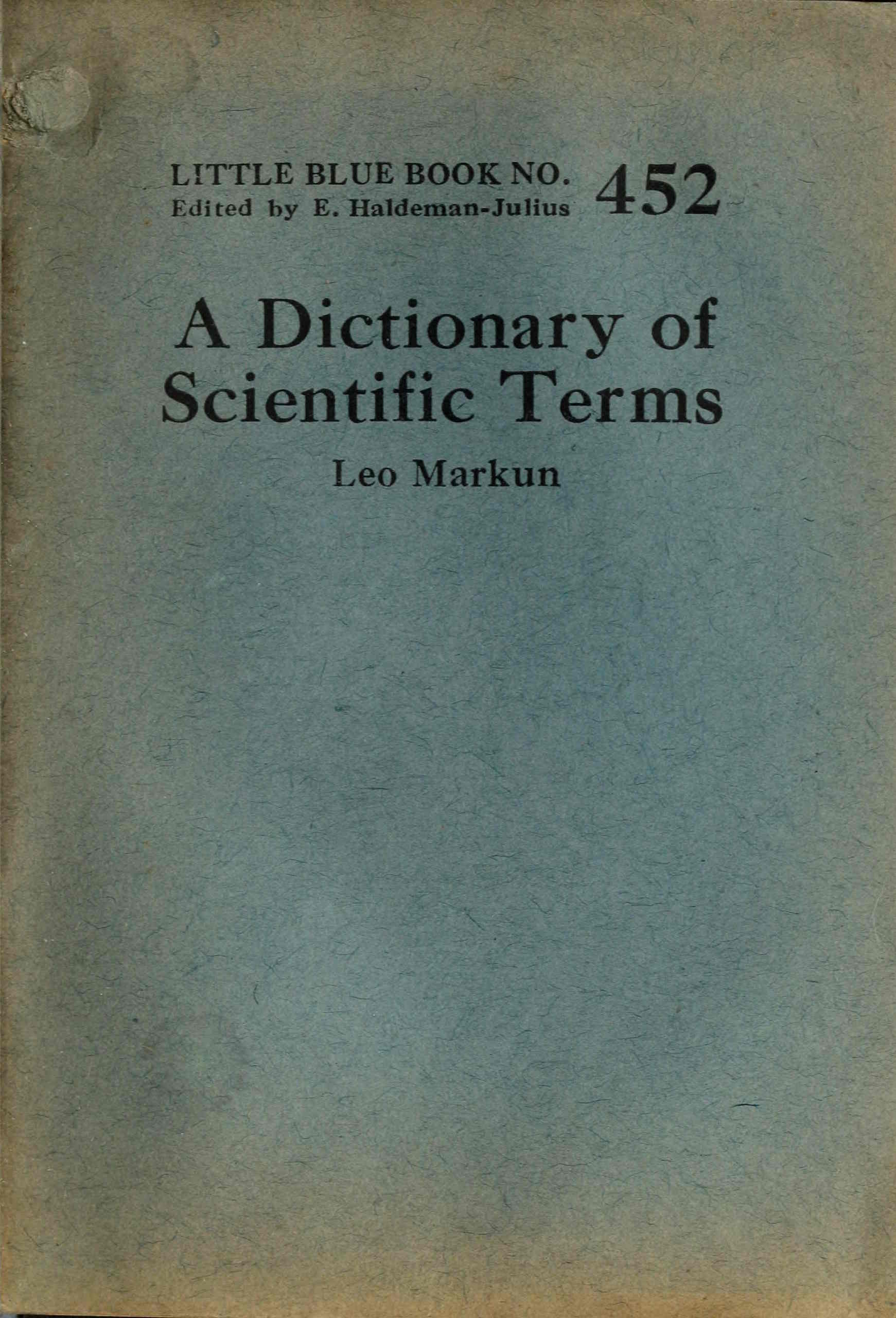
Title: A dictionary of scientific terms
Author: Leo Markun
Editor: E. Haldeman-Julius
Release date: January 16, 2026 [eBook #77721]
Language: English
Original publication: Girard: Haldeman-Julius Publications, 1927
Other information and formats: www.gutenberg.org/ebooks/77721
Credits: Tim Miller, Alan and the Online Distributed Proofreading Team at https://www.pgdp.net (This file was produced from images generously made available by The Internet Archive)
| LITTLE BLUE BOOK NO. Edited by E. Haldeman-Julius |
452 |
Leo Markun
HALDEMAN-JULIUS PUBLICATIONS
GIRARD, KANSAS
Copyright, 1927
Haldeman-Julius Company
PRINTED IN THE UNITED STATES OF AMERICA
[Pg 3]
A DICTIONARY OF SCIENTIFIC TERMS
PREFACE
Completeness is a virtue which this little Blue Book cannot, in the nature of things, possess. If any reader is disappointed not to find it here, I must respectfully direct his attention to the three ponderous tomes which make up a well-known dictionary of chemistry, to the still larger and more numerous volumes devoted to a dictionary of applied physics, and to other similar works. The sciences are many, and the words which they employ exclusively or in senses peculiar to themselves are exceedingly numerous.
Physics, chemistry, and biology contribute the greatest number of words to the present dictionary. A few terms used in other sciences are included, chiefly to show what I believe the proper scope of a dictionary of scientific terms to be. There is a genuine need for a large dictionary, which ought to be of about the same size as Webster’s Collegiate or the Oxford Concise, and which should deal with the vocabularies of economics, anthropology, sociology, and psychology as well as with those of mechanics, geology, astronomy, and all the older sciences. Such a dictionary should be written by specialists in the various fields of knowledge with the aid of a skilled etymologist, and under the supervision of an editor who is not himself a professional scientist. It would be[Pg 4] his special task to see that the definitions are intelligible to non-specialists, and to literate laymen in particular.
Of course no dictionary can take the place of primers of the sciences. There are a number of excellent ones in this series, some of which I referred to in writing this book. It is in many cases impossible to give adequate explanations in a few words. Besides, the scientific writers themselves frequently quarrel about the true meaning of such a word as ether or instinct.
I have dealt here with a number of words which are of significance when we try to set the limits of science. Common sense, philosophy, theology, and superstition are examples. The claims of several branches of knowledge to be considered sciences are also taken up.
[Pg 5]
A DICTIONARY OF SCIENTIFIC TERMS
Abasia. The inability to walk, especially when it is caused by mental disorder.
Abdomen. The hind part of insects, spiders, etc. The belly, including the nutritive organs.
Aberrant. Diverging from normal type.
Aberration. The non-convergence of rays of light to a focus. The apparent displacement of the true position of a heavenly body.
Abiogenesis. Spontaneous generation.
Abnormal. Deviating from type.
Aborigines. The inhabitants of a region, or, in some cases, the plants and animals, found by colonists. Literally, those that have been in the land from the beginning of things.
Abort. Have premature delivery of a child. Remain undeveloped or sterile, or dwindle away.
Absolute. Pure. The absolute, philosophically speaking, is final and total reality.
Absorption. Disappearance through incorporation in something else. The solution of a gas in a liquid is called absorption. Rays of light may be absorbed in some mediums.
Abstract. Theoretical, aside from particular instances.
Abulia. Weakness of will.
Abyssal. Relating to the depths of the sea.
Acaulescent. Apparently stemless.
Acceleration. Rate of increase of velocity per time unit. Rate of change of the velocity of a chemical reaction. The acceleration of a star is the time it gains daily over the sun.
[Pg 6]
Accident. A property which is not essential to our conception of a subject.
Achene. A small, dry, indehiscent, one-seeded fruit.
Achromatic. Colorless, transmitting light without decomposing it.
Acid. A substance that neutralizes and is neutralized by a base, and which contains hydrogen. A compound that produces hydrogen ions when it decomposes in aqueous solution.
Actinium. A radioactive substance, believed to be an element.
Actinozoan. One of a class of coelenterates including the corals.
Aculeate. Having a sting, prickly.
Acuminate. Tapering to a point.
Adiabatic. Maintaining a constant temperature.
Adrenalin. A crystalline substance obtained from suprarenal extract.
Adsorption. The condensation of dissolved substances on the surface of a liquid or solid.
Adventitious. Not in the usual place, as a root.
Aerial. Atmospheric.
Affect. Disease, emotional complex.
Afferent. Conducting inward.
Agoraphobia. The morbid fear of public places.
Agronomics. The science of crop production. The scientific management of land.
Agrostology. The study of the grasses.
Air. The atmosphere, a gaseous substance of which oxygen and nitrogen are the principal constituents.
Air pump. A pump for forcing air into, or taking it out of, hollow places.
[Pg 7]
Albino. An animal, especially a human being, characterized by the congenital absence of coloring pigment in the skin, hair, and eyes. The typical albino has very light skin and hair and pink eyes.
Albumen. A substance, usually edible, found between the skin embryo of seeds.
Albumin. A class of proteids found in blood serum, milk, and muscle.
Alcohol. Ethyl alcohol, the substance which causes intoxication, and a whole class of substances which are similar to it. They are hydroxides of organic radicals.
Alga. Seaweed. Chiefly used in the plural: algae.
Alkali. Caustic hydroxides which form soluble soaps with fatty acids and turn red litmus paper blue.
Allotropy. Variation of physical properties without change of substance. Carbon, for example, may exist as lampblack, graphite, or the diamond.
Alloy. A mixture (not a compound) of metals.
Alluvium. The deposit of earth and other materials by the mechanical action of running water. More familiar is the adjective: alluvial.
Alpha rays. Becquerel rays which have less power of penetration than beta rays but greater power of inducing conductivity in gases.
Alpine. Relating to a mountain district so high that it has arctic climate.
[Pg 8]
Alum. A double sulphate of aluminium and potassium. Other sulphates of similar crystalline form are also known as alums.
Aluminium. A metallic element. The spelling given is the usual one in Great Britain, and it is also the one employed by American chemists. In ordinary use in the United States: aluminum. The symbol: Al.
Amalgam. An alloy containing mercury. To amalgamate is to form an amalgam.
Ammeter. An instrument for measuring the strength of electric currents in amperes.
Amorphous. Uncrystallized.
Ampere. Sometimes spelled: ampère. The unit of electric current, the current that one volt can send through one ohm.
Amphibia. A division of Vertebrata, intermediate between reptiles and fishes, including the frog. The study of Amphibia is known as amphibiology.
Amplexicaul. Encircling or clasping a stem.
Anabolism. Constructive metabolism.
Analogy. Functional correspondence between parts of different origin and structure.
Analysis. Resolution into simple elements, as by chemical processes. In mathematics, algebraic investigation.
Anandrous. Without stamens.
Anaphylaxis. Excessive susceptibility to an albuminous substance.
Anatomy. The science of bodily structure.
Anemograph. An instrument for recording the direction and force of wind.
[Pg 9]
Aneroid barometer. A barometer in which there is no liquid, the pressure of the air being measured by its action on the elastic lid of a box in which a partial vacuum has been created.
Angiosperm. A plant of a class which has its seeds in a closed ovary.
Anhydrous. Without water of crystallization or water in general.
Animal. A living being distinguished from plants in that it is capable of voluntary motion and sensation. Some recent investigations appear to lead to the conclusion that other differentia will have to be adopted. The human being, incidentally, is an animal, although popular language sometimes distinguishes man from the animals.
Animalcule. A minute animal, usually one which cannot be seen with the naked eye.
Anion. A negative ion.
Annual. A plant that lives only for a year.
Annulate, annulated. Ringed.
Anode. A positive electrode.
Antenna. Feeler, sensory organ found in pairs on heads of insects and crustacea. Irritable processes found in some male flowers. An elevated conductor for receiving or transmitting electric waves. Plural: antennæ.
Anther. The part of the stamen which contains the pollen.
Anthropogeography. The science which treats of geography as applied to man. That part of anthropology dealing with the effect of the environment on human beings. There are a[Pg 10] number of compounds beginning with anthro-. The meaning may often be understood by remembering that the Greek word anthropos means man, not as opposed to woman but as excluding the non-human.
Anthropology. The study of man as an animal, with respect to race, distribution, culture, and social organization.
Anticlinal. Forming a ridge with strata leaning in opposite directions from an axis. Having an upright spine toward which spines on both sides lean.
Anticyclone. An outward and rotary flow of air from an atmospheric area of high pressure.
Antidote. A medicine used to counteract a poison or disease.
Antimony. An element of metallic appearance. Symbol: Sb.
Anus. The posterior opening of the alimentary canal.
Apetalous. Without petals.
Aphasia. Loss of speech from a brain injury.
Aphelion. The point in the orbit of a planet or comet farthest from the sun.
Apheliotropic. Turning away from the sun.
Apogee. The point in the orbit of a planet or the moon where it is farthest from the earth.
Aponeurosis. The flat, dense connective tissue covering and forming the attachments of certain muscles.
Aquatic. Growing or living in or near the water.
Arachnida. A class of animals including spiders and scorpions.
[Pg 11]
Arachnoid. Covered with long, thin hairs. A serous membrane enveloping the brain and spinal cord.
Arboreal. Living in or connected with trees.
Archeology. The study of prehistoric antiquity, or sometimes of antiquity which is not prehistoric.
Archean. Also: Archaean. Relating to the earliest geological period.
Arenicolous. Living in the sand.
Argon. A gaseous element found in the atmosphere in small amounts. Symbol: A.
Arsenic. A semi-metallic element. Symbol: As.
Art. Skill of various sorts. Knowledge from the practical point of view. H. W. Fowler distinguishes it from science: “Science knows, art does; a science is a body of connected facts, an art is a set of directions; the facts of science (errors not being such) are the same for all people, circumstances, and occasions; the directions of art vary with the artist and the task.” According to the Oxford English Dictionary: “The distinction as commonly apprehended is that a science is concerned with theoretic truth, and an art with methods for effecting certain results. Sometimes, however, the term science is extended to denote a department of practical work which depends on the knowledge and conscious application of principles; an art, on the other hand, being understood to require merely knowledge of traditional rules and skill acquired by habit.”
[Pg 12]
Articulation. A joint, as between bones or parts of plants, especially between parts which may separate at any time.
Ascendant. Rising toward the zenith.
Asexual. Without sex.
Assay. A sort of analysis, especially of metals.
Association. Mental connection. The word has also three or four meanings in chemistry, which cannot be explained briefly.
Asteroid. A minor planet.
Astronomy. The science of the heavenly bodies.
Astrophysics. The science which deals with the constitution of the heavenly bodies. It is a branch of astronomy.
Atmosphere. The gaseous envelope about a heavenly body. Especially the air which surrounds the earth. As a measurement, a pressure of fifteen pounds per square inch.
Atom. The smallest particle of an element that enters into combination. According to old definitions, it is indivisible.
Aurora. A luminous atmospheric phenomenon. The aurora borealis radiates from the north magnetic pole, the aurora australis from the south magnetic pole of the earth.
Avogadro’s Hypothesis. The assumption that equal volumes of gases contain equal numbers of molecules if conditions of temperature and pressure are the same. It appears to be close to the truth.
Axiom. A truth which is considered self-evident.
[Pg 13]
Bacillus. One of a sort of rod-shaped bacteria. Loosely, any bacterium. Plural: bacilli. The Oxford English Dictionary distinguishes bacillus from bacterium, “with which it agrees in its rodlike form, and characterized by its larger size and mode of reproduction.”
Bacterium. More familiar in plural: bacteria. A group of vegetable microörganisms. Not all cause disease.
Barbarian. Of a civilization intermediate between one which is called savage and the most complex forms.
Barium. A silver-white element, classed as a metal. Symbol: Ba.
Barometer. An instrument used to measure atmospheric pressure, and thus to predict storms or determine altitudes.
Base. A substance which can neutralize acids to form a salt. The term includes alkalis. Part of an organ (of a plant or animal) attached to another organ which is more central.
Batrachia. An order of amphibians which have no tails in the adult stage.
Battery. A system of cells (sometimes used for a single cell) which changes chemical energy into electricity.
Becquerel rays. Rays emitted by radium and other substances which are susceptible to deflection by electricity and which electrically charge other bodies.
Behaviorism. Watson’s psychological system. Opposed to introspective psychology, and it emphasizes the physiology of human behavior.
[Pg 14]
Bessemer steel. Steel made from cast iron by a process which burns out carbon, sulphur, and phosphorus.
Beta rays. Becquerel rays which are apparently identical with cathode rays.
Bichloride. A compound in which there are two atoms of chlorine in the molecule.
Biennial. A plant that rises one year and flowers, fructifies, and dies the next.
Binary. Composed of two elements.
Biochemistry. The chemical study of living organisms and their products.
Biology. The science of living organisms.
Biophore. The indivisible unit of life. The biophore cannot support life if split up.
Bird. One of a class of feathered and warm-blooded vertebrate animals.
Bisexual. Pertaining to, or containing the organs of, both sexes.
Bismuth. A metallic element. Symbol: Bi.
Boron. A non-metallic solid element. Symbol: B.
Botany. The science of plants.
Boyle’s Law. The theory that the pressure exerted by air is directly proportional to its density. This is now believed to be true only approximately.
Brachycephalic. Pertaining to skulls of which the breadth is at least four-fifths of the length. Short-headed.
Brass. An alloy of copper and zinc.
British Thermal Unit. The amount of heat which is capable of raising the temperature of one pound of water by one degree Fahrenheit. The usual abbreviation: B.T.U.
[Pg 15]
Bromine. A liquid element. Symbol: Br.
Bronze. An alloy of copper and tin, usually with small amounts of zinc.
Brownian movement. A movement of minute drops of oil suspended in stagnant air, apparently due to molecular motion.
Bunsen burner. A sort of burner much used by chemists, within which air and fuel gas are mixed.
Burn. To oxidize in such a way that heat and light are produced.
Cadmium. A metallic element. Symbol: Cd.
Caesium. A metallic element. Symbol: Cs. It somewhat resembles potassium.
Calcium. A metallic element. Symbol: Ca. Compounds of calcium are common, but the element is not to be found in a pure state.
Calculus. Solid concretion in the body. A branch of mathematics, differential and integral calculus, which deals with problems of constant variation or motion, and which has been of great importance in modern science.
Calorie. The unit of heat, the amount of heat necessary to raise the temperature of a gram of water one degree Centigrade. This is the small calorie. Confusion sometimes results because the large calorie, which is one thousand times the small one, is called simply the calorie, without any qualification, in discussions about food. It is sometimes known as the great calorie. The small calorie is best called the gram-calorie.
Calorimeter. An instrument for measuring quantities (not degrees) of heat.
[Pg 16]
Calyx. The outer case of a bud.
Cambrian. Relating to the lowest of the Paleozoic rocks and the earliest part of the Paleozoic period.
Candlepower. The unit of illumination, measured by a standard candle. The illumination produced one foot away from a standard candle is the candle foot.
Capillarity or capillary attraction. A phenomenon best illustrated in very slender (capillary) tubes, in which the liquid rises, or, if it does not wet the tube, sinks. In the latter case we speak of capillary repulsion.
Capital. In economics, wealth employed for the purpose of production.
Carbolic acid. Phenol, not a true acid.
Carbon. An element which exists in three allotropic forms. Symbol: C. The oxides are important, and there are many organic compounds.
Carboniferous. Pertaining to a Paleozoic (geological) period following the Devonian.
Carburetor or carburettor. A device which mixes air with petroleum vapor, or one which puts illuminants into water gas.
Cardio—. Heart—, in many combinations.
Carina. A ridge-shaped structure.
Carnivora. The flesh-eating mammals.
Carpel. An organ which is part of the pistil.
Catabolism. Destructive metabolism.
Catalysis. The effect produced by a substance (called the catalyst, the catalytic agent, or the catalyzer) which aids a chemical change in other bodies, undergoing no change of its own.
[Pg 17]
Cathode rays. Rays discharged from the cathode (negative pole) of a vacuum tube. They are considered streams of electrons, which may be projected at a velocity of 100,000 miles per second.
Caudal. Relating to the tail.
Cause. That which brings about something else (an effect). Professor Adam Leroy Jones says: “It has been objected that we can never observe one thing producing another; that we can at most observe that one thing is followed by another, and perhaps find reason for believing that it will always have such connection; and that to say that A produces B, is to raise a metaphysical question with which science and everyday thinking are not concerned.... Is it sufficient to say that cause means simply invariable connection? No, for the succession of day and night is an invariable succession. The notion of cause implies that the relation of cause and effect not only is invariable, but also that it must be so; that there is an unconditional or necessary connection between the two; that if the first does not happen, the second cannot.... A causal law is a statement, in general terms, of a causal connection.”
Cell. A battery unit, a device for changing chemical energy into electricity. The structural unit of which living beings are composed. An enclosed cavity in an organism or a mineral. A covering which protects the eggs or the young of certain animals.
[Pg 18]
Celsius. Centigrade (thermometer).
Cenogetic. Pertaining to individual development which does not repeat the development of the group of which the individual is a member.
Cenozoic. Relating to the geological age of the mammals. It is still in existence.
Center of gravity. The point in a body where its entire weight may be assumed to be concentrated.
Centigrade. A thermometer, or the scale on which it is based, with the boiling point of water at 100 and the freezing point at zero, under standard conditions of pressure. Abbreviation: C. Such a scale is far more useful to scientists than that of Fahrenheit.
Centimeter. One hundredth of a meter.
Centrifugal. Flying or tending to fly away from the center.
Centripetal. Tending to move toward the center.
Centrosome. A minute body found in the cytoplasm or the nucleus of some (biological) cells.
Centrum. The center of an earthquake.
Cephalic. Relating to the head.
Cephalopoda. The highest class of mollusks.
Cereal. A grass which produces edible grain.
Cerium. A metallic element. Symbol: Ce.
Cetacea. The order of mammals including the whales.
Chemistry. The science which deals with the composition of matter and its transformations.
Chiroptera. An order containing the bats.
[Pg 19]
Chloride. A chlorine compound.
Chlorine. A gaseous element. Symbol: Cl.
Chlorophyll. The coloring-matter of green parts of plants.
Chromatic aberration. The colored fringe seen at the edges of images formed by a simple lens, because of the difference in wave lengths of the various rays.
Chromium. A metallic element. Symbol: Cr.
Chromo-. Color-, in many compounds. Also: chroma-, chromato-.
Chromosome. One of the small bodies formed out of a protoplasmic substance (chromatin) in the nucleus before a cell divides.
Civilization. An advanced stage of culture. Civilization is sometimes contrasted with culture, but the matter is one which cannot be considered here.
Class. A group of animals or plants, more comprehensive than an order and less so than a phylum.
Climate. The average weather conditions of a particular place or region.
Cobalt. A metallic element. Symbol: Co.
Coccus. A spherical bacterium. A sort of carpel.
Coelenterata. A phylum of invertebrate animals including the corals.
Cohesion. Molecular attraction within a body.
Colloid. Not crystalloid. A substance which does not form a true solution. Colloidal liquids have very little osmotic pressure.
Columbium or niobium. A metallic element. Symbol: Cb.
[Pg 20]
Combustion. Oxidation accompanied by the production of heat and light. Less frequently, the word is used for a combination which is not oxidation or where no heat or light is produced.
Common sense. Ordinary and non-scientific thought processes. Scientific thinking is more exact and more fertile.
Community. A social group.
Comparative. Involving comparison, as between man and the other animals.
Complex. In psycho-analysis, a cluster of ideas and mental images joined together by a stressed emotion; especially such a cluster that is thrust out of consciousness (repressed).
Component of a force. The effective value of a force in a given direction.
Compound. A substance consisting of two or more chemical elements in combination.
Compound animal, flower, leaf, etc. An animal, etc., consisting of a combination of organisms or simple parts.
Conation. Will, directing power, effort.
Concave. Curved like the interior of a circle or sphere.
Concept or conception. The idea, notion, or thought held about anything. Conception includes symbol and meaning.
Condense. Change from gas to liquid. Concentrate (electricity). Of organic compounds, react in a certain way so as to form new bonds.
Conduct. Carry heat or electricity.
[Pg 21]
Conductance. Ability to conduct. The word is used to describe the property of a conductor.
Conductivity. Power to conduct (heat or electricity).
Conductor. That which readily conducts (heat or electricity).
Congeal. Solidify, freeze.
Connate. United from the beginning.
Constant. A quantity that does not vary, or one that does not change under given conditions.
Convex. Curved like the outside of a circle or sphere.
Coördinate. Each of a system of magnitudes used to fix the position of a point, line, or plane.
Copernican. Relating to the theory that the planets (one of which is the earth) move around the sun.
Copper. An important metallic element. Symbol: Cu.
Corolla. The inner envelope of a flower.
Corona. A small disk of light around the sun or moon. An appendage on top of a seed or the inner part of the corolla.
Cotyledon. One of the first leaves in the embryo of a higher flower.
Coulomb. The amount of electricity carried in one second by one ampere.
Cretaceous. Of or like chalk. Relating to the last Mesozoic period.
Cri. The common respiratory infections, such as the common cold, influenza, etc.
[Pg 22]
Criminology. The scientific study of crime and criminals.
Cross-pollination. The transfer of pollen from the anthers of one flower to the stigma of another flower of the same kind.
Crustacea. A class of hard-shelled arthropods, including lobsters and crabs.
Crystal. An aggregation of molecules with definite internal structure and external form of a solid enclosed by symmetrically arranged plane faces. A crystal is formed when certain liquids or gases solidify (crystallize). The study of crystal structure is crystallography.
Ctenophora. A class of low animals comprising certain jellyfish.
Cycle. A series of operations in a heat engine. A two-cycle engine is one with a cycle of two strokes. Properly, it should be called a two-stroke-cycle engine.
Cyclone. A violent wind of low diameter. A circular wind system about an area of low pressure.
Cyst. A hollow organ containing a liquid secretion.
Cyto-. Cell-, in compounds.
Cytoplasm. Cell protoplasm, not including the nucleus.
Darwinism. Organic evolution in general. The theory that the origin of species is due to natural selection, as developed by Charles Robert Darwin. All biologists worthy of the name believe in evolution, but by no means all accept Darwinism in the narrow sense.
[Pg 23]
Declination. The angular distance of a heavenly body north or south of the celestial equator. The deviation of a magnetic needle from true north.
Decurrent. Extending downward, as the base of a leaf.
Dehydrate. Remove water, dry.
Dendrology. The scientific study of trees.
Devonian. Of the geological formation between the Silurian and the Carboniferous.
Dew point. The temperature at which the air is saturated with water-vapor.
Diadelphous. Formed into two bundles. (Of stamens.)
Diandrous. With two stamens.
Dielectric. Insulating, insulator of electricity.
Diesel engine. An internal combustion motor which compresses the air highly and which successfully burns oil which is unsuitable for the ordinary motor of an automobile.
Disease. Malady. Of some foods and drinks, an impairment in quality caused by bacteria.
Dissipation of energy. The change of energy to such a form that it cannot be used to do work.
Dissociate. Ionize, decompose, split up.
Doldrums. A region of calms and light winds near the equator.
Dolichocephalic. Long-headed, having a skull with the breadth less than four-fifths of the length.
Drug. A medicine, a medicinal agent, especially one of vegetable origin.
Dynamics. The branch of physics dealing with forces.
[Pg 24]
Dyne. The amount of force that acts for a single second on a mass of one gram to give it a velocity of one centimeter per second.
Eccentric. Not concentric to a given circle. Arranged to change rotary motion back and forth.
Echinoderm. One of a class of animals including the sea-urchins.
Eclipse. Of a heavenly body, obscured by passing between it and the observer or its source of light.
Ecliptic. The apparent orbit of the sun.
Ecology. The science dealing with the relations between organisms and their environment.
Economics. The science of wealth, especially of its production, distribution, and consumption.
Edentate. Toothless or without canine teeth.
Effect. See Cause.
Efferent. Carrying outward or away.
Efficiency. The ratio between the amount of work put into a machine and the amount derived from it.
Efflorescence. The loss of water of crystallization.
Electricity. A peculiar condition of the molecules of a body or of the ether surrounding the molecules, or else a sort of fluid or other matter in the form of small bodies called electrons. It is easier to tell what electricity does or how it is produced than to define it, especially since physicists have not been able to agree about its precise nature.
Electrode. Either pole of a cell.
[Pg 25]
Electrolysis. The decomposition of a compound by means of an electric current.
Electrolyte. A substance which, in solution, can carry an electric current to an appreciable extent.
Electron. The electric charge of an atom. A very small particle which is electrically charged. The size of the electron has been variously calculated, and some physicists declare that the negative electron has only 1/1700 the mass of a hydrogen atom.
Element. One of a number of substances formerly considered to be indivisible. An electric cell.
Emanation. A gaseous substance produced by a radioactive material.
Embryo. The offspring of an animal before birth or emergence from the egg. The scientific study of the embryo is called embryology.
Endogenous. Growing from within.
Endosperm. The nutritive tissue enclosed with the embryo in seeds.
Endothelium. The layer of cells lining blood vessels, the interior of the heart, etc.
Energy. Ability to do work or change the nature of bodies. Heat and light are considered forms of energy.
Entomology. The study of insects.
Environment. Surrounding conditions, influences, and powers of all sorts. Everything which, directly or indirectly, affects the fate of an organism forms part of its environment.
[Pg 26]
Eocene. Relating to the lowest division of the Tertiary strata.
Epiphyte. A plant which grows upon another but which is not fed by it. A vegetable parasite on an animal body.
Equation. A compensation for inaccuracy. In mathematics, a formula affirming the equivalence of two expressions. An expression in symbols of a chemical reaction.
Equinox. The time when the sun crosses the equator, and day and night are of equal length.
Erbium. A metallic element. Symbol: Er.
Erg. The work done by a force that, when it acts for one second on mass of one gram, produces a velocity of one centimeter per second.
Erosion. Gradual destruction or wearing away, as of land by water.
Esthetics. Also spelled: æsthetics. The study of beauty. It is, at present, rather an art or a branch of philosophy than an exact science.
Ether. An anesthetic liquid. Totally distinct is this meaning: the medium through which light-waves pass, which is supposed to have a density infinitely less than that of the lightest gas. The nature of the ether is in dispute.
Ethics. The branch of philosophy concerned with human conduct. It may at some future time rank as a science.
Ethnology. The science dealing with the races of mankind. It has not, alas, always been thoroughly scientific.
[Pg 27]
Ethyl alcohol. The alcohol which cheers and also inebriates men. Before Prohibition, practically the only kind of alcohol which people drank.
Europium. A metallic element. Symbol: Eu.
Evaporate. Change (usually with no great rapidity) from the liquid to the gaseous state.
Evergreen. A tree or shrub which has green leaves in all seasons.
Evolution. Development, change. In biology, the development of a race or species by gradual change from another type. The Theory of Evolution contradicts the notion that every type was originally created in the form which it now has.
Experiment. An event (or, in the case of the verb: to bring about an event) designed for observation, in order that an unknown fact or principle may be brought to light, or simply to instruct.
Explain. To reduce a phenomenon to the terms of a general principle. To bring into a system.
Fact. Something which is true. If only a single investigator has reported a certain circumstance or condition, it is not likely to be considered a fact by scientists.
Factor. A substance which takes part in a chemical reaction.
Facula. A bright spot or streak on the sun.
Fahrenheit. A thermometric scale, in common household use, but employed for scientific purposes far less frequently than the Centigrade scale. The boiling point of water is 212 degrees and the freezing point is 32 degrees above zero.
[Pg 28]
Fair. As used by the American Weather Bureau, without rain, snow, or hail.
Feces. Excrement.
Fecundate. Impregnate, fertilize, make fruitful.
Female. Bearing fruit or offspring, pistillate.
Ferment. To cause an organic substance to change or to work (used of organic substances), because of the activity of yeast, or of certain other living organisms or substances derived from them.
Filament. The part of the stamen that supports the anther. The conductor in an incandescent electric light.
Fish. A member of a class of vertebrate and cold-blooded animals having gills and usually fins and scales.
Flocculus. A mass in the atmosphere of the sun resembling wool or clouds.
Florescence. The time or condition of flowering.
Flower. The reproductive organ in a plant which contains one or more pistils or stamens or both, and typically a corolla and calyx. To flower: to blossom or produce flowers.
Fluid. Moving readily. The fluids include the liquids, the gases, perhaps the ether of space.
Fluorescence. The colored light produced in some transparent bodies by the action of ultra-violet rays. The property some substances have of emitting light when exposed to certain rays.
Fluorine. A gaseous element. Symbol: F.
Focus. The point at which rays meet after reflection or refraction. Converging-point.
[Pg 29]
Force. That which changes or tends to change the motion of a body upon which it acts.
Foreconscious. Mental processes of which we are aware only under special conditions. Of a nature between conscious and unconscious.
Forensic. Used in law-courts.
Formula. A symbolic statement, as in mathematics or chemistry.
Fossil. Something left of an animal or a plant which lived in a former geological age.
Freeze. To change from a liquid to a solid, especially by removing heat.
Friction. The resistance which one body encounters in rubbing against another.
Fruit. A ripened ovary together with any parts of the flower that may be attached to it.
Fulcrum. The point where a lever is supported or turns.
Function. A quantity related to another in such a way that a change in one involves a change in the other.
Functional. Having a use. Of a disease, not affecting the structure of an organ, or of the organ which is supposed to be diseased. It is doubtful if there can be a disease which does not change the structure of some organ.
Fundamental notes. The notes resulting when a piano wire vibrates as a whole. The lowest notes of chords.
Fungus. Plural: fungi. A cryptogamous (flowerless) plant without chlorophyll. A morbid growth.
Fuse. To change, usually by adding heat, from solid to liquid form.
[Pg 30]
Gadolinium. A metallic element. Symbol: Gd.
Gallium. A metallic element. Symbol: Ga.
Gamete. A sexual cell which unites with another for reproduction.
Gamma rays. Becquerel rays which are more penetrating than beta rays and are not deflected by electricity. Equivalent or analogous to X-rays.
Ganglion. An enlargement of the nerve from which nerve-fibers radiate.
Gas. A fluid which tends to occupy the whole volume of any vessel in which it is placed.
Gastropoda. A class of mollusks including the snails.
Geld. Castrate.
Generalization. A universal assertion, a principle applying not to any single fact but rather to a large number. A general notion.
Genetics. The study of heredity and of the beginning of variation.
Genital. Pertaining to reproduction and the sexual organs.
Genus. In logic, a class which is divided into sub-classes. In biology, a class of animals usually containing several species. A single genus may in some cases make up a genus of its own, if it appears not to be closely related to any other genus. Plural: genera. The next higher group is the family.
Geo-. In combinations, earth——.
Geography. The study of the earth, especially as the environment of man.
Geology. The study of the crust of the earth.
[Pg 31]
Germ. A portion of an organism capable of becoming a new one. Seed, microörganism. Popularly, a germ is a bacterium which causes disease.
Germanium. A metallic element. Symbol: Ge.
Glacier. A slowly-moving mass of ice formed by the accumulation of snow on high ground.
Gland. An organ which secretes constituents of the blood. Secreting cell or cells in plants.
Glans. The body at the end of the penis and clitoris.
Glass. A substance made by mixing silicates and including some alkali silicate. Not every sort of glass is transparent.
Glomerate. Gathered in a compact group.
Glottis. The opening at the upper end of the windpipe.
Glucinum or beryllium. A metallic element. Symbol: Gl or Be.
Glucose. One of a group of sugars, including grape sugar.
Gneiss. A sort of highly crystalline rock arranged in layers, as of quartz and mica.
Gold. A metallic element. Symbol: Au.
Gram. The unit of weight in the metric system. About the weight of a cubic centimeter of water at its greatest density.
Graph. A symbolical diagram, as in mathematics of chemistry.
Gravity or gravitation. The attraction existing between bodies. If the earth draws a falling apple, it is said that the apple also draws the earth to it.
[Pg 32]
Gregarious. Living in or pertaining to flocks, groups, or communities. Social.
Gymnosperm. A plant whose seeds are not enclosed in seed-vessels.
Habit. An action pattern; specifically, one that has been acquired. In biology, a mode of growth.
Hallucination. The perception of something which is not actually present.
Hardness. The presence of certain salts in water.
Heat. Energy which can be transmitted by conduction or radiation, and which is expressed in molecular motion.
Helium. A gaseous element. Symbol: He.
Henry. The unit of inductance. The inductance in a circuit in which the induced electromotive force is one volt when the inducing current varies at the rate of one ampere per second.
Herb. A plant whose stem is not woody or persistent.
Hermaphrodite. An organism possessing male and female characteristics or organs.
Herpetology. The study of reptiles.
Hexapoda. The order of insects.
Hilum. The point where the seed is attached to the seed-vessel.
Hinterland. The district behind a coast.
Histology. The study of organic tissues, usually with the aid of a microscope.
[Pg 33]
History. The study of the past. It deals with human institutions rather than with the animal, vegetable, or mineral kingdom. History is concerned first of all with concrete data, specific cases, and then with explaining them in the light of general laws. There have been some ingenious, but not altogether successful, attempts to make history into a science.
Holmium. A metallic element. Symbol: Ho.
Homo-. In compounds: same, similar.
Homology. That relation between parts which results from their development from corresponding embryonic parts, either in different animals or in the same individual.
Hormone. A stimulating substance carried from one organ to another.
Horse-power. The unit of power in the English system. It is equal to 550 foot pounds per second.
Humidity. Moisture.
Hurricane. A wind of stormy violence.
Hybrid. The offspring of two plants or animals of different sorts.
Hydrate. A compound containing combined water.
Hydraulics. The science dealing with liquids in motion.
Hydrocarbon. A compound of carbon and hydrogen.
Hydrogen. A gaseous element. Symbol: H.
Hydrolysis. The decomposition of water in such a reaction as includes the formation of new compounds with the hydrogen and the oxygen of the water.
[Pg 34]
Hydrometer. An instrument used to determine the specific gravity of a liquid.
Hydrostatics. The science which deals with the pressure of liquids.
Hydrous. Containing water, whether in combination or in a mixture.
Hydrozoan. A member of a class (Hydrozoa) of coelenterate animals, chiefly marine, including jellyfish.
Hygiene. The science of sanitation, preventive medicine. In the United States, textbooks of hygiene are chiefly concerned with proving that alcohol and tobacco are injurious. Here is an example of “science” created by legislative fiat.
Hygrometry. The measuring of atmospheric moisture.
Hypothesis. A supposition used as a basis for reasoning, a provisional explanation. If it appears to be unconfirmed by the facts, it is rejected. Otherwise it becomes a theory, then a law.
Igneous. Formed by great heat, as rocks.
Indehiscent. Not bursting open at maturity.
Indium. A metallic element. Symbol: In.
Indo-European or Indo-Germanic. Pertaining to a great family of languages including most of those spoken in Europe and by the white men in America as well as some used in India and other parts of Asia.
Inductance. The electrification of a conductor placed near a circuit or charged body, resulting from the proximity.
Inert. Not easily made to react.
[Pg 35]
Inertia. The property of matter by which it tends to remain at rest if it is at rest, or, if it is in motion, to remain in motion in a straight line. Our notion of inertia may possibly be changed by Einstein’s theory.
Inflorescence. Flowering, the arrangement of flowers on a plant.
Infra-. In compounds, below.
Infusoria. A class of protozoa which possess hairlike outgrowths.
Inorganic. Not derived from living organisms. Pertaining to the chemical compounds which do not contain carbon—but carbonates and a few other carbon compounds are considered to be inorganic.
Insect. A member of a class of small and invertebrate animals, all of which have bodies clearly divisible into head, thorax, and abdomen.
Instinct. An action pattern present from birth. (The varying theories of instinct, especially with regard to man, are often based upon varying definitions. This is true of many of the terms here defined.)
Intelligence quotient. The ratio between the “mental age” of an individual and the true age. The true age is often easier to determine than the mental age, that is, the age which a normal individual of a given intelligence possesses. How can intelligence be expressed numerically? Abbreviation: I. Q.
Interference. The influence which two waves have upon each other.
Invertebrate. Spineless, having no backbone.
[Pg 36]
Iodine. A solid, non-metallic element. Symbol: I.
Ion. Either of the substances that appear at the poles in electrolysis. Particle which carries electric charge. Positive ions are cations, negative ions are anions.
Iridium. A metallic element. Symbol: Ir.
Iron. An important metallic element. Symbol: Fe.
Isobar. A line connecting places which have the same barometric pressure (with corrections for varying altitude) at a given time or over a given period.
Isotherm. A line connecting places which have the same temperature at a given moment or over a stated period of time.
Joule. A unit of work. It is equal to ten million ergs, and it is about the energy expended in one second by an electric current of one ampere in a resistance of one ohm.
Jurassic. Of that Mesozoic period following the Triassic.
Kidney. One of a pair of organs which secrete urine.
Kilogram. A unit of mass in the metric system, about the mass of a cubic centimeter of water at its greatest density.
Kinetic theory of gases. The assumption and the teaching that the molecules of gases are constantly in motion and that the space between molecules is far greater than that occupied by the molecules themselves. The velocity of gas molecules is supposed to be very great.
Krypton. A gaseous element. Symbol: Kr.
[Pg 37]
Labile. Unstable.
Lanthanum. A metallic element. Symbol: La.
Latent heat. The equivalent of the work performed in changing the state of a substance from solid to liquid or liquid to gaseous.
Law. A generalization. A statement of the way things invariably behave under given conditions. A scientific law does not direct or impose penalties or state that things ought to behave in a certain way. It is a correct statement of invariable sequence. If the correctness of a statement has not been proved beyond a reasonable doubt, it is not a law.
Lead. A metallic element. Symbol: Pb.
Leaf. One of the expanded organs, usually green, springing from the stem, a branch, or sometimes a root, of a plant.
Lens. A portion of glass or other transparent substance with one or both sides curved, used to alter the direction of light rays.
Leucocyte. A colorless corpuscle of the blood.
Lever. A rigid structure used to modify force and motion while transmitting it.
Life. The quality which differentiates the organic from the inorganic. The ability to reproduce itself seems to be the differentiating characteristic of a living organism.
Light. A form of energy which is apprehended by the eye. It is supposed to move at a velocity of about 186,300 miles per second.
Limb. In astronomy, an edge or border. This is not the same word etymologically as the one which means an arm, a leg, or a wing.
Lithium. A metallic element. Symbol: Li.
[Pg 38]
Litmus. A substance which is turned red by acids and made blue again by bases. Paper stained with litmus is usually employed for such tests.
Logic. The science of thought. Scientific method.
Lutecium. A metallic element. Symbol: Lu.
Magnesium. A metallic element. Symbol: Mg.
Magnetize. To change into a magnet, give magnetic quality to, make capable of attracting iron.
Male. Of the sex or the organs that fecundate. Of a reproductive organ that fertilizes.
Mammal. One of the class of animals (Mammalia) which are vertebrate and which are distinguished by suckling their young.
Mandible. Jaw, especially the lower jaw. Part of a beak.
Manganese. A metallic element. Symbol: Mn.
Marsupial. One of an order of animals (Marsupialia) which are low mammals, and most of whose females carry the young in abdominal pouches.
Mass. Quantity of matter. This remains constant, but weight varies a little with geographical location.
Materia medica. The study of medicinal substances.
Mathematics. The science of space and quantity as such.
Matter. That which takes up space.
Mean. Equally removed from two extremes, average.
[Pg 39]
Mechanics. The science of motion. The study of the action of force on bodies. May be considered a branch of mathematics or of physics.
Medicine. The art of maintaining and restoring health. Surgery is sometimes excluded from the conception of medicine. The basis of medicine is only partially scientific.
Megacephalic. Large-headed.
Melt. To change from the solid to the liquid form.
Mendel’s Law. A principle formulated by Gregor Mendel with regard to the inheritance of characteristics. Fenton, following Walter, states it thus: “When two animals or plants unlike with respect to any character are crossed, the offspring of the first generation will be apparently like one of the parents in regard to the character in question. The parent which impresses its trait upon the offspring in this manner is called the dominant, while the one that fails to be visibly represented is the recessive. When, however, the hybrid progeny of this generation are in turn crossed with each other, they will produce a mixed lot of offspring, one-fourth of which will be like the dominant grandparent, one-fourth like the recessive one, and the remaining half like the parents which resembled the dominant grandparent, yet failed to breed true to it.”
Mercury. Of the metallic elements, the only one which is ordinarily found in the liquid state. Quicksilver. Formula: Hg.
Mesozoic. Relating to the geological period between the Paleozoic and the Cenozoic.
[Pg 40]
Metabolism. The complete process of building up and breaking down protoplasm in a living organism. The process of digesting and storing nutritive matter and of excreting waste matter.
Metal. An element which replaces or is capable of replacing the hydrogen of an acid. One of a class of substances typically ductile, malleable, lustrous, translucent only through very thin layers, conducting heat and electricity well.
Metaphysics. The branch of philosophy dealing with knowing and being. This must disappear entirely as science advances.
Metazoa. All the complex animals. All the animals except the Protozoa.
Metric system. The decimal system of weights and measures generally used in many countries, employed for many purposes by scientists everywhere. A meter is about 1.094 yards. A kilometer is about .6214 of a mile. A cubic centimeter is about .061 of an inch. A kilogram is about 2.204 pounds. The C. G. S. (centimeter-gram-second) system is used in practically every science which deals with space, mass, and time.
Mho. A unit of electrical conductivity.
Microbe. A very small organism; in popular use, a disease-producing bacterium, a germ.
Micro-. Small, in many compounds.
Mineral. Pertaining to substances which are not organic. An ore.
Mineralogy. The science of ores.
Miocene. Relating to the middle division of the Tertiary (geological) period.
[Pg 41]
Mitosis. Cell division and multiplication by the usual process.
Mixture. A mass of more than one sort of material which is not chemically compounded or united.
Molecule. The smallest amount of a substance which can exist with the properties belonging to the substance.
Molybdenum. A metallic element. Symbol: Mo.
Momentum. The quantity of motion of a moving body. It is equal to the mass multiplied by the velocity.
Monadelphous. With the stamen filaments in a single bundle.
Moniliform. Jointed in such a way as to resemble a necklace.
Monecious. Hermaphrodite. Having male and female flowers on the same plant.
Monopoly. Sufficient control to influence price.
Monotreme. One of the lowest order (Monotremata) of mammals.
Monsoon. A periodic wind. Specifically, such a wind in the Indian Ocean.
Moraine. The mass of earth and other matter deposited by a glacier.
Morphology. The study of form (of organisms or of words).
Motor. Pertaining to a nerve and an impulse causing motion. Relating to action and the consciousness of action. Pertaining to a muscle causing action. A machine which causes motion, especially such an electric machine or one which is comparatively small.
[Pg 42]
Muscle. A fibrous band or bundle which contracts to produce movement in an animal body.
Muscology. The study of mosses.
Mutation. A sudden variation which may produce a new species.
Mycology. The study of fungi.
Myriapoda. A class of arthropods including the centipedes.
Narcotic. A substance which induces sleepiness.
Nascent. Just beginning, having special properties because of just having been released from combination.
Neap tide. The tide at which the high water mark is the lowest.
Nebular Hypothesis. The hypothesis advanced by Laplace that (in the words of F. W. Dyson) “a vast nebula—diffused tenuous matter—once extended to the confines of the solar system, and under the influence of gravitation slowly contracted.... As the contraction proceeded the rotation necessarily increased, and rings or other masses were thrown off which collected and formed planets.” Any of several more or less similar hypotheses.
Nectar. A sweet fluid produced by plants.
Neocene. Relating to the later part of the Tertiary (geological) period.
Neodymium. A metallic element. Symbol: Nd.
Neolithic. Relating to the later part of the Stone Age.
[Pg 43]
Neon. A gaseous element. Symbol: Ne.
Nerve. The rib of a leaf. A vein. One of the fibers or bundles of fibers carrying impulses of sensation and motion.
Neurosis. Activity of the nerves. A functional disease attributed to the nerves.
Neutral. Neither acid nor basic in reaction. Without sex organs.
Nickel. A metallic element. Symbol: Ni.
Niton. A gaseous element which occurs in radium emanation. Symbol: Nt.
Nitrogen. A gaseous element constituting about four-fifths of the air. Symbol: N.
Noble metals. Metals which do not oxidize in air or oxygen. Among the noble metals are gold, silver, and platinum.
Node. A knob or root or branch, where a leaf is usually borne. One of the points where the orbit of a planet or comet and the ecliptic meet. A point or line which is at rest in a vibrating body.
Normal. Conforming to a standard or type. The normal is not necessarily superior to the abnormal.
Nutritive. Of value as food.
Ohm. An electrical unit of resistance. The resistance of a circuit in which one volt produces one ampere of current.
Oligocene. Of the Tertiary (geological) period, between the Eocene and Miocene.
Ontogeny. Individual development.
Opsonic. Causing bacteria to be consumed more readily by phagocytes.
[Pg 44]
Optics. The science of light and vision.
Optimum. The environment most favorable to the growth of a plant or animal.
Ordovician. Relating to the Paleozoic (geological) period between the Silurian and the Cambrian.
Ore. A native mineral from which a metal or metals may be extracted.
Organic. Living, or derived from a living organism. Relating to all the carbon compounds except a few simple ones. Relating to an organ. Affecting the structure of an organ—of a disease, opposed to functional.
Organism. An organized being, plant or animal. A living individual.
Osmium. A metallic element. Symbol: Os.
Ovary. The part of the pistil which contains rudimentary seeds. One of the two reproductive organs in which eggs are produced.
Overtone. A tone produced by secondary vibrations, as of segments of a piano wire.
Ovum. An egg or female germ. Plural: ova.
Oxidize. Combine with oxygen.
Oxygen. An important gaseous element. Symbol: O. About one-fifth of the air is oxygen.
Paleo-. In many combinations, old, ancient. Also: palæo-, palaeo-.
Paleozoic. Of the oldest geological periods. More usually, of the era between the Mesozoic and the Pre-cambrian. The words designating geological eras have been used differently by various scientists.
[Pg 45]
Paleontology. The science dealing with life in former geological periods, with species now extinct but made manifest by fossil remains.
Palladium. A metallic element of the platinum group. Symbol: Pd.
Parallax. The apparent displacement of an object caused by the actual change in the position of the observer, or by the assumption of two different points of observation. The parallax is expressed in degrees of an angle.
Paralogy. Mental illness.
Parasite. A plant or animal that derives nourishment or shelter from another upon which, with which, or within which it lives.
Parthenogenesis. Reproduction without the union of male and female.
Pascal’s Law. The law formulated by Pascal which is fundamental for the mechanics of fluids: A fluid under pressure exerts equal force upon equal areas of surface.
Pelagian or pelagic. Relating to the open sea. Pelagic organisms are those which do not approach the shore.
Penology. The study of punishment for crime. If this science were studied scientifically, perhaps it would cease to exist.
Perennial. Lasting for several years; specifically, lasting for more than two years.
Phagocyte. A leucocyte which consumes disease-producing organisms.
Phase. The aspect of the moon or of a planet depending on the amount of illumination.[Pg 46] Position of variation with regard to a real or assumed starting-point. An individual chemical in a mixture.
Phenomenon. Probably more familiar in the plural: phenomena. Something which is perceived by the senses. An event of scientific interest.
Philology. The science of language. The philologists have been inclined recently to extend their science, so that it deals with meaning, with folklore or traditional beliefs, and with various other subjects which are more or less closely related to language.
Philosophy. Literally: the love of wisdom. Former: the sum of knowledge, a complete system of knowledge, sometimes with emphasis upon its use in regulating human conduct. Philosophy is now primarily ethical. Durant insists that the growth of the various sciences makes it all the more necessary to be concerned with philosophy, which directs the proper use of knowledge. Religion, incidentally, is concerned chiefly with the field indicated for philosophy, not with the ground covered by the various sciences.
Phonology. The study of sounds in speech.
Phosphorus. A non-metallic element. Symbol: P.
Photics or photology. The science of light.
Photo-. In compounds, light or photographic.
Phyllo-. In compounds, leaf. For instance, Phyllopoda: an order of crustaceans with feet resembling leaves.
[Pg 47]
Phylo-. In compounds, tribe, race. As, phylogeny: racial development, the natural history of a type.
Phylum. One of the largest divisions of animals or plants.
Physics. The science of matter and energy, not including fields which are considered chemical or biological.
Pistil. The female organ of a flower, including style, stigma, and ovary.
Planet. One of the bodies which revolve about the sun, including the earth but not comets or meteors.
Plant. A living organism which is not an animal. One which does not have sensation or voluntary motion. (This definition must be revised in the light of recent investigations.) Specifically, one of the smaller plants, excluding trees and shrubs.
Platinum. A metallic element. Symbol: Pt.
Pleistocene. Of the geological epoch before the Recent, in the Quaternary period of the Cenozoic era.
Pole. One of the two points in the celestial sphere about which the stars seem to revolve. One of the extremities of the axis of the earth. One of the points on a magnet where magnetic force is manifested. The anode or the cathode of a cell. The extremity of an axis of a spherical or oval cell or organ.
Politics. The science of government. Popularly, the art of exploiting democratic citizens, as practiced by office-holders and those who control them.
[Pg 48]
Pollen. The substance discharged from a flower, fertilizing or male grains.
Pollination. The carrying of pollen to the pistils.
Polonium. A substance found in pitchblende, perhaps an element.
Poly-. In compounds, many-. For example, polyadelphous: having the stamens united in three or more bundles. Polyandrous: having at one time more than one husband. Polygynous: having at one time more than one wife.
Postglacial. Belonging to a later period than that of the glaciers. Recent.
Potassium. A metallic element. Symbol: K.
Potential energy. Energy which is latent, not employed or in motion. Energy which a body has because of its position.
Poundal. The force which can act upon a pound mass for a second to give it a velocity of one foot per second, or which will give a mass of one pound an acceleration of one foot per second each second.
Practice. What is true in theory works out in practice, all due allowances for the influence of other theoretic laws having been made.
Praseodymium. A metallic element which occurs in rare minerals. Symbol: Pr.
Pre-Cambrian. Relating to the geological eras before the Cambrian period.
[Pg 49]
Precipitate. To change into liquid form. To cause a substance to be deposited in solid form from a solution. To make a dissolved substance insoluble. That which has been precipitated.
Prehensile. Used for grasping, suitable for grasping.
Pressure. The amount of exertion of force, expressed by the weight upon a unit area.
Primate. A member of the highest order (Primates) of mammals, including man and the monkeys.
Property. That which belongs to a whole class but is not used to distinguish it from others. Characteristic. A legal right to wealth.
Protean. Variable, readily changing form.
Proteid. Protein, or member of a special class of proteins.
Protein. One of a class of complex organic substances consisting of carbon, hydrogen, nitrogen, oxygen, and, in some cases, other elements. All living cells contain proteins.
Protoplasm. The living matter of which all animal and plant cells are formed.
Protozoan. A member of the phylum (Protozoa) of animals of the simplest type. A one-celled animal.
Pseudo-. In many compounds, false, seeming, similar to.
Psychiatry. The treatment of mental disease.
Psychical research. The study of phenomena which are not considered by scientists as[Pg 50] realities, and which are explained by some persons as due not to natural forces but rather to spirit as opposed to matter. If such phenomena are explained by means of the laws of physics and psychology, there is no need for special “psychical research.” There seems to be no reason why we should postulate spiritual or vital force, even if our knowledge is not yet sufficient to explain all phenomena scientifically.
Psychology. The study of the mind; in practice, the study of behavior. Literally: the science of the soul. Perhaps psychology is not yet a true science, but this branch of knowledge is undoubtedly becoming more scientific, in spite of strong philosophical and mystical tendencies.
Psychophysics. The study of the relation between the mental and the physical, between psychology and physics.
Psychosis. Mental derangement, especially when there is no apparent brain or nerve injury. Consciousness, a conscious process.
Pteridophyte. One of a phylum (Pteridophyta) of flowerless plants, including the ferns.
Pure. Unmixed, abstract. Pure science deals with general principles, not with particular applications.
Pyro-. In compounds, fire-, fever-.
Quantel. An elementary entity of matter consisting of positive and negative parts, moving in all directions with the velocity of light, capable of passing through solids. (According to the theory of Langmuir.)
[Pg 51]
Quantity. Anything which can be represented by means of a number. In chemistry, the number of gram molecules.
Quantum. The unit of energy transmitted by radioactive bodies.
Quaternary. Belonging to the most recent geological period.
Radical. Pertaining to a root, growing out of or from a point close to the root. An atomic group which remains unchanged during the ordinary reactions of the compound of which it is a part.
Radicle. That part of the embryo of a plant which develops into the main root. A rootlike subdivision of a nerve or vein. Sometimes a mere spelling variation of radical.
Radioactive. Emitting invisible rays that penetrate opaque matter and produce electrical effects. Radium and some other substances are especially radioactive, but radioactivity is supposed to be characteristic of all substances.
Radium. A metallic element. Symbol: Ra.
Rarefaction. Making less dense.
Ray. A line at right angles to the wave front in which various forms of energy may be transmitted.
React. Tend in the reverse direction, enter into chemical combination. Act because of a stimulus.
Reaction. An opposing force. A chemical change. The usual nervous response.
[Pg 52]
Real number. A number representing a quantity and one of two opposite directions or senses.
Réaumur. A thermometric scale with the boiling point of water at 80 degrees and the freezing point at zero.
Recapitulation Theory. The theory which was at one time generally favored by evolutionists, still accepted by many biologists, that ontogeny recapitulates phylogeny; i. e., that the development of the individual is an abridgement of the natural history of the species to which it belongs.
Recent. In geology, pertaining to the epoch still in existence.
Rectify. Purify, as by repeated distillation. (Important in the chemistry of bootlegging.)
Reduce. Remove oxygen, which combines with another substance.
Refract. Deflect (light, for example) at an angle. Refraction is due to varying velocity in two mediums.
Relativity. Dependence of one quantity or knowledge upon another. The Theory of Relativity formulated by Albert Einstein, based upon the principle that the universe is a four-dimensional (time-space) continuum, includes the conclusions that there is no absolute length, that unobstructed light rays have a constant velocity irrespective of the relative velocity between the observer and the source of light, that the velocity of matter can never reach the velocity of light unless the matter[Pg 53] becomes light, that the mass of a body depends on its velocity.
Reproduction. Generation, the process of creating offspring of about the same kind as the parents. Apparently the power of reproduction is that which chiefly sets apart the living from the non-living. However, the fact that an individual organism is incapable of reproducing or taking part in reproduction does not show that it is dead.
Reptile. One of a class (Reptilia) of animals including snakes and crocodiles. The Reptilia are vertebrate animals which breathe air.
Resistance. Non-conductivity, opposition.
Rheo-, Stream, Current-, in compounds, chiefly electrical terms. As rheostat: a device for regulating current by controlling resistance.
Rhizo-, Root-, in compounds. As, rhizopod: one of a class (Rhizopoda) of protozoa having psuedopodia (“false feet”) which resemble roots.
Rhodium. A metallic element. Symbol: Rh.
Rodent. One of an order (Rodentia) of mammals, including rats, rabbits, squirrels, and other gnawing animals.
Röntgen rays or X-rays. Forms of radiation produced when cathode rays strike the walls of the tube or the surface of a body placed within the tube.
Root. A part of a plant, not necessarily but usually growing underground, which attaches it to supporting points and conveys nourishment.
[Pg 54]
Rubidium. A metallic element. Symbol: Rb.
Ruminant. One of a division (Ruminantia) of cud-chewing or at least herbivorous mammals with hooves.
Ruthenium. A metallic element. Symbol: Ru.
Salt. A compound in which all or part of the hydrogen of an acid has been replaced by a metal, or by some other inorganic element or radical. Common salt is one of the general class of salts, and it is known to chemists as sodium chloride.
Samarium. A metallic element. Symbol: Sm.
Saponify. To turn a fat or oil into soap by combining it with an alkali. The term also includes a wider range of reactions in which hydrolysis is involved.
Saturate. To cause a substance to combine with or to absorb the greatest possible amount of another substance. To neutralize.
Scandium. A metallic element. Symbol: Sc.
Science. Exact, organized, and usually generalized knowledge. A special scientific field or system. Specifically, physical or natural science, not including philology or sociology. It is best not to attach too much importance to such a distinction. See also Art and Common sense.
Secondary. In geology, Mesozoic. Relating to reactions or compounds considered less important or less simple than those which are called primary. Of later origin. Induced. Relating to a second part.
[Pg 55]
Selenium. A solid, non-metallic element. Symbol: Se.
Semen. The generative fluid of a male animal.
Seminal. Relating to seed, semen, reproduction, or germs.
Seminiferous. Carrying seed or semen.
Sensation. The consciousness of perceiving or seeming to perceive a bodily state or an external object.
Sentiment. An emotionally-colored tendency or attitude.
Sepal. A segment of the calyx of a flower.
Septum. A partition, as between two hollow chambers of an organism.
Sessile. Attached directly by the base.
Sex. The condition of being male or female or both.
Sheath. Membrane, tissue, skin, or other tight-fitting cover.
Shrub. A woody plant smaller than a tree. A bush.
Silicon. A non-metallic element, solid in ordinary temperatures. The compounds are extremely common. Symbol: Si.
Silver. A metallic element. Symbol: Ag.
Simoom. A hot, dry wind of western Asia.
Simple. Not compound. Consisting of a single cell, element, or individual. Not divided or branched.
[Pg 56]
Social. Living in groups or as a part of a complex organism. Working together. Relating to society.
Social psychology. The study of the behavior of human groups. Incidentally, social psychology is an easier subject than individual psychology for the investigator. Where is the man who has never been influenced by other human beings?
Sociology. The science of society. The study of the development of social institutions. As sociology exists now, it is scientific only in small parts.
Sodium. A metallic element. The compounds are common, including ordinary table salt (sodium chloride). Symbol: Na.
Soil. A fine earthy matter on the surface, in which plants can grow.
Solid. Relating to the condition of matter in which it has a stable shape and volume, with some elasticity.
Solution. A mixture of substances which is the same throughout the mass. We think chiefly of the solution of solids or gases in liquids, but solutions entirely of gases are common, and of solids within solids are possible.
Somatic. Relating to the body as a whole or to that part from which no new individuals are developed.
Sound. Vibrations produced when some object is set in motion, causing a stimulation of the organs and nerve centers of hearing.
[Pg 57]
Species. A group subordinate in classification to the genus. The members of a species differ only in minor details. In logic, a class may be a species one time and a genus another. In biology, the classes remain fixed. Homo sapiens, the class which embraces all mankind, is always a species.
Specific gravity. The ratio between the weight of a given amount of a substance and the weight of the same amount of a standard substance, usually water at the temperature where it is densest. For gases, there are various standards.
Spectroheliograph. An instrument for photographing the sun by daylight.
Spectrum. The image formed by rays of light which are separated into their component wave-lengths. Less frequently, the phenomenon (not entirely visual) produced when other forms of radiant energy are thus split up.
Sperm. Semen.
Spermary. The organ where semen develops.
Spore. A minute organic body that develops into a new individual. A single cell that becomes free and develops independently.
Sporozoan. One of a class (Sporozoa) of parasitic protozoans which reproduce by means of spores.
Sport. A sudden and striking deviation from type. A mutation.
[Pg 58]
Stable equilibrium. Such a condition in a body that, if suspended like a pendulum and pushed to one side, it resumes its original position immediately below the point of suspension.
Stamen. The male (pollen-bearing) organ of a plant.
Star. A heavenly body. More usually, those that appear to be fixed dots of light, including the sun but not the planets or meteors, are included in the term. One of the “fixed” stars. The stars are either named or numbered in various catalogues.
State. Condition, especially the being in solid, liquid, or gaseous form. An organized political community.
Statics. The study of bodies at rest and forces in equilibrium; a branch of mechanics. According to Einstein, no body is ever at rest.
Statistics. The systematic collection of numerical facts. The study which deals with collection of this sort and with the interpretation of statistics in the first sense.
Stigma. The part of the style or ovary-surface that receives pollen. A small speck or mark.
Stipule. A small appendage to a leaf.
Stratum. In geology, a layer or set of layers of rock or earth. In biology, a layer of tissue.
Strontium. A metallic element. Symbol: Sr.
Style. A narrowed extension of the ovary which supports the stigma.
[Pg 59]
Subalpine. Living or growing just below the alpine zone.
Sublimation. The direct change from the solid to the gaseous state.
Sulphur. A solid non-metallic element. Symbol: S. It occurs native and in many compounds.
Superstition. Irrational fear of or credulity about the unknown. To the ignorant person, almost everything is unknown. Particular forms of superstition are transmitted from generation to generation and from group to group. Superstitions which masquerade as science are not unknown.
Symbol. A letter, word, or other thing which represents an object or quantity or idea. The symbol is frequently an abbreviation. In chemistry, it is the Latin name of the element which is abbreviated to form the symbol.
Synclinal. Dipping toward a common line or point.
Synthetic. Produced outside the living organism. Artificial. Making more complex.
Tantalum. A metallic element. Symbol: Ta.
Tellurium. A rare non-metallic element. Symbol: Te.
Temperature. Degree, not total amount, of heat.
Tendon. A cord or band of tissue connecting a muscle with another part.
Terbium. A metallic element. Symbol: Tb.
[Pg 60]
Tertiary. Relating to the third in a series, as of organic compounds. Relating to the geological period before the Quaternary.
Thallium. A metallic element. Symbol: Tl.
Thallophyte. One of a phylum (Thallophyta) of simple plants including fungi and lichens.
Thallus. A simple plant body without root, stem, or leaves.
Theology. The “science” of religion, especially Christian religion, and of God, according to lexicographers and other writers. Newman argues very well that if there is a miracle-working God whom we can understand by studying the Bible and the traditions of the Catholic Church, then theology is an essential branch of science. I do not see how any man who grants his premises can fail to agree with him.
Theory. A generalization which has not been absolutely proved. Sometimes one that stands between a hypothesis and a law, not so certain as the latter, more certain than the former. However, phrases continue, often when their meaning has changed, and it seems that “Theory of Evolution” may be used when the Fundamentalists have already accepted it. Also scientific principles in general. Sound theory and proper practice are not enemies.
Thermo-. In compounds, heat, temperature. As, thermodynamics: the science of the relation between heat and mechanical work.
[Pg 61]
Thorax. The part of the trunk between the neck and the tail or the abdomen.
Tin. A metallic element. Symbol: Sn. Most objects which we say, in ordinary language, are made of tin, are made of tin plate.
Tincture. The alcoholic solution of a drug.
Titanium. A metallic element. Symbol: Ti.
Triassic. Relating to the geological division between the Permian and the Jurassic.
Typhoon. A violent hurricane.
Ulotrichi. The wooly-haired races of mankind.
Ultra-violet rays. Invisible rays of the spectrum beyond the violet rays.
Ungulate. One of a group (Ungulata) of mammals having horns and hoofs.
Uranium. A metallic element. Symbol: U. Uranium is radioactive.
Vacuum. A space which does not contain matter. A vacuum, in a laboratory, is a space which has been exhausted of matter to a great extent; for scientists have not been able to produce a perfect vacuum.
Value. The amount of other commodities for which a thing can be exchanged in the open market.
Valve. The membranous part of an organ which permits the flow of a liquid in one direction only.
Vanadium. A metallic element. Symbol: V.
Vapor. A gas, especially one which exists at ordinary temperatures in liquid or solid form.
[Pg 62]
Velocity. Rate of motion.
Vertebrate. Having a spinal column, belonging to the class of Vertebrata.
Vitalism. The theory that there is a special force in living beings, distinct from the ordinary physical and chemical forces. Few scientists are vitalists, although many preachers are, and a number of philosophers as well.
Vitamines. Organic substances found in various foods and apparently necessary to human life. Their exact chemical constitution remains unknown.
Volt. The unit of electromotive force. The pressure which produces a current of one ampere when applied to a conductor with a resistance of one ohm.
Volume. The space a body occupies.
Wave. A disturbance of the particles of a fluid medium as in the transmission of sound, heat, and light.
Weight. The force with which the earth attracts a body. See Mass.
Work. The expenditure of force in overcoming force or producing a molecular change. Futile efforts do not constitute work.
Xenon. A gaseous element. Symbol: X.
X-Ray. See Röntgen ray.
Xylogy. The study of the structure of wood.
Yttrium. A metallic element. Symbol: Y or Yt.
Zinc. A metallic element. Symbol: Zn.
Zirconium. A metallic element. Symbol: Zr.
[Pg 63]
Zoöchemistry. The study of the constituents of animal bodies.
Zoölogy. The science of animals.
Zygote. A cell formed by the joining of a male and a female cell, capable of developing into a new individual.
Zymosis. Fermentation.
Zymurgy. The chemistry of fermentation processes.
Transcriber’s Notes:
Variations in spelling and hyphenation are retained.
Perceived typographical errors have been changed.