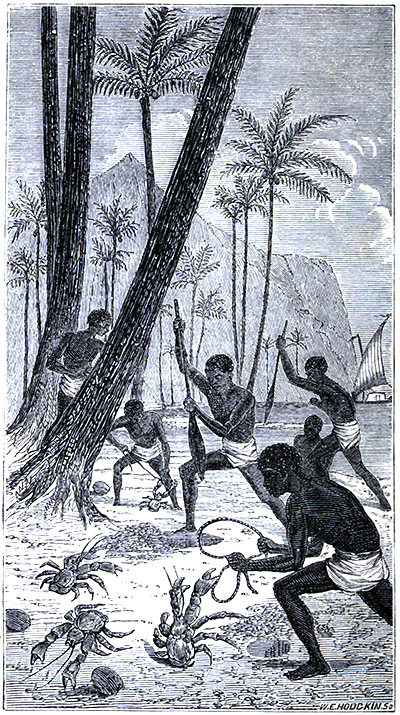
A PARTY OF “OU-OU” HUNTERS.
Title: Crab, shrimp, and lobster lore
Gathered amongst the rocks at the sea-shore, by the riverside, and in the forest
Author: William Barry Lord
Release date: January 19, 2026 [eBook #77735]
Language: English
Original publication: London: George Routledge and Sons, 1867
Other information and formats: www.gutenberg.org/ebooks/77735
Credits: deaurider, chenzw, and the Online Distributed Proofreading Team at https://www.pgdp.net (This file was produced from images generously made available by The Internet Archive)
[Pg i]
A PARTY OF “OU-OU” HUNTERS.
[Pg v]
CRAB, SHRIMP, AND LOBSTER LORE,
GATHERED AMONGST THE ROCKS
AT THE SEA-SHORE,
BY THE RIVERSIDE, AND IN THE FOREST.
By W. B. LORD, R.A.
AUTHOR OF “SEA-FISH, AND HOW TO CATCH THEM,” “THE SILK WORM BOOK.”
ETC. ETC.
LONDON:
GEORGE ROUTLEDGE AND SONS,
THE BROADWAY, LUDGATE.
1867.
[Pg vi]
LONDON:
R. CLAY, SON, AND TAYLOR, PRINTERS,
BREAD STREET HILL.
[Pg vii]
What say you to a ramble among the fairy rock pools, weed-covered ledges, and gem-decked parterres bordering the gardens of the sea? Where ocean plants and flowrets of a thousand hues and tints wave their trailing tendrils, and unfold their feathery fronds, in the crystal waters, and to an expedition to far-off lands and tropic islands raised from the sea’s depths by the mighty labours of the tiny coral insect; where the tough roots of the graceful, fern-like palms, are ever bathed by the snow-white foam, and where the fresh sea breeze, sings merrily through the grove, to the deep-toned thunder of the surf as it breaks on the wide-stretching reef, and is scattered in a rainbow shower far within the still lagunes [Pg viii]beyond its rampart-like borders. We do not journey thus far to gather gold, gems, or pearls, neither is our object warlike, although we purpose visiting the mailed hosts in and about their strongholds, and investigating the economy of the submarine armour-clads, in their own harbours. Should the adventure be to your taste, we will, together, explore the keeps, caverns, and points of vantage in which some of these sea champions reside, inspect the armories with which they are furnished, and note the nature and quality of their equipment. As man makes war on his fellow-man, and devises not only weapons of offence and destruction, but shields and defensive armour wherewith to protect himself, so nature—from whom many of the most perfect examples of both have been borrowed by the human race—furnishes to the swordfish, the long and sharp rapier, with which he deals out death to the huge, and mighty whale; the beautifully barbed spear to the sting ray, and the dagger-like spines which arm so many of the freebooters of the sea: the massive mail of the turtle; the castles of exquisite design [Pg ix]in which the shell-bearing molluscs dwell, and the armour of proof possessed by the crustaceæ, are all fashioned by the same skilled hand; and so marvellously perfect and admirable are their adaptation to the purposes for which they are intended, that man, with all his boasted intelligence, can only wonder, admire, and endeavour to imitate.
| PAGE | |
|---|---|
| A PARTY OF “OU-OU” HUNTERS | Frontispiece. |
| “CANCER,” A SIGN OF THE ZODIAC | 1 |
| A CRAB IN TESSELATED PAVEMENT | 2 |
| “BABY CRABS,” OR ZOËA | 4, 5 |
| LARGE EDIBLE CRAB (Cancer pagurus) | 8 |
| CRAB POT | 9 |
| A “BECUED CREEPER” | 11 |
| FISH-HOOK FASTENINGS | 12 |
| LOOP SLIP | 13 |
| STONE HITCH | 13 |
| FRAME REEL | 15 |
| GUT KNOT | 16 |
| KNIFE TWISTER | 17 |
| FISHING LEADS | 20 |
| TRAVELLER LINE | 21 |
| HARBOUR CRAB (Carcinus maenas) | 28 |
| VELVET SWIMMING CRAB (Portunus puber) | 30 |
| COMMON SLENDER SPIDER CRAB (Stenorynchus tenuirostris) | 33 |
| Pagurus Bernhardus | 34 |
| VENUS’S FLOWER-BASKET (Euplectella speciosa) | 36 |
| COMMON PEA CRAB (Pinnotheres pisum) | 42 |
| [Pg xiv]PINNA PEA CRAB (P. veterum) | 43 |
| THE “OU-OU,” OR COCOA-NUT CRAB (Birgus latro) | 46 |
| THE EUROPEAN LAND CRAB (Thelphusa fluviatilis) | 56 |
| COMMON SAND SHRIMP (Crangon vulgaris) | 74 |
| THE DREDGE | 75 |
| SAND SHRIMP NET | 76 |
| POLE SHRIMP NET | 78 |
| PRAWN NET | 80 |
| COMMON PRAWN AND PARASITE | 86 |
| THE COMMON ENGLISH LOBSTER (Homarus vulgaris) | 90 |
| LOBSTER TRAP | 91 |
| HATCHING TROUGH (French) | 92 |
| PAN AND TUB ARRANGEMENT | 93 |
| NORWAY LOBSTER (Nephrops Norvegicus) | 95 |
| SPINED LOBSTER, OR CRAY (Palinurus vulgaris) | 100 |
| THE COMMON RIVER CRAY (Astacus fluviatilis) | 106 |
[Pg xv]
The crustaceans, to whose homes we propose bending our steps, have some strange and note-worthy peculiarities of form, structure, and habits. Instead of, like ordinary creatures, having skeletons in them, on which their tissues are disposed (much as fashionable milliners arrange the captivating raiment of the fair), they, in an apparently perverse and independent spirit, adopt a custom of their own, which to us would, to say the very least of it, prove most uncomfortable and inconvenient, and wear their skeletons outside instead of in; and although fashions do not (so far as our experience has gone) change in the realms of King Neptune, and no startling announcement meets the eager eye of Mrs. Crab, or the charming Misses Lobster, that a sweet new thing in skeletons has just arrived at the emporium of Sponge, Limpet, and Co. Limited, [Pg xvi]no crustacean lady or gentleman ever thinks of being content with one, for the term of her or his natural life; but as the external coverings become worn, and feel uncomfortably circumscribed, a restlessness, and yearning for variety is felt; and, like Professor Owen, their longings are for a new skeleton, and, like that gifted anatomist, rest not, until one is obtained. Unlike the page who, in a complete suit of armour, accompanied his noble master to the Holy Wars, and, as the legend goes, returned after years of absence, a dwarf, from having nothing else to wear, our friends are more prolific in expedient, as will be seen by those who investigate.
[Pg 1]
CRAB, SHRIMP, AND LOBSTER LORE.
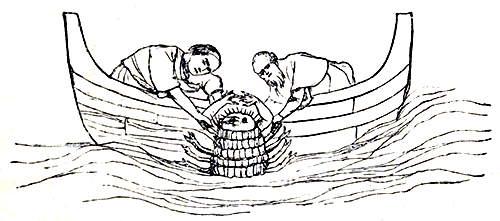
From the very earliest periods of the world’s history the family of Crab appears to have been well known and much respected, and the Zodiac would be incomplete without its “Cancer.” The picture from which the accompanying illustration is taken was drawn by an artist of the thirteenth century, and appears as an embellishment in a Prayer-book which afterwards became the property of Queen Mary, and is now in [Pg 2]the British Museum. It serves to show the idea entertained in this country of that particular sign at the period referred to. Those remarkably odd fellows the early Romans, even in their time, were not the sort of folks to overlook or heedlessly pass by the merits of so distinguished a gentleman as Mr. Cancer. He was well known and highly appreciated in the Seven-hilled City long before Art, except as brought to bear on the delineation of rude and uncouth patterns on the skins of the inhabitants, was known in this country. But when the restless Roman gentry, before referred to, cast their lot on a distant shore, and settled in the savage British Isles, they bore with them memories not to be effaced or treated lightly. Tesselated pavements in Cancer’s honour were elaborately wrought, and carefully laid down by them in the villas they here built [Pg 3]for themselves. The accompanying illustration represents a portion of one of these pavements discovered at Cirencester in the year 1783.[1]
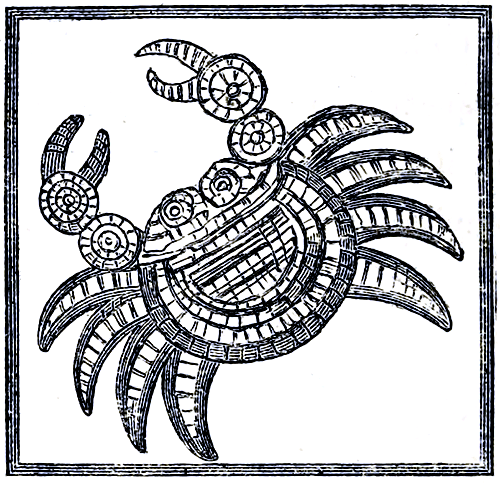
[1] A Roman oyster-knife was found buried not far from the site of one of these ancient villas.
A great deal of this esteem, it is to be feared, somewhat resembled the great affection professed by a chief of the Feejee Islands for a very good-looking little midshipman of one of Her Majesty’s ships cruising among those fertile but questionable retreats. “I love him very much,” said the dusky potentate, “because he is so plump, and would make such a delicious roast with palm-top stuffing.” Apicius loved Crab because he was good in many ways. Hear what he says of Crab sausages: “Boil some of these animals, reduce them to a pulp; mix with this some spikenard, garum, pepper, and eggs; give to this the ordinary shape of sausages, place them on a stove or gridiron; and you will by this means obtain a delicate and tempting dish.” He also informs us that a Crab may be served whole, boiled, and accompanied by a seasoning of pepper, cummin, and rue, which the cook skilfully mixes with garum, honey, oil, and vinegar. Later on in history we find our friend Cancer depicted in heraldic devices, and among the armorial bearings of many influential families. So we see that his lineage is an ancient one. The family to which he belongs is extremely [Pg 4]numerous, and it is with the peculiarities of some of its members that we shall now have to deal.
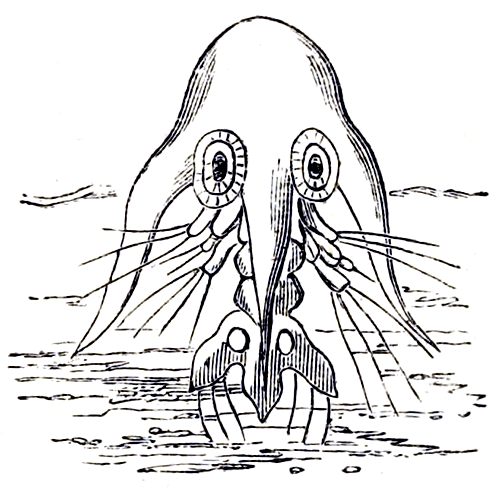
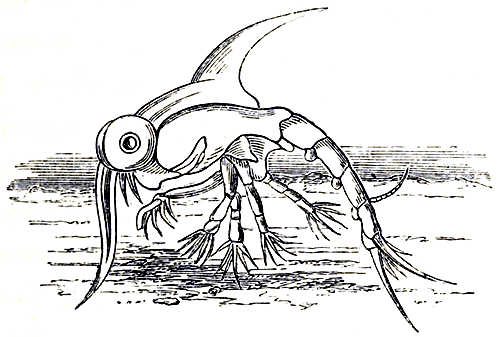
Among all the curious and quaint forms of animal life to be found in the sea, few for grotesque oddity can equal the baby Crabs, or Zoëa, as they are sometimes called. These interesting infants are not the least like their papa or mamma, and no respectable or fully-matured male or female Crab would ever own them as his or her offspring. An elfish little creature is the juvenile Crab, with a head scarcely deserving the name, and a pair of goggle bulls’-eyes as of two policemen’s lanterns rolled into one; a tail vastly too long for him, and an anti-garotte spear, quite as long as his absurd little body, attached to the spot where his coat-collar should be. The annexed illustrations will serve to give some idea of these prepossessing juveniles. They are the portraits of two little cousins. In this case, age, although it alters appearances, affects disposition but little, and, as you turn over some stone, fragment of wreck, or tuft of weed, in search of curiosities, young Master Crab will, in all probability, be found at home, and, like an [Pg 5]enraged dentist, ready to do fierce battle against all intruders with his upraised pincers. This is the ill-disposed young gentleman who sends Lotty or Totty, with heartrending screams and pinched pettitoes, in wild dismay from the charming shell-floored pool, in which they have been paddling. Master Crab’s internal economy is just as curious as his external skeleton. One pair of jaws one would be disposed to think sufficient for any living creature of reasonable requirements; but he possesses eight, and, instead of exposing his teeth to the examination of the critical in matters of dentition, he carries them safely stowed away in the interior of his stomach, where they would be excessively hard to get at in cases of crustacean tooth-ache. With such appliances as these, the food cannot well be otherwise than perfectly masticated. A Crab’s liver is an odd organ to contemplate, and constitutes a considerable portion of the soft interior of the shell-like [Pg 6]box in which the heart and other viscera are lodged. That well-known yellow delicacy known as the cream or fat of the Crab is liver, and nothing else. The lungs or gills are formed by those fringe-like appendages popularly known as the dead men’s fingers. The shell-shifting process before referred to, is common to all crustaceans; and our friend the Crab, when he feels his corselet getting rather tight for him, manages, by some extraordinary process, not only to extricate himself from it, together with his shell gauntlets and the powerful nippers with which he is provided, but performs other feats, compared with which those of the Davenport Brothers sink into utter insignificance; and we opine that, had those eminent spiritualists been called on to do by the aid of all their shadowy accomplices one half of that which Cancer and his cousins the lobsters and crays do unassisted, no Tom Fool’s knot would have been needed to complete their discomfiture. Not only are the too-constricted shell and claw coverings cast aside, but also the outer cornea of the eyes; the stem sheath of the eyes; the lining of the stomach with the internal teeth; the internal bones of the thorax; the lining membrane of the ear, and that covering the lungs; thus very nearly turning themselves inside out, as well as getting rid of their old suits of clothes. But all these wonderful operations are not performed with the ease with which the chrysalis sets free the [Pg 7]painted butterfly, or the village maid, by touch of fairy wand, throws off her homely garb, and steps forth the gauzy glittering columbine in the transformation scene of a pantomime; but are works of time and trouble, the body appearing to dilate within its prison until the coffer-like cover formed by the shell slowly and by degrees gives way, the membranes one by one are torn asunder, the muscular tissue filling up the large claws and pincers undergoes a softening process which admits of its being drawn through the constrictions between the joints, and the crustacean and his old garments part company at last.
Between the loss of the old shell and the secretion of a new one, nothing can be more unenviable than the position occupied by our poor forlorn friend, who, like some fashionable exquisite during a temporary misunderstanding with his tailor, seeks retirement and obscurity. The pert young crablings, inquisitive, troublesome little gobies, and irritating prawns, who a short time since treated him with due respect, now pinch his unprotected skin and nibble at his poor defenceless tail in a manner not to be endured; so he shuns society, goes into dock for repairs, and waits for fresh sheathing and his new pincers to grow. These under favourable circumstances soon form, and “Richard is himself again.” It is our opinion that these moultings or changes do not, as some authors have stated, [Pg 8]take place at regular and stated intervals in the lives of the larger crustacea, as rapidity of growth in particular individuals would tend to accelerate the period for change, and it appears probable, from the number and size of the marine molluscæ constantly found adhering to the shells of fully-matured specimens (oysters of even six years’ growth having been so discovered), that the changes of shell become less frequent as age advances.
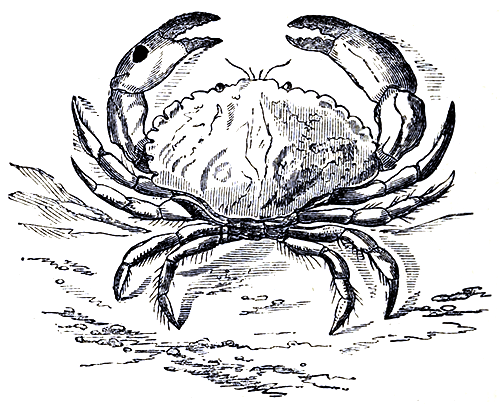
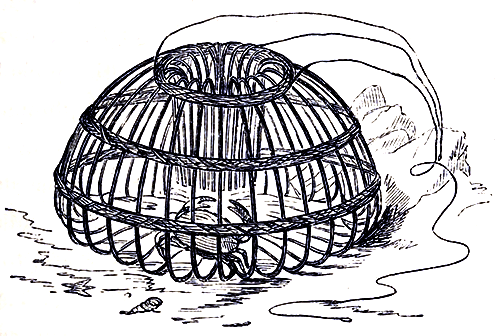
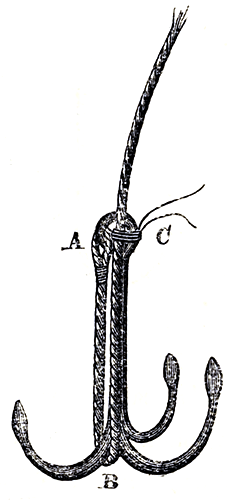
The most important member of the Crab family, in a commercial and gustatory point of view, found in this country, is the large edible Crab of the shops, Cancer pagurus, the subject of the annexed illustration; and its capture not only gives employment to [Pg 9]an immense number of families along the sea-board of England and its home dependencies, but forms an admirable school for the training of the hardy mariners so much needed for both our navy and mercantile marine. The professional crabber is usually an expert boatman, and line, or rather hook-fisher, in addition to his crab-catching powers. There are several methods by which Crabs can be taken, but that usually resorted to for the capture of the kind now under consideration is by crab pots, or baskets, woven of unbarked willows.[2] These are contrived much on the principles of the common wire mousetrap, a number of points being arranged in funnel form at the entrance, so as to admit of free ingress, but rendering exit quite a different affair, and one by no means [Pg 10]easy of accomplishment. The eel-basket, the salmon-trip, and many other fish traps are made in much the same manner, with some modifications as to material and size. Pieces of fish and fish offal are usually used as bait for these contrivances. This is secured within the basket, which, with a heavy stone as a sinker, and a long line with a float attached to it, is lowered down from the boat amongst sunken rocks and in the deep gulfs between reefs, where ledge, crevice, and secret cranny are known to afford hiding-places to the sought-for prey; and here the traps are allowed to rest, sometimes for the night, at others a shorter period, just as convenience or the probability of a take may suggest, when, the float being found and the line hauled in, the pot with its contents are soon safely on board the boat. Where many persons engage in the same occupation, it is necessary, in order to avoid mistakes as to the identity of the traps, to have certain distinguishing marks by which they may be known. Each fisherman, therefore, has his own pattern for the float—one using a single piece of circular form, another, a single square, whilst a third either piles several pieces in conical form, or cuts a peculiarly-formed cross. A plan we strongly recommend to those who wish to amuse themselves by catching Crabs for their own use, is to use a large flat bung, made of stout cork, nail a piece of strong tough wood, such as [Pg 11]elm, to the under surface, in order to prevent splitting, burn a hole with a hot iron large enough for the float line to pass through, tie a knot or work a Turk’s head on the end of the line, paint the upper surface of the cork white, and then burn your initials deeply into the cork with a branding iron. The crabbers as a body are rarely dishonest, but little mistakes are at times made when crab-pots are insufficiently marked by the owner, and Crabs at a premium; still there are very few so utterly indifferent to the voice of public reprobation as to “haul another man’s pots,” a crime in the eyes of a fishing community pretty much on a par with stealing a sheep or robbing a church. Should you embark in the crabbing line, take our earnest advice: provide yourself with a boat with plenty of beam; have every rope, net, and line you use tanned; and never let your boat’s creeper, or “killick,” go on rocky ground without making use of the precaution shown in the accompanying illustration, known as “Becueing,” or the loss of creeper and creeper line into the bargain will be very likely to follow.
[2] Galvanized iron wire has been much advocated as a material for their construction.
It will be seen, on referring to the above cut, that the line after having been secured to the ring at the [Pg 12]head of the creeper shank, as at A, is brought down and passed under one of the claws as at B. It is again brought up until it meets the ring, to which it is secured with a piece of common twine doubled, or a bit of single spun yarn, as at C. It will be at once seen that, on either of the claws becoming fixed in a rock or under a ledge (a matter of constant occurrence when fishing from a moored boat), by pulling heavily on the line the twine or yarn stopper gives way, and the creeper becomes immediately free by being capsized, and can then be readily hauled in.
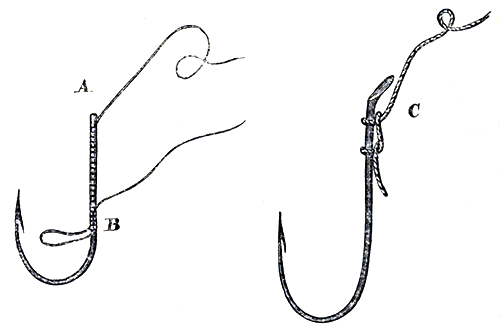
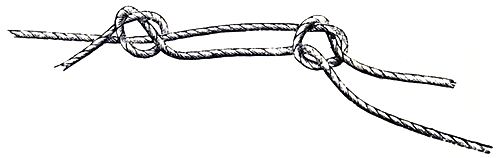
To safely bring a large fish to basket after it is hooked requires skill, patience, and proper appliances. Hooks and their attachments to the traces should be well looked to before commencing operations. There are two modes of fastening on fish-hooks. One, as in [Pg 13]the foregoing cut A, is with well-waxed silk or thread, binding the hook-wire and trace firmly and neatly together, and then finishing off by passing the end of the lashing back under three or four turns of itself, vide cut B, and then drawing it tightly home. The other plan is by half hitches, two or three of which are turned over the shaft of the hook below the flattened end usually made to sea-hooks; when drawn tight the turns of line may be pressed up compactly together with the thumb nail. The accompanying cut C will better explain the mode of putting on the hitches than would any written description. Both traces and lines should have loops made in the ends; these, when run together by what is called the loop slip, shown in the above illustration, make a very neat and secure fastening. Stones are conveniently fastened on as sinkers to lines mounted with many hooks; by the plan shown in the above cut, no knots are made, and [Pg 14]when the stone is removed the loop falls out and leaves the line as before its attachment. Large powerful fish should never be lifted into the boat by the tackle. A wide, short-handled landing-net, and gaff, made from a large-sized fish-hook, lashed to a staff, form an essential part of the equipment.
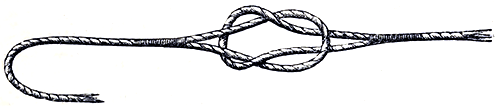
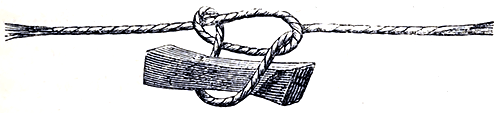
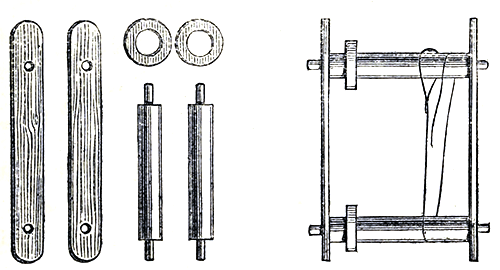
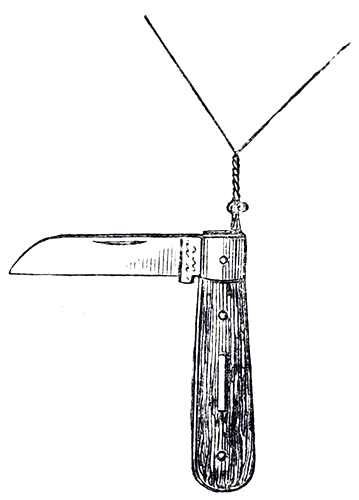
The owners of yachts, and families residing near the sea, will find a few crab-pots, which can be made at a very trifling cost, a valuable acquisition, as not only crabs, but lobsters, cray-fish, and prawns are readily taken in them. Sea fishing-tackle will be found very useful, as after having baited and laid down the pots a number of fish may be very often caught. These will be found acceptable as an addition to the daily bill of fare, and such as are of inferior quality make excellent crab-bait. It is not our intention to enter at any length on a description of sea-fishing gear; still there are certain hints and expedients relating to it which may not prove unacceptable to the reader. Lines vary much in substance and length with the description of fish it is intended to capture, cod, conger eels, hake, &c., requiring them of considerable strength and power; but it will be found, as a rule, that the lines used by the regular fishermen of our coasts are much stouter than is necessary, and it may be depended on that the finer the tackle is, consistent with the requisite strength to hold the fish when hooked, the more successful will [Pg 15]be the result of its use. It is very seldom indeed that a line is broken by a fish, unless from some flaw or imperfection, the trace on which the hook is tied being far more frequently the point of breakage. Strong silk-worm gut, either single or twisted, is much to be preferred to the hemp snoodings in common use for all traces but those used in the taking of the very largest descriptions of sea-fish. The round plait prepared salmon line, sold by all fishing-tackle makers, answers admirably for a general sea-line. The length may be proportioned to the depth of the water it is intended to fish, but about thirty yards is a convenient quantity to deal with. This should, for hand-line fishing, be kept wound on a frame reel. One of these is easily made as follows:—Two flat pieces of tough strong wood, such as oak or ash, about a foot long, an inch and a half wide, and a quarter of an inch thick, are to be prepared; at each end of these, at about two [Pg 16]inches from the extremity, a round hole is to be either bored, or burnt with a hot iron. Two round wooden bars of about ten inches in length, and the size of an ordinary walking-stick, are now to be prepared, cutting each end to fit the holes in the flat bars, so that they may pass through them, and extend about two inches beyond. A shoulder must be cut in each joint, in order to prevent the bars from coming together; when put in place they are secured with small pins or brads; but, before fixing them, a round flat piece of cork is to be run on each round bar to stick the points of the hooks in; the cut on p. 15 shows the shape of the framework and the reel complete. Reels of this description are much to be preferred to the common kind, on account of the free ventilation they afford the lines when wound on them, and the freedom from entanglements insured by the cork hook-holders. The traces before referred to may be used of either single, double, or triple strands. All gut before being knotted together should be steeped for ten minutes or a quarter of an hour in warm, not hot, water; the curled portions [Pg 17]and ends are to be cut off, and the required number of lengths selected as to stoutness. They can now be attached to each other by the use of the gut knot, as shown in the preceding cut. This, when drawn home and the ends trimmed off, forms a very secure fastening. To make a double or triple gut trace it will be necessary to twist the strands constituting it. This can be readily done by knotting the extreme ends together and then placing them between the back spring and blade of a common pocket-knife, as shown in the annexed cut. The other ends are now taken by two or three persons, according to the number of strands to be twisted, held between the finger and thumb, and turned until a spinning motion is communicated to the knife hanging in the middle, when the trace is very quickly finished,—six feet is a good length for general purposes. All hook-lengths and traces should be attached to the main line by brass swivels. A short, stiff rod, with stand-up rings, fitted with a large-sized Nottingham reel, on which fifty or sixty yards of prepared line has been wound, will be found useful for taking many kinds of fish, and an extra joint or two adapts it [Pg 18]for fishing from rocks or pier heads. When using tackle of this description from a boat for the capture of small fish, as pouting, chads, whiting, &c. are commonly called, it will be found a good plan to employ a foot trace of twisted gut, medium-sized trout-hooks tied on strong single gut snoods; these may be looped on at eighteen inches apart. The bottom of the trace must be secured to one of the conical sinkers of sufficient weight to keep the line straight down against the run of the tide. Bait with rag-worm, and commence fishing at about three feet from the bottom, when, if the fish are not found feeding there, shallow depths may be tried, or the ground itself just touched with the lead, only taking care that a sufficient strain exists just to slightly curve the top of the rod; on feeling a bite, strike sharply, and when the fish is found to be hooked, draw the line in with the right hand, whilst the rod is upraised in the left, until the prize is at the surface, when, unless very diminutive indeed, the landing-net should be made use of,—more fish are lost in weighing out than in any other way. Large captives must be played until sufficiently passive to be safely brought alongside and netted or gaffed.
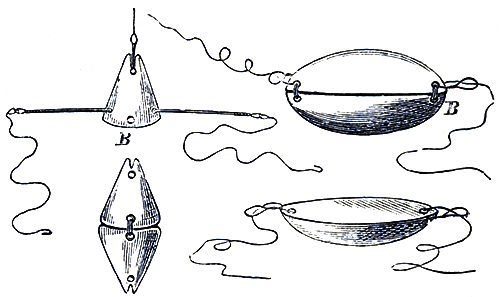
Rod-fishing for mackerel bass, grey mullet, “Atherene” or sand smelt, and several other descriptions, may, at times, be practised with considerable success. We have taken great numbers of the two former with both [Pg 19]bait and artificial fly. Mackerel fishing with the float-line affords, at certain seasons, excellent sport. A large cork float, four-foot trace of single salmon gut, and one medium-sized Limerick trout-hook should be used; three or four duck-shot will be found, with the swivel, sufficient to keep the trace straight. Bait with either pilchard gut, a strip cut from the tail of a freshly-caught mackerel, or a long narrow ribbon of cuttle; cap the float to about fourteen feet from the hook and let the bait drift off with the tide. We have repeatedly taken numbers of mackerel in this way when hand-lines of the usual pattern were not visited by a single fish. For grey mullet, live shrimps or pieces of rag-worm will be found the best baits. Smelts are taken by mounting a number of very small hooks, No. 12 Kirby bend, on short pieces of very stiff gut looped on to the main traces, at about six inches apart; a light sinker should be made use of, and short junks of rag-worm used as bait. Smelts much frequent localities where fresh water flows into the sea. Lead sinkers, of any weight between seven or eight pounds and that of a buck-shot, can be cast between two common Bath scouring bricks. Half the form of the intended sinker is cut on each brick (after the surfaces have been rendered smooth by rubbing them together) with a common knife or chisel. The two halves, when exactly matched, are tied together with tape and a [Pg 20]small inlet hole made, through which the molten lead is poured from an iron ladle, tobacco-pipe, or iron spoon; according to the quantity of metal required: one brick is sufficient to cast simple forms in, merely cutting out the shape and filling it up. All sorts of articles in lead can be made in this way, without any of the dangers which usually attend casting in clay or damp mould. The two kinds of fishing leads represented in the above cut can be used for a great number of purposes, and are mounted either single or double, as the strength of the under current or run of the tide may render necessary, by passing a few turns of fine packthread or spare snooding through the holes at B, and bringing the flat surfaces of the leads in contact. A great number of bass, codlings and other fish are, in many localities, to be taken by laying out lines baited with whelk, [Pg 21]hermit-crab, &c., to meet the coming tide as it flows in over beaches or sand flats. A heavy lead is often used as a means by which the line and baits are not only kept at the bottom when they reach it, but is turned after the manner of a sling round the head of the fisherman, and then cast far out in the surf, to be withdrawn and again thrown as the take of fish or renewal of bait may render necessary. There are many very great inconveniences attendant on this mode of fishing, and it is far better to lay down a traveller when the tide is out. This is done as follows:—Just before the turn of the tide and the coming in of the young flood, select the spot at which you intend trying your fortunes, and then search out a large heavy stone as your traveller block, and thus prepare it, with strong twine or whipcord; take two or three turns round the stone and securely fasten off with a knot; then attach a common curtain ring or the link of an old chain. Lay your block on the edge of the water, pass one [Pg 22]end of your fishing-line through the ring, and walk back with it some distance up the beach, allowing the other end to be given off the reel until the spot at which the first end was dropped is reached. The line will now be doubled; one half has hooks on short traces, as many as it is thought expedient to use, mounted on it. The other half is free from hooks, in order that it may run through the ring without entanglement. A small piece of stick is knotted on the line close to the first hook, so that it cannot be pulled through the ring, as shown in the illustration on p. 21.
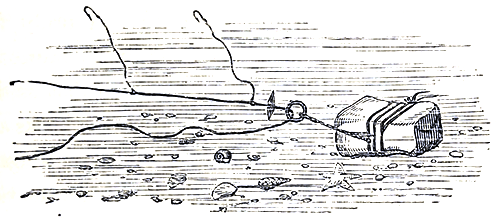
The arrangement is now complete and ready for baiting. It will be seen that as one line is drawn in, the other travels out towards the block, so that as the fish are hooked they are brought to land, the hooks are fresh baited, and the contrivance hauled out again without the trouble of throwing the lead. As the tide comes the fisherman walks back until he reaches high-water mark.
On some of our coasts a great number of Crabs are taken with the crab-hook. This is a sharp strong hook of tough iron, fastened to the end of a stout wooden staff, or pole, and the best time to use it is when the sea recedes during spring tides, and makes what among fishermen, is called a “great out.” At such times a great number of deep rock pools and hollow ledges become accessible, which during ordinary [Pg 23]tides are far beneath the waves, and now is the harvest of the adventurous crab-hunter, who, hook in hand, climbs and scrambles among the slippery stones and weed-covered crags, to where narrow cleft and dark recess give promise of Crab’s lurking-places, when with a cautious probing motion, the curved instrument is thrust onward along the hidden galleries beneath the rock, until the practised hand detects the hoped-for impediment, when with one sudden, dexterous, backward stroke of his weapon he withdraws the retiring Cancer from his snug retreat, and exposes him to the garish light of day. Give him but one instant for reflection, and up goes his back against the roof of his hole, when, except by literally pulling him in pieces, extraction is a sheer impossibility; and it is in consequence of this exceedingly unaccommodating habit of his, that would-be crab-catchers have been at times crab caught, and their incautious groping hands held fast as though in the vice of some sea Vulcan, until the flowing tide has put an end to both their struggles and sufferings. The tenacity of a crab’s grip is perfectly extraordinary and all but incredible. A hold once taken is seldom let go, and the battles which frequently take place among these pugnacious gentry give ample scope for the exercise of their tremendous nippers; and nature has most wisely provided them with the power of throwing off such limbs as may be either seized by the enemy or [Pg 24]seriously injured; and should they chance to encounter an antagonist from whom it appears wise to beat a retreat, our friend firmly seizes him by the most tender spot he can select, sets his pincers nipping and grinding in the most excruciating manner, and then rapidly detaching and leaving them in possession, darts off to the first sanctuary within his reach. To most living creatures the unceremonious sacrifice of limbs in this way would lead to almost immediate loss of life from hemorrhage, but a wise provision is also made for this contingency. The division taking place at a constricted portion of the joint of a limb admits of the vessels drawing themselves in, and so stopping the flow of blood. A thin membrane soon covers the stump, and in due time another limb replaces that which has been lost or cast away. In some localities the haunts of the Crab are discovered by fastening pieces of waste fish to the ends of short, strong lines, and then, after attaching long stones by their middles to the other ends, strewing them about among the rocks and pools; at the ebbing of the tide, these tell-tale stones are sought for as they rest outside and across the dwelling-places of the Crabs, which when found are not only “made a note of,” but the tenants either by hook or crook brought to light with little ceremony.
Some little judgment is required to select a thoroughly good Crab for the table, and as the choice usually lays [Pg 25]amongst dead specimens, a few hints on the subject will not perhaps prove unacceptable. A male Crab is generally to be preferred to a female, on account of the larger development of claw, &c. The sexes may readily be distinguished by examining the flat, peak-shaped, flap-like tail, which will be found curled beneath the under-surfaces of the body. This in the male is narrow, whilst in the female it is wide and of different form. A good Crab should feel heavy in the hand, and on being sharply shaken no sound or movement of fluid heard. The large nippers should at the same time remain tucked tightly up, and not hang loosely from the body. The absence of freshness is a defect too obvious and important to need comment.
The proper mode of boiling Crabs has long been a subject on which doctors have disagreed. Who then shall decide? That there is cruelty associated with the taking away of life, it would be hard to deny, but the correctness of choice between gradual stewing in slowly-heating water, and being plunged at once into the seething, bubbling cauldron, requires “the revelations of a boiled crab” to clear up; and until a crustacean production under that or a like title appears, we shall continue to plunge our armour-clad victims in water at 212 degrees of Fahrenheit’s thermometer, and leave the question as to the propriety of our so doing to those [Pg 26]who are disposed to grapple with the subject for its own sake.
The change of colour which takes place in many of the crustacea during the process of boiling, has long been a subject of remark. The common and edible Crabs of this country have their tints far less affected than the lobster, the peculiarly rich blue shade of whose shell when in a living state is too well known to need any lengthened description; this, as is well known, changes to a bright red in the cooking-pot, and the uniform of the police is exchanged for that of the line regiments. This strange metamorphosis, researches have shown to be entirely dependent on chemical laws. The pigment on which the blue shading and tint depend, is a peculiar fat-like substance, which possesses the singular property of becoming scarlet when subjected to 70 degrees of heat shown in the centigrade thermometer. A colouring matter of very similar properties was some time since discovered in the beaks and legs of certain birds.
The lobster pigment is soluble in spirits of wine, by which agent it can be extracted from the shell; but the colour changes at once from blue to red. And on adding either nitric or sulphuric acid, the charged spirit is changed to a green of a remarkably fast or permanent character. Who shall say, as fresh discoveries are made and new solvents brought to light, that lobster [Pg 27]shells may not become more valuable than the appetising fish they once contained! We see no reason why the dormant sprite, who lies hid in the coat of sea mail, should not be roused from his long sleep and set to work with the other kobolds who do the will of the mighty magician chemistry; and little dreams the fascinating belle, who has been made “beautiful for ever,” how much those same kobolds have had to do with the process. Bismuth, from the deep-mine cavern, gives to the skin the pearly white so much prized: the cochineal bug, from the prickly cactus thickets, the roseate hue (“The Turkish Bloom of Health”) which is said, in the flowery language of the advertisers, to impart to the cheek the attractive lustre of the ripe peach. The elegant mauve dress, ribbons, and gloves, are “tinctured” by a toiling imp residing in gas tar. “Lovely things” in green too are industriously turned out by two quaint, but rather dangerous and mischievously disposed gentlemen of the elfish crew, Messrs. Arsenic and Copper, who work in partnership, and whose attractive joint productions some time since poisoned a number of the sea-green nymphs of a Parisian ballet. How far more appropriate and safe would it have been to draw from the rich stores of king Neptune the materials with which to dye the drapery of the stage mermaid and seaside beauty, and we hope ere long to see “the new lobster-shell green,” under some tremendously [Pg 28]sonorous Greek name (without which success would be doubtful), “the fashionable colour.”
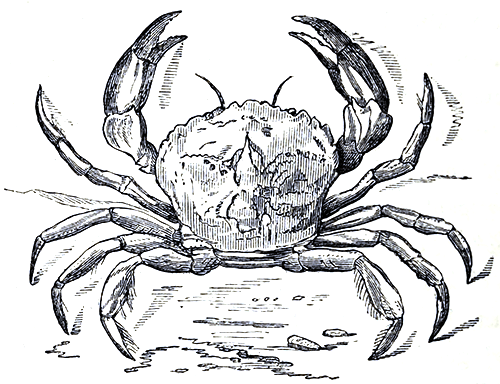
The juvenile members of most of our seaside communities are much given to crab-fishing, and may be seen from early morn to evening late, dangling their legs over some convenient rock, sea-wall, or landing-steps, and with a piece of twine to which a dainty morsel of fish offal has been tied, doing their best to induce some greedy young crabling to grasp it with his nippers, when, with a sudden jerk and triumphant shout, the deluded victim is pitched out high and dry before he knows what he is about, and is then tied by the leg and led about like a lilliputian pig, who strongly objects to either going to market or staying at home. Fortunately for him he is not very good to eat, [Pg 29]or as a rule very large; still his captors, when they do secure him of even ordinary dimensions, treat him to a pot of boiling water, and let him go cheap. This description of crustacean is known as the Harbour or Shore Crab (Carcinus maenas), and is represented in the preceding cut. He is a weed of almost every soil, and a perfect pest to those who fish in estuaries and tidal rivers, nibbling off the bait in a manner past all endurance, and when the watchful angler, anticipating the presence of a plump and silvery fish at the end of the line, raises his fishing-rod aloft, there hangs instead, a green, mud-coloured little imp, clawing the air like an enraged spider, making himself in fact in every way obnoxious and disagreeable.
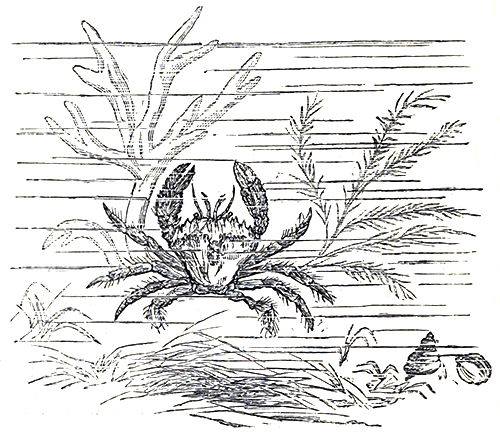
Then there are other members of the same amiable race, with whom he who fishes the sea with nets will not be long before he makes acquaintance. These are the swimming Crabs, of which there are numerous species. These differ materially from the kinds we have described, in habits, appearance, and structure. By the use of their powerful oar-like legs they are enabled to propel themselves through the water with great rapidity and precision, and by darting among the meshes of the fishing-nets they become so hopelessly entangled, that a “Fiddler Crab” (as it is sometimes called from the rapidity with which it works its elbows) [Pg 30]in a trammel net, is often used by fishermen as a standard with which to compare cases of the most utter bewilderment. The annexed cut represents one of these, the Velvet Swimming Crab (Portunus puber).
The still, deep, lagunes, within the coral reefs, in the southern and eastern seas, contain creatures of this class most exquisite in form and colour, and we have often looked down into some clear, well-like gulf between the branching coralines, clustering sponges, and actinea of countless hues, and watched the marvellous episodes of deep-sea life there passing beneath; fringes of crystal arms, disc-like mouths, and far-stretching tendril-shaped legs, wave from every point and ledge, [Pg 31]whilst crustaceans, as of animated enamel work, accompanied by fish, like living gems, troop restlessly in and out and to and fro, in an endless throng.
Anthozoa, those living, ocean blossoms, spread their petals of a thousand hues, whilst the family of Medusidæ float like shadows through the tranquil depths.
Crabbe.
Spider Crabs are there, too, both here and in the seas, washing our own island, with limbs so long and attenuated, and bodies so small, that they look more like overgrown DADDY LONGLEGS going through a course of sea-bathing than aught else, and we almost begin to think they must be marine spiders after all, and wonder where the sea-flies are, and what sort of webs they would spin to catch them in. The Indian seas have inhabitants of the serpent order, which are by no means safe to meddle with. They, too, desport after their own manner:—
“Ancient Mariner.”
[Pg 33]
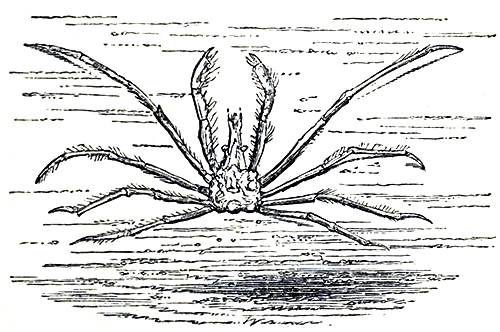
The subject of the annexed illustration is the common slender Spider Crab (Stenorynchus tenuirostris), frequently captured on our own coast. Some of these queer gentry, near relatives of his, are as prickly as a chestnut husk, and have claws like crooked tobacco-pipe stems. No cook even in the last stage of insanity could hope to utilize them.
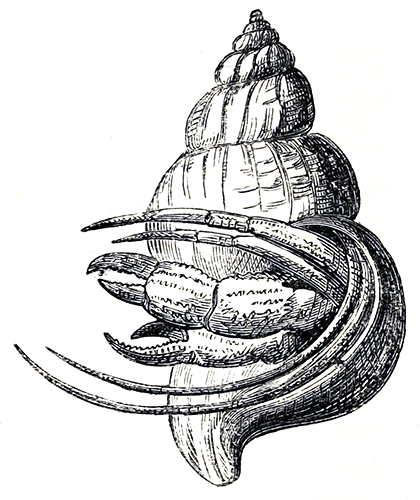
Then we have the soft-tailed, Soldier, or Hermit Crabs, who, because they are insufficiently clad by nature, seize on the first convenient shell they can discover, and then, by adroitly introducing the point of the tail, slip into it, much as a skilful stage demon vanishes through a vampire trap. Vacant shells are not always selected as mansions; those with inhabitants are not unfrequently taken possession of, when a process of forcible ejectment is had recourse to, and the hapless mollusc is soon gobbled up, and his house [Pg 34]occupied by the spoiler. Pagurus Bernhardus, the subject of the annexed illustration, is no doubt familiar to many of our readers, as most of the little salt-water ponds amongst the rocks and stones have one or more of these tiny hermitages in them. Whelk-shells are very commonly found inhabited by the pagurus we are describing, and large numbers, under the name of Crab Whelks, are collected, and used as bait, after the shell and hard structures have been removed by breaking them off with a hammer.
Pea Crabs there are also, living at free quarters in houses not their own; but of these we shall have more to say further on. The Hermits we find on our [Pg 35]coasts are perfect pigmies when compared with some of the species found in and about the tropic seas, who, dwelling in the huge helmet-like shells with which these warm regions abound, spend almost as much of their lives out of the sea as in it, consume large quantities of vegetable matter, and appear capable of supporting life for some time without absolutely going into the water.
Tenantless mollusc shells are not the only dwelling places of the Hermits, and other species of Crabs, and they have, from periods of remote antiquity to our own day, been found in situations in which they apparently have no reasonable right to be. This has given rise to much learned disputation, and not a few wild theories and quaint conceits.
That matchless piece of nature’s handiwork, the Philippine Island sponge (see next page)—Venus’s Flower Basket, or Euplectella speciosa, of naturalists—which has recently attracted so much attention in the British Museum and among the scientific world, was, about a year since, accidentally hauled up from the bottom of the sea, entangled on a fish-hook, by a native who was fishing for rock cod off the Island of Zebu, one of the Philippine group. Since the first discovery, numerous specimens have been obtained in the same locality, and from 30l. (the price paid for the fisherman’s prize) the value has progressively become less. Still purchasers [Pg 36]are numerous enough to make flower-basket hunting a remunerative occupation for some time to come. It is perfectly impossible, even with the aid of pictorial illustration, to give an adequate idea of the elegance and beauty of this extraordinary production. Of cornucopiæ form, and of the finest Brussels lace texture, it stands like a network vase among a tuft of crystal threads. The cover, like that of some antique flagon, crowns the top, and completes the strange resemblance [Pg 37]to man’s most skilled and perfect productions. Venus herself might well be proud of such a flower-basket; but like many other things of beauty, there are mysteries round their growth and formation. One of these, is the almost invariable presence of the remains of one or more Crabs in the interior of this, to them, crystal prison, out of which escape is just as impossible as from a capsuled bottle. Many differences of opinion exist as to the mode by which the Crabs first obtained an entrance; there appears, however, little doubt that this is effected whilst the sponge is in an immature condition, and before the cover is woven. There is a young specimen which we have examined in the British Museum in this incomplete state, and it is questionable whether the basket-like tube is ever covered until it has reached maturity; when, although the sponge appears to cease growing in an upward direction, the power possessed by it to secrete the silicious matter of which the network is composed remains unimpaired, and, like a skilful artisan as he is, he at once repairs neatly such injuries as his crystal palace may sustain.
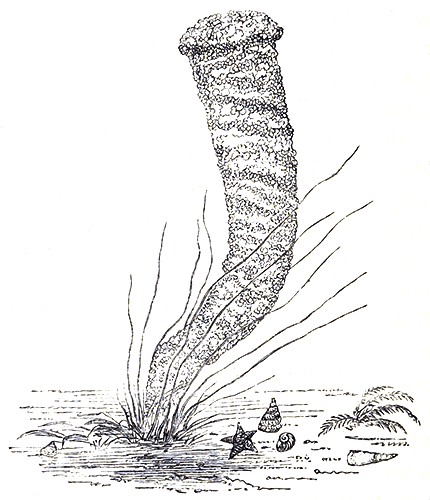
Dr. Gray has in his possession a specimen in which a repair of this kind has been effected. A hole appears to have been broken by some accident in one of the sides about half-way between the point of attachment and the cover. A new network of fibres in bunches [Pg 38]has been substituted for the broken ones—of form much like the original structure. The peculiar curved or cornucopia shape before referred to, and usually, although not invariably, assumed by these baskets, has also given rise to much speculation amongst the scientific. Dr. Gray gives it as his opinion that the weight of the Crab when crawling through the interior of the tube, may influence the direction in which the basket is found to incline. He says: “As the Crab becomes imprisoned in the cavity, it will be constantly walking up and down the tube to procure food, and by so doing will, most likely, bend the tube on one side, so that the free end of the tube may become bent down nearly to the level of the base;” and it remains an open question whether this is the true solution of the enigma, or, like the goblet forms of some species of sponges, and the rounded contour of others, the cornucopia form of growth may not, after all, be that common to E. speciosa.
It appears to be the prevailing opinion amongst the fishermen by whom the Euplectella is taken, and by whom it is known as the Rigederos, “that it is the work of two insects (meaning probably the Crabs found in the tubes) at the bottom of the sea.” A French correspondent in writing recently to the authorities of the British Museum, expresses his opinion that the Euplectella is the work of the Crabs. There [Pg 39]are very grave reasons, however, why this opinion should be received with the greatest caution, if not absolute doubt. In the first place, we know of no crustacean possessing a like power of silicious secretion and construction. Then the Crabs which are found inclosed are not always of the same species, or even genera. Dr. Gray is of opinion that one which he examined through the meshes was a Pagurus, and of habits identical with those which we have already described. Crabs with such investigating and intrusive instincts as these, would not fail to explore the inmost recesses of a hollow tube of such a tempting appearance as the young, growing, and coverless Euplectella would present; and what more probable than that, as the tube became perfected and the lid partly made, the Crab or Crabs might still continue to inhabit it, until the orifice being at last closed up, and escape impossible, our friend remained a prisoner for life. His cast-off shells, like old worn-out garments, would remain sealed up securely with him, and give the idea that many Crabs had there resided.
The ancients, although totally ignorant of the existence of the beautiful lace-work basket we have described, and the creatures dwelling within them, were nevertheless perfectly aware of the presence of small Crabs in the shells of the great silk-yielding mussel (Pinna nobilis), who, because he had no visual organs [Pg 40]himself, was supposed to need the services of a vigilant submarine watchman, sharp of ear and keen of eye—a sort of concierge, in fact—to attend to the door and keep out all unwelcome visitors.
The researches of Lamarck go to show that the ancient writers were generally of opinion that these Crabs were especially employed as general guardians and inseparable companions to the Pinna, that they had one common birth, and that the one could not exist without the other,—the absence of vision in the Pinna being compensated for by the vigilance of the Crab, whilst in matters requiring power and resistance, Cancer had only to give the required sign by a gentle nip, when his partner, with the strength of a sea-giant, shut his shell-trap-door on all the inquisitive, intrusive little fish within the fatal portal, when the firm of Pinna and Crab made remarkably short reckonings with them. We read that in 1749, Hasselquist, the distinguished naturalist, undertook a voyage to the Levant, and corresponded with Linnæus during his travels. In one of his communications he thus writes from Smyrna:—“Amongst others they sell here a sepia, or cuttle-fish, which by them is called Οκτωποδια. It has only eight tentacles all of equal length. The whole animal is a foot long, and thick in proportion. Of this the Greeks have related an anecdote which I think remarkable. The Pinna muricata, or great [Pg 41]silk mussel, is here found in the bottom of the sea in large quantities, and is a foot long. The cuttle-fish watches the opportunity when the mussel opens her shell to creep in and devour her; but a little Crab which has scarcely any shell, or has at least only a very thin one, lodges constantly in this shell-fish. She pays a good rent by saving the life of her landlady, for she keeps a constant look-out through the aperture of the shell, and on seeing the enemy approach she begins to stir, when the πινα (for so the Greeks call the shell-fish) shuts up her house, and the rapacious animal is excluded. I saw this shell-fish first at the Island of Milo, and found such a little Crab in all I opened. I wondered not a little what was her business there; but when I came here, I was first informed of it by the Secretary of our Consul, M. Justi, a curious and ingenious man, who has travelled much, and lived long in this place. This was afterwards confirmed by several Greeks who daily catch and eat both these animals.”
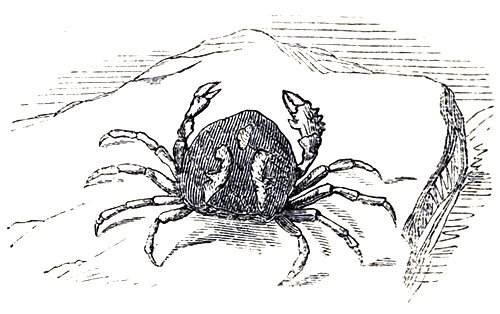
The common Pea Crab (Pinnotheres pisum), represented in the annexed cut, and of enlarged scale, is an inhabitant of our own coasts, and frequently found residing within the shell of the common edible mussel, (Mytilus edulis); but it is very remarkable that the female Crabs are very much more numerous than the males, and that although the male Crab may be [Pg 42]at times captured at a distance from his strange lodging, we know of no instance of a female being taken in any situation but within the shell of some mollusc. Aristotle speaks of this small mail-clad janitor as a little fish with claws, like those of a Crab, which keeps guard and ward for the Pinna, grows to her mouth, and acts as her caterer. Pliny too remarked and described the apparently anomalous association. He speaks of the Pinna as a shell-fish that is found in muddy waters, always erect, and never without a companion of the Crab kind. Oppiannus not only knew that Crabs existed commonly in the Pinna shells, but clearly conceived that it was their duty and mission to do so. Thus he writes:—
[Pg 43]
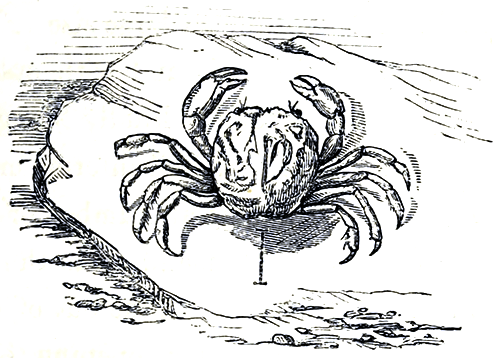
The accompanying illustration, on a very enlarged scale, represents the pinna’s companion, Pinnotheres veterum, which will be seen at a glance to differ materially in appearance from P. pisum. The mussel is not the only shell in which P. pisum finds ready-furnished lodgings. The common cockle (Cardium edule), and in some instances the ordinary oyster, being selected to supply them. Mr. W. Thompson, in writing on the crustaceans of Ireland, says, “The smallest Pinnotheres I have seen was found by Mr. Hyndman, in a living Cardium exignum, dredged up by us in Strangford Lough, in October, 1834. It is a male. The carapace is under a line in length; the entire breadth of the Crab from the extremities of the outstretched legs is three lines. The cardium is under three lines in length, and barely exceeds that admeasurement in breadth; so that the Crab, when in the position just mentioned, must have on both sides touched the walls [Pg 44]of his chosen prison. The Pinnotheres likewise inhabits the Cardium edule. Before me is one of these Crabs, of which the carapace is two lines in breadth, obtained by Mr. Hyndman in a full-grown C. edule from Strangford Lough; but from the Sligo coast where this Crab attains an extraordinary large size, a Crab with a carapace four lines in breadth, and with outstretched legs seven lines across, was once kindly brought to me by Lord Enniskillen. Mr. R. Ball informs me that on two occasions he obtained a great number of the Pinnotheres, and which were all males, from the Cardium edule, when at Youghal. About nine out of every ten cockles contained a Crab. On opening oysters at Tenby in Wales he has procured the Pinnotheres. This Crab, like the Pagurus, occupies different species of shells according to its size, and at every age, and generally selects such as with outstretched legs it would fill from side to side.”
Another extraordinary instance of anomalous association is to be found in the habits of the Pagurus prideauxii, which is invariably found with the cloak Anemone (Adamsia palliata) adhering to it, and so strong are the mysterious bonds of relationship, friendship, or whatever it may be called, which bind them together, that on the Pagurus finding it requisite to increase the size of his borrowed mansion, the Anemone, like a chosen companion as he is, follows to the new home, being deftly [Pg 45]held by the nippers of the fresh inhabitant until enabled to obtain a firm hold just outside the portal, where it remains until some other removal is made, or more commodious quarters required. From these sociable house-hunting adventurers we pass on to the burrowing Crabs, of which there are many kinds, indulging in habits most curious and noteworthy. Perhaps the most remarkable of these, is the great Cocoa-nut Eating Crab, or “Ou-Ou,” as it is called by the natives of some of the localities in which it is met with. It is the Birgus latro of naturalists, and is well represented, although on a very reduced scale in the illustration next page. It is found in many of the Coral Islands dotting the Indian seas and Pacific ocean, and beneath the rustling, waving, cocoa-nut groves, which abound within the torid zone. The Ou-Ou forms for himself a home, delving and burrowing, miner-like, beneath the wide-spreading roots of the tropic trees, and excavating deep and cunningly-formed galleries and chambers in the coral sand and broken shells; and one is almost disposed to think that the following lines by Thomson must have been penned in all the fervour of a poet’s admiration for the happy lot of our friend of subterranean proclivities:—
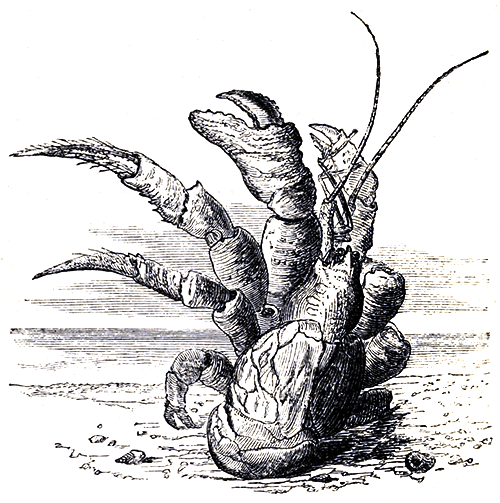
Here, like a feudal baron of old, he forms for himself a stronghold, sallying forth like a freebooter, to feast on the spoils of the grove. Curious stories are related of these marauders, and it has been gravely asserted that they have been known to ascend the tall stalks of the cocoa palms for the purpose of detaching and throwing down the nuts. We are not prepared to say that particular palms (when in a more than ordinarily sloping posture) may not been have climbed in the manner stated [Pg 47]by certain species. Our own experience, however, strongly disposes us to think that such nuts as from time to time fall to the ground from ordinary causes, constitute the prizes commonly appropriated by B. latro. His enormously powerful and ponderous nippers enable him to husk and rend these from their tenacious coatings with surprising speed and facility; and it is only necessary to examine the cocoa-nut husks with the nuts within them, as imported from abroad, to be convinced that our nut-eating friend must be a veritable crustacean Hercules, to be capable of such feats of strength, as the dragging forth of the treasures from their dense fibrous envelopes unquestionably are; and a Hercules he is in his own way, for the tenacious wire-like network of cocoa fibre in which the nut is inclosed, is torn, split, and rent asunder, as though with the iron pincers of a brawny blacksmith, until the coveted dainty is set free. One end of every common cocoa-nut has, as most of our readers are aware, three holes in it; these, from their position and quaint resemblance to the face of a living creature, are called the monkey’s face. One of these holes is selected as a point of attack, and a succession of adroitly-delivered and heavy raps are rapidly given with the large claw. An opening, or breach, is thus very quickly effected. The narrow pair of nippers now come into operation, and by dexterously inserting them, [Pg 48]the whole of the white, sweet, oleaginous contents are deftly scooped and clawed out. B. latro has a keen eye to future wants as well as to present enjoyment; he is not only a gourmand, but pretty much of a utilitarian; so he employs his sharp, powerful claws in carding and combing up the bundles of tangled coir, remaining after his husk-splitting operation. This, by dint of much clawing to and fro, at length becomes almost as fine as tow, or the oakum used by shipwrights. When sufficiently manipulated, he gathers together the result of his labours, and transports it to the inmost recesses of his subterranean stronghold beneath the roots; a bed is here made from it, on which our friend reclines; and it helps to form a convenient covering and protection for him when debarred from the pleasures and delights of Crab society during the uncomfortable process of shell-changing. The crafty human inhabitants of these wave-washed isles, are too well versed in the habits of our friend, and too well aware of his provident habits, not to avail themselves of the stores of well-preserved fibre thus laid up; advantage is therefore taken of the buried store, which is unceremoniously dragged forth, collected together, and made use of for caulking the seams of their canoes, and many other useful purposes. During the period of comparative torpidity usually accompanying the shell-shifting process, the wants of nature are wonderfully and wisely provided for. These [Pg 49]strange creatures are each furnished with a species of natural magazine, containing fatty matter, which they carry beneath their tails. Some Crabs of large size have been known to yield enough to produce a quart of oil, limpid, of excellent quality, and highly esteemed by the natives. B. latro is much given to nocturnal rambling, and frequent visits are by him paid to localities within the cheering influences of the salt-sea wave; but we do not agree with those writers who have accused him of nightly hydropathic journeys. During the breeding season some considerable time is spent by the whole family in exploring the countless rock-pools and lagunes between the coral reefs. Here, after the departure of the parents for their homes amongst the roots, the juvenile crabs continue to desport themselves, until grown strong enough to attack the nuts on their own account, when they proceed to join their seniors in the family diggings. The natives, when they set their minds on a Crab-hunting expedition, provide themselves with much the same kind of equipment as a party of English gamekeepers would use when about to extract a secretive badger from his burrow. Digging, and that of the most determined and energetic description, is the favourite method of bringing the game to light, which desirable consummation is rarely arrived at until a very large amount of loud shouting and needless leaping about has been had recourse to. The [Pg 50]unfortunate Crabs are very good to eat, and they appear thoroughly aware of it, making use of every effort in their power to avoid capture. They are, nevertheless, ruthlessly overtaken in the subterranean race, dragged forth into the broad sunlight, ignominiously bound with cords twisted from the tough fibre of the cocoa husk (a very requisite precaution by the bye), and lugged off into hopeless captivity.
Some of these nut-feeders grow to a monstrous size (some being over two feet long), are armed with nippers of most formidable dimensions, and make no more of snapping the strong cord, with which the Crab-catchers endeavour to secure them, than if they were as many strands of packthread. At certain seasons of the year a vegetable diet appears to become unpalatable to our friend. He then seeks a change, and levies open and indiscriminate warfare on all the tribe of shell-bearing molluscs he can lay his thievish claws on, not giving even the ghost of a chance of escape. He seizes them forcibly with his nippers, and then extracts them from their snug shell-castles, with a dexterity which an accomplished London shell-fish dealer might look on with envy; and then, not content with devouring the ill-fated tenant, he performs a sort of grotesque defiant, and triumphal march, with the vacant shell raised like a standard, aloft in his claws, as if for the express purpose of inciting other Crabs more peaceably [Pg 51]disposed and less nefarious in their habits, to the perpetration of outrages of a similar character. Take him for all in all, B. latro may be considered anything but a well-conducted member of the family to which he belongs. His name denotes the character which he has fully earned and universally maintains.
The countless thousands of islands, reefs, and spots of newly-formed land dotting the South Seas and Indian Ocean, are ever on the increase. The foundations of these are firmly laid at the sea’s bottom by legions of that tiny toiler of the deep, the coral insect, and year by year, and age by age, his ceaseless labours progress upward and ever upward towards the light of heaven; layer by layer, and ledge by ledge, are formed, until the pigmy beginning grows to be a strong sea-wall, like the ramparts of some Old World fortress. In time, the green wave breaks and feathers on its crest, whilst other walls slowly but surely raise their masses from beneath. Within their circling grasp, a still rock lake at length is formed, round which the angry billows roll and thunder, chafing at the mighty barrier disputing their dominion. Here, within the safe, still pool, collect the thousand and one waifs and strays, ever to be found floating or driven by the tide currents. Fragments of wreck from distant shores, dead fish, empty mollusc shells, echini, sea-weed, and drift-wood cast far out to sea by the floods of the great rivers [Pg 52]of the tropics;—all these, and innumerable other objects, find a resting-place on the newly-formed rocks, and in due time are broken up by decay, but are always added to by the same great store, until, wave-borne in their rough, strong, buoyant husks, come cocoa-nuts and other seeds. These quickly germinate, sprout up, and send their roots far out in search of nutriment, and thus bind the loose materials of the new-formed ground together. Watered by the tropic showers and sea spray, the little sea-girt forest grows apace, and the wandering sea-fowl, and migratory birds are not slow in converting it into a haven of rest for their wearied pinions. These last visitors bring in their crops, from far-off continents and islands, the seeds of many shrubs and plants, which, falling amongst elements congenial to their growth, rapidly spring into life, and, like the trees amongst which they find shelter, bear seed in their turn, and in due season die, to afford food for their successors in the kingdom of plants. Man claims some of these realms as his own; others are left to such inhabitants as nature may people them with. The West India Islands, too, are inhabited by many curious and interesting members of the Crab family: one of these known as the Land Crab (Gecarcinus ruricola), is pretty much of a highlander in his nature. The upland solitudes are most to his taste, and here he forms for himself a snug retreat beneath the earth of [Pg 53]the hill-side. As the spawning season approaches, a mighty gathering of the clans takes place, and whole legions unwarned by fiery cross, or blazing beacon, hasten forth to join the living tide flowing onward towards the sea. Through the tangled jungle, down the rock-strewn ravine, over fallen tree-trunks, and among the dense undergrowth of the forest, in ceaseless, creeping, crawling, scuttling thousands; still they come onward, and ever onward, as the bright stars shine out to light them on their way. Banks, hedges, walls, and even houses are passed straight over in this crustacean steeplechase, no flags being needed to keep the mail-clad competitors to the true course—instinct the guide, and the blue sea for a goal, nothing stops the race.
Cuffee and his companions, who have been gossiping and story-telling beneath their cocoa-leaf roofs until half-asleep, appear to become most violent and incurable lunatics, on suddenly becoming aware of the nocturnal exodus: they leap high in the air, shout, scream, and dance like fiends, whilst the most ready-witted of the crew dash off to de massa with the startling news. “Hi, golly, sa; de Crab, de Crab! he come for sure dis time, sure nuff; plenty catch um bum by;” and Cuffee keeps his word to the letter, and captures the pilgrims by the basketful, in spite of their claws; and black-faced woolley-headed Aunt Lilly, the cook, shows her teeth like ivory dominoes in an ebony box, as [Pg 54]visions of white, snow-like rice, cocoa-nut milk, capsicum pods, and stewpans pass in pleasing and appetising review before her, and massa himself takes an extra pull at the cold sangaree jug, sleeps pleasantly, and dreams of the Crab feast of the morrow.
At the termination of the spawning season the survivors return to their homes among the hills; and but little notice is taken of them now, as they night by night bend their weary steps on the backward march, poor, low-conditioned, and unfit for human food, like the salmon-kelt on his journey to the sea. A short residence in his earth burrow serves to set our friend the Crab on his legs again, and make even better food of him than can be prepared during the migration. Sugar-cane plantations are his delight, and in them he regales himself like an alderman, nipping through the crisp rind of the sugar-bearing reed, sucking the luscious juices and clawing out the sweet contents, until a rustling sound warns him that Nemesis, in the form of our old friend Cuffee, is not far off, and that active individual, accompanied by a prick-eared cur, and armed with a spike-pointed cane, pounces down on the very spot where G. ruricola, Esq. had been so pleasantly regaling himself, and now commences a fierce and relentless action.
Cuffee, Cur, and Spike, v. Crab. Ever on the alert, Crab darts off backwards with astonishing rapidity, [Pg 55]keeping a very bright eye on the cur, who rushes pell-mell after him through the canes, cheered on by the shouts and “Ya, ya’s” of his sable master, whose aim it is to head back the Crab, or pin him with his spike. This latter feat he all but accomplishes; but the Crab darts like lightning a couple of feet backwards, and then shoots off at right angles with the agility of a sprite. One more rapid dart in the opposite direction, the spike is furiously hurled by baffled Cuffee, and is within an inch of transfixing the cur, who sniffs and whines disconsolately at the mouth of a hole, which leads he knows not whither.
When hunting amongst the grass jungles of the Mahratta country, we were greatly amused at the quaint proceedings of a species of Crab which at certain seasons abounds there. These little fellows, members of the genus Thelphusa, were, when we saw them, busily engaged in their hay harvest, and actively engaged in mowing the grass. This they did in the most curiously quaint and elfish manner, sitting bolt upright and working their sharp scissors like nippers right and left, until enough to form a bundle had been gathered; then, with this, compactly rolled up in sheafs, off they would trot to their holes, and when the load had been safely disposed of, back they would scuttle for others with quite as much bustle, fuss, and excitement as if they had been the owners of a large estate, a hundred [Pg 56]acres of meadow hay to get in, and the barometer at change. So we left our funny, clever, energetic little friends with a good speed, hard at it, making hay whilst the sun shone.
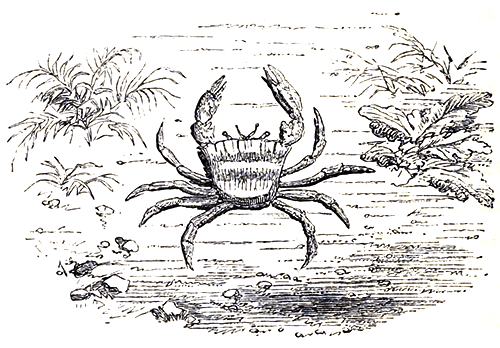
These little fellows, we have every reason to think, are purely inland in their habits, and we know of no instance of their being known to travel either singly or in bodies to the sea coast. A member of the same genera, represented in the annexed cut, is found in many parts of the south of Europe, forming burrows for itself in the river banks, and from this habit obtains the name of Thelphusa fluviatilis. Few specimens reach three inches in length, and the colour is no means inviting, being of a dingy yellow. Yet it appears to have attracted much attention amongst the ancients: both Aristotle and Hippocrates knew it well, [Pg 57]and there are medals which were struck in very early periods bearing representations of this Crab on them. There appear to be some religious associations connected with crustaceans of this description, as we find the monks of the Greek church taking some pains to procure them, and then disposing of the dainty without troubling the cook. In Italy the burrowing Crabs are eaten at Easter, much as we eat hot-cross-buns on Good Friday. There are other Crabs which form burrows both in the sands of the sea-shore and the banks and plains of the interior. One of these is the Sand Crab (Ocypoda arenaria) of naturalists). The wide, open sand stretches of many tropical countries, abound with these remarkably agile little creatures, who excavate holes in the sand close to the borders of the tide. These are the lilliputian pedestrians with whom skylarking midshipmen engage in foot-races along the strand, and meet ignominious defeat in consequence. As autumn approaches, their sea-side retreats are quitted, the inland burrows occupied, and a state of hybernation gone into, until, the winter having passed away and the spring weather come, Seaward ho! is the order of the day again.
The Gelasimus is in many respects similar in its habits to these fleet-footed gentlemen, but he turns his attention more directly to sapping and mining operations, carrying on his labours in the most cunning and [Pg 58]artful manner. Nothing annoys him more than to have prying men or investigating animals, passing their remarks, or taking note of the mouth of his shaft; so he digs away in his deep level, until he has accumulated a goodly quantity of sand and earth, when up he comes stealthily to the opening of his mine, pops out his head, peers sharply and jealously round, and, if the coast appears clear, round he flourishes his claw with all the force and precision of an accomplished round-hand bowler at cricket, and away he casts the proceeds of his excavations, but at the same time taking care that no two clawfuls go in the same direction, lest the newly-raised sand should betray the secret he is so careful to conceal.
The sands of the reefs and islands of the Eastern seas afford a home for the King Crab (Limulus), who, with his odd-looking, shield-shaped body, and long blade-like spike or spear, will be familiar to many of our readers. Some individuals of this species grow to a very large size, and are sought for by the Malays, both on account of the immense number of eggs they sometimes contain, and the natural weapon with which nature has armed them. These lance-shaped spears are often made use of as points for arrows and other warlike implements, mainly because the wounds inflicted with them are more painful and dangerous than those received from instruments of iron or steel. The [Pg 59]Malays are by no means an amiable or forgiving race, and take infinitely more pains to poison the blade of the “crease” or serpentine-knife they carry, than to serve a friend or save a life, and we therefore feel far more respect for the Crab who furnishes the point for the arrow, than for the man who fires it. Then there is the Nut Crab, or Calappa, whose queer little legs are so closely tucked away under his odd little shell, that rambling “Jack Tars” in search of “Curios” not unfrequently gather a few to bring home to their friends, under the idea that when cut and polished they will serve to form elegant brooches and splendid shirt-pins, for the gay promenades of Portsmouth and Plymouth. A dry old salt of a quartermaster, on the Indian station, chanced one day, when on shore for a cruise, to become possessed of a goodly number of these lucky stones, as he called them, and by way of securing his treasures placed them in an old silk-handkerchief, and stowed them away, with a few dollars and sundry cakes of cavendish, in the corner of his chest. It so happened that some piratical ship-mate, not proof against the allurements of honey dew and silver, but totally indifferent to natural history, seized his opportunity and spirited off the tobacco and money, but left the lucky stones behind. The next day, when our old friend came for his accustomed supply of the weed, he, to his horror, astonishment, and indignation, found the supposed [Pg 60]pebbles in active motion, performing foot-races over his best jacket, the handkerchief spread open, and, alas! empty. “Well,” exclaimed he, “blow me if this ain’t too much of the monkey. Why, look ye here, messmates; these here blessed stones have come to life, every man Jack of ’em. They’ve chawed all my bacca and spent every meg of my money; and now I’ll heave all the beggars to Davey Jones’s locker. Overboard is where I means to pitch ’em!” and so he did, no doubt to the intense gratification of the falsely-accused Crabs. Like the Rocky Mountain ant, in whose hill precious stones are not unfrequently found,—the codfish acts the part of treasure-seeker among the rocks and sands of the ocean’s depths,—minute crustaceans of great variety, are by the shrewd and practical lover of natural history, taken from the stomachs of the captured fish, and many would have remained all but unknown to science had it not been that the Crab collecting-habits of certain large sea-fish, were discovered and promptly taken advantage of. We strongly advise all those who are fond of collecting either British or foreign specimens never to miss the opportunity of acquiring crustaceous wealth held out by the taking of a large deep sea-fish. Take out his “treasure-sack”—the stomach,—wash the contents in plenty of clean water, carefully examine them, and the trouble will not be thrown away, or the [Pg 61]research made in vain. We have obtained very large numbers of a very pretty little Crab scarcely as large as a coffee-bean (Porcellana longicornis) in this way. This little creature is closely allied to P. platycheles, found abundantly on the southern coast of Devon. He delights to dwell like a sort of “Dirty Dick” of crustacean life in a mud hovel of his own scooping, working his way beneath stones which appear close enough to the bottom to make a crab-biscuit of him. Catch him, when or how you will, he is always like an elfish brick-maker, condemned to make bricks without straw, and debarred the privilege of washing. His jacket and trousers are begrimed with red dust, and his queer little face peers out at you, like that of an Indian idol smeared with war-paint. Nature has, however, endowed him with brush-bearing feet, with which he from time to time dusts his own suit; but he remains a rather dusty, grimy, little fellow after all, and we cannot help thinking that the treatment prescribed by Mr. Dick, for David Copperfield, would greatly benefit his personal appearance. Nature appears, when modelling the forms of the endless types of curious crustacean life with which the Southern and Eastern seas abound, to have given free scope to a love for marvellous quaintness and oddity of contour. The coasts of Japan furnish us with examples of Crab life so hideously grotesque, that nothing short of seeing a [Pg 62]veritable specimen would serve to convince any one who had first seen a sketch of this Japanese notability, that the whole conception was not the creation of a distempered dream. Macrocheira-kœmpferi, of which two remarkably fine specimens are to be seen in the British Museum, are just the kind of Crabs a timid young lady, or nervous young gentleman, would strongly object to meet “by the sad sea wave,” or elsewhere. Their legs are so long, that running away from them would be utterly useless,—giving them, when standing, the height of an ordinary camp-stool, whilst the nipper claws appear constructed precisely on the same principle as are the arms of the magic policeman of a pantomime, which stretch easily from the level of the street to the housetop, where that prince of evil-doers, the clown, has vainly sought sanctuary. Then the coasts of Tasmania and other portions of Australasia are inhabited by Crabs, who make up in bulk and enormous power, the little they may fall short of their Japanese cousins in length of limb. The pincers of some of these are large enough to embrace the thigh of a man easily, and we apprehend that escape from that bugbear of apple-stealing rustics, the village man-trap, would be a matter of perfect simplicity, and a mere practical joke, to getting out of the grip of one of the gigantic crustaceans of the antipodes. As some of these are remarkable for their formidable appearance and [Pg 63]colossal power, so are others well worthy of note on account of their beauty of colour and elegance of conformation. Neptunus pelagicus, a Crab of medium size, is wonderfully handsome, being ornamented with most strangely arranged spicules, and spotted with purple, shading off into pink. Oceanus crucifer, an inhabitant of the Indian seas, is perfectly charming in his way; in fact, a sort of “Dresden beauty,” who might be easily mistaken for a specimen of the most exquisite pink and white china.
From the Chilian coast we have another Crab, of a totally different style of beauty, in the person of Cancer dentatus, who appears to have laid the forest under contribution to furnish his unique wardrobe. A coat of bark, plant-stalk legs, and a very becoming frill, of autumnal-brown fern-leaves, constitute his get up, and it is no flattery to say that he looks uncommonly well in it. From the Caribbean sea we get, amongst a whole host of strange productions, that little gem of a Crab, Mithraculus coronatus. He looks as if designed expressly to be converted into a brooch, his compact little body resembling the most delicately tinted, blue porcelain, whilst his tiny claws are more like minute tufts of fur than aught else we can compare them to.
Leucosia urania is another strange Chinese Crab, resembling in no common degree a pebble of polished [Pg 64]white agate; whilst a brother, P. porcellana, is found in Australia; and nearer home, we obtain from the neighbourhood of the Island of Madeira the Plagusia squamosa, or Goat Crab, whose whole shell is rich in ornamentation, and who is by no means unlike a handsomely chased snuff-box, inlaid with chinaware and metal. Unlike these bits of ocean bric-a-brac is Parthenope horrida, from the reefs bordering the Isle of France. This unprepossessing individual the casual observer would declare without hesitation to be an ungainly, rugged lump of broken white coral rock; and there are uncomfortable asperities and corners enough to prevent any pedestrian, however heedless, from stepping on it; and let him just pick one up to cast at some passing sea-bird, and see how quickly the stone will resent the liberty, and show how he is to be depended on at a pinch. Then, to step from the harsh and uncompromising to the grotesque and elfish, we have but to visit the genial blue waters of the Mediterranean, where we find about as comical a little Crab as exists in all “Crabdom,” wide as that ill-defined dominion unquestionably is. This little gentleman is known as Dromia lator, and his habits, to say the least of them, are as eccentric as his personal appearance is queer. A hairy, wiry-coated, round-bodied, little crabling is he, and his delight is to go hunting and foraging about amongst the coralines, medusæ, and [Pg 65]molluscs at the bottom, and because he is a designing, artful little wolf of a crab, he brings to bear his talent for stratagem. After searching out a nice, hollow piece of soft and fine-grained sponge, he works his way under it—roaches up his little back, until the yielding material opens and again closes round him, thus forming a snug and well fitting great-coat, which, like charity, covers a multitude of sins.
The tricksy sprites of fish and shrimps, as they joyously disport themselves amongst the branching coral, take little heed of the familiar ball of sponge, which in some unaccountable manner or another appears, uninvited, in the very midst of the revels. It is strange, certainly, that guest after guest should vanish into it, and return no more; but sponges, you know, are common enough in every grade of society, and therefore it is that the one in question is little suspected of having a live adventurer, of the most acquisitive and nipsome habits, bound up within its folds: but there he is, for all that, as you would find out to your cost, if you unwittingly enlisted him for toilet purposes, on the strength of his borrowed uniform.
As another instance of quaint resemblance to inanimate or stationary objects, we have Echinocerus cibarius, a native of the North-west Coast of America, where it was discovered during the voyage of Her [Pg 66]Majesty’s ship Plumper; and nothing on earth does this rugose creature so much resemble as a large, uneven, ball of half-baked brick clay, and his claim to the honour of being a Crab, would be laughed to scorn by those who from bashfulness had never shaken hands with him. Australia, that land of oddities, contributes to our store a perfect little sea vagabond, in the person of Pilumnus nespertilis, who is without any exception the very dirtiest and most disreputable-looking little scamp in all king Neptune’s dominions. Cut a frayed-out corner, from a chimney-sweep’s soot-bag, and you have his exact resemblance. Yet who shall say that P. nespertilis is not a gentleman, in spite of his unpromising and unfashionable raiment!
Australia is a land of contradictions, as we all know. Even explorers’ names serve but to mislead and confound the uninitiated. We have “Cape pigeons,” which are no more pigeons than wild geese or storks: “Cape salmon,” which own to no bonds of relationship with the family of Salmonidæ.
The “robins” of the United States of America bear no resemblance to those of England, and enjoy none of the love, protection, and numerous privileges universally accorded to their more fortunate namesakes on this side of the Atlantic. Again, we say advisedly, let no man heedlessly try the strength of his teeth on an “Indian wood-apple,” simply because it is called [Pg 67]“an apple.” He had far better make an attempt on an iron cannon-shot of Woolwich pattern at once, than try his powers of mastication on one of these forest fruits. The cherry of Australia, too, has a disagreeable and exasperating habit of growing with its stone outside, and of being highly unpalatable into the bargain; whilst the “pear” of that favoured land would, if duly fitted by a clever cabinet-maker, and properly polished, make an excellent and highly ornamental knob for a street door. A cabbage-tree is by no means bad as a producer of material for the manufacture of hats, and the green tops are occasionally boiled by settlers of vegetarian inclinings; but any one sanguine enough to seek cabbages amongst the cabbage-palms might reasonably be looked for, with bridle on arm, and basket in hand, carefully prospecting the pastures for a “mare’s nest,” with a view to the leading home of the colts and the basketing of such eggs as might remain unhatched. Depend, therefore, that our begrimed little acquaintance is not exactly as stupid as he looks, and that his dirty, hempen jacket, is given him for some wise purpose. Nothing is created in vain; and Columbus, with all his talent and power as a sea commander, gladly availed himself of the services of one of the most tiny Crabs (Planes minutus), who, floating by the good ship, in his tangled bed of Sargossa or gulf-weed, was hauled on board by the bronzed and [Pg 68]storm-tossed mariners, by whom he was at once introduced to the chief, the man of demonstration, who crushed in the egg’s end to make it stand upright. “A crab!” said he; “a good and fair harbinger of land, which, with God’s help, we shall soon discover.” And so they did, for the Crab’s tale came true, and the West India Islands were almost immediately fallen in with, and duly investigated.
P. minutus is a roving sailor by nature, and is carried on his long sea-voyages by the masses of weed ever carried onward by the warm and genial gulf-stream, and there is little doubt that members of the family to which he belongs, now naturalized on our own coasts, first travelled hither amongst the meshes of their ocean raft, which knew no return. Such specimens as have been procured on the coasts of England, are not as large or brilliant in their colour, as those captured in more genial climes.
The Floating Crabs, as met with in true gulf streams, are extremely pretty little creatures, measuring about eight-tenths of an inch in length. They are clouded and shaded with rich warm brown, yellow, and buff, and well deserve the consideration of the lover of natural history.
The almost innumerable channels stretching between the coral reefs, lagunes, and palm-clad islands of the Southern Seas are inhabited by legions of Crabs of next [Pg 69]to endless species and varieties. Many of these feed luxuriously on the vast numbers of “Trepang,” or sea slug (Holotharia edulis) found in these latitudes. The human crab industriously seeks his share of this half-grub, half-slug, delicacy, and some account of its nature and mode of preparation may not prove unacceptable to the reader. The Bêche-de-mer, as this uninviting looking creature is called by the traders who deal in it, is in immense request in nearly every market in the Chinese empire, as a stock ingredient to be used in the preparation of the rich, glutinous soups and stews, in which the Celestials so much delight. They are also extensively used to mix with little squares of salt pork, sharks’ fins, and pickled bamboo shoots; when thus combined, served up as a stew, and accompanied by diminutive cups of hot “sam shoo,” or rice spirit, John Chinaman, when fortunate enough to get it, yields himself to gastronomic enjoyment, and cares not to call the most important mandarin in the empire, his uncle. As there are brands of high repute amongst wine producers, so are there high and low class slugs in the sea’s great larder, and there are six kinds well known in the trade.
The best are those procured by divers, who prosecute their labours amongst the deep recesses between the reefs, where the water is always of considerable depth. The next quality is taken by nocturnal hunting-parties, [Pg 70]who sally forth, torch in hand, and thread the intricate mazes amongst the coral ponds and lagunes, making night hideous by their fiendish shouts, and wild, weird proceedings. The bright moon-light nights so enjoyable within the tropics, are also taken advantage of, for slug-catching purposes, when great quantities of average worth are not unfrequently procured. The inferior sorts are usually gathered by the idlers and children of the islands, who wander about in the rock pools left by the receding tide, and pick up all they can there discover. The trader obtains the various kinds and qualities from the slug-hunters, and at once proceeds to select them according to their market value. Benches are erected, on which they are first cut open with sharp knives, cleansed, and placed without water in very large cauldrons to cook. The juices thrown out by the Trepang are sufficient to prepare him in, and prevent his becoming too dry in the kettle stage of the operation.
From the boiling department they are removed to large wooden sheds, erected for drying them in. Here they are arranged on shelves placed one over the other, where they are constantly turned and most carefully attended to; huge wood fires being kept burning to expedite the process, as it is essential that the slugs should be completely freed from even the slightest suspicion of moisture before they are packed for deposit [Pg 71]on board ship. Comparatively few persons have any idea of the immense commercial importance to be attached to this branch of industry; but some rough notion of the enormous number of these questionable-looking dainties annually collected by the Trepang catchers may be formed, when we state, that a single trader from America obtained, during a bartering expedition amongst the Fejee group of islands, in return for the issue of miscellaneous articles and objects of trade, representing no very great value, 25,000 dollars’ worth of Trepang in seven months. And in order to still further show that even this repulsive and insignificant-looking sea-worm is worthy of the consideration of the “grave and staid merchant,” we give the financial return made on one voyage prosecuted for its obtainment:—Peculs[3] of slugs obtained, 1,200; cost of goods and outfit, 3,500 dollars; money return on sales effected, 27,000 dollars. The value of the prepared slugs in the markets of the East may be said to range between ten and sixty dollars per pecul, according to condition, demand, and quality. Advantages even greater than the direct acquisition of money have resulted from this peculiar trade. Discoveries have been made of islands, unknown until the adventurous traders landed on them; and commercial pursuits have been successfully prosecuted with tribes [Pg 72]who, in all probability, would have remained hostile to Europeans for ages to come, had not that humble missionary, the sea-slug, opened up the road to friendship, well-reposed trust, and business relationship.
[3] A Pecul weighs 133⅓ lbs., and is a weight common throughout the Southern and Eastern seas.
[Pg 73]
Like our friends the crabs, these are of many species, and inhabit every sea from pole to pole. Our own coast line is pretty generally occupied by them, and very few places of seaside resort fail in affording sport to the Shrimp or Prawn catcher. An error, into which many persons fall, is the confounding of Shrimps and Prawns with each other, although the differences between their general form and appearance are sufficiently marked to strike the most casual observer. The true Shrimp of our waters is the mottled spotted-brown kind, the so-called Sand Shrimp (Crangon vulgaris) the subject of the annexed cut. Besides the difference in colour and the hooked form of the fore-feet, the tremendously formidable-looking weapon with which the head of the Prawn is provided, and from which the Pacific Islanders appear to have borrowed the design for their shark-tooth swords, is absent in C. vulgaris. Its favourite haunts are the wide, open sand flats and the mouths of tidal rivers. The name “sand [Pg 74]raiser,” often applied to it by fishermen, is by no means inappropriate, and arises from the curious habit it has of suddenly raising a perfect cloud of fine sand, round itself—firing, so to speak, “a broadside for the sake of the smoke,” and literally throwing dust in the eyes of his enemies.
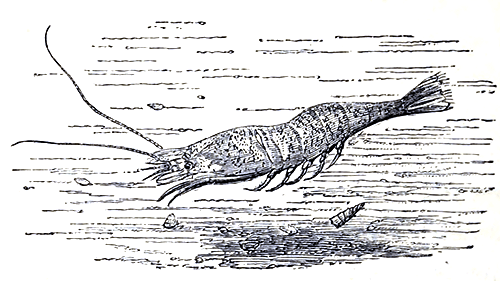
This designing little Genius, after raising his own sand storm, adroitly scoops for himself a tiny trench in the soft material on which he rests, and then remaining perfectly still, allows the falling grains to cover him snugly in, like a sheep in a snow-drift. Great numbers of Shrimps of this kind, as well as small flat fish, and an endless number of odd waifs and strays, can be taken with the dredge—a contrivance shown in the following cut. The framework is of iron, the two straight bars or bridle rods are made so as to play freely round the end bars of the frame, as at a, whilst a sort of hinge joint admits of their moving up or down, thus insuring close contact between the lower [Pg 75]edge of the frame and the bottom, as it is dragged along by a rope, either lowered from a boat or attached to a horse. The extreme end, or purse of the net, is made to untie like the mouth of a bag as at B, which greatly facilitates the removal of its contents when overhauling is needed. The two rings, C C, serve to attach the drag rope to.
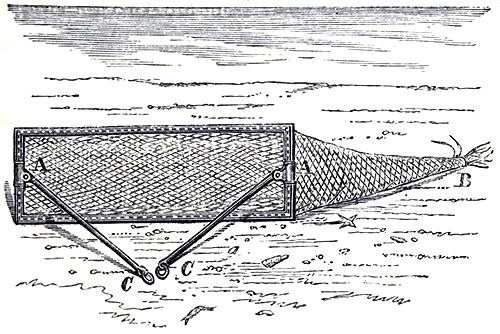
An apparatus constructed much on the same general principles, and known as the keer drag, is also in much use. A beam of wood and a set of “yoke lines” serve to keep the body of the net distended, and the purse is secured with a few turns of twine. The dredge we have figured and described may have a much shorter bag of very strong network attached to it, if the nature of the ground dredged over, and the kind of productions sought, should render it necessary. The net we have [Pg 76]represented is mainly intended for the taking of small crustaceans, and such other odds and ends of animal and vegetable life, as may be found on smooth ground and the open sand flats. There are a number of patterns for dredges, more or less complicated, to be obtained from their respective inventors. The reader may perchance wish to design one for himself. Let him, however, bear in mind that simplicity of construction, and thoroughly good iron, are two important elements of successful manufacture, durability, and general usefulness.
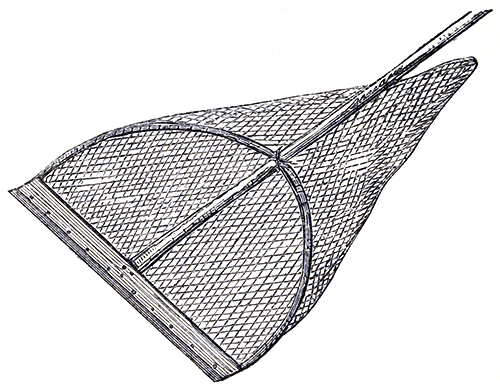
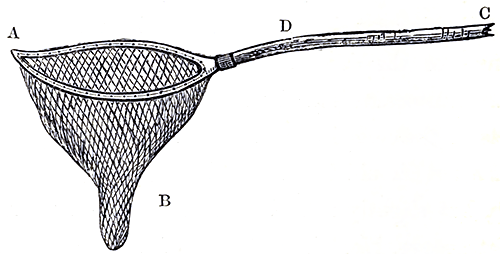
The seaside visitor not possessed of one of these contrivances will find such a net as that figured in the above cut extremely useful and amusing. It can be made at a very trifling cost, and is easily repaired [Pg 77]when broken. In using it the Shrimp fisherman wades steadily onward, and pushes his net steadily before him until it is supposed that the contents are sufficiently abundant, when they are taken out and fresh research commenced. The rugged rock-strewn shores of many parts of the coast of England, Ireland, and the Channel Islands, require fishing in an entirely different manner, both by pole and hoop-nets. The pole-net as shown in the following cut, is a most efficient instrument for the capture of the different kinds of Prawns and other small crustaceans found in the rock-pools, bays, and inlets of the coast line. The frame supporting the bag of the net should be of sound tough iron, and of flat form, but slightly turned up at the point, as at A. A slight groove, like the fullering of a horse-shoe, must extend entirely round both the under and upper surfaces, in order to form a secure rest for a stout piece of copper bell-wire, with which the bag of the net is secured to the frame. Small holes are now to be drilled at short intervals all round the frame in the bottom of the groove, so that the wire may be passed up and down through them, and so fasten on the net, the bottom of which must be so fashioned and constricted in making, as to terminate in the purse B. The pole C is best made of well-seasoned ash, and should be at least twelve feet long, and bent as at D. This is easily done by heat, as ox-bows and many other objects are [Pg 78]formed. When Shrimping with the pole-net, it is a good plan to carry a rough, fork-ended wand, with which to probe crevices between rocks, too small or narrow to admit the net. The largest Prawns often take advantage of such retreats, and dart into them on the least alarm. It is well before wading into a promising-looking pool, to cast a sharp, scrutinising glance into it, when the Prawns will frequently be seen, out of their haunts, sailing about amongst the weeds and ledges with extraordinary grace and elegance of movement, their long feelers and hair-like antennæ spreading out and waving in ceaseless play. By introducing the net cautiously, a number of these gadabouts may be taken before sufficient disturbance is caused to send them off to their lurking-places, to which, when really alarmed, they shoot with the speed of an arrow. The fugitives generally seek a place of concealment as near the surface as possible, and it is [Pg 79]well, therefore, to seek high up for them. As a dress for shrimping we strongly recommend a wool shirt, tweed jacket and trousers, wide, felt hat, woollen socks, and a pair of easy shoes in which there are plenty of holes for the water to run out through. A good number of narrow-headed, steel nails should be driven into both soles and heels, in order to prevent slipping on the sloping rock-faces, which, when coated with weeds, are far more difficult to maintain a footing on than ice. Never take a watch, keys, or a pocket-knife of any value with you when you go to shrimp, or they will be rusted to a certainty; but a common knife, and a good store of twine for repairs are essentials. Bags and over-handled baskets are both very inconvenient receptacles for such Prawns or Shrimps as you may be fortunate enough to catch—the bags getting wet and hanging about you in an uncomfortable and chilling manner, whilst the baskets appear to take a malignant pleasure in upsetting themselves in some uncomfortable manner, whenever they are left to themselves, even for a few minutes. Nothing is equal to the ordinary creel carried by the river fisherman. A broad piece of woollen web, such as race-horses’ circingales are made of, forms an excellent shoulder-strap, and is far better for the purpose than leather.
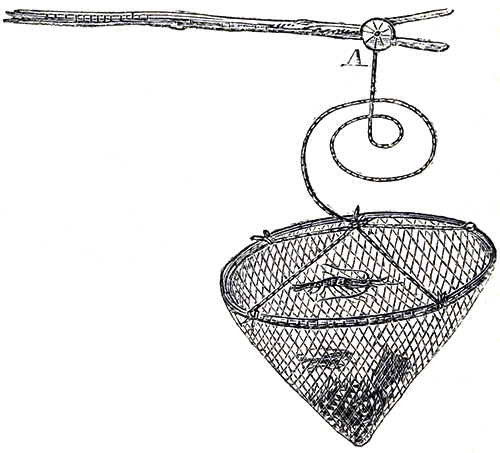
As in crab-catching, advantage should be taken of very low tides, and a very sharp look-out kept for [Pg 80]Prawns when the young flood begins to make its approach, as all ocean life is then in full activity. The Hoop net before referred to, and represented in the annexed illustration, is used in a very different manner from that just described. Instead of being worked by hand, it is first baited with offal and then deposited in the bottom of such pools as are likely to contain Prawns. A considerable number of these nets are often taken out for use by one fisherman, who uses a long, fork-ended, pole, for laying down and taking them up; the cork bung, or float, which indicates their whereabouts, serving as a sort of button for the fork of the pole to lift them by, as at A. The hoop and net are kept in a proper position by being suspended like a scale pan by three or more cords. Iron or wood may [Pg 81]be used for making the hoops, and a stone placed amongst the bait keeps the net steadily at the bottom. Nets of this kind are, in certain localities, used from boats. Shrimp-fisheries of great commercial importance exist in many localities for the supply of the London and other great markets, and it is only necessary to reflect for an instant on the enormous quantities of these crustaceans eaten every day in the almost endless tea-gardens, supper-rooms, and places of public resort in and about London alone, to be convinced that the consumption of shrimps is truly enormous. Billingsgate teems with them. Sieves worked by nimble hands separate the large from the small, and draw the “ad valorem” distinction between St. James and St. Giles. Those coral-like aristocrats, the true Prawns of the family (Palæmon serratus), are not subjected to the ignoble standard of measurement, but are counted carefully and grudgingly out, like a king’s ransom, and estimated by the dozen. Yet it not unfrequently happens that P. serratus in his infancy and youth, so far associates himself with plebeian company as to be boiled in the same pot with his less distinguished associates. (Here we might moralize, but space forbids.) Mixed with a heterogeneous crew of captured crustaceans of many grades, and the water torture gone through, P. S., like many other young gentlemen wearing jackets of a different colour, loses all individuality, and is ignominiously [Pg 82]classed among “cup shrimps,” measured out in a vulgar tin half-pint, vended by a costermonger and eaten by a sweep. The countless thousands thus disposed of are not taken with the appliances which a pleasure-seeker or amateur would make use of, but are caught by regular network engines fitted out for the purpose, and worked from boats; and if a stray salmon or two will blunder stupidly into the meshes, to the extreme annoyance of the owners, what can H.M.’s Fishery Commissioners do, but pity their wayward flock for straying into the toils of the shrimp-wolf, and coming to an untimely end in consequence? It should be borne in mind that live shrimps are excellent baits for a number of sea and river fish. The perch, although usually classed among fresh-water fish, delights in a “sniff of the briney.” Brackish water he glories, revels, and thrives in; show him a nice fresh shrimp, and see how soon he becomes your humble servant. Grey mullet, too, have a weakness for shrimp enticements, and we know of no more deadly bait for the lordly salmon, than a freshly-caught Prawn. If any proof of its excellence for this purpose is needed, we have only to advise the sceptic to try it, by trolling as with a minnow. The principal food of Salmo salar and some other migratory members of the family salmonidæ, when on their long sea voyages, mainly consists of crustacea, and the countless myriads of opossum [Pg 83]shrimps (Mysis vulgaris) peopling the Northern and Arctic seas, serve to furnish food for the vast shoals of these fish, during their annual visits and migrations to salt water. “The Whalebone,” “Right,” or Greenland Whale, would soon become as extinct as the mastadon, if any shrimp-disease should, in an untimely manner, carry off the lively little opossum. Away among the ice-fields of the far north, where the drifting floes and crashing bergs drift onward before the gale, and where, as winter sets in, the polar bears and Arctic foxes, feel hard times, and are at a loss for a dinner, our huge leviathan acquaintance, the whale, holds high festival; merely opening his cavernous mouth wide enough for a deluge of water to rush in, and then by a sudden effort, sending it out again, through the numerous strainers and fringes, with which nature has gifted him.
Milton.
The water passes freely through, but the poor little opossums, by the peck, are left behind, to help in building up the material by the aid of which the goddess of fashion contrives to maintain such an exceedingly good figure. But if the whale devours his legions of opossums, he has not, big as he is, matters all his own way. There is a little crustacean (Cyamus ceti) so much attached to him, that like the old man of the sea, who, when once established on Sinbad’s back could not by ordinary means be induced to come off again, appears quite content with matters as they are, and nibbles away at the skin of his gigantic steed, just as his appetite may require. Thus enjoying all the advantages of noble company, free travelling, and a permanent residence on his own dining-table.
Unlike the ordinary shrimps who carry their eggs about with them but for a time, the opossums carry theirs until the young are sufficiently developed to shift for themselves, when a peculiar valve-like, trap-door arrangement is caused to open, and the young shrimp fry, start in the world of waters, and seek for themselves their own maintenance. Arctic [Pg 85]voyagers who are conversant with the habits of shrimps, and who have a knowledge of the peculiarities of M. vulgaris, do not heedlessly trust their salt junk over the side to soak, fearing lest their experiences might be like those of the Norse skipper, who, in a spirit of maritime recklessness, lowered the dinner of his ship’s company to the ocean’s depths, and hauled up, much to his consternation and disgust, a well-nibbled string instead. The opossums and their relations had eaten the rest.
The Indian and Chinese seas yield an endless variety of both the shrimp and prawn families, the latter of a size far beyond anything we see in our more frigid waters (Palæmon carcinus), common to the Indian Ocean and some of the great rivers flowing into it, not unfrequently reaching a foot in length. Those usually sold in the Indian markets are not as large as these, but are still of sufficient size to render them highly attractive; and those who, like us, have eaten prawns in the East, prepared by those who know the secrets of the art, will bear away the remembrance of their flavour as an agreeable souvenir. That is, if the said prawns happen to be free from the curious, and little understood fish poison, with which the denizens of Tropic seas are too often encumbered. In favoured England, no such drawback to the full enjoyment of your prawn-feast need exist; the common difficulty [Pg 86]being the obtainment of a sufficient quantity to enjoy.
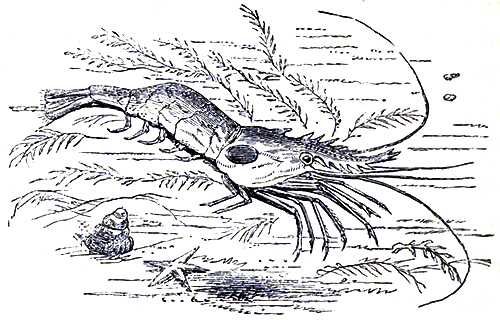
Many of the rivers emptying themselves into the Carribean Sea, after flowing through Florida, contain at their mouths, within the influence of the salt water, Prawns of very large size. These have been improperly called “The crawfish of America,” but they are true members of the Prawn family (Palæmon setiferus); many of these measure between seven and eight inches in length, and like their relatives in other seas, are by no means bad to eat. Many of our readers will no doubt have observed, when engaged in the pleasant operation of shelling their bright scarlet Prawns, before eating them, that on the carapace of one here and there, exists an oval, bladder-like projection, as though some smooth, transparent, univalve shell, had [Pg 87]there closely attached itself. This contains a parasite crustacean. On raising the horny cap, beneath which it shelters, the intruder may be discovered keeping fast hold of the branchiæ, or gills of the prawn, who appears to suffer no inconvenience, or injury, from the presence of his companion. This curious little creature is the Bopyrus crangorum of naturalists; the foregoing illustration represents the common Prawn (P. serratus), with the parasite attached to it. The shrimp form is not exclusively confined to the sea and tidal rivers. Fresh water lakes, ponds, and streams in many parts of the world have their shrimp tenants of one kind or another, many of them highly noteworthy for the beauty of their organization. The fairy shrimp (Chirocephalus diaphanus) is a well-marked example. This elegant little creature is occasionally met with in the fresh water ponds and pools of this country, and can at times be obtained in the neighbourhood of London. Its first appearance strikes the examiner as being most remarkable. The ordinary position assumed by most aquatic creatures, is not to his taste or fancy, so he swims on his back, rising to the surface or sinking away into deep water, just as his will may direct, and gliding here and there, like some tiny elfin boat endowed with vitality. Its colours are most charming and exquisite, clear and transparent, of a delicate sea-green hue; it floats like a shadow through the water, [Pg 88]whilst its host of fringed feet, wave and undulate like growing corn, as they send the passing current through them, and by their ciliary movement, glean the particles of nutritive matter floating by. Its long, bright, red horns and tail serve as a foil to set off the other beauties which nature has so lavishly bestowed. The fairy shrimp rarely exceeds an inch in length, and when placed in a vase of clear water forms a most pleasing object for contemplation.
In the pools and ditches of our lanes and fields, we find another curious little crustacean creature, Apus productus, who differs entirely from that already described, in almost every habit but that of swimming on his back. In some localities the stagnant waters swarm with countless myriads of these odd little animals, who have the uncomfortable habit of burying their heads and bodies in the sand or mud, and leaving their ridiculous little tails waving about in the water, like the pendants of sunken wrecks. A. productus appears to enter on the responsibilities of life under more than ordinarily disadvantageous circumstances, being born with only one eye, half a shell-jacket, and, hardest of all, without a tail. All these deficiencies, however, are made up in time, and A. productus flourishes. He is extremely fond of tadpoles, and in the season usually obtains a fair share of his favourite provender. The spawn of both frogs and toads he has a weakness for; but Nemesis, in the form of a [Pg 89]water-wagtail, is rarely far off; and as he trots daintily along with his delicate claws in the water and his tail in ceaseless movement, depend on it that the beak is not idle, and that the family of A. P. is paying the penalty by wholesale.
[Pg 90]
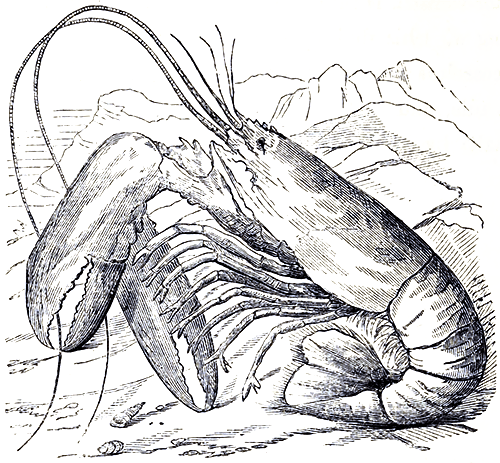
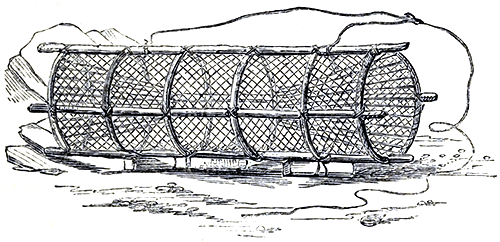
As seen on the marble slab of the fishmonger, is very unlike his relatives beneath the waves. The curled up form in which he is seen when so exposed is not that usually assumed in its own element, unless in the act of exerting its immense powers of retrograde motion. These are so great that one sudden downward sweep of its curiously constructed, oar-like tail, is sufficient to send it like an arrow, three or four-and-twenty feet, with the most extraordinary precision, thereby enabling [Pg 91]our friend to retreat with the greatest rapidity into nooks, corners, and crevices among the rocks, where pursuit would be hopeless. His eyes being arranged on foot stalks, or stems, are free from the inconvenient trammels of sockets, and possess a radius of vision commanding both front and rear, and from their compound form (being made up of a number of square lenses) are extremely penetrating and powerful. The slightest shadow passing over the pool in which the lobster may chance to be crawling or swimming, will frequently cause one of these sudden backward shoots to be made, and H. vulgaris vanishes into some cleft or cavity with a rapidity of motion which no harlequin could ever, even in his wildest dreams, hope to achieve. Down among the deep channels, between the crags at the sea’s bottom, alarms, except from the sea robbers themselves, are not to be dreaded. Here the lobsters are at home, and in such spots the wicker-trap, before described and figured, or the trunk-net represented in the above cut, may be laid down for them. Nets of [Pg 92]this kind are in general use. They are made by fastening a number of stout, wooden hoops to longitudinal bars, and covering them with network. Their internal construction is much like that of the crab-pot, only there are two entrances instead of one, and twine is used in lieu of willows or twigs to prevent the prisoners from escaping. Heavy stones are attached to them as sinkers. Fish offal is used as bait, and corks at the end of lines serve to point out their position and haul them up by. Lobsters are prolific creatures, and it is well that they are so, considering the enormous quantities consumed every day in England alone.
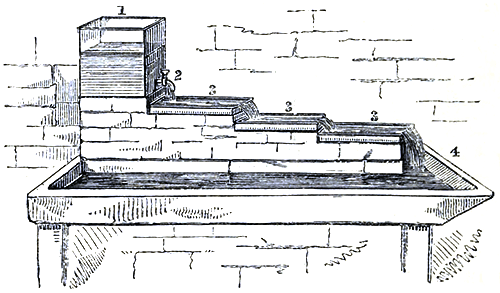
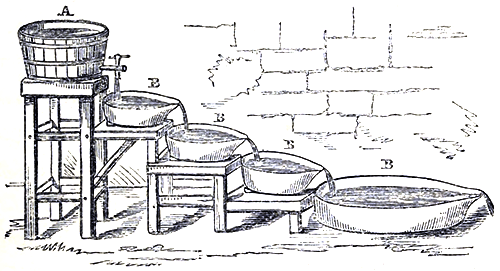
It has been computed that each fully-matured female will produce from 18,000 to 20,000 eggs, and there is little doubt but that with proper management and the expenditure of a very small capital, artificial fecundation of the ova of crustaceans might be most successfully [Pg 93]and profitably conducted in this country. Much attention has of late been paid to this subject in France, and many most interesting experiments in connexion with it have been tried. The annexed cut represents a set of chambers, or troughs, which were erected in the College de France, Paris, for the hatching of the eggs of the various crustacea. 1 is the reservoir in which the water is placed; this runs through the tap, 2, into a series of glass troughs in which gravel has been placed; 3, 3, 3, through which it flows and then discharges itself into the main receiver, 4. This apparatus, although very neat and ornamental, is far more costly than there is any need for. Such a contrivance as that represented in the above illustration can be readily put up for a few shillings, and will be found to answer every practical requirement as perfectly as the more costly arrangement, A, is a common tub in which a wooden tap is fixed; B, is a series of shallow earthenware [Pg 94]dishes, or pans with lips, such as are sold at almost all earthenware shops for domestic use. The stands may be made from a few boards and fir poles nailed together; very little ingenuity is needed to enable any cottager to hatch out his own young crustaceans from the egg. The common river cray-fish has been extensively propagated artificially, and there appears no limit to the extent to which fish-hatching in all its branches may be carried by the industrious. There appears, comparatively, little trouble in the early stages of the process—the eggs of the female being placed on gravel at the bottom of the pans. The seed of the male fish is then laid on it, and, in due time, favoured by gentle streams of sea-water constantly flowing, the young crustaceans come forth. In rearing them it must be borne in mind that as their food, when in a state of nature, mainly consists of marine worms, fish spawn, and the lesser crustacea, food of a suitable character must be provided until the young nurselings are old enough to turn out in the sea pools to shift for themselves. Our space will not admit of our dealing at any length with this subject, and the few hints we have given are mainly intended to show that important results in this branch of national wealth may be arrived at by the use of very simple means and appliances. The number of Lobsters brought every season to Billingsgate Market will serve to give some idea of the importance of [Pg 95]Lobster-fishing, and the sums of money which must change hands in connexion with it. Calculations show that from the coasts of England, Ireland, Scotland, and the Channel Islands, 150,000 Lobsters per season reach Billingsgate Market, exclusive of the supply of Norway Lobsters (Nephrops norvegicus), as represented in the accompanying illustration. These are even more abundantly supplied, and over 600,000 per season are imported. It not unfrequently happens that one day’s supply for that great emporium of sea [Pg 96]dainties reaches as high as 25,000; and here at early morning, long before mighty London is fairly up for the day, a scene of bustle and activity may be witnessed which well repays the early riser—
Steam in clouds floats above the vast loads of newly-boiled crustaceans and molluscs; carts of every size and pattern block the way, from the castellated conveyances of Messrs. Chaplin and Horne, to the humble donkey shallow: ice, in saw-dusty bales, is jostled against orange-boxes; figs and codfish greet each other like old friends, whilst West India pineapples, haddocks, oysters, and Spanish chestnuts appear determined to make a day of it and go off together.
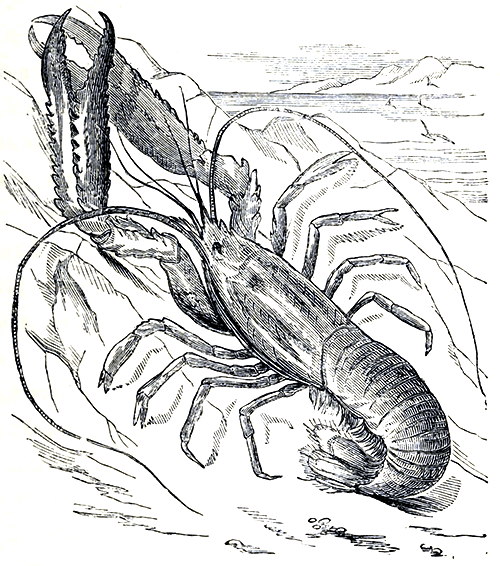
The popularity of the Lobster extends far beyond the limits of our island, and he travels about to all parts of the known world, like an imprisoned spirit soldered up in an air-tight box. It has been said that during the Indian war a box of regimental stores belonging to our forces fell into the hands of the enemy, who thinking that a great capture of some kind of deadly and destructive ammunition had been made, rammed the painted tin cases, with goodly charges of powder behind them, into their immense guns, laid them steadily on the devoted British troops, and then with a flash and a [Pg 97]thundering roar, preserved lobster, from Fortnum and Mason’s, was scattered far and wide over the battlefield. Fishermen declare that thunder or the reports of artillery causes the lobsters in the store boxes or wells, in which they are brought alive to market, to suddenly cast off their large claws, just as the crabs do in their battles with each other; a smart blow will cause a lobster to throw off a damaged claw, and thus stop bleeding in the manner before described.
The regular Lobster season may be said approximately to last from the month of March to August. About the middle or latter end of the last-mentioned month the shifting of shells takes place, and the fish is unfit for human food; but, like silkworms after a change of skin, they commence feeding in the most voracious manner directly the new garment is durable enough to admit of their taking their walks abroad, and their temporary seclusion and compulsory abstinence is amply made up for by a course of heavy feeding. The lost plumpness and condition soon return, and the winter season furnishes Lobsters equal in goodness and flavour to any caught “in high lobster time.” It has been remarked by many experienced shell-fish dealers that the Lobster is exceedingly local in its habits, and there are some who profess to be able to recognise the natives of particular localities by their general appearance and the colour of their shells. Unlike some crustaceans who [Pg 98]are coldly indifferent to the welfare of their offspring, the mamma Lobster keeps her little brood about her until the youthful lobsterkins are big enough to start in life for themselves.
The coasts of British North America, as well as many portions of the sea board of the United States, abound in mail-clad inhabitants of many kinds. In some localities great amusement is at times afforded by their capture—a sort of pic-nic or lobster frolic being organised. A boat with plenty of eatables, drinkables, and a capacious cooking pot are provided, and long poles with their ends split (much as the extremities of clothes-pins are fashioned) prepared. On the boat or skiff being propelled slowly through the shallow water, a sharp look-out is kept on the regions below, and on the Lobster being discovered, the split end of the pole is lowered quietly, and with the greatest caution, until just over the unsuspecting victim’s back, when by a sudden downward thrust, the forceps like instrument securely nips him, and he is brought to the surface in spite of his claws and the pinches he inflicts on the tough, unyielding wood. Some overhanging rock, or pleasant nook on the shore, is usually selected as a place in which to dine and cook the proceeds of the Lobster hunt. The driftwood and such dry sticks and shrubs as the neighbourhood will afford, are used as fuel to boil the pot, and the revels proceed right joyously. [Pg 99]The bays, shallows, and mouths of rivers on the coast of Prince Edward’s Island, abound in a species of sea-weed, known amongst the inhabitants as “eel grass;” on this vast numbers of Lobsters feed as in a rich sea garden. To these favoured hunting-grounds the Lobster-catchers betake themselves, and by wading little more than half-leg deep gather as many as they require. A bushel basket has been filled in this way in less than an hour.
Like the branching growths of sub-marine life which form the connecting link between the vegetable and animal kingdoms, we find crustaceans, dwelling, so to speak, on the border lands of other races, and linking the shrimp, crab, and lobster families together; partaking of the nature of each, but being identical with neither: such are the so-called squat lobsters or Galathea. Three well-marked kinds are to be met with more or less abundantly; these are the Olive squats (G. squamifera), the scarlet squat (G. nexa), and the painted squat (G. strigosa); all these are of comparatively small size, the largest or painted description rarely exceeding three and a half inches in length. The singular alertness of all the race renders capture somewhat difficult. Like the lobsters they possess extraordinary powers of vision and retrograde movement. The horns are extremely long, and so sensitive that the slightest touch seems to reveal at once the [Pg 100]nature of an approaching object, and enables the alarmed squat to seek a safe sanctuary between the rock clefts, from which, he is by no means easy to withdraw.
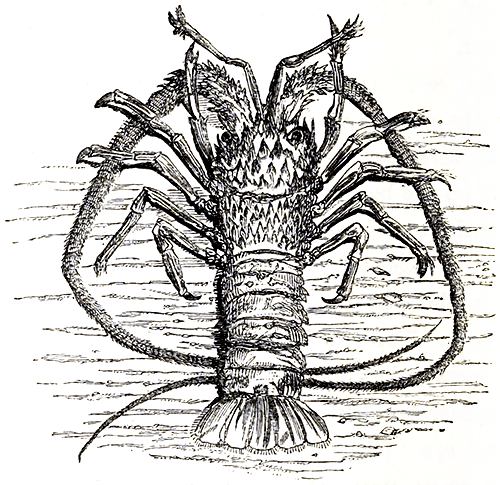
The spined lobster (Palinurus vulgaris), crawfish, cray, or crowder, will from its thorn-coated shell, long horns, powerful nippers, and generally formidable appearance, be familiar to most of our readers. Like most other crustaceans the Cray delights in a home among rugged sunken rocks, and is taken in the traps laid down for ordinary lobsters and crabs. It not unfrequently happens whilst line-fishing over sunken [Pg 101]reefs, or on rocky ground, that, on a bite being felt and the line drawn in, a steady drag is felt as though a cuttlefish had grasped the bait; on looking down into sea beneath the boat, in all probability the Cray will be seen in all his spined armament, coming on at the end of the line like a sea porcupine with horns. Some care will be needed to coax him deftly onward until the net is well under, or your line and Cray are likely to part company. These thorn-clad heroes, “in their spiked armour like Egyptian porke pigs,” are not held in as high esteem for the table as their more smoothly-plated relations—their flesh being of harder texture and of a sweet flavour is objected to by professed lobster-eaters; still, to our taste, a well-conditioned “porke pig,” the shape of a Crayfish, is by no means to be despised. Some portions of the Pacific Ocean, and the warm seas of the East, contain them in vast numbers. Many spots on the coast of South America, and the bays and inlets of the island of Juan Fernandez, literally swarm with them; and it is to be questioned whether Robinson Crusoe, or Man Friday either, would have ever consented to leave that fertile and picturesque locality if they had entertained the least idea that it was surrounded by countless thousands of Crays in a perfect fever of anxiety as to whose good fortune it would be to get boiled first.
Some idea may be formed of the abundance of [Pg 102]animated creatures of this and other kinds to be taken in these seas, by the following account of the fishing to be obtained in them, given by the Hon. F. Walpole:—“The fishing afforded the best return for labour, and a boat might be filled in four hours with hook and line only. Fish swarmed of every size and colour, and seemingly of every variety of appetite, for they took any bait. The bottom was literally lined with Crawfish of a large size; some must have weighed five pounds at least. There needed no hook—a piece of anything let down on a string to the bottom was enough; they saw it, grasped it, and kept their hold till you had seized them by their long feelers and borne them into the boat, where they crawled about and extended their feelers as if in search of more bait. The Conger eels, which were almost as numerous as the Crawfish, were great enemies to us, for they took up time in the catching, and their execution, which followed immediately, was a work of some skill—Gordian knots, twists, and all manner of wriggles being used to evade the knife raised to slay them, and frequently their powerful teeth enabled them to bite through the wire and escape with hook, bait, and line. Catching Crawfish was one of the favourite amusements of the seamen. One man held a pole, on which was fastened a bait thrown into the water near the beach; one or two others stood ready, and when the [Pg 103]Crawfish, allured by the bait, had approached within attainable distance, those dogs of war pounced upon him, and he was high and dry upon the beach before he had even meditated a retreat. The boat-keepers in the boats alongside used to let down pieces of net spread on the hoops of a cask, with pieces of bait inside them. In a few minutes these were hauled up, and one of our simple friends appeared seated, greatly enjoying the travelling. Sometimes two or three came up struggling for standing room. But enough of Crawfish, I will only add that we thoroughly enjoyed both the catching and the eating. We had crawfish for breakfast, crawfish for dinner, crawfish for supper, and crawfish for any incidental meal we could cram in between. The last I saw of my friends was with their long feelers wreathing about, as they were borne about Valparaiso as presents on our return.”
We learn from the old authors that Apicius, after profoundly studying the culinary art at Minturnus, in Campania, where he feasted right royally on Crawfish, in order, it is said, to strengthen and improve the appetite—at length feeling that change of scene and provender were needed, and opportunely hearing that Craws of marvellous size and surpassing excellence were captured on the coast of Africa, the sage knew no rest until he had obtained a ship and had set sail for that favoured land. The voyage proved prosperous, [Pg 104]and, as might be reasonably anticipated, as the shore was neared a sea-earned appetite of more than ordinary intensity set in, and the philosopher’s first thoughts rested on the delicious crustaceans he had journeyed so far to enjoy. The dusky fishers, roused into bustle and activity by the august arrival, soon brought the spoils of their crawfish hunt, rejoicing no doubt at their quick success; but the Craws were found, like most other things when made the subject of long anticipation, by no means equal to the exaggerated standard, and were contemptuously sent with their owners to the right-about, orders being given that larger specimens might be immediately brought. On being informed that to do so would be impossible, Apicius at once expressed his supreme contempt for Africa, Crawfish, and all else, ordered his pilot to attend, and gave directions for instant departure for Italy.
Pliny speaks of Crawfish of such huge dimensions, “four cubits long,” that we are almost led to believe they must have been the creation of a wild, distempered dream rather than substantial realities.
The tables of ancient Rome were often garnished with dishes of Crawfish served with asparagus; and it is our decided opinion that many worse things are daily partaken of by the gourmands of this enlightened age, notwithstanding the much-vaunted march of improvement in cookery.
[Pg 105]
The coral reefs fringing the island of Mauritius afford shelter to members of the family of Palinurus, which in both size and splendour of colouring far excel those taken in our seas. Some we had an opportunity of examining when freshly caught, by the fishermen of that fertile isle, looked so much like works of art that we could almost fancy Pallisey, that king of potters, must have returned to life, and that these were some of his choicest productions. Some were of delicate sea-green banded with white and ultra-marine blue, alternately. Others were striped with pale yellow, black, and green, whilst all were so highly glazed, and carried such a brilliant polish, that we deeply regretted the perishable nature of living things, and sighed as we reflected on the waste of so much loveliness on the more than half-heathen crew of Malabar coolies who grinned and chattered round the captives, and who had no appreciation whatever for crustacean perfection, except in association with rice and a brass cooking-pot.
[Pg 106]
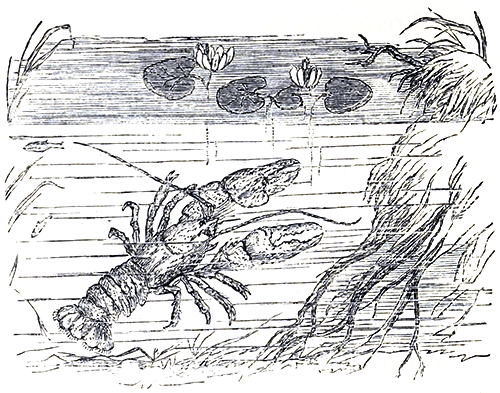
This little crustacean is very abundant in many of the rivers of England, although it is by no means as general as might be anticipated from its habits and mode of life. Rivulets and rivers in which clear streams flow, are its favourite resort, and the holes amongst the roots of trees, stones, or banks beneath the water, form snug retreats for it. It is somewhat strange that in the western portion of England, where running streams abound, the fresh water Cray is (except by name) unknown. Its food consists of animal substances, the spawn of fish, vegetable matter, the larvæ of water insects, &c. The rich scarlet colour [Pg 107]assumed after boiling makes the Cray a great favourite for garnishing purposes; pic-nic parties are often formed for the sport afforded in taking them. Long sticks or rods with cord lines, to which pieces of bait are tied, are made use of to allure the Cray within the reach of a small hand-net, when he is scooped out; some enterprising anglers endeavour to throw them over their heads without using the net, others in their anxiety to inveigle the coquettish crustacean, slip on some slippery tree-trunk or moss-grown stone, and pay an unwilling visit to the home of the Crays at the bottom. Pinched fingers and other small catastrophes serve but to add to the general fun and hilarity of the river-side revellers. In some of the West India Islands torchlight expeditions of a like character are made to the streams flowing from the hills, and the Crays lifted out, after having been previously treated to pieces of manioc-root abundantly cast in the water for them. This substance has the property of stupefying such shell-fish as are silly enough to eat it, and the Cray pays the penalty of his too unsuspicious disposition. The rivers of France are abundantly supplied with Ecrevisses, as they are called in that country; enormous numbers are eaten every day in Paris, and the other large cities and towns of the continent. They are prepared in various ways for the table, and the celebrated potage à la bisque is made from them.
[Pg 108]
A number of methods are had recourse to for their capture, amongst which may be mentioned the sinking by stones, in localities known to abound with them, rough bundles of thorn-sticks, with offal of some description fastened up in them. The Crays, in their attempts to obtain the dainty tit-bits, force their way through the entangled twigs, and are unable to retreat with sufficient speed to escape being drawn out when the Cray-catcher hooks out his treacherous fascine. Small pieces of frog are highly esteemed baits. These are laid down in considerable numbers along the course of the stream, and are after some time visited, and the feasting Crays brought to bag. Some persons are sufficiently indifferent to the nips they receive as to insert the hand and arm beneath the roots and hollow banks, and so drag forth their prey. There are other methods for Cray capture, but most of them depend on the use of bait placed in traps, much like those used for prawns, or some contrivance where entrance is easy and exit difficult, and it is remarkable that in every country in the known world the same principle is taken advantage of, in the construction of traps for fish, birds, and animals. Whether we visit the almost unknown chains of ponds among the gum-tree woods of Australia, the fern-clad river-banks of New Zealand, the great streams flowing through North-west America, or the tangled forests bordering the jeels, nullahs, and [Pg 109]rivers of Central India, basket traps of various sizes and forms, but all alike in their mode of operation, will be found. Some we stumbled on while hunting among the Bheels of Candeish were of elegant design,—trumpet mouthed, and beautifully woven from the split-up fibres of single bamboo-joints, the knot at the small end being left to form a sort of plug-hole, through which the bait was introduced.
A. fluviatilis shifts his shell, much in the same manner as his salt-water cousins, and, like them, is painfully nervous and retiring in his habits during the hardening of the new case with which nature in due time protects him. Like the sea lobster, the Cray is wonderfully prolific, producing as many as 100,000 eggs in the breeding season, which are carried securely about for some time by the parent fish tucked up under the abdomen, and defended by the lateral rows of legs and claws. A notion prevails in some localities that the goodness of water may be surely tested by boiling a Cray in it, when, if the quality is all that could be wished, the colour of the Cray should be clear and bright red; whereas, if impure, the fish is said to remain dull and lustreless. This, although a very old opinion, appears much on a par with the idea, equally old, that a frog in a tea-kettle would prevent the water therein contained from ever boiling. We greatly fear, however, that a good brisk fire would not only go far towards [Pg 110]dissipating the superstition, but at the same time make it peculiarly unpleasant for the frog. It has been stated, on good authority, that A. fluviatilis lives to a good old age under favourable circumstances. Desmarest says that it has been known to live for more than twenty years, and that it increases in size as age advances. We are disposed to think, however, that there must be a limit to development far within twenty years, or we should at times encounter some “grandfather Cray” who would be far more pleasant to follow than to meet, at any rate in his own element.
The ancient Greeks appear, from the writings of early historians, to have held the Cray in high esteem; and Alexandria had the reputation for producing it of the best quality. The Romans, too, were not behind-hand in their appreciation of the luxury, and some quaint ingredients are mentioned by the old writers as being requisite to complete the operations connected with its preparation. After being boiled, we are told that the Cray was eaten flavoured with cummin and seasoned with pepper, alisander, parsley, dried mint, and more cummin ground and mixed with honey, vinegar, and garum, with some liquid perfume. Bosc informs us that “Crayfishes can be preserved several days, not too warm, in baskets with some fresh grass, such as the nettle, or in a bucket with three-eighths of an inch of water. If there were enough water in it to cover them [Pg 111]they would die in a few moments, because their great consumption of air does not allow them to live in water unless it is continually renewed.” The strange, mysterious waters flowing through the mammoth caves of Kentucky contain, amongst other wonders, considerable numbers of these interesting creatures; and we have recently been favoured with a sight of two specimens of remarkable size and beauty of form brought from the interior of Venezuela.
Although neither crab, shrimp, or lobster, the bold and adventurous diver as a “submarine armour-clad,” holds a conspicuous position, as with helmet of proof, and ponderous, metal-soled boots, he plunges fearlessly beneath the wave, and prosecutes his researches “full fathoms five,” amongst the strange, weird fastnesses and cavernous depths of the deep sea. Huge and terrible as he with his eyes of glass, and India-rubber skin, must appear to the lesser inhabitants of the ocean’s realms, there are “Tritons amongst the minnows,” who fear him not, and would think little of making a meal of him, in spite of his crystalline eyes and indigestible equipment. The records of the voyage of H.M.S. Fawn serve to show that the human “armour-clad,” when submarine in his occupations, is by no means “Monarch of all he surveys.” “The gunner of the Fawn, being a very expert diver, was employed to recover the treasure from the Peninsular [Pg 112]and Oriental Company’s ship Ava, wrecked a few years ago on the coast of Ceylon. Having, in a gutta-percha dress, made his way into the saloon, he was busily searching for the bullion, when, to his horror, he saw a huge ground shark come sailing in at the door. With great presence of mind he lay motionless on the locker, and watched it silently and quietly cruising about. One can well imagine his feelings when he saw its cold green eyes fixed upon him, and felt it pushing against the leaden soles of his boots, and rubbing against his dress, the slightest puncture in which would have been certain destruction. About ten minutes of suspense were thus passed, which must have seemed an age, during which the monster came back twice or thrice to have another look at him. Mr. Pound’s courage and coolness were at length rewarded by seeing him steering his way back as he came. Afterwards, Mr. Pound always armed himself with a dagger when he went down to the wreck, from which he recovered altogether 22,000l., having spent some 850 hours under water. He had also some narrow escapes at times from the opening and shutting of the iron plates of the ship as they worked with the roll of the sea. The air-pipe was twice severed from his helmet, but fortunately, slackening it warned the people above to lose no time in rescuing him from his perilous position.”
One is almost tempted to envy the cunning, miserly [Pg 113]old crabs, who have it all their own way down amongst the branching coralines and vase-shaped sponges, and crawl to their very hearts’ content over the piles of sunken treasures scattered there. Treasures are there, too, not of man’s garnering, growing like rich sea-flowers beneath the waves. The sea feathers, or plume corals, are examples of these, and are found sprouting, like ocean fern-leaves, from the rock cave’s ledges, far down in the deep still water between the reefs; and we shall see how a love for the beauty of Nature’s handiwork not only led to the crabs being deprived of their hoard, but, favoured by good fortune, proved a guide to wealth, station, and ultimately, nobility. Thus goes the story, which, unlike many of a somewhat similar kind, has the priceless advantage of being literally true. In the year 1650, one Phipps, a blacksmith, of Pemaquid, in New England, was blessed with a son, who was christened William, and who in very early life manifested much ingenuity and a passion for ship-building. Very shortly after the term of his apprenticeship to a shipwright had expired, he built a vessel for himself, which he navigated in person; and hearing it reported that a Spanish ship, freighted with bullion, had sunk in the neighbourhood of the Bahamas, he at once betook himself to the scene of the disaster, and made the most determined but fruitless efforts to recover the lost gold. Treasure-seeking now appears to have become a fixed [Pg 114]occupation with Captain Phipps. In the year 1683 we find him employed by the English Government to discover another lost ship (also Spanish), of immense value. This he failed in accomplishing, but became convinced that perseverance in the search would be ultimately crowned with success. For five years he was unsuccessful in his urgent applications for funds to renew his investigations, when the Duke of Albemarle, the then Governor of Jamaica, not only fully credited the assurances of Captain Phipps, but, better still, furnished him with ample means and fitting apparatus for his new expedition. How he reached the scene of his labours—how every lagune and gulf between the reefs was searched in vain, until hope well-nigh vanished—we need not dwell on here. No wreck could be discovered, and he had almost determined to abandon the undertaking in despair, when, after a day of more than ordinary fatigue and anxious exploration amongst the coral rocks, his boat’s crew were rowing him slowly and dejectedly back to his ship, one of the sailors directed his attention to a beautiful sea feather, growing from the ledges of a sunken rock. “Alas!” said poor Phipps, “there is a sea treasure indeed. I wish I could get it.”
One of the good-humoured black divers who accompanied him, anxious to oblige his commander, shot rapidly down to the coveted specimen, and just as [Pg 115]rapidly returned with it, exclaiming—“Feather safe, fine feather, but plenty big cannon down where feather live.” This report, as may be readily imagined, made the sinking heart of the poor captain leap again. Blackey was despatched to the regions below to take another look at matters, and after a short absence came back with the glorious news that there were “plenty big boxes too, and lots of this,”—exhibiting his dusky paws filled with silver. Now the captain was in his true element at last; and there lay the work he loved so well, ready cut out for him; and he proved quite equal to the occasion, for from that deep gulf, far down among the corals and the Crabs, in whose custody it had quietly remained for more than half a century, he brought to light thirty-two tons of silver bullion, besides large quantities of gold, pearls, and other valuables. We find that Phipps was knighted by James II. He was appointed Sheriff of New England, and took command of a large expeditionary force against the French. We afterwards find him in command of a fleet fitted out to oppose the same enemy in Canada, and subsequently taking part in the Border warfare of the period, as a leader of some celebrity; and at this point of his career we bid adieu to Sir James Phipps and the happy-chance discovery which led him on to greatness.
There is yet another little crustacean, rather a delver than a diver, well known to every sea-side visitor. [Pg 116]This is the Sea Flea, or Sand Hopper, as it is popularly called, and because of its saltitary powers, young ladies in dainty boots keep at a most respectful distance from the scene of its performances, and rival the hopper himself in the agility with which they bound off on unwittingly invading the haunts of that nimble little gentleman. Lift but a tuft of half-dried weed, fragment of stranded wreck, stone, or tenantless shell, and up leap a whole army of Hoppers, like as many peas on a drum-head. They appear more vegetarian in their tastes than most other of their crustacean family connexions, subsisting mainly on the various weeds found scattered among the rocks. Fish and many other marine creatures feed voraciously on them, and the Cornish chough, in his black satin coat and scarlet stockings, picks them with marvellous dexterity with his coral-coloured, forceps-like beak, from amongst the tangled web of sea-cords and ocean-ribbons in which they delight to harbour. The poor, frost-beset starling, too, when the white snow lies thick on the pastures, and the pitiless north-east wind whistles down the vale, finds amongst the oar-weed heaps cast up at high-tide level, Sand Hoppers enough to prolong his wee-bird life till milder winds and better times smile, on the land and him. So even the most pigmy atoms of creation perform their allotted parts in the great plan which an all-wise Providence has so [Pg 117]wisely laid down for created beings, and we become lost in wonder, at the marvellous and inscrutable laws brought to bear in its furtherance. The saltness of the sea, the metal iodine residing in its countless myriads of weeds, the migrations of the mighty hosts of fish, the ebbing and flowing of the tide, the labours of the coral insect, the strange sponge-growths, trade winds, and warm currents setting in from one region to another, all evince the operation of laws, far too vast for man, with all his boasted power, to penetrate or understand. As there are “sermons in stones, voices in running brooks, and good in everything,” so is there beauty and evidence of Divine foresight to be found under every fragment of drift-wood, cast between the rocks; each upturned stone discloses some wonder of creation, and as the mighty billows thunder on the strand and carry in their backward rush the beds of ever-wearing shingle, fretting and grinding with them, frail humanity can but look from nature, up to nature’s God, and feel its own utter insignificance.
The ocean’s broad expanse, when lulled in calm tranquillity, is no less a subject for pleasant and profound meditation, and he who seeks a field for peaceful reflection may find it by drifting away on the unruffled bosom of the deep; and as the bark bears him slowly onward, Montgomery’s lines will not fail to strike his memory:—
[Pg 118]
We could willingly thus gossip on, and prolong the journey on which our companion the reader has so far accompanied us, but all rambles amongst the rocks, or elsewhere, must have an end; our journey in search of crustacean lore can be no exception to this stern law, and we bid our fellow-pilgrim a cordial adieu until we meet again to ramble forth, staff in hand, cockle-shell in hat, and wallet on shoulder, to gather fresh stores of some other lore, so lavishly scattered along the pleasant paths where Nature, in all her goodness and beauty, beckons us to follow.
| A | B | C | D | E | F | G | H | J | K | L | M | |
| N | O | P | R | S | T | V | W | Y |
R. CLAY, SON, AND TAYLOR, PRINTERS, DREAD STREET HILL.
TRANSCRIBER’S NOTES
Obvious typos and missing characters corrected. However, the following have been left unchanged from the original: author’s spelling of “hybernation”, “Macrocheira-kœmpferi”; extra closing bracket on page 57.
The text on page 74, which describes the illustration “The Dredge”, has incorrectly referred to part A on the illustration with a lowercase “a”.
Inconsistencies in hyphenation retained.
A jump-table has been added to the beginning of the index for convenience.
Missing punctuation in index corrected.
The positions of some illustrations were moved to enhance readability. Page numbers from the original list of illustrations have been retained.