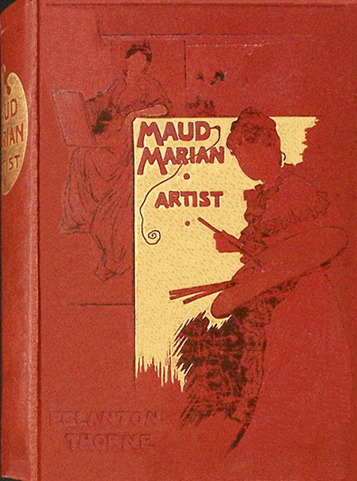
Title: Maud Marian, artist
or, The Studio Mariano
Author: Eglanton Thorne
Release date: February 4, 2026 [eBook #77861]
Language: English
Original publication: London: The Religious Tract Society, 1894
Other information and formats: www.gutenberg.org/ebooks/77861
Transcriber's note: Unusual and inconsistent spelling is as printed.

THE GIRLS OWN BOOKSHELF
OR
THE STUDIO MARIANO
BY
EGLANTON THORNE
AUTHOR OF
"THE OLD WORCESTER JUG," "ALDYTH'S INHERITANCE,"
"THE MANSE OF GLEN CLUNIE," ETC.
THE RELIGIOUS TRACT SOCIETY
56 PATERNOSTER ROW AND 65 ST. PAUL'S CHURCHYARD
Oxford
HORACE HART, PRINTER TO THE UNIVERSITY
CONTENTS

CHAPTER
IV. THE INAUGURATION OF THE STUDIO
XV. VARIOUS THREADS OF ROMANCE
XVI. MAUD RECEIVES STARTLING NEWS
MAUD MARIAN, ARTIST

"I CARE FOR ART"
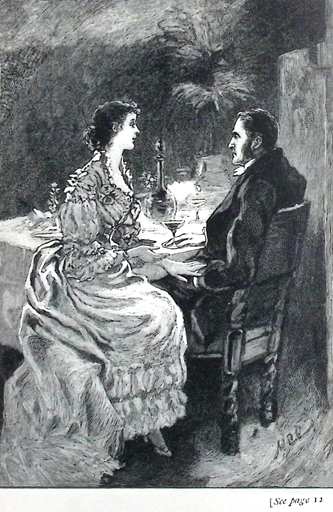
MR. MARIAN and his daughter, separated by the length of a large table elegantly decorated with flowers, plate, and glass, were dining together. It was seldom they dined thus alone, and Maud had never before taken the head of the table; but the butler had deemed it right she should now do so, and had set her place there. Only to-day, however, had Maud become Miss Marian, and mistress of the house.
Up to this time, her father's unmarried sister had kept his house and taken loving care of his child—for Maud's mother had died when she was too young to retain any remembrance of her. But now the Aunt Helen whom Maud warmly loved was Miss Marian no longer. Some one else had had the audacity to seek and to win her tender interest, and she had gone to brighten the home of a gentleman with three motherless children whose lack of a mother's care had strongly appealed to Helen Marian's loving heart. All her life she had been used to caring for others, for she had not been twenty when she came to keep her brother's house. Being so young she had perhaps not been the wisest guardian her niece could have had; but she had made the child happy, and as she grew up, Maud found in her aunt a companion who seemed almost as young and as full of life as herself.
It was not surprising that Maud should feel herself injured by her aunt's marriage. She hated the idea of missing her cheerful companionship, and foresaw, moreover, sundry inconveniences to herself which might arise from the event. Maud was not in the least gratified by the new dignity she had attained. She had ambition, but it was not of so commonplace an order as to be satisfied with petty social distinctions. However others might regard her, in her own eyes Maud Marian was a superior person. So, now that the excitement of the wedding was over, and the bride had departed, she was disposed to be silent, and nurse a sense of grievance.
"My dear Maud," exclaimed Mr. Marian at last, when for some minutes the servant had been moving noiselessly between them, and scarce a sound had broken the stillness, "have you absolutely nothing to say? Come, come, my dear, don't look so melancholy. To see you, one would think we had had a funeral here to-day instead of a wedding."
"I cannot see that a wedding is much more lively," said Maud languidly; "they both mean loss."
"Do they?" said Mr. Marian. "I don't think Hamilton would agree with you about that. It strikes me that this wedding means gain for him, most decidedly."
"Yes, at our expense," said Maud bitterly.
"Oh, well, you must not grudge him his happiness! He has had a sad home for these last few years, and his poor little children need some one to look after them."
"He should have had a good housekeeper," said Maud. "For my part, I do not approve of second marriages. There ought to be a law forbidding them."
Mr. Marian smiled to hear his young daughter express herself with such decision. He looked across the table at her with amusement in his eyes.
"It is a good thing the government of the country is not in your hands, my dear," he observed, "for I fear you would make tyrannical use of your power. Since the wedding is now an accomplished fact, we must make the best of it. I congratulate myself that everything went off well. Helen looked as well as possible, and as for you—I think I never saw you in a more becoming gown."
At last he had succeeded in bringing a smile to her face. No woman, however superior, is above feeling pleasure when her gown is praised, and Maud prided herself on her taste in dress.
"I am very glad you like it," she said, glancing down with a gratified air at her attire. "I really think Madame Adolphin has carried out my ideas quite successfully for once."
The wedding, which was supposed to be a quiet one, had taken place in the afternoon. Maud was the only bridesmaid, and she still wore the gown she had had made for the occasion. It was simple enough, being all of white, without a touch of colour; but the material was soft Indian silk, and what seemed to be pearls were strewn about the bodice, which was cut low at the throat, and finished with a tucker of deep lace, a style much affected by Maud, and exceedingly becoming to her, since she had a pretty neck and a skin of delicate whiteness.
She was a girl concerning whose claims to beauty people held very different views. Her features were irregular, but small and piquant. She had hair of the warm tawny hue which many of the old painters have given to their Madonnas, and she wore it loosely coiled at the nape of her neck with an artistic carelessness which was very becoming. Since her complexion was of the dazzling fairness which seems generally to accompany hair of that rare hue, it will be seen that the tall, slender form of Maud Marian did not lack impressiveness.
"Of course you will miss your aunt at first," said Mr. Marian, wishing to console his daughter; "but Kensington is not a great way off. You can drive there as often as you like, and Helen will come to see us occasionally, I suppose, though she will be more tied to her home than you are."
Maud looked at her father for a few moments ere she made any reply. Then she said with apparent carelessness, her eyes on the bread which she was crumbling on the cloth, "I fear you will miss Aunt Helen more than I this winter, papa. You forget that I am going abroad."
Mr. Marian looked up quickly, his countenance expressing the utmost astonishment.
"Going abroad! What do you mean?"
"You cannot have forgotten, papa, that you promised that I should have another winter in Rome."
"But, my dear, it was months ago that we talked about that—before there was any thought of your aunt's marrying."
"I cannot see how that alters the case," said Maud calmly. "A promise is a promise."
"Are you sure that I really promised? Even if I did, it seems to me that the change which has taken place here would justify me in setting aside that promise. Surely, Maud, you cannot earnestly propose to yourself to leave me to pass the winter alone!"
"It would only be for six months, papa, and you are always so engaged with business that you would not miss me. You do not think how dull I should be here by myself."
"It shall be your own fault if you are dull," said her father eagerly. "You are mistress of the house now, and you shall invite whom you please. Perhaps I have devoted myself too exclusively to business in the past; but the pressure is over now, I trust, and you shall teach me to attend to my social duties."
"Oh, papa, if you think I should care for that sort of thing, you are quite mistaken," said Maud languidly. "All I care for is Art. The lessons I took last winter, the hours I spent in picture galleries and churches, will all be thrown away if I do not have another season of hard work. And you know how I have been counting on going back to Rome and setting up a studio there."
"Why must you go to Rome?" asked her father. "Cannot you have a studio here? I am sure there is room enough in this house."
Maud smiled faintly. "You do not understand, papa," she said with an air of superiority.
"No, I do not understand," returned Mr. Marian with some warmth. "I confess I cannot understand how an only child can so contemplate leaving her father and her home. I should have thought a sense of duty might have withheld her from doing so."
The colour deepened in Maud's cheeks; she bit her lips in sudden irritation; but she had tolerable self-control, and when she spoke it was to say coldly, "I am afraid we have different ideas of duty. I, for my part, regard it as a sacred duty to cultivate what little talent I have for painting."
For a few moments Mr. Marian was absolutely unable to reply. He was startled, as he had been startled once or twice before, by the calm assurance with which his daughter could maintain a right to whatever she desired.
When he spoke again, he approached the subject from another side, and Maud felt that she had virtually gained her point.
"I do not see how you are to go to Rome," he said. "You cannot go with the Middletons as before, for they are not going abroad this winter. Mrs. Middleton told me so this afternoon."
"I know that," said Maud composedly. "But I am not dependent on the Middletons now. I made many friends when I was in Rome last winter."
"But it is impossible that you should go alone. Indeed, I will not hear of such a thing," said her father.
"Then I must have a companion," said Maud. "She will be a bore; but if you insist upon it, I must get one. It is a pity you cannot come with me to Rome yourself. I wish you would take a partner—then you could get free sometimes."
"Perhaps I shall take a partner before long," said her father—"a young man of strong character and energy, fitted to succeed me in the business. But it is early to talk of that. I am not an old fellow yet."
Nor was he, though the arduous, unremitting toil by which he had won his wealth had given him the look of age. No one, judging by his appearance, would have believed that he had not yet seen fifty years.
"It would be wise to take a partner soon," said Maud, "for I am sure you need more rest."
She was thinking of the man whom she believed her father meant to make his partner; but she did not name Sidney Althorp, for she and her father were wont to disagree with regard to his merits.
"I have a suggestion to make," said her father suddenly. "Suppose you put off your going to Rome for another year—by which time I may be in a position to accompany you."
"Oh no, no, thank you," said Maud, laughing; "I know how that would be. At the end of the year, you would ask me to wait another, and then another. You would never be able to tear yourself away from business for six months; you care more for business than for anything else, and I—I care for Art."
By this time the dessert was on the table, and the servants had left the room. Mr. Marian seemed vexed by his daughter's last remark, but he did not immediately reply, and Maud was just thinking that enough had been said on the subject, and she had better make her escape to the drawing-room, when the house-bell was heard to ring.
And a few moments later, the servant opened the door and announced "Mr. Althorp."
The man who entered the room was still young, but bore himself with a grave, sedate air. He was tall and well-made, but not handsome, yet the smile which lit up his countenance as he took Miss Marian's outstretched hand gave him a most prepossessing appearance. His bearing was distinguished by such grace and courtesy as women admire in men far more than good looks. Most women of his acquaintance liked Sidney Althorp; but Maud Marian was perhaps an exception. She called him an "old friend," as indeed he was; but professed to find him tiresome, and his conversation prosy.
"Ah, Sidney," exclaimed Mr. Marian, an unfeigned welcome in his tones; "to what do we owe this pleasure? Is it business brings you, or do you come to offer your congratulations? If so, I had better warn you that Maud regards the event of the day as a bereavement, and is indignant with Hamilton."
"At least, I may congratulate you that the ceremony was so admirably accomplished," said Althorp, looking at Maud. "My mother has been telling me about it. But it is business that brings me," he added, turning to Mr. Marian. "After you left this morning, a clerk came from Wardlaw Bros., and I promised to acquaint you with what he said and send them a reply by to-night's post."
He was proceeding to explain the matter when Maud rose.
"If you have business to discuss, I will go to the drawing-room," she said. "You will find me there when you feel inclined for coffee."
Sidney Althorp opened the door and she passed out. His eyes followed her slight, graceful figure across the hall with rather a regretful glance ere he closed the door.
Through a small ante-room decorated with rich draperies, palms, and hothouse flowers, Maud entered the large drawing-room. A gay crowd had filled it all the afternoon, and the room betrayed tokens of the vanished visitors in the disorderly appearance it wore. Maud pushed the chairs a little into their places, rescued a hand-screen, painted by herself, from the fender into which it had fallen, and examined the vase which held the bridal bouquet to see if it contained sufficient water.
Then with a sigh, she threw herself into an easy chair, saying half aloud, "Weddings are horrid things."
But she could not rest there long. Presently she sprang up, saying, "Why need Sidney come and bother papa about business to-night of all nights, when I feel so miserable, and hate to be alone?"
She felt cross and out of spirits, a frame of mind which she imputed entirely to her aunt's going away, not wishing perhaps to recognize any other possible cause of it. She had seated herself at the grand piano and was carelessly playing little snatches of melody, when the curtain which screened the ante-room was pushed aside and Sidney Althorp came in.
"Ah, it is you!" she exclaimed. "Then I hope the business is concluded?"
"My share of it," he said, coming to her side. "Your father has some writing to do, but he will not be long. What is that you were playing? It is very pretty."
"Oh, it is only an air from a new opera I heard in Rome last winter," Maud replied. The next moment she regretted the words. She did not wish to speak of Rome with Sidney Althorp just then.
"You enjoyed your winter abroad very much," he observed.
"I did," replied Maud concisely.
"Rome seems to have a wonderful fascination for every one who goes there," was his next remark.
"It has," said Maud; "there is no place like it." With that, she broke into a brilliant march, calculated to suppress conversation.
Althorp listened in silence for some minutes till she fell into a more subdued strain, when he said, "Mary is anxious to form a choral class this winter, to meet at different houses at Streatham. She hopes to persuade you to join it."
"She is very kind," said Maud, with some hesitation in her tones, "but—I shall not be able to do so."
"How so?" he asked quietly.
Maud lifted her hands from the piano, and turned round quickly on the music-stool. There was no use in trying to evade the truth. He would have it.
"Do you not know," she said—and there was a defiant light in her eyes as she spoke—"do you not know that I am going to Rome for the winter?"
"Are you, indeed?" he returned in low, grave tones. "My mother told me she understood you to say so this afternoon; but I could not believe it."
"And why not, pray?" she asked, not without embarrassment, to cover which she walked across the room to the fireplace, and occupied herself with stirring into a blaze the fire, which was hardly needed, for though it was October, the night was warm.
He was silent. Sidney Althorp had a way of being silent when most men would have spoken, and his silences were very eloquent. Maud had no difficulty in interpreting the meaning of this one.
"I suppose," she said, "you think that now Aunt Helen is gone I ought not to leave papa."
"Do you not think so yourself?" he asked, turning upon her one of his grave, searching glances.
Maud's eyes fell beneath it, but she answered boldly, "No, I do not. It is not my fault that Aunt Helen has chosen to get married, and I do not see why I should be punished for it."
"You call it a punishment to spend your winter here with your father?"
"For me it would be that. Why should you look surprised? You know how I love Art, how I have set my heart on having a studio in Rome."
"Yes, I know," he said slowly; "but I should have thought—pardon me—that there were other considerations."
"You mean that it is my 'duty' to stay with my father," broke in Maud impetuously as he paused. "When people want to make one do anything unpleasant, they always use that word. But I cannot see that it is my duty to waste my life. My father will be very comfortable without me. We have excellent servants, and Rudd can be trusted to look after all his needs. You know how little my father is at home. He will not miss me much."
"I think you are mistaken," said Althorp, gently, "and that he will miss you more than you imagine. Because he is so many hours away from home, it is the more desirable that he should find his home bright and cheerful when he returns to it."
Maud was growing more irritated with every word he uttered.
"Of course you think me wrong," she said; "you always do. You love to pose as my mentor. But you must allow me to decide this matter for myself. You have no right to judge for me."
The colour rose into Sidney Althorp's face as she spoke. He was pained by her words, and his expression showed it.
"Assuredly," he said, rather proudly, "I have no right to judge you. You mistake me if you think I would presume to do so. You have given your own interpretation to my words. I never said that you were wrong."
"No, but you thought it," she rejoined.
Ere he could reply, if he had any reply to make, Mr. Marian entered the room.
Maud rang the bell for coffee, and when the servant brought it, she occupied herself with her cup, and vouchsafed neither word nor look to Sidney Althorp. In her inmost heart she knew that she had been rude to him, that her words had hurt him, but she preferred to regard herself as an injured person.
In a few minutes, Althorp came to bid her good-night. His voice was as gentle and his glance as kind as if nothing had occurred to disturb their intercourse, and in spite of herself Maud was bound to smile and respond with an appearance of cordiality.
"Sidney is a good fellow," remarked her father when he had gone.
Maud bit her lips and was silent.
"It is a kind of goodness that always puts me in a rage," she thought. The immediate effect of Althorp's slight, indirect remonstrance was to make her more than ever determined to have her own way.
"Papa, darling," she said a little later, seating herself by his side and assuming her most coaxing manner, "you will let me go to Rome, won't you? You don't know how I feel about it. I should be miserable if I were disappointed after counting upon it so long."
"Would you?" he said, regarding her wistfully. "You could not give up your own way for once for the sake of your poor old father?"
"I would give up anything else, papa, but not this—not my Art."
"Well, well, then it must be so, I suppose," he said with an air of resignation. "But how I shall get through the winter all alone in this great empty house I cannot tell."
"The time will soon pass, papa; I shall return in the spring."
"We must find some one to go with you. You cannot live in Rome alone."
"Oh, I should go to a pension," said Maud. "But still of course if you wish—"
"Certainly I wish it—you must have a companion. How would Miss Richmond do?"
"Oh, papa, that terribly fussy old maid! I could not endure her for a week."
"I wonder if Mrs. King would be willing to go with you."
"Mrs. King! A widow of nearly fifty! Papa, you have the strangest ideas of a companion."
"Well, can you suggest anyone?"
"Not at a moment's notice. We must enquire of friends, and if that fails, we can advertise."
"I have it," said Mr. Marian, after he had been silently thinking for some minutes. "My cousin, John Mildmay, has several girls and not very much money to spend upon them. There is one about your own age, I believe. I'll be bound that she would be only too delighted to accompany you to Rome."
"The Mildmays?" said Maud. "Do you mean those people we met at Ilfracombe some years ago, and you found out they were cousins of yours? I remember there was one girl I liked very much. Her name was Enid. We talked of inviting her here, but we never did so. I believe I should like her for a companion."
"Very well, then; I will write to Mildmay about it to-morrow. How soon do you think of going, Maud?"
"Early in next month, papa."
"So soon! You will surely wait till your aunt returns?"
"Yes, I suppose I must," said Maud.
In truth, she would have liked to get away before her aunt's return, as she knew that her aunt was not likely to approve of her leaving her father. Aunt Helen had either forgotten the plans Maud had formed for the approaching winter, or she had taken it for granted that they would now be abandoned. Maud had deemed it wisest to avoid all reference to them during the busy weeks that preceded the wedding.
"Thank you very much, papa," said Maud as she bade him good-night. "It is very good of you to let me go. You will not regret it when you see the results of my work during those months at Rome. I hope to bring you home such paintings as will make you proud of me."
"Ah, my dear, I should be prouder of you if you were willing to stay with me than any picture you could paint would make me," said her father with a sigh.
He did not say the words unkindly, but they stung Maud nevertheless.
"You have no ambition, papa; you cannot rightly appreciate Art," she said impatiently, as she went away.
She had won her point, but after all it did not yield her great satisfaction. She had been intensely eager to go to Rome, but now that the prospect was assured, she found to her surprise that the anticipation was not wholly delightful. A drop of bitterness had been instilled into it by that unwelcome suggestion concerning duty.
"It is all Sidney Althorp's fault," she said to herself as she tossed on her pillow, unable to sleep. "I wish he had not come this evening. He always says things that make me uncomfortable. I should be quite happy about going if he had not interfered."
And yet in truth how little had Sidney Althorp said!
A STARTLING PROPOSAL
IN a large old-fashioned house in one of the quietest of the many dull streets of Devonport lived, as a brass plate on the door announced to the passerby, Dr. Mildmay. The two windows at the left of the door, looking into the street and screened by brown wire blinds, belonged to the dining-room. Within the room, at an early hour on a certain October morning, a girl was standing. She was close to the further window, but she was not looking out. Her back was towards the light, and she was giving all her attention to the easel before her, which held the little painting on which she was at work. A cluster of blackberries with a few brilliant bramble leaves, arranged on a table beyond, was what she was striving to represent.
The girl's slight form was below the middle height, but well-proportioned, and not without grace. She had brown hair, brown eyes, and a healthy brown skin. The eyes, shaded by unusually long lashes, were really pretty; the neat coil of shining braids, formed by her abundant brown hair, called for admiration; but otherwise there was nothing remarkable in her appearance save the bright, almost boyish, frankness of her expression. As the clock on the mantelpiece struck eight, she ceased painting and began to wash her brushes. A few minutes later, another girl entered the room.
"Well, I declare, Enid!" she exclaimed, as she saw her sister's occupation. "What industry! How long have you been at work, pray?"
"Since seven," said Enid, laying down her brushes, and retiring a little to contemplate her work. "How does it look to you, Alice?"
"Beautiful!" said Alice, who had a profound admiration for everything Enid did. "You have got the colour of those leaves splendidly."
"Do you think so?" said Enid in a dissatisfied tone. "I fancy my colour is too crude. But then the leaves fade so quickly. They are not nearly so bright as when I picked them yesterday."
"No; and the fruit is turning red," said Alice. "However, you have done your best, and the result is very good, I think."
With that she turned to the dining-table, which was already prepared for breakfast save for a few items which Alice hastened to supply. She was taller and stouter than her sister, and though a year younger than Enid, might have passed for the elder.
The girls' dispositions differed widely, but they were good friends nevertheless. Alice was of an eminently practical turn of mind, fond of homely occupations, full of energy, and disposed to regard everything from the most matter-of-fact point of view. Enid too was gifted with good common-sense, but in her case it was tempered by a fine imagination and a certain ideality of character. Alice often accused her sister of romantic tendencies, and not without reason; but romance is not folly, as she perhaps thought. The world owes something to the pure, tender fancies of a young girl's mind. It was good that Enid's heart should crave beauty, and seek it wherever it might be found. Such a one cannot live "by bread alone," but needs the Divine Word, whether uttered by poet, or painter, or the voice of Nature herself.
"How late everyone is this morning," said Enid, as she moved her easel and placed it against the wall. "Ah! Here come the boys."
The sound of a stampede from the top of the house to the bottom was followed by the entrance of two boys, the younger of whom was ten years old. A voice from the top of the stairs sternly rebuked them for making so much noise, and a few seconds later Dr. Mildmay himself appeared.
"Your mother has one of her bad headaches," he said, addressing his daughters. "She will not get up just yet."
Enid instantly began to prepare a tray to carry upstairs. Alice took her place at the head of the table, her father seated himself opposite to her, and the meal began. Dr. Mildmay had three more girls, but one was away on a visit and the other two were at boarding-school. He was rich in daughters.
Enid carried her mother's tea and toast upstairs, and was gone some minutes. Meanwhile, the postman arrived. There was a letter for Alice as well as several for her father. She was engaged with hers when her father suddenly roused her by exclaiming in surprised tones,—
"Well, this is a strange thing, to be sure!"
"What is strange, father?"
"Why, here is a letter from my cousin James Marian, who scarcely ever troubles himself to remember my existence. It is extraordinary that he should write to me at all; but what is more astonishing, he actually writes to ask if I will let Enid go to Rome with his daughter."
"Enid go to Rome!" Alice's surprise could not be greater.
"Yes; it appears that Miss Marian is somewhat of an artist, and intends to pass the winter in Rome for the sake of prosecuting her art. He wishes to secure a companion for her."
"Oh, father! Enid would like it above all things."
"I dare say," said Dr. Mildmay drily. "But unfortunately there are other considerations. I wonder what made him think of my Enid."
"Perhaps his daughter suggested her," said Alice. "Don't you remember, that time we met them at Ilfracombe, she talked a good deal to Enid, and seemed rather taken with her?"
"Did we meet them at Ilfracombe? I had forgotten."
"Why, yes, father. They were staying at the Grand Hotel. You said that you barely knew him at first, he was so altered from what he had been when you saw him last."
"Ah, yes! I remember all about it now. The girl was Enid's age, I believe."
"Older, father. She must be twenty-three, and Enid is not yet twenty-one."
"But she soon will be. That is no great difference. It would be a thorough change for Enid if I let her go."
"It would indeed," said Alice. "I suppose it would cost a lot of money."
"Oh, as for that, Marian says it shall cost me nothing. I shall 'lay him under a great obligation' if I allow Enid to accompany her cousin. He writes a very kind letter."
"If it is to cost you nothing, why should you hesitate?" asked Alice, raising her eyebrows. "It would be a splendid thing for Enid."
"That depends," said Dr. Mildmay. "It is not a thing to be settled off-hand. I must talk to your mother about it."
At that moment Enid came back into the room.
"Enid," called out her youngest brother, "you are to go to Rome."
"Why to Rome, of all places?" she asked, thinking he was joking.
"How would you like to pass the winter in Rome?" asked her father, turning his eyes upon her.
"I only wish I had the chance," said Enid as she sat down. "Whatever makes you ask me such a question?"
"Because you have the chance," burst in Alice, unable to keep back the news. "Mr. Marian has written to ask father to let you go."
Enid's amazement was intense. She grew pale with excitement as Mr. Marian's proposal was more fully explained to her. To go to Rome, the grand old city that is like no other, with its solemn, awe-inspiring ruins, its relics of departed greatness, and its priceless art treasures; to Rome, the fount of beauty, the ideal school of artists, the loved haunt of poets! It seemed too good to be true that such an idea could even be mentioned in connection with herself.
Long after their father had gone off to his consulting-room, and the boys had started for school, the girls still sat at the breakfast-table discussing the wonderful possibility.
"Cook will lose her temper if I do not soon go and tell her about dinner," said Alice at length rising from the table. "Just look at the time! What am I thinking of to sit here like this!"
And she hurried away to attend to her domestic duties. She undertook the housekeeping under the supervision of her mother, who was not strong enough to do much herself.
Enid went to her mother's room. Before going to his patients, Dr. Mildmay had made time to run upstairs and communicate to his wife the contents of his cousin's letter. Enid found her mother almost as excited about it as she was herself.
Mrs. Mildmay was a nervous, delicate, sensitive woman. Enid had her mother's eyes, but not the fine contour of her face and her faultless features. Mrs. Mildmay was glad that it was so. She rejoiced in the round, rosy faces of her children. She would far rather they were homely in appearance than that any of them should have inherited with her highly refined features, the sensitive nerves, which at times made her life a burden to her.
Enid happily knew nothing of such suffering; but in many respects she resembled her mother. The two understood each other perfectly. Mrs. Mildmay warmly loved all her children; Alice was her right hand in all practical matters; but Enid was united to her by a closer bond of confidence and sympathy. Their tastes were similar. Mrs. Mildmay was a highly-cultured woman. She read largely, and her reading extended over a wide circle, embracing, with the scientific works dear to her husband, works of philosophy, poetry, and general literature in which he took no interest. His temper of mind being purely scientific, it followed that she understood him better than he understood her. Enid in some respects came nearer to her than he did. She could talk to this child as she could not talk to him, and it was little wonder that her heart clung fondly to Enid.
Enid entered the darkened room with noiseless step; but her mother's eyes were wide open and very bright, and there was a flush on her worn cheek.
"Ah, Enid!" she said, lifting her head. "This is a startling proposal, is it not? Oh, you need not tell me—I know how you feel about it. Of course you want to go."
"I should like to go immensely," said Enid. "I cannot help hoping that you and father will agree to let me go."
"To be sure. It is a grand opportunity for you. It has been the wish of my life to see Rome; but I shall never see it now. If you went, you would tell me about it, and I should see it with your eyes. So there is some selfishness in my wish that you should go. Yet I shrink from the thought of your going so far from me. If you should be ill or unhappy! There is that dreadful malaria—"
"I should not be afraid of that," said Enid. "I have heard it said that, with ordinary prudence, no one need dread the fever."
"Certainly you have always had good health," said Mrs. Mildmay; "you are not like me, I am thankful to say." She put her hand to her head with an expression of pain.
"Lie down, mother," said Enid; "we had better not talk about it now. You will make your head worse."
"In a minute, dear. I was going to say that this proposal offers you great advantages. I told your father so. You will get on with your drawing. I think you have decided talent, and I have often wished that you could have a better chance of cultivating it. We must manage somehow for you to have lessons in Rome."
"Oh, mother, how good of you! I have been thinking about my drawing."
"My dear, it is only right that we should do all we can for you. Your father is not rich, and we wish all our girls to be thoroughly educated, so that they may be able to support themselves in coming years, if it be necessary. Clara, I think, must make music her special study. Alice, dear girl, will always be able to employ herself in a variety of ways, and as long as the home lasts, we shall want her here. We cannot tell yet what the younger ones will be fit for. But you must cultivate your taste for painting."
"I am glad you think so," said Enid. "But now you really must rest."
For the feverish colour was deepening in her mother's cheek, and Enid knew well how bad for her was the excitement she manifested.
"And then there is the language," Mrs. Mildmay went on, without heeding her words: "of course you must learn to speak Italian whilst you are there. It is easy to acquire a language when you hear every one about you speaking it. I studied Italian when I was a girl. I used to read Dante in the original; but of course I never learned to speak the language. I must look for my Italian books, and see whether I can help you to get some notion of the grammar before you go."
"Oh, mother!" exclaimed Enid, joyfully. "You talk as if you really thought I should go."
"Yes, I fancy we shall have to let you go," said her mother with a smile. Then with a change of countenance, she added, "But how I shall miss you, child!" She lay back on her pillow, unable longer to combat with the increased pain excitement had produced. Enid knew that there was no remedy save perfect quietude, so she kissed her mother and went away.
Enid was not left long in doubt as to her father's decision. On the following day, he wrote to accept the proposal made by Mr. Marian.
Two days later, Enid received a bright, friendly letter from her cousin, who expressed much pleasure at the idea of having her company, and drew a glowing picture of the delights that awaited them at Rome. They were to start in three weeks' time, so Enid had enough to do to get ready for her departure.
Alice rose to the occasion, and worked indefatigably for her sister's benefit. The amount of sewing she managed to get through, and the ingenuity she displayed in every difficulty, were astonishing. There was nothing in the event to disturb the balance of her mind; but Enid was like one in a dream all the time, and would have forgotten half the things she needed if Alice had not continually jogged her memory.
Yet it was with a delightful sense of elation that Enid made her preparations for the journey. As she bade her friends good-bye, every one congratulated her on the prospect before her. Some even expressed pity for Alice because she was not going too; but that contented young woman would have none of their commiseration. She had no desire to travel; but she knew that it was what Enid had always longed for, and she was very glad she should have the pleasure.
But in spite of the pleasure she anticipated, it was hard for Enid when the eve of her departure came. A reaction set in then; her heart failed her at the thought of going so far from those she loved, and for a brief period she almost wished that the idea of her wintering in Rome had never been entertained.
Tears were not far from Enid's eyes as she bade her mother good-night. And the parting the next morning was painful, but for Enid it was a pain which did not last long. Her father had decided to take her up to town himself. It was rarely he took a holiday; but he was not particularly busy at this time, and he felt it would be pleasant to renew his acquaintance with his cousin Marian, and see the girls start on their long journey two days later.
The express had not run far from Devonport ere Enid was chatting gaily with her father about Rome. As generally happens, it was those left behind who felt the parting most. Mrs. Mildmay shut herself in her room for an hour after Enid had gone, and when she reappeared, her eyelids were suspiciously red. Even Alice, whose cheerfulness rarely fluctuated, was conscious of a blank, dreary feeling after her sister's departure, and had to set about the rearrangement of Enid's room, disordered by the exigencies of packing, with the utmost energy in order to regain her usual equanimity. Enid Mildmay was not a girl who could leave her home without being missed.
AT ROME
A YOUNG girl was standing on the highest gallery of the Colosseum. Every detail of her attire, from the simple felt hat, which could defy any weather, to the stout boots made for hard work, as well as a certain air of unconscious ease and strength which marked her bearing, proclaimed her to be English. At least so thought a young man who had just stepped on to the platform from one of the flights of stone steps, to find this young lady the only other occupant.
She did not hear him approach, and had no eyes for him as she stood gazing down into the vast area, or across it at the far-stretching prospect beyond. Now and then her eyes fell on the red-covered guidebook she carried, and she turned a page or two with rather a dissatisfied look, but there was no discontent in her expression as her glance again wandered over the mighty ruin. The Colosseum was all Enid Mildmay had expected it to be, and more. She had felt bewildered as she walked down from the Capitol, passing the old Forum and an astonishing number of ruins of temples, palaces, archways, till she found herself at the Colosseum.
Only that morning had she arrived in Rome, and everything seemed new and strange till she came within these grand old walls, the form of which, as represented by picture and photograph, had been familiar to her from her childhood. Yet how different was the reality from anything she had imagined! How much vaster the proportions; how much more stupendous the strength of this marvellous relic of a bygone age than she could possibly have conceived! And then the solemn beauty of it all as she saw it now, when the broken masses of pale brown wall above her were outlined against a sky of softest blue, and a deeper blue filled in the distant arches, when in the clear atmosphere every detail of the vast circumference was clearly visible, and she could look down and trace the corridors and the flights of steps by which the spectators had entered, and the places where tiers upon tiers of seats had been, and even the subterranean passages which ran beneath the arena. Mingling with the deep interest she felt was a sensation of wonder that she, Enid Mildmay, who less than a month ago had been living her uneventful home life at Devonport without a thought of seeing Rome, should stand on this November afternoon within the world-famous Colosseum.
But presently Enid forgot herself as her mind went back into the past, and she tried to picture the scenes that had taken place within that vast building. For a brief moment, she seemed to see the huge circle lined with rows of eager spectators; they filled the seats rising tier after tier from the arena; they crowded up the numerous stairs; there were proud Roman ladies and fair girls, shrinking back, yet gazing with fascinated eyes at the brutal sport enacted below; there was the emperor on his marble throne beneath a gorgeous canopy; noble youths and wealthy courtiers surrounded him; whilst from far above, the common people, and the sailors employed to unfurl the awning when required, looked down intent and excited on the dust and turmoil and cruel strife of the arena.
And the shows had not been merely gladiatorial. It was not enough that men hired for the purpose should risk their lives in contests with wild beasts. To gratify the bloodthirsty passions of the Roman populace, faithful adherents of the sect "everywhere spoken against" here won their martyr's crown amid the frantic shouts of a brutal mob. Enid thought of St. Ignatius, the first of those martyred souls, and of St. Prisca, here exposed to a lion which refused to touch her, and who, after three days of unspeakable torture, perished finally by the axe. A feeling of awe came over her with the thought, and for a moment a mist rose before her eyes and hid the arena, which she felt to be sacred ground.
Meanwhile, Julius Dakin stood motionless at the top of the flight of steps by which he had ascended. The Colosseum was not new to him. He was familiar with every aspect of the grand old walls; and though he had climbed to the highest platform for the sake of enjoying, on this bright afternoon, the prospect it commanded, it now pleased him better to look at Enid. He could read the meaning of her rapt, earnest look. He was wont to meet many tourists. Not seldom it was his agreeable duty to show to English and American ladies the famous ruins of Rome. He knew the kind of remarks he might expect from them; frequently he drew covert amusement from their pretended raptures or unconscious revelations of ignorance; but now he saw at a glance that Enid was a genuine enthusiast. Nor was that all he saw.
"I know a nice girl when I see her," he said to himself, "and I mean to make the acquaintance of this one."
How he could do so without overstepping the restraints of gentlemanly decorum did not appear. Enid's neat little form expressed a dignity which would be swift to repel presumption. Various pretexts for addressing her presented themselves to Julius' quick mind, and were rejected as unsuitable. He had not stood there many moments revolving such ideas when Enid, in spite of her absorption, felt the attraction of his gaze and turned. Their eyes met in that full, perfect gaze which is invariably felt as a surprise, and usually communicates to each a thrill, either pleasurable or the reverse.
A shade of melancholy still lingered on Enid's face, and she read in the dark eyes that met hers an answering gravity, a strange, gentle sympathy so powerful that she felt as if she were gazing into the face of a friend, and scarce voluntarily exclaimed, "Oh, what a place this is!"
Scarcely had the words passed her lips ere she was astonished at herself. Enid had been carefully, though not prudishly, trained. Unlike Italian mothers, who can never trust their girls out of their sight, Mrs. Mildmay had never the slightest doubt that Enid would on any and every occasion conduct herself as became a lady. She was the last girl likely to scrape an acquaintance with anyone on a chance meeting like this. But everyone who lives vividly, and has strong emotions, knows what it is to be suddenly moved by strange circumstances to a quick, impulsive act before which one's past self stands amazed. The colour rose in Enid's face, and she felt dreadfully ashamed as she realised how unconventional, to say the least of it, was her behaviour in thus addressing a stranger.
But if Julius Dakin felt some surprise at her speaking to him, he was far too well-bred to let it appear. He raised his hat and stepped forward with the utmost courtesy. It was generally conceded by his female acquaintance that Dakin's manners were perfection, for in his case an Italian grace of bearing was grafted upon the manly and sincere deference for women which marks the Anglo-Saxon.
"It is indeed a place like no other," he replied easily. "In all Rome—and I may claim to know Rome pretty thoroughly—I find nothing that surpasses it in grandeur, and interest. 'Second to nought observable in Rome' it is—to quote Browning."
"But he says that of a picture, does he not?" asked Enid.
"Yes—of Guido Reni's Crucifixion in San Lorenzo in Lucina. You have not seen it?"
"I only arrived in Rome this morning," said Enid.
"And it is your first visit? Then you have much to see and much enjoyment before you. I almost envy you the vividness and charm of first impressions."
Enid stole a curious glance at her companion. She was surely not mistaken in thinking him an Englishman, and yet her ear detected something unusual in the way he spoke her language. It was rather an intonation than an accent which she observed. His appearance told her nothing. He had dark hair and eyes, but his complexion was not darker than that of many an Englishman.
His features were good, and he had a certain winning brightness of expression. Enid could not but admire his tall, well-built form, nor did it escape her observation that he was exceedingly well dressed, though there was no sign of foppishness in his attire. She was about to bid him good-day and leave him, when he, perhaps discerning her intention, said quickly—
"When I tell you that I have lived in Rome the greater part of my life, you will understand how familiar all this is to me. Will you allow me to act as showman, and point out to you the principal objects to be seen from here?"
"Indeed, I shall be much obliged to you if you will," said Enid. "I can make out very little, even with 'Baedeker's' help. Am I right in taking this hill on the right with the broken arches for the Palatine?"
"Yes; those picturesque ruins belong to the palaces of the Cæsars. That hill on your left is the Cœlian. Those brown buildings with the square tower are the church of SS. Giovanni e Paolo and the monastery connected with it. The round building is the church of S. Stefano Rotondo. You must be sure to visit the Cœlian during your visit. I hope it is to be a long one, for it is impossible really to see Rome in a few weeks."
"I have come for the winter," said Enid.
"Ah, that is right," said the young man, with a look of pleasure. "Now see between these two hills what a fine view we have of the Campagna. Yonder, where the blue distance melts into the white glow of the horizon, is the sea."
"What is that pyramid which rises there?" asked Enid, indicating the direction with her hand.
"That is the Pyramid of Caius Cestius, a Roman tribune. It was raised by Agrippa to his memory, and is a tolerably substantial kind of sepulchre. You will see it nearer one of these days."
So they talked on, and as he gave her the information she needed, and led her from one point of interest to another, Enid almost forgot that she knew nothing of him save the credentials of good breeding conspicuous in his bearing. If anyone had told her that she would spend part of her first afternoon in Rome in talking and walking about the Colosseum with a strange gentleman, to whom she had not even had an introduction, she would have declared such a thing impossible. But the stranger's perfect courtesy prevented her from feeling any awkwardness; and when at length she decided that she could not remain longer, he bade her good-day without betraying the least curiosity concerning her, or any desire to thrust himself further on her notice.
"He certainly is a gentleman," said Enid to herself, as she went on her way. "But what could have induced me to speak to him first? I hope he did not think me forward."
Her colour deepened with the thought.
"Somehow I seemed to know him; I had a sort of idea that he was feeling as I was. What would mother say to it? What will Maud say? For of course I shall tell her. I am not ashamed of what I have done, though perhaps—. No, I do not see why I should be ashamed. I meant no harm; and yet I wish I had not done it. Mother is right; I am far too impulsive in my conduct. I wonder if I shall ever see him again? I dare say not. And what should I do if we did meet? I could not speak to him, for I do not know him; and yet, after his kindness to-day, it seems discourteous to give him no sort of recognition. I almost hope I may not see him; and yet—perhaps it was my fancy—but I really thought he looked glad when I said that I had come to pass the winter at Rome."
When Enid reached the "pension" in which Miss Marian had established herself, she learned that the young lady, whom she had left reposing after the fatigue of the journey, had since risen and gone out with a friend. Enid therefore set to work to unpack and arrange her things.
She had finished her arrangements and was making her toilette for dinner when Maud appeared.
She came in with an elated air.
"Oh, Enid, I hope you have not minded being left to yourself so long. Miss Merriman called to tell me of a delightful studio which is to let in the Via Sistina. She did not know whether I had yet arrived, but looked in on the chance; and I am very glad she did, for I would not miss getting this studio for the world. Even now it is not certain whether I can have it, for there is another artist in negotiation for it. But I mean to outbid him if I can."
"Is the studio near here?" asked Enid.
"Oh yes—hardly five minutes' walk. It is a large room with a splendid light, and I see my way to arranging it charmingly. Just beyond, at the end of the passage, a flight of steps leads down into the most delightful old garden, with orange trees and an old fountain and statues—without noses, of course, but that only gives them a truer air of antiquity—and I shall be able to paint there when the weather is fine. I have already a grand idea for a picture. But I must not stay talking here when it is almost dinner-time. Come to me, Enid, as soon as you are ready." And she hurried away.
The bell rang for dinner as Enid crossed the corridor to her cousin's room. Maud was hurriedly fastening her gown, and had no time for words; but as they passed out of the room she said carelessly—
"And where have you been this afternoon, Enid?"
"I found my way to the Colosseum," replied Enid.
"Oh, the Colosseum. New-comers are always eager to see that. For my part, I am rather tired of the Colosseum."
"I do not think I can ever tire of it," said Enid.
By that time, they were at the dining-room, for the rooms being all on one floor were not far apart. Enid had had no opportunity of telling her cousin of her afternoon's experience.
As soon as dinner ended, Maud said, "Enid, I am going straight to bed, for I begin to be aware that a night on the railway, even though it be in a 'train de luxe,' does not afford one thorough rest."
Enid too was feeling the need of sleep, so without more words they said good-night, and retired to their rooms.
Maud Marian was certainly not lacking in energy. When Enid came out of her room the next morning, she met her cousin in the passage dressed to go out.
"You will not mind my leaving you this morning, Enid?" she said. "I must go and see the 'padrone' again about that studio, and afterwards I am going to my banker's. It would be dull for you to hang about with me whilst I attended to my business. I am sure you would rather go sight-seeing."
"Thank you, I think I would," said Enid. "I am longing to see St. Peter's if I can find my way thither."
"Nothing easier. Signora Grassi will tell you your way to the piazza, where you can take an omnibus for San Pietro. Good-bye; take care of yourself. We shall meet at luncheon."
So Enid again went out alone, and managed to pass the forenoon very pleasantly without meeting with any misadventure. Maud was in excellent spirits when they met at luncheon. She believed that the studio was hers, though there were still some formalities to be observed ere she could take possession of it.
"And I have had the most delightful gossip with my banker, Mr. Dakin," she said. "He has been telling me all the news of Rome. I must introduce you to him some day, Enid. He is a charming old gentleman."
"An Englishman?" asked Enid.
"Yes, and his wife is American. She is much younger than he, and a very stylish woman. She is on a visit to New York just now."
After luncheon both Maud and Enid had letters to write, and when that duty was accomplished, Maud took Enid to the Pincio.
It was a lovely afternoon, and Rome's fashionable resort wore its gayest aspect. The blue sky, the warm sunshine, the appearance of the leafy walks, and the wide terrace dotted with coloured parasols, made the girls feel as if they had been carried back into summer.
"What a change from London!" said Enid. "Do you remember the fog through which we drove to the station, Maud?"
"Yes, indeed," said Maud, with a smile. "Now do you think there is anything unreasonable in my wishing to winter in Rome?"
Enid could not say that there was. They went forward to the front of the terrace, which commands a grand view over Rome, and Maud pointed out to her cousin some of the more conspicuous buildings. The scene had a fascination for Enid, and she could have lingered long looking over the broad expanse of roofs and domes and away to the blue Campagna; but Maud soon began to manifest interest in the carriages driving up and the crowd gathering about the band-stand.
"Let us go and see who is here," she said. "Many of my friends have not yet returned to Rome, but I am sure to find someone I know."
Nor was she mistaken. She was soon greeted by various acquaintances, to whom she introduced her cousin. Maud's tall, slim form seemed to attract much attention. She wore a grey gown of elegant simplicity, and a little black velvet hat which set off admirably the ruddy gold of her hair. Enid felt proud of her cousin, and did not wonder that everyone who greeted her showed such pleasure at seeing her. In truth, Miss Marian had been quite the belle of the English community in Rome during the past winter. After Rumour had enhanced her personal attractions by whispering that her father was immensely rich, and she was his only child, everyone found her charming. People had made so much of her, indeed, that it was little wonder she was eager to return to Rome.
Maud received the many compliments paid her with self-possession; but though she disclaimed any right to them, there was a sparkle in her eye which betrayed that they yet gave her pleasure. She did not remain long in conversation with anyone, but passed from group to group, observing the while every carriage and rider that passed.
"Come, Enid," she said, suddenly moving forward; "here is the Queen; you must see her."
A carriage, rendered conspicuous by the scarlet liveries of the servants, came into sight. Enid saw a lady bowing and smiling pleasantly from it to everyone she passed.
"So that is the Queen," she said, as the scarlet coats disappeared in the distance; "she looks very nice."
"She is charming," said Maud; "not beautiful exactly, but what the Italians call 'simpatica,' which is almost better, I think, than being beautiful. Well, shall we walk on? There is no one particular here this afternoon."
"Why, you seem to have met ever so many people!" exclaimed Enid in surprise.
"Yes, everyone but those I should like to see," said Maud rather petulantly.
"Was there anyone you particularly wanted to see?" asked Enid.
"Oh dear no. How literally you take all my words, Enid! I shall have to be careful what I say to you."
Enid was looking across the road to where the Queen's liveries still gleamed through the trees. Suddenly she started, and the colour flew into her. She had caught sight of a gentleman riding down a path which opened from the trees on their right. The state of confusion into which she was thrown by the appearance of this gentleman was for a few minutes quite overwhelming. She had a momentary impulse to draw Maud's attention to him, then felt it impossible to do so. Anxious that he should not recognise her, she turned her head resolutely in the opposite direction and gazed at the glorious cupola of St. Peter's standing forth from the glowing sunset sky.
The next moment, the band struck up a lively air, and the sudden clash of instruments startled the gentleman's horse, causing it to plunge and rear, so that he had to give all his attention to keeping his seat, and had no eyes for the people about him. Touching it with the spurs, he gave his steed the rein. Enid felt rather than saw that he dashed past them at full gallop. But Maud was moving towards the balustrade, her thoughts intent for the moment on the sunset, and she did not see the rider.
"How grand the dome looks now!" she observed. "I wish I dare attempt to paint it, with such a glowing sky for background. But most of the pictures one sees of St. Peter's against a red sky are wretched daubs."
Enid did not reply. Her eyes were on the winding road below, on which a rider now came in sight.
"Maud," she said, rather nervously, "do you see that gentleman riding below? Do you not think he rides like an Englishman?"
Maud gave a quick glance and her colour deepened. "Of course; he is English," she said. "I declare it is Julius Dakin! What can make him leave the Pincio so soon? He cannot have been here many minutes, or I should have seen him."
She spoke with an air of disappointment.
"Then you know him?" said Enid.
"Certainly; he is a great friend of mine. He is the son of Mr. Dakin, the banker of whom I was speaking this morning. He is an only child, like myself, and somewhat of a spoilt child too; but still he is very nice. I wish I had seen him. He would be sorry if he knew that I was up here and he had missed me."
Now was the time for Enid to tell her cousin of her meeting with this gentleman at the Colosseum. But somehow she felt most reluctant to speak of it. She could not understand why it was, but the words her cousin had uttered concerning Julius Dakin made it seem all but impossible to relate the manner in which she had already made his acquaintance. So she faltered and hesitated, till another acquaintance came up to claim Miss Marian's attention, and her opportunity was gone.
THE INAUGURATION OF THE STUDIO
MAUD succeeded in obtaining the studio on which she had set her heart, and for the next fortnight she was engaged in the delightful occupation of furnishing it. No considerations of expense restricted the gratification of her artistic love of beautiful things. She searched the shops and sale-rooms of Rome for quaint furniture, rare tapestries, rugs, and costly fabrics of various kinds. She bought pictures, statuettes, plaques, vases, in such numbers, that Enid, accustomed to spend money carefully, was amazed at her cousin's extravagance.
"If I have a studio at all, I must have an elegant one," Maud would say.
She wanted to begin where most artists finish. She was ambitious of having a studio which would compare with those of the famous painters of Rome, whose art treasures had been slowly and lovingly accumulated during many years of work.
Enid did not always accompany her cousin on her shopping expeditions. Sometimes Maud preferred to be accompanied by an artist friend, in whose judgement she placed more confidence than in Enid's, whom she did not credit with much taste or knowledge of artistic effects. Enid was not sorry to be left free to go sight-seeing. With her "Baedeker" as her guide, she spent many a delightful hour in wandering about the neighbourhood of the Roman Forum and the Capitol. She did not again meet Julius Dakin.
Maud seemed often to meet him as she transacted her business. She came home one morning in excellent spirits, and told Enid that she had met Julius Dakin on her way to the shops, and he had been good enough to go with her from place to place, and give her his opinion with regard to various important purchases.
"Is he an artist?" enquired Enid.
"No; he only paints a little as an amateur; but he has perfect taste, and understands art thoroughly."
"Has he nothing to do, that he can afford to spend the whole morning in attendance on a lady?" asked Enid.
Maud shrugged her shoulders. "He is supposed, to help his father in the bank, I believe," she said; "but I am sure I cannot tell when he attends to business, for he goes everywhere, and one meets him out at all hours."
"I don't approve of a man who does nothing," said Enid, thinking of her father's busy, hard-working life.
"Oh, Julius Dakin is such a careless, light-hearted creature; the life of a 'dilettante' suits him exactly. And there is no need for him to work; his father has plenty of money, so what does it matter?"
Enid was silent. She thought it mattered a great deal; but she hardly knew how to explain her ideas on the subject to her cousin.
When the workmen who had been employed upon the studio had finished their tasks, and the time had come for the actual arrangement of the room, Maud found her cousin of the utmost service. If Enid was not so learned with respect to things rare and beautiful as her cousin, she understood the simple, practical details on which the realisation of Maud's ideas depended. With needle and cotton, or with hammer and nails, she was equally skilful, and curtains were hung and fixtures adjusted with a knack which astonished Maud.
"I think it will about do," said that young lady at last, surveying her room with an elated air. "The general effect is good. I am not sure, though, that the Venus would not look better in this corner. Oh, I do hope Julius Dakin will pronounce it good. He will see at once if anything is out of harmony."
"I don't believe he 'can' find much fault," said Enid, tired but well pleased with the result of her labours. "Shall I bring forward this other easel, Maud, or will you have it left here behind the screen?"
"Oh, bring it forward," said Maud; "there should always be plenty of easels visible in a studio. Besides, you will want one: you are to work too, you know. Don't you remember I told your father I would make an artist of you? And really those little paintings of yours are not bad; you will do something good in time if you work. Put that blackberry spray of yours on the easel."
It seemed to Enid that there was only one objection to be made to the studio, and that was that it was too elegant. There was too much decoration, and not sufficient evidence of work. Everything, even to the palettes and brushes, looked new, and the few sketches which Maud had taken from her portfolio and pinned here and there about the walls hardly appeared to come up to the standard which the room demanded. There were some of Maud's more ambitious attempts handsomely framed upon the walls; but Enid found herself looking at these with a sense of regret that she could not admire them more. She supposed that they represented Maud's earlier efforts, and that she had not yet seen her cousin's best work.
Almost every room in the large old-fashioned house in the Via Sistina was let as a studio. As she went up or down the stairs—as in those busy days of preparation she did many times in the day—Enid occasionally met a middle-aged woman, small and pale, with a melancholy expression, and whose dress was not only shabby but exceedingly odd in its style. There were many curious turns and twists in the old house, and one day Enid saw this woman pass along a narrow passage turning off from the main staircase and enter a room marked "Studio No. 8."
"Maud," she said, when she returned to her cousin, "do you know who has Studio No. 8 in this house?"
"No. 8," said Maud; "I believe that is Miss Strutt's. She is a thorough old maid; one of the queerest-looking creatures you ever saw."
"Then it was she I met on the stairs," said Enid. "Does she live at her studio? For I believe she was carrying a loaf when I met her."
"Yes, she lives there, if you can call it living, for they say she is as poor as a church mouse. She is a Scotch-woman. I hope you admired the fashion of her dress. Someone told me that she was once about to be married, and had her 'trousseau' all ready, when the match was broken off, and she has been wearing her wedding gowns ever since. I am sure the one I last saw her in looked as if it might have been made fifty years ago."
"Poor thing!" said Enid. "She must be dreadfully lonely if she lives there by herself. Has she no friends in Rome?"
"I can't say, I am sure," replied Maud. "Everyone who speaks to me about her seems to regard her as a kind of joke."
"What is her painting like?"
"Nothing remarkable. She paints in water-colour. By-the-by, I heard she had several pictures in the last 'Esposizione dei Belli Arti,' and they were highly commended, so I suppose she can sell her work. Perhaps she is miserly."
The next time Enid met Miss Strutt on the stairs she ventured to utter a "Good-day."
The poor artist looked up in surprise, and a faint tinge of colour appeared on her worn cheek as she returned the greeting of the English girl.
Maud had lost no time in issuing to her friends cards intimating the day on which she would be "At home" at her studio. She had talked so much about her studio that people were curious to see it, and when the day arrived she had quite a crowd of visitors. One of the earliest to enter was Julius Dakin. Maud welcomed him with one of her most winning smiles.
"Now you have come to criticise. I know," she said, "and I give you leave to say what you like. Look round and tell me just what you think of things, and suggest any improvements that occur to you. But first allow me to introduce you to my cousin, Miss Enid Mildmay."
Enid was busying herself at the tea-table. She had not looked up at the sound of Julius Dakin's voice, though she had known in an instant that it was he who entered. She was not subject to nervousness, but her hands were rather unsteady as she tried to kindle the spirit-lamp, and she was conscious of a strange sensation of shyness.
Her colour deepened as she met the look of surprise and pleasure which came into the young man's eyes. Maud saw it and was astonished.
"I think we have met before, Miss Mildmay, and at a more famous place," he said easily, "though who knows how famous this studio of Miss Marian's is destined to become?"
"What!" said Maud, amazed. "You have met Enid before!"
"Yes," murmured Enid, in some confusion, "I met Mr. Dakin at the Colosseum on the day of our arrival in Rome."
"And Miss Mildmay was good enough to allow me to act as her guide," added Dakin. "You know how proud I am of my knowledge of the ruins, since, unlike most of the inhabitants of Rome, I have really made a study of them."
Maud felt an annoyance which she could hardly conceal. But as Julius Dakin began to admire her studio, and delicately insinuate compliments on her good taste, the cloud faded from her brow.
More visitors arrived, everyone ready to admire the room and compliment the fair owner. For some time Enid was kept busy at the tea-table, whilst Julius Dakin made himself useful in handing the cups to and fro. At last, when everyone was supplied, there was a pause of a few minutes, and Enid had leisure to observe the social qualities which Julius Dakin was displaying. He seemed a different being as she watched him now from the man who had explained to her every point of interest attaching to the Colosseum. What an inexhaustible supply of small talk he seemed to possess! What nonsense too he talked; and yet it was a clever kind of nonsense. It was clear that he was a great favourite with the ladies present, and no wonder, Enid thought, as she heard some of the words he addressed to them. Now he was admiring the pretty gown worn by a girl present, and subtly suggesting to her that it was becoming; now he was talking to a young mother of her fine boy; and now congratulating a rather worn-looking spinster who wore glasses on the hanging of one of her pictures at a recent exhibition.
"He aims at making himself generally agreeable," thought Enid. "I shall know what it means when he pays me compliments."
The next moment he was at her side. Catching sight of the easel Enid had drawn into the corner by the tea-table, hoping it would escape observation, he said, "Miss Marian did not paint that?"
"No," said Enid, "that is an attempt of mine. Don't look at it, please."
"Indeed, I must look at it. It is very good. The bloom of the fruit and the colour of the leaves is excellent. It is really—" he lowered his voice—"the best thing of the kind in the room."
Enid coloured.
"Oh, please don't," she said hurriedly. "I hate to be complimented."
"But I am not uttering an empty compliment," he said, looking at her. "What! You do not believe me?"
"I think you are clever at making pretty speeches, Mr. Dakin."
He laughed, and evidently felt complimented.
"So you have been taking notes, I see. That is the way with you quiet people. But surely one is bound to try to make oneself agreeable, and ladies as a rule like that kind of thing."
"And men are quite superior to it, I suppose?" said Enid mischievously.
"Oh, of course," he said, laughing again. "But really, Miss Mildmay, you mistake me if you think I was not speaking sincerely when I said that was the best thing in the room."
"And yet you would not tell Maud that."
"Why should I? It would be most 'gauche' to do so, now I know it is not her work. Surely one may have regard for truth without saying with brutal frankness exactly what one thinks?"
"Well, yes, I suppose one must exercise some reserve," said Enid. "Yet I like people who say straight out what they mean, even though they are sometimes guilty of bluntness."
"Then I will try to please you in that respect, Miss Mildmay. I promise you I will pay you no compliment from henceforth save that involved in telling you the exact truth on every occasion."
"Thank you," said Enid. "I assure you I shall consider that a compliment. But who is this gentleman?" she asked, glancing at one who had just entered the studio, and whom Maud was welcoming with enthusiasm. "He is surely an artist?"
"He is," replied Dakin, "and one of the most distinguished in Rome. He will please you, Miss Mildmay, for Herr Schmitz is famous for saying on every occasion exactly what he thinks. Really I wonder at Miss Marian's audacity in sending him an invitation."
The painter was a man of short, thick-set figure, with a large leonine head covered with abundant grizzly hair. His countenance was homely in the extreme, and pitted by small-pox; but his gray eyes were keen and farseeing, and though his expression was not exactly amiable, Enid fancied she could detect a gleam of humour in his eyes, and indications of the same in the lines about his mouth. He was explaining to Miss Marian that he had not come to the house for the purpose of calling on her, but to see a friend of his, an artist, who had a room below; being there, however, he thought he might as well take a look at her studio.
"It is very good of you—indeed, I feel highly honoured," said Maud sweetly.
Herr Schmitz frowned. Apparently he liked compliments as little as Enid. He raised his "pince-nez" and began to look critically about the room.
"Too pretty, too pretty," he said, speaking in English, though with a strong foreign accent. "A very charming 'salon,' but not a workshop. It does not please me to see all this luxury in a studio."
"Oh, don't call it luxury," said Maud, with an air of deprecation. "Everything looks horridly new at present, I know, and so spick and span; but the place will be littered enough when I begin to work."
"You'd better lose no time in beginning," said the painter gruffly. "Don't make a plaything of your studio that will beguile you from your work. What have we here? A child holding an apple with an impossible arm. My dear Miss Marian, don't attempt things of that kind till you have learned to draw. Get plaster casts of arms and legs, or dummies with moveable joints, and draw them in every possible position. You should not think of painting till you have mastered form."
Maud coloured, and looked intensely mortified; but her self-possession did not desert her.
"You are right—I need more practice," she said. "I knew there was something wrong with that arm. Of course all my poor attempts must appear very faulty in your eyes."
"Nonsense! Any eyes that know what arms are would see that that is out of drawing. And here we have a bit of the Tiber and St. Peter's in the distance. Colour fair, but don't you see the shore-line could not possibly have been so?"
"Yes, yes, I see what you mean," said Maud hurriedly, feeling it unendurable that the defects in her paintings should thus be exposed to the company gathered to admire her studio. "But before you look at anything more, you must have a cup of tea. Yes; indeed, my cousin will be quite disappointed if you do not taste the tea she has made. We English pride ourselves, you know, on being able to make good tea."
"I never drink tea," said the painter brusquely; "but I shall be happy to make your cousin's acquaintance."
So Herr Schmitz was brought to where Enid sat, and introduced to her, and almost immediately, to her horror, his eyes fell on her little painting.
"Ah, let me see!" he exclaimed, moving nearer to the easel. "This is a new departure." He examined it critically for a few moments, and then, aware perhaps that Miss Marian was hurt by his previous remarks, he began to commend warmly the one thing he had found which he could praise.
"This is good," he said; "you have taken pains with this. There is careful drawing here, and the colour is good. That shadow might be deepened with advantage, and this leaf should be more transparent; still, it is a distinct advance. I did not know that you went in for this sort of thing."
"Nor do I," said Maud coldly. "That is the work of my cousin."
"Ah you paint too then," said Herr Schmitz, turning upon Enid a keen, interested gaze. "You are very fond of painting—is it not so?"
"Yes, indeed I like painting," replied Enid; "but I have had little instruction."
"No matter—you have talent; and if you work, work, work, you will get on. You have an eye for form and an eye for colour—two excellent gifts; but you must develop them. Practise drawing constantly; accustom yourself to draw all kinds of forms—there is no other way to attain freedom of hand."
He went on to give Enid quite a lesson, to which she would have listened with pleasure but for her consciousness of the mortification Maud was enduring. Then, without noticing anything more of Maud's, or giving her a word of encouragement, the great man took his departure.
Miss Marian's friends rallied round her when he was gone. She must not think anything of what Herr Schmitz had said, they assured her. Everyone knew he was a perfect bear; for their part they believed he was envious because her studio was so much better furnished than his own. Julius Dakin told an absurd story to prove that Herr Schmitz believed there was but one great modern painter, and that was himself.
An Italian gentleman present—not an artist—foretold that Herr Schmitz would learn one day that he was mistaken, for there was at least one other artist in the world, the fair painter of the Studio Mariano. This speech was received with applause, not because his prophecy was believed, but because everyone was struck with the happy way in which he had named the studio. It was a name which stuck to it. Henceforth Miss Marian's place of work was constantly spoken of by her friends as the Studio Mariano. Happily she never knew how often the mention of it raised a laugh, since amongst the artists of her acquaintance who were permitted to visit her there, the Studio Mariano came to be regarded as an excellent joke.
Maud did her best to hide her wounded feelings. She admitted that Herr Schmitz was very hard to please, and that she was properly punished for her presumption in inviting him to her poor studio. But though she laughed and joked about it, Enid could see that she was sorely hurt, and when her company had departed, she no longer attempted to hide that she was so.
"Horrid man!" she said, as she threw herself into an easy chair. "He has put me out of heart with everything. Just as I was so pleased with my studio too! I wish he had not come."
Enid was silent. She was afraid of saying the wrong thing if she spoke, and Maud was certainly not in the mood to be soothed by any words from her cousin. As she glanced at the little painting which had received such praise from the master, a feeling of envy and bitterness crept into her heart. She nursed her sore feelings in silence for some time, but when she next addressed her cousin, her voice expressed somewhat of the bitterness she felt.
"Why did you not tell me, Enid, that you met Julius Dakin at the Colosseum?"
"I meant to tell you," said Enid, "but when I got back to the house, you were out, and when you returned it was almost dinner-time. There was really no opportunity that evening."
"There have been opportunities since," said Maud drily.
"Of course," replied Enid. "I really hardly know myself how it is I have not told you. You must remember I did not know when I met him that he was a friend of yours."
"You must have known on the following afternoon, when we saw him on the Pincio."
"Yes, I knew then," said Enid.
"Please understand, Enid," said Maud, her voice quivering with passion, "that you and I shall never get on together unless you are perfectly straightforward with me. There is nothing I detest like underhand ways."
"Maud!" exclaimed Enid. "What do you mean?" She was naturally quick-tempered, and the insinuation conveyed by her cousin's words excited her warm indignation.
"Pray explain what you mean by 'underhand ways,'" she went on, as Maud continued silent. "No one has ever accused me of such; what can you have seen in my conduct that can give you any right to suspect me of deceit?"
"I have not accused you of anything," said Maud; "I have only warned you."
"Then you might wait till such a warning is necessary," said Enid.
Maud made no reply, but rose and began to put on her hat and cloak. Having uttered the last word, Enid had time to discover that she was actually quarrelling with her cousin. She was dismayed at the thought. They had barely been three weeks together, and they were disagreeing already! Still, Enid could not feel that she alone was to blame. She set to work to gather the cups and saucers together and put the room in order with a sense of grievance on her mind.
Suddenly she felt Maud's hand on her shoulder, and Maud's voice said, "Forgive me, Enid; I should not have spoken to you so, but that horrid Herr Schmitz has made me as savage as a bear."
Enid accepted the apology, and kissed her cousin. Apparently all was as before between them, but in truth, the incidents of the day had effected a breach in their friendship, though as yet so slight as to be almost imperceptible.
NEW FRIENDS
"ENID," said her cousin one morning, as they were on their way to the studio, "do you think of taking lessons in Italian whilst you are in Rome?"
"I should like to do so," said Enid; "it seems a pity not to acquire the language whilst one is in the country."
"It does, indeed," said Maud, who spoke Italian fluently, if not with perfect accuracy. "Well, if you are disposed to learn, I have heard of a teacher for you. Signora Campodonica was telling me yesterday of a young lady, a friend of hers, who wishes to give lessons. She is well educated—for an Italian girl—and speaks English; but she has never taught before, so her terms will be low."
"Which will suit me excellently well," said Enid.
"Yes, I think she would do for you. All you want is to learn to speak. Signora Campodonica speaks of Signorina Ravani as a charming girl. She is of good family; but her mother is a widow in very straitened circumstances. There is a son who is married and in a good position, and it seems that he exercises rather tyrannical authority over his mother and sister."
So it was arranged that Enid should take lessons of Signorina Ravani. As the house in which she lived was near the "pension" where Enid and her cousin boarded, and it is not considered correct for Italian young ladies to walk unprotected through the streets, Enid agreed to go there to receive her lessons.
At the hour fixed for her first lesson, Enid, after climbing several flights of stone stairs—an inevitable preliminary to every visit one pays in Rome—reached the small apartment occupied by Signora Ravani and her daughter. The servant ushered her into a small ante-room, simply but prettily furnished, with snowy curtains at the window, and flowers tastefully disposed here and there. As the morning air was rather sharp, the servant placed at her feet a "cassetta," as the Italians call the perforated boxes filled with hot charcoal so much used in Italy, and gave her a "scaldina," or earthenware vase filled with hot ashes, at which to warm her fingers. A few moments later, Adela Ravani entered the room.
Enid had come prepared to be pleased with her teacher; but the beauty of the young Italian girl fairly took her by surprise. Here was a face and form such as books had described to her as belonging to Italy, but which she had not before beheld. Adela's features were delicately cut as a cameo, she had the pure olive complexion so peculiarly Italian, and the most glorious eyes imaginable. Enid could hardly conceal the admiration with which this girl's appearance inspired her. She fell in love with her at once, and was ready, with all a young girl's passionate enthusiasm for beauty in her own sex, to believe that she saw before her one who was as good and noble as she was beautiful.
Her young teacher appeared quite unconscious of the effect she produced. There was not a trace of vanity in her demeanour. She seemed anxious and even nervous about the lesson. She had never taught before, she said, and she hoped Miss Mildmay would tell her if she did not like her method. Enid happened to have a decided opinion of her own as to the best mode of studying a language, so in the end she instructed Signorina Ravani how to teach her. But the first lesson was a simple enough affair, and Enid went away well pleased with it, and with her teacher.
"You must see her, Maud," she said to her cousin; "she is the loveliest girl you ever saw in your life. You will want her for a model, I am sure. She would be splendid for a picture."
"A model! Enid, what are you saying? Fancy a Roman lady condescending to sit as an artist's model!"
"Well, all I meant was, that you should paint her portrait," said Enid.
"But I am no portrait painter, alas!" said Maud. Her complacency had recovered from the shock dealt to it by Herr Schmitz's criticism; but she had not quite forgotten the lesson.
"Did I tell you, Maud, that father and mother wished me to take some lessons in painting whilst I am here?"
"Yes, I think you said something about it. You will find no difficulty; there are plenty of masters."
"But I want a really good one," said Enid. "Of whom did you learn, Maud?"
"Oh, I used to go to Signor Campodonica's studio," said Maud; "but I must warn you that his terms are very high."
"Then that will not do for me," said Enid. "However, there is time to consider the matter. I cannot settle to steady work till I have seen more of Rome. I am going to the Capitol now, Maud."
"Very well; go and enjoy yourself in your own way," said Maud. "Here is my model, so I am bound to work hard for the next two hours."
A round-faced, olive-skinned boy, with melancholy dark eyes, entered the studio. He wore the picturesque costume of an Italian peasant, and his face struck Enid as very familiar. In fact, she had already seen it under various guises in the picture shops of Rome.
Maud set to work, and Enid went on her way to the Capitol. As she ran down the stairs, she met Miss Strutt toiling slowly up them. She looked so pale and sad that Enid could not bear to pass her with a mere "Good morning." So she plucked up courage to stop and say,—
"Good morning, Miss Strutt. You know, perhaps, that my cousin and I work in a studio upstairs. Since we are neighbours, I have been wondering whether you would mind letting me see your paintings some day, whenever it is convenient?"
Miss Strutt looked surprised, but not displeased. "Certainly," she said, and her voice had a pleasant sound; "I am always at home to show people my pictures on Thursday afternoons." She looked observingly at the young girl before her, then added, as if wishing to express more cordiality, "But I shall be happy to show them to you at any time. Perhaps you could look in this afternoon?"
"Thank you; I shall be very pleased to do so," Enid said.
Maud laughed at her cousin for being so eager to make the acquaintance of an old maid, and declared that she would find her a bore; but Enid's experience was quite otherwise. She had proposed her visit with the hope of brightening somewhat a lonely, dreary life; and her kind thought was richly rewarded.
She was surprised that Maud should have spoken so slightingly of Miss Strutt's work when she saw how very beautiful her water-colours were. They were the work of one who had a passionate love of Nature, with insight and skill to catch and reproduce the changeful beauty of her moods. Here were lovely little bits of the Campagna crossed by the broken arches of the old aqueduct; an avenue of trees, with their play of light and shadow, framing a distant view of St. Peter's; fragments of ruined temples, with a glowing sky for background, and many distant country scenes, with which Enid was as yet unacquainted. It was a delight to Enid to see such pictures as these.
"You paint yourself," said Miss Strutt, reminded of this by the way in which Enid was observing her paintings.
"I try to," said Enid, half in despair; "but I shall never, never do anything to be compared with these."
"Yes, you will; and better things, I have no doubt, in time. Will you bring some of your paintings to show me some day?"
"If you would like to see them," said Enid; "but they are really not worth showing."
"Your modesty does you credit, my dear. I have little doubt your work is better than you think. Anyhow, let me see it. I may be able to give you a hint or two which may be useful."
"Indeed I should be most grateful for them," said Enid eagerly. "I want to take some lessons whilst I am in Rome. I suppose," she added, on a sudden impulse, "you do not give lessons?"
"I have never done so," said Miss Strutt. "I do not think I have sufficient patience to teach; but I shall be very happy to give you any help I can. I had myself a most excellent teacher."
"Indeed!" said Enid, interested.
"Yes, Herr Schmitz was my teacher."
"Ah, you do not mean it!" cried Enid. "Was he not dreadfully hard to please?"
"He certainly was. You see, he has a very high standard, and nothing short of the best will satisfy him. It was just that which made him so good a teacher."
"His own paintings, I suppose, are very fine?" said Enid.
"They are, indeed. He is a genius. I owe much to him, for he has been a true friend to me. He is kind at heart, although he has such a way of riding rough-shod over people's feelings. I could take you to see his pictures some day, if you would like."
"I should like it immensely," said Enid.
She felt strongly drawn to Miss Strutt, in spite of her peculiarities of manner and odd dress. Her face, if melancholy, had a kind, sympathetic expression as she talked, and Enid liked the sound of the strong Scotch accent which years of residence abroad had not impaired.
Miss Strutt's studio presented a marked contrast to the Studio Mariano. The furniture was of the homeliest kind. There was nothing decorative save some fine palms and ferns, carefully tended by their owner, a few plaster casts, and Miss Strutt's own sketches, with which the walls were covered. These last would have sufficed to beautify any room. The arrangements for Miss Strutt's personal comfort were of the simplest nature. It touched Enid to see the tiny caldron of hot water on the stove, and the little earthenware teapot and solitary cup and saucer on the table.
"I could not bear to live all alone like this," she thought.
Presently Miss Strutt produced another cup from the cupboard, and invited her visitor to take some tea with her. Enid did not refuse. The tea was excellent. In spite of the homeliness of her surroundings, Enid was inclined to doubt whether Miss Strutt was so poor as Maud had represented her to be. Such pictures as hers were hardly likely to lack purchasers, especially as she could boast the friendship and approval of Herr Schmitz. As they took their tea, the two talked more freely.
"You have lived many years in Rome, I suppose?" said Enid.
"Fifteen years," was the reply.
"How long!" said Enid. "But you have been home—to Scotland, I mean—during that time?"
"Only once, and that is eleven years ago."
"Indeed! Then Rome has really become your home. You do not long to return to Scotland?"
"No," said Miss Strutt, in rather a sad voice; "I shall never go back to Edinburgh again; I have no friends in Scotland now."
"But you do not stay in Rome all the year?"
"No; as a rule I go to Montepulciano, or some country place where I can work out of doors for the summer. But I have passed more than one summer in Rome."
"And you are not lonely?" said Enid, suddenly asking the question she had resolved not to ask.
"Not now. I have my work and I have Nature. Ah! You young things cannot understand how some of us older ones, whose lives lack so much that seems to you desirable, learn to love Nature; how she reveals herself to us, takes us to her bosom, unfolds to us her secrets; how her voice becomes to us the very voice of God, soothing, guiding, teaching. The weeks which I spend amongst the mountains are the happiest seasons of my life. But if I talk in this way you will think me sentimental."
"No, I shall not," said Enid. "Indeed, I understand you better than that. I too love Nature."
"I know you do; but—" Miss Strutt paused, and looked observantly with a gentle, kindly air at the bright young face before her ere she went on. "But you will never come so near to Nature as I have, because your life will be quite different from mine. I can venture to prophesy that. You are not made for a solitary life."
"I have had no experience of solitude as yet," said Enid smiling. "I certainly cannot imagine myself liking it."
"You belong to a large family?"
"There are seven of us," said Enid; "father and mother and seven children, of whom five—is it not dreadful?—are girls."
"I see nothing dreadful in it," said Miss Strutt. "I think you are very happy."
She asked a few questions about Enid's brothers and sisters, and Enid, only too happy to talk of it, was soon giving her a full account of her home life. The time passed so pleasantly thus that she was surprised to hear the bell of a neighbouring convent begin to ring, which told that it was nearly five o'clock.
"I must go now," she said, rising; "Maud will wonder what has become of me."
"Will you come again?" asked Miss Strutt. "Believe me, although I have grown used to solitude, a visit now and then from you will make a very agreeable break in its monotony."
"Thank you; I shall be very pleased to come," said Enid.
"And bring some of your paintings to show me when you come again. Will you?"
Enid promised that she would do so.
As she emerged from the narrow passage which led to Miss Strutt's studio, she met Julius Dakin descending the stairs.
"And where do you spring from, Miss Mildmay?" he asked, when they had shaken hands.
"I have been in Miss Strutt's studio," said Enid. "Do you know Miss Strutt?"
"Only by sight," he said, a mischievous look in his dark eyes;—"only by sight; but it is a great thing to know Miss Strutt by sight."
"Now, I am not going to let you laugh at Miss Strutt," said Enid. "I like her very much, and she paints beautifully. You would not laugh at her paintings if you saw them."
"No, should I not? One often sees paintings that are very amusing, especially when they are not meant to be comical. But tell me about Miss Strutt's paintings!" And he leaned against the banisters, evidently in no hurry to move on.
"She paints in water-colours; but I cannot describe her work. I wish you would go and see her pictures some day."
"Then I will, certainly. On what day does she receive?"
"On Thursday afternoon."
"Perhaps she would think it strange of me to appear without an introduction." said Dakin insinuatingly. "I wish you would be so kind as to accompany me some afternoon, Miss Mildmay, and introduce me to Miss Strutt?"
"Oh, certainly," said Enid carelessly; "Maud is coming down with me some afternoon to see Miss Strutt's pictures, and there is no reason why you should not join us if you would like to."
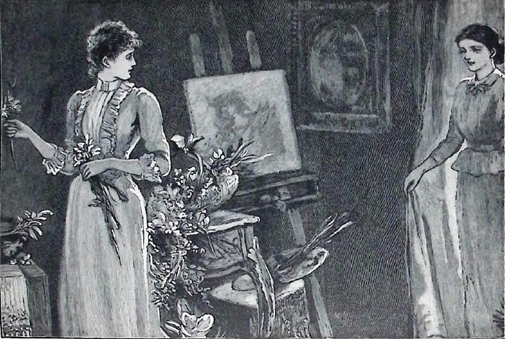
This was not exactly what Julius Dakin desired; but it was impossible to object to the arrangement.
"Thank you; I should be most happy to do so," he said. "I will call for you on Thursday afternoon, with your kind permission. I have just seen Miss Marian; she has been working very hard to-day."
"Yes," said Enid, prepared to move on; but he made another effort to detain her.
"You are much interested in this Miss Strutt?"
"I like her, and I feel sorry for her," said Enid simply. "She seems to lead a very lonely life, and she works very hard. I wonder if her pictures sell well. She has a good many to show."
"Would you like me to buy one of her pictures?" asked Julius quickly.
"I like you!" said Enid surprised. "That is entirely your own affair, Mr. Dakin."
"Yes, of course; I mean—I should have said—would you advise me to buy one?"
"Oh, I could not advise you, Mr. Dakin. I think the pictures good, but I am no judge. My advice would be worth nothing."
"You are mistaken; it is worth a good deal to me."
"Now you are flattering me, Mr. Dakin, and I will wish you good-day," said Enid, retreating up the staircase.
"Indeed, that is not flattery," he protested. "I am keeping strictly to our compact. Do you not remember that we agreed to say to each other exactly what we mean on every occasion?"
"I do not think I made any promise," said Enid laughing; "and I certainly did not agree to advise you with regard to buying pictures. Good-bye!" And she ran up the stairs.
Entering the studio, she found Maud engaged in arranging in vases a profusion of exquisite flowers.
"I met Mr. Dakin on the stairs," Enid began breathlessly. She was determined there should be no concealment on this occasion.
"Yes, he has been here," said Maud. "Just look, Enid, what lovely flowers he has brought me! He stayed here talking for some time. He thinks I have made a good study of my model."
Enid silently turned to look at her cousin's drawing.
"It was good of him to bring me these flowers," said Maud, evidently delighted with the gift; "such lots of heliotrope! He knows how I love heliotrope."
In truth, Julius Dakin had intended to present the flowers to both the young ladies. They were no more for Maud than for Enid, but finding the former alone, it had been difficult to explain this, and he had had to endure the vexation of seeing Maud accept the flowers as a token of devotion to herself.
ENID'S MASTER
JULIUS DAKIN did not fail to appear at the Studio Mariano on the following Thursday. In the company of the two girls, he paid his visit to Miss Strutt, and Enid was pleased to find how highly he appreciated that lady's work. Maud too admired it warmly, though it seemed to Enid that she was rather disposed to patronise the "little old maid," as she always called Miss Strutt. She invited Miss Strutt to take tea at her studio, and the invitation was accepted, though Miss Strutt stipulated that she might come when Miss Marian and her cousin were alone, as she shrank from meeting many people.
"The life I lead does not fit me for society," she said. "Your friends would find me odd and queer. Oh yes, they would, my dear; don't attempt to deny it." She checked Maud, who was about to interpose a kind word. "My ways are odd. I must confess I do not understand the modern ideas; I cannot talk slang of any kind—fashionable, artistic, or what you will. I should be quite out of place in the midst of such persons as you draw about you."
"I think you are mistaken," said Maud, kindly; "but it shall be as you like. Enid and I shall only be too glad to have you to ourselves. I will show you all my things, and you shall give me the benefit of your candid criticism."
For Maud still cherished the delusion that she desired candid criticism.
"You might invite me," suggested Dakin, playfully; "I should like to make one of the party. You would not object to meeting me, would you, Miss Strutt? I am perfectly harmless."
"I don't know about that," said Miss Strutt, shaking her head. "No, indeed, you must not be admitted. A gentleman is always such a distraction. We should have no quiet chat if you were there."
"What an insinuation!" exclaimed Julius, in an injured tone. "One would think I were given to monopolising the conversation."
When they had quitted Miss Strutt's studio, Julius returned with the girls to their own, and diverted himself there for some little time.
"By the way," he said, as he was about to take his leave, "my mother may be expected to reach home by the end of the week. The steamer is due at Genoa to-morrow."
"Oh, I am glad to hear that," said Maud, eagerly. "I have missed Mrs. Dakin so much."
"My father and I have been very dull without her," said Julius. "One cannot entertain when the lady of the house is absent; but now I suppose my mother will receive her friends as usual on Wednesday evenings; and I shall hope to have the pleasure of seeing you, Miss Marian, on those occasions, and you, Miss Mildmay."
"We shall be delighted to come," said Maud. "Mrs. Dakin's receptions are always most enjoyable."
"My mother is bringing a young American beauty, Miss Blanche Amory, back with her," observed Julius, tranquilly. "She has been fascinating the fashionable world of New York, and is now coming to exercise her spells in this European city. You will be charmed with her, Miss Marian."
"Shall I?" said Maud, a little dubiously. "Is she so very beautiful?"
"Well, that is a matter of taste. 'Beauty,' you know, 'is in the eye of the beholder.' I have seen women whom I admire far more than I do Miss Amory; but still there are artists who rave about her."
"How very dreadful for their friends!" said Enid.
Julius laughed.
"You are satirical, Miss Mildmay," he said. "You have a quiet way of letting us know that you find the conversation of us lesser mortals sadly frivolous. But what have you been doing in the way of sight-seeing since I last saw you? Are you still fascinated with the ruins of Rome?"
"More than ever, I think," said Enid; "only I wish I understood them better. If I had known in advance that I should spend this winter in Rome, I could have read up for it. One feels one's ignorance dreadfully here."
Julius thought of a young lady from England, whom he had one day in the previous spring conducted through the sculpture galleries of the Capitol, and who, when he told her they were in the hall of the Dying Gladiator, had said, with an assumption of interest,—
"Oh, so this is the hall in which the Gladiator died."
Enid had been so far from betraying ignorance to him that he had actually wondered to find her so thoroughly acquainted with the history of Rome. But it must be owned that Julius Dakin had not been fortunate in his acquaintance with young ladies.
"If you are disposed for hard reading," he observed, "my father has several standard works on ancient Rome in his library, and I am sure he would be most happy to lend them to you—or to Miss Marian," he added, mischievously.
"Please don't include me," cried Maud. "I would not read such books to save my life. I don't pretend to any knowledge of or any interest in the old kings and emperors, only I feel grateful to them for having left us such picturesque ruins."
"That is frank, at any rate," said Julius, laughing. Then he shook hands with the girls and took his departure.
Miss Strutt paid her promised visit to Miss Marian's studio. She raised herself in that young lady's estimation by the taste and discrimination she displayed in her admiration of her pretty things. She praised too as much of Miss Marian's work as she honestly could praise; and if she thought more highly of the little paintings Enid showed her, she was careful to conceal her opinion of their merits. Although she lived such a solitary life, and never went into society, Miss Strutt had a shrewd knowledge of human nature, and keen insight into character. She saw that it would be an unfortunate thing for Enid if the jealousy from which such vanity as Maud Marian's is seldom free, were to be excited by the perception that her cousin's work was more highly appreciated than her own.
Miss Strutt was glad, therefore, when she presented herself at the Studio Mariano a few days later, to find Enid alone. She had begged to be excused from accompanying her cousin, who had gone to a friend's "At home," and was working away very happily alone.
"Are you very busy?" asked Miss Strutt. "I came to ask if you would come down to my studio for a little while."
"With pleasure," said Enid, beginning to unbutton her apron. "I cannot do much more till this wash has dried."
"Please bring those studies with you that you were showing me the other day," said Miss Strutt—"the daffodils and the group of apples, and anything else that you have which is good."
Enid could not imagine why Miss Strutt should wish to see these things again; but she willingly did as she was asked.
Entering Miss Strutt's studio, she was surprised to find Herr Schmitz there. He greeted her very kindly; but Enid was overwhelmed with dismay when she discovered that it was for his benefit that she had been asked to bring her paintings.
Without heeding her protestations, Miss Strutt took them from her, and placed them one after another upon an easel before the master's eyes. Enid stood by, feeling ready to sink through the floor, and scarce daring to lift her eyes to his face. Never had she been more painfully aware of the defects in her work.
But she need not have been so much afraid. The dreadful pause, during which the master looked at each study without uttering a word, was over at last, and Enid's suspense was relieved by the emphatic "Good," which Herr Schmitz uttered.
"Good," he said again. "As I told you before, you have eyes, you see form, you see colour. You will do, if you work. But you must really work; you must not play with Art. Are you afraid of work?"
"I think not," said Enid; "if it were worth while for me to work very hard I would do so."
"It is always worth while to work one's best at whatever one attempts. There is no road to success save the painful, uphill one of hard work. You have a good chance if you try your best. I will tell you what you should do."
Enid listened earnestly to the instructions he proceeded to give her; but what was her astonishment when she found him offering to give her two or three lessons himself.
"Simply as a friend," he said, for he no longer gave lessons save under very exceptional circumstances.
Enid knew not how to express her gratitude for his kindness. Awe, indeed, mingled with her pleasure in accepting it, for there was something rather appalling in the idea of learning of Herr Schmitz. But he was thoroughly in earnest about it, and insisted on her fixing a day for her first visit to his studio. Then bidding her and Miss Strutt a friendly good-day, he departed.
"I congratulate you," said Miss Strutt to Enid; "there are few young aspirants who win such approval from Herr Schmitz."
"It almost frightens me," said Enid. "I fear he thinks too highly of my work, and I shall disappoint him in the end. But he is really very kind."
"He is, indeed," said Miss Strutt, "though his extreme irritability often leads people to suppose the opposite. You must not mind if he gets cross sometimes, and says rude things to you."
"That will be rather hard," said Enid; "but if he begins to call me names some day, I'll try to remember what you say, and keep my temper."
She went away in high glee, eager to tell her cousin the wonderful thing that had happened. In spite of Herr Schmitz's admonitions with respect to work, she could accomplish little more that afternoon. She was far too excited; and feeling at last that she would only spoil her painting if she worked longer upon it in her present mood, she washed her brushes, set the studio in order, locked the door, and went home to the "pension."
Maud came in a little later, and found Enid awaiting her in her room.
Maud was tired, and rather out of humour; but Enid, in her eagerness to tell her news, did not perceive this. She began upon it the moment her cousin entered. Maud heard her through without saying a word; but Enid wondered to see how the colour mounted in her cousin's face as she listened. Ere she had done, Maud had turned her back upon her, and was standing apparently absorbed in studying her own reflection in the mirror. In truth, Maud was experiencing a bitter moment. It was impossible for Enid to know the anger and envy the communication she had so innocently made had roused in her cousin's breast. She could not know that Maud, on her first coming to Rome, had been ambitious of securing lessons from Herr Schmitz, and had sought an introduction to him with that view; but the master, as soon as he saw some of her work, had brusquely declined to receive her as a pupil. But as Maud continued silent, Enid knew instinctively that her cousin was annoyed.
"Why do you not speak, Maud?" she asked presently. "Are you not pleased that I should have lessons of Herr Schmitz?"
"What would you have me say, Enid?" demanded Maud in a cold, hard tone. "How can it make the least difference to me of whom you take lessons?"
"But it is so kind of Herr Schmitz. I thought you would be glad. Miss Strutt says he hardly ever gives lessons now, and he has always been very particular what pupils he took."
"Miss Strutt is an old simpleton. She must know that it is only a whim of Herr Schmitz. He is the most whimsical man in the world. I wish you joy of your lessons, Enid."
"I expect to enjoy them very much," said Enid, feeling nettled. "It will be a great advantage to learn of such a master."
"Of course you think you are on the way to becoming famous now," said Maud, scornfully; "but it takes more than a few lessons from Herr Schmitz, however he may flatter you, to make a great painter, let me tell you, Enid."
"Thank you; I was aware of that before," said Enid, coolly; "but I thought you had had sufficient experience of Herr Schmitz to know that he is not given to flattery."
Her words carried a sting which Enid did not intend to convey. She had forgotten how bluntly Herr Schmitz had criticised her cousin's drawings when he made his call at her studio; but Maud, in whose mind the memory of his words still rankled, believed that Enid deliberately reminded her of them.
Enid was sorely hurt by the way in which her news had been received. She had come, glad and eager, to share her happiness with her cousin, and had met with a sharp rebuff. But she would not show how much she felt it. She was a proud little person in her way, and she quitted her cousin's presence with an air of quiet dignity, of which Maud was conscious in the midst of her annoyance.
Alone in her own room, however, Enid could no longer keep back her tears.
"I cannot understand it," she said to herself; "why should Maud be annoyed at the thought of my taking lessons of Herr Schmitz? Sometimes I fear she is beginning to dislike me. Whatever shall I do if she does? It will be dreadful being always together if we cannot be friends. And I thought everything was going to be so delightful!"
Then she remembered that her mother had warned her that she must not expect to have gold without alloy. How true the words were proving! But the thought of her mother brought comfort. There could be no doubt that she would be pleased to hear of the kind encouragement Herr Schmitz had given her daughter, and his proposal to give her lessons in painting. So Enid took her desk, and sat down to relieve her wounded feelings by writing a long letter to the mother of whose loving sympathy she felt so sure.
And Maud sat alone, nursing the bitter, wrathful feelings that resulted from mortified vanity. She, poor girl, had no mother to whom she could unburden her heart, and she had never been wont to confide in her father.
MRS. DAKIN'S RECEPTION
MRS. DAKIN was a tall, graceful woman, young-looking for her five-and-forty years, with sparkling dark eyes and a vivacious manner. On the day of her reception, she had a warm welcome for Maud, who, in the pretty gown she had worn at her aunt's wedding, was certainly looking her best.
Mrs. Dakin quickly contrived to say in her ear,—"You look charming to-night, my dear. There is no fear of my New York beauty eclipsing you—" A speech which delighted Maud, and enabled her to meet the young lady with equanimity.
Yet in truth, Miss Blanche Amory was a very fascinating young person. Her beauty was of a purely Grecian type. Her small shapely head, the broad, low brow over which the light brown hair fell in such bewitching little curls, the straight, delicate nose, the small curved mouth, and the lovely violet eyes, were already inspiring every artist present with an eager desire to paint her portrait. Her bearing was marked by a piquant audacity of speech and action which the English ladies present decided to be "thoroughly American," whilst her dress had the quality which Europeans distinguish by the significant word "chic."
"Is this your first visit to Rome?" enquired Maud, by way of opening the conversation.
"No; I was here with my parents five years ago," replied the beauty, with the high nasal intonation peculiar to her nation.
"Then you have seen most of the sights?"
"Yes; I guess I did enough sight-seeing when I was over before. I don't mean to go round with my guidebook any more. If there's anything new to be seen, I'd like to see it—that's all."
"I dare say we can accommodate you," said Julius Dakin, who stood at her elbow. "It will be a refreshing change. Most of our visitors can interest themselves only in the old things of Rome, and despise everything belonging to the present century."
"Ah, I guess—musty old churches, underground tombs, and impossible relics. But that's not my taste. I like to keep above ground whilst I can; and I don't know that I should be any the better for seeing the chains of St. Peter or the head of St. Paul. I went into the burial vaults of the Cappuccini and had a look at the old skeleton monks when I was last in Rome, and it made me feel sort of queer-like."
"It is not an agreeable sight, certainly," said Maud, with a little shudder. "But there are many beautiful things to be seen in Rome, and the country round is most interesting. I suppose you explored it when you were here before."
"You may be sure we did. My father is not one to do things by halves, and I am his own child in that. Before we came to Italy, we were in Greece, and we went all through the mountains on horseback. We roughed it then, I can tell you. Often I was in the saddle for twelve hours at a time; and such riding as it was!—no roads. We just had to make tracks across country, fording streams and leaping gullies. It was hard work—but how I did enjoy it!"
"You are such an experienced traveller, Miss Amory, that you make me feel quite small," observed Julius Dakin. "I have had no adventures that can compare with yours."
"Well, I guess I've travelled all round Europe, anyway," replied the fair American; "but I have not done India yet. I must have a try at that some day."
Not Julius Dakin alone was feeling small. Maud Marian was made aware that she was but an ordinary mortal after all. She could boast no such achievements as the young American continued to describe, and her knowledge of the world she lived in now presented itself to her as pitifully limited.
Enid meanwhile was listening with quiet amusement to all that passed. Maud presently disengaged herself from the group about Miss Amory, and began to move through the rooms, meeting at every few steps with some acquaintance. Enid, who found herself alone amidst strangers, had a momentary sense of dreariness. She glanced round the room, and her eyes at length fell on Julius Dakin, who was making his way to her.
"Found at last!" he said, as he came up. "I was wondering where you had hidden yourself. Will you allow me to take you to the library? There is something there I should like to show you."
Enid consented willingly.
In the library they found Mr. Dakin with one or two visitors. Enid began to examine the books, and was delighted when the old gentleman gave her permission to borrow any she liked, and pointed out those that would be of most interest to her in her study of Roman antiquities. Talking to him, she forgot that she had been brought to the library for a special purpose; but Julius waited patiently till her attention was disengaged.
"Now, Miss Mildmay," he said at last, "I will show you something that I think you will be pleased to see."
He led her into a small ante-room and raised the lamp he carried, so that its light fell upon a picture hanging on the wall. It was a painting of the Campagna with the ruin of an old tomb, and some grand stone pines standing up against the blue sky. It was already familiar to Enid, and a favourite with her. She had thought it one of the best of Miss Strutt's paintings.
"Oh!" she exclaimed involuntarily, in her surprise. "You have bought that of Miss Strutt! How good of you!"
"Not at all," he replied, with a look of pleasure. "It was my father who bought it, and he was only too glad to secure such a charming little picture."
"But you took him to see Miss Strutt's pictures?"
"Why, yes, I was guilty of that, certainly; but you would not have had me keep to myself my knowledge of the good things that were to be seen there?"
This was unanswerable. Enid was perhaps foolishly delighted that the purchase had been made, and she could not rid her mind of the impression that her influence had played a considerable part in the matter. She believed that Julius had wished to give her pleasure. And yet how little ground there was for such a fancy!
If Julius Dakin had been actuated by any such motive, he was rewarded as he watched Enid's undisguised pleasure. They lingered awhile in the ante-room, talking and looking at the pictures. When at last they returned to the drawing-room, they had been absent more than half an hour, but to Enid it had seemed but a few minutes.
Maud Marian was seated near the door by which Enid and Julius entered. Enid moved towards her cousin, intending to tell her of the purchase Mr. Dakin had made; but ere she could reach her side, Maud rose, said a few words to the gentleman with whom she was talking, and passed rapidly to the other side of the room.
Enid was astonished. She felt sure Maud had seen her come in, and wondered that she should turn from her in that way. Had she unwittingly offended her cousin again? Maud had recovered from her annoyance on learning that Herr Schmitz had proposed to give lessons to her cousin. The breach between them was to all appearance mended, but Enid was no longer at her ease with her cousin. She was subject to fear lest her words or actions should be misunderstood, and give offence. As she lanced at Maud now across the crowded room, she could see that something had occurred to disturb her cousin's equanimity, though Maud was making an effort to hide the fact that she was not enjoying herself.
Julius placed Enid under his mother's care, and then strolled off to where the American beauty was still surrounded by a little court of admirers. Enid wondered if the general attention bestowed upon this young lady were a source of mortification to Maud. But now Mrs. Dakin introduced her to two young English girls, who were very pleased to meet with a girl-compatriot. The three chatted together in lively fashion for some time, till the mother of the girls came to take them away. The room was already thinning. The departure of the girls, and of one or two others who moved away at the same time, made a stillness about Enid, in which the words of two ladies of mature age, who were seated on a settee behind her, fell distinctly on her ears.
"Now I wonder if Mrs. Dakin means her son to marry that American beauty," said one.
"No doubt she would like him to wed one of her countrywomen," replied the other; "and the girl is an heiress, I believe."
"As for that, he might afford to marry for love, I should think," returned the first speaker. "It is all very well for his mother to choose for him, but he may be of another mind. Last winter everyone said he would marry Miss Marian."
"Well, he has not paid her much attention to-night, for I have been watching him," remarked the other. "There was another girl he seemed very friendly with."
"Well, really! If you are going to take note of every girl Julius Dakin regards with friendliness, you will have enough to do. He knows how to make himself agreeable to ladies if ever a young man did. He has just that way, don't you know, that makes every girl he talks with suppose that he admires her."
Enid heard no more. She rose and moved away with burning cheeks. She was greatly disturbed by the idle words she had overheard. She resented them for her cousin's sake; but not for that alone. Her own self-esteem was wounded, and she even felt irritated with Julius Dakin.
"I suppose he thinks I admire him," she thought with disdain; "but I do not. He is handsome, of course; but as I have often told Alice, I dislike handsome men."
Julius Dakin was unfortunate that evening, for Maud also was feeling annoyed with him, though from a different reason. Miss Guy, who was staying at the same pension, seeing Miss Marian not far from her, presumed to approach that young lady, and, undeterred by her repellent manner, began to talk to her. It was no liking for Maud which drew her to her side. Miss Guy was not so obtuse as to be unaware that Miss Marian desired to avoid her. She resented warmly the hauteur with which that young lady invariably treated her when they met at table, and it was with a malicious desire to wound her that she now addressed her. It is marvellous how keen such persons are to discern the vulnerable point at which a dart may be aimed.
"Your cousin and Mr. Dakin seem to find the library very attractive, do they not?" she observed, with apparent carelessness.
Maud surveyed her for a moment with haughty astonishment ere she said—
"Excuse me. I do not understand to what you refer." She had missed Julius from the room, but was not aware that he had quitted it in Enid's company.
"Mr. Dakin took your cousin away to show her something in the library. I am quite curious to know what it is that has detained them there for half an hour."
Maud changed colour for an instant, but her self-control did not fail her.
"If you ask Mr. Dakin when he returns, I have no doubt he will be pleased to satisfy your curiosity," she said, in a tone of cold indifference.
"I am afraid I should not get much for my pains," laughed Miss Guy. "When a young gentleman is smitten with a girl, anything will serve as an excuse for taking her aside. It is easy to see that Mr. Julius Dakin takes a warm interest in your cousin; and no wonder! For she is really a nice, compact little person."
Maud rose from her seat, white with anger. "Excuse me, Miss Guy," she said, with icy composure; "I must ask you to reserve your remarks upon my cousin for some other listener."
And she swept away, leaving Miss Guy to experience a sense of discomfiture. But that frame of mind was so foreign to her nature that it could not last long. Her self-complacency quickly revived, and she said to herself, with an agreeable sense of her own cleverness—
"After all, I hit the mark! She would not have been so angry if she had not cared for him."
Maud moved towards the door through which she supposed Enid and Dakin would return from the library. She seated herself in a position to observe their entrance. In truth, it was not many minutes ere they appeared, but the time seemed long to Maud as she watched with jealous eyes, and her anger increased with every minute that passed. When they came in, her indignation had reached such a heat that, fearful of betraying too openly her annoyance, she made a hasty movement to avoid speaking to her cousin.
Her feelings did not soften as the evening wore on; but she got them under control. Annoyed as she felt with Julius Dakin, she was far more angry with Enid, though what she had to resent in Enid's conduct it would be hard to say. But she meant to show no annoyance; she was anxious to maintain her usual demeanour towards them both. So she smiled and spoke brightly as she bade Julius Dakin good-night.
It was Enid whose manner towards him was cold. Maud noticed its constraint, and was puzzled, till it occurred to her that Enid was perhaps seeking to deceive her.
"She does not look deceitful," she thought; "but I have read that there are persons with an open, frank air, who yet have a perfect talent for dissimulation."
As soon as she was in the carriage, Maud gave way to ill-temper.
"It has been a most stupid evening," she said. "If Mrs. Dakin's receptions are all to be like that, I shall not trouble to attend many of them. The fuss made over that Miss Amory was sickening. And after all, she is no great beauty."
"She is very pretty," said Enid, decidedly.
"Not more so than plenty of other girls; and her Yankee accent is terrible."
Enid made no reply, and for some minutes they rolled along in silence.
At last, Enid roused herself and said, "Mr. Dakin has bought one of Miss Strutt's pictures, Maud. Mr. Julius took me into the library to see it."
For a few moments Maud did not respond. Then she said with a strange bitterness in her tones, "He might have spent his money better; but I suppose he bought it out of charity, to help the poor old thing."
"Indeed, I think he had his money's worth," said Enid, with warmth. "It is a lovely little picture."
"Of course you are a judge," said Maud, with quiet sarcasm. "When you have lived a little longer in Rome, you will perhaps see things differently."
Enid felt that she was being made to see things differently now. Certain delusions were vanishing, and leaving in their stead a blank sense of pain. She felt weary and home-sick to-night.
The next morning, as they went to their studio, Enid looked in upon Miss Strutt. The little woman's face wore an unusually serene expression, and she greeted Enid with a bright smile.
"I wanted to see you," she said; "I have to thank you—it was all your doing, I know."
"What was my doing?"
"That Mr. Dakin bought my little painting."
"I had nothing to do with that," said Enid.
"Yes, you had," said Miss Strutt, sagely shaking her head. "I know better; you had everything to do with it."
"Indeed you are mistaken," said Enid. "I am very glad that Mr. Dakin bought it. I saw it last night in his library, and it looks so well where it is hung."
"I am really very grateful to you," said Miss Strutt, who was not to be persuaded that she owed Enid no debt of gratitude. "It is a great help to me. Some day, perhaps, I may tell you why I have to work so hard, but not now. You are impatient to get to your work; but do not work too hard, my child. You do not look so bright as usual this morning. Is it work, or dissipation, that has fatigued you?"
"Dissipation, I fear," said Enid laughing.
Already the heaviness of her mood was gone. She could not help sharing Miss Strutt's pleasure over the purchase of her picture. And as she ascended to the Studio Mariano, she thought more kindly of Julius Dakin.
COMPLICATIONS
ENID continued to enjoy her lessons with Adela Ravani. The pleasing impression made on her when first she saw her young teacher did not wear off. She was charmed with the girl's beauty and grace, and the almost childish confidence and simplicity she displayed in their talks together.
Enid was quick at languages, and she soon began to understand what was said to her in Italian. The lesson usually ended with a confidential talk between the girls. Adela would confide to Enid some of the troubles of her life. She often spoke of the brother, many years older than herself, whom she seemed to regard with fear rather than love. This brother and his wife shared the home with Adela and her mother, and it was clear to Enid, from what the girl said, that he was the head of the house, and everyone else had to bend to his will. Adela appeared to have no affection for her sister-in-law, whom she described as full of deceit, and capable of the most spiteful actions.
"She is a spy," she said once; "she is always watching me; and she tells Francesco all she sees. I have the greatest difficulty in hiding things from her."
Enid was startled by the light thus thrown on Adela's life.
"But what can you have to conceal?" she asked. "Why should you mind your sister-in-law knowing all you do?"
"Oh, you do not understand," said Adela. "I should never be able to do anything if I let them know about it. Francesco would have me live the life of a nun. You cannot think how angry he was when he found out that I was giving lessons, for mamma and I kept it from him as long as we could."
"But why should he be angry?" asked Enid in surprise.
"He thought it beneath the dignity of our family. The Ravanis are one of the oldest families in Rome, and the daughters of such houses do not earn money," said Adela, with considerable dignity. "But we are so poor, mamma and I, and Francesco is not generous. Look at my slipper, signorina—do you see how I have had to mend it? That will show you I have not much money to spend on my attire."
Enid glanced down at the dainty velvet slipper, and admired not only the skill with which it was mended, but the beauty of the perfect little foot it adorned.
"I wish I could sew like that," she said; "but I think your brother is mistaken in deeming it beneath anyone's dignity to teach. In England, women are proud of being able to support themselves, and teachers are held in honour. At least they are by all but vulgar-minded people," she added.
"Are they?" said Adela. "I like teaching—or should if all my pupils were like you. But Francesco will not be happy till he puts an end to it. He is looking out for a husband for me; but it is not so easy to find one, you see, because I have no dowry."
"Looking out for a husband for you!" exclaimed Enid, startled, as well she might be, for the idea is shocking to English notions.
"Yes; it is his duty, you know," said Adela calmly; but Enid saw that a cloud had fallen on her face.
"But surely not without respect to your wishes in the matter!" protested Enid. "You would not take a husband of his choosing merely."
"It is our custom," said Adela. "Of course," she added, with a quick blush, "I have read in books that people sometimes marry for love, and I should think myself that that was the happier way. But my mother says one should not think of love till one is married."
"And my mother would say it was very wrong of any woman to marry a man whom she did not truly love and reverence," said Enid, with some warmth.
"Would she?" said Adela, with sudden interest. "I wish my mother thought so. And oh, I do hope, it will be long, long ere my brother finds me a husband!"
Enid did not wonder that she spoke with such energy and in so troubled a tone.
"Well," said Enid later, as she repeated to her cousin what had passed, "I never felt more inclined to—
"Thank the goodness and the grace
That on my birth has smiled."
"I would not be an Italian girl for the world. How dreadful for Adela to feel that her brother can hand her over, to any man who is willing to take her without a dowry!"
Maud shrugged her shoulders. "It is the way here," she said. "A well-born Roman girl never dreams choosing a husband for herself. She has no voice in the matter; it is her duty to obey the will of her parents."
"But if she should love someone else?" said Enid.
"Then she would commit a grave indiscretion. My dear Enid, a well-bred girl would never allow herself to fall in love."
"Perhaps not; but suppose she found it impossible to love the gentleman her father had chosen for her?"
Maud shrugged her shoulders again. "She would have to make the best of it, I am afraid. There is one thing to be said—Italian girls are not allowed friendly intercourse with gentlemen as we are, so there is less risk of their forming unsuitable attachments. They go nowhere unattended. An Italian mother is rarely seen without her daughters; they drive with her, they pay calls with her, they receive with her, till they attain freedom by marriage."
"Like those three girls we are always seeing about with their mother," said Enid; "all three dressed exactly alike, even to their shoe-strings, and all wearing the same bored expression. I have noticed that if a gentleman approaches their carriage on the Pincio, they appear to say only two or three words to him. It is mamma who does the talking."
"Just so. Still, I believe the life of Italian girls is beginning to improve. They are being better educated than they used to be, and a higher mental culture must inevitably bring in for them a freer life."
"Poor things! I trust it may speedily," said Enid. "It is deplorable to see how poor Adela's spirit is crushed by the tyranny of her brother and his wife; and I am afraid she practises deception to evade it."
"Likely enough," said Maud, with scorn in her tone; "most Italian girls have a talent for dissimulation."
The next time Enid went to the Casa Ravani to take her lesson in Italian, Adela's countenance as she entered the room plainly showed that she had been weeping violently. Her voice was so tremulous, her manner so agitated, that Enid could see that it was only by a strong effort that she could maintain composure. Wishing to help her to gain control of herself, Enid for a while took no notice of her evident distress. The pupil's exercises were examined and corrected almost in silence; the reading which followed was scarcely interrupted, though Enid was conscious that she made one or two slips in pronunciation. But when the time came which they usually devoted to conversation, Enid could no longer rest in ignorance of what was troubling her companion.
"Now, Adela, what is it?" she said, as soon as the books were closed. "You are in trouble, and I insist upon knowing the cause, unless it is something I really may not know."
But it seemed more than Adela could bear even to speak of her trouble. In a moment her large dark eyes were full of tears, her lips quivered when she tried to speak, and she could only sob.
"Now don't—don't," said Enid soothingly. "Just tell me all about it, and then perhaps it will not seem so bad. What has happened to distress you so?"
"It has come," sobbed Adela; "I knew it must come some day; but oh, I hoped it would not be for a long time yet."
"What has come?" asked Enid, full of wonder.
"My doom," said Adela, with a tragic gesture. "Oh, signorina, if only I were an English girl! If I were free, like you!"
Light was beginning to break upon Enid's bewildered mind.
"Free," she said; "do you mean free to marry or not, as one likes? Is that your trouble, Adela? Does your brother want to make you marry someone against your will?"
"Ah, yes, you have guessed," said Adela with another sob; "my brother has found a husband for me!"
"Who is he? You do not care for him?"
"Care for him! How should I? I have only seen him once. He is old and he is ugly; but he is rich. My mother says I shall have my own carriage, and drive on the Pincio every day. But what of that? Oh, Enid, can you not guess? My heart is breaking."
"But why should you marry this man if you do not wish to do so?" asked Enid, with indignation in her tones. "It is preposterous to think of such a thing. You must refuse to yield to your brother, Adela; you have surely a right to a will of your own in this matter."
"I dare not," said Adela; "it would be a most unheard-of thing. Indeed, I could not be so undutiful; I should break my mother's heart. She is so pleased, my poor mother, to think that I shall have a home of my own; and she will live with me, for he has agreed to that."
Enid looked grave.
"It is not already a settled thing, Adela?"
"Not quite; but in a few days it will be," said Adela gloomily. "I see no way of escape. And it is not only that—oh, Enid, how shall I tell you? Can you not guess the rest?"
"The rest!" said Enid. "Have you not told me all the trouble? Indeed, it seems bad enough."
"Unhappily," said Adela—and the rich colour which suddenly suffused her face was more significant than her words—"we Italian girls also have hearts."
"Oh!" exclaimed Enid in a startled tone. "Is it as bad as that—there is someone else you care for?"
"I could not help it," murmured Adela, her face crimson with shame. "I saw him at Montepulciano last summer; we were there for three months, and he was there too, making sketches—for he is an artist. We were living outside the town; and the place was so quiet and countrified that mamma was less particular about me. I could walk out alone, or go into the vineyards with the good countrywoman at whose house we lodged. And I often saw him. He had a way of finding out where I was likely to be. He liked to talk to me, and I—I liked to see him too, I suppose. Once he made a sketch of me. Ah, signorina, you are shocked!"
"No, not shocked," said Enid, smiling; "and please do not call me signorina. It was all very natural. I am sure I do not wonder that he wanted to see you; but it is a pity you could only meet in that stolen sort of way. But if he really loves you, Adela, as I suppose he does, why does he not come forward and ask your brother's permission to marry you?"
"That would never do!" exclaimed Adela, looking frightened at the very idea. "Oh, how angry my brother would be! Lucio is only an artist, and an unknown one. He has no money. Do you think Francesco would consider him a fit match for a Ravani?"
There was a curious ring of pride in Adela's tones. It seemed as if she too were inclined to disparage her lover's calling, and deem him unworthy on account of it to wed with one of her ancient name.
"I do not know what your brother's opinion may be," said Enid, warmly; "but it seems to me that every true artist has a rank of his own, and that ordinary mortals, whatever their birth may be, must look up to such a one. Surely you agree with me, Adela?"
"I don't know; I never thought about it," said Adela, opening her eyes. "But of course I think Lucio is very clever, and I can assure you his family is not to be despised. He has an uncle who is a rich banker at Florence. He has no children, and Lucio was to have been his heir; but his uncle grew angry with him because he was determined to be an artist, and would not work in the bank. Now he will have nothing to do with Lucio, and the poor fellow must make his own way in the world."
"Well, that is not such a bad thing," said Enid. "If he has talent and works hard, he will succeed in time, you may be sure. You must be content to wait a few years for your happiness—that is all."
"Ah, how you talk, Enid! As if it could ever be! You forget that my brother is determined to marry me soon as possible, and has already found a husband for me."
"Adela, I shall lose all patience with you if you talk in that way. I begin to think that you do not really love Lucio. If you do, you will not dream of letting yourself be married to someone else."
"What a thing to say!" exclaimed Adela, raising her hands in protest. "But you do not understand; it is because you are English that the affair seems to you so simple. How can I set myself in opposition to my mother? You would not like to make your mother unhappy."
"I should not, indeed," said Enid; "yet I hope I should have strength to withstand my mother if she wanted me to do something wrong; though really I find it impossible to imagine such a thing in connection with my mother."
"And my mother would say it was right; it was my duty to obey her," said Adela. "Don't you see how difficult it is?"
"It is perplexing, certainly," said Enid; "yet I feel convinced in my own mind that you will be doing a wrong, even a wicked thing, if you marry this man whom your brother has chosen for you, when your heart is given to Lucio. Surely, if you tell your mother the whole truth, she will not continue to urge you to this marriage. Be brave, Adela. Don't be afraid to oppose your brother. He cannot drag you to the church by main force."
"Oh, I dare not think what he may not do," said Adela with a shudder.
It was but too evident that she lacked courage, and Enid's efforts to inspire her with the same were not apparently attended with much success. They talked for some time longer, and when Enid rose to go away, Adela timidly asked if she would do her a kindness.
"By all means," said Enid, heartily; "what is it?"
"I should like to go to-morrow to the Villa Borghese; and you know my mother does not allow me to walk out alone. Could you accompany me?"
"Certainly; I shall be delighted if it is a fine afternoon. I have not been to the villa yet, but I have seen it from the Pincio, and the walks look very inviting."
"They are prettier in the spring, when the anemones are in flower; but it will be pleasant there to-morrow if the weather keeps like this. Thank you so much for consenting; it is so good of you."
Enid went away wondering that Adela should profess so much gratitude over what promised to be a mutual pleasure.
It wanted but a week to Christmas, but the next day was as bright and beautiful as a day could be. The sky was of a soft, deep blue, the sunshine brilliant, and the air delightfully fresh. Enid called for Adela at the hour appointed. She found her already dressed for the walk, and looking charming. There was no cloud on her face to-day, nor did her beautiful dark eyes show any sign of tears. She chatted so gaily as they walked towards the villa that Enid wondered if her prospects had brightened, but refrained from asking any question, for fear she should only remind her of her trouble.
There were but few persons at the villa this afternoon. Enid was delighted with the secluded, romantic walks, winding amid groves of ilex, or shaded by tall pines breaking into green umbrella-shaped foliage, which contrasted vividly with the blue of the sky. Presently they approached an old fountain guarded by a stone nymph with a broken nose.
Enid's eyes were on the feathery fern fronds clustering about the base of the fountain when she became aware that a young man had stepped from the back of the fountain and was greeting Adela. She looked at him, and recognised with some surprise a young Italian artist who had a studio in the house in the Via Sistina, in which was the Studio Mariano. She had once or twice encountered him on the stairs, and had been struck with the exceeding courtesy of his manner as he bowed to her. Now, as she noted the flush on Adela's cheek and the sparkle in her eyes, it occurred to her that this could be none other than Lucio.
"May I introduce Signor Torlono?" said Adela.
And Enid returned the young man's bow, half amused and half annoyed by this revelation of Adela's purpose in bringing her to the Villa Borghese. It was by no means agreeable to Enid to play the part of a third at such a rendezvous, and she felt vexed with Adela for having beguiled her into doing so. Yet as they strolled on together, Enid had so much consideration for the lovers that she occasionally paused to examine a statue or to gather a few of the daisies which studded the turf, thus giving the two an opportunity of exchanging confidences. At the same time she felt thoroughly uncomfortable in the position in which she found herself. She hated concealments and deceptions of all kinds. Had she been asked, she would never have agreed to help Adela to meet her lover clandestinely.
For more than an hour they walked about the villa. The time seemed rather long to Enid, but doubtless it passed rapidly enough with the other two.
"Do you not think it is time we turned homewards?" asked Enid at length. "It is getting damp under these trees."
"I suppose we must go," said Adela, reluctantly.
Signor Torlono did not pass through the gates in their company, but parted from them ere they reached the entrance, and strolled back into the shade of the trees alone.
"I know you are vexed with me, Enid," said Adela, when they had walked for some minutes in silence.
"Well, yes," said Enid, frankly; "I hate such ways, Adela. Don't ask me to go with you to meet Signor Torlono again unless your mother knows that you are going to see him."
"You will not tell anyone about it? You will keep my secret?" said Adela, imploringly.
"No, I will not tell anyone that you met Signor Torlono this afternoon," said Enid, after a moment's reflection.
"Do not be hard on me!" pleaded Adela. "I was obliged to see him—I wanted to tell him all about it."
"How did you let him know that you would be at the villa this afternoon?"
Adela coloured and looked confused. It was evident she was ashamed of the means she had adopted. "Oh, I managed it," was all she said.
"And what does he say?"
"Oh, he is in despair—poor Lucio! But he says as you do, that I must not yield, and that my brother cannot make me marry if I refuse to do so."
"Of course not," said Enid. "Now take my advice; go home and tell your mother all about it. Let her know how you and Lucio care for each other; let her know that you have seen him this afternoon. Keep nothing back. Depend upon it that is the best way. You will only make more trouble for yourself if you hide things."
"But she will be so angry," said Adela.
"Never mind if she is," returned Enid. "Perhaps you deserve a little scolding. Be brave, and make a bold stand, and the worst will soon be over."
"I will try to be brave," said Adela, "but I have not your spirit, Enid—I wish I had."
Then they parted at the end of the street in which Adela lived, and Enid went home to her "pension."
THE COURSE OF TRUE LOVE
CHRISTMAS came, and Enid Mildmay found the season at Rome very unlike the ideal English Christmas. True, bunches of red-berried holly were being sold at high prices in the Piazza di Spagna, small fir-trees in pots were ranged outside the florists' shops, and the loveliest toys and presents of all descriptions were displayed in the windows on the Corso. But the weather continued exceedingly mild; fires and wraps were scarcely necessary; and ices for which the Romans have an amazing predilection, continued to be an acceptable form of refreshment at every social gathering.
It was not Christmas to Enid, and the letters and cards which came to her from home gave her the worst home-sickness she had as yet felt. She pictured to herself the party gathered about the table in the shabby old dining-room at home, and she longed to be with them. She knew that they would think and speak of the absent one. She thought with an aching heart of the Christmas-tree which would be lighted up in the evening, of the snapdragons in which the boys delighted, and the fun and frolic with which the day would end. She even shed tears over the dainty little woollen wrap which her mother had knitted and sent to her. It was weak and sentimental of her, perhaps; but this was the first Christmas Enid had spent away from home, so perhaps she may be forgiven for indulging in a little emotion on the occasion.
Maud gave herself a few days' relaxation, and went with Enid from church to church to see the strange spectacles and curious ceremonies with which the Romish Church celebrates the anniversary of our Saviour's birth. She had seen them before, and took an æsthetic pleasure in marking the effects of crimson drapery and glittering lights, or in listening to the exquisite music which accompanied many of the services. But what beauty there was, was spoilt for Enid by her sense of the childishness of many of the displays, and the superstition which they expressed. It was dreadful to her to see people reverencing as an object of worship an ugly painted doll with a gold crown stuck upon its head, or bowing in adoration before the gaudy theatrical show of a "Precepio." The tinsel crowns stuck upon paintings of the Madonna and Child, the grotesque-looking dolls set up to represent the Holy Babe, the showily-decked images, the lavish display of dingy artificial flowers, disgusted Enid's taste, whilst it filled her with pity for the poor, ignorant people, to impress whose dull minds such means are employed.
The English and American visitors in Rome attend in great numbers the famous church services, and at most to which the girls went they saw Julius Dakin in the company of Miss Amory. They generally met and exchanged a few words on these occasions. On Christmas morning at St. Maria in Ara Cœli, Julius drew Enid aside from the others to show her the little chapel decorated with the beautiful frescoes of Pinturicchio, and then, in the solitude that is to be found in the midst of a crowd, Enid was led on to talk to him of the Christmas at home, half unconsciously revealing her yearning to be there. She wondered, and was half ashamed afterwards, to think how much she had told him about herself and her dear ones.
"I really must not talk so much of myself again," she thought; "it is so foolish; but somehow he seemed interested. He has such a sympathetic manner—it can be only his manner. Perhaps in reality he was bored. I must be on my guard against abusing his kindness another time."
The Christmas excitements over, Enid again settled steadily to work. She had no lack of occupation. Three mornings a week she spent in the studio of Herr Schmitz, and they were long mornings, for that severe master reproved her for laziness if she presented herself there later than half-past eight. Nor was he anxious to make her tasks agreeable to her. He persistently chose the most difficult casts in his studio for her to draw from, and if he perceived that Enid had a dislike to any subject he suggested, he at once insisted on her undertaking it. He required such care and accuracy in her charcoal drawings, and appeared so impatient of the least defect, that Enid was at times in despair, and but for a fear of seeming ungrateful for his kindness she would have discontinued her visits to his studio. But when he had by his severe words and manner impressed her with the conviction that she would never be able to draw, and might as well abandon the idea, Herr Schmitz would generally relent, and begin to encourage her again, for in truth it was his perception of the real talent she possessed that made him require of her such excellence.
Although when with him, he made her draw steadily from plaster casts, he was willing that she should continue at other times the flower and fruit painting which was her special delight, and condescended to examine and criticise any which she liked to show him. In this way, Enid made rapid progress, and even Maud, in spite of her jealous dislike to doing so, was forced to acknowledge the excellence of her work.
Maud too was working diligently in her way; but she had adopted a vicious style of painting, and self-love and vanity rendered her blind to its defects. Occasionally she was dissatisfied with her performances, and indulged in a little melancholy; but she never doubted long that she was destined to do great things, nor apparently ever questioned that she had done right in leaving her father to live solitary whilst she pursued the life of an artist in the city she loved.
"How unreasonable papa is," she said one day, as she threw down a letter she had received from her father; "he actually suggests that I should return home at the end of February."
"I do not wonder he wants you to return," said Enid; "he must be very dull without you."
"Dull! Not he. You do not know my father, Enid," said Maud. "He is always absorbed in business; that is all he cares for, and in the evening he comes home tired out, and can only sit by the fire with a book, over which very often he will fall asleep. He cannot really miss me, and it is selfish of him to want to cut short my pleasure. But men are selfish."
"And are women never so?" was the question which rose to Enid's lips, but she refrained from asking it.
They were in the studio, and Enid was already at work upon a painting which she was finishing with great care. It represented a little branch cut from an orange tree, with a couple of oranges, one ripe and one just changing colour, whilst just within the juncture of the stems lingered a lovely blossom. Enid's model had been given to her by one of the monks of the monastery of St. Sabina, who had cut it for her, not from the famous orange tree planted by St. Dominic, but from one of its numerous offshoots. She had succeeded better than could be expected with what was really a difficult subject, and Herr Schmitz had praised the harmony of colour she had maintained throughout her work.
"That is really good, Enid," said Maud, as she rose from the easy chair by the stove where she had seated herself to read her letters; "I like the look of your blossom."
"I cannot quite get the transparency I want," said Enid, moving a few paces from her easel to survey her work. "What do you think Herr Schmitz has proposed that I should do with this?"
"How can I tell?"
"He suggests that I should send it to the exhibition of the 'Belli Arti.'"
"Does he? Then you had better do so."
"Oh, do you think I might? You are going to send some pictures, are you not?"
"Yes, I have promised to send three. I must make haste and get them done, for they must be sent in by the end of February."
"Herr Schmitz actually hinted that it was just possible someone might buy my picture. Would not that be grand?"
"Would you care to sell it?" asked Maud, with an air of superiority.
"Certainly. I should be delighted if anyone would give me a hundred francs for it. I see so many pretty things here that I should like to buy for mother and the girls. How rich I should feel with a hundred francs to spend as I liked!"
Maud looked rather wistfully at her cousin. "It must be nice to have a mother and sisters to think about. I wonder sometimes what difference it would have made in me if I had had a sister. I guess—as Miss Amory would say—I should not have been just the girl I am."
At that moment, someone knocked at the door of the studio. It was the porter, who handed in a note addressed to Enid. The writer was Signora Ravani, who courteously expressed regret that her daughter could no longer continue to give Enid lessons in Italian, since the state of her health obliged her to leave home for a while. If agreeable to Miss Mildmay and Miss Marian, Adela would give herself the pleasure of calling at their studio at half-past three that afternoon to bid them adieu.
"Well, this is an astonishing thing," said Enid, showing her cousin the note. "Adela was quite well when I saw her a week ago, and we arranged to recommence the lessons on Monday."
"I dare say her health is only an excuse," said Maud; "and they have some other motive for sending her away. No doubt, it is the doing of that amiable brother of hers."
"No doubt," said Enid, at once conceiving that Adela had dared to resist her brother's will with regard to her marriage, and that this was the result.
"At what hour will she be here this afternoon?"
"At three—no, at half-past three. Signora Ravani wrote three at first, and then altered it."
"I am sorry I shall not be here. I promised to go shopping with Miss Amory this afternoon; but I dare say Signorina Ravani will be just as pleased to find you alone."
So Maud did not return to the studio in the afternoon.
Whilst awaiting Adela's coming, Enid bethought herself of something she wished to say to Miss Strutt, and ran down to her studio. As she passed along the narrow passage which led to it, the door at the end, from which a flight of steps descended into the garden, stood open. The glimpse of blue sky and glorious sunshine which it afforded was so inviting that Enid instinctively passed on to the doorway, and stood for a few moments looking into the garden.
Suddenly two forms emerged from the shade of the old orange trees laden with golden fruit, and to her surprise, Enid recognised Adela and the young painter, Lucio Torlono. Enid shrank back hastily; but she need have had no fear of their seeing her—they were far too absorbed in their talk together. Wondering how Adela had managed to secure this interview with her lover, Enid hastily made her call on Miss Strutt, and then hurried back to her studio. But it was more than half-past three ere Adela made her appearance.
She came in looking pale and weary, and her eyes showed traces of tears. They began to flow again as Enid affectionately enquired concerning her health.
"There is nothing the matter with me," she said, "except that I am very unhappy. I have tried to hold out bravely, Enid; I have refused to marry to please my brother; but oh, I have had a dreadful time, and now they are sending me away. I am to be shut up in a convent until I come to my right mind, as Francesco says. I suppose if I do not yield they will keep me there for ever."
"That is surely impossible," said Enid. "Women cannot be shut up in convents against their wills in these days."
Adela shook her head despairingly. "You do not know Francesco," she said; "he can always accomplish what he wishes. Besides, our uncle, the Abbé Ravani, is the director of this convent, and he and Francesco are great friends. It is in a lonely place, away amongst the hills. Once there, I shall not easily escape."
"But it is dreadful, too dreadful, that your brother should have you so completely in his power," said Enid. "I would defy him if I were you, and refuse to go."
"That is impossible. You do not know what it means to defy him. Lucio says he cannot endure it; he will find some way to free me; but what can he do? I have no hope—none."
"How did you manage to come here alone this afternoon?"
"Oh, my mother brought me to the door, and she will call for me again at four o'clock."
"So soon," said Enid; "that gives us very little time together."
"Yes; forgive me, Enid; I have robbed you of half the time because I wanted to see Lucio. I could not go away without bidding him good-bye. Did you notice that the time had been altered in the note?"
"I noticed that Signora Ravani had written three o'clock and then altered it to half-past three."
"I made that alteration. I contrived to open the envelope after mamma had closed it, and I changed the time. Ah, you are shocked; but you might excuse it. I should not have done it if I could have been sure of finding you alone; but I thought your cousin would be here, and it would be so difficult to explain. By altering the time I secured half an hour with Lucio without causing you any inconvenience."
Enid was silent. She was really afraid of showing what she thought of Adela's conduct. To stoop to such petty deceits, to open envelopes and tamper with letters, was a kind of meanness so utterly removed from Enid's open, honourable nature that it well-nigh quenched her pity for Adela's unhappy fate. She could not at once make allowance for the training in duplicity and falsehood which it was plain the poor girl had had.
"I assure you I had hard work to come at all," continued Adela, anxious to defend herself. "I had to beg and beg before mamma would yield. Francesco would be very angry if he knew I had come to see you, for he thinks you have taught me to rebel."
"I wish I could have taught you to rebel more successfully, my poor Adela," said Enid sadly. "Did you tell your mother about Lucio?"
"I did, though I wished afterwards I had not told her. She was dreadfully shocked and grieved. She said she could never have believed that her daughter was capable of acting and feeling as I have done. You may be sure I did not tell her that Lucio's studio was in this house, or she would not have allowed me to come here to-day."
"Oh, Adela, it would have been so much better to have told her all," said Enid. "No good can come of half confidences; they only complicate matters, and make them worse."
But Adela could not see this. She cried and bemoaned her unhappy fate, and Enid was at a loss how to console her. It was a melancholy time they spent together, and Enid felt it almost a relief when the porter came to say that Signora Ravani was waiting below for her daughter. They parted sadly, and Adela, struggling hard to keep back her tears, went downstairs to join her mother.
She had not been gone many seconds when someone else knocked at the door of the studio.
"Come in," said Enid mechanically.
And Julius Dakin walked into the room.
"Alone!" he said. "And not at work! Actually!"
"Actually," said Enid, smiling. "I have not been working this afternoon. I have had a visitor."
"Was it the young lady I met on the stairs, and who seemed to be in a tearful condition?"
"Signorina Ravani has been here. I am afraid your description may apply to her."
"Yes, it was she. I remember her now—your Italian teacher. Was she weeping over the perversity of her pupil?"
In vain Enid tried to foil his questions. He could see that the trouble, whatever it might be, was one which she shared, and gently, skilfully, little by little, he drew from her the story of Adela's unhappy attachment and its consequences.
"I know Torlono," he said. "He is a clever fellow; he will do something good one of these days, I believe. It was a shame of his uncle to throw him over; but he will think better of it yet."
"Do you think so?" asked Enid eagerly.
"Well, I should hope so. My father knows old Torlono, but not well enough to interfere in the matter, I am afraid.
"Oh, if only he could," said Enid earnestly. "I mean, if there were any hope of success."
"Just so. The attempt might do more harm than good. But I will speak to my father, and hear what he thinks about it."
"Thank you—oh, thank you!" said Enid heartily.
He looked down on her with a strange expression on his face.
"How seriously you take up your friends' troubles!" he said. "You make them your very own. You have sympathy for everyone except me."
"You, Mr. Dakin," exclaimed Enid, colouring vividly in her surprise. "How can you possibly need my sympathy?"
"Oh, of course you think I have no troubles. You think me an idle, worthless fellow, incapable of feeling anything deeply."
"I think that!" exclaimed Enid, astonished. "What can you mean?"
"Oh, I know; I can read your mind. I can see that you deem me frivolous and shallow—that you have a low opinion of me, in fact."
"Mr. Dakin! I have no such thing. I think you most kind. But you are only joking; it is absurd of me to take your words seriously."
"I am not joking, and do not you try to put me off with smooth words. You know that we agreed that we would always speak the truth to each other. You cannot deny that you think me a poor creature, a lazy good-for-nothing, unfit to be named in the same breath with such a man as your father, for instance, of whom you are so proud."
"I do deny it," said Enid, her colour deepening as she spoke. "Now I will tell you the very truth. I do not think you frivolous and shallow; but I fancy sometimes that you try to appear so, and it makes me sorry, because—well, because I am sure you are capable of better things."
"Thank you," said Julius in a low voice; and then he turned from her and moved about the studio, looking at this thing and that without, however, really observing anything.
Enid wondered if he were offended. But presently he came back to her and held out his hand.
"Thank you," he said again; "I will try to deserve your good opinion. I will see if I cannot do something to please you."
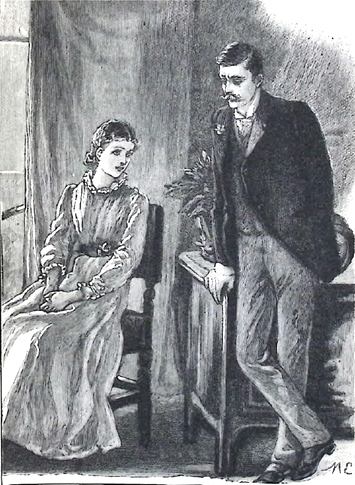
"Not to please me," said Enid; "do try to do something and be something in the world; but let it be from a high motive."
"What motive?" he asked.
"What motive?" she repeated. "Can it be necessary to ask here in Rome what should be the motive of a true man's life—here, where so many heroes and martyrs laid down their lives rather than disobey the voice of duty and of God? The past seems to me to teach so solemn a lesson."
"What lesson?" he asked.
For a few moments she did not reply. Then she said in low, grave tones, "'That the world passeth away, and the lust thereof; but he that doeth the will of God abideth for ever.'"
Julius Dakin did not reply to her words. He laid down some tickets Miss Marian had asked him to procure for her, and to bring, which had been his errand to the studio, then went away.
A PASSIONATE ACT
AFTER Julius Dakin had left the studio, Enid sat for awhile doing nothing. It was not like her thus to sit in idleness; but she was in a mood which was altogether strange to her. She was excited—so excited that she would have found it impossible to wield a brush or so to control either hand or mind as to produce her best work.
Of course she believed that it was Adela's coming, and the painful nature of her visit that had unsettled her so; yet had she carefully analysed her feelings, she could not have said that they were entirely sad. And in truth as she sat absorbed, not knowing how the minutes passed; it was less of Adela than of Julius Dakin that she was thinking. She was recalling all she had told him about Adela, and how he had listened to her words, and what he had said, with everything that had followed. Not words alone repeated themselves to her inner consciousness, but looks and tones.
Somehow that brief interview had left her with much to think over. With a strange thrill she thought of the words she had dared to say to him, not regretting them but wondering that she had found courage to say what she had, wondering too at the gentleness with which he had received her admonition, which surely many young men would have been inclined to resent.
Perhaps Enid became conscious at last of the dangerous course her thoughts were pursuing. Certainly she started up as the time-piece struck four, with a sudden sense of the absurdity of spending a fine afternoon, at Rome of all places, in doing absolutely nothing, and in a room lighted from above with no view of the outer world.
In a few minutes, she had donned her hat and jacket, and was on her way to the Pincio.
On this bright afternoon there was the usual crowd on the terrace facing the band-stand. Carriages were drawn up in rows in the centre of the open space, most of them empty, their possessors preferring to walk about as they listened to the music. The scene was one of which Enid felt that she would never weary. It was a delight to her to gaze over the widespread view of Rome, a delight which had only increased as each object which met her view became familiar, till she could name every dome and roof on which her eyes rested. Nor was languid her interest in the various human elements of which the crowd about her was composed. The foreign visitors, representing so many nationalities, and who might be classified as the fashionable, the pretty, and the picturesque, afforded Enid entertainment; and as she passed to and fro in the sunshine, her face showed that her thoughts were as bright as the day. For if she thought of Adela now, the girl's unhappy lot cast no heavy shadow on Enid's heart. Indeed, she was half disposed to reproach herself with hard-heartedness, so much did the excitement of her mood tend to gladness. A new and exquisite happiness seemed to be welling up within her, the secret source of which she herself did not know.
Then of a sudden, all was changed. It was curious that the sight of Julius Dakin coming round a bend of the road should set Enid's heart beating with painful rapidity; still more curious that she should be conscious only of a desire to avoid him. She hurried towards the side of the terrace whence a flight of steps descended to the lower road. As she stepped down, she looked back. He had passed on without seeing her; he was advancing towards an open carriage, in which sat two young ladies. It was perhaps the smartest equipage, and its occupants the two most charming girls, to be seen on the Pincio that day.
With a sensation wholly new to her, Enid watched him greeting with his courtliest air and most fascinating smile Blanche Amory and Maud Marian. As she went quickly down the steps, the words she had overheard at Mrs. Dakin's reception came vividly to her mind—"Julius Dakin knows how to make himself agreeable to ladies," and she remembered too how in the same conversation the names of both these girls had been coupled with his. Enid descended the winding path with her head held high and her lips firmly compressed.
"I am glad I said what I did to him this afternoon," she thought, "though I do not suppose it will make any difference. I hate the idea of a man living just to please himself, taking everything the world can give him and paying nothing back. But that is Julius Dakin's way—he never thinks of any debt he owes to others; he has no desire to serve the world. And I—I despise a man like that!"
And there was a strangely stern expression on Enid's fresh young face as she crossed the Piazza del Popolo and took her way home by the Via del Babuino. But ere she reached the house, sternness had given way to sadness. A feeling of weariness and home-sickness swept over her which was hard to bear. She felt a great yearning for her mother's presence, her gentle, helpful sympathy. And the last letter from home had given her such an account of her mother's health as caused her uneasiness. Enid was not naturally inclined either to anxiety or melancholy; but now every dark suggestion, every sad thought she had before experienced, came back to her mind with renewed force. She was depressed both in mind and body when she gained her room, and it was a relief to know that Maud was out, and she might indulge her mood for a while without fear of interruption.
But not for long did Enid give way to melancholy. The next day she was herself again. Her little picture was finished and sent away to be framed, in readiness for the exhibition. That very day she began a painting of a bunch of violets in a little earthenware jar—a simple enough subject, but by no means easy to treat successfully. Working away at it, however, in her careful, painstaking way, Enid achieved a very fair result. Meanwhile, Maud was engaged every morning with a model, a handsome, dark-eyed girl, who wore one of the picturesque costumes of the Campagna. It must be confessed that the girl's beauty suffered at Maud's hands. The face which looked forth from her canvas had a hardness of colouring and a boldness of glance of which the original was not guilty. But defects of this kind did not disturb Maud's complacency. She had a curious way of anticipating and disarming criticism.
"I know my model's hair was not like that," she would say; "but really I prefer the hair I have given her. She ought to have had hair of that shade, don't you see?"
Or—"No, her eyes had not that expression; they had a melancholy look; but I do not approve of melancholy subjects, so I was glad to give her a cheerful air. You see, I must paint in my own way, or not at all."
"Undoubtedly," said a gentleman to whom Maud made this remark on one of the afternoons when she was "At home" to her friends; "that is the prerogative of genius. Art should give us more than a mere copy of Nature; it should improve upon Nature."
To Enid's surprise, her cousin accepted this response with complacency, and seemed unconscious of the satire which doubtless lurked in it.
Miss Marian was "At home" each Wednesday afternoon, and between four and six o'clock on that day the Studio Mariano presented a lively scene. Whatever might be thought of her powers as an artist, her studio was undoubtedly an attractive place, and she had a knack of making people enjoy the time they spent there. Men found her both pretty and clever, and were struck with the grace of her manner; whilst women, though they might object to the colour of her hair, criticise unfavourably her features, and resent the airs she gave herself, were nevertheless won by her good-nature.
Enid generally found plenty of entertainment on her cousin's reception afternoon. It devolved on her to look after the prosaic details connected with the making and serving of the tea; but these did not prevent her from having a good time. She liked to see the people who came, and to listen to the lively talk that went on. Perhaps she enjoyed it all the more because she had only a secondary part to play, and her duties kept her much in the background. Many of Maud's visitors were of opinion that her cousin was a quiet, rather dull girl. They would have been surprised had they known how keenly the "dull" girl had observed them, and how clearly she had detected their various weaknesses and vanities. For it must be confessed that Enid was rather a "quiz."
Enid was disturbed to see Miss Amory, attended by Julius Dakin, enter the studio on the following Wednesday afternoon. She had not spoken to him since he found her alone there four days earlier. She was nervously conscious of the words that had passed between them on that occasion. She tried to occupy herself with the other visitors, and to avoid saying more to him than was absolutely necessary.
But it did not please him to be thus ignored. He watched his opportunity, and presently, when several persons rose to depart, and there was a general break in the conversation, Enid found him by her side.
"What are you painting now, Miss Mildmay, if I may ask?"
"You may ask, certainly," said Enid, smiling.
"You do not mean that you will refuse to tell me? Oh, please let me see it. This is your easel, is it not?"
Enid, forseeing endless entreaties, thought she might as well yield at once, and uncovered her painting.
"Ah, this is something new!" he exclaimed. "Did you finish the orange spray?"
"Yes, and it is gone to the framer's."
"Ah, that is right. And you really mean to send it to the exhibition?"
"I think so."
"I am glad. It will win a medal, I am sure."
"Oh, I do not expect that," said Enid, smiling. "But now, how do you think this promises?"
"I think it very good—so good that—Shall I tell you what I wish?"
"Certainly."
"I wish you would paint it for me. I mean, I wish you would be so good as to allow me to purchase it."
"Oh, Mr. Dakin!" exclaimed Enid, colouring hotly in her surprise. "I could not do such a thing."
"Why not? Are you too proud to sell your pictures?"
"No, not that," said Enid, with considerable hesitation; "but I do not like the idea of selling one to you."
"You think me incapable of appreciating it?"
"You know it is not that," said Enid, forced to smile. "But—well—that one in the exhibition will be for sale; you can buy that if you like."
"Thank you, but I do not desire that. I want to have something you have painted throughout for me."
"If I painted anything for you," said Enid slowly, "I would not sell it to you."
"No, really!" There was a strange, surprised, glad look in his eyes as he bent towards her. His glance met and arrested hers.
With a strange thrill she awaited the words he was about to utter; but they remained unsaid, for at that moment the high thin voice of Miss Amory made itself heard from the other side of the room.
"Julius, where on earth are you? Do come and look at this lovely thing of Miss Marian's. It is real elegant."
Julius cast a comical glance at Enid as he turned to obey the summons. An inspection of Maud's pictures followed, and Enid observed that Julius found something commendatory to say of each. Miss Amory made remarks on them with her usual freedom.
"It is a treat to see some new pictures," she observed. "I am so tired of those dim old things in front of which you have to keep moving about for a month till you find a spot where you can see them. I like something you can see straight away. But don't you think that girl looks a bit sick? Her eyes are not right, anyhow; but you've given her an awful cunning gown."
Enid was thankful that Miss Amory's attention was not drawn to any of her work. She hastily covered up her own little painting, and nothing more was said about it. A few minutes later Miss Amory and her escort took their departure.
Enid went on painting her violets with a new pleasure in her work. She was tremulously anxious to succeed, and far from satisfied with her performance, yet it was good. The thought of Julius Dakin was with her as she worked. She had resolved that she would receive no money from him for the little picture. Yet in truth, though dreamily, scarce consciously, she was painting it for him. She meant that he should have it, though she had no clear idea of how it would be possible for her to give it to him. She had almost finished the work. It lacked but those finishing touches which the eye of a connoisseur alone could have detected to be wanting.
"Why do you keep touching that thing?" Maud said to her impatiently one day; "those trifling details can make no real difference."
"I wish Herr Schmitz could hear you say that," returned Enid; "he would certainly repeat for your benefit his favourite story."
"What is that?" asked Maud.
"Oh, it relates to his hero, Michael Angelo. A friend once visited the sculptor, and found him engaged upon a statue. Some weeks later the visit was repeated.
"'You have been idle since I was here,' remarked the friend, looking at Michael Angelo's work, in which he discerned no progress.
"'By no means,' said the sculptor. 'I have softened this feature and brought out that muscle. I have given expression to that lip, and more energy to that limb.'
"'Well, but these are mere trifles,' said his friend.
"'It may be so,' replied Michael Angelo, 'but remember, trifles make perfection, and perfection is no trifle.'"
"I can quite imagine Herr Schmitz telling that story," said Maud disdainfully; "but I must say I do not admire that sort of perfection. I believe in the artist who can produce a great effect with a few strokes. Things laboriously wrought are often failures. You may work away at a picture till you spoil it utterly."
"That is true, as I have learned by experience," said Enid. "Still, it is well to strive one's hardest; and perfection is perfection, however attained. Yet, I doubt if Michael Angelo ever thought his work perfect."
Enid took the warning which her cousin's words suggested. She would not work upon her violets till she spoiled them. She resolved to lay the painting aside for a day or two that she might return to it with fresher vision, and be better able to judge of its merits. So she gave herself a holiday on the following day, and spent its hours in visiting some of the many interesting spots in old Rome.
Returning to the studio late in the afternoon, she found Maud putting away her work and obviously not in the best of humours.
"Julius Dakin has been here," she said, after a few minutes. "He stayed ever so long, and hindered me dreadfully."
"Did he?" said Enid, wondering that her cousin should speak as if his visit were a cause of annoyance.
"Yes, and he looked at that painting of yours, Enid. He would look at it, although I told him you did not like your work meddled with."
"That was very rude of him," said Enid; but she did not speak in an offended tone. "What did he think of it?"
"Oh, he professes to think most highly of it," replied Maud; "he wants to buy it of you."
"I know he does," said Enid smiling; "but I do not mean to sell it to him."
"Why not? What nonsense, Enid, when you know you would be glad of the money! I am sure he means it very kindly."
"Very kindly!" repeated Enid, in a tone of surprise.
"Yes, I am sure he does it out of kindness."
"Does what out of kindness?" demanded Enid. "What do you mean, Maud?"
Her cousin gave a constrained little laugh. "Are you so vain, Enid, as to suppose that he is really anxious to possess that painting of yours? You must know that I told him some time ago that you would be glad to make a little money by selling some of your things. It is just a piece of his good-nature. He wants to be kind to you—that is all."
A burning flush mounted in Enid's face as she heard her cousin's words. She stood motionless, gazing at her little painting, which was still exposed upon the easel, with a revulsion of feeling that was unendurable. She could not have told why Maud's words had such power to sting her; she did not understand the meaning of the passionate anger and the sense of outraged pride which possessed her; she only knew that it was intolerable, and demanded some vent.
Maud repented of her words as soon as they were uttered. She was dismayed as she marked their effect—dismayed and conscience-stricken, for she knew they had been insincerely uttered; and she was a girl who prided herself on her truthfulness.
"Why do you look like that? Surely you need not mind," she began.
But the next moment her voice rose high in consternation. "Don't, Enid! What are you thinking of?"
But she could not arrest her cousin's action. Enid seized her painting, tore it passionately into several pieces, and threw them within the open door of the stove. A flame sprang from the glowing coal and consumed in a moment the work of many days.
"How could you, Enid?" cried Maud, in great distress. "You must be mad!"
"Perhaps I am," said Enid, in a voice strangely unlike her own; "but you see now how anxious I am to make money by selling my pictures, and also how grateful I am for such kindness as that of Mr. Julius Dakin."
With these words on her lips, she walked out of the studio, and Maud was left to her own reflections, which were by no means of an agreeable nature.
Running blindly down the stairs, with no purpose save a desire to get away from Maud, Enid came upon Miss Strutt slowly ascending the staircase with several small parcels in her hand. The girl would have passed without a word had not Miss Strutt caught her by the arm.
"Enid, what has happened? Where are you going?"
"Nothing! At least, nothing that I can tell you," said Enid, making an effort to conquer her agitation.
"Then do not tell me," said Miss Strutt, kindly; "only—whither are you going in such haste?"
"I am going nowhere in particular," said Enid, looking down in shame. "I suppose I was going to the 'pension.'"
"Come to my room instead," said Miss Strutt soothingly. "I am just going to make myself a cup of tea, and I should be glad of your company."
Enid hesitated. "I had better not come now," she said; "I am not in a mood to be good company for anyone."
"Then come and be bad company," said Miss Strutt smiling. "My dear, I see you are in trouble, and I will not worry you. I will give you a cup of good tea—they say tea is a comfort to women in every sort of trouble—and you need not say a word unless you like."
So Enid followed her. By this time her passion was spent, and she was beginning to be thoroughly ashamed of the way in which it had moved her.
Miss Strutt placed the girl in a comfortable chair by the stove, and then left her alone whilst she busied herself in emptying the small grocery packets she had been purchasing. She had many preparations to make ere the tea was ready. Maud would have been moved to contemptuous pity, could she have watched the precise, particular way in which the old maid arranged everything, and she would certainly have laughed at the odd figure Miss Strutt presented as she moved about in a short full-flounced skirt, of a style that for many years had ceased to be the mode.
But Enid was too absorbed in her own sorrowful thoughts to pay any heed to Miss Strutt. That lady, however, was quietly observing Enid, and she presently saw her turn her head aside, and knew that she was shedding tears. But still Miss Strutt kept silence. At last, when the tea was made, she drew a little table to Enid's side, and placed on it a cup of tea and some biscuits.
"There, my dear," she said kindly, "take your tea, and you will feel better afterwards."
Enid looked up at her with eyes full of tears.
"Miss Strutt," she said, "you have no idea what a dreadful temper I have."
"Have you?" said Miss Strutt smiling. "Well, certainly I had no such idea."
"Well, I wish I could take things quietly," continued Enid; "but when anything vexes me, I fire up, and speak so angrily, and do things for which I am sorry afterwards. Maud has far more self-control than I have."
"It is a good thing to have self-control," said Miss Strutt. "Some persons are naturally cool and self-possessed; but for one of your temperament, self-restraint is never easy. You can only learn to control yourself by constant effort and much watchfulness."
"That is what mother has often told me," said Enid, with a sigh; "and I thought I had learned to conquer my temper; but I suppose it was only that I found it easy to be good-tempered when I was at home. So many things have happened to put me out since I came to Rome. And I thought I was going to be so happy here!"
Enid's tears began to gather anew.
"You have been happy," said Miss Strutt. "Don't magnify your troubles, child. I am sure it has often gladdened my heart to see your bright face, for I like to feel that some lives are full of sunshine, though mine is lived in the shade. You have had much enjoyment since you came to Rome."
"Indeed I have—you are right," said Enid, smiling in spite of herself. "But I do not think I can enjoy anything more. I would go home to-morrow if I could."
"Oh, nonsense! This will pass," said Miss Strutt briskly. "You young things always fancy that your troubles are going to last for ever. In a week's time, you will be as eager to remain in Rome as you were at first. And what would Herr Schmitz say if you ran away? You forget your work. How are you getting on with your violets, by-the-bye?"
"I tore the painting up this afternoon," said Enid, colouring deeply.
"My dear, you do not mean that!" exclaimed Miss Strutt quickly. "What could make you do so? You seemed to me to be succeeding so well. If you got your colours into a muddle, you should have come to me before doing anything so desperate."
"It was not that," said Enid, with deepening confusion; "it was not because I was disgusted with my work. I did it in a fit of temper."
Miss Strutt looked amazed.
"It was very foolish of me," faltered Enid. "I am sorry for it now—but it is too late."
"Such regrets are generally too late," said Miss Strutt gravely. "Well, it is a good thing you only destroyed your picture. Greater things are often destroyed in a fit of temper—friendships, loves—that are very precious. Ah, it is terrible to think what one may be led to do or say under the influence of passion."
Enid felt the solemnity of her tone. "Oh, Miss Strutt," she said, "I am frightened at myself sometimes! It is so hard to be right."
"Yes, life is not easy," said the elder woman; "at least, a true life never is. We must strive and struggle if we would follow the path of perfection. 'If any man will come after Me, let him deny himself, and take up his, cross and follow Me.' But the end is worth the struggle."
She laid down her cup, rose, and crossed the room to where a bureau stood against the wall. Enid did not watch her movements. She was thinking of what Miss Strutt had said. There was silence for some minutes.
Miss Strutt was bending over a small picture which she had taken from a drawer. She looked at it long, and hesitated. At last, placing it on an easel, she said, turning to the girl—
"Enid, look here! This is something I have never shown you."
Enid looked up. On the easel was a portrait, executed in water-colour, of a young man.
"Did you do that?" she asked, in surprise. "I did not know that you painted portraits."
"I do not as a rule. That was painted from memory, with the aid of a photograph."
Something in Miss Strutt's manner restrained Enid from asking questions. She looked at the portrait. It was that of a young man about five-and-twenty years of age. It was a good, even a handsome face. The broad, finely-arched brow, the strongly-moulded features, the thoughtful expression, seemed to betoken intellectual power. He could hardly be said to resemble Miss Strutt, and yet there was that in the face which subtly suggested hers.
"That is the portrait of my brother," said Miss Strutt, when the silence had lasted some minutes.
"Your brother!" said Enid, in surprise. She could not remember having heard Miss Strutt speak before of this or any relative.
"Is he living?" she added, after a moment.
"Yes, he lives," said Miss Strutt, and her voice sounded strange to Enid's ears. She looked at her, and saw that the little woman was greatly agitated.
"He is my only brother," said Miss Strutt presently. "That is what he looked like long ago, for he is older than I. We were so fond and proud of him, my mother and I; perhaps, we had a right to be, for he had great gifts. We were always poor, for my father died when I was a little child. My mother made great sacrifices to give her children a good education. I early began to earn money by teaching, whilst at the same time, I practised drawing constantly, for I always hoped to be an artist. Every penny my mother and I could save we put aside that Hugh might go to college. He was so clever, we felt sure that he would distinguish himself. We thought he had a great future before him."
Miss Strutt paused for a moment, then went on in tremulous tones, "Well, he went to college and he won distinction. The men of his college were proud of him; great things were prophesied. There was a scholarship for which my brother was competing. No one doubted that he would win it. But he had a rival—a rival who was also an enemy. Circumstances had occurred to create between them the bitterest feeling. On the day of the examination, my brother discovered that this man had taken an unfair advantage of him. He charged him with it. There were angry words. My brother was always hot-tempered. In their quarrel, he suddenly struck his opponent. The blow would not have been serious, but the man chanced to be standing at the head of a flight of stone steps. The shock sent him staggering back, and he fell to the bottom of the flight. When they raised him, his neck was broken."
"Oh, how dreadful!" exclaimed Enid. "How could your brother bear it?"
"He could not bear it," said Miss Strutt slowly. "He was out of health; for weeks he had been over-working, studying both day and night in pursuit of his object. His nervous system had been strained beyond endurance; this shock was more than his brain could support. Ah, how can I tell it! His reason gave way. He has lived on; he is living still—if it can be called life—that awful existence of the insane!"
Enid grew pale as she listened. She could say nothing in response. Words seemed empty and vapid beside the revelation of so great a sorrow. Her own troubles seemed to melt into nothingness in comparison with the sorrow and disappointment of this sister's heart. Perhaps Miss Strutt felt that hers was the silence of sympathy, for she went on presently—
"You will not wonder that the grief broke my mother's heart. She lived little more than a year afterwards—then I was left alone in the world. People perhaps wonder why I live as I do; why I work so hard and spend so little. You will understand. I have but one thing to live for—the duty of seeing that my poor brother is well cared for in his sad situation. I have a friend, a medical man, in Scotland, who visits him from time to time, and sends me news of his condition. If there were any improvement, any possibility of his knowing me, I should go to him at once; but the news is always the same. It is a hopeless case."
Enid took Miss Strutt's hand and kissed it reverently.
"Oh, what sorrows you have known!" she said. "It makes me ashamed to think that I have been pitying myself, fancying myself unhappy, when I really do not know what trouble is."
"If it has made you feel so, I am not sorry that I have told you," said Miss Strutt.
"No, do not be sorry; I am glad you told me. Only I feel so sorry for you. How you have borne it, I cannot tell."
"I have been helped to bear it," said Miss Strutt quietly. "Have you seen Guido Reni's Crucifixion in the church of San Lorenzo in Lucina? No! Then you must go and look at it some day, and perhaps the picture will give its message to your heart. Many a time when my heart has been oppressed by the mournful mystery of life, and ready to rebel beneath its heavy load, the sight of Guido's picture has given me calmness and strength. That sublime sorrow of the Highest One, that cross so patiently borne for the sake of others, gives us the only solution of life's perplexities, for it shows us that all the pain of the world, and our own individual share of the same, is meant to be for good, and not for evil. Do not look so grieved for me, child! This sorrow of mine has shared my life for so many years that it has grown to be like part of myself, and I have long ceased to fret under it."
Enid quitted Miss Strutt's room in a humbler frame of mind. She had had her lesson, and it was one which she never forgot.
She went upstairs prepared to confess to Maud how she regretted her hasty action and angry words. Maud received the confession lightly enough, and dismissed the matter as of slight consequence. Enid's heart was sore as she thought of the violets she had painted so lovingly. She felt a strong reluctance to begin anything fresh, and for some days could only work in a very desultory fashion.
Maud meanwhile was projecting a great work. The weather now was sunny and warm—as February days often are in Rome—and Maud made her pretty model pose for her in the garden beside an old moss-grown fountain with a background of orange trees laden with ripening fruit. It was a good idea, but unfortunately Miss Marian's ambition was in advance of her skill.
Maud was painting in the garden one afternoon and Enid was drawing in the studio, when Julius Dakin made his appearance there.
Enid, who felt some embarrassment on seeing him, at once explained where her cousin might be found; but he seemed in no hurry to seek Miss Marian.
"Where are the violets? Are they finished?" he asked, as he glanced over her shoulder, and saw that she was drawing from a plaster cast.
"They are finished as much as they ever will be," said Enid, colouring vividly. "I have done for them."
"What do you mean?"
"Simply that the violets are no more. In other words, I tore the painting up."
"What! Do I hear aright? You tore up my beautiful violets—the painting that I had come to look on as my own! What could make you do such a thing?"
Enid said nothing.
"It was too bad of you," he continued reproachfully. "You were doing them exquisitely. You excel in painting flowers—Herr Schmitz was saying so the other day; I wish you could have heard how he spoke of your work."
"It is well I did not," said Enid; "I am conceited enough already, and Herr Schmitz knows that too well to give me much praise."
"Indeed, you are mistaken. I only wish I could inspire you with a little conceit. If you had a quarter of your cousin's self-confidence, you would do."
"Allow me to remind you, Mr. Dakin, that comparisons are odious," said Enid.
Julius laughed, but said determinedly, "Now I really must understand this matter. What induced you to tear up that painting?"
Enid was silent.
"Were you disgusted with your work? Did you conceive of it as a failure?"
"No, it was not that."
"Was it anything your cousin said that induced you to do it? Did she disparage your work?"
"Really, Mr. Dakin, I must beg you to spare me these questions," said Enid. "What does it matter why I did it? The thing is done, and cannot be undone."
"That is the worst of it, unhappily. I assure you I do not feel inclined to take my loss philosophically. I can never forgive Miss Marian if her words have put you out of humour with your work. It is absurd her presuming to criticise you, who have fifty times her talent. You must see yourself how faulty her work is. She cannot even draw. You must be conscious of your own superior power. You have real talent; but Miss Marian! It is ridiculous for her to call herself an artist!"
"Mr. Dakin, I wish you would not speak so," said Enid uneasily. "You forget that Maud is my cousin."
"No, I do not; but forgive me if I have said anything to pain you. You know I promised that I would always tell you exactly what I thought. I have a great respect for Miss Marian; she is a charming young lady; but—" he shrugged his shoulders impressively—"as an artist she is a joke."
"I shall be seriously offended with you, Mr. Dakin, if you talk in that way," said Enid.
"Excuse me; I did not mean to annoy you, though really I think you deserve a punishment for tearing up my painting. Now tell me honestly, did you not paint those violets for me?"
"I should never have sold them to you," said Enid.
"Then you would have given them to me," he said, in a low, insinuating tone.
Enid coloured, but said nothing.
"That would have made me only too happy," said he. "And now the picture is destroyed, do you wonder I am vexed? I suppose I may not ask you to paint something else for me?"
"You may ask me if you like," said Enid, "but I shall certainly refuse to make any promise. I feel as if I should never paint flowers again. But now let us go and find Maud."
"Yes," said Julius laughingly; "we will go and see the great artist of the future."
Enid gave him a reproachful glance.
But when they reached the garden, Maud was no longer there. Her easel and painting materials were still beneath the trees; but model and artist had both departed.
Julius Dakin excused himself from staying longer, and Enid went back alone to the studio.
Attached to the studio was a tiny room communicating with it, and having also a door into the passage. The girls used it as a sort of dressing-room, and also as a place of consignment for various useful but inelegant articles belonging to their studio.
As she re-entered the studio, Enid heard a sound which seemed to her like a sob, proceeding from this little room. Hastily drawing aside the curtain which screened it, she saw that the door was open, and Maud stood within. Undoubtedly too the sob had come from Maud, for her eyes were wet with tears as she started and faced her cousin angrily.
"Why, Maud," exclaimed Enid, startled, "what is the matter! Have you been here long?"
"Oh no, not long," said Maud, in a tone of indescribable bitterness; "only since Julius Dakin arrived. I saw him pass when I was in the garden, and I came in. I thought he might want to see me; but I need not have troubled, since it was evidently you he came to see."
Enid was dismayed. If Maud had been in the ante-room with the door open during Julius Dakin's visit, she had heard all he said, and his unflattering comments on her as an artist must have stung her sorely.
"Oh, Maud, I am so sorry!" she exclaimed in her distress. "You should not have stayed here."
"Indeed, it was well I did so," said Maud proudly. "I had an opportunity of testing the sincerity of those who profess to be my friends. Don't speak to me, Enid," she added with sudden passion, as Enid tried to say a word; "don't make any excuses for him. I shall hate you if you do! I do not want to hate you, but you will drive me to it if you do not take care!"
A SERIOUS ADVENTURE
ENID was greatly distressed. The more she pondered what had occurred at the studio that afternoon, the more she regretted it. She could not feel that she was to blame in the matter; but neither was she anxious to justify herself. The bitter words Maud had addressed to her did not rankle in her heart. She could forgive them, because she imagined she had discerned the true source of the warm feeling they betrayed. In her passionate outbreak, Maud had unconsciously revealed to her cousin the secret of her heart.
If anyone deserved blame, it was Julius Dakin. He had not behaved well. He, who prided himself on his taste and tact, had certainly committed a breach of decorum in speaking to Enid of her cousin in the way that he had. Enid felt vexed with him for causing so much trouble. Indeed, she believed herself to be seriously angry with him. She was very severe on him in her own mind. He was just one of those handsome, agreeable, useless men, who were for ever making mischief in the world. She took credit for understanding him, and was convinced that if any girl were proof against his fascinations, it was Enid Mildmay.
But for Maud, Enid was truly grieved. It must be remembered that Enid was of a romantic disposition. She loved poetry, and had also a keen appetite for fiction, though she was guided by fine taste in the selection of it. But her sound common-sense and the influence of her active, healthy home life, had prevented her from making herself the heroine of her day-dreams. She had perhaps as little vanity as a girl can have. She cherished no illusions regarding herself. But she had her thoughts concerning that love which is the crown of a woman's life. She hid them deep within her heart, but they were such as she need not have been ashamed to avow. The love of which Enid conceived was the love which the poets have made their theme. She had no idea of the low, petty, selfish feelings which dare to claim the holy name of love. She was at the age when girls of imaginative tendency dote on Mrs. Browning's poems, believe all loves to be eternal, and assert, in the words of their favourite poet, that—
". . . Those never loved,
Who dream that they loved once."
Therefore, when Enid detected in Maud's jealous anger the signs of an attachment to Julius Dakin, she at once imagined the feeling to be the deepest and strongest of its kind. Her sister Alice would have been moved to laughter by such a discovery, and would probably have made it her endeavour to shame Maud out of her nonsense, as she would have deemed it. And perhaps in five out of ten of such cases, those who laugh are justified in doing so.
But Enid took the matter seriously, and felt profound pity for her cousin. She had previsions of sorrow and heart-break for Maud, since she was convinced that Julius had no such attachment to her, nor was ever likely to have. And perhaps, in spite of her pity for her cousin, Enid did not regret that this was so. It did not seem to her that Julius Dakin and Maud were exactly suited to each other.
Enid had spoken truly when she said that her cousin had great self-control. This was evinced on the present occasion. After those few hot words, Maud regained her usual self-possession, and relapsed into cold, proud dignity. No other allusion was made to the occurrence of the afternoon. Things went on as before, save that Maud's manner made Enid aware of a chilling distance between them.
It was so in the days that followed. Maud was calm and courteous, but the frigidity of her manner never thawed. Enid was made to feel herself a culprit, though at the same time nothing was said or done that she could find just cause to resent. She thought at last that she could welcome the hottest discussion as an exchange for Maud's icy reserve.
One morning the two girls were at work in the studio. Neither had spoken for the space of about half an hour, for they had fallen into the way of saying little more than was absolutely necessary to each other. Enid was absorbed in her work; but Maud was dissatisfied with her task, or not industriously inclined. She would haven been glad to throw down her brushes and indulge in a chat with her cousin, could she have done so without sacrificing her dignity. She would have welcomed any visitor; but it was not an hour at which anyone was likely to call.
So when a knock was heard, Maud did not suppose for a moment that there was anyone more interesting than a model at the door.
"Come in," she said indifferently.
But when the door was slowly opened, and the person outside cautiously presented himself, she uttered a cry which astonished Enid.
Her cousin looked up and saw a tall young man in the doorway. Brown and sturdy, with a frank, glad smile on his face and a sparkle in his keen grey eyes, he was unmistakably an Englishman.
"Sidney!" exclaimed Maud in her surprise. "Sidney Althorp, it is never you!"
"I have reason to believe it is," he replied with mock gravity, as he came forward and took her hand.
"Well, I declare!" said Maud. "Of all astonishing things! Who would have thought of seeing you in Rome?"
"Not you, evidently. And yet you have always represented Rome to me as a city to which everyone went, and which I was therefore bound to visit some day."
"But I never really thought you would come, for you never like to do the things which other people do."
"Indeed! Perhaps you are mistaken. At any rate, this is an exception."
"Yes; but the idea of your coming in this way, without informing me of your intention! And you know I hate surprises."
"Do you? I am sorry I have displeased you by appearing so unexpectedly. Shall I take myself off?"
"Nonsense! You know how glad I am to see you. Do sit down till I get accustomed to your presence. I still feel as if it could not really be you."
Mr. Althorp glanced at Enid ere taking the seat to which Maud motioned him, and Maud was reminded of her duty to her cousin.
"Enid," she said, "you have often heard me speak of Mr. Althorp. My cousin, Miss Mildmay—Mr. Althorp."
The young man advanced and shook hands with Enid, giving her at the same time one of his earnest, searching glances. She was struck with the kind, honest look of his eyes.
"So this is the Studio Mariano," he said the next minute, calmly surveying the room. "At last I see it. Can you wonder that when its fame reached me, I could not rest till I beheld it?"
"Don't be satirical, Sidney," said Maud. "And how did you know it was called the Studio Mariano? Oh, I suppose papa told you. I dare say he has read to you all my letters."
"I have occasionally had the pleasure of listening to extracts from them."
"Of course. And how is my father?"
"He was very well when I left, I am glad to say," replied Mr. Althorp.
"That is right. I hope he has ceased to lament the waywardness of his daughter."
"I don't know about that. He has seemed more cheerful of late. He has been going a good deal to your aunt's house, I believe."
"Oh, I am glad to hear that. I knew he would soon cease to miss me, and take a reasonable view of my absence."
"You must not suppose that your father has ceased to long for your return," said Sidney Althorp. "Indeed, he hopes you will not remain away much longer. He has suggested that you and Miss Mildmay should return under my protection in three weeks' time."
A shadow fell on Maud's face.
"That is out of the question," she said quickly. "Three weeks' time, indeed! It is impossible. I have engagements that will keep me far longer in Rome."
Sidney Althorp said nothing.
"You have not yet explained how you come to be here," said Maud, anxious to change the subject. "When did you arrive in Rome?"
"I arrived this morning, having left London on Monday night. There was business in Paris which Mr. Marian wished me to undertake, and he kindly thought that could spare me for a week or two, and suggested that I should come on here. I believe he thought that the next best thing to coming himself to fetch you was to send me. I need not say how gladly I fell in with the suggestion."
"Of course," said Maud; "but you may tell my father that I mean to stay in Rome till he comes himself to fetch me. So you have travelled here straight from Paris. How tired you must be!"
"On the contrary, I feel quite fresh, and eager to see all I can of Rome. I hope you are willing to be my 'cicerone.'"
"I shall be delighted. There is nothing I should enjoy more," said Maud gleefully. "Where shall I take you first?"
"Wherever you please; you shall choose."
"Very well; I know what you will like," said Maud. "I suppose, Enid, you will not care to leave your work?"
This was not the way in which Maud would formerly have invited Enid to join her. Enid felt the coldness of her words. She would probably on any invitation have hesitated to make a third; but as it was, she felt it impossible to do otherwise than assent to Maud's negative proposition.
So Maud and her friend went out together, and Enid was left to pursue her work alone. She was perhaps disposed to be a little envious of her cousin. It seemed such a delightful thing for Maud to have this friend arrive, bringing her news of her father. Enid felt how she would welcome anyone who came to her with tidings from her home.
She worked steadily all the forenoon, and returned again to the studio after luncheon; but the afternoon light was not good, the quiet of the room became oppressive, and soon Enid could no longer resist her longing to be in the open air. She laid aside her work and went out.
It was a grey, chilly, cheerless day. On such a day, so rare in Italy, Rome does not look like itself. Enid felt the difference the lack of sunshine made as she passed through various narrow winding streets to the Forum. Colourless and forsaken looked the old ruins—there was scarcely a tourist even to be seen. Enid passed on along the Forum and beneath the Arch of Titus.
She wandered on without any purpose till she reached the Colosseum. Then she remembered that she had not yet explored the Cœlian Hill. Turning to the right, she crossed a plantation of trees, at present leafless, and then ascended by a steep paved lane, spanned by picturesque arches of brickwork buttressing the old buildings on the left, to the Church of SS. Giovanni e Paolo.
A pretty dark-eyed child in picturesque rags was coming down the hill, and at the sight of the young lady, she pulled a woebegone face, and, approaching her, began to beg persistently. Enid had no patience with the Roman beggars, and never paid heed to their stories; but the appearance of this girl interested her. She could not believe her piteous tale, but it occurred to her that Maud might like to employ the child as a model, so she asked her if she would be willing to pose as one, gave her the number of the studio in the Via Sistina, and told her to come there on the following day. The girl seemed pleased, and readily promised to come.
Enid went on, and soon gained the piazza above, where she paused to admire the beauty of the tall campanile, which she had often observed from a distance. Then a notice caught her eye, attached to a small door in the side of the church:
"Enquire at the sacristy for the house of the Holy Saints, S. Giovanni and S. Paolo."
At once there came to Enid's recollection, a talk she had had with a gentleman whom she met at one of Mrs. Dakin's receptions, respecting this same house. He was an intelligent man, interested in antiquities, and he had told her about an ancient dwelling which had been discovered beneath this church, and charged her not to miss seeing it ere she quitted Rome.
It was supposed, he said, to be the very house in which St. John and St. Paul had lived. These saints were officers in the household of the Christian Princess Constantia, daughter of the Emperor Constantine, who honoured them and reposed in them great trust. When Julian the Apostate came to the throne, he attempted to persuade them to sacrifice to idols; but they were ready to die rather than abjure their faith in the one living God.
"Our lives are at the disposal of the emperor," they said, "but our souls and our faith belong to our God."
And Julian, fearing the influence of a public martyrdom, had them privately beheaded in their own house. This church, which bore their names, had been erected to mark the spot where they were martyred.
Remembering all this, Enid felt a desire to see the interior of the church, and, if possible, the house which had recently been excavated beneath it. She crossed the piazza to the door, lifted the heavy curtain, and entered. As she glanced around, she experienced a sense of disappointment. The interior of the old church was not so interesting as she had been led to expect. Bare whitewashed walls met her view, broken by old pillars, which appeared at some period to have undergone painting. Above the pillars were plain glass windows, which flooded the church with light, and rendered painfully clear its lack of beauty. Towards the centre of the nave, there was in the pavement a square stone enclosed within iron railings.
A monk who was standing near it explained to Enid that this was the very stone on which the saints were beheaded. Their bodies, he said, reposed in a porphyry urn beneath the high altar. Several monks wearing the black habit of the Passionists, whose convent adjoins the church, were moving about within the building. Some of them were busy hanging crimson and tinsel drapery about the tribune, in preparation apparently for a "festa." The colour thus imparted was grateful to the eye, affording a welcome relief to the prevailing whitewash.
Enid went forward to observe the frescoes by Pomerancio. She made an enquiry of an aged monk, who seemed to be superintending the movements of the others, concerning the subterranean house. He told her rather snappishly that she could not see it that afternoon; it was too cold and damp. Enid did not, however, at once give up the idea of seeing it. She lingered awhile, for other visitors were entering the church, and she hoped there might yet be an opportunity of descending.
A party of travellers, evidently German, were making the tour of the church. Enid followed them as they entered a chapel on the right of the nave. This was a modern addition, the splendid adornments of which afforded a striking contrast to the plainness of the old church. Pillars of alabaster supported the gilded ceiling, above which opened a painted dome. Here there was no lack of colour. Polished marbles of various kinds adorned the walls, the floor was inlaid with the same, the high altar was richly gilded, and above it, as above each of the side altars, was a picture of imposing proportions, though Enid found none of them satisfactory from an artistic point of view.
Gazing up at the pictures, Enid slowly approached the altar, before which the party of tourists, accompanied by one of the monks, were grouped. As they moved a little to make way for her, Enid started, and experienced a strange thrill as she came thus unexpectedly upon the object they were examining with curious interest.
Below the altar was a large glass case, in which lay, in an attitude of calm repose, the embalmed body of an aged monk, wearing the habit of the Passionists. The waxen hue of death was unmistakable, but the still face wore an expression of heavenly peace. The pale hand still held the breviary it had used in life. There was something very impressive in this sudden vision of the sublime repose and majesty of death.
"Whose body is this?" Enid enquired of the young monk who was in attendance on the party.
"St. Paul's," he answered; then seeing that his words conveyed to her no information, he added reverently, "It is that of our founder, St. Paul of the Cross."
Then he went to the back of the altar, touched a spring, and the gilded cover of the sarcophagus slid again into its place, hiding the form of the dead man.
Enid lingered for a few moments in the chapel which been raised to the memory of this notable saint, who died in 1776. Then she followed in the direction taken by the others. She saw them in a little chapel at the end of the right aisle; but ere she reached it, they were already descending the flight of steps which led down from this spot to the subterranean house. Enid hastened to join the party. A monk was just closing behind them the door at the head of the stairs; but at Enid's approach, he opened it, thrust a small piece of lighted candle into her hand, and bade her follow the others.
Enid kept pretty much in the rear of the party, whose noisy comments on what they saw were not to her taste. She could not hear the account given by the monk who led them, of each room they entered; but she had heard enough of the nature of the discoveries to draw her own conclusions respecting each. She preferred to follow at her own pace, and look about her in a leisurely manner. There was much of interest to be seen. The old solid walls, with frescoes still perfectly distinguishable remaining in places, the oratory of the saints with a model of the primitive altar used there in the second century, the beautiful "amphorae," and various relics which had been discovered in the excavations, had all a fascination for Enid. She lingered for some minutes in a chamber which she heard the monk call the "cantina," and which contained a collection of old water-vessels and cups, with the exquisite forms of which she was charmed.
Suddenly she became aware that there was danger in thus lingering. The others had all passed on. She hurried her steps, that she might overtake them; but she mistook the way in the narrow passages, and came back again to the room from which she had started. She turned again, when a sound reached her ear which filled her with dismay. It was a heavy, jarring noise, as of a door closing above. Surely they had not closed the door upon her, and left her alone in these gloomy vaults!
Enid was frightened, but she would not give way to fear. She set out again, observing more carefully the way she took, and presently reached the flight of steps leading up into the church. It was as she had feared.
The iron door at the top was securely fastened. Still Enid would not give way to alarm. She rapped with her knuckles on the door, she shouted at the top of her voice, but without result. Her voice resounded hollowly through the vaults, but it was powerless to penetrate to the church above, and the solid thickness of the door defied all her efforts.
Was it possible they had forgotten she was there? Then a worse doubt struck dread to her heart. Had they ever been aware of her presence? She had kept behind them all; she had spoken to none of the party. She felt almost sure that the old monk had not cast a glance at her.
It was a terrible situation. Gradually the full horror of it dawned upon her mind. It was purely by accident that she had come to this church. No one would think of seeking her there. No one would have the least clue to her whereabouts, for it was quite aimlessly that she had wandered out this afternoon. If she could not succeed in making herself heard, she would have to spend the night where she was. Who could say how many hours it would be ere anyone opened that door? Brave as she was, Enid shuddered at the thought. She glanced at the bit of candle in her hand. Already it was almost burned out.
At this moment, the swelling notes of an organ reached her ears, accompanied after a few moments by the sound of voices chanting in unison. The monks were singing their vespers in the church above. Again Enid put forth her utmost efforts, hammering on the door, shouting, screaming, but with no better success than before. The thick iron door, the solid roof above, deadened effectually the greatest noise she could produce.
She was well-nigh in despair, but it occurred to her that ere the light went out, and left her helpless in the darkness, it would be well to explore the chambers again, and see if she could discover any other outlet. So she went through them once more, looking about her with the utmost care. She did discover a small wooden door at the end of a passage, which apparently had been used by the workmen during the excavations. But it was locked, and she knocked long on it without receiving any response. Apparently on this side, the old house was quite remote from human life.
By this time, the candle had burned almost to her fingers, and she hastily made her way back to the steps ere its light went out. Placing the last morsel on the step beside her, she sat down and watched it expire.
As with one last flicker its light vanished, Enid's courage died also. The darkness which settled on her seemed like the darkness of the grave. She covered her face with her hands to shut out the blackness which looked so terrible, and burst into hopeless tears.
SEARCHING FOR THE LOST
MAUD did not return to her "pension" till the evening. She had thoroughly enjoyed going about Rome with Sidney Althorp. It was so long since she had seen him that his society was very welcome, and she listened eagerly to all he could tell her of her circle of acquaintance at home. Nothing occurred to mar the pleasure of their meeting, and she came back in excellent spirits. She thought more kindly of Enid as she climbed the long flight of stairs to their dwelling. She hoped her cousin had not been dull; but she had no time to seek her then, for it wanted but ten minutes to the dinner hour.
Maud made her toilette with all haste, but by the time she reached the dining-room, most of the company were already seated at the table. She saw to her surprise that Enid's place was empty. She sat down, expecting at every moment that Enid would appear; but she did not come.
"Is your cousin not coming to dinner this evening, Miss Marian?" enquired Signora Grassi.
"I cannot tell," said Maud. "We have not been together this afternoon. I came in late, and did not go to her room. If you will excuse me, I will go there now. I fear she is not well."
"Do not trouble to go—I will send a servant," said Signora Grassi.
She did so, and the servant returned saying that Miss Mildmay was not in her room.
Maud was astonished, but hardly alarmed. It occurred to her that Enid had perhaps gone to Mrs. Dakin's that afternoon, and been persuaded to stay and dine there. Still, it was hardly like Enid to do such a thing without sending word to her cousin. She was generally careful to avoid causing inconvenience or anxiety to others. But Maud reflected, with a twinge of conscience, that of late she had shown so little consideration for Enid that her cousin might well think that she was not likely to be disturbed by her absence for a few hours.
Signora Grassi looked rather uneasy. "Miss Mildmay is perhaps with friends," she suggested. "You know, I suppose, where she was going this afternoon?"
"Indeed, I have not an idea," said Maud. "She had formed no plans when I left her."
"This was Mrs. Dakin's afternoon for being 'At home,'" said Miss Guy. "Your cousin very likely went there, and Mr. Julius Dakin has induced her to remain awhile. She will return presently under his protection."
Maud glanced at the speaker with an air of disdain. "You may be right as to Miss Mildmay's being at Mrs. Dakin's," she said haughtily. "It seems to me a probable solution of the mystery. I feel no alarm about my cousin. She is perfectly capable of taking care of herself."
"Ah, but there are such dangers in Rome!" said Signora Grassi, with a little nervous shiver. "And Miss Mildmay is so courageous. She seems not to know what fear is. I have always been afraid lest she should venture too much. However, it is all right if she is at Mrs. Dakin's."
This was by no means certain, however. Maud ate her dinner with apparent equanimity; but in truth she was feeling uneasy, and her uneasiness increased as the evening wore on. As soon as dinner was over, she hastened to Enid's room, half hoping to find her there. The deserted look of the room was depressing. An examination of Enid's wardrobe showed her that Enid had gone out in the ordinary dress she wore in the studio. She would probably have made some change in her attire, had she contemplated a visit to Mrs. Dakin. But if not at Mrs. Dakin's, where was Enid? She had no intimate friends in Rome. She never paid visits except in the company of her cousin. Maud could think of no place where she was likely to be found.
With fears that could no longer be suppressed, she hurried to consult with Signora Grassi. She met that lady in the corridor, and a glance showed that she shared her anxiety.
"My dear," said the signora, "I cannot rest for thinking of your cousin. Suppose she should not be at Mrs. Dakin's! Do you not think we should send there to enquire?"
"Yes, yes," said Maud breathlessly; "we should have sent there before. There is no time to be lost. I will go myself at once!"
She hastily put on her hat, drew a large fur-lined cloak over her evening dress, and ran down the stairs. At the corner of the street, one of the small open carriages so common in Rome was standing. Maud sprang into it, and told the man to drive with all speed to Mr. Dakin's house. The horse was tired, and the man's utmost efforts could not induce it to proceed rapidly. The distance to be traversed was not great, but it seemed to Maud in her impatience as if they would never reach the house. At last, the door was gained, and she learned from the porter to her relief that the Dakins were at home.
As she insisted that she must see Mrs. Dakin at once, the servant ushered her, just as she was, into the drawing-room. A lady and gentleman from Washington had been dining with Mr. and Mrs. Dakin, and two young German tourists were also present.
Miss Amory was seated at the piano, singing, with imperfect mastery of the language, an Italian song when Maud entered; Julius stood at her side. The singer turned as the door opened, and catching sight of Miss Marian's white agitated face, at once ceased singing, whilst Julius hurried forward with an air of alarm. For a few moments, Maud could not speak. She gazed round the room half dazed, and was conscious only that Enid was not there.
"My dear Miss Marian, what is the matter?" It was Mrs. Dakin's voice that roused her.
"Oh, I hoped I should find Enid here," said Maud, in a tone of deep distress. "Can you give me any news of her? She has not been home since the afternoon, and we cannot tell where she is."
"What! You do not mean that Miss Mildmay is lost, and in Rome of all places!" exclaimed Miss Amory, in her high voice.
This was more than Maud could bear. She sank on a chair, feeling faint and heart-sick, and fearing to lose all control of herself.
Julius Dakin came to her side. It might have been observed that he had grown very pale; but he spoke in a calm, decided tone.
"Do not distress yourself, Miss Marian; there may be no real cause for alarm. Just tell me what you know of your cousin's movements, and I will see what can be done."
His cool, quiet manner restored Maud's courage.
"The worst of it is that I know nothing," she said. "A friend from London, a gentleman who is in my father's business, called to see me this morning; he persuaded me to go out with him to show him Rome. I left Enid busy with her painting. I did not get home till close upon dinner-time, and not till I reached the table did I learn that Enid had not come in, and no one knew where she was. I at once imagined that she must be here."
"She has not been to see me," said Mrs. Dakin. "But have you no idea of what she intended to do?"
"Not the least," said Maud. "I do not think she had formed any plans for to-day."
"You have enquired at the studio, of course?" said Julius.
"No, I have not—I never thought of doing so," said Maud.
"Why, my dear, I should have enquired there the first thing," said Mrs. Dakin. "Something may have occurred to detain her there. She may even have met with an accident."
"In that case, some one surely would have let me know," replied Maud.
"One would think so," said Julius. "But there is Miss Strutt—she may be able to tell you something about your cousin."
"To be sure. How foolish of me not to have thought of her before!" said Maud rising. "I will go to her at once."
"I will come with you," said Julius.
And they started without delay.
In a few minutes, they were at the house in the Via Sistina. The door was closed, and Julius had some difficulty in arresting the attention of the porter, who evidently did not expect visitors so late in the evening. He came grumbling to the door; but his manner changed when he saw the gentleman and lady. He could give no information concerning Enid, but his wife, who came out at the sound of voices, said that the young lady had brought her the key of the studio about half-past three, and had gone away. She had not noticed in what direction she turned.
"Then we shall not find her here," said Maud in a disappointed tone to Julius as they went up the stairs.
"Don't give up hope," he said. "We may gain some clue to her whereabouts." But his own heart was heavy with dread.
They opened the door of the studio and went in. All was in perfect order—Enid had put things carefully away ere she left the studio. The pictures and delicate fabrics were covered in preparation for the morning's sweeping. It suddenly struck Maud how much she owed to Enid's thoughtfulness: how many little services Enid constantly rendered her which she took almost as a matter of course! But now, as she looked about her, and saw everywhere the trace of Enid's careful hands, the sight struck such pain to her heart as we feel when we look on the last work wrought for us by some loving one whom death has removed from our side.
"Oh!" she exclaimed, overcome by the anguish of the thought. "How good Enid has always been to me! And I—I have been a perfect wretch to her! How can I bear it if any harm has come to her!"
"Don't—don't give way," said Julius, but his own voice was hoarse. "Let us go to Miss Strutt—she may be able to tell us something."
So they went down the cold dark staircase, and found their way, by the light of the wax taper Julius carried, to Miss Strutt's door. The house seemed empty and deserted, for few of the artists who worked there by day remained at their studios after daylight had gone. In the midst of her distress, Maud wondered how Miss Strutt could bear to live there all alone.
Although it was barely nine o'clock, Miss Strutt was already preparing for rest. At any other time, Maud would have been intensely amused at the droll figure she presented as she looked out of the door, attired in an old tartan dressing-gown, with her head tied up in a flowered silk handkerchief. She betrayed some discomposure at finding herself confronted by a gentleman when thus "déshabillée;" but no sooner did she hear the news he brought, than she forgot herself entirely in concern for Enid.
"I know nothing of her—I have not seen her all day!" she exclaimed. "Oh dear, dear me! Our little Enid lost! What a lamentable thing! Wait a minute whilst I dress myself, and I will come with you to seek her."
"Can you make any suggestion as to where we should seek her?" asked Julius, not thinking that Miss Strutt's presence was likely to be of much assistance.
"How can I? She said nothing to me of any intention, unless—She may possibly have gone to the Villa Mattei. It is open on Thursdays, and I know she meant to go there some day."
"That is an idea," said Julius. "We will make enquiries in that direction."
"Let us go there at once," said Maud, turning to accompany him.
But he gently checked her.
"Not you," he said. "I am going to ask Miss Strutt to take care of you."
"Indeed, I do not need to be taken care of," said Maud, indignantly. "I am going to look for Enid; I will not rest till I find her!"
"It is impossible that you should wander abroad this cold night," he replied firmly. Then he added in a gentler, somewhat tremulous tone, "Do you not see that the search may last all night? You will be brave and strong, I hope. You will return to the 'pension' with Miss Strutt, if she will accompany you, and await what tidings we may bring. Who knows? Your cousin may return there very soon. Whenever she comes, she will want you."
Maud was obliged to yield to him, though she yielded reluctantly.
It seemed to Miss Strutt as she observed him that the young man's character had undergone a transformation. She could see that he was intensely anxious about Enid—that the thought of her peril gave him the utmost pain, and she was not surprised. But the self-control, firmness, and decision he displayed did surprise her. She had not given him credit for such qualities. She had imagined him to be simply a frivolous, pleasure-loving, rather conceited young man. She now saw that there was more in him than she had supposed.
"Enquire of the guards at the Forum and the Colosseum," she said to him ere he left. "Enid goes so often to those places that they must know her well."
Julius, impatient of every moment of inaction, departed in haste. If he had been ignorant before of the nature of the feeling which drew him to Enid Mildmay, this night was destined to reveal it to him. His mind was in an agony as he drove towards the Colosseum. He knew too well the hidden dangers of Rome into which a young and inexperienced girl might fall. All kinds of terrible possibilities suggested themselves to his imagination, and he blamed himself for never having given Enid the least warning that it was possible to be too adventurous in exploring Rome. Yet in truth the idea of peril in connexion with Enid's wanderings had never before suggested itself to him. Enid's courage and simplicity had seemed a sufficient safeguard for her. And what right had he to interfere with her movements? But he vowed within himself that if he found her safe and well, he would not rest till he had won the right to watch over her in future. It should not be his fault if she strayed into danger again.
The moon was slowly rising behind the Colosseum, and beginning to illumine with its rays the grand old walls. Already there were carriages standing at the entrance, and the sound of voices and laughter from within announced that a party of American tourists were "doing" the Colosseum by moonlight. Julius alighted and made enquiries at the entrance, but could learn nothing of Enid there.
He passed on towards the Cœlian on foot, making enquiry of everyone he met of whom it appeared in the least probable that he might obtain tidings of Enid. By doing so, he attracted considerable attention. The news that a young English lady was lost passed rapidly from one to another. Curiosity or the hope of gain drew people after him. To his annoyance, he found himself attended by a crowd of persons, who harassed him with questions and suggestions that were mostly wide of the mark.
Crossing the open ground at the right of the Colosseum, Julius paused at the end of one of the paths and looked about him in perplexity. Which way should he take? A little below to the right was the church of S. Gregorio. To the left the steep arched lane ascended to the church of SS. Giovanni e Paolo. Was it likely she had entered either of these churches? Should he visit them, or hurry on without delay to the Villa Mattei, and ask if she had been there that afternoon?
As he hesitated, someone pulled his sleeve. He looked round, and saw a small girl by his side. Her face was half hidden by the black hair which hung over it, but her large dark eyes gleamed in the moonlight.
"The signor seeks a Signorina Inglese?"
"Yes, yes," said Julius eagerly.
"'Una piccola, brunetta con aria forte?'" ("A little one, of brown complexion and healthy appearance?")
"Yes, yes."
"The signorina is an artist; she has a studio in the Via Sistina?"
"Yes, it is she!" exclaimed Julius, unable to restrain his impatience. "Tell me at once what you know about her."
"The signorina passed up here this afternoon," replied the girl, pointing up the lane. "She spoke to me, and gave me a soldo, and said that if I would come to her studio to-morrow, she would perhaps employ me as a model."
"Yes, yes; and where did she go? Did you watch her?"
"She went into the church," said the girl.
"And afterwards—did you see her come out?"
"No, no; I did not see her again, though I waited long outside the church, for I had forgotten the number of her studio, and I wanted to ask her."
Julius stayed to hear no more. With rapid strides, he ascended the steep road. The church was closed at this hour. With a vigorous hand, Julius pulled the bell at the door of the adjoining monastery. His loud summons brought the porter in haste to the door. He was about to demur to admitting a visitor so late in the evening, but ere he could get the words out, Julius had pushed him aside and entered.
"I must speak with one of the reverend brethren at once," he said. "Here—take my card, and say that my business brooks of no delay."
The man, overawed by his imperious manner, obeyed instantly. And the effect of his message or his name—for the banker was a person of importance in Roman society, although not of the Roman Church—was such that in a few moments a monk appeared. He was one who had been in the church and had spoken with Enid that afternoon.
"Yes, yes," he said, as Julius hastily explained what brought him. "I remember the young lady you describe. She was in the church this afternoon."
"And when did she leave it?"
"That I cannot say," he replied. "The last I saw of her was when she descended to the subterranean house in the company of Brother Tomaso. I know that she did so, for I lighted her candle and saw her down the stairs."
"Where is Brother Tomaso?" demanded Julius Dakin.
"I do not know; I will seek him instantly," said the monk, impressed by Mr. Dakin's manner, and catching the contagion of his excitement.
He disappeared, and in a few minutes returned accompanied by a monk much older than himself, who walked with a feeble step.
And now a strange thing happened. Neither Julius nor the younger monk could succeed in recalling Enid to the old man's recollection. He persisted in saying that no such young lady had formed one of the party he had conducted through the ancient house. He grew angry with his young brother when he maintained that he was mistaken, since he himself had seen the young English lady follow the others.
"If you saw her descend, perhaps you also saw her come out," he said, "for I did not. There were but two ladies in the party, and they were German, and good Catholics, for I saw them take the holy water ere they quitted the church, and they gave me a franc for our offertory."
"Is it possible," exclaimed Julius, violently agitated, "that she has been left behind in those dismal vaults? She may have fallen, or have fainted. There is no knowing what horrible thing may have happened to her there."
"It is impossible!" exclaimed the younger monk. "But calm yourself, signor. We will descend at once and ascertain if she is there."
It was with difficulty Julius could control his agitation. The younger monk lighted a lantern, found the keys, and led the way into the church. He entered the little chapel, descended the steps, and unlocked strong iron door. Julius, who followed closely, shook with a nervous tremor as the door was opened. He advanced with a sensation of dread, but the next moment a cry of joy escaped him.
The light held by the monk fell upon the form of Enid seated on a stone step, her head drooping against an angle of the wall, and her eyes closed in sleep.
At the sound of Julius' cry, she moved and opened her eyes: they met his with a dazed, startled look; then she smiled, and said in a simple, child-like way—
"Ah, you have come!—I knew you would come!"
"Enid, dearest Enid," he said with passionate earnestness, "you can never know how thankful I am to find you safe at last! To think of your being shut up in this horrid place!"
"Hush!" she said faintly, as he helped her to rise. "Do not say anything about it now."
She was weak and stiff. He put his arms about her and helped her to ascend the stairs. The monk hastened to fetch wine; she drank some and her strength revived.
"Are you well enough to drive home now?" Julius asked presently. "Your cousin is in great anxiety about you."
"Then let us start at once," said Enid. "Indeed I am strong."
But she was still unable to talk over what had happened, and the drive passed almost in silence.
Maud would never forget the relief she experienced when, just as she was ready to give up all hope, and abandon herself to the most gloomy forebodings, Julius appeared accompanied by Enid. All the coldness and constraint that had arisen between the two melted away in the joy of this reunion. If Enid had ever doubted whether her cousin had any real affection for her, she was assured of it now. Maud could not do enough for her. She overwhelmed Enid with loving attentions.
"Now I have you safe and sound again, I mean to take better care of you," she said. "You will not be allowed to go wandering off alone any more, I can tell you."
She insisted on having her bed placed in Enid's room that she might be with her during the night. "For if you wake and find yourself alone, Enid," she said, "you will be fancying yourself back in that dreadful place."
Enid was very tired, and glad to lie down, but it was long ere sleep came to her. The day's adventure had wrought in her an excitement of mind which would not yield to repose. Nor was Maud's state of mind more tranquil. When they had been lying down for more than an hour, she heard Enid moving restlessly on her bed, and spoke to her.
"You cannot sleep, Enid?"
"No," said Enid wearily; "I do not feel in the least like sleeping."
"Nor I," said Maud. "I keep thinking it all over, and imagining all kinds of things that might have happened."
"That is not a profitable occupation," said Enid. "It is not like you to indulge your imagination in that way."
"No, it is not," said Maud. "But, Enid, you cannot think how miserable I felt when you were lost. I kept thinking how horrid I had been to you during this past week. I should never have forgiven myself if any harm had come to you. And now, will you forgive me?"
"Of course, if there is anything to forgive," said Enid. "But you misunderstood me—that was all."
"I don't know about that," said Maud. "You must not try to find excuses for me; I know I behaved very badly. But, Enid, do tell me how you managed to endure being shut up in that dark underground place. If it had happened to me, I should have gone mad."
"I felt like that at first," said Enid, tremulously. "The first half-hour was dreadful. I thought there would be rats and mice, and all sorts of horrible things in the darkness; and it seemed as if I could not bear it. I grew cold and sick, and shook from head to with fear. But then I thought of the martyrs who had suffered in that place so many years ago. I remembered how they must have lived in constant dread for long ere they were put to death. I thought how many in those days, women and young girls even, had found strength to endure the utmost tortures rather than deny their faith, and my own suffering seemed slight in comparison. Sooner or later, I felt sure that I should be set free. I had only to spend a few hours in cold and darkness, that was all."
"All!" echoed Maud. "I should think it was enough. Oh, you dear, brave, heroic Enid!"
"Indeed, I felt anything but heroic," replied her cousin. "God must have sent the thoughts that gave me comfort. I thought of home and of mother. I remembered that in a little time they would be gathered for family prayers, and I knew they would pray for me. Then I prayed, and I felt that my prayer was heard. The love of God, in which I have always believed in a way, became to me then such a blessed reality. I felt that God was near, and would watch over me. My mind grew more and more peaceful, till at last, in spite of every discomfort, I fell asleep. I don't know how long I slept, but when I opened my eyes, Julius Dakin stood beside me, and my trouble was over."
"Julius was very good and kind," said Maud. "He was ready to do anything. If you had been his sister, he could not have shown more anxiety about you."
To this Enid made no reply. They ceased talking, and presently Maud fell asleep. But the allusion to Julius Dakin had started Enid on a fresh train of thought, and one not calculated to lessen her excitement of mind.
AT THE VILLA MATTEI
ALTHOUGH she had come so bravely out of her misadventure, Enid felt the effects of it for some days, and looked pale and languid. She was embarrassed by finding herself the object of general attention.
She said, "I realize the kindness which prompts all this fuss, but still I am growing tired of the subject of my escapade."
"I don't wonder," said Maud; "but you gave us all a great fright, and now you must bear the consequences, and expect to be watched over with extra care."
Of course Sidney Althorp heard the whole story of how Enid was lost and found. Maud told him everything the next day with a fullness which astonished Enid, frankly confessing that she had been as "horrid as possible" to her cousin during the previous week. Certainly, if Maud was given to complimenting herself, and at times exhibited an insupportable egotism, she was also wont, when once convinced of any fault, to confess it with winning openness.
Enid wondered a little at the relation Sidney Althorp seemed to hold towards her cousin. He treated her with a frankness and freedom which no other friend would have dared to assume. He did not hesitate to criticise her words and actions, nor did he hide from her any disapproval he might feel. No one was less inclined to flatter her. His attitude towards her was almost that of a brother, and yet instinctively Enid felt that his interest in Maud was not simply of that nature.
On the second day after Enid's adventure, Mrs. Dakin called to take her for a drive. Julius was in the carriage with his mother and Miss Amory, and he came up to the Studio Mariano to bring the invitation. He found Sidney Althorp there, who had just called to take Maud out. Maud introduced the gentlemen to each other.
"My mother thought that Miss Mildmay ought not to attempt work to-day," said Julius. "She thinks there is nothing so good as fresh air for one who has experienced a nervous shock. There will be room for you also in the carriage, Miss Marian; but I am afraid I cannot offer Mr. Althorp a place inside. He is welcome to my seat on the box."
"You are very kind," said that gentleman, "but indeed I must not think of anything so leisurely as a drive for mere enjoyment. My time in Rome is limited, unfortunately, and I have to make a serious business of sight-seeing."
"Ah, I see! You are 'doing' Rome, as the Americans say," returned Julius Dakin. "I shall never forget the amazement I experienced when, one day at the Vatican, a lady came up to me and asked,—
"'Can you tell me if I have seen the Pantheon?'
"'Really, madam,' I replied, 'that is a question which you can best answer yourself.'
"'But can't you tell me what it's like?' she returned.
"Whereupon I did my best to describe to her the glories of the Pantheon. But ere I had got half through my description, she interrupted me by saying,—
"'Oh, I guess I've seen that; we've seen a lot of old churches anyway,' and was off."
"How absurd!" said Enid laughing. "It always seems to me a shame that such persons should come to Rome, especially when so many who would thoroughly appreciate its grand associations are unable to come. We were so amused the other day to hear a gentleman say to his daughters that they must look at one of the statues because it was 'starred' in 'Baedeker!'"
"Yes," said Maud, "and another of the party furnished the information that everything marked with a star was by Michael Angelo! But please do not imagine that Mr. Althorp does his sight-seeing in that fashion."
"Thank you," said Mr. Althorp gravely. "It is kind of you to say that. I was beginning to feel horribly guilty of being a mere tourist with a desire to see as much of Rome as is possible in a few days. Now I will confess that I had planned to see the Baths of Caracalla this afternoon, and also the Catacombs of S. Callixtus. I had hoped to persuade Miss Marian to accompany me, but I waive my invitation in favour of yours."
Enid saw a slight shadow fall on Maud's face; but probably no one else remarked it, or that she hesitated for a few moments ere she answered brightly, "No, indeed, you shall not do that. Mrs. Dakin will perhaps give me the pleasure of driving with her some other afternoon, but I cannot hope for much more of your company. Besides, who knows but you may fall into some blunder if I am not at your side to impart information?"
"It is possible to be misled by one's guide," said Althorp gravely, though with a mischievous twinkle in his eyes. "But of course you are always accurately informed."
"How mean of you to insinuate the contrary!" cried Maud. "I have a great mind to say that I will not go with you after all."
But she did go. Enid left her preparing for the excursion, and went down to the carriage with Julius Dakin. It was the first time she had seen either Mrs. Dakin or Miss Amory since her eventful experience, and they were eager to hear all about it from her own lips.
They began to question her, but Julius interposed to spare her the trouble of replying to their questions. It was really clever, the brief, terse way in which he replied to their queries, and presently contrived to divert them from the subject.
Enid was grateful for the kindness which discerned that the recollection was painful to her, and wished to prevent her from dwelling on it. But it hardly seemed as if the kindness had its reward. It might have been observed that Enid never addressed Julius during the drive. She took part in the general conversation, and showed no lack of animation; but she was careful to look at everything and everybody except the gentleman who sat opposite to her.
Not once could Julius succeed in arresting her glance. But he was amused rather than disturbed at being thus baulked. His nature was far too buoyant for his hopes to be quickly dashed. He did not think it strange that Enid should be a little shy of him now. It was easy to interpret that shyness in a way agreeable to his feelings.
They passed out of the city by the Porta Pia, close to which a number of faded wreaths hanging on the wall mark the spot where the breach was made through which the Italian troops entered Rome on September 20, 1870.
After a while they crossed the famous Anio, down which, according to the legend, floated the cradle bearing the babes Romulus and Remus, by the picturesque battlemented bridge known as the Ponte Nomentano. Beyond rose a hill which Julius informed them was the Mons Sacer of historic interest.
"Well, what's that?" asked Miss Amory.
"The hill to which the Plebs retired after their revolt in B.C. 549, and where Agrippa delivered his famous apologue to them. Do you not remember?"
"No, I do not," she replied; "and for goodness' sake, don't expect me to remember things that happened so long ago as that. It is as much as I can do to remember what belongs to my own century."
At the brow of the hill, Julius checked the coachman, and proposed that they should alight and climb a hillock on the left which commanded a fine view. Mrs. Dakin elected to remain in the carriage, and Miss Amory was disposed to keep her company; but Enid would not allow that.
"Do come," she said, taking her hand; "you must not be lazy. You really ought to see this view."
Miss Amory laughed and yielded. She cared little about the view, but she was good-natured, and it was enough that Enid wished her to come.
"I shall spoil my boots," she said in a distressed tone, looking anxiously at her dainty little feet as they scrambled up the rough bank.
They had gained a grassy ridge, shaded by grand old pines, and overlooking the vast Campagna, which stretched away to right and left—not as a flat plain, but breaking into soft billowy undulations of greyish green, with here and there an old farmhouse appearing in the distance, or a mediæval tower surrounded by pine trees. On the opposite side of the road by which they had come rose a picturesque castle with battlemented tower and a "loggia" on the roof. Beyond to the right lay the Alban Hills, their lower slopes now bathed in a soft blue mist, but the sunlight on the snow above; whilst rising behind them, distinctly visible in the clear atmosphere, was a chain of snowy peaks—the distant Apennines. To the left stretched a magnificent mountain wall, the Sabine range, every peak and curve clearly outlined against the blue sky, whilst below the snow the hill-sides showed a lovely play of light and shadow changing in hue from deep blue to reddish purple.
The scene exhibited in perfection that richness of colour peculiar to Italian scenery which it is almost impossible for painters to render truly. To complete the picture there was in the immediate foreground a flock of sheep, near which were grouped several picturesque-looking peasants of the Campagna in their sheepskin garments.
"I call this quite idyllic," said Julius, pointing to the group. "Do you not feel inspired to paint a picture, Miss Mildmay?"
"Indeed, I have been thinking how much I should like to come here to paint some day," replied Enid. "That castle and those old pines, with the Alban Hills beyond, would make a good sketch."
"They would. You would make something charming of it, I am sure. But remember, you are not to think of coming here alone. You must allow me to accompany you as your guardian. We cannot let you stray into danger again."
Enid coloured.
"I shall regret my unlucky accident more than ever," she said quickly, "if my movements are for ever to be restrained by a recollection of it. It is too absurd to talk as if there were danger everywhere. Maud was actually trying to persuade me that I ought not to go alone to sketch at the Villa Mattei to-morrow, so public as that is on a Thursday afternoon!"
"She is right; you cannot be too careful," he said gravely. "I hope you will not think of going there alone."
He spoke with a tone of authority which disturbed Enid's equanimity. She wished she had not mentioned the Villa Mattei.
"Well, I wouldn't come out to a lonely place like this by myself for a king's ransom," observed Miss Amory. "I'm going back to Mrs. Dakin. I guess she's tired of sitting there in the carriage by herself. But don't let me hurry you two. Stay and go into raptures over the mountains as long as you please."
But Enid turned at once and followed closely in her steps. If Julius had hoped to gain a word with her alone, he was disappointed. In a few minutes, they were in the carriage, from which they did not again alight till they reached home.
Maud returned a little later than her cousin, and when they met, it was evident that something had occurred to put her out of humour.
"I wish I had gone with you," she said discontentedly; "it would have been so much pleasanter to drive in Mrs. Dakin's easy carriage than to tramp about ruins with a tiresome man."
"A tiresome man!" repeated Enid in astonishment. "You found Mr. Althorp tiresome!"
"Indeed I did. He was in one of his most provoking moods. He wanted to persuade me to go home next month—talked to me about its being my duty to do so, and altogether made himself as disagreeable as possible. At last, I fairly quarrelled with him."
"That was a pity," said Enid.
"Well, yes, it was," said Maud, rather regretfully; "but really it was too bad of him. He told me that if I did not go home and do a daughter's duty by my father, I should regret it in days to come. He abuses the privilege of an old friend, and I will not endure it."
"But why should he say that?" asked Enid. "Is your father in any special need of you just now?"
"Of course not. Sidney just says it to annoy me, I believe. He loves to pose as my mentor. He made me as cross as possible."
"It is unfortunate you should quarrel with him just as he is going away," observed Enid. "You will be sorry when he is gone."
"No, I shall not," said Maud; "and as for quarrelling with him, it is after all impossible to have a real good quarrel with Sidney. That is the provoking part of it. He will not take offence. No matter what I say, his face wears the same calm, imperturbable expression. You will see he will be just as amiable to me to-morrow as if I had behaved like an angel to him to-day."
And it was so. Mr. Althorp's manner was as friendly as possible when he appeared the next day. No one could have supposed that he had anything to resent. He asked the girls to come out with him, and it was arranged that they should go together to the Villa Mattei, and that Enid should be left there to begin her sketch whilst Maud and Mr. Althorp went on to visit some other places of interest.
It was a bright warm February day. On such a day it was delightful to pass along the shady secluded paths between tall hedges of box, which gave to the warm air its subtle perfume, with here and there a broken-nosed statue or a block of stone bearing a fine relief—relics of the old Roman villa which once stood on this spot, and over the ruins of which the present uninteresting modern mansion has been raised. Already there were many tokens of spring. Large pink-tipped daisies studded the rank grass, the sweet scent of violets betrayed their presence in the borders, roses even were in bud, and the orange trees growing on a sunny terrace beneath a sheltering wall were bowing beneath a weight of golden fruit.
They passed down an avenue of huge ilexes, with knotted branches interlacing overhead and a thickness of foliage which afforded a grand depth of shade, and gained a little stone temple commanding a fine view of the Alban Hills, the old walls of the Baths of Caracalla, the picturesque brown arches of the ancient aqueduct, and the Campagna stretching far away marked by many a tomb till it melted in the pale blue of the sky.
Then they descended to the lower walk. Here springing from beneath the wall was a picturesque old fountain, fringed with maidenhair fern, dripping into a still green pool, about which grew luxuriantly the large graceful leaves of the acanthus. This was said to be the true Fountain of Egeria, where Numa Pompilius held mysterious intercourse with the nymph. Enid had her doubts about its identification, but the romantic beauty of the old fountain pleased her fancy, and she had set her heart upon making a sketch of it.
As soon as she had fairly settled to her work, Maud and Mr. Althorp left her, promising to call at the villa for her on their return about five o'clock.
Enid had been working quietly for about a quarter of an hour when the sound of a step made her raise her head. Julius Dakin stood beside her.
"So you have carried out your intention," he said quietly, "and you have come alone. I was afraid you meant to do so."
"I did not come alone," said Enid. "Maud and Mr. Althorp came with me. Did you not meet them?"
He shook his head. "It is all the same," he remarked rather vaguely, "since you are remaining here alone."
Enid coloured. "I prefer to be alone," she said. "I cannot paint so well when anyone is by me."
"Does that mean that you wish me to retire?" he asked.
"I do not wish to hurry you, of course," said Enid laughingly; "but you do not suppose that I can paint with you looking over my shoulder all the time?"
"Will you give me that painting when it is finished?"
"I make no rash promises," said Enid. "At its present rate of progress, it does not seem likely ever to get finished."
"But you know you owe me a painting?"
"Do I?" said Enid. "I don't know how you make that true."
"Have you forgotten that you wantonly destroyed the painting you were doing for me? There—I will not, revive a painful subject. But you will let me have this? As it is now?"
"You know I do not mean that."
"Then please let me have a chance of finishing it. I must see what I make of it before I think of giving it to anyone. Come, I am sure you ought not to be wasting your time at the villa this afternoon."
"I am not wasting my time; duty brought me here this afternoon."
"Really!" Enid looked up at him with a laughing glance of surprise; but something in the glance that met hers made her eyes drop suddenly. She busied herself with her paint-box.
"Well, I suppose I must take your hint," said Julies. "I will not disturb you farther."
He walked away without bidding her good-bye. Enid tried to give her mind to her painting, but it was difficult. Her hands had grown unsteady; she was vexed to find that she could not pursue her work as calmly as before Julius Dakin appeared. But she persevered, though she was ill-pleased with the result of her efforts. Seeing no more of him, she concluded that he had gone away, and worked on with an easier mind.
At last she paused, and sat back on her stool surveying her work. The light was changing rapidly; it was impossible to do more to-day. Her eyes wandered to the distant prospect. Shadows were stealing over the mountains, the old red-brown ruins glowed in the sunset light. Enid thought of the contrast between the mighty enduring mountains and the ruined desolate works of man, which yet were so grand in their way—so full of pathos and of beauty. Suddenly she started at a light touch.
Someone had lifted the fur cape which lay beside her and placed it on her shoulders. It was Julius Dakin.
Enid started up greatly discomposed. Her tone was almost one of annoyance as she said, "How you startled me! I had no idea you were still here."
"I am sorry I startled you," he said. "I have not been far from you all the time. I have been watching you from above. Now I have come to warn you that it is growing damp and chill, and you must not sit here any longer."
"I had no intention of doing so," said Enid brusquely. "You need not have troubled. I know how to take care of myself."
The words were ungracious. She was ashamed of them as she uttered them.
"Of course you do," he said gently. There was a pause, and then he added, "Enid, let us understand each other. I cannot help thinking that you do understand me; but let me tell you that your well-being is more to me than anything else in the world, and I would guard you from all harm for ever if I could."
Enid paused in the work of gathering together her painting materials. Her face had grown very white. She did not say a word.
"Enid," he said again, his voice now scarcely above a whisper, "you know what I mean. I love you: I want you to promise that some day you will be my wife."
"It is impossible," she replied, in quick, hurried tones.
"Impossible?"
"Yes, it can never, never be."
"You cannot love me?"
Enid made no reply; but he thought he read in the agitated face the confirmation of his fear.
"I might have known," he said, much moved. "You think me unworthy, and indeed I am not worthy. You see in me a selfish, useless, conceited fellow, who has never done anything worth doing in all his life, and who never will."
"Don't say that," responded Enid tremulously; "you will make something of your life yet."
"With your help, I might do anything," he said quickly. "Enid, won't you give me a little hope? I could—I 'would' make something good of my life if I had you beside me. You don't know what influence a woman may exert over the man who loves her."
"You must do it without me," she said, in a low unsteady voice. "You can if you like. You do not really need me. There are so many who care for you."
"As if that made any difference," he replied almost scornfully.
Then as she made a quick gesture as if to stay his words, he asked gravely—
"Is it so indeed? Do you mean me to understand that it can never be?"
"It can never be," she repeated.
He said nothing more, but silently helped her to put her things together.
"I will go to the gate now," said Enid nervously. "Maud said that she would call for me at five o'clock."
"It is that now," he returned, looking at his watch. He took her camp-stool and drawing-board, and they ascended the path to the higher garden.
Enid shivered as they passed into the gloom beneath the avenue of ilexes. There seemed something ominous in the sudden change from bright sunlight to deep shadow. Was it typical of the days before her? As they emerged from the trees, she saw a carriage drive up to the gates, in which were Maud and Mr. Althorp.
Julius saw it too, and drew back into the shade.
"Will you excuse me if I do not go further with you?" he asked.
Then she looked up and saw the trouble written on his face. She had never thought to see him look so. Her heart was moved within her. She could not speak, and they shook hands in silence. Then she went on in blind haste towards the gate, and he turned back alone.
AN UNLOOKED-FOR HONOUR
"WHATEVER is the matter with you, Enid? You do nothing but sigh this afternoon."
"Did I sigh?" asked Enid, the colour suddenly rising in her face. "I suppose it was because I was thinking of Adela."
"You have heard nothing of her since she went away?"
"Nothing whatever; and she promised she would write to me if she could. It is a shame of them not to let her write."
"Oh, as for that, I suppose she is little better than a prisoner in that convent. They will keep her there till she yields to her brother's will."
"Poor Adela! I hope she will not do that."
"Why? She could hardly be more unhappy than she is now."
"I think she would be more unhappy," said Enid with energy, "for she would lose self-respect. Whatever she suffers now, she has the satisfaction of knowing that she is true to the one she loves."
"What a romantic little soul you are, Enid!" said her cousin, laughing. "No man may hope to marry you unless he win your heart."
"I shall never marry," said Enid.
"How decidedly you say it!" returned her cousin. "But you are right. You and I are married to Art. We must not think of forsaking that. But washing your brushes already! Are you not going to paint any more to-day?"
"No," said Enid, "my head aches—I think I will take a walk. I will go to the shop in the Campo Marzio, and see if they have the paper we ordered."
"Oh, do!—That's a good idea," said Maud readily. "I am wanting that paper so much."
Since Enid parted from Julius Dakin at the Villa Mattei, two days before, something seemed gone from her life. She felt no interest in her painting. She could not give her thoughts to it; they dwelt persistently upon all that had passed beside the world-famous Fountain of Egeria. Memory repeated every word that had been uttered. She could not banish from her mind the recollection of Julius Dakin's face as she had last beheld it. It was with her continually.
And all the while, she was nervously anxious to conceal from her cousin her preoccupation. She would not for the world that Maud should know anything of what had passed between her and Julius Dakin. The thought of it was very bitter. When she recalled his face, so full of trouble, she could not be sure that she had acted rightly. She hardly understood the impulse which had led her to put from her so decidedly his love. And yet when she thought of Maud, and of all that had gone before, she said to herself that if it were to come over again, she would do the same.
It was true that she had been thinking of Adela when her cousin spoke to her, for with her own unrest there had come to her a new comprehension of what Adela must be suffering, and her heart had gone out to her friend with a fuller sympathy than it had been possible for her to feel before.
"Enid!" Maud called after her cousin as she was leaving the studio. "I think of going to Mrs. Dakin's about five o'clock. Will you be back in time to go with me?"
"I do not know; but I do not care to go to Mrs. Dakin's to-day."
"Oh, very well," said Maud carelessly, and Enid went on her way.
She had done her errand and was returning home, when, passing the old church of San Lorenzo in Lucina, she saw that the door was open, and the thought of Guido Reni's grand altar-piece drew her within. The church was empty save for a boy, who started up as she entered, and hurried forward to unveil the painting. It was a bright afternoon, and the light was good.
Enid stood long gazing at the picture. It was not the first time she had seen it; but she saw it now as she had not seen it before.
The power of Guido's picture lies in its simplicity. No accessories are introduced; no other form is there to divert for an instant the gaze of the beholder from the Sublime Sufferer. Only the cross is seen standing forth from a wild, stormy sky, and stretched on it in patient suffering the dying Son of Man. The pathos of that form is beyond description. As one gazes on it, one receives a vivid conception of the loneliness of Christ. We look till the pallid suffering lips seem to move, and we fancy that there escapes them the plaintive cry,—
"My God! My God! why hast Thou forsaken Me?"
It is a picture that the most thoughtless can hardly look upon without being moved to reflection. Surely, as far as painter could ever hope to succeed, Guido has succeeded in depicting the Crucifixion. Yet whilst it is touched by his work, the Christian heart feels that it presents but a faint image of the truth, and that the sublime reality defies portrayal.
The picture spoke to Enid as it had spoken to Miss Strutt. Not that the message was the same, for each human life is distinct, and has its hidden experiences, which differ from those of any other.
"In your passage through this life remember the sufferings of Jesus Christ," said Michael Angelo.
In every phase of life it is good to remember Him but especially in our sorrows is the remembrance helpful. Perhaps that is why our lives are so chequered with shadow. It is so easy to forget, and live only for oneself when life glides joyously on, and everything is to our mind.
Ere Enid left the church, she had found strength to accept patiently the cross in her present lot. She saw that it might be well to have one's wishes thwarted, since the life that seeks only its own happiness, even if that happiness be of an exalted kind, misses its true end.
Soon after Enid reached home, Maud came to her room. She still wore her visiting dress.
"You have soon come back from Mrs. Dakin's," said Enid.
"Yes, I did not care to stay long. It was very stupid there this afternoon."
Enid made no remark. She felt sure that Maud had something to tell her, and she waited for it.
"What do you think Julius Dakin has done, Enid?"
"You must tell me," said Enid, smiling rather nervously; "it is of no use trying to guess."
"He has gone to London on business; he started last night. Did you ever hear of such a thing?"
"Yes, I have heard of such things," said Enid, conscious that she was changing colour. "The claims of business are inexorable."
"Oh, of course I know that. But Julius to go on business! It is absurd! 'Business connected with the bank,' Mrs. Dakin said. But she did not deceive me. I am sure it is only an excuse."
"What makes you think that?"
"Need you ask? Was Julius Dakin ever known to do anything he did not want to do? Of course he has some motive for going off in that way."
Enid was silent.
"It is strange that he never said a word about it when last we saw him. I could have declared that he had not the least intention of going away."
"There was no occasion to think of doing so then, perhaps." suggested Enid.
"Oh, I do not believe in this pretence of business. I call it exceedingly rude of him to go off in that way without bidding us good-bye. When I see him again, I shall let him know what I think of his conduct."
"I do not think he meant to be rude," said Enid.
"Oh, don't make excuses for him. I am disgusted with Julius Dakin," said Maud, impatiently. "It is very tiresome. Now he is gone, and Sidney Althorp too, we shall have no one to do anything for us."
"Now is the time to show we can take care of ourselves, and are not dependent on the services of others," said Enid.
Maud shrugged her shoulders. Apparently the idea of independence was not now agreeable to her.
The next morning, Enid received a note informing her that the little picture she had sent in for the "Belli Arti" Exhibition had been accepted by the committee, and awarded a mark of distinction. She had a letter also from Herr Schmitz, conveying his congratulations. With it was enclosed a formal invitation to a "soirée," to be held in connection with the opening of the Exhibition.
Enid was naturally much pleased at her success; but her pleasure was dashed as she saw the crestfallen air with which Maud received the news. Her pictures too were hung, but they had received no mark of distinction!
"I am sure I am very pleased; I congratulate you, Enid," Maud said, in rather a forced manner. "But of course this is Herr Schmitz's doing. It is good to have a friend on the Hanging Committee."
The blood rushed into Enid's face. Maud had dealt a sore blow to her pride. She was deeply mortified, the more so that she felt the words were unjust, for she was convinced that Herr Schmitz was the last man to lend himself to anything like favouritism in deciding on the merits of works of art. Happily, Enid was able to control her indignation, and received her cousin's comment in absolute silence, which had a discomfiting effect on Maud, who had felt ashamed of her words as she uttered them.
Maud too had received a card of invitation to the artists' "soirée," but she seemed so annoyed at her cousin's success that Enid half feared she would refuse to accompany her on this occasion. But the "soirée" was a special affair of its kind, and Maud had a great desire to be present, so she stifled her pride for once, and graciously condescended to go with Enid.
Herr Schmitz, in his note, had begged Enid to be at the gallery half an hour before the time named on the card of invitation. Maud grumbled at having to go so early, declared it was only a "fidget" of the old painter's, and tried to persuade Enid to ignore his wish. But Enid, who felt sure that Herr Schmitz had some reason for wishing her to be there before the time of general assembly, was determined to accede to his request.
When the two girls therefore entered the gallery, they found but few persons there, but these were chiefly members of the Hanging Committee and artists of celebrity. Maud was elated at finding herself in their company, nor did she fail to attract their attention. Her tall, willowy form, clad in simple white, which set off exquisitely the heavy masses of her superb Titian-golden hair, presented an appearance which could not fail to please the eye of an artist.
Those who had the honour of her acquaintance came eagerly to greet her; for whatever might be their opinion of the merits of her painting, Miss Marian's artist friends found herself wholly satisfactory. A gentleman who, a few moments before, had been severely criticising one of her pictures, and declaring that, had it been painted by anyone save Miss Marian, it would certainly have been rejected, now felt himself constrained to offer her some words of congratulation. One and another artist begged to be presented to her, so that Maud enjoyed a certain triumph, which perhaps compensated her for the cool reception afforded to her pictures.
Meanwhile, Enid, the appearance of whose small, compact figure in its neat, close-fitting black silk, did not invite attention, had leisure to look about her. Her eyes sought Herr Schmitz, but failed to discern him. Presently, however, a door at the further end of the gallery opened, and Herr Schmitz appeared, conducting two ladies and a gentleman in military uniform. Enid gave one long stare of astonishment, and then plucked her cousin by the sleeve.
"Look, look! Maud," she whispered excitedly; "there is the Queen. Herr Schmitz is showing the pictures to the Queen!"
"Never!" ejaculated Maud; but a glance showed her that her cousin was not mistaken.
Queen Margherita, smiling, gracious, charming as ever, was advancing slowly down the long gallery, pausing now before this picture, now before that, and listening with an air of deep interest to what Herr Schmitz had to say about them.
"Well, I declare!" said Maud. "Herr Schmitz is highly honoured, though I suppose he would not own it for the world, for he is a frightful democrat."
"Oh, but I have heard him say that if all kings and queens were like the King and Queen of Italy, he should think better of them," returned Enid.
"Look, look!" Maud interrupted her. "Is not that your picture they are looking at now? I do believe the Queen is remarking on it."
"It cannot be," said Enid breathlessly, her heart beating fast at the mere idea.
But now the Queen was approaching the place where they stood. People were drawing together, and preparing to salute her in their best manner. Herr Schmitz darted a quick glance round. His eyes fell on Enid, and he advanced rapidly to her side.
"The Queen wishes me to present you to her," he said.
He took her hand as he spoke, and ere Enid could recover from her amazement, or at all realise the situation, she found herself curtseying low before the sovereign lady, who gave her her hand, saying graciously, in perfect English, with one of her radiant smiles—
"Your little picture pleases me very much. You are fond of painting flowers, are you not?"
In what words she replied, or how she deported herself, Enid had afterwards not the faintest idea.
The Queen expressed some kind wishes for her future success, and then her eyes rested with an air of interest on Maud.
Perhaps she too saw something ideal in the girl's style and grace. She said a few words in a low tone to Herr Schmitz. Miss Marian was no favourite with the old painter, but he had a generous impulse with regard to her at that moment.
"Yes," he said, in answer to the Queen's question, "that lady also is an aspiring young artist."
And he signed to Maud to advance, and she too was presented to her Majesty.
"There! What do you say now?" Enid asked her cousin, when the Queen had gone by. "Are you not glad I brought you here so early?"
"Indeed, I am delighted. I never thought to meet the Queen in so informal a manner. Did I make a proper curtsey?"
"Your dignity was perfect. You did not seem in the least discomposed. As for me, I was trembling all over."
"You did not show it. After all, Enid, you had the greatest honour. It was your picture the Queen noticed; she did not look at mine."
"You cannot know that," said Enid.
"I do know it, though," said Maud, with a sudden painful perception of the truth. "It is you who are the artist, not I, Enid. I only play at Art, whilst you work."
Happily, the approach of a friend rendered it unnecessary for Enid to reply to these words. The Queen and her companions had departed, and the general company was beginning to arrive. But for the girls, the best part of the evening was over, though they derived a secondary pleasure from discussing with their acquaintances its grand event.
VARIOUS THREADS OF ROMANCE
ON the following afternoon, Enid went to Miss Strutt's studio, for she knew that her friend, whom she had not seen at the "soirée" on the previous evening, would be interested in hearing what she could tell her about it. But Miss Strutt's door was locked. It was evident that the artist had gone out, though it was earlier than the hour at which she usually left off work.
So Enid went back to the Studio Mariano feeling disappointed, for she had looked forward to a chat with Miss Strutt.
She had that pleasure, however, on the next day. Miss Strutt welcomed her warmly, and at once began to express congratulations in playful fashion.
"So your picture attracted the royal notice! You were presented to the Queen! How we are coming on! Really, I almost wonder that after such an honour you can condescend to visit a poor old maid like me!"
"Now, Miss Strutt, I will not have that!" cried Enid. "It does not become you to be satirical. Let me inform you that I came to see you yesterday afternoon, but you were out. I wanted to tell you the news myself; but it seems someone has forestalled me."
"It was Herr Schmitz," said Miss Strutt. "I met him yesterday afternoon, and he asked eagerly if I had heard of your success. He was delighted with the honour done to his pupil."
"I believe I owe it in a great measure to him," replied Enid. "But why were not you at the 'soirée' last evening? All the other exhibitors were there!"
"My dear, need you ask? I thought you knew that I never go into company."
"I know you dislike general company," said Enid; "but I thought on such an occasion as this—"
"You thought the idea of meeting so many of my fellow artists ought to attract me? I must confess that their society has little more attraction for me than that of other people. Do not look so reproachfully at me, my little Enid. You do not know artists as well as I do. You do not know what bitterness, jealousy, and petty feelings of various kinds are hidden under the surface cordiality they maintain towards each other. You look incredulous, but it is true. Tell me, have you ever heard a painter warmly praise the work of one of his brethren of the brush?"
"Yes—at least I have heard one praise the work of a sister artist," said Enid, with a smile. "Herr Schmitz speaks most highly of your work."
The colour rose quickly in the old maid's faded cheek. "Ah, that is different," she said. "Herr Schmitz and I are friends, and he is very good to his friends. Besides, I owe much to his advice and teaching, so that he looks upon me almost as a pupil. And you know he does not withhold encouragement from his pupils if he sees they are in earnest. But Herr Schmitz has the character of being most severe in his criticisms of the work of his fellow artists."
Enid remembered that Julius Dakin had said the same of him.
"Oh dear!" she said with a sigh. "How disappointing human nature is! If ever I fancy I have found a hero, someone immediately shows me he is not flawless."
"Do you expect to find a hero without a flaw?" asked Miss Strutt. "But there! That is always the way with young people like you. It is of no use to tell them they will not find perfection; they always want those they love and believe in to be perfect, and are impatient of everything that mars their ideal conception of them. But as we grow older, we learn to make allowance for human nature; we see that in every human life there is much which, as Browning expresses it, the 'world's coarse thumb and finger' fails to 'plumb,' and we think less of the 'flaws and warpings' of the stuff, so long as the aim of the life be true, for we know that God will yet mould it into conformity to His will. The world has never seen and will never see but one Life absolutely without flaw, and that was more than human."
Enid was silent. It caused her some wonder to hear Miss Strutt, who always shrank from the society of her fellow mortals, speak so tolerantly of human weaknesses.
"Well, Enid," said Miss Strutt the next minute, with an abrupt change of manner, "if I stayed away from the 'soirée,' I was not uninterested in the pictures. I never attempt to look at pictures in the midst of a crowd, so I went to the Exhibition early yesterday morning before anyone was there. I wanted to see how they had hung your little painting."
"'My' picture only?" said Enid. "Had you no anxiety with respect to the hanging of your own?"
"Well, yes; I will not pretend that I was indifferent to the fate of my own. But it is generally disappointing to see them. They never look quite as they did in your own studio."
"No, that is true," said Enid.
"However, you cannot complain," said Miss Strutt. "Your picture is hung in a good position, and looks very well. You are fortunate in its finding a purchaser at once."
"A purchaser! What do you mean?" asked Enid in a tone of surprise.
"Surely you know that your picture is sold?"
"No, indeed; it is news to me! Are you sure you are not mistaken? Who told you so?"
"The secretary. I was looking over the catalogue with him."
"Do you know who has bought it?"
"Mr. Julius Dakin."
Enid's face flushed a deep crimson; but the colour receded as rapidly as it rose, and left her unusually pale. Miss Strutt, watching her, wondered at the effect of her words.
"My dear, it cannot surprise you that Mr. Dakin should buy your picture."
"But he has gone away," faltered Enid.
"Well, what of that? Do you not suppose he could have commissioned someone to buy the picture for him?"
"Yes, of course; but—" Enid's face looked strangely troubled.
Miss Strutt was silent for some minutes, but her mind was busy. She was a shrewd observer, this quiet little woman, and having a "mind at leisure from itself," she could read the hearts of others. She had had various opportunities of observing Enid and Julius Dakin both together and apart, and she had drawn a certain inference from her observation of them. But the turn events had recently taken puzzled her.
"Why has Mr. Julius Dakin gone away so suddenly?" she asked with some abruptness.
"He has gone on business," Enid replied, her colour rising again.
"Yes, yes, on business, of course;" but Miss Strutt's manner showed that she had little belief in the business. "Enid, have you had anything to do with his going away? You have not suffered yourself to be misled by your desire for a flawless hero?"
"Indeed, indeed—" Enid began to protest, but paused in confusion.
"There is the making of a hero in Julius Dakin," Miss Strutt went on without heeding her. "He has been spoiled by too easy a life; but if I mistake not, there are sterling qualities in his character. You must forgive me. Enid, if I say what I should not, but I have seen—I cannot help fancying—"
"Please don't speak of it," broke in Enid nervously. "I know what you mean—but you are mistaken—indeed you are mistaken."
"Am I really mistaken? Was it only a dream that I had when I thought I saw a great happiness coming to you?"
"Yes, yes," faltered Enid, in evident distress. "It was just that—a dream—what you think can never be, never!"
"I suppose I must take your word for it," said Miss Strutt, looking perplexed; "but I wish I could be sure that you are acting fairly by yourself. I wish you could confide in me, Enid, and tell me all that troubles you."
"I could not—there is nothing to tell," said Enid in sore embarrassment. "At least you would not understand."
"I don't know about that," said Miss Strutt. "Perhaps I understand more than you think." But she did not try to force the girl's confidence.
They talked of other things; but there was a kindness, a sympathy in Miss Strutt's manner towards Enid as long as they remained together, of which Enid was gratefully conscious.
"How can you like to spend so much time with that old maid?" Maud asked rather scornfully, when she returned to the studio.
"I like to do so because she is such good company," replied Enid with a smile.
Maud looked amazed, but said no more.
It happened the next day, when Enid was with Herr Schmitz in his studio, that he began talking about Miss Strutt, with whose pictures in the Exhibition he was very pleased.
"She is a good artist and a good woman," he said emphatically. "I cannot give her higher praise than that."
"She deserves it," said Enid; "she is truly good. I wish she led a happier life."
The old painter turned and looked shrewdly at Enid. "Does she ever complain?" he asked.
"Certainly not," said Enid; "you know that is not her way. But I know she has had great sorrows, and her life seems to me a hard one."
"Ah! She has told you of her troubles, then?"
"She has told me about her brother," said Enid, with, some hesitation. "That seems to me a terrible thing."
"Ah! It is—it was, a terrible thing," said Herr Schmitz, with feeling. "I heard all about it from a friend of mine, a Scotch artist, who knew the Strutts well and was acquainted with all the circumstances of the case. Did she never tell you the rest of the story?"
"The rest!" said Enid in surprise. "I don't know what you mean. Her brother remains the same—there is no hope of his recovery."
"Oh, I was not thinking of him. Well, it was like her to keep back what most concerned herself. But there is no harm in my telling you. She was engaged to be married. The man was a poor creature, quite unworthy of her; but of course she loved him devotedly. When that terrible affair happened, and her brother had to be sent away, the man took fright—thought he must not marry into a family tainted by insanity. She saw how he felt, and at once released him. That was all; but you will understand what it meant for her."
Enid did understand.
"She could never see that the man was selfish and heartless," continued Herr Schmitz. "She thought him justified in what he did. And of course, he married someone else; and she—well, you see what her life is. The worst of it is, when a woman such as she is gives her heart away, she gives it once and for ever. It is of no use for any other man to think how he might care for her."
A thought darted quickly into Enid's mind. It must be remembered that she was of a romantic disposition. It occurred to her that Herr Schmitz was a lonely man; his kindred, if he had any, were far away. Would it be strange if his heart went out towards the poor little woman who had known so many sorrows? But Enid was half ashamed of the thought as it arose, and she would not for the world have confided it to her cousin. She fancied she could hear how Maud would laugh at the idea of the rough, bearish old Herr having any tender feeling for the odd little spinster, whose eccentricities would never fail to excite Maud's sense of the ridiculous, though she had learned to respect Miss Strutt's sterling character.
If Enid's experiences of late had been of a sobering nature, disposing her to dwell on the disappointments of human life, she was about to see a brighter aspect of affairs. Clouds may darken our life for awhile, but they do not last for ever, nor is even the course of true love destined to be perpetually impeded, as Enid was soon to learn.
Three days had passed since the opening of the exhibition of paintings, and they had been to Enid rather dreary days, when one afternoon, as she was working alone in the studio, Maud having gone out to pay calls, there came a tap at the door.
Enid went to the door expecting nothing more exciting than to see the porter with a letter or parcel. What was her amazement and delight when she saw standing on the threshold Adela Ravani, with the prettiest, brightest, happiest face imaginable! But she had little time to study the expression of her friend's face, for in a moment Adela had thrown herself into her arms, and was half smothering her with kisses.
"Oh, you dear, darling Enid, how glad I am to see you again! And I thought I never should! Oh, to think of it!—To think of it!"
"Then they have not made a nun of you, Adela?" said Enid, as soon as she could speak.
"A nun! I should think not, indeed! No, no; I am free—free! And yet Francesco has not made me bend to his will! It seems too wonderful to be true."
"Then it has all come right after all. Oh, I 'am' glad! But sit down. Adela, and tell me about it. I can hardly believe that I really see you again. I have thought of you so often, and felt so unhappy about you."
"And I have been unhappy—'so' unhappy. But it is all over now, thank God! And I am as happy as possible. I know, Enid, that I owe it all to you, and I must thank you before I say another word."
"Thank me!" exclaimed Enid in the utmost astonishment. "My dear Adela, what can I have had to do with it? I knew nothing of your happiness till I saw you, and I am still quite in the dark as to how it has come about."
"That may be; but I know very well that it is for your sake that Mr. Julius Dakin has exerted himself so much on our behalf. You need not blush and protest, Enid, for I know it is so."
"But what has Mr. Julius Dakin done?"
"He has done everything," said Adela eagerly. "It seems that Signor Torlono, Lucio's uncle, was in Rome, on business a few weeks ago, and he dined at the Dakins; and they spoke to him of Lucio—told him how clever he was, and how highly everyone praised his pictures. They saw he was interested, although he pretended to be indifferent, and they tried to work on his feelings. They tried to persuade him to see Lucio, but there they failed.
"However, I suppose he went back to Florence rather better disposed towards his nephew. Mr. Julius Dakin would not let the matter rest. He kept sending him notices of Lucio's paintings, in newspapers and journals, you know.
"Then last week, when Mr. Julius Dakin started for London, he persuaded Lucio to go with him to Florence, and they stayed there a day. Mr. Dakin went to see Signor Torlono, who appeared very pleased to see him. And of course, he introduced the subject of Signor Torlono's nephew, and talked and talked and talked about Lucio—how good he was, and how clever, and how affectionate; and then, when Signor Torlono seemed properly affected, he informed him that his nephew was there at Florence about to pass the night at an hotel. By that time, the uncle's hard heart was quite melted, and he sent for Lucio and forgave him, and he is to be his heir after all; and—and everything has come right, just like a story-book."
"And there is no longer any hindrance to your marriage?"
"No," said Adela, blushing in the prettiest manner. "Only fancy! Mr. Julius Dakin actually told the old uncle all about me, and made him quite interested in me too! I don't know how he managed it, but he has such clever, nice ways, has Mr. Julius Dakin. Do you not think so?"
"Never mind what I think," said Enid, catching the mischievous gleam in Adela's eyes. "What does Francesco say to it all?"
"Oh, he is willing enough now, I can assure you. The heir of Signor Torlono, the rich banker of Florence, is a grand match for me. And I need not tell you how pleased mamma is. Lucio says she must live with us, and I should like it so much; but she will not promise to do so always."
"And when is the wedding to be?"
"Oh, soon—in April, I believe," said Adela, blushing and dimpling in the most charming way.
Enid had always greatly admired her friend's beauty, but it seemed to her that now, radiant as she was with happiness, Adela was more lovely than ever.
"Enid, you must not think of leaving Rome till after April. I want you to be at my wedding."
"Thank you; I should love dearly to see you married, but my movements of course depend on Maud. I do not know how long she intends to stay here; and indeed I think she ought to return home before the end of April."
"Oh, do not say that!" cried Adela.
Adela had been absent from Rome for two months. After such a separation, it may be imagined that the girls had much to tell each other. Enid asked many questions concerning Adela's experience in the lonely convent to which she had been banished.
Adela said the time had seemed very long. She had been allowed to receive no letters, and had heard no news of the outer world; but the good sisters had been very kind to her. It had been a relief when her brother appeared and took her away; but she had not dared to hope for any permanent good.
But when she saw her mother's face, she knew that she had joyful news for her, and from her she learned how Lucio's prospects had changed, and that his suit was now accepted.
Naturally Adela's mind was full of her own happiness, and it was discussed from every point of view. Yet she was not so absorbed in herself as to be unobservant of her friend.
"Enid," she exclaimed, after a while, "you have changed, whilst I have been away! Are you sure you are well?"
"Quite well," said Enid decidedly.
"But you do not look so; you are certainly paler and thinner than you were. Have you had anything to trouble you?"
"What could trouble me here in Rome—the most fascinating, delightful city in the world?"
"Ah! Then you are still in love with Rome? I suppose you have been doing too much, for you certainly do not look as you did when I went away."
Enid was glad to quit the subject of her looks.
When at last, after some further talk, Adela took her departure, she left Enid looking brighter than she had looked for days. She was delighted that Adela had come back, and delighted with the news she had brought. It was easy to conceive how it had all come about. Her imagination dwelt on the picture suggested by Adela's words. She could see Julius Dakin talking to the old banker; she could hear his very tones as he gently insinuated, suggested, persuaded in the winning manner peculiar to him. Yes, Adela was right; he had clever, nice ways. No one had just such ways as he had. Enid could not wonder that the old man had been won over by him.
And Adela had declared that it was for "her"—Enid's—sake that he had taken such pains to bring about this reconciliation. The thought was dear to Enid. A voice in her heart echoed back an assurance that it was even so. For her sake, he had been anxious to succeed, that he might give her gladness through the happiness of her friend.
Certainly if Julius Dakin could have seen Enid's face at this hour, he would have had his reward. The immediate effect of Adela's visit was to fill Enid's heart for a brief while with a rapture of delight.
MAUD RECEIVES STARTLING NEWS
THE weeks passed rapidly by. The cold "tramontana" had ceased to blow, and spring was advancing with swift strides. The flower vendors in the Piazza di Spagna offered to the passerby huge bouquets of violets, and their baskets were gay with the loveliest daffodils, narcissi, and anemones. Those who preferred to pick flowers for themselves found them in rich profusion at the rural villas or in some of the greener spots of the Campagna.
Now was the time to make excursions to the lovely country places about Rome. The girls were often invited to join friends who were bound on such pleasure trips, and they could seldom resist the temptation. The work in the Studio Mariano flagged in consequence. Indeed, it came to look rather a deserted place, for what painting the girls did during the bright warm days was done out of doors. Maud had begun to sketch some of the old arches on the Palatine Hill; Enid was painting some flowers in the garden of the Villa Medici. Maud was continually planning fresh pictures; but, meanwhile, the work she had in hand did not progress very fast.
Enid wondered sometimes when her cousin intended to return home. Enid's letters from home were beginning to convey hints that the winter was almost over, even in England, so it was to be expected that she would soon return. But Maud never spoke of their return save as of an event still distant. She must do this; she must do that. There were numberless plans to be accomplished ere she could think of going home. It was evident that Sidney Althorp's persuasions had failed to influence her, unless, indeed, they had exercised an influence adverse to his wish, and inclined her to persist in her own way—a result which Enid, knowing the strength of her cousin's self-will, thought not improbable. Enid rather wondered at the patience Mr. Marian manifested. She had heard nothing lately of his making any efforts to hasten his daughter's return.
April had begun, when one morning, as the girls were about to start for the studio, the English letters arrived at their "pension." There were two for Maud and one for Enid.
"We had better take them with us and read them at the studio," said Maud. She ran down the stairs with the letters in her hand. "One from father and one from Aunt Helen," she said. "I expect they have both written to urge me to come home. It is wonderful that father has left me in peace so long. I really must think of returning in a week or two. Oh dear! I wish the thought of London were not so distasteful!"
Arrived at the studio, Maud threw herself into a chair and opened her father's letter.
Enid sat down also to read hers. It was from her sister Alice—a long, bright letter, detailing all the little incidents of their home life, which she knew would not fail to interest Enid. She was soon absorbed in it. The dear old home seemed so near to her as she read Alice's words. How she yearned to be back there again! But she would be soon. Had not Maud but just now said that she must think of returning in a week or two? As the thought came to Enid, making her heart bound with delight, she was startled by an exclamation from her cousin. She looked up. What had happened to Maud?
She had sprung from her seat, and stood with clenched hands before her cousin, her face strangely agitated, a spot of deep crimson burning in each cheek, her eyes aglow with passion. The letter she had been reading lay on the floor at her feet.
"Why, Maud," cried Enid, "whatever is the matter?"
"It is shameful—abominable!" exclaimed Maud, in a tone choked with passion. "I could never have believed it!"
"But what?" asked Enid, growing alarmed. "What is it you could not have believed? Do tell me!"
"Oh, I feel as if I could not speak of it," said Maud excitedly. "I could never have thought it possible for father to do such a thing."
It seemed vain to ask what Mr. Marian had done to cause his daughter such agitation. Maud was far too excited to explain. Enid waited in great perplexity, whilst Maud paced to and fro, muttering angrily to herself.
At last, she threw herself again into her chair, exclaiming, "It is too bad of him! I do not deserve such treatment at his hands!"
"What is it?" Enid again ventured to ask. "Does your father wish you to go home at once?"
"I believe he does," replied Maud, with inexpressible scorn in her tones. "I believe he does express such a wish; but I shall not go. Nothing shall induce me to go home now."
Enid looked utterly bewildered.
"Cannot you understand, Enid?" said Maud impatiently, forgetting that she had as yet given her cousin no explanation. "My father has written to tell me that he is about to be married. Do you suppose that I can any longer regard his house as my home?"
Enid was startled at the news. It was easy now to understand the excitement Maud manifested. Enid could realise in a moment all that the news meant for her proud, high-spirited cousin. She was silent from very sympathy.
"Is it not dreadful?" Maud asked, with a quiver in her voice.
"Perhaps it will not be so bad as you think," said Enid, with some hesitation. "Perhaps when you know the lady your father is going to marry, you will like her."
"But it is as bad as it can be!" exclaimed Maud. "I do know the lady, and it is impossible I can like her! My father could not have chosen anyone less congenial to me."
"Really! How is it you cannot like her?"
"Oh, how can one explain such things?" exclaimed Maud impatiently. "I tell you she is thoroughly antipathetic to me. She is a woman without style or culture or any knowledge of the world—quite a vulgar sort of person, in fact. I doubt if she can even aspirate her h's. How my father could think of marrying her, I cannot imagine! I never liked her, but she was a friend of Aunt Helen."
"Then surely she must have some good qualities," said Enid.
"I never saw them. I could not understand the attraction she had for Aunt Helen. And now my father—Well, he has chosen between her and me, for I will never live with her."
"Do not say that," interposed Enid.
"But I do say it, and I mean it. Do you think I will brook having that woman set over me? No, indeed! My father must give me an allowance, and I will live here in Italy. We can go to the mountains for the hot weather. I will never go back to live with a stepmother."
Enid felt some dismay at this unexpected prospect of a prolonged stay in Italy.
"Don't be in such a hurry to say what you will do and what you will not," she replied. "You will feel differently perhaps when you have thought it all over. Did you not have another letter? What does that say?"
"It is from Aunt Helen. I know well the kind of letter it is," said Maud, disdainfully.
Nevertheless she took up the letter, opened it, and read it, uttering from time to time sundry scornful exclamations as she did so.
"It is as I thought," she said, as she threw the letter down. "Aunt Helen begs me to take a dispassionate view of the case. She hopes I will consider how lonely my father has been, and how this union will increase his happiness, while at the same time it will leave me perfectly free to come and go as I like. As if I were not free before! Only, of course—"
Maud checked herself abruptly. A thought had come to her which was too bitter to pursue.
"Well, I will be free!" she exclaimed suddenly. "They shall see that I mean to do exactly as I like. My father actually suggests that I should come home before the wedding takes place. As if I would do such a thing! No; I am of age, and I will demand to have an allowance and to live where I like! Surely you think I am justified in doing so, Enid?"
Enid's face wore a troubled look. She did not immediately reply.
"Why do you not speak?" asked her cousin, sharply.
"Because I cannot feel that you are right," said Enid, gravely. "I know this is a very painful surprise to you, and it is natural you should not like it; but your father is your father, and you have a duty to him."
"It cannot be my duty to go home. He does not need me now," said Maud.
"Does he say so?" asked Enid.
"Of course not. He wants me to go home very soon. He pretends to think that this change will increase my happiness."
"Then he will be very hurt if you refuse to go. He has been a good father to you, Maud—he has indulged you in every way. I think he deserves that you should consider his wishes."
"I do not see that. He cannot really care much about me or he would not think of marrying, for he must know how distasteful the idea would be to me."
"But think how lonely he has been! One can really hardly wonder that this has come about."
"Don't, Enid!" cried Maud, in a tone of annoyance. "That is as bad as telling me it is my own fault. Sidney Althorp would say it was. I know now what he meant when he hinted that if I did not go home soon, I should live to regret it. But I never thought of anything like this."
Enid felt that it was useless to say more. It was impossible that Maud could yet be persuaded to view the situation in any light save that in which it had at first presented itself to her. Discussion would only irritate her. So Enid listened quietly to her cousin's passionate protestations, till gradually Maud's excitement subsided, and she grew silent, whilst her miserable looks showed that her mind was dwelling gloomily on the news which had so changed the aspect of her future.
The days which followed were trying ones for Enid. Maud regained command of herself, and did not again express passionate anger with her father, but it was evident that her mind cherished a sense of bitter grievance, and she looked so unhappy that Enid felt the utmost pity for her. Nothing now was said about their returning to England, and Enid had to write to her parents and sisters that they must not expect to see her yet.
How Maud replied to her father's letter Enid never knew. After that first irrepressible revelation of her feelings with regard to her father's marriage, she seemed unwilling to talk about it. She even made a pretence of not caring much, and of devoting herself with renewed ardour to her art. But it was a sorry pretence. Her work did not succeed. She would begin a sketch, and then presently tear it up in disgust, and plan some other picture. Nothing pleased her long. Now she would go out into the Campagna to paint, and now spend hours in damp, cold churches making sketches of picturesque old architecture. It was vain to urge her to be careful of her health. She seemed quite reckless with regard to herself; and if Enid attempted to utter a word of warning, it had the effect of driving Maud to commit greater imprudences.
"What is the good of making a fuss, Enid?" she would say. "You know nothing ever hurts me; I am never ill. And if I were, it would not matter now. I am sure I do not care what becomes of me, and nobody else cares."
"That is not true," said her cousin. "I hope you will never lose your health; but if you were so unfortunate, you would find that you did care about it."
"Of course I should not like to be ill," said Maud, impatiently. "I wish you would not always take everything so literally, Enid. That is the worst of you; your ideas are always so proper. For my part, I dislike people who have correct copy-book sentiments for every occasion."
"Really! I did not think I was like that," said Enid, laughing. "I am afraid my mind is not so orderly as a copy-book."
Enid found herself called upon to exercise much patience, for Maud grew increasingly irritable, and it was often hard to bear with her perversity. Enid was not naturally of a patient disposition, so this experience was good for her. Her heart had its own burdens, which it could share with no one. She was beginning to long rather wearily to be at home again with the loved mother who understood her so well, but the time still seemed distant.
Meanwhile, she was enjoying the golden sunlight, the blue skies, the fresh young beauty of the foliage, the wealth of flowers of her first spring in Rome. Growing familiarity did not diminish the fascination which the grand old city had for her. Rather the spell grew stronger; and, whilst her heart turned fondly towards home, Enid could not look forward to leaving the narrow tortuous streets, the old brown walls, the solemn ruins, the ancient buildings of Rome, without feeling that they had grown very dear to her, and that it would be hard to say "Good-bye" to them.
Though cross and gloomy when with her cousin only, Maud showed no loss of spirits when in company. Indeed, her gaiety was quite remarkable, and her acquaintance found her society more entertaining than ever, for her conversation was now marked by a daring recklessness of speech which by many persons is mistaken for cleverness. Miss Amory was still Mrs. Dakin's guest; but both ladies talked of going to London to pass the months of May and June. Julius Dakin was still there. The business which had taken him to England apparently demanded time, for nothing was said of his returning to Rome.
"Of course he will stay for the season, now he is there," said Maud one day to her cousin. "He will enjoy escorting Miss Amory to all the fashionable entertainments. I dare say she will make quite a sensation in society. American beauties are all the rage in London now."
And a shadow fell upon Maud's face. The conception was not agreeable to her mind.
Nothing more had been said about Mr. Marian's wedding. Enid had no idea when it was to take place. A month passed. The spring was at its height, and Rome full of visitors, when one morning the post brought Enid a newspaper from home. As she opened it, she saw that an announcement in the matrimonial column was scored with red ink. The name of "Marian" caught her eye. The brief notice published the fact that Maud's father had been married on the fifteenth of the month—nearly a week ago.
Did Maud know? Enid shrank from speaking to her on the subject, and yet felt that she ought perhaps to show her the notice. After some hesitation, she placed the newspaper before Maud as she sat writing a note, and said, as she pointed to the lines—
"Here is something that concerns you, Maud. But I suppose you are already aware of it."
Maud glanced at the announcement, and her face grew white; but she only said, "Yes. I knew it," and pushed the paper aside.
She finished her note, rang for the portress to send it to its destination, and then said to her cousin—
"I have said that we will go to the Colosseum this evening with Miss Amory and her friends. I took it for granted that you would go with me. Was I right?"
"Yes, I shall like to go," said Enid. "The moonlight was lovely last night." Then, as she glanced at her cousin's face, she was struck with its unusual pallor, and added hastily, "But are you sure you are fit to go, Maud? You do not look well this morning."
"I am perfectly well," said Maud, coldly. "I wish you would not always be fancying things about me, Enid."
She settled herself with a business-like air to her painting, and for some time the girls worked in silence. But Enid was quietly watching her cousin, and she saw that her work made little real progress. Every now and then Maud would sigh or utter an impatient exclamation. At last, she threw down her brushes.
"I cannot get on with this," she said. "I will leave it and begin something else. This room is very close; I shall go into the garden. I want to make a sketch of the old fountain, with some pigeons settling on it, if I can persuade them to come."
"Put some food for them, and they will come."
"But I want to paint them in the act of drinking, not eating. However, I suppose I must manage as best I can. I cannot expect them to pose like human beings."
"And they are tiresome enough sometimes. Do you remember the trouble we had with Lorenzo?"
"Yes, indeed, the little urchin! He was as restless as any pigeon. Well, I'll go and make a beginning."
Maud spent the rest of her working hours in the garden. She professed to be greatly interested in the sketch which she began, but it did not make much progress. Enid suspected that her cousin preferred to work in the garden that she might be alone, and under no restraint. The sense of Enid's presence, and the thought that conversation was expected of her, might be irksome to her in her present mood.
It was near sunset, and Maud still lingered in the garden. Enid, having laid aside her own work, went out to look at her cousin's. The garden, with its high walls and heavy foliage, was sunless now, and the air struck chill.
"Have you finished, Maud?" asked Enid. "It is growing cold and damp; you should not remain here longer."
"Oh, Enid, do you see that red light on the wall, and the sunlight just glinting through those leaves above the fountain? I must get that effect."
"But meanwhile you may be catching cold. It is really not safe to sit here longer."
"I do not care if I do catch cold!" said Maud, perversely. "I wish you would not fuss about me so! I shall not come in till I have done what I want to do!"
It was vain to remonstrate with her. Enid ran back to the studio and fetched a shawl, which she threw over Maud's shoulders. Her kindness was ill-received, for Maud at once shook off the shawl, saying impatiently—
"How can I paint with that thing dangling over my arms? I wish you would leave me alone, Enid."
So Enid left her alone, and, from sheer perversity, Maud remained in the garden even after it had grown too dark to paint. She was shivering when she came in; but Enid, venturing to suggest that she should take some camphor or quinine, was immediately snubbed.
"I suppose it is right that a doctor's daughter should believe in drugs," Maud said; "but I do not approve of dosing myself with them on every occasion, so please do not expect me to do so."
At dinner, it was evident that Maud had no appetite, and she owned to Signora Grassi that her head ached. But she was not to be persuaded to give up going to the Colosseum. When they joined their friends, she shook off every sign of languor, and was one of the gayest of the party who explored the grand old ruin by moonlight.
Enid would have been glad to enjoy the solemn beauty of the scene in quietude. To her the place was sacred ground. She could never forget that in its vast arena innumerable martyrs had shed their blood as witnesses to the truth. She was inclined to regret that the large black cross which was formerly planted in the centre of the Colosseum no longer stood there to mark the association of the place with the Christian faith. The mighty walls, the broken arches, the clearly-defined shadows, the soft mysterious beauty of the moonlight illumining one half the vast circle, whilst the other was plunged in gloom, kindled in Enid a rapture that was akin to awe. She wanted to be silent and to muse upon the past.
But the spirit of the present generation is not attuned to reverence. The minds of the others were as far removed from awe as they were from melancholy. Miss Amory and the young Americans who were her companions deemed it ridiculous of anyone to pause and reflect upon the associations of the place. They found only food for merriment in all they saw. Nothing was sacred from their jests. Their laughter and occasional screams of pretended terror rang out on the air as they passed under the old arches and penetrated into the darkest recesses of the place.
Accompanied by one of the guards bearing a lantern, they climbed flight after flight of steps, till they gained the highest platform of the structure, and could gaze down into the vast arena and enjoy the exquisite effect of moonlight and shadow. For most of the party there seemed to be something almost intoxicating in the influence of the moonlight. No one was in a hurry to depart. They seated themselves on some of the fragments of rock with which the place was strewn, and talked and laughed and frolicked, regardless of aught save the pleasure of the moment—they did, in fact, almost every imprudent thing they could do. Enid once or twice suggested that they had better be going home, but no one heeded her words; and Maud, the excitement of whose mood had been increasing ever since they set out, seemed the most reckless of the party.
At last, however, they began to descend. Enid, who was anxious for Maud's sake that they should not remain longer, moved on quickly, and was one of the first to reach the ground. Gradually, by twos and threes, the others joined her, and they were about to set out from the entrance, when it was discovered that Miss Marian was not in the party. No one could say where she was. Those who had descended first supposed that she was with those who had lingered behind, and these last had imagined that she was on in front. Everyone was amazed at her disappearance, and most of them were conscious of some alarm.
At once, one of the gentlemen went back to look for her. The others meanwhile began to shout her name, hoping thus more speedily to discover her whereabouts. But their shouts met with no response, and when the gentleman returned, having made a fruitless search in the galleries above, there was general consternation.
"We must go in parties and search every step of the way," said Enid, tremulously. "She has fainted or fallen, perhaps."
"Something must certainly have happened to her," said another, anxiously.
"On the contrary, nothing has happened to her," said a gay voice, and Maud stepped quietly into their midst. "What in the world are you all exciting yourselves about so much?" she asked.
"Oh, what a shame of you to give us such a fright!" cried Miss Amory.
"How could you, Maud?" said Enid, reproachfully.
"I give you a fright! Indeed, you gave it to yourselves. I have done nothing; I only stayed in one of the arches to look down the outside wall. I had a great mind to throw myself over, but I did not do it, purely out of consideration for your feelings."
"But why did you not answer when we called?"
"Oh, when I found how you were exciting yourselves, I thought I would have some fun. You are not a good seeker, Mr. Trelawney, for you passed so near to me that I could have touched you. I just turned and followed you down, keeping always in the shadow. Oh, it was such a joke to see all your faces!"
It was a joke, however, which Miss Marian had entirely to herself. No one else thought it funny. A check had been given to the gay spirits of the party which could not be easily counteracted. Everyone suddenly became conscious of the lateness of the hour, and anxious to reach home.
"I feel real mean," said Miss Amory confidentially to Enid, whose arm she took. "I never was more frightened in my life. My heart is beating like a steam-engine yet. What could have possessed Miss Marian to act like that? But she has been rather strange altogether in her manner lately. I can't make her out."
Enid too was puzzled with her cousin's bearing that night. She feared Maud might have taken a chill, and she wanted to doctor her when they reached home, but as usual Maud refused to submit to "coddling."
The next morning, however, when Enid looked into her cousin's room, she found her still in bed, and it was evident at a glance that she was far from well.
"It is nothing," Maud said, moving her head uneasily on the pillow; "nothing but a headache. I shall be better when I have had a cup of tea. But I shall not be good for much to-day. You will have to go to the studio without me."
"I do not think I will go," said Enid.
"Indeed, you shall not stay here and waste your time on my account!" cried Maud. "I hate to have anyone by me when I am feeling out of sorts. All I want is to be left alone. If you will not go to the studio, I shall get up."
So Enid had to leave her. She felt uneasy about her cousin, however, and ere she went to the studio she walked to the shop of an English chemist at some little distance, that she might get some medicine which she hoped would relieve Maud's headache. This shop was near the railway station, and as Enid was leaving it, an open cab with a lady and gentleman seated inside, and some luggage on the box by the driver, passed on its way from the station.
Enid started as she caught sight of the gentleman's face. It was strangely familiar, yet for a moment she could not remember where she had seen it. Then suddenly there was recalled to her the time when she and her cousin started from London for Rome. This was Maud's father!—Maud's father, and in Rome with the lady he had made his wife! Enid stared after the carriage in amazement. Then, as she collected her wits, she turned and walked as quickly as possible in the direction of the Via Sistina.
FEVER
WHEN Enid reached their "pension" in the Via Sistina, she found that her cousin had risen and was slowly making her toilette. The medicine which Enid brought was sufficient excuse for her reappearance so soon. Maud looked so ill and moved so languidly that Enid thought she would have been better in bed. It was vain to suggest this, however. She went on dressing, though every now and then she had to pause and fortify herself with a draught of cold water.
"Sit down and let me do your hair," said Enid, distressed to see her cousin's tremulous movements.
For a wonder Maud yielded. She was generally very particular about the arrangement of her hair, and preferred to dress it herself; but now she sank wearily into a chair, and seemed thankful to resign herself into Enid's hands.
As she took the brush from her cousin, Enid touched her hand. It was like a hot coal.
"How your hand burns!" she said. "You must be feverish. I am sure you should be careful of yourself."
"Oh, don't begin to preach caution," said Maud. "I have only a cold; but this weather is enough to make anyone feverish. Perhaps I have been foolish to remain so long in Rome. The heat begins to be very trying."
"There is a fresh breeze this morning," said Enid. "And after all this is only May, and many English people stay here till June. I saw some newly-arrived ones driving from the station this morning."
As she spoke, Enid was gathering Maud's heavy golden hair into a coil. She could see her cousin's face in the mirror before which she was seated. Her eyes drooped wearily; her expression was one of suffering. She showed not the least interest in what Enid was saying.
Enid feared the effect of the news she had to tell, yet she felt that it must be told.
She waited till she had placed the last hairpin, and the coil of rich red gold crowned Maud's perfectly-shaped head.
"There—will that do?" she asked, turning her cousin's head with her hand so that she might catch the full effect in the mirror.
"Oh yes; anything will do to-day," said Maud indifferently.
But as she glanced at the reflection in the mirror, she smiled involuntarily to see in what a becoming style Enid had done her work.
"Why, Enid, you are improving as a lady's maid," she said. "You have done my hair quite cunningly, as Miss Amory would say. My hair is my chief beauty. Did I ever tell you what Sidney Althorp said about it when he was here?"
"No, Miss Vanity," said Enid, gaily. "I wonder you have been able to keep it to yourself so long."
"He said that, judging from what he had seen both in the galleries at Florence and in those of Rome, most of the great painters had had the good taste to paint their Madonnas with hair the colour of mine."
"Well done, Mr. Althorp!" exclaimed Enid. "I thought you said he never paid you compliments!"
"Indeed they are most rare from him," replied Maud. "That is why I remember this one."
"Mr. Althorp must be very busy now that your father is away from home," remarked Enid, striving to speak in a matter-of-fact tone.
Instantly Maud's face changed. She rose at once from her chair, saying abruptly, "I do not know about that, I am sure. I suppose, now you mention it, that my father is from home just now; but I really had not thought of it."
"Do you not know where he is?"
"No, indeed," said Maud, in a manner intended to check Enid from saying more on the subject. "I neither know nor do I care."
"Then I can tell you," said Enid, rather nervously. "I saw him here this morning, Maud—saw him driving from the railway station."
"What!" exclaimed Maud, in a startled tone. "You saw him—my father—here in Rome this morning?"
"Yes, indeed I saw him—not an hour ago. I am sure I am not mistaken."
"He was not alone?"
"No; there was a lady with him."
Maud's foot impatiently struck the ground. "To come here!" she exclaimed. "It is too bad! But I will not see her! Nothing shall induce me to see her!"
"Do not say that, Maud."
"But I do say it! Do you think I am not strong enough to keep my resolve?"
At that moment there was a tap at the door, and a servant entered to say that there was a gentleman in the "salotto" who wished to see Miss Marian.
Maud turned so white that Enid thought she was about to faint.
"It is my father, Enid," she said tremulously.
Then hastily calling the servant back, she enquired if the gentleman were alone. The girl replied in the affirmative.
"Then I will go to him," said Maud, hurriedly fastening her gown.
"Are you fit to go?" asked Enid, anxiously. "Had I not better ask him to come to you here?"
"By no means. I am not ill, Enid."
And indeed the colour had now returned to Maud's face. Her eyes were large and bright with excitement; she held herself erect, as if suddenly endowed with fresh energy, and with an air of indomitable pride and determination she went forth to meet her father.
Enid waited anxiously for her return. She was uneasy as to the result of the interview, uneasy too respecting her cousin's health, for she felt sure that she was seriously unwell.
More than half an hour had passed when Maud's step was heard coming along the passage. She entered the room with an excited, agitated air, and stood for a few moments before Enid, apparently without seeing her or anything that was before her eyes.
"Maud," said Enid, starting up, "has your father gone?"
"Yes, he has gone," replied Maud, in a hard, unnatural tone of voice.
"You have not parted in anger?"
"Well, yes; he is angry with me, certainly—angry or grieved. I believe he said he was grieved. Of course, he tried to put me in the wrong. People always do when they have given others occasion to reproach them."
"Oh, Maud, do not speak like that! Remember it is your father of whom you are speaking."
"I am perfectly aware of that, unfortunately," said Maud in a bitter tone. "But if fathers change, daughters can change also."
"But your father has not changed towards you?"
"Indeed, I have had proof to the contrary. He has spoken to me as he never spoke to me before. He says he sees he has done wrong in indulging me so much. He says I am selfish and exacting. I think only of my own pleasure; I have no sense of duty. Oh, you have no idea how unkind he has been!"
"And what did you say?" asked Enid, as Maud paused, her voice choked by passion.
"Oh, I told him of course that I was determined I would never live with Mrs. Marian, that I hoped he would not expect me to receive her, and that I should be obliged to him if he would give me such an allowance as would enable me to maintain an independent life."
"And what did he say?"
"At first, he refused to hear of such a thing. He was very indignant with me. He told me I was ungrateful and without affection. But at last he yielded, and said that he could not have his wife subjected to indignities or rendered unhappy, and therefore it was perhaps better that for the present I should continue to reside abroad."
"Then you have got your own way, Maud?"
"Yes." But the response came faintly from Maud's lips, and as she uttered it she sank wearily on a chair.
Glancing at her, Enid saw that she had become deadly pale. Enid just reached her cousin's side in time to prevent her from falling fainting to the floor.
By night, Maud was in a high fever. The English medical man who was summoned did not immediately pronounce upon the case; but there seemed little doubt that she had contracted the malarial fever which is one of the dangers of Rome, though those who exercise ordinary prudence have little cause to dread it. Maud unhappily had been anything but prudent of late, and she was now to suffer the penalty.
The next morning it was necessary to inform her father of her illness. He came to her at once, and was distressed at the condition in which he found his daughter. Enid had abundant proof that the change that had taken place in his life had wrought no accompanying change in his feelings towards his daughter. However she had grieved and disappointed him, she was still his idolised child. He said little to Maud. She was too ill, indeed, though still conscious, to speak to him or listen to his words. But his manner, and the few words he uttered, spoke the deepest tenderness.
"How will you manage?" he asked Enid. "You cannot nurse her alone."
"Indeed, I can do all that is necessary for the present," said Enid. "I am very strong."
"Are there no English nurses to be had in Rome?" asked Mr. Marian, turning to the doctor.
"Oh yes; we have English nurses," he replied. "But I am not sure I can promise you one just now. There are many cases of illness amongst the English in Rome, and I fear all the nurses are engaged. But I will see what I can do. Would you object to a Sister of Mercy?"
"I don't think Maud would like one," said Enid. "She is very particular. She cannot bear to have strangers about her. Please let me nurse her. I am sure I can do it."
"Yes, yes, of course," said the medical man. "You young people all think that you are made of iron. But I know better; and I do not wish to have two patients on my hands."
But though he tried his best, he did not succeed in finding a nurse. Enid waited on her cousin throughout that day, and at night also. Signora Grassi came to relieve her at an early hour of the morning, and sent her to lie down; but ere the doctor paid his visit, Enid was again on duty in the sick room.
She awaited his appearance in considerable anxiety. It seemed to her that Maud was growing rapidly worse. The fever was higher than ever, and she was now unconscious of all that passed. She did not know her cousin, and did not understand when she spoke to her. She talked incessantly, and her delirium took various distressing phases. At times, it was all Enid could do to soothe and calm her. Enid drew a sigh of relief as she heard the sound of steps approaching the door.
The handle was gently turned and Mr. Marian entered the room. But it was not the doctor who accompanied him. Stepping lightly behind him came a little woman, whose appearance at once inspired Enid with confidence. She was of robust form, but she moved with remarkable ease and grace, and there was a certain youthfulness apparent in her bearing, despite the fact that her hair was grey. Her features were homely, but they were redeemed by a singularly sweet expression, and a pair of honest, kind, grey eyes, which met Enid's with a look of sympathy which went to the girl's heart.
It struck Enid as soon as she saw her that this quiet, motherly little person would be an inestimable comfort in the sick room. She went to the side of the bed and laid her hand lightly on Maud's burning forehead.
"Poor child!" she said tenderly. "She is very ill; but I trust she will soon take a turn for the better." And she looked into Mr. Marian's face with a smile which sought to give courage.
Then turning, she quickly laid aside her cloak and bonnet. She was dressed in grey, of Quaker-like neatness.
"I am going to stay awhile and help you, if I may," she said to Enid. "I have had much experience of sickness, so I think I can be of use."
"Oh, I am sure you will be," said Enid, very gratefully, and feeling as if a heavy burden had been lifted from her mind. For, doctor's daughter though she was, Enid knew little of the duties of a sick nurse. She had been accustomed to wait on her mother when she was prostrated by pain and weakness, and she had learned to move lightly, and perform little services in a deft manner; but that was a very different thing from bearing the responsibility of watching a fever case.
"You will not mind if I make a few little alterations?" the stranger said to Enid.
"Certainly not," replied the girl. "Indeed, I shall be very thankful to you. I have not known quite what I ought to do, and I have been so afraid of doing something wrong."
In a few minutes, the new-comer had effected an improvement both in the appearance of the room and in that of the patient. She spoke cheerfully to Enid in a low voice as she moved about. Enid noticed that she spoke with a decidedly Scotch accent, but it was a peculiarity which she found agreeable rather than otherwise.
Presently the doctor arrived, and then Enid heard Mr. Marian introduce this lady as his wife. Strange to say, it had not before occurred to Enid that this was the stepmother whom Maud was determined to repudiate. Now that she knew who she was, she observed her with some astonishment. There was a certain homeliness in Mrs. Marian's bearing, and her gown was not made in the newest fashion; but where was the vulgarity of which Maud had spoken?
Enid listened critically to her words, expecting to hear her murder the Queen's English; but she was guilty of nothing worse than a few provincialisms, and these were excusable in one who had obviously passed much of her life remote from towns, and who had retained about her that atmosphere of simplicity and unworldliness which is associated with the best description of country life—a type which is becoming rare in the England of to-day. Enid had perception enough to see that Mrs. Marian lacked none of the essentials of a true lady. She was daintily neat and nice in her dress, her manners were gentle, and her countenance proclaimed that she had a kind, unselfish heart, and was a woman to be trusted.
Enid wondered a little at the prejudice which condemns as vulgar everything which does not bear its own particular stamp. There is, perhaps, nothing more vulgar than the eagerness with which some people avoid all that they deem deserving of that epithet, for there are other superstitions and bigotries besides those that are connected with religion.
The doctor eyed Mrs. Marian with approval, and was well pleased to find her established in the sick room; and in the days that followed, her presence there proved of inestimable service. Enid often wondered afterwards what she would have done at this time but for Mrs. Marian. Maud lay in a critical state for many days. Hour after hour Mrs. Marian watched beside her bed. There could not have been a more devoted nurse. It should not be her fault, she had resolved, if the life so inexpressibly dear to her husband succumbed to the fatal power of disease. All the aid that it was possible to give to the patient she gave.
When the crisis of the fever came, and there was danger of the patient sinking away in the utter exhaustion which ensued, it was she who watched her with closest attention, and gave from time to time the sustenance on which her life depended. And her efforts won their reward. The turning-point was passed, and slowly, very slowly, Maud's strength began to return.
"She will do now, if there is no relapse," said the doctor to Enid a few hours later. "She has a fine constitution, and it has conquered in the struggle. But it is Mrs. Marian who has brought her through—it was not I who saved her. She must have died had she had a less efficient nurse. I can only say that, under God, she owes her recovery to Mrs. Marian."
Life is full of surprises, and the irony of fate has passed into a proverb. It was curious to Enid to look back and recall Maud's bitter speeches concerning her stepmother, and her proud determination to have nothing to do with her. And now the one she had so despised, the woman she had determined to shun, had been for many days her devoted nurse, and it was to her that she owed her life! Enid could not but wonder how Maud would feel when she came to know the truth.
But for the present, it had to be kept from her. Every risk of agitating her must be avoided whilst she was still so weak. As consciousness returned to her, Mrs. Marian was obliged to withdraw from the sick room, though she still watched the patient as much as she dared, and was sometimes to be found there, seated out of sight behind a curtain, whilst Maud was unconscious of her presence.
A HARD DUTY
FOR three weeks—three long weary weeks—had Maud lain in the unconsciousness of fever. To Enid, the time had seemed like three months. The bright happy days when she had so thoroughly enjoyed the fresh and stimulating interests of Rome seemed to have receded into the far distance. The clouds as well as the sunshine which had marked those days were alike forgotten. She felt as if she had passed an age in Rome, so full and deep had been the experience she had gained there.
Whilst Maud lay in a condition which might terminate in death, Enid had few thoughts save for her. She knew now how dear, in spite of her proud, petulant, trying ways, her cousin had become to her. Maud's faults passed into shade, and only the winning charm of the high-spirited, ambitious girl was remembered. Enid thought that if only her cousin were restored to health and strength, she would desire nothing more.
Even when she said good-bye to Mrs. Dakin and Miss Amory on their departure for London, and they spoke of joining Julius, she listened almost with indifference. She fancied that certain feelings which had disturbed her mind a little while back were already not benumbed, but dead. She had suffered a dream to trouble her, but she was awake now, and knew that she had dreamed.
Sharing the terrible anxiety and suspense in which Mr. Marian watched beside his darling child, Enid might well forget all else. Even after the patient had passed the crisis of the fever, there was need for the utmost caution, lest a relapse should occur. Maud was herself again; but the pulse of life beat very low, and her debility was such that she could hardly believe that she was on the way to recovery.
"I shall never be strong again—never!" she would say, with tears of weakness in her eyes. "It is impossible! Look at my hand, Enid, how thin it is! I can almost see through it. And my arms! No one would know them for mine."
"'Coraggio!'" said Enid, with a smile. "You are stronger already; and if only you take all the food we give you, your arms and hands will soon look different."
So saying, she proceeded to administer to her cousin some strengthening jelly, which Maud swallowed eagerly. She had a ravenous craving for nourishment, which was esteemed by the doctor a good symptom.
"I don't feel any stronger," she said; but already her voice was less faint. "I must be very altered, Enid. Do I not look dreadful without my hair?"
There was a shadow on her face as she passed beer hand regretfully over the short golden locks which were all that remained of the hair which had been her glory.
"No, Miss Vanity; you do not look dreadful." said Enid playfully. "You used to look like one of Pinturicchio's angels, and now you look like one of his cherubs—that's all the difference it makes. Now never say that I do not pay you compliments."
Compliment though it was, the comparison was not inapt. The short, fair locks curling on her brow, the transparent delicacy of her complexion, and the helpless, docile, dependent expression often seen in convalescence, gave to Maud's countenance quite an infantile grace.
Her cousin's words pleased her. She smiled, and a faint tinge of colour, delicate as the pink flush within a shell, crept into her cheek.
"It is foolish of me to mind," she said; "but I was proud of my hair."
"You will be proud of it again yet, I am afraid," said Enid smiling.
"Enid," said Maud, after a pause—they were alone together—"have you taken care of me all the time I was ill?"
"Your father was here too, you know," replied Enid.
"Yes, of course; but did you do all the nursing? Had you no one to help you?"
"There was a lady—a lady staying here—who came very kindly and helped me," said Enid, with some hesitation.
To her relief, Maud did not enquire what was the lady's name.
"I thought there was someone else," she said. "I seem to have a faint recollection of a woman who was with me, and who was very kind and gentle. I believe I thought she was my mother, and she spoke tenderly to me. I had visions of my mother many times when I was ill."
"I did not know that you could remember your mother," Enid said. "I fancied you were very young when she died."
"So I was—too young to remember her. But there was a portrait of her in my father's room; and when I was a tiny child, he would lift me up to look at it, and I used to kiss the glass which covered the dear kind face. I always carried that picture of my mother in my heart, and often in my childish troubles, I used to long that my mother could come to me and take me in her arms. You see, I saw other children with their mothers, so I knew what I had missed. But afterwards Aunt Helen came to take care of me, and then I ceased to fret."
Tears came into Enid's eyes as she thought of all that her own mother had been to her. The yearning she had to be with her again was at times almost more than she could bear. She dared not let her thoughts dwell upon home. The experience of the last few weeks had deepened her sense of home-sickness; but she would not give way to it, for she foresaw that it would be long ere Maud was fit to travel back to England.
Enid hastened to speak on another subject, for she saw that memories of the past had brought a burden upon Maud's mind. She looked weary and sad, nor did Enid's best efforts avail to conquer her depression. At last, however, she fell asleep from very weariness; and when Mr. Marian and his wife presently entered the room, she lay in what looked a most peaceful slumber. Mrs. Marian sent Enid away to take a walk, and herself sat down to watch the patient.
Maud's sleep was less profound than it appeared. Not many minutes had passed since Enid left the house, when she began to move restlessly in her sleep, and presently, with a sigh, she opened her eyes. Mrs. Marian had withdrawn out of sight behind a curtain; Maud's voice reached her, saying plaintively,—
"Enid, Enid!"
The watcher paused in perplexity. What was she to do? Enid was away; her husband was not at hand. Should she venture to show herself to the invalid?
"Enid, Enid!" Maud cried again, this time with a touch of querulousness in her tone.
Mrs. Marian could hesitate no longer. She went forward to the bed.
"What is it you want, dear? Enid has gone out for a little while; but I am here to wait on you."
Maud gazed at her in surprise. She saw something familiar in the kind face that looked down on her, but could not at once determine to whom it belonged. She continued to gaze without speaking, and Mrs. Marian had to repeat her question.
"I am thirsty," said Maud abruptly.
Mrs. Marian passed into the next room to fetch a cooling draught. She was gone but a few moments; but in the interval, the truth flashed on Maud's mind, and she knew who it was who was thus waiting on her.
When Mrs. Marian approached her, Maud flushed deeply, and made a hasty movement, as though she would refuse the drink for which she had asked. But her nurse appeared not to observe the action, and quietly placed the glass in her hand, whereupon Maud drained it, and gave it back with a faint "Thank you."
She immediately turned on her side and closed her eyes. Mrs. Marian sat down and took up her knitting again. Maud lay perfectly still, but she was not asleep, nor was her state of mind tranquil. It was only by a strong effort that she maintained the appearance of repose. Presently Mr. Marian entered the room, said a few words in a low tone to his wife, and stood watching Maud for a while. She carefully feigned to be asleep, and he went away again. Not a word did Maud utter till she found herself once more alone with her cousin.
Then, with a sudden excess of energy caused by excitement, she raised herself in bed, and said angrily, whilst a bright crimson spot burned in each cheek, "Why did you not tell me, Enid, that that woman was here?"
Enid did not enquire what woman. She answered very quietly, "I thought it better not to tell you yet. I feared it would disturb you."
"You were right; of course it vexes me very much. Do you mean to say that she has been here helping to nurse me ever since I was taken ill?"
"Indeed she has. And oh! Maud, if you knew how good and kind she has been, you would not speak of her in that way."
"Yes, I should. I do not want her to be good and kind to me. You ought not to have let her come, Enid. You must have known that I should hate to have her do anything for me."
"Don't you think you are rather ungrateful, Maud?"
"I don't care if I am. I do not want to be grateful to her. Why should she come and thrust her services upon me?"
"Oh, Maud, do not speak like that. I was most thankful for her help. You forget how ill you have been, and what a time of sorrow and anxiety we have all known."
Maud threw herself back upon her pillows, and began to sob passionately.
"It is a pity I am getting well," she cried. "It would have been better if I had died. Perhaps I shall not get over it after all—I do not want to live. Enid, mind, I will not have her do anything more for me. Promise me that you will not leave me to her care again."
It was vain to argue with this spoiled child in her nervous, debilitated condition. Enid was obliged to give the promise required of her, and to do all in her power to soothe Maud's agitation.
But the next day, Maud was not so well. There was a slight return of the fever. Fresh anxiety was awakened. For some days, Maud's condition did not improve. What change there was, was retrograde rather than progressive. The doctor was at a loss to understand the cause.
"There is nothing upon her mind, is there?" he asked once. "Pray let nothing trouble her that you can possibly avoid. A very slight cause of disquietude will work ill on one so reduced as she is."
Enid and Mr. Marian looked at each other in silence. Each knew well what was disturbing Maud's serenity; but it was not in their power to remove the cause. This was a case in which the patient must minister to herself.
Mrs. Marian had withdrawn from all attendance on the invalid. When Enid required to be relieved, Signora Grassi or one of the servants would take her place.
Maud continued restless, irritable, fretful. At times, she was so exacting that there was no pleasing her; then she would be seized with contrition, and reproach herself bitterly for her ill-temper, or she would fall into a state of deep depression, and wish that she might die.
When her father was present, although he manifested the utmost tenderness towards her, she seemed always to feel a sense of constraint. She never mentioned Mrs. Marian, but it was evidently not because she did not think of her.
Enid wondered with some uneasiness how long this state of things would last, and what the end of it would be. She thought it would be well if Maud would speak to her on the subject which lay so heavily on her mind; but Maud seemed proudly determined to keep her thoughts to herself, perhaps because she foresaw that they would not meet with full sympathy from her cousin.
At last, however, the ice-was in a measure broken, and it was a letter from Sidney Althorp which effected this. It was the first letter Maud had received from him since her illness, though he had constantly written to enquire concerning her; and when she was most seriously ill, Mr. Marian had from time to time sent him telegrams. Enid could see that Mr. Marian regarded this young man almost as a son, and had the utmost confidence in him. He often said that it would have been impossible for him to remain away so long if he had not had Sidney Althorp to look after his business in his absence. He told Enid one day that he meant to take Sidney Althorp as his partner in his business; but he begged her not to mention this to Maud for the present, as he wished himself to surprise her with the news when she was a little stronger.
Enid had thus come to feel considerable interest in Mr. Sidney Althorp, and she watched her cousin with some curiosity as she read the letter she had received from him. A faint flush rose in Maud's cheek, and she looked pleased as she perused the opening lines; but presently her brow clouded, and it was with a sigh that she laid down the letter. She lay for some time without speaking, her face wearing a very thoughtful expression.
"Your letter has made you look grave," said Enid at length. "I hope there was nothing in it to trouble you?"
"No, not exactly," said Maud, with another sigh. "It is a very kind letter. You know Sidney is like a brother to me."
"Yes, I know," replied Enid. Then after a minute she added, "I am glad I have seen him; I like him so much. He seems to me a very fine character."
"I suppose he is," said Maud perversely; "but I am not sure that I like fine characters. People who think the right thing, say the right thing, and do the right thing on every occasion, bore me terribly."
"You cannot be often bored in that way," remarked Enid. "I wonder why you dislike the idea of perfection so much."
"Because it is unnatural. I cannot attain to it myself, and I do not like that others should excel me. Somehow good people always make me feel dreadfully wicked, and I long to say or do something to shock them. That is the effect Sidney Althorp always has on me."
"But why?" asked Enid.
"I don't know why. It's my natural perversity, I suppose. If Sidney were here now, I should say or do all sorts of things on purpose to vex him."
"Very amiable of you," observed Enid. "What has he said in his letter to put you out so?"
"It is not so much what he says as the way in which he takes it for granted that I am as good as he is," replied Maud.
"But do you not find that the fact that another person thinks highly of you helps you to be good?"
"No; it does not have that effect upon me," replied Maud. "It only makes me impatient. What is the good of my trying to be good? I could never be as good as Sidney Althorp!"
"He would tell you to aim far higher than that," said Enid. "Everyone who would live truly must seek to conform his or her life to the One True Life. I begin to see, as I never saw before, that Christ is the touchstone of character. No one is really great whose life bears no resemblance to His. It is not easy to be like Christ. We may strive and fail. We do fail continually; but in spite of failure it is well to aim at the highest."
"I think my life has been all a failure," said Maud wearily. "I am a failure as an artist—I can see that now. I have been thinking over all my work whilst I have been lying here, and I am disgusted with it. I do not believe I shall ever have the heart to touch a brush again."
"Oh yes, you will," said Enid. "You will take up your work with fresh zest when you are strong again. I think it is good for us sometimes to be forced to rest. You will resume your work, I believe, with fresh power and a higher aim."
"I have never aimed very high," said Maud. "Perhaps that is why I have failed. I have never thought of anything save my own pleasure and the gratification of my pride. I am disgusted with my life. It is true, Enid, that I often wish I could die; yet I know I am not fit to die, for if it is true that each one of us must give an account of himself to God, I should have a poor account to give."
"Don't wish to die, Maud, but to live; and make up your mind to live in earnest. You are getting stronger, thank God, and your health would improve more rapidly if your mind were at rest."
"What do you mean, Enid?" asked Maud, with a touch of annoyance in her tone. "How do you know that my mind is not at rest?"
"Have you not told me as much?" said Enid. "How can it be at rest when you feel so dissatisfied with your life?"
"And you might add, that the state of things between me and my father is not calculated to give me repose of mind," added Maud. "Of course I cannot help seeing how much I grieve him, and I am sorry to make him unhappy. Yet you cannot think how I hate the thought of receiving that woman. I want to keep her at arm's length all the time."
"If you knew her, and how good and kind she is, I do not think you would feel so," said Enid gently.
"There, now you are taking part against me!" cried Maud impatiently. "Oh dear! I cannot see that it is my fault that things have come to such a pass! My life seems to have got all wrong, and I do not see how to set it right."
"I don't think that is difficult, Maud."
"Oh, you mean that I should begin to 'do my duty,' as Sidney Althorp would say. How I hate that word 'duty!' It always means something disagreeable. I suppose if I had done my duty. I should not have come to Rome last winter, and then perhaps my father would not have married, and I should have escaped all this trouble. But it is of no use thinking of that now! I can't undo the past."
"No; but you can avoid committing the same sort of mistake again. Duty is really no enemy, Maud. You think her so because you shrink from her. Follow her, and you will find her a friend."
"Well, how shall I follow her? What would you have me do, Enid?"
"Begin with the duty that lies nearest to you," Enid gently. "You must know what that is."
The silence that followed seemed to show that Maud did know. Enid half feared that she had offended her cousin by speaking so plainly; but Maud's face wore a troubled, thoughtful expression, which was not one of anger.
Many minutes passed without either saying a word. A struggle was going on in Maud's mind. At last, she spoke in a low, unsteady voice—
"I suppose I must give in, Enid, and try for once to do what is right. Will you ask my father to come to me?"
Enid stooped and kissed her cousin without saying a word, then hastened to do her bidding.
A HERO
WHEN she had given Maud's message to Mr. Marian, and he had gone to his daughter, Enid felt sure that Maud would not need her presence for some time, so she availed herself of the opportunity to take a walk.
Of late she had been in the house far more than was good for her, and her health had suffered in consequence. She had striven to be cheerful for her cousin's sake; but the many hours passed in the sick room, and the extent to which her sympathy and forbearance had been taxed, could not fail to exert a depressing influence on her. She felt sad and weary as she stepped into the street.
It was late in the afternoon, and the air was growing fresh. Enid liked to have a purpose in her walk, and she thought of an errand that would take her to the Borgo Santo Spirito, at the other side of the city. She passed along the Via Sistina, and descended the Spanish Steps.
She was crossing the piazza below, when someone uttered her name in a high, resonant voice, and looking round she found Miss Guy beside her. Enid was surprised to see her, for this lady had left the "pension" some weeks earlier, and Enid believed that she had returned to England. The surprise was hardly an agreeable one, but Enid did her best to respond cordially to the eagerness with which Miss Guy greeted her. Just as they were parting, she laid her hand on Enid's arm, and said, "Has your cousin heard the news about Miss Amory?"
"What news?" replied Enid in surprise.
"Ah! I thought very likely you might not have heard. I only got the news yesterday in a letter from London. She is engaged to be married."
"Is she really?" said Enid, interested at once. "Do you know to whom she is engaged? It is no one whom I know, I suppose?"
"Why, of course," said Miss Guy, laughing. "Who should it be but Mr. Dakin?"
Something like an electric shock seemed to pass through Enid as she heard the words; but the very extent to which she was startled prevented her from showing any particular emotion.
"Is it so?" she said, quietly. "Then I hope they will be happy. Miss Amory is very bright and pretty. But I must really be going on—good-bye." And she walked quickly away, whilst Miss Guy stood looking after her with a malicious smile on her face.
Enid had received a painful surprise; but the immediate effect of the news was to act as a stimulant to both body and mind. She walked on with a quick, vigorous step, and her head held high. A feeling of scorn had been awakened within her which gave her a curious sense of exaltation. She even felt a sort of wonder at herself that she should have heard such news and be so little affected by it. She thought of her cousin, and hoped that she would not be seriously disturbed when she learned what had come to pass. It seemed almost as if the fact had little interest for her, save as it might affect her cousin in her weak condition. It caused anxiety on Maud's account, that was all. Enid smiled to think how brief a time had passed since Julius Dakin had sought to win her for his wife. Well, the love he had offered then could not have been worth much. It would be foolish to grieve over the loss of so light a thing. And uplifted by pride, Enid felt wise and strong enough to defy this startling event to disturb her serenity of mind.
She walked on briskly, accomplished her errand, and then, yearning for a breath of purer air than could be had in the close ill-smelling streets of the Borgo, she ascended the straight steep street which leads to the church and convent of St. Onofrio, the home and tomb of Tasso, on the slopes of the Janiculum. She passed the convent and went on up the hill, lingering for a few moments at the spot where Tasso was wont to sit beneath his famous oak, which, crippled and propped, still lives to put forth leaves in an honoured old age. The view from this point is very fine, but finer still from the newly-made terrace above, to which Enid now ascended by a flight of stone steps.
Many times during her stay in Rome had she climbed that hill for the sake of the view it afforded; yet often as her eyes had been gladdened by the prospect, it seemed to her that it had never looked so lovely as now. Yet why did the sight bring tears to her eyes—for tears they certainly were which shone on the long dark lashes, and in her heart was a sore sense of bitterness and disappointment?
When Enid reached home, and went to her cousin's room, she found Mrs. Marian seated, knitting in hand, by Maud's side, whilst the face of the invalid wore a more tranquil expression than Enid had seen on it for some time. She looked at her cousin with a meaning smile which seemed to say, "You see I have done all that could be expected of me, and am trying to make the best of it."
But when presently Mrs. Marian went out and left them alone, Maud had little to say about what had passed.
"I have done my duty, Enid," was all she remarked; "but I won't pretend that I liked doing it, or that I feel wonderfully happy now it is done."
"But you will feel happier, though," said Enid.
Maud made no reply. Enid asked no questions. She felt that the less that was said about experiences so mortifying to Maud's pride the better. The strong prejudice Maud had conceived towards her father's wife could not be overcome in a day. Enid believed that in the end Mrs. Marian's gentle, loving disposition would win for her the affection of her stepdaughter; but this must be the work of time.
Meanwhile, in the days that followed, Enid watched anxiously the intercourse between the two, fearing lest anything should occur to check the slow growth of mutual esteem.
But Mrs. Marian was a model of discretion. She understood the character with which she had to deal, and she did not attempt to overstep the limits which Maud's manner tacitly imposed. She was careful not to give the young lady too much of her company, nor to annoy her with fussy attentions. Yet in many ways, Maud was made to feel the worth of Mrs. Marian's kind thoughtfulness, and her perfect comprehension of an invalid's needs.
Perhaps it was well that they were not together long at this time. Whether she were happier or not in consequence of having obeyed the voice of conscience, Maud's health improved from that day with rapid strides. Her recovery seemed now assured. She was strong enough to bear a short journey, and by the recommendation of the medical man, apartments were taken for her at Frascati, a charming summer resort on one of the slopes of the Alban Hills.
Mr. Marian thought that when he had seen his daughter settled at Frascati, he might return to the business which now urgently required his presence. Naturally he wished to take his bride with him. They had passed a strange honeymoon, but perhaps the hours of painful suspense and anxiety they had spent together had drawn their hearts closer to each other than they would have come in hours of mere pleasure-seeking. It hardly seemed right to leave with Enid the sole charge of the invalid. But when Maud received a hint of the difficulty, she at once made a suggestion which removed it.
"Let us ask Miss Strutt to go with us to Frascati," she said. "She knows the place well, and has often spent weeks there making sketches of the scenery. You need have no fear for us if she consents, for she is the most prudent old Scotch-woman you could find anywhere. And Enid likes her. It would please Enid, and she deserves to be considered, for she has had a sad time with me of late. She little thought what she was taking upon herself when she agreed to come abroad with me."
To the satisfaction of everyone concerned, Miss Strutt willingly consented to accompany the girls to Frascati. Enid had now to busy herself with preparations for their departure. The studio had to be dismantled, and its pretty things packed away in boxes. This was melancholy work. Maud had desired that her treasures should be so packed that they might easily be forwarded to her in London.
"For I shall never come back to work at the Studio Mariano," she said with a sigh.
"You think so now," Enid had replied, "but you will feel differently when you are strong again. There is no reason why you should not come back."
"I know; but I shall not do so," Maud said. "It has all been such a failure somehow."
Enid understood, and said no more.
One afternoon when Enid returned from spending some time at the studio, Maud asked her if she had seen Miss Strutt.
"No," said Enid. "I knocked at her door, but she was out."
"She has been here. She did not know that you were at the studio. She hoped she might meet you on the way back. Only think, Enid; she says that Mrs. Dakin and Julius came home last night."
"Indeed!" Enid bent hastily to inhale the perfume of a pot of heliotrope which stood near the window.
"Are not you glad, Enid?"
Enid ignored the question, and said, "Did Miss Strutt tell you any news of Julius Dakin?"
"No, indeed. What news should she tell me?"
"Oh, I did not know if you had heard. I was told the other day that he was engaged to Miss Amory."
"Who told you that?"
"It was Miss Guy."
"Then I don't believe it is true," said Maud.
"Oh yes, I think it is true," returned Enid nervously.
"Why should you? You know we have not always found Miss Guy's statements trustworthy."
Enid was silent. It had never occurred to her to doubt the accuracy of the intelligence given by Miss Guy.
"Do you hope that it is not true, Maud?" she asked presently.
"For some reasons I do," replied her cousin quietly.
Enid was still giving her attention to the flowers. She had not ventured to look at her cousin, but now as Maud spoke, she stole a glance at her. It was not as she had feared. Maud's face did indeed wear a thoughtful expression as she leaned back upon her cushions; but was hardly a troubled look. She had not grown pale, nor did she show any sign of excessive agitation. And when Enid looked again, Maud was actually smiling.
"When did Miss Guy tell you this?" she asked.
"More than a week ago," said Enid. "I met her in the Piazza di Spagna, as I was going for a walk."
"And you never told me—you never said a word of it till now. You naughty Enid! I know why you kept it from me. You thought, did you not, that it would hurt me to hear of Julius Dakin's engagement?"
Enid coloured guiltily, and could say nothing.
"I thought so," said Maud, laughing. "Well, I will be frank with you. Some time ago it might have disturbed me to hear such news. I believe I was silly enough to think that I—I cared for Julius Dakin. But I was cured of that folly when I heard the way in which he spoke of me that day in the studio. I don't know whether it was my heart or my vanity that felt the wound, but it was a wound. I could never feel the same towards Julius Dakin afterwards."
"It was very wrong of him to say what he did," said Enid.
"And yet he was right. The truth in his words made them sting the more. I was a joke as an artist—I can see that now."
"You were not, Maud," replied Enid; "you have a genuine love for everything that is beautiful; you have fine taste; you have the instincts of an artist."
"Without the power," observed Maud, drily. "Well, we will not discuss that. I am thinking about Miss Amory. I never liked the idea of Julius' marrying her, even after I had ceased to have silly fancies about myself; but now I really do not care whether he marries her or not. It is wonderful the change in one that an illness like mine makes. I feel quite another being, and my past life, with all its hopes and fears, seems a long, long way off, and so dreamlike—the experience of some one else rather than my own. Still, I am surprised at Julius Dakin. He always used to laugh so at Miss Amory; I never thought he could really care for her. But she is very rich, and men are incomprehensible beings."
"They are indeed," said Enid.
"There is one man, though, whom I thoroughly believe in," said Maud, with sudden energy, "and that is my dreadful friend and mentor, Sidney Althorp. Do you know that he is to be my father's partner? Father has been telling me about it this morning."
"I thought it would be so," replied Enid, "and I am very glad."
"I need not have distressed myself," she thought, as she went away to her own room. "I need not have feared that Maud would break her heart for Julius Dakin's sake. What a difference it would have made to me if I had known the truth before! But I am thankful—oh yes!—I am most thankful that I acted as I did."
Enid locked the door of the Studio Mariano and drew out the key. The action was familiar enough, but to-day it had for her a peculiar significance, for she said to herself that it was the last time. Maud's possessions had already been removed to a place of security. Nothing remained in the apartment except what was the property of the "padrone," and Enid was about to return to him the key.
She paused for a moment on the landing. All was still in the house, for the season was now far advanced, and most of the artists who worked there in the winter had already taken their departure. Enid and her cousin, with Miss Strutt, were to leave Rome on the morrow.
"So," said Enid to herself; half aloud, "it is all over."
There was something so melancholy in the thought, it was so painful to recall all that had happened since the last hours of work and chat which had been spent in that room, that Enid suddenly turned and hurried down the stairs, as if anxious to escape from the place, gave up the key, and was thankful to find herself in the street.
She was passing along the Via Sistina when an alarming thing occurred. Without the least warning a loud report rent the air—so loud, so near, that everyone in the street was painfully startled, and turned with one accord in the direction whence the sound came.
On the other side of the Piazza Barberini a cloud of smoke, or dust could be seen rising.
"A house has fallen!" was the cry.
Such events are not unknown in the history of modern Rome, where tall houses of barrack-like ugliness are being rapidly constructed with little regard to their safety or sanitation, whilst the beauty of the old city is recklessly sacrificed to the supposed necessities of modern life.
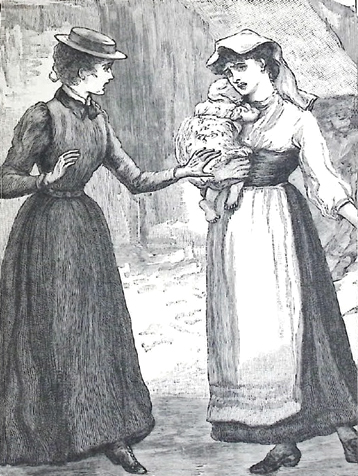
Enid found herself borne along in the stream of persons who quickly gathered together from houses and street corners, and made for the scene of the disaster. But mid-way in the piazza they were met by a number of persons hurrying from the spot, and the excitement was increased by the tidings which these brought.
Enid turned to a man standing near, and learned from him that part of an old house, which was being rebuilt, had fallen, and it was feared that several workmen were buried under the "débris."
"Ah, poor fellows!" she exclaimed, sickening with horror at the thought of their suffering. "They will surely be killed."
The man shrugged his shoulders, not unfeelingly, but by way of expressing his sense of their small chance of escape.
Enid waited some minutes longer, but could learn no more. The crowd was increasing at every instant; but the police had mustered too, and were forcibly preventing the people from approaching dangerously near to the wrecked house. As the pressure grew uncomfortable, Enid was glad to extricate herself from the crowd, and returned home by some of the quieter back streets.
Maud had begun to throw off her invalid habits, and was now well enough to receive visitors. When Enid entered her room, she found Mrs. Dakin with her. That lady greeted Enid very warmly.
"Well, Enid," she said, "I little thought to find you still in Rome on my return; but this has been a sad illness of Maud's. However, it is over now, so we will not speak of it. I tell her she is prettier than ever, with her short baby locks and delicate bloom. But you are not looking well, Enid. I declare you have given your roses to your cousin."
"I never had any to give," said Enid rather bluntly—she disliked the least approach to flattery. "My colour was never anything but a good serviceable brown."
"Well, whatever it was—we will not quarrel as to the shade—you have lost it altogether now."
"I have been rather frightened," said Enid. "Did you hear the noise of that house falling?"
"Indeed we did," said Maud. "It startled me dreadfully. I could not think what it meant till the servant came and told us what had happened. Have you heard any particulars?"
Enid told all she knew. They discussed the accident for some minutes.
Then Maud asked Mrs. Dakin if Miss Amory were with her.
"No, indeed," was the reply. "She is not likely to bestow her company on me just now. She is visiting some of the relatives of her 'fiancé.'"
Then, seeing the girls' astonished looks, Mrs. Dakin added quickly—
"Oh, surely you have not heard and believed that ridiculous report?"
"We were told," said Maud, "that there was a prospect of Miss Amory's becoming your daughter-in-law."
"Oh dear!" said Mrs. Dakin in a tone of quiet exasperation. "I should like to know who has spreading that story amongst my acquaintance. And yet perhaps it is only a natural mistake, for Blanche 'is' going to marry a Mr. Dakin, a cousin of my husband."
"Indeed! How strange that is!" said Maud, highly interested. "It has come about very quickly, has it not?"
"With quite marvellous celerity," said Mrs. Dakin, her brows slightly contracted. Evidently the match was not entirely to her mind.
"Is he nice?" asked Maud.
"He is very rich," said Mrs. Dakin drily, "but otherwise, not the sort of man I should have imagined Blanche Amory would choose."
Enid heard all in silence. She felt convinced that Miss Guy had purposely misled her with respect to Miss Amory's engagement, but it hardly seemed worth while to be angry now. She was half ashamed of the change wrought in her feelings by this explanation of the true state of affairs. It was as if a great weight were lifted off her heart. She dared not look at her cousin—not that she had any fear of what she would see on Maud's countenance, but because she dreaded lest Maud should read her own too truly.
But the talk went on, and apparently neither of the other two observed Enid's silence. Mrs. Dakin had much to relate concerning her visit to London. Tea was brought in, and Enid roused herself, and began to take part in the conversation. The visitor seemed in no hurry to depart, and as she was a charming companion, the girls tried to detain her as long as possible. She had been there nearly an hour when at last she rose to go.
"I shall hope to see you again before long," she said, as she bade Maud good-bye. "Julius must drive me out to Frascati some day. I hope to remain at home till the end of June, if the heat is not too dreadful."
Enid accompanied her to the outer door. As they were saying a final good-bye, another loud report shook the house and jarred all the windows.
Mrs. Dakin uttered a nervous scream. "This is dreadful!" she said. "Another wall must have fallen. It is shameful that such things should occur in Rome! Someone must be very much to blame."
"Oh, I do hope there are no more lives lost," said Enid, pale with dread.
At that moment, Mr. Marian came up the stairs.
"Ah, you have been frightened—and no wonder!" he said, approaching the ladies. "But I think you need not fear that any more persons are injured. They were expecting another portion of the house to fall when I was there just now, and the police were doing their utmost to keep everyone at a safe distance."
"Have they been able to extricate those poor workmen?" asked Enid anxiously.
"Yes; I believe they have got them all out. One poor fellow was killed, and another was so injured that his recovery seems almost impossible. Four of them have been removed to the hospital. The King has been there, superintending the efforts of the rescuers, and even working himself, at considerable risk, in the hope of saving the poor men."
"That is just like him!" exclaimed Mrs. Dakin enthusiastically. "What a noble man he is!"
"Yes, indeed," echoed Enid; "he is a true hero. Rome has some living ones still, though most of her heroes are dead and gone."
"They have passed from earth," said Mr. Marian, "but in a sense they are neither dead nor gone. The spirit of a grand heroic life lives on after the human life is ended, and has its influence on succeeding generations."
Enid hastened away to see if her cousin had been greatly disturbed by the second shock, and Mr. Marian conducted Mrs. Dakin down to her carriage.
Since Maud's illness, and the arrival of Mr. Marian and his wife at the "pension," Enid had not dined at the common table. Mr. Marian had engaged a private sitting-room for his party, and their meals were served to them there. Enid thus missed hearing the eager discussion of the day's alarming incident which went on at Signora Grassi's dinner-table.
Mr. Marian, seeing that all the ladies were excited and perturbed by what had happened, resolutely talked of other things. For Maud's sake, Enid seconded his efforts, but her thoughts continually reverted to the accident. It had produced on her mind a strange sense of foreboding, for which it was impossible to account. She tried hard to appear unmoved, and succeeded, though in truth her nerves were more shaken by the event than were Maud's.
After dinner, Enid went to her room to finish her packing, but presently a restless desire for further news led her into the corridor, and she passed along it till she gained the door of the dining-room.
The dinner was over, but some few ladies still sat at the table trifling with the dessert, and talking with much eagerness. Enid heard their words clearly as she lingered in the shadow of the doorway.
"Poor fellow!" said one. "I should be grieved if he is really dangerously hurt. They say his courage was splendid. He was warned that it was not safe to linger another moment, but he was intent upon saving the man, and would not think of himself."
"What man? I do not understand," said another voice.
"Why, did you not hear what Mr. Archer was telling us about it? It seems that there was a man in a doorway, pinned in by a mass of brick, but almost unhurt. They were working frantically to set him free, and had all but released him, when there was a shout that the wall above was tottering to its fall. Everyone ran back except Mr. Julius Dakin. He 'would' not till he had torn away the last stone and set the man free. Then both ran; but the falling wall caught Mr. Dakin and felled him to the ground."
"Oh, how dreadful! Was he very much hurt?"
"No one knows yet. He was taken up insensible. I should think myself such a blow might be his death."
Enid felt as if she were turning to stone as she listened. She clung to the wall for support, conscious of nothing save a sense of pain and blankness and despair. Suddenly Signora Grassi came along the passage. Enid sprang forward and grasped her with both hands.
"Oh, signora, is it true?"
"Is what true, 'carina?'" she asked, startled by her agitated manner.
"What they are saying about Mr. Dakin? Is he really so seriously hurt?"
"It is true that he has met with an injury. Let us hope it is not so very bad. My dear child, I am sorry you have learned this so suddenly. I forgot that he was a friend of yours."
"Oh, it does not matter about me," said Enid faintly, "only I wanted to know."
She controlled herself with an effort, turned, and walked slowly down the passage. She entered her room again, and sat down on the side of her bed, strewn with articles that she had been about to put into her trunk. Opposite her, gaping open, stood the half-filled trunk. Enid gazed at it with vacant eyes.
"Yes," she said to herself, half aloud, "there are still heroes in the world. He is one too. I always knew there was good in him. But oh! If this should be his—" She could not utter the word death.
Suddenly a mist seemed to float before her eyes. The trunk at which she was gazing swelled mysteriously to vast proportions, and rose towards the ceiling. The room appeared to be turning round. Enid grasped the bedclothes to save herself from falling, then sank backwards till her head rested amongst the dainty collars and cuffs spread out upon the coverlet.
When she came to herself, she was lying at full length upon the bed, from which the things which littered it had been removed. Someone held a bottle of strong smelling-salts to her nostrils, and with the other hand waved over her a palm-leaf fan. Enid looked up, and met the kind, anxious gaze of Mrs. Marian.
"Ah, she is better—she is coming round!" she observed in a low voice.
"What is it?" asked Enid, trying to raise herself. "Why—why, I must have fainted. I never did it before."
"And you must never do it again," said Mrs. Marian smiling. "I am grieved to think that we have let you come to this. We have been thinking so much of Maud that we have forgotten to take proper care of you, my poor child."
"Oh no, indeed; it is not that—it is not your fault at all," said Enid faintly.
"I fear it is; I blame myself very much," replied Mrs. Marian. "How your mother would reproach me if she knew!"
The mention of her mother was too much for Enid at that moment. "Oh, I wish mother were here!" she said, and began to sob.
"Now, don't cry, there's a good child, but drink this, and you'll feel better directly!" said a brisk voice on the other side of her.
And there, to Enid's surprise, stood Miss Strutt with a glass, which she at once held to the patient's lips in a decided fashion it was impossible to resist. Enid drank the cordial, and felt better. She even made a feeble effort to rise, but Miss Strutt at once put her back upon her pillow, saying—
"No, indeed; you will do nothing of the kind. You will please to lie perfectly still whilst I finish your packing. I think I know how to pack as well as you do."
"A great deal better, I have no doubt," said Enid. "But, Miss Strutt—"
She grasped her friend's hand, and drew her close to her, then whispered—"You have heard what has happened?"
"Yes, my dear child, I have heard, and I understand. Oh, you need not mind me. You must not grieve yet, Enid, for I hope it is not so bad as you fear. I have been to the house, and they say that the doctor speaks hopefully. He was stunned, and is still unconscious, and his arm is broken; but they hope there is no more serious injury."
But Enid grew so white as she heard this, that Miss Strutt hastened to add, in a rallying tone, "Come Enid, you must not let a broken arm frighten you! Think what a hero he has shown himself; and remember that a man cannot be a hero for nothing. You ought to be proud of your friend."
A faint flush appeared on Enid's face as her heart thrilled in response to Miss Strutt's words.
"Yes, I am proud of him," she thought, whilst glad tears came to her eyes, and her heart found courage to hope that all would yet be well.
AT THE RUINS OF TUSCULUM
JUNE—a glorious month in Italy—was in its full tide of beauty at Frascati. In Rome the heat was growing unbearable, but fresh breezes still tempered the heat of the sun on the slopes of the Alban Hills, and in the gardens of the villas were many shady nooks in which to pass the hotter hours of the day.
More than a month had gone by since Mr. and Mrs. Marian, satisfied that Maud, with her companions, was likely to do well in her temporary abode at Frascati, had started on their journey back to England. And Maud had been rapidly advancing in health and strength ever since. The strong mountain air wrought wonders for her. She enjoyed the sunshine, the flowers, the glorious prospects of mountains, and plains, and changeful sky, with the strange rapture one feels who has been brought back from the shore of death to find a new preciousness in every simple joy of earth. She developed an amazing appetite, and thought she had never tasted anything so good as the wholesome country fare on which they lived. She slept like a child, not at night only, but in the warm noontide; and her beauty came back to her with somewhat of the bloom of childhood, and a new grace of expression, at which Enid often marvelled. It was as if there were some happy secret written in Maud's eyes.
Enid had not observed this look until after Maud's reconciliation with her father; but since then she had been struck with an increasing change in her cousin. She, who had before been so restlessly energetic, constantly bent upon doing something or having something, and for ever conceiving new projects for the future, was now calm and quiet, content, apparently, to rest in the present and let the future take care of itself.
"She is so gentle and easy to please, that if it were not clear that she is gaining strength, I should be afraid she was going to die," said Enid to herself one day.
Yet it was not apathy which possessed Maud, for she entered heartily into every plan made by the others, and seemed to enjoy each hour as it passed. Enid wondered sometimes if the two or three letters which her cousin had received since her illness from Mr. Sidney Althorp had anything to do with her happy frame of mind; but Maud said little about them, and Enid did not care to question her.
And Enid herself? The change was proving good for her also. Her colour had come back, and the sturdy health she had lost. The terrible pressure of anxiety which, on the eve of her departure from Rome, had threatened to prostrate her utterly, had happily not lasted long. Better and better accounts of Julius Dakin had reached her. He had escaped, almost miraculously as it seemed, without any fatal injury. He was recovering better than could be expected from the shock he had received; and the broken arm was doing well. The last news the girls had of him was that he had removed with his mother from the hot city to a charming villa at Albano.
So Enid was relieved of care on his behalf. Yet her mind was not so calm as her cousin's. She could not rest in the present as Maud did. It seemed as if the restlessness which had left her cousin had entered into her. It irked her to sit for hours in the soft, deep shade of ilexes, even though there opened out before her a lovely landscape, and the sun shone on a foreground of brilliant flowers, with vineyards and olive groves beyond, and the shadows of passing clouds played on the mountain slopes, and far away in the distance the pure, snow-clad peaks of the Apennines rose against the sky.
It was well that Miss Strutt was always there to keep them company. Her spirits never seemed to vary, nor was there any end to her resources for the entertainment of herself and the others. She sketched, she read, she talked and knitted; she taught them games, and after a while, she beguiled Maud into taking up her painting again. And Maud, as Enid had foretold, began to work again with new power and fresh delight, though at the same time with a far humbler opinion of her own ability. She was not too proud now to ask advice of others; and Miss Strutt, without posing as her instructor, managed to warn her of the faults into which she had fallen, and to show her how they might be conquered.
Enid too made several sketches during the long, warm days. In the villas, or amongst the ruins of the ancient city of Tusculum on the hill above, charmingly picturesque subjects were to be found. But Enid was conscious that her interest in her work was not what it should be, and that she was not doing her best. She was vexed with herself that it was so, but could not command the lacking inspiration. Sometimes she felt quite disheartened, and would lay aside her brushes with a sense of disgust at her own weakness. But the restlessness which made it hard to apply herself to anything continued. Was it because Albano was but a few miles away, and there was the chance that any day someone who was staying there might appear at Frascati?
But the days passed on, and nothing occurred to break their even course. Maud was now so well that their return to England began to be talked of as a near possibility. Enid could not understand her feelings as she looked forward. Could it be that she, who had longed so passionately to be once more with her mother and dear ones, now shrank from the prospect of returning to them? No, it was not so; but she could not help feeling that it would be hard, very hard, to go away without seeing once more one who had become a friend to her since she left her home.
One lovely morning the girls and Miss Strutt started forth early, carrying their luncheon with them. They intended to pass the whole day at Tusculum, as they still called the site of the ancient town of which but a few ruins now remain. Miss Strutt had begun a sketch there which she was anxious to finish. Enid and Maud also meant to sketch, and they set out with the idea of being very industrious.
As the distance was rather beyond Maud's walking powers, a strong, sleek donkey had been hired to carry her. She made much fun of her humble steed, and professed that it hurt her pride to mount it.
"'I feel real mean,' as Miss Amory would say," she remarked as they began to ascend the steep, stony road which rises from the piazza of Frascati, and winds upward all the way to Tusculum. "It is a mercy that the tourist season is over, for I would not for the world that any of my acquaintance should see me mounted on this little beast."
"And yet I can assure you that you ride it with great dignity," said Miss Strutt. "She looks rather imposing than otherwise—does she not, Enid?"
"Yes, indeed," replied Enid. "If only that hat were not so dreadfully modern, I should say she looked picturesque."
"I had better take off my hat and drape a blue shawl over my head, like the pictures one sees of Mary on the flight into Egypt," said Maud laughingly. "Did you ever see that picture of Fra Angelica's, at Florence, in which he represents Mary sitting perfectly erect on her donkey, and holding her Babe, also perfectly erect, up high with both hands? I am certain that if any woman attempted to ride a donkey holding a baby in that fashion, she would inevitably fall off, unless indeed she had been trained in a circus."
"I have not seen it." said Enid. "You forget that I have never stayed at Florence. I long to see the Fra Angelicas; they must be so lovely, in spite of such defects."
"They are indeed," said Miss Strutt. "Fra Angelica's mastery of colour was wonderful; and still more striking than his colours are the character, dignity, and sweetness of the countenances he has painted. The errors he made are of trivial importance compared with such results. He lived in such a narrow, secluded way, that of necessity, he knew little of the practical details of life."
"But his life was so beautiful." said Enid. "It was that which made his work what it is."
"You are right," said Miss Strutt. "The gentle holy faces he painted reflected the purity and sweetness of his own heart."
"If that be so," said Maud thoughtfully, "goodness is the greatest thing of all, and art's highest inspiration. And yet how little is thought of goodness in comparison with cleverness! How often one hears it said, 'Oh, So-and-so is a very good man, of course; but—' as if a man's goodness were of no value."
"That is the world's valuation," said Miss Strutt. "But God would have us know that character is the chief thing in human life, and a man's work is the outcome of his character. 'Keep thy heart with all diligence, for out of it are the issues of life.' 'As a man thinketh in his heart, so is he.'"
"Yet some men have done great things who were not good," said Enid.
"True, the fire of genius has been kindled from below, but it does not burn with so pure and bright a flame as that which is drawn from heaven.
"'Every good and perfect gift is from above.'
"Depend upon it that is true of all art. Genius ever rises and falls with character. The life of Michael Angelo, of Raphael, of Giotto, of Andrea del Sarto, all point that moral in various ways."
"If Browning's poem is true," said Enid, "Andrea del Sarto's work was marred by the influence of his wife, who valued his art only because it brought the gold she coveted for the gratification of her luxurious tastes."
"But it is only the very great and strong who can follow 'art for art's sake,'" said Maud half impatiently. "It is natural to want something for oneself—not gold necessarily, but admiration, honour, fame. Most workers desire these."
They had turned into a narrow paved alley, the remains of an old Roman road, which, shaded by thick flexes, was delightfully cool and shady at this hour. Enid did not reply to her cousin's words. She had paused, and was looking back to where the wider road they had quitted gleamed white in the sunshine. Miss Strutt turned to see what was engaging her attention, then said—
"Why, Maud, I am afraid you will not after all escape the gaze of the British tourist. There is a carriage driving along the road behind us, and its occupants have a very English look."
"You don't say so!" cried Maud, looking round in affected dismay. Then she added, with a droll imitation of Miss Amory's accent, "Oh, I guess they're Americans, and they can't drive up this path, anyway."
The carriage passed out of sight. Enid walked on without saying a word. It was growing warm, and the path was steep. No one felt much inclination to talk now.
The carriage road led to a point not far from that at which the bridle-path terminated. So it happened that when Maud, who was in advance of the others, rode round a bend of the path, and the old amphitheatre came in view, she saw a gentleman and lady seated on the broken wall above it. The gentleman came forward, saying merrily—
"Miss Marian, I declare! How charming! Allow me to congratulate you on the idyllic appearance you present."
"Mr. Dakin!" she exclaimed. "Is it really you? I am glad to see you. Yes, indeed, you may laugh at me and my humble steed; but I am very glad to see you, though I was saying just now how sorry I should be to meet any of my acquaintance. Are you better?"
"Oh yes; I am all right now," he answered, though his looks hardly confirmed his words. "And you?"
"I am as well as possible, thank you."
"It delights me to hear you say so," said Mrs. Dakin, advancing. "Indeed, you look quite yourself again—very different from when I saw you last."
At this moment Enid and Miss Strutt came in sight. Julius's eyes had already sought them impatiently. He went forward and greeted them warmly. Enid's colour faded a little as she shook hands with him. It was a shock to her to see him looking so ill. She felt as if she had hardly realised before how seriously injured he had been. But he looked happy enough, nevertheless. There was the same merry laughing look in his eyes.
"Are you really getting strong?" asked Miss Strutt.
"Indeed I am. There is nothing the matter with me now, except the inconvenience of a useless arm," and he pointed to the sling he wore.
"Ah! But he is not good for much yet," said his mother. "He has been wanting to come over here before this, but I dreaded the fatigue of the long drive for him. We drove over last evening, and put up at the hotel. We started out early this morning to find you; but early as we were, you had gone out before we arrived. Your landlady told us of your plans for the day, so we thought we would come and picnic here too."
"How delightful of you!" cried Maud. "There is nothing so nice as an impromptu picnic, and there could not be a better place for one than this."
So this was what became of the day they had meant to devote to sketching. No one save Miss Strutt did any work. They ate their luncheon seated in the cool fragrant shade of a pine grove, looking down through an opening in the trees on a glorious green valley enclosed by purple mountain slopes with snowy peaks above. Afterwards, Maud and Enid, with Julius, leisurely explored the ruins, finally ascending to the summit of the hill, which in the Middle Ages was crowned by a castle, the outline of which may still be traced.
The view from this height is magnificent beyond description. Below lies the broad expanse of the Campagna stretching away to the sea, bounded by the Sabine range on the one hand, and the Alban Hills on the other. Seating themselves in the shelter of the castle rock, the three gazed long on the fascinating scene presented to their eyes. There were clouds in the sky, and changes of weather were visible on the surface of the plain. Sunshine brightened the verdure in one spot, and a dark cloud cast its deep shadow on another. Far away a shower was falling, appearing in the distance like a lovely silvery mist. Below lay the white villas and wooded heights of Frascati; to the left the village of Rocca di Papa crowned its picturesque crag; Monte Cavo rose above; whilst more distant, Castel Gandolfo, Marino, and Grottaferrata were visible. A little beyond Frascati could be seen the old brown buildings of a monastery. A long green avenue led up to it, and presently Enid perceived a lonely figure walking along the path between the trees.
"It is surely a woman," she said. "But how strange for a woman to be walking there alone!"
"You are mistaken," said Julius, looking at it through his field-glass. "It is an old Carthusian monk—one of the few who still remain at the monastery, for their order is suppressed."
"Poor old fellow!" said Maud, taking the glass Julius offered her. "I always feel sorry for them when they are suppressed. How picturesque he looks in his white frock and cowl amongst the trees! I wish he would stay there and let me sketch him."
"Suppose we go and ask him to do so," said Julius rising. "I am afraid it is time we were moving."
So they descended the hill, lingering awhile, however, amongst the ruins at its base. Julius called Enid to look at the remains of a curious old reservoir, and she paused to examine it. Maud, however, did not stay to look at it, and Enid presently became aware that her cousin was many paces ahead of her. She tried to quicken her steps, but Julius seemed indisposed to hurry.
"Let us sit down for a few minutes," he said, pointing to a low, broad stone which lay in the shade of a pine.
Enid glanced at him. He looked tired; she remembered that he was not strong, and sat down.
"You are really getting strong?" she said.
"I have not a doubt of it," he replied.
"I have often thought," she said, "how brave you were to risk your life like that."
"Not at all," he returned; but he looked pleased at her words. "Anyone would have done the same. You certainly would have done it in my place."
"I am not so sure of that," she said.
"I am quite sure of it," he replied. "I believe it was you who made me do it. The thought of you has been like a good inspiration to me ever since I have known you."
Silence followed these words. Julius was feeling in the pocket of his coat. He drew out his pocket-book, opened it, and said to Enid—
"I have something here which I obtained when I was in England. I value it very highly, and I want to show it to you."
"What is it?" asked Enid eagerly. "You have told me nothing about your visit to England."
"No, but I will; and there is a great deal to tell," said Julius. Then he showed her what he held in his hand.
Enid uttered a cry of astonishment.
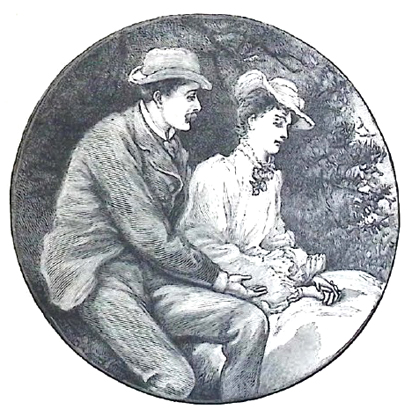
"That!" she cried. "That! How in the world did you get it?"
"I stole it from your sister Alice," he said calmly.
Enid's astonishment was beyond words. He held in his hand an old faded "carte de visite" representing herself and her sister Alice. They had been taken thus together for a freak some time ago. Alice was sitting stiffly on a chair, and Enid knelt beside her. They were posed very awkwardly, and the photography was wretched; yet Enid's likeness was fairly good.
"Alice!" said Enid. "You have seen Alice!"
"Yes, I have seen Alice," he said, "and Clara, and Katie, and May, and Jack, and Cecil."
"You have been to my home?"
"I have indeed," he answered meekly. "I hope you do not object. I wanted very much to make the acquaintance of your father and mother, so I went down to Devonport and called on them. And I must say that they received me very kindly, especially when they learned that I came from Rome, and had but lately seen you."
Then, as he met Enid's wondering look, his manner changed, and he said in a low, tender tone—
"Do you not understand why I wished to see your father? I wanted to confess to him that I had sought to win his daughter's heart. I wanted to obtain his sanction, in case I ever dared to speak to her of my love again. Because—will you be angry with me if I confess it?—I had begun to cherish the hope that you had perhaps mistaken your own heart when you sent me away that day."
He paused, perhaps expecting a reply; but Enid had nothing to say. She sat with her face turned from him. Her manner was not encouraging, but he found courage to ask—
"Don't you want to hear what your father said?"
Enid made a sign of assent.
"He did not seem to like the idea of giving you up to me—I must own that; but he said that if it would be for your happiness, he would not refuse to do so. Enid, have you nothing to say to me? Cannot you give me a little hope?"
Enid had something to say to him, and though her words were few, they were such as made her lover unspeakably happy.
"Enid," he said, a little later, "I have not told you of my plans for the future. Do you know I am going back to England in the autumn? I have promised to work there with my uncle for a year, and do my best to acquire good business habits. After that I shall perhaps come back to help my father at Rome—that is, if I can persuade you to accompany me."
"Oh, not in a year!" said Enid. "Do you think that after being away from home so long I shall be satisfied to stay there only one year?"
"Well, well," he said, "we need not decide that now. I suppose we had better join the others. My mother will be fancying that I have fainted away if I do not soon appear."
"I am afraid," said Enid, "that your mother will think you might have made a better choice."
"Oh, of course," he said, looking at her quizzically. "I might perhaps have won Miss Amory, the rich American heiress, you know." Then in a changed tone added, "You dear one! When my mother knows you better, she will learn that you are worth more than all the heiresses in the world. But there she is, looking for us. We will go and show her how very very well I am."
TWO ARTISTS SPOILED
DR. MILDMAY drove up to the door of his house in Devonport, alighted with extraordinary quickness from his carriage, and hurried up the steps. Opening the door with his latchkey, he entered the house, then paused for a moment in the hall, a little surprised at the quietness which reigned there. He looked into the dining-room. It was empty; but the room bore a festive air. Blossoming plants stood on the window-sills, and the loveliest flowers of summer adorned the table, which was laid for a substantial tea, with a display of good things very tempting to a hungry man.
Dr. Mildmay glanced round for a moment, then returned to the hall. His daughter Alice was descending the stairs.
"Has she not come?" he asked, with rather a disappointed air.
"Not yet; the train must be very late," replied Alice, who had been for the third time to Enid's room, to make sure that all was as it should be, and there was nothing she could add to make the room look prettier and more home-like in the eyes of the returned traveller. "Clara, Katie, and the boys are all gone to the station."
"Then I'll go round there too," said the doctor, turning to the house-door.
"Take care you do not miss her on the way," cried Alice; but her father was already in his carriage.
A door behind Alice opened, and Mrs. Mildmay, with a flushed, excited face, looked forth.
"Was that your father?" she asked.
"Yes, he was here," Alice said; "but he has driven off to the station now."
"Ah, well, it is better!" returned Mrs. Mildmay. "Men never like to sit still and wait."
She looked as if such an attitude were not easy to herself. Alice knew that her mother had been constantly on the move for the last half-hour, and she feared she would excite herself into one of her nervous headaches if Enid did not soon appear.
"If they should have started from the station and come by the new road, father will miss them," said Alice, "for he always prefers the old way."
At that moment, her ears caught the sound of a vehicle drawing up before the house. She flew to the door, and there stood a cab loaded with luggage, and Enid's happy face was at the window. The doctor's carriage drove up almost at the same instant. He had seen the cab, and had driven after it.
So the hour for which Enid had so often longed had come at last, and she was at home once more. Her mother held her as if she would never let her go from her again. There was nought but joy in the reunion for Enid; but in her mother's heart was a painful sense that her child had only come back to her for a time, and she felt how hard it would be to give her away even to the best of husbands. But mothers have to endure such trials, and they bring their compensations. Mrs. Mildmay was not too selfish to rejoice in the prospect of a happy future for her child. As for her brothers and sisters, they could not make enough of Enid on her arrival. She had become a heroine in their eyes from the day she started on her travels, and her betrothal to a Roman gentleman seemed a fitting culmination to her fortunes.
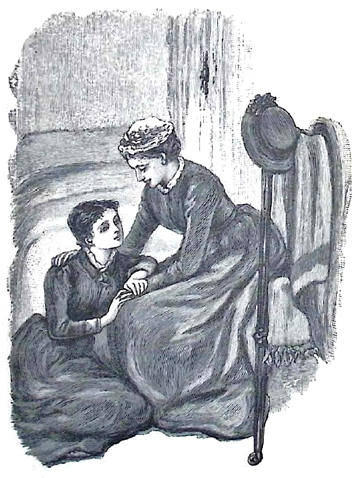
As they crowded around her, asking questions which it was impossible to answer because they would all talk at once, Enid had a fleeting sense of pity for Maud Marian, who missed so much through being an only child.
"Enid, Enid, did you see the Pope?"
"Can you speak Italian, Enid?"
"How many pictures have you painted?"
"Do tell us what the Queen looked like when she spoke to you!"
"Is it true that in Italy everyone eats macaroni?"
"Did you see the Colosseum by moonlight?"
"Can Mr. Dakin use his arm yet? When is he coming here again, and shall we have to call him Julius?"
"You had better wait till he comes, and ask him what he thinks about it," said Enid laughingly, in reply to this last question.
Then her father interposed, and said that Enid was tired, and they must not ask her any more questions till she had had her tea.
There was not much quiet for her, however, till the younger ones had been sent to play in the garden, and Enid, accompanied by her mother, withdrew to her own room, ostensibly to attend to the unpacking of her trunk, but in reality that they might have the confidential talk for which each was longing. Though Enid's letters had been long and full, they had not satisfied her mother's heart. She too had many questions to put, for there were various things she wished to have explained. Together they reviewed the course of the past nine months, and each had much to tell.
"You found your cousin a little difficult to get on with at first?" said Mrs. Mildmay.
"Well, yes, I did," said Enid frankly. "As you warned me, she was somewhat of a spoiled child; but she is so very different now that I do not wish to remember anything about that. Indeed, it was in a great measure my own fault that we fell out sometimes. If I had had more patience, it need not have happened."
"Enid, I have wondered many times—you will not mind my asking you?—why it was you refused Julius Dakin the first time he asked you to be his wife. Were you afraid that your father and I would not approve?"
"No; it was not that, mother."
"You did not know your own heart?"
Enid shook her head, colouring deeply.
"You did not know of anything against him?" There was latent anxiety in Mrs. Mildmay's tone.
"No, mother; I always liked him from the first time I saw him. I used to think he was not manly enough; but I know now that I was mistaken. Still, it was not on that account that I refused him—it was because of Maud."
"Because of Maud!" repeated Mrs. Mildmay, in a tone of astonishment.
"Yes," said Enid; "it was foolish of me, but I fancied that Maud cared for him. And, indeed, she has told me since that she was greatly attracted by him; but it was not such a serious affair as I imagined. We were so much with the Dakins; I thought she would feel it so."
"And you gave him up for fear of hurting Maud's feelings? My dear, I cannot think you were justified in acting so. Were not his feelings to be considered in the matter? You ought to have remembered that it was not your own happiness alone that you sacrificed for the sake of Maud. Though it was noble of you, child—not many girls would have done it."
"Oh, mother, you must not say that! My motives were far from noble. You do not know all that had gone before. Maud had said things about Julius which had stung me sorely. I think pride moved me to some extent. I was very sorry about it afterwards, and yet I never felt that I could have acted differently."
"Well, all's well that ends well," said Mrs. Mildmay cheerfully. "It made me proud to hear how Julius spoke of you, Enid. He said you had saved him from the misery of a useless, wasted life."
"Did he say that?" exclaimed Enid, colouring. "Oh, mother, I don't think it was just my doing!"
"He said so," returned Mrs. Mildmay. "He told us he used to be an idle, good-for-nothing fellow; but he had determined to take a fresh start, and make himself a good man of business, in order that he might help his father, who is beginning to feel his burdens of responsibility weigh heavily on him. But if he becomes a good man of business, as I believe he will, he will not be a mere business man."
"I hope not," said Enid fervently. "Oh, what a solemn thing life is! I have felt that so much since Julius and I have belonged to each other. It almost frightens me to think what influence we may exert on the life of another for good or for evil."
"Yes, indeed," said Mrs. Mildmay. "Our personal influence is a great talent entrusted to us, which we can only use aright by the help of Him who gave it. When I think of the tremendous consequences that may depend on the way we shape our lives, I wonder at those who are content to live as if life were given to us only for our own entertainment."
"And there is always so much sorrow in the world," said Enid, thoughtfully. "I told you about Miss Strutt, mother, in my letters."
"Yes, dear; I remember—the poor little Scotch artist who has known so many troubles."
"And has borne them so bravely," said Enid. "Her worst trouble is over now. When we were at Florence, she was summoned to Edinburgh to see her brother. There was a change in him, and the doctors at the asylum thought he would not live much longer. She travelled night and day to reach him ere he passed away, and she arrived in time. His reason came back to him for a brief interval before he died, and he knew her, and uttered her name. She wrote and told me all about it. She is so thankful that she saw him calm and peaceful, and that he is now at rest."
"Poor little woman, she well may be!" said Mrs. Mildmay. "That was a terrible trial."
"Yet, in spite of all she has suffered, Miss Strutt is one of the best women I have ever met. You would think that such troubles as hers might well make her gloomy and bitter; but they seem to have had quite the contrary effect. You cannot think how good and unselfish she is."
"I am sure, from what you have told me of her, that she must be very unselfish. I should like to know her."
"I hope you will some day. If—as seems probable—my home, at some future time, will be in Rome, you will have to come and see me there. Oh, you need not shake your head! I mean to show you the Forum, and the Colosseum, and the Palaces of the Cæsars, some day."
Mrs. Mildmay's face brightened at the idea, but she shook her head.
Just then there was a tap at the door, and Alice's voice asked permission to enter.
"Have you finished unpacking?" she asked, as she came in.
"I have not even begun to unpack," said Enid.
"I thought as much," returned Alice, briskly. "I knew you would not do anything till I came."
She attacked the trunk at once, and began lifting out the things.
"What is this?" she asked, as she came upon a soft, thick bundle, striped in many colours.
"That is a Roman blanket," said Enid. "I brought it for mother."
"The very thing!" exclaimed Alice, whilst Mrs. Mildmay uttered warm thanks. "It will do to cover her when she lies down, and if we arrange it along the sofa when it is unoccupied, it will hide how shabby the covering is."
"The colours are lovely," said Mrs. Mildmay.
"There are all sorts of lovely things to be bought in Rome," said Enid. "I wish you could have seen the draperies Maud bought for her studio."
"Oh, I do want to see the Studio Mariano!" cried Alice. "Do you think Maud would be willing to take me as her companion when she goes to Rome again?"
"You know you would not go if she asked you. However, she is not likely to go there again—at least, not to remain any length of time."
"Not go again!" repeated Alice, in surprise. "Do you mean to tell me that she is content to live at home with her stepmother?"
"Yes, for a little while—until she goes to a home of her own."
"A home of her own!" exclaimed Alice. "Is she too going to be married?"
"She is," said Enid, enjoying her sister's astonishment. "I thought it would be so; but she only told me late last night. Indeed, I believe it was only settled yesterday."
"And who is the happy man?"
"Mr. Sidney Althorp."
"Why, that is the man you said she disliked so much because he was always finding fault with her!"
"Even so," said Enid, smiling; "but I doubt whether she ever really disliked him. I am sure he had always a strong influence over her, though she tried hard to resist his influence. I think it was because she cared for him that she resented his hinting at her faults."
"I don't know about that," said Alice. "I think I should dislike a man who was always finding fault with me. Pray, does Julius find fault with you?"
"I cannot say that he does," replied Enid, blushing. "But men are different, you know."
"And women, too, if there are some who can like those who find fault with them," said Alice.
"But he did not find fault with her for the sake of finding fault," said Enid; "it was because he cared for her so much, and believed in her, that he ventured to tell her of her faults. She must have felt that all along."
Alice shook her head. She could not see that that made any difference.
"When Maud was recovering from her illness, I began to see that her heart was turning towards Sidney Althorp. She spoke of him in a different way. But Maud is very proud; she will not show her feelings if she can help it. I wish you could have heard the way in which she told me of her engagement, half pretending that she did not greatly care for Mr. Althorp, but had accepted him for the sake of getting away from her stepmother. And yet I really believe she is beginning to love Mrs. Marian. What is the matter, Alice? You look quite disturbed."
"Indeed, I have received a shock!" wailed Alice. "Oh dear! Oh dear! Two artists spoiled, and the Studio Mariano a thing of the past!"
THE END
OXFORD: HORACE HART, PRINTER TO THE UNIVERSITY