Fig. I.
Title: Technique of modern tactics
Author: P. S. Bond
Michael Joseph McDonough
Release date: February 4, 2026 [eBook #77863]
Language: English
Original publication: Menashs: George Banta Publishing Co, 1919
Other information and formats: www.gutenberg.org/ebooks/77863
Credits: Brian Coe and the Online Distributed Proofreading Team at https://www.pgdp.net (This file was produced from images generously made available by The Internet Archive)
A STUDY OF TROOP LEADING
METHODS IN THE OPERATIONS
OF DETACHMENTS OF ALL ARMS
BY
P. S. BOND
Major, Corps of Engineers, U. S. Army,
AND
M. J. McDONOUGH
Major, Corps of Engineers, U. S. Army.
THIRD EDITION, REVISED AND ENLARGED
Adopted by the War Department as a preparation for the War College; Bulletin 4, War Department, 1915.
Adopted by the War Department as a text for garrison schools and in the examination of officers for promotion. For issue to organizations of the Army and the Militia; Bulletin 3, War Department, 1914.
Adopted by the War Department as one of the books recommended by the Division of Militia Affairs for the use of the Organized Militia. Circular No. 3, Division Militia Affairs, War Department, 1914.
Adopted as a text for the garrison course for all officers of the Marine Corps—Orders No. 18, 1914, U. S. Marine Corps.
Adopted as a text for use in the Marine Officers’ School, Norfolk, Virginia.
Adopted as a text for use in the Coast Artillery School, Fort Monroe, Virginia.
Recommended for study and reference in the National Guard Division of New York; G. O. 4, 1914, Headquarters Division, N. G. N. Y.
Used as a reference at the Army Service Schools, Fort Leavenworth, Kansas.
For sale by Book Department, Army Service Schools, Ft. Leavenworth, Kan., by the U. S. Cavalry Association, Ft. Leavenworth, and by the publishers.
The Collegiate Press
George Banta Publishing Company
Menasha, Wisconsin
Copyright 1916
by
P. S. BOND
The cordial reception that has been accorded this volume by the Army, the Marine Corps, the National Guard, Military Schools, Training Camps, etc., has made necessary a second and third editions. The present edition embodies the essential modifications contained in the 1914 F. S. R., and the act of June 3, 1916.
The chief reason leading to the publication of the volume in the first instance was the authors’ belief that the excellent instruction given at the Leavenworth Schools should be disseminated to the widest extent practicable among all those in the United States who are charged with preparation for the active physical defense of the nation. To assist in such an extension of military education, there seemed a need for a volume which would collect and make available within a small compass, the fruits of the study, observation, and experience of those officers who have unceasingly devoted themselves to the improvement of American tactical training.
It is well that the traditional indifference of the American people toward military preparedness is in this day being rudely disturbed. Fate has hitherto been lenient to the growing American nation. It has not demanded the full or the logical forfeit proportionate to the laxity displayed by us in meeting former crises. In the Revolution, fate was indeed kind to the Colonists. In the War of 1812 it awarded us greatly more than our efforts merited, and seemed to overlook the pitiful inefficiency of our land forces. At sea the brilliant series of naval exploits was made possible only by the unfaltering determination of the naval chieftains serving under a supine administration that desired to lock up the navy in home ports. In the Mexican War, in permitting us to conduct two campaigns without the loss of a single battle, and in spite of a woeful deficiency in men, in equipment, and in administrative support, fate was more than indulgent.
In the Civil War fate did not assess the full retribution of disruption of the Union, which it might logically have done, but it did exact for our neglect of preparation an immense payment in blood and treasure. This indulgence of fate may be not wholly a kindness. To the extent that it violates justice, it merely postpones the final reckoning and tends to lull its recipient into a false sense of national security, resulting from unearned success. The nation has not yet experienced the chastening discipline of defeat. In the future, therefore, we must not be surprised when full compensation is exacted if, as an adult people, we continue to misread the true import of history and persist in our traditional negligence.
A people may not logically assume great responsibilities without making timely provision for the discharge of those responsibilities. Sooner or later an exact accounting will be had. History shows many examples of nations which have paid the price of their neglect. Despite the hopes of Utopians history shows that human nature undergoes no progressive change, and it shows to the present day no substantial diminution in the frequency of wars.
That our people are beginning to manifest an intelligent interest in the condition of the National defense cannot fail to be gratifying to those whose lives are consecrated to such defense. Such interest is a vital support and an inspiration to the defenders. It is hoped that this volume may be of assistance in guiding to some extent the awakening interest.
In the first edition the subjects of air craft and motor vehicles were not treated, because although it was recognized from the outset that these machines would exert a very great influence upon the conduct of war, their tactics was at the time largely speculative. Such is not the case today.
CONTENTS
| CHAPTER | PAGE | |
| Introduction | 5 | |
| Organization of the U. S. Army. | ||
| Road distances and camp areas | 10 | |
| I | The preparation and solution of tactical problems. | |
| Bibliography | 19 | |
| II | Field orders | 37 |
| III | Patrolling | 45 |
| IV | Advance guards | 56 |
| V | Rear guards. Flank guards | 70 |
| VI | Marches, Change of direction of march, | |
| Camps and bivouacs | 83 | |
| VII | Convoys | 95 |
| VIII | Artillery tactics | 109 |
| IX | Cavalry tactics | 144 |
| X | Outposts | 170 |
| XI | Combat. Attack and defense | 204 |
| XII | Organization of a defensive position | 248 |
| XIII | Combat-Attack and defense of a river line, Withdrawal | |
| from action, Rencontre or meeting engagement, | ||
| Delaying action, Pursuit, Night attacks, | ||
| Machine guns | 277 | |
| XIV | A position in readiness | 308 |
| XV | Sanitary tactics | 318 |
| XVI | The rifle in War | 324 |
| XVII | Division tactics and supply | 337 |
| XVIII | Air craft and Motor vehicles in War | 381 |
| Glossary | 393 | |
| Index | 405 |
LIST OF PLATES
| Figure | Facing Page | |
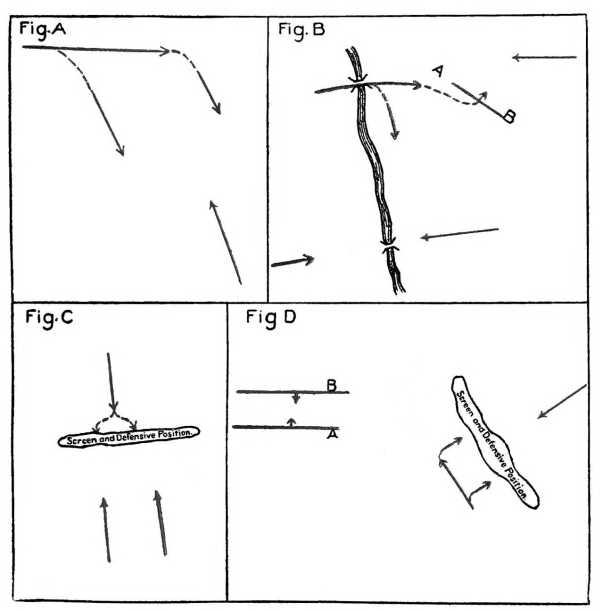
| I | Diagrammatic analysis of tactical problems | 31 |
| II | Typical arrangements of a convoy on the march | 104 |
| III | Typical arrangements of a convoy on the march | 107 |
| IV | Battery of artillery on the march | 126 |
| V | Trajectories and cones of dispersion of shell | |
| and shrapnel | 134 | |
| VI | Heavy field artillery in action | 135 |
| VII | Cavalry mounted attack diagrams | 163 |
| VIII | Diagram of an outpost | 195 |
| IX | Infantry attack diagrams | 219 |
| X | Standard field trenches | 265 |
| XI | Illustrating Problem No. 1, Field Fortification | 274 |
| XII | Illustrating Problem No. 2, Field Fortification | 276 |
| XIII | Regimental sanitary troops in battle | 320 |
| XIV | Diagram illustrating the evacuation system of | |
| the medical department | 322 | |
| XV | A division on the march | 342 |
| XVI | Camp of a division | 358 |
| XVII | Diagram showing movements of the supply and | |
| ammunition trains of a division during a march | 368 | |
| XVIII | Outline of the system for supplying an army | |
| in the field | 375 | |
| Page | |
| INTRODUCTION | 5-9 |
| ORGANIZATION OF THE U. S. ARMY. |
|
| ROAD DISTANCES. CAMP AREAS | 10-17 |
| CHAPTER I |
|
| THE PREPARATION AND SOLUTION OF | |
| TACTICAL PROBLEMS | 18-36 |
| PRINCIPLES GOVERNING THE SOLUTION OF | |
| TACTICAL PROBLEMS (table) | 18 |
| THE APPLICATORY SYSTEM OF MILITARY INSTRUCTION | 19 |
| Kinds of problems. Map problems, terrain exercises, war games, | |
| tactical walks and rides, field maneuvers | 19-20 |
| Problems of decision | 19 |
| Troop leading problems | 19 |
| Limitations of terrain exercises | 19 |
| General form and details of tactical problems | 20-21 |
| General and special situation | 20 |
| Estimate of the situation | 21-22 |
| The mission | 21-22 |
| General and special assumptions | 22-23 |
| Use of maps | 23 |
| Visibility problems | 24 |
| Principles of the Art of War | 24 |
| Military responsibility and the peace training of officer | 24-25 |
| Mental processes and methods in the solution | |
| of tactical problems | 25-28 |
| Independent solutions. Personality of the author | 26-27 |
| Simplicity of plan | 27 |
| Advantages of the initiative | 27 |
| Reviews of solutions | 27-28 |
| Apparatus required | 28 |
| DIAGRAMMATIC ANALYSIS AND SYNTHESIS | 29-31 |
| SUGGESTIONS FOR THE PREPARATION OF PROBLEMS | 31-33 |
| BIBLIOGRAPHY | 33-36 |
| CHAPTER II |
|
| FIELD ORDERS | 37-44 |
| Forms for orders. Verbiage of orders, how acquired | 37-38 |
| Administrative and routine matters | 38 |
| What to include in orders | 38-39 |
| Detailed instructions usually inadvisable | 38 |
| KINDS OF ORDERS—verbal, written, dictated, | |
| individual, combined | 39 |
| STRUCTURE OF ORDERS | 39-40 |
| The 5 paragraph form. Contents of numbered paragraphs | 39-40 |
| Marginal distribution of troops | 40 |
| Map references. Signature | 40 |
| Transmission of orders. Receipts for orders | 40 |
| Simple English. Short sentences. Arguments and | |
| discussions. Ambiguity | 40 |
| Abbreviations. Description of localities | 41 |
| Amount of information contained in an order | 41-42 |
| Plan of the commander. Good and bad news | 41 |
| Trespassing upon the province of a subordinate | 42 |
| Division of responsibility with a subordinate | 42 |
| Equivocal language | 42 |
| Discussion of contingencies | 42 |
| Advantages of combined orders | 42 |
| Copies of dictated orders | 42 |
| Proper time for the issue of orders | 42-43 |
| PRELIMINARY OR PREPARATORY ORDERS. Assembly orders | 43 |
| Time required for preparation and circulation of orders | 43-44 |
| Motor cars and motorcycles | 44 |
| Consonance of orders and plans. Minor details | 44 |
| Duty of staff officers in the preparation of orders | 44 |
| CHAPTER III |
|
| PATROLLING | 45-55 |
| CLASSIFICATION OF PATROLS | 45 |
| COMPOSITION AND STRENGTH. Commander | 45 |
| Mounted and dismounted patrols. Auto patrols | 45-47 |
| Functions of mounted orderlies | 46 |
| Cavalry and aeronautical services | 47 |
| Motor cars for patrolling | 47 |
| INSTRUCTIONS GIVEN PATROL LEADER | |
| BEFORE THE START | 47-48 |
| ACTION TAKEN BY THE LEADER BEFORE THE START | 48-49 |
| Preliminary arrangements, equipment, inspection of patrol, etc. | 48-49 |
| CONDUCT OF PATROL | 49-55 |
| Formations. Gaits | 49-50 |
| Routes. Reconnoitering | 50 |
| Advance by “successive bounds” | 50 |
| Woods and defiles | 50 |
| Detachments from the patrol | 50 |
| Houses, villages and inclosures. Rendezvous | 50 |
| Corrections to maps | 50 |
| Watering the horses | 50 |
| Civilians preceding patrol | 50 |
| Combats—when justifiable | 51 |
| Prisoners | 51 |
| Lookout points. Halts. March outposts | 51 |
| Hostile patrols. Conduct in case of attack, etc. | 51 |
| Exchange of information with friendly patrols | 51 |
| Signs of the enemy | 52 |
| Accomplishment of the mission | 52 |
| Main and secondary roads | 52 |
| Interviewing inhabitants. Bivouac of patrol | 53 |
| Hearsay evidence | 53 |
| MESSAGES. How transmitted. Relay posts | 53-54 |
| Form and contents of messages | 54 |
| WHAT TO REPORT | 54-55 |
| Prompt transmission of information | 54 |
| First certain information of enemy | 54 |
| Final reports | 55 |
| Negative messages | 55 |
| Use of telegraph and telephone | 55 |
| CHAPTER IV |
|
| ADVANCE GUARDS | 56-69 |
| STRENGTH AND COMPOSITION | 56-58 |
| Advance guards of various organizations | 56 |
| Machine guns | 56 |
| Mounted men. Advance guard cavalry. Duties | 56 |
| Engineers. Signal and sanitary troops | 56-58 |
| Artillery. Field trains | 57-58 |
| Splitting organizations to form advance guard | 57 |
| Leading troops | 57 |
| Removal of obstacles to the march | 58 |
| THE START—DETAILS OF. Initial point | 58 |
| Route of advance guard | 58 |
| Outpost troops and cavalry | 58 |
| Assembly of field trains | 58 |
| Assembly in column of route. Elongation | 59 |
| ASSEMBLY ORDER | 59 |
| Calculations of times of starting for various organizations | 59 |
| Interference of routes | 59 |
| Subdivisions of advance guard | 60 |
| DISTANCES. How regulated | 60 |
| Cavalry advance guards | 60-63 |
| RECONNAISSANCE | 60-62 |
| Duty of cavalry. Independent and advance cavalry | 60-62 |
| Parallel roads | 61 |
| Flank guards | 61 |
| Mounted point | 61 |
| Method of “offset patrolling,” by infantry | 61 |
| Connecting files | 61 |
| Operations of advance cavalry | 61-62 |
| Communication with neighboring troops | 62 |
| Important features of the terrain | 62 |
| Places of advance guard and supreme commanders | 62 |
| March outposts | 62 |
| Control of means of communication | 62 |
| Civilians not to precede advance guard | 63 |
| Conduct of advance guard on meeting the enemy | 63 |
| Passage of bridges and defiles | 63 |
| OUTLINE OF SOLUTION OF SMALL ADVANCE | |
| GUARD PROBLEMS | 64 |
| EXAMPLES OF ADVANCE GUARD ORDERS | 65-69 |
| CHAPTER V |
|
| REAR GUARDS. FLANK GUARDS | 70-82 |
| STRENGTH AND COMPOSITION OF REAR GUARDS | |
| IN RETREAT | 70-72 |
| Rear guard on a forward march and in retreat | 70 |
| Delaying actions | 70 |
| Reinforcements of rear guard | 70 |
| Outpost troops | 70 |
| Infantry. Cavalry. Artillery | 70-71 |
| Use of motor cars in retreat and pursuit | 71 |
| Engineers—duties in retreat | 71 |
| Machine guns. Signal and sanitary troops | 71 |
| Field trains | 71 |
| Subdivisions of rear guard | 71 |
| Tactical employment of cavalry | 72 |
| DISTANCES—HOW REGULATED. Progress of main body | 72 |
| CONDUCT OF REAR GUARD | 72-75 |
| Contact with enemy. Observation of routes adjacent to line | |
| of march or retreat | 72 |
| Covering the main body | 72-73 |
| Delaying actions of a rear guard | 73 |
| Reinforcement of rear guard | 73 |
| Requirements of a delaying position | 73-74 |
| Use of cavalry, artillery and machine guns in delaying the enemy | 73-74 |
| Withdrawal of outpost | 73 |
| Masking the fire of the delaying position | 73 |
| Use of flank positions for delaying the enemy | 73 |
| Security of line of retreat from delaying position | 73 |
| Advantages of a single determined stand | 74 |
| Keeping rear guard in hand. Simplicity of movements | 74 |
| Latitude allowed rear guard commander | 74 |
| Special patrols from main body | 74 |
| Flank detachments | 74-75 |
| Retreating upon the front of a defensive position | 75 |
| Offensive tactics by rear guards | 75 |
| Supreme commander with rear guard | 75 |
| EXAMPLE OF RETREAT ORDER | 75-77 |
| STRENGTH AND COMPOSITION OF FLANK GUARDS | 78-79 |
| Movements in two columns | 78-79 |
| Cavalry, artillery, machine guns, signal and sanitary troops | |
| and field trains with a flank guard | 78 |
| Wagon trains, routes and escorts. Double column | 78-79 |
| FLANK GUARDS-WHEN REQUIRED | 79-80 |
| Considerations influencing the decision as to use of a flank guard | 79 |
| Examples of use of flank guards | 80 |
| Flank guards with large and small forces | 80-81 |
| Distance between flank guard and main body, obstacles and | |
| communicating routes | 80-82 |
| Convoys, armored autos, auto transport for escort | 80 |
| Cavalry flank guards | 81 |
| CONDUCT OF FLANK GUARDS | 81-82 |
| Formation | 81 |
| Reconnaissance on exposed flank. Contact with enemy | 81 |
| Duty of cavalry with a flank guard | 81 |
| Bringing on a decisive engagement | 81 |
| Communication with other troops. | |
| Relation of flank guard to rear guard | 81-82 |
| Reinforcement of flank guard | 82 |
| Latitude allowed flank guard commander | 82 |
| CHAPTER VI |
|
| MARCHES. CHANGE OF DIRECTION | |
| OF MARCH. CAMPS AND BIVOUACS | 83-94 |
| ARRANGEMENT OF TROOPS ON THE MARCH | 83-84 |
| Marches in peace time | 83 |
| Intermingling of foot and mounted troops | 83 |
| Auto truck trains | 83 |
| Artillery and trains. Protection of long columns of wagons | 83 |
| Handling of trains on the march | 83-84 |
| Separation of trains and troops | 84 |
| Passage of defiles | 85 |
| Alternation of organizations in column on successive days | 85 |
| Advance guards, rear guards and leading troops | 85 |
| Distribution of troops in camp. Camping in column | 85 |
| Independent mission for cavalry. Prospects of combat, | |
| and tactical use of cavalry | 85 |
| Place of the supreme commander | 85-86 |
| Distances between elements in a flank march | 86 |
| TIMES OF STARTING FOR FOOT AND MOUNTED | |
| TROOPS AND TRAINS | 86-87 |
| Early starting | 86 |
| Late arrivals in camp | 87 |
| Night marches | 87-89 |
| Movements by rail | 87 |
| Movements by motor car | 87 |
| TABLE OF TIMES OF SUNRISE AND SUNSET | 88 |
| MANNER OF STARTING THE MARCH | 88-89 |
| Initial point | 88 |
| Regulation of march. End of a day’s march | 89 |
| LENGTH AND SPEED OF MARCHES | 89-90 |
| Forced marches. Marches by green troops. | |
| Progressive increase in length of marches. | |
| Marches by large and small bodies | 89 |
| Halts | 89 |
| Days of rest | 89 |
| Speed of infantry, mixed troops, artillery and trains | 90 |
| TABLE OF RATES OF MARCH OF DIFFERENT ARMS | 90 |
| Elongation | 90 |
| Limiting depths of fords | 90 |
| Selection of route | 90 |
| Effects of temperature on marching troops | 91 |
| Artillery and trains in double column | 91 |
| CHANGE IN DIRECTION OF MARCH | 91-92 |
| Reasons for change of direction. | |
| “Marching to the sound of the guns” | 91 |
| “Containing” a hostile force | 91 |
| Manner of changing direction. Use of a flank guard | 91-92 |
| Safety of trains in changing direction | 92 |
| EXAMPLE OF ORDER FOR CHANGE OF DIRECTION | |
| OF MARCH | 92-93 |
| CAMPS AND BIVOUACS | 93-94 |
| When to bivouac | 93 |
| Time of issue of halt order. | |
| Arrangements for distribution of troops in camp | 93 |
| Requirements of a camp site | 93-94 |
| Assignment with reference to convenience of arrival | |
| and departure. Camping in column | 94 |
| Use of buildings for shelter. Billeting | 94 |
| CHAPTER VII |
|
| CONVOYS | 95-108 |
| Definition of convoy | 95 |
| Vulnerability of a convoy. Limit of size. Straggling | 95 |
| Flank marches by convoys. Moving trains on separate road | 95 |
| General rule for position of covering troops | 95 |
| Subdivisions and dispositions of escort | 95-96 |
| Motor convoys | 96 |
| ARRANGEMENTS FOR THE MARCH | 96-97 |
| Division of wagon train into sections | 96 |
| Classification of wagons-army, hired, impressed | 96 |
| Teamsters and wagonmasters | 96 |
| Order of march | 96 |
| Field train of escort | 96 |
| Police guards, infantry and cavalry | 96-97 |
| Duties of quartermaster in charge of wagons | 96-97 |
| THE ESCORT | 97-100 |
| Commander. Duty of escort | 97-98 |
| Strength and composition of escort | 98-100 |
| Infantry, cavalry, artillery, machine guns, engineers | 98 |
| Motor transport for escort. Armored cars. | |
| Motor cars in pursuit of a convoy | 98 |
| DISTRIBUTION AND DUTIES OF TROOPS | 98 |
| Subdivisions and relative strengths | 98-99 |
| Reconnaissance. Dispersion of fighting force | 99 |
| Position of main body of escort | 99 |
| Infantry in middle of a long column of wagons | 99 |
| Police guards | 99 |
| Advance cavalry and scouting parties | 99 |
| Mounted and dismounted point | 99 |
| Establishing contact with friendly troops in direction of march | 99 |
| Selection of defensive positions and camp sites | 99 |
| Engineers | 99 |
| Flank guards | 99-100 |
| Method of employing the cavalry of the escort | 100 |
| Rear guards. Strength, position, duties | 100 |
| Routes available for the march. Considerations governing the | |
| selection of route. Topography | 100-101 |
| Rate of progress and halts | 101 |
| Position and movements of the enemy | 101 |
| Defensive measures to be adopted. Lines of retreat. | |
| Alternative routes | 101 |
| Localities favorable for the attack of a convoy | 101 |
| Change of direction of march. Precautions | 101-102 |
| Parking the convoy for the night. Measures for the | |
| security of the camp | 102 |
| Change of route in moving back and forth | 102 |
| CONDUCT ON ENCOUNTERING THE ENEMY | 102-103 |
| Halting or parking the convoy prematurely | 102 |
| Localities favorable for defense | 102 |
| Details of defensive operations. Messages to | |
| adjacent friendly troops | 102-103 |
| ATTACK OF A CONVOY | 103 |
| Cavalry, armored cars | 103 |
| Obstacles. Ambuscades | 103 |
| Usual method of attack | 103 |
| Damaging the convoy by long range fire | 103 |
| CONVOYS OF PRISONERS. Strength of escort. Conduct | 104 |
| EXAMPLE OF ORDER FOR THE MARCH OF A CONVOY | 107-108 |
| CHAPTER VIII |
|
| ARTILLERY TACTICS | 109-148 |
| MATERIEL OF LIGHT FIELD ARTILLERY, U. S. ARMY | 109-110 |
| Subdivisions of a battery | 109 |
| Signal equipment. Ammunition | 109 |
| Description of carriage and sights. Weights behind the teams | 109-110 |
| Front covered by fire of a battery | 110 |
| DISPOSITIONS OF ARTILLERY ON THE MARCH. | |
| Combat trains. Field trains. Protection of long columns | 110 |
| Usual dispositions of battery and combat trains in action | 110 |
| Concealment from hostile observation | 110-111 |
| DUTIES OF ARTILLERY PERSONNEL. Artillery commander. | |
| Regimental commander. Battalion commander. | |
| Battery commander. Lieutenants. Reconnaissance officer. | |
| Sergeants and corporals. Scouts, signalers, agents | |
| and route markers | 111-113 |
| Artillery officers with supreme commander and with advance guard | 113 |
| KINDS OF FIRE. Masked and unmasked fire. Defilade. Fire for | |
| adjustment, demolition, registration and effect. Direct | |
| and indirect laying. Salvo fire, continuous fire, volley | |
| fire and fire at will. Time fire and percussion fire. | |
| Area of burst of shrapnel. Fire at single and at successive | |
| ranges, sweeping fire | 113-116 |
| Individual and collective distribution. Adjustment | 116 |
| Firing data. Aiming point | 116 |
| OBSERVATION AND CONTROL OF FIRE | 117-118 |
| Post of officer conducting the fire | 117 |
| Battery commander’s station and auxiliary observing | |
| stations. Location | 117 |
| Aiming points. Location | 117-118 |
| TACTICAL EMPLOYMENT OF FIELD ARTILLERY | 118-128 |
| Covering the front of a defensive position | 118 |
| Considerations governing the dispositions of artillery in attack | 118-120 |
| Position in interval between frontal and enveloping attack. | |
| Position on the flank | 120 |
| Ranges in attack and defense | 120 |
| Mission of the artillery | 120-121 |
| Operations of attacker’s artillery during the combat | 120-121 |
| Dispositions and employment of artillery in defense. | |
| Dagger batteries | 121-122 |
| Advantages enjoyed by defense | 121-122 |
| Firing over heads of friendly troops | 122 |
| Movements to position | 122 |
| Supports for the artillery. Machine guns | 122 |
| Positions and duties of artillery. By whom prescribed | 122 |
| Positions “for immediate action,” “in observation,” and | |
| “in readiness.” Subdivision for action | 122-124 |
| Positions of field and combat trains. Communication | 123 |
| Subdivision of battalions and batteries | 123 |
| Grouping of artillery. Fire control | 124-125 |
| Artillery “reserves.” Number of guns to place in action | 123-124 |
| Positions of ammunition trains | 124 |
| Special tasks and duties of artillery. Counter batteries, | |
| infantry batteries, etc. | 124 |
| “Prepare for action.” “March Order” | 125 |
| Changes of position during action. Why, how and when made. | |
| Economy of ammunition | 125-126 |
| Co-operation of artillery and other arms | 126 |
| Dummy emplacements | 126 |
| Horse artillery | 126 |
| Ranges, targets, ammunition employed, etc. | 126 |
| Oblique, enfilade and frontal fire | 127 |
| Moving across country to position | 127 |
| Supports for the artillery | 127 |
| Ranging and bracketing | 127 |
| ARTILLERY WITH ADVANCE GUARDS, | |
| REAR GUARDS AND OUTPOSTS | 127-128 |
| PROBLEM INVOLVING A BATTERY IN POSITION. | |
| (Duties of personnel. B. C. and auxiliary observing | |
| stations. Limbers and combat trains. Field trains. | |
| Communication. Moving to position, etc., etc.) | 128-130 |
| BATTALION OR LARGER UNIT IN ACTION | 130-132 |
| EMPLOYMENT OF HEAVY FIELD ARTILLERY | 132-136 |
| Heavy field ordnance of U. S. Army. Description, ranges, etc. | 132-133 |
| Organization and methods of fire | 133-135 |
| Tactical employment. Heavy artillery on the march | 133-136 |
| Motor transport | 136 |
| EMPLOYMENT OF MOUNTAIN ARTILLERY | 136-138 |
| Description of materiel. Tactical employment | 136-138 |
| ANTI-AIRCRAFT ARTILLERY | 138-139 |
| Types of guns | 138 |
| Effective ranges | 138 |
| Observation and fire control | 139 |
| Function of anti-aircraft artillery | 139 |
| REMARKS CONCERNING THE TACTICAL EMPLOYMENT | |
| OF LIGHT FIELD ARTILLERY | 139-143 |
| Subdivision of battalions | 140 |
| Positions for artillery and combat trains | 140 |
| Concealment and covered approach to position | 140-141 |
| Positions between frontal and enveloping attacks | 140 |
| Positions for direct fire | 140 |
| Flash defilade | 140 |
| Ranges | 141 |
| Movements of artillery daring an action | 141 |
| Elimination of “dead space” | 141 |
| Reconnaissance | 141 |
| Battery commander’s station | 141 |
| Use of shrapnel and shell. Ranging | 141 |
| The artillery duel. Firing over heads of infantry | 141 |
| Proper targets for artillery. Co-operation with other arms | 141 |
| Place of artillery commander | 142 |
| General positions for artillery in attack and defense | 142 |
| Orders and instructions to artillery. | |
| What to include and what to omit | 142-143 |
| CHAPTER IX |
|
| CAVALRY TACTICS | 144-169 |
| USES OF CAVALRY IN CAMPAIGN SUMMARIZED | 144 |
| Improper uses of cavalry. Division of the cavalry forces | 144 |
| Conservation of energies of men and horses. Night work | 144 |
| Wagons and pack trains with cavalry | 144-145 |
| Artillery, signal troops and mounted engineers with cavalry | 145 |
| Discretionary powers of the cavalry commander and nature | |
| of the instructions to be given him | 145-146 |
| Cavalry in masses seeks hostile cavalry | 146 |
| ARMY AND DIVISIONAL CAVALRY. Duties | 146 |
| Cavalry with advance, rear and flank guards, | |
| outposts and detachments | 147 |
| Cavalry in delaying actions | 147 |
| Independent cavalry. When employed | 147-148 |
| Principal duties of the independent cavalry. | |
| Range of its operations. | |
| Return to main camp at night | 148 |
| Contact with the enemy. Reports | 148 |
| Functions of cavalry and aeronautical services | 149 |
| Overthrow of hostile cavalry. How accomplished | 149 |
| Cavalry screen | 149 |
| Contact squadrons and strategic patrols | 149-150 |
| Means of transmitting information. Relay and collecting stations, | |
| etc. Field wireless equipment, automobiles, motorcycles, etc. | 150 |
| CAVALRY IN COMBAT | 150-160 |
| Methods of offensive action. Mounted charge, | |
| mounted and dismounted fire action | 150-151 |
| Dismounted fire action, when employed | 151 |
| Advantages of remaining mounted. Mounted reserve | 151-152 |
| Mounted reconnaissance | 152 |
| Horse holders. Mobility and immobility of horses. Coupling | 152 |
| Time required to dismount and to mount | 152 |
| Horse artillery, machine guns and mounted engineers | |
| with cavalry. Functions | 152-153 |
| Training of cavalry for pioneer work | 153 |
| CAVALRY vs. INFANTRY | 153-155 |
| Mounted attack on infantry, when practicable | 153 |
| The element of surprise | 153 |
| Dismounted action | 153 |
| Turning movements by cavalry. Delaying actions. Successive | |
| positions. Harrassing the flanks of a pursuing enemy | 153 |
| Mounted reserves and combat patrols | 154 |
| Security of led horses | 154 |
| Requirements of a delaying position | 154 |
| Time to withdraw. How close enemy may be allowed to | |
| approach. Provisions for withdrawal | 154-155 |
| CAVALRY vs. CAVALRY | 155-160 |
| Mounted action and element of surprise | 155 |
| Recall of detachments | 155 |
| Preparations for the charge | 156 |
| Ground scouts and combat patrols | 156 |
| Protection of the flanks | 156 |
| Dismounted fire action in support of mounted action. | |
| Machine guns and artillery fire | 156-157 |
| Division of troops for mounted action. Formations and gaits | 157-158 |
| Approach to position | 157-158 |
| Formation for and delivery of charge. The rally | 158 |
| Duties of support, reserve and dismounted troops | 158-159 |
| Distance at which charge should be launched | 159 |
| Wheeled vehicles and pack trains during combat | 159 |
| Carriage of extra ammunition and rations | 159 |
| Most favorable times for attacking cavalry, mounted | 159-160 |
| SOLUTION OF PROBLEMS IN CAVALRY COMBAT, FOR | |
| SMALL FORCES. Procedure and orders | 160-164 |
| THE CAVALRY SCREEN | 164-165 |
| Position and duties of cavalry screen | 164-165 |
| Offensive and defensive screens | 165 |
| Front covered by screen | 165 |
| Daily marching rates of cavalry and patrols | 165 |
| CAVALRY PATROLS | 165-166 |
| Classification and functions | 165-166 |
| Reconnoitering and screening patrols. | |
| Tactical and strategical patrols | 165-166 |
| Nature of information gathered. Distances from supporting | |
| troops, radii of action | 165-166 |
| Combat by patrols | 166 |
| Strength of patrols | 166 |
| LESSONS IN CAVALRY TACTICS FROM | |
| THE AMERICAN CIVIL WAR | 166-169 |
| CHAPTER X |
|
| OUTPOSTS | 170-203 |
| DUTIES OF THE OUTPOST | 170 |
| Outpost in advance and retreat, how detailed | 170 |
| STRENGTH AND COMPOSITION | 170-174 |
| General rule for strength of outpost | 170 |
| Considerations influencing the decision as to the strength | |
| of an outpost | 170-171 |
| Front covered by a battalion as a support | 171 |
| Outposts in close and in open country. Influence of roads | 171 |
| Cavalry and other mounted troops on outpost. | |
| Effect on strength of infantry outpost | 171-172 |
| Proportions of cavalry and infantry on outpost | 172 |
| Apportioning the burden of outpost duty | 172 |
| Duties and assignments of mounted troops on outpost | 172 |
| Artillery, machine guns, engineers, signal and sanitary troops | |
| on outpost | 172-173 |
| Distribution of the elements of a large command in camp | 173 |
| Outposts of small commands | 174 |
| Use of cavalry for the security of a stationary command | 174 |
| Organization of a cavalry outpost | 174 |
| INTEGRITY OF TACTICAL UNITS, how preserved | 175 |
| Strength of supports, pickets, sentry squads and cossack posts | 175 |
| Assignment of patrols | 175 |
| LOCATION OF OUTPOST | 176-177 |
| Selection of camp site and outpost line | 176 |
| Distance at which enemy must be held | 176 |
| Line of resistance. Obstacles in front of position. | |
| Security of the flanks | 176 |
| Outpost on the line of a river | 176 |
| Influence of roads on disposition of outpost. | |
| Rule for general guidance | 176-177 |
| Contact with enemy | 177 |
| Special mounted patrols | 177 |
| Regimental sectors of an outpost line | 177 |
| LIMITS OF FRONT OF AN OUTPOST | 177-178 |
| Line of resistance | 178 |
| Security of the flanks. Detached posts | 178 |
| Interior guards | 178 |
| DISTANCES AND INTERVALS IN AN OUTPOST | 179-180 |
| Relative positions of reserve, supports and outguards | 179 |
| Position of outpost or advance cavalry | 179 |
| Depth of the outpost | 179 |
| Intervals between adjacent groups | 179-180 |
| Bivouac in line of battle | 180 |
| Guarding the line of a stream. Bridge heads | 179-180 |
| THE RESERVE. Post. Camping arrangements. | |
| Cavalry and mounted men. Artillery. Field trains | 180-181 |
| Field trains of the supports | 181-182 |
| THE SUPPORTS. Strength and composition | 181 |
| Patrolling. Assignment of the cavalry of an outpost | 181-182 |
| Stations of supports. Influence of roads | 182 |
| Support sectors | 182 |
| Selection and preparation of defensive positions | 182-183 |
| Machine guns. Company wagons of supports | 182 |
| Fires, tent pitching, meals, etc. | 183 |
| Number of supports from one reserve | 183 |
| Numerical designation of supports | 183 |
| OUTGUARDS AND SENTINELS | 183-184 |
| Disposition of outguards. Influence of roads | 183 |
| Classification of outguards. Numerical designation | 183 |
| Strength of outguards | 183 |
| Intrenching, meals, concealment | 184 |
| Reliefs for sentinels and patrols | 184 |
| Examining posts | 184 |
| Communications within the outpost. Clearing and marking routes | 184 |
| OUTPOST PATROLS | 184-187 |
| The cordon and patrol systems of outpost | 184 |
| Reconnoitering patrols. Strength and composition. | |
| Radius of action. Functions | 185 |
| Special information patrols | 185 |
| Visiting patrols. Strength. Radius of action | 185-186 |
| Reliefs for patrols | 186 |
| Patrolling during the day | 186 |
| Patrols from the reserve | 186 |
| Patrolling by supports. Mounted men | 186-187 |
| Patrolling by pickets | 187 |
| Night signals | 187 |
| DAY AND NIGHT POSITIONS AND DUTIES OF | |
| ELEMENTS OF AN OUTPOST | 187-189 |
| Posting of reserve, supports, outguards and sentinels. | |
| Patrolling by day and by night | 187-188 |
| Preparation of defensive positions. Reconnaissance | 187 |
| Times for assuming day and night positions | 187 |
| Time of relief of outpost | 188 |
| Position and duties of advance cavalry by day and by night | 188-189 |
| Independent cavalry | 189 |
| Standing patrols | 189 |
| Cavalry patrolling on the flanks of an outpost | 189 |
| CAVALRY OUTPOSTS. Organization. Patrolling. | |
| Disposition of horses | 189-190 |
| MARCH OUTPOSTS. Duties of cavalry | 190-191 |
| OUTPOST ORDERS | 191-192 |
| Issue of halt order | 191-192 |
| Orders of advance guard and outpost commanders | 191 |
| ESTABLISHING THE OUTPOST | 191-193 |
| Selection of camp site | 191 |
| Use of maps | 192 |
| Inspection of terrain by advance guard and outpost commanders | 192 |
| Inspection of outpost dispositions | 193 |
| Demolitions, obstacles, etc. | 193 |
| OUTPOST SKETCHES AND TABLES | 193-196 |
| OUTLINES OF HALT AND OUTPOST ORDERS | 196-199 |
| VERBAL OUTPOST ORDER FOR A SMALL COMMAND | 199-200 |
| ADVANCE GUARD COMMANDER’S HALT | |
| AND OUTPOST ORDER | 200-202 |
| OUTPOST COMMANDER’S FIRST ORDER | 202-203 |
| CHAPTER XI |
|
| COMBAT. ATTACK AND DEFENSE | 204-247 |
| GENERAL OBSERVATIONS | 204-205 |
| Offensive and defensive tactics | 204 |
| Raw troops, how utilized | 204 |
| Passive defense—when to be adopted | 204 |
| Fire superiority keynote of success | 204 |
| Dispersion, complicated movements, half-hearted measures | 204 |
| Uncovering the line of retreat and main body | 204-205 |
| Concentration of forces. Detachments—when permissible | 205 |
| Containing and covering forces | 205 |
| Night attacks. Night movements—when advisable | 205 |
| Examination of terrain preliminary to attack. Use of maps | 205 |
| Attacks offering no chance of success | 205 |
| Reconnaissance during an action | 205 |
| Integrity of tactical units | 205 |
| FORMS OF ATTACK | 205-209 |
| Advantages and disadvantages of frontal and of | |
| enveloping attacks | 206 |
| Considerations influencing the decision as to form | |
| and direction of attack | 206-207 |
| Considerations influencing selection of | |
| flank to be enveloped | 207 |
| Best dispositions for attacking infantry the | |
| primary consideration | 207 |
| Envelopment of both hostile flanks | 207 |
| Combined frontal and enveloping attacks | 208 |
| Relative strengths of frontal and enveloping attacks | 208 |
| Density of firing line in attack | 208 |
| Strength of supports | 208 |
| Envelopment to be provided for in first deployment | 208 |
| Convergence of fire. Separation of frontal and enveloping attacks | 209 |
| ADVANCING TO THE ATTACK. | |
| Formation in approaching the position | 209 |
| Establishment of fire superiority | 209 |
| Conjunction of movement | 209 |
| Cover for advancing troops. Contact during advance | 209 |
| ASSIGNMENT OF FRONTS | 210-211 |
| Covering the defender’s line | 210 |
| Landmarks and guiding points. Routes | 210 |
| Extension of defender’s line to meet enveloping attack | 210 |
| Orders to the attacking columns | 210-211 |
| RESERVES | 211-212 |
| Need for reserves. The influence of their judicious use | |
| on the course of the action | 211 |
| Concentration of force at critical point | 211 |
| Relative strength of reserves in attack and in defense | 211 |
| Battalion supports. Regimental and brigade reserves | 211 |
| Employment of local reserves | 211 |
| Supports and reserves in defense. Position of the reserves. | |
| Division of reserves | 211 |
| Distances of supports and reserves from firing line | 212 |
| PROTECTION OF THE FLANKS | 212-214 |
| Necessity for protecting the flanks. Means employed | 212 |
| Obstacles and field of fire | 212 |
| Cavalry and mounted men on the flanks | 212 |
| Infantry flank combat patrols. Strength and duties | 212-213 |
| Duty of flank organization in providing protection | 213 |
| Supreme commander’s orders for flank protection | 213 |
| Reconnaissance to the front | 213 |
| Strength of flank combat patrols | 213-214 |
| Ammunition in combat trains. When and by whom issued. | |
| Time required for issue. Disposition of empty wagons | |
| of combat trains | 214 |
| Ammunition trains | 214 |
| Amount of ammunition available. How carried on the march | 214 |
| Expenditure of ammunition in attack and defense. | |
| Long range fire in attack and in defense | 214-215 |
| Economy of ammunition | 215 |
| INTRENCHMENTS, OBSTACLES, ETC. | 215-217 |
| Intrenchments in attack and in defense. | |
| Time required for construction. | |
| Objects of intrenchments in defense | 215-216 |
| Location and construction of firing and of support trenches. | |
| Communicating trenches | 216 |
| Duties of engineers in intrenching, removal of obstacles, etc. | 216 |
| Obstacles, nature and effect. Artificial obstacles | 216-217 |
| Location of obstacles | 217 |
| Obstacles to be covered by fire of defense | 217 |
| Measuring and marking ranges | 217 |
| FRONTAGES IN ATTACK AND IN DEFENSE | 217-219 |
| Density of the firing line. Strength of supports and reserves | 219 |
| THE ATTACK OF A POSITION BY A SMALL | |
| INFANTRY FORCE | 219-225 |
| Disposal of trains | 220 |
| Examination of terrain | 220 |
| Orders to subordinates | 220 |
| ATTACK ORDER FOR A SMALL FORCE | 220-223 |
| Routes to position | 223 |
| Issues of ammunition | 223 |
| Description of localities | 223-224 |
| Hostile artillery fire | 224 |
| Hostile reinforcements | 224 |
| Designation of enemy’s line | 224 |
| Engineers, signal and sanitary troops in attack | 224 |
| Dressing stations and slightly wounded stations | 224-225 |
| REMARKS CONCERNING AN ATTACK BY A | |
| REINFORCED BRIGADE | 225-228 |
| Reconnaissance and preliminary orders of the commander | 225 |
| Locating the enemy’s flanks | 226 |
| Considerations prior to attack | 226 |
| Assignment of regiments | 226-227 |
| Conjunction of holding and enveloping attacks | 227 |
| Provisions for the protection of the flanks | 227 |
| Duties of cavalry prior to and during the action | 227 |
| Dispositions of attacking artillery | 227-228 |
| Reserve, station and functions | 228 |
| Engineers, signal and sanitary troops and trains during the | |
| attack. Dressing stations. Empty ammunition wagons | 228 |
| Station of the supreme commander during the action | 228 |
| REMARKS CONCERNING ADVANCE GUARD ACTION | 228-230 |
| Occasions for committing the advance guard to action | 228-229 |
| Considerations influencing the decision as to action to be taken | |
| on meeting the enemy. Mission of the command as a whole | 229 |
| Advantages of frontal attack by advance guard | 229 |
| Pursuit of a defeated enemy | 229-230 |
| Supreme commander with advance guard | 230 |
| THE OCCUPATION OF A DEFENSIVE POSITION | 230-236 |
| Considerations prior to the occupation of a defensive position. | |
| Requirements of a position | 230-231 |
| Position in readiness, when to be assumed | 231 |
| Positions farther to front or rear. Rencontre engagements | 231 |
| Time that small forces can maintain themselves against larger | 231-232 |
| Effect of improvements in weapons on power of defense | 232 |
| Delaying and decisive actions | 232 |
| Posts of artillery in defense | 232 |
| Obstacles in front of position. Passages for counter attack | 232 |
| Probable direction of hostile attack. Posting the reserve | 232 |
| Division of defensive line into sections and assignment of troops | 232-233 |
| Use of machine guns in defense | 232-233 |
| Openings in the line | 233 |
| Detailed organization of sectors or sections | 233 |
| Density of firing line. Influence of terrain | 233 |
| Employment of large reserves in defense | 233 |
| Long range fire in defense | 233 |
| Delaying actions. Cavalry in delaying actions | 233 |
| Marking ranges and clearing field of fire | 233-234 |
| Preparation of position for defense | 234 |
| Disposal of empty wagons of combat trains | 234 |
| Direct fire by artillery in defense | 234 |
| Duties of the cavalry | 234 |
| Security to the front during the preparation and occupation | |
| of the position | 234 |
| Machine guns. “Dagger” batteries | 234-235 |
| Flank combat patrols. General and special measures for the | |
| security of the flanks | 235 |
| Security of the lines of retreat | 235 |
| Employment of reserves and engineers in the preparation | |
| of the position | 235 |
| Dressing station | 235 |
| Strong reserves characteristic of active defense | 235 |
| Advanced posts and advanced positions | 235 |
| THE COUNTER ATTACK | 236-238 |
| Eventual assumption of offensive | 236 |
| Employment of the general reserve | 236 |
| Concealment of troops for counter attack | 236 |
| Time and manner of delivering the counter attack | 236-237 |
| Supporting points in rear of line | 237 |
| Artillery of defense | 237 |
| Selection of terrain to favor counter attack | 237 |
| Suggestions as to the conduct of an active defense | 237-238 |
| Aggressive employment of large reserves by defense | 237 |
| Most favorable opportunity for a counter-stroke | 238 |
| ORDER FOR A FRONTAL ATTACK BY AN | |
| ADVANCE GUARD | 238-242 |
| ORDER FOR AN ENVELOPING ATTACK BY | |
| A REINFORCED BRIGADE | 243-244 |
| ORDER FOR THE OCCUPATION OF A | |
| DEFENSIVE POSITION | 244-247 |
| CHAPTER XII |
|
| THE ORGANIZATION OF A DEFENSIVE POSITION | 248-276 |
| Field and permanent fortification | 248 |
| Defensive principles applicable to portions of an extended line | 248 |
| Small forces in intrenched positions | 248 |
| PRINCIPAL REQUIREMENTS OF A DEFENSIVE POSITION | 248-249 |
| The rôle of field fortifications | 248-249 |
| Selection of the general line from a map | 249 |
| Study of details on the terrain | 249 |
| Reconnaissance by supreme and subordinate commanders | 249 |
| Necessity for an examination of the position from | |
| the enemy’s point of view | 249-250 |
| Matters to be considered in the organization of a defensive position | 250 |
| Field of fire for the infantry | 250 |
| Utilization of natural advantages of the terrain | 250-251 |
| Thin defensive lines. Dummy trenches | 251 |
| Location and disposition of the fire trenches | 251 |
| Offsets, re-entrants and salients | 251 |
| SUPPORTING POINTS. Location with reference to the terrain | 251-252 |
| Closed works and rifle trenches in field fortification | 252 |
| Development of frontal and cross fire | 252 |
| Covering the foreground with fire. Expedients by which this | |
| may be accomplished | 252-253 |
| Cross fire of adjacent supporting points. | |
| Distribution of trenches. Removal of obstructions to | |
| fire. Construction of obstacles to enemy’s advance | 252-253 |
| Traverses. Head cover. Grenade nets. Concealment of trenches | 253 |
| Intervals in the defensive line. Discontinuity of trenches | 253-254 |
| Defensive lines in close country | 254 |
| Division of front into sections or sectors | 254 |
| Relative strength of firing line, supports and reserves | 254 |
| Purpose of field fortifications. Misuse thereof | 254-255 |
| Supporting points by whom organized | 255 |
| Portable and park tools | 255 |
| DETAILS IN THE ORGANIZATION OF A | |
| REGIMENTAL SECTOR | 255 |
| DETAILS IN THE ORGANIZATION OF A BATTALION | |
| SUPPORTING POINT | 255-256 |
| Relative importance of different tasks | 256-257 |
| Relative importance of near and distant fields of fire | |
| under various conditions | 257 |
| Distance of battalion supports behind the firing line | 257 |
| Natural cover. Support and communicating trenches | 257 |
| Utilization of natural features | 257 |
| Posts and duties of and cover for reserves | 257 |
| Division of reserves | 257 |
| Position fire by supports and local reserves | 257-258 |
| Study of ground in location of trenches. Avoidance of | |
| unnecessary labor | 258 |
| Removal of trees from field of fire. Filling ravines and hollows | 258 |
| Blending the works with the terrain for concealment | 258 |
| Employment of engineers. Demolitions, obstacles, communications, | |
| measuring ranges, head and overhead cover, observing stations, | |
| splinter-proofs, works in the second line of defense, etc. | 258 |
| Division and assignment of engineer troops. Tasks of engineers, | |
| by whom indicated | 258-259 |
| Provisions for security to front and flanks during the organization | |
| of the position | 259 |
| Location of artificial obstacles. Distance in front of firing line | 259 |
| ORGANIZATION OF THE FLANKS | 259-260 |
| Protection of the flanks, natural obstacles, fortifications and reserves | 259 |
| Flanks “in the air” | 259 |
| Refusing the line to provide security for a flank | 260 |
| Echeloning trenches to the rear on a flank | 260 |
| Concealment of works. Utilization of natural features of the terrain | 260 |
| TABLE OF PERSONNEL, TIME AND TOOLS REQUIRED FOR VARIOUS | |
| TASKS IN CONNECTION WITH FIELD FORTIFICATION | 261 |
| Character of soils | 261 |
| Simple standing and completed standing trenches | 261 |
| Size of individual tasks. Reliefs for workers | 261-262 |
| BRITISH EXPERIENCES IN TRENCH WARFARE | 262-266 |
| Concealment of trenches from hostile artillery | 262 |
| Limited field of fire better than loss of concealment | 262 |
| Concealment of obstacle | 262 |
| Accuracy of modern artillery fire | 262 |
| Narrow and deep trenches | 262 |
| Position of support trenches | 262 |
| Communicating trenches | 262-263 |
| Parados. Dummy parapets | 263 |
| Recesses under parapet. Ceiling | 263 |
| Head and overhead cover. Loopholes | 263 |
| Night attacks | 263 |
| Frontal and cross fire. Straight trenches | 263 |
| Dressing stations. Latrines. Drainage | 263-265 |
| Machine guns | 265 |
| Cover and concealment for reserves | 265 |
| Barbed wire entanglements. Concealment | 265 |
| Repair of obstacles. Supports for wire | 265 |
| Illumination | 265 |
| Echeloned trenches on the flanks | 265 |
| Conspicuous features of field fortifications as seen by aeronauts | 265-266 |
| Resemblance of modern trench warfare to siege operations | 266 |
| Power of defense of modern weapons | 266 |
| Need for artillery support | 266 |
| The guiding principles of field fortification | 266-267 |
| PRACTICAL PROBLEMS IN FIELD FORTIFICATION, | |
| WITH SOLUTIONS | 267-276 |
| CHAPTER XIII |
|
| COMBAT-ATTACK AND DEFENSE OF A RIVER LINE, WITHDRAWAL FROM ACTION, RENCONTRE, DELAYING ACTION, PURSUIT, NIGHT ATTACKS, MACHINE GUNS |
277-307 |
| Mountain ranges, deserts and rivers as obstacles | 277 |
| ATTACK AND DEFENSE OF A RIVER LINE | 277-288 |
| Use of existing bridges and fords, hasty bridges and ferries | 277-278 |
| METHODS OF ATTACK OF A RIVER LINE. Turning movement. | |
| Turning movement combined with holding attack. | |
| Frontal attacks at one or more points | 278-279 |
| Object of feint attack | 279 |
| Conditions to be fulfilled by feint | 279-280 |
| Conditions to be fulfilled by main attack | 280-281 |
| Necessity of deceiving the defender | 281 |
| Counter attack by the defender | 281 |
| CONDUCT OF THE ATTACK | 281-283 |
| Reconnaissance. Seizure of bridges | 281 |
| Outpost troops, cavalry and artillery | 281-282 |
| Time for attack. Night movements | 281 |
| Camping prior to attack | 281 |
| Artillery positions in attack of a river line | 281-282 |
| Machine guns. Position fire by infantry | 282 |
| Duties of the outpost | 282 |
| Launching the feint and main attack | 282 |
| Demonstrations on flank by cavalry. Pursuit | 282 |
| Position of reserve | 283 |
| Engineer reconnaissance. Construction of crossings | 283 |
| DEFENSE OF A RIVER LINE | 284 |
| General dispositions for and essential elements of a river line defense | 284 |
| Alternative plans for defense. Counter attacks | 284 |
| Prompt detection of enemy’s intentions | 284 |
| Need of mobile reserves | 284 |
| Aerial reconnaissance | 284 |
| ORDERS FOR ATTACK OF A RIVER LINE | 285-288 |
| WITHDRAWAL FROM ACTION | 288-295 |
| Occasions for withdrawal | 288 |
| Difficulty of withdrawing troops committed to an action | 288-289 |
| Sacrifice of a portion of the command to save the remainder | 289 |
| Withdrawal under cover of darkness | 289 |
| Intrenching the advanced position in attack | 289 |
| Removal of trains, ambulance company and wounded | 289 |
| Requirements of supporting position to be occupied by the reserves | 289-290 |
| Masking fire of supporting position | 290 |
| Flank positions | 290 |
| Long range fire. Cover. Getaway | 290 |
| Distance to rear of supporting position | 290 |
| Artillery fire during withdrawal. Withdrawal of artillery. | |
| Ammunition trains | 291 |
| General rule for withdrawal | 291 |
| Order of withdrawal of troops and conditions influencing same | 291 |
| Rendezvous positions for retiring troops | 292 |
| Stream crossings | 292 |
| Utilization of several lines of retreat | 292 |
| Successive supporting positions to cover withdrawal | 292 |
| Formation of and troops for rear guard | 292 |
| Cavalry and signal troops | 292-293 |
| Transmission of orders | 293 |
| EXAMPLES OF VERBAL ORDERS FOR A WITHDRAWAL | |
| FROM ACTION | 293-295 |
| RENCONTRE OR MEETING ENGAGEMENT | 295-297 |
| Advantages of prompt action. Seizing the initiative | 295 |
| Reconnaissance prior to attack | 295 |
| Greatest possible force to be launched at enemy | 296 |
| Direction of deployment and of attack. Machine guns and artillery | 296 |
| General duties of an advance guard. Proper strength and | |
| distance from main body | 296-297 |
| Maneuvering zone for main body | 296 |
| Place of the supreme commander on the march | 297 |
| DELAYING ACTION | 297-300 |
| Offensive and defensive tactics in delaying actions | 297 |
| Use of long thin lines and weak supports | 297 |
| Necessity for a secure line of retreat | 297 |
| Delay of enemy, how accomplished | 297 |
| Necessity for good field of fire at mid and long ranges | 297-298 |
| Occupation of the geographical crest | 298 |
| Relative difficulty of withdrawing infantry and cavalry | 298 |
| Deceiving the enemy as to the strength of the position. | |
| Risk involved | 298 |
| Assumption of the offensive. Obstacles | 298-299 |
| Number of successive positions to be occupied | 299 |
| Advantages of a determined stand | 299 |
| Danger of decisive engagement | 299 |
| Selection and preparation of delaying positions | 299 |
| Tendency of troops to break straight to rear | 299 |
| Flank positions. Distance between positions. | |
| Step by step defensive. Rallying | 299 |
| Demolitions. Ambuscades | 299 |
| Line of an unfordable stream as a delaying position | 300 |
| Seizure of a position well to the front. Orderly occupation | |
| of the position | 300 |
| Artillery and machine guns in delaying actions | 300 |
| Issue of ammunition for delaying actions | 300 |
| PURSUIT | 300-302 |
| Energetic pursuit necessary to reap fruits of victory | 300 |
| Fresh troops necessary for pursuit | 301 |
| Prompt initiation of pursuit | 301 |
| Cavalry, horse artillery and motor cars | 301 |
| Continuous contact with enemy | 301 |
| Gaining the flanks and rear | 301 |
| Seizure of bridges and defiles | 301 |
| Pursuit on a broad front | 301 |
| ORDER FOR A PURSUIT | 301-302 |
| NIGHT ATTACKS | 302-304 |
| Essential features of night attacks | 302-303 |
| Simplicity of plan | 303 |
| Importance of preliminary reconnaissance | 303 |
| Infantry, cavalry and artillery in night attacks | 303 |
| Badges and watchwords | 303 |
| Depth of attacking formations. Formed reserves | 303 |
| Night attacks by large and by small forces | 303 |
| Assembly for attack | 303 |
| Precautions to insure surprise of the enemy | 303-304 |
| Point of attack. False attacks and demonstrations | 304 |
| Rendezvous for assembly after the attack | 304 |
| Collection of scattered forces in case of failure | 304 |
| Time for delivery of attack | 304 |
| Night attack of a bridge head | 304 |
| Protection against night attacks. Field of fire | 304 |
| Artificial illumination. Alarm signals. Obstacles. Close ranges for fire | 304 |
| Use of the bayonet. Machine guns | 304 |
| MACHINE GUNS. | 304-307 |
| Extensive use in modern warfare | 304 |
| Effective ranges and rates of fire. Need for skilled operators | 304-305 |
| Pack and motor transport | 305 |
| Chief purpose of machine guns | 305 |
| Ammunition supply. Most favorable targets | 305 |
| Artillery vs. machine guns | 305-306 |
| Offensive and defensive use. Mobility | 305-306 |
| Immobilization of machine guns | 305 |
| Dispersion of guns | 306 |
| Supports for machine guns | 306 |
| SPECIAL CASES IN WHICH MACHINE GUNS MAY BE | |
| EFFECTIVELY EMPLOYED | 306-307 |
| CHAPTER XIV |
|
| A POSITION IN READINESS | 308-317 |
| When to assume a position in readiness. Examples | 308 |
| CONSIDERATIONS PRIOR TO THE OCCUPATION OF A | |
| POSITION IN READINESS | 308-309 |
| Cross roads. Cover. Lines of retreat | 309 |
| Reconnaissance of enemy and his possible lines of approach | 309 |
| Intrenching. “Framework” of position | 309-310 |
| Influence of ill-advised intrenchments | 309-310 |
| Posts of the artillery and combat trains. Firing data | 310 |
| Concentration of the forces. Advanced posts | 310 |
| Obstacles in front of the position | 310 |
| Duties of the cavalry | 311 |
| Security provided by the other arms | 311 |
| Issue of ammunition. Field trains and sanitary troops | 311-312 |
| Security of lines of retreat | 312 |
| Short movements to a position in readiness | 312 |
| ORDER FOR A POSITION IN READINESS WHILE | |
| ON THE MARCH | 312-314 |
| FIRST ORDER FOR A RETREAT, DELAYING THE ENEMY | 314-317 |
| CHAPTER XV |
|
| SANITARY TACTICS | 318-323 |
| SANITARY PERSONNEL AND MATERIEL WITH | |
| COMBATANT TROOPS | 318 |
| GENERAL DUTY OF THE SANITARY UNITS | 318 |
| Capacities of ambulance companies and field hospitals | 319 |
| SANITARY STATIONS DURING COMBAT. | |
| Battalion collecting stations. | |
| Regimental aid stations. Dressing stations. | |
| Slightly wounded stations. Location, duties, etc. | 319-320 |
| POLICE OF THE BATTLEFIELD. Transportation of wounded | 321-322 |
| CHAPTER XVI |
|
| THE RIFLE IN WAR | 324-336 |
| Location of firing line with respect to geographical and military crests | 324 |
| The skyline | 324 |
| Grazing effect and plunging fire | 324 |
| Firing line in retreat or in delaying actions | 324 |
| Location of supports with respect to firing line | 324 |
| Defilade on reverse slopes. Formations of supports | 324-325 |
| Position fire in attack and in defense | 325 |
| RELATIVE VULNERABILITIES OF DIFFERENT FORMATIONS | |
| UNDER AIMED AND UNDER SWEEPING FIRE | |
| OF SMALL ARMS | 325-326 |
| Effects of oblique and enfilade fire | 326 |
| Squad and platoon columns. Successive thin lines | 326-327 |
| Formations in approaching combat position. Proper time for deployment | 326 |
| Effect of slopes on vulnerability | 326-327 |
| Deployment of squad and platoon columns | 326-327 |
| ADVANCE UNDER SHRAPNEL FIRE | 327-329 |
| Area covered by burst of shrapnel | 327 |
| Vulnerability of lines of skirmishers and of squad columns | 327-328 |
| Effect of oblique and enfilade fire, errors in range, direction and burst | 327-328 |
| Squad columns, when employed | 328 |
| Vulnerability of lines of platoon columns | 328 |
| Use of successive thin lines, advantages and disadvantages | 328-329 |
| Slow, controlled fire. Rapid fire. Volley fire | 329 |
| Maximum and minimum rates of fire | 329 |
| Tendency of troops to fire rapidly | 329 |
| Ranges at which fire is opened in attack and in defense. | |
| Firing on cavalry and artillery | 329-330 |
| Number of rounds to fire. Density of firing line | 330 |
| Effect of visibility of target and prominent landmarks on | |
| dispersion and distribution | 330 |
| Methods of designating and identifying indistinct targets | 330-331 |
| Use of combined sights. Battle sights | 331 |
| Targets for attacker and for defender | 331 |
| Concentration of fire on critical points. How accomplished | 331 |
| Assignment of fronts. Covering the enemy’s line with fire | 331-332 |
| Overlapping and switching fire. Platoon sectors | 331-332 |
| Too great refinement to be avoided | 332 |
| DUTIES OF PERSONNEL IN A FIRE FIGHT. Major. Captain. | |
| Chief of Platoon. Platoon Guide. Squad leader | 332-334 |
| Orders of the Captain | 334 |
| A CATECHISM OF THE RIFLE IN WAR | 334-336 |
| CHAPTER XVII |
|
| DIVISION TACTICS AND SUPPLY | 337-380 |
| MARCHES | 337-344 |
| Length of a day’s march. Marching rate. Rest days | 337 |
| Strength of advance guard. Splitting tactical units | 337 |
| Different arms and auxiliary troops with an advance guard | 337 |
| Position of division commander | 337 |
| Initial point of march and time of departure, in march orders | 337 |
| Rotation of units in position in column during a march | 337-338 |
| Division cavalry on the march. Time of starting. Duty | 338 |
| Distribution of artillery on the march. Artillery with advance guard. | |
| Heavy field artillery. Combat trains of the artillery | 338-339 |
| Artillery with flank guards or in two column formation | 339 |
| Artillery in rencontre engagements. Right of way for firing batteries | 339-340 |
| Engineer troops and bridge trains on the march | 340 |
| Road space and capacities of light and heavy bridge equipage | 340 |
| Distribution and duties of signal troops on the march. | |
| Telegraph and telephone lines | 340-341 |
| Time of starting the march. Details of the start. Assembly of trains. | |
| Escort for trains. March outposts | 341 |
| ORDER FOR THE FORWARD MARCH OF A DIVISION | 342-344 |
| COMBAT | 344-353 |
| Time required for deployment of a division | 344 |
| FRONTAL AND ENVELOPING ATTACKS | 344-345 |
| Separation of attacks. Coordination. Launching the attack. | |
| Obstacles of terrain | 344-345 |
| TURNING MOVEMENTS. Advantages and disadvantages | 345 |
| Plan of attack based on best dispositions of the infantry | 345 |
| Development and attack orders | 346 |
| FRONTAGES FOR DEPLOYMENT OF LARGER UNITS | 346 |
| Timing the advance. Signals | 346 |
| Distance from hostile line at which brigades deploy | 346 |
| Position of reserves | 346-347 |
| Depth of deployment. Distribution in depth | 347-349 |
| CONSIDERATIONS INFLUENCING DEPTH OF DEPLOYMENT | 348 |
| Dispositions of artillery | 349 |
| Release of trains on entering combat | 349 |
| Posts of artillery and small arms ammunition | 349 |
| Sanitary and engineer trains | 349 |
| Ambulance companies and field hospitals. Stations and duties | 349-350 |
| Messages during combat | 350 |
| DUTIES SUBSEQUENT TO COMBAT. Evacuation of wounded. | |
| Police of battlefield. Replenishment of ammunition and rations. | |
| Prisoners. Trains. Instructions to commander of line | |
| of communications | 350-351 |
| ORDER FOR A DIVISION ATTACK | 351-353 |
| CAMPING | 353-360 |
| TACTICAL AND SANITARY REQUIREMENTS OF A CAMP SITE | 353-354 |
| EXAMPLE OF A DIVISION CAMP ILLUSTRATED AND DISCUSSED | 354-356 |
| Routine orders in connection with camp. | |
| Issues, disposal of empty wagons, etc. | 356 |
| ORDER FOR CAMPING AND OUTPOSTING OF A DIVISION | 357-360 |
| SUPPLY | 360-380 |
| AUTHORIZED TRAINS OF A DIVISION | 360-361 |
| Bakery train. Engineer train | 361 |
| SOURCES OF SUPPLY FOR ARMIES IN THE FIELD | 361 |
| Purchase and requisition. Methods | 361-362 |
| Authority of field Commander | 362 |
| Living off the country | 362 |
| Base depot. Advance supply depot. Means of transportation | 362-367 |
| Zone of the advance | 364 |
| Multiple lines of communication | 364 |
| The supply unit | 364 |
| Classes of trains. Ammunition, supply and field trains. | |
| General supply trains. Combat trains | 365-368 |
| Access to trains by troops. Excessive size of trains | 365 |
| Methods of replenishing trains | 366-367 |
| Rations carried by individual soldiers and in trains | 366-367 |
| General supply column. Flying depots and refilling points | 367 |
| Personnel of field transport service | 368 |
| EXAMPLE OF THE SUPPLY OF A DIVISION ON THE MARCH, | |
| WITH DISCUSSION | 368-370 |
| Problem of the supply of an advancing division mathematically illustrated | 370-372 |
| Refilling points. Location | 372 |
| Maintenance of advance supply depot well to the front | |
| Railroads and steamboats | 372 |
| Field bakery on line of communications | 372 |
| GENERAL RULES FOR GUIDANCE OF SUPPLY OFFICERS | 372-373 |
| Supply of Sherman’s army in the Atlanta campaign, | |
| and of Grant’s army in the campaign of '64 | 373 |
| Protection of supply depot | 373 |
| Camping place of division trains. Issues of rations and ammunition | 373-375 |
| Access to trains by troops | 375 |
| Supplies for the cavalry | 375 |
| Arrangement of division trains on the march according to probable needs | 376 |
| Stations of trains during combat | 376 |
| Rates of march of wagon trains | 376-377 |
| Supplies obtained locally | 377-378 |
| Miscellaneous data on supply and transportation | 378-380 |
| Table of rations, kinds, weights, number of rations to an army wagon, | |
| a railroad car, ship’s ton, etc. | 379 |
| CHAPTER XVIII |
|
| AIR CRAFT AND MOTOR VEHICLES IN WAR | 381-390 |
| History of development | 381 |
| Precursors of air craft of today | 381 |
| Aeroplanes and airships | 381 |
| Development of scope in military operations | 381 |
| Tendency to exaggerate importance and minimize limitations | 381 |
| CHARACTERISTICS | 381-383 |
| Aeroplanes, flying radius, speed, carrying capacity, starting and landing, | |
| susceptibility to hostile fire | 381-382 |
| Dependability for immediate service | 381 |
| Machine and engine fragile | 382 |
| Care and repair of aeroplanes. Need of highly trained personnel | 382 |
| Development. Types of craft, destroyers, battleplanes, | |
| artillery spotters, scouts | 382 |
| Equipment. Organization. Motor trucks as tenders | 382 |
| Airships, flying radius, speed, ability to hover over spot, carrying | |
| capacity, effect of rain and darkness | 382-383 |
| Reconnaissance, wireless equipment | 383 |
| Target afforded | 383 |
| Large crews required | 383 |
| Bases of operation | 383 |
| Balloons. Hydroaeroplanes | 383 |
| Armor and armament of aircraft | 383 |
| DUTIES OF AIRCRAFT. Strategic and tactical reconnaissance | 383-384 |
| Verification by actual contact | 384 |
| Prevention of hostile reconnaissance | 384 |
| Direction of artillery fire. Air raids | 384 |
| Messenger and staff duty | 384 |
| PRACTICABLE HEIGHTS FOR OBSERVATION | 384-385 |
| Altitude and speed demanded by reconnaissance | 385 |
| Fire of small arms and anti-aircraft artillery | 385 |
| Use of field glasses | 385 |
| Relative vulnerabilities of airships and aeroplanes | 385 |
| DEFENSIVE MEASURES | 385-386 |
| Command of the air. Tactics of aircraft | 385 |
| Anti-aircraft artillery. Methods of fire | 385-386 |
| POWERS AND LIMITATIONS OF AIR CRAFT | 386 |
| THE MOTOR CAR IN WAR | 387-390 |
| Tactical movements of troops by auto | 387 |
| Facility of loading, dispatch and unloading | 387 |
| Difficulty of interrupting motor transport | 387 |
| Concentration of reserves at critical points | 387 |
| Motor cars in retreat and pursuit | 387 |
| Motor transport for artillery | 387 |
| Armored cars | 387 |
| Overseas operations | 388 |
| Motor cars for staff transportation | 388 |
| Motor trucks for supply. Advantages over animal transport | 388 |
| Motor kitchens | 388 |
| Effect of motor transport on distance of an army from its base | 388 |
| Economic size of motor trucks for supply | 388-389 |
| Use of motor trucks on railroads | 389 |
| Motor ambulances | 389 |
| Service of information. Motor patrols | 389 |
| Motors as adjunct to aero service | 389 |
| Necessity for motor cars in modern war | 389 |
| Employment of motor cars in groups of the same type | 389-390 |
| Animal transport for field and combat trains | 390 |
[Pg 5]
The almost studied indifference of the American people toward reasonable preparation for the contingency of war makes more urgent the duty of all officers or those who hope to become officers, to do all in their power in advance to prepare themselves and those committed to their care for the immense responsibilities that will rest upon them when the storm bursts upon the nation.
The modern theory of war as exemplified in the practice of the so-called military nations, is that all the resources of the state—moral, physical and intellectual—should be at the disposal of the government for use in case of war. War is the most critical condition of the modern state with its highly developed and peculiarly sensitive and vulnerable industrial and commercial systems. For the successful prosecution of a conflict on which the very fate of the nation may depend, every ounce of its strength should be available. The aim is to strike immediately with all the force at the nation’s command. That state is best prepared which can most rapidly bring to bear its resources in men and materials. In this modern theory is involved the principle that every able-bodied male citizen owes to the state the obligation of service. This principle is not incompatible with democratic ideals and is recognized in theory by our own constitution. Personal service to be truly effective must be universal, compulsory and regular. It constitutes the true and only solution of the problem of adequate defense. All other solutions are makeshifts resulting from the attempt to get something without paying the cost. All have been tried again and again by the United States and other countries, and all have invariably been found wanting.
War today is one of the most highly developed of the arts—the field of the expert and the professional. This being the case there is more than ever before a need for adequate preparation in advance of the outbreak of war. The unprepared people or government who now-a-days find themselves on the brink of hostilities with a nation that is trained for the struggle, must expect inevitably to pay a severe national penalty.
The preparation of a nation for war is of two kinds; one of material things, the construction of forts, arsenals, fabrication of weapons, munitions, etc., the other the training of its people. While both are [Pg 6] essential, the latter is the more important, as well as the more difficult to provide. The American people, in fancied security, have steadfastly refused to pass laws or vote funds for adequate military preparation, either in materiel or personnel. It is evident that we regard the risk as insufficient to warrant the insurance, and we prefer to court war and pay its cost in blood and pensions, not to mention the risk of huge indemnities and the loss of valuable territory, national prestige and honor. We insure our own insignificant lives and pitiful possessions but refuse to insure the life of the nation.
The systematic and intelligent progress that has marked our industrial growth has been conspicuously lacking in our military affairs. “Whether we may be willing to admit it or not,” says General Upton, “in the conduct of war we have rejected the practice of European nations and, with little variation, have thus far pursued the policy of China.”
As to the amount of the risk involved in our policy of national defense or, as some would say, our lack of policy, it has increased by leaps and bounds with the constantly augmented military strength of the other great nations of the earth. This strength is hundreds of times as great as in the days of our thirteen colonies. The seas, which we have hitherto regarded as barriers for our protection, are today favorable avenues for the transport of troops and materials. As to the imminence of the risk we may gain an insight from contemplation of the present situation in Europe, and consideration of the effect of our vast undefended territory and wealth upon the envy and cupidity of other powerful states less fortunately situated than ourselves.
Preparedness for national defense, says Hudson Maxim, is simply a quarantine against the pestilence of war.
The best training for war is, of course, the actual experience of warfare; but for practical purposes this school is too limited to be of much assistance to the actors in person. If a reasonable period of peace intervenes between wars the actors of one war are to a very limited extent only, those having experience of the previous conflict. Even the general lessons of war are too quickly set aside. How little military knowledge has the present generation of Americans to show for the priceless expenditure of the Nation in the unsurpassed school of the Civil War. Wars are fought by the very young men of the country, and this is true not only of the rank and file but also of the majority [Pg 7] of the commanders. The hope of the nation lies therefore, in its youth, and how shall this youth be trained?
The duty devolves upon the older officers. There is no higher mission for older officers in time of peace than the systematic development of the talents of the younger officers entrusted to their care. These young officers will be the leaders in the next great war and the fate of the nation may indeed depend upon them. The nation, therefore, has every right to demand of the superiors that nothing will be left undone that may prepare these youths for the trial. Thus will the superiors be exerting their powerful influence upon the course of the coming war. The methods available are the study of history, working of map problems, and terrain exercises, tactical rides or walks, the war game—all in connection with field maneuvers with troops.
Correct training for service in campaign must aim to develop the sound characteristics of the individual, rather than to bind him to a system. The eternal fighting unit being the man, and no two men being created alike, anything which unduly hampers the initiative or self reliance of the officer, though intended as an aid, is in fact a restraint. Hence the caution cannot be too oft repeated that the officer must exert himself to keep aloof from rigid forms or models or precedents because, as in the military service there are no actual equals in rank, so there is no complete precedent for a military situation. Each situation is unique, as is also the man who meets it.
Nevertheless in the broad training of large numbers of young men the whims of the individual must not be confused with his sound characteristics, lest the results of his training be as a crop of weeds. The desire to develop the essential traits of each individual’s character is not a reason for haphazard instruction or lack of system. Those charged with the education of officers can accomplish broader results if their methods are based on systematic effort with the fundamental idea that the system is an aid to the individual, rather than that the individual is an agent of the system.
Outside of campaign the officer obtains his schooling from the experience of handling men and from individual study. These sources are complementary, neither is complete without the other. The commander receives his education not only in the saddle, but at his desk. It is [Pg 8] fortunate that this is so, because if outdoor maneuvers with troops were alone of value, the greater part of his time would have to be spent unprofitably. And no single effort expended in the peace training of officers will give greater results in the supreme test of war than the inculcation of habits of ceaseless industry.
On Von Moltke’s estimate of the value of tactical problems as a preparation for war we get an interesting side-light in an incident related of him by a French officer who, prior to the Franco-Prussian War, was on a mission to Berlin. Von Moltke was speaking of the decadence of French military training at that time, and he said to the officer: “Have you even the superficial smattering of the elements of the military art? I am tempted to doubt it. I wager that you do not know the most valuable piece of furniture of an officer in garrison. Come with me,” and so saying the old Prussian led his visitor into a small bed chamber suitable for a sub-lieutenant, containing a small bed without curtains, three straw chairs, shelves of books from floor to ceiling, and in the center a blackboard on an easel, the floor littered with pieces of chalk. “It is with this,” said Von Moltke, “that we beat our adversaries every morning, and as for art, here is all we want,” and he exhibited a series of topographic sketches.
The purpose then of this volume is to supply in compact form the help needed by the instructor,—or the student working alone—in the applicatory method of study. It is not intended as a text alone; its principal rôle is that of a guide to those engaged in the study of practical problems in tactics, either as instructor or student—for the preparation or solution of those problems. It is believed to be the only single work overlooking, from this point of view, the entire field of minor tactics. Nearly everything contained in this volume can be found elaborated in special treatises, but time is of value to the military student and this work gives in a single volume authoritatively the data that must otherwise be searched for through a small library. The organizations used in the text are those of the American service, but the tactical principles discussed are of general application. They pertain however, primarily to systematic organized warfare against a civilized foe, and have but a limited application to “bushwhacking,” guerrilla and savage warfare. Furthermore they are applicable especially to the warfare of the open field, with its rapid changes in situation, rather than the trench deadlocks so nearly akin to siege warfare which, under modern conditions, may often characterize the [Pg 9] operations of highly trained belligerents in large forces of nearly equal strength. Many minor details given in Field Service Regulations, Infantry Drill Regulations, and other manuals, are of necessity omitted. This volume is not intended to take the place of the authorized government publications.
The apparently deliberate evasion of definite or even approximate statements as to formations, strength, distances, intervals, etc., and the frequent repetition of the phrase, “this depends upon circumstances,” which characterize many writings on the subject of tactics, give rise to a desire, frequently expressed, for more specific information on these and similar matters. So far as seemed practicable the authors have endeavored herein to satisfy this desire. This is done with the full knowledge that warfare cannot be pursued as an exact science, and that the endeavor to be specific may in some instances elicit criticism.
Whatever one attempts he should be familiar with the methods which have characterized good practice in that particular line of endeavor. When confronted with a specific case the individual searches for the underlying principles which find application therein, and it is here that his resourcefulness and originality are called into play. The authors in each case discussed have endeavored to state clearly all the principles which may be applicable, giving at the same time some concrete illustrations in figures, distances, etc., of simple cases. These illustrations are not to be considered as models or patterns. Their purpose is solely that of illustrating the manner in which the stated principles are exemplified by a stated case.
For the officer charged with the conduct of garrison schools, militia instruction, field maneuvers, war games, the preparation of lectures and problems, etc., it is believed this volume will form a valuable ready reference. And of equal importance will it be to the officer of the army or militia, compelled for any reason to study alone. To such, the book is a silent instructor, a guide, a critic. To officers preparing for promotion examination, and to those at the Service Schools or in preparation therefor, it has special application.
If merit be found in the work, the credit is due to the large number of officers of the army, many of them recognized authorities, with whose assistance and under whose advice, inspiration, and guidance it has been produced. Criticisms or suggestions for improvement will be appreciated by the authors. [Pg 10]
The following organization is a simple summary of that given in Field Service Regulations, 1914, (F. S. R.), as amended by the Act of June 3, 1916.
There will be included such ammunition, supply, engineer and sanitary trains as the President may deem necessary. A corps is the appropriate command of a Lieutenant General.
A division is the appropriate command of a Major General.
A typical cavalry brigade consists of the headquarters and three cavalry regiments. When the brigade acts independently, horse artillery may be attached.
[Pg 11] A brigade consists of 3 regiments (inf. or cav.) When operating alone or independently it usually has auxiliary troops attached. A brigade is the appropriate command of a Brigadier General.
Line of communications. For each army corps or important expeditionary force about to take the field, a base is selected and equipped and a service of the line of communications established, both under the control of the commander of the army corps or expeditionary force.
The staffs of brigades and higher units shall be as prescribed by the President of the United States. Typical staffs are as follows:
When necessary the commanders of the engineers and signal troops may be directed, in addition to their other duties, to act, respectively, as chief engineer and chief signal officer. When a division acts independently, a chief engineer, (lieutenant colonel) may be detailed on the staff of the division commander.
[Pg 12]
Details of organization.
The organization of horse artillery is similar to that of light artillery. Most of the men are individually mounted. (See also “Artillery tactics,” Chapter VIII.) [Pg 14]
A company with bridge equipage usually has 3 divisions of bridge equipage. A battalion has therefore 9 divisions of bridge equipage, 3 light and 6 heavy. One division of the heavy equipage (225 ft. of bridge) has 16 wagons and 84 mules. One division of the light equipage (186 ft. of bridge) has 14 wagons and 56 mules. [Pg 15]
Signal Corps.
The President is authorized to organize such numbers of companies, battalions and aero squadrons of the Signal corps as the necessities of the service may demand. Typical organizations are as follows:
A wire company of signal troops has two platoons of two wire sections each. The wire section has 5 miles of wire (single conductor, ground return) and instruments (telegraph and telephone) for 4 stations. Each radio section can set up one station, having a radius of about 200 miles for wheel sections and 30 miles for pack sections. The distances are subject to great variations. (See also F. S. R. 1914.)
Transportation.
Note:—The tables of organization are subject to change from time to time. The latest tables of organization issued by the War Dept. should be consulted for details.
WAR STRENGTH, IN ROUND NUMBERS,
ROAD SPACE, AND DIMENSIONS OF CAMPS.
—(F. S. R., 1914.)
| Units. | War strength, in round numbers |
Vehicles, guns. |
|
|---|---|---|---|
| Men. | (horses mules). | ||
| Divisions: | |||
| Infantry | 22,000 | 7,500 | 900 |
| Calvary | 10,000 | 12,000 | 500 |
| Brigades: | |||
| Infantry | 5,500 | 520 | 67 |
| Cavalry | 2,500 | 2,900 | 53 |
| Artillery | 2,300 | 2,300 | 257 |
| Smaller units (including | |||
| attached sanitary troops): | |||
| Infantry regiment | 1,860 | 170 | 22 |
| Cavalry regiment | 1,250 | 1,430 | 26 |
| Field artillery, light, regiment | 1,150 | 1,150 | 128 |
| Field artillery, horse, regiment | 1,150 | 1,150 | 131 |
| Field artillery, heavy, regiment | 1,240 | 1,340 | 131 |
| Field artillery, mountain, regiment | 1,100 | 1,160 | |
| Engineers, pioneer battalion | 490 | 160 | 12 |
| Engineers, pioneer battalion (mounted) | 270 | 370 | 11 |
| Engineers, ponton battalion | 500 | 820 | 145 |
| Signal troops, field battalion | 160 | 200 | 15 |
| Signal troops, field cavalry battalion | 170 | 200 | 11 |
| Signal troops, aero squadron | |||
| (including landing place | |||
| 150 yards by 350 yards) | 90 | 16 | |
| Trains: | |||
| Infantry division— | |||
| Ammunition | 260 | 750 | 162 |
| Supply | 190 | 630 | 126 |
| Sanitary[2] | 530 | 500 | 90 |
| Engineer | 10 | 40 | 9 |
| Cavalry division— | |||
| Ammunition | 60 | 140 | 33 |
| Supply | 220 | 860 | 75 |
| Sanitary | 300 | 300 | 53 |
| Units. | Length of columns. | ||
|---|---|---|---|
| Organizations, including combat trains. |
+ Field tains without distance |
Ammunition supply, sanitary, and engineer trains. |
|
| Divisions: | |||
| Infantry | 9.5 mi. | 11.0 mi. | 3.5 mi. |
| Calvary | 8.0 mi. | 9.5 mi. | 1.5 mi. |
| Brigades: | |||
| Infantry | 1.7 mi. | 2.0 mi. | |
| Cavalry | 1.5 mi | 1.9 mi. | |
| Artillery | [3]2.6 mi. | 2.9 mi. | |
| Smaller units (including | |||
| attached sanitary troops): | Yards. | Yards. | Yards. |
| Infantry regiment | 970 | 1,150 | |
| Cavalry regiment | 1,310 | 1,640 | |
| Field artillery, light, regiment | [4]1,720 | 2,800 | |
| Field artillery, horse, regiment | 1,960 | 3,160 | |
| Field artillery, heavy, regiment | 2,240 | 3,660 | |
| Field artillery, mountain, regiment | 1,520 | 2,540 | |
| Engineers, pioneer battalion | 410 | 470 | |
| Engineers, pioneer battalion (mounted) | 350 | 440 | |
| Engineers, ponton battalion | 3,360 | 3,480 | |
| Signal troops, field battalion | 310 | 370 | |
| Signal troops, field cavalry battalion | 240 | 300 | |
| Signal troops, aero squadron | |||
| (including landing place | |||
| 150 yards by 350 yards) | 140 | 200 | |
| Trains: | |||
| Infantry division— | |||
| Ammunition | 2,440 | ||
| Supply | 2,000 | ||
| Sanitary | 1.530 | ||
| Engineer | 150 | ||
| Cavalry division— | |||
| Ammunition | 500 | ||
| Supply | 1,200 | ||
| Sanitary | 890 | ||
| Units. | Contracted camping space (troops and trains). |
|
|---|---|---|
| Yards. | Approximate number of acres. |
|
| Divisions: | ||
| Infantry | 180 | |
| Calvary | 150 | |
| Brigades: | ||
| Infantry | 19 | |
| Calvary | 18 | |
| Artillery | 30 | |
| Smaller units (including | ||
| attached sanitary troops): | ||
| Infantry regiment | 160 by 180 | 6.2 |
| Cavalry regiment | 200 by 200 | 8.2 |
| Field artillery, horse, light | 240 by 300 | 14.7 |
| Field artillery, horse, regiment | 240 by 400 | 19.6 |
| Field artillery, heavy, regiment | 260 by 300 | 16.0 |
| Field artillery, mountain, regiment | 80 by 380 | 6.2 |
| Engineers, pioneer battalion | 50 by 200 | 2.0 |
| Engineers, pioneer battalion (mounted) | 50 by 260 | 2.6 |
| Engineers, ponton battalion | 160 by 315 | 10.0 |
| Signal troops, field battalion | 30 by 240 | 1.7 |
| Signal troops, field cavalry battalion | 30 by 210 | 1.3 |
| Signal troops, aero squadron | ||
| (including landing place | ||
| 150 yards by 350 yards) | 175 by 350 | 12.5 |
| Trains: | ||
| Infantry division— | ||
| Ammunition | 75 by 380 | 5.8 |
| Supply | 80 by 380 | 6.2 |
| Sanitary[5] | 100 by 260 | 5.3 |
| Engineer | 20 by 140 | .6 |
| Cavalry division— | ||
| Ammunition | 30 by 200 | 1.2 |
| Supply | 80 by 280 | 4.6 |
| Sanitary | 50 by 260 | 2.7 [Pg 17] |
[Pg 18]
PRINCIPLES GOVERNING THE SOLUTION OF
TERRAIN EXERCISES,
MAP MANEUVERS,
AND MAP PROBLEMS.
| ESTIMATE OF SITUATION | ||
| Mission | Do you understand it clearly? | |
| Has it changed at time considered? | ||
| In order to accomplish it must you temporarily adopt | ||
| another mission? | ||
| Enemy | Strength (Is he deficient in any particular arm?) | |
| Position (Has he probably moved or is he likely to?) | ||
| Probable intentions? | ||
| Is he likely to be reinforced? | ||
| Is he deficient in training or morale or other quality? | ||
| Your Own Forces | Strength (Are you deficient in any arm?) | |
| Position of your troops (Are they in hand or scattered?) | ||
| Are you likely to be reinforced? | ||
| Can you send for help? | ||
| (Do not ask for help unless you need it.) | ||
| Are your troops deficient in morale or training or | ||
| other quality? | ||
| Conditions | Favorable and unfavorable. | |
| Terrain | Condition of roads | In good weather. |
| When covered with snow. | ||
| When frozen. | ||
| When muddy and rainy (slippery). | ||
| When thawing. | ||
| Bridges. | ||
| Rivers—depth—fordable. | ||
| Hills. | ||
| Mountains. | ||
| Forests. | ||
| Is soil difficult to entrench? | ||
| What is your line of retreat? (Have you more than one?) | ||
| What is enemy’s line of retreat? (Has he more than one?) | ||
| Where is your base? | ||
| If enemy is in position which is his weak flank? | ||
| Which will endanger his retreat? | ||
| Comparison of Plans for Accomplishing Your Mission |
Different courses open; | |
| Roads by which you may advance (retreat). | ||
| Roads by which enemy may advance (retreat). | ||
| Defensive positions, if mission requires it. | ||
| Positions in readiness, if mission requires it. | ||
| Best plan for attack, if mission requires it. | ||
| Make your plan simple. | ||
| Weather | Rain and its effects. | |
| Drouth—is water for drinking scarce? | ||
| Effect of floods. | ||
| Dust—Will it disclose your movements? | ||
| Snow and its effects. | ||
| Are roads frozen? | ||
| Are roads thawing? | ||
| What is phase of moon? Does it favor night movements? | ||
| Are fogs or high winds likely to occur? | ||
| Decision | Clear and concise statement of what you propose to do. | |
| Clear and concise statement of how you propose to do it. | ||
| Plan for Carrying Out Your Decision |
Make it simple. | |
| Avoid dispersion. | ||
| Send away no detachments unless considered absolutely necessary. | ||
| Look out for your flanks. | ||
| Provide for ample reserves properly distributed. | ||
| Do not commit too many men at the start until situation is sized up. | ||
| Take advantage of ground. | ||
| Do not neglect your reconnaissance. | ||
| Beware of half measures. | ||
| You must obtain fire superiority to win. | ||
| You can obtain fire superiority easier by an enveloping | ||
| attack, other things being equal. | ||
| Give each element of your command a task. | ||
[Pg 19]
The solution of practical problems in tactics, either on the map or on the terrain, constitutes what is known as the applicatory method of instruction. It is the method followed by all modern armies, being properly regarded as the best substitute possible in time of peace for the actual experience of war. Indeed it is not to be regarded purely as a substitute for actual experience, inasmuch as it affords opportunity for the frequent and repeated application of principles to various concrete cases. Actual warfare will furnish to the majority of officers comparatively few opportunities of this kind.
Kinds of problems.—Tactical problems may be solved on the map or on the terrain. In the former class are included map problems, and one or two-sided war games. Problems on the terrain include tactical walks or rides, terrain exercises (without troops) and one and two-sided field maneuvers (with troops). These problems are prepared with a view to illustrating certain tactical principles. In some cases they call especially for decision, in other cases they are intended to give practice in the technique of carrying out a decision already made. Often the two functions are combined in a single problem. The former class are known as problems of decision. The latter are usually called troop leading problems.
Each class of problem has its particular field, and tactical instruction should not be limited to any one class. Problems involving a decision as to a course of action for a large force must necessarily be solved on a map, due to the inability of one man to see in person the terrain that would be covered by a division, for example. Thus, for the higher commanders, all problems of decision must of necessity be map problems even if, as in actual warfare or maneuvers, the decision is carried out on the terrain. Troop leading problems on the terrain should, for similar reasons, generally be limited to forces not exceeding a regiment in size. Problems involving the detailed location of defensive works can be solved satisfactorily only on the ground and should always take the form of terrain exercises. [Pg 20]
The two-sided war game is played by two individuals or two groups under the direction of an umpire. It is of peculiar value in that it calls for quick and frequent decision and, by its form—particularly the competition involved—it serves to stimulate interest.
The tactical walk or ride is an exercise on the terrain in which various situations, either independent or continuous, are presented by the instructor and discussed with the students. It has the defect of failing to place upon the shoulders of most of the students the responsibility of making a decision, and in this respect is inferior to the terrain exercise in which each student is required to write out his solution to every situation. The tactical ride, however, affords opportunity for bringing out, more or less forcibly, certain tactical principles which the instructor has in mind, and it may occasionally be employed to advantage.
Field maneuvers are problems in which the solution, instead of being written by the student, is actually executed on the terrain with troops.
The map problem will be the means of instruction most readily available to the largest number of officers, but this should whenever practicable, be supplemented by exercises on the terrain, both with and without troops.
Tactical problems vary greatly in substance, in fact no two are alike. In their general form, however, they are usually similar. The problem will ordinarily open with a statement of the general conditions in the theatre of war as a whole, the two combatants being usually designated by colors, such as Blue and Red. This statement is called the “general situation,” and is usually presumed to be known to both combatants, at least in a general way. It is, of course, always imaginary, even if the problem actually involves real troops. In small problems the “general situation” may be omitted. The problem next sets forth in some detail the circumstances of some particular body of troops on one side, under the heading “special situation—Blue,” (or “Red.”) Under this heading may be included a statement of the strength and position of the troops under consideration (of which the student is assumed to be the supreme or one of the subordinate commanders); information as to friendly troops in the vicinity with a statement of their movements and intentions (if necessary); the orders received from higher authority; [Pg 21] certain information concerning the enemy, more or less incomplete and often unreliable, usually in the form of advices from higher authority, messages and reports from subordinates, spies, deserters, prisoners or civilians, newspapers, etc.; information as to the hour and date at which the situation opens, weather, terrain, and such other local conditions as may have a bearing on the situation; etc., etc. The information set forth in the “special situation” in whole or in part, may, or may not be known to the enemy. As to this the student is generally required to judge for himself. The problem concludes with a statement of certain “requirements,” the fulfillment of which constitutes the “solution.” These requirements may include:
1. The “estimate of the situation,” with the decision and plan of action of the commander.
2. The orders and messages issued by the commander.
3. Actions of the commander.
4. Sketches or plans of dispositions, etc.
The “estimate of the situation” is a logical process of thought, terminating in a tactical “decision.” Such a process will be no innovation in the brain of any thinking man, since it is characteristic not only of tactics, but of all other serious affairs of life. It involves a careful consideration and analysis of all the evidence bearing upon the situation. The form given at the beginning of this Chapter sets forth in brief and comprehensive manner the principal points to be considered in making this estimate. It is intended to guide and assist the mental process, by insuring consideration of all matters of importance, but it should not be allowed to restrict independent thought. Not all of these considerations will exert an influence on the solution of any given problem. There is often some one preponderating condition, seldom more than two or three, which really influence the decision.
The most important consideration, which forms the basis of all subsequent thought and action, is the mission of the command. In a force which is an integral part of a larger force the mission will usually, although not always, be embodied in the orders of higher authority. For an independent command, however, the mission must generally be deduced from the commander’s knowledge of the wishes or intentions of superior authority, and of the existing situation and conditions. It is here that the judgment of the commander is called [Pg 22] into play, since the accomplishment of his true mission may require a course of action entirely at variance with the orders he has received. It is for this reason that orders too restrictive, and in too great detail, should not be given to subordinates who are expected to exercise to any considerable degree, independence of command. Their initiative must not be unduly hampered, as unexpected developments may entirely change the situation, and with it the mission. For example; an independent command, sent forward to seize a certain town finds it occupied by a superior force of the enemy, while another large force is approaching from a flank, and threatening to cut off retreat. It is now apparent that the original mission must be abandoned. The commander’s new mission has become that of saving his command by a prompt retreat. Gen. Von Verdy du Vernois says: “The officer who suddenly encounters the enemy while patrolling with his platoon must conduct his actions from a different point of view than if he commands his platoon as skirmishers in front of his company. A division in an army corps will generally be so situated that it must carry out an action, even though it be completely annihilated in so doing, and then it would still be promoting the general purpose; on the other hand, a division widely separated from an army would, as a rule, utterly fail to accomplish its mission if it allowed itself to be annihilated.” In such cases the commander must consider whether his division is not worth more than the accomplishment of his specific mission.
An estimate of the situation usually involves a careful consideration of times and distances. The information as to the enemy will be more or less incomplete, and often contradictory. Each item of information must be carefully weighed to determine the degree of credibility to be attached thereto, and from the preponderance of evidence the course of action must be determined. The only absolutely reliable information of the enemy is that obtained from the personal observation of trained officers, and even this may sometimes be at fault.
In order to secure some degree of uniformity in the solution of map problems and to avoid confusion of ideas, it is necessary to adopt certain systematic assumptions. Those which bear on any particular case will usually be stated in the problem, such as the condition of the [Pg 23] weather, fordability of streams, etc. The most usual of these assumptions, however, are not ordinarily stated, but are always to be understood. These are:
1. It is to be assumed that the (imaginary) troops under your command are, unless otherwise expressly stated, brave, well disciplined and experienced soldiers and that every subordinate is thoroughly instructed, and fully competent, each within his own sphere.
2. It is to be assumed that the enemy will probably act with good judgment, and make no mistakes. This usually means that he will take that course of action which you would least desire to have him take, or which would be, amongst the courses open to him, that most embarrassing to you.
It is apparent, of course, that neither of these assumptions will always hold in real life. We know that Gen. Lee’s plans for his campaigns in Virginia and Maryland, were based very largely on his knowledge of the personal characteristics of his opponents. Also, that after the death of Jackson, he never again attempted such a movement as that executed by Jackson’s corps at the battle of Chancellorsville. Some assumptions, however, are necessary as a basis for systematic study. Those adopted are the most natural and reasonable in the usual case.
In order to successfully solve tactical problems the commander must be able to read and interpret a map with rapidity and accuracy, and must have an eye for ground forms. He must be familiar with the organization of both his own and the opposing army, and acquainted with the powers and limitations, and with the tactics of each arm of the service. He must be familiar with the methods which constitute “good practice,” and acquainted with military precedents. In this manner he best fits himself to properly perform his high duty, for knowledge and experience as well as character and intellect are necessary as a basis for decision.
A good map, of course, affords a much quicker and better comprehension of the general situation than can possibly be obtained by any one individual on the terrain. In fact without good maps a large force would be seriously hampered in its operations. As it is impossible for any single individual to see in a limited time, or to comprehend as a whole if he had seen, the extent of ground surface that would be covered by a large force, terrain exercises should be limited to the [Pg 24] smaller units, or to portions only, of the larger forces, preferably not larger than a regiment. By this is not meant that field maneuvers should be limited to small bodies of troops. But for the higher commanders all problems, either in office or field, with or without troops, will be virtually map problems. The terrain exercises will be limited in effect to the commanders of the smaller units.
One form of problem, easy of solution on the ground, is more difficult on the map, i. e. visibility problems, the determination of whether a certain point or locality is visible from a certain other point or locality, a question often of grave importance in military operations. Methods of solving visibility problems on the map are given in various textbooks on mapping and topography. A little practice soon gives such facility that the less critical problems of this kind can be solved by inspection.
The tactical suggestions contained in this volume, are often referred to as the “rules” or “principles” of the Art of War. It may be said that they will apply to the majority of cases, otherwise they could hardly be dignified under the title of “principles.” They are, however, subject to frequent exception, and must always give way to judgment and common sense. It is for this reason that the Art of War is the most difficult branch of human endeavor. Experienced commanders will continue to violate the “rules” when their judgment dictates such a course, but unlike the tyro, they will do so with their eyes open, fully appreciating the necessity for their action, and the risks that are involved. They will, on occasion, throw aside the “rules,” not through ignorance, but with the keen insight and ripe judgment of trained intelligence, which will always be superior to rule and precedent. War is an art, rather than a science. Its ever varying problems cannot be solved by the application of rules of mathematical rigidity. Scientific progress has indeed a great influence upon warfare as upon other arts, but it can never replace the human element, and the victories of the future no less than those of the past, will be won by the talents and genius of the general, and the bravery, skill and devotion of his soldiers.
It is responsibility above all else that develops character, initiative and judgment. The knowledge of responsibility strengthens even the weak, and often calls into action powers they were not previously [Pg 25] suspected of possessing. It is for this reason that the most important object in the military training of officers is the development of responsibility. The supreme commander and each subordinate within his own sphere, should be required to exercise his own judgment, and be responsible for his own actions. Thus alone can he be qualified to meet the exigencies that are constantly arising in warfare. Military writings are accordingly filled with cautions such as “Do not interfere with your subordinates, nor usurp their prerogatives,” “Tell a subordinate what you want him to do, not how he is to do it,” “Avoid orders too much in detail,” etc., etc.
How then, in time of peace, may military responsibility, and the benefits resulting therefrom be attained? When an officer reads military history and textbooks on the Art of War, the responsibility for the facts alleged or the conclusions and deductions made rests entirely on the authors. The student gains from such works a certain amount of knowledge, but he certainly assumes no mental responsibility. When, however, he undertakes an independent solution of a tactical problem the entire responsibility for this solution rests on his shoulders alone. Capt. Buddecke of the German Army says:
“After we have gained in the above manner a correct insight into the details of the problem, we get to the main task, which is to think ourselves completely into the spirit of the problem and to arrive at an estimate and decision for our future course.
By repeatedly and quietly reading the problem, paying due regard to the map in front of us, we gain, just as in focussing a telescope, a clearer and clearer conception of the situation. The more we succeed in placing ourselves mentally in the given situation and recognizing all the details in their relation to the general problem, the more we succeed in thinking ourselves into the soul of the leader, in conceiving the magnitude of his task, and in sharing his responsibility, the more eager we shall become to take over his duties and play an active part in the operations.
The longer we pore over the map, the clearer will be our conception of the measures which the situation demands. And in this it is important to hold and consider carefully; that is, to follow out, to their furthest effects, all the thoughts and ideas which come to us, often passing like lightning through our brains, and suggesting various lines [Pg 26] of action. Often it is precisely these fleeting thoughts which lead us to the right path. But ideas which are not fully thought out and thoroughly weighed can not have a decisive influence on our judgment and decision. A head which has a hundred thoughts, but which can neither hold fast nor think out a single one, will always remain undecided and irresolute in tactics.
Only by intensive reflection is found in the confusion, the Ariadne thread which will lead us from the maze. However, although attention to details is to be recommended, yet the larger points of view which we have gained must not be lost in the consideration of minor details—a mistake often made and naturally often leading to false conclusions. It is rather our chief duty to find just these main points, and attention to minor details is but a means to this end.
Character and intuition unconsciously weave their thread into this labor of comprehension. To that which our brain devises is added, with good or bad effects, that which our intuition presents; and from the combined activity of both come as a product judgment and decision.
It is a delicate psychological process which takes place in the head and breast of the tactician, and without doubt this inner effort is one of the most stimulating and interesting of activities.
A tactical question awakens all our spiritual and mental powers. It demands keenness and understanding, common sense and imagination, firmness and patience, caution and daring, sense of locality and memory, judgment and the power of decision. The whole character, the whole disposition, the whole individuality of a man finds its expression here. Thus the solution of a tactical problem reflects the spirit of its author, since it is based on the peculiarities of his own individual character. A hesitating character will, in doubtful cases, prefer the defensive to the offensive. Kindred natures will follow similar trains of thought and in the majority of cases reach similar solutions.”
The independent solution of tactical problems affords a means of training to both the intellect and the character superior to that afforded by any other kind of tactical study save only the actual experiences of war. In war a commander’s mistakes are paid for in blood, and experience is dearly bought. In the solution of tactical problems in peace the student’s mistakes are paid for at most only in chagrin, the experience is cheap. [Pg 27]
There is always more than one, and there may be many satisfactory solutions to any problem. Hence the fact that two solutions differ radically by no means proves that one or the other is wrong. Each reflects the personality of its author, and either might accomplish the desired result. A simple plan, based on a sound decision and consistently carried out, will be better than the best plan executed in a dilatory and half-hearted fashion. Above all the plan must be simple, “Simplicity is the keynote of sane tactical procedure.” Complicated maneuvers offer little promise of success.
The plan should not be based wholly, nor in general even chiefly upon the known or probable movements of the enemy. The commander’s plan should be dictated chiefly by his own mission. In war it is best to lead, to retain the initiative, and to force the enemy to adapt his plans to yours. Hence if in doubt it is usually best to follow a bold and aggressive plan of action. Caution may avoid defeat, but boldness alone wins victories.
There is a certain manner in which tactical problems, particularly map problems, should be solved in order to gain the greatest possible benefit from this form of training. In brief this may be stated as follows: solve the problem yourself, make a thorough, honest and independent solution, and write it out. When you are fully satisfied with your solution, and not until then, read the “approved solution,” (if there be one) or submit your work to a reviewer for remark and criticism. For a beginner the solution of a map problem may require hours, even days. Becoming mentally wearied there is a strong tendency to “slur over” parts of the solution which may appear for the instant relatively unimportant; to be content with less than one’s best; to solve portions of the problem, and then read the corresponding portions of the approved solution, etc. Such tendencies are inimical to progress, and they are, moreover, an indication of a weakness of character which one should strive to overcome.
The statement of the problem should be read carefully, a number of times, localities being noted and marked on the map. Having become thoroughly impregnated with the situation, the student then proceeds to make his mental estimate, jotting down the points that occur to him, in pencil. For the beginner, at least, it is then best to write out the [Pg 28] estimate in full, using the form at the beginning of this chapter as a guide, in order to early acquire the habit of making a logical and complete estimate. If the problem calls for the estimate and orders, and is accompanied by an approved solution, it is usually well to complete the estimate to include the decision, and then read the approved solution to the same point and compare. Then assume the decision of the approved solution and write the orders necessary to carry out that decision, comparing these on completion with those of the approved solution. If the student writes orders based on his own decision they might differ so greatly from those of the approved solution that there would be no satisfactory basis for comparison.
Upon completing his independent solution the student should read the approved solution, if there is one, and submit his work to a critic for remark. The student’s mistakes and omissions in decision and detail will then be plainly apparent. These he should carefully consider, honestly acknowledge, and determine to avoid in future. They will thus be strongly impressed on his mind as practical experiences. As has been remarked, however, a difference or apparent difference in two solutions is by no means proof that one of them is in error. It is, of course, manifestly impossible that two solutions by different persons could ever be exactly alike. It is not of problems in arithmetic that we are speaking.
Take the problem as you find it, and do not waste time criticising and attempting to pick flaws in the “situation.” Nature cannot be “faked,” and it is difficult enough to create an imaginary situation which is even reasonably plausible, a fact which each will appreciate when he attempts to write a problem himself. To write a good problem is usually a task more difficult than to solve one.
In the solution of map problems considerable advantage may be derived from combined study with a congenial mate. Each man serves as a spur, a critic and a guide to the other. They should work in company, each independently, and then compare and discuss their results while these are fresh in their minds.
The apparatus required for the solution of map problems is very simple; including a “map measure” (wheel), scales, colored pins for marking the positions of troops, etc., small rectangles of cardboard or sheet lead, representing bodies of troops to the scale of the map, and colored according to the arms of the service, etc., etc. [Pg 29]
Diagrammatic analysis and synthesis. In both the solution and preparation of problems it is frequently a great aid to comprehension to lay out the situation (the combatant troops and critical features of the terrain) in a diagrammatic form. This clears away for the time, the mass of details which sometimes befog the main issues. Problems which at first reading appear complicated, are often seen to be quite simple when laid out in this manner, and the decision will often be plainly apparent. As has been said heretofore, questions of time and distance will usually be of great importance. Unless the troops are placed in their proper relative positions at the epoch considered, incorrect decisions are apt to result. A few examples will serve to illustrate this method. (See Fig. I.)
Fig. A. A Blue division, acting as right flank guard to a Blue field army, is marching east when it receives reports of a Red column of all arms, advancing from the southeast toward the Blue flank with the evident intention of attacking. The Blue division turns southeast and advances in two columns against the Red force. In the resulting encounter, it is evident, the Blues will be able to deploy and establish a line of battle much faster than the Reds, provided the latter continue to advance in one column. Should the Reds form two columns to the front their march will be delayed while waiting for the columns to form abreast.
Fig. B. A Blue army on the offensive, advancing east in two columns, approaches the line of an unfordable river, passable only at the bridges shown. A Red army also in two columns, is approaching the stream from the opposite direction, for the purpose of checking the Blue advance at the river. The Blue northern column reaches the northern bridge in advance of the Red northern column, and effects a crossing. The Blue southern column, on approaching the other bridge, learns that the advance of the Red southern column has already reached it, and that the Reds are making dispositions to dispute the passage.
The commander of the Blue northern column places his leading troops in a defensive position (A-B) so selected that the Red northern column can advance neither west nor south without first attacking the position. With the remainder of his column he turns south and marches to attack the right flank of the Red southern column in order to enable the Blue southern column to effect a crossing. [Pg 30]
Fig. I.
Fig. C. The advance guard of a large Blue force acting on the offensive is marching south. The main body has been somewhat delayed, and is several miles in rear. On approaching the screen, the Blue advance guard commander learns that a Red force is approaching in two columns. The aggregate strength of the two Red columns is considerably greater than that of the Blue advance guard, although less than that of the entire Blue force. To continue his advance and attack the superior Red force in its two column formation, favoring rapid deployment, while the Blue main body is still well to the rear, would be extremely apt to prove disastrous to the Blue advance guard commander. He therefore decides to seize the best defensive position available, one moreover [Pg 31] which he will have time to occupy in an orderly fashion, and there hold the Reds until the arrival of the Blue main body, which will take the tactical offensive upon its arrival.
Fig. D. A Blue army (A) and a Red army (B) are engaged in battle on an east and west line. A Blue division is approaching the battlefield from the southeast under orders to attack the left flank of the Red position at B. While passing the screen on his right the commander of the Blue division receives word from his patrols, which have been beyond the screen, that a Red force, estimated to consist of at least two divisions is approaching from the northeast, apparently with the intention of reaching the right rear of the Blue position at A. The Blue division commander at once decides to discontinue his advance northwest, to change direction to the right, and to seize a defensive position as far from the main battlefield as possible without risking a premature or rencontre engagement with the superior Red force now approaching. To facilitate the prompt occupation of the defensive position selected he advances toward it in two columns. Here he hopes to “contain” the Red force, keeping it out of the main battle until a decision is reached, or until the main Blue army can make arrangements to withdraw.
Preparation of problems. In the preparation of practical problems, either map problems, terrain exercises, one or two-sided war games or field maneuver problems, the following hints will be found useful:
1. Give the problem a semblance of reality, make the situations plausible, and introduce as few unnatural conditions as possible. For example, in a terrain exercise or field maneuver problem it is better not to state that a certain stream is impassable when in fact it is easily passable. Bridges which are assumed in the problem to have been destroyed should be conspicuously placarded. Otherwise they are very apt to be used. It is usually preferable, even in map problems, to make the problem fit the terrain as it actually exists, rather than to alter the terrain to fit the problem. In a map problem it is permissible to assume that corn shown on the map has been cut, that woods where underbrush is indicated are impassable for infantry, that streams are swollen and roads muddy from recent rains, etc. But do not assume that there is snow on the ground in July, or that corn is standing in [Pg 32] January. In maneuver problems it is always best to let the commanders take the terrain as they find it.
2. Make the problem simple and brief, and omit ordinarily all data which has no direct bearing upon the solution. Simple problems are best for purposes of instruction. It is however, occasionally desirable to introduce in the statement certain data which is really of no importance in order to give the student practice in analyzing and weighing information, and to teach him to base his decision on the best of the information, and to avoid being led astray by unimportant or conflicting reports. The commander must acquire by experience the power to see and cleave to the main issues amidst the fog of uncertainty, conflicting, erroneous and unimportant information, etc. The analysis of information is a most important part of his duty, as upon this his plan of action must be based.
3. The problem should be made instructive. Ordinarily it will be drawn with a view to illustrating certain tactical principles. It should, however, never be forced, but always allowed to develop naturally, especially in war games and field maneuvers. The officer who prepares the problem should not be disappointed if the solutions take a course quite different from his expectations. Authorship confers no special rights of interpretation.
4. Field maneuver problems should be made progressive and interesting to both officers and men. Unless their interest can be sustained they will get little benefit from the instruction. Unreality, unnecessary fatigue, delays and inaction should be avoided. Officers charged with the instruction of troops of the army or militia often lay out schedules which allow insufficient time for relaxation, and this results in dulling the interest of the troops thereby decreasing the benefits obtained from the course of instruction.
5. Field maneuver problems should be adapted to the kind and number of the troops which are to take part in them. Elaborate “general situations” are usually undesirable. Each commander should be given such information as he might reasonably be expected to have under real conditions.
6. Where the situation given in the problem includes both real and imaginary troops (as may be the case) great care should be taken to avoid a contact or mixing of real and imaginary troops. This complicates [Pg 33] the situation, and introduces the most objectionable element of unreality.
7. In field maneuver problems it is best to make the tasks of the opposing commanders nearly equal. Arrange the troops and the situation so that each has a chance to accomplish his mission. A commander cannot be expected to put his heart into the game if he knows that he is bound to fail in his mission, or certain to meet with defeat. On the other hand, the knowledge that they have a chance to succeed, even against superior numbers, stimulates the interest of both officers and men. In map problems, however, the student may occasionally be given a situation in which it is impossible for him to accomplish his mission.
8. In starting a field maneuver problem it is best to have the opposing sides out of contact. Do not state in the situation that a commander has a mounted patrol at such a point, unless the patrol is actually there. Do not manufacture messages for real patrols, but allow them to report what they actually learn. The commander should be allowed to send out his own patrols.
9. The commander (in a field maneuver problem) should be allowed ample latitude in making his decision, and should not be coerced into any particular plan of action. It is well, however, to arrange the situation so that a contact of the opposing sides will take place at some suitable locality. This adds greatly to the interest of the problem. It is desirable when practicable to have the problem end within a reasonable distance of the camping place, in order to avoid a long and fatiguing march thereafter.
10. Consider the distances that the troops must march during the day and do not exceed what is reasonable under the conditions. A long rest should be given at mid-day, and the troops should return to their camp at a reasonable hour in the afternoon. If this does not allow sufficient latitude temporary camps may be established at suitable localities. A problem once commenced should, of course, be carried to completion with the least possible interruption.
The “Gettysburg-Antietam Map” referred to in this volume is a 3 inch map (3 in. to the mile) of the vicinity of Gettysburg, Pa., issued by [Pg 34] the Book Department, Army Service Schools, Fort Leavenworth, Kansas, where it can be purchased for a nominal sum. It is the best map for its particular purpose with which the authors are acquainted.
Maps on a scale of 1:62,500 (commonly called 1 inch maps) of many portions of the United States, are now issued by the United States Geological Survey (Washington) at a nominal cost. They are excellent maps, and suitable for the solution of map problems, especially those involving the operations of divisions or larger forces.
Special maps of the vicinity of Fort Leavenworth, Kansas, and of various other maneuver grounds used by the Army and the Militia, may be obtained from the Book Department, Army Service Schools, or from the War Department.
The following is a short list of books which will be found useful for study and reference in connection with the subject of minor tactics. Most of them have been consulted in the preparation of this volume. Government publications may be obtained from the War Department, Washington, D. C., by issue or purchase. The other works can be obtained through the Book Department, Army Service Schools, Fort Leavenworth, Kansas.
[Pg 37]
General Remarks. The composition of field orders is so important a feature of nearly every problem that the student may well devote a considerable amount of study and practice to the acquisition of facility in writing orders.
The forms given in F. S. R. are excellent guides, and instructions as to what should be placed in orders and what should be omitted therefrom are given in F. S. R. and in a number of pamphlets on the subject of orders. But the closest study of these forms and instructions will still leave the student very poorly prepared to write a crisp, intelligible order. The ability to do this must be acquired by practice in writing orders to cover concrete cases. The Army Service Schools (at Fort Leavenworth) have developed a certain crisp, epigrammatic verbiage which is the result of long practice by many individuals, and it is of the utmost importance that this verbiage be early acquired by the student officer. This is done by solving a great number of problems and selecting therefrom the best forms of expression. To illustrate what is meant by this one example will suffice: In giving orders for the occupation of a defensive position while on the march the order (Par. 2) may state: “The duties of the advance guard as such will now cease.” This is plain enough for the advance guard, but how about the rear guard, the flank guard and the main body? What inferences are they to draw as to when their duties cease? Do the instructions to the advance guard apply also to them or are they purposely omitted, and if so what is to be done about it? Will the commander notify them later as to exactly when they are relieved of their former duties? The commander might have left the situation less in doubt by saying: “The duties heretofore performed by the advance guard, the rear guard, the flank guard, etc., as such, will now be discontinued.” But such an expression, while grammatically correct, is too rambling and verbose for an order. Instead he might say: “March conditions now cease.” This [Pg 38] sentence contains four words, as against 11 in the first case and 20 or more in the second. It covers the entire command and leaves no one in doubt for an instant. Many similar examples will be encountered in the study of problems. Clearness, of course, is even more important than brevity, but the two usually go hand in hand. A number of short sentences is usually preferable to one long one. The verbiage of orders should be brief, clear, concise, sententious and succinct. (See examples of orders in the text.)
It is often said that the forms given are suggestions only and not to be blindly followed. You will seldom be wrong, however, if you stick to the form, whereas if you attempt to show your originality and freedom from constraint by devising forms of your own you will usually find them more cumbersome than an order on the regular form. A tactical decision so complicated that it cannot be clearly and concisely expressed in a standard 5-paragraph order should be looked upon with distrust. In an assembly order Par. 1 (information of the enemy, etc.,) may be omitted, and of course if there are no trains or sanitary troops Par. 4 would also naturally be omitted, and the other paragraphs numbered accordingly. Administrative and routine details (supply, internal economy, etc.), should generally be omitted from field orders unless they bear directly upon the tactical situation. In this case they may be placed in a paragraph or paragraphs by themselves. Otherwise they will be the subject of orders as distinguished from field orders, which latter are understood to cover only the operations of the combatant troops or matters intimately connected therewith. The 5-paragraph form will always be an excellent model for all orders, both verbal and written, as its form is such as to insure consideration of all the essential tactical details. It will usually be well, then, to follow this form unless it is plainly apparent that it does not cover the case under consideration.
Considerable difficulty will be experienced in determining what to include in orders and what to omit. On this subject individuals will not always agree. Instructions in great detail are nearly always undesirable, but on the other hand nothing essential should be omitted. Individual and verbal orders will usually be somewhat more detailed than combined and written orders. The higher the commander the briefer [Pg 39] and less detailed will be his orders. Detailed instructions to subordinates may often properly be made the subject of a personal interview between the commander and the subordinate in question, and omitted from the formal written, combined order. In making written solutions of problems for his own instruction it is suggested that the student add to his order certain explanatory notes as to why certain details are included in or omitted from the order. Such notes constitute a useful criticism of the student’s own work and tend to develop his judgment as to what matter should properly be included in orders of various kinds and to subordinates of various rank. They should not of course, take the form of an “estimate of the situation.” Only doubtful points need be covered, and these briefly. A number of examples of orders with explanatory notes of the kind referred to will be found throughout this volume.
Kinds of Orders. Orders may be verbal, dictated or written, individual or combined. A combined order is usually understood to mean one covering the entire command.
The orders for a command less than a brigade are almost invariably verbal. The march orders of a brigade are usually dictated, its combat orders are usually verbal. All division orders are habitually written, when practicable.
Even when orders are actually issued verbally and individually it is the custom to subsequently prepare a written combined order for the organization records. It is the written form of orders that is usually called for in problems. But in order to afford practice in troop leading, problems in this subject often call for the orders exactly as they would be given at the time by the commander in the field.
Structure of Orders. The standard field order contains 5 paragraphs. It is fully explained and illustrated by examples in the F. S. R.
Par. 3 contains in detail the duties for the various fractions of the command each under a sub-heading, a, b, c. Instructions which refer collectively to two or more of the fractions mentioned in the a, b, c, paragraphs, or to a portion of a fraction mentioned in an a, b, c, paragraph, are lettered x, y, and z. [Pg 40]
The marginal distribution is habitually used for march and outpost orders but not for combat orders. Instead of the marginal distribution it is preferable in dictated orders (on account of the narrow pad on which they are written) and permissible in all orders, to place the distribution of troops in the center of the page between Pars. 2 and 3.
An order should show clearly the map or maps on which it is drawn or to which references are made in the order. These map references may be placed between the heading and Par. 1. (See examples of orders in the text.)
All operation orders should preferably be signed A, Colonel, or A, Brigadier General, only—not “By order of, etc.”
At the foot of the order should be a complete list of all persons to whom it is to be delivered. Thus “verbally to assembled officers” does not cover the case if the cavalry commander is ten miles to the front and the quartermaster with the trains ten miles to the rear. The written record of a verbal order should include a list of the individuals to whom delivered. Officers to whom written orders are delivered should generally be required to sign for them, often their initials opposite their names at the foot of the retained copy will be sufficient. This matter is one of extreme importance, as it is necessary to insure the delivery of an important order to every commander who is directly affected thereby and usually to others who are only indirectly affected. The best of orders will be useless unless they are promptly and surely communicated to all who are charged with their execution. Copies or synopses of important orders should be sent to superior commanders and, when necessary, to those who are co-operating with the officer who issues the order.
The nature of the orders to cover various different classes of operations must be learned by study and practice and there can be no hard and fast rules laid down. A few general precautions may, however, well be observed. Among these are the following:
Follow the forms given in the F. S. R. departing therefrom only when the application of the form results in a clumsy order, which will seldom or never be the case.
Use simple English and short, clear sentences. Omit arguments and discussions. Avoid the excessive use of participles and infinitives. Ambiguity is a fatal mistake. [Pg 41]
Ordinarily all words should be spelled out in full. Certain abbreviations are authorized, however—as follows:
The abbreviations for military organizations and titles, as given in F. S. R.
The abbreviations for months of the year, a. m. and p. m., names of states.
The name of a locality abbreviated on the map may be abbreviated in the same form in the order, as WOODSIDE S. H. (Woodside School House). Names of localities in an order or message should be in CAPITALS.
In referring to points, describe them so that they can be located on the ground as well as on the map. The description of a locality should, when practicable, be independent of any map. Do not use the expressions “in front of,” or “to the right of,” but “south of,” or “northeast of.” Do not order anything done at “dusk” or “sunrise,” but give standard times. “Dusk” is an indefinite time, and it is not possible by inspecting the sky to predict the time until sunrise, especially if it is cloudy. Do not assume that your subordinates can see on the ground all the points that you can see on the map.
The amount of information contained in an order should be sufficient to secure the intelligent co-operation of all subordinates and no more. It is not wise to tell them all your plans, but they must sufficiently understand the mission of the command to enable them to act intelligently in an emergency. Orders without knowledge of the commander’s desire may leave the subordinate totally at sea when facing a situation in which the orders must be modified or disregarded. Prominence should be given to good news, and bad news should be touched upon lightly or omitted entirely unless it is necessary to warn subordinates of impending danger. Thus, if the commander knows that reinforcements are on their way to the enemy he will take the necessary steps to provide against the danger, but it would not always be wise to dishearten his command by gratuitously giving them the bad news. Provisions for a possible retreat should be considered in advance by the commander, but should not be ordered until the necessity arises, and similarly for other contingencies of the future. In order to provide against the possibility of his being killed, seriously wounded or captured the [Pg 42] commander should communicate to the next in rank, or to a trusted staff officer, information of impending danger, etc., and so much of his plans for the future as may seem to be necessary.
An order should not trespass upon the province of a subordinate by entering into details which might safely be left to his judgment. Ordinarily tell him what you wish him to do but not how he is to do it, as methods will be largely dependent upon circumstances which cannot be foreseen. If detailed instructions seem to be necessary they might well be made the subject of a personal interview with the subordinate, but omitted from the written orders. The higher the rank of the subordinate the less detailed should be the instructions given him. A private soldier must do exactly as he is told without always knowing the reason why. A general commanding a division often exercises his own judgment as to how best to co-operate in the general plan.
On the other hand a commander should never divide responsibility with a subordinate. Tell him in unequivocal terms what he is to do and avoid such expressions as “if you think best,” or “as far as possible,” etc.
An order should not discuss contingencies nor attempt to provide for same, and it should not look too far ahead.
Circumstances often make it necessary to issue individual orders, even in cases where a combined order would be preferable. In such cases it is usually necessary for co-operation that each subordinate should know the general plan, and what other subordinates are to do. The combined order is therefore, generally to be preferred, as it saves time and assures co-operation. In a combined order every fraction of the command should be accounted for, and receive the necessary instructions. Where orders are issued individually the adjutant, or other staff officer, makes notes of the individual orders for the purpose of later consolidating them in a combined order.
In the case of dictated orders the officers who take the dictation should make a number of carbon copies in order to provide a supply for distribution and to save the time required in copying.
The time for issuing orders is a matter requiring careful consideration. If issued too far in advance there is the danger that later information or developments may make it necessary to modify or rescind the order, something which it is very desirable to avoid, as [Pg 43] besides the confusion thus created it tends to diminish the confidence of the troops in their commander. Also the information contained in the order may, either directly or indirectly, fall into the hands of unauthorized persons, and perhaps be communicated to the enemy. On the other hand the order should be issued sufficiently far in advance to allow time for its proper circulation, to allow subordinate commanders time to make their own estimates of the situation and issue their own orders, etc. Messing arrangements, supply, and other internal economies are also largely dependent upon the commander’s plans, and the troops can usually rest better if they know somewhat in advance when they must be ready to move. Accordingly it is sometimes advisable to issue preliminary orders in advance, the final order being reserved until later. An example of this would be the “assembly order” referred to in the chapter on “Advance Guards.” Another would be the “halt and outpost order” in which the troops for and general location of the outpost line would be designated, the detailed disposition of troops upon this line being arranged for later. Complicated orders should not, as a rule, be issued late at night, ordinarily not after 11 p. m. except in cases of emergency. On the other hand if late information which may affect the commander’s plans is expected it would not be wise for him to make his decision too far in advance, nor to communicate it to his command. Such a situation can often be met by the issue of a preliminary order.
Time must be allowed for making estimates, and for the issue and circulation of orders. To come to a decision after he is in possession of all available information the commander will require from 5 to 30 minutes, or even more if the situation be complicated. To issue a verbal or dictated order requires 5 to 15 minutes additional. A formal written order will usually require even more time. In a division action it will ordinarily require not less than 40 minutes for the commander to come to a decision and issue his written orders. (The time stated in an order is the instant of signature for a written order or the conclusion of a verbal or dictated order.)
It is necessary, in large commands, to make allowance for the time required for orders, subsequent to their issue, to reach all parts of the command. In a brigade, in some cases, as much as an hour may be [Pg 44] required, in a division as much as one and a half to two hours. It is to be remembered that each subordinate must make an estimate of the situation so far as it concerns his command, issue the necessary orders and circulate them amongst his subordinates, and so on, all after the receipt of the supreme commander’s order. In important cases it may be well to calculate the actual time required for orders to reach and take effect upon all parts of the command.
Motor cars and cycles by their speed facilitate the distribution of orders.
An order must be consonant with the decision it is supposed to embody. A disagreement between the two might be fatal. In solving a problem then, the student should check and cross check the decision and order, to make certain that they agree. It is ordinarily unnecessary to enter into minor details in the decision, which will usually cover the main points alone, giving such detail only as is required to enable a competent staff officer to write the necessary orders to carry the decision into effect.
The supreme commander will estimate the situation and make his decision. The duty of translating this decision into action through the medium of appropriate orders will devolve upon a staff officer. The preparation of military orders is in no essential respect different from the preparation of orders and correspondence in civil affairs. The successful business man should have little difficulty in acquiring skill in the preparation of military orders. Such skill is best acquired by practice in preparing orders to carry out the decisions of others. The military student, therefore, may profitably devote considerable time to such practice.
[Pg 45]
Classification. Patrols are classified according to their uses as tactical or strategical (discussed under “Cavalry Tactics”), security or information. Combat patrols are placed on the flanks of battle lines for the security thereof. Outposts and advance guards always send out patrols which ordinarily go but a short distance from the body which sent them out. The discussion under this heading pertains primarily to officer’s patrols sent out on independent missions. It is with such patrols that the special problems usually deal. Advance guard and outpost patrols are discussed under those headings, (Chapters IV and X.)
Composition and Strength. The men for a patrol should generally be selected for the purpose in view and not taken at random, or by roster. The same applies to their mounts.
For important duty on an independent mission the patrol should be commanded by an officer. However, do not get the habit of sending out officer’s patrols for all duty. All officers are available to command mounted patrols when necessary. Certain officers of an infantry regiment are mounted, and dismounted officers may be provided with mounts from the horses attached to the regiment.
A patrol should never be any larger than necessary for the purpose in view. Consider how many men may be required for messengers, and whether you will probably have to fight to accomplish your mission. A good rule is that less than 6 men are too few to send messages, and more than 10 too many to be readily concealed. In a hostile country you generally need two men for each message. In friendly country one is enough if distance is not too great, no enemy near, etc.
Mounted patrols are generally more efficient than foot patrols on account of their greater mobility, especially for information purposes. On an independent mission to a distance greater than two miles it is the rule to use mounted or auto patrols. But small mounted [Pg 46] patrols must proceed very cautiously if enemy is known to have bodies of infantry in the locality. If the enemy has cavalry about, there is also great risk for either mounted or dismounted patrols. The patrol leader should select men and horses when he can. Mounted and dismounted men should not be used in the same patrol.
The mounted orderlies which form part of an infantry regiment are intended to meet the constant need for the service of mounts while avoiding the disadvantages of detailing considerable numbers of cavalry for this purpose. The uses of these mounts will be many and will include the following:
(a) For agents of communication. This is to be regarded as the most usual function.
(b) For orderlies and horseholders.
(c) For mounted scout duty in detachments and detached regiments when cavalry is not available.
The orderlies to whom the mounts are regularly assigned should be thoroughly trained as messengers and signalers and their usefulness may be greatly increased if they be trained also as scouts. While their prime function will be that of agents of communication the commander of a detached regiment, unaccompanied by a cavalry detail, who has need of mounted scouting will certainly use these mounts for such purpose. Such duty need not be performed by the orderlies regularly assigned, but their mounts may be used for officers and specially selected infantrymen assigned to scouting duty. Hostler duty will be required for the various mounts accompanying an infantry regiment, but hostlers need not be mounted. It is not to be supposed that the mounted men attached to an infantry regiment are to be considered primarily as hostlers, and the orderlies should not be regularly employed on such duty to an extent which would interfere with the performance of their more important functions.
The uses to which these mounted orderlies will be put will depend upon circumstances and upon the nature of their training. They will occupy space in the column and necessitate the transportation of a considerable amount of forage. They should not be utilized solely for the personal convenience and comfort of mounted officers. The skilled commander will train and utilize his mounted men in such manner as to obtain the largest possible return on the investment. [Pg 47]
In the operations of great masses of troops which are becoming more and more characteristic of modern warfare, especially in densely populated countries, the duty of reconnaissance will be performed by the cavalry and aeronautical services. Under such conditions detachment warfare will be reduced to a minimum and there will be little occasion to employ the mounted orderlies of the infantry, except for communication, etc. The general organization may well contemplate such conditions. Detachment warfare has, however, hitherto been frequent in the wars of the United States and is very apt to continue for some years to come in military operations on this continent. The detached brigade or regiment, even if accompanied by a cavalry command, will have frequent occasion to employ all available mounted men for the duty of reconnaissance.
Motor cars are often useful in the conduct of patrols. They are swift, and can travel almost anywhere that troops operate. They are present in great numbers with modern armies and in many cases are not as apt to attract hostile attention as bodies of mounted men.
Patrolling problems ordinarily require three things:
1st. Instructions given to the patrol leader by the officer who sends him out.
2nd. What the patrol leader does before starting.
3rd. Conduct of the patrol in various situations.
Instructions to patrol leader before starting. The officer sending out a patrol should give the leader very full instructions while being careful not to hamper him with details. Tell him fully what you want him to do but not how to do it. The information and instructions given him will include the following.
Action of patrol leader before starting. 1. He confers with the officer from whom he is to obtain his men, asks about their qualifications, or if they are his own men selects those who are specially qualified. He makes the necessary arrangements for the start, such as the hour when the men are to be called, breakfast before starting, provides for a cooked meal to be carried if patrol is apt to be out over 6 hours, especially in hostile territory, etc.
2. He provides his own equipment, which besides his mount should include the following:
| (a) Arms & ammunition. | (b) Watch. |
| (c) Field glasses. | (d) Message pad. |
| (e) Pencils. | (f) Notebook. |
| (g) Maps. | (h) Compass. |
| (i) Whistle. | (j) Wire cutter (if mtd.) |
3. He studies his map and the route he is to take, notes distances, features of terrain, including prominent landmarks and lookout points, lays his plans, etc.
4. He assembles his detail and inspects the men and their equipment and the horses. He sees that all his men are physically fit, that they have everything that is necessary and nothing that is unnecessary. He inspects the backs, feet and mouths of the horses, has any white horses replaced by some of darker color, if practicable, and changes any horses that are said to have a habit of neighing excessively. He sees that each man has a canteen full of water or coffee, and one or two luncheons or cooked meals, as circumstances require, and that each has a feed of grain for his horse in his saddle bags. He sees that the accouterments of the men do not glisten or rattle, and that none has any maps, letters or newspapers which might be of value to the enemy in case of capture. He assures himself that both men and horses have been watered and fed before starting. [Pg 49]
5. He questions his men as to their qualifications. He explains in detail the mission of the patrol, and the instructions he has received. He shows them his map, and points out the route and important features of the terrain. He tells them where messages are to be sent. He instructs them as to their conduct, particularly as to the necessity for keeping concealed and avoiding a fight.
6. He rehearses with his men a simple code of signals.
7. He designates a second in command (unless such exists ex-officio).
Conduct of the Patrol. 1. The patrol, proceeds in column of twos at a trot until the outpost line is reached. At the outpost the patrol halts and the leader calls the attention of the men to the position of the outpost. He then points out the route and such landmarks as are of importance. He questions the outpost sentry as to any knowledge he has of the enemy, etc. He tells the sentry by what route he is going, by what route he will probably return, and how long he expects to be out.
2. On leaving the outpost the patrol takes up a more extended formation. This formation is essentially that of any body of troops on the march, consisting of advance guard, main body, flank guards (when required) and rear guard. A patrol should cover a road space of not less than 100 yards nor more than 250 under average conditions. 100 to 200 yards is about correct. A large patrol is not strung out much more than a small one. The formation should be such as to reduce vulnerability and to favor the escape of at least one man in case of attack. Distances much in excess of those given offer few advantages in these respects and make control by the leader very difficult. In very open country distances may be somewhat increased. In very close country or at night they may be reduced. A good formation for a mounted patrol of 8 men is as follows: In the lead Sergeant and one man at 20 yards distance, on opposite sides of road, Sergeant in lead, 60 yards back the Lieutenant and 4 men, at 10 yards distance, alternately on opposite sides of the road, 60 yards farther to the rear the remaining 2 men, at 15 yards distance, on opposite sides of road. Flank reconnaissance done by main body. The men should all be so close that they can promptly be assembled by low command or preferably by signal. Men reconnoitering to [Pg 50] flanks must necessarily at times be out of the leader’s sight, but they should never remain so long.
3. Remain on the road and proceed as rapidly as consistent with your mission and your safety. If you have a distant mission, and do not expect to encounter hostiles at once, and particularly if you are in a friendly country do not waste time by excessive reconnoitering at the start. You will of course grow more cautious as you approach the enemy.
4. The usual method of advance for a mounted patrol is by “successive bounds.” This means, in brief, from behind each crest look ahead to the next, and if the coast is clear ride rapidly ahead, repeating the process from the next crest. Of course the view may be limited also by turns of the road. Important cross roads should be reconnoitered as far as the next crest or turn. Shunt roads, if not too long, may be traversed by a couple of men. Woods may be reconnoitered in the judgment of the leader. It is well to see the country beyond them if practicable. Defiles should be approached with caution. In passing such send a couple of men through if defile is not too long or else reconnoiter it on a broad front. Men sent out from the patrol should be told where to go and when to rejoin. Sometimes they may be told to report direct to the commander any information they obtain. As a rule, however, avoid an actual splitting of the patrol, except for short distances and for local security. Men detached from a patrol for any purpose are very apt to become permanently separated.
5. From time to time the patrol leader designates a rendezvous in case patrol is scattered.
6. Houses and villages on the line of march should be approached with caution, especially in hostile country. Generally it is better to reconnoiter a village from a distance and then pass around it unless this would waste time, or unless there is some particular reason for entering the town. Ordinarily keep out of inclosures.
7. The patrol leader should verify his map and make essential military corrections to it as he proceeds. He should point out important landmarks to his men.
8. Water the horses in the morning after being out about an hour, and again in the afternoon.
9. Do not allow civilians to precede the patrol. [Pg 51]
10. Security or covering patrols will fight whenever necessary to their mission of guarding the main body from observation, and they will be made strong enough for this purpose. Information or reconnoitering patrols, however, should as a rule endeavor to avoid fighting and keep themselves concealed, as far as practicable, from observation. They will usually fail to accomplish their mission of gaining information if they allow themselves to be drawn into unnecessary combats with hostile patrols. Fighting, however, may be permissible or even necessary in some cases:
In the above cases and such others as may arise, the patrol leader must consider his own mission, and whether his chances of success will be improved by fighting. The best patrolling is where the patrol accomplishes its mission without being seen by the enemy. As a rule the patrol should not fight for the sake of capturing prisoners. But if any be captured they should be closely questioned and a record made of any information gained from them. If this appears to be sufficiently important to warrant such a procedure the prisoners may be sent back to the outpost. Otherwise they may be deprived of their arms and mounts and turned loose, taken along with the patrol, or otherwise disposed of as circumstances may warrant, or instructions require.
11. Take advantage of all good lookout points for observation. The leader himself should take a look with his glasses, posting a couple of men near him to guard him from surprise.
12. Make your halts in concealed places, and generally utilize a halt for observation from some lookout. Put out “march outposts” during a halt. [Pg 52]
13. If a hostile patrol passes you it may be well to take his back trail—you are less liable to meet others than on a new road, and may also intercept important messages.
14. In concealing yourself make sure your retreat is not cut off.
15. If attacked by superior force scatter if necessary, and assemble later; if cut off make a detour; if checked on one line of advance take another.
16. Exchange information with any friendly (Blue) patrols you happen to meet, but generally keep out of the territory assigned to them.
17. Watch carefully for indications of the enemy—small points may often be important. In estimating strength of a hostile column try to gain a position from which you can see the entire column, rather than wait for it to pass a single point. The following table is useful for estimating strength of a column:
Troops passing a point in one minute:’
| Infantry in 4’s | 175 | |||
| Infantry in 2’s | 88 | |||
| Cavalry in 4’s | 110 | (walk) | 200 | (trot) |
| Cavalry in 2’s | 55 | ” | 100 | ” |
| Guns or caissons | 5 | |||
A thick cloud of dust indicates infantry.
A high, thin cloud indicates cavalry.
A broken cloud indicates artillery or trains.
18. A patrol should never desist until its mission is accomplished.
19. The main roads are best for travel. The enemy is more apt to be encountered there which may or may not be an advantage. It is sometimes advisable to return by a different route. Often it may be best to travel on a less frequented side road from which the main road can be observed.
20. A patrol’s mission is usually to locate the enemy’s main body, or at least a hostile force large enough to affect the plans of the commander who sent out the patrol. So keep on until you have done this. When you have located such a body hang to it as long as there is anything of value to be learned. Your commander will want to know the enemy’s location, strength, movements and intentions. [Pg 53]
21. Be cautious about interviewing the inhabitants in a hostile country—they may betray your presence to the enemy. But in a friendly country the inhabitants may give you valuable information, and will generally refrain from giving the enemy information about you—though not always. Take all hearsay evidence for what it is worth.
22. If a patrol remains out over night it is, of course, advisable to camp near the enemy in order to keep touch with him. Care should be exercised, however, in selecting a bivouac. In a friendly country the inhabitants may, with caution, be applied to for shelter. In a hostile country such a proceeding is dangerous. A patrol should usually avoid spending two successive nights in the same place in hostile territory.
23. If patrols go to a great distance and it is probable that there will be many important messages to be sent back, arrangements may be made to relay the messages. This is not usual, but is sometimes done, especially in a hostile country. Relay posts insure the safety and rapidity of transmission. These posts would ordinarily be placed at intervals of about 5 miles. They may be established by the patrol itself by dropping off a few men at intervals along the route, or they may be established by other bodies. To illustrate, suppose a company of infantry with some mounted men were holding a bridge 10 miles in front of the outpost line, and on the route of a patrol sent to the front. This company could establish 3 relay posts, one midway between the bridge and the outpost, one at the bridge and one 5 miles beyond. The two isolated relay posts should consist of two or more mounted men and 6 or 8 infantrymen for protection. In such a case the messengers coming in from the patrol might return to it from the outermost relay post, after a rest. The commander of each relay post should read and record all messages that arrive, and assure himself that they are safely transmitted to the next post.
24. Messages. The only strictly reliable information is that obtained by personal observation of a reliable officer. Do not report as a fact something that has been told you, but give the source of your information and your opinion as to its reliability if this seems advisable.
Generally send written messages by two men (giving each a copy). [Pg 54] Repeat the messages to them and have them repeat to you. Tell them the route to take, rate of speed, and caution them to destroy the messages rather than allow them to fall into the hands of the enemy. The rates of speed for a mounted messenger are, ordinary 5 miles per hour, rapid, 7 to 8, urgent, 10 to 12.
If you are in a friendly country, not too far out, with no enemy in your rear, one man may be enough to carry a message.
Messengers, as a rule, do not rejoin.
Intermediate commanders along the route, such as the outpost commander, may read messages.
In your messages, ordinarily give time and place of sending and state what you will do next. But if you have reason to fear that this will compromise your safety or lead to your capture and hence your failure, should message fall into hands of the enemy, this information may be omitted, especially if it is of no particular value to the commander. For similar reasons it may be advisable to omit the name, rank and organization, and even in some cases the location, of the superior to whom the message is sent, addressing it simply “Blue commander,” the messenger being given the necessary instructions as to its delivery. Arrangements are often made to have messages delivered at stations other than that occupied by the main command, preferably of course, a place connected by telegraph or telephone with the command. This may avoid danger of capture of messengers and insure more prompt delivery.
In each message usually give a rèsumé of important information in previous messages, in case these should not have been delivered, also any information obtained in the meantime, but which was not important or urgent enough for a special message. Keep a record of all you learn in your notebook and make a full report on your return.
The style of messages should be brief and clear, somewhat like telegrams. All cautions as to clearness and brevity in orders apply similarly to messages.
Messages should be numbered serially as a rule. Use your message pad in the solution of problems. Names of places should be PRINTED IN CAPITALS.
25. What to report. A patrol’s mission is not alone to gain certain information but to transmit it to the commander, and this last duty may be the more difficult. Information is of greatest value if [Pg 55] promptly transmitted. The first certain information of the enemy must be promptly reported. Thus, if you see two Red cavalrymen, report the fact at once, unless your commander was previously aware of the presence of small hostile parties in the locality. In such case the information is of no immediate value and need only be noted for final report. In reporting the presence of a hostile force always make sure that it is not immediately followed by other troops, and state this in your report. The next important information will usually be something concerning the enemy’s main force, or at least a considerable body. It is not necessary to report every patrol that you meet. Ordinarily do not send in negative messages, unless the commander desires negative information or has ordered you to send in a message by a certain hour. In some cases, however, negative information may be of the greatest importance. The patrol leader should always make use of the telegraph and telephone for transmitting messages when such facilities are available.
(For the use of Air Craft in reconnaissance see Chap. XVIII.)
[Pg 56]
Strength and Composition. The strength of an advance guard in actual campaign, is from 1-3 to 1-20 of command, usually nearer the former figure. In general, for a company, 1 platoon, for a battalion, 1 company, for a regiment, 1 battalion, for a brigade, 1 regiment, for a division, 1 brigade, reinforced. A company sends out a point or advance party, a battalion an advance party or support, a regiment a support. An advance guard smaller than a battalion usually has no reserve, but it is permissible for a battalion to have a reserve. Machine guns of leading regiment generally at tail of leading battalion. In an advance guard of 1 battalion machine guns are with the reserve usually at the tail. In a larger body with the support. It is a general rule to have at least a battalion in front of the machine guns.
There should always be some mounted men with an advance guard. If preceded by independent cavalry the advance guard does not need much cavalry. Otherwise it should have some. A number of mounted orderlies may be attached to the advance guard for patrol duty if no cavalry is available for the purpose.
Engineers are generally useful with an advance guard but seldom accompany one smaller than a regiment. The mounted section may accompany the advance cavalry.
Advance guard cavalry is the cavalry assigned to the advance guard commander. Advance cavalry is that portion of the advance guard cavalry which precedes the mounted point. Some or all of the cavalry, if the force is small, may be attached to the support for local reconnaissance. Mounted men are almost invariably assigned to the support. They may be sent out as flank patrols under officers, and used for mounted point and for nearby reconnaissance. In exceptional cases the advance guard commander may send out special patrols of mounted men to front or flanks, without attaching them to the support. In such cases their duties are somewhat similar to those of advance cavalry but usually more restricted.
Signal troops are seldom attached to an advance guard, unless it be at least a reinforced brigade. [Pg 57]
The sanitary troops properly belonging to an organization accompany it in advance guard. A brigade as advance guard usually has an ambulance company assigned to it, a regiment, 3 ambulances.
Artillery is not usually assigned to an advance guard of less than a brigade, but a battery might be assigned to two regiments in advance guard. Artillery is usually not safe with a small advance guard on account of its limited reconnaissance. Also a small infantry force with artillery becomes merely an escort for the artillery and neglects its more important duties. Artillery should have at least a regiment in front of it.
Advance guard artillery is generally with the reserve with at least a battalion and preferably a regiment immediately in front of it. Artillery is seldom placed in an advance guard in close country.
If there is much infantry patrolling to be done (usually in absence of mounted men) the advance party, whose special duty is patrolling, should be strong and commanded by an officer. But if there be plenty of mounted men, the advance party is relieved of this duty to a great extent and need not ordinarily be stronger than ¼the support.
The field trains of a small advance guard are usually with the main body during the march. This is also better with a large advance guard, unless the situation is such that a combat is not probable during the day and the trains could not reach the advance guard to supply it at night. On halting for the night the field trains of the advance guard troops (baggage section and one day’s rations) habitually join their organizations.
Avoid splitting organizations in forming an advance guard or any of its fractions. If you need more than 1 battalion better send the entire regiment.
“Leading troops” are not the same as an advance guard and should not be confused therewith. They are generally used where a regular advance guard is unnecessary, as for instance, ahead of the trains in a retreat or retrograde movement. If it is intended to delay the enemy or to prepare positions for delaying actions, engineers should generally be with “leading troops”—sometimes constituting their entire strength. They “prepare bridges for demolition,” and a mounted section of [Pg 58] engineers (with the rear guard) completes the demolition when last friendly troops have cleared, if necessary to delay the enemy.
The engineers, with either advance guard or leading troops are charged with the duty of removing obstacles to the march and repairing crossings, etc.
The Start. The supreme commander may order the advance guard to clear a certain point at a certain hour, or he may designate the hour of march and point of departure of the main body and the distance at which the advance guard will precede it. From these data the advance guard commander figures the time of departure of the different parts of his command. He usually designates for the start an initial point which all organizations can reach by one or preferably several convenient routes without countermarching, delay or confusion. The point, while well forward should generally be inside the outpost line. The hour of departure of the advance cavalry is designated in advance guard order as well as its route unless this is the same as that of advance guard and there is no danger of interference. In the advance guard order the hours at which the support will clear the initial point, and the head of the reserve reach it are also designated. The advance guard always marches by same route as main body. The outpost troops (if part of the advance guard) are usually assigned to the reserve. They remain in position until the support has passed the outpost line, and then close in time to take their places in the column.
Some convenient advanced point on the line of march beyond the initial point may be designated as the place at which the cavalry on outpost duty (day positions) may join the advance cavalry as it passes. The approximate time of junction should also be given in the order. Similar arrangements may be made for mounted orderlies on outpost duty to join their regiment, or head of reserve, etc., if they are out to the front.
The field trains with the advance guard should be assembled immediately after the departure of the advance guard (and in time to be out of the way of the main body) clear of the main road, preferably on a branch road on the less exposed flank. They will then usually join those of the main body. The trains with the outpost troops must move to the rear in time to be off the main road before any troops move. They are brought back the evening before the march, after supper, or else early next morning. [Pg 59]
A small command may be assembled in column of route on the road before starting, but with a large command this is neither desirable nor (ordinarily) practicable.
Do not allow anything for elongation at the beginning of a day’s march.
Assembly Order. In a large advance guard, in order to allow all the troops as much rest as possible, it is sometimes desirable to issue an “assembly order” (written or dictated) the night before the march, the “march order” being issued the next morning. The assembly order should not be issued later than 11 p. m., if this can be avoided, and the earlier the hour the better for the troops. The usual form of an assembly order will be a statement of the time at which the command will be in readiness to march in the morning. If the force be a large one different hours may be designated for different troops in order to give all as much rest as possible. To determine these times proceed as follows: Considering the position of the organization in the column calculate the time at which its head should reach the “initial point,” then subtract the time required to reach the initial point from the camp of the organization. This gives the time at which the organization should march from its camp. The organization should be “ready to march” from 3 to 10 minutes sooner—depending on size of entire advance guard. In writing an assembly order make sure that the marches of various organizations do not interfere. This would be a serious mistake. The assembly order should close with a statement of when and where the march order will be issued next morning. The assembly order may or may not contain information as to the enemy, the commander’s plan, etc., depending on the situation. If it is practicable to issue the complete march order the night before it is usually better to do so, as this gives subordinate commanders time to estimate the situation so far as it pertains to their commands, and to make all the necessary preliminary arrangements in ample time. This is usually practicable if there is not apt to be a change in the situation before morning, if spies are not feared, etc. The assembly order may sometimes include everything except the exact time of departure, objective of the march and route to be followed, this information being reserved until morning. Thus the commander avoids betraying prematurely his full plans. (See also “Field Orders,” Chap. II.) [Pg 60]
The order of the advance guard commander divides the advance guard into two main parties only (usually support and reserve). The subdivisions of the leading body and their distances are left to the commander thereof.
Distances. The distance at which the advance guard precedes the main body should be sufficient to secure the latter against surprise by rifle fire or, if a large command, by artillery fire, and in case the enemy is encountered, to permit of his being delayed long enough, and sufficiently far to the front to allow the main body ample time to make the dispositions necessary to meet him. Each fraction of the advance guard should be similarly disposed with regard to the fraction next in rear, it being remembered that small bodies are not likely to be made targets for artillery fire. Distances are greater in open country than in close country, greater if artillery fire is to be feared than if rifle fire only, greater if there is a possibility of attack in force by cavalry, than if foot troops alone are apt to be encountered, greater for a cavalry advance guard than for one of infantry or mixed troops. Distances are often reduced at night. The dispositions of a cavalry advance guard are similar to those of infantry, but usually with greater distances.
If any fraction of an advance guard consists of a battalion or more the fraction next in rear (including the main body) usually guides on it, following at a certain distance. If the fraction is smaller than a battalion it regulates its march on the fraction next in rear, preceding it at a certain distance. This should be covered in orders. This regulation of one body on another must be more or less reciprocal.
Reconnaissance. If there is a mission for the cavalry outside the sphere of the advance guard commander it should be used as independent cavalry. This will usually be the case if contact with the enemy has not been gained. But if approximate position of enemy is known and a combat is imminent it may be better to use cavalry as “advance cavalry.” This will allow it to go far enough out to gain contact with enemy in time, and yet does not allow it to get so far out of hand that it can not perform its proper functions during the combat. The cavalry should protect the advance guard from surprise by artillery fire. [Pg 61]
Patrolling is very fatiguing to foot soldiers, hence mounted men are used where practicable. Parallel roads adjacent to the line of march (not more than 1 to 2 miles distant) may be used for flank guards or patrols. A flank guard of an advance guard should usually be of mounted men. But if it is liable to encounter resistance or is expected to delay an enemy’s advance it must be supported by infantry. Usually observation alone is sufficient for flank protection.
A mounted point of a few men, ½ to 1 mile ahead of the infantry point is very desirable, especially if there is no advance cavalry.
Flank patrols should not march through the fields, especially as this would be of little use. If there are no suitable parallel roads available, flanking patrols (mounted or foot) are sent out to all good lookout points or country which it is desired to search, from the advance party when the latter is abreast of these points. These patrols occupy the lookout points until the advance guard has cleared them and then close in on the road and join the reserve. In a small force these lookouts remain in position until the main body has cleared, and then join the tail of the main column, rejoining their proper organization during a halt, or at the end of the day’s march. A large advance guard would always have mounted men, and so need not adopt to any great extent, this method of patrolling or lookout with dismounted men. Small patrols on parallel roads should occasionally rejoin, report, and be relieved by new patrols.
Connecting files must be maintained between all fractions of advance guard and between the reserve and the main body. It is the duty of each fraction to maintain communication with the one in front. Mounted orderlies are useful for this purpose. If these are not available, foot soldiers must be used, in which case they should be not over 200 yards apart.
A flank guard at a distance of two miles is far enough out to prevent surprise by artillery fire—the greatest danger to be anticipated on the flank (See “Flank guards” for further discussion of this subject.)
The support commander attends to details of nearby reconnaissance and makes the necessary divisions of his command.
If cavalry has been attached to advance guard it is, of course, not to be used as independent cavalry. It usually has the function of gaining [Pg 62] contact with the enemy to the front or exposed flank. After gaining touch it reconnoiters the enemy’s flanks, and may operate against his “flank and rear.” If there are friendly troops within its range, especially if it is marching to join them, the advance cavalry should maintain contact with them. The advance cavalry should not duplicate the work of the independent cavalry when there is such.
The advance cavalry should generally proceed in one body toward the place where the enemy is supposed to be. After contact is gained it will work around his flanks.
It is the duty of the cavalry or other mounted troops with the advance guard to establish contact and to keep in touch with the flank guard (if there is such), with the escort of the trains if these are marching by separate road, with the independent cavalry, with any friendly troops in the vicinity (especially if a junction with them is to be effected), and with the enemy. These duties should be specified in orders.
The important features of the terrain to be considered by the advance guard commander are: those affecting reconnaissance, such as branch and parallel roads, woods, hills, ridges, etc., those which may impede the march, such as road grades and surfaces, woods, bridges, streams and defiles; those bearing on attack and defense, including the foregoing, also towns, fences, etc., and exceptionally, artillery positions and camp sites.
The commander of the advance guard may be with the supreme commander at the head of the reserve. Otherwise he will be between the support and reserve or with the support. The support commander is usually with the advance party.
Miscellaneous duties of advance guards. On halting it is the duty of an advance guard to put out temporary or march outposts. This must never be neglected. (See also Chap. X.) On entering a hostile town the advance guard should seize the railroad, post, telephone and telegraph offices.
All possible methods by which the inhabitants might communicate with the enemy, whether wire, road or rail, should be controlled. If the local means of communication and transportation are not already under military control the supreme commander will issue the necessary orders for their regulation with a view to the service and safety of the armed [Pg 63] forces. Civilians, especially if mounted or in automobiles, should not be allowed to precede the advance guard or advance cavalry, either on the route of march or any parallel route. If overtaken on the march they are compelled to remain in rear. Neglect of this precaution, especially in hostile territory or near the frontier, may result in information of the numbers and movements of the troops being furnished to the enemy.
An advance guard must act aggressively in brushing aside small bodies of the enemy so that the march may not be delayed. Each part of an advance guard should try to handle any hostile force of less strength than itself without causing larger bodies in rear to deploy, thus delaying the march.
The conduct of an advance guard on encountering the enemy in force, must be governed by the circumstances and the mission of the command as a whole. If the latter be on the aggressive this will usually warrant aggressive action by the advance guard. Nevertheless the advance guard must be cautious about risking its own defeat and possibly that of the main body also, by becoming too deeply involved in a combat with a greatly superior force before the main body is up. If the strength of the enemy is unknown the advance guard may make a reconnaissance in force to develop him. It is not necessary to attempt to push home an attack if this appears too risky. If fire superiority can be gained the advance guard can then press the attack vigorously, being watchful, however, of its flanks. (See also Chaps. XI and XIII.)
Avoid intricate maneuvers and wide turning movements. Go straight at the enemy. The advance guard should not uncover the front of the main body.
If the support has been deployed in driving out the enemy, time may be saved by pushing out a new support from the undeployed reserve on resuming the march.
Do not deploy a large part of the force when fired on by a small body of the enemy. Otherwise the march may be unnecessarily delayed.
In passing a bridge or defile it is advisable to send strong infantry flank guards well out in order to drive out any hostiles on the flanks.
A cavalry advance guard, on account of its great flexibility of gaits may use the method of “successive bounds” for its advance. (See “Patrolling.”) [Pg 64]
OUTLINE OF SOLUTION OF
SMALL ADVANCE GUARD PROBLEM.
Estimate of Situation: (By advance guard commander.)
1. Have you any special mission besides that usual to an advance guard, if so what measures does it call for?
2. What forces are likely to oppose you, infantry, cavalry, artillery? How about their distances from critical points as compared to yours, and their probable movements?
3. Terrain. (a) Consider the network of roads, specifically those by which you may advance, those available for flank guards or patrols, those by which enemy may approach. (b) Other features affecting reconnaissance. (c) Features affecting facility of march. (d) Features bearing on questions of attack and defense.
4. How shall the cavalry be used? The order of importance is (a) Advance cavalry. (b) Mounted point. (c) Nearby reconnaissance. (d) Flank reconnaissance. If there is a mission for cavalry outside of sphere of support commander use as advance cavalry—generally if contact with enemy has not been gained, or there is an important point in front to be seized. Do not use a relatively weak force as advance cavalry.
5. Distribution of troops. As much cavalry as possible should be assigned to the advance cavalry. The support should be made sufficiently large to provide for all necessary patrolling both mounted and dismounted, as well as for resistance. The necessary mounted men for nearby reconnaissance should be attached to the support. Dismounted patrolling is the special function of the advance party. To the reserve are assigned all troops not specially required elsewhere.
6. Starting times. Advance cavalry, starts at ______, proceeding via ______. Support will clear such point by ______. Reserve in order of march will start from camp at ______ (or head of reserve will pass such point at ______). Field trains usually join those of main body, forming on a branch road to wait for their arrival.
7. March—how regulated—depends on size of fractions.
8. Orders. One order issued as late as practicable (or about 10 p. m.) preceding night is best. But if there is apt to be a change in [Pg 65] situation over night, issue assembly order (except in small advance guard) and reserve march order for morning. Complicated orders should not be issued late at night, usually not after 10 p. m. An assembly order may be issued somewhat later, say up to 11 p. m.
Advance Guard Order (verbal) for a Battalion.
(See
Gettysburg-Antietam Map.)
Verbally to co. commanders, staff, and commander of m. g. company.
“The enemy is believed to have a bn. in NEW OXFORD guarding supplies in the village and the railroad bridge over the LITTLE CONEWAGO, three quarters of a mile northwest thereof, and to have several bns. in GETTYSBURG.
The remainder of our brigade should reach YORK SPRINGS by 10 a. m. today.
Our regiment advances today to break the railroad west of NEW OXFORD and to destroy the supplies in the town. Our mounted patrols have been sent early this morning to GRANITE HILL and towards NEW OXFORD.
The 1st Bn. reinforced by the machine gun company and seven mounted orderlies will constitute the advance guard under my command.
Cos. A and B with 7 mtd. orderlies will constitute the support, under command of Capt. A. Lieuts. X and Y will report to Capt. A to command patrols.
The support will clear the crossroads at BOWLDER at 5:58 a. m. preceding the reserve by 500 yds. and marching via ______ on NEW OXFORD.
The reserve, in order of march, Co. C, the machine gun company, Co. D, will start from the crossroads at BOWLDER at 6:04 a. m., preceding the main body by 600 yds.
The field trains will join those of the regiment in camp by 6:15 a. m.
Messages to head of support.”
Report of dispositions to regimental commander. [Pg 66]
Assembly Order.
| Advance Guard, 1st Div., 1st Army Corps, | ||
| Farmhouse of ____ near ____ | ||
| Field Orders |  |
8 Aug., '12, 10:00 p. m. |
| No. —— | ||
| Geological Survey Map. | ||
1. Organizations will, tomorrow, be ready to march from their respective camps as follows:
1st Inf.; 8 Mtd. orderlies, 2d, Inf.; Co. A, 1st Engrs. (less mtd. detch.) at 5:30 a. m.
2d Inf. (less 8 mtd. orderlies); 1st Cav. (less Tr. A); 1st Bn. 1st L. A.; mtd. detch. Co. A, 1st Engrs., at 6:20 a. m.
2. Supports of the outpost will remain in position until further orders. 6 Mtd. orderlies, 3d Inf. will join the reserve at —— at 7:00 a. m.
3. Field trains of the 3d Inf. will be at crossroads —— by 5:45 a. m.
4. Orders will be issued at the JOHN SMITH farmhouse at 5:15 a. m.
Dictated to officers detailed to receive. (Record names and organizations.)
Report of dispositions to division commander.
The march orders for an entire command are quite similar to those for an advance guard.
Following is an example of a reinforced brigade acting as advance guard to a division:
| 6 troopers. Tr. A, 1st Cav. | (Mounted point) |
| ½ to 1 mile | |
| Sergt. and 1 squad, Co. A, 1st Inf. | (Infantry point) |
| 250 yards. | |
| Lieut, and 2 plats., Co. A, 1st Inf. (less 1 squad) | |
| 500 yds. | |
| 1 plat., Tr. A, 1st Cav. (less 6 troopers) | |
| 1st Bn., 1st Inf. (less 2 plats.) | (Advance party) |
| M. G. Co., 1st Inf. | |
| 600 yds. | |
| 1st Inf. (less 1 bn. and m. g. co.) | (Support) [Pg 67] |
| 1 radio sec. pack, Sig. | |
| 800 yds. | |
| 1st Bn., 2nd Inf. | (Reserve) |
| 1st Bn., 1st L. A. | |
| 2d Inf. (less 1 bn.) | |
| 3d Inf. | |
| Co. A, 1st Engrs. | |
| 1st Amb. Co. | |
| 1 to 2 miles | |
| 1st Division (less advance guard) | (Main body) |
| (See also Fig. XV) | |
The foregoing indicates the approximate distances between elements of varying sizes in advance guards of any strength up to a brigade.
A Battalion with 10 mounted orderlies and a machine gun platoon, as advance guard:
| 4 Mtd. orderlies | (Mtd. point) |
| ¾ mile. | |
| Sergeant & 8 men, Co. A | (Inf. point) |
| 250 yds. | |
| Co. A (less Sgt. and 1 squad) | (Adv. Party) |
| and 6 Mtd orderlies. | |
| (Adv. Gd. Commander) | |
| 400 to 500 yds. | |
| 1st Bn. (less Co. A) | (Support) |
| 1 Plat. M. G. Co. | |
ADVANCE GUARD ORDER FOR
A REINFORCED BRIGADE.
| Advance Guard, 1st Div., 1st Blue Army Corps, | ||
| EMMITSBURG, MD., | ||
| Field Orders, | |
20 Nov., '12—9:30 p. m. |
| No. —— | ||
| Gettysburg-Antietam 3" Map. | ||
1. Our independent cavalry is north of LITTLESTOWN tonight. The enemy’s columns halted east of NEW OXFORD and BRUSHTOWN this afternoon, and [Pg 68] outposted the line of the LITTLE CONEWAGO. The advance of our 2d Division reaches BOYD SCHOOL, north of GETTYSBURG, about noon tomorrow. Our division marches on GETTYSBURG tomorrow, via the EMMITSBURG-GETTYSBURG Road.
2. The Advance Guard is ordered to precede the main body by 1½ miles.
3. (a) The Advance Cavalry will move out at 6:30 a. m. to the vicinity of ROUND TOP, whence it will connect with our independent cavalry, and the 2d Division, and reconnoiter towards NEW OXFORD and BRUSHTOWN.
(b) The Support will clear FLAT RUN (first stream northeast of EMMITSBURG) at 7:00 a. m., marching by the GETTYSBURG Road.
(c) The Reserve will follow at 1,000 yards.
(x) The Outpost Troops will close in on the line of march in time to take their place in column. The mtd. orderlies, 3d Inf., will join the Reserve in FAIRPLAY at 8:10 a. m.
4. The Field Trains (less those of 3d Inf.) will cross the highway to the west immediately after the departure of the last troops from camp. [Pg 69] All field trains will assemble by 8:00 a. m. on the country road diagonally 200 to 500 yards west of the highway with the head of column at the entrance, on the country road, to EMMITSBURG. They will take their proper place in the division trains when these come up.
The wagons of the 3rd Inf. will be southwest of EMMITSBURG by 6:30 a. m.
5. Messages to the Support.
Dictated to staff and representatives of:
| Tr. A, 1st Cav. | 1st Bn., 1st L. A. |
| Co. A, 1st Engrs. | 1st Amb. Co. |
| 1st Inf. | Outpost |
| 2d Inf. | F. Tn. |
| 3d Inf. |
Copy to C. G., 1st Div., by mtd. messenger.
[Pg 70]
Strength and Composition. A rear guard is practically the inverse of an advance guard, its distribution and arrangements are quite similar. On a forward march (toward the enemy) it is unusual to detail a regular rear guard. The rear organization, without special orders, details a few men to cover the rear. If danger is to be apprehended from the rear as well as the front, a command might have both advance and rear guards. This would be exceptional.
It is in a retreat that a rear guard is of particular importance, especially in the retreat of a defeated force pursued by the enemy. In such a case the rear guard should be made as strong as or even stronger than the advance guard in a forward march. If enemy is pursuing closely, all the available troops still in hand may be used to oppose his advance. Thus a rear guard grades imperceptibly into a delaying force, and its orders may vary from those for a simple march to the occupation of a defensive position, for delaying action only. Ordinarily the strength of a rear guard in retreat is about the same as that of an advance guard in a forward march. But as a rear guard, unlike an advance guard, cannot ordinarily count on reinforcements, since the main body is marching away from it, be sure to make it strong enough in the beginning, so that it will not be necessary to detach additional troops to reinforce it.
The rear guard in retreat, usually includes the outpost of the previous night.
Infantry will ordinarily form part of a rear guard, but the proportion should preferably be less than with an advance guard. Infantry has more difficulty in withdrawing from action than mounted troops.
As much cavalry as possible should be assigned to the rear guard, both for reconnaissance and delaying actions. The cavalry should not be [Pg 71] independent of the rear guard commander unless the enemy is so far to the rear that touch with him might be lost if cavalry were restricted. A rear guard may well consist entirely of cavalry if there is enough of that arm available.
Motor cars are extremely useful in the pursuit of a defeated force and correspondingly useful in effecting a rapid retreat.
Artillery, especially horse artillery, is extremely useful for delaying the enemy. Hence a rear guard should as a usual thing have artillery. Even a battalion may have a battery or two with it. It is usually concentrated with the reserve.
The conduct of Engineers in a retreat is ordinarily as follows: The engineer company marches with the advance guard or leading troops and prepares bridges for destruction, constructs obstacles, and, if necessary, prepares delaying positions for defense. The mounted section of the engineers accompanies the rear guard and completes the demolitions after all friendly troops have passed. The destruction of bridges is a most efficacious means of delaying the enemy, but care should be exercised not to cut off the retreat of the rear guard cavalry. Also be careful about destroying bridges without the orders of the supreme commander if this might interfere with his plans. It is usually sufficient to merely disable the bridges by removing planking, if there is time. If no explosives are available a wooden bridge may be destroyed by fire. The engineers carry explosives. Each squadron of cavalry has also a “demolition squad.”
Machine guns are useful with a rear guard.
Signal troops seldom accompany a rear guard. If present they connect it with the main body.
The field trains of the rear guard usually march with those of the main body in front of all troops in the main column. If with the rear guard they should be sent on well in advance of the reserve—the farther the better—with orders to proceed to some definite point.
Sanitary troops if present with a rear guard should ordinarily be sent ahead of the reserve, but must remain within call in case of need. The artillery combat trains are usually with the sanitary troops, within call. They should not be separated entirely from the rear guard if a serious fight is anticipated.
The fractions of a rear guard are rear cavalry, rear point, rear party, [Pg 72] support and reserve. These are analogous to the corresponding fractions of an advance guard, and similarly constituted. Cavalry is employed tactically with a rear guard to a much greater extent than with an advance guard. Hence be cautious about letting it get too much out of hand.
Distances. The distances between fractions and from the main body are ordinarily greater than in the case of an advance guard. When the reserve of an advance guard would be 1,000 yards in front of the main body, that of a rear guard might be 1,500 to 2,000 yards in the rear. In the case of a convoy the rear guard usually remains closer (See “Convoys”). The distances of a rear guard cannot be maintained if it has to delay the enemy. It should not become too far separated from the main body, but it may be still more dangerous to be driven in too close.
As the distances are so variable it is not always advisable to prescribe them exactly. If enemy is not in immediate contact, the rear guard may be ordered to follow the main body at a certain distance. Otherwise it may be ordered to “follow delaying the enemy,” or to “march at such an hour,” or in the extreme case the supreme commander may merely inform the rear guard commander of the hour at which the main body will start, leaving the conduct of the rear guard entirely to its commander. It is, however, entirely proper to direct the rear guard commander in orders, to maintain touch with the enemy by means of patrols and to reconnoiter his flanks.
The rear guard commander should keep himself accurately informed as to the progress of the main body, so that he need not risk his safety any more than necessary. The supreme commander should, from time to time, advise the rear guard commander as to the progress of the main body, etc.
Conduct. As the column is usually withdrawing from the enemy the reconnaissance of a rear guard is different from that of an advance guard. It seeks to establish contact with the enemy, not only with his advance troops but with his main body, and to maintain it as long as possible. Its special duty in the way of reconnaissance is to cover the rear of the main body, not only on the road by which it is retreating, but on parallel roads, so that the enemy while engaging the rear guard with a portion of his force cannot slip by it on a parallel [Pg 73] road and strike the main body, or cut off the retreat of the rear guard. Thus it is important to keep in touch with enemy’s main body.
The rear guard should take the main road as soon as possible, and retreat as nearly as practicable straight to the rear, following the main body, and covering it at all times.
Its usual procedure if closely pressed by the enemy, is a series of delaying actions, one portion covering the retreat of another. The special duty of the rear guard commander, in addition to reconnaissance of the enemy, is the selection of suitable delaying positions. These should fulfill as many as possible of the requirements of a defensive position. But as they will usually not be held to a decision, it is both permissible and proper to occupy an extended front in order to deceive the enemy and force him to make a wide detour to turn the position. In case of an unexpected delay to the main body, such as a broken bridge, the rear guard might have to fight to a decision. In such case it might be reinforced, but ordinarily should not expect nor call for help from the main body.
If it is possible to delay the enemy with the artillery and cavalry it is well to put as little infantry as possible into action, since it is difficult to withdraw without loss and confusion.
The rear guard commander should consider several positions along the line of march from which the enemy may be delayed. It is well to make the first stand as far to the front as possible—at the outpost line if this is a good defensive position. Consequently the outpost should not be withdrawn prematurely, especially as this also gives the enemy notice of your intentions if he observes it. Another position must then be selected to cover the withdrawal of the outpost and so on. Each position should be such that its fire will not be masked by any retiring troops. As these will generally retire straight to the rear, positions squarely or obliquely on the flank of the line of retreat or line of enemy’s advance are often advantageous. If one flank is toward the enemy in such cases, it should be secure, and there should be a good getaway—the front edge of a woods, impenetrable for the most part, but having lanes through it is a good place for a flanking position. In retreating from such positions the troops may have temporarily to leave the main line of retreat. They should rejoin as soon as possible, since main body must not be uncovered. [Pg 74]
If the enemy can be sufficiently delayed by forcing him to deploy one or more times, this is the safest procedure. Accordingly look for high points along the line of retreat, hills and ridges, which may be utilized by the artillery or for position fire of machine guns, and long range rifle fire.
If it is necessary to make a stand, one determined stand in a good position is usually preferable to several half-hearted ones. You may not be able to deceive the enemy more than once as to your strength. If you have a good position do not leave it as long as it is safe to hang on.
A delaying position should preferably have a broad front, a good screen to conceal strength of troops occupying it, an obstacle in its front and a good getaway.
The instructions to an officer commanding a portion of the rear guard in a delaying position might be about as follows: “Major A, you will take up a position at ______ for the purpose of delaying the enemy’s advance (or to cover withdrawal of such troops from such place). When you are in danger of being cut off, break off the engagement and retire via ______ to ______, where further orders will be given you. Messages will reach me at ______.”
The rear guard should be kept as well in hand as conditions permit. All movements should be as simple as possible and as far as practicable, straight to the rear.
The commander of a rear guard should be allowed great latitude. His defensive measures should seldom be prescribed in advance by the supreme commander.
In his own orders the rear guard commander cannot in any case prescribe more than the first two delaying positions—the rear one to cover the retreat from the most advanced. Additional orders are given verbally as necessity arises, but other delaying positions should be considered in estimating the situation.
If the supreme commander has sent out any special patrols to the rear he should mention this in Par. 1 of his retreat order so that rear guard commander may take notice. He should also at all times keep the rear guard commander posted as to the situation, transmitting to him all information bearing upon his duty.
It is unusual for a rear guard to have a flank detachment. If special protection on the flank is required the supreme commander should generally give orders in regard to this, either detailing a special [Pg 75] flank guard, or directing the rear guard to do so. If this has not been done the rear guard commander must consider whether his mission requires a flank guard. Apply the rules given under “Flank Guards.” You will then usually find that a flank guard is not required. Moreover it is properly, as stated, the duty of the supreme commander to attend to this. If he had wanted a flank guard he would probably have said so.
In retreating upon the front of a defensive position a retiring force should draw off to a flank or retire into an interval in the line, so as to avoid masking the fire of the position, while at the same time drawing the enemy across the front of the position in such a manner as to subject him to its fire. Consider which flank it is better to approach.
A rear guard must not take the offensive without special orders from the supreme commander, unless necessary for the accomplishment of its mission. In this respect it differs from an advance guard. There will be occasions, however, when aggressive action will best serve to delay the enemy. If the pursuit be conducted too recklessly opportunity for an effective counter-stroke may be presented. In a critical case the supreme commander may himself remain with the rear guard. This would not be usual.
Rear guard orders, in general, are quite similar to those of an advance guard.
A RETREAT ORDER.
| Detch., 2nd Div., 1st Blue Army Corps, | ||
| TWO TAVERNS, PA. | ||
| Field Orders, | |
28 Nov., 1912—10:00 p. m. |
| No. —— | ||
| Gettysburg-Antietam 3" Map. | ||
1. The enemy has camped on ROCK CREEK near GETTYSBURG and near ROUND TOP. About 1 squadron of Red cavalry is in camp near POWERS HILL, additional Red cavalry is reported near BONEAUVILLE.
Our 1st Division marched this afternoon from GETTYSBURG to NEW OXFORD where it will be reinforced. We also are ordered to join it tomorrow.
2. This detachment marches tomorrow, the 29th inst., to join the 1st Division near NEW OXFORD.
[Pg 76]
3. (a). The advance guard will clear MEYER F. H. at 6:00 a. m. and march via ST. LUKE’S CHURCH on SQUARE CORNER. It will maintain communication with the flank guard and train and establish communication with our 1st Division.
(b). The main body will follow the advance guard at 600 yards.
(c). The rear guard, now on duty as outpost, will remain in position [Pg 77] until 6:10 a. m. and will then follow the main body. It will keep touch with the Red troops near ROUND TOP by means of patrols and will reconnoiter the enemy’s right.
(d). The left flank guard will march from M. RUDISH F. H. at 6:00 a. m. on SWEET HOME S. H. It will maintain communication with the rear guard, reconnoiter the HANOVER ROAD and not permit the enemy to advance east of BONEAUVILLE before the command has cleared SQUARE CORNER.
4. The train with escort, in the order named, will form by 5:50 a. m. on the GERMANTOWN—555—WHITEHALL Road with the head of the column at BAIR F. H., and will then march via WHITEHALL—601—MARYSVILLE—IRISHTOWN to REDHILL S. H.
5. Messages to the head of the main body.
Dictated to officers designated to receive. (Append list of organizations, see previous order.) Report of dispositions to C. G. 1st Div. by wire.
NOTE:—In this case the detachment is not required to delay the enemy’s advance but only to make good its own retreat. The enemy is not in contact with its outposts. If a serious rear or flank guard action were anticipated it might be better to place all the artillery with the rear and flank guards and the combat trains at the tail of the main body.
If, in a retreat, the enemy is pressing closely it may not be possible to conduct an uninterrupted march, and orders for same cannot be given in advance. In such a case it is often necessary to delay the enemy in successive positions, which duty may be assigned to the rear guard alone, or to the entire force. The rear guard commander, if charged with this duty, will then issue orders for a position in readiness prepared either to reinforce the outpost (which in such a case should have been placed under his command), cover its withdrawal, or take up the march in rear of the main body. Subsequent orders (for a delaying action, another position in readiness, or for taking up the march) may then be issued as the occasion demands. (See “Position in Readiness.”) [Pg 78]
Strength and Composition. No rules can be given for the strength of a flank detachment, as this depends on circumstances to a greater extent than in cases of advance and rear guards. Its limiting strength is about ½ that of the body which sends it out, which amounts to a movement in two columns, and it varies from this maximum down to a mounted patrol, which of course would not be called a flank guard. A flank guard proper is a body which has some power of resistance.
A flank guard should generally have a large proportion of cavalry. It may well consist entirely of this arm if there is enough for the purpose, or if a determined resistance is not likely to be required. But if there is paucity of cavalry, not enough to have sufficient resisting power, then infantry should be sent to support the cavalry. As a rule a special flank guard is detailed only when resistance is necessary, hence it will ordinarily consist of infantry and cavalry.
Artillery as a rule does not accompany a flank guard, especially if the situation is such that the artillery from the main body can be thrown over to the flank in case of need. But if the flank guard has sufficient strength artillery may be attached if there appears to be an actual need of it. With a cavalry flank guard horse artillery if available should preferably be used.
Mounted men and machine guns are useful with a flank guard. Engineers, signal and sanitary troops are usually not required.
There should be no wagons with a flank guard, except the regular combat trains. In a flank march the trains should be closed upon the main body, or sent on another road (on unexposed flank) with an escort if required. The trains of the flank guard would be with those of the main body. Ordinarily the wounded or footsore infantrymen riding on the wagons (in addition to the personnel which regularly accompanies them) are sufficient escort for the trains. Do not send the wagon train over a bad road. It is slow enough at best, and on a bad road might, by its slow progress, defeat the very object for which it was separated from the main body. If engineers accompany the command they may be sent with the train to facilitate its progress by repairing bridges, etc. They, of course, also act as escort. In the U. S. field trains can seldom travel in double column, as the roads are not sufficiently capacious. [Pg 79]
In a flank march the advance guard (of the main body) need seldom be as strong as in a forward march.
When required. A flank guard is not a matter of course like an advance guard. It should be used only when the situation demands it. In deciding whether or not to use a flank guard and if yes what troops to assign thereto, ask and answer the following questions:
1. Is there a hostile force on the flank so strong and so close that it might strike the flank of the column during the march? Make careful calculations of times and distances and consider what enemy is able to do.
2. Will observation on the flank be sufficient, or is resistance very likely to be necessary?
3. Is a flank guard necessary for safety, does it promise a real advantage, or will it merely disperse the troops without any compensation?
4. Will a flank guard actually facilitate the march, or is it more apt to delay it?
5. Is there a suitable road for the flank guard at about 1½ miles distance, with several crossroads connecting it with line of march of main body?
6. Are there any impassable obstacles between the two routes?
7. Is the flank guard likely to have a serious fight? If yes generally send some infantry.
After answering these questions the decision will usually be that no flank guard is required. If you are in doubt do not send one. It is ordinarily better to keep your troops in hand especially in a small force, and protection on a flank can usually be provided by active mounted reconnaissance.
If the flank guard is very strong as compared to the main body the formation becomes virtually a movement in two columns. This may sometimes be an advantage. It shortens the distance from front to rear, and facilitates deployment to the front, so that it might be used to advantage where a combat is anticipated and position of enemy known. The distance between the two columns should be about equal to the depth of one column (combatant troops only) as this facilitates deployment to the front. The trains should be with the column on the less exposed [Pg 80] flank, or better still on a third road with an escort. An infantry flank guard not stronger than a regiment, should seldom be more than 1½ miles from the main body.
The ideal case for the use of a flank guard is where there is a certain point, such as a junction of several roads or a lone bridge over an unfordable stream, through which the enemy is certain or at least extremely likely to pass if he operates against the flank, or a strong position commanding the country through which he must pass even when he is not limited to a single route. In this case the flank guard, in sufficient strength, proceeds rapidly to the critical point and there delays the enemy until the main body including the rear guard if there is one, is clear of all danger. But even in this favorable case observation from some commanding point of the country through which the enemy must pass may be sufficient.
Another case in which a flank guard is often used is where a change in direction of march is executed, especially in the case of a convoy. In this case the whole (or a portion) of the former advance guard, reinforced if necessary, may be pushed out to the former front now become the flank, especially if the enemy is known to be in that direction. Here it may seize a strong position and hold it until the main body is out of danger or, according to circumstances, continue the march on a parallel road. A new advance guard is, of course, required, usually not as strong as the former one.
A convoy, being much more vulnerable to an attack than a body of troops, would usually have a flank guard if any danger was anticipated in the direction of its flank. (See “Convoys.”)
An auto convoy may be accompanied by cavalry, foot troops transported by auto, or by a number of armored cars, suitably disposed as advance and rear guards, and as flank guards on parallel roads. On a good road cavalry cannot always keep pace with an auto convoy of light trucks without retarding the speed of the convoy.
The smaller the force the less apt it is to need a flank guard. A large force is much more apt to need one as it requires more time to prepare to meet an attack. For the same reason the flank guard will generally be farther out. A distance of 1½ to 2 miles is sufficient to protect a [Pg 81] column against surprise by artillery fire, and this is ordinarily the limiting distance for a flank guard. A very large flank guard, being more independent and able to stand a longer time without reinforcement, might be farther out. Such a body, however, would be a detachment rather than a true flank guard.
If the flank guard consists entirely of cavalry its distance away, and the matters of communicating roads and obstacles between it and the main body (see ante) are of much less importance than where the bulk of the flank guard is infantry. A strong covering body of cavalry some distance out, however, is virtually independent cavalry and would generally be called such. Its movements would seldom be limited to any particular route.
Conduct. A flank guard marches like any other body, with advance guard, rear guard if necessary, and other security measures. This, of course, is not prescribed in the orders to the flank guard, but is left to its commander. A flank guard does not usually put out its own (another) flank guard. If of cavalry it should send officers’ patrols well to the exposed flank, and if of infantry it employs its cavalry or other mounted men to reconnoiter its exposed flank. It is, of course, extremely desirable to gain touch with the enemy.
Unless there is distinctly an independent mission for the cavalry on the flank it is advisable to place the cavalry with the flank guard and under the commander thereof. Otherwise the cavalry is very apt to get out of hand and fail to co-operate with the infantry. If, however, the cavalry commander is also the commander of the entire flank guard, the necessary freedom of action of the cavalry will not be restricted, while at the same time co-operation between the cavalry and the infantry is assured. Therefore if the cavalry with the flank guard is relatively strong (as compared to the infantry) and the relative rank of the officers concerned permits it, the entire flank guard may well be placed under the cavalry commander.
A flank guard should not bring on a decisive engagement unless it is empowered to do so, as this might involve the main body, contrary to the wishes of the supreme commander.
A flank guard usually marches abreast of the main body. The advance guard (of the main body) keeps touch with the flank guard, but the [Pg 82] latter should maintain communication with the rear guard (of the main body) and not fail to consider the safety of the latter, as it might be endangered if the flank guard advanced or retired too rapidly, allowing the enemy to cut in.
A flank guard usually will not be reinforced. But this may be necessary for the safety of the main column. Hence the obstacles between the two routes and the roads by which the flank guard may be reinforced in case of necessity, must be carefully considered.
The orders of the supreme commander should ordinarily prescribe the time of departure, route and special mission of the flank guard. After this considerable latitude should be allowed the flank guard commander as his actions will depend to a great extent on those of the enemy. The march of a flank guard will not always be continuous. It must, when necessary, halt in suitable places en route, assuming a defensive attitude if necessary, to delay the enemy until main body is clear. The flank guard commander must consider the enemy’s probable line or lines of advance, and the dispositions he will make to delay him. He will not hesitate to leave the prescribed route of march if his mission demands it. He will keep the supreme commander informed as to his actions, particularly if the enemy is encountered, and call for reinforcements when absolutely required.
[Pg 83]
Arrangement of troops.
The different elements on a march are:
In marches in peace time or at a distance from the enemy, cavalry and artillery may march in rear of the infantry or on a different road. Large bodies of cavalry and horse artillery should not, as a rule, be intermingled with foot troops, except so far as is necessary for their safety.
Auto truck trains may be routed on a separate road from wagons and troops where safe and practicable. A good road should be selected for their movement as they suffer greater proportionate delay on a poor road than either troops or wagons.
The combat trains ordinarily accompany their organizations, except that the artillery combat trains are usually in rear of the last infantry organization. The firing batteries should be as a rule near the head of the main body with a battalion or an entire regiment of infantry immediately in front of them. A column of artillery or wagons more than a mile in length should ordinarily have some infantry in the middle for protection against a sudden attack in flank.
Trains follow in advance, precede in retreat, the position of the trains thus usually indicates the direction for retreat. Sometimes trains are sent on a separate road, on unexposed flank. The field trains are usually combined under the command of an officer, who is designated only in the first order or when a change is made. [Pg 84]
There should generally be a small body of cavalry or other mounted men at the head of the main body especially in a flank march, and a few mounted men with the train, 6 to 12 men under an officer, designated in orders if train is separated from main body, and not sufficiently exposed to require a stronger escort.
Brigade trains in a forward march follow the main body at ½ to 2 miles. In a flank march they are usually closed up. In retreat they are sent well ahead. If separated from the main body they should have an escort if there is any risk. Often a few mounted men in addition to the slightly wounded and footsore infantrymen on the wagons (who are still able to fight) will be enough. Also the field trains are usually accompanied by a number of armed men in addition to the wagoners, including sergeants, cooks, mechanics, clerks, etc. Supply and ammunition trains are likewise habitually accompanied by a number of armed men. Engineers are very useful as an escort as they can facilitate the progress of the train. The escort, if any, should be mentioned in orders when train is separated from troops. It should always be under the command of an officer, preferably one senior to the Q. M.
Field trains may (a) Follow without distance (b) Follow at a certain distance (c) Remain behind (d) Follow to a certain locality and there remain (e) Precede at a certain distance or as rapidly as possible (f) Move by a different route to the same or another locality. In (a) and (b) no special escort is necessary. In the other cases circumstances decide. The arrangement of field trains in column should generally be the same as that of the troops to which they pertain. This is a matter of course, and need not be mentioned in orders, at least not after the first order. It is desirable to have the field trains join their organizations at the end of the march. But if tactical considerations demand, the troops can subsist for several days without their trains. Trains should never be taken through a defile or over a bridge if a combat is imminent, especially if retreat is possible. Keep them well to the rear, and off the main road when entering a fight. If it be necessary to separate the command from its trains for a considerable period an extra reserve ration or two may be issued to the troops before the separation. In a division action some or all of the ammunition train would usually accompany the troops into action, the remainder of the trains being left at or sent to a safe place in rear. (See Chap. XVII.) [Pg 85]
In passing a defile have a strong body of infantry at the head of the column. It is usually inadvisable to have a strong body of cavalry immediately ahead of the infantry in such a situation. A defile should be reconnoitered carefully, preferably on a broad front, before allowing any considerable number of troops to enter.
The companies in a battalion and the battalions in a regiment may alternate daily in position (this is not prescribed in orders of supreme commander). But beyond this, daily changes in the order of march are not advisable as they produce confusion and fatigue. The same troops may remain as advance guard for several days at a time, say for one series of marches—5 or 6 days—unless for some good reason, such as their having suffered severely in combat, it seems advisable to relieve them.
A rear guard is exceptional in a forward march—an advance guard in a retrograde movement. In the former case the rear infantry regiment, without orders, puts out a small rear guard (behind the trains), in the latter case “leading troops” (designated in orders) precede the trains. In a flank march both advance and rear guards as well as a flank guard may be necessary—all designated in march order.
Troops should be camped or quartered conveniently with reference to their position in column on arrival and on departure. It is well to camp in column of route along the road if command is not too large and conditions permit. It saves time and fatigue on both arrival and departure.
If there is an independent mission for the cavalry beyond the sphere of the advance guard and if the cavalry is relatively strong enough it should be made independent. Otherwise the bulk of it is attached to the advance guard. If a combat is imminent the tactical use of the cavalry to develop the enemy and operate against his flanks and rear may take precedence over other considerations, in which case the cavalry may better be kept in hand (assigned to advance guard).
The supreme commander may march (a) Between support and reserve of advance guard (b) At head of reserve (c) At head of main body. If he is with the advance guard a commander should be designated for the main body. The supreme commander may go wherever his presence is necessary. He generally designates a certain place (as “head of reserve”) to which [Pg 86] messages are to be sent, and if he is not there when they come in, an orderly takes them to him. When he is with the advance guard its commander will usually accompany him. The supreme commander should generally march with the advance guard if combat is at all probable. In retreat he may join the rear guard if the enemy is pressing the pursuit.
In a flank march the distances between elements should generally be less than in a forward march—the entire column is “closed up.”
Time of Starting. Infantry and other foot troops should have an hour of daylight prior to commencing the march. Hence the first troops to march should start about sunrise. Mounted troops should have two hours of daylight before starting. Hence they should march about an hour after sunrise. These are the proper hours for starting, and orders should be arranged accordingly. Circumstances may require an earlier start, at daybreak or, in exceptional cases, even a little earlier. But there should be cogent reasons for a very early start. It is well to avoid the habit of early starting. Both men and animals rest well in the hours just preceding dawn. To habitually interfere with this rest will rapidly lower the efficiency of the troops. If the number of mounted troops is small, and tactical considerations require it, their comfort may occasionally be disregarded, and they will start with the infantry at sunrise. As a rule the cavalry will not trot in starting a day’s march, they should walk at least a mile. In any case the gaits should be left to the judgment of the cavalry commander. The independent cavalry, if it moves by a separate road, may start later than the infantry, as it can make up for lost time by increase of gait. Ordinarily it should not be sent past foot troops on the same road (unless it be wide and paved) as this will cause confusion, delay and discomfort.
Trains may be started out considerably earlier than troops if necessary, as they are not subjected to such great fatigue. This, of course, will never be necessary when trains follow in rear of troops, but in retreat they should be sent on about 2 hours ahead of the troops, or even sooner if necessary for their safety and to get them out of the way. Hence they, with their escort, will frequently march before daybreak.
In considering the probable movements of the enemy, always make allowance for what might happen if he marches at daybreak or earlier [Pg 87] still, for he has this option. Are there any reasons why he might wish to start early? If he arrived late at his camping place (after 3:00 p. m.) this indicates the possibility of his making a start early the next morning.
A late arrival (after 3:00 p. m.) is even more objectionable than an early start, unless hours of march have been arranged with a long rest to avoid the heat of mid-day. It is better to break camp before daylight than to make it after dark.
Night marches of any considerable length should generally be avoided except in cases of extreme urgency. If indulged in to any great extent they will soon wear out both men and animals. Troops which have made a long night march will not be in good trim for active operations on the following day. Night marches are sometimes made in hot weather to avoid the heat of the day. They may also be made for the purpose of surprising the enemy, as to secure a favorable position from which he may be attacked at dawn, in the retreat or pursuit of a defeated force and in certain other special cases.
Under the conditions that obtain in modern warfare the movements of large bodies of troops during daylight will seldom escape detection by the enemy’s aerial scouts. Accordingly the cover of darkness will at times be used for the concentration of reserves at critical points on the field of battle. If the troops can be concealed at the end of such movements it will often be advisable to allow them to rest during a portion at least of the day following their night movement. This will restore their vigor and render them fresh for active operations. For night marches it is desirable that the troops be accompanied by guides. (See also Chaps. XI and XIII.)
Movements by rail are usually not practicable except for long distances (more than 40 miles) and when well protected from the enemy by distance or covering troops. They pertain to strategical concentrations, but seldom to tactical operations on a small scale.
Movements of troops in large or small numbers and over considerable distances are successfully accomplished by the use of motor cars. Motor transportation is adaptable to campaign, in that cars may start or end a journey almost anywhere in the theater without regard to a fixed rail right of way. They load, dispatch and unload without formality; they require no sidings nor elaborate terminals. [Pg 88]
In a large command the advance guard will be some distance in advance of the main body. Therefore the time of starting of the latter should not be set so early that advance guard must march before sunrise. Hence a large force cannot make an early start as readily as a small one, unless it camps in column of route.
Standard Times of Sunrise and Sunset
at Gettysburg, Pa.,
40° N lat.
(Authority—Prof. R. H. Willson, Harvard Univ.)
(Correct to within 5 minutes)
| Date | Sunrise, a. m. |
Sunset, p. m. |
|---|---|---|
| January 1 | 7:30 | 4:50 |
| February 1 | 7:10 | 5:20 |
| March 1 | 6:40 | 5:50 |
| April 1 | 5:50 | 6:20 |
| May 1 | 5:10 | 7:00 |
| June 1 | 4:40 | 7:20 |
| July 1 | 4:40 | 7:30 |
| August 1 | 5:00 | 7:10 |
| September 1 | 5:30 | 6:40 |
| October 1 | 6:00 | 5:50 |
| November 1 | 6:30 | 5:00 |
| December 1 | 7:10 | 4:40 |
Note: For intermediate dates, interpolate. Daybreak and dusk occur about an hour (more or less) before sunrise and after sunset. They are indefinite times, and it is better not to use such expressions in orders, but to give standard times.
The Start. The start is arranged as described under “Advance Guards.” A large body cannot be assembled at one point. The initial point should preferably be at a crossroad, which organizations can reach by a number of different routes. If there is any danger of confusion or interference the routes of different organizations to the initial point should be prescribed. In a large command, where the advance guard and main body are separated by a considerable distance, an initial point should be designated for each. The order of the supreme commander will designate the hour at which the main body will start from its initial point and the hour at which the advance guard will clear its initial point, or preferably, the distance at which the advance guard will precede the main body (in starting). This latter arrangement allows the advance guard commander to select his initial point, which is usually desirable. During the march the main body will usually regulate its march on that of the advance guard if the latter be larger than a battalion. In a small command the same initial point is used for the advance guard and main body. The order of the supreme commander in this case will ordinarily designate the hour at which the advance guard is to clear the initial point and the hour at which the main body starts therefrom, or the distance at which it is [Pg 89] to follow the advance guard. Each subordinate commander is responsible that his command takes its proper place in column at the proper time without interference with other organizations. In an assembly order for a large command troops whose starting times do not differ by more than ten minutes would be grouped under one time heading. See also remarks under “The start,” and “Assembly order,” in the Chapter on advance guards.
It is not always possible to foresee the end of a day’s march. In such cases the order should direct the march “provisionally” on some intermediate point in the right direction, arrival at which without interruption is reasonably certain.
Length and speed of marches. Marches often cause greater losses than battles. A forced march may cost more than a fierce engagement. Hence avoid forced marches and all unnecessary hardships. A long march should not be undertaken with green troops. The early marches of a campaign should not be more than 8 or 9 miles per day for infantry or mixed troops. From this they can be gradually increased to a maximum of about 15 miles for a brigade or smaller force. Small bodies can make longer marches than large ones. Thus a battalion might march 16 miles, whereas 12 to 13 would be the usual limit for a division. Anything more than 15 miles for infantry or 25 for cavalry, is a forced march, except for small commands of seasoned troops.
The average speed of infantry without halts is 3 miles per hour (a mile in 20 minutes) or, including halts, 2½ miles per hour. There should be a halt of 10 minutes in each hour, and if the march extends into the afternoon a long halt of about an hour near noon. Troops should be informed of duration of halts.
Troops cannot march continually. After 5 or 6 days of steady marching (or less if combats also are included) even seasoned troops need a day of rest. Tactical requirements are paramount, but one must not forget that endurance of troops, even of cavalry, has a limit. Unnecessary hardships must be avoided. The fighting power of a command is considerably below the normal immediately after a forced march, and almost nil after a night march. Night marches may require half again as much time to cover the same distance as those executed during the day, in the case of a large command. [Pg 90]
It is not safe to assume a speed of more than 2 miles an hour for a wagon train. Field Artillery can keep pace with infantry, unless roads are very poor as in some mountainous sections of the U. S. On good roads and for moderate distances Light Field Arty. can keep pace with cavalry, but horse arty. is better for service with a cavalry command.
The following table shows the marching rates of various arms:
| ARM | Miles/hr At drill |
Miles/hr on the march with halts |
Miles/day Ordinary march |
Miles/day Forced march |
|---|---|---|---|---|
| Infantry or mixed troops | 3 | 2¼ to 2¾ | 12 to 16 | 16 to 30 |
| Cavalry | 20 to 25 | 25 to 50 | ||
| Walk | 4 | 3¼ to 3½ | ||
| Trot | 8 | |||
| Gallop | 12 | |||
| Alternating walk and trot | 5 | |||
| Wagons | 2 to 2¼ | 12 to 20 |
Note. Empty wagons on good roads can make longer marches. Small convoys of light auto trucks can average from 5 to 10 miles per hour, according to the nature of the road and other conditions. (See Chap. XVII.)
General Remarks. The elongation of a column (over road distances given in F. S. R.) may vary from nothing at the start to 20 per cent at the conclusion of a day’s march. 10 per cent is a fair average.
For a rapid current the limiting depths fordable are, for infantry 3 ft., for cavalry 4 ft., for artillery or wagons 2½ ft. If current is sluggish allow ⅓ more for infantry and cavalry.
Usually march on the main or best road. The distance may be somewhat greater, but the time required will usually be less. The best roads in the U. S. are none too good. During the march troops should remain on the road, but in taking position for combat both troops and artillery may move across country. Even in such a case it is best to remain on the road as long as possible.
The front is always in the direction of the enemy. Thus in a retreat the right flank guard would be on the left hand of the column. The head of a column is in the direction of march, which may be to the rear.
Do not use words “sunrise” or “daybreak” in orders, but give standard time. [Pg 91]
Troops usually march better and suffer less from fatigue in cold weather than in very warm weather.
It is not ordinarily practicable to march artillery or trains in double column on roads in the U. S. But trains or troops in rear of other trains may be brought to the front by halting the wagons ahead of them on one side of the road. It is very embarrassing for artillery to have to countermarch on U. S. roads. But it is possible. During a march one side of the road should be left clear for the passage of messengers.
In connection with subject of marches read also “Advance,” “Rear and Flank Guards,” and “Cavalry tactics.”
Change in direction of march. A change of direction of march usually results from a change in the situation causing a change of mission. An example of this would be a case in which the main body unexpectedly encountered the enemy in force. In such a case it would ordinarily be the duty of all detachments within reach to rejoin for the main battle—“march to the sound of the guns,”—abandoning for the time being their less important missions. Upon arrival such detachments should as a rule not attack the enemy independently, but should send word of the time and place of their arrival and place themselves under the orders of the supreme commander. While it is the rule that all detachments within reach should rejoin for the main conflict, yet there will be cases where a detachment is justified in staying out of a battle it might have joined. Of this the best example is where the detachment can “contain” a relatively larger force of the enemy, thus keeping it out of the main combat. If the enemy opposed to the detachment is of less strength than itself it may be contained by a portion of the detachment, while the rest marches to join the battle. A detachment should not allow itself to be contained by an inferior force.
In making the change of direction some suitable point to the former front should be selected and occupied by the advance guard to cover the change of direction. If there be any danger from the direction of the former front the advance guard continues its march as a flank guard, a new advance guard being pushed out from the main body. For such a movement two roads at suitable distance are required (see “Flank [Pg 92] Guards.”) In making a change of direction it is well to avoid countermarching troops, and especially artillery, if practicable.
In making a change of direction the safety of the trains must be carefully considered. If the detachment is joining the main body for battle, its trains (if with it) may well be sent by the shortest practicable route, escorted if necessary, to join those of the main body, or to some other safe place. If danger is to be anticipated from the former front now become a flank, the trains should preferably be moved on a parallel road on the unexposed flank.
ORDER—CHANGE IN DIRECTION OF MARCH.
| Detch., 1st Div., 1st Blue Army Corps, | ||
| HUNTERSTOWN, PA., | ||
| Field Orders | |
17 Nov., '12—11:20 a. m. |
| No. —— | ||
| Gettysburg-Antietam 3" Map. | ||
1. Our division is engaged with the enemy in force near BONEAUVILLE. A hostile detachment estimated at 5 bns., a battery and a troop, apparently unsupported, is intrenching near NEWCHESTER. The 1st Squadron, 1st Cavalry, defeated the hostile troop near road junction 594, and drove it back towards NEWCHESTER.
2. This command will march southeast in two columns, to join the division. Former march conditions now cease.
3. (a) The cavalry will continue in observation of the force near NEWCHESTER, delaying it in case it attempts to advance, and will reconnoiter to the north and through NEW OXFORD to the east.
(b) The advance guard, reinforced by a platoon of the 1st Sq., 1st Cav., will march southeast via 585—573—586—R. F. WEAVER on 572, and as left flank guard cover the march of the main body.
(c) The main body will turn south at 554 and will march provisionally on 562.
The Commanding Officer of the 2nd Inf. will send forward 2 companies as advance guard to precede the main body at about 600 yards.
4. Messages to head of main body.
[Pg 93] Verbally to staff, C. O. Adv. Gd. (1st Inf.).
By mtd. messenger to C. O. 2d and 3d Inf., 1st Sq., 1st Cav.
Report of dispositions to C. G., 1st Div., by aide.
Note: In this case the trains of the detachment are with those of the division. Hence all reference to trains is omitted from the order. This order as dictated will be written by the staff present and copies sent to officers not present.
Troops should not be bivouacked in the open except for very cogent reasons. A comfortable camp on a sanitary site is always desirable, provided tactical requirements permit the selection.
Troops should not be kept in column at the end of a day’s march but should be placed in camp immediately upon their arrival so as to give the men as much rest as possible. Hence the halt order should be issued well in advance, should be brief, and if practicable a staff officer accompanied by a surgeon should be sent ahead to make the necessary preliminary arrangements, and be ready with the aid of assistants to assign and lead organizations to their camps upon arrival, with a minimum of delay and confusion.
The important considerations in the selection of camps, aside from those of a tactical nature are:
1. A plentiful supply of water, streams or wells. It is usually assumed that any stream shown in blue on the map has water in it. The troops should be camped with reference to the water supply so that all may reach it as conveniently as possible. Along the banks of the same stream infantry or other foot troops should preferably be camped upstream, and cavalry, artillery and trains, downstream.
2. A camp should preferably be near a crossroad, as this gives a choice and multiplicity of routes for movements and facilitates communication generally. It is always desirable that a camp be near the main road, for the sake of convenience in arrival and departure, and if it be a large camp, roads through the camp and even a railroad for convenient supply are desirable. The camp should not be so close to an important road as to be disturbed by the noise and dust of traffic.
3. Fuel is an essential requisite, and forage desirable. [Pg 94]
4. The available area should be sufficient to accommodate the command. (See ante for table of camp areas.)
5. Especially in cold weather a southern exposure with a hill or wood to give protection from the prevailing winds is desirable. In summer, if the weather is very warm, an open wood which gives shade without interfering with the circulation of air, makes an excellent camp site.
6. Firm ground, such as good turf or gravel, with good drainage (ground water not too high), is very essential. These features may, of course, be artificially improved.
Troops should be assigned to camp conveniently with reference to their manner of arrival and departure. A camp in column of route facilitates placing the troops as well as resumption of the march. It is therefore, to be preferred for a short stay (over night) when tactical requirements allow it. The usual regimental camp is a column of battalion camps. (See also Chap. XVII.)
The health and efficiency of the troops are often best conserved by utilizing buildings for shelter, especially in cold or inclement weather. When tactical considerations permit troops may be billeted. Public buildings, warehouses, etc., if available, are to be preferred to private residences.
[Pg 95]
A convoy is a train of wagons or motor trucks, not regularly attached to any body of troops, with its escort. The term “convoy” is sometimes used for the wagons alone, not including the troops which accompany them.
Convoys, being peculiarly vulnerable, as well as liable to an attack, require more elaborate measures for their protection than would be usual for a body of troops in the same situation.
The vulnerability of a convoy increases rapidly with its length. As a rule then, a single column should contain not more than about one hundred wagons. Such a train would be (in single column) about a mile long. If allowed to straggle it might be very much longer. It is usually impracticable in the United States to march a convoy in double column, on account of the limited width of the roads. It is a wise measure when practicable.
No rigid rules can be laid down for the conduct of march of a convoy, as this will vary with the conditions.
In executing a flank march with a large convoy the mass of the troops would ordinarily be on the exposed flank, at some distance and would be called a “covering detachment.” The immediate guard of the convoy is called the “escort” and is of a strength sufficient only (in this case) to protect the wagons from attack by small parties of hostile cavalry, etc. The wagons with their immediate escort proceed as rapidly as possible to their destination by a separate route while the covering detachment keeps itself between the enemy and the convoy. The trains accompanying a body of troops during a flank march would similarly proceed on a separate road on the unexposed flank if a good road were available.
One rule of general if not universal application may be stated:—the mass of the troops should be between the wagons and the known or supposed position of the most threatening force of the enemy. It is a corollary of this rule that the trains of a combatant body of troops ordinarily “follow in advance, precede in retreat.” The distance between the wagons and the covering detachment is governed entirely by [Pg 96] circumstances. There should, however, be a small guard with the wagons.
A small convoy will not become the objective of a large body of hostile troops. Its escort will be called upon to repel the attacks of small parties only and will usually remain in close proximity to the wagons, the whole forming one detachment under one commander. The escort will, of course, employ advance, rear or flank guards as the situation requires. The “main body” will be the nucleus of troops remaining with the wagons after all detachments have been made. This arrangement will then be the usual case, and is the one to which particular reference is made in the following discussion.
Motor trucks are particularly advantageous for convoys. Their speed, by shortening the duration of the trip, reduces the risk of interference or capture. Moreover, the reserve motive power permits a burst of speed that assists in escape if the convoy be attacked. The vehicles cannot be stampeded and are less vulnerable than animals to injury from rifle, machine gun or shrapnel fire. Cars should be employed preferably in groups of the same type when practicable.
Arrangements for the March. The wagons are usually under the immediate charge of a Quartermaster, who will be mounted. Before starting, the train is divided into sections or provisional wagon companies of from twenty to thirty wagons each, twenty-seven being a convenient number, and a wagon master (or an old teamster) is assigned to the command of each section. The organization corresponds approximately to that of a regular train. Wagons may be army, hired or impressed, and their teamsters may be soldiers, regular civilian employees, hired or impressed citizens. Wagons and drivers of the same class should, as far as practicable, be placed in the same wagon sections. The slowest wagons are placed in the lead to reduce fatigue and elongation. The field train of the escort marches with the other wagons—usually at the head of the column. The impressed wagons should preferably be in rear, except when this causes excessive straggling, or when the rear is greatly exposed to attack.
A sufficient number of infantry for police guards are placed under orders of the Quartermaster, and a few mounted men assigned under his [Pg 97] orders as messengers, etc. A police guard of at least one squad is assigned to each wagon section. If the drivers are hired or impressed a stronger police guard is required. If the wagons are driven by enlisted men, police guards may be dispensed with if the escort is small. Police guards are usually permitted to ride on the wagons. Footsore or slightly wounded infantrymen, if any there be, may be assigned as police guards. These guards never leave the wagons even when attacked, but if the wagons have been parked a portion of the police guards may be released to join in the fight. Cavalry is more suitable for police guards than is infantry. But usually there will not be enough cavalry for this purpose, after allowing for more important duties.
The Quartermaster is charged with the duty of keeping the wagons closed up and moving in an orderly fashion. He removes broken down wagons from the road, shifting their loads to other wagons or destroying them as circumstances require.
The division of the wagons of convoy into sections or wagon companies and the assignment of wagonmasters may be covered in the first order, after which unless there is a change to be made, it is not again referred to. If the Quartermaster has made these arrangements in advance they need not be referred to in orders, but should be covered by a note after the order (in solution).
Commander and Duties. The senior line officer with the escort commands the entire convoy and is responsible for all measures necessary for its safe and steady progress. It is of course desirable that he should be senior in rank to the Quartermaster in charge of the wagons.
The commander will generally be at the place where an attack is expected. Usually he is with the main body, but if he is with the advance or flank guard, the next in rank with the main body assumes charge of same during his absence, or a commander for the main body may be designated in orders.
The duty of the escort is to facilitate the progress of the wagons and protect them from rifle or artillery fire. It will make such dispositions as are best calculated to afford security. While active reconnaissance in the probable direction of the enemy is very essential, the bulk of the escort should be kept well in hand in order to strike a powerful blow if the enemy be encountered. The escort must [Pg 98] not assume the offensive unless absolutely essential for the safety of the convoy, no matter how tempting an opportunity may be presented. The main body moves promptly to any threatened point of the convoy.
Strength and Composition. No rule can be prescribed for the strength of an escort. It depends upon the size of the convoy, the nature of the country, the length of the march, the importance of the convoy and the risk. The risk, of course, involves a number of considerations, chief amongst which are the strength and proximity of the enemy.
For an average case one battalion of infantry and one troop of cavalry might be assigned as escort to one hundred wagons. For a large convoy the following rough rule as to the strength of the escort may serve as a guide.
The escort will ordinarily be composed of infantry. There should usually be some cavalry. Machine guns are useful, but artillery is generally not employed. Engineers are always useful with a convoy as by repairing roads and bridges, and removing obstacles they can greatly facilitate its progress, being in addition equivalent to an equal number of infantry in fighting strength.
Motor cars are useful in the escort for the rapid transportation of the infantry and also for carrying machine guns or artillery in open or in armored cars. Cars containing guns are equally useful with an escort composed of cavalry. The invulnerability of the armored car to small arms fire and shrapnel, together with its speed, gives it great offensive power. Motor cars will be correspondingly useful in the pursuit and attack of a convoy. (See also Chap. XVIII.)
Distribution and Duties of Troops. The troops of the escort are distributed as follows:
[Pg 99] The relative strength of the different parts depends on the direction from which attack is most probable. The main body (including police guards) should generally comprise about one half of the infantry of the escort, and it will be the immediate guard of the convoy. The bulk of all the remaining troops should be placed in the direction from which the enemy’s attack is expected, either as advance, flank or in some cases rear guard. If the direction from which the enemy may attack is uncertain, the great bulk of the escort should remain with the convoy, and active reconnaissance be carried on in order to give ample warning of the enemy’s presence. Undue dispersion of the fighting forces must be carefully avoided.
The main body of the escort may march at the head of the column of wagons, or in the middle of same (or on another road—see ante). The first is the more comfortable place and should be preferred if tactical considerations allow. A small body of infantry and a few mounted men should be placed at the head of the wagons (when main body is in center) and a small body of infantry at the tail. If the wagon column is more than 1,200 yards long there should be some infantry at the middle of it, to protect its flanks. Some organization in the main body is directed in orders, to furnish the necessary police guards which are placed at the disposal of the Quartermaster.
The advance cavalry or advance scouting parties, need not ordinarily be very strong. They reconnoiter 3 to 5 miles to the front, and well to the flanks.
The infantry point of the advance guard should be about a mile in front of the wagons. A mounted point is desirable, especially if there be no cavalry with the advance guard. It reconnoiters up all side roads a distance of 1,000 yds. or more. It is the duty of the advance guard to establish contact with any friendly troops in the direction in which the convoy is marching, if they be not too distant, especially if they are awaiting its arrival. The advance guard commander examines the country with a view to selecting suitable places for sheltering or parking the convoy should the enemy be encountered. He selects suitable sites for camps.
The Engineers, if present, are usually with the advance guard.
A small convoy will usually have no regular flank guard. A flank guard, [Pg 100] if used at all would be put out because an attack is expected from that direction. Hence it should usually be strong, ⅓ to ½ the entire force. Its conduct is similar to that of the flank guard of a body of troops, except that it is of particular importance to hold the enemy beyond rifle or artillery range of the convoy, especially if it is carrying explosives. The flank guard should endeavor to accomplish this without calling for reinforcements, as it is desirable that the main body remain with the wagons. If there be sufficient cavalry with the escort to offer an effective resistance in case of a fight the bulk of it should be kept in hand and assigned to the flank guard, if the latter is strong. If the cavalry is too weak in numbers to be effective in combat even when concentrated, there is no objection to splitting it up into small detachments for reconnaissance, messenger and police duty. But a strong body of cavalry may be better employed tactically to assist in holding off the enemy. The flank guard marches opposite the convoy on a parallel road at least half a mile distant, or proceeds to some favorable locality from which it can cover the flank. It maintains communication with the main body during its march. A flank guard, instead of marching continuously on the flank can often obtain better results by successively occupying strong positions from which it can oppose the enemy, leaving each position and moving rapidly to the next as soon as the convoy is safely past. (See “Flank Guards.”)
The rear guard is usually small, unless danger is anticipated from the rear, and marches close up—at from 300 to 500 yds. behind the tail of the wagon column. In case of a fight it reinforces the main body.
The March. The available routes for the march should be carefully considered. Long distances, poor and dusty or muddy road surfaces, steep grades, many stream crossings, sharp turns, defiles and close country, are particularly objectionable features for the march of a convoy, as they may subject it to delay and danger. A few draft animals shot down by a handful of men in ambush would seriously delay the march. A road along an open ridge exposed to view from considerable distances is also objectionable, especially if it may be commanded by artillery or rifle fire from adjacent heights. A road through an open valley protected on the flank by impenetrable obstacles, beyond effective range, or covered by a parallel ridge from which the [Pg 101] approaches to the flank may be commanded, is excellent. The route should be selected with a view to avoiding the enemy, and a detour is justifiable if it is certain that the enemy may thus be avoided. Other things being equal the best road, which may often also be the most direct, is to be preferred. In a march of any length, facilities for watering the animals en route are desirable. A due consideration of all of the features of the various routes available which bear upon the safety and rapidity of the march, will enable the command to select that route which gives the greatest promise of a successful transit.
The wagons usually proceed without regular hourly halts, as their gait is so slow that continuous progress for two or more hours at a time will not result in excessive fatigue unless the road is a very poor one. Under favorable conditions a convoy might make an average progress of 2¼ to 2½ miles per hour for a day’s march. But in making calculations it is not safe to count on more than 2 miles per hour for a day’s march. Motor convoys of light trucks can average from 5 to 10 miles an hour depending on road and other conditions. They are capable of even higher speeds for short periods. (See table in “Marches”—Chap. VI.)
Consider the reported position of the enemy and calculate the times at which both the enemy and the convoy will probably reach the various critical points along the line of march (assuming that the enemy will direct his march on such points). Then consider the defensive measures that might be adopted at each critical point for the safety of the convoy, the lines of retreat from such points and the alternative routes by means of which they might be avoided. Do not overlook the fact that the enemy is dangerous whenever he gets within rifle range (or artillery range if he has artillery) of the convoy.
The best places to attack a convoy are at a defile, bridge, or sharp turn in the road, in the woods, or by artillery fire from a concealed position. Hence convoys should avoid such localities, or approach them with extreme caution.
A convoy should not hesitate to abandon its selected line of march and take a new one if necessary to avoid a hostile force stronger than the escort.
The far sides of adjacent ridges, clumps of wood, branch roads and the outlets of defiles must be carefully reconnoitered. The convoy must [Pg 102] never enter a defile until the advance guard has reconnoitered the sides and secured the outlet. The reconnaissance should be such that no considerable body of troops and especially no artillery, can get within range of the convoy unobserved.
A sharp change of direction is always fraught with danger, and measures should be taken for security to the former front. A portion or the whole of the former advance guard may be pushed out to a suitable position to cover the change of direction. When the convoy has completed the turn the troops so detached may rejoin or continue the march on a parallel road as a flank guard.
On reaching camp the wagons are parked for the night, the form of park depending on the terrain and on the risk. If there is little risk they may be parked in column of route, double column, two lines facing each other, etc. If there is danger of attack some form of closed park or corral should be used, with the animals inside (such as the “diamond corral”). The escort takes the usual measures for the security of the camp.
In moving back and forth with convoy or for the return of the escort it may be advisable to change route as the enemy might anticipate the return by the former route. The same precaution would apply to a small force going out to intercept a convoy.
Conduct on encountering the enemy. If the enemy is encountered in a position from which he can interfere with the march, the escort, if strong enough, will attack at once and drive him out, the wagons continuing the march, or halting temporarily if this be essential for their safety. If the enemy is too strong to be driven out the escort will hold him in position, while the wagons take another route, park or retreat.
The wagons should not be parked or even halted prematurely, as this in itself will cause a great loss of time. If the enemy is reported near, the wagons close up and continue the march in an orderly manner.
In case of a serious attack a suitable place is selected and the wagons are parked. The park should be as little exposed as possible. A most favorable locality is a basin or depression in the terrain, readily accessible from the road and surrounded by a ridge from which the escort may oppose the enemy. A good form of park is the “diamond corral” as it is easily formed and quickly broken in resuming the march. The park is formed under the supervision of the Quartermaster [Pg 103] and police guards. A portion of the latter remain to guard the park from surprise attacks by small parties of the enemy (especially cavalry), and such as can be spared are sent to take part in the combat. The rear guard closes up to assist in repelling the attack, or takes a suitable position to cover the rear. Mounted messengers, (usually 2 parties of 2 men each) are despatched to notify the nearest body of friendly troops, if there is any hope of their being able to render assistance in time, or any other reason why they should be apprised of the situation.
The enemy as a rule cannot afford to spend a great deal of time in capturing a small convoy. If he can be held off for 2 or 3 hours the convoy will usually be able to escape. As a last resort the escort retreats, taking with it a part of the convoy if possible, and endeavoring to destroy or at least seriously cripple all that is left.
Attack of a Convoy. As great mobility is desirable mounted troops, armored cars, or foot troops transported by automobile are the most suitable for the attack of a convoy.
A convoy may be delayed, with a view to attacking it, by destroying bridges or placing other obstacles in its path, or by shooting the animals, especially those of the leading wagons, from an ambush.
The usual method for a determined attack on a convoy is to check its head and tail with small bodies (preferably cavalry) and concentrate the main forces against a flank. A small force should be sent to overpower the police guard and cut loose or shoot down the animals (unless it is hoped to capture the trains intact and make off with them).
Hence if fired upon from front and rear by small bodies a convoy should be on the lookout for a determined attack on its flank.
If it is desired merely to damage the convoy or delay its march, or if the attacking troops are too weak to cope with the escort, they may select a concealed position along the route of the convoy (preferably near a town, bridge, defile, etc.) from which long range fire (artillery, infantry or machine gun) may be brought to bear upon the convoy. Serious damage may thus be inflicted without danger to the attacker. A convoy, as before mentioned, is far more vulnerable to such an attack than a body of troops, the wagons being, of course, utterly unable either to protect themselves or take cover from the fire. The [Pg 104] escort of a convoy should consequently carefully reconnoiter all localities from which long range fire is possible before allowing the wagons to come within range of same.
Convoys of prisoners. (See F. S. R.) In addition to an escort to repel attempts at rescue, a guard of about 10 infantry and several mounted men is required for each 100 prisoners. The captives are formed into companies and marched in column, their officers being separated from the troops. Prisoners should be given to understand that any attempt to escape will draw fire. If the convoy is attacked they are ordered to lie down. A convoy of prisoners protects the escort, as the enemy cannot fire or (in the case of cavalry), charge if the escort is close to the prisoners, especially on the opposite side. The prisoners thus form a shield. [Pg 105]
Fig. II.
TYPICAL ARRANGEMENTS
OF A
CONVOY ON THE MARCH
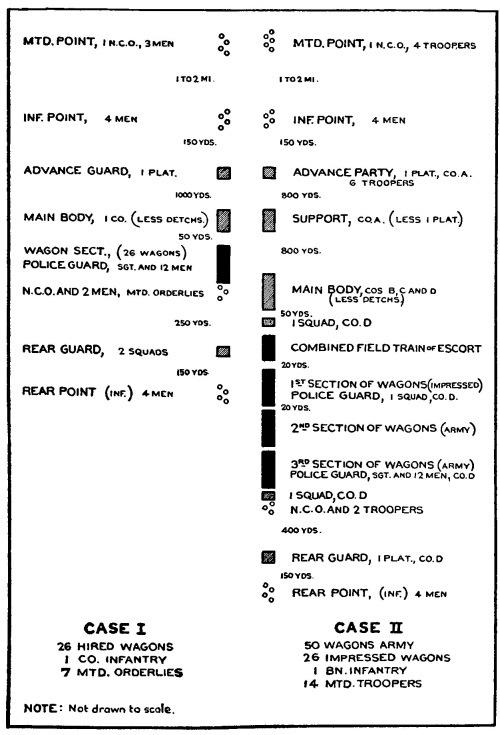
[Pg 106]
Fig. III.
TYPICAL ARRANGEMENTS
OF A
CONVOY ON THE MARCH
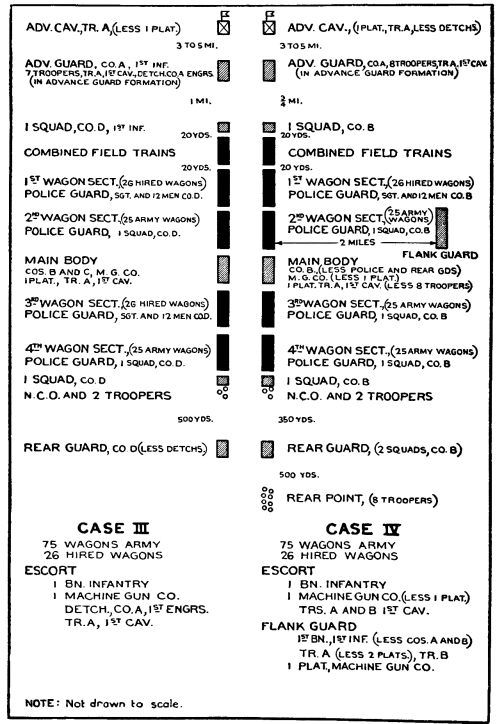
[Pg 107]
COMBINED ORDERS FOR CASE IV.
(See Fig. III.)
| 1st Bn., 1st Inf., | ||
| LEAVENWORTH, KAN. | ||
| Field Orders, | |
10 Sept., 1912, 5:45 a. m. |
| No. —— | ||
| (Map Reference.) | ||
1. Information of the enemy (especially his raiding cavalry) and of our troops.
2. This detachment will march today to ____.
| (a) | Advance guard: |
| Capt. A. | |
| Co. A, 1st Inf. | |
| 1 Plat. Tr. A. 1st Cav. | |
| (b) | Main body in order of march: |
| Combined F. Tn. | |
| 1st and 2nd sections of convoy. | |
| Co. B, 1st Inf. (less detchs.) | |
| M. G. Co., 1st Inf. (less 1 plat.) | |
| 1 Plat., Tr. A. 1st Cav. (less detchs.) | |
| 3rd and 4th sections of convoy. | |
| 3 Troopers, Tr. A, 1st Cav. | |
| (c) | Rearguard: |
| Lieut. B. | |
| 2 squads, Co. B, 1st Inf. | |
| 8 Troopers, Tr. A, 1st Cav. | |
| (d) | Left flank guard: |
| Capt. B. | |
| 1st Bn., 1st Inf. (less Cos. A & B) | |
| Tr. A, 1st Cav. (less 2 plats.) | |
| Tr. B, 1st Cav. | |
| 1 Plat., M. G. Co., 1st Inf. |
3. (a) The advance guard will clear ______ at ______ a. m. marching via —— and preceding the main body by ______ yds.
(b) The main body will march from ______ at — a. m., following the route of the advance guard. Lieut. X (Bn. Q. M.) is placed in charge of the field trains and the wagons of the convoy. Wagonmasters A, B, C and D, are designated for the 1st, 2nd, 3rd and 4th sections of the convoy, respectively, and will report at ______ a. m. to Lieut. X for orders. [Pg 108] Co. B, 1st Inf. will furnish the necessary police guards for the wagons (or will furnish — squads as police guard for the wagons,) and will place a squad at their head.
(c) The rear guard will follow the main body at 250 yds.
(d) The right flank guard will start from ______ at ______ a. m. and will march via ______ to ______ covering our right, reconnoitering to ______ and ______ (or will proceed to the vicinity of ______, reconnoitering, &c. and delay the advance of any hostile troops until the convoy has cleared ______.)
4. Messages to the main body (or to the left flank guard.)
(How and to whom communicated: See previous examples.)
(Report of dispositions to superior comdr.)
Note that this order has only 4 pars. instead of 5. Trains accounted for in par. 3. If the situation seems to render it advisable some or all of the cav. may be ordered to march in advance an hour before the rest of the troops, with instructions to “cover the movement” or if the commander is inexperienced to reconnoiter front and flanks and special localities. If a defile is to be passed the cav. comdr. may be told to report at near side of defile the results of his reconnaissance to the far side. Be careful about giving detailed instructions to the cav. unless the commander of it is inexperienced. If the situation is such as to render it possible, the convoy should establish communication with the troops at the place to which it is marching. If this is practicable (they being not too far away) the advance guard (or advance cav.) would be directed in the order to do this.
[Pg 109]
Materiel. A battery of light field artillery (3"), in the United States service, is sub-divided for action as follows:
The firing battery includes the first five sections (4 gun and 1 caisson).
The combat train includes the 3 remaining caisson sections and the battery and store wagons. The 9th section comprises the battery and store wagons and 4 field wagons. In subdivision part of the 9th section (battery and store wagons) is with the combat train. The battery is also divided into 4 platoons, each includes 2 sections.
A battalion consists of 3 batteries, a regiment of 2 battalions. A battery has 3 telephones and 1 mile of double conductor buzzer wire. A battalion has 2 telephones and 3 miles of double conductor armored cable, on a reel cart. A regiment has same telephone equipment as a battalion with extra buzzer wire.
Each battery carries 358 rounds of ammunition per gun, a portion of which, varying with circumstances, is shell, the remainder being shrapnel. Remarkable results are claimed for the large capacity high explosive shell, against both personnel and materiel. The proper proportions of shell and shrapnel and the feasibility of the use of high explosive shell are still undecided. The weight behind the teams is: gun and limber about 4,300 lbs., caisson and limber about 4,600 lbs.
The gun elevates 15°, and depresses 5°, and these angles may be increased by depressing or elevating the trail. It traverses 4° each side of center. Height of axle 41 inches, tread of carriage, 60 inches.
In the panoramic sight the deflection is measured in mils (angle subtended by .001 times the range—hence approximately ¹/₆₄₀₀ of a circumference). The elevation (range) is measured in yards. The highest reading is 6,250 yards. [Pg 110]
The clinometer of the range quadrant is graduated in mils. The range disc of the quadrant is graduated from 0 to 6,500 yards. For greater ranges, with either sight or quadrant, an arbitrary index setting may be employed. The clinometer is used for indirect laying. Set off angle of site on clinometer and range on range disc.
The front covered by the fire of a battery of 4 guns without shifting trails is 60 yds. + 140 mils; this equals 200 yds. at 1,000 yds. range, 480 yds. at 3,000 yds. range, etc.
Dispositions of Artillery. On the march the firing batteries of light field artillery are usually near head of main body, a regiment (or battalion) of infantry being immediately in front of them. The combat trains usually march immediately in rear of the last foot troops in the main body. Exceptionally they may be with the firing batteries, especially in a small command, if there seems to be good reason for so placing them. Artillery in column with other troops should preferably occupy not more than about a mile of road space. If the artillery column be much longer than this its flanks will not be properly protected by the fire of the troops in front and rear in case of a sudden attack. In such a case then, a body of foot troops should be placed in the middle of the artillery. The field trains of the artillery on the march, are combined with those of the other troops, in rear.
For dispositions of artillery with advance, rear and flank guards see the Chapters on these subjects. (IV and V.)
In battery a gun and its caisson are placed side by side. Guns are at 20 yard intervals and the caissons of the 5th section are on the flanks of battery at 20 yard intervals. Hence the ordinary front of a battery is 100 yards. The limbers are placed under cover near the battery and to the flank. The combat train should be about 600 yards distant, in a secure position. These will be the usual dispositions, which may, however, be varied to suit the terrain or other conditions. To avoid detection of the location of the artillery by hostile air scouts exact alignments and uniform intervals should be avoided. Dust raised by the blast of discharge may betray the artillery’s location. This can be reduced by wetting or oiling the ground or covering with brush or paulins of inconspicuous color. When not actually firing, guns, limbers and caissons may be concealed by covering with brush or branches of [Pg 111] trees. If the ground permits, the guns may be placed in pits with parapets for protection, the works being concealed by trees and branches.
A division is the smallest body of troops having artillery permanently assigned to it.
Artillery Commander. Informs himself as to enemy. Examines terrain, selects general positions. Assigns units (usually large ones only) to general positions and targets in accord with plan of supreme commander. Takes general measures for communication, supply and reinforcement of artillery.
Regimental Commander. Informs himself as to location and disposition of enemy and friendly troops. Makes reconnaissance of area for artillery, and assigns battalions to general positions and targets. Takes measures for communication, supply and reinforcement.
Battalion Commander. Makes close reconnaissance with officers and scouts as to position of enemy and friendly troops, their disposition, terrain around his position, best method of approach. Selects positions for his batteries and assigns duties (targets, etc.) to each. Assigns direction point and sectors of observation. Gives orders about artificial cover, provides for auxiliary observing stations. Provides for local communications. Sees the position is secure or that there are supporting troops or scouts out. Selects routes for possible subsequent movements and provides for supply of ammunition, location of combat trains, etc.
The functions of the foregoing commanders are mainly tactical. They assign and employ the groups of artillery to meet the requirements of the initial and all succeeding phases of the combat. They keep in close touch with the higher commander under whose orders they are operating, and with the changing conditions on the battlefield.
Battery Commander. Examines target and ground near it, and general location assigned him. Picks out place for his battery and way to approach, under cover if possible, similarly for his limbers and combat train (if posted separately) with an eye to supply of ammunition under cover. If direct laying is to be used makes sure each gunner can see target, or if indirect that nothing interferes with fire, that guns [Pg 112] are defiladed, etc. and that gunners can see aiming point. Selects an aiming point, a battery commander’s station and auxiliary observing stations. Arranges for communications (telephone and signal), for ammunition supply. Secures firing data. Conducts his battery to position and posts it. Conducts the fire. The functions of the battery commander, especially in battalion, are thus mainly technical.
NOTE: If any of the higher commanders mentioned are not present or if the command is too small to have such, each officer must perform such of the duties of rank next above as the situation requires.
Lieutenants. In march or maneuver they command platoons. In subdivision for action the first two command the platoons of the firing battery, the 3d is reconnaissance officer and the junior commands the combat train.
Reconnaissance Officer. Determines firing data. Supervises work of scouts and auxiliary observing parties. Watches battlefield and notes tactical changes. Supervises communications. Prior to an action, while on the march, the reconnaissance officer may be sent with the advance guard to make such reconnaissance as may be of value to artillery. May conduct battery to position.
1st Sergeant. Assists captain. Posts limbers under cover. Keeps captain informed as to ammunition supply, supervises removal of empty caissons. Has charge of replacement of casualties, removal of wounded, etc.
Sergeants. (Q. M. Sgt. commands field train) Command sections. Supervise service of guns. Chief of 5th section sets up B. C. telescope and assists in using it.
Corporals. Act as gunners, caisson corporals, scouts, observers, etc.
Scouts and Signalers. In each battery 2 corporals trained as scouts, one corporal, 2 privates as signalers. Scouts may be used to guard flanks of battery. Scouts usually operate in pairs. The scouts are trained as ground scouts in selecting routes and guiding batteries along them. They act as auxiliary observers. In battalion the ground scouting is done by battalion scouts.
Agents. Agents are men who transmit information from one commander to another, and keep a commander in touch with the lower commanders. Each headquarters in an artillery organization has agents. [Pg 113]
Route Markers. These are men who are stationed at certain points to indicate the route to a position.
Artillery is so trained that if any of these positions are vacant they are readily filled by an alternate.
An artillery officer, preferably the senior present, should accompany the supreme commander during the advance to battle to learn the situation and the wishes of the commander. An artillery officer should accompany an advance guard. An artillery officer or other agent should accompany an attacking infantry line in order to communicate to the supporting artillery the needs of the infantry. He will generally keep in touch with the commander of the attacking force. The artillery commander is represented at supreme headquarters by a suitable agent from the artillery personnel.
Kinds of fire. Fire is classified in various ways:
Masked fire is where guns are concealed from view and corresponds to indirect laying, where gunner does not see target but uses an aiming point.
If the target can be just seen through the sights (over the mask) the position has sight defilade, if by a mounted or dismounted man, mounted or dismounted defilade. If the mask conceals the flashes of the guns (in day time) the position has flash defilade, this requires 12 to 15 feet vertical cover. Even twigs will explode a shrapnel so make sure mask does not interfere with fire. To ascertain this allow height of muzzle 4 feet, angle of departure for range of 3,000 yards = 5° 40´, (Inverse tangent of 0.10). Thus, Distance from mask ÷ 10 > Height of mask - 4 (all figures in feet); or D > 10 (H - 4). To fire over a mask 20 feet high, the distance from the gun to the mask on level ground should be greater than 10 (20 - 4) = 160 feet.
Fire for adjustment. Fire for demolition.
Fire
for registration. Fire for effect.
Fire for adjustment is to get on the target. It is adjusted for range, direction, distribution and height of burst (4). Fire for registration [Pg 114] is fire to determine ranges, to a position which may in future be occupied by enemy. (It should generally not be employed prematurely unless enemy already knows about your artillery as it would otherwise betray your presence and possibly your position.) Fire for effect is fire on the enemy, materiel or personnel. It is ordinarily directed to that portion of the enemy which is doing or may do most damage to the friendly infantry. Thus in the earlier stages of the action, and while the friendly infantry is in the zone of hostile artillery fire, but not yet within range of the infantry, the fire of the artillery will be directed against the hostile artillery. Later in the attack, during the struggle for fire superiority between the opposing infantries, the artillery will usually direct its fire upon the hostile infantry, that being at this stage, the most threatening element to the friendly infantry. Fire for demolition is fire against material objects, such as walls, houses, etc. For this purpose shell is invariably used.
Direct laying. Indirect laying.
In direct laying the gunner sees and aims on the target or a designated portion thereof. In indirect laying (whether the target is visible to the gunner or not) he aims on an auxiliary aiming point. Indirect laying is that generally employed, whether the guns are masked or not. It is usually simpler to use a clearly defined aiming point than to indicate to each gunner his allotted portion of a (possibly poorly defined) target. In case of a rapidly moving target, especially at close range, direct laying may be preferable to indirect, as the gunner can see his target, and often observe the effects of his fire. It may also be used in the last stages of an action, the guns being pushed forward to the crest, or for the defense of the guns themselves at close range. Direct laying has the disadvantage that it does not permit the proper concealment of the guns, and renders more difficult the conduct, control and direction of the fire by the captain and the higher artillery commanders. Its employment, therefore, will not be habitual. Indirect laying cannot as a rule be effectively employed against small, rapidly moving targets.
Salvo fire. Continuous fire.
Volley fire. Fire at will.
A salvo is a single discharge of successive pieces at stated intervals from one flank of the battery (or platoon) to the other. It is used [Pg 115] especially for ranging, (adjustment) as a series of bursts will give more information than a single burst. In continuous fire shots are fired singly at stated intervals. Volley fire is where each piece fires a stated number of rounds as fast as is consistent with proper laying, independent of the other pieces. Fire at will is used, generally for the defense of the guns themselves, at short ranges. The sights are set at 1,000 yards and the fuses of the shrapnel at zero, this setting being analagous to the “battle sight” of the infantry.
Time fire and percussion fire. Percussion fire is generally with shell and is directed against materiel. Time fire is always with shrapnel, and is usually directed against personnel. Shrapnel have a smoke producing matrix to produce a large, dense ball of smoke, at the point of burst, facilitating observation of fire. A shrapnel well burst (at a height of 3 mils) covers effectively a depth of 200 yards at ranges up to 3,000. Beyond this range the depth of the “beaten zone” falls off rapidly, being only 125 yards at 4,500. Due to dispersion along the range of the shots (longitudinal dispersion) the depth of the beaten zone at 3,000 yards is assumed at about 250 yards. It is 150 at 4,500. Width of beaten zone, 20 to 25 yards. Errors of fuse become serious as the range increases beyond 3,000.
Fire at single range. Searching fire (fire at successive ranges). Sweeping fire. Fire at a single range is employed in case accurate adjustment has been surely obtained by previous firing. As such accurate adjustment is very difficult to obtain it will generally be advisable to increase the dispersion by employing fire at successive ranges, gradually reducing the number of ranges as observation may warrant. Searching fire is also used to sweep ground known to be occupied by the enemy’s reserves or over which they must pass in reinforcing the firing line or making a counter-attack.
In absence of opportunity for observation of fire such practice will cause a great expenditure of ammunition often with little result. It may, however, be justified by circumstances. Sweeping fire is that which sweeps the front at same range. It is obtained by giving a full turn to the traversing wheel after each shot. This corresponds to a change of 8 mils of front. Ordinarily sweeping fire will be from right [Pg 116] to left. But note that when entire sheaf is moved along the front it is better to begin at the leeward side, so that the first shots fired will not obscure target for the remainder. At a range of about 2,500 yards sweeping will just about cover the front. If the range is greater there will be intervals unswept and if it is less the successive cones of dispersion will overlap. If the front of the target is not much over 35 mils it can be covered without sweeping. If more it can be swept, or the B. C. may shift the entire sheaf and attack first one part of the front and then another (see post).
Individual distribution.
Collective distribution.
In the former each gunner is assigned a definite part of the target to attack. Direct laying is used. In the latter the pieces have a common aiming point, and the B. C. distributes the fire over the target by varying the deflections of the different guns (deflection difference). Indirect laying is always employed. The B. C. can open or close the sheaf to fit the front of his target, and can shift the entire sheaf to the right or the left, the latter by varying the deflection, the former by varying the deflection difference. Or he may do both at once. To obtain or verify adjustment the sheaf may be converged until adjustment is secured and then properly distributed. Searching fire (at successive ranges) is used when the adjustment is imperfect, or to cover an area of some depth known or believed to be occupied by the enemy, or through which his supports or reserves must pass in reinforcing his firing line, making a counter-attack, etc. It usually implies a large expenditure of ammunition in proportion to the physical effect produced, but must, nevertheless be frequently employed, albeit with judgment and not at random.
The “firing data” obtained by the captain or reconnaissance officer are:
In addition to this information the battery is also shown the aiming point and told the kind of fire to be used. [Pg 117]
Observation and control of fire. The officer conducting the fire should generally be posted near his battery so that he can watch it if possible or at least communicate readily, and to facilitate adjustment. In order to observe ground which cannot be seen from his station, as well as to assist in the control of the fire it may be desirable to have auxiliary observing stations. These should generally be on commanding sites.
Observing stations well to the front will give a closer view than possible to the B. C. and a station on the flank will afford better opportunity for observing errors in range and burst. A flank observer may be able to detect movements of troops, and also secure the battery against a flank or surprise attack. If there is no supporting detachment, observers to guard the exposed flank of the artillery should never be omitted. These auxiliary observing stations are usually established by the captain or reconnaissance officer, and usually occupied by battery scouts. Their number depends on circumstances. They communicate with B. C. by telephone, flag or helio. They should report promptly everything they see including movements of troops. There should also be communication between the B. C. and the advanced friendly troops. An agent may accompany the advance for this purpose. Trees and houses or other elevated points may be utilized for observing stations. Stations close to the guns like B. C. Sta. should generally be to windward, if practicable. Stations well out to the flanks are often favorable for observing the enemy’s interior lines, particularly the location of his artillery. If there are no natural observing stations artificial ones must be erected. The B. C. station should if possible be within 200 yards of the battery, preferably on a flank, in prolongation of the front of the battery and on a high point. It is desirable that it be within megaphone range if practicable. It would be quite rare for the B. C. station to be distant as much as 800 yards from the battery. It is very desirable that the captain should be able to observe the effect of the fire. It is very important that the B. C. station should not be too conspicuous. If it is it may draw enemy’s fire, and perhaps betray location of battery.
Aiming points should be considered as follows:
[Pg 118] A point in front or rear is best if it is at least 1,000 yards distant. It should preferably be in rear in order that the guns may be defiladed from possible hostile observing stations. If not more than 1,000 yards away it had better be on a flank.
The recent great improvements in materiel and methods of modern field artillery lend most of their advantages to the attack. The defender should cover the front of his position by a careful distribution of his batteries, permitting co-operation and mutual support. Batteries may be placed to cover areas which would otherwise be defiladed, on or near the military crest, or immediately in rear thereof, whence they can be run forward by hand to cover the defiladed area.
The positions of artillery in the attack will be governed by the following considerations:
1. What is the mission or purpose of the commander?
2. Is the attack a feint or holding action, or is it to be decisive? Is it made for the purpose only of developing the enemy’s strength and position? Is it the action of an advance guard, pushing forward to seize a favorable position, to cover the deployment of the main body? Is it a deliberately planned attack, or a rencontre engagement? Is it an attack over ordinary terrain, or a river line or other special form of attack? Is it intended to pursue the defeated enemy in case of success? etc., etc.
3. What are the relative strengths of the attack and defense in all arms?
4. What is known of the enemy’s dispositions, including those of his artillery, and what further inferences can be drawn?
5. The terrain: what bearing has it on the dispositions of the artillery? etc., etc.
The more detailed technical, tactical and topographical requirements of an artillery position will include the following:
1. Can the artillery from this position effectively perform the tasks assigned it?
2. Is the range much over 4,000 yards? If so look for a closer position. The fire of light artillery is very effective up to about [Pg 119] 4,500 yds. The principal objection to long ranges is the difficulty of observation. 3,000 yds., being beyond the range of hostile infantry and machine guns and yet close enough for good observation of fire, is an ideal range; but a good position at 4,000 yds., or at 2,000, is to be preferred to a poor or indifferent one at 3,000 yds.
3. Has it a wide field of fire, wide in angle? Guns well disposed can fire 45 degrees on each side of normal to front. Sometimes the position may cover a still wider front by a shifting of the guns without change of location.
4. Is the position wide enough for the artillery to occupy it? (A battery normally takes up a front of 100 yards.)
5. Is the position such as to afford suitable ranges for all stages of the action, or will it be necessary to shift and if so are there suitable positions which can be approached under cover, and which are otherwise good?
6. Is there concealment from view, especially by aero scouts, both in position and approaching same?
7. Is the front approximately normal to the mean direction of fire?
8. Is the position such that it is possible to change to direct laying without moving the guns too far?
9. Are there many dead spaces, how are they located, and are any of them such as to menace the safety of the guns or afford cover from which the friendly infantry might be effectively opposed?
10. Particularly is the field of fire to the flanks good, and could the guns protect themselves to the flanks by indirect fire and direct fire at short range?
11. Are there good natural observing stations available?
12. Is the position likely to be easily detected, especially by observers well out on the enemy’s flank or by aero scouts?
13. Are the communications good, front, rear and flanks? Also for ammunition supply?
14. Is there cover for limbers and teams? And for the ammunition or combat trains at a suitable distance?
15. Are there suitable aiming points for indirect fire which are not also possible hostile observing stations? [Pg 120]
16. Can the position be readily “connected up” by telephone or signaling? etc., etc.
A position in the interval between the frontal and enveloping attacks has the advantages that the artillery is well protected, and can support either attack with oblique or possibly flanking fire. A position on the flank, while usually requiring an escort, is very effective for oblique fire. It is also very useful in opposing an envelopment, as it may be able to cause it to make so great a detour as to defeat its purpose, or to delay it until the necessary dispositions can be made to oppose the movement. The conformation of the terrain will have a great influence on the decision as to where to place the artillery. The position in any case should be such as to best permit the artillery to accomplish its mission.
In the beginning of an action longer ranges may be permissible for the defense than for the attack. If the defense is relatively weak in artillery it is sometimes an advantage to have it out of range of the attacking artillery while still able to fire on advancing infantry. The attack must get within range of the defense artillery and may sometimes be forced to take an exposed position if defender’s artillery is well back.
Whatever the situation the mission of the field artillery is to support the infantry, particularly at the critical stages. While the infantry is deploying and during its advance through the zone of hostile artillery fire, the artillery of the attack engages that of the defense. When the infantry contest for fire superiority opens, the artillery of the attack, or a portion of it, will sweep the hostile infantry lines with the objects of causing the hostile infantry to keep their heads down, getting on their nerves, diminishing the effect of their fire, preventing supports from coming forward, etc. The actual physical effect of such fire may not be great, but if its moral influence is sufficient to diminish the efficacy of the hostile infantry fire, thereby permitting the steady advance of the friendly infantry, its purpose is accomplished. When the attacking infantry is so close to the hostile lines as to be in danger from the fire of its supporting artillery directed thereat, the latter should increase the range without cessation of fire. This will have a decided moral effect on the defenders in the fire trenches as the shrapnel will burst nearly over their heads. It also establishes a fire swept zone in rear of the [Pg 121] hostile firing line through which supports and reserves must pass in moving forward, or through which the firing line must retreat in case it breaks to the rear. It is desirable that the attacker’s artillery positions should be sufficiently close to permit effective fire upon retreating troops, known as “pursuing by fire.” The attacker’s artillery should move to advanced positions by echelon, in order that there be no cessation of artillery fire.
In defense the dispositions of the artillery will be very largely dependent upon the probable moves of the attacker. The principal consideration will be, is the combat to be to a decision, or is it a delaying action merely? In either case a long range fire is desirable in order to force the attacker to an early deployment, and to embarrass as much as possible his preliminary dispositions. In a decisive action the defender’s artillery should cover every portion of the front over which the attacker may pass. This may be done by taking a position near the crest, or by so distributing the artillery units that each will sweep the dead space in front of others (defensive relation). Or a combination of the two methods may be employed. Of these the second method is generally to be preferred, as it permits the occupation of covered positions difficult to detect, and at suitable ranges. If in this case there be dead space (defiladed from all the guns in the sheltered localities) this may be covered by “dagger batteries,” placed well forward in the defiladed area. The fronts of the dagger batteries should be covered by artillery fire, and they should also be supported by infantry and machine guns.
The artillery of the defense enjoys a certain advantage in that it frequently has opportunity to make preliminary arrangements, such as determining ranges, constructing shelter, providing for ammunition supply, etc., so that it is able to deliver an effective fire from the start. Some at least of the artillery of the defense may be held “in readiness,” or “in observation,” pending the development of the enemy’s attack, being placed in action according to the developments of the situation. Fire must be brought to bear upon the advancing infantry regardless of the attacker’s artillery. If overmatched by hostile artillery the defender’s artillery ceases fire temporarily but resumes again at the critical moment. Such a proceeding may often deceive the attacker. The defender’s artillery must prevent the attacking artillery [Pg 122] from advancing to the position if captured, must concentrate its fire on the hostile infantry which has penetrated, support a counter-attack, or cover the rallying of the defender’s infantry, sacrificing itself without hesitation if necessary. Unless it be necessary to reply to the attacking artillery because of the damage due to its unrestricted fire the artillery in defense (unless favorable targets are presented) may often remain silent and avoid disclosing its position until it is ready to fire on the hostile infantry. If it is perfectly concealed it may begin firing at any time, even if inferior to the attack.
Firing over the heads of friendly troops will be the rule in both attack and defense. In the attack this may be continued until the assaulting infantry is quite close to the enemy’s line, the exact distance depending on the accuracy of adjustment, terrain and other conditions. It is the duty of the artillery to support the infantry assault to the last practicable moment. Thereafter the attacking artillery increases the range to cover the ground in rear.
Positions are not occupied by formal maneuvers, but each battery proceeds under cover in most convenient manner. In moving in vicinity of a masked position it is advisable to go at a walk so as not to raise dust and betray location.
The artillery is safeguarded generally by the other troops. It should not have special supports unless these be required by its exposure or distance from the attacking or defending forces. Such a detachment if required weakens the other arms. Machine guns are especially useful as a support for artillery. The artillery must carefully watch its own flanks even when it has a support. It should be particularly watchful also of dead spaces.
The general positions of the artillery, its general duties, target, etc. are prescribed by the supreme commander. The exact positions and the control and direction of fire are under the artillery commander. Artillery should make necessary reconnaissance, take position with promptness, and at once obtain data, etc. The supreme commander will designate whether batteries will take position for immediate action, in observation, or in readiness. In the first case the artillery opens fire as soon as possible. The position may be masked or unmasked. In the second case (observation) the battery unlimbers and takes position, obtains data, and prepares to open fire on indicated targets when [Pg 123] directed. The position is generally masked. In the third case (readiness) the guns are not unlimbered, but are held near the selected approximate position ready to go into action or to move to another locality. Meantime the tactical situation is studied and the locality reconnoitered, preparation being made to go into action if directed. Before going into action a battery is sub-divided into firing battery, combat train and field train. As to when it is divided this depends on circumstances. If done too soon the other arms may get between battery and combat train and interfere with supply of ammunition. If not done soon enough the combat trains may interfere with movement to front of other arms. The field trains are usually held in rear with other trains. The order for subdivision is “form for action.”
The combat trains may be with the batteries or the battalions. If at the rear of the combatant troops they are usually assembled by battalion or regiment. Communication must always be maintained with the fighting batteries by agents from the combat trains. Battalions are rarely split to permit the employment of batteries singly, batteries are practically never split.
The artillery should be kept well in hand, not necessarily all in one group, but where it can be under one control. The desideratum is concentration or dispersion of fire, at will. If batteries are somewhat dispersed they will not be so readily silenced or overcome by hostile fire. Facilities for communication permit greater dispersion with better control. Artillery employs no “reserves” in the sense in which the term is used with reference to infantry. Its reserve consists in its reserve supply of ammunition and in its power to increase the rapidity of its fire to meet crises of the combat. Nevertheless, it will not always be advisable to place all the artillery in action at the outset. The mission of the force and the circumstances of the case must be considered. If it be desired to develop from the outset an overwhelming superiority of artillery fire all the guns may be posted for immediate action. An example of this would be a rencontre engagement of an advance guard, seeking to seize or hold an advantageous position pending the arrival of its main body. In the case, however, that the enemy’s strength and dispositions (including those of his artillery) are not accurately known, and when the nature and course of the engagement cannot be foreseen, it would be unwise to [Pg 124] commit all the guns to action prematurely, as it would then be difficult to meet rapid and unexpected developments in the situation. In such a case part of the artillery may be held “in observation” or “in readiness,” to be put into action as the developments of the situation may require. A few guns may develop a considerable volume of fire, for a limited period, by utilizing the rapid fire qualities of the weapon. The proper assignment of the artillery is not a matter of rule, but a question of judgment. Enough guns should be placed in action at any time to meet the existing situation and accomplish the mission of the artillery. The combat and ammunition trains should be kept together (in large groups) to facilitate proper control and ammunition supply. They should be in safe positions, but not too far to the rear. Ammunition trains are marked with red flags or lanterns so that they may be readily identified.
Different batteries may be assigned special tasks, but these may be subject to change, in fact usually are, one battery also fulfilling several different functions. The functions are: Counter batteries: To fire on hostile artillery. Infantry batteries: To prepare and support the infantry attack. They include batteries of preparation which fire on opposing infantry, and breaching batteries which open passages through the enemy’s line. Batteries of the counter-attack: Usually posted in observation to watch for and oppose a counter-attack if made. Accompanying batteries: To advance to the close support of the infantry. They usually support the close advance without themselves actually advancing. Reinforcing batteries: Held in observation to come to the support of other batteries when needed. Decoy batteries: To draw fire of hostile batteries not yet discovered. Usually posted with wide intervals, they employ rapid fire. These classifications and terms, while necessary for study and discussion, are seldom employed in the verbiage of field orders. They are not to be considered as fixed or rigid. A single battery may successively fulfill several functions at different stages of the action, and it will be rare that all would be required in a single engagement. When infantry batteries are directed to support certain organizations in the attack, the Commander of the organization to be supported would generally indicate the target [Pg 125] and exercise some supervision, but the artillery would not be under his command, but under that of the artillery commander of the entire force. The front of the position especially in defense, may be divided into areas to be assigned to the various groups. These groups should be so disposed as to permit the greatest possible concentration or dispersion of fire, in other words the best possible control. Where the terrain does not favor this, or the course of the action is uncertain, some artillery should be held “in observation” or “in readiness” to meet developments.
At the command “Prepare for Action” the instruments are taken out, breech and muzzle covers removed, guns examined and cleaned, shields set, etc. This command may be given before or after reaching position and before or after unlimbering.
At the command “March order,” battery being limbered or unlimbered, these operations are reversed and the gun and equipment secured for the march. When the commander rides forward, leaving command to follow he instructs officer in charge as to tactical situation, and gives him such other pertinent information as may appear desirable. He may also, in his judgment, instruct this officer as to time and place of subdivision for action (if not already made), time to prepare for action, route to be followed, gait, etc. An officer preceding a command to a position should determine the route to be followed and post the necessary markers.
It is desirable to secure at the outset a position suitable for all stages of the action. The terrain must be carefully examined for such positions. If batteries are well located and doing good service changes during an action should be made only when it is apparent that a distinct advantage can be thus gained. These changes take time, necessitate readjustment on the target and are often dangerous. They should be made under cover if possible. Sometimes they may advantageously be made at night, or the first position may be taken at night. Advantage should also be taken of lulls in the action. Changes may be necessitated by the artillery of the enemy having adjusted on a battery. In such a case a short move during a lull, may be all that is required. Movements must be anticipated and the necessary reconnaissance, clearing, repair of bridges, etc. and all other things necessary as preliminaries must be attended to. Changes of position are ordinarily made in echelon, the stationary part covering the change [Pg 126] with its fire. Batteries do not retire because they are out of ammunition, they wait for more. A disabled gun is not sent to rear to be repaired during action. A battery does not move in echelon, but all at once.
It is the province of the supreme commander to order changes of his artillery positions. But in emergency the artillery commander may order changes.
Before important change, have plenty of ammunition. Economy of ammunition at all times is a duty of all officers and non-commissioned officers.
There must always be the closest co-operation between the artillery and the other arms. The artillery commander should be kept advised of the tactical situation and of any changes therein, and of the requirements of the other arms. He should be in frequent conference and constant communication with the supreme commander.
“Dummy” emplacements are sometimes used, especially on defense, to draw fire and expose enemy’s artillery position.
Horse artillery usually accompanies a cavalry force of any size. Its tactical employment is similar to that of light artillery. It is particularly useful in a rear guard on account of its great mobility.
Do not get closer than 2,000 yards to hostile infantry of defense. Their artillery will likely be about 500 yards behind the infantry. Get within 3,000 to 3,500 yards of the defender’s artillery if practicable.
The best results against artillery will be obtained by the effect of shrapnel on the men and animals. After a battery has been immobilized by shrapnel fire high explosive shell may be used for the demolition of the materiel. With the 3 inch rifle it is generally a waste of ammunition to attempt the destruction of battery materiel except at ranges within 2,500 yards, and then only when the fire can be observed. With the high power ordnance, materiel may be destroyed at greater ranges (see post).
In firing on a rapidly moving target direct laying will usually be preferred. If direct fire is, for any reason, contemplated the artillery, while employing indirect fire should be near a crest to which the guns can be moved forward for direct fire. The movement of [Pg 127] the guns by hand, except for short distances and on smooth and gentle slopes, is a very laborious task. It will usually be better to limber up.
Opportunities for surprise fire at relatively close ranges will occasionally be practicable in defense, but seldom in attack.
Oblique and enfilade fire are ordinarily more effective than frontal fire, and are desirable when they can be obtained without too great dispersion or exposure of the artillery.
A support for the artillery is usually not needed except on the march. It can generally defend itself. If so isolated as to need a support, generally place it in rear on the exposed flank.
Do not travel too far over fields in getting to a position. Look for a position which can be reached without too much cross-country traveling.
Use shrapnel for ranging. Make the first bracket 400 yards. Do not waste time over a small bracket. Under favorable conditions a first bracket of 200 yds. may sometimes be obtained. In firing on cavalry a 600 yd. bracket is usual.
A battery should not halt to await orders if it can be avoided, but should come on promptly if possible, while a position is being reconnoitered. A good position promptly occupied may be better than the best position tardily taken.
Fig. IV.
BATTERY WITH A REGIMENT.
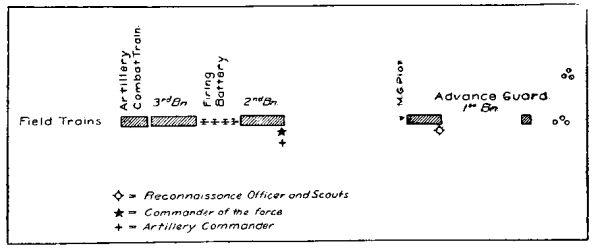
Artillery with Advance Guard. It should not occupy positions from which it cannot readily withdraw, and so risk bringing on a general action unless this has been authorized.
It should be so placed that it cannot be readily surprised in march formation by hostile fire, especially artillery fire.
Artillery is seldom assigned to the advance guard of a force not larger than a brigade. [Pg 128]
If there is artillery with the main body an artillery reconnaissance officer usually accompanies the advance guard.
Do not as a rule use artillery with an advance guard in wooded or mountainous country. It is generally useless, and especially vulnerable to attack at close range. In open country it is useful except at night.
Horse artillery may accompany a cavalry force. (See also Chap. IV.)
In a small force of artillery, there would be no objection to the combat train marching immediately in rear of the firing batteries, as the total continuous length of the artillery column would not be objectionably great.
With Rear Guard. Artillery, especially horse artillery is particularly useful for delaying the enemy. Hence the proportion with a rear guard is generally large. (See also Chap. V.)
With Outposts. The use of artillery with an outpost is not usual, as it is very trying duty and rapidly wears out the men and horses. If so used it is generally to command important roads, bridges and defiles, and is placed with the reserve.
Mission. The mission is to take position promptly and support attack. Develop hostile artillery and later fire on hostile infantry.
Artillery commander accompanies supreme commander or latter will send for him. Artillery commander usually has with him the reconnaissance officer and scouts, the chief of 5th section with telescope, a musician, with tripod, two orderlies.
He considers the orders of the supreme commander, especially as to limits of his position (on this point he may give advice) and general plan of attack, disposition of enemy as learned from his reconnaissance officer, etc. He takes the terrain under observation at once.
He selects positions for battery, limbers, combat train, B. C. station, auxiliary observing stations, aiming point, routes for battery and combat train, etc.
He sends word to battery to form and prepare for action (it may already be formed) gives stations of fractions and routes thereto and directs them to proceed, telephone detail to report at B. C. station. [Pg 129] He sends word by orderlies who also guide battery, or the reconnaissance officer who is familiar with ground may be sent to do this. Or Captain himself may do it.
He has chief of 5th section set up B. C. telescope. Meantime, assisted by the scouts, he selects exact position for the battery and lays it out.
He next obtains the firing data.
Auxiliary observing stations may be established when desirable, by B. C. or reconnaissance officer. They are occupied by the reconnaissance officer, scouts, agents, or other available personnel.
The position of the battery should have a range near 3,000, indirect fire and flash defilade. It should be near a crest so that the guns may be moved forward later for direct fire, especially in defense. It should be concealed from view of observers on enemy’s flank.
The limbers should be under cover preferably on a flank near the battery.
The combat train should be under cover, about 600 yards away.
The field trains generally join those of main body.
The B. C. station should be within 200 yards of the battery, preferably in rear or on a flank. The battery should be visible and the location favorable for observation of fire by the Captain. Sta. should be to windward of battery.
The auxiliary observing stations should generally be well to the front, and at least one on a flank, to observe errors of range and burst. The one on the flank also protects the battery from surprise.
The aiming point should be a mile away preferably in rear, or else on a flank. If not more than 1,000 yards off, the flank is better.
The telephones, 3 in number, are placed at B. C. station, battery (if necessary) and at the observing station occupied by the reconnaissance officer.
The approaches to the positions should be under cover. Exposure for a brief moment may not incur danger of fire, but may indicate where battery is going. Covered approach more desirable for battery than for combat train. If necessary for concealment dismount drivers in moving to position.
Flank guards should be placed by the Captain unless provided for by an infantry support.
In addition to the Captain the following artillery personnel, some or all, must be accounted for: [Pg 130]
The reconnaissance officer: On the march usually with the advance guard, to select artillery positions and routes, learn enemy’s dispositions, etc. He has charge of the battery scouts. He may lead the battery over route to its position, or obtain firing data (usually not both). Establishes the auxiliary observing stations and may occupy one of them, supervises communications, watches battle for tactical developments, etc.
The senior lieutenant: Commands the battery up to the time it is unlimbered for action, and then commands one of the firing platoons.
Junior lieutenant, commands the combat train, (reserves) Q. M. Sergeant commands field train.
Chief of 5th Section on entering action, sets up B. C. telescope (which he brings forward) and assists in obtaining firing data.
Scouts. During march in advance guard with reconnaissance officer. Scout the ground and locate routes, seek information of enemy. May conduct battery to position. Assist Captain to lay out exact position of battery. Act as auxiliary observers. Guard flanks of battery.
Telephone detail set up and operate the 3 telephones. Usually report to Captain at B. C. Station.
An agent is usually with the supreme commander to transmit information to the artillery.
Route markers, placed to mark routes and guide battery along them.
Musicians, one carries tripod of B. C. telescope. With Captain to act as messengers.
The Major will usually be with the supreme commander during the march. Having received orders to place the artillery in position, he rides to the designated locality with his staff, etc., to reconnoiter, observe the terrain, and select positions for his batteries. When ready for the batteries to come forward he sends the battery agents (who are with him) to direct the Captains to join him. The battery agents may also take word as to the route or routes by which the batteries are to advance. Word is also sent back as to the disposition to be made of the [Pg 131] combat trains, the entire combat train of the battalion being usually consolidated at one place. The batteries form for action and are brought forward as directed by the senior officer of each, or all together by the senior officer present.
The battery commanders, on receiving word, ride forward to join the Major, usually taking with them their reconnaissance officers, scouts, musicians, chiefs of the 5th section (with B. C. telescopes), etc. The Major instructs the battery commanders as to the general situation, and the orders he has received. He then indicates the approximate stations of the different batteries, the exact positions being marked out by the battery commanders, or by their orders. If posted for immediate action the Major may now designate the target for each battery, and give instructions as to opening fire. Otherwise he may indicate the localities for which firing data are to be prepared, or give such other instructions as the situation may demand. He designates a direction point and sectors of observation. He informs the battery commanders where his own station will be, and where the battalion telephone line will be laid, so they may connect with same.
The Major instructs the Sergeant Major to bring up the reel cart, tells him where his station will be, and where the cable is to be laid.
If the position of the hostile artillery is not known the Major may send his adjutant, or one of the battery reconnaissance officers, with some scouts to try to locate same. Aero reconnaissance will be especially useful in locating hostile positions. Fire may be directed by aeroplane and visual or wireless signaling, unless the enemy be well provided with anti-aircraft guns and skillful in their use.
When practicable the artillery commander should be with the supreme commander during the engagement, the same station being ordinarily suitable for both. If not with the supreme commander the artillery commander should place an agent, preferably an officer with some orderlies, with the supreme commander, unless his station (artillery) is connected with that of the supreme commander by telephone. For this latter purpose the apparatus of the Signal Corps will generally be used.
If the batteries are close together, the Major may place a single auxiliary observing station (consisting of a couple of scouts, or one of [Pg 132] the battery reconnaissance officers and a scout) for all. Or each battery will be allowed to place its own observing station in the judgment of its commander.
Each battery places its own limbers, usually about 100 to 150 yds. from the battery, preferably on a flank. The combat trains are combined at a locality designated by the Major unless there be some special reason for keeping them separated. Ordinarily they should be some 600 yds. or so from the fighting batteries, if cover is available.
An ammunition company from the division train (if there be one) on taking station will send an agent to the artillery commander. The latter informs his subordinates as to the location of the ammunition company, when necessary.
The Major directs in a general way the fire of his battalion.
The duties of a Colonel commanding a regiment, or of a General commanding an Artillery Brigade, are quite similar to those of the Major commanding a battalion, but in less detail. The higher the commander the more general his duties and the less detailed his orders. The Brigade Commander outlines to his regimental commanders the general situation, designates the approximate positions of the regiments, and assigns general targets, etc.
The duties of a Major in the regiment are the same as when commanding a separate battalion, except that he receives his orders through the Colonel of his regiment instead of direct from the supreme commander. (See ante.)
Heavy field artillery includes all ordnance heavier than the 3" field gun, but still mobile enough to accompany an army in the field. It would be used (if present) in practically every battle.
The field artillery adopted for U. S. service is the following:
| Designation of piece. |
Weight of projectile (lbs.) |
Assumed limiting range (yds.) |
Approximate weight behind teams (lbs.) |
Slope of fall of projectile at limiting range. |
|
|---|---|---|---|---|---|
| 3" | gun | 15 | 8,500[6] | 4,300 | |
| 3.8" | howitzer | 30 | 6,600 | 4,300 | 1/1.2 |
| 4.7" | howitzer | 60 | 6,640 | 5,300 | 1/1.1 |
| 4.7" | gun | 60 | 11,000 | 8,800 | 1/1.3 |
| 6" | howitzer | 120 | 6,700 | 8,600 | 1/1 |
[Pg 133] All of these pieces fire both shell and shrapnel, and they will break up most of the field works that are likely to be constructed (it is ordinarily not practicable to construct in field a work which would resist their fire unless considerable time is available for preparation). The 3.8" howitzer having same weight as 3” gun is quite as mobile. The 4.7" howitzer is as mobile as the 3” gun when it has eight horses. With 6 horses it cannot move as rapidly. The 4.7" gun can move over roads and fields, maneuver and take positions exactly like 3” gun, but it cannot move as rapidly.
The organization, tactical uses and methods of fire control of this ordnance are similar to those of the 3" gun. Each battery has 4 pieces, but howitzer battalions have only 2 batteries.
This ordnance is to be regarded as intended for the same uses as the 3” gun and as supplementary thereto. It should not be used for tasks where the 3" gun would do as well, but should be used for targets beyond the range or destructive power of the 3” gun.
These pieces may be needed against troops who have had 24 hours or so to prepare a defensive position, as in this time they can throw up works which would protect them from the 3" gun fire.
These guns use indirect laying as a rule, but may also use direct laying, being in this respect like 3" gun. They should be placed back of the 3” gun and not assigned to living targets which can be reached by the 3" gun. They should generally be concealed, for this purpose they require a flash defilade of 20 ft. Behind a second ridge is a good place. A clearing in the woods is also good, provided an aiming point is available.
The position should afford good lines of approach and retreat and for ammunition supply. The limbers are usually posted farther to the rear than in the case of the 3" gun. There should always be an infantry escort for these pieces, and machine guns may also be so used.
Usually this heavy artillery will take only one position during an action, and it is therefore desirable that this position be carefully selected. Ample time must be allowed for reconnoitering a position and therefore a representative of the heavy artillery should be well forward during the march, for this purpose.
On account of the great ranges at which heavy artillery is usually employed, battalions are split up even less often than in the case of 3" guns. [Pg 134]
Fig. V.
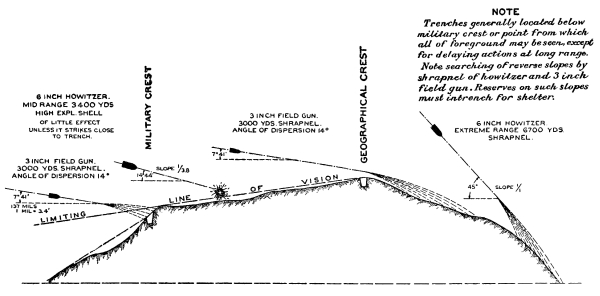
TRAJECTORIES AND CONES OF DISPERSION
FOR SHELL AND SHRAPNEL
[Pg 135] The shell fire of these pieces will destroy the materiel of a battery. The 4.7" gun can destroy battery materiel with great accuracy at ranges up to 5,000 yds. Thus they can often prevent hostile light artillery from coming into action at all.
Whereas a reverse slope of about 15 degrees affords some protection against 3" artillery, only very steep slopes, 50 degrees or more, afford complete protection against the shrapnel of the field howitzer. (Fig V.)
If at the opening of the attack the howitzers cannot find the hostile artillery they may fire at the infantry. Later in the attack if the defender runs his artillery forward for direct fire, he may then be subject to the fire of the attacker’s heavy artillery.
Auxiliary observing stations from which target can be seen are of great importance, and as little can be seen from a range of 8,000 yds., it is necessary to have an observing station well to the front. Usually the artillery (bn.) commander himself will occupy a station from which the target can be seen. These stations are connected with the battery by the telephone equipment, which is ample. Sweeping fire is not used with these pieces, as it is too wasteful of the ammunition which is heavy and expensive. Fire only at what can be seen, or otherwise accurately located.
In defense these pieces are very useful in compelling the attacker to deploy early, or to make a very long detour to get out of their range if he turns the position.
Fig. VI.
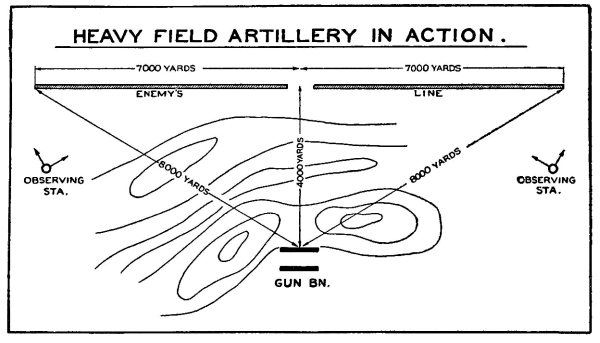
[Pg 136] On the March. As the 3.8" howitzer and the 4.7" howitzer when provided with 8 horses, are very mobile there is no serious objection to having them well up at the head of the column except for the road space they occupy. Therefore if the tactical situation is such as to make it desirable to have these pieces well to the front they may be placed there. They would seldom, however, be attached to the advance guard. The 6" howitzer and 4.7” gun (and usually also the 3.8" and 4.7" howitzers) should be placed immediately in rear of the last infantry organization in the main body (just ahead of the artillery combat trains). The possible necessity of having to strengthen the bridges for this heavy ordnance is an argument in favor of leaving them in the rear, as this necessity would delay the march of the infantry if the guns were in front. Ordinarily there is not as much speed required in placing this ordnance in action as is usual with the lighter pieces. Positions are selected with more deliberation.
Motor cars are extensively used for the transportation of field and siege artillery of all types from the lightest to the heaviest. Machine guns and some of the lighter types of rapid fire guns, including anti-aircraft guns, are often mounted directly upon the truck. The heavier pieces are hauled as trailers by the motor trucks, which serve also to carry ammunition and supplies. The mobility of the automobile motive power is greater than that of animals and the machine is less vulnerable to fire. The possibilities of motor operated vehicles in conducting artillery off the roads have not yet been fully demonstrated, but the conduct of the “quads” or 4-wheel drive cars is very satisfactory.
There are many instances in campaign where the lack of roads or trails prohibits or unduly restricts the employment of light artillery. To meet such conditions, the mountain gun transported on pack animals has been constructed. The gun should, in principle, be as effective a weapon as the field gun but transportation conditions limit its practicable size and power.
The various patterns of mountain guns are distributed in 3- 4- and 5-mule loads. The weight that can be borne by the best pack mules, for other than brief periods, is limited to about 250 lbs. in addition to [Pg 137] the weight of the saddle. As a gun of acceptable power can hardly be built within this weight, most mountain guns are made in two or more parts, each constituting the load of a mule. The piece is equipped with wheels and drag ropes for moving short distances without packing.
The weight of projectile fired from mountain artillery is approximately the same as that from 3" field guns but the muzzle velocity is considerably less and the range therefore shorter. The guns have a larger allowable angle of elevation than 3” guns (usually to 27° or 30°); they are in effect howitzers.
The general construction of the gun, carriage and ammunition is largely similar to those of light artillery. The gun is not permanently connected to the recoil mechanism on account of the division into mule loads but is dropped into recessed blocks on a sleigh when assembled for action; and there it is secured by a key. The sleigh forms the cover of the cradle and slides on the cradle guides in recoil. The trail is made folding and is adapted for firing in cramped positions. The guns fire fixed ammunition, shell and shrapnel. Mountain batteries have no limbers or wagons. The battery is provided with an ammunition train which may consist entirely of pack transportation or may include some carts or light wagons. The gun can be unpacked and ready to fire in one minute.
In the American service, a mountain battery consists of four guns and their accessories. It is divided into six sections and has in addition an ammunition train and a supply train. The first, second, third, and fourth sections are gun sections to each of which is attached a mule with pioneer tools. The gun section consists of a gun squad of 10 men together with a gun team of 4 mules with drivers and an ammunition team of the same strength. The 5th and 6th sections are ammunition sections with 6 mules in each team.
The ammunition train comprises ammunition mules and the mules carrying the forge, stores, tools, etc. The supply train carries kits, rations, forage, etc.
Though mountain artillery is the only form of artillery that can be used in country where wheel traffic is impossible, its use is by no means limited to such terrain. For assisting the attacking infantry throughout all stages of combat, it is very effective. The mule can go [Pg 138] practically anywhere that man can, except where the latter resorts to climbing; hence mountain batteries are peculiarly effective in country that restricts the scope of light artillery. These guns require virtually no more cover for concealment on the march than do infantry and they are thereby able to effect movements on the battlefield, without attracting hostile attention or fire, that would be impossible with light arty. They are very useful in the defense of woods, in temporary forward positions, in rear guard actions or in general where their mobility and easy concealment have special application.
On equal terms, they are no match for light artillery, but in terrain that hinders the use of that weapon, the mountain gun is capable of a usefulness that increases with the restrictions imposed on the former.
The introduction of air craft into warfare has naturally resulted in the use of special means of protection against this new menace. Probably the most effective method is attack by a superior number of similar craft on the principle of the cavalry screen.
Anti aircraft weapons include small arms, machine guns, and field pieces having a range and power approximating that of the lighter types of field artillery. Small arms are regarded as of little use in the attack of air craft. The field gun type, using shrapnel and high explosive shell appears to be the most effective. One German type has a calibre of 104 mm. and throws a projectile weighing 34 lbs. It has a maximum rate of fire of 15 shots per minute and a range (in height) of 12,500 ft. For some types of gun hits are claimed at altitudes of 10,000 ft. or more. Such performances must be regarded as most exceptional and their probability will not be great enough to force aeroplanes to remain at such altitudes. A lower elevation is necessary for effective reconnaissance and the aeronauts must of necessity frequently take the risk involved. Swift aeroplanes will be practically immune from anti aircraft fire at altitudes of 10,000 ft. or more. They will have a fair chance of escape as low as 5,000 ft. As the altitude is reduced below this figure the risk will very rapidly increase. [Pg 139] Observation at heights of about a mile will, however, be frequently attempted, but efficient guns in sufficient numbers should be able to exact a heavy toll in the event of systematic efforts to observe at less elevations. Airships, because of their greater size, and slower and more regular movements, must remain at greater elevations to escape the effects of hostile fire.
The greatest difficulties encountered in anti aircraft firing are estimating the range and hitting a rapidly moving object. Results must be obtained by great rapidity of fire.
Thus, unless the burst happens to be directly in line with the target, it is impracticable to determine by observation from the firing point whether the shot is over or short.
Guns cannot fire vertically. Their elevation never exceeds 60° and in general 50° is the practicable limit. Beyond these angles accordingly the aircraft are immune.
New problems in exterior ballistics are introduced. The influence of air currents on the trajectory is considerable. Tracer shells which emit a smoke flame are occasionally used to verify the aim.
As the aeroplane may use any line of approach at will and moves at great speed, the need for a large number of very mobile, quick firing guns will be apparent. The guns are frequently mounted on motor trucks when used in the field.
Except for possible use in fortifications, special guns cannot evidently always be provided in sufficient numbers for this purpose. Arrangements must, therefore, be made for utilizing the standard field and siege guns and howitzers. This is usually accomplished by providing special types of mounts such as the split trail carriage, or by extemporizing means whereby the trail can be sunk in the ground to an extraordinary degree and the gun then prevented from overturning, by cables to holdfasts, etc.
The anti aircraft gun may be considered to have satisfactorily fulfilled its function if it prevents aircraft from flying at altitudes sufficiently low to permit effective reconnaissance.
The following principles are of general (but not universal) application [Pg 140] in the tactics of field artillery. They may be considered as useful suggestions, to be varied, however, as circumstances may dictate.
A battalion of artillery should seldom be sub-divided. A battery of artillery has but one range finding equipment. Its subdivision would be justified only by most unusual conditions.
At the opening of an engagement some of the artillery may, according to circumstances, be held “in observation,” or “in readiness,” exceptionally in a small force, more frequently in a large one.
It having been decided to place the artillery in action it should be brought to its position promptly.
The artillery and combat trains should, when practicable, be conducted to their positions by concealed routes. Utilize the roads as far as practicable, avoiding long movements across country. Concealment in position and en route thereto and good observing stations are the principal technical requirements of an artillery position. The position should be concealed from the enemy’s observation from either front or flank. The position should be sufficiently roomy for the unit which occupies it. It is not desirable to crowd guns at less than their proper interval (20 yds.), but it often is necessary.
A good position for artillery in attack may often be found between the holding and enveloping attack. In either attack or defense a favorable position may be found on the flank. If the artillery is thus exposed it will usually require a guard or escort of other troops (to be designated by the supreme commander, often from the advance guard) both in position and en route thereto. The artillery in any case should have out the necessary details for protection and observation of fire.
If there be a choice between two crests it will generally be better, when other considerations are not paramount, to select the one farther from the enemy.
If direct fire is contemplated at any stage of the action the position should be selected with a view to this. Such a provision would be more usual in defense than in attack.
Flash defilade requires 12 to 15 ft. of vertical cover. In solving defilade and other visibility problems allowance should be made for the vegetation. [Pg 141]
It is ordinarily desirable to obtain a range between 2,500 and 3,500 yards from the probable target. Initial range in defense may be somewhat greater than in attack, since the hostile infantry will approach the position.
It is desirable to secure at the outset a position suitable for all stages of the action. Artillery once committed to action should not be moved during the course of the engagement unless it is apparent that a distinct advantage may thereby be gained, or unless such a movement is unavoidable.
The front may be covered and dead spaces eliminated by a subdivision and distribution of the artillery units.
Covered approach and concealment in position are desirable for the combat trains. Unless otherwise specially ordered the combat trains will be at the disposal of the artillery commander. In some cases they may take their stations under cover of the artillery fire.
The artillery prior to and during the action reconnoiters the terrain with a view to the selection of artillery positions. This is done without special orders. An artillery officer with the necessary reconnaissance detail should be with the advance guard during the march for this purpose.
The B. C. station should be close to the battery, and not in a conspicuous position, likely to draw the enemy’s fire.
Shrapnel should be used against living targets and for ranging. Shell is used against material objects. A hostile battery which has been immobilized by shrapnel fire may be destroyed by shell fire.
In ranging the first bracket should be of ample span, 400 yards is generally a good distance.
A duel between the opposing artilleries is not a necessary preliminary to every combat. It is the duty of the artillery in both attack and defense to support the infantry. It should therefore direct its fire as a rule, upon that element of the enemy which is at the time or may become the most threatening to the friendly infantry. Firing over the heads of the infantry will be the rule, in both attack and defense. The attacker’s artillery, having once opened fire upon the infantry firing line of the defense, should ordinarily continue this fire until the proximity of the assaulting infantry to the position makes it necessary to increase the range.
There should always be the closest co-operation between the artillery [Pg 142] and the other arms. The artillery commander during the engagement will often be with the supreme commander. If not he should be in close communication with him, generally through an artillery agent.
With rare exceptions the artillery in both attack and defense will be in rear of the general line of battle of the infantry. It may be stated as a very rough guide that the artillery of the defense will be, in the average case, approximately 500 yds. in rear of the infantry firing line, particularly when indirect fire is employed. The mission of the force, the nature of the terrain and the conditions of the case will determine the position of the artillery, which may also be subject to change during the action. In case of a counter-attack, pursuit, or occupation of a captured position, the artillery may often be pushed boldly to the front.
Instructions too much in detail should not be given to artillery in orders. It is usually unnecessary in the ordinary case for the supreme commander to encroach upon the province of the artillery commander by directing him to (a) Fire on any specified target, (b) Obtain firing data, (c) Reconnoiter advanced positions, (d) Take station at a definite point, (e) Open fire at any specified time. He should, according to circumstances, be directed ordinarily merely to take position (1) for immediate action, (2) in observation, or (3) in readiness. The information in the order as to the enemy and his own troops indicates to him what the probable targets will be and when and where they will probably appear. This information, together with the rule to fire on the hostile element most dangerous to the friendly infantry, enables the artillery to obtain the necessary firing data and fire on the proper target, (a) and (b). As to (c) the artillery commander will, without orders, consider the possibility of occupying a new position, according to developments, and he will conduct the necessary reconnaissance for this purpose, so as to be ready to move to a new position when later ordered to do so. As to (d) the supreme commander should, in his orders, direct the artillery to take position near such a place, leaving the selection of the exact location for the artillery to its commander. As to (e) if posted for immediate action the artillery will open fire as soon as the target appears. In the other two cases it will not open until it receives additional orders. Case (2) in observation, is used when the supreme commander does not wish fire opened prematurely, although he has decided where to [Pg 143] place the artillery. Case (3) in readiness, is characteristic of a position in readiness, where combat position of the artillery is not yet definitely decided upon. The supreme commander may, both prior to and during the engagement, consult the artillery commander, obtaining the latter’s views as to the positions for and handling of the artillery, and give him detailed instructions, but this should not appear in the orders. When using the expressions (1), (2) and (3) in orders, it is well (in solutions) to add after your order, an explanatory note as to why more definite instructions are not given to the artillery commander. In some cases it may be desirable to give the artillery more definite instructions in orders but such cases would not be usual, and could often be covered by a consultation, omitting detailed instructions from the orders. If detailed instructions, as to particular targets on which to fire, advanced positions, etc., are considered necessary in orders it is usually well to add (in your solution) a note explaining why such orders are considered necessary in this case. If firing data are to be obtained by “registration” (bracketing fire) the order may contain instructions to that effect. See also Chapters IV, V, VI, XI, XIII, XIV, XVII and XVIII.
[Pg 144]
The uses of cavalry in campaign are summarized as follows:
(a) To seek and destroy the enemy’s cavalry.
(b) Screening, contact and reconnaissance.
(c) Seizing and holding important advanced positions thus delaying the advance of the enemy until the arrival of other arms.
(d) To operate on the flank and in the rear of the enemy.
(e) Raids and other enterprises requiring great mobility.
(f) The mounted charge at the opportune moment against infantry or field artillery.
(g) Energetic pursuit of a retreating enemy or covering retreat of its own forces.
(h) When none of the above rôles have been assigned to it cavalry may go to the assistance (dismounted) of hard pressed infantry to fill gaps in the firing line.
Cavalry being an expensive arm to equip and maintain should be used for the duty for which it is especially qualified, and not frittered away as messengers, orderlies, etc.
A division of the cavalry force while undesirable is frequently necessary. As little as possible should be assigned to the lesser tasks and the bulk to the principal duty. Many of the minor tasks for which cavalry has been often used may well be performed by mounted orderlies and the use of automobiles and motorcycles.
Cavalry should not ordinarily be used to perform duty which infantry could do as well (or better) when infantry is available. There will usually be many duties which the cavalry alone can perform.
The efficiency of cavalry depends very greatly on the condition of the horses, and they should be spared all unnecessary fatigue. Night work especially is very exhausting and so should be held to the minimum, although it cannot, of course, be entirely dispensed with. Always allow the cavalry to rest at night if practicable.
Cavalry operating alone, except for very short periods, should generally be accompanied by a sufficient train to provide reasonable [Pg 145] comfort for the men and horses and maintain their health and efficiency. The presence of the train restricts, to some extent, the movements of the cavalry, but the added comfort increases its efficiency and the range of its operations.
If the cavalry is out but a short distance its field trains would, as a rule, be in the rear with those of the other troops. They join the cavalry occasionally in order to replenish rations. When the cavalry is out for several days and mobility is of special importance it may be accompanied by a pack train in lieu of wagons. When combat is imminent all wagons and pack animals should be kept well to the rear. In such cases extra ammunition may be carried in the saddle bags.
Large bodies of cavalry would frequently be accompanied by artillery, preferably horse artillery if such is available. Artillery is always desirable with a large cavalry command.
Signal troops, especially radio sections pack (wireless) may be attached to cavalry operating independently, to maintain communication between separated portions, or with the foot troops which the cavalry is covering. The wireless sections are sent wherever there is a demand for their services. They would not habitually be attached to bodies smaller than a troop.
Mounted engineers frequently accompany advance cavalry and may, if there is special need for them, also accompany the independent cavalry. Cavalry commands have a limited number of tools of their own including demolition outfits (containing explosive). The men who handle the explosives are called the demolition squad—there being one to each squadron.
The cavalry commander, especially when he is acting independently, should be allowed great discretionary powers, and orders too much in detail should not be given him. He should be told what he is expected to do, but not how he is to do it. Otherwise the cavalry will be so hampered in its movements that its usefulness will be greatly impaired. “Success in reconnaissance depends greatly on the character of orders given. The hackneyed phrase that the cavalry is to advance and discover the strength and position of the enemy is useless, for this is only its natural duty. If, as is often the case, it is told to discover the intentions of the enemy, the commander really demands that it perform a duty incumbent on himself. Both cases betray a hesitancy on the part of the commander which results in a halting sort of action. [Pg 146] It is wisest to put to the cavalry simply the questions which it is desirable at the moment for the commander to have answered, viz: whether hostile encampments are met with in given localities, whether certain towns are occupied, whether the enemy’s advance guard or main body has reached a certain line, how far the enemy’s flanks extend, whether on a given road or railroad troops are moving. Such commissions, which cannot be misunderstood, will bring in clear reports from which the commander-in-chief can draw his own picture of the strength and position of the enemy, and divine his intentions.”
The cavalry will seek and destroy the enemy’s cavalry. Its important duties of screening, contact and reconnaissance will be rendered easier of accomplishment by the overthrow of the hostile mounted force. In the consummation of this important duty the best results will be obtained by concentrating the cavalry in large masses independent of all save the supreme commander in the theatre of operations. A relatively small part of the cavalry force should be assigned to divisions (or other units) and the great bulk of it concentrated under a single independent commander. The duty of cavalry may therefore be classified as follows:
The divisional cavalry will be under the immediate orders of the division commander. It may be used independently, that is to say independent of all save the division commander, or as advance, rear, or outpost cavalry. In the latter cases it will be under the command of the advance guard, rear guard or outpost commanders. The divisional cavalry is charged with such duties (principally security and reconnaissance) as pertain especially to the operations of the division to which it is attached. While engaged in these duties it may be allowed a considerable degree of independence of action. It should not, however, encroach upon the sphere of activity of the army cavalry and should never be beyond recall by the division commander. When the division is operating independently the duties of the divisional cavalry will be similar to those of the independent cavalry of an army, although of course less in degree and scope. The following [Pg 147] paragraphs pertain primarily to the operations of the divisional cavalry. According to our present organization a regiment of cavalry will be attached to each division.
Advance, rear and outpost cavalry. Advance cavalry is that attached to and under the orders of the advance guard commander. Its function is the same as that of the whole advance guard, to insure the safe and uninterrupted advance of the main body. It would be exceptional to use an entire regiment of divisional cavalry in this manner, and in general, as in the case of army cavalry, better results will be obtained by keeping the divisional cavalry intact and independent. If, however, the cavalry with the division is too weak for independent action, or if there is no mission for it independent of that of the advance guard, it may be attached to the latter in a forward movement. The circumstances of each case will decide the best mode of employing the divisional cavalry.
Cavalry will be employed more frequently with the rear guard in retreat than with the advance guard in a forward movement. Cavalry is the arm par excellence for delaying actions, hence the entire divisional cavalry will frequently be assigned to the rear guard in retreat.
Divisional cavalry may also be assigned to flank guards and outposts in which duty it is very useful. If the situation demands, part of the divisional cavalry may be temporarily assigned to a detachment of the division operating independently. Such use of the cavalry must, however, be regarded as exceptional in systematic operations on a large scale, in common with all other “detachment warfare.” The independent “reinforced brigade,” of frequent occurrence in map problems and small maneuvers, will be not so often encountered in actual campaign against a civilized and organized foe. It will probably, however, continue for a time to find a field of usefulness in the operations of the American army.
For the use of cavalry with advance, rear and flank guards, outposts and detachments see Chaps. IV, V, VI, VII, X, XI, XIII, and XIV.
Independent Cavalry. Cavalry may and should be used independently:
(a) When there is an independent mission for the cavalry—that is, one independent of the operations of the other troops—either in time or place, and
[Pg 148]
(b) When the cavalry is strong enough for independent action. This means both strong enough in itself and by comparison with the enemy. A platoon might act independently if the enemy had no cavalry, whereas a regiment could accomplish little if opposed to a brigade. As a rule a force of less than two troops should not be employed independently unless there be very strong reasons for same.
The expression “independent cavalry,” means that the cavalry is independent of all but the supreme commander.
The duty of the independent cavalry is to gain and maintain contact with the enemy, usually with the main force, thus securing information as to his movements and intentions, and screening the front of its own main body, so as to prevent the hostile cavalry from gaining similar information of the friendly forces; to operate against the enemy and his communications, etc.; to maintain communication between separated friendly forces; and to perform its other special functions, (see ante). The independent cavalry forages for itself to a greater or less degree and often aids in the collection of supplies for the entire command. It is also commonly employed in raiding, in attacking convoys, to destroy railroads, seize unprotected depots of supply, etc. In general the cavalry may be properly employed independently on any duty where great mobility and celerity of action are required.
The operations of independent cavalry have of necessity a very wide range. Depending on its strength and on other conditions the cavalry may be several days’ march from its supporting troops. It will nearly always be too far out to come in to the main camp every night.
The cavalry must at all times maintain touch with the enemy and communication with its own forces in rear. If there be advance cavalry between the main body and the independent cavalry, it will be charged with maintaining communication unless the independent cavalry is too far in advance.
All information of the enemy should be promptly transmitted. The presence of a hostile force should seldom be reported without information also as to its strength and composition. The presence of a hostile force having once been detected all its subsequent movements should be observed. In other words, the cavalry having once gained contact with the enemy should never thereafter lose it. [Pg 149]
In maintaining continuous contact aero reconnaissance is not entirely effective. It usually loses contact with the enemy temporarily during darkness and foul weather, and in this respect cavalry has an advantage. In the duty of reconnaissance the aeroplane and dirigible cannot fulfill all the functions of the cavalry. The two services are to be regarded as supplementary. In the usual case both will be needed.
In sending in reports the cavalry commander should state his plans or intentions for the future and, when necessary, the manner in which messages may be transmitted to him.
If the enemy has a strong and aggressive mounted force in the field the cavalry, while at no time neglecting its important duties of reconnaissance and screening, should keep a strong central mass well in hand to defeat the hostile cavalry as soon as it is encountered. Having defeated and thoroughly demoralized the enemy’s cavalry a much greater dispersion is permissible. The enemy’s cavalry having been overthrown he can no longer keep touch with the forces opposing him, nor screen himself from observation by their cavalry. His patrols and messengers, both going and returning, will have great difficulty in eluding the screen which will have been established.
Cavalry in the presence of infantry alone may be considerably dispersed with safety. But it should be kept well in hand so long as opposed to a strong and aggressive cavalry.
A large force of cavalry, in gaining contact advances toward the enemy in one or more columns, which should keep in close touch with each other. On reaching the vicinity of the enemy each column sends forward a “contact squadron” (from 1 to 4 troops, generally at least 2.) This contact squadron approaches still closer to enemy’s position and then sends out one or more strong strategic patrols, under command of officers. The sole function of these patrols, is to gain information of the enemy’s main body for strategic purposes. Their radius of action depends upon conditions. In a friendly country they may operate at considerable distances from their supporting troops. In hostile country, however, if the enemy’s cavalry is still active, the distances at which they can operate will be greatly diminished, and the difficulties of obtaining information correspondingly increased. Uniformed men in small bodies and in a hostile country overrun by the [Pg 150] enemy’s cavalry will have great difficulty in gathering and transmitting information sufficiently exact to be of strategic value. In such cases therefore, resort will often be had to the additional aid of spies. These patrols do not report minor information, and hence the number of their messages will be limited. Where practicable the commercial telegraph and telephone lines should be utilized in the transmission of messages. Motorcycles, light autos, air craft and wireless are all useful in maintaining communication. Important information which cannot be telegraphed should be sent to the rear over several routes, especially in hostile country. As the duty of these patrols is very arduous they should be relieved at suitable intervals, depending on conditions. They will usually subsist off the country. (See also “Patrolling.”)
The contact squadron supports the patrols and furnishes their reliefs. It arranges for the transmission of information from the patrols to the squadron, and from the squadron to designated stations in rear. For this purpose relay and collecting stations are established at suitable points and free use is made of the telegraph and telephone, motorcycles and any other available means of transmitting information. Signal troops (usually wireless sections pack) may be attached to bodies of cavalry engaged in reconnaissance. The maximum sending radius of the present field wireless sets (pack) in our service is about 30 miles, but they are not always dependable beyond 15 miles, and occasionally fail altogether in an emergency. They can seldom be relied upon as the sole means of communication. In the employment of wireless it may be advisable to use a code for important messages.
Cavalry in combat. Cavalry uses the following methods of offensive action:
(a) The mounted charge in one or more lines in close order (usually 3 lines); in column or line of columns (rare); as foragers or as skirmishers.
(b) Dismounted fire action (used also in defense, especially> in delaying actions).
(c) Mounted fire action (rare).
(d) A combination of (a) with (b) or (c).
Of the above the mounted charge in line will generally be the most effective although the opportunities for its successful employment will [Pg 151] probably be rare and fleeting. It is, therefore, to be preferred whenever it is practicable, even when the cavalry is in a generally defensive attitude, since cavalry has less power of resistance than infantry, and a successful charge is the most effective means of defense. If the ground is too rough or broken for a charge in line, if it is desired to extend the front for purposes of envelopment or in the rare case of a charge against a deployed line (either Infantry or Cavalry) a charge in line with extended intervals, usually accompanied by mounted fire action, may be employed, viz:
Charge as skirmishers, using the revolver, automatic pistol, or sabre.
Charge as foragers, the men in couples, using their revolvers, pistols or sabres.
A charge in column of fours should be used only when charge in line is, for some reason, impracticable, as when charging along a road, or when there is not time to form line.
Dismounted fire action is employed:
(a) Usually when opposed to infantry.
(b) On the defensive, or in delaying actions.
(c) When the terrain or other conditions render a mounted attack impracticable.
(d) By a portion of the force, in support of the mounted action.
Even if intending eventually to fight on foot the cavalry should remain mounted as long as possible. It may often be better to remain mounted in concealment, awaiting a favorable opportunity to charge, rather than to hasten prematurely into a dismounted action. Cavalry which dismounts usually thereby surrenders the initiative, certainly when opposed to an enemy still mounted. In case of defeat by a superior mounted force there is usually no opportunity to retreat, and most of the dismounted men and all of the led horses will probably be lost. Therefore it is necessary, in dismounting to fight on foot, to hold a mounted reserve, especially when opposed to cavalry. One of the functions of this mounted reserve will be to check the enemy, if necessary, while the rest of the command is mounting. Even if it is contemplated to use a portion of the reserve eventually for dismounted action it is well to keep it mounted as long as practicable as it is thus more mobile. [Pg 152]
Cavalry should not start to dismount to fight on foot with a mounted enemy formed and ready to charge, within 1,000 yards, unless the terrain affords protection against a charge.
When opposed to infantry alone the risk in dismounting is not so great as when a hostile cavalry force is near, and cavalry will often dismount to fight infantry, especially in delaying actions. Even in this case, however, the cavalry should make its movements to position mounted as it has in this respect an advantage over infantry.
Even when dismounting to fight on foot cavalry should at all times keep up an active mounted reconnaissance, especially when opposed to cavalry.
When there is one horse holder to each four led horses they can be readily shifted from place to place, and are then said to be mobile. If the proportion of horseholders is less than this the horses are not readily shifted from place to place, and are then said to be immobile. If the horses are linked it is inadvisable to have less than one holder to eight horses, and even in this case it is not practicable to move them and they may be easily stampeded. To reduce to a minimum the number of horseholders (if the horses are not to be kept mobile) the animals may be linked in large circles. A better method is that of “coupling,” in which pairs of horses are linked each to the cantle of the other’s saddle thus facing in opposite directions. All troopers are then liberated for firing. The horses cannot move away or be stampeded, if the links hold.
To dismount to fight on foot, horses mobile, requires a minimum of ½ to 1 minute, not counting the time required to take position on the firing line. To mount requires about the same time. If the horses be immobilized more time is required both in mounting and dismounting.
Horse artillery and machine guns often accompany the cavalry, and are used as auxiliaries in combat. They usually hold a pivotal position (supported if necessary by a few dismounted men) to cover the formation of the troops preparing for the attack (usually mounted), to support the attack, to hold the enemy in check while the troops disorganized by the charge are rallying, or to cover a withdrawal in case of repulse. [Pg 153]
Mounted engineers should accompany cavalry, especially advance cavalry, whenever such are available. They facilitate the progress of the cavalry, inspect and repair bridges for the use of the main body, execute demolitions, etc. As mounted engineers will, however, not always be available, the cavalry should be trained to do its own pioneer work.
Cavalry vs. Infantry. The cases in which mounted cavalry can attack infantry with any prospect of success are rare and fleeting. Nevertheless the cavalry should be on the lookout for such opportunities. Infantry may be attacked mounted:
(a) When it can be taken in flank or rear while actively engaged in a fire fight.
(b) When it is out of ammunition.
(c) When it can be caught in column of route or other close formation, and has not time or room to deploy.
(d) When it is in disorderly retreat.
(e) When it is of poor quality or low in morale.
The element of surprise is generally essential and always desirable. If the infantry has time and opportunity to make the necessary dispositions, it can easily repel the attack. Against infantry in mass, cavalry charges in line, boot to boot, against deployed infantry it charges as foragers.
Against infantry deployed for battle a cavalry charge has little prospect of success. If compelled to attack infantry cavalry must usually resort to dismounted action, and its tactics will be similar to those of infantry except that its greater mobility permits small forces of cavalry to make turning movements which would be impossible or at least extremely dangerous for a body of infantry similarly situated. The force executing the turning movement proceeds mounted to a favorable locality and there dismounts for the attack—unless a good opportunity for mounted action there presents itself.
Because of its mobility and the ease with which it may be withdrawn from action, cavalry is the arm par excellence for delaying actions, such as those of a rear guard in retreat. Cavalry can delay the advance of an enemy by harassing his flanks (which is the more effective method) or by taking a position for dismounted fire action [Pg 154] directly across his line of advance. In such actions the cavalry may take up a very extended line and the entire force (except the horseholders and a small mounted reserve) may be placed in the firing line. A mounted reserve is needed to watch the flanks, cover the led horses, check the enemy in case of need, etc. It need not be as large when acting against infantry as when opposed to cavalry. Mounted combat patrols on the flanks should never be omitted.
Cavalry when dismounted is tied to its led horses. A threat against these will often cause the retreat of the dismounted firing line. Consequently the led horses should be held in a secure place and a mounted force of suitable size told off to cover them. As the horses are easily stampeded operations against them are very effective.
Cavalry fighting a delaying action may take a greater number of successive positions and permit a much closer approach of the enemy than would be either safe or possible for infantry.
The two principal requisites of a delaying position for cavalry (next to a good field of fire to front and flanks) are cover from fire for the led horses, immediately in rear of the firing line, and good covered lines of retreat straight to the rear. If there be but one line of retreat it should preferably be in rear of the center. If there is no cover from fire (cover from view is not sufficient) for the led horses in rear of the firing line they should be echeloned in rear of the flanks in order to escape the effects of hostile fire directed at the dismounted line.
It is very important that the cavalry should be withdrawn in such good time that it will not be subjected to fire during its retreat to its next delaying position, and will have opportunity to deploy in time to again delay the advancing enemy. If subjected to fire from the rear the best cavalry will soon get out of hand.
As to how close a dismounted enemy may be allowed to approach, before withdrawing from the position, this depends on:
(a) The distance the men on the firing line must travel to reach the horses in mounting up to withdraw.
(b) The nature of the country in rear of the position as affecting the rapidity of retreat.
(c) The amount of cover from the enemy’s fire during the retreat afforded by the terrain. [Pg 155]
(d) The nature of the terrain in front of the position as affecting the facility of the enemy’s advance.
By keeping the horses mobile the strength of the firing line is diminished by 25 per cent of the total strength. If it be desired to increase the strength of the firing line the horses must be immobilized. If they are liable to be exposed to fire, requiring that they be moved, they must, of course, be kept mobile. In this case also the firing line can mount and retreat much more quickly since the troopers can find and disengage their mounts in less time, and since also the led horses may be moved up closer to the firing line when it is ready to retire.
The terrain in rear of the position should be carefully scouted to see that it presents no serious obstacles to a retreat. It will generally not be practicable for all to take the roads. The retreat, at least at the beginning, must usually be made straight to the rear, some of the men moving across country. Hence openings should be made in fences and the best points for crossing streams selected, and improved if necessary.
Under favorable conditions as to proximity of led horses, facilities for and cover during retreat and obstacles to the enemy’s advance, the cavalry may safely allow him to approach within about 600 yards of the position before withdrawing, or if the retiring force be not more than a troop, to within about 400 yards. If the conditions are not especially favorable the withdrawal should be made when the hostile firing line arrives within 700 to 800 yards. The volume of fire should usually be increased just before the withdrawal.
Cavalry vs. Cavalry. Against cavalry, mounted action will always be preferred. As the element of surprise is important the cavalry will endeavor to conceal its strength and position as long as possible.
Every available man should be on hand for the charge. Hence all detachments within reach should be recalled (except the necessary combat patrols), which emphasizes the wisdom of having as few and as small detachments as possible from the fighting force when combat is probable and the cavalry unsupported by foot troops. Detachments coming in join their proper troop if possible. If too late for this they join the reserve, or the nearest troop. [Pg 156]
The ground over which the charge is to be made should be carefully examined by mounted ground scouts, which may be sent out from the most advanced fraction of the command. Of course if all features of the terrain can be seen from a position in rear, ground scouts would not be sent out, as they might in such case merely betray the presence of the cavalry force and afford indication (to the enemy) as to its position and intentions, without any compensating advantages. The ground scouts move to the flanks and rejoin their troops, or the nearest formed body, on completion of their duties or as the attack is launched. If the charge is made at extended intervals they may be absorbed by the charging line as it overtakes them. Fences and ditches, the latter being often difficult to detect at a distance, are serious obstacles to a cavalry charge.
Combat patrols protect the flanks and give warning of the presence and movements of any hostile bodies in the vicinity of same. Their distance from the flanks will depend on the size of the force, terrain and other conditions. They should be so placed that they will be able to give ample warning of danger. In open terrain easily traversed they should be well out, as distance will be necessary for safety. In terrain which does not permit of an easy approach to the flanks they may be closer in. They are invariably mounted. At a time of combat all detachments from the fighting force should be as small as practicable. A small command requires little time to change its dispositions, and cannot afford to make large detachments. Its flanks, therefore, will be secured by small patrols (4 to 12 men). The instructions to such patrols, to “cover our right,”—mean to give timely information of danger in that locality so that dispositions may be made to meet it. Such patrols are not expected to offer resistance except to small hostile patrols. A larger command requires more notice. It may therefore send out stronger patrols capable of offering some resistance, at least enough to delay the enemy while a message is sent back to the main body. The flanks must never be neglected in any of the operations of cavalry, as it is very vulnerable to a sudden attack in flank.
If necessary to delay the enemy a portion of the troops in advance may be compelled to resort to dismounted fire action while those in rear [Pg 157] are preparing for the charge. The advanced troops generally should not charge a superior force of the enemy unless the main body is close enough at the time to give immediate support. If the enemy is superior in strength and cannot be surprised by a charge the weaker force must usually seek another locality where conditions may be more favorable. A body of cavalry, not expecting reinforcements, which dismounts a considerable proportion of its strength in the presence of a markedly superior mounted enemy will, unless exceptionally favored by the terrain or other conditions, run great risk of capture. Such tactics are seldom to be recommended. Such troops as may be dismounted should, when they have the option, take a position from which they can support and cover the mounted attack (without interfering with the charge or having their fire masked too soon) and also hold the enemy in check after the charge while the troops engaged therein are rallying.
The machine guns are generally placed, if practicable, with the dismounted troops for co-operation and mutual support. If there be no dismounted troops the machine guns are placed in a suitable position from which they can support the attack and cover a withdrawal in case of defeat. Usually they will be on a flank, and if exposed should have a small escort—about a platoon. The machine guns should take position promptly and endeavor to open fire as the attack is launched, or even sooner if the need for concealment has ceased. While machine guns materially assist a charge a good opportunity must not be lost while waiting for the machine guns to come into action. Artillery fire is a most valuable assistance to a cavalry charge.
The troops for the mounted attack are divided into the attacking line, the support and the reserve, as far as possible without splitting units. The attacking line should generally include about half the total available mounted strength. A good division for a squadron acting alone, would be: attacking line 2 troops, support and reserve 1 each. The support usually follows a short distance in rear of the exposed flank of the attacking line, the reserve following in rear of the center or the other flank. For a force not larger than a squadron two lines only may be employed.
In approaching the position from which the attack will probably be launched, all troops remain concealed as long as possible. The attacking line forms line of columns (line of troops in columns of [Pg 158] fours-called “line of fours”) at deploying intervals or in mass (with 11-yard intervals between troops) as rapidly as the terrain permits. This formation facilitates change of direction (if necessary) and deployment. The gait in approaching the deploying position should not be so rapid that the horses will not be fresh and vigorous for the charge.
The attacking line is formed at the last moment consistent with delivering the charge with the utmost momentum. If formed too soon it lacks cohesion, if too late the necessary momentum cannot be obtained, and there is danger of interference by the enemy. The line should generally be formed at from 400 to 800 yards from the enemy, under cover if possible. It should never be formed within 400 yards of an enemy ready to charge. It is desirable that the attacking line should overlap the flanks of the enemy’s first line. Having formed for the charge the attacking line advances at a steadily increasing gait to within about 80 yards of the enemy and then delivers the charge at top speed—boot to boot. The objective of the attacking line is the nearest formed body of the enemy. In a decisive action the first blow should be made strong. The attacking line should endeavor to completely overthrow the enemy’s leading troops, follow them up and force them back in confusion on those in rear. It should keep going as long as there is an opportunity to reach any fraction of the enemy, rallying only when its momentum is completely expended. In an action not decisive the overthrow of the enemy’s first line only may be the aim. In an extremity, as where it is necessary for the cavalry to cut its way through a superior force in order to escape, it may stake all on a single throw, placing its entire strength in the first line of the charge.
The support follows, conforming to the movements of the attacking line, and forming for the charge at the proper time. Its objective is the nearest formed element of the enemy. It should not charge into the melée created by the first line.
The reserve, in one or more bodies, follows the support and takes the latter’s place as it charges. It is used at the critical instant as circumstances require. The reserve usually will not charge without an order from the commander. The combatant who can place in the fight the last body of formed troops will usually win.
Each line rallies as promptly as possible after the charge, to be used again later as circumstances require. [Pg 159]
The dismounted troops and machine guns keep up fire as long as possible (until it is masked by their own troops).
A mounted charge against cavalry, in order to possess the essential element of surprise, should generally be launched from concealment within 800 yds. of the enemy, and if it be practicable to approach unobserved to about 400 yards it will usually be best to do so. If the distance be much over 800 the enemy, if superior in strength, may have time to form for and deliver a charge himself, and if inferior he may be able to avoid the shock and escape. Also a long gallop just before the charge diminishes the effect of the shock and the subsequent activity of the horses. Under favorable conditions, such as when the ground is hard, level and unobstructed, the enemy still in column, etc., a charge which must necessarily be launched from a greater distance, may have good prospects of success, and favorable opportunities should not be thrown away. Ordinarily it is desirable to launch the attack from concealment within 800 yards. The smaller the forces the less the distance, as a rule, at which it is desirable to launch a mounted attack. A small force can more readily approach under cover and, on the other hand, more easily evade a mounted attack.
The most favorable time for a charge against cavalry is when, in a dismounted action, its firing line breaks to the rear to mount and retire. At this time a charge by a much inferior body of mounted men may throw it into utter confusion. The attacker should keep in hand a mounted force to take advantage of such an opportunity if presented, and the defense should likewise hold a mounted reserve to protect itself from such an attack.
There should be no wheeled vehicles close by during a combat with cavalry. Even the ammunition wagons should be kept well to the rear. In going out for a short distance (from its infantry support) cavalry should leave all wagons behind, extra ammunition and rations being carried in the saddle bags.
A pack train is more mobile than wagons, but even this is a drag on the cavalry in rapid operations. If combat is imminent even the pack animals (except those of the machine guns) should be well to the rear.
The most favorable times for attacking cavalry (mounted) are:
(a) When it is in the act of mounting or dismounting.
(b) When it can be taken in flank or caught in column. [Pg 160]
(c) When it can be surprised while charging another body.
(d) When it can be surprised while in an unsuitable formation or while changing formation.
(e) When it is issuing from a defile.
And in general whenever it can be taken by surprise.
Victory in a mounted action will generally be with the combatant who can overlap his opponent and throw in the last mounted reserve.
The commander (accompanied by his adjutant and 1 or 2 orderlies) if not already there, gallops forward to an advanced point suitable for observation, and looks over the situation, quickly makes his decision, and issues the necessary orders to the commander of the advanced troop—who will usually be with him. These orders will usually cover the following:
(a) Dismounted fire action (if to be used), position for same, etc.
(b) Observation of the enemy, retardation of his advance.
(c) Examination of the terrain over which the charge will probably be made (by mounted ground scouts, or officers’ patrols.)
(d) Recall of all detachments within reach.
(e) Combat patrols on the flanks (these may be sent from troops in rear), support for machine guns, etc.
(f) Information as to general plan of commander, duties of balance of command, etc., etc.
Upon completion of these duties the advanced troops, if still mounted, are usually directed to join the nearest body. If the commander of the advanced troop is not with the supreme commander the necessary instructions may be conveyed to him by the adjutant. He should also be informed as to the general plan of the commander, including place where the troops for the attack are to assemble, etc.
The main body should come on as promptly as possible. It may take up the trot, or even the canter as the commander gallops forward. It is usually a mistake for the cavalry to halt to await developments, as it [Pg 161] thereby sacrifices the advantages due to its mobility at the very time when these are most needed. Of course cavalry may occasionally get into serious difficulty by pushing on too rapidly against a superior force. But it will far more frequently lose a golden opportunity if it surrenders its initiative by a premature halt.
Having come to a decision the commander signals (arm or sabre) to the main body to “increase the gait”—if they are within sight, or else at once sends his adjutant or an orderly with a message to that effect. He then gives the necessary instructions to the commander of the leading troop, after which he gallops back to meet the main body, and leads it to the rendezvous (place from which the attack is to be launched) giving the necessary order as he goes. If for any reason the commander desires to remain at the front he may send his adjutant back with instructions to the subordinate commanders to report to him at a designated locality, where he issues the necessary orders while the troops are moving to the rendezvous. It is generally inadvisable and often impossible to separate the subordinate commanders from their troops if the enemy is close and combat probable. Hence orders must usually be given piece-meal, but it is very important that each portion of the force should know what the others are doing so that proper co-operation may be insured. No rule can be given as to the manner in which the orders shall be issued and transmitted. The criterion is that each portion of the force shall be placed in its position for attack with the least possible delay and confusion.
The machine guns (with necessary escort), and combat patrols are sent out (or necessary instructions are sent to some patrols already on the flanks) and all other detachments called in.
Preparatory to forming for the charge the troops assume a convenient formation, usually “line of fours,” or mass.
Unless the commander in person leads the troops to the place from which the attack is to be launched it is well to detail a staff officer or an orderly (someone familiar with the ground) for this purpose. The routes to be followed by each portion of the command, and the formation to be assumed, should be carefully prescribed.
If there is little time and the enemy is aggressive it would be wrong to separate subordinate commanders from their troops and assemble them to receive orders. In such cases the orders will be transmitted as promptly as possible without separating subordinates from their immediate commands. [Pg 162]
Fig. VII.
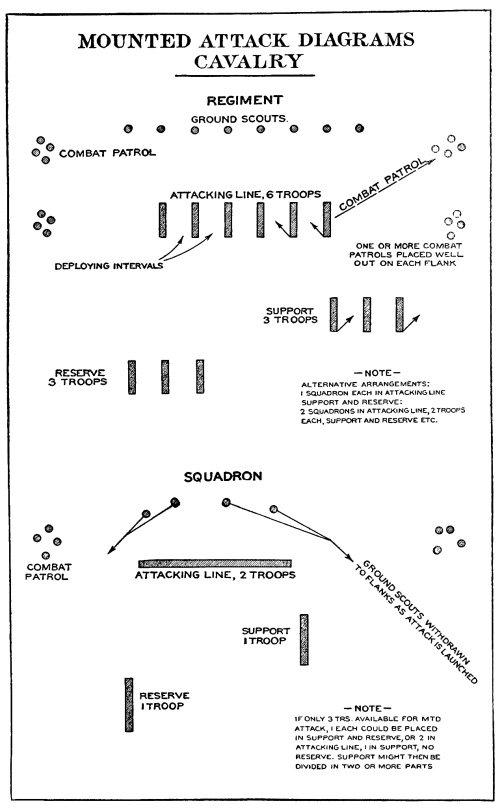
[Pg 163] The commander will designate the troops for the attacking line, support and reserve, with commander and duties for each, distances at which the successive lines are to follow each other, gaits, etc., or the attacking line and support may be covered in one order by the expression “attack in two lines, etc., such troops in reserve.” The commander’s order will usually conclude: “I will give the order (or signal) for the attack,” or “attack at once.”
In case it is not practicable or advisable to launch the charge at once the cavalry may take a concealed position in readiness either in line or line of columns in a suitable locality to await a favorable opportunity for a charge, while being at the same time ready to retreat or fight on foot, should developments in the situation require such actions. It is seldom advisable to charge the front of the enemy with the entire force, if he is deployed for dismounted fire action. A portion of the command may, however, attack the front for the purpose of developing the enemy’s strength, engaging his attention, etc.
The foregoing outline is intended for a rough guide to the proper procedure in an ordinary case of cavalry attack. It must not be regarded as a rigid form to cover all cases, but as an illustration of a particular case.
The following verbal orders cover a typical case of a squadron making a mounted attack:
They are given verbally by Maj. A, commanding, to Capt. A, in command of the advance troop, and to other subordinates.
To Capt. A:
“Your troop will dismount and hold this ridge. The machine guns will be sent to join you. The other troops will come up on the right and attack mounted. Support the attack with fire, opening when I give you the signal from ____. Have the ground to the southeast scouted to see that it is suitable for a charge. Send a patrol of 5 men to ____ to observe to the north and east, covering our left flank.”
Before giving orders to Capt. A the Major signals remainder of squadron (if in sight) to come on at an increased gait. [Pg 164]
To his adjutant:
“Ride back at a gallop and tell the machine gun platoon to report to Capt. A behind this ridge. Tell Capt. D that we will attack mounted and that his troop will be in reserve behind the right flank of the attacking line. Tell him to proceed under cover to ____, sending a patrol of 4 men to ____ to observe to the south and east, covering our right flank.”
The Major then proceeds at a gallop to meet Troops B and C, at the head of which he finds Capt. B (the senior captain) and Capt. C. (who had been ordered forward). He leads them at a trot to the rendezvous position, and en route he briefly explains the situation, and then says:
“We will attack the Red cavalry. Troops B and C under Capt. B will form the attacking line. You will charge mounted in two lines, if conditions are favorable. I will give you the necessary orders. Troop A (dismounted) and the machine guns are on your left just north of here behind the ridge and will support the attack with fire. Troop D, in reserve, will be behind your right flank. I will be with the reserve during the attack.”
Maj. A directs the two troops to form line under cover of the ridge (as the enemy is quite close). As this movement is completed a messenger from Capt. A reports to Maj. A that the ground in front of the position is suitable for a charge.
Maj. A now reconnoiters to the front and seeing that the situation is favorable for a charge he signals to Capt. A to open fire, and this having been done he directs Capt. B to charge. He then joins the reserve (Troop D) as the latter moves forward at a trot in rear of the right of the attacking line.
The Cavalry Screen. Cavalry is habitually employed to screen from hostile observation forces of all sizes from a regiment up. The distance between the cavalry screen and the body it covers varies greatly with conditions, chief of which are the strength of the cavalry and of the force it covers, the strength and proximity of the enemy, particularly his cavalry, the mission of the command, nature of the country, etc.
It is the duty of the cavalry screen to prevent the passage through it of the cavalry or mounted patrols of the enemy, sent out by him to gain [Pg 165] information. This duty will often be combined with that of gaining information of tactical or strategical importance.
A cavalry screen may be defensive or offensive, independently of the attitude of the troops covered by the cavalry. The defensive screen is that in which the cavalry covers the entire front, blocking all lines of approach. It is the more effective when the cavalry is strong enough. But usually, unless greatly superior to the enemy’s cavalry, the line will be so attenuated that the enemy can pierce it by concentrating his cavalry at a favorable point. In the offensive screen the cavalry is concentrated and it seeks out the main body of the enemy’s cavalry, to defeat it. If this is successfully accomplished his patrols must generally withdraw, or their subsequent passage can be blocked by change to the defensive screen. Until the enemy’s cavalry has been overthrown the offensive screen, will, then, generally be the more effective. Afterwards the defensive screen may well be employed.
A brigade of cavalry as a screen can cover a front usually not exceeding about 10 miles.
As the main forces approach contact, the cavalry screen gradually withdraws to and covers the flanks.
On the average the progress of cavalry will not exceed 25 miles per day, nor the distances traveled by patrols, 35 to 40 miles per day.
Cavalry patrols. Cavalry patrols are of two general classes, reconnoitering (information), and screening (security). The duty of reconnoitering patrols is to gather information of the hostile forces. The duty of screening patrols is to prevent the enemy from gathering similar information concerning the friendly forces. Reconnoitering patrols are again divided into two general classes, tactical and strategical. These classifications, while usual, are not rigid. A single patrol may, under certain conditions, be charged with the duties both of screening and reconnoitering, or may gather information of both tactical and strategical nature.
The essential difference between reconnoitering tactical and strategical patrols is in the nature of the information they gather. Information of tactical value is ordinarily gathered in the near vicinity of the forces. Information of strategic value, on the other hand, is usually gathered at a greater distance. No fixed rules can be [Pg 166] laid down for a rigid classification covering all cases. As a very rough guide it may be said that the operations of tactical patrols will ordinarily be limited to a distance of about ten miles from the supporting troops.
Tactical patrols may or may not be commanded by an officer. They gather information of immediate tactical value, and hence their sphere of action is limited. The information they gather to be of value, must be fresh, and this means that it must be promptly transmitted.
Strategical patrols should always be commanded by an officer. They gather information of strategical value which has, as a rule, no bearing upon local tactics nor the immediate security of any particular body of troops. Their radius of action, consequently will be greater than in the case of tactical patrols. They are never charged with the duty of covering, and hence conduct their operations as secretly as possible, resorting to combat only when this is necessary to the accomplishment of their mission.
Reconnoitering patrols are essentially non-combatant, whilst screening patrols, on the other hand, are in their nature combatant. Reconnoitering patrols which allow themselves to be drawn unnecessarily into combat with hostile patrols, will usually fail in the accomplishment of their mission. They should ordinarily endeavor to remain concealed and avoid fighting. The action of a patrol in any particular case, however, is determined by its mission. It will adopt that line of conduct, whether concealment or combat, best calculated to accomplish its purpose.
Patrols should be made of a strength just sufficient for the duties they will probably be required to perform in the accomplishment of their missions, whether combat or messenger duty. (See also “Patrolling,” Chapter III.)
The following lessons in cavalry tactics are among those drawn from the records of the American Civil War by Capt. Alonzo Gray. (Cavalry tactics as illustrated by the War of the Rebellion.)
The sabre is essentially the weapon for shock action and the thick of the melée. For scattered or individual action, in the woods, or whenever the regular order is broken up the revolver will be the most effective weapon. For dismounted action the rifle will be used.
A timid cavalry leader will usually fail where a bold one will succeed. Boldness will take the place of numbers. [Pg 167]
A charge should always be met by a counter-charge.
The charge is most destructive if the enemy can be caught in the act of maneuvering.
A mounted column should always be held in readiness to take the initiative.
Ground scouts should always be sent out in advance of a mounted attack.
Care must be exercised that the cavalry does not arrive at the charging point in a blown or distressed condition.
A frontal charge against artillery is not apt to succeed. The flank attack offers some chance of success if the artillery is not adequately supported. The best time to charge artillery is when it is in the act of limbering or unlimbering. The revolver is the weapon to be preferred.
Infantry may be charged with some prospects of success, when changing front, while forming, when in column, in any position where it cannot readily deploy, when it can be taken in flank, when it is shaken by fire, when its fire is held down by that of other troops, when it is of inferior quality or low in morale. Dismounted troops which have broken through a line may often be checked by a vigorous charge. The ideal time to charge infantry is when its line breaks, as when it breaks to the rear after a repulse.
Unless cavalry can pass ordinary obstacles it will fail when otherwise it might succeed.
Cavalry must be prepared to do its own pioneer work, and it should be trained for this. Mounted engineers when they are available, are particularly useful to cavalry.
As soon as the leading element has delivered its shock it should rally in rear of the column.
The charge should, when possible, be made boot to boot.
In the 3 line formation the 1st line should generally be heavier than either of the other two, especially if time is precious, and success depends on a single cast of the die. But if the enemy has reserves constantly arriving, troops must be held in hand to meet these.
The successive lines should be far enough apart so that if the first line be overthrown the confusion will not be communicated to those in rear. [Pg 168]
The fire of mounted men is very inaccurate, especially with the rifle, and with the revolver, except at close range.
The mobility of cavalry renders it extremely useful in reinforcing weak points in a line of battle, or attacking weak points in the enemy’s line.
Successful turning movements to attack the enemy’s flank and rear are possible to cavalry.
Cavalry may often seize important tactical or strategical positions, and hold them until relieved by other troops.
Cavalry should work to the central idea, and while so doing it can and will fight anything. But it is too expensive an arm to equip and maintain, and too difficult to replace, to be habitually used against infantry in position.
Cavalry is particularly well fitted for covering a retreat and for other delaying actions. When engaged in this duty it will habitually make use of successive positions.
Cavalry should not habitually be used for outposting infantry, guarding trains, or performing any other duty which infantry can do as well or better, when infantry is available. (Note. Cavalry is trained and equipped for the performance of every kind of duty, and can always be used as the situation demands. Thus if in a special case it is more important to conserve the energies of the infantry than those of the cavalry, the latter may properly be used to relieve the former of some of its work. But if such use of the cavalry should become common practice it will be diverted from and rendered unfit to perform those important tasks which cavalry alone can accomplish. The authors.)
Night marches are particularly trying for cavalry.
Cavalry may temporarily replace infantry on outpost duty, as when the latter is retreating.
Cavalry is very useful for flank and rear guards.
There should be a well organized mounted force in hand to take up the pursuit in case of victory. Exhausted infantry cannot pursue. The best results will be obtained by the “parallel pursuit.” (Note. Military writers agree that to reap the full fruits of victory an active pursuit is necessary. Yet we find in history comparatively few examples of the successful pursuit of a defeated force by foot troops alone. The reason for this is, as stated by Capt. Gray, that infantry which has been [Pg 169] engaged in an exhausting combat is in no condition for active pursuit. The cavalry must be ready to reap the fruits of the infantry’s victory. The authors.)
Raids are seldom worth their cost. Gen. Grant says of them: “They contribute very little to the grand result.” They have better chances of success in a friendly country.
Cavalry operating against the enemy has little use for trains.
Cavalry must expect to live off the country, impressing such wagons as it may require.
Gen. Sheridan says: “Our cavalry should fight the enemy’s cavalry, our infantry his infantry.”
Gen. J. H. Wilson says: “Cavalry is useless for defense. Its only power is a vigorous offensive. Therefore I urge its concentration.”
[Pg 170]
Duties. The duties of an outpost are to protect the main body so that the troops may rest undisturbed, to screen them from hostile observation, and in case of attack to check the enemy long enough to enable the main body to make the necessary dispositions to meet him. The outpost also performs such special reconnaissance as may be directed by the superior commander. Often its duty will be to gain touch with the hostile outpost line, when the latter is not too distant, as this is the best possible means of security. Firing upon, or otherwise harassing the enemy will not be indulged in unless specially directed.
In general the duties of an outpost are reconnaissance, observation and resistance.
In an advance the outpost is generally detailed from the advance guard. In retreat the outpost for the night usually forms part of the rear guard, or all of it, for the following day. If the command remains in camp the outpost is relieved at daybreak, in order to have double strength present at the time when the enemy is most likely to attack.
Strength and composition. The proper strength for an outpost is a matter of judgment as it is very dependent on conditions. In general it may be said to vary from about ¹/₂₀ to ⅓ of the command, ⅙ being about an average. The only rule that can be given as to the strength of an outpost is: “provide reasonable security with a minimum of men.” This criterion, if intelligently applied, will produce satisfactory results.
The conditions to be considered in deciding the strength of an outpost are:
(a) Size of command.
(b) Extent of front and number of roads to be covered, and nature of terrain, including roads.
(c) Plans of supreme commander, whether for advance or retreat, etc. [Pg 171]
(d) Proximity, strength and aggressiveness of the enemy.
(e) Operations of friendly cavalry. Position of independent (or advance) cavalry. Strength of cavalry assigned to outpost.
(f) Weather and season, etc., etc.
As a rough guide it may be assumed that under ordinary conditions in the presence of the enemy a battalion of infantry as a support, can cover a front of not more than 2,500 yards, and a squadron of cavalry about 3,500 yards. Of course the frontage of impassable obstacles will be deducted from the total length of front. Then divide the remainder by 2,500 which will give approximately the number of battalions required on the line of supports. To this must be added the reserves, from ¼ to ½ the entire strength of the outpost, depending on conditions, and the special troops, including cavalry. This rule, however, is only a rough guide. If the enemy is known to be so distant that an attack by his infantry is impossible the line of observation may be drawn much closer to the camp and the strength of the outpost greatly reduced. If cavalry efficiently covers the front of the command a strong infantry outpost is usually not required. Finally if the enemy is nowhere in the vicinity a regular outpost may be dispensed with, a few exterior guards around the camp being sufficient for security in such cases.
In a close country, especially at night, infantry is usually more efficient than cavalry on outpost duty, as the movements of the latter are generally confined to the roads. In open country and during the day cavalry affords the greatest measure of security. In a close country even the movements of infantry are to a large extent confined to the roads. The enemy is not likely to advance in any force through a close wood or thicket, especially at night. Hence outguards at the points of passage and patrolling between, to such extent as conditions seem to demand, will be the rule.
Mounted troops are very useful on outpost duty. For observation and reconnaissance a few mounted men will often be more efficient than a considerable body of foot troops. For resistance infantry, of course, will be required; but when the front of the command is covered by an efficient force of cavalry which is in touch with the enemy, timely warning by the cavalry of any hostile movements will greatly relieve the infantry of the burden of outpost duty, thereby conserving the [Pg 172] fighting strength of the foot troops. When no cavalry is available, or when it is too weak to properly perform the duty of distant reconnaissance, lack of observation must be compensated by considerably increased power of resistance, which throws a heavy burden upon the infantry outpost. The necessity for placing a considerable portion of the infantry on outpost may thus often be avoided by the judicious use of even a small force of cavalry. The prospective duties of the infantry and cavalry in the immediate future should be carefully considered in determining the relative proportions of the two arms to be assigned to outpost duty. The commander must decide whether it is more important under the existing conditions to conserve the strength of the trooper and his horse for reconnaissance, or the energy of the foot soldier for march and combat; bearing always in mind that success in combat is the usual aim of military operations, and that the judicious use of one cavalryman may enable a number of infantrymen to rest in security. A reasonable compromise may thus be effected. Outpost duty is very trying for both infantry and cavalry, and both should be spared unnecessary duty of this kind. The commander should apportion the burden between the two arms so as to keep his command as a whole in the best possible condition to accomplish its mission.
In a retreat cavalry may temporarily replace infantry on outpost in order to facilitate the withdrawal of the latter.
The outpost proper will ordinarily consist mainly of infantry. There should, however, always be some mounted men attached, especially if the front is not covered by the cavalry. These mounted men are used as follows:
(a) Messengers.
(b) Patrols within the outpost lines, along the line of observation and to the front.
(c) For detached posts or standing patrols at important localities too far out for the infantry.
In cases (a) and (b) the mounted men are assigned to the reserve, supports, and pickets.
Artillery is not usually assigned to an outpost. If present it would be used to cover some important bridge or defile, or to keep the enemy’s artillery out of range by preventing the occupation of positions too close to the outpost. It would generally be with the reserve. Machine [Pg 173] guns are very useful. They may be used to defend bridges or defiles, fire along the roads, etc. They are especially useful at night as their fire is so easily controlled. They may be with the supports, usually behind barricades, covering important roads, bridges or defiles. Machine guns should be distributed by company or platoon, not as individual guns.
Engineers may be used with a large outpost to assist in the preparation of the position for defense, construction of obstacles, improvement of means of communication, demolitions, etc. Upon the completion of their tasks they camp with the reserve, or return to the main body.
Signal troops may be usefully employed to maintain communication with the advance cavalry and different parts of the infantry outpost, usually from the reserve to the supports and important detached posts. They camp with the reserve, except such detachments as are out to operate the signal apparatus.
Sanitary troops, except those regularly assigned to organizations, are usually unnecessary. If present they are with the reserve.
All special troops should be under the orders of the outpost commander only. They should not be placed under the orders of the support commanders.
The various elements from rear to front of a large command in camp may include:
(a) The camp of the main body with interior and exterior guards, detached posts for protection of flanks, when necessary, etc.
(b) The camp of the advance guard with necessary precautionary measures.
(c) The camp of the reserve of the outpost, with guards, detached posts, etc.
(d) The line of infantry supports (usually the line of resistance).
(e) The line of observation (outguards and sentries).
(f) Patrols in front of line of observation.
(g) Advance or outpost cavalry, with its patrols and necessary security measures.
(h) The independent cavalry.
It would be exceptional for all these elements to be present in one [Pg 174] command. For economy’s sake some of them would be omitted or combined with others. An outpost of two companies may or may not have a reserve. A larger one usually would and a smaller one would not. In a small camp the main body is usually close enough to act as the reserve of the outpost. In a very small command the outpost may consist of outguards only, without supports or reserve, or merely of sentries posted around the camp. The main body remains in such a condition of readiness as the situation demands.
The use of cavalry for the security of a stationary command has three phases:
1. When the enemy is very distant the cavalry should be well out to the front, observing him. In this case it does not come inside the outpost line at night, but establishes rendezvous, and places an outpost for its own protection. The cavalry is thus independent. The cavalry commander should generally be allowed to select his own rendezvous (one or more points) and make his own dispositions, the order from the supreme commander designating the front to be covered, special reconnaissance to be conducted, place where messages for the cavalry will be sent, etc.
2. When the enemy is closer, but there is still room to interpose the cavalry between the enemy and the infantry outpost line. In this case the cavalry may, or may not come inside the outpost line at night, depending on circumstances (see post). The instructions to and dispositions of the cavalry commander would be similar to (1). In case the cavalry withdraws at night it may leave standing patrols over night at important points too far out to be occupied by the infantry.
3. When the cavalry is too weak in numbers to conduct distant reconnaissance in the face of the opposing cavalry, or when the enemy is so close that the cavalry is “squeezed out” by the firmer contact of the infantry outposts. In this case some cavalry may be assigned to the outpost for reconnoitering and visiting patrols, detached posts or standing patrols, etc.
The strength and vigilance required of the infantry outposts will obviously vary in these three cases.
An outpost entirely of cavalry may well be organized like one of mixed troops, the horses of the outguards, and even those of the supports (except such as are required for patrol and messenger duty) being to the rear and unsaddled for the night (see post). [Pg 175]
Integrity of tactical units. It has been stated as a general principle that as few men as possible should be kept on outpost duty as it is very fatiguing. Nevertheless in organizing an outpost and each of its component parts the integrity of tactical units should be preserved as far as possible. Above all, companies should not be so divided as to interfere with their messing arrangements and other internal economies. Hence the following rules concerning the sizes of different elements may be observed, when tactical requirements do not necessitate a departure therefrom:
If more than one battalion is required for an outpost it is well to send an entire regiment. The troops in the reserve will get as much rest as if they were camped with the main body, so long as there is no attack.
If a support larger than a company is required it generally should consist of an entire battalion, or at least two full companies.
A picket should consist of a number of full squads or platoons. If an entire company is sent out as outguards, its cooks and kitchen police should remain with the support to prepare meals.
A sentry squad should be a full squad (7 men and a corporal) rather than 6 men and a corporal (the minimum number required). A cossack post should consist of a half squad (4 men) and two halves of any squad should be on adjacent posts, one commanded by the corporal, the other by the senior private.
Better results are usually obtained by concentrating the patrols in a few of the larger bodies, instead of attaching extra men to sentry squads and cossack posts for this purpose. Of course adjacent cossack posts and sentry squads should keep touch with each other, one man from each making occasional visits to the adjacent posts between rounds of the regular patrols from the larger bodies.
As the two sentinels of a sentry squad are posted together for mutual support their range of vision is no greater than that of a cossack post and they require twice as many men. A sentry squad is more efficient than a cossack post as two men will naturally observe more than one and each, feeling the presence of the other is relieved from the sense of loneliness which affects the sentry of a cossack post. Also a sentry squad, being larger, has more resisting power than a cossack post. The [Pg 176] requirements of the particular locality and situation must be considered in deciding which form of outguard to employ.
Location. A camp site is not usually selected with a view to securing a strong outpost position, although circumstances might demand or permit that this be done. Other considerations usually govern the selection of a camp site, and the outpost must make the best use possible of conditions as they are found.
For a large command the outpost must hold the enemy beyond artillery range of the main camp (about 5,000 yards off). For a smaller command protection against rifle fire is sufficient. Thus for a division camp, the line of resistance of the outpost should be distant 2 to 3 miles or more from the main camp. For protection against rifle fire 1,000 to 2,000 yards, according to the terrain, is sufficient.
The first step is to select a line of resistance at a suitable distance. The line should fulfill as far as possible, the requirements of a defensive position (see “Combat”) except that if offensive operations are not contemplated, an obstacle along the whole, or any portion of the front, is an advantage. The best natural obstacles are unfordable streams, swamps or morasses, impenetrable thickets, etc. Artificial obstacles may also be constructed. They would generally be limited to the roads, or to the most dangerous open ground. The line of resistance should be as short as practicable. The flanks should preferably be secured by impassable obstacles or by the flank of an adjacent outpost.
An outpost placed to hold a river line may be directed to “secure the line of the stream from ______ to ______.” This leaves its commander free to select a suitable line of resistance. If the stream is unfordable, resistance will probably be required only at the bridges—the line of the stream between being simply patrolled, to prevent the enemy from using ferries or ponton bridges. The duty may be still further lightened by disabling some of the bridges.
The supports are usually placed on the defensive line selected and constitute the “line of resistance.” Roads, however, exercise a very great influence on the location of the supports, as they are the lines by which the enemy is most likely to advance, especially at night. A good rule for general guidance is to select that road by which the [Pg 177] enemy is most likely to make an advance in force, and place a strong support where it can command the road with its fire. The remainder of the outpost then conforms to this arrangement. Supports or strong pickets are placed where they can command all the roads over which the enemy might advance, as well as unobstructed country between the roads, over which an attack might be made. The general method of locating an outpost is to observe and guard the avenues of approach at points where these avenues are crossed by the best natural line of resistance.
In exceptional cases the line of resistance may be at some locality in rear of the line of supports. In such cases the reserve would generally be placed on this line and would prepare it for defense. The supports would then become merely reservoirs for the relief of the outguards. In case of attack they would delay the enemy, and gradually fall back on the defensive line in rear.
An outpost should generally not be placed so close to that of the enemy that continual firing between the opposing lines would result. It should, however, when in the near vicinity of a hostile outpost or line of battle maintain contact with the latter by either mounted or dismounted patrols, depending on the distance between the two lines, as this provides the very best security. Such contact is especially desirable when pursuing a retreating enemy, in order that his withdrawal may be promptly detected.
Special mounted patrols may observe the flanks of the enemy’s outpost line, but usually no attempt will be made to pierce the hostile line of resistance in order to gain information concerning the main force unless special orders to that effect have been received. Information concerning the enemy’s main body is generally gathered by the independent cavalry, or by special officers’ patrols sent out by the supreme commander, or by his direction (see “Patrolling”). These patrols have no connection with the regular outpost, the duty of the latter being primarily security, rather than information.
A large outpost, having two or more regiments on the line, may be divided into regimental sectors, each under a separate commander, and each having its own sector (local) reserve, like a line of battle.
Limits. The front to be covered by an outpost, and the distance it is to extend its protection to the flanks, are questions to be decided in each case, and for which general rules cannot be given. [Pg 178]
The order of the superior commander will indicate the approximate line to be outposted and the limits of same. From these instructions it may be inferred that he considers this the best line of resistance—this being a certainty if he also says “in case of attack this line will be held.” Hence the supports should be posted on or quite close to the designated line. The orders also indicate the approximate extent of front which the supreme commander desires covered. If the flanks as indicated do not rest on impassable obstacles or connect with adjacent outposts or detached posts from some other organization, some provisions for the security of the flanks are usually required. If detached posts are sent to the flanks by troops other than the regular outpost, the latter has only to maintain communication with these. An exposed flank should be bent slightly to the rear by refusing the line of the outposts on that flank.
In deciding how far to the flanks to extend protection it is necessary to consider the probable moves of the enemy. Where is he known to be and what forces has he? Is it likely or even possible that he may make an attack at night from the flank? If so it must certainly be guarded. It is to be noted that protection to the flanks is much more necessary for a small force than for a large one since the enemy does not have to make such a long detour to turn its flanks. A very small force may require an all-around outpost—one extending not only to the flanks but even to the rear.
The flanks of an outpost may be covered by detached posts sent directly from the reserve (of the outpost), from the camp of the advance guard (or rear guard), or from the camp of the main body. In such cases the regular outpost will connect with the detached posts on its flanks. Such posts would be placed on important roads leading to the flanks, at bridges, defiles, etc.
The distance to the flanks and rear to which the outpost should extend protection is determined by conditions and the measures for security adopted by the troops in rear. Thus the organizations in the main camp may be directed to place detached posts at certain localities or they may be ordered to “provide for their own security against attacks by small bodies of the enemy,” or given some similar instructions. In the absence of any special orders each organization will provide the routine interior camp guards. [Pg 179]
Distances and intervals. No fixed rules can be given for intervals and distances, but there are certain precautions which should be observed in distributing the parts of an outpost.
The distance between the main body and the outpost line (see ante) has been stated to depend on the requirements that the latter must protect the former from rifle or artillery fire, as circumstances require. Each group must be sufficiently far in front of the larger group to the rear to give the latter time to prepare for an attack before the advanced group is driven in, but the distance should not be so great that the advanced group cannot be conveniently relieved or supported, nor communication readily maintained. The following distances may be used as a rough guide to be departed from according to circumstances:
| From the reserve to the supports about | 1,000 yds. |
| From the supports to the outguards about | 800 yds. |
| From pickets to sentry squads or cossack posts sent therefrom, about | 400 yds. |
| From reserve, a support or picket to the sentinel on duty over same | 100 yds. |
| From a sentry squad or cossack post to sentries of same or from cavalry | |
| outguard to vedettes | 40 yds. |
In very close country all distances should be reduced. For a mounted cavalry outpost, distances may be somewhat greater than for one composed of infantry, or dismounted cavalry.
The advance (outpost) cavalry, if it is to come in at night and go out again early next morning, should not be over four miles out, and 2½ to 3 would be better. The independent cavalry, as it usually does not come inside the infantry outpost line at night, may be any reasonable distance out, depending on the situation.
An outpost must always have sufficient depth from front to rear to provide reasonable security. The enemy must be forced to fight his way through a considerable distance so that the large bodies in rear may have ample time to make the necessary dispositions to meet him.
The intervals between groups on the same line are even more difficult to fix than distances, as they depend so much upon the nature of the country. Thus where an outpost is placed on the near side of an unfordable stream, outguards are needed only at the bridges, the intervals between being simply patrolled. [Pg 180]
As has been stated, in open country, the maximum sector or front for a battalion of infantry as a support is about 2,500 yards. The front for a company would then be about 600 yards. Sentry squads should generally be not over 300 to 450 yards apart and cossack posts not over 250 yards apart, unless there be active patrolling between them. In close country the distances might be greater or less, depending on whether or not the woods were impenetrable, and on the amount of patrolling. The distances here given must be regarded as very rough guides only. Considering the great variation in conditions rules for these distances cannot be prescribed.
When an army bivouacs in line of battle a regular outpost is not required as the troops are already formed to resist attack. In this case, only sentinels in front of the line and patrols beyond are required. A regular outpost would only interfere with fire from the line of battle.
In guarding the line of a stream the supports or pickets are posted where they can command the crossings, usually under cover some 300 or 400 yards back. At night the covering groups move up to the near end of the bridge, and if machine guns are available they may be placed behind barricades to sweep the bridge. A defile is guarded in the same manner. At night a sentry squad should be placed at the far end of the bridge or defile and patrols may be sent on beyond. If the bridge is to be used by the army for its advance, it is usually necessary to hold the far side. In this case a strong detachment is sent beyond the bridge to guard its far approach and it would usually intrench a defensive position and throw out a small outpost beyond. Such a detachment would not be a true outpost but rather a covering force, and its defensive works would be called a bridge head.
The Reserve. The reserve includes all outpost troops not specially assigned elsewhere, and the special troops (engineers, signal and sanitary troops). It should be posted in a central position where it can readily reinforce any of its supports, preferably on the principal road to the camp of the main body. Concealment is very desirable, also covered approaches to the stations of the supports. Wood and water for the camp are necessary. If placed on the line of resistance the reserve will prepare the position for defense. [Pg 181]
The camping arrangements of the reserve, such as internal and external guards, messing arrangements, etc., are arranged by its commander (either the outpost commander himself or a subordinate). They may be covered by verbal instructions or routine orders, but would not as a rule properly form a subject for field orders. The “2d outpost order” (see post) may, however, prescribe whether or not fires will be permitted in the camp at night. Detached posts to be sent from the reserve should be covered by the orders of the outpost commander.
Some cavalry, or a number of mounted orderlies, should be with the reserve for patrol and messenger duty. The main body of the advance cavalry may retire to the camp of the reserve at night, or camp beyond the outpost line, depending on the situation.
The artillery, if any be assigned to the outpost, is habitually with the reserve. If it takes an exposed position for covering the approaches to the outpost line it would have a support detailed from the reserve.
The field trains of the outpost are usually at the reserve camp, whence those of the supports may, in the discretion of the outpost commander, be sent to join them. If an attack is feared the trains may be ordered by the superior commander, to return to the camp of the advance guard (or main body) sometime before daybreak the following morning. The field trains of the supports may usually be allowed to join them and remain at least until after supper, or else until just before daybreak, being then withdrawn to the reserve camp. Field wagons should not be allowed with outguards.
The Supports. Supports vary in size from a platoon to a battalion. In an outpost of any size they would generally be not smaller than a company. They consist mainly of infantry. A few mounted men, generally at least three, should be attached to each support for patrol and messenger duty. It may be better to use mounted orderlies for this purpose, rather than to split up the cavalry into a number of small detachments, although the latter may be necessary if extended reconnaissance to the front is required. But it should be remembered in this connection that when practicable it is better to use the cavalry as “advance cavalry” rather than as part of the supports. The advance cavalry even when withdrawing for the night is often required to [Pg 182] maintain touch with the enemy during the night by means of patrols, and this of course relieves the supports of the duty of carrying on any extended or distant patrolling, though they should not neglect such local reconnaissance as security requires. If the cavalry is too weak or for any other reason it is not advisable to use it as advance cavalry it may then be split up and parts of it assigned to the supports for more extended patrolling than they could conduct with infantry alone.
Supports are usually placed to cover the main roads. They will, of course, not be on the roads, but either astride of them or in positions on one side or the other from which they can command the roads and adjacent country by their fire. A sentinel will be placed on the road to challenge persons moving along it. He also serves as sentinel for an examining post if one is required. If the bivouac of the support is more than 100 yards from the road, an additional sentinel will generally be necessary over the bivouac by night. Supports should always be placed in a concealed position, and exercise caution not to betray their location to the enemy.
A definite sector of the outpost line, with carefully defined limits, preferably prominent natural objects, houses or the like, which must not fall on or even near a road, is assigned to each support, and its approximate station is designated. The support selects a good defensive position near its designated post from which it can cover with fire the most important road in its sector and the country adjacent thereto. If possible it should cover two or more roads directly. If it cannot cover all the roads in its sector directly it places outguards of sufficient strength on the other roads, or closes them by destroying bridges or placing obstacles. The support, if on the line of resistance, prepares its position for defense by intrenching and clearing the field of fire, etc.
A machine gun platoon may be assigned to each support.
The company wagons of a support may be allowed to join it, at least until after supper, unless an attack is expected. If an attack is expected wagons would remain with the reserve, where meals might also be prepared. The outpost commander will give verbal instructions as to fires, tent pitching, meals, etc. At the support these may be mentioned in the night order if one is issued, inasmuch as they have a direct bearing upon the question of security and are not merely routine matters. [Pg 183]
A good field of fire is the first requisite for the position of a support when posted on the line of resistance, as would usually be the case. Defensive strength is more important than ease of observation. The two requirements that a support should have a good field of fire and at the same time be in a concealed position may often conflict to a greater or less extent. The trenches should be made as inconspicuous as possible, and of course it is not necessary for the support to occupy its trenches throughout the day—it may be placed in a covered position near the trenches. At night the support will usually be perfectly concealed in or immediately behind its trenches, unless they are on the sky line. An ideal location for a support is at the far edge of an open wood, or a wood with light underbrush as this will often afford a good view to the front with concealment from view and a covered line of approach and of retreat.
As a rule not more than 4 supports should be sent from any one reserve. (An exception would be in an “all-around” outpost where all the supports were approximately the same distance from the reserve and readily reinforced.)
Supports are numbered serially from right to left.
Outguards. Outguards are stationary groups sent from the supports, and their dispositions and duties are left to the discretion of the support commander subject to the inspection of the outpost commander. They are placed so as to cover all lines of approach. Outguards include generally (a) pickets, (b) sentry squads, (c) cossack posts. Important roads within the sector assigned to a support which cannot be directly covered by it, are guarded by pickets from 2 squads to a company in strength. Such pickets would be disposed in the same manner as a support, intrenching if necessary and covering their own fronts with small outguards. The outguards sent direct from a support are numbered serially from right to left for that support, regardless of their size. The smaller groups sent direct from a large picket are numbered similarly for that picket, but are not included in the support series of numbers.
Sentry squads normally consist of 8 men (including a corporal) and post a double sentry. Cossack posts consist of 4 men and post a single sentry. [Pg 184]
The meals of the outguards are prepared at and sent to them from their supports.
Outguards placed to command approaches may intrench their positions.
Outguards, as well as the sentinels posted therefrom should whenever possible be concealed from observation by the enemy. It is their duty to see without being seen.
Sentinels should be on duty not more than 2 hours in every 6. Visiting patrols should have 3 full reliefs and be relieved at regular hours when practicable.
Examining posts. Examining posts may be established on the principal roads. They are usually near a support or picket; the sentinel on duty over the bivouac serving also as sentry for an examining post.
Communication. Communication between all the different elements of an outpost is of the utmost importance. Each stationary group should know the position and strength of other groups in its vicinity, and should keep in touch with them. In a large outpost signal troops may be attached for this purpose (see ante). The usual method of intercommunication will be by patrols. Patrols should, before dark, go over the routes they will use at night, opening up and blazing trails, where necessary. Routes of travel which would be used by the reserve in reinforcing the line of resistance, and those from the supports to the outguards should be cleared and marked, where necessary, so that they can be used at night.
Outpost patrols. There are two general methods of providing security on the line of observation:
1. By posting a number of small stationary groups at close intervals, so that no considerable force can pass between them without being seen or heard. This is called the “cordon system” of outposts.
2. By posting a less number of stationary groups at the more important points only and covering the ground between groups by constant patrolling. This second method is called the “patrol system” of outposts.
As to which method is to be preferred circumstances will decide. [Pg 185] Sometimes both systems are employed on the same outposts. In any case a considerable amount of patrolling is done by every outpost. Outpost patrols are of two classes:
1. Reconnoitering patrols. These are patrols sent beyond the line of observation to reconnoiter in the direction of the enemy, gaining touch with him if practicable. The limit of their action is ordinarily the hostile outpost line. These patrols may be mounted or dismounted. Having a limited field of action and not being expected ordinarily to offer resistance, they should usually be small—2 to 5 men. Patrols on the important roads may well be commanded by officers if any are available. If composed entirely of infantry, outpost patrols are usually limited to a distance of not more than about 1½ miles from their point of departure as they should ordinarily return inside of 2 hours. Mounted patrols may, of course, go farther out and are usually preferable to infantry patrols if available, except at night when dismounted men are to be preferred for limited patrolling. Reconnoitering patrols to the front usually travel on the roads. They should give sentinels notice as to the probable time and route of their return, exchange information with them, arrange for signals, etc. If important information is to be gained, or if the distance to the front is considerable, patrolling should be performed by special mounted officers’ patrols. Such patrols would usually be sent from the reserve or main body. The function of the supports is primarily security, rather than information, and it is difficult to coordinate the work of the outpost if patrols are sent to a great distance from the supports since these bodies are independent of each other. (See “Patrolling.”)
The duty of the outpost is primarily to provide security for the command. Such information as it gathers is usually limited to that which is essential for security. Information of tactical or strategical importance is obtained by means of special patrols, spies, etc. Any information which the supreme commander specially desires will be more certainly obtained by patrols sent out under his own orders.
2. Visiting patrols. These are patrols which maintain communication between the different parts of an outpost and reconnoiter the line of observation between the stationary groups. They do not [Pg 186] ordinarily go beyond the line of observation except when necessary to make special examinations of localities immediately in front of the line. Visiting patrols are always small, one or two privates and a non-commissioned officer being usually sufficient. When the conditions are favorable, mounted men may be used to advantage, but as there is usually cross-country traveling to be done visiting patrols will ordinarily be dismounted. The round of an infantry visiting patrol should therefore usually be limited to less than 3 miles.
Both reconnoitering and visiting patrols should have three full reliefs. This may not always be practicable in the case of reconnoitering patrols, but in such case the duty must not be too heavy.
During the day few, if any, visiting patrols will be required, except in close country. Reconnoitering patrols may also be dispensed with by day if there be available good observation points from which the country for a considerable distance in front of the outpost line may be seen. There should always be, however, sufficient patrolling to insure vigilance on the part of sentries.
The reserve sends visiting patrols, usually once an hour, and at least once in two hours, to each support or detached post of the outpost proper, or of its sector thereof. If practicable these patrols should be mounted, for which purpose a few mounted men should be attached to the reserve. In large outposts these patrols may be under an officer. Two or three men will usually be sufficient. In some cases the reserve may send out special reconnoitering patrols under an officer beyond the line of observation, to gain information of the enemy. (See ante.)
The supports maintain patrol communication with adjacent supports and send visiting patrols (usually one an hour) to each outguard (picket, sentry squad or cossack post) sent out directly from support. These patrols are small (2 or 3 men) and if practicable may be mounted. In any case at least two or three mounted men should be attached to each support for patrol and messenger duty. A support on the flank of an outpost line maintains patrol communication with adjacent outposts or detached posts.
The supports habitually send reconnoitering patrols along the important roads in front of the line of observation. The duties of such patrols are: [Pg 187]
(a) To reconnoiter the country in advance of the line of observation.
(b) To maintain communication with the advance cavalry.
(c) To gain and maintain contact with the enemy, if he be not too distant.
If the enemy (or the advance cavalry) is more than 2 miles beyond the supports the duties (b) and (c) cannot well be performed by infantry (foot) patrols. If such duty (b) and (c) is required it generally should be specified in the outpost orders, and a few mounted men should then be attached to the supports for the purpose.
The pickets maintain patrol communication with adjacent pickets and patrols along the line of observation. These patrols are usually small infantry patrols commanded by a non-commissioned officer or an experienced private. In special cases, if so directed, large pickets may send reconnoitering patrols beyond the line of observation; but this duty is usually assigned to the supports, or if it be very distant work, to the reserve or the cavalry (see ante).
Sentry squads and cossack posts do no routine patrolling. They should keep touch with adjacent posts between the rounds of the regular visiting patrols from the pickets.
Patrol duty at night may be lightened by the use of prearranged signals (matches or electric flashlight) from the outguards to the pickets or supports. Care should be taken that such signals cannot be seen by the enemy.
Day and night positions and duties.
Infantry. The reserve proceeds to its camping place and the supports to their posts immediately after the issue of the outpost order. If the halt is made late in the afternoon the supports may be sent to their approximate stations before the issue of the full order, that they may have time to prepare their suppers. Otherwise, if late, they prepare supper at the reserve camp. Having arrived at their designated stations the supports select and prepare their defensive positions (if on the line of resistance) and reconnoiter the ground within their sectors with a view to placing the outguards.
If the country is open and a good view to the front is obtainable the outguards need not be placed until shortly before dusk. A [Pg 188] single sentinel at each support may be sufficient for security, especially if cavalry is covering the front.
The outguards are placed in position shortly before dusk so that they have opportunity to become familiar with the terrain in their vicinity while there is still daylight.
In a close country where observation is limited, some or all of the outguards may be in position during the day.
The visiting patrols should start their rounds as soon as the outguards take position. Patrolling during the day should be held to the minimum, but at night continued patrolling may be required.
The times for assuming night and resuming day positions are not ordinarily mentioned in the first outpost order except for the cavalry. Instructions for this are given verbally by the outpost or sector commander when he makes his round (before dark) or may be embodied in the second order. To avoid the necessity of sending a second message to the cavalry (if it is out in front) the times when it is to withdraw from the front and resume its day positions may be mentioned in the first order.
Day positions should not be assumed until broad daylight (usually at sunrise or later). If the outpost is to be relieved, the relief arrives at the supports at daybreak, thus giving the outpost double strength at the time when an attack is most to be feared.
Cavalry. The advance cavalry, during the day, will be in front of the infantry. About half an hour or so after the infantry outpost has assumed its night position, the bulk of the cavalry, if not too far out, may be withdrawn behind the outpost line. In such a case the cavalry would usually resume its day position by daybreak, or even earlier, if an attack is to be feared; and should be well to the front before the infantry outguards are withdrawn from their night positions. In withdrawing behind the outpost line the cavalry will usually camp with the reserve (of the outpost). Here it may be joined by its field trains. While the cavalry can rest with greater security behind the outpost line, and may have its trains, yet on the other hand this necessitates a march to the rear of several miles, and making camp, etc., often in the dark. Also the cavalry must be saddled up again during the night in order to march out and resume its day positions by daybreak or earlier, being thus deprived of much of its night rest. The absence of the cavalry from the front increases the outpost duty of the [Pg 189] infantry. It will accordingly often be advisable to leave the cavalry out over night. The particular circumstances of each case will determine the proper course to pursue. The independent cavalry, being usually 5 miles or more beyond the outpost line will habitually remain out over night, providing for its own security.
Even when withdrawn for the night the cavalry should maintain touch with the enemy by means of patrols, if practicable, unless this duty is assigned to the infantry supports (or reserve) for which purpose cavalry should generally be attached to the outpost for the night. Standing patrols may also be placed at important points (crossroads, bridges, etc.) too far out to be occupied by the infantry, during the night.
To avoid a greatly extended infantry outpost line the cavalry may be used by day and night to cover the country to the flanks by patrolling, the central or more dangerous portion being held by the infantry outpost. An example of this would be a river line, the section opposite the enemy being held by the outpost, and the banks above and below being patrolled by cavalry.
In issuing orders as to times for assuming night and day positions, etc., it is better when practicable to use standard times rather than references to “daybreak,” “dusk,” or “dark.” (See tables of sunrise and sunset, Chapter VI. “Daybreak” is about an hour before sunrise, “dark” about the same time after sunset.)
Cavalry outposts. An outpost consisting entirely of cavalry would be used only by a cavalry command. It is organized in a general way quite like an outpost of mixed troops, but on account of its greater mobility the distances between fractions may be somewhat greater. The sentinels of a cavalry outpost may be mounted. From this extreme a cavalry outpost may vary to one organized exactly like an outpost of mixed troops, all the horses (except those of patrols, detached posts, etc.) being at a safe place in rear and unsaddled for the night. This latter form of outpost will usually be preferable, and is practically essential if any determined resistance is contemplated. A cavalry outpost is usually not required to make as stubborn resistance as one composed of mixed troops. If it is merely the advance or outpost cavalry of a mixed command it would usually make no resistance, except such as was necessary to insure its own withdrawal. The vigilance required of the outpost proper may, [Pg 190] especially in the case of cavalry, be greatly diminished by the judicious use of mounted patrols to the front and flanks and air craft to observe the avenues of approach. Parties of some strength may be sent to the front on important roads to resist or delay an advance of the enemy by obstacles and dismounted fire action. Their horses are held conveniently near under cover, to facilitate withdrawal when further resistance is impracticable.
March outposts. Every command on halting, even temporarily, should cover its front and flanks by temporary or “march” outposts. These march outposts are withdrawn on resuming the march or, in case of a halt for the night, when the regular outpost is in position. The placing of march outposts is the special duty of the advance guard, and is usually performed by the advance party. Cavalry covering the front affords a considerable measure of security, but this should usually be supplemented by small patrols of infantry or mounted orderlies, sent to the front and flanks along the roads or across country when necessary.
On receipt of orders to halt for the night and establish outposts, the cavalry with the advance guard, if not already there, should be sent to the front to cover the movement of the outpost troops to their positions. Patrols of mounted or dismounted men should be sent to the front a short distance on all important roads, especially those on which supports of the outpost are to be placed. These patrols, which may be as strong as a platoon, proceed to some important point, such as a hill or ridge, road junction, stream or defile. Here they satisfy themselves that no enemy is near, returning at a designated time or when recalled by a mounted messenger. If the enemy be encountered they delay his advance, sending word to the rear and falling back gradually. Patrols should also be sent to the flanks, if any danger is anticipated in those directions. Mounted patrols of this kind may go out as much as two miles; infantry patrols usually from a half to three-quarters of a mile. The advance cavalry, if out, will usually be from 2 to 5 miles in front, and will generally remain out until about dusk. Even when the front is covered by the cavalry, however, patrols should be sent out on the important roads on halting, unless danger from the enemy is known to be out of question. If the halt be temporary these patrols rejoin by the shortest practicable route as the march is resumed. If the halt be [Pg 191] for the night they are selected if practicable from the troops intended for the outpost and join their organization when the outpost has moved forward to its position.
Outpost orders. The formal orders covering the placing of an outpost are as follows:
1. The halt order of the supreme commander which designates the troops for the outpost and the approximate position of same, or directs the advance guard (or rear guard) to establish the outpost on a designated line. This order should be issued well in advance of the halt (1 to 2 hrs.) in order to allow subordinate commanders time to issue the necessary orders before reaching the camping place.
2. The order of the advance guard (or rear guard) commander, designating the troops for the outpost and the line to be held.
3. The first order of the outpost commander, designating the troops for the outpost (under his command), the exact line of same, and the composition and location of each support, with special instructions for same. This order usually covers only the day positions of the infantry.
4. The 2d (night) order of the outpost commander, covering necessary changes in the outpost dispositions for the night.
No. 2 is omitted when the entire advance guard goes on outpost duty. No. 4 should preferably take the form of verbal instructions, unless the command is large or extensive changes, such as might result from additional information concerning the enemy, are necessary.
The orders for the dispositions and duties of the outguards and patrols are given verbally by the support commanders. (Examples of outpost orders follow. See also F. S. R.)
Establishing the outpost. The supreme commander’s halt order should generally be issued from an hour to two hours before the halt. This gives the advance guard and outpost commanders opportunity to estimate the situation and issue their own preliminary orders before the halt. If a command fatigued by a day’s march must wait under arms while camp sites are selected, serious discontent will be the logical result. The intelligent commander and his staff should generally contrive to select the camp site in advance and route the various [Pg 192] organizations to their stations without delay, confusion or unnecessary movement. Herein is found a test of the efficiency of the staff.
The halt order of the supreme commander must generally be issued from the map, supplemented by such information as may have been received from the cavalry, etc.
Having estimated the situation the advance guard commander issues his orders, and gives the necessary instructions for placing the march outposts. If practicable, he should make a personal examination of the terrain to supplement the information obtained from his map, but in a large command this might cause great delay, and the order may be issued from a good map. The advance guard halts on reaching its camp site and march outposts are at once sent out.
When the advance guard halts, the outpost commander with the troops designated for the outpost, proceeds to the vicinity of the spot selected, from the map, for the reserve camp. Here the outpost troops are halted (usually by a staff officer) while the outpost commander, accompanied by such of his subordinates as are mounted, proceeds rapidly ahead to the designated outpost line for personal reconnaissance. If it has been practicable to select the approximate stations of the supports and determine their strength from the map alone, they may be directed to continue the march beyond the reserve camp, take their approximate stations and prepare their suppers. On reaching a suitable lookout point on the outpost line the commander sends a mounted messenger (usually an aide) with the orders to the advance cavalry (when to withdraw for the night, standing patrols to be left out, etc.). He then makes an examination of the ground and with the aid of his map, issues the necessary orders to his subordinates. If the subordinates are not mounted they usually assemble at the reserve camp to await the return of the commander from his reconnaissance.
No rules for the procedure of the various commanders can be prescribed. It is always advisable to place all troops in camp as quickly as possible, so that the men can remove their accoutrements and rest. On the other hand if outpost supports are placed from the map alone, faulty dispositions necessitating a change of positions later on, may result, and this is trying to the men and tends to weaken their confidence in their commander. [Pg 193]
The supports and detached posts having been placed, the outpost commander, sometime before dark, makes an inspection of the entire outpost line, examines the defense and security measures, and questions the support commanders as to the dispositions they intend to make for the night. He makes such changes as appear to be necessary, gives the support commanders instructions as to when to take up night and resume day positions, and orders any special reconnoitering which he desires. If extensive changes are necessary particularly in view of fresh news concerning the enemy, a second order should be issued, but generally this will not be required.
Instructions for demolitions, obstacles, or other work of the engineers, are usually given verbally. They may be briefly referred to in orders so that the balance of the command may take notice.
In withdrawing to a camp after an engagement, if still in the presence of the enemy, the troops holding the front (who will usually be deployed in line of battle) should not retire from their positions until relieved by the outpost, otherwise the security of the command might be compromised.
Outpost sketches and tables. Each support commander makes a sketch of his dispositions for the information of the outpost commander, and the latter a sketch of the entire outpost for the information of the superior commander. Tables, showing the number of men actually on duty as sentinels or patrols by day and by night, may accompany the sketches. These tables are particularly useful, as an examination of them often indicates how the number of men on duty may be reduced without loss of security. An example of such a table for the outpost shown in the sketch herewith (Fig. VIII) follows: [Pg 194]
Fig. VIII.
DIAGRAM OF OUTPOST
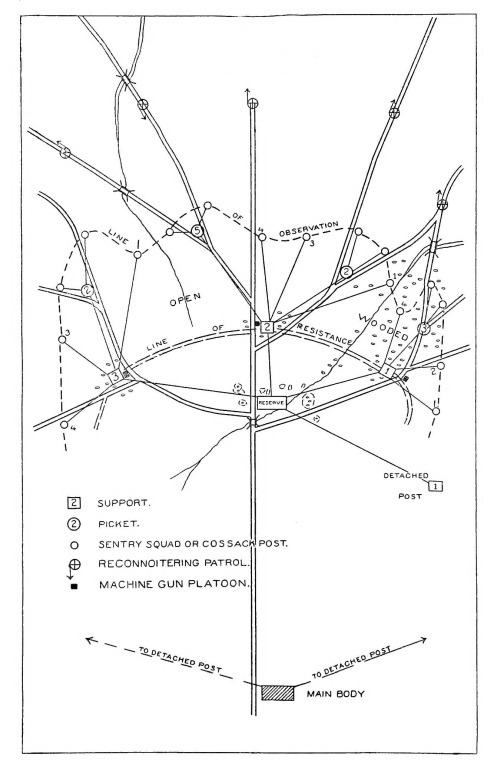
[Pg 195]
| Support No. 1. | Day | Night | |
| Single sentinel at support (1 n. c. o.) | 4 | 4 | |
| Officer and mounted orderly to visit outguards 2 and 3 | 0 | 2 | |
| Reconnoitering patrols beyond outpost line | 4 | 8 | |
| Outguards. | |||
| 1. | Cossack post at | 0 | 4 |
| 2. | Sentry squad at | 0 | 8 |
| 3. | Picket at | ||
| Single sentinel at picket | 0 | 4 | |
| Cossack post at | 0 | 4 | |
| Cossack post at | 0 | 4 | |
| Patrol, 3 men, patrol along front and connect with | |||
| detached post from the reserve at | 0 | 9 | |
| Patrol, 2 men, to connect with adjacent picket and | |||
| patrol along front | 0 | 6 | |
| 4. | Cossack post at | 0 | 4 |
| Support No. 2. | |||
| Double sentinel at support (2 n. c. o.) | 4 | 8 | |
| Officer and 2 mtd. orderlies to visit pickets | 2 | 6 | |
| Reconnoitering patrols beyond outpost line | 8 | 16 | |
| Outguards. | |||
| 1. | Cossack post at | 0 | 4 |
| 2. | Picket at | ||
| (out day and night) | |||
| Single sentinel at picket | 4 | 4 | |
| Cossack post at | 0 | 4 | |
| Cossack post at | 0 | 4 | |
| 2 patrols, 3 men each, patrol along front and connect | |||
| with adjacent pickets | 0 | 18 | |
| 3. | Sentry squad at | 0 | 8 |
| 4. | Sentry squad at | 8 | 8 |
| (serves also as examining post) | |||
| 5. | Picket at | ||
| (out night and day) | |||
| Single sentinel at picket | 4 | 4 | |
| Cossack post at | 0 | 4 | |
| Cossack post at | 0 | 4 | |
| 2 patrols, 2 men each, patrol along front and connect | |||
| with adjacent pickets | 0 | 12 | |
| Support No. 3. | |||
| Single sentinel at support | 4 | 4 | |
| Officer and mounted orderly to visit outguards 2 and 4 | 0 | 2 | |
| Patrol, 1 officer (or n. c. o.) and 4 troopers maintain | |||
| communication with cavalry post at and detached | |||
| post from main body at | 0 | 15 | |
| Outguards. | |||
| 1. | Sentry squad at | 0 | 8 |
| 2. | Picket at | ||
| Single sentinel at picket | 0 | 4 | |
| Cossack post at | 0 | 4 | |
| Cossack post at | 0 | 4 | |
| 2 patrols, 2 men each, patrol along front and connect | |||
| with adjacent picket | 0 | 12 | |
| 3. | Cossack post at | 0 | 4 |
| 4. | Sentry squad at | 8 | 8 |
| Total | 50 | 226 | |
[Pg 196] A careful study of such a table and accompanying maps or sketches will enable the outpost commander to determine how he can economize men without loss of security.
ADVANCE GUARD COMMANDER’S
HALT ORDER.
Par. 1. Information of the enemy.
Location and security measures of independent cavalry, if known.
Location of adjacent bodies of friendly troops and of their outpost lines.
Location of march outposts (these have been posted under verbal instructions).
Camp of the main body, location of its headquarters.
Detached posts from the main body—strength, location.
Par. 2. Camp of the advance guard, location of its headquarters.
Par. 3. (a) Instructions to the advance cavalry, when not attached to the outpost.
General orders as to country to be reconnoitered, any special tasks to be performed, contact with the enemy.
Time to withdraw for the night, where to camp.
Time to resume day positions.
Instructions as to standing patrols to be left out over night—strength, posts, special reconnaissance, etc.
The place to which messages for the cavalry will be sent.
(b) Instructions for the outpost. Troops, commander, location, line to be held in case of attack (or “in case of attack the outpost will be supported”), connection with other outposts or detached posts, examining posts, any special instructions. (Camp of reserve of outpost may be designated or this may be left to the discretion of the outpost commander.)
(c) Camp of the remainder of the advance guard. Commander.
Conduct in case of attack.
Detached posts (if any), troops, commanders, duties.
Instructions for the camp (preferably conveyed in verbal instructions or routine orders.) [Pg 198]
Instructions to special troops, if any.
Par. 4. Instructions for field trains. Those of outpost generally placed at disposal of its commander. May be directed to return to camp of advance guard after supper or before dawn.
Field trains usually assemble at an early hour at a designated locality, off the road, to join those of the main body (as they pass) on resuming the forward march.
Instructions to sanitary troops.
How and to whom communicated.
Report of dispositions to superior commander.
OUTPOST COMMANDER’S ORDER.
Par. 1. All the information contained in Pars. 1 and 2 of the Advance Guard Commander’s order—or so much thereof as may seem necessary.
Par. 2. Troops for the outpost, commander. Outpost line “to be held in case of attack,” or “in case of attack the outpost will be supported.”
Connection with adjacent outposts (if any), or detached posts.
Par. 3. (a) (Same as preceding order—if cavalry is attached to outpost.) [Pg 198]
(b) Instructions for supports, right to left. Station. Sector to occupy or guard.
Special reconnaissance. Contact with enemy. Patrol connection with adjacent outposts or detached posts.
Instructions as to examining posts, intrenching, obstacles, demolitions, etc.
(c) Detached posts (from reserve).
Instructions similar to those for supports.
(d) Reserve. Camp, special duty. Conduct of in case of attack.
Special troops—duties. Engineers assist in clearing, construction of obstacles, improvement of communications, demolitions, etc. Signal troops—connect parts of outpost.
Par. 4. Instructions for field trains (and sanitary troops if any). Wagons may join supports, usually return to camp of reserve after supper or before dawn. Assembly for march in the morning. (See previous form.)
How and to whom communicated.
Report of dispositions to superior commander, with sketch of outpost when prepared.
SECOND ORDER OF
OUTPOST COMMANDER.
(It is usually not necessary to issue this order, especially in a small command, as verbal instruction would suffice. If extensive changes are necessary a second order would be issued before dark in this form.)
Par. 1. Additional information or statement, “No change in situation.”
Par. 2. The following changes are ordered for the night.
Par. 3. (a) Instructions for advance cavalry (if not covered in first order). [Pg 199]
Time to withdraw from night position, camp for the night (usually with reserve), assignment of mounted men to the infantry supports for the night (if any). Standing patrols to be left out over night, special duties. Time for cavalry to resume day positions.
(b) Instructions for supports, any changes of position, reinforcements, additional intrenching, additional security measures, reconnaissance, etc.
Time to assume night and resume day positions. Patrol connection with cavalry posts during the night. Instructions as to camp fires, cooking, tent pitching, etc. (These camp details may be covered verbally and omitted from order.)
(c) Instructions to reserve.
Detached posts, exterior guards or other security measures for the night.
Instructions as to fires, cooking, tents, etc.
Reserve to be under arms at designated hour before dawn. (An extreme precaution adopted only when an attack is feared.)
Additional instructions for special troops.
Par. 4. Additional instructions for field trains. Usually wagons at supports to return to camp of reserve. Assembly of field trains in the morning.
How and to whom communicated.
Report of dispositions to superior comd’r.
Note: It would be seldom that any outpost orders would contain all the information and instructions set forth in the foregoing forms. On the other hand under certain conditions special instructions might be required. The forms indicate the subjects that should be considered. Not all of these need in the usual case be covered by the orders.
VERBAL OUTPOST ORDER
FOR A SMALL COMMAND.
Information of the enemy and our supporting troops.
Our main body camps at __________, with a detached post of (such troops) at __________.
March outposts are now __________.
Troops for the outpost, commander, outpost line, conduct in case of attack—usually “in case of attack this line will be held.” Such troops under such commander will constitute Support No. 1, and will occupy (or guard) the sector from such landmark to such landmark, both inclusive. Reconnaissance to __________.
(Support No. 2—instructions in same form.) [Pg 200]
All supports will prepare their positions for defense. Planking of bridges will be loosened and fords obstructed, etc.
Patrols will be sent to the line of __________ (usually enemy’s outposts if not too distant.)
Three mtd. orderlies will report to each support.
Reserve. Troops, commander, camp, detached posts, distant patrolling, etc.
Wagons may join their companies but will return to park south of the reserve by 9:00 p. m.
Messages to __________.
ADVANCE GUARD COMMANDER’S
HALT AND OUTPOST ORDER.
| Adv. Gd., 1st Brig., 1st Div., 1st Blue Army Corps, | ||
| TWO TAVERNS, PA., | ||
| Field Orders | |
20 June 1912, 2:20 p. m. |
| No. —— | ||
| Gettysburg-Antietam 3" Map. | ||
1. A hostile division advancing through CASHTOWN has occupied GETTYSBURG. A hostile troop has been driven from ST. MARY’S REFORMED CHURCH by our cavalry, which now occupies that place, observing the line of ROCK CREEK and towards GETTYSBURG. March outposts are now observing on the line of WHITE RUN.
Our army halts for the night with the left of its outpost at 550 (1⅔ miles north of TWO TAVERNS.)
Our brigade camps at GERMANTOWN with headquarters at the town hall and sends a detached post of 1 platoon of infantry to the TRUSTLE F. H.
2. This advance guard will camp at TWO TAVERNS.
3. (a) The 1st Sq., 1st Cav. (less Tr.D) will continue to cover our front until 7:00 p. m. when it will withdraw and camp at TWO TAVERNS, north of the main road and east of LITTLE’S RUN. Day positions will be resumed at 4:00 a. m. Half a troop under an officer will be sent at once to the vicinity of BARLOW to watch the crossings at that place and one mile south thereof, and patrol to the west and to GETTYSBURG on the [Pg 201] TANEYTOWN Road, throughout the night. One platoon under an officer will be sent to report to the outpost commander.
(b) Lt. Col. B with the 1st and 2nd Bns. and 12 mtd. orderlies of the 1st Inf., and 1 platoon, 1st Sq., 1st Cav., will establish an outpost on the line from the left of the army’s outpost through 525—479—Hill 449—to include the bridge 393W. In case of attack this line will be held and the outpost will be supported. Contact will be maintained with the cavalry post at BARLOW and the detached post from the main body at TRUSTLE. An examining post will be established on the BALTIMORE TURNPIKE.
(c) The remainder of the advance guard will camp at TWO TAVERNS; north of the road and west of LITTLE’S RUN, under command of Major C. In case of attack the outpost will be supported.
4. The field trains will join the troops. Those of the outpost troops are placed at the disposal of the outpost commander. All field trains will assemble on the BALTIMORE TURNPIKE east of 508 by 3:00 a. m. tomorrow when Capt. X, Q. M., 1st Inf., will conduct them to join the brigade train.
5. Messages to the school house at TWO TAVERNS.
Notes: The march outposts consist of small patrols of cavalry. They are withdrawn by verbal instructions as soon as the outpost is in position. In addition to these march outposts the advance guard, of course, establishes the necessary guards for the security of the camp.
Here the cavalry is independent of the outpost commander. It comes in [Pg 202] at night leaving out a standing patrol at Barlow. During the night some cavalry is assigned to the outpost for patrolling toward the enemy. The patrols from Barlow are told to go to Gettysburg, not toward. Perhaps they cannot reach the town, but will go as close as possible.
OUTPOST COMMANDER’S
FIRST ORDER.
| Outpost, 1st Brig., 1st Div., 1st Blue Army Corps, | ||
| Farm house 1,000 yds. S. of ST. MARY’S REFORMED CHURCH, PA. |
||
| Field Orders | |
20 June 1912, 4:20 p. m. |
| No. —— | ||
| Gettysburg-Antietam 3" Map. | ||
1. (Include in this paragraph pertinent information contained in Pars. 1 and 2 of preceding order, also information as to the location of the headquarters of the advance guard and concerning the cavalry post to be at BARLOW during the night.)
2. The 1st and 2d Bns. and 9 mtd. orderlies, 1st Inf., and 1 Plat. Tr. A, 1st Cav., under my command will establish the outpost from the left of the army’s outpost on the line through 525-479-Hill 449 to include the bridge 393W. In case of attack this line will be held and the outpost will be supported.
3. (a) Support No. 1 will take post just west of 525, connect with the left of the Army’s outpost, and guard the sector, stream just south of the 529—550—516 road inclusive, ravine 400 yds. south of ST. MARY’S REFORMED CHURCH inc. The line of WHITE RUN will be observed. Reconnaissance to WOLF HILL and along the BALTIMORE PIKE to GETTYSBURG. An examining post will be established on the BALTIMORE PIKE.
Support No. 2 will take post about 500 yds. west of 479 and guard the sector, ravine 400 yds. S. of ST. MARY’S REFORMED CHURCH exclusive, LITTLE’S RUN inclusive. Reconnaissance to the north and northwest from DIENER. [Pg 203]
Support No. 3 will take post near 491 and guard the sector LITTLE’S RUN exclusive, 491—393W road inclusive. Limited reconnaissance from 418 west. Patrol connection will be maintained with the cavalry post at BARLOW and the detached post at TRUSTLE during the night.
Each support will prepare its position for defense.
(b) The reserve will camp at the farm house 1,000 yds. south of ST. MARY’S REFORMED CHURCH.
4. Company wagons may join their organizations but all trains will be reported to Capt. X, Q. M. 1st Inf., at road junction 508 east of TWO TAVERNS by 2:50 a. m. tomorrow.
5. Messages to the reserve camp and in case of emergency by duplicate direct to advance guard comdr. at TWO TAVERNS.
Verbally to support commanders.
By Lt. T, Bn. Adjt., to C. O. Cav.
Copy with sketch of outpost to C. O. Adv. Guard.
Notes: The expression “limited reconnaissance” means within the limits of an infantry patrol as Support No. 3 has not enough cavalry for this reconnaissance after allowing patrols to go to BARLOW and TRUSTLE, as these must be mounted on account of the distance. Support No. 2 will place a picket at DIENER in accordance with its instructions. This arrangement illustrates the statement that there can be no fixed rules for the dispositions of an outpost.
[Pg 204]
General observations. Decisive results are obtained only by the offense. The attack leads, the defense must conform.
Do not contemplate a purely passive defense unless your mission requires it.
Raw, untrained troops are not suitable for active offensive operations; they are best utilized in defense, on the line of communications, or in a pivotal position supporting the maneuver of the first line troops.
A purely passive defense may be adopted in the following cases:
It is by no means to be understood, however, that a purely passive defense should always be adopted in the above cases. This will depend on circumstances. At times a vigorous offensive may offer the only chance of success.
Fire superiority is the keynote of success.
Avoid too great dispersion of the front or separation of the troops in a decisive action. A regiment united has greater fighting strength than 3 separated battalions. All movements should be simple. Complicated maneuvers should never be attempted in battle. Make a conservative solution—never attempt anything grotesque.
Avoid half-hearted measures. If the decision is to attack, all available force should be thrown into the fight. This does not mean, however, that no reserves should be kept in hand at the opening of the attack.
Do not uncover the line of retreat unless the force is small and the country friendly. If, however, circumstances permit this to be done it will often force the enemy to also uncover his line of retreat, and may thus increase the fruits of victory. An advance guard should [Pg 205] usually not uncover the main body, though in a pursuit it may be justifiable to do so in order to prevent the delay of the main body.
Put into the main fight all available force, calling in all detachments within reach. The only detachments which are justifiable are (a) one which contains a relatively stronger force of the enemy and keeps it out of the main combat, or (b) one which protects the flanks of the main force, secures it against surprise, or covers its communications, etc.
A detachment operating as a containing force separated by some distance from the main body, should if practicable be relatively strong in cavalry and artillery.
Night attacks are usually dangerous, and ordinarily practicable only for small forces. Night movements, however, may be advisable under certain conditions:
An attack order will be much more intelligently made when issued as a result of an examination of the ground rather than from the map alone. For small commands, some examination of the terrain by the commander in person, will usually be possible, but for commands the size of a division or larger, the examination may not be possible. Dependence must then be placed upon the map supplemented by such reports as are obtainable.
Attacks which offer no chance of tactical success should generally be avoided. Combats which have no bearing on the general plan should also be avoided, as a rule, even though they offer the chance of easy victory.
Never neglect reconnaissance at any time.
Avoid splitting or mixing tactical units as far as possible.
Aggressiveness wins battles. If in doubt it is generally better to attack. But make sure that the advantage derived from victory will be well worth the cost.
Form of attack. A turning movement should seldom be undertaken by a force smaller than a division (except by cavalry, or in the attack of a river line, etc.) [Pg 206]
The usual forms of attack for a small force are but two in number:
The advantages of a frontal attack are simplicity, speed and directness. Its disadvantages are that it is usually very costly (due to difficulty of obtaining fire superiority) and generally less effective if successful than an enveloping attack. It is most commonly employed in advance guard actions (see post).
The object of an enveloping attack is fire superiority. It usually implies a considerable superiority of numbers and should ordinarily be preferred to a frontal attack when practicable.
In deciding as to whether to attack, the commander must consider what his mission requires, the nature and extent of the enemy’s defensive line, the relative numbers of his own command and that of the enemy, the strength and positions of the supporting troops of each and the enemy’s probable intentions.
An attack usually implies superior force either in numbers or quality of troops, hence if the enemy is equal or superior it would generally be disastrous to attack him in position unless expecting reinforcements. In such case an attack may be made in order to develop the enemy’s strength, location and intentions, and hold him in position until the arrival of reinforcements. The attack need not be pushed home until the reinforcements arrive. Such an attack would generally be frontal as this would be the safest procedure, usually least exposed to counter attack, and would allow the reinforcements to envelop either flank upon their arrival. In deciding on the method of attack, the position of the enemy’s reserves should also be considered. Moreover the enemy’s line might be too long to be enveloped after covering its front.
If the enemy occupies a line too long to be enveloped, but which is known to be lightly held, a frontal attack may be made with the object of piercing the attenuated line. Such an attack would, of course, be less costly than in the ordinary case, especially as the enemy almost certainly would not fight to a decision. If the enemy is known to be fighting a delaying action only, a frontal attack will as a general [Pg 207] rule most promptly drive him from his position, although this of course depends to some extent on the nature of the terrain.
Finally if the enemy’s flanks rest on impassable obstacles, or if the attack is a local operation on an extended and continuous line of battle, a frontal attack is the only course open.
When practicable an enveloping attack is to be preferred and it becomes a question of which flank to envelop. The following considerations will be a guide to a decision on this point:
(a) Which flank allows the nearest approach under cover?
(b) Against which flank can an attack be more quickly launched consistent with due preparation and without undesirable separation of the attacking columns?
(c) Which flank has the better field of fire? (For the enemy).
(d) What bearing if any have the available artillery positions?
(e) Where is the enemy’s line of retreat and from whence will his reinforcements (if any are expected) probably arrive? (The enemy will withdraw more readily from an attack which threatens to separate him from his line of retreat or reinforcements, unless he has a small force and is in friendly country, in which case separation from his preferred line of retreat is not so serious a matter.)
(f) In view of the direction from which our own reinforcements may arrive, which flank is preferable?
(g) In view of the direction from which the enemy’s reinforcements may arrive, and the position of our own line of retreat, which flank may be more safely attacked? The possibility of a reverse must not be overlooked.
The best disposition for the attacking infantry is the primary consideration in determining which flank to attack.
A consideration of these tactical questions will usually result in a preponderance in favor of one flank. Always envelop that flank which gives more promise of a tactical victory. If both flanks are promising, then consider which attack would give the greater strategical results if successful.
A simultaneous envelopment of both hostile flanks would be rare, and would ordinarily imply great superiority of forces. It will almost invariably be better to concentrate on the enemy’s weaker flank. [Pg 208]
The usual attack will then have two parts, the secondary or holding (frontal) attack and the main or enveloping attack. They are, however, never so called in orders as the expression, “secondary attack” is objectionable, tending to diminish the ardor of the troops engaged therein. Moreover, it is not always possible to foresee which attack will actually be pushed home. The “secondary” may become the decisive attack. There must be nothing either in the appearance or conduct of the frontal attack to indicate that it is not being made in earnest, for if the enemy perceives that this attack is not to be pushed, he will contain it with a relatively smaller proportion of his force and concentrate against the main attack.
Generally the main attack is made stronger than the holding attack. The strength lies in its depth of deployment, it may or may not be stronger in total numbers according to circumstances. The difference of density per yard is not manifested in the firing lines, however. The enemy must not be permitted to judge the holding attack by any weakness in its firing line. The difference lies chiefly in the supports. The main attack must hold out stronger supports because usually it will have more gaps from casualties, fatigued men, skulkers, etc. The main attack is to be driven home at all costs. To do so the density of its firing line must be maintained to the last. It must be expected that an attack having a firing line density of 1 man per yard may need supports of equal or greater numerical strength before it will be able to throw the enemy out of his trenches. The firing line density of each attack should therefore be essentially the same, say about 1 man per yard of front. The main attack may hold out from each battalion say two companies in support where the holding attack retains one. (See also Chap. XVII).
Envelopment should generally be provided for in the first deployment, not afterward. The enveloping attack may be extended during the action by putting in the reserves. The defender also will probably extend his line during the fight to meet the enveloping attack.
The main attack should generally be made as strong as possible. The minimum number of troops should be assigned to the holding attack in order to have all possible strength in the main attack (and reserves). A usual disposition for a division would be: 1 brigade in the holding attack, 1 in the main attack, 1 in the reserve. [Pg 209]
The advance guard regiment in a brigade action, would generally be assigned to the holding attack, covering the maneuver of the main body.
An enveloping movement must not expect to enfilade the enemy’s line. He will echelon his line to the rear and throw in his reserves to meet it, so that it usually becomes merely a frontal attack in a different direction. The advantage of envelopment is the convergence of fire as against the divergence of the enemy’s fire. An enveloping attack should be separated sufficiently from the holding attack and directed well to the rear of the enemy, as it has strong tendency to join up with frontal attack and become merely an extension of the latter on the same line, thus sacrificing the advantage of converging fire. On the other hand the separation should not be so great as to sacrifice co-operation and mutual support. (For discussion of turning movements see Chap. XVII.)
Advancing to the attack. An attack should generally not be launched until the strength of the enemy and the position of his flanks are well established.
The attacking troops keep to the roads and remain in column as long as practicable, in advancing to their deploying positions. If subjected to artillery or long range rifle fire the advance should be made in some less vulnerable formation. (See Chap. XVI.)
The attack should advance under such cover as is available as close as possible to the enemy’s line before opening fire. It is desirable to obtain a first position within 800 yards and seldom beyond 1,000 yards. Fire superiority must be established in the first position. Otherwise an advance is not practicable.
The main and secondary attacks (in an enveloping action) should generally advance in conjunction with each other. Both should advance from cover when practicable and (particularly for the main attack) have the element of surprise.
Cover for the advancing troops both before and after deployment is the most important consideration, but must not be allowed to outweigh all other considerations. The best cover is fire superiority, as it encourages the attacker while natural cover tends to enervate him.
Adjacent organizations endeavor to maintain contact during the advance, but nobody waits for a laggard. [Pg 210]
The various echelons of the attack generally move forward together—the supports and local reserves keeping their distances from the firing line as well as circumstances—especially cover for the advance—permit.
Every portion of the defender’s line must be covered by fire throughout the attack. This is accomplished by assigning a portion of his front to each organization in the attack. The front so assigned should be about equal to the deployed width of the attacking organization and opposite to it.
The brigade commander assigns fronts to the regiments, the regimental commanders to their battalions, the battalion commanders to their companies, etc.
These fronts should be assigned as accurately as the landmarks of the terrain allow. Often the enemy’s line is so poorly defined or so indefinitely located, that it is impossible to give an organization anything more definite than a guiding point or general direction for one flank. (See Chap. XVI.)
Great care should be exercised in the assignment of fronts. If the adjacent flanks of two organizations advancing from slightly different directions guide on the same point in the enemy’s line during their advance, they will arrive in a continuous line upon his front. If the point is in advance of the line there will be crowding or overlapping, which is objectionable as it causes confusion and may subject a portion of one line to the fire of the other. Casualties during the advance may tend to reduce this difficulty. If the guiding point is in rear of the enemy’s line there will be a gap between the two organizations, which however, may be filled if that is desirable. If the two organizations are advancing in the same direction, contiguous to each other (as in a frontal attack) no difficulty is encountered and the arrangement is excellent.
The interior flank of the enveloping attack will usually be directed on the supposed position of the flank of the enemy, or on a point a little inside of it. Consequently, at the start, there may be no troops opposite the enveloping attack, but the enemy may be expected to extend his line promptly to meet it when he becomes aware of the envelopment. (See Fig. IX.)
Each column assigned to the first line in attack should be instructed (in orders) as to: [Pg 211]
Reserves. Troops once committed to an attack can be withdrawn only with the greatest difficulty. When once in action they are usually beyond the control of the commander. It is by the judicious use of his reserves alone that the commander can influence the course of an action once he has launched his attack. Hence too many troops should not be committed to the action at the outset. Especially if the enemy’s strength and position are not yet fully developed should large reserves be kept in hand. The defense, as it must meet the attacker’s moves, usually employs larger reserves than the attack.
The aim of all tactics, either in attack or defense, is the concentration of overwhelming force at the critical point. Numerical strength that furnished overwhelming force at the proper time may be inferior at a later time. Rapidity of maneuver is equivalent to increased numerical strength. Hence the value of motor cars in effecting tactical or strategic concentration of troops.
A company ordinarily deploys on one line. A battalion holds out one or two companies as local supports. These are used to replace losses in the firing line during the advance over the fire swept zone.
Each regiment holds out one or two battalions as regimental reserves. Their purpose is to carry the firing line into the assault.
Each brigade in attack ordinarily holds out a regiment as brigade reserve. It is employed to reinforce the decisive attack, to secure possession of the captured position, to meet the defender’s counter attack, or to take up the pursuit of the defeated force.
The defense is characterized by small local supports and reserves, and large general reserves, except in delaying actions. The reserves are almost always employed to protect the flanks, although not necessarily to furnish combat patrols. They should therefore generally be posted near the exposed flank or the one that will need reinforcement. If there be doubt as to which flank may need reinforcement the reserve is held in a central position from which it can conveniently reach either flank, or else divided. [Pg 212]
If there is cover available the local supports may be within 50 yards of the firing line. If no cover is available they should be farther back. The general reserve seeks a convenient covered locality, behind a flank or opposite the center.
Protection of the flanks. On account of the difficulty of changing front during the action and the annihilating effect of enfilading fire, the flanks of a line are its most vulnerable parts, and the most elaborate measures are habitually taken for their protection, both in offense and defense, as they are the cynosure of attack.
The best protection for the flanks of the defender is afforded by impassable obstacles, which render them absolutely secure from envelopment. Next in order come a good field of fire and fortifications.
The cavalry or mounted men provide a measure of security for the flanks by observation and if possible, resistance. It is also their duty to maintain communication with any friendly troops in the vicinity—and their orders should contain instructions to that effect. The supreme commander (both in attack and defense) usually retains in his own hand a few mounted men to act as messengers during the engagement. Artillery favorably posted may also protect the flanks with fire.
Irrespective of the protection afforded by the other arms, infantry patrols are placed to guard the flanks of a line. These are known as “combat patrols” and should never be omitted either in attack or defense during any stage of an action. Combat patrols are in the nature of covering detachments whose principal function is to give warning. Where resistance is needed in addition to warning, the patrol is strengthened accordingly, and, if of some size, may be called a covering detachment. Such a body accomplishes its purpose by taking station at some convenient point on the exposed flank and covering it. Here it halts in a defensive position or attitude, (it may intrench) sending a few men to nearby points of observation. The bulk however is held in hand ready to open fire on hostile reconnoitering patrols and fight them off or to give prompt warning of the approach of any large body toward the flank it is covering. It will open fire on the superior force and fight until forced back, thus securing all possible delay in order to permit of measures being taken to oppose the flank attack. [Pg 213]
It is the duty of each organization on a flank to provide for the security thereof without special orders to that effect. But a small unit will not ordinarily detach any considerable portion of its strength to a great distance for this purpose. Thus a battalion in the first line may send out one or two squads or a platoon from its supports, a few hundred yards to the flank, as a combat patrol. If larger measures are necessary for security they should be taken by the regimental or brigade reserve. The flanks of a line are usually its most vulnerable parts and hence they demand special attention. The protection of the flanks (either in attack or defense) is of such vital importance that it should not devolve as a matter of course upon the commanders of the flank organizations. The supreme commander should make positive provision for flank protection in his attack (or defense) order. In the absence of such orders the regimental (or battalion) commanders on the flanks will take the ordinary precautions in the way of combat patrols.
During the early stages of an action and before the regular attack is launched, patrols should also be sent to the front (directly toward the enemy) to feel his position by drawing his fire, and to examine the ground over which the attack must be made. Such patrols may vary in strength from a few individuals to a firing line making a frontal attack. A reconnaissance in force therefore, may become a small attack. It is generally not intended to push home unless the situation developed as the reconnaissance in force proceeds, warrants a regular attack. Small patrols in front of the line, must generally seek cover before fire is opened. If necessary they withdraw to the rear or flanks. While a defensive position is being prepared or occupied, provisions should always be made for security to the front. Usually some regiment will be directed to provide for this. If no special instructions are given each organization watches its own front, and flank (if exposed).
A flank combat patrol, except when sent out for the special purpose of concerted participation in the defense (or attack) provides security primarily by observation. Nevertheless it should have some power of resistance, at least enough to push back reconnoitering patrols of the enemy. Hence 3 to 4 men would usually be insufficient; 2 squads to a platoon is better unless the force is a very small one. From this the [Pg 214] flank groups may vary in size up to a battalion, placed for the special purpose of active participation in the engagement during the later stages.
Troops withdrawing from battle to camp should not uncover the front they have been guarding until the outpost troops are in position.
Ammunition. The extra ammunition in the battalion combat trains is habitually issued before an attack or in the occupation of a defensive position, unless the orders expressly state that this will not be done. The issue of ammunition is ordered by the battalion commander when it becomes necessary for the battalion to separate from its combat train upon entering an engagement.
The regimental commanders will give orders as to whether or not packs are to be carried into action, and if not where they will be left. It takes about 10 minutes to issue ammunition after the arrival of the wagons. When the issue of ammunition is completed the wagons are assembled at some convenient point by order of the supreme commander. They may be sent to the rear to refill usually from the ammunition train, or retained temporarily to transport wounded.
During an action the ammunition trains, if likely to be required, should be brought well to front, and their positions marked by red flags or lanterns. The pack train may be ordered up to facilitate the distribution of ammunition. In our service pack outfits are carried in each wagon of the infantry combat trains, thus allowing the lead mules to be converted into pack animals.
The ammunition carried in the men’s belts is 100 rounds, and the extra ammunition in the combat trains, 120 rounds. Hence the engagement may open with 220 rounds on the men, if all the extra ammunition in the combat trains has been issued. The amount of ammunition expended at each firing position will be that sufficient to establish (or maintain) fire superiority. In first establishing fire superiority 25 to 100 rounds or even more may be expended. Usually at the succeeding halts a lesser expenditure will be required. If, however, the advance be checked by a loss of fire superiority the expenditure of ammunition before advancing must be sufficient to reëstablish that superiority without which a further advance is impracticable. Following are some examples of actual expenditures: [Pg 215]
With improved modern weapons having far greater efficiency than those of former times, and modern facilities for the supply of ammunition it is certain that the figures given above will often be greatly exceeded. It is quite possible for an individual soldier to expend 1,000 rounds or more during a single period of daylight, and the average consumption of a body of troops in a protracted conflict may run to 500 rounds per day or even more. Under these conditions very heavy demands will be made on the ammunition supply service.
The defense, having better facilities for supplying ammunition, may expend more than the attacker. Its better facilities for resupply give the defense an advantage in this respect. Long range fire (beyond 1,200 yards), seldom advisable in attack, may be frequently employed in defense when the conditions are favorable. If the attacker can be brought under effective fire and forced to deploy beyond 1,200 yards, he will have great difficulty in pushing home the attack.
The ammunition of the dead and wounded should be removed from their persons, and advantage should be taken of cover, lulls in the action, and all other favorable conditions to distribute ammunition. All officers and non-commissioned officers are charged with the duty of preventing the waste of ammunition.
Intrenchments, obstacles, etc. Intrenchments are habitually employed by the defense, and when practicable may be utilized also by the attack. Ground once gained by the assailant should be held tenaciously, thus only can success be assured. Moreover a retreat under fire would ordinarily result in greater losses than if the position were held. If necessary to hold their position the attackers should dig themselves into the ground. With the portable tools trenches may be dug [Pg 216] in a prone position, part of the line intrenching while the rest maintains the fire. The attacker may also intrench under cover of darkness. Shelter trenches providing considerable security against rifle fire may be dug in 30 mins, or even less in favorable ground, with the portable intrenching tool. These trenches afford only slight protection against shrapnel fire and if they are to be occupied for any considerable time, they should be enlarged to the kneeling or standing type. Greater protection from shrapnel fire can be gained by the use of head or overhead cover. Such cover requires several hours to construct and would seldom be employed by the attack. (See table Chapter XII.)
The invariable use of intrenchments in the attack, however, is not advisable. The best means of gaining fire superiority and the best protection against hostile fire is the attacker’s own fire. The habit of intrenching tends to diminish the ardor of attacking troops. Therefore the decision in this matter should not habitually be left to the soldiers or the company officers. The order for intrenching should generally emanate from the battalion or other superior commanders.
The object of intrenchments in defense is to economize men on the firing line in order to hold a longer line, or permit the retention of large general reserves for the decisive stages of the action. (See “The organization of a defensive position,” post.)
Trenches should preferably be located and constructed by the troops who are to occupy them. If there be time, communicating trenches and shelters for supports and reserves may be constructed. The Engineers perform the more difficult work, such as obstacles, heavy clearing, communications, etc., works of general interest not properly part of the task assigned to any line unit, and any works for which infantry are not equipped or specially trained.
Obstacles along the front of a position may favor either the attacker or defender. If they afford shelter from view while allowing easy passage (like an open wood), they of course favor the attack and can hardly be called obstacles, but must be classed as cover for the advance. If, on the other hand, they hinder progress without affording concealment (like a marsh or bog) they naturally favor the defense. All artificial obstacles are of this latter kind. [Pg 217]
Between these two extremes are many obstacles which according to conditions may favor one side or the other. In general anything which affords concealment, to that extent favors the attacker, and anything that delays progress, to that extent favors the defender.
Obstacles tend to confuse and break up the attacker’s formations, especially if they run obliquely to his line of advance.
An absolutely impenetrable obstacle along a portion of the defender’s front, even if it conceals the attacker, is generally an advantage if not too close (within about 300 yards) as it limits the attacker’s advance to the open spaces. It is to be remarked, however, that few obstacles are absolutely impenetrable. If such there be, however, as for instance an unfordable stream, they give rise to special forms of attack. (See “Attack of a River Line.”) If the defender contemplates assuming the offensive a continuous obstacle in his front may be a positive disadvantage. It may also entirely discourage the attacker and cause him to turn the position instead of assaulting it. This may or may not be an advantage to the defense, depending on its mission.
Artificial obstacles, usually constructed by the Engineers, may be placed in front of a defensive position at effective ranges. The most practicable forms are abatis, slashing and wire entanglements, or a combination of these. Ordinary fences are obstacles serious to cavalry, but less so to infantry. Barbed wire entanglements are the most effective form of obstacles.
It is to be noted that obstacles not covered by the fire of the defender fall short of the full measure of usefulness, as the enemy can remove then with comparatively little difficulty or loss.
The greatest obstacle to the attacker’s advance is a clear field of fire. The defense, therefore, will usually take steps to clear the front of the position, measure and mark ranges beyond 600 yds. (battle sight range), etc. The infantry is provided with tools for light clearing. The heavier work should be done by the engineers if any are available. (See “The organization of a defensive position.”)
Frontage in attack and defense. A company (unless acting alone) goes complete into the firing line. All larger units hold out a part of their strength (usually from one-fourth to one-half) as supports and reserves. Avoid splitting or mixing units. [Pg 218]
Fig. IX.
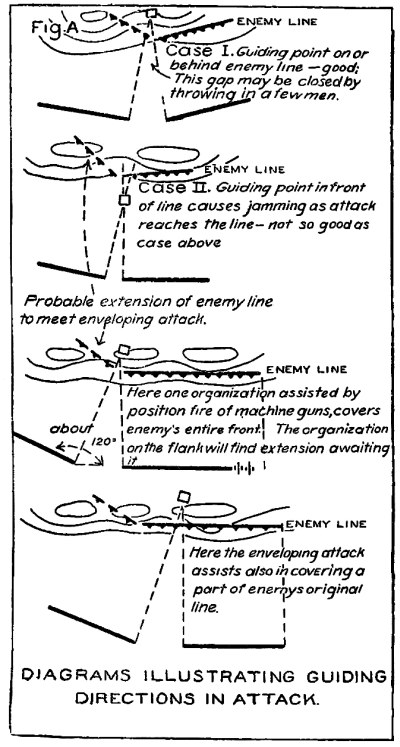
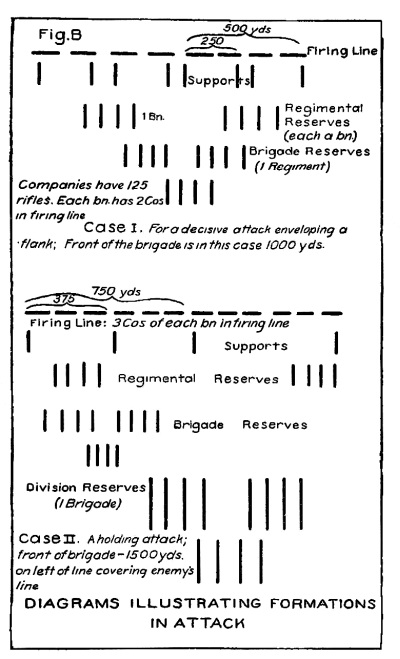
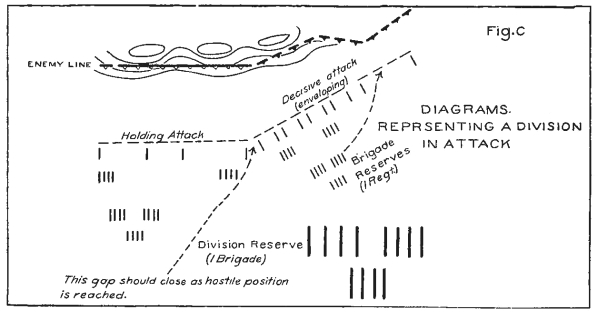
[Pg 219] The density of the firing line in attack and defense is about 1 man per yard. A 16 squad company can place 128 rifles (8 x 16) in the firing line. Hence the frontage of any line will be equal to about 128 yards multiplied by number of companies in the firing line, plus or minus about 20 per cent. Thus the front of a battalion with 3 companies in the firing line would be from 300 to 450 yards. (But see also Chap. XII.)
The expressions “1 man per yard” and “at one yard intervals,” are usually intended to mean that each yard of the front is to be occupied by one man. Actually, the interval or open space between the shoulders of adjacent men in this case is about ½ pace (15 inches).
In defense or in the holding or secondary attack a battalion may place 3 companies in the firing line. In the main (enveloping) attack it would more commonly place 2 companies in the line. The companies (of the leading battalions) not in the firing line are called local or battalion supports. Each regiment may hold out 1 battalion as regimental reserve, each brigade 1 regiment as brigade reserve, and each division 1 brigade (and auxiliary troops) as general reserve. Circumstances might cause the strength of these reserves to be greater at the beginning of an action, but they seldom should be less. The defense usually has weaker supports and local reserves, but stronger general reserves than the attack. As the defense must play to the attacker’s move ample reserves must be held for the purpose. The density of a defensive line is not subject to arbitrary rule, so greatly does it depend on the mission and other conditions. In a delaying action a greater extension is permissible than in a fight to a decision. (See also Chaps. XII and XVII.)
PROBLEMS INVOLVING THE
ATTACK OF A POSITION BY
A SMALL INFANTRY FORCE
(Regiment or battalion.)
(See also “The Rifle in War,” Chap. XVI.)
The first stage of the action, which will be given in the problem, opens generally with a report from the cavalry or by the advance guard being fired upon, or some such occurrence to the front. If it is [Pg 220] certain that there will be an attack the commander will usually order extra ammunition to be issued. The field trains are halted off the road or sent to a safe place. The commander then rides forward to the most advanced position possible where he can obtain a view of the terrain and the enemy’s dispositions and receive reports from cavalry or mounted patrols. The adjutant is usually with him and he sends word for the column to continue its march or to halt at a certain point and await orders. He directs his subordinate commanders to accompany him or to follow him to the advanced position. If these subordinates are not mounted make due allowance for that fact, considering the time it will take them to get up. The circumstances may be such that it is not advisable to separate all of his subordinates from their commands, but generally he will direct them to proceed to the advance lookout point. These subordinates will include the company (or battalion) commanders, the adjutant, and the commander of the machine gun company (or platoon). The quartermaster and surgeon are usually not called to the front. Having reached the advance point, he directs his efforts particularly toward ascertaining the location of the hostile flanks and examines the ground from which he may launch his attack. Having estimated the situation and his subordinates being assembled he issues his orders. He must be very sure that every subordinate who has a task to perform receives his orders. If any of these are not present the orders must be sent to them, and the commander will usually direct his adjutant to see that his orders are transmitted to any subordinates who are not present. His actual orders will invariably be verbal. Sometimes the problem will ask for his combined order. This means the order for all parts of the force as it would be dictated to his adjutant subsequent to the action. The actual orders may be issued piece-meal, but generally try to issue the combined order and then direct the adjutant to see that those not present are advised.
The order must cover the following points:
1. Information of the enemy, particularly his strength and the position of his flanks. Information of our own and the enemy’s supporting troops.
2. This command (or We) will attack the enemy at once, making a frontal attack (or enveloping his right flank). Former march conditions now cease. [Pg 221]
3. Cos. A and B will constitute the firing line, and will move via —— under cover to ______ (edge of woods, ravine, crest, or other cover), and will deploy, perpendicular to (or parallel to) ______ at one yard intervals, Co. A on the left with its left flank ______ yds. from ______. Co. A will attack that section of the enemy’s line from ______ to ______ (inclusive or exclusive); Co. B, that section from ______ to ______ (inclusive or exclusive.) (Indicate clearly visible landmarks, or give definite distances. Be sure that every part of the enemy’s line is covered.) I will give the order for the advance (or to open fire).
The foregoing paragraph is for frontal attack. In case the attack is enveloping, the order would be:
Cos. A and B will constitute the firing line. Co. A will move via ______ under cover to ______, and will deploy perpendicular to ______, at 1 yard intervals with its left flank at ______ (or — yards from ______) and when ordered to do so will advance and attack the enemy’s line from ______ to ______ (inclusive or exclusive) directing its right on ______, and moving to attack in conjunction with Co. B.
Co. B will move via ______ under cover to ______, deploying when necessary perpendicular to ______, at 1 yard intervals with its left flank on ______, (or — yards from ______) and when ordered to do so will advance and attack the enemy’s line north of ______ directing its left on ______ (or will advance and attack the enemy’s left, etc.)
(No definite limits are assigned to the outside flank. The enemy may not be opposite the enveloping attack when it is launched, but will likely extend his line to meet it. If the two companies are separated at the start and converge on the enemy’s line the orders would be similar to those for an enveloping attack. Sometimes the enveloping attack will be directed on an interior part of the enemy’s original line in which case it will cover part of his front and also envelop him. Instead of being ordered to deploy at 1 yard intervals, a company may be ordered to deploy on a front of ______ yds.)
I will give the order to advance.
Lieut. Y, with your machine gun platoon and one platoon of Co. C, which will report to you as escort, move via ______ to ______ (usually some [Pg 222] hill or crest). As soon as the attack is well developed open fire on the enemy and assist the advance. You will provide protection for our left flank (if he is on a flank).
The mounted orderlies under Lt. G (the adjutant or some officer especially detailed) will patrol to ______ and ______, covering our flanks and observing, etc.
Co. C will send one platoon (or such force) to report to Lieut. Y, commander of the machine gun platoon, as escort. It will also send a sergeant and ______ men (or such force) well to the right (or via ______ to ______) as right flank patrol (or to cover our right flank).
Note. It would generally be inadvisable to assign any considerable portion of a small force as an escort to the machine guns unless it was necessary for effective fire, to place them in a very exposed position (on a flank). It may be better to place the machine guns where they will need no escort. In the actions of larger forces, however, machine guns may often be employed with decisive effect against the flanks of the enemy. In such cases they should be used in larger masses, not by platoon. They are very effective in repelling surprise attacks and are often employed in exposed positions without an escort.
The remainder of Co. C and Co. D, under my command (or under command of ______) will constitute the support (or reserve) and will move via ______ under cover to ______ and there await my orders (or follow Co. ______ at ______ yards distance, or ______ yards in rear of the right flank, or center, etc.)
4. When issue of ammunition is completed the empty ammunition wagons will proceed to ______ and park off the road (return to ______ and refill, or join field train.)
(Empty ammunition wagons may be used to transport wounded.)
A regt. aid station will be established at ______ (or location of regt. aid station will be announced later.) The band will report to the regimental surgeon (in a regimental action).
The company wagons (or field train) will halt off the road where they now are (or proceed to ______, or take station on such road with head at such crossroad, etc.)
(If no dressing station is to be established at first the order may direct the sanitary troops to join the field trains or halt at some other locality “in readiness.”) [Pg 223]
5. Messages may be sent to ______ (generally name a definite point) (or I shall be at ______, or with ______).
Explain how and to whom this order is delivered.
Make report to superior commander, by telegraph or telephone, mounted messengers, or other available means. Sometimes it may not be possible to report until after the action, but a report should always be sent as soon as practicable.
The foregoing order applies to any force up to a regiment. A regiment is assigned by battalions, each battalion being given its section of the attack. Each battalion holds out its own support. The orders, while covering all necessary points, must be so drawn as not to hamper subordinates by invading their province, nor to destroy their initiative by usurping their prerogatives. In the actual case the commander will regulate his orders to suit the experience, capacity and personal characteristics of the subordinate. In tactical problems the assumption will be made that all subordinates are fully instructed and competent, each within his own sphere and according to his rank.
Give the route to position for individual companies or battalions especially when trouble might ensue from interference of organizations. Thus to a battalion or lower commander say—“Move under cover via ______ to ______.” Be sure that available cover is utilized to the utmost extent practicable in the special case. In a regimental action the Colonel may direct that the packs be left in a convenient place on going into action. The Majors always give the orders about issue of ammunition, and see to the sending of combat patrols either as result of the colonel’s orders or without special orders. But if no extra ammunition is to be issued, or a portion of it only, the orders of the superior commander should so state. In some cases it may be inadvisable to issue all the extra ammunition. In any case extra ammunition is issued when the troops are compelled to separate from their combat trains on going into action.
Be sure that localities and dispositions are so described as to be perfectly plain not only to your imaginary subordinates but also to the instructor who is to review your problem. Great care should be taken to designate localities beyond the possibility of misunderstanding. Use landmarks, not map-marks, in fixing a locality. [Pg 224] In describing a point by its reference number make sure there is no other point having the same reference, or else say “Hill 622, 600 yds. NW. of SMITH F. H.,” etc., etc.
Be very sure that none of the troops come under hostile artillery fire in moving to their deploying position if it can be avoided.
Before deciding on an attack the commander should satisfy himself as to whether any reinforcements are on their way to the enemy, and throughout the action he must be constantly on the lookout for such. This is the special duty of the cavalry, or other mounted men.
The enemy’s line and the portion assigned to each unit should be designated as clearly as possible, preferably by landmarks, if there are such. If there are no landmarks an organization may be directed to attack the enemy’s front or his right wing, or for enveloping attack, his right flank, etc., distances and other means of orientation being given.
The attack orders for larger bodies, so far as the infantry is concerned, are similar to the foregoing, but in much less detail.
The engineers in attack may remove obstacles, improve communications, repair bridges or construct additional crossings. On the completion of their tasks they usually join reserves. They may be used also as an escort to the artillery.
Signal troops usually connect the position of the supreme commander with the commanders of the main and secondary attacks, artillery commander and reserves (if he is not with the reserve). Do not exceed the limit of their capacity in wire and telephones. (See “Organization of the U. S. Army,” ante.)
The sanitary troops establish the usual collecting, aid and dressing stations, and take charge of the evacuation of the wounded.
There is ordinarily a dressing station established for each brigade, and in addition a slightly wounded station for each division. The dressing station should be near fuel and water, preferably in a village or at least near some houses. It should be near the main attack but not too close to an artillery position. It should be on the main road to the rear and in a conspicuous place easily discovered. The slightly wounded station should fulfill as far as possible the same requirements, usually somewhat farther to the rear. For a force less than a brigade a single dressing station serving also as a slightly wounded station, would be established. [Pg 225]
The supreme commander gives the orders to the sanitary troops, usually after consultation with and upon the recommendation of the senior medical officer. The location of the dressing station and, in a division action, of the slightly wounded station, should be announced to the command in orders. But in case of attack where developments cannot be foreseen the order may say “location of dressing station will be announced later.” In this case the sanitary troops halt off the road at a designated place in rear, or remain with the trains. Usually they will be at a place somewhat forward of the trains. (See also “Sanitary tactics,” Chap. XV.)
The employment of small units in combat (except as part of a larger force) will be exceptional in systematic warfare. For combat tactics of small units see I. D. R., Part II, and F. S. R.
Remarks concerning an attack by a reinforced brigade. If an attack is imminent the supreme commander should march with the advance guard.
When the enemy is reported the supreme commander, accompanied by the colonel of the advance guard regiment, rides rapidly ahead to some point from which the enemy’s line can be seen. If the messages received indicate that an attack is probable the brigade commander sends an aide to the rear with such of the following orders as the situation may seem to justify:
1. Infantry in main body to continue the march, closing up on the advance guard, and halting when head of column reaches a point beyond which it would be exposed to artillery fire.
2. Colonels of the infantry regiments in the main body, and the artillery, engineer and signal commanders to join the supreme commander or assemble at the head of the main body to await his return from the front.
3. Disposition of the emptied ammunition wagons.
4. Artillery firing batteries to move promptly to the fore, passing the infantry in front of them and taking post off the main road in the vicinity of their combat position.
5. Field trains and sanitary troops to halt off the road at designated localities in rear.
6. Any detachments within reach to rejoin as promptly as possible.
It may not always be practicable to carry out all of the above measures [Pg 226] until the supreme commander has estimated the situation and fully decided to attack. As many as possible should be attended to in advance, in order to save time.
Having reached the lookout point to the front the commander endeavors to locate or verify reports concerning the location of the enemy’s flanks, what intrenching he is doing, etc.
He then considers:
1. Does the mission of the command require an attack, or will an attack best accomplish the mission?
2. Is there a reasonable prospect of success?
3. Shall the attack be frontal? Is the enemy’s line so attenuated that it can probably be pierced by a frontal attack, or is such an attack safer or for other reasons desirable? (Such as undue extension necessitated by an enveloping attack.)
4. Shall the attack be enveloping; if so against which flank? (For consideration of choice of flank see ante.)
5. From what locality can the friendly artillery best support the attack? Between the main and secondary attacks or behind the secondary is a good place, as here the artillery will be well protected, will need no escort, can support both attacks and, in the latter case (from behind secondary attack), can support the main attack with its oblique fire up to the last possible instant. Probable positions of the hostile artillery should be considered in connection with the selection.
6. Are there any strong positions, such as knolls or ridges which should be occupied by infantry (and possibly machine guns) for the protection of a flank (or both flanks)?
7. Where should the main and secondary attacks deploy? Can they reach their deploying positions in concealment, or with very little exposure?
8. Where should the reserve be held? Generally in rear of the inner flank of the main attack is a good place at first.
Having estimated the situation and made his decision the commander waits for his subordinates to join him, or returns to the head of the column, halting it when necessary (if not already halted) and issues his orders verbally, using the map to orient and direct his subordinates. It is necessary to note the positions of all elements of the command before issuing orders.
The advance guard regiment will usually be assigned to the secondary or [Pg 227] holding attack, and the next regiment in rear to the main or enveloping attack, the rear regiment constituting the reserve.
A front for each regiment in the fighting line is defined as accurately as conditions permit, and the approximate deploying position of each regiment is indicated. Ordinarily the regimental commanders are permitted to conduct their regiments to the deploying positions and deploy when necessary. But if there is any danger of confusion, interference or unnecessary exposure the supreme commander may designate routes to the deploying positions, which should be approached as promptly as possible under cover.
The secondary attack may be ordered to “attack in conjunction” with the main attack, or the commander may say, “I will give the order (or signal) to attack.” In some cases however, the secondary attack may be launched before the main attack, to divert the enemy’s attention from the latter, etc. The main attack may be launched at once, or may await a subsequent command or signal, pending completion of preparations.
Any special provisions necessary for the protection of the flanks (such as posting infantry and machine guns in commanding positions on the flanks) should be ordered by the brigade commander. If not ordered the regimental commanders will make such provisions as they deem necessary for the protection of their flanks. If no arrangements appear to have been made for this matter, the duty devolves upon the commanders of the flank battalions in the firing line.
The cavalry, prior to the attack, feels for the enemy’s line and drives in his cavalry. During the attack it operates on and covers the flanks, while threatening those of the enemy. The bulk of the cavalry should be placed on the flank where the enemy’s cavalry is known to be, or on that flank which is more exposed. A smaller body of cavalry, or a detachment of mounted men under an officer, covers the other flank. The duties of the cavalry during an action are to force back the enemy’s cavalry, to guard the flanks and threaten those of the enemy, and to watch for and give timely notice of the approach of reinforcements for the enemy, delaying their advance when practicable.
The artillery of the attack should be placed in one or more positions [Pg 228] from which it can support the infantry throughout the action. Ordinarily it is best to hold the artillery in large masses, but a division is permissible if the tactical situation demands. The artillery of the attack usually directs its fire on that element of the defense which is at the time the most threatening to the attacking infantry. In the assault it supports the infantry to the last practicable moment and then switches its fire to search the ground occupied by the defender’s reserves, or that over which they must pass in delivering a counter-stroke, etc. The artillery combat trains are at the disposal of the artillery commander unless otherwise specially ordered.
The reserve follows the main attack at a certain distance, or proceeds to a convenient locality designated and awaits orders. Usually the reserve will follow or be posted conveniently near the main attack, as it is on this flank that it will ordinarily be used. Exceptionally it may be posted in a more central position.
The engineers may be used to remove obstacles, improve communications, etc. They then join the reserve.
The signal troops connect the commander with the main and secondary attacks, the reserve and the artillery, to the limit of their capacity.
The field trains and sanitary troops are halted well to the rear. A dressing station may be established by the first order, or announced later.
After the issue of the extra ammunition the battalion ammunition wagons are collected at some convenient point in rear.
The supreme commander should take station at some good lookout point from which he can watch the progress of the action, and should generally remain there. If possible this point should be near the general reserve so that the commander can readily direct its employment. The station must not be too exposed nor too near the artillery.
Every fraction of the command must be accounted for in orders. Every subordinate who has a special mission to perform must receive definite orders concerning same.
Remarks concerning advance guard action. An advance guard action does not, in its detail differ particularly from any other combat of all arms, except that an advance guard has less independence of action than a separate detachment. [Pg 229]
It may result from:
a. Guarding main body against surprise.
b. Reconnoitering.
c. Pushing back reconnoitering forces of the enemy.
d. Pressing upon delaying forces of the enemy.
e. Pursuit of a defeated or retiring enemy.
f. Checking the enemy’s advance to give the main body time to prepare for action.
g. Seizing and holding a position to cover the passage of the main body through a defile or across a bridge. (In this case the enemy must be kept well beyond artillery range of the outlet of the defile.)
h. When the enemy is encountered in force on the defensive, holding him in position and reconnoitering his lines (in force, if necessary) while awaiting the arrival of the main body.
In deciding what action to take on meeting the enemy the advance guard must consider (a) Its mission, and also that of the main body, whether aggressive or not. (b) The comparative strength of the enemy and his apparent intentions. (c) The relative positions of the enemy, the advance guard and the main body, as well as other hostile or friendly troops. (d) Provisions for the security of the main body. This in general means that its front must not be uncovered, except in pursuit of a badly demoralized enemy.
In selecting flank to attack consider tactical success first and strategical advantages second.
An advance guard, while usually acting aggressively, must not engage in very doubtful enterprises, jeopardizing the safety of main body or committing it to action against its will. The mission of the whole command must be considered.
The advance guard by deploying for a frontal attack along the line of advance keeps the main body covered, leaves the supreme commander free to decide on which flank he will extend, and holds the enemy until he can come up. Frontal attacks are therefore of frequent occurrence in advance guard actions.
In pursuing a defeated enemy even if advance guard encounters him in force a prompt attack, usually frontal, is advisable. It is not [Pg 230] necessary to drive it home if this does not seem advisable; and there is usually little risk of a counter attack. But if enemy is still in good morale and there is reason for caution, an advance guard may take a position in readiness. If in doubt an attack is usually best, but the advance guard must not risk the defeat of the entire force in detail by a too impetuous attack on a greatly superior enemy. Good judgment is required in handling an advance guard in such situations, and for this reason it is advisable that the supreme commander be with the advance guard on the march. It is the proper duty of the cavalry to clear up the situation in advance. (See “Advance guards,” Chap. IV and “Rencontre engagement,” Chap. XIII.)
The occupation of a defensive position. In selecting a defensive position the following should be considered:
1. Is it necessary to take a defensive position, and has the time arrived to do so? (See “Position in Readiness.”)
2. Must the enemy attack the position or can he march around it?
3. Are there good positions with clear field of fire for infantry and artillery? (For delaying actions a good field of fire at long and mid ranges is a prime requisite.)
4. Natural protection for both?
5. Line or lines of retreat secure and accessible to all parts of the force? If there is but one line of retreat it should be central. Several lines of retreat are often an advantage to the retiring force if it is a large one, but on the other hand they may also favor the enemy by allowing parallel pursuit. Good rallying points in rear?
6. Flanks secure?
7. Communications good to front, rear and flanks?
8. Ground favorable for cavalry action?
9. Good locations for attacker’s artillery within effective range, if so are they registered?
10. Line enfiladed anywhere?
11. Obstacles to enemy’s advance, front and flanks? How do they bear upon possible assumption of offensive if such is contemplated?
12. Any rallying points or dead spaces for enemy within effective range? [Pg 231]
13. Has position been improved as much as possible? Are ranges to important points known?
14. Where is the main attack most likely to fall?
15. Are there good stations for the supports and reserves at proper distance? Can reserves be held in safe place favorable for counter attack?
16. Should the line be divided into sections? If so can the sections support each other, and if there are any intervals are they well covered?
17. Is the extent of the front suitable to the size of the command? Is it approximately perpendicular to the line of retreat? To the line of enemy’s advance?
18. Is the view good to the front and in the position itself?
19. Is the position well concealed from enemy’s view?
20. Are there any weak salients in the line?
21. Are there any advanced posts which should be occupied to prevent the enemy from doing so, or to cause his early deployment, etc? Can the troops be withdrawn from them in safety without masking fire of main position? (Advanced posts should, as a rule, be avoided.)
A single position giving a favorable answer to all these questions will never be found. They indicate, however, the desiderata.
A defensive position should be occupied only when general direction of enemy’s advance is known, and it is evident about where his attack will fall. Otherwise take a position in readiness, from which a defensive position may later be evolved.
Consider whether the mission is best accomplished by taking a position farther to the front or one to the rear. Frequently there will be time only to make the best of what is near at hand. It is to be remembered in this connection, that a rencontre engagement usually favors the stronger and more aggressive combatant. A weaker force should generally therefore allow itself ample time to occupy and prepare a defensive position, rather than risk a rencontre or at least a premature engagement by pushing too far to the front. The time that a smaller force can delay a larger one depends on the terrain, the time available for preparation, and the absolute and relative strengths of the combatants. To give a rough idea of the times that smaller bodies can maintain themselves against larger ones it may be said that a [Pg 232] reinforced brigade in a hastily prepared position should ordinarily be able to hold a division for some 2 to 3 hours; and that in similar circumstances, a division should hope to maintain itself against a corps for some 6 to 9 hours. Where the situation specially favors the defender, he may, of course, be able to hold very much longer. Each case is special and can hardly be said to have precedents.
The recent improvements in weapons have conferred greatly increased powers of resistance upon the defense. Except small forces, which cannot adequately secure their flanks nor block turning movements, troops on the defensive in a prepared position can be driven therefrom only with the greatest difficulty and, usually, a considerable expenditure of ammunition.
Must the enemy attack the position selected, or can he turn it? If delay only is the object this may be accomplished if enemy has to turn the position. But if it is desired to bar his advance and court an attack he should be both forced and enticed to attack. In such case do not take a position which appears impregnable or enemy may be discouraged from attacking.
The artillery should not be posted so close to the infantry line that it will draw fire upon it—five hundred yards or so behind the line is best.
Obstacles in front of the entire position are seldom of advantage to the defense. Obstacles which delay the enemy without concealing him, such as marshy ground, are a strong element of defense. There must be passages for the counter attack if such is contemplated, and in general the bearing of obstacles upon the conduct of an active defense must be carefully considered.
Consider which flank the enemy will probably attack and post the main reserves behind that flank. If there is some doubt seek a central position for the reserve from which it can reach either flank, or consider the advisability of dividing the reserve.
If the force be a regiment assign sections of the line to battalions; if a brigade, to regiments. Machine guns are not usually assigned to a battalion section. Their proper function is for surprise of the enemy at effective ranges, reinforcing weak portions of the line, etc. They are usually left under the orders of the regimental commanders, but may [Pg 233] be assigned by orders of the supreme commander for flank defense or for fire of position if the enemy has no artillery. (See “Machine guns,” Chap. XIII.)
Openings in the line are sometimes permissible, provided they are covered by the fire of adjacent organizations, or protected by reserves. In fact slight openings all along the line will be the rule, as it will seldom be practicable to occupy the entire front continuously, unless the force be a very small one. In the order of the supreme commander however, the assigned sectors will generally be contiguous, the detailed organization of each being left to the sector commander.
The density of the firing line in defense is seldom uniform. Some parts of the line may be lightly held to allow more men where a greater volume of fire is required. Obstacles in the front may also have an influence on the density of the firing line. Hence the fronts assigned to two regiments need not always be equal in extent.
In the early stages of a combat the defense, by reasons of its intrenchments, concealment, superior fire discipline, and smaller losses, may economize on men in the firing line and local supports in order to have larger general reserves to throw in at the decisive point in the later stages of the action, or for a counter attack.
If ammunition is plentiful, long range fire, to force the attacker to an early deployment, is permissible and often advantageous on the defense. The limiting range of such fire, under good conditions, is about 1,800 yards.
If a delaying action only is contemplated, the intention being merely to force the attacker to deploy, the line may be very lightly held and greatly extended with few local supports, or none at all, and small reserves. Such tactics of course, may be risky. The position should be promptly evacuated as soon as the attacker has completed his dispositions for the attack, since it is very difficult to withdraw infantry from a position after it is committed to action. Cavalry, by reason of its superior mobility is better than infantry for delaying actions. If there is a good line of retreat and cover for the led horses close in rear, cavalry may allow the enemy to approach within 700 yards or less, before withdrawing. (See “Cavalry tactics,” Chap. IX.)
Ranges to important points in the foreground should be determined (and [Pg 234] marked) if there is time. The field of fire is cleared and the position intrenched to the extent that time allows, or conditions require.
The instructions to “prepare the line for defense” cover the construction of intrenchments and obstacles and the necessary clearing. In this the engineers assist at the most difficult places. The intrenching proper should usually be done by the troops who are to occupy the trenches, but this rule is not rigid.
The supreme commander will direct in orders that the empty ammunition wagons be assembled at a point (or points) in rear. Subsequently they refill at designated point from the ammunition train, one or more companies of which are ordered up for this purpose or, in a smaller action, the combat wagons may be assembled and marched back to a depot to refill. Empty wagons of all kinds moving to the rear may be utilized for the evacuation of the wounded.
If the fight is to be to decision the artillery should if possible be so located that it can be run up to a crest for direct fire in the later stages of the defense.
When contact is established the cavalry uncovers the front and transfers its activities to the flanks, reconnoitering those of the enemy, and operating to his rear to observe the approach of possible hostile reinforcements. In retiring to a flank the movements of the hostile cavalry must be considered, and the enemy should be denied a superiority in this arm on either flank if the strength of the cavalry permits it. It is therefore inadvisable, unless greatly superior in strength to the enemy, to disperse the cavalry. The bulk of it should be kept in hand to oppose that of the enemy. A small detachment of the cavalry may be used for observation on the other flank.
The advance guard regiment may be directed to provide for the security of the command to the front until the position is occupied. Former march conditions cease (if command has been on the march). In retiring to its position the advance guard regiment must not mask the fire of troops already on the line, or allow the enemy to follow it too closely, and possibly gain an advantageous position.
Machine guns should be preferably near the flanks. If especially desirable positions for dagger batteries are available they may be [Pg 235] used. (A dagger battery is one so situated as to be protected from frontal fire and able to surprise the attacker by flanking or oblique fire from a position at short range, such as a saddle in front of and perpendicular to the line. See “Machine Guns”—post.)
Flank patrols (inf.) are sent out by the regiment on the flank without special orders. But if special measures such as a strong flank guard with a machine gun platoon, are required, the supreme commander should order flank organization (or reserve) to provide for this. In general it will be the duty of flank organizations to provide for security to the flanks.
The reserve should provide for the security of the lines of retreat, especially the bridges. They may be used to assist in preparing the position for defense—preferably clearing rather than intrenching. They will assemble at their designated post in rear on cessation of the work. Same for engineers, who join the reserve when work ceases.
Dressing station will be established by order or the location of dressing station may be announced later.
A usual formation for a brigade in defense is two regiments on the line and one in reserve. If any departure from this is made it should be in the way of a larger reserve (except in delaying actions). (See “Counter attack”—post.)
A defensive position should not be too strongly garrisoned at the opening of the attack. The line should be held lightly with strong general reserves until the attacker has shown his intentions. The reserves are thrown in at the threatened point and used to deliver a counter attack.
It is sometimes advisable to defend advanced posts (but not advanced positions as a rule) to prevent enemy from seizing them too early. They cannot be held to a decision. One determined stand is better than several half-hearted ones. Especially is this the case if troops retreating out of one position under cover of fire from another, mask part of this fire, and arrive in disorder on the front. Also this means a dispersion of troops, and a diminution of the defender’s fighting strength at the very beginning of the action. One good prepared position to be defended by all troops is preferable to a succession of positions, in a decisive action. [Pg 236]
An independent detachment is seldom justified in sacrificing itself. A covering detachment must do so when necessary for the protection of its main body.
The Counter attack. Every active defense should contemplate an eventual assumption of the offensive. The defense, being intrenched, not subject to losses nor exhaustion to such an extent as the attacker, and being more easily supplied with ammunition and better able to maintain an accurate, continuous fire, can use fewer men in its firing line and supports. Hence the defense is characterized by large general reserves. This feature should be developed to the utmost possible, the defensive line being held with the least practicable number, in order that the general reserves may be as strong as possible.
The general reserve is employed in three ways: (a) To extend the flanks in order to meet the enemy’s enveloping attack. When the terrain allows, the troops on the flank should be so disposed as to bring oblique or enfilade fire to bear upon the enveloping attack. (b) To reinforce critical points of the line, against which the enemy has concentrated his force. (c) For counter attacks.
Counter attacks are perhaps less subject to rule than any other tactical operation. They vary in size from small local counter attacks to a general reversal of the situation and an assumption of the offensive by the entire force of the defender.
The troops for the counter attack are kept well in hand and concealed near the position from which it is proposed to launch the attack.
The proper time and manner of delivering a counter attack require good judgment on the part of the commander. A counter attack to be successful should be sprung as a surprise on the enemy.
The counter attack may be delivered just as the enemy has carried the position and is disorganized and in confusion. It may be delivered before his assault and while he is closely held within effective range by the fire of the defense. A counter attack is naturally most effective, when delivered from a flank. The attacker’s reserves will, of course, be on the lookout for counter attacks, hence the defense must hold out reserves to protect the counter attack. The most [Pg 237] favorable time, then, to make a counter attack, is when the enemy is known to have thrown in his last reserve. He then has nothing to oppose to the defender’s counter attack.
Supporting points in rear of the main line of defense aid in breaking up an assault and contribute to the success of a counter attack.
The attacker’s artillery, after supporting the infantry to the last practicable moment will probably switch its fire to search the ground occupied by the defender’s reserves, or that over which they must approach in delivering the counter attack. The artillery of the defense should be posted and handled to meet this contingency.
If the attacker fails to establish fire superiority and his advance is checked the defender increases the volume of his fire, reinforcing his firing line if necessary. As the attacker wavers or starts to withdraw, the defender assumes the offensive and advances against him. If at the same time a strong counter-stroke can be launched against the attacker’s flank, his repulse or even his utter rout is probable. The nature of the terrain should, of course, be such as to favor the assumption of the offensive, and the position should be selected with this in view.
The commander of the defense should study the terrain and carefully watch the progress of the action with a view to taking the offensive at the proper moment.
From the foregoing considerations it is possible to draw the following suggestions as to the conduct of an ideal active defense.
(a) Select a position whose front is such as to favor the assumption of the offensive.
(b) Cover, concealment and good communications for the reserves are essential.
(c) The position should be artificially strengthened to as great an extent as time allows, or as conditions appear to demand.
(d) The defensive position should not be too greatly extended nor too strongly garrisoned at the outset, and before the enemy’s intentions have become manifest. The line may be extended and strengthened during the course of the action, as the developments thereof may require. At the opening of an engagement, however, a line lightly held, with strong reserves, is characteristic of an active defense. [Pg 238]
(e) Compel the attack to deploy at long range.
(f) Meet the attacker’s envelopment by an extension of the line.
(g) Prevent the enemy from gaining fire superiority, reinforcing the firing line if necessary. Cause him to throw in his supports and reserves.
(h) Check the enemy’s advance in a position favorable for a counter attack.
(i) Launch a strong counter attack against one of his flanks, holding out some reserves to meet those of the enemy.
(k) As the counter attack rolls back the enemy, advance against him along the whole line, the artillery following up the infantry.
It will not often be possible for the defender to regulate the course of the action, unless he be nearly equal in strength to the attacker or exceptionally favored by the terrain.
It will be usually a question of taking advantage of such opportunities as may in the course of events be presented. The only rule that can be given is that the defender should have large reserves and be constantly on the lookout for a favorable opportunity to make aggressive use of them. The most favorable opportunities for a counter stroke will usually be presented on that flank which the enemy is endeavoring to envelop.
(For the use of auxiliary arms in combat see also “Artillery Tactics,” and “Cavalry Tactics,” Chaps. VIII and IX.)
ORDER FOR A FRONTAL ATTACK
BY AN ADVANCE GUARD.
| Advance Guard, 1st Division, 1st Blue Army Corps, | ||
| ASH GROVE S. H., PA., | ||
| Field Orders | |
1 July, '12, 9:05 a. m. |
| No. —— | ||
| Gettysburg-Antietam 3" Map. [Pg 239] | ||
1. A hostile detachment consisting of 3 or 4 regiments of cavalry and 1 or 2 batteries of horse artillery occupies a defensive line across the BALTIMORE TURNPIKE just east of GERMANTOWN. The left of the line rests on the wood southeast of MEYER F. H., the right on the small wood northeast of the B. D. SNYDER F. H. Our main body halts at LITTLESTOWN until 10:30 a. m.
2. This advance guard will make a frontal attack on the hostile force near GERMANTOWN at once, and clear the road to GETTYSBURG. Former march conditions now cease.
3. (a) The 1st Battalion, 1st Light Artillery, will move at a trot under cover to a position in the vicinity of Hill 607 and at once open fire on the enemy and support the attack.
(b) The 1st Infantry will move north of the turnpike under cover to the vicinity of road junction 584, deploying perpendicular to the BALTIMORE TURNPIKE with its left resting thereon and, in conjunction with the 2d Infantry, will advance and attack that portion of the enemy’s line north of the turnpike.
(c) The 2d Infantry will move south of the turnpike under cover to the vicinity of GOUKER F. H., deploying perpendicular to the turnpike with its right resting thereon, and will advance and attack that portion of the enemy’s line south of the turnpike.
(d) The 3rd Infantry, in reserve, will follow the 1st Infantry to the vicinity of road junction 584, and there await orders. 8 mounted orderlies of this regiment will report to me at once.
(e) The 1st Squadron, 1st Cavalry, on withdrawing from the front will cover our right, operating against the enemy’s left and rear. A half troop under an officer will be sent to cover our left.
(f) Co. A, 1st Engineers, will repair the bridge on the BALTIMORE TURNPIKE east of GIDD F. H., making it safe for the passage of artillery, and construct two additional crossings for foot troops only over ALLOWAY CREEK, one north of the turnpike the other south of same. Upon the completion of this work the engineers will join the reserve.
4. The 1st Ambulance Co. will take a position in readiness off the road just east of Hill 607. Location of dressing station will be announced later.
When extra ammunition has been issued the empty battalion ammunition wagons will assemble off the road opposite the 1st Amb. Co.
5. Messages to GIDD F. H.
[Pg 240]
3 or 4 regts. Red Cavalry with 1 or 2 btrys. H. A. across BALTIMORE PIKE, just east of GERMANTOWN, left near MEYER F. H., right near B. D. SNYDER F. H. Am making frontal attack at once, 3d inf. in reserve, cav. covering our right. Messages to GIDD F. H.
Notes: Considerable latitude has been allowed the artillery commander.
He is not told to reconnoiter advanced positions for the reason that he always does this as a matter of course. Gen. A will consult him when the time arrives to move the artillery forward.
The exact routes to their deploying positions are not prescribed for the infantry regiments. Gen. A has no time to make a deep study of the matter of cover. There is no danger of the regiments getting lost or interfering with each other, and their colonels may be trusted to lead them to their positions with as little exposure as possible, reconnoitering in advance with mounted men as they proceed.
General A considers no special measures necessary for the protection of his flanks, beyond those provided for in the orders to the cavalry. In the absence of any special instructions the Colonels of the 1st and 2nd Infantry will take such measures as they deem necessary for flank protection, using mounted and infantry patrols.
Very general instructions only, are given to the cavalry. Major A is an [Pg 241] experienced cavalry officer. He understands that he is dealing with a large cavalry force which, while fighting a dismounted action, undoubtedly has strong mounted reserves in hand. He therefore appreciates the need for caution. He also understands that the enemy’s most vulnerable parts are his groups of led horses.
All the bridges over Alloway Creek have been destroyed or injured by flood and the creek is flowing bank full. The engineer commander will at once despatch his mounted section with the necessary tools to prepare crossings north and south of the turnpike for the 1st and 2d Infantry. He will do this by repairing the old crossings if practicable; and endeavor to finish the work promptly so as not to delay the attacking troops in getting into position. Later the foot section of the engineer company will improve these crossings (for the use of the Division should it have to take part in the attack) and will put the bridge near Gidd F. H. in good order.
The ammunition wagons are assembled in one place in order to have them at hand when wanted. Without such orders they might be scattered all along the road, interfering also with the movements of troops. General A may use them later to transport wounded to Littlestown, at which time also they would proceed to the division trains to refill.
The references given in this order (such as “the woods S. of MEYER F. H.”) might not be readily understood at the time by General A’s subordinates, who are not provided with 3" maps. At the time of giving his orders General A would point out the various localities mentioned to his subordinates (who are with him on Hill 607). Then by the aid of their Geological (1”) Maps they can easily identify the places referred to. The brigade adjutant in later writing up the order, would ascertain the names of the various farm houses as far as practicable, as this is the easiest and surest means of identifying them.
Following is the foregoing order reduced to smaller compass:
| Adv. Gd., 1st Div., 1st Blue Army Corps, | ||
| ASH GROVE S. H., PA., | ||
| Field Orders | |
1 July, '13, 9:05 a. m. |
| No. —— | ||
| Gettysburg-Antietam 3" Map. | ||
1. A hostile detachment of 3 or 4 regiments of cavalry and 1 or 2 batteries of horse artillery is in position just east of GERMANTOWN; [Pg 242] right at small wood northeast of B. D. SNYDER, left at wood southeast of MEYER.
Our main body halts at LITTLESTOWN until 10:30 a. m.
2. We attack at once.
3. (a) Artillery takes position near Hill 607 and supports attack.
(b) 1st Inf. moves north of turnpike to near road jct. 584, thence in conjunction with 2d Inf. attacks enemy line north of turnpike.
(c) 2d Inf. moves south of turnpike to near GOUKER, thence at once attacks enemy line south of turnpike.
(d) 3d Inf., reserve, follows 2d to near road jct. 584 and awaits orders.
(e) Cavalry on withdrawing from front covers right and operates against enemy’s left and rear. A half troop covers our left.
(f) Engineers make bridge east of GIDD passable for artillery, construct two crossings for foot troops over ALLOWAY CREEK, north and south of turnpike, join reserve.
4. Ambulance Co., and empty ammunition wagons east of Hill 607.
5. Messages to GIDD.
How and to whom transmitted, etc., etc.
The body of the order in this second example contains but half as many words as the first and yet conveys all the instructions necessary in this case. Thus for instance the guiding directions for the infantry regiments in attack are omitted as it will be perfectly apparent that they will use the turnpike which separates the enemy’s line into the sectors assigned to each attack. A comparison of these two orders will indicate how unnecessary verbiage may often be eliminated. It is to be noted, however, that clearness is more important than brevity. [Pg 243]
ORDER FOR AN
ENVELOPING ATTACK.
| Detch., 1st Div., 1st Blue Army Corps, | ||
| Hill 636 (1 mi. southeast of HUNTERSTOWN, PA.) | ||
| Field Orders | |
1 October, '12, 10:20 a. m. |
| No. —— | ||
| Gettysburg-Antietam 3" Map. | ||
1. A hostile detachment of 2 regts. of infantry, one or two btrys. of field artillery, and a troop of cavalry, has taken up a defensive position on the heights west of HUNTERSTOWN. Its right flank rests on Hill 603, its left near HENDERSON MEETING HOUSE.
Our cavalry has driven in the hostile cavalry which retreated to the north of HUNTERSTOWN.
2. This detachment will attack the enemy in its front at once, enveloping his right flank. Former march conditions now cease.
3. (a) The 1st Bn., 1st Light Arty. will take a position near Hill 636 and support the attack.
(b) The 1st Inf. will proceed along main road to the edge of the wood near road junction 585, deploying perpendicular to the road with its left about 250 yds. south thereof. From here it will advance and attack the enemy’s line north of Hill 603, directing its left on the hill and moving to the attack in conjunction with the 2d Inf.
A half company will be sent to the vicinity of the orchard on Hill 592 to cover our right.
(c) The 2d Inf. will leave the main road near 606 and move via the 632—600—585 road, thence under cover to the small wood ½ mile east of 572. From there, it will advance and attack the enemy’s line south and west of Hill 603, directing its right on the eastern corner of the orchard southwest of HUNTERSTOWN.
A half company will be sent to the orchard at 572 to cover our left.
(d) The 3d Inf. in reserve, will follow in rear of the right flank of the 2d Inf.
(e) The cavalry will withdraw to and cover our right flank, operating against the enemy’s left and rear. A half troop will be sent well to our left. Reconnaissance to GOLDENVILLE and TABLE ROCK. [Pg 244]
(f) The engineers will open up two trails through the thicket northeast of HUNTERSTOWN, and then take station at the eastern edge of same.
(g) The signal troops will connect me with the 1st Inf. and the artillery.
4. The 1st Amb. Co. will establish a dressing station south of the main road at the stream crossing ⅓ mile west of 632.
When the issue of extra ammunition is completed the empty ammunition wagons will join 1st Amb. Co. where they will be at the disposal of the Chief Surgeon until further orders.
The field trains will halt off the road at place of receipt of this order.
5. Messages to the reserve.
Notes: General A considers special measures necessary for the protection of his flanks. The engineers are so placed as to guard against a counter attack on the Blue right.
The cavalry amongst other duties watches for the approach of hostile reinforcements.
As General A will be with the reserve regiment he does not need any orderlies other than those of that regiment.
ORDER FOR THE OCCUPATION
OF A DEFENSIVE POSITION.
| Detch., 1st Div., 1st Blue Army Corps, | ||
| Road Junction 616, South of PLAINVIEW, PA., | ||
| Field Orders | |
20 Sept., '12, 10:00 a. m. |
| No. —— | ||
| Gettysburg-Antietam 3" Map. | ||
[Pg 245]
1. A hostile force of all arms is moving northward on the GETTYSBURG—HARRISBURG ROAD, advance party at the COUNTY ALMSHOUSE, just outside of GETTYSBURG, at 9:00 a. m.
Our cavalry defeated the hostile cavalry near this point this morning and is now engaged in delaying the enemy’s advance.
2. This detachment will take up a defensive position across the HARRISBURG ROAD near road junction 561 to cover the crossings of the CONEWAGO CREEK for our division. Former march conditions now cease.
3. (a) The artillery will take a position in observation on the north slope of the ridge near Hill 707.
(b) The 1st Inf. will occupy the section from a point on the 666-576 road about 400 yds. southwest of 666 thence westward to the farm road leading southwest from Hill 712. This regiment will provide for the security of the entire command to the front until the position is occupied.
The 2d Inf. will occupy the section from the left of the 1st Inf. to a point on the nose about 200 yds. northeast of 561. A company with a machine gun platoon will be sent to the woods about 700 yds. south of PLAINVIEW and a half company to the woods about 1,500 yds. southeast of PLAINVIEW.
The entire position will be prepared for defense.
(c) The 3d Infantry in reserve, will take position in mass near 605. This regiment will provide for the security of the bridges 502W and near HERSHEY MILL. 10 mtd. orderlies of this regiment will report to me at once.
(d) The cavalry will continue to delay the enemy and when obliged to fall back will cover our right. A half troop will be sent to cover our left.
(e) The engineers will start work at once on the section assigned to the 1st Infantry, assisting that regiment, and joining the reserve when work ceases.
4. The 1st Amb Co. will take a position in readiness north of the bridge 502W.
The field trains will park east of the HARRISBURG ROAD north of WERMAN F. H. [Pg 246]
The bn. combat trains and the caissons of the artillery when empty will be sent to YORK SPRINGS to refill.
5. Messages to Hill 712.
Telegram.
| Detch., 1st Div., |
| PLAINVIEW, PA., |
| 1 Oct. '12—10:05 a. m. |
| C. G., 1st Div., 1st Blue Army Corps, |
| YORK SPRINGS, PA. |
Red force all arms weak in cavalry, probably 2d Div., 1st Red Corps, moved north from GETTYSBURG, starting 9:00 a. m. Detch. takes position across HARRISBURG ROAD near 561 (GETTYSBURG-ANTIETAM map) to delay advance. Cavalry covers right. Will guard bridges 502W and at HERSHEY MILL for div. Telegrams to PLAINVIEW.
Notes: General A considers it unnecessary to mention to his own troops, the enemy’s great superiority of strength, although it is essential that he advise his superior. The fact that he is taking up a defensive position is sufficiently suggestive.
The position is described in general terms only in Par. 2, and more precisely in Par 3.
The Col. of the 1st Inf., without orders, will place a small combat patrol to the right. General A has made special provisions (outside the sphere of the Col. of the 2d Inf.) for the security of his left.
The expression “prepared for defense” includes (besides intrenching) clearing foreground, measuring ranges, constructing obstacles, etc., [Pg 247] all so far as time allows. The infantry will do the intrenching—the engineers (if present) the special work. (See “Organization of a defensive position.”)
The message contains all the information which the division commander requires at this time. Upon approaching the position he will receive personal advices as to the latest developments in the situation.
[Pg 248]
The following remarks pertain to tactical or field fortification as distinguished from provisional or permanent fortification. With the latter the average line officer has little to do. With the former he should be intimately familiar.
The principles herein discussed are to be considered as generally applicable to portions of an extended defensive line to be occupied by a force at least as great as a reinforced brigade. Smaller forces rarely take up an intrenched position except for special purposes such as: to delay the enemy in a defile, to protect bridges, stores or munitions, etc., against raiding parties, in time of stress to hold out against a larger force of irregulars until assistance comes, etc. In all such special cases the tactics employed would be quite different from those which would be applicable to a regular defensive position occupied by a large force, and each problem would be dealt with in accordance with the demands of the situation. Intrenched positions, except in special situations, are usually impracticable for small forces as, on account of their limited extent, they are easily turned.
The first requirement of a defensive position is that it shall be one which the enemy must attack to accomplish his mission. If he can attain his purpose by a turning movement or other maneuver the time spent in organizing the position will be more than wasted. Another important requirement is that the position be so selected and organized that the enemy cannot hold the defenders in position with a small portion of his force in their front while he turns their line with the bulk of his command. Unless a purely passive defense is contemplated the aim of each combatant should be to concentrate a superiority of force at the critical point while holding the enemy in check at other points, for herein lies the secret of success. Field fortifications exercise a most baneful influence if they induce the defender to forego this purpose or cause him to fail in the accomplishment. Under the usual assumption [Pg 249] that the attacking force is the stronger the defender’s organization should be such that his intrenched troops can hold their front against a superior number of the enemy, leaving the mobile reserves free for the more active operations which must be relied upon to win decisive victory. Field fortifications, then, are a means to an end. If used indiscriminately, without a due regard for the strategical and tactical requirements of the situation they may actually defeat instead of promote the aims of the commander.
The general line to be occupied by a large force must usually be selected from the map, in such manner as to meet the strategical and tactical requirements of the situation. If the map is a good one (such as the maps of the U. S. Geological Survey) the brigade sectors may be selected therefrom. For the assignment of the smaller sectors, and the organization of supporting points an examination of the ground is absolutely essential. Any attempt to make such assignments from the map alone would be very apt to result disastrously. Hence map problems in defense should generally be limited to the assignment of brigade sectors. Further details in the organization of a defensive position should be studied as terrain exercises. The commanders of units from a division down should make, either in person, or through a competent staff officer, a reconnaissance of the sector assigned to the unit. Engineer officers when available, may well be utilized for such reconnaissance. The terrain should also be examined from the enemy’s point of view (from the front) as such an examination will often afford information that might otherwise be lacking.
Capt. Thuillier, R. E. (Principles of Land Defense) says, with reference to the organization of a position where time permits of a careful reconnaissance: “It is most necessary that the designer should traverse and carefully examine the whole of the ground which the attackers would occupy and that over which they must advance. The points in which the latter’s artillery could advantageously be placed should be noted.... The attacker’s communications both lateral and from front to rear should be carefully studied as they will indicate the points on which he can most easily concentrate his forces, and thus point to the measures that must be taken to oppose them. All ground hidden from the position of the defense should be noted and the [Pg 250] possibility of bringing on it an enfilade or indirect fire from other points of the defender’s line ascertained. The facilities for attack or for execution of trench work by the enemy will thus be discovered, and the visibility or otherwise of the proposed sites for defensive works made evident. Much valuable information will be obtained in this way which could never be gotten from a study only of the defender’s ground.
The above procedure will also make plain what parts of a defensive line may be safely neglected and what parts must be held in strength. Generally speaking positions naturally strong may be left more or less undefended, while weak points require special treatment. For instance suppose the line to be defended has a length of ridge or a hill with gently sloping open ground in front of it, and on the flanks broken and rough ground with ravines, etc. If looked at from the defender’s point of view only, the temptation will be to hold the ridge with open ground in front as it so eminently lends itself to defense. But if looked at from the attacker’s viewpoint it will be at once evident that the latter would never make his advance over ground where he would be at such a disadvantage, but would direct his attention to the broken ground on the flanks where he might hope to make part of his advance under cover. The open, easily defensible portion may therefore be neglected, and the broken ground, though far less favorable for defense, must be carefully defended.”
The matters to be considered in organizing a defensive position are: the mission of the command, numbers and quality of troops, strength, position and probable intentions of the enemy or of any supporting troops in the vicinity, the nature of the terrain, the weapons of both combatants, the efficiency of fire, artillery positions available for both sides, ease of support, maneuver or retreat, what reinforcements expected, if any, whether delaying or decisive action is contemplated, time the position must be held, time available for preparation, etc., etc.
A field of fire at all ranges up to 2,000 yds. for the infantry, is desirable in a decisive action. It is, however, practically never obtainable naturally along the entire front of an extended defensive position, and it is this fact that calls into play the skill of the tactician and engineer in availing themselves to the utmost of the [Pg 251] natural advantages which the terrain affords, while avoiding its disadvantages, and utilizing to the greatest possible extent all available resources in time, labor, tools and materials.
So much depends on the conditions, purposes in view, relative qualities of troops, armament, etc., that any set of rules as to the density of occupation of a defensive position is apt to be misleading. If the purpose is merely to deceive the enemy as to the strength of the position and of the force occupying it and thereby cause him to halt and deploy, thus losing time, a very long, thin line, dummy trenches, etc., may be permissible, whereas such tactics would be little short of suicidal in a decisive action.
It is by no means necessary nor even desirable that the fire trenches of a defensive position should be in a line continuous along the entire front, but it is wise to avoid deep echelons or offsets in the line (except on the flanks, see post). An offset, reëntrant or salient results in poor alignment which may present a weak flank to the attacker’s infantry, or be subject to enfilade. There is frequently danger from the fire of friendly trenches in rear, or the fire of these trenches may be masked by those offset to the front of them. Opportunities for mutual support may be sacrificed. If the exposed flank of an advanced trench be attacked the troops in rear have a tendency to surge forward out of control, in an endeavor to readjust the line. Such offsets partake of the nature of salients in the line; they possess most of the disadvantages of the latter with few of their virtues.
The defenders then, will ordinarily be grouped by units at various points along the line with intervals between. The areas occupied by these groups are called “supporting points.”
Supporting points are the unit areas of the defensive position. They may consist of a single knoll, a single nose convex toward the enemy, a piece of wooded ground, a small village, suitable for defense by a small combat unit, a large woods, a group of hills or noses, a large town suitable for defense by a large combat unit, etc., etc.
The combat unit assigned for the defense of any supporting point will vary with the size and importance of the area to be defended, its relation to the rest of the line, the difficulty of organization, proximity to a threatened flank of the general line, distance from active supporting troops, etc. In our organization a battalion is the [Pg 252] smallest unit which ordinarily holds out a support, and it is the smallest unit usually assigned to the occupation of a supporting point.
The location of the supporting points will depend on the terrain. In a general way they occupy those portions of the ground which are convex toward the front (front slopes of “noses” or of knolls) with ravines or indentations between.
In field fortification closed works find little application. The front is covered by a wide extent of rifle trenches, so disposed as to fire on all portions of the terrain over which an advance of the enemy is practicable. There should be a maximum development of frontal fire and arrangements for mutual support by means of cross fire.
The general location of the line, and the area assigned to the unit will fix approximately the position to be occupied. It must, of course, be within the sector, but some leeway in the direction of depth is allowed, so long as the unit does not unduly expose its own flank, or those of the adjacent supporting points on either side, which are (in a measure) dependent upon it for fire support.
It will thus be apparent that a unit may often be forced to organize a supporting point in a locality which at first glance appears to offer a very poor field of fire. This difficulty may be met by several expedients:
1. The front should be covered by the cross fire of adjacent supporting points, machine guns suitably placed, etc.
2. The trenches of the battalion should be so distributed as to cover their own fronts and to cross fire as effectively as possible with the other trenches of the battalion and those of the adjacent supporting points to the right and left. A little careful study of the situation will almost invariably reveal great possibilities in this way.
3. Where the field of fire or the view is unduly restricted by trees, houses and other natural or artificial obstructions it is desirable that these be removed. The burning of houses, crops, brush, etc., is usually inadvisable, as it renders the position very conspicuous both during and after the conflagration. If the available time or the equipment of tools and explosives does not permit the removal of such obstructions by these means, covered approach thereto must be denied by obstacles and strong cross fire. Ravines and hollows which might afford [Pg 253] shelter for the enemy should be covered with fire by a suitable disposition of the trenches, and also rendered difficult of passage by filling them with trees and brush, interlaced with wire if this seems necessary.
4. Obstacles may be constructed in the foreground to hold the attacker under the fire of the defense.
etc., etc.
For the purpose of mutual support and in order to permit of concentration of fire it is very desirable that every supporting point should be able to cross fire with those adjacent to it on either side. Machine guns may be employed in covered emplacements, for surprise at critical instants, or at places where a special reinforcement of the infantry fire is likely to be required. Care should be taken that machine guns are not unnecessarily immobilized.
Trenches should usually be traversed, a traverse being placed every squad or every two squads. As traverses in open trenches should not ordinarily be built of higher relief than the parapet (or they will be conspicuous) the protection afforded against oblique or enfilade fire is not very great, unless they are introduced more frequently than at every squad. The real advantage of traverses so far apart is that they localize and reduce demoralization among the defenders. Communications should be dug around traverses either in front or rear. Communications around the front have the advantage of not reducing the space available for riflemen. If time allows, head cover for the fire trenches should be provided. If the trenches are close enough to the enemy to be in danger from grenades, nets are sometimes provided as a protection against these missiles. The trenches even if very close to the enemy should be made as inconspicuous as possible. Great pains may well be taken to conceal them from the view of the attacker, including view by aero scouts.
Intervals are sometimes deliberately left between the larger organizations on the defensive line in order to tempt the enemy to attack the intervals, and thus expose himself to a counter-stroke of the defender’s mobile reserves. Such tactics should be employed with caution.
Even in the supporting point itself trenches should be discontinuous, both laterally and in depth. As a rule the length of a single trench [Pg 254] should be limited to that necessary to accommodate a single company, and if necessary to properly cover the assigned front even squad trenches may be used. This allows great flexibility in making the dispositions for effective fire, and is necessary to permit the best adaptation of the trenches to the terrain, and the fullest development of fire, as well as being in other ways desirable.
In very close country, where it is difficult to protect the intervals by cross fire of adjacent supporting points, a practically continuous line of trenches may be necessary to fully cover the front.
The entire front is divided into sectors or sections, assigned to brigades, regiments and battalions. This simplifies command and insures continuity of the defense.
The larger sectors (brigade and regimental) will usually have sector reserves—the size of these reserves depending upon the tactical object in view. A general reserve for the entire position is also provided. If an active defense is contemplated (and this should usually be the case) the general reserve will be made as strong as possible, the least practicable number of troops being assigned to the firing line, supports and local (sector) reserves. The relative numbers of troops to be assigned to the various elements of the defense is one of the most important as well as the most difficult details in the organization of a defensive position. No rules for this can be laid down. An army will seldom take up a defensive position unless it be weaker than its adversary, either in number or quality of troops, armament, or some other detail. In a purely passive defense field fortifications, by increasing the resisting power of the defenders, permit the occupation of a much longer defensive line than would be possible without their aid. In an active defense the judicious use of fortification enables the defensive line to be held with the minimum of force, thereby making more troops available for the active, mobile reserves, with which victory must be won. If the defender’s troops are dispirited or low in morale, field fortifications give increased strength and confidence to the troops occupying them and may enable them to successfully resist an army which might defeat (or has defeated) them in the open. If field fortifications do not economize in men for a force weak in numbers, or [Pg 255] give increased confidence to one which is low in morale, they fail in their purpose and do more harm than good.
Supporting points will usually be organized by the troops which are to defend them. Occasionally technical troops may be available for some of the special tasks. All troops are provided with portable intrenching and cutting tools, and for work of this class a certain number of park tools will also be available. Local resources in the way of labor, tools and materials should also be utilized if necessary. The authorized allowance of tools of various organizations is subject to changes which are set forth from time to time in orders.
The organization of a regimental sector may include some or all of the following:
1. Assignment of troops to the first line and to reserves.
2. Division of the regimental sector into battalion sectors, and assignment of troops thereto.
3. Selection and preparation of a covered station or stations for the regimental commander.
4. Improvement of communications for movements of reserve, counter attack, retreat, etc.
5. Selection of position or positions for machine guns, and construction of emplacements. A portion or all of the machine guns may be assigned to battalions in the first line, though this would not be usual. Machine gun platoons should not be split.
6. Arrangements for communication by telephone, flag, etc. between the different elements of the position.
7. Assignment of tasks to the reserves. Portions of the reserves may be assigned to assist the battalions in the first line.
8. Selection and preparation of a suitable site for the regimental aid station, and arrangements for the evacuation of the wounded.
9. Disposal of empty battalion ammunition wagons.
10. Arrangement for position fire of reserves, if contemplated.
etc.
The organization of a battalion sector (supporting point) may include some or all of the following:
1. Assignment of companies to the firing line and battalion supports. [Pg 256]
2. Selection of positions for and preparation of the fire trenches, including traverses and head cover, if necessary, and if time is available.
3. Selection of station or stations for the battalion supports and arrangements for cover if natural cover is not available. Arrangements for a second tier of fire to be occupied by the supports if desirable and practicable.
4. Preparation of communications between the firing line and supports, and adjacent trenches of the former, utilizing natural features of the terrain to the greatest possible extent.
5. Selection and preparation of a suitable observing station for the battalion commander.
6. Selection of position for the machine guns (if any are assigned to the battalions) and construction of emplacements.
7. Construction of latrines at convenient places, as in returns of communicating trenches.
8. Selection and preparation of a suitable site for the battalion collecting station.
9. Selection of suitable sites for company kitchens.
10. Clearing the foreground, removal of all obstructions which interfere with view and fire.
11. Preparation of obstacles to the enemy’s advance (covered by the fire of the defenders). Ravines and hollows which might afford cover to the enemy should be filled with trees, brush, etc., and wire entanglements or other obstacles constructed to hold the enemy under fire.
12. Measuring and marking ranges in the foreground.
13. Concealment of all works from view, including view by aero scouts and observers for the hostile artillery.
14. Rough estimate of time required for the work contemplated and assignment of men and tools to the various tasks.
etc.
It will frequently be the case that the situation does not demand, nor the time available permit, the complete organization of the position as outlined. In any case it is necessary to decide upon the relative importance of the various tasks. The more important tasks are then executed first, and the others as far as necessary, or as time allows. It is often a matter of some difficulty to decide in any particular [Pg 257] case the exact relative importance of all the various tasks, as this varies with the circumstances. In a general way it may be said that the first requirement is a good field of fire, with ranges measured and marked and the second, trenches for the troops on the firing line.
It will not always be practicable to secure a good field of fire at both short and long ranges. Frequently one must be sacrificed to the other and good judgment is required to determine which is of more importance. In a decisive action effective fire at short and mid ranges is most desirable, and ordinarily to be preferred when the entire foreground cannot be covered. If a delaying action only is contemplated, fire at the longer ranges may be all that is required. In a decisive action the shorter ranges may be covered by the firing line proper, while the longer are covered by position fire of troops specially posted for this purpose.
The battalion supports should preferably be placed within 50 yds. or so of the firing line, and rarely more than 150 yds. therefrom. If natural cover is not available near at hand support trenches must be provided. The supports should be conveniently located with a view to reinforcing the firing line, preferably in one body (for each bn.) although they may be divided if necessary. Covered communications to the fire trenches are provided, utilizing the natural features of the ground as far as possible.
The reserves are posted for use in protecting the flanks, or openings in the line, or delivering counter attacks. Hence they should not be too close to the firing line. They should be secure from fire, but it is usually inadvisable (in field fortification) to provide artificial cover. There will usually be no time for this, as reserves can be better utilized otherwise, and the existence of artificial cover tends also to diminish the mobility and initiative of the reserves. Natural cover should therefore be sought. The reserves should not be too close to a friendly artillery position, if likely to receive fire directed at the latter. Sector reserves should generally be held in one body unless the situation imperatively demands a division.
If the situation requires and conditions permit, supports and reserves may be used for position fire, either in a second tier in rear of the firing line proper or (in the case of the reserves) on a flank of same. They may thus support the firing line at critical moments, force the [Pg 258] enemy to deploy at long range, or cover with fire portions of the front which cannot be reached by the firing line proper. (See “The Rifle in War,”—Chap. XVI.) It must be borne in mind, however, that there is danger involved in immobilizing the reserves for the sake of position fire. Once they are committed to action it will be difficult to withdraw them. In any situation then, the advantages of position fire must sufficiently outweigh the disadvantages of immobilizing the reserves to warrant such procedure. It would seldom be wise to immobilize the entire sector reserve for this purpose.
In deciding upon the location of the firing trenches the ground should be carefully studied in order to obtain good results while avoiding unnecessary labor in the way of clearing, communications, etc. In removing trees from the front of a position it is seldom either necessary or desirable to remove all the trees. The undergrowth and some of the smaller trees should be removed first. Most of the larger trees can usually be left standing, being trimmed where necessary, thus forming a screen for the position, rendering it less conspicuous. Fallen trees should be removed. They may be used to fill ravines and hollows which might otherwise afford cover to the attack.
All works should be carefully blended with the natural features of the terrain to render them as inconspicuous as possible. Concealment is of the utmost importance and great pains may well be taken to effect it.
The engineers should ordinarily be employed on works of general importance or those which, by reason of their special training and equipment, they are best qualified to perform. These may include: demolitions, obstacles, cutting of heavy timber, construction or repair of roads and bridges and improvement of communications in general, measuring and marking ranges, special works such as head and overhead cover, loop-holes, observing stations, splinter-proofs, etc., works in the second line of defense if one there be, etc., etc.
The engineers should not be divided into many small parties (except by their own officers) nor distributed along the entire front, as this would result in a frittering away of their energies. It is permissible that a company of engineers be assigned to each brigade sector under the commander thereof. The tasks for the engineers should be indicated [Pg 259] by superior authority, but their distribution to best accomplish these tasks should be left to the judgment of their own officers.
Provision should be made for security to the front and flanks during the organization and occupation of the position. For this purpose suitable outposts should be placed. The cavalry, by moving to the front and gaining contact with the enemy, provides the greatest measure of security, but an infantry outpost, or at least observers in front and to the flanks of the line, should not in any case be omitted. Each regiment or other unit may be directed to provide for the security of its own front during the organization, or special provisions may be made for the position as a whole.
Obstacles to delay the enemy under fire should ordinarily be placed not closer than 40 yards, nor more than 300 yards from the fire trenches. If at a greater distance they are too readily destroyed by the enemy. Wire entanglements are the most efficient form of obstacle, as well as the easiest to construct. They should be concealed by tall grass, hedges, branches of trees, a specially constructed glacis or some other device.
Organization of the flanks. The flanks are ordinarily the most vulnerable parts of an intrenched position. Unless these are secured by impassable natural obstacles they must be artificially strengthened by fortification, reserves, or both. When the assailant’s plan of attack has been developed the reserves can, of course, be massed on the threatened flank which will be also, in most cases, the locality most favorable for counter attack. It is necessary, however, to make due allowance for the time that will be required for the movements of the reserves in an extended defensive position. If both flanks are “in the air” (not secured by natural obstacles) the position is to that extent a faulty one, and reserves may be required on both flanks. By making the less vulnerable flank stronger by artificial means the reserves on that flank may be reduced to a minimum, leaving the great bulk of the mobile troops available for use on the more vulnerable flank which is, naturally, the one more apt to be assailed. In the event of the main attack falling on the stronger flank its natural and artificial strength should be great enough to enable the troops defending it to hold out until sufficient reserve can be brought to their assistance. [Pg 260]
Refusing the line to provide security for a flank is objectionable in that it immobilizes troops to face only to a flank which may not be attacked, while presenting also a salient to the enemy. It is better to provide protection against an enveloping attack by echeloning trenches to the rear in short lengths. Where these trenches are visible from the direction of enfilade it will usually be impracticable to provide complete protection for the men when actually on the firing line, but shelters may be constructed near at hand. These should be right angles to the firing line, with their backs in the direction of enfilade, and like the trenches to which they pertain, will be in short lengths and echeloned. Communication is provided by means of oblique trenches. With trenches thus echeloned enfilade fire can rake only short lengths of trench, and its effect is thus greatly reduced. Every effort should be made to conceal the works from view, especially from the flank, by skilfully disposing them with reference to the natural features of the terrain and by artificial means. If the terrain does not naturally afford this concealment the parapets should be made low. The natural features which screen the works should not be so close nor of such a nature that they may be utilized by the attacker for cover during an enveloping movement.
The proper organization of a flank calls for the highest skill of the field engineer. Engineer troops when available, may well be assigned to the complete preparation of this feature.
The following table gives the approximate times required for the execution of the more usual classes of work, with the personnel and tools required for different tasks. (See also F. S. R.) The times stated are to be regarded as the best that may be expected with well trained troops under reasonably favorable conditions. With green troops or unfavorable conditions more time should be allowed. [Pg 261]
| WORKS | PERSONNEL | TOOLS | TIME |
|---|---|---|---|
| Simple standing rifle trench | 1 man per yd | Portable | 2 hours |
| Simple overhead covers | 1 man per yd | Park model | 2 hours, plus time for gathering and bringing up material. |
| Cutting down trees |
6 in. diameter; | 2 axes or | 3 minutes |
| 2 men | 1 jointed saw | ||
| 12 in. diameter; | 2 axes | 15 minutes | |
| 2 men | jointed saw | 10 minutes | |
| 1 cross cut saw | 5 minutes | ||
| 18 in. diameter; | 2 axes | 30 minutes | |
| 2 men | 1 cross cut saw | 12 minutes | |
| Clearing brush | 20 men, | 5 axes and | 1 hour, |
| 300 sq. yards | 5 billhooks | 30 sq. yds. per tool | |
| Abatis | 6 men per | 1 axe, 1 saw, | 2 hours |
| 6 running yards | 1 billhook | ||
| Wire entanglement |
Preparing stakes; | 2 axes, 1 saw | 3 min. per stake |
| 3 men | |||
| Placing wire; | 1 maul, 3 wire | 1 hour | |
| 6 men per 15 | cutters | ||
| to 18 sq. yds. | |||
| Excavation in medium soils, | 1 man, 12 cu. ft. | Portable | 1 hour |
| 2 hour reliefs | 1 man, 20 cu. ft. | Park model | 1 hour |
By medium soils is meant those which can be excavated without the use of a pick or pick mattock. The character of the soil greatly influences the time required for excavation. In rocky soil the time will be very greatly increased, and the task may be impracticable with portable tools. Also the cutting tools of the infantry are suitable only for light work, brush and small trees. The “simple standing trench” referred to has a cross section area of about 7.5 sq. ft. and 1 running yd. can be constructed in about two hours with a portable tool. This trench does not allow easy passage of men in rear of the firers, and does not allow the latter room to sit down. The additional room necessary for these purposes is obtained by the addition of about 10 sq. ft. to the cross section of the trench, converting it into the “completed standing trench.” This requires about 2 hrs. additional labor for each tool. The excavated earth may be wasted or part of it added to the parapet. A 5 ft. length is a convenient task for one man [Pg 262] with a park (full sized) tool. Plows, when obtainable, are of great assistance in the excavation of trenches in stiff soils. All the above tasks (except wire entanglements) contemplate reliefs at periods not exceeding two hours in length. If there be not enough men to furnish reliefs additional time must be allowed for all tasks requiring more than 2 hours time.
The following remarks are extracted from Instructions in Field Training for the British Army. They are based upon the experience of the European War. They are especially applicable to fortifications which are to be occupied for a relatively long time and in relatively close proximity to similar works of the enemy. They are also of special interest as indications of the very great power of modern weapons and the resulting necessity for concealment from view.
Trenches should be located so that they are not under observation by hostile artillery. Possible observing stations on ground occupied by the enemy should also be considered. This concealment is regarded as of greater importance than an extensive field of fire.
A field of fire of 100 yds. will be sufficient if it cannot be extended without loss of concealment. Obstacles in front of the trenches must be carefully concealed as otherwise they will assist the enemy to locate the trenches in rear.
A location for the trenches back of a slight rise or back of a second hedge with obstacles hidden or entangled in the hedge in front has been found to afford satisfactory concealment.
Modern artillery fire is practically continuous and the accuracy of ranging phenomenal. Accordingly, the target must be reduced to the smallest possible dimensions. This is best accomplished by making the trenches as narrow and as deep as possible with practically no parapet. Support trenches especially should be made deep. The support trenches should be about 40 yds. in rear of and parallel to the fire trenches with ample communications to the latter. To these most of the men retire during a bombardment leaving as few as possible in the fire trenches. Eighteen to twenty-four inches is sufficient width for a trench. As this does not permit of the free passage of men along the trench, communication is secured by means of a narrow trench about 15 [Pg 263] yds. in rear of firing trench and connected to the latter at each traverse by a narrow passage of the same depth (See Fig. X).
The fire trenches should be of the recessed traversed type whenever time permits, traverses about 5 ft. wide at the base and 35 ft. center to center (See Fig. X).
Surplus earth from trench excavation should be spread or sodded, depending on the nature of the soil.
A bank of earth as a parados should be placed behind and close to the trenches for protection against the back blast of high explosive shells, provided this can be done without rendering the trenches conspicuous. These parados should be sodded or otherwise concealed in the same manner as the parapet. Dummy parapets may be constructed with surplus earth.
Recesses under the parapet must be ceiled. If planking or other similar material is available, time and trouble may be saved by laying the ceiling for the recesses on the ground at the front of the trench, with a good bearing at the ends, and then excavating the recess and throwing the earth on top of the ceiling to form the inner part of the parapet. The recesses serve to protect their occupants from shrapnel fire.
Elbow rests should be omitted or made very narrow. Most of the men will prefer to make their own niches for the forearm. A device to ensure proper aiming in the absence of lights during a night attack is desirable.
Head cover and overhead cover are usually impracticable except at points to be used as observing stations. They restrict the use of the rifle and bayonet. Where head cover can be constructed to advantage a continuous loophole is the best form.
The arrangement of trenches should be such as to develop as much frontal fire as possible. Attacks by the enemy usually occur at short intervals at night along the whole line. Under such conditions adjacent sections of the line can give but little support to each other by crossing fire. As cross and flanking fire is not to be relied on, straight trenches are preferred.
Dressing stations and latrines may be provided in recesses in the support trenches.
Drainage should be considered in laying out the trenches. When practicable they should be drained to a low point in the locality. When this is not practicable, sump holes must be provided in the trenches, to be pumped or baled out. [Pg 264]
Fig. X.
STANDARD FIELD TRENCH
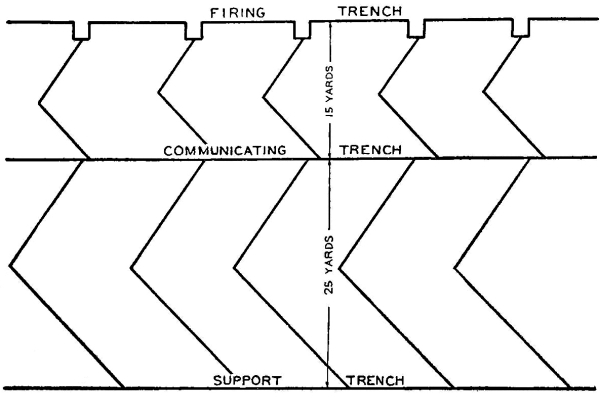
RECESSED AND
TRAVERSED
FIRING TRENCH
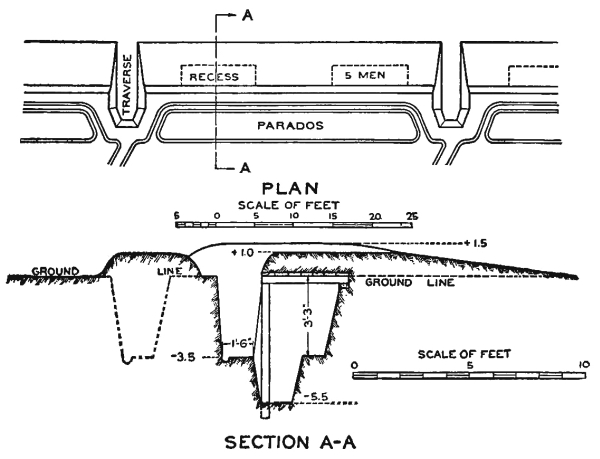
[Pg 265] Machine gun emplacements should be on the flanks of a section and as well concealed as possible. They should not be unmasked too soon as this exposes them to premature destruction by the hostile artillery.
Cover required for the reserves will depend upon their distance in rear of the firing line and the enemy’s ability to search with fire the ground in which the reserves are stationed. The possibility of observation by aerial reconnaissance must always be considered.
Obstacles must be provided to check the enemy’s attempts to rush the trenches. Barbed wire is the most effective obstacle, especially if well concealed. The advantage of concealment, in addition to preventing the use of the obstacles as range marks for the trenches in rear, is that working parties are enabled to repair each night any damage to the obstacles. This repair work must frequently be carried out not over 100 yds. and occasionally not over 50 yds. from the enemy’s trenches. High wire entanglements involving the use of posts extending 3’6" or 4' above the ground, are impracticable owing to the difficulty of concealment and of repair. The driving of such posts is out of the question when hostile trenches are in close proximity. Various substitutes for these posts may be employed such as tripods constructed of the limbs of trees lashed together, carried out and set in front of the firing line at night, at intervals of about 15 feet. The tripods are anchored to the ground and barbed wire laced between them. Any light, strong, portable support for barbed wire entanglements is acceptable.
Flare lights shielded on the side of the defender are useful.
If the flank of a line is to be refused, the trenches should be echeloned to the rear. Otherwise the trenches on the flank will be subject to enfilade fire, especially by heavy artillery at long ranges.
The following observations of the aeronauts will be of assistance to those engaged in the construction of field fortifications:
1. A long continuous line of trenches is more visible than groups of trenches.
2. Straight trenches are conspicuous. [Pg 266]
3. Trenches across plowed fields are easily distinguished.
4. Straw spread in the bottom of trenches renders them conspicuous.
5. Trenches against hedges cannot be distinguished.
6. It is difficult to tell whether trenches or gun emplacements are occupied.
7. Tracks to emplacements are easily distinguished.
8. Trenches should be covered with brush to hide deep shadows at bottom.
The operations on the European battle fields closely resemble the methods which have hitherto been considered characteristic of sieges.
Sir John French says:
“In war as it is today, between civilized nations armed to the teeth with the present deadly rifle and machine gun, heavy casualties are absolutely unavoidable. For the slightest undue exposure the heaviest toll is exacted. The power of defense conferred by modern weapons is the main cause for the long duration of the battles of the present day, and it is this fact which mainly accounts for such loss and waste of life. Both one and the other can, however, be shortened and lessened if attacks can be supported by a most efficient and powerful force of artillery available; but an almost unlimited supply of ammunition is necessary, and a most liberal discretionary power as to its use must be given to artillery commanders. I am confident that this is the only means by which great results can be obtained with a minimum of loss.”
Capt. Thuillier in his “Principles of Land Defense” states the objects of field fortifications to be 1st, to increase to the fullest possible extent the effective use of the defender’s weapons, and 2nd, to restrict to the greatest possible extent the effective use of the weapons of the attacker. These guiding principles are applicable to all situations, and they should never be lost sight of in the organization of a position. Col. Kuhn, Corps of Engineers, U.S.A., says: “The highest expression of the art of field fortification consists in the utilization of the natural strength of the terrain in the most advantageous manner with the minimum means including the avoidance of its disadvantages. All natural screens, covers, obstacles and communications have a distinct advantage over artificial creations, not only in the relatively smaller amount of [Pg 267] work required, but also in the fact that the troops will, as a rule, advance from them more readily than they will from purely artificial works.”
Sir John Jones (“Journals of Sieges in Spain”) says: “It should be recollected that the number of men required to guard a position depends less on the extent of its front than on the facility of access to the several portions of it.” “This sentence,” says Thuillier, “contains the very pith of defensive tactics.”
The foregoing remarks concerning the organization of a defensive position may be illustrated by a few practical problems solved on the map. The officer who desires, however, to become thoroughly qualified for this most important duty, should practice the organization of supporting points on the terrain.
Note. Details of construction of various intrenchments, shelters, obstacles, and other works of field fortification, with the tools, materials, personnel and time required, and the methods of conducting the tasks are given in many textbooks, manuals and pamphlets on the subject of field fortification, some of which are listed at the beginning of this volume. (Chap I.)
PROBLEM NO. 1.
FIELD FORTIFICATION.
As part of an extended defensive line, facing generally west, your regiment has been assigned the organization and occupation of the sector EAST AND WEST RAVINE NORTH OF HILL 872, exclusive,—RAVINE MARKED X-Y (See Fig. XI), exclusive. The first battalion will organize a supporting point on 872 Hill, the 3rd battalion will be in reserve, and the next regiment to the south will organize its north supporting point on Bell Point, all as indicated upon the accompanying 6 inch map. A platoon of the machine gun company has been attached to the 2d battalion. [Pg 268]
REQUIRED:
I. Location of the supporting point to be organized by the 2d battalion, showing dispositions of troops of the battalion. Division of the foreground, indicating portions assigned to each supporting point of your regiment.
II. Considering yourself now in command of the 2nd battalion, give a detailed description of the organization of your supporting point, with a reasonable proof that it can be carried out in two hours, which will be assumed as the time available for work. Your companies are of 16 squads each and have the authorized allowance of park and portable tools. A platoon of 40 engineers has been assigned to assist your battalion and their tool equipment is ample to meet the requirements of any reasonable task you may see fit to assign to them, but engineer tools will be used by engineers only. There is also assigned to assist your battalion one of the reserve companies with its complete tool equipment.
III. In the assignment of work to the engineers, what considerations governed your decision?
IV. Indicate all dispositions, works etc., upon the accompanying map, employing conventional signs.
Note. In this problem (and the one following) each company of infantry is assumed to have 16 squads of 8 men each, available for work. Each company is assumed to have 64 portable digging tools (shovels and picks), and its allowance of park digging tools (full size, commercial pattern) is 24 shovels and 12 picks. Each company has 16 portable wood and brush cutting tools (hatchets and machetes) and its allowance of park wood cutting tools (full size, commercial pattern) is 1 cross cut (2 man) saw and 2 axes.
Solution. (See Fig. XI).
Requirement I: 1st Battalion to right supporting point; to organize supporting point on 872 hill; to cover the foreground from east and west ravine north of hill 872 exclusive to ravine south of the Sharp House exclusive, crossing fire with left supporting point of next regiment on the right and with supporting point number 2 as far as and across Salt Creek at the loop obtruding into the foreground in front of Zalinsky House.
2d Battalion to the left supporting point; to organize 855 hill and adjoining noses; to cover the foreground from ravine just south of Sharp House inclusive to ravine X-Y exclusive; crossing fire with 1st [Pg 269] supporting point as far as and beyond the bridge over Salt Creek and with right supporting point of next regiment on the left across X-Y ravine.
Colonel directs that at least two companies in each battalion be placed on the firing line, more if a closer examination of the ground seems to justify, but that at least one company in each battalion be held in support.
Requirement II: The front assigned to the battalion is about six hundred yards; the foreground is generally open and concave for a distance (from Salt Creek to the east) of nearly six hundred yards, except in the center of the front where Salt Creek makes a loop into the foreground; here the field of fire is much interfered with by the growth along Salt Creek (the steep banks of which offer excellent opportunities for the approach of an enemy screened by the trees), the convex nose on which the Zalinsky House is located and the building and trees on that nose. The enemy, taking advantage of these conditions, could approach to within a very short distance of the firing line unless prevented by adequate cross fire. This is the weak portion of the line and must be well attended to. A fire trench just west of the Zalinsky buildings could cover the loop, but it is only about 100 yards from the banks of the creek, which avenue of approach can not be entirely denied to the enemy; this is too close and such a location is to be avoided if possible. A location east of the convex Zalinsky House nose is therefore desirable. Just in front of the timber line along Sheridan ridge the conditions for firing trenches are nearly ideal. A company trench can be conveniently located on 855 hill as shown on map; this trench with 1 foot command can cross fire in front of 1st supporting point as far as the bridge and all along Salt Creek bottom from the creek to immediate front of the fire trenches of the 1st supporting point. To the front the fire of the trenches is interfered with by the buildings, orchards, and trees along Salt Creek, all of these can and must be removed, there is dead space however from the house to Salt Creek which can not be obviated and must be covered by heavy cross fire. The location of the left company of the right supporting point crosses fire, when timber is removed, across the loop in the creek, sweeping the old corn field on the west side of creek; the machine gun platoon, located as shown, sweeps by an enfilading fire the whole line of Salt Creek in front of the regiment as far as the [Pg 270] bridge and, when the trees are removed, the bottom of Salt Creek and both its banks from A to B. Such use of the machine guns, to reinforce a weak portion of the line, is desirable in this case. This cross fire from the machine guns is reinforced by the platoon of G Company, and the right platoon of H Company; the two center platoons of H Company covering the front from the Zalinsky house to the X-Y ravine. The left platoon of H Company in the existing trench to the left and rear of the machine gun platoon, crosses fire with the right supporting point of the next regiment on the left. (See Fig. XI.)
This development of the firing line is believed to be sufficient; the squad trenches are, however, to be made at least 18 feet long and where possible 20 feet long, and communicating trenches between companies and squads to be prepared as far as possible for firing so that a heavier firing line can be brought into play by feeding in the supports if necessary.
The time for the organization of the supporting point is short but the work behind the line is reduced very much by the ideal cover for supports, collecting station, etc., offered by the deep ravine 30 yards back of E Company.
The work to be done then, is reduced to the digging of fire trenches (time will not allow the construction of head cover), arrangements for lateral and other communications, clearing of the foreground and marking out ranges. These duties are assigned as follows.
E Company has its own portable tools and the park digging tools of E and F Cos. Twelve squads, each with 4 park shovels and 2 picks, dig 20 ft. trenches in two hours; four squads, each with 6 portable digging tools, dig 18 ft. trenches; men not actually employed on this work use the remaining portable tools and dig communications around the front of the traverses which are left between squads. These communications are of the same depth as the fire trenches.
H Company, which finds a platoon trench already constructed in a suitable location, has its own portable and park tools. Six squads, each with 4 park shovels and 2 picks, dig 20 ft. trenches in two hours; six squads, each with 6 portable tools, dig 18 ft. trenches; the remaining four squads, with the remaining portable tools, dig the [Pg 271] communications around the front of the traverses between squads, and a communicating trench from the right of H Co. to the left of the G Co. platoon trench.
G Company (3 platoons in support and 1 on the firing line) has its own tools and the park digging tools of the reserve company. It will dig 30 yards of communicating trench forward to E Company’s fire trench, and 65 yards of communicating trench laterally across the ravine to the G Co. platoon trench. This latter communicating trench will be made available for use as a fire trench in case of need, and will therefore have the same profile as the fire trenches (7.5 sq. ft. cross section) except for the northern 10 yards which cannot deliver fire, (being under cover from the front) and has therefore a cross section of 6 sq. ft. The platoon fire trench is dug by the platoon which is to occupy it, this platoon has 16 park shovels and 8 picks. 55 yards of communicating trench across the ravine is dug by eight squads, each of which has 4 park shovels and 2 picks, this gives each squad about 20 ft. of trench, which they can complete in 2 hrs. The remaining platoon (4 squads) each man with a portable digging tool, will dig the communicating trench to E Co. fire trench (with observing station for battalion commander) and the northern 10 yards of the communicating trench across the ravine. The total length of trench for this platoon to construct is therefore 40 yards or 120 ft. It has a cross section of 6 sq. ft. and contains 720 cu. ft. Thirty-two men digging 12 cu. ft. each per hour, will excavate 768 cu. ft. in 2 hours—just about the allotted task, including the observing station. Reliefs are not provided as the tasks last but 2 hours.
This leaves the engineers, F Co., and the company from the reserve for the work on the foreground.
The work which it is desirable to do will be as follows: cutting trees varying from 8 ins. to 16 ins. diam. along Salt Creek, from A to B to C, 200 trees in all; scatter two straw stacks and a pile of cord wood at D; destroy house, barn and outbuildings at Zalinsky’s; cut 20 four-inch orchard trees back of house, 14 in front of house and 6 large trees, 60 small orchard trees to right front of house; 10 trees 8 in. diam. at E; scatter pile of bricks; measure and mark ranges.
All the park cutting tools of the battalion are given to the reserve [Pg 272] company making (with its own) a total of 5 cross cut saws and 10 axes; they have also their 16 portable cutting tools. One squad with two axes is assigned to cut and trim the 10 large trees at E; 4 squads with the portable tools are assigned to clear out a small amount of brush immediately in front of the E Co. fire trench, very little work, and then to assist in the orchards. Seven squads are given the remaining 8 axes and 5 saws and assigned to the task of cutting and trimming the orchards and trees around the Zalinsky house. They will be assisted in this work by the platoon with the portable cutting tools. There are about 100 trees 6 ins. or less in diameter. One saw or 2 axes will cut about 20 of these trees in an hour (see table, ante); all can easily be cut and trimmed in the time available. The remaining squads of this company will scatter the bricks and cord-wood in the yard.
The support company (F) with its own portable tools, some 6 pitch forks and 2 axes (found at Zalinsky’s) and crowbars will remove the straw stacks and tear down the cattle pens and the small outhouse near the creek; scatter cord-wood, and assist the engineer detachment in tearing down the large buildings.
To the engineers are assigned the tasks of destroying the house and barn at Zalinsky’s and cutting the trees along Salt Creek at the loop. All of the 200 need not be cut down, the view would be greatly improved if only ¼ of them were cut but as many as necessary will be cut or trimmed. They will average 12 inches. One cross cut saw will cut 12 per hour or 24 in two hours; 10 will do the job assuming all must be cut down, this will take twenty of the men; the other twenty are assigned to the destruction of the house and barn. The total destruction of these buildings by fire may not be possible in the time available, and the smoke from the smouldering ruins would be more objectionable than the buildings themselves. Moreover the barn is on a high stone foundation and has an interior cross wall of stone. These would remain standing after the conflagration as it would then be impossible to destroy them by other means, and would afford cover to the enemy. Both buildings will be closed as tightly as possible and a concentrated charge of dynamite exploded in a central position in each. The men will then with their picks and crowbars, blocks and tackle, etc., tear down what remains, filling the cellars with debris so that they cannot be used for shelter. The destruction of the buildings would require a [Pg 273] large amount of explosives, and the situation on the rest of the line would determine whether or not it could be spared for this purpose. If not, lesser charges could be used on the framework of the buildings and thus weakened they could be pulled down with block and tackle, men from F Co. being called upon to assist if necessary.
The large trees along the creek bottom would, as far as possible, be fallen into the bed of the stream, and all trimmings (branches) would be placed therein, both to get them out of the field of fire and to block the channel as far as possible, to render its passage or use as cover the more difficult to the enemy.
Requirement III: The reason for the assignment, is that this work is of general interest. The engineers were assigned to the destruction of the house and barn because it was not thought wise to burn them and the demolition by explosives and destruction by mechanical means require articles of their equipment and technical skill in execution; they were given the work of cutting down the trees along Salt Creek as most of these are pretty large and the cross cut saws and other timber tools in the hands of the engineers are better adapted to the work and the men more skilled in tree felling than the infantry.
Requirement IV: (See Fig. XI.)
PROBLEM NO. 2.
FIELD FORTIFICATION.
General Situation. (See 1 inch Geological Survey and 6 inch Maps.)
Missouri, Blue and Kansas, Red, are at War. A Blue Army Corps is invading Kansas. On June 8th the 1st Blue Division, in the advance, near Lowemont, was being attacked by superior Red forces.
Special Situation, Blue. The 2nd Blue Division was following the first and was disposed as follows on the morning of the 8th: the 10th, 11th, 12th and 13th Inf., 1st Bn., 1st L. A., 1st Sq., 1st Cav., Co. A, 1st Engrs., 1st Amb. Co., had crossed the Terminal Bridge and were marching on Lowemont to support the 1st Division, which had been attacked by superior Red forces estimated at 2 divisions, on the [Pg 274] afternoon of the seventh of June. The head of this detachment at 8:30 a. m. was on the Atchison Pike at the railroad crossings east of Salt Creek village. The remainder of the Division was expected to reach Leavenworth late that afternoon via the Terminal Bridge. The 3rd Division was expected to reach Leavenworth on the morning of the tenth of June.
At 8:30 a. m., June 8th, Gen. A, commanding the detachment of the 2d Division, received the following message at Atchison Hill, from Gen. X, 1st Division (who is in command of all the Blue forces in Kansas until the arrival of the Corps Commander).
| Wireless: 8 MILE HOUSE, near LOWEMONT, KAN., | |
| 8 June,’16, 8:15 a. m. | |
| To Gen. A: |
The enemy resumed his attack in great force at daybreak. A heavy Red column, estimated at about a division, is reported moving east toward KICKAPOO. I shall retire at once via the ATCHISON PIKE and ZIMMERMAN ROAD to a defensive position west of LEAVENWORTH. Place your detachment in position on the line SHERIDAN RIDGE—ATCHISON HILL, to cover our withdrawal.
Gen. A decides to occupy a position with his right resting on the Missouri River, and running thence south along the front slope of Sheridan Ridge. He directs the 10th Inf. to occupy and intrench the sector Missouri River to Millwood Road, inclusive, 11th Inf., from the Millwood Road, exclusive, to Bell Point, exclusive, &c., &c. (See Fig. XII.)
Requirements:
I. As commander of the 10th Infantry, what assignments of troops and divisions of sectors do you make?
You are in command of the 1st Bn., 10th Inf. One company of the reserve bn. and a half company of engineers have reported to you to assist in the organization of your sector, as assigned in Requirement I. All (Inf) companies are of 16 squads and have their usual equipment of portable tools, with the authorized allowance of park tools. The engineers have tool equipment ample to execute any reasonable task that may be assigned them, but have none available for issue to the infantry.
Fig. XI.
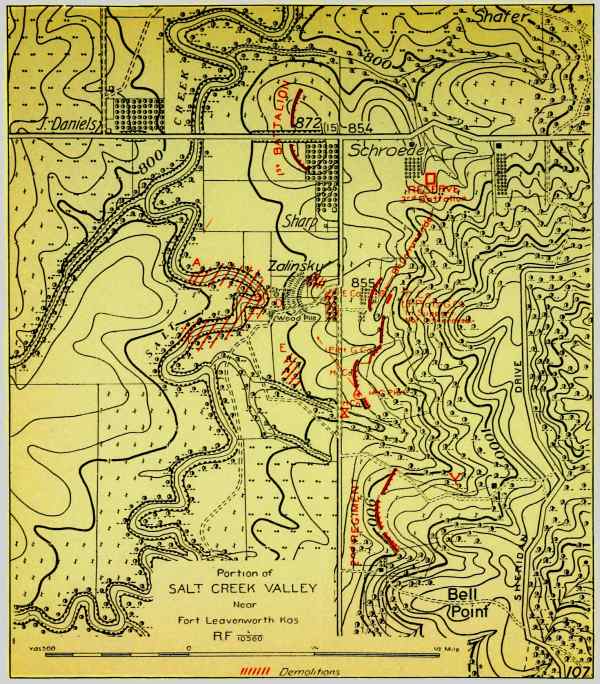
[Pg 275]
After arrival in the position information received indicates that three hours will be available for preparation.
II. Your general plan for the organization of your supporting point, including a statement of the works you deem necessary.
III. Your assignment of the men and tools to the different tasks, and proof that your plan is practicable in the available time.
IV. Indicate to scale on the accompanying map all works undertaken. (Works executed by the 1st Bn., only.)
Solution. (See Fig. XII.)
I. The regimental commander of the 10th Infantry decides to place two battalions on the line, and one in reserve. The 1st Bn. (with 1 plat. Mach. Gun Co.) is assigned to the sector Missouri River to large ravine flowing into Salt Creek and heading up toward the Shafer House, inclusive; the 2d Bn. is assigned to the sector, ravine exclusive to Millwood Road, inclusive. The 3d Bn. is held in reserve.
II. The bn. commander decides to place 2½ companies on the line, and to hold 1½ companies in local support. Half of A Co. is placed on the nose forming the extreme northern end of the Sheridan Ridge. This is a sort of natural fort, slightly hollow on top, with very high command, and precipitous side slopes. In its front Salt Creek forms an obstacle passable with considerable difficulty by infantry only. The position is practically inaccessible from the front, and lying within 200 yds. of the river it forms an excellent flank for the Sheridan Ridge position. To the northwest lies a plain, perfectly open to view for some 600 yds., which can also be covered by artillery fire from the Blue position. The slopes in front of the position are covered with trees. The removal of a few rows of trees just below the crest will completely open the field of fire, while the retention of the topmost trees will serve to screen the position. The other half of A Co. is placed on the front slope of the first nose south of the right flank, well up the slope to command the foreground, and in such a position as to be defiladed from the fire of the trenches to the left. The foreground of this position is thickly covered with trees. These will be thinned out [Pg 276] to improve the field of fire, and the creek in the front will be made impassable by felling trees into the backwater of the river. A half of B Co. and all of C Co. are placed on the ridge extending to the south, the right wing being placed well up on the high ground. The left wing falls off to the low ground to the south, this flank being slightly refused to cover the ravine forming the left of the bn. sector. By placing this portion of the line well back on the high ground a double advantage is secured, viz: the near field of fire, down to the creek, is widened, and command is gained over a distant field (mid and long ranges) which would be impossible were the trenches placed close to the creek. When a certain amount of clearing has been done in the creek bottom, these trenches will command the foreground to a distance of nearly a mile, and will cross fire with the adjacent supporting point in the approach to the latter. All fire trenches will be standing, traversed trenches, provided with head cover. D Co. and half of B Co. will be in local support, not intrenched, on the steep reverse slopes of the position. Communicating trenches will be provided as indicated. The machine guns will be placed on the high ground in rear of the left from which position they can enfilade the two reaches of the creek in the foreground. The bn. comdr’s. station will be placed on the highest point of the knoll near the center of the position, as shown.
III. The fire line companies will dig their own trenches, and assisted by 16 engineers, will provide head cover for same. They will use their own portable digging tools, plus the park digging tools of the entire battalion as well as the park digging tools assigned to the reserve company.
Half of B Co. will prepare the communicating trenches and the bn. comdr’s. station, using their own portable digging tools.
The mach. gun platoon will intrench itself, using park digging tools.
The half company of engineers, with the reserve company and Co. D, (support) will clear the foreground, under the supervision of the Captain of the engineer company. The more difficult tasks will be assigned to the engineers, who will also prepare for destruction the railroad bridge over Salt Creek on the right flank. The infantry companies will use all the portable and all the park cutting tools of the entire battalion, as well as those of the reserve company.
IV. See Fig. XII.
Fig. XII.
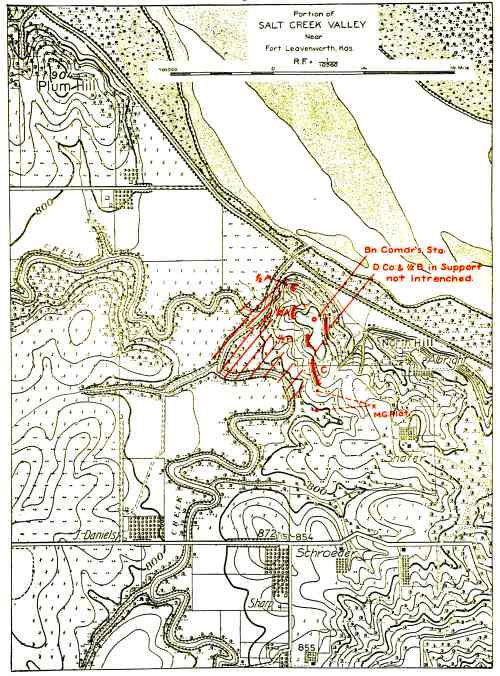
[Pg 277]
There are certain natural obstacles, mountain ranges, deserts, and rivers, continually utilized by military forces, which afford special aid to the defender while imposing peculiar conditions on the assailant. The attack and defense of such obstacles follow accepted principles of combat, but involve the application of certain special measures adapted to the nature of the obstacle. Each case must be treated in accordance with the conditions thereof and set rules are seldom applicable. The following paragraphs indicate some of the principles and expedients that may find application in the attack and defense of a river line.
A defensive line lying behind an unfordable stream cannot be carried by the usual frontal (or enveloping) attack, because of the obstacle in front of the attacker.
The attacker is limited to the existing bridges or fords to effect his passage, unless he can contrive to throw temporary bridges or ferry his troops across. The attacker will endeavor to cross by means of hasty bridges or ferries:
(a) Under cover of darkness.
(b) Secretly at a point not under observation, or not sufficiently guarded by the defense.
(c) At some point where, from the nature of the terrain, the superiority of the attacker’s fire (infantry or artillery or both,) the defender cannot bring to bear a sufficient volume of effective fire to prevent the construction of bridges and the passage of the attacker’s troops.
(a) and (b) will be of limited application. If the defender has destroyed the bridges the attacker will usually be forced to construct hasty bridges under cover of the fire of his infantry and artillery.
[Pg 278] Methods of attack of a river line. The following methods of forcing passage are then open to the attacker.
1. A turning movement. The attacker proceeds a considerable distance up or down stream seeking an unguarded passage beyond the flanks of the defender’s line. This method if successful avoids the great losses in killed and wounded which might result from a frontal attack. It has the disadvantages of all turning movements, namely that it requires a considerable amount of time, that it may uncover the attacker’s line of retreat or communications, and that the defender may change his dispositions to meet the turning movement, which will thus gain nothing, etc., etc. A wide turning movement would not usually be undertaken by a force less than a division.
2. A turning movement combined with a holding attack. The attacker holds the defender to his position with a portion of his force and with the rest executes a turning movement and (after passage) attacks the enemy’s flank and uncovers the principal crossings. The forces for the turning movement and for the holding attack must neither be so weak (nor the separation so great) as to give the defender an opportunity to defeat them in detail. Such a proceeding then ordinarily implies a large force and a considerable numerical superiority over the defense.
3. Frontal attack at one point. The attacker may throw his entire strength against one point of passage, using an existing bridge or ford, or improvising a crossing (bridge or ferry). The passage is covered by heavy fire of infantry, machine guns or artillery from the attacker’s side of the river. This is the simplest and most direct form of attack on a river line. The defender will probably be able to meet it with his entire force. A strong fire superiority over the defender at the point of attack is absolutely essential. This ordinarily implies a considerable superiority of force, especially in artillery. If the attacker, due to his superiority of force, particularly when coupled with favorable conditions of terrain, can bring to bear such a fire as to prevent the defender from effectually covering the crossing with [Pg 279]his fire, the passage may be made with small loss. Without a marked fire superiority the passage if effected at all will be exorbitantly costly. The attacker relies chiefly on the superiority of his artillery fire for success.
4. Frontal attacks at two or more separated points. This will be the usual form of attack on a river line. For a force not larger than a reinforced brigade there would usually be but two attacks with possibly a demonstration at a third point. Of this form of attack there are also two cases:
(a) Two co-ordinate attacks. Both attacks are made strong and the reserve is held in a convenient central location to reinforce at the proper time whichever attack gives more promise of success. The success of either attack usually insures that of the other.
(b) A main attack accompanied by a feint. The object of the feint is to induce the defender to believe that it is to be the main attack, and to throw his reserves in to meet it. The main attack is then launched when the defender has used up his reserves. The attacker’s reserves should be placed with a view to supporting the main attack. If however, they can at the same time be so placed as to also be available to support the feint this may be an advantage, as it may be possible to drive home the feint by throwing in the reserves if the defender throws his reserves against the main attack. This form of attack may also be accompanied by a demonstration by the cavalry at a third point.
4 (b) will be a usual form of attack on a river line and is covered more in detail in the following discussion.
The feint should fulfill the following conditions:
1. The point selected should be one where a crossing is possible so that the enemy may be induced to believe that the feint is to be the real attack.
2. The feint should be so distant from the main attack in respect to time of transit that the enemy’s reserves committed to oppose either attack cannot be withdrawn in time to repel the other.
3. It should be possible to conceal from the defender the number of troops engaged in the feint. If he recognizes it as a feint he will, of course, not throw in his reserves to meet it. This requires that there [Pg 280] be cover or concealment for the troops engaged in the feint, sufficient to prevent the enemy from being sure of their numbers, and that the feint be pushed with as great vigor as if it were the main attack.
The main attack should fulfill the following conditions:
1. The point selected should be at the site of an existing bridge or ford, or a place where it is possible to ferry troops across or construct temporary bridges.
2. There should be cover both for the approach to the position and in the vicinity of the position itself. The advantages of cover are as follows:
(a) Troops can be collected close to point of passage without defender’s knowledge as to their numbers or even their presence, and attack launched suddenly at close range.
(b) Cover reduces the effect of the defender’s fire.
(c) The attacker’s reserves can be brought up without the defender’s knowledge, or at least without betraying their numbers.
It is very essential that the numbers engaged in both the feint and the main attack should be concealed from the defender until it is too late for him to profit by this knowledge, which reveals the attacker’s intentions.
3. Conversely the ground on the defender’s side should not afford him cover from the fire of the attacker within effective range of the crossing.
4. The terrain generally should be such as to increase the effectiveness of the attacker’s fire and diminish that of the defender, for unless the attacker can establish fire superiority there is no chance for his success except by stealth. A terrain which enables the attacker to bring a cross fire to bear on the defender is favorable. Superiority of fire is especially necessary when the attacker has to construct bridges for the passage. It will often be necessary to ferry troops to the far bank to protect the bridge builders.
5. The ground on the defender’s side should be such that the first of the attacking troops to cross can seize a good defensive position from which they can hold the defender in check and uncover the crossing for the remaining troops.
6. The point selected should be so distant from or located with respect to the point of feint that the defender’s reserves if thrown in to [Pg 281] oppose the feint cannot be withdrawn in time to repel the main attack.
In brief the selection of the points for the feint and main attack and the dispositions for and conduct of the action should be such as to deceive the defender as to the intentions of the attacker, until it is too late for him to prevent the passage. The separation between the two attacks instead of being a disadvantage, as would ordinarily be the case, is an advantage, in that the defender’s reserves committed to repel one attack cannot be withdrawn in time to meet the other. The danger of a counter attack by the defender before the attacker has crossed, is very slight.
Conduct of the attack. On approaching the river line the attacker reconnoiters all possible points of passage within a reasonable distance of the line of march. Bridges which may be used should be seized to prevent the enemy from destroying them. This duty will be performed by the cavalry if it is strong enough. If the attacker spends the night near the proposed point of passage the outpost troops will guard the points of passage in his immediate front, while the cavalry patrols the flanks and if practicable crosses the river and gains contact with the enemy. The artillery, especially heavy artillery if it be present, may take position and fire on the enemy in order to annoy him, prevent him from intrenching, destroying bridges, etc. This firing will ordinarily be discontinued at dark, but may be kept up at intervals throughout the night if it is apparent that any real advantage is gained thereby—if not it should be omitted as the ammunition is heavy and expensive.
Just before dawn is a favorable time for the attack on a river line, as the troops can be moved under cover of darkness to their positions and the attack launched just before daybreak. Night movements of troops to position must be of the simplest nature. Anything complicated is extremely liable to result in confusion.
In camping behind a river line prior to an attack, troops should be conveniently disposed with reference to their use in the action of the following day.
The artillery takes, if practicable, a position from which it can support both attacks. It will in the first instance strongly support the [Pg 282] feint, shifting its fire later to the main attack with change of position if necessary. Cross fire is very advantageous, and it is permissible to divide the artillery if it is evident that a distinct advantage is thus gained. To support an attack the artillery must be within effective range of the known or probable positions of the hostile infantry and artillery which will oppose that attack.
Machine guns and infantry may support either attack with fire of position when the terrain is favorable. The reserves may often be advantageously employed in this fashion.
If the attack is made at dawn the troops on outpost cover the assembly and preliminary dispositions for the attack and join their proper organizations as the attack is launched. Crossings between the two attacks or near the flanks of either must either be destroyed before the attack or observed (and if necessary defended) during its progress. Otherwise the enemy might use them to cross and make a counter attack. Provisions against this should be made. Ordinarily this duty will fall to the outposts or the cavalry, but if necessary (as when there is no outpost) special detachments may be assigned to guard crossings which for any reason have not been disabled, or places where crossings are possible, and whose positions are such as to threaten the safety of the attacker.
The feint is usually launched first and pushed with great vigor, supported by the artillery. While the feint is in progress the troops for the main attack assemble as close as practicable to the point of passage and deliver their attack on receipt of the supreme commander’s order.
The cavalry guards the flanks and may be used to make a demonstration, “without incurring heavy losses,” against some point on the flank. Such demonstration should usually be made dismounted and may deceive the enemy by causing him to believe that the demonstration is the feint and the feint the main attack. If practicable the cavalry crosses the stream and operates against the enemy’s flank and rear. For this purpose the cavalry should be concentrated on one flank, a small detachment being sent to cover the other flank. Cavalry may be used later to press the pursuit of the defeated force. [Pg 283]
The reserve occupies a central concealed position, preferably one from which it can reinforce either attack, but especially the main attack.
The two attacks may be designated in the orders by the names of their commanders, as “Col. A’s column.” They should never be referred to as “the feint” or the “main attack.”
The bulk of the infantry will naturally be for the main attack. Thus in a brigade one regiment might be assigned to the feint, one to the main attack and one to the reserve. The reserve would probably be later thrown into the main attack. Circumstances will govern in each case. If there is no intention of pushing home the feint a battalion might be sufficient for this purpose. It must be borne in mind, however, that the object of the feint is to deceive the defender. Hence it must not be so weak that the defender will readily detect its unreality, nor at a point where the crossing is plainly impossible.
The engineer commander makes a preliminary reconnaissance of the proposed point or points of crossings. The engineer troops collect under cover (as close as practicable to the point of passage) material for crossings or additional crossings (bridges). This should be done in advance of the opening of the attack if practicable.
The duties of the engineers in a river line attack may then be summarized as follows:
(1) Preliminary reconnaissance or examination of proposed points of passage with a view to the construction of bridges (or fords).
(2) Preparation and assembly of bridge material near site of proposed bridges.
(3) Construction of bridges or operation of ferries under protection of the infantry. Ferriage of troops to cover the operations of the bridge builders.
(4) Removal of obstacles to passage.
etc., etc.
If there be two attacks both intended to force a passage some engineers may be assigned to each, there being no objection to dividing the engineers. The mounted engineers may accompany the cavalry. [Pg 284]
Defense of a river line. The defense of a river line will be based upon the methods of attack as outlined in the foregoing. The essential features of a river line defense are as follows:
1. The most probable points of passage will be held by small detachments (infantry sometimes reinforced by artillery) sufficiently strong to check a sudden rush of the enemy and to develop his intentions (whether to actually force a passage at the point in question or merely to make a feint.)
2. The bridges or fords which might be used by the enemy will be destroyed or obstructed if possible—unless the defense feels able to hold them and contemplates their use later on.
3. The curtains between the probable points of crossing, and the stream line well to the flanks of the enemy’s line will be actively patrolled by the cavalry which also maintains communication between the various infantry detachments and the reserve.
4. A strong reserve is held back of the line in a central position conveniently placed with reference to the roads leading to various parts of the position, ready to reinforce the threatened point as soon as the attacker’s intentions are developed.
5. Intrenchments and other defensive preparations may be made at the most probable points of attack if time and other conditions permit. They should not be allowed, however, to hold a large portion of the defender’s force to one locality, as it must remain mobile to meet the moves of the attacker.
The defender may:
(a) Catch the attacker astride of the stream and defeat him in detail.
(b) Let him cross and then drive him back on the river.
(c) Prevent his passage entirely.
The latter is usually the safest method. Due to the defender’s inferiority and the natural difficulties attendant upon such a movement, a counter attack involving a crossing of the stream will be of rare occurrence.
The secret of success in the defense of a river line is to detect promptly the intentions of the attacker so that they may be frustrated by the judicious use of the defender’s reserves. This requires that defender’s force be kept mobile. Aerial reconnaissance will be of the greatest assistance in detecting the attacker’s intentions. [Pg 285]
ORDERS FOR ATTACK OF A RIVER LINE.
| Detch., 1st Div., 1st Blue Army Corps, | ||
| PLAINVIEW, PA., | ||
| Field Orders | |
16 May, '16, 3:00 a. m. |
| No. —— | ||
| Gettysburg-Antietam 3" Map. | ||
1. No further information of the enemy nor of our division.
2. This detachment will attack the enemy along the line of the CONEWAGO Creek from BRIDGE S. H. to BRIDGE 502W, northeast of PLAINVIEW.
3. (a) The Light Artillery Battalion and the Howitzer Battery under command of Major Y will support both attacks. The Light Artillery Battalion will move at once via 552 and take up a position west of crossroads 561; the Howitzer Battery will move at once via 517—507W to a position near WOODSIDE S. H. Fire will first be opened in support of Col. B’s attack.
(b) The 2d Infantry and 1 platoon, Co. A, 1st Engrs., under Col. C, will move at once via country road east of and parallel to the 588—FIDLER—BENDER’S CHURCH road, and will attack and cross at 523W, moving thence east against the enemy on the 586 RIDGE north of HERSHEY MILL.
The 1st Infantry and Co. A, 1st Engrs. (less 1 platoon), under Col. B, will move at once to a covered position off the road near PLAINVIEW, and when so ordered will attack and cross at 502W. The troops on outpost (less detachments guarding the HERSHEY MILL and FORD) will join the regiment as the attack is launched.
The 3d Infantry (less Co. M) will move at once via 576—666 to a covered position near 605 and then form in readiness, awaiting orders. Co. M, 3rd Infantry, will at once report to Maj. Y, 1st Light Artillery, as escort for the artillery. One platoon of this company will be sent to relieve the cavalry detachment at the farm house near 529.
(c) The 1st Squadron, 1st Cavalry (less 1 plat.) will cross the CONEWAGO Creek west of BRIDGE S. H., cover our left and operate [Pg 286] against the enemy’s right and rear. The platoon now near 529 when relieved by Co. M, 3rd Inf., will cross the CONEWAGO at or southeast of 529 and cover our right. Reconnaissance of the enemy’s flanks and rear. The roads leading north will be observed as far west as CENTER MILLS and as far east as BOWLDER.
(d) The Engrs. with Cols. B and C will construct, under their orders, additional crossings at 523W and 502W, as soon as the attacks begin.
4. The 1st Ambulance Co. will move at 5 a. m. to D. WIRT and there await orders.
When the issue of extra ammunition is completed the empty battalion ammunition wagons will assemble off the road opposite Ambulance Co. No. 1.
5. Messages to HILL 707.
(How and to whom communicated. Report of dispositions to superior commander.)
Notes: The troops are sent to their positions under cover of darkness to avoid detection by aerial scouts, etc.
In this case either or both of the attacks may succeed, so that neither is a true “feint.” Gen. A will throw in his reserve where there is the greater chance of success.
The artillery commander will confer with Cols. B and C to the end that he may intelligently aid their assaults by artillery fire.
| Detch., 1st Div., 1st Blue Army Corps, | ||
| HEIDLERSBURG, PA., | ||
| Field Orders, | |
2 May, '15, 9:45 p. m. |
| No. —— | ||
| Gettysburg 3" Map. | ||
1. A hostile force, estimated to be a weak infantry brigade reinforced by a squadron and a battalion of light artillery, is across the CONEWAGO in our front. It has an infantry battalion intrenched at HERSHEY MILL, two battalions at PLAINVIEW, and a battalion northeast of WOODSIDE S. H., with small detachments opposite the fords above the [Pg 287] mouth of BEAVERDAM CREEK. Red cavalry has been seen near TABLE ROCK, BRIDGE S. H., PLAINVIEW, NEWCHESTER and the mouth of the LITTLE CONEWAGO. Our division is already in possession of the CONEWAGO crossings south of HAMPTON and will attack a hostile force of all arms in position near NEW OXFORD tomorrow morning.
2. This command will attack the river line at daybreak to effect the capture of GETTYSBURG.
3. (a) The artillery battalion (less Btry. A) will be in position in observation about 800 yards south of HEIDLERSBURG at 4:00 a. m. Btry. A will be in a position in observation just south of BELMONT S. H. at 4:15 a. m. The artillery will support the attacks of the 1st and 2d Infantries.
(b) The 1st Infantry, with one platoon of engineers and a light ponton division, will attack at 4:00 a. m. to force a crossing at HERSHEY MILL.
(c) The 2d Infantry with the remainder of the engineer company, and two ponton divisions will move via 601 CROSSROADS and mass near BELMONT S. H. by 3:00 a. m. The engineers will then assemble their ponton material on the left bank 1 mile down stream of Bridge 502W on the HARRISBURG road, and ferry the 1st Bn., 2d Inf., to the grove on right bank. This battalion will cover this crossing while the engineers throw two ponton bridges at this point. The remainder of the 2d Inf. will be deployed on the high ground near 529 CROSSROAD by 4:30 a. m., covering the ARCH BRIDGE (300 yards to the southwest). When ordered by me, the 1st Bn. will rush the position of the hostile force opposite the ARCH BRIDGE, supported by fire of position from the remainder of the 2d Inf. A party of engineers will then clear the ARCH BRIDGE of obstructions.
(d) The 3d Inf. will follow the 2d and form in two columns opposite the ponton bridges in readiness to cross on orders from me.
(e) The cavalry (less Tr. A) will make a dismounted demonstration at BRIDGE S. H. at 4:00 a. m. and cover the right. Troop A will cover the left and keep up communication with our division.
(f) The wire sec. Sig. will keep me connected with the infantry regiments and will run one wire for artillery use as the artillery commander may direct. [Pg 288]
(x) Troops on outpost are relieved at 3:00 a. m.
4. Am. Companies, the Amb. Co., and Engr. Tn. report at Heidlersburg at 5:00 a. m. The Sp. Tn. and F. Tn, remain at MUD CREEK.
5. Messages to BELMONT S. H. after 3:00 a. m.
General A adds verbally: “It is now 9:45 p. m. Set your watches.”
A withdrawal from action whether on the offensive or defensive may result from any of the following causes:
1. Direct orders from superior commander to break off the engagement and withdraw.
2. Notification from a superior commander that he has completed or is withdrawing from an engagement of which the combat in question was a side issue.
3. Strong reinforcements of enemy approaching, especially from a flank. In this case the time element will govern. If the commander believes he has a good chance to gain a tactical decision and get his troops in hand before the arrival of the hostile reinforcements he may be justified in continuing the action. But if the preservation of his force is of vital importance (as when he is the sole covering detachment of some important city) he should avoid serious risks.
4. When the general situation will be bettered by a withdrawal.
5. When there is an opportunity to contain the enemy with a portion of the force and throw the remainder into a larger and more important combat. In this case a portion only of the force is withdrawn.
6. When there is no longer any hope of a favorable decision.
etc., etc.
In the earlier stages of a combat it is often possible to effect a withdrawal in an orderly manner. When, however, the troops are fully committed to the action, withdrawal will be a difficult and dangerous [Pg 289] operation. A retreat over a fire swept zone will usually result in far greater losses than sustained during the advance. It is difficult to keep the troops in hand and a panic in one organization is very apt to be communicated to the entire force. This should be most carefully guarded against to the end that the retreat shall not become a complete rout. An orderly withdrawal under fire will usually be possible only when the terrain is favorable and there is a reserve still in hand. It is more difficult to break off an action in defense than in attack, as the assailant is approaching.
If the situation is critical the cavalry may be thrown in to check the enemy. The artillery continues its fire regardless of the risk of losing guns. It may be necessary to sacrifice a portion of the command to save the remainder.
When a retreat is necessary the best means to effect it without great loss and confusion is to hold fast until nightfall and then withdraw under cover of darkness. If in attack, the advanced position should be intrenched and stubbornly held. It will usually be easier to hold out against a considerably superior force than to effect an orderly retreat in broad daylight over a fire swept zone.
A withdrawal of a force fully committed to an action should therefore be attempted in daylight only when such a course seems to be unavoidable.
No fixed program can be laid down for a withdrawal as the mode of procedure is dependent on the terrain, the extent to which the troops have become engaged, and other conditions. Every effort must be made to place distance and a rear guard between the enemy and the retiring troops, and order must be restored as promptly as possible without unduly delaying the march.
The first step in the withdrawal is the prompt removal of the trains, ambulance companies and wounded. These are sent at once to the rear and routed in such manner as not to interfere with the movement of the combatant troops.
The reserve is sent promptly to a supporting position in rear and to a flank of the line of retreat, to cover the withdrawal of the troops committed to the action. In selecting this position the following points should be considered:
1. The position should be so located as to cover the retreat of the [Pg 290] troops engaged before it can become a rout. If the troops are closely engaged and the enemy still in good morale the position might have to be closer than when these conditions did not obtain, and a second supporting position might be required to cover the withdrawal of troops from the first, and so on.
2. It should be so located as not to interfere with the retreat nor have its fire masked by the retiring troops. As these troops must retire straight to the rear, at least in the beginning of the withdrawal, the supporting position should ordinarily be on a flank of the line of retreat.
3. It must be possible to bring to bear a strong fire at effective and long ranges, on any hostile troops which attempt to pursue.
4. The position should be such as to permit a safe and timely withdrawal of the covering troops occupying it. It is desirable to have good cover from the enemy’s fire immediately in rear of the position. The geographical crest of a ridge, or a position in front of an open wood fulfills this condition.
5. No rule can be given as to the distance of the supporting position in rear of the firing line except that it should be as far back as conditions will permit, so that the troops therein may not themselves become so closely engaged as to require the occupation of a second supporting position to cover their withdrawal. It must on the other hand (see 1.) be close enough to prevent the enemy from turning the withdrawal into a rout. The distance should seldom be less than one mile nor ordinarily more than two miles. The successive covering positions in any case must be so selected as to permit the most prompt withdrawal with the least loss, confusion and injury to morale of the force as a whole.
Artillery and cavalry are particularly useful as supporting troops to cover a retreat, as they can later be withdrawn more readily than the infantry.
It is desirable that the reserve be in its supporting position before the first troops on the firing line begin to withdraw, but if time is pressing the withdrawal of the first troops may be ordered at the same time, for of course the movement of any troops on the firing line cannot be started as promptly as that of the reserve, which is not under fire. Allowance for this should be made in issuing orders. [Pg 291]
Artillery fire should be maintained with undiminished volume until the safety of the retreating troops is assured. The artillery position during the withdrawal should be at a suitable range in rear of the supporting position of the reserve and not too far to the flank. If not already in such position the artillery will withdraw thereto usually by battery, the remaining batteries increasing their rate of fire meantime. Each battery upon reaching its new position will re-open fire as promptly as possible. If in an exposed position the artillery should have a support, either a company from reserve, the engineers, or cavalry.
If ammunition trains accompany the command they should be placed in a safe position, but should not be too far to the rear as it may be necessary to replenish the combat trains.
The order of withdrawal of the troops engaged (infantry) will depend on conditions. The rule for all cases is that the withdrawal should be effected in such a manner as to cause the least possible loss, confusion and delay in the force as a whole.
The troops which are most exposed should be withdrawn first if this can be done without risk of a rout, which might involve other troops. Otherwise these troops will be left to the last. This will, of course, increase their losses and the confusion attendant upon their withdrawal, but may be the safest procedure considering the force as a whole. The troops most exposed will ordinarily be those most hotly engaged with the enemy. Hence in a combat in which some of the troops have been fully committed to the action those most closely engaged should ordinarily be withdrawn last. If, however, the enemy’s reinforcements are approaching from a flank and are already close enough to be a menace, the troops on the exposed flank would generally be the first to withdraw. When other considerations are not paramount the troops farthest from the line of retreat will be first withdrawn. Care should be taken that the withdrawal of certain troops does not unduly expose those remaining on the line. The circumstances of each particular case must determine the manner in which the withdrawal shall be effected, and the only rule that can be given is that stated in the preceding paragraph.
In a brigade action the withdrawal is usually effected by regiment. The troops last to withdraw are notified of the plan and cover the withdrawal of the others by a vigorous fire without, however, advancing [Pg 292] further. They are withdrawn by a later order as soon as the other troops are well started on their retreat.
Each organization is informed as to the general line of retreat and a rendezvous position designated sufficiently far to the rear. If necessary to avoid interference the route for each fraction is designated. It is to be remembered that so long as they are within range of the hostile fire or even for a considerable time thereafter the troops will retire as best they can straight to the rear from their line of battle. Hence a precise route for the early part of the withdrawal should not generally be prescribed.
The retiring troops should be drawn in hand and formed in column of route as soon as practicable. This will require ordinarily from 3 to 5 miles, or even more, depending on how seriously they have been engaged, the activity of the pursuit, if any, the nature of the terrain, etc. In retreating across a stream all available crossings should be utilized to avoid delays resulting from congestion.
A withdrawal may often be more promptly and safely effected by utilizing several lines of retreat.
If necessary to cover the withdrawal of the reserve a second supporting position may be occupied by some of the troops from the firing line, usually those first withdrawn, and hence the retreating troops should be drawn in hand promptly and not allowed to get too far to the roar until it is evident that the rear guard can cover the retreat without assistance. If the enemy pursues vigorously and in force, a second and even a third or fourth delaying position may be required. (It is usually unnecessary, in problems, to consider more than two such positions.)
The reserve (which occupies the first supporting position) together with all available cavalry and artillery will ordinarily, upon completion of the withdrawal, be formed into a rear guard to cover the retreat. The artillery, after having been withdrawn to the supporting position, may be placed under the orders of the rear guard commander, who then takes charge, and gives all further orders for the security of the retreat.
The cavalry, during the action, watches for and delays the advance of the enemy’s reinforcements. Thereafter it reports to the rear guard [Pg 293] commander. Cavalry may delay the enemy’s advance by dismounted action either directly across the line of retreat or on its flanks.
The signal troops promptly take up their wires and accompany the trains or the reserve.
There will generally be no time to assemble the subordinate commanders to receive orders. If in attack signals may be given to cease advance. The supreme commander will give orders verbally to such officers as are with him (Col. of reserve regt., Chief Surgeon, Engr., Arty, and Signal comdrs.) and send messages by aides and orderlies to the commanders not present (Cols. of regts. in firing line, Cav. comdr., Q. M. in charge of trains, etc.)
The following will indicate the general form and verbiage of orders for a withdrawal.
Verbally to Chief Surgeon:
“The enemy will soon be heavily reinforced. This detachment will withdraw at once to Gettysburg.
“Remove the wounded as soon as possible to that place.
“The Baltimore turnpike must be kept clear for the movement of troops.”
Verbally to Col. A, 1st Inf. (in reserve):
“A hostile force of one brigade of infantry with a bn. of field artillery is approaching our left. Head of advance guard was at ______ at — o’clock, where our cavalry was delaying their advance. This detachment will withdraw at once to Gettysburg via the Baltimore Turnpike. The movement begins on our left.
“Move your regiment at once to ______ and take a position to cover the withdrawal of the 2d and 3d Infantries, then follow as rear guard.
“The cavalry and artillery will be placed under your orders.
“Keep the roads clear for the other troops.”
(If necessary this regiment would be directed to send one company to act as a support for the artillery. This should be avoided if practicable. An escort for the trains, if considered necessary, could be furnished by the reserve regiment or the cavalry, and covered in orders.)
Verbally to Capt. S, Signal Corps: [Pg 294]
“Take up your lines and with your company follow the trains to Gettysburg via the Hanover Road.”
Verbally to Major A, 1st Field Artillery:
(Information of approach of hostile reinforcements and plan for withdrawal or “You have heard my orders to Col. A.”)
“Col. A with the 1st Inf., your battalion and the cavalry will cover the withdrawal and form the rear guard. The 1st Inf. moves at once to ____.
“Move by battery to ____, take position and check the enemy’s advance with your fire. When your movement is completed report to Col. A for further orders.”
(If an escort is to be furnished the artillery, Major A would be so informed.)
By Aide to Col. B, 2d Inf. (on left of firing line):
(Information as to approach of hostile reinforcements and plan for withdrawal as in orders to Col. A.)
“Withdraw at once to Germantown, thence via the Baltimore Turnpike to beyond White Run, there to await orders.
“The 3d Inf. remains in position to cover your withdrawal, 1st Inf. goes into position near ____, arty. near ____.”
By Aide to Col. C, 3d Infantry:
(Information and plan as in orders to Cols. A and B.)
“The 2d Inf. withdraws at once. Increase your fire as theirs ceases but do not advance beyond your present position. I will send you further orders for withdrawal.
“The 1st Inf., Arty. and Cav. will cover your withdrawal. 1st Inf. takes position near ____, arty. near ____.”
By messenger to Capt. X, Q. M. in charge of trains:
“The enemy will soon be heavily reinforced. This detachment retires at once to Gettysburg via the Baltimore Turnpike.
“Move the trains promptly via the Hanover Road to southern entrance of Gettysburg and there await orders.”
By Aide to Major B, 1st Cavalry:
“Detachment retreats at once to Gettysburg via the Baltimore Turnpike. Col. A commands the rear guard consisting of 1st Inf., arty. bn., and your squadron. 1st Inf. takes position at ____ to cover withdrawal.
“When compelled to fall back report to Col. A for orders.”
[Pg 295] When 2d Infantry has retired sufficiently to avoid interference with retreat of 3d Infantry:
By Aide (or other mounted officer) to Col. C, 3d Inf.:
“Withdraw at once and continue your retreat via the Baltimore Turnpike to just beyond Rock Creek, there to await orders.”
Having issued his orders and seen the movement started, the supreme commander may, according to circumstances:
(a) Remain at the front to superintend the withdrawal, issuing such additional orders as the situation may require, or:
(b) Leave measures for security in hands of the rear guard commander, proceed to the rear and devote his attention to restoring order amongst the retreating troops, selecting and occupying such additional supporting positions as may be necessary, etc.
Conditions will determine which duty, (a) or (b), more urgently requires the presence of the commander.
A rencontre engagement is one in which, from lack of timely information, one or both sides have been unable to make complete disposition for attack or defense, prior to the opening of the combat.
The advantage will usually lie with the side which acts the quicker and strikes first. In general, a rencontre favors the stronger and more aggressive combatant. The proper course then, is to strike the enemy before he can complete his dispositions for either attack or defense.
If time is taken to make thorough reconnaissance before launching the attack, the opportunity to surprise the enemy and to prevent him from taking the initiative against us may be lost. Little fresh information can be expected, the commander therefore, must be guided by his mission and his previous knowledge of the situation as a whole. The lack of knowledge as to the enemy must be compensated by boldness and rapidity in seizing the initiative. A bold and impetuous attack which would probably meet with disaster against a deployed enemy, is very apt to be successful, even against a superior force. A blind attack should not be [Pg 296] made, however, unless the mission and the general situation seem to call for it.
The greatest possible force should be launched promptly against the enemy, when possible the entire main body. If time is pressing, the advanced troops may be launched at once, being promptly reinforced before their attack is checked. Otherwise the advanced troops may seize important ground and hold the enemy, covering the deployment of the troops in rear.
The deployment, of the leading troops at least, should generally be to the front, straight at the enemy.
The attack should generally be frontal. As the knowledge of the enemy’s strength and dispositions is usually very vague, turning or enveloping movements will generally be slow, difficult to direct, and risky, but may in some cases be employed to advantage.
Machine guns may be used with great advantage well to the front during the opening stage of the attack. They can remain in action until the hostile artillery opens.
The artillery should be brought into action with all possible speed. Careful location and consolidation of units is of less importance than in a deliberately planned attack. It is the duty of the advanced troops to seize positions suitable for the artillery.
The machine guns of the advanced troops, and the artillery should therefore be so disposed that they can be placed in action promptly.
It is the duty of an advance guard to protect the main body from surprise, and if the enemy be encountered, to hold him until the main body can make the necessary dispositions. If combat is possible, therefore, the advance guard should be strong enough to fulfill its proper functions. In coming into action the main body needs a maneuvering zone. If it is cramped by being too close to the advance guard it will be difficult to maneuver, and confusion and even disaster may result. If the mission of the command is aggressive and it is seeking combat, the advance guard should be strong enough to promptly initiate an attack on the enemy when encountered, and the main body should be close enough to render prompt support but not so close as to be cramped in its deployment. The desiderata in such a case then, are a strong advance guard and a maneuvering zone for the main body. If the [Pg 297] enemy be encountered in greatly superior strength retreat may be advisable. But a strong and aggressive advance guard might, by a too impetuous attack, commit the entire force to action against the will of its commander. On the other hand if the advance guard be too weak to secure the necessary delay, or the main body too close, the same result may be experienced in a more disastrous form. Whenever practicable, therefore, the supreme commander should be with the advance guard in order to promptly estimate the situation when it arises, control the very important first dispositions of the advance guard, and take the other measures necessary, whether for attack or retreat.
A hostile force may be delayed by either offensive or defensive tactics. In many cases a vigorous attack will be the most effective, if not the only means, of securing the desired delay. The following remarks, however, pertain especially to delaying actions where defensive tactics only are employed.
Delaying actions are the special duty of rear guards. (See “Rear Guards,” also “Cavalry Tactics” and I. D. R.)
As delay only is sought it is permissible to occupy in such actions, a much longer line than would be safe in a decisive engagement. A thin firing line using much ammunition will generally answer. As the firing line will not usually be reinforced, local supports and reserves may be made very weak or dispensed with entirely. Local reserves are needed chiefly for the protection of the flanks.
A good “getaway” is a prime requisite of a delaying position. If the situation demands and the terrain is favorable other troops may be posted to cover the withdrawal of the troops in the delaying action. (See “Withdrawal from action.”)
Delay is caused by compelling the enemy to deploy and make dispositions for a formal attack at as great a range as possible. Hence a good field of fire at decisive ranges is essential and at long ranges desirable. As the troops must be withdrawn before becoming closely engaged, a good field of fire at short ranges (inside of 600 yds.) is not necessary, in fact often a disadvantage, as the absence thereof will facilitate withdrawal if it prevents the [Pg 298] enemy from firing at short and mid-ranges on the retreating troops. Hence in a delaying action troops occupying a ridge may often be advantageously posted on the geographical crest instead of the military crest. They may thus avoid the fire to which they might be subjected during their retreat from the military to the geographical crest, retreating at once to cover behind the ridge.
Infantry can with difficulty he withdrawn from action when seriously committed to a fire fight. After the enemy has arrived at short range (600 or 700 yds.) an orderly withdrawal is generally impossible, and unless the terrain affords protection the losses of the retreating force will be severe. If the delaying force is very weak, and especially if the position is extended (so that one or both flanks are at a considerable distance from the line of retreat) the withdrawal should generally commence as soon as the attacker has definitely completed his deployment and launched his attack. If the delaying force has considerable strength the enemy should be prevented as long as possible from establishing that fire superiority without which he cannot advance to decisive ranges. In any case, unless exceptionally favorable conditions exist, the withdrawal should not be delayed (in case of infantry) after the enemy has arrived within 1,000 yds. of the position. Cavalry, on account of its greater mobility, is more suitable for delaying actions than infantry. (See “Cavalry tactics.”)
In order to deceive the enemy as to the strength of the delaying force the line may be considerably extended, unfavorable sections being left unoccupied. If the enemy can be deceived and induced to undertake a turning or enveloping movement instead of a prompt frontal attack, much time may be gained. It must be borne in mind, however, that such dispersion in the face of a strong, aggressive enemy, is exceedingly risky, and conditions should be carefully considered before it is undertaken. It will generally be permissible only in the first position, as thereafter the enemy will probably be aware that he has only a delaying force to deal with and will push his subsequent attacks with more speed and less caution. If time allows, portions of the position may be intrenched, even in ostentatious fashion, both to strengthen the position and to deceive the enemy (“dummy” intrenchments). The position need not be such as to favor the assumption [Pg 299] of the offensive, if this is not contemplated in a delaying action. Hence obstacles which delay and embarrass the attacker’s advance are of advantage to the defender in a delaying position.
The number of successive delaying positions to be occupied will depend on the terrain, the relative strength of the opposing forces, the time it is necessary to delay, etc. As great risk is involved in each withdrawal, one determined stand in a good position (prepared in advance, if practicable) while the enemy is still, possibly, unacquainted with the strength and intentions of the force opposed to him, will usually be preferable to several half-hearted stands. A “determined stand” by a delaying force means a determined effort to delay the enemy in establishing fire superiority and advancing within 1,000 yds. The action should not be unduly prolonged. The great danger in a delaying action is that the force so engaged may be drawn into decisive engagement and its retreat comprised.
The successive positions, if more than one is required, should be selected, prepared (when practicable) and occupied in advance by a portion of the troops. The force withdrawing from one position should not retire directly upon that next in rear, in such a manner as to mask its fire and possibly involve its defenders in the confusion of the retreat. Retreating troops have a tendency to break straight to the rear, and will naturally take the best and most apparent line of retreat. When practicable, therefore, a delaying position should be located somewhat to the flank of the natural line of retreat from the one next in advance. The successive positions should not be so close together nor so disposed that the troops in one may become involved in the retreat from the next in front, and each position should cover the retreat from the former position. A delaying action in successive positions thus becomes a “step by step” defensive. The retreating troops are rallied as promptly as possible, usually at a designated locality in rear, in order to be available for further resistance. (See “Withdrawal from action.”)
Every available artifice should be employed to delay the enemy, destruction of bridges, ambuscades, etc. (For use of flanking positions in delaying actions see “Rear Guards.”) [Pg 300]
The line of an unfordable river is an excellent position for a delaying action.
A force advancing to delay the enemy should seize a strong position as far to the front as practicable. It should, however, avoid the danger of a rencontre engagement with a superior force by pushing out too far. Ample time must be allowed to occupy the position in an orderly fashion without interference from the enemy.
Artillery is especially valuable with a delaying force as it can cause the enemy to deploy at long range, and may alone effect the necessary delay, thereby avoiding the necessity for committing the infantry to action. Machine guns may also be employed to advantage. They should be used boldly and sacrificed if necessary. In selecting positions for delaying actions it should be borne in mind that the hostile artillery must be kept at least 5,000 yds. away from wagons or troops in column of route. Artillery within 5,000 yds. of a bridge or the mouth of a defile may cause great losses to troops passing over or debouching therefrom and ruinous losses to artillery or trains.
In a delaying action, where it is expected to occupy more than one position, it will usually be inadvisable to issue all the extra ammunition of all the troops prior to the occupation of the first position. Troops plentifully supplied with ammunition have a tendency to use an excessive quantity, and any organization which has expended its ammunition is, of course, practically helpless until resupplied. Judgment must therefore be exercised and the orders of the supreme commander may properly prescribe the issues to be made. In the absence of instructions the matter is left to the judgment of the battalion commanders, who may in such case issue more or less than is advisable.
Only by means of an energetic pursuit can the full fruits of victory be reaped. It is not the defeat of the enemy alone but his destruction that we seek.
As the enemy retires from his position while still maintaining his deployment, the attacking troops press forward against the retreating lines in an endeavor to drive home a decisive attack before the enemy [Pg 301] can effect an orderly withdrawal. This is usually the most favorable time for a crushing blow and supports and reserves should be used liberally. Troops which have been actively engaged in a protracted combat are usually in no condition for an active pursuit. Accordingly, in anticipation of a systematic pursuit, all fresh troops should be assembled for the purpose. Those which have been actually engaged are reformed as soon as the danger of a counter attack is over. The pursuit is initiated as promptly as possible in order to give the enemy no opportunity for recovery. Cavalry and horse artillery, because of their mobility, will be especially valuable in pursuit. Motor cars can be utilized to great advantage for the movement of foot troops.
An effort is made to keep in continuous contact with the enemy, to draw a large number of his troops into action, and to inflict all possible losses. Great boldness will be the best policy as a vigorous counter-stroke from a defeated force is not greatly to be feared. The mobile troops will endeavor, not only to keep contact with the enemy, but to gain his flanks and even his rear, to anticipate him in seizing bridges and defiles. If unable to break down the enemy’s resistance the mobile troops will seek to delay him until the pursuing infantry and light artillery can come up.
Pursuit on a broad front is productive of best results as it facilitates contact and makes it possible to turn the enemy out of any position in which he may endeavor to make a stand.
ORDER FOR A PURSUIT
| 1st Div., 1st Blue Army Corps, | ||
| Hill 1 mi. north-northwest WASHINGTON S. H., PA., | ||
| Field Orders | |
28 Feb., '16, 8:15 a. m. |
| No. —— | ||
| U. S. Geo. Sur. Map, Taneytown, Gettysburg sheets. | ||
1. The enemy has retreated apparently towards HUNTERSTOWN in two or more columns. Our cavalry is in contact with the Red at ST. LUKES CHURCH.
2. We will pursue at once with two columns and attack the enemy wherever found.
3. (a) The cavalry (less ½ troop and the troop north of HARNEY), with the mounted engineers and 1 rad. sec. pack Sig., attached, will gain contact with and delay hostile main columns. [Pg 302]
(b) 3d Brig., reinforced by ½ tr. 2d Cav., 4th Art. Brig, (less 1 regt.), 1st Bn. 1st Engrs. (less 1 Co.), and 3d Amb. Co., via bridge over ALLOWAY CREEK 1 mile north of 492—country road—TWO TAVERNS—BONEAUVILLE—GRANITE HILL Station on HUNTERSTOWN.
(c) 1st Brig., reinforced by troop north of HARNEY, 1 regt. art., 1 co. engrs., and 4th Amb. Co., via 478—515—LOW DUTCH road to 543—726—592 to HARRISBURG PIKE by road west of HUNTERSTOWN.
(d) 2d Brig. to follow right column at 1 mile.
(e) Sig. Bn. (less 1 rad. sec. pack) to march with right column between the advance guard and main body and maintain communication from division headquarters to the cavalry, the two columns and the 2d Brig.
(x) The march to be forced until the enemy is overtaken.
4. Messages to the head of the main body, right column.
Night attacks frequently go astray. They should generally be attempted only as a last resort when there is no hope of success by any other means, and usually only by small forces. [Pg 303]
The essentials of a night attack are:
1. Careful daylight reconnaissance or excellent guides or both.
2. Careful organization of the attacking force to avoid confusion in the dark.
3. Retention of the troops in close order. Simple formations are necessary as complicated ones cause confusion. The rear lines follow at a short distance.
4. Use of the bayonet. Troops deployed on a wide front are very difficult to handle and a bayonet attack in close formation is preferable. In any case the premature discharge of firearms is to be avoided. Pieces should generally be unloaded.
5. The captured position must be immediately prepared for defense and measures taken to oppose a counter attack. A reserve should be kept in hand.
The first prerequisite of a night attack is a simple plan, and the next a knowledge of the enemy’s dispositions and of the locality.
If intrenched positions are to be assaulted they should be reconnoitered (during the day) by competent officers.
Night attacks are made mainly by infantry.
Cavalry and artillery cannot be safely maneuvered in close proximity to the enemy at night except under very favorable conditions. They would seldom be used in a night attack, and in any event should be held in rear of the foot troops. All animals and vehicles had best be left behind.
Troops for the assault are given badges and watchwords. They keep in close touch.
Special arrangements should be made for the supply of ammunition.
The attacking formation usually has little depth (few supports and reserves) but some formed troops must be kept in hand to occupy the position in case of success.
The simpler the plan and smaller the force the more readily it can be controlled and the better the chances for success.
A night attack by a large force is very apt to end in confusion.
The troops are assembled at a rendezvous, if practicable before dark. They proceed under guides, or by compass bearing, to the point of attack. This should be easy of recognition.
Roads liable to be commanded by the enemy’s artillery or machine guns should be avoided.
Every precaution is taken to prevent information of the proposed attack [Pg 304] reaching the enemy. Reconnaissance is made cautiously, and orders are issued just enough in advance to complete the necessary preliminaries.
Due to the difficulty of controlling men at night a single main attack at a carefully selected point is usually preferable to several real attacks at various points. False attacks or demonstrations may be made for the purpose of deceiving the enemy.
A rendezvous for assembly of all troops after the attack, must be designated in advance. In case of failure it is very necessary to rally the scattered forces of the attacker.
A night attack should generally be delivered when the bulk of the defender’s forces will probably be asleep, hence not too early in the evening, say after 10:00 p. m.
In attacking a bridge head the main attack should be made on defender’s main force. A secondary attack may be made on the troops actually at the bridge. If either succeeds the mission is accomplished. A selected party (of engineers if any are available) is sent along the bed of the stream, with explosives in an effort to destroy the bridge, during the confusion created by the two attacks.
If the defense apprehends a night attack provisions should be made for sweeping the field of probable attack, construction of obstacles, etc. If practicable artificial illumination and alarm signals in conjunction with obstacles, etc., should be provided.
After dark every precaution is taken to provide against surprise. Fire is not opened except at close range. Units in rear must be close at hand to drive out with the bayonet any of the enemy who succeeds in forcing an entrance to the position.
Machine guns are useful in repelling night attacks.
The progress of tactics manifests itself in a great increase in the number of machine guns in all modern armies. They are now employed by all branches of the service, including the artillery.
Against masses of troops machine guns may be used to an extreme range of 2500 yards. They are, however, primarily weapons for medium and short ranges. At very great ranges their effect is comparatively insignificant. They should seldom be employed beyond 1500 yds. [Pg 305]
The rate of fire of machine guns may reach 600 shots per minute and in some cases 900. 100 to 200 shots is regarded as slow fire, 200 to 300 ordinary fire, anything over 300 rapid fire. A machine gun is hence equivalent to about 50 rifles.
Modern machine guns are fairly dependable weapons in the hands of men trained to their use. Satisfactory results cannot be obtained if they are operated by unskilled men.
Pack transportation is generally employed. Light trucks may be used to transport both materiel and personnel, especially for anti aircraft guns.
The chief purpose of machine guns is to produce a sudden and powerful fire effect in the nature of a surprise, at short or mid range. It is difficult to supply ammunition at the rate demanded by continuous rapid fire of these weapons. The beaten zone is not great as compared with that of rifle fire and diminishes rapidly as the range increases. Slight errors in estimating distances may nullify the effect at long ranges. Accordingly these weapons are most effective against masses of troops which appear in the open at short ranges, usually at infrequent intervals and for short periods only. Machine guns which remain in action for a considerable period may usually be detected, and once located they are easily silenced by artillery or concentrated rifle fire. Hence their fire should be reserved until the opportunity for a surprise is offered.
Machine guns accordingly are weapons of opportunity. Their mobility, the ease and rapidity with which they are brought into action and their high rate of fire makes them especially useful in meeting the opportunities and crises of a combat. They may be used both defensively and offensively, but their principal rôle is defensive. There are instances of their successful employment as the principal defense of portions of an intrenched position.
The lighter types of guns may be used in the trenches and may even accompany the infantry in an advance.
In order that they may be free to meet the crises of the combat machine guns generally should not be immobilized by being assigned to the continuous defense of portions of a line. They are to be regarded as a reserve of fire. They are most useful in rear of the flanks or in the intervals of an advanced line, their fire being held in reserve until needed. [Pg 306]
In defense they may be used to reinforce the line at weak or threatened points or to oppose envelopment. In opposing an infantry assault on an intrenched position they are the most effective of all weapons. They should be placed to enfilade the trenches in case of their capture.
In the offense they may be used for concentrating fire on sections of the defenders’ line, thereby causing them to keep under cover, reducing the effect of their fire, and enabling the friendly infantry to advance. They are peculiarly effective for enfilading a line or rolling up a flank. In some rare instances attacks of this nature have been carried out by machine guns alone.
Machine guns should be used with great boldness in both attack and defense. In the assault they are pushed rapidly forward to occupy the captured position and oppose a counter attack.
Machine guns should generally remain with the regiments to which they belong and under the control of the regimental commander. If unduly dispersed they will be unable to take advantage of the opportunities afforded. In special circumstances machine guns may be assigned by platoon to units smaller than a regiment.
If employed in an exposed position the machine guns may have such support as the situation demands.
Machine guns cannot compete with artillery and are of little effect against thin lines of skirmishers.
Machine guns also find a useful field for employment in the following cases:
1. In the delaying actions of a rear guard. They can force the attacker to deploy at long range, and are readily withdrawn from action.
2. At the opening of a rencontre engagement. They can often force the enemy to deploy at long range and may remain in action for a considerable period before becoming targets for the hostile artillery. Hence they are useful with an advance guard, and should generally be well to the front.
3. In the pursuit of a defeated and partially demoralized enemy, machine gun fire, boldly employed is very effective in completing the rout. It is more readily concentrated and controlled than is rifle fire.
4. For repulsing or for supporting a cavalry charge.
5. In attacking or defending the flanks of a line. [Pg 307]
6. When the enemy has no artillery they may be used with great boldness and vigor at any stage of the action and to a certain extent fulfill the functions of artillery within their effective ranges.
7. On outpost to sweep the avenues of approach and defend bridges and defiles. For this purpose they may be barricaded.
8. For night attacks and in defense against night attacks. Machine gun fire is of great volume and at night especially, is more easily controlled than rifle fire.
9. Machine guns are most useful for supporting artillery in exposed positions. For repelling surprise attacks on the artillery they will often be more effective than an infantry escort.
10. Machine guns are commonly employed on battle or combat type aeroplanes and dirigibles, primarily for the attack of or defense against similar craft. Anti aircraft machine guns are employed in great numbers for the attack of aeroplanes flying at low altitudes. At higher altitudes they give way to anti aircraft artillery.
[Pg 308]
A position in readiness is one where troops are held close together and under cover if possible, so that they can be readily deployed for attack or defense or marched in any desired direction.
It is a maneuver of frequent application, especially in defensive operations such as those of covering detachments, flank and rear guards.
A position in readiness is generally assumed when the information concerning the enemy is too meagre or the knowledge of his strength, position or intentions too uncertain to form a basis for more definite operations. It is usually preliminary to the occupation of a defensive position, but may develop into an attack (as in the case of an advance guard awaiting reinforcements from the main body on encountering the enemy in force) a forward or a flank march, a retreat, or a succession of two or more of these. Hence a position in readiness may grade imperceptibly into a true defensive position, or on the other hand may be in effect a delayed march, as when a force gradually withdraws, delaying the enemy in successive positions.
An example of this last case would be one where a detachment intending ultimately to retreat, takes a position in readiness, prepared to retreat, to reinforce its outpost, or to cover the withdrawal of the latter, as the situation may demand. In such a case a true march order for a retreat cannot be issued in advance of developments. Only the first position in readiness can be designated in the first order, as subsequent measures necessary cannot usually be foreseen. (See orders, post, and “Rear and Flank Guards.”) [Pg 309]
In deciding on a position in readiness the following points should be considered:
(a) The mission. What is to be accomplished?
(b) The strength of our troops, their position, etc.
(c) The strength and position of our supporting troops, and the plans or intentions of the superior commander. Are reinforcements expected?
(d) The strength and position of the enemy as last reported, and his probable movements since.
(e) The probable intentions of the enemy. What will he probably wish to do, and what lines of action are open to him under the given conditions?
(f) How can the various possible moves of the enemy best be met, or what action will be ultimately taken against him?
(g) Consider the terrain—roads available for our movements and those of the enemy, bridges, obstacles, defensive positions, artillery positions, cover, lines of retreat, etc.
(h) Calculations of time, distance, etc.
(i) From what position can we best meet the enemy’s most probable move, while making allowance for his other possible moves?
A position in readiness should generally be near an important crossroads, as this facilitates movement in any direction. If in addition this crossroads is one through which the enemy must pass to accomplish his mission, so much the better. Cover, under which the troops may be massed out of view of the enemy, is very important. This might be a covering ridge, a wood or large orchard. A good line of retreat is also desirable. The troops other than covering detachments or those engaged in special work (such as intrenching, etc.) should be held at a central point, in a convenient assembly formation.
Since a defensive position should seldom be occupied until the nature and direction of the enemy’s attack is known, all lines of approach that enemy may use must be closely watched and early knowledge of enemy’s strength, position, movements and intentions, is essential.
Parts of the line which are sure to be occupied in any case may be intrenched and otherwise prepared for defense. In a detachment action (reinforced brigade) where a defense is contemplated, usually a battalion or two battalions should be assigned to intrench any one continuous section. The engineers may aid in this work, or perform any special task, after which they usually take station in the central position.
It is usually a mistake to do a large amount of intrenching in advance. [Pg 310] Trenches may betray the position and intentions to the enemy. They may also exercise a bad influence on the commander’s plans, and to be forced to leave intrenchments which they have constructed in order to take an exposed position is discouraging to the troops.
The intrenched portions of the line together with the artillery positions, form what is called the “framework” of the position.
The artillery should be placed, if possible, where it will command all lines of approach which may be used by the enemy, as well as all his probable artillery positions. The artillery will be posted, in observation, or in readiness, depending on circumstances. The artillery combat trains are, unless otherwise ordered, at the disposal of the artillery commander, even when separated from the firing batteries, and placed at tail of infantry. Firing data may be obtained covering all the probable lines of the enemy’s advance, possible hostile artillery positions, etc.
It is generally best to unite the entire force in one position. To hold an advanced line and then fall back to one in rear is risky. It necessitates a division of the force either before or during the action, and the troops driven from the first position are apt to retire in confusion, probably involving those in rear. In any case the moral effect is bad. It is better to hold one good main position only.
Advanced posts which have great natural strength and are not beyond effective rifle range of the main position may be occupied to delay the enemy and prevent him as long as possible from gaining possession of them. They should not be held so long that the enemy can closely pursue the retiring defenders, thus masking the fire of the main position. Advanced posts should be avoided if possible.
An obstacle extending along the entire front of the position at suitable range is an advantage if offensive operations or a counter-attack are not contemplated. But consider that in such case the enemy may not attack the position at all, but attempt to turn it.
Consider carefully where enemy’s attack may or can fall. It is unlikely that he will divide his force and make a turning movement in attacking the position unless he is greatly superior in strength, as this would cause him, otherwise, to lose time and expose himself to a counter-attack. [Pg 311]
The cavalry is sent to the front to gain contact with the enemy and develop his position, strength, and intentions as this information is of the greatest importance. It then falls back, uncovering the front of the position by withdrawing to a flank, and delaying the enemy’s advance. All possible lines of approach must be reconnoitered, and information of the enemy promptly reported. The cavalry should not be given too detailed instructions. The orders may direct the cavalry (a) Delay or continue to delay the enemy, (b) Make special reconnaissance to designated localities. (c) Early information of enemy’s movements essential. (d) Fall back on such flank, covering that flank. The cavalry as a rule should not be divided in the orders of the supreme commander. This should be left to the judgment of the cavalry commander. The enemy should, if possible, be denied a superiority in cavalry on either flank.
In addition to the security provided by the cavalry one regiment may be directed to provide security to the front, another “for our right flank,” etc. This may be done by use of the mounted men of the regiment and such infantry patrols as the situation seems to require. Or standing patrols of mounted men, under command of officers may be sent to certain localities to cover the flanks and front. There should always be such patrols on both flanks, unless they rest on impassable obstacles, and to the front when needed. The mounted patrols may be instructed to remove planking of bridges to prevent turning movements of enemy, etc. They are instructed to “cover (such) flank, observing south and west,” etc. This should be provided for in orders. Infantry patrols may also be sent to the flanks and front if this is necessary in the judgment of the commander.
The cavalry hunts for the enemy. Other patrols watch for him.
The infantry not assigned to intrenching is in a convenient assembly formation under cover nearby. The order should generally prescribe the position of each organization.
Small arms ammunition is not issued on taking a position in readiness unless there be special orders to that effect.
The field trains remain, or are sent, well to the rear, or in the direction of retreat, out of danger. The sanitary troops may be sent or [Pg 312] remain to the rear, there to await orders, or they may be brought to a more advanced position, depending on the probabilities of an early retreat, or of their services being required in the care of the wounded. A dressing station is not established in orders for a position in readiness.
The security of the line of retreat is provided for by keeping open roads, guarding bridges, etc. This may be covered by verbal instructions and omitted from orders, as reference to such matters has a bad moral effect.
In marching from camp a short distance to a position in readiness the order partakes to some extent of the nature of a regular march order, the various organizations being routed to their position, etc., by as many roads as are available (if this would save time over a march on one road.) No regular advance guard is established if the distance is short and danger slight, but each organization is directed to “provide for its own security” during the march.
If the march is a long one a regular march order should be issued—the order for the position in readiness being issued later.
These examples are mentioned to show that the circumstances under which a position in readiness may be assumed are many and various. The orders must be varied to suit the particular case and the examples given must not be considered as rigid forms to cover all cases. It is usually practicable however, to follow the 5-paragraph form.
ORDER FOR A POSITION IN READINESS WHILE
ON THE MARCH.
| Detch., 1st Div., 1st Blue Army Corps, | ||
| Crossroads near BRUSH RUN S. H., PA., | ||
| Field Orders | |
13 Dec., '16, 8:30 a. m. |
| No. —— | ||
| Gettysburg-Antietam 3" Map. | ||
1. A hostile division weak in cavalry is advancing from the southwest in two columns. Heads of columns at 7:50 a. m. were at GERMANTOWN and TWO TAVERNS.
Our cavalry has driven back the hostile cavalry to ST. LUKE’S CHURCH.
Our division will be across the LITTLE CONEWAGO CREEK by 11:00 a. m. [Pg 313]
2. This detachment will take a position in readiness near this place to cover the movement of the division. Former march conditions now cease.
3. (a) The cavalry will delay the enemy’s advance, reconnoitering to ______ and ______. When compelled to fall back the cavalry will retire to HILL 612 and cover our right. Early information of the enemy’s movements is desired.
Strong patrols under officers will be sent at once to the vicinity of HILL 612 and STORE to cover the flanks and observe the terrain to the front and flanks.
(b) The artillery will take position in readiness near FLICKENDER F. H.
(c) The 1st Inf. (less 1 bn.) will intrench and occupy a line from the farmhouse 300 yds. northwest of 606, extending southwest along the edge of the orchard for 800 yds.
The remainder of the infantry will mass in the woods north of the road 606—555, facing south, 1st Inf. on the right, 2nd Inf. center, 3d Inf. left.
The 1st Inf. will provide for the security of the command to the front. Six mounted orderlies of this regt. will report to me.
(d) Co. A, 1st Engrs. will take station near FLICKENDER F. H., and will examine and provide for the security of the crossings of the LITTLE CONEWAGO CREEK at AIKENRODE F. H. and DIEHL’S MILL. The mtd. section will be sent to disable the bridge 492W.
4. The 1st Amb. Co. will proceed to the vicinity of KOHLER S. H. and there await orders.
5. Messages to the farmhouse near crossroads 606.
(How and to whom transmitted.)
(Report to C. G., 1st Division.)
Notes: The instructions to the artillery commander to take a “position in readiness” cover all the measures that he should take, such as selecting places for his batteries, obtaining firing data, reconnoitering alternative positions, etc. He knows all that is yet reported of the enemy, so he is aware what his target will probably be. General A will see that any additional information bearing on his [Pg 314] duties which may be received later is transmitted to him, and will tell him when to unlimber and go into action.
The terms “the cavalry” and “the artillery” are used because it is evident that the complete squadron and battalion are referred to, and hence there is no ambiguity.
Troops intrenching would ordinarily provide for their own security without special orders. But in this case it is desired that the 1st Infantry provide for the security of the entire command.
General A takes measures for the security of his line of retreat by directing the engineers to watch the bridges at Aikenrode and Diehl’s Mill, and destroy the one at 492W. He is careful however, not to give prominence to such provisions in his orders. The engineer company is placed where it can also act as a guard for the artillery.
FIRST ORDER FOR A RETREAT,
DELAYING THE ENEMY.
| Detch., 1st Div., 1st Blue Army Corps, | ||
| BRIDGEPORT, PA., | ||
| Field Orders, | |
15 Sept., '16, 10:30 p. m. |
| No. —— | ||
| Gettysburg-Antietam 3" Map. | ||
1. A hostile division has halted 3 miles west of the MONOCACY RIVER. Its outpost is in touch with ours along the line of that stream from PALMER’S to road junction 433.
Our division will reach the vicinity of PIPE CREEK before 11:00 a. m. tomorrow, where we are ordered to join.
2. This detachment will tomorrow the 16th inst. march provisionally on TANEYTOWN, delaying the enemy’s advance.
| Troops: | |
| (a) Leading Troops: | 3. (a) The leading troops will clear the |
| Major M, 3d Inf. | PINEY CREEK crossing at ____, at |
| 3d Bn., 3d Inf. | 5:10 a. m., and proceed via ____ road to |
| 6 Mtd. Orderlies, | TANEYTOWN. The bridges along the |
| 3d Inf. | route will be prepared for destruction. |
| Co. A, 1st Engrs. | |
| (Less mtd. section) | [Pg 315] |
| (b) The main body will start from its camp | |
| at 5:30 a. m., and take position in mass | |
| facing west near crossroads 476 as | |
| follows: | |
| (b) Main Body: | The 2d Inf. in the northeast angle of the |
| (in order of march) | crossroads. |
| Col. B, 2d Inf. | |
| 2d Inf. | The 3d Inf. (less detachments) in the |
| 3d Inf. (less 3d Bn. | southeast angle of the crossroads. |
| & 6 mtd. orderlies) | |
| C. Tn., 1st Bn., | 1st Amb. Co., north of the road just |
| 1st L. A. | east of PINEY CREEK. |
| 1st Amb. Co. | |
| Arty. | Combat trains, south of the road |
| opposite 1st Amb. Co. | |
| Each organization in the main body will | |
| provide for its own security during the | |
| march. | |
| The 2d Inf. will provide for security to | |
| the front and flanks after the occupation | |
| of the position. | |
| (c) Rear Guard: | (c) The rear guard will occupy a position |
| Col. A, 1st Inf. | on the line —— for the purpose |
| 1st Inf. | of delaying the enemy. |
| 1st Sq., 1st Cav. | |
| 1st Bn., 1st L. A. | |
| (less C. Tn.) | |
| Mtd. Sec., Co. A, | |
| 1st Engrs. | |
| (d) The outpost will remain in position | |
| until further orders. The troops on outpost | |
| will be under the rear guard commander | |
| after 4:00 a. m. |
4. The field train will clear the PINEY CREEK crossing at 4:30 a. m., and will proceed via TANEYTOWN to WEISHAARS MILL, reporting its arrival at that place to the Chief of Staff of the Division.
5. Messages to ——.
Hostile division 3 miles west of MONOCACY, outpost on west bank. Detch. marches at 5 a. m., Sept. 16, provisionally on TANEYTOWN delaying enemy’s advance. Field trains to WEISHAARS MILL.
Messages to TANEYTOWN.
Notes: It cannot be foreseen what route will be adopted after reaching Taneytown as this will depend on developments. Hence the command is directed provisionally to that place.
The leading troops may proceed at once to Taneytown, preparing the bridges for destruction. General A personally instructs the commander of the leading troops as to the details of his duties. The preparation of the bridges is mentioned in the order so that other subordinates may take notice. The demolition will be completed by the mounted engineers with the rear guard upon the latter’s withdrawal.
As it is part of the duty of the detachment to delay the enemy long enough for the division to take up a defensive position near Pipe Creek without being interfered with while so doing, General A should not withdraw prematurely from the excellent delaying position just east of the Monocacy River. He therefore directs the rear guard commander to occupy this position. General A (who will be with the rear guard) will give orders for the withdrawal from this position at the proper time. The artillery and cavalry are placed with the rear guard to assist in delaying the enemy.
As it might be necessary (although exceptional) for the main body to reinforce the rear guard in the first delaying position, or cover its withdrawal therefrom it must not be withdrawn prematurely. It is therefore placed in a convenient position in readiness either to reinforce the rear guard or continue its march on Taneytown. The measures for the security of the main body during its march to the [Pg 317] position in readiness and after occupying same might have been left to Colonel B, who is placed in command since General A will be with the rear guard. But as these measures are very important General A deems it advisable to give orders about them. (If they had not been mentioned, Colonel B would take the necessary measures without special orders.)
The artillery combat trains and the ambulance company are held with the main body as they may be needed.
During the night the security of the camp should be left to the outpost commander. But as the outpost troops will necessarily take part in the delaying action at the river line they should be placed under the rear guard commander (who is charged with the duty of delaying the enemy) before the delaying action begins—that is before daybreak, as the enemy is not likely to make a serious attack during the night.
As the field train will not be needed during the day it is sent to a safe place in rear, well ahead of all troops. It is already in charge of the senior Quartermaster present. It requires no escort other than its regular personnel and a few footsore and slightly wounded men who are riding on the wagons.
General A will report his dispositions to the Division Commander by telegraph or telephone tonight if this be practicable. Otherwise he will send an aide. The aide can explain the situation to the Division commander and answer his questions, which an enlisted man with a written message could not do.
General A’s subsequent movements will depend on developments, and will be made the subject of future orders. In view of the uncertainty as to the course of events in the morning it is not wise to issue orders covering possible future movements, as it might be necessary to countermand them—which is very undesirable.
(See also “Rear Guards.”)
[Pg 318]
Personnel and materiel with combatant troops. The sanitary personnel and equipment normally assigned to various units is given in F. S. R. A regiment acting alone might, in addition to its regular personnel and equipment, be accompanied by 3 ambulances and an infirmary of 12 beds detached from the sanitary units; a brigade acting alone may be accompanied by one ambulance company. This is not to be assumed unless so stated in the problem. An ambulance company may be assigned to a brigade acting as advance guard to a larger force.
Duty. The duty of the sanitary organization is to transfer or evacuate all wounded from the battlefield to the sanitary stations in rear with the least possible delay and the minimum of treatment. Each successive station is emptied as soon as possible in order to be prepared to receive fresh cases. The wounded are given at each station only such attention as necessary before they can be transferred.
The wounded are collected as rapidly as possible and receive at each station the necessary attention. They should never be left on the field of battle nor allowed to fall into the hands of the enemy if this can be avoided, as it has a demoralizing effect on the troops. In an advance little difficulty will be encountered, but in retreat after a defeat, especially if the losses have been severe, it may be necessary in avoiding delay and the loss of sanitary personnel and materiel, to abandon some of the more seriously wounded either on the field of battle or at some of the stations in rear. They fall into the hands of the enemy, but are protected by the Geneva Convention. The wounded in such cases become prisoners of war and are available for exchange. The necessary sanitary personnel and medical supplies should be left behind unless the wounded can be placed in care of competent civilians, as may often be done in friendly country. [Pg 319]
Capacity. An ambulance company has 12 ambulances each of which will accommodate 9 patients sitting or 4 recumbent and 1 sitting.
A field hospital can set up 216 beds.
Sanitary stations in combat. The stations and duties of the sanitary troops during combat, are as set forth below. (See Figs. XIII and XIV.)
Bn. collecting stations. These stations are established by the assigned personnel as close as practicable to the firing line. The wounded are collected by litter. Each battalion and squadron has 7 litters (on combat wagons); each machine gun company 1 litter; regimental sanitary personnel 8 litters; total with a regiment, 30.
Regimental aid stations. These are established by the regimental sanitary troops in a convenient central location as close to the firing line as the necessity for shelter from the enemy’s fire permits. The wounded from the bn. collecting stations are assembled and first aid rendered. Slightly wounded men are directed to the rear. The regimental bands may be placed at the disposal of regimental surgeons to assist in collecting the wounded, etc.
Dressing stations. Dressing stations are established by Ambulance Companies, each company can establish one station. In order to avoid unnecessary loading and unloading of wounded and immobilization of the ambulance companies, dressing stations should not be established prematurely, nor too far to the rear. If the course of the action permits, the ambulance companies advance and take over the wounded directly from the regimental aid stations. If however, the action is protracted, or likely to take an unfavorable turn, the evacuation of wounded from the regimental aid stations must often commence prior to the close of the engagement, in which case dressing stations must be established in rear. The location of a dressing station should fulfill the following conditions: [Pg 320]
(a) It should be out of range, or otherwise secure from hostile artillery fire.
(b) It should be close to and conveniently located with reference to the battle district it serves, the roads leading thereto, and the general line of communication to the rear.
(c) It should be near but not on a good road.
(d) It should not be near a (friendly) arty. position.
(e) Fuel (fire-wood), water and shelter are necessary.
It is desirable that the stations be near a building or group of buildings. These afford shelter in inclement weather and provide a refuge for the wounded pending their transfer to the Field Hospital in case the Ambulance Co. has to move forward.
The location of dressing station (or stations) is designated at the proper time by the Supreme Commander after consultation with the Chief Surgeon. Serious operations are not ordinarily attempted at dressing stations.
Slightly wounded station. The object of a slightly wounded station is to relieve the dressing station of the care of slightly wounded men who are able to walk and require little attention. A slightly wounded station is not ordinarily established for a command less than a division. It is usually established by a field hospital, if one is present, near the station of the latter, or by an ambulance company and later taken over by a field hospital. It should be in rear of dressing stations, on the natural line of retreat, near the important roads and conspicuously marked so that it may be readily found. Here the slightly wounded receive attention and are returned to duty at the front, or sent to the rear. Slightly wounded going to the rear should be collected in small bodies under the command of (slightly wounded) officers and non-commissioned officers.
Field hospitals. The field hospitals receive the wounded from the dressing stations. They should in any case be so located as to facilitate the rapid transfer of the wounded to the rear, without unnecessary man-handling of patients. If practicable the hospitals are located in towns and near to rail head. During a forward movement when it is desirable to release the ambulance companies as soon as possible in order that they may go forward with the combatant troops, the field hospitals may move forward and take over the wounded directly from the dressing stations of the ambulance companies. The evacuation of [Pg 321] dressing stations is not the first duty of the ambulance companies when they are needed with the advancing troops.
Police of the battlefield. After an action the police of the field is completed as promptly as possible, under direction of the Chief Surgeon, by details from the combatant troops. The police of the battlefield includes:
(a) Collection and removal of the wounded (friendly or hostile.)
(b) Collection and disposal of all corpses and carcasses, (burial and cremation.)
(c) Identification and record of all dead and wounded with diagnoses.
Fig. XIII.
REGIMENTAL SANITARY TROOPS IN BATTLE.
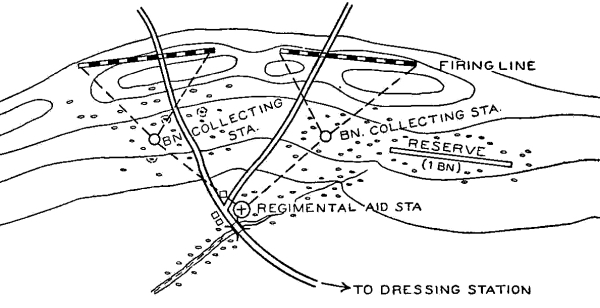
Transportation of wounded. All wounded who are able to walk are required to do so. The seriously wounded are transported to the rear in stretchers, ambulances, and by any other means available. Empty wagons of combat and other trains may be utilized for this purpose.
When the tactical situation permits, the ambulance companies will transport the wounded to the field hospitals. When, however, the [Pg 322] combatant troops are moving forward the ambulance companies should follow them as soon as possible. In such cases the field hospitals may be pushed up to the front, and use made of all hired or impressed transportation available.
Civilian help, both in the transportation and care of the wounded, should be utilized to the fullest possible extent, to relieve the congestion in the sanitary stations. The evacuation system of the Medical Dept, is illustrated by diagrams herewith. (Fig. XIV.)
Transportation by rail should be utilized to the greatest possible extent. [Pg 323]
Fig. XIV.
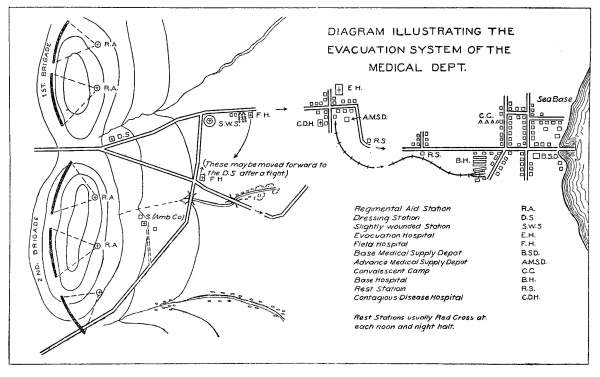
[Pg 324]
In a decisive engagement (on the defensive) the firing line should ordinarily be located a little down hill from the geographical crest, rather than on the crest itself. This keeps the men off the skyline, places them on the front slope where a better view of the foreground is obtained (on or near military crest) and shots aimed at the firing line are not so apt to go over the crest and possibly strike troops in rear thereof. While a slight command (elevation above the enemy) is desirable, it should not be so great that the grazing effect is sacrificed and a plunging fire produced. If, however, the crest is not a skyline, affords a good view of the foreground and has a reverse slope perfectly defiladed, there is, of course, no reason then for going down the slope. The disadvantages of going down the slope are that supports coming into the firing line, or the latter itself in case of retreat, may be exposed to hostile fire on the front slope. As this is particularly disastrous for troops moving to the rear it is frequently advisable in a retreat or delaying action to place the firing line on the geographical crest instead of down the slope therefrom. Also in such actions fire at the nearer ranges is not usually contemplated, and hence there may be no necessity for occupying the military crest.
The supports should be placed where they will be the least exposed to hostile fire, while yet readily available. Ordinarily this will require that they be intrenched close to the firing line. If, however, the reverse slope of the ridge (on the front of which the firing line is placed) is steeper than the angle of fall of the hostile fire a portion of this slope will be defiladed from such fire, and the supports may be placed thereon without being intrenched. They must not, of course, be too close to the crest, since there is here a danger space, and on the other hand they must not be as far to the rear as the place where the hostile bullets strike the ground. By causing the men to lie down they may be placed closer to the crest. The defilade on the reverse slope in [Pg 325] this case increases as the hostile firing line approaches, especially if it is also moving down hill. If the reverse slope is such as to be swept by the hostile fire the supports must generally be intrenched. On a partially defiladed slope the supports may be held lying down in a line of narrow columns. They may be moved nearer to the crest as the enemy approaches and the defilade increases. If the supports can conveniently be placed in rear of the flanks of the firing line, they will be largely protected from fire directed at the latter.
The terms “front slope,” “reverse slope,” “down hill,” etc., are to be understood as relative or comparative.
Position fire may be used either in attack or defense when conditions are favorable. It is more characteristic of the latter, and is permissible up to quite long ranges, 1,800 yds. or even more. The desiderata for position fire are:
1. Troops available without detriment to other tactical operations (usually reserves.)
2. Plenty of ammunition and facilities for supplying same.
3. A well selected position. It should generally be on a crest and should have some command. If on a flank of the main firing line it cannot accidentally fire on the men therein, will not receive fire directed at them, and can cross fire with them on any target. If in rear of the main firing line it is best that the men in the second tier should not be able to see the men in the first tier. If any of the latter are hit by fire from their rear the effect is most demoralizing.
The relative vulnerability to frontal fire of small arms of different formations (on level ground) is as follows: (beginning with the most vulnerable)
[Pg 326] As the fire becomes oblique and approaches enfilade the relative vulnerabilities of these formations are subject to progressive change. Thus under sweeping enfilade fire the column of squads is more vulnerable than line, since depth increases vulnerability as the direction of fire becomes more oblique. Extreme precautions must invariably be taken to guard the combatant troops against very oblique or enfilade fire, inasmuch as it usually involves relatively great losses, and produces a demoralizing effect out of proportion to the actual number of casualties. It is for these reasons chiefly that the flanks of a line are its most vulnerable parts.
Platoon and squad columns are the narrow front columns described in I. D. R. They may be taken up at any time and from any formation. Platoon columns are the more easily controlled.
In order to save time, avoid fatigue, and keep the troops in hand it is advisable to remain in column of route as long as possible in approaching the deploying position. But on the other hand no risk must be taken of encountering hostile fire while in vulnerable formation. A division advances into action in columns of brigades, the brigades later divide into regimental columns, the regiments into battalion columns, and so on. The advance into an engagement should be made in column of squads until the probability of encountering hostile fire necessitates deployment. After deployment, and before opening fire, the advance may be made in line of platoon or squad columns, thin successive lines, etc., depending upon the terrain and the nature of the enemy’s fire.
The vulnerability of all formations is reduced by rising ground (rising with respect to the firers) but line is relatively less vulnerable than column formation. This applies to aimed fire only. Hence in advancing down a slope under aimed fire a line of skirmishers will be the least vulnerable formation. In all other cases of frontal fire of small arms on any kind of ground and under either aimed or sweeping fire platoon or squad columns will be the least vulnerable.
Squad or platoon columns in the advance are not deployed until they [Pg 327] reach the place where it has been decided to establish a firing line. Supports moving into the line in narrow columns deploy just before reaching the line.
If the distance from the supports to the firing line be quite short the former may go forward as skirmishers and drop at once into their place in line. If the distance is somewhat greater and the fire heavy, squad columns may be used, as these can deploy with less exposure on the firing line than platoon columns. Where the supports have a considerable distance to advance, platoon columns allow better control, especially in broken and diversified terrain. If the enemy’s fire be very oblique, lines are to be preferred to columns for the advance. Successive thin lines may be advantageously employed in such cases. (See post.)
Rising ground (with respect to the firer) decreases vulnerability by plunging effect (decrease of swept space). Falling ground (reverse slopes) equal to or less in slope than the angle of fall increases the vulnerability or swept space. Slopes (reverse) steeper than the angle of fall are completely defiladed from fire. But of course troops placed close to the crest may be hit unless they lie down.
An average burst of 3" shrapnel covers an ellipse about 200 yds. long by about 20 yds. wide at a range of 3000 yds. Errors in range and burst are greater and more frequent than errors in direction. Frontal shrapnel fire, if properly ranged and burst, will cover 18 to 20 men in a line of skirmishers (at 1 yd. intervals) even with an error in direction, or will involve 3 squad columns at 8 yd. intervals, 24 men. Slight errors in range or burst would afford little immunity. Under such fire, accordingly, squad columns are more vulnerable than a line of skirmishers. The more oblique the fire, that is the nearer it approaches enfilade, the greater the vulnerability of both formations. This is for the reasons that a single shrapnel, correct in range, direction and burst, will involve a greater number of troops than where the fire is frontal, and errors in range or burst afford less immunity. On the other hand errors of direction of oblique or enfilade fire afford greater immunity to both formations (line of skirmishers and squad columns) but are of less frequent occurrence than errors of range or burst. Errors of all kinds in oblique or enfilade fire favor the line of skirmishers more than the line of squad columns. Under shrapnel [Pg 328] fire, therefore, whether frontal or oblique, a line of skirmishers is less vulnerable than a line of squad columns. Squad columns accordingly should not be used except to facilitate an advance over rough ground and reduce the period of exposure. They are more conspicuous and hence are more apt to draw fire and furnish better targets than a line of skirmishers. They should be deployed whenever the terrain permits easy progress in line.
Under frontal shrapnel fire a line of platoon columns, properly conducted, may afford an advantage over line of skirmishers. The columns should have an interval of 30 to 35 yds. and advance erratically. Whereas errors in direction afford little protection to a line of skirmishers, an error in direction of from about 10 to about 20 or 25 yds. would cause the shrapnel to burst between two adjacent platoon columns without hitting either. As the fire becomes oblique the vulnerability of platoon columns rapidly increases. Under very oblique or enfilade shrapnel fire they are suicidal.
Successive thin lines, if judiciously employed, may afford considerable immunity from rifle, machine gun and shrapnel fire, both frontal and oblique. This formation gives but 2 men in the swept space of a single shrapnel. The hostile artillery can scarcely afford to use shrapnel against such lines as the probability of hits is not sufficient to warrant the expenditure of ammunition. Machine guns, which are most effective against masses of troops, would seldom be used against such attenuated lines. Similarly these lines are less apt to draw aimed rifle fire than a denser formation. Under continuous fire they are, in the aggregate, as vulnerable as the same number of men in a single line although it will require more of the enemy’s time and ammunition to make the same number of hits. They are most advantageous when not subject to continuous sweeping (unaimed) fire.
The greatest objection to successive thin lines as a means of advance, is loss of time. Allowing a distance of 200 yds. between lines the first and last would be separated by 1400 yds. and there would be an interval of time of about 15 minutes before the last line arrived at the advanced position. They are also more difficult to control than a single line, whether skirmishers or squad columns. If the advanced line is to be built up without disorganization—breaking up of squads, etc., [Pg 329] the men should be trained to keep their eyes on the man of their own squad next in front and to follow him into place.
Many considerations enter the problem of crossing the zone of artillery fire. A formation that is correct one time may be wrong the next. Platoon columns may be best under frontal shrapnel fire, and worst under very oblique fire. Officers must learn by study and practice on the ground the formations best suited to the conditions to be met. They should understand the principles of vulnerability, observe the direction, intensity and accuracy of the enemy’s fire, and adapt their formations thereto.
The ordinary fire of battle is slow, controlled fire at will. It is employed at both long and short ranges. Rapid fire is used when an exceptionally favorable target appears for a short time, in a close encounter with the enemy, to gain fire superiority just before an advance, to increase dispersions when this is desired. Volley fire is used in 3 exceptional cases: 1. For ranging. 2. For massed or favorable targets. 3. To steady the men if they are getting out of hand. Slow fire will generally be at the rate of 3 to 5 shots per minute. Rapid fire should never be faster than 10 shots per minute. (See I. D. R.) The tendency of soldiers generally is to fire too rapidly and fire training should aim to control this tendency. Increase of rate is accompanied by a rapid falling off in accuracy, and by waste of ammunition. It also excites the men making the intelligent control and direction of fire much more difficult.
In defense, fire may be opened, usually by specially designated troops, at long ranges in order to compel an early deployment of the attacker. This is particularly desirable in a delaying action. The attack, even if it begins to suffer losses at long range, should generally reserve its fire until effective range (1,000 to 1,200 yds.) is reached, and if it can be reserved until within about 800 yds. of the enemy so much the better. Experience indicates that an attack which is compelled to open fire beyond effective rifle range has little prospect of success. If the strength and position of the defender are unknown or imperfectly known to the attacker and if he advances in a vulnerable formation, better results may be obtained by the defense by withholding its fire until the attacker is well within effective range. Thus if the attacker is advancing in a vulnerable formation over a wide space visible to the [Pg 330] defense, especially if the position and strength of the latter is unknown, a sudden outburst of fire may prevent the attacker from establishing a firing line and compel him to retreat to cover. In such a case the farther he has to retreat under fire the greater will be his losses, and he may thus well be permitted to approach quite close, say to 800 yds. or so. The attacker should not, however, be allowed to approach too close to a covered position in which he might be able to establish fire superiority. Thus fire by the defense should be opened at such a time that the attacker will be more apt to retreat than to rush forward to a covered position. If cavalry, mounted, approaches a defensive position of whose presence it is unaware (ambuscade) the defenders if secure from a mounted charge by reason of their strength or an obstacle in their front, may allow the cavalry to approach to point blank range (if it will do so) before opening fire. The inevitable retreat of the cavalry under fire will then be most disastrous. Artillery in column may be greatly damaged and prevented from coming into action at ranges from 2,000 to 2,500 yds. by infantry fire. Rapid or volley fire should be employed in such a case.
In his first firing position the attacker puts into the firing line as many men and fires as many rounds as necessary to establish fire superiority. Without such superiority of fire a further advance is usually impracticable. The usual density of the firing line will be about 1 man per yd. of front.
Visibility of the target decreases dispersions, but a very conspicuous point on the hostile line (such as a prominent tree, etc.) may result in bad distribution from the tendency of the firers to concentrate their aim on the conspicuous point.
A number of methods are employed for designating and identifying indistinct targets, of which the following is an example: A prominent object in the near vicinity of the target is selected as a reference point, and the exact position of the target indicated by reference thereto, thus:
| Direction to reference point: | 1 o’clock (on a horizontal dial) |
| or to our right front. | |
| Nature of reference point: | Large white house. [Pg 331] |
| Position of target relative | 4 o’clock (on vertical dial)—3 |
| to reference point: | fingers (90 mils, or 2 inches). |
| Range: | 1,000 yds. |
| Objective: | Skirmish line—length 4 fingers. |
This means that the target is to the right of and below the reference point a distance of 3 fingers, or the equivalent 90 mils or 2 inches.
In order to increase the dispersion at mid and long ranges combined sights, 50 yds. under and 50 yds. over the estimated range are used in all cases where the estimated range is 1,000 yds. or over. Combined sights may be used inside of 1,000 yds. against an enemy on rising ground, or the dispersion may be increased by rapid fire, or both artifices may be employed. Battle sights are used habitually below 600 yds., or in repulsing cavalry, up to 900 yds.
Fire is usually directed on the most immediately threatening element of the enemy. It may also be directed on targets which because of their size or vulnerability are likely to render fire especially effective. The attack concentrates its fire on the point where it is proposed to deliver the assault. The defense usually concentrates on the most advanced fractions or groups of the assailant, since these groups will rapidly grow in size if permitted to hold their ground. Fire is concentrated on critical points by increasing the rapidity of fire, by putting more rifles in the line opposite these points, by the cross fire of adjacent organizations, and by position fire of reserves and machine guns.
While concentrating on the critical points, it is of the utmost importance both in attack and defense that all parts of the hostile line be kept under fire at all times. Otherwise the portions not under fire will shoot with peace time accuracy or, in the case of the assailant, will take advantage of the opportunity to push their firing line forward. The front of the enemy is accordingly divided into sectors which are assigned to the various fire units in order.
The covering of the entire front is insured by overlapping or switching fire. Thus, in attack, the company target may be divided into two [Pg 332] parts, the first part being covered by the 1st and 2d platoons, the other by the 3d and 4th. If there be but three platoons, those on the flanks fire on their own halves of the target while the center platoon covers the entire target. If two platoons only, each covers the entire target. When a platoon ceases fire to advance, the other having the same portion of the target, increases its rate of fire. Or the target may be divided into a number of parts, one less than the number of platoons. These parts are assigned to platoons and the odd platoon fires on the target of the platoon that advances. In actual combat the absence of prominent landmarks at the proper places may render it impracticable to assign platoon targets. Too great refinement in the size of targets and switching of fire may result in confusion. When this is apt to be the case the whole target of the company may be assigned to each platoon, care being taken that the fire is properly distributed. To insure the covering of the entire front the targets of adjacent companies on the firing line may be made overlapping.
The duties of the personnel in a fire engagement are as follows:
The Major.
1. He assembles the Captains.
2. He designates the support and fire line companies.
3. He explains the situation and points out the objective.
4. He assigns sectors of the target to each fire line co., indicating the limits of these sectors, preferably by prominent land marks, or by mils or fingers from some reference point.
5. He orders the advance and designates the time and place for opening fire.
6. He orders the supports into the firing line at the proper time.
7. He sees that the extra ammunition is issued.
8. He observes the enemy, the effects of the friendly and hostile fire, tactical changes on the battlefield, etc.
The Captain.
1. He assembles his Chiefs of Platoons.
2. He explains the situation and points out the section of the objective assigned to the company. [Pg 333]
3. He assigns sections of the company target to each platoon, indicating limits of each.
4. He estimates the range, or has this done by several skilled men (called “range-finders”) and takes their average.
5. He gives the sight setting.
6. He orders the kind of fire.
7. He signals to the Major when he is ready to open fire.
8. He designates the time and place to open fire, or transmits the order of the Major.
9. He sees that the extra ammunition sent him by the Major is properly distributed, as well as ammunition from the dead and wounded.
10. He watches the enemy, the effects of fire, and the tactical changes on the battlefield.
11. In general he directs the fire of his company.
The Chief of Platoon.
1. He assembles the non-commissioned officers.
2. He explains the situation, points out the objective, and indicates the section assigned to the platoon.
3. He sees that each n. c. o. knows the target and the sight setting.
4. He signals the Captain when ready to open fire.
5. He transmits all orders of the Captain.
6. He controls the rate of fire, keeps his men steady and sees that ammunition is not wasted.
7. He sees that fire is properly distributed over the assigned front. (VERY IMPORTANT).
8. He watches the enemy and the effects of fire.
9. In general he carries out the orders of the Capt., controls the fire, and enforces fire discipline.
The Platoon Guide.
1. He verifies the sight setting.
2. He watches the firing line and checks breaches of fire discipline.
3. He watches for signals from the Captain and transmits them to the Chief of Platoon.
The Squad Leader.
1. He sees that each man of his squad recognizes the target.
2. He sees that sights are properly set. [Pg 334]
3. He transmits all commands and signals and sees that they are obeyed.
4. He observes and regulates the conduct of his squad, abates excitement and keeps his men steady.
5. He leads his squad and sees that all the men move forward or halt at the command.
6. He assists generally in enforcing fire discipline.
7. He may participate in the fire.
The foregoing includes all of the more important duties of subordinates of various grades in the control and direction of infantry fire. Not all of these instructions will be applicable to every case. Thus where it was inadvisable to separate subordinates from their immediate commands they would not be assembled, but their instructions would be conveyed to them, etc. In the event of a shortage of officers and non-commissioned officers in a company possibly depleted in strength, the Captain may give his orders direct to the entire company or the chiefs of Platoon direct to their entire platoons. This will often favor simplicity—which should be the first and last rule in all tactical procedure.
The Captain’s orders would be about as follows: He explains the general situation as in the orders of the battalion commander and indicates the sector of front assigned to the company. He then says: “Reference point, large white house at 1 o’clock; target 5 o’clock 3 fingers, line of skirmishers 4 fingers long, range 1050 yds. Rear rank set at 50 yds. more than range, front rank at 50 yds. less; 1st and 2d platoons, right half of target; 3d and 4th platoons, left half. Fire at will.”
When the platoon commanders have signaled that they are ready, the captain signals the battalion commander, and upon receiving the major’s order, he orders or signals the company—“commence firing.”
Note. The questions in this catechism are in the same order as the preceding discussions. [Pg 335]
1. In a decisive engagement how should the firing line (in defense) be located with respect to the crest? With respect to the enemy? Why?
2. What can you say as to the position of the firing line in retreat, delaying or rear guard action? Give reasons.
3. In (1) how should the supports be located with respect to the crest? With respect to the firing line? Why?
4. Discuss position fire in attack and defense.
5. State the relative vulnerabilities of different formations under aimed and sweeping fire, on level ground. What is the effect of oblique or enfilade fire on the vulnerabilities of various formations?
6. What formations should be used in approaching the combat position, and when are these abandoned? Why?
7. Discuss the effect of slopes on vulnerability.
8. When do squad and platoon columns deploy, (a) When they are in advance? (b) When they are supports coming into the firing line?
9. What formations may be adopted in advancing under artillery (shrapnel) fire? What are the effects of oblique fire?
10. Discuss the use of successive thin lines, skirmish lines and narrow columns, in building up or reinforcing the firing line.
11. When is slow, controlled fire at will employed? Rapid fire? Volley fire?
12. What should be the maximum and minimum rates of fire? Why?
13. At what ranges should fire be opened under various conditions in attack and defense, and why? Discuss fully.
14. At what ranges may arty. in column be damaged by rifle fire, and what kind of fire should be employed in such cases?
15. How many rounds should the attacker fire in his first position?
16. What is the proper density of the firing line in attack?
17. What effect has visibility of the target on dispersion and distribution?
18. Discuss the methods employed for designating and identifying targets.
19. Discuss the use of combined sights. Of battle sights.
20. At what should the attack fire? At what should the defense fire?
21. How is fire concentrated on critical points? [Pg 336]
22. What is the reason for keeping all parts of the hostile line under fire at all times and how may this be insured?
23. Discuss the duties of the personnel during the engagement. (Major, Capt., Chief of Platoon, Platoon Guide, Squad Leader.)
[Pg 337]
A day’s march under ordinary conditions will be from 10 to 15 miles, usually about 12. The rate of march, including halts, is 2½ miles per hour. One day in each six or seven should be devoted to rest. In a forward march in campaign the advance guard will ordinarily be a regiment or a brigade. Units should not be split as a rule, to furnish advance guards of a strength other than that stated. Artillery should seldom be placed in an advance guard of a regiment but with a brigade it would be usual to place a battalion of artillery. Other auxiliary troops with an advance guard are the engineers, signal and sanitary, each in numbers proportioned to the size of the advance guard, or in accordance with the requirements of the situation. A reinforced brigade as advance guard therefore, may consist of an infantry brigade, a battalion of artillery, one company of engineers, one section of signal troops, one ambulance company.
A commander for the main body may be designated. The division commander may thus go wherever his presence is necessary; he will occasionally review the division as it moves out in the morning, afterward joining the advance guard. If combat is probable he should in all cases be with the advance guard that he may have time to weigh the reports arriving from the front and influence the very important first dispositions of the advance guard. The march order will ordinarily prescribe the initial point and time of departure of the main body, and the distance at which it is to follow the advance guard, together with the route of march. This gives the complete data required to enable the commander of each organization (including the advance guard) to take his proper place in the column of march thus insuring a systematic departure. If a brigade be advance guard of a division it is not usually rotated with other brigades on a single march of say a week. The component elements [Pg 338] of the brigade itself rotate in their security duties, but the disadvantages of frequent rotation of brigades in the division are generally believed to be greater than the advantages.
Cavalry. The divisional cavalry is made independent of the advance guard whenever it has an independent mission. If the division is acting alone this will be the usual case. Its strength should not be frittered away; but for urgent tactical reasons one or two troops or a squadron may exceptionally be attached to the advance guard. The cavalry if camped with the division, is generally ordered to start from a half hour to an hour after sunrise, with orders as to its special mission, “to cover the march of the division,” “gain contact with the enemy and observe towards ______,” etc. If the independent cavalry starts at about the same time as the advance guard brigade the time stated will be about one hour before the advance guard clears its initial point, the length of the advance guard with its intervals, being about an hour’s march (for foot troops). It may be desirable to attach a pack train to the cavalry. Avoid detail in orders to the divisional cavalry. Tell the cavalry commander clearly what tasks he is to accomplish, the means of so doing should be left to his judgment.
Artillery. The distribution of the artillery in the column of march depends upon the tactical requirements. For its own security it should never be too far to the front. Artillery needs a maneuvering zone, and it should not have to countermarch to gain this. In an advance guard of a reinforced brigade the artillery should be in the reserve, and immediately preceded by a bn. or more of infantry, according to the tactical situation. It would be inadvisable to have the artillery forward with the support. The center of gravity of the artillery with the advance guard, should therefore ordinarily be well to the rear for security and maneuvering purposes, and of that with the main body well to the front in an advance in the presence of the enemy. It is usual in such case to have the artillery of the main body preceded by a regiment of infantry (in the main body). When the tactical requirements are less urgent, the artillery brigade (less the bn. with the advance guard) may be between the brigades of the main body, or may even be in rear of all the infantry of the main body. Heavy [Pg 339] field artillery, if present, would usually be placed in rear of all the foot troops of the main body. Where the artillery as thus disposed forms too long a column it is well to place a detachment of infantry in the middle. The local conditions will indicate the correct course. Artillery combat trains are seldom permitted in the main body ahead of foot troops; they incommode the infantry in the column as well as delay the deployment of the division. They should be routed immediately in rear of the special troops at the tail of the column. Combat trains of artillery with the advance guard, usually march with the advance guard.
The division marching in two columns, with the prospect of encountering the enemy, will usually have artillery in each column. There may be a regiment of artillery with each or more usually a battalion only with the smaller. Whether or not a flank guard will contain artillery depends upon its mission and the conditions. If the purpose of the flank guard is reconnaissance only it should consist of cavalry alone, and would have no artillery accompanying. If the flank guard be composed of a regiment of infantry with some attached mounted troops it would still be unwise to attach artillery. But where the flank guard as a covering detachment is expected to fight decisively, or where there is essentially double column formation for purposes of partial deployment in marching to meet the enemy, its strength is made greater, and it may include artillery. If the lateral communications between the routes of the two columns are such that artillery from the main body may be readily moved to the flank in case of need there will usually be no occasion to attach artillery to the flank guard.
In a meeting engagement it is generally of vital importance to bring the artillery into action with the least delay. For this purpose it should be brought forward, either by giving it right of way over the infantry, or preferably, by advancing it on a parallel road. Where the situation permits it is best in such cases to have the artillery advance on the parallel road farthest from possible interference by the enemy, the infantry column taking the more exposed road. In either case the artillery comes ahead at an increased gait. Where no parallel route exists, and it is determined to give the artillery right of way over the infantry, the latter may continue the march in the fields [Pg 340] alongside, or if this is not practicable they must halt off the road until the artillery passes them. Right of way over the infantry is given to the firing batteries only, the combat trains come forward later as the situation permits.
Engineers. Engineers are used in an advance as pioneers and pontoniers. Pioneers should invariably be attached to the advance troops of a large command. They take up little road space and are needed on every march. If it is known that bridging must be done during the march the bridge train should be with the advance guard. It marches in the intervals of the advance guard, or in that between the advance guard and the main body. If it is known definitely that no bridging will be needed the train should be in rear with the division trains. It should never march with the combatant troops of the main body. If the bridge conditions ahead cannot be learned definitely the equipage should march with the advance guard, otherwise the progress of the command may be greatly delayed. The road space for one division of the advance guard (light) equipage, which will bridge a minimum span of 186 ft., is about 300 yards. A division of reserve (heavy) equipage, with a minimum capacity of 225 ft., occupies a road space of about 400 yds. The capacity of this equipage can be increased by the amount of material that can be obtained locally at the crossings.
Signal troops. On the march the radio sections of the signal troops may be disposed as follows, 1 with the independent cavalry, and 1 with the advance guard. A section, radio or even wire, may be sent with a flank guard, or even with the trains, if on a separate road, or far to the rear. A wire section may be placed at the head of the main body, and the remainder of the signal troops at the tail thereof, in rear of the engineers, or in the interval between the advance guard and the main body. The duties of the signal troops on the march are to maintain communication between the various detachments along the line of march (always including division headquarters) and with the independent cavalry by wireless. The signal troops may keep up moving communication, or better establish stations along the line of march, continually pushing out new stations to the front, and drawing in those in rear as the column advances. Existing telegraph and telephone lines [Pg 341] may be utilized. Instructions to the signal troops would read “lines of information will connect division headquarters with the advance guard, flank guard, trains, etc.” As with all other officers who are expected to exercise any degree of initiative, instructions in great detail should not be given the signal commander. He should be told what is desired and allowed to arrange details himself.
The starting hour of the division should not be too early. Large bodies lack the flexibility of small, and it is exceptional that the division starts before one hour after sunrise. It must be remembered that if the division starts its march earlier than this, the advance guard, which may have an hour’s march to clear its initial point, must start at an unseasonable hour. If the mounted point starts at daybreak the head of the main body will pass the same place about an hour after sunrise. In a map problem or maneuver there is a tendency to endeavor to make the utmost of the time available, but it should be remembered that if much is expected from the division today, yesterday was probably as hard a day, and tomorrow may call for even greater effort. Hence avoid the early starting habit. Starting before daybreak, however, is less objectionable than making camp in the dark. Large bodies cannot be expected to form in column on the road before starting. Each element of the command is responsible for reaching the initial point in time to take its place in column without delay. Trains assemble off the road until the troops have cleared and proceed as ordered. The commander of the field trains is charged with the duty of arranging his wagons in the order of march of the units to which they belong. Usually the field trains of the division, including that of the advance guard, are united in one body. If the situation of the trains requires a guard, one is detailed for the purpose. Some mounted men should always be attached to a train escort. Engineers are useful for this purpose, if their other duties permit. They may constitute the entire escort. Their services are valuable in facilitating the progress of the trains. Fig. XV shows an arrangement of a division on the march.
The march outposting of a division does not differ in principle from that of smaller bodies. Detachments of suitable strength up to a battalion may be sent out to important crossroads, crests, bridges, etc., and if desirable they remain there until the safety of the column is assured. [Pg 342]
ORDER FOR THE FORWARD MARCH
OF A DIVISION.
| 1st Div., 1st Blue Army Corps, | ||
| FREDERICK, MD., | ||
| Field Orders, | |
15 May, '16, 9 p. m. |
| No. 1. | ||
| Geological Survey map. | ||
1. The frontier is being observed by hostile detachments. Their main army is about BALTIMORE and WASHINGTON. The greater part of their army is believed to be unprepared to move. One division and possibly more are ready and may have moved toward the frontier.
Our army will advance so as to reach GETTYSBURG on the 18th.
2. This division is ordered to advance on GETTYSBURG and cover the exit of the army from the mountains.
We will begin the march tomorrow.
3. (a) The independent cavalry will start at 5:30 a. m. and cover the movement. They will reconnoiter TANEYTOWN and the roads leading southeast therefrom.
(b) The advance guard will march on EMMITSBURG Turnpike and clear the first railroad crossing north of town by 6:30 a. m.
The crossings of the MONOCACY and their approaches from the east will be observed.
(c) The head of the main body will start from the first railroad crossing north of town at 6:50 a. m. and follow the advance guard at about one mile.
(d) The Signal battalion will march between the main body and the advance guard, and will maintain communication with the cavalry.
Fig. XV.
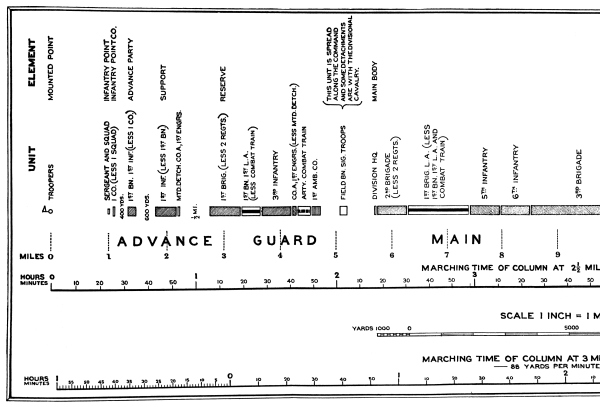
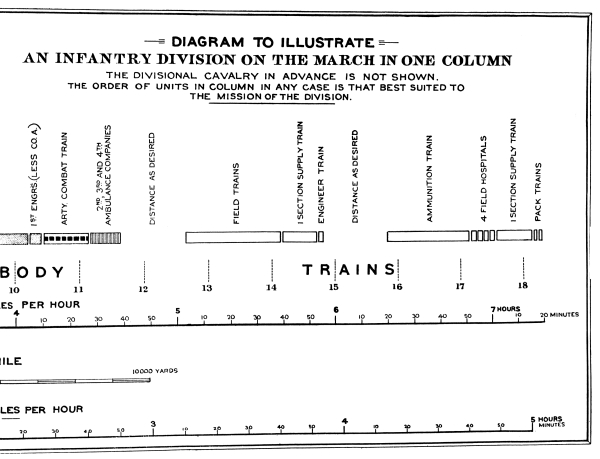
[Pg 343]
| 1st Bn. Sig. | (x) The outpost will stand relieved |
| (less 1 Radio sec. pack Sig.) | at 6:30 a. m. |
| (y) Hourly halts of ten minutes | |
| on the even hour. |
4. The field trains will assemble north of the town after the troops have cleared the place, and report to C. O. trains.
5. The Division Commander will remain in FREDERICK until 8:30 a. m. and will then join the reserve of the advance guard.
| 1st Div., 1st Blue Army Corps, | ||
| Orders No. —— | FREDERICK, MD., | |
| (Map reference) | ||
| 15 May, '16, 9:20 p. m. | ||
1. For the march May 12, the trains will be divided into two sections:
First section, in order of march: Field trains, 1st section supply train, 1st Am. Co., Engr. train.
Second section, in order of march: Field hospitals, 2d Am. Co., supply train (less 1st sec.).
2. The 1st section will follow about two miles in rear of the troops. The 2d section will follow the first at about two miles.
By command of Maj. Gen. A.
The members of the division staff would do well to supply themselves with diagrams to scale of the division on the march. (See Fig. XV.) These are applied to the map and the position of any unit at any time is thus approximately determined. [Pg 344]
To enter upon a deliberate and protracted engagement late in the afternoon, especially with troops tired from a day’s march is justifiable only under exceptional conditions. Even if the attack be successful before nightfall there will hardly be enough daylight remaining to reap the fruits of victory. If advancing in a single column a division may require, depending upon the terrain, from 1½ to 2½ hours for deployment alone.
The desire to obtain fire superiority leads the attacker to an endeavor to extend his line and overlap that of the defender, thus subjecting part of the latter’s line to both frontal and oblique fire. Purely frontal attacks may force the enemy back but have little prospect of annihilating him. Nevertheless the decisive blow is not invariably directed at the defender’s flank. Often a determined frontal attack combined with a demonstration against the defender’s flank or pressure against his line of retreat will have good prospects of decisive results. Enveloping attacks, with their great extension of front are a form of dispersion and subject to the risks thereof. A timid commander will often allow too small an interval and too obtuse an angle between his frontal and enveloping attacks, whereby the latter fails of envelopment. A rash commander, on the other hand, may provide at the outset too great an interval between the attacks, whereby they fail of coordination and mutual support and run the risk of repulse or even annihilation in detail. It is necessary then to find in each case the golden mean between two undesirable extremes. Here again many conditions enter into the problem and “rules” cannot be given. An enveloping attack to be decisive must generally aim well to the rear. It is a condition precedent to a successful envelopment, however, that enemy be attacked in front with ample strength. The gap between the attacks should, taken in connection with the nature of the terrain, be such that the defender cannot advance against the holding attack without exposing his flank to the envelopment. As the attacker moves forward the gap between his forces will usually diminish and with it the risk of a counter-attack against the troops in front of the [Pg 345] defender. The difficulty of coordinating the separated portions is usually the greatest danger to be anticipated. The envelopment should generally be provided for in the first deployment, as it is much more difficult to secure when initiated after the opening of the frontal attack by the employment of retained reserves. The troops for the envelopment will often be ordered to a preparatory position from which their attack is launched. As to which attack will be launched first this will depend upon circumstances. Ordinarily the entry of the enveloping troops into action will be the signal for the general attack. Whether the troops holding the front will participate in the assault depends also on conditions. They may be able to exercise a more decisive influence by oblique or enfilade fire on the hostile troops opposed to the envelopment. Great separation of the forces or obstacles of the terrain between them are elements of danger to be given such consideration as they may, in the particular case, demand.
Turning movements like envelopments, though to an even greater extent, are forms of dispersion. They are usually to be condemned in the operations of small forces, the weak detachments of which are too readily and too quickly overwhelmed by superior strength when alone and unsupported. They are of occasional application in the operations of a division and of more frequent application by larger forces. In spite of the risks involved in such maneuvers they will continue to be in favor with bold commanders since they frequently promise decisive results in case of success. Envelopments grade into turning movements and no sharp line can be drawn between the two maneuvers. An envelopment so separated from a holding attack by distance or natural obstacles as to render co-operation and mutual support difficult or impossible, partakes of the nature of a turning movement, and of the risks inherent in this form of dispersion.
The plan of attack should generally be based upon the best dispositions for the infantry, other elements conforming thereto. Cover for advancing infantry is a prime consideration up to the opening of the struggle for fire superiority. Afterwards the attacker’s own fire must be his principal protection. The envelopment of a hostile flank, where contemplated, should be provided for from the start; do not wait until [Pg 346] after the deployment is commenced. For the considerations determining which flank to envelop see Chap. XI. The separation of the main and secondary attacks depends upon the terrain, the relative sizes of the opposing forces, the means of communication, the state of the enemy’s morale, the mission, etc.
If the division is on the march it will often be advisable to issue two orders, the first a development order, the second an attack order.
The order for attack indicates the front upon which the large units deploy, and the portion of the enemy’s line they are to cover. The brigades are directed to proceed to their assigned positions, where they will usually await the order to attack. In a rencontre engagement the units may attack at once. When all is ready the division commander signals the advance. The telegraph is the best means of insuring a properly timed advance. It has the advantage that it allows the attack to be launched in the light of the latest information received by the commander. Launching the attack at a stated hour, or by prearranged signal (gun or flag) although frequently resorted to, has some disadvantages. Communication by the signal troops on the field does not ordinarily extend to organizations below a brigade. The position to which the brigade proceeds for deployment should have covered approach. It should be as close to the hostile line as will still enable the brigade to effect its deployment without undue interference from the hostile artillery. The distance will usually be from 1½ to 2½ miles.
The selection and placing of the reserves depends largely upon the flanks, both friendly and hostile. Except for compelling reasons they should be held intact at the outset. Ordinarily it is to be presumed that the reserve will be eventually employed in the enveloping attack. In such cases it would be posted in rear of the outer flank thereof. If, however, there be a reasonable probability of its employment elsewhere, it should be held at first in a more central position. In rear of the inner flank of the main attack will ordinarily be a convenient place in view of several possibilities. It should always be under the immediate control of the supreme commander. When a force has once been committed to an engagement it is by the prompt and judicious use of the reserves alone that the commander can influence [Pg 347] the subsequent course of the action. The station of the reserve in the preliminary disposition will ordinarily be from 2 to 3 miles from the hostile line. Engineers upon completion of such special tasks as may be assigned them will ordinarily join the reserve. For a purely passive defense strong reserves are not usually necessary. Such reserves as are held out should make preparations to cover the withdrawal, in case of defeat.
The depth of deployment in the beginning of an attack will depend upon a number of considerations. “Depth of deployment” as the term is here used means the ratio of the total strength of the combatant force to the deployed front in yards. The strength of the firing line proper (in attack) should be about one man per yard of front. Depth therefore depends on the relative strength of supports and reserves, as compared to the firing line. It is measured in men, not in yards, and is expressed as so many men per yard of deploying front. It has no reference to the distance of the reserve behind the firing line. The greatest care must be taken then that too many men be not committed prematurely to the action. The combat, however, is decided by the firing line. Retained forces which are not launched against the enemy produce no effect on the result. To deploy an insufficient number of men and then reinforce them by driblets is wrong. Distribution in depth therefore, is a means to an end. It is necessary in the preparatory stages of the fight to enable the commander to meet unexpected developments, especially when the knowledge as to the strength, dispositions and intentions of the enemy is insufficient. A force then should go into action in a relatively deep formation, but it must extend its front during the action, and when the decisive moment is recognized every available man should be thrown in for the assault. While too great depth of deployment at the outset is a serious mistake it is a less one than the opposite extreme of deploying from the start on too broad a front. The decision as to the proper depth of deployment in any particular case cannot be made a matter of rule, but calls for all the skill and judgment of the commander. Success alone can justify his dispositions. The criterion is this: at the decisive point were the attacking (or defending) lines the strongest that it was possible to [Pg 348] have obtained? The following are some of the considerations which influence the decision as to depth of deployment.
1. The fighting qualities of the enemy. Are his troops in retreat, have they been defeated, are they of poor quality or low in morale? If so a greater extension of front is permissible.
2. Is the force fighting alone, or as a part of a larger force? Is it on the offensive or defensive, and if the former is it making a decisive or merely a holding attack? Is the fight to be to a decision or is it a delaying action? Is it a deliberately planned attack or a rencontre? If fighting alone, if on the offensive, if in a decisive engagement, if in a deliberately planned attack greater depth of deployment at the outset will usually be advisable than in the contrary cases.
3. Are reinforcements expected on either side?
4. The nature of the terrain, cover, security of the flanks. In favorable terrain, particularly that which affords security to the flanks greater extension of front is usually justifiable.
5. Are the enemy’s strength, dispositions and intentions accurately known? If not it is better to have at first a relatively great depth of deployment pending developments.
6. The frontage of units cannot be definitely fixed as it depends upon the conditions and the object of the combat. Companies ordinarily go complete into the firing line. Larger units ordinarily hold out supports and reserves. The frontage of deployment does not increase in proportion to the size of the force. It is usually relatively less for large forces. The necessity for distribution in depth usually increases with the size of the force.
7. The depth of deployment will be greater opposite the decisive points in the front.
etc. etc.
In view of the great variety of conditions and the many considerations which influence the decision it is impossible to enunciate arithmetical rules for the depth of deployment in various situations. The following figures can serve therefore, only as a very general guide.
The deployed front of a brigade of about 4,000 men (in division) at the opening of a decisive attack against good troops should not usually [Pg 349] exceed 1,200 to 1,500 yards. The division, at have from 5 to 7 men per yard of deployed front.
Artillery should be kept well in hand under the senior artillery officers. This does not mean that the entire artillery brigade need be in one mass. The terrain often will not permit of this. Where practicable, however, it is desirable that regiments be not sub-divided. One may be assigned in rear of each attack (the main and secondary). Enfilade fire should be sought, as also the longest continued fire on the hostile infantry, especially that opposed to the main attack, over the heads of the advancing troops. This is usually best obtained from positions behind the holding attack.
When combat is imminent certain trains are released from the division train and ordered to designated localities. The artillery ammunition is hastened to the front and placed at the disposal of the artillery commander. It is posted at a convenient point or points a mile or so in rear of the artillery positions. The position should be selected with reference to the location of the roads. Small arms ammunition is similarly brought forward and disposed for convenience of supply. Usually the artillery ammunition will be required first and will be given right of way. The sanitary and engineer trains are usually also released. To avoid obstructing the roads wagons should be parked clear thereof.
Ambulance Companies are stationed, according to the probable necessities, usually one behind each brigade in the attacking line. The considerations that govern the stationing of the ammunition companies, point usually, to the same locality for the ambulance companies, about 3 to 4 miles from the enemy’s line. The remaining ambulance companies are kept in hand well to the rear. Ambulance companies should not be immobilized prematurely by the establishment of dressing stations. Until the course of events indicates where these stations will most be needed as well as how near the wounded they can be established, it is usually unwise to set them up. The field hospitals should at first remain well to the rear. Later they may be moved forward to or near the dressing stations, if the course of the action and other conditions permit. For the best performance of their functions it is desirable that the field hospitals be located on a railroad or in a town, preferably both. If the command advances after a successful action the [Pg 350] ambulance companies must be released, and the field hospitals should advance and take over the wounded directly from the dressing stations. Otherwise the ambulance companies and other available transportation should be utilized to transport the wounded back to the field hospitals at a point convenient for their care and further evacuation. During the action one of the field hospitals sets up a station for the slightly wounded.
Combat orders should cover the disposition of all trains which are thereby released from the control of the commander of the trains, including disposition of ambulance companies, field hospitals, slightly wounded station, ammunition distributing stations, etc. All officers concerned with the handling of the released trains should receive copies of the orders. The commander of the trains need not invariably be furnished a copy of the field order, but the necessary information may be embodied in a brief order, thus:
“Division attacks hostile force at HUNTERSTOWN. Sn. Tn., Am. Tn., and Engr. Tn., released to MUMMASBURG to await orders from Chief Surgeon, Arty. and Engr. commanders. Remainder of trains will park near MUMMASBURG. Messages for Div. Hq. to GOLDENVILLE.”
Important messages, especially during combat, should preferably be written rather than verbal, and this is true whether they be carried by enlisted men or officers. When practicable, therefore, the person who is to deliver the message should write it down as dictated, repeating it afterwards in the presence of the officer by whom sent.
After combat the following must be attended to:
1. The wounded sent to the rear. The ambulance companies, if not immediately required in the advance of the division, may, with other available transportation, be used to carry the wounded to the field hospitals or the latter come forward as noted above. In the evacuation of the wounded to the rear, empty supply and ammunition wagons as well as all impressed wagons are utilized as far as conditions permit. If the combat is followed by a retreat the sanitary troops precede the combatant forces, removing as many of the wounded as possible. A suitable detail should be left for the care of the seriously wounded [Pg 351] that cannot be removed. None of the wounded, if it can be avoided, should be abandoned to the enemy’s sole care. He cannot be expected to attend them until all of his own are cared for.
2. Ammunition in men’s belts and combat trains should be replenished. This should be accomplished at the latest by daybreak following. In the operation orders this item is accompanied by an announcement of the location of the ammunition company designated to make the issues.
3. Rations in the men’s packs and field wagons should be replenished promptly.
4. Police of the battlefield when practicable.
5. Prisoners should be sent to the rear. The immediate escort will be approximately 10 per cent of the strength of the prisoners.
6. Necessary instructions for trains.
7. The commander of the line of communications is given instructions covering such of the following details as may be necessary:
(a) Information as to the situation.
(b) Re-supply of ammunition, rations, forage, medical supplies, equipment, men and animals.
(c) Transportation for wounded and prisoners with necessary personnel.
(d) Such special instructions as the situation may demand.
ORDER FOR A DIVISION ATTACK
| 1st Div., 1st Blue Army Corps, | ||
| GOODINTENT S. H., | ||
| (Near GOLDENVILLE, PA.), | ||
| Field Orders | |
2 April, '16, 11:15 a. m. |
| No. —— | ||
| Gettysburg 3" Map. | ||
1. A hostile force of less than two infantry brigades and a regiment of artillery has occupied the line hill 602—hill 597 and is intrenching the four main spurs projecting west from that ridge. Red artillery has been located between hills 602 and 601. The defeated Red cavalry has reappeared on YORK TURNPIKE west of GRANITE HILL.
[Pg 352] 2. This division will attack enveloping the hostile left. March conditions now cease.
3. (a) The 2d Bn., 2d L. A. will take position on the ridge southeast of GOLDENVILLE and fire on the hostile artillery.
The 2d L. A. (less 2d Bn.), from a position east of HERMAN, will support the attack of the 1st Brig.
The 1st L.A., from a position near VARNEY, will support the attack of the 2d Brig.
(b) The 1st Brig. will attack the three northern spurs of the Red position. Its right will follow the line J. WEAVER—farmhouse north of 592. Its left will not extend north of hill 574. The advance will not be carried east of the HARRISBURG ROAD until further orders.
(c) The 2d Brig., moving via 608—513—511 road, will vigorously attack the south spur of the Red position and envelop the hostile left. Its right will not extend east of the FAIRVIEW S. H.—HUNTERSTOWN road.
(d) The 3d Brig. and 1st Engrs. (less Co. A), Gen. D comdg., will move via GOLDENVILLE and 608 to 513 west of VARNEY and await orders.
(e) The 1st Cav. (less 2 trs.) will move to the vicinity of J. KAAS, south of FAIRVIEW S. H. and wait in readiness to assist the 2d Brig’s. attack. Reconnaissance will be pushed out towards HUNTERSTOWN, BONEAUVILLE and east of GRANITE HILL.
Tr. B will remain at its present position and cover our left, reconnoitering towards HUNTERSTOWN and NEWCHESTER and through HEIDLERSBURG.
(f) 1st Engrs. (less Co. A) will join the reserve. Co. A (less mtd. sec.) will remain at HERMAN. Mtd. sec. Co. A, will move north of the CONEWAGO and destroy all bridges near NEWCHESTER.
(g) 1st Bn. Sig. will establish a wire line between each brigade and these headquarters. Present radio distribution remains.
4. The 1st Amb. Co. will remain at HERMAN. The 2d Amb. Co. will move to creek crossing south of 513. 3d and 4th Amb. Cos. will await orders at 621 crossroads west of GOLDENVILLE. Station for slightly wounded will be at first crossroads west of GOLDENVILLE. Am. distributing stations, [Pg 353] 1st Brig. and 2d L. A., at crossroads 679 on MUMMASBURG road; 2d and 3d Brigs. and 1st L. A., at BOYD S. H.
5. Messages to farmhouse west of J. WEAVER.
Note—As soon as the 2d Brig. has launched its attack and approached the line of the 1st Brig., General A will order the latter to continue its advance.
The requirements of a division camp are of two kinds, tactical and sanitary. Tactical considerations when present, take precedence in every case. The tactical considerations are:
1. Mission of the command, orders from higher authority, contemplated tactical operations in the immediate future, relations to other friendly or hostile forces in the locality, etc.
2. Sufficient space to accommodate the command. There is a physical limit to crowding as well as the disadvantage that may accrue due to cramped dispositions, if attacked.
3. The site should, if practicable, be screened against hostile observation. This is not always possible but the easy observation of the main body by hostile patrols should be prevented.
4. Outpost line. The camp should have a defensible outpost line.
5. The network of roads and the location of water supply largely determine the distribution of the troops in the site selected. It is desirable that each fraction of the command have a road or a good trail [Pg 354] leading to its camp from the highway, so that it will not have to pass through the camps of other organizations. For mounted troops this is especially desirable.
6. Infantry should be camped in front of other troops that cannot so readily defend themselves in case of a sudden attack.
7. The site of a crossroads usually aids in the fulfillment of conditions 5 and 6. It has the added advantage that the command occupies virtually a position in readiness. It is able to move to the front or either flank, promptly, without confusion or countermarching.
8. Whether the command shall camp in depth or in mass depends upon conditions, chief amongst which is the proximity of the enemy. Camping in depth is the more convenient, facilitating both arrival and departure; camping in mass the more secure.
The sanitary considerations are:
1. Water. Only the most compelling tactical necessities can outweigh the need for an adequate supply of good water. Every separate water shed should be utilized for a separate fraction of the command.
2. Mounted organizations should be down stream from foot troops.
3. Heat, cold, dust, wind and soil, are matters of importance in camps to be occupied for some time. But usually little weight can be given them in a one-night camp.
4. Fuel.
5. Drainage.
Sanitary conditions should be given all the weight that tactical conditions will permit.
Fig. XVI illustrates a convenient arrangement of a division camp or bivouac. The division has just arrived from the southwest, and is in close contact with a force believed to be inferior, to the northeast. The 2d Brigade which marched at the head of the main body during the day, is assigned the site farthest from the highway because it can reach it first. The brigade enters its camp via the road which turns to the northwest from the highway at a point about 1,400 yds. northeast of Taneytown. The 3d Brigade then marches directly to its camp, opposite the 2d, without interfering with other troops. Water is ample in quantity and convenient of access to both brigades. The Artillery Brigade is assigned a camp under the protection of the [Pg 355] infantry. It has a separate water supply downstream of the foot troops.
It enters its camp by the lane shown, and distributes on each side of this lane. The situation of the artillery here economizes in security measures.
All three of these camps are of ample area, they are capable of easy description in the halt orders. No one is contingent upon the others; no organization need be ordered “next south of” or “immediately east of” another. Each site can be described by identifying it with the natural and artificial features, roads, railroads, streams, etc. Each subordinate commander thus knows at once precisely where to go without waiting to take the space left him by any other organization. Special troops in this case are treated as a single body, the senior officer commanding. Their site is convenient for the organization last to arrive in camp. They have a good water supply opposite the artillery. The Ambulance Companies are assigned to the site selected because it gives them a separate source of water supply and places them near the town so that some of the buildings could be used in case of necessity for the sick of the command. No use is made of the stream flowing north from Taneytown; it is probably polluted by the drainage of the town.
The advance guard, 1st Brigade reinforced, outposts the camp during the night. It camps near Galt a mile and a half ahead of the division, and places the 1st Infantry on outpost. The outpost line (see map) is about a mile beyond the advance guard camp. The baggage section and one day’s rations of the field trains join the troops. The division trains camp in two sections as follows: First section, composed of remaining field trains, 1st sec. supply train, 1st ammunition company, and pack train are camped south of Taneytown. The second section, consisting of supply train (less 1st sec.), ammunition train (less 1st Am. Co.), field hospitals, and engineer train, is camped near Ladiesburg.
The main body of the division in this instance is not camped in column. The 2d and 3d Brigades watch their own flanks with small detachments as shown, thereby avoiding undue extension of the outpost line. The camp is screened from any close view by the enemy.
The halt and outpost order should be issued well in advance so that subordinate commanders may conduct their organizations to the places [Pg 356] assigned without countermarching, delay or confusion. One or two hours before the close of the day’s march is not too early for the issue of the order. The order designates the troops for outpost, usually from the advance guard. The line to be outposted is given in general terms only, from the map. The division commander cannot hope, nor is it necessary for him to select the line on the ground. This duty ordinarily devolves upon the commanders of the advance guard and outpost. If the order is issued early enough a copy is sent to the cavalry in front, otherwise special instructions must be sent them. The instructions for the cavalry include the following: new information of enemy and friendly troops, plans for the following day; mission of the cavalry for the remainder of the day, when to cease work for the night and where to camp (this last may be left to the judgment of the cavalry commander in which case he reports his whereabouts to the supreme commander), what troops are to be left out over night, what troops are to be assigned to the outpost if any, and when they are to report, location of outpost line, camp of advance guard, main body, location of division headquarters, where the cavalry field trains will be sent, place of issue of supplies, time and place for the next issue of division orders, etc. The prompt and orderly distribution of the troops to their camps at the close of a day’s march is necessary to the maintenance of discipline and fighting efficiency, and is an index of the competence of the division staff.
Other orders issued would include:
1. Orders as to time and place of making issues when this information is obtained too late for insertion in the halt order. Routine orders covering matters of general interest, not properly belonging in operation orders.
2. Instructions to the Chief Quartermaster of the division concerning the procurement of supplies, disposition of empty wagons, etc.
3. Instructions to the commander of the line of communications concerning supplies, repair of railroads, movement of advance supply depot, etc.
(See orders following). [Pg 357]
ORDER FOR CAMPING AND
OUTPOSTING OF A DIVISION.
To the Divisional Cavalry
by mounted messenger (or wireless.)
| 1st Division, 1st Blue Army Corps, | |
| TANEYTOWN, MD., | |
| 10 Sept., '16, 2:45 p. m. | |
| Commanding Officer, 1st Cav. |
|
Division camps north of TANEYTOWN for the night. Advance guard will camp near GALT and place outposts. Determine first the location of the flanks of the enemy’s line near KINGSDALE; second whether any hostile troops are on the march between KINGSDALE and MCSHERRYSTOWN. Withdraw behind the outpost line by 9:00 p. m. Your wagons will join the advance guard at GALT. Division headquarters road jct. 1½ mile N. E. of town.
| 1st Division, | ||
| TANEYTOWN, MD., | ||
| Field Order, | |
10 Sept., '16, 3 p. m. |
| No. 3. | ||
| Geological Survey map. | ||
1. Our cavalry has been in contact with hostile cavalry since the crossing of the LITTLE PIPE CREEK, and has been successful in driving them back. It reports that it has developed the enemy holding a line just south of KINGSDALE. The railroad bridges over the BIG PIPE and LITTLE PIPE CREEKS have been destroyed.
2. The division will halt for the night.
3. (a) The advance guard will halt and camp near GALT, and will provide for the security of the camp.
(b) The main body will camp as follows:
The 2d Brigade on the right bank of PINEY CREEK, south of the 469—526 road and north of the road leading west from this road junction. A small detachment will be sent towards the high ground near 526 to observe the roads leading towards LONGVILLE and 528. [Pg 358]
The 3d Brigade on the left bank of PINEY CREEK, south of the 469—554 road and opposite the 2d Brigade. A small detachment will be sent towards 554 to observe towards STUMPTOWN.
The artillery brigade (less the 1st Bn. 1st L. A.) on the right bank of the tributary to PINEY CREEK which flows into the same at a point 200 yards southwest of this road junction.
The Signal Battalion, and 1st Engrs. (less Co. A.) on the left bank of the tributary to PINEY CREEK and opposite the artillery.
The 2d, 3d, and 4th Ambulance Companies at the head of the stream at the northern edge of TANEYTOWN.
4. The baggage section and one day’s rations of the Field trains will join their organizations, those of the 1st Cavalry will join the advance guard at GALT.
5. Division headquarters will be at this road junction.
(How and to whom communicated.)
| 1st Div., 1st Blue Army Corps, | ||
| TANEYTOWN, MD., | ||
| Orders | |
10 Sept., '16, 3 p. m. |
| No. 2 | ||
1. The division camps tonight northeast of TANEYTOWN.
2. The first section of the division trains, less baggage section field trains, will camp near the southwest exit of TANEYTOWN; 2d section at LADIESBURG.
3. Distributing point near southwest exit of TANEYTOWN, 7:30 p.m.
4. Refilling point rail head, LITTLE PIPE CREEK (via MIDDLESBURG).
By command of Maj. Gen. A.
X
Asst. C. of S.
[Pg 359]
Fig. XVI.
CAMP OF A DIVISION.
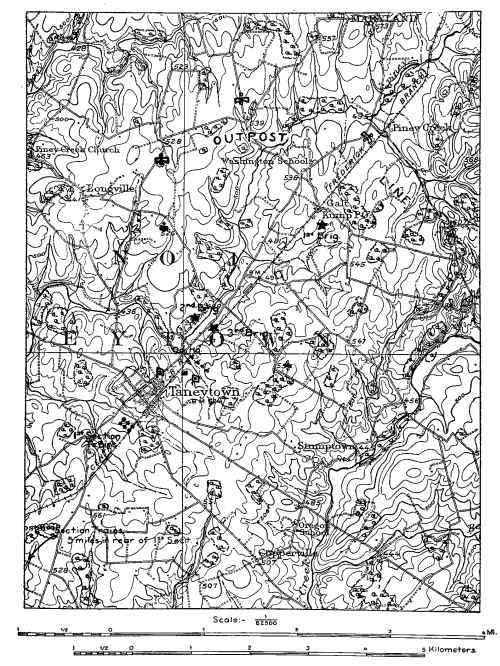
Contour interval 20 feet.
Datum is mean sea level.
[Pg 360] Telegram to the commander of the depot at Frederick.
| 1st Div., 1st Blue Army Corps, | |
| TANEYTOWN, MD., | |
| 10 Sept., '16, 3 p. m. | |
| Commanding Officer, Supply Depot, FREDERICK, MD. |
|
1st Division camps for the night Sept. 10-11 one half mile northeast of TANEYTOWN. Request that supplies for this division for one day be sent by special train to arrive at rail head LITTLE PIPE CREEK by 8 p. m. Also send 1,000,000 rounds small arms ammunition and 5,000 rounds artillery ammunition to arrive at LADIESBURG by rail on the morning of the 11th. You will have railroad construction crew ready to start to replace bridges over LITTLE PIPE and BIG PIPE CREEKS. Am sending estimates by motorcyclist.
The division is the administrative unit for supply, and the tactics of a division differ in principle from those of smaller units chiefly in that they are concerned additionally with the handling of supply trains.
The vehicles, etc., with an infantry division as authorized by F. S. R. 1914 are as follows:
| Guns | 48 | |
| Other artillery carriages with firing batteries | 78 | |
| Combat trains, including artillery, wagons | 210 | |
| Field trains | Baggage section, wagons | 54 |
| Ration section, wagons | 124 | |
| Ammunition train, wagons | 162 | |
| Supply train, wagons | 126 | |
| Sanitary train, wagons and ambulances | 90 | |
| Engineer train, wagons | 9 | |
| Machine guns | 40 | |
| Pack mules | 273 | |
[Pg 361] The bakery train is not now a part of the division trains unless specially attached. Ordinarily it is with the line of communications. Bridge trains likewise are part of the division only when specially attached.
In the U. S. service it is now provided that certain reserve (park) intrenching tools for each battalion of infantry and each squadron of cavalry will be carried in their combat wagons. A reserve of engineer supplies including park intrenching tools, explosives, etc., will be carried in wagons to be furnished for that purpose. These wagons will, on the march in division, be consolidated into an engineer train, under charge of the senior engineer officer of the division. It habitually marches with the other trains of the division. (See Fig. XV.)
There are two sources of supply for armies in the field:
1. The theatre of operations; and 2. The base of operations. Supply operations in the theatre are controlled directly by the commander of the field forces, while the operations of supply from the home country to the base depot, called “the service of the interior” are conducted by the department commanders, and bureau chiefs, acting under the War Department.
It is desirable to utilize to the utmost the produce of the theatre of operations and this is particularly true of forage because of its great weight and the drag on the operations of the army incident to its transportation. Other supplies which may be obtained in varying and usually uncertain quantities in the theatre of operations will include food, medicine and surgical supplies, commercial tools and building materials, fuel, wagons, automobiles and railroad rolling stock, etc. Arms and ammunition, uniform clothing and equipment, and in general all distinctively military supplies and equipment must be obtained from the base.
Supplies are gathered in the theatre of operations by purchase or requisition or both, as may seem most desirable. In friendly country purchase is the rule while in hostile territory requisition is usual although not invariable. Requisition will take the form either of foraging or systematic collection at depots. Foraging is usually conducted directly by the troops acting under their own officers but where practicable collections are best made through the local authorities. The collection thus taps a larger area, giving greater [Pg 362] results and a more equitable distribution of the burden on the inhabitants. Supplies collected in hostile territory are acknowledged by means of receipts given to the parties furnishing the supplies. Such receipts will be redeemed generally by the invader in public funds or captured public funds or by funds collected in the form of contributions or tax levies, or the receipts may be presented to the local government for redemption. Copies of these receipts are retained by the officers giving them. Article 52, Sec. I, Hague Convention, 1907, reads: “The requisitions in kind shall as far as possible, be paid for in ready money; if not a receipt shall be given, and the payment of the amount due shall be made as soon as possible.” Moreover there is nothing that will bring forth supplies more readily or in greater quantity than cash payments.
In the theatre of operations the functions of the War Dept, and of the various commanders are in general as follows: the War Dept, designates the commander of the field forces, assigns him a definite mission, prescribes the zone under his command, and supplies him with means necessary to the accomplishment of his mission. The commander of the field forces exercises supreme authority over all military and administrative matters within the zone assigned him, organizing the means placed at his disposal so as to insure efficiency, and directing and controlling all operations necessary for the accomplishment of the mission. The commander of the line of communications is responsible to the commander of the field forces for the efficient operation and defense of the line of communications and directs and controls all administrative and staff services attached thereto.
Under the most favorable conditions, a large army cannot live wholly off the country and supplies must be forwarded to it from its base. This is especially true of armies which are stationary or nearly so for considerable periods. The purpose of utilizing to the utmost the supplies of the theatre is to increase the mobility of the army by reducing the amount of transportation, and avoiding some of the many restrictions inherent in a line of communications. But the size of modern armies is increasing to such extent that dependence to any great degree upon the supplies obtainable in the theatre is out of the question. The attempt in such cases to subsist from the theatre instead of increasing the mobility of the army would decrease its mobility, and [Pg 363] hence its operative superiority over the enemy. A better rule would be to amass at the base depots a large reserve in excess of the contemplated need.
The operations of supply from the Service of the Interior to the front are as follows: One or more points are selected in rear of the troops (exceptionally they may be on a flank) having ample communications with the producing districts of the home country, rail or water, or preferably a combination of the two. These points should be so situated as to have ample security from hostile incursion, generally well to the rear. They should be equipped with store-houses, barracks, corrals, shops, etc. To such a point are shipped the supplies of food, ammunition, forage, medical and surgical supplies, and equipment of all kinds, as well as men and animals. This point is known as the base depot. From this base depot to the troops at the front, supplies and reinforcements are sent over the “line of communications.” This line may be either rail or water or both, but in some cases nothing but a wagon road will be available.
The whole is under the charge of the commander of the line of communications. This officer has the necessary staff. He commands the base depot itself, as well as the line of communications, and the troops detached for their security. He is the officer upon whom devolves the duty of forwarding the necessary supplies to the troops at the front. Frequently his influence upon the outcome of the campaign is second only to that of the supreme commander in the field. He should, of course, be under the orders of the supreme commander, though this practice has been by no means habitual in the American service of the past. He divides his line of communications into three services, (a) defense, (b) supply, sanitary and telegraph, (c) military railways.
From the home country to the base depot supplies are transported by rail or water or both; shipments must usually be broken at the base depot, as the supplies must be stored each class in its appropriate place until ready for distribution at the front. From the base depot to the rail or water head is the zone of the line of communications. At this rail or water head supplies are collected into what is known as the “advance supply depot.” The carriers used in this zone are usually directly controlled by the government, while those used for [Pg 364] transportation to the base depot are in the general case commercially controlled.[7] The advance supply depot should be maintained as close to the rear of the moving army, as is tactically and otherwise possible. Herein lies the secret of successful administration of the line of communications. If it is kept far to the rear of the troops, there will result immense increase of labor for the draft animals, with consequent loss of animals, destruction of the roads, inadequate supply of the troops and greatly decreased mobility of the army. The positions of the advance depot and of the refilling points are fixed from time to time by the commander of the forces in the field.
From the advance supply depot to the troops is known as the zone of the advance. In this zone, supplies are ordinarily hauled in wagons and motor trucks. If rail or water transportation be established or re-established ahead of the advance supply depot, it is of course at all times utilized to the fullest extent. Also motor transport will be utilized when conditions permit. Where wagon transportation is not operative, for any cause, supplies may be hauled by pack animals, coolies, etc. The trains of wagons or motor trucks are divided into classes belonging to the Line of Communications and to the divisions or supply units whatever they be. The management of these latter classes is a part of the tactics of the Division.
The greater the number of lines of communication possessed by an army the better. The confusion incident to the presence of the immense wagon trains in the rear of a large force in the most favorable case is great enough. It is therefore specially desirable that each supply unit (Corps or Division) shall, so far as practicable have its own line of communications either from the base depot itself or certainly from the advance supply depots.
The supply unit here considered is assumed to be the division as given in the F. S. R. It is in fact a body of troops whose length on a single road is from 10 to 17 miles. If the marching column have a length much greater than this, supply limited to a single road (unless it be a good [Pg 365] road on which motor transport is practicable) cannot keep pace with the steady advance of the troops, unless occasional days of rest be interposed. Two separate supply services can seldom operate successfully on the same road at the same time.
Up to the advance supply depot the supply of all modern armies is, in general, similar. Beyond this point there are differences. In the American Service, the wagon or motor trains used in this zone are of three general classes. The first is known to most armies as the regimental train, the second as the administrative or supply train, and the third as the general supply column sometimes called the auxiliary train. Regimental and supply trains belong to the Divisions whilst general supply columns belong to the Line of Communications.
The regimental train carries the immediate baggage, cooking utensils, food, forage, and ammunition of the troops. The Field Service Regulations give to these wagons the name field train and combat train. The number of such wagons allowed each regiment is the subject of regulations published from time to time; the more active the campaign, the smaller being the allowance of regimental wagons. Regulations in time of peace tend to increase the allowance of wagons to amounts that can not be tolerated in aggressive campaign. The efficiency of troops in campaign depends on their having as far as practicable daily access to the regimental trains. When the trains are excessive in size, the troops frequently cannot obtain daily access to them and the trains are a drag on the operations. At the beginning of the Civil War, regiments were allowed field trains of 10 to 13 wagons. At the close, the allowance in the Appomattox campaign was 1 wagon per regiment and about the same in the Western Armies. The regiments were of course small. The F. S. R. at present allow to each infantry regiment 12 field wagons. These are habitually divided into two sections: (1) a baggage section carrying baggage; and (2) a ration section carrying rations and grain exclusively, and including rolling kitchens, if supplied. For transportation of baggage each organization is assigned its proportionate space on the vehicles of the baggage section. The field trains are habitually routed on the march in a body, and usually all the field trains of the different regiments are united in a single body as the division field trains, marching in rear of the troops. Combat [Pg 366] wagons pertain to each battalion or squadron, etc. They are an integral part of the battalion or squadron, and habitually march with it in the column. Marching into probable action they remain loaded with their combat unit until the last practicable moment, ammunition being issued when it becomes necessary for the troops to separate from their combat trains.
The administrative trains are known in the American Service as the ammunition and supply trains. They carry ammunition, food and forage. The ammunition train (of a division) consists of 6 wagon companies of 27 wagons each, divided into 2 ammunition companies. They carry the artillery and small arms ammunition of the division. A wagon will carry about 100 rounds of light artillery or 30,000 rounds of small arms ammunition. The food for men and animals is carried in a supply train of 126 wagons or 4⅖ wagon companies. Pack trains are attached when required. This supply train carries two days’ food and grain for the division. It is divided into a first and a second section, each carrying a day’s supply of food and grain for the division. The composition of the supply train will be subject to modification to meet conditions due to depletion of the division in campaign and the amount of supplies obtained locally.
The supply and ammunition trains are the carriers generally used from the advance supply depot to the field trains. The wagons are filled at the advance depot (or where that depot is not sufficiently forward, at refilling points) and they follow up the troops. Each day or as often as may be necessary, supplies are issued from these columns to replenish the issues from the field and combat wagons. The supply trains are connecting links between the line of communications and the immediate supply of the troops. From the supply trains to the troops the carriers used are the field and combat trains of organizations. The ration section of the field train carries for each man two days’ field and one day’s reserve ration, and for each animal two days’ grain ration. The soldier carries on his person at least two days’ reserve rations or more, according to the conditions of the case. In the Civil War as well as in foreign wars there are innumerable examples of the soldiers carrying, in cases of necessity as many as four or five or more rations on the person. The reserve ration, is the simplest efficient ration. Its net weight is 2 pounds. The field ration [Pg 367] consists of the reserve ration in whole or in part, supplemented by other articles. Reserve rations are consumed only in cases of emergency by order of superior authority. They are renewed periodically to prevent deterioration. The ration issued in the field will depend upon the transportation facilities. Where these are inadequate the ration will usually have to be diminished. Full field rations are issued whenever practicable. Thus the division carries with it, in advance of the supply depot 7 rations, 4 field and 3 reserve. By reducing the ration, by carrying extra rations in place of some baggage, and by living partly off the country, the division can subsist, when cut off from its supply depot for a period much longer than 8 days. The exact length of time will depend on all the circumstances of the case.
In addition to the regimental and divisional supply trains, the Line of Communications must be prepared to maintain, usually, a class of wagon transportation, called the general supply column, whose business is to forward supplies from the advance supply depot to a flying depot or refilling point where the supplies can be reached by the division supply trains operating with the army. It will be shown shortly that the division supply trains must keep up with their units if the operations are to succeed. To this end, the advance supply depot must be maintained closely in rear of the troops; but that the operations of troops be not too intimately dependent on the location of the advance supply depot, the commander of the Line of Communications must be able to place supplies in emergency ahead of the advance supply depot—within reach of the division supply trains. This is accomplished by the use of the general supply columns of the Line of Communications. The constitution of these columns is less the subject of regulation allowance than that of regimental or divisional supply trains. It will vary greatly with conditions whereas the other two classes of wagon trains bear a reasonably fixed relation to the size of the units. The general supply column may consist of army transport or it may be locally hired or impressed. If a large army is operating on a broad front and is limited to a single line of communications by rail or river, it may tend to expedite supply to establish one or more sub-supply depots on the same front with the advance supply depot. [Pg 368]
The divisional supply trains and the general supply columns are not usually reduced in numbers, due to the exigencies of campaign, in the same proportion as are the regimental trains. Under recent legislation, all the personnel of the field transport service, most of which was heretofore civilian will now be enlisted—to the obvious improvement of the service.
Fig. XVII[8] illustrates diagrammatically, after the manner of a railroad graphic time table, the movement of supplies during 5 days of a forward march, including a combat, of a division. (Reference 1 inch map, Geological Survey, Gettysburg and vicinity.) A Pennsylvania division, based upon Gettysburg, is marching from Gettysburg to attack a hostile force to the south. The Northern Central Railroad has been interrupted south of Littlestown. It is intended to repair this railroad as rapidly as possible, under cover of the advancing division, for use as a line of communications. The division marches from Gettysburg on the morning of June 2nd, on Emmitsburg, arriving at the latter place shortly after noon, where it camps for the night. Field wagons join the troops, and issue rations and forage for the night. Supply trains following the division halt in rear, north of Emmitsburg. After the issue to the troops the field wagons proceed back to a designated point to which one section of the supply train is forwarded. Here the field wagons replenish and return to their troops. The emptied supply wagons thereupon are sent back to Gettysburg to refill and afterward rejoin the division. They start at 6 p. m. and reach Gettysburg at 10 p. m. That night while the teamsters and animals get some rest, the wagons are refilled at the depot, and at 6 a. m. June 3rd, they again take the road to rejoin the division at the front. Early the same morning the division starts south towards Woodsboro. All its trains are full, but the first section of the supply train is one march to the rear. The division about 2:30 p. m. goes into camp for the night, south of Woodsboro. Here the arrangements of the previous evening are repeated. The field trains issue a day’s supply of rations and forage to the troops, and proceed to the rear where they are met by a section of the supply train; they replenish what they issued. If nothing is purchased locally an entire section of the supply train will be needed to replenish the issues from the field wagons. Habitually, however, every exertion would be made to obtain from the locality all the stores practicable, especially of the weighty forage item. The purchase would be made by the Chief Quartermaster of the division, and from his knowledge of the amount he can obtain locally, he is able at once to determine how many of the wagons of the supply train will be needed to replenish the field trains. Every wagon load of supplies thus purchased locally saves a round trip of a wagon to the advance supply depot.
Fig. XVII.
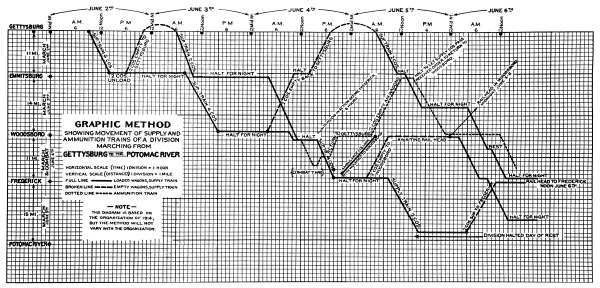
[Pg 369] At 4 a. m. June 4th, the empty section of two wagon companies starts back to Gettysburg to refill. It has 25 miles to go, and it reaches Gettysburg at 7 p. m., having marched all day, except for a halt for rest from 10 a. m. to 2 p. m. Meanwhile the first section, now refilled, has joined from Gettysburg, and again the division has four wagon companies of its supply train filled, as are also field wagons. Meanwhile the troops have not drawn upon the reserve rations on their persons. Up to this time there have been no expenditures of ammunition or medical supplies, and there is nothing, therefore, for the trains containing those supplies to do except to follow the division.
On the morning of June 4th the division meets the enemy, and attacks him near Frederick. As soon as the attack is planned the trains are halted in a place of safety near Woodsboro. Two wagon companies of ammunition, however, are sent forward from Woodsboro, to stations closely in rear of the division in action, for the purpose of maintaining the ammunition supply during the action. The attack terminates successfully, and the division camps for the night on the field near Frederick, the cavalry moving out in pursuit of the defeated enemy. The supply trains come forward from their halting place near Woodsboro. The two wagon companies of ammunition, which replenished the ammunition in the belts of the men and in the wagons of the combat trains on the field of battle, then start for Gettysburg on the afternoon of June 4th to refill. The wounded are transported by ambulance to the field hospitals at Woodsboro, from which point they [Pg 370] will be taken to the rear by rail as soon as railroad communication is re-established. The field trains issue to the troops or replace expended reserve rations, and themselves replenish from the supply train. The emptied section of the supply train then proceeds in the early morning of June 5th to the rear to refill. Meanwhile word is received that the line of communications will be extended by rail to Woodsboro, probably during the afternoon of the 5th of June. Orders are accordingly issued at 8 a. m., June 5th, directing the ammunition wagons to return to Woodsboro, and directing the third section of the supply train to stop at Woodsboro to refill instead of proceeding back to Gettysburg. This order is not received by the ammunition companies until nearly noon.
The division continues south on the morning of the 5th, to the Potomac River, where it camps for the night, its supplies being again issued, as before. The division then rests for the 6th of June, and the railhead is pushed forward to Frederick, closely in rear. The state of the division supply is then as follows (on June 6th); one section of the supply train with the division, another loaded section has just arrived at Frederick from Gettysburg, and a third is filling at the railhead at Frederick. The field trains and the men’s packs are filled. Of ammunition supply, the men’s belts and the combat trains are filled, two wagon companies of small arms ammunition and one of artillery ammunition are with the division, while two other wagon companies, one of each class of ammunition, are en route back to the division from Woodsboro, where they refilled.
It will readily be apparent that with but three sections of the supply train the division cannot move far from its advance supply depot without falling behind in its supply if dependent on wagons. Or stated differently, the supply depot must not be permitted to lag behind the advance of the troops. The relations between steadily advancing troops and the advance supply depot which are necessary to the maintenance of a satisfactory state of supply, may be expressed in a simple way, mathematically, as follows: [Pg 371]
| Let | |
| n = | the number of sections in the supply train, each |
| containing one day’s supply for the troops. | |
| e = | number of miles empty wagons can travel in one day. |
| f = | number of miles loaded wagons can travel in one day. |
| y = | average daily advance of the troops. |
| x = | number of marches (day’s travel) to the rear for empty |
| wagons to reach the supply depot, average. |
| Then | |
| ex = | miles travel to rear by empties in one trip. |
| ny = | miles the division advances between issues from the same |
| section, assuming that the sections issue in regular rotation. | |
| ex + ny = | miles traveled by any section from the time it |
| loads to the time it issues. | |
| This must equal the miles traveled loaded. |
|
| Therefore |
|
ex + ny = (n - x) f1
| x = n | f - y | 2 |
| f + e |
| y = f - | x | (f + e)3 |
| n |
| n = x | f + 3 | 4 |
| f - y |
The maximum marching capacity of the trains, round trip, (that is from point of issue to next point of issue) is ex + (n - x) f.
The distance they must march to overtake the division is 2ex + ny.
Hence
ex + (n-x) f > 2ex + ny
(n-x) f > ex + ny.
Let us now assign actual values to the various quantities, and solve for x.
Make n = 3; f = 20; e = 28; y = 12.
Then the inequality reduces to
x < ½ march of an empty wagon, or x < 14 miles.
This is to say that if the troops advance steadily every day, at the rate of 12 miles, and have 3 supply sections to serve them, and if those sections can travel empty and loaded at the liberal rates of 28 and 20 miles per day, respectively, then the advance supply depot, or refilling point must not lag farther to the rear than 14 miles, or slightly more than one day’s march of the division, unless the division is to draw supplies locally, or fall behind. How are these figures reconciled with known practice? In campaign the troops subsist to the utmost from the local resources along the line of operations. Moreover large bodies do not keep up a rate of advance of 12 miles per diem long. There are rest and combat periods, etc., which reduce y (in foregoing discussion.)
Equation 2 may be considered an expression of the supply train radius [Pg 372] somewhat similar to the war ship’s steaming radius. For, let us assume the Division is stationary; then y = O and from Equation 2 we have x = ₆₀/₄₈ = 1¼. Hence the conclusion that when the Division is stationary, the supply depot cannot be in rear more than 1¼ marches of an empty wagon (35 miles for the value assumed above). The radius of the supply train can be increased by having the field train go well to the rear to meet it for refilling after the daily issue of rations in camp.
Generally speaking, the refilling points should be kept within two marches of the rear of the troops, if the latter are subsisting chiefly from their base and are supplied by animal-drawn vehicles. If the rail or water head cannot keep thus close, the operations of the forces may be restricted and their mission may be frustrated, unless motor transport be employed.
In order to keep the advance supply depot well to the front the commander of the line of communications must maintain an ample and efficient railroad or steamboat force for operation and for maintenance and repair. This work pertains solely to the line of communications personnel, and if the fighting troops are detached for repair work on the line of communications the operations of the fighting forces cannot fail to suffer.
The field bakery on the Line of Communication does not attempt to keep pace with all the changes of the advance supply depot in a rapid advance. Too much time would thereby be lost. When the bakery does change station, reserves of baked bread should be provided beforehand.
It may be laid down as the ideal condition for supply in campaign that the supply trains be always full, and never drawn from. How can such ideal be approximated? 1. By living off the country, the field trains every day drawing their supplies direct from the collection depots. 2. By maintaining the advance supply depot so close to the troops that the field trains may draw direct, or 3. By a combination of 1 and 2. Another desideratum is that the reserve rations in the men’s packs be not used oftener than is necessary to keep them from spoiling. These two ideals give the daily rules of conduct for supply officers in campaign. A portion of a supply train, when empty, has no status with the command. The first duty of an empty supply train is to proceed to refill and rejoin as soon as practicable. Similarly packs should not be [Pg 373] permitted to remain depleted, but should be refilled at the first opportunity. The service of supply is considered good when the transportation with the troops is kept at a minimum, and military operations are not hampered by lack of food and other necessary supplies.
In Sherman’s campaign from Chattanooga to Atlanta, 136 miles, the following places were successively used as advance supply depots: Ringgold, Dalton, Resaca, Kingston, Allatoona, Acworth, Big Shanty, Marietta. Counting Allatoona, Acworth and Big Shanty as a single depot (they were on a single front) we find that the extraordinarily vigorous railroad construction enabled the advance supply depot to be pushed ahead six times; that these moves averaged 23 miles. The depot was thus habitually within two marches of the troops. At Resaca and again at Marietta Sherman accumulated a great quantity of supplies as a precaution against his line being cut at points farther to the rear. These depots and the critical portions of the railroad had to be guarded constantly against the raids of the Confederate cavalry and the intense hostility of the inhabitants. At Resaca, Kingston and other points, where the tactical situation, and the condition of the railroad permitted, supplies were carried forward by rail ahead of the advance supply depots, and issued directly to the field wagons, thus keeping intact the rolling reserve in the supply columns. Grant’s '64 campaign against Lee exhibits similar activity under different conditions. His line of communications was the open sea, and he utilized 5 depots, to wit: Alexandria, Aquia Creek, Port Royal, West Point, City Point, thus keeping within two or at most three marches of the troops.
The operations of the forces should be conducted so as to cover at all times the advance depot. If the forces be cut off from their supply depot and be unable to regain it, disaster must result. Where, therefore, maneuvers to a flank are attempted, that necessarily tend to uncover the supply depot, it is well that the depot be not too close to the forces, and that it be well protected against raids, etc. [Pg 374]
Fig. XVIII.
Supply Service - Division
(not drawn to scale)
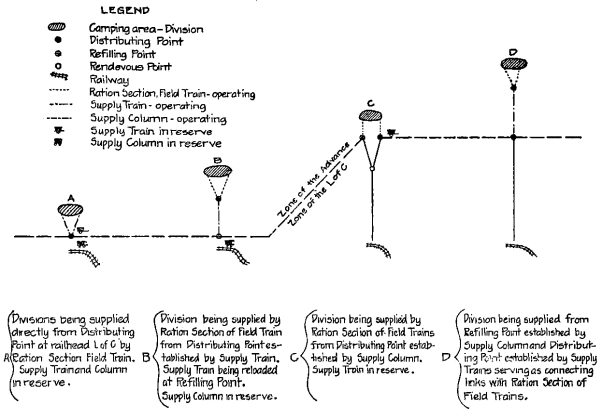
Ammunition Service - Division
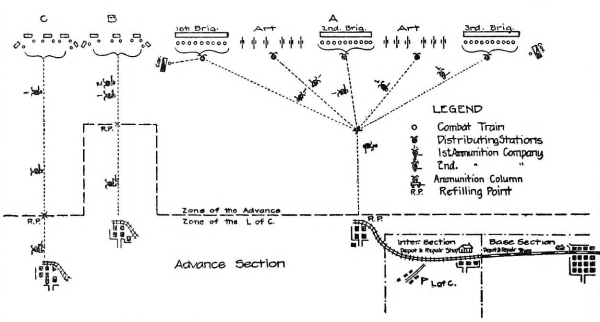
[Pg 375] In the advance, the supply trains will ordinarily halt for the night about half a march in rear of the division. The baggage section of the field trains and one day’s ration from the ration sections join the troops without delay, so as to provide the rations and utensils for the preparation of supper. The baggage of the troops though reduced to a minimum in campaign, is essential to the maintenance of their fighting strength, hence the field wagons should always be permitted to join the troops unless the tactical situation positively forbids. As soon as practicable after the arrival in camp of the ration vehicles, they are unloaded and, without delay, rejoin the grouped portions of the ration vehicles. The baggage sections usually go to the same place early the following morning. Empty ration vehicles at the time designated in administration orders, proceed to the distributing or issue point for the purpose of replenishing their supplies. This point is selected in rear of the division, both for safety, and convenience, and because it tends to equalize the travel of the field and supply trains. It should be at some place easily described in orders. A road junction is desirable as it facilitates approach and departure and affords space for the movements of wagons. The distributing point may be at the camp of the supply train, or it may be a point in advance thereof. In the latter case the necessary wagons of the supply train are sent forward to make the issue. It is essential that this point of issue shall lend itself to an orderly issue without delay or confusion amongst the wagons. Cavalry operating at a distance from the division must usually expect to live off the country. A pack train may accompany the cavalry when it is undesirable or impracticable for them to take their wagons, or the cavalry may impress or hire wagons. Cavalry draws ammunition from any source most convenient.
Issues of ammunition are made in essentially the same way as that of rations, from the ammunition train to the combat wagons, at ammunition distributing stations. The issues are not made regularly however as are rations, but only as ammunition is expended.
The time and place of issue must be published to the command, in operation or routine orders. When the local conditions permit, time may be gained by having the wagons unload at the place of issue without awaiting the arrival of the field wagons, and thence proceed at once back to the advance supply depot. Supply trains are under the command of an officer detailed for the purpose. [Pg 376]
Figure XVIII issued by the War Department is intended to illustrate diagrammatically the method of supplying troops in campaign.
Supply trains are commanded by officers detailed for the purpose. On the march trains are made up to follow the division in the order of their probable need for the day. If no combat is probable the field trains would be at or near the head and the field hospitals near the tail. If combat seems probable some ammunition should be held well toward the head of the combined trains. For convenience of march trains may be divided into two sections with an interval. A convenient arrangement for an ordinary march, where combat is not probable, is in two sections, as follows: 1st section. Field trains, 1st section supply train, 1st ammunition co., engineer train. 2nd section. Field hospitals, 2d ammunition co., 2d section supply train, pack train. The first section may follow the troops at from 1 to 3 miles, and the second section follow the first at from 1 to 2 miles.
Where danger threatens in front so that combat appears likely, the trains should be halted well to the rear. They may be halted on the road, or parked off the road at the place of receipt of the order, if sufficiently well protected in such place, and if they are not thereby a menace to the safety of the command. They should not be allowed to pass a defile until the conditions on the far side are known to be safe. During combat they should never be permitted to remain on the hostile side of a river or defile, even if it be necessary to leave them many miles to the rear. The necessary ammunition and sanitary supplies are of course sent forward for their appropriate use in the combat. In making a flank march the trains may be held closely in rear in a single section, but if the danger be at all great it will be safer to route the trains, with or without a guard, according to circumstances, on a separate road on the unexposed flank. In a retrograde movement the trains precede, usually alone but with a guard if a flank is exposed. The field trains and the section that is to make the next issue must not be sent too far away from the place where it is intended to camp until the resupply is accomplished. In retreat the service of supply is simplified.
The rate of march of a wagon train depends upon the condition of the stock and rolling equipment, state of the roads, weather, wagon loads, [Pg 377] etc. 20 to 30 miles per day for empty wagons is, in the U. S., about the best that can ordinarily be expected, and for loaded wagons, 15 to 22 miles. Wagon trains do not usually halt for rest, but roll along to their destination. If the trip is very long or fatiguing, they may halt, for several hours, unhitch and feed, and then resume. They do not ordinarily halt for hourly rests, as do the troops. The speed of wagon trains usually averages about 2 mi. per hour on all kinds of roads. On good stretches of road it may reach 2½ miles, rarely better. Auto trucks will average 5 to 10 miles per hour, depending on roads and other conditions.
The amount of supplies that may be obtained from a given locality depends on a number of factors; whether the community is agricultural or otherwise, and if agricultural what are the ruling crops; the transportation facilities, season of the year, etc. Rural communities are usually well stocked with food supplies, especially in the fall. Of forage especially there will usually be large supplies. Cities and towns habitually maintain a reserve in their store-houses. This reserve is more concentrated, and of greater variety, than the rural reserves.
It is not the policy of the American government in the early stages of a war to strip a locality too closely of its supplies, particularly in friendly territory, and this is also forbidden by the 1907 Hague Convention. But in case of necessity the army must be supplied at any cost. It may be said as a rough rule that a town of 10,000 inhabitants has sufficient reserves of food always on hand to supply a force of 20,000 men for one day without great embarrassment to the population, provided the commercial transportation facilities be not paralyzed. Col. Hazenkampf in his work entitled “The supply of an army in time of war,” says: “From the experiences of former wars we have come to the following general conclusions:
1st. If the population of a given point or locality be equal to the number of troops, it can supply them for a period of 4, but not more than 6 days.
2nd. If the number of troops be half the number of the population, they can be maintained at the expense of the latter for 1 to 2 weeks. [Pg 378]
3rd. Lastly, the number of troops being a quarter of the number of inhabitants, they can be supplied for a space of 3 or 4 weeks.”
These figures are too great for application to the American service. The food thus obtained locally is not, of course, the balanced regulation ration. In campaign, soldiers must take things as they come and make the best of the food they get from day to day.
The following data will be useful in connection with the subject of supply:
Standard gauge box freight cars in the U. S. have capacities varying from 20 to 50 tons. Their inside cargo space is about 8 ft. X 8 ft. and the length runs from 30 to 40 feet, or more.
Box cars for narrow gauge roads are similar in construction to, but of smaller dimensions than those for a standard gauge road; they have carrying capacities up to 15 tons.
Flat cars and gondolas have about the same carrying capacities as box cars. An average car has a capacity of 80,000 lbs. They are designed to carry heavy and bulky articles that will not be injured by exposure to the weather.
The supplies of an army are bulkier than much of commercial freight. The cars will not always be carefully loaded, nor their full capacities realized. Allowances should be made for these facts in estimating the number of cars required.
Day coaches accommodate comfortably 40 to 50 men, but 60 to 65 can be crowded into them for short hauls.
Sleepers carry 3 men to a section, and have 12, 14 or 16 sections.
Wounded should not be packed in too closely; ordinarily each will require an entire berth. A large box car will accommodate 20 to 25 recumbent wounded.
Ordinary stock cars carry 16 to 20 animals. For short hauls they will carry 25. They are slatted but have no stalls. They are arranged for feeding hay but not grain or water. Animals should be unloaded and watered once in 24 or certainly 36 hours. Palace stock cars carry 16 to 24 animals. They are fitted with stalls and with arrangements for feeding and watering en route. Care is necessary to see that the water tanks are filled and tight.
In railroad movements a guard and unloading detail should be arranged for when necessary. The details if desired may best be sent with the leading train. [Pg 379]
The table following gives the weights and cubic contents of various rations for men and animals, and the capacities of carriers for careful loading. If the loading is not carefully done the stated capacities will not be realized and allowance should generally be made for this. From this table the number of carriers of any class required for a stated number of rations may be computed.
Thus assuming a division at approximately 20,000 men and 8,000 animals, one day’s reserve rations will require 15 wagons, 1 day’s hay for animals 46 wagons, 1 day’s grain for animals (250 rations to a wagon), 32 wagons. A 40,000 lb. box car, fully loaded, is equivalent to about 15 wagons; for ordinary loading (20% waste) about 12 wagons. In any case the actual capacities of the cars available should be ascertained, and 20% excess allowed for inefficiency of loading.
Beef is often transported on the hoof, 16 to 20 cattle to a car. For fresh vegetables the required cubic capacity is computed.
Allowance of Forage, and Approximate Weights
and Measures of Forage and Subsistence.
| Kind of ration. |
A | B | C | D | E | F | G | H | I |
|---|---|---|---|---|---|---|---|---|---|
| Forage: | |||||||||
| Oats— | |||||||||
| Horse | 12 | 3,333 | .0003 | 230 | 250 | .39 | 2.564 | 102.6 | .00974 |
| Mule | 9 | 4,444 | .000225 | 300 | 333 | .2925 | 3.42 | 136.75 | .0074 |
| Hay— | |||||||||
| Horse | 14 | 1,571 | .000636 | 175 | 175 | 1.12 | .893 | 69.69[9] | .0143 |
| Mule | 14 | 1,571 | .000636 | 175 | 175 | 1.12 | .893 | 69.69 | .0143 |
| Barley— | |||||||||
| Horse | 12 | 3,333 | .0003 | 230 | 250 | .312 | 3.205 | 128.2 | .0078 |
| Mule | 9 | 4,444 | .000225 | 300 | 333 | .234 | 4.274 | 170.9 | .00585 |
| Corn— | |||||||||
| Horse | 12 | 3,333 | .0003 | 230 | 250 | .27 | 3.703 | 148.15 | .00675 |
| Mule | 9 | 4,444 | .000225 | 300 | 333 | .2025 | 4.94 | 197.53 | .00511 |
| Bran— | |||||||||
| Horse | 12 | 2,500 | .0004 | 230 | 250 | .72 | 1.39 | 55.55 | .018 |
| Mule | 9 | 3,333 | .0003 | 300 | 333 | .54 | 1.85 | 74.07 | .0135 |
| Subsistence: | |||||||||
| Garrison | 4.9 | 8,226 | .000122 | 565 | 600 | .149 | 6.73 | 269 | .0037 |
| Travel | 4.1 | 9,818 | .000102 | 675 | 750 | .129 | 7.76 | 311 | .0032 |
| Field | 3.0 | 13,428 | .000075 | 920 | 1,000 | .111 | 9.04 | 362 | .0028 |
| Reserve | 2.0 | 20,142 | .00005 | 1,380 | 1,500 | .074 | 13.56 | 543 | .0019 |
[Pg 380] The supply data and discussion in this chapter are to be regarded as tentative and serving only for purposes of illustration. The organization of the supply service as well as that of the tactical units, varies from time to time and the latest tables of organization issued by the War Dept, should be consulted. Moreover, it is certain that any prescribed organization will be varied to a considerable degree in actual campaign. So many conditions enter supply problems that each must be solved in the light of those conditions. The foregoing discussion is intended only to indicate the general nature of the problem and the manner in which its solution should be approached.
[Pg 381]
While other branches of the service have hundreds of years of precedents back of them, there is very little past experience to guide us in the use of air craft in war. Portable observation stations, captive balloons, and man-lifting kites still form part of the equipment of all modern armies, but the two principal classes of air craft today are air ships and aeroplanes.
That air craft will play a very important part in future wars is no longer questioned, but the development of both air ships and aeroplanes is proceeding so rapidly that it is difficult to say today what they will be capable of doing tomorrow. There are many possible uses for this new arm of the service, but a number of these are still largely matters of speculation. Others, however, are now well determined and these in themselves are of sufficient importance to require the adoption of air craft as an indispensable part of the equipment of any army.
There is a natural tendency on the part of those who are engaged in the development of a new instrument of war to exaggerate its power and minimize its limitations. Air craft at the present moment are capable of rendering most valuable service, and with the improvements that are bound to come, their value for military purposes will be greatly increased; but the claims of certain enthusiasts that aeroplanes and air ships have rendered cavalry obsolete and revolutionized the art of war have no foundation of fact.
Characteristics. Aeroplanes can travel about 350 miles and have a maximum speed of 80 or 90 miles an hour, or more. Service machines normally carry a pilot, an observer, and fuel and oil for from four to six hours. Aeroplanes can start and can land without assistance. They can be handled on the ground by three or four men. They can remain in the open for short periods without serious deterioration. When flying at normal working altitudes they are difficult to hit. Their chief use is for reconnaissance. On the other hand, aeroplanes cannot always be depended upon to be ready for work [Pg 382] whenever they are needed. Compared with most war equipment, both aeroplanes and aeroplane engines are extremely fragile. Flying round an aerodrome where landings can be made on suitable ground, an average pilot will rarely injure his machine. But in war, pilots will be required to fly in all sorts of weather and will be forced to land on all sorts of ground in order to deliver promptly the information they have obtained. Minor breakages are bound to result and machines will be so badly strained that frequent overhauling will be necessary. Moreover, the engine, even with the best of care, should be overhauled after running twenty or twenty-five hours. It will be necessary, therefore, to provide large quantities of spare parts and to deliver these wherever needed. The care and repair of aeroplanes and engines require a highly trained commissioned and enlisted personnel.
Types are in active process of development and they vary with different nations. It seems certain that for the immediate future, no single type of aeroplane will suffice for all purposes but that air fleets will be composed of craft suited to different functions as is the case with sea craft. Examples of the variety of types are: The destroyer, a pusher biplane, armed with a machine gun in front and arranged to carry bombs and a wireless equipment but without armor. The battleplane, of great size, speed and offensive power, has a pilot with two soldiers each operating a machine gun that fires in all directions. The artillery spotter, carries armor, operates at a low height and has low speed; it carries an observer and a wireless equipment. The scout, a one man craft capable of great speed up to 80 or 90 miles per hour, or more, and great climbing power. It is equipped with rifle or revolver and is unarmored.
The principal problems remaining for solution in aeroplane development are concerned with obtaining a dependable motor and a propeller able to withstand the very great centrifugal stresses.
In several countries, and depending upon the nature of the duty, aeroplanes are organized and operate in squadrons of 6 to 8 machines. These squadrons are served by motor trucks that tow them from place to place. Some machines have wings that fold when being towed.
Air Ships. Air ships have a radius of action of about 1000 miles [Pg 383] and a speed of from 40 to 50 miles an hour. They can remain in the air for many hours at a time, can hover over a selected spot, and can be used safely at night and in mist or rain. They afford a good field of view and can carry a number of observers. Their chief use is for distant reconnaissance which is greatly facilitated by their long range wireless equipment. Compared with aeroplanes, they offer an easy target and require a large number of trained men to handle them on the ground. The difficulty of maintaining them in the field makes it necessary to operate them from fixed bases established in time of peace.
Balloons are still used. Captive balloons are employed for tactical reconnaissance, and for observation of artillery fire; they are usually equipped with telephones.
Hydroaeroplanes are employed with navies, but have not come into extensive use.
Armor and armament. The weight of armor reduces the speed and the lifting capacity of aeroplanes. At present, armor is in general limited to a bullet proof seat for the pilot, and bullet proof protection to the fuel tank. Airships are able to carry more extensive armor. Aeroplanes are not very vulnerable to fire; to bring one to earth it is in general necessary to disable the pilot or to puncture the fuel tank. Even these accidents do not necessarily involve the destruction of the craft; pilots volplane successfully to earth without the use of the motor. Aeroplanes are frequently riddled with bullets without interfering with their operation. The principal armament of the aeroplane is the machine gun. The rifle and revolver are also used, as also small calibre guns. The armor and armament of a particular type depend upon the use to which that type is destined.
Duties. The primary duty is reconnaissance, both strategic and tactical. Reconnaissance consists usually in the location of troops and artillery positions.
Strategic reconnaissance by aeroplane is practicable for a distance of 150 miles; it endeavors to ascertain the position, strength, directions of movement, and dispositions of the larger elements of the enemy and also knowledge of the terrain in the theatre.
Tactical reconnaissance by air is used in both attack and defense. It is necessarily general in nature because the height of observation [Pg 384] prevents close view. It endeavors to discover movements of the enemy, location of his reserve, his cavalry, artillery, movements of wagon and auto trains, camps, lines of communication, the nature of terrain, etc. Air reconnaissance extends and supplements that of cavalry but does not supplant it. Often verification of reconnaissance must be secured by actual contact.
The duty of reconnaissance involves the corresponding prevention of hostile reconnaissance. This duty has resulted in developing in most armies special types of fighting craft, the aim of which is to secure command of the air within the military theatre. There is in this a close analogy with the domination of the military theatre by sea power or by cavalry. Another important duty of air craft is that of directing artillery fire. For this purpose air craft are usually assigned one to each group of batteries, and operate directly under the orders of the artillery commander. Their information is conveyed by wireless, by smoke bombs, by visual signals, and by dropping messages. These methods are all in active process of development and vary with the different nations.
Hostile artillery in position, is discovered by the flash of its guns, by telltale wheel tracks to the artillery position and by activity in the position. For mid-range firing, aeroplanes can frequently direct the fire from a position directly above or even behind the friendly artillery.
Another duty of air craft is that of air raids. This duty is less important than the others. Like most other raids, those by aircraft are likely to have but little direct bearing on the military situation; but within special range they will continue to be performed. The objectives for air raids are capitals of states, military bases, hangars, lines of communication, depots, arsenals, etc. Raids are usually ineffective against troops or fortifications.
Another important function is the carrying of staff officers, of maps, dispatches, etc., as also reporting promptly the positions and movements of friendly troops.
Practicable heights for observation. Satisfactory reconnaissance from air craft requires low flying height and low speed. These two elements increase greatly the vulnerability of the craft. Air craft are comparatively safe from all kinds of fire, at 6000 feet elevation and are entirely safe at 10,000 feet. In clear weather the observer, at an [Pg 385] elevation of about 5000 feet, can detect bodies of troops for a radius of four to six miles. Aeroplanes are practically safe from rifle fire at 2000 yards range or at an elevation of 3000 feet. They are reasonably safe from field artillery fire at 4000 yards range or at an elevation of approximately 4500 feet. It is difficult to reconnoiter in a wooded country. Timbered areas, therefore, have a new importance in the concealment they afford from overhead observation.
The safe heights above mentioned are in general too great to afford detailed observation, the necessity for close observation will, therefore, lead bold airmen to a closer approach to the enemy. By swerving, changing velocities, diving, soaring, etc., the airman reduces the risk involved in a close approach to the enemy. He will have added protection from hostile fire when he can soar directly over the anti aircraft guns, none of which is able to fire vertically upwards; also by operating where hostile projectiles will be likely in their fall to damage other hostile troops, and also by utilizing the protection of hills, etc. The vibration of the machine prevents satisfactory use of field glasses. The observer is restricted to observation with the naked eye.
Airships because of their greater size and slower and more regular motion, must remain at greater altitudes for safety than aeroplanes. Accordingly they will be less frequently employed for battlefield reconnaissance or wherever exposed to rapid fire of anti aircraft artillery.
Defensive measures. The principal defense against air craft is command of the air by superior air fleets. The tactics of air reconnaissance are, therefore, largely similar to those of cavalry or of sea power. The secondary defense against air craft consists of anti aircraft artillery. For elevations up to 3000 feet, the machine gun is effective. For greater elevations land forces must protect themselves by artillery. Special types of guns of great rapidity of fire are used as is also the standard light field types. The special types of anti aircraft artillery are usually employed in the protection of capitals, lines of communication, etc. They have a lesser application to mobile forces, because the need is less and the economy of road space greater. Light field artillery to be effective against air craft must be capable of firing at an elevation of 45 to 50 degrees. This calls for special types of trail and the necessity of digging pits for the trail. [Pg 386]
Range finders are in general of little efficacy in locating the fast moving target. Artillery fire seeks its object in speed and volume of fire, rather than in attempted accuracy. Volume of fire may keep air craft away even if hits are few. Tracer shells emitting smoke are much used to assist observation of fire. To bring down an aeroplane it is almost absolutely necessary to disable the pilot or the fuel tank. The airship is much more vulnerable. The target is the gas bag, rather than the pilot.
Powers and limitations. From the very first it has been obvious that air craft would be of enormous value for all kinds of reconnaissance work. Some of their advantages for this purpose are:
1. Speed. It will often be possible for air craft to obtain in a few hours, information that it would require days to secure by any other means.
2. Ability to surmount both natural and artificial obstacles.
3. Ability to determine depth of enemy’s troops as well as front.
4. Having once obtained the desired information, it is comparatively easy to ascend to a reasonably safe altitude and bring the information back.
Some of the limitations of air craft in reconnaissance work are:
1. They can accomplish but little in heavy rains, gales, fog or darkness, though they are steadily improving in their ability to travel in heavy weather.
2. Inability to reconnoiter at night makes it impossible for air craft to keep in continuous touch with the enemy.
3. They cannot be depended upon to be ready for duty whenever they are needed.
4. Observing downwards from a considerable height, detailed knowledge of terrain cannot be obtained.
The European war has given the greatest stimulus to the development of aerial navigation. The art is doubtless destined to the widest expansion in the future. At present it has many limitations, and the absurd claims made for it should be carefully discounted. It has become another arm in warfare.
Like other inventions it is indispensable to the conduct of warfare. A relative preponderance in this arm confers on a belligerent an immense advantage.
(See also “Anti Aircraft Artillery,” Chap. VIII.)
[Pg 387] The motor car, as lately applied to military purposes, has influenced practically every phase of campaign. As affecting tactics, it permits the rapid transport of troops over short distances where rail transport, even if available, might be slower than marching. The loading, dispatch and unloading are very rapid and flexible in arrangement. Even where the railroad is available, the motor car or truck is a valuable adjunct, provided suitable roads are available. The railroad can reach only its various stations, but with a system of good highways the motor vehicle can load or deliver at or very close to any designated point. Whereas a very slight accident will interrupt rail traffic the automobile can be stopped only by the destruction of the road (a comparatively rare occurrence) and sometimes even this will cause very little delay. The transportation begins at almost any point, such as camp, bivouac, or barrack, and is complete to the final destination without resorting to marches at either or both ends of the line.
The routing is not confined to any one prepared road bed. Moreover, the transport is not confined to short distances. The European war shows instances of transporting large bodies of troops over distances as great as 100 miles.
In effecting tactical concentrations of bodies of troops, such as reserves at critical points on the battle field itself, the motor car is very useful. The rapid concentration of forces at critical points of the field is the aim of all tactical operations and the secret of success in battle. The motor vehicle rapidly brings the troops to the desired point, fresh for action.
Motor vehicles are useful in the transport of troops pursuing a defeated enemy and correspondingly useful to the retreating force.
Heavy field artillery is utilizing motor transport to an ever increasing extent. The motor truck also lends itself admirably to use as swift, powerful armored cars, which are virtually small, movable forts. Motor trucks have demonstrated their ability to rapidly transport siege howitzers to threatened points along undefended portions of a coast line and thus greatly aid the mobile army in resisting landings. In operations on land the heaviest types of guns and howitzers are successfully transported. [Pg 388]
For overseas operations the motor is useful, as it needs less room aboard ship and dispenses with much of the care and attention that animals require.
For Staff uses the motor is specially adapted to the transportation of general and staff officers over the field of battle. It also assists greatly in the distribution of orders; for this purpose the motorcycle also is much used. Officers can thus cover vastly greater territory than by the use of a horse and with practically no fatigue. The result is that officers of ripe experience and advanced age, whose failing physical powers would formerly have prevented their riding horses are now employed in the field. The scope of staff service is greatly increased.
For the Supply of an army the motor truck is particularly valuable. Its speed will vary with the condition of roads but on even mediocre roads it will cover daily several times the distance covered by the horse-drawn vehicle. It needs no halts for rest, operates in a country without regard to green forage areas, is hardier than the animal and is but little affected by weather. Nearly its total carrying capacity is available for cargo, whereas the necessity for carrying forage reduces that of the horse-drawn vehicle.
The motor truck is well adapted to use as a mobile soup kitchen; one small truck will serve a meal for 500 men.
Motor transportation now permits the army to operate at a distance from the base or railhead several times greater than is possible by the use of wagons or, conversely, it permits the supply of the army at moderate distances from a base with a much less number of vehicles; thus it shortens the total road distance of a force and tends to make armies less dependent for subsistence on the military theater. The increasing numerical strength of the modern army requires more and more independence of subsistence drawn from the country in which it operates.
In line of communication service, the armored car greatly assists in thwarting hostile attempts to cut the line.
The greater the capacity of motor trucks the more economical they are as carriers if the roads are satisfactory. In many theaters where American forces will continue to operate for some time to come, [Pg 389] indifferent roads will be the rule; the economic size of the truck is accordingly restricted to a cargo capacity of about 1½ tons.
Motor trucks equipped with flanged steel wheels may be used on railroads in lieu of or in addition to the regular rolling stock. If both kinds of wheels (road and railroad) are carried, or interchangeable sets of demountable rims, the same truck may be used on both road and railroad. The change of wheels or rims can be made in a few minutes.
The motor vehicle is extensively employed in the ambulance service. In addition to its superiority from an humanitarian point of view, it has a very great capacity for the evacuation of sick and wounded, thus contributing to the increase of tactical efficiency of the army.
For the service of information, the motor is useful in patrolling; its speed and carrying capacity is great; it is in many ways less likely to attract notice than is a group of horsemen. It has been used for the prompt occupation of important points weakly defended. It is a useful adjunct to the aero service; aeroplanes organized into divisions of 7 or 8 machines are served by motor vehicles which transport the aeroplanes; the wings of the latter being folded for transport. The aeroplanes, which would otherwise be very vulnerable in camp, have thus some protection against the risk of sudden capture.
The motor car, in short, aids in strategic and tactical concentration of troops and heavy guns and in the defense of isolated points, lessens fatigue, and extends the theater of command, inspection and reconnaissance. It greatly increases the scope of operations by increasing the mobility of an army and making it largely independent of local food supplies; its humanitarian service is very satisfactory.
No army devoid of good motor transport service can thus hope to maintain itself against an adversary well equipped in that respect. All trained armies will be equipped with motors; therefore the motor will not permit a diminution of effort by a belligerent; to impose one’s will upon a trained adversary, the effort must in fact be greater than ever.
For efficiency of service, motors are employed where practicable in groups of the same type. This facilitates training of personnel, [Pg 390] interchangeability of parts, repairs, etc. In armies generally, the field and combat wagons continue to use animal power.
The motor can enter every department of military activity, increasing the efficiency of operation therein. It is as applicable to campaign as to most other phases of modern life. [Pg 391]
[Pg 392]
[Pg 393]
(Consult also Alphabetical Index)
Abatis.—An obstacle consisting of felled trees, often interlaced with wire. The trees are felled or placed with their tops toward the enemy, the butts often remain attached to the stumps, or are secured to the ground by stakes.
Adjutant.—The executive officer of a command.
Advance cavalry.—See Cavalry.
Advance guard.—A body of troops which marches in front of a command in column of route to facilitate the march and protect the main body from surprise. See Chap. IV.
Advance party.—The leading formed element of an advance guard.
Advance supply depot.—A station for the issue of ammunition, rations and other supplies, where the trains attached to the combatant troops are sent to refill. See Chap. XVII.
Advanced position.—A defensive position in advance of the main line of defense.
Aiming point.—See Artillery fire.
Ambuscade.—A surprise attack delivered by a body lying in wait for its enemy.
Angle of site.—The inclination or slope of the ground as affecting the angles of elevation of artillery.
Applicatory method.—A system of military peace training by means of the solution of practical problems in strategy and tactics. These problems are solved on a map or on the terrain, and are called map problems, terrain exercises, war games, etc. See Chap. I.
Artillery.—The heavier pieces of ordnance, as distinguished from small arms and machine guns. Artillery includes guns, howitzers, and mortars of various calibers, and the troops attached thereto. All modern artillery is rifled. Mobile artillery is habitually mounted, both for transport and use, on wheeled carriages, and accompanies the mobile troops. See Ordnance.
Artillery fire.—See Chap. VIII. The usual method of fire of modern artillery is that which employs indirect laying. The guns are concealed and the target is usually not visible to the gunners. The officer directing the fire ascertains the range and direction of the target from one of the guns of the battery, called the directing gun. He also determines the difference in azimuth or direction (at the directing gun) between the target and some conspicuous object visible to all the gunners. This point is called the aiming point and the [Pg 394] angular difference of azimuth of the target and the aiming point is known as the deflection. This is set off on the gun sight in such manner that when the sight is directed on the aiming point the gun will be directed on the target. Due to their different positions the deflections at the other guns will vary slightly from that at the directing gun. This variation is called the deflection difference. By varying the deflection and deflection difference the officer in charge may distribute the fire over the front of the target. The range is determined by the process known as bracketing. The approximate range having been estimated or determined by a mechanical range finder, a shot or group of shots is fired at the estimated range. They burst on impact, and from observation of the smoke it is possible to determine whether the shots are short of or over the target. The range is then increased or decreased and the firing continued until two consecutive bursts are obtained, one on either side of the target. Thus if a shot at 3,000 yds. bursts short of the target and one at 3,400 bursts over, it is known that the target lies between these ranges. Two shots at known ranges, one over and one short, form a bracket. The length of the bracket may be reduced by interpolating intermediate shots. Bracketing need not be done by a single piece. To save time a number of shots on both sides of the estimated range may be fired simultaneously by different pieces.
Barrage.—A zone or belt of the terrain more or less continuously swept by the fire of field artillery, with the purpose of preventing or discouraging the passage of hostile troops across the fire swept space. Such a barrage or curtain of fire might be designed to break down the fighting power of a line of battle by preventing the forwarding of ammunition, supplies and reinforcements. It may also be established in front of hostile line for the purpose of checking or breaking up an assault or counter-attack, etc.
Base depot.—See p. 365.
Billeting.—Quartering troops in the homes of local residents, who may be required also to furnish food. The practice is common in Europe but has seldom been employed in this country.
Bivouac.—A camp of very temporary nature, such as that of troops on the open field of battle. The shelter and bedding are such as the troops carry on their persons.
Bracket.—See Artillery fire.
Bomb-proof.—A shelter, usually subterranean, against high explosive shell.
Caisson.—A carriage for artillery ammunition. It consists of two parts, the body and limber, each mounted on wheels. The two parts may be separated. The limber is the forward portion to which the team is attached, and is identical with the limber to which the gun is attached on the march. The separation of the caisson body and limber, or of the gun and limber, is called unlimbering. [Pg 395]
Cantonment.—A camp of rather permanent nature where the accommodations are more elaborate than in the ordinary camp under canvas. The shelters often consist of rough huts or simple frame buildings erected for the purpose. The term is also applied to portions of towns occupied by troops for a protracted stay.
Cavalry.—Cavalry, according to its uses, has several classifications:
Advance guard cavalry.—Attached to the advance guard.
Advance cavalry.—That portion of the advance guard cavalry which precedes the point of the advance guard.
Independent cavalry.—Cavalry operating independently of all save the supreme commander.
Outpost cavalry.—Attached to the outpost.
Rear cavalry.—Attached to the rear guard.
Chevaux-de-frise.—An obstacle in the form of a saw-horse with several legs.
Clinometer.—A small hand instrument used to measure the inclination or slope of the ground, or the angle of elevation of a gun.
Column.—A formation of troops in which the elements are placed one in rear of the other, as a column of route.
Combined sights.—See p. 331.
Communications.—The prepared routes by which troops move from one part of a position to another; also their lines of supply and reinforcement. The term is also applied to telegraph, telephone, and other signaling apparatus.
Connecting files.—See p. 61.
Conscription.—The act of impressing men for compulsory military service; the draft.
Contact squadron.—See p. 149.
Containing.—The act of restraining or delaying the movements of a hostile force, by attack or threatened attack, with the object of preventing its junction with other hostile forces. See p. 91.
Convoy.—See p. 95.
Cordon system of outposts.—See p. 184.
Cossack post.—A group on the line of observation of an outpost. It consists of four men, and places one sentinel.
Counter-attack.—Offensive operations by troops whose general attitude is or has been defensive. See p. 236.
Counter-mining.—The subterranean operations of troops on the defensive for the purpose of frustrating the efforts of the attack.
Cover.—Protection from fire or view, or both.
Crest, geographical or topographical.—The highest part of a ridge or elevation.
Crest, Military.—A line or position on the front slope of a hill or ridge which affords a good view of the whole or of some special portion of the foreground. Depending on the configuration of the terrain, it may or may not coincide with the geographical crest. See Fig. V, p. 135. [Pg 396]
Curtain of fire.—See Barrage.
Danger space.—That portion of the trajectory in which the height of the projectile above the ground is less than the height of the target. The length of the danger space varies with the flatness of the trajectory and the height of the target. Thus, for a man standing, the danger space is that portion of the trajectory in which the height of the projectile above the ground does not exceed about 5 ft. 8 in.
Dead space.—A portion of the terrain, especially in front of a defensive position, not covered by fire; a defiladed area.
Defensive position.—A line or zone of the terrain occupied by troops and prepared for defense by means of field fortifications.
Defilade.—Vertical cover from view or from fire. Troops behind a crest are said to be defiladed if shots which skim the crest also pass over their heads. Flash defilade is a mask of sufficient height to conceal the flashes of guns.
Defile.—A narrow passage, such as a bridge or mountain pass, that prevents or embarrasses the deployment of troops passing through it.
Deflection.—See Artillery fire.
Delaying action.—A combat entered into for the purpose of temporarily delaying the enemy.
Demolition.—The destruction of material objects by any means.
Deployment.—An extension of the front, usually for the purpose of forming line of battle.
Deployment, depth of.—See p. 349.
Depth.—Space measured from front to rear.
Detonator.—A small charge of explosive used to ignite a larger charge.
Diagrammatic analysis.—See p. 29.
Direct laying.—See Artillery fire.
Directing gun.—See Artillery fire.
Distance.—See Depth.
Dispersion.—A separation of the elements of a command, especially when combat is imminent; the opposite of concentration.
Division.—A unit of army organization, the smallest which includes all branches of the service. In the United States Army a division has a strength of about 20,000. It includes infantry, cavalry, and field artillery, and the necessary special troops such as engineers, signal, sanitary, etc., with all the requisite wagon or motor transport.
Draft.—See Conscription.
Echelon.—A term applied to lines or groups that are stepped or “staggered” with respect to one another.
Elongation.—An increase in the usual road space or length of a column of troops, due to fatigue, poor discipline, or other causes.
Enfilade.—Fire from the flank, parallel or nearly parallel to the line against which it is directed. It is peculiarly effective and demoralizing to troops against which directed, and is therefore always carefully guarded against. [Pg 397]
Envelopment.—An attack directed obliquely against the flank of a position. See Fig. IX, p. 219.
Estimate of the situation.—A mental review of a military situation made as a preliminary to and basis for a plan of action.
Examining post.—An outpost station at which persons endeavoring to pass through the lines are examined and identified.
Fascine.—A long cylindrical bundle of brush used as a flexible log in a revetment.
Feint.—An attack made primarily for the purpose of diverting the enemy’s attention from more important operations.
Field maneuver.—A practical problem in tactics prepared for solution on the terrain, with troops. Both combatants may be represented by real troops or one by imaginary troops.
File.—A single soldier; an element consisting of one front rank and one rear rank man. A column of files is one having a front of one or two men.
Fire superiority.—Superior moral or physical fire effect as compared to that of the adversary. Fire superiority is implied if the assailant can advance or force back the defender. Fire superiority for the defender is implied if he can hold his ground and check the advance of the assailant.
Firing data.—See p. 116.
Fixed ammunition.—Ammunition in which the projectile and propelling charge are a single piece, the charge being contained in a cylindrical metal case with the projectile fixed in the end like a rifle cartridge. It is used in all small arms and machine guns and in practically all of the smaller field guns and howitzers.
Flanks.—The extremities of a line of battle, outpost, etc., and the terrain in their vicinity.
Foraging.—The process of obtaining supplies, especially food, from the local inhabitants, force being used when necessary.
Forced march.—See p. 89.
Fortification.—Any engineering work or accessory device which increases the fighting power of troops by affording shelter or concealment or increased fire effect, or which restricts the tactical maneuvers or fire effect of the enemy.
Fortification, field or hasty.—Those works executed by combatant troops in the field to meet immediate tactical needs.
Fougasse.—A small land mine with a charge of explosive and broken stone. It is fired by powder fuse or electricity, as the enemy approaches.
Front.—The known or supposed direction of the enemy; the theater of active military operations as distinguished from the country in rear. [Pg 398]
Frontage.—The extent of front of a command deployed for battle, of an outpost, etc.
Fuse.—A device used for detonating the explosive charge of a shell or shrapnel. Fuses are classified as time, percussion, combination (percussion and time), and delayed action. Time fuses detonate at the end of a given time, percussion fuses on impact. A delayed action fuse is one which delays the explosion of the charge until the projectile has penetrated the structure which it strikes. The term fuse is also applied to powder trains used to ignite placed charges of explosive in demolition. Electric fuses are devices which detonate a charge by means of the heating effect of an electric current. They are also called primers.
Gabion.—A hollow cylinder of brush or other material which is filled with earth and used as a revetment.
General Staff.—A corps of highly trained officers charged with the study of the conduct of war and the detailed methods of military operations. In time of war they direct and administer the operations of mobilization, concentration, supply, transportation, etc., and assist the field commanders in planning and executing their operations.
Grenade.—A charge of high explosive in a container hurled a relatively short distance by hand or by means of a catapult, rifle, or small mortar. The charge explodes by time fuse or concussion. Large grenades are called air mines or air torpedoes. They are distinguished from high explosive shell by their relatively short range, which ordinarily does not exceed 500 yards.
Guerrillas.—Irregular troops, not belonging to the organized combatant forces of a belligerent state, and not recognized by the laws of civilized warfare.
Gun.—A piece of ordnance fired from a platform or wheeled mount. A gun, as compared with a howitzer, has a relatively long barrel, flat trajectory and high velocity. Its effect is produced largely by the vigor of the blow struck by the projectile, which is usually combined with the action of a charge of explosive. Guns, according to their size and uses, are classed as mountain, light or heavy field, siege and seacoast. All modern guns are breech-loading rifles.
Head cover.—A vertical or nearly vertical shield of any material which protects the heads of troops from flat trajectory fire. See Overhead cover.
Heliograph.—An instrument used for signaling by flashing the rays of the sun from a mirror.
High explosive shell.—A projectile containing a charge of high explosive fired from a gun or howitzer. The charge explodes by time fuse or upon impact. It is used to demolish material objects, such as fortifications, but is often employed also against living targets.
Howitzer.—A piece of ordnance having, as compared with a gun, a short barrel, low velocity and curved trajectory. Its effect is produced chiefly by the explosion of the charge contained in the projectile. See Mortar. [Pg 399]
Hurdle.—A revetment of woven brush.
Initial point.—A point of the terrain from which the starting times for all elements of a command are calculated for the commencement of a march. See p. 58.
Initiative.—A commander is said to have the initiative when he carries out a preconceived plan, dictating and controlling the course of operations and forcing the adversary to meet his lead. The initiative is ordinarily, though not always, possessed by the attacker, inasmuch as he usually selects the time, place and manner of attack, and forces the defender to adapt his measures to meet it. A vigorous counter attack, which forces a suspension of the attack, transfers the initiative to the original defender.
Interval.—An open space between adjacent men or adjacent organizations on the same line. It is measured parallel to the front.
Latrine.—A dry sewage pit or trench; a cesspool.
Leading troops.—The advanced elements of a command; more specifically a less formal substitute for an advance guard, employed in retreat or other situations where a regular advance guard is not required.
Limber.—A portion of an artillery carriage consisting of an ammunition chest mounted on two wheels, with a pole for the attachment of the team. For the march the field guns are attached to the limbers by engaging the eye at the end of the trail with a pin or pintle on the limber. See Caisson.
Line.—A general term applied to all combatant troops as distinguished from the non-combatant; a position occupied by troops, as a defensive or outpost line, etc.; a military formation in which the elements are placed alongside or abreast of each other. See Column and Echelon.
Line of columns.—A number of parallel columns of troops with their heads on the same line.
Line of communications.—See p. 363.
Line of investment.—A cordon of troops drawn around a fortress for the purpose of cutting off its supply and communication; usually the first step in siege operations for the reduction of the fortress.
Line of observation.—The line occupied by the sentinels and observing groups of an outpost. See Fig. VIII, p. 195.
Line of resistance.—Specifically, the prepared line of defense of an outpost, usually occupied by the supports. See Fig. VIII, p. 195.
Listening galleries.—Subterranean galleries driven to the front for the purpose of detecting the mining operations of the enemy.
Listening posts.—Sheltered positions in advance of a defensive line for the purpose of early detection of the enemy’s movements. They are connected with the main line by a communicating trench or subterranean gallery. [Pg 400]
Loopholes.—Openings in a parapet or head cover through which fire is delivered.
Machine gun.—An automatic or semi-automatic gun of small caliber, capable of great rapidity of fire. It uses fixed ammunition, preferably identical with that employed in small arms. The ammunition is fed automatically from a hopper, clip or belt. Machine guns are of various sizes and types, but all are characterized by rather light construction and great mobility. Some require a crew of several men for their operation, others are operated by a single individual. There is hence no sharp line of demarcation between machine guns and automatic rifles. See p. 304.
Maneuver.—A movement of a body of troops. Strategical maneuvers include movements of troops, on a relatively large scale in preparation for prospective battle, but usually at a distance from the enemy. Tactical maneuvers include movements executed on the battlefield or in the near presence of the enemy. As compared with strategical maneuvers they are usually on a smaller scale, in closer proximity to the enemy, and more immediately related to battle tactics.
Map distance.—The horizontal interval between contours (on the map) corresponding to a given slope or gradient.
Map maneuver.—A tactical study or exercise followed out on a map.
Map measure.—A recording or counting device used for measuring distances on a map.
Map problem.—A real or imaginary tactical problem solved on a map. See Chap. I.
March outposts.—Temporary outposts placed by a marching column during a halt or at the end of a day’s march. They are withdrawn on resuming the march or when the regular outpost is in position.
Marginal distribution.—An outline of the dispositions of troops placed in the margin of a field order. See pp. 40 and 342.
Mask.—A cover from hostile view or fire.
Matériel.—The equipment and non-expendable supplies of an army; any material object.
Melée.—Specifically, the confusion following a cavalry charge, often characterized by hand to hand combat.
Mil.—A unit of angular measurement, the inverse tangent of one thousandth. See p. 109.
Mine.—A subterranean charge of explosive, used to destroy hostile fortifications.
Mining.—The operations of subterranean attack and defense.
Mission.—The aim or purpose of a commander on which his decisions and plans are based.
Mobility.—The power of rapid movement. Mobile troops are those capable of quickly changing their location and dispositions to meet tactical needs. Non-mobile troops are capable only of passive defense. It is therefore essential that first line troops shall be highly mobile. Otherwise they cannot seize or retain the initiative. Even in defensive operations mobility is essential to meet the movements of the assailant. [Pg 401]
Mobilization.—The change from peace to war footing. An army is said to be mobilized when it is assembled, organized, armed, and equipped to take the field.
Morale.—The collective psychological condition or spirit of troops, especially combatant troops engaged in battle. High morale is implied when troops respond readily to the will of their commander. Morale is therefore measured by the extent to which troops submit to the control of their officers.
Mortar.—A piece of ordnance having a very short barrel, low velocity, and curved trajectory. It throws a projectile containing a large charge of high explosive, at angles of elevation varying from 45 degrees to 60 degrees so as to drop the projectile on top of its target.
Mutual support.—Two or more portions of a firing line which can cross fire on a part of the front of the position are said to afford mutual support.
Obstacle.—Any natural object or artificial device which retards the enemy’s movements without affording him shelter from fire. See p. 216.
Orders, field.—Written or verbal orders covering the tactical dispositions and operations of combatant troops. See Chap. II.
Ordnance.—A collective term applied to all firearms which hurl projectiles. As generally used the term excludes small arms, such as rifles and pistols, and applies especially to the heavier pieces. See Small arms and Artillery.
Outguard.—One of the observing groups of an outpost. See p. 183.
Organization.—For the organization of all tactical units in the U. S. Army, see p. 10 et seq.
Outpost.—A line of observation and resistance established between a body of troops and the known or supposed position of the enemy, to guard against surprise attacks.
Overhead cover.—A horizontal or inclined shield of any material which extends over the heads of the troops and protects them from grenades or high angle fire. See Head cover.
Pack train.—A train of animals, usually mules, carrying packs on saddles. This form of transportation is used in mountainous country or where roads are very poor.
Parados.—A bank of earth in rear of a trench to protect the occupants from the back draft of shells bursting behind the trench.
Parapet.—A bank of earth or other material in front of a trench or emplacement which protects the occupants from fire.
Patrol.—A small body of troops, foot or mounted, sent out from a larger body for the purposes of observation and reconnaissance. See Chap. III, pp. 165, 185, 212, etc. [Pg 402]
Percussion.—See Fuse.
Picket.—A large outguard.
Pioneer.—A member of the mobile engineer forces of an army.
Platoon.—A division of a company, troop or battery.
Platoon column.—A platoon in double column of files. This formation is much used in advancing under fire, especially in rough country.
Point.—The extreme forward element of an advance guard, or rear element of a rear guard.
Ponton.—A portable boat used as a support or pier for a floating bridge.
Ponton equipage.—The portable floating bridge equipment of an army.
Position fire.—See p. 325.
Position in readiness.—See p. 308.
Pusher.—An aeroplane in which the propeller is placed in the back of the machine.
Railhead.—The forward limit of rail transport for the supplies and reinforcements of an army.
Range finder.—Any device for determining distances.
Ration.—The daily food allowance of a soldier.
Reconnaissance.—A rapid examination of a hostile body of troops, structure, locality, district, etc., for the purpose of noting features and gathering information of military value.
Re-entrant.—A more or less sharp projection from a line toward the rear. See Salient.
Reinforced brigade.—A brigade of infantry with attached auxiliary troops, usually on an independent mission.
Relay post.—See p. 53.
Rencontre.—See p. 295.
Requisition.—A demand for supplies made by an army upon the local inhabitants.
Reserves.—Troops temporarily withheld from action for the purpose of reinforcement at critical times and places, to meet emergencies, etc. As distinguished from supports, the place of their employment in combat cannot always be foreseen. Also, individuals who have undergone military training and are available for service but not at the time a part of the standing army.
Revetment.—Any device used to retain earth or other material at a slope steeper than the natural slope.
Road space.—The distance covered by an organization in its usual marching formation or column of route. See p. 16.
Salient.—A more or less sharp projection from a line toward the front.
Salvo.—See p. 114.
Sap.—A zigzag trench dug for the purpose of a covered advance against the enemy.
Screen.—A feature of the terrain which favors concealment. A disposition of troops designed to prevent the enemy from obtaining information. See p. 165.
Sentry squad.—A group on the line of observation of an outpost. It consists of eight men and places a double sentinel. [Pg 403]
Shrapnel.—A projectile containing a number of small bullets or fragments with a propelling charge. It explodes in the air and scatters the bullets and fragments of the case over a considerable area, being in effect a flying shotgun. The shrapnel of the 3-inch, U. S. field gun, when properly burst, will sweep an area 200 to 300 yards in depth and 20 to 25 yards in width, killing or seriously wounding any man or animal in the area. It has little effect on fortifications and is used only against troops. Shrapnel is hence known as the “man-killing projectile.”
Siege.—The formal investment and attack of a fortress. A fortified place may be reduced by cutting off its supply, by assault, or by both methods. Occasionally the actual reduction of the fortress is not attempted, it being simply covered by a force of sufficient strength to prevent the garrison of the fortress from interfering with the operations of the invader.
Situation, general and special.—The (real or imaginary) circumstances or conditions confronting a body of troops at any stated time. A military situation has two parts which are described as general and special, or with respect to time and place, as distant and immediate. Past events and future possibilities or probabilities usually form part of the situation. See p. 20.
Small arms.—Firearms, such as rifles and pistols, carried by individuals. The term is occasionally applied also to machine guns which use small arms cartridges.
Spar bridge.—A type of military bridge in which the support consists of two trestles which are tilted toward each other and locked together.
Splinter-proof.—A shelter similar to a bomb-proof but designed to afford protection only against rifle bullets, shrapnel and shell fragments. It is not proof against penetration by large projectiles.
Squad.—A unit consisting of eight men, four files in double rank. The commander, usually a corporal, is called the squad leader.
Squad column.—A squad in double column of files. See Platoon column.
Staff.—A number of highly trained officers attached to the larger units who are charged with the administration of special departments and who constitute an advisory board to the supreme commander. See General Staff.
Strategy.—The application of the broad fundamental principles of the art of war. The object of strategy is to place troops in the most favorable or least unfavorable position for battle, which is the logical culmination of strategy. Strategy deals with questions of national policy, national resources, geography, mobilization and concentration of troops, supply, transportation, etc.
Successive bounds.—See p. 50.
Successive thin lines.—See p. 328.
Supporting point.—See p. 251. [Pg 404]
Supports.—Troops held in rear of the firing line for the purpose of replacing losses, so as to maintain the firing line at proper strength; the large groups on the line of resistance of an outpost; one of the formed bodies of an advance, rear or flank guard.
Tactical walk (or ride).—Tactical instruction given upon the terrain with imaginary troops.
Tactics.—The methods employed in handling troops in battle or in immediate preparation therefor.
Terrain.—An area of ground considered as to its extent and topography in relation to its use for a specific purpose, as for a battle or the erection of fortifications.
Terrain exercise.—A practical problem in tactics prepared for solution on the terrain, with imaginary troops.
Theater of war.—The territory covered by the operations of belligerent forces.
Time fire.—See Fuse.
Trains.—The supply wagons accompanying an army. Combat and field trains are attached to battalions and squadrons and carry respectively, the ammunition and rations of the troops. Ammunition and supply trains are attached to the larger units such as a division. There are also a number of special trains, including sanitary and engineer trains. See Chap. XVII, Division Supply.
Trajectory.—The path of a projectile. Guns of high power are said to have a flat trajectory, that is to say, one which approaches a straight line.
Traverse.—A bank of earth or other material in rear of and perpendicular to the parapet of a trench for the purpose of protecting the occupants from oblique or enfilade fire and to localize the effect of shells bursting in the trench.
Trenches.—The purpose of trenches is to protect the troops occupying them from hostile fire. According to their use they are classified as fire, support and communicating trenches.
Troop leading.—The practical art of commanding troops. Troop leading is often used in contradistinction to decision. The latter involves the formulation of a plan of action, the former the practical technique by which the plan is executed.
Turning movement.—The attack of an enemy, usually on a flank or in rear, by an element of the command widely separated from the remainder of the attacking force.
Visibility problems.—See p. 24.
War game.—A competitive game conducted on a map and involving the tactical handling of troops. The two-sided war game is the usual form, and is carried on by two individuals or groups under the direction of an umpire. In the one-sided war game the umpire dictates the operations of one of the imaginary combatants.
Wire entanglement.—An obstacle of wire or barbed wire strung on posts or other supports; the most commonly employed artificial obstacle.
[Pg 405]
TECHNIQUE OF MODERN TACTICS
Practically all the tactical principles and methods discussed in the text are copiously illustrated by concrete cases in the examples of orders. These illustrations are taken from carefully selected problems of the Army Service Schools and constitute a valuable adjunct to and illustration of the discussions. It is recommended that the student in each case examine the appropriate examples of orders and supplement the references sought in the text. The orders are indexed under the caption—“ORDERS, examples of.”
THE TECHNIQUE OF
MODERN TACTICS
FOLLOWING ARE SOME REVIEWS OF SERVICE JOURNALS
AND A FEW CHARACTERISTIC COMMENTS CLIPPED
FROM LETTERS OF OFFICERS WHO HAVE
READ THE BOOK
By Major General, J. Franklin Bell, U. S. Army
“The book is excellent. It consists of an unusually complete and sound digest of tactical principles, outlines of points to be considered in formulating tactical decisions, manner of drafting and models of field orders and instructions, methods of procedure to be followed in carrying out tactical decisions, power and limitations of all mobile units, etc. All statements and deductions appear to be based upon the best accepted tactical ideas of the present day.
“While in its opening chapter the text introduces an officer to the proper method of pursuing the applicatory system of study, it is in fact a clearly concise presentation of all the essential points of tactics and logistics, assembled and arranged for a rapid review. It should, therefore, save an officer, concerned with some particular tactical problems, hours of poring over 'regulations’ and lengthy textbooks.
“The English of the book is clear and to the point. The chapter on 'Field Orders’ is very well written, and the chapter on 'Artillery Tactics’ is particularly good.”
By Brig. Gen. A. L. Mills, U. S. Army
“While this volume contains much that is original in its subject matter, it seems to be especially characterized by the large field covered by its contents as well as by the simplicity with which the whole subject is presented. It is believed that no other book is available in which so many valuable military facts, principles, and suggestions are included within one volume as is the case in this publication. And it is not only the amount of material that is contained in the volume, but also the manner in which it is presented which enables the work to offer the student such valuable study. The book will also be useful to the soldier in the field as a book of reference. Especially valuable is the 'estimate of the situation' appearing on page 18. It is easily conceivable that the possession of this one page at the proper time might have a most material effect upon an important action.
“The authors are to be congratulated on having given this work to the American Army and it is believed that the more widely it becomes known, the greater will it be in demand.”
Review of the Journal of the U. S. Infantry Association
“The authors present an excellent epitome of the tactics taught today in The Army Service Schools at Fort Leavenworth, Kansas. The principles and considerations which should govern in the marching, fighting and securing of all bodies of troops, from a patrol to a division, are concisely stated, yet in greater detail than can be found in any other single volume of our language. For each form of map or maneuver problem the reader is furnished minute instructions to guide him in determining the best solution, followed by examples of solutions and orders that have been used in like problems at the Service Schools, and all is made clear by sketches and diagrams. The striking characteristic of the text is the quantity of precise information as to what experience teaches should or should not be done to obtain the greatest probability of success, and the total lack of vague discussion, followed by tentative or uncertain conclusions, so familiar in many other modern writings.
“Formations and orders for patrols, advance, rear and flank guards, outposts, marches, changes of direction, convoys, the various types of combat, and the leading of the troops concerned, are discussed and illustrated. Other chapters deal with the tactics of light and heavy field and mountain artillery, cavalry, sanitary troops, the organization and fortification of a defensive position, the use of the rifle in war, the supply of our infantry division, orders in general, and the preparation and solution of tactical problems, and are of peculiar value to the general reader because their contents can otherwise be obtained only by search through a number of technical volumes.
“This book will be absolutely beyond price to anyone entering the Service Schools and those concerned in the preparation or solution of problems in the Garrison Schools. It will also be of great value to all officers for careful study at first reading, and then, because of the wide range of subjects to be found between its covers, as an extremely handy book of reference.”
Review of the Journal of the U. S. Cavalry Association
“The purpose of this work, as stated in the readable and interesting introduction, is to furnish a guide to those engaged in the study of practical problems in tactics, and a convenient ready reference for officers charged with the preparation and conduct of field maneuvers, tactical rides, war games, etc.
“The solution of tactical problems is treated in a masterly manner in Chapter I; the style is clear and attractive and reveals a deep insight into the foundations of human character. The simplification of the difficulties of tactical problems by diagrammatic analysis is deserving of special notice, and the suggestions for the preparation of problems will be appreciated by all those called upon to submit general and special situations — often on short notice.
“The acquisition of a crisp, epigrammatic style of expression by assiduous practice, after consulting good forms of field orders, as recommended by the authors, is the best way to avoid mere imitation of 'telegram' style on one hand, and the verbosity of the tyro on the other. The recommendation to stick to the usual form in writing orders is approved. The discussion of field orders by the authors lends new interest to an important subject.
“The chapter on patrolling is so full and good that it is difficult to find anything to add.
“The whole subject of advance guards, and the kindred subjects, rear and flank guards, are fully considered, and illustrated by examples of field orders.
“The condensed information with reference to artillery material, organization, powers and tactics, will be of great value to officers of other arms.
“The treatment of the subject 'Cavalry Tactics,' is in line with modern thought.
'The subjects of 'Outpost,' 'Combat,' and 'Organization of a Defensive Position,' are comprehensively treated and richly illustrated by diagrams, maps and examples of orders.
“The chapter on 'The Rifle in War' will be found to be one of the most interesting in the book. The 'Chapter on Division Tactics and Supply' contains a mass of valuable data of a practical nature.
“The book as a whole forms a compendium of reliable military information which will prove to be a great convenience to the student.
“The authors are to be congratulated on clearness of style and felicity of expression throughout the work.”
Review of the Professional Memoirs Corps of Engineers
“One of the most significant signs of the progress of these Schools (Leavenworth) is the appearance in the field of military literature of a number of works by their graduates, works which have compelled attention and which have reflected well deserved credit and honor both on the authors and the schools.
“In the 348 pages of text and 15 figures, including maps, the authors have provided what might be termed a concentrated extract of the teachings of the recognized authorities in the art of war and tactics, as interpreted and taught at The Army Service Schools.
“For those who are seeking to improve themselves by self study or to prepare for the Service Schools or Army War College, the work will be invaluable and will save much reading of Griepenkerl, Von Alten, Balck, Kiesling and the host of other writers on tactics.”
Review of the Journal of the U. S. Artillery
“This book will be very useful to the coast artillery officer, for it contains much valuable information that has a direct bearing upon the preparation of plans and orders for the land defense of coast fortifications. It will also be of use to him in a larger sense. About 97 per cent of the actions in which our coast companies have taken part have been field actions as distinguished from coast defense actions. The importance to coast artillerymen, therefore, of studies in tactics should be emphasized from time to time, lest they forget.
“The Technique of Modern Tactics has the merit of being a readable book devoted to a serious and important subject. But it was not made for mere skimming. It will repay careful study on the part of all officers of all grades and of every age in the various arms of the service.”
From a General Officer
“It contains in a single volume (handy, well arranged, and very comprehensive) information which would require much time to find elsewhere, and time required to find things deters most people from hunting them. The arrangement of the matter is excellent; the style plain, concise, and attractive. It is long since I have read a finer piece of writing than the introduction to the work. Any officer who masters this book will be a valuable officer when war comes.”
From a General Officer of the General Staff
“The book shows most careful study and clear presentment. It is a work of great value to the service-one which ought to be particularly useful to instructors in our service schools as well as to all students, and an important addition to their military libraries.”
A Well-known Officer of the National Guard
“The concise, plain and yet thorough manner of treating the subjects in the text is very gratifying. It comes nearer covering the entire field of minor tactics than anything else I ever saw. The book is one which should be in the hands of every National Guard officer who desires to prepare himself properly to meet the responsibilities entailed by his commission. The authors are to be congratulated on having accomplished so much in so compact a volume.”
From a Well-known Cavalry
Officer,
at One Time Instructor at the Leavenworth Schools
“From what I have seen I feel certain that it will give me a whole lot of help in conducting the Garrison School work. I find formulating map maneuvers, map problems, and the like, no mean task. Assistance in this line of work will be like a rope to a drowning man.”
From a Well-known Infantry Officer
“The book is the one road I know that leads straight to the goal of good sense in tactics. It should be read and studied and reread by every officer until every word is burned into his everyday life in the service. Every officer who goes to Leavenworth should carry it.”
Another Infantryman
“It is in my opinion the best work of its kind ever published. Every field officer should absorb it from cover to cover.”
A Recognized Authority,
Formerly Instructor at The Army Service Schools
“The book merits the immediate recognition of all students of the Military Art, as a distinct advance on any existing work on applied tactics. It contains, briefly and concisely stated, the essentials for correct solutions of the important problems included in the course in Military Art at the Service Schools at Fort Leavenworth, but more important still to the service at large, it has brought together a large amount of information from a number of different sources, which will be of immense value to every officer in the field, whether in maneuvers or in active campaign. If only one book besides the Field Service Regulations could be carried into the field, this should be chosen.
“The Technique of Modern Tactics is the culmination of the advance made in the study of applied tactics in our army during the last ten years.”
From a Prominent Instructor
of
The Army Service Schools
“Of all the books that have appeared in late years dealing with the subject of modern tactics, this one seems to occupy a niche of its own. There have been any number of excellent works on the methods of handling modern armies; so many in fact that the student who tries without a guide to make a study of the subject soon finds himself at a loss as to the best way to proceed. In this work the authors have succeeded in finding a clue to lead the student out of the labyrinth of books and methods. The name is well chosen. Besides its use in the progressive study of tactics, the book will find a wide field as a reference work when it is desired to refresh the memory upon some particular phase of the subject. For this purpose, it furnishes in concise form, the methods of procedure and the approved handling of troops and matériel as given by those on whom we look as authorities.”
A Prominent Cavalry Officer,
Formerly Instructor at the Leavenworth Schools
“I have read over the chapter on the attack and think it very good. The book justifies its existence by being more definite and intelligible and more readily applied than the Infantry Drill Regulations and Balck’s Tactics. At the same time it appears to be sound and to avoid ruts, such as the excessive use of models and normal formations.”
From a Prominent Infantry
Officer,
Formerly an Instructor at the Service Schools
“The book contains a most exact statement of the principles taught at the Army School of the Line. It will be of the utmost value to those entering the school, and to the service at large.”
A General Staff Officer
“The book is the best American military work we have ever had and is the best exponent of the Leavenworth idea and spirit that is available to our officers.”
An Infantry Captain
“The advantage of having a copy of the Technique will become apparent, because it contains the principles which constitute the frame work of all tactical exercises and tactical study. It will save many a busy man hours of unnecessary work in looking up methods of procedure under given tactical conditions.”
A Cavalry Major
“If the Line Class man can see as many pointers in it as I can he will receive much aid. I am astonished at the amount of precise information the book contains. It enables me to refresh my memory quickly and the more readily reach my conclusions.”
Price $2.65 Postpaid
For Sale by
Book Dept., Army Service Schools, Fort Leavenworth,
Kansas.
U. S. Cavalry Association, Fort Leavenworth, Kansas.
George Banta Publishing Company,
Menasha, Wisconsin.
MILITARY TOPOGRAPHY
FOR THE
MOBILE FORCES
Comprising Map Reading, Rapid Sketching
and Topographical Surveying
By
MAJOR C. O. SHERRILL
Corps of Engineers, U. S. Army
Late Instructor, United States Army Service Schools
Fort Leavenworth, Kansas
Adopted for use as a textbook in the Army Service Schools, Fort Leavenworth, Kansas. Adopted by the war Department for use in the Garrison Schools for Officers; as the basis for all examinations in Topography for promotions; and for the use of the Organized Militia. Adopted as a textbook by the Coast Artillery School at Fort Monroe, Virginia.
This book gives the latest and simplest method of making reconnaissance sketches and topographical maps, and teaches the use of all kinds of maps in military operations. The subject of rapid contour sketching is fully covered with such simplicity that any non-commissioned officer can learn to make good sketches without the aid of an instructor, by the application of the methods given in the text.
Over 350 pages, 154 text figures and folding maps
PRICE $2.50 POSTPAID
Map Reading, bound separately, 70c postpaid
Rapid Sketching, bound separately, $1.25 postpaid
GENERAL AGENTS:
U. S. CAVALRY ASSOCIATION
Fort Leavenworth, Kansas
THE MOSS PUBLICATIONS
(By Major Jas. A. Moss, U. S. Army.)
OFFICERS’ MANUAL
Price, $2.50 postpaid
An invaluable guide in all matters pertaining to the social and official “Customs of the Service,” and in administration, paperwork, duties of company officers, adjutants, quartermasters, aides-de-camps, etc. Especially valuable to officers just joining the Army and to officers of the Organized Militia.
NON-COMMISSIONED
OFFICERS’ MANUAL
Price, $1.50 postpaid
Based on the collated experiences of over fifty old and experienced non-commissioned officers of the Regular Army, and covering fully in a simple, practical way the duties of all grades.
PRIVATES’ MANUAL
Price, $1.00 postpaid
It gives in one book, in convenient, attractive, illustrated and understandable form, the principal things that the soldier should know, and which one must now go through many books to get.
MANUAL OF MILITARY TRAINING
Price, $2.25 postpaid
Profusely illustrated. Makes unnecessary all other books for the training and instruction of Volunteer COMPANIES and of COMPANY officers of Volunteers. Adopted as the military textbook of EIGHTY (80) of our military schools and colleges; 40,000 copies sold in two years.
APPLIED MINOR TACTICS
Price, $1.00 postpaid
(Including Map Problems and War Game Map Reading.)
Map Reading—Map Sketching. Simplified for beginners. Especially adapted to the instruction of subalterns, non-commissioned officers and privates in their duties in campaign.
FIELD SERVICE
Price, $1.25 postpaid
Treats in a practical and concrete way the subject of field service. Gives the result of the experiences of many officers and enlisted men.
INFANTRY DRILL REGULATIONS
SIMPLIFIED
Price, 75c postpaid
An illustrated, annotated and indexed edition of the War Department edition.
SPANISH FOR SOLDIERS
Price, $1.00 postpaid
(By Major Moss and Lieut. John W. Lang.)
A combination grammar, and English-Spanish and Spanish-English dictionary and phrase book, intended to give officers and soldiers a fair working conversational knowledge of military Spanish.
SELF-HELPS FOR
THE CITIZEN-SOLDIER
Price, $1.25 postpaid
(By Major Moss and Major M. B. Stewart.)
Profusely illustrated. A popular explanation of things military.
RIOT DUTY
Price, 50c postpaid
Presents the subject in practical, tabloid form, telling an officer exactly what to do tactically and legally if ordered out on riot duty.
Any of the above books with which you are not entirely satisfied may be returned at our expense.
Geo. Banta Publishing Co.,
Menasha, Wis.
Footnotes:
[1] Field artillery includes mountain, light, horse, and heavy artillery (field and siege types).
[2] This table is based upon the road spaces occupied by troops at war strength, infantry in column of squads, cavalry in column of fours, artillery and trains in single column.
The spaces differ but little from the requirements of drill regulations. On the march, after a command is straightened out on the road, elongation always takes place. In calculating the length of a column further allowance must, therefore, be made in accordance with circumstances—sometimes as much as 25 per cent.
The contracted camping spaces afford sufficient room for a one-night halt. They require that the animals and vehicles of a single troop, battery, or company be placed on the same line with the men where practicable to do so within the camp lengths above given; that the men be in double shelter tents (or in double row of shelter tents), and that the lines on which adjacent companies are established be separated by distances not exceeding 11 yards for infantry and other dismounted organizations, double carriage length for field artillery (except mountain), and 12 yards for cavalry and remaining mounted organizations. Latrines are placed on the opposite side of camp from company kitchens and at a minimum distance of 50 yards from the men.
The camp areas given represent minimum requirements under favorable conditions of terrain and should be increased whenever practicable, particularly for sanitary reasons in those cases where a camp is to be occupied for more than one day.
For approximate calculations, assume 1,600 meters = 1 mile; 5 miles = 8 kilometers; the number of acres in a rectangular tract = the product of one-seventieth of the length in yards by one-seventieth of the width in yards.
[3] Combat train 1 mile long.
[4] Combat train 840 yards long.
[5] Combat train 840 yards long.
[6] For shrapnel by fuse, 6,500 yds.
[7] “In time of war or threatened war, preference and precedence shall, upon the demand of the President of the United States, be given, over all other traffic, to the transportation of troops and matériel of war, and carriers shall adopt every means within their control to facilitate and expedite the military traffic.” Chap. 3591, Vol. XXXIV, U. S. Statutes at Large.
[8] Calculated for a supply train consisting of 3 sections, each containing one day’s supply of rations and forage (grain only), and an ammunition train of 6 wagon companies, 4 of small arms and 2 of artillery ammunition. This is the tentative organization of 1914, but the method indicated may be applied to any given organization of the trains.
[9] Compressed to 82 cubic feet per ton (2,000 pounds), the minimum density for oversea shipments.
Transcriber's Notes:
Deprecated spellings or ancient words were not corrected.
The illustrations have been moved so that they do not break up paragraphs and so that they are next to the text they illustrate.
Typographical and punctuation errors have been silently corrected.