Title: Hot Music
Author: Vic Whitman
Illustrator: D. C. Hutchison
Rafael M. de Soto
Release date: February 9, 2026 [eBook #77893]
Language: English
Original publication: New York: Street & Smith Corporation, 1929
Other information and formats: www.gutenberg.org/ebooks/77893
Credits: Prepared by volunteers at BookCove (bookcove.net)
In one of the broadcasting rooms of Station KYK a famous dance band was setting up its instruments preparatory to a half hour’s entertainment. The players were laughing and joking, with no need for silence. The power had been switched to a little room overhead where Officer Dave Cates, official police announcer, was holding forth in code to police details all over the great city.
“Nothing further has been done by those in authority about the addition of fifty new plain-clothes men to the force,” Cates said into the microphone. “Headquarters is inquiring into the matter, however, and may be expected to give out more information at any time.”
All of which meant to the listening ears of the police:
“There have been no more developments in the Van Goss jewelry robbery of two weeks ago. Headquarters is planning to assign more men to the case.”
This was the job of Dave Cates, who was listed on the books as an officer solely because of his connection with the department. He was a verbal messenger boy, conveying the reports and orders of headquarters over the air to the police details of the city. Because plenty of red blood flowed through the small body of Officer Cates the job sometimes got very tiresome.
If only he could go out on such a case as the Van Goss robbery, he would find the action he craved. Then again, the solving of such a case with its monetary reward would bring his dream that much nearer; a dream intimately concerned with a hazel-eyed, laughing little dancer and a white, green-shuttered bungalow with a forty-foot garden plot out back.
Probably Anabelle Talbot was listening in to him now. She usually did every evening before she went out to the Salon Quintesse to dance to the music of Leo Archer’s famous band.
Cates sighed and glanced at the electric clock on the wall. “There is yet five minutes of time remaining to us,” he announced, “but since there doesn’t seem to be any more——”
He stopped suddenly. Some one had come hurriedly into the little telephone room and was talking in excited, petulant tones.
“A woman,” Cates murmured. “Now what the deuce does she want up here?” Louder, he said, “Please stand by for one moment.” Then he stepped into the telephone room.
A young woman was firing questions at the harassed telephone operator. Her clothes, her manner and her intonation, told Cates that she was a woman of culture and apparent wealth.
With her was a man in his early thirties. Tall, lean, handsome, with a cynical mouth and a complexion that tended to the sallow, Cates recognized him instantly as Leo Archer, leader of the dance band which was waiting below.
Archer was leaning indolently against the door, obviously bored by the proceedings. He stifled a yawn as Cates looked at him.
“Here he is now,” grumbled the operator, “S’pose you talk to him.”
The young woman turned swiftly. “You are Mr. Cates, the police radio announcer?” she asked.
“Yes.” Cates noticed that her face was white and distracted, that her lips were trembling. He failed however to see that first faint look of surprise in her eyes.
It was difficult for most radio listeners to reconcile Dave Cates’ rich, golden voice with his small, stocky body, his sandy hair and his freckled face.
“Yes, I’m Cates,” he said. “What can I do for you?”
“Oh!” Her exclamation was part sob. “I—I came up to tell you that I have just been robbed of a very valuable necklace and two diamond rings. I thought you might broadcast it to the police. That seemed better than—than——” Her voice trailed away.
Cates’ blue eyes lighted with interest. Could this robbery be connected with the Van Goss robbery? He thought quickly how strange it was that she had happened to report it to him first. He wasn’t superstitious, but—— A fleeting picture of the bungalow went through his mind.
“Certainly,” he said promptly. “Your name and address, please?”
“Miss Meusel—Miriam Meusel—apartment No. 8 at the Dutton Arms.”
“Can you describe the robbery briefly, Miss Meusel, and give me any clews you may have to the bandit’s appearance? This is just so the patrolmen in the vicinity can be notified to watch out for a certain type.”
Cates’ coolness seemed to steady the young woman.
“I haven’t any clues or any ideas about it,” she told him. “I just returned to my apartment and found out then that the jewelry had been taken from my wall compartment.”
“About what time should you say it was taken?”
“Some time between four thirty and eight. That was the time I was out.”
“I see.”
Cates glanced at the clock as he went back to the microphone. He saw that the time was eight thirty-three. It would do little good to report this robbery by air; still, it would be imparting instantly such meager information as he had.
Briefly, in code, Dave Cates announced the robbery. Then he signed off for the evening and returned to Miss Meusel and Archer.
“The information has been given, Miss Meusel,” he said. “We can’t do much more until we get more facts.”
“That won’t do you any good,” yawned Archer. “You chaps couldn’t see anything that was plain before your eyes.”
Cates looked at the man. Naturally hot-headed, he had trouble in checking the retort that impulse prompted. Archer’s contemptuous remark reflected upon the department and, hence, reflected upon Cates. Then and there he accepted the challenge.
He turned to the telephone operator. “Henry, connect me with Captain Henessey, will you?”
In a moment the captain’s gruff voice sounded: “Police headquarters.”
“This is Cates,” reported the radio cop. “Get the dope all right?”
“Too well. Where are you now?”
“At KYK.” Cates drew a deep breath and braced himself. “Captain, how’s for me to go over and take a look at Miss Meusel’s apartment?”
“You!”
“Sure. I can get the dope for you. I know I can.”
Silence for a moment. Cates could imagine the energetic veteran considering.
Presently: “All right, go ahead. You can’t do any worse than the others, anyway. And listen; you know how you like to talk when you get started? Well, cut it out, and let the others talk. Understand?”
Cates grinned. “Yes, captain,” he said meekly.
“All right, then. Bring me as full a report as you can get.”
Exultantly Cates turned from the phone.
“Now, Miss Meusel,” he said, “if you don’t mind I’ll go over to your apartment.”
Archer left them at the door to the KYK studios.
“My band starts broadcasting in ten minutes,” he explained, “otherwise I’d go over with you, Miriam.” He grinned sardonically at Dave Cates. “Oh, pardon me. I forgot the master mind here.”
“Don’t pay any attention to what he says, Mr. Cates,” urged Miss Meusel.
“I don’t,” said Officer Cates quietly.
The Dutton Arms was nearby, which probably accounted for Miss Meusel coming to the broadcasting studio instead of at once notifying headquarters. Her apartment was roomy and furnished in quiet, luxurious taste. “Do you live here alone?” Cates asked.
She nodded. “Yes. I play a concert violin and I do all my practicing here.” She smiled faintly. “Nobody else would want to be around, even though my violin is very old and considered one of the best in tonal quality in the country.”
Dave Cates rubbed thoughtfully at his chin. Then, without comment, he started to look around the place. Nothing had been disturbed, according to Miss Meusel, save that the wall-compartment door was swinging on its hinge.
Cates strolled to the window and looked out. The automatic fire escape had not been used, as he realized when he tapped the edge of the drawer and found that dust clung to his fingers.
Turning from the window he went across the room. A violin case lay on the table and Cates gazed idly at it.
Something on the floor caught his attention and he stooped, then looked up at the watching girl.
“Have you been playing recently?” he asked.
“No, I’m sorry to confess that I haven’t touched the violin for two days,” she answered. “It hasn’t been out of its case.”
Cates sat down.
“Suppose you tell me of your activities between four thirty and eight,” he suggested.
Miss Meusel considered for a moment.
“Well,” she began, “about four fifteen Leo Archer phoned and asked me to meet him over at the Renhurst, where his band plays for tea dances. I put my necklace and rings away, and started out with Mr. Hughes, who had called to see me about a business matter.
“In turning to say something to me, Mr. Hughes bumped into that table, knocking over a flower vase, a box of candy, and some books. My maid was out for the afternoon and evening and since I was in a hurry and couldn’t attend to it, Mr. Hughes kindly offered to remain behind and clean things up a bit.”
“It looks as if he did, too,” commented Cates negligently. “Do you by any chance mean Arthur Hughes?”
“Yes. Do you know him?”
Cates knew of him only by reputation as being wealthy and a somewhat eccentric young idler.
“I’ve heard the name,” he replied. “It doesn’t matter. Please go on with your story.”
She continued: “I left Mr. Hughes behind and went to the Renhurst, where I waited some fifteen minutes for Leo Archer. We had tea and afterward we drove out to an inn for dinner with Gerald Terhune—he’s the manager of Archer’s band.
“Then, when I returned to the apartment, I found that the jewelry was gone.”
“You say you had to wait fifteen minutes for Archer at the Renhurst?”
“About that long—yes. But that’s nothing unusual, for he’s never on time. He told me he was up in his office at the Renhurst working on a new number he’s writing.”
“A good band leader, isn’t he?”
“Oh, he’s wonderful!” she enthused. “You wouldn’t think to look at him that he can direct such a band. Yet his team is one of the jazziest in the country. He’s awfully temperamental, though. He can write and score the weirdest numbers, but he needs actual inspiration to do it.”
Cates rose and went to the radio. “Do you mind if I tune in on him for a moment?” he asked. “I never paid any attention to his band, probably because I’m not much of a musician.”
“Of course not.”
Cates turned the dials and presently the music of a dance band filled the room. It was crashing syncopation of the first order with a steady foundation of piano, banjo, bass, and drums holding solidly beneath a structure of silken saxophones, shrilling violins, and cutting trumpets.
Despite the worry of her loss, Miriam Meusel’s foot tapped to the tempo of the music and her shoulders swayed gracefully.
“Isn’t that marvelous!” she exclaimed.
Musical or not musical Dave Cates could not but feel that compelling sweep of the rhythm.
“Hot stuff,” he agreed.
He was frowning a bit as he shut off the radio and reseated himself.
“By the way, Miss Meusel, are there any other keys to this apartment besides your own?”
She hesitated, looking at him oddly.
“Yes,” she responded. “My maid has one and the janitor, of course, has a pass key.”
“Any others?”
“No.”
“I suppose you have a number of friends who know this apartment quite well.”
She became indignant.
“Yes, naturally, but I don’t see what on earth my friends have to do with this.”
“Nothing,” murmured the little radio cop. “Nothing at all. Only we have to consider everything, you know.”
At that moment someone came to the door, and there was a sound as of a key being put into the lock. Miriam Meusel rose hurriedly and went to the door where, Cates thought, she made some whispered remark.
Then a short, florid-faced man entered. Seeing Cates, he turned to Miss Meusel.
“I didn’t know you were entertaining, Miriam,” he said in a purring voice. “Otherwise I would not have called.”
She avoided Cates’ eyes as she made the introduction.
“This is Mr. Cates, Mr. Terhune,” she said. “Mr. Cates is from headquarters, Jerry.”
Cates acknowledged the introduction with a quick handshake. He knew of Terhune, manager of Archer’s band and recently appointed chairman of the general committee for the Charity Ball.
Yet he reacted strongly from this first acquaintance. Terhune’s softness, his ingratiating smile, went against Cates’ sturdy grain.
“Ah, the robbery—yes,” said Terhune softly. “A great shame, Miriam, and probably the work of some clever, experienced crook. Getting so a man hardly dares take his afternoon nap. In fact, this afternoon I fancied I heard some one prowling about my room. Doubtless it was purely imaginary.”
“May I ask where your room is?” said Cates.
“At the Renhurst, Mr. Cates.”
A loud knock came on the door. Miss Meusel admitted Arthur Hughes, a tall, big-shouldered young man with gray eyes, and a suggestion of recklessness in his bearing.
“Say, this sure is tough, Miriam!” he burst out impetuously. “About the robbery, I mean. I just heard about it and ran in to see if I could help out in any way.”
The girl patted his arm.
“You’re a dear, Arthur,” she said, “but Mr. Cates is handling the affair.”
Introduced, Cates took a quick inventory of Hughes and found that he rather liked him. But perhaps that was because Hughes appeared to good advantage when contrasted with Terhune.
“Don’t misunderstand my questions,” Cates said to Hughes, “but I understand you were up here this afternoon after Miss Meusel left the apartment.”
Hughes grinned boyishly and drew a cigarette case from his pocket.
“I knew I’d come under suspicion,” he remarked. “Yes, I was up here. I came because I had heard from some friends of mine in Philadelphia in regard to a concert booking for Miss Meusel, and I knew she’d be interested.”
“How long were you here after she left the apartment?”
“Oh, a matter of ten or fifteen minutes,” said Hughes indifferently. “Just long enough to pick up some things I kicked over.”
“Did you meet any one going out?”
“Not in the building. There were people passing outside.”
Cates nodded. “I see,” he said. “Well, I guess that’s all for now, Miss Meusel. I’ll give you a report as soon as possible.”
At the door Cates paused. “By the way, Mr. Terhune,” he asked, “are you having Leo Archer play at the Charity Ball?”
Terhune wriggled like a puppy eager to please.
“Why, yes,” he answered. “Don’t you approve?”
“You bet your life I do,” answered Officer Cates with conviction.
Captain Henessey looked up as Cates came into headquarters. Then he threw down his pen, grinned, and leaned back in his chair. The stalwart, grizzled veteran liked Cates and secretly admitted that the boy had possibilities aside from oratory.
“How’d you make out?” he demanded.
Officer Cates of the wave-length squad dropped down in a handy chair and lit a cigarette. Then he drew a deep breath and set himself for speech.
“Not so bad, captain,” he said. “To begin with, there are plenty of probabilities in connection with this case as I see it; so many, in fact, that it’s going to be a tough job to reconcile all of them to the distinct end of any definite lead. Now, when it comes to robberies in general——”
Captain Henessey interrupted with a bang of his big fist on the desk.
“Must you always begin everything with a public speech?” he roared. “I haven’t got time to listen to the history of the world! What I want are the facts on this Meusel case. Have you got them or must I crown you with the record book?”
Officer Cates grinned, not in the least abashed. He knew the captain quite as well as the captain knew him.
“I have ’em and here they are,” he said.
At the conclusion of the story Captain Henessey frowned.
“Let’s see now,” he summed up, “Archer was fifteen minutes late in meeting her. Hughes remained behind in the apartment, and Terhune evidently had a key that she wouldn’t tell you about. Added to that, the maid, the janitor, and other unknowns must be considered.”
“I know,” agreed Cates. He eyed his superior with some speculation. Might as well broach what he had in mind now.
“Any objections if I go on this case unofficially?” he asked, hoping he sounded casual.
Captain Henessey glared at him. “What are you talking about!” he demanded.
“Just what I say,” answered Cates sturdily. “I’ve got ideas and plenty of spare time and I’d like to put ’em both to work. Somebody’s got to solve the thing and it might as well be me.”
“Well, speaking of nerve——”
“Sure,” retorted Cates. “A guy’s got to have it these days. Just look back along the ages and consider the men who have put themselves forward. Look where they got! See what they did! Consider Julius Caesar, for example. Why, he——”
“All right,” said the captain hastily. “This is no debate.”
Thoughtfully he toyed with a pencil on his desk. Recalling the Margolo gang affair, the captain realized that his small radio cop had police stuff in him. The point was to bring him along gradually; not let him get discouraged too many times.
“Suppose you tell me some of your ideas on this case, lad,” he suggested.
Cates’ reply was instant. “Sure thing. I think that whoever took that jewelry had a key to the apartment; I think that both robberies were done by the same person or persons.
“To-morrow, if you don’t object, I’m going to talk to Mrs. Van Goss and try to make the two robberies dovetail.
“Also, I’m going to put a lot of time on that key Terhune had. And finally, I won’t interfere in the least with the work the other men are doing. Only—only——”
“Only what?”
“If I run down these jewels, I’d like to claim the reward myself. You see, captain——” He hesitated and blushed like a schoolboy.
“Yes, I see a lot that you don’t think I see, lad,” observed the captain gravely, though with a twinkle in his shrewd eyes. “She’s a fine little girl, and I wish you luck. Run along to her now and consider yourself on the case.”
Early the next afternoon Dave Cates presented himself at the apartment of Mrs. Van Goss—a sparkling little widow who rumor had it, had received an immense fortune with the death of her husband. She met Cates pleasantly enough, though with a questioning lift of well-placed eyebrows.
“I’m from headquarters, Mrs. Van Goss,” he explained. “May I ask you a few questions?”
She sighed. “Dear me, I’ve answered hundreds of questions since my apartment was broken into. But go ahead and I’ll tell you what I can.”
“I’ll try to be brief.”
He smiled, and she smiled in return. Somehow Cates’ twisted little grin reflected the richness of his voice, and few people could resist the combination.
“Now,” he continued, “was it a phone message that called you out on the day of the robbery?”
“It was.”
“Would you mind telling me who the call was from?”
“Not a bit,” she answered promptly. “It was from Mr. Hughes.”
“Arthur Hughes?”
“Yes. He was asking me to have tea with him at the Renhurst.”
Cates felt a quick excitement that his voice did not betray.
“Your jewels were taken during your absence, I presume,” he said.
“They were. I returned here about six as I recall it.”
“I see. Do you happen to know Leo Archer, or Terhune, or Miss Meusel very well?”
“Oh, yes, I know them all very well indeed,” said Mrs. Van Goss. “In fact we’re in and out of each other’s places all the time.”
“Are there any other keys to this apartment besides the ones your maid and the janitor have?”
“No.”
“Do you always carry your key with you when you go out Mrs. Van Goss?”
“I do now,” she confessed with a rueful little laugh. “Before the robbery I always left my key out in a potted plant in the corridor, simply because I seem to have a propensity for losing keys.”
“Which is unfortunate, sometimes,” smiled Dave Cates. “I think that’s all, Mrs. Van Goss, and thank you very much.”
She went with him to the door. “I hope you have learned something of value to you,” she said. “Good afternoon.”
Outside, Cates’ smile faded as he realized that the thing was in more or less of a tangle. He had become convinced that the same man committed both robberies—due to the likeness of the two telephone calls and the fact that the robberies were almost identical in points of time and circumstance.
Going strictly by formula Hughes was the obvious suspect, since he had phoned Mrs. Van Goss and since he had been in Miss Meusel’s apartment after she had left it.
But it was a bit too obvious to satisfy Cates, regardless of the fact that Captain Henessey’s best men were constantly watching Hughes.
Much more pertinent to him was Miss Meusel’s denial of any one’s possession of a key other than her own.
Walking slowly, Cates reasoned. If only he could locate those jewels the rest would be easy. The only way he might do that was to carry out the idea he had in mind—a dangerous but possibly effective plan. That plan, in brief, was to search a man’s rooms.
He hesitated, then his bulldog jaw squared. After all, he was working toward that little white bungalow, and that was worth any risk. If he could get evidence this way, so much the better.
Within the next hour Officer Cates had found the place he wanted, had made sure no one was around, and had entered by means of a skeleton key.
He searched hurriedly but thoroughly, taking care to replace everything he overturned, in order that the occupant might not become suspicious.
Finished, Cates scratched his sandy head and swore.
“The son of a gun!” he muttered. “I was sure there’d be something up here. This knocks everything into a cocked hat.”
Dejectedly Cates returned to headquarters to make his report to Captain Henessey. The captain laughed. “Don’t take it so much to heart, lad,” he encouraged. “Sometimes it requires weeks, months, years to untangle one of these things.”
“I suppose so,” nodded Cates despondently. “Say, captain, what makes a crook, anyway?”
Captain Henessey eyed his little radio officer uncertainly.
“So help me, you can ask some of the damnedest questions I ever heard of!” he ejaculated.
Then, seeing that Cates was in earnest, he went on more kindly: “If you must know, Dave, there’s probably a million different things, as you’ll find out when you’ve been in this business as long as I have. Environment, moods, impulses, hatred, hunger, needs excitement, mental—why, what’s the trouble? Got an idea?”
For Dave Cates had suddenly sat bolt upright his blue eyes eager.
“I’ll say I have! How good it is I don’t know, but I’m going to sock it for all it’s worth. Listen.”
Captain Henessey didn’t scoff at the plan. He was much too experienced in police work for that.
“Not bad at all, lad,” he acknowledged. “It may not work, but then again it may. Anyway, I’ll see that a microphone is installed where you want it.”
Cates looked at his watch.
“Time for the broadcast, captain,” he said. “Give me the stuff you’ve got ready. Afterward, I think I’ll take a run out to the Salon Quintesse and listen to Leo Archer. I’m getting to know quite a lot about music.”
Syndicate Park, where the Salon Quintesse was located, was a-glitter when Cates arrived. It was a warm evening and couples were sauntering through the grove during the intermission between dances.
A big car came roaring up the drive to give forth its cargo of laughing, voluble, noisy youngsters. Down by the river some one was playing a ukulele and the mellow chords blended oddly with the booming music of Leo Archer’s band.
Cates went quietly into the big hall and sat down at a corner table. He was an unobtrusive little figure and nobody paid the least bit of attention to him.
The room was filled with amusement seekers, most of them in evening dress. There were laughing faces, flushed faces, sad, serious, and vindictive faces but Cates gave them little thought.
He was watching the tall lean figure of Leo Archer as the band leader put his men through their paces.
It was a wonderful band, Cates thought. Hot music, probably none hotter in the country. Funny that Archer could get such effects when he was such a bored, cynical guy. Almost beyond understanding, but not quite.
Dave Cates became a bit wistful. He wished he had such talent as Archer’s. It must be great to be up there leading a band like that. Even music that boomed and crashed seemed connected with that vague green-shuttered bungalow with the garden plot out back.
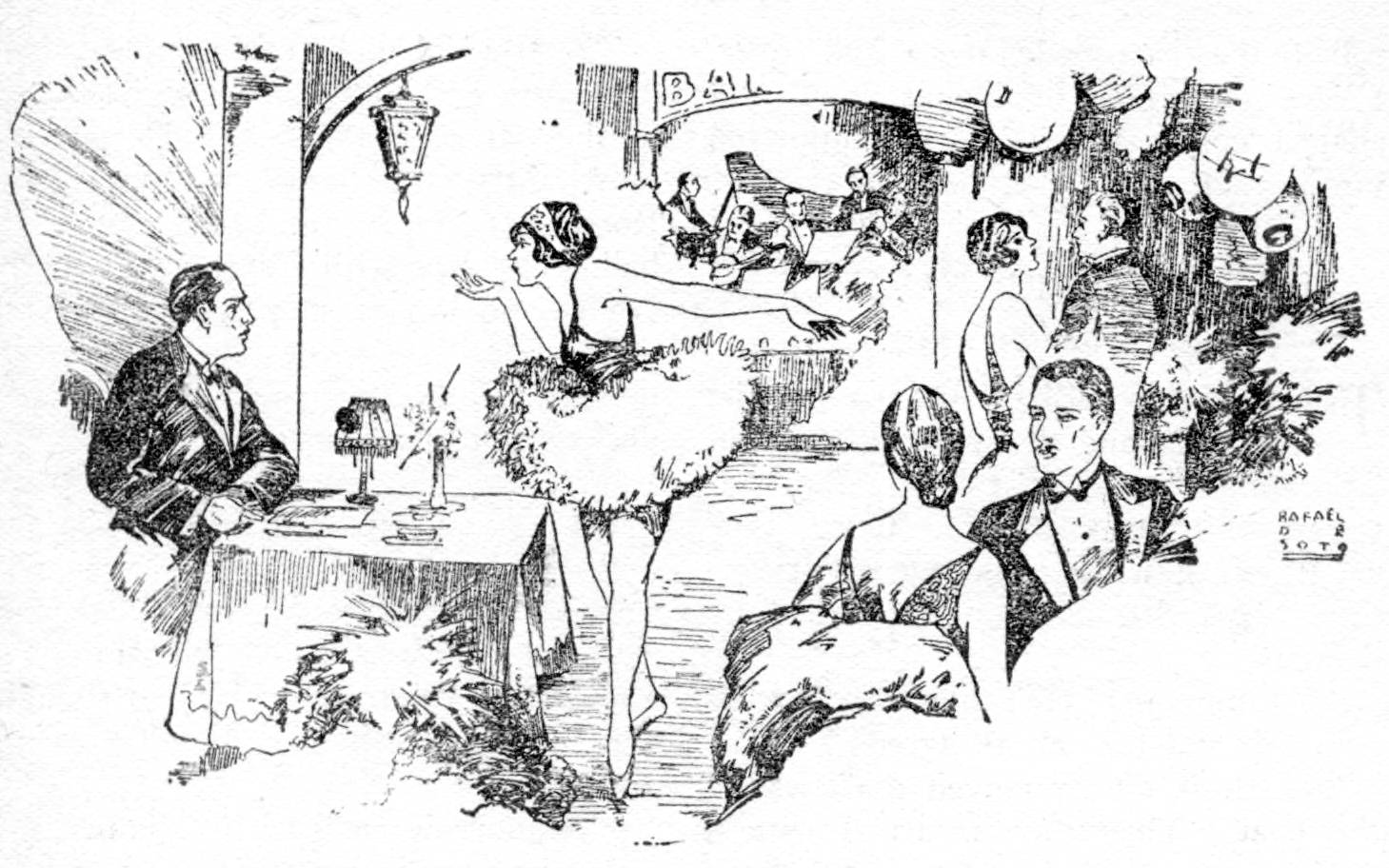
Then a slim, graceful little figure slipped out on the floor and began to dance. Cates sat forward, his eyes sparkling with pride. If anybody could beat Anabelle Talbot’s dancing, he’d like to know it!
It was one of the world’s prize mysteries, why she accepted his attentions, but since she did he’d not question his blessings. She was a dream girl suddenly come to life—his dream girl.
Whirling, pivoting, gliding, she moved about the floor, smiling steadily as one who dances must smile. Then she saw the little radio cop sitting alone in the corner, and her smile became radiant.
Lightly she blew him a kiss, finished her dance to a mad burst of syncopation, and skipped into her dressing room.
“Gee!” exclaimed Dave Cates softly. “Gee!”
In a few minutes she came out of the dressing room and hurried over to Cates’ table. Grinning broadly, he rose to greet her.
“You sure can dance, Ann!” he told her. “Boy, how you can dance!”
Hazel eyes sparkled up at him and a red little mouth crinkled at the corners.
“I’m glad you think so, Dave,” she said. “Just the same I wish I didn’t have to do it. Oh, did I tell you that Leo Archer wants me to sign a contract to dance exclusively to his music?”
Cates shook his head. “No, you didn’t,” he said slowly. “Are you going to sign?”
“I don’t want to, Dave. But you know a girl must do something.” She stopped and studied his face. “Anyway,” she finished, “he gave me until the Charity Ball to decide.”
“Which is just a couple of days anyway,” mused Cates. “Say, Ann, when did he offer you this contract?”
“Yesterday,” she answered. “He called me up to his office at the Renhurst.”
“At what time?”
She looked wonderingly across the table. “Why all curiosity about it, Dave?”
“I’ll explain some time, Ann. What time was it?”
“Why, shortly after four o’clock, I think.”
“How long were you there?”
“Only a few minutes. He was working feverishly on a new number he expects to introduce at the Charity Ball. He offered me this contract, and told me I could take it or leave it. Then he gave me till the Charity Ball to decide.”
Suppressed excitement was in Dave Cates’ voice. “Did any one come in while you were there?” he asked.
She considered.
“N-no,” she said presently. “That is, nobody but a bell boy who had a little package that he gave Archer.”
“Wow!” Cates smacked his fist jubilantly into the palm of his hand. “I’ve got it now; sure as the deuce I have! What a break this is! Zingo!”
He reached across the table and took both her hands, caring not what people around might think. “Gee, you’re a dear, and a sweetheart, and how you’d fit into that little bunga——”
“Dave, behave! What in the world ails you!”
“Nothing, honey. I can’t tell you yet, but the first thing I’m going to plant is tomatoes. Zowie!”
Greatly as the city was interested in the Van Goss-Meusel jewel robberies, the interest in the Charity Ball overshadowed all else. It was an annual affair and tradition and skillful publicity had built it up to a point where attendance was a matter of civic pride. A hundred social leaders served as patronesses; the best show talent in town was secured for the acts; and the general populace prepared for a gala night.
As chairman of the general committee, Terhune bustled around attending to this and that, a smile of smug importance on his florid face. Had he not been so preoccupied he might have noticed that he was trailed by a small, stocky figure, homely and determined of face.
At this last hour Dave Cates was overlooking no bets. Not only did he watch Terhune, but he kept an eye on Miss Meusel and Leo Archer. To Hughes he paid no attention.
“It’s got to break right,” was his constant thought. “When anything means as much to a guy as this does to me, it’s got to break right.”
The Spanish room of the Greystark, the most magnificent hotel in town, was engaged. At eight o’clock on the night of the event the huge ballroom was nearly filled. Gaudy decorations had transformed the room into a great hacienda; brilliant streamers waved and floated and intertwined in a glowing mass of color.
Gay parties met and chatted, and the hum of steady conversation provided an accompaniment for all other sounds—the tuning of the instruments, the ceaseless rumble of passing traffic, the occasional clear laugh of a woman.
Up on the specially constructed platform, Leo Archer and his band were making ready. As always, Archer looked extremely bored and cynical. A sneering smile edged his lips as he looked out upon the festivities. Now and then he said something to the radio announcer of KYK, who faced a microphone just to the left of the platform.
On the floor Terhune was moving about from group to group, greeting all and sundry with his fixed smile. Over in a corner were Hughes and the dazzling young widow, Mrs. Van Goss.
Dave Cates could take in the whole scene from where he was sitting—up in an obscure little balcony with the curtains drawn just enough to permit of concealment. Before him, too, was a microphone, and beside him was a little lever by which he could switch the control instantly from the floor announcer to himself.
“Some gang, isn’t it, Ann?” he grinned, “Hadn’t you rather be down there with ’em than sitting up here just looking on?”
“Don’t be silly, Dave,” she said softly, smiling at him.
She was rather puzzled at all this, the microphone and the partly drawn curtains; but she asked no questions, realizing that Cates was on police duty of some sort.
With a crash of cymbal the band went into a modern, popular trot. The blue eyes of Officer Cates went to Archer. For all his boredom the man was a genius, and he was at his best to-night.
Leading his band with the baton, his eyes gleaming to the cutting thrusts of the trumpets, to the sense-lulling croon of the saxophones, to the twang of the banjo, he was a master of jazz.
Then the music softened and a hokum man stepped to the front of the platform, singing:
“The moon was new
And so was love.
This eager heart of mine was singing
Lover where can you be—ee——”
Cates glanced at Anabelle Talbot. In that music he could feel the expression of a longing—of a longing that was universal and poignant. Well, he knew what it was. He knew from the sudden throb in his temples as Anabelle’s hazel eyes met his for the briefest of instants. The age-old, deathless search for an ideal—and the ideal was here by his side.
“Oh, lover come back to me.”
Then the trumpets caught up the chorus and tossed it tempestuously about. Booming, thrilling, haunting music! No wonder Leo Archer was called a genius; no wonder he could name his own salary.
With a swirling rush of syncopation that died abruptly on a piercing, sustained note, the number ended. Thunderous applause broke out, applause in which Dave Cates joined.
“Gee, that music gets me!” he exclaimed.
Miss Talbot nodded understandingly.
“It gets me, too, Dave,” she said. “But wait until you hear the number he’s just written. He wrote it in three days, they say. The title of it is ‘Hot Music.’”
Officer Cates stared, then threw back his head and laughed.
“Well, if that’s not a pip!” he cried. “Lady, lady, that one wins the world! I’ve got to hand it to him, he’s good.”
“Why, what in the world——”
“You’ll find out shortly, Ann,” chuckled Gates. “Yes, very shortly.”
He pushed the curtain a bit to one side and scrutinized the crowd carefully. Ah, there she was—the woman he was looking for! She had just stepped in front of the band platform where Archer could hear her, and she was saying something to her companion. Then the two of them moved near Terhune and spoke again.
Dave Cates grew tense. Watching like a hawk he saw that Archer was stirring restlessly about, that Terhune seemed uneasy. In a moment Terhune left the hall.
Archer faced his band and held out his baton. The instruments came to attention. Down came the baton and seemed to strike forth a coherent cataclysm of sound from brass and strings. Flaring, the music rose to the heavens. Then, with the introduction well under way, Leo Archer laid down his baton and went hurriedly from the hall.
Annabelle Talbot seized Cates by the arm.
“Oh, it’s his new number, Dave,” she exclaimed. “It’s ‘Hot Music’!”
Dave Cates grinned widely. “Great!” he answered. “I’ll never forget it.”
Reaching down he snapped the lever that swung the control to himself.
Into the microphone he said simply: “Cates speaking. Leo Archer’s band is now playing ‘Hot Music.’”
Then he switched the control back to the man on the floor, and the thousands who were listening in gave little thought to the interruption.
But Cates’ words started things at headquarters. Captain Henessey came to his feet with a bound, and roared orders at three plain-clothes men, who rushed for the door.
Five minutes, ten minutes, a half hour, and then Captain Henessey poked his grizzled head into the little balcony.
“Got him dead to rights, Dave, and recovered every piece of jewelry,” he announced with poorly concealed jubilation. “You had the right dope, boy, and don’t forget it.” The captain smiled at Anabelle Talbot. “You don’t mind if we clear up a point or two, do you?” he asked.
She rose uncertainly. “If you’d rather talk business by yourselves——”
“You sit right where you are,” said Captain Henessey genially. “You’ll be prouder than ever of this boy when he finishes his story. Go ahead, Dave, and let’s hear how you worked it out.”
It has been said that Officer Cates liked to talk. And who is there who can blame him for wanting to outdo himself while the lovely Anabelle was listening?
He cleared his throat and cut loose: “It’s this way, captain. We know that Hughes phoned Mrs. Van Goss in that first robbery. Our friend knew of it—maybe accidentally, maybe not—and hit upon the scheme of robbing her apartment.
“It seems that Archer can play and write better music after strong excitement of some sort. Anyway, he knew the lay of the land, the time the widow was going out, and where she left the key. The rest was easy.
“Since Archer got such a kick out of that robbery, he decided to do another and plan it all himself. He knew that Terhune was in the habit of taking a nap, and he bribed a bell hop to get Terhune’s key book for him. Anabelle, here, was in his office when the bell hop passed in the keys.
“Then Archer made the date with Miss Meusel to meet him, saying he had a business conference on and couldn’t call for her.
“Luckily, Hughes was out of the apartment by the time Archer got there. He got the jewels and started out, but saw that rare old violin of Miss Meusel’s and couldn’t resist trying it out, being the musician that he is.
“In doing so Archer spilled just enough of the resin for me to see. I began to think something was phony when Miss Meusel told me she hadn’t touched the violin for two days.
“Still I kept on eye on the others, too. The main thing was that I couldn’t figure out what he’d done with the jewelry. I didn’t think he’d hock it or sell it, but when I took a chance and searched his rooms nothing was there. Then I got a rush of brains to the head. If he swiped the jewels to get inspiration to write better music, he’d naturally keep ’em handy, where he could look at ’em. Funny, but some guys are that way.
“I knew that there was an iron safe in his office and that I couldn’t get into it. So, knowing that the jewelry would be on his mind, I got a plant to go down on the floor tonight and mention casually that she’d heard the police had found the jewelry of the Van Goss-Meusel robberies.
“Sure enough, Archer hustled over to his office to check up on it. I guess that’s all.”
“But how about Terhune having a key to the apartment and why should Miss Meusel want it kept quiet?” demanded the captain.
Cates grinned. “They were married,” he answered. “I checked up on it at the City Hall. Because of concert bookings and other things they decided to keep it secret for a while.”
“Then how did Archer know that Terhune had the key?”
“Because he stood up with Terhune at the marriage, and they made him promise to keep quiet about it.”
Anabelle Talbot’s lovely eyes had been widening during the recital.
“Do you mean that Leo Archer was the robber?” she said breathlessly.
“He was, Miss Talbot, and he had the earmarks of a good one, too,” nodded the captain. “As the lad here has said, Archer wanted excitement and felt he could put out better music under its spell.”
“I never liked him,” said the girl slowly, “but I didn’t think he’d do anything like this.”
“You never can tell,” observed Captain Henessey. He rose. “Well, Dave, you’ll get a good sum out of this. That ought to be enough to——”
He stopped, gazing from the red-faced little radio cop to the wondering girl, and grinning broadly.
“Oh, well, I guess you two can settle that yourselves.” With a nod he was gone.
Anabelle Talbot looked inquiringly at Cates.
“What was he talking about?” she asked.
“Gee, I don’t know, honey,” stammered Officer Cates of the radio squad. “Maybe he meant that you wouldn’t have to sign any contract to dance. You see, I’m going out to-morrow to take a look at a little bungalow and if you—an’—if you know what I mean by——”
Miss Talbot’s cheeks became the color of a red, red rose, and her hazel eyes softened wonderfully.
“I think I understand, Dave,” she murmured. “I’d like to see the bungalow.”
“Gee!” marveled Dave Cates some moments later. “Gee! I can’t even carry a tune and just think what made this possible!”
“What, dear?”
“Hot Music!” finished Officer Cates in tones of awe.