Title: My brother's friend
Author: Eglanton Thorne
Release date: February 21, 2026 [eBook #77999]
Language: English
Original publication: London: The Leisure Hour Office, 1886
Other information and formats: www.gutenberg.org/ebooks/77999
Transcriber's notes: Unusual and inconsistent spelling is as printed.
New original cover art included with this eBook is granted to the public domain.
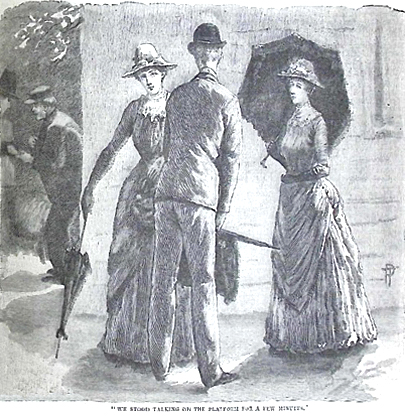
WE STOOD TALKING ON THE PLATFORM
FOR A FEW MINUTES.
A New Serial Story
BY
EGLANTON THORNE
Author of
"The Old Worcester Jug," "In London Fields,"
"The Two Crowns," etc.
The Girl's Own Annual Illustrated
VOL. VII. 1886.
THE LEISURE HOUR OFFICE
56, PATERNOSTER ROW, LONDON
CONTENTS.
CHAPTER.
VII. MAKING PLANS FOR THE FUTURE.
IX. I EXPLORE THE NEIGHBOURHOOD, AND BECOME ACQUAINTED WITH MR. LEONARD GLYNNE.
X. SWEET AND BITTER; FLOWERS AND THORNS.
XII. THE WINTER BRINGS TROUBLE.
XIII. RALPH CLAIMS A FRIEND'S PRIVILEGE.
XIV. "WHERE NATURE'S HEART BEATS STRONG AMID THE HILLS."
XVI. A FAIR, GLAD DAY, AND THE NIGHT THAT FOLLOWED IT.
XVIII. I VISIT THE OLD HOUSE AT WEYLEA, BUT MISS THE WONTED WELCOME.
XX. I BECOME A GUEST AT THE TOWERS.
XXI. A MISAPPREHENSION REMOVED.
XXIII. A PLEDGE OF FRIENDSHIP.
XXIV. WRITE A LETTER WHICH I AM NOT ALLOWED TO SEND.
MY BROTHER'S FRIEND.
MABEL'S LIFE BEGINS.
"ONE'S life does not really begin till one has left
school."
So said my sister Mabel to me one July day when we were in the train
on our way home from school.
Mabel was rejoicing in the fact that her schooldays were over. She had
a most contented air as she sat opposite to me, comfortably placed in
the corner of the carriage, her small neat person arrayed in one of the
neatest, best-fitting of grey gowns, with daintily white collar and cuffs,
and her little face with its pretty, regular features surmounted by a
simple but becoming straw hat. The travelling bag by her side, her roll
of wraps, her ivory-handled umbrella, all showed the same dainty neatness.
Mabel looked what she aspired to be, and what our governess, Miss
Carefull, had often called her when holding her up as a pattern to the
other girls—a perfect lady.
The girls at our school were sure that Mabel was Miss Carefull's favourite pupil. How could it be otherwise when she did everything so well—her drawing, her singing, her French, all winning her high commendation from their respective professors; when she wrote such a pretty hand, had such good manners, and moved so gracefully; whilst her dancing was such that the dancing master could hardly speak of it without emotion?
Our dancing lessons were ever occasions of triumph for Mabel and of humiliation for me. She was the one to be first initiated into every new step, and often were we others bidden to stand still and look on while Miss Carmichael showed us what our dancing should be. It was a pretty sight to see Mabel and the old dancing master go through the slow, stately measures of the minuet. As I watched her movements, I felt much pride in my sister's grace and prettiness, and fancied they atoned to some extent for my own awkwardness, which brought upon me frequent exclamations of—
"What are you doing, Miss Dorothy? Do you call that a curtsey? Pray, if you are going to dance like that when you go out, never say that I taught you," from my sorely tried instructor.
Such of the pupils as cared about dancing were eager for the privilege of dancing with Mabel, and sometimes I sought to do so, thinking I should get on better if she gave me a little help.
But seldom would Mabel accept me as a partner.
"It is too dreadful," she would say, "to be dragged round by you, and have you coming down on my toes with your elephantine tread."
And such words, though playfully uttered, wounded me so much that I did not soon renew my request.
But though our sisterly intercourse did not flow with unbroken serenity, owing, as Mabel would say, to my "bad temper," I was, in truth, passionately fond of my pretty sister, and did not at all like the idea of returning to school without her.
"You are quite sure that you will not go back to school?" I asked, in reply to Mabel's remark.
"Of course I shall not," said Mabel. "Father told Miss Carefull that I should probably leave at the end of this term. If he says anything to me about it, I shall tell him it is high time I left. Girls do not go to school after they are nineteen, and I shall be nineteen next month. I might have been allowed to leave at Christmas."
"I wish he would let me leave too," I exclaimed, with a sudden burst of hope; "I am only eighteen months younger than you, and lots of the girls leave at seventeen."
"Perhaps he would if you were as forward in your studies as some girls are at seventeen," said Mabel, quietly; "but you must know, Dorothy, that you have not come out of the examinations well. Father will be vexed when he hears how low your marks are, for you know he is so anxious that we should be well-educated women."
My hope of leaving school was put to instant death by Mabel's words. I knew that I had been idle and careless in my school work during the half-year, and if my father's attention were drawn to the fact, and Mabel was not likely to hide it from him, he would certainly not be inclined to shorten my schooldays. Besides, I suspected that Mabel would wish me to return to school, leaving her to reign in sole glory at home; and it was part of my sister's general cleverness that she always contrived to gain whatever she wished.
Whilst Mabel spoke, her eyes were studying my appearance, and evidently not with the pleasure with which I surveyed her pretty little person. I was humbly conscious that this was not surprising. I knew it was a trial to Mabel that I was so unlike herself, being as large limbed, awkward, and untidy as she was slight, graceful, and neat.
"Dorothy," she said, leaning forward, and speaking "sotto voce," that the other passengers who shared the compartment might not hear her remarks, "I never saw anything like the state of shabbiness to which you have brought that gown. No one would think that you had it when I had mine. We must really give up dressing alike. It is too dreadful always to see before me a soiled and creased copy of my own gowns."
No doubt such an experience was very trying to Mabel's delicate sense of propriety. My gown had been cut from the same piece as hers; they had been exactly alike, but now mine was dirty and frayed; in some places badly mended, rents were apparent, in others a keen eye could have detected inkstains, and the bodice lacked the stylish shapeliness which Mabel's still retained. But I could not at that moment regard the matter from Mabel's point of view. I was still under the annoyance which her previous words had excited, and I answered snappishly—
"I am sure I should be thankful not to have dresses like yours, for then you could not always be drawing horrid comparisons between them."
"You need not be cross with me about it," said Mabel, complacently; "it is not my fault that your things always get shabby so much more quickly than mine. Oh, Dorothy, your hair is coming down!"
"What a bother my hair is!" I exclaimed, impatiently, as I caught the offending loose end and tried to push it back into its place. "It never will keep up."
"It is very strange," said Mabel, as she put up her hand to pat her own exquisitely neat coil of plaits, "my hair never comes down."
I felt cross, and relapsed into silence. Mabel took a book from her bag and began to read, whilst I sat watching the cornfields and meadows we passed as the train bore us on to Burford, the little Essex town at which we lived.
In a few minutes, my vexation was forgotten and my mind filled with the delightful thought that I was going back to the dear old home, which I loved so well, though it had for me no association with mother love. My mother had died when I was too young to remember her, and my father had not married again. We three children—my brother Edmund, Mabel, and I—had been taken care of in our younger days by a sister of our father's. But some years earlier, our aunt had married, and gone to a distant home of her own, and since then Mabel and I in our holidays had been left pretty much to ourselves, save for the half authoritative oversight of our old servant, Salome, who acted as housekeeper to my father during our absence.
Half of my delight in the prospect of getting home arose from the thought of seeing my brother, who ere this had returned from his college at Cambridge to spend the long vacation at home. I hardly know how to describe the intense love I had ever felt for my brother Edmund. My earliest recollections show me that his kindness to his "little sister" made the sunshine of my young life. I think he was always more to me than my father, who, though goodness itself and failing in no duty towards his children, was more deficient than most men in the knack of soothing and cherishing little children.
Edmund was my hero. Sometimes my heart swelled high with an exultant belief—for which I afterwards blamed myself, because it betokened so mean a spirit—that he loved me better than he loved Mabel. I must do Mabel the justice to say that she never exhibited the least jealousy of Edmund's attachment to me. I do not think she would have minded his loving me best.
Time sped fast as I pondered the delights of the coming holidays, the walks and drives which Edmund and I would have, and the long talks in which he would tell me about his college life and the friends he had made at Cambridge.
As I thought thus, the wonder crossed my mind how I should feel if I, like Mabel, were about to leave school. Was it true, as Mabel had said, that one's real life did not begin till one had one had left school?
My life had not lacked interest hitherto. I loved to remember the sunny days of my childhood. There had been many pleasurable excitements in my schooldays, too, although I had failed to distinguish myself in examinations. What difference would my leaving school make in my life? Only surely that my holidays would lengthen out indefinitely; that I should enjoy more freedom, more leisure to do as I liked. I could not conceive of any greater change.
But now, as after long years, I look back on my young self, I know that I did enter upon a new stage of experience, and that my real life may be said to have begun at the time of my leaving school. Up to that time, I had simply dreamed and enjoyed, but then I began to make acquaintance with the "changes and chances of this mortal life." Life seems so simple when we are young; it is only when we can look back over the course of many years that we know what a complex thing it is; see how one life blends with another, what trifles affect human destinies, and can weigh the various influences that have entered into our lives and made them what they are.
At that hour I could look forward to the future without a shadow of fear.
Suddenly I startled Mabel by springing up and exclaiming, in the impetuous manner which she thought so unladylike, "Oh, Mab, we are almost there; I can see the castle. And here is the platform and Edmund. Oh, Edmund is here to meet us!"
Mabel quietly put away her book, and gathered her things together. She was never so undignified as to hurry herself.
"Wait till the train stops, Dorothy," she said; "it is hardly worth while to endanger your life for the sake of a few seconds."
The warning was not uncalled for. The train had scarcely come to a standstill when I was on the platform eagerly greeting my brother, a tall, slight youth of twenty, with a long neck and sloping shoulders, and by no means good-looking to any eyes save mine. The girls at Miss Carefull's would have called him ugly, and even Mabel considered him plain, though she qualified the term by admitting that his plainness was of an intellectual description. He was very tall, more than six feet in height, though he hardly looked so tall, because he stooped, the result partly of weakness, partly of his student habits.
"Well, Dottie, how are you? Why, how you have grown! I was quite unprepared to see such a giraffe!" he exclaimed, as he saw me.
"Don't be rude," I said, laughingly. "And you can't talk about growing."
"Well, perhaps not," he said. "Ah, here is Mabel, little and good, as usual."
We stood talking on the platform for a few minutes, till Mabel asked Edmund what was to be done with our luggage.
"Oh, Luke is here with the light cart," he said, "and I've got the dog-cart; I thought you would not care to walk."
"No, indeed; I would much rather drive," said Mabel.
In a few minutes, we had mounted the dog-cart, Mabel sitting up beside Edmund, and I on the seat behind, leaning sideways, so that I could see my brother as he drove.
The station was at New Burford, and our home lay at Old Burford, about a mile distant. We drove through the sleepy town with its few shops and many public houses, crossed the bridge, which had a railed and raised footpath on one side for the benefit of pedestrians when the river flooded the road, a frequent occurrence in winter, and, following the level country road, soon came to the outlying houses of Old Burford.
A conspicuous object as we approached the place was a large, new-looking mansion, with an extinguisher-shaped turret at each extremity, standing back from the road in its own extensive grounds, which were carefully walled in from the public gaze.
This vulgarly ostentatious-looking building, unlike every other dwelling at Burford, and out of harmony with the homely, rural neighbourhood in which it stood, had been built by a Mr. Steinthorpe, the owner of some saw-mills at Burford. The house had been his hobby, and on it he had expended a considerable portion of the fortune he had amassed in his prosperous business. His own ideas had been carried out in its construction, but their outcome, if satisfactory to himself, was not held in admiration by people in general.
The house had been years in building, and when finished was deemed by everyone, save its owner, to be neither beautiful nor convenient. But whatever the advantages or disadvantages of the dwelling he had planned for himself, Mr. Steinthorpe did not enjoy or suffer them long. Within a year of his taking possession of his new abode, he died, leaving his house and property to his only son, with whom he had quarrelled some years earlier, and who had not been seen at Burford since.
"There is that hideous excrescence, 'the Towers!'" I exclaimed, as my eyes fell on "Steinthorpe's Folly," as some people called the place; "I suppose it is still shut up."
"No, indeed; have you not heard? The son, Mr. Howard Steinthorpe, is there now; he is taking the management of the business."
"You don't mean it?" said Mabel. "Why, it was said that the reason he and his father quarrelled was because he refused to have anything to do with the mills."
"Ah, he is wiser now," said Edmund. "He knows that there is money to be made in that business, and he will get the more if he looks into everything for himself. Father says that he seems quite a man of business, wonderfully shrewd and long-sighted."
"Then father has made his acquaintance," said Mabel, quickly.
"Oh, yes; very soon after he arrived, he came to father for some information respecting local affairs, and now he often drops into the office for a chat with father. He is not half a bad fellow."
"He must be glad to get a chat with anyone," I observed. "How dreary for the poor man to live all alone in that huge place. Whatever possessed Mr. Steinthorpe to build such a house for himself! If his wife had been living and he had had a large family, there would have been some sense in it; but what one man can want with a house like a great public asylum it is beyond me to imagine."
"Oh, he was cracked when he planned that house," said Edmund; "a clever man of business, but insane on that point."
"The house may be better suited to Mr. Howard Steinthorpe than you imagine, Dorothy," said Mabel. "How do you know that he lives there alone? He may be married."
"So he may," I said. "I forgot that he cannot be so very young."
"Well, I can tell you, for your satisfaction, that he is not married," said Edmund, mischievously, "so perhaps, Mab, if you play your cards well, you may be mistress of 'the Tower' some day."
Mabel laughed, and told Edmund not to be absurd.
"Poor Mabel!" I said. "It is to be hoped there is a happier fate in store for you. I would as soon live in a prison as in that great house."
"They say it is lovely inside," said Mabel, her eyes resting gravely on the turreted mansion; "Mr. Steinthorpe spared no expense in furnishing it. There are Turkey carpets, and Persian rugs and curtains, and all sorts of curiosities that he bought on the Continent."
But now we were leaving the Towers behind, and driving past the dear old houses, each one with an individuality of its own that I knew so well. We turned a corner and entered a still quieter road, with a brook running at one side of it, and a long stretch of grass on the other. Two minutes more and Edmund was pulling up his horse before a low, white house pith a small flower garden in front, shut in by white-painted wooden palings. Lower down the road, to the right of the house, a large swing gate gave access to the tan-yard and offices, for my father was a tanner.
I sprang from my seat at the back of the vehicle before Edmund could come to my assistance. Salome had opened the door, and stood there smiling a hearty welcome—a hard-featured, wiry-made woman of more than forty years, with a hard set colour in her cheeks, and a shrewd, keen look in her grey eyes. She was a good, high-principled woman, a very particular, old-fashioned housekeeper, and fairly good tempered, as long as she had her own way. She had always been good to us children, never failing to scold us when she considered that we deserved scolding, and in all respects doing her duty by us according to her lights.
In spite of many a skirmish we had together in me childhood, I had learned to love our faithful old Salome, and now I ran up to her and kissed her as I had always been wont to do, although I knew that Mabel thought it very undignified of me to keep to this childish habit.
Just at that moment, I heard the tan-yard gate swing back, and turning saw my father standing there with a gentleman, who, of course, must have seen me embracing my old nurse.
"What, children, are you here already?" said my father, coming forward is his shabby office coat; a grey-haired, grey-bearded man, stooping somewhat, and looking worn and weary in the bright sunlight. "It seems but a few minutes since I heard the train passing at the bottom of the meadows."
Mabel had already alighted from the dog-cart, and she stepped forward, and in her pretty way asked father how he was, and put up her face to be kissed. I saw the stranger, who, I felt sure, must be Mr. Howard Steinthorpe, look at her with interest as she did so.
Perhaps it was because his companion's exceedingly well-to-do appearance acted as a foil that I thought my father looking so much more grey and worn than usual. Mr. Steinthorpe was a man in the prime of life, with a healthy, vigorous, well-satisfied air, of middle height, and by no means slim of figure, yet hardly to be called stout. He was considered a very handsome man by most persons at Burford, but this was not the impression which his appearance made on me as Mabel and I were now introduced to him, though I gradually became aware that his features were well-cut and regular, that his cold blue eyes were all that could be desired in size and shape, and that his fine auburn moustache was in itself a distinction.
He was irreproachably dressed, in a style quite superior to anything to which we were accustomed at Burford, and was altogether so well groomed, if I may be allowed to use such a horsey expression, that my poor father, always careless of his personal appearance, looked deplorably shabby by his side. His manners, too, had a finish that Burford manners lacked, but which Mabel and I, fresh from our London boarding school, felt to be the correct thing. Mabel actually coloured with gratification as he bowed low before her. I was less elated by his courtesy, for I was not conscious of deserving admiration, and I fancied I detected a sardonic gleam in his eyes as they met mine.
We exchanged a few polite commonplaces, and then, gracefully expressing a hope that he should see more of us, Mr. Steinthorpe bowed again and went on his way. We entered the house with our father, I with a lurking sense of irritation, which I could hardly have explained.
"Father, dear, it is time I came home to look after you," Mabel said, as she laid her hand caressingly on his arm. "What a shocking coat! You must hand that over to Luke."
"Oh, it is good enough for me," said my father, wearily, as he hung up his hat in the passage. "But I am glad to have you home again, children."
"So that is Mr. Steinthorpe!" Mabel said to me as we went upstairs together. "What a perfect gentleman he is! But I was vexed that he should see us all dusty and untidy from our journey."
"You mean that you are vexed he saw me so untidy," I said. "You looked most proper, as you always do."
For I had felt some pride in Mabel as she talked to Mr. Steinthorpe. Although I had not taken to him myself, I was pleased that he should see what a charming little lady my sister was. Mabel appeared gratified by my words.
"He is very good-looking," she observed, as she surveyed her neat little person in the glass.
"Oh, I can't bear his looks," I burst out; "I think he has a dreadful expression. Depend upon it, he is not a man to be trusted."
"You don't mean to say that you have taken one of your unreasonable dislikes?" said Mabel, with an air of patiently enduring my perversity. "I never knew anyone like you for jumping to wild conclusions. You always set yourself against nice people."
"Someone else is jumping to conclusions now," I observed. "How do you know that Mr. Steinthorpe is nice?"
But Mabel vouchsafed me no reply to this question.
====================
IN THE OLD HOUSE.

IT was delightful to be at home again. As soon as I had
made myself tidy, I went through the house on a tour of inspection,
my favourite cat in my arms, and dear old Rough, our Skye terrier,
following closely at my heels.
A curious old house it was. My father had lived there all his life,
and his father had lived there before him, for the tannery was a very
old business, and had been carried on by Carmichaels as long as anyone
could remember.
A wide stone passage ran though the house, the front door at one end
and at the other a door with a pleasant trellised porch giving access
to the large, untidy old garden at the back, where flowers grew as
they would, or as they could, amidst straggling gooseberry and currant
bushes, and gnarled old apple and pear trees of surprising antiquity.
To the right of the front door, as one entered the house, was the dining-room—a long, narrow room, furnished with the straightest-backed chairs and sofa in mahogany and horse-hair, and with few ornaments save some black-framed prints on the walls, representing scenes from Scripture, depicted with a liberal breadth of interpretation. Out of this room opened another smaller room, which Mabel liked to call the drawing-room, but which was known by the rest of the household as the summer parlour, because, having a cold aspect, it was little used by us in winter. Even on this July day the air of the room struck chill on me as I entered it, and it had the musty smell rooms are apt to get when they are little used. I liked this apartment the least of any in the house, it had such a stiff, prim appearance, with its spindle-legged chairs ranged against the wall and the round table in the centre, on which Salome had placed at regular distances certain albums and keepsakes supposed to afford entertainment for visitors.
But there was one object in that room on which my eyes loved to rest. It was a miniature portrait of my mother, which hung above the mantelpiece. It represented her as she was at the time of her marriage, a pretty dark girl, with her dark hair falling in long ringlets on her white shoulders. She wore a low-necked, short-waisted gown. The slender neck clasped by the coral necklace, and the delicate "petite" features, reminded me of Mabel; but there was also an odd, indefinable look of Edmund in the portrait, and I had been told that the dark eyes resembled my own.
I looked at the miniature for a few minutes, then turned away with a sigh. It always saddened me to look on that bright, girlish face and think how soon death had claimed it as his own, for my mother had been but five-and-twenty when she died.
I quitted the summer parlour, and passing through the dining-room, went across to the room on the other side of the passage—father's room, we called t, though we children had the freedom of it. To me it was the pleasantest room in the house. It had two windows, one looking on to the road, and one at the side commanding a view of the tan-yard. I liked this room because when sitting here, I could see everyone who went along our country road, or passed to or from the tan-yard.
Mabel disliked the room on account of its proximity to the tan-yard, a place which she desired to ignore, and never willingly entered, for she declared that the smell of the hides made her sick. And certainly on some days the smell of the tanning was stronger than was agreeable, but I was too well used to it for it to trouble me. That somewhat sickly odour had mingled with most of the happy hours of my childhood and made part of the home life which I loved. At this day, I cannot pass near a tannery without the familiar scent of the skins bringing back with a painful rush of memory the dearly loved past, now for ever gone from me.
But father's room had another attraction for me in the shape of some large, well-stocked book-shelves. For although I did so badly at school, having no clear perception of the benefit that would accrue to me from mastering the rules of the French grammar, solving the knotty questions on all imaginable subjects proposed by Mangnall, or packing my memory with the dates of occurrences in which I felt no kind of interest, I was yet an ardent lover of books, and here were books that excited and gratified my imagination—Scott's novels and poems, Jane Austen's novels, Miss Martineau's and Miss Edgeworth's tales, Shakespeare's works, and those of many a lesser poet whom I had learned to love. There was of course abundance of more serious reading, but I cared more for the lighter literature.
My father was in this room when I entered; he was generally to be found here when not in his office across the yard. Most of his leisure he spent in reading, for he was a man of quiet, studious habits, shy and reserved even with his children. He would not have been a tanner, I believe, had not his father almost forced him to follow in his steps, for he was little fitted to conduct such a business.
He was not reading when I entered, but stood leaning against the mantelshelf, lost in thought, his face wearing an anxious troubled look, as it seemed to me. My entrance roused him from his meditations, whatever they were. He looked at me for a few moments in his grave, gentle way, and then asked a question which was by no means welcome to me.
"Well, Dorothy, have you brought home a prize?"
"No, father," I answered, with a flush of shame, "but Mabel has two, the first French prize and the first English."
"That is well," he said, looking gratified; "but how is it that you have not done so well?"
"I don't know," I replied, feeling very uncomfortable.
"I'm afraid it is the old story," he said, gravely. "You have been idle, Dorothy. My dear, a day may come when you will keenly regret that you have not made the most of the advantages of gaining knowledge which you enjoy at Miss Carefull's. What would you do if you had to earn your own living?"
"Surely there is no fear of that, father?" I said, quickly, for his grave manner stirred some uneasiness within me.
"I cannot tell," he said, almost sadly; "it is well to be prepared for reverses of fortune, my child. I have little doubt that Mabel would do well for herself, but you—what sort of a situation would you be fit for?"
I looked at him blankly. I could hardly believe that my father was speaking seriously. The idea of my ever having to take a situation was most distasteful to my pride, for, in common with the narrow minds of Burford, I imagined that for a young lady of good family to earn money for herself was to descend in the social scale. Vexed with father for uttering such words, I turned from him abruptly and went out to the kitchen, where Salome was busy frying bacon and eggs for our tea, and vigorously scolding Jane, the younger servant, for some act of thoughtlessness.
It was hard for me to entertain the idea my father had suggested, for though we lived simply, there was no stint our household, and I had always believed him to be very well off. Indeed, I had heard it said that my grandfather had left him a large fortune.
I was feeling rather "put out" when I entered the kitchen, but my ill-temper vanished when I saw Salome's generous preparations.
"You dear old thing," I cried. "You've made us some of your delicious teacakes, and oh! There's some of my favourite raspberry jam. It is good to be at home again!"
The old kitchen, with its uneven stone floor, huge fireplace, and its long dresser, bearing such a collection of old china as would have made a connoisseur's mouth water, had been a place dear to me in childhood, and it was dear to me still. It was a large room, having a bow window (not the modern bow) built out into the garden, and a door opening into the same. There was a shelf running round this window holding pots of geraniums and fuchsias, on whose healthy condition Salome prided herself, and the outside of the window was overhung by a climbing rose tree, one shoot of which had managed to push itself through a crevice in the window frame, and was actually flourishing and bearing roses inside the room.
As a child, this large, sunny window had been a place of terror to me in hot weather, on account of the number of bees and wasps which buzzed up and down the panes and revelled amidst Salome's flowers. I remember that one summer the door from the kitchen into the garden was closed for us children as a precaution against our being stung by some vagrant bees who had made their nest outside that door. But I must not linger to describe every nook and corner of my old home. I am apt to forget that the pictures I love to recall can have for no other the interest they have for me.
"Ah! And it is good to see you here," Salome said, in response to my words, whilst I stood looking about the kitchen. "What with the wet summer and everybody grumbling about the crops, and Luke for ever raving about the bad times, it's been as much as I could do sometimes to keep up my spirits. And I doubt not the master's felt the same, for he's been looking most days like as if he had a mountain of care on his shoulders."
"Has he?" I said, wondering if my father could have had anything more than usual to trouble him.
"Yes," continued Salome, "I thought for sure that when Master Edmund came home, the master would brighten up a bit, so proud of Master Edmund's cleverness as he is, and well may be, I suppose, for Luke he says that Master Edmund's quite a 'generus.' But lor! It's poor work being clever when ones so thin and delicate as Master Edmund. I expect it was that grieved the master to see him so like his poor, dear mother."
"What do you mean, Salome?" I said, half inclined to laugh, yet not without a thrill of fear lest Salome's words should not be so foolish as I thought them. "Edmund is not delicate."
"Oh, is he not!" said Salome, rather huffed. "You were not here when he went fishing in the river—how I do hate that fishing—and caught such a cold as kept him in bed for a couple of days, coughing fit to kill himself, and his breath so hard and fast, as I could not but think of my poor young mistress."
I felt myself grow white as she spoke. Such a horrible, horrible dread clutched my heart at that moment.
"How is it that I never heard of this?" I exclaimed, with sudden anger. "Why did no one tell me?"
"That is more than I can say," returned Salome, her manner showing that she considered it none of her business.
"How long is it since he was ill?" I demanded.
"Oh, a fortnight or, maybe, three weeks," she said.
"He could not have been very bad or I should have heard of it," I said, and I threw the dark idea from me as something too dreadful to be borne.
In those days, my heart rebelled against the very thought of sorrow. But though I refused to let my mind dwell on it, I could not forget the fear Salome's words had suggested. I went back to the dining-room where the table was being laid for tea, feeling as if everyone were conspiring to rob my return home of its usual joyousness.
Mabel stood within the room looking very charming and pretty in contrast to her sombre surroundings. But her face wore a discontented expression as she stood rearranging the things on the tea-table according to her own taste.
"What notions Jane has! Do you see how she has put those salt-cellars? Oh dear!" said Mabel, drawing a long breath. "How shabby and 'outré' everything looks at home."
"What does it matter?" I said, feeling that Mabel's vexations were slight compared with the terrible dread that had assailed me.
"Oh! Of course you would not care how hugger-mugger a style we lived in," Mabel said.
Her words stung me, and I was about to retort sharply, when my father entered the room, followed by Edmund, and I forgot my irritation as I anxiously studied my brother's appearance.
"Edmund," I said, as we seated ourselves at the table, "Salome says that you were ill a fortnight ago. Why did you not let me know?"
"Ill! Pooh, it was nothing but a cold—not worth making a fuss about; but of course Salome must croak over it. You know what she is. If a fellow cuts his little finger, she thinks he will die from loss of blood."
I laughed, and felt reassured as I looked at Edmund. There was a glow of vivid colour in his checks, and his eyes were so bright and merry that it seemed absurd to talk of his being delicate.
He chatted away in the most lively fashion as we took our meal, telling us stories of his college life, in which father seemed as much interested as we girls were.
Salome was right in saying that father was very proud of his son. From his earliest days, Edmund's quickness and cleverness had been surprising. Mother herself had taught him to read by the time he was four years old, and he could do rule of three in "fractions" at an age when most boys have hardly gained insight into the processes of addition and subtraction. My father expected great things from my brother's college course, and it seemed to me that he might well hope to gain honour from Edmund's scholarly attainments.
Though Edmund spoke of himself very modestly, it was evident that he had done well during his first year at Cambridge. But he extolled with real enthusiasm the intellectual power of his friend Ralph Dugdale, of whom I now heard mention for the first time.
"A splendid fellow he is," he said, "one of those long-headed fellows whose brain never seems to tire. If only I had his strength—"
"But you are strong, Ted," I put in, anxiously.
"Oh, yes, I am strong enough," he said, carelessly, "but I sometimes envy that fellow his power of application. If I mistake not, we shall see him 'senior wrangler' one of these days. Dugdale is A 1 in mathematics, and yet altogether as jolly a fellow as you could wish to know."
"Is he one of the Hertfordshire Dugdales?" Mabel asked.
"Why yes, he comes from Hertfordshire. But what do you know about him?" asked Edmund, with an air of surprise.
"Is his home at Beechwood, near Weylea?"
"You are right; but how do you know so much about him?" demanded Edmund.
"I have seen the house in which he lives," said Mabel, looking a little important. "I drove past it once with Mrs. Lyell, and she told me a good deal about the Dugdales. She knows them."
"Oh, to be sure, I forgot that you had stayed at Weylea," said Edmund. "So Mrs. Lyell knows the Dugdales."
"Yes, though she is not very intimate with them, I believe. Indeed, she visits no one. I found it rather dull staying with her," said Mabel. "But the Dugdales have a lovely old house; it stands in a sort of park, and there is an avenue of trees leading up to the house. I am sure from what I saw of it, that it must be a charming place. I am glad you have become acquainted with this Ralph Dugdale, Edmund; he will be a nice friend for you."
"Why? Because his parents live in a lovely old house with an avenue of trees leading up to it?" asked Edmund, satirically.
Mabel reddened.
"You know I did not mean that, Edmund," she said, with dignity.
Somehow we none of us seemed quite at our ease on this the first evening of our reunion. It was as if there was a mischievous spirit moving amongst us, which constantly excited discord. Even the servants came under its influence, for already Mabel had begun to tell Jane how she meant to have things done in future, and to assume the air of being mistress of the house in a way that Salome found it hard to endure.
But the clouds passed with that evening, or if not, I forgot them during the pleasures of the coming days, for the long delayed warm weather set in at last, and Edmund and I made the most of the summer's glowing hours. Again I went fishing with my brother, a favourite amusement of mine ever since the childish days when, toddling by Edmund's side, I tried to fish in the little brook which ran through the large old garden at the back of our house—a sport we persisted in regardless of prohibition, though it not seldom ended with a tumble into the brook, and results sadly destructive of Salome's peace of mind.
Once more we rambled about the old castle, and went for long walks in the pleasant summer evenings. My brother's year at Cambridge had but made him the more interesting companion; there was such a freshness and brightness in his talk. My ideas of men and things enlarged considerably as I listened to him, and I felt my own ignorance as I had never done before. Of course I often heard mention of Ralph Dugdale. I liked all I heard of him. I made a mental picture of my brother's friend, and felt sure that if ever we met, I should like him.
Mabel seldom accompanied us on our walks; she was not fond of walking. She preferred to drive with father to Halstead or Braintree, if business called him to either place, or to call on friends at New Burford, or to sit at home doing the delicate point lace work in which she excelled, or reading the improving books which she had been told that every young lady should read. Our home life was very quiet and uneventful, but it was wonderful how well Mabel adapted herself to it. She was always engaged in some becoming occupation, and never complained of feeling dull.
It was different with me. If Edmund went away for a few days, as he did occasionally, the hours hung heavily on my hands, and I could find no outlet for my energy save by taking solitary walks accompanied by Rough. Mr. Steinthorpe came frequently to see father during my holidays, but his visits were made in the office, and I seldom exchanged any words with him. Once or twice, though, it happened that he called late in the afternoon, and father brought him in to take tea with us.
I remember what trouble Mabel took in arranging the table and getting everything as nice as possible on those occasions, and how pretty she looked as, with slightly-flushed cheeks but without embarrassment, she presided at the meal in her graceful way. I have no doubt that Mr. Steinthorpe admired her as much as I did. I know he never seemed to care to look or speak to me when Mabel was near, but then I gave him no encouragement to pay me attention, for I did not like him better on fuller acquaintance.
It was dreadful how swiftly my six weeks of holidays sped by. Father was willing that Mabel should remain at home, but he would not hear of my doing so.
"It was very important that my education should not be deficient," he said.
And he begged me so earnestly not to waste my opportunities that I with tears promised that I really would work hard, and, if possible, make a better appearance in the next examinations.
I cried, too, though from a different cause, when I said good-bye to Mabel. We had never been parted before, and I felt as if I could not bear to go back to school without her. But Mabel, though she embraced me tenderly, did not give way to emotion when we parted. She had always more self-control than I. Besides, she had much pleasure in the prospect that lay before her. She thoroughly enjoyed her position as mistress of father's house, for it had not yet lost its novelty, and her mind was full of the changes and improvements which she meant to effect in the ways of the household. I felt sure that these changes would bring her into collision with Salome, with whom she had already had more than one passage of arms, and I doubted whether she would be able to carry out all her plans. But I need not have doubted.
====================
SURPRISES.

I LEFT school for good at the following Easter, rather
earlier than I had expected to leave. But father, when, at Christmas,
he told me that I was to spend but one more term at Miss Carefull's,
did not explain his reasons for thus shortening my school course. I
will not dwell upon those last weeks at school. They are not pleasant
to recall, for my resolve to study hard and improve to the utmost the
advantages I enjoyed bore but little fruit. It was soon forgotten, like
most of my good resolutions, and I fell into my old idle, careless ways.
Without Mabel to look after me, I grew more recklessly daring in my
deeds, and was constantly in disgrace with Miss Carefull. But the girls
seemed to like me in spite of my waywardness; indeed, I fear some of
them made the more of me on account of it, fostering in my mind the
foolish idea that there was something brave and high-spirited in the
way I set Miss Carefull's rules at defiance. Yet when I took my final
departure from the school, it was not without a fleeting sense of
regret that I said good-bye to Miss Carefull and my old school-life.
My governess kissed me very affectionately when we parted, and I felt touched to think that she could love me in spite of the trouble I had given her.
"I have been a great bother to you, Miss Carefull," I said, with a sudden rush of penitence. "I am sorry for it now; though I suppose you will say I am sorry too late."
"It is too late, certainly, for you to do better at school," she said, rather sadly, "but not too late for you to conquer your careless habits and set about ordering your life in a wise and worthy fashion. Oh, my dear Dorothy, do make up your mind to gain stability of character! What I fear for you is that you will constantly act in a heedless, wayward fashion, and be sorry when it is too late. And there is no greater misery for a human soul than to mourn over sins that cannot be wiped out, and the consequences of which nothing can arrest."
Her words made me look grave, and filled me with secret uneasiness. Surely I should never feel such remorse as she described? And yet, already, how often had I had to deplore the consequences of my foolish, hasty actions!
I listened in silence whilst Miss Careful went on to give me such good advice about the way in which I should order my time when I settled down at home for good, the books which I should read, the needlework which I should do, and so on.
"I say this to you, dear, because I know you have no mother to guide you," she said; "and a girl never more needs a mother's advice and care than during the years which follow her leaving school."
Ah! My heart told me that Miss Carefull spoke truly when she said this, and my eyes suddenly grew dim with tears as I thought that Mabel and I must lack a mother's tender training for the duties and responsibilities of womanhood.
My governess's words made such an impression on me that it was in a more thoughtful mood than usual that I took the well-known journey home. Like Mabel, when she left school, I felt as if my life were only now really beginning, and much I wondered how its course would run. Needless to say, my future was wholly different from anything I pictured to myself in the day-dreams into which I fell as the train bore me towards Burford.
Mabel was at the station to meet me. I saw her upright, graceful, well-dressed little figure as soon as the platform came in sight. I knew that Edmund would not be there, for he was at Beechwood, in Hertfordshire, on a visit to his friend, Ralph Dugdale. Mabel looked just the same as ever, and I forgot that I had undergone a change since we parted, till her startled stare reminded me of the fact.
"Good gracious, Dorothy, what have you done to your hair?"
"I've only had it cut off," I answered, colouring hotly; "it was such a bother, and now I have no trouble in keeping it tidy."
This wholesale sacrifice of my hair, however, was an impulsive act, which had caused me regret when it was too late. Having been sent by Miss Carefull to the hairdresser's under the care of the French governess, I had conceived the grand idea of being completely shorn of my long tresses, which had brought me so many reprimands on the score of untidiness; and, in spite of the remonstrances of mademoiselle, and the warnings of my fellow pupils, who thought it a very daring act on my part, I insisted on having my own way, and quitted the shop with my hair reduced to a short black crop giving me the appearance of a schoolboy.
The indignation of Miss Carefull, who had a strong objection to such a style of coiffure for a young lady, and the punishment to which she condemned me, were easier to bear than the amusement I detected in various eyes as they observed my droll look, and my dread of what Mabel and Edmund would say when they saw the change I had undergone. Mabel's words were not pleasant to hear.
"Tidy!" she repeated, almost scornfully. "Do you call it tidy to have your hair sticking out like a broom your ears? You have done for yourself now, Dorothy. You have destroyed your chief beauty. You could have done anything with that rich mass of hair you possessed."
"Then you might have told me so before," I exclaimed, much exasperated. "You never called it a beauty whilst I had it. You were always telling me what a fright my hair looked."
"Because you never would keep it tidy," said Mabel, calmly. "But it looks worse than ever now. I shall be ashamed for Mr. Steinthorpe or anybody to see you."
"I am sure I do not care what Mr. Steinthorpe or anybody else may think of my hair!" I exclaimed, angrily.
"Oh, well," said Mabel, "don't let us quarrel just as you have come home."
Quarrel! Had it come to that? Was I on the point of quarrelling with the sister whom I loved so dearly, and whom I had been longing to see for weeks? How was it that whilst I loved and admired Mabel, I was never with her long without losing my temper and uttering irritable words?
But if I was quickly made cross, Mabel, as everyone acknowledged, was very sweet-tempered. Though she still regarded my unfortunate hair with disapproving eyes, she chatted to me pleasantly enough as we drove home.
As we neared The Towers, Mabel told me that she and father had lately dined there, and been most charmingly entertained by Mr. Steinthorpe.
"He took me over the house," she said, "and some of the rooms are lovely, Dorothy. The house is badly planned, certainly, but he means to make a good many improvements before long. At present most of the rooms are unused, and Mr. Steinthorpe lives almost entirely in the west tower, which he has fitted up for himself in most cosy bachelor fashion."
"I hope he won't ask me to go there," I said, with a scowl; "I can't bear that man."
Mabel looked very grave.
"I wish you would not speak so, Dorothy," she said, after a minute; "it is really very wrong of you to take such dislikes to people. And in this case, it is not only wrong but ungrateful. Mr. Steinthorpe is a very good friend to father. There is hardly a day that he does not spend hours in the office with father."
"Is that being a good friend?" I asked. "I should think father would rather have his room than his company."
"You speak so because you do not understand," said Mabel, with an air of patiently bearing with me. "Mr. Steinthorpe is giving father practical help; I believe he has lent him a large sum of money."
I stared at Mabel in amazement.
"Why should he lend him money?" I said. "Father cannot be in want of money."
"I am afraid he is," said Mabel, in a low tone. "I fancy—indeed, I may say I know—that father has got into difficulties in his business. I don't understand it, but I believe there are new methods of tanning now, and father has not gone in for any improvements; he has not kept up with the times, and so the business has gone down, and he has been losing money over it for years. And Mr. Steinthorpe is anxious to help father if he can."
"Oh, dear me," I said, feeling unable to take in all the ideas that Mabel's words suggested. "I never thought that anything could go wrong with the business."
With a flash of new meaning came back to me the words my father had uttered a year ago, when reproving me for my idleness at school. Was this why he had warned me that it was well to be prepared for reverses of fortune?
I longed to question Mabel further concerning the bewildering information she had given me, but we were now at home. As I sprang down from the dog-cart, I wondered that the sound of wheels had not brought Salome to the door to welcome me. I went into the house, and seeing no one about, walked straight to the kitchen in search of Salome. A strange servant in dainty cap and apron stood there, who curtseyed to me in proper country fashion.
"Where is Salome?" I said.
She curtseyed again, but made no reply, probably because she did not understand the question. I went back to the dining-room, where Mabel stood taking off her gloves, and looking about her with her queen-like air. Certainly she had gained considerably in dignity since she left school.
"Where is Salome, Mabel?" I said.
"Salome is not here," said Mabel, looking at me gravely; "she has left us."
"Left us!" I repeated. "What do you mean?"
"I mean," said Mabel, speaking with a slight tightening of the lips, "that Salome lives with us no longer. I was very sorry to be obliged to do so, but there was no help for it—I had to dismiss her. It was impossible to have two mistresses in the house, and as Salome refused to conform to my wishes and do as I bade her, she had to go."
I could hardly believe my ears. I had seen when I was at home at Christmas how determined Salome was to adhere to her old established methods, and how equally determined Mabel was to have things done in her way. The two wills were constantly clashing, greatly to the disturbance of domestic harmony. I had often wondered what the ultimate issue of their conflicts would be, but I had never dreamed of such a result as this: that Mabel would dismiss our faithful old Salome, our nurse in childhood, and the mainstay of our home comfort ever since.
"Mabel," I cried, "you do not mean that you have sent Salome away? Oh, how could you have the heart to do it?"
"It was Salome's own fault that she left," said Mabel, quickly. "She would not do as I wished her."
"Oh, but you might have overlooked it," I exclaimed. "Our old nurse, who has been almost like a mother to us. I cannot bear to think of missing Salome. Where is she, Mabel, and when did she leave?"
"Oh, she is not far off; she is living in that little three-cornered cottage at the top of the road. I believe she will be very comfortable there. She went away early in the year; only a month after you returned to school."
"And why did you never tell me that she was going away?" I demanded.
"Oh, I did not like to tell you; I was afraid you would be grieved," said Mabel, her colour deepening somewhat; "and it is so difficult to explain things in letters; I thought it would be better to wait and tell you about it when you came home."
"You knew I should try to prevent it," I said. "I should have written to father. Oh, how could he let you send Salome away? It was not right, Mabel; you should have borne with her for the sake of the past. Oh, I can never forgive you for sending the poor old thing away. It was enough to break her heart."
"It is easy for you to say that," said Mabel, coldly; "you have not had to manage the house. But, happily, I do not need that you should approve of what I have done. I am satisfied that I have not failed in my duty towards Salome. If she had behaved as she should, she might be here now."
So saying, Mabel took up her gloves and, with an air of calm dignity, walked from the room. She went to the kitchen to give some directions to the servant, and I went up the narrow, tortuous staircase, shut off by a door from the stone passage, to my bedroom above.
There was a long landing upstairs corresponding to the passage beneath, and on to it the bedrooms opened. As is often the case in old houses, the rooms were all connected. I had a little room opening out of Mabel's, but having an independent entrance from the landing.
When I entered it now, I at once closed the door of communication with my sister's room. Throwing off my hat, I sat down on the low, delightful window-seat, and leaned far out of my lattice, which was framed by a monthly rose tree which already showed some buds, for the season was mild. I could look right over the far-spreading garden at the back of our house and mark the beauty of my favourite fruit trees, each now a mass of snowy or pale pink blossoms. I could see the brook which divided the garden into two portions, and the little bridge with its white palings and white gate which gave access to the larger garden to those who did not care for the exertion of leaping the brook, a feat in which I often indulged, notwithstanding its unladylike character. But I looked on it now sadly.
It was so strange neither to see Salome's sturdy form in the open space beneath the window nor to hear her voice in the kitchen below. I missed the hearty welcome she had always given me when I came back from school. My home seemed less home-like than usual.
"It was too bad of Mabel," I said to myself; "she ought not to have sent dear old Salome away."
I felt as if I could never forgive Mabel for what she had done, and I was the more vexed because I knew well that no words of mine would ever make Mabel regard her conduct in any other than the light in which she now saw it. Mabel knew nothing of the keen remorse which too often assailed me when I reviewed my past actions. She never appeared to doubt her own wisdom or to wish undone anything that she had done. Whatever others might say, she could always justify her own conduct, and was always sure that she had acted from right motives.
Presently I heard Mabel moving about in her own room, but I did not open the door which separated us. I went down stairs without exchanging more words with her.
As I roamed about the house, I could not help observing how Mabel had improved its appearance. She had clever fingers, and tokens of their handy-work were to be seen in various directions. Prettily worked covers hid the faded damask of the chairs in the summer parlour; a table cloth here, an antimacassar there, softened the effect of the stiff, ugly furniture; whilst ferns and flowers brightened each sitting-room. Mabel had exquisite taste, and loved to have everything about her as elegant as possible. And whatever she did, whether the looping of a curtain, or the folding of a dinner-napkin, or the arrangement of her own dainty dress, she seemed to impart to it a grace peculiarly her own. Mabel apparently was endowed with a special faculty for ordering a house not only well, but beautifully.
I was going across to the office to seek father when I caught sight of Mr. Steinthorpe standing in the doorway talking to him. I retreated into father's room and stood by the window, which commanded the yard, to watch till Mr. Steinthorpe took his departure.
I had left the door open, and across the passage I could see Mabel moving about in the dining-room, placing flowers upon the tea-table and giving her own finish to the arrangements for the meal. She wore a pretty fawn-coloured gown, set off by a cluster of primroses at the throat, which became her admirably. I had come home as usual with my frocks in the shabbiest state, and I knew that my appearance would contrast vividly and by no means favourably with that of Mabel.
Presently, I startled Mabel out of her usual equanimity by rushing across the passage with the announcement—
"Oh, Mab, what do you think? Father is bringing Mr. Steinthorpe in to tea. It is too bad of him; he might think that we should like to be alone on my first evening. That horrid man!"
To my astonishment, Mabel flushed crimson, and for almost the first time in her life she turned upon me with positive anger flashing in her eyes.
"You should not speak so, Dorothy; it is very wrong of you. You pain me very much."
"Pain you!" I repeated, stupidly. "Are you so very fond of Mr. Steinthorpe?"
Mabel turned a little away from me. She had regained self-control; but her face was still aglow with colour as she said, in a constrained manner—
"I had better tell you at once, Dorothy, that I am engaged to marry Mr. Steinthorpe."
No news could have been less expected by me, nor less welcome.
"Mabel!" I said, and stood staring at her, aghast.
I could hardly believe my ears. Mabel was still mechanically arranging the things on the table, though with hands that trembled a little, and I caught the gleam of a splendid diamond ring, the significance of which did not escape me; yet I tried to put the truth from me.
"Oh, Mabel, it cannot be true!" I gasped. "You are never going to marry that horrid man?"
"Dorothy, I will not have it!" cried Mabel, imperiously. "You shall not call him a 'horrid man' to me!"
I was dimly aware that I was behaving very badly, but I could not help it. My first sensations were entirely of dismay.
"How can you like to think of it?" I said, foolishly. "You can't love him, surely, Mabel?"
Mabel flushed again; then she conquered her indignation and gave a little laugh.
"You certainly are the most extraordinary girl, Dorothy. Do you think I should have promised to marry him if I did not love him? I can tell you I am proud and happy to think of being Howard Steinthorpe's wife."
And the air of elation with which she spoke showed that her words were perfectly sincere.
"Shall you have to live at The Towers, Mabel?" I asked, mournfully.
"Of course, I shall live in my husband's house when I am married," said Mabel. "Why, Dorothy, I declare there are tears in your eyes! How odd you are! One would think you might be glad that I am going to be so happy, and that you might say something nice and kind."
"I am sure I hope you will be happy," I faltered. "Forgive me if I seem stupid, but I feel as of I could not believe it. And I can't like the thought of giving you up to Mr. Steinthorpe."
So saying, I put my arms round Mabel and kissed her with mournful tenderness. I could not help regarding her as somewhat of a victim; it was so difficult for me to connect the idea of happiness with her marriage to Mr. Steinthorpe.
Whilst we talked, the voices of the gentlemen were heard in the passage, and now their steps approached the dining-room. I had but time to dash the tears from my eyes and make a desperate attempt to look as usual when my father entered, followed by Mr. Steinthorpe. I felt far from ready to receive the latter as my future brother-in-law.
MABEL'S WEDDING DAY.
MR. STEINTHORPE looked, if possible, sleeker, handsomer, and better dressed than ever that evening. I could find no fault with him as a lover. He was evidently fascinated with Mabel, and the delicate homage his manner to her displayed must have been very flattering to her vanity. Nor did his manner towards my father and me leave anything to be desired.
Father was more than satisfied with his future son-in-law; he thought the engagement a most fortunate one for Mabel. That he was very pleased I could tell by the unusual animation he displayed; the cloud of melancholy that so often hung over him had disappeared. I could at least feel thankful to Mr. Steinthorpe for having rendered my father more cheerful.
Mr. Steinthorpe treated me with a courtesy into which he tried to infuse somewhat of brotherly kindness. I showed myself so amazed when first he addressed me by my Christian name that he apologised, and humbly asked if I would allow him to use it.
"Of course you must call her 'Dorothy,'" said Mabel; "she is your sister now as well as mine."
I tried hard to look as if this idea were pleasant to me, but scarcely succeeded. Indeed, I endeavoured to think kindly of Howard Steinthorpe, but a secret distrust of him still lurked within my heart. However, it seemed to Mabel that we were getting on nicely, and she was satisfied.
When tea was over, I left Mabel to enjoy her lover's company, and putting on my hat hurried off to find Salome.
It was but a few steps to the little white cottage at the top of the road. The three-cornered cottage, we called it, because a large slice had been taken off it for the enlargement of the neighbouring house, and the one room on the ground floor, on to which the house door opened, and the bedroom above it, were alike of a triangular form.
I think Salome was expecting me, for there was something rather too dramatic in the start and exclamation of surprise with which she greeted my appearance. But I could see that she was very pleased that I had come to her so soon after my arrival at home.
Her cottage was a cosy little place, and, of course, it looked the picture of neatness. The carpet, curtains, and certain pieces of furniture were recognised by me as having once done service in my home. Clearly Mabel had had a hand in the arrangement of things.
Salome was ironing when I entered, and I saw to my surprise that a frock of Mabel's lay on the ironing-board. When I remarked on this, she explained to me that my sister, knowing her liking for laundry work, had arranged that she should undertake the getting up of our family linen, having a woman to help her with the rougher work. She said, too, that by Mabel's recommendation, she had gained other employers, and was thus able to earn a nice little sum weekly.
What a manager Mabel was! How cleverly she had contrived to rid herself of Salome's presence in the house when she found it inconvenient, yet in such a way that no one could say she had treated our old servant ill!
Yet I could see that her retirement from our service was a sore subject with Salome. When I told her how sorry I was to miss her from our home, and that I hoped she would come back to me when Mabel was married, she shook her head, and refused to think of such a thing.
"Nay, nay, Miss Dorothy, I'd better bide here. I like my cottage, and I've no mind to give it up. Old folks and young folks don't often think alike, and maybe I shouldn't fall in with your ideas any better than with Miss Mabel's."
I was silent, feeling that there was perhaps some truth in Salome's words.
"But I tell you what, Miss Dorothy, my dear," my old nurse went on; "if ever you find yourself at a loss and want a helping hand, I'll come to you; whether it's pickling the hams, or boiling the jam, or the house cleaning, you may rely on me. It's not likely that you, fresh from school, can know how these things should be done, though Miss Mabel was mighty clever at them, for all her fine education; but you're not just like Miss Mabel, and p'raps I do know better than you, and living so near, I can always run in when you want me."
"Which will be very often," I said, "for I have not Mabel's genius for housekeeping, and I shall get into the most fearful muddles if you do not look after me. And I like the old ways best; I'm not a fashionable person, you know."
Salome's eyes gleamed with satisfaction.
"That's true," she said; "you're no-ways so particular as Miss Mabel. And if there's any making or mending I can do for you, Miss Dorothy, I'd be only too glad to do it. Or for Miss Mabel either; I'd help her with her wedding clothes if she'd let me, but I doubt I'm not a fine enough needlewoman for her."
"You sew beautifully," I said, though I was not sure that Mabel would agree with me, "and I will find you plenty to do, whether Mabel does or not; you know how I hate needlework."
Salome laughed. I think she liked me the better for my careless, improper ways, shocking as they were to her sense of propriety. They made her feel that I needed her, and it is pleasant to a true woman's heart to know that she is necessary to the well-being of another.
I felt happier after I had had that talk with Salome, and when I went home, I told Mabel how much I liked Salome's cottage, and how comfortable she seemed. I hoped thus to make amends to my sister for my hasty, cross words, and especially for the improper way in which I had spoken of Mr. Steinthorpe. Mabel received my overtures graciously, and complacently remarked that she had been sure I should soon feel that I had passed too hasty a judgment upon her conduct with regard to Salome, since she had no right to complain of the way in which she had been treated.
A few days later, Edmund came home. I welcomed him with rapture. His company would be more precious to me than ever, since Mabel was much occupied with her "fiancé" and the preparations for her wedding, which was to take place ere long.
But I had the mortification of seeing Edmund on his arrival eye me with astonishment, not unmixed with disgust, pretty much as Mabel had done.
"What have you done to yourself, Dorothy?"
"Don't you like my short hair?" I faltered.
"Like it! Why, you look just like a hairdresser's apprentice who has been practising on himself with the curling-'tongs!"
For I had been trying to make my unruly hair curl, and the result was not happy.
"Was she not silly to have it cut off?" said Mabel.
"Infatuated," returned Edmund. "I hate to see a girl with short hair; it looks so unwomanly."
"Unwomanly!" I could hardly keep the tears from rising to my eyes when I heard him speak so.
Little as I strove to acquire certain womanly virtues, I hated the idea of being thought unwomanly. I had often enough wished that I were a boy, but I had no admiration for girls who affected mannish airs and a mannish style of dress. It seemed to me that such were as little deserving of respect as men who show themselves weak and effeminate.
"I am sure I wish enough I had not cut it off," I said, impatiently; "everyone goes on at me so about it, and I can't make it grow, anyhow. It gets thicker and thicker, but it won't grow long."
"Try Mrs. Allen's hair restorer, warranted to make the hair grow to any length, and we shall soon see you like the fair damsel on the advertisement sheets with her silken tresses sweeping to her feet. Shall I get you a bottle?" said Edmond, mischievously.
"No, thank you," I returned, unable to relish the joke.
Edmund chose another topic that was hardly more agreeable to me.
"By the bye, Dottie," he began, (he would persist in calling me by this childish name, given to me in my baby-days, though I often begged him to drop it, seeing it was most ridiculous applied to a tall being like myself), "I suppose you have now done with school. Miss Carefull has put the last touch of her superfine polish upon you and labelled you 'finished.' What trophies have you brought home in the form of prizes to witness to the solemn fact?"
"What is the good of asking me about prizes!" I sail, pettishly. "You know very well that I am the dunce of the family."
"Are you a follower of Duns Scotus, who, by the way, was a very clever fellow, and by no means deserved to have all the blockheads called after him?" said Edmund, coolly.
I could not help laughing at the brotherly indifference with which Edmund accepted the fact of my being a blockhead, and in the laugh my vexation melted away.
"How about your friend, Ralph Dugdale?" I inquired. "Have you seen much of him lately?"
"Oh, yes, only he has been working so tremendously hard. He talks of coming into this neighbourhood for the vacation, so perhaps you will see him, Dottie. He has an uncle living near Braintree."
"Oh, that will be nice! You must ask him to come here," I cried, whilst Mabel made haste to inquire what was his uncle's name.
"Beavis, I believe," said Edmund, indifferently.
"Oh, Sir John Beavis, of Cotsford Manor!" said Mabel, with some eagerness. "Howard knows him, I believe. You must bring your friend to The Towers some day, Edmund."
"Perhaps," said Edmund, drily; "but, you know, Mab, you are not at The Towers yet."
His remark brought a flush of indignation to Mabel's cheek.
I soon learned what Edmund thought of Mabel's engagement. It was not a bad thing for her, he said. No doubt she would enjoy doing the grand at The Towers, but he could not say that he was charmed with his future brother-in-law; he did not find that he improved upon acquaintance.
"Why, Ted," I said, with some surprise, "I thought you liked him. And Mabel says that he has been very good to father. He has lent him money and helped him in his business."
Edmund gave an odd smile.
"Have you not heard of the disinterested cormorant who went to the assistance of the fishes when they were threatened with death? Depend upon it, Steinthorpe will be no loser by any help he has given father. If he has advanced money, it has been upon good security, and he will get capital interest for his money. Father told me as much himself. Steinthorpe is not the fellow to give, hoping for nothing again."
"But, Edmund," I said, "the cormorant carried the fishes to a secure little pool and devoured them at his ease. You don't mean to suggest that Mr. Steinthorpe intends to devour father?" And I laughed at the absurd notion.
"Oh, I don't think father is in any bodily peril," said Edmund, laughing, too; "Steinthorpe is not a man of large appetite."
"Then what do you mean, Edmund?" I persisted.
"Better not ask, Dottie," he replied. "After all, perhaps, I wrong the fellow by my suspicions."
I felt lonely after Edmund had gone back to college. Mabel was so very busy and important over the preparations for her wedding that she could give little time to me.
I went once or twice with her to The Towers, now delivered over to workmen, to see the improvements that were being made there, or to decide concerning carpets or furniture. Not that my advice was ever wanted, or the least respect paid to my opinions, only Mabel thought it right that I should go with her.
As I wandered through the large rooms, I wondered rather sadly whether Mabel would be happy there. The prospect of the wedding gave me no pleasure. Mabel and I had been together all our lives, and I could not bear to think of parting with my sister. Sometimes I was pained to see how little she minded leaving me and the old home. The large rooms and elegant furniture at The Towers seemed to promise her ample compensation for all that she would leave.
Mabel was married early in June. Her wedding day was a miserable day to me; it rained fast all day, and was so chilly that we were glad to have fires. Edmund came home the evening before with such a bad cold on his chest that he could hardly speak, and he should have been in bed instead of making one of the party that went to church. What with anxiety about him and general excitement, I was hardly in a state of mind to give Mabel the attention and service she had a right to expect.
But Mabel's equanimity did not fail her, much as it was tried. She felt it disappointing that the sun refused to shine on her in her bridal white; but with her usual common sense, she resigned herself to the inevitable. The only time her serenity was seriously disturbed was when we discovered that the dressmaker had deceived herself as to my height, and made the skirt of my gown outrageously short. Then, indeed, Mabel's pretty face fell, and her brows were puckered in distress.
"How dreadfully tall you are, Dorothy!" she said, as if I could help it.
But presently her quick mind and nimble fingers contrived a way of remedying this defect; our toilets were completed to our satisfaction, and we went downstairs. I was the only bridesmaid, for it was a very simple wedding; father had stipulated for that. He had no money to waste on finery, he said.
I did not deport myself well as a bridesmaid, for when Edmund was seized with a violent fit of coughing in the middle of the service, I became so absorbed in anxiety about him that I was not ready to take the bride's bouquet when she looked to me for assistance.
The church was crammed with spectators, for Mr. Steinthorpe was a great man in the neighbourhood, and many people were interested in his wedding. He had given his men a holiday, and my father's tan-yard, too, was closed for the day, so in spite of the rain, there was quite a crowd of workmen with their wives and children gathered in the churchyard to see the bride arrive.
The Burford brass band was there, and played "Oh, haste to the wedding" in the most inspiriting style, as we walked up the churchyard path, breaking forth with still more vigour into "See, the conquering hero comes" when we quitted the church at the conclusion of the service; whilst the children scattered flowers for the bride to step on, ruthlessly casting down the sweet summer blossoms to be trampled into the wet earth.
There was to be a great dinner for Mr. Steinthorpe's and my father's workpeople at The Swan later in the day, so it was a gala occasion for most of the Burford people; but for me, as I have said, it was an unhappy day. Mabel was not long at home after our return from church. She had but time to partake rather hastily of the excellent breakfast which Salome had helped to prepare, and at which she waited in a new lavender gown, and with white satin ribbons in her cap.
Then I helped Mabel to change her dress; our farewells were said, and she and her bridegroom drove off to the nearest station at which they could catch the London express, which disdained to stop at so unimportant a place as New Burford. They were going to spend their honeymoon amidst the enchanting scenery of Switzerland.
How dismal everything seemed when the day's excitement was over! Father felt the parting with Mabel as much as I did, no doubt, but he was never wont to confide his feelings to his children, and he did not on this occasion. He only kissed me more warmly than usual, saying,—
"You and I must take care of each other now, Dorothy."
And then he slipped on his old coat with an air of relief, and went across to his office, where he busied himself for the remainder of the day.
Edmund could no longer conceal that he was feeling quite ill with his cold. I made up a fire in father's room, and drawing an easy chair to it, persuaded Edmund to rest there. Salome would have liked to poultice him; but he would not hear of that, and we had hard work to get him to drink some of the linseed tea which she held to be a sovereign remedy for coughs.
I sat by his side all the afternoon, feeling dull and heavy-hearted. He, too, hardly cared to speak; his good spirits had deserted him, a sure sign that he was feeling far from well. After a while, he fell into a dose. I wished I could do the same, but anxious thoughts would not let me rest. They soon brought tears to my eyes, and finding myself on the point of sobbing aloud, I rose and slipped quietly from the room.
I went into the dining-room. Salome had restored everything here to its usual order, and, save some vases filled with hothouse flowers, there was nothing to remind me of the great event of the day. I did not need reminding, however. I made up the fire, and then sitting down on the hearthrug, leaned my head on a chair and indulged in a good cry.
I had ceased to sob, but my cheeks were still wet with tears, when I heard a vehicle drawing up outside the house. I did not disturb myself, however, supposing that it had only brought someone on business to the tan-yard. There must have followed a knock at the door, but I did not hear it. I was lost in a sad reverie when Martha, our servant, startled me by opening the door and ushering a gentleman into the room.
She could not see me where I crouched by the fire. I started up immediately, but she had closed the door and was gone.
To my dismay, I found myself confronting a dark, bearded man, with very pleasant eyes, violet-blue in hue, which had a merry twinkle in them when I started up in confusion, but grew grave and earnest as they saw the tears upon my cheeks.
I bowed with a dreadful consciousness of the ludicrous appearance I must present.
"I beg your pardon for disturbing you thus," he said, and his voice was as pleasant as his eyes, "the servant made a mistake, I fear. I am Ralph Dugdale; you may have heard your brother speak of me, for I presume I am addressing Miss Carmichael."
Ralph Dugdale, my brother's friend, whose acquaintance I had longed to make! It was too provoking that he should surprise me with tear-stained face and tumbled hair. I was so overwhelmed by confusion that I could only murmur an affirmative.
"Excuse me," he said, and his tones were now grave and concerned; "I fear I have come at the wrong time. You are in trouble, and my visit is an intrusion, but I thought I should find Carmichael—"
"Oh, yes, he is here," I said, recovering myself; "he will be glad to see you. There is no trouble, only this has been rather an eventful day with us—my sister was married this morning."
"Indeed!" he returned, with a smile. "That is not generally regarded as a mournful event."
"No; but I am very silly," I said, able to smile now, and feeling constrained to account for my tears, "and I have been worrying about Edmund. He has got one of his bad colds, and seems so far from well that I cannot help being anxious."
I paused, finding myself once more on the verge of tears.
"Of course not," he replied, in the most sympathising manner. "I am very sorry that he has caught cold again."
But ere he could say more the door opened, and, to my relief, Edmund appeared to give account of himself.
"Welcome, old fellow! I did not hope to see you so soon, but I'm awfully glad. You're a brick to come on such a day as this, though I know you never stand for weather," he said, hoarsely but heartily. "Come into the other room, it's snugger there."
"What have you been about to get knocked up again?" Dugdale inquired, as he followed him.
"Oh, it's nothing," Edmund said; "I'm a bit seedy to-day, but I shall be all right in a day or two."
I allowed Edmund to enjoy his friend's society alone for a time. Indeed, I rather shrank from further acquaintance with Ralph Dugdale. I devoutly hoped that he would not tell my brother that he had found me in tears, for Edmund would be sure to tease me most unmercifully if he knew of it.
Presently, however, Edmund called to me that Dugdale was about to go. I went to them then, and succeeded in persuading Mr. Dugdale to stay long enough to take a cup of tea with us. My father came in, and we had tea together in his room.
Ralph Dugdale did not in the least resemble my preconceived ideas of Edmund's friend. In the first place, he was several years older than my brother, and I had always thought of him as about Edmund's age, forgetting that others besides youths of twenty can study at Cambridge. There was a wonderful gaiety, too, in his demeanour, such as I had never associated with the clever, mathematical student Edmund had described him to be. He was just the man one would wish to arrive on a wet day, he brought so much sunshine with him. There was no affectation or flippancy in his mirth. He gave me the impression that day of a man of large heart and noble nature, kind-hearted and generous, whose friendship would be a precious thing.
I took little part in the conversation that went on round the tea-table, though every now and then Mr. Dugdale made an effort by word or glance to draw me into it, but I enjoyed listening to his bright, ready talk. So did Edmund; he had brightened wonderfully since his friend's arrival. I think we were all sorry when he rose to take leave of us, saying that he had left himself only just time to get back to Cotsford by his uncle's dinner hour.
"Now, stay where you are, Carmichael," he said, imperatively, as Edmund made a movement as though he would accompany him to the front door.
Edmund went back to the fireside and Dugdale closed the door upon him, and stood leaning against it in order to secure his safe custody. Father had gone out to see if Luke had put Mr. Dugdale's horse into the gig, so he and I were alone in the passage.
"Don't you fret any more about your brother, Miss Carmichael," he said, as he held my hand in his, and looked at me with a merry yet kindly light in his eyes; "he will soon get over this attack, if he is careful."
"Ah, that is it," I said, with a sigh, "Edmund never will take proper care of himself."
"No, I know he is not so prudent as he should be," he replied; "but he has a prudent man for his friend, and I promise you I will take good care of him at Cambridge. Don't you worry about him when he is there. I'll look after him."
Father was calling to him that the gig was ready. With a kind, assuring smile, he bade me good evening, and hastened out into the pouring rain. In a few moments, he drove off, nodding gaily to Edmund, who was watching him from the window.
"He is a nice fellow," said father, as he came in.
I thought so too. I was feeling very grateful to Ralph Dugdale. His words had cheered me, as he meant that they should. It was good to know that Edmund would have such a friend to look after him at Cambridge.
BUSINESS WORRIES.
EDMUND did not throw off his cold so quickly as I had hoped he would. It clung to him for weeks, for when I fancied it was about to depart, he would be sure to increase it by some act of imprudence. I do not think I was more anxious than other girls would have been, but I remember well how, sometimes, when I heard his cough sounding through the house in the stillness of the night, my heart would almost stand still in my agony of dread as I asked myself, was it possible that Salome's fears could be well-found, and my brother be consumptive?
But these fears always vanished with the night. When Edmund came down to breakfast, and I saw the merry light in his eyes, and listened to his droll talk, it was easy to persuade myself that there was nothing much the matter with him. My fears seemed absurd and fanciful then, and I forgot them as easily as we forget the ridiculous things we dream.
Why should I be anxious when no one, excepting Salome, who was given to croaking, seemed to have any notion that there was cause for fear on Edmund's account? Once, when I hinted at my fears to Mabel, she laughed at me, and declared that Edmund was as strong as possible; it was absurd to talk of consumption in connection with a tall, manly fellow like him. Tall and manly Edmund certainly was, but as for his being strong, I could not feel so sure of that. However, in the warm days of August, he ceased to cough, and my heart was comforted.
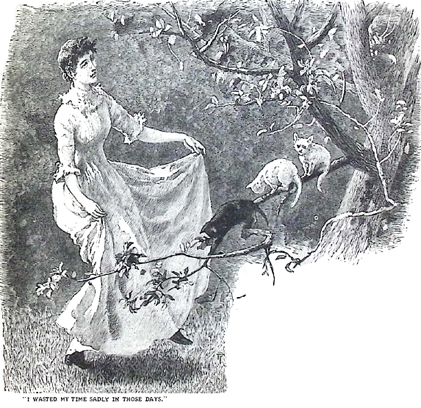
I WASTED MY TIME SADLY IN THOSE DAYS.
Ralph Dugdale spent some weeks in our neighbourhood, but I did not see him again. He drove over from Cotsford one day to see Edmund, but I happened to have gone to New Burford that morning, and so missed him, rather to my disappointment. He took Edmund back with him to spend a day or two at Cotsford Manor, a change which Edmund much enjoyed.
Mabel came back from her wedding trip looking as pretty and charming as a bride could look. She appeared to have greatly enjoyed her stay abroad.
"You must go to Switzerland some day, Dorothy," she said to me. "Living here amidst such flat, tame scenery you can have no conception of the grandeur and loveliness of the mountains till you actually behold them."
"What is the use of talking to me about going?" I said, rather ungraciously. "You know very well that I shall never be able to do so."
"Indeed, I do not know that," said Mabel, playfully; "there is no telling whither our steps may tend in the future. I am sure I little thought a year ago that I should so soon go abroad."
True, indeed; and as little did I then think of the many associations of joy and sorrow, gain and loss, which were hereafter to link my head to the land of Switzerland.
I was constantly at The Towers during the first weeks Mabel spent in her new home. She wanted me to keep her in countenance when she was receiving visitors, she said, but in truth Mabel needed no such support from me; it was I who was the shy and embarrassed one. Mabel received her callers with perfect self-possession, and I could see that her prettiness and grace made a great impression on some of the county people who condescended to call on Mr. Steinthorpe's bride.
The days I spent with Mabel were pleasant ones on the whole. I was not insensible to the pleasure of living in wide and lofty rooms, where everything was in faultless taste, and the pictures and ornaments such that their equal could not be found nearer than London. It was not strange that Mabel should be proud of her mansion. She appeared to carry her little form with more and more dignity from day to day as she moved through her stately rooms, and she had the air of a duchess, Salome said, when she drove through Burford in the brougham her husband had bought for her use.
The presence of a bride at The Towers galvanised our social life at Burford, dull enough at most times, into unusual gaiety. Several evening parties were given in honour of the wedded pair, at which Mabel condescended to appear in bridal white, and I kept her company in my bridesmaid's gown.
Mabel's manner towards her old friends was very winning on these occasions, so much so, that I wondered whether she was trying to atone for her husband's coldness and stolidity; for Howard Steinthorpe, whilst punctilious in observing every form of courtesy, was often frigid and taciturn, and hardly concealed from his entertainers that he thought their party a bore. Yet, when in company that he cared to please, he could talk well, for he had travelled in many countries, and aspired to be somewhat of an art critic and connoisseur.
During those weeks my father had little of my company; but as he never appeared to miss me when I was absent from home, I left him without compunction, although Edmund had cut short his stay at home and gone on a walking tour with his friend, Ralph Dugdale. I saw enough of father, however, to know that he was anxious and careworn. I wondered at this, for he had talked more and been altogether more cheerful in his manner during the weeks that followed Mabel's wedding than I had known him for some time.
Had Howard Steinthorpe's return anything to do with the increase of gloom which I now observed? I could not tell, but I knew that few days passed without Howard Steinthorpe paying a visit to my father in his office. Sometimes he would come into the house to speak to me and deliver some message from Mabel. But more often, he forgot the message entrusted to him, till Mabel ceased to trouble her husband in this way, and found other means of communicating with me.
But I knew that he still came constantly to the place, for from the side window in father's room I used often to catch sight of him passing in or out of the tan-yard.
"Have you taken Howard in as a partner?" I asked my father one day.
"No, but he seems to have made himself my partner," returned my father, with a bitterness of tone at which I wondered.
"What do you mean?" I asked.
But father relapsed into silence, and gave me no explanation. Apparently, the words had escaped him under the pressure of secret irritation, and he had made an admission which he would now have recalled if he could.
I said no more; but I pondered my father's words, and made many guesses as to what he had meant in saying that Howard Steinthorpe had made himself a partner in his business.
Other things occurred to make me wonder. One day father asked me if I thought I could manage without one of the servants.
"Perhaps—if it were absolutely necessary," I said, my amazed looks inquiring why such a question had been put.
"I want to curtail our expenditure," said my father. "You must be more careful about the housekeeping, my dear. We spend too much; we do, indeed."
"But we spend very little, father," I said; "certainly, not more than we have always done. Are you poorer than you used to be?"
"These are hard times, Dorothy," he answered, evasively; "all business is bad."
"Business cannot be bad with Howard Steinthorpe, to judge by the way in which they live," I answered, rather bitterly.
"Oh, Howard is a wealthy man. He has plenty of capital to keep him afloat in bad times," was my father's reply.
So our younger servant was dismissed, and I did as best I could with the one who remained. But I should have got into dire confusion often enough but for Salome, who seemed to know by instinct when we wanted a helping hand in some domestic strait, and was sure to appear at the right time. She gave me many useful hints; and I might have profited by them more than I did, but I hated the trouble of housekeeping, and soon grew careless again.
Mabel was willing to help me as far as reproof and advice went, but she gave me little help of a more practical kind, and by a curious fatality, it happened that when anything went wrong in the household, or we had a poor sort of dinner, she would be sure to drop in to spend a few hours with me, and make our dinner her luncheon. Of course, she did not fail to point out to me how much better she would have managed. Indeed, she was constantly drawing my attention to something wrong in the house, or the cooking, or my own appearance, and it need hardly be said that her sisterly criticisms had no soothing effect on my temper. I resented her rebukes the more because I knew that they were not uncalled for. My conscience told me that I might have managed better, and made things more comfortable for my father if I had taken greater pains to do so. Ah, how often, when it was too late, did I wish that I had been wiser and more considerate for others in those days!
My father's health did not improve as the summer wore on. He fell a victim to dyspepsia, and not infrequently I had to take my dinner alone, my father sending me word from his office that he could take nothing but a little gruel, which would like to have there.
Yet still I did not disturb myself. I knew so little of illness, that when my father said he had only a fit of indigestion, I concluded that there was no cause for fear.
But late in September, something happened which roused me from my selfish indifference.
It was a lovely warm day. The month had set in wet and chill. We thought the summer had fled, and prepared ourselves to meet the keen winds of autumn, when lo! capricious summer shone forth upon us again in full splendour, and one would fancy that, like a playful maiden, she enjoyed the pleasant surprise she was giving us. I revelled in the glowing sunshine of that day, making the most of it, since I knew that the bright weather could not be of long duration. All the morning I was in the garden, ostensibly assisting Luke to strip the apple and pear trees of their ripe fruit, but in reality doing little more than feast upon the pears, and romp with my newest pets, three deserted kittens whom I had discovered in an empty shed in the tan-yard, and with some difficulty reared by hand. They were now three of the sleekest, prettiest, and most audacious of kittens, and I was never tired of playing with them, allowing them the greatest liberty, though their gambols were alike destructive of my gowns and of the furniture of the rooms in which I allowed them to riot.
I wasted my time sadly in those days. I had begun the course of reading recommended by Miss Carefull, but, although several months had gone by since I left school, I had not read more than half of the first volume of Macaulay's history, and the marker put to keep the place where I had left off had now been unmoved for weeks.
I was quite oblivious of time as I stood beneath the fruit trees, rolling apples across the grass for the kittens to run after, when Martha came to tell me that dinner was ready.
"Dinner-time!" I exclaimed. "Surely it is not so late?"
"Why, yes, miss, it's after one. Master has sent to say that he cannot come yet, and you must not wait for him."
"All right," I said, and slowly I made my way towards the house, followed by the kittens, who kept springing at my flounces, and then falling back and tumbling over each other in a general "mélée."
Having so freely lunched on fruit, I sat down to dinner without much appetite. I allowed the kittens still to play about me—I had fallen into shocking habits since Mabel left home—and every now and then I treated them to a tit-bit from the dish before me. All four of us found this a pleasant diversion, and I sat at the table a long time, although I ate little. When I rose, I was surprised to see how late it was. Why did not father come to dinner? Did he want gruel? I wondered, and forthwith started off to the office to ask him the question.
Running across the yard, I tapped lightly on the office door. There was no response, and I opened the door and looked in. For a moment, I imagined the place to be empty. The ledger lay open on my father's desk, but his chair was vacant. I half turned to seek him elsewhere, when my eyes fell on my father lying prostrate on the floor, midway between the table and window.
For an instant, I could hardly believe my eyes, then, with a cry, I sprang to his side and tried to rouse him to consciousness. He lay with his eyes closed, his face wearing such an ashen hue that the awful fear that he was dead seized me. With trembling hands, I loosened his neckcloth, and laid bare his throat and chest. A bottle filled with water stood upon the table; I snatched it up, scarce knowing what I did, and, soaking my handkerchief, bathed freely his head and face.
My rough and ready treatment was not without result. To my joy, I saw my father's lips move, his eyelids quivered, and he turned a little on his side. The next moment, I heard one of the men whistling as he passed along the yard. Instantly I called to him, bade him send Martha to me, and then, with all speed, hasten to fetch the doctor.
Ere the doctor came, my father had regained consciousness; but he appeared bewildered, and could give no account of how he had been taken ill. When good old Dr. Perrow arrived, father questioned him rather anxiously.
"They tell me I fell down," he said. "I suppose it was only a fainting fit?"
"Very likely," said the doctor, cheerily, and proceeded to his questioning.
But later, after he had persuaded my father to go to bed, Dr. Perrow said to me, privately, that he hoped it was only a fainting fit, and hinted that there were symptoms he did not like.
"Your father has evidently let himself run down of late," he said; "he has been keeping too closely to business, I fear. Is it not so?"
I said that my father had seemed very busy, and I feared he had been worried in business.
"Ah, that is it," said the old doctor, gravely, nodding his head; "there is nothing so wearing to the constitution as worry. Mr. Carmichael has evidently fallen below par—considerably below par. Well, good-day, Miss Dorothy. Don't be uneasy about your father; he will be better to-morrow, I trust."
He had said enough, however, to render me very uneasy. But when I repeated his words to Mabel the next day, she would not attach much importance to them.
"Dr. Perrow always looks on the dark side," she said. "Of course, father only fainted; he will be all right in a day or two."
"I don't know," I said, "I can't help feeling anxious, and I have not much confidence in Dr. Perrow. He may be very well for old women and children, but I don't believe he is good for much in a really serious case. Father has been out of health, suffering from indigestion and headache for a long time. I wish he would go to London and have advice from some clever physician."
"Really, how you talk, Dorothy!" exclaimed Mabel. "Dr. Perrow is a very good doctor, and has had great experience. You forget what the physician's fees would probably amount to. How could father bear that expense? And it is no wonder he has indigestion with such cooking as you give him. I shall not soon forget how hard that hash was when last I dined with you."
"Oh, that was an accident," I exclaimed, angrily; "but of course you will blame me. I suppose it is my fault that father is ill?"
"I did not say that," replied Mabel, evidently thinking me very unreasonable.
But her words had hurt me, and I felt it hard, too, that she, who never had to curtail her own expenditure, should always be the first to point out what expenses father and I must avoid.
But it appeared as if Mabel were right in taking a light view of father's illness. In a few days, he was down stairs, and, according to his own account, as well as usual. But Dr. Perrow still urged him to keep away from the office. What he needed, the medical man said, was perfect rest.
"Can you not persuade your father to go away for awhile, Miss Dorothy?" Dr. Perrow asked me one day. "Get him to take you to the seashore, or, better still to the Continent. Nothing would do him so much good as a complete change."
I promised to try what I could do, though without much hope of success. When I mooted the idea to my father, he said at once that it was out of the question, and begged me, almost sharply, not to mention such a thing again.
One day, ere my father had resumed his post in the office, Howard Steinthorpe came in to see him. He arrived when we had not long finished dinner. Father was still in the dining-room, but I had wandered into the summer parlour, which, as has been described, opened out of the larger room.
Hearing Howard's voice greeting father, I remained where I was, thinking that they would like to talk alone. I sat down and began to cut the pages of a magazine, which I had bought at New Burford on the previous day. I plunged into the serial story in which I was interested, and for some time forgot all else. The murmur of voices earnestly talking in the next room formed an accompaniment to which I paid no heed. Suddenly, however, I was roused by hearing my father say in tones that, though low, were so charged with feeling as to be peculiarly penetrative.
"For God's sake, do not be hard on me. It was no fault of my own that brought me into these straits. If you press for payment, there is nothing before me but ruin."
That word ruin thrilled me like an electric shock. What could my father mean?
The magazine fell into my lap! I sat up erect, every sense on the alert, and listened eagerly to hear what would follow.
"What is the good of trying to escape the inevitable?" Howard asked, not in the smooth, bland tones he was wont to use in society, but with a cold, hard, incisiveness which revealed his true character. "You have employed expedients enough without result, save increased embarrassment. Surely it is time to give up the vain attempt, and make it known that you can go on no longer."
My father murmured something that I could not hear.
Howard replied at some length, but in tones so cautiously lowered that I could only distinguish a word now and then, although the door of communication between the two rooms stood slightly open. Then my father seemed to be imploring him to be patient or asking help of him. Whatever it was for which he pleaded, Howard responded with some suggestion from which my father appeared to shrink.
"There is no alternative," I heard Howard say, in his hard, metallic tone. "In no other way can I help you. I have a right to demand such security."
"But the children," I heard my father say, in a voice so broken and feeble that I knew he must be sorely troubled; "I cannot bear to make things hard for the children."
I could not catch the reply that Howard made. I fancied he said that father could have no anxiety about Mabel, and he added something about "the others" that escaped me.
"But Dorothy—poor child?" I heard father say.
With that I started up, my cheeks flaming, as I remembered how wrong it was of me thus to listen to what was obviously not meant for my hearing.
What should I do? Father had evidently forgotten my presence in that room, and Howard Steinthorpe did not suspect it.
I pushed my chair back rather noisily, and moved to and fro once or twice, hoping thus to attract their attention. But, apparently, they were too absorbed in their talk to heed the sounds I thus made.
Presently solicitude for my father prompted me to adopt a bold course of action. I would show myself in the dining-room, for I hoped that thus I should bring to an end the interview which I knew must be sadly worrying to father. I waited till my excitement had subsided somewhat, and then, stepping firmly across the room, I pushed back the door and passed into the dining-room.
Father was seated at the table with a pen in his hand and some papers before him. He was writing when I entered; his face looked grey and worn, and his hand trembled visibly. Steinthorpe was bending over him; but he started up, flushing hotly, as I appeared.
For a moment he could not conceal the annoyance he felt at my intrusion; but he quickly regained self-control, and said, in his usual, nonchalant way, as he held out his hand to me—
"Ah, Dorothy, how are you? Your father and I are just arranging a little matter of business."
Though he spoke so carelessly, his eyes searched my countenance with a keen, suspicious air. Then he glanced at the magazine which I carried. He knew my love for reading stories, and, I doubt not, assured himself that I had been too absorbed in my book to hear anything that had passed between him and father.
"Father is hardly strong enough yet to be troubled with business," I said; "I hope you will not keep him long over it."
"Certainly not; we have just done," said Howard, quickly. "I quite understand how desirable it is that Mr. Carmichael should not over-tax his strength."
My father said nothing, but I fancied there was a helpless, beseeching look in his eyes as he raised them to mine for a moment. I quitted the room. Ten minutes later, I heard Howard leave the house; then I went back to my father.
He was still seated at the table; but now his elbows were resting on it, and his face was hidden in his hands. He raised it, however, as I approached him, and looked up at me with a sad, weary expression.
"Oh, father!" I said. "You should not have let Howard worry you with business matters."
"There is no escape from worry for me," he said, wearily; "there will never be anything but worry for me in this world."
"Father," I said, impulsively, "is Howard as kind to you as he should be in business affairs?"
"Business and kindness, Dorothy, are words that have no connection," father said, drily.
"Perhaps not, generally speaking," I returned; "but between you and Howard it should be different. He ought to look upon you as a father."
Father did not reply, but he laughed to himself as I spoke—a feeble laugh, with no mirth in it, a laugh which it pained me to hear.
"Dorothy," he said, sadly, after a pause, "I have been a very unfortunate man. Remember that, if ever you feel disposed to blame me. I always meant to do well by my children, but I have been very unfortunate."
My affection for my father was never demonstrative. As a child I had stood greatly in awe of him, and up to the present time, there had been an impassable barrier of reserve between us. But now there was such a pathetic expression on his face as he looked up at me, that my whole heart went out in a desire to give him comfort.
"Whatever happened, I could never blame you," I cried; "that is impossible."
And I threw my arm about his neck and laid my cheek fondly against his. It was the first and the last purely spontaneous caress that I gave him. There came a time when I was deeply thankful to remember that on one occasion, at least, I had shown my father that I loved him.
He seemed touched by my impetuosity, much as it startled him.
"You are a good child, Dorothy," he said, gently, and kissed me.
Then he rose and went off to his own room, whither I did not follow him.
====================
WHAT A DAY BROUGHT FORTH.
A THOUGHTFUL writer has said, "We are never happy; we can only remember that we were so once." There is truth in those words. We do not know when we are most happy. Girls seldom realise how happy they are in their sheltered, peaceful home life till the shock of some calamity upheaves its foundation, and they see with sorrow that their future cannot "copy fair their past."
It seems to me now that I was very happy in the clear, bright autumn days that fell that year, though no doubt I sometimes complained of their dulness, or vexed myself about trifles, or pitied myself on account of imaginary troubles. But how I enjoyed the long rambles across fields and through lanes which I took, with no companion save our dog Rough! What beautiful spoil of bright leaves and crimson berries I brought from the hedges, with which to decorate our rooms! Somehow I liked these wayside beauties better than the exquisite hothouse blooms Mabel would send me from the conservatories at The Towers.
There were times when I asked myself whether I were not indeed happier than my sister, fortunate young woman as most people esteemed her. True, Mabel generally appeared serene and satisfied; but one day, bursting unexpectedly into her boudoir, I found her crying as if her heart would break. How indignant she was with me for surprising her thus! How annoyed that I would not at once accept a nervous headache as the sole explanation of her tears! If I were not always in such rude health myself, I should know that others must occasionally feel weak and dispirited, she said.
But I was not satisfied. That incident set me wondering whether Mabel found her married life quite so blissful as she had expected it would prove. Already I had observed that Howard Steinthorpe's demeanour as a husband differed considerably from his bearing as a lover. I had heard him address Mabel in a dry, sarcastic fashion that I felt would have pained me sorely had I been in her place; and his omission of little acts of courtesy towards her, which he would not have failed to bestow on other ladies, made me question his right to be considered a true gentleman.
My heart grew tender to my sister as I reflected that there were perhaps many hours when in solitude she endured a heartache, for which her handsome rooms, beautiful pictures, and costly dresses could afford her no solace. But whatever were Mabel's trials in her new position, true to her nature she kept them to herself.
As autumn deepened into winter, business appeared brisk in the tannery once more. I saw new machinery arrive, and learned—not from my father, for he rarely spoke to me about his business—but from the foreman, that certain improved methods of tanning were to be introduced into the yard. Fresh workmen were engaged, strangers from London, who were not very well received by the older hands, I fancied, judging by hints that Martha and Salome let fall.
And every day, Howard Steinthorpe rode into the yard on his fine black horse, and passed to and fro inspecting everything with a far more master-like air than father displayed. I watched and wondered greatly, but something withheld me from asking questions.
The deep depression father continued to manifest was inconsistent with the returning prosperity these changes seemed to indicate. Whatever others thought, I could see that he was far from well, and my anxiety was quickened when I discovered that he had had one or two slight returns of the dizziness and faintness which had overpowered him on the morning when I found him lying senseless in the office.
I remember that one day I was deluded enough to impart my fears to Howard Steinthorpe, with the hope of getting sympathy and help from him. I happened to meet him as I came out of Salome's cottage. He was coming apparently from our place, walking, as his habit was, with his head bent and his eyes on the ground. He was smiling to himself with his sardonic smile, and his meditations were so pleasant that he was not aware of my appearance till I spoke.
"Ah, Dorothy!" he said, then, in the cool, careless manner he had adopted towards me since his marriage. "How are you?—All right?"
"Oh, I am well enough," I replied; "but have you noticed how ill father is looking to-day? You have seen him, I suppose?"
"Ill?" repeated Howard, lifting his eyebrows as he spoke. "I have seen Mr. Carmichael, certainly, but I cannot say that he struck me as looking ill. He seemed as usual."
"He is ill, I fear. He tells me he cannot sleep as he should. Sometimes I think that the worry of business is making him ill."
A change passed over Howard's face as I said this. I do not know how to describe the change; but it conveyed to me the idea that my words had a deeper meaning for him than for me, and prompted by this notion I exclaimed impulsively—
"Oh, Howard! You know more about father's affairs than I. Do tell me what it is that is going wrong in his business?"
He smiled a cold, it seemed to me a cruel, smile.
"That is more than I can say," he returned carelessly. "I have business worries enough of my own without concerning myself with your father's."
"But you must know about them," I said, "You are in father's counsel; you come to the office almost every day; you must know what it is that worries him."
Howard's manner changed. His cold, blue eye rested on me with an air of quiet contemplation fora few moments, ere he said, in measured tones—
"And if I do—if your father does like to consult me—do you suppose that I shall repeat to you what passes between us in private? I wonder you can ask me to do anything so dishonourable. If you wish to understand Mr. Carmichael's business affairs, why not ask him to explain them to you? He would do so, doubtless, if he thought it well."
"I beg your pardon; I did not mean—" I faltered, shrinking from him in hot confusion.
Howard Steinthorpe lifted his hat with ironical politeness, and passed on without another word.
I walked home with burning cheeks and a bitter sense of shame. I felt almost ready to tear my tongue out in my mortification at the folly it had committed.
Very slowly did the weeks pass before Christmas; but the happy season came at last, and our home was brightened by a brief visit from Edmund. Ah, how brief it seemed, and how heavy the gloom that succeeded it!
I did not see very much of Mabel as the New Year advanced. She had little leisure to bestow on me. She and Howard gave many dinner-parties and went to many, for there was some talk of Howard Steinthorpe's standing for one of the Essex boroughs in the next election, and his acquaintance was being sedulously cultivated by those interested in politics.
As a rule, I was not invited to dine at the Towers when Mabel had company. My gowns were not sufficiently elegant to grace her rooms on those occasions.
The winter was long, the spring cold and wet that year. At the time when we were wont to look for spring flowers and blossoms, keen winds and drenching rains prevailed. I have not known a drearier spring. Day after day the skies were dark and the rain lashed down with pitiless severity. Everyone was complaining. The farmers were in despair, for in many places whole meadows were flooded, and the prospect for the corn was deplorable.
There was much sickness, too, abroad; ague and rheumatism, fevers and colds, beset both old and young. Dr. Perrow was in his element as he went about, shaking his head and darkly hinting at coming evils.
"Dorothy," father said to me one day as we sat at dinner together, he, as was so often the case, making but a sorry pretence of eating, "I must drive to Halstead this afternoon; I suppose you do not care to go with me?"
As I glanced out of the window, I shivered at the very thought. It was not raining, but the sky was overcast, a chill mist darkened the atmosphere, the trees were dripping, the ground sodden.
"No, thank you, father," I said. "Why, I should be splashed from head to foot. Do you think you had better drive all that way? The roads will be hardly passable. We heard yesterday that the water was over the bridge at New Burford."
"It will have subsided by this time," he replied; "there has been no rain for some hours."
"But there will be before many more have passed," I returned; "it will pour before night. Do, father, be persuaded to go by train!"
"I cannot, dear; the train would not serve me," he said.
So I let the matter drop. But when I saw him driving out of the yard alone, I was seized with regret that I had refused to go with him. It was always so with me. I became aware what was the right thing to do when it was too late to do it.
But as an hour or two later, the rain began to pour down again in the steady, determined way which had become so familiar to us, I soon ceased to regret my decision. It was grievous to think of my father being exposed to such weather.
Ah, how well I remember every incident of the dreary hours during which I waited for him! For once my favourite books failed to interest me. I could not settle to steady reading. I grew nervous as I sat by the window in father's room, listening to the plash, plash of the drops falling from the eaves overhead. I went out to the kitchen, disturbing Martha in the midst of a gossip with Luke, who had no right to be idling there at that hour.
She naturally resented my intrusion, but I stayed with her, preferring her company to my own thoughts, till I had talked her into a good temper.
Remembering that father had taken hardly any dinner, I planned to have a savoury dish for the late tea he was to have when he came in. I helped to lay the table, and arranged everything almost as daintily as Mabel would have done it.
Then I waited. How slowly the time passed! But now, at any moment father might return.
Yet he did not come. What could be keeping him? But of course the roads were heavy. How foolish of me not to know that he would be late.
I would not own to myself that I was nervous, but I stationed myself at the window and listened eagerly for the return of the dog-cart. One or two vehicles passed, but I knew at once that their lumbering wheels did not belong to the dog-cart. It grew dark early that evening, and whilst I waited, the rain seemed to increase in violence, and the wind, which had been slowly rising, beat against the casement and moaned drearily in the chimney.
"Miss Dorothy," cried Martha, bursting unsummoned into the room, "do you think master would come home by the road? Luke have been up to the Swan, and they do say up there that the water be right over the bridge at Burford, and it wouldn't be very safe to drive that way at dusk. Not so be that I would frighten you, miss."
Alas! I was frightened enough already. But the resolution I took astonished Martha.
"Something must be done," I said. "I shall run up to The Towers, it is on the way to Burford, and tell Mr. Steinthorpe. He will know what to do; he will send someone perhaps to Burford."
"You, Miss Dorothy! You must not go out in such weather! And to The Towers! What would Mrs. Steinthorpe say? Indeed, miss, you must not think of it; Luke will go."
"I shall go more quickly than Luke," I said. For I felt as if fear would give me wings, and Luke was not remarkable for celerity, either of thought or movement.
So without listening to my maid's remonstrances, I proceeded to equip myself for a struggle with wind and water. It took me but a few minutes to don a thick pair of boots, tuck up my skirt, and wrap myself in an ample waterproof cloak, to which was attached a hood which I drew over my head. Then, without an umbrella, which it would have been difficult to carry in such a wind, I dashed out into the rough weather.
Oh, what rain it was, with what passionate gusts it beat on me, and how the wind buffeted me, driving me into the deepest puddles, as vainly I tried to avoid them! How long appeared the way to The Towers! I could see the great house as soon as I got beyond the village street, the windows all brightly lit shining out in the gloom, but I felt as if I should never get to it, for the speed I longed for was impossible when the road was half water and the wind and rain blew straight in my face. But I splashed on with desperate courage. And at last, the great iron gates were gained; I passed through them and hurried up the gravelled path to the house.
My appearance on that stormy evening, and in such a plight as I was from the combined effects of mud, wind, and rain, might well create consternation in Mabel's well-ordered household. But the servants hardly seemed so astonished as I expected, though they exclaimed at my condition as they relieved me of my dripping cloak.
"Where is Mr. Steinthorpe?" I asked, as soon as I could get my breath.
But before they could answer, he appeared, coming out of the dining-room with a flushed, elated air.
"Dorothy, this is good of you!" he exclaimed, ere I could explain what had brought me. "You are brave to venture out in such weather. But how did you hear the news? I was just going to send a messenger to you."
"What news?" I asked, in amazement.
Then he told me that Mabel was the mother of a little boy. The news drove all else from my mind for a while, but presently I bethought me of what had brought me out in the wild rainy weather.
Howard made light of my fears when I imparted them to him.
"Your father knows how to take care of himself, Dorothy," he said. "I daresay he will stay the night at Halstead if he hears that the roads are under water. Or perhaps he will leave the gig there and come back himself by the last train. You have no cause to feel uneasy yet."
His words cheered me greatly. I began to think that my fears were groundless. Perhaps my father would stay the night at Halstead, though to be sure I had hardly ever known him spend a night away from home. More than most men, he loved the shelter of his own roof. It seemed to me more likely that he would return by the last train, and I said so.
"Well, perhaps you are right," replied Howard, "but if I were in his place, I should certainly put up at Halstead. If you like, I will send a man into New Burford to inquire if anything has been seen of him; but you have really no cause for fear. I am just having my dinner; you had better come and have some with me," and, taking my arm in kindly fashion, he led me into the large dining-room.
Paternity had a wonderfully softening influence upon Howard Steinthorpe, it seemed to me. I had never known him so kind, so brotherly in his manner. Evidently his heart was kindled to unusual warmth by the thought of the young mother and infant upstairs. It no longer appeared impossible that I should come to feel towards him as a sister should. I took myself to task for the hard thoughts and suspicions I had cherished concerning him.
The dinner could not tempt me, so Howard ordered coffee and cake for me, and drawing a deep, low chair close to the glowing hearth, he made me rest there whilst he took his meal; and to such an extent had my anxiety been allayed, that I enjoyed sitting comfortably by the fire for half an hour whilst we chatted pleasantly.
But when Howard rose from the table, I, too, rose and said that I must be going home.
"Oh, you need not go yet," he said. "Wait whilst I have a cigar. I know you do not object to smoking."
So I waited; but I was no longer easy in doing so. When at last I insisted upon going, Howard went to the front door to judge of the weather.
"Whush! How it does rain!" he exclaimed. "Dorothy, you cannot go out in such weather. You would be drowned. You had better stay here for the night."
"Oh, no! I cannot do that," I said, earnestly; "father would be alarmed if he found me missing when he came back. Whatever the weather is, I must get home."
"Then I shall send you in the carriage," he said, with unusual good nature, for it must have involved some sacrifice of feeling to send horse and carriage out on such a night.
But he would not listen to my remonstrances. The order was given, and after some delay—for doubtless the coachman was not disposed to hurry himself in preparing for such an unpleasant drive—the carriage drove up to the door, and Howard carefully put me into it.
"You must come in a day or two to see your nephew," were his last words. "Percival Howard Steinthorpe, his name is to be, Mabel says. Now, mind, you are not to alarm yourself if Mr. Carmichael is not at home. Good-bye."
Earnestly I hoped that I should find my father had returned during my absence. But my anxiety was less than when I left home. My mind no longer dwelt exclusively on the fears that had suggested themselves. Master Percival Howard Steinthorpe shared my thoughts. I was not a little proud of my new dignity of aunthood. My heart had a loving welcome for my infant nephew. I was passionately fond of children, and I thought what happy hours Mabel and I would spend together in worshipping and petting this wonderful baby. The Towers would be a different place to me now that the home could boast a child. So I mused whilst the brougham plodded on along the muddy road, and with every gust of wind the rain lashed the glass.
It was past nine o'clock when I reached home, but my father had not come back. In spite of Howard's words, my heart sank within me as I entered the empty house. How dismal now looked the preparations I had made some hours earlier!
Martha met me with so long a face that I was forced to rally my courage as I met her questioning glance.
"Mr. Steinthorpe says that we need not be anxious, Martha. He thinks that father would probably put up at Halstead as it is such a stormy night."
"Does he think so?" said Martha, her tone expressive of a contrary opinion. "It would be something new for master to do so, that is all I can say."
"Why, of course," I returned, almost impatiently, "but the weather is unusually rough, and exceptional weather demands exceptional action."
Martha did not appear satisfied. I hastened to tell her of the baby's birth, and the news gave as pleasant a diversion to her thoughts as it had to mine, and inclined her to take a more cheerful view of things. We discussed the event at some length.
"It will be a fine piece of news for master when he comes in," Martha said. "He will be mighty proud and pleased to learn that he has a grandson."
Her words reawakened my anxiety. Would he come that night? Somehow I could not bring myself to believe that he would stay the night at Halstead. It was impossible to contemplate the idea of locking up the house and retiring to rest, satisfied with that bare supposition.
I went into father's room and made up the fire, that there might be a warm hearth to welcome him should he come in. Then I sat down and waited.
I tried to persuade myself that I was not nervous; I tried to fix my thoughts on Mabel and the baby, but the fear haunted my mind like a grim shadow dimming the brightness of every other idea.
Suddenly I started up with a cry of joy. My ear had caught the roll of wheels. Yes, it was the dog-cart; I could not mistake it, and my consciousness was quick to approve itself, saying, "I knew he would come home."
But how rapidly and heedlessly father was driving! I heard the wheel jar against the gate-post as the horse and cart dashed into the yard.
I sprang to the window which commanded the tan-yard, but I peered vainly into the darkness. I could see nothing, only hear the clash of hoofs and wheels as the cart went by. No matter; father had come home.
I ran out to the back door, opened it, and stood, fearless of the beating wind and rain, to welcome father. I could hear Luke checking and soothing the horse, which apparently was restless and excited, but I caught no tone of my father's voice. He must be very tired and exhausted. But why did he not come in? In my impatience, I caught hold of a shawl which hung in the passage, folded it over my head, and ran round to the yard.
In the darkness, I could at first see nothing save the gleam of the lantern Luke carried. But presently I discerned the outline of the vehicle, on which Luke was throwing the light as he tried to examine its condition.
"Luke," I cried, "where is father?"
"Eh, gude sakes, Miss Dorothy; how can I tell? And what 'll be the meaning of this, do you suppose?"
"Oh, Luke, what is it?" I cried, hastening to his side, for the man's bewildered, frightened manner warned me of some catastrophe.
Then he held the lantern so that I could see that the poor, panting, frightened horse was streaming wet, that the reins were broken and draggled, the cushions gone, and the whole vehicle wet and muddy, and knocked about to an indescribable extent. I saw, but my mind refused to take in what it meant.
"And where is father?" I said, stupidly.
"Eh, who can say?" the man returned. "The poor beast came blundering alone into the yard, and he's come some way without being driven, I reckon, by the look of things."
I knew the truth then. From that moment, I had no hope of seeing my father come home alive. They told me to have courage, and to hope for the best; but I knew that there could be no best in this case, and that courage was only needed for endurance.
I have no distinct recollection of what followed. I think Martha must have sent for Salome, for I know that my dear old nurse came to me and sat silently by my side during the long, awful watches of that night. She tried to get me to bed, but I would not seek rest whilst my father's fate was yet unknown.
All night long in the wind and rain, men were out making search along the country road. Towards morning, the wind sank and the rain ceased. I observed that it was so, for something prompted me to go to the window, and I stood there for awhile, with my burning forehead pressed against the pane as I blankly watched the growing light. I began to shiver at last, and I went back to the hearthrug and stretched myself there with my head resting on Salome's lap.
In that attitude, I must have slept for a while, for when I opened my eyes again it was broad daylight, and Martha stood in the room with a cup of tea in her hand which she had brought for me. I was very thirsty, and I was drinking the tea eagerly when I heard again the sound of wheels on the road which passed the house.
With a shiver, I set down the cup and went to the window. Dr. Perrow's chaise came in sight. It was early for the old man to be abroad, and I felt sure that he had come on a special mission to me. Without surprise I saw the horse drawn in at our gate, and the old man descend and approach the house. I went forward to meet him as he entered.
"You bring me bad news," I said, as he took my hand.
"It is true," he said, gravely; "this long, sad night has prepared you for bad news, has it not?"
I waited for him to tell me more, questioning him only with my eyes.
"Your poor father has been found beneath the bridge at New Burford," he began, falteringly; "he must have fallen—"
"Then he is drowned?" I said, in a low, quick whisper.
And he made a sign of assent.
====================
MAKING PLANS FOR THE FUTURE.
THE sad accident that had befallen my father was not an unheard-of thing in the flat, low-lying district in which we lived. Almost every winter we heard of narrow escapes from drowning at Burford, when the river, swollen by rain, flooded the road, and from time to time some child, or animal, or drunken man would be swept away by the waters. But when John Carmichael, one of the oldest and most respected inhabitants of the little place, found his death in this way, everyone was startled and dismayed, and there was some discussion as to what measures could be taken to prevent such catastrophes in future.
How it was that my father had fallen into the river could not easily be explained. Subsequent examination of the road showed that the horse and trap had passed over the bridge. There had been no missing the way in the darkness, and straying into the main current of the stream, a misadventure known to have befallen wayfarers at other times. If the horse had been able to struggle through the water and bring the vehicle home without great injury, why had not its driver kept his place? Had a sudden jar against the parapet of the bridge thrown him from his seat? Or had he, as Dr. Perrow was inclined to believe, been seized by the dizziness which had more than once overpowered him, and, losing consciousness, fallen into the deep swollen river? It was vain to ask. Of the dire fact only could we be sure—suddenly and alone, in the wet, stormy night, my father had met with his death.
I was not stunned by the shock of sudden bereavement. I did not faint, nor cry out, nor sob myself into a stupor of exhaustion. I listened quietly to all Dr. Perrow had to say, asked one or two questions, and then, refusing to allow Salome to accompany me, I went upstairs and locked myself in my own room. There had been tears in Salome's eyes, tears even in Dr. Perrow's, while Martha's sobs were loud and vehement, but I could shed no tear as yet.
I wanted to be alone, that I might realise the calamity that had befallen me, and think out the confusion of thoughts that pressed upon my mind. Shivering with cold and excitement, I sank upon the window-seat, and pressing my icy hands to my burning brow, I tried to force home on my consciousness the bitter truth that never more would father look on me and call me, "Dorothy!" Never more could I give him smile or word, nor render him the least service—never more!
Ah, truly has it been said that when those near to us are called away, it is never our tenderness we repent of. Rather do we mourn that we have not made better use of the opportunities the past offered for tender words and loving devotion.
All my shortcomings as a daughter rose up before me in this hour. How cold and careless had been my demeanour towards my father; how little had I studied his welfare, how seldom denied myself for his sake! How much better I might have served him; how much more I might have been to him! But now it was too late—too late! The words rang in my ears like a knell.
True, I had never wilfully failed in my duty towards my father. I had only been thoughtless. But I could no longer excuse my thoughtlessness, regarding it as a common characteristic of girlhood. I saw now that thoughtlessness is sin. Since God had given me a mind capable of distinguishing between right and wrong, and discerning the duties He would have me fulfil, it was sinful to live careless of all save my own selfish pleasure. And thus, amidst the poignant regrets that stung my heart in this hour of sorrow, it seemed to me that I had lived in the past.
Suddenly the noise of opening doors and tramping feet roused me to painful consciousness of the present. I shuddered, and, throwing myself on my knees, buried my head amidst the cushions of the window-seat as I recognised the meaning of those sounds. They were bringing my father's body into the house. Then at last, my composure gave way. Sob after sob shook my frame, and a hot shower of tears fell from my eyes as I cried to myself—
"Thank God, thank God, he did call me good once. God knows I never deserved it; but he did. He did call me good!"
I do not know how to write about the days that followed. They have left on my mind a confused sense of pain and gloom, and I cannot recall events in the order in which they fell. Edmund came home looking pale and sad, and was very tender in his care for me. There was the inquest and then the funeral, with all the trying preparations these demanded, and through those sad days, I suffered much anxiety on Mabel's account, wondering how she would bear it when they told her that father was dead.
I remember an hour on the day following the funeral, when I sat alone in the dining-room with my hands clasped in the lap of my black frock, doing nothing but gaze about me on familiar objects with that sense of unreality which sudden bereavement gives. Edmund was in the office with Howard Steinthorpe and a solicitor from Halstead. He was being made acquainted with the state of my father's business affairs, and presently he would come and tell me what had passed. But I felt no anxiety as to the information he would bring. I was yet living in the past, careless what of good or evil the coming days might have in store for me.
Presently I heard the tan-yard gate swing on its hinges, and concluded that Howard Steinthorpe and the solicitor were departing. Still some minutes passed ere Edmund came. When at last he entered, his face was flushed, his eyes very bright, and there was an indefinable something in his appearance which told me he had been very much put out. I thought it wisest to keep silence, and waited till he should begin to speak.
He drew a chair in front of the fire and fiercely attacked with the poker a prominent lump of coal ere he said a word. Suddenly he burst out—"For consummate astuteness commend me to that fellow Steinthorpe. He has managed things nicely for himself, upon my word."
"What has he done?" I asked, wondering at the passionate tremulousness with which my brother spoke.
"Oh, nothing," he said, bitterly; "he has merely contrived to possess himself of the tannery and all its belongings; of everything, in short, that we might have thought would have come to us at our father's death."
I looked at him in bewilderment. Seeing how astonished I was, Edmund made an effort to control himself and tell me quietly what he had learned to be the state of our affairs.
It appeared that for many years the tannery had not prospered. Year after year father had lost money by it, till, about the time of Mr. Howard Steinthorpe's coming to The Towers, he found himself on the verge of bankruptcy. My father's pride shrank from an issue involving so much disgrace in the eyes of his neighbours at Burford, and he eagerly sought some means of escaping it. He was led to appeal to Mr. Steinthorpe for help, and that gentleman, after making some inquiries into the condition of the business, consented to advance a large sum of money on security of a mortgage on the tannery and its appurtenances.
According to Howard's account, he had advised my father to effect sundry improvements in his methods of tanning which he believed would render the business more profitable; but father had obstinately refused to make any changes, and had gone on in the old way, to find himself after a time in increased difficulties. At that juncture Howard Steinthorpe pressed for payment of his debt, and urged my father to declare himself a bankrupt. But the idea of this was intolerable to my father, and he implored Steinthorpe to save him from it, and again Howard lent him a large sum of money, receiving as security a bill of sale on our house and furniture. And thus my father's sudden death left in the hands of Howard Steinthorpe everything belonging to the business and all we might have thought would be ours, when our father had passed from earth, since it was utterly out of Edmund's power to redeem the mortgages.
But, as Edmund told me, it was some time ere I could take in these facts.
"Do you mean to say that this house and the furniture are his?" I asked, incredulously.
Edmund nodded.
"Have we, then, nothing?" I asked. "Are we absolutely penniless?"
"Not quite so bad as that," replied Edmund. "There are a few hundred pounds coming to us from the insurance on father's life, that is all."
At that moment, I recalled the day when, seated in the summer parlour, I had overheard part of a business conversation between my father and Howard Steinthorpe. I remembered the hard, almost bullying tone Howard had assumed in speaking to father. I remembered the trouble in my father's voice as he said: "I cannot bear to make things hard for the children."
"Edmund," I said, "I don't know what you think; but I believe that Howard Steinthorpe was very hard upon father. Could he not have helped him in some other way, without grasping everything for himself?"
"Of course, he could," returned my brother. "No one could better afford than Steinthorpe to risk money on a doubtful investment. But although John Carmichael was his father-in-law, he would not venture a brass farthing to save him from failure without the best security. The worst of it is," continued Edmund, clenching his fist, "what maddens me beyond anything is, that I can see he counts upon making a very good thing out of the tannery. The business has begun to look up since the new machinery came into use."
"Did he express no feeling, no desire to help us?" I asked.
"Express feeling? Of course he did. You know how smoothly he always speaks. He deeply regretted our position, and said he was ready to give me all the assistance in his power for my settlement in life; but I told him, once and for all, that I would accept no help from him. I will receive no favours from such a snake in the grass."
As I looked at my brother's flushed, indignant face, I fully sympathised with the spirit in which he spoke.
"Nor will I," I said, proudly.
"Oh, but Dorothy, I forgot to tell you; he said there would always be a home for you at The Towers."
"Did he?" I exclaimed, flushing hotly in my turn. "I am very much obliged to him; but I will never accept a home from him. I could not breathe under his roof after all that has come to pass."
"But what will you do, Dorothy?" my brother asked. "You cannot support yourself."
"I 'must' support myself," I said, firmly, though my courage failed me at the thought; "I must take a situation."
"But what sort of a situation are you fit for, my Dottie?" asked Edmund, tenderly.
It was the very question father had put to me on my return from school two summers ago. Ah, he must have know then, poor father, that it was by no mean improbable that I might one day have to earn my living. I could not find it in at heart to blame my father for anything he had done; but I could see that words of blame not seldom trembled on Edmund's lips, though better feelings withheld him from uttering them. Our circumstance might have been much easier, if father had revealed his difficulties years ago, instead of vainly struggling to retrieve his position.
"I do not know what I am fit for," I said, sadly; "but there is surely something I can do. I would take a servant's place rather than owe anything to that man."
"Let us hope you may find a pleasanter post than that," said my brother. "I know you can't like the idea; but perhaps it would be well for you to go to The Towers for awhile! After all we must not be too hard on Steinthorpe. I suppose he has only acted as many other men would have acted in his place. And you must remember that he is Mabel's husband. You would not wish to effect a breach between you and your sister?"
"Mabel has hardly seemed like a sister since she belonged to Howard Steinthorpe," I said, bitterly.
"Of course, her husband stands first with her," Edmund replied; "but, Dorothy, you must see that at this time, when we mourn our father's loss, we three should draw closer to each other rather than allow anything to loosen the bond between us."
Edmund was right, I knew, but I would not own it. Pride was strong within my heart at that time; stronger far than love. We sat in silence for a while. The furrow on Edmund's forehead told that he was thinking deeply. Was he debating the question of my future or of his own? No one knew better than Edmund the poverty of my mental attainments, and how little they would justify my seeking a post as governess. Presently I ventured to disturb him by a question.
"Edmund," I said, "you will return to Cambridge, will you not?"
"I think so, Dottie, for the present," he said, "till the matter of the scholarship is decided. Oh, if only I could win it; what a help it would be to me now!" Edmund had told me when last he was at home of this scholarship, for which he was working with all his might. The money it would bring him, if he won it, would certainly be most useful now.
"Oh, I hope you will get it!" I exclaimed. "I believe you will, too."
"I am far from sharing your belief," he said, shaking his head; "for I have no mean competitors to contend with. And, you see, I have lost time, and been thrown out of training through the shock of our great loss. But, perhaps, by working ten hours a day when I get back, I may be able to make up for lost time."
"Ten hours a day!" I exclaimed. "How dreadful, Edmund! It is enough to kill you! Surely there is no need for you to work so hard."
He smiled at my outcry. "That is the way we do things at Cambridge. The prizes of university life are only for men who 'can' work hard."
That night I lay long awake, revolving in my mind sundry plans by which I might secure independence. But I saw objections to each. I could resolve on nothing save that on the morrow I would write to my old governess, Miss Carefull, and ask her to advise me.
I had come to this decision when my thoughts were turned into another and gloomier channel, for in the stillness of the night I heard my brother coughing. Alas! That hard, hacking cough, what a chill it sent to my heart, what an awful possibility cast its drear shadow upon the future. Who does not know how when death has once entered the home, we cling the closer to the loved ones who remain, fearing lest the grim enemy should rob us of them also?
Such fear took definite shape for me now. I cried to myself, "Edmund, too, will be taken; I shall lose him who is dearer to me than all beside. I shall be left alone and desolate."
My heart made wild protest against this unendurable idea. Here was a thing I could not bear. God would be cruel if He smote me thus. How could I live without the brother, who was the only being I had to cling to now? Ah, how wildly I prayed under the pressure of that fear! In effect, I cried unto the Lord—
"Cause that this which I dread shall not come to pass, and I will be so
good! I will toil at whatever work Thou givest me; I will do and suffer
anything—only spare me this!"
Who will say that such a wilful, unworthy prayer as this is unheeded by the God of love?
"Like as a father pitieth his children—"
That scripture rebukes the thought. Yes, verily He hears us even when we pray thus, though He does not always answer us according to our words.
Praying and weeping, I lost myself in sleep at last. With the morning, hope dawned on me again; I took up the cares of the present and forgot all forebodings.
Howard Steinthorpe came in soon after breakfast, and I forced myself to greet him with politeness, though my cold, almost sulky, manner did not, I felt sure, escape his notice. Mabel was as well as could be expected, he said; he had told her of our father's death, and though much distressed, she was maintaining admirable self-control.
Then Howard began to talk to me about my future. He appeared amazed when I quietly but firmly declined his offer of home.
"But what will you do?" he asked. "You cannot live on the interest of those few hundred pounds."
I told him that I did not yet know what I should do; but I was determined to be independent. I could see that he was much annoyed by my refusal. Mabel would be hurt by my conduct, he declared.
As he went away, he said, with a sneer, that he hoped I "should enjoy independence."
After that, I lost no time in writing to Miss Carefull. Two days later I received her reply, and with it there came into my hands another letter, at which hardly glanced until I had satisfied myself as to what Miss Carefull had to say to me.
She wrote very kindly. It was clear that I had her warmest sympathy in my sad loss and the consequent difficulties which beset me; but she was too true a friend not to be quite frank with me.
She reminded me how weak and inaccurate was the knowledge I had gained at school; how short a way I had travelled in the various sciences I professed to study; how imperfect was my acquaintance with foreign languages. She did not wish to pain me, but she felt bound to say that she could not conscientiously recommend me as a teacher, save to very little children, and the position of a nursery governess was one she would not like my father's daughter to hold.
What she would advise, she said, was that for a while I should give up all thought of a situation, and devote myself to earnest study with a view to fitting myself for some good post in the future. She had always maintained that I had good abilities, and she was sure that if I really "worked," I might turn a year's study to such good account that she need have no hesitation in recommending me as a governess. She could not doubt that there was some home open to me, whilst I pursued my studies (she meant Mabel's home, of course, though I had carefully refrained from mentioning to her that I was welcome to reside at The Towers); but should I ever wish to spend a week or two in London, she would be delighted to receive me, if by any possibility she could make room for me.
Dear, kind Miss Careful!! Her advice was sound although it galled me. Her letter did not help me, as I wished, by suggesting some remunerative employment on which I could enter at once. A blank feeling of disappointment came over me as I re-read her words. Live at The Towers for a while, as she half-suggested, I would not, yet in no other way did it seem possible for me to give myself to study.
As I thought thus, my eyes fell on the other letter lying near me, which I had forgotten. I took it up and examined it curiously, having no idea who the writer could be. The address was written in a small, cramped, old-fashioned hand, so fine that the characters looked as if they had been traced with the point of a pin. I had a vague idea that I had seen this writing before, but whose it was I could not remember.
Opening the envelope, I unfolded the note and glanced quickly at the signature.
Mary Lyell. To be sure; this was my father's old friend, Mrs. Lyell, of whom he had often spoken to me. It was at her house that he had first met my mother, and he had ever cherished a peculiar, reverent affection for this noble Christian woman, as he esteemed her, and at rare intervals had paid her a visit. I had never seen Mrs. Lyell's home at Weylea, but Mabel had twice stayed there for a week or two. It was my own fault that I had not been there, for Mrs. Lyell had invited me, and father had wished me to accept her invitation, but I refused to go. For the account Mabel had given me of Mrs. Lyell's piety and strict notions, and the methodical, unvarying routine observed by her household, made me take a prejudice against the old lady. I felt sure that I should never get on with her. I was not like Mabel, who could adapt herself to the ways and thoughts of every one with whom she was thrown.
What had Mrs. Lyell written to me now? Very kind, very soothing seemed the words to me as I read them. I have the letter still; it is one of those I can never destroy.
"My dear Dorothy," she wrote—"To-day's 'Times' has informed me of your
sad loss. A heavy sorrow it is that has befallen you; it would be
neither wise nor kind to represent it otherwise. I, who have known your
father nearly all his life, share your sorrow to some extent. There
was no friend I esteemed more highly than John Carmichael, and life is
poorer to me now because he is gone. But it is a small matter that I
should miss a friend for a little while. The days of my pilgrimage are
almost over. I grieve for you, my child, to whom life yet seems long.
But remember that though the fathers of our flesh leave us, the Father
of our spirits is ever with us. To Him I commend you. He is the Father
of the fatherless, and He will be your guardian and friend.
"Will you write to me soon and tell me what are your plans for the
future? I am wondering whether you would like to come to me for a
while. Your home, I suppose, will now be broken up. Your sister, I
know, is married, and your brother much engaged with his studies. If
such a quiet change as a visit to an old woman would be acceptable, I
should rejoice to welcome you. Come for as long or as short a time as
you will. There is a home for you in my house and in my heart if you
will have it.—Your affectionate friend, MARY LYELL."
This letter touch me keenly, filling me at once with wonder and gratitude. Here was a home offered to me where I could pursue my studies in peace, and prepare myself for the teacher's vocation. The very quiet and monotony of Mrs. Lyell's life, which had withheld me from visiting her before, would be to my advantage now. In her home I should be free from all outward distractions, all temptations to prefer play to work.
When I showed Edmund the two letters, he heartily approved of the decision to which I had come. I wrote without delay to Mrs. Lyell, telling her of the position in which I was placed, and how glad I should be of the shelter of her home for a time, whilst I endeavoured by diligent study to make up for my idleness at school. Her answer was even warmer and kinder than her previous note had been. She was delighted to hear that I was willing to come to her. She promised me that I should enjoy perfect freedom in her home; I should spend my time as I liked, only she should feel it incumbent upon her to see that I did not work too hard and injure my health!
I smiled as I read the last words. No one who knew me could have imagined that my health would ever be endangered by over-work.
A few days later Edmund went back to Cambridge and I was left alone, save for our faithful old Salome, in the house which was no longer a home. There were final arrangements to be made with respect to the furniture and belongings of the old home, which had to be postponed till Mabel was strong enough to enter into them, so I could not leave Burford immediately as I desired to do. Mabel sent me an invitation, which was almost a command, to go to The Towers; but as I still cherished enmity towards her husband, I declined to take up my abode, even temporarily, under his roof.
When first I saw Mabel after our father's death, she did not hesitate to tell me how wrong she thought me. She looked prettier than ever, invested with the new grace of motherhood, and as I held in my arms the bundle of rich lace and lawn from which peeped out the wee round face of my nephew, I was almost sorry for a moment that I had decided to go away. I could not look without emotion on the little one whose life had begun on the wild, stormy evening that had seen our father's death.
"Is he not a beauty?" cried Mabel, gazing on her infant son with tender pride. "Ah, see, he is smiling! Look at his eyes; are they not the purest violet? But nurse says they will change as he gets older. Is it not a pity?"
"Yes, but it is just the same with kittens' eyes," I remarked irreverently, assuming some 'brusquerie' to hide what I really felt. "Not one of those three I took such trouble with has blue eyes now, though they all seemed to have blue ones at first."
"The idea of likening my baby's eyes to a kitten's!" cried Mabel, indignantly. "Oh, Dorothy, how can you bear to leave that darling!" she said to me when the nurse had carried her precious charge back to his own domain, from which he had been brought for my inspection. "I thought you would have been with me to see him from day to day. It is so silly of you to go to Mrs. Lyell's. You could have studied just as well here, if you must be a governess. There is plenty of room for you in this house. I could give you a sitting-room of your own, if you liked."
"Do not speak of it, please, Mabel," I said; "it is out of the question that I should live here."
"It is very wrong of you to say so, Dorothy. Do you know that poor father always thought that you would live with me if anything happened to him? Howard told him that you should have a home here."
I looked up at her, a little startled by her words, which gave me fresh enlightenment with regard to the past. She saw my change of expression, and exclaimed quickly, "Ah, I thought that you would feel differently if you knew that father wished it."
"I am not yet convinced that father did wish it," I said, coolly. "At least I am sure that he would not wish me to do what is so averse to my feelings."
"Oh, Dorothy, why are you so proud? Why will you accept nothing from Howard?"
"Why?" I repeated, angrily. "I should think you might understand. I do not choose to accept as bounty what should be mine by right."
"By right? But you have no right, Dorothy. Father mortgaged the business and everything belonging to it to Howard."
"I know that well enough," I answered; "but do you think Howard should have let him do it? Something might have been reserved for us—some share in the business, at least."
"But you do not understand," said Mabel, looking much annoyed with me. "You are so headstrong, Dorothy. Do you know that father would have been a bankrupt but for Howard? He had sunk thousands of pounds in the tannery, and was losing money by it every year, and all because he would go on tanning in such a bungling, old-fashioned way, using methods that have been abandoned for ages by most tanners, Howard says."
"You may call father's tanning bungling if you like, Mabel," I said, coldly; "but I know this, for I have heard him say so, that no customer ever found fault with his leather."
"Oh, the leather was good, no doubt; but Howard introduced into the yard a method by which the hides could be tanned in half the time, and bring in a much larger profit. If poor father had lived to share its success, things might have been better for him and for you."
"But as it is," I interrupted her scornfully, "Howard has trumped everything. Well, poor father was always unfortunate, and Howard, I suppose, is just as lucky."
"You ought not to talk so, Dorothy; you have really nothing to complain of. Howard is ready to give Edmund any help he needs, and, so clever as he is, he is sure to make his way in the world. For you there is this beautiful home with every comfort, if you will have it. And if you lived here, where you would meet nice people, instead of going governessing to see nobody, you would have every chance of making a good marriage and being comfortably settled in life."
"Thank you for the suggestion," I exclaimed, hotly. "No doubt you would enjoy making a match for me according to your mind; but as long as I have a head and hands capable of honest work, I will never degrade myself by marrying for the sake of getting a home. Say no more about my living with you, Mabel; it is out of the question."
"So I see," said Mabel, stung in her turn. "After what you have said, Dorothy, I cannot wish that you should live with me."
Thus our talk ended. Mabel was not the woman to allow that her husband could do wrong; nor would she soon forget what I had said about him. In spite of Edmund's warning, I had caused a breach to open between me and my sister.
====================
A QUIET HOME.
I ARRIVED at Mrs. Lyell's on the last day of May, having on my way thither stayed for a few days in London, at Miss Carefull's. During that interval, I to some extent shook off the inevitable sadness that fell upon me as I closed a chapter in my book of life by saying farewell to my dear old home. I was looking forward with somewhat of interest and curiosity to my sojourn with Mrs. Lyell when I stepped from the train on to the East Weylea, platform that afternoon in May.
I knew that the house was close by; but having luggage with me, I took the solitary fly that was waiting outside the station. I was driven, it seemed to me, about a hundred yards along the broad, main road to London—the metropolis was not more than six miles distant—ere the driver turned his horse into a narrower, more rural road, and drew up before two high iron gates which, dismounting, he proceeded to throw open.
Whilst he did so, I had time to take in the appearance of a long, two-storied house built of pale brick, and wearing an expression—for houses as well as persons have expressions—of neat, staid respectability. There were two wings to the house: that to the left, as I afterwards learned, contained the kitchens and servants' rooms; that to the right, which had false windows, the coach-house and stables. Between the house and the iron gates lay a garden bright with flowers, unlike most gardens in having a pond set in the centre of its circular lawn, round which on either hand swept a broad carriage drive to the house.
As I drove by, I caught sight of the white and green buds of water-lilies floating on the surface of the pond, and noted the tree it seemed to me a kind of ash—quaintly clipped to the form of an open umbrella, which stood on the lawn between the pond and the sweep of gravel in front of the house.
But ere I could observe more, the fly came to a standstill before the square porch, and I saw that the don was open, and an elderly woman attired in black, with white cap and apron, was waiting to receive me.
"Miss Carmichael, I suppose," she said, coming forward to assist me to alight. "My mistress is expecting you. If you will walk this way, miss, I will see to your luggage."
So saying, she took my bag and led the way across a square hall into which a broad shallow staircase descended.
Even in those few seconds I received an impression of dainty purity as I crossed the hall with its shining oilcloth, soft rugs, spotless paint, and was conscious of the exquisite country freshness which pervaded the house. Throwing open a door on the left, the servant announced me, and I entered a long, lofty room with a large French window at its further end, overlooking, as I saw at a glance, another garden at the back of the house.
But my attention was immediately engaged by a little form which rose from an easy chair and came towards me with outstretched arms. How can I describe Mrs. Lyell as I then saw her? It is not always easy to recall our first impressions of a face we have learned to love—a friend who has become most dear to us; but I will try.
I saw a tiny woman wearing a black stuff gown, relieved by a soft grey shawl and a widow's cap of snowy white. Her face was withered and wrinkled, her hair silvery, the hands which clasped mine so tenderly were shrunken and bony from age. I had not expected to see so aged a woman. Mrs. Lyell was nearly eighty, and eighty seems very old to nineteen. I was wont to shrink from the very old, but Mrs. Lyell's appearance inspired me with neither awe nor repugnance, for the aged, furrowed face was radiant with goodwill, and the faded eyes shone with the light of a pure and loving soul.
"Welcome, dear Dorothy," she said, in her gentle, quavering tones; "you are welcome both for your own and for your parents' sake. Your father has often spoken to me of you, and I am very glad to see you at last."
It was natural to me to restrain emotion in the presence of others. Since my father's death scarce anyone had seen me weep; but now tears rose in my eyes as I stooped to receive Mrs. Lyell's warm kisses, and I had hard work to keep from crying. She saw how I was moved and was silent for a few moments, merely showing her sympathy by stroking my hand which she held in hers.
"How tall you are, my love!" she said, presently. "I had no idea you were such a tall girl."
And indeed I felt very tall and big as I stood before that wee, fragile-looking old lady.
"I am dreadfully tall!" I said, apologetically. "A great deal too tall."
"Never mind, dear, that is a matter beyond our control. The Bible reminds us, does it not, that we cannot add one cubit to our stature? And it makes no difference whether we are short or tall as long as we try to be good. But here comes Sarah; I daresay you will like her to take you to your room. We shall have tea in half an hour's time."
The servant who had admitted me now appeared. She was a thin, sallow woman, almost as tall as I was, but rather crooked of figure. She must have been many years younger than her mistress, but she looked old to me, for her hair was grey, and there were wrinkles on her forehead, and crow's-feet about her eyes. I caught her black eyes examining me with a hard, narrow gaze, which was not agreeable, and though she was very polite as she attended me upstairs, her voice and manner were not pleasing to me.
The room in which she left me was furnished according to old-fashioned ideas of comfort. There was a huge four-post bedstead hung with snowy dimity, and holding a mountainous feather bed, covered with a heavy knitted counterpane. White textures, too, curtained the window, shrouded the looking-glass, and enveloped in voluminous folds the dressing-table. A large Bible lay on a table at the foot of the bed, and beside the table stood a high-backed, luxuriously cushioned elbow-chair. I smiled as my eyes fell on it. It was the chair for an old lady or an invalid, but hardly one in which I should care to sit often.
On taking possession of a new room, I always hasten to the window, for it is a matter of importance to me what sort of outlook my bedroom commands. I did so now, and, drawing back the curtain, looked down upon another garden, even pleasanter than that through which I had approached the house. My eyes rested on a large, well-kept lawn, soft as velvet, green as emerald, in the centre of which stood a fine mulberry tree not yet in full leafage. At each extremity of the lawn on the side fronting the house rose, like a giant sentinel, a tall walnut tree, still brown and irresponsive to the touch of spring, though the other trees In the garden were showing their freshest green. I could see little more of the garden save a deep border of flowers and a laurel hedge behind it, above which rose the trunks and foliage of sundry fruit trees; but the prospect held me long at the window. I dearly loved a garden, and there was more than the garden to be seen, for beyond it stretched a fair expanse of fields and hedgerows, with wooded uplands faintly visible in the distance, through a veil of blue haze.
Suddenly I remembered the punctuality practised in that house, and that I had to unpack some of my things, and rearrange my dress ere going downstairs. I was as expeditious as possible; but when I entered the dining-room, tea was waiting, and Mrs. Lyell had already taken her place at the table.
She requested that I would be kind enough to pour out the tea. Of course, I willingly complied; but how strange I felt as I seated myself before the handsome antique silver equipage! Then Mrs. Lyell folded her hands and bent her head with a reverent, childlike air, and, to my surprise, offered up, not a formal grace, but a short prayer, in which she thanked God for bringing me there in safety, and prayed that His blessing might rest on me.
I knew not what to think of this proceeding, it seemed to me so odd. I scarcely liked it, and yet I could not help being touched by the simple, trustful spirit the prayer breathed. I grew accustomed afterwards to Mrs. Lyell's habit of thus, at the beginning of a meal, pouring forth in brief but earnest prayer the thoughts and desires uppermost in her heart.
It was very pleasant, that first meal I took with Mrs. Lyell. The dainty nicety of the table arrangements, the homemade bread, the delicious butter, the rich cake and sweet biscuits on which the cook prided herself, were all duly appreciated by me. Whilst I took my tea, my eyes wandered to some portraits placed on the mantelshelf. There was a miniature painting of a lady in a very short-waisted gown, with her hair piled in a high crown above her brows, which, greatly as the little wrinkled face beside me had altered since then, I could yet recognise as representing Mrs. Lyell in early life! The portrait, wrought in similar style, of a gentleman wearing the straight-cut coat and stiff stock of a previous age, I concluded to be that of the deceased Mr. Lyell. Between these, in a pretty morocco frame, was a portrait which was quite modern, the photograph of a young man with a bright, animated countenance. The face seemed to smile as I looked at it; but the smile was in the eyes alone; the strong, well-cut mouth was firmly closed.
This portrait attracted me. It had a fascination which drew my eyes to it again and again, so that Mrs. Lyell, who sat with her back to the mantelpiece, seeing my glance constantly turning in that direction, asked me at length—
"What do you see there, my dear, that interests you so much?"
"Oh!" I stammered, a little embarrassed by the question. "I was only looking at that likeness."
"Whose likeness? My nephew's? Ah, you may well admire that; a good face, has he not? He is my grand-nephew, Leonard Glynne by name. His father died in India years ago when Leonard was a mere child, and his mother did not survive her husband many years. She was my dearly loved niece."
I looked at the portrait with still more interest. Leonard! I liked the name. It suited him, I fancied, for I felt sure that he was brave and strong.
"It was very sad for him to lose both his parents," I said.
"Yes, a great loss; but he was brought up in the home of his father's brother at Bournemouth, and his uncle was very good to him. Since he grew into manhood, he has lived in London, for he does business in the city."
"Do you see him often?" I asked.
"Not very. He spends his Sundays with me when he has no other engagement, and he drops in now and then to ask how I am. But he has many friends, and his company is so much in request that I do not see him very often, although he lives near. I do not complain of that. An old woman's society is not very enlivening to a young man, and there is little to interest him here. But Leonard is very good and kind when he comes, dear fellow!"
I could not wonder that Mr. Leonard Glynne was popular with his acquaintances, for his looks seemed to testify to a happy, genial nature. When should I see this nephew of Mrs. Lyell's?
"He has just gone off for a month's tour in Switzerland," Mrs. Lyell said, as if in answer to my thought. "He came in last night to bid me good-bye. I see more of him than I used to since I made him the present of a horse. My motives for doing so were rather interested; but he was delighted with the gift. Now he need no longer complain of the distance Weylea is from the city. He can ride to and fro and see his friends, and is to a great extent independent of the railway."
"It was a happy thought of yours," I said, longing to ask some questions but too shy to do so.
"Yes," said Mrs. Lyell, smiling; "I forget now what made me think of such a thing. I suppose he gave me a hint that he should like a horse."
"It must be lovely in Switzerland at this time," I said, with a little sigh.
"It is a most beautiful country at any time, I suppose; but in June the flowers are said to be so lovely," replied Mrs. Lyell. "Leonard has been there before. He is very fond of travelling; rather too fond, I think, sometimes; but, perhaps, I should not say so, for it is a pure and elevated pleasure he finds in beholding the grandeur and beauty of the works of God."
When we rose from the table, Mrs. Lyell asked me if I should like to take a turn in the garden. Perhaps she caught some wistful glance I cast in that direction, for I was longing to get amongst the trees and flowers. She could not accompany me, she said, with a smile, for she was so feeble and so susceptible to cold that she rarely went out, and then only in a bath chair or carriage.
With what pleasure I opened the window, stepped on to the little stone balcony, and ran down the steps into the garden! Our dear old garden at home was a wilderness compared with this well-kept, well-ordered ground; but somehow the one reminded me of the other. Ah, how I came to love Mrs. Lyell's garden in after days! At this hour, I could almost weep to think how it has vanished, and of the commonplace, suburban houses which stand, row after row, on the ground where roses once flourished, and apples and pears mellowed in the autumn sunshine.
And yet it was an ordinary garden enough; there were no tortuous mazes, no leafy alcoves or miniature glens. Straight down, on either side, ran a broad gravel path, intersected here and there by other paths, equally straight. Best I liked the lower part, where apple and pear trees grew amidst cabbages and kitchen stuff, where fruit trees were trained against the walls; where there were thickets of gooseberry and currant bushes, and where a bed of strawberry plants promised a fine crop of that luscious fruit.
As I paced the garden paths on that fair May evening, whilst a thrush perched on the mulberry tree made the air ring with his sweetly-thrilling notes, my heart was content. So elastic are our spirits when we are young, that in spite of the sorrowful changes I had recently experienced, I was not unhappy. Mrs. Lyell and her surroundings were different from what I had expected. Everything was much pleasanter than Mabel's representations, or rather my imagination enlarging upon Mabel's representations, had led me to expect. Already I loved the dear old lady, and believed that I should be happy with her. I was not afraid of the quietude and monotony which Mabel had warned me I should find hard to bear.
Presently, however, I felt constrained to go indoors. Mrs. Lyell was seated in her easy chair knitting. I fetched some needlework, and sat down beside her. She talked to me very kindly about my father and mother, and asked questions concerning Mabel and Edmund. I must confess that the hour we spent thus seemed long to me.
At a quarter to nine Sarah appeared, bringing a couple of tall candles. She closed the shutters, lighted the candles, wheeled her mistress's chair to the table, and placed a Bible and prayer-book before her. Then the household came in for family worship. How old everyone about the place seemed! I had encountered in the garden an old gardener, bent double with years, who had scowled at me, as though he thought so young a being had no right to be there, and now as I saw that the cook was even older than Sarah, and the housemaid, supposed to be young, was a woman considerably past thirty, I felt myself ridiculously juvenile compared with everyone about me.
Immediately after prayers Mrs. Lyell retired to her own room, where, as she explained to me, she took her supper of gruel. She begged me to excuse her leaving me, saying that she found it necessary for her health to live by rule, and never on any account deviated from her mode of life. As she said this, Sarah stood waiting to lead her upstairs. I half suspected that she, even more than her mistress, believed in a strict observance of rule.
Mrs. Lyell kissed me tenderly as she said good-night. The younger servant brought in a light repast for my solitary consumption. I ate it contentedly, and, not long after, I too went to bed. I laid my head on the pillow that night with a feeling of deep thankfulness. I had gained the quiet, peaceful shelter I needed till I could furnish myself with the means of winning independence.
I EXPLORE THE NEIGHBOURHOOD, AND
BECOME ACQUAINTED WITH MR. LEONARD GLYNNE.
I WAS downstairs by eight o'clock the next morning, for I had always been accustomed to early hours. My appearance took the housemaid, who was dusting the dining-room, by surprise. Breakfast would not be ready for half an hour, she said, so I betook myself to the garden, which looked most inviting in the bright sunlight of the first June morning.
Birds were fluttering to and fro between the lawn and the mulberry tree, picking up their breakfast with much satisfaction. A delicious breath of sweet-briar was wafted to me as I descended the stone steps from the balcony. There were rose trees here and there on the beds, and roses were trained across the rustic arches, which at each end of the laurel hedge crossed the broad gravel path where it led down into the more homely kitchen garden. Some of these were in bloom, and by standing on tiptoe I managed to secure one half-blown beauty, which I fastened in my gown.
To the left of the house, as I stood facing it, was a long greenhouse. It had been locked on the previous evening, and I had only been able to catch tantalising glimpses of the flowers through the glass, but now I saw that the door stood open. I hastened to enter it. There was nothing more rare to be seen within than fine geraniums and fuchsias, with maidenhair and other ferns; but I enjoyed looking at the bright flowers.
Close beside the door of the greenhouse was a door leading into the stable-yard. This, too, stood open, and through it I caught sight of a young man engaged in grooming a fine chestnut horse. It was a lovely creature, light and graceful in movement; and being an ardent lover of animals, I could not resist standing in the doorway to watch it. I admired the horse's shapely head, its bright, glossy coat, and the dainty white fore-foot with which it was proudly pawing the ground as if anxious to draw attention to his beauty.
I knew enough of horses to be sure that this was a valuable animal, and I wondered a little, for it scarcely seemed fit to draw the brougham which I saw standing in the yard. I should have thought, moreover, that an old lady like Mrs. Lyell would have preferred to use a less highbred, spirited animal than this appeared.
Presently the man turned and saw me watching him at his task. I ventured a "Good morning," to which he responded awkwardly. I made a remark on the beauty of the day, but elicited nothing beyond a sheepish assent. I heard afterwards that he was the son of the morose-looking old gardener I had encountered the evening before. Evidently he had inherited the taciturn temperament of his parent.
I turned back towards the house and met Clara, the housemaid, coming to tell me that breakfast was on the table. I went indoors and sat down to the meal in solitary state. How I longed for my dear kittens, which I had had to consign to the tender mercies of Salome! As yet I had seen neither cat nor dog upon Mrs. Lyell's premises.
On inquiry I learned from Sarah that Mrs. Lyell never came down before noon, and then, when strong enough, she spent the interval till luncheon in reading and answering her letters, for she had rather a large correspondence, and, although it took her some time to indite a letter, preferred writing herself, whenever possible, to employing an amanuensis. Mrs. Lyell's way of spending her morning fitted in well with my own plans. It left me free to devote to study the hours till dinner.
Soon after breakfast I established myself with my books in the library, a small square room, the window of which looked into the front garden, whilst it communicated by means of folding doors with the large drawing-room lying parallel to the dining-room, and having French windows opening on to the stone balcony at the back of the house. The library Mrs. Lyell had told me I might consider my own room whenever I desired seclusion. It was furnished with high book-shelves, which, however, I found, to my disappointment, contained only the oldest and driest of books. However, as Miss Carefull had lent me a number of books, and planned for me a course of work with these, I was not dependent on the resources of Mrs. Lyell's library, to which no book had been added since her husband's death, some years before I was born.
To one so unused to application as I was, it was not easy to settle to work amidst strange surroundings. For some time my eyes would keep wandering to the window, and I found myself idly watching the insects fluttering above the pond, the old bent gardener going leisurely about his work, or the few passers along the quiet road, who, especially if children, would often pause and stand peering through the iron gates at the pretty garden within. At last, a sense of shame roused me, I goaded my flagging resolution with the thought of all that depended on my exertions, and set to work in good earnest. The rest of the morning fled quickly.
Not till the dinner hour came did I see Mrs. Lyell. She met me with the sweet, serene kindness which is one of the greatest charms of the aged.
"Well, my love, have you been at work?" she said, tenderly. "Not working too hard, I hope; you must not overdo it. Your cheeks look rather pale. Do you not think so, Sarah?"
"Yes, madam; Miss Carmichael does not appear strong," said the maid.
"You are mistaken," I replied, rather vexed by this remark; "I am as strong as possible."
But this statement neither seemed able to believe. Hardly a day passed after this without Mrs. Lyell's giving me a similar warning against over-work, and it was one of the trials of my new position that everyone in the household would persist in treating me as if I were very delicate. I was warned against running into the garden without my hat; if I stayed there too late in the evening, Sarah would presently appear with a shawl for me and a reminder that the dew was falling, and she feared my shoes were thin; whilst endeavours to dose me with bark, port wine, and beef tea tried my temper sadly.
After dinner I sat and talked with Mrs. Lyell for a while, and read to her scraps from the newspaper. She was rather deaf, but was not aware of her infirmity, and had a great dislike to anyone, as she expressed it, "shouting at her as if she were deaf," so I had some difficulty in modulating my voice so as to catch her ear without annoying her by its loudness.
Presently Sarah appeared and took her mistress upstairs, where she always rested for an hour or so of an afternoon. Now I was free to take a walk, and I lost no time in setting off, being anxious to see what sort of a place Weylea was.
It was a large scattered village, quaint and rustic still, though London was fast encroaching on it. Its bounds extended for many miles; there was North and South Weylea, besides East Weylea, where Mrs. Lyell resided, though perhaps as they lay a mile or two apart, each place so styled deserved to be regarded as a separate village.
I wandered along the winding street of East Weylea, looking with pleasure on the old-fashioned houses, many of them the abodes of gentlefolks, and the thatched cottages and funny little shops scattered between. I was struck with the number of narrow fenced passages, overhung by fine trees, which ran in and out amongst the houses. Following one of these it brought me, after many windings, into the main London road again, which I had already crossed in order to gain the village.
I was now, however, at a point at some distance from Mrs. Lyell's. The old road looked very pleasant, and, allured by the delight of walking amidst fresh scenes, I pressed on without thinking how far I was going.
Presently, at the corner of a cross-road, the name Beechwood caught my eye. Was I near Beechwood? I must go there and take a look at the place where my brother's friend lived. So I turned into the narrower road. A pleasant road it was, with tall hedges and grand old trees skirting it, very different from the roads about Burford. Here and there the footpath rose considerably higher than the road, and I caught glimpses of the country around, bright with the emerald verdure of early summer.
But I had some way to go ere I reached Beechwood. Down one long hill and then up another equally long and steep I went, ere the road opened into a broad village green, bounded on either side by plantations of noble trees. All my life I have been a lover of trees, and I rejoiced to find that the neighbourhood of Weylea was remarkable for the beauty of its trees.
Crossing the green, I went on along a road shaded by stately beeches, till I came to some large iron gates. These, I felt sure, guarded the way to Beechwood Hall. I looked through the gates only to see that the carriage drive turned sharply to the left, and the house was not visible. No one was in sight, and so keen was my curiosity that I ventured to step inside the gates, and passed before the windows of the little lodge in order to satisfy myself.
Yes, there was the old and rather broken avenue of beeches, which Edmund had described to me, and the stately old house, forming three sides of a square. I looked intently at it for a few seconds, not liking to move nearer; then, turning, abruptly, I almost knocked over a little lady who had just come out of the lodge. Though little, however, she was sturdy, and quickly recovered from the shock of the collision.
"I beg your pardon, I am sure," I stammered, hot and confused, as I met the inquiring glance of her calm, grey eyes.
Even in my confusion, her face I struck me as different from any other I had ever seen. There was such a look of strength and loving kindness, blended with a certain sadness in her expression. She wore a black gown of rich material, though simply made; there was a narrow border of white within her close-fitting bonnet, and a long veil floated behind it.
"Do not mention it; I was to blame as much as you," she said, brightly; "I was looking at Mrs. Grey, and did not see you were so near."
She spoke in a sweet, clear, buoyant tone, the sweetest voice it seemed to me that I had ever heard; and I think so still.
Bowing, I turned away without another word. What she thought of my presence there I could not conjecture. Mrs. Grey, standing at the door of the lodge with her baby in her arms, eyed me curiously as I went by.
As I walked back to Weylea, I remembered that Edmund had spoken of a widowed sister of Ralph Dugdale's, who lived at Beechwood Hall. This, then, was she. As I came to this conclusion, I asked myself again, "What could she have thought of me?"
She did not look as if she could think unkindly of anyone. I carried with me a vivid impression of her face. She could not have been many years older than myself, but her look revealed depths of character into which I could not penetrate. It was strange how in so brief a meeting, this stranger had fascinated me. I could not help thinking about her all the way home. Was it a proof that she was destined to play an important part in the development of my life? I had no presentiment that it was so.
When I reached Mrs. Lyell's, Sarah opened the door to me and told me, with suppressed indignation in her bearing, that tea had been on the table for a quarter of an hour, and Mrs. Lyell was waiting for me. I had committed the unpardonable sin of arriving late for a meal. Mrs. Lyell looked grave as she inquired if I had met with any accident to detain me.
After tea, Mrs. Lyell asked me if I had yet written to my sister to acquaint her with the fact of my safe arrival at Weylea. I replied in the negative.
"Then you will do so, my dear, will you not?" she inquired, rather anxiously.
"Oh! There is no need to write," I said, carelessly; "Mabel will not disturb herself about me."
Mrs. Lyell looked at me in surprise. "Are you not fond of your sister, Dorothy?" she asked, after a pause.
"Oh, yes," I exclaimed, "I used to love her intensely before she married; but since then she has been so different. And now she has a baby, she will care less for me than ever."
A pained expression came to Mrs. Lyell's face. "Then you have all the more to love, dear," she said, gently. "It grieves me to hear you say that you used to love your sister. You cannot know what true love is, or you would not speak so. We do well to guard and cherish our own love, but it is a mistake to exact love in return. Believe me, Dorothy, it is far better to love than to be loved."
I was silent, feeling rather piqued at being told that I did not know what true love was.
"What sort of a man is your brother-in-law?" inquired Mrs. Lyell, a few minutes later. "Do you love him, Dorothy?"
"No, that I do not," I answered, decidedly. "There are some people we cannot love, and he is one."
"Pardon me, dear," said Mrs. Lyell, gravely, "there is no one whom it is impossible to love. We are told to love even our enemies, and God does not require of us that which we cannot do."
"It is impossible to me!" I broke in, hotly. "I cannot love a man who is harsh and selfish and unjust, and who makes it clear that he hates me."
"Oh, my dear, do not speak so," said Mrs. Lyell, looking grieved. "I know you cannot love what is wrong and unlovely, but whilst we hate the sin we should love the sinner, if only that he is one of the children of our Father in heaven. However wrong people may be, we can always pray for them, and we soon learn to love those we pray for."
But her words did not touch me; I could not receive them then. I did not continue the discussion, because I was fearful of saying what would grieve her still more. To please Mrs. Lyell, I sat down and wrote a letter to Mabel, but I wrote in a cold, constrained manner, for I still felt angry with my sister. This done, I settled to needlework till Mrs. Lyell invited me to have a game of draughts with her. Thus the long evening passed.
This first day at Weylea was a specimen of most of the days I spent there during the next month. The only break in their monotony was that once a week I went up to London in order to take French and arithmetic lessons at Miss Carefull's. I must say I often wearied of the unbroken routine. To be constantly in the society of the aged, however dear and good they be, is a trying experience for any young person. There were days when I found Mrs. Lyell's oft repeated narrations exceedingly tedious, and the stillness of the house so oppressive, that I longed to scream, sing, dance—do anything, in short, to break the quietude.
The wet days were the worst, and we had many ere the month of June was past. If it were fine, I could relieve my irritation by a scamper round the garden, though sometimes my enjoyment of such childish abandonment was checked by catching sight of Sarah's face at an upper window, gravely watching me. She never lost an opportunity of watching me, yet I felt that her interest in me was not kindly. Instinctively I knew that she disliked me, though why was a mystery to me, unless it were that she was jealous of her mistress's love for me, which the dear old lady made more and more manifest as we became better acquainted with each other.
Oh, how I longed sometimes for the presence of young life in that staid household! A strange feeling would come over me as if I, too, were growing old. The only young thing on the premises beside myself apparently was the beautiful chestnut horse, and I was not content till I had made friends with him. To do so, I had first to conciliate his taciturn guardian, and win from him the freedom of the stable. I was not to be deterred by Sam's representations that his charge was uncertain of temper, and might as like as not kick out at me.
I fell into the habit of slipping round to the stable almost as often as I went into the garden. Opening the door and advancing to the side of the loose box, I would call the horse in the most coaxing, alluring manner I could assume. His name I had not yet discovered. He had a name, I knew, for I had asked Sam, and he had pronounced it several times for my benefit, leaving me, however, no wiser than that the name was something like "Hairy Hal," which seemed too absurd. However, without the aid of a name, I soon succeeded in winning the horse's confidence, and he would turn towards me with evident pleasure when I appeared, and would put his lovely head over the side of the box, that I might stroke his nose and give him the piece of sugar that he loved.
Every day Sam took the horse out for exercise; but I did not see him between the shafts of the brougham. Mrs. Lyell talked of taking me for a drive, but day after day went by and the wind was too cold or the air too damp for her to venture out. But towards the end of June there came such a lovely warm day that even Sarah owned that her mistress would run no risk in taking a drive. The carriage was ordered for three o'clock, and came round punctually to the moment. A few minutes before, the postman had arrived, bringing Mrs. Lyell a letter with a foreign postmark.
"From Leonard," she said, with pleasure, as she opened it.
He had written dutifully to his aunt once or twice during his absence, but his letters, which I was permitted to see, were very short, and gave only the barest information as to his doings. This was no exception.
"Only a few lines to tell me that he will be at home by the end of the week," said Mrs. Lyell, as she laid it down.
Upon which we went out to the carriage, I rather curious to see how my chestnut beauty would deport himself under rein. But though the brougham familiar to my eyes stood before the door, a horse of another hue and build was harnessed to it, and it was not Sam who sat on the box. Yet I had never seen but one horse or man in Mrs. Lyell's stables.
"Why, Sarah!" I exclaimed, in my surprise. "This is not the horse I generally see in the stable."
Sarah looked at roe as if she thought I had taken leave of my senses. "To be sure not, miss," she said. "Do you think Mr. Glynne would let his horse draw the brougham?"
"Oh! Is that his horse?" I asked, bewildered.
"Certainly it is. My mistress has not kept a horse for years. So seldom as she drives out, it would be no good. When she wishes to use the carriage, she has a horse and man from the livery stables at the Stag's Head." So saying, Sarah helped her mistress into the carriage, and carefully arranged the cushions and wraps about her.
"My dear," said Mrs. Lyell, as I took my place beside her, "you look very puzzled."
"I cannot understand it," I replied. "Does Mr. Glynne live here, that he keeps his horse in your stables?"
"He does not live in my house," said Mrs. Lyell, "but he lives close by. His lodgings are within ten minutes' walk. How strange that you did not know! I must have told you. We will drive that way, and you shall see where he lives."
It was certainly strange that I should have remained so long in ignorance of this fact. I remembered now that in speaking of the horse, Sam had once or twice referred to Mr. Glynne in a way that seemed to me rather irrelevant.
Was it strange that my heart grew lighter as I received this news? After all I was not the only young person connected with Mrs. Lyell's household. There was another who would surely pass to and fro here pretty frequently if he did not tarry. I suppose my face must have brightened, too, with this thought, for suddenly I caught Sarah's eyes fixed upon me with a gaze which seemed to say that she could read what was passing in my mind. Doubtless she credited me with subtler hopes than I had conceived of, for there was something in her look that made me colour deeply as we drove from the door.
On Saturday afternoon I was sitting with Mrs. Lyell. It was a fine day, but I had not been farther than the garden, having worked myself into a headache that morning, which made me languid and depressed. There had been no visitors to the house during the week. Callers were rare at Mrs. Lyell's, though sometimes old friends from distant parts of London would come to take luncheon and spend a few hours with her; but now for several days not even the most frequent visitor, the old clergyman, whose dreary, drawling talk, usually confined to a discussion of his own and Mrs. Lyell's health, and the deathbeds he had lately attended, used to strain my slender patience to the utmost, had been in. I was rather startled, therefore, when, as I was trying to pick up some dropped stitches in Mrs. Lyell's knitting, the stillness of the house was suddenly broken by a sharp, decided peal of the house-bell.
"That sounds like Mr. Glynne's ring, ma'am," observed Sarah, who was laying the table for tea.
"Ah, it is he, no doubt," said Mrs. Lyell; "he has come back, dear fellow."
To my vexation I felt the colour rising in my cheeks, and at the same time was aware that Sarah's keen eyes were upon me. Yet it was not pleasure that I felt at the thought of making Mr. Leonard Glynne's acquaintance. The shyness at meeting strangers, for which Mabel had so often rallied me, came over me once more. I was annoyed that Mrs. Lyell's nephew should arrive just now, when I was headachy and out of sorts.
He it was, however, and in another minute he was in the room, greeting his aunt in the kindliest fashion, and listening, with amusement sparkling in his eyes, to her exclamations at his sunburnt, healthy appearance. How bright of hue, how strong and vigorous he looked as he stood bending down to the pale, withered little old lady in the arm chair. Stealing a glance at him, I decided that the photograph did not do him justice; he was even better-looking than it made him appear.
"You see I have a young companion now, Leonard," said his aunt; "this is Miss Dorothy Carmichael, of whom you have heard."
As we shook hands, his eyes met mine with a curious, questioning glance. Perhaps he wondered what sort of girl could be content to share his aged aunt's quiet home. Anyhow, I divined that I had some interest for him.
"Yes, I am rather brown," he said, in reply to Mrs. Lyell's remarks; "but so would you be, aunt, if you had been toiling up mountains or crossing glaciers beneath a burning sun as I have."
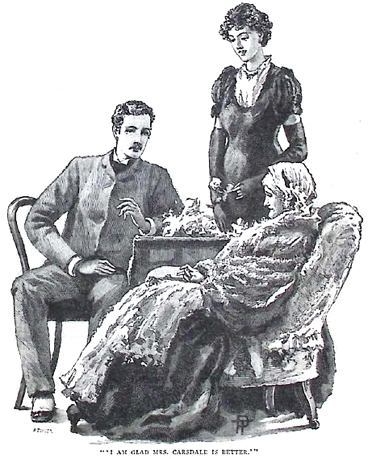
"I AM GLAD MRS. CARSDALE IS BETTER."
Whereupon his merry glance sought mine, and I laughed, as did Mrs. Lyell, too, at the idea of her achieving such exploits.
"I suppose you did not meet with any one whom you knew abroad?" said Mrs. Lyell.
"Oh, yes; I met with several acquaintances. At Chamounix, I fell in with the Carsdales. Mrs. Carsdale is better; they talk of coming home in the autumn."
"Indeed!" said Mrs. Lyell, with a certain stiffness of manner and change of face, of which I had learned the meaning.
Who were the Carsdales? I had not heard of them before. Clearly they were not favourites with Mrs. Lyell. Good, kind-hearted, little woman that she was, she had her prejudices I knew. After a minute, her manner softened, and she said, though not without an appearance of effort, "I am glad Mrs. Carsdale is better."
We sat down to take tea. What a different meal it was from any I had yet taken in Mrs. Lyell's house. Some shyness was at first experienced by me as I presided, with that bright, brown face opposite to me and the brown eyes constantly watching me. But the feeling soon passed. It was pleasant to meet the gaze of Leonard Glynne, pleasant to listen to his talk. Mrs. Lyell enjoyed it as much as I did, for she had no difficulty in hearing his clear, strong tones.
When tea was over, Mr. Glynne rose, saying that he must go round to the stable and see how his horse had fared during his absence.
I suppose he saw that I looked interested, for he asked me if I would come too. "But perhaps you do not care for horses," he added.
"On the contrary," I replied, "I care for them so much that I have already made friends with your steed."
"Indeed!" he said, with a look of pleasure. "I am glad that Ariel has had someone to pet him in my absence."
"Ariel!" I cried. "So that is the name! I could get from Sam nothing nearer it than 'Hairy Hal.'"
We laughed merrily at Sam's defective pronunciation. How good it was to laugh once more with a congenial companion! I had not had such a laugh since I came to Mrs. Lyell's. We made a long visit to Ariel, and strolled about the garden for a while before going in. By that time a perfect sense of comradeship united us.
The rest of the evening was passed in looking at the Swiss views Leonard Glynne had brought with him, and listening to his animated description of the scenes they represented, with many an amusing story of his adventures. Very short that evening seemed. It left me strangely happy, with an indefinable sense that everything had changed, and my life at Weylea could no longer be devoid of interest.
====================
SWEET AND BITTER;
FLOWERS AND THORNS.
MY dream of happier days was not altogether illusive. Leonard Glynne's return made a marked difference in my life at Mrs. Lyell's. The days were no longer all alike—colourless and uneventful. There were sharp contrasts between them—some were bright, some dark. I lived in those days, the young, eager life within me making itself felt by many a quick heart throb, many a thrill of pain or feverish glow of rapture that was akin to pain.
But for a while I drank of a sweet, intoxicating cup of delight. I first sipped it on the Sunday following my introduction to Leonard Glynne. He joined me as I sat in Mrs. Lyell's square, crimson-curtained pew in the old ivy-grown church at East Weylea; he walked home with me at the close of the service, and spent the remainder of the day with us. I remember how we strolled about the garden together in the afternoon whilst Mrs. Lyell rested, how he searched the strawberry bed to find for me the first ripe strawberries, and how he picked for me a rose growing against the house-wall and just beyond my reach. He was hardly more than an inch taller than myself, and this incident led to a discussion of our heights, in which he delicately conveyed to me his admiration for my tall stature. Ah, my foolish woman's mind which retains such trifles, but lets weightier matters slip!
Mrs. Lyell was too feeble to go to church. Leonard and I went again in the evening, and after service he took me for a walk. It was a cool, delicious evening. The walk was delightful to me, and I could see that he enjoyed it no less. How we talked as we went along—pure nonsense for the most part, I fear. We forgot how time was passing, and barely got back to Mrs. Lyell's in time for prayers. But the dear old lady did not seem displeased. The day ended as happily as it had begun.
The next day Leonard came in again, rather to his aunt's surprise, I thought. And throughout that week I saw him constantly. For if he did not come to the house, I somehow chanced to see him as he passed to or from the stable. Sometimes he would have a long ride before breakfast, and bring his horse in just as I was taking my morning stroll round the garden. He would be sure to catch sight of me, and, leaving Ariel to Sam's care, he would join me for a few minutes ere he returned to his lodgings.
Then, as we walked round the garden, I seldom failed to see Sarah's face pressed against the pane of her mistress's bedroom window. But I could defy her watching eyes. There was no harm in walking and talking with Leonard Glynne, my new-found friend, who understood me so perfectly, and who seemed to find as much pleasure in my company as I found in his.
One evening, I had been to the post-office in the village, and was returning to the house through the front garden, just as Leonard came in from his ride. As soon as he saw me, he checked his horse and alighted. I paused to stroke Ariel's graceful neck, and he bent his head to me so prettily as he recognised me.
"Oh, you beauty!" I exclaimed. "How lovely it must be to ride you!"
"Do you think so? Would you like to try him?" asked Leonard, eagerly. "Come, jump up; you need not be afraid; I'll lead him."
I needed little persuasion, for I had no timidity where animals were concerned. In another minute, with Leonard's assistance, I sprang on to the saddle. Then he led the horse two or three times round the garden. Ariel's paces were delightful. To me, who had never ridden anything above a rough pony, it was the height of enjoyment to be mounted on such a creature, and I said so.
"I am glad you like it," said Leonard; "you shall have a ride on him one day; I can easily borrow a side-saddle. I have no doubt Ariel will carry a lady, though I will have him tried to avoid all risk."
Of course I protested against his taking such trouble on my account, but in vain. I had already discovered that Leonard Glynne was remarkably firm of purpose. Whatever he willed to do, he did, as a rule, and it was so in this case.
In spite of Mrs. Lyell's nervous dislike to the thought of my risking my life on a horse, in spite of sundry difficulties, he would not give up the idea. He succeeded in borrowing not only a side-saddle but a habit for me. It was rather short, but I managed to adapt it to my use, and, thus equipped, I started one evening for my first ride, mounted on Ariel and escorted by Leonard Glynne, who rode a less elegant animal hired from the stables at the Stag's Head.
I was not an accomplished rider, and Leonard had to give me some instructions as we went along. I did my best to profit by them, promising that he should one day be proud of his pupil. I think we each liked our respective "róles" of teacher and learner. For me the enjoyment of that ride was perfect.
We took a long round, passing Beechwood on the way. As we approached Beechwood Hall, I reined in my horse, and looked curiously through the iron gates, smiling to myself as I recalled the droll incident that had occurred there the day I first saw it.
"I take an interest in this place, because it is the home of my brother's friend, Ralph Dugdale," I said to my companion.
"Ralph Dugdale!" he repeated, looking at me rather fixedly. "Is he your brother's friend?"
"Yes," I said, "they are both at Trinity, and are very great friends, though Mr. Dugdale is a fellow-commoner and Edmund only a sizar."
"Then you know Dugdale, too, I suppose?" said Leonard.
"Oh, yes, I know him," was my reply. "He came to see us on the day that Mabel was married. He was so nice; I liked him very much. Do you know him?"
"Yes," said Leonard, so curtly that I asked, in surprise—
"Do you not like him?"
"Certainly. I have no cause to feel otherwise towards him. I am not intimate with Mr. Dugdale, but he appears to be a very good fellow. Everyone speaks well of him in this neighbourhood," said Leonard, with rather forced warmth, as it seemed to me.
"I knew he was good," I returned. "Do you know if he is at home now? Edmund is staying on at Cambridge for part of the vacation in order to compete for a scholarship, and he said that Dugdale talked of remaining to keep him company. Oh, I do hope Edmund will succeed."
"You are very fond of your brother," remarked Leonard.
"He is all that I have now of my very own," was my reply, rather sadly given I suppose, for Leonard's eyes seemed to soften with sympathy as he looked at me. Then, more brightly, I added, "Mrs. Lyell has invited Edmund to come to us for a few days when his examination is over, so I hope he may be able to make your acquaintance."
"Thank you," he said, cordially; "it will be a pleasure to me to know your brother."
With that, we broke into a canter.
"Our first ride has been very pleasant," said Leonard, as he helped me to dismount at Mrs. Lyell's door; "it must not be our last."
Yet it was the last.
It was exquisite pleasure I had had that evening; but I paid for it, as I paid for every hour of joy, by hours of reactionary depression. It was no settled happiness acquaintance with Leonard Glynne brought me. There were days when he did not come to the house, mornings when I lingered till the last moment in the garden without seeing him, and then the quiet hours I had to spend with Mrs. Lyell seemed almost unendurable, as I sat longing to hear that well-known ring of the bell, or straining my ears to catch the sound of Ariel's hoofs on the gravel outside. Sometimes for days that distant sound or a glimpse from a window of him riding forth was all I knew of Leonard.
When at last he appeared again, he would tell us what he had been doing during these days, how he had dined at such and such a house, or gone to a picnic, or formed one of a riding party in which there had been several ladies.
As I listened, I was conscious of a dull, aching pain at my heart. I thought it was caused by a longing to share in such amusements. I was very restless in those days. I used to roam round and round the garden till I grew weary of the confinement of its walls. I took long walks, but though I often returned tired and foot-sore, sound sleep deserted me. It was something new in my experience to find myself lying awake half the night. Naturally my studies suffered; I could not fix my mind upon my books; I seemed to be growing stupid. And yet I remained in ignorance of what these signs meant.
There was one, however, who read me and understood me better than I understood myself, and to her I owed my enlightenment when it came.
Running upstairs one evening, I paused before the landing window at the head of the staircase. This window was above the porch, and commanded a full view of the front garden, with a bit of the road and the green country beyond. The distant view, however, was spoiled by a new-looking Gothic villa, which stood just opposite Mrs. Lyell's gates, and was, as I knew, a great eyesore to her. I was not looking at this house in particular; I believe I was lingering at the window with a vague hope of seeing Leonard Glynne come up the garden, when Sarah came softly from a bedroom at the left of where I stood.
"So you are looking at the villa, miss," she said, in her smooth tones; "a pity it stands there, is it not? My mistress will never get over her dislike to seeing it. She has not cared to go into the front garden since it was built."
"It is not beautiful, certainly," I said; "it has a Londonified look, which makes it seem quite out of place at Weylea."
"They are London people who live in it," said Sarah. "Mr. Glynne knows them; he goes there a good deal. There is a very pretty, fashionable young lady there."
It was impossible to mistake the meaning tone in which Sarah spoke. A sharp, horrible pain clutched my heart as I heard her. The next moment my mind refused to receive her insinuation.
"I thought the villa was unoccupied," I said, with all the indifference I could assume; "the window blinds are always down, and I never see anyone pass in and out."
"It is empty now," said Sarah; "Mrs. Carsdale and her daughter are on the Continent."
"Carsdale!" I exclaimed, not without dismay, which doubtless my tone expressed. "Do the Carsdales live there?"
"Yes, miss, that is where they live; Mrs. Carsdale is an invalid, and needs constant change. They came to Weylea because she was ordered country air. There is nothing the matter with her but nervousness. My mistress thinks she would soon be better if she would rouse up and think of someone besides herself. Mrs. Carsdale called here one day, but Mrs. Lyell could not get on with her; she is not one of my mistress's sort."
"Dear me!" I said, striving to speak lightly. "I thought Mrs. Lyell loved everybody."
"So she does, miss, in a way; I have never heard her say an unkind word of Mrs. Carsdale. But I will tell you what it is, she does not like Mr. Glynne's going there so often; she is afraid lest he should care too much for Miss Carsdale, and she cannot bear the thought of his marrying a gay, worldly-minded young lady."
It was easy to understand this. I had seen with what horror Mrs. Lyell regarded everything comprised in her idea of worldliness, and her peculiar shrinking from the society of fashionable people. She had very strict notions on the subject of dress, and even my own simple black had met with some disapproval from her, because it was made according to the prevailing fashion.
I waited to hear no more of what Sarah might have to say. Doubtless she knew what a sting her words had implanted in my heart. I went into my room and closed the door. I stood for some moments with hands clasped tightly before me, forgetting what I had come to fetch. The rush of pain and despair and indignation made me suddenly aware of what had been the meaning of the half-delightful, half-painful excitement and agitation of the past week or two. How I scorned myself as I discovered the truth! To think that I had "fallen in love"—horrid expression! To think that I had given my heart to one who had only treated me with common friendship! But no, I had not fallen in love, I had simply walked into it, blinded, deluded, thrilled, without the least consciousness whither the flowery path I pursued was leading me. And now that I saw to what a pass I had been brought, my heart cried out against fate for inflicting on me such a cruel wrong.
How could I help it? The friendliness had been such as I had never known before, marked by such keen perception of my tastes, quick reading of my thought, and eager readiness to give me pleasure. Was it not hard that I must pay for its enjoyment in this heart pain!
For I had no hope that the hint Sarah had given me was mistaken; I had no reason to suppose that Leonard cared for me otherwise than as a friend. Of course it was Miss Carsdale whom he admired. Had he not joined them on the Continent? Only yesterday Mrs. Lyell had remarked that Leonard came to see her more often than he had been wont to do, and I, in my foolish vanity, had imagined that my presence accounted for his more frequent visits. Now I knew the true reason. It was because the Carsdales were still absent from home that he found more leisure to visit his aunt.
"A pretty, fashionable young lady!" How Sarah's words tormented me! Just the kind of girl to attract him, I knew, for Leonard was not in all things what his aunt would have him. He had his taint of worldliness; he was by no means perfect—kind-hearted, frank, and generous as he was. He had a high regard for the world's standard of gentlemanly decorum, and would have felt as much ashamed of failing in a point of etiquette as of committing a far graver error. He was scrupulously nice in his dress, and only his strong common sense prevented his fastidiousness from degenerating into foppery.
More than once I was aware that I had offended against his delicate sense of neatness and propriety. Once, when he drew my attention to a rent I had made in my gown whilst scrambling through the currant bushes, I told him, laughingly, that my sister Mabel would have suited him exactly, for she never tore her frocks, or did anything that was vulgar and unladylike. But though I laughed, I lost no time in mending the tear as neatly as I could, and from that day I took great pains to be neat and tidy in my person.
What was the use? It was impossible that he could really care for one so ungainly as myself.
"A pretty, fashionable young lady!"
How the words stung me! As I repeated them, I caught sight of my reflection in the mirror, and the words seemed to mock my short rough locks, my sallow skin, my long neck, and general gauntness.
"Well," I said to myself, stoically, "I am glad that I know the truth. I might have gone on like this for weeks. But now I know, I can, and I will, conquer this folly."
With that I resolved that I would henceforth think as little as possible of Leonard Glynne; he should be to me no more than a mere acquaintance. And gathering myself together in the strength of that resolve, I went downstairs, challenged Mrs. Lyell to a game of draughts, and sat down to play as if I cared for nothing so much as for the game. Alas! It was not easy to crush thought, and whilst I was struggling with myself there came the sharp, decided ring I knew so well, followed in a few minutes by the entrance of Leonard Glynne.
Weak was my self-control. My heart beat tumultuously; I was trembling, and my hand was cold when I gave it to him.
"We had better give up our game now, my dear," said Mrs. Lyell.
"Oh, no!" I remonstrated. "I am sure Mr. Glynne will excuse us if we finish it. A few moves will now decide the issue."
Of course, he begged us to go on. He came and stood behind my chair to watch the game. Could I forget for a moment that he was there? I made a false move which delivered two of my pieces into Mrs. Lyell's hands. Leonard told me that I might yet win if I were careful; but I was far too disturbed in mind to profit by his hint. Another mistake and the game was Mrs. Lyell's.
"Whatever were you thinking of?" said Leonard. "You had the advantage, you ought to have won."
"I daresay; but I am stupid tonight," was my lame excuse.
I took my needlework and began sewing desperately, as if it were of the utmost importance that I should finish the apron I was making for Mrs. Lyell's Dorcas basket. I hardly raised my head once, nor contributed a word to the talk Leonard was having with his aunt. At other times I had experienced a subtle delight in meeting the quick, flashing glances Leonard would give me as he talked; now I dared not look at him.
Suddenly he turned to me, "By the way, Miss Carmichael, I have been thinking that we might have another ride now the weather seems settled again. Would it suit you to go on Saturday evening?"
The colour flew into my face. I was obliged to look at him now, but my eyes fell almost immediately, as I said hurriedly, "No, thank you, it is very kind of you, but I cannot go on Saturday."
"Well, then, we must make it one day next week. Tell me what day will suit you best."
"You must excuse me," I faltered, in sore distress and confusion; "I do not think it will be well for me to ride any more."
"You are quite right, my dear," put in Mrs. Lyell, "I do not like the idea of your riding; it is running a great risk. Horsemanship is all very well for men, who have more strength and courage, but I do not think it becoming to our sex."
I was silent. It was all I could do to keep on sewing with the consciousness that Leonard's eyes were fixed on me with a grave, questioning gaze.
"Do you mean," he asked, after a minute, "that you do not wish to ride again? Would you rather not?"
"Yes," I said, firmly, though it cost me an indescribable effort; "I would rather not."
"Very well," he said, and his tones were cold and hard; "of course it must be as you wish."
He was proud and quick tempered, and I had offended him. Oh, what would I have given at that moment to recall my words! How I longed to explain that I was not ungrateful, that I valued his kindness, and should enjoy the ride above all things!
A few minutes later, he rose to go. He shook hands with me rather ceremoniously. Against my will, as it seemed, my eyes were drawn to his, and I read mingled reproach and wonder in his gaze.
And what of my feelings when he was gone—what of the night that followed? No need to record the bitterness of those hours. Suffice to say I did not find it easy to be a stoic and ignore the pain that tore my heart.
Several days, days full of heavy hours, passed without my seeing Leonard Glynne. Sunday did not bring him, for he had gone to spend the day with friends in London. On Monday morning I saw him from my bedroom window walking in the garden. He cast several glances towards the house. My heart told me that he was looking for me, but I only drew back into the shelter of the curtains, and did not venture downstairs till he had disappeared.
Two days later, from an upper window, I saw him ride forth on Ariel. How well both man and horse looked! Leonard was a graceful rider, and never appeared to more advantage than when on horseback. My heart ached as I watched him ride out of sight.
On Friday evening I was sitting with my books in the library. I had not long returned from town, whither I had been to take my lessons. My work had been ill done during the past week, and my arithmetic master had not been pleased with me. I had come back vexed both with him and myself. I was brooding now over a difficult problem he had set me to work out. He had given me some explanations, but I had failed to grasp their significance, and now I found, to my mortification, that I could make nothing of the sum before me. It was foolish of me to attempt it when I was weary and dispirited. My head ached, I was sick at heart; life seemed just then too hard to be borne. I said to myself that I was hopelessly stupid; I should never be capable of teaching others; at best I could only hope to drudge through life as a nursery governess.
And then a bitter wave of depression swept over me; I fancied that a life of loneliness lay before me, and that I should be bereft of all whom I most tenderly loved. With a sob, I pushed aside the puzzling arithmetic book, my head fell on my hands, and I indulged in a flood of weeping.
As I thus gave way, I heard the hall door softly and quickly opened and closed, a step crossed the hall, and before I could recover myself, Leonard Glynne stood beside me.
"Why, Dorothy!" he said, and his low, gentle tones were inexpressibly soothing. "What is the meaning of this?"
He had never called me Dorothy before; but I did not think of that till afterwards. It seemed right and natural now that he should so address me. But his kindness had at first the effect of making my tears flow more freely. I could not speak; I could only shake my head and sign to him to leave me.
"I cannot go away till you tell me what is the matter," he said, firmly. "Are you in trouble? Shall I call Mrs. Lyell?"
"No, no," I managed to say, some vehemence, "it is nothing; it is only that I am silly. Don't call anyone, please."
"There must be some cause; it is not like you to cry for nothing."
By this time I was heartily ashamed of myself, and made a determined effort to conquer my emotion.
"Indeed, it is next to nothing," I said. "You will laugh when I tell you. I was bothered over this sum, and my head ached, and I was vexed to find myself so stupid, so I cried."
But he did not laugh. There was a grave, tender look in his eyes as they rested on me, though after a minute he said, playfully—
"Did you think that crying would be likely to clear your brain? Come, let me see this formidable sum. It is some years since I left school, but I hope I have not forgotten all I learned there. Perhaps I can help you."
So saying, he drew up a chair beside me, took paper and pencil, and waited for me to show him my difficulty. Like most men of business, he was quick at figures. He saw his way at once to the heart of the problem. In a few minutes, the sum was stated and worked out to its right conclusion, I having been made to follow him through every process.
"There!" he said, as he threw down his pencil triumphantly. "Was that worth crying about?"
"Of course not," I said; "but I can't regret that I cried, for it has brought me your help. Thank you very, very much. I see it all so clearly now. I shall be able to work out the other examples, so Mr. Oesten will not be displeased with me."
"What an ogre he must be, if the thought of his displeasure melts you to tears!"
"Oh, no, he is not an ogre, and I cried more because I was so vexed at my own stupidity than from any fear of his anger."
"Stupidity, indeed! That is a word you have no right to apply to yourself. Now, promise me that you will cry no more over your sums, but if you come to any difficulty, you will tell me and let me help you. I can't profess to teach like Mr. Oesten, but I have no doubt we could puzzle the things out together. Come, let it be a compact."
"Indeed, you are very, very kind," I said, "and if you really do not mind the trouble, I should be so glad of your help."
"Mind the trouble!" he repeated significantly. "As if it were not a pleasure to me to help you! You don't know how I felt when, glancing in at the window, I saw you crying in that desperate way."
As he spoke, his eyes met mine. There was that in his gaze that both thrilled and fascinated me so that I could not at once withdraw my eyes from his. It seemed a long while that we looked at each other with that peculiar gaze in which soul meets soul. Then my eyes fell, and, to hide my confusion, I began hurriedly to gather my books together, saying that I must go to Mrs. Lyell. But I was almost too happy to know what I was doing. Sarah, Miss Carsdale, and every cause of grief was forgotten. At that moment, I felt sure that Leonard loved me.
====================
AT BEECHWOOD.
EARLY in August Edmund came to Weylea. A gentleman visitor had become quite a rarity at Mrs. Lyell's, and I was amused at the fuss which all the household made about his coming and the number of questions that were put to me concerning my brother's tastes and habits. How I counted upon the few days that Edmund would spend with me!
There was a little difficulty in fixing the date, for Ralph Dugdale wanted my brother to pass from Weylea to Beechwood. Beechwood Hall was always full of visitors in the summer, so Edmund had to study the Dugdales' convenience in arranging the time of his visit.
Nothing had given me more pleasure in looking forward to Edmund's coming than the thought that I should be able to make him acquainted with Leonard Glynne, but, to my vexation, circumstances decreed otherwise. The days Edmund finally fixed for his visit were just those during which Leonard would be absent from Weylea, having promised to go to Bournemouth at that time to attend the wedding of a cousin. He seemed no less vexed than I when we found that he would miss Edmund.
Leonard had been very kind to me during the weeks that had passed. He had helped me through many arithmetical difficulties since the evening when he discovered me hopelessly crying over my hard sum, and, thanks to his assistance, I had taken a good place in the examination to which Mr. Oesten subjected his pupils at the close of the term. It used to amuse Mrs. Lyell to see us sitting side by side and working away at our sums. I fancied she was glad we were such good friends. Sweet to me were the hours thus spent. Though subject to fluctuations, the happiness I had gained on that Friday evening remained with me.
It made my heart ache to see how pale and haggard Edmund looked. My anxiety was ever on the look out for signs of ill-health in him, and it needed not Mrs. Lyell's gentle, "My dear, your brother looks far from strong," to set it on the alert.
There was another change I noted in Edmund; he seemed scarcely in his usual spirits. The cheerfulness with which he greeted me had rather a forced appearance.
"Edmund," I said to him, as soon as we were alone, walking round the garden together, "how about the scholarship? Do you think you have a good chance of it?"
"Oh, that is all over," he said, rather impatiently.
"Of course the examination is over," I said, "but you do not yet know the result?"
"Yes, it is known," he said, shortly. "Shrimpton has the scholarship."
"Oh, Edmund! Then you have lost it?" I cried, in dismay.
"Naturally I have lost it since he has gained it. Don't look so amazed, Dorothy; I always told you it was very doubtful if I got it."
"But I had made up my mind that you would; I did not think anyone could beat you. Was it because of the time you lost in the spring?"
"Perhaps; I don't know. Anyhow, I came out below Shrimpton."
"What a pity, to be sure! And after your working so hard!"
"Pooh! I did not work so very hard."
"You worked hard enough to make yourself look very thin and worn. I am distressed to see you looking so."
"Oh, nonsense! Don't bother me about my looks, Dorothy, for goodness' sake!"
I was wounded by the impatience with which he spoke. I had expected my brother to make much of me under the circumstances in which we met, but it was not Edmund's way to be demonstrative. Moreover, I could see that he was out of spirits and absorbed in his own affairs. Alas! Mine was not the self-forgetful love that can give true sympathy. I was annoyed that Edmund asked me no question about my own studies. I wanted to tell him the story of my troubles with my sums and the help Leonard Glynne had given me, but somehow I found it difficult to talk about Leonard. Presently Edmund said, carelessly—
"What sort of a fellow is that nephew of Mrs. Lyell's?"
"He is very nice," I said, in an indifferent tone; but my heart beat mote quickly as I spoke.
Edmund was satisfied with my vague reply. He asked no more about Leonard Glynne.
After a minute, he said, "I tell you what, Dottie, I think I shall walk over to Beechwood to-morrow morning, if you don't mind; I want to see Ralph."
"Very well," I said, rather coldly, for in truth I did mind.
I did not like to lose Edmund's company on the first morning after his arrival. I had thought to have him to myself on the whole of the following day. Happily, I had sufficient good sense to keep my disappointment to myself.
The next morning Edmund asked me if I would not accompany him to Beechwood Hall; but my foolish shyness made me shrink from visiting the Dugdales. I agreed, however, to walk as far as the gates with Edmund. On the way, I told him of my previous walk to Beechwood and my undignified encounter with the little lady in widow's mourning. Edmund seemed much interested in my account.
"That must have been Mrs. West, Ralph's only sister," he said. "Did you notice her particularly? She is a charming little woman, and so good."
"Little she certainly is," I said; "I never saw a smaller, more compact little body. I remember that her eyes struck me; they were so kind, and yet so sad. So she is a widow?"
"Yes," said Edmund, in a low tone, "her husband died when they had been married but a few weeks. She mourned him deeply, Ralph says, and yet she is by no means melancholy. It is wonderful how bright she is—quite the life of the house."
Edmund's account of Mrs. West interested me so that I was rather pleased when, on returning from his visit, he said to me—
"The Dugdales have asked me to go to them on Saturday for a week, and they want you to come, too."
"Me! Oh, Edmund!"
"Yes, you. Here, Mrs. Dugdale has written you a note, so you see I am not romancing."
I took the note. It was simple and kind. It made me believe that my company was really desired, and, as Mrs. Lyell urged me to go, I very willingly sat down to write an acceptance.
When Saturday came, Mrs. Lyell sent us over to Beechwood in her carriage. We arrived there about four o'clock on a perfect afternoon. We drove up the long avenue and through the small square garden in front of the house to a flight of stone steps, above which was a heavy oaken door. The door was quickly opened to us by a man-servant in quiet livery; we entered a large, square hall with a polished oaken floor and richly-carved wainscot.
But before I had time to look round, a little figure came out of one of the rooms, and, taking me by both hands, said, in warm tones—
"How do you do, Miss Carmichael? I am so glad you have come. Your brother has often spoken to me of you, and now at last, I have the pleasure of seeing you."
So Edmund spoke of me to people whom I did not know! That was quite a new idea to me, and one for which I was hardly prepared. But I could not be sorry that Mrs. West had heard of me. How kind she was! There was a peculiar intensity in the gaze of her clear, grey eyes, and yet I did not shrink from them. I had never before seen such truthful yet such sweet eyes. It was with a sense of deep satisfaction that I returned the pressure of her hand. I felt that here was a sister woman whom I could thoroughly trust. Since there can hardly be trust without love, I suppose that I loved her from that moment.
"You are very kind; it is a great pleasure for me to come," was all I could manage to say, however.
"Why, surely I have seen you before?" she said, as she looked at me earnestly. "Where have we met?"
"Don't you remember how I ran against you and nearly knocked you down one day just inside your gates? It was the day after my arrival at Weylea, and my curiosity concerning the outside of Beechwood Hall led me to act the part of trespasser, I am sorry to say."
"Oh, yes, I remember perfectly now! I wondered so who you were. But don't say you are sorry. I only wish you had had equal curiosity concerning the inside of our home and it had led you to pay us a visit. I wish I had known sooner that you were in the neighbourhood."
"I should think you had most cause to be sorry," remarked Edmund, drily; "it is no joke to have an ethereal being like Dorothy come blundering up against you."
"For shame, Mr. Carmichael!" she cried, turning upon him with affected indignation. "We'll have no brotherly compliments, if you please. Ah! Here comes Ralph. I consign you to him for correction."
Ralph Dugdale came running down the broad oaken staircase. He carried under his arm a lovely King Charles spaniel, which he hastily deposited on the mat ere he shook hands with me. Then I found myself meeting again the kind, merry eyes that had surprised me weeping in solitude on the eve of Mabel's wedding day. Like his sister's, they had a very searching, earnest glance; but there was no sadness in them, as in hers.
"Well, Miss Carmichael!" he said, gaily. "Are you satisfied with the way in which I have fulfilled my trust?"
"What trust?" I asked, with wonder.
"Can you have forgotten it? And all these months I have been striving so hard to take good care of your brother, as I promised to do!"
"Oh, I remember now!" I said, laughing. "Thank you very much. I am sure you have done all that you could, though I must confess Edmund looked to me wretchedly white and thin when he arrived at Mrs. Lyell's."
"Did he? Well, you see, Cambridge is not the place where a man fattens, as a rule. We take a serious view of life there, and live abstemiously, in order to get as much work as possible out of our brains. Fish and marmalade form the chief items of our diet when we are working for exams. But what has this fellow been doing now? I thought you said something about correction, Grace."
"He has been making rude insinuations respecting his sister," said Mrs. West, mischievously.
"The thankless wretch! He deserves at least 'social ostracism,' to quote an extraordinary phrase I heard a lady use the other day. I have not the least idea what she meant by it, and I don't think she had much, but it must mean something dreadful."
"Ralph, beware! You now are offending against our sex!" said his sister.
"I! Indeed, you mistake me. I have the greatest reverence for all fair ladies. Miss Carmichael, I see you are looking at my dog. Allow me to introduce Master Prince. He is worthy of the honour, although he has rather a capricious temper, and will not always treat my friends with due respect. Ah, I see he is going to take to you."
"He knows that I am fond of dogs," I said, bending to stroke Prince's long, silky ears. "And he is a beauty, a real beauty!"
"Ah, he will be sure to like you if you talk to him like that. Prince is as vain as any—oh! I forgot; it won't do to say woman. Now, Grace, I did not say it."
"You dare not, sir. You know well that masculine vanity is a far heavier and more dangerous quality than woman's. Come, Miss Carmichael, shall we go upstairs?"
I followed her as she led the way to my room. In doing so, I noted that there was nothing to betoken widowhood in her indoor dress. Her black gown was of some thin, gauzy material, suitable to the warm day, and devoid of crape, whilst no cap hid the abundant coils of her bright, chestnut hair. Observing these things, I came to the conclusion that some years had passed since her husband died.
I was not long in my room, for having only driven from Weylea, it was not necessary to make any change in my dress. When I was ready, Mrs. West took me into the garden, where, on a long, narrow lawn, overhung by some splendid beeches, sat Mr. and Mrs. Dugdale, surrounded by what seemed to me at first to be a large party of guests. Mrs. Dugdale looked very picturesque sitting there. She had an abundance of snowy hair gracefully arranged under a lace cap, which gave her a charming appearance. I thought at first that she must be very old, but when I approached her, I saw that her face was that of a woman hardly more than fifty, and her eyes were as clear and bright as her daughter's.
She welcomed me with a motherly warmth, which set me at once at my ease. Ralph placed a chair for me in the shade, and hastened to fetch me some of the tea which the servants were dispensing. He stood beside me whilst I drank it, protecting me from Prince's importunities, he said, for Prince showed a great desire to share my piece of cake, and his master held him in check, partly by homilies on the sin of greediness, delivered with a sternness of manner and, solemnity of tone, which made the dog slink off a few paces with his tail significantly lowered, and partly by liberal largess of cake.
Afterwards, Ralph and I had a walk round the garden—such a quaint, delightful garden, not straight and orderly, like Mrs. Lyell's, but with shaded walks, where the trees met overhead, hidden alcoves, and a winding maze-like rosary, with which I was charmed. When we went indoors, Mrs. West took me all round the house that I might feel at home in it, she said. It was a fine old house, dating from early in the seventeenth century, and I enjoyed making the tour of it, and was especially interested in the long left corridor, where the traditional ghost was said to perambulate.
"Your room is not far off. I hope you will not be afraid of seeing the ghost," said Mrs. West.
"Oh, no," I said, "I should never be afraid of ghosts here. The atmosphere of your home is too cheerful for such gloomy visitants. You are all too good and kind."
Grace, for so I soon learned to call her, smiled and looked pleased at my impulsive speech.
"You are right," she said; "love and cheerfulness make a good prescription for laying ghosts. It is the melancholy and conscience-stricken who see them."
When the dinner hour approached, there was quite a large party gathered in the drawing-room—a wide and lofty apartment with a painted ceiling, and on the walls many ram pictures by old masters.
I was glad it was Ralph Dugdale who took me down to dinner, for I felt rather shy of the guests, although they had received me very pleasantly. They seemed to be highly-cultivated people, some of them literary and scientific workers, and the tone of their conversation was rather beyond me. But though I could not take part in it, I enjoyed listening to the bright, clever talk, which, although not lacking humour, never degenerated into mere trivialities or personal gossip.
And when I needed a word of explanation, Ralph Dugdale never failed to give it. His pleasant little "asides" kept me from experiencing any sense of isolation. Whilst I was made conscious of my ignorance, Edmund was in his element. I was proud of the part my brother sustained in the conversation. He spoke modestly, yet decidedly, and so to the point that the older men seemed to listen to him with satisfaction.
A subject was introduced which gave rise to considerable discussion. I remember well the side Edmund took. He supported certain views expressed by Mrs. West, and argued for them with such feeling and earnestness that I saw her face light up with pleasure as she listened to him. My brother wore a new aspect to me that evening. I had always admired him and believed in him with all my heart, but now I perceived in him a power, a goodness which I had not suspected.
The next day was Sunday—a quiet, peaceful Sunday. Morning and evening we attended the picturesque old church standing in a bend of the beech-shaded road, with the green churchyard about it, through which a common footpath made a short cut to the village. Many of the tombstones within the enclosure were grey and moss-grown, but as we walked up the path to the porch, I saw to the right a handsome slab of polished granite, which could not have been erected many years. On the well-turfed mound below lay a wreath exquisitely wrought with white roses and jessamine. "Arthur West" was the name upon the stone. As it met my eye, I knew why Grace had started for church some time before the rest of us.
My thoughts often wandered to Weylea during the course of that day. Leonard Glynne was expected to return on the previous evening. I pictured him pacing the garden alone on this Sunday afternoon, and smiled to myself with a delightful consciousness that he would miss me and desire my presence.
I did not regret my absence; I liked the idea of his missing me. I had passed many long and lonely hours, vainly wishing that he would come; it pleased me to fancy that perhaps he would now experience the same.
"Miss Carmichael," said Ralph Dugdale to me the next morning, soon after breakfast, "are you fond of riding?"
The question took me by surprise somehow, and I felt myself colouring as I answered that there was nothing I enjoyed more.
"But you must not suppose that Dorothy is much of a horse-woman," my brother felt himself called upon to say. "She has never ridden anything better than a lazy old pony."
"So much for your knowledge, Ted," I retorted. "Since I came to Weylea, I have mounted a far different sort of steed."
"Why, what do you mean? You have not ridden since you left home?"
"Indeed I have. You remember the lovely horse I showed you in Mrs. Lyell's stables? I have ridden him. Mr. Glynne took me for a ride one day."
"What! Have you ridden that highbred creature? I did not think you were capable of it, Dottie. You are more accomplished than I gave you credit for. Why have you not told me of this before?"
"I don't know," I replied, colouring hopelessly, and lowering my eyes with a dreadful feeling that I had betrayed my secret to everyone present.
But I don't think anyone but Grace noticed my confusion.
When I looked up again, I caught her eyes scanning my countenance with an inquiring expression. Edmund had too often laughed at me for my trick of blushing on the least provocation to attach any importance to my blushes now.
"If you have ridden that splendid animal of Glynne's, Miss Carmichael, I fear you will not think much of any mount our stables can afford," said Ralph Dugdale; "but if you are willing to try an inferior beast, we might have a ride to-day. What do you say, Grace?"
"Oh, I shall be delighted, if Dorothy would like it," was her reply.
Of course, I could make but one response to that. The morning threatened to be very hot, so it was settled that we should not start for our ride before four o'clock.
Though Ralph depreciated its merits, it was a very good horse that I rode, and the ride was very pleasant, though I did not, of course, enjoy it as I had enjoyed the first ride I took along that road.
We had made a long round, and were returning by the London road, Ralph and I leading, Grace and Edmund a few paces behind, when I saw coming towards us from the direction of Weylea a solitary rider. Not for an instant did I wonder who it was who rode with such graceful ease, nor fail to recognise the steed which was advancing with such swift, splendid action.
A thrill passed through me from head to foot, my heart fluttered strangely, my hand nervously jerked the bridle, making my horse sway to one side. Then an evil spirit of coquetry awoke within me. I would show Leonard that he was not the only gentleman who was pleased to ride with me and with whom I could enjoy a ride; so I turned to Ralph with a playful remark. He replied to it laughingly, his merry eyes flashing their fun into mine. We continued our bantering talk, I appearing unaware of Leonard's approach till Leonard was close upon us. Then Ralph said, "Why, here is your friend, Mr. Glynne."
"My friend!" The word thrilled me with a sense of its deep truth. I looked then. Leonard reined in his horse slightly as he approached us. I saw his face flush as he recognised me; but the next moment it grew pale and hard. He did not smile as he lifted his hat; at the same instant, he touched his horse with his spurs, and Ariel flew past us like the wind.
"Mr. Glynne must have wanted you to observe his horse's speed," remarked Ralph Dugdale. "I meant to speak to him, but he evidently did not think it worth while to spoil his canter for the sake of greeting us."
I made a careless reply, but in truth I was deeply wounded. The enjoyment of the ride was over. I wished I had not come out. It seemed more than I could bear, this cruel indifference from one who had made me believe that at least he was my friend.
Then I remembered my refusal to ride with him, and my tacit assent to Mrs. Lyell's assertion that riding was not a desirable accomplishment for women. Since that day, Leonard had not asked me to ride. No doubt he was annoyed to find how hollow an excuse I had framed, as it appeared that I had no objection to riding with Ralph Dugdale. He was angry with me. My spirits revived at the thought. His anger was easier to bear than his indifference.
But I did not recover the good spirits with which I had started for the ride. I was so quiet that evening that Grace asked me if I were not very tired.
"I am afraid we took you too far," she said; "we forgot you were not used to such exercise."
I was not sorry she should think I was tired. Pleasant as it was to be with the Dugdales, I found myself longing for the end of the week to come when I should return to Weylea. I wanted to see Leonard again, and assure myself that his anger was only momentary.
When our visit to Beechwood ended, Edmund was going to Burford to be Mabel's guest during the remainder of his vacation. Mabel had invited me to accompany him, but I had refused, although Edmund wished me to go. It was seldom I could resist my brother's persuasions, but on this occasion I firmly, I may say stubbornly, refused to stay at The Towers.
"You may be that man's guest if you like, Edmund," I said, "but I will not. I cannot forget, if you can, how he cheated us out of our share in the business."
"Cheating is rather a strong word, Dottie," said Edmund; "Steinthorpe did nothing illegal. After all, there is a good deal to be said for him."
"Then please do not say it, for I would rather not hear it," said I, perversely.
Naturally my refusal to go to her house offended Mabel. It was clear, she wrote, that I had ceased to care much for her, and took little interest in my baby nephew, who was growing such a lovely boy. I scarcely troubled to contradict this statement, and so the breach between me and my sister widened. Perhaps, without knowing it, I was growing indifferent towards Mabel, for my own life and the possibilities of my future had a very absorbing interest for me just then, making me forget the claims of the past upon me.
It happened on the last day of my stay at Beechwood Hall that some acquaintances living at Weylea drove over to make a morning call on the Dugdales. Mrs. Dugdale was out, and Grace and I were about to start for a walk when they arrived, so she took me with her into the drawing-room to receive Mrs. Vaughan and her two daughters. The girls were about my age, and two of the greatest chatterboxes I ever met with. Although I was a stranger to them, they rattled away as fast as possible, saying, as it seemed to me, the first thing that came uppermost, retailing all the gossip of the neighbourhood without the least doubt of its being acceptable, and not seldom both speaking at once.
For a while I listened to them with much amusement, till suddenly the elder one turned to Grace, interrupting her conversation with Mrs. Vaughan by the question—
"Oh, Mrs. West! Can you tell me when Rose Carsdale is coming home?"
"I am sorry I cannot," said Grace, smiling; "I have but the slightest acquaintance with Miss Carsdale."
"Oh, what a pity!" exclaimed the girl. "She is so nice—most lovely, I call her. With that exquisite golden hair of hers, she looks quite a picture."
"Everyone admires her," chimed in the sister.
"Yes, and she always dresses so beautifully," continued the first speaker. "She seems to know by instinct just what will suit her, or is it that she looks lovely in anything? I don't know, I am sure. Some people call her a flirt, but I don't think she is. Of course, she can't help gentlemen admiring her. And some say she is affected, but then people are so ill-natured. You would not call her affected, would you?"
"It would be most impertinent of me if I did," said Grace, to whom the question appeared to be addressed, "for I know so little of her."
"It is wonderful that she is not yet engaged," began the younger Miss Vaughan; "it cannot be for want of offers. Fanny, who was that gentleman we used to see with her so much last summer? I wondered if that meant anything. You know who I mean; you met him at the Fosters."
"Oh, Mr. Glynne," said her sister. "He is a neighbour of theirs, you know."
I felt myself growing pale. Did Grace observe it? Whether or not, she said, quickly—
"I must tell you that Mr. Glynne is a friend of Miss Carmichael's."
"Is he? Then we beg your pardon if we have said anything about him that we ought not," exclaimed the girls in chorus.
And the elder girl, making her voice heard above her sister's, added, "Mr. Glynne is very nice. I met him at the Fosters, and liked him so much! And he is very good-looking, too, don't you think?"
What a relief it was to me when Mrs. Vaughan rose to depart! When they had driven away, Grace, turning to me with a laugh, said—
"Did you ever know such talkers? Yet they are kind-hearted, although, as you have had proof, rather vulgar-minded. I often think it is a mercy they are so good-natured, for they might do much harm with their tongues if they were malicious. As it is, I have never heard them speak ill of anyone."
But though they had no hurtful intention, those girls, by their thoughtless words, had inflicted on me cruel suffering. They had not only destroyed my tranquillity for the time, but they had dropped into my mind a bitter seed, which, as I even then foresaw, would poison my happiness for many a day.
====================
THE WINTER BRINGS TROUBLE.
MY kind friends at Beechwood did not forget me after I had quitted their house. A fortnight later, Grace drove over to call upon Mrs. Lyell, and stayed for some time with us. The visit was a great pleasure to me.
The more I saw of Grace, the better I loved her. So kind and strong and loving she ever was. Her friendship knew no variations of mood. She was always ready to listen, always to be relied upon to help in any difficulty or trouble to the utmost extent of her power. I have known no other woman who manifested such strong, deep sympathy. It came natural to her to rejoice with the rejoicing and weep with the weeping. She had not to make the joys and sorrows of others her own; they were her own.
It need not be said that this keen susceptibility brought her suffering. There were times when her spirit was sorely oppressed by the burdens she bore for others. To her sympathy and that sister-grace, the charity that "taketh no account of evil," was due the attraction that drew to her persons of all descriptions, and made her influence so powerful in the neighbourhood, where her good works, neither few nor simple, were best known. Her humility was as remarkable as her unselfishness.
I think I never came so near vexing her as when I said to her, impulsively, one day, "Oh, I wish I were good, like you!"
She flushed, and a look of positive pain came to her face as she said, gravely, "Please do not speak so, Dorothy; you do not know how it hurts one. No one was ever good save Jesus Christ. Let us pray to be made like Him."
Nor did Ralph Dugdale forget me. More than once he walked over from Beechwood to bring me a book or magazine which he thought I would like to see. His visits were as acceptable to Mrs. Lyell as they were to me. His kindliness and cheerfulness quite won her heart.
One day Ralph and his sister appeared on horseback, accompanied by a groom leading another horse prepared for me to mount. Thus invited, I could not refuse to ride with them; but it was not with unmixed pleasure that I accepted their kindness. My heart misgave me as I thought of Leonard. He would be sure to hear of the ride, and it would deepen the shadow which had fallen between us.
For Leonard had been different towards me since my return from Beechwood. He came less frequently to the house, and often spent Sunday elsewhere. When he was with us, I was conscious of a feeling of constraint which I vainly endeavoured to overcome. His coldness wounded me sorely. It made me resolve to steel my heart against him; but, alas for this resolve! Just when I thought it most strong, some flash of his old kindness would break down the barrier I had striven to erect, and the sweet folly sweep over me again.
Thus things went on, till, in October, Ralph Dugdale and my brother returned to college. Each was looking forward to a term of hard work. Ralph had to prepare for the examination for the mathematical tripos, which took place at the beginning of the year, and Edmund for that of the classical tripos, which fell a few weeks later. I knew that my brother was very anxious to take a high place in his examination, since he hoped, on taking his degree, to get a tutorship in some public school. The scholastic profession seemed the only one open to him now.
One afternoon in October, I was at the East Weylea station, having just returned from town, whither I had been to take my lessons, when my attention was attracted by two ladies who were alighting from the train by which I had travelled. One saw at a glance that they were mother and daughter. The elder lady was perhaps about fifty, slight and fragile in form, with refined and delicate features, the effect of which was marred by the nervous, fretful expression her countenance wore. Apparently she was an invalid, for she leaned heavily on her daughter's arm as they crossed the platform, and the maid who followed them was burdened with wraps and cushions.
The daughter was very pretty. She resembled her mother; but nature had cast her face in a stronger mould. Decision and self-reliance were expressed by the small, delicate mouth and pointed chin, and the blue eyes looked forth with a steady, fearless gaze. She had beautiful hair of the genuine golden hue which is so rare. Surmounting its rich coils, she wore a quaint little turban of dark blue velvet, not unlike a Turkish fez, which set off admirably her bright, piquant face.
"The air strikes very chill," I heard her mother say, "and see, Rose, although it is yet early there is a fog rising. Oh, I hope I have not made a mistake in coming back to England at the beginning of winter!"
"You had better keep your mouth shut, mamma, if you fancy there is fog," said the girl, in a clear, musical voice, "and do not imagine you have made a mistake; you will be as glad as possible by-and-by to find yourself surrounded by the comforts of your own home once more."
So saying, the young lady turned to give a porter some directions concerning their luggage. I passed out of the station, and walked towards Mrs. Lyell's. As I approached her gate, the ladies drove by in a fly loaded with luggage. It was no surprise to me to see the vehicle draw up before the gate of the Gothic villa on the other side of the way. I had already decided that these ladies were Mrs. and Miss Carsdale.
But my heart was heavy as I went indoors. Whether or not Mrs. Carsdale had made a mistake in returning to Weylea for the winter, it was with no satisfaction that I contemplated the idea of having her and that pretty Rose for neighbours.
"Mrs. Carsdale and her daughter have come home," said Sarah, when she brought candles into the dining-room that evening. She addressed her mistress; but she gave a side-long glance at me, as if she suspected that I should not be pleased to hear the news.
Sarah still continued to watch me closely. I had an uncomfortable feeling that she suspected how deep an interest I felt in Leonard Glynne, and took a pleasure in saying anything respecting him that would annoy me.
I was thankful that, being already aware of the Carsdales' return, I was able to receive the news with an air of indifference.
"I hope Mrs. Carsdale is better for her change," said Mrs. Lyell, quietly, and then she asked me to get the book containing records of missionary enterprise which I was reading to her.
Leonard did not come in that evening nor the next. I wondered whether he knew that the Carsdales had come home. Oh the afternoon of the third day, I was standing at the landing window, looking across the garden, when I saw him coming along the road. He was on the other side of the way, and I fancied that my eyes must be deceiving me, for it was seldom he returned from the city so early. But doubt gave place to a distressing certainty when I saw him pause at the gate of the villa. Yes; he lifted the latch, and passed up the short path to the door. I watched for a minute, and saw him admitted.
I knew now why he had quitted business early. Ah, it was that house, not this, which had an attraction for him! I turned from the window with a horrible pain at my heart. It was mine at that hour to experience the sharpest stings of jealousy. I paced my room for a while, tortured by thoughts which were well-nigh unendurable.
But at last, I gained a respite. I could not strangle my pain; but, struggling desperately, I succeeded in subduing it, at least for a time. I was able to return to Mrs. Lyell, and, taking up our missionary narrative, read with an energy which convinced her that I was as much interested in the adventures of her hero as she was.
After we had taken tea, I resumed the reading, and read several chapters. It was easier to read than to talk. But I received but the vaguest notion of the course of the narrative. Whilst I read, my ears were on the alert to catch the sound of horse's hoofs on the carriage drive; for it was a clear, moonlight night, and on such Leonard loved to take a ride. But no sound broke the stillness. Ariel kicked restlessly in his box all the evening; his master did not come to saddle him. Ah, how long and dreary seemed the hours to me till bedtime came!
Two days later, on Saturday afternoon, I saw Leonard. I was coming in from a walk, and found him in the front garden, selecting and cutting chrysanthemums with the air of a connoisseur. He had a large bunch in his hand, and I saw that he had despoiled the greenhouse of some of the gardener's most choice specimens. His face brightened as I approached, and he greeted me so warmly that, for a moment, I forgot every shadow that had fallen on my heart.
"What lovely chrysanthemums!" I said. "Stubbs will hardly thank you for gathering them; I hope Mrs. Lyell commissioned you to do so."
"No, she did not," he said, laughing unconcernedly; "but I know I am welcome to them, as far as she is concerned. They are for Miss Carsdale; there are none in their garden."
"Oh, indeed!" I returned, and my heart seemed to freeze. I moved towards the house; I had no wish to exchange more words with him.
But Leonard stayed me by a question.
"You do not know Miss Carsdale, do you?" he asked.
"No, I have not that honour," I answered, coldly.
"She would be very pleased if you would call on her. She has been asking me about you, for she has noticed you going in and out."
"I am much obliged to her," I returned, in anything but a grateful tone.
"I think you would like her," he said, gently; "it would perhaps make it less dull for you being here, if you became friendly with her."
"Oh, I like the dulness, as you call it," I replied perversely; "it keeps me from temptation to neglect my work. And I have really no time to cultivate new acquaintances."
"That is a pity," he said, lightly; he was hunting as he spoke amongst the bushes by the side of the path, and now he held out to me a small, pale rose. "See, what I have found—'the last rose of summer!' It is not a bad one either, though it is almost scentless. Will you have it?"
"No, thank you," I said, coldly; "you had better give it to Miss Carsdale."
My words must have stung him, for he flushed a deep crimson, and turning, pitched the rose over the high wall behind the shrubs which screened the stable-yard. Without another word, I left him and went indoors. Whatever satisfaction there was in knowing that I had made him angry was mine.
Ere many hours were past, I bitterly regretted my hasty speech. But it was impossible to unsay it, and equally impossible to check its influence. There was a marked change in Leonard's manner towards me when next we met, and the distance between us seemed to widen as the weeks went on.
What secret torture I endured in those days! I ceased to struggle with my sorrow. I blamed fate rather than myself for the misery that overwhelmed me. I did not pray for the strength and wisdom I needed in this peculiar trial. I had not learned in all my ways to acknowledge God. Not that I was irreligious, but my religion somehow lay apart from my daily life. Far different would my experience have been had I possessed the childlike faith of Mrs. Lyell, who, in everything, sought the guidance of the Lord, and submitted all her desires to His will.
At last, an event occurred which suddenly arrested the fever of passionate, selfish emotion in which I lived. I came down one cold December morning to find a letter lying on the breakfast-table addressed to me in a handwriting which I seemed to know yet could not identify. When I saw that the envelope bore the Cambridge postmark, my heart misgave me, and I tore open the letter with trembling fingers. It was written by Ralph Dugdale, and did indeed bring me bad news.
"Dear Miss Carmichael," he wrote.
"You will think I have sadly failed in my trust when I tell you that
your brother is very ill. It grieves me to send such bad news, but I
dare not hide from you that he has a sharp attack of inflammation of
the lungs, though as yet the doctor thinks there is no positive danger.
At the same time, I must beg that you will not alarm yourself unduly.
You may rely upon my doing all in my power for Edmund; he is dear to me
as if he were my brother—dearer I may say, for a friend is sometimes
more than a brother. You will doubtless desire to come to your brother;
but for the present, I must persuade you not to think of so doing.
He is in a state of high fever, and the doctor, in whom I have the
greatest confidence, insists on my keeping him as quiet as possible.
You shall hear every day of his condition, and I will summon you
immediately your presence seems desirable. May I ask you to acquiesce
in this arrangement till you hear from me again? With much sympathy,
your sincere friend,—
"RALPH DUGDALE."
Here was a terrible and unlooked-for blow. Edmund ill with inflammation of the lungs! The worst fears awoke in me at the thought. My heart sickened with despair. It seemed as if this came as a punishment, for of late I had felt no anxiety concerning my brother—had given few thoughts to him, in fact.
Suddenly I started up with a rebellious impulse. I must, I would go to my brother, let Ralph Dugdale say what he liked. I should have rushed to Mrs. Lyell's room, although to disturb her at this hour would have been an unpardonable enormity in Sarah's opinion, had I not at that moment caught sight of Leonard in the garden.
With a quick change of purpose, I opened the glass door and ran down the steps into the garden. Leonard looked amazed, as well he might when I rushed up to him and exclaimed impetuously, "Oh, such a dreadful thing has happened! Edmund is very ill at Cambridge. Ralph Dugdale has written to tell me. He says I had better not go; but I must, I will go."
I have not forgotten how Leonard's look softened when he heard my news, nor how tenderly he held my hand in his as he said, "I am so sorry; your brother is very dear to you, I know."
"Dear!" I cried, without pausing to weigh my words. "He is more to me than anyone else in the world; we are everything to each other. Oh, do help me; do say that I must go to him!"
"Of course I will help you," he said, gravely; "there is nothing I would not do for you. But you must come indoors, it is far too cold for you to stand here."
With that he led me indoors. I was soothed and comforted by his kindness, though when he had read Ralph Dugdale's letter, he was of opinion that I ought not rashly to hasten to Cambridge. He reasoned with me very gently, and presently, seeing the untouched dishes on the table, he asked me if I would not give him some breakfast. Of course I could not refuse, and thus I was obliged to take some food myself, little as I craved it. I was happier after Leonard had gone, although I sat crying by the fire.
Later in the morning, Grace West arrived. I was not surprised to see her, for I knew that if her brother sent her the news, she would be sure to come to me at once. She, too, persuaded me to remain where I was for the present. She was very kind; I knew that I had her warmest sympathy, although once or twice she reproved me for the wild, passionate words I uttered.
"Dear Dorothy," she said, "you must not say that you could not live without your brother. It is not right, dear. We should ever remember that our loved ones are God's. For them, as well as for ourselves, we must say, 'Thy will be done.'"
"I could never say that if Edmund were taken from me," I cried, shivering at the very thought; "I am not one of those cold-blooded people who can resign themselves to anything. Those whom I love, I love with all my heart."
"Do you think that no other loves as well?" asked Grace, not offended, though my words were cruel in their thoughtlessness. "We cannot love anyone too much; but you know, dear, that there is a wrong as well as a right way of loving."
"Is there?" I asked, almost scornfully. "I cannot understand such fine distinctions."
Grace said no more, probably seeing that I was in no mood to be argued with.
Anxious days followed. On the morrow I learned that Edmund continued the same. On the next he was a shade better, and so on, till at last came the news that the doctor had pronounced him out of danger, though still needing the greatest care. Not yet, however, was I to be permitted to go to him. Christmas was close at hand ere the summons came.
Christmas Day fell on a Monday that year. On the Friday afternoon preceding it, when I came in from a walk, Mrs. Lyell greeted me with the words, "Have you seen Leonard?"
"No," I said, with a blank sense of disappointment, for I knew that Leonard was to start for Bournemouth that evening to spend Christmas there.
"What a pity! He hoped he should see you; he wanted to say good-bye. I wonder you did not meet him! He has hardly been gone three minutes, has he, Sarah?"
"Not more than five, certainly, ma'am," said Sarah, who was laying the cloth for tea; "but I think he was going into Mrs. Carsdale's; that would account for Miss Carmichael's not meeting him."
"Ah, to be sure! He could not have cared much about seeing me, or he would have foregone that visit to Mrs. Carsdale."
"Well, he will not be away long," said Mrs. Lyell, composedly; "he says he shall be back in town on Wednesday morning at the latest."
But for all that, I was grieved that I had missed the chance of saying good-bye to him. I remembered that I had lingered at the corner of the road to speak to an old crossing-sweeper. If only I had known what those few words would cost me!
"A letter for you, miss," said the housemaid, entering, salver in hand.
I saw that the letter was from Cambridge, and tore it open hurriedly. It brought good news. Edmund was making progress; he hoped to sit up in a day or two. Should I be willing to spend Christmas in his sick-room?
Of course I was willing; I was glad and thankful to go, and no one now attempted to dissuade me. Not at once did the thought come, but when it did, it smote me painfully that it would now be many days ere I saw Leonard again, and it was even possible that I might never return to live with Mrs. Lyell. Ah, how I wished that I had spent the afternoon at home!
====================
RALPH CLAIMS A FRIEND'S PRIVILEGE.

IS the reader acquainted with Ventnor, one of the most
charming of the sheltered resorts that offer to invalids immunity from
the worst perils of winter in our treacherous climate? Screened from
northern winds by the high ridge of Boniface, and open to the southern
sea, which gleams with sunshine, and across which soft breezes play
when London lies under the iron spell of frost, or is shrouded in
dreary fog, it is a place where the weakly and consumptive may hope to
lengthen out their span of life, if not to regain health.
On a bright morning in early May, Edmund and I were strolling along the
sands at Ventnor, walking in the broad sunshine which he loved and I
cheerfully endured for his sake, although the glare and heat dazzled
and stupefied me. We had been in this quiet retreat—far quieter in
those days than now—since the beginning of the year, for, alas! my
brother had come to be counted as one of that class of sufferers known
as "the consumptive." His serious illness had inflicted permanent
injury on his lungs, and the only hope of checking the disease lay in
avoiding the rigours of winter.
But though we had enjoyed the mild climate of Ventnor for so long, and I had endeavoured to preserve him from every risk of cold, Edmund had made little progress. His cough still troubled him, he passed restless nights, he panted painfully when we climbed the hills, and the hectic colour in his face bore witness that the insidious disease was still working mischief. Yet in spite of all, he was full of hope, and often spoke as if he were rapidly regaining strength, and I, too, clung to hope, refusing to read aright the signs which had so clear a meaning.
During the last few weeks, Edmund had grown weary of Ventnor, and was impatient to try another change. He was anxious, too, on account of our rapidly diminishing means, and wanted to get to work again, for he still hoped to take his degree, although he had missed the examination in preparing for which he had broken down.
"Dorothy," he said to me now, as we paced the sands, "don't you think we might go to town next week? I should like to see that doctor again, and ask him if I may not set to work. I really cannot afford to saunter away my days here any longer, and I believe I should be better if I could work."
"Perhaps, dear; but you must not be in too great a hurry," I ventured to say. "You have been patient so long; you must not spoil all by being rash now."
"But I am better, very much better," he urged. "It could not hurt me to begin work again."
"I should like to see you first with a little more flesh on your bones," I said, laying my hand on his thin arm; "and your appetite needs to improve, for you must eat more if you work."
"How can a fellow have a healthy appetite when he is allowed to do nothing?" demanded Edmund. "I should eat fast enough if I worked. We will go up to town next week, Dorothy."
"Wait till we hear what sort of weather they are having in town," I suggested. "Write to Ralph Dugdale, and ask his advice."
"He will be sure to say, 'Do not come yet.' He is as much inclined to coddle me as you are. Not that I would say a word against the dear old fellow, the best friend I ever had. I can never forget what a sacrifice he made for me."
Indeed, it seemed that Edmund never would forget how Ralph, in order to nurse him day and night, had sacrificed his chance of being senior wrangler. Refusing to leave him to the care of a hired nurse, he had watched beside his bed till the crisis of the illness had passed, by which time the examination was close at hand. Consequently, he had presented himself for it with both mind and body ill-prepared for the strain, and had come out, not first wrangler, as his college had fondly hoped, but seventh on the list.
Edmund could hardly forgive himself for having caused his friend's failure. He had counted on seeing Ralph senior wrangler, and his disappointment was far greater than Ralph's, who would not allow that there was any cause to regret his position on the University list.
Perhaps as a woman, with no pretensions to being learned, I could not rightly estimate the grandeur of the sacrifice Ralph had made, but, in truth, Edmund's gratitude for the same sometimes struck me as being excessive.
Edmund continued to talk about going to London. I listened without opposing the idea. But for the fear of his endangering his health, I should have liked the thought as well as he did.
I had not forgotten Leonard Glynne, though I had striven hard to do so, reproaching myself for giving another so many thoughts, when my brother so strongly claimed my loving consideration. I had quitted Weylea with a strangely mingled sense of pain and relief. I had fancied that I was breaking away from the enthralment which I had found at once so sweet and bitter, and for a time Edmund had absorbed my every thought and feeling. I believed that if only he were restored to health, I should desire nothing more. Yet whilst Edmund stood first, and I devoted myself entirely to him, the thought of Leonard was never far from me. Edmund's talk about going to London stirred within me a sudden longing to see Leonard again, or at least to know how he was.
Perhaps we should go to Beechwood, and if so, I could easily walk over to Weylea to see Mrs. Lyell. I had heard very little of Leonard since I left Weylea. Mrs. Lyell's letters contained only the most casual references to him, and now for many weeks, Mrs. Lyell had not written to me, so that I half feared she was ill. Perhaps it was not strange, but only in accordance with the usual order of coincidences, that after pondering the causes of Mrs. Lyell's silence, I should, on our return to our lodgings, find a letter from her awaiting me there.
I opened it eagerly. It was soon evident that Mrs. Lyell had not been ill. A succession of visitors, whom the spring had brought to town, had occupied her time, so that her correspondence had fallen into arrears. She begged me to believe that she had not ceased to feel a warm interest in my own and my brother's welfare.
Was there a word of Leonard in the letter? My eyes skimmed the pages in search for his name. Yes, here was something. What was this,—"For Leonard's sake"?
Unfortunately the paragraph was not calculated to give me pleasure.
"I must tell you," wrote Mrs. Lyell, "that I have made Miss Carsdale's
acquaintance. She called on me, and, for Leonard's sake, I felt obliged
to see her. To my surprise, I found her a very agreeable girl, kind and
gentle in her manners, and by no means so frivolous as I had supposed.
I blame myself now for having misjudged her. Of course she has had a
worldly training, and she dresses more gaily than I think becoming; but
I am sure there is good in her. Since then, she has spent an evening
with me, and she kindly says that she will often run in and read to me,
so that I may not feel too much the loss of your precious services."
And so on.
I could hardly read to the end of the letter, I was so annoyed. Of course, since Mrs. Lyell was thus taking to Miss Carsdale, there could be no doubt as to what would soon follow. Strange! I had believed myself without any personal hope for the future, yet this thought thrilled me with pain and anger and sorest mortification.
"What is the matter, Dorothy?" asked my brother, who had been watching me as I read the letter.
"Matter?" I exclaimed, startled by the question. "Oh, nothing. What do you mean? Why do you ask?"
"Only because I naturally wondered why one moment you were as red as a lobster and the next as white as that curtain."
"What nonsense, Edmund," I cried, colouring again. "I was nothing of the kind; I never do change colour like that."
"You mean you have never seen yourself do so," returned Edmund. "I do wonder what there is in that letter to put you out so."
"Then you may wonder," I said, forcing a laugh, "for I am not going to satisfy your curiosity."
I left my brother and went upstairs, there to fight a long battle with myself. I was determined to escape from the dominion of this pain. It was a hard struggle, but at last I succeeded, as I thought, in putting from me utterly thought of Leonard Glynne. Henceforth he should be nothing to me, and if possible, I would not see him again. I would live for my brother only, and whilst I had Edmund, what did it matter whether anyone else loved me?
I went back to him conscious of a new proud strength, and my heart glowed with joy when he said, as he thanked me for some trifling service, "What a precious old sister you are, Dottie! I could not do without you now."
Notwithstanding Edmund's impatience to quit Ventnor, we did not go to London till the end of the month. Mabel and her husband were in town for a few weeks, and by her arrangement, to which I reluctantly consented, we joined them at their rooms in Duke street. Mabel had not seen Edmund since his illness, and she was shocked at the alteration she perceived in him, and was inclined to blame me for it.
"You should not have let him get so thin, Dorothy," she said. "If I had been you, I should have given him all sorts of nourishing things."
"No doubt you would have managed better than I," was my reply; "but indeed I have tried to think of everything. It is impossible to get Edmund to take much, his appetite is so bad."
"You had better both come back to Burford with me," said Mabel; "I will nurse Edmund up and soon get him strong."
"I will consign Edmund to your care, if you wish," I replied, "but I cannot go to Burford."
"What nonsense, Dorothy! Of course I could not have him without you—it would be impossible with all the claims I have on my time. And you would see my Percy. Such a darling he has grown. I wish I had brought him with me, for there is a photographer in Regent street who takes children's likenesses splendidly. Now, don't look so obstinate. Why should you not come and stay with me? You ought to do so. People are beginning to wonder at your keeping away so. It really appears as if we had quarrelled."
"I cannot help that," I said. "I should be very sorry to quarrel with you, Mabel, but—"
"I shall be obliged to quarrel with you, if you are so obstinate," said Mabel, much offended.
As it happened, the question of our going to Burford was indirectly decided by the physician whom Edmund consulted. His words did not sound very hopeful as they were repeated to me. The disease was not yet checked; there was grave cause for anxiety. Edmund had been counselled to avoid a damp, low-lying neighbourhood, and, if possible, to spend several weeks amidst the mountains of Switzerland.
"Will you go?" I asked him when he told me what the physician had said.
He shook his head. "How can I, when our funds are getting so low? And yet I believe mountain air is just what I want."
"Oh, do take all the money, Edmund," I said; "your health is of more consequence than anything else. I will seek a situation at once, so you need not trouble about me."
"As if I should think of going to Switzerland without you," he replied. "It would be better to stay at home if I could not have you to comfort and cheer me." His words made me glad; but yet how I longed for the means of taking him to Switzerland.
"Edmund," I began, "if I said a word to Mabel, I have no doubt Mr. Steinthorpe would be glad to provide the money for your expenses in Switzerland."
"Thank you, Dorothy," he said, dryly, "but I would rather not go in that way. There would be no pleasure in going if I knew that I was travelling at his cost."
"But when it is for your health, and your future usefulness depends on it," I ventured to say.
"I see, you are less proud for me than for yourself," he returned, laughingly; "but no, Dorothy, I cannot think of it."
It was useless to say more, so the subject was allowed to drop.
Two days later, Mabel and I coming in from a shopping expedition found Ralph Dugdale in the hall, about to take his departure from the house. Mabel begged him to stay and take tea, but he declined. He had been having a long talk with Edmund, he said, and must now hurry away to catch a train for Beechwood. But ere he quitted the house, he drew me on one side, and said, hastily, in a voice too low to reach the others,—
"Miss Carmichael, I think you will agree with me that your brother ought to go to Switzerland, since the doctor so strongly advises it. I have been showing him how easily this could be managed, if only he would allow me to act as a friend, as a brother should. But he has some ridiculous scruples, which I trust to you to sweep away. You will take my side in the matter, will you not? You must feel that your brother's health is of the utmost importance."
"Yes, yes," I replied, not at all clear as to his meaning, but very glad to learn that there was any chance of my brother's going to Switzerland.
"Thank you, thank you; then I rely on your help. I shall come in again very soon to talk things over with you."
So saying, Mr. Dugdale pressed my hand with a grateful warmth the occasion hardly seemed to require, and departed.
As soon as I was alone with my brother, I asked him what Ralph Dugdale wanted him to do.
"Oh, I hardly like to tell you," said Edmund, in a tone that showed he was much moved; "but it is just like the dear, generous, unselfish old fellow. Of course, he used many words in making his proposition, till it seemed as if he were asking a favour rather than bestowing one, but to put it baldly, he wants me to go to Switzerland at his expense. As if I had not cost him enough already! But I cannot, I will not think of this."
I was silent, musing for awhile on this rather startling idea. I knew that the Dugdales were wealthy people. I had heard Edmund say that Ralph had a handsome income of his own. The sum Edmund needed doubtless was to him small, and he could lay it at his friend's disposal without inconvenience.
"Edmund," I said, presently, "I can fancy how you feel about it, but do you know I believe that you would be giving Ralph Dugdale the greatest pleasure if you accepted his kindness? He is very much attached to you; nothing would please him more than to see you well again."
"I know that," said Edmund, hoarsely, "but still I cannot altogether relish the idea of being under a pecuniary obligation to him."
"But still you would rather be under such an obligation to him than to Howard Steinthorpe?"
"Why, yes—that 'goes without saying,' as the French remark. Dugdale is my friend, and Steinthorpe, though my brother-in-law, is hardly a friend."
"Just so. Ralph is far more of a brother to you. I suppose that if I were a rich woman, you would not be too proud to receive a little pecuniary help from me in your present circumstances?"
"Well, perhaps not; but then you are my sister, you see."
"And does not such a friend as Ralph come closer than a brother? David and Jonathan were more than brothers. Jonathan was a rich young prince, whilst David had but lately been following the sheep, yet their great love for each other must have made them feel on an equality. Jonathan was ready to risk his father's displeasure and make any sacrifice for the sake of his friend. What would a money gift have been between them? Certainly not worth debating. There must be 'give and take' in all true friendship."
"Well done, Dorothy," cried Edmund, clapping his hands; "I had no idea you could draw such a parallel. Why, you are quite a preacher!"
"I wish I were," I said, laughing, "for then I might hope to convince you that we need grace, as Mrs. Lyell would say, to receive generously as well as to give generously."
"Why, that is just what Ralph has been saying! He has been trying to convince me that I should evince more generosity in accepting his offer than he does in making it. I believe he has primed you what to say."
"Thank you for the insinuation that I am not capable of thinking for myself," I said. "But now, Edmund dear, since both I and Mr. Dugdale see your duty so clearly, you will try to see it as we do, will you not?"
"I will think about it," said Edmund.
And I could get no more from him on the subject till Ralph Dugdale came again a few days later, when, through our combined persuasions, he consented to accept Ralph's kindness on condition that he might look upon the sum advanced as a loan, and repay it whenever he found himself in a position to do so.
"It is very horrid of you to suggest such a thing, Carmichael," said Ralph Dugdale, "but I suppose I must let you have your own way."
And then we began to discuss the merits of different mountain resorts, and the routes thither. Ralph strongly advised our sojourning at a certain pension, perched on a mountain side, at no great distance from Lauterbrunnen. The house commanded a magnificent prospect, and as it stood neatly five thousand feet above the sea-level, the air was peculiarly fine. In such an atmosphere, and surrounded by such scenery, it seemed to Ralph almost impossible that Edmund should not grow strong. My heart grew light with hope as I listened to his words. What a good, true friend he was! I felt as if I could never be grateful enough to him for all he was doing for my brother.
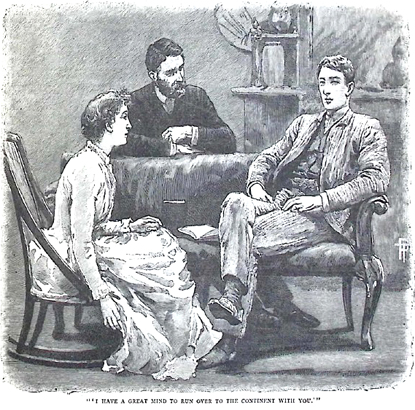
"I HAVE A GREAT MIND TO RUN OVER
TO THE CONTINENT WITH YOU."
"I tell you what, Carmichael," he said, presently, "I have a great mind to run over to the Continent with you, and see you comfortably settled in your mountain home."
My heart gave a bound of delight. If only he did this, the last shadow of anxiety would be lifted from my mind, for, unaccustomed to foreign travelling, I was fearful lest I should fail to take proper care of Edmund on the journey. I looked quickly at Ralph, and my eyes must have expressed the pleasure his words gave me, for he met my glance with a smile so full of meaning that I felt sure he understood me perfectly.
But Edmund at once began to protest against his friend's taking the trouble to accompany us.
"Dorothy and I are quite capable of taking care of each other," he said.
"You mean beggar!" ejaculated Dugdale. "Will you allow no one else to have the pleasure of seeing the mountains, or do you grudge me your sister's company? You know very well that my time is of little importance just now, since I am only reading in a desultory fashion, till I see more clearly what my future career should be."
So Edmund's mouth was stopped. When Ralph took his departure, I went dawn with him into the hall, for I wanted to thank him for his kindness to my brother. As we descended the stairs, he remembered a message from Grace—her love, and she hoped to come and see me in a day or two, since I had decided that it was impossible for me to go to Beechwood.
Ralph talked so briskly as he prepared to go that I could hardly say what I wished to him. He cut my thanks short by saying with one of his quick, keen glances, "Then you will not object to my company on the journey?"
"Oh, I shall be so glad of it! You will be the greatest comfort," I cried, eagerly.
Such a glad, bright look came into his eyes then. He had taken my hand, and he retained it in his for a few moments as he looked at me. Very pleasant was his face at that moment; I could not but be conscious of the pleasure that irradiated it.
I said to myself, "Here is a man whose greatest delight is in doing deeds of kindness."
When I returned to Edmund, he began warmly to extol his friend. Was there ever a more noble, generous-hearted fellow? There was not his equal in the world, either for goodness or cleverness, of that Edmund was certain. He would be in Parliament some day, and, if human merit ever met with its due reward, he would be made Prime Minister.
I could not help laughing a little at my brother's enthusiasm for his friend. This vexed Edmund. He was quickly irritated in these days.
"Of course you cannot appreciate him," he said, angrily; "I might have known that."
"Indeed, I do appreciate him," I said, rather warmly. "I have the highest esteem for Ralph Dugdale, and I am very glad for your sake that he talks of going with us to Switzerland."
"But you are not glad for your own sake," said Edmund. "You are like most women—you cannot appreciate true manly worth; you would prefer a curled and scented darling with no brains to speak of."
"Why, how you talk, Ted!" I exclaimed, laughing. "Pray, when have I shown any liking for curled and scented darlings? Happily, I have seldom met with such, and I cannot believe that they are as a rule popular with my sex. Take my word for it, there is no quality women more admire in men than true manliness. Do you suppose that the Arthur West, whom Grace mourns so faithfully, was a 'curled and scented darling?'"
What was there in my words to make Edmund start and look so annoyed?
"Certainly not," he said, constrainedly. "Mrs. West is utterly different from every other woman I have met with."
"Of course she is much better than most women," I replied. "She is coming to see me in a day or two, Ralph says."
Again a curious change passed over Edmund's face.
"Do you not like Grace?" I asked, rather anxiously. "You know you need not see her when she comes, if you would rather not."
"What extraordinary things you say, Dorothy!" exclaimed Edmund, frowning. "Could anyone know Mrs. West and not like her?"
I said no more, but, wondering at Edmund's odd humours, went off to find Mabel, and tell her of the plans we had made.
====================
"WHERE NATURE'S HEART BEATS STRONG AMID THE HILLS."
"RALPH, old fellow, this is fine indeed; this surpasses all in my expectations."
"Does it? That is well. I was afraid that my enthusiasm for this part of Switzerland might have led me to paint it to you in too glowing colours, and you might find the reality disappointing."
"Disappointing! Man alive, who could be disappointed with such a scene as this? Oh the delicious air! Is it not joy, Dotty, to be here? But you are hot and tired. I forget that you are not so free to enjoy it as I am."
"I enjoy it quite as much," I declared, as I threw myself panting on the soft, thymy turf by the wayside, where Edmund's bearers had deposited the "chaise à porteur" in which he was being carried up the mountain.
For more than an hour we had been climbing from Lauterbrunnen—a new experience to me, whose walking powers had hitherto been tested mainly on the level. But though the unusual strain was trying, I was very happy as I toiled along, learning from Ralph how to use my alpenstock to the best advantage. What delight can equal the rapture that comes with one's first vision of Swiss mountain scenery? Even the sad circumstances, the anxiety for my brother's health, which attended our coming to Switzerland, could not shadow my perfect gladness at this hour.
After ascending for a while through the delightful shade of pine woods, the path had led us on to a high, green plateau, overhanging the deep, narrow valley of Lauterbrunnen. It was well that the sturdy Swiss peasants, who carried Edmund as if he were no great burden, had here decided to make a halt, for a lovelier spot in which to rest can hardly be imagined.
To the left, on the other side of the deep gorge that marked the height of our ascent, we could see to perfection what Ruskin says is "the best image the world can give of Paradise, the slope of the meadows, orchards, and cornfields on the sides of a great Alp, with its purple rocks and eternal snows above."
The green slopes were dotted with brown châlets. Here and there, men and women were at work cutting the grass, and I saw a woman and a boy at work on a narrow, unguarded ledge overhanging a sheer precipice. It made me giddy to watch them, and I wondered how they could work in such a position; but doubtless familiarity had robbed them of all sense of peril. Behind us in the distance were huge mountain masses, with curiously sculptured summits rising sharp against the pale blue sky; beyond the undulating plateau was a ridge crowned with pine trees.
But the chief glory of the scene lay before, for there stood forth magnificent three giant peaks—the Jungfrau, with her bridal veil of snow, the Eiger, and the Mönch. Who can describe the beauty of that mountain chain? Not I, nor will I attempt it. Long we watched the changes every minute wrought on those glorious summits, now shining forth resplendent in sunlight, every buttress and ledge visible, and anon enveloped in billowy clouds.
"Well," said Edmund, at last, drawing a deep breath of satisfaction, "it is worth anything to see such a sight as this. If every hour of my life up to the present moment had been pain and misery, I think I should still rejoice that I had lived to enjoy the beauty of these mountains."
"Yes," I said, "such a day as this might well make amends for a thousand dark and sad days."
"My days are rather more numerous than that, Dottie, young as I appear," said Edmund, with one of his comical looks; "but I don't think I've had a thousand dark ones. I have little to complain of; my life has been an easy one, as human lives go. Anyhow, I'm glad I have lived. How can anyone pretend that it is a misfortune to be born, when we are born into such a world?"
"The sun, the moon, the stars, the
seas, the hills, and the plains!
Are not these, O soul, the vision of
Him who reigns?"
repeated Ralph Dugdale, in a low voice.
"Thank you, old fellow," said Edmund; "that was what I was wanting, though I could not myself have thought of anything so appropriate. That glorious dome of snow had already spoken to me of 'the great white throne,' and 'Him that sat thereon.' But here come the guides; do they want to be moving on?"
I turned to address the men, forgetting, as I had already forgotten more than once in the course of our journeying that my mother tongue was not understanded by the natives of this land.
"There is Dottie again anticipating the time when the sons of men shall speak one universal language," remarked Edmund; "clearly, she is of opinion that that language will be the English."
I laughed at my own absurdity. Ralph, who spoke German fluently, came to my assistance. "They say we must be moving on if we would reach our destination before the sun sets," he said. "Come, Edmund, I doubt not that 'in this moment there is life and food for future years,' as Wordsworth has it, but yet I think you will soon be glad of a less ethereal repast."
"You are horridly prosaic," returned Edmund; "but I will confess that this mountain air is beginning to awake in me the keen demands of appetite, and also that I fancy it is getting a wee bit chilly."
I hastened to wrap a plaid about him. The bearers picked up the chair, and marched on at a steady, quick pace. Ralph and I followed closely, and the two men, with our baggage strapped to their backs, brought up the rear.
As we proceeded thus, I was startled by hearing a noise as of thunder coming from the mountain before us. One deep, loud, cannon-like report, and then the sound seemed to roll from peak to peak, resounding in echo after echo.
"An avalanche!" cried Ralph, pointing in the direction whence the sound seemed to proceed.
"An avalanche!" I repeated, searching with my eyes the snowy mountain mass before me. "Oh, where? Do show me! I would give anything to see an avalanche."
"There, don't you see!" he cried, pointing with his alpenstock. "There it comes, pouring over that rock."
But so large was the surface to be scanned, and I expected something so much grander than appeared, that for some moments Ralph failed to make me see it. At last, I perceived what seemed like a column of smoke stealing down a precipitous slope, and then falling as a cataract from rock to rock.
"Is that an avalanche?" I cried, much disappointed. "Why it is nothing to see! And it is impossible that so slight a fall could make such a fearful noise."
"Poor Dottie!" laughed Edmund. "She speaks as if the illusion of a lifetime were gone."
"What you call a slight fall," said Ralph, "is in reality a huge mass composed of many tons of snow; it is the great distance which makes it appear so small. But don't be disappointed, Miss Carmichael, you will have many opportunities of seeing avalanches whilst you are amongst the mountains, and will no doubt get a nearer and grander view than you have had to-day."
"Dottie will not be satisfied unless she is well-nigh smothered by one," said Edmund. "I know she is longing to figure as a heroine in some perilous exploit. I hope you are prepared, Ralph, to take her up all the mountains in the neighbourhood."
"I shall be most happy," he replied. "We will begin with the Schilthorn; I shall be able to point it out to you in a few minutes, I think."
Whilst we talked thus, we were making rapid progress, for the way was now easy. We were treading a broad, terrace-like road skirting the Lauterbrunnen valley, into the depths of which we could peer. Across the valley rose a chain of snow-crested mountains, visible from base to summit. Superb amongst them could still be traced the Jungfrau and her attendants.
Another mile of such walking, and we reached the mountain hamlet at which we were to sojourn. It was a quaint little collection of châlets.
At the doors of many of them women were seated engaged in making a coarse kind of lace, some of which they entreated us to buy. There were châlets which had been converted into little shops chiefly stocked with specimens of Swiss carving, very pretty and tempting. One of these shops was the "bureau de poste."
Our arrival created quite a stir in the little place. Children came running from all quarters and thronged after us, some offering us little bunches of edelweiss, and others beseeching us to buy the first ripe strawberries they had found in the woods. Thus attended, we arrived at the hotel-pension Ralph had recommended, a large, wooden, deep-gabled house, with carved balconies, after the pretty Swiss fashion.
It was early in the season, so we had little difficulty in getting rooms to suit us. I was delighted with mine, though it was very small, for its windows opened on to a little balcony, commanding an exquisite view of the Jungfrau range. As the balcony was also accessible from Edmund's window, he would be able to share it with me. It was furnished with a tiny table and chairs, and I thought we should spend many a happy hour there with books or work, enjoying the lovely prospect, as, indeed, we did.
The interior of this mountain hotel was very quaint and homely. Walls, ceiling, furniture, everything was of pine wood. The bedrooms were small wooden compartments, not unlike the cabins of a ship; but snowy curtains and spotless coverlids gave them an attractive appearance. The "salle à manger" and the "salon" were equally plain, no carpets or luxuries of any kind, and no ornaments save some very droll prints framed and hanging on the walls, and glass vases on the tables filled with lovely mountain flowers. But what of that? We had the best possible luxuries, as Edmund remarked—pure ozone and magnificent views of snow-fields and glaciers.
How we all enjoyed the evening meal to which we presently sat down! It did my heart good to see Edmund evincing a genuine appetite once more. He was very tired, and soon after supper retired to rest. But Ralph and I sat for more than an hour upon the balcony outside the "salon," watching the sunset glow fade from the mountains till they lay cold and colourless, robed in the mysterious beauty of the night.
On the following day, Edmund was still suffering too much from the effects of the journey to attempt any walking, but we had beauty enough around us to enjoy, without going to seek it. Ralph surprised us by producing from his luggage a hammock, which he slung in a charming nook in the pine wood at the back of the house. Nothing could have suited Edmund better. Here he lay for hours drinking in the exquisite mountain air and enjoying the indescribable, changeful beauty of the snowy range which rose before his view on the other side of the Lauterbrunnen gorge.
"No one but you would have thought of such a thing, Dugdale," he said, referring to the hammock.
He might well say so. I have never known any man so thoughtful and kind in little things as Ralph Dugdale showed himself at this time. There was something almost womanly in the tenderness with which he waited on my brother and anticipated his wants. I might have been jealous of his devotion, but that he never suffered me for a moment to feel that I was not needed. He made no suggestion without either a mute or spoken appeal to me for my sanction, and many a confidential talk did we have with regard to our loved patient.
Ralph fell into the way of saying "Shall we do this?" or "Would it be well for us to do that?" as though we were one in our solicitude for Edmund.
I thought nothing of it till Edmund, one day, laughingly remarked, in response to some proposal of Ralph's prefaced with the words, "We have been thinking—"
"We! It is always we now. You and Dorothy seem to have joined hands, and made a solemn compact to deprive me of all freedom of action. It used to be Dottie and I who were we, but you have won her from her allegiance to me."
"What nonsense, Edmund!" I returned. "I am most submissive to you. We always let you have your own way; we only counsel and advise."
"We again," observed Edmund, mischievously.
I glanced laughingly at Ralph, but he looked away as though he could not meet my eyes, and to my surprise, I saw that he had flushed a deep crimson. What could it mean? A sudden thought made me turn first hot then cold. But no, it was impossible, it could not be that. Ralph and I were drawn together by our common love to Edmund, that was all; the idea of anything more was absurd. And whilst I thus reasoned with myself, Ralph began talking lightly to Edmund again, and the unwelcome idea passed from my mind.
It was pleasant to see the perfect friendship that existed between these two. Edmund seemed to lie under no weight of obligation. He accepted every kindness from Ralph as simply as it was given, knowing that it was his friend's delight to serve him. He uttered no effusive thanks; but his silent gratitude was the deeper and stronger that it found no expression. And words were unneeded, for Ralph understood what was his friend's heart towards him.
Once Edmund said to me, "Ralph has the joy of giving now; but if ever you or I have it in our power to contribute to his happiness, how gladly we shall do so!"
"Yes, indeed," I said; "but, Edmund, I think you do contribute as it is to Ralph Dugdale's happiness. You are very dear to him."
Edmund cast at me a quick, curious glance. He seemed about to say something, but checked himself and fell into a reverie, which must have been pleasant, judging by the smile that played upon his face.
For a fortnight Ralph remained with us ere engagements called him back to England. We had beautiful weather during that time, and made the most of every sunny hour. But by common consent, Ralph and I postponed the mountain expedition we had talked of, and took only walks in which Edmund could accompany us, either on foot or carried in a "chaise à porteur." He talked of trying to ride one of the strong mountain horses that were to be hired, but for the present, we persuaded him to be content with the humbler mode of conveyance, as being less fatiguing. He was still very weak, though he showed signs of improvement which I eagerly noticed.
Ralph left us on a Monday. The Sunday preceding it is a day I can never forget. Edmund was well enough to go to the afternoon service in the English church, a little wooden building standing on a slight eminence beyond the village. The interior was simple almost to roughness; but as we sat on the plain deal benches, we could see through the side-windows the magnificent ranges of mountains that encircled us. The service was such as suited our surroundings. We sang:—
"For the beauty of the earth
For the beauty of the skies,"
and
"Our God, we thank Thee, who hast
made
The earth so bright—"
And never, I think, were hymns sung more feelingly, for life seemed so fair, and God's love so near and precious, amidst the glorious beauty of that Alpine retreat. The sermon, too, simple but forcible, was such as made one think.
The preacher was an English clergyman, sojourning amidst the mountains for the benefit of his health. He was an old man with silvered hair and a serene, sweet expression, accompanied by tokens of rare intellectual power. His subject was the parable of the Pounds. I can little of what he said, but the impression produced by his earnest pleading that we should consider our life as a sum of money entrusted to us by God, not to be squandered upon self, but to be used for His glory and the good of others, a trust of which we must one day give an account before the bar of Eternal Justice, has remained with me.
"That was the right sort of sermon," said Ralph Dugdale, as we passed out of church into the bright sunlight, and took our way down the winding mountain path. "If preachers would only believe it, they might do infinitely more good by showing the solemnity of life and the irreparable loss incurred by its misuse, than by continually harping upon its uncertain duration and the certainty of death. Whether our lives be long or short, as men count age, it is certain that they will be but too brief for the work we have to do in them."
"True, indeed," said Edmund; "I can tell you that nothing makes one more conscious of the shortness and preciousness of life than to be brought face to face with the possibility that the end is drawing near. You cannot think how short my life seems to me now as I look back upon it. If I could have the time over again, I would use it to better advantage, God helping me."
"Oh, Edmund, don't talk so," I cried, with a thrill of fear; "you speak as if you were old and—there must be many years before you yet, plenty of time to work in."
"There may be more years, Dottie," he said, in tones that pierced my heart; "God only knows; I dare not count on much time."
"It is only the present that any of us can call our own," observed Ralph; "we must work while it is called to-day, making the most of every golden opportunity, since we know not how soon the night may fall."
"Ay," said Edmund, "if one would not be found at the last like the servant who laid up his pound in a napkin. Can there be sorer regret than one would feel who had to look back at the end upon a life all wasted, with its glorious opportunities passed beyond recall?"
I was miserable as Edmund spoke thus. I believed that he was daily growing stronger, and it shocked and grieved me to hear him speak as though his early death were more than a mere possibility, for till lately he had seemed so hopeful of regaining strength. But it was not this only which made me uneasy. Already a feeling of dissatisfaction with self had been stirred within me. I could not be daily in the company of Edmund and his friend without feeling how much higher and nobler were their aims in life than my own. How foolish and trivial were the impulses that moved me, how narrow and selfish my life! A few persons I loved with a passionate, exacting intensity; but of the love of humanity of which they often spoke, I knew nothing; I had no conception of living to do the will of God and to bless others. I was always making mistakes and suffering keen remorse; but experience did not make me any wiser, and I supposed I should go blundering on to the end.
"What are you thinking of, Dottie?" asked Edmund, turning upon me a gentle, inquiring glance.
"I hardly know," I began, in some confusion, "but it seems to me rather hard that life should be so short; we have hardly time to learn how to live ere our life over—at least, I am sure it will be so with me at the rate I am going on."
They laughed a little at my desperate view of my own case.
"We do blunder sadly," Ralph said, "but it always comforts me to remember, as Mrs. Browning says, that 'God's greatness flows around our incompleteness, round our restlessness His rest.' And there is rest and strength and victory for us through the One Perfect Life."
No more was said of so grave a nature. Edmund sat down to rest on a bench by the wayside. I wandered to the edge of the path and began gathering some of the dainty blue harebells which grew there, and had a home-like attraction for me, since such flowers flourished in the neighbourhood of Burford. Ralph joined me, and proposed to take me a few yards down the mountain slope to a point of view commanding an exceptionally lovely prospect. I acceded willingly, and we followed a sharp and narrow zig-zag, not more than a foot in width, which led us round the head of a deep gorge. Suddenly, at a sharp angle, where the path broke off and the green slope shelved steeply down, Ralph checked me.
"Now look," he said, and turning in the direction he indicated, I saw what appeared to my unaccustomed eyes like a vision of fairyland.
Below, one mountain shoulder meeting another, lay slope after slope of emerald green, here fringed by pine trees, and there dotted with châlets, or with cattle peacefully browsing. Whilst far, far beneath appeared the rocky defile of Lauterbrunnen, forked by another, greener valley, through which a mountain torrent took its way.
To the right, its mouth opening not two feet from where we stood, was the deep, gloomy gorge resounding with the roar of a cataract. Ralph led me so near that I could look down into its awful depths, from which rose the dark pinnacles of pines. It looked to me bottomless, and I shrank back shuddering and involuntarily clung to Ralph. He grasped my hand tightly with a reassuring smile; then leaning forward, he threw a stone straight down into the abyss. We listened and heard it strike point after point far below us ere its motion ceased.
"What an awful place!" I said, thankful to turn away, for to me there is a horrible fascination in such weird grandeur, and my admiration of its beauty is ever mingled with dread. "I am glad to have seen it, but I hardly dare come here alone."
"I would rather you did not," he said, still holding my hand as we retraced our steps. "In truth, it was partly that you might not be tempted to come here alone when I am gone that I brought you here to-day. A slip on this narrow, unguarded path would be perilous indeed."
"Thank you for your care of me," I replied. "Then you really mean to leave us to-morrow?"
"I must," he said, reluctantly.
"I am very sorry," I said, frankly; "we shall miss you dreadfully."
"I must return now," he said, slowly; "but I am thinking that perhaps, in the autumn, if you were still here, I might join you again for a little time. My people talk of coming to Switzerland in September."
"Oh, that would be delightful!" I exclaimed; "do come if you possibly can."
"I will," he said, earnestly, "since you wish it."
Something in his manner as he said this startled me and made me feel that I was speaking heedlessly. His voice, his look, his whole demeanour at that moment strangely reminded me of Leonard Glynne—as he had been in those days which I was trying to forget, but had not yet forgotten. I grew hot and tremulous as I observed this resemblance. I wanted to say something to correct any false impression my previous words might have made. I wished to explain that for Edmund's sake, I should be glad if his friend could join us. But this was not easy, and whilst I hesitated for words, we gained the top of the zig-zag, and at its junction with the main path found Edmund awaiting us.
REVELATIONS.

"IS it not time the post should arrive, Dorothy?"
"Almost," I replied, rising from my chair, and leaning over the
balustrade of the balcony that I might gaze as far as possible along
the road to Lauterbrunnen, "but I do not see her yet."
The feminine pronoun I thus vaguely employed referred, as Edmund knew,
to the girl who usually appeared at this hour with a huge letter bag
strapped to her back, and sundry small packages depending therefrom, or
carried in her hands, as she found most convenient.
We were on the balcony, Edmund and I, he reclining in a long, deep, easy chair. As moved back to my place at the little table, my eyes fell on my brother, and I perceived, with a thrill of pain, how very white and worn he was looking in the clear, bright light of the morning. How hollow were his cheeks, how sharpened his features; what a sad pathetic look there was in his sunken eyes! Was it my fancy, or had his face wasted rapidly during the past week? Alas! Alas! I feared it was no fancy; there were too many tokens that my brother's strength was declining.
It was now September, and for ten weeks we had enjoyed the beauty of this lovely retreat. In that time we had become well acquainted with the mountain forms on which we daily looked. Every buttress and pinnacle of the snowy range was familiar to us, and we loved them under all aspects, whether shining forth in the clear light of early morning, or dimly seen through a veil of mist, or rising from a sea of billowy clouds, or when their summits were gilded with the ineffable glory of the sunset afterglow. We had learnt to love the clouds, which wrought such weird, fantastic, wonderful effects, scarcely less than the mountains.
How lovely it was to watch in the morning, ere yet the sun had gained much power, the ghost-like mist stealing up the valley till it wrapped itself as a winding sheet about the sides of the mountains, and then to see, as the sun rose above the highest peak, how the mist shrank away, and dispersed in broken wreaths! Or to mark the devotion with which a fleecy cloudlet would woo some lordly peak, now nestling close to its side, and anon timidly retreating, floating higher, and brooding over the object of its love, fading, then gathering anew, constant to the last moment of its brief existence. Or, when night fell, to watch, as the moon slowly rose behind the mountain wall, some bird-like cloud hovering above, illumined by its rising beams, and growing ever more luminous, till the bright disc glided into sight, and the mystery was at an end.
Edmund enjoyed these visions, as few can enjoy them. They fired his imagination, and set his poetic fancy in play. He was so happy during the first few weeks of our stay that I could not but be happy too. We met with pleasant people in the pension, and often had a merry party about us as we wandered through the pine woods, or rested in shade of the trees. I do not know when I first perceived that my brother was not making the progress I had expected. A marked improvement seemed to set in after our arrival at the pension, but, unhappily, it was only a temporary improvement. Soon, my brother's strength once more declined.
There was not much change from day to day, but gradually Edmund's walks grew shorter and shorter; he ceased to speak of the longer excursions we should take when he was strong enough, and at last, grew too languid to climb the green slopes to the pine woods at the back of the house, and preferred to pass the day resting in his chair on the balcony if the day were warm, or lying, wrapped in rugs, on the couch in his room when the air was keen. And the wearying cough, which had never entirely ceased, became more and more troublesome. Heavy grew my heart beneath the weight of these bitter facts, but still I clung to hope. I could not, I would not, acknowledge that the hopes with which I had started on my journey to Switzerland were doomed to disappointment.
"Edmund," I said now, as I bent to draw his wraps more closely about him, "I think that if Ralph Dugdale does not soon appear, we had better leave this place. It is getting too cold for you to remain at such a height. The air this morning was a trifle too keen, even for me, and it has an edge to it still, although the sun is so warm."
"I do not think the cold hurts me as long as the air is so dry," he replied, "and we shall surely hear from Ralph in a day or two."
I went back to my place, and began to read to Edmund a new poem with which I was delighted. It has since become well-known, and a favourite with many readers.
"She was not as pretty as women I know,
And yet all your best, made of sunshine and snow,
Drop to shade, melt to nought, in the long-trodden ways,
While she's still remembered on warm and cold days—
My Kate.
"Her air had a meaning, her movements a grace;
You turned from the fairest to gaze on her face,
And when you had once seen her forehead and mouth,
You saw as distinctly her soul and her truth—
My Kate.
"Such a blue inner light from her eyelids outbroke,
You looked at her silence, and fancied she spoke;
When she did, so peculiar yet soft was the tone,
Though the loudest spoke also, you heard her alone—
My Kate."
When I had read these three verses, I paused, and turning, to my brother asked, "Does that remind you of anyone?"
"Yes," he answered, without a moment's hesitation.
"Of whom?"
"Tell me first of whom you are thinking," he returned.
"Oh, I was thinking of Grace West. This poem exactly describes her."
"Yes," said Edmund, quietly; "I, too, thought of Mrs. West."
"Dear me! How strange that we should think of the same person!"
"Not at all strange. We could but think of the same. Where would you find another woman like Mrs. West?"
I made no reply, not because I did not share my brother's high estimate of our friend; but I was wondering at the abrupt, constrained manner in which he spoke.
At that moment I heard someone tapping at my bedroom door. Stepping into my room, I hastened to open the door.
"Letters, mademoiselle."
It was the Swiss chambermaid, and she smiled as she gave me the letters, knowing how welcome they would be. There were two, and both were for me. As I carried them to the balcony, I was conscious only that one was from Mrs. Lyell.
"No letter from Ralph?" asked Edmund, turning to me with an anxious glance.
I shook my head. My mind was too preoccupied to think of offering him consolation. As I sat down and began to open Mrs. Lyell's letter, the other letter fell unheeded on my lap, the address upwards.
Mrs. Lyell's letter was very kind, as her letters always were. It showed no diminution of the affectionate interest she took in me, and yet there was that in the letter which stung me. Did Mrs. Lyell really think it would please me to know that Rose Carsdale—for thus Mrs. Lyell now spoke of her—was so kind and attentive, and that she and Leonard came in almost every day? Yes, I could not doubt my old friend's sincerity; but oh! how bitter to me was the thought that those three, Mrs. Lyell, Miss Carsdale, and Leonard, were always together! Too well I knew what a quiet, unobtrusive third person Mrs. Lyell could be; how she would sit absorbed in her book or thinking her gentle thoughts, and hear nothing that others said in her presence, except when it was especially addressed to her.
Dark and bitter grew my spirit as I read over and over again the words of the letter, making the most of every suggestion that could feed my jealousy. For I had not been able to forget Leonard Glynne. How could I, in a life that afforded so much leisure for dreaming, with no active duties save the simple services Edmund required at my hand? It was harder to forget him here than it had been at Ventnor, for he had talked to me much of his experiences when travelling in Switzerland, and every day some novel incident of our Swiss life, some fern or flower, would remind me of his words.
"Your letter seems to be very interesting." Edmund's voice thus roused me from my unhappy meditations.
I coloured as I awoke to the consciousness that he had been watching me intently for some minutes. There was a shadow on his brow as he spoke. He seemed vexed with me for caring so much about the letter.
"Yes, it is interesting," I answered; "it is from Mrs. Lyell, and she, of course, has a good deal to tell me that I care to hear."
"You cannot care much about your other correspondent," he said, in a tone that betrayed some irritation, "since you can read an old woman's letter two or three times before you take a glance at hers."
"Hers! Whose?" I asked, looking at the letter that lay in my lap. "Oh, it is from Grace West!" I added, as recognised the small, delicate writing, clear as copperplate. "Did you see that it was from her?"
"I-I fancied it looked like her writing," he said, rather falteringly.
"Why, she is at Interlaken!" I exclaimed, as I began to read the letter. "They are all there, Mr. and Mrs. Dugdale, and Ralph too. Ralph is coming on here to-morrow. There's good news for you."
But my brother did not look so pleased as I expected. He did not smile, nor even turn towards me; he sat with downcast eyes, his face very pale. Instinctively, I felt that he was putting some restraint on himself.
"Is Ralph coming alone?" he asked, very quietly.
"Oh, yes, I suppose so. Grace says nothing of anyone else coming. Did you think that she might accompany him?"
"Well, yes, I fancied that she might like to see this place."
I discerned that it cost my brother an effort to answer my question with an appearance of indifference.
"I wish she would come," I remarked; "but Grace and her parents are going on to Grindelwald. It is a favourite place of Mrs. Dugdale's. She says it would be nice if we could meet there. Would you like it, Edmund?"
The faint glow which instantly kindled in his cheeks gave me a truer answer than his careless, "Perhaps; we must think about it."
Then the truth flashed on me. There was little to demonstrate it; Edmund had guarded well his secret, yet at that moment I knew intuitively that Grace West was to him what Leonard Glynne was to me. Stay, let me speak the truth as I know it now—my brother loved Grace with a pure, strong, selfless love of which I was incapable.
I recognised the fact beyond all doubt. One memory after another revived to confirm it, till I wondered that I had been blind to it so long. Grace was some years older than my brother, but that was no hindrance to his loving her. He was the man to be attracted by a woman's spiritual rather than physical beauties. He had a high ideal of womanly excellence, and the woman he chose must be one whom he could reverence as well as admire. How could he help loving her? I say to myself now. "We needs must love the highest when we see it." And all who could really understand Grace, not everyone could, failed not to love and honour her.
But I was hardly conscious of loving Grace at that moment. The truth came home to me with a sharp and selfish pain. All my latent jealousy was roused. Amidst my trials and disappointments, I had ever consoled myself with the thought that my brother at least was all my own. He needed me if no other did; I was everything to him. What a blow shattered this belief when I discovered that another had the first place in his heart! Grace West stood between us.
I cared not whether Edmund noticed how abruptly I left him. It was not yet time to prepare for the midday meal, but I went away and shut myself in my own room till the bell sounded.
Edmund did not call me back.
"He will not miss me," I thought, "he will like to sit alone and think of Grace, and count on seeing her at Grindelwald."
After luncheon, Edmund lay down for a while, hoping to get a little sleep. Unhappy and restless, I wandered forth alone, carefully avoiding the company of any of the ladies who were lodging in the pension.
Instinctively I chose the easier, the downward way, and descended one of the steep little paths that ran down the mountain side into a little valley lying between the mountains to the right of our pension. It was a pleasant path I followed, and soon led me into the shade of pine trees. Steeper and steeper grew the way as I drew nearer to the torrent that roared through the valley, being fed by a glacier at its head. Gradually my walking was exchanged for climbing; but by the help of my alpenstock, I was able to press on, scrambling through bushes and over boulders till at last I gained the high bank above the stream.
Here I found myself in a wilderness of lovely things, old moss-grown trees about whose roots the fragile oak-fern and sturdier beech-fern were growing luxuriously; patches of ground on which the low whortleberry bush grew thickly, tempting me with a profusion of its purple black fruit; a few wild strawberries lingering here and there, finer and redder than any I had seen before; brambles throwing their amber and vermilion-coloured leaves across the path, and scattered everywhere flowers of the loveliest and most varied hues—large, silvery thistles, grand enough to deck a queen, purple gentians, turquoise-blue forget-me-nots that would put our English ones to shame, with blue and white campanulas, as fine as any a garden could show.
Wild, angry, rebellious thoughts had been working in my mind as I made my way down. It was very hard, I told myself, that I should be robbed of all that was most dear to me in life. One precious love after another had been taken from me. Howard Steinthorpe had supplanted me in my sister's affections, death had deprived me of my father, Rose Carsdale was filling my place with Mrs. Lyell, and charming Leonard Glynne into forgetfulness of any faint interest he might have felt in me, and now Edmund, whom I had believed to be my very own, in whose life I could yesterday have declared that I stood first, had given his best love to another! How wronged and wretched I felt! There seemed no longer any place for me in the world. No one loved me best; no one wanted me. My feelings were none the less bitter that I knew them to be utterly unreasonable.
There was within me a dim consciousness that when my mental emotion should subside, my better self would reproach me. For had not Edmund as much right to feel injured as I? What if he craved the first place in my heart, could I honestly say that it was his? How many hours of the past had been filled with thoughts of another! And how often even now did the image of that other cross my mind!
Only gradually, however, did these considerations bring me to a better frame of mind. I was still possessed by perverse, angry imaginations as I strolled amidst the greenness and beauty by the riverside, though nature's sweet influences were beginning to soften my mood.
Presently I came to a woodcutter's shed beneath the pines, and seated myself on one of the felled trunks that lay beside it. It was a lovely spot. A few feet below where I sat rushed the torrent, foaming and dashing over the stones with a roar which was delightful to my ears. On the opposite side of the deep gorge, through which the river cut its way, rose tall pine trees, tapering one above the other, till at a vast height their delicate pinnacles were pencilled against the sky. Here and there a bare, precipitous mountain side showed through their sombre foliage, with other tiny firs fringing its summit.
The sun was shining brilliantly on the stream, but beneath the pines there was welcome shade, and a deliciously cool breeze blew from the mountain heights, odorous with the delightful perfume of the pines. The woodcutter's shed was deserted, and I enjoyed perfect solitude, broken only by those voices of nature, which, as Keble truly says,—
"Make deep silence in the heart,
For thought to do her part."
In that stillness, I experienced a swift reaction of feeling. My proud sense of injury gave place to shame and contrition.
I was heartily ashamed of my outburst of temper; I despised myself for the mean, selfish feelings of which it was the outcome. As I thought of Edmund now, my heart throbbed with emotion of another kind. To think that self-love should have made me oblivious of all that this discovery I had made, meant for him. Poor Edmund, whose life was so uncertain! My own experience taught me that this love of his must cause him much silent suffering. It would have done so probably in any case, but his circumstances were such as would intensify the suffering.
Had he not been the invalid he was, had his position been such as would justify his seeking Grace's love, I could not believe that he would win it. From what I had seen of her, and from a few words she had once said to me, I felt convinced that Grace was one of those with whom to love once was to love for ever, and that she would not tolerate the idea of a second marriage. But what of that?
Alas! Alas! I could not hide from myself the truth. Too surely my heart told me that there could be no such union for Edmund. He was drifting, drifting away from all the loves of earth. And in the presence of that sore fact, what did it matter whether Grace or I were the dearest to him? With the thought came a shower of blinding tears, shutting out all the beauty that surrounded me.
The tears soon passed. Something prompted me to lift my head, and look around. Then I saw a glorious sight. From above the mass of dark pines, which lay behind, looked down on me a mighty, snow-crested peak, shining in purest radiance against a cloudless sky. It was the Jungfrau, of which I caught a side view, and peeping over her shoulder as it were, appeared the unsullied, resplendent dome of the Silberhorn.
Wonderful seemed the vision that broke so suddenly on my view. It had for me the force of a revelation—a revelation of the majesty and holiness of God, and my own utter vileness and meanness. What could I do but cry unto Him who made me and made also the magnificence I beheld?
"Oh, Thou who art all purity, power, love," my heart cried, "have
mercy on me, Thy unworthy creature; deliver me from my low, mean,
selfish feelings, the feelings which I know to be hateful, even whilst
I cherish them. Lift me out of myself. Raise me to a higher, purer,
nobler life. Make of me something better than I am."
I waited, yearning for some response, some whisper from above that should promise deliverance. As I watched, the clouds slowly drifted again across the snowy mountain, and its glory vanished from my sight.
The wind rustled the pines, the torrent roared, the foaming water gleamed in the sunshine; all was as before. Yet was my prayer heard, for no such prayer is vain.
When I rose and took my way back to the pension by an easier path than the one I had descended, my heart was quiet, my selfish cravings had ceased.
As I approached the house, there came into sight on the path which ascended on the other side of it, a traveller, attended by a peasant carrying luggage. The gentleman's appearance seemed familiar, and at the second glance, I recognised Ralph Dugdale.
Apparently, he saw me at the same moment, and we hurried forward to greet each other.
"I am so glad you have come," I said, warmly, as we shook hands; "Edmund will be so pleased. We did not expect you till to-morrow."
"Why, how is that? Did not Grace tell you?"
"Yes, but she said to-morrow."
"I expect her to-morrow meant to-day," said Ralph, smiling.
"Oh, to be sure! How stupid of me to make such a mistake! And I misled Edmund too! But come in."
"First, tell me how your brother is," said Ralph, pausing on the threshold of the house. "Has he been getting on as you hoped?"
The question, put with evident anxiety, overwhelmed me. Tears rose to my eyes, my lips quivered; for a moment I could not speak.
Then I said, falteringly, "You will see for yourself."
He looked at me, his eyes full of grave, sad comprehension, and asked no more. We went indoors.
A FAIR, GLAD DAY,
AND THE NIGHT THAT FOLLOWED IT.
IT was strange how summer came back to us with Ralph Dugdale's arrival. There were a few days of brilliant sunshine, the chilliness vanished from the air, and we were not conscious of the touch of frost which had begun to make itself felt at night and morning. And not less signal was the sudden revival of strength and spirits which Edmund manifested. Was it merely caused by the excitement incident to the coming of his friend and the pleasure with which he was looking forward to going to Grindelwald at the beginning of the next week, as Ralph had persuaded us to do?
My heart refused to believe that it was only a temporary improvement and hope began to fortify itself anew. I forgot the shocked, grieved expression I had caught for an instant on Ralph's face as he first saw Edmund after the lapse of several weeks. Edmund was once more sanguine of recovery, and he infected me with his own hopefulness.
"I think I have taken a turn for the better at last; there is more of life before me yet, thank God," he said, one day. "Do you know I woke this morning with the words ringing in my ears, 'I shall not die, but live and declare the works of the Lord.' I took it as a token that my days were to be prolonged. Ah, you cannot know how fair God's world looks to me now! One needs to be brought low to know the joys of life."
As he spoke thus, Edmund was lying amongst cushions and rugs on the soft turf of a little upland glade, into which the midday sun was pouring its warmest rays. It had been his own proposal that we should come and make a picnic luncheon there. Sturdy bearers had carried him to this spot through the lovely pinewood from which it opened. A small, impetuous stream, dashing with many a turn and twist through the gully it had formed for itself, separated us from this wood, but we could look across at the tall, stately pines and see, spreading amidst their bare, slender trunks, a perfect forest of ferns, their graceful, delicate fronds growing with a luxuriance and attaining to a height which to our English eyes appeared marvellous.
The stream went down into a green valley, dotted with wood châlets. Seen through a vista of pines, it looked one of the fairest and most peaceful spots on earth. Beyond the trees, shutting in the valley, rose a rugged, purplish-grey mountain wall, its curves and rents clearly defined against a sky of pale blue. Behind us, at the head of the glade, stool a similar mountain ridge, so the spot we had chosen for our picnic was well screened from chill breezes had the day been less warm and bright than it was. The atmosphere was singularly free from cloud or haze, and in the clear light everything, both near and distant, looked so lovely that it was no wonder my brother should rejoice in the hope of continuing in so beautiful a world.
"Dear Edmund," I said, pressing closer to him and taking his long, thin hand in mine, "I am so glad, so thankful that you feel better. Yes, dear, I really do believe that you are on the way to get well at last. Grindelwald will do great things for you. Mr. Dugdale has been telling me how fine the air is and how many doctors send their patients there."
Ralph was within a stone's throw of us. He was keeping watch over a fire of chips and fir cones which he had kindled in the shelter of a rock, and on which he was trying to boil a kettle of water that Edmund might have the cup of tea he had expressed a desire for.
Perhaps it was because he was absorbed in his undertaking that he took no notice of Edmund's or my words. Yet his silence made me uneasy; and later on, when I had brewed the tea and we were taking our luncheon in rough and ready style, I caught him gazing at Edmund with a sad, wistful glance, which told me he did not share the hopes we had expressed. That look, which I am sure he did not mean me to see, cast a cloud upon my enjoyment. I was vexed with him for the doubt it suggested. In my impatience I wanted to argue it away.
By-and-by, when I was wandering along the rugged, turfy slopes by the little stream, and making my dessert of the whortleberries that grew upon them, Ralph joined me, bringing a little sprig of the Alpine rose which he had discovered in some nook—a rare prize, for the blossoming time of this mountain shrub was long past.
"The last Alpine rose of summer," he said, with a smile as he gave it to me.
He little guessed how his words annoyed me. Vividly they brought to mind the autumn day when I had refused the rose Leonard offered me with words like these. I felt constrained to accept the little sprig, but as I placed it in my belt, I would far rather have flung it from me as Leonard did that rose.
"Is it not delightful to see Edmund so much better?" I said. "I feel sure that he will recover now."
Ralph did not at once reply. Instead, he cast upon me a troubled, anxious glance.
"Surely you must agree with me," I added; "there can be no doubt that he is very much better."
"Certainly he is somewhat stronger," he said, slowly, "and it is clear that he feels better; but—but—dear Miss Carmichael, you must not be too confident. I would not willingly take from you any hope that gives you comfort, but—I have seen others suffer as Edmund suffers, and I know what fluctuations there are in that disease."
Too well I knew the truth of his words. Was I not fighting with fear, even whilst I hoped? But just then it was almost more than I could bear to hear the truth.
"Oh, don't," I said, imploringly, "don't take away my hope! You say you would not rob me of my comfort, and then you sweep it all away. Think what my life would be if Edmund were taken from me: I should have no one to live for, no one to love me. I should only long to die too."
"You must not say so," he said, looking greatly distressed. "I understand how you feel, but your life has many noble possibilities, and it can never lack love. I could tell you—"
He checked himself suddenly. There was a look in his eyes that frightened me.
After a moment, he said more quickly, but still with deep emotion in his tones, "Forgive me if my words seemed unkind. Surely you must know that not for the world would I give you the least pain if I could help it."
I murmured something, I scarce knew what, and turned hastily to rejoin my brother. The new fear which had penetrated me kept me close to Edmund's side, and made me shun quiet talk with Ralph during the remainder of the day.
Memory would fain dwell on the sunlit hours we passed in that lovely mountain nook. So bright, so happy they seem in contrast to the terror, disappointment, and anguish which too swiftly followed. The day stands out now before my mind like a spot of heaven's purest blue, encircled by darkest storm-clouds. I am loth to tell of what ensued; but I must.
Much as my brother had enjoyed our picnic, it had wearied him, and soon after our return to the pension, he was glad to retire to rest.
I sat all the evening by his bedside, and when I bade him good-night, he said in tones full of meaning, "What a pleasant day it has been! We are much happier, you and I, Dottie, for Ralph's coming."
"Yes," I responded with some uneasiness; "he is very good and kind. I am glad for your sake that he is here."
"And for your own sake too, I should think," he returned, hastily; "you and he get on so well together. Perhaps I ought not to speak of it, but—but—I cannot help seeing how highly he thinks of you, and—how much you are to him."
"Indeed, indeed, you make a great mistake," I exclaimed, feeling a hot flush mount to my forehead as I spoke; "it is impossible that he can think highly of me—and—if he did—"
"Well!" said my brother, smiling as I paused.
But I was silent.
"It is not impossible," said Edmund, earnestly, "I can say that I know—" But there, he checked himself.
After a minute, he said with a change of manner, "It is foolish of me perhaps to speak of this; but if what I have hinted should come to pass, surely, surely, Dorothy, nothing would lead you to reject all that Ralph could offer you. You must appreciate him better than that. Where would you find his equal?"
"Nowhere," I answered humbly; "I know well how good and noble he is. But his very goodness makes it impossible that—that—what you imagine could ever be. You know what I am, Edmund."
"Nonsense," he said, quickly, "I know what you mean. You have your faults, of course, but you would grow up to him. His strong, moulding influence would make of you a noble woman."
I shivered with nervous excitement as he spoke.
"I wish you would not speak so," I said imploringly; "you do not know how it distresses me."
"Oh, I daresay I am blundering sadly in speaking of this at all; but, Dorothy, in my circumstances I may be pardoned for not standing on ceremony with you. I have thought of it so often during hours of sleeplessness. It has made me happy to fancy that you and Ralph and Grace might belong to each other, if I were taken from you. Your happiness is dear to me, Dottie, although I may sometimes have seemed indifferent to it."
"That you never have," I sobbed, unable to maintain self-control amid the tumult of conflicting emotions that wrought in my heart; "you have always been the best, the most tender of brothers. But, oh! I wish you had not taken this idea into your mind."
"Do you?" he said, smiling half incredulously. "I think you hardly know what you are saying now, sister, mine. Forgive me for worrying you. I will not speak of this again, only promise me that you will not lightly throw away such a prospect of happiness as seems to me to be before you."
"Yes, I can promise you that," I said.
Then I kissed him and went to my own room.
I do not suppose that Edmund had the least idea how his words would trouble me. Doubtless, he imputed my agitation to some girlish, hysterical emotion, which would pass as quickly as it rose. How could he understand me when I could hardly understand myself?
He had suggested no new thought to me. In justice to myself, I must say that the foolish vanity which leads some girls to look upon every man of their acquaintance as a possible lover, had never been mine.
Yet, before to-day the fear had struck me that Ralph Dugdale was beginning to care for me otherwise than as a friend, and this morning an indefinable something in his looks and tones as he talked to me had confirmed this fear. The discovery could not have been more unwelcome, and now I was filled with dismay to think that Edmund had perceived the truth, and had set his heart upon a consummation from which I shrank in dread.
After I reached my room, I sat long at the window, gazing at the mountains as they appeared pale and shadowy in the dim light of night, and pondering the situation in which I found myself. Nay, pondering is not the word to use. I could hardly be said to be thinking; my mind was almost passive, whilst my imagination cast on it as on a camera, all kinds of pictures, in which my past, present and future mingled in strangest combinations.
But the excitement of mind which produces such effects is as exhausting as hard thinking, and I did not seek in prayer the calmness that comes from submitting ourselves to the Lord and asking His guidance in hours of perplexity. My head ached, and I felt faint and weary when at last, almost on the stroke of twelve, I lay down to rest. I did not expect to sleep, but sleep after a time came to me, though it was no deep, dreamless slumber.
In my sleep, I was transported from Switzerland, and found myself amidst gay company in a brightly-lighted English drawing-room. Perhaps I was at The Towers, but I had no distinct consciousness of my whereabouts. Mabel was present, resplendent in yellow satin, accompanied by her husband, and she was chiding me for appearing in my old, well-worn travelling gown, with my feet encased in bedroom slippers of scarlet wool. It was not respectful to Mrs. Glynne, she said, and I puzzled myself to think who Mrs. Glynne could be. Everyone but me was gaily attired, and I felt much ashamed of myself, and tried to slink into a corner. But Grace West came to me, dressed all in white, with roses scattered about her, "in honour of the bride," she said, and insisted on drawing me into the middle of the room. I kept asking what bride? But could get no answer till Rose Carsdale stood in the midst of us with a funny little fur cap on her head, and I knew that she was the bride. I looked, expecting to see Leonard Glynne by her side; but, to my mingled relief and wonder, I perceived that her hand lay on the arm of an odd, wizened, little man, whom I recognised as the dancing master who had instructed Miss Carefull's pupils. How bright the room was! Everywhere on the walls gleamed tall wax candles. As I watched them, they began to sway forward and to fall. There was a sudden blaze, followed by wild cries of fire, fire! as everyone began to rush about in terror.
Then the whole phantasmagoria vanished; yet still the cries went on. I became aware of a curious, crackling sound, and at the same time conscious of a terrible sense of heat and suffocation. In unutterable horror, I awoke to the fact that the fire of which I had dreamed was an awful reality, and it behoved me to heed the shouts of warning and cries of terror that resounded both without and within the hotel. Half-stupefied, I sprang from my bed. Instinctively I threw on my dressing-gown and thrust my feet into the very bedroom slippers which had been such an annoyance to me in my dream. The floor was hot to my foot as I touched it, and the awful glare beneath the window warned that I had not a moment to lose.
What of Edmund! Was he alive to his danger? I rushed to the door, on way to call Edmund; but when I opened it, such a suffocating cloud of smoke rolled towards me that I staggered back, closing it in desperation.
I had seen the flames leaping up the staircase and spreading along the corridor. It was impossible to get to Edmund that way. Now, had I thought, there was a door in my room which opened into that of Edmund's; but it was behind my bed, and as I had never opened it, I did not think to do so now. Instead, I flew to the window and sprang on to the balcony, calling my brother loudly as I did so.
A crowd of persons had gathered outside the house, and they saw me and shouted at my appearance. But I heeded them not; I was intent on getting to Edmund. The heat on the balcony was intense, for already flames were licking round the balustrades.
I gained Edmund's window. It was but slightly closed, and I managed to push it open from outside. I climbed into the room. It was full of smoke, and I could distinguish nothing. Pressing my dressing-gown over my mouth and nostrils, I struggled through and reached the side of the bed. I could not see, but I felt that it was empty. I remember passing my hands up and down the mattress; but I remember no more of what happened. The stifling atmosphere overpowered me, and I fell.
====================
MY BROTHER LEAVES ME.
HOW long I remained unconscious I know not. When I awoke, the grey light of early morning was about me, and I was lying on a rude couch beneath the low rafters of one of the châlets which surrounded the hotel. Bending over me was a lady whose appearance puzzled me. It was familiar, but I could not at once identify it, Presently I recognised her as the wife of the English clergyman who was staying in the pension. With that recognition the terrible event of the night flashed upon my mind.
"Where am I?" I cried, striving to rise, only to find that my exhausted frame refused to respond to my will. "Oh, tell me about the fire and Edmund—where is Edmund?"
"Your brother is safe, and close at hand. You must not trouble about him. He is uninjured and only suffering from the effects of the shock, and the sudden exposure to the night air."
Only suffering from these! Alas, I knew well that their consequences to my poor brother could not be slight. But what a relief it was that my worst dread was not realised.
"Thank God, he is saved," I murmured.
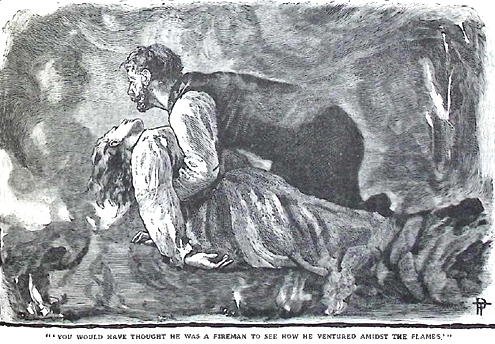
"YOU WOULD HAVE THOUGHT HE WAS A FIREMAN
TO SEE HE VENTURED AMIDST THE FLAMES."
"Ah, indeed! We have all great cause to thank God. It was an awful fire. Those wooden houses burn so rapidly that the fire had taken complete hold of some of the lower rooms and the staircase ere it was discovered. And now the place is an utter wreck."
"Was everyone saved?" I asked.
"Yes, everyone, and, with the exception of one or two, they have escaped unhurt. It was a most merciful deliverance."
"It is all a confusion to me." I said. "I remember nothing save that I made my way to my brother's room and could not find him. How was I saved?"
"By Mr. Dugdale. He found you insensible by the bedside. He struggled through fearful smoke and flames to reach you. It was feared that you both would perish. Oh, do not cry. We had better not speak of the fire. You cannot bear it now."
"It does me good to cry." I sobbed, "only tell me one thing. Did Mr. Dugdale escape unhurt?"
"Not unhurt. His hands and arms are badly burnt, and he sprained his wrist in swinging himself down from a balcony. But, oh! He showed himself such a brave, heroic man. You would have thought he was a fireman to see how he ventured amidst the flames."
I asked no more questions, but lay still for some time, quietly weeping. It was no surprise to me to learn that I owed my life to Ralph Dugdale. I had felt sure, before I heard it, that he and no other had rescued me and Edmund.
Some time later, I learned how our escape had been effected. I had observed, without reflecting on the reason, that all the bedrooms in the pension had, in addition to the doors opening on to the corridor, doors communicating with each other. By this means, had the doors been open, one could have passed through the rooms from one end of the long, narrow house to the other. My room, as has been said, adjoined Edmund's on one side, and Ralph's room was on the other side of my brother's, but separated by two apartments from that of his friend.
As soon as he was roused by the alarm of fire, Ralph forced his way through these rooms, intent on saving me and Edmund. He found Edmund in his weakness already overpowered by the suffocating fumes, for the fire had broken out immediately below our rooms, and was there raging its fiercest. He said that he thumped vigorously on the partition dividing my room from Edmund's and believed that he heard me respond, ere he seized Edmund, and half-carrying, half-dragging him, bore him through the rooms to a little balcony at the end of the corridor, beneath which, and only a few feet lower, lay a sloping grassy bank, so that it was easy to clamber down. Leaving Edmund, who was roused by the rush of cold air, to the care of the persons who were gathered about the balcony helping women and children to escape by means of it from the burning house, Ralph hurried back in search of me.
By the time he had reached my room and had forced open the door, it was full of smoke, and flames were rising from the floor. It was hardly safe to enter; but screening his face and chest as best he could, he did venture in, only, however, to search for me in vain.
The people outside, who had seen me enter my brother's room, shouted to him to seek me there, but amidst the confused din of human voices and the crackling and roaring of the fire, he could not distinguish their words. As he staggered back aghast, the thought struck him that I might have tried to get to my brother. He groped his way through the smoke to my brother's bedside, and there came upon me lying insensible. To bear me, unconscious as I was, through that choking atmosphere to the freer air beyond, was no slight undertaking, but the strong, undaunted will accomplished it. Certain it was that no one else could have done for me what he did. Had he not found me, there would have been no awaking for me in this world.
With a rush of gratitude that was full of pain, I realised that I owed my life to Ralph Dugdale's heroism. Sweet, sweet did life seem to me as lying with my face towards the low windows of the châlet, I watched the sun rise above the mountains and gild their stainless summits with his golden rays. I was experiencing the feeling my brother had expressed only on the previous day. Never does life look so fair to us as when we emerge from some dark valley of the shadow of death to enter upon a fresh, sunlit space of time.
I felt very weak and shaken from the effects of my adventure, and it was long ere I lost the breathless, choking sensation caused by the fumes I had inhaled. But a German doctor, who had been staying in the pension, came and prescribed for me, and, ere evening fell, I was well enough to rise and go to my brother, who was in the inner room of the châlet.
With the thought of getting up, I found myself confronted with a serious though somewhat absurd difficulty. I had absolutely nothing to put on save my dressing-gown and slippers. All my clothing, and, indeed, everything that Edmund and I had with us, had perished in the flames, for as the hotel could boast no hose nor any apparatus for extinguishing a fire, it had been found impossible to check the flames, and they had simply raged till they could no longer find fuel.
A grand and memorable sight was that fire for those whose circumstances permitted them to enjoy its wild magnificence. Such have since described to me the wonderful effect of its savage lurid glow, seen against a background of snow mountains.
Happily, many persons whose rooms were remote from the spot where the fire broke out had been able to rescue their luggage, and several ladies came to my aid when they heard of my destitute condition, and out of their abundance provided for my needs, so that I was soon able to appear decorously clothed, though in a somewhat odd assortment of garments.
I could make light of my misfortunes; our losses were trifles, indeed, when compared with our great deliverance; but far more deplorable was Edmund's condition. I found him suffering from utter prostration of strength; his voice sunk to a whisper, his appearance ghastly in its pallor. Yet he could smile on me and whisper how very, very thankful he was; he did not mind his own sufferings since I appeared so little the worse for my alarm and danger.
"And Ralph, too, dear, old fellow," he whispered; "they tell me he showed himself a true hero, and I can well believe it."
"Why, yes, he saved my life—but for him—" A shudder ended my broken words.
"He saved both our lives," said my brother. "Ah, Dottie, what a debt is that! But yours is the greater gain, and you only can repay him. My chance of doing anything for him is past."
A thrill of fear passed through me as I perceived my brother's meaning.
"Do not say so," I pleaded; "you will rally again. This is only the effect of the shock."
But he shook his head.
Not till the next day did I see Ralph Dugdale. In truth, I shrank from seeing him. How could I express my gratitude to the man who had saved my life? The weight of that gratitude oppressed me.
Perhaps it was well that I came upon him suddenly. I had gone forth to take a look at the ruins of the hotel, when, as wandering round the blackened heap, I turned to the side where hung a remnant of the balcony by which our escape had been made, I saw before me Ralph Dugdale. He was very pale, his hands and arms were bandaged, his right hand rested in a sling, he wore a loose coat which had certainly not been made for him. All this I noted at a glance; the next moment he saw me, and a glad smile lit up his face. Very bright was his look, yet there was something unusually tender and emotional in his glance as our eyes met.
"You are better? You begin to feel yourself again?" he questioned me eagerly, ere I could say a word.
"I am all right, thank you," I answered quickly; "but oh, Mr. Dugdale, I am so sorry to see how you have suffered! I—I—Oh, I do not know how to say what I ought—what, indeed, I truly feel."
"Pray do not try to say it. Surely we can understand each other without words."
"But I must tell you that I can never forget how you risked your life for my sake."
"Nonsense, don't exaggerate the risk! For whatever I did, have I not more than my reward in seeing you safe and sound? Do you think I would not gladly lay down my life to save yours?"
How could I reply to this vehement speech, coming warm from the heart in one of those rare moments when emotion will utter itself, in spite of every consideration that might enforce silence?
Happily Ralph did not leave me much time to feel embarrassment. With a change of manner, he asked me quietly what I thought of Edmund. There could be but a sad answer to this question. Ralph's face grew grave and sad as we paced to and fro, talking of my brother. He tried to comfort me; but he could hold out but faint hope.
One thing we decided. It was impossible that Edmund should remain in his present rough and comfortless quarters. Even at the risk of further exhausting him, we must remove him to some more habitable region, where he could have the comforts his condition rendered indispensable. Ralph advised our proceeding, as we had intended, to Grindelwald, and I felt that the advice was good. Already a general exodus from the vicinity had begun. Most of those who had escaped unscathed from the fire had departed on the previous day; others were now preparing to start down the mountain.
Ralph proposed to get one of these travellers to engage us a carriage at Lauterbrunnen for the next day. He had already written to his sister, informing her of what had happened, and that we might arrive at Grindelwald at any hour. He felt sure that she would make the best arrangements she could for our reception; and I, knowing Grace as I did, could have no doubt of that.
What a comfort it was to me to have Ralph Dugdale to help me in the management of Edmund's removal! Though his hands were useless, his thoughtfulness, kindness, tact, and the ease with which he made people do exactly what he wished them to do, rendered him an invaluable ally.
We went down the mountain on the following day, treading the same path that we had ascended with glad zest at the beginning of the season. It was a bright day, and the scenery was no less lovely than it had been then; but now it wore the beauty of autumn, and in my heart it was autumn too, not an autumn of ripe fruitage, but an autumn of falling leaves, fading flowers, dead hopes.
Edmund's bearers carried him very carefully and steadily, yet he was sorely exhausted when we reached Lauterbrunnen. We were fain to stay the night there, and did not start to drive up the valley to Grindelwald till about noon the next day. Weary though he was, Edmund enjoyed that drive. Every turn of the road which ascends by the side of the impetuous, foaming torrent revealed new beauties. The foliage clothing the mountain slopes was gay with the most brilliant hues of autumn, cascades of no mean force came dashing down beside the road, fairy rills crossed it on their way to the river.
We passed over quaint, covered wooden bridges, the river now on this side of the carriage and now on that. Presently snow-crested summits rose before our view; the Wetterhorn stood forth in grand magnificence, then its companion Peaks were discerned, till, as we made the last gradual ascent, the whole of the lovely vale of Grindelwald lay before us.
We drove at once to the hotel at which the Dugdales were staying. Grace had been watching for us, and was at the door to receive us. Very loving was her greeting to me, almost too tenderly sympathetic I felt that it was, for it showed me too plainly what she sorrowfully believed.
A large and very comfortable room had been secured for Edmund. He was pleased to see that his window looked up the vale and commanded a fine view of the Wetterhorn and the higher glacier.
"I am glad the beauty is so near," he said, "for I cannot go in search of it."
So, with gentle satisfaction, he took possession of his room, never to leave it in life.
Yet I was not without visitings of hope. There was a return of strength, but the Swiss doctor whom we had called in did not encourage him to make any exertion, and Edmund himself evinced no desire to go beyond his room, but was content to rest on his couch by the window, and gaze on the beautiful world outside.
I could not help remarking that he never now spoke of his recovery. The hopefulness which he had manifested in the earlier stages of his illness was gone. But whatever were his anticipations, they were met with serene, calm resignation.
"Dorothy," he said to me one day, "do you think Mabel would come if we asked her?"
"Come!—Come here do you mean?" I faltered. "Oh, Edmund, dear, why do you ask? Do you wish her to come?"
"I think you must know, Dottie, why I ask," he said, giving me a tender, pitiful glance, as though he would fain have spared me the pain he knew his words must give. "Yes, I should be very glad to see Mabel again if she would come; but not—not if it would cause her much trouble."
I wrote to Mabel at once. I had written to her every day since we came to Grindelwald. Her letters had expressed much concern at what I had told her about Edmund; but she did not suggest coming to him. Would she come now, I wondered, as I sent off the letter.
She did not come. Little Percy appeared to be sickening with some childish ailment, and she could not leave him. A mother's first duty was to her child, she wrote. It grieved her to refuse to come to dear Edmund, but she could not believe that he was so ill as I imagined. She knew that my affection was apt to make me over-anxious. She still hoped to see him again in England, and she thought we should do well to start on our homeward journey as soon as possible. Had I thought of Torquay as a desirable place to winter in?
The letter angered me. I was indignant with Mabel for attaching so little importance to my words. I would not believe that there was much the matter with her little boy. To myself I accused her of heartless indifference to Edmund. My feelings towards her did not soften as I saw the shadow fall on Edmund's face when I told him that she could not come.
"Then I shall not see her," he said.
"She hopes to see you again in England," I replied.
"That will not be, I think," he replied, quite calmly.
And I was silent, for my heart told me that he spoke truly.
"How could Mabel?" I was saying to myself.
Edmund must have divined my thoughts, for, after a moment, he said to me, very earnestly, "Do not blame her, Dorothy; she does not know. And, Dorothy, do not, I pray you, let this make any further breach between you. Remember that, when I am gone, you and Mabel will be the only ones remaining of the home-circle at Burford in the dear old days—the dear, happy, old days."
I was silent, for I could not speak. Of late Edmund had often spoken of our old life at Burford. He loved to recall our childish days with their quaint incidents and the various scrapes into which he had led me.
"You and she have memories in common which no other can share," he went on to say. "I can remember how proud and fond you were of 'my sister Mabel,' when you were a little thing."
"I am proud and fond of her still," I said, half crying; "I should love her as much as ever if—But she has changed; she does not care for me as she did."
"Don't say you should love her," Edmund reproved me gently; "true love does not change with the changes of others. Do you remember Mrs. Browning's poem on the words, 'Loved Once'?
"'Love strikes one hour—Love! Those
"never" loved
Who dream that they loved "once."'"
"I am afraid mine is not the best sort of love," I sighed; "anyhow, love and sorrow seem to be intertwined for me. Those whom I love most are taken from me."
"I suppose love and sorrow must always in a measure combine," said Edmund, musingly. "The King of Love was crowned with a crown of thorns. But, Dottie, you must not speak as if my going would leave you desolate. You have Ralph, you know."
A hot flush mounted to my forehead. Edmund waited for me to speak, watching me keenly.
Why did I not tell him the truth? Surely when the last parting was so near, I might have broken through womanly reserve and confided to him my heart's secret. It seemed to me afterwards that it would have been easy to tell him then, yet something withheld me. Edmund was far from guessing the truth. Men do not learn such things by intuition as women do. He had not the least glimmer of a notion that I could care for anyone save Ralph Dugdale.
"You will not tell me," he said, presently, and his tone had a plaintive sound that went to my heart, "though it would be such a comfort to me to know that it would be as I hope."
Then words rushed to my lips—rash, impulsive words, as mine too often were. What did it matter what my future was, I thought.
"Dear Edmund," I said, tremulously, "I will try, I will try to do as you wish."
And even then he did not understand. Such a glad smile welcomed my words, and he clasped my hand as if in gratitude.
It was strange that just then there should come a tap at the door, followed by the appearance of Ralph Dugdale.
"Come, old friend," said Edmund, motioning Ralph to a seat on the other side of his couch.
Ralph sat down beside him, and Edmund took his hand also, and brought our hands together across the couch.
As he held them in his wasted ones, he said, "My two best friends," the glad light still shining in his eyes.
I doubt not that Ralph perceived the significance of Edmund's action, but if he looked for signs of such comprehension from me, he received none. As quickly as I could, I drew my hand away.
There came days of chill rain and storm. Edmund's strength declined rapidly. Mr. and Mrs. Dugdale started for a warmer latitude, but Grace and her brother remained with us. I knew that they would not leave me. I was thankful for Grace's presence, and glad, too, for Edmund's sake, that Ralph was there. The mean jealousy I had once experienced did not revive, I am thankful to say. It was plain that to Grace Edmund was a friend, but no more. And his manner to her never showed that she was better loved than I.
He liked to talk to her, for her Christian faith was bright and clear, and she helped him to look forward, without doubting, to the higher, fuller life that awaited him—the rest that he believed meant service, not inactivity, in which the powers, denied full development here, should be perfected, and the work for God, broken off below, find a grander completion. I do not think there could ever have been much hope in Edmund's love, and now, as the flame of the bodily life waxed dim, earthly desires had no power to ruffle the heavenly calm that fell upon his spirit.
The storms and rains subsided. There came a day of calm, autumnal beauty, of bright sunshine, though the air was crisp with the touch of frost. Few English visitors had dared to risk the chances of the late autumn, and we had the hotel almost to ourselves. I can never forget the deep quietude that seemed to reign all about us that day. Within the house and without there was hardly a sound to be heard. Nature seemed to be resting after her fierce conflicts.
Towards evening, we were all in Edmund's room. He seemed rather better that day, and once more was able to leave his bed and rest, supported by pillows, on the couch near the window. We sat so that all could see the beautiful scene from the window. The mountains on each side the vale had appeared that morning in a fresh covering of snow. Dazzlingly white shone the summit and higher slopes of the Wetterhorn; the glacier had lost its dingy hue; the russet and gold and sombre greens of the foliage at the foot of the mountain looked the richer in contrast to the snowy mass above.
We watched till slowly the colours faded, the shadows lengthened across the vale, and the hollows darkened beneath the overhanging rocks. As we gazed, almost imperceptibly the faintest tone of colour warmed the whiteness of the Wetterhorn. Presently a golden beam fell athwart the snowy slope. It broadened and deepened in its intensity till the whole vast snow-field shone as with golden fire.
"The afterglow," someone murmured, and then for a few moments none of us spoke as we watched the glowing vision fade as swiftly as it had come. It was not the first time I had seen the wonder of the afterglow, but this, I thought, was the finest manifestation of its loveliness that had been granted me. I rejoiced that Edmund saw it. And he rejoiced. His voice it was that broke the stillness.
"I am glad I have seen this before I go," he said. Then in low, fervent tones, he added, with a reverent upward glance, "I thank God for the beauty of His world."
"And it is but the shadow of the divine beauty," said Grace, in tones that vibrated with emotion; "you will pass out of the shadow into the perfect light. 'Thine eyes shall see the King in His beauty.'"
Edmund smiled, such a happy, radiant smile. "His people reflect that beauty here," he said, looking at her. "As we strive after goodness, He gives us of His beauty. May the beauty of the Lord our God be upon us."
"Amen," said Ralph Dugdale.
With that our little party broke up. I sat alone with my brother for some hours. He was inclined to talk, and he talked brightly, going back again to our childish days, and dwelling on them with pleasure.
About ten o'clock Ralph and Grace came in. It had been arranged that Ralph should watch beside him tonight, as I had sat up during the previous one.
But now I felt reluctant to leave my brother, and would fain have stayed had Edmund been willing, but he was not.
"No, you must go to bed, Dottie," he said; "you look worn out. What good could you do by staying? I shall sleep soundly, I know. Come, kiss me and say good-night."
As I bent over him, he drew me close and kissed me many times. Did he know that the parting was so near?
"Grace too," he said, his eyes raised pleadingly to hers.
And Grace also gave him a sister's kiss.
I did not go to bed, though Ralph soon brought me the news that Edmund was sleeping peacefully.
After a while I lay down, dressed as I was, on the outside of the bed, and I must have slept, for it seemed as if but a short time had passed when Ralph summoned me, but already the day was dawning.
"You had better come," was all he said.
And without a minute's delay, I followed him.
Edmund no longer slept. He was sitting up in bed, propped by pillows; his hands were moving restlessly over the coverlid, and he was speaking rapidly. His voice had an unusual sound, but his eyes were clear and bright.
"Why does not Dottie come?" I heard him say.
"I am here, Edmund, here," I said, laying my hand on his.
But he heeded neither touch nor word. I saw with pain that he was looking beyond me, unconscious of my presence.
"There is my father," he said, mere quietly, his gaze fixed apparently on the window; "he is coming from the tan-yard across the garden. And there is Dottie at last—Dottie and Grace, standing beneath the trees; the trees are all white with blossom. Yes, Salome, I hear you. Dottie!"
My old pet name came with a faltering sound. Did he know me at the last? I hoped so. His head sank a little on one side, his lips moved; I fancied I caught the words, "The King in His beauty."
A few moments of awful stillness, broken only by short, panting breaths, and then Ralph's hand gently trying to draw me away told me that I was brotherless.
——————
I VISIT THE OLD HOUSE AT WEYLEA,
BUT MISS THE WONTED WELCOME.
IS there a sadder sight in this world of mingling light and shadow than to see a young life, full of splendid promise, cut off in its unfolding by the stroke of death?
What a fruitless end it seems to make to the toils and triumphs of that brief life, to all the hopes that shone about it.
I felt this keenly in the first dark hours of my bereavement, as I dwelt on the memories of my brother's life, the rare abilities he had early displayed, my father's pride and pleasure in his clever son, the hopes that had been built upon his future, a future he was never to know. My heart was wrung with pain to think that the hope and love and pride were thus frustrated.
I know not what I should have done in those dark, sad days but for Grace's supporting presence. She helped me more by her loving sympathy, so unobtrusive, yet so true, than by the few consolations she whispered. I could not yet rejoice in my brother's great, eternal gain. The selfish element in my love asserted itself powerfully. My heart cried out for my brother. I could not bear to think that he had vanished from me utterly, that I must travel the rest of my life's journey without him, never more hearing the sound of the voice I loved, or clasping the hand which had been ever ready to help me since the days when my first tottering steps were made with its aid. And all this Grace understood perfectly.
We quitted Grindelwald, Grace, Ralph, and I, as soon as we had seen the mortal remains of my brother laid in the little churchyard. A fair, peaceful "God's Acre" it is, lying above the village in the midst of the green valley, and close beneath some the grandest of mountains.
I have visited it more than once since that time of sorrow, but, thank God, I have never really associated the thought of Edmund with that grave at Grindelwald. He was so bright and glad of spirit, such fulness of life and hope was his, that I could not connect him with the gloom of the grave. Even in my bitterest grief, I felt that death was for Edmund a new birth into a higher life, and that the form we laid in the earth was but the mere shell or husk which had enshrined the spirit I loved. There came a time, though not till after years had passed, when I could rejoice to believe that my brother was living a life rich in strength, in intelligence, in unutterable joy, a life infinitely grander, yet not so far removed from my own, since to each Christ was near.
But for a while, no light penetrated my gloom. A season of dark depression fell on me, in part the effect of physical causes, but wholly miserable and benumbing. For a few days, I was really ill at Interlaken, and I hoped that death would take me too, but Grace's skilful nursing soon brought me back to a measure of health, though I continued weak and nervous. How good and kind Grace and Ralph were to me in those days! He was especially thoughtful for my comfort, guiding and counselling me with a sort of tender authoritativeness, which I was too weak and stupid to resist, though it hurt me. The fancy crossed my mind that already he regarded me as belonging to him, and was only waiting till my bereavement was less recent to assert his claim.
It was Ralph who proposed that I should go to the South of France with Mrs. Dugdale, who suffered from asthma, and had been ordered to winter abroad. The idea was rather agreeable to me, and I consented willingly when I saw that by so doing I should liberate Grace, who would otherwise have felt obliged to accompany her mother, though she longed to return to Beechwood, where she felt that her presence was necessary to the right working during the winter of the various clubs, mothers' meetings, and other organisations that she had started in the village.
Grace thanked me for taking her place as gratefully as if the arrangement involved a sacrifice on my part. But in truth it was with somewhat of relief that I bade good-bye to her and Ralph in Paris, and started with Mrs. Dugdale on our journey south. The quiet time, the pause for reflection ere taking up again the active duties of life, seemed just what I needed.
Mrs. Dugdale was very kind to me, and the peaceful days we spent together beside the blue waters of the Mediterranean were soothing to my weary, sorrowing heart. It was from their mother that Grace and Ralph had inherited their temperamental cheerfulness. She appeared almost invariably bright and hopeful of spirit. She was a good talker, and I loved to listen to her reminiscences of bygone days, and the people she had known. Nor less did I love to hear her talk about her children, and tell stories of their early days.
Cheerful as she was, I knew that it was a trial to her to remain away so long from her home and her dear ones. She counted me as another daughter, she used to say, and if she had not had me with her, she could not have borne her exile.
Mrs. Dugdale had letters from home almost every day, and she imparted to me the news they brought. I used to listen rather eagerly as I grew stronger, and time softened the first poignancy of my grief, for by degrees old interests awakened, old cravings renewed themselves in my heart. But there was never any reference to persons whom I knew and cared about, and as Mrs. Lyell did not write to me for several weeks, I knew nothing of what affected her.
At last, one day in February, Mrs. Dugdale received a letter that pleased her very much. She clapped her hands with as real delight as if she had been a school-girl going home for the holidays as she said, "Joy! Joy! Dorothy. They all agree that I may go home. The worst part of the winter, the fogs and damps which are so bad for me, are past, and even the doctor thinks that I may venture with impunity. Now how soon can we start for home?"
I hastened to consult a book of timetables.
"Of course you will come with me to Beechwood?" Mrs. Dugdale added.
She said it with a quiet air of decision, as if no other arrangement were possible. My heart leapt within me at the thought, but I hesitated—I had meant to go to Mabel as soon as I arrived in England. Edmund's words had not been lost upon me. I would try to love Mabel freely and fully, without exacting and weighing the love she gave me in return. I felt that his memory must be a fresh bond to bind me to my sister. And I would no longer refuse to stay at The Towers. I would try to forgive Howard Steinthorpe, as Edmund had urged me.
"I should not have felt so bitterly towards him," my brother had said but a day or two before he had passed away. "If he wronged us, he injured himself more than he injured us. I used to think it well-nigh impossible, Dottie, to love one's enemy, but now I see that, beneath all that is hateful, there is still the brother, who has a right to our love, and only by loving can we conquer the evil. Love will teach us to judge him rightly, and keep us from being misled by mists of doubt and prejudice."
"Yes," he had added, with a serene, bright look I can never forget, "I thank God I can truly say that with all my heart, I forgive Howard Steinthorpe any wrong he has done me, any hardness and selfishness he has shown in his dealings with me."
Ah! How I treasured the memory of all that Edmund had said in those last precious hours! Every word had its weight with me now; every wish I desired to fulfil.
But there seemed no reason why I should not stay at least for a few days at Beechwood ere I went to Burford. Mrs. Dugdale, indeed, would not hear of my doing otherwise. She declared that Grace and Ralph would be grievously disappointed if she returned without me, so I yielded to her wish. I half-longed and half-dreaded to find myself once more in the neighbourhood of Weylea. Of course, I could not be so near without going to see Mrs. Lyell, and perhaps—my heart beat quickly at the thought—I should see Leonard Glynne. Did I wish to see him? I hardly knew.
February was not over when we arrived at Beechwood. We were in time for those few mild, bright days, giving brief foretaste of spring, which are the special endowment of this month.
Very warm was the welcome I received at Beechwood Hall. Ralph's looks and words betrayed a quiet intensity of delight of which I could not be unconscious. If his mother were not jealous of the attentions he bestowed on me, as though I, and not she, had been the loved invalid, compelled to winter abroad, she might well have been.
And was I not glad to see him? Yes, indeed. It was soothing to me in my sadness, for the sight of him brought my loss freshly to mind, to feel that he cared so much for me. He was dear to me because he had been such a true, warm friend to my brother. If only he were content to be my friend!
No later than the following afternoon, I set out to walk to Weylea. I was anxious to get to Mrs. Lyell's, for I had heard from Grace that she had been ill. An engagement in the village prevented Grace from accompanying me. I did not regret her absence, and I was not sorry that Ralph's duties—he was preparing for the Bar—had taken him to London this day, for still less did I desire his company. I was glad to be alone and free to muse as I would.
It was a pleasant day for such a walk. There was the softness of spring in the fresh, sweet air, and as I passed down the avenue I saw snowdrops lifting their delicate white and green blossoms above the brown moss and dank leaves as they grew in fairy circles about the silvery trunks of the beeches. All leafless were the trees which bordered the road, but the grey-green, lichen-covered trunks had a beauty of their own, and it was beautiful to look up and trace the delicate ramifications of the upper branches against a sky of pale blue. Golden crocuses were blooming on some of the graves in the churchyard. On Arthur West's grave lay a wreath wrought with pale primulas and maidenhair fern.
I was half-glad, half-tremulous as I took my way along the familiar road. When I approached Weylea, I was conscious of a nervousness that made my breath come short and fast, and my heart throb painfully. How unchanged everything was in that quiet country place! It was as if life had stood still here whilst so much had been happening with me.
Surely the goods which the little shops displayed were the very same that met my eye when last I looked in the windows. Familiar was the pattern of the print marked "very cheap," and the striped shirting pronounced "a bargain." There was the stout, red-faced proprietor of the Stag's Head lolling as usual at the door of his tavern. Ah! And there was Stubbs, Mrs. Lyell's decrepit old gardener, coming with feeble steps from the bar entrance, wiping his mouth with the back of his hand. To the right, not a hundred yards from the road, stood the house in which Leonard Glynne lodged. But I would not glance in that direction. What was it to me whether he was here or there?
I reached the road in which Mrs. Lyell's house stood. As I approached it, I saw that the villa on the other side of the way looked deserted. The blinds were all lowered, the gate securely fastened. The Carsdales doubtless were from home.
I glanced eagerly at Mrs. Lyell's house as I pushed back the heavy iron gate. The place had a dreary, forsaken look. The trees were bare; there were no flowers to be seen, save a few crocuses and snowdrops in the border beside the door; a green, slimy growth covered the surface of the pond, and the house stood apparently lifeless, the shutters of the sitting-room windows closed, the blinds of the casements above closely drawn. My heart sank low within me as I noted these signs, and asked myself what they could betoken. But I saw one thing that somewhat reassured me as I walked along the path to the door, the mark of a horse's hoofs on the soft gravel.
I rang the bell, half-wondering if there were anyone within to obey the summons. The peal seemed to clang drearily through the empty house, but presently I heard the sound of steps, and the door was opened to me by Sarah. She wore her bonnet and cloak. My appearance seemed to cause her great surprise.
"Why, it's never you, Miss Carmichael!" she exclaimed. "Dear me! We thought you were in foreign parts."
"I came back yesterday," I said, hurriedly. "Do tell me how Mrs. Lyell is. It quite frightens me to find the house shut up thus."
"Oh, you need not be alarmed, miss. My mistress is better, though she has been sadly. She has gone this morning to Hastings with Mrs. Carsdale and her daughter. They persuaded her that the change would do her good, and I trust it will. I am going down by an evening train. I stayed for a few hours to help cook, because there were so many things to put away and arrange. Clara has gone for a holiday."
"Dear me," I said, feeling bewildered; "how strange it is to come here and find Mrs. Lyell gone. I can hardly believe it."
"Yes, miss, it does seem strange; Mrs. Lyell so seldom leaves home. It is hard work to persuade her, but Miss Carsdale succeeded. Such a nice young lady, Miss Carsdale is. You did not know her, I think, miss. So kind she has been to my mistress, coming in almost every day to see her; and really, I believe that she would do anything for Mrs. Lyell."
"How long will Mrs. Lyell be at Hastings?" I inquired, rather breathlessly.
"Oh, a month, I believe, miss. Mr. Glynne is going down on Saturday. But pray come in, miss; you look so tired."
In truth, I felt quite faint. The pleasurable excitement with which I had hastened to Weylea had received an unexpected and painful check.
"I am sorry I can't ask you into the parlours, Miss Carmichael," said Sarah, as I stepped into the hall, "but we have done up the windows with brown paper, and locked the doors. If you would not mind coming into our room."
It was all the same to me where I went, so I followed Sarah to the little sitting-room which adjoined the kitchen.
"Cook will be happy to make you a cup of tea, miss, if you would like it," said Sarah in her smooth tones.
But I declined the tea; I had no wish to make my visit any longer than it need be.
"Are you staying in London, miss, if I may make so held as to ask?" Sarah inquired.
"No, I am staying for a few days at Beechwood," I replied.
"Oh, indeed, miss; at Mr. Dugdale's, I suppose? I remember that you went there the summer you were here. Ah, and I remember that Mr. Dugdale came here once or twice. Such a nice-spoken gentleman I thought him, and my mistress liked him very much."
Why should I colour when Sarah said this in her quiet, insinuating manner? There was no reason for it, but colour I did, and I saw that Sarah marked my change of hue. I grew uneasy as I felt her narrow, cunning eyes studying me.
"Ah, a great deal has happened since that summer, miss," she went on. "You've known sad trouble since then, and your looks show it. To think that your poor brother should be taken so quickly! And so bright and merry as he seemed, though there was always a consumptive look, to my eyes. You must take care of yourself, now, miss; you look far from strong."
To have Sarah thus commenting on my trials and my appearance was more than I could bear. I rose hastily, and said that I must be going, as I had a long walk before me.
"Had you not better rest a little longer?" suggested Sarah. "You are not keeping me, you know, miss; there is plenty of time before the train starts. Shall I take any message from you to my mistress? She will be very sorry to have missed you."
"Oh, yes; pray give Mrs. Lyell my best love, and say what a disappointment it was to me not to find her at home. I shall hope to see her when next I come to London, though when that will be I cannot tell. I go to my sister's at Burford early in next week."
"Very well, miss; I will be sure to tell my mistress all that you have said," replied Sarah, demurely. Then she added, looking up in my face with a peculiar smile, "I suppose you have heard of the engagement?"
"No; what—what engagement?" I faltered.
"Miss Carsdale's, miss. She is engaged to be married to Mr. Glynne."
I felt myself turn white as I heard it. I had expected to hear this sooner or later, yet what a painful shock the news gave me. For a few moments I had a stunned, stupefied sensation, then I became aware that Sarah was watching me with a sort of suppressed smile. I divined that she had a malicious satisfaction in detecting my suffering.
That roused me. I pulled myself together, and said with forced gaiety, "Indeed! I am glad to hear it. I hope they will be very happy."
"Mr. Leonard is very pleased, and so is my mistress," said Sarah, with an unpleasant smile. "Well, miss, I suppose we shall hear one of these days that you are thinking of getting married?"
"Oh, I don't know about that," I responded, carelessly, laughing, as I seemed to me, quite merrily and naturally. Then, waiting to hear no more, I bade Sarah good-afternoon, and hastened away from the house.
====================
A WOEFUL MISTAKE.
MORE dreary and forsaken than before looked the garden to my eyes as I took my way to the gate. The brightness of the day had passed, the sun had sunk out of sight, a grey mist hid the distances; there was a chill dampness in the air. A wave of bitter feeling passed over me as, pausing at the gate, I looked back at the house.
"It is all over," I said to myself. "I shall spend no more happy hours here."
Then with a shiver I turned away.
I had reached the corner where the narrower road joined the main road, when I saw a number of gentlemen coming up the hill from the station. A train from London had just come in. I glanced at them carelessly, when suddenly my heart gave a wild plunge, and I felt myself trembling from head to foot, for there, on the other side, separated from me only by the breadth of the road, was Leonard Glynne. He was walking rather weariedly, it seemed to me, with his eyes bent on the ground.
For a moment I actually stood still. Some spell seemed to hold me motionless with my eyes fixed on him. Then came a sudden shock of thankfulness that he had not looked up, had not seen me, and, swiftly as my feet could carry me, I hurried in the opposite direction.
I did not pause till I was a long way on the road to Beechwood. Then, as my excitement faded, I found myself tremulous, strengthless, and was fain to stand still, leaning for support against a gate.
As I hurried along, the image of Leonard had accompanied me. Now again his face rose before me, somewhat changed from what I remembered it. Was my fancy deceiving me, or had he indeed looked so grave and sad? Of course it was a delusion, for Sarah had said that he was very pleased at his engagement, and how could he help being joyful if he had won so fair and bright a girl?
Yet it was strange how his countenance had stamped itself on my mind with a sad, downcast look, till I could almost persuade myself that he had looked just so when I saw him across the road.
Well, he was nothing to me now. I felt a sort of fierce disdain of myself for being so agitated at seeing him. He had never really cared for me. The eloquent glances, half-spoken words, tender insinuations, which still dwelt in my memory, had had no such significance as I had imagined. Doubtless they had only expressed the gallantry which young men of fashion like to display in their intercourse with ladies, and I, in my rusticity, had not known how to meet them. I would think of him no more.
So I resolved, but as I continued my walk, I could think of no one else. I was slowly climbing the long hill to Beechwood, when I heard the sound of wheels behind me. The Dugdales' brougham was coming up, and I saw that it held both Ralph and his father. As soon as Ralph caught sight of me, he sprang out and came to my side.
"I am glad we have overtaken you," he said, and he looked very glad. "Have you been far?"
"Only to Weylea and back," I answered.
"Only!" he repeated. "A good six miles. You look tired; had you not better get into the carriage?"
I declined, and he did not urge my doing so. Instead, he bade the coachman drive on without him, and continued to walk by my side.
"You have been to see your friend Mrs. Lyell, I suppose?" he remarked.
"Yes, but my hope was disappointed. I found the place looking quite deserted, Mrs. Lyell being away from home."
"What a pity! Then you have had your long walk for nothing. No wonder you look weary. I wish I had known of your intention; I do not like your taking such long walks alone."
He spoke with the air of one who had a right to watch over my actions. I felt myself flush as he spoke. I suppose he observed my change of countenance, for after a moment he said, very gently, "Forgive me if I seem presumptuous. You do not know that there was an understanding between me and your brother that I would take care of you when he could no longer do so. I do not forget that it depends on you whether I may have the happiness of guarding you as I would."
There was a pause, a stillness, broken at last by the slight crack of the coachman's whip as he flourished it. The horses started forward as they heard the sound, and the brougham passed out of sight beneath the trees. No one was to be seen on the quiet road; we were alone.
In the silence, I seemed to hear the beating of my own heart, as well as my quick, nervous breathing. Ralph's words had carried me back to the sad but hallowed days we had spent in Edmund's sick-room. I remembered what my dear brother had hoped and desired for me and Ralph; how glad he had been in the belief that it was given to me to reward Ralph for his wonderful, self-sacrificing friendship. I recalled the promise I had given to my brother. Vividly came back to me that hour when, as we sat beside his couch, my brother had, in visible act as well as in thought, united me to Ralph, pronouncing us his "two best friends."
Ralph, too, must have been thinking of that hour, for when he spoke it was to say in tones that vibrated with feeling, "Our common love for Edmund would draw us together, Dorothy, it seems to me, if nothing else did. If I had had a brother, I could not have loved him more than I loved your brother. The hopes and fears, the hours of anxiety and sorrow on his account, which we have shared, must surely have wrought for us a deeper mutual comprehension and communion of feeling than exists between most friends."
How true were his words! I did not need to be reminded of the sacred, unutterable memories we had in common. Well did I know that no other friend could be to me what Ralph was. How much I owed to him; how much Edmund had owed to him! Their friendship dated from the beginning of Edmund's college course, and it had ever been marked by signal proofs of Ralph's disinterested affection. Ralph had done all that friend or brother could do to prolong the life of his friend. And to crown all, had he not saved our lives at the risk of his own? All this was in my mind as I said tremulously,—
"Oh, I feel that as much as you do. Can I forget a single hour of those days, or any of your many acts of kindness to me and my brother? If I could forget what I owe you, I should be guilty of ingratitude."
"Pray do not talk of gratitude," said Ralph, hastily, as if the word stung him; "that is not a thing to be named between us. I do not want gratitude, and I cannot be satisfied with mere friendship. My heart craves the greatest gift you can give—yourself. Your brother knew—I could not hide from him my heart—he knew that my happiness was bound up in you. Dorothy, my love is not a thing of yesterday. I believe I have loved you ever since the hour when I found you crying by yourself on your sister's wedding day. Do you remember?"
Did I remember? Ah, with what thrills of pain the past, with its dead joys and sorrows, hopes and fears, renewed itself within me at this question. Surely it was fate that thus confronted me! What could keep me now from fulfilling the promise I had given to my brother? I had thought of that promise before to-day, wondering, with some uneasiness, how far I was bound by it.
"I will try to do as you wish," I had said.
But now the shadowy hope that had haunted me and made it hard to give that promise, had vanished—Leonard Glynne belonged to another. Whatever happened, I must conquer the lingering love that caused the pain with which I had heard of his engagement. Should I not strangle that love with one effort if I gave myself to Ralph Dugdale? It seemed to me that I should, yet I hesitated.
We had come within sight of Beechwood Hall, and were passing up the long line of trees to the house when Ralph spoke. At his words, I stood still involuntarily. The thoughts I have described all passed through my mind in a few seconds. I remember that I had paused at the foot of a grand old tree, one of the oldest in the park, and I stood looking down at the ivy sprays that interlaced themselves about its roots, and the tiny buds of snowdrops that here and there pierced the leafy moss that filled the spaces between. I waited, hesitating, doubting, till Ralph spoke again.
"Have you nothing to say to me, Dorothy?" he asked, anxiously. "Have I startled you, frightened you, by speaking too soon?"
Then I looked up, and as I met his earnest, tender glance, words wholly unpremeditated rushed to my lips.
"Oh, you do not know me," I cried; "I am unworthy of your love. I am full of faults. I should not make you happy."
"If you do not, no one else ever will," he replied, gravely. Then with a smile he added, very tenderly, "Dorothy, my child, do you mean to tell me, who have loved you and watched you so long, that I do not know you? What are your faults to me? They cannot appal me, for I love you the better for them, if that may be."
"Oh, do you really mean what you said just now?" I asked, almost passionately. "Should I indeed make you happy if I gave myself to you?"
"Can you ask it?" he said, his sincere, earnest eyes searching mine. "Have I not told you the very truth of my heart?"
"Then it shall be so," I said, hurriedly. "I want you to be happy. I desire your happiness above everything."
And I put my hand into his.
"My love," Ralph murmured, pressing my hand tenderly between his own; and then raising it to his lips, "you make me happier than words can express."
But the next moment, his eyes sought mine with an anxious questioning look. "You are happy yourself—tell me that?"
"I shall be happy if you are happy," I said, in tones that would falter. "It is what dear Edmund wished that I should make you happy. In your happiness, I shall find my own."
The words satisfied him, for his heart gave them a large and full interpretation.
"Yes," he said, in low tones, that breathed a deep content, "it is all come about just as he wished. I can believe that he rejoices in our joy."
My heart smote me as I heard him say so. Was it, after all, just as Edmund had wished? Would he, seeing past and present with "larger, other eyes than ours," approve of the bond I had sealed? But I strove against the doubt as it rose.
We walked on in silence, Ralph holding my hand in his. He, I believe, was kept silent by the force of deep, overwhelming emotion.
As we came within range of the windows, he dropped my hand, and said, more lightly, as he glanced at me, "There was a deep shadow on your face when we overtook you, my Dorothy. I wanted to ask you what it was that was so troubling you. Shall I ask now?"
A sudden confusion and trembling seized me. I felt myself turn both hot and cold.
"Don't ask, please," I besought him; "it was so foolish I could not tell you."
"Then I will only ask you if the shadow is gone?" he said, with a smile.
"Yes, yes," I said, hurriedly, believing that I spoke the truth; "it is gone, quite gone."
We were at the door. The butler, crossing the hall, had seen our approach, and now threw wide the door, and stood awaiting our entrance, with his usual air of bland solemnity.
Without giving Ralph another word or glance, I went to my room. On the way, I met Mrs. West's maid, and learned that her mistress had gone into the village. I was glad: it would be good, I thought, to be alone for awhile.
Yet when I sat down and tried to reflect upon what I had done, thought was too painful, my loneliness pressed sorely upon me, till in sudden desperation, I rose and began to make my toilette in a more leisurely and careful way than usual, finding it a relief to concentrate my attention on the arrangement of my short, stubborn locks, and in adjusting to the best advantage, amidst the crape folds in the front of my gown, a lovely white camelia Ralph had given me. When I had given the last touches to my attire, I went down to the drawing-room.
There I found Mrs. Dugdale entertaining some cousins who had come from Richmond to see her, and were to stay the night at Beechwood. They were ladies of mature age, clever and cultivated, who had travelled a great deal, and who enjoyed talking of their adventures. I was soon engaged in listening to the younger one, who gave me a thrilling account of some of her mountaineering exploits. I needed to take but the slightest share in the conversation, if such it could be called, and this suited me.
After awhile, Ralph entered the room, and, stationing himself behind my chair, also became a listener to Miss Julia Shuttleworth's brilliant and amusing talk. Thus passed the half-hour before dinner.
Grace did not come in till we had taken our places at the table. She had come from a sick bed, and the sad scene she had quitted seemed to abide with her, making her unusually quiet during the course of that evening. Ralph, too, was quieter than usual, but I knew that his quietness was the outcome of deep satisfaction. What happiness shone in his eyes, gladdened his voice, and gave an indefinable charm to all he said and did!
Surely I should have been glad to see how happy I had made him. But no, his evident joyousness only awakened self-reproach within me. I shrank from the tender glances that sought mine, pretended not to hear the words whose deepest meaning was for my ear alone, and trembled whenever some gentle authoritativeness in Ralph's bearing towards me reminded me of the right I had given him.
But outwardly I was brighter that evening thus I had been for many months. Mrs. Dugdale and I were comparing our experience of Mentone with that of the Miss Shuttleworths, and recalling for their benefit every incident of our sojourn there which was likely to interest them. I think both Grace and Ralph were surprised to hear how I talked and laughed.
We had music. The Miss Shuttleworths were excellent musicians, and one of them played the harp with sweet expressiveness and delicacy of touch. Ah, cheerful as I seemed, when the pathetic, plaintive notes of that instrument vibrated through the room, I could have cried out with anguish. The music gave utterance to my heart's baffled, hopeless yearnings, my young despair of life, with its cruel disappointments and heart-sickening griefs.
It was all I could do to maintain self-control, but biting my lip and forcing back my tears, I bent studiously over some photographs till the music ceased, and no one saw how it had moved me.
"Go, weep for those whose hearts have bled,
What time their eyes were dry.
'Whom sadder can I say?' she said."
Ah, truly, those are not our saddest hours in which our tears flow freely.
The Miss Shuttleworths' presence prevented Ralph from telling his parents of our engagement. I was glad; I hoped that no one would know that night. When her guests retired, Mrs. Dugdale went upstairs with them, and I followed almost immediately, pleading a headache when Ralph attempted to detain me. As I quitted the room, I felt his eyes following me with a wondering, troubled gaze.
A bright fire was burning in my room. As I closed the door, I felt like one who casts off a torturing disguise. I threw myself on the soft rug before the fire, and leaned my head on a low chair which stood by the hearth.
"Oh," I murmured to myself, "what shall I do? How can I go on living? Oh, Edmund, Edmund! If only I could have died when you did!"
And then tears came to my relief, a hot, plenteous rain of tears. How many minutes passed I knew not, but it seemed as if I had lain there a long time, sobbing and weeping, when there came a tap at the door.
I started up in consternation. It was Grace's knock, and Grace's voice now asked for admission.
What should I do? I longed to refuse her entrance, but what excuse had I for so treating such a friend? Thus thinking, I made a futile attempt to wipe away the traces of my tears, and then unlocked the door.
"Dorothy, dear, I am so sorry to hear you have a headache," said Grace coming in. Then she paused in sudden dismay at my appearance. "Why, you have been crying. Is it, then, so very bad? Oh, I wish I had known!"
For answer, I burst into another flood of tears. Grace made me rest in the easy chair; she gave me some drops of sal volatile; she cooled my head with eau de Cologne, but for a while it seemed as if I could never stop crying. Gradually, however, my emotion spent itself, my sobs ceased from very exhaustion, and I lay back in the chair with closed eyes and throbbing brows.
A long silence ensued. At first, I was glad of the stillness, then it grew painful, and I longed for Grace to speak.
I looked up at last. Grace was standing beside me, watching me intently. There was a troubled look on her face.
"You are better?" she said, as she saw my eyes open.
"Yes."
"It was more than the headache made you cry," she said, in the tone of one who states a fact.
"Yes," I said again, feeling compelled to utter the truth, and quailing inwardly as I met her steady, penetrating gaze.
Another pause. It seemed to me that there was something merciless in the searching gaze Grace continued to bend on me, yet even then I knew that it was but such mercilessness as the surgeon shows when he freely probes the wound that he may extract from it all its lingering poison.
"Dorothy," she said, presently, speaking in calm, quiet tones, "Ralph has told me that you are engaged to him. I came to tell you that I was glad, but now—now—I do not know that I am glad."
I was silent. There seemed nothing that I could say.
"I had my doubts before," she went on. "I have known for some time—how could I help knowing?—that Ralph loved you, but I never could think that you responded to his love. Dorothy, I used to think that you cared for someone else?"
"Grace, how can you? I will not have you say such things," I cried, pride and indignation sending the hot blood surging to my brows.
But undaunted, she turned on me the same steady gaze.
"Is it not true?" she asked, quietly.
"You have no right to ask such a question," I replied, hotly. "No, it is not true—at least, no one but your brother has ever sought my love."
"Which is not quite the same thing," she said, gently. Then suddenly, she knelt down beside me, clasping my hands in hers, and looking up at me with earnest, pleading eyes.
"Forgive me, Dorothy, if I seem cruel, if my woods appear unjustifiable," she said. "If I say the thing I should not, believe me, it is for the sake of your happiness and that of my brother, who is dear to me as your brother was to you, that I am thus open."
"Surely, you need not fear for his happiness," I said falteringly. "There can be no doubt that I have made him happy."
"No, no, not unless you are happy yourself," said Grace, with quick decided utterance. "An unhappy woman can never make others happy, least of all can she make him happy whose happiness is bound up in hers. But perhaps I am mistaken. Dorothy, answer me but this one question—can you look forward with joy to your future as Ralph's wife?"
I was silent. It was impossible to frame an evasive reply whilst those truth-speaking, truth-reading eyes were fixed on me.
"Then it is as I feared," she said, presently, and now her tones were tremulous with emotion. "Oh, Dorothy, listen to me. You will make a woeful mistake if you marry Ralph, unless you love him with all your heart, and feel that no other man is anything to you beside him. Esteem, friendship, admiration of his good qualities, is not enough to ensure the happiness of two lives.
"Dorothy, I know; I am not talking like a romantic school-girl. For ten happy weeks I knew the joy of sacred, blessed union with one of the best and noblest of men, and out of my experience I say this to you,—only love can make such union the perfect, holy thing it should be. The bond is too close, it will gall, it will torture, unless it be cemented by love in its highest and purest form.
"Oh, listen to me; it is not too late to repair your mistake. Ralph has told no one but me. It would be kinder to make him suffer now, sharp though his suffering must be, than to cause him life-long suffering."
Her words touched me keenly. I knew that she spoke truth. I almost yielded to her persuasions; I was on the point of confessing to her the secret of my heart, when something rose within me to resist this impulse. Whether it was pride, or obstinacy, or merely a sort of moral inertia which preferred all should be as it was rather than endure any more wearying mental conflicts, I know not, but something prompted me to rise, shake off Grace's clinging clasp, and move to the other side of the room.
"I think it is for Ralph and me to decide what is best for us," I said, coldly and proudly. "If he is satisfied with the prospect before him, I do not see why you should distress yourself, nor do I know what right you have to catechise me and counsel me as you have."
"I have no right," said Grace, humbly and sadly, "yet I could not choose but warn you. Forgive me, dear, if I have spoken amiss, but do think of what I have said, and seek guidance ere you take so momentous a step—guidance from your own true woman's heart, above all, the guidance which God never fails to give those who earnestly seek His direction."
She waited a few moments, but I made no reply. Then she wished me good-night and left me.
====================
I BECOME A GUEST AT THE TOWERS.
I WOKE the next morning, after a night of broken, dream-vexed sleep, with a heavy weight of care upon my heart. Grace's words came to me—
"An unhappy woman can never make others happy."
Truly I had no brightness of spirit that could diffuse gladness on others. I shrank from rising and encountering the events of the day. But soon thought became too painfully insistent. To escape it, I rose, and began in haste to dress.
When I was dressed, I knelt for a few moments and murmured a formal prayer, but there was no unburdening of my heart before God. Alas! My sorrows had not taught me to cast myself on the love and sympathy of the only Friend who can perfectly understand our troubles, and sustain us beneath them.
In days gone by, I had uttered vehement, importunate prayers, beseeching the Lord to grant me my heart's desires. I was ready to strike a bargain with Heaven, as it were. If only my brother were restored to health, if only my secretly cherished hope might blossom into the beautiful flower of which I dreamed, I would be so good, I would take up works of charity, I would try to live for others, as Grace West did. But when one hope after another died, when death had torn from me my brother, and everything seemed to be going wrong in my life, I could no longer pray freely. My heart rebelled against the will of God, and questioned the love of God.
Had I been willing to yield my will to God's, I should not have set aside Grace's warning as I did, and chosen to go on in my own way. The inner monitor, which will not be silenced, warned me that she had spoken wisely, and that I was no longer seeking to fulfil my brother's wishes, since I knew that he would have wished me to be guided by Grace's counsel. Deep within me, though unavowed, was a motive for which I might well have blushed. It was a satisfaction to my pride to think that Leonard Glynne would hear of my engagement, and understand that I had never felt for him a stronger feeling than the fleeting fancy he had shown for me.
It was not pleasant to think of meeting Grace in the breakfast-room, but when I went down she greeted me with her usual gentle affectionateness. She had no self-love that could take offence at my resentment of her outspokenness. She looked anxiously at me, that was all.
Not long after breakfast, I was brought by Ralph into his parents' presence to receive their welcome as his betrothed. There was no constraint, no lack of cordiality in the welcome they gave me. They must have been aware how unworthy I was of their noble-hearted, rarely-gifted son, yet that he had chosen me was enough to secure for me their best love and confidence.
"You were like a daughter to me when we were away," said Mrs. Dugdale, in her gentle, kindly manner, "and now you are indeed one of our family."
How ashamed I felt as I listened to their warm, kind words. They were almost more than I could bear. I longed to confess myself the deceiver I was.
Ere the day was over, I wore Ralph's betrothal ring, a circlet of solid gold, studded with pearls. My heart smote me when I looked at it, but I tried to forget Grace's words. I would be true, I vowed to myself; whatever happened I would be true to Ralph, and I would make him happy.
I had arranged to go to Mabel's on the following Tuesday. Mr. and Mrs. Dugdale tried to persuade me to prolong my stay with them, but to this I could not consent, and Ralph, who knew that it had been Edmund's wish that I should go to my sister, did not attempt to delay my going.
We had but a few days together, therefore, ere we parted, but those few days sufficed to show me that it was beyond my power to make Ralph happy. I could deceive others by assumed cheerfulness, but I could not deceive the eyes that watched me with keen-sighted love. And the new relationship into which we had entered seemed to have destroyed the old familiar friendship. I could not treat Ralph now as I had treated my brother's friend, could not talk to him freely, as I had been wont to do. I was shy, self-conscious, uneasy when with him, and he saw the change, and wondered at it.
The shadow that lay on my heart cast its chill on him. I could read in his face the doubts, the questionings, the fears he would not utter. Once he asked me tenderly, anxiously, whether there were any secret trouble I was hiding from him. How I answered the question I know not, but it was in a way that quieted, if it did not satisfy him.
Another day, he surprised me by speaking of our early marriage, and suggesting that we should take a house, which then happened to be vacant at Beechwood—an idea so startling to me that I responded hastily, without pausing to reflect,—
"Oh, please do not speak of that. It cannot be for years, and—and I could not bear to live at Beechwood."
My words amazed him. He looked both pained and bewildered ere he said, "Why, Dorothy, this is news; I thought you liked this neighbourhood. I thought it would please you to be near mother and Grace, and within easy distance of your old friend, Mrs. Lyell."
"Yes, yes," I faltered, colouring deeply, "that would be nice, but I would rather live somewhere else."
"Wherever you please, dearest," he said, the troubled look still on his countenance. "There are plenty of desirable places within easy reach of town. And do not think that I wish to hurry you unduly, or to make any arrangement that you would not like."
I thanked him with a look, the deep gratitude of which must have puzzled him.
It was a relief to me when we parted on the following day. Mabel, who was highly gratified to think that I should make so excellent a match, had invited Ralph Dugdale to come to The Towers for Easter, which fell early that year. I could not truthfully echo his longing for that time to come. Yet my heart reproached me when I saw the sad, harassed look that came to Ralph's face when I bade him a somewhat cold farewell. I had become responsible for this man's happiness, and already I was making him miserable. Yet how earnestly I desired that he should be happy! No other friend was so dear to me; no other life was bound to mine by such strong chords of grateful, undying memories.
Two hours later I was alighting from the train at Burford station. Here there was no sign of change; but how different this arrival was from any I had known before! Mabel had not come to meet me, but the brougham from The Towers was in attendance, and the footman was on the platform looking out for me. In a few minutes, I was driving along the old, well-known road. The low-lying meadows were half under water; the river flowed high beneath the old bridge. I shuddered as I thought of the precious life that had perished there two years ago. Two years! Was it indeed barely two years? It seemed as if ten might have passed, so much experience, such varied suffering had been compressed for me into that brief period.
Presently the ugly landmark of The Towers came in sight. I was glad when we turned from the road to drive up the gravel sweep to the house. I shrank from seeing more of Burford then.
Mabel received me very quietly but affectionately. I think it cost her some effort to subdue as she did every sign of emotion. She looked very pretty and graceful in her handsome crape and cashmere, but I saw a change in her—some lines of care on her brow, some lines of discontent about her mouth, which had become more deeply graved since last I saw her.
It was characteristic of Mabel that she said as little as possible about our recent loss. Yet she doubtless felt Edmund's death more than she would show.
"You are not looking well, Dorothy," she said, as she helped me to remove my wraps. "But it is no wonder; you have had much to bear. It is all very sad. Poor Edmund! I cannot bear to think of his dying so far from home. If I had had the least idea he was so ill, I should have come to him."
I was silent. I could not say that it was her own fault she had not known, since she had refused to believe the truth I sent her. Of course she understood my silence.
"His life should have been saved," she said; "but I suppose it was the effects of that fatal fire that caused his death."
"It hastened it, no doubt," I said; "but the physician who saw him in London has since told Ralph that he had feared the decline would be rapid, and that, in the most favourable circumstances, dear Edmund could hardly have lived through this winter."
"Then I shall never think much of Dr. Fearon's skill," pronounced Mabel, who always liked to find someone to blame for whatever distressed her; "and I think it was very wrong of him to send Edmund to Switzerland."
Mabel had had tea brought to my room for me—such a handsome, luxurious room it was, at once a bedroom and sitting-room—and as we sat by the fire, I told her all I thought she ought to know about Edmund's last days, and gave the tender, brotherly messages with which he had charged me. I gave her, too, some books he had wished her to have, and a precious lock of black hair which I had severed from his dead, cold brow.
Mabel's tears fell fast as she listened to me. The hair should be enshrined in a locket, the best that could be purchased; Howard would see to that, she said. Then, rising, she kissed me and said, tremulously, "Thank you, dear, for telling me this; but we will not talk of it more. It is too sad; if I dwelt on it, I should be unfitted for my duties. I will leave you now. You will remember that we dine at seven."
And when we met at the dinner table, Mabel was calm, graceful, equable as usual. She never willingly spoke of Edmund again. Some embarrassment was visible in Howard Steinthorpe's demeanour as he greeted me; but he treated me with courtesy and kindness.
Before dinner I had found time to pay a visit to the nursery and make acquaintance with my nephew. I had expected to see a fine and bonny boy, but such a lovely child as he was I had not dreamed of seeing. Even at the risk of being charged with an aunt's partiality, I must declare that I have never seen a more beautiful child. Little Percy, with his violet eyes and golden curls, his exquisitely rounded limbs, his delicately fair complexion, had the rare, poetic charm great painters have loved to give to their holy children, their bright-winged cherubs, their pictures of infantile innocence. And his picturesque beauty was heightened by the rich velvets and rare laces in which Mabel attired his baby form, with a magnificent simplicity which was the outcome of her artistic instincts.
But who can describe the attractions of a little child? Every true woman can imagine them without aid, and if a man's imagination cannot help him in this matter, then he is to be pitied.
At the first glance I admired, I was ready to worship, my tiny nephew. But when the sweet eyes brightened with joy and the baby face smiled on me, when, as I bent with outstretched arms and coaxing words, the toys were thrown down, and, without any shy tremors, the little fellow rose and threw himself into my arms, circling my neck with his soft arms, and pressing his rosy lips to mine, then my whole heart went out in love to the child; I was comforted. I was glad as I had not been since my brother left me.
"Say how do you do, aunt," instructed his nurse.
"Ow do, ahne," faltered the baby lips.
"Aunt Dorothy—call me Aunt Dorothy," I said.
The brave little fellow made the attempt, but had to shorten the long word.
"Ahne Dottie," he said.
How touching, yet sweet, it was to hear the pet name, which my brother only had used, come from the baby lips.
"You darling! You darling!" I cried, gathering him again into my arms and kissing him passionately.
What a treasure, what a blessing I had found! I had no longer cause to dread the weeks I should pass at The Towers. It could not be an uncongenial place whilst it was brightened by so sweet a flower.
Mabel was pleased to hear how I admired her little son, and Howard Steinthorpe's face relaxed from its cold passivity as I talked enthusiastically of the child. Percy's father was very proud and fond of him, and showed his fondness in a more demonstrative fashion than Mabel, who had a dread of spoiling the child, whilst he liked nothing better than to indulge Percy's every wish and fancy.
Percy and I became fast friends in the days that followed. How he comforted me words cannot tell. It was sad to move again amidst familiar scenes, when my life was so changed. It was almost more than I could bear to look upon our old house, now occupied by Mr. Steinthorpe's manager; for under the new order of things, the tannery had become a flourishing concern.
Everyone spoke of the wealth Steinthorpe was accumulating by the profits of this business and of his steam mills at New Burford. He would seek parliamentary honours, it was said, whenever there was a desirable vacancy in the county. As I went to and fro at Burford and caught such words as these, or as I talked with Salome, who loved to have me sit in her cottage and talk over bygone days and "poor dear Master Edmund," memory would often stab me.
But when I went back and, as I entered the house, heard Percy's shout of welcome to "Ahne Dottie," as he leaned over the gate at the head of the stairs, when I carried him back in triumph to the nursery and there played with him to his heart's content, I forgot every irritating thought, every sad reflection.
Mabel laughed at me sometimes for spending so much time in the nursery. She used to beg me not to spoil her boy; but she never showed the least jealousy of little Percy's fondness for me. It was not Mabel's way to be jealous. She was sincerely glad that I had taken to him.
Our common love for Percy certainly drew us together. Mabel would talk to me of her plans for his upbringing and education, and even confide to me her fond ambitions for his distant manhood. Sometimes she would let me bring him into the drawing-room, although she was of opinion that a child of his age should be kept in the nursery. Mabel did not lavish caresses on the child as I did; she seldom gave free expression to her love, but there was a proud, yet tender look on her face, giving a new charm to its prettiness, as she gazed on her little son, as I carried him in my arms, or guided his tiny steps amid the bewildering maze of furniture.
And I cannot forget the glow of joy that lit up her face for a moment, when once, as I lifted the wee boy to look at a coloured photograph of his mother, which hung against the wall, he said, unprompted, in his sweet baby tones, "Pretty mamma!"
But, if visitors came in, nurse was at once summoned and Master Percy despatched to the nursery. No persuasions of her lady friends would induce Mabel to let him remain in the room. She would listen with an air of languid indifference to the praises bestowed on his beauty. It was not "good taste," according to Mabel's standard, to betray any parental fondness.
My actions had seldom chanced to cause Mabel satisfaction; but my engagement to Ralph Dugdale gratified her exceedingly. She could not congratulate me enough on my happy prospects. Such a good family the Dugdales were, with plenty of money too, and Ralph was so clever, so attractive, a man sure to make a name for himself. Sore as the subject was, I could hardly help smiling at the naive way in which Mabel all but expressed her astonishment that such good fortune should have fallen to me.
"I do not want him to make a better name than he has," I would say bluntly. "For me the name of Ralph Dugdale already stands for all that is good and noble. What we should most remember is that he was our brother's friend."
I often told myself in those days how good Ralph was and how proud and happy I should be that I had won the love of such a man. But I was not happy. Nor, strive as I would, could I banish utterly the thought of Leonard Glynne.
In spite of the soothing delight little Percy gave me, secret trouble preyed on me. As the spring advanced, I grew more and more restless, irritable and depressed. Sleep left me; my strength rapidly declined. Mabel saw that I was out of sorts, and tried to cheer me by talking of Ralph's approaching visit, for now Easter was close at hand.
"Come, Dorothy," she said to me one mild but rather damp March morning, as I sat shivering over the fire with a throbbing head and generally uncomfortable sensations, which I believed to be the first symptoms of a feverish cold, "you must make haste and change your gown. I have ordered the carriage to come round immediately after luncheon to take us to Dunsted to call on Mrs. Gower."
"Who is Mrs. Gower?" I asked, wondering when I had heard the name before, with which I seemed to have a confused, half-painful remembrance, that refused to define itself.
"She is the wife of the new vicar of Dunsted, and a very charming woman. They have not been at the vicarage much more than a year, and it is their first home, so you see they are quite an interesting young couple. I met her at the Carringtons' a few weeks ago and promised to call soon, because she was expecting a visit from a young lady to whom her brother has lately become engaged."
"Oh, Mabel, please excuse me," I pleaded; "my head aches, and I feel in no mood for seeing strangers."
"Nonsense, Dorothy, you must rouse yourself. The air will do you good; it is the worst thing possible for a head ache to sit over the fire. And I know you will like Mrs. Gower and this Miss—oh, whatever is her name? I have quite forgotten it. Well, it does not matter; but she comes from London and is very pretty and 'distinguée.'"
It seemed easier to go, languid and poorly as I felt, than to resist Mabel's imperious will. So I went away to dress, wondering stupidly what connection the name of Gower could have with my past, and why it should recall to me so vividly the old, quiet days at Weylea and Leonard Glynne.
====================
A MISAPPREHENSION REMOVED.
THE village of Dunsted lay some seven miles from Burford. The drive thither seemed to me interminable; for my head still throbbed with pain, and even the easy rolling of Mabel's carriage was almost more than I could bear. Mabel kept telling me that the air would do me good, and indeed the light, damp wind which blew in at the window was grateful to my heated brow, though it made me shiver.
Mabel talked fast to me as we went along; but I heeded little her account of the individuals who lived in this house or in that, and what sort of people they were. I was too languid even to observe with any interest the fields and hedgerows we were passing, and the tokens they gave of spring's advance—the yellow catkins drooping from the black boughs, the feathery grey-green clusters of the willow-palm, the pink, swelling buds of the sycamores, or the blue-green spiral shafts and long, slender buds of daffodils rising amidst the grass of orchards.
"Now, Dorothy, do rouse yourself and try to look less martyr-like; for here we are at the Vicarage," said Mabel at last. "I shall wish I had not brought you, if you persist in wearing so melancholy a look."
We were approaching a long, low house, standing out from a background of leafless trees, and facing a flat expanse of lawn. The bare brown stems of creepers clung about the porch and lower windows; crocuses were blooming sparsely in the borders beneath. Doubtless it was a pretty place in summer-time; but now it looked cold and dreary.
At Mabel's word of command, I roused myself as bid, and tried to meet amiably the social duty before me. We followed the maid who admitted us across a wide hall to a small but pleasant drawing-room. The room looked full of people as we entered, and the atmosphere was very warm.
Mrs. Gower, a tall, graceful-looking woman, with dark hair and eyes, whose face somehow seemed familiar to me, though I had not seen her before, exclaimed at the coldness of my hand as she took it in hers—
"You are not used to taking such long drives in order to visit friends, which is one of the trying necessities of a country life," she said, kindly, unaware that I had had more experience of country customs than of town ways.
With that, she insisted on placing me in a chair near the fire.
I sat down, feeling too listless to resist, though I shrank from the warm blaze; for if my hands were cold, my head was almost unbearably hot and heavy. Such a buzz of talking sounded all around me! Mabel was greeting one acquaintance after another in her pretty, gracious manner. But whose was the voice with clear, liquid tones, which, though low, was heard before any other? Why did it send such a thrill through me? Where and when had I heard that voice before? I turned a little in my chair, and looked around me.
Near the window, and rather behind me, sat a golden-haired, blue-eyed girl, wearing a gown of dark blue cloth, with collar and cuffs of rich velvet. A simple gown enough; yet its style and fit made it seem one with the perfectly-moulded form it covered, and its dark hue set off to full advantage the exquisite, flowerlike beauty of the fair, delicate-tinted face and the flossy golden locks.
She sat the centre of a little group, who watched her with admiring glances, as they listened to her words, and seemed to care to look at no one else. And no wonder; for a prettier girl one could not hope to see. I had noted her beauty before to-day; but new I had a fresh revelation of it, and it wounded me like a sword-thrust.
Rose Carsdale! Leonard Glynne's "fiancée!" How strange, how inexplicable seemed her appearance in this quiet country vicarage!
Whilst I marvelled, the little group was suddenly broken up.
"Rose, dear," said Mrs. Gower, "let me introduce you to Mrs. Steinthorpe."
The girl rose and came forward with light, gliding step. How I envied her, her perfect ease of manner and the graceful way in which she went through the ceremony of introduction to my stately little sister.
"No wonder," I said to myself—"no wonder he was attracted to her."
But I started, and every nerve began to tingle, when I found that Mrs. Gower was about to introduce Miss Carsdale to me. My name seemed to cause her surprise as she heard it. She cast a keener glance at me—then smiled with sudden recognition.
"Why, Miss Carmichael!" she exclaimed. "We scarcely seem to meet as strangers. You were at Mrs. Lyell's, and I often saw you passing in and out of her gates. I wanted to know you then, and I asked Leonard Glynne to bring it about; but he failed, as men generally do in arranging such things."
"Leonard Glynne!" exclaimed Mrs. Gower. "Does Miss Carmichael know Leonard Glynne?"
"Why, of course, Marion," returned Miss Carsdale. "This is the Miss Carmichael who was with Mrs. Lyell for some months. You must have heard of her from Leonard."
"Yes, to be sure; my cousin has spoken to me of that Miss Carmichael," said Mrs. Gower; "but I did not know that she had any connection with this neighbourhood. I could not guess that she was Mrs. Steinthorpe's sister. But, believe me, Miss Carmichael, I am very glad to discover this second link of acquaintance with you."
Since I felt hot and confused before, what was I now? For a few moments the room seemed to go round with me. Mrs. Gower, Leonard's cousin! What did it all mean? How I responded to their words I know not. Happily for me, the departure of some of the visitors made a little diversion, and I had time to recover myself somewhat ere Rose, having bid them good-bye, took a seat beside me. She appeared pleased to make my acquaintance.
"Is Mrs. Gower, Leonard Glynne's cousin?" I asked her.
"Yes. Did you not know that?" she said, with an air of surprise.
"No; I had not an idea of it. Mabel only mentioned her as Mrs. Gower, and she had forgotten your name, so that gave me no light."
"Indeed! Then this is an afternoon of surprises to you as well as to Marion. But you must remember Leonard's going to his cousin Marion's wedding in August of the year before last? Ah, but perhaps you were in trouble at that time. That would make you forget it."
Her voice softened as she said the last words with a gentle, compassionate glance at my mourning attire.
"I do remember it," I said, rather tremulously; "and I can remember now that Mr. Glynne told me that his cousin was going to marry a clergyman—a Mr. Gower. Strange! I did not think of it before. I have been wondering what association I had with the name."
"Yes, it is strange how names will sometimes haunt our minds, and yet memory refuse to give us the clue to them. But, Miss, Carmichael, I cannot tell you how glad I am that we have met to-day. You know I have seen a good deal of dear Mrs. Lyell lately, and I need not say that she has often spoken of you. What she has told me has made me feel much sympathy for you."
The girl's manner was very kind; her sympathy, I felt, was genuine; yet its touch seemed to bruise me. I was conscious of nothing but pain. Past, present, future—all my life seemed fraught with pain.
"You were at Hastings with Mrs. Lyell," I said, feeling that words were expected of me.
"Yes, I came here from Hastings. My mother is there now; but Mrs. Lyell, she tells me, has gone home. Leonard was with us for a few days. He was out of sorts and needed a change; but I do not think he enjoyed it very much. You see, it was dull for him, poor fellow."
I did not see. I could not understand how Leonard should find it dull. I looked in astonishment at Miss Carsdale. My wondering gaze seemed to perplex her. Her questioning eyes drew from me an explanation.
"How could he be dull, if you were there?" I said, bluntly.
She looked surprised; then coloured, and answered laughingly—
"Why, very easily. Did you mean that as a compliment? Well, if my society could have kept Leonard from being dull, he had but little of it. I must tell you that my particular friend—my Mr. Glynne—happened to be at Hastings at the same time, so you see—"
She paused in blushing confusion, sure that I should know how to fill in the pause.
But I could only say, falteringly, scarcely articulately—
"Your Mr. Glynne! What do you mean? Are there two Mr. Glynnes?"
"Why, yes; surely you know. You have heard Leonard speak of his cousin Henry, Marion's brother?"
Had I heard of this individual? I could not tell, I could not think. My head was throbbing so wildly, it seemed as if a hammer were beating within my brain. I was trembling from head to foot.
Miss Carsdale bent towards me with a look of consternation.
"Oh, surely, surely," she murmured, "you did not think I was engaged to Leonard Glynne?"
"Yes, I thought so," I whispered.
"Oh, you made a great mistake," she replied, in the same low, confidential tone. "Leonard has long been a dear friend to me; but it was—because of Henry. I must tell you that there were great difficulties in the way of our engagement. For some time mamma refused her consent, because Henry's prospects were not good. She said that I should break her heart if I married him, and she has always been so delicate, poor, dear mamma! that I could not but submit to her will. She forbade me to see Henry or write to him, and she took me about from place to place, hoping I should forget him. But that was impossible. It was only through Leonard—who has been such a friend to us both—that I could get any news of Henry, or he of me."
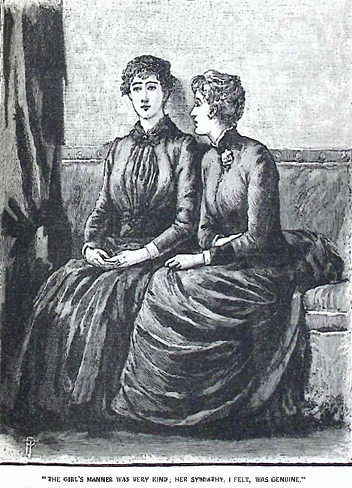
THE GIRL'S MANNER WAS VERY KIND;
HER SYMPATHY, I FELT, WAS GENUINE.
Thus she explained, and for a while I followed her meaning, taking in the bitter truth that I had tortured myself with a causeless jealousy, since Leonard had been at once the friend of Miss Carsdale and of her lover, and his interest in her arose from his desire to smooth their roughened course of love. But with the knowledge, the pain in my head increased to torture, my limbs grew stiff and numb, whilst about my brow a furnace-like heat seemed to glow. The confused throbbing changed to a roaring in my ears that drowned every other sound; then all consciousness left me, as I felt myself filling backwards, backwards, in a darkness as of night.
How long my swoon lasted I know not; but the pale, agitated faces I saw about me when consciousness returned told me that my illness was deemed serious. Only Mabel remained calm and capable. She decided that I must be got home at once, and would not hear of Mrs. Gower sending for a doctor.
"Dorothy is well enough now to bear the drive," she said; "and as soon as we reach home, I will send for my own medical man."
But when I tried to rise, my head swam again, torturing pain in head and spine returned. It was as much as I could do, with all the help that was given to me, to drag myself to the carriage.
But Mabel's strong will prevailed; and it was well for the dwellers at the Vicarage that it did.
I have but a confused remembrance of that drive home—a memory of hopeless confusion and pain—of Mabel's speaking to me, and of my vainly endeavouring to attach some meaning to her words and answering in an incoherent, senseless way.
But I roused a little from my stupor as we neared The Towers. I remember alighting from the carriage, aided by Mabel and the footman, and staggering into the hall. There was a joyous shout, and little Percy came bounding to meet us. Where was the superior nurse, whose sole duty it was to guard this precious life?
"Run away, Percy! Run away! Keep him back, some one!" cried Mabel, in a voice sharp with fear.
But the little fellow had clutched my gown as I sank on to a seat in the hall, and when I saw the dear, sweet face held up beseechingly to me, I, not knowing what I did, bent and kissed the rosy mouth.
The next moment, Mabel dragged him away, and his childish screams tortured my head. But it was too late. Ah, if I had but known!
For, a little later, Mabel's medical man—not old Dr. Perrow, but a younger practitioner, who had lately settled in the neighbourhood, and whom Mabel had "taken up," extolling his skill at every opportunity, pronounced that I was sickening with scarlet fever. Stupefied as I was, I saw the sudden pallor that came to Mabel's face when the doctor uttered that word of terror, and I knew that it was not for me that she feared, but for little Percy.
The fever had been spreading amongst the poorer houses of Burford during the wet spring, and many little children had died of it. Mabel had had her fears, and had carefully screened her child from every possibility of infection.
Poor Mabel! But her presence of mind did not desert her, alarmed as she must have been. She thought of everything that should be done, and gave calm and clear directions to her servants.
I was removed to the rooms within one of the towers. Mr. Steinthorpe had occupied them in his bachelor days. But since he married, they had been rarely used. The passage leading to them was shut off from the rest of the house by a heavy baize door; so that practically they constituted a separate dwelling, and secured for me the isolation that the nature of my illness demanded.
Salome was summoned to nurse me, and I need not say how willingly my old nurse came to me. All possible care and attention was bestowed on me by doctor and nurse. I lacked no comfort that money could procure; but I soon became too ill to know what was done for me, or who came or went.
====================
SICKNESS AND SORROW.

FOR days I lay in high fever. How the time passed I knew
not; for me there was only one long night of parching thirst, burning
throat, throbbing pain in head and limbs. Faces would gleam on me out of
the darkness, persons and scenes pass before me and disappear, like the
shifting views of a diorama. Now Salome's kind old face would look on
me, but as I tried to speak to her, she would change into Ralph; then
Grace would appear, Leonard, Mrs. Lyell, Mabel, and my brother Edmund.
Faces they seemed, only faces floating in the air, now above and now
beside me, and ever evading my efforts to fix and define them.
At times, I was conscious of a voice talking, ever talking, and longed
to silence it, not knowing that it was my own voice. Or I seemed to
be wandering in strange and bewildering scenes.
One delusion that must have repeated itself many times was that I was
climbing with my brother amongst the Swiss mountains. Masses of snow
lay about us; great blocks of ice were in sight; silvery rills gushing
between them promised a cool and delicious draught.
I longed to cool my parched lips and burning throat with the ice-cold water—longed to lave my hot hands in the crystal stream; but something ever kept me back. My feet would slip, or the scene would recede just as my desire seemed about to be gratified. Edmund or Leonard—for the one often changed into the other—would appear, and, pointing to the stream, urge me to hasten my steps; but my eager longing was ever baffled. I endured the doom of Tantalus. Leonard, Ralph, and Edmund; of all whom the wanderings of my mind brought before me, these three presented themselves most distinctly.
At last, the fever that consumed me burnt itself out. Gradually the terrible heat subsided; a cold hand seemed to be pressed upon my burning brow, cooling, calming, hushing the turmoil within. The haunting, harassing visions vanished; peace came to me and repose.
I awoke from a long, deep slumber, utterly weak and prostrate, but myself again. Yet the scene which met my opening eyes was so unfamiliar that I questioned if I were indeed looking on realities. The rounded chamber in which I lay was strange to me. It seemed inexplicable that I should be there, and still more bewildering was it to see Grace and Ralph standing within a few yards of me.
"It is a dream," I thought, and my eyes closed again.
They soon reopened, however, and now Grace was bending over me.
That she was no figment of my imagination was proved by her raising my head on her arm and gently forcing me to swallow some nourishment. I looked at her with wondering eyes.
"Grace!" I said. And the faint, hollow sound of my voice surprised me.
"Yes, dearest; it is I."
"Where am I?"
"In your sister's house, dear Dorothy. You have been very ill, and I have come to help nurse you."
"Oh! Are you here alone?"
"Yes, dear."
"Then it was not Ralph I saw?"
"Ralph was here a few minutes ago; but he is gone."
"And no one else? Not Leonard?"
"No, dear."
I gave a weary sigh. Grace made me take some more nourishment; then she enjoined silence, and I slept again.
Gradually my strength returned to me, thought grew clear again, and with thought came fresh trouble of mind.
Grace's presence at my bedside was easily explained. On hearing of my illness, she had written to Mabel, begging to be allowed to come and help nurse me. And as she was more skilful than most amateur nurses, having at one time, from love of the art, undergone a course of hospital training, Mabel gratefully accepted the assistance she offered.
Salome was at first disposed to be jealous of her, and to regard her coming as an intrusion; but Grace soon won her liking, and Salome was thankful to have so efficient an ally in the long-continued battle for my life; for the fever had raged its worst in me, and the least failure or lack of caution on the part of my nurses would probably have given me over to death.
"Grace," I said one day, when for some time I had been lying silent, lost in thought, "what made Ralph come to see me? It was running a great risk."
"Not so great as you think, dear," replied Grace. "We both had the fever as children, and it rarely happens that one takes it a second time. And Ralph was sorely anxious about you. He could not stay away when the crisis of your illness was approaching, and we knew that a few hours would decide the issue."
"He should not have minded. I wish he did not care for me so much," I said, beginning to cry, for I was still very weak. "Grace I can't help thinking that perhaps it would have been better if I had died."
"It is not for you to say that, Dorothy," she answered, gravely. "It must be better you should live, since God has willed it so."
But I continued to cry for a while. Presently I asked—
"What have you done with my ring, Grace?—The ring Ralph gave me?"
"He has it, dear. It was hanging loose on your finger when you were sleeping, and he took it."
"He should not have done that," I said, querulously. "When will he give it to me?"
"When you see him, you can ask him," said Grace, sagely.
"Is he coming here again?" I asked, with a sudden palpitation of fear.
"No, dear. He thinks it best not to see you till you are stronger—when you are able to leave here. When I can take you to the seaside, as I hope to do, perhaps we shall see him."
I gave a sigh of relief. Did Grace understand its meaning? There was a pained look on her face as she watched me.
"Grace," I said, uneasily, "did I talk much when I was delirious?"
"Why, yes. You talked incessantly," she said.
"Oh, what did I talk about?" I asked, eagerly. "Did I mention names? Did I talk about any one in particular? Oh, do tell me!"
"You mentioned several names, I believe," she answered quietly. "But, dear Dorothy, it is foolish to recall that now. When the delirium is past, we forget the patient's wandering words."
"Yes, yes; pray forget them," I said, hurriedly. "I daresay I talked great rubbish; I want you to forget everything I said."
"Very well," replied Grace.
But she looked so troubled that I wished my words unsaid.
My recovery was very slow and tedious. The burdens that lay on my heart, the keen, gnawing remorse that came with thought of the past, the doubts and fears with which I looked forward to the future, must have retarded my progress. In my convalescence, I had abundant leisure for reflection. I saw plainly now what a fatal mistake I had made, and how my rash, impulsive action had brought trouble on those, whom I most wished to make glad; but I could see no way of escape from the deplorable position into which I had brought myself. Ah, if I had but laid my case before the Lord and awaited the guidance He never fails to give to those who seek it! Then I should not have known the shame and sorrow I now endured.
After a few days, I saw less of Grace. I had begged her not to imprison herself in my sick-room. And when she left me for hours at a time, I believed that she was resting, or taking the fresh air. I was content to have only Salome's company, for Grace's presence, dear as she was, had now for me the force of a silent reproach.
Mabel did not come near me; I did not of course expect to see her, knowing how desirable it was to prevent the spread of infection in the household. In truth, I thought very little of Mabel. I hardly realised that I was at The Towers, so unfamiliar was the room I occupied. Like most invalids, I was absorbed in myself, marking the stages of my recovery, looking forward to every proposed change, and wondering, sadly enough, what the coming days would unfold. But soon something occurred to rouse me from my selfish lethargy.
One afternoon I was alone for a little while, Salerno having gone below to fetch some needed supplies. I had left my bed for the first time, and was lying on a couch near the fire. My eyes were closed, but I was not asleep, for I heard the peculiar squeaking sound the hinges of the baize door made whenever it was pushed back. Who could be coming to The Towers from the main dwelling? Not the doctor, for he had already paid his daily visit to me; besides, the light step that was ascending the stairs was certainly not a man's. Ere I could wonder long, the step paused outside the door; then the handle was timidly turned, and the next moment, to my utter amazement, Mabel stood before me.
Yes, it was Mabel; but how altered! She was white and haggard; her eyes had the dilated strained look that tells of long sleeplessness; her self-confident, composed air was gone. I had never seen my sister look so before.
"Mabel," I exclaimed, "what is it? Oh, you should not have come. Do you forget the risk of infection?"
"It does not matter now," she said in a hard, unnatural tone. "Nothing matters now. He is dying, Dorothy, dying."
"Dying!" I repeated, aghast. "What do you mean? Of whom are you speaking?"
"Of whom should I speak but of my Percy—my darling, my precious child! Oh, if he dies, I shall be the most wretched woman on earth!"
"Oh, Mabel!" I cried, the thought smiting me sharply. "You do not mean to say that little Percy has the fever?"
"Did you not know? Did they not tell you? He has been ill for days—how long I do not know; for I have lost all count of time. The fever had turned, we thought he was getting better; but now there is some dreadful complication, and they say there is scarcely a chance that he can live. Oh, do not look at me like that, Dorothy! I cannot bear it. Oh, my darling, my darling, how could I live without you?"
I looked away, and was silent. It seemed vain to try and comfort her, so agitated as she was. Yet there were no tears in her eyes. She walked to and fro my room as though too restless to sit down. She wore a loose morning wrapper; her hair was falling in disorder on her shoulders; she looked utterly unlike the bright, dainty little lady she usually appeared.
"Mabel, dear," I said presently, "you must not give way to despair. Surely, whilst the darling still lives there is some hope."
"There is just that much of hope," she replied; "Dr. Evans said so. And now Howard has summoned a physician from London, who is watching the case. They banished me from the room; they told me to rest. But how can I rest? The sleeping draught they gave me had no more effect on me than if it had been water."
I thought that its effect was evident in her wild excited mien.
"Dorothy," she went on, after a moment, "I have come to you because you love him, and you will pray for him. I have tried to pray, but I cannot. God will not hear me. I am too wicked."
"You wicked, Mabel! You were always better than I!"
"Dorothy, you must not say that; you do not know me. Oh, I knew from the first that he would die; I had no hope from the hour when they told me he had taken the fever. I am not worthy to be the mother of such a pure, innocent little child. God has judged me unworthy. He will punish me for all my worldliness and pride. Even in my religion, I was worldly, thinking chiefly of what was correct and in good taste."
Could it be Mabel who poured out these confessions? This humble, despairing woman, the proud, queenly sister, who had been so ready to admonish and reprove me! But I ceased to wonder in my longing to give her comfort.
"God is love; God is merciful," I whispered.
"'If we confess our sins, He is faithful and just to forgive us our
sins.'"
And as I said the words, my own sins rose before me, all my past follies and perversities, and I knew that I, even more than Mabel, needed to implore the merciful forgiveness of God.
"You must not give up hope," I continued. "I do not. We will pray, and God will hear our prayer."
"But, Dorothy, remember how we hoped to the last for poor Edmund. And we prayed that he might live, and yet he did not."
"I know," I said, half-sobbing; "but oh, it cannot be that darling Percy too will be taken; oh, I cannot think that that will be!"
"Then pray, Dorothy. Ask God to save my child. Ask Him now."
She had cast herself down beside me, and clasped my hands in hers, as she looked up at me with appealing eyes.
There was no barrier now between my heart and Mabel's. She needed me now, needed my sympathy, my prayers. It was as if we had been carried back to the days so long gone by, when we had childish griefs in common and prayed together in simple, childish words with childish faith.
A little while before, I should have said it was impossible that I could breathe a prayer in Mabel's hearing. But in hours of supreme trial, the reserve, self-consciousness or pride, which isolates our spirits, separating us even from those most dear, breaks down, and we are conscious only of our common needs and sorrows.
So I prayed, beseeching the Lord to spare the little life so dear to us, whilst Mabel knelt by my couch, still clinging to me. When I ended, tears, blessed tears, came to her relief. Her strained, excited mood gave way, and she clung to me sobbing. It was more than I could bear to witness her abandonment of grief. In a few moments, I, too, should have lost all self-control, had not Salome come to my help. She was amazed to see Mabel crouched on the floor beside me.
"Miss Mabel, Miss Mabel," she exclaimed, her manner displaying the old, stern authority with which she had ruled us in our childhood; "you should not be here; you will make your sister worse if you cry like that. Come, come with me."
And, as firmly, but not unkindly, Salome laid her hand on her arm, Mabel rose and passively let our old nurse lead her from the room. She went away wan and bowed, with a sad, stricken look on her face; but not so utterly hopeless, I think, as when she came.
After a while, Salome came back to find me crying helplessly. She made me take a restorative, and forbade me to speak. But I could not keep quiet long.
"Why did you not tell me that little Percy was ill?" I demanded, presently.
"Because it was better you should not know. You would have fretted and gone back. You should not have heard now if I could have prevented it."
"I would rather know," I said; "and now you must tell me all, Salome. I cannot bear to have things kept from me. Is he really so very ill? Do you think he will die?"
Salome shook her head solemnly. "Who can say! He is as ill as ever child was. There's a mighty fine doctor come from London; but I have not much faith in doctors."
"I have heard you say that it is wonderful what little children will come through."
"So it is, Miss Dorothy, so it is. I have seen poor folk's children persist in living, when everyone had given them over; but rich people often cannot save their children with all their grand doctors, and nurses, and everything that money can buy. Life is full of trouble, my dear, and no one can escape the common lot. Those that have all this world can give them are made to suffer in other ways."
"Poor Mabel!" I sighed. "It will break her heart if she loses her boy. And I feel as if I could never forgive myself, for I must have given him the fever."
"Nay, child; it was none of your doing. This stroke is from the Lord. Small or great, He loves us too well not to chasten us. And the sorrows He sends us are less painful than those we bring on ourselves."
"Ah, that is true!" I said, involuntarily.
"Poor Miss Mabel was always so haughty-proud," continued Salome; "she seemed to think the world was made for her and trouble could never touch her. Even as a little child, she had always a grand air. And the Lord hates pride; He humbles the haughty."
"But He forgives those who confess their faults," I answered; "He hears us when we pray."
"Ay, to be sure; there's no doubt of that," Salome answered.
But her manner was not encouraging. I saw that she had made up her mind that little Percy would die. How I longed for Grace to share my burden with me! But I knew how she was occupied; I could understand now why I had seen her so little of late.
"Is Mrs. West nursing Percy?" I asked.
Salome nodded. "I don't know what they would do without her," she said; "when he was wild and fractious, she could manage him better than any one. A real God-send she has been to us. I never saw her equal in a sick-room."
Such praise from Salome was rare, and it showed that Grace was displaying no ordinary skill.
What a long, long evening it was that followed! My thoughts dwelt constantly on my darling nephew, and again and again I prayed God to spare the precious, young life. Fear was strong within me; the saddest possibilities pictured themselves before my mind; I could get no rest for sore anxiety.
From time to time I sent Salome to make inquiries, but she brought back ever the same report. The child was just the same, no better, and every hour the faint thread of hope seemed to grow slighter. And still I prayed and tried to hope, though my heart sickened under the long suspense.
For a long while I resisted Salome's desire to get me to bed, saying that, since it was impossible to sleep, I would rather remain up. But at last, worn out, I yielded, and lay in bed staring blankly at the fire and at Salome's gaunt, upright form seated stiffly beside it, till at last sleep surprised me.
====================
A PLEDGE OF FRIENDSHIP.
I SLEPT, and towards morning I dreamed. In my dream, I was again amongst mountains; but not now in snow covered regions. I was treading an Alpine glade of emerald green, gemmed with flowers. The sun was shining brightly, birds were chirping and singing in the bushes, little silvery rills flashed in the sunlight, and the sky was blue overhead. I felt no fear, only joy, when I saw Edmund descending the green slope of a mountain side.
He came with fleet steps, and I saw that he carried in his arms a little child. Hurrying to meet him, I found that he held little Percy. Ah, how the child's golden curls shone in the sunlight, how the blue eyes smiled, how angelic was the look of the sweet, innocent face!
Edmund put him in my arms saying only,—
"Take him back to Mabel. He will be a blessing to her; he will lead her upward."
And in my dream, I seemed to know that the child had been lost and was found. Pressing him close to me, I turned to seek Mabel with the feeling that I was bringing her joy after great sorrow, when a voice close beside me said—
"We must thank God."
With that, mountains, green vale, flowers, the child—all vanished. I opened my eyes to find the sun shining brightly in at my window, swallows twittering from beneath the turret, and a light soft breeze fluttering the white curtains. And full in the sunlight stood Grace, pale and worn from her night's watching, but with a glad light in her eyes; her whole countenance expressing a heartfelt thankfulness.
"Percy!" I exclaimed, starting up.
"Is better," said Grace. "There has been a change in the night, and now the doctors think that he may recover."
"Oh, thank God!" I cried.
And then we embraced each other and wept together.
It was the first real spring day, and all nature seemed to echo our hearts' deep thanksgiving. Easter, a cold, wintery Easter, had come and gone whilst I lay in the unconsciousness of fever. Spring had long delayed her coming; but now, when the month was all but over, came this true April day, with warm sunshine and soft showers, making the birds sing melodiously, and the shy flowers unfold their buds without fear.
During the day, Howard sent me a little knot of sweet violets, the first to be found in our dear old garden at the tannery. I was delighted with them; but I wondered greatly that he should have thought of showing me such a kind attention. Surely the joy of relief from sore dread must have opened his heart and enlarged his sympathies to a wonderful extent.
But my weary days of confinement were drawing to a close. Spring having come, the doctor advised my speedy removal to the seaside. A little house was taken for us at Southend, this place being fixed on because it was conveniently near to Burford, and we could drive there direct from The Towers without risking the fatigue to myself and possible peril to others that a long journey by rail would involve. Salome and Grace, who by this time needed a change as much as I did, were to accompany me for the first week, at the end of which Mabel hoped to be able to join us with little Percy.
Southend in those days was a quaint, almost rural little place, unspoiled by the visits of London holiday-makers. Our house was on the high cliff, open to the strong sea breezes and commanding a fine view of the tossing waves when the tide was high. It was delightful to see the sea again and to breathe the fresh air with the feeling that each breath gave me strength. Those who have experienced such a period of convalescence will know the new joy in life that comes with returning health.
But for me that joy was shadowed. Little Percy's danger had shaken me out of myself for a time, and I had ceased to trouble about the future that lay before me. But now, with returning strength, the whole crowd of doubts, fears, and regrets assailed me afresh.
I think Grace saw that there was a cloud on my mind that marred my enjoyment of the lovely spring days. Doubtless she understood its nature; but she asked no questions and did not attempt to force my confidence. Only her gentle, never failing kindness told me of her sympathy.
One bright, breezy afternoon, we were returning from a stroll upon the beach, and ascending the somewhat steep path to the cliff, when I saw a gentleman looking down on us from a point almost opposite the house in which we were dwelling.
Grace saw him at the same moment and exclaimed, "Why, it is Ralph!"
I needed not to be told that. My heart had sunk at the sight of him, my limbs were trembling, my breath growing short; it was all I could do to keep on walking.
He had seen us and was making his way to us by a steep rugged zig-zag that cut into our path.
We paused at the junction, and in a few minutes he was beside us.
"How are you, Dorothy?" he asked, in the kindest manner, holding my hand in his as he studied my looks with affectionate, anxious interest.
"I am much better; almost well indeed," I said, falteringly.
"Is she really gaining strength, Grace? She looks very frail. Has she never more colour than this?"
"She is tired now," said Grace, evading the question; "we have, perhaps, been a little too far."
She knew as well as I knew that it was his sudden, unexpected appearance which had driven the colour from my cheeks, and for the time robbed me of strength.
With that, he made me lean upon his arm as we slowly continued the ascent, and, tremulous and breathless as I was, the support of his strong arm was most acceptable.
Sparing me, he talked to Grace, telling her all the home news she was eager to hear. Bright and ready were his words, and yet there was a change in him, a change not easy to define, though I had been aware of it at the first glance. A look it was that told of past suffering and present sorrow, held in check by a strong will.
When we reached the house, Grace led me into the sitting-room, put me into an easy chair by the fire, removed my hat and jacket, and insisted on my resting for awhile. Then she went away, leaving me alone with Ralph.
He had taken a chair near me; but, for what seemed to me a terribly long time, he said not a word. I suppose he thought that I should rest better in silence; but the stillness was to me slow torture. In desperation, I broke it at last.
"You came to see me when I was ill," I said; "you should not have done so; it was running a risk."
"A very slight one," he replied; "but I should have done the same however great the risk. Nothing could have held me from you when your life was in danger; unless, indeed, the fear of making you worse. But as you were unconscious, that was impossible. And now I am thankful that I watched at your bedside when you were so ill," he added, in a tone of peculiar meaning; "as thankful as I am, dear Dorothy, to see you well again."
His words, and even more, his tone, frightened me. What could he mean? I turned hot and cold, and looking down began twisting my fingers in nervous, school-girl fashion. Then, prompted by the sight of my ringless fingers, I rushed, as I was wont in moments of embarrassment, into impulsive speech.
"Grace tells me that you have my ring," I said, holding up to view the hand that lacked it. "I missed it almost as soon as my senses returned to me. Will you not give it to me now?"
"Do you really wish to wear that ring again, Dorothy?" he asked, very gravely.
And I could not answer him. His searching eyes, his grave tones, arrested me, and made it impossible to utter anything save the very truth. Then he stretched out his hand and took mine. It was cold, and it trembled in his clasp.
"My poor child," he said, tenderly, his voice vibrating with strong emotion, "do I frighten you so much? Oh, what a mistake I have made! I thought I could make you happy, Dorothy. I meant to guard your happiness with jealous care; and see! My very presence alarms you, makes you turn cold and white."
"No, no," I faltered; "it is not so. I am not afraid of you."
"Then why does your hand flutter in mine like a frightened bird? Dorothy, let us be frank with each other. Believe me, it is best. I know now what a mistake we have made—a mistake that would have been fatal to your happiness and mine. We must thank God that we have found it out in time. Dear, when I stood by your bed you uttered words in your delirium that revealed to me your heart's secret. Nay, do not shrink so. You said nothing you need blush for—nothing that was not honourable to you. Only I wish you had better understood my love; I wash you had trusted me fully."
He spoke gently, calmly; but the effort it cost him so to speak was apparent with every word. My heart was wrung with pain as I listened. I wanted to speak, but words would not come to me.
"If I had known that there was another," he added, after a pause, speaking not bitterly, but with somewhat of reproach in his tone.
"Indeed, indeed, I did not mean to deceive you," the words stung me into saying; "I thought that was all over and done with; I thought I could put an end to it, or I would not have promised to be your wife. Pray believe that."
"I do believe it," he replied, gently. "I know you meant to be true to me. I do not blame you, dear; it has all been a sad mistake."
"I meant it for the best," I sobbed. "I thought I could make you happy, and I knew it was what dear Edmund had wished."
"Yes, because he thought that you could love me; he was so sure that there was no one else you cared for. He would not have wished it otherwise."
"Oh, I might have known—I might have known!" I cried bitterly. "I can never forgive myself for what I have done, for the pain I have caused you. And yet—oh, I did want to make you happy!"
"Do not grieve, child," he said, tenderly. "You shall make me happy yet. Do you remember telling me that you should find your happiness in mine? Now I say the same to you; if you are happy, I shall be happy."
"I shall never be happy," I sighed; "for I can never forget. My life will be one long regret."
"No, dear, that must not be. For my sake, you must embrace happiness when it comes to you. You must be happy, for I want to be happy, and I cannot be unless you are. Remember that when you are inclined to make yourself miserable on my account."
How bravely, almost cheerfully, he spoke, and yet every word told me of the pain I had caused him! I responded only by tears. He drew from his pocket a tiny leather case, which he placed in my hand.
"There, dear, is your ring. You will keep it for my sake? Don't put it on now; but at some future time, wear it for the sake of your friend. For, Dorothy, I cannot renounce our friendship. I shall ever be your friend and the friend of all whom you love, not for your sake alone, but for your brother's sake—that friend of mine that lives in God."
So saying he held out his hand. It still bore traces of the burns he had received when he heroically rescued me from the fire. The sight of those scars reproached me keenly. I owed to this man my life, and in return, I had thus pained and wronged him. I gave him my hand and he pressed it to his lips.
Then, still holding it, he said, "And now good-bye, Dorothy; I am going away for awhile. In another month I sail for Jamaica to transact some business for my father there. When we meet again, this painful episode in our lives will have ceased to trouble us, and you will welcome me as your friend, will you not?"
"Yes, yes, my best friend," I murmured.
It was all I could say under the pressure of overwhelming emotion. And yet how much more I should have said!
I longed to thank him for his noble forgiveness, to assure him of my undying gratitude, to tell him that henceforth he stood apart and sacred in my life, as a friend, honoured and prized above all friends, a brother, worthy of the best love and reverence a sister's heart can know. But I had no power to speak, and the next moment he was gone.
I heard him leave the house; he would not stay even for a word with Grace, and I knew that he had gone forth to sorrow, heart-hunger, loneliness. Well might I weep, who had brought such suffering to this true and noble man.
Grace came in ere my sobs were stilled. She was amazed to find her brother gone, but in a moment, she understood.
"I have sent him away!" I cried, wildly. "Grace, you ought to hate me; I have made your brother wretched; I have spoiled his life."
But she did not hate me. She put her arms about me and kissed me.
"He will suffer," she said, speaking with deep emotion; "but you have not spoiled his life. It is sin, not sorrow, that ruins human lives. And you suffer, too, my poor Dorothy."
And so she could bear the burden of each, feeling keenly for us both.
For many days the thought of Ralph weighed on my heart and retarded my advance to health. At the end of a week, Grace returned to Beechwood, where, by this time, her presence was earnestly desired. Mabel came down to Southend, bringing Percy, his nurse, and a younger maid. The child had already made rapid progress towards recovery, but he needed great care, and Mabel watched over him with anxious, jealous solicitude, trusting little to servants, and guarding him herself by night and by day. I think she was glad to have her child all to herself, and to live a simple, quiet life for a little time. She was looking very worn and ill when she came to Southend, but soon, as Percy grew rosy and strong, her looks also began to improve.
It was amusing to watch the child's wonder and delight when first he saw the sea. He loved to see the waves rippling on the sandy beach, and never tired of playing there. Mabel and I spent many an hour with him by the shore. The nurse's duties were light indeed, for we generally took Percy out and had him with us for the greater part of the day. Our common love for the little darling, our delight in marking his development, planning new pleasures for him, and laughing over his precocious ways, formed a strong bond between me and Mabel. We were very happy together. Our old sisterly affection renewed itself; Mabel was softened by her recent experience; she had lost her dictatorial manner, and was more gentle and loving than I had ever seen her.
Only once was the harmony of our intercourse broken. It was when I told Mabel that my engagement to Ralph Dugdale had come to an end. This was a sore blow to her pride, since she had plumed herself on the good marriage I was about to make. She thought I had done very wrong, guided by foolishly romantic notions, and that I should live to repent my folly. It was not strange that she should think so, for I could not tell her all that had led to my parting with Ralph. I shrank from mentioning Leonard Glynne. I had never named him to Mabel; it had been an astonishment to her to learn in the vicarage drawing-roots at Dunsted that I had some acquaintance with Mrs. Gower's relatives.
Not for the world would I have had Mabel even suspect my heart's secret; for I still looked upon it as a weakness to be overcome, a thing to be buried and forgotten. I had no hope in connection with it; I should have held it base to cherish such a hope whilst that painful parting with Ralph was still so recent, his suffering so vividly before my mind. No; I said to myself that I should never see Leonard Glynne again. Much as I loved Mrs. Lyell, dear as Grace was to me, nothing should induce me to go to Weylea or Beechwood till many years had passed.
Mabel was somewhat mollified when I told her that Grace approved of what had taken place. She had felt the influence of Grace's pure, unselfish character. A gentle, almost sad expression came to my sister's face with the memories her name recalled.
"She is a good woman," she said with a sigh, "a good and noble woman. I believe that I owe my child's life to her devotion and skill. I wish there were more such women in the world."
Mabel had intended to stay but a few weeks at Southend; but in the end, we spent nearly the whole summer there. Sea air and sea water were considered so desirable for little Percy that Mabel determined he should enjoy them as long as possible. She went back to The Towers once or twice for a short visit, but she seemed glad to return to the quiet, simple life at the seaside.
Howard Steinthorpe used to ride over every Saturday, and stay with us till Monday or Tuesday. How much he made of his boy on these occasions! How glad he was to see the child who had been given up to death growing ruddy and strong in the summer sunshine!
And his manner towards Mabel was marked by a grace and tenderness which it had lacked before that season of sore suspense and dread which they had endured together. They had loved each other when they married, and their love had not died, though the strain of a commonplace, worldly life had worn it very thin. It was blooming into new beauty and strength in the light and joy which had succeeded the gloom cast by the dread shadow of death.
The first time Howard came to us at Southend, he surprised his wife and me by producing from his coat pocket two little packets, exactly alike, one of which he tossed to each of us.
"A little keepsake from me," he said.
And the keepsake proved to be a memorial locket, beautifully wrought in gold, black enamel, and pearls. Opening mine, I saw on one side a miniature photograph of my brother, and on the other a lock of his hair. The likeness was excellent; it was one Edmund had sat for a short time before his health began to fail. It was a lovely gift, and must have cost a considerable sum; but I cared less for its intrinsic worth than for the unexpected kindness and thoughtfulness Howard evinced in giving it to me.
Mabel was delighted with her locket, and exclaimed at its beauty; but I was so touched by the sight of mine that I hardly could speak.
"I don't know how to thank you," I said, looking at Howard through tears.
"I don't want thanks," he said, rather brusquely; "I am glad if it pleases you. I always meant to be a friend to you and your brother, Dorothy, if you would have let me."
And doubtless his words were true. He had meant to befriend us, but, like many persons in similar circumstances, he wished to do so in his own way, and had no desire that we should be unconscious of our obligations to him.
"I believe you," I said, putting out my hand to grasp his. And then, thank God, the old rancour died out of my heart, and I could forgive Howard Steinthorpe all that had seemed hard in his dealings with me and mine in the past.
——————
WRITE A LETTER WHICH I AM NOT ALLOWED TO SEND.
IT was September ere we returned to The Towers. By that time I was as strong and well as ever I had been—nay, stronger, for I was enjoying the delightful sense of well-being, the wonderful rejuvenescence which not seldom follows as an agreeable consequence of fever. With it, there came a longing to employ my energy.
Before we left Southend, I had settled to a course of steady study, for there was danger for me in an idle, dreamy existence. Mind and body craved occupation. I felt it would be well for me to lead a bustling, active life, so I wrote to Miss Carefull, asking her to help me to find a suitable situation. I did not mind what sort of work it was, I said, so long as I had plenty to do. She sent me a kind reply, promising me all the assistance she could give, and advising me still to aim at self-improvement, and be content to begin with a small salary, if the employment left me leisure for study.
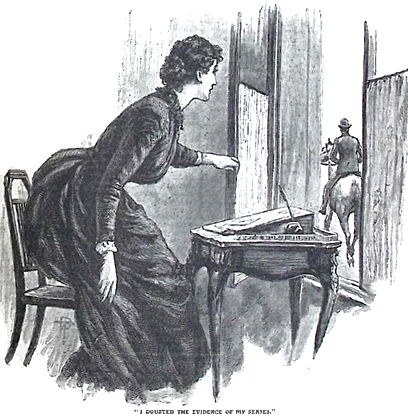
I DOUBTED THE EVIDENCE OF MY SENSES.
My seeking a situation did not at all accord with Mabel's ideas. It was bad enough that my engagement to Ralph Dugdale should be broken off; but that I should persist in "going out as a governess" shocked and dismayed her to the utmost. How was it that I could never see things as she did? What would people say if they heard that I was not to be married, but had "taken a situation"? Why could I not make my home at The Towers? Little Percy would soon be old enough to receive instruction, and I could teach him if I was so anxious to be a teacher.
Mabel could not understand why I resisted her persuasions. It was impossible to show her that the life she pictured would be the worst possible for me. I was sorry to cross her; the more so since she bore with my perversity, as she deemed it, more patiently than she had been wont to do.
We had not been many days at Burford when I received another note from Miss Carefull. It was written in haste.
Her younger governess had just given her notice that, owing to the ill-health of her mother, she would be obliged to leave the school at Michaelmas. Miss Carefull said that she hardly liked to offer me the post; but since I had affirmed that I was ready to undertake anything, she thought there would be no harm in proposing it. I knew what were the duties of her younger governess, so she need not go into details. She could not give me time for consideration; but must ask me to let her have a line by return of post to say whether or not I could agree to her proposal.
I did not hesitate for a moment, though I was aware that the duties of Miss Carefull's younger governess were not of the most pleasant nature. She had to teach the youngest pupils, superintend the practice of juvenile strummers on the piano, walk out with the boarders, keep order in the schoolroom during silence hour, and do all that the superior, more accomplished governess disdained to do. A dreary position it had seemed to me in my schooldays, yet now I was eager to fill it. The greater trials I had known since those days made the petty annoyances of a teacher's life seem of small account.
But how Mabel opened her eyes when I showed her Miss Carefull's note, and told her how I meant to answer it.
"You do not mean it, Dorothy," she said; "you cannot think what you are doing. You forget what a miserable drudge Miss Carefull's junior governess always was."
"I know she had a lot to do," I replied, "but that is what I want; I should like plenty of work."
"Oh, Dorothy," said Mabel, with a kind of despair, "but what work it is. I would not be in such a position for all the world. Have you forgotten poor Miss Tyner, and how the girls persecuted her?"
"Miss Tyner was a weak creature," I answered. "I shall take care the girls do not treat me as they treated her."
"Well, how you can choose to spend your days in teaching stupid children to do their sums and write their copies, in contending with tiresome school-girls, and taking wearisome marches behind the school, when you might stay her with me and Percy, and watch the darling's growth and all his pretty ways, is past my comprehension," said Mabel.
"I am afraid I have always been a puzzle to you, dear Mabel," I said, gently; "but, believe me, I am not ungrateful for your kindness in wishing me to stay. I would do so, indeed, if I could."
"I cannot understand you," she said, with a sigh; "but I suppose you must take your own way."
I sighed too as I went away to write my letter to Miss Carefull. There was no pleasure for me in thus taking my own way. I expected no joy in the situation I chose to accept, but only that life would be made more endurable by constant, regular occupation.
I seated myself at one of the tables in the library and wrote my reply in clear, concise terms, finding a sort of fierce satisfaction in binding myself to an irksome, monotonous life.
The library was in the front of the house. Its windows looked out on the sweep of the well-kept carriage drive and the velvet lawn beyond with its multiform beds brilliant with bright-hued flowers. I had written and sealed my letter, and was idly resting on my elbow and gazing through the window nearest me, when the sound of a horse's approach reached my ears. It sent a sudden thrill through me, bringing vividly before my mind a vision of Leonard mounted on Ariel. I had time to calm myself and reflect that it was probably Howard returning from the mills for luncheon rather earlier than usual, ere the rider came in sight.
Then another thrill, like an electric shock, passed through me. For, though the horse was not Ariel, the rider, seemed to me, was Leonard Glynne. But in a moment he had passed the window, and in the bewilderment and tremor, I doubted the evidence of my senses. The sunlight had dazed me, a resemblance had misled me; it could not be that he was here!
I heard the house-bell ring; heard the visitor being shown into the smaller reception room at the other side of the hall, caught even, for my hearing seemed to become preternaturally acute, the footman's subdued, respectful tones, and the firmer, deeper voice that spoke to him. Then I heard the door close, and with heart fluttering and every nerve a quiver I waited, my ear following the servant's movements as he went here and there and finally upstairs in search of someone. I had time for many sensations, fears, surmisings, though it was but a minute or two ere he appeared at the library door.
"A gentleman to see you, Miss Carmichael."
Mechanically I took the card extended to me on a salver. The hot blood surged up in my face as I read the name of Leonard Glynne.
"Have you told Mrs. Steinthorpe?" I said, somewhat unsteadily.
"No, miss; the gentleman asked for you. Do you wish me to tell Mrs. Steinthorpe?"
"No, no," I said, hurriedly, ashamed of the confusion I was betraying to the servant's keen eyes; "it does not matter."
A few minutes later, I was shaking hands with Leonard Glynne. I could not greet him with the old friendliness, I was nervous, and nervousness gave to my manner an unusual coldness. I was aware that I was producing a poor imitation of Mabel's stately demeanour towards an undesirable acquaintance, whom she wished to keep at a distance; but I could not help it, though I saw Leonard's countenance fall with a look of pain and disappointment.
He, too, became cool and dignified. We sat a distance from each other, a table loaded with bric-à-brac between us.
"I am staying a few days with my cousin at Dunsted," he said.
"You have come for the shooting, I suppose," was my reply.
"Yes; at least I have been amusing myself a little in that way. I thought that as I was so near, I should like to ride over and inquire how you were. Mrs. Lyell will be pleased to hear."
"Thank you," I said, austerely; "it was good of you to forsake the guns this fine morning on my account."
"Oh, as for that, I am not much of a sportsman. I like well enough to go with the other fellows, but following the dogs across the fields becomes monotonous after a while, when you cannot bring down much."
"How is Mrs. Lyell?" I asked.
"Very well, thank you. She would have sent some message, no doubt, if she had known that I should see you."
"Your cousin, Mrs. Gower, is well, I trust? I had the pleasure of making her acquaintance just before I fell ill with scarlet fever."
"She was telling me how your illness almost began at her house. She is very well. I hope you are quite strong again, Miss Carmichael?"
"I am perfectly well, thank you. I am afraid I alarmed Mrs. Gower very much that day."
"Oh, I should not think so; Marion is not easily put out."
These polite commonplaces having passed, a pause ensued. I had time to observe that Leonard had altered somewhat since I last saw him. He was thinner and looked older; he had lost the air of cheerful satisfaction with himself and his surroundings, which had distinguished him when I made his acquaintance.
The stillness was broken by the sound of hoofs on the gravel outside. A groom was leading past the window the horse Leonard had ridden. I started up, reminded of the duties of hospitality.
"The man had better take your horse to the stable," I said, advancing to touch the bell, "and my sister shall be told that you are here. You will stay and take luncheon with us, of course."
"No, thank you; indeed, I cannot think of it," he said, with a hurried movement, to prevent me from carrying out my intention of ringing the bell. "Pray do not disturb Mrs. Steinthorpe. I must ride away almost immediately; I only wanted to say a few words to you."
He spoke nervously, unsteadily. I moved back to my place, and sat down in considerable tremor. Clearly it was not easy to say what he wished. Another silence fell.
"We heard of your illness from Ralph Dugdale," he said, abruptly, at last. "He rode over from Beechwood to tell Mrs. Lyell. I was at my aunt's, and saw him."
"Indeed!" was all I could say. My face flushed hotly; a terrible confusion seized me at the mention of Ralph's name.
"He came again after he had seen you; he came several times. We had some talks together. He is a good fellow, is Ralph Dugdale."
This was dreadful. What had Ralph said? Had they talked of me? Oh, surely he would not betray my secret?
"He told me," Leonard continued, seeing that I had nothing to say—"I hope that you will not mind my knowing—he told me that you were no longer engaged to him."
"And I have no objection to anyone's knowing that," I said, haughtily. "It is true; we are no longer engaged."
And I looked at him with an air of defiance, as though I would say, "What of that? Do you suppose that because I have sent him away, I shall be ready to receive you?"
So Leonard understood my glance. His face fell; I saw his lips tremble.
The triumph of my pride brought me no satisfaction. The next moment I was full of remorse and pain.
When he spoke again, his low tones seemed to breathe despair.
"Of course it could make no difference," he said, brokenly. "I might have known."
With that, he rose to go.
Then a terrible pain wrung my heart. Why did he not say what he meant? Why did he go thus without giving me a chance of explaining?
He stood before me, but I did not put out my hand, nor did I look at him. My eyes were following the movements of a bee, which was circling round and round an épergne filled with flowers that stood on the table. Suddenly the bee flew straight into the heart of a rose. I think that large creamy rose carried both our minds to Weylea.
"See," I said, rising and leaning over the flowers, "this is just like one of the roses in Mrs. Lyell's garden, those that grow against the wall by the greenhouse. Do you remember?"
"I am not likely to forget," he said, his voice betraying strong emotion. "Dorothy," he added, in quick, tremulous tones, "do you remember how you once refused a rose I offered you? Tell me, did you really think that day that I cared for Miss Carsdale?"
"Of course I did," was my reply.
"But how could you? You might have known there was nothing of that sort. She was dear to me as my cousin Henry's 'fiancée,' that was all."
"How was I to know that?" I asked, half-laughing, yet with tears burning beneath my eyelids. "You might have told me."
"I would have told you, but it was their secret. And I thought that Rose would tell you herself, perhaps, if you would make a friend of her. And then—then it seemed to me it did not matter, for I was sure that you preferred Ralph Dugdale to me."
"Oh, how could you?" I began, but checked myself in shame-faced confusion.
Then, as our eyes met, each read the heart of the other. We clasped hands, and somehow, without much explanation, we arrived at a perfect understanding.
After that, Leonard needed little persuasion to remain to luncheon.
I had difficulty in making Mabel comprehend what had come to pass, and when I succeeded, she was not altogether pleased. She received Leonard graciously, but her looks revealed to my experienced eyes that she was wondering how I could prefer this young man, who was only "something in the City," to Ralph Dugdale, who came of such a good family, was so clever, and had such a grand career before him in all probability.
"Here is one comfort in it," she remarked to me, "you will not now think of being Miss Carefull's junior governess."
And when I showed Leonard the letter I had written that morning, he decided that it must not go, and I must send in its place another sort of reply.
Thus it came to pass that, in spite of my preparations, it was some years ere I had any experience of a teacher's toils.
Leonard was of Mabel's mind in wondering how it was that my heart chose him in preference to Ralph.
"Such a noble fellow," he would say; "so clever, and sure to make his mark some day. You will regret it, Dorothy, when you find what a stupid, commonplace mortal you have chosen."
"No, no, I am not afraid," was my reply. "I know Ralph is great and noble, but he was too much above me. I should have been a disappointment to him. Now you and I, Leonard, are more on a level; we suit one another exactly. And though we can never be brilliant and famous, we will always aim at being good."
Let it not be supposed that in my happiness in Leonard's love, I forgot the pain I had caused another. No, the memory of my great mistake lay on my heart as a dark shadow of regret through all the brighter days that followed. I regret it still, though so many years have passed; and I have written this story of my girlhood in the hope of warning other girls from committing the errors into which I fell.
My young days, vividly as I remember them, seem to have receded to a great distance now, for I have girls and boys of my own growing up around me, and begin to feel myself an old woman, though my husband says it is absurd of me to use such an expression.
Our home is near Beechwood, where Ralph Dugdale lives with his sister. Mr. and Mrs. Dugdale, also my dear old friend, Mrs. Lyell, have passed beyond the veil of death. We are very proud of our friend Ralph Dugdale—Uncle Ralph, our children call him—for he has won an honoured name in the world of politics as a bold worker for righteousness, the champion of all who are weak and oppressed. Faithfully has he kept his promise to be a friend to me and mine. We have no friend like him, so interested in all our concerns, so devoted to our children, so ready to sympathise and help in every trouble. Leonard owes much to his wise counsels and his stimulating influence. As for our children, they adore him and dear Grace, and deem no family festival perfect unless it is gladdened by their presence.
Mabel's husband, too, is in Parliament. They have a town house, and spend part of each year in London. Mabel is a pretty woman still, although she begins to look rather worn and harassed with the care of her two establishments, her children, and her numerous servants. She comes to see me as often as her many engagements permit. She seems to enjoy a quiet day with me in my country home—for our house stands amidst green fields, although not many miles from town. I fancy she thinks sometimes that I, in my simple life, have the happier lot.
And truly the lines have fallen unto me in pleasant places. I am not without cares; but I can enjoy that content that Shakespeare says is "our best having." I would say to any girl who may read these pages, Aim at contentment. Do not be restless and anxious, do not be impatient as you look forward to the future. Let your life come to you as God may order it, and trust your happiness to the Father's care. Wherever your lot may be cast, and whatever your experience may be, it will be well with you if in all your ways you acknowledge Him that He may direct your paths.

THE END.