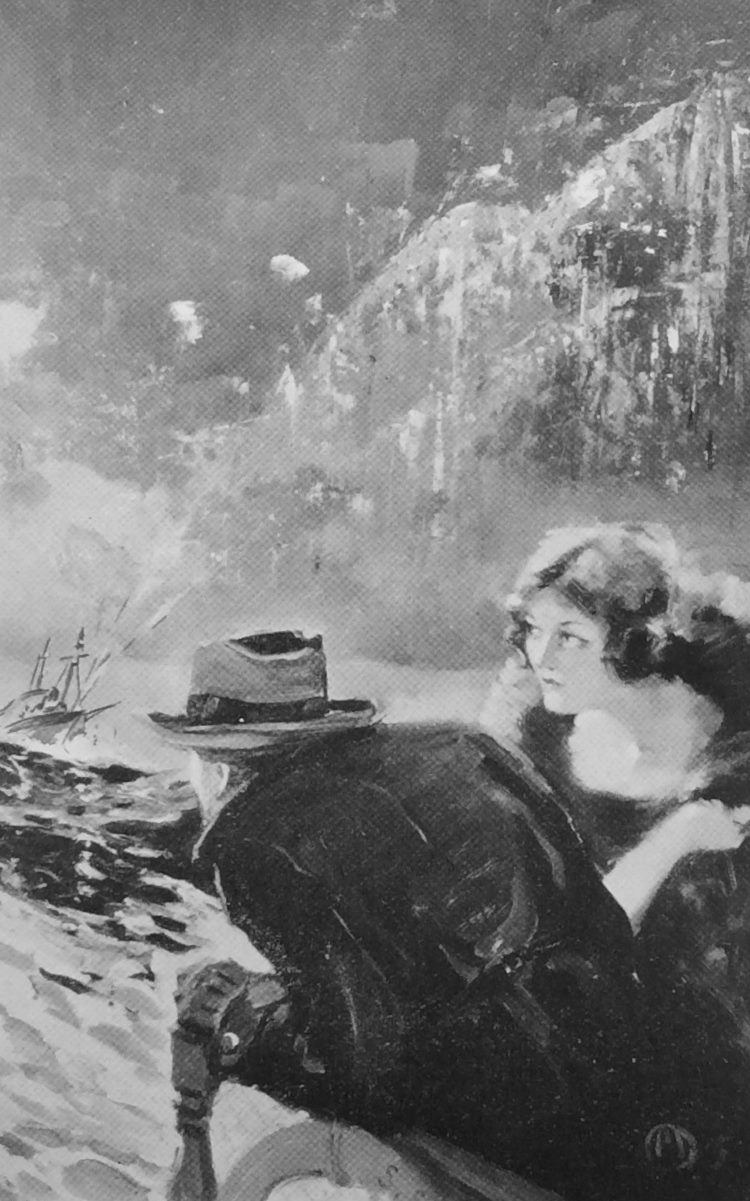
Title: The dangerous game
Author: William Le Queux
Illustrator: H. C. Murphy
Release date: February 24, 2026 [eBook #78029]
Language: English
Original publication: New York: The Macaulay Company, 1926
Other information and formats: www.gutenberg.org/ebooks/78029
Credits: an anonymous Project Gutenberg volunteer
By WILLIAM LE QUEUX
AUTHOR OF “THE CRYSTAL CLAW,” “MADEMOISELLE
OF MONTE CARLO,” ETC.
Frontispiece by
HENRY C. MURPHY, Jr.
NEW YORK
THE MACAULAY COMPANY
Published in England Under the Title “Hidden Hands.”
Copyright, 1926
By THE MACAULAY COMPANY
A stout, thick-set, clean-shaven Englishman, with round face, iron-gray hair, wide jaws and a pair of shrewd, dark eyes behind a pair of rimless pince-nez, was standing in the pretty lounge of the Hotel St. George, at Corfu, idly smoking a cigarette, and chatting with a good-looking, dark-haired young woman of about thirty, who was also spending some weeks on the beautiful island in the Adriatic.
They had already been there nearly two months, and a friendship had sprung up between them. Both were there for the winter warmth and sunshine. The man was a bachelor and a thorough-going cosmopolitan, who spent his whole life in continuous travel, while the woman was married to a rather good-looking man about five years her senior, whose actual nationality was somewhat obscure, but who was probably a Greek, though he spoke English almost perfectly, as so many educated Greeks do.
The thick-set Englishman, smiling and care-free, was one of the most popular of English novelists, whose name was known in every country throughout the world, Charles Seton Darville. In every bookshop and bookstall on the five continents his works were sold, for they were translated into many languages, even into Arabic and Chinese. In order to obtain the correct local color for his books he was a constant wanderer to and fro across Europe, meeting many people and having many adventures in all sorts of odd corners of the Continent.
The British Prime Minister had once said of him that he knew more of the underworld of Europe than any living Englishman. Certainly Seton Darville turned his unique knowledge of men and matters to good account, as witness the high pitch of excitement with which his books were always written and his descriptions of places and peoples. Hence they sold by the hundred thousand, and brought him in a very considerable income.
He was, however, a very lonely man. Though merry and easy-going to a fault, a careless wanderer who journeyed to and fro with scarcely a single care, he was possessed of a certain little idiosyncrasy which his friends never suspected, for there was another more serious and more strenuous side of his life that he never revealed. The public regarded him as a popular and prosperous novelist—hence he was ever welcome in London society, and hostesses were constantly seeking him out and begging him to grace their tables and their dances.
Because of his awful loneliness amid the vortex of society he had, years before, adopted as his daughter, Rene, a little girl left penniless and alone. Upon her the strong, self-willed man had showered all his affections, and petted her as his own child. But now, ungrateful perhaps for all he had done for her, she had married, and left him again with that terrible loneliness which his friends never suspected.
In such a mood, he was that morning killing time by chatting with little Mrs. Caborn, who, dressed ready to go out, was awaiting her husband. There had been a ball at the Casino on the previous night, and they were discussing it. From where they stood there was presented through the long windows a fine view of the harbor and the azure sea sparkling in the morning sun. Of all the islands in the Adriatic, Corfu is the most picturesque and beautiful, calm and glorious, with its riot of flowers, a veritable paradise for those seeking sunshine and peace.
Darville always rose early. Since the first flush of dawn across the sea he had been writing in his room, busy upon a new romance which he had contracted to write five years before. The popular novelist is always full up with contracts from eager publishers who vie with one another in the matter of increased royalties and who give him commissions years ahead. The scenes of this forthcoming book were laid in Italy, but he had resolved to write it in that sea-girt paradise, away from the bustle of modern life and the distractions of his friends.
After a few moments a rather tall, thin-faced man, with a small, dark mustache, a pair of beady eyes and features unmistakably foreign, joined them. He was George Caborn, the woman’s husband. Though he bore an English name he was undoubtedly a Southerner, but that was explained by the fact that his grandfather had been an English merchant who had settled in Athens.
“Hulloa, Darville!” he exclaimed merrily. “You’re up early!”
“Yes,” laughed the novelist. “I went to bed at four, and up at six. I’ve been busy writing ever since.”
“We’re going for a stroll; will you join us?”
Darville accepted the invitation, and for an hour the trio strolled along the sea road, with its wonderful profusion of palms, aloes, oranges, wild geraniums and other flowers in full blossom, even though it was winter.
After lunch the novelist, as was his habit, ascended to his room with his five-day-old English newspaper, and, throwing himself into a deep arm-chair, lit a cigarette. But, instead of reading, he lay back with his eyes fixed upon the blue sea, engrossed in thought.
He was puzzled by Joan Caborn, whom he had first met at winter sports at Wengen, in Switzerland, the previous winter. At the same time he held her foreign-born husband, whom he had not seen before this winter, in considerable contempt. The Anglo-Greek seemed to neglect his wife in favor of a stout, flashily-dressed widow named Madame Texardis, hence he and Joan Caborn had been thrown much together, and frequently went for walks alone.
Darville, constant traveler that he was, had had many adventures with women. He was of a type that appealed to them, and yet actual affection he had never experienced. He who wrote so constantly about Love jeered at it, and in his own heart declared that, because he had never experienced the symptoms, it was a non-existent disease. He had declared one day in the Savage Club that Love was only the bacillus of Lust.
That afternoon, examining his own heart and analyzing his feelings, visions of the past arose of a pretty young society woman in London who had been his friend ever since her schooldays, and who now had married a wealthy peer and was one of the leaders of an exclusive and somewhat go-ahead set. On her marriage, a year before, their many years of intimate friendship had ended, and that was the secret of his terrible loneliness and why he drifted hither and thither caring for nothing and for nobody.
He was aroused from his reverie by a page-boy who brought his letters, which had arrived by that day’s mail-boat from the mainland at Brindisi. They were in one large registered envelope, having been forwarded by his secretary in London. He drew a sigh when he saw the bulk of the packet. His trusted secretary had already dealt with all he could, and had sent on the remainder for him to see himself.
As he drew them out, he found the usual budget that every popular novelist daily receives. Invitations, piteous begging letters, polite applications for autographs, flattering letters from unknown readers, bundles of press-cuttings, requests to send autographed books for bazaars, and copious effusions from cranks of all sorts and both sexes. One by one he glanced at them and cast them on the floor beside him.
Suddenly he came to one unopened. The envelope, in an unusually bold feminine hand, was addressed to his club in London. He tore it open eagerly and read its contents. The letter was signed “Edris Temperley.” It began, “Dear Mr. Darville,” and stated that she was leaving London for winter sports in Switzerland as usual, and expressed a hope that they would meet at the Palace Hotel at Wengen as before, and she also expressed a hope that they would all have as good a time as last season, and that Mrs. Caborn would be there again.
He read it through twice, and then slowly tore it up. Afterwards he sat pale and motionless for some minutes.
“No!” he muttered. “True, I love Switzerland, but I can’t go to Wengen again. If she were not there, I’d go. But what is the use? It would only be painful to me—far too painful. I won’t reply. It is best so.”
And, rising, he paced the room, his countenance hard-set and grave, his eyes sad, his clenched hands trembling. Receipt of that letter, at that most inopportune moment, had recalled a brief but sweet romance of a year ago amid the Alpine snows, with its ski-ing and tobogganing, its peals of youthful laughter, and the joie de vivre. But all thought of the gay, handsome English sports-girl, with the dark, shingled hair, he wished to cut out of his life. Indeed, he had tried not to recollect her, until now her letter had revived the sweet little romance of the previous winter, and how it had suddenly ended when one day she had admitted to him that she had been engaged but it had been broken off; that her late lover was returning to London in a few weeks, and there was every prospect of a reconciliation.
Her words came as a severe blow to him, but he concealed his feelings, and a week later had left Wengen, determined to think no more of her. That letter, however, instantly revived all his recollections and longings. He remembered how independent and yet how sweet she had been; how open and straightforward, as an open-air girl should be; and how he had found that their ideas and ideals were all exactly in common.
“Folly! Sheer folly!” he muttered to himself, as he stood looking out across the shimmering sea. “No. To go to Wengen this year would only bring unhappiness to us both. She is, no doubt, happy. Why should I step in and try to attain the impossible? Love! Bah—I’m a fool! Yet there is no love. Poor little Rene—and she has left me—married, and now I’m forgotten!” he added, choking down a sob.
Tears welled in his eyes as he stood there, a great popular figure in the world, yet nursing his heavy sorrow in secret. In public he laughed happily, with his devil-may-care mannerisms, and presented a brave heart and a never-ceasing bonhomie towards the world.
For fully ten minutes he remained with knit brows and serious face, as, torn by his emotions, he stood motionless with hands still clenched. Then, gathering up his letters, he tossed them into his leather dispatch-case, locked it securely, and, taking a light coat, ordered a car and went out for a run across the beautiful island to the opposite shore where the gray, rocky coast of wild Albania lay upon the horizon.
He halted at a small rural wine shop and drank a couple of glasses of the excellent red wine made upon the island, and later on, drove back to the town in the glorious, golden sunset.
That night, on entering the big salle à manger of the hotel, he noted that Mrs. Caborn was sitting alone. She beckoned to him and said:
“Do come and sit here, Mr. Darville. My husband has left for Italy. He had an urgent telegram this afternoon, and was just able to catch the mail-boat!”
“Gone?” exclaimed Darville in blank surprise which he failed to conceal. His exclamation was indeed one of consternation.
“Yes,” she replied looking up at him with a rather strange expression. “Are you very sorry?” she asked in a low, appealing voice.
“Of course not,” he laughed, instantly recovering his surprise. “How long are you to be alone?” he inquired, smiling, as he seated himself in her husband’s place at the little table à deux.
“Oh! about a fortnight, I think. He suggested I should stay, as he has to travel on business up to Milan and Zurich, and he thought, if I remained here, I should be more comfortable than traveling continuously, as he is sometimes forced to do.”
“Then he ought to be back on Wednesday week—eh?” remarked Darville, as the waiter placed the soup before him. The novelist moved the big vase of mimosa aside, so that he could see her without interruption. She was dressed in a sleeveless frock of dark purple velvet with four narrow shoulder-straps, which enhanced the whiteness of her skin, while around her neck was her only ornament, a rope of valuable pearls.
As he ate his soup he decided that she was attractive, and that the opportunity thus afforded them of being constantly in each other’s society for a whole fortnight was exactly what he desired.
Their conversation soon drifted to winter sports and traveling. She told him that very frequently her husband journeyed to and fro across Europe to one or other of the capitals on business. Darville understood that he was an exporter of Greek produce, and had his chief office in Athens, with a branch at Salonica, his trade being mainly with France and England. As for herself, she had told him of her own many travels. She loved traveling, and had been in America and Canada, in Spain and Egypt. On her husband’s return they were taking the Trieste steamer and going to Vienna for a few weeks on pleasure.
That night, as they sat over their coffee in the lounge, without seeming unduly inquisitive, he obtained from her some facts concerning Mr. Caborn’s travels which rather puzzled him, and especially in reference to his hurried departure from the island.
“Do you think your husband’s travels this time will take him to England?” asked Darville presently, between the whiffs of his cigarette.
“No,” she answered decisively. “I’m certain he won’t go to England, or he would have taken me.” The positive tone of her voice aroused his curiosity.
“His departure was certainly very sudden. I wish I had had an opportunity of bidding him bon voyage,” he remarked.
“Do you?” she asked, with that strange, mysterious look again in her eyes.
“Why, of course,” he laughed. “When did he receive the telegram?”
“At three o’clock. The boat left at four.”
Darville remained silent for some moments, and then began to chat about other things, and suggested a motor run together on the following morning, after he had finished his usual morning’s work, which occupied him daily from six o’clock to eleven, with an interval for his café complet, brought to his room.
At half-past eleven o’clock she put out her cigarette, drained her liqueur, and, wishing him a merry “good-night,” left him.
As soon as she had disappeared into the lift, he went across to the concierge’s bureau, and in confidence inquired at what hour a telegram had arrived for Mr. Caborn.
“There has been no telegram to-day, monsieur,” replied the man with the crossed keys upon the lapels of his black velvet-collared coat, speaking with an Italian accent. “I have been on duty since noon, and all telegrams are delivered to me here. I keep in this book a register of all received”; and he indicated a long, narrow memorandum-book which lay open on the table. “You see the names of all visitors who have received telegrams to-day. Monsieur Caborn’s name is not among them.”
“Thank you,” replied the novelist. “You need not say that I made an inquiry”; and he ascended to his room, a grin of satisfaction upon his round, good-humored face.
“I thought so!” he muttered to himself, when in his own room. “I wasn’t mistaken, after all! A very clever pair—extremely clever! The game is becoming highly interesting. Joan is a very clever little woman!”
From his usual careless languor Seton Darville instantly became bustling and active.
Seating himself at his writing-table, he wrote out a curious telegram. He addressed it to a code address in London, and gave what seemed to be financial quotations.
To the ordinary eye it was only a commercial telegram, and as such it was accepted at the chief telegraph office, to which he walked in the bright moonlight. But at the address in London he knew it would cause a great flutter of excitement, and that within an hour the tentacles of a great octopus-like organization would be spread, with eyes and ears ever open, by night as well as by day, all over Europe.
Seton Darville possessed two separate and distinct personalities. One was the popular and prosperous erratic novelist imbued with the true artistic temperament, a lonely man who sought distraction at night-cafés and night-clubs merely because he could never sleep till early morning. The other side of his highly complex nature was that of a shrewd, hard, relentless man, clever, calculating, cunning, far-seeing, even inhuman and unscrupulous. That second nature of his he seldom, if ever, showed. Only if his anger were aroused did the evil side of his dual character reveal itself. At other times he was able to conceal it beneath his calm, unruffled, Bohemian exterior.
As he walked back along the sea front, where the moonlit waves lapped lazily upon the beach, amid a truly fairy-like scene, he gritted his teeth. His suspicion of little Mrs. Caborn had been confirmed within that half-hour, for he saw that she had lied to him about her husband.
He halted beneath the shadow of a great palm and lit a fresh cigarette. Then, as he tossed aside the match and strode forward, he exclaimed aloud to himself:
“This is now a cat-and-mouse game! The cat must watch. I wonder if what I suspect is true?—I wonder? If it is—then—then I’ll——”
And, without concluding his sentence, he uttered a queer, artificial laugh, which sounded strange and unreal in the dead silence of the brilliant night.
When the thin-faced Greek waiter brought Darville his café complet next morning, a telegram lay upon the tray.
He roused himself quickly, opened it with interest, and then a smile of contentment overspread his round face.
After eating his roll and swallowing the excellent black coffee, he lit a cigarette, and then leisurely shaved and dressed. Twice he glanced at the telegram, which to the ordinary eye was a commercial message regarding a cargo of currants on their way to London from the island of Zante. But it conveyed much to the popular novelist. So much, indeed, that, as he brushed his hair, he chuckled to himself and muttered:
“I wonder what the next move will be? Whatever it is, it will be checkmated!”
Presently he passed into his private sitting-room, and, seating himself at the small writing-table, took up his pen and resumed work upon his new novel which, in perhaps a year’s time, would be published simultaneously in England, America, France, and the Colonies.
When the gong for déjeuner sounded he rose, wearily stretched himself, brushed his hair, and then descended to the big salle à manger.
As he entered, he saw that the Caborns’ table in the window was empty. He seated himself there and awaited Joan. The meal commenced, but she remained absent, much to his surprise. Did she dare to face him? Perhaps not, if her suspicions had been aroused. Yet he had been very circumspect. How could his actions cause her any alarm?
Suddenly, when the meal was nearly over, and, indeed, some of the visitors had already risen and left, she came in, bustling, smiling, and apologetic.
“My dear Mr. Darville!” she cried. “Do forgive me! I see you haven’t waited. That is good. I’ve been for a long walk in the country, and it has taken me more time to get back than I anticipated.”
“My dear Joan,” he said; for he was now sufficiently intimate to call her by her Christian name. “I thought that perhaps you were lunching elsewhere so I commenced. Pray forgive me.”
“Of course. It’s all my fault,” she declared, seating herself and drawing off her gloves. She looked very handsome in her cool, white gown and neat, black hat.
While she ate her meal she chatted vivaciously, for she was always full of wit and high spirits. Darville knew that only by making pretence of loving her could he worm from her the great secret which she held.
So he invited her up to his pleasant sitting-room, where she threw herself into a big lounge-chair, and, tossing her hat aside, took a cigarette from his case and allowed him to light it for her.
When the coffee and liqueurs had been brought and the waiter had retired again, he crossed the room in silence, and, with his eyes fixed upon hers in pretended affection, he took her white hand in his and, bending gallantly, kissed it.
“Mr. Darville,” she said, drawing it away instantly. “Please don’t. Please remember we are only friends. Do let us remain as such.”
“But, Joan!” he cried, taking her hand again, and bending over her. “Can’t you see—haven’t you seen? How—how you have fascinated me—how you are all in all to me—how fondly I love you—how——?”
“Love!” she cried, interrupting coldly. “I have no love to give you, Seton—nothing to give you in return. So let us drop the subject. Do, I beg of you!”
“But I can’t—I really can’t!” he declared imploringly, his face pale and earnest as he still held her hand, and before she became aware of it his lips had met hers and had imprinted a kiss upon them.
“You do this in my husband’s absence!” she exclaimed angrily, never dreaming that he was making hollow pretence. “It is too cruel of you! How can I hold you in esteem when you make love to me like this? I am sadly disillusioned, I tell you frankly, Seton. I believed you to be a dear friend, a good pal to me, and a good friend to my husband.”
In a second Seton Darville’s face changed. His eyes grew smaller, and there was a hardness about his mouth.
“And why should I be a good friend to your husband, Joan?” he asked in a low, confidential voice, his face bent to hers. “Why should I study him when I happen to know with what infernal brutality he behaves to you, and how damnably he treats you when you are alone? All Greeks treat their women without consideration and without respect. Why should I extend the hand of friendship to such a fellow?”
“He is, after all, my husband,” was her simple reply in a quiet, trembling voice as low as his own. The tone of her reply revealed the truth to him.
He feigned regret as he slowly released her hand. But, still looking straight into her face, he whispered:
“Joan! I can only repeat that I love you!”
She rose resolutely from her chair, taking up her hat preparatory to leaving the room.
The novelist gripped her wrist and took the hat from her fingers. Upon his face was a look of deep resolution.
“I love you, Joan. I am devoted to you, and you must hear me.”
“I refuse!” she cried. “Let me go to my room. This is wrong of you—very wrong.”
“No. Listen to me—listen to reason, Joan.”
“I’ll hear nothing. I’ve heard enough!” she protested. “I had no idea that you entertained one single spark of affection for me. I only regarded you as a chance-met friend. And, after all, you are only that. I only think of you as one so famous!”
“My fame is of no account to me. It is simply luck; the same as any other good or bad fortune,” he replied, with an inexpressibly sad look. “I only tell you that I love you.”
Once more she looked straight into his deep eyes, as gradually again she withdrew her hand. He felt it trembling within his grasp, and knew that, though she possessed a calm exterior, she was, nevertheless, stirred by wild emotion. Her dark, luminous eyes shone, and he realized that a great struggle was taking place within her.
“Can you love me, Joan?” he whispered.
She shook her head mournfully.
“Seton,” she said in a strained voice, her eyes still upon him as she stood before him. “You are asking impossibilities. I cannot—I—I dare not allow myself to love you!”
“Why—why?” he demanded, even though his love-making was only pretended.
“Because—because there are reasons—strong reasons. Your love is debarred from me. Remember, I am married!”
“I know. But what does that matter?” asked the popular novelist. “Surely I am not the first man who has loved the wife of another?”
“No. But—well—I can’t love you. That’s all,” she replied blankly.
“Why? Tell me the reason.”
“It is a strong one—a very strong one.”
“Of what nature?”
“Well—if you knew the truth, Seton,” she answered, her voice low and trembling. “If you knew the bitter truth, you would never allow yourself to declare your love for me”; and tears welled in her bright eyes as she spoke.
“What truth? I don’t understand. You speak in enigmas, dear.”
“I know. But it is my secret—a secret which I am forced to hide, even from you, Seton!” was her slow, pathetic response.
For a few seconds he remained silent. He was sorely puzzled. To what secret did she refer? He had more than a suspicion—a suspicion which it was his intention to confirm by his pretence of affection.
“Are you speaking of—well, of your past?” he asked hesitatingly in a sympathetic voice. “If so, what does that matter to me? I have no wish to pry into it.”
“No,” she answered promptly. “It concerns the present. But please do not let us discuss it. I——”
“But, Joan! I love you!” exclaimed the round-faced man, whose books were so popular the world over. “Cannot we leave this secret of yours out of the question?”
“Alas! we cannot. I repeat that if you knew the truth you would—you’d hate me!”
“Hate you!” he echoed. “How could I?”
“Because you would do so. Of that I am convinced,” was her slow answer in a pained voice scarce above a whisper.
“You are really most mysterious, Joan,” he declared, placing his hand tenderly upon her shoulder. “Cannot you be a little more explicit?”
“Unfortunately, no, Seton!” she said after a slight pause, her voice tremulous and tears again showing in her eyes. “Please forgive me, but I beg of you not to discuss it further. It is too tragic, too terrible. You are my friend, but not my lover. Let us still remain the good friends that we are,” she implored.
He pleaded with her for half an hour, holding her hand and more than once kissing her upon the lips. But all to no avail. She refused to satisfy him as to the secret reason why she refused to allow him to pay her further attention, saying:
“No. Let us still be friends, just as we were last year at Wengen, when you were so attentive to Edris Temperley.”
Mention of Edris caused him to reflect. Those days amid the Alpine snows came back to him vividly, and that night, when they met again at dinner, he showed her the same studied courtesy as before. He invited her to his room to smoke and take coffee, but she preferred the lounge, and later they went for a stroll together by the calm, moonlit sea.
As they chatted, he once more was surprised at her wide knowledge of Europe. Like himself, she had been in many towns and cities of Russia, from the Volga to the Neva and from the Baltic to the Caspian. Her knowledge of Egypt and Tunisia was equal to his own, while she described towns in Bosnia, Serbia, and Bulgaria in a manner which showed him plainly that she had been in them, just as he had been.
When they parted in the lounge of the hotel at eleven o’clock, Darville went along to the bar where two Frenchmen he knew were drinking, so he joined them, chatting in his excellent French and discussing the French attitude towards England.
“There will be another war with Germany very soon,” declared one of the Frenchmen, a man named Girand, who was Deputy for the Rhone. “Everything points to it—the Monarchists have the upper hand again. Read the French newspapers, and listen to what the President of the Council is always saying. The warning has been sounded by the Allied Commission of Control. They tell us emphatically that Germany is making munitions, arms, aeroplanes, and most terrible poison-gases in frantic haste.”
“When do you think war will break out?” asked Seton Darville, with a somewhat disinterested air.
“Within one year,” replied the Deputy. “That is quite obvious. The Minister told me so only a week ago. But, of course, the Government are hiding the truth from the public.”
“He’s an alarmist,” declared the second Frenchman. “Germany will not be ready by then.”
Darville listened eagerly to the discussion, but made no comment. He found it all intensely interesting. Probably, had they but known who their listener really was, they would have promptly become dumb.
As it was, the argument grew heated, and from it the novelist learnt much of interest, for names were bandied about, and of them he took careful note. Then, on ascending to his room, he sat down and wrote far into the night. In the document he penned he mentioned certain of those names which the Deputy and his friend had inadvertently disclosed.
Next day he resumed his Platonic friendship with Joan. They spent the morning motoring together over those delightful roads lined by aloes, oranges, and olives, with the tangles of giant geraniums and the profusion of carnations, leaving the sapphire sea behind and driving inland across the gorgeous island. Indeed, for the next week the pair were inseparable, a fact remarked by many visitors to the hotel who knew that Joan’s husband was absent on business.
One night Seton Darville acted strangely, though no one saw him.
He wrote till nearly two o’clock in the morning, when, placing his neat manuscript aside, he rose, and, taking a bunch of curious-looking keys—skeleton keys they really were—and an electric torch, he stepped out upon the thick carpet of the corridor and, without his evening slippers, he stole along to Joan’s sitting-room in the opposite wing of the hotel.
He had no difficulty in finding the room, having been there many times before. The door was locked on the inside, but a small portion of the barrel of the key protruded. He placed his hand in the pocket of his dinner-jacket and brought out what appeared to be a small steel vice. This he swiftly adjusted to the protruding end of the key and tightened it. Then, holding it fast, he slowly turned the key, and the door yielded. Next moment he switched on his torch and stepped into the small sitting-room of the private suite. The door communicating with Mrs. Caborn’s bedroom was happily closed. He breathed more freely when he realized it, for it would have been dangerous to have remained there had it been open. So emboldened, he switched on the light, which revealed a very snug little apartment, with a center table upon which stood a great vase filled with sweet-smelling mimosa. In the corner by the window, which gave a view of the sea and sparkling lights, stood a small writing-table. That interested him at once. With the aid of one of his skeleton keys he swiftly opened all the drawers, and at once began to unearth a quantity of letters which they contained.
In the center drawer was a small steel dispatch-box with a well-worn cover of dark-green canvas. This he had considerable difficulty in opening, for the lock was a patent one. At last he slowly opened the lid, which creaked slightly, causing him to hold his breath. Inside were several letters written to Joan to an address c/o Mr. Peke O’Brien, in Longridge Road, Earl’s Court. Swiftly he read the letters, which were of a highly amorous nature and written about four months before, from a man who signed himself “Your Othmar.” One was dated from Biarritz, and others from Paris, Brussels, and other places on the Continent, which showed that the writer was constantly traveling, and further it was apparent that from time to time he sent her sums of money as presents, evidently unknown to her husband.
For nearly half an hour he went through the correspondence, then, having satisfied his curiosity, he, without making a sound, relocked the box, replaced it in the drawer, locked up the table, and after locking the door as he found it, crept noiselessly back to his room.
The sun shone brightly across Darville’s sitting-room, as next morning he sat down as usual to write.
He placed before him the blank sheets of ruled manuscript paper, which bore a red line from top to bottom, making the margin, and with a sigh took up his fountain pen and began to work in that uneven scribbly hand, specimens of which were ever and anon reproduced among the handwritings of popular authors. His writing was characteristic of a man of erratic temperament who scribbled swiftly, as indeed he did. His pen flew over the paper, for his thoughts always arose quicker than his pen could register them. He declared that he wrote mechanically, and that he only conjured up his characters for the moment, and next second all remembrance of them had left him. During the hours of morning when he wrote, he lived with his characters, and experienced within himself all their loves, their hatreds, their sympathies, and their bitter regrets. But as soon as he rose from his table all knowledge of the romance he was weaving left him, and he again became just an ordinary being, a careless cosmopolitan without a single thought in the world.
His mood that morning was a sad one. The heavy expression upon his countenance showed it.
He lunched alone, for Joan was out on a motor picnic with an American family who were their fellow-guests. He had been invited, but had declined, because he was sadly behindhand with his work, and only the previous day had received an urgent letter from his literary agent in London pointing out that the new novel was already a month overdue, and that the publishers were eager for the manuscript. Hence he had decided in favor of work before pleasure, though, with his happy-go-lucky nature, the reverse was usually the case.
In the afternoon he felt a trifle unwell, due perhaps to brain fag, a malady from which most hard-worked writers suffer more or less. So he went up to his room, lay upon the couch, and, over an old magazine, dropped off into a heavy sleep.
In his unconsciousness he was unaware of the fact that about two hours later the door opened noiselessly and Joan, still in her motor-coat and hat, crept in on tiptoe, and, pausing, looked at him with a strange expression of hardness, almost of hatred, upon her otherwise charming face.
She whispered some words to herself, her hands clenching themselves as though in anger. Then she crossed to where Darville’s dispatch-case lay upon the table unlocked. Without making the slightest sound, she opened it and swiftly examined its contents. She glanced at several long slips of paper of a peculiar egg-shell blue, and, having apparently satisfied herself, quietly withdrew, Darville being none the wiser.
The room was in darkness when he awakened. His head was heavy as lead, while his eyes burned like fire as they moved in their sockets. His mouth was parched, while he felt himself shivering. His condition was so unusual that he stood trying to collect his thoughts before switching on the light. When he did so, the clock revealed the fact that it was already nine o’clock at night. He had slept six hours!
Had he been drugged he wondered. He recollected that the wine had tasted slightly bitter. The bottle was what he had left from dinner on the previous night. It bore the number of his room scribbled on its label by the waiter, and could easily have been tampered with, as it had been re-corked.
He could have kicked himself for being so indiscreet. Yes. Now he recollected, that wine at lunch had a very curious flavor. He strongly suspected that he had been drugged by some hidden hand. He would never drink from an uncorked bottle in future. But who could have tampered with it? Surely he had no enemy there.
He called the waiter and ordered a stiff cognac. It was Greek brandy, hence none too good, but he swallowed it as soon as it was brought, and took two or three turns around the room. He had had no dinner, and felt faint. But the brandy revived him, and, it being too late to dress, he descended the stairs to the lounge to find Joan.
A number of people were smoking and taking coffee, but she was not among them. He reascended in the lift and knocked at the door of her little sitting-room. There was no response, so he entered. All was darkness, but there greeted his nostrils the sweet odor of “Jardines de España,” her favorite perfume. He tapped at the communicating door which led to her bedroom, but there was no answer. Twice he knocked, and then, turning the handle, entered, and switched on the light.
The room was empty, and had been cleaned for the next visitor.
A cry of dismay escaped him. Joan had gone!
He dashed down to the concierge, who, in reply to his eager questions, said:
“Madame Caborn left by the north-bound mail-boat at half-past four this afternoon, monsieur. She left all in a hurry. She came back from motoring, found a telegram, and packed immediately.”
“Where has she gone?” Darville asked with curiosity.
“I have no knowledge, monsieur!” replied the tall, black-bearded Greek, exhibiting his palms with a gesture indicative of ignorance.
“Which steamer was it?”
“The Prinz Luitpold, monsieur. She goes to Ragusa, Pola, and Trieste.”
“Then madame has evidently gone to Trieste,” Darville said, angered that she should thus have slipped away in that manner.
He turned on his heel, and crossed the hall.
“Gone!” he muttered to himself, his brows narrowed in anger. She had left him surreptitiously and without a word, just as her husband had done. No doubt her departure had been cunningly prepared. But how could he account for that narcotic—as evidently it had been—being introduced into his wine?
He stood near the door for a few moments in indecision. Seton Darville was a man of few words, but a man of action. Joan’s elusiveness had aroused that hard, stern, other nature of his, and in a few seconds his mind had been made up.
He crossed back to the concierge, and asked:
“Is Mr. Taylor in the hotel?”
“He is in his room, monsieur,” was the uniformed man’s reply. “He has just ordered coffee. He is entertaining a party of friends.”
“Thanks,” he said, and straightway went up to suite No. 1, the best suite of rooms in the hotel.
On entering, a middle-aged, clean-shaven, rosy-faced American, with silver hair, sprang up to greet him warmly. Hiram S. Taylor, of Philadelphia, was his name, and he was one of the greatest dealers in real estate in the United States.
“Come right in, Darville!” he cried warmly. “Have a drink, boy.”
The novelist hesitated, seeing three other men sitting around.
“Can I see you a moment?” he asked.
“Why, sure. Come into my bedroom,” was the reply.
They entered together, when, without preamble, Darville asked:
“Is the Coya ready to put to sea?”
“Yes, of course. Why?”
“Because I want you to help me, Mr. Taylor,” he said earnestly.
“How?” asked the alert American, who owned the great white steam yacht in which he was cruising with friends in the Adriatic.
In a few brief sentences he explained that Mrs. Caborn had left suddenly, and he wished, for certain reasons—which he did not state—to overtake her.
“In love with her—eh, Darville?” asked the rosy-faced man. “I thought so! I’m not blind. Wal, you can try and overtake the Trieste boat if you like, but she’s got nearly six hours start of you.”
“She’ll put into Ragusa. We’ll find her there,” the novelist said. “In any case, we’ll be in Trieste before she arrives.”
“The Coya isn’t a fast yacht, recollect. But if you like to have her, Darville, she’s entirely at your disposal. My secretary shall go at once to Merton, the captain, with a note putting her under your orders.”
Darville expressed his thanks to the wealthy American, who said:
“As long as she’s back next Sunday it’ll be all right. I suppose you’ll get away at once—eh? Wal—good luck to you, Seton”; and he shook the Englishman’s hand.
Half an hour later Darville was on board the splendid spick-and-span yacht, and had established himself in one of the luxurious cabins, while the vessel slowly steamed out of the harbor.
A few minutes later he mounted the bridge where Captain Merton, a well-known English yacht skipper, a smart sailor-like man with iron-gray hair, stood on duty.
“I understand, sir, we have to overtake the Prinz Luitpold? I fear it will be a difficult matter, as she’s a fast boat.”
“But she stops at Ragusa and Pola,” Darville said. “We must do our best.”
“Of course, sir. We’ll put on every ounce of steam. It’s fortunate that we coaled the day before yesterday, as Mr. Taylor goes to Constantinople next Sunday. If the Prinz Luitpold goes into Zara this trip, then we’ll overtake her. But if not, then I’m doubtful if she won’t be at Trieste before we can get there.”
And with the same breath he gave a sharp order to the helmsman.
The vessel had already crossed the harbor bar, and, with the engines throbbing evenly, she cut her way through the night, the seas swishing away from her bows and the wind whistling through the rigging, which held the wireless aerial.
The Coya was one of the finest ocean-going steam yachts afloat. It had been built by one of the great American railway magnates in the pre-war days. But he had died, and Hiram S. Taylor of Philadelphia had acquired her from his executors, and had since been to Europe in her on two occasions, always entertaining parties of friends. No expense had been spared in her fittings. The acme of luxury was everywhere. The cook was a well-known French chef, and the captain, officers, and crew were all picked men. On every hand was seen a lavishness only possible to the pocket of a millionaire.
As Darville stood upon the bridge he glanced back to the twinkling lights of Corfu slowly disappearing in the distance, as the vessel, with its powerful engines throbbing, sped out into the open sea. The night was overcast and rather dark. On the bow showed the flashing light of a warning buoy, and here and there were the twinkling lights of fishing vessels, those toilers of the Adriatic who send their fish down to Patras or to Athens.
“It is imperative—absolutely imperative, captain, that I get to Trieste before the mail-boat,” Darville said presently. In the dim, shaded light on the bridge the novelist looked a fine, strong figure, in his golf cap and heavy traveling coat, the collar of which was upturned, a typical cosmopolitan traveler of the hard-bitten sort. As a matter of fact he had, until the outbreak of war, been one of the King’s Foreign Service Messengers, and for several years had traveled constantly to and fro with dispatches from the Foreign Office in Downing Street to the various British Embassies and Legations abroad. But the life of the wagon-lit had been too much for him, and, like all the others, he had resigned after three years of constant journeying up and down Europe.
Captain Merton, his hands thrust into the pockets of his thick uniform jacket, because it was a chilly night and the wind was cutting, peered straight before him and deliberately answered.
“I quite understand, sir. But, if we fail, you’ll know it is not my fault. I’ve told the chief engineer, and we shall go full speed ahead to Trieste. If we arrive too late, then I can’t help it.”
“I quite understand, captain. It will be no fault of yours,” he said. Then he added: “I want to send a wireless message. Is it working?”
“Certainly. You’ll find the wireless-cabin just abaft the funnel.”
The popular novelist descended to his cabin, and, upon a slip of paper taken from his dispatch-case, he scribbled a message addressed to a man named Marrucci, living in Milan. The message was an undecipherable jumble of figures and letters—a code message which none could understand save the addressee. It was signed “George Hatherley.”
This he took to the little deck cabin, in which he found a young man lying in his berth fully dressed, reading a novel.
The operator jumped up, and, after reading the message, put in a switch which caused the electric generator to hum, and with a telegraph key he began to tap out the call letters of Naples. Time after time he repeated them, the head-phones on his ears, as ever and anon he listened intently. Suddenly, through the void of the night sky, came an acknowledgment, and then by spark he sent the urgent message which Darville had penned.
Through the night they steamed full speed ahead, north, towards the end of the beautiful Adriatic. Dawn broke in a glory of rose, crimson, and gold in the eastern sky. Darville still remained on the bridge. Before them lay the low streak of land in the misty blue, the “Mouths” of Cattaro which gave entrance to that impregnable little rocky land of Montenegro, the Land of the Black Mountain, hidden away in the hills and approached only by that ladder-like road which led up and up in spirals, and then by devious ways to Cetinje, the gallant little capital.
The sun shone out quite warmly, and Darville went below with the captain to breakfast in the handsome little saloon.
“The barometer is falling very fast,” said the bluff old skipper. “We may get dirty weather before we get to Trieste.”
“Well, what’s the trouble? The Prinz Luitpold will get a taste of the same weather,” laughed the novelist.
“They may be out of it before we arrive,” said the skipper doubtfully, as he attacked his ham and eggs.
Through the whole day they steamed on steadily past many green, fertile islets, with Medela, Curzola, and the delightful islet of Lacroma, with its ericas, myrtles, oleanders, and aloes growing down to the water’s edge, and where legend has it that Richard Cœur-de-Lion was shipwrecked and nearly lost his life in returning from the Crusades.
By wireless they had news that the mail-boat had left Ragusa for Pola six hours before, therefore, instead of putting in there, they still continued skirting the coast, perhaps the most picturesque in all Europe, until again night fell, and with it a stiff breeze sprang up.
The chief engineer put on all the pressure that the Coya’s boilers would stand, and they forged full speed ahead all through the dark, tempestuous night. Tired out, Darville turned in at midnight, but no sleep came to his eyes; he lay in his berth thinking deeply. He knew that much depended on the result of that wild chase, much that the readers of his books must never know. The secret was his own—a strange secret of real life, of which, if he dared to write it in one of his novels, the truth would be put down as fiction.
For nearly two hours he lay pondering, as the yacht rolled in the heavy seas which now and then thundered upon the deck above and caused the vessel to quiver from stern to bow.
Suddenly the second officer opened the door of the cabin and said:
“The captain says, sir, that the Prinz Luitpold is about five miles ahead of us, and he’d like to see you.”
Darville, who was still half dressed, hurried on his coat and rushed to the bridge.
“Look!” cried the captain. “There she is!” He pointed to a distant light, a mere speck in the darkness ahead. “Now I propose to burn flares of distress, and call to her by wireless, asking for assistance. What do you think, sir?”
“An excellent idea,” was Darville’s reply.
“We’re off Fiume. Let’s go to the wireless-room.” Then he gave the second officer instructions to burn a flare in five minutes’ time.
In the wireless-cabin the captain scribbled a message to the captain of the mail-boat, asking him to heave to and render him assistance. A few moments later the operator was calling the Prinz Luitpold, which with other vessels almost at once responded.
Then the generator hummed again, and the smart young fellow tapped out the message of distress heard by every vessel in the Adriatic.
Afterwards he switched off, and listened eagerly for the reply.
“O.K., sir,” said the young man suddenly, addressing the captain. “She’s coming back to us.”
“Harrison!” shouted the skipper, looking out of the cabin, along the deck. “Light the flare!”
A few seconds later the vessel was illuminated by an intense blue glare—the signal of distress.
Then, when it died down, they saw the lights on the vessel ahead slowly alter, as she changed her course, then they knew that she was steaming straight in their direction.
Darville stood on the bridge with the yacht’s captain as the vessel quickly approached. A second flare of distress went up from the yacht’s deck, and as the steamer came on the two men chuckled to themselves at their success.
The captain had carried out the orders of his owner, while the latter’s guest had been successful in his desire to be put on board the mail-steamer.
Few words were spoken between them. The captain’s eyes were strained into the darkness for some minutes.
“We’ll have to make some good excuse for our distress signals,” he remarked to Darville, who stood at his elbow. “We seafaring men don’t like pranks being played.”
“Tell him there’s something wrong in the engine-room,” said the novelist, never at a loss for an excuse. “You can order the engineer to put something out of gear, can’t you?”
“There’s no time,” replied the other, still peering into the darkness where the steamer’s lights were coming closer. Suddenly he cried: “By Gad, sir! We’re mistaken! She isn’t the Prinz Luitpold! She’s the Venice boat to Pola and Fiume! We’ve made an infernal blunder!”
Next second he yelled to the mate:
“Signal all well! Quick! It’s the wrong boat!”
And, placing his hand upon the engine-room signal, he pulled it over to “Full speed ahead.”
Then, taking up his megaphone, the captain shouted:
“Ahoy, there! Ahoy! We’re very much obliged, but we’ve put the damage right. Lots of thanks for coming back! Do the same for you one day!”
This was answered by some rather uncourtly remarks in Italian from the other vessel, the captain of which, angered at his loss of salvage, put over his helm, and the ship turned away as though in disgust.
“By Jove, sir! We nearly made fools of ourselves—eh?” exclaimed the breezy yacht’s captain to Darville. “It don’t do to play monkey-tricks at sea. I certainly believed her to be the Prinz Luitpold.” They both went along to the wireless-cabin, where the young operator, having spoken to the mail-boat and told her that there was no longer any danger, inquired where she was.
The reply came in Morse, and the operator read it aloud. “We turned back for you eight miles off Trieste. Now resuming our course.”
“Eight miles from Trieste! Why the passengers will land before midnight, and we shan’t be there till to-morrow.”
“They’ll have twelve hours’ start of us!” remarked Darville, in keen disappointment, and then he turned and paced the deck alone. He had been badly checkmated by Joan. A strong man, of iron constitution, a man who had never known a day’s illness for thirty years, yet who had played ducks and drakes with his life, keeping late hours and leading the gayest existence in all the most reckless circles in the various Continental cities, he who knew not love, had pretended to make love to Caborn’s wife! The whole affair was silly and unreal—a scene out of one of his own books. He had pretended to love her seriously, and she had acted with both tact and honor. He had a hidden purpose in playing at love. But to escape him surreptitiously, as she had done, was an offence against his nature.
In that she had shown her enmity. Enemies he never forgave. Many men were living who had cause to rue the day when they were at enmity with Seton Darville. His almost child-like, sympathetic nature, ever full of good-humor and genuine bonhomie, attracted women, and perhaps more so because of his whole-hearted cosmopolitanism. Most smart women of to-day love a cosmopolitan; the man who laughs at stay-at-homes, domesticity, at marriage ties, and hum-drum application to sordid money-making in business. Some men are born wanderers, and, as hotel gypsies, lead their erratic lives traveling to and fro across Europe, acquiring an unerring knowledge of hotels, cafés and hairdressers. Of such, Seton Darville was one.
On entering the great busy harbor of Trieste the captain steered for the Molo Giuseppina, and landed his eager passenger near the fine offices of the Austrian Lloyd Steamship Company, the owners of the Prinz Luitpold. It was early afternoon and the clerks were just returning from their luncheon. At a pigeon-hole in the big public office, with its fine tessellated pavement, he requested the inspection of the passenger list of the mail-boat from Corfu. After brief delay it was brought, and under the initial “C” was “Signora J. Caborn—Londra.”
“You have no idea where this lady is staying, I suppose,” he asked of the young Italian clerk.
“Well, signore, yes—I do,” was his reply. “I went on board before the vessel landed her passengers, and she came up to me to inquire for apartments. She seemed greatly agitated and traveling alone, so I took her to a friend of mine, a Madame Pastore, who lives in the Via Farneto, No. 168.”
“And she is there?” cried the novelist, instantly interested.
“I presume so. She went there in a taxi with all her belongings,” the young fellow said.
Ten minutes later Darville was in the taxi speeding up the narrow streets which surround the old castle, and across the Piazza Carlo Goldoni. He first went to the railway station to leave his small baggage, and then, reëntering the vehicle, soon reached the broad, modern street of high houses which had been indicated.
On the third floor of No. 168 he found a small brass plate upon which the name “Pastore” was inscribed.
Madame Pastore, a pleasant-faced woman of about forty, appeared, and in response to the novelist’s questions, said:
“The signora came here very late last night, slept a few hours, and went out again about eleven o’clock. She received a telegram at the poste restante, I think. On her return she apologized to me and said she was suddenly called to London.”
Darville’s brows contracted.
“To London!” he muttered to himself, and a few minutes later he was on his way back to the South Station, where he found that the Trieste-Vienna-Paris train-de-luxe had left just an hour after Joan had gone from Madame Pastore’s. She had, no doubt, caught that train, and was now well on her way to the Austrian capital.
For a few moments he hesitated. Should he wire to her, and address the message care of the station-master at Vienna, where it would be handed to her in the wagon-lit. He, however, decided against that course. Joan Caborn had a long start, but he intended to run her to earth at whatever might be her destination, either in Paris or in London.
She had not played the straight game, hence his suspicions were more than ever confirmed.
He went to the office of the Wagon-Lit Company on the platform, and there ascertained that Madame Caborn had, at the last moment, booked a berth in the Paris train-de-luxe.
The next train to Paris left at midnight, therefore he went to the Hotel Excelsior, on the Riva del Maddracchio, dined, and subsequently followed the route that Joan had taken. Before he left, however, he dispatched a telegram to an address in Paris—a commercial message which, no doubt, conveyed some hidden meaning.
Through the night, as the train roared on its way north to the Austrian capital, he lay in his narrow sleeping-berth wakeful and restless. The berth above him was occupied by a bearded plethoric old man, who snored so loudly that he could be heard above the racket of the train. Then in the morning, after they left Vienna, he went along to the restaurant-car, and had his déjeuner as the train rushed towards Passau. The day was long and dreary as it always is in the cross-Europe trains. At Wels the sleeping-car was joined to another train, and then the journey towards Paris began.
On arrival there he was met by a smartly dressed, middle-aged Frenchman who, gesticulating in his excitement, said:
“I had your telegram, but I’ve been absent in Lille. She left before I received it! She’s gone to London.”
Darville paused. Then he smiled:
“No,” he said. “Not by any direct route. I know Joan Caborn too well for that.” He glanced at his watch, and added: “A wire to Dover will arrive too late. If I’m not mistaken she’ll leave the boat there, and go to London by some roundabout route. Little Vera did it once, you’ll remember.”
“I know, Mr. Darville,” said the mysterious man who had met him on the platform. “The lady is very elusive. Have you any fear of her, or her friends?”
Darville laughed aloud.
“Fear!” he echoed. “Have you ever known me to fear? Why, my dear fellow, I don’t think I know what fear means!”
The stranger shrugged his shoulders, and in French said with a smile:
“The lady may prove troublesome.”
“That is my own affair,” responded Darville in the same language. “In any case, she has been very clever in escaping. I have no doubt she’ll leave the boat at Dover and cover up her tracks. She’s done so before, you recollect.”
The Frenchman smiled, and together they went out to a café across the road, where they sat for half an hour. By the next service from Paris to London, Seton Darville, the constant traveler, who was known by name to the chief of the wagon-restaurant, left the Gare du Nord and took a seat for luncheon.
On arrival at Dover, in consequence of a telegram, a short, thick-set man in a blue serge suit, who looked like a nautical man, met him on the platform at the Marine Station. Few words were exchanged, but it was plain that Darville was absolutely disgusted. Therefore the novelist made some very outspoken and caustic remarks, and then entered the Pullman for Victoria.
He drove at once to his rooms in Duke Street, St. James’s, where he was met by his faithful man Drew, and, having washed and changed, he went to the telephone, and, after a short conversation, invited the person at the other end to come round and see him.
About a quarter of an hour later Drew, a middle-aged servant who had been in Darville’s employ for ten years or so, ushered in a tall, lean, fair-haired man in a dark gray overcoat. The visitor wore round, horn-rimmed glasses, and was clean-shaven and alert.
“Hulloa, Sandy?” exclaimed the novelist, greeting him warmly. “Sit down and have a drink. As you know, I’m just off a rather long trip—home from Corfu.”
“Yes, sir,” replied Mr. Alexander Paton seating himself, while Drew got out cigars and cigarettes. “We had that wire of yours from Corfu and the second one from Paris.”
“Then why the devil didn’t you act on my instructions?”
“Because we couldn’t. The lady hasn’t arrived in England.”
“Bosh! She left Paris for Calais. I know that.”
“She never came to either Boulogne or Calais. We had both places watched.”
“And the other ports?” asked Darville with hard, set face.
“Surveillance was placed upon them all. We have the lady’s photograph, you know. The passport officers were all on the look-out, but up to the present she hasn’t landed.”
“I don’t believe it,” replied Darville bluntly. “I know Joan Caborn by reputation too well. If she intended to come to London, she’s here. She might have gone from St. Malo to Jersey, and over from there to Southampton. She would know that you people seldom put a close watch on the Jersey boat.”
“That may be,” Paton admitted rather sullenly, “but my own view is that she suspected that she was being tracked, and just slipped off and is lying low somewhere or other.”
“Your Special Branch people at Scotland Yard have amusing theories sometimes, Sandy,” the novelist laughed. “I disagree entirely. The man got away from me, and no doubt is here. Then his wife slips through my fingers and has joined him. But where? That’s the question.”
“We must find them at all costs,” said the great Scotch detective-inspector, for such he was; one of the most alert and astute men of the Special or Political Branch at Scotland Yard.
“Yes. I agree, Sandy. But London is a big place to look for two people who are purposely lying low,” said Darville. “You know that as well as I do.”
“Quite so, sir. But we’ve been faced with a similar problem before, and have never once failed to discover the person we want, however closely she or he may live in hiding. They always come out sooner or later,” laughed the tall, fair-haired man, puffing at his cigarette. “So we’ve only to wait.”
“But we can’t wait. It is a matter of greatest importance. They may act, and then it will be too late.”
“Is the affair really very serious, Mr. Darville?” asked the well-known police-officer, whose duties lay in the detection of political conspiracies in Great Britain.
“Most serious,” was the other’s reply. “Unfortunately I can’t tell you the whole facts. They are secret.”
“Secret?” exclaimed Paton in great surprise.
“Yes,” Darville replied. “Secret—even from you Sandy!”
The duty of Mr. Alexander Paton was to act under Seton Darville’s instructions when required.
The declaration of the novelist that the matter was secret, even from his department, rather piqued him, and it certainly aroused his curiosity very keenly.
“Yes, I repeat, Sandy, I can’t tell you the reason for all this hue and cry. I wish I could. You’d be as interested in it as I am,” Darville went on. “But, as you know, in my department, we sometimes have certain secrets which we do not disclose even to yours. This is one of them.”
“I take it that Mr. and Mrs. Caborn are undesirables?” remarked the tall, fair man.
Darville nodded in the affirmative.
“At first I was not exactly certain,” he said, “until I followed them across to Corfu, and watched them there. Then my suspicions were confirmed. They are over here on a very desperate errand, so we must find them, and defeat their activities.”
“The name seems familiar to me,” the inspector said reflectively, taking another cigarette from the box which the novelist pushed over to him, and gazing around the small, comfortable room which was Darville’s pied-à-terre in London. The novelist was a man of few wants. Though he wrote for the English public, he was a thorough-going cosmopolitan, and preferred to live his wandering life in foreign hotels.
“You’ve heard it before—eh?” he asked with a smile.
“Yes. Wasn’t the man mixed up in the Meyer matter at Weybourne just after war broke out in 1914? Didn’t he have some relations with Carl Lody—the spy they shot in the Tower?”
Darville again smiled good-humoredly.
“Your memory seems to serve you rightly, Sandy,” he said. “But please forget that, except to remember how cleverly he slipped through your fingers. He then acted as evasively in getting out of England as he has now done in re-entering the country. And his wife—well—she’s an expert, as was proved in the Weybourne affair.”
“We are faced with a problem. How shall we find them, Mr. Darville? Have you any suggestion?” asked Paton seriously.
“At the moment, no. I’m fagged out after the journey,” said the novelist. “But I may think of some plan to-morrow.”
“I’ll think it over, too,” said the inspector. “You see, they both know London; hence they have, no doubt, a knowledge of the various sanctuaries for criminals which keep ever-open doors, so long as their guest can pay for the accommodation. There’s a lot of them here, in the West End. And not a few in the provinces, as you know.”
“I know that,” said Darville, resting his heavy chin upon his hand, with his elbow on the arm of his big, saddlebag chair. “We have to track down the pair, or they will cause us a lot of very serious trouble, Sandy. I’ll keep in touch with you on the telephone. If I have any suggestions to make I’ll let you know instantly.”
Paton waxed pessimistic.
“If they get into one of the bolt-holes where no questions are asked, then they can lie doggo for months,” he remarked. “It’s a pity you didn’t wire to us sooner, sir.”
“I didn’t know they intended to come to London. I believed that Paris was their destination, and Lemoine received my wire too late.”
“Well, Mrs. Caborn didn’t cross either from Havre, Boulogne, Calais, Dieppe or Ostend. That’s certain,” said Paton.
“She may have used another passport, and slipped through on the night service. And what about Antwerp, or The Hook?”
The Scotch detective shook his head.
“I think not, sir, for the C.I.D. are very keen to spot a woman named Beeton, wanted for murder in Liverpool. She very much resembles Mrs. Caborn. A watch has been kept upon the ports for that woman for the past six weeks.”
“My dear Sandy, I don’t care a rap for the vigilance of the C.I.D. All I am certain of is that the woman is here, and that, having joined her husband, the pair are lying very low, prior to effecting the big and serious coup which they intend,” Darville said. “If I were not certain that something very serious was in the wind, do you think I should have gone over to Corfu, and pretended to make love to Caborn’s wife, as I have done?” Then, with a smile upon his broad, clean-shaven face, he added: “I suppose that the little woman believes me to be the forlorn lover. Women are funny—aren’t they, Sandy? Thank God I’ve never loved a woman in all my life; hence I’ve been spared the terrible pangs of jealousy. At least I’ve understood that that malady is a very common and extremely painful one.”
“I’ve only loved once, sir,” replied the fair-haired man from Scotland Yard, “and, thank heaven! I’ve got the best wife in the world.”
“Then you’re devilish lucky, Sandy. Have another drink to wish Mrs. Paton continued happiness.”
The pair raised their glasses, laughing merrily, and a few minutes later the officer of the Special Branch, the greatest expert in London in keeping surveillance upon suspected persons, rose and left.
When he had gone Darville sat for some minutes smoking in silence.
“I don’t think that Joan suspected anything,” he muttered to himself, in ignorance of that secret visit she had paid to his room while he lay stupefied by the drug that had been placed in the wine he drank at lunch. “I suppose I acted the lover all right?” he went on, laughing to himself. “I hope I did. She seemed thoroughly alarmed at my amorous declarations. But she’s clever—damnably clever. The man is a blunderer compared with her.”
Then, after a further silence, he rose, and, pacing the room impatiently, said aloud:
“I must find them, or—or, by Gad!—there’ll be a terrible disaster! It’s up to me to checkmate them. No doubt there are half a dozen others in this devil’s work!” he added, setting his teeth hard as he spoke.
He went to the telephone, and spoke to several people—short, brief messages telling them that he had returned to London.
One man, whom he addressed as Bennett, he asked to come round to see him at eleven that night. Indeed, after Drew had put before him a frugal meal of cold ham and salad and half a bottle of claret, which he consumed hastily, he seemed besieged by callers, mysterious men who came and, after a brief interview, left unobtrusively.
Bennett, however, proved to be a smart, well-set-up man, having the appearance of a retired naval officer. He brought with him a bulging leather dispatch-case, heavily locked.
Having removed his overcoat, he seated himself at the table, unlocked the case, and drew out a number of official-looking documents.
Darville seated himself opposite him, and carefully read and initialed the papers as Bennett handed them over.
“This is the latest report from Mabelle in Cairo regarding the German intrigue in Egypt. You recollect, sir, that you sent Mabelle to Cairo three months ago, and gave her very definite instructions. These she seems to have carried out to the letter.”
Darville took the report which had been brought to England by King’s Messenger and was in cipher. The decipher interested him keenly from the very first line. It was a long report—a careful and concise survey of the highly complicated situation in Egypt at that moment—and had been drawn up by a pretty young woman who was a very clever secret agent of Great Britain abroad. It showed a marvelously wide knowledge of international politics, and Darville quickly became absorbed in it.
He read it to the end, initialed it thoughtfully with his red pencil, and then said to his private secretary—for such Bennett was:
“Send a message in Code Four to-morrow recalling Mabelle. I want to see her. She knows more than is contained in her report.”
“Very well, sir,” replied the ex-naval officer, for Commander Charles Bennett had fought at Jutland, and before his retirement had a brilliant record to his credit. “This next report is about the Steinberg affair. Meyrick hasn’t got very far with it yet. There’s nothing in it worth troubling about.”
“Very well,” grunted Darville, who took it and scribbled his initials without reading it.
Five other lengthy documents were declared by Bennett to contain nothing of interest, and the man whose name was known the world over scribbled his initials, “S.D.,” upon them.
“Here is a list of the personnel discharged from the Commission in Germany. You see Weiss has been axed among the others.”
“So I see,” Darville remarked. “I’m rather sorry. Of course, he has no idea that I have been his pay-master all this time. He rendered us very good service in discovering secret stores of arms in Germany. I wonder why he’s been discharged.”
“I have the reasons here. They were sent over to us from the War Office three days ago.”
Darville took the sheet of paper, and upon it read the following memorandum:
“Weiss, Karl.—Adverse-report from General Mitchell. Unstable. Too fond of gayety, and prone to feminine influence. His retirement recommended on grounds which are confidential.”
“H’m!” remarked the novelist, as he slowly signed the paper which put an end to his friend’s career with a certain British Mission in Germany. “That’s curious. Something more behind that, I’m sure! Find out, Bennett, and report to me. I know him well.”
And he passed on to the examination of a long document, in rather faulty English, concerning the strained political relations between Italy and England.
Upon that polished dining-table lay a pile of secret documents dealing with the innermost juggling of European diplomacy, secrets concerning the intrigues of foreign statesmen and financiers, which would have horrified them had they but known that they were in the hands of the ubiquitous Seton Darville, the head of that great, outspread, octopus-like organization which, with its secret headquarters, was the eyes and ears of Britain throughout the world—the Secret Service.
The British public and the world at large never suspected that the clean-shaven, round-faced ever-smiling man in pince-nez, who lived a wandering life of apparently careless ease and affluence, was the man in whom the British Cabinet placed its trust, and who on more than one occasion had been brought into secret consultation concerning enemy intrigues.
Until far into the night the two men sat together, discussing various matters. Ever and anon the novelist sat back in his chair and dictated instructions to the various agents abroad—his “lambs,” as he called them—which the ex-naval commander took down in shorthand, to be afterwards put into code and telegraphed to the European capitals.
It was nearly three o’clock in the morning before Bennett swallowed a final whisky and soda, and, replacing all the papers in his case, locked it and rose to go.
“Better leave that here to-night,” remarked Darville. “It’s too late to take it to the office. Send round for it in the morning. It’s safe here.”
Both men laughed. That leather case contained secrets which certain foreign Governments would pay a very big price to obtain, hence they were safer in Darville’s flat than being carried through the London streets at that hour.
So Bennett took his departure, and, Darville’s man having gone to bed a couple of hours before, he was left alone.
He lit a fresh cigarette and stood with his back to the dying fire, thinking deeply.
Suddenly he crossed to the table, on which lay the dispatch-case, and, taking a tiny key from the bunch upon his watch-chain—the master-key of all the big range of black, steel dispatch-boxes at the secret headquarters of the confidential department of the Government—he unlocked it, and, searching through the papers, at last found the slip whereon was reported the delinquency of Karl Weiss, and his dismissal, to which he had agreed by appending his signature.
“Poor Karl!” he exclaimed aloud. “At present he knows nothing of this! I’m sorry for him, for he’s one of the best of fellows. After all, every young man may be forgiven a flirtation or two. But—well, I’m sorry. He’ll have some difficulty in getting another job, now that he is dismissed in ignominy.”
Then he tossed back the papers, relocked the case, and carried it into his bedroom, where he placed it in the wardrobe, and afterwards retired to bed.
Next morning Bennett called for it, and at eleven Darville went out to his club.
Three days went by—days in which he puzzled his brain, vainly trying to devise some plan by which he could run to earth the fugitives from Corfu. His powers of invention were amazing, and he seemed to possess an uncanny but unerring instinct where secret inquiries were concerned. Crafty and cunning by nature, his wide experience of men and women rendered him suspicious, elusive, and full of astounding duplicity. He never wavered when once he had arrived at any decision, but persevered towards the end he sought, undeterred by any untoward circumstance that might arise.
He intended to find Joan Caborn, and he had made up his mind to do so at whatever cost.
On the fourth morning after his arrival in London, he found among his letters one from Edris Temperley. He recognized the firm, bold handwriting. It was dated from Stagsden Hall, Leicestershire—her home—and ran as follows:
“Dear Mr. Darville,—You have not answered my last letter. I heard from the hall-porter at your club that you were abroad. I wonder if you are back again? I am coming up to London with mother next Friday to do some shopping. We shall stay, as usual, at the Berkeley. I would so much like to see you, and know if you are going to Switzerland again this season. Our ski-ing parties would not be the same without you. Kindest regards.
“Yours very sincerely,
“Edris Temperley.”
As he ate his breakfast he read the letter through twice. It was too bad not to have replied to her, and as he sat there alone a vision of her sweet, regular features, her great, gray, wondering eyes, her dark, shingled hair, and her unconventional attractiveness and chic in her winter-sports costume, arose before him.
A whole year had passed since their little snow romance. He had first admired her and then, finding himself fond of her, had cut himself adrift deliberately, and gone out of her life, because he felt, first, that there was too great a difference in their ages, and, secondly, he knew that she loved a younger man.
Those few weeks spent in the snow-clad Alps in the previous winter had been most delightful ones, but they were now only a memory. Yet that memory was the sweetest one he possessed, for it was the first and only time that he had ever experienced affection for any woman.
But he now hesitated to repeat the experience, fearing lest he should be the cause of her unhappiness.
On rising from the table he held her letter in his hand.
“I wonder, Edris,” he exclaimed aloud in a hard, choked voice. “I wonder if you still love him? If you still remember——?”
He did not finish his sentence, but stood looking down into the London street, dismal and wet on that winter’s morning.
And as he did so a sudden thought flashed across his mind—a sudden inspiration which roused him to instant activity.
There was, after all, one way by which Joan Caborn could be found! He held the solution of the problem. It would mean the exercise of all his wits and innate cunning. But he meant to find her, and it was, after all, in his power to do so, if he understood human nature aright.
Therefore he rushed to the telephone and asked Paton to come round to him immediately.
In Earl’s Court Road, at the corner of Longridge Road, a tall, fair-haired man, with a hard, clean-shaven face, and wearing a shabby, soft felt hat, idled, as though awaiting a friend.
It was half-past eleven o’clock in the morning, dull and rainy, and tradesmen’s boys were hurrying to and fro on cycles up and down the quiet, respectable Kensington thoroughfare. In the Earl’s Court Road passed to and fro the usual procession of motor buses, with all their vibration and racket, while Longridge Road remained quiet, being just off the main road.
Ever and anon the shabby, fair-haired man glanced down the thoroughfare of dull respectability, most of the houses of which were gray and of uniform architecture, each having its view of “over the way.”
Sandy Paton of the Special Branch—for it was he—was keeping keen surveillance upon one of those high, inartistic houses with deep basements. He had strolled along there at ten o’clock, and was still waiting there in patience, pretending, however, to be quite uninterested in his surroundings. He lit a cigarette, and pulled a picture paper from the pocket of his faded overcoat. His appearance was that of an unemployed lounger—a man who took his dole, and spent it mainly upon drink. Now and then he moved a little way along the Earl’s Court Road, so as not to remain in the same spot sufficiently long to attract attention, but, whenever he did so, his place was taken by a clean-shaven, thickset man in a seedy khaki-colored raincoat and golf cap. It was Seton Darville. The pair were acting together upon a very curious and interesting errand.
They assisted each other in keeping surveillance upon the house in question until noon, when suddenly Paton saw the door open, and a well-dressed, elderly man of military appearance, with a close-clipped, gray mustache, descended the steps, and, having glanced quickly up and down the road, started to walk in his direction. The man wore a hard felt hat, a smart dark-blue overcoat, and well-polished, brown shoes. His somewhat sinister face was furrowed, speaking mutely of hardships, endured probably in hot climates abroad, though the truth was that he had recently been released from a long period of imprisonment in the French convict prison at Toulon.
As soon as he appeared, Paton drew back, and mingled with a small crowd waiting for a motor bus, while Darville, realizing the truth from his friend’s quick movement, turned upon his heel and hurried away. Paton, having watched the occupant of the house of suspicion turn the corner and walk up the Earl’s Court Road in the direction of Kensington High Street, hurried round to an unfrequented by-street, where, in a mews, stood the delivery-van of a well-known firm of parcel agents, the horse being in charge of one of the uniformed servants. Entering the van, Paton found a coat and cap of the same uniform, which he assumed, and then, tying on an old apron made of sacking, he took from a shelf in the van a small brown-paper parcel, heavily sealed, and with many labels upon it, together with a number of yellow forms upon which the receivers of parcels scribbled their receipts.
“Come on,” he said to the driver. “Let’s go round there. I want to get rid of this as soon as possible,” he added, indicating the parcel.
His disguise as a delivery-man was, indeed, perfect. He presented a type of the hard-worked man who spends his life going from door to door with parcels large and small for which he collects money and signatures.
In a few minutes the van drew up before the door of the house in question, and Paton descended with the parcel, leaving the other man to sit with the reins.
When a red-haired maid opened the door in response to his ring, he asked:
“Is Mrs. Caborn at home? I’ve got a parcel here for her.”
“She don’t live here,” was the maid’s prompt reply. “I don’t know the name.”
“But the parcel is addressed care of Mr. Peke O’Brien,” Paton said, glancing at the label. “He lives here, don’t he?”
“Yes. If it’s for him, I’ll take it.”
“I’m very sorry, miss,” Paton replied. “But it contains jewelry, and is insured for four hundred pounds. When will Mr. O’Brien be back?”
“Not till this evening. He’s generally home about eight o’clock. But can’t you leave the parcel?” asked the girl.
“Sorry, I can’t,” was the firm answer. “But will you tell Mr. O’Brien when he comes in that I’ve got a parcel of jewelry for Mrs. Caborn, and that I’ll call at eight to-night?”
“All right,” said the good-looking maid. “I’ll tell him,” and she closed the door, whereupon Paton mounted into the van and drove away.
Back again in the mews the inspector of the Special Branch divested himself of the apron, coat, and cap, and resumed his coat and overcoat. Then, after wrapping the valuable parcel in a piece of brown paper, he said good-by to the driver, and, descending, soon joined Darville in the bustle of the Earl’s Court Road.
In a few brief sentences he described what had happened.
“Exactly as it should be,” laughed Darville. “The jewelry worth four hundred pounds will certainly arouse O’Brien’s interest. But he’ll be a tough nut to crack—that’s my opinion.”
“When I see him at eight I’ll be very diplomatic, you bet,” said Paton. “I wonder who he really is?”
“Ah! That we don’t know yet. He may be a perfectly honest person, but, on the other hand, he may be a crook—like his friends, eh?” Darville remarked. “In any case the attempt is worth while, and you look a perfect parcel-delivery man,” he added, with a laugh of triumph.
“Well, I’ll have to play the game again to-night, sir,” Sandy answered, “and let’s hope we have luck.”
Then they parted, having made an appointment to meet that evening.
The ruse to obtain Joan Caborn’s address was the outcome of Seton Darville’s ingenuity. His inventiveness was inexhaustible. It was he who had discovered a means of secret writing which was alone the secret of his confidential department; a secret which Britain’s enemies would have given many thousands to learn, and which was closely guarded by the few persons to whom he had entrusted it. To his own ingenuity were due the many clever subterfuges by which his shrewd and clever agents of both sexes collected information from various sources abroad, to be used by the Foreign Office in their delicate diplomacy with the Powers, or by the departments responsible for the defense of the nation. His brain was ever active to devise ways and means for seeking the truth of the juggling of foreign diplomats, or thwarting the many enemy conspiracies against Britain’s power and prestige.
Bold, audacious, fearless, he pursued his great and important work in silence, and without any thought of monetary gain. Though handling large sums of public money, all he did was done voluntarily, and without payment. He paid all his own expenses, often very heavy, because no one would be able to call him a spy. Indeed, he spent most of the royalties earned by his books upon the great department the operations of which he directed, and few knew the truth beyond the members of the Cabinet, his only reward being a gracious letter of thanks now and then in the handwriting of the Prime Minister, and the offer of an honor at the hands of the Sovereign.
This he had twice declined. He had reasons, strong reasons, which he had never divulged to a living soul. Several Cabinet Ministers, who knew that the honor had been offered and declined, dubbed him a fool, when so many men were elbowing their way into notoriety by the unseemly scrambling for knighthoods. Still, he only smiled in that sphinx-like manner which he adopted when he held a secret and refused to divulge it even to his best friend.
All the morning he had been thinking of Edris Temperley, and, as the taxi carried him up Kensington Road to Knightsbridge, and then along Piccadilly towards his rooms, he was still reflecting—wondering whether or not he dare go to Wengen and enter that merry winter sports crowd who each year divert themselves in the Alpine snows. Edris would be there. She had begged him to go also. But he hesitated—just as he had hesitated for a whole year past. She had invited him to her home in Leicestershire half a dozen times, but as many times he had made excuses, until he could invent no more. She must have seen that he was avoiding her, he thought. What would she think?
On reëntering his rooms the faithful Drew came forward, and said:
“Mr. Bennett has been on the ’phone, sir. Will you please ring him up?”
Without taking off his overcoat, Darville went to the instrument, when his secretary asked him if it was convenient to come round to the office, as there were some urgent matters awaiting his attention.
Seton Darville heaved a sigh, and replied that he would come almost immediately. The complications and responsibilities of one of the most important government departments, of which he was the unpaid head, were sufficient to turn gray the hair of any man. To the very few people who knew of Darville’s connection with the Secret Service he used to laughingly tell that he had long ago grown feathers, and that all his troubles ran off him like water off a duck’s back.
Half an hour later he ascended to the first floor of a dingy block of offices close to Trafalgar Square, and with a Yale key let himself into a big suite of rooms by a private door. Upon the public door was marked the name of a Spanish mining company, which, in reality, did not exist. The offices were believed by all those busy people who hurried up and down the broad, stone staircase to be the London offices of the corporation which had its headquarters in Madrid.
The room he entered was a cozy, comfortable one, more like a bachelor’s sitting-room than an office. A cheerful fire was burning, and upon a side table stood a tall vase filled with great yellow chrysanthemums.
He glanced at them and smiled. He threw off his coat, drew off his gloves, and seated himself at the big writing-table set near the window, which gave a fine view across Trafalgar Square, at that hour crowded with traffic. He glanced around the book-lined room, with its somber decorations and its thick Turkey carpet. He only came to that secret headquarters on infrequent occasions, as he preferred to remain away lest he should be followed by some agent of the enemy, and the truth thus become revealed. To only the staff, the members of the Cabinet, and the highest officials at the Admiralty and the War Office was its existence known.
When Bennett entered in response to his bell, he asked quickly:
“Well, what’s the latest trouble?”
“Lola is here, and asks to see you,” replied the good-looking ex-naval man, placing on the table a dossier of papers in an orange cover. “Here are her reports.”
“Good. I’ll glance at them. Bring her in when I ring,” Darville replied abruptly; and then asked, “Who had made my room a conservatory?”
“Lola brought them for you this morning.”
“Kind of her,” the other grunted, and at once applied himself to reading a long document in which there was reported the result of certain secret investigations she had made regarding the German naval activity at Kiel and at Hamburg, all facts of supreme interest to him.
Those reports contained secrets of war preparations which Germany had kept closely, but which had been unearthed by Lola Price, one of the cleverest and most astute of Britain’s female agents.
He rang his bell, and a few moments later there entered a rather tall, dark-haired, very attractive young woman, extremely smartly-dressed, who crossed to the table and shook his hand.
“Well, Lola!” he exclaimed with a smile of welcome. “You’re back again safely, eh? Let’s see, you’ve been away four months, haven’t you?”
“It’s over five months since you transferred me from Vienna to Berlin, Mr. Darville,” replied the pretty, smiling girl, as she took a seat in the chair before him and unloosened her rich furs.
“Ah!” he exclaimed, as though suddenly remembering. “You’ve been in Berlin, haven’t you? I’ve just read your reports. They do you great credit, and are just what we wanted. You’re very clever, Lola—you never miss one single point.”
“Thanks to your very definite instructions,” replied the female secret agent. “It was all very difficult, but I was successful at last.”
“How did you manage to get the true facts out of Goltmann?”
The girl—for she did not appear to be more than about twenty-three—smiled mysteriously, and replied, with a shrug of the shoulders:
“Oh—well—by pretending love—as usual.”
They both laughed.
“Yes, Lola. You can make love very prettily, I know,” he said. “And you always keep a level head.”
“I’m compelled to,” she admitted. “My various missions have taught me wisdom. Whatever chances I take—and often they are pretty hazardous—I always leave a way open for escape.”
“That’s why you are always so successful,” said the man who moved his secret agents about Europe like pawns upon a chess-board. “By the way, thanks for those beautiful flowers.”
The pretty girl smiled. Then she ventured to approach the question which she had come there to put to him.
“I want you to do me a great favor, Mr. Darville,” she said suddenly, her splendid eyes fixed upon his broad, clean-shaven face. “May I go to Brussels?”
“Why Brussels?” he asked in surprise. “There’s nothing for you to do there.”
She was silent for a few seconds.
“Except—well, I might help Mr. Piper with the reports which come through from Germany,” she suggested.
Darville suddenly remembered a rumor he had heard through his secretary, Bennett.
“Is that the only reason you make this request, Lola?” he asked of the smartly-dressed girl in a low, serious tone, looking straight at her. “I was about to send you over to Washington.”
“I want particularly to go to Brussels,” the girl said persuasively.
“And the reason is quite plain to me. You are in love with Piper. I know it. Naturally you want to be near him,” Darville said, with a kind smile. “Very well, Lola. You shall go there for three months. After that you must travel again. Your pay will be the same that you had in Germany, together with your special allowances.”
“Ah! You always are such a dear!” cried the girl, jumping up joyfully and clutching Darville’s hand.
“I suppose you are really in love now, Lola? No pretence, eh?” he asked, with a good-humored laugh.
“I admit I am really in love. And it is so very good of you to be so kind to us. I’ll wire to Harry at once, and go over by Antwerp to-night.”
For a few moments Seton Darville reflected. Then suddenly exclaimed:
“By the way, when you were in Berlin did you ever meet a man named Karl Weiss?”
“Karl Weiss?” she repeated. “Yes. I knew him quite well.”
“What kind of man was he?”
“Oh—well—rather a lady-killer. He boasted to me of his amours, and one night introduced me to a rich German girl of whom he was particularly fond. It was said that he intended to marry her for her money, but I don’t know how true it was.”
“Tell me all you know about the man. I’m interested,” Darville urged.
“I don’t know much more, except that he seemed to lead a very gay life, a fact which was remarked by other members of the staff,” was Lola’s reply, as she readjusted her fur coat prior to leaving.
“You imply that he was unreliable.”
“Yes. That’s how I should describe him. And—well—if you are thinking of employing him, I should—I should hesitate.”
“Oh! What more do you know?” asked Darville, regarding her sharply.
“Only that I don’t think he is either very discreet or very serious—factors so highly necessary in our difficult work,” replied the girl who was so highly paid for her bravery, astuteness, and marvelous tact and cunning.
Darville thanked her, and she rose and left, laughing and happy.
The moment the door had closed and he was alone, he exclaimed aloud to himself.
“I suppose they’ve done quite right in retiring Karl, yet it seems very hard, poor fellow—very!”
And at that moment Bennett reëntered the room to discuss two important telegrams which had arrived in cipher from abroad and had been decoded by the night staff, for that office was ever open, day and night.
Darville’s secret department never slept.
With a couple of sandwiches and a glass of sherry in lieu of lunch, Seton Darville worked in that somber cozy room, examining many reports handed to him by the trusty naval man whom he had, after the war, appointed his secretary. The office staff were all either Foreign Office officials or ex-officers, and all chosen on account of their various accomplishments, such as languages, general knowledge of Europe, and acquaintance with international politics. This staff, one-half of which carried on by day, and the other half of which carried on by night, never went abroad. The traveling agents, both male and female, were all of them well trained, well paid, and highly trustworthy. Each was known by a number, and each had his or her own private code. No telegrams or letters were ever delivered at those offices, but were sent to several entirely unsuspicious addresses in London and in the provinces.
Though Darville’s department was entirely distinct from that dealing with enemy espionage in our midst, yet no secret was safe from it, because it had at its disposal a cabinet noir, or post-office department, where the correspondence of suspicious persons could be secretly opened and copied by those expert at such work, while the Special Branch at Scotland Yard were always at its beck and call.
Few men—indeed, perhaps no other man—possessed such secret power and influence as Seton Darville, but, straightforward, honest, and patriotic, he never abused it. More than once a great financier or a prominent statesman had approached him in confidence and offered him big sums if he would order certain letters to be opened. But he had always angrily refused such temptations. Not a member of his staff was open to bribery, for they were all highly paid and loyal to a degree. His head assistant, who lived mostly abroad, received the salary of an Ambassador, yet he himself declined any emolument, and even paid for his own postages.
Many people, because of his deep, thoughtful habit, his hesitation in making friends, combined with his great popularity as a novelist, declared him to be egotistical and exclusive. True, in hotels, in which he spent half his time, he never mixed with the visitors, for he had his work and his other interests, which absorbed him, and he always declared that his circle of friends was already wide enough.
Had any outsider been able to read those reports which his secretary put before him, and which he discussed with one of the staff, a man named Charlwood Collings—ex-attaché at the British Embassy in Rome, who was one of the greatest living authorities upon the complex question of European politics—they would have marveled at the vast amount of secret knowledge collected and classified for the purpose of guiding His Majesty’s Principal Secretary of State for Foreign Affairs in giving instructions to our diplomatic representatives abroad.
For over an hour they discussed a matter concerning a very serious situation between Germany and Italy, which had only three days before arisen, and had been at once reported by one of Darville’s agents in the Eternal City. Almost as soon as the news was known at the Quirinal it had been known, thanks to Darville’s vigilance, at Downing Street.
Time after time Darville spoke over one or other of the private telephone lines in the room adjoining his, lines to Downing Street and Whitehall. Afterwards he dictated to Bennett, the alert, well-set-up man who was as sphinx-like as his chief, about a dozen telegrams, addressed to strange addresses in Madrid, Stockholm, Berlin, Bucharest, Belgrade, and other capitals, to be put into the various codes and dispatched—instructions to those of both sexes who were in Britain’s Secret Service.
At seven o’clock he dined at the St. James’s Club with Jacques Dupont, the naval attaché at the French Embassy, and at five minutes before eight he had again changed his clothes, and, wearing a blue serge suit, he was lounging at the corner of Longridge Road.
Soon a parcel delivery-van turned into the road from the Earl’s Court Road, and stopped before the house. From it Paton, again in the uniform of the company, descended, rang at the door, and was at once admitted.
“Yes,” said the maid, “Mr. O’Brien has just come in. I’ll go and inquire if he’ll see you.”
Paton, with the precious parcel under his arm, stood in the hall until the girl returned and asked him along the passage to a room at the end, where stood the gray-mustached owner of the house.
“You’ve got a parcel for Mrs. Caborn, I hear,” he said, addressing the Special Branch officer. “I know her, and I’ll give it to her.”
“Doesn’t she live here, sir?” Paton asked in apparent ignorance.
“Sometimes. But she’s not here now,” was the reply.
“In that case, sir, I’m afraid I can’t deliver it to you,” said Paton, with regret. “It’s against my orders. Parcels specially insured have to be delivered personally to the addressee.”
“But I can sign for it, surely! I live here, and am a responsible person.”
“I’m very sorry, sir, but it is insured for four hundred pounds—some jewelry, apparently, sent from a foreign hotel.” And then, after careful examination of the labels and of the receipt prepared, he added: “It seems to have come from the Hotel St. George at Corfu. Where’s that—in Italy, isn’t it?”
“No, in Greece,” was Mr. O’Brien’s reply, as he, too, looked at the parcel with undisguised curiosity.
“Well, if you can’t tell me where she is, we’ll have to return it to the sender,” Paton said in a disappointed tone.
“I can’t tell you where she is.”
“If she’s anywhere in Great Britain I can send it to our local agent, who will deliver it, and obtain the lady’s signature. It seems a pity to return it to Corfu.”
Mention of Corfu had set Mr. O’Brien thinking. The package was evidently left behind at the hotel in the hurry of Joan’s flight.
“Is there no other way in which the packet can be delivered here to me?” he asked. “I’m willing to give my personal guarantee for the amount of the insurance.”
“I’m afraid that will be useless. The terms of the insurance policy are that the packet be delivered into the hands of the person to whom it is addressed, and nobody else,” was Paton’s firm answer. He felt that Mr. Peke O’Brien, whoever he might be, would be too loyal to his lady friend to give her address. Besides, he was not certain whether she had come to England, after all.
“If she’s still abroad—what then?” asked the rather burly man.
“It is quite easy. We have agents in all the continental cities. As you know, our company is the biggest firm of carriers in the world.”
This reply nonplussed O’Brien, a fact which Paton instantly realized. Therefore he pretended impatience, and added:
“I don’t think there’s anything else to say, sir. I’ll report that you refuse to give the lady’s address, and it will be returned to-morrow to the sender. I’ve done my duty, and, as far as I’m concerned, the matter is at an end.”
And he took up the parcel and papers, and made pretence of a hurried departure.
“I don’t see exactly what I can do,” O’Brien said. “Can’t I call at your head office to-morrow and give my signature?”
“That won’t be of any use, sir. I had a similar case a fortnight ago—an insured parcel addressed to a man in Hammersmith. The lady I saw offered to become guarantee, but the head office declined it, and it was sent back to Buenos Ayres,” was Paton’s excuse. And he turned to leave the room.
“Can I telephone to your office?” O’Brien asked. “Will there be anyone there at this hour?”
“The office will be closed, sir. Only the sorters are on duty, and they won’t be able to give you more information than I can,” the great detective said.
“Then you really mean to send it back?”
“Most certainly. It’s the only way. You refuse to say where the lady can be found and accept delivery, so I’ve got to do my duty and report it. They’ll send it back to Corfu to-morrow. I fancy the firm were bitten once by somebody signing for an insured parcel, which was not addressed to him, and bolting with it. I’ve heard they had to pay five hundred pounds. That makes them very careful.”
Sandy Paton was acting the part of parcels delivery-man to perfection.
“I quite see the point, of course,” said Mr. O’Brien while the detective stood with his hand upon the door. “But what can I do?” he repeated, with an expression of bewilderment.
“Nothing, sir, if you really don’t know where the lady is. Perhaps she’ll still be abroad?” he added, hoping to ascertain the truth.
“No. She’s arrived here from Greece, but exactly where she is I have no idea.”
“Well, tell me where you think she may be, and I’ll have the parcel forwarded to-night, and it will be delivered to-morrow.”
Mr. Peke O’Brien hesitated. For a few moments he remained silent. The dangling of jewelry insured for four hundred pounds beneath his nose was proving too alluring, and Paton knew it. The ruse had been well thought out by Darville, as, indeed, were all his subtle plans. Even at that moment he was waiting beneath the street lamp at the corner to learn the result.
“As a matter of fact, I have an idea where Mrs. Caborn might be,” O’Brien said at last. “Of course, I’m not absolutely sure.”
“Well, sir, wherever she is, we can find her, no doubt,” Paton replied, hoping that his ruse was being brought to a successful issue. “Is she in England?”
“No, I believe she’s in Scotland,” was the reply.
“Then we can easily deliver it, if you’ll tell me where you think she is, or of any person, indeed, who knows her whereabouts.”
Again Mr. Peke O’Brien hesitated. Paton, shrewd and observant, was reading his thoughts. He was wondering whether, in the circumstances, he dare give the address. Paton, seeing his hesitation, said:
“Of course, sir, if you have any reason for not giving the lady’s address, I quite understand.”
“Well—the fact is that I fear she might be annoyed,” said the other lamely.
“In that case, then, I’ll go. Nothing more need be said. But it seems a great pity to send this valuable parcel back to Greece, doesn’t it?”
“Yes,” replied the perplexed man. “It does.” And then, after a silence of a full minute, he added: “After all, I think your people ought to deliver it to her. They will probably find her in Edinburgh—at No. 286 Strathnairn Road.”
Instantly Sandy Paton scribbled it down upon the receipt with a stubby piece of pencil he drew from his pocket.
“Very well, sir,” he said, well pleased at his success. “I’ll send it up to Edinburgh by passenger train to-night.”
“Remember I’m not at all certain that she’s there. I may be mistaken,” added O’Brien.
“Very well, sir,” replied Paton, repressing a smile of triumph. “We’ll see.”
And he left, carrying the precious parcel beneath his arm.
Three minutes later he met Darville, who came forward from the shadow at the end of the road.
“All right, Mr. Darville! I’ve got the address—up in Edinburgh.”
Seton Darville was alert and active in an instant.
“Edinburgh!” he echoed. “Right, Sandy. We catch the mail-train from King’s Cross to-night. What did the fellow say?”
As they walked together in the direction of Earl’s Court Station, the expert officer of the Special Branch briefly described the interview he had had with the mysterious Mr. Peke O’Brien, and its result.
“Well, Sandy, we’ll go north to-night, and see what we can find.”
“Yes, sir, we will,” replied the fair-haired Scot. “But don’t you think we ought to inquire as to who this Mr. Peke O’Brien may be? I don’t like him, somehow.”
“He seems to know Mrs. Caborn’s movements. And that is in itself suspicious,” Darville said, afterwards praising Paton for his astuteness.
“Well, Mr. Darville, the idea is yours, you know. I only carried out instructions—as I always do.”
“You’ve done very well indeed, Sandy,” he said, entering the booking-office at Earl’s Court Station. “I’ll ’phone for our sleeping-berths on the ‘Scotsman.’ ”
He entered one of the telephone boxes, and spoke to King’s Cross Station, while Paton, entering the next, spoke to his lieutenant at Scotland Yard in guarded terms, ordering watch to be kept upon Mr. Peke O’Brien while he went North.
That night at half-past eleven Darville and Paton entered the Edinburgh sleeping-car at King’s Cross. The platform inspector, who knew Paton well, came into the car to see they were all right, scenting some mystery, of course. He knew Sandy Paton to be the chief inspector of the Special Branch, and had more than once chatted to him when he had been lounging on the platform at the departure or arrival of the Prime Minister or other members of the Cabinet, against whom all sorts of cranks write daily threats.
“Well, Sandy,” said Darville, “I’m going to turn in. I’ve had a heavy day, like you. I’ll see you in the morning. We’re due at the Waverley Station at 7.30. I’ll have my tea at seven. Tell the conductor to bring it to me, will you? Gad! I’m tired—and so you must be, Sandy. Good-night.”
And he nodded to the great detective, who rose and left the sleeping-berth.
Seton Darville slid the bolt and threw off his coat.
Had Peke O’Brien, the man of mystery up to the present, really given away Joan’s hiding-place? Was he to be able to effect a coup, and obviate the terrible disaster which the enemy had so cunningly arranged, and which Caborn and his wife had arrived in Britain to carry out?
At eight o’clock on a Sunday morning there is hardly a dog astir in Prince’s Street, Edinburgh, that wonderful thoroughfare of splendid shops on the one side and the valley gardens on the other, often declared by travelers to be one of the most picturesque streets in all the world.
As Paton and Darville ate their breakfast in the big dining-room of the North British Hotel, above the Waverley Station, they looked out across the valley to the gray old castle, perched on its cliff, to the left, and the handsome Scott Memorial, a prominent figure in the hazy landscape.
They were there upon a very delicate errand. During the night, as Darville tossed restlessly in his sleeping-berth, he evolved a plan. He knew that a Sunday was the worst day on which to attempt to keep observation upon any house. Therefore, he decided to try another ruse. After breakfast they obtained from the hotel-porter a guide to Edinburgh which contained a map, and together pored over it. They found that Strathnairn Road was, apparently, in one of the most select and respectable districts on the outskirts of Edinburgh, in the direction of the great Forth Bridge. It lay about a mile out on the highroad from Edinburgh towards South Queensferry, and was, it appeared, a somewhat new district.
So early was it that there was no immediate hurry, hence the two men from London took a stroll along Prince’s Street to the Caledonian Station and back again. In their whole walk they did not pass more than twenty people, for the ancient Scottish capital lies dormant each Sunday morning, when no trains move out of the stations, and the only signs of life are milkmen and vendors of the Sunday newspapers.
Back again at the North British Hotel, that handsome building dominating the end of Prince’s Street, Seton Darville halted near a taxi-stand, where four taxis stood waiting to be hired. He surveyed the drivers critically. They were all elderly save one—a dark-haired, cheery young fellow, who wore his peaked cap at an angle, and who was joking with a gray-bearded man whose cab was in front of him.
Darville regarded him for a few moments, and quickly decided that he was the man of whom he was in search. He went up to him, and said:
“I want to speak to you for a moment. Come over here.”
The young fellow, somewhat surprised, crossed to the steps of the hotel.
“Look here, are you open to a bit of an adventure this morning?” asked Darville, with a good-humored smile upon his broad, clean-shaven face.
“What sort of adventure, sir?” asked the cautious Scot.
“Well, only just a bit of fun—in order to watch somebody. That’s all.”
“I can watch anybody,” was the young fellow’s response, eager to earn something, for Sunday is always a thin day with taxi-drivers in Edinburgh. And he glanced inquiringly at Paton, who was standing at Darville’s side.
“Well, do you think you’ve got an overall to fit me?” asked Darville, laughing.
“I don’t know, sir,” he said surveying his burly, thickset figure. “We might have one round at the garage. You’re a bit of an out-size, you know.”
“Very well. We’ll wait an hour. Then you’ll take us both round to your garage and see if you can fit me up. I’ll engage you from now, so start up your ticker. We’ll go for another walk, and be back here at ten o’clock.”
“Right, sir,” answered the taxi-man, quite ripe for any adventure. He had eyed the two strangers suspiciously at first, but Darville’s bonhomie had impressed him, and he now saw that some humor was intended.
The pair walked back through the deserted gardens as they chatted. Though questioned by Paton, Darville told him nothing of what he knew concerning the projected activity of the Caborns. Seton Darville was ever secretive. He never allowed others to know of his intentions, or suspect his devilish ingenuity before he had carried his clever, almost uncanny, maneuvers into practice. To his friends he was always most loyal, honorable, and sympathetic. His age passed unnoticed because of his never-failing buoyancy of youthful spirits. Every woman, young or old, pretty or ugly, he treated as a little child, forgiving every feminine whim and foible; to men he was the very soul of honor, even against his own interests. But to his enemies—and especially the enemies of Great Britain—he was harsh, unrelenting, terribly vindictive and cruel. He carried out his frightful vindictiveness by those irresistible means that were in secret at his disposal, for his hidden hand was indeed one of the most powerful ones in the British Empire.
When again the adventurous pair met the jaunty chauffeur outside the great façade of the hotel, Darville asked:
“Do you happen to know the Strathnairn Road?”
“Yes, sir. It’s out towards South Queensferry as you go forth to the Forth Bridge.”
“Well, we’ll be going there this morning,” remarked Paton, speaking for the first time in his broad Scotch. The taxi-driver, who had given his name as McLay, instantly realized the presence of a fellow-countryman.
“I’ll take ye there all right, sir. And I’ll do whatever ye want,” he assured them.
“Well, now take us to your garage,” said Darville, and they both entered the taxi, which started out along the Portobello Road. Their destination proved to be about a mile out of the city, and there certain matters of payment were at once arranged. A greasy blue suit of overalls was provided, and Darville fitted them on, but they were hopelessly too small. Several other suits belonging to the other chauffeurs were tried, but none were sufficiently broad in the chest, until at last a suit owned by a driver whom McLay referred to as “Fatty” Duncan was produced, and proved fairly satisfactory.
“Now, you two go along to the corner of Strathnairn Road,” said Darville. “Before you get there Mr. Paton will get out. At the corner you’ll break down the taxi, and then ’phone to me to come along and mend it. Give me a bag of tools.”
“All right, sir. I’ll ’phone in about half an hour, and you can take a taxi out to me. That’s all right! I’ll play the game. Rely on me. I can see a bit of fun in this.”
“And I’ll make it fully worth your while,” declared Darville, laughing. “Yes, you’re right! We shall have a bit of fun. I want to watch for somebody.”
“Who?”
Darville hesitated.
“Well, to tell you a great secret, we’re looking for a runaway couple. But, of course, don’t you mention it to a soul.”
“H’m! You’re divorce detectives, eh?” remarked the cautious Scot, laughing.
Darville smiled, in order to give color to the suggestion.
“I wish I could tell you all about it,” he said, “but you’ll know everything afterwards. I only want to ascertain if they are really in the house we suspect. You’ll read all about it in the papers later on.”
“Right you are, sir. This gentleman and I will carry on till you come and mend the breakdown,” said the driver. “But”—and he hesitated—“do you know anything about engines?”
“Nothing whatever,” replied Darville with a laugh, “so it will be the more easy.”
All three laughed heartily, whereupon Paton got into the vehicle, which drove out, back again through the misty streets towards Edinburgh, and out on the other side of the city.
As soon as they had gone, Darville smeared his hands with grease and made a few dirty marks upon his face, transforming his usual neat, perhaps dapper, appearance to that of a hard-working motor mechanic. His overalls were very dirty and very worn, with an ugly patch on the right elbow, and he had removed his tie, so that he only wore a rather dirty collar, giving him an appearance of negligence, and, with a seedy old golf cap a size too large for him perched upon his head, his disguise was complete. Only he himself knew the extreme seriousness of the result of his journey there to Scotland. He went out into the yard, lit a cigarette, and then lounged out into the deserted Portobello Road. A silence that is almost uncanny lies about a Scotch town on Sunday morning, and that occasion was no exception.
Presently he strolled back impatiently, until at last the telephone bell rang and was answered by the man in charge of the garage.
“You’re wanted at Strathnairn Road!” he shouted to the new mechanic. “Robbie will drive you. Robbie! Robbie!” And he shouted the name several times before a short, gray-faced, hobbling old man put in an appearance, and five minutes later Darville was traveling out over the road which Paton had taken.
After a quarter of an hour Darville, leaning out of the window, said:
“Don’t go too near Strathnairn Road. Drop me about ten minutes’ walk away, and then go back to the garage.”
“All right!” answered the gray-bearded, little old man, and they continued their way.
At last, at a point in the broad highway leading to Bonnyfield, the taxi pulled up, and Darville lugged out his heavy tool-bag.
“Straight on. First on the right,” said the old driver, who then turned his taxi and started to return.
In a few moments the mechanic—as Darville had now become—espied Paton lounging along, pipe in mouth, apparently quite self-absorbed, and taking no interest whatever in anything. The man who had crossed Europe so hastily plodded on, finding the bag unusually heavy, until at last, turning the corner suddenly, he found McLay with the bonnet off, examining his dilapidated engine.
Darville glanced up the long, gray thoroughfare of regular stone-built houses of similar architecture, each with its flight of steps leading to its front door, with a bay-window at the side.
He was always afraid of a bay-window. The watched-for person could so easily be concealed behind heavy lace curtains, or, worse still, those dusty Victorian abominations called venetian blinds.
“I’ve been watching, sir, but nobody’s come out of the house, except a girl who opened the front door and took in the milk. They get up pretty late, it seems,” McLay remarked, his face still bent upon his engine.
“Well, let’s carry on,” said Darville cheerily, throwing down his tool-bag with a bang. “You screw off things, and I’ll clean them up. We may have to play this little game quite a long time, so don’t let us be impatient.”
Glancing behind him, he saw Paton, a rather crestfallen object, passing the end of the road.
Darville lit a cigarette, and both men, smoking leisurely, discussed the breakdown. The novelist pretended not to glance at the house, but in reply to his question sotto voce, the taxi-driver said:
“It’s that house with the ivy on it on this side of the way, sir. The blinds are still down. They don’t get up very early, eh?”
With covert glance Darville examined the place, wondering what secrets it contained, and, further, whether Caborn and his wife were actually hidden there.
Soon they set to work in real earnest, and, unscrewing parts of the engine, Darville cleaned them well, and slowly replaced them. Now and then he made a mistake, being surreptitiously corrected by the young driver.
Presently a young police-constable wandered along to the corner, and, after a glance, bade the pair good-morning in his pronounced accent of the North.
“What’s up?” he asked inquisitively.
“Oh, an infernal breakdown,” was McLay’s reply. “I brought a gent out here from the Waverley Station and dropped him, and now I can’t get back. This taxi’s always breaking down. I’m sick of it!”
“Get somebody to tow you home,” was the officer’s friendly advice. “I would”; and he passed slowly along upon his beat.
An hour passed, but no sign of life appeared at No. 286. The house with the ivy seemed to be closed and deserted. Paton, who had watched the constable’s interest from afar, now strolled up.
“What’s that ass want to put his nose into it for, I wonder?” he remarked with some annoyance. Paton, great detective that he was, always resented any inquisitiveness shown by any uniformed man.
Then, without waiting for a reply, he strolled along the Strathnairn Road in order to thoroughly explore it. He found to his relief that it ended in a cul-de-sac. Therefore, anyone coming out must pass the broken-down taxi.
Time still went on. Noon passed. People came from various houses and went out upon their Sunday morning walks, some with their children, and others with their pet dogs, most people being dressed in their best, for, though cold, the sun now shone.
The constable returned, crossed again to the broken car, and chatted to Darville, who was kneeling beside it pretending to tighten up a nut. Then again the uniformed officer moved away, watched from the distance by the lounger Paton.
“It’s a waiting game, isn’t it, sir?” remarked McLay, lighting a fresh cigarette.
“Yes,” replied Darville. “I’m afraid we’ll never be able to put all those parts together again”; and he grinned at the row of bolts and nuts and other small parts which he had arranged in a row along the curb.
“Oh, that’ll be quite all right, sir,” was the taxi-driver’s cheery answer. And Darville again glanced along that dull, gray street, so dismal and dispiriting after the blue sky and brilliant Adriatic sunshine he had so recently left.
At about half-past one o’clock, just as Darville was bent double in an effort to unloosen an unusually tight nut, his quick eye noticed the door of No. 286 open and the well-dressed figure of a man descend the flight of steps. The newcomer glanced up and down, and then commenced to walk in the direction of the taxi.
Instantly Darville recognized him as the man Caborn, Joan’s husband, though he was now clean-shaven, so that his features seemed to possess a marked Hebraic cast. Next second the novelist took out his handkerchief and mopped the perspiration from his brow. That was the signal prearranged with Paton, who, in a moment alert, covertly watched the stranger’s progress.
Caborn, as he approached the taxi, glanced at it with interest, and then passed along and, turning the corner, walked airily and entirely without suspicion along the broad road which led back to Stockbridge and Edinburgh.
Was Joan in that house also? Darville, delighted with his success, rose and stretched himself, saying:
“That’s the man! We were not mistaken after all!”
“Has he run away with a girl?” asked the driver, full of curiosity.
“Yes. With a young woman. And we suppose she’s in the house now. Let’s wait a bit longer. We might see her, too.”
“Right you are, sir. I’m quite game for it,” the young fellow answered him. So they paused in their pretended work and indulged in another smoke, though they were very hungry and thirsty.
After an hour Caborn suddenly reappeared, repassed the taxi, and reëntered the house.
“In any case, the lady won’t come out yet,” Darville remarked. “They’ll have lunch. So let’s go and have a bite of something ourselves”; a suggestion to which McLay at once agreed.
Paton was signaled to and joined them.
“Well,” asked Darville, “where did he go?”
“To a house about half a mile away. There are three foreigners there—working men, apparently. I’ll have the place watched as soon as I can get a ’phone message through to London. I didn’t like that darned young constable putting his nose into the business. He annoyed me.”
“Yes. But we’re just off for food. Stay here and look after the wreck, in case that fool comes along again and raises trouble—taxi left unattended and so on! I’ll bring you back a sandwich or something, Sandy. The lady may be with him. We must find that out by some means.”
“I only wish I could deliver that jewelry. But if I gave her a dud box it would give the game away,” Sandy said to himself as Darville and the driver walked away in search of food.
On Darville’s return he found Paton sitting in the taxi, apparently asleep. Nothing had happened, so the detective, directed by Darville, went off to get something to eat.
The afternoon crept slowly by. The sun had disappeared, and the mists were fast appearing in the silent, deserted street. Presently Paton returned, and they all resumed their patient vigil, Darville ever and anon tinkering and hammering at the engine.
“We’ll never get the thing to work again,” he remarked to the young driver. “We’ll have to be towed home eventually.”
But, just as dusk was falling—and fortunately before the street lamps were lit, for the car was standing beneath one, and the illumination would have been very unwelcome—the door of No. 286 opened again, and down the steps came Joan and her husband. She wore a well-cut beaver coat with a little black cloche hat, and carried in her hand a small leather attaché-case.
In an instant Darville turned and hid his face, so that he should not be recognized, and as they passed, McLay remarked loudly to him that they had better telephone for another taxi to tow them home. The moment the pair had turned the corner, Paton became interested in their movements, and strolled in the direction they had taken.
Meanwhile, in Darville’s quick brain there arose a thought. Was the house occupied? If not, it would be as well to enter and search it. So he sent McLay along to knock at the door and beg for some water to refill his radiator. He rang several times, but there was no reply. A servant had left by the downstairs door at about three o’clock, therefore it was apparent that nobody was at home.
Darville felt in his pocket and found the little portable tool-case which he usually carried. That decided him. He drew from the case a thin piece of steel about an inch broad and five inches long, which he fixed into a handle. Then, instructing McLay to remain on watch, he slipped down the steps into the basement, and went to the kitchen window, finding it securely latched. For a few moments he examined it, then, drawing the useful little tool from his pocket, he inserted the blade between the sashes, and, after some difficulty, he pushed back the latch, allowing the window to open.
In a moment he was inside, and, finding the stairs, ascended to the first floor. In the dining-room were the remains of the tea which the Caborns had taken, but the drawing-room was closed, and by the dust everywhere it showed that it was not used. Indeed, about the place was a close, musty odor, as of a house that had been closed for a long time, and as he investigated room after room, neglect and decay seemed apparent on every hand. Two bedrooms only were in a habitable condition, no attempt having been made to clean the others. In the center of the bed in the back room of the first floor lay four new rubber hot-water bottles filled to their utmost capacity.
Darville gave vent to an ejaculation of surprise when his eyes fell upon them.
He took one in his hand and found it quite heavy, crossed with it to the fading light, where he regarded it with considerable curiosity, turning it over and over and weighing it in his hand.
“H’m!” he muttered to himself. “More interesting than I expected.”
Then, replacing the hot-water bottle, he made a tour of the room, opening the drawers in the dressing table and then the wardrobe, where, concealed in the bottom drawer of the latter, he found four little tin boxes something like those containing one hundred cigarettes, and painted gray. At the ends of each box were brass electrical terminals for the attachment of wires. The boxes were securely soldered up, therefore he was unable to decide what could be within.
One of them he took to the window, and, after making a thorough examination, he stood for a few moments hesitating and perplexed.
By the discoveries he had made he fully realized the seriousness of the situation, and that it was as well that he had followed the mysterious pair to Corfu and away again. They had taken every precaution to cover their tracks, but he had successfully traced them to their hiding place.
Downstairs on the mantelshelf of the dining-room he had noticed a tube of liquid glue, and this decided him how to act. He rushed down and obtained it. Then, removing the brass screw cap of one of the electrical terminals, he cut a tiny disc of paper to fit the under-part of the cap and gummed it to the brass. Each of the eight terminals he treated in a similar manner, and when the caps were replaced in position the paper discs were hidden.
Then he carefully put everything back as he had found it and descended to the hall. Hardly had he reached the bottom stair when he heard the rattle of a latch-key in the front door; therefore he fled down to the basement, escaped through the open window, and, closing it after him, swiftly reached the street.
He found Paton and McLay chatting.
“They’ve been round to see those friends to whom Caborn paid a visit this morning,” Paton said. “There’s something tricky going on, I’m certain.”
“Yes,” replied Darville. “I’ve been in the house, and I’ve made some very interesting discoveries. Let’s get back to the hotel. I must get on the telephone.”
“The car’s all right, sir. I can drive you,” said McLay. “I’ve been able to fix her up again,” he added with a laugh.
So the two men got in, and McLay drove back into Edinburgh, depositing them before the North British Hotel, where he duly received a handsome reward.
Just before eight on the following morning, Seton Darville entered his secret headquarters, that big suite of businesslike offices which were believed to belong to the Spanish mining corporation. He went in by the back entrance, and opened the door of his private room with his key.
Upon his table lay several letters which his secretary had not dealt with, for they were in distinctive envelopes, showing that their contents were for the director’s eye only.
On ringing his bell there appeared a tall, thin, middle-aged man, a Foreign Office official named Gordon Howard, who had been lent to Darville, and who was head of the night staff.
A visit from the chief at that hour was not unusual, for Darville, when in England, had a habit of turning up at all sorts of hours, when he would refresh himself on the old brown sherry and dry biscuits he kept in his cupboard and work for hours, going over and digesting the piles of reports which arrived in such an ever-flowing stream by all sorts of channels.
“Morning!” Darville exclaimed tersely. He was unshaven after his rapid journey to Scotland and back, and had had no breakfast. “Is Austin back from Madrid?”
“Yes, sir. He arrived this morning by the Sud Express. He’s left his report and gone home.”
“I want him here at eleven. He’s had two nights in the train. He won’t want sleep,” Darville said. “I want Cator and Bellamy here also, and—and Craig of the S.B. Call them all very secretly, and also get me Paris on the telephone,” Darville said in that quick, impetuous way of his.
“Very well, sir,” replied the chief of the night staff. “But there is a lady who is anxious to get in touch with you.”
“Who is it?”
“Your servant rang up at eleven, sir, last night, and said that when he got into touch with you I was to tell you that a Miss Temperley wished to speak to you very urgently.”
“Oh!” snapped Darville, his brows contracting. “Thanks. But I’m very busy”; and then, with a sigh, he added under his breath: “These damned women never leave me alone—never!”
“Is Ayrton home?” asked Darville sharply, for at the office his manner was quick and brusque.
“No. He’s still in Athens. We had a report from him yesterday.”
Darville grunted.
“Time he came back. Recall him. I have something for him to do,” he said, and in the next breath he said: “The King’s Messenger from Cairo is bringing us more dispatches. Has he arrived?”
“He was here late last night. The Marseilles-Paris train had a breakdown, he says.”
“Then bring me the reports here. I want to see them if they are decoded.”
“They are just finished,” Howard replied. “I’ll go and get them.”
A few moments later the night secretary placed before Darville a rather voluminous document of some dozen pages of close typewriting, which Darville commenced to study, while Howard went to the telephone to execute his instructions.
Ten minutes later, while he was absorbed in the further intricacies of a very serious German intrigue in Cairo, the night secretary put his head into his room and interrupted him by saying:
“You are on to Paris, sir.”
Darville took up the instrument and listened. There was a low, continuous hum, like the droning of a bumble-bee. It was intentional, in order that no eavesdropper could listen to secret conversations.
Suddenly he heard a familiar voice ask:
“Are you there, Darville?”
“Yes, my dear Armand, I’m here,” was the quick reply. “I’m back from Corfu, you see. Very busy. I want you over here very urgently. It’s now half-past eight. Can you leave Paris at ten, and be at Victoria at 5.15?”
“Is it so urgent?”
“Yes, my dear Armand,” he said, addressing his chief assistant, who lived permanently in a pretty flat at Auteuil. “I want you to take charge of a very delicate inquiry.”
“All right! I’ll be at the office just before six. Au revoir,” was the cheery response, and Darville hung up the receiver and resumed reading the secret report of German trickery in Egypt, which would in due course be placed before the Cabinet.
A little later Howard announced that Teddy Austin and both Cator and Bellamy—all of them the most trusted secret agents who happened to be at home at the moment—and also Superintendent Craig, of the Special Branch of Scotland Yard, would be there for the consultation at eleven o’clock.
“Good!” remarked Darville, his strong face fixed upon the document before him.
“Is there anything else?” asked Howard. “I’m going off duty.”
“No. Good-morning,” said Darville, without looking up.
A few moments later his secretary Bennett, the dapper ex-naval officer, entered and greeted him.
“They have told me of the conference at eleven, sir,” he said. “Something astir, I suppose?”
“Yes—and serious this time,” said his chief. “Mr. Godal is coming over from Paris to-day to take charge of it. I want a rest, and I may be going away again.”
It was nothing new. Seton Darville was usually away, but daily, wherever he might be, he kept his fingers upon the pulse of that clearing-house of the secrets of the Powers.
He rose, and, declaring that he would return at eleven, went out and took a taxi round to his rooms in Duke Street, where his quiet, gray-faced man-servant, Drew, greeted him.
“You haven’t breakfasted, I suppose, sir?” was the man’s first question, to which he replied in the negative, and Drew busied himself at once to get him some.
“Oh, sir, there’s been a lady named Temperley ringing you up. She rang twice yesterday, and she rang again an hour ago. She’s at the Berkeley Hotel, sir.”
“All right, Drew,” his master almost snapped, and then, throwing off his coat, he went to the telephone.
“Hulloa, my dear Miss Temperley!” he exclaimed merrily, when he heard the voice of the gay winter-sports girl who had so greatly attracted him the previous winter. “So you are in town, eh? I’m only just back from abroad—the Adriatic this time. I’ve been awfully busy. Do pardon me not writing to you.”
“Oh, yes!” laughed the girl. “I know how busy you always are. But I wondered if you’ve had my letters.”
“Yes, I had them all right.”
“Mother came to town earlier than she expected, so I thought I’d let you know,” she replied in a rather wistful voice. “Are you coming to see me?” she asked.
“Certainly. I want to see you, of course. But to-day it’s quite impossible. I’ve been on a flying visit to Edinburgh—got back at half-past seven this morning—and I’m leaving London again for Scotland this evening.”
“Oh, how unfortunate,” said the girl, in a tone of deep disappointment. “I want to see you about going to Wengen. Mother is only here for three days, and then we go back home again.”
“Ah!” he exclaimed regretfully. “Then I’m not sure if we can meet. My movements for the next few days will be very uncertain.”
“Oh, do see me, Mr. Darville,” she implored. “Will you run down to us at home? Both father and mother want you to come to us again. It is so many months since you did so. Do spare a day or two! Come and see how my great Dane has grown. Now do come, won’t you? Just come when you like, but as soon as you can. I’m so sorry we can’t meet here in London.”
“So am I, Edris,” replied the novelist. “But, as a matter of fact, I’m very worried, and I shall be busy for the next few days.”
“But are you going to Switzerland?”
Seton Darville hesitated. Varied reflections shot through his mind. “I don’t know,” was his reply. “I can’t promise yet. We will talk it all over when I come down.”
“Oh, you must come,” she cried. “I can’t hear any excuses. The Palace won’t be the same without you. The Armstrongs, the Yates, the Sheldons, and all our usual crowd, are counting upon you. Besides, the dances won’t be the same if you are not there to superintend.”
“So you really want me to go, eh?” he asked tantalizingly.
“Of course I do.”
“And are you going to tear yourself away from Lionel for a whole month?” he asked seriously.
“Of course I am.”
“Won’t he be very sad?” he asked with a laugh.
“There are some things I can’t well discuss over the ’phone, and that is one of them,” she replied reprovingly. “It is about Lionel that I want to consult you. That is mainly why I am so eager to see you. Can’t you possibly see me this afternoon—even for ten minutes? I’ll come anywhere to meet you,” she urged, in frantic eagerness.
Darville reflected for a few moments. He knew that his engagements at the office would keep him till afternoon.
“Well, what about five o’clock?” he asked.
“Yes, where?”
“Here—come to tea at my rooms. We can talk alone here.”
Ten minutes later Darville’s telephone bell rang again, whereupon he held a brief conversation with somebody who told him something which caused him both surprise and alarm. Two other urgent calls came through in quick succession, whereupon he sat down and wrote a hasty note:
“Dear Edris,—I am so very sorry, but it will be impossible for me to keep our appointment this afternoon, as I have to be out of London again. I shall be at my flat at Hove over the week-end. Can you induce your mother to allow you to come and see me there, instead of going back home? I want so very much to see you—so do come. Drew, my man, will take any message if I am not here. Do forgive me for canceling the appointment, but I’m horribly busy.
“Yours as ever,
“Seton Darville.”
He addressed it to her at the Berkeley Hotel, and then sent Drew round with it into Piccadilly immediately.
At eleven he presided over a secret conference held in his private room at the office. All four men who sat with him were smartly dressed, alert, shrewd cosmopolitans, who spent their adventurous lives traveling in the interests of the defense of Britain against the machinations of her enemies.
In a few terse, well-chosen words Darville explained why they were in conference, and then he unfolded an enemy intrigue which held all of them amazed at his astuteness and foresight. He had established facts of which the world had never dreamed. His intuition was as astounding as it was uncanny, and his bold entry into that house in Edinburgh was yet another illustration of that utter fearlessness which all his staff so admired. When anything unusually dangerous was to be undertaken, Seton Darville, in order to set an example, never failed to do it himself in his easy-going, debonair way, just as though he had no care in all the world.
The Englishmen who “do things” never talk about them. Darville never did. Only three or four of his most intimate friends in all the world knew the truth concerning his exact position—that of one of the most powerful and influential men in the whole kingdom. In certain directions his power equaled that of the Prime Minister, while his scribbly signature, often only half legible, controlled the expenditure of huge sums of the public money.
To the men around that table he gave certain instructions, very precise and exactly to the point.
“Remember,” he said, “Caborn will be easily alarmed. He’s a very clever scoundrel; one of Steinhauer’s best men. He knows England well, and has lived in London some years before the war, and, indeed, became naturalized as a British subject. His wife Joan is a German-American, born in St. Louis, but she has no American accent. She came to London when she was twelve years old. Both are in the pay of our enemies, and both are utterly unscrupulous and dangerous. They are well supplied with expert assistance, and also with money. But, gentlemen,” he added, “I warn you to be careful of your own selves, if you value your lives. One false step and you will all be launched into eternity. I’ve myself made the investigations, and now I have placed you in possession of the true facts.”
The men exchanged glances in silence. The seriousness of the situation had been impressed upon them.
The instructions their chief had given them showed the extreme gravity of the affair.
He explained how he had entered the house in Strathnairn Road, of what he had discovered there, and how he had gummed those little discs of paper upon the electrical terminals.
“You see, at the critical moment the contacts will not be made,” he said. “And by that your lives will probably be saved. You will find a motor boat at your disposal at Macdonald’s boat-house at South Queensferry. No questions will be asked. If they are, then refuse to say a word. Gentlemen,” he added further, “I leave you to act. The Caborns know me personally, therefore it is best that I should fade out of this affair. You will all leave by the Scotch express to-night, and be in Edinburgh soon after seven to-morrow morning. Make your headquarters at the Caledonian; I shall probably be with Paton at the North British.”
The conference lasted till past noon, when Darville walked along to Downing Street, where he knocked at the door of No. 10, and was at once admitted. Passing through an outer hall, he turned down a short passage and entered the private sanctum of old Lord Heverbridge, the Prime Minister of Great Britain, a thin-faced, white-haired, rather sour-looking man, who, at the moment, was standing at the window with one of his secretaries.
“Hulloa, Darville!” exclaimed the P.M., as he instantly recognized the novelist. “Anything unusual? You never come to me unless you have something urgent to report.”
There was a very close affiliation between the Foreign Office, across the way, and the Secret Service, as the former depended for its confidential information upon the untiring efforts of the latter. And in matters of great urgency it was Darville’s habit to report direct to the Prime Minister himself.
“Yes. There is something urgent,” replied the younger man after the secretary had left, and then, leaning against the big, round polished table in the center of the somber, rather gloomy, room, he gave a brief résumé of the enemy conspiracy he had unearthed.
“Bless my soul!” cried the Prime Minister, his face suddenly paler when he heard the astounding facts. “How on earth did you get to know that, Darville?”
“By means of a little cunning and ingenuity,” Darville laughed. “But in my opinion it is very serious.”
“I quite agree,” declared old Lord Heverbridge, pacing his small, somber room, with its green-painted walls and heavy Victorian furniture. Lord Heverbridge was one of the few great Victorian statesmen remaining. His age was seventy-seven, but his brain was still as alert and active as when he had led the Conservative Party thirty years before. He had served in eight Administrations, and had ever been held as one of Britain’s strongest men.
“Are you quite certain of your facts?” he asked Darville, suddenly halting.
“Quite.”
“What does the Admiralty know?”
“Nothing. They are in ignorance at present.”
“But they ought to know, surely,” exclaimed the fine old statesman, his thin, white hands clasped behind his back, and his figure erect, notwithstanding his age.
“I think not,” was Darville’s slow reply. “They might become active, and would possibly bungle the affair. I have already made all arrangements to combat the plot. I thought, however, it would be as well to let you know the truth, but I tell you in confidence nobody outside my department knows, except yourself.”
“You pay me a direct compliment, Darville,” declared the Prime Minister. “Without your constant vigilance all over the face of Europe I don’t know where we should be. If it were not for you, I fear we should cut a very sorry figure sometimes. And yet you are unpaid! You do arduous, brilliant work for the country year after year, often risking your liberty, and without asking for any other reward than the joy of serving your country. Recollect that a baronetcy is due to you. Why have you twice refused it?”
And he fixed his gray, deep-set eyes upon the broad-chested, active man before him.
“For reasons known only to myself,” was the vague reply, the same reply he had given on two previous occasions. “Besides, I am not a rich man.”
“That’s your own fault. You could have five or six thousand a year and all your expenses, if you would only accept it.”
“And, if I did, I should be just a paid spy and a servant of the state, Lord Heverbridge,” Darville replied quietly. “No, I would rather pay my own expenses and be free. Then nobody can point at me in scorn.”
“Yes, Darville. I suppose you are right, my dear fellow. I suppose you are right,” exclaimed the Prime Minister, with a sigh. “The country, however, ought to be very grateful to you—and they would be, if they could only know.”
“I don’t want them ever to know. They regard me as a popular writer of fiction, and socially I’m in a good set. That’s all that I care.”
“Yes, yes, Darville. I’m one who has watched you ever since the pre-war days when you warned us of the coming conflagration, and you were disbelieved by the Cabinet. It must have disheartened you!”
“Not in the least,” laughed Darville. “I felt no more annoyance than you have done when, time after time, you have been so cruelly attacked by your political enemies.”
“My wife has ever been my comforter,” remarked the Prime Minister in a low, serious voice.
“I have no comforter,” replied the other.
“It is not too late for you to marry, Darville,” Lord Heverbridge remarked in the same serious tone.
“Me! Marry? No,” he laughed airily. “I think not. I never shall.”
Then, after a further chat for ten minutes or so regarding the political situation in the Near East, from which the Prime Minister learned one or two facts of interest, Darville strode out into Downing Street again, being saluted by the police-constable on duty as he turned into Whitehall.
When he reëntered his rooms in Duke Street, Drew came forward at once.
“I delivered the note to Miss Temperley, sir. She asked you to ring her up when you came in.”
So his master at once got on the telephone to the Berkeley.
“Hulloa, Seton,” he heard Edris exclaim; “is that you? I say, it’s awfully good of you to invite me down to Hove. Mother’s a brick. Yes. She’ll let me come, but if I do you’ll have to promise to take me out to Wengen. Remember that. You’ll promise, won’t you?” she added in a wheedling voice.
Darville tried to give a non-committal answer. Edris was very charming—his ideal of all a real platonic girl friend should be. But the grit in the cogs was that young lover of hers, to whom he knew she was devoted; besides the difference of their ages. He could never regard her as anything else but as a daughter. Love? He had never in all his life experienced it, and always regarded it as a malady of the young, akin to croup or chicken-pox. He sometimes wrote in his books about real love, but it was all a mere hollow pretence. His pen could never faithfully portray anything in which he himself did not believe, and his millions of readers had long ago realized that what he wrote about devotion and affection was only a milk-and-water make-believe. No passion of real love had ever stirred the chords of emotion in his heart. His two natures were as distinct as the poles. On the one hand he was amazingly young and active for his age, and could tire out most men of half his years, and possessed that kind, generous and sympathetic nature which attracted women and caused them to vote him “a dear”; yet, on the other, he was hard, callous, calculating, and embittered against the world, cynical, unscrupulous, and unrelenting towards his enemies. He always declared, with truth, that he never asked a favor, and never forgave those who had wronged him.
Edris’ voice softened him. But he still gave evasive answers.
“I have so many engagements, you know,” he said on the wire. “We’ll talk it all out down at Hove. I’m going back to Scotland just now, but I’ll be back by the sea the last thing on Friday night, and will meet you at Brighton station at 12.5 on Saturday. Is that all right?”
“Certainly,” replied the girl. “I’m so sorry I can’t have tea with you to-day, but I quite understand. I’ve persuaded mother to stay here till Saturday, when she goes home, and I come along to you. I hear there’s an awful rush for sleepers to Interlaken this season. I booked mine last July. I hope you’ll get one.”
“Well,” laughed Darville. “I don’t expect to be left behind if I decide to go. See you on Saturday, and I’ll be delighted. Good-by, Edris.”
He turned from the telephone with a deep, thoughtful expression upon his usually good-humored countenance.
He recalled the words of the Prime Minister, that he ought to marry. But Edris was many years his junior, a smart, go-ahead girl, greatly admired, and a cosmopolitan almost as thorough-going as himself. It was somewhat against the convenances that she should come to stay with him at his little pied-à-terre facing the sea at Hove, with only a single maid-servant there. Yet, after all, she was a modern girl, and it was her supreme independence which was the charm that had first attracted him.
Before the war no respectable girl would have dared to have gone to stay as guest in a bachelor’s rooms. But with the emancipation of women there are other manners in these days of the extinction of the chaperon.
That night he again went North in a sleeping-berth bound for Edinburgh.
For the next two days he watched the careful investigations being made into the doings of the Caborns in Strathnairn Road, and especially those of their working-class friends. Then, on Friday morning, he left again for King’s Cross, and late that night, after crossing London, arrived in Hove. Constant traveler that he was, long journeys never affected him, and he arrived just before midnight at his cozy flat a few doors west of Brunswick Square.
It was a charming set of rooms, which, alas! he seldom occupied. He loved the sea, and when in England his great desire always was to live within sight and hearing of the waves of the Channel. The flat was on the first floor. In front of it was a broad lawn, the fashionable promenade on fine days, and, beyond the beach—the gray, ever-rolling water. The flat was one of the little luxuries with which he indulged himself, because whenever he might be in any city in Europe he always regarded the small cozy flat as “home.”
The rooms in Duke Street were a necessity, and Drew was most discreet and reliable. But at Hove he was really at home, removed from every worry and responsibility.
The excellent, middle-aged maid who cooked and looked after him, and whose name was Kate, had retired to bed when he let himself in with his latch-key, to find his whisky-and-soda and a few ham sandwiches left for him upon the dining-room table. He was hungry and tired after his long journey, so he promptly ate all the sandwiches, and took a long drink, and afterwards passed into his room, wherein he had not slept since the previous summer. But all was clean and in order, just as he had left it.
Next morning was cold but dry; therefore, after writing several important letters, he took a sharp walk along the broad promenade between the lawns and the sea, and eventually stood on the platform at Brighton station as the Pullman train from London slowly glided in.
Suddenly he espied a smart, well-set-up figure, daintily shod, and wearing a close-fitting black hat and a green coat trimmed with skunk, approaching him, followed by a porter carrying her dark blue morocco dressing-case.
Next moment a pair of pretty, gray, dancing eyes, framed by a sweet countenance, regular in its contour, met his.
“Edris!” he cried gladly as, in his eagerness, he took her small gloved hand in welcome. “How ripping it is to see you again—once again!”
“Do you really think so?” was the question the smart, outdoor girl put to him with a gay laugh. “I wonder?”
And together they walked to the waiting taxi.
Edris Temperley presently found herself in a large, well-furnished sitting-room, the two long windows of which opened out upon a stone balcony which overlooked the wide, green lawns and the English Channel beyond.
As she entered, Seton Darville took her gloved hand in his and, bending gallantly, kissed it with that innate politeness he always showed towards women.
“How charming!” cried the girl, glancing round. “You’re awfully cozy here, aren’t you?”
The room was, indeed, a pleasant one. Across the well-worn red carpet lay a streak of winter sunshine from across the sea. In the center was a large, round antique table of carved walnut, whereon stood a big bowl of apricot-colored glass filled with pink tulips. Upon the dark oak Jacobean sideboard stood several pieces of antique silver, while a long, low bookcase, taking up two of the walls, was filled with works of reference and volumes of travel. On one side of the big fireplace, where the flames danced merrily, stood a deep, easy-chair covered in bright cretonne, while opposite was a great roomy settee covered with the same cretonne, while upon the carved marble over-mantel stood several choice Chinese vases on stands, together with a small snapshot in a silver frame.
Edris recognized it as a picture of herself in her ski-ing kit taken by Seton at Wengen during the previous season.
Next moment a neat, rather elderly maid appeared and conducted her to the adjoining room, a large bedroom, almost as large as the sitting-room, Darville’s room being on the other side of the tiny hall.
In a few moments the girl, having discarded her hat and coat, reappeared, whereupon he drew up the big arm-chair to the fire for her, and she half shyly seated herself in silence.
It was the first time she had been alone with him in his house, and she now rather wished she had not thrown the convenances to the winds as she had done. To be a man’s guest alone in his rooms was, to say the least, a rather unconventional proceeding.
Darville’s eyes fell upon the pretty face, with its dark, shingled hair, which had long ago filled him with such great admiration. He noticed that in her pull-over jumper of jazz colorings she wore the brooch he had bought her one day in Wengen, a little golden ski. She was wearing his present. Was it done deliberately, to remind him of those delightful days which had ended so abruptly, days which, he had since determined within himself, should never be lived over again?
They looked into each other’s faces without uttering a word, and then they both laughed.
“Well. It’s awfully good of you to come down here and see me,” the man remarked awkwardly, for want of something to say.
“I’m delighted,” she replied. “I was so afraid I’d have to go back home without seeing you, and I should have been so disappointed. You never come and see us, though I’ve so constantly asked you,” she added, placing her feet upon the fender and lying back in the big chair. He noticed how smart were her shoes and how pretty her ankles, facts that he had before realized in the ballroom of the great hotel in the Alps.
“Well, you see, I’m so constantly abroad,” he replied, with a smile.
“That’s a very poor excuse,” she laughed.
“I had to leave Wengen suddenly,” he protested, “as I had an appointment in Paris.”
“Ah, that’s all very well! Why are you traveling so constantly? Novelists have no need to move about Europe as quickly as you do.”
“They are the stay-at-homes. I’m always gathering fresh local color for my books, and that necessitates constant travel, for I never write about any place I have not seen.”
She regarded him from beneath her long, dark lashes, and wondered if he was telling the truth. His secretiveness, his long journeys, and his constant changes of address, puzzled her, as it did so many who knew him. There was some hidden motive in his changeful, adventurous life, the truth of which was never guessed even by his most intimate friends.
“Well, I think you might spare a week-end and come to us sometimes,” the girl said with a pout. “Father is constantly asking after you, and a visit from you would cheer him up.”
“Ah, I’m sorry!” he said quickly. “I never thought of that. Your father must find it very dull living in the country, after the active life he has hitherto led. It must be very boring for him.”
“It is, Seton,” the girl declared. “Do come and see him soon.”
Darville looked across at her, and, wondering whether or not she was making her father an excuse for his visit, promised that he would accept the next invitation she sent him, providing that he was in England.
After they had smoked cigarettes the maid served a dainty little lunch, and, as they sat tête-à-tête, there crept over Darville that same fascination which he had experienced nearly a year before amid the snows of the high-up Bernese Oberland. Her every movement was full of grace; the poise of that dark, shingled head, the contour of her white arms with the golden slave bangle, the pretty mouth made for passionate kisses—all were perfect and adorable, while her smiles, as they chatted, entranced him.
He preserved a gay exterior, as he usually did, but, within, his heart was terribly heavy and overburdened. He knew that two great barriers lay between them. First, the fact that she was engaged, the discovery of which had caused him to so suddenly part from her. The second was the difference in their ages. It was true that Darville was old only in years. Only when he looked at his reflection in the mirror he realized that his hair was gray and that crow’s-feet showed around his eyes, and he sighed when he realized his real age. Yet, after all, he was strong both mentally and physically; he had a grip of iron and a never-tiring energy equal to that of a man of twenty-five. He knew not fatigue; he could write and travel the whole twenty-four hours round without requiring rest, and he possessed that peculiar faculty, possessed by some outstanding men, of sleeping at once at any hour, or in any place that best suited him. He was ageing, his iron-gray hair was slowly blanching, but his heart and spirit remained youthful, in spite of the strenuous, adventurous life he led.
Upon those ski-ing slopes at Wengen, and at night amid the merriment of the ballroom, he had allowed himself to become fascinated by Edris Temperley, but now, as she sat there at his own table, he fully realized the extreme folly of it all, and began to vaguely regret that he had invited her. He had done so only after months of reflection and of longing, for ever since previous February, when he had left the Palace Hotel so suddenly, descended to Interlaken, and taken the night express to Paris, her sweet face, with those merry, dancing, gray eyes, had haunted him. For months her memory had lived with him, though he had done his very utmost to tear it out of his heart. He had sought the society of other women he knew in London and in foreign capitals in the hope of forgetting her, but it had all been useless. Her letters and her pressing invitations had kept alive the great passion which he had conceived for her, and which he had always so cleverly concealed that she had not the slightest suspicion of it.
The man seated alone with his girl visitor was of a strange, complex nature. He had never loved, and through all his years had jeered at those who became mutually attracted to each other. He was, par excellence, a ladies’ man, and counted dozens of pretty and high-born women among his friends. They petted him, sent him cards of invitation, asked him to all sorts of parties, and voted him a real good sport.
He had, however, in secret, one particular friend. She, as a flapper schoolgirl, had taken a great liking to him, he being a friend of her family. She was now twenty-seven, married to a well-known peer, and the leader of a very smart set. Her pretty face looked out at readers of the picture papers very often, for she stayed everywhere as the seasons came and went—Christmas in Egypt; February at her glorious villa near Antibes; April cruising on their great white steam yacht in the Adriatic or the Mediterranean; May on the Italian lakes; June for the London season; July at Aix; August at the Normandie at Deauville; September and October entertaining great shooting parties at Lyddington Castle in Perthshire; November to sunshine in Southern Spain; and then on to Egypt to commence the round again.
For many years they had, in secret, been fast friends. Society never dreamed of their close association, though more than one of her relations entertained shrewd suspicions. Before her marriage they used to meet openly for Darville was often her father’s guest at their ancient castle in Cumberland, but since her marriage three years ago their meetings had been clandestine ones. Elaine was her name, wife of the Earl of Lyddington, who was ten years her senior, and one of the wealthiest men in the peerage. Lyddington Castle, with its wide estates, its grouse moors, known to be the best in the Highlands, its salmon fishing on the Tay; Reddingbridge, the great family mansion twenty miles from York; the big, gloomy house in Grosvenor Square; and the beautiful villa above the rocks at Biarritz were part of the earl’s vast possessions, the villa at Antibes as well as Blacklands in Hampshire being Elaine’s own property, her private income being about twenty-five thousand a year.
Pretty, vivacious, and humorous, she was chic to a degree. For years she had directed Darville’s erratic life. Ever since her schooldays at Roedean he had become devoted to her, as men of his age so often are towards young girls. She had become part of his life, until she had married, and then it was only in secret and at odd, infrequent times that they met, sometimes at country houses in England, and at others in foreign towns, where they would spend stolen days of happiness together. She had been the one bright spot in his otherwise loveless life, and often he waited in quiet patience for months before their next meeting. At last, however, after those years, he had seen that he might arouse the jealousy of Lyddington, her husband. He had told her so one night when they were dining together surreptitiously at a little restaurant at Soho, which they patronized because she would never be recognized. She had burst into tears. Next day he took her down to Skindle’s to lunch, and afterwards they strolled along the river-bank, where he pointed out the folly and danger of their further intimate friendship. Darville, because of his continual journeys and his gay, careless air, had earned the reputation of being fast, yet just the contrary was the case. No woman save Elaine held any attraction for him—and when he searched his heart he was compelled to admit within himself that Edris Temperley, though he might try and ignore the fact, and laugh to scorn his own foolishness, had taken her place.
He had not seen Elaine for many months. It was in her car during an evening run to Hatfield and back that he had taken farewell of her, a painful and pathetic leave-taking, and next day she had gone with her mother to Deauville to try and forget amid the vortex of summer gaiety and the crowd of her gay friends there, while he had gone back to Hove, and there shut himself up for weeks alone with his writing.
Constantly within him there had arisen thoughts of Edris, until he felt himself impelled to see her. Yet his strong will had prevailed, and he had not allowed himself to act in contradiction to his natural hesitation in meeting her again—not until that day.
As she sat there, laughing and chatting over their meal, so sweet-faced and happy, he realized for the first time that he had really acted rightly in bidding farewell to Elaine. Fortunately there had never been any love on either side; only a deep Platonic friendship which had more than once threatened to develop into something more. But it was now all over, and they had agreed not to meet again.
After the table had been cleared Edris sat again in the big chair with her feet upon the fender and smoked a cigarette, while Darville’s miniature black Pomeranian, Bundle, entered, sniffed her approvingly, and then promptly made friends with her.
“What a dear little fellow,” she remarked. “But how different he is from Lord Simba! He’s grown such a huge animal. I can’t hold him. He’s so strong. But,” she added, looking at him through the haze of cigarette smoke, “you know why I came down here, don’t you?”
“To honor me with your presence, I suppose,” was his smiling reply.
“No, to induce you to go to Switzerland,” she said very seriously. “I want you to go, Seton. Without you Wengen will not be the same. Do make an effort to come,” she added persuasively.
He hesitated, and she noticed it instantly.
“I—well, I can’t promise. You see, I have so many engagements. I may be traveling,” he said.
“Why do you travel so much?” again asked the girl with curiosity, for it had always surprised her that he moved about so constantly.
His reply was evasive, whereupon she again begged of him to go to Wengen, but he shook his head.
She looked at him in silence for a few moments, and then asked him point-blank a question which she had long hesitated to put.
“Now, Seton,” she said, bending towards him, her cigarette between her fingers, and her legs crossed, “I want to ask you a plain question. Will you answer it?”
“Ah, that all depends!” he laughed tantalizingly.
“Well. I want you to be quite frank with me,” she urged, a serious expression crossing her sweet, oval face. “I want to know the real reason why you left Wengen so suddenly.”
His brows knit for a second, and he stirred uneasily, but did not reply.
“Were you annoyed at anything?” asked the girl. “Do answer me,” she begged.
“No,” he replied in a low voice after a brief silence, “not annoyed—only pained.”
“Pained!” she exclaimed in surprise. “At what?”
“At something that need not be mentioned,” was his hard reply. She noticed that he sighed slightly, and it caused her to wonder.
“Then you refuse to tell me. That’s unkind!” she remarked disappointedly.
“No, Edris, I am not unkind,” he protested in a low voice, his dark, serious eyes upon hers. “The reason I left you so suddenly is my own secret. That’s all.”
“I remember that—that you left very soon after I told you of my love for Lionel,” she remarked. “Had that anything to do with it?”
Darville drew a long breath, and a strange expression of hardness crossed his face, as slowly he nodded in the affirmative.
“What?” she gasped, open-mouthed in amazement as, for the first time, the truth dawned upon her. “Oh, Seton, I—I’m so sorry—I——”
“You were going to tell me something about Lionel,” he said, as, rising, and, standing before her, he took her hand. “What is it, Edris?”
She bent her head, and for a few moments remained silent.
“Only—only that our engagement is again broken. That’s all,” she said in a tremulous voice, so low as to be hardly audible. “Only that.”
A silence fell between the pair.
Seton Darville strode across to the long window, his brows knit in thought. What Edris had told him held him for a moment breathless. Then he reflected deeply for a few seconds.
“How long ago was your engagement broken?” he asked at last, turning to where she was still seated by the fire.
“Last August,” she answered hesitatingly.
“You were, I know, awfully fond of Lionel. You must regret it,” he said slowly.
She did not reply. He saw that she was not anxious to discuss the matter, therefore he said:
“It’s a beautiful afternoon. Wouldn’t you like to go for a walk?”
At once she acquiesced, and, jumping up, passed into the bedroom, while he still remained at the window gazing out across the gray sea with dark, wistful eyes. His one thought was of that unexpected truth. Edris was free—free! A thousand times during the summer months that had gone, as he wandered hither and thither about the Continent, his thoughts and longings had reverted to her. But she was engaged, he told himself, therefore there was no hope, even though he was madly in love with her.
But the barrier was now removed, and she was free!
Darville buttoned Bundle into his little coat and put on his harness. Then, having put on his own coat, they descended to the promenade, the tiny Pom yapping with excitement as they strolled across the lawns and along by the sea in the direction of Brighton.
Edris had never been there before, and was delighted with the handsome sea-front of Hove. The afternoon was sunny, with just a keen nip in the wind.
“I love the sea,” she said, pausing to watch the waves beating upon the shingle. “Living in the country as we do, I see so little of it except the Channel when we cross to the Continent,” and she inhaled, to the full, the salt-laden air.
The usual well-dressed crowd of week-enders was passing to and fro as they continued their walk as far as the West Pier, chatting merrily as they went. Darville was absorbed in that announcement she had made, while she, all unsuspicious of the truth that for a whole year he had loved her, even though he had held aloof from her, regarded his distraction with some disappointment. She thought he appeared bored, for sometimes he hardly took notice of her words, his attention, apparently, being centered upon the pet dog he was leading. When at Hove, Seton Darville was never seen without the intelligent Bundle, who was for ever yapping, as Poms do, and straining at his plated chain.
They returned in the falling dusk and found tea laid for them. It proved a cozy meal, for, as she sat in the big arm-chair again, her host waited upon her gallantly, laughing merrily and gossiping about the last season’s winter sports.
“But it’s really too bad of you, Seton,” the girl said at last, as she replaced her cup upon the little inlaid coffee-table at her elbow. “You won’t tell me if you are really going to Wengen or not. So much depends upon you”; and she looked at him wistfully beneath her long, dark lashes.
“Why? Surely I’m not so very indispensable?” he laughed.
“To our party you are,” she declared. “You are perfectly priceless when you try to do stunts ski-ing.”
“And make a silly fool of myself. I suppose they laugh at me?”
“Indeed they don’t. Everybody wonders at your remarkable energy,” she said. “To ski all day and play antics in the ballroom at night with only intervals of a few minutes must be a great strain. You’re wonderful! Everyone says so. You never seem to want sleep.”
Darville laughed as her pretty, gray eyes met his.
“People have told me that before,” he said. “Yes. It is curious how little sleep I want. Often after the dance I work at my table for a couple of hours.”
“And you’re always up the first in the morning. I really don’t know how you do it.”
“The bad habit of late hours,” he declared. “Years ago, when I was younger, I was one of the night-workers of Fleet Street—the Owls they call them.”
“Well, Seton, make up your mind and come to Wengen,” she said in a soft, persuasive voice. “All our friends at the Palace and the Regina will be so delighted to see you.”
But he would give her no definite promise. There was a reason of which she was in entire ignorance. He seemed reluctant to go again to Switzerland. He had been pained at something she had said. She had wondered what could have annoyed him so much as to cause him to suddenly remember that engagement in Paris.
Presently, when the heavy curtains had been drawn and the lights switched on, he ventured to say:
“You spoke of your engagement, Edris. Is it really broken off definitely?” and he looked straight into her great, gray eyes.
“Yes,” she replied. And he thought he detected a slight touch of sorrow in her voice.
“Tell me,” he urged in a low, sympathetic voice, “was it at your request—or his?”
She hesitated.
“At mine,” she responded at last. “I—I could bear his flirtations no longer”; and a blank look of despair crossed her pretty features.
“I’m not altogether surprised,” Darville remarked. “He was young. Most men of his age are more or less fickle in their affections.”
“Yes, I foolishly thought that he loved me, but I’ve learnt a very bitter lesson,” said the disillusioned girl in a hard voice, gazing into the fire. “When he returned from America in February he asked me to forgive him. I did so, and we became reconciled. But very soon I discovered to my dismay that I was not the only woman in his life. For six months I bore it all in patience, until—well, until one day I could no longer tolerate his deception, and I told him what I knew. We quarreled, and—and then we parted,” she blurted forth.
“And I never knew!” Darville exclaimed, holding his breath. “You never told me!”
“No, because you always avoided me. You made excuses not to see me. I longed to tell you about it, for somehow I knew in Wengen that you were my friend, and that you took an interest in my future.”
The man was standing by her, a big, burly, clean-shaven figure in dark blue clothes. Upon her shoulder he placed his hand, so lightly that she scarcely felt it.
“Yes, Edris,” he said at last, “I may have appeared rude and unsympathetic, but I tell you truthfully that I am really your friend—your devoted friend, who is always ready to advise and assist you whenever you are in need.”
Raising her head slowly, she looked up at him.
“Ah! I have often wondered,” she said, with a slight catch in her breath. “Since August I have lived at home in the country, with my dog Lord Simba as companion. I take him for walks in those long, interminable country lanes, and I make him my sole confidant. I tell him everything, and his great big eyes seem to sympathize mutely with me. You, Seton, are the only person, save Lionel and myself, who knows the truth.”
“Edris, I sympathize with you,” he assured her in a low, earnest voice, his hand still upon her shoulder. “Forgive me for not accepting your repeated invitations, but—well, I believed that you were engaged and very happy. I—I thought——”
“What?” she asked, her eyes again fixed upon the dancing flames.
“I thought that you were still engaged to Lionel, and that—well, that I might be de trop. That’s all,” he said simply.
“What do you mean?” asked the girl, turning quickly and looking at him. “You know that ever since we first met in Switzerland I have always regarded you as a kind and sympathetic friend. The people who know you are always so loud in your praises.”
“Please don’t flatter me, Edris,” he said seriously. “You have all my sympathy. You know that. You remember that you introduced me to Lionel on that night in London when you both spent the evening with me. I liked him, but I thought he was too young, and perhaps—well, just a trifle too shallow for a girl of your serious nature and high ideals.”
“Yes, my nature has now grown serious,” she admitted. “I have learnt my terrible lesson. Yes, Lionel, whom I trusted and loved, is too young to know his own mind. I admit that I was entirely devoted to him. He was my idol,” she added in a low voice, full of an emotion she strove to repress. “But that idol is now shattered and broken.”
“For ever?” he queried, in almost a whisper.
“Yes, for ever,” was the girl’s hoarse reply.
“Poor child!” he exclaimed, scarcely able to control his words, for he strove to appear merely sympathetic, though his heart was bursting with love for her now that at last he knew the truth. “How you must have suffered. And yet I never knew!”
“No. You did not know. But had you known, what could you have done?”
“Nothing can be done to heal a broken heart,” he said blankly. “I realize now the weeks and months you must have spent in grief and silence.”
“I—I dare not let mother know. She very often asked after Lionel, but I was compelled to make excuses why he did not visit us. She discovered how ill and nervous I had become, and she sent me to Colwyn Bay, with my cousins, because she thought the sea air might do me good”; and she laughed grimly at the thought of sea air as a remedy for a broken heart.
Little Bundle at that moment pawed his master’s leg, an intimation that he wanted to be taken up, so Darville took his tiny black pet under his arm, where he sat contentedly surveying their visitor.
“I know, poor Edris,” he said in that tender, affectionate tone he would adopt towards a child. “I sympathize very deeply with you. I said nothing, but on that night when I met Lionel I realized only too plainly the weakness of his character. Quite a good fellow, but unfortunately lacking in experience of the world and its ways. Like all young fellows of his age and stamp, he believes himself to be strong and well balanced, yet his lack of that wisdom which is only acquired as age creeps on causes him to be unstable—a human sail that drifts upon every wind.”
Then his hand touched her hair ever so lightly, for with the other he was holding his pet.
“Edris!” he continued in a strained voice. “We are friends. My age is such that you might well be my daughter. You are young, smart, vivacious, athletic, with all the world before you. Place a tombstone over this unfortunate love-affair, and rise again to live and to love. Soon you will meet another man who will come into your life—a man far worthier than Lionel, and more stable and reliable. You will love, and you will marry, and I will always be your friend—your adopted uncle, if you wish, or your adopted father.”
The girl said nothing. She placed her chin upon her hands, and with her bare elbows upon her knees sat looking thoughtfully into the flames.
“I shall never love again,” she exclaimed at last, in a low, broken voice. “Lionel has killed all affection within me. I loved him madly. He was my very soul, and yet he only played with me, and I found it out when too late. He—he has broken my heart, Seton!”
And she burst into tears, and, covering her face with her hands, sobbed bitterly.
“No, no, Edris,” said the man, walking to her and placing his hand tenderly upon her bowed head. “You must not give way like this. I know how hard it must be to bear, though I myself have never experienced love. I am one of those hard, bitter men who are proof against your sex. Some people have called me a woman-hater, and——”
“You’re not that, Seton,” she protested amid her tears. “I know you are not.”
“How do you know?” he asked, glad that his remark had caused her sobbing to cease.
“Because you are always so polite and gallant—always so sympathetic and so merry.”
“I enjoy the society of women younger than myself, I admit, but that does not prove that love has ever entered my heart, does it?”
“No. I suppose it doesn’t. But——” And she paused, raised her head, and looked at him with those gray eyes still filled with tears. “But do you remember what you told me one afternoon when we were smoking together on the terrace in Wengen—about Elaine?”
He bit his lip. He had, in a moment of foolishness, told her of his romantic attachment, and he now regretted it. Edris had expressed sympathy with him about quite a trivial matter, and he in turn had given her his confidence. But he had not told her Elaine’s name or rank. He had given Elaine his solemn promise never to mention her name lest gossip should result and it might reach her husband’s ears.
“Yes,” he replied mechanically, “I remember what I told you.”
“And you really deny that after ten years you have never loved her?”
“Edris, I have never loved Elaine. I tell you that frankly,” was his quiet response.
“Surely that would be impossible,” said the girl.
“She was only my dear and devoted friend. Ours was purely a Platonic friendship which—well, which very nearly developed into love, but happily did not.”
“Why?” she asked, keenly interested.
“Because we mutually agreed to part.”
“To part!” she cried. “Have you parted?”
“Yes. Some months ago.”
The girl said nothing for a few moments, and then asked:
“Why?”
“Because we both recognized that our continued association would be dangerous,” he said, though, if the truth were told, the real reason was that great love for the girl before him—a mad passion which had, ever since the previous winter, arisen within his blank and hitherto loveless life.
“And you are really nothing to each other now?”
“We have never been more than true, devoted friends. Ever since her schoolgirl days I have regarded her as my one and only true little friend. She has often borne with me through my troubles, my trials, and my disappointments. I used to regard her, because of her level head and her curious intuition of the future, as one of my own age. Often I awoke to the fact that she was only a girl—as you are——”
He held his breath. He saw that he had committed a faux pas.
“I mean that she was so much younger than myself, and—and yet her woman’s brain was more acute than my own. I believed my intuition infallible, but I often had to admit that she was far cleverer than myself. She could scheme and plot and——”
“Plot? What do you mean? Why plot?”
He had trodden upon thin ice, and he knew it instantly. Elaine had often helped him to solve difficult problems in his Secret Service work.
“Oh, well—I—I don’t mean that she could really plot, you know,” he faltered hastily. “Perhaps I myself was the plotter! Who knows?”
And he laughed.
They dined together in the big, garish restaurant of the Hotel Metropole amid the gay crowd which assembles there each week-end, no matter what weather or what season. He had asked for the right-hand corner table by the window. The maître d’hôtel knew him, and he was served well. Cosmopolitan as he was, he possessed a strange and peculiar attraction for all hotel servants. He always treated them good-humoredly, and his tips were judicious without being lavish. As an old traveler, whenever he arrived at an hotel, he started tipping—not when he left, as people usually do. Hence he was regarded as a person to be well looked after. He was known from concierge to chasseur in a hundred hotels in Europe, just as he was known at his own club in St. James’s Street. The newspapers often referred to him as a “cosmopolitan of cosmopolitans,” or as a world-famed traveler, as indeed he was.
They laughed merrily together amid the gay chatter of the smart, holiday-making crowd, for in the Metropole at Brighton one meets each week-end all sorts of well-known people with their womenfolk, from jockeys to judges.
“How delighted I am that you are here with me, Edris,” he whispered across the little table, raising his glass and looking into her great gray eyes. She looked very dainty and charming in a black semi-evening gown, which showed to advantage the alabaster whiteness of her neck and arms. The necklace she wore consisted of a number of graduated cubes of glittering rock-crystal separated by tiny beads of jet, an ornament which suited her type of beauty to perfection.
“Are you quite sure that you are really pleased I’m here?” she asked with a tantalizing smile.
“Why, of course I am,” he said, his dark eyes fixed upon hers.
“Then if you find my company as pleasant as you say, you’ll come to Wengen, eh?”
“I can’t promise you that,” was his laughing response, though, now that he knew that her engagement with Lionel was broken, he had already secretly made up his mind to obey her wishes and go to Switzerland.
“But you’ll have to promise before I go home on Monday,” said the girl decisively.
“Well, I can’t make any promise yet,” Darville protested. “Let’s go and have coffee.”
Together they walked through the lounge to the big palm-court, which was already half-full, and for an hour sat over their coffee and liqueurs, listening to the orchestra. Then they strolled back beside the sea to Hove. The tide was coming in, and the restless waves roared over the beach as together they trod the broad promenade.
Just before eleven o’clock they reëntered the flat, where Edris found the maid awaiting her. After divesting herself of her coat and hat, she came into the sitting-room where Darville was standing with his back to the fire, a smart figure in his well-cut dinner-clothes. She seated herself cozily in the corner of the settee, took a cigarette from his case, and allowed him to light it for her.
Then he said:
“Before we went out you were talking of Lionel.”
“And you were talking of Elaine,” she added. “Why have you really parted from her? Do tell me the truth, Seton,” she said.
“I have already told you the truth,” he answered. “I did not love her, and——”
“But she loves you. Nothing will convince me to the contrary.”
The man sighed, and for some time remained silent.
Then he shook his head and said:
“No. Edris, you are quite mistaken. We have been fast friends all these years—that’s all.”
“And you really mean to say that in all that time you have never been jealous of her—I mean before she married?”
“Never. Only silly fools are jealous.”
“And if you had been in love with her, would you not have been jealous of any other man who paid her marked attention?”
“No. I have never known what jealousy is.”
“Then you have happily been spared a terrible suffering—a mental torture that drives one to madness,” the girl said, her countenance very serious. “I was jealous of Lionel, and I know, alas! what it is—a living hell. And,” she added, “I hope, Seton, you will never go through what I have done.”
“I’m not likely to,” he laughed. “Consider my age. If I were younger and in love I might perhaps run the risk of an attack of the malady.”
“A man is never too old to be jealous,” was her quiet, philosophic reply.
“Then you were jealous of Lionel! You apparently had just cause to be, eh?”
“Unfortunately, I had. I trust no man now that I have learnt my own lesson. My heart is broken,” she repeated in a hard voice of deep regret. “I shall never love again.”
He turned from her in order that she could not see his face, and pretended to get some matches from the sideboard.
“Oh, you’ll forget him, and love again one day,” he remarked cheerfully.
“No,” she said in a decisive tone, “never.”
He had long ago realized that she was a strong-willed little person, who held firm opinions about people and things, entertained very strong likes and dislikes, and was never afraid to speak her own mind before anybody. In her childhood days she had been a tomboy and the naughtiest girl in her school. She had always had her own way in everything, indulged as she had been by fond parents, and she had grown up frank in nature, independent in spirit, and entirely fearless of what people might think.
Because of this free, careless nature of hers she was defying the world and spending the week-end with a bachelor in his rooms.
Darville was struggling hard to conceal the great passion he had conceived for her. For nearly a whole year he had loved her very deeply. Yet he had successfully hidden the truth, so that she was even then entirely unsuspicious of it. The one barrier—Lionel—had been removed, he told himself, yet the other remained, still insurmountable—his age. That fact had always troubled him. A hundred times, when he looked in his mirror and saw his gray hair, tears welled in his eyes as the vision of her sweet young face arose before him and taunted him always. If Edris had come into his life when he had been thirty, engaged in the reckless task of sowing his wild oats, then how different all would have been!
He raised his head, and his eyes suddenly met hers. She saw the look of inexpressible sadness in them, and jumped to the natural conclusion that he was thinking of Elaine. Indeed, she made a remark to that effect.
“No, I’m sure I was not,” he protested. Then, in excuse, he went on: “I may often appear distracted, but it is then I am thinking of the story I am writing. Novelists must be thoughtful sometimes, you know, if their soul is in their work. No artistic effort can be accomplished without whole-hearted application and all-absorbed concentration.”
“I thought you never concentrated on anything,” she said with a merry smile. “You are always so easy-going and light-hearted. You cannot have any cares or troubles like other men.”
He smiled—rather sadly perhaps.
What would she think did she know of that terribly heavy burden of responsibility which ever rested upon his shoulders—how, thanks to his active brain, the British Cabinet were kept informed of the constant plots of the Powers of Europe against the country’s prestige and safety? What would she think of those shrewd eyes and sharp ears of his spread out through his secret agents all over the world, or of the cleverly-conceived counter-plots which he was ever directing? Elaine knew something of his secret work. She had discovered it one day by reading a document which she had found lying upon his writing-table, that big, roll-top, littered table which stood in the adjoining room. She had confessed to him that her woman’s curiosity had overcome her, whereupon he revealed one or two facts, hence more than once he had sought her opinion when he required that of a woman of quick intelligence and shrewd evasiveness. But Edris was in ignorance of his other personality. She, like all the world, regarded him as a popular novelist, and not even one of her favorite writers. She had once told him how, before they met, she had taken down one of his novels in a lending library, opened it, scanned the first page, and at once put it back again as uninteresting. She wanted a love-story, and she knew that he seldom wrote about passion.
“I have quite as many cares as everyone else,” he declared, “only I do not wear my heart on my sleeve, as some other men do,” he added meaningly. “Perhaps I have more responsibilities than some others. But I suppose we each of us think our load of worry is greater than that of our neighbor.”
“Well, you are the most light-hearted man I’ve ever met. Most men of your age are decrepit, crotchety, or faddy. You’re neither. Why, when you ski at Wengen everyone declares your vitality to be marvelous.”
Darville smiled again, yet at heart he was rather piqued at the reference to his years, for it was a very sore point with him.
He again looked at the sweet-faced, athletic girl before him. Could she ever bring herself to love a man of his years, he wondered? Dare he ever put such an outrageous question to her? He held his breath at the mere thought of it, and then decided that her presence there was only a bitter taunt which he had brought upon himself. He should have been more circumspect. In all his years he had never loved, and he felt that the situation he himself had been foolish enough to create was an entirely ludicrous one.
Till nearly midnight they sat chatting until, after she had drunk a glass of port and eaten a biscuit, she rose to go to her room.
He bent over her hand and kissed it with his innate gallantry. Then, wishing her good-night, he held open the door, and she, with a laughing “Good-night, Seton,” passed in and locked it behind her.
For another half hour he sat by the dying fire smoking and thinking, until at last he went to his own room, where, changing into an old coat, he sat down at his table, and took up the threads of his new story which he had been compelled to break off so suddenly in Corfu.
Outside, the wind had suddenly sprung up to half a gale, as it so often does in the Channel, and there came to him the beat and roar of the waves upon the beach—music always to his ears, for he loved the sea, just as did the girl he adored, who was sleeping in the guest’s room at the back, quiet and undisturbed. He had chosen that front room overlooking the sea as his own, and his workroom also, because he loved to wake in the morning and gaze upon the open space of sky and water. Though he posed as a materialist, a man-about-town, a lover of women—which he never had been—a traveler, and a popular figure in the world, with his photograph ever in the picture-papers, yet at heart he was shy, modest, and very unassuming. He hated publicity, but it had been forced upon him owing to his popularity as a writer of fiction.
The silence of the night was unbroken save for the thunder of the waves, sometimes followed by a loud swish as they swept upon the promenade. Once he paused during his writing. He thought he heard a sound in Edris’s room, and noiselessly passed into the sitting-room, where he stood listening. But all was silence, so he returned to his work, and continued until half-past two. Then he put down his pen, mixed himself a drink, and, lighting a cigarette, switched off the light and stood for a long time gazing out upon the storm-tossed waters, thinking deeply of the sleeping girl within.
He wondered, and still wondered. Dare he reveal to her the secret of his love? Through those many months his heart had been bursting with that affection which he had so carefully concealed, and even now, though the barrier of her engagement to that impossible young lover had been removed, yet there still remained that one of age—one that it was impossible to overlook, avoid, or remove.
If he summoned courage and told her the truth she would only laugh at him, he thought. No, the whole thing was a dream that could never be realized. Love had come to him too late in his life. A lump arose in his throat, and tears came to his eyes. She could never be his, alas! Never!
In the darkness he stood motionless for a long time, gazing blankly out upon the surf, which showed white and boiling in the light of the lamps on the promenade. Low sobs escaped him from time to time, until at last, with a long, heavy sigh, he drew down the blind, and, switching on the light, retired to rest in his narrow little bed.
Next morning was Sunday. When he entered the sitting-room, where breakfast was laid for two, he found Edris already sitting by the fire, reading the newspaper.
He kissed her hand, as was his wont, and greeted her merrily, asking if she had slept well.
“Quite well,” was her reply, as she lifted her dancing gray eyes to his. “But I’ve just read of a most mysterious catastrophe which happened last night under the Forth Bridge near Edinburgh. Read it,” she said, handing him the newspaper.
“The Forth Bridge!” he echoed breathlessly, as he eagerly took the paper and saw the great headlines in heavy type.
What he read was as follows:
“The Central News’ Edinburgh correspondent telegraphs that a mysterious affair took place beneath the Forth Bridge, near the center of the gigantic structure, just after midnight. Details are meager, because of the extreme reticence of the police, but as far as can be ascertained, a daring and desperate attempt has been made to mine the bridge ready for its destruction at some near date in the future, and thus bottle up our naval base at Rosyth by means of the great mass of steel of which the huge railway-bridge is constructed.
“It seems that by some secret means the authorities had learned of the enemy conspiracy, and took means to combat it. For the past three nights a motor patrol-boat has been observed in the vicinity of the bridge, but, some repairs to the base of one of the steel towers which support the bridge 360 feet above the water being in progress, no notice was taken of its presence.
“Early this morning, however, the patrol-boat was seen to be moored for a short time to the granite pier which, in the middle of the waterway, rests on the small island of Inchgarvie, and presently it left hurriedly towards Burntisland. At that moment another fast motor-boat containing five men put out from South Queensferry, and after a stern chase, was gradually overtaking it. Shots were fired repeatedly from the escaping boat, until at last they were replied to by the pursuers. A sharp fusillade ensued. Suddenly the crackle of a machine-gun mounted on the pursuing boat was heard, and the next moment, from the first boat, there was a bright red flash, and an explosion so terrific that more than twenty houses on the shore of the firth were wrecked, happily without any loss of life. The boat apparently carried some highly powerful explosive, which was detonated by a bullet, and was blown out of the water, the occupants, said to be four men and a woman, being entirely wiped out of existence. No trace of either the boat or its occupants has been found.
“Up to the present the affair is a complete mystery, save for the fact that several rubber hot-water bottles, filled with some new liquid explosive of a highly-powerful nature, were subsequently found attached to the bases of two of the supporting piers below low-water mark and connected with small electrical contrivances for detonating the whole of the explosive at the same moment.
“Through the vigilance of the authorities the gigantic bridge has been saved from destruction, though the plotters themselves have lost their lives in their desperate attempt to put the bridge in readiness for destruction at any moment.”
Seton Darville, having scanned the lines eagerly, handed the paper back to the girl.
“Isn’t it extraordinary?” she asked. “They evidently were German secret agents preparing for the next war. Don’t you think so?”
“Perhaps,” replied Darville unconcernedly. “At any rate, they have received their deserts.”
At the conclusion of breakfast Seton Darville made an excuse to go out for a quarter of an hour, and at once went to the telephone call-office; for he had no ’phone at the flat. He went to Hove for quiet and rest, hence his refusal to instal an instrument.
It was Sunday morning, therefore the call he put through to the North British Hotel at Edinburgh was quickly responded to, and a few moments later he found himself speaking with Sandy Paton.
“Darville speaking,” he said. “I’ve just seen the paper. Only this moment it has suddenly occurred to me that although there is paper on the electrical terminals, yet the connection would still be made, and the circuit completed through the screws. I hope everything went off according to plan.”
“Everything. The machine-gun did the trick. They only had one rubber bottle on board, but the explosion nearly blew us out of the water. It was heard thirty miles away,” replied the officer of the Special Branch in guarded language. Unfortunately there was no buzzer contrivance like that in his own flat in London and in the secret office near Trafalgar Square. Hence the conversation was compelled to be an open one.
Darville was naturally anxious for details, and these Paton gave briefly, but to the point.
“As you know, the new German explosive is liquid, like nitro-glycerine, and must be carried in rubber, lest it should jar and explode,” he said. “We allowed them to fix and submerge the stuff and attach the little battery-boxes, and then, just as they were about to attach the last bottle we alarmed them. They took the bottle on board and made away up the firth as fast as they could, their idea being to get ashore higher up and make a bolt for it in the darkness. As we approached they fired, and I got struck in the hand, while another bullet narrowly grazed the head of the mechanic driving us. We had an infantryman from the barracks with us in charge of the machine-gun. I saw that their firing was becoming very hot, therefore I gave orders to let fly. You know the rest. There’s nothing left of the Caborns, or their friends.”
For a moment Darville did not respond. By his watchfulness he had relieved Britain of several dangerous enemies. The Caborns had been exceedingly clever, but he had outwitted them, just as he constantly outwitted those who endeavored to plot against the country.
“Listen, Paton. Search the Caborns’ house—you know where. I expect you’ll find something interesting—letters, perhaps. And give orders to keep watch upon the gentleman at Earl’s Court. He evidently knows a good deal, and is, no doubt, an enemy agent. You watch his movements, and I’ll take my own steps. Report to me by letter to Hove anything of interest. That’s all.”
And he rang off.
A few moments later he asked for a number in London, and when he listened, he heard that puzzling buzz, like a bumble-bee in a box, and he knew that he was on to his office.
“Who’s there?” he asked sharply.
“Is that Mr. Darville?” inquired a voice through the buzzing. “Bennett speaking.”
“Oh, Bennett. Just take a note that the correspondence of that person living in Longridge Road is copied as from to-day until I withdraw the order.”
“Very well, sir. I understand who you mean. Have you seen the papers?” his secretary asked.
“Yes. All is well. I’ve just been speaking to Paton. I’m at Hove, so, if there are any papers to sign, send them down this afternoon by messenger. I shall be in at six o’clock.”
“I’ll bring them myself, sir,” replied the ex-naval officer, who had no objection to a run down to Brighton. Secret reports from his agents abroad, Darville never trusted in the post.
“Right, Bennett. I’ll see you at six, and you can take them back with you. Is there anything urgent?”
“Yes, one is rather urgent. Your instructions are wanted.”
“Very well. See you this evening,” and he rang off and returned direct to Edris.
Truly Seton Darville led a busy, active life. No day passed but he dealt with difficult problems of investigation or espionage on Britain’s behalf abroad. He formed plans which he instructed others to carry out, and he received and signed reports and other voluminous documents which were afterwards indexed and filed for future reference. He was ever indefatigable and alert, making quick decisions, and never departing from them once his mind was made up.
On reëntering the flat he apologized to the girl who, looking fresh and happy in her dark pleated skirt and pale gray silk jersey, was standing by the window.
“It is really beautiful out,” he declared. “Let’s get a car and have a run to Chichester for lunch, eh?”
“A ripping idea!” she said, therefore he scribbled a note to a near-by garage, and sent the maid round with it.
At eleven o’clock a fine limousine stood outside, and very soon they were on their way through Shoreham, over the bridge, on to the open sea-road which led to Worthing.
“You are very silent this morning, Seton. Why?” she asked presently, as they sat side by side.
His hand fell upon hers, as though half consciously, while he turned to face her.
“Oh, do forgive me!” he said apologetically. “I had no idea that I was unusually quiet. I was thinking of the story I was writing last night—that’s all.”
It was not the truth. The fact was that he was still debating within himself the folly of the situation, and the hopelessness of ever dreaming to possess her as his wife.
But her remark caused him to chat merrily in an endeavor to entertain her, until at last she said, with a pretty pout upon her lips:
“You haven’t yet promised to go to Wengen, you know. And I came down to see you on purpose to persuade you to come.”
“Dear me!” he exclaimed. “Haven’t I told you, my dear Edris, that I can’t yet make my plans?”
“But you are surely your own master, aren’t you?” she asked.
“Of course I am,” was his reply, for he was unable to tell her of his real position, and of how he was a voluntary and highly influential servant of the State, and the trusted friend of the Prime Minister and members of the Cabinet.
“Then it surely is easy for you to make up your mind. Won’t you—to please me?” she begged of him, fixing her eyes upon his pleadingly.
His first impulse was to refuse, but in his wild longing he felt impelled to obey her desire. How could he longer resist, loving her as passionately as he did?
“Well, if you put it in that way, I can only say that I will certainly do anything to please you,” he said.
“Then you’ll go!” she cried delightedly, her gloved fingers closing involuntarily upon his hand. “You’ll go, won’t you?”
“If you really wish it.”
“You won’t be bored, eh?”
“I am never bored, Edris, when I am with you,” he answered gallantly.
“A pretty speech certainly,” she laughed. “But I wonder if you really mean it?”
“Of course I do. Why do you wonder?”
“Oh, I don’t know! My opinion of men, and what they tell a woman, is nowadays only a poor one.”
“I know. Because you have been deceived,” he said. “Every woman is misled and tricked by a man at some period of her life. It is men themselves who are the cause of women’s deceit, which, after her disillusionment, becomes her armor.”
“I’m glad you admit it,” she laughed. “Most men won’t. They declare a woman’s deceit to be a woman’s fault. But I hope I have never yet been deceitful, and I sincerely trust I never shall be.”
Would she have uttered those fateful words had she known what lay in store for her? No. When, later, she recalled them, she wished that she had been dumb rather than express that hope.
It is good that none of us are permitted to peep into the future, because the demons of hate and of horror would live ever with us in all our lives. The doom of the future, the perils of our existence, the results of the molding of our lives, are happily hidden from us by a beneficent Providence, for, could we foresee events, our daily life would become an unbearable nightmare.
Yet Seton Darville was possessed of an extra sense, a sense that a few other men in the world are given, namely, an accurate and never-failing premonition of danger. He scented instantly anything which might detract from his own welfare, or from that of his intimate friends. When he experienced that strange foreboding, he at once heeded the danger-sign, and through all his life that curious, haunting warning of evil had always been fulfilled.
The run into the old-world town of Chichester, sleepy on a Sunday, proved a delightful one. They put up at that ancient hotel, the Dolphin, opposite the Cathedral, and there lunched together, with a dozen or so motorists like themselves, for the ancient hostelry is always popular as a house of call for users of the road. After their coffee they wandered into the great, dimly-lit cathedral, which dates from the long-ago days when the Conqueror transferred to that spot the see of Selsey, established three centuries before the Conquest. The interior, sadly defaced as it was by the iconoclasts in 1643, was silent and impressive, with its ancient monuments and stained glass. They wandered through the choir, admired the mosaic pavement in front of the altar, and stood behind the altar screen—upon the spot where, for centuries, was the famous shrine of St. Richard de la Wych—conversing in low whispers. Both were interested. Darville, constant traveler as he was, had visited hundreds of churches and cathedrals at home and abroad, until all sightseeing of any sort whatsoever bored him intensely. But, as he strolled at the side of Edris, he found himself greatly interested because of the interest which she herself displayed. He found that she knew quite a lot about church history, and her knowledge of ecclesiastical architecture surprised him, for she pointed out that the nave was in the early French Gothic style, while other parts showed traces of a transitional Norman building of the twelfth century.
He listened with attention and interest to her intelligent chatter as they stood in the Lady Chapel, and she pointed out how she knew that it dated from the thirteenth century, and showed him little details to prove her views.
“Really, Edris, you are quite an archæologist,” he laughed.
“Oh, well, I used to take a great interest in ancient churches at one time, so they interest me,” was her reply.
They examined the old wooden chest which centuries ago had been brought from the Saxon cathedral at Selsey by the Conqueror, and which was near the north door, and then passed out again into the afternoon sunshine.
“Well, really, Edris, you’re like a Cook guide!” he exclaimed. “What you have told me is quite a revelation.”
But she only laughed, and said:
“Nothing matters to me, my dear Seton, except that you are going to Wengen.”
Then five minutes later they were in the car, which turned towards the market cross, the junction of the old Roman roads to the four winds, and set out back again in the direction of Brighton.
Each hour he was with her the greater and madder became his infatuation. He longed to tell her of his great passion, but he dare not. He feared a rebuff; he knew her fearless, independent nature, and those sarcastic, withering words she could use when annoyed. He had heard her set men in their places when ski-ing in Switzerland. Hence he hesitated lest she should laugh him to scorn—he who had loved her in silence all those long, weary months.
So he sat at her side laughing and joking, and pretending to be perfectly happy, yet indeed he was not, for in his heart was that ever-present burden, the knowledge of his age, and that by it she was debarred from him.
They arrived back at the flat shortly before six, and, as Edris passed into her room to take off her coat, he said:
“I expect a man to call in a few minutes. You’ll excuse me, won’t you?”
“Of course,” she said. “Shall I remain in here?”
“Oh, no,” he replied. “I have to look at some papers on the table in my room. Sit by the fire and look at the picture paper. I won’t be very long,” he added merrily.
Scarcely had she entered her room when the doorbell rang, and Darville admitted his secretary, Bennett, who bore in his hand a well-worn brown leather portfolio.
Darville placed the case upon his writing-table and unlocked it with the tiny key upon his watch-chain, while Bennett sank into an arm-chair.
“Well,” he asked, “what’s this important report?”
“From Stephen, in Bucharest.”
“Stephen! What is he reporting? He’s been silent for months.”
“Read it,” said the smart, well-set-up naval man. “To me it seems highly interesting.”
Darville picked it out from the pile of papers he took from the leather case, and which all required his scribbly signature, and, leaning back in his chair, read it through carefully.
“H’m!” he grunted. “Yes, Bennett, I quite agree with you. Stephen has scented yet another danger. He will want immediate assistance. Somebody must be at Constanza. Harden is in London, and he knows the Near East. Send him there at once, and tell him to act under Stephen’s orders. He must leave to-morrow morning and catch the Orient Express. I see that very big complications are likely to arise. Our friends in Belgrade are quite loyal, but I never trust the others. The Balkans was ever the powder-magazine of Europe. The mine exploded in 1914, when the Sarajevo assassination plunged us into war, and, if we’re not very careful, the Balkans will again be made the excuse for another German attack upon us ten times more furious and more deadly than before.”
The smart naval officer, who controlled the secret office in London in Darville’s absence, nodded seriously, and said:
“Yes, sir, I quite agree. The whole situation is full of peril.”
“It is,” sighed Darville, who at once set himself to scribble his signature to that pile of documents before him.
“Is there anything else that I should read?” he asked, after he had taken up his fountain pen.
“No, sir, nothing. They only require your signature or authority. I have dealt with the applications for instructions in your absence.”
“Yes, Bennett, always do so. I—well, I’m getting a bit tired of it, I confess the truth. Act as you think fit whenever I am away. I know I can rely implicitly upon you. I shall be in Switzerland shortly. I want you to carry on in my absence, and come out to me in secret every fourteen days.”
“Winter sports, as usual?” asked the clean-shaven, Secret Service official.
“Yes. At Wengen, as before. You get up there from Lauterbrunnen. You know the place, for you came out twice to me last winter.”
“Oh, yes,” laughed the faithful Bennett, “of course. I know the little railway station, and the train which climbs around the mountain and through those wonderful tunnels up to the Jungfraujoch. It is really lovely there in winter.”
When, a quarter of an hour later, Darville let his secretary out and rejoined Edris, he found her glancing at one of his books, which she had taken from the long case at the end of the room.
“Oh, by the way,” he exclaimed, suddenly remembering, “I’ve never shown you those snapshots I took when I returned to Switzerland last April.” And from a drawer he took out a large envelope containing a quantity of loose photographs.
“As you know, I went up the Kander Valley to Kandersteg, and to Abelboden, and on to Brigue.”
“You were at Interlaken, also,” she added. “I wrote to you at the Hotel du Lac, but you never replied,” she added reprovingly.
“I was traveling a great deal, and I fear I often neglect my correspondence very sadly,” he said in lame excuse.
He drew two chairs to the round, polished table, and, after they had seated themselves, he placed the pictures before her one after another, explaining each. With him had traveled a Mr. Norman Gale, a personal friend, who was a representative of that world-wide organization that protects and assists travelers in every part of the globe, Messrs. Thomas Cook & Son. Mr. Gale, who was known to Edris, appeared in most of the snapshots.
One snapshot he passed by as without interest to her. It was the picture of a smart, well-set-up young man of thirty, evidently a foreigner, and had been taken at the edge of one of the Swiss lakes.
“Who’s that?” she asked, taking it up and looking at it. “He’s rather nice! Is he Swiss?”
“Oh, that’s Karl Weiss, a friend of mine. Yes, he’s Swiss, and quite a charming fellow.”
“He looks very English,” she remarked.
“He speaks English quite well,” Darville said. “But he has rather the appearance of a German officer. He is a good climber and an expert ski-er.”
“I’d like to meet him, if he climbs,” Edris said. “You know how I adore mountain-climbing. I’m dying to be taught how to cut steps in glaciers, and all that kind of mountain craft.”
“Climbing is too dangerous a sport for a woman,” he remarked.
“Not if you have a good guide and an expert male companion, as you say your friend is.”
“He is, no doubt, a good climber, for he has done the Wetterhorn, the Eiger, the Monch, and several other high and difficult peaks, quite recently. But I shouldn’t care for you to go climbing, my dear child.”
“I did quite a lot of it around the Dents du Midi before I met you. I was a student in Zürich, you know.”
“Well, when you go up to Wengen, don’t start climbing,” he urged. “It is too great a risk.”
“Oh, that’s everybody’s cry! Father and mother are constantly dinning it into my ears. They are always trying to extract from me a promise not to make any more ascents, but I refuse to give my promise to anybody, simply because I love climbing.”
He placed the photograph of Karl Weiss aside, and went on with the others. But she drew it from the pile, and looked at it again.
“He’s just the type of a good climber,” she remarked, as though speaking to herself.
“Oh, if you like his photograph, keep it,” he laughed merrily.
“Then I will,” she replied, placing it aside, with a light laugh. “I don’t suppose I shall ever meet him, shall I?”
“I don’t suppose so,” he answered. “But, nevertheless, he’s a very nice fellow,” and they continued their chatter about the pictures taken during his motor journey through the Bernese Oberland with Mr. Gale.
It was midnight before Edris, after Seton Darville had kissed her hand as usual, wished him good-night and passed into her room.
Her woman’s intuition told her that she had charmed him. Yes, it was true what other women had said, Seton was a “dear”; so kind and sympathetic, with that old-world courtliness, the outcome of his descent from a long line of diplomats since the elegant days of Louis XIV. In French history the noble house of Darville had ever distinguished itself, for its sons were notable throughout the First Empire. The head of the Marquis Henri D’Arville had, at dawn one day, fallen beneath the guillotine outside the Bastille amid the yells of the revolutionary mob.
As Edris brushed her hair before the mirror that night, she suddenly recollected the photograph which she had taken. She had placed it face downwards upon the dressing-table. She paused, took it up, and again examined it carefully. It happened to be a well-focused portrait.
“Yes,” she thought, “Seton says that he is charming, and I can quite believe it. I love Switzerland and the Swiss, and I really think he is my ideal.”
Next second she remembered Lionel, and the bitter lesson his fickleness had taught her.
“I will never love again,” she murmured. “Never in all my life!”
And she tossed the snapshot aside, and continued brushing her dark shingled hair until it stood out like that of a gollywog.
Meanwhile, Seton was in his room poring over a long document typed upon thin, pale-green paper, which he had kept back for consideration out of the big pile which Bennett had submitted to him.
All was silent. The wind, strong at sunset, had now gone down entirely, and upon the sea was hardly a ripple. After he had digested the long document, a report from one of his female agents in Rome, he lit a cigarette, put on his overcoat, and went out upon the balcony to smoke. It was half-past one in the morning, and the stillness was absolute. A distant church clock chimed the half hour, as he sat smoking and thinking in the chilly night.
The problem of certain clever machinations of Great Britain’s enemies to alienate Italy from the Allies was a difficult one, and, as he sat in the arm-chair on the balcony, he was trying to grapple with it. But, contrary to his habit, thoughts of Edris overruled his brain. He loved her to distraction, yet he feared to reveal the secret of his great and all-absorbing passion.
Towards him she was very sweet and sympathetic. Her attitude was, he knew, due to her knowledge of his parting with Elaine. She had from the first been interested in his secret friendship with the peer’s young wife, whose name she did not know, and now that they had parted, her curiosity had been further aroused. Sympathy is akin to love always, but in his case, and at his age, did the time-worn adage really apply? He feared not. No. The whole situation was false, for, after all, he was only clutching at the wind.
In his hard experience of life he retained no illusions of youth. He knew that his fond dream of passion and supreme happiness would never be realized. If he tried to win her as his wife, his efforts would only be as those of a fool who spits against the wind. His keen intellect had received a jar at the moment when she had placed aside the snap of his friend Weiss.
No, he reflected, he must face the bitter truth. Only men of her own age appealed to her. He himself was too old. And yet, after all, was it not natural, when young hearts beat in unison?
Once again he choked down his tears. Then he reëntered the room, pulled down the blind, and, fully alive to the fact that his great passion was only a fond dream that could never be fulfilled, he retired to rest.
In the room adjoining was his adored one. How he longed to place his strong arms about her and tell her the truth of that fierce passion he had conceived for her, and how slowly and stealthily she had stolen into his heart. But he was, after all, a moral coward, as every man is when facing a woman. He feared the flash of scorn in her fine eyes, and the jeering words as to his age that would fall from her lips.
“No, no,” he muttered aloud as he lay in his bed, “she is young—and her lover must be young. I will fade from her life, yet still remain her firmest friend. It would be sheer madness to tell her the truth. Lionel has caused her a revulsion against men, and naturally so. He was a young fool, who did not know how to treat a woman. It is only men of my age who are able to gauge a woman’s character, and to understand their little fads and fancies, their hates and their loves. The majority of men gauge women’s minds by their own,” he went on, still speaking to himself. “Ah, what greater folly? A woman’s mind is apart and unique, even though she may be married. We of the male sex are always so inferior in our intelligence, and our general outlook upon life is always so different.”
Next morning, as they sat at breakfast, Seton said to the girl who had bewitched him, and who looked so fresh and charming:
“Can’t you stay longer, Edris? Do wire to your mother and ask her to allow you to stay a day or two longer—unless, of course, you are bored.”
“Bored!” she cried, looking across the table. “Why, how can I be when you are so kind and delightful to me?”
“Then you will wire, eh?” he asked eagerly. “Let the week-enders go, and then for a day or two we will be together to—to cheer each other in our loneliness,” he ventured to add.
For some moments she made no reply. His charming manner had impressed itself upon her. She had liked him ever since that day in Wengen when he had so frankly told her of his friendship with Elaine, and she had somehow felt that the liking was mutual. But, knowing his character, she never dreamed that he was so infatuated with her.
“Do you really wish me to stay?” she asked, lifting her long, dark lashes and peering into his eyes.
“I do, Edris. I find it very lonely here, and your company is, I assure you, very delightful.”
“How extremely complimentary you are,” she said, with a light laugh. “I suppose, in such circumstances, and if you are coming to Wengen, I must obey your wishes.”
“Then we will go out and telegraph to your mother. I do hope she will give you permission.”
“I think she will. I’m often away visiting. And I know both she and father regard you as their friend.”
So, after breakfast, they sent the telegram to which, later, came an affirmative reply. That day they motored over to Eastbourne, where they lunched at the Grand Hotel on the sea-front, and, later, took their tea at the old-fashioned White Hart, opposite the Town Hall in Lewes, returning home in the fast-falling twilight, after a very charming day.
Every hour he spent at her side he found her the more fascinating, and yet more than ever there was impressed upon him that wide gulf of years between them, that barrier which must prevent the realization of his happiness.
Next day and the next they spent together, walking side by side twice each day in order to exercise his pet Pomeranian. Wet or fine, in all seasons, whenever he was at home, Bundle was Darville’s first thought, and an hour each morning and an hour each evening he devoted to exercising the little dog, notwithstanding how pressed with work he might be.
On several occasions he had been very near making a confession of love to her, but he could never summon courage to do so. He, a man utterly without nerves or fear, independent, bold, even arrogant when the occasion demanded an assertion of his authority, dare not tell her the great secret of his overburdened heart.
Time after time, when she had spoken of Lionel’s fickleness, tears welled in her beautiful eyes, and her tones betrayed what great love she had held for him. That fact in itself caused him to hesitate, and to fear lest she might treat him with disdain.
She, on her part, began to wonder at his exquisite gallantry, his efforts to please her, and how constantly he looked after all the little details for her personal comfort. He had suggested that she should remain there. They cheered each other in their loneliness. She now realized for the first time how terribly lonely he was now that the mysterious Elaine—whoever she was—had gone out of his life.
Yes, they were both indescribably unhappy, and it was that fact which was drawing them together with a strong but invisible magnetism.
On the Wednesday night they had returned rather late from the theater at Brighton, and in her black evening gown she was seated before the fire prior to going to bed, idly smoking a cigarette. He stood close to her, admiring the whiteness of her beautiful shoulders and her wonderful neck and arms, when, almost involuntarily, he placed his hand tenderly upon her shingled head, and, bending to her ear, whispered in a low, soft voice:
“Edris, I want to tell you a secret. May I?”
“A secret?” she echoed, starting, and turning to him. “What?”
He paused for a second, and then blurted out:
“Edris! My darling! I love you!”
“You love me!” she cried, gasping in astonishment. “I—I don’t understand, Seton!”
“Yes, I have loved you madly, but in silence, ever since last February! I—I can’t keep the truth from you any longer. Forgive me!” he implored, grasping her hand and raising it passionately to his lips. “I love you, Edris! I love you!”
Edris sat staring blankly in front of her.
Her breath came and went in short, quick gasps, and he saw that her small, white hands were trembling. She seemed startled, even afraid. Her lips moved, but no sound came from them.
His declaration was so unexpected that she sat dazed.
“Edris,” he exclaimed, as, with sudden impulse, he fell upon one knee and, taking her hand, raised it to his lips. “I—I want to tell you, darling, that ever since that day in Wengen when I was indiscreet enough to tell you of Elaine, and you sympathized with me, I have loved you. Nearly a year has gone since then, but I dared not tell you the truth, because—because I knew that you loved Lionel.”
She said nothing. She seemed to hold her breath, and he felt her hand trembling in his.
“You do not speak,” he went on in a low, soft voice. “Are you annoyed that I should have summoned courage to tell you the truth, Edris? I know that my love for you is forbidden on account of my age. You will love, and—and marry a man younger than myself, and be happy. I know it all!” he cried in desperation. “I ought not to have told you this. I—I regret it,” he urged, his voice broken by emotion. “Forgive me, Edris.”
Slowly she raised her pale face, and, looking shyly into his eyes, said in a whisper:
“There is nothing to forgive, Seton.”
“Ah, but I ought to have still preserved the secret of my love for you. It is more than love! I stifled the fire of my passion all these months because I knew that you belonged to Lionel. I suppose it is the knowledge that you are now free that has loosened my tongue. I don’t expect that you can ever love a man of my age. It isn’t fair to ask you to make such a sacrifice, darling. So I withdraw my words. I——”
“Do you really wish to withdraw?” she interrupted.
“Do I wish!” he cried despairingly. “Certainly not.”
She was silent for some moments.
“Then why do you do so?” she whispered, her head bowed again.
“Because—well, I know too well that you can never love me,” he said in a bitter, broken voice.
She paused, and then she said: “I knew that you liked me, Seton, but I never dreamed that you actually loved me. I confess that, after my experience with Lionel, my faith in men is now shattered.”
“And very naturally, my darling,” he said soothingly. “You have had a cruel and bitter disillusionment, I know. The pangs of jealousy you have suffered must have been the very tortures of hell. I have never experienced them, because, until now, I have never in my life loved a woman. But, darling, believe me, I adore you. I can say no more. I only beg your forgiveness for telling you the truth.”
“You have my forgiveness,” the girl replied, tears welling in her great, gray eyes.
She rose to her feet slowly, and he did the same, still holding her hand and looking into her sweet, pale face. Her bare arms and chest were white as alabaster, and their contour exquisitely perfect.
“I thank you, Edris. I, however, dare not ask that you should love me in return,” he said. “You are my idol, and I worship you—my adored. But I realize only too plainly and bitterly the folly of a love that can never be reciprocated. I love now, for the first time in all my adventurous life. My soul is in your keeping!”
The girl listened to him in silence. Her head was still bent, her eyes fixed upon the carpet, her white brow troubled, her eyes narrowed in thought, and her lips trembling. She who had learnt such a hard lesson in youth’s school of love, and had in secret vowed to have her revenge upon every man she met, was inert and hesitating. She had listened to declarations of love from other men’s lips on two or three occasions when on a trip round the world. In India and on the decks of liners, at dances, she had been courted by men, all of whom she had flouted until Lionel came into her life. He had been her ideal. Her affection for him had been a grand passion, but at what a cost! Her heart was broken. She now hated men with a deep and violent hatred, and had vowed to herself that never in all her life would she believe the word of any man.
She raised her face to Darville’s, and the love-look she saw in his dark eyes softened her. A moment before it had been in her mind to have an interesting flirtation with him, because he was famous and his manner was charming, and then to throw him over with heartless disregard of his feelings. But in his glance she suddenly realized that he was violently in love with her. Moreover, his passion for her had commenced nearly a year ago, and he had resolutely abstained from seeing her since that time because he believed her to be Lionel’s fiancée. His silence was the act of an honorable man, if nothing else.
Such were the thoughts which flashed through her mind at that crucial moment.
He spoke some words, but they fell upon ears that were deaf. Her mind was not made up. His repeated regretful references to his age did not concern her. After her experience of Lionel’s vacillating nature and his unstable character, she had come to prefer elderly men to those of her own age. The young men she so constantly met in society she held in abhorrence. She thought them all silly, inane, and egotistical, inasmuch as they “got on her nerves,” and caused her to prefer the society of men whose years had brought them to discretion. And Seton Darville was one of the latter.
From the first moment of their introduction, she had liked him on account of his unfailing courtesy and his unruffled merriment. She regarded him as a popular figure in society, a man who had not the slightest care in all the world. He had told her one day the romantic story of Rene—how, when she was a little child of twelve, he had adopted her after the sudden death of both her parents, friends of his who had, alas! left her penniless. For fifteen years he had given her a life of luxury, with expensive governesses, and satisfying her every whim, for in his lonely life she was the one bright spot. But now she had married and gone abroad, so that he was again a lonely man. His sympathetic nature and his great heart had led him into many liabilities which he could not afford. One of his secrets was that for twenty years he had supported a poor bedridden woman whom he had found, with her little child, selling matches on the Embankment. And often he had had to send her weekly money when, as a Bohemian, his own finances were tight.
His only reward had been a weekly letter of thanks, and of heartfelt prayers for his future. In the heart of Seton Darville was that old-world spirit of chivalry towards a woman that is, unfortunately, almost extinct nowadays.
Edris Temperley knew nothing of that side of his character, any more than she knew of his Secret Service work. She regarded him as a pet of Society, a man who was received everywhere, and who had so many invitations that he might live the year in and out as a visitor to his friends.
He had told her in all deep earnestness that his soul was in her keeping. His eyes had softened her. She realized the pain and suffering he had gone through ever since that day amid the Alpine snows when he had first grown to love her.
She realized that he was an outstanding man in spite of his years; that he was strong and upright, smart without a suspicion of dandyism, a man whose eyes danced with the joy of living and whose activity in everything was amazing.
His soul was in her keeping! In her dazed condition she could not realize the full meaning of those words of his. Lionel, as his mother’s darling, with his shallowness, his inexperience of the world, his empty chatter, combined with the modern egotism of youth, had been all so different to the strong, upright, popular figure in the world who now stood before her with his soft, tender hand resting upon her shoulder.
Again their eyes met.
“I—I hardly know what to say, Seton,” she faltered, her eyes still dimmed with tears and her voice trembling with emotion.
“Say that I may hope!” he cried, suddenly pressing her to him with his strong arms. “Say that I may dare to love you—to win you—to make you my wife!” he added breathlessly. “I—I love you, Edris! I adore you! I worship you as my idol, as my ideal of all that a woman should be. My life these past months has been all so utterly strange and incomprehensible to me. I am in dreamland—the dreamland you have created for me. But——”
“But what?” she asked very softly, her hand tightening upon his as she turned her great, wide-open eyes upon his own.
“But—yes, it is but—I know that we can never marry,” he said with a suppressed sob. “I am too old. I——”
“Seton! Please don’t say that! You are very dear to me,” she said sympathetically. “Dearer than you realize. You are my greatest friend. I do not admire you just because the world admires a famous man, and because the papers praise your books, publish your photographs, and tell the world of your doings, but because I know that—well, I don’t really know how to express it. I know that your heart beats true. You are my pal—one to whom I could confide any secret of my life. And yet——”
“Well! Tell me, my darling,” he urged, drawing her closer to him.
“If I confided every secret I should arouse your anger—even your jealousy.”
“My jealousy? How ridiculous!”
“No, my dear Seton, not ridiculous,” she declared in a low, serious tone. “If you were jealous you would, alas! know what it means—a living hell!”
“Well, I shan’t be, so we need not discuss it.”
He saw that the girl he adored was gradually softening towards him.
So conscious was he of the difference of their ages that he did not press her for an answer. He simply made confession of his all-absorbing passion, and again expressed regret that he should have told her the truth.
Her tiny hand closed tightly upon his. Her own heart was at that moment bursting with grief, and his unexpected words had brought her comfort. She found that she was no longer alone in the world, for he whom she had looked upon as a very kind friend actually loved her. It seemed hardly credible, but she now saw quite plainly that the reason he had so abruptly left Switzerland for Paris was because Lionel had returned to her, and she had confessed that she was devoted to her young lover. She realized, too, how he must have suffered, sorrowing in silence and nursing his grief in those weeks and months of utter loneliness. Yet for nearly five months Lionel had gone, and she, too, had been just as lonely.
“I never dreamed that you cared for me so much, Seton,” she said, turning her pale face again to his. “All this has come as a complete surprise to me. I believed that the reason you refused to come and see me was because I had in some way or other offended you.”
“It was because I could not bear to meet you, knowing that you belonged to another,” he assured her in a deep, earnest voice. His arm had stolen around her waist, and she stood locked in his embrace.
“You are certain—quite certain—that this is not a mere passing infatuation?” she asked, looking at him very seriously. “I somehow feel that you must love Elaine. What is her name? Do tell me?”
“That I am not permitted to do,” he said with regret, a firmness in his voice that surprised her. “I took an oath some years ago that I would never reveal her name to a soul. One day, perhaps, you will find out. Forgive me, my darling, but I know you would never wish me to break a solemn oath to a woman.”
She sighed. Her natural curiosity caused her to endeavor to discover the identity of the pretty young society woman whom he admitted had played such a prominent part in his later life. His refusal was a rebuff, yet she could not take offense at it. In honor bound he had to respect Elaine’s wishes.
“If I had any affection for Elaine I could never love you, Edris,” he went on after a long pause. “And believe me, darling, you have come into my life against my better judgment, against my will, because I know that this sweet dream of mine is only an empty one, and can never be realized. Love between us is forbidden. That is why I do not ask you to try and reciprocate my affection, and ask you to love me in return. You are young and bright, with all your brilliant life before you. I have lived my life to the full, and have now turned to the path which leads to old age.”
“No, no, I don’t think so!” she said cheerfully. “Why, you have far more energy than half the young men I know. At heart you are still youthful. Have I not remarked that a hundred times?”
Her protest pleased him. It was very sweet of her to hearten him in that manner. Yet she had, no doubt, done so in order not to unduly pain him, he thought.
Holding her close to him as he did, he looked into her glorious eyes, and saw that they met his without wavering. In them was a very earnest expression, such as he had never seen there before. He had one hand around her waist and the other upon her bare shoulder, as he drew her tightly to him. She remained in his embrace without any endeavor to disengage herself. Her white chest heaved and fell, as she drew long breaths. For fully five minutes they stood together, neither of them speaking, so full were they both of their own thoughts.
For many months he had longed to take her in his strong arms and tell her his secret, and that blissful moment had now come. True, she was rather cold, and not very responsive. What, however, could he expect of her in her present grief-stricken state of mind, her illusions shattered by a young man who had deceived her, and her young heart broken? Further, the words he had blurted forth had been wholly unexpected.
He hesitated to ask if she would ever love him in return, for he thought that such a question might sound foolish. She might laugh him to scorn.
As she remained inert in his strong embrace a sweet smile came slowly to her lips, a smile that proved irresistible, for he placed his hand tenderly upon her head and, raising it towards his lips, slowly imprinted a long, passionate caress upon her white brow.
“I love you, my darling!” he whispered in that moment of ecstasy. “I love you! Edris, my darling, can you ever be mine?”
The week-end visit of Edris lengthened into more than a week.
Daily they walked together by the wintry sea, Bundle being carefully led by Darville. Both were blissfully happy, though Edris had made no response to the question he put on that night when he declared his love. Time after time he urged her to give him his answer, but she remained silent and undecided.
Sometimes he believed that she loved him, but feared what people might say if she married a man of his age. He was not wealthy—far from it. The substantial income he received from the royalties on his books all over the world he had devoted to paying his own heavy expenses incurred in so constantly traveling on Secret Service work.
His agents received rich emoluments at his hands, but he himself was unpaid. To some of those unsuspected men and women, who so repeatedly risked their liberty in Britain’s cause, he made substantial ex gratia payments out of the public funds, as recompense for their astuteness and bravery. Many of those he employed enjoyed quite large incomes, being regarded as persons of independent means fond of travel and change.
Edris, unaware of the heavy burden of responsibility upon his shoulders, frequently wondered at his sudden silence as they walked together. At one moment he would be bright and merry, and then suddenly become absorbed and silent.
The four days following that fateful night proved delightful to them both. Edris found herself thinking less of Lionel’s unreliability and his heartless shallowness. She saw in Seton Darville a strong contrast to the young man she had adored. Lionel was slim and very good-looking, a boy highly attractive to any girl, while Seton, broad-shouldered and deep-chested, was growing gray. But his hard grip was that of a strong, resolute man of the world; the look in his eyes indulgent and sympathetic to a woman, yet to a man hard, even cold to his friends; yet unscrupulous and bitterly revengeful to any who dared to do him an injury.
Instead of going to the Metropole for their meals they preferred to have them together in the flat—simple meals which Edris appreciated, as their intimate chats could not be conducted in the glare and garishness of the great Brighton hotel.
Each day they went forth in the winter winds by the sea. Both were self-absorbed, he regarding her as his idol, while she was full of wonder at the new situation so suddenly created. They grasped hands when they thought themselves unobserved. They sat together in the glasshouse shelters on the promenade very often, and gazed out upon the gray, misty sea, so full of mystery and sadness.
Their hearts realized the truth that a great gulf remained between them.
One evening, after they had taken tea at the flat, and Bundle was due to be taken for his walk, they went forth. A tearing northeast wind was blowing along from the direction of Brighton, and rain was falling. Darville, true to his tradition of taking out Bundle twice a day, went out to face the wind. Both he and Edris wore raincoats buttoned to the throat, while Bundle, hating the wet, as all toy dogs do, battled about in the rain, shaking his coat now and then as he sniffed his favorite corners.
They were walking in the direction of Shoreham, with the wind behind them, when Darville said very abruptly:
“Do you know, Edris, I fear to go to Wengen again.”
“Fear? Why?” asked the girl, walking at his side and bent against the strong wind.
“Because I—well, I hesitate. You will be courted and flattered by younger men. I shall sit while you are dancing and watch you in the arms of younger men, and—and, by God! I won’t be able to bear it!”
“How silly of you, Seton!” she laughed. “In my state of disillusion, can you ever dream that any man could attract me?”
“No. I know it. I have no charm for you.”
“Yes, my dear Seton, you have,” she cried at once. “You are older than I am, it is true, but your vitality and your energy are—well, they are outstanding and wonderful. The whole world, society, and the readers of the picture-papers admire you, and agree that you will never grow up. You are amazing.”
“But why?” he asked, linking his arm in hers as they went along. “I am such an ordinary type of man. I have done my best, both publicly as an author, gaining popularity all over the world, and in social circles, which I never like; indeed, I detest them.”
“So do I,” Edris said. “You recollect how you introduced me to London society—the fringe of it, perhaps. Your friend Beryl took me up only because I was your friend. Those at-homes and dinners! What a dream they were! On the first night you introduced me, I had a man vowing eternal affection for me. Wasn’t it really funny?”
“Yes, I know,” Darville said. “I heard about it. The head of any other girl might have been turned by those scoundrels and rogues who are the parasites of our modern society—those wealthy old men who conceive a passion for young girls.”
Edris was mute. It was upon her tongue to tell Seton openly that he was one of those elderly men who attracted young girls. But next second she hesitated. Seton Darville was a man outstanding in all the world, a man of brains and intellect—a real caveman, such as she had longed to meet through all her life.
The pair exchanged glances, but no word was said.
“I hate society,” she said at last. “Everyone is so artificial in the strenuous struggle for photographs in the papers. I prefer to lead my own life independently, and to be what I am and no more.”
“I quite agree,” he said, as they strolled together. They had turned, and now had their faces to the cutting sea breeze.
“To endeavor to be other than one’s own self is, after all, ridiculous,” he remarked. “I have watched, and seen, how natural you always are.”
“I care nothing for what people think. All I want to do is to lead my own life.”
“I admire your independence,” he said. “After I had introduced you to society at your mother’s wish, you wrote me the truth. Do you recall that letter you sent me after you had been to the duchess’s dinner-party? I saw then that you, like myself, have no use for the shams of society.”
“I love a free, unfettered life,” the girl declared. “I long to breathe the fresh air of the Alps again, to see those wonderful snow-clad peaks and those primeval glaciers, and to live among the well-mannered Swiss peasants, whom I love.”
“Perhaps we will go again to Wengen,” he said. “I will try and give you a good time, my darling—if I dare call you so.”
She gave no permission, a fact which he at once noted. Though the days had gone since that night when he had confessed his love, yet she had given him no hope that his dream might be realized. She tolerated him; was, indeed, kindly disposed towards him; but that was all.
They were fast friends—lovers perhaps to the world, for no girl would be guest of a bachelor in his rooms for over a week if they were not lovers. Yet, in this case, they were mere pals. Their Platonic friendship was fast cementing. He told her of his past life, and confessed much to her, while she, on her part, laid bare the secret of her flirtations with other men before she had met Lionel.
Those intimate talks, as they strolled beside the sea, brought them closer to each other, while at home they were in the habit of sitting on the big settee close to the fire, he often holding her in his embrace.
“How strange it is!” she remarked one evening as they sat smoking cigarettes, his arm about her waist and her face lit by the firelight glow, prior to parting for the night. “A stranger would think we were lovers, wouldn’t they?”
“And are we not?” he asked quickly. “Do you doubt, Edris, that I really love you?”
“No. I really believe you do,” answered the girl frankly. “That is why it is all so strange.”
“Because of the difference in our ages? Yes, I know, dearest,” he sighed sadly.
“I never think of your age, Seton,” she said after a pause. “To me you are as a young man, and I have grown to—to like you.”
“But not to love me,” he exclaimed, with bitterness in his tremulous voice.
She turned her eyes to his, regarding him in silence for a few seconds. Then she said in a soft whisper:
“You are mistaken. In these last few days I have found that I reciprocate the great affection you have for me, dearest.”
“Then you really love me just a little after all!” he gasped with delight.
“Yes, I love you more than just a little,” was her answer.
“Oh! Thank God for those words of yours, my darling!” he cried, and, pressing her to his heart, he imprinted the first kiss upon her ready lips, while she kissed him in return.
In the dim firelight he saw the unmistakable love-look that can never be feigned, and knew at last that she was his.
Until far in the night they remained talking, she still held in his strong arms, while ever and anon he imprinted fond caresses upon her lips and upon her hands, and in those hours they began to understand each other. Two broken hearts thus became united, and when he kissed her good-night, and held open the door of her room, she answered in a low, sweet voice, as her lips met his:
“Good-night, my beloved.”
Next day they both went to London, and Seton accompanied her from Euston and saw her safely home to Stagsden Hall, which was situated about three miles from Thurnby, in Leicestershire. Edris’s big blue open car met them at the station, and quickly took them up the hill to General Temperley’s fine house, which stood in extensive grounds, commanding a magnificent view of woods and pastures.
The moment they entered the gates, Lord Simba, a magnificent brindle Great Dane, bounded across the lawn to greet his young mistress, who descended to pet him, while, a few moments later, Darville entered the great paneled lounge, where he was warmly welcomed by the General and Mrs. Temperley.
“At last Edris has prevailed upon you to visit us again, Darville!” cried the General with pleasure. “I’m so delighted to see you.”
“And I’m delighted to be here. But I’ve simply brought Edris home. I’m sorry that I can’t remain this time, but I have some very pressing business in town to-morrow, so I can only stay the night,” said their visitor apologetically.
Darville was very fond of the General because of his breezy manner and unfailing good humor, even though he now lived in retirement, while Mrs. Temperley, a good-looking and well-preserved woman, was of that intellectual type which appealed to him.
When Edris had shown him to his room, and he began to dress for dinner he wondered what the girl’s parents would say if they knew their secret. At present they had agreed to conceal the truth, therefore whatever affection they showed each other was in strict secrecy.
The house was a large, well-appointed, modern one, with fine, lofty rooms and long windows, extremely comfortable and well planned. Both the drawing-room, the morning-room, and, indeed, all the rooms, showed Mrs. Temperley’s exquisite taste, while her own boudoir was a delightful little snuggery, and Edris’s own white enameled room, the walls of which were literally covered with pictures of Switzerland and Swiss winter sports, was charming.
At dinner that night Edris announced to her parents that she had succeeded in inducing Seton to go to Switzerland, and they arranged a date for their departure.
“I’ll see our mutual friend Gale to-morrow and book everything,” he said, whereupon Mrs. Temperley expressed regret that they were unable to go because of the General’s health.
“I know, however,” she added, “that Edris will be quite safe in your hands.”
“Oh, I’m delighted to look after her,” he said, glancing across at the girl. “It is rather dull for her alone when all the other girls appear to have men friends.”
“Yes, Seton. You were awfully good to me last season.” She did not refer to the fact that he had left suddenly for Paris. She had never mentioned it to her mother. Indeed, both the General and his wife were under the impression that she still loved Lionel. “You introduced me to lots of nice people.”
“And I hope to do so again,” he said cheerily. “I’ll meet you at Victoria, as before, and we will put our baggage together and book it through. Be there at half-past twelve, and we’ll lunch together at the Grosvenor before starting.”
“Excellent. We leave on the twentieth, and spend Christmas at Wengen, as before,” said the girl, and so full of enthusiasm was she that before retiring that night she got out her smart new ski-ing costume, with its breeches, stockings, ski-ing boots, and waterproof gloves, and laid them out in readiness for packing.
Once again they were both going to that marvelous wonderland of snow-peaks and glaciers which they both loved so well.
They were so blissfully happy in their new-found affection—that great, indescribable passion which now consumed them both—that upon the horizon of their sea of life no cloud appeared.
They lived for each other alone, careless of the world, careless of everything. Indeed, next day Darville found it impossible to tear himself away from her, and it required no persuading on her part to induce him to stay still another twenty-four hours.
And on that day they walked with Lord Simba through the woods in the direction of Theddingworth, where there was none to witness their long, passionate embraces.
In the following week Edris came to London and stayed at her club, but spent the greater part of each day at Seton’s rooms, and each night going to the theater and afterwards to supper at the Savoy or Carlton. For six blissful days they were inseparable. Then he saw her off at Euston again.
They met in due course at Victoria five days before Christmas, and, as he had to go to his club for letters, they took a taxi to St. James’s Street. While in it she pressed into his hand a little packet, saying:
“This is just a little souvenir for you, my beloved,” and he saw again that wonderful love-look in her splendid eyes.
On opening it he found it to be a new and very useful form of matchbox.
He kissed her fondly for it, and read the little Christmas card which lay within the packet. The words were charming. Truly she loved him.
Full of happy enthusiasm, they later on entered the Pullman in the Continental express, and joined the Yuletide rush to Switzerland for winter sports. Edris looked very attractive and charming as she sat at the little table before him in her cloche hat and rich fur coat, and, on their arrival at Dover, Mr. Hatton, the popular station-inspector, came forward and greeted them, for he was an old friend of Darville, constant traveler that he was. Hatton walked with them to the boat, and stood chatting until the last moment. Then he raised his cap and went ashore, while next moment the vessel cast off.
The sea was rather stormy that evening, but Edris was an excellent sailor, having traveled much; nevertheless, on landing, they both appreciated the cozy warmth of the Calais-Interlaken express, and enjoyed their dinner in the restaurant-car. With them were several young people who were habitués of Wengen, and these they greeted merrily, for the winter sports crowd is always a youthful and jolly one.
That night, as Darville lay in his sleeping berth, with a young Oxford undergraduate occupying the upper place, he reflected, and found that he was happier than ever he had been in all his life. At last he loved, and Edris, whom he adored, loved him truly. She had disregarded their difference of age, and had become devoted to him. They had been unable to kiss in public before they had separated for the night, but she had squeezed his hand, and the look in her wonderful eyes was all-sufficient.
As the train roared on in the night across those wide plains, where half-filled trenches and rusty barbed wire still remain as mute evidence of the storm of battle, he dropped off to sleep, and they were already nearing the Swiss frontier when he awoke.
They breakfasted together, and afterwards, when the beds were unmade and the compartment turned into a little salon, the undergraduate joined his party, and Edris came and sat with him, eating some oranges he had bought at Belfort.
“In the night I have been thinking of a pet name for you, darling,” he said presently. “In Tuscany, where I spent my childhood days, we have a term of endearment—carina, or dear little one. May I call you my Carina?”
“Carina?” she repeated. “Yes, if you like. And I will call you Seti, an unusual name.”
“Yes, I know,” he said. “Short for Seton, eh?” And he laughed merrily.
Four hours later the train slowly pulled up at the central station at Interlaken before proceeding to Interlaken-East, which is the gateway to the Bernese Oberland, the Jungfrau, and the other giant Alps.
Suddenly, as Darville glanced at the platform, he saw two men he knew. They were Mr. Haller, proprietor of the Hotel du Lac at the East Station, and one of the most popular men in the Canton of Berne, and Mr. Reichel, of the Information Bureau of Interlaken, who had come to the train to greet their English friends and welcome them back to Switzerland.
In a few moments they were both in the compartment shaking hands. A few seconds later, however, they were followed by a third and younger man, of military appearance, tall, athletic, clean-shaven, dressed in a dark gray suit.
“Why, my dear Weiss!” cried Darville. “You! What a pleasant surprise!” And he shook the young man’s hand warmly.
“I’m staying here with my mother,” said Weiss, in excellent English. “I heard from Mr. Reichel that you were coming, so I thought I would greet you.”
“Splendid!” Darville exclaimed enthusiastically. “I’m awfully glad to see you again! I’ll see you up at Wengen, I hope.”
The good-looking young Swiss glanced at Edris, who had already recognized him by the photograph in her possession. And at that moment Darville introduced them.
Weiss clicked his heels in true military fashion, and bowed before her.
“I have heard of you as a lover of our Switzerland, Miss Temperley,” he said. “I am so delighted to make your acquaintance. So you are going up to Wengen, eh?”
“Yes. We were there last year,” she replied, her gray eyes dancing as they met his.
“I hope you’ll come up and see us,” said Darville. “I’ll write to you.”
“I shall be most delighted to come.”
“You’re a good skier. You’ll be able to take Miss Temperley for a run or two.”
“Certainly,” he said. “It will be with great pleasure.”
As they were speaking the train moved across the town to the East Station, where the change would be made into the rack railway which runs up the valley to Lauterbrunnen, where another train climbs up the side of the Wengernalp to Wengen, and on up to the towering Jungfrau.
While Darville was chatting with his friends, Haller and Reichel, Edris stood in the corridor talking to Karl Weiss. Darville heard them laughing merrily together. Ten minutes later all descended from the wagon-lit and crossed to the Hotel du Lac opposite the station, one of the most popular of all the hotels in Switzerland, where the genial Walter Haller ordered a bottle of champagne in honor of his friends Darville and Edris Temperley.
They raised their glasses to each other as they stood in the lounge, and then returned to the electric train for Lauterbrunnen. It was already full of English folk, but places for Darville and his companion had been reserved.
As soon as they had left the station, after much hat-raising, Darville turned to the girl and asked:
“That meeting with Karl was quite unexpected. What do you think of him?”
“Oh, I think him quite nice,” she replied, without apparent interest. “Are you inviting him up?”
“Yes, darling,” he said, lowering his voice so that the others might not hear, for there is no privacy in a Swiss railway-carriage. “It struck me that he might go ski-ing with you, and amuse you. He’s a good climber, and a good dancer. And I want you to enjoy yourself, as you know,” he added honestly.
“It’s awfully good of you, Seti,” she said. “I like him, and I’m sure he could take me for some lovely ski-runs. He’s Swiss, and these mountains are his home.”
“Very well. I’ll write to him to-morrow,” said Darville, and, as the train slowly ascended the picturesque valley, with deep snow everywhere, in contrast to the rain and darkness of the English December they had left, they were filled with anticipation of a gay time amid the snows a mile high from sea-level.
At Lauterbrunnen they changed into the mountain railway, and presently the train began to creep up the side of the mountain over many viaducts and through many tunnels cut with marvelous skill by the Swiss engineers, who are the most famous in all the world for the construction of mountain railways. The Wengernalp railway, combined with the highest railway in the world—up the Jungfrau to that wonderful hotel cut out of the solid rock near the summit—are marvels of engineering unequaled.
It was nearly six o’clock ere they arrived at the splendid Palace Hotel at Wengen, which shares with the beautiful Regina the best clientèle. The rooms they had in the previous winter season had been reserved for them, and before they dressed for dinner they had both found their party, and settled down, resuming the gay life they had led during the past winter.
As Darville descended the stairs after the gong had gone he met Mr. Burckard, the handsome young proprietor, who was, indeed, often in London.
“Ah, my dear Mr. Darville!” cried the dark-haired Swiss, whose father had kept the hotel until his death. “I was looking for you. Welcome back. I wish you and Miss Temperley a good season ski-ing. Mr. Gale wired me about your rooms, and, of course, I kept them for you. My mother asks if, after dinner, you will both come and take coffee with us?”
“Lots of thanks. I’ll be charmed, I want to hear how you got on last summer, and what has happened down in Interlaken, where you have a villa.”
“I’ll tell you everything. We’ll have a nice long chat presently,” said the well-groomed young man. “Go along, and enjoy your dinner.”
And, as Edris descended the stairs at that moment, Mr. Burckard took her hand in warm welcome, and bent over it.
Notwithstanding the fact that they were tired, they spent an hour with Mrs. Burckard, a charming lady, and her son, and afterwards Edris danced till midnight.
As, later on, she sat with Darville in a corner of the lounge, sipping the usual “nightcap” she took in Switzerland, an orangeade, she looked across the little table-à-deux and said:
“Is it not delightful to be back here in this glorious country once again, Seti, my beloved—and with you?”
For answer his hand stole beneath the table and grasped hers tightly.
Next day, as they strolled through the snowy streets down to the skating rink, with its perfect surface, whereon was a crowd of merry-makers of both sexes in their bright-colored sports suits, he said:
“The day after to-morrow will be Christmas Eve. I want to go down to Interlaken to see one or two friends. Would you like to go?”
“Oh, how jolly, Seti,” she replied instantly. “I love Interlaken.”
“Very well, darling, we’ll go down for the day,” he said.
Hence, early on the following morning, they descended by the little mountain train to the picturesque valley at Lauterbrunnen, and about half-past ten arrived at Interlaken, where Karl Weiss was awaiting them.
“I heard that you were coming down,” he said, raising his felt hat. “So I thought I’d meet you.” And then he greeted Edris, and shook her hand.
They walked about the town together till noon, when they entered a hotel near the Central Station kept by a friend of Darville’s. The proprietor greeted them warmly, and ushered them up to his private sitting-room, a large apartment overlooking the principal street. Another Swiss friend, well known to Edris, had joined them, and apéritifs were brought.
Edris, passionately fond of music, having been trained by some of the best masters of the piano in Europe, seated herself at the piano, and began to play several of the latest fox trots. Meanwhile, Darville noticed that at the further end of the room there was suspended from the electrolier a large bunch of mistletoe.
In a spirit of mischief, and without dreaming of the consequences, he pointed it out by gesture to Karl, who laughingly ordered the drinks to be put upon a small table immediately beneath it.
Then, when Edris had finished, Darville exclaimed:
“Won’t you come over here and have your vermouth?”
She accepted the invitation, and, crossing to an arm-chair, utterly unconscious of the mistletoe directly above her, she sank into it and took up her glass.
Ere she was aware of it Darville had bent over her and kissed her, an action followed next moment, before she could extricate herself, by Karl Weiss. Then both men roared with laughter at her confusion.
“No, really!” she protested, starting up. “That isn’t fair! I never noticed it up there. Seti, you’re an infernal brute—and as for Mr. Weiss—well—it’s quite horrid!” And she turned her laughing eyes upon him, really quite enjoying the joke, even though appearing highly indignant.
They all walked back along the broad, tree-lined Höheweg, the principal boulevard, which, lined on one side by huge hotels, is open to the other with gorgeous views of the high, snow-clad Jungfrau and the other mountains of the same chain. Weiss and Edris walked in front, while Darville and his elderly friend, Müller, walked behind, until they arrived at the Hotel du Lac, where all four lunched together, the good-humored Mr. Haller joining them at coffee.
At one o’clock each day in winter, when the express from Calais comes in, the Hotel du Lac is besieged by a crowd of hungry English travelers, most of whom are known to the smiling, dark-haired, well-groomed Herr Haller, whose fame for geniality and good fellowship has been carried by travelers to the uttermost corners of the world.
Luncheon ended, they went into the lounge, when Mr. Müller said to Darville:
“There is a thing unique here, up on the side of the mountain—an ibex park. The ibex is becoming extinct in Switzerland, so our Government have established a sanctuary in order to preserve them in their natural mountain home. Why don’t you go up and see it?”
“It means climbing. I suppose,” Seton said, as he leaned back in the wicker chair, smoking comfortably after his meal.
“Yes, a bit. But it’s most interesting.”
Darville laughed and shook his head. “I have to go across to the railway manager’s office to get my season ticket renewed,” he said. “That’s rather more important.” Then, turning to Edris, he added, “I won’t be long. Wait for me, and we’ll go back into the town together.”
Müller left to go home as Darville crossed the road and passed along to the railway office. He was only there ten minutes, but when he returned to the hotel the concierge informed him that the lady had gone out with Herr Weiss.
This struck him as strange. But he strolled back to the town feeling that they had gone down to the stationer’s, as Edris wanted some notepaper. There he learned that they had not been seen, so he went to various shops where he thought they might go, but all to no avail. So when evening was closing in he hurried back to the East Station to catch the last train back to Wengen, utterly mystified at the sudden disappearance of his beloved.
He was in ignorance of what had really happened. The instant he had gone his friend Weiss, the man whom he had befriended and whom he trusted, suggested to Edris that they should go together to see the ibex, and she hesitatingly consented. They climbed the hill, saw the sure-footed little animals springing from rock to rock, and then returned to the hotel. Seton had not returned, for he was eagerly searching for them in the town, so Karl suggested that they should walk along the edge of the blue lake of Brienz, which they did.
And on the way he slowly took her hand in his. At first she withdrew it. But presently she allowed it to rest there, until, suddenly, before she was aware of his intention, he had taken her in his arms and kissed her on her lips.
“No!” she cried. “It is not fair! You have taken me at a disadvantage!”
But he only laughed, and together they walked back to the station, where to Darville, eager and anxious, they made excuses.
Edris entered the compartment which Darville, greatly annoyed, was already occupying, and, as the train moved off, he, in entire ignorance of what had occurred, bade Weiss a warm good-by, inviting him up to Wengen on the day following Christmas.
When the train had left, and they were alone, he turned to Edris, and said:
“I really think, dearest, that you ought not to have gone away from me this afternoon. I only crossed the road, and as soon as I had gone you escaped me with Karl.”
“I’m really awfully sorry, darling,” she said, the other man’s kiss still upon her lips. “But we couldn’t find you, so he was just pleasant to me—that’s all. He is a really good friend of yours, and speaks so well of you. I hope you are not annoyed, my dearest. You’re not jealous now, are you? Karl is going to Canada almost directly. Did he tell you so?”
“Yes,” Darville said. “He can’t get a job here, it seems, so he has decided to go to Canada.”
And at that moment they stopped at Zweilütschinen, the little junction for Grindelwald, and private conversation was no longer possible, for others were in the carriage.
After breakfast next morning, while Darville was busy writing in his room, Carina, as he now called her, knocked and entered.
She crossed to where he sat at his table and, bending, kissed him fondly.
He turned and saw that she was wearing one of her smart ski-ing costumes, a dark blue coat and breeches, with scarlet tam-o’-shanter, stockings, gloves, and scarf to match. Her merry face, with its dark fringe of shingled hair beneath her jauntily-set cap, gave her an almost rakish appearance.
“I’m going out for a run with the Bayntons and Mr. Younger. Do you mind?” she asked.
“Certainly not, darling,” he replied. “But be careful. The snow is not very good to-day.”
Slowly her arms crept round her lover’s neck, and, as she stood behind his chair, she said:
“Before I go, dearest, I want to tell you how sorry I am about yesterday. Do tell me you are not annoyed or jealous.”
“Not of Karl,” was his prompt reply. “I want you to have a good time, darling, and, as he is younger than myself, he can take you ski-ing on Boxing Day.”
“Perhaps he’ll take me climbing. He is an expert, and I want so much to go up the north side of the Männlichen.”
He shook his head, saying: “I’ve heard that it is a difficult ascent in winter.”
“But do let me try, Seti. May I ring up Karl and ask what he thinks?”
Darville hesitated. She seemed somehow to be already on very good terms with his young Swiss friend, he thought, recollecting the curious way in which they had disappeared on the previous afternoon.
“Darling, I do not wish to stand in the way of any of your little pleasures. Do what you wish, only be discreet in everything. That’s all!”
“You’re a dear old Seti!” the girl cried joyfully, as she again kissed him fondly.
“Now I’ll leave you to your work,” she said. “But mind you make time to go out for a walk with me after lunch.”
And she left him.
When she had gone he rose in agitation, and, crossing to the window, looked out upon the snow-clad landscape, with its gorgeous background of gigantic mountains. The sun was shining brightly, the sky was blue and cloudless, and through the open window came the merry shouts of young people enjoying themselves on the skating rink, and the strains of the orchestra upon the ice. As he gazed forth he wondered whether he had done right in inviting Karl for a day or two. He had done it entirely in Edris’s interest, so that she might have a companion of her own age, and when he reflected, he at last laughed his own misgivings to scorn.
He knew full well the great love she entertained for him—an affection as deep as his own. It would be humanly impossible for Karl Weiss, his friend, to steal her heart.
So he reseated himself, and resumed his work. Till noon he wrote incessantly, and then, putting on his Fair Isle jersey and heavy ski-boots, he went forth to the front of the hotel and smoked a cigarette on the terrace.
Presently, with a bevy of girls and three or four young men, all on skis, Edris returned flushed and laughing, declaring that they had enjoyed a heavenly run. She lived the whole year round for winter sports and her annual visit to the snowy Alpine slopes, and, as she sat with him at lunch, she described all that they had done.
“I’ve telephoned to Karl,” she said presently. “And he is bringing up his rucksack and climbing-boots. You’ll let me go, Seti, won’t you?” she asked in a low, wheedling voice.
“If you wish, Carina,” he said, though he now deeply regretted that he had invited the young fellow. “Only take care. You must have John, the guide, with you.”
“Is that really necessary? Karl says it is quite an easy climb, and he knows the way quite well.”
Her words struck him that they wished to go alone.
“No,” he said; “you must have a guide. You are in my charge, and if anything happened the General and your mother would never forgive me. You know how they hate you to run risks in climbing.”
“Well,” she replied with a pretty pout, “I really think John quite unnecessary, and I know that Karl does. But, of course, darling, it is for you to decide,” she added smiling.
He looked into her trusting eyes, wondering deeply, yet loving her passionately, and determined that she should have a good time while on her winter holiday. Her days were, he knew, very dull in Leicestershire, and he decided that, of all the women he had met, he had least cause to distrust her.
Karl was a Swiss—tall, upright and strong—though he knew that he was one of those irresponsible young men who dangled after women, and who was by no means straight as far as affection was concerned. He recollected that secret report which had passed before his eyes in London. Yet when he reflected, he felt that no man, being a friend, would betray him. He gauged Karl by his own standard of honesty and of loyalty towards a friend.
So again he dismissed his suspicions, and, after lunch, Edris came to his room, as was her habit, and, in the deep arm-chair, enjoyed one of those “Blue Point” cigarettes which every winter sports lover knows so well.
Later, they strolled out together through the little wood outside the town. Snow lay everywhere, and all the seats were covered to a depth of six inches or more. Darville cleared one with his steel-pointed stick, and they sat down in the silence to chat.
“To-morrow we are sure to have great fun,” he said. “We always have a gay Christmas here, when I, on behalf of the proprietor, have to wish everybody a merry Christmas. It has become quite an institution.”
“Yes,” she laughed. “There is always howling and comic remarks when the maître d’hôtel strikes the big gong for silence. And then the fancy-dress ball afterwards. I’ve brought my chicken costume. You saw it in London—all yellow feathers.”
“That’s splendid! I’ve got my Swiss yodeler’s velvet coat trimmed with red and silver, and the yodeler’s cap, the same as worn by the Yodelers’ Club in Interlaken.”
As they sat upon the seat, he in his winter sports kit, with the jazz pattern jersey, breeches, and dark blue peaked ski-cap with the badge of the Swiss Alpine Club—that great international organization which keeps up the huts and refuges upon the mountains—and she in her neat ski-ing costume of navy blue and scarlet, they held each other’s hands, as lovers do.
Suddenly he said to her:
“Carina, I want to speak to you, here in this lovely Swiss loneliness that we both love so well. I want to be quite frank with you. I know I’m very foolish. But I—I’m terribly hurt!”
“Hurt, my darling! Whatever do you mean?” she cried in genuine surprise.
“Well, I know that I ought not to mar your fun, because you are here to enjoy yourself, and, further, I promised you, when we agreed to love each other, that I would never be a wet blanket, and yet——”
“Yet, what?” she asked, gripping his hand. “What is worrying you, Seti darling? Tell me.”
He looked straight into her gray eyes, and in a deep, intense voice said:
“I fear that Karl Weiss is coming into your life, Carina!” And with trembling hands he gripped her wrist as he spoke, and his hard, determined face was close to hers. “I always have an uncanny premonition of danger in whatever concerns myself. Hitherto, I have felt it when—well, no matter—when I’ve been in danger. And I have it now. But—but can I blame you?” he asked, his voice choked by emotion. “You, my darling, are young—his age—and—and——”
“My darling Seton!” she cried, throwing her arms about his neck and kissing him passionately, for there was no one there to see. “How very foolish of you! You surely do not think that I, loving you as I do, and having promised to marry you, could ever betray you! Why, it is inconceivable.”
“Yes, I know,” he said next moment, with a sigh. “Forgive me, darling. But, though I want you to have a good time and enjoy yourself, you must not play with fire. I somehow—how, I cannot describe—feel that you are slowly slipping away from me, that our love is not staple—that you—that you prefer a younger man, and that Karl, being Swiss, is your ideal.” And he choked down a sob.
“How very ridiculous!” cried the girl, her hand tightening on his. “Have I not told you a hundred times that no man shall ever come between us? I swear it! I am yours, my beloved. You give me permission to enjoy myself, and that if I have a mild flirtation you will forgive me, eh?”
“Why, certainly, darling. In life it is always give and take, if we are both to be happy. But always be discreet, my beloved. Remember that, whatever blandishments you have from other men, you are mine—and only mine,” he added, a fierce passion showing in his eyes.
“Darling,” she said, kissing him upon the lips, “I’m yours. Only do trust your Carina, won’t you? You said you would. We have both been disillusioned, and are now united because of our own broken hearts. You can surely trust me. I like Karl—that’s all!”
Darville sat silent, his dark brows contracted. He, a strenuous, intellectual worker, determined and purposeful with initiative and inventive ability, his heart as that of a child, and yet with the bitterest revenge against his enemies, regarded her in silence. He was never moved from a decision when morally convinced that he was right, and his temperament always set sound judgment above ambition.
“Yes, darling,” he said at last, “of course, I trust you. I know that you will never deceive me. If you did, then—well—my life would be ended. You know how I adore you.”
“And I adore you, too, Seti, just as devotedly as you adore me.”
“Then don’t let us discuss it further,” he said, pressing her to him, and imprinting on her lips a long, passionate caress.
And afterwards they continued their walk.
Next day was Christmas—a real, old-fashioned, gay Christmas, the delights of which are known to every winter sports enthusiast. The Yuletide dinner, with its big, illuminated Christmas tree, was followed by a fancy-dress ball, at which Darville, having made his Christmas speech, helped to judge the prizes. Everyone wore fancy costume, and at midnight Darville stopped the dancing, and brought up the judges to decide upon the best and most original dresses.
He saw little of Edris, who danced all night with various partners, for she was always popular, being an excellent dancer.
At nearly four o’clock Darville found her ensconced in a corner with one of her partners, drinking orangeade and nibbling potato chips.
“I’m coming, Seton,” she cried. “I thought you’d gone,” she added with a laugh. As a matter of fact, she was waiting for him to say good-night, as was her habit.
Next morning, though everybody lay in bed until late, Karl Weiss was shown into Darville’s room while he was dressing. He had left Interlaken soon after seven, and, as he entered, a tall, clean-shaven figure of the exact type of a Prussian officer, he laughed merrily, saying:
“Well, it’s awfully good of you to invite me, Mr. Darville! I’ve only a week or so longer here at home in Switzerland, and I’m making the best of it.”
“Naturally,” said the burly Englishman warmly.
At that moment Edris burst into the room, bright and buoyant.
“I only heard from the concierge this moment that you had arrived, Karl! We are going up the Männlichen to-morrow, aren’t we? Seton insists on John, the guide, going with us.”
“Well, if he does, why should not John carry our rucksack?” replied the tall, good-looking Swiss.
Throughout that day Edris and Karl were inseparable. They went out ski-ing till noon, and when they sat at the table they were absorbed in each other’s conversation. Yet Seton Darville, man of the world that he was, regarded the friendship only as that of an English girl who loved Switzerland being attracted by a gallant Swiss mountaineer.
How was it possible, he asked himself, that she, his beloved, could forget those vows she had made only so short a time before? If she did, then he had no further trust in any woman. He had had none till she became his idol. He worshipped at her shrine, and so sacred was she, that he could never bring himself to doubt her.
Next day, soon after dawn, Edris and Karl set out to climb the Männlichen, accompanied by the young guide, John Zuber, a sun-tanned Alpine expert, who always went with Edris on her ski-runs if she were alone.
Seton had breakfasted with the pair, after which Edris made excuse to go upstairs, and at once went to Darville’s room.
He took her in his strong arms, and, pressing her to him, kissed her passionately, and in a low, earnest voice said:
“I hope, my darling, you will have a pleasant day. I shall be very lonely without you. But, as you know, I like you to enjoy yourself. Don’t go to any dangerous places, will you?”
“Of course I shan’t,” replied the girl. “John has made the ascent dozens of times, and Karl has been up twice before.”
“You know I would give anything to prevent you going—I——”
“Because you are just a little jealous of Karl? Tell the truth, Seti,” she said in a tantalizing tone. “I remember what you told me the other day.”
“I told you that I somehow felt that now Karl has come into your life you are slipping away from me—and I repeat it!”
“Oh, don’t be so silly!” she replied, stroking his cheek with her hand. “You know I love you—and only you. But if you really don’t want me to go with Karl I’ll make an excuse that I don’t feel well enough.”
“No, no, darling. Go,” he urged. “But do not forget that, though he may flirt with you, you are mine, and mine alone.”
“Trust me. I shall not forget, Seti,” she answered fervently, looking straight into his face with honesty mirrored in her great, gray eyes. And again she kissed him passionately upon the lips, saying: “You can surely trust me, Seti, now that you know that I am yours.”
“I suppose I’m foolishly jealous,” he laughed.
“Why, of course you are! And John is coming with us,” replied the girl. “Really, Seti, you are behaving quite foolishly. But he is waiting. I must go.”
She was already dressed in serviceable cord breeches and climbing-boots, a wind-jacket secured by a leathern belt, and upon her shingled head her scarlet tam-o’-shanter. Hers was a smart, striking figure, tall, upright, and athletic. She loved climbing, and was looking forward to an enjoyable day.
She hurried down the stairs, where Karl awaited her, while John was outside, laden with a heavy rucksack filled with provisions and first-aid appliances; across his shoulder was a rope, and in his hand an ice-ax.
Two minutes later the trio, laughing merrily, left Darville standing at the door of the hotel.
“We shall be home before dark!” Edris shouted back to her lover, waving her hand in farewell.
Darville watched them down the snowy road with mixed feelings. The sun had just risen from behind the serrated snow-peaks, and the sky was bright and unclouded, with all signs of a brilliant day. In the high Alps in winter the sun is often amazingly hot all day, with a deep-blue sky, deeper than that of the Riviera. There, in those high altitudes above the clouds of winter, though it may be cold, the sun is brilliant, and the air as invigorating as champagne.
Darville stood gazing blankly along the road for a long time after they had passed out of sight. He felt that the sun of his life had gone out.
John had pointed out a certain spot upon the snowy mountain-side which they would pass about noon, and where, by the aid of his micro-telescope, he could see them. It was then half-past eight. He would have to wait some hours before he could catch a glimpse of them. He sighed, and, turning back, reëntered the hotel, and ascended to his room. Obtaining his telescope, he went on to the balcony and focused it upon the far-off rock up which they would climb—a dangerous and difficult ascent. By the aid of the powerful instrument he could discern the rock quite plainly.
Returning, he seated himself at his table and commenced his day’s work.
But he found that he could think of nothing but the apparent change that had so suddenly come over Edris. Loving her as deeply as he did—for she was the first woman he had loved in all his adventurous life—he felt confident that she would never betray him. Elaine he had never loved. It was the truth he had told her. Through all those years of her youth she had been his firm friend, but the slightest spark of passion had never existed between them. Edris was his first love, and when love comes for the first time to a man of middle age it is a deep, trustful, and abiding passion.
For a long time he sat with his fountain pen in his hand, without writing a single word. Suddenly he put it down, and, rising, went to the window, looking wistfully at the mountain.
“Yes!” he said aloud to himself. “Edris is right. It is absurd to be jealous. I have never known what jealousy is, and I never shall.”
And with those words he choked down the suspicion which was arising within him, and applied himself to his work until nearly noon, when he put down his pen and took his telescope out upon the balcony.
For over an hour he remained there, constantly watching, but nobody appeared. He saw a chamois in the vicinity of the rock, and the animal remained undisturbed.
As he sat alone at luncheon there were many inquiries as to Edris’s absence, for she was ever a popular figure at winter sports. His reply was that she had gone climbing. He went back to his room determined that what Edris had vowed before leaving was honestly meant. She, who now loved him so truly, could never deceive him. It was utterly impossible. The very thought of such a thing was ridiculous.
What, however, could he have thought had he been present on the mountain-side, and seen and heard the truth?
The trio passed the rock which John had indicated half an hour earlier than he had expected, and at half-past one reached the little shelter hut near the summit, where the food was unpacked and served out.
All the time during the climb the pair had called each other by their Christian names, and John, to his surprise, saw by their actions and conversation that they were lovers. He knew that the young lady was usually with Mr. Darville, but, of course, he, like others, never suspected Darville to be in love with her. Herr Weiss, who was Swiss like himself, was, no doubt, Miss Temperley’s admirer. John had been out with many loving couples, and he knew his place. Therefore, as soon as they had eaten their meal, he moved away discreetly to allow them to be alone.
“We shall descend in half an hour,” he said as he left them.
“All right, John,” replied Edris. “It’s lovely up here. Do let us stay as long as we may.”
“Well, three-quarters of an hour, Miss Temperley,” said the stalwart Swiss. “We shall then get home just at dark”; and he turned away.
“Isn’t it perfect?” she exclaimed to Karl as she stood outside the hut, gazing around at the adjoining peaks.
“As perfect as you are, Edris,” he said, taking her hand and kissing it.
“No,” she said. “Please don’t do that. Have I not told you that I am engaged to Seti? It isn’t fair to him.”
“But he’ll never know,” he laughed. “Let’s sit upon this rock. You must be very tired.”
“I am a little. That last hour was very strenuous.”
“Edris,” he said, taking her hand as they sat together and looking into her eyes, “are you really engaged to Seti?”
“I’ve told you so a dozen times.”
“Oh, it is horrible! Why, he is old enough to be your father. Think what it means to be tied up to a jealous old man—for all old men are jealous of young girls like yourself,” he added.
“Why do you say this? Why do you want to set me against Seti?” she demanded resentfully.
“Because he is too old for you, Edris,” he replied, and then, placing his arm around her waist, he whispered: “Because I love you!”
“How ridiculous!” she exclaimed with a scornful laugh. “Why do you keep telling me that? Why, you hardly know me!”
“I know you well enough to be certain of my own feelings towards you, Edris. I repeat, I love you.”
“Is this a manly action on your part—to try and steal me from the man who is your friend?” she asked with a reproving look.
“I steal you from him because I mean to save you from yourself,” he cried excitedly in Swiss-German, which next second he repeated in English.
“Karl, I didn’t come up here to listen to your poisonous words concerning the man I love,” she said, drawing her hand forcibly from his. “I know men too well. They can’t deceive me!”
“Seti has. He thinks he loves you—a man with one foot in the grave——”
“How dare you speak like that!” cried the girl, jumping up in fury.
“My darling, I——”
“I am not your darling. You suggested this climb. You bring me up here to tell me all this—to poison my mind against the man I love, to——”
“To tell you how much I love you, darling!” he interrupted, seizing her forcibly and kissing her again before she was aware of it. She felt his breath upon her cheek, and, struggling with him, at last freed herself.
“You swine!” she shouted. “If Seti were here he’d—he’d kill you!”
“Bah! I am not afraid of an old man.”
“Old! Why, he’s more active than you are. I hate all young men—you included.”
He regarded her for a second with a vindictive expression which she did not notice.
“You hate me, eh? I am sorry.”
“You need not be. But I tell you the truth, Karl,” she answered.
A silence fell between them for some moments. She was reflecting, drawing patterns in the snow with her steel-pointed climbing-stick.
Suddenly he looked at her, and said:
“Why should we spoil these wonderful hours alone together by quarreling? It is foolish of us, is it not? I love you, Edris. If I have said anything against Seti, it is only in your own interests. He is temperamental, a man of almost Quixotic views, quick-tempered, and capable of fierce hatreds.”
“And at the same time he is very sympathetic and humane. The kindlier side of his nature is wonderful. I know it,” said the girl.
“All his achievements may appear wonderful to you, but I repeat that his age debars you from marrying him. It is impossible for you, a young girl, to love a man of his age.”
“Karl, I will not hear another word.”
“You will—and you shall!” he cried, again kissing her with fierce passion. “I love you, and you shall never marry Seton!”
She laughed defiantly in his face.
Then, in indignation, she disengaged herself from his embrace, and said:
“This is not fair of you to betray your friend, the man I have decided to marry.”
“Bah! Marry that old man! Absurd!”
“No, not absurd; he is as young as you are in his ways, and quite as energetic,” she declared again. “And I love him.”
“So you have told me before,” he said with a sneer. “But I love you also, Edris. You are the most wonderful girl I have ever met.”
“Thank you for the compliment,” she laughed. “But I have heard those words from the lips of other men. And after my bitter experience I believe in the word of no man.”
For a few moments he did not reply.
“Then you do not believe in my love, eh?” he asked, a dark frown on his face. “You doubt me?”
“No. I don’t exactly disbelieve you, Karl,” she replied in a softened voice. “But——”
“But you will love me,” declared the tall, good-looking Swiss, a fine, manly figure in his rough, gray climbing-suit and his gray Balaclava cap. “You will love me, Edris, my darling—you will see.”
“I’m not your darling!” she retorted again.
“But you will be,” he said, placing his hand firmly upon her shoulder and looking into her eyes. “You will be. You are already mine,” he added meaningly.
“Yours? How absurd!”
“We need say no more. You will see. Whenever I will anything, it comes to pass. I will that you shall love me—that’s all”; and he smiled a strangely uncanny smile—a smile of evil.
The time had flown while they had been alone together, for at that moment John, discreetly heralded by a preliminary fit of coughing, reappeared and announced that it was time for them to return. The sun had become obscured by a bank of cloud coming up from the east, and, looking up, he said in his quaint, but pleasant Swiss-English:
“I tink, Miss Temperley, we have a leetle snow.”
“I hope not, John. Let’s get back as soon as ever we can.”
“Yes. It looks like bad weather coming.” Karl agreed with the guide. “We had better go at once”; and he took up his ice-ax, while John settled his rucksack and threw the coil of rope over his shoulder.
The descent lasted till it grew dark, and the first dinner gong was sounding when they reëntered the hotel.
Edris at once flew to Seton’s room and found that he had already dressed for dinner. He embraced her passionately, and, kissing her, cried:
“Oh, my darling! How long the day has seemed without you! I’ve not been able to work. I’ve wandered about all day, and chatted with people I don’t know, and been bored stiff. Well, darling, how did you enjoy yourself?”
“Oh, Seti, it’s been simply glorious! I’ve enjoyed every minute of it. Karl is a wonderful climber. He looked after me, and there were no risks. John was with us all the time, of course.”
Seton placed both hands upon her shoulders and looked straight into her face as he kissed her ready lips.
“Tell me, has Karl been making love to you?” he demanded seriously.
“Making love to me? What are you saying, Seti? Are you not convinced yet that I belong to you?”
“He has said nothing? Swear that!” Darville cried.
“Oh, really, you are too jealous! It is all so very silly,” she replied, releasing herself. “I must go and dress, or I’ll never be down to dinner. Do excuse me, darling.”
And she rushed out of his room, leaving him standing beside his writing-table. He could not shake off that strange premonition of evil which had settled upon him as a cloud, which darkened with every hour.
That night Edris put on the prettiest of her dance-frocks, and all three dined together in the great salle à manger amid the gay throng, the room ringing with buoyant, youthful laughter. The frock was one which she had never worn before, and Seton sat wondering if it had been put on in honor of Karl. He noticed, too, that the girl’s conversation was mostly directed to the tall young Swiss, who, in turn, showed her such marked attention. The fact was that the man who was his friend held Edris in sudden and increasing fascination.
As usual, dinner was followed by a dance, and Seton played bridge, leaving Edris to amuse herself. She never had any lack of partners, but on that night she danced the whole evening with Karl. Darville, from his point of vantage upon the orchestra platform, always had a good view of the dancers. Hitherto, as Edris came round with her partner, she would always exchange smiles with the drummer, but on that night he could see how absorbed she was in Karl’s conversation, and noticed, too, that she hardly cast a look at him.
Darville’s heart was heavy, though he kept a smiling countenance, and drummed the fox trots merrily as usual. Once or twice the pair disappeared from the ballroom, and then returned again to dance. Her preference for Karl was now most marked, yet, even then, honest and true himself, he could not believe that Edris was deceiving him. He was still determined not to doubt her. He knew she loved him. He remembered those love-glances which she had so often given him ever since those days in Hove.
He endeavored to persuade himself he was mistaken in thinking they were there no longer.
After breakfast next morning, as Darville sat writing, Edris came in dressed ready for ski-ing. She wore black, with pale-blue scarf, and turn-overs of the same shade over her boots, and looked extremely smart.
“I’m just off!” she cried with a flush of pleasure. “Karl is taking me for a little run. We’ll be back about eleven, and then we’ll skate. He is going to-night, but wants us to go down to Interlaken on Wednesday. His mother has invited me to go and see her.”
Seton turned in his chair and, taking her hand tenderly, looked up into her sweet face, and said in a calm voice:
“Edris, I do not wish to go to Interlaken again.”
“Why not? You have so many friends down there, and Karl and his mother will give us both a good time.”
“This invitation of Frau Weiss is rather sudden, is it not?” he asked. He rose from his chair, and embracing her, added: “Edris, I want to be quite frank with you. I am not blind to your flirtation with this man. I have told him of our engagement, and if he now flirts with you after that, then he will be my enemy. And for my enemies I have, as you know, no compunction and no remorse.”
“My dearest Seti,” she said with a forced laugh, “I’m sure you are jealous. Now, admit it. I assure you that there is nothing in it, and that you see dangers where none lie. I love you, darling, and, doing so can you ever think that I could love another man? You surely cannot think me so base as that!”
“You told me once, Carina, that if I were ever jealous I would know what it meant—a living hell. It is the tortures of hell I am now suffering.”
“Why?”
“Because—well, because I fear to lose you, darling,” he said, rising and taking her in his strong arms.
“But you told me in England that only silly fools were jealous, and that happily you would never know what jealousy is!” she retorted. “Besides, Karl is going to Canada very shortly, and I shall never see him again. Do you forbid me having—well, just a little snow romance, dearest?” she asked, placing her arms around his neck and drawing him to her, in that delightful coaxing manner which she so often assumed.
“I don’t wish to interfere with your pleasures in the least, Edris,” he said in a rather strained voice. “But from what I know, I feel that your love for me is fast melting away.” Then, in a voice choked with emotion, he added: “I know I’ve been wrong to believe that you could ever really love a man of my age. It is humanly impossible.”
“My darling Seti!” cried the girl, holding him tightly and kissing him upon the lips. “I do love you! Believe me, I do. I repeat that neither Karl nor any other man shall ever come between us. Our souls are affinities; our views of life are entirely in common, as well as our tastes and our general outlook upon things. Besides, Karl is a foreigner, and he has to go abroad to work because he has no money. Poor fellow, I feel so sorry for him!”
“Is he so much to you that you feel sorry for him?” he asked in a tone of annoyance.
“No; only I think his people haven’t treated him fairly. He can get nothing to do here in his native Switzerland. You have influence in England. Don’t you think that you could get him a job?”
Darville reflected. He recollected that secret report concerning Karl Weiss he had read and signed.
“I don’t think so,” he replied. “You see, he is a foreigner, and he looks so very much like a German officer. He will, no doubt, get on well in Canada.”
“Will you help him?” she asked.
“If you wish. But I cannot see the motive of this unusual interest of yours in a man you haven’t known much more than a few days.”
His remark confused her. What would he think if he knew the truth? she reflected. But he would never know. How could he?
“Only because he is extremely nice to me, and I’m sorry for him.”
“Too nice, it seems,” he blurted forth, releasing her, and turning to his writing-table.
“Oh, Seti!” she cried reproachfully. “You are horrid to me this morning. Surely you know too well that I love and adore you? You asked Karl up here to entertain me, and now you don’t approve of my association with him. I really don’t think it nice of you, dear.”
“Forgive me, darling,” the man said, kissing her again. “I’m sorry if I am harsh with you. But you know how deeply I love you, and how I fear lest this man should steal your heart from me.”
“I know. I realize it all, Seti,” she said. “But trust me, I beg of you. Trust me, and I will prove to you that I am true.”
Then she went forth to meet Karl. As she went down the stairs to the hall, where he awaited her, she held her breath. What if Seton ever discovered the depth of her deceit? Half an hour later she was standing with Karl in a clump of snow-covered firs, at a secluded spot to which nobody ever came, and he was holding her in his arms, while her dark head nestled upon his shoulder. The resentment she had shown at the refuge hut on the Männlichen had given place to fascination and admiration. He had declared openly that he meant to win her, and already he had succeeded in stealing her heart from the man who was his host and friend.
Their conversation was that of lovers, and their kisses passionate and oft repeated.
She told him of what Darville had said, whereupon he replied:
“You must be careful. He’s very suspicious. He must have no proof that we are lovers. I know, darling, how difficult it is for you not to show your affection for me,” he went on, holding her hand, and looking into her eyes with that fatal power of fascination which women could not resist. “But you must be careful. Pretend to love him more than ever, and you will disarm his suspicions. I leave to-night. But you must come down to Interlaken on pretense of seeing my mother, and we will spend a whole glorious day together.”
“But he will want to come, too!”
“You must not let him. Tell him, if you like, that you want to meet me again as test of his love and trust in you. If you are clever—as I know you are, Edris—you will work it all right. Telephone to me to-morrow morning from the post office. I shall be waiting to hear your dear voice at ten o’clock.”
It was plain that the man was exerting over her a most extraordinary and uncanny fascination. She felt herself impelled to comply with his wishes, and, somehow, she found herself unable to resist his blandishments. Every now and then, as they stood locked in each other’s arms, Edris referred to Darville as the man to whom she was engaged, but each time she mentioned him he made some disparaging comment, which now no longer caused her indignation, as it had done on that mountain-climb.
Meanwhile Seton Darville had become a changed man. He had left London bright and buoyant, in confidence that Edris loved him to distraction. But that introduction at Interlaken station, when they arrived in Switzerland, had proved fatal to his happiness. Strong man that he was, he tried to blind himself to a fact that was patent, yet in vain. As he sat there at his table he realized that Edris’s professions of love for him were false, and that, alas! it was but natural that she should love a younger man. But when he reflected that his rival was his friend, a spirit of fierce resentment arose within him. The man was a cad, for, knowing the truth, he was deliberately stealing the woman he so fondly loved.
The truth became forced upon him. Edris was playing him false!
“I love her, God knows! I love her! It is the first time I have ever loved. She is all to me—my very life!” he cried aloud in agony as the pen dropped from his nerveless fingers, his grief-stricken eyes fixed upon the wall.
Then, unable to bear his suffering longer, he buried his face in his hands and sobbed loudly, while the tears fell in large drops upon the manuscript he had been writing.
“Edris! Edris!” he called aloud, his voice low and harsh. “You are mine—mine! Come back to me, darling! Come back to me!”
And suddenly, the pale, broken-hearted man fell upon his knees beside his chair and remained there a long time, praying earnestly in silence.
When at last he rose he was calmer. Again he tried to deceive himself as to the true situation. His passion for Edris had wholly possessed his soul. Without her he knew he could never live. For her he would give all his fame, his reputation, his popularity—everything. But she, who only a little time before had vowed that she loved him and that he should be her husband, had cast down his great love and trodden it underfoot!
Again he was seized by a paroxysm of grief, and tears stood in his dark eyes as, standing before the window, he gazed blankly out upon the falling snow.
“I will return to London,” he said aloud at last. “I can’t remain here to suffer any longer. Now I know the bitter truth that she loves that fellow I will go out of her life in silence”; and he gazed about the room, stupefied at the blow he had received.
Then slowly he started packing his papers into his leather dispatch-case, his high, open brow clouded by pain and anguish, and tears still standing in his eyes.
“I’ll go to-night,” he murmured to himself. “It is better so.”
Then, having cleared his writing-table, he opened one of his battered, much be-labeled leather trunks, and began to arrange his reference books inside. He was kneeling on the floor, packing away his books, when the door opened, and Edris entered.
She saw the cleared writing-table, and exclaimed in surprise.
“What on earth are you doing, Seti?”
“I’m leaving for London to-night,” was his reply, as he rose to his feet.
“Leaving! Why? What’s happened?”
“I’m leaving because I cannot remain here any longer. You know the reason, Edris,” he said very seriously.
“You are leaving me here alone—abroad? Surely not!” said the girl, in a voice of reproach.
“No. You will come with me, Edris, back to England,” he said firmly, placing his hand upon her shoulder.
“I shall certainly do no such thing!” she replied indignantly. “You brought me out here, and you cannot leave me here among strangers!”
“You will be among friends—Karl, and his mother, who is so anxious to meet you,” he said bitterly.
She saw the change in him, and feared how much of her deceit he knew. Her lover’s words recurred to her—the instructions he had given to her as to how to further mislead him.
“Oh, it’s always Karl—Karl! I’m utterly sick of it!” she cried, in pretense of protest. “Have I not told you, darling, that I love you—and only you? Can’t you believe me?”
The sad-faced man looked straight into her eyes—a long, serious, intense look—and then said slowly:
“No, Edris, I can’t!”
“Seti!” she cried, tearing off her ski-cap and tossing it upon a chair as she gripped his hand and turned her face upwards to his. “What is the matter with you? You can’t leave me here. If you love me, you will remain. I am yours. You can’t desert me.”
“But I can’t remain here longer, in any case.”
“You are jealous of Karl. He is going at four o’clock. Let him go, and we will discuss it afterwards,” she suggested. “Let’s go down to luncheon. But don’t make a scene at table, I beg of you.”
“I shall make no scene,” he said in a hard voice, which betrayed hatred of the man whom he suspected, and who was, moreover, his guest.
“Well, I must go to my room for a moment. I’ll meet you at the table,” she said merrily, and kissing him as though nothing had occurred, she went out.
Instead of going to her room she flew downstairs, and, finding Karl, said:
“He’s furious. He’s packing up to go to England!”
“Let him go,” was the man’s whispered reply. “We shall be alone then, my darling.”
Ten minutes later all three met at the table set in the window commanding a gorgeous view of the Bernese Alps, half-hidden, however, by the snow-blizzard which had suddenly sprung up.
Darville, though almost beside himself with rage, yet, by sheer strength of will, preserved a calm, even cordial exterior towards his guest. In those minutes since she had left him a sudden thought had crossed his ever-active brain—the brain of the super-man. Edris had begged him to obtain employment for Karl. That would not be at all difficult. By reason of his position he was enabled to pull many unsuspected strings, and, indeed, to make or mar the careers of many men, and women also.
As they sat gossiping—Edris, with lies upon her pretty lips, relating what a delightful ski-run they had had together, though, as a matter of fact, they had been in that clump of firs all the morning—it occurred to him how, by the use of those all-powerful hidden hands which he controlled, he might so easily rid himself of his rival, and wreak fearful and terrible revenge.
Karl Weiss had come between the girl he held dearer than life and himself. The tall Swiss had arisen as a barrier between them—a barrier that he intended to break down. He set his teeth and clenched his hands. Seton Darville was fearless and bold, not a man to be trifled with.
At four o’clock Edris contrived to see her Swiss lover off at the station. Not without some sense of amusement Darville watched the eagerness which she displayed to be allowed to go to the train alone with him. His mind being made up, he raised no objection, for he himself pleaded being too busy to go.
The couple were, of course, delighted, and on their way planned further secret meetings in Interlaken in the days following. The snow had now ceased, and, as they plodded through the main streets of Wengen, Karl was buoyant and boastful, as he always was. In his own estimation no man could do such deeds of bravery—which, by the way, was a pose of his always in order to attract women, a pose that was, in itself, full proof of his base origin and his unscrupulous deceit.
Then, when the electric train came down from the high-up Schiedegg, the junction for the Jungfrau railway, he kissed her a fond farewell, and the train moved down into the deep valley to Lauterbrunnen, where he would take train for Interlaken.
Meanwhile Seton Darville, whose hatred when once aroused was dangerous and deadly, was walking alone along the terrace of the hotel, smoking a cigarette and thinking out the most terrible revenge that any human mind had perhaps ever conceived.
By means so subtle that nobody would dream of them he could rid himself of his rival, and nobody would ever be the wiser—not even Edris!
That night Darville found Edris most charming. He almost thought that he had been mistaken in his suspicions, and was on the point of being annoyed with himself for having been so foolish as to doubt her.
At the dance she smiled at him each time she passed with her partner and, later, they sat in a cozy corner together drinking orangeade and eating sandwiches. Curiously enough, she seemed pleased that Karl had gone. Her sudden attitude puzzled him, so amazingly clever was she. But that love-look—that one expression in a woman’s eyes that can never be feigned—was, alas! absent.
On the following Tuesday at half-past six in the evening Edris had left him to go and dress, when the page knocked at his door and announced that a gentleman had called to see him.
A few moments later his secretary, Bennett, stood upon the threshold. He had come from London with a dispatch-case, the replica of Darville’s, full of papers requiring his signature.
Seton greeted him warmly, closed the door, and locked it. Without any preliminary, and without removing his overcoat, the ex-naval officer unlocked the case, and drew out a pile of documents.
From them he selected three, one of them being upon pale green paper.
“These require reading,” he said abruptly. “The others only want your signature.”
“Had a good journey?” asked Darville, taking one of the reports which his secretary handed him.
“Excellent; I came through in the sleeper from Calais to Interlaken. I’ve been waiting there at the Hotel du Lac for two days until you telephoned to me to come up.”
“I couldn’t ’phone before. I’ve—I’ve been busy,” Darville said, and, seating himself again at his table, he digested the three documents which required his decision.
“H’m! Pretty serious,” he remarked. “Send Maynard to Madrid, and Boyd had better go to Warsaw. But the Moscow problem is a facer. Whom shall we send?”
“I can’t suggest anybody. The mission is most dangerous,” Bennett replied. “It would mean torture and death to anyone we sent there at the present time. We can’t forget poor Harding’s fate.”
“That’s true. I’ll think it over, and let you know, Bennett.”
When dealing with Secret Service problems Seton Darville was always a different man. The duality of his strong character was now shown, for the grief and despair into which he had been plunged of late had, in a moment, been succeeded by a hard-headed alertness, tact, and foresight that were amazing.
“By the way,” Darville said, when they had been chatting for nearly a quarter of an hour. “Karl Weiss is staying in Interlaken, and I have an interest in him. To-morrow morning he will meet a young English lady at the East Station at 10.23. The lady will wear a dark blue ski-ing costume with a scarlet tam-o’-shanter. I want you to report to me their movements and their attitude towards each other. I shall be at the Hotel du Lac at four o’clock. Meet me in the café there and report to me. But doesn’t Eicher—the man we employed in the Marbach affair—live somewhere in this neighborhood?”
“He lives in Thun.”
“Then find him at once, and get him to help you. Being Swiss, he can keep observation better.”
And he gave Bennett Karl’s address, after which the Secret Service official took up his dispatch-case, and left without Edris being aware of his visit. Wherever Darville traveled Bennett usually came to him each fortnight or three weeks with papers that could not be intrusted to the post.
As soon as he had gone a dark look settled again upon Darville’s features, as he passed into his bedroom and hurriedly dressed for dinner, and when he came forth again he found Edris, in a beautiful dance-frock of silver tissue and geranium, seated in his arm-chair awaiting him.
Next morning they took breakfast together at eight, and, after he had kissed her, he walked to the station with her.
“I don’t like you going, darling. I shall be so lonely here without you,” he declared. “You will not forget that you belong to me—will you, dearest?”
“Of course not, Seti,” she answered seriously. “I belong to no other man than you, therefore you can trust me implicitly. I am only going to spend the day at Karl’s house and be introduced to his mother. Why don’t you come, too?”
“I’m awfully busy,” he said. “I’ll come down to Interlaken and fetch you. Meet me at the Hotel du Lac at five.”
The electric train moved away down the snowy side of the Wengernalp to Lauterbrunnen in the deep valley below.
Seton Darville took a long walk, impatient for the hours to pass, and, after lunch, left Wengen full of anxiety to know what Edris had been doing.
At four o’clock he entered the café of the Hotel du Lac, one of the most popular hotels in Switzerland, where he found Bennett seated alone drinking his café-Kirsch. He took a seat at the same table, when, in a low voice, so that other men in the café should not overhear, he said:
“Eicher and I have kept the lovers in sight all day.”
“Lovers!” gasped the other. “Are they lovers?”
“Not the slightest doubt of that. They have been up on the Heimwehfluh all day; she in his arms, and he has been kissing her many times. Eicher was up there all the time, and watched.”
“Then they have not been to Weiss’s home?”
“No. When they came down just now they went to tea at a place somewhere along the Höheweg, and are there now.”
“Then they are lovers, eh?”
“Most certainly. She seems desperately fond of him.”
“Thanks, Bennett,” he managed to exclaim. “You’ll return by the Boulogne express to-night. I shall be home next week.”
He left his secretary and passed across the café into the hotel, where he sat to chat with Mr. Haller, the courteous proprietor, who was his personal friend. Edris and Karl entered the lounge with only five minutes to spare to catch the train. Therefore they lost no time in going across to the station.
It was with difficulty that Seton controlled his fierce hatred of the man who had replaced him in Edris’s affection, and, as the train moved off, he bade him a cold farewell.
“Why are you so silent, my darling?” asked the girl of the man seated beside her.
“I’m sorry. I didn’t know I was silent,” Seton replied. “Well, tell me what you have been doing.”
“Oh, nothing much. We went to Karl’s mother’s house, and then we went for a walk along the Höheweg,” she replied. “To tell you the truth, I’ve been rather bored. I would sooner have been with you, darling.”
Darville said nothing. He was silent and broken, for she lied to him! He knew the truth now. All his great hopes, his high ideals, his longing for happiness, his confidence in her loyalty, and his belief in her affection, had, on that afternoon, been swept away at one great, staggering blow. He knew that his action in having her watched by those two expert secret agents was a mean one. But, after all, she was only playing with his affections, hence it was justifiable.
They spoke but very little on their journey back to Wengen, and Edris was frightened at his silence, for her conscience told her that she was cruelly deceiving him, and she dreaded lest he might discover it, even though Karl had assured her that he was blinded by his intense affection.
That night Seton, when alone, broke down and gave way to tears, bitterly regretting that he had brought his beloved to Switzerland and introduced her to the man who had become his rival. Then he dried his eyes, and, through the evening, behaved as though nothing unusual had happened, while Edris, on her part, made pretense of loving him even more fondly than before.
Every word of affection she uttered, every kiss she gave him, nauseated him. She was false, and yet in ignorance that he had discovered her cruel baseness and the extent of her lies.
He was determined to take her back before she met Karl again. It had all been his own fault: the exhibition of the man’s photograph at Hove, the introduction on their arrival in Switzerland, the incident of the mistletoe, and his foolishness in allowing her to accompany him on the mountain-climb. He regretted it all, but, alas! the mischief was already done.
Edris avoided him that evening, as she sat out most of the dances with various partners, but, before she went up to bed, he met her in his sitting-room, and she kissed him good-night.
She saw he was pale and troubled. In the ballroom he had smiled gayly, keeping a brave face, but now his brow was clouded, and when he wished her good-night his kiss was cold and passionless. Her hand trembled when he took it, yet he said nothing. He was determined to keep his secret knowledge to himself.
When she had gone he locked the door, and again burst into a torrent of tears. He loved her with a great, all-consuming love. He loved for the first time in all his life, but the hideous truth had been forced upon him that his age was insurmountable, and a barrier to his happiness.
“She told me that my age was nothing to her!” cried the grief-stricken man aloud in his agony of mind. “But even then she lied to me! Yes—she lied to me!”
Next day they were, at Edris’s suggestion, walking together just outside the town, when she said:
“Really, Seti, I do wish you would try and get Karl a job. Won’t you? He would appreciate it so much.”
Darville bit his lip.
“Well, darling, if you are so keen to help him, I’ll see what I can do when we get back to England.”
“That’s awfully good of you,” she cried, delighted. “I know that you have such lots of influence. I don’t want him to go to Canada if it can be helped.”
“No,” he said meaningly, in rather a strained voice. “I’ll see what can be done for him. I’ve thought of a friend who might perhaps help him.” And he smiled within himself at the vengeance he intended to wreak upon the man who had come between them. Yes, Karl Weiss should have a job which would last him his lifetime.
Two days later Mr. Haller telephoned to Darville from Interlaken inviting Edris and himself down there to a unique village festival at Merligen, a picturesque little place on the shore of the Lake of Thun. Two old peasant couples were celebrating their golden wedding, and the national costumes were to be worn for the occasion. At first he hesitated, as Edris would no doubt meet Karl there, but his friend Haller pressed him, saying that he had reserved rooms in his hotel for them both. Therefore, against his better judgment, and in order to please his intimate friend, he accepted.
Three days later they traveled down to Interlaken, where at the station they were met by Karl, who had previously received an invitation to join the party, Mr. Haller, of course, being in ignorance of the strained relations between the two men. In the car which drove them in the evening around the Lake of Thun, Edris sat between her two lovers, and Darville was quick to discover that beneath the rug Karl was holding her hand in his. But he said nothing. His should be a quick and bitter revenge. He laughed within himself when he reflected upon what he intended to do.
That glorious moonlight night Darville, whose great devoted passion Edris had cast down and spurned, looked on at the village feast with stony eyes. It was interesting—but not to him. Afterwards they dined at a big hotel at Gunten, the lake-side village near by, and, leaving the table early upon a paltry excuse, he paced the terrace upon the lake-side, gazing across the moon-lit waters to the great snow-peaked Niesen, high, silvery, and mysterious.
Within the pair were chatting and laughing, taking no heed of him, while he, deceived and deserted, paced the terrace with a broken heart.
In the early hours of the morning they drove back to Interlaken, and Seton bade her good-night. In the deserted corridor she kissed him, but he felt her lips cold and unresponsive. He entered his room and, locking the door, burst into a torrent of hot tears. Karl Weiss, the man he had befriended, had taken his place!
His paroxysm of grief was terrible. His sobs were loud and constant in the silence of the night, for his agony was uncontrollable, and would have brought pain to any beholder. But, strong, honest, and devoted, he was wearing out his heart in secret, and no sleep came to his eyes that night. He who had jeered at love contemplated seriously taking his own life!
Edris, on her part, was perfectly happy in Karl’s love. The only thing that marred her bliss was the dreadful uncertainty of how much Seton knew. She reassured herself that he could know but little, yet sometimes there came to her a feeling of remorse that she was deceiving the one man who had ever honestly loved her—the one man she admired for his achievements, and for his straight talk and straight dealing.
The world praised Seton Darville, and he was a popular figure everywhere, yet that night, as he stood at the window of his room, gazing out upon the moon-lit waters that led to the Lake of Brienz, with the high pine woods opposite, he knew that for him life had no further interest now that Edris, with all her vows of eternal affection and her Judas-kisses, was playing him false.
Next morning they went back up to Wengen, but thoughts and conversation were of Karl. The fellow exercised over her an uncanny, irresistible influence, until she had become infatuated with him, and her love for Seton was now but a hollow sham.
Darville had been longing for the day of their return to England, and at last it approached.
“Seti, will you do me a great favor, darling?” Edris asked the day before their departure, as she threw her arms about his neck while he sat writing. “Will you let me spend the last day down in Interlaken with Karl?”
“Why? I suppose that you find his companionship more congenial than mine, eh?” he asked bitterly.
“Not in the least, Seti. I like him, and—well, I thought you wouldn’t mind. I can go in the morning, and you can bring the luggage down in the afternoon.”
“No,” he said decisively. “I don’t wish you to meet Karl again.”
Her dark brows narrowed in annoyance.
“Very well. I shall go, whether you like it or not!” she said defiantly.
“Which shows that you have been deceiving me!” the man said, slowly rising and facing her.
“No! no!” cried the girl, “don’t say that! It is too cruel of you—too cruel—but—but I like Karl, and you told me that I might enjoy myself. I shall never see him again. He goes to Canada the week after next. Do let me see him to-morrow—do.” She begged so earnestly that, after some further protest, he unwillingly acquiesced.
So next morning she took train down to Lauterbrunnen, and at Interlaken was met by the man who held her in that evil fascination. Their greeting was affectionate, and they spent the wintry day wandering about together to secluded spots, blissfully content in each other’s love.
“You are mine, Edris!” he declared times without number. “You shall never belong to that man! We love each other. You have admitted it.”
“I know,” she answered reflectively. “But I still belong to Seti. Besides, you are going to Canada.”
“I’ve postponed my sailing for a month. I sail from Cherbourg,” he said. “Perhaps I may come to London and sail from Southampton.”
“Do!” she cried eagerly. “Then we can meet again, Karl. But Seti must not know.”
“No,” said the unprincipled Swiss, who had stolen her heart from his friend. “You must be careful to conceal everything—most careful.”
And so it was arranged that their parting that night was not to be final.
At seven o’clock Edris entered the Hotel du Lac, where she found Seton sitting with Mr. Haller in the hall. The Swiss of bad principles are few and far between, and men of the type of Karl Weiss are happily very few in Switzerland.
She greeted Darville cheerily, and whispered to him that she had been terribly bored, and that, after dinner, she was meeting Karl, and would never see him again. So clever was she, and so complete her perfidy, that he became reassured, and believed her. After dinner she left them for half an hour, met the man near the station, and they went for a walk until near the time due for the departure of the Oberland Express with its sleeping-cars for Boulogne.
She joined Darville on the dimly-lit platform five minutes before the train left. Mr. Haller, Mr. Reichel, and Mr. Müller were all present to see them off, and she greeted them merrily as she climbed into the sleeping-car of the Oberland Express, and, later, both she and Darville waved farewell to their friends, Karl, of course, not being present.
As soon as they had left the station he drew Edris into his compartment, and in a calm, unruffled voice said:
“You must be terribly tired, Carina. No doubt you have walked about a great deal to-day. I’ve been considering the favor you asked me to do for Karl, and I have thought of a means by which I can secure for him a very lucrative, but secret, appointment. I’ll see about it as soon as we get to London.”
“Oh, Seti! How good it is of you. Poor fellow! He’s so worried that he can get nothing to do here.”
“Well,” he said in an unusually hard voice, “leave it to me. If I get the appointment for him it will be a berth for life.”
“How good of you, Seti!” she cried enthusiastically, raising his hand to her lips and kissing it, little dreaming what the appointment would be, the terrible result it must inevitably lead to. When Seton Darville decided upon revenge he always struck a relentless blow, swift, staggering, and fatal.
On arrival in London, late on the following afternoon, they stayed at the Carlton Hotel. Seton told her he had some business to transact before taking her back to her home in the country. She had begged him to stay with her father and mother, and he had accepted, for he had a purpose in view.
On the same evening that they arrived at the hotel, Edris, being tired, retired early after dinner, while Darville strolled down to the secret office of his which overlooked Trafalgar Square. He went in by the back entrance, and, ascending the stairs, entered his private room with his latch-key. There were voices in the adjoining room. The office that was the eyes and ears of Great Britain never slept. The night staff were on duty. He rang his bell, and in a few moments a tall, rather thin, erect man, of the appearance of a retired colonel, entered, looking very surprised at the chief’s sudden return.
“Good-evening, Webster,” Darville said, sinking into the chair behind his big writing-table. “Send Forbes to me, please. And tell him to bring in the Moscow file. I suppose Bennett has gone home?”
“Yes, he has, sir,” replied the ex-army officer. “He left an hour ago.”
Darville drew a long breath as he looked around the cozy, comfortable room. Fresh daffodils were upon his writing-table. They were flowers that he loved—a big bunch of Emperors—placed there probably by the hand of one or other of his female traveling agents, for all of them knew that their ever-smiling chief loved flowers.
No one ever entered that room save Darville and his loyal and devoted staff. Even the cleaning was done by one of the staff, because it would not do to employ charlady office-cleaners, for they are always inquisitive gossips.
In a few moments a stout, plethoric, deep-voiced man entered bearing an orange-colored portfolio in which were a number of sheets of pink paper.
“Glad to see you back, sir,” he exclaimed on entering. “Mr. Bennett told me that you were having a good time up at Wengen.”
“Yes, Forbes, I’ve had quite a good time,” replied Seton cheerily. “Not enough snow—but plenty of fun.” Then, assuming a purely business-like attitude, he asked: “What is the latest situation in Moscow?”
“I have it all in this file,” replied the assistant secretary of the Secret Service. “It is brought down to a week ago. Mr. Bennett thinks that someone should go there, but the No. 1 Section of the Communists are very wide awake, and anyone we send to Moscow is a doomed man.”
“So I understand,” he remarked in a strange voice. “I must think it over. We shall find some way out, Forbes. We’ve never been beaten yet. This Moscow plot against us is a distinct and serious peril. We must defeat it at all hazards.”
“There are some papers for you to sign, sir. I have them here—only five.” And he placed some documents typed on pale green paper upon Darville’s blotting-pad.
In impatience he glanced them over, and scribbled his signature at the foot of each.
Then he said: “Please sit down and take a memorandum for the cabinet noir.”
The stout, ruddy-faced man drew a chair opposite his chief, and took up a pen.
“Make a note that I want all outgoing and incoming correspondence examined, copied, and sent to me of two persons. Their names are Karl Weiss of 84 Postgasse, Interlaken, and Edris Temperley of Stagsden Hall near Thurnby, Leicestershire. The exchange of correspondence will commence to-morrow. Therefore put it through to-night. I shall be at Stagsden, and copies of all letters outward and inward are to be sent to me in unsuspicious envelopes.”
George Forbes scribbled a note of the names and addresses, and said:
“I’ll go down to the General Post Office to-night myself. Where will the woman’s letters be posted?”
“They will pass through the Leicester Post Office. I order that the greatest care must be taken that no suspicion be aroused. It is secret and urgent, and I want the copies at the earliest moment.”
“I understand, sir. They had better be photographed, if you want evidence of handwriting.”
“Yes, tell them to have them photographed. But this is a most secret matter. The copies are to be sealed and to pass only through one pair of hands—those of Bennett. They are secret from everybody else.”
“I quite understand, sir. Mr. Bennett is to forward them to you himself.”
“I expect the correspondence will be very amorous, but that will be an endeavor to mislead us. The love expressed will mean something entirely different, just as we had with that affair of the perfumed gloves during the war,” Darville said. “But the matter is strictly secret, and the staff are to know nothing. You understand?”
“Perfectly, sir,” replied the podgy little man, who had done years of excellent Secret Service work for Britain abroad before the war. “I will see Mr. Bennett to-morrow and explain matters.”
“I’ll be leaving for Leicestershire in the morning. I want no telephone messages, and all correspondence to be unsuspicious. If I ring you up from the village post office, I shall do so through B.26. Not here direct. Tell Bennett that the matter is most serious and urgent. The two points to watch are Interlaken and Stagsden. We can examine the incoming letters in Berne, if necessary.”
“We have Kohler at Zurich,” Forbes suggested.
“Ah! I’ve not thought of that. We have good relations in Switzerland against the Communists. I will think it over, and decide. The Swiss Post Office will be ready and eager to help us, if we desire it.”
After a further chat Darville wished the assistant secretary good-night, and went out.
From there he drove to his club in St. James’s Street to pick up his letters, and then he drove on in the taxi back to the Carlton Hotel, smiling within himself at the trap which lay open for Edris and her lover.
No other man in all the country had the power to give such an order as he had done. All letters when in the post are the property of the Postmaster-General, except those which he ordered to be opened and copied as precaution against enemy agents. Many had been the temptations to examine the correspondence of his own enemies, but he had always resisted it till now. He was being befooled; all his happiness, indeed his life, was at that moment at stake, therefore he considered his action justifiable, even though many might regard it as mean and despicable. But was not Karl Weiss his betrayer? Was he not stealing from him the one woman in all his adventurous and brilliant life?
Edris, all unconscious of Darville’s connection with the Secret Service, or the steps he had taken, met him next morning bright and smiling, kissing him with a pretended passion which he knew did not exist. Indeed, before she had slept the previous night she had sat down and written to Karl a long, affectionate letter, which she posted in the hotel during his absence.
After breakfast he drove her to her club for her letters, and afterwards to her hairdresser in Conduit Street, as her pretty shingled hair needed attention. There he left her, and went straight to his secret office, where he sat for some time with his secretary, Bennett, while he gave further instructions regarding the strict watch to be kept upon the correspondence of the pair. Bennett was puzzled as to the reason, but his duty was not to question, but to obey. Seton Darville’s ever-active brain alone was responsible for the marvelously acute conduct of that most important and secret department of the Government. He pitted his brain daily against those of his enemies, and was often compelled to act remorselessly and unscrupulously in order to outwit those who were plotting Britain’s downfall.
Bennett had handed him a long report concerning the proposed Bolshevik propaganda in England, together with a letter in cipher which had fallen into their hands, and which had, an hour ago, been deciphered in the adjoining room by two of the staff who were experts in codes.
Dated from Moscow three weeks before, and addressed “To the C.E.C., C.P.G.B., London, England,” it showed plainly how the Communists in Moscow were endeavoring to equip a Red Army in our midst.
It was headed “Instructions to No. 1. Members,” and in itself emphasized the gravity of the Bolshevik menace. The instructions were:
“All ex-Service members to get into touch with their friends in the Army and Navy forces, and obtain from them revolvers, ammunition, Mills hand-grenades; to buy same if unable to obtain in any other way, as supplies from other sources are limited.
“To fraternize with the police authorities, to get to know their duties, the time taken to patrol their beats; always to cultivate friendship with police officers to enable data to be obtained of their strength and places of abode.
“To obtain strength of military forces, the names of members of the responsible military authorities.
“To assist to organize the unemployed into a fighting force to be used in the event of revolution.…
“No. 1 Section members will repudiate their membership of the Communist Party in the event of being taken by military, naval, or police authorities while carrying out instructions.”
Seton Darville read it through, a serious expression upon his usually merry countenance.
“Send it across to Scotland Yard at once. No. 1 Section is the espionage section. The contra-espionage service must be given a copy, with full details of how it has been secured.”
“I’ll see they have it at once,” the ex-naval commander said, adding, “The treason and sedition laws should be codified and brought up to date, so that anyone preaching armed revolution can be dealt with at once. If that were done this menace would be stamped out of the country immediately.”
“Yes; if there is a change of Government in our country we must see that it comes through the ballot-box, and not by the aid of bomb and machine-gun,” Darville agreed, and then, after commenting upon the extreme seriousness of the plot thus discovered, he bade him farewell, and walked back to the Carlton, where Edris was awaiting him for lunch.
That afternoon they both left for Stagsden. In the first-class compartment the girl threw her arms around him and kissed him, asking in her sweet, winning way:
“Do you really love me, darling?”
For answer he replied in a low voice: “How can you ask such a question, Carina?” And he smiled at her as he kissed her upon the lips. They were, alas! no longer responsive to his caresses. The hideous truth was forced upon him, and could no longer be disguised. He sat in the corner of the carriage silent and broken. Was it, he wondered, only a passing infatuation, a foolish fascination that had seized her when in the presence of Karl Weiss, a silly snow romance which would soon be forgotten now that she was back in England? Or was it something deeper—and lasting?
With all his might he strove to suppress the secret knowledge he had obtained, so that she could suspect nothing. Half an hour after leaving London, he made pretence of being his old self, saying:
“Now that we are back again, Edris, let us forget all about your adventure.”
“I want to forget, Seti!” she said. “I do so want to forget. I assure you there was nothing at all in it. You have no cause whatever for jealousy. Forgive me. I swear you have not!”
“You swear!” asked he, taking her suddenly in his strong arms. “Say that again!”
“I swear I am yours, Seti! I love you—and you alone! No man shall ever come between us. I repeat it!” she added, looking straight into his face.
“Then Karl Weiss is nothing to you, eh?”
“Nothing,” she declared, though it was with difficulty that she articulated the word. He saw that she trembled, and put it down to the emotion from which she was suffering at the moment.
Seton Darville drew her to him and kissed her tenderly as tears came into his eyes—tears of joy that all his suspicions were ungrounded.
His first impulse was to demand the reason she had lied to him so consistently, moreover, why she had spent those hours in the arms of Karl Weiss. But he refrained. The man was his enemy. He had taken from him all that life possessed, and his one thought was of his subtle and deadly revenge.
It was dusk when the car swept into the drive at Stagsden, and as Edris got out, Lord Simba, her Great Dane, bounded forth to meet her, while a few moments afterwards Darville, still in his traveling coat, stood before the welcome fire in the artistic morning-room, being greeted by his friend General Temperley and his wife.
“It’s awfully good of you, Mr. Darville, to have given Edris such a jolly time! She wrote saying how much she was enjoying herself at Wengen,” Mrs. Temperley said.
“Glad you’re safely back, Darville,” exclaimed the General cheerily, rising from his chair. “It’s been pretty dull here without Edris, for she’s always lively. You had a good time, eh?”
“Delightful,” replied the novelist, while at that moment Edris, who had been greeting her magnificent dog, entered, and embraced both her father and mother.
That night, after dinner, both the General and his wife retired early, and, after Edris had taken Lord Simba out in the grounds, she sat with Seton beside the fire.
“Somehow, darling,” she exclaimed suddenly, “I feel that you are not the same to me as you were. Why?”
He remained silent. What could he say? It was upon the tip of his tongue to speak frankly and tell her that he knew of her perfidy and deceit, and to cast her out of his life as worthless. But his better nature asserted itself, and he crushed down the volcano of anger arising within him.
“I am just the same to you, darling,” he replied quite calmly. “I love you. I can say no more.”
“You have been annoyed about Karl—I know it,” she exclaimed. “But do believe me when I tell you that there is no reason whatever to be jealous. He is going to Canada, and I shall never see him again. I bade farewell to him in Interlaken. He leaves from Cherbourg on Saturday week.”
Darville, a heavy expression upon his face, bent towards her, and, taking her hand, asked: “Then you have really parted from him?”
“I have.”
“You asked me to obtain a job for him in England. Suppose that I do so?”
“Oh, it would be awfully good of you to do so, Seti. Do try and fix him up somehow, won’t you, dearest? I feel so sorry for him.”
“I will try and do so, darling—if it is your wish. But why do you want to get him here to England?”
“I have no other interest in him except that I like him as a friend,” she assured him, looking straight into his eyes. “I know you think I love him, but I assure you I don’t. I love you and you only, Seti. I shall never love any man except your wonderful self. To me your life, your achievements, your popularity—all are wonderful. You are my wonderful lover!” And she threw her arms about his neck and kissed him again and again.
Her attitude towards him was such as to cause him to wonder once again whether he had not suffered the canker-worm of jealousy without real cause. What Bennett had reported might, after all, have been slightly exaggerated. His age was different from hers, and, after all, had he not told her that he wished her to have an enjoyable time in Wengen?
As they smoked their cigarettes together he sat gazing upon her smart figure in her evening gown of cyclamen velvet, and, entranced by the sweetness of her smiles, he began to dub himself a fool for entertaining false suspicions concerning the girl who, after all, was devoted to him, and was wholly his.
When they parted for the night he felt that her kisses were just as they had been at Hove before Christmas—full of hot passion and deep devotion. And he, in turn, held her in a long, clinging embrace, his lips pressed to hers.
On the following morning, when the neat maid brought his early tea, several letters lay upon the tray. One, in a long envelope of peculiar pattern, he recognized as being from Bennett.
He tore it open, and found within a note enclosing four photographs, being those of four pages of a closely-written letter in a small handwriting. He sprang from his bed and carried them to the light.
He recognized the handwriting of Karl Weiss. The letter was full of poetry and undying affection, but from it he learnt one staggering fact—that Edris, though pretending to be his, had engaged herself to Karl!
His friend had betrayed him! They were engaged! Engaged!
He uttered a cry of agonized despair, and, covering his face with his hands, sank into an arm-chair and gave vent to a torrent of tears.
The woman he loved dearer than his life was no longer his!
He rose from his chair and stood motionless. The blow had turned his heart to stone.
When they met at breakfast Darville said nothing. The knowledge he had gained of the girl’s astounding deceit held him silent and broken-hearted. The light of his life had become extinguished. She no longer belonged to him.
She kissed him when they were alone, and, although locked away in her room was the letter she had received from Karl, a copy of which was in Darville’s hands, she still made great pretense of affection.
She drove him that morning into Leicester in her fine blue car, but as he sat at her side, he spoke only a few words, for the poor fellow’s cup of bitterness was full to overflowing. Edris and Karl, in their ignorance, thought themselves amazingly clever, yet next morning’s post brought another envelope from Bennett, containing photographs of an amazing love-letter in Edris’s bold handwriting, which not only revealed the fact that Karl was coming to London purposely to see her, but which also contained most unkind references to himself, describing how she was keeping from him the truth regarding her engagement. The letter breathed love in every line, and towards the man who had fascinated her she used every term of endearment she could conjure up.
The letter had been posted in secret at the little village post office at Thurnby, but it had not escaped the eyes which in London were awaiting it.
Those references to himself cut him to the quick. He had never imagined that any woman living could be so cruel and base to the man who was devoted to her. To and fro he paced his bedroom, beside himself with grief. Her lover was coming to London to meet her in secret, and they were actually engaged to each other! He felt himself bewildered, for his brain had been dulled by that most terrible and unexpected blow. He read and re-read that cruel letter, which was on its way to Switzerland, until the breakfast gong sounded, when he descended to grasp the hand that had penned those hard, bitter words.
How he got through that day he hardly knew.
He walked into the village in pretence of buying postage stamps, and in his absence, Edris flew to her room and wrote the usual daily letter to her lover, a copy of which duly found its way to Seton.
On the following day, when he was about to leave for London, she placed her arms around his neck and kissed him a fond adieu, saying:
“You’ll come back in a day or two, Seti, won’t you? I cannot live without you, my darling. It will be so horribly dull and lonely while you are away.”
“Yes,” he said in a strange voice, “I’ll come back very soon, Carina. I’ll endeavor to see my friend concerning Karl.”
“Do, darling. He’ll be so thankful to you.”
Darville recollected her letter, a copy of which reposed in his pocket, and, nauseated by her abominable deception, entered the car, raised his hat, and with a forced smile, drove down the drive.
He held his breath as he turned back to wave her farewell.
Then aloud he exclaimed in a bitter, broken voice, tears welling in his eyes, “And so ends my romance!”
He went down to Hove, and shut himself up in his flat with his unbearable grief. At evening he would take his pet Pom for a walk beside the sea, over those same paths where he had walked so blissfully at Edris’s side at the birth of their love. For hours he would sit in his rooms, brooding and alone, speaking to himself aloud between his sobs.
Strong man that he was, he now was inert, broken, and deserted.
He tried to apply himself to his literary work, so as to forget, but all in vain. The beautiful face of Edris, with its great, gray eyes and dark, shingled hair, smiled upon him in his fancy, and sometimes he would set the big arm-chair before the fire and conjure up a recollection of her seated there, laughing gayly and smoking, just as she had so often done when he had first revealed his great passion for her.
As day succeeded day, however, there came to him copies of Karl’s letters to Edris, and those of her replies. The mean character of the man who had stolen her heart from him was revealed by his jeering and insulting references to himself, while his views Edris never challenged. In one letter she declared that she was tired of him.
That expression caused him the greatest grief, and added much to his burden of sorrow. She was tired of him, so to that younger man she had secretly engaged herself on the night of her departure from Switzerland. Though playing a double game, she still made a hollow pretense of loving him, for she wrote him constantly letters which were perfectly charming.
They were, however, strange missives when compared with her letters to her lover in Switzerland.
One day he received a letter saying that she was coming to London on business for her father, and asked whether he would meet her at the Carlton, where she would be staying. He had loaned his rooms for a few weeks to a friend recently married, therefore he replied by wire that he, too, would also stay at the Carlton. He had made up his mind that he would, while wreaking a terrible vengeance upon Karl Weiss, see her for the last time and speak his mind openly.
Already in the post was a letter to Interlaken, written from a certain Government department in Whitehall, saying that if he happened to be coming to London the department would be pleased if he would call.
That department was the Secret Service, which, if he called, would offer to engage him at a big remuneration if he would pose as a German, which he could easily do, and go to Moscow to investigate the new Communist plot against Great Britain. Darville had arranged that Webster was to pose in his place as director of the department.
Webster and Bennett had been down to Hove, and Darville had arranged everything. Once Karl Weiss accepted the alluring bait, as he, no doubt, would—for he loved Secret Service work, as shown by his success while with the Commission in Germany after the war—then the rest would be easy. He would travel as a German from Berlin to Moscow, and it would be easy enough to give anonymous warning to the Soviet authorities that a British secret agent was in their midst. The hatred of Seton Darville was now relentless, for, once Karl Weiss crossed the Russian frontier, then he would never return.
In dealing with an enemy Seton Darville was hard and utterly unscrupulous, yet such was his strange dual nature that he had the heart of a child, sympathetic and noble to a degree.
Three days later he met Edris at the Carlton. She had a lady friend staying with her, and his room was quite close to theirs. When alone Edris kissed him affectionately before they dressed for dinner. She having been invited by her friend to go to the theater, Darville was left alone, when, suddenly, he recollected that he had an invitation to the Countess of Culford’s dance at Claridge’s, at which many of his smart friends would be present. So about ten o’clock he took a taxi to that exclusive hotel, and was soon amid a go-ahead society crowd in which he was such a well-known figure.
He had danced twice, and was standing idly near the door just at supper-time, when he heard a female voice behind exclaim in a soft half-whisper:
“You’ll take me into supper, won’t you, Seton?”
He turned quickly, and found himself face to face with Elaine. A brilliant, brown-haired figure in a striking dance-frock of gold tissue, she stood smiling at his expression of sudden surprise.
“I thought you might come here, for I know you always go to Gladys’s dances when you are in England. So I looked in on the chance of finding you,” she said, regarding him with dancing eyes. “Where have you been all this long time?”
“Abroad mostly,” he replied. “But we cannot talk here. Somebody will see us.”
“Let’s go and have supper, and afterwards drive in the car,” the pretty young peeress suggested. “I want to talk to you very particularly.”
They found a corner in the supper-room, where, seated together, he gazed across at her reflectively. Yes, that provocative smile was just the same, and the marvelous face, which he had so admired ever since she had been a schoolgirl, was still as beautiful as ever. He compared her with Edris, and found at once that, while he loved the latter with passionate devotion, Elaine merely interested him as an old friend.
The eating of supper was a sham, and, glad to be away from it, they hurried forth, and he joined her in her fine Rolls a little way along Brook Street.
“At last, Seton!” exclaimed Elaine when the door of the car was closed and the driver moved towards Notting Hill Gate, according to her directions. She placed her hand upon his, and asked very seriously, “Why have you kept away from me all these months? Don’t you think it has been just a little cruel of you?” she added with reproach.
“You know the reason. You recollect our parting,” he replied in a low, tense voice. “I hoped that we should not meet again.”
“Yes,” she said in a tone of bitterness. “You love Edris Temperley—or is it a mere passing infatuation, Seton, eh?” and she took his hand in hers.
“I love her,” he replied in a low, tremulous voice. She saw at once that he was not himself, and wondered whether his emotion was due to their unexpected meeting.
“You love her, hence you have forsaken me,” Elaine said in a hard voice.
“There has never been any actual love between us, has there?” he asked.
“No. You are right. But we have been the firmest of friends,” she declared. “I could always rely upon you, and now, without you, I feel lost always.”
“You have your husband,” he pointed out, and as he uttered the words, he felt her fingers grip his hand convulsively.
“Yes. But—but that does not bring me happiness,” she replied. “You alone know my secrets—you know the life I lead—one of hollow sham. I want your companionship, your sympathy, your strong, manly protection—all that I have now lost”; and she burst into tears.
He endeavored to comfort her. He kissed her on the brow, as he so often did in the long years of their intimate friendship. Suddenly she gave way to a paroxysm of grief.
He glanced at the muddled, grief-stricken figure in the magnificent ermine cloak, and felt impelled to tell her of his own load of sorrow and anguish. Yet he feared to do so, lest he should lose his strength of will.
“Come home with me, Seton,” she urged in a voice choked by sobs. “My husband is in Scotland, therefore we can discuss things—the future—together and undisturbed.”
“No, Elaine. It would be indiscreet for me to go home with you at this hour. The servants might talk.”
“Only Kershaw will be up, and he knows you well,” she said, still holding his hand, and as she spoke, she carried it to her lips. It was her habit always to kiss his hand when greeting him and when bidding him adieu.
He felt her lips upon it and drew it away, saying:
“Had we not better return? Let the man drop me at the Carlton. It’s already getting late—two o’clock.”
With reluctance she ordered the man to take them back to the Carlton, then she said:
“I think you are treating me very cruelly indeed, Seton. We have both been such firm friends ever since I was a girl, and ours has been a valued and Platonic friendship such as few women have ever experienced. Before my marriage you stood in the place which a lover might have occupied, and, since, you have been my best and most devoted friend”; and she choked down a sob. “If my marriage had not been a loveless one perhaps I might not have appreciated your devotion to me, but, as it is, my life is unhappy, and now that you have deserted me in favor of Edris, I feel utterly friendless and alone. After my bitter experience,” she added, “I don’t wonder that a woman in my circumstances should take a lover.”
“As I told you, Elaine, our friendship was becoming far too dangerous for us both. We were too near the borderland.”
“And that is why you refuse to go home with me to talk to-night?” she asked, raising her tear-stained face to him.
“Yes, it is.”
She drew a long breath, then, losing control of herself, in her despair she clung to him, and in a fiercely desperate voice asked:
“Why don’t you give up Edris and return to me, Seton? I—I want you! I can’t live without you now! I am compelled to keep a brave and smiling face while my heart is breaking. I know that my husband cares no more for me; he loves somebody else, and would be glad to get rid of me. I have the villa at Antibes, and also Blacklands. Both are my own property, besides which I have my own income. You know what it is—so we shouldn’t starve. It would only be a nine days’ wonder to the world, and the scandal would soon die and be forgotten. Oh, Seton, I’ll face it—if you dare to do so!”
The grave-faced man shook his head sorrowfully.
“We have never loved, Elaine,” he answered in a low, tremulous voice. “I have loved once—but shall never love again.”
“You mean that?” cried the unhappy woman. “You can never love again?”
“Never.”
“But you told me you loved Edris Temperley.”
“Yes, I loved her.”
“Then you don’t love her still?” she asked, much puzzled.
“I do; but—but please do not question me, Elaine. I am in a terrible quandary. Don’t ask me now for explanations. I may tell you everything one day, and I know that I shall have your sympathy.”
“You have it already, whatever may be your trouble, Seton,” she replied. “You have been my friend through all these years, and you are my friend still. There may have been scandal and gossip about us, but I know how strictly honorable you are towards a woman”; and she paused. Then, in an altered voice, she said: “You are behaving honorably to me, even now when you refuse to accede to my proposal.”
He drew her head down upon his shoulder, and, stroking her hair, said: “I will still remain your faithful friend, Elaine. But I could never accept what you suggest. I love Edris,” he whispered, so low and intense was his voice.
“Then, if so, go to her, Seton! I withdraw my proposal, and I will stand aside in favor of the girl you love, knowing that you will be true and honorable towards her. All I hope is that she will, on her part, appreciate your true worth as a man of character, and never betray your affection.”
Her words cut him like a knife. They sounded like a biting sarcasm, even though she was in entire ignorance of the situation.
Almost at that moment the car drew up in the Haymarket before the entrance to the Carlton. Their hands were clasped, and his left hand was upon her head.
“Elaine, pray that God will help me in my distress,” he said in a low, despairing voice. “I may tell you all one day—not to-night. And do believe me when I say that I am still your best friend, just as I have ever been.”
“Yes, Seton. I will do as you wish. Go back to Edris; and may you be very happy is the sincere wish of your Elaine.”
He pressed her hand, and raised it to his dry lips, while she did the same. Then he stepped out, and raised his hat.
And as the car turned the corner into Pall Mall he saw her bent, huddled figure, her streaming eyes covered with her hands, and tears came to his own eyes as he entered the great hotel.
He walked to the lift like a man in a dream. All he knew was that his great, all-absorbing passion for Edris, even though she had betrayed him, had held him apart from the one woman in all the world who had exercised any influence upon his life, and it had prevented him from taking a step that he most certainly would have regretted.
Truly his love for Edris had that night been put into the crucible and tested in the furnace of affection.
Among his letters next morning Seton Darville opened one from his office containing copies of two letters, one written by Edris from Stagsden on the previous day to Karl in Switzerland, and the other written by the man who had betrayed his friendship.
Edris’s letter breathed an undying devotion, and told her lover that, to her delight, Darville was leaving Stagsden.
The letter from Karl contained a revelation in the sentence: “As you so earnestly desire to see me again, darling, before I sail for Canada, I intend to come to London on the 20th. I shall be ten days or more in London. So get rid of old Darville, who is old enough to be your father, and let us enjoy some further glorious days together. I will tell you by what train I will arrive, so will you get me a room at an hotel, and meet me? I am longing to see your dear face and kiss your sweet lips again. Now that we are engaged, you must cut yourself adrift from Darville! I insist upon it. He shall not come between us—otherwise it will be the worse for him!”
Seton gritted his teeth as he read the lines. “What consummate mendacity; what treachery; what base intrigue!” he cried aloud. “But two can play at the same game—you swine! And I shall win, never fear!” He gave vent to a hollow laugh quite unusual to him.
Karl’s knavery, assisted by the duplicity of the girl who, in ignorance of Seton’s knowledge, was still posing as his fiancée and making pretense of strong affection, had staggered him. The true, honest nature of his own second self, apart from that marvelous tact and cunning with which he conducted Britain’s Secret Service, revolted against such low cunning as that low-born Swiss had displayed. He knew that he had already lost Edris, and now his mind was bent upon a swift and terrible revenge.
The events of the previous night, his interview with Elaine, and their tragic parting, crowded upon him while he dressed, and he was himself astounded at the self-possession he had displayed. Elaine had tempted him at the very moment when he had discovered Edris’s perfidy. True, his great love for Edris had been put to the test, and as he went along the corridor to meet her for breakfast, he was amazed at his own strength of will.
Edris met him, as usual, with a sweet, entrancing smile. She wore a smart frock, and with her friend Mrs. Hatherley, equally smart, chatted over the breakfast-table.
“What time did you come in last night, Seti?” inquired the girl.
“Oh, about two,” he replied. “There was quite a crowd of people I knew, including Elaine, so I stayed on. I knew you’d be back, and in bed, after the theater.”
He saw that Edris wanted to be alone with him, so, when they rose from the table, in order to escape Mrs. Hatherley, who was a charming young woman and a great friend of Edris’s, he made excuse, and a few minutes later she came into his room.
“Oh, Seti!” she cried. “Before I went down to breakfast I had such good news. A telegram from Karl says he is coming on Wednesday to London because a good berth has been offered him. I wonder what it is. Do you know anything about it?”
“How should I? He was employed by an International Commission in Germany, so I suppose the offer may come from them. Well, Edris, much as I object to your association with that man, I hope he may be successful in getting the job,” he said grimly. “And now let us talk of something else, darling.”
“Really, dearest, you are awfully kind to me after your unfounded suspicions concerning Karl,” she said. “You know I love you; that you are my great and wonderful lover. You need not fear Karl coming to London. I would like to go and meet him, but if you forbid it, then I am in your hands.”
Her arms were entwined about his neck. Her enticing feminine wiles were wonderful, her artfulness and subterfuge marvelous. Were he not possessed of that secret information he held he would have believed her words. But in view of his knowledge they stifled him.
He felt inclined to curse her and uphold her to ridicule. On the contrary, however, he placed both hands upon her shoulders, and, looking straight into her gray eyes, asked:
“Tell me the truth, Carina. Do you really love me, or is all this a mere hollow pretense?”
He saw her face change instantly.
“I—I really love you,” she faltered. “Have I not told you so a hundred times? Cannot you believe me, darling?”
He drew a long breath as he looked straight into her pretty face, and then, smiling doubtfully, he sighed, “I suppose I must.”
Next day he accompanied her back to Stagsden, but he perceived that all her thoughts were of the man she was longing to meet at Victoria on Wednesday night. He smiled within himself when he thought how quickly and secretly his hidden hand would send his rival to his doom in Russia. He knew the man to be boastful and arrogant, fond of relating his own deeds of daring—fictitious, of course—to the women whom he could so easily fascinate. The secret inquiries he had made concerning him showed him to be of that shallow, unstable type of foreigner, devoid of any of those good qualities which the average hard-working Swiss possesses. Darville could only think, from the daily letters he received so full of poetic affection, that he was fascinating Edris against her will. Indeed, the girl’s letters in reply had now become briefer, and contained less passion.
She had written in secret to him daily—though she assured him that she did not write—and the gardener posted her letters in secret. This, however, did not trouble him, for ere her letters left London the copies reached him through Bennett, who naturally believed they had something to do with some enemy plot.
“I suppose you are looking forward to meeting Karl in London?” he asked her suddenly on the second night that he was back at the fine country mansion and they were sitting in the firelight alone after tea.
“No, not exactly,” was her reply. Then she rose, and, crossing to his chair, sank upon the floor and placed her head against his knee, an attitude she often assumed when they were alone. “I did not expect him. I thought he would sail from Cherbourg. I—I didn’t want to meet him again.”
“That’s very strange,” he remarked, rather indifferently.
“Why? I love you—and only you!”
He did not reply. She looked up into his face, and then, in the fitful light of the fire, saw a hard, determined look such as she had never seen there before.
“What’s the matter, Seti?” she asked in her cajoling way, taking his hand and kissing it.
In an instant he withdrew it, as though he had been stung, and, rising, said:
“Edris, I’ll tell you what is the matter. You are lying to me!”
“Lying! What do you mean?” she asked indignantly.
“I mean that ever since that day at Interlaken station when you met Karl Weiss you have deceived me—deceived me until this very moment!”
“I love you!” she cried, her face pale as she sprang towards him. But he threw her off, and in a cold, hard voice replied:
“Lies flow from your lips like water, Edris! I know the truth! I know everything! On the night you left Interlaken you threw me over, and became engaged in secret to Karl Weiss. Deny it if you can!”
She stood open-mouthed, her face blanched, her hands trembling. She was aghast. She tried to speak, to protest, but was unable to articulate.
He knew the truth!
“Ah! You, who have all along pretended to love me, are engaged to that man,” he said. “In your beautiful love-letters to him you have said hard things about me, and he, in his replies to you, has jeered at me on account of my age, and poisoned your mind against me. It was you who urged him to come to London to see you—because you are infatuated with him. I have known everything from the very first, and I have kept my silence until now! Go to him on Wednesday! I, too, shall go to London to-morrow, and——”
“You’ve been reading my letters!” she managed to gasp in dismay.
“Yes, I have! And I had you watched when you met the fellow in Interlaken. When you returned I knew you were not telling me the truth,” he said bitterly. “All along I have watched you, and I knew that you were betraying and deceiving me. I warned you in Wengen that you were playing with fire, but you, who swore to me that no man should ever come between us, were already fascinated by the man whom I foolishly thought to be my friend. Well,” he went on in a broken voice, after a pause, “you shall go to your lover, and I will go out of your life. But when you see him, tell him from me that I know the extent of the base deceit of you both, and——”
“But you won’t leave me, Seti!” she cried in an agonized voice. “I do love you. I swear that I do!” And she clung to him.
Then, sinking to the ground, she clutched his legs convulsively, beseeching his forgiveness.
“You can’t leave me!” she cried, sobbing. “You are mine—Seti—my wonderful lover! What I have told you is true—true! I swear it! I love you!”
But Darville shook his head. In his grief-stricken eyes stood a look of blank, unutterable despair, and she saw that her deceit had sunk too deep into his heart.
“I don’t believe you, Edris,” he said slowly in a low, hoarse voice. “You cannot love me when you are engaged to another.”
“But I do love you, darling. I swear that I do.”
Seton laughed contemptuously, saying:
“Please do not insult my intelligence further. How can you have the audacity to tell me that you have a single spark of affection for me after those letters you have written to your lover? Recall what he said about me, and how you never contradicted him—the abominable and insulting things he wrote concerning me. And you actually asked me to obtain employment for him! Ah, it is all a terrible tragedy for me! You have been false ever since that accursed day when we set foot in Switzerland. And I loved you, Edris,” he added in a tense whisper. “I loved you. But you have trodden my affection under your feet and become fascinated by a man who, judged by his past, is utterly unworthy of you!”
“Yes, Seti. I know I’ve been a rotter to deceive you. But how can I explain?”
“How can you explain the reason of your conduct towards me? I am glad you admit your double dealing!” he said in a hard tone. “I hope you are ashamed of yourself. When I have gone to-morrow you will, perhaps, reflect upon the suffering you have caused me—how I have lived in hell these many weeks, loving you as devotedly as I have done, and knowing that you were no longer mine, in spite of your kisses and false pretense. Your kisses have nauseated me. Your very presence has become repugnant to me, and your——”
“Seti, forgive me!” she cried in an agonized voice. “Let me try and explain,” she went on as she clung to him. “I know you won’t believe me, but I will tell you the truth—now——”
“Thanks, I don’t wish to hear the truth,” he said, his sympathetic heart having now been turned to stone. “I’m sorry, but I can’t believe you, whatever you may say, or whatever excuse you may make.”
She held her breath, realizing that all his confidence in her had gone. Little wonder was it, after all.
She threw out her arms with a despairing gesture and cried:
“Seti, I love you! Think what you may of my behavior, I swear that I still love you. I’ve acted damnably towards you, I know. But one day, when you hear and know the truth, you will pity me—even though you cannot forgive.”
Seton Darville gazed at her tearful countenance, lit only by the flames of the great wood fire, and remained silent. He still loved her to distraction, but with the secret knowledge he held, he could not bring himself to accept any protestation of affection as the truth.
She had urged Karl to come to England, a fact which in itself showed that she loved him.
He was coming to London where, all unconscious of the fate in store for him, he would be sent to his doom.
That night the pair experienced a feeling of estrangement such as neither of them had ever felt before.
Edris, while dressing for dinner, was suddenly seized by a fit of remorse, and throwing herself wildly upon her bed, gave way to a violent outburst of tears.
“Oh, why did I do it? I must have been mad!” she cried aloud between her sobs. “Why did I do it, when I love Seti so well? But I know his nature. He will never forgive me now that he has learned the depths of my deceit. Yes, I am base and worthless. I am unworthy of his great passion for me. What must he think? What must he think?” she cried in despair, as the tears flowed in torrents.
She remembered how Karl, with his craft and cunning, had fascinated her with those winning ways which he had so often practiced upon other women. She recalled his pretty speeches—how, by slow degrees, he had sought to possess her and poison her mind against the man she loved; how he had so constantly declared that he was too old for her, and the cruel and harsh things he had uttered concerning the man whom she held in such esteem and admiration. She admired Karl for his figure, for his physique, and for his own brave deeds which he related to her, little dreaming, even then, that her hero was only a pinchbeck one, and that his strong, manly figure was, after all, only stuffed with sawdust.
That evening, however, she began, by slow degrees, to gauge the man at his true worth. For the first time in her life she compared him with Seton, and at once realized the great difference in their characters. She began to wonder why she had ever become infatuated with Karl.
Then once again, in her bitter, tearful regret, she cried aloud: “Seti can never forgive me! He knows the truth! He will go—and will never meet me again. Oh, God!” she sobbed. “How can I convince him that I love him, and have loved him all along—that I still love him; that whatever I may have said—whatever I may have done—I am his, and his alone?”
A long, deep sigh escaped her, for she saw plainly that he would never believe that such was the real truth; that he would never believe in her honesty; that, alas! he would never trust her in future.
“Why did I become engaged to Karl?” she cried to herself, her heart bursting with grief and remorse. “Why did I tell him that I loved him when it was not true? I must have been mad—utterly mad that night. He fascinated me, just as a serpent fascinates a bird. I was helpless in his hands when, an hour before the train left, he compelled me to engage myself to him. He knew that I loved Seti, and I told him so. But he would not hear me. And he forced me to accept him. What I felt when, half an hour later, I faced Seti at the train—and I thought he would never know the truth!” the girl sobbed in her bitter anguish, and in her penitence she prayed earnestly for forgiveness and assistance.
At the same time Seton was standing in his room grief-stricken and heart-broken. Even now, when he knew everything, she was keeping up a hollow pretense of loving him. Why? he asked himself. Was it because of his popularity that she still sought to remain affianced to him, yet at the same time meeting her lover in secret? Her protests of love had sickened him.
“She is false—damnably false!” he cried in his sorrow—a pathetic figure, bowed and broken. He stood by his bed and leaned upon it, looking around him bewildered. “And I trusted her! I thought that at last I had found happiness; that I had found my soul’s affinity, the perfect woman!”
He choked down his sobs, and, going to the glass, tied his cravat and reluctantly descended the staircase to the pretty drawing-room, with its bowls of pink tulips, where Mrs. Temperley was sitting before the fire.
“Edris tells me she is going to London to-morrow, Mr. Darville,” said the General’s wife, a tall, well-preserved woman, who had been a great hostess in India before the retirement of her husband. “You will remain here with us, won’t you?”
“I fear that I must also go to London to-morrow,” replied the novelist. “I have an appointment in town to-morrow night. Besides, I can go up with Edris.”
“No, don’t. Remain with us. Do!” urged Edris’s mother.
But Seton made excuse that he was compelled to leave, and that moment Edris, in a plain black dinner-frock, entered the room.
When, later on, at about eleven o’clock, they were left alone together in the morning-room, Edris exclaimed, suddenly gripping his arm and looking into his face:
“I know, Seti, that you can have no further confidence in me, but I repeat what I have already said—that I love you, my wonderful lover, and you alone. Karl is coming to London, and to-morrow night I am meeting him at Victoria.”
“Yes,” he said brokenly, “I know. You have as him to come to London.”
Edris flushed up. “I do not deny it. I have done it in order to test my love for you!” she said very seriously, her little hands trembling upon his shoulders as she tried to bring her face up to his.
“How curious!” he remarked coldly. “You are engaged to me, and yet you are compelled to test your love for me, eh? I really cannot understand you,” he added, with a hard expression on his face.
“I know how base and cruel you must think me, Seti,” she cried in her distress. “I—I can’t ask—I dare not ask you to forgive me. But if I could only explain, you would, I know, think better of me—perhaps, indeed, have pity for me.”
“Pity one who has acted as you have acted?” he said with withering scorn. “You thought me in ignorance of it all—that I was a dotard, and that I was one to be gulled and tricked. Instead, I am a man strong in intelligence and health, with faculties more acute, perhaps, than those of your straw-stuffed lover. No!” cried Darville in his anger. “Go and meet him. You are longing for the hour, as you wrote to him in your last letter four days ago.”
Edris did not answer. She knew that it was true that he had more fear and jealousy of Karl Weiss than of any other man living.
The color mounted to her face and burnt there, but she did not draw her hands away. His very words conjured up hatred and things she did not want to think about, and which she resolutely put away at their first appearance, now that Karl was on his way to London.
“I love you, Seti,” she said after a time, tired and heartsick as she was. “I know that you have thrown me over because of my despicable behavior. But I tell you that I will never marry anyone but you, if that’s any consolation to you.”
He winced.
“Thank you,” he said very coldly.
She hesitated. Then, at last, summoning courage, she said with tears in her eyes:
“Seti—my darling—can you ever believe, after all that has passed, after my foolish infatuation, my abominable deceit and lies, that I still love no other man but yourself?”
“No, Edris,” was his harsh reply, for his heart was now turned to stone. “I regret I cannot. You are very young, and, the difference in our ages being so great, perhaps it is, after all, best as it is. At least, your lover says so!” he added bitterly.
Edris wondered fully what had torn the scales from his eyes so roughly.
“Don’t you think I love you, Seti?” she cried in desperation. “You shouldn’t talk like this.”
He put out his hand as though to touch hers, but stopped in time.
“Will you never forgive me?” She caught hold of him. “Seti, kiss me!”
But the man turned his head away. He had become sickened by her treachery, her falsehoods, and her pretense of love.
Then her pent-up emotions found vent, and she opened the floodgates of her soul and poured out the truth to him in short, quick sentences—how the flirtation, begun by the kiss beneath the mistletoe, had ended in a mutual attraction, and how Karl had forced a profession of love from her lips, and a promise to marry him, just before they had parted at Interlaken.
Edris, with tears streaming from her great, gray eyes, told him the truth. On her knees she implored forgiveness, covering his hands with passionate kisses.
Alas! it all left him quite cold. She saw that he had become a changed man.
Next morning he accepted Mrs. Temperley’s pressing invitation to remain until Edris returned from meeting Karl. He did not wish to intrude upon their meeting, and, besides, the trap was set for his enemy by the lucrative appointment awaiting him. It was Wednesday. She said that she would return to Stagsden on Saturday.
So he went to the station with her. They uttered few words, both being full of their own thoughts. Edris was going to meet his enemy in order to see whether she preferred him to Seton Darville! When she entered the compartment, her companion suddenly whispered to her:
“Do not forget that I await you!”
She turned quickly to him as she stood upon the footboard, and replied:
“No, Seti, I shall not forget.”
And the train went off, leaving him alone. He saw her smiling face at the window. She was expectant and happy. Then he turned, and, with tears standing in his eyes, walked back to the car.
She had gone to meet his false friend, the traitor who had extinguished the sun of his life.
At ten o’clock on Thursday morning Karl Weiss presented himself at a certain room in the War Office, as he had been requested by letter, and there found a grave, gray-haired official awaiting him. As a matter of fact it was Webster.
When Karl was seated the elder man, leaning back in his writing-chair, said:
“I understand, Mr. Weiss, from our records here that you have already been employed by us in certain confidential matters, and that you wish to reënter our service?”
“That is so,” replied the young man, who looked every inch a German officer.
“You are able to pass yourself off as a German, eh?”
“I have done it many times, in Berlin and other towns in Germany.”
“Then you could go to Russia with safety, I suppose?”
“With perfect safety. I have a Russian friend in Moscow. He was in Berlin with me.”
“And you would be prepared to carry out a little confidential mission for us in Russia?” asked the official seated at the table. “I am instructed from a certain quarter to offer you a gratuity of one thousand pounds a year and all traveling and hotel expenses, providing that you place yourself entirely at the service of the department engaging you.”
Karl’s heart leapt with joy. From unemployment with only Canada in prospect, he was to drop into an easy and congenial post—a confidential mission to Russia!
He accepted with eagerness.
“Very well,” said the gray-haired official. “We need not go over your references. We have them all here. To-day is Thursday. Will you call here at eleven o’clock on Monday morning, when an amount will be paid to you in advance for expenses, and exact instructions given you as to what information we desire?”
Karl Weiss went out into Whitehall treading on air, and took a taxi to Edris’s club off Oxford Street, where she awaited him. Meanwhile, the man who had interviewed the candidate for employment in the Secret Service, crossed to the office in Trafalgar Square, and rang up Darville at Stagsden.
When Seton took up the receiver he heard the familiar buzzing, and knew that his office wished to speak.
“Amerton there?” asked a voice he recognized. The voice used Darville’s code name.
“Yes. What report?” he asked quickly.
“All settled. He comes again for pay and instructions on Monday at eleven.”
“Thanks. What report concerning the pair?”
“They dined at the Villa Villa after she met him, and afterwards sat in the lounge of his hotel. He saw her to the Carlton, and left her at twelve.”
“Good. Report again to-night at eight,” said Darville in those quick, business-like tones he used when dealing with confidential matters. And then he rang off.
When Karl met Edris in the lounge of her club he at once told her the good news.
“You see your Government trusts me, or they would not give me such a mission,” he said. “They know what I did for them in Berlin, and they appreciate it. Now that I am in employment you need not hesitate to tell old Darville of our engagement.”
“He already knows,” she said. “He has known everything all along, and that accounts for his strangely suspicious behavior towards me.”
“Known it!” gasped the man. “How? You never betrayed our secret?” he asked fiercely.
“No. But he has known, nevertheless, and has kept his knowledge of our treachery to himself.”
Karl’s face clouded, and a hard, evil expression showed at the corners of his mouth.
“He had better not interfere with my love for you, or he will repent it,” he said threateningly, and he placed his hand upon his hip-pocket, where he had his automatic pistol, in order to frighten her.
To his surprise he saw that she was unmoved by his threats. She had become quite used to them.
The pair were in ignorance that it was known to Darville that the Swiss carried a revolver without a permit, and that he had given orders for his arrest on arrival at Dover as an armed alien, and that he should be sent back to Switzerland. He had taken that precaution in order to prevent him coming to London at all, and it was only on the day prior to his arrival that he had telegraphed and rescinded his order.
The man who was at enmity with Seton Darville had indeed but little chance when he chose to use the hidden and subtle power within his hands.
After luncheon they spent the day walking and sitting in Hyde Park and in Kensington Gardens, Karl being full of vituperation against Seton.
“I will show him now who will succeed,” he cried angrily, as they were resting upon a seat in the Broad Walk. “I have a position with the Government, and I will speak my mind. I will write to him, and defy him to come between us!”
“You forget that I belonged to Seton before I met you,” she remonstrated mildly.
“I do not care,” he swung round angrily. “You can never love an old man like that! I have come into your life. I am young and strong, and you love me. That you can’t deny, darling. You have told me so.”
For an hour he sat discussing the best way to give Seton Darville his congé.
“You will never find a man who worships you as I do, Edris,” he said. “You must get rid of him, and take me down to Stagsden before I go to Russia. I demand to meet the General and your mother.”
There was silence for a few minutes, and then the girl said:
“I have never before had the experience of being loved by two men at the same time,” and her beautiful eyes clouded. “Your word, demand, is, however, rather out of place.”
“Forgive me,” the man said instantly, but frowning. “Sometimes I use your words wrongly. English is, as you know, very difficult to speak correctly.”
He had made a demand, but tried to evade the consequences of his faux pas, for he saw she was annoyed.
Edris was a girl of spirit, and the little breach soon widened that afternoon. Since his interview at the War Office he had become arrogant and overbearing. He told her that he possessed her, and he openly threatened Darville, if he dared to interfere. The truth was that he knew from the first that she had money of her own, and was quick to realize that, as she had fallen beneath his blandishments, like so many other women had before her, she would be an easy prey. Now that he held a Government appointment marriage would be easier.
He hated Darville—hated his high reputation, his fame as a traveler, and his popularity everywhere; he hated to see his books displayed, hence he jeered at them. In his own estimation, and in the estimation of the women he fascinated, he was a perfect Adonis, a wonderful hero. In his own egotism he believed that his appointment had, in itself, proved his claim to distinction. Neither he nor Edris dreamed that the hidden hand of the man whose friendship he had betrayed was now raised against him, and was sending him to his doom. They never dreamed that their every movement in London was being watched, unseen, by a pair of alert eyes, and that all their doings were being reported to the discarded man, who, pale and anxious, was wandering aimlessly in the grounds at Stagsden with Edris’s great Dane as companion.
Darville, tricked, mortified, and now staggered by the amazing cunning of the lovers, spoke many times to Lord Simba of his absent mistress, while the splendid animal, walking grandly at his side, looked up at him mutely, as though understanding his words. In the coppice he patted his sleek coat, and said:
“Ah, Simba! To-morrow, old boy, I shall leave you, never to see you again!”
And with difficulty he swallowed the lump which arose in his throat.
After luncheon he was putting on his coat prior to taking Lord Simba for another walk when the maid called him to the telephone box in the hall, and he found that Edris was speaking.
“Seti, could you come to town this evening? I particularly want to see you. I’m at the Carlton. Can I reserve a room for you? Please don’t refuse me this one request. I have something particular to say to you.”
“I thought you did not want me in London while Karl was with you,” he replied very coldly.
“To discuss matters over the ’phone is impossible, dear. I beg you to come and see me to-night. Will you come, Seti—for my sake? Do come!”
He hesitated, and made no reply.
“Can you hear me?” she asked in desperation. And then she repeated her urgent, despairing appeal.
“I really don’t see what object there is in our meeting,” he replied. “Karl is with you.”
“Yes, but he is going to Russia, not to Canada, and——”
“Well, I will not intrude upon you,” Darville answered. “You will, no doubt, spend a pleasant evening together.”
“Surely, Seti, you, who have always indulged me in my little whims, and my wishes, will not forsake me now. I beg of you to come up at once and see me. I want you. Do you understand those words?”
“Hardly,” he replied with a bitter laugh.
“Do come, Seti—for the sake of our old love,” she implored. “I must see you to-night. If you catch the 4.40, you’ll be in time for a late dinner in the grill-room. I’ll be in my room, 246, at ten o’clock, awaiting you. Surely you will not refuse me this last favor that I ask of you? I fear, in the circumstances, to ask it, but I—I ask it in all penitence,” and he heard that her voice was faltering and broken.
For a few seconds he reflected.
“Very well, Edris,” he replied; “I will be with you at ten.”
He could hear the big sigh of relief she gave when he acceded to her appeal. Then he rang off and went to pack his suit-case.
Punctually at ten o’clock he tapped at the door of room No. 246 in the Carlton Hotel, and next second she opened it to admit him. She noticed how hard-faced and austere he was as she closed the door.
She was wearing a wonderful flame-colored dance-frock trimmed with silver. Womanlike, she held out her hand to him as though nothing had happened. But he did not take it.
She rushed to him, clasped her arms about him, and kissed him with tears in her eyes.
“It is so good of you to come, my dear heart. I—I feared that you would refuse. But I want you—I want to tell you everything, and then I’ll leave you to judge me as you will.”
“Karl Weiss is my enemy. I hate him,” he said, flashing into bitter anger, as he stood near the dressing-table.
“Yes, you have just cause to do so,” she sobbed. “I want your forgiveness, your sympathy—your great love.”
“You cannot want my love, Edris, when you are engaged to that man,” he said, with a hard, serious expression.
“Oh, I know too well what you must think of me—how you must despise me as callous and worthless. I have been. I admit it all. But there have been extenuating circumstances in the crime I have committed—the crime of so basely deceiving you—the man who loves me, and towards whom I have been devoted.”
“Devoted!” he echoed jeeringly. “You have shown great devotion to me, have you not?”
“I have been fascinated, deluded, and misled by the man you believed was your friend. I had for him a fatal infatuation. Why, I cannot tell,” she cried, clinging again to him. “From the first moment I met him in Interlaken I felt some strange spell over me. But I swear that I have never ceased to love you. I——”
“How can I believe that, in face of his letters to you concerning myself? Do not forget your deception at Wengen, and the hours you spent in his arms.” Darville’s face was hard.
“I know I have lied to you,” she went on, “but I have lied in defense.”
“In defense of what?”
“In defense of him.”
He gazed with tragic fascination at the girl he had loved, worked for, hoped for, and lost.
“Because you loved him,” he said quietly.
“No, it was not that—I swear it was not. I have never loved him. I loved only you, Seti. He attracted me by some extraordinary evil power of fascination he possesses. He fascinated and infatuated me, until I was as clay in his hands. Whatever caused me to do what I have done, I cannot tell. When I wrote those cruel letters I could not have been in my senses. But now I have seen him here in my own country I have become disillusioned, and I have realized that it is all a tragedy which I brought upon you—that my infatuation for him is at an end. I love only you, and, as far as he is concerned, he has now passed out of my life for ever. Will you believe me?” she added in frantic appeal. True to her pride and principles, she stood awaiting his reply, prepared to abide by his decision. She was beaten, and knew it.
She looked up and met his eyes. They were kind, dark, still, and clear. It was the crucial moment of both their lives.
“Then you have discarded him?” he asked with a sigh. He laughed a little, with an impatient note.
Edris flushed, and then grew white; her eyes closed for a moment, and then opened and looked at him. He never forgot them, nor their expression. The old love-light was returning. It was that which softened him.
He placed his hand lightly upon her dark, shingled head.
“Yes,” she said, with a catch in her voice, “I have discarded him, Seti, and I have returned to you, if—if I dare face you again.”
And, again in tears, she fell upon her knees, and, clutching his strong hand, covered it with hot, passionate kisses.
When they met next morning they stood in silence, but she dare not raise her eyes, and something puzzled him.
“Are you not pleased to see me?” asked Darville, astonished and dismayed. “You know, darling, that I have forgiven you on condition that you never see that man again.”
“I know, Seti, dearest!” she cried, raising her ready lips to his. “But——” and she hesitated. Then, taking a letter in a pale blue envelope from her bag, she handed it to him unopened. “This came from him this morning, and, though it may pain you, dearest, it is but right that you should have it. You may wish to read it. I do not want to see it. Read it and destroy it.”
He held the letter in his hand for a moment, sorely tempted to see what his false friend had written, and thus ascertain for himself upon what terms they had actually parted. His brow clouded for a second, for he was tortured by undying memories.
“No,” he said, with sudden impulse. “You have left him. That is all-sufficient. We will destroy it”; and he tore it into small fragments and cast it into the waste-paper basket. “If he writes again, give me his letters; I will destroy them unread,” he said.
“My dear, generous darling,” she cried, throwing her arms about his neck. “You cannot know how perfectly happy I am now that you have taken me back again to your heart. If I had loved that man I should have left you. But I never really had any affection for him—only a mad, foolish infatuation. He seemed to hold me in some uncanny fascination, but I never forgot my love for you, and when he spoke disparagingly of you, I always protested. I never ceased to tell him that I was yours.”
“I believe you, Carina,” Darville said at last, stroking her hair tenderly. “You will not be troubled by him much longer,” he said, with a meaning she did not grasp. “He is going to Russia, you say?”
“Yes, he has a Government appointment—quite a lucrative one, I believe.”
“Well, do not let us discuss him again, dear heart. Let us return to Stagsden, and to that complete happiness and bliss that was ours before we went to Switzerland. I have a business appointment at half-past ten, and we will leave by the 12.30.”
He returned to his room, and stood for a few minutes at the window deep in thought. His great grief had now given place to serious reflection. His brows were knit, and his hands were clenched. A fierce struggle was going on within himself. He recalled all his enemy’s wiles and trickery, and how very nearly his life had been wrecked by a man who was a deceiver of women. His blood boiled within him, and when he reviewed the past, he gritted his teeth and laughed a harsh, unreal laugh when he thought of the swift vengeance that he would mete out to his treacherous friend.
Suddenly he paused and bit his lip. He paced the room once or twice slowly. Then, with sudden impulse, he clasped his hands and threw them up to heaven, crying in a tense voice of distress:
“May God help me!”
His eyes were fixed above, his lips moved, but not a sound came from them. He was praying for his own soul.
Presently he grew calmer, and, taking his hat and coat, went out to his secret office in the hub of the world.
That same afternoon, while Edris and Darville were in the train returning to Stagsden, Karl Weiss received a letter, delivered by messenger, informing him with regret that the matter referred to at his interview had been satisfactorily cleared up, and, such being the circumstances, his proposed mission was canceled, his services not being required.
In his ignorance he never dreamed of the influence of Seton Darville, or of the narrow escape he had had at his hidden but all-powerful hand. Darville had relented and spared his life.
Indeed, on the morning following Darville received a most cruel and insulting letter from him, a letter in which the fellow revealed himself in his true colors. Baffled by Edris’s firm determination to cut herself adrift from him, his anger found vent in vituperation, threats, and disgusting references to his age.
Darville read the letter, and, laughing to himself, murmured: “Go to Canada, my false friend, and consider yourself lucky that you have escaped with your life!” The letter had been addressed to him, therefore he did not think it necessary to show it to Edris, and thus re-open a closed and unhappy chapter of their lives. So he tore it into fragments, and descended the broad staircase to the dining-room, where Edris, fresh and charming, stood alone, awaiting his morning kiss.
That beautiful spring day saw the rebirth of their great and wonderful love, and Mrs. Temperley, who now knew of their engagement, was not slow to notice the change that had suddenly come over the pair.
She and her husband had approved of the friendship from the first, because the General well knew the strong character of Seton Darville, and both he and his wife preferred seeing Edris the wife of a man of Seton’s age rather than her marriage with a shallow-minded young man like Lionel.
That morning, with the sun shining upon the fresh green spring blossoms everywhere, they wandered arm in arm in the grounds of Stagsden, blissfully happy in each other’s love, while Lord Simba played about them, his huge form almost knocking them down when, in his gambols, he pretended to pounce upon them.
“Do you know, Seti,” she exclaimed, after they had mutually agreed never to mention the name of Weiss in future, “I have a strange longing to go back to Interlaken—to the Hotel du Lac—and spend the early spring there upon the scene of your terrible grief and suffering. Let us return there, and live a life of happiness such as we have not yet known—blissful days that will wipe out the terrible memory of the past.”
“If you wish it, darling, we will go. Any day will suit me.”
And so, a week later, they went back to Switzerland, that peaceful, picturesque country that both of them loved so well, and, making Interlaken their headquarters, they wandered about the beautiful Bernese Oberland to those spots where Darville had experienced such overwhelming sorrow, when his love was being tested in the crucible of jealousy and deceit.
One day something recalled to Edris’s mind the winter sports of the previous year, and she said:
“I wonder I have never heard from little Mrs. Caborn. Do you remember her? I wrote to her a few months ago, but got no reply.”
He winced, but she did not notice it.
“Oh, I suppose she has forgotten you. Hotel acquaintances are easily made, and as easily dropped.”
What would she have thought had she known of her friend’s tragic end?
Weeks lengthened into months. The Alpine spring grew into summer, and they still remained there, both of them having no inclination to return to England.
One beautiful summer’s evening they were seated beneath the trees in the pretty shady park at Wengen, at a spot where they had often sat in those dark days of Edris’s fatal fascination.
“Do you recollect the last time we sat here, darling?” she asked him. “I lied to you, because I dared not tell you the truth.”
“My loved one, it is all forgiven,” he answered her. “I know that you remained mine all along.”
He drew her into his arms, and Edris put hers round his neck and clung tightly to him, and there, at last, she found the peace that she had always longed for, but until then had never gained.
* * * * * * *
If you stand on that broad promenade, the Höheweg, at Interlaken, with its row of handsome hotels, and its great meadows with the wide valley and the towering eternal snows of the Jungfrau in the background—one of the most gorgeous views in all Europe—you will see, upon the wooded mountain-side, a pretty white chalet, with balconies and wide, overhanging eaves and a wonderful garden of tangled roses, geraniums and wisteria.
If you ask who lives at that delightful spot, you will be told that it belongs to Mr. Seton Darville, the famous novelist, who lives there in peaceful happiness with his charming wife, both of them ardent lovers of Switzerland and the Swiss, and both extremely popular all over the Bernese Oberland.
THE END
Minor spelling inconsistencies (e.g. intrusted/entrusted, reëntering/re-entering, Zürich/Zurich, etc.) have been preserved.
Alterations to the text:
[Chapter VII]
“Besides he was not certain whether she had come to England” add a comma after Besides.
Change “I had a similar case a fornight ago—an insured parcel” to fortnight.
[Chapter IX]
“Can you leave Paris at ten, and be at Victoria at 5:15?” to 5.15.
[Chapter X]
“See you on Saturday, and I’ll be delighted Good-by, Edris.” add a period after delighted.
[Chapter XIX]
“She crossed to where… and, bending, kissed him fondly” add a period to the sentence.
[Chapter XX]
“all three dined together in the great salle a manger amid the gay” to à.
[Chapter XXIV]
“I am compelled to… while my heart is breaking I know that my” add a period after breaking.
[Chapter XXVI]
“That night the pair experienced a feeling of strangement” to estrangement.
[End of text]