Title: Kate Mulhall
A romance of the Oregon Trail
Author: Ezra Meeker
Illustrator: Rudolf A. Kausch
Oscar W. Lyons
Margaret Landers Sanford
Release date: February 25, 2026 [eBook #78040]
Language: English
Original publication: New York: Ezra Meeker, 1926
Other information and formats: www.gutenberg.org/ebooks/78040
Credits: Al Haines
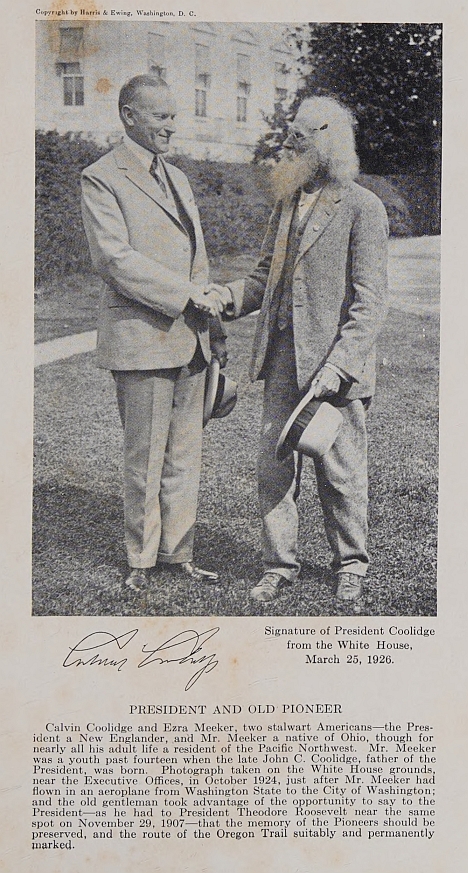
Signature of President Coolidge
from the White House,
March 25, 1926.
PRESIDENT AND OLD PIONEER
Calvin Coolidge and Ezra Meeker, two stalwart Americans—the President a New Englander, and Mr. Meeker a native of Ohio, though for nearly all his adult life a resident of the Pacific Northwest. Mr. Meeker was a youth past fourteen when the late John C. Coolidge, father of the President, was born. Photograph taken on the White House grounds, near the Executive Offices, in October 1924, just after Mr. Meeker had flown in an aeroplane from Washington State to the City of Washington: and the old gentleman took advantage of the opportunity to say to the President—as he had to President Theodore Roosevelt near the same spot on November 29, 1907—that the memory of the Pioneers should be preserved, and the route of the Oregon Trail suitably and permanently marked.
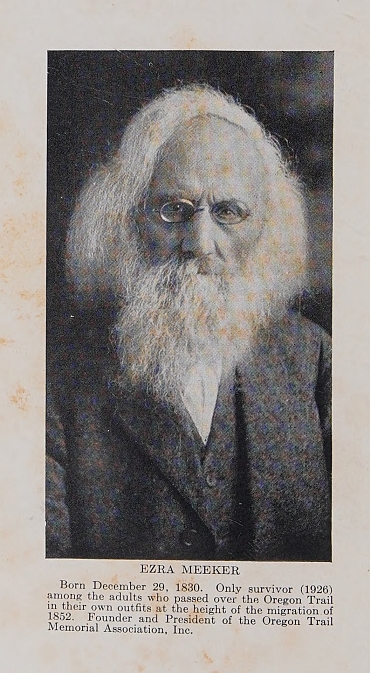
EZRA MEEKER
Born December 29, 1830. Only survivor (1926) among the adults who passed over the Oregon Trail in their own outfits at the height of the migration of 1852. Founder and President of the Oregon Trail Memorial Association, Inc.
A Romance of the
OREGON TRAIL
By
EZRA MEEKER
Author of: Ox-Team Days, Pioneer Reminiscences,
The Busy Life of 85 Years, Pioneer Stories for
Children, Story of the Lost Trail to Oregon
Drawings by Margaret Landers Sanford, Rudolf A. Kauach
and Oscar W. Lyons
Map of the Oregon Trail, and photographs
Published by
EZRA MEEKER
18 OLD SLIP, NEW YORK CITY
THIS VOLUME IS INSCRIBED AS A TRIBUTE OF DEVOTION TO
THE MEMORIES OF
PHOEBE BAKER MEEKER
MY MOTHER
ELIZA SUMNER MEEKER
MY WIFE
WHO CROSSED THE OREGON TRAIL AS A YOUNG MOTHER IN 1852,
AND WAS AFTERWARD THE COMPANION OF MANY YEARS OF MY LIFE
THE HEROINES OF THE PLAINS
AND 20,000 PIONEERS
MEN, WOMEN AND CHILDREN—BURIED IN UNMARKED GRAVES,
ALONG THAT GREAT HIGHWAY OF HISTORY TO THE FAR NORTHWEST
Copyrighted 1926
By EZRA MEEKER
All rights reserved
CONTENTS
FOREWORD: Ezra Meeker, the Author
By Robert Bruce.
Early Life in Missouri; A Farewell Party; Kate's Suitors
Off for Oregon; Crossing the Missouri; Encountering the Buffalo; Troubles with the Indians
Trials of the Long Trail; Dangerous River Crossings; the Death of Catherine; West of the Rockies; Separation of the Party; New Homes in the Oregon Country
A Massacre and a War; Kate Mulhall, Deputy Sheriff; A Race for a Wife; The Wedding and Charvaree; A Delayed and Adventurous Honeymoon on Puget Sound
An Encounter with Pirates, and a Fortunate Deliverance; Ben Found; His prompt start for Missouri and unexpected arrival; a Son born to the Peltons
The Wedding of Ben and Linda; A second Overland Trip; Massacre of nearly all the Company; Binding up the Wounds; The Trip resumed; Survivors reach the Oregon Country
Linda's hope never realized; Death of David Mulhall; Craig's promise remembered; Lessons from a Trail-marking Outfit; Decision to make the trip
The Start for the Rockies; Re-discovery of the Old Trail; Recollections of Burnt River; All signs of Ben's grave obliterated; A granite Monument erected near the Lone Pine and wagon tire at the grave of Catherine Mulhall: Closing Scenes
The Missionary's Story—The Lewis and Clark Expedition; Outline History of the Oregon Missions; Jason Lee's great sermon; Massacre of Marcus and Narcissa Whitman; Destruction of the Mission, &c
LIST OF ILLUSTRATIONS
President and Old Pioneer ...... Frontispiece
Ezra Meeker, the author ...... Frontispiece
Condensed map of the Oregon Trail and National Road
Farewell Party at the Mulhall Homestead in Missouri
A near catastrophe in crossing the Missouri
Typical emigrant outfit on the Oregon Trail
Under the Yoke for the first time
A Corral at an overnight stop on the Trail through the Indian Country
Monument along the Clover Creek Highway, near Tacoma, Washington
The honeymoon party on Puget Sound
Tracks on the Oregon Trail made nearly a century ago
Dr. John McLoughlin welcoming Mrs. Whitman and Mrs. Spalding to Fort Vancouver
Arrival of the Sager orphans at the Whitman Mission
——————
The front cover design combines a distant view of the majestic mountain of the Pacific Northwest with a pictorial representation of one of the great falls on the western slope of the Rocky Mountains—both landmarks enshrined in the memories of the few surviving Pioneers over the Oregon Trail.
EZRA MEEKER, THE AUTHOR
A LIFE SPAN OF MORE THAN NINETY-FIVE YEARS FROM THE
ADMINISTRATION OF ANDREW JACKSON TO THE
PRESIDENCY OF CALVIN COOLIDGE
By ROBERT BRUCE
Ezra Meeker was born December 29, 1830, about ten miles east of Hamilton, Butler County, Ohio, while Andrew Jackson was President of the United States, John C. Calhoun, Vice President, and Martin Van Buren, Secretary of State. There had been only six Presidents—Washington, John Adams, Jefferson, Madison, Monroe and John Quincy Adams; and the last three were still living. Considerable numbers could remember listening to the Declaration of Independence at Philadelphia or elsewhere; a trifle less than half a century had elapsed since the decisive victory at Yorktown, and survivors among men who served in the armies of the Revolution were younger than the average of Civil War veterans in 1926.
Although we are accustomed to think, read and speak of the Oregon Trail as "old," the route to which that name has since been given did not come into existence until several years after Mr. Meeker was born. So the shadow thrown upon the screen of time by the living figure of this remarkable man is longer than we may say figuratively is cast by the highway itself; and while the latter has been gradually passing into the background of history and romance, he is still carrying forward with singleness of purpose and unabated energy what will probably be left to posterity as the most important work of his whole busy life.
Prior to 1830, neither the people east of the Mississippi nor the Government at Washington had adequate conceptions of the geographical, political or future commercial importance of the Pacific Northwest; and the wonderful developments there in the last seven decades have grown out of the overland migration of the 40s and 50s, or at least owe much to it, historically and practically.
A most appropriate symbol of the "Course of Empire" from the valleys of the Mississippi and Missouri to the Columbia River and Puget Sound country would be a miniature wagon—sometimes idealized as a "prairie schooner"—carrying many thousands of home seekers into what now comprises all of Oregon, Washington and Idaho, with contiguous parts of Wyoming and Montana. Except for that great human movement, of which the author of this Romance is the only survivor among the men who went over the Trail with their own outfits in 1852, that region would have continued primarily a fur-hunting territory for many years later than was actually the case, and then in all probability have become a part of the British Dominions in America.
As a youth, Ezra Meeker saw recruits somewhat older than himself leave for the Mexican War; he was intensely interested in reports about the far-away and then almost legendary Oregon Country before there was any established travel to it, and heard echoes of the discovery of gold in California—though he was not, as frequently stated, a "Forty-Niner." Accounts of opening the Panama Railroad in 1855, with its considerable effect upon the subsequent emigration to the Pacific Coast, and of the Crimean War, reached the family cabin built with his own hands in "Old" Oregon. Mr. Meeker is now the only one left from the adults residing in Washington Territory when it was created in 1853.
For more than fifty years he was a farmer and hop grower in the Puget Sound region, meanwhile spending four winters introducing hops from Washington and Oregon in the European market; and was also at one time a prospector and miner in the Yukon. Within the span of his life the population of the United States has increased from less than Thirteen Millions, then living mostly along the Atlantic seaboard, to about a Hundred and Fifteen Millions occupying the whole country to the western ocean. So far as we have been able to ascertain, Mr. Meeker is the only person who ever undertook an important work of fiction in his 95th year; and this has been done to revive and preserve the experiences and memories of his youth, in connection with the efforts of two decades to mark the Trail and honor the Pioneers.
PREFACE
Having thrice crossed the Oregon Trail by ox-team, first during the year 1852 accompanied by a courageous young wife, the second and third times during the years 1906-10, erecting monuments to mark the Trail and perpetuate the memory of the pioneers who traversed it, again in an automobile in 1915, and finally over 1,300 miles of it in an aeroplane in October, 1924, presumably none will question that the author can write from his own experiences.
One hundred and seventy-one granite monuments have already been erected on or near-by the general route of the Oregon Trail, along which twenty thousand died. An effort is now being made to portray the scenes and experiences of these pioneers in moving pictures with fidelity to historical accuracy, that present and future generations may know what happened in the winning of the great Farther West.
The names of the actors in this romance are fictitious; but the characters are as the writer knew them. The incidents are based on occurrences in real pioneer life, many of which the author saw, some of which he experienced, and all he knows to be in accordance with the truth.
[Signature of Ezra Meeker]
New York City, January 1926.
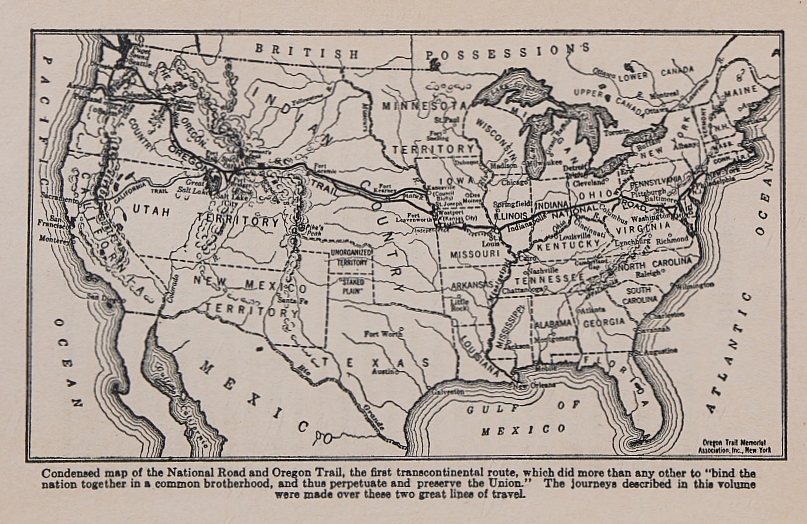
Condensed map of the National Road and Oregon Trail, the first transcontinental route, which did more than
any other to "bind the nation together in a common brotherhood, and thus perpetuate and preserve the Union."
The journeys described in this volume were made over these two great lines of travel.
EARLY LIFE IN MISSOURI; A FAREWELL PARTY;
KATE'S SUITORS
Kate Mulhall was just twenty when her father crossed the Missouri River and the Great Plains on their way to the "Oregon Country." Prior to the day of their departure for that far-away region of mystery and romance, she had never been outside the restricted neighborhood where she was born—in La Fayette County, Missouri, whose every third inhabitant was a slave; had never seen a railroad, and until a short time before, not even a cook-stove. All of her life had been in a real pioneer environment; but she grew up strong, hearty and self-reliant upon the plain and wholesome food, the pure air and active outdoor life of what was then the frontier.
She was of the brunette type, with dark hair and lustrous eyes that fairly sparkled with the delight of being interested in the fields and flowers, grand old woods full of wild life, birds, animals and everything about the home or farm. Of more than the average height, her movement was lithe and free; her form an excellent subject for an artist's brush. Outdoor life appealed to her nature, and she took a joyful satisfaction in all of its activities.
Kate was an expert horsewoman and a crack shot {10} with the rifle, often picking a wild turkey off the lower limb of a forest tree at one or two hundred yards. In addition to that splendid game bird, timorous water-fowl were abundant on the rivers and in ponds; deer, grouse and pheasants in the wood and brakes; rabbits and squirrels almost everywhere; and the "razor-back" hog, wild and ferocious, roamed the forests and dense thickets of Missouri in those pioneer days. Many a litter of pigs, sprung from domesticated ancestors, lived by digging out edible roots under the surface, or hunted beneath the heavy fall of autumnal leaves for the more nutritious acorns, beechnuts and walnuts.
The constant search for food developed an independent life which soon relapsed into the state of nature; so wild hogs became, like the deer and turkey, common property for the hunter's rifle. From these various kinds of game Kate kept the Mulhall family table well supplied with substantial and seasonable food. Missouri also harbored among its inhabitants not a few wild men, contact with whom sometimes involved taking desperate chances.
David Mulhall, Kate's father, was a typical non-slaveholding farmer of that period in Missouri—honest but not "progressive" in the present general understanding of that word. He was intensely prejudiced against the negroes, but bitterly opposed to the institution of slavery. Because of these well-known views, he was regarded with suspicion by a majority of his slaveholding neighbors; and, in fact, {11} looked down upon as belonging to the "poor white trash" of the South who worked with their hands.
Many others like him migrated from Missouri because of their hatred of slavery, though usually carrying with them a prejudice against the black man. Others left that region for "free territory" because of the bitter class prejudice existing between those who owned negroes and those who did not; and the latter particularly to save their children from the necessity of competing with slave labor.
Mulhall was by nature and training an easy-going person, who believed in "letting well enough alone"; and was, therefore, averse to going out upon a world of uncertainties, or taking unnecessary chances for bettering his condition. He was born before the advent of railroads in the United States, when oxen supplied the principal means of transportation, and "hog and hominy" comprised the basic food supply for a majority of the people.
The sickle cut his grain, which was thrashed by the flail; and the wind separated it from the chaff. Boiled wheat frequently took the place of white bread, as it was a long distance to a mill and usually a tiresome wait for the "turn" to have the grist ground; hominy was often substituted for johnny-cake or corn pone when the meal was all gone. It is difficult for a generation accustomed to an abundance of every kind of food, including luxuries, to realize how the American farmer lived in the early part of the nineteenth century.
A rather large one-room cabin was the home of the Mulhalls—with a loft overhead, the fireplace in one end and the bedroom, curtained off for the parents, in the other. Kate's room was in the loft with the younger children—all girls—reached only by a ladder fastened to the wall; the patter of rain on the roof often lulled the youngsters to sleep, whether they willed it or not.
Kate was not one of those who constantly chafe for things they cannot have and lament over their fate. She was too healthy in mind and body to give way to discontent—was satisfied with her lot, and proud of the class to which she belonged. Nor would she willingly exchange places with anyone who lived in idleness and comparative affluence upon the involuntary labor of fellow mortals of a different color.
Fine qualities of head and heart combined with an exceptionally attractive personality to make her very popular with the young men of marriageable age and inclinations in all the country around. Nor were all of her admirers of her own circle; at least one belonged to those prone to consider themselves superior to white families who owned no servants. But at the time this story begins, Kate had no serious intention of taking any step that would abridge her personal freedom; there was plenty of time for that.
But whenever there were any "doings" in the neighborhood—dances, spelling bees, sociables or camp-meetings—she was sure to be on hand, and {13} never lacked for an escort home. Sometimes it would be Ben Hardy, at other times James Price or one of the Shaeffer boys. She had never gone anywhere with Isaac Pelton, although she always treated him in a friendly way at such places, and actually admired him more than any of the other young men of her acquaintance.
He was a fine looking young man, sensible and well-behaved; but when the thought that he belonged to the slave-holding class—most of whom either sneered at her kind of people, or acted patronizingly towards them—came vividly into her mind she said to herself, in effect, "Banish the thought! Never will I come to terms of intimacy with one of those would-be aristocrats, however nice he may be personally."
Isaac was really a victim of circumstances. Born of a slaveholding family, he had a good education and bore himself like a gentleman, never assuming any airs of superiority over his neighbors, whatever their station in life. As a matter of fact, he deplored the conditions that separated him from those with whom he felt he had more in common than with his own people. There were many like him in those days.
Standing six feet in his stockings, he was erect in bearing and rather slender in frame, though no weakling when it came to physical prowess; "of stature tall and slender frame, but firmly knit" would apply to Isaac Pelton. His hair was brown and his {14} eyes grey, indicating mental alertness; a slightly prominent chin and firm-set lips stamped him as one not easily swayed from his course.
At a neighborhood gathering just prior to the beginning of this story, Isaac noticed that Kate had no escort; so, availing himself of a favorable opportunity, he approached her and in a very gentlemanly way offered to see her home. It was the first time Pelton had ever done anything of the kind; Kate seemed embarrassed for a moment, and blushed perceptibly.
If only her feelings were to guide her actions, she would have cheerfully accepted the offer, for she really liked Isaac and admired his many good qualities; but again that class barrier arose in her mind, and she courteously declined. He knew it would be useless to try to press his suit further just then; so retired, defeated for the moment but not discouraged.
Pelton had been studying Kate for quite a while, and as time went on, the more interested he became; her sterling qualities appeared to greater advantage every time he had an opportunity to observe her. He felt that she was the one woman he could love and cherish throughout his life; and no matter how great the obstacles in his path, he would win her.
Notwithstanding the rebuff, he felt sure that she had no personal objection to him, but was actuated by what she deemed a principle. Were he not the owner of human chattels, he believed his advances would have been more favorably received; that {15} barrier must somehow or other be removed before he could hope to be successful. He was right, but that was a wakeful night for Kate. The more she thought about it the worse she felt; she regretted wounding Pelton's feelings, but it would have strained her principles to have accepted his offer.
As she lay awake pondering over recent events, Kate began to realize that Pelton was more to her than she had imagined; and remembered the many small courtesies extended by him when they met at the frequent neighborhood gatherings. Both were fond of flowers, and she now recalled the many new bouquets slipped into her hand with a list of their names and classifications. She remembered, too, that unlike so many of the neighborhood boys Isaac always had something sensible to say, and was an attentive listener; that at times he seemed reserved, almost timid, in her presence.
An almost forgotten incident of two or three years before now came vividly to her mind; how when the matter came to his attention, Pelton hunted up and soundly thrashed a ruffian who had used insulting language to her. These and other incidents helped to banish sleep. As her mind was absorbed with thoughts relating to Isaac, in a dreamy sort of way Kate began to realize for the first time in her life that a strange feeling of more than friendship, admiration or simply respect possessed her. She loved Pelton in spite of herself.
Then the hateful words "slave" and "slaveholder" {16} stole into her mind to break the reverie, causing her to again exclaim half aloud to herself, "Banish the thought!" The present generation can scarcely realize the virulence and intensity of the feeling generally held by the slaveholding class against anyone who condemned that system. Kate was well aware of this, and naturally inferred that Pelton was imbued with the same sentiments.
Her attitude was due to some definite facts within her personal observation or knowledge, of which a single instance will suffice here. One James Smith, of Pike County, had recently published in a local paper the following advertisement: "For Sale: six yoke of oxen; two nigger wenches; four buck niggers; three nigger boys, one barrel pickled cabbage and various other articles of merchandise," stating as his reason for selling, "I'm g'wine to Californy." This gave assurance that the sale was genuine and conveyed the intimation that bargains in slaves might be picked up there.
After Kate had recovered somewhat from the excitement incident to refusing Pelton's offer to accompany her home, the mother reminded her that Isaac did work with his own hands and was shunned by many of his class because of it. "But, mother," she replied, "you know I have no thought of marrying anyway!" Nevertheless she could not help being vexed for allowing herself to be influenced by such a prejudice.
Kate had known Pelton, or rather of him, almost {17} her whole life, having often seen him at the meeting-house and upon other public occasions. She was conscious of some admiration for him; but had no thought of betraying her secret by act or manner, although she may unconsciously have done so. One thing Kate was sure of—she never would place herself in a position for others to look patronizingly upon her; nor would she ever become the wife of a man who held slaves. Perhaps Kate had never thought about this as a rule of life; it was an expression of her nature.
According to common gossip in the neighborhood, she had two or three suitors, but there was nothing to warrant such an assumption. James Price had been known to spend a Sunday evening or two at the Mulhall cabin, and Ben Hardy had twice gone home with Kate from singing school. Coming to Kate's ears, this gossip annoyed her. "Couldn't a body be civil without being talked about?" she asked herself. Then her mother would say, "Well, what's the difference? Some people do get married, you know, and there's no harm in talking about it. Father and I were married once upon a time, and it didn't hurt us even if people did talk."
Kate couldn't fathom what was running in her mother's mind, for she had said time and again that she was not going to marry and leave home. But when alone, she was troubled by the thought that she did feel just a little jealous when she heard that Isaac Pelton had gone home with Linda Shaeffer two {18} Sundays ago, and that James Price had also paid attentions to her.
"Fudge," she said to herself, "what's the matter with me?" and pinched her arm until it hurt for having such a thought. She should really be glad of it, for Linda was her friend. But, in spite of her effort to banish it, the idea would come back when thinking of Pelton as Linda's beau.
James Price was of a good family, but several years older than either of the girls; in fact, as thought in those days, bordering on bachelordom. He was of good address, but not ambitious to make his mark in the world, aside from mingling with the petty politicians of the county; and might have passed for one of them. Price called twice at the Mulhall cabin and stayed unusually late; there was nothing to indicate that he had come to "see" Kate, but the sharp eyes of the mother easily detected the object of his visit, and later she told Kate so.
The Hardys lived on a rented farm not far from the Mulhalls and they had been neighbors for several years. Kate and Ben attended school together, had pulled on the long grapevine in the tug-of-war on the same team or on opposite sides; had been to candy pullings in the sugar making season, and twice were the last "spelled down" as captains of the two opposing camps of spellers. But that they were old enough to marry seemingly never occurred to either of them.
Ben was the opposite of Kate in complexion, figure {19} and general appearance. While Kate was very dark, Ben was fair—almost pale—with deep blue eyes; Kate's eyes were almost coal black and her face was full, while Ben's was spare. Ben stuttered just a little, but enough to be noticed and occasionally to amuse those with whom he was not well acquainted. Ira Hardy, Ben's father, was not thrifty in worldly matters. Some would say he was shiftless or indolent; whatever the cause, the elder Hardy suffered by the imputation, and his son Ben with him.
One day Kate came home from a visit to her Uncle Tim's with the news that he was going to Oregon. Her cousin Jacob had written of mountains miles high where you could see snow all summer, and yet it would be warm in the valley; and the grass remained green all winter. Potatoes were selling there for three dollars a bushel, eggs sixty cents a dozen and butter for seventy-five cents a pound; daisies bloomed in December and apple trees would bear in three years from the graft. Jacob also wrote that there were no wild turkeys or bees in all that region; if his father could bring a swarm of honey bees he would be able to sell them for a thousand dollars spot cash. He added a statement about there being no slavery in Oregon.
What most impressed father Mulhall was the report of no slavery there, and that the grass remained green all winter. They all knew that what Jake wrote would be found true; but he had neglected to describe the difficulties of a trip to Oregon—the {20} danger, fatigue, intolerable dust, alkali water and a thousand other things which would not fit into such a fine picture.
"I tell you, Catherine, if you will agree to it and Kate will go along, I've a notion to go to Oregon this very next year." "But what will you do with the farm?" the good wife inquired by way of response. "What's the use of a farm if we can't make any money on it? Sam Kemper sold nearly a full steam-boat load of hogs for a hundred dollars, and just went off leaving his farm to be sold for taxes." "I'm in favor of going, and that's all I have to say," was Kate's comment as she climbed the ladder to the loft.
That night again Kate was wakeful; try as best she could to sleep, her eyes would remain open. Gradually the vision of Oregon faded from her mind, but that jealous thought of Linda would not down. Nevertheless, what was Isaac Pelton to her? Didn't she scorn the very thought; and hadn't she erected a lasting barrier between them?
It soon became known that Squire Mulhall was going to Oregon the next spring, and an unexpected buyer came for the farm; it went at a low price, but that was better than leaving it to be eaten up with taxes. Preparations now began in earnest for the great journey.
Kate wanted the mare Nell to ride, and when she thought about the side-saddle, remarked to her mother, "I'm going to have a saddle I can ride with {21} comfort and safety, and they may say what they please. You and the children must have Dick and Ned and a carriage like Sam McCoy's," Kate continued; "they'll take you through all right."
Squire Mulhall was a quiet man, of few words and meant whatever he said. He did not hesitate to condemn slavery, though not from the housetop; but would not conceal his real sentiments, thereby incurring the displeasure of his neighboring slaveholders without forfeiting their respect. Some other subjects, one of which was the use of whisky—upon which he held positive opinions—developed real enemies; he said as little as possible about them, and went the even tenor of his way.
That was before the time of temperance societies or of saloons as known in later days, when the school-master, or even the parson, would take a "wee drop"—sometimes more. Whisky, obtainable in almost all retail stores at twenty-five cents or less a gallon, was usually in evidence at social gatherings and often in the harvest fields.
"Catherine"—-the Squire speaking to his wife—"I've a notion to invite in the neighbors before we go, and include all. Maybe some won't come, but I want them to know I bear no ill will to any of them; what do you say?"
"Such a crowd—you wouldn't know what to do with them," was Catherine's cautious response.
Kate suggested, "Send them to the barn and let them dance on the thrashing floor."
"That's the thing," continued Mulhall, "the women folks put off their extra duds in the cabin, and the men go to the barn—plenty of room there."
"Anything to please you and Kate; I'll do the best I can, but you're undertaking a big job," Catherine said.
And so plans were laid for a farewell party during the months before the start was to be made for Oregon.
"Let me see," asked the Squire, "how will we go about inviting 'em; post up notices, would you say?"
"You wouldn't want that man Tracer, who treated you so last year and said so many mean things, would you?" inquired Kate.
"Why not? It didn't hurt me a bit; it did him. Let 'em all come and wipe the slate clean," Mulhall responded.
"It would be better to write the invitations and send them around," Kate said.
"Well, well, have your way," answered the Squire, "but I'd like to invite everybody."
"How'd you expect to light the barn? Candles would blow out or run down so fast they wouldn't last long," Catherine asked without receiving an answer.
Next morning Kate went over to see Ben Hardy—called "Bennie" by everybody—to ask his help in making ready for the party. Although just past nineteen, Ben hardly looked like a grown-up. As a boy he had been a regular "towhead," and his hair hadn't darkened much yet which, with a light {23} complexion, made him look very young for his age. Kate and Ben had always been good schoolmate friends, and she thought no more of asking a favor of him than she would of a younger brother old enough to help her.
"I golly, you bet I'll help you," Ben said; and at once the two began the planning.
Squire Mulhall's barn was large, with a capacious thrashing floor between the two mows, one for grain and the other for hay. A wide door on either side opened the way for a team to drive in one way and out the other.
"I've got it," Ben exclaimed after talking about how to light the barn; "we'll take two or three barrels, knock out the ends, fill them with dirt and stick torches in the dirt. You just leave it to me, Kate, and I'll make that barn floor so light you can see to read. Besides," he added, "it's full moon that night."
Any reader who may have had the experience of cutting down a "coon tree" by the light of a hickory bark torch will readily understand the origin of Ben's idea. Coons were plentiful in the Missouri bottom lands; a story is told that during the Civil War some people were compelled to adopt a diet of elm bark fried in coon grease as a substitute for bread and butter.
Meanwhile Squire Mulhall was busy cleaning up things about the barn, fixing a long table where the women folks could put their knickknacks, and bought {24} a half dozen tin cups, which he said would be enough to go around with the "gourds" they had. These were to be placed by the cider barrel that would stand just outside the barn where all could help themselves.
Mulhall rode over to see if Pelton would let Andrew come and play for the dancers, and Jennie help Catherine in the house; and added, "Of course they can bring Margie along." Pelton had already received an invitation from Kate, and wondered if it was written in her own hand; it was real neat and Ben Hardy had delivered it. Pelton didn't dream of being jealous of Ben, thinking of him as a mere boy, not realizing there was but a year's difference in age between Ben and Kate.
"Why, yes," Pelton said, "you can call on me to help in any way I can; and I will bring over a barrel of cider."
Mulhall said he had already provided for a barrel, but Pelton thought one wouldn't be enough and said he would bring another. One of the neighbors provided a bushel of hickory nuts; another some walnuts, and the like. Still another, not to be outdone, brought a good supply of leaf tobacco he had raised, and a great number of cob pipes; many women smoked in that day.[1]
Mother Hardy said it would never do to leave {25} Catherine all the work of providing for so large a crowd, and the other women thought the same; so word came to her not to bother about the table at the barn, for they would bring their own dishes and enough of everything all the people could eat. The fact was, when the word passed around that Squire Mulhall was going to give a farewell party, with everybody invited, class prejudice broke down. Or at least it was suspended; apparently everyone was pleased, and ready to join to make it a great success.
A few days before the party, a man rode up to the door of the Mulhall cabin.
"Won't you come in?" was the Squire's greeting. Without seeming to notice the invitation, the stranger asked, "Is this Squire Mulhall?"
"Yes, won't you come in?" was the renewed invitation.
"I jest come to tell ye," the stranger continued, "I live down in Jackson Township where that feller last year came and talked so mean about ye. We believed him and talked about as mean as he did; but it was all a lie. So we got together yesterday and signed this paper to let you know afore you go to Oregon that we now know it was all a lie, and don't want you to hold anything against us. If ye will let us, we want to bring up a nice fat critter and barbecue it for your friends; ye needn't turn yer hand over to pay a cent, and we will bring a lot of things to go with it."
The man's manner was proof of his sincerity. {26} After the Squire had assured him that he and his friends would be welcome without bringing anything, but that they might bring whatever they wanted to, the stranger rode off without going into the cabin.
Hearing what had been said, Kate came near, threw her arms around her father's neck and kissed him for teaching her by this example to be kind to one's enemies. She kissed him again and again, while her tears wetted his cheek as well as her own, saying "I shall never forget it"; and she never did.
At last the day of the party arrived and with it, true to promise, a large delegation of men and women from Jackson Township, with two wagon-loads of lumber and the "critter"—a fine fat beef—in another wagon to be barbecued. In an incredibly short time the lumber was unloaded and a dozen willing hands were laying a floor just outside the barn for dancing, while some were erecting tables and others digging a pit for the barbecue.
This is no overdrawn picture; the pioneers were accustomed to do for themselves, and not stand by to be waited on. Thereby hangs a big story of pioneer life, full of self-reliance and independence, the simple life that developed manhood and joy in the household and on the farm.
For the time being, Ben's usual occupation was gone; the older men fairly drove him away, and told him to be ready to take part in the dance. The women in the cabin did the same for Kate, who {27} then started up the ladder to dress for the great occasion.
Andrew and Stinson's colored man Sam often spent happy hours singing and playing together; and Sam was asked to come along with his banjo. When the music began every elderly dame remembered her younger days; soon the cabin was full of dancers as in the long ago, and the songs were of the kind that bring rapturous joy. Nothing moves the emotions more than the pathetic melody in the old folklore songs of the negro race; in this case the souls of the two experts were in the music.
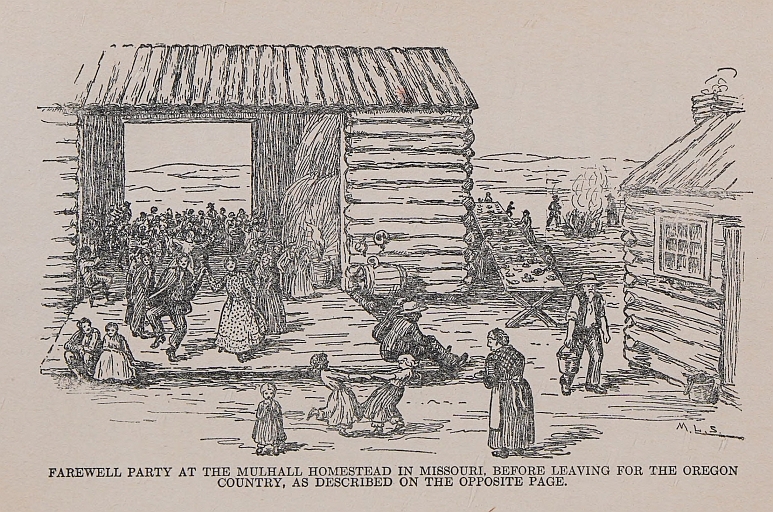
FAREWELL PARTY AT THE MULHALL HOMESTEAD IN MISSOURI, BEFORE LEAVING FOR THE OREGON
COUNTRY, AS DESCRIBED ON THE OPPOSITE PAGE.
The visitors from Jackson Township had also brought fiddlers; dancing was going on in the barn and on the improvised floor near-by, as well as in the cabin. For hours the tables were full of happy partakers of the barbecue and the abundant viands with which they were loaded.
Ben and Kate had planned to have their first dance of the evening together; so when James Price asked her for it, she told him that he should have the next. Ben was on hand for the engagement, and from that moment Price was jealous of him; as the evening wore on Ben and Kate again danced together, and then Price was sure he had a rival. Finally Pelton offered and was accepted; to Kate's own surprise she was dancing with a slaveholder, but justified herself by Squire Mulhall's lesson of forgiveness, though somehow there was more to it than she could explain to herself.
Probably disturbed by the noise and unusual light, the cock crowed at midnight, but nobody paid any attention to it. At near daybreak the elderly folk began to leave; but the younger ones said they wouldn't go home till morning, and didn't. By daylight the hay mow was full of sleeping men, Andrew and Sam were on their way home nodding, and the Jackson Township folks were loading their wagons; the big event passed into history, but the memory of it remained for many years.
During the night word came to the cabin that some of the men were acting in an unseemly manner. Catherine said to herself she'd bet the grocer had slipped some whisky into the barrel of cider he sent; in fact, was sure of it, as what she had tasted seemed unusually strong. Going out to the barn and biding her time, she threw her apron over it and opened the faucet; the barrel was soon empty, and what had been left soaked the ground.
Kate and her father were the last to leave the barn. A bright shining sun spread over the scene; the symphony of song birds so dear to Kate's ears had nearly ceased, and the dew on the grass was fast disappearing, though some of it still glistened in the bright sunshine. Nell, the favorite mare, whinnied to remind the Squire that she missed the usual early breakfast; Brindle and Star, though quietly and contentedly chewing their cuds, looked wistfully at Kate for her deft hands to relieve their full udders of milk.
After attending to the wants of Nell and Ned, the Squire hurried to the cabin where Catherine, who had returned some time before from the night's activities, lay in peaceful slumber. Kate soon finished her task, and as usual took the milk to the cabin. The cock of the yard had ceased to crow, and silence reigned over the scene so recently one of boisterous joviality.
Throwing herself upon the bed without undressing, face resting upon her arm, Kate's mind was full of visions as well as of serious thoughts, particularly of the night just ended. The memory of Pelton's breath upon her cheek as they participated in the dance became uppermost in her thoughts; in spite of herself, tears mingling joy, despair and contrition came involuntarily and wet the pillow.
After what seemed to be hours in this mood, Kate fell into a troubled sleep which lasted until long after midday, when she was awakened by the gentle touch of her mother's hand accompanied by words of affection. "Don't you think you had better have a bite? It's long after dinner hour; father is up and it would be nice to eat together."
Catherine had arisen a little after the usual hour, and given the children their breakfast, followed by permission for them to visit the children of a neighbor for the day, that the sleepers in the cabin might not be disturbed. Mulhall arose with a slight headache, which he couldn't account for, unless it was drinking a little too much "cider"; Catherine kept {30} her own counsel, but of course knew what was the matter with the Squire's head.
Other influences were at work upon Mulhall; the excitement incident to the warm greetings of his neighbors, and the general expression of genuine regret that the community was about to lose so valuable a member, had their natural reaction. The Squire's thoughts also turned to the stern responsibilities confronting him, and how he was qualified to meet them. Had he fully informed himself as to the obstacles to be encountered; was he personally fitted to safely make the long trip and not endanger the lives of his family?
In a word, Mulhall awoke in a mood of anxiety, dissatisfied with himself and in fact with a stroke of the blues, so often fatal to true happiness. The dinner passed moodily; the Squire had nothing to say, and Kate very little. Strive as best she might, Catherine could not arouse the usual cheerfulness, and gave up in despair.
We think of discontent as synonymous with pessimism, unhappiness, misery and many other ills of life; on the other hand it leads to enterprise, boldness and progress. Had the pioneers been content with their lot, they would never have crossed the Missouri River; there might have been no long western trails, and the Oregon Country would probably not have been secured to the American Government. Civilization itself rests upon the spirit of adventurous discontent; so when Squire Mulhall arose from {31} the table in that frame of mind, he simply followed in the footsteps of many others, realizing, however, that he had not taken care to acquaint himself definitely with what lay ahead of them on the proposed trip.
One day Pelton rode up in front of the cabin, hitched his horse and came to the door. Kate, not knowing who was there, went to answer the call.
"Is the Squire at home?" inquired the visitor.
"Yes, he is at the barn," was her reply, as she invited him in while the little sister ran to call father. Pelton disarmed all embarrassment by at once making inquiries about Oregon; and Kate could hardly do otherwise than to take a seat beside him to answer his questions—and more too—about Oregon and the proposed trip.
Bess returned to say that, "Father will be in as soon as he puts the team away." Neither Kate nor Pelton showed any signs of impatience at being left alone; she enjoyed talking about Oregon as much as he liked to hear her, and so they forgot everything except the topic of the great trip.
Stamping his feet repeatedly to shake off the mud and partially clean his boots, father Mulhall's presence was announced; and at once in true pioneer spirit, he asked Isaac to have his horse put up and stay to supper. Preparations for a frugal repast were well under way when Pelton arrived; but it would never do, the mother said, to sit a neighbor caller to such a picked-up meal. So while the two {32} men went to the barn to care for the horses, Kate and her mother took counsel together.
Only a few days before she had picked off a young turkey with her father's rifle; but the mother said the "leavings would at best make a mussed-up meal." Just at dusk Kate went off to the barn for a chicken; she had no trouble securing a desirable fowl and quickly returned to the house. They had plenty of "sassafras" bark for tea, and a small portion of last spring's run of maple sugar.
One of the neighbors had found a bee tree and brought over a dish of honey that the mother had saved for special occasions. Thirty years before, Daniel Boone discovered bee trees lower down the river; but the dry plain and lack of timber had served as a barrier to invasions farther west extending, as we have seen by Jake's letter, to the Oregon Country—and as we later know, to the whole of the Pacific coast.
The children had an early supper and were out of the way, leaving only the four people to partake of the meal and join in the conversation, most of which was naturally about the proposed journey. During the evening it developed that Pelton knew more about the Oregon Country than the Mulhalls; so Kate couldn't help but surmise that his early inquiry about Oregon thinly veiled the real object of his visit.
She was puzzled to know how anyone of spirit could come back after the rebuff she had administered to him; but could not help acknowledging to {33} herself that she had really enjoyed the visit, and wondered if she had in any way revealed her inmost feelings. Long before bedtime she climbed the ladder to the loft determined not to "make a fool of myself"; but as before, she couldn't go to sleep until long after their visitor had left.
As Pelton rode home from the Mulhalls, he berated himself for not carrying out the design that prompted the visit, and let Kate know that he intended to free his slaves; then his pride would again rise up to justify hesitation. Would Kate assume that this resolution was either a subterfuge, or simply to win her hand? Could she respect a man who would sacrifice a principle, as Kate would assume that all slaveholders believed that slavery was right? No, he must convince her by deed to prove the sincerity of his purpose, not by words of promise actuated by the motive to gain favor in her sight.
Then came the question, could he free all of them? Margie was a minor and if "free" could, under the laws of Missouri, be taken before the County Court and bound out to servile employment until of legal age; this was virtual slavery, and it would unquestionably be done upon motion by some one of the slaveholding class who might make application to the court to enforce the law. The secret "Blue Lodges"—night riders in fact—law or no law, in conjunction with other organizations of similar aim, virtually ruled the State. When Pelton arrived home and in accordance with life-long custom called Andrew, in {34} a fit of absent-mindedness he told him to take care of "Kate" instead of naming his saddle horse, "med."
"Massa, what's you mean?" asked the servant.
"Oh, I mean Ned, of course," was Pelton's reply.
Andrew chuckled to himself and told Jennie he'd bet Massa had been off to see Kate Mulhall, bringing a response that she hoped he might "ketch her." Pelton was vexed at himself, but now recalling the slip of the tongue, awoke to the consciousness of how completely the one name had taken possession of his mind. He did not know that another was awake in the Mulhall cabin loft revolving his own name in her mind.
The spark of hope to win Kate's hand was almost extinguished; yet he felt sure that only the slavery question prevented the successful prosecution of his suit. Pelton thought he knew, and actually did know, her real feeling toward him, while Kate imagined that she might have given some manifestation during Pelton's visit—a possible unguarded word, a tone of the voice that spoke louder than words, or an expression of the eye that revealed her secret. All these haunted her wakeful hours, and followed into the dreams of restless slumber.
Who can fathom the essence of pure love, that flows from the heart like the fragrance of the flowers of the field, that knows no bounds, breaks all barriers; and, if disappointed, leaves a sting in memory through life? Such was Isaac's love of Kate. He had known her independent character and unselfish {35} devotion to her father, and last though not least, her altruistic actions on many occasions. He was but two years older than Kate, and in health her equal; why should he not claim her and establish a happy home? Then that monster slavery would arise to dispel his dreams.
Pelton had inherited a part of his father's estate, including two slaves, Andrew and his wife Jennie. Both were older than he; in fact, Jennie looked after his clothes when he was a boy, and he thought almost as much of her as of his own mother. Pelton maintained his own household and "Mamma" Jennie took scrupulous care of it.
She had a five-year-old girl that Isaac thought the cutest little thing he had ever seen—fat, chubby and always in good humor; and of course Jennie thought there never was another such a cute girl as her Margie. Sometimes a cloud came over her face as she thought what might happen if "Massa" died, or got in debt and couldn't pay; but as yet little Margie had no forebodings, and her mother was careful not to open any way for such thoughts.
Pelton had long contemplated setting free all three of them; but if he did, what could Andrew do for himself? He might apportion enough land to make a home for them; but a black man was forbidden by law to own land, and in fact had no protection for property of any kind. At one time he had seriously thought of going to Oregon himself, taking Andrew and Jennie with him to set them free there; but {36} word came that the pioneers had passed a law[2] forbidding negroes living in Oregon under penalty of the whipping post, if they did not leave after due warning. Kate, in entire ignorance of Pelton's troubles and intentions, looked upon him as one of the class she could never treat with forbearance.
Up to this time Isaac had kept his own counsel as to his plans; to let them be known would serve no good purpose and bring upon him a storm of obloquy and reproach from other slaveholders for endangering their property rights. Within his recollection, the like had been done only once in the neighborhood, when Squire Young manumitted eleven slaves, and finally moved away to escape continual insult because of his act. Pelton knew, or thought he knew, that Kate's impulsive action was because of her intense hatred of slavery and aversion to slaveholders; but anticipated the taunt that he had freed his negroes as the price of winning a wife.
He had made the fateful visit in an undecided frame of mind—just drifting, though intending if the opportunity occurred to make a clean breast of his whole plan. But soon after Kate left the room, he started for home while she lay sleepless on her bed in the loft. Here we leave them, each with a troubled mind, to take up another thread of the story.
[1] The author remembers lighting his mother's pipe with a coal of fire nearly ninety years ago, before matches had come into general use.
[2] This law, passed by the Provisional Government in 1843, was never enforced and soon repealed; but it served to illustrate the intense prejudice against the black man by pioneer settlers who nevertheless voted resolutely against making Oregon a slave State.
OFF FOR OREGON; CROSSING THE MISSOURI; ENCOUNTERING THE BUFFALO; TROUBLES WITH THE INDIANS.
Ben Hardy was employed to help break in the team and for other necessary preparations; also, if his father would consent, to make the entire trip with them. Neither Ben, the Squire nor Kate knew anything about oxen; but all realized that they must have a team.
A few days after the party at the Mulhall cabin, the trio experimented in breaking in some cows to the yoke. Kate thought Brindle and Star would make a capital team, and at the first attempt succeeded in getting the yoke on Star—except that she broke away from them and circled around the yard with her tongue out, bucking and fiercely bellowing. Kate quickly climbed the fence in dismay, wondering why gentle old Star should object to be yoked.
Finally getting both cows under the yoke just before dinner call, Kate and her father went to the cabin while Ben started home for lunch. Kate, the first one out after dinner, could hardly believe her eyes. Star, yoked by them on the off side, stood on the near side, while Brindle had changed places with her, and was on the off side. Kate knew perfectly well that she had been yoked up last and on the near side.
In her astonishment she at first overlooked the yoke hanging under the necks of the cows instead of resting on top; they had turned the yoke, and as a sailor might report such an incident—"the starboard ox was on the larboard side, the larboard ox on the starboard side, and the ox-yoke had left the hurricane deck and gone below." Squire Mulhall could see the humor of the incident, but realized a very serious side to it, as illustrating how little they knew about outfitting for the great journey.
He ordered the attempt to break in a team discontinued for the time being; and the next morning mounted Nell and rode off, ostensibly in search of a team, though, as he afterwards said, with a notion to look at the country north of the Iowa line. "But what's the use of raising corn to burn in the stove to keep from freezing, or bacon as fuel for racing steamboats?" While in Iowa he was asked if he knew a man by the name of Pelton reported to live in the county from which he had just come.
"Yes, but what of it?" was the Squire's laconic reply.
"Nothing," the stranger continued, "except he has been looking for land to settle free negroes on, and the neighbors didn't like it."
Now for once in his life he had something to keep from Catherine, who had told him what she had surmised—and in fact knew—Kate's secret, although only through her motherly instinct to read signs often plainer than words. Again Mulhall wavered; to tell {39} Catherine what he had heard would be equivalent to telling Kate, the apple of his eye. He could not bear the thought of losing her; in fact had resolved never to go to Oregon unless Kate went along.
During the Squire's search for a trained team (labor lost, for there were only here and there old, slow, broken-down or ill-matched oxen), he heard of a missionary or itinerant preacher who represented that he had been in Oregon. Mulhall eagerly took the track of this man and followed it for days before overtaking him; but was well rewarded by finding his new acquaintance a very intelligent, well-read man with large experience in the Oregon Country—just the one he was seeking.
But he had already been gone a week, was nearly a hundred and fifty miles from home, and Catherine would soon become very uneasy about him. The minister would probably also talk more about missionary work than topics Mulhall was eager to discuss. So on the second day arrangements were made for the two to go to the Mulhall home where the missionary could rest from his labors, recuperate his worn-down horse and confer at more length about outfitting for the trip to Oregon.[1]
This was done, and following the counsel of the visitor, preparations for the trip went on apace. The Squire purchased ten trim, well developed five-year-old steers, not off the range but farm raised, with two extras as a relief for lame or other temporarily {40} unfit ones in the teams. In other matters the missionary's advice was adopted, with the result that when completed Mulhall's outfit was equal to any he afterwards saw on the plains, and far superior to the vast majority of them.
Ben Hardy, whose mother hesitated but finally gave way to his pleadings, was engaged to take charge of one of the teams. Mulhall offered such liberal compensation that Ben's father also consented, although the lad was still under age. The Squire knew that Ben would be true to his interests, and thought of him not as the hired man, but as one of the family; in fact, he promised Ben one of the teams for his own when they arrived in Oregon.
Ben had a secret of his own about which Mulhall knew nothing. He and the Shaeffer boys were friends, and no one suspected that Ben's frequent visits to their home had any other attraction than a good time with the boys; nor did they dream that "Bennie," as they called him, had any thoughts about their sister. But mother Shaeffer had detected more than mere friendship between Ben and Linda; and under the circumstances developments were not likely to be long delayed.
Ben resolved to make a clean breast of it and know from Linda's spoken words that she loved him and would await his return, or possibly come to him; and firmly concluded not to go unless Linda would consent. In this mood Ben boldly declared himself to Linda in a scene that need not be described here. {41} Linda was a dutiful girl and would have no secret from her mother. "I will go with you now if mother will consent," she said between smiles and tears; "or I'll wait until I can come to you." The thought of having Linda go with him now had never entered Ben's mind until she suggested it, subject to her mother's consent.
"I'll be true to you, Ben, to the end," she said and submitted willingly to the sealing of the promise by a responsive kiss. "Come tomorrow night, Ben, and we'll talk it over with mother;" and so they parted.
Ben went home living in a new world, with increased confidence in the future and a happiness never before experienced. This scene was enacted a week before the start was to be made; and meanwhile Ben was busy at the Mulhalls' from dawn to twilight. Two ox-teams, each with two yoke of oxen, and a yoke of cows were used to haul fuel from a distant woodland for the new owner of the farm, training the teams and drivers to the road, as well as a token of good will.
Kate and her mother were busy preparing and cooking various articles of food, while the Squire was laying in a stock of provisions, water containers, tents and other necessities for a journey of more than two thousand miles extending over a probable period of six months. Mulhall had been warned that once across the Missouri River, he would be in the Indian Country and unable to renew his {42} equipment except from overloaded outfits, abandoned property, or by dealing with the sharpers of the so-called trading posts, some of them regular dens of thieves, often kept by renegade white men.
A mishap to one of the teams on the road detained Ben until long after dark; and when he reached the Mulhall barn, the teams and all the loose stock had still to be cared for. So he could not keep his appointment with Linda; and it was near midnight when he crawled into the hay mow to snatch a few hours of sleep before daybreak.
"I wonder why Ben didn't come to-night as he said he would?"; and in spite of all efforts, Linda's voice betrayed her deep solicitude.
"I'll warrant he had good reasons," the mother responded; but Linda could not be satisfied in her own mind. The great journey was to begin the following Monday, and it was only seven days before the start. Upon awaking Tuesday morning, Ben resolved that at all hazards he would go to see Linda that day.
On his way to the Shaeffer home, conflicting thoughts ran through Ben's mind. What would Mulhall say? What would his own mother and, particularly Linda's mother, say? If she could go along, it would enable them to make an earlier start in life; and each would be entitled to a hundred and sixty acres of land from the Government free, whereas in a year or two at most, neither could secure any without purchase.
It was late Tuesday night when Ben left the Shaeffer {43} home after a long visit with Linda. The mother did not positively forbid her going now, but strongly advised against it; upon second thought Linda herself began to doubt the advisability of such a move, though willing to go and share the hardships with Ben if he thought best.
With tears that could not be restrained by either, they decided that Ben had better go alone. Who can fathom the sacrifice of such a decision or decide as to the wisdom of it? Once made, cheerfulness returned, plans for the future were laid and sacred vows renewed; and life opened to them anew.
The wagons were loaded and the tent set up well in advance, so the start could be made early on the following Monday. When the time came, Kate had saddled Nell, and Dick and Ned had been hitched to the carriage for an hour; but the start was delayed, and Squire Mulhall remained in the cabin. At length, after consulting with Ben, the conclusion was reached that the ox-teams should go ahead and the carriage would follow later.
Catherine assumed a bold, cheerful attitude while the preparations were being made, and concealed her pent-up grief at leaving. Several of her children were born in the cabin, and one of them had died in it. She had passed many happy hours within its humble walls, and tender memories came vividly to mind. Even Mulhall was moved with emotion as never before, and determined to wait quietly until Catherine recovered her composure.
No one without the experience of parting with one can realize the deep feeling of affection for the home, even if it is only a cabin. The love of a lowly dwelling is often more intense than that of a princely palace, for a cabin becomes a part of one's self. No wonder that the good housewife should shed tears of regret upon parting with the home she had loved so well and so long.
After all the neighbors who came to bid Godspeed to the Mulhalls had left, Catherine quietly came out of the cabin, entered the carriage and drove in the track of the ox-teams without looking back, shedding a tear or making any sign of distress. The struggle was ended and the die cast, although the sacrifice required supreme courage.
In spite of all their efforts, Kate and the two younger sisters were unable to drive the loose stock fast enough to keep up with the ox-team, and finally lost one cow in the brush. Riding forward to overtake Ben and have him make an early camp, Kate had a foretaste of what was ahead of them on the journey.
Ben found a convenient barnyard and plenty of feed for the cattle, and a cheerful grass plat for the camp. He quickly had the tent up, fire in the stove and the oxen fed when the carriage and Kate arrived with the loose stock. Whoever has had the experience of a good camp under favorable conditions will realize the cheerful atmosphere that enlivens the spirits of all; the bracing air, the novelty and keen {45} appetites due to the exertion of the journey, combined to bring joy and contentment.
They were only eight miles from the old home; but the start had been made, and all considered it a good distance for the first day. Early in the calm, warm mid-April evening, the sharp notes of the bob white quail rang in the ears of the campers, soon followed by the shrill whistle of the whippoorwill in the near-by meadow. Millions of fireflies, with their mysterious alternating of light and darkness, were floating in the air. Contentment reigned supreme in the camp, and care for the morrow was soon forgotten in peaceful slumber.
Difficulties and trials beset the early part of every trip like the Mulhalls'. In the deep, sticky Missouri mud, a well trained team drawing a light load could flounder through with great exertions; but with half-trained oxen and a heavy load it was frequently necessary to double the teams, or lighten the loads and make a second trip.
Walking alongside his wagon or prying up a wheel deeply sunk in the mire, Ben became bespattered with mud from head to foot, but did not lose patience. The cows would not keep in the road, often compelling Kate to dismount and go after them on foot. Neither would swear, though both at times felt like doing so; but when night came, they laughed off their troubles in the camp.
They had been acquainted for years, but neither had fully measured the other until now. "I golly, {46} Kate, it's rough driving the cows, isn't it?" "Yes; but what about the teams? I think you catch it worse than I do." Their mutual trials drew them closer together; and each had unlimited faith in the other.
Squire Mulhall had great confidence in Ben when he engaged him for the trip, but every day his admiration for the lad increased as better acquaintance brought out his sterling character. Thoughts of Ben for a son-in-law flitted across his mind, and would involuntarily return; but he kept it to himself—the second secret from Catherine.
Finally, after a long struggle encountering mud, rain, wind-storms and quicksand, the Mulhall outfit arrived on the high bluffs overlooking the Missouri and the great encampment of emigrants. Hundreds of tents near the ferry landing and extending back from the river revealed the magnitude of the great western movement of the 50's. Squire Mulhall could not do otherwise than camp with the motley throng, and turned the ox-teams out to graze with several thousands of other stock in the river bottoms.
Looking around to size up the situation, he found people there from several States, of all conditions in life and with nearly as varied outfits as there were camps—scarcely any two alike. Here was one bound, like himself, for Oregon; right alongside, another emigrating to California; next a group of Mormons going to Salt Lake—all waiting their turn to be crossed over the Missouri by the two scows called a ferry.
The throng consisted of all ages from the very old to the infant in arms, and were in various moods. Near-by would be a religious meeting with singing, praying and preaching; others were engaged in pitching quoits, card playing or foot racing—anything to dispel the tedium incident to the long delay on the Iowa side of the river. Some of these people had been camping there fully two weeks, waiting for their numbers to be called, and might be obliged to remain several days more. A brisk trade in "turns" naturally resulted; in one case fifty dollars was paid to entitle the purchaser to immediate crossing.
Open gambling was seen in many places, and a great crowd congregated around a race-track. In a stroll of a couple of hours Mulhall noticed a number of intoxicated men, though not many were boisterous; the intoxicants evidently came from the camps. Here, as back in Missouri, whisky was pure but cheap (averaging 25c a gallon), and no regulation as to sale or disposal.
One corner of the encampment was particularly clean and orderly; no litter of papers or cast-off articles of any kind were in sight, and there was an entire absence of gambling, card playing or other amusements. Two of the emigrants in peculiar garb were digging a pit in which to bury rubbish. The men were usually either reading well-worn Bibles, writing or amusing the children, while the women were generally caring for the camp, sewing or knitting; one was weaving cloth on a hand-loom, and {48} another spinning yarn on an old-time wheel, the sharp tones of the spindle vibrating in the air.
It was like part of a long established and law-abiding eastern community transplanted to the edge of civilization. A brief conversation disclosed that these campers were from a Methodist settlement in central Indiana, and that their pastor, though temporarily holding service at a near-by village, was traveling with them. Mulhall thanked them for the invitation to attend the evening meeting and continued his stroll, intending to do so if Catherine and Kate would accompany him.
The next group of camps visited presented a very different appearance. More than half of the party, which was bound for the Mormon settlement at Salt Lake City, had recently arrived from Europe. There were very few men; the greater part were women who huddled in tents almost devoid of camp conveniences, while a number of their ragged and dirty-faced children were playing in the vicinity.
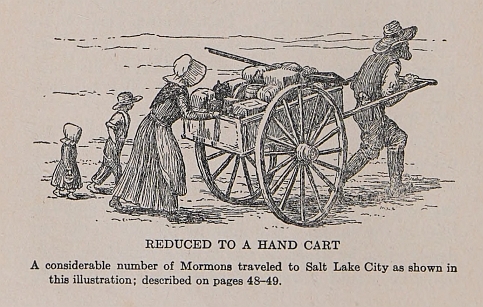
Men and women alike showed a sober mien; here and there a man would be reading a Bible, and Mulhall noticed one reading the Book of Mormon. Like the Methodists, they held religious services every evening. There were very few wagons for so large a party, making the problem of their transportation unusually difficult. In a corner of the encampment were a number of hand-carts which a portion of those belonging to this camp intended to use in crossing the plains; and one man with a {49} wheelbarrow completed the picturesque assemblage.
With the invitation in mind, the Squire and Catherine prepared to attend the Methodist meeting that same evening. Kate said, "Ben, let's go, too."
"I golly, Kate, that's just what I was going to say," Ben replied. So all dressed in their best and walked toward the Methodist camp, for which they had started, along a path which led near the Mormon part of the encampment.
Seeing the people gathering for religious services Mulhall, more out of curiosity than otherwise, suggested that they stop and listen for awhile. Catherine had only a faint idea of what "Mormon" meant; but held a deep prejudice against them, and said that she preferred to attend what she considered a real religious meeting. But as the rest of the party desired to hear the Mormons, Catherine consented, and all took seats among those provided for strangers.
The minister, a burly figure somewhat uncouth but evidently sincere, opened the meeting by reading a chapter from the Old Testament; he took his text from the chapter read, and to their surprise preached a real orthodox sermon, differing little from what they had often heard from itinerant Methodist preachers passing through their neighborhood. On the way back to their camp Mulhall berated himself for not attending the Methodist meeting as originally intended; he resolved to do so the next evening, and all the others said they would accompany him.
True to the resolution, preparations were made to {50} go as the next evening approached. Ben had left early in the morning to look after their cattle running at large in the Missouri bottoms with thousands of others belonging to the numerous camps, and at dusk had not returned. Three of the oxen could not be found; whether they had strayed off on their own account or had been stolen he could not tell, but strongly suspected the latter. He did not return until dark and then was tired and hungry; Kate said she wouldn't go until Ben had dinner, and her mother was of the same mind.
Mulhall lost interest in the meeting when Ben came with the news; the loss of three of his best oxen would be very serious, and he was then in no mood to think of anything else. Early the next morning Kate saddled Nell and Ben borrowed a saddle for Ned; after an early breakfast the two mounted and started down the wide river bottom to look for the strays. Toward the end of nearly an all-day search they were found about seven miles from camp; but from that time on either Ben or the new hired man always stayed out with the herd.
A few mornings after the night watch had been inaugurated Ben, having had Dick for a bedfellow the night before, remarked, "I golly, I snuggled up close to his back and slept as warm as wool." That was the beginning, for him, of an experience shared by many pioneers, including the author; and is the origin of the term "bedfellow of the ox."
A few evenings later, when everything was still and {51} calm, and not a breath of air stirring, Mulhall, while sitting in front of his camp, heard a number of voices in the distance. The sound came from the direction of the Methodist camp; he thought he caught a word or two, but was not sure.
Just then a gentleman passing by asked, "Do you hear the Methodists?" "Is that noise of voices we hear the Methodists?" Mulhall asked. "Yes, they have been going on that way for an hour," answered the stranger, who passed on and disappeared from sight.
Kate and Catherine had both retired for the night, but Mulhall resolved to go and hear what they were saying and see what they were doing. He walked briskly in the direction of the sound, sure enough, it was a "Methodist awakening," as the participants expressed it.
The reader would not doubt this part of the narrative if he had ever attended a meeting of the "shouting Methodists" of Indiana in early days, particularly after a sermon where endless punishment was preached for unbelievers. Now the Squire saw some of the men and women who a few days before were sedate in their industrious camp, shouting and violently gesticulating; some were fairly dancing in an ecstasy of joy, others praying or lying down as if in a trance or stupor.
When, after waiting three weeks, Mulhall's turn came to cross the river, he concluded to send one team and wagon ahead with the tent and cooking outfit; {52} Ben and Kate went along with it to establish and prepare the camp for the remainder of the party. About mid-stream the boat upset. The heavy running-gear of the wagon immediately sank out of sight; but the bed, though partly submerged, and with Ben and Kate in it, continued to float, though it was being carried away from the scene of the mishap by the strong current.
Sometimes the outfit would sink to near the top of the cover, and in another moment the whirl of the turbulent current would leave the greater part of it visible again. Ben managed to remove the cover that had entrapped them, so they were not in immediate danger of drowning; he at once began throwing heavy things overboard, the stove first and then whatever else could be found to lighten the load.
At a bend of the river in sight from the crossing, the bed grounded on a sand-bar projecting upstream from the head of an island, and swung around broadside, affording the imprisoned occupants a safe landing. Seeing their peril, two Indians plunged fearlessly into the Missouri, and swam out to the rescue; others immediately followed in canoes, and soon landed both of them safely on the west side of the great river. Yet we sometimes hear thoughtless people say, "there are no good Indians but dead Indians!"
Kate returned to the Iowa side by the next boat, but Ben remained awhile longer on the west side to care for the team that had swam across. One wagon, {53} the yokes, chains and a considerable part of the outfit had been lost. After arranging for the care of the team, Ben crossed back about dark to rejoin the remainder of the party still waiting there, and to consult with the Squire.
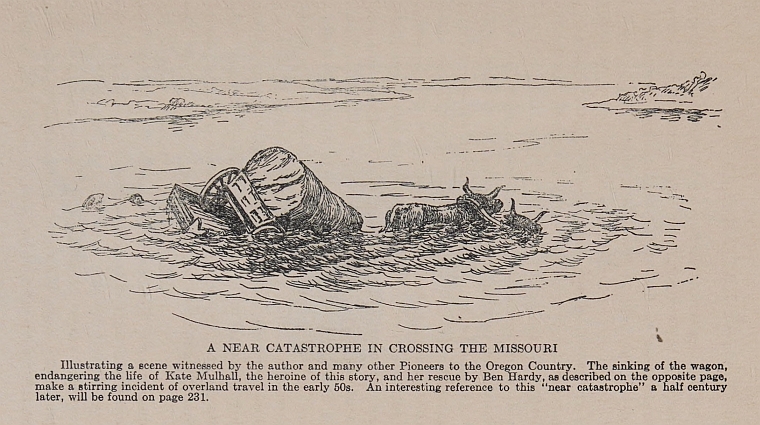
NEAR CATASTROPHE IN CROSSING THE MISSOURI
Illustrating a scene witnessed by the author and many other Pioneers to the Oregon Country. The sinking of the wagon, endangering the life of Kate Mulhall, the heroine of this story, and her rescue by Ben Hardy, as described on the opposite page, make a stirring incident of overland travel in the early 50s. An interesting reference to this "near catastrophe" a half century later, will be found on page 231.
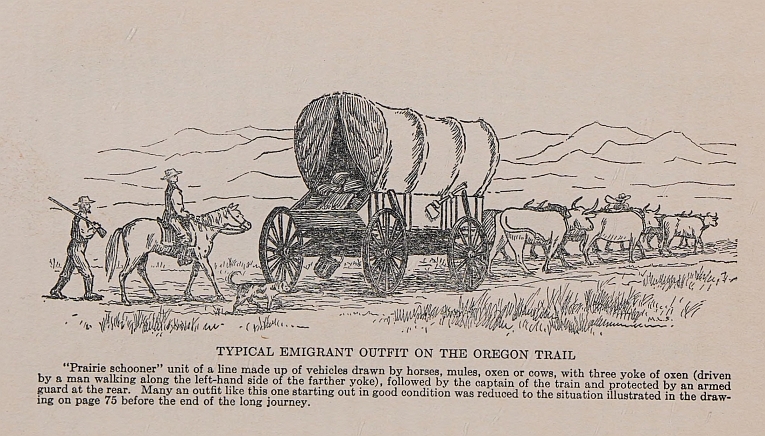
TYPICAL EMIGRANT OUTFIT ON THE OREGON TRAIL
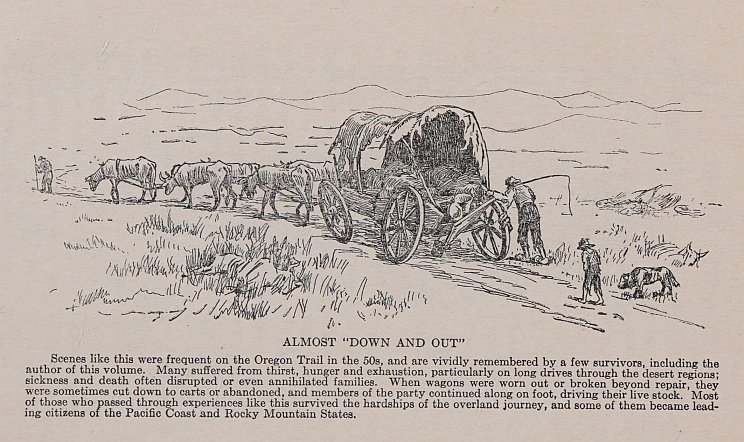
"Prairie schooner" unit of a line made up of vehicles drawn by horses, mules, oxen or cows, with three yoke of oxen (driven by a man walking along the left-hand side of the farther yoke), followed by the captain of the train and protected by an armed guard at the rear. Many an outfit like this one starting out in good condition was reduced to the situation illustrated in the drawing on page 75 before the end of the long journey.
At the time of the accident, Catherine was at the camp and knew nothing about it until told by Kate herself; then she fell upon her knees to offer thanks for the rescue of her daughter. When told that Kate had been saved by Ben's courage and cool-headed action, she gave way to tears of joy and gratitude, and exclaimed, "Where is he? Where is he, the dear, dear boy?" When he arrived, mother Mulhall kissed him again and again; even the Squire had difficulty in controlling his emotions, while Kate seemed dazed and said little. Of course the deep gloom in the camp was accompanied by rejoicing that there had been no loss of life.
The emigrants flocked around to praise Ben's act of bravery; but he made light of it, saying anybody but a coward would have done the same, and he wasn't entitled to any special praise. That evening an elderly Quaker with his wife and daughter came to Mulhall's camp.
"We came to see thee," he said, "to join in praise to God for his mercy in restoring thy son and daughter to thee; and further to tell thee the Spirit moves us to proffer aid to enable thee to repair thy loss." The Squire was deeply impressed with the evident sincerity of the man, and felt to some extent relieved {54} from the feeling of depression he had been striving to dispel.
Catherine was unable to conceal her emotion or control herself; the shock upon the poor woman's nerves had been too great. Kate arose from a cot to assure her mother that she would be all right again in a little while, but seemingly without effect until the Quaker lady's sympathetic words wrought a change of promised relief.
One of the ferrymen came into the camp and witnessed the scene of the Quakers striving to alleviate Catherine's anguish. The two women were about the same age; and the daughter of the Quaker family had been a great comfort to Kate in her distress. Grasping the situation, and seeing that he could do nothing at the moment, the ferryman soon withdrew, beckoning Mulhall to follow him outside.
"I come," he said, "to tell you we think we ought to replace your wagon and outfit, and will do so to-morrow. A number of parties who have concluded not to go any farther will sell their wagons and outfits at a reasonable price. Come and see us in the morning."
At the moment Mulhall was more concerned about his wife than over the loss of a part of the outfit; but the calls of the Quaker and the ferryman were appreciated more for the sympathy manifested than for the offer of material aid. The Quakers stayed until long after midnight. Catherine had been induced to lie down; and with the hand of the good {55} Samaritan on her brow, had fallen asleep and peacefully rested.
Kate's companion had exercised much the same influence upon her as the Quaker mother had upon Mrs. Mulhall; and shortly after midnight she also passed from consciousness to sweet slumber. The three visitors then noiselessly withdrew, and deep silence fell upon the camp. Catherine slept late and awakened calm, and reassured when she found that Kate was up and preparing breakfast.
True to promise, on the following day the ferryman gave the Squire his choice of three wagons and outfits; and before night he was ready to cross the Missouri to the Indian Country, then extending across the Rocky Mountains to the Pacific Ocean. Mulhall was confronted with a perplexing situation—one team was now on the west side of the river, and the other on the east or Iowa side. The hired man, who shall be nameless, seemed to delight in using his long whip-lash on the oxen, and goaded them to unnecessary exertion; and had proven very unsatisfactory in other ways. His language was also offensive; and when the Squire found that he had been indulging immoderately in liquor, summarily discharged him.
Fortunately for Mulhall, at this juncture Douglas Craig, the young man with the outfit presented to him by the ferryman, came highly recommended and expressed a desire to continue on the trip; the Squire immediately engaged him, and never had cause to {56} regret it. As soon as Mulhall could move his camp to the landing, he crossed over without much difficulty, leaving Ben to follow when he could get the cattle up from the bottoms.
That night the campers heard the shrill whistle of a steamer from down the river, and soon saw the lights of the "Ajax" as it moved slowly up to the landing. A great throng greeted the captain as he came ashore, and vociferously clamored to be ferried across the river, with the promise of extra compensation if done that night. So the occupation of the open-scow ferryman was gone, and the steamer took its place; after that a hundred wagons with their teams were crossed by day and nearly as many at night.
One can scarcely imagine the confusion that followed the congestion on the one road leading, out from the landing place on the western side of the river. Outfits had been separated and cattle gone astray, children were separated from their parents, and thieving Indians mingled with the throng. Mulhall soon brought together his outfit (small as compared with some trains of fifty wagons) and drew off to a nearby camping place.
He had been cautioned by the missionary not to join in the rush to drive furiously forward, as others would certainly be doing. Kate became very impatient at the delay of a day that her father considered necessary to have everything in readiness. On the fourth day they were confronted with a narrow {57} but deep river; and there was another struggle to get across.
Many of the Pioneers crossed the rivers on the Oregon Trail with all of their outfits, except the oxen, in the manner shown by the illustration. At best it was a hazardous adventure; at one place on the North Platte nine men were drowned in making the attempt. The author crossed the Snake River twice by this method and swam his oxen; this photograph, taken in 1912 on the "Loup Fork," a tributary of the Platte River in Nebraska, shows his improvised craft in the middle of that great stream, and will convey some idea of the dangers encountered by the emigration of which he was a part. See pages 57, 69-70 and 213.
The confusion was increased by many coming into camp every hour day and night. Some were using a scow ferry entirely inadequate to accommodate the great numbers suddenly brought upon the scene; others were crossing on rafts, and still others in their boat-shaped wagon-boxes. A few had constructed "bull boats" (a light form of willow twigs, with a buffalo hide bottom).
Douglas Craig, the new man of the Mulhall outfit, proved to be an expert horseman and an all-around stockman; he soon managed to get the cattle over, while Ben crossed the wagons. An account of the experiences and daily incidents of even one such outfit as Mulhall's in its slow progress westward would fill a larger volume than this. So we will attempt only to briefly sketch the trials confronting the bold pioneers who passed over the Oregon Trail in the early days before the rivers were bridged, supply depots established or protection from the Indians given by the Government.
"What's that dark shade on the land?" Kate asked her father as she rode up to his carriage. Mulhall turned his glass in the direction indicated for a moment and replied, "Why as I live, that's buffalo." In the clear atmosphere of the plains an object many miles away often seems near-by. Kate was ready in an instant to go and bag some big game, but knew her mother would not consent; so she called to Ben, {58} "Take my rifle and Nell, and get one. I'll drive your team."
By this time the whole line on the road had discovered the herd, and nearly all the men were making preparations to join in the big hunt. Just ahead there seemed to be a great commotion, teams turning out of the road and horsemen riding furiously back and forth. One, racing down the line, shouted in a loud voice, "Unhitch, unhitch; form corrals with your wagons; a buffalo stampede is coming. Quick, quick; don't shoot, don't shoot;" and like Paul Revere, he passed on to repeat the warning.
Mulhall had fallen in with several independent outfits and in the evenings the group had been forming a circle of wagons to guard against the loss of stock and lighten the burden of the night-watch. In a very short time the wagons were arranged and the loose stock placed inside the circle; but the buffalo were all traveling in one direction on their annual migration, not a stampede. Nothing but some insurmountable obstacle could turn the herd from the course that its almost incredible numbers were pursuing.
In their migratory movements buffalo are, as one might say, controlled by instinct like birds of the air. Here was a living mass, to all appearances one vast unit, passing over many miles of the trail, each animal traveling in the same direction as if guided by a compass or the North Star. The emigrants could do no more than guard their own stock and let {59} the buffalo continue their majestic procession for hours.
After the mass had gone on and only stragglers remained in sight, the ban against shooting was removed and an exciting buffalo hunt was on. Ben followed Kate's suggestion by taking Nell and trying with his rifle to bring down a fat buffalo cow. Not being either an expert horseman or a crack shot, he had a rather prolonged and exciting race; but finally succeeded in securing a fine heifer. He could have more easily shot an old buffalo, as many did; but was out more to add to their depleted larder than for the excitement of the chase.
When Ben returned to camp it was evident that he was in virtual collapse, his strength nearly gone and his pulse weak. Thoroughly alarmed, mother Mulhall did everything she could to arouse him from the stupor into which he had fallen, but all to no purpose. Kate fairly ran over to the near-by camp for a doctor, who partially revived him but cautioned him to be careful and patient for several days. When questioned, the physician answered evasively as to a possible fatal result.
An epidemic of cholera was ravaging the camps and taking a fearful toll; only the day before the Squire and Catherine halted the carriage before a newly made burying-ground and counted forty-four graves, none more than three days old. Only those in the best of health seemed immune from the scourge. Mother Mulhall reproached herself for consenting to {60} let Ben go on the hunt, and retired to pray in secret for his recovery.
Kate showed unmistakable evidences of deep grief, and also blamed herself for having encouraged Ben to go; she remained by his bedside throughout the night, and was reluctant to leave when morning came. As the day wore on there were signs of recovery, and by the third day he had sufficiently improved to warrant resuming their journey. Meantime more than a thousand wagons had passed on, leaving many detained in stricken camps to bury their dead.
Mulhall had been a witness to the great epidemic that lined the trail for a thousand miles with uncounted graves of dead pioneers. He had lost considerable weight on the way; how much he did not know, but realized the fact by the fit of his clothes. Catherine said the difference in food had wrought the change, to which the Squire responded that in such case he would probably lose in strength, while he felt stronger than for many years before. The fact gradually dawned upon him that the regular exercise taken on the trip had increased his strength while reducing his weight.
Under the hot sun Kate became tanned, but lost none of the fire in her eye nor her cheerfulness of spirit, although her patience was often tried by the wilful ways of the loose stock. The two little sisters helped her part of the time, until the sand became too hot for their bare feet; but were always welcomed {61} in the carriage driven by their mother. When Ben was transferred to the carriage, their place of refuge was gone; after that one at a time would ride behind Kate, or she would often trudge along afoot while the two little ones rode Nell.
All the past glamour of the trip had now gone out of Kate's mind; but she could not admit to herself any regret that they were on the way to Oregon. At least they were free from the hated question of slavery! Then her mind would revert to Pelton, with the thought that she might have been too rash in her manner of rejecting his advances; had she known what her father knew—that Isaac intended at all hazards to free his slaves—grief would have seized her in spite of all efforts to restrain it.
Kate had intuitively come to discern what was in her father's mind with reference to Ben, and believed that her mother felt the same way as her father. When such thought came into her own mind, the vision of Pelton rose above them all. Love Ben? Yes—as a brother; and then she would try to think of something else.
"What's this?" Squire Mulhall asked aloud rather excitedly to himself, stopping his team in the middle of the road. Soon both wagons were driven to the outside, opening a passage for other teams pressing on from behind. "What's happened, stranger that you are here by the roadside with no team?" It needed only a short time to explain that the family had started across the plains with a {62} neighbor who owned a team; but after some altercation, the neighbor became abusive, stopped and hurriedly pitched the bedding and clothing of the others out of the wagon, driving on with all the provisions.
"How long since?" the Squire asked. "About two hours ago," the stranger answered. "Put your things in my other wagon and let your wife and children get in here until we reach camp tonight," said the Squire, thoroughly aroused and with indignation manifest in his voice. "Perhaps we will overtake the brute by nightfall."
The family consisted of husband and wife, both apparently honest and intelligent, and three small children, the oldest about eight. Leaving his team in charge of the stranger as soon as they were back on the road (which was literally filled with passing wagons and loose stock), he soon found Kate; and taking Nell, rode on ahead as rapidly as possible.
He soon encountered a train of a dozen wagons which had no sooner been passed than another one of thirty was overtaken; each vehicle closely followed the one in front, and to make headway it was necessary to ride alongside the road, often obstructed by sage-brush. That evening the Squire said he believed that he had been obliged to go around at least five hundred wagons to gain five miles on the moving trains, all the while keeping a sharp lookout for the outfit which abandoned the family now traveling with him.
It was learned that the culprit, who had been {63} recognized by the description, passed on just before dark and would probably travel all night. Three armed men were mounted and given instructions to continue on far enough during the night to be sure they were ahead of the outfit, and then to stop and wait for it. Just at daylight they overtook the guilty party and soon convinced him that resistance was useless and submission to arrest his only safe course.
The "unwritten law" of the plains was a tacit consent that all grievances, misdemeanors or accusations of crime must be laid before a jury of elderly men; and no one should take the law into his own hands—in a word, no mob violence. Squire Mulhall soon succeeded in bringing together several of the older pioneers, who resolved to take immediate action; swift and adequate justice was administered, and the incident was almost immediately closed. This code of action prevailed all along the line; no one was punished without a hearing, but there were no delays on technicalities, or any appeals.
Mulhall's trail followed the track that Marcus Whitman had made from the west bank of the Missouri River nearly two decades before, when that famous missionary was on the way to overtake the expedition of the American Fur Company before it reached the Indian tribe reported as hostile to white men passing through their country. It will be recalled how Dr. Whitman swam the Platte where it was a mile wide, and re-crossed with the cattle until nearly exhausted, while Mrs. Whitman and {64} Mrs. Spalding were towed over in a frail bullboat by two Indian women swimming, accompanied by Indian boys who assisted them heroically.
On the sixth day out from this river, definite information was received that a camp of thirty Indian lodges was disputing the right of the emigrants to proceed farther without payment of toll for each wagon. A number of outfits which had already refused to pay were encamped there; Mulhall considered this a wise move until he could reconnoiter and find out just how serious the situation was.
After the rumor of the obstruction had been confirmed the evening before, the firing of a rifle startled the camp. Unobserved, Kate had slipped out of the camp with her rifle; if there was going to be trouble with the Indians, she would have a fresh load in it. The next day, when her father had concluded to go ahead and ascertain the facts about the detention, Kate said she would go along.
Mulhall had not thought of taking arms with him; but Kate noticed that a number had gone forward carrying their guns, and said it was better to be prepared. Catherine firmly approved the move, and added that they would put the camp in best shape possible for defense. Experienced pioneers all agree that the most retiring and apparently timid women usually were the most courageous in times of danger on the plains, whether from Indians or other causes.
Kate mounted Ned, bareback, while her father {65} rode Nell. It was a ride of six miles past several camps and many teams standing in the road; and hundreds of excited men were found at the point of detention. The place chosen by the Indians was a small ravine where a recent washout had been bridged by a train of emigrants that had passed on sometime previous.
On the farther side the Indians were camped; most of the men were mounted, but had not put on their war paint. They were intending to dispute the crossing until payment was made for passing through their country—a plausible claim, as the white man's government had made no treaties with them.
Here the dilemma—whether to pay toll or force their way through—confronted the responsible men of the emigrant column. Was it just to force their way across the country if the Indians owned it? What right had the white man to pass through it, kill their buffalo, turn his oxen out on their range to eat off the grass, or to burn the scant supply of fuel?
Many of the pioneers had never thought about this and were puzzled; but when the Chief said, "One cow, one wagon," all saw instantly that to submit meant the disintegration or even stopping of the whole emigration. As that tribe did not claim to own the country farther than to the next river crossing, a similar demand might be made again and again.
While the improvised council was discussing this {66} question, there was a great commotion. Many who did not go near the council had driven their teams close to the disputed bridge-head, when one bold pioneer spoke in a loud voice, "You fellows get ready to follow; I'm going across that bridge if I have to run right over an Injun!" and he did. The Indian narrowly escaped; other teams followed in quick succession; the blockade was broken, and for the next twenty-four hours, day or night, scarce a moment passed without a wagon on that bridge.
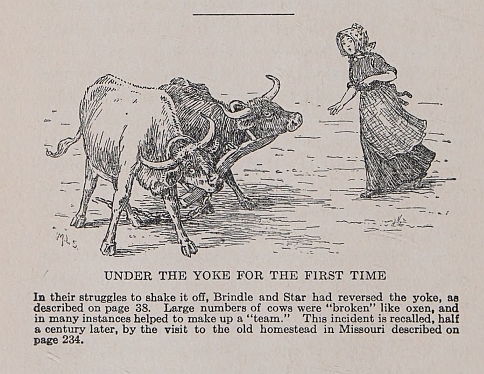
UNDER THE YOKE FOR THE FIRST TIME
In their struggles to shake it off, Brindle and Star had reversed the yoke, as described on page 38. Large numbers of cows were "broken" like oxen, and in many instances helped to make up a "team." This incident is recalled, half a century later, by the visit to the old homestead in Missouri described on page 234.
[1] See "The Missionary's Story," pages 235-283. E.M.
TRIALS OF THE LONG TRAIL; DANGEROUS RIVER CROSSINGS; THE DEATH OF CATHERINE; WEST OF THE ROCKIES; SEPARATION OF THE PARTY; NEW HOMES IN THE OREGON COUNTRY.
The Dust—clouds of which were so dense that oftentimes the leaders of a team could not be seen—became almost intolerable. Kate adopted the sensible practice of starting early in the morning with the carriage and loose cattle so that her mother might escape as much of it as possible. One day Mulhall saw her riding hastily back to the team.
"Father," she exclaimed, "Ned has dropped dead in the harness and the carriage can't go any farther." Craig had been ill for several days and Mulhall was driving the team. Leaving it to Kate, he rode ahead to find Catherine in distress and his favorite, trusty horse lying stiff beside the carriage. Unsaddling Nell and harnessing her alongside Dick, the Squire started the outfit on the road, advising Catherine to camp as soon as a suitable place could be found.
The little twin girls had forgotten their loose stock, which by this time was widely scattered; part of it had gone on with the other herds, and some was on either side of the road. One old lame cow, Beckey, had laid down where the carriage stopped {68} and was unwilling to resume the journey. It was late in the evening when all came together at the camp; three head of stock were missing; water could be procured only from a deep ravine half a mile distant; no fuel was in sight for a camp fire, and "buffalo chips" had disappeared from near camping grounds.
With Ben's assistance, Kate unyoked both teams and started the oxen, whose tongues were out from thirst, and such of the loose stock as could be found, to the ravine for water. The entire party had been without water for several hours before reaching camp; and how could they prepare food without it, or fuel or Kate's help? Anyhow the oxen must have the first attention, and water procured for the camp; and it was a question whether or not they could get all the oxen out of the ravine after their thirst had been slacked. It was past midnight when Kate lay down to rest, and for the first time on the trip she gave way to grief. Her mother had gone to bed supperless; Kate had seen for some time that Catherine's strength was failing, and realized that the strain was likely to become too heavy for her to bear—a thought which fairly stunned and even terrified her. Blaming herself for favoring abandonment of the Missouri borne and undertaking the long trip, nature finally relieved her by deep and restful sleep.
Mulhall and his fellow travelers had come to dread river crossings without bridges or established ferries more than the Indians, dust, the fatigue, lack of {69} grass for the oxen or anything else on the trail. All were rejoiced to be safely across one, and hopeful that the next would be less dangerous; but in this they were often doomed to disappointment.
As they left the sluggish current of the main Platte River to ascend its chief tributary the North Platte, the current was found to be swifter as the trail led gradually up the east slope of the Rocky Mountains. An account of the crossing of one of these, written upon the spot at the time by W. P. Woods and preserved in his diary, will illustrate the difficulty and dangers to be surmounted:
Thursday, June 21, 1849—We made an early start and drove 12 miles to the mouth of Deer Creek, where we found teams crossing the Platte. Four boats, each consisting of two dug-outs fastened together, had been made by emigrants who had crossed before and gone on, others buying their rights and continuing the work. We paid $3 per wagon for the use of the boats, and swam the oxen.
Just before reaching here the accidental discharge of a gun by a member of the Pittsburg Company, who was unloading a wagon to make the crossing, killed a man from Illinois, the ball passing through the body just above the heart. A man was drowned here yesterday; and just 12 miles above seven men have been lost in two days while rafting their wagons across.
Friday, June 22, 1849—We were roused early, and in good season commenced crossing our wagons. The line for two miles along the river bank presented as busy an aspect as it ordinarily does in St. Louis, or any other small town in the States. Wagons in pieces, boxes and chattels of all kinds made a scene of extraordinary activity far out in this uninhabited western country.
Our "boat" was called the "Two Follies and Betsy," from their being two dugouts, with a log between them. Joining forces with the twelve Cincinnati mule trains, the "boat" started off in style with 30 men to cordelle it against the current. The men were obliged to work in the water, which {70} rendered it quite unpleasant; but by 4 o'clock P.M. we were across, and then drove the oxen down to swim.
With all of our efforts, swimming and wading from that time until dark, we could only get three of them across; so had at last to let them return to the shore, and were obliged to keep watch of them until morning. The water is remarkably swift and cold, the low temperature probably due to our proximity to the snows of the mountains. To the south of us, about four miles from the Platte, there arises a range of very high pine-clad hills, which appears to terminate in the Laramie Mountains.
Saturday, June 23, 1849—Again resumed our labors by recrossing the river for the purpose of crossing our ox-teams, but at first with no better success than the day before. Here we witnessed scenes far surpassing anything the imagination ever conceived—the long to be remembered crossing of the Platte. No pencil can portray or pen depict the scene as it really was.
Fancy for one moment our feelings on observing the vast aggregation of oxen, mules, horses and wagons mixed indiscriminately with men clothed, half-clad and even almost naked, encountering the elements that were temporarily stopping our progress. By about noon we succeeded in crossing; but both men and teams were extremely exhausted.
The onlookers witnessed sights ranging from the laughable to the alarming. In one place six men were assisted ashore by hanging to the tail of a mule, with a rider on him at that, while in another case extreme efforts were being made to save a man from drowning. A boat, with a wagon containing women and children, sank but was saved by striking a bar.
I was carried by the swift current outside the jam of cattle, and saved myself by catching hold of the tail of an ox as I passed him, and letting him tow me to shore. Those scenes are over, though we shall long remember them. We yoked our teams and drove on over a very rough sand road for about four miles, where we encamped on the river hank to feed our oxen and rest ourselves. Many a man here wishes himself back in the States.[1]
For a considerable sum, Mulhall secured a means of crossing by a train which had been provided for the emergency; and though not detained or endangered, {71} was much relieved when safely landed on the opposite shore. He knew, however, there were two more crossings of a mighty river on the western slope of the Rocky Mountains about a thousand miles ahead of them.
Catherine's strength had rapidly declined, and soon after the crossing just described it became evident that the day of her long rest was near at hand. Mulhall's first impulse was to stop and camp until she recovered her strength; but if he dropped out of the passing throng and was left alone, the peril of Indians would be greatly increased. He was in the mountains with no permanent settlements—in fact none on the whole length of the trail beyond the Missouri; during the winter which would be coming on with heavy falls of snow, his teams would undoubtedly perish, and his party suffer for lack of food and shelter.
Taking charge of the carriage himself and driving carefully, he fancied that Catherine's strength was gaining; but alas, was doomed to disappointment. The sorrowful end was not long delayed. Among the fleeting clouds well up on the eastern slope of the Rockies, nearly a mile and a half in altitude above the home they had left in old Missouri, they buried her in the shifting sands of the Sweetwater River Valley. Her last words to Kate, "Take good care of father," rang in her ears ever afterward; and she did—loyally and faithfully—until the last day of his life.
Nearly prostrated by the calamity that had befallen them, Kate felt that she did not want to go any farther; but gradually recovered her sense of duty to the little orphaned sisters, her father and herself. The anguish in leaving the lone grave can only be known to those who have been through some such experience; and the thought that the little mound of sand would soon be leveled by the fierce winds of the mountain slope added poignance to the already overwhelming grief.
Craig deeply sympathized with the stricken family. Little Sarah, one of the twins, who was of an age to realize her great loss and yet not old enough to be resigned—if that age ever arrives—would not be calmed when the hour of burial came. She clung to the rough box containing her mother's body, and with pitiable outcries pleaded with her father, "don't leave her here; don't; don't!"
"Child, do you see the rift in yonder mountains?" Craig asked. Between deep sobs she answered, "Yes."
"That's Split Mountain, two thousand feet high," Craig continued, "none other like it anywhere in sight of the trail. The two mountains stand so close together the space between them seems from here like a black ribbon, although, we know they are many rods apart."
The child fixed her gaze intently on the mountain while Craig continued, "That is almost exactly north of where your mother's grave will be; I saw the North Star last evening just above it."
Craig had arrested the child's attention for the moment, and in a tone of sympathy asked, "Did you notice those tracks in the stone made by the wagon wheels just where we turned off the trail to this camp? They are so deep they will last forever."
Craig had drawn the child's attention away from the bereavement, but had not arrested her deep grief; and added, "Those tracks will tell you where to stop to look for your mother's grave, if you ever come out to search for it when you grow up to be a woman—no others like them."
This thought impressed the little girl as no other words Craig had ever spoken. Between the long infrequent, tremulous sighs that could not be suppressed, she looked imploringly and trustfully into Craig's eyes while he continued, "You remember that grave we passed marked by a wagon tire half sunk in the ground?"
"Yes," answered Sarah, hesitating a moment, "I remember the name, 'Rebecca' inscribed on the tire, but have forgotten the other."
"Winters," Craig thought to himself, and then said, "that's it, Rebecca Winters. Now my little friend, I'll mark your mother's grave the same way, so you can find it the longest day you live;" and his own tears dropped on the hand of his little friend, which he held in his.
The scene was enough to melt a heart of stone; the faltering voice, the Scotch brogue, the deep sympathy with the distressed child, and Sarah's {74} trustfulness somewhat relieved the feelings of all, and the burial was completed in silence. Craig immediately afterwards disappeared from the camp, and returned after dark with a wagon tire noticed a few hours before they had camped. It was from one of the several wagons that had been burned—mute evidence of a massacre where none were left to tell the story.
Douglas Craig was an all-around, handy man; in his native country he had worked as a smithy, and was an expert with metals. Early the next morning echoes of his work could be heard; he was inscribing the name, "Catherine Mulhall, died 185-; aged fifty-seven."
All day long this labor of love went on with scarcely long enough intermission for a hasty dinner. Kate and the little girls went out in search of flowers to decorate the grave, and were rewarded by finding an abundance of wild roses and several other varieties of the flora in that region.
Kate noticed a very small but well formed pine tree that seemed likely to grow into a suitable landmark. The thought came to her mind that they might transplant it to grow on the grave; and Ben said they could, without disturbing the roots.
Both busied themselves nearly all day changing the beautiful little tree to its new home and planted it, with roots undisturbed, at the head of the grave, with a vigorous wild rose bush. The girls gathered leaves and decaying wood to mulch the ground. Before nightfall, the little mound built over the sacred {75} spot was partially leveled down, covered with flowers and the inscribed wagon tire set in place.
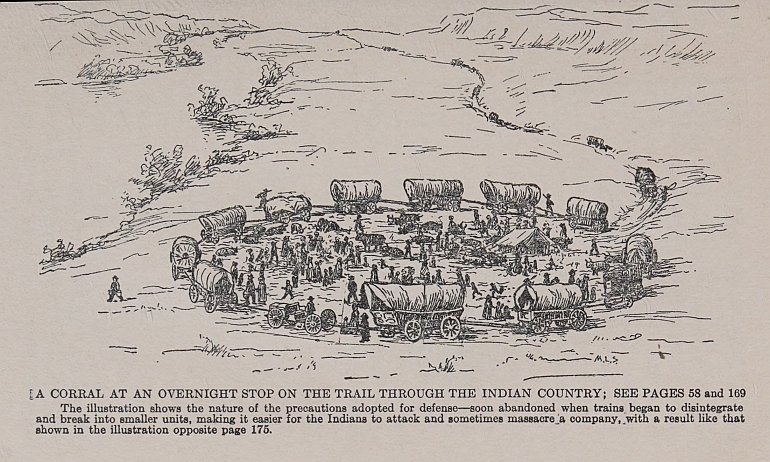
A CORRAL AT AN OVERNIGHT STOP ON THE TRAIL THROUGH
THE INDIAN COUNTRY; SEE PAGES 58 and 169
The illustration shows the nature of the precautions adopted for defense—soon abandoned when trains began to disintegrate and break into smaller units, making it easier for the Indiana to attack and sometimes massacre a company, with a result like that shown in the illustration opposite page 175.
Scenes like this were frequent on the Oregon Trail in the 50s, and are vividly remembered by a few survivors, including the author of this volume. Many suffered from thirst, hunger and exhaustion, particularly on long drives through the desert regions; sickness and death often disrupted or even annihilated families. When wagons were worn out or broken beyond repair, they were sometimes cut down to carts or abandoned, and members of the party continued along on foot, driving their live stock. Most of those who passed through experiences like this survived the hardships of the overland journey, and some of them became leading citizens of the Pacific Coast and Rocky Mountain States.
The throng of moving teams could be traced for miles by the clouds of dust floating in the air; and the wagons were seen on the trail, which passed within a half mile of the grave. Both horses lost flesh until they appeared like skeletons; and it was decided to leave the carriage there.
Nearly all the horses of the emigrants had died for want of food and overwork, or both; and Mulhall feared he would soon lose his if conditions did not improve. He had lost one ox by straying; another, lamed, was sold to a trader, and now a second one had gone lame. It became necessary to reduce one team to two yoke, or yoke up an unbroken cow with the odd ox; the Squire chose the latter alternative, with one team weakened.
Though at the eastern line of the Oregon Country when the summit of the Rocky Mountains was crossed, they were not yet half way on the long journey. Reaching the crest of the Continent at the South Pass, they camped a short distance off the Trail; and when morning came found banks of snow in the hollows and on the northern slopes, and thin ice in the camp bucket.
A month later the party was struggling along the banks of the Snake River, which had to be crossed twice; and they were still confronted by the Blue and Cascade Mountain ranges. Apparently it was only a question of time when Mulhall would be {76} compelled to leave one of the wagons; this he did at the lower crossing of the Snake River, where two young pioneers[2] had lashed two wagon-boxes together, and constructed a platform to enable them to run a wagon onto it and cross the river without unloading.
Mulhall soon arranged to send over the wagons by this improvised ferry, swimming the oxen and horses. Ben mounted one of the horses and rode ahead as a decoy, while Craig and friendly helpers urged the oxen into the river until deep water was reached, when all followed Ben's lead and crossed safely. While this was being done, a woman died from exhaustion, leaving three little orphaned children to the care of the stricken husband and father—a pathetic incident which revived Kate's grief.
Men were never more loyal to one another than Ben and Craig were to Mulhall. From all appearances, they might have been his own sons; Kate had treated them as brothers and the whole outfit including the little twins, were like one family.
For several weeks Ben and Craig counseled between themselves as to the advisability, or possible necessity, of leaving father Mulhall after the last crossing of the Snake River, and going ahead on foot. Craig had carefully ascertained the amount of food on hand and calculated the quantity used each day to supply six persons constituting the party; and demonstrated to his own mind there was an insufficient {77} supply for the remainder of the trip, probably at least another three weeks.
"We ought to go ahead, Ben," Craig said in his broad Scotch brogue, particularly when considering grave subjects. "The two of us are consuming one-third of the daily food," he continued; "and, Ben, did you ever think of what an appalling calamity of famine would have overtaken us all had it not been for so many[3] dying on the way?"
"Won't you speak to father Mulhall about it?" Ben hesitated to approach the Squire on the subject lest he might think of the suggestion as a proposal of desertion. "Well, I'll talk to him," Craig said, seeing that Ben was reluctant to do so.
When broached on the subject by Craig, the Squire would not agree to it at all. The sacrifice and danger to Craig and Ben was too great; better go upon short rations and all keep together; leave one wagon and kill one ox—"Anything rather than to have 'the boys' take the risks and endure such hardships," he said to Kate.
That very morning Kate had given breakfast to two "tramps," who had been without food for forty hours, "Except a few grasshoppers, but not many," as one of them, a lad of twelve,[4] naively said, "they were too hard to catch."
A near famine now confronted the whole of the emigration; and finally all agreed that it was best for the two to go ahead on foot as they had discussed, for the young men could travel farther in one day than the ox-team could in two. Before reaching a final conclusion Ben and Kate consulted together, keeping their own counsel as to what passed between them. Ben and Craig had great respect for the Squire—if indeed affection would not be the more appropriate word; and it was with genuine feelings of regret that they parted from him.
On the fifth day, when it was estimated that they were a hundred miles ahead of "father Mulhall," as they now called him, the young men met the relief train coming out from Portland to the rescue, and arranged to have him supplied with such articles of food as they knew Kate and he needed most. Mulhall received the letter Ben had written and the provisions with tears of affection for "my boys," as he was fond of referring to them.
The supplies sent out to relieve the pressing wants of the incoming pioneers were not for sale, but for relief. If a man could pay, all right—the money received would be used to purchase more; but the majority who were unable to do so, were supplied without obligation as to future payment. Ben and Craig soon felt their strength failing from reduced rations; so when they heard of supply trains ahead, they resumed their usual allowance, and soon regained normal condition.
Knowing that she must be uneasy about him, Ben wrote to his mother at the end of his journey, and even before he slept under a roof. The trip had taken nearly two months longer than expected; and now he learned that another month would be required to send a letter back to Missouri. Under present circumstances he could not encourage Linda to think of coming to him, or expect that he could soon return to her.
Would she conclude that his love for her had declined, or lose faith in him if he wrote of the most insuperable barrier that now lay between them? At the time it occurred, he had written to Linda the facts of Kate's and his adventure in crossing the Missouri. The gossips had wagged their tongues and surmised that because he had rescued Kate, she would feel under obligations to marry him; and Squire Mulhall ardently wished that that, or something else, would bring about such a result.
Ben and Kate were both annoyed, but could do nothing to silence the busybodies; to deny it would only whet their zeal. So much talk going the rounds of the camp set Ben to wondering if the same gossip prevailed in his old neighborhood; and if so whether or not it had come to Linda's ears.
In this perplexing mood Ben went to bed inside a dwelling for the first time in more than half a year, and woke up in the morning with the memory of pleasant dreams of home and Linda. His anxiety to secure a home in the new country had not abated {80} one jot or tittle from the time he parted with her on the memorable Sunday evening before starting with Squire Mulhall for Oregon. The last words from Linda, "I'll be true to you to the end, Ben," still rang in his ears as if spoken but yesterday, and had followed him across the greater part of the continent.
At the parting with Kate he had given up his secret, reluctantly but prompted by intense loyalty to the girl of his choice. If anything should happen to him, he wanted Linda to know from Kate of his undying love for her to the last; and from Kate's own lips, or by letter from her, the senseless nature of the gossip concerning them.
Another matter he wished to confide to Kate—he was going to Oregon to secure a home for Linda and himself; and desired to make provision that Linda should fall heir to it in the event that he should die before they married. Ben was prompted to these serious thoughts by the experience of being close to death's door twice on the trip—once in the near catastrophe while crossing the Missouri, and again at the buffalo hunt, from both of which he had emerged without serious consequences.
He regretted to be parted from his mother for her sake and from Linda for her sake, but took very little thought for himself. The tenets of endless punishment after death, widely taught in his boyhood days, never found lodgment in his brain. He believed in a God of love, not of vengeance; and while clinging {81} to the present for the sake of those he loved, was resigned at any time to pass to the future life.
Douglas Craig and Benjamin Hardy had become fast friends; their mutual trials and duties had drawn them closer together as the journey progressed. "There isn't a lazy bone in Craig's body," the Squire said to Kate one day, to which she responded that the same could be said of Ben. Mulhall readily assented, saying that he had been blessed with "two of the best boys God Almighty ever made;" and added, "your mother thought the same, God bless her memory." Kate made no response, but the tears that came to her eyes at the mention of her mother's name expressed a deep and abiding sorrow.
In the morning Ben learned that it would be eight days before the next mail to "the States," as the pioneers were accustomed to speak of all the country east of the Missouri River; and so did not write to Linda as planned.
"Ben, I've a notion to go with you to hunt a claim," Craig said when he noticed the preparations Ben was making for the trip. "I don't like the idea of parting with you just now," he continued; "besides, maybe it's best for me to take a claim anyway, and not depend altogether upon working at my trade."
And so the two "boys," who had come down the Columbia River and to the southern part of the great territory, started off in search of a home for each. Mulhall had determined to go into the northern {82} district of the Puget Sound; so they did not expect to meet him until such time as they learned where he had located. After many days of searching, the spot that suited them was found, and a line agreed upon between the two adjoining claims.
"I golly," Ben said, "why can't we build one cabin and locate it for the line to cut through the middle? You can have your bed in one end, on your claim, and I can have mine in the other end on my claim;" and then he added, "if you want to work at your trade a part of the time you would not lose your residence; and if I"—. But Ben stopped there, for he was near to revealing his secret, if he had not already done so by his manner and confusion.
The pact was sealed and the cabin built; and here for the present we must leave our young friends to trace the fortunes or misfortunes of Squire Mulhall and his three girls. In due time also we shall learn whether or not Ben could leave his claim before the four years' residence required by the law to secure a title; and whether Linda remained true to him through all that time.
When Ben and Craig passed out of sight over the crest of the hill ahead, following the trail with packs on their backs, Mulhall could control his emotion no longer: and tears coursed down his cheeks as he spoke in a tremulous voice to Kate of their noble character and self sacrifices. Kate, more demonstrative than her father, gave way without restraint to manifestation of distress in voice and weeping. {83} Observing the unusual scene, little Sarah joined with childish soothing words to Kate and her father; but the more she said the deeper their distress, until all restraint was abandoned and the three were relieved by tears and words of praise for the two "boys."
David Mulhall, even though mild-mannered and gentle, was a man with a stout heart, and fully realized the gravity of the situation confronting him. It was a race with famine and lingering starvation or death. If he undertook to increase the speed of travel as some had done, his oxen would probably fail and leave him without a team; having noticed several such instances, he resolved to pursue the even tenor of his way.
The first formidable barrier to be met was the Blue Mountain ranges, which must be crossed at an altitude of about 4,200 feet; that steep ascent could not be avoided, and many outfits were stranded along the slope of the mountain. To lighten the load in the wagon, some clothing was packed on the horse Ned, while the girls and the Squire walked.
By a succession of short drives and long rests, the summit was reached, though a long stretch of rough roads and steep hills was still ahead. While not hazardous, the descent into the plains extending to the west and north was tiresome and tedious; it presented a scene of enchantment seldom equaled—the whole covered by a carpet of luxurious grass, dotted here and there with bands of Indian ponies and tepees of Indian villages.
Mulhall was now about twenty-five miles from the site of the Whitman Missionary Station, where help was given to all in need until the fateful day of the massacre, November 29, 1847. Here, at the foot of the mountain, Mulhall left the trail of Ben and Craig, who had followed the Columbia route down the river leading to Portland, and joined the gathering hosts of the migration along the new trail northward to Puget Sound.
It was a daring and momentous decision. Two formidable barriers were in the track—the mighty Columbia, the second river in length and volume of water on the Continent, and the Cascade Range, which proved to be the most formidable mountain obstruction of the whole trip, far greater than that of the Rockies.
As they passed the site of the former Whitman Mission, Mulhall tarried to view the locality which had witnessed the activities of Dr. Marcus Whitman and his gifted wife, Narcissa Prentiss Whitman, in their efforts to implant the Christian religion in the breasts of the Indians, and where they had relieved the suffering of many pioneer emigrants during eleven years of heroic struggle to maintain their mission. The day of the supreme sacrifice came unheralded, as recalled by the grass-grown graves of the thirteen victims, which Mulhall viewed with bared head in the presence of the three daughters, who had so recently witnessed the closing of the earth over the precious remains of their mother. When {85} shown the small grave and told the story of the drowning of the only child of the lonesome mother, Narcissa Whitman, Sarah's grief again became inconsolable, and only with great difficulty was she persuaded to leave the sacred grounds.
The Columbia River, more than a mile wide and with a swift current, was directly in their path some thirty miles away. How they were to cross was not yet definitely known, but it was the general belief that at the Hudson's Bay Company's fort, situated on the bank of the river, there would be some means of getting over it.
After two more days of driving, Mulhall drew up to the camp of more than two hundred detained emigrants. The first train to arrive, consisting of 148 people with thirty wagons, finding no means of crossing, undertook to build a boat large enough to carry a loaded wagon or several oxen.
Driftwood lodged on a sand-bar above the fort furnished the material, and a whip-saw was set to work cutting the lumber; it ran day and night, and in eleven days the boat was launched. Then the first crossing was made, and in four more days all were safely across, after the loss of fifteen days of precious time.
Whether or not snow in the mountains would block the trail, weighed heavily upon the minds of the whole company. The abundant grass in that locality had greatly strengthened the oxen and enabled them to make good progress, though as no wagons had {86} gone on ahead, it was necessary at times to stop and open the way. Measured by the current of the river they must follow, there were still about 200 miles between the crossing of the Columbia and the settlements on Puget Sound, about 100 of the whole following mountain streams.
Evidences of that drive through the gorges had been left, sometimes on sand-bars with rounded boulders imbedded in the sand, and then in the shallow streams. Other marks had been made on slippery boulders, until deep water compelled the emigrants[5] to cross the river or open a road through the timber and underbrush—one alternative and then another, until 62 crossings of the river were thus crudely recorded.
Just beyond the summit, a rim of almost perpendicular rock was encountered, so steep that it was impossible to drive the wagons down the declivity. Three steers were killed, and their hides cut into strips to lengthen the ropes assembled from the train; in that way thirty wagons were let down the mountain with the loss of only one of them. The tree used as a snubbing post was deeply encircled by the wear of the ropes and finally killed; but it stood {87} sentinel over the scene for another quarter of a century.
When Mulhall emerged from the deep forests of the foothills west of the Cascade Mountain range, he was fairly dazed at the sight that confronted him; and could scarcely believe his eyes. The evergreen trees were so tall and dense that they obscured the light and made it difficult to read common print at the noon hour, while the bright shining sun spread light and warmth over the tops of the forest giants. All through the mountains, the eyes of the pioneers had become accustomed to a lesser light than they had encountered in the open country.
That forest is one of the greatest and most notable on the Continent or in the world. Giant firs grow to a height of three hundred feet; large numbers of them measure six feet, with here and there one eight and in rare cases even twelve feet, in diameter. A monster tree fifteen and a half feet through at the base, and probably a thousand years old, could be seen as one laboriously followed the trail.
The mind of the Squire was affected in just about the same way as if he had suddenly emerged from a dark room into bright sunlight, with his eyes dimmed by the glare; it required time to recover and grasp the change. He had arrived at what is locally known as "Elk Plains" on the eastern margin of the famed Nisqually Plains, a wide extent of prairie country extending to the Nisqually River, twenty miles away to the south and nearly that distance to Puget Sound {88} on the west. The whole intervening space was interspersed with numerous small, clear lakes with pebbly bottoms into which the creeks emptied their limpid waters.
Occasionally a creek would issue from a lake fed by springs in the bottom; in other cases there was no inlet or outlet, and yet the water was as pure and sparkling as that running in the creeks. Here and there were small groves of evergreen timber surrounded by the prairies to lend enchantment to the landscape, a veritable fairy-land in the eyes of the wearied pioneers. Unexpectedly, off to the east, a large number of sheep were seen quietly grazing on the stunted grass that covered the soil.
Starting to drive toward one of the lakes, Mulhall suddenly came upon a herd of cattle that fled at the sight of his wagon and took refuge in a near-by grove. Kate was sure she saw three deer fleeing with the cattle—the latter now as wild as any creature that roamed the plains. At about the same time, a band of Indian ponies was suddenly encountered, as the outfit rounded a point of timber; the wild scene was then re-enacted as the ponies, with heads and tails in the air, snorted and ran.
The sight of the deer fired Kate's imagination; she thought of the rifle in the wagon, but could not stop to try her hand on the game of that region. She thought of Ben, who had saved her life—and Pelton too. No flowers could grow in the deep forests; but here on the prairies and margins of the lakes and {89} creeks many species, the wild rose predominating, grew to perfection. The little sisters eagerly picked some of the first flowers they had found for many weeks, and brought them to Kate as they had formerly done to their mother.
Photograph from Washington Historical Society, Tacoma
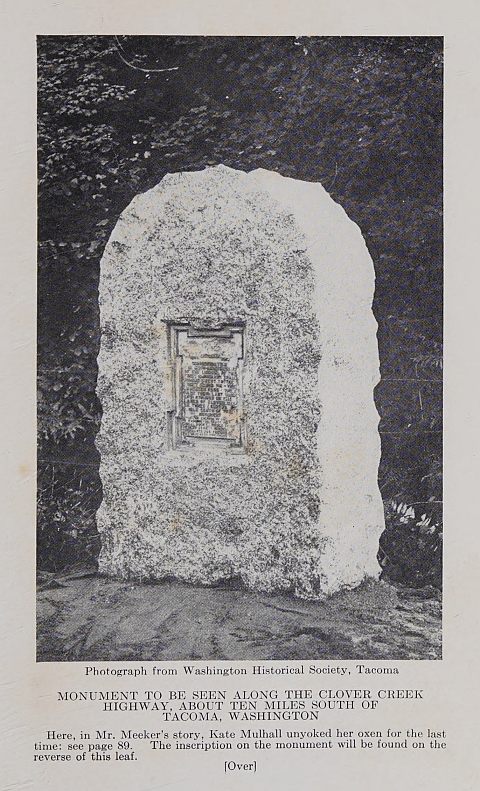
MONUMENT TO BE SEEN ALONG THE CLOVER CREEK
HIGHWAY, ABOUT TEN MILES SOUTH OF
TACOMA, WASHINGTON
Here, in Mr. Meeker's story, Kate Mulhall unyoked her oxen for the last time: see page 89. The inscription on the monument will be found on the reverse of this leaf.
[Over]
Fac-simile of inscription upon the monument shown on the reverse
of this leaf:
OCTOBER
1853 1913
COMMEMORATING
THE 50TH ANNIVERSARY
OF THE ARRIVAL OF THE
FIRST EMIGRANT TRAIN
COMING DIRECT TO THE
PUGET SOUND VIA THE
NATCHESS PASS. THEY
MADE THEIR LAST CAMP
OCT. 8TH 1853 ON THE
BANK OF CLOVER CREEK
THREE FOURTHS OF
A MILE SOUTH OF THIS
MONUMENT
ERECTED BY
WASHINGTON STATE HIST-
ORICAL SOCIETY—PIERCE COUNTY
PIONEER SOCIETY MEMBERS—DE-
SCENDANTS AND FRIENDS OF
THE NATCHESS EMIGRANT TRAIN
[Over]
The Squire soon came to the camp[6] on the margin of a creek, where he found more than half of the pioneers who had gone on ahead; and here, about twelve miles from Puget Sound, Kate unyoked her oxen for the last time. A fine carcass of beef had been sent there for them by the Chief Factor of the Hudson's Bay Company with the message, "divide this among yourselves;" and a near-by farmer brought a wagon-load of vegetables to give out "free for everybody." Just then a team arrived from the fort with sugar, salt and other provisions, of which they were greatly in need, and told the pioneers to help themselves.
All day and well into the night stragglers came in, some with teams and others with packs on their backs—all tired and hungry. Fearing that their teams might be unable to climb the hill out of the valley, a few had stopped at the last river crossing, and early next morning an expedition was sent to assist them.
As evening fell, all were safely camped together, with the consolation that not one life had been lost in the struggle over the mountain range. All of the {90} 148 attended a prayer-meeting held by the light of the camp-fires; the pent-up feelings of emotion were usually accompanied by silent tears of joy, though some gave way to boisterous manifestations of thankfulness for deliverance from the hazards of the trail.
Kate's spirits had risen; but not so with her father, who had made the perilous trip to secure a home and a farm. This charming region was suitable only for grazing, and besides was in possession of a foreign corporation. He was now in a strange land, without shelter for his family of girls or ready money, and so far as he knew without credit; with winter approaching, he could not stay in camp very long, and as he said afterwards, "I was stumped to know what to do."
A large majority of those who crossed the mountains with him were in the same state of perplexity. "I do not believe in that old saying, 'misery loves company.' To be sure, I did love that company of noble men and women, but not because they faced the trials that confronted me," was spoken many years later in a reminiscent mood. Mulhall could not help being relieved at the happiness of the girls, especially the twins or "little buds," as he fondly called them.
Sarah had recovered from the shock that so depressed her upon the death of her mother, and would often refer to her with tears of affection. Not being old enough to enter deeply into or think seriously of the cares of life, the girls often joyfully roamed the {91} byways of the trail in search of flowers or anything new.
"Mamma, what kind of a bird is this?" both asked at once. They had now become accustomed to calling Kate "mamma," and she had not discouraged them in doing so.
"That's a young robin," Kate answered, as she held the little bird in the palm of her hand; "where did you get it?" "Mayn't we keep it as a pet?" Sarah anxiously inquired.
"Yes," Kate answered, "but not as a prisoner;" and added, "it would be better off with its mother, don't you think?"
"But its mother wasn't there; we found it on the grass and it couldn't fly," both again spoke at once.
"Yes, but I am sure the mother was taking watchful care of her little one," said Kate. The girls had set their hearts on having a pet, but agreed that it was not right to take the young bird away, and cheerfully returned it to the spot where they found it; after watching awhile they saw the mother bird come and feed the little one.
The same evening the girls fairly raced to see who should first tell the story of an apron full of nuts they had found, and now exhibited them to "mam-ma." "Where did you find them, girls?" Kate asked. "In a hollow tree, the cutest little place you ever saw," Bess answered.
"But that was the winter store of a squirrel; would it be right to rob the treasure of the squirrel, which {92} might starve before winter ended?" The girls hadn't thought of it in that light; next morning without any further word from "mamma," they returned the nuts to the "cute squirrel's nest," and then started off for new adventures and discoveries. All of them were greatly benefited by the vigorous outdoor life; the father was delighted to see the rosy cheeks of the little girls and the returned sparkle in Kate's eyes.
"I have in my pocket a document that would be worth thousands of dollars back in Missouri; but here, where there are no banks, it is not worth the paper it is written on. What is the good of it if one can't get the money the writing calls for? No more than a pile of gold two thousand miles away from anything to eat," he said ruefully to Kate.
He was not going to be idle; but the more Mulhall looked over the near-by country, the less he liked it. Passing nearby the Hudson's Bay Company's fort he decided to go in and thank the Chief Factor for the beef sent to the pioneers; and to his surprise found a large stock of well assorted merchandise on the shelves of the store and numerous customers, principally Indians, buying or bartering furs for goods.
Asked if he wanted to purchase anything, he answered that he had no money, whereupon the clerk, Edward Huggins, surmising that he had something to barter, suggested that he see the Chief Factor. The Squire hadn't the least thought of buying anything when he went into the fort; but he did want to see {93} the head official and thank him for the beef. He met Dr. William F. Tolmie, a slightly corpulent man with flowing locks and an almost florid complexion, who spoke with a Scotch brogue and had the bearing of a kindly gentleman.
"Oh, that's nothing at all," he said in response to Mulhall's expression of thanks; "you could have had much more than that if you needed it." As the thought of the paper in his pocket and the possibility of using it to establish a credit flashed through his mind, he produced the precious document and handed it to the Factor.
A look of surprise followed the examination, for it represented a large sum for that time and place. "Do you want the money on this?" the head official quietly asked, to which Mulhall—fairly stunned and for once off his guard—replied, "Not all of it now, but I do urgently need some immediate supplies." "You can have either supplies or cash as may best suit your convenience—all of it, or part as you may wish, though we would be perfectly willing that you take all of it."
After a dinner with the Factor while dressed in his well-worn plainsman's garb, which the host appeared not to notice, the business was consummated; and Mulhall received from the great Company a certificate of deposit payable on demand. A cart was loaded with supplies and dispatched to his camp, and a servant was directed to take him to it. Mulhall arrived there first, and found Kate a little dejected, as {94} the flour was all gone and only vegetables were in sight for the coming meal.
She was surprised when the Squire leaned over her and imparted a kiss of joy at having rescued his little family from want, while the girls stood near-by in silent wonder. The pressing situation had been carefully concealed from the children, who were now accustomed to being limited in the variety of food; and when told that they could not have bread for supper, thought nothing of it. They were always associated with the memory of the cherished wife and mother now peacefully sleeping in the sands of the Sweetwater Valley near the summit of the Rocky Mountains; and "let them be happy" ran in the minds of both their father and Kate.
Within two years after Mulhall had completed this to him important arrangement, a very different scene was enacted a few miles distant. The American Government at that time began dealing with the Indians in the country west of the Cascade Mountains as tribes by making a treaty[7] with them; and a sorry mess was made of it by adopting the policy of driving the hardest possible bargains regardless of the future welfare of the Indian or the white race. Before another year elapsed a small war followed, with massacres of whites and Indians alike, a situation in which Mulhall became deeply involved.
The great Hudson's Bay Company that so long ruled the Oregon Country was an English corporation, {95} with headquarters in London; it was incorporated May 2, 1670, for the purpose of trading with the Indians of North America. Owing its origin and growth primarily to the fur business, it did not undertake to develop the agricultural possibilities of the country, a policy which had a far-reaching effect upon the history of that region.
Had the Company encouraged settlement, as the Americans did when they arrived from the eastern and central western States, the final solution of the question as to which Government would come into final ownership of the Pacific Northwest might, and probably would, have been different. It is generally believed that the firm hold of the American home builders influenced the minds of the English statesmen to yield in the final negotiations; they could not very well displace the large numbers of Americans who came to stay and build up the country.
Wishing to avoid legal complications in the region where Mulhall and his comrades had landed, the management of the Company had organized a subsidiary under the name of the Puget Sound Agricultural Company; and thus thinly disguised, occupied the Nisqually Plains with their sheep, cattle and horses, plowed the fields and erected cabins, but for occupancy by employes instead of independent home builders. The Factors (managers) of the Corporation were cultured gentlemen, known for their fair dealings alike with Indians and white people, following the policy of the parent organization; and it was {96} with the head official in that district that the Squire had dealt.
After the arrival of the cart loaded with supplies from the fort, Kate sent part of them to several pioneer families that yet remained in camp, and then revised the plan for their own dinner. Most of the big company had scattered, some to the timber camps, others to the shores of the Sound where shell fish abounded and a few to claims, already chosen, upon which they proposed to make their future homes.
The first and most urgent problem was that of shelter for so many new arrivals. In one notable instance a large hollow cedar stump served as "home" for a family of six until the husband and father was killed by the Indians. The pathos of that story, with many a parallel in American history, is mentioned here to illustrate the difficulties and dangers encountered by the emigration of which the Squire and his family were a part.
After dinner Mulhall and Kate took counsel far into the night, while the little girls were sleeping on their beds of boughs as peacefully as in a palace. The faint yelping of a pack of coyotes in the distance could be heard; and the cougar (closely allied to the American panther) that infested the country, was abroad seeking his prey. But Kate and her father paid no heed except to the all important subject as to their future; and it was midnight before a final conclusion was reached.
The opening of a farm under the varied and often {97} trying conditions prevailing in that region was very different from what they had been accustomed to in Missouri; and Mulhall was past the meridian of life. Why should he undergo a long period of toil to secure a competence, when he was possessed of sufficient means to live without the sacrifices incident to pioneer life on a new homestead?
Kate said, "Let's go to the county town where the girls can attend school and there are neighbors;" her father was of the same mind and that question was speedily settled. Then they thought of Ben Hardy, to whom Mulhall had promised one of the teams upon their arrival in Oregon as extra compensation for his services in crossing over the trail. Not a word had passed between them about that understanding at the parting of the Snake River, after which the Squire was reduced to one team, and it was doubtful whether or not he could complete the long journey with the one that was left.
"If I only knew where to reach him, I would send him enough money to buy a team," said Mulhall. Ben had gone into southern Oregon while the Squire had moved into the northern part, several hundred miles away; they might be five hundred or even a thousand miles apart, for Oregon was a big country without roads or the means of speedy communication. Where Ben had settled, or whither he had gone, was a problem difficult to solve.
Kate said, "I hear there is a newspaper in Oregon; let's advertise." Mulhall thought a better plan {98} would be to secure a list of post offices and address a letter for Ben to all of them; "Anyway," the Squire said, "we must not leave a stone unturned till we find the boy." Both retired to sleep and forgot their fortunes or misfortunes, but with a firm resolution to find Ben if they could.
Following the decision to remove to the county town, Mulhall soon purchased a nearly finished house at the county seat. The thriving village, built upon a slope facing west and fronting on a wide bay of Puget Sound, presented a charming view of the distant range of mountains bordering on the sea with perpetual snow-mantled peaks; the landscape of dark evergreen forest covered the islands and mainland in the nearer view.
The wide bay was dotted with Indian canoes floating on the tide twice each day; and at intervals a ship would pass or drop anchor in front of the village to discharge freight or barter for a cargo of timber. The fort, a group of log cabins situated a short distance back from the water-front and out of sight of it, commanded a splendid view of the landscape.
In the farther background, west of the Cascade Range, was Mount Rainier, completely encircled with a wonderland of timber and flowers—once seen never forgotten, and always cherished as the sight of a life-time. That majestic mountain of the American Continent, "kingly and alone," a great dome separated from the mountain range, standing nearly three miles high and covered with perpetual snow, is the father {99} of seven rivers and twenty-eight glaciers, and has a base of several hundred square miles. The alpine flower beds are simply wonderful to contemplate; according to John Muir, there are two hundred square miles between the timber and the summer snow-line circling the dome, with literally several thousand varieties of flowers, some of which force themselves up through the receding snow.
Kate at once took up the task of searching for Ben. Writing the first two words, "Dear Ben," she stopped to ask herself might he not think she penned them with a deeper meaning than merely a friendly beginning of a letter? However, Ben was dear to her; he had saved her life, had been loyal to her father, was always kind to all, industrious and truthful.
Before she had time to fully analyze what was passing in her mind, Kate began to realize that she was thinking of Ben more than as a brother. Her pen hovered over the paper; but she finally laid it down with nothing more than the two words already written. That evening at supper Kate asked her father if it would not be best for him to write to Ben.
"Oh, no! You know I scarcely ever write a letter; besides I am very busy on the house," replied Mulhall. "You write, Kate, it's just as well." The Squire did not have the least suspicion of why she should want him to write to Ben instead of doing so herself. If he had, the more he would have preferred {100} that Kate write, for he sincerely wished that she should marry the "dear boy," as he always thought of him.
Kate did not undertake to write to Ben that night, and the paper with the two words on it remained on her table untouched. The idea that Ben might interpret them in a different way from what she intended would not down, while she half realized that they meant more to her than she was willing to acknowledge. Not for mountains of gold would she betray the secret Ben had confided to her, and stand between his love for her very dear friend, Linda Shaeffer.
But Linda was more than two thousand miles away, with what Kate thought an insuperable barrier between them. The paper with the words "Dear Ben," was kept for several days without another word being added to it; and in fact the letter was never written. Kate hesitated to trust herself.
Hadn't she now abandoned all hope for the fruition of her first love, with a pang of regret and bitterness as she thought of Pelton? She would resolve never to marry, but hereafter devote her life to altruistic work for young girls. Kate had no knowledge of Isaac's resolution, while at that very moment he, with the one absorbing purpose in his mind, was feverishly carrying out plans to make the trip to Oregon and win her for his wife.
A few days later an advertisement appeared in the two Oregon newspapers asking Benjamin Hardy to communicate with David Mulhall at a certain post {101} office, and learn something of interest to him. As weeks passed without response, the Squire and Kate were greatly worried, and wondered if some accident had befallen him. She then began writing to postmasters with no better results.
Kate was almost in despair. Might it not be possible that he had found a good location, taken up a claim and then started back to Missouri for Linda? More weeks passed, then months; and yet not a word came. There was ever a warm corner in her heart for the playmate and companion of bygone school days; and she would never relax her efforts to unravel the mystery of his strange disappearance.
Ben was hard at work, in ignorance of the search for him; but often wondered what had befallen father Mulhall, as he always thought of the Squire, Kate and the little girls after their separation on the Snake River. He had written to Linda, but months elapsed and no answer had come. Though often alone in his cabin with only one neighbor in sight, he was too busy to be lonesome; Craig was off working at his trade most of the time while Ben was making improvements on both of their claims.
Once a month Craig would bring supplies to the cabin, stay over Sunday and then be off again. They sorely needed a team; and Craig was gradually saving so that they might be able to buy one by planting time in the spring. Ben gave no thought to the understanding by which he was to get a team from Mulhall; he would have rejoiced to hear of the safe {102} arrival and good fortune of the kind-hearted family which had treated him so tenderly in his sickness and, as he believed, saved his life.
Ben had written a second letter to Linda, receiving no reply; but attributed the delay to the slow and uncertain mail service. He was now in vigorous health, gaining in weight to surprise even himself; the pale spare face disappeared and a ruddy complexion took its place. Pure Oregon air, simple diet and steady work had developed him so that an old-time acquaintance would hardly have known him.
At last a letter written in a spirit of gloomy forebodings, came from Linda. She had heard of the misfortunes of the Mulhalls, and could not see how she could ever reach Oregon; but remembered her vow to be ever loyal and true to Ben no matter what happened.
A considerable number of Mormons traveled to Salt Lake City as shown in this illustration; described on pages 48-49.
[1] While somewhat unusual to insert a quotation in a work of this character, no better description of the difficulties and dangers of crossing the Platte in pioneer times has been, or is ever likely to be written. E.M.
[2] Edward J. Allen and Ezra Meeker, the author of this historical narrative.—Editor.
[3] It is estimated that fully 5,000 died that year on the Oregon Trail.
[4] The author knew the lad who made the remark and of his experience; he was afterward a successful merchant in Tacoma, Washington.
[5] The author personally knew a large majority of the people in that train, several of whom became prominent in the affairs of the Territory just founded, among them the actual personalities represented in this story by David Mulhall and his daughter Kate. Of the 148 comprising it, not one of the adults is now left, and only two or three of the younger members who vividly remember these events; their generation has nearly passed, but the memories of their deeds fortunately remain. E.M.
[6] A granite monument, suitably inscribed, erected by the State of Washington to perpetuate the memory and location of this camp, attests the importance of the event. See illustration and inscription inserted here. E.M.
[7] The Medicine Creek Treaty, December 26, 1854.
A MASSACRE AND A WAR; KATE MULHALL, DEPUTY SHERIFF; A RACE FOR A WIFE; THE WEDDING AND CHIVAREE; A DELAYED AND ADVENTUROUS HONEYMOON ON PUGET SOUND.
The great body of pioneers just arrived, like those who had preceded them, were honest and earnest Christian people, though as in all movements of large numbers of men and women, there were a few mere adventurers. Some left their former abodes for the good of the country and their own safety; others had fled from the consequences of unhappy marriages or acts of indiscretion, and though seldom criminals, preferred to let the past life fall into oblivion.
So a "Mr. Smith" one might meet in the new community may have been Mr. Jones before leaving his former place of residence. These were not necessarily bad men in the common meaning of that word, but were making a new start, generally with the firm purpose of leading upright lives in the future. The reason for referring to this phase of pioneer life will appear later.
Many thousands of Indians roamed through the country at the time of Mulhall's settlement in the new land of opportunity. A friendly feeling then prevailed between the races as such, and instances {104} of sincere friendship between individual Indians and whites were not uncommon. This ought never to have been disturbed.
The honorable policy of the Hudson's Bay Company had won the confidence of the Indians by always keeping promises and giving fair value in trading with them; and they were inclined to believe in the rectitude of white people in general. Unfortunately this good opinion was soon changed to one of distrust and hatred.
Agents of the American Government came into the country to make what may, by courtesy, be called "treaties" with the natives. The simple-minded and unsuspecting Indians were overreached, inveigled into surrendering their rights to practically their entire hunting grounds,[1] and otherwise outrageously wronged. Indeed, when the nature of these transactions became known at Washington, the Government made restitution so far as possible, but too late to avert a cruel conflict.
That followed a massacre on October 28, 1855, by infuriated Indians of innocent pioneers—men, women and children—thirty miles away. A friendly native brought the appalling news to Mulhall during the night of the same day the tragedy occurred. Consternation reigned in the little village, the people not knowing to what extent the Indians might go in wreaking vengeance upon the white race.
Measures of defense were immediately taken by the villagers as best they could but they were not very effective. A log cabin that sheltered and protected many others besides the owner and his family was soon built; and is still preserved in the village where Mulhall dwelt, seventy years after the event.
A breach which at once occurred between the military authorities and the civil officials nearly came to a clash of arms; confusion reigned supreme, and conditions verged on anarchy. The military, though now obliged to wage war against the belligerent Indians, condemned various acts of the civilians which brought on an unnecessary conflict. Overnight Mulhall, it might be said by natural selection, became Sheriff.
By obeying orders from the military headquarters, which ran counter to those of the civil court, he was arrested for contempt, carried off to another county and confined. Before being taken away he slipped a paper into Kate's hand, saying in a low voice, "Conceal it quick," which she did.
After her father's departure, when immediate {106} danger of further interference had passed, she opened the letter; and to her surprise found it contained an appointment as Deputy Sheriff during his absence. It was a critical situation, in which she held the keys of the Court House and the jail, and possession of the premises.
Would the opposition use force? and carry her off as they had Sheriff Mulhall? The military commander said they should not, and sent a guard to protect her at the jail, while a number of citizens rallied to her support. Before morning the excitement quieted down, cooler counsels prevailed, and she was able to safely leave for her home.
Kate found the little sisters terrified, and their eyes reddened by weeping during most of the night for father and their "mamma." They did not go to school the next day, but accompanied her back to the jail where all had dinner together. By her tact and courage, Kate soon became the heroine of both the military and civil factions, as well as of the village; and conducted the office without opposition until the release of her father. This brief reference to a strange incident of the old frontier throws an additional light upon the character of Kate Mulhall, and is at the same time an interesting glimpse of pioneer life.
The jails of that day were without ventilation, sanitary conveniences or pretense of decency; all prisoners, civil and criminal alike, were usually huddled together in one room like sheep in a pen. Under {107} these conditions it is not strange that the Squire's incarceration soon began to tell upon his health and strength.
* * *
Kate and her father were about a thousand miles out on the Oregon Trail when Isaac Pelton, still in Missouri, adopted a definite plan of action. He had discreetly kept his own counsel, planted the crops as usual and pursued the even tenor of his way as if no changes were impending.
One Saturday evening he mounted Ned and left home without informing any one where he was going, or how long he would be gone; and traveled all night to the county seat of Harrison County, adjoining the State of Iowa on the North. His mission was to buy a few acres to give him legal standing as a landholder in that county; this done, he returned as mysteriously as he had gone.
In its next issue, the Gazette, the local county paper, published an item to the effect that Isaac Pelton had bought land in Harrison County, Missouri, and was about to remove to his new home. In the same issue appeared an advertisement offering for sale all his holdings of real or personal property, but not including his slaves and teams.
Midsummer had just passed and harvest begun when Pelton and his three negroes left La Fayette County, in which he had lived so long; there was no molestation, or even a faint suspicion of what had {108} prompted the move. Harrison County contained over ten thousand white inhabitants and only twenty-five slaves; upon arrival there, he filed his manumitting paper for record freeing the three, and came out of the Court House to receive congratulations wherever he went.
Andrew and Jennie were in blissful ignorance of their master's intention to liberate them; and Pelton had been very careful not to drop a hint of it, acting on the principle that the only sure way to keep a secret is to say nothing about it to any one. So now, when the long resolution was an accomplished fact, he felt a heavy burden lifted from his shoulders, and was in a mood of exultation for having performed a duty and accomplishing what he had so long contemplated.
The first thing to do, however, was to break the news to Andrew and Jennie. He was curious to see how they would take it, but was not prepared for the surprise that followed.
"My Gawd-amighty, Massa, what'll I do?" exclaimed Andrew. "You turn me out on the world to take care of myself and Jennie and Margie? I hain't got no sense; I hain't got no nothin. Jennie, honey, what'll we do? Massa, I love you; I dun want to go way."
Pelton had anticipated a joyous scene to follow the news of their freedom, but there was nothing but outcries and lamentations. That was an exceptional case, though one like it occurred in the present State {109} of Washington, where a slave refused to leave his master; after a lapse of years, during which the infamous law debarring the negro from holding land was repealed, he was finally rewarded by inheriting the property.
After the first outburst of grief, and upon Pelton's assurance that he could stay with him as long as he lived and that no one could take Jennie or Margie from him, Andrew shouted with joy and threw his arms around his old master to express his ecstasy. A new light had shone upon him.
Just before the falling of the leaves in the autumn after the departure of Squire Mulhall for Oregon, Isaac wrote to Kate a frank declaration of his love, and enclosed a certified copy of the court record confirming the manumission of the three slaves as stated in his letter. He was restless in the new environment, at best only temporary; and counted with impatience the days and weeks, and finally the months, awaiting a response from Kate.
None came. After investigating the reported wreck of a mail steamer, he became convinced that the letter had been lost; and late in the midwinter following her departure for Oregon, wrote a second one.
"Kate, come here," Squire Mulhall said one day soon after receiving mail by the semi-monthly steamer and pointing to an article in the local paper from his old neighborhood in Missouri, "Do you see that?" It read, "Isaac Pelton has set his three {110} slaves free and removed to Harrison County, near the border of Iowa."
Mulhall was surprised when his daughter at once left his presence without making any comment or showing interest in the item he had just read. Kate knew that she could not control her emotions, and in the solitude of her room gave way to self denunciation for her attitude when Isaac visited their cabin before they left for the Oregon Country.
During all the trials of the long journey over the Oregon Trail and the anxieties afterward in their new home, the thought of Pelton would become upper-most in her mind in spite of all efforts to banish it. Now that he was no longer a slaveholder, she could cherish a sentiment for him even though unaccompanied with hope that they would ever meet again.
Finally, after nearly a year from their parting in the Missouri cabin, Pelton's second letter arrived. Kate's emotions can better be imagined than described. Her hopes had been all but extinguished; and now to have them suddenly revived came almost as a shock of pain, though mingled with joy.
Kate did not answer at once; anyhow it would be nearly a fortnight before another mail would be dispatched to "the States." A momentous question involving the future of her own life was to be decided; and as the days passed the task became more difficult.
While in this state of mind, one of the little sisters fell seriously ill, calling for her almost undivided care; and she felt an increased responsibility for her {111} father and the two orphans. Finally the letter was written and dispatched; but Pelton left for Oregon before it was delivered in Missouri, and never received it. The contents remained a secret in her own breast, and as time passed brought regret that it had been written.
James Price was an undisguised admirer of Kate, but fearing rejection of his suit, had never made formal advances, although nothing had transpired to either encourage or discourage him. He was well aware that Kate would go to Oregon at all hazards if her father did, but rather shrank from the thought of accompanying them as a son-in-law in a subordinate position.
After the Mulhall outfit left, Price berated himself for being such a laggard and entertaining a false pride; and resolved that he would go to Oregon the following year. Price did not, like Pelton, disguise his intention to make the trip or his admiration for Kate; so it became common talk in the neighborhood that Price intended to go to Oregon to win her hand.
A year after the Squire had left his home in Missouri, the Gazette published the information that James Price had started for Oregon with an ox-team, over the route followed by David Mulhall the previous year. It expressed the hope that he might succeed in securing a home in the new country; and the people of the neighborhood interpreted this by adding, in their own minds—"and what is of equal {112} importance, a wife." Pelton and in fact the whole neighborhood, knew of Price's admiration for Kate; and when the item appeared tongues were set to wagging that he was "going there to marry Kate."
Price was well out on the way before Pelton became aware of it, and the fact that his rival had gone considerably disturbed his peace of mind. He believed that the gossip as to what prompted Price to make the journey was true, but hardly thought he could have any assurance from Kate that would warrant the trip.
"But suppose Price arrived and should renew his suit, what then?" he asked himself. He knew that Kate respected Price, and when convinced that his first letter had been lost, was not sure that she would receive the second one. The more he thought of it, the more agitated he became.
"I'll go myself," he said one day; "I can go by the Isthmus and beat him there yet, and I'll do it."
That night he was troubled with the thought of an unexpected obstacle. When he freed Margie, Pelton had himself appointed as guardian to safeguard her liberty and prevent other parties from depriving her of it under the obnoxious law to which reference has been made. Who that he could trust would now accept the responsibility? Any number would be eager to secure her services while under age; but would shrink from the obloquy that would be attached to such a transaction.
Besides, there was real danger from the "night {113} riders" that infested the county. The slavery question was in the minds of everybody; only a small minority believed it was possible to abolish the system, and very few had the courage to freely express themselves. It was before the passage of the Fugitive Slave Law of 1850, but the "underground railroad" was in full operation. While not talking much openly, the Quakers usually supplied the "stations" for the escape of fugitive slaves.
Eli Sumner, a staunch "Friend" residing not far from the Iowa line, had a large and commodious barn, as was the Quaker custom, but lived in an unpretentious house. It was generally believed that he maintained an "underground station" on his premises, and that escaping slaves could trust him. Nothing had been proven, but he had the name of being a Free-soiler; and was therefore under suspicion by the slaveholding class.
Pelton realized how little time there was to spare if he would beat Price to Oregon; but he had fully made up his mind to undertake the long race. Price couldn't average more than fifteen miles a day with his oxen; and by estimating the distance, Isaac believed he had an advantage of about three weeks. But he might not make close connections; and furthermore, had a journey of nearly a thousand miles before reaching New York, a considerable part of it by stage-coach.
"I'll trust Sumner," Pelton said to himself and next morning started off to see him.
"Yes, thee can bring them up here and I will do the best I can for them," the Quaker said after Isaac had explained his mission; "but I do not see why I should be appointed her guardian (referring to Margie), as Iowa is a free State."
"Yes, but suppose the night riders should once get her across the line; might she not be helpless?" Pelton responded.
"Well, just as thee thinks; they can have that little house, and I will give the man employment, or he can work where he wills."
A load was lifted from Isaac's mind when he saw Andrew and Jennie safely in their new temporary home, and Margie under the guardianship of the good Quaker. Depositing a considerable sum of money with Sumner for emergencies, and bidding farewell to them all, he left with a light heart, determined to send for them some day if he secured a home in the Oregon Country and won Kate for a wife.
As the weeks passed, the great race was progressing slowly and even painfully for both participants, Price continued steadily on with pleasant anticipations of a hearty greeting from his old-time acquaintance, Squire Mulhall, and at least a cordial reception by Kate. He knew nothing of Pelton's intentions or movements; if he had, it would not have hastened his arrival, for his average progress of two miles an hour could not be increased.
Price had met and overcome the usual difficulties {115} of a trip over the long trail. Unincumbered with dependents or loose stock, and with only one comrade selected from among his acquaintances for dependable character and aptitude for such an undertaking, the cares of the journey were much less than with those accompanied by their families.
He had a light-weight covered wagon, in which they could sleep, and did not a carry a tent. The team consisted of four trim five-year-old steers broken during the winter to work under the yoke, and two extras trained to be led behind the wagon. One day's experiences represented nearly all the trip across the Plains.
Camp was usually made early; one of them would at once take the oxen to water and grass, while the other would prepare the evening meal. Then one soon went to bed and the other out with the oxen; the next morning an early start was made with the night-watcher in the wagon asleep. Sound and refreshing sleep was possible under the circumstances and practiced by many, seldom disturbed by the slow movement of the ox-wagon.
Pelton did not find his journey to Oregon by the Isthmus route an agreeable one; quite the opposite, with some hardships and a great deal of discomfort. Three days were lost in New York waiting for a steamer, followed by nine or ten days on the water, which passed quite pleasantly, then a crossing of the Isthmus—a difficult matter in those days, with the ever-present risk of tropical fever. Emerging on the {116} Pacific side, a second wait of three days ensued before another—and inferior—steamer could be taken to San Francisco, where Isaac arrived after heavy seas had blown the ship two hundred miles out of its course and added considerably to the delay.
Five days were spent at the Golden Gate before an old and clumsy looking hulk left for the northern ports; the trip was slow and beset with dangers, and the boat narrowly escaped destruction while crossing the treacherous bar of the Columbia River. But at last Portland, then a little village of probably not more than a thousand inhabitants, was reached; and as there was then no regular service to the Puget Sound country, Pelton was obliged to take a steamer plying on the Columbia River to the Cowlitz River, where a stage line operated over wretchedly bad roads a considerable part of the way to Olympia, at the head of Puget Sound; and from Olympia he employed an Indian with a canoe to take him to the little village where the Mulhalls had established a residence.
Up to the last moment his mind was tormented with visions of Price. Had he arrived, and if so, how many weeks before? How had he been received by Kate? The time that Price could have arrived had passed by several weeks; and Pelton himself had been delayed long after the date he had expected to reach his destination.
He soon found the house and walked boldly up to it with mingled emotions. Kate was in the kitchen {117} preparing the evening meal with no thought that Pelton was any nearer than 2,000 miles; and when she opened the door in response to the knock outside, the two stood face to face. One word from each other sufficed, "Isaac!" "Kate!" They fell into each other's arms; the long suspense was over, the race won, the goal attained—and the prize at last secured.
James Price, whom Pelton had feared, was in reality no rival at all, so far as Kate was concerned. No matter what aspirations he may have entertained, she had never thought of being anything more to him than an old-time acquaintance. But the poor fellow never reached the end of the journey on which he started in the early spring.
While plodding slowly along with his ox-teams, he was overtaken on the sage-brush plains of the Snake River by cholera, the dread scourge that proved fatal to many emigrants in those days; and he was buried in the sands of that desert region. Both Pelton and Kate felt a genuine pang of grief at the untimely fate of the unfortunate young man.
* * *
Kate said, "Let's have a quiet wedding and invite three or four of the near-by neighbors."
"That will never do," Squire Mulhall replied; "let's go to the church where everybody that wants to can come." Isaac was neutral, only remarking, "you folks settle it between yourselves."
Kate hesitated to differ with her father, but she wanted a quiet wedding; finally the argument ended and all agreed to go to the only church in the village, and one with a history. That was the first place of worship in the new Territory where now, more than seventy years after the events here recorded, stands a granite monument to perpetuate a part of its interesting record.
It was near the holidays when the eventful Sunday for the wedding arrived. The Indian conflict was over, but many of the settlers still remained near the fort; the village was full of people and the saloons were all open. The clouds hung low, patches of fog just lifting in sight. When the wedding party arrived, the church was so filled that the principals had difficulty in entering.
Squire Mulhall had insisted that Kate have a dress to suitably commemorate the occasion, which had been the principal subject of talk among the dames of the villages, and the church was crowded with them at an early hour. Many who had seen Kate as Deputy Sheriff booted and spurred, with pistol strapped to her person, could scarcely believe their eyes when they saw the happy, modest and well dressed young woman soon to become a bride.
All attending the ceremony had donned their best, and some had supplemented their wardrobe especially for the occasion. The church was profusely decorated with evergreens so abundant in the recesses of the forests, and numerous varieties of beautiful ferns, {119} to which were added many flowers still in bloom, although it was near midwinter.
Pelton had made one request of the clergyman—to omit the word "obey;" under existing law the phrase was not mere form, but literally interpreted. When, immediately after the ceremony, Pelton handed the bride a sealed envelope, no one in the assembly who saw the incident was more surprised than Kate herself. "Don't open it until tomorrow," he said in a low voice; and the incident remained a mystery.
The Peltons had planned a quiet evening at home with only a very few selected guests; father Mulhall had apparently acquiesced, but there were others with plans of their own. Mrs. Pelton—let us continue to call her Kate, which sounds so much better—wondered why her father had bought a barrel of apples and some candies, nuts and other delicacies she found in the pantry.
She suddenly clasped her husband's arm with a tight grip as an unearthly noise, such as she had never heard before, broke out nearby. It was no longer the Deputy Sheriff, but the timid bride looking for protection. Drums beating, horns tooting, guns firing, beating on tin pans—even the oldtime horse fiddle with its unearthly tones to make night hideous—to which was added yells and shouting, all combined to startle. Kate was off her guard for once, and fairly trembled with excitement until she realized that it meant a charivaree.
"Come in, boys," the Squire said, as he opened the door.
"No, we want to see the bride and groom," the spokesman answered.
At first Kate shrank from going out, but after each parley the noise would resume, as it seemed automatically; and still the bride would not, as she afterwards said, show herself. Finally a torch-bearing party was seen approaching, and sweet singing voices were heard—as much of a surprise to the noisy party outside the residence as to those inside the house.
It was the church choir giving a serenade. The old Scotch tailor with his bagpipe was there; the glee club of the village rendered its best song; the violin and flute added to the music, and with it dancing began on the sod. "Let's go," said Pelton. "All right," answered the bride; and before they could realize it, they were dancing with the joyous crowd.
It was near midwinter; the falling of the leaves had stripped the deciduous timber growth of the valley bare, but the evergreens of the tablelands retained their color as in the summer time. The sheltered ferns in the deep recesses of the forests were preserved in all their delicate beauty, while here and there a modest flower peeped from a sheltered nook. Grass was green in favored places on the common and in the gardens of the village.
Pelton could scarcely believe his eyes as he viewed the scene, particularly when it included a ship {121} sailing by; the square rigged sails of the three-mast schooner was to him a thing of exquisite beauty, moved by some invisible power. Everything looked bright, and he was happy; the girl he had sought and won, now his beloved wife, never before looked so lovely to him.
Kate, no less happy than her husband, pictured to herself a quiet home where she could live as her mother had done amid the joys of a pioneer life. Now, more than ever, she realized her deep love for Isaac, and wondered what life would have been to her without him.
But there was one disturbing element; Bess and Sarah were unmistakably jealous of Pelton. They had been accustomed to the undivided love of "mamma," as they continued to call Kate, and were not easily reconciled to sharing that affection with another. Kate consulted with Isaac, then with her father, and finally all three conferred together as to how best to convince the little girls that her love for them was just as intense as ever.
The Squire suggested that he take the girls on a visit to Ben; they would enjoy it, and besides he wanted to see the "dear boy" himself. Pelton thought it would be better not to disturb them until the close of school, adding that he intended to make a trip to see the country and wanted Kate to go along if "father" would not be too much inconvenienced during their absence.
Mulhall cordially seconded the suggestion, saying {122} that he and the girls could get along splendidly; he would have Clara Laighton, Kate's dearest friend, come to prepare the dinners in the evening, while he and the girls could get breakfast, and they take their lunch to school. The Squire's evident sincerity, bordering on enthusiasm, relieved Pelton and Kate from any uneasiness regarding his willingness that the trip should be made, and how the little girls would get along while they were absent.
So the question came up as to where they should go, how and the length of time they would probably be gone. The conclusion was finally reached to take a cruise on Puget Sound; "We can always get plenty of clams," Kate said, "when the tide is out." She had utilized clams to feed prisoners in the jail, and knew their value; besides it would be jolly to dig them and bake them as the Indians did.
Pelton was in doubt whether to take a boat or canoe; Kate said by all means a canoe, and explained their pattern for speed and safety, as exemplified by the clipper ships[2] which carried the Stars and Stripes to all parts of the world. The marvel of shaping these canoes from the body of a large tree, guided by the eye alone, remains a mystery to this day; the Indians did so, but it is difficult to fully understand how.
First, the exterior parts are cut down to a solid trunk of wood the size and shape of the finished canoe. Then follows the more intricate labor of removing the center, either by chipping off pieces with rude tools or burning out the excess. Coming down to what is left for the framework of the canoe, the problem is how deep to cut without penetrating the outside shell, which seems to be determined more by instinct than by measurement. They are made in various dimensions, from the one-man canoe up to a size in which thirty Indians go boldly out to sea on their fishing excursions.
Pelton secured the service of the native Steicca and his Indian "klootchman" (wife), who were recommended by the Chief Factor of the near-by Hudson's Bay Company fort; and hired their five-man size canoe. Steicca was a person of note among his people, and had gained the confidence of the men at the fort. He was above the average stature for his tribe, popularly designated as the "Fish" Indians, because they depended almost entirely upon sea food; his klootchman was a comely native from the over-mountain tribe known as the "Horse Indians."
She kept herself and clothing clean, in contrast with the carelessness or uncleanliness generally seen among the women of the tribe to which her husband belonged. Their four-year old boy was likewise always neat and tidy; and Kate thought he was one of the most likable urchins she had ever seen.
Pelton had procured a closed tent with complete {124} camping outfit, which included a mirror for Kate and a bootjack for himself. Nothing seemed to be overlooked to make her feel at home on their bridal trip—a honeymoon in a Garden of Eden to them.
They embarked in the early morning observed by many friends and acquaintances, both men and women, the latter representing nearly every household of the village. Children were there with handsful of rice to shower good will upon the heads of their departing friends; Sarah and Bess looked on, but could not understand what the throwing of rice meant.
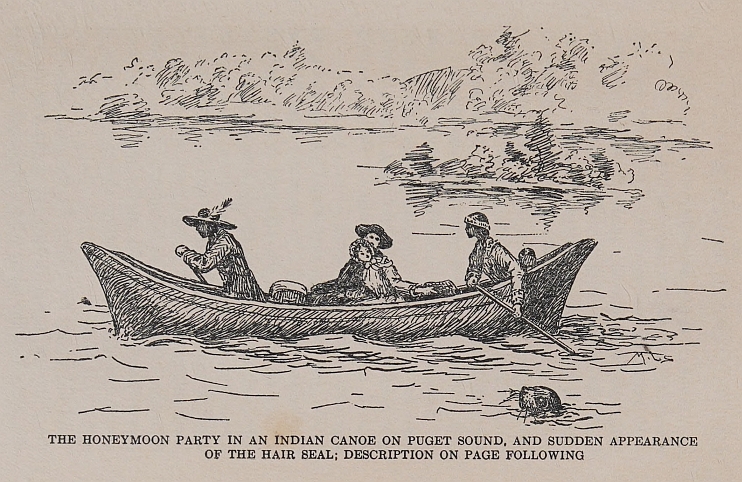
THE HONEYMOON PARTY IN AN INDIAN CANOE ON PUGET SOUND, AND SUDDEN APPEARANCE
OF THE HAIR SEAL; DESCRIPTION ON PAGE FOLLOWING
Just as Kate and Isaac were settled comfortably side by side in the capacious canoe, Mrs. Steicca—"Sally" let us call her, instead of klootchman, sat at the post of honor as both captain and pilot, with paddle in hand ready for the start whenever the word was given. This was the usual custom among the Indians, who skillfully guided the canoe in rough waters and boisterous winds, as well as in the placid waters usually prevailing on the bays of Puget Sound.
As Steicca pushed off the bow of the canoe both paddles were dipped vigorously into the water, and the handles struck the sides with resounding thumps, while each hummed in harmonious minor key an Indian ditty common to the tribe. The dull sound of the paddles knocking against the side of the canoe, and the voices in unison, could be heard long after the view of the slowly disappearing craft had {126} become dimmed to the assembled villagers, who then reluctantly returned to their homes.
Propelled by the combined strength of both experts, the canoe passed rapidly through the water, accelerated by the swift current of an ebb tide. The morning haze had not cleared away and the water was of a glassy smoothness—not a ripple on the surface near-by—though not far away there were slightly disturbed patches, when Kate caught sight of what appeared to be a human head rising out of the deep water in the wake of the rapidly passing canoe.
"What in the world is that?" she exclaimed as she gazed for a moment at the seeming apparition, which now quickly disappeared from sight, and excitedly grasped the arm of her husband. Pelton jocosely suggested it was a mermaid.
"Do you believe in that stuff?" Kate asked, to which Isaac replied that at least it looked like the picture of one; and she admitted it did. In her childhood Kate had read the old-time legends about mermaids; and knew that all down the ages, the belief in creatures half human and half fish had existed among thousands. And now, was it possible that she had a glimpse of one? Kate was not superstitious, but the sight startled and puzzled her; and the reader will doubtless also wonder what it could have been.
An old record describing the mermaid states that "they have a way of lifting their round heads and shoulders from the water with a queer look of almost {127} human intelligence upon their faces;" and that is exactly what Kate had seen. The head that had come above the surface only a few rods in the wake of the canoe, as if to investigate what had disturbed the repose of its abode, was about the size of a half-grown girl, with a suggestion of languid eyes and a plaintive countenance.
Only the face could be seen, and that but for a moment—long enough to indelibly fix the features in Kate's mind. It was the head of a hair-seal, common at that time in the waters of Puget Sound. The sudden appearance of these strange creatures has startled and puzzled many travelers; and led large numbers of people to believe in the existence of a real mermaid.
As the canoe sped on its way, the hills on the east shut off the sun, the channel became narrow and crooked, and the view of waters ahead vanished, leaving only the high elevations, covered with dense forests of evergreen fir, in sight on either side. The outlook ahead seemed as if the party had come to the end of the waters, with a bold elevation—almost a mountain—directly in front. Just then the canoe lurched to the eastward, and despite the utmost efforts of the Indians, shot off the line of travel; then it started as suddenly in the opposite direction, as if possessed by an evil spirit.
The shadows of the hills bordering the narrow passage and a fleeting cloud darkened the view as if night was approaching. A dull, subdued roar {128} comparable to an indistinct echo of a distant sound, reached the ears of the party. Just ahead, the waters apparently swelled up above the common level and then broke away to form again either to the right or left, or both to spread currents running in circles.
Now the sound became louder from the choppy sea of broken waves, forming small conical volumes of water mounting in the air and falling back to the surface. To make matters worse, the whirlpools drew in short bits of driftwood; and some of the larger pieces thumped against the sides of the canoe, interfering with the paddles. The canoe had encountered a tide-rip—water roughened by conflicting tides or currents, a phenomenon of which neither had ever heard.
Kate spoke first; "I wish we were landed, Isaac, don't you?" Pelton felt about the same, but made an effort to speak encouragingly.
It was a battle of the tides in a narrow channel of the Sound with a swift current due to the tide receding toward the sea. The whirling waters extended from shore to shore, while whirlpools of varying extent suddenly formed and as quickly vanished, all moving rapidly in one direction—a grand sight to the beholder from a safe point of vantage, but to Kate an object of terror.
"Tenas alia copet" (it will soon quiet) Sally said, more to herself than otherwise, perceiving Kate's perturbed state of mind; and pointed the canoe toward the eastern shore-line. A few minutes {129} sufficed to reach an eddy outside the disturbed waters, and to shove the nose of the canoe obliquely and gently over to a pebbly beach.
Sally's boy, named Pete after the great humanitarian, Peter Skene Ogden, a courageous and trusted Factor of the Hudson's Bay Company, was the first one out of the canoe. He jumped into the water, waist deep, and began his pranks in a salt water bath, while the mother laughingly scolded him for his rashness.
Kate and Pelton were glad of relief from their cramped position in the canoe, independent of the anxiety of their experience with the tide-rips. "Tenas in-e-ti sitcum sum Skookum chuck copet" (just after noon the current will quiet), Steicca said; and suggested that they remain where they were until the tide turned. Kate had learned enough of the mongrel Chinook jargon to understand what the Indians said; so she and Pelton readily assented.
A steep bluff prevented exploring the nearby woods, and there were no trees until near the top of the hill. Steicca at once began preparations for a brisk fire with the abundant material in sight. A great mass of driftwood obstructed the shore-line just above their landing, some half imbedded in the sand and gravel of the beach, and other debris evidently having been driven beyond the reach of the highest tide by storms of wind and wave. The dead limbs of these derelicts supplied excellent fuel to speedily make a roaring fire.
Kate noticed the Indian gathering and piling small rocks on the fire while Sally dug a small pit, lined it with loose rock, and built another fire in preparation for a clambake. As it was near low tide, the clam beds were exposed and an abundance of the bivalves easily secured for a bounteous meal. Clams are found on the conveniently located sloping beaches, and in enormous quantities along the fifteen hundred miles of the shore-line of Puget Sound waters; so the saying, "dinner is always ready when the tide is out," was literally true.
Kate forgot the apparition of the head and the whirls of the tide-rips that had so startled and alarmed her when their attention was attracted to the picturesque beach, with its many shells and pebbles of various sizes, shapes and beautiful colors. She at once began to make a collection of them, without noticing that Pelton had withdrawn from sight. He had quietly taken his fowling piece and clambered along the beach to a nearby lagoon, where he soon bagged a couple of fat mallard ducks.
No one visiting that region now can have any adequate idea of the vast number of ducks there in the early days. The air was fairly black with these game birds; he could easily have taken a dozen, but hastened back with the two for dinner.
"Nika mamook," Sally said, when she saw the birds, meaning that she would cook them; Pelton readily assented and joined Kate in her search along the beach. The pit of hot rock was nearly ready for {131} the clams; and Sally soon had the ducks prepared for it. Now the rocks were smoothed off, the pit enlarged and the whole covered with a layer of small branches of fir twig ends.
The ducks were placed in the middle of the pit and the remaining space filled with clams. As a sudden dash of water produced an abundant supply of steam, the whole was quickly covered with boughs and ferns, upon which a thin layer of earth was laid and topped by hot rocks from the larger fire.
It was a clambake by experts. Before that time Kate and Pelton did not know what the term meant, but they lived to see it become synonymous with a feast. The "clambake" here supplanted the barbecue in Missouri, where the ox was roasted on a spit.
As years passed they also witnessed the gathering of a thousand or more people at the annual jubilee, all partaking of the luscious contents of an immense clam pit covered with wagon-loads of unhusked green corn. This institution, the clambake that was for many years the central attraction for social gatherings, political conventions and even religious meetings, is only but a memory.
As the time approached for the turn of the tide, Steicca became impatient to open the pit. There came an interim when the battle of the waters temporarily ceased, as the ebb tide spent its force and before the oncoming rush of the flood from the ocean. Steicca knew that when the flood regained mastery, it would be impossible to stem the force of the {132} current in the Narrows and round the point to the large bay ahead. But Sally was unwilling to interfere with her well-laid plans for the first dinner served to her new friends, the admired lady of the village they had left, and the gentleman who had traveled so far to win her.
Indian women, though occupying humble and inferior positions in the life of their tribes, are not devoid of imagination or true devotion to their husbands and children. An Indian mother never chastises her child, and will seldom run counter to the wishes of her husband.
But to open the pit before the contents were ready to serve would break her heart. In this dilemma, woman-like, she appealed to Kate, who had watched with interest the painstaking preparations for the feast and sympathized with Sally in her distress.
"Of course," Isaac said when the situation was explained by Kate, "I'm willing to stay if you are; it's just as jolly here as around the point in the big bay." And Sally was soon made happy by the word they would camp and stop over there until the next tide.
Pelton desired to make the camp leisurely to try his hand, and began to move the outfit from the canoe. Machinery seldom runs smooth on first trial, and so it is on a camping trip; several things had been overlooked or mislaid and a number of surplus articles were found. The folding cot, stools and the stove came out all right. While Sally was busy with {133} the clambake, Kate was arranging the details of the forthcoming meal, for which she had made ample provision before leaving home.
Steicca had erected their camp, consisting of mats fastened to a semi-circle of small poles driven obliquely into the ground; such was the usual temporary shelter of nomad Indians even in midwinter, affording protection from the wind but little from the rain. Sally seemed as proud of the camp as Kate was of their new tent and camp equipage.
While waiting the opening of the clam pit, Sally brought out her knitting for "Siwash" (Indian) socks, made of coarse thread from wool carded in her own camp and formed into yarn by manipulating the crude rolls with the palm of the hand. Indian women are always busy, and seem at a loss to pass the time without knitting or weaving mats, making baskets or moccasins, while the average Indian man is apparently ill at ease when he has something to do.
Sally had some plain shaped plates made from the inner bark of the cedar with a shallow rim on the outer edge, all water-proof; on these, as we shall see later, she served the clams and ducks. Having been busy with her camp work, Sally had forgotten to keep watch of her boy Pete; but now he must be called in, scrubbed and otherwise prepared for the meal. Frequent calls, Pete! Pete! brought no response.
Finally a track was found up a ravine, leading to the discovery of him perched on the limb of a {134} scraggy tree high above the reach of his mother. Boy-like, white or Indian, young or old, he had gone, in search of adventure, and while looking for bird's nests, had ventured too far to easily return.
Did his mother scold him? Not at all. Indian women do not scold their children or their men, but sometimes do each other to the point where words fail, and facial grimaces take their place.
The time had arrived to open the pit, and everything was in readiness; Sally beckoned to Kate, who came over to the spot with Pelton, whose curiosity was aroused. Steicca was on hand to see; and of course Pete was there, subdued and hungry. The outer covering of stone, earth and boughs were first carefully removed, revealing the inner covering through which the steam had percolated.
"Closhe" (all right), Sally said to herself as she lifted the inner covering and disclosed the contents cooked to perfection. Both ducks were handed to Kate (one of which was promptly returned by Pelton), and the plates piled high with clams. Kate divided her own supplies with Sally; and the banquet was on in both camps.
Such was the experience of Pelton and Kate in their first camp; her diary briefly tells the story in these words, "Tuesday ——185-, broke camp early; encountered tide-rips so strong as to spin the canoe in a dizzy whirl. Sally lost control for awhile, a little water spilled over into the canoe; somehow wasn't frightened much."
A few hours sufficed to bring them into the calm waters of a large bay where numerous fishing parties, trolling for salmon, were in sight. Here and there glimpses were had of passing canoes, and the thump of paddles mingled with songs, loud laughter or talk to distant parties. The beach for miles was lined with Indian camps, where some of the men were lounging in listless idleness of mind and body, seemingly almost too indolent to breathe, while others—and particularly the women—were industriously drying the fish, or busily occupied with their crude handiwork.
The catch of salmon was of medium size; sixty-pound specimens were taken with nets in shallow waters, and there seemed to be no limit to the supply. Little did Pelton then realize the tremendous commercial value of this product of the sea, amounting afterwards to hundreds of millions of dollars annually.
In the far distance a white-topped dome reached above the clouds that hung upon the lower levels, all reflected in the placid waters of the bay. Steicca and Sally rested from their labors, and floated with the tide. A brief entry in Kate's diary describes the scene, "Beautiful beyond my powers of description—unbroken evergreen forests in every direction; snow-capped mountains about as far away as the eye can see; a thousand Indians in sight on the beach and in their canoes."
Pelton planned to go direct to the forty beautiful {136} islands he had been told could be visited within the waters of Puget Sound, and to more carefully examine the country on their return. The day's sailing, supplemented by four paddles, left the great mountain dimmed by increased distance, but brought into the far view another of almost equal grandeur, and opened to larger channels of waters than any left behind.
A council held in the morning decided that the course should lie to the dim outline of a headland discernible just above the horizon; wind and tide were favorable, and with the aid of the two Indians rapid progress could be made. An alternate course would be to follow the shore-line down to the objective point, considerably farther and no less dangerous; and so the direct route was chosen.
Tons of furniture, trunks, provisions and other things were abandoned along the Trail, often with a sign like the one shown in this illustration; see pages 42 and 180.
[1] Over nine hundred square miles of territory were ceded, reserving only six sections for about nine hundred Indians—and that high ground, heavily timbered and entirely unsuited to their needs. A more outrageous "treaty" was never made between the Government of the United States and its Indian wards; its terms would be unbelievable were they not preserved among the records of the Medicine Creek Treaty, December, 1864, in the Archives at Washington. In less than a year conflict broke out, and massacres followed, with losses of life to both the U.S. troops and the Indians. The latter were defeated in the field, as noted in the text; but they fared better in the subsequent negotiations, for as soon as the war ended and the Government was apprised of the wrong inflicted by that treaty, suitable reservations were provided.
[2] In 1849, after the discovery of gold in California, it is said that more than seven hundred cleared from Atlantic ports to San Francisco; many celebrated clippers made the trip from the East to the West in the years 1850-51, and very fast passages were common from 1850 on.
AN ENCOUNTER WITH PIRATES, AND A FORTUNATE DELIVERANCE; BEN FOUND; HIS PROMPT START FOR MISSOURI AND UNEXPECTED ARRIVAL; A SON BORN TO THE PELTONS.
Near the noon hour, with the headland yet in the distance, Pelton noticed two canoes whose occupants were paddling as if speed were a question of life or death with them. Not long afterward, another was seen going frantically in the same direction, followed closely by two more. Steicca observed the racing canoes, but though evidently disturbed as to the cause, discreetly said nothing.
About the same time Kate saw either a boat or large canoe coming directly toward them and wondering what it could mean, called Isaac's attention to it. Sally had likewise discovered the craft and showed signs of uneasiness. A friend had told the story of how, many years ago, her little boy was taken captive by the northern Indians, carried off into slavery, and had never been heard from since. Somehow the appearance of this boat or large canoe revived the memory of that occurrence and created a fear for the safety of Pete. Slavery was once practiced in her own tribe (though at that time discontinued); but she had been told by other Indians that the northern tribes were known to still {138} follow the practice, which seemed corroborated by the taking of her friend's boy. As the large craft approached nearer, Sally hid Pete under the cover of a mat beside her with fearsome admonitions that impelled him to lie quiet and not betray his presence.
Pelton's suspicions led him to slip his fowling piece out of sight, and Kate's trusted rifle was under the outfit in the bottom of the canoe. Isaac directed that no sign of fear should be manifested when they were overtaken, and all intercourse with the strangers be left to him.
As the pirates came alongside they insolently threw a line over the bow and stern posts, and then lashed the two canoes firmly together; being much longer and wider, theirs loomed high above that of Pelton's. It was of the pattern of the canoe in which the northern tribes manned with seventy or more men went boldly to sea on their whaling excursions; while not one of the largest, it would easily hold twenty men.
Seven were on each side, with paddles in their hands, one at the helm and a lookout in the bow, sixteen in all stalwart men in size and physical condition far above the tribes farther south. The same may be said of their mentality. In the northern tribes were painters and sculptors of considerable ability, as evidenced by their totem poles, inscriptions on rocks and ornaments of their mammoth canoes.
There were silversmiths in some of the tribes, as {139} shown by many specimens offered for sale on occasions of their peaceful visits to the white settlements. Nor were the women behind the men in ability for fine work, abundantly illustrated by baskets, mats and other articles for ornaments or domestic use.
Ethnologists attribute the superiority of these northern tribes in part to a mixture of Japanese blood from castaways in past centuries, perhaps even in prehistoric days; facial resemblances suggest the fact, which seems to be confirmed by the remains of wrecked junks on the northern coast. These were the people into whose clutches Pelton and Kate had fallen on their honeymoon trip.
The spokesman for the buccaneers began by saying that they wanted a tent, one of which was in sight, to which Pelton firmly responded that he did not have any to spare. He had noticed a ship beating up the Sound against the wind that had tacked toward them, and realized that a parley to gain time until the ship came nearer would be their best chance of escape.
Isaac noticed a silver ring on the spokesman's hand and offered to buy it for his bride; for a moment the wily savage was thrown off his guard, and looked Kate over with evident satisfaction. Just then one of the men said something in a low tone, and after several articles had been snatched by the robbers, the lines fastening the two canoes together were suddenly cast off.
This precipitate action was caused by the near {140} approach of the ship then bearing directly upon them; but unfortunately, it tacked and bore rapidly away the same moment the lines had been loosened from the canoe. Instantly all four paddles were frantically wielded to overtake the ship, until by a supreme effort Steicca broke his.
The Indians soon discovered their advantage, but did not give chase until they observed that the space between their victims and the ship was widening. Kate then gave her paddle to Steicca and intently watched the movement of their recent captors.
"As I live, Isaac, they have started to follow us," she said, as the bow of the robber canoe was turned toward them, "is your gun loaded?" "It is not," Pelton answered. "Then load it quick, and be careful," she cautioned, speaking while reaching down for her rifle and ammunition so as to be ready for action at the crucial moment.
Realizing that it was impossible to escape by racing their few paddles against fourteen, Isaac loaded his gun and deliberately calmed his nerves for the contest. The ship was now too far away to render assistance, and the robbers were rapidly gaining on them. While yet beyond rifle shot, Pelton directed Steicca and Sally to cease paddling, not to make any movement in the canoe other than to keep it pointed on its course, and for Steicca to lie down.
"I believe you can reach them now, Kate," Isaac said. "Wait a minute," came the response in a firm {141} voice, while she stood upright in the canoe. We may well believe the aim was deliberate, for the bullet lodged in the body of the lookout, who tumbled off his perch into the water.
It took but a moment to reload the rifle. Pelton could not reach the buccaneers with his fowling piece at that distance, and held his fire in reserve. The robbers stopped to pick up their dead or wounded comrade.
Sally and Steicca resumed their strenuous paddling as Kate sat down; but when Isaac saw the Indians coming toward them a second time, he again directed to cease paddling so their craft would be steady for aim at the next victim. Onward came the great canoe, again Kate reserved her fire and was successful in hitting her target—this time the helmsman. As the canoe swung off its course to within range of Pelton's gun, he disabled two or more on her broadside.
By this time the ship tacked again and was now approaching, while a sloop rounded the nearby point and made directly toward the distressed voyagers. Seeing these, the marauders drew off toward the eastern channel, and were soon out of sight.
It is unlikely that they ceased the pursuit because of their losses, for it is a matter of history that once this same tribe had 117 warriors in a combat, besides their women and children. During the fight 27 were killed and 21 wounded; but they held out stubbornly for two days, when hunger {142} compelled them to yield. Another historic reference illustrating the ferocity of this tribe, the "Haidahs," states that "both ships were attacked by northern Indians when off the upper end of Vashon Island; all on board, eleven in number, were murdered and the ships plundered and burned."
When the ship was finally hailed, no explanation was required, as the pilot had heard the guns; the captain, with the aid of his glass, knew what had happened. As the canoe came alongside, he cordially invited all, including the Indians with the Peltons, on board; he also took up the canoe, as he was intending to cast anchor off the village from whence they came.
Nothing on the ship was too good for his unexpected guests. The captain had heard of Kate's experience as Deputy Sheriff, but not of the wedding. His enthusiasm at that news knew no bounds; by the time they arrived at the village he insisted that the bride accept a silver table service which she treasured to the end of her life as the present from the big-hearted captain.
Pete had the time of his life with the sailors, who were surprised to see the bright little fellow, up to all sorts of pranks as he explored the ship from stem to stern and from top to bottom. He and his mother were fairly loaded down with presents; Pete never forgot his sailor friends, and in fact became a sailor himself.
The evening after their arrival at the village, {143} Kate and Pelton rowed out to the ship, still at anchor in the harbor, to offer the old tar sincere thanks and leave with him some token of good will and appreciation for the opportune way in which he appeared upon the scene and rescued them from imminent peril of the northern savages. Capt. Pierson was past middle age but in perfect health, and an impulsive jollity pervaded his whole being. He would not listen to their leaving the ship until after dinner, nor to their profuse thanks for his act.
"Oh, that's nothing; a man who did not respond in such an emergency would be a brute. I only wish I could have chastised the rascals," he said—and meant it.
The captain belonged to a class of seafaring men (now almost extinct), which once carried the Stars and Stripes to the farthermost corners of the earth—free and easy with comrades, but usually a strict disciplinarian, though sympathetic with his men. He was the aristocratic ruler of the little world within the bounds of the ship, their home and castle; all were inured to the hardships of long voyages without complaint, but every one greatly enjoyed the respite of a few days in port.
From time immemorial the "ships that go down to the sea" have carried the commerce of the world, and planted the seeds of civilization in every clime. It is difficult to realize that all this has been changed within the range of one span of life. Only a very small number of sailing ships now leave the ports {144} of the United States; and the noble "clippers," the pride of the nation at that period, very seldom grace the waters of the two hemispheres any more. And the rugged, jolly captains, bronzed and weather-beaten, rough in speech and stern in looks though usually kind-hearted and generous beneath the surface, have almost vanished—like their ships.
Seafaring men who navigate the oceans in the immense vessels of the present time are entirely unlike the old-time sailors in appearance and actions. The modern crew appear upon our thoroughfares in fancy uniforms, the officers resplendent in gold braid and gilt buttons, and the common sailors in natty uniforms, usually without anything to mar their dandified appearance. One can easily tell that reefing a mainsail or splicing a rope is no longer part of their duty.
But the old-timers came ashore careless in appearance and rollicking in manner, out for a good time—ready for a fight or a frolic—and usually had it. Now they belong to the things that were, and we see no more of them.
Captain Pierson believed the reason the Indians did not return the fire was that their spokesman wanted to take Kate captive, for they could have destroyed the little honeymoon party without mercy. The confusion incident to the loss of their helmsman, quickly followed by the wounding of several of their paddlers, and the sudden tacking of the ship so disconcerted their plans that the marauders barely {145} had time to get beyond reach of the howitzers on its deck. It was late when Pelton and Kate fairly tore themselves away from the jovial captain and left the ship, and long past midnight before the council of Kate, Isaac and Squire Mulhall broke up, after agreeing upon a plan of action.
Pelton had several times spoken about his former slaves, Andrew and Jennie, whom he had left in Iowa; and could not banish from his mind thoughts of the danger that "night riders" from Missouri might carry them off into captivity. Besides, Jennie had cared for him with a mother's solicitude after the death of his own mother while he was still quite young; and Andrew had always been kind to him in his boyhood days, as well as faithful to his interest in later life. And that unsophisticated little girl, Margie! Somehow he could not feel easy in his mind to leave them where they were; now they were separated, he realized that he remembered, and appreciated more than ever before, their kind and considerate acts toward him.
How to bring them on from Iowa to Oregon was a problem with almost insurmountable obstacles, which Isaac had thoroughly discussed with Kate, taking advantage of that favorable opportunity to let her know that he had abundant means in Missouri to provide for their trip—and to her surprise a fairly large sum besides. While Kate had not married for money, she was nevertheless gratified to know that Pelton possessed a goodly fortune, and sympathized {146} with his laudable desire to expend a part of it to better the condition of his former slaves.
Kate resolved to share Ben's secret with both her father and husband, and to suggest that the Squire should go to see or send for Ben. She would also have her father and Isaac supply him with enough money to bring Linda to Oregon with Andrew, Jennie and the little girl Margie. All instantly agreed to the plan, and became so enthusiastic that they forgot all about their recent escape from death, and the cares of pioneer life still confronting them.
"I will not go until school is out," the Squire said, "and then will take the girls with me." He had noticed that they continued to harbor jealous thoughts toward Pelton. Kate reminded her father that any considerable delay would make it too late for Ben to cross the plains the next season. Isaac advised by all means to avoid the Isthmus route as being too uncertain, dangerous and withal very expensive.
Pelton announced that he would start at once, and search for a claim until he found one that suited him; then he would immediately proceed to prepare a home, and be away most of the time until school closed. In acceding to this suggestion, the Squire said he would take the girls over to Ben's claim in the spring, as he intended to care for it himself while the young man was making the trip; and was anticipating the opportunity to repay Ben for his faithful and honest service on the long trail.
So intent had been the council, that all forgot the lateness of the hour; the thought of sleep was banished by the excitement incident to the plans made, but all felt supremely happy. Father Mulhall suggested that they celebrate a little by an oyster supper, even at the unseasonable hour; and Kate, who the very evening before had secured some Puget Sound oysters from an Indian, instantly seconded the suggestion. Oysters, unlike other shell fish of the Sound, were rare and confined to small areas of beds.
Kate had learned that though very small—not larger than one's finger nail—these were very delicious; and had provided them to celebrate their wedding a month ago to-morrow. And here it was, the date already ushered in, though the sun had not risen! Her celebration was intended as a secret to be disclosed as a surprise to her husband and father to demonstrate how supremely happy she was, not only in the escape from captivity among the hordes of northern savages, but as the wife of Isaac Pelton. There was no toastmaster or speeches at the little banquet that followed; but a spirit of unalloyed cheerfulness prevailed, and all were very hopeful of what the near future would bring forth.
Mulhall's search for Ben proved a short one, as the crude records of the self-surveyed Donation claims quickly revealed the identity of the nearby participants, and the Squire was delayed only a day in reaching the location chosen by his young friend. {148} Ben was a short distance from his cabin splitting rails from a worm fence to protect the crops of the following season, when the Squire arrived; and, following the sound of the maul soon came upon Ben intently engaged at his task, not dreaming of the presence of anyone behind him.
Mulhall stopped a moment in mute surprise at the change that had come over the young man. He was looking at a stalwart frame instead of the slim lad who had helped to train the team in the Missouri barn-yard; and stood as if fascinated until Ben by a change in position became aware that a figure was standing near him.
"Why, father!" "Why, Ben!" sufficed for the greeting, but not so the hand-shakes that followed, for the Squire clasped Ben in his arms, while tears of joy fell upon his own cheeks. We may well believe that a pleasant visit followed, but it was soon interrupted by the important information to be shared between them.
Ben listened, as if in a dazed condition of mind, to words that seemed to be too good to be true; but when he grasped the full meaning of the Squire's message, it was Ben's turn to display so-called weakness; he threw his arms around Mulhall's neck and planted a kiss upon the furrowed cheek of his friend and benefactor. But the Squire considered that all he had done, or proposed to do, was only a recompense in part for a debt that could never be paid in full.
"But, father, what am I to do about my claim?" Ben asked after taking a little time to think over the proposed trip. "Well, I'm going to stay here until you come back with that young wife; and you may be sure there will be some crops growing when you return," the Squire responded. So preparations were made almost at once for the proposed trip; and time began to pass.
No one could tell how long it would take to reach the old home, though Ben knew that he must go out to sea over a dangerous bar where recently there had been a wreck, with the loss of many lives. Thence on to and across the Isthmus and to New York, where he would reverse the direction of travel and turn his face westward toward their former home in Missouri.[1] Parts of the journey would be by railroad, stage-coach, horseback and steamboat.
We cannot record the incidents of the trip, thrilling though some of them were; it will suffice here to say that on a frosty noonday in February, 185-, Ben clasped his surprised mother to his breast with the utterance of one word, "Mother." The story of another overland journey from Missouri to the Oregon country will be told after we have followed the fortunes or misfortunes of David Mulhall, Isaac Pelton and his bride, and the two little twin sisters.
It will be remembered that when the Squire left home to find Ben Hardy, Pelton was preparing to look for a claim where he could establish the home so long pictured in his mind. In the course of his wanderings, Isaac had some thrilling experiences which came near ending in tragedy. The Oregon Country of almost limitless extent—as one might say, a thousand miles each way—presented many and varied conditions to confuse and impel one to continued search, with something new almost every day.
In the small corner of the great region which Pelton examined there were no roads or provision for crossing rivers, and only a few sparse settlements. When a cabin was found, he was always assured of a cordial welcome and the best it afforded; but at length, after a two days' tramp he was virtually lost, without blankets or food. That somewhat cooled his ardor; and as he had already overstayed the set time, Isaac suddenly abandoned the search and turned his face homeward. He arrived there safely, to the great relief of Kate, who had become very uneasy at his prolonged absence and non-return at the appointed time.
Pelton's story of what he had seen and experienced—wading a river nearly waist deep, slipping off a log into the water and swimming with his boots on, losing the trail and camping in the deep forest overnight without fire, blankets or food—cast a shadow over the bright pictures of a home in the minds of {151} both; but he had found a magnificent country, and intended to go back and try again. At first Pelton resolved not to tell Kate of the mishaps of the trip, of the real hardships endured or how he had come so near to death's door.
He argued to himself that it would only sadden her and do no good. Then the question as to whether or not he was justified in having a secret from his trustful wife would come uppermost in his mind. If he now began with one, others would surely follow, and the resolve—a compact with himself—was made that he would have none; so the full story was told to her.
A month passed and though several trips were made, no location was yet found to suit him. Finally, he received information from a neighbor about some excellent land not yet taken; and immediately starting out to examine the tract, found it even better than represented. After staking his claim, he returned and informed Kate of his good fortune in finding a location satisfactory in every essential respect.
Father Mulhall wrote that Ben had started on his long trip, and was now well on the way; and that as soon as school closed, he would come after the girls. He added that he would plant on Ben's claim and stay with the crops until he returned; and as a postscript, Wouldn't Kate like to come over with the girls, and see Ben's claim and Craig? In reality the Squire was lonesome and wanted his daughter with {152} him for awhile; he also knew that she and the girls would enjoy the trip—besides he had a surprise in store for them.
Pelton said, "By all means, go; it will be a nice jaunt for the girls, though a little rough. I'll give each of them a pony to make the trip horseback, and all can have a jolly good time on the way, as well as while there." He was enthusiastic in urging Kate to go, while she didn't feel sure of wanting to do so.
The fact was, she was more inclined to move out on the claim which she had not seen, while Isaac planned to wait until he could have a surprise for her in the new house he was contemplating. Kate suggested building a cabin, where she could be as happy as in a more commodious residence, to which Pelton assented with a mental reservation that he would build one for Andrew and Jennie. And if Kate persisted, they could live in the cabin while the house was being built, though that would defeat the surprise party he had in mind.
"Isaac, I believe you want to get rid of me," Kate jestingly said one day after making up her mind to go with the girls; but lovingly added, "you'll feel sorry after I have gone." However, they understood each other and were drawn closer together by the thought of temporary separation.
Pelton's attention was called to two ponies so nearly alike in build, size and marks that it required close observation to distinguish "Tom" from "Jerry"—both beauties, with keen bright eyes, lively yet {153} docile, and safe for the girls to ride. He did not let the extra price asked stand in the way of his becoming the owner of them; and purchased two new saddles and bridles to set them off handsomely. A small riding whip, though not needed in riding, was attached to each saddle.
On the afternoon of the last day of school, the ponies were brought by Pelton's direction into the front yard before the girls came home. Their manes and foretops were plaited with red, white and blue ribbons; and they held up their heads as if proud of the decorations. Before Isaac rode off to the homestead to be gone overnight, Kate was enjoined not to tell them from whom the ponies came—only to say they were presents, and "lots" might be drawn to determine which one of the girls should own "Tom," and which one should have "Jerry."
"Who brought these here, Mamma? Where is he? Tell him to take them away!" was spoken in such quick succession as to preclude the possibility of an answer until the questions and the exclamation had been completed.
"The man said they belonged to two little girls that live in this house; he left them in the front yard, but went away without any explanation," Kate replied. All of this was true, though not all that she knew. Kate and the girls then took hold of the halters, and led the ponies outside the garden gate.
"What did you mean, Mamma, when you said they belonged to two little girls that live here?"
"That's what the man said when he left them and went away."
"But you don't mean it?" persisted Sarah.
"I only told you what the man said."
"Yes, but you don't believe it, do you?" Sarah came back in an attitude of cross-questioning.
"Look on the pummel of the saddle and see," Kate responded; and in doing so displayed evidence of knowing more about the case than she had intended to reveal.
"From Santa Claus to Sarah," the girl read as she held in her hand the paper just taken from the saddle, unnoticed before. Then she intently re-read the label, and exclaimed, "Oh, I know—it's from Uncle Isaac, as sure as I am alive."
For the first time in her life she had called Pelton "uncle"; before it was either "Mr. Pelton," "Sir," or some monosyllable to address or make reply. Sarah had recognized the handwriting on the note, and then knew instantly where the present came from.
Now that she was trapped, Kate gave away the whole plan about the intended trip to see father and Craig, and have a good time on the trip besides. Sarah fairly worshiped Craig since the memorable scene at the lone pine on the Oregon Trail. His promise, "I will mark your mother's grave so you can find it the longest day you live," had sunk deep in her memory and fixed in her youthful mind the thought that some day she would visit {155} the sacred spot and pay homage to her saintly mother—the germ of a plan that led in later years to a pilgrimage to the grave, as will subsequently appear.
Next morning the ponies were returned to the front gate of the garden all ready for a run in the country, and with a riding mare for "mamma." The girls had not forgotten their experience of riding "Nell" on the plains, but were at first shy of the ponies. Sarah soon plucked up courage to mount Tom, while the Indian boy held him; but in a spirit of mischief, the boy suddenly let go of the halter, whereupon the pony started off on a canter before the rider was fairly seated, or could grasp the reins.
Up the village street they went on a gallop, Sarah holding onto the pummel of the saddle, with her feet dangling in the air outside the stirrups. Tom stopped of his own accord at the hitching rack in front of the village store, and Sarah scrambled off the pony's back as quickly as possible to be out of sight of the idlers there. Her teacher, happening by and seeing her predicament, held Tom until she mounted with both feet in the stirrups and reins firmly in hand; then with the pony under control, she was soon back at the starting place by the garden gate.
When all three were mounted, the course taken led up the hill and at a more moderate gait until the prairie was reached. A delightful day in the wide, open spaces, with a visit to the old camping ground and a canter back home in the evening, ended their first day of horseback riding in joviality and {156} pleasure. A few days of such practice sufficed to prepare them for their long jaunt on the road or trail to Ben's cabin beyond the big river, over the prairies and through dense forests.
Following a narrow road the third day out, Sarah leaned over to avoid the overhanging brush and fell sprawling into a sea of mud, the saddle having turned to Tom's side. Seeing her sister's predicament Bess laughed, but Sarah rather pettishly said she couldn't see anything funny about it, to which sister readily assented, but admitted that somehow or other she couldn't help it. The incident had a serious side, as her clothes were now spattered with sticky mud from head to foot; her shoes were filled with it and even her hair bedaubed.
It was necessary to stop and clean her clothes, empty her shoes, gouge the mud out of her ears and wash it off of her face. A few miles further on, it became Sarah's turn to laugh when Bess was scraped off her saddle and tumbled over Jerry's rump, holding onto his tail to lighten the fall; but Bess couldn't see anything funny about that! After numerous mishaps, the party finally reached the river steamer, where the ponies were comfortably stalled; then all the party had a general clean-up on the upper deck, and a good laugh together as the adventures on the road were recounted.
In two days more of tiresome traveling, with the glamour of a horseback ride worn off, Ben's cabin was reached and father Mulhall's welcoming kiss {157} bestowed. Notwithstanding the various adventures on the trip, all enjoyed the experience, and expressed a desire to return the same way.
The very next day, Craig came, as he did every other Sunday of the month, to make good a legal "residence" on his claim. He was a great favorite with the twins, and the reunion that followed repaid all the fatigue of their trip. Toward evening he excused himself to visit a neighbor, and withdrew, leaving his end of the cabin free to the visitors.
Only a week had passed when, to her father's surprise, Kate announced that she would start for home the next day after the morrow. He felt hurt that the daughter he loved so well should cut her visit short; but nothing he could say would alter her resolution. Kate had a reason of her own which she did not explain to her father—but which he would know later, and the reader will probably surmise.
Pelton was as much surprised at her sudden return as the Squire had been upon her hasty departure; and his plan of introducing Kate into a finished residence, of which he was certain she would be proud, was frustrated. He had all the workmen that could be employed to advantage in hastening completion of the residence, including hot and cold water under pressure in the kitchen, a convenience she had never experienced.
Isaac admitted to himself that he was pleased when Kate told him she preferred to stay for the present in their village home. But when he returned from {158} the claim on the second Saturday, he found the drawer of the dresser locked—something that had not happened before—and his razor, shaving cup and brush outside. Pelton was becoming conscious that Kate had a secret she didn't want to disclose, but said nothing about it.
Work on the residence progressed apace; and every Saturday Isaac came to spend Sunday in the village. Somewhat to his relief, Kate had not yet expressed a desire to visit the new home; but a month later Pelton was ready, and to his delight Kate, still without an inkling of the great surprise in store for her, said that she was willing to go.
One day, after Kate had been at the new home for a few weeks, enjoying it with indescribable pleasure, a lady and gentleman drove up to the front door. Though strangers, she had evidently expected them, and promptly directed the man where to stable his horses, and then asked him into the house for lunch, though it was after the usual hour. The woman went at once to the kitchen and began helping to prepare the lunch and to make herself otherwise useful.
Isaac came in later, but expressed no surprise at their presence, for he was also expecting them. Without ceremony, the lady took charge of the household work, while the gentleman sauntered into the library and became absorbed among the books in the small but choice selection on the shelves. Thus a week passed in quiet expectation.
One night a light was left burning in the room {159} up-stairs, and neither of the visitors retired at the usual hour. The nurse remained in the room with Kate, and the doctor made frequent visits there, finally remaining a considerable length of time. Then, in answer to Pelton's anxious inquiry, he said, "It's a boy, and a rousing little fellow he is."
When father Mulhall heard that he had a grandson, the mystery of Kate's early departure was explained; and his slight pique was turned to joy and exultation, increased by parental pride in the daughter who had always been so loving and helpful to him. As soon as they knew about it, the twins were very anxious to see their nephew, and filled with childlike pride at the prospect of being called "aunt."
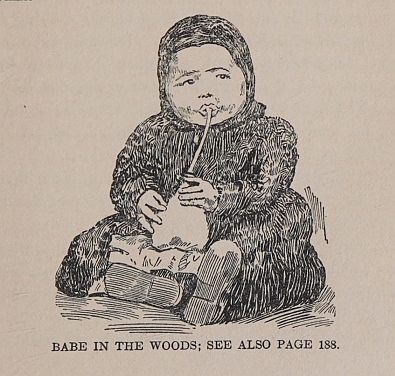
BABE IN THE WOODS; SEE ALSO PAGE 188.
[1] The map of the Oregon Trail and the National Road on page 8 will give the reader some idea of the principal routes traveled to Missouri, either from the Atlantic Coast or the Pacific Northwest, during the period covered by this narrative. E.M.
THE WEDDING OF BEN AND LINDA; A SECOND OVERLAND TRIP; MASSACRE OF NEARLY ALL THE COMPANY; BINDING UP THE WOUNDS; THE TRIP RESUMED; SURVIVORS REACH THE OREGON COUNTRY.
Ben's hair had grown long, his beard had been cropped only with shears, and his face was tanned by the fierce rays of a tropical sun. His clothing was begrimed and worn almost threadbare; in appearance he was very different from the Ben Hardy who had spent the Sunday evening with Linda Shaeffer just before starting for Oregon with the Mulhall outfit. It would take considerable preparation to call upon Linda in presentable clothing; and though very anxious to see her, Ben shrank from the impulse to do so at once. But his mother said, "Go as you are; Linda will be rejoiced to see you."
Ben Hardy had traversed, in the opposite direction, the route that Isaac Pelton took; and for the same object—to secure the girl of his choice for a life companion. The departure from his Oregon cabin had been so sudden that there was no time to write of the trip; even if he had done so, the letter would have gone forward by the same steamer on which he sailed. Although his trials had been less {161} severe than Pelton's and the delays not as great, the journey was one of continuous anxiety and fatigue.
His arrival at the old home in Missouri was unexpected and a great surprise to all his friends there, naturally most of all to Linda. Ben's last letter, received only two weeks before, described his progress in establishing a home for them; but gave no intimation as to when he would come after her, or how she could go to him. So when Linda caught sight of Ben passing through the gate in front of her father's residence, she could not at first believe that she saw aright, but kept gazing in bewildered wonder and trepidation as he approached the house.
The change in Ben's appearance had been so great that an acquaintance could easily have been mistaken in his identity; but Linda, whose quick eye recognized his familiar movement, rushed from the house and met him on the walk, half-way between the gate and the veranda steps. Most readers have known the thrill of such a surprise, though probably few of the intensity of this one; nevertheless, out of their own experience, they will understand and appreciate Linda's joy. The cordial greetings that followed from all the household heartened Ben; no one seemed to notice his clothes—it was Ben, though greatly changed, they saw and welcomed.
There was one of the household who in her heart could not rejoice—not that mother Shaeffer thought Ben unworthy of Linda; but the realization that the daughter she loved so intensely would be taken from {162} her, possibly meet a tragic fate at the hands of the Indians, and certainly encounter the other hazards of a trip to Oregon, overwhelmed her. Conscious that she might be unable to compose herself and control her emotions, the good lady withdrew as quietly as possible to her own chamber, where she gave way to grief that could no longer be restrained.
Mothers who have had similar experiences of impending separation from beloved and loving daughters will sympathize with Mrs. Shaeffer; such is life and the story of each generation! We know that joy in a steady, overflowing stream often follows grief, which becomes less poignant with the lapse of time.
As she left the room, Ben caught the expression of distress in Mrs. Shaeffer's countenance. Could it be possible that Linda's mother was opposed to their marriage? The very thought disturbed and perplexed Ben. He did not stay late, though long enough to disclose his plans for the trip, taking particular care to tell Linda of its difficulties and dangers. Linda firmly responded, "I am going with you, Ben;" and with the echo of it in his ears, he rode back to his mother's home with a light heart, for the moment forgetting the grave responsibility now resting upon his shoulders.
With only a small amount left from the current funds provided for the expenses of the trip, the first urgent business was to secure enough money to purchase an outfit and allow for the expenditures and {163} any emergencies on the way. Ben had learned by experience that the popular fallacy, shared by so many, that currency was not needed on the Trail, was unfounded; and knew to the contrary. The funds upon which he depended were in three banks of three different counties; and one of them had suspended payment upon large deposits.
A period of great financial depression had recently swept over the country. Crops were abundant, but the few existing markets were at considerable distances, and transportation facilities were entirely inadequate to move even the portions that could be sold. No railroads had yet been constructed in Missouri, and it was also before there were a sufficient number of steamers to serve the needs of the narrow margin of settlements bordering on the two principal rivers.
The whole region was without improved roads, but had a superabundance of products that could not be either consumed or sold at a profit. A wagon-load of corn would hardly bring enough to buy a pair of boots; a fat two-hundred pound hog could not be traded for a lady's dress, or five bushels of corn for a pound of tea or coffee.
Such were the conditions confronting Ben in providing funds for the purchase of an outfit, with the possibility of not being able to do so at all. Luckily, he had some certificates of small amounts which he turned over to father Shaeffer, and thus avoided direct dealing with the banks.
The political turmoil which a few years later brought on the Civil War then scourged the country, and added to the distress of commercial depression; in fact, was considered by many the greater of the two evils. Advocates of slavery were becoming more and more aggressive, while the Free-Soil element grew more firm. The approaching conflict of arms led many to emigrate as the best way of escaping from the public and private agitation.
As soon as it became known that Benjamin Hardy had arrived direct from Oregon, and was intending to outfit an expedition to return over the Trail the following summer, he was besieged by numerous parties desiring to join with him, and by a much greater throng seeking information. They came two, five or even ten together, and finally a delegation of forty from an adjoining county to discuss the trip and country with him. Some offered to form a new company under his leadership for the land of mild climate and great opportunities.
Those importuning strangers became a great burden to Ben, and much of his time was taken in imparting information, or declining offers to join his prospective trip. To all he expressed the intention of going with only two wagons, or three at the most, and not more than eight of his friends; but gave a truthful report of the dangers and privations of the Trail, and a good description of the Oregon Country. Father Shaeffer's farm was better equipped for assembling an outfit than his mother's; besides the {165} "Shaeffer boys"—all stalwarts—were eager to help him train the teams, and another one for Linda's two brothers who had determined to return with Ben to Oregon. At first he had no other thought than to assemble the outfit and train the teams at his mother's home, for he desired to be with her as much as possible while preparing for the trip.
At the same time, Ben could but acknowledge to himself that he wanted to be near Linda; so arrangements were made for his mother to drive over every day to help Mrs. Shaeffer prepare for the wedding and make clothing for the young couple. A part of the cloth was to be woven on mother Shaeffer's loom by Mrs. Hardy.
* * * * * * * *
The wedding was a very quiet affair, with only the Shaeffer family, Ben's mother and family, and a very few friends to witness it. Linda was dressed in a frock of her own make; she had woven the cloth for the very occasion while Ben was more than two thousand miles away, but with an abiding faith that the time would come for her to wear it.
Ben was dressed in a suit Mrs. Hardy made out of "boughten store cloth," as she described the material; while not a "tailor fit," the mother was proud of it, and all agreed that she did very well. At that time the women not only made their own dresses but also the clothes of the men folks; so it was nothing out of the ordinary for mother Hardy to make Ben's wedding suit.
The "boys" all wanted to invite the young folks of the neighborhood and "have a good time," but mother Shaeffer pleaded for a quiet wedding; and in deference to her wishes, all of them gave up the thought. To her the marriage was a solemn occasion, and she could scarcely restrain the tears while preparations were being made for it. Ben had come to know the real reason and deeply sympathized with her; he felt almost a twinge of conscience for taking the dutiful daughter from the companionship of a loving mother.
Mrs. Shaeffer had great respect for Ben, believed him worthy of her confidence and a suitable husband for her daughter; but she wanted Linda to herself. In calmer moments she realized the selfishness of such an attitude, and how it might affect Linda's later life to remain with her; but the premonition that something dreadful would happen on the trip could not be dispelled. Ben was not free from the thought that disaster might overtake them on the long journey—little dreaming of the source from which it would come, a peril not encountered in his former trip with Squire Mulhall.
April, the time set long in advance for their departure, was near at hand; the teams and outfits had already been purchased, the animals were thoroughly reliable and well trained, and everything was about ready for the start to the far West. Robert and Abraham Shaeffer had also provided themselves with a team and outfit, and were equally well prepared; {167} two independent outfits satisfactory to Ben with four stalwart and reliable men, were in readiness making ten trustworthy adults in the party. There were also three women and four children, with Andrew, Jennie and their little girl Margie—in all twenty persons, five ox-teams, one horse-team and a matched-mule team for Andrew.
But the banks had not yet responded to the extent of the full amount needed to defray the expense of outfitting, and enough to provide for necessary supplies and incidental expenses on the road. It seemed as if they might be held back at the last minute by the difficulties of securing the necessary funds.
When all the other arrangements had been completed, Ben and father Shaeffer rode over to the nearest bank; with a determined expression of countenance, fire in their eyes and resolute tongues, they soon convinced the cashier that the money should be furnished to Ben as a matter of right. Thereupon sufficient for all anticipated needs was handed to him, and that part of the problem solved.
Ben had secured a light wagon, with half-springs under the bed to shelter Linda night and day, and also himself when not called elsewhere during the day, or kept out on watch at night. He had planned to take a full share of the duties and responsibilities of the trip, no matter how arduous or fatiguing they might be.
Andrew, Jennie and Margie were ready when Ben and Linda arrived. Eli Sumner, the elderly {168} Quaker in whose care Pelton had left his former slaves, provided a span of matched tan-colored mules and a complete outfit for them. All three took an affectionate farewell of their benefactor, for Sumner had been kind to them—just as good as "massa," Andrew said; and could not restrain tears of gratitude with the last shake of the hand.
The ox-teams had been sent several days ahead to the Missouri River crossing, where Ben was to join them with Andrew, Jennie and Margie. A great surprise was in store for Ben upon arrival; all the teams of his party were awaiting him, but the great throng seen there on his first trip was conspicuously absent. Instead of five hundred or more wagons on the former occasion, there were now not more than fifty besides his own little party.
In striking contrast to the pressure of two years before at the ferry landing, where a long line of emigrants waited their turn to be carried over, now all were easily crossed about as they arrived. Stirring memories of his adventure on the previous trip came vividly to mind. The sand-bar where the wagon-box had grounded with Kate Mulhall in water waist deep, was there; likewise the little island in front of the ferry landing where the scow upset, though since partially worn away by the swirling current of the great river.
Grass was abundant near-by the camp site, instead of being cropped close as he had seen it the first time. Profiting by Mulhall's experience with the {169} horse team, Ben determined to provide grain to last his horses and mules a long way out on the Trail. First he planned to take another wagon and abandon it when unloaded, thus strengthening his teams with the extra oxen, but under the circumstances, he concluded it would be practicable for teams to make the return trip; so two wagons were secured and loaded with grain.
When fully prepared the crossing was safely made, and the great trip across the plains started on April 18, 185-, about three weeks earlier in the season than the previous one. The absence of Indians was at once noticed by Ben, who caught sight of a few in the distance the second day out; but they did not come anywhere near the train. At the crossing of the second river on the fifth day, some of their tepees were found on both sides of the Trail, and one directly across it at the usual landing place.
There were a dozen or more lodges with altogether probably fifty Indians, of which about twenty were men. Ben interpreted their obstruction of the Trail as a sign of hostile intent; and after selecting a suitable place for defense in case of attack, he at once gathered all of his people into camp. The wagons formed a corral, the guns of the party were carefully examined and an armed guard sent to the grazing ground with the teams. Every one was cautioned not to go near the tepees, but to await developments; and although Ben's camp was only about fifty yards away, no Indian approached near it.
Little or nothing would be lost by waiting, as other teams were expected in a few hours; at nightfall seven did arrive with eleven armed men. Their wagons helped materially to enlarge the protecting circle, while the men increased the strength of the guard.
At a council that evening it was decided not to go near the Indian camp for twenty-four hours, unless the red men first came to them; and to show a bold front, asking no favor except to be allowed to cross the river undisturbed—and make no concessions. The Indians evidently did not want a show of arms, their immediate object being robbery under the guise of collecting toll; they had discovered that only a few wagons were crossing the river, and thought they could safely intimidate the smaller numbers.
Realizing the impending danger, Ben at once saw the necessity of forming a larger company, for there might be fifty thousand warriors within riding distance of the Trail, and still greater dangers ahead. That night couriers were sent back to ascertain how many men could come up on the morrow; and definite information was received that thirty more wagons would reach their camp before the next night.
When the Indians saw these reinforcements, they silently decamped and left the crossing unobstructed; but the incident naturally caused uneasiness in all the camps, as the sequel will show. By later {171} accounts, at least eleven massacres were perpetrated along the Oregon Trail by Indians during the overland migrations.
Some of those tragedies were revealed only in part by the irons of destroyed vehicles, with not a human being left to tell the dreadful story. Ben concluded that it would be unsafe for the two grain wagons to return; so he took them over and employed the drivers until they could find an opportunity of returning with others—or else continue all the way with him to Oregon.
Four days more of travel brought the train to another river crossing where they saw eleven nude men, women and children of a party whose three outfits had been burned, all provisions carried off and their teams driven away. Why the Indians had spared the lives of the victims none could tell; they had not been harmed bodily, but stripped of all their belongings. Ben gave the unfortunates one of the grain wagons and a team, while the people of the train fed and clothed them.
They were now in the buffalo country, and near where Ben had gone on the hunt that had been almost fatal to him on the previous trip across. He had no desire to duplicate the experience, but there were four more to feed than originally provided for, they had given the destitute party a month's supplies with the wagon; and he now realized the necessity of replenishing their stock of food.
So the camp was put in order and an organized {172} hunt arranged; teams were sent to bring in the game and preparations made to cure it. In five days the wagons returned fairly loaded down with jerked buffalo, and the journey was resumed with a bountiful supply of meat added to the previously diminished store.
So far Ben's horses and the mule team had felt the strengthening results of light rations of grain; but by this time nearly all of it had been fed out. Fortunately, the grass continued to be plentiful along stretches where, two years before, it had been eaten close to the ground by the large numbers of cattle and horses, with here and there a flock of sheep in the emigrant column.
The Trail crossed a wide, open country inhabited by warlike tribes, some of which were off on hunting expeditions or in forays against other tribes, and a few had not yet returned from their trapping expeditions. To the agreeable surprise of the emigrants, very few Indians were now seen, and those showed no signs of making trouble.
After this had continued for several weeks, vigilance was somewhat relaxed and the company began to fall apart—a repetition of what had transpired in previous years, often with disastrous results. Believing that all danger from Indians had passed, Robert and Abraham Shaeffer concluded to try their fortune in the California gold mines, and left the train.
Before he realized what was happening, Ben found {173} himself with the original company, except for the Shaeffer boys; but was not as much disturbed about it as he would have been a few weeks before. The grass was good, and the abundant feed in the vicinity of the camping places relieved the long tedious night watches, often far removed from them. His horses, mules and oxen were in good condition; the cows gave plenty of milk for the company, and the surplus cream made considerable butter.
Linda was enjoying the trip; if this was "hardship," she could have endured more of it without complaint. Andrew, who never tired of entertaining the little camp with his violin and quaint plantation songs, was happy with Jennie and Margie. Ben was comforted by the thought that they would soon be in the cabin home to which they had looked forward so long, and began to count the days—each one bringing them so much nearer their destination.
So far the trip had been a surprise to Ben, and a marked contrast to the one he had made with Squire Mulhall only two years before. The seasons had differed somewhat, but the greatest change consisted in the overcrowded Trail in 185-, and the much lesser number now.
He had been traveling several days in a wide and fertile valley, now the pride of a great State, and had just crossed the river for the first time to the right bank. The spot was ideal for a camp, with an abundance of grass, plenty of fuel and pure water for all. So enticing was the scene that Ben concluded {174} to lay over Sunday to rest the tired teams and the weary members of his party as well.
A low perpendicular bluff paralleled the river, with a narrow portion of the main valley, which promised ample feed for the teams, between them. The bluff on one side and river on the other prevented the stock from scattering; and for once no guard was sent out, as had been customary heretofore. A strip of wild grass higher than a man's shoulder bordered a dense growth of brush near the river.
The women took advantage of the stop-over to do their washing near the river crossing; and one of the men was bagging some of the numerous rabbits in the valley. Andrew spent most of his time entertaining others, as usual whenever opportunity offered; two of the horses had left the range and returned for a bit of bread or lick of salt. Ben was busily occupied with the cares of the camp, and planning the next stage of the trip.
On the following day two Indians were seen passing on horseback along the top of the low bluff; but nothing was thought of it, as there had been no trouble with them for several months, or for a thousand miles along the Trail. A small train of wagons crossed the river during the day and continued on to the west; soon afterward an Indian was seen fording it at the same place and riding furiously toward the east. About two hours later the same Indian returned, his pony exhibiting all the signs of {175} continued hard riding; after what followed it is certain that he was a scout sent up the Trail to ascertain whether or not another train was approaching.
During the afternoon two men from a near-by camp went out to milk their cows and look after the oxen; and to their surprise were unable to find either. Following on up the valley they soon came upon sure signs of hurried travel, and realized that the cattle had been stampeded from some cause not then apparent; after continuing along the Trail until near dark they were compelled to return slowly to the camp.
To their amazement they found it in utter disorder, and without a living soul. Wagons had been run together and partially burned; remnants of the outfits were scattered in every direction; remains of dead bodies were heaped upon the fire and in part consumed. The dreadful fact dawned upon them that the camp had been raided by the Indians during their absence, and their comrades massacred.
Linda, who had found a near-by refuge, remained in hiding until she heard voices in her own tongue, and then came out to the desolated camp. It was too dark to recognize the mutilated bodies, but by a token on the remains Linda discovered that Ben was one of the slain, and immediately lost consciousness. The horrors of that long night are beyond description, as the fears and alarms of a lifetime hovered over the heads of the sleepless survivors.
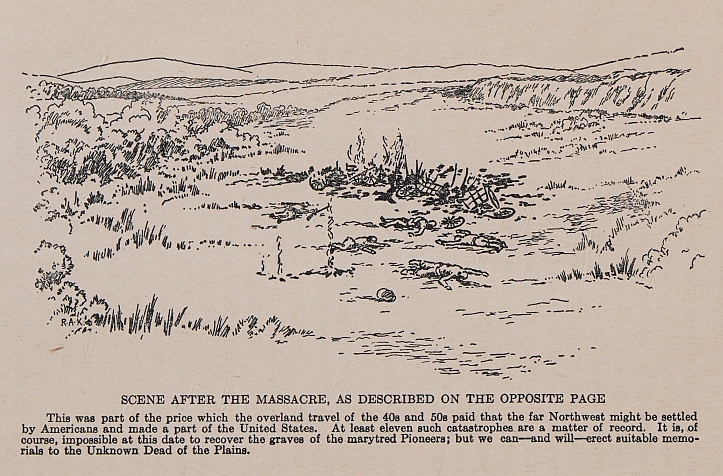
SCENE AFTER THE MASSACRE, AS DESCRIBED ON THE OPPOSITE PAGE
This was part of the price which the overland travel of the 40s and 50s paid that the far Northwest might be settled by Americans and made a part of the United States. At least eleven such catastrophes are a matter of record. It is, of course, impossible at this date to recover the graves of the marytred Pioneers; but we can—and will—erect suitable memorials to the Unknown Dead of the Plains.
But the first duty was to look after the living and {176} let the dead rest where they were. One of the men waded the river and started eastward on the Trail in search of aid, which he fortunately met within a few miles. Couriers were dispatched east and west to warn the emigrants and urge volunteers to assemble and punish the Indians.
In the early morning food and clothing were delivered to the stricken victims, and soon a train arrived to supply physical comforts to them. A hundred miles of the Trail were traversed by couriers, and before night a large number of armed men had assembled; time pressed, and none was lost.
During the day the trail of the oxen was anxiously located, so it could be followed at night. Each rider carried his rations in his pouch, or in packages strapped to his saddle; there was no thought of bedding or camp equipment, as they intended to march all night in the hope of overtaking the Indians. It is wonderful what a body of resolute men can accomplish when all are of one mind.
The trail, which led up the valley for some miles, was easily and rapidly followed in the night; on the table-lands it was dim, but recognized without much difficulty. At break of day a secluded spot was selected, the horses tethered and silence enjoined upon every one. A cautious reconnaissance had discovered signs of Indians; at midnight the march was resumed, and their camps sighted at daylight.
Each became his own captain as they descended in fury upon the slumbering Indians, and during the {177} mêlée that followed neither age nor sex was spared; women and children were ruthlessly shot down, and no prisoners taken. The oxen and all except one of the cows and two of the horses were recovered, but Andrew's mules could not be found. Orders were then given to assemble all the Indian horses possible, and shoot them on the spot.
The chastisement was swift, severe and long remembered by the remnant of the band. While this did not bring the dead to life or heal the wounds of the living, some reprisal was necessary to deter the savages from again molesting emigrant trains following the Trail on peaceful missions of finding homes for themselves and their families. It was cruel; but the emergency called for desperate measures.
After the massacre Andrew, Jennie and Margie wandered off listlessly on the Trail leading west, and passing scouts found them later a short distance from the camp. The Indians were terrified at their first sight of a negro, evidently believing Andrew to be an emissary of the evil spirit who could bring dire disaster upon them for any harm done to him; so he escaped.[1]
As Andrew returned to camp, the shock of the disaster seemed to awaken him to new duties of life; and a vision opened up before him. "Massa Ben" was gone, and only he was now left of the men {178} in the original party. Up to this time he had looked to others for direction, leaning upon them as a child upon a parent; but now he must act for and depend upon himself. Without realizing the change, Andrew became virtual head of the remnant of the party, and quietly assumed the responsibility.
His first act upon returning to camp was to look after the comfort of "Missus Linda" and provide a place where she might rest, while Jennie prepared some nourishment for her. Others had attempted the gruesome task of separating and identifying the dead; but they were so mutilated and in such a confused mass that all were finally buried in one grave.
Andrew's grief at the funeral was inconsolable; falling on his knees at the grave, he offered up a prayer expressing resignation to God's will and inspiring hopes for the future, that touched the heart of every one. While a surprise to all, it was comforting, particularly to Linda; Andrew's thoughts seemed to be centered mainly on his young mistress, and he spared no effort to encourage and assist her.
The burial of the victims preceded by only one day the revenge upon the Indians. Echoes of boasts from the returning party that none had been spared, children and mothers slain and the wounded dispatched without mercy, troubled Linda's gentle spirit. She could not participate in the elation of the men, and recalled what Ben had said of the "irrepressible conflict" between the Indians and the whites, as well as Andrew's prayer to "look for {179} relief from God Almighty," as the fervent negro had expressed it.
An exact account of the massacre will never be known, for none were left to tell the story. When the attack was made Linda and the three other women of the train were washing at the river, only a few hundred yards from the camp, though out of sight from it. Hearing the guns and seeing many armed Indians near-by, all rushed for the brush and high grass, hiding as best they could.
Immediately after the interment Linda retired, supperless and disconsolate, to the temporary camp Andrew had prepared for her. The situation was indeed very desperate. Her brothers had gone on to California, the last hired man had left them three weeks before, and her husband was dead.
Deep grief, prolonged fatigue and loss of sleep finally overcame her, and she sank into a slumber where sorrow was temporarily forgotten. Morning brought partial relief; and Linda could then fix her mind on the emergency that confronted them. As soon as Jennie knew her "missus" was awake she brought some food, of which Linda partook sparingly, although it was the first for about thirty-six hours.
The wagon and yokes had been burned, and the clothing destroyed or carried off with the remainder of the outfit; nothing was left but the horses, the oxen and one cow. Linda had the helpless colored man, as she still thought of Andrew, as well as his {180} wife and child, to consider; but a new courage took possession of her mind and drove away despair. "I have yet something to live for," she said to herself.
Summoning Andrew to her bedside, Linda was surprised to note his confident demeanor. "Yes, missus, I kin drive the oxen, I knows I kin." "But, Andrew, we have no wagon." "Yes, missus, there's a wagon down by the ford; I seen it this mornin." When reminded that the wagon didn't belong to her, Andrew responded, "Everybody takes a wagon standing on the road, if he thinks it better than hizzen."
Linda remembered the accepted practice of the Trail that abandoned vehicles, of which there were a great number, became common property; and followed Andrew to the ford to see the wagon. "Yuse jest take that; I kin drive it, I know I kin," Andrew confidently reiterated. "Yuse kin take my wagon (which had not been destroyed by the Indians), Jennie kin ride the mare and take care of the loose oxen and the cows, and Margin kin ride in this wagon with me." Evidently Andrew had been thinking and planning while Linda slept; the new experience awakened his latent abilities.
Fortunately a considerable part of their money was sewed in a dress she wore; and some hidden under a false bottom of the wagon-box was recovered, much to her relief. Linda and Andrew managed to put together an outfit enabling them to resume the journey. He developed as the necessity required, {181} Jennie soon became more than a dependent, and even Margie found incidental ways to be helpful.
Several hundred miles of the Trail were still ahead of them; but each day brought new experiences and increased confidence. Linda's strength gradually returned; and Andrew proved that he could drive an ox-team as well as play the violin, which had been laid aside unused since the fatal Sunday when "Massa Ben" had been killed. His whole ambition centered in the welfare of his "missus," and he felt an obligation to see her safely in the cabin home. As they neared the end of the journey, Linda became still more self-reliant. She was surprised at the improvement in Andrew and Jennie, and finally in herself; and realized in a still larger measure that she had something more to live for.
Just seven months and one day after she and Ben drove out of the Shaeffer door-yard in Missouri, Linda drew up unannounced in front of the cabin which he had built on his claim in the Oregon Country. It was late in the evening, while the Squire and the girls were at supper. Hearing a noise outside, Mulhall arose and as he opened the door Linda was just reaching out to knock for admission; catching sight of her, the girls screamed with delight and in their hasty greeting nearly upset the table.
"Where's Ben?" was the first question the Squire asked; but quickly divining from Linda's countenance that something had happened, the question {182} was not repeated. He then turned to greet Andrew and Jennie, and after them Margie. Leaving Linda with the girls, Mulhall accompanied Andrew to care for the teams, and then learned the dreadful news; thus he knew there could now be no joyful reunion, and hastened back as soon as possible.
The sight of the cabin that Ben had built for their home, and the conveniences he had arranged inside, revived the dormant grief within Linda's breast until she sank unconscious and helpless to the cabin floor. Poor woman! She had fortified herself with a resolution to be brave; but her emotion would not down, and relief came only in unconsciousness. When she awoke the Squire refrained from asking any questions about the tragedy, but talked about the country of which she had seen so little, and discussed plans for the future.
Next morning when Linda's calmness had returned, she voluntarily told Mulhall the whole story as they wandered over the extensive and beautiful Donation claim, a mile in length and half a mile in width. It was an ideal place for a home, nearly all fertile prairie with a clump of timber in one corner some distance from the cabin, while a rivulet of pure water fed by springs on the claim flowed through the land. Small wonder that Ben should have written to her so enthusiastically about their future home; or that he braved so much to reach it with her.
He looked forward to a bright future spent in {183} developing and embellishing this choice tract of land in a salubrious climate, with the assistance of the young wife whom he adored. But the treacherous savages in the wilds of what is now part of the State of Idaho put a cruel end to his joys and hopes. Unfortunate man! But not the only one, for many like him met a similar fate on the Oregon Trail.
Craig, who had never before seen Linda, came the following Sunday, and was fairly stunned when told of the disaster. He loved Ben for the many good traits of his character, and was drawn closer to him through their mutual adventures. "My lady," he said in a broad Scotch brogue, "you shall have the cabin and all there is in it; and I will move the line twenty rods away."
He added something about being able to secure a full claim for himself, as there was still vacant land adjacent; but made no mention of the fact that the new boundary would make his own less valuable. It did not matter very much, for he had long thought that Ben should come into the ownership of both claims, a mile square in the great fertile valley. There were many instances in which the earlier settlers had taken up that amount of land in their own right, under the law as at first passed; but later settlers were restricted to half that area.
Craig at once had a new cabin built to comply with the legal requirements of his own residence; and then without either ostentation or Linda's knowledge, had his will re-drawn in her favor instead of {184} Ben's, as the first one read. We are not sure that Ben knew of the first; both acts were characteristic of Craig's modesty, forethought and generosity.
Andrew wanted very much to see "Massa Pelton," but hesitated to leave Linda; he could not tell which he loved best, his old master or the new missus. Both had been good to him, which was more than he could say about some others of the white race.
Great numbers, perhaps a majority, of the early settlers in the Oregon Country had come from slave States, bringing prejudices against the black man so intense that at first no negro could live in their midst under pain of the whipping post. Unbelievable! the reader will exclaim—but yet authentic history. The law had been passed by the Provisional Government under the stimulus of temporary and unreasonable excitement, and without due consideration or deliberation; it was never enforced and soon repealed.
Linda asked the Squire if he thought Pelton would consent to have Andrew and Jennie stay with her through the winter; but at the moment Mulhall considered it unlikely. "Won't I have time to write him before you go with Andrew?" she asked. "I'll wait till you do," the Squire answered, as he could see the necessity of help for the lone widow, though he didn't yet know the principal reason.
Linda wrote not to Isaac, but to Kate. After telling her of the tragedy, she explained that she was looking forward to another one to live for, which explained why she so much wanted Jennie to be {185} with her. When Kate told Pelton of the special reason he said, "God bless her, yes! I would almost say you should also go and be with her." But Kate had her own household and their own little boy to care for.
Squire Mulhall was reluctant to leave for home, as he had planned to do on Ben's arrival; in fact had about made up his mind to stay. But the girls must be taken back before school opened; and he did not see how it could be managed unless he made the trip with them, even if he returned at once to the Hardy cabin. Imagine his surprise when, two days after Linda received Kate's letter telling her that Andrew and Jennie could remain with her, Pelton knocked at the door and greeted the astonished Squire in the cabin.
Isaac explained that he wanted to see his former slaves so badly that, over-night, he concluded to make the trip; besides Kate had a small package to send to Linda. He instinctively knew also that the Squire would want to stay longer with her; so on his return he would take the girls back in time for school. Andrew fairly shouted with joy at the sight of his old master; Jennie was no less jubilant, but had a different way of showing it; not until sleep overtook them, could either restrain their long pent-up feelings.
The two men counselling together that night agreed upon a course of action—first, that with Linda's consent an addition would be built to the cabin, and a {186} one-room cabin put up for Andrew; second, that Pelton would return home immediately, taking the girls to his home until Kate could make suitable arrangements for them in their own home in the village near the school; and third, that the Squire should stay with Linda for an indefinite time, or at least until after the approaching event that was to mean so much for her.
It required only one week to have Andrew's one-room cabin ready to move into, and not much longer to complete the addition to the main dwelling, more than doubling its rooming capacity. Meanwhile Isaac had returned home with the girls ready for school. The two men wanted to build a more pretentious residence, but Linda said she preferred to live in the humble one that Ben had built with his own hands.
The little conveniences that he had provided seemed doubly precious in her eyes; every shelf and cooking utensil, the sheet iron stove and even the cups he had used all seemed treasures to her. Having been planned and built to accommodate Craig as well as Ben, the cabin was commodious and very comfortable. She did want an open fireplace, that she might enjoy the cheerful glow of the evening fire and the pure-health giving air; so a large fireplace was built in it.
* * * * * * * * *
The Squire had been busy during the summer, and raised a bounteous crop on the fresh plowed virgin {187} soil; to protect it during the winter he had erected a "post-barn" large enough to shelter all the stock and store the provender. Trunks of beautiful young timber growths up to a hundred feet in length and practically any size desired, were easily obtainable. A post-barn was constructed by planting posts of this timber deep in the ground to support a roof, using the ground as a floor; with a shelter on the windward side, stock would be comfortable in the open air of the mild Oregon winter.
Andrew was happy in the thought of staying with Linda, without expecting compensation for his labor; a wage was something foreign to his mind. He was denied the privilege of owning a home in his own right; and what was the use of earning wages, when he could not enforce collection in courts closed to him? But these things did not disturb him, as he lived in an atmosphere of love for his master and missus, Jennie and Margie, and was happy.
December had come, and still the flowers remained in bloom and the grass green; Christmas was approaching, and the Squire said they ought to celebrate. He hoped to divert Linda's mind from her great loss; but was puzzled how to do so. His first thought was to make a present to her, though uncertain what would be the best selection.
Linda did not enter into the spirit of the suggested festivities—not that she was brooding over her affliction, for she had regained her cheerfulness. When Christmas was only three days away, and {188} before the Squire had made up his mind about the present and the celebration, a boy of nine pounds appeared in the cabin; and all agreed that his name should be Benjamin.
Kate—hereafter Mrs. Pelton now that she is a mother—was delighted when she heard that Linda also had a boy; no trace of jealousy tinged her thought. Isaac, her own little son, was the brightest and cutest baby in all the world; there could be no rival to him, and nothing would excite the remotest feeling of envy. Sincere congratulations were sent by Mr. and Mrs. Pelton to Mrs. Hardy with a substantial gift for Benjamin, "the future protector of his mother and a joy forever."
From some unexplained cause, both mothers felt that the two babes were to be drawn close together in the experiences of life, as their parents had been. Mrs. Pelton, whose wishes seemed almost prophetic, freely communicated these thoughts to Mrs. Hardy—not Linda any more. Prophecies of later days, like those of olden times, are often remarkably fulfilled.
The two "babes in the woods," we might almost literally say, grew and thrived amazingly under the best maternal care and in the healthful environment of pure air and mild climate. Mulhall zealously guarded the supply of pure milk and food for the household, and looked after the little one with an almost paternal affection. After putting it off as long as possible, he reluctantly informed Mrs. Hardy {189} that he must soon leave for his own home, and at the same time lessened her anxieties by saying that he would provide for her financial needs.
Pelton had reached his own conclusion that Ben Hardy's widow needed Andrew more than he; and wrote that the colored man could remain with her a year or longer—practically without limit of time. That was a sacrifice, as Isaac had planned to have his former slaves near-by, where he could make their advancing years comfortable and happy; but was now convinced that Andrew and Jennie would be about as content where they were as in his own home, and, realized that they would greatly assist Mrs. Hardy. A second letter, received soon after father Mulhall arrived home, so informed Mrs. Hardy, to her great joy and relief; she often wondered if it would ever be possible to repay this great kindness, forgetting that Pelton was already rewarded by the consciousness of having contributed materially to the welfare and happiness of others.
It seemed to the parents an incredibly short time before the "babes" of the two households became school children. A few years later they were taking courses in the University, and grew into manhood—the pride of their elders and an honor to the State which had been developed out of the region in which they were born. Gradually, too, the parents in each family realized that they had passed middle life, and were approaching old age.
Their eyes were dimmed and hearing somewhat {190} dulled, but their minds were still clear and active; aspirations, hopes and even ambitions remained with them, while reflections upon past achievements and some failures (the ripe experience to which there is no short-cut) brought deeper thought and greater happiness into their lives. In both the Pelton and Hardy families, the results of successful endeavor, intellectual development and independence were manifest in an unusual degree.
Kate—Mrs. Pelton—had changed into a motherly stature so attractive to her husband and all friends; the active, graceful movement and the fire of her eye were retained, her complexion was still ruddy, and there was a sprinkling of grey hairs to lighten the color of the whole. Pelton continued in excellent health; the active outdoor life on his farm had developed a sturdy frame, strengthened his muscles and quickened his mind. Like many other pioneers with great opportunities before them, he had prospered beyond expectation, and was in affluent circumstances.
Ben Hardy had located on a Donation claim of three hundred and twenty acres of such intrinsic value that if he had lived, the rise of land values in a country of ever-increasing population and prosperity would have made him a wealthy man. When the Donation Act under which he took up his claim was passed, the law provided that half of it should be held by the wife in her own right.
Before that date, and for many years afterward, {191} a wife could not legally inherit or hold property in fee simple except in the Oregon Country, under this special act. Incredible as it may seem, she was also denied the right to control her children, sue in the courts, speak in public or enter schools of higher education.
So when Linda became Ben's wife, she had no property rights except insofar as this special law gave her an equal share in the land upon which they had settled. Hardy did not live to return to the claim, but after years of doubt and delay, his widow came into ownership of half (160 acres) in her own right; and by descent her son received the other half.
The experiences of these years, and considerable of what may properly be called semi-litigation, developed Mrs. Hardy's latent ability to cope with business problems as they arose; so she prospered and became known as a woman of executive ability. It was in memory of the husband and for the welfare of her boy, the younger Benjamin, that she resolved that life was worth living; and right well did she prove the correctness of the resolution.
Things did not run smoothly during the whole of the long period. Pelton had been compelled to make one trip to the old home in Missouri to adjust some business matters. Mrs. Hardy sustained a loss in consequence of a heavy snowfall, and met some reverses of minor importance; but the steady development of the country and consequent increase of land values, proved of great advantage to them both.
[1] A similar instance is recorded in the case of York, the slave of Captain Lewis of the Lewis & Clark Expedition, upon whom the Indians looked with superstitious awe mingled with terror.
LINDA'S HOPE NEVER REALIZED; DEATH OF DAVID MULHALL; CRAIG'S PROMISE REMEMBERED; LESSONS FROM A TRAIL-MAKING OUTFIT; DECISION TO MAKE THE TRIP.
The thread of our story is now resumed at a later date, and in a new century. Linda Shaeffer, as we first knew her, for many years Ben's widow, has now passed the meridian of life; her only child, Benjamin, has grown into manhood and assumed the cares of the farm and home. Meanwhile the Pacific Northwest has made extraordinary progress, with an increase in population and improvements in transportation almost completely changing the old-time pioneer environment.
In the cool evening of a midsummer day, Linda Hardy was sitting in front of the ivy covered cabin, whose roof was completely overspread with the bright green of the beautiful climbing vine. Nearly half of the front side was likewise covered with growths from the same vigorous stalk at the corner of the cottage; and the foliage on the roof had reached to the farther end of the cabin, two rods or more from the roots that supported and gave life to it. The sultry atmosphere was filled with perfume from a row of sweet peas that lined the front of a {193} small but well-kept flower garden, mingled with aroma from a choice variety of roses in bloom, while sweet clover and various other flowers added to the pleasant fragrance afloat in the air.
A young man with a glow of health in his countenance was leaning against the wall of the cabin, with his feet on the rung of the chair, and a book which he had been reading open upon his knees. In an abstracted mood he suddenly closed the book, placed his feet upon the ground and for a moment sat upright, looking out into space as if unconscious of his surroundings. Recovering himself and looking straight at the matron sitting nearby, he uttered one word, "Mother!"
"What is it, Benjamin?"
Only partly aroused from his reverie, he seemed unprepared to say just what was on his mind; so made no immediate or direct reply.
For some years, the youthful Benjamin Hardy had hoped that some day he could visit the spot where the remains of his father had been left; but any reference to the tragedy seemed always to greatly disturb his mother. He had the subject of a proposed trip to the grave on his mind when, half abstractedly, he had first spoken to her; now fully awake, he hesitated to continue.
"What is it, Benjamin?" repeated by his mother prompted him to go farther than he had attempted heretofore.
"Do you believe, mother, if you were to go out on {194} the Trail you could identify the spot where father was killed?" he asked rather hesitatingly.
"I know I could—the river crossing, the low bluff and the narrow strip of valley are all there. I can see them in my mind as plain as the day it occurred."
"But there are probably several crossings now; how could you identify the particular one?"
"It was where the Trail crossed and was worn two or three feet deep on both banks of the river; Ben, I have seen where it was worn down ten feet deep. Yes, I could find the crossing, and even the spot where your father was buried."
"Mother, I have long wanted to go, find the grave and put a monument on the spot."
There was a long silence during which both seemed to be pondering the subject. The mother spoke first, "Kate has several times written that she would like to visit her mother's grave and wants me to go along; but that is nearly a thousand miles, I should judge, beyond where your father was buried."
As had been the case before, the conversation ended without reaching any conclusion. Years passed, and from one cause or another, the journey to visit the grave of Benjamin Hardy, away out on the sage-brush plains, was not undertaken.
Finally, when the Pelton family and Aunt Sarah were about ready to make the long-anticipated trip to the grave of Catherine Mulhall near the summit of the Rocky Mountains, and sent an invitation to Linda to join the party, she had to sorrowfully decline. {195} For some time her health had not been good; in fact, she had become a prematurely broken-down woman without any apparent cause, unless it was the silent grief gnawing so many years at her heart.
She was never able to revisit the scene of the tragedy where the young husband whom she adored had been ruthlessly slain by the bloodthirsty savages; but could not forget the cruel blow fate had dealt her, and often thought how the bright prospects and hopes of her young life had been so irretrievably shattered. Though absent in the flesh, her spirit was ever hovering over the grave by the river.
Isaac Pelton enjoyed doing things, and from the day when he selected a tract for his home until the final call, he was a busy man. He had a worthy helpmate in Kate, mistress of the household, who was as busy in the cabin as he was in the field. After the birth of their eldest child, a new purpose in life—a bond of union bringing higher aims and ambitions—opened before them; both enjoyed excellent health and were supremely happy and contented.
Their thoughts centered on the baby—Isaac Pelton, Jr., and heir to their estate. Both lovingly watched his growth from day to day and were well repaid, for the boy grew rapidly in health and vigor inherited from his parents and aided by the healthful climate and nourishing food of the frontier farm.
It was before the time of the transcontinental railroads, and the markets of the world had not yet {196} been opened to that region by the steamship lines that came later; so the country developed slowly. The mails were tardy in reaching them, but the few letters were as welcome and interesting as if delivered the day before or even a fortnight earlier; and the current literature of the day supplied by the newspapers of the period, was abundant and furnished subjects for serious thought. When the steamers were delayed by storms or accidents, sometimes missing connections that made letters and newspapers two or three weeks late, plenty of topics were open for study that had only a passing reading before.
The newspapers occupied the field later taken by the conservative magazines; the common practice of re-reading articles developed topics for speculative thinking and deep study as interesting and often more instructive than when fresh from the mails with only a light reading. Neither Isaac nor Kate had received more than a common school education, which was all that was expected in their childhood days. Little did they realize how they had acquired a "higher education" in the broad and thorough school of active life; but such was the accomplished fact with many pioneers of their day.
Pelton never tired of taking their little boy on his knee, and reading aloud while the mother plied the needle on their garments, or knitted evenings for companionship as well as to provide them with comfortable clothing. Another stranger came into their {197} household; and to the great joy of the mother, it was a girl. "Now we're even," said Kate; "and let us call the little one Catherine."
She never forgot the grave high upon the mountains, the scene of the burial of her mother Catherine, or the planting of the little tree upon it; and always cherished loving thoughts of her. Sarah, one of the twin sisters, often talked to Kate about it and recalled Craig's well remembered words, "I'll mark your mother's grave so you can find it the longest day you live," which had sunk deep into her heart and kept alive the desire to revisit the sacred spot.
Time passed and another child—a boy—came; Isaac said the name should be Adam to perpetuate the memory of his own father, Adam Pelton. Next a girl was born to them; and Kate selected the name Sarah, after her sister who faithfully administered to the wants of father David Mulhall to the last days of his life.
There were now in the Pelton household two boys and two girls, each in time to share in the intense love of their parents, and receive as much care and attention as the first-born. It was in every respect an ideal family, held in high esteem by all who dwelt in the neighborhood.
Isaac and Kate had long wanted the Squire to come and share the comforts and joys of their household; but he was reluctant to give up his own home, and hesitated until the unexpected call came. "He {198} just went to sleep," said Sarah, who watched by his bedside, and died without a struggle, beloved by his children, respected by all who knew him, honored by his business associates and the church to which he belonged. Sarah, who had never married, soon left the village homestead to live with her sister Kate, and was a welcome addition to the Pelton household.
As time passed, Sarah's thoughts would revert to her mother's grave, and the words of Douglas Craig kept echoing in her ears. Even in her dreams the fond hope of revisiting that well-remembered spot kept recurring, and strengthening the resolution that some day and somehow she would realize the hope of making the long journey to where the little pine was planted and the grave marked by a wagon-tire.
Isaac Pelton, Jr. was a precocious child, and in his father's mind was destined to be a distinguished citizen of the Republic. He did come to honorable manhood, married early and made business connections that called him to a foreign land; but died in middle age, without returning to America.
His sister Catherine married young, raised a family of six children and following in her mother's footsteps, filled an honored place in the community. While experiencing more of the hardships of pioneer or rather frontier life, she was uncomplaining and happy. Adam and Sarah, both unmarried, remained at home with their parents, Isaac and Kate—now "the old folks."
During the lapse of years, while the events recorded in this volume were passing, a great change had taken place in nearly all the world's affairs. From a retrospective view, the transformation in the facilities and conveniences of life and habits of the people, the advances in the arts and sciences, and growth of religion and political freedom in the period from the burial of Catherine Mulhall on the high mountains, to the arrival of the pilgrimage at her grave, was greater than in the preceding thousand years.
Within that time, a great Civil War had been fought and the Union preserved; slavery had been abolished in name, and finally in fact. After the Emancipation Proclamation, no one could any longer place men, women and children on the auction block like cattle, sheep or any other chattel. This was but one step in the great drama of which it was a part, though the United States had become known throughout the world as the land of the free, which it was in comparison with the majority of other countries.
Lincoln, the Great Emancipator, had been assassinated, but his noble acts and the cruel manner of his death had enshrined him in the hearts of the liberty-loving people of the world. Religious progress was no less pronounced than political, though not by legal enactments. In the beginning of the period here recorded, many orthodox ministers taught that all who did not believe in the tenets of their church were doomed to everlasting punishment {200} in a lake of fire, portraying a God of vengeance, not of love—driving people into the church through fear and not from motives of righteousness.
A great step forward was the establishment of a uniform common school system, soon to become free; though crude at the beginning, it contained the germ of the educational development prevailing at the end of the period. The marvelous progress in the arts and sciences is beyond question the most far-reaching of all, medical discovery increasing the average span of life from thirty-four to forty-five years by conquering the plagues or epidemics, preventing the spread of violent diseases and reducing infant mortality in amazing proportions.
Applications of electricity for power and light have advanced civilization in many ways; but we are too near to that era to see it in correct perspective. The discovery and rapid improvement of internal combustion motors brought the automobile to the state of a practical vehicle during the period just before the long-anticipated trip to the grave.
Sarah Mulhall, who never forgot the words of Douglas Craig spoken to her when in deep grief beside the freshly made grave of her mother, the little tree, the rose bush and the flowers planted there, or the inscribed half buried wagon-tire, assured her sister Kate—Mrs. Pelton—that she could locate the spot. The North Star, the rift in the mountains and the marks on the trail would be her guides to it. She was possessed of a competence, more than needed for {201} comfort during a long life; and was willing to expend any necessary amount to reach the sacred spot and erect a monument to the memory of their mother.
* * * * * * * * *
About this time an elderly man who had been among the pioneers of 1852, drove slowly over the old Trail, erecting monuments as he progressed to preserve its identity, and to perpetuate the memory of the unknown dead along the way. Upon completion of the Oregon Short Line R.R., paralleling much of it, the original track had been abandoned in some places, and became known to many as the "lost trail." A national interest had been aroused, and two or three of the States through which it passes had taken measures to aid the elderly man's work.
Isaac Pelton and Kate often contemplated the possibility of visiting the grave of her mother, and like Sarah, planned to do so. But while their family was being raised, and afterward when the children were attending school, circumstances always seemed to postpone the trip.
Besides, Sarah could not leave her father who wanted very much to go with them, but was prevented by the hand of time on his shoulders. If the automobile had come twenty years earlier, the Squire and Sarah could and would have done so; but the long journey with an ox-team, or even with a horse and carriage was thought too much for his strength, and he died without undertaking it.
Adam Pelton, the second son, was of an {202} adventurous nature and had traveled in foreign lands as well as extensively in his own; he was in the prime of life and in good health, a thorough mechanic with experience in repairing automobiles. Returning to the old homestead after a long absence, he noticed his father's whitened locks, and saw that his steps were no longer firm. His mother had changed comparatively little, though now approaching three score years and ten.
After passing some weeks at home, consulting with his aunt Sarah and observing the health of his father and mother, he believed they would be benefited by a trip away from the homestead over the old Trail to the grave of his grandmother. "It would be nice to make that trip next summer, father," Adam said one day while they were strolling over the farm. "You would not need to turn your hand over to do a thing; sister Sarah says she could drive one of the automobiles, if we didn't go too far in a day."
Adam then counselled with his father, mother and Aunt Sarah, and near the end of the talk the mother said, "I'm ready to go; and now what do you say, father?"
"I'll think it over tonight," Pelton responded. Aunt Sarah spoke up, "I'm ready to go, Adam is also, and sister—here's three to one; let's make it unanimous."
For once Pelton wavered; he wanted to go, but questioned in his own mind whether he was physically able to stand the trip. "Well, I'll go, unless {203} Dr. Marshall advises against it," he replied, which, they all knew the doctor would not; and so the momentous decision that the trip would be made in the spring, when the maple trees were in full leaf, was reached.
Next morning at the breakfast table everyone was cheerful, and they began planning the outfit to convey them, discussing what they would take along, when they would start and about how long it would take. Adam said it would require two automobiles at least, and perhaps three would be better. "What would you want three automobiles for?" his sister Sarah asked in a rather derisive tone.
"The third one to carry the camp outfit," Adam suggested and added, "we have three elderly people to care for, you know." "Why not build a wagon-box on the running-gears of an automobile like the one that went over to mark the Trail?" Sarah responded in real earnest. She had been reading about the elderly man's trip in a wagon-box on an automobile, where he had a cook-stove, ate his frugal meals, and had room for all his outfit, including a bed; and thought it a jolly good idea.
"Well, you may laugh if you please," she said to Adam, who at first was not favorable to the idea, "but there's more in it than you at first imagine. He had springs to the seat, which could be removed when he wanted to make the bed, and slept nice and dry away from the lizards, ticks and fleas we hear about." Sarah had read the story how at one place the fleas {204} had attacked Mrs. Whitman[1] in such numbers as to blacken her dress and fairly crazed the good lady.
Nevertheless Adam could not refrain from a hearty laugh at the odd expression, "wagon-box on the running gear of an automobile," to the annoyance of his sister, who well knew of the word "chassis" as applied to motor cars. But an old-time wagon-box as an automobile top appealed to her imagination, and she carried the simile further in her mind to the wagon instead of the automobile. After a few more sallies of wit, only part in earnest, mother Pelton spoke half reprovingly, "There now, children, don't you think you have carried this far enough?"
Though Kate, as we first knew her, now Mrs. Pelton a matron of mature age, spoke of them this way in pleasantry, in her heart she felt and thought of them as her children, and not as a mature man and woman. Many a mother carries that feeling to the end of her life; God bless their memories!
Adam and Sarah had much in common, though each held opinions which they would stoutly defend when occasion seemed to require it. They often roamed the fields together, and penetrated the forests in search of flowers, ferns or shrubs, or to study bird and small animal life. Sarah had a creditable collection, particularly of flowers and ferns, while Adam mounted his birds and small animals with his own hands; both collections, jointly cared for and {205} equally prized by each, were in one room of the residence.
Sarah was a pronounced "woman's rights" advocate, and a staunch admirer of Susan B. Anthony, while Adam did not hesitate to call her a crank, and thought a woman's place in the household instead of the political arena. On various subjects they usually agreed to disagree; but when it came to the temperance question or religious opinions, they were of one mind.
Immediately after breakfast, Adam saddled his horse and rode off without telling anyone where he was going. Notwithstanding his jocular attitude toward Sarah's wagon-box idea, he had been impressed with it and went direct to the automobile shop in the city determined to investigate. "Yes, it's perfectly feasible," they all said when he explained what was wanted. One mechanic spoke up, "I saw that old man's outfit with his stovepipe running through the wagon cover just as if he was in a house."
Without consulting anyone at home, he ordered the chassis and other fixtures for two automobiles without the tops, in due time justifying his precipitate action by the explanation that neither Aunt Sarah nor his father, or both together, should bear all of the expense of the trip, as each had expressed a willingness to do. Adam said nothing that evening as to where he had been or what he had done, but at breakfast the next morning began teasing {206} Sarah about her wagon-box on the running gear of an automobile, to prepare the way for the laugh that was on him; and then came out with the whole story to the great merriment of all. He could enjoy a joke on himself as well as on another, and joined heartily in the laugh that followed.
Preparations for the great journey progressed during the winter, three months before they could cross the first mountain barrier without encountering snow. Time seemed to pass slowly, for all were eager to start. Maps were sought, guide-books searched and all obtainable literature on or about the Oregon Trail read, re-read and studied. With the lapse of years the old track had become famous and revered by millions as a battlefield, which indeed it was; a traveler who had passed over it wrote a description and brief history of it as follows:
Worn deep and wide by the migration of three hundred thousand people, lined by the graves of twenty thousand dead, witness of romance and tragedy, the Oregon Trail is unique in history, and will always be sacred to the memories of the pioneers. Reaching the summit of the Rockies upon an evenly distributed grade of eight feet to the mile, following the watercourse of the River Platte and tributaries to within two miles of the summit of the South Pass, through the Rocky Mountain barrier, descending to the tide-waters of the Pacific through the valleys of the Snake and Columbia, the route of the Oregon Trail points the way for a great National Highway from the Missouri River to Puget Sound—a roadway of greatest commercial importance, a highway of military preparedness, a route for a lasting memorial to the pioneers, thus combining utility and sentiment.
[1] A fragment of history from the life of Marcus Whitman.
THE START FOR THE ROCKIES; RE-DISCOVERY OF THE OLD TRAIL; RECOLLECTIONS OF BURNT RIVER; ALL SIGNS OF BEN'S GRAVE OBLITERATED; A GRANITE MONUMENT ERECTED NEAR THE LONE PINE AND WAGON TIRE AT THE GRAVE OF CATHERINE MULHALL; CLOSING SCENES.
At last the eventful day for the start arrived amid auspicious circumstances. The maple leaves were full size, pastures green and the grains were coming up with promises of a bounteous yield. Silver tips of new growth ornamented the evergreen trees. Many of the hardier varieties of rose were in bloom, some for more than a month; the crocus peeped out in March, followed by numerous other early flowers. Birds had nested, and the mates were busily occupied in securing food for the ones that kept the little eggs warm, and for themselves.
The barn on the Pelton homestead reflected the sunlight from its new coat of paint, but the residence needed no further attention, as a heavy film of sand had been blown in with each previous application. The garden fence was given a fresh cover of whitewash, and everything was looking in the best of condition. Catherine, now a widow with a large family, arrived to care for the residence and garden {208} during the absence of the household; and the tenant for the year had moved into the old dwelling, the first one built, near-by.
At the hour set for the start, all the travelers were in their places when Adam said that Sarah, whose arms were resting on the steering wheel of the automobile she was to drive, should take the lead. Sarah replied, "No"—that Adam ought to have the honor. The neighbors who had gathered into a group along the roadside to see them off wondered what they could be waiting for.
Finally mother Pelton asked, "Will you leave it to me?" Both almost in one breath exclaimed "Yes." "Go ahead with father, Sarah," was Kate's quick answer; and the start was made amidst a flutter of handkerchiefs in the assemblage of neighbors, the tooting of horns on both automobiles and waving of small American flags.
Adam had displayed real genius in providing a convenient outfit. The automobile with large wagon-size top and high canvas cover was turned into a living room, with electric lights and a small heater for the electric iron or to boil water for tea even while they traveled. Sarah never tired praising Adam for the very convenient arrangement, and he in turn gave full credit to her for suggesting the wagon-box that made it possible.
Pelton soon began to recognize the route traveled on his first trip to Puget Sound, and also when he visited Linda Hardy and returned home with little {209} Sarah and Bess. Where Sarah had pitched headlong off the pony's back into the mud, there was now a thriving village with brick buildings, a fine Court House, two modest but neat appearing churches and a commodious hotel. They passed through five such villages on long stretches of road paved like the main highways of the eastern States.
On the bank of a large river he found an enterprising city with thousands of busy inhabitants, where at the time of his earlier visits there was only a scattered village with temporary shanties, and stumps obstructing the streets. Now there were brick blocks several stories high in the central business district, and fine residences in the outlying sections.
No member of the party had ever seen the rift through which this stream flows between the mountains, and all were astonished at the wonderful scenery on both sides of it. There were numerous waterfalls, one with a perpendicular drop of nearly a thousand feet, and patches of snow on a background of green, making a vista of surpassing beauty.
A few days later they came upon the track followed by the Mulhall outfit half a century before; and Kate quickly recognized the locality as they approached a second range of mountains. Where only roving bands of Indians were seen as they journeyed slowly toward the west on the first trip, vast fields of grain were now growing; and instead of a few tepees, the dwellings of civilized people dotted {210} the landscape. A flourishing village with substantial and well-kept surroundings evidenced the thrift and comfortable environment of the inhabitants.
The party had just passed through what seemed a desert land, bordering on and paralleling the great river. Shifting sands had formed small dunes, which disappeared and formed elsewhere as the wind changed in direction or velocity. Not a living thing was in sight, except here and there a clump of stunted sage-brush or greasewood.
Following the stream through this cleft in the mountain range, they were soon overtaken by a sand-storm driven by the force of the prevailing winds, occasionally encountered by travelers now as by the pioneers—at first dimming the rays of the sun, and soon entirely obscuring it. The haze of sand and fine dust hung low on the horizon like a fog, and darkened one's view of objects even in the near vicinity. Kate called ahead to Sarah to turn out of the road, which she quickly did and was followed by Adam.
The two younger members of the party had never before gone through such an experience, but mother Pelton said it reminded her of scenes along the Oregon Trail in 185-. She had forgotten that they were on the branch of the Trail which follows the river, instead of the one crossing the mountain range, as the Mulhalls had done on the first trip. Before Adam and Sarah could place their automobiles with the rear ends to windward and close the front covers, {211} the sand and dust penetrated their ears and eyes, covered their faces, filled their hair and as Sarah remarked afterwards, "left us in a woeful condition."
The electric light was turned on, but the dust that had worked into the space inside the cover prevented cleaning up until the storm abated; this it did late in the afternoon, when the journey was resumed with the people in the car laughing at the appearance of each other, and the surprise of a lifetime before all of them. About sunset a modest farmhouse was sighted; as they approached nearer an orchard of thrifty fruit trees was observed, and soon a large expanse of growing crops spread out before them in a panorama of living green.
"Neighbor, you have a fine home here so close to the desert we have just crossed," Pelton said addressing the middle-aged man who, as soon as he saw the two automobiles approaching from the west, came out through the gate of the front yard to offer a friendly greeting.
"You are still in the 'desert,' if that is what you call the section you have just passed through," the stranger responded. "What you see here is the same, or was when we first came four years ago. Won't you come in?" The ladies at first objected, saying they were not presentable. "Oh, that's nothing," continued the homesteader, "it's clean dirt; we're used to it here. Jane (referring to his wife) I know will be delighted to have you come in and have supper with us."
By this time the mistress of the house appeared and seconded her husband's invitation. Observing the sincerity of the good dame, mother Pelton was the first to assent, quickly followed by the others; and in they went—"Dirty faces and all," as Aunt Sarah said later.
While preparations were being made for the appetizing meal that followed Pelton expressed surprise that it was possible to have such a property in the midst of a desert. "I'll tell you all about that later," said the homesteader, as he repeated his wife's invitation, "Come to supper." After a bounteous meal of fresh vegetables, fruits and other farm products, accompanied with a bumper of hard cider, the travelers were anxious to hear the story of how their host came to make his residence in that locality.
"You see," he began, "I saw a small patch of reclaimed land with such fine crops that I at once felt encouraged to try it on a larger scale. So we bought this tract of 640 acres—a mile square—for a dollar and a quarter an acre, and in addition took up a desert claim, making in all nearly a thousand acres of land—or sand, as you probably think of it. Fortunately the river comes in from the south with a strong current; my son and I went up far enough to tap the water, and dug a ditch from it on our land—now you see the result."
"Do you mean to say that when you came here, the land covered by the orchard, and where your crops are growing was like the desert we've just {213} crossed?" mother Pelton asked. "Just that," the host replied.
"Well, it seems to me like a miracle," Pelton responded; "and so it does to the others." There were many other surprises in store for the pilgrims as they progressed eastward.
"Yes, I remember this place," mother Pelton said as they descended the second mountain range. "Father said it seemed like a big hole in the landscape as we looked down upon it from the other side; but such a beautiful valley—the Grand Ronde—you never saw." A few days later, as their automobile ran along a narrow cut in a hillside parallel to a small river, she commented, "This was the worst road[1] on all the old Trail—right down in the stream and half the time over slippery boulders, some of them as big as a wagon wheel; two of the oxen were down at one time."
"Oh, I remember this," Aunt Sarah[2] said as they came to a crossing; "here's where we ferried over on top of two wagon-boxes. I thought every minute we were going to sink, and to this day cannot see why we didn't."
"Here's where we left one of the wagons, and Ben went ahead to get something to eat," mother Pelton {214} said with a sigh, as they were approaching the locality where Hardy was killed by the Indians. Would they be able to identify the spot where the massacre occurred; and if they did, could they find his grave? For some time before that, the tragedy of nearly a half century before had been crowded out of their minds by the diverting incidents of the trip; but now it was their uppermost thought, and the older members of the party lapsed into silence.
Linda Hardy had so minutely described the river crossing and the natural objects in the vicinity of it, that all were sanguine of being able to find and mark the spot. They were convinced that the crossing had been located, for the approaches on either side fitted the description; the unmistakable mark of the Oregon Trail was there—worn deep on both sides of the river, as Linda had said. But all the ground from river to bluff was now covered by a field of waving grain, without any trace of the sorrowful interment which took place there at the height of the overland emigration to Oregon.
Before leaving home, Sarah read a statement to her mother that the graves of only a few among the twenty thousand who had died along the Trail could be identified, and wondered if they would be able to find her grandmother's burial place if they made the trip. Mrs. Pelton thought they could; but looking over the ground beneath which she felt sure that the remains of Ben Hardy, who had saved her life, had been placed after the massacre, she continued {215} in silence as Adam started across the river to resume the journey along the old Trail.
They were now traveling up a fertile valley divided into farms, extensive green alfalfa and grain fields and highly productive orchards, with evidences of a happy and thriving people living in peace and security. Several prosperous villages and the capital of a State were passed where only sage-brush, grasshoppers and jack-rabbits (some of the more destitute emigrants subsisting on the rabbits) were seen on the first trip of the older people in the party.
Recrossing to the south side of the Snake River, the travelers were again in a region of shifting sands and desolation—part of what was once commonly referred to as the "Great American Desert," and considered practically worthless by some of the so-called "statesmen" of two generations before. Meanwhile vast irrigation projects had been undertaken, and in part completed, with a sure prospect of developing many rich agricultural areas extending as far as the eye can see. All of these scenes were new but immensely interesting to father Pelton.
Three falls, rivaling Niagara in beauty and grandeur, were passed in quick succession as they continued along that great river; and mother Pelton recognized the place where she had taken the thirsty oxen down into the canyon and came so near failing to get them back, as related in an earlier chapter. Sarah's arms became stronger as she drove the automobile, and she seemed to be thriving on the dust of {216} the plains, the smell of the sage-brush, or both. All doubts of her ability to extend the trip across the Continent if need be, were dispelled; and the whole party was in good health and spirits.
Ascending to a higher altitude and cooler atmosphere, they left behind the beet fields and sugar factories, the extensive farms, alfalfa stacks and well-fed cattle which have taken the place of the now almost extinct buffalo. Farther up the Rocky Mountain slope, they entered a region where crops cannot be profitably grown; farms and buildings gradually disappeared, and the continuous Trail appeared in all its primitiveness. Now and then an antelope would cross the track and turn to scan the stranger as with a jealous eye, arousing in mother Pelton a wish for her rifle, forgetting she might not be able to draw a bead as in her younger days.
So moderate was the upgrade that the drivers of the two cars scarcely realized that they were ascending the slope of the Rocky Mountains; and except for the granite monument in the South Pass, they would probably not have recognized the actual crossing of the Great Divide. Another day's run would bring them to the spot they had come so far to revisit. Mother Pelton felt confident that they could find it; and Aunt Sarah, though a little girl when the grave was made a half century before, was sure of being able to do so.
Yet the road did not look at all familiar, or seem natural. Afternoon came, and there was no sign {217} by which it could be recognized—nor anything at sunset. It was then necessary to camp, as darkness would soon make it impossible to follow the Trail; and a sleepless night for all followed.
Mother Pelton thought they might have passed the four tracks worn in the ledge of rocks that was to be the principal guide in reaching it. Another sign, the North Star, was obscured; and the third help in the search, the rift in the mountains so well remembered and described by Aunt Sarah, was not visible. In the morning it was considered best to drive back over part of the Trail they had traversed the afternoon before.
"Hold on," suddenly exclaimed Aunt Sarah after a few miles of back tracking; "I know we're wrong for I remember that rock." She pointed to a conical pile—almost a mountain—and continued, "See, it looks almost like a man's head; we passed that the next day after we buried mother." Then the party turned right-about, and again started eastward along the Trail; after traveling a few miles, Sarah drew off to the side of the road and waited for Adam to come up.
He arrived a moment later, wondering why she had stopped, and called out, "What's the matter?" "Nothing is the matter," Sarah answered; "but, mother, do you see that old Trail going up the hill? Maybe that's the one you traveled when you were here before!"
Photograph from J. L. McIntosh, Split Rock, Wyoming
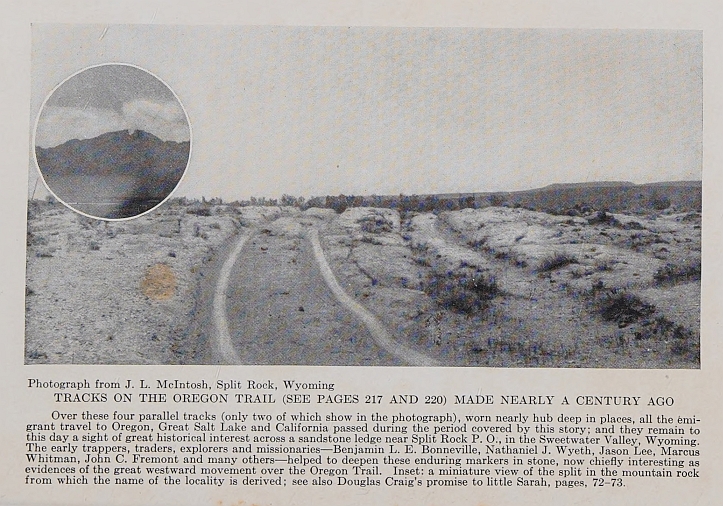
TRACKS ON THE OREGON TRAIL (SEE PAGES 217 AND 220)
MADE NEARLY A CENTURY AGO
Over these four parallel tracks (only two of which show in the photograph), worn nearly hub deep in places, all the emigrant travel to Oregon, Great Salt Lake and California passed during the period covered by this story; and they remain to this day a sight of great historical interest across a sandstone ledge near Split Rock P. O., in the Sweetwater Valley, Wyoming. The early trappers, traders, explorers and missionaries—Benjamin L. E. Bonneville, Nathaniel J. Wyeth, Jason Lee, Marcus Whitman, John C. Fremont and many others—helped to deepen these enduring markers in stone, now chiefly interesting as evidences of the great westward movement over the Oregon Trail. Inset: a miniature view of the split in the mountain rock from which the name of the locality is derived; see also Douglas Craig's promise to little Sarah, pages 72-73.
The track to which she thus called attention was {218} dim, showed no signs of recent travel, and had been overlooked as they passed it the previous day. At several places there were parallel trails, one along the river with frequent crossings of the stream, the other across table-lands high above it, and either over or around projecting edges of the adjacent hills. Neither Aunt Sarah nor mother Pelton was sure which one they had gone over before, but all agreed that they should drive out on the abandoned roadway.
This proved not only a tedious but a really dangerous task, as the elements had destroyed parts of it and cut deep gullies in and across what was left. Nevertheless Adam believed they were on the right track; mother Pelton thought the same, and said that the trail looked more natural to her than the one they had traveled the day before.
Father Pelton took off his coat and joined Adam in some repairs made necessary by the rough going, and Sarah appeared on the scene ready to help. Pelton was surprised at how well he was able to do the unaccustomed work, and greatly relished the dinner mother Pelton and Aunt Sarah prepared. Hearing the tinkling of a bell over the near-by ridge during the early afternoon, he strolled off toward the sound; and soon came upon the bell-wether of a flock of sheep, then the flock and herder—each equally surprised at the presence of the other.
"Where'd ye come from?" the man asked somewhat abruptly, and yet in a friendly tone; and {219} almost at the same instant Pelton remarked, "I didn't expect to find anyone here." After mutual explanations and cordial greetings—for each was glad to see the other—Pelton mentioned that he was one of an automobile party trying to reach the four track ruts in the ledge of rock on the old Oregon Trail.
"I know where it is," the herder responded, "down the river opposite the lone pine tree." The reader may well imagine the relief and joy of father Pelton upon hearing the three magic words "lone pine tree," as he believed they contained definite information of the lost grave, which soon afterward proved true.
"You can see the tree for miles around, as it stands out by itself; everybody wonders how it came to be there," continued the stranger.
"Would you come to our camp a short way over the ridge?" Pelton asked.
"Sure," the man replied and then spoke in a low tone to his dog, which immediately headed off some of the flock just starting to cross the ridge.
"Wonderful, isn't it?" asked Pelton, half to himself. To this the herder made no reply but again spoke to the dog, which he left on watch while the two men started off toward the camp. On their arrival, work ceased and all assembled to listen eagerly to what the stranger had to say.
"Yes, this runs to the four tracks on the Oregon Trail," were his first words; "you can reach them {220} another way that's open to travel, but can't get through here in a month's work. Go back about five miles till you come to the first river crossing," the herder continued, "turn short around on the river trail about eight miles till you cross the river twice. Then turn to the right on the old Trail about half a mile, I should judge, and you will come to the tracks."[3]
"You can see the lone pine tree from there, and I think from the last river crossing," the man responded to an eager question from mother Pelton. After declining an invitation to stop long enough to share with them in the meal then almost ready to serve, but accepting a quarter of the pie Aunt Sarah had just baked, the stranger started up the slope and soon disappeared over the ridge to his flock and faithful dog.
"What a life!" sighed mother Pelton—"with only his dog for a companion, no comfort but his frugal meal in a lonely cabin and cold lunch on the range." The day was too far spent to move their camp, and although impatient to see the lone pine, which all believed was the landmark for which they were searching, every member of the party was anxiously anticipating what the morrow might bring forth.
Following carefully the directions given by the herder, they approached the second crossing of the {221} river early the next forenoon. At the first point from which a comprehensive view of the locality could be had, Sarah unexpectedly held out her hand as a signal for Adam to stop; and exclaimed in her excitement, "There it is, mother!" In the far distance a lone pine tree was sighted; and no one in the party doubted that it had grown from the small tree planted by Kate Mulhall, Ben Hardy and little Sarah half a century before.
A short drive brought the two automobiles to where the wagon tracks had worn deep in the ledge of rock on the old Oregon Trail; but the lone pine, still a half mile or so away, was the center of all attraction. Coming nearer, it was discovered that they were on the wrong side of the ravine; and although not more than a stone's throw from where they stopped, no road led across to it.
There in lonesome grandeur stood the evergreen sentinel over the object of their long search, the grave of Catherine Mulhall, mother of two of the pilgrims and grandmother of the younger ones who drove the cars. Now a hundred feet high, rising above and throwing its shadows over the grave, the tree was a thing of beauty, observed by all who passed in the vicinity; and had given the very appropriate name—Lone Pine—to the surrounding country.
Retracing their steps to the four tracks and then traveling another mile or so, they reached the other side of the ravine. After making several detours and {222} removing a number of obstructions, they arrived quite late in the day within a hundred yards or so of the spot. As the nature of the ground prevented the automobiles from going any farther, they were left in the track, and all proceeded on foot to the lone pine.
The sun was just sinking behind the horizon in a halo of glory as the silent and solemn members of the party reached the hallowed spot. After so long a period of time, the mound of earth had disappeared; but wild roses were blooming where Kate and little Sarah had planted the roots when the grave was made. Though corroded and rusty, the wagon tire which kind-hearted Douglas Craig had placed as a marker was still there, but the lettering he chiseled upon it had been completely obliterated.
Kate and the older Sarah, both now well past the meridian of life, stood in mute contemplation of that which had been uppermost in their minds for so many long years. Although the poignancy of the grief then experienced had been mollified by time, yet as darkness came and they turned to leave the grave, tears coursed down their furrowed cheeks. Camp for the night was made on the nearest suitable ground, while a spirit of sadness mingled with a feeling of satisfaction that the cherished plan had at last been realized, pervaded the little company.
Marking the spot where Catherine Mulhall was buried a half century before the scene depicted in the illustration; see pages 73-74 and 119-125
Now that the grave had been found, the question uppermost with all was what should be done about it. Kate had often expressed a wish that the {224} remains be interred alongside her father in the beautiful cemetery of a village in the Oregon Country; but Pelton formerly considered this impractical, if not almost impossible. However, since the railroad had been built within sixty miles of the burial place in the mountains, the removal could be made without much difficulty.
Aunt Sarah said "No"—-the spot where her mother had died was too sacred to be abandoned; and what could ever be more appropriate than the one under the shadow of this beautiful lone pine? Then tender memories of the planting of the tree, of Ben Hardy's unselfish life and Craig's consoling words, came uppermost in her mind.
All agreed that the decision should be made by the two sisters who had been present at the burial of their mother on the first trip to Oregon. Adam and his sister Sarah looked on in silent awe as the situation was discussed; their father also refrained from speaking, though he held a definite opinion concerning it.
The fatigue of the day, with its exciting incidents and long hours, finally prevailed and left the momentous question unsettled in physical exhaustion and finally restful slumber. No further decision took place, as Kate had been convinced that it would not be advisable to disturb the remains, and joined with her sister and children in formulating a definite plan to care for and commemorate the spot. Pelton said that he would heartily agree to whatever the daughters {225} and grandchildren should decide—which was to leave the grave in its solitary grandeur, but to mark it in a permanent and appropriate way.
Camp was removed to a more convenient location, while the work of transporting a large granite boulder from where Pelton had found it in the course of a morning walk through the vicinity, to the head of the grave progressed for several days, as it was necessary to secure additional men and teams from a distance. After the huge stone had been set in place to the satisfaction of all, Adam and the younger Sarah chiseled upon it in deep sunken letters a brief record of the revered grandmother, the planting of a small pine tree and beautiful rose vine that adorned the last resting place of Catherine Mulhall, the date of her burial in 185-, and also of this visit.
Two weeks passed from the day the pilgrims first sighted the lone pine tree in the distance to the inscription of the last letter on the boulder; every member of the party felt that the long journey had been fully justified, and left the spot with an enduring memory of the occasion. Father and mother Pelton and Aunt Sarah concluded to return home by rail[4]; and a drive of about sixty miles brought them all to the nearest railroad station. Meanwhile Adam and Sarah decided to tour the eastern part of {226} the United States, and possibly cross the ocean before returning to the Pacific Northwest.
One of the automobiles was loaded as freight and way-billed to a small city that had grown up in what was once the Oregon Country; and the "old folks" were comfortably settled in a westbound Pullman. Adam and Sarah waited in their automobile near-by the open car window until the train bearing father and mother Pelton and Aunt Sarah started westward. All of them waved signals of mutual endearment; and as the train passed out of sight, the young people began their journey eastward.
"A fine boy—Adam," Kate murmured half-audibly to herself; "and a dear girl." Pelton at her side added, "If ever parents were blessed with dutiful children, we have been." At the same time Sarah, speeding east in the automobile which Adam was driving, could hardly restrain her tears from the recurrence of many tender memories of her childhood, and the kindnesses of the parents from whom they had just parted.
In a tremulous voice she said, "I almost feel that we ought not to have left them;" Adam felt much the same way, but hesitating to trust his voice, made no reply. Thus the party separated, the parents homeward bound and the young people starting east to see more of what was to them a new world, and possibly to have some adventures thrown in for good measure.
Soon after the train started, the three elderly {227} people went forward to the dining car. As the meal progressed, Kate fell into a reminiscent mood, and looking out of the window, opened conversation with Aunt Sarah by asking, "Don't you remember that sand-storm in this vicinity as we passed through in 185-?"
"Indeed I do," was the prompt response, although Sarah had been at the time a child of only seven years. "The sand blown through the tent into the dough fairly gritted my teeth when eating the bread made from it. We had no water in the camp that night, and slept with dirty hands and faces; my hair, ears and eyes were filled with sand—but let's talk of something else." By the time the first meal was finished, they had progressed on their return journey about as far as in a whole day on the early trip.
As night followed, and while comfortable berths were being made up for them, Sarah—notwithstanding her admonition to "talk of something else"—broke into oral expression of the thoughts surging through her mind. "I guess there will be no 'ticks' in the bed to-night, as we found them when sleeping on the ground." "Or snakes and other creeping things," Kate added—"you of course remember the rattler," to which Sarah simply nodded to indicate that while she understood, she was not disposed to pursue the subject any farther. Soon all the three travelers fell into restful slumber and awoke, greatly refreshed, beyond the eastern boundary of what was once known indefinitely as the "Oregon Country," {228} out of which the present States of the Pacific Northwest had been created within their own recollections of it.
At breakfast the next morning, while the train was speeding by a recognized object, Kate exclaimed, "It took us four weeks to travel over the same ground that we have now passed through in a single night." Strive as much as they could to banish thoughts of the hardships encountered on the early trip, the memories of it would not leave them. Within three days they had covered as much distance as in the same number of months on the first overland journey.
Alighting from the automobile into which they transferred at the station nearest their home, Pelton held open the gate for his "sweetheart" (as he often spoke of Kate); and she paused just long enough while passing in to say, "God bless you, Isaac; you did the same when I first came fifty years ago." "And God bless you, Kate," he replied as they re-entered their happy home—lovers as in the early days; and here we must leave them to the enjoyment of well-spent lives.
CLOSING SCENES
Adam and Sarah continued their travels over the eastern half of the grand old and historic route which their parents had traversed with ox-teams more than a half century before. Then the tracks of the Oregon Trail passed through an Indian country for more than a thousand miles from the west bank of the {229} Missouri River, where the last vestige of civilized life except a few widely scattered trading posts or Government forts, were left behind. Various tribes of red men possessed whatever claim there was to that vast region; millions of buffalo roamed in great herds without restriction over the Plains, while the grizzly bear was a source of danger to man and of terror to wild beasts in the higher altitudes of the Rocky Mountains.
From certain points of vantage deer, elk and antelope could be seen in large numbers. Except for the wild animals, and an occasional passing throng of emigrants, the country was a solitude, generally considered unfit for habitation by a civilized race. But on this motor trip the young people saw evidences of changes and developments which their parents in the slow, westward moving column of the early 50s, would have considered beyond the range of possibilities.
Soon after leaving the Sweetwater River, traveling east, they passed through pretentious cities and prosperous villages with church spires and schools, trading centers, paved streets and large numbers of comfortable residences—civilization personified in western enterprise along or near-by the old Trail. Coal, oil, gas and other natural resources—unknown either to the passing throng of pioneers, or for many years afterward to the outside world—came gradually to the knowledge of adventurers and enterprising business men who laid the foundations for a great {230} commercial prosperity in addition to the returns from the soil and ranges; and through subsequent developments on a large scale have made that region a very important national asset.
The waters of the various streams gathered, controlled and drawn upon as needed by agriculture, wrought the great miracle of irrigation by which land formerly believed sterile had been transformed into a "garden spot" of the United States, many times the area of Lancaster County, Pennsylvania, or the State of New Jersey, to both of which that term has been generally applied. Even the rich Valley of the Mississippi and its tributaries does not exceed in fertility that once thought to be barren and worthless Plains, when supplied with water and placed under scientific cultivation.
Adam and Sarah saw vast areas of grain, immense beet fields with towering sugar factories, extensive orchards and alfalfa lands unexcelled in the entire country. The world seemed larger and the nation greater as our young adventurers continued along the valley of the Platte River on an excellent modern highway of imperceptible downgrade toward the Missouri River. Toward evening of the fifth day after parting from their parents in the Sweetwater Valley, they entered the suburbs of Omaha, Nebraska, and soon reached the center of its business activities, surrounded by skyscrapers of many stories.
Sarah, who had never been in a city of that size, {231} was amazed and thoroughly enjoyed the sights. After an evening walk through the brilliantly lighted streets, and a couple of hours at the theatre, both were ready to rest in the luxurious apartments of the hotel, and slept until late the following morning. At breakfast, the question of their future movements was discussed, for they were then at the eastern end of the Oregon Trail[5]—or would be as soon as they reached the great river now in sight about two miles ahead.
Adam again fell into a reminiscent mood, talking as much to himself as to Sarah, "When grandfather passed through here half a century ago on the way to Oregon, all on this side of the Missouri was Indian country; there was no city—not even a cabin."
"But they didn't cross the river here," Sarah responded. "Mother said it was several miles farther down; and I would like to see the place where she was thrown into the water when the scow upset." "And Ben Hardy saved her life," Adam continued, but added, "it's no use going there; last evening a man told me that the channel of the river is now more than a mile away from where it was when grandfather crossed."
So they concluded to drive over the Missouri to the site of the old Mormon camp of Kanesville, which they did on a fine modern bridge to Council Bluffs, Iowa, occupying the location of the log cabin {232} town that their grandparents saw. "We must stay here to-night," said Sarah, to which Adam readily assented, though they had traveled only four miles during the day.
A two-mile walk brought them to a short portion—then still visible—of the trail over which their grandparents passed when coming into Kanesville a half century before, though all vestiges of it within the city had been eliminated. Sarah was reluctant to leave the spot, and followed along the abandoned track as far as it could be identified.
Talking more to herself than to Adam, Sarah said, "Oh, if grandfather could only have come with us"—apparently forgetting that, as the reader knows, Squire Mulhall had long since been called to his reward; and then said, "Adam, I want to go on to the old homestead where mother was born." To this Adam replied, "We will go there if you want to." So they planned an early start on the morrow for the old cabin site in Missouri.
Two days sufficed for the trip, which was part of the time over hard-surfaced highways, and some dirt roads a little rough, but all the way through a fine agricultural region with evidences of great crops and abounding prosperity. As they rode along, both wondered why their grandparents should have left such a country and traveled two thousand miles over dusty plains and rough mountains to Oregon.
On the morning of the second day out from the "Bluffs," it became reasonably sure that they would {233} reach the old homestead before nightfall. Try as much as he could, Adam failed to interest Sarah in further conversation, for she was in a mood to commune only with herself.
"Yes, suh, I knows where the Squire's cabin stood; it's all gone now. The well is there, but the sweep is gone too. Yes, suh, I played the banjo at the farewell party the Squire gave before he started for Oregon. Me? Well, they called me 'Stinson's man' then, because I was a slave; but when Massa Lincoln made us all free, I stayed with Massa Stinson till he died, and never took another name."
Adam had been advised that this negro, whose hair was white as snow and who was reputed to be a hundred years of age, could show them the old cabin site. He lived in a near-by village, was yet able to do light chores for the white people of the neighborhood, and thus continued to earn his own living.
"Stinson's man" was regarded the sole survivor of the old slaves of La Fayette County; in fact no one else, white or black, could be found who knew David Mulhall. The generation living when the Squire left his home for Oregon had passed away, except for this aged old negro who still enjoyed good health and played the banjo for parties, or for his own amusement.
"Right here was the front door; I knows it for I often stepped it from the well. Yes, the water is good yet, and there's the fire-place."
"Here's a piece of broken plate," exclaimed Sarah, {234} as she picked up a precious relic, which she believed had once belonged to their grandmother.
The old barn site was located, and the barn-yard where her mother had climbed the fence when "gentle" old Star, with the yoke on for the first time, broke away from them and ran about with tongue out, bellowing like a mad bull. Sarah's mother had often told the story with a hearty laugh, which brought merriment as the incident was recalled fifty years later, on the spot where it occurred. Adam believed that he had located the old barbecue pit in a depression near the spot his mother had described. Both were reluctant to leave the grounds, and did not until approaching darkness warned them to seek accommodations for the night.
"Adam!" "What is it, Sarah?" Adam asked, thinking that his sister had something on her mind she hesitated to mention. Gathering courage, she exclaimed, "Adam, I don't want to go any farther, for I ought to be at home taking care of mother. You know as well as I do that she is not strong as even last summer; and I should be with her."
"God bless you, my dear! We will start for home to-morrow if you say so," he replied, throwing his arms around her and imprinting a kiss upon her cheek in love of his sister, and of the revered parents in the far West. So our story closes with the sacrifice of a trip they had expected to extend to Washington City and the Atlantic Coast for the greater pleasure of returning home sooner as a filial duty.
[1] Along the Burnt River in northeastern Oregon—the subject of "Westward Ho!" the painting by Emanuel Leutze in the Capitol, Washington, D.C. While somewhat exaggerated in details, it is a fair representation of the difficulties encountered by the pioneers on that part of the overland trip in the early 60s. E.M.
[2] One of the little twins in the early chapters of this story.
[3] Those four parallel wagon tracks, worn nearly hub deep across a ledge of rock on the Oregon Trail, may be seen to this day in the Sweetwater Valley near Split Rock, Fremont County, Wyoming; see photograph opposite page 217. E.M.
[4] Which they did at from thirty to forty miles an hour, almost continuously day and night, over substantially the same ground they had traversed half a century before by ox-teams at two miles an hour for an average of about eight hours a day, with frequent stops to rest the stock, or on account of bad roads, river crossings or other hazards of early emigration. E.M.
[5] The beginning of the old Trail to the west-bound traveler crossing from the Iowa side into the "Indian Country" of the 60s.—E.M.
THE MISSIONARY'S STORY
THE LEWIS AND CLARK EXPEDITION; FOUR INDIANS FROM THE NORTHWEST JOURNEY TO ST. LOUIS IN SEARCH OF THE WHITE MAN'S RELIGION; OPENING AND SETTLEMENT OF THE OREGON COUNTRY; HISTORIC CHARACTERS—JASON LEE, NATHANIEL J. WYETH, MARCUS AND NARCISSA WHITMAN, AND OTHERS; WHITMAN'S RIDE; MASSACRE AT THE WHITMAN MISSION; NOTABLE INCIDENTS OF THE EARLY MIGRATION TO OREGON.
A little before sundown a few days after the neighborhood party described in the first chapter, a stranger rode leisurely up the road toward the Mulhall farmhouse. Seeing the owner of the place doing some chores in front of the barn, he accosted him and asked if it were possible to secure accommodations for himself and mount for the night. The Squire answered, "Well, stranger, you can see for yourself that our accommodations are none too good; but if you are willing to put up with such as they are, you are entirely welcome. We will do the best we can under the circumstances."
"It is not necessary to put yourself to any extra trouble on my account," said the stranger, "for I have led a wayfaring life and am accustomed to roughing it in the broadest meaning of that word." {236} Mulhall suggested that he dismount, go to the cabin and rest while he would unsaddle the horse and take it to the barn.
The stranger replied, "My good friend, I truly appreciate your courtesy; but I have always made it a point to bestow the first care and attention upon the beast that carries me. Now if you will show me where to stable him, I will do the rest myself. This faithful animal has borne me many a long mile upon his back, and it is only right that I should repay him by devoting a little time to his comfort."
After hanging up the saddle and bridle, he took from the saddle-bags a currycomb and brush, which he said he never failed to take along, and gave the noble animal a thorough cleaning. Then after seeing that the horse had plenty of hay and grain for the night, he accompanied Mulhall to the house.
By this time the owner of the place had surmised that his guest was a clergyman; his language was too precise and his delivery too easy and natural for the ordinary man found in that part of the world. This conclusion was verified beyond question when, just before leaving the barn, he took a well worn Testament from his saddle-bags.
It did not take Catherine and Kate long to prepare a good and appetizing meal to which the reverend stranger, after asking the blessing, did ample justice. During the supper Mulhall informed the guest that he and the family were about to leave their little farm for the Oregon Country, where conditions {237} were said to be much more favorable for getting along in the world than in Missouri.
At the mention of Oregon the stranger's face brightened, plainly indicating that the news was pleasing to him; and said, "You are doing a wise thing, for that is a grand country with a wonderful future. The journey ahead of you is long, difficult and more or less dangerous; but if you get safely through—as I hope and trust you will—you will be amply repaid for all the hardships and sacrifices endured. I tell you this advisedly, for I have spent many years in that favored region, being among the first of our nation to cross the Continent for the purpose of carrying the light of the gospel to the benighted savages who dwelt there."
After hearing this statement, every member of the Mulhall family exhibited the greatest surprise and pleasure at having under their roof one able to give them first-hand information of the distant region where they intended to cast their lot; and begged him to tell them all about it. Heretofore all the knowledge they had of Oregon was through one or two letters received from parties who had gone out there a year or two before; and these contained very little information except that it was a good country for industrious people, with a mild climate and good market for farm produce.
That was more than they had in Missouri; so they had already determined to make the venture. But with an unexpected opportunity to acquire full {238} and accurate information regarding it, they wished—if he would be kind enough to take the trouble—to hear from his lips everything of consequence concerning what was to them a practically unknown country.
The clergyman replied, "My good friends, nothing except expounding the word of God gives me greater satisfaction and keener pleasure than to talk about Oregon, and recount the difficulties, tribulations and heroic actions of those who were in the vanguard of its settlement; it is a subject of surpassing interest, and has had a remarkable influence upon the rapid development and material welfare of our country. The narrative will take considerable time, and perhaps tire your patience before I am through; but I deem it to your advantage to have a correct outline of the principal historical incidents relating to its exploration and settlement.
"It certainly affords me greater satisfaction to go into the subject thoroughly than to give merely a short summary of those very important events. If you are willing, when the meal is ended and everything put away, we will gather around your cheerful and cozy fireplace; and I will do my best to both entertain and enlighten you."
Soon after supper, the younger children climbed the ladder to their sleeping quarters while David Mulhall, Catherine and Kate arranged seats in a semi-circle before the glowing fireplace where the large backlog furnished sufficient heat and light for {239} the little cabin. There is no place where a good story can be as effectively told as before a blazing fireplace on a chilly evening in the mellow light of the crackling logs, with eager and attentive listeners. In such a pleasant atmosphere the itinerant missionary now began his recital:
Half a century ago[1] that vast region known as the "Oregon Country" had never, as far as any one knows, been penetrated by a white man. It is true that Captain Robert Gray of Boston, in the good ship "Columbia" entered the mouth of the great river in 1792, crossed the dangerous bar and sailed upstream about a dozen miles, naming it Columbia's River after his vessel.
A few months afterwards Lieutenant W. R. Broughton, of the British Navy, also entered and proceeded up the mighty river about 100 miles. But nothing more was known of the "Far Northwest" until the celebrated exploring expedition of Lewis and Clark crossed the Continent in 1804-5, arriving at the mouth of the Columbia in November of the latter year.
While it would be impossible in this recital to give a detailed account of that memorable expedition, or do justice to the dauntless courage and perseverance of the remarkable men who conducted it, one surpassing incident that happened on the journey was primarily the cause of bringing all that extensive territory under the American flag. I must crave your patience for devoting some extra time to describing this most interesting event.
That exploring expedition, as you doubtless know, was conceived by one of our greatest presidents years before he came to that high office; but the opportunity for carrying it out did not exist until he became President. The men chosen to organize and lead the expedition were selected with fine discrimination for the stupendous task {240} assigned them, and proved worthy of the trust and confidence reposed in them by Thomas Jefferson.
After their departure from near St. Louis in the spring of 1804, they spent about a year and a half ascending the Missouri River, crossing the mighty "Stony Mountain" range and later the yet more rugged and precipitous "Bitter Root" Mountains, before reaching the beautiful open and undulating country on the Clearwater River. It was a joyful experience for the tired, half famished explorers, descending from the rugged and inhospitable mountains where game was scarce and pasturage scant, to find ahead of them as far as the eye could see, rolling hills carpeted with an abundant growth of bunch-grass, and watercourses with groves of cottonwood and quaking asp along the river bottoms. They also found game quite plentiful, and excellent trout and salmon fishing in the streams.
Before proceeding very far in this region, they suddenly came upon a few native women and children picking berries. Observing the party of strange looking beings garbed in unusual attire and carrying weapons never seen before, the simple-minded natives were terrified. The women ran, and the children sought refuge under bunch-grass and bushes, from what they imagined to be supernatural intruders.
In a short time the men caught up with a couple of the squaws, who expected nothing else than swift and sure death at the hands of these fierce looking strangers, and bowed their heads in anticipation of the fatal stroke. By signs and kind words they soon dispelled the fears of these women of the Nez Perces tribe, which then occupied all that part of the country. They were dismissed with many presents, and told by signs to have some of their head men come out to the camp for an interview.
In a few hours a party of Indians garbed in native finery and armed with bows and arrows, arrived; but they made no hostile demonstrations, and were evidently in a friendly mood. Cordial relations were soon established {241} between the explorers and the Indians, the latter inviting the white men to their village to partake of their crude hospitalities.
The explorers were fortunate in having with them as the wife of Toussaint Chaboneau, their French-Canadian guide, a young and handsome Indian woman of the Snake tribe—Sahcajahweah, meaning "bird-woman," commonly known in later history by the shortened and simplified name "Sacajawea." By her courage, fidelity, tact and intimate knowledge of aboriginal habits, this remarkable girl wife assisted materially in extricating the explorers from the many almost insurmountable difficulties that beset the journey over the Rocky Mountains and Bitter Root range. It is no exaggeration to say that but for her, Lewis and Clark might never have reached the shores of the Pacific.
At the present juncture she was of great assistance. Though not understanding the Nez Perces tongue, her familiarity with the native sign language enabled her to make known to the Indians whatever the white leaders wished to communicate, and explain to her companions what the former were desirous of expressing. She completely removed from the minds of the red men any lurking suspicions they might otherwise have entertained as to the motives and purposes that brought the white men hither.
The explorers learned from these Indians that the big Chief of the tribe was encamped about two days' travel down the river, and that a messenger had already been dispatched to notify him of the arrival of these strange men in his country. On the following morning the party, accompanied by a Nez Perces guide, set out to visit the Chief of this seemingly very friendly tribe. The commanders issued orders that the men should polish up their accoutrements and make the best possible appearance; and that their behavior while sojourning in the country of this tribe should be above reproach, as it was essential for the success of the expedition to have the friendly cooperation of these Indians.
On the evening of the second day the cavalcade of thirty-odd travelers descending from a rolling plateau, beheld the many lodges forming the main camp of the Nez Perces tribe situated on a willow creek bottom, a short distance above where the stream entered the beautiful Clearwater River, along whose banks were many small groves of cottonwood, interspersed with clumps of large willows. The camp presented a picturesque appearance of probably two hundred lodges, scattered up and down along the little valley for perhaps a mile with very little regularity in formation. On this occasion it presented a very animated appearance, for the occupants of each tepee were on the outside anxiously awaiting the arrival of the wonderful strangers with bearded faces and carrying loud-noise weapons.
In about the center of the string of lodges was one a little larger than the rest, in which dwelt the great Chief of the little nation, who was now standing in front of the lodge entrance arrayed in an elaborate costume of Indian finery surmounted by an immense head-dress of eagle feather plumage. He wore a doublet of tanned deerskin, fringed and decorated with elk teeth and agate stones, and leggings of the same material; his feet were encased in moccasins inwrought with the finest embroidery done by Indian women. The Chief, probably fifty years old, was a well proportioned man of medium size with regular features and well shaped head; he stood motionless, with his eyes intently fixed on the approaching column of white men riding in single file down the gently sloping hillside towards the row of lodges—a sight never before witnessed by any of them.
The Indian guide pointed out the lodge of the Chief to Lewis and Clark, who halted the column; and dismounting a little distance off, approached it on foot. The Chief did not move a muscle until Captain Lewis held out his hand with the evident gesture of a friendly purpose, whereupon he reached out, grasped the extended hand of Captain Lewis and held it firmly for a little while, muttering something in a guttural voice which, {243} though not understood, was evidently intended as a pledge of friendship.
Each one of the party was then presented to the big Chief, who gave every one a friendly greeting even to the last, the negro man servant of Captain Lewis, though the stoical Indian could not suppress a look of wonder as he gazed from head to foot upon the gigantic black man. The Indians were all filled with strong curiosity at these strange men with bearded faces and wonderful firearms that sent a leaden messenger of death faster and more accurate than their most expert bowman; but neither the white men nor their guns, strange and almost incomprehensible as they seemed, created anything like the astonishment aroused at beholding the African, who was a continual object of their awe and admiration. Little attention was paid to Sacajawea, for she was of their own race and a member of a tribe with which they were not too friendly.
The whole assembled concourse of savage tribesmen vied with one another in offering hospitality to the newcomers, and exhibited unfeigned pleasure when any of them entered their lodges and partook of refreshments. Friendly relations between the Americans and Nez Perces established so long ago under these peculiar conditions, have continued without a break up to the present time; and let us hope may never be impaired.
Lewis and Clark acquired much useful information during their sojourn with this tribe. They were informed that it was yet a long distance to the "Big Water"—the goal of the expedition; and also learned that almost insurmountable obstacles would prevent continuing all the way to their destination on horseback. It would be possible, however, to reach it by waters all flowing in that direction, finally uniting in one mighty river which was swallowed up by the "Big Water" near the setting sun.
Thereupon the explorers set their men to building boats on the banks of the Clearwater; and it was determined to complete the passage in that manner. They also made {244} arrangements to leave their horses with the Indians until their return the following spring, when the journey towards the "rising sun"—the land of the white man—would be resumed.
While the Lewis and Clark expedition remained on the Clearwater, the Indians held their annual rites to placate the wrath of their false deity, lest he visit upon them dire misfortunes in the form of famine and pestilence, which at times fell upon their people with serious consequences. The white men refrained from making any comment upon these absurd and pagan ceremonies until they were ended. Then having a council with several of the leading men of the tribe, they endeavored in the kindest and most inoffensive manner—through the medium of Sacajawea, who by this time had acquired a considerable knowledge of the Nez Perces tongue—to point out to the Indians that the white people were in possession of a much better method of worshipping the Supreme Being who created the heavens, the earth and all things therein; and it would be a great blessing if they would learn to do likewise.
This kindly advice found deep lodgment in the minds of those untutored children of the wilderness, and was made still more effective by the earnestness and sincerity of the "bird woman," who since becoming the wife of Chaboneau had already received considerable instruction in, the tenets of the Christian religion. Thus the seed that bore such rich fruit a quarter of a century later, and actually led to all that vast region becoming a part of the United States, was planted in what is now our far Northwest.
When the boats were finished the little band prepared to continue its journey by water. Many presents were distributed to the friendly Indians before leaving their hospitable village; though trifling in value, these were highly prized by the natives, and helped to cement firmly the friendship already started between the two races. In return the white men received a liberal supply of dried venison and roots to sustain them during the arduous {245} undertaking still ahead of them. The Nez Perces also furnished two guides to accompany the expedition; these proved of invaluable assistance to Lewis and Clark, particularly in their perilous descent of the Columbia.
That historic journey down the river to the Pacific Ocean was successfully accomplished; and in the following spring the party returned to the Indian encampment on the Clearwater, finding all the horses that had been left with the Indians in fine condition to re-cross the mountain ranges over which they had come the preceding summer. While stopping at the Indian village on this homeward-bound route, the subject of the white man's religion was again broached by the natives; and once more the leaders of the expedition impressed upon them the spiritual and temporal advantages of acquiring a knowledge of the revealed word of God.
This good and salutary advice sank deep into the hearts of the simple-minded red men, who realized that in many ways the white strangers were superior to them. They had more effective weapons, their utensils and implements were beyond the power of any Indian to make, they could find knowledge in books and talk on paper; they had far better saddles and bridles, and could kill a deer or a bear with their smoke-fire guns. Surely then, it was more than probable that they possessed a better knowledge of worshipping the Supreme Being than the poor and ignorant Indians—thoughts about which continued to agitate the minds of this truth-seeking tribe long after the departure of their good friends, Lewis and Clark.
After the lapse of many years the subject was again brought into prominence by the arrival in that part of the country of a small party of full-blooded Iroquois and half-breed employes of the Northwestern Fur Company from eastern Canada. All of these had acquired a knowledge of the Christian religion, and lost no opportunity to impress upon the pagan members of their race its superiority over the crude and senseless forms still practiced by the native Indians.
Coming from people of their own stock, this corroborative testimony of what Lewis and Clark had told them carried great weight, and aroused an intense desire for instruction in the white man's faith; but they could see no possible way to gratify it. How could the poor, benighted Indians come into contact with the white people, and acquire their way of worship, when there were none in any region with which they were familiar? The prospect was indeed gloomy for Indians seeking the light.
But conditions soon began to change. The Hudson's Bay Company was securing a firm hold upon the country, bringing in white men, half-breeds and Indians from Canada to carry on its extensive fur-hunting business. Trading posts were established throughout the vast region west of the Rocky Mountains and north of the Spanish possessions. The Indians welcomed this great commercial enterprise into their country, for it gave them a market for what they had to sell, and opportunities to acquire by trade many useful articles which had never before been within their reach.
Some of these new trading posts were established close to the Nez Perces country, and the tribesmen soon became frequent visitors to them. Here again they were told how superior the white man's religion was to their outlandish and foolish ceremonies. They also learned that one of the two leaders of the explorers who visited their country many years before was still living and occupying a high position, in that department of the Government having the management and care of Indian affairs. His home was in St. Louis, a city many miles beyond the great mountains, a distance that would take many moons to traverse.
These Indians pondered long and seriously what to do under the circumstances; but no matter how great the distance, formidable the obstacles or how threatening the dangers of traveling through a vast region—peopled, indeed, by men of their own dusky race but known to be fierce, warlike and no respecters of persons—they were {247} determined to make the attempt. The desire to gain a knowledge of the white man's religion had taken complete possession of their minds, and they would not be content until that object should be attained.
At a joint council of the Nez Perces and Flatheads, one Indian of advanced age and a young brave of each tribe were selected to go in search of the explorer they had remembered during the quarter century since he had been among them, and ascertain the truth of the reported better religion than their own. During the summer and early fall of 1831, these four delegates traversed more than half of the Continent from the far Northwest to the junction of the Mississippi and Missouri rivers.
Arriving at St. Louis after a long, difficult and perilous trip of which no account was ever made, they were directed to the home of Gen.[2] William Clark, who received them cordially and during their stay there often entertained them in his own house. As may well be imagined, the General was astonished when he learned the purpose that brought them from such a distance; and although outside his line of duty, he determined to do everything possible to assist them.
Clark spent considerable time showing them the town and its attractions; to those children of the wilderness, St. Louis was of course a strange and wonderful place. It was at that time the largest settlement in the middle West, and the principal outfitting point for travel, explorations or hunting expeditions to the Rocky Mountains or beyond. But the greatest obstacle to the progress of their mission was the inability of the Indians to speak or understand our language.
Before they had been very long in St. Louis, one of the
old men became ill, doubtless from the fatigue of the long
journey, change of diet and impure water of the Mississippi;
he soon passed away, and was buried there. In
about two weeks the other old Indian followed him in
death, neither living to know the result of their mission.
The two younger men remained there during the winter,
and in the spring started up the river on their way back
to the far Northwest. One of them died in the Yellowstone
region, and the other proceeded to cross the Great
ountains alone, finally succeeding, after a long absence,
in reaching his home and kindred.
While they were at St. Louis an Indian agent, William Walker, en route to the Osage and other tribes beyond the Mississippi, arrived there with a letter from the Secretary of War, and called upon Clark for special instructions regarding the Indians he was about to visit. The General informed him of the Nez Perces and Flatheads under his roof at the time.
Anxious to see those aborigines from beyond the Rocky Mountains, Mr. Walker interviewed them and gives an interesting account of their appearance and the reason for their coming. This was published after his return from the trip already mentioned; and although he does not give dates, it has been established from contemporary records that the Indian delegation was in St. Louis during the winter of 1831-32.
Mr. Walker's letter in the Christian Advocate of March 1, 1833, at once aroused the greatest interest and religious fervor throughout the length and breadth of the land. Missionary enthusiasm quickly arose to fever heat, due to the fact that a party of Indians had voluntarily come more than two thousand miles over mountain and desert from near the waters of the Pacific, calling for Christian enlightenment.
It aroused the apostolic spirit among the churches to a height not seen in a generation; meetings were held, subscriptions to defray the expenses came pouring in, and devoted men offered their services to answer the call. The {249} first in the field were the Methodists, animated by the evangelical spirit of John Wesley, founder of that great denomination. Funds were raised, the personnel of the party decided upon, and all preparations completed for the journey to the far West in the spring of 1834.
Rev. Jason Lee was placed in charge of the expedition; and I had abundant opportunity to personally observe how well fitted he was mentally, physically and spiritually for the serious task. Arrangements were made for the missionaries to accompany Nathaniel J. Wyeth, of Boston, who had organized a fur company to carry on that business in the Oregon Country; and had some forty or fifty men in his party.
The journey across the Continent was full of exciting adventures—fording or swimming turbulent and treacherous rivers, eluding or repelling small bands of predatory Indians, fleeing for safety from the thunderous charges of stampeding buffalo, and many incidents of lesser import. But while neither my time nor your patience will admit of giving a detailed recital of them, one event which happened on that trip deserves more than passing mention. After crossing the Rocky Mountain divide, their course was northwest until they came to the Snake River. While on an exploring trip the previous year, Mr. Wyeth had decided to erect a trading post at a point on that stream near where a considerable tributary, the Portneuf River, enters it and in the midst of a good fur-producing territory, well adapted for his purpose.
The party camped at this place and remained there a few days. Besides the men Wyeth had brought from the eastern States, who by this time had become genuine frontiersmen at least in appearance, he had taken quite a number of mountain men and independent trappers into his employ at the Rendezvous on Green River, near the site where Fort Bridger was located by James Bridger in 1843, about nine years later. There were also some nondescript characters with no visible occupation—altogether a motley and extremely picturesque throng.
Many of the men had buckskin suits, embellished with {250} fringes and decorated with beads; others wore untanned deer and bearskin garments of almost every conceivable design. A few had coats and trousers of buffalo hide, and one a complete suit of wildcat skins. All had beards, some reaching to the belt line, while others were clipped until they resembled bristles; but there was no evidence that any man among them possessed a razor.
Though it was midsummer, many wore fur caps and some went bareheaded. Various kinds and patterns of rifles and muskets were in evidence, while a few carried Spanish musketoons. Physically they were somewhat above the average stature of men in "the States." While encamped there the men spent most of the time playing cards, shooting at targets or swapping yarns.
It was not the kind of a crowd you would expect to see occupying church pews or attending Sunday School; but Jason Lee made an announcement that he would hold services on the Sabbath, and desired every one to be on hand. They evidently thought it a good joke for any one to attempt to preach Christianity to such a lawless crowd of semi-wild and godless men; however, it was a diversion, and all promised to be there and hear the reverend visitor's message.
Jason Lee was six feet or more in height and slightly stooped; his head was large and well-shaped, with an undeniable expression of determination and courage. Yet there was a kindly look in his eye; and when he smiled, you instinctively knew that beneath his rugged outward appearance was a genial spirit tempered with seriousness.
Shortly after breakfast he took his Bible and went some distance from the camp to the shade of large trees, and spent a couple of hours walking back and forth in serious meditation. About 10 o'clock—the hour announced for the services—he returned to the camp where the throng had assembled.
Some were lolling on the grass, others squatting on blankets, a few listlessly leaning against the trees and others standing by the tent openings. There were no benches, nor any roof to protect the audience from the {251} fierce rays of the summer sun; but that did not matter to men who had lived for years in the open, and were accustomed to sleep under the canopy of heaven.
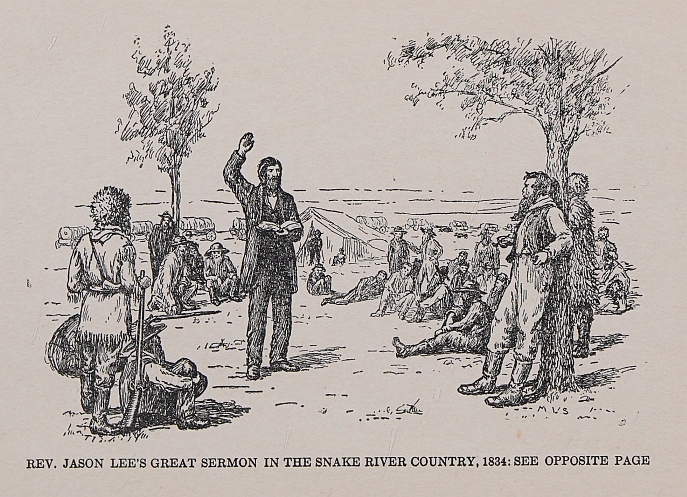
REV. JASON LEE'S GREAT SERMON IN THE SNAKE RIVER COUNTRY, 1834; SEE OPPOSITE PAGE
Lee took a stand where all might be within range of his voice, cast his eyes over the unusual assemblage, opened the Bible and read in a clear and penetrating voice a text from the gospels about the crucifixion and death of Christ. Then he requested all to join with him in prayer. Some who had not entirely forgotten their early training, did so as best they could, while the more hardened sinners nudged each other in the ribs and smiled—as if to say, "What nonsense!"
The clergyman was not an eloquent speaker, but forceful and impressive; and his subject was well suited to call forth all the earnestness of his nature and the sincerity of his faith. He spoke for an hour, and before half through had the complete attention of every one in the audience; those who were at first inclined to scoff soon lost their indifference and listened with profound attention to every word. When at the close of his sermon, he quoted dramatically the words, "Socrates died like a philosopher but Jesus Christ died like a God," there was such a stillness as if all within hearing were spellbound; and they were.
I have listened to great orators in the political arena, and on various occasions to brilliant ministers of the gospel; but have never known one to so thoroughly magnetize his hearers as Jason Lee did the trappers, hunters and mountain men who composed that audience away off in the wilds of the Snake River Country in 1834. It was the first sermon ever preached west of the Rocky Mountains; and has probably not been excelled to this day.
Wyeth put his full force at work erecting the rectangular trading post, more generally known as Fort Hall, for his contemplated fur-dealing activities. Although it remained only a short time in the control of that enterprising American, and passed into the hands of the Hudson's Bay Company upon the collapse of Wyeth's original enterprise the following year, that frontier {252} establishment was a very important factor in the great emigration to the Oregon Country.
A day or so after the Jason Lee sermon, the missionary company departed for its intended destination, the Columbia River, where a favorable location for a Mission was to be selected. The journey on horseback for several hundred miles through rugged and broken country was fraught with many difficulties and dangers, all successfully overcome.
In September the tired and travel-stained little party arrived at Fort Walla Walla on the Columbia, the chief trading post and outfitting headquarters of the Hudson's Bay Company east of the Cascade Mountains, where they were kindly received and hospitably entertained by Mr. C. P. Pambrun, the official in charge. Here it was decided to leave the horses and complete the remainder of the journey by water; and fortunately a party of fur-hunters returning with a cargo of pelts taken along the waters of the upper Columbia, was then on the way to Fort Vancouver.
With these the missionaries were given passage, and floated down the great river in their batteaux. The French-Canadian crew were expert boatmen and a happy lot to travel with, joking and singing almost without intermission; their care-free and mercurial natures never seemed to be ruffled, no matter what obstacles interfered with their progress. The annual fur-hunting expedition had been very successful; and they were looking forward to a genuine celebration upon their arrival at Fort Vancouver, a privilege given to them once a year.
I shall never forget the mingled feelings of wonder and admiration as our little party approached the mighty break in the upper levels of the Cascade Mountains made by the river when, in prehistoric time, it forced a passage through that gigantic range. The scenery was superb—nothing grander can well be imagined—magnificent snow-capped mountains, primeval forests clothed with foliage of various hues reaching down to the water's edge, and numerous sparkling waterfalls leaping over the sides of {253} perpendicular bluffs from elevations of two to six hundred feet.
Occasionally immense basaltic pillars, rising from the bank of the river to a great height, and some of most grotesque outlines, would be encountered. There is nothing of the kind in the United States to compare with that scenery of the Columbia.
Upon reaching Fort Vancouver we met with a truly cordial reception. That grand old autocrat Dr. John McLoughlin had word of our arrival, came out to meet us and in the most courtly manner but with unaffected ease and dignity, ushered us into his private apartments where he said we were to be his guests during our stay. We greatly enjoyed the hospitality of the Doctor, especially after our long and tiresome journey; and have always looked back with sincere pleasure to the whole-hearted welcome given us by the representative of another nation, when we might reasonably have been considered in the guise of intruders.
A day or so after our arrival, Jason Lee unfolded to Dr. McLoughlin his plans for establishing a Mission among the Flathead Indians. The Doctor listened patiently as Rev. Mr. Lee related the details connected with the project; and then while expressing the satisfaction he felt at having a Mission located somewhere in the country, he pointed out the stupendous task of conducting it so far from a base of supplies.
Everything for the Mission must come by water around the Horn, be unloaded somewhere on the lower Columbia, and then carried by batteaux and pack animals a distance of five hundred miles up-country—a very serious handicap. Jason Lee saw it in the same light, but did not know what else to do.
Dr. McLoughlin suggested founding a Mission in the Willamette Valley near French Prairie, where a small settlement of French-Canadians already existed and there were Indians in the vicinity needing spiritual as well as temporal enlightenment. Such a point would also be reasonably accessible for receiving supplies by water.
So convincing were the facts presented by Dr. McLoughlin in support of the Willamette Valley as compared with the Flathead country for a Mission location, that Jason Lee decided to accept his views and followed his counsel. The Doctor also promised to assist it by every means in his power compatible with his duties as Chief Factor of the Hudson's Bay Company; and kept his word.
The Mission established in the Willamette Valley was conducted successfully until measles and other epidemic diseases introduced by the whites almost completely annihilated the native population, so that in ten or twelve years after its founding there were no Indian children to attend its school. During that time, however, the white population increased rapidly by accessions to the missionary force, many newcomers brought from "the States" by glowing descriptions sent back by earlier arrivals, and the even stronger corroboration of the surpassing advantages of the new country by men returning east for missionary reinforcements.
In this again, my friends, I cannot but see the interposition of Divine Providence. Had our Mission been established among the Flatheads as originally intended, there would have been no such influx of American citizens as afterwards followed into the disputed territory to offset the prestige of the British claim, because that remote interior region offered no such opportunities for settlement as the salubrious climate and fertile valleys west of the Cascade Mountains. So I may well say again, "God moves in a mysterious way His wonders to perform."
While I have told you, and truthfully, that the Methodists were the first to answer the call from the Indians beyond the Rocky Mountains, the Presbyterians and Congregationalists soon followed. In 1835 Rev. Samuel Parker of Massachusetts, and Dr. Marcus Whitman of New York State, were sent out by the Missionary Board of that church to examine into the character and disposition of the tribes residing in the region from which the {255} four Indians made the long journey to St. Louis in search of the white man's religion, and report as to the desirability of establishing a Mission among them.
With that purpose in view, Rev. Mr. Parker and Dr. Whitman crossed the plains, and in the summer of 1835 arrived at a point in the Rocky Mountains known as the "Rendezvous," a famous place for trappers and Indiana to congregate for trading in furs and pelts. They found encamped there several hundred Nez Perces and Flatheads just returned from a successful buffalo hunt; and through an interpreter learned that they were very anxious to have white religious instructors sent out to them.
This convinced Rev. Mr. Parker that the field was a very promising one. It was therefore agreed that he should accompany the Indians to their homes and select a suitable location for a Mission site, while Whitman would return east and arrange for a missionary party to go out there under his charge the following spring.
Parker impressed upon Whitman the necessity of having the company well equipped with everything essential for such an arduous undertaking, and above all else to provide himself with a good wife. The Doctor laughed and replied, "That is easier said than done; however, I may make the attempt."
By their genial manners and evident sincerity of purpose, these two advance missionary agents while at the Rendezvous won the confidence of the assembled Indians to such an extent that they permitted Whitman to select two or three young boys to return with him to "the States," remain there for the winter, and accompany him back. The Doctor knew that their presence would have the effect of stimulating the Board to organize and equip a missionary party with the least possible delay; and would be tangible proof that the Indians were earnestly seeking religious instruction. Whitman also realized that the boys would be of great assistance to the missionaries in crossing the plains and mountains in the spring.
The Doctor and his wards experienced no serious difficulties on the journey back to civilization, and arrived {256} at his home in Rushville, Yates County, New York State, early in the winter. He was dressed in the picturesque garb of the mountain men—buckskin coat and trousers decorated with fringes on the arms and legs, moccasins and bearskin cap, and had not been shaved for several months.
Reaching there late on a Saturday, Whitman did not go all the way into the village or make his presence known until Sunday, when he proceeded just as he was, and accompanied by the young Indians, to the church where services were being held; entered, walked up the aisle, and became the cynosure of all eyes in the congregation. At first everyone wondered where the uncouth and wild looking individual came from, and why he should interrupt the services. After gazing intently at him for a moment or two his mother, who was in the audience at the time, exclaimed, "Why if there isn't Marcus."
Services were immediately suspended, and all gathered around to welcome the intrepid Doctor back from the wilderness, where he had gone as a soldier of the Lord. He was the hero of the hour, and every community in that part of the State made an effort to honor him.
But there was one locality where he seemed to relish the attentions paid him more than in any other, and a house to which he made the most frequent visits. It was not because of the genial hospitality of the host—which was proverbial in the vicinity; nor altogether the fascination of his conversation, though he was a man of culture and refinement, to whom it was a treat to listen.
The admonition of Rev. Mr. Parker was uppermost in the Doctor's mind, and beneath that roof dwelt the charming daughter of the household he had known and admired for a long time, and who he hoped entertained more than a passing regard for him. He now determined to press his suit with all the energy of his forceful nature. But before telling you the results of his efforts in that direction, I should give a brief sketch of the early life of Narcissa Prentiss, a noble character whose life and deeds will always occupy a very prominent place among {257} the pioneers of the Oregon Country—more so, indeed, than any other woman.
She was the daughter of Judge Stephen Prentiss, a highly respected and well-to-do citizen of the Lake Region in New York State. Careful attention was bestowed upon her early education and training, and every possible advantage given her within reach of people in moderate circumstances in that part of the country at the time.
In her early teens she is described as about the average in height, the possessor of an unusually fine and well-rounded form, with blonde hair and blue eyes. She had winning manners and a remarkably sweet, well trained voice which naturally made her a popular leader in the church choir and singing circles.
A romantic incident in her early life greatly impaired her happiness in after years, as will subsequently appear. While attending the village school one of the pupils, a boy her senior by a few years, became enamored of her beauty and sprightly manners. He sang in the same church choir, was a diligent scholar, had a good voice and was generally acceptable; thrown together in this way, they became very good friends. On her part this meant nothing more than congenial companionship, but with him it ripened into a master passion.
In this frame of mind, he asked her to make a solemn promise to become his wife as soon as circumstances would permit him to assume the responsibility of providing suitably for her. She laughed heartily at his boyish assurance, and said that she was entirely too young to even think of such a thing; besides, when she did, he would not appeal to her in that light. Even after this rebuff, he still hoped that by making no further advances for the present, and abiding his time, she would gradually come to look more favorably upon him.
A few years later Narcissa Prentiss had become one of the most attractive young women in that portion of the State—not only beautiful in person, but with a sweet and lovable disposition that endeared her to all. She also had a serious turn of mind, and was foremost in every {258} activity connected with the church of which her family were members.
Narcissa had almost forgotten the school boy proposal when most unexpectedly the young man, then about to be ordained for the ministry, again appeared upon the scene. When he called at the Prentiss home, she received him in the usual friendly manner and treated him with the greatest cordiality, for they had been pleasantly associated in the choir, Sunday School and religious activities of various kinds, never having had any serious disagreement—unless the incident already mentioned might be so considered.
After conversing pleasantly for some time on general topics, he said, "Narcissa, I have called upon you at this time for a special purpose. You know that I am now about to become a minister of the gospel, may be sent to distant parts and separated from all my friends of boyhood days. This is not a pleasant prospect; but I could bear up under all those things, sustained by the knowledge that it is in the service of the Master, were it not that I would be leaving behind to me the most precious thing on this earth—you, Narcissa, the idol of my affections. Won't you accept the offer of my hand and heart, and be my helpmate through life?"
Narcissa, who thought she had firmly squelched the earlier fancy, and that he had long forgotten to think seriously of ever winning her hand, was dumfounded. But now in far more earnestness than ever, he had renewed the effort, apparently under the delusion that he might be successful. In an instant her mind was made up what to say and how to act; she must let him know once for all that such a proposal was unwarranted and repugnant to her.
Arising and standing before him in all the dignity of her womanhood, she asked, "Have I ever acted toward you in a way you might construe that I entertained any affection for you, or given any grounds for you to hope that I might have anything more than just a friendly feeling towards you? If I have so acted, I'm not aware of {259} it. Now bear this in mind—never under any circumstances would you be considered in the light of a lover or husband for me!"
A cloud passed over the brow of the young man as he felt the sting of her reply, and it is generally believed that a vow of eternal animosity against what he deemed a haughty and insolent young woman who had repelled his well-intentioned proposal was made by him. "Some time you may regret this," he remarked, or words to that effect, and took his departure.
Narcissa, kind hearted and reluctant to hurt the feelings of anyone, regretted having wounded his vanity and pride so deeply; but thought that was the only way his persistent suit could be stopped for all time. This happened some four years before the return of Dr. Whitman from the Oregon Country to his home in New York State. About a year after his rejection by Narcissa Prentiss, Rev. Mr. Spalding was married to Miss Eliza Hart, a very estimable young woman, and sent west to engage in missionary work.
Marcus Whitman, although making frequent visits to the Prentiss home, and received on every occasion by the Judge and his family as a welcome guest and intimate friend, did not attempt as yet to play the role of suitor for the hand of Narcissa. He must first know that all arrangements for the projected missionary expedition were satisfactorily completed before committing himself in any personal way that might later prove embarrassing.
It was a matter of considerable importance for the Missionary Board to assemble and outfit a sufficient number of persons for such an undertaking; and many investigations and calculations had to be made before a complete organization was effected. It was considered necessary to have an ordained minister, and difficult to find one willing to go. But in the early spring the personnel of the party was decided upon, and the animals, wagons and supplies purchased so that the westward movement could begin as soon as the season was far enough advanced.
Whitman now decided that the auspicious moment had arrived to take the important step that had been uppermost in his mind since his return from the Rocky Mountains. He was of a sanguine temperament and optimistic by nature, with supreme confidence in his ability to overcome obstacles; in the vital matter now in hand he felt confident of success, but was anxious to know what the result would be.
With this purpose in view he mounted his horse and rode hurriedly to the Prentiss home, finding the Judge out but Narcissa there. Entering the sitting room, he took a seat and without any preliminaries remarked, "Well, Narcissa, everything is arranged and the party will start for the great undertaking in just one month from now. I said the party was complete, which is not quite correct; there is yet one vacancy and I have come, Narcissa, to ask you to fill it by becoming the wife of Marcus Whitman, leader of the party.
"I need not tell you that you hold a higher place in my estimation than any other living mortal; your womanly intuition has long ago made you aware of that. I also believe that you entertain for me a feeling of uncommon friendship, at least—if not more. Am I right or wrong? Answer me, Narcissa."
"Marcus, this is so abrupt you almost take my breath away, but I will be just as frank," she replied. "I will go with you."
Taking her hands in his and gazing into the depths of her beaming blue eyes he exclaimed, "I felt in my soul that you would." Drawing her nearer and enfolding her in his arms, he imprinted a seal of affection on her lips.
* * *
Both were naturally well fitted for the task of bringing the light of the gospel and the advantages of civilization to the Indians. Marcus Whitman was strong and rugged, with an unlimited capacity for work; and although a physician, the missionary life appealed to him much more than the practice of his profession, due {261} probably to natural inclination and his early training. A knowledge of medicine was a valuable aid in a region without professional men.
Narcissa Prentiss was in full health and vigor, capable of enduring the privations and hardships incident to such a life, and of an intensely religious temperament. She left home, friends and every association dear to the majority of womankind, and set forth on a tremendous journey across deserts and over mountain ranges—the way beset by difficulties and dangers—in order to lend a helping hand in carrying the "tidings of great joy" to the natives of the far Northwest.
A great deal of spoken and written eulogy has been bestowed upon the devotion to duty, courage and fortitude of Marcus Whitman—unquestionably in great part well merited. So far, little has been said in praise of the noble qualities of head and heart possessed by his wife and coworker in the Lord's vineyard. But as time goes on I have no doubt that historians and poets will exalt her virtues and sing her praises.
The marriage ceremony in the Presbyterian Church at Angelica, N.Y., in February, 1836, was very quiet and simple, as both were opposed to any undue publicity. But when the members of the congregation became aware that the missionary party was about to start, it was arranged to have a farewell party and services on the eve of its departure. The little church was crowded to capacity; not only was nearly every member present, but many who were not affiliated came to bid farewell and Godspeed to this universally beloved member of the community, which had been the home of the Prentiss family since 1834.
She took her usual place as leader of the choir, while the eyes of all were riveted upon the pleasing countenance and attractive form of the one who was about to leave them—perhaps forever. After the services and singing of appropriate hymns, a time for greetings was announced; and the whole congregation surged forward, each anxious to grasp the hand and say a personal word {262} to her whom they loved so well and were reluctant to let go. Before being dismissed, all were asked to join in a parting hymn selected for the occasion.
Narcissa led the singing, and when the last verse—beginning with the words, "Yes, my native land, I love thee"—was begun, audible sobs were heard through the audience. Before it was finished the pent-up feelings of the assemblage were unloosed, and the genuine feeling of sorrow became contagious; handkerchiefs were pulled out, and there was scarcely a dry eye in the audience. Only the voice of Narcissa carried the words all the way through; but she never faltered until it was finished, when she also gave way to the prevailing emotion.
Rev. Henry H. Spalding and his wife were selected by the American Board of Home Missions to accompany Dr. and Mrs. Whitman. For some time past the Spaldings had been engaged in missionary work in the State of Ohio from where, upon the arrival of the Whitmans from New York State, the four proceeded to Liberty, Missouri, the point at which final arrangements for the western journey were to be completed.
The Board of Commissioners probably did not take the precaution of consulting Dr. Whitman as to his choice of companions for the great task they were entering upon; could Narcissa have had any voice in the matter, the Spaldings would certainly not have gone with them. It is to be regretted, for the good of the cause, that such an appointment was made, as subsequent events will explain. W. H. Gray, a mechanic, was also designated by the Board to accompany the missionaries.
Rev. Mr. Spalding was a stockily built man of medium height, with a large head and rather high forehead; and was a voracious reader, especially of books on religious and controversial topics. Although rated, even by his admirers, as a "peculiar" man, he accomplished commendable results in the mission field for nearly 40 years. Mr. Spalding died August 3, 1874, in his 71st year, and is buried in the Nez Perces country a few miles from Lewiston, Idaho.
His wife, Eliza Hart Spalding, was rather tall and angular, and though not possessing regular features, had a kindly and intelligent expression that won many friends. She had the gift of knowing how to gain the respect and confidence of the Indians, and was conspicuously successful as a teacher among them. Gray was a self-important person, with quite a smattering of learning, but inclined to be self-willed and even insubordinate.
These men and women established the first Indian Missions in the vast region between the Rocky Mountains and the Cascade Range, nearest the tribes who had sent the delegation to St. Louis in 1831, seeking a knowledge of the Christian faith. About the time the missionaries arrived at Liberty, a number of hunters and trappers in the employ of the American Fur Company, under the leadership of two experienced frontiersmen, Milton G. Sublette and Thomas Fitzpatrick, were assembled there preparing to leave for the Rocky Mountain region on a trading and fur-hunting expedition.
By this good fortune, the missionaries were able to travel in the company of a well-equipped outfit, without fear of molestation by roving bands of Indians on the way. But not everything required for the long journey had been secured in time to start with the larger party, which set out two days in advance. Whitman determined to catch up with the fur hunters before reaching the most dangerous part of the route, which he did.
Many days were consumed in traversing the bad roads of western Missouri, which in the spring in those pioneer days were full of ruts and mud-holes; and the Doctor was the only one of the party with any previous experiences in that kind of travel. Early in May they were on the west side of the Missouri River with their wagons, horses and cattle all in fairly good shape, but on the south side of the Platte near its mouth. The latter was nearly a mile wide, and the crossing of it a very formidable undertaking; but it had to be done, for the Trail continued westward on the north side.
That might be termed the real starting point on the {264} expedition, as there every vestige of civilization was left behind, and immense plains and great mountain ranges inhabited only by Indians and wild animals, extended far out before them. It was a perilous trip in those days, even for men fond of adventure and thoroughly accustomed to hardships.
But in the company were two refined and educated women leaving friends, kindred and the comforts of civilized life to undergo the discomforts and face the hazards of the long journey. It was a noble courage, and heroism of the rarest type. Their names should be held in high veneration by the Christian people of this land for all time to come; and I believe they will be.
The crossing of the Platte was difficult and wearing; and the burden of it fell upon Dr. Whitman, as Rev. Mr. Spalding was ill and unable to help. Mrs. Whitman and Mrs. Spalding were taken over in a "bull boat," a contrivance made by stretching a buffalo hide over small willow growths. In the process of making, the larger ends were stuck in the ground, and the smaller ones interlapped, after which a fresh hide was fastened over them and allowed to dry. Then the ends of the willows were pulled out of the ground, it was turned upside down—and called a "boat."
Though a very risky affair in which to cross a wide river, there was no other available conveyance; so they entered it, at least with a show of confidence, and were carried safely over. An entire day was required to get the outfit to the other side; Whitman was obliged to swim back and forth several times, and by evening was completely exhausted.
Early the next morning a start was made and the animals were urged forward at the utmost speed under the circumstances, to overtake the fur-hunters before the Pawnee villages were passed, as unfriendly Indians might be encountered beyond. I will not enter into a detailed account of the many events of interest on their way over the great plains, but cannot refrain from mentioning a few outstanding features of the journey.
When they came within sight of the Elkhorn, a tributary of the Platte, it presented a very menacing appearance at the height of the flood-water season. Arriving first at the river, the Indian boys Whitman had taken back with him the preceding winter saw a skin canoe on the farther side; completely stripping, they wound their shirts around their heads and swam over, returning with the canoe by the time the rest of the party came up to the bank. A rope was then stretched across, and the goods hauled over in the canoe without much difficulty.
Those Indian boys were very useful to the missionary party in driving the loose stock, herding, guarding at night and in many other ways. They seemed more than willing to render assistance whenever the occasion called for it; and in initiative were equal if not superior to white youth of the same age.
About a hundred miles east of the "Rendezvous," the party fell in with a large number of Indians belonging to tribes west of the Rockies who came over the mountains every year to hunt buffalo. Some of them had met the Doctor on his previous trip, and remembered his intention of bringing missionaries to instruct them in the white man's way of worshipping; now they manifested great pleasure at meeting the little party on the way to fulfill the promise made the year before.
The ladies especially aroused the curiosity and wonder of the savages, who now for the first time beheld a white woman. No sooner had Mrs. Whitman alighted from her horse than a number of the native matrons came forward to welcome her; each one of them shook hands with her, and at the same time placing the left hand affectionately upon her shoulder, gave her a hearty kiss. Mrs. Spalding was greeted in a similar manner.
Both were deeply moved by the cordiality and sincerity of their welcome by those Indian women, and greatly surprised to learn from this experience that they have about the same manner of salutation as their civilized white sisters. It goes to show that regardless of climate or color, human nature is about the same the world over.
One of the chiefs present when the ladies arrived soon took his departure, and returning in a short time with his wife, introduced her to both of them—with a wave of the right hand towards his squaw and the left towards the white women, at the same time bowing politely. When the tents were pitched and occupied by Mrs. Whitman and Mrs. Spalding after the fatigue of the horseback ride, some of the Indians, with unabated curiosity, remained in the vicinity and were occasionally bold enough to peep in and then grin with astonishment.
Arriving at the "Rendezvous," a long-to-be-remembered sight was presented to their eyes. There were assembled hundreds of trappers, hunters, traders and packers—in fact all kinds of mountain men—some of whom had not seen a white woman in more than twenty years; and there must also have been some fifteen hundred or two thousand Indians who had traveled there to trade with the American Fur Company. All of them, white men and Indians alike, were intent upon having a good look at the first two white women who had ever penetrated that far into the wilderness, and were to traverse another thousand miles or so of rough country before reaching their destination.
Mrs. Whitman thoroughly enjoyed the novelty and excitement of the strange situation. Some of the mountain men ventured to approach her and offer some kind of a compliment, which amused her exceedingly; but she always answered them with gracious and cordial bearing, and thus became very popular with these semi-wild and reckless frontiersmen.
Mrs. Spalding was more interested in the appearance of the natives among whom she had come to teach, and anxious to acquire a knowledge of the Nez Perces language. Somewhat from anxiety to see how she would act, the Indians gathered around her while she tried as best she could to converse with them.
Before the departure of the missionary company for the Columbia River, a grand reception and display was planned in its honor. On the appointed day, the Indian {267} warriors formed a procession in gala dress at one end of the plain, each of the four tribes being represented by a company in fighting costume—which was breech-clout, with plenty of paint and feathers. All were mounted on well-shaped Indian horses, which though not large were spirited and active.
These fighting braves carried their weapons, and in addition many had drums, horns and other noise-making instruments. When everything was in readiness the command was given, and there burst forth from every painted warrior such a wild and terrifying yell as only aborigines can utter; then, joining in a mighty chorus of barbarous song, the cavalcade charged down the valley at frantic speed, brandishing their weapons and beating drums.
Reaching the farther end of the valley, they whirled around and dashed back with equal impetuosity, afterwards performing skilful evolutions in front of the missionary tents. The whole maneuver was conducted like a preconcerted military movement, the force of six or seven hundred Indians obeying the signals of the leaders with machine-like precision.
All members of the missionary party had assembled in front of their tents before this torrent of furious savages approached and swept by them with wild gesticulations. Their bronze bodies glistened in the summer sun and quivered with the great excitement under which they labored in this mimic attack upon an imaginary foe.
In front of the rushing columns rode a huge warrior of the Snake tribe, known as "Big Foot," more than six feet tall and well proportioned. His horse was much larger than the ponies of the other Indians (most of whom rode bareback); and he had a saddle of the Mexican pattern, probably secured during a foray into the settlements of New Mexico Territory.
He raised in his stirrups, whirling a Spanish musketoon and yelling like a demon, his voice being heard above all the din and uproar. The whole performance was so realistic that before it ended the nerves of the women {268} were severely tried; and at its conclusion the Indians crowded around the tents to further gratify their curiosity.
The missionaries rested for a few days at the Rendezvous on Green River and then set out for Fort Hall with only one wagon, the other having been abandoned by necessity farther east. At the fort, then owned by the Hudson's Bay Company, they were very kindly received, but told that it would be virtually impossible to travel any farther with the wagon. However, on account of Mrs. Spalding's delicate health, Whitman determined not to give it up until absolutely necessary.
Owing to the deep sand and large sage-brush about twenty miles below American Falls on the Snake River, and the extremely rocky surface of the hills, he was obliged to leave the box and rear wheels there, converting the remainder into a cart which he managed to take as far as Fort Boise, where that also was abandoned. With the wagon-box was left something far more valuable to Narcissa Whitman—a little trunk which she dearly prized as a present from her sister Harriet. Here is the way she laments the loss of it:
Friday evening
Dear Harriet:
The little trunk you gave me has come with me so far, and now I must leave it alone. Poor little trunk! I am sorry to leave you. Twenty miles below the Falls on Snake River shall be thy place of rest, x x x x. Narcissa.
My good friends, before proceeding farther with my story I must tell you that about three years ago I visited the home of Judge Prentiss in New York State; and the fine old gentleman accorded me the great privilege of copying the voluminous correspondence written by his daughter on the journey across the Continent and during the years spent at the Mission station until her unhappy death. I will at times quote her exact words describing events intimately connected with her missionary labors.
She possessed the rare gift of expressing in the most lucid language the condition of her feelings regarding the {269} many trials and afflictions it was her lot to bear during their life at Waiilatpu. I have with me copies of all these letters; and will now read her description of the crossing of Snake River, as must be done more than once in your own journey to the "Promised Land":
Preparing to cross Snake River. The river is divided by two islands into three branches, and is fordable. The packs are placed on the tallest horses, and in this way we crossed without wetting. Husband had difficulty with the cart, which was turned upside down in the river, and the mules entangled with the harness. The mules would have been drowned but for a desperate struggle to get them ashore. Then after putting two of the horses before the cart, and two men swimming behind to steady it, they succeeded in getting it over.
I once thought crossing streams would be the worst part of the journey. I now do so without fear. There is one manner of crossing—take an elk skin and stretch it over you, spreading yourself out as much as possible. Let the Indian women put you on the water, and with a cord in the mouth they swim and draw you to the other side.
In four or five days more of travel they arrived at Fort Boise, where the Snake River had to be recrossed. Again I will quote Mrs. Whitman:
22nd.
Left the Fort yesterday, came a short distance to Snake River; crossed and encamped for the night. The river has three branches divided by islands. The first and second places were deep but we had no difficulty in crossing on horseback. The third was deeper still.
This being a fishing post of the Indians, we found a canoe made of rushes and willows. Mrs. Spalding and myself placed ourselves and our saddles in it, and two Indians on horseback with a rope towed us over. The canoe is made of bunches of rushes tied together and attached to a frame made of a few sticks of small willows. It was large enough to hold us and our saddles.
The cart which had been brought from the Falls of Snake River especially for the accommodation of Mrs. Spalding was abandoned here and the remainder of the trip to Fort Walla Walla made on horseback. No serious mishaps befell the little party on this part of the journey, although it was an exceedingly rugged and difficult region {270} to traverse. They were tendered a very kindly reception at the fort by the employees of the Hudson's Bay Company, and a boat was secured to convey them down the magnificent river to Fort Vancouver.
At forts Hall, Walla Walla and Vancouver, where the missionaries were guests of the great fur company, all were greatly interested in the two refined and educated American women who had the pluck and hardihood to undertake such a long and hazardous journey. Upon reaching the head of the rapids above The Dalles of the Columbia, Mrs. Whitman gives an interesting account of what had to be done to pass safely that formidable obstacle to their progress. She says:
8th.
Came last night to the Chute (above The Dalles), a fall in the river not navigable. There we slept, and this morning made the portage. All were obliged to land, unload, carry our baggage and even the boat for half a mile.
I had frequently seen a picture of Indians carrying a canoe, but now saw the reality. We found plenty of Indians here to assist in making the portage. After loading several with our baggage and sending them on, the boat was turned over and placed upon the heads of about twenty of them, who easily marched off with it.
September 9th.
We came to The Dalles just before noon. Here our boat was stopped by two rocks of immense size and height, all the water of the river passing with great rapidity between them in a very narrow channel. We were obliged to land and make a portage of two and a half miles, carrying the boat again.
The Dalles is a great fishing resort for Indians of several tribes; we did not see many, however, for they had just left.
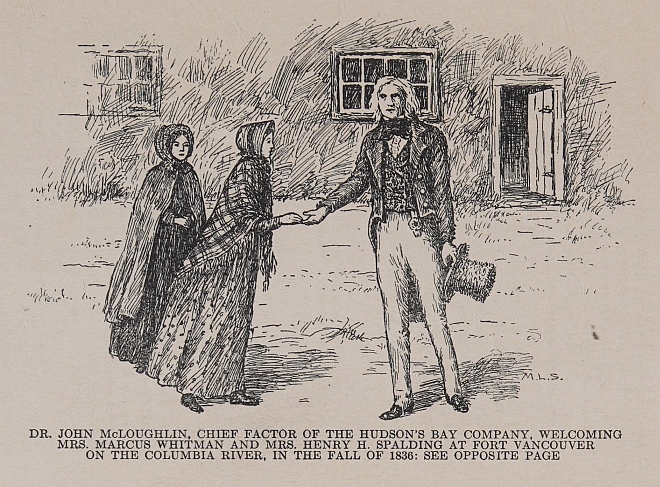
DR. JOHN McLOUGHLIN, CHIEF FACTOR OF THE HUDSON'S BAY COMPANY, WELCOMING
MRS. MARCUS WHITMAN AND MRS. HENRY H. SPALDING AT FORT VANCOUVER
ON THE COLUMBIA RIVER, IN THE FALL OF 1836: SEE OPPOSITE PAGE
At Vancouver they were also cordially received and hospitably entertained by that grand old man, Dr. John McLoughlin. It was a never to be forgotten sight for me to observe this representative of the all-powerful English fur company, of towering stature and knightly dignity, standing with hat in hand at the portal of the fort graciously bending to salute and welcome the two first white women to set foot upon the immense territory over which he then held undisputed sway. It was not a mere formal {271} greeting, but a genuine expression of satisfaction to see devoted men and women coming into the territory to improve both the spiritual and temporal condition of his Indian wards, in whose welfare he was deeply interested—for McLoughlin was by nature benevolent.
In consultation with Whitman, he advised the latter to establish his Mission somewhere east of the Cascade Mountains, for the reason that the Indians of the interior were mentally and physically superior to those near the coast, as well as more likely to adopt the rudiments of civilization and accept Christianity from the missionaries. Thereupon Whitman, Spalding and Gray returned up the Columbia to the vicinity of Fort Walla Walla for the purpose of selecting a site, while the women remained at Fort Vancouver as Dr. McLoughlin's guests until a Mission House could be erected.
After looking over the country for several days they decided that a point called Waiilatpu, on the Walla Walla River about thirty miles from its mouth, would be a desirable location for a Mission, as it was convenient to the habitat of the Cayuse and Walla Walla tribes and reasonably near the headquarters of the Hudson's Bay Company for that vicinity, in case trouble should arise. Work was immediately begun upon the construction of a comfortable log dwelling roofed with poles covered with straw and dirt thrown upon the top, which very well suited the purpose for which it was intended.
A site for another Mission to be in charge of Rev. Mr. Spalding was located among the Nez Perces on the Clearwater River about 100 miles northeast of Waiilatpu. Mr. Spalding then returned to Fort Vancouver for the ladies, while Dr. Whitman continued work on the dwelling. In about three weeks Mrs. Whitman arrived at Waiilatpu, and the Spaldings went on to the Clearwater.
At this isolated and unattractive Mission in the midst of uncivilized and unappreciative aborigines, practically shut off from people of her own race and tongue, Narcissa Whitman spent eleven long weary years in the prime of her young womanhood, endeavoring to enlighten the {272} minds and improve and elevate the morals of the savages, with no hope or prospect of being rewarded in this life, except by the consciousness of doing the utmost for her fellow mortals, and that her work might be pleasing in the eyes of God. The sacrifice of her own life was her only visible reward.
In 1839 a great sorrow fell upon the Whitman household. They had a beautiful little girl, an only child who was suddenly snatched away from her loving parents, without the slightest inkling of approaching danger or cause for apprehension. The poignancy of Mrs. Whitman's grief was intensified by the peculiar circumstances surrounding them at the time.
She was in a wilderness inhabited by cruel and treacherous Indians, cut off by nearly three thousand miles from the old home and her own family, with only Dr. Whitman to lend a helping hand or console her with a loving voice; and he was overwhelmed with pressing duties. Her anguish was beyond description, but with true Christian courage and exalted faith she bowed to the Divine will. What sublime resignation!
I have a copy of the characteristic letter she wrote to her father on that sorrowful occasion, from which I will now read:
Waiilatpu, Sept. 30, 1839.
MY DEAREST FATHER:
Doubtless before this you have heard through the Board of the melancholy death of our most precious and only child, Alice Clarissa. That we loved her most ardently is true, and we feel keenly the severe pangs of a separation from her. Yet it is the Lord that hath done it, and He has dealt with us as a tender parent deals with the children He loves. O, how often have I felt and thought what a privilege it would be, if I could see and unburden to my dear parents the sorrows of my broken and bleeding heart since we have been bereft of our dear, sweet babe.
Although deprived of this inestimable consolation yet, dearest father, I desire to ask you to unite with us in praise and gratitude to God who has so mercifully sustained me, and that when crushed to the earth because His hand lay heavily upon me, His grace was manifest to preserve and sustain my soul from murmuring or repining at His dealings with us.
This unspeakable consolation is ours, that our daughter is at rest in the bosom of Him who said, "Suffer the little children to come unto me, for of such in the kingdom of heaven." Young as she was, we could plainly see a manifest relish and enjoyment in singing and worship; the last month of her life she commenced learning to read, and improved rapidly.
I would describe to you if I could her bright, lively appearance on Sabbath morning, the day of her death. She had always slept with me until just a week before then, and that night she proposed, of her own accord, to sleep on the mat on the floor. This gave me a very strange and singular feeling, for I never before could persuade her to lie away from me, not even in her father's arms * * *. It being very warm, and because she preferred it, I let her sleep on the floor all night—but did not sleep much myself. Ever after this I made a bed for her by the side of mine, where I could lay my hand upon her.
Her appearance at worship in the family was deeply interesting. For some time she had been in the habit of selecting the hymn she wished us to sing, and that morning her choice was "Rock of Ages Cleft for Me." Oh, if dear father and mother could have seen with what animation she sang, and how her sweet voice soared above ours!
* * * * * * * * * * *
Dear father, when you sing this hymn think of me, for my thoughts do not recur to it without almost overcoming me and bringing fresh to my mind how she appeared when she last sang it.
NARCISSA.
That letter bears the impress of having been written by a superior woman suffering the keenest pangs of a mother's grief, yet bearing it with all the fortitude and resignation of the early Christian martyrs.
The tragedy happened on a Sabbath morning, while Dr. and Mrs. Whitman were reading the scriptures. Alice Clarissa went to bring some water from the river which flowed near-by the Mission House, as she had done many times before. She went from the house with a cup in each hand, bounding down to the river bank to fulfill her errand, and returned no more.
How it happened is simply conjecture, as there was no witness when the cold waters of the Walla Walla River fanned out the precious life of this first white American {274} child born west of the Rocky Mountains. The little mound that marked her grave not far from the house was kept green and bedecked with flowers until the day of the massacre and destruction of the Mission.
The missionaries—particularly Rev. Mr. Spalding and Dr. Whitman—never worked in harmony after their arrival in the Indian country. It is said that the bitterness of Mr. Spalding against Mrs. Whitman continued from the time he was a suitor for her hand; and that the rankling of it led at least to a lack of co-operation on his part with his successful rival, the Doctor, in carrying on the Mission work. I will read a letter of Mrs. Whitman to her father, which throws a flood of light upon the subject:
Waiilatpu, Walla Walla River,
Oregon Territory, Oct. 10, 1810.
MY DEAR FATHER:
The missionaries' greatest trials are but little known to the churches. I have never ventured to write about them for fear it might hurt. The man who came with us ought never to have come. My dear husband has suffered more in consequence of his wicked jealousy and great pique towards me than can be known in this world. Not he alone but the whole Mission suffers, which is most to be deplored. It has nearly broken up the Mission.
The pretended settlement with father before we started was only an excuse; and from all we have seen and heard, both during the journey and since we have been here, the same bitter feeling exists. * * *. I never did anything before I left home to injure him, and nothing since; and my husband is cautious in speaking and thinking evil of him or treating him unkindly; yet he does not, nor has he received the same kindness from him since we have been missionaries together.
Every mind in the Mission that he has had access to he has tried to prejudice against us, and did succeed for awhile, which was the cause of our being voted to remove and form a new station. This was too much for my husband's feelings to bear, and so many arrayed against him for no good reason. He felt as if he must leave the Mission, and no doubt would have done it had not the Lord removed from us our beloved child. This affliction softened his feelings and made him willing to submit to the will of the Lord, although we felt that we were suffering wrongfully.
The death of our babe had a great effect upon all in the {275} Mission; it softened their hearts towards us, even Mr. S's for a season. * * * The Lord in His providence has brought things around in such a way that all see and feel where the evil lies. Some of them are writing to the Board; and it may require his removal or return to effect it, not so much for his treatment towards us as some others also.
* * *. I have long desired to have some few judicious friends know our trials, so that they may understand better how to pray for us. If this Mission fails, it will be because peace and harmony does not dwell among its members. Our ardent desire and prayer is that it may not fail. It is this state of things among us that discourage us. When we look at the people and the providence of God, we are more and more encouraged every year.
As ever, I remain, your affectionate daughter,
NARCISSA WHITMAN.
During the early days of the Mission the Whitmans devoted themselves almost exclusively to the difficult task of inducing the Indians to receive instruction in both spiritual and temporal matters. The Doctor was rough and ready in his manner, outspoken in his opinions and, particularly, vigorous in his actions; when the Indians did not do exactly as he thought they should, he openly showed his disapproval and scolded them.
This helps to explain why the Mission was not as successful as it might have been; but Whitman was nevertheless a thoroughly sincere and honest man, always prompted by high motives. Due somewhat to the lack of harmony in the establishment there, the Board finally concluded that Waiilatpu should be abandoned.
Very different indeed was the disposition of the lovable and sweet-tempered woman, Narcissa Whitman, his helpmate in the work. By kindly manner and tactful methods she endeared herself to those in her special charge, and was eminently successful in the care and management of children.
WHITMAN'S RIDE AND THE MASSACRE
Having learned that the Board had ordered the abandonment of two stations, including the one at Waiilatpu, Whitman asked the missionaries to convene at that place {276} for consideration of what steps should be taken to have the order rescinded. Upon arrival of some of them, he called the meeting without awaiting the arrival of those coming from a greater distance, as he deemed the matter too urgent to be postponed even a day. It was decided to have the Doctor proceed immediately to the East to lay the whole matter before the Board.
Accordingly Whitman, accompanied by A. L. Lovejoy, left Waiilatpu October 3, 1842, on the long and afterward famous horseback ride over the Rocky Mountains and through the vast prairie country during the winter. He was the kind of man no dangers or difficulties could deter; and although he underwent great privations, successfully completed the trip.
His reception by the Board was by no means cordial; but in a forceful way he showed the serious consequences that would follow the abandonment of the Missions. Finally convinced by his logic, the Board rescinded the order, which action was the object for which the ride was undertaken. After that he visited his old home in New York State.
Westbound during May of the following year, Whitman overtook the 1843 emigrants somewhere along the Platte River and traveled with them as far as Fort Boise on the Snake River. Worried about affairs at Waiilatpu after so long absence, he then went on ahead.
From that time on the affairs of the Mission were still more unsatisfactory; and the Indians gradually became alarmed at the number of immigrants arriving in the country, bringing the measles and other diseases generally fatal to the natives. Whitman was very successful in treating his own people, but the great majority of affected Indians succumbed to the diseases contracted from the whites.
The more superstitious ones began to imagine that the Doctor was using "bad medicine" to kill them off so that his white brothers could have their lands, an idea which became an obsession with them. It did not bear fruit for awhile; but as time went on and conditions showed no {277} signs of change, the foolish natives determined to destroy the station and kill the missionaries. The latter had been forewarned more than once by friendly Indians to be on their guard, as something desperate might happen; but they did not take it seriously.
On Monday, November 29th, the first of the fatal blows fell. Whitman was in the sitting room talking with Mrs. Osborne who lived in an adjoining room. An Indian came to the door, knocked and asked to see the Doctor about some medicine; he stepped into the outer room where several were assembled, and talked with them about their sick. While thus engaged one of them suddenly drew a tomahawk from beneath his blanket and delivered a crushing blow upon Whitman's head.
Then pandemonium broke loose, and with frightful yells the savages began the slaughter of the defenseless inmates. In only one instance was any resistance offered; when attacked by an Indian with a knife, the school-teacher grappled with his assailant and struggled for his life until dispatched by another of the natives.
Mrs. Whitman was shot through the breast by a renegade half-breed, Joe Lewis, and afterwards beaten over the head and face with clubs until life was extinct. She was the only woman slain, the others being made captive and confined in one of the Mission houses. The reign of terror continued through Tuesday, Wednesday and Thursday, with several other murders of the white people. Two seriously ill men were dragged out of their beds and clubbed in a most barbarous manner until they expired.
It is surprising that, wrought up to such a high state of frenzy against the Mission and its inmates, the Indians did not also massacre the fifty or more women and children who fell into their hands. Through the untiring efforts of Peter Skene Ogden, Chief Factor of the Hudson's Bay Company, the latter were ransomed after a few weeks' captivity.
The Whitman Massacre was one of the saddest and most revolting episodes in the annals of missionary effort in North America. It cast a shadow over the land, and {278} caused those who were active in the movement for the regeneration of the red men to almost abandon it in despair.
No doubt you think it strange that in telling you about the Oregon Country, its exploration and early settlement, I should have devoted so much time to the expeditions, labors and sufferings of the missionaries. But it was owing primarily to the initiative from those sources that the Pacific Northwest, with all of its wonderful resources and possibilities, became known to the people of "the States"; large numbers were thus encouraged to emigrate to it, aiding materially in bringing all of that vast region under the flag and within the dominion of our beloved country.
Otherwise the choicest portion of that territory would in all probability have passed into the possession of a foreign power. Is not that a good reason for occupying so much time in recounting their efforts and exploits? I will now give briefly a few of the outstanding incidents since the migration to the Oregon Country began in the wake of the missionaries.
THE PROVISIONAL GOVERNMENT
In the spring of 1843, a kind of Provisional Government for the Oregon Country was organized at a meeting of settlers held at Champoeg in the Willamette Valley. Previous attempts had been made for that purpose, but owing to divergent views, they had ended in failure.
Now, however, at a gathering in March, 1843, called ostensibly for the purpose of taking steps to protect the settlement from predatory animals and known as the "Wolf Organization," a resolution was introduced and carried to appoint a committee of twelve to formulate a plan. At the meeting held on May 2nd attended by both British and American partisans, the vote was very close, the advocates of a Provisional Government winning by a slight margin.
It was so close that there was difficulty in determining {279} which side had the majority; so after one or two unsuccessful attempts to decide by a viva voce vote, an agreement was reached to have a division and count—those in favor of the proposal going to the right, while those opposed went to the left. Joseph L. Meek, a man of splendid physique and the hero of many adventures in the Rockies, clad in the garb of the mountaineers, with sparkling eyes, a voice of command and the air of a Major General, stepped to a niche in history as he strode to his position crying out, "Who's for a divide! All in favor of the report and organization follow me."
The hunters and trappers who were present followed his lead, and so carried the day for the proponents of the measure. More than half the Americans present voted against it, because they (wrongfully) believed it a scheme of the Mission party to secure control of the organization. Were it not that quite a number of French-Canadians favorable to self-government voted in the affirmative, it would have lost.
On the following day, May 3rd, the Provisional Government was duly organized—a date and event long to be remembered. That government was ably and wisely carried on for a term of six years, until the United States assumed jurisdiction in 1849.
Dr. John McLoughlin recognized it, as he never would have done were it not worthy of respect. It demonstrated that the Oregon pioneers were capable, resourceful and not mere imitators of other men. Their deeds should be admired and their names venerated.
I might add that the entire white population of the Oregon Country at that time was only a little more than two hundred. But the tide had set in, and nearly five times that number were already assembled at different points on the Missouri River preparing to start overland.
THE 1843 MIGRATION
This was in many respects the most remarkable and important migration that ever left the Missouri River {280} for the far Northwest. Although numerically far below those of the following years, it was the first company regularly organized to go out to that territory with the sole object of making permanent settlements, and growing up with it.
The people composing it were not influenced to any considerable extent by the evangelical movement, but mostly farmers, tradesmen and mechanics determined to find and make the best of opportunities for improving their material condition. It was the first migration to succeed in taking wagons beyond Fort Hall to the banks of the Columbia and down along the south side of that river to The Dalles, thence by batteaux or rafts to Fort Vancouver and the Willamette Valley, thus blazing a trail for future thousands to follow.
Among those emigrants were several men of unusual ability and forceful character, who were subsequently very successful and attracted wide attention. Peter H. Burnett—keen, alert and ambitious, the possessor of an almost inexhaustible fund of information and anecdote—became the first Governor of California, 1849-51.
Another one was J. W. Nesmith, witty and brilliant, later United States Senator from Oregon. Jesse Applegate, one of the men who came over the Oregon Trail in 1843, was a versatile writer, forceful speaker and a leading worker in the ranks of every progressive movement in the Pacific Northwest during his long and useful life there.
These men had the hardihood to attempt a feat considered utterly impracticable by those who had passed and repassed over that route on horseback for many years. When asked for his opinion as to the feasibility of taking the wagons to the Columbia, Richard Grant, the Chief Factor of the Hudson's Bay Company at Fort Hall, made this characteristic and undoubtedly honest reply, "I will not say that Americans cannot do it, but for myself I cannot see how it would be possible."
The news that a large company of home seekers had succeeded in driving their teams and four-wheeled vehicles {281} all the way through by that route caused widespread rejoicing throughout "the States," and virtually settled the question as to which nation the region should belong.
THE UNFORTUNATE SAGER FAMILY
Of the many tragic and pathetic incidents along the Trail during the early migration to Oregon, none surpasses that of this most bereaved and sorely afflicted family. Mr. Sager, a blacksmith, went in 1838 from Ohio to Missouri; in the fall of 1843 he moved to St. Joseph in that State, and in the spring of 1844 joined the Gillman party bound for the Oregon Country. He was accompanied by his wife and six children, the eldest a boy of fourteen (a seventh was born on the road), making five girls and two boys.
While crossing the Platte River one of his wagons in which Mrs. Sager was riding, overturned and so seriously injured her that she never entirely recovered from it. Near Fort Laramie the oldest girl fell under the wheels of the wagon and was rendered helpless during the remainder of the journey. At Green River, Mr. Sager died leaving an invalid wife, a crippled daughter and six children, the youngest a baby only a few weeks old.
In the party was an unmarried German doctor of a benevolent disposition who, seeing the straits to which the family was reduced, volunteered to drive and care for the oxen and assist the unfortunates to their destination. Mrs. Shaw, a kind hearted woman of the train, took the infant in charge. At Fort Bridger the greater part of the property brought that far by the emigrants, among them the Sagers, had to be abandoned, making their lot still harder, for henceforth they must travel in a cart.
Notwithstanding all that could be done to alleviate the sufferings of the ill and weak mother, she could no longer endure the hardships of the journey; and gave up her spirit in the wild and forbidding region of the Snake River. Delirious at the time, she called upon her dead husband to take good care of their little ones.
Mr. Shaw went to the Whitman Mission to see if Dr. and Mrs. Whitman could be prevailed upon to assume the care and custody of the orphans. Though prompted by their natural inclinations to do so, the Whitmans hesitated to assume the additional responsibility.
While in this uncertain frame of mind, the two-wheeled vehicle with its cargo of six ragged and travel-stained children appeared upon the scene. It was utterly impossible for those kind-hearted people to resist that appeal. When the question of the infant came up, the Doctor could not see how it could be managed; but Mrs. Whitman turned to him and said, "I would like to have the baby most of all."
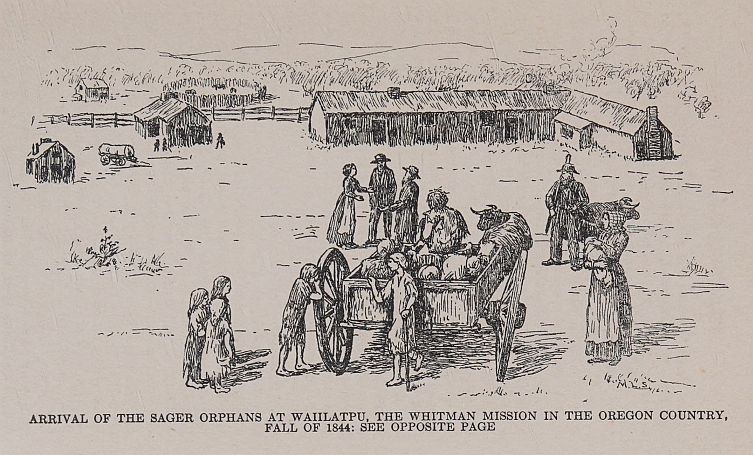
ARRIVAL OF THE SAGER ORPHANS AT WAIILATPU, THE WHITMAN MISSION
IN THE OREGON COUNTRY, FALL OF 1844: SEE OPPOSITE PAGE
The arrival of the cart load of orphans at Waiilatpu presented a sight worthy of the brush of some great artist to transfer it to canvas, for such a combination of circumstances seldom occurs in real life. All that then remained of their once complete outfit was in the foreground; and the emaciated, nearly exhausted oxen dropped down to rest as soon as they were unyoked. John, the oldest boy, was seated in the front end of the cart, his ragged garments covered with a heavy coating of grey dust from the sagebrush plains, while his woe-begone countenance and tear-stained cheeks clearly indicated his supreme anguish.
Francis, the younger boy, was leaning on one wheel of the cart, his head resting on his arm and sobbing audibly. On the near side, the three little girls were huddled together bareheaded and barefooted, looking at the boys and then at the house, dreading whatever might happen. Close to the oxen stood the German doctor with his whip in hand and kindly eyes viewing the scene with suppressed emotion.
The baby member of the family was in the care and custody of Mrs. Shaw, whose husband somewhat thoughtlessly asked Mrs. Whitman if she had any children of her own. Stopping at the threshold, the good woman pointed to the little grave on the side of a small mound easily seen from that point, and replied, "The only child {283} I ever had sleeps yonder." In the tone of her voice and the expression of her face there was unspeakable sadness. Only a few years later John and Francis were brutally murdered at the same Mission House by infuriated Indians, and all the girls taken into captivity. That family certainly was tried in the crucible; and never in my experience have I found a parallel to it.
* * *
Up to the present time fully nine-tenths of the emigrants going to the Oregon Country have settled in the Willamette Valley—a very large and fertile valley, probably seventy or eighty miles long by some ten or twelve in width. It is flanked on either side by ranges of heavily timbered hills, and traversed by the large Willamette River, which is fed by numerous streams issuing from the adjacent mountains on its course northward to join the mighty Columbia. The climate is remarkably mild and entirely free from extremes of temperature; and its very fertile soil produces small grains such as wheat, oats and barley, in great abundance. Vegetables of every kind grown in the temperate zone do remarkably well, while fruits such as apples, pears, plums and cherries are not only raised in great quantities, but are generally superior to the same varieties in the Atlantic States. Fish and game are also quite plentiful. Since the discovery of gold in California, that region has been an excellent market for everything raised at fancy prices; if this condition continues, the Oregon farmers will soon be more prosperous than the California gold miners.
There is also a vast region north of the Columbia, heavily timbered but interspersed here and there with numerous fertile valleys, which in recent years have been receiving many immigrants who claim to see a great future ahead. Even in the eastern portion of the territory, which is still occupied almost exclusively by Indians, shrewd men see possibilities of large settlements springing up within the next few years.
It is a wonderful country to which you are going, and you will probably never have cause to regret the decision.
[1] As this narrative was told in the early 1850s, "half a century ago" refers to the period shortly after 1800.—E.M.
[2] Companion of Capt. Meriwether Lewis on the Lewis & Clark Expedition of 1804-6; 1st Lieut. U.S.A., Jan. 31, 1806 (resigned Feb. 27, 1807); appointed Brig.-Gen. of Militia by Thomas Jefferson, March 13, 1807; Governor of Missouri Territory 1813-21, and afterward, including the time of the visit of these Indians, Superintendent of Indian Affairs at St. Louis until his death in 1838. Brother of Gen. George Rogers Clark.
THE WORK BEGUN AND CARRIED ON FOR TWO DECADES BY EZRA MEEKER TO BE CONTINUED ON A LARGER SCALE BY THE OREGON TRAIL MEMORIAL ASSOCIATION, INC. OBJECTS: PLAN: MEMBERSHIPS:
More than twenty years have elapsed since the author started, January 29, 1906, on a return trip over the Oregon Trail, which he had traversed with an ox-team when just past 21 years of age, accompanied by a brave young wife and a babe, nearly fifty-four years before. The first journey was in search of a home in the Oregon Country, of which he has now been a resident for over seventy-three years; and the second one to rescue from impending oblivion the memories of the Pioneers by rediscovering the Trail they followed, and erecting permanent monuments to honor their heroic achievements.
A third trip was made with the ox-team in 1910 to continue and enlarge the effort; a fourth one with an automobile in 1915 to enlist the co-operation of the motoring public in the great work, and finally a fifth by aeroplane in October, 1924, when he looked down from the air at a speed of 100 miles per hour upon the route previously followed at an average of about two miles an hour by a migration of at least three hundred thousand, of whom not less than twenty thousand gave up their lives on the way. Although a total of nearly two hundred monuments and markers have been {285} placed along or nearby the old tracks, the plan as a whole is still incomplete; and the desirability of carrying it forward beyond the limitations of a single life, unquestionable.
On January 9, 1926, the OREGON TRAIL MEMORIAL ASSOCIATION, INC. was organized under the laws of the State of New York, for the following specific purposes:
1. To search out, identify, suitably and permanently mark the line of the Oregon Trail, in so far as possible at this time, with or without visible marks of the old tracks.
2. To erect suitable monuments or memorials on or nearby the sites of historical forts, trading posts or other important landmarks along the Trail, such as Fort Kearney, Fort Laramie, Fort Hall, Fort Bridger and others of distinct historical interest.
3. To restore the Whitman Mission in the County of Walla Walla, State of Washington, as the same existed at the date of the Massacre, November 29, 1847; to establish, or promote the establishment of, a park or other memorial to appropriately commemorate the sacrifice of Marcus and Narcissa Whitman, and the other victims of that historic tragedy; also to identify other localities where massacres are known to have taken place, and to suitably mark them.
4. To promote, encourage or portray in moving pictures, vividly recording the historic scenes on the great emigration over the Oregon Trail, with a reproduction of the characteristic scenery along the route, for use in the schools of the Nation, teaching exact and truthful history by such methods.
5. To collect and preserve written accounts, objects of interest and other things pertaining to the history of the winning of the Pacific Northwest; to deposit same with the historical societies, preferably in the States where found, or to designate a Museum or {286} museums to preserve such records, relics or objects of interest as may be donated or otherwise acquired; and erect a suitable memorial to the Pioneers, most appropriately in the City of Washington.
Membership consists of two classes—Annual and Life. Any citizen of the United States, of adult age, shall be eligible for membership by the payment, annually, of two dollars ($2); or for a Life Membership by one payment of fifty dollars ($50). No assessment of members shall be made; nor shall membership involve any financial obligations beyond the stated fees or dues to the Corporation.
The considerable number of men and women who have already become identified with the organization are devoting their time and money to perpetuate the memory of the Pioneers, all but a few of whom have gone to their reward, and to preserve the history of the great overland migration which was the principal factor in advancing the northwestern boundary of the United States to the Pacific Coast. Work will be started in the field as soon as sufficient funds are secured to enable it to be carried forward on the high standard outlined. Success in accomplishing these objects depends upon public confidence and support; and the reader of this volume is invited to become a member.
OREGON TRAIL MEMORIAL ASSOCIATION, INC.
Ezra Meeker, Rev. David G. Wylie, D.D., LL.D.
President Secretary
18 Old Slip, New York City
WORKS BY EZRA MEEKER
LOVED BEFORE SEEN (1874), a Story of Pioneer Life.
WASHINGTON TERRITORY WEST OF THE CASCADE MOUNTAINS (1870), a descriptive pamphlet, out of print and rare; as high as $100 has been paid for single copies.
FARM AND HOME, an editorial series of 52 numbers, 1884-6; newspaper publication only.
HOP CULTURE IN THE UNITED STATES (1883); rare and out of print.
PIONEER REMINISCENCES OF PUGET SOUND, AND THE TRAGEDY OF LESCHI (1905); 550 pages in two volumes under one cover, silk cloth binding, $15.00.
SHORT STORIES FOR CHILDREN, each with a moral.
THE LOST TRAIL (1911-12-15), a booklet of 32 pages, of which several editions totaling a hundred thousand copies, have been issued.
THE OREGON TRAIL, VENTURES AND ADVENTURES, revised and republished under title of THE BUSY LIFE OF EIGHTY-FIVE YEARS (1916); 400 pages, $1.65, postpaid.
FIFTY YEARS OF PROGRESS IN WASHINGTON (1915); 400 pages, $5.00 postpaid.
KATE MULHALL, a Romance of the Oregon Trail (1926); this volume, $2 postpaid, with the usual discounts to the trade.
In active preparation (1926): A CENTURY OF BUSY LIFE—the biography, varied experiences as pioneer, farmer, author and traveler, including four years in Europe, and the "homespun" philosophy of Ezra Meeker, 1830-1930 (borrowing a few years from the future, through which the author confidently expects to live, and thus justify the title chosen for this work), amplifying and carrying forward THE BUSY LIFE OF EIGHTY-FIVE YEARS in more definite historical retrospect.