
Title: Claribel
or, Rest at last
Author: Lucy Ellen Guernsey
Release date: February 26, 2026 [eBook #78044]
Language: English
Original publication: Philadelphia: American Sunday-School Union, 1873
Other information and formats: www.gutenberg.org/ebooks/78044
Transcriber's notes: Unusual and inconsistent spelling is as printed.
New original cover art included with this eBook is granted to the public domain.
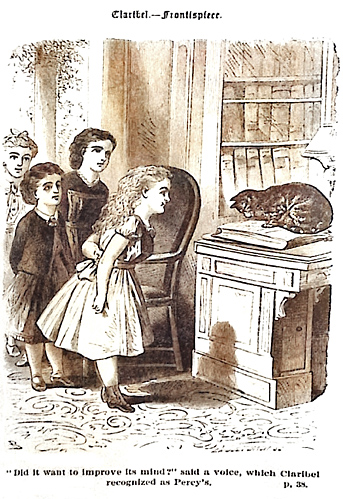
Claribel.—Frontispiece.
"Did it want to improve its mind?" said a voice,
which Claribel recognized as Percy's.
[The Round Spring Stories.]
OR,
REST AT LAST.
BY
LUCY ELLEN GUERNSEY
AUTHOR OF "IRISH AMY," "OPPOSITE NEIGHBOURS," "COMFORT ALLISON,"
"THE TATTLER," "NELLY; OR, THE BEST INHERITANCE," "TWIN ROSES,"
"ETHEL'S TRIAL," "THE FAIRCHILDS," "THE SUNDAY-SCHOOL EXHIBITION,"
"THE RED PLANT," "PERCY'S HOLIDAYS,"
"ON THE MOUNTAIN," "RHODA'S EDUCATION," ETC.
—————————
PHILADELPHIA:
AMERICAN SUNDAY-SCHOOL UNION,
NO. 1122 CHESTNUT STREET.
—————————
NEW YORK: 8 & 10 BIBLE HOUSE, ASTOR PLACE.
———————————————————————————————————————————————————————————————
Entered according to Act of Congress, in the year 1873, by the
AMERICAN SUNDAY-SCHOOL UNION,
In the Office of the Librarian of Congress, at Washington.
———————————————————————————————————————————————————————————————
—————————————————
————————————————
WESTCOTT & THOMSON
HENRY B. ASHMEAD
Stereotypers and Electrotypers, Philada.
Printer, Philada.
CONTENTS.
——————
THE NEW SCHOLAR
"BITTER HONEY FROM FAIR FLOWERS"
BAB
OPENING THE DOORS
FANNY
PRISCILLA
LITTLE MADGE
YELLOW COVERS
EXPLANATIONS
CLARIBEL.
————————
THE NEW SCHOLAR.
"WE have got a new boarder, girls," said Emma Hausen, joining a group of her companions, under a great tree on the lawn. "She has just come up from the boat with Uncle Hausen. I believe he went to the Bridge to meet her."
"What is she like?" asked Tilly Mansfield. "Does she look nice?"
"I didn't see her face—she had a thick crape veil over it; but she is in deep mourning which looks quite new, and she is lame. She walks with a crutch."
"Poor thing!" said Eva Church. "How old should thee think she was, Emma?"
"How can I tell, child, when I didn't see her face at all? She is about as tall as I am, but larger. She was very nicely dressed, and has two large trunks; and, as I told you, she walks with a crutch. So there 'you have the sum of the facts which have come under my immediate observation,' as Professor Ashhurst says."
"Poor thing!" said Percy Dunham.
"Why poor thing?" asked Tilly. "Do you know her, Percy?"
"No; I never saw or heard of her; but I know it cannot be very nice to be lame, and Emma says she is dressed in new deep mourning; so she must have lost some near friend—her mother, perhaps."
"Lame people are not always unhappy," remarked Tilly. "There is old Uncle Jacob; he is lame, and poor too, and I don't believe any person in Round Springs is happier than he is; and only just look at Bab!"
"I think Bab's tail rather preys on his mind, though, when he compares it with Molly's," observed Percy, seriously.
"What nonsense you do talk about those cats!" said Rebecca Stiney, who always took everything literally. "I should think you would be ashamed."
"What is there to be ashamed of?"
"Talking as if a cat could have a mind of his own."
"You just try to make Molly do something she doesn't like, and see if she hasn't a mind of her own," said Percy. "But here comes Florry Lester. Florry, have you seen the new girl?"
Flora nodded.
"What is she like?"
"Well, she is odd-looking, but I dare say she was tired out, poor thing. She has been travelling all night, I heard Mr. Hausen say, and it must have been hard, for she does not look as if she could be strong. She is very lame, for one thing, and it is a curious kind of lameness, which makes her rather awkward, and she is pale and dark, and looks as if she might be cross."
"I dare say she is only tired," said Percy. "Once, in New York, I went shopping all one horridly cold, wet morning with a cousin of Aunt Ackerman's and Cousin Margaret. Now aunt's cousin was absurdly particular and perfectly sure that everybody meant to cheat her, and I thought we never should be done with running about from store to store; and, after all, she went back and took the very first thing she looked at.
"Well, we went into a store where there were beautiful mirrors set flat in the walls. I saw, as I thought, a girl of my own age standing at the end of the counter, and I said to myself, 'How cross that girl looks!'
"And when I looked again, I saw it was myself I was criticising. But I did not feel cross at all, only tired with standing about so long. It has always been a lesson to me, and when I see such a kind of face, I always say to myself, 'I dare say she is tired or has the face-ache, or perhaps she has on new shoes and they hurt her, as mine did that day, I remember.'"
"Does any one know this poor girl's name?" asked Tilly.
"Yes; I heard Uncle Hausen tell Mrs. Richardson: it is Claribel Woodworth."
"She ought to be nice with such a pretty name," said Tilly. "I do think we are the greatest people for fine names in this school—Claribel, and Blandina, and Eva, and Matilda, and Amabel: it sounds like an old-fashioned novel."
"Don't forget my romantic name—Perseverance," said Percy, laughing. "I think it ought to outweigh any number of Claribels and Amabels. Anyhow, girls, we ought to take pains to make things pleasant for this new scholar. If she is sick and lonely, she will have a hard time enough."
"That's so," said Fanny Morey, emphatically. "Most of you don't know anything about that, because you have never been to any school but this, which isn't one bit like a school. But I remember how I felt when I was first turned loose in the primary department of Eaton College. There were two hundred girls of all ages, all strange, and I, a poor little mite of twelve, just as shy as a young fox, and knowing nothing of school life, was left to make my own way among them. Oh how homesick I was! I really used to think I should die. Then the lessons were so hard, and there were so many of them, and the teachers never had time to explain anything. If a girl was strong and bright, she got on well enough, but if she were lazy, as a great many were, or dull and not very strong, as I was, she might go to the wall. There was no help for her."
"But didn't the girls help each other?" asked Percy. "Didn't the older girls help the little ones? I am sure I don't know how I should have got on here when I first came if Blandina hadn't taken me up."
"They never had any time, child; it was all they could do to learn their own lessons. As I said, the lazy girls shirked and did nothing, but I really did want to improve very much, for I knew it was hard for father to keep me at school, any way, and I nearly killed myself the first term. I used to be doing lessons all night when I was not being buried alive, or chased by wild beasts, or something else as pleasant. I don't believe I should have lived through the year if I had stayed there."
"And how did you get away?" asked one of the girls.
"Oh, I went to spend my spring holidays with Doctor Gregory, my mother's brother, in Yonkers, because, of course, I wouldn't go all the way home to Texas for so short a time. Aunt Emily found out that I did not sleep, and told my uncle; and when he heard all the story, he would not let me go back, but wrote to father about me. I stayed with them all summer, and didn't do anything much, only take some music-lessons and lie on a sofa put out on the verandah or under a tree, for my back was weak and ached all the time. Then in the fall, uncle sent me here, and oh, wasn't I glad? I'll tell you what: you Hausen girls don't know half your privileges. When I hear some of the grumblers, I say to myself, 'I just wish you were at Eaton College a while.'"
"I'm sure I wish I was," said Rebecca, taking the remark to herself; "I think there would be a great deal more chance for fun where there was so many girls. Here one can't do a thing but everybody knows it."
"Yes, very nice fun, flirting out of the windows and running away down town and getting into all sorts of scrapes."
"What kind of fun does thee want that thee don't care to have people know about?" asked Eva. "For my part, I thought we had plenty of fun."
Rebecca looked rather abashed, and walked away without answering.
"Becky said rather more than she meant to that time," observed Fanny. "I think she would like just that kind of a school. She does love to make mysteries. I believe she would rather eat a brown cracker slyly than a piece of plum-cake at the table."
"She ought to be more careful, or she will be in trouble," said Emma; "Uncle Hausen does hate secrets and mysteries, and especially anything like deceit. But, girls, what can we do for this new-comer to make it pleasant for her when she comes down?"
"She won't be down this evening," answered Flora Lester. "I heard Mrs. Richardson tell her that she had better put on her wrapper and rest, and that she should have her supper up stairs, because she was so tired."
"Then I'll tell you what we will do," said Tilly; "you know papa said I might have all the fruit and flowers I wanted from our garden. I mean to get some of those early pears, and two or three nice peaches, and a bunch of grapes from the grape-house, if I can find James to unlock the door. And I will get some pretty flowers, and Flora shall arrange them all in a basket, because she has the best taste, and we will carry them up to her before tea. Won't that be nice?"
"Splendid!" exclaimed Fanny. "And while you and Flora are getting the garden things, Emma and I will go up among the rocks and gather some ferns to line the baskets. Mrs. Richardson will give us leave, and we shall have plenty of time."
"BITTER HONEY FROM FAIR FLOWERS."
AND where, all the time, was the subject of their conversation, and of all these kind and hospitable thoughts? Not resting, as she had been advised, and as she needed to do, but sitting at the window of her own room, peeping out through the blinds at the group of girls under the tree, and straining her ears in vain to hear what they were saying.
"Of course they are talking about me," she said to herself; "that black-haired girl was the one we met at the door, and that one in the white apron stopped and spoke to Mr. Hausen just in time to hear my name. I saw her turn up her nose at it, and well she might. 'Claribel' for such a miserable-looking object as I am! Oh, it was cruel and wicked to send me among such a set of strong, healthy girls all ready to laugh at me, or to pity me, which is worse still. They might have let me stay at home with Aunt Hepsey. Suppose I hadn't any advantages; what do I want of them? What should I do with accomplishments? Music and painting indeed! I wonder Mr. Steele didn't want me to learn dancing as well," said Claribel, laughing bitterly. "Yes, there they are," she added, glancing out of the window again. "There comes another one to discuss the new-comer."
We who have heard the conversation under the great ash, and who have seen more of Flora, know how mistaken were Claribel's ideas. But Claribel's mind was one which could extract poison from the most wholesome food. She had seemed to be marked for misfortune from her birth. She was not, as a child, "quite like other children," people said. Though not absolutely deformed, she had the look of being so. Her shoulders were high and square, her head large and heavy, especially over her eyes. A severe fall from the hands of a careless nurse, and broken bones treated by an unskilful surgeon, had stiffened one knee and turned her whole figure slightly awry, besides leaving a scar on her forehead.
Then her mother died when Claribel was only six years old, and left her to the care of an aunt, who thought Claribel's lameness and delicate health a sufficient excuse for indulging her in everything she fancied and never contradicting her in anything. But Aunt Hepsey had daughters who were not always so indulgent to her nursling's whims, and who sometimes revenged themselves for their mother's partiality, as they considered it, by taunting Claribel with her personal and mental defects. She was no favourite with the children of the little village school or their teacher, who, already overworked and harassed, had little patience with the peevish, perverse child.
Altogether, it was no wonder that Claribel's disposition should be pretty well soured before she was twelve years old, and, as the Scotch say, "thrawn" it certainly was. She loved Aunt Hepsey, though she did not respect her. She hated her cousins and most of her schoolfellows. Toward her father she felt very differently at different times. He had always been indulgent to her in providing for her every luxury that money would buy. And during the few days which he had ever spent with her, he had petted and pitied her.
Sometimes Claribel thought she should be perfectly happy if she could only live with her father, and took refuge from present discomforts in picturing to herself the time when she should go to be his housekeeper and see all the wonders of California. Then again, she felt that he neglected her cruelly in leaving her to live with her aunt and cousins in an obscure country village, and this feeling was deepened and made permanent by a speech of her cousin Priscilla's in the course of one of their numerous quarrels. Claribel had said something of the time when she should go to live with her father, and Priscilla had answered her, scornfully,—
"Oh yes! Very much you will go to live with your father! I guess when you do, we shall all know it. Just as if everybody didn't know that your father leaves you here with us because he is ashamed of your crooked ankles, and your shoulders up to your ears, and your yellow face, all eyes and mouth! And no wonder! I should think he would be. You will, go and be a great lady in California about the time I am queen of England, I expect."
"It is no such thing, Priscilla Westcott!" exclaimed Claribel, passionately. "My father isn't ashamed of me."
"Oh no, of course not," answered Priscilla, with a mocking laugh. "Why does he leave you here, then? Why doesn't he take you home with him, or send you to school somewhere and give you an education? Only because he is ashamed of you and thinks you are a disgrace to him. I know he wishes you had never been born. I heard him say so myself."
This was a lie, but, like many lies, it was founded on fact. Mr. Woodworth had once said to his sister that it might have been better the poor little thing had never been born, she was so unfortunate. Priscilla was one of those people who, when they are angry, say whatever they think will hurt most, without caring or considering whether it is true or false. She little knew the mischief she had done. She had given her spite full swing, and having gratified it to the utmost, was quite ready to be good-natured again and forget that she had ever been otherwise.
But her words sunk deep into the heart of the unfortunate child, and rankled there like poisoned arrows. When Claribel came to think them over, a thousand circumstances seemed to confirm them. Yes, it was so. Her last hope, her last refuge, was gone. Her father was ashamed of her; he hated her, and wished she was dead. All her fancies about going to live with him were mere delusions. She was doomed to spend her life in this horrid place with people she hated, and who hated her, or only cared for her—so the tempter whispered—for the sake of her father's money. Well, she did not care. Everybody despised her, and she despised everybody. Nobody cared for anything but self, and why should she?
There was only one medicine for a mind diseased like Claribel's, and that was the religion of Christ. But no one proffered it to her. Aunt Hepsey had once been a church-member when she lived at the East, but she had married an irreligious man and moved West, and like too many other people in the same circumstances, she seemed to leave her religion behind her. Claribel's mother had taught her to say her prayers and something of the first truths of religion, but Aunt Hepsey had not continued the lessons.
True, the children went to Sunday-school, but their attendance was irregular and their lessons learned or not, as the fancy took them. Then Claribel took some offence and would not go any more, and her aunt, as usual, let her have her own way. She had a Bible which had been her mother's, and she kept it on her table, but she seldom looked into it, and never thought of the possibility of its affording her any comfort. She had never been taught to regard God as her Father; and if she ever thought of him at all, it was with a kind of resentment mingled with fear. Why had he made her so? Why had he taken away her mother and given her a father who was ashamed of her? He could kill her, she knew, and she did not care much for that, but then there was something to come after death—Claribel remembered enough of her mother's lessons to feel sure of that; and what would become of her then? She believed that her mother was happy in heaven, but she felt, poor child, that she was not fit for any such place, and she did not think she ever would become so. All she could do was to get as much comfort as she could out of this life, and very little it was. The rest must take care of itself.
When Claribel was fourteen, her father died, leaving his only child a large fortune and a guardian in an old college friend. Mr. Steele was a lawyer, and not a man to do anything rashly or to undertake any trust which he did not mean to fulfil to his utmost ability. He took a fortnight from his business and spent it in Smithopolis, making acquaintance with Claribel and observing her circumstances and the influences which surrounded her, and then he made up his mind. He could not leave her where she was, neither could he take her into his own house, for his wife was an invalid and already overburdened with a young family.
Mr. Hausen and Mr. Woodworth were old friends. Mr. Steele knew and respected him, and his sister had been educated at the Hausen school. And after some consideration and correspondence, it was decided that Claribel should be sent to Round Springs to remain till her education was considered finished.
Aunt Hepsey exclaimed against the cruelty of sending the poor thing away among strangers—among a set of strong, healthy, romping girls who would laugh at her, and of teachers who would kill her with lessons and then scold her because she did not learn them. And she pitied Claribel till Claribel, who had at first been pleased with the idea of a change, learned to shrink with terror from the prospect before her, and to look on her guardian as a tyrannical oppressor made after the pattern of the wicked guardians in the cheap novels who send their wards to starvation schools that they might be out of the way, and thus cheated them out of their property.
Having these ideas put into her head did not tend to make Claribel more amiable. And during the long journey, she proved so disagreeable a travelling companion that Mr. Steele found his pity and forbearance taxed to the uttermost, and was thankful to get her off his hands.
"I fear you will have a hard task with the poor thing," he had said to Mr. Hausen. "If my wife had been well, I should have taken her home and tried to civilize her a little. She does not seem capable of a thought outside of herself."
Such was Claribel Woodworth, who now sat in her pleasant little room at Hausen school looking out at her future schoolmates and drawing her own conclusions about them, and feeling sure that they were criticising her. Presently the group of girls under the ash tree broke up and went their several ways, and then Claribel laid her head down on the window-seat and cried bitterly and hopelessly.
"Oh, I wish I had never been born! I wish I had never been born!" she said, passionately, over and over again. "Oh, it was wicked and cruel to send me here. It was cruel to take my mother away from me. She would have loved me, I know. It is all cruel and hard together. Oh, mother, mother!" Claribel had dried her tears—she seldom cried—and sat looking out with an expression of sullen and hopeless despondency, when there came a tap at the door.
"Come in!" said she, sharply.
Then, as the tap was repeated, she went to the door and opened it. There stood a group which would have pleased any eyes but hers. Emma Hausen was holding a tray on which was neatly arranged a tempting supper, and behind her were Percy and Tilly, the one carrying a bouquet, the other a little basket of peaches, early pears, and hothouse grapes.
"How do you do, Claribel Woodworth?" said Emma, whom the girls had deputed to "do the honours," as they said. "This is Percy Dunham, and this is Tilly Mansfield, and I am Emma Hausen, and we have come to bring you your tea, and to see if we can do anything for you."
For a moment Claribel was pleased and touched. Then the old evil spirit of suspicion and jealousy came back, and she answered, "I don't want any tea or anything else, only to be let alone."
The girls looked at each other in amazement, not knowing what to make of such an address.
Then Percy said gently, "Don't you think you had better have some tea? I am afraid Mrs. Richardson won't like it if we carry the things down again."
"Why didn't she send a servant with it, then?" asked Claribel. Then, as Percy hesitated, "I suppose you wanted to stare at the wild animal. Well, look at me then; what do you think of me?"
"I don't think you are very polite," said Emma Hausen.
"Hush, Emma," whispered Percy, who was always the peacemaker. "We didn't come to stare at you at all, Claribel. When a new scholar comes, Mrs. Richardson always sends some of the girls to take her to the table or to carry her up something if she can't come down. You are about our age, and we thought we would try to make it pleasant for you, that's all."
"I don't want it made pleasant for me," returned Claribel; "I hate the place and everybody in it."
"Oh, but that is because you are homesick," said Percy, soothingly. "When I first came here, I felt just so—that is, I couldn't bear the thoughts of it—and I was afraid of everything. But I like it now, and so will you, I hope. We will set the things down and go away if you like, but please don't think we came to stare at you, because we never thought of such a thing; did we, girls?"
"Of course not," said Tilly, bluntly; "what is there to stare at?"
If Tilly had thought for a week, she could not have said anything more to the purpose. Claribel began to feel a little, a very little, ashamed of herself.
"Well, perhaps you didn't," said she, in a somewhat more gracious tone, "but I am such an object I always think people want to look at me."
"I don't see that you are an object at all," said Tilly; "and if you were, why should we stare at you? It isn't your fault that you are lame, I suppose. If you are only good-natured and nice, nobody will care whether you are lame or not."
"Oh yes, it is easy to say that. It is easy to be good-natured when you are well and everything goes just to suit you; wait till your turn comes. As for people liking me, I don't expect them to."
"It would be rather unreasonable if you did, I think," thought Emma Hausen, but for a wonder she did not say so.
The girls arranged the table neatly, and then, bidding Claribel good evening, went away.
When Claribel was left alone with the provisions the girls had brought, she discovered that she was hungry, and made a hearty meal. She could not help feeling a little vexed and ashamed at her conduct.
"I wish I hadn't spoken so," she said to herself; "but, after all, I dare say it was true. They just wanted to show themselves off and to make believe they were good, and they contrived to get the first look at me, so as to tell the others."
"Well," said Emma Hausen, when the door was shut, "I don't think I shall ever take much pains to be polite to her. Did you ever see anything like her in all your life?"
"I don't envy Miss Reynolds and Mrs. Richardson," said Tilly. "Percy, I do think you are just as sweet as an angel to answer her so, when she was rude to you."
"I remembered how I felt when I first came here," answered Percy; "I was as frightened as if I had been going into a cage of wild animals."
"You didn't behave like that," said Tilly; "you acted as if you were scared half to death if any one spoke to you, but you were always polite. I never saw such a specimen as this in all my days."
"Nor I, but I can't help feeling sorry for her," remarked Percy. "Just think if any of us were like her! I dare say we should be as cross as she is."
"I am sure dear Miss Baldwin never was so cross," said Emma, alluding to a favourite teacher who had died a short time before. "Just think how unfortunate she was! And nobody could ever be sweeter."
"Miss Baldwin never seemed to think about herself at all," observed Percy; "she was always too busy caring for other people. But there come the girls from boating, and there is the first tea-bell. Girls, don't let us say anything about this poor Claribel to the others. Perhaps she will feel differently tomorrow, and we won't give her a bad character beforehand."
BAB.
THE next day being Saturday, there were no lessons to do, and Mrs. Richardson advised Claribel to spend the morning in unpacking and arranging her clothes.
"I shall not unpack my clothes," said Claribel, sullenly; "I am not going to stay here."
"Oh yes," said Mrs. Richardson, soothingly, but apparently not in the least alarmed; "this will be your home for the present. I hope you will find it a pleasant one, but of course that must depend very much on yourself. I shall expect you to put your clothes in order; or if you do not feel able, I will send some one to do it for you. Dress yourself neatly, and be ready for dinner at one. Saturday being a holiday, we dine earlier than on other days."
Claribel was a little awed. She had never met any one exactly like Mrs. Richardson. The principal was a small, delicate-looking lady, with fine features and beautiful soft hair, which was quite gray, though she did not look old. She spoke very gently and softly, but there was something in her voice which commanded attention and obedience. Claribel felt that, but she did not like to give up quite yet, so she answered shortly again:
"I shall not go down to dinner. I don't want to be stared at by all the girls as if I were a gorilla. If I have got to stay here, I will stay in my own room, whether I have anything to eat or not."
"Listen to me, Claribel," said Mrs. Richardson, laying her hand with a light but firm pressure on Claribel's arm; "you have come here to live because it has been thought best by those who have the care of you, and that you may acquire such an education as will make you a useful and happy woman. If you are good and obedient, and take pains to make yourself agreeable, you may be very happy here, as the other girls are; if you are disobedient and sullen, you will make yourself and us a great deal of trouble, and yet you will have to stay all the same. There is no help for that. You need not be afraid that the girls will stare at you or do anything else to annoy you. I don't wonder that you feel sadly about leaving home and coming among strangers, but you will soon feel at home here. Come, now, make up your mind to be pleasant and good, and all will be well. Do you like to read?"
"Yes, ma'am," answered Claribel, a little more graciously, for she was won in spite of herself. "I like it very much, but we had hardly any books at home. Priscilla used to buy all sorts of rubbishing novels when she went to Lumber City, but I couldn't bear them."
"I am glad to hear you say so," remarked Mrs. Richardson; "we will see if we can't find something you will like. We have a very fine library, and the girls read as much as they please."
"Priscilla said you wouldn't have anything but great, heavy, stupid books like Josephus and Rollin," said Claribel; "we had those books at home, but they were in such large volumes and such fine print that I couldn't read them. Once I found part of a beautiful story about a knight and some ladies who were taken prisoner by robbers and carried to a castle, and the castle was set on fire. Oh, it was lovely," said Claribel, warming up—"not a bit like the rubbish Priscilla is always reading; but I never could find any more of it."
Mrs. Richardson smiled: "I know the book you mean, and will find it for you in the library; it will come in nicely, for your history class are just at that point in their English history, and they have all been reading this book. Do you think, my dear, that you can unpack your clothes?"
"Oh yes, ma'am."
"Then I will leave you to yourself till dinner-time, and then send or come for you. Good-bye for the present."
Mrs. Richardson kissed Claribel and departed, leaving her in a curious state of mind. She felt herself entirely conquered, and yet she was not sorry to be conquered. Claribel was not at all deficient in strength of mind. She was capable of respect, and she felt that she had found some one worthy to be respected. She was delighted at the prospect of having plenty of books to read, and not displeased at the thought of acquiring a good education.
"I wonder if I could take drawing and painting lessons?" she said to herself. "I am sure I could learn to draw. I don't care so very much about music,—only singing,—but I should like to be a great artist and have my pictures admired all over the world. People would respect me then. I don't think I should dislike living here so much, only for the girls. I know they will laugh at me. But then, if I get on with my studies—and I can, I know—I will make them think I am somebody."
I once heard it remarked of a very vain man that he dreamed in the first person singular. Claribel certainly thought in the first person singular. She had got into the "contracting chamber" of Mrs. Charles's pretty allegory, and of course it contracted round her more and more. She considered everything and saw everything only as it affected herself. She was in prison—a very small, dark, and narrow prison, indeed—and it remained to be seen whether she was ever to get out of it.
Claribel unpacked her clothes and other possessions, feeling a certain pleasure in their freshness and prettiness, for Mr. Steel had thought it best that she should have an entirely new outfit of everything. She even felt a slight twinge of mortification as she took out her pretty writing-desk and dressing-case, and wished she had been a little more gracious to her guardian.
Mrs. Richardson herself came up for Claribel at dinner-time, and gave her a seat next herself. Percy and Tilly sat near her and welcomed her with smiles, for they were not disposed to bear any malice against the poor lame, sickly stranger. After dinner, she went to the library, and Miss Foster, the librarian, found her the volume she wanted.
"You can sit down and read here, or anywhere else you like," said Mrs. Richardson, "only you must be sure not to leave your book out of place. Carry it to your own room, and next Saturday bring it back here."
"But suppose I haven't finished it?" said Claribel.
"Oh, then you can take it again; but we wish to keep a register of all the books, so as to learn where they are."
"Don't you want to come out on the upper verandah?" asked Percy, who had also come for a book. "It is nice and shady, and there is such a beautiful view."
Claribel consented, and got through the afternoon without giving or taking any new offence.
"Isn't she queer?" said Percy to Flora after they had separated. "Do you think you shall be friends with her?"
"I never saw anybody like her," answered Flora. "She doesn't seem to think anybody but herself is of any consequence at all. Did you see how she went and took Eva's seat the minute she left it? And though Eva came back directly, Claribel never seemed to think of giving it up to her. If I had been Eva, I would have asked for it."
"No, you wouldn't," said Percy; "you would have done just as Eva did. But I suppose Claribel has been sick a good deal, and that does make people selfish sometimes—not always, though. Mamma was sick a great deal, and papa used to say she hadn't any self."
"Well, we won't judge in too much of a hurry," said Flora, sagely; "I dare say she will improve. I heard Mr. Hausen say she had had very few advantages."
For some days, matters went on with tolerable smoothness. Claribel was examined as to her studies, and to her own surprise was put into the same classes as Percy and Flora. This was rather a stretch on the part of the authorities, and Miss Reynolds warned Claribel that she would have to study hard to keep up. But Mr. Hausen thought it better she should do so than that she should be mortified by being classed with girls much younger than herself. Claribel would have resented the consideration if she had known of it, but she never thought of such a thing. She was allowed to begin drawing lessons directly, and showed a talent which surprised and delighted Mrs. Claxton, the teacher.
"You will make an artist if you only have perseverance enough," said she, "but you must make up your mind to work hard."
"I don't care how hard I work when the work is what I like," answered Claribel.
"I dare say. That is the case with most people," said Mrs. Claxton, smiling. "But if you mean to be an artist, you must learn to work hard at what you don't like."
One pleasant morning, Claribel was sitting busily studying her history lesson on the landing-place outside her room door. This same landing was rather a special place of attraction for the younger girls. It was broad and roomy. The stairs turned two different ways from it, and there was a low, shady window with a broad seat which was just over the outside door, which opened into the library. It chanced this morning that the wind blew into Claribel's window; and remembering that the one outside had a different exposure, she betook herself thither, and sitting down on the window-seat just mentioned, began studying once more. She was just trying to fix in her head the date of King John's death, when she heard voices below.
"Was it a three-legged precious, then, and did it want to improve its mind?" said a voice which Claribel recognized as Percy's.
"So it should, then, and I guess nobody will look down on it when it knows all about Anglo-Saxon and things!" added Flora, in a voice of exaggerated sympathy. "I guess Molly won't despise it any more, now that it improves its mind, if it is a three-legged old dear."
"I think it is just a shame that Mr. Hausen don't get the poor thing a cork leg," said Tilly's voice. "Let's subscribe our own money, girls, and buy one."
"What's a cork leg when one's tenderest affections are wounded and trampled on, and all that kind of thing?" said Percy. "Can cork legs bring balm to a heart lacerated by a fuzzy-tailed tyrant?"
Now, there was one little word in this sentence which might have done something toward explaining the mystery if Claribel had only attended to it. But she did not. She jumped at once to the conclusion that the girls meant her. When Mrs. Richardson came to her room to see why she did not come to dinner, she found Claribel in a frenzy of rage, sobbing, and actually screaming.
While her next-door neighbour, who had heard her cries, was trying to quiet her, or at least to find out what was the matter.
"I can't make anything of it," said she, in answer to Mrs. Richardson's question. "She won't do anything but scream and say she will go home."
Mrs. Richardson had no better success. And while she was trying to get something out of Claribel beside inarticulate shrieks, Mr. Hausen himself came up stairs, passing through the little crowd of girls which the noise had assembled on the landing-place. His first move was to send every one away but Mrs. Richardson and himself. His next was to lock the door.
"Stop crying, Claribel!" were his first words. "Be still this instant! Do you think we shall allow such a noise as that in the house? Be silent!"
Never had Claribel been so addressed before. Aunt Hepsey had had a great dread of these screaming fits, or "tantrums," as she called them, and would give way in everything to avoid them. But it was clear that Mr. Hausen was not the least frightened. On the contrary, after waiting a moment, he renewed his command, with still more authority, not to say sternness. Claribel was rather alarmed, and made such an effort to quiet herself as she had never done before in all her life.
"Now, if you will try to speak reasonably, we will learn the cause of all this disturbance," said Mr. Hausen, when she had in a measure succeeded; "but speak quietly, and let us have no screaming."
Claribel told her story—that the girls had been insulting her and making fun of her and calling her names under the window; that she always knew they would, and that it was twice as mean to do it as they had done as if they had spoken to her face.
"What girls, and how did they do it?" asked Mr. Hausen.
"It was Percy, and Tilly, and Flora, and Fanny Morey. I knew their voices, and they meant I should."
"Impossible!" said Mrs. Richardson. "There are no better girls in the school."
"Call them," said Mr. Hausen; "let us hear what they have to say."
The girls were called, and great was their astonishment at the passionate accusation brought against them. Tilly bluntly denied it.
"I never thought of such a thing," said she; "Claribel must be crazy, I think."
"What names did we call you, Claribel?" asked Percy.
"You—you said I was a three-legged precious," sobbed Claribel, "and you said I ought to have a cork log, and that I was trying to improve my mind, so that Molly Richardson shouldn't laugh at me."
The girls exchanged glances. Percy smiled, and the others laughed outright.
"Oh, Mr. Hausen, it was Bab," exclaimed Tilly. "Miss Foster had down that great book of English history prints and left it open on the desk, and we found Bab sitting on the table before it looking just as wise as if he were studying the pictures. Then somebody said he was trying to improve his mind, so that Molly wouldn't despise him—you know she does despise him—and that was all. We never thought of Claribel or knew she was there. A likely story," added Tilly, rather indignantly, "that we should make fun of any one for being lame."
Mr. Hausen smiled in his turn.
"I begin to see through the mystery," said he. "Tilly, you may go and bring Bab here if you can find him."
All waited in silence, the other girls glancing at each other and trying to suppress their smiles, and Claribel feeling an uncomfortable misgiving that she had been making herself ridiculous.
Presently, Tilly came back, carrying in her arms a big white and brindled cat, which she set down on the floor.
Bab had once been a handsome animal of his kind, and was still plump and in good condition, but by some unlucky accident he had lost one forepaw and a large part of his tail, so that he presented a very comical figure. Bab seemed no way displeased at finding himself the object of so much attention. He limped about from one to another, purring loudly; and at last coming to Claribel, and seeming to think her in need of special sympathy, he jumped into her lap, and rubbed his big head against her chin with a kind of cooing noise.
"Well, I declare! What a compliment!" said Tilly. "I never saw him go to a stranger before. I guess he knows that Claribel likes cats; don't you, Claribel?"
Claribel murmured some inarticulate response as she bent her head down and fondled the old cat. She saw through the whole mystery. Never in all her life had she felt so ashamed of herself.
"You see how it was," said Percy; "we always talk to Bab as though he had sense, though I do think he has 'less' sense than any cat I ever saw."
"You always will say that, and I don't think it is fair," remarked Fanny Morey; "anyhow, Claribel, we were talking to him, as Percy says, and laughing at the notion of his reading to improve his mind. You would have laughed too if you had seen him, he looked so wise. But it was funny you should think we meant you."
"Well, never mind," said Mr. Hausen; "Claribel won't think so again, I am sure. There! Run away, all of you; and if Miss Van Ness can go with you, you may take out the small boat and see how you can handle her."
"Shall I leave Pussy?" asked Tilly.
"Yes, please," answered Claribel. And then, making a heroic effort, she added, "I am sorry I was so silly and made such a fuss; I won't do it again."
OPENING THE DOORS.
CLARIBEL hoped that Mr. Hausen would go away and leave her, but after the girls had gone, he returned, and sat down by her side.
"My poor little girl," said he as he took her hand in his, "why will you make yourself so miserable, when everybody wishes to make you happy? Why should you take such jealous fancies into your head, and make yourself so wretched over them? Why should you think that people want to insult you?"
"Because—because I am different from other people," answered Claribel. "You know I am, Mr. Hausen. You know I am a frightful little scarecrow, and never can be anything else."
"I know no such thing, Claribel. You are lame, to be sure, and unfortunate in other respects, but, you have a very fine head and beautiful eyes, and a face that might be very attractive if only—"
"Well, if only what?" asked Claribel, with animation.
"If only you would banish that ugly scowl and try to look good-natured and kind."
"Oh yes, it is easy to say that," returned Claribel, bitterly. "It is easy for people to look good-natured and kind when everything goes to please them and everybody likes them. I would be good-natured and kind myself, if I had a home and friends, and a fine figure like Tilly, or a beautiful fair skin like Fanny. Nobody could help being cross who was afflicted as I am, I know."
Mr. Hausen took from his pocket-book two card photographs, one of which he handed to Claribel. It was only a head and face, or vignette, as it is called.
"Oh how sweet, how lovely!" exclaimed Claribel. "I never saw a nicer face."
"You don't think she looks cross and unamiable?"
"No, indeed! She looks like an angel. Ah, if I were only like that lady!"
"Then you would be worse off in some respects than you are now, as you will see by this other picture," said Mr. Hausen, handing Claribel the other photograph.
It represented the same face, but on a body terribly deformed, and what is called hump-backed. Claribel uttered an exclamation of surprise and pity.
"Both of these pictures are portraits of the same person, as you see," said Mr. Hausen. "You perceive that she was more deformed than you are. Perhaps you have heard some of the girls speak of Miss Baldwin, a teacher who died here last term. You say she looks like an angel, and she certainly was as nearly ripe for heaven as any person I ever saw. Her father was supposed to be very wealthy. He gave his daughter an expensive education and every possible advantage, for he was fond and proud of her, unfortunate as she was. But he was a careless, self-indulgent man, and given to speculation. He was supposed to be rich, till one day he died very suddenly, and then it was discovered that he had absolutely nothing—that he did not own so much as the house he lived in; and poor Miss Baldwin, who had been brought up in every luxury, found herself fatherless and penniless at the same time."
"Poor thing!" said Claribel, much interested. "What did she do?"
"She sold her jewels and other valuables, of which she had a great many, and paid off the servants and such bills as were for necessaries, and then she looked about for means of making herself useful and independent at the same time. A friend recommended her to me as a teacher. She came here and lived with us till she went to her home in heaven, and I am sure that if ever the words, 'Well done, good and faithful servant,' were spoken to any one, they were to her. Now, my dear child, you have, I think, talents quite equal to Miss Baldwin's, and your advantages are likely to be as good as hers. Why should not you be as useful and as happy as she was?"
"I don't know," said Claribel, slowly; "I never thought I could be anybody. I wouldn't so much mind if I could only learn, so as to do something for myself and make myself famous."
"I don't quite like that way of putting it," said Mr. Hausen. "I would rather hear you say, 'If I could do something for others and make myself useful.'"
"But people liked Miss Baldwin," said Claribel, after a little consideration, "and nobody likes me—nobody. The girls don't like me, and even my own father was ashamed of me; Priscilla said so."
"Then Priscilla was very wrong. Your father was not ashamed of you; he may have erred in judging what was best for you, but I will show you some letters from him which will convince you that your welfare was his one object in life. But, Claribel, let me ask you a question. Why should you expect any one to like you? What have you ever done for any one—for the girls here, for example—that should make them like you?"
Claribel looked as if struck with a new idea. "I never thought of that," said she. "I never thought I could do anything."
"My dear, shall I tell you what I think is, and has been, your greatest trouble in life—worse than your lameness, a great deal?"
"Yes, please."
"It is that you have grown up to think only of yourself. You have never been taught to work or care for others; and instead of thinking what you can do for those around you, you think all the time of what they ought to do for you. You expect everybody to be kind to you, but you are not kind to anybody. You would not fret so about your personal appearance if it were not for that. If you would only interest yourself for those around you, you would learn to like them, and you would not be all the time worrying over fancied insults."
Claribel blushed and held down her head over the old cat, which was still purring in her lap.
"Above all, my dear," said Mr. Hausen, gravely, "if you would only think that you have a Father and a home in heaven,—a Father who loves you and desires your happiness, who has given you friends, fortune, and opportunities of mental and spiritual improvement,—a home where, if you will, you may be as beautiful as any angel, and that for ever,—if you will learn to live for that Father and that home, believe me, you will find this world a very different place from what it seems now. I see you have a very pretty Bible. Do you read it?"
"Not much," answered Claribel, frankly. "Sometimes I do, because it was mother's, and she loved it."
"Claribel, will you promise me to do two things for the next term?"
"If I can," said Claribel.
"You can, easily. The first is, to read two chapters in the Gospels every day, taking them in course. You may read as much more as you like, but read at least two. The second is, that you will try not to let pass a chance of helping somebody, no matter how small the chance may be, if it be no more than picking up a book. Will you promise me these two things, my child?"
"Yes, I will," said Claribel, after a little consideration. "I like you, Mr. Hausen. I think you are a good man. But I thought you would ask me to pray every day, and I didn't like to promise that, for fear I shouldn't do it."
Mr. Hausen smiled. "I think that will come of itself presently," said he. "Good-bye, my child; and may the Father of the fatherless bless and lead you!"
Claribel thought more and to better purpose during the next two or three days than she had done in all her life.
The girls all noticed how quiet she was and that she no longer seemed to resent their little attentions and offers of assistance. And being themselves a kindly, good-natured set, they forgot all her past ungraciousness, and did their best to make her feel that they bore no malice toward her.
One afternoon, when almost all the girls had gone out in the boats, Claribel took her book and went down to a certain shady verandah, a great resort of the girls on summer afternoons. She had taken the "Tales of the Crusaders" from the library, and was quite absorbed in the most interesting parts of "The Talisman," when Fanny Morey came out with her work and seated herself at the other end of the broad steps.
The girls sat in silence for some minutes, and then Fanny uttered an exclamation of surprise and regret:
"Oh dear! How sorry I am! Now, that is too bad!"
"What is the matter?" asked Claribel, looking up. "I thought you had gone out boating with the others?"
"Well, I didn't," said Fanny. "I stayed at home on purpose to get on with my work. I am making some little shirts to send home to mother's new baby, and now I have made a mistake ever so far back, and I shall have to pull it all out. Oh dear! What a shame!"
"What mistake have you made?"
"I have dropped two stitches and knit over them."
Claribel hesitated a minute; and then laying aside her book, she said,—
"Come here and let me see. Perhaps I can take them up for you, or take back the stitches. Don't pull it out till I try."
"Oh, will you? How nice!" exclaimed Fanny. "But I am afraid you can't do anything with it. Just see what a state it is in!"
"It does look rather badly," said Claribel, inspecting the work, and rather repenting of her offer as she remembered that she had left Sir Kenneth in the midst of the combat. "I will see what can be done. But, Fanny, there is a great deal prettier way than this of knitting shirts—with a scalloped border."
"Yes, I know; I saw some in a shop in Milby. But I don't know the stitch, and I can't find any one to show me."
"I will show you," said Claribel. "I have made many of them. I will tell you what I would do: I would pull all this out and begin again the other way. I will show you the stitch and all about it."
"But then I shall lose so much time," said Fanny, dolefully.
Once more Claribel thought of Sir Kenneth, but only for a minute.
"I will tell you what I will do," said she: "I will pull it out and begin it for you, and then knit it up to where it is now. I can do it very soon, and then I can show you the stitch, and you can knit the rest yourself."
"Oh, will you? How good you are! But you want to read?"
"Oh, never mind. The book will keep."
"I can read to you while you are at work," said Fanny, struck with a bright thought; "or will that put you out?"
"Oh no, not after I have set the pattern. But perhaps you won't care about this book?"
"Oh yes, I shall, if it has a story in it," said Fanny, possibly making a little stretch, for the truth was that her reading heretofore had been confined to the general run of little story-books which require neither thought nor imagination, and any book which needed effort of mind or any previous knowledge was like a lesson to her. But she read well, and it was impossible not to catch a little of Claribel's enthusiasm.
"Why, here are the girls coming home. It can't surely be half-past five!" said Fanny, interrupting herself. "Oh, Claribel, what a great piece you have done, and how pretty it is! But do you suppose I can do it?"
"Of course you can. Why not? It is only to pay attention at first, till you are used to the stitch."
"Paying attention is just what is the hardest thing for me to do," said Fanny, frankly. "Miss Reynolds is always scolding about it. But I am sure I will try, Claribel, if you are kind enough to show me."
That night, when Mrs. Richardson made her rounds, she found Claribel's light burning, and Claribel herself reading in her Bible.
"Time for lights to be out, my dear," said she, kindly.
"Oh, Mrs. Richardson, can't I just finish this chapter about the ruler's daughter?" asked Claribel. "It is not very long, and I want to see what became of her."
Mrs. Richardson smiled: "Yes, dear, you may finish the chapter, and then you must, go to bed directly."
Claribel finished the story, and then looked up with eyes swimming with tears:
"Wasn't it lovely? And then to think of His remembering to tell them to give her something to eat! I suppose he thought they would forget, they were so glad and so surprised. But it seems such a little thing to think of—for him."
"Nothing is little to him that concerns the welfare of his children," said Mrs. Richardson.
"Oh, Mrs. Richardson, do you think I could ever be like that? Do you think if I should ask—"
Claribel did not finish the sentence, but looked eagerly into her friend's face.
"I know, Claribel, that he has said, 'If ye shall ask any thing in my name, I will do it,' and also, 'If we ask any thing according to his will, he heareth us.'"
"But I can't be sure that I am asking according to his will, can I?" asked Claribel, doubtfully. "I can't be quite sure what his will is."
"In this case, you can be quite sure, because it is his will that all his children should be good and holy. So if you ask God to give you his Holy Spirit, and to make you like him, you may be sure he will hear you. Try him, my child, and see."
FANNY.
"ISN'T it funny that Fanny and Claribel should have struck up such friendship?" said Percy to Flora one day. "Fanny is a good girl, but then she is such a scatter-brained thing, and so lazy."
"She has worked a great deal harder lately," said Percy. "I think Claribel is doing her good. How much better her compositions are!"
Percy looked a little grave. "Do you suppose, Flora," she asked, in a low voice—"do you suppose Claribel helps her in her compositions?"
"I have thought of that," answered Flora, "but I don't know that I think she does. You see, Claribel makes Fanny read and study, and of course that would improve her writing. I don't think Claribel would do anything wrong about it—anything sly or deceitful, I mean—like somebody you know."
"I know," said Flora. "No, I don't believe she would, but she might not think it was wrong to help Fanny a little, and I dare say she may give her a hint now and then. But if Fanny has improved, what do you think of Claribel?"
"I never saw such a change in anybody," answered Percy. "She does not even look the same. It seems as if her face had altered entirely since she came here. And how nicely she gets on with her drawing! Mrs. Claxton says she has more talent than any one in the class."
"So she has; anybody can see that. Well, I am sure I never would have thought I could like her so well that day we had the fuss about Bab; do you remember? I don't believe she thinks nearly so much about her looks as she used to."
The girls were right. Claribel had found an object in life outside herself, and that object was Fanny Moray.
Fanny was a little Texan girl who, having run as wild as one of her father's colts till she was thirteen, had then been sent North to school to be made a young lady of. We have heard her own story of her first experience of school life, from which she had been rescued by her uncle. Fanny would have been perfectly happy at Round Springs, only for the lessons. She was a pretty little creature, looking at least three years younger than her real age, and was a favourite with both teachers and playmates from her sunny, cheerful temper and her obliging ways, despite her heedlessness and laziness. For she was both heedless and lazy. She hated to study, she hated to mend her clothes and keep them in order, she hated to sweep and dust her room, and it may be doubted whether she would ever have done so of her own accord, so long as it could be made habitable by any process of picking up and tucking away.
Now, Claribel was just the opposite of all this. If Aunt Hepsey had taught her nothing else, she had at least made her neat and methodical. She had a place for everything, and everything in its place. Her clothes were always mended before they were put away, her books arranged in the most convenient and elegant order, and all the little knickknacks with which she had learned from the other girls to decorate her room were as carefully dusted and cared for as if they had been valued curiosities in a museum. It was the same with her lessons and school exercises. Fond as she was both of reading and work, Claribel never could enjoy either so long as a lesson remained unprepared or an exercise unwritten, while Fanny only cared to enjoy the present, always trusting that her lessons would get done "somehow."
"Fanny, have you done your French sentences?" Claribel would say.
"No, not yet," Fanny would answer; "there is time enough!"
"But French comes the very first thing, you know."
"Oh, well, I can learn it this evening."
"You have your arithmetic to do this evening, and your history analysis to have by heart. Come, Fanny, do write your French now to please me."
And partly to please Claribel, and partly to get rid of the teasing, Fanny would get out her books and write her exercises, or else she would make some excuse for going down stairs; where she would waste the hour in reading some little story which perhaps she had read a dozen times before. Then Fanny would be in disgrace with the French teacher,—a disgrace which Claribel felt, far more than she did.
Nevertheless, the girls did each other a great deal of good. The very vexations which Fanny caused her were good for Claribel, because they were vexations for another and took her attention from her own troubles. While she was fretting over her friend's indifference and carelessness of reproof, she forgot to look out for affronts and slights to herself.
But Fanny's good qualities did Claribel more service than her bad ones. Fanny was so good-natured, so self-sacrificing, so ready to put aside her own convenience or pleasures for the sake of others, that Claribel could not, for very shame, keep on expecting everybody to give way to her as she had done. When Fanny stayed at home from a boat ride to amuse one of the little girls who was sick, Claribel was ashamed to select for herself and keep the very best seat,—a thing she would have done as a matter of course when she first came to school; and so it was in other things.
And on the other side, when Claribel was so prompt in learning her lessons, and so careful in keeping her things in order, Fanny did not like to annoy her friend by carelessness and disorder. So each improved by association with the other.
One day when Claribel was alone in her room working very hard at her French, Rebecca Stiney came in. Rebecca was no great favourite with her schoolmates, though no one could exactly tell the reason, except that she was always complaining and finding fault with the school. Claribel looked up in some displeasure as Rebecca entered, for she had put up her "engaged" card on the door, which should have secured her from any intrusion.
"Isn't the card on the door?" said she. "I asked Fanny to put it up when she went out."
"I didn't see any card on the door," said Rebecca. This was true. The card had blown down from the door and lay on the floor beside it, but with its face up, and Rebecca knew very well where it belonged. "Of course I shouldn't have come in, if I had seen it. But, Claribel, I want you to do me a favour if you will."
"I will, if I can," said Claribel, mindful of her promise to Mr. Hausen. "What is it?"
Rebecca closed the door after her, and coming close to Claribel as she sat at the table, said in a half whisper, "I want you to write my composition for me."
"To write your composition for you!" Claribel paused, amazed at the audacity of the proposition.
"Yes. It is only for once. I haven't had time to touch it yet, and I want a good one, because we are to have company this week. Why, Claribel, you needn't look so wonderfully innocent and astonished. Everybody knows that, you help Fanny, and why shouldn't you help me?"
"Everybody knows that I help Fanny write her compositions!" repeated Claribel. "What do you mean?"
"Well, Fanny herself says so, and all the girls believe it. And why shouldn't you? Dear me! It is a very common thing, and nobody cares, so long as it is not found out."
"Do you mean to tell me that Fanny says that I write her compositions for her, and that the girls believe it?" asked Claribel.
"Well, perhaps she didn't exactly say so in so many words," replied Rebecca, qualifying a little, "but she certainly did let it be understood; and everybody thinks so, because Fanny's compositions are so much better than they used to be. And I don't see why you shouldn't help me as well as Fanny Morey. Come, do, Claribel, just this once. There won't be any harm in it, and you can write so easily."
"If there is no harm in it, I suppose you would have no objection to my asking Mrs. Richardson's permission," said Claribel. "If she is willing, I will do it for you this afternoon."
"What nonsense!" said Rebecca, peevishly. "Of course I can't do that. I never heard anything so absurd. Just as though one wanted to tell everything that one does!"
"But, Rebecca, if I write your composition, and then you pretend it is yours, that will be a lie, and you know what Mr. Hausen said yesterday about liars. It is in the Bible, too, for Fanny and I found the text last night."
Rebecca writhed uneasily in her chair:
"Oh, well, of course; a great many things are in the Bible that we ought to mind more than we do. But then it, is only for once, and I thought you would be obliging enough. Come, do, Claribel; I will never tell. And I am sure it is in the Bible that we ought to help one another. You and Percy and all the girls help little Maud, and why shouldn't you do as much for me? And all the girls think you write Fanny's compositions and exercises, and Fanny lets them think so; and where is the harm? Come, do, Claribel, please."
Claribel paused, hardly knowing what to say or think for a moment. Then, as she remembered Mr. Hausen's remarks the day before, she answered, decidedly,—
"No, Rebecca, I can't. I am sure it wouldn't be right for me to write you a composition and for you to hand it in as your own. It would be lying. I'll give you a subject if you like, and that is all I can do."
"Oh, well, just as you please," said Rebecca, sulkily. "Only I don't see why you can't do as much for me as for Fanny Morey. I don't make fun of your crutch and your high shoulders, and call you old Dame Crump."
"Neither does Fanny."
"Oh no, of course not. Did I say she did? I only said I didn't. Well, good-bye; I am sure I am much obliged to you for your kindness."
Never since the scene about Bab had Claribel been nearer to a screaming fit than she was at that moment. A lump rose in her throat, and it seemed as if her heart swelled to bursting. Fanny would be up directly, she knew, and she could not meet her. She snatched her hat; and rushing down stairs and up the garden walk to a secluded spot among the trees, she threw herself down on the ground and gave way to a tempest of mingled grief and indignation:
"So this is what comes of trying to help other people—of putting aside my own taste and my own convenience! This is what comes of trusting to a friend! Fanny said that I wrote her composition for her, and made fun of my crutch and my deformity. There is no use in trying to do anything or be anybody. People are all unkind and selfish and treacherous alike, and I dislike them all!"
But poor Claribel was not long left to her dangerous mood. A new spirit was stirring in her, and presently began to make itself heard above the storm. She had been studying the life of her Lord and praying to be like him, and that prayer is one which never goes unanswered. Suppose Fanny had laughed at and misrepresented her? Could she not forgive her and go on helping her just the same? He had done so toward her. She had treated him with neglect and ingratitude all her life. To what sin had she ever been tempted that she had not committed? And yet he had never forsaken her, never tired of doing her good, and he had led her into this home where she had so many comforts and so much that was pleasant.
Claribel covered her face and hushed her sobs as like a great flood. It rushed over her soul for the first time—the wonderful love of God for her, for all mankind. The love of God was shed abroad in her heart by his Spirit which he had given her, and all tumult and discord was hushed in its presence. It was hardly any longer a question of forgiving Fanny. She was ashamed to think of it, after all that had been done for her.
As Claribel sat quietly looking out through the trees upon the lake, she heard a step. And before she could rise, Fanny, with her face all bathed in tears, came running up the path and threw herself down beside her, hiding her head on her lap. She sobbed so violently that at first she could not speak, but presently she found her voice, and exclaimed,—
"Oh, Claribel, you didn't say I was a mean, deceitful girl, and that you never would help me any more as long as you lived, did you? You never said you wrote all my compositions for me, and I never should have any lessons only for you?"
"No, of course not," answered Claribel; "I never said such a word. Who told you so?"
"Rebecca," sobbed Fanny; "she said—"
But Fanny could get no farther, and laid down her head in a fresh burst of crying.
"There, there I don't cry so. You will make yourself sick," said Claribel, forgetting her own distress in Fanny's. "Rebecca isn't worth minding. She told me ever so many things about you, and I dare say they are just as true as the other. She said you said I helped you with your lessons and wrote all your compositions for you, and that you laughed at my crutch and my high shoulders, and made fun of me every way, and I was just silly enough to believe it."
"It was no such thing!" said Fanny, vehemently. "I did say you helped me about my lessons, and so you have, because you always will make me learn them and won't leave me any peace till I do. And I do think I have written better since I have begun to read books with some sense in them, and I never should, only to please you."
"I wonder whether the other girls think so?" said Claribel. "There go Percy and Eva; I mean to ask them."
And Claribel called the two girls and told them the story.
The girls looked at each other.
"Well, Claribel, I shouldn't wonder if some of them did think so, because Fanny has improved so much," said Eva. "But, dear me! Thee needn't mind a bit if they do."
"But I do mind," said Claribel; "I mind very much. Mr. Hausen made me promise to help everybody I could, and I am sure I like to do it, but there is not much comfort in it if one is to be accused of such things."
"Oh, Claribel," said Percy, "you mustn't think that. Dear me! If you are going to leave off helping people every time anybody accuses you of doing wrong! You ought to hear how they talk about my aunt. She just runs after poor people all day long. She fixed up a room in the widows' home for old Mrs. Stokes, and fitted her all up with nice clothes, and the old woman told everybody that my aunt spent all her money for her ownself, and gave her nothing but old rags. And she hadn't a single cent of her own, only five dollars that aunt laid out in a shawl which the old woman wanted."
"And did your aunt do anything for her after that?"
"Oh yes; she said it was only Mrs. Stokes. And people are always saying that the ladies who work for the asylums and for missionaries, and so on, do it just to make a figure and have people talk about them. There is no use in caring."
"Well, anyway, it was mean in Rebecca to tell such stories," said Fanny. "See if I don't give her a piece of my mind the next time I see her!"
"Now, Fanny, if thee will be advised, thee will keep thy mind to thyself," said Eva. "It won't do any good. If thee says ever so much to Rebecca, she won't care, and she will contrive to get out of it. She will say that if Claribel didn't say so in words, she gave her that impression."
"Yes, we all know about Becky's impressions," said Percy. "But it was rather cool than otherwise to ask Claribel out and out to write her composition for her."
"Well, anyhow, I think it is mean in the girls to suppose I would do such a thing as to steal mine," said Fanny.
"So it is, and I don't wonder thee feels it; but I wouldn't let it make me unhappy," said Eva. "Just keep on doing thy best, and it will all come out right. And whatever thee does, Claribel, don't leave off trying to help people. Thee knows," added Eva, in a low voice—"thee knows who it was that went about doing good and healing all the sick folks, though his own friends didn't believe on him and his countrymen said he was helped by the prince of the devils."
"Yes, but we can't be like him," said Fanny.
"It is certainly our duty to try to be like him," answered Claribel.
PRISCILLA.
EVA was right about Rebecca. When Fanny attacked her on the subject, which she did in presence of several of the girls, Rebecca drew back and qualified, and didn't "exactly mean to say that Fanny really said so in so many words, but she certainly got the idea from what she said; and then, when Claribel first came, Fanny certainly had said that Claribel walked with a crutch and had high shoulders."
"And what if I did?" demanded Fanny. "I wasn't making fun of them. The girls asked me how Claribel looked, and I told them, and that was all."
"Becky's stories are like the prince's mantle in the fairy tale," said Tilly. "She gets a little bit of foundation, and then she stretches it and stretches it till it is as large as a bedquilt. Never mind, Fanny; what is the use of caring?"
But Fanny did care, and in one way the caring did her a great deal of good. She was bent upon showing that her compositions and exercises were her own, and she worked harder than ever before in her life, and read such an amount of sensible books that it was quite alarming.
One day Mr. Hausen found her and Claribel engaged with a volume of Hallam's "Middle Ages."
"Do you like that book?" he asked.
Fanny looked rather dolefully at Claribel, as if to ask her to reply.
"Well, it is a very big book," said Claribel, "and it isn't so interesting as some, but Doctor Burton said the other day that Hallam was one of the best historical authors; and then it tells about the Crusades."
"And there are some nice stories in it," added Fanny. "I like that about Charlemagne and his learning to write when he was old."
"Don't you think it is a good book for us?" asked Claribel. "Don't you think we ought to finish it?"
"Finish it, by all means, if you can, but don't feel obliged to do so," answered Mr. Hausen. "Hallam is a large undertaking for two such chickens as you and Fanny."
"It is all Claribel's doing," said Fanny. "She is so very sensible, and I want to be like her, and Miss Reynolds says I never shall be, so long as I don't read anything except little story-books. And besides," added Fanny, "one of the girls said we never should finish it if we began, and so we are bound to go through with it."
"I am afraid your motives are rather mixed, Fanny," said Mr. Hausen, laughing. "But never mind. Go on with Hallam, by all means; and if you finish it, you will certainly show that you have the power of perseverance."
Contrary to Mr. Hausen's expectations, the girls did finish Hallam, though I cannot say that the learned author left any very strong impression on their minds, beyond a general feeling that the Middle Ages were not nice times and they were glad they did not live in them.
At this time, Claribel and Fanny roomed together; and though Fanny thought Claribel needlessly particular when she objected to accumulations of shoes and stockings under the bed, and insisted that the study-table was not the place for the brushes and combs, and though Claribel sometimes laughed and sometimes scolded a little, yet the two friends got on together very comfortably and harmoniously.
One day Claribel received a letter from home at which she uttered an exclamation of dismay.
"What is the matter?" asked Fanny, looking up from her own budget of news. "Anything wrong?"
"Well, no—at least I ought not to think so. I suppose I am a sinner not to be glad, but I can't be, the least in the world."
"Can't be glad of what?"
"That my cousin Priscilla is coming here to school."
"Don't you like her?"
Claribel hesitated a moment before replying to Fanny's question:
"Well, no, to tell you the truth, I don't. We were brought up together till I came here, but we never agreed very well—in fact, we used to quarrel every day. I dare say it was as much my fault as hers, though I do think it wasn't, any more."
"And I suppose you will room together, and I shall have to turn out," said Fanny.
"No, indeed, not if I can help it," answered Claribel, with energy. "I would rather have you, a thousand times. Oh dear! I do hope I sha'n't have to room with Priscilla."
"Well, we won't borrow trouble," said Fanny; "I dare say Mrs. Richardson will give her your old room just at first. They almost always do put the new scholars in there, you know."
It turned out that Fanny was right. There had been some consultation between Mrs. Richardson and Mrs. Herman, the housekeeper, about what arrangement was to be made. Mrs. Herman supposed the cousins would naturally like to be together.
"It is a pity to alter the present arrangement, too," she added. "Fanny is getting a great deal of good out of it."
"I think we won't make any change—at least for the present," said Mrs. Richardson. "As you say, Fanny is gaining a great deal, and I think she does quite as much for her room-mate, though in another way. The new-comer can just as well have the little room and live alone till we can observe her a little."
Claribel went down to the boat to meet her cousin, and welcomed her with all due cordiality. She had schooled herself to do so, and really succeeded in being glad to see Priscilla. But Priscilla felt and saw that there was a change in Claribel, and decided at once in her own mind that Claribel was proud and felt above her, and that she, Priscilla Westcott, was not going to be put down or patronized, either, if she wasn't an heiress. She had not been in the house ten minutes before she succeeded in showing Claribel that she had brought some of the old home atmosphere with her.
"What a miserable little stuck-up room!" she observed as Claribel introduced her to "21," which she and Fanny had taken great pains to make pleasant and attractive looking. "And what a little narrow bed! I thought you said the rooms were so wonderfully nice?"
"Well, I think they are nice, though they are plain, of course," said Claribel, feeling annoyed, but determined not to show it. "The bed is wide enough for one, I am sure, and here is a nice bureau and writing-table, you see, and a large closet. I thought this was a dear little room when I had it."
"Where do you room now?" asked Priscilla.
"Over there where you see that window open and the cat sitting in it," answered Claribel, pointing to her own window, where Bab was dozing in the sun, for he had always remained constant to his allegiance to Claribel. "Fanny and I wanted to live together, so Mrs. Richardson gave us that room, though new-comers are usually put in this one. There is another inside of it where little Madge sleeps, now that Miss Emerson is away. Generally, we have it for a closet."
"And how do you get on in school?" asked Priscilla, presently. "I suppose the rules are very strict?"
"Oh no; there are not many rules. We can't go out in the street without asking, and we have to go to bed and get up at just such times, and to observe the hour of silence, and keep our clothes mended and our rooms nice. Those are all the rules I can think of—only, of course, we have to learn our lessons and do as we are told."
"And do the girls dress much? I have got ten new dresses," said Priscilla, in a tone of exultation. "I told ma she must let me have everything new, for I wasn't going to be looked down on or despised by anybody."
"You needn't have minded about that," said Claribel. "The girls dress very plainly, and so do the teachers."
"Well, I sha'n't; I have got my new things, and I am going to wear them. They were all made at Miss Smith's, and I picked out the patterns in the fashion-book myself."
And Priscilla dived into her trunk and produced one suit after another, all in the extreme of fashion, as fashion was understood in Smithopolis.
"But haven't you any school-dress?" asked Claribel, rather alarmed. "You won't wear these dresses in school, will you?"
"Of course I shall. Why not?"
Claribel thought Priscilla would probably find out the why not for herself in a little while, and she changed the conversation by inquiring after one and another of her old acquaintances. Priscilla answered carelessly enough, and again recurred to her dresses, showing them off and expatiating on their elegance and their cost.
"And what do you study?" she asked, presently.
"History and higher arithmetic and French, besides my drawing."
"I am going to take all the extras," said Priscilla—"music and drawing and French and German, and everything. Mother said I ought to learn arithmetic and grammar, but I guess I didn't come to boarding-school all the way out here to study common school-books."
"But you can't, Priscilla," said Claribel. "Nobody is allowed to have more than three studies besides music or drawing. And you will have to study grammar, because all the classes do, except the senior. If you have music and drawing, you can only have two studies besides."
"I guess I can have what I am able to pay for," said Priscilla; "besides, I don't mean to take drawing, but oil-painting. I want some pictures to take home with me."
"But how can you paint without knowing how to draw?" asked Claribel, bewildered.
"Just as every one else does. Sarah Annie Willcox painted some splendid pictures at Galesville seminary, and she never touched a pencil nor paint, till she went there."
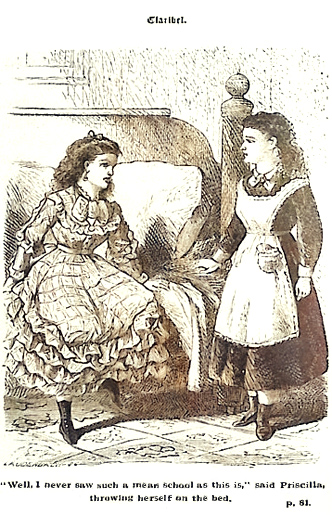
Claribel.
"Well, I never saw such a mean school as
this is," said Priscilla, throwing herself on the bed.
Claribel concluded that she might as well change the subject:
"Don't you mean to change your dress and brush your hair before tea? I should think you would want to after coming so far."
"Oh, I only came from The Bridge to-day. However, I suppose I might as well. What are you going to wear?"
"Just what I have on, only I must go and get an apron. I will call for you when tea is ready." And Claribel went away, feeling uncomfortable and vexed, though she hardly knew why, and leaving Priscilla more than ever convinced that Claribel looked down upon her.
The girls stared and glanced at each other when Priscilla made her appearance at the tea-table in a furiously gay plaid, flounced and stuck out and tucked up in every direction, with a gold bracelet on each wrist and a gold chain round her neck.
Claribel felt uncomfortable and a little ashamed, but she courageously made the best of the matter, thinking that Priscilla would soon learn better.
"Well, I never saw such a mean school as this is," said Priscilla one day after she had been at the school for about a week, and throwing herself down on Claribel's bed. "If I had known it was such a pokey kind of place, I am sure I never would have come."
"What's the matter?" asked Fanny Morey. "Please, Priscilla, don't lie on the bed. It is against rules unless we are sick."
"Who cares?" said Priscilla. "There is nobody here to tell of me."
"I care," said Fanny, decidedly and somewhat angrily. "I don't choose to break rules, whether I am found out or not. Besides, you had no business to come in when the card is on the door. I am busy, and I don't want to be hindered."
"Where's Claribel?"
"Down in the library looking out something in the encyclopædia."
"I suppose you and she are great friends?"
"Yes, we are," answered Fanny, in a tone, which said plainly enough, "Is that any business of yours?"
"Well, you needn't bite my head off," said Priscilla. "I am sure I am glad if the poor thing has found anybody to like her. Claribel and I never could get on together. I suppose I might have given up to her, and let her patronize me and order me about, just as you do, but it isn't any use to do that for people, if they are ever so rich. But I am glad you don't mind, because it is hard for her not to have any friends."
"Claribel has plenty of friends," said Fanny, flushing a little. "All the girls like her, and she doesn't order me about or patronize me. I don't see why you should say so."
At that moment, Claribel entered.
"I can't find anything about it, Fanny," said she; "we shall have to ask Mr. Hausen. Excuse me, Priscilla, but it is a rule that nobody must go into a room with a card on the door. You will get us and yourself into a scrape. Besides, Fanny has her exercises to do."
Priscilla smiled and glanced significantly at Fanny.
"I don't want to seem uncivil, but really you must go, Priscilla," added Claribel, seeing that her cousin did not stir. "If Miss Van Ness should come and find you—"
"Oh, come, now, don't put yourself into a rage, Claribel," said Priscilla, rising. "I am sure I have done no great harm by just coming into your room for a little while, so don't scold; please don't get up a great fuss, now."
"I wish—" Claribel began, and then she bit her lip and was silent.
Priscilla cast another significant glance at Fanny—a piece of vulgarity and bad manners to which she was much addicted—and then withdrew.
In the course of a week, Priscilla had succeeded in making Claribel thoroughly uncomfortable. She excelled in saying little provoking things which could not be noticed, and in making insinuations. She affected great fear of Claribel's temper, and made a parade of giving up to her in any little dispute they might happen to have, especially if any of the teachers were present. She made a great mystery of advising the girls, especially Fanny, never to contradict her. She never missed an opportunity of speaking slightingly of the things she knew Claribel most valued; and whenever Claribel showed any signs of irritation or annoyance, she would put on a significant and contemptuous smile.
But nothing that Priscilla said or did annoyed Claribel so much as the influence she succeeded in gaining over Fanny. The little Texan girl had been Claribel's first intimate friend, and she loved her with an intensity of which careless Fanny had very little notion. It was a real calamity to Claribel when Fanny failed in a lesson or got into disgrace for disorder or forgetfulness, and it was one of her chief objects in life to avoid such misfortunes by spurring Fanny, both by precept and example, to the accomplishment of her school duties. She had so far succeeded that Fanny herself began to be sensitive on the subject, and to find pleasure in preparing her lessons and writing her compositions. She began to care for more sensible and substantial reading than trifling little stories, and to take a real interest in hunting out information concerning the subject of her lessons.
But shortly after Priscilla's appearance, all this was changed. Fanny's lessons began to be carelessly learned, or not learned at all. She was missing whole hours from the room which the two girls occupied in common, and her excuse always was that she had been studying with Priscilla: though the fruits of her study certainly did not appear in her lessons.
One day after Fanny had made several shocking mistakes in her history recitation, and had been deficient in her French, Claribel took her to task:
"You had, plenty of time to study, and you said you had learned it in Priscilla's room."
"I did," said Fanny.
"I think you had better learn it in your own room next time, then," pursued Claribel. "Please do take more pains, Fanny. I can't bear to have you miss so."
"I don't see why you need care," said Fanny, rather sulkily; "nobody blames you for it. You are not responsible for my lessons, are you?"
"If you don't see, I don't know how I can tell you," said Claribel. "Wouldn't you feel badly if I were to miss and get scolded as Mrs. Reynolds scolded you this morning?"
"Oh, come, Claribel, don't make such a serious matter of it," said Fanny. "I will learn my lessons to-day, so you needn't be distressed on my account. I do believe you are jealous of Priscilla."
Now, Claribel knew that she was jealous of Priscilla so far as Fanny was concerned, but that did not make the accusation any easier to bear. She retorted sharply, and the scene ended in a downright quarrel. Fanny rushed away, declaring that she was not Claribel's slave and wouldn't be tyrannized over by her, if she was rich and a favourite with the teachers.
Claribel remained behind, very much hurt and very angry, and as usual in such cases the old temptations came back upon her: "What was the use of trying to do anything for anybody? What was the use of caring anything for anybody or expecting anybody to care for her? She had spoken altogether out of regard to Fanny, and now Fanny declared that she only wanted to tyrannize. It was very hard to bear!"
But by degrees, as she grew calmer, she began to feel more reasonably and kindly. Perhaps she had been domineering. Anyhow, she had spoken unkindly to Fanny; and even if Fanny had been the most to blame, it was her duty to beg pardon and try to make up friends. Acting on this conviction, she washed away as well as she could the traces of her tears, and went out to seek Fanny, whom she found, as she expected, in Priscilla's room.
"Please to come out here a minute, Fanny," said she. "I want to speak to you."
"Why can't you just as well speak here?" said Priscilla. "If it is any such tremendous mystery, I will go away."
"It is no great mystery that I know of," said Claribel, trying to preserve her calmness—"only, Fanny, I am sorry I was so cross; and if I hurt your feelings, I beg your pardon."
Before Fanny could answer, Priscilla took the reply on herself:
"Oh, come, now, Claribel, don't make a scene and a fuss! When Fanny has seen as much of you as I have, she won't mind about your cross fits. What is the use of your putting on such a tragedy air, as if it was anything uncommon? We all know what you are, and it is a pity if we can't make allowances. If only you wouldn't set up for a saint!"
"Fanny, do please come here," said Claribel, imploringly, and trying hard to keep down the choking in her throat. "Priscilla, I wish you wouldn't interfere."
"Who is interfering?" said Priscilla. "I suppose I can speak in my own room."
"Won't you come, Fanny?"
But Fanny would not come, and Claribel retreated to her own room, feeling very miserable indeed. The girls did not meet again till bedtime, for Fanny kept close to Priscilla and out of Claribel's way. She did not come in till it was nearly time to put out the lights.
"You are late," said Claribel, looking up from her Bible and trying to speak just as usual. "We shall not have time for much reading, I am afraid."
"I have been reading with Priscilla," answered Fanny, and then there was a silence.
"Fanny dear, we don't want to go to bed quarrelling," said Claribel, imploringly.
"I don't want to quarrel, I am sure," said Fanny, "but I don't like to be ordered about and scolded because I happen to miss; and I don't think I am accountable to you."
"I didn't mean to scold you, I am sure," Claribel began.
But Fanny interrupted her:
"Oh, you don't mean! What difference does it make? It is all done, anyway, and what is the use of making such a fuss? There, now! Don't go and cry!"
Claribel did not cry. She was learning to restrain herself in that as in other respects.
But as she knelt down to say her prayers, she thought she had never been more unhappy in her life.
A quarrel with Priscilla was nothing strange. She had known very well that her cousin's coming would not add to her comfort, but she had never thought that Priscilla would turn Fanny against her. It was very, very hard! How could she help being angry? How could she say the Lord's Prayer while she was so? And then it occurred to her that the One who had dictated the prayer could give her that grace which should make her fit to say it.
Fanny had been asleep some time before Claribel lay down, but she waked up and said, sleepily,—
"What is the matter? Are you sick?"
"No," answered Claribel, kissing her. "There is nothing the matter, dear. There go to sleep. I am sorry I wakened you."
LITTLE MADGE.
CLARIBEL waked next morning with that vague sense of something disagreeable which we have all felt under similar circumstances. It was Sunday, and everything was quiet about the house. There was no hurry about rising, and Claribel lay thinking over the events of the day before. It was plain to her that nothing would be gained by saying any more about the matter, and she resolved never to allude to it again; that she would be very careful not to interfere with Fanny, but would try every means to win her back again.
Her feelings in the matter were not selfish. She felt that she could have borne the estrangement if only Priscilla were a fit friend for Fanny: but Claribel did not think this was the case. She knew that Priscilla was careless and deceitful; and—this troubled her more than anything—she knew that Priscilla was in the habit of reading very undesirable books—such books as were never allowed at Hausen school. She had reason to fear that Fanny had already been introduced to some of these books, and had spent in reading them the time that should have been bestowed on her lessons. But what could she do about it? There was little use in talking to Fanny, and less in saying anything to Priscilla. She could not tell her trouble to Mr. Hausen or Mrs. Richardson, because that would bring Fanny into disgrace. No: she must bear it all alone.
And then the question occurred to Claribel's mind, Why must she bear her trouble alone? Had not Mr. Hausen told them that there was one Friend always ready to hear and help? What was that text about being careful for nothing which one of the teachers had repeated the Sunday before?
Claribel slipped out of bed without waking Fanny; and taking her Bible to the window, by the help of her "New Testament Index," * she found the text she wanted in the last chapter of Philippians:
"Be careful for nothing; but in everything by prayer and supplication
with thanksgiving let your requests be made known unto God. And the
peace of God which passeth all understanding shall keep your hearts and
minds through Christ Jesus."
* An Alphabetical Index to the New Testament, American Sunday-School
Union.
Claribel knew that being careful in this instance meant being anxious and troubled. She was anxious and troubled. Then she remembered another text:
"Peace I leave with you, my peace I give unto you. Let not your heart
be troubled, neither let it be afraid."
And still another:
"Cast thy burden upon the Lord, and he shall sustain thee."
What could she do better than to cast her burden on him—her anxiety for Fanny, as well as her own temper and wounded pride and resentment toward Priscilla? She would try it, at any rate.
Fanny was still asleep when Claribel rose from her knees. The bell would ring in a minute, and it was time they were all up. Claribel dressed herself, and then went into the small room where little Madge had slept during the absence of Miss Emerson, the teacher who had the special care of her. Miss Reynolds had usually come in to dress the child, but Miss Reynolds had not been well the day before, and it occurred to Claribel that she might as well save her the trouble.
Madge was very well contented with the change of dressing-maids, and made no objection when Claribel proposed to begin teaching her her Scripture lesson.
Madge was a quaint, thoughtful little girl of five years old. Her mother was a permanent invalid, and she had been sent to school more to give her a safe home and get her out of the way than with any expectation of her learning a great deal. She was the special charge of Miss Emerson, one of the younger teachers, but Miss Emerson had been called home by the illness of her mother, and it was doubtful whether she would be able to return. A question had consequently arisen as to what would be done with Madge, and she had been put to sleep in the little room for a night or two till it should be decided. Madge was fully alive to the dignity of having a room of her own, and felt herself quite able to take care of it.
"There, now! You can say your verses nicely," said Claribel when the lesson was finished. "Take care you don't forget them."
"And may I take the clothes off the bed and put the room in order?" asked Madge.
Claribel, pleased with her enterprise, assented, and Madge was in the midst of the operation when Miss Reynolds opened the door.
"Up and dressed already?" said she.
"Claribel dressed me," said Madge, "and she has taught me my lessons besides."
"I was up and dressed, and I thought I might as well dress Madge," said Claribel, in rather a tone of apology, for it occurred to her that Miss Reynolds might think her interfering. "I knew you were not well."
"I am sure you are very kind, and I am much obliged to you," said poor Miss Reynolds, putting her hand to her head; "and now, Claribel, as they say one good turn deserves another, if you will sit in my place and attend to the child at breakfast, I will lie down again, for my head aches very badly."
"And may I go to church with Claribel?" asked Madge.
"Yes, if Mrs. Richardson is willing and you will be good. Now, remember you are Claribel's little girl and must mind her."
It had not occurred to Claribel till she sat down to the table that in taking Miss Reynolds's place she had accepted the responsibility, not only of Madge, but also of helping the girls around her to beefsteak and potatoes.
It was too late to draw back now, however, and she made out to acquit herself of the task without splashing the gravy or dropping any of the plates. Fanny was late, and excused herself by saying that Claribel had not called her.
"You should not depend on Claribel to call you," said Mrs. Richardson.
"I did call you, Fanny, before I went to dress Madge, but perhaps you did not hear me," said Claribel after breakfast.
"You might just as well have stayed to help me as be taking care of Madge," said Fanny. "But 'new brooms sweep clean' with you."
Three or four days passed, and still matters were not right between Claribel and Fanny. Fanny still spent most of her time in Priscilla's room, and carried her books thither to learn her lessons. She missed every day; and her exercises were so carelessly written that one day Mademoiselle declared she would not accept them at all. Then Fanny cried and said she couldn't help it,—that Claribel had quarrelled with her and wouldn't help her any more, and she couldn't do them alone, and she hadn't the right dictionary, and Claribel was always using hers; and how could she do her exercises unless she had books?
"I suspect, Miss Fanny, that you have too many books, and those not of the right sort," said Mademoiselle. "If you will let novels and story-books alone, I fancy you will not suffer for lack of a dictionary."
Fanny coloured scarlet and darted an angry glance at Claribel, as if she suspected her of telling. Claribel felt sure that her own ideas on the subject were correct, but she said nothing. She thought Fanny must take her own way.
Miss Reynolds continued very unwell, and Claribel kept on with the care of little Madge, dressing her in the morning and putting her to bed at night, and seeing that she was ready for school. It was, of course, something of a task and confinement, for Madge must be in bed at eight o'clock, and Claribel was obliged to rise half an hour earlier than usual to find time for her own dressing and prayers in the morning.
"I don't exactly see what we are to do with the child," said Mrs. Richardson one day. "Miss Reynolds—whom we miss so much in many ways—is too unwell to take any more care on herself, and Miss Emerson is not coming back this year."
"Madge needs a good deal of care, too, she is such a delicate child," said Mrs. Herman. "I should very much dislike to send her home, both because there is nobody to care for her properly and because she is such a trouble to her mother. You cannot guess, by seeing her here, what a torment she is at home."
"Why not let her keep on as she is?" asked Mrs. Herman. "Claribel is very kind to her."
"She is indeed, but I feel as if it were too much to ask. Claribel is not strong; and though, as you say, she is kind to the child, she might not like to be confined all the time."
Claribel overheard this conversation as she was studying in the library, and it set her seriously to thinking. She had wanted some work to do—something by which she might show her gratitude to her heavenly Father, who had done so much for her. She had been thinking of asking leave to take a little class in Sunday-school, but now the work seemed offered ready to her hand. She could do no more for Fanny except to pray for her, for Fanny seemed to resent any offer of help about her lessons as an interference.
"And I must be doing for somebody," said Claribel to herself. "Unless I do, I shall be getting to thinking about myself just the same as ever. It will be a bother a great many times, but so is anything worth doing. Madge is fond of me, and minds me pretty well; and as to the trouble, I am sure I am better able to take it than poor Miss Reynolds. But then there is Fanny. Perhaps she won't like to have Madge in our room all the time. I must ask her."
"I don't care. Yes, if you like," was Fanny's answer when Claribel consulted her. "It is annoying not to have that room to use for a closet; but as long as she is to be there, I suppose you might as well take the care of her as to have Miss Reynolds poking in all the time."
"Claribel has always got to have somebody to patronize," was Priscilla's comment when it was generally known that Claribel had taken charge of the little girl. "I suppose she thinks Madge will be more manageable than Fanny."
"Does thee always do things from such mean motives thyself, Priscilla?" asked Eva Church.
"I don't know what you mean, Eva. I don't think I am meaner than other people."
"It is only fair to suppose that thee judges others by thyself," answered Eva.
"I didn't say there was anything mean about it," said Priscilla, as the other girls laughed; "I only said she liked somebody to patronize, and so she does. I have known Claribel all her life, and I think I can judge her better than you can. However, I don't want to say anything about her."
"Then don't," said Tilly Mansfield. "Nobody wants you should."
"It will be a great care for Claribel, but I think she likes that kind of care," remarked Percy.
"That is just what I say—she likes it," persisted Priscilla; "and I don't see any such great amount of self-sacrifice or saintship in doing what one likes. Oh yes; I know you all think I am a heathen and all that. I don't set up for a saint, but I mean to be all that I pretend to be, at any rate. I am sure I don't want to run dawn Claribel, poor girl! And I don't see why I should be accused of it. She is my own cousin, and I want her to do as well as she can."
"Nobody has accused you of it," said Tilly, "but you know very well that you never can hear Claribel praised without insinuating something against her. You always contrive to tell of something she has done at home, or to make out that she has some bad motive."
"Oh, very well; you will find out for yourselves by and by, or I am mistaken."
"I can't bear that girl!" broke out Tilly when Priscilla had gone. "I think she is just as disagreeable as she can be."
"Tilly!" said Eva.
"Well, I do. And I think she is just spoiling Fanny Morey. She isn't like the same girl she was a month ago."
"She does not do Fanny any good, that is certain," remarked Percy. "She and Fanny and Rebecca are always getting away by themselves and whispering in corners and locking themselves into their rooms, and Fanny hardly ever has a decent lesson now-a-days. You will see she will be put back at the end of the term as sure as fate."
"I know she will be in a worse scrape than that if she doesn't mind," said Tilly.
"What makes thee think so?" asked Eva.
"She and Rebecca have run away and gone down town two or three times," said Tilly. "Mrs. Griggs saw them down at Sawyer's buying candy and novels. What do you think Mrs. Richardson would say if she knew that?"
"At Sawyer's!" repeated Percy. "Oh, Tilly, I can't believe it. You know what Mr. Hausen said."
"I couldn't believe it when Mrs. Griggs told me," said Tilly, "but she described the girls exactly—Fanny's long light hair and black eyes, and Priscilla's plaid dress and hair put up over a cushion. And besides that, Mrs. Griggs watched them, and she saw them go round the back way and through our orchard, and get over the fence. They had two or three parcels of books—pamphlets, you know—and a great bag of candy."
"I almost wish Mrs. Griggs would tell Uncle Hausen," said Emma. "Not, of course, that I want the girls to get into trouble, but I think he ought to know. Just think what people will say in the village, and what a thing for the girls themselves! I heard Dr. Benedict and my grandfather talking about Sawyer's place, and they said it was a disgrace to the village and ought to be broken up. I am sure it must be all Priscilla's doing. Fanny never would have thought of such a thing."
"Fanny might not, but I am not so sure of Rebecca," said Eva. "Rebecca likes mysteries. But I am very sorry about it."
"Well, we can't do anything," said Percy. "Anyhow, I am glad Claribel has got Madge to comfort her. She is a cunning, queer little thing, and I dare say they will get on nicely together."
It seemed that Percy's prophecy was likely to be realized. Claribel found Madge tolerably docile, and Madge found Claribel very patient and indulgent, though sufficiently firm in requiring obedience. Madge had suffered from pain in the head early in her little life, and it was not considered expedient to burden her with lessons. Perhaps for this very reason she was anxious to learn to read and write, and Mrs. Richardson finally told her that if Claribel liked to teach her, she might have a reading lesson of ten minutes, twice every day.
"Do you really suppose she can learn—that is learn so as to remember—anything from reading as long as that—only ten minutes at a time?" asked Claribel.
"I think she will," answered Mrs. Richardson; "I think you will find her making very respectable progress, but then you must be thorough and insist on her working while she does work. If the experiment does not answer, you can give it up, you know."
The experiment was tried and found to answer very well. Claribel showed a remarkable "aptness to teach," and Madge was equally ready to learn. At the end of a month, the little girl could read in words of three or four letters. She was devoted to her lessons, and inconsolable if anything happened to interrupt them.
"If you are not good, I can't hear your lessons," was Claribel's severest threat. And she rarely had to put it into execution.
One day, however, it happened that Madge was decidedly naughty. She had got up in a bad humour, and everything went wrong. She cried at being dressed, behaved badly at the table, and ended by taking Claribel's gold pen and scribbling all over her exercise-book. She would not say she was sorry, and was so perverse about it that at last Claribel said:
"Very well, I see I shall not have any little scholar to-day."
Madge turned her head and said she did not care; but at lesson time, she came with her book, as usual.
"No," said Claribel; "I am very sorry: but you know I told you I should not hear your lesson because you were so naughty. I must keep my word. If you are good now, I will hear you this afternoon."
Madge went away very downcast, but presently came back triumphant.
"You needn't hear my lesson, if you don't want to, old Mother Bunch," said she, pertly. "Priscilla has heard it, and she says she will hear me whenever I like."
Claribel was very angry and very much perplexed. Here was a new instance of Priscilla's interference, and what was she to do about it? It was clearly impossible for her to manage Madge unless she could have the child to herself. She considered the matter a little, and then went to Priscilla's room. There was no card on the door, and she knocked once and again. There was no answer, but a sort of scuffling within, and presently Priscilla opened the door. Fanny and Rebecca were sitting in the room, each with a lesson-book before her, and Priscilla's desk stood open, with her exercise-book upon it.
"Priscilla," Claribel began, "I want to speak to you about Madge. I wish you would not interfere between her and me."
"What have I done?" asked Priscilla. "I only heard her her lesson."
"That is just the thing," said Claribel. "I told her I should not hear her because she was naughty, and presently she comes and tells me that you have heard her her lesson and will hear it again. I would rather you did not have anything to do with them, if you please."
"Oh, Claribel, how you do make mountains out of molehills! Madge asked me to hear her her lesson, and I did, and then she asked me to hear it again, and I said I would if I were not busy. Where was the harm in that?"
"The harm was that I did not hear her her lesson because she was naughty," said Claribel; "you must see yourself, Priscilla—"
"Well, there I don't say any more," interrupted Priscilla, affecting a soothing tone, as she saw Mrs. Richardson approaching. "I am sure I didn't mean any harm; only when I found Madge crying and feeling so unhappy, I did what I could to comfort her. I am sure I did not mean to hurt your feelings, Claribel. Please don't be angry, and don't punish Madge, for it was all my doing."
"Punish Madge!" said Mrs. Richardson. "Who is talking about punishing Madge?"
"Oh, it wasn't anything," said Priscilla; "only I found Madge crying because Claribel punished her, and I tried to comfort her, and Claribel thinks I am very much to blame."
"What was the story, Claribel?" asked Mrs. Richardson, turning to her.
Now, six months before Claribel would have flown into a rage, poured out a furious vindication of herself, and ended by a screaming fit, and this was what Priscilla calculated upon when she drew on her cousin the notice of Mrs. Richardson.
But she reckoned without her host. Claribel waited an instant to collect her ideas, and then said, composedly,—
"Madge was very naughty all the morning. She would not be dressed, and she ran out in the hot sun; so I told her I should not hear her her spelling-lesson. Then she went away, and presently came back, telling me that Priscilla had heard her lesson and had promised to hear it again, so she did not care for me. Then I came and asked Priscilla not to interfere with Madge, because I didn't see how I was to do anything with her if she did. That was all."
"You were quite right," said Mrs. Richardson; "neither Priscilla nor any one else must interfere with Madge's lessons."
"I am sure I did not mean any harm," said Priscilla.
"I don't say you did," replied Mrs. Richardson, with a keen glance at Priscilla. "I don't pretend to decide whether you meant to annoy and embarrass Claribel or only to help Madge; but whatever might be your motive, don't let the thing happen again. Fanny and Rebecca, why are you here instead of in your own rooms?"
Fanny murmured something about studying the lesson with Priscilla.
"I think you had better study in your own place, and see whether your lessons will not prosper better than they have done lately," said Mrs. Richardson. "Priscilla's room is none too large for herself. Go to your own rooms: and, Claribel, send Madge to me."
The two girls obeyed with anything but a good grace, and Fanny would hardly speak to Claribel all the morning. But for once her lessons were well learned and perfectly recited.
"There is something going very much amiss with those girls," said Miss Foster to Mrs. Richardson as they were talking over school matters. "Fanny is going down hill very decidedly. She never cares to take a book from the library now, and she seems to have no interest whatever in her lessons. She used to do remarkably well in Bible class, but now she never has her lessons properly prepared. The very expression of her face is altered."
"I am quite certain that something is wrong, and I am pretty sure that I know what that something is," said Mrs. Richardson; "but I am waiting to get the clue into my hands, and I think I shall. But if Fanny has changed in one way, Claribel has altered in another."
"Yes, indeed; I never saw such an improvement in so short a time. She is really growing pretty, and her recitations, especially her Bible lessons, are quite remarkable. And how kind she is to Madge!"
YELLOW COVERS.
MADGE spent the rest of the day in Mrs. Richardson's room, and came back very penitent and humble. When Claribel put her to bed, Madge seemed very full of thought, and at last she said, throwing her arms around her friend's neck and hugging her,—
"Claribel, you will love me if I am naughty sometimes, won't you?"
"Yes," said Claribel, returning the kiss; "but, Madge, you make me very unhappy when you are naughty, just because I do love you. Besides, if you are not good and don't take pains to improve, Mrs. Richardson will perhaps think it is all my fault, and then she won't let you stay with me."
"I don't believe she will," said Madge; "she will know that it is my very own naughtiness. But I will try to be good, and I will never call you 'Mother Bunch' again if Priscilla tells me to ever so many times."
"I don't think I would, because it isn't like a Christian to call names," said Claribel; "and you know, Madge, I cannot help my looks."
"I don't want you to help them," said Madge; "I like you just as you are."
She was silent a few minutes, and Claribel thought she was asleep, and was going to leave her, when Madge put out her hand to detain her.
"Please don't go away," said she; "I am afraid."
"Oh no," said Claribel; "what are you afraid of?"
"I am afraid because I have been naughty, and because—Claribel, if Priscilla told me not to tell, ought I to tell?"
Claribel hesitated:
"Did you promise not to tell, Madge?"
"No, I didn't promise exactly: but—Claribel, why do Priscilla and Fanny read books and hide them away when anybody comes?"
"They read books to learn lessons and to amuse themselves, I suppose," said Claribel. "Everybody gets books out of the library, you know."
"These are not library books," said Madge. "They are thin books with yellow and brown covers, and pictures in them, and Priscilla puts them under the bed when anybody comes. She said some of them were yours."
"You must be mistaken, dear," said Claribel; "I haven't any such books. There! Lie down and go to sleep."
"I can't," said Madge; "I don't feel well. I wish Fanny would sleep in my bed and let me sleep with you."
"I will ask her," said Claribel; "but, Madge, what is the matter, that you don't feel well? Have you been eating anything?"
"Only a lemon and some chocolate-drops that Priscilla gave me," said Madge, unwillingly.
"Oh, Madge, that was naughty, when you know such things always make you sick," said Claribel. "But never mind now; I will put you in my bed, and perhaps you will go to sleep."
But sleep there was none for either Madge or Claribel that night. The poor child was taken very ill about midnight, and continued so for three or four days. She was quite sure she was going to die.
"I shouldn't so much mind dying," sobbed Madge—"I always did want to know how the people get out of their graves and go to heaven: but I have been so naughty, I am afraid the angels won't come after me."
There really seemed some danger that Madge would die. But after a few days she grew better, and was able to sit up and amuse herself with her dolls and animals.
Claribel had been unwearied in her attendance upon the child, who would hardly take either food or medicine from anybody else. Fanny, meantime, slept in the little room, which had a door opening out into the hall.
Fanny had been more like her old self since Madge's illness than for a long time before. She learned her lessons in her own room, and was very attentive in waiting upon and amusing Madge and relieving Claribel.
Claribel was delighted with the change, and began to hope that the old times were coming back again: but she was disappointed. Once more Fanny began to slip away to Priscilla's room at every opportunity. Her lessons were again neglected, and to Claribel's gentle remonstrances, she answered with either sullen silence or with floods of tears; declaring on one occasion that she was the wickedest and most miserable girl in the world, and she wished she was dead.
"But, Fanny dear, if you know you are wicked, why don't you try to be good?" Claribel ventured to ask.
"Because I can't," said Fanny, passionately; "I have tried, and it isn't one bit of use."
"Perhaps you didn't try in the right way."
Fanny knew this very well. She had not tried in the right way and with her whole heart. She knew what she ought to do, but she could not make up her mind to it, and so she went on stealing a guilty pleasure, ashamed and miserable and in constant fear of detection.
It was the custom of the school for all the boarders to assemble in one of the large rooms from eight to nine o'clock in the evening, and occupy themselves with some kind of needlework, while one of the teachers read aloud some interesting and amusing book. "Reading-hour" was one of the pleasantest parts of the day at Round Springs.
One evening, as they were gathered together, listening with great interest to a new book of travels, Mrs. Richardson entered the room followed by Mr. Hausen.
"You may suspend the reading a little while, Miss Foster," said Mr. Hausen.
The girls looked at each other, wondering what was coming. "I have found this book lying out under the tree in the grove," said he, holding up a thick, yellow-covered paper book with some tremendous pictures on the cover. "John Warner, the gardener, tells me that he saw one of the young ladies reading it in that place, but he does not know who it was. The book is one unfit to be touched, much less read, by any young lady, but it may have fallen into somebody's hands by accident, or have been left where it was found by one of the servants. I hope, if any of you have had it, you will tell the truth about it."
There was a dead silence, but Claribel felt her cheeks burn. She had seen the book before, but not lately.
"Remember that suspicion must rest upon everybody unless we can get at the truth," said Mr. Hausen.
"The book is my cousin Claribel's," said Priscilla.
Every one looked at Claribel, who sat still and looked at the floor.
"What do you say, Claribel?" asked Mr. "Is this book yours?"
"I believe it is, Mr. Hausen," said Claribel. "I had such a book once. I bought it on the cars one day last spring before I came here, but I never read more than a few pages of it. Then I threw it away in the garret at my aunt's, and I have never seen it since. I don't know how it should have come here."
"You are sure you did not bring it with you?"
"Quite sure; I never saw it again after I put it away in the garret. I thought it was not a good book, and very silly, besides."
"Do you know anything about it, Priscilla?" asked Mr. Hausen, turning to her.
"I know it is Claribel's book, and that it has been in her room since I came here," answered Priscilla, coolly; "Fanny has seen it there as well as myself. I am sorry to say so, and I wish I had held my peace; but as long as Claribel seems to want to throw the blame on me, I must tell the truth."
"What do you say, Fanny? Have you seen this book in Claribel's hands?"
"No, sir, not in her hands," answered Fanny, with some difficulty.
"But you saw it in her room?"
"Yes, sir;" and Fanny began to cry so that nothing more could be got out of her.
"I shall suspend my judgment on this matter for the present," said Mr. Hausen; "there is evidently an untruth somewhere. But remember this, all of you, that the truth is likely to come out some time or other."
Mr. Hausen then made some remarks on the evils of bad books, and dismissed the girls, requesting Claribel to remain behind for a while.
Of course the subject was talked over in all its bearings. Almost all the girls took sides with Claribel.
"But Claribel does go away in the grove to read almost every day," said one.
"What of that?" demanded Tilly. "It doesn't follow that she reads bad books, does it? I think I have heard of people who went away by themselves for other purposes. I no more believe that Claribel read that book than that I did."
"Who do you think did read it, then?" asked Rebecca. "If you say it wasn't Claribel, you accuse somebody else. Who do you think it was?"
"Who do I think it was?" repeated Tilly, turning upon her. "Well, if you want to know, I think it may have been a girl who gets over the back fence and runs away down to Sawyer's to buy candy and papers, if you know any such person."
"What do you mean, Tilly?" asked one of the girls.
"Never mind," said Tilly; "I know what I mean, and so does somebody else, perhaps. That book may have been Claribel's, as she says, but she never brought it here."
"Then if you think she didn't, I suppose you think I did?" said Priscilla. "What do you think of Fanny's seeing it in her room?"
"I think Fanny knows more than she chooses to tell," answered Tilly.
"Well, I don't see why you should all take Claribel's part," said Priscilla. "Of course I am glad you do, because she is my cousin; only that you can't excuse her without accusing me. If she did not bring it here, who did?"
"Perhaps it is not hers, after all," suggested Percy. "Of course there would be a great many of the same kind."
"Yes, but it is hers, because her name is written in it in two or three places," said Rebecca.
"How does thee know that?" asked Eva Church, who had not spoken before.
"Because I saw it."
"I don't very well understand how thee could see it when the book never left Robert Hausen's hands all the time he was talking," said Eva. "I think that is rather curious, Rebecca."
"Think what you like," interposed Priscilla. "Come, Rebecca, don't let us stand here in the cold all night. It is all nonsense, anyway, making such a fuss about a trumpery novel. What business is it of his what we read, so long as we learn our lessons? I am sure I never would have come here if I had known what sort of place it was."
"And I am sure I wish you never had," was Tilly's parting salute.
Claribel came to her room rather later, looking very unhappy indeed. She knew that she had told the truth, but appearances were against her, and she felt that she was distrusted. But she would not have minded so much, she thought, if only Fanny had not turned against her and told lies about her. Fanny said she had seen the book in Claribel's room, which Claribel was sure had never been there. Oh, it was very, very hard! How could she bear it? And again came the old thought, "They would never treat me so if I were like other people. It is just because I am a poor lame hunchback that every one is against me."
She took her Bible and tried to read, but could not fix her attention on the words. She knew that it was late, and that her light ought to be out, so she extinguished it and knelt down in the dark to say her prayers. It was very hard, and at first she could say no more than—
"Oh, help me! Make me good! Show me what to do!"
But she grew calmer, and by degrees a sense of peace and comfort stole into her heart, and she became sensible that she was not left to bear her trouble alone. Many precious promises, the full value of which the dark hour of affliction only can disclose, came back to her mind, and she felt, as many another burdened soul has done, the force of those wonderful words,—
"As one whom his mother comforteth, so will I comfort you."
Claribel was young, and her religious life was young also; but it was a real life, and she had this great advantage, that she was no halfhearted Christian. She was not trying to serve God as little and herself as much as she dared, but her eye was single and her heart united, and thus she had confidence toward God.
She lay down at last, but she could not sleep. She had lately been troubled with palpitation of the heart and a little difficulty of breathing, and it seemed to her, as she turned restlessly from side to side, as if she had a trip-hammer beating in her breast. She sat up in bed and piled the pillows behind her, and at last fell into a troubled slumber, from which she awoke with a sense of suffocation. The room seemed very close, and she got up, and putting on her flannel wrapper and a shawl, she softly opened the window.
As she did so, she saw that a bright light shone out of Fanny's window, which was next hers, for Fanny still slept in the little room. Her first thought was that Fanny must be ill when she heard a sound of something knocked down and a shrill scream from Fanny. She sprang to the door, and was met by Fanny with her night-dress all on fire, just bursting into a blaze.
In an instant, Claribel snatched up the blazing cotton, and gathering it in her hands and crushing it between her knees she succeeded in putting it out.
Fanny's screams had alarmed the house, but by the time Mrs. Richardson, who slept nearest, had reached the scene of action, the danger from fire was over.
Fanny, who had escaped with only a slight scorching, was crying bitterly, and Claribel lay back in her chair gasping for breath and with her hands terribly burned. She was quite unable to speak, and it was some time before Fanny was able to give any explanation.
"I suppose Claribel was sick and Fanny overset the light in getting up to do something for her," said Priscilla, who had come to her cousin's room, casting at the same time a meaning glance at Fanny.
"It wasn't, either, any such thing," sobbed Fanny, finding her voice at last. "And I have been as wicked as I could be since you took me from Claribel: and I am not going to tell any more lies for anybody; so there, Priscilla Westcott!"
"How was it, then?" asked Mrs. Richardson.
"I was reading in bed," said Fanny, "and I heard Claribel get up, and thought she would catch me, and I went to put the candle out and tipped it over. And I should have been burned to death only for Claribel, and she saved my life after I had told such a wicked story about her."
And again Fanny began to cry. "I said I saw that book in her room, and I did, because I had it in there reading it when she was away, and I have run away and done everything that was bad: but oh, Claribel, you will forgive me, won't you?"
"I am sure I do," answered Claribel, faintly.
Mrs. Richardson was very quick-sighted. In the midst of all her anxiety for Claribel, she had seen the look which Priscilla had bestowed on Fanny and her glance of rage when Fanny had insisted upon telling her own story. And she drew her conclusions and took her measures accordingly.
"We will hear the whole story in the morning," said she. "Go to bed now, Fanny, and don't cry any more. Priscilla, you will go directly to my room and go to bed there."
"Why can't I go to my own room?" asked Priscilla.
"Because I prefer you should go to mine," answered Mrs. Richardson, quietly.
"I suppose I can get my things to put on in the morning?" said Priscilla.
"No; Miss Foster will bring you everything you need. Miss Foster, you will please lock up Priscilla's room and keep the key."
"I don't know what I have done to be treated in this way," said Priscilla, turning pale.
"I don't say that you have done anything," answered Mrs. Richardson; "surely it is no great hardship to sleep in one room instead of another for one night. My room is fully as comfortable as your own."
There was no help for it, and Priscilla was obliged to submit.
Claribel's hands were by this time wrapped in clean soft cotton wadding, and some quieting medicine administered. Miss Foster took Madge to her own bed, and the house was once more quiet.
EXPLANATIONS.
THE next morning several people were absent from breakfast, among them Priscilla and Fanny. Fanny had already made a clean breast of it.
"I never thought of any such thing, till one day when I was in Priscilla's room, she asked me if I didn't want something nice to read, and she lent me a novel she had. I knew that it wasn't a good book, but it was interesting, and I read it and several others. I used to go to Priscilla's room to study my lessons, and read almost all the time. And since I have slept in the little room, I have read in bed at night.
"Then we got engaged with a story in a paper, and Priscilla said we might get the rest of the numbers if there was a news-shop here. We asked at Robison's, and he said he didn't keep that kind of papers. And then Priscilla said she had seen another news-shop down near the landing; and I said Mr. Hausen said we must never go to Sawyer's for anything, because it wasn't a respectable place. And Priscilla said she didn't care—she guessed it wouldn't hurt her. So we went down and bought ever so many papers of different kinds, and a great parcel of candy and lemons and things. Then we were afraid to come home the front way, and we went round through Mr. Mansfield's orchard."
"Have you been to Sawyer's more than once?" asked Mrs. Richardson.
"Yes, ma'am; two or three times."
"And where are the papers and books you had?"
"Some are in Priscilla's room and some in mine; some in that little garret place at the end of our hall, in an old basket."
"Did Claribel have anything to do with all this reading and buying of papers?" asked Mr. Hausen.
"No, sir; indeed she didn't," said Fanny, eagerly. "She never knew anything about it. I don't believe Claribel would tell a lie for anything, though I do think she is cross sometimes," added Fanny.
"But, Fanny, how could you go on so?" asked Mr. Hausen gravely. "You knew all this was wrong as well then as you do now. You knew that you were doing what was injuring yourself and others, didn't you?"
"Yes, sir."
"Then why did you keep on with it so long?"
"I don't know," answered Fanny, hanging her head. "I thought I would leave it off ever so many times, and then Priscilla laughed at me and said it was all nonsense, and there was always a bit of a story that I wanted to finish. That was what I lighted my candle for last night. I thought I would just finish one story I was reading in a paper, and then I would give them all back to Priscilla again."
"Ah, my child, that is the rock which has wrecked many a sinner," said Mr. Hausen. "The dram drinker thinks he will leave off drinking after he has taken one more glass; the gambler only waits till the luck shall turn, so that he can win one more game. Such conduct shows that you are not honest with yourself. If you really desired to forsake your sin, you would not want to sin once more."
"And then Priscilla laughed at me and said I might as well go on now I had begun. But I don't mean to lay all the blame on her, either, though I must say I shouldn't have begun if it hadn't been for her. But I never will read a bad book again—no, not if I was to be shipwrecked in the middle of the great desert of Sahara," added Fanny, vehemently.
"You would find that rather difficult to accomplish," said Mr. Hausen. "But, Fanny, what am I to do with you? Nobody can watch you all the time, and how can I take the responsibility of a girl whom, I cannot trust?"
"Oh, Mr. Hausen, please don't send me home," pleaded Fanny. "Indeed, I will never do so again. I know how naughty I have been, but please do try me a little longer."
"Very well; I will try you a little longer," said Mr. Hausen, after some consideration; "but you must remember that you are on probation. You must not ask to go outside the grounds again this term unless one of the teachers or one of the senior-girls can go with you; you must not read a single story-book of any kind without first asking Mrs. Richardson, and you must study all your lessons either in your own room or the school-room. Remember, these are the conditions. If I find you disobeying me in one single point, I shall send you home directly."
Priscilla began by denying the whole thing; but when Mr. Hausen produced the books and papers which had been found in her room, she changed her tone.
"She didn't know whose business it was what books she read. She came to school to learn her lessons, and she had learned them. Nobody could deny that."
"Nobody wishes to deny it, Priscilla; but how has it been about Fanny's lessons?"
"I am not responsible for Fanny's lessons," answered Priscilla. "She is a little dunce, anyhow, but I don't see what great harm I have done her."
"Indeed! I do not agree with you. And what do you say to the harm done your cousin?"
"I am sorry about Claribel," said Priscilla, with some feeling. "The poor thing had enough to bear before. I thought when I first came here that she was setting up to be good and that she felt above me because she was rich, and I meant to tease her by getting Fanny away, but I am sorry it has turned out so badly: and I have told her so."
"I am glad to hear it," said Mr. Hausen. "Priscilla, how did you acquire a taste for such reading?"
"Oh, I don't know. We don't have many books, anyway, and one must read something."
"But you have had plenty of better books to read since you have been here."
"Well, to tell you the truth, I don't care one pin for the books the girls read here," answered Priscilla; "they seem to me so stupid. I wouldn't give a pin for a story in which somebody isn't killed."
"I dare say not. One of the bad effects of such reading is that it unfits the mind for any innocent or rational amusement. A man who accustoms himself to brandy cares nothing for anything less exciting. But that is not the worst. Every time you read a bad book, you stain your soul with a mark which cannot be rubbed out. By dwelling on wicked actions and bad characters you become like them. Even though you may repent and by God's grace be forgiven, you will find the images in which you used to delight coming back to haunt and distract you, and if you do not repent, you make yourself utterly unfit for goodness or usefulness here and for happiness hereafter."
Priscilla seemed a good deal moved.
"I never thought so very much about it," said she. "Mother never seemed to care what I read. She never looks at a book herself. Claribel wouldn't read them, but I thought it was only a piece of her contrariness."
"Don't you see that what I say is true, Priscilla? You say yourself that you don't care for a book unless somebody is killed. By and by you will need even stronger seasoning than murder, and what are you going to do then? My child, what am I to do with you?"
"I suppose you will have to send me home," answered Priscilla.
"Do you wish to be sent home in disgrace, Priscilla?"
"No, I don't," answered Priscilla. "Mother will feel dreadfully, because I was sent home that way once before. But, of course, I can't expect you to keep me."
"Suppose I should let you stay to the end of the term, would you give me your word to try and do better? Would you give me your word to tell the truth, obey the rules of the school, and give up this abominable reading?"
"Why, would you let me stay if I did?" asked Priscilla, in astonishment.
"Yes, I would try you; but you must expect to be more watched and restrained than the other girls. We can't put the guilty and the innocent on the same level, you know."
"I am sure you are very good," said Priscilla, with some emotion.
"My child, I have no other wish than your own good, but you know that I must consider the welfare of the other girls; I cannot risk poisoning a dozen to save one. You have done us a great injury. Nobody has ever disgraced the school as you have. You have been seen again and again at that vile place where you have bought your papers, and of course those who have seen you, know what was your errand there. You have injured Fanny. You have injured Claribel—perhaps endangered her life, for such a shock is a grave matter to anybody as weak as she is. Nevertheless, I am willing to forgive you and to give you a chance to retrieve your character."
"You are very good," said Priscilla again, in a broken voice. "I did not think anybody could be so—"
"Ah, Priscilla, there is One far better to you than I am," said Mr. Hausen—"One against whom you have been sinning and rebelling all your life, who is yet ready to forgive and receive you the moment you turn to him. I can forgive you, but only he can wash away your sin and sanctify your heart. I can help you by outward aids and restrictions, but he can change your whole nature, so that you will hate the things you now love and love the things you do not now care for. Why can you not turn to him in the hour of youth, in this time of trouble?"
"I don't know anything about that," said Priscilla. "It never seems to me as if there were anything real about religion any more than about anything else one reads of, but I suppose there must be."
"Ask Claribel what she thinks about that matter," said Mr. Hausen.
"Well, I will say for Claribel that something has changed her," said Priscilla. "I never saw such an alteration in anybody. I would give a good deal if she were well once more."
"Well, Priscilla, I hope that some day these things may seem as real to you as they do to me. But now how are we to settle this matter?"
"Mr. Hausen," said Priscilla, "if you will let me stay, I will try to do the best I can. I can't promise to be good, but I will promise to try, and I will do everything you tell me. I did think I would face it out and pretend I did not care; but I do care. I am very sorry."
"I am glad to hear you say so," answered Mr. Hausen. "I shall lay you under the same restrictions as Fanny, and I want you to promise me one thing more—namely, that you will read two chapters in the New Testament every day while you stay here."
"Well, I will agree to that," said Priscilla, "though I tell you honestly, Mr. Hausen, I don't care as much as I should for the Bible."
"No, I suppose not; but I mean that you should learn to care. My mother knew a lady who was converted from a very gay and worldly life, and became one of the most consistent and useful Christian women that ever lived. She told my mother that when she first began to read the Bible she cared nothing about it—she could not become interested in it—and she made a resolution that she would read no other book till she had learned to love the Bible best of all."
"And did she?" asked Priscilla, much interested. "Did she keep her resolution, I mean?"
"Yes. Though she was a highly cultivated woman, and fond of reading, she did not for a whole year touch any other book than the Bible. After that, she allowed herself to read other books, but she always loved the Bible best. I don't ask you to read no other book, but I do ask you to pledge yourself to read at least two chapters in the New Testament every day."
"Well, I will," said Priscilla. "Where shall I begin?"
"Begin at the beginning, and read straight on; you cannot have a better plan than that. Try to feel what you read, and ask God to give you grace to understand it. But you must remember, Priscilla, that you are on probation. You will be closely watched, and the first disobedience or deception sends you home."
"All right," said Priscilla; "that is only fair. Mr. Hausen, I do thank you for letting me stay, if only on mother's account. I have been, and am, a bad girl, but I do love my mother. I will do all that you tell me."
Priscilla shut herself up in her own room and remained there till near dinner-time. Then she went to Rebecca's room and knocked.
"Come in," said Rebecca, opening the door and then shutting it directly. "I thought you were never coming. I went to your room as soon as I saw you come out of the study, but you were locked in. Why didn't you open the door?"
"I was busy," answered Priscilla.
"Well, and how did you get off?" asked Rebecca. "Isn't it fun that nobody suspects me, or has said a word to me?"
"You had better not be too sure that nobody suspects you," said Priscilla.
"Well, anyhow, nobody has accused me. What did Mr. Hausen say to you?"
"Never mind," said Priscilla, shortly. "Rebecca, I want all those books and papers directly."
"Oh, why?" asked Rebecca. "I have not half finished them, and I am sure they are as safe here as they can be anywhere."
"Never mind; I want them, every one."
With considerable reluctance and grumbling, Rebecca produced the pile of pamphlets and papers.
Priscilla looked them over.
"They are not all here," said she. "Where are the rest? I want every one of them."
"I think you might leave me one," said Rebecca, producing a thick yellow book and giving it to Priscilla. "You can't want to read all these at once."
"I don't want to read any of them, as it happens."
"What are you going to do with them?" asked Rebecca.
"I am going to give them to Mr. Hausen," said Priscilla, doing the books up in a bundle and tying them together in a very decided fashion.
"Priscilla! You won't do that!"
"You will see that I will."
"Oh, I suppose you mean to set up for good, like Claribel," said Rebecca, sneeringly. "It is rather late in the day for that. Suppose I set up for good too, and tell Mr. Hausen all about our going down to Sawyer's, and so on?"
"You won't tell him any news if you do," answered Priscilla, coolly. "Fanny has told him already, and so have I. You needn't look so scared; I didn't say anything about you, and sha'n't. As for Claribel, you had better not say anything to me against her, if you know what is good for yourself."
"Well, I never thought you would be scared and give in so easy as that," said Rebecca. "For my part, I shall keep my own counsel."
"You are welcome to keep it, for all me," said Priscilla. "I don't think I have done you any great harm; that is one comfort."
"But what is the use of giving these books to Mr. Hausen?" asked Rebecca, loath to give up the stolen waters which her unhealthy taste had found so sweet. "If you don't want them yourself, you might let me have them. Mr. Hausen don't know anything about them; and if he finds them, I won't tell him they are yours. But he won't find them. I have got a capital hiding-place, and we can have some fun with them by and by, when this has blown over a little. Come, what is the use of making such a great pretence of goodness all at once?"
"I suppose you can't possibly understand that I am in earnest," said Priscilla. "Perhaps it isn't so very strange, either. But it is true, for all that. I am in earnest, and I mean Mr. Hausen shall see that I am. You will never see these things again as long as you live, Rebecca. You may make up your mind as to that."
So saying, Priscilla picked up her bundle of books and departed. She carried them straight to Mr. Hausen, telling him that they were some which Fanny did not know about, but she said nothing of Rebecca.
Claribel was very sick. Her hands were badly burned, and the shock and alarm had brought on one of her fits of palpitation and difficulty of breathing. The girls were not allowed to see her, but Priscilla waylaid the doctor on the stairs and begged to know what he thought of her cousin.
"My dear, your cousin is very sick," said Dr. Benedict, kindly and seriously. "There is no telling how the attack may terminate. She may get better again; and she may pass away very suddenly."
Priscilla turned very pale, but she showed no other sign of agitation.
"Dr. Benedict," said she, "would you ask them to let me sit up with her? Indeed I can do it. I have watched with sick people a great many times. I am sure I can help take care of her, and I think Claribel would like it."
The doctor looked keenly at her.
"Yes, you shall," said he. "I don't think it will hurt either of you."
Priscilla shared Mrs. Herman's watch that night, and showed herself such an excellent nurse that she was allowed to take her full share of the care demanded by the invalid, though Mr. Hanson insisted that her lessons should be discontinued.
"You need not mind letting them go," said he. "You are learning quite as much in another way."
Claribel continued very ill for many days, but she grew better at last, and was able to take some rest.
"You will soon be well now," Priscilla remarked one day when her cousin was sitting up by the window, for the doctor had recommended the fresh air.
"Yes, I shall soon be well," answered Claribel, with a little sigh.
"Don't you want to get well?" asked Priscilla, struck by something in Claribel's tone and manner.
Claribel hesitated.
"I am willing to get well," said she.
"Can't you get any farther than that?" asked Priscilla.
"To tell you the truth, Priscilla, I am afraid I can't. You know what Dr. Benedict says about my hands?"
"No. What does he say? I thought they were almost well. Do they hurt you so much?"
"They don't pain me very much now," said Claribel, "but Dr. Benedict says I shall never have any use of them again. That isn't a very pleasant prospect, especially to anybody as lame as I am."
"Perhaps he doesn't know," said Priscilla.
"I believe he does. The surgeon that Mr. Steele brought from the city says the same thing."
"Claribel," said Priscilla, in a low voice, "don't you hate me?"
"No," answered Claribel, smiling. "I don't hate anybody, and I am sure I should be very ungrateful to hate you, who have been so good to me and waited on me since I was sick."
"You used to say you hated me when you lived at home, and I am sure you have more reason now."
"I was a very ill-tempered girl when I lived at home," said Claribel. "And besides, Priscilla, if you don't mind my saying so, I think I had more reason then. You did not mean I should burn my hands or be sick, but you did use to mean to torment me then. There is a fine sentence for you. And you did hurt me cruelly too, especially when you said my father did not love me and was ashamed of me. I did not get over it for a long time—not till Mr. Hausen showed me some letters father wrote to him and to Mr. Steele about me."
"I only said it to be hateful," said Priscilla; "I knew it wasn't so. But, after all, Claribel, I was the means of your being burned. It never would have happened if I had not put Fanny up to reading those horrible papers. Somehow, I don't think Fanny minds it as much as I do."
"Fanny is very light-hearted," said Claribel, with a little sigh. "Things don't stick to her as they do to you and me, and I am glad they don't. But she feels badly enough, I am sure, and I don't believe she will ever do such a thing again, or you either."
"I would give my own right hand to make yours well again," said Priscilla. "How long have you feared you could never use them?"
"Ever since Mr. Steele was here; I made the doctor tell me what he thought about them. I was determined to know the worst."
"A whole week, and you have been so cheerful all the time!" said Priscilla. "Claribel, how can you?"
"I don't know—I have had help; and besides," said Claribel, with a radiant smile, "I don't think they will trouble me long. I am better, but I am not well, and I heard the doctor say that another attack would carry me off."
"And you are glad, are you, really?" asked Priscilla, wonderingly.
"Yes, I am; I have so little to live for. I did want to do a great many things for people, but I suppose somebody else can do them just as well. Please don't cry, Priscilla, if you can help it. You will make me cry too, and that sets my heart to beating so I can't talk, and I have ever so many things I want to say."
"I won't," said Priscilla, with a strong effort sending back her tears and composing herself. "But won't it hurt you to talk?"
"Oh no; I asked the doctor, and he said I might. Priscilla, I am too young to make a will. I asked Mr. Steele, and he said so, but he said I could do some things now. So I wrote on a paper what I wanted to give to one and another—at least, I told him, and he wrote it down. And one thing I want to tell you, because it depends on you. I asked him if you and your mother were willing to keep you here at school till you finished the course; that will be about six years."
"Oh, Claribel, I can't," said Priscilla, in a smothered voice. "How can I let you do that for me after all—"
"I shall not be any poorer," said Claribel, smiling, "and I am sure you will consent when you know I wish it. And oh, Priscilla, if you would do something else! Ever since I began to think about such things—about doing for others instead of myself—I have thought how much I should like to be a missionary. But I knew it was out of the question, of course, and I always meant to educate and fit out somebody to go in my place—a substitute, you know, as people used to say in war-time. Oh, Priscilla, if you would only be my substitute! I know you don't care much for religion now—"
"Yes, I do," said Priscilla; "I can't help it when I see how it has changed you, and since I have read so much in the Bible. Claribel, I will do what you wish. I will be your substitute. I promise you that if mother is willing, I will fit myself for a missionary and go in your place; and if I cannot do that, I will be a missionary at home. I suppose I am about the last person anybody would think of for such a place as that. I wonder what Mr. Hausen would say?"
"He would say you are the very one," said Claribel. "He told me that you had the making of an energetic Christian woman in you if you would only take the right turn."
"Claribel," said Priscilla, "I don't know, but I believe—I feel—as if I had taken the turn this very hour. But of one thing you may be sure: I shall keep my promise to you if it be possible."
"There is just one thing more," said Claribel, after she and Priscilla had kissed each other—"yes, two things." She calmed herself by a strong effort. "If you will be a friend to Fanny, and try to keep her steady, and away from—you know who."
"I will do my best," said Priscilla; "I owe her as much as that. But honestly, Claribel, I don't think there is very much in Fanny."
Claribel sighed:
"Well, perhaps not so very much. But she was the first friend I made, and she did me a great deal of good. I think she may turn out a good, useful woman if she can stay here, especially if the other goes away."
"You might just as well say 'Rebecca,'" said Priscilla; "we both mean her. I think, Claribel, there was a black sheep in this flock before I ever came into it."
"And so do I. I know how I felt when she came and asked me to write her composition for her."
"Rebecca thinks nobody finds her out or knows about her, but I think she is mistaken," observed Priscilla. "But what is the other thing you want me to do?"
"I want you to take my place with Madge. Poor little thing! She will be very forlorn when I am gone, and she is a dear, good child. I am sure Mrs. Richardson will consent."
"I will ask her," said Priscilla. "But, Claribel, don't you want me to do something for you?"
"No, I don't think so, any more than you are doing constantly."
"I never saw any one so changed as you are about that," said Priscilla. "You used to think about yourself all the time, and that nobody could do enough for you."
"It was Mr. Hausen who showed me the way out of that prison," said Claribel. "He made me promise to try never to miss a chance of helping anybody. I remember the very first time I ever did it, too: I put away the 'Tales of the Crusaders' to help Fanny about her shirts. Have you read that book? It is in the library, and I am sure you would like it."
Priscilla smiled:
"To tell you the truth, Claribel, I can't trust myself to read any story-book just now. I am like a reformed drunkard who does not dare to drink even a glass of sweet cider. I hope I shall have more sense some day, but till I do, I think total abstinence is my best way. But I will read to you if you like."
"Oh no; I don't care about it. But don't you want to learn your Bible lesson? Get the book, and we will study it together."
Claribel lingered for two or three months, sometimes worse and sometimes better: even able to leave her room and come down to the library or school-room. Priscilla devoted herself to her cousin, even refusing to go home for the holidays lest Claribel should miss her. Claribel enjoyed her Christmas, and helped fit up the tree prepared for the girls who did not go home. She was very bright and animated all the evening, and did not seem very tired when she went to bed. But when Priscilla went to wake her in the morning, she was no longer there. Only the poor house which had so long held Claribel lay quietly resting as if in sleep, for a greater than an angel had been there in the night and opened the doors, and Claribel was indeed out of prison.
Rebecca did not come back after holidays. To some of the girls who saw her afterward, she said the school was so disagreeable that she did not wish to go back; and she wanted to make her father send her to a large school where she could have some fun. But "deception is the essence of lying;" and they were not deceived, for all knew that she could not have returned if she had desired it.
Priscilla's mother is dead, and her sister is married. She herself is now one of the oldest, as she is one of the best, girls in the school. She has steadily pursued her great object—that of fitting herself for a missionary by the acquisition of every sort of useful knowledge—and in another year will probably take her place among those who are witnessing for the light amid the darkness of heathenism.
THE END.