
Title: The happiness of Hazelbrook
Author: Charlotte Grace O'Brien
Release date: February 26, 2026 [eBook #78045]
Most recently updated: March 19, 2026
Language: English
Original publication: London: Religious Tract Society, 1908
Other information and formats: www.gutenberg.org/ebooks/78045
Transcriber's note: Unusual and inconsistent spelling is as printed.
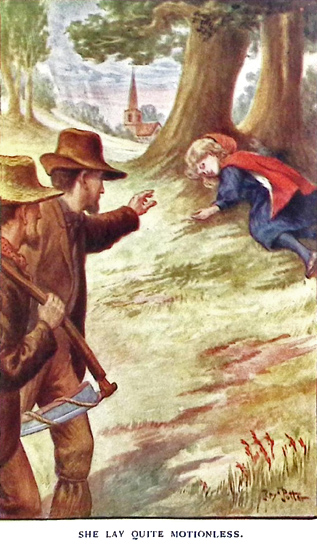
SHE LAY QUITE MOTIONLESS.
By the Author of
"Harry Blake's Trouble," etc.
[Charlotte O'Brien]
R.T.S., 4 Bouverie Street, London, E.C. 4

CONTENTS
CHAP.
II. THE HAPPINESS OF HAZELBROOK
VI. THE RETURN OF THE PRODIGAL
THE HAPPINESS OF
HAZELBROOK
Duty and Pleasure
"NOW, Katie, you'll be able to finish that shirt easily by the time I come home this evening," said Mrs. Lawrence, as she was preparing to leave home one morning for a day's washing at the rectory.
"Oh yes, mother; I have only the two sleeves to make and put in, and both wristbands are stitched already."
"That's right; then my mind will be at ease about the shirts. You know I promised Mrs. Gordon to let her have them to-night, as she is leaving Hazelbrook to-morrow morning. And if I thought you couldn't finish the one you have in hand, I'd stay at home myself and see to it. But the day's washing is an object to me, so if I can depend upon your sitting steadily to work—"
"That you may, mother; I shan't stir till I have finished it."
"There's Ben's dinner all ready in the basin; you can just put it into the oven for a short time before you send it. And Willie and Tom will take it when they come home from school."
"All right, mother."
"And don't let little Esther get into any mischief. Keep her in with you as much as you can, Katie; she plays very well by herself, and it's much better for her than running about all the morning with the children of the village. Besides, she will amuse Nelly if she stays indoors."
As Mrs. Lawrence spoke, she stooped to kiss a pale, sickly-looking little girl, about ten years old, who was lying upon a little bed near the window.
"I will look after Esther, mother," said the child, in a feeble voice: "I wish I could do some work to help you, that I do." And the tears came into Nelly's eyes as she spoke.
"Don't fret about that, Nelly; some day, please God, you'll be able to help me;—it's not the will that's wanting, anyhow, I know that quite well. Meantime, you've got your own work to do, as our minister used often to say to me; there's no one but has work to do in the world, however rich he may be."
"Why, mother, what work can Nelly possibly have to do?" said Katie.
"Nelly has to pray to God to make her patient under the trial He has sent her," replied her mother—"to keep from murmuring, or being discontented."
"I shouldn't think that was very hard," interrupted Katie. She was about to add that her sister had no needlework to do, but something kept her silent.
"I should like to see 'you' try for a week, Katie," said her mother.
Katie blushed and said nothing.
"It is not so very easy, as you think, to lie patiently day after day, and week after week; and it is only God's grace that can enable Nelly to do so, Katie; but He never yet sent a burden so heavy that He did not at the same time send strength enough to carry it; that is, if we ask Him for it. But I must go now, so be good children, and mind you keep to your work, Katie."
"Of course I will, mother," answered the young girl, rather pertly, as if offended at being reminded so often.
And yet Katie's conscience must have told her that her mother had too good cause for complaint. Katie Lawrence was nearly thirteen. She was a sharp, clever girl, quick at her needle, and might have been of the greatest use to her mother, had it not been for the sad habit of neglecting her duty. Hers was truly but "eye-service." So long as her mother worked beside her, Katie's needle moved rapidly and steadily. But once let Mrs. Lawrence be called away by any business, and there was an end to all Katie's industry. First she would begin to yawn, then down would go her work, and she would be off into the garden to look at the chickens, or feed the pig, or anything, in fact, but sit to her needlework.
Mrs. Lawrence was most anxious to bring up her children to habits of industry, and had a great objection to Katie wasting her time with all the idle girls of the village, in whose company her mother felt sure she would learn nothing that was good. She therefore forbade her daughter going out without her consent. And Katie would promise, and, at the moment, intend to obey her mother's wishes. But no sooner was her mother's back turned, than her promised obedience was forgotten. This was the more blameable in Katie, because she was quite old enough to know what a hard struggle her mother had to make both ends meet.
There was not a prettier cottage in Hazelbrook than that of Widow Lawrence, and it was as neat and clean as it was pretty. When hard-working Ben Lawrence died of the typhus fever, three years before this story begins, the villagers shook their heads, and said that poor Mrs. Lawrence would never be able to get along with her six children, and one of them a cripple too. And some even went so far as to advise her to give up her home and go into the workhouse.
But the widow had a stout heart within her, and, in humble faith on God's promise to befriend the fatherless and the widow, she aroused herself, after the first heavy shock of her great grief, and determined to put her shoulder to the wheel, and do what she could for her fatherless children.
The eldest boy, Ben, was engaged as ploughboy at Farmer Hall's, and earned three shillings a week. Mrs. Lawrence herself went every Tuesday to the rectory to assist in the washing. This brought her in two shillings. Added to this, the parish agreed to allow her half a crown a week, which made a total of seven-and-sixpence. And as she was a first-rate needlewoman, she hoped that what she and Katie could earn by plain work, in addition to the above, would enable her, with strict economy, to pay her way and keep out of debt.
It was often a hard struggle, but Mrs. Lawrence managed still to keep her ground; and her cottage, although one of the poorest in the village, was, as we said before, one of the neatest and prettiest. Her husband had been very fond of gardening, and had taken great pains with the little piece of ground. It was well stocked with fruit-trees, and produced sufficient potatoes to last the family for the year.
Ben had been accustomed to assist his father, and was now able to take the entire charge of the garden, which it was his pride and pleasure to attend to of an evening, after he came home from work. He was the eldest of the family, and was just fourteen years old. Poor little Nelly had been a cripple from an infant. She had had a fall which injured her spine, and for several years had not been able to put her foot to the ground.
Some medical men expressed their opinion that the little girl would become stronger as she grew older, and that she might yet be able to earn her living by needlework, or some simple occupation. But up to the present time, she had lain on her back, and could not move without great pain. She required more nourishing food than her mother could afford to give her, and it was one of Mrs. Lawrence's greatest trials to feel she could not get Nelly all that she required.
She was a patient, even a cheerful child. God had mercifully, in her case, 'tempered the wind to the shorn lamb,' and whilst giving her a contented spirit, had also blessed her with a capacity for enjoying any little happiness within her reach. A simple daisy-chain, a bunch of buttercups, the first primrose, were like 'treasures of silver and gold' to the poor lame girl.
Willie and Tom came next to Nelly. They were two merry little urchins of six and eight years of age, and went regularly to school. Esther, the "baby" of the family, was a rosy, laughing little girl of three, always getting into mischief, but warm-hearted and affectionate.
Katie worked on steadily for some little time after her mother left home that morning. Then she washed up the breakfast-things, and put them away, and swept up the hearth. She had washed her hands, and was about to sit down again to work, when the thought struck her that she would just take one turn—just one—round the garden, that beautiful spring morning. She should feel so fresh after it, and would be able to work twice as fast when she came back.
So catching up little Esther in her arms, she ran with the child down to the end of the garden. A clear running stream separated it from an adjoining meadow, which was already quite yellow with cowslips.
"I must just gather a bunch for Nelly, she is so fond of them," thought Katie, as she sprang across the little brook.
Once in the meadow, she and Esther were soon busy filling their pinafores with sweet cowslips. The time slipped away unheeded.
"I will just make Nelly 'one' cowslip ball," thought Katie. And sitting down on the root of an old tree under the hedge in the meadow, she took out of her pocket the reel of cotton with which she had been working, and began to make a cowslip ball.
This is a rather tedious thing to do—the first one she attempted she spoiled, it was not a nice shape. Then she had not quite enough flowers for the second, so she left Esther sitting on the old tree, whilst she ran to gather some more. She was more successful in her next attempt, but it had taken her a long time, and she had scarcely finished it, when she heard the voices of her little brothers who had come home from school, and were calling for her.
"Dear me, how late it must be!" cried Katie, as she hastened back through the meadow.
When she reached the stream, Willie and Tom were both standing on the opposite bank in the garden.
"Why, Katie, where have you been?" said they. "Nelly says we are to take Ben his dinner, but it is not warmed yet, and it is time we went."
"Oh dear, dear, how tiresome!" said Katie. "I'm sure I never thought I had been so long."
When she reached the cottage, it was nearly half-past twelve o'clock. Poor Ben's dinner had to be sent, cold as it was, and then Katie had to hurry and see about peeling the potatoes for their own meal. Little Esther had wetted her feet sadly coming back in such a hurry across the brook, so her socks and shoes had to be dried, and by the time that was done, it was dinner-time.
Katie was cross with herself and with everybody. Nelly had thanked her heartily for the cowslip ball, but had told her that she would willingly have gone without the flowers, sooner than Katie should be behindhand with the shirt she had promised her mother to get finished.
"I shall have plenty of time this afternoon, Nelly," said Katie, pettishly; "so you need not trouble yourself about me."
By the time the dinner-things were cleared away, and her little brothers sent off to school, it was past two o'clock. Katie sighed as she washed her hands and again prepared to sit down to work.
"Everything seems to go wrong with me to-day," said she; "why, where can my cotton be? I'm sure I had it in my pocket this morning."
"Katie had cotton in a field," lisped little Esther.
"Oh, what shall I do?" cried Katie, bursting into tears. "There's the cotton lost now; it's all those tiresome cowslips. I'm sure I wish—"
Katie was quite wrong. It was not the cowslips that were in fault; "all" the day's misfortunes—the wasted morning—Ben's cold dinner—the lost cotton—all arose from the simple fact of Katie's yielding to the first temptation to idleness. There was no harm whatever in her taking a walk in the garden, or gathering cowslips at the proper time. Had she sat steadily to her work in the morning, she would have finished it early in the afternoon, and might have enjoyed herself in the meadow as well. But, as her mother said to her, "duty first, pleasure afterwards."
Katie had a duty to perform; she had promised to do it, and she was now suffering the penalty which all must pay, sooner or later, when they leave "undone those things which they ought to have done."
"Leave Esther with me, Katie," said Nelly, "and go and look for the cotton in the meadow; don't you recollect where you sat down?"
"Yes, I know the place exactly, but I am afraid I lost the cotton when I ran so fast on hearing Willie calling to me. I know it was in my lap the minute before."
Katie hastened into the field, and went first of all to the old tree under the hedge. There was no cotton to be found. She then began to search for it amongst the grass, but it was so thick and tall that there was little chance of so small a thing as a reel of cotton being recovered when once lost in it. At length, after nearly an hour's ineffectual search, she returned to the cottage.
What should she do? The lost reel of cotton was the only one her mother possessed. Mrs. Gordon had sent several reels of cotton with the shirts, as she was most particular as to the cotton that was used; and Katie had heard her mother say she hoped there would be sufficient to finish the set, as she could not get any more like it in the village. Katie hunted in her mother's work-bag, but there were only two balls of very coarse common cotton, such as she could not possibly use for the fine linen shirt.
"What shall I do? What shall I do?" she cried, as, sitting down on a stool, she hid her face in her pinafore and sobbed bitterly.
"Perhaps Mrs. Graham, at the rectory, has some cotton like it, Katie dear," said Nelly, "and I am sure she will give you some if you ask her, she is so very kind."
"But what will mother say, Nelly?"
Her sister did not tell Katie she should have thought of that in the morning, and it would have saved her much sorrow. But Katie's own conscience told her as much, and even more. And when right-thinking little Nelly suggested that the fear of what mother would say ought not to keep Katie from doing all she could to make up for the evil, she took her sister's advice, and prepared to go at once to the rectory, and confess all to her mother.
It was already four o'clock when Katie set out on her journey. The rectory was quite a mile distant, and as she walked along through the quiet, peaceful meadows, she had ample time for reflection. She felt vexed with herself, and formed many hasty resolutions for the future. It is to be feared, however, that the thoughts of her mother's anger affected her far more than any real sorrow for her disobedience.
Mrs. Lawrence was quite alarmed when she saw Katie, fearing that some accident had befallen one of the younger children. And grieved as she naturally felt at her daughter's conduct, it was a relief to her to find that nothing more serious was the matter.
Katie told the whole truth to her mother, and did not attempt to spare herself in any way. And Mrs. Lawrence went at once to Mrs. Graham, to see if she could lend her some cotton. Mrs. Graham willingly gave her a reel, and having heard of Katie's trouble, she sent for her into the drawing-room, and spoke kindly to her on the necessity of making an effort to conquer her present bad habits.
"You must pray to God, my dear child, to give you strength to resist temptation; of your own self you can do nothing, and I fear you have relied too much on your own strength, and have forgotten that text 'Let him that thinketh he standeth take heed lest he fall.'"
"Indeed, ma'am, I did really mean to finish the shirt," said Katie, with tears in her eyes.
"Very likely," said Mrs. Graham, "but that very fact should, in itself, be a lesson to you for the future."
Katie thanked Mrs. Graham for her kindness, and promised to follow her advice. She hastened home with the cotton, to do all she could to make up for lost time. But, as an old writer says, "you may run all day after a lost hour, but you will never be able to catch it."
It was but very little work she could do before her mother returned. Of course the shirt was not finished, and Katie had the pain of seeing her mother, fatigued as she was after her hard day's work, obliged to sit up until very late, to make up for her daughter's idleness and neglect.
"Oh, mother, mother!" cried Katie, as Mrs. Lawrence, pale and weary, passed through her daughter's room at a late hour, on her way to bed. "Oh, mother, mother, I will never behave so again. I have prayed to God to help me to do better for the future."
"God bless you, dear Katie," said her kind mother, "and give you strength to keep your resolution."
The Happiness of Hazelbrook
ABOUT two miles from the village of Hazelbrook by the road, but a much shorter distance across the fields, stood a fine old mansion, surrounded by an extensive park. The deer bounded across the greensward, or grazed peacefully beneath the shade of stately elms, and a populous colony of rooks cawed noisily from the summit of the tall dark fir trees at the back of the house.
Hazelbrook Hollow, as it was called, was a very ancient place. And report said that the old hall, and part of one wing of the building, dated so far back as the time of William the Conqueror. A fine avenue of elms led to the house, from the garden front of which grassy terraces extended, one below the other, to a clear, bright sheet of water. This miniature lake was bounded on one side by a beautiful grassy walk, hedged in by gigantic rhododendrons, which in the early summer presented a splendid show of bright blossoms.
On the opposite side of the lake, a thick yew hedge was cut at intervals into various quaint devices, and in an open glade stood a gray, moss-grown sun-dial. Several fine swans sailed majestically on the water, forming a scene of quiet and peaceful beauty for which the "stately homes of England" are so remarkable.
Sir Herbert Tracy, the owner of Hazelbrook Hollow, was still in the prime of life. He had lived a great deal abroad on account of his wife's delicate health, which obliged her to winter in a warm climate. But of late, she had become so much stronger that she had already passed one winter at Hazelbrook, and had felt no ill effects from it. Sir Herbert and Lady Tracy had had several children, but they all died in their infancy, with the exception of a son and daughter. Young Herbert Tracy was in his eighteenth year, and was finishing his studies at Cambridge. His sister Mabel was younger. It was a source of great happiness to Sir Herbert and his wife to feel that they might be able to live at Hazelbrook.
They were most anxious that both Herbert and Mabel should early learn to care for their poorer neighbours.
Herbert Tracy was a son of whom any parent might feel proud, and little fairy-like, gentle Mabel was, as old Granny Hale called her, "the happiness of Hazelbrook." Not a cottage for miles round but was gladdened by a visit from Mabel, especially when the shadow of sickness or sorrow had fallen.
It is easy for rich people to give a sum of money, but they are not always so liberal of their time; and it is most true that, in many instances, an hour's reading to a blind woman, or a half-hour's soothing talk with some troubled spirit, is far more valued than a gift of money would be. Mabel always made a point of spending an hour on Sunday afternoon with Nelly Lawrence, and these visits were the brightest spots in Nelly's life, and looked forward to with delight.
It was Easter Sunday—a bright and beautiful morning, not a breath of wind was stirring nor a cloud flitting across the deep blue sky. The birds were singing gaily, the bees were humming in the sunshine, and the air was filled with a sweet scent of spring flowers. As Mabel Tracy walked across the fragrant meadows leading from Hazelbrook Hollow to Mrs. Lawrence's cottage, her young heart glowed with love and gratitude to the Almighty Creator of this beautiful world, who had given her so much to enjoy.
A bright flush of pleasure flitted across Nelly's face as Mabel entered the cottage.
"Good morning, Nelly; how are you to-day?"
"Much the same, thank you, Miss Mabel, but so glad to see you. Mother said she thought you would not come until the afternoon to-day, and so I did not expect you so early."
"I came as soon as I could, Nelly, for I thought I should like to bring you a spring nosegay this fine Easter morning." And as Mabel spoke, she put a bunch of delicate spring flowers into Nelly's hands.
"Oh, thank you, thank you," said the child, her eyes sparkling with pleasure.
"They are very beautiful, are they not, Nelly? And dear mamma has made me think them more so than ever this morning, by showing me what a good lesson spring flowers may teach us if we think rightly about them."
Nelly looked puzzled, as if she did not quite understand what Mabel meant.
"Mamma reminded me," continued Mabel, "that if I had looked in the garden during the winter months, I should have sought in vain for these sweet flowers; yet all the while the root was in the ground alive, and the leaves and blossoms were ready to burst out from it as soon as ever the warm weather came. Just so our bodies, when lying in the grave, are like flowers in winter; they are hidden, and are apparently dead, but at the resurrection, they will rise again into new life.
"And then again, Nelly, you know all plants come first from seeds, and the seed when put into the ground dies, and from its death come the plant and flower; but the flower is far more beautiful than the seed; and thus at the resurrection our glorified bodies will be far more beautiful than our present ones."
"And there will be no sickness then," said Nelly, sighing.
"No, Nelly, our bodies then will be free from all sickness and death. They will dwell in a land where 'there shall be no more death, neither sorrow, nor crying, neither shall there be any more pain.'"
"Is it very wrong, Miss Mabel, to feel a little discontented sometimes? I have never before thought of what you have told me to-day, but I will try to do so when I feel lonely and dull. I so often wish I could help mother; it is that which makes me murmur at being so long ill. I seem as if I shouldn't so much mind for myself, but when I see mother with so much more to do than she has strength to get through, I cannot help wishing that God would make me strong and well."
"I do not wonder at your feeling so, dear Nelly, and yet you should pray for strength to strive against such feelings. Dear papa was reading to me in a book yesterday, that 'every moment brings its mercies,' and that mercies ought therefore to bring content. You have many mercies, Nelly, if you only set yourself to look for them. Think what a blessing it is to have so good a mother as you have; and how many poor children there are who have not so many home comforts as you possess!
"Our gardener was telling mamma, yesterday, of a poor little gipsy child who died of some fever out on the heath beyond the forest, and who had no other shelter than a poor tent, and no bed but some straw on the damp ground. Another great blessing, which you would value more if you had been abroad as much as I have, is the being born and living in dear happy England. Many years ago, my dear mamma gave me a beautiful hymn to learn, and I have never forgotten it."
"Can you say it now, Miss Mabel?"
"I think I can, Nelly; at all events, I will try."
Mabel then repeated the favourite hymn, beginning—
"I thank the goodness and the grace
Which on my birth have smiled,
And made me, in these Christian days,
A happy English child."
"I like that hymn very much," said Nelly. "When you were abroad, Miss Mabel, did you ever go to those countries where people bow down to blocks of wood and stone?"
"No, Nelly, those countries are a great way off; but I have been in countries much nearer home, where people profess to worship the true God, and yet pray to pictures and images of saints, as they call them, to intercede for them with God. And you know, Nelly dear, there is only one way of getting to God, and that is—"
"Through Jesus Christ, our Lord," whispered Nelly.
"Right, Nelly. 'No man cometh unto the Father, but by "Me"'—these are our Saviour's own words. And yet, in Roman Catholic countries, people pray to the Virgin Mary, and to others who were weak and sinful human beings like the rest of mankind, and who needed God's grace and Christ's blood to save their souls."
"Please go on, Miss Mabel."
"Our peaceful, happy English Sabbaths, Nelly, how often have I longed for them! And have thought that if I could but hear our village church bell ringing, it would be to me like sounds of music. In France, Sunday is like a noisy fair day; the people go to mass in the morning, and then spend the rest of the day in amusements of all kinds. It was impossible even to go from the house where we lived to the English place of worship without passing through scenes which made one shudder. Music, singing, dancing, shows of all kinds; and all on that day which God has commanded us to remember and keep holy. Oh we have very, very much to be thankful for," continued Mabel; "let us be grateful for the present, and trust in God for the future.
"I must go now, Nelly; when I come again, I will try and tell you a beautiful story which papa gave me to read the other day."
Going to the Fair
KATIE LAWRENCE was much steadier for some time after the day on which she lost the reel of cotton, and her mother began to hope that she had really turned over a new leaf. Mrs. Lawrence had a great deal of plain sewing to do, and found Katie a real help to her.
One morning, however, she received a message which obliged her to go directly to Hazelbrook Hollow, to take an order for some needlework from a lady who was staying there on a visit. She left Katie some work to do in her absence, and the day being hot and sultry, she told her she might sit in a little arbour in the garden if she preferred it.
This arbour had been made by Ben, who was very proud, and not without cause, of his work. It was formed of thin ash branches, bent over to form an arch, and was covered with gay scarlet runners, now in full bloom. Katie delighted in this bower, and was glad at her mother's permission to work there.
Nelly had occasionally been able to recline on some pillows in the arbour, but for some days past, the invalid child had been suffering more pain than usual, and could not leave her little couch by the cottage window. So Katie sat alone, with little Esther on the ground at her feet, playing with some daisies. A hedge, which separated Mrs. Lawrence's garden from that of her next-door neighbour, formed the back of the arbour; and Katie had not been working long, when she heard a voice whispering to her through the hedge, which was very thick during the summer.
"Katie, Katie," said the voice, "are you alone?"
"There's only little Esther with me, Fanny; what do you want? Why don't you come round into our garden?"
"Hush! Don't speak so loud. I came on this side of the hedge so that no one should see me. Is your mother at home?"
"No."
"That's right; Bessie Thompson, and Lucy and I, and three or four more, are going over to Oakfield to see the fair, and we want you to come with us."
"I can't, Fanny; mother's not at home, and—"
"That's the very reason you can," said Fanny; "she need know nothing at all about it. We shan't be gone more than two or three hours at the most; and oh, Katie! There are such fine shows, and a real live elephant, and I do not know what beside."
"But I know mother would not like me to go to a fair," answered Katie; "you know how particular she is."
"Yes, I'm glad she is not my mother," said Fanny, in a rude tone.
"She's a very good mother, though," replied Katie, colouring, for she could not bear to hear Fanny speak thus.
"I've no doubt of it," said Fanny, sneeringly, "and you are a wonderful pattern daughter, to be sure; I'm sorry I took the trouble to come round here, that's all: only I thought you were really old enough to see a little of the world, unless you mean to be tied for ever to your mother's apron string."
Katie was like many older and wiser than herself; she was more afraid of the ridicule of the world than of displeasing God and disobeying her mother. She hesitated. The temptation to go was very strong. She ought at once to have refused. But she listened to the tempter.
Fanny saw the advantage she had gained, and continued,—
"I know if I were in your place, Katie, I should feel quite ashamed to be so little my own mistress as you are. And as to there being any harm in going to Oakfield, I should like to know what there can be wrong in going for a walk across the fields."
"It isn't that, Fanny; it is the fair," said Katie.
"Well, just as you please," said Fanny, making a movement as if she were going away. "I only meant to give you a little pleasure; you have little enough, I'm sure."
"Stop, Fanny, don't go just yet; I do not think we shall be home in three hours!"
"Quite certain we shall. We can get there easily across the fields in three-quarters of an hour, and reckoning the same time for coming back, that will leave us an hour and a half to see the fair. When do you expect your mother?"
"Not till the evening. Whenever she goes to Hazelbrook Hollow, she always has her dinner there."
"That's well; then I'll go and tell the others you are coming, and you can meet us at the cross-road, by the bridge. You'll be sure and come?"
"I'll come, never fear," said Katie. And with an uneasy feeling on her mind, she folded up her work and prepared to leave the arbour.
The next moment she heard Fanny's step returning.
"Oh, Katie, I forgot, if you have any money, bring it with you, because you will have to pay to see the shows."
"I have only one shilling in the world, Fanny."
"That will be better than nothing; be sure and bring it."
Mrs. Lawrence was in the habit of giving Katie a few pence for every piece of work she finished, and this shilling Katie had saved up towards buying herself a warm shawl against the winter. She kept her money under a little china teacup on the mantelpiece in the cottage. And as Nelly's couch was close to it, Katie pondered how she should contrive to get the shilling without her sister's knowledge. For Katie dared not tell Nelly what she was about to do, knowing well that she would be of her mother's opinion, and would advise Katie by all means not to go to Oakfield.
It is a bad sign when we are ashamed that a fellow-creature should see and know our actions, and yet not be ashamed of performing them in the sight of a just and holy God. There was Esther, likewise—what should she do with her? She would ask their next-door neighbour to look after her, so that was soon settled. But how to get the money was not so easy. If young people would only consider that the first downward step from the plain path of duty is sure to involve them in a maze of deceit and lies, that to hide "one" fault they will have, in nine cases out of ten, to commit many more, surely they would pause before they do a wrong act.
Katie took little Esther in her arms, and went into their neighbour's cottage.
"Mrs. Morton, will you look after Esther a bit for me? I have to go into the village, and mother is out, and Nelly is not so well to-day and cannot take charge of her."
"I'm busy washing, Katie, and can't promise to see much to her; but you can leave her here a bit, if you like. I suppose you will not be long. I saw one of those Price girls—I think it was Fanny—run down my garden a short time since; I wish I'd caught her, that's all. I should like to know what business she had here. I hope you have nothing to do with her, Katie; if I had girls of my own, I'd rather they never spoke to a creature than have such a companion as Fanny Price."
Katie felt very uncomfortable, and was in a great hurry to get away; but Mrs. Morton still went on: she was a great talker when once she began.
"I know your mother thinks as I do about Fanny, and indeed most of the village girls. They are a bad set, Katie, and you will learn no good from them, mark my words. My good man told me this morning that he heard they were all agoing over to Oakfield to the fair this afternoon—a nice place for young girls, certainly. Well, you may be thankful, Katie, that you have such a mother as you have; you'll know her value some day, my girl. Be back as soon as you can, Katie, for I can't promise to look much after Esther."
Katie began to wish she had not promised to join the girls. But she silenced her conscience by saying that it was too late now to draw back, so she hurried towards her mother's cottage, fearing lest she should be keeping Fanny waiting, and that some of them would be coming after her.
"How hot you look, Katie?" said Nelly. "Have you been running?"
"Only a little with Esther, Nelly." And as she spoke, she went towards the mantelshelf, and appeared as if looking for something very intently.
"I cannot find any needles," said she, "and I have just broken mine. I think mother must have taken her case with her; but I know there were scarcely any in it, so I shall go down to the shop and buy a paper. I heard mother say she should want some soon."
And Katie lifted up the little teacup, and took her shilling from under it.
"What will you do with Esther, Katie?" asked Nelly.
"Oh, she's in at Mrs. Morton's," answered Katie, as, putting on her bonnet and cape, she hurried away, fearful lest Nelly should ask any more questions.
Katie hastened along to the place of meeting. Fanny and her companions were there, and were quite angry with Katie for having kept them waiting so long.
"We might have been halfway to Oakfield by this time," said Fanny.
Oakfield was about two miles from Hazelbrook, and the way lay through fields of rich grass. In some, the mowers were already at work, and the sweet fragrance of the new-mown grass was borne along on the soft summer breeze. At another time, Katie would have delighted in such a scene, for she had a true taste for the beauties of nature; but now everything seemed changed. The sight which she had so often before admired, now seemed to have no charm for her. Her one thought, her one object, was to get to Oakfield and back, without her mother knowing where she had been.
Poor short-sighted Katie! She forgot that one all-seeing Eye is ever about our paths, and "spieth out all our ways." Her companions laughed at her for her "low spirits," as they called it, and Bessie Thompson asked her if she expected to meet her mother at the fair.
Over and over again did Katie wish herself at home, and yet a false feeling of shame, and a dread of being laughed at, prevented her from following her conscience, which even then was striving within her. So at last, they reached Oakfield, and amid the novelty of all she saw there, Katie, for a time, forgot all her fears.
When they came to the show in which the elephant was exhibited, Fanny Price said to Katie,—
"Did you bring your money with you?"
"Yes, here it is," answered Katie, showing her the shilling.
"Give it to me, then; there are just six of us, and the shilling will pay for us all; I can pay you again by-and-by."
Katie gave Fanny the shilling, and the girls entered the show.
Katie was pleased to see the elephant and the other animals, but thought they looked very miserable, cooped up in their close, small cages. They looked quite different in the gay pictures outside the show; and like many other people, Katie felt sorry she had thus thrown away her money. Fanny, too, never said a word about repaying her, but only asked her if she had no more money; and when she found that she had not, she and her companions paid very little more attention to her.
Katie was two or three years younger than Fanny and her friends, and looked younger than she really was, owing to the simple neatness of her dress; whilst Fanny and the other girls were attired in a good deal of tawdry finery, and looked like anything but respectable village lasses.
After they had seen the show, they loitered about the fair, looking at all the stalls. Bessie Thompson met an acquaintance, a young man whose father kept the alehouse at Hazelbrook. Katie knew him to be anything but a steady young man; she had often heard her mother speak about him. He had a drinking and dancing tent at the fair, and asked Bessie and her party to come in, saying he would treat them, and that they should have a good dance afterwards.
There was a band of music playing in the tent, and people were sitting drinking and smoking at one end. Katie shrank back with horror; everybody had such a coarse, bold look, so different from anything she had ever seen before. And her own knowledge of right and wrong, and the modest way in which she had been brought up, at once warned her not to accept the invitation. She was already beginning heartily to repent having come to Oakfield. Her head ached with all the noise and excitement; and she felt the truth of the saying that unlawful pleasures can never bring true happiness. She fancied she had more influence with Fanny than with the rest, and hastily drew her on one side.
"Dear Fanny, don't go in there; pray, pray don't; I am sure it is not a fit place. Let us go home at once; it must be time to do so, or we shall be very late back."
"What nonsense, Katie! As if I was going home now, when all the fun is just about to begin."
"What does that child say?" asked Bessie Thompson.
"She wants to go home," said Fanny, in a mocking tone.
"Why did you bring her with you at all?" asked Dan Carter, the owner of the tent.
Bessie whispered something to him in reply.
And although Katie could not hear all that was said, she caught the words "money," and "pay for the show." She coloured up indignantly. "This," then, was all they had asked her to join them for. Humbled and mortified as she felt, she yet made one other attempt to persuade Fanny, at all events, to return with her. But all her efforts were useless.
And Dan Carter cut them short by saying, rudely,—
"The sooner you take yourself off, if you're not going to be sociable, the better; your room is better than your company. You'll repent of your folly, though, before you get halfway to Hazelbrook, or I'm vastly mistaken in those clouds yonder."
Katie scarcely heard the end of the sentence, for no sooner did she find that it was useless trying to persuade Fanny to come with her, than she set off at a quick pace, fearful almost that, by delaying another moment, she should lose the power of escape. Hot and agitated, frightened at the scenes and noise everywhere around her, she threaded her way through the din and uproar of the fair. She had never been in such a crowd before, and people pushed her about in an unfeeling manner.
At last, she got out of the fair, and hastening along, sat down to rest for a moment on the stile leading into the first meadow on the way to Hazelbrook. Then the clouds of which Dan Carter had spoken first caught her attention. They were very black and lowering, and the distant thunder, which the noise of the fair had prevented her from hearing before, was distinctly heard now in the stillness of the meadow. Katie hastened on, hoping that she might reach home before the storm burst. She tried to pray to God to bring her safe to her mother's cottage—oh that she had never left it!—but her thoughts were too confused, and her brain whirled with feverish excitement.
She had reached the third field, about halfway to her home, when a bright flash of lightning, followed by a crackling peal of thunder, caused her to utter a scream. She had never felt afraid of a storm before. Hitherto she had been taught to feel that the God of the thunder is able and willing to protect His people; but now she almost looked upon the storm as a judgment sent to punish her for her disobedience, and scarcely knowing what she did, she ran to shelter herself beneath some large trees in the meadow.
Had Katie thought for a moment, she would not have done so, for her mother had always cautioned her never, on any account, to take refuge under trees in a thunder-storm. Many persons have lost their lives from doing so; for trees are great conductors of lightning, and attract the electric fluid. But Katie thought of nothing. And as the thunder pealed, and the vivid lightning flashed, and the rain descended in perfect sheets of water, she leaned against the trunk of one of the trees to keep herself from falling.
Then a more vivid flash than any before lighted up the sky with a lurid glare. A peal of thunder followed, which seemed to rend the very air; and one of the fine spreading elms near that beneath which Katie was standing was riven from top to bottom. Katie heard and saw no more; she had fallen senseless on the ground.
The fury of the storm had spent itself; and the mowers, who had taken shelter in a barn not far off, were passing through the meadow on their way to the village.
"That's a fine tree that's been struck yonder," said one; "but surely there's some one lying under that other tree hard by."
"No one can be alive there after such a storm," exclaimed another of the men.
And they all hastened across the meadow to the tree under which Katie was lying.
She was stretched with her face downwards on the ground, and lay quite motionless.
"Dead, quite dead!" said the mower who had first spoken, as he brushed his rough hand across his face, for he had young ones of his own at home.
They lifted her up very tenderly, those rough, rude men.
"Why, it's Widow Lawrence's daughter!" they cried, as they began to carry her to her mother's cottage.
Half an hour afterwards, Katie was lying on her own little bed at home, and the doctor was using all his efforts to restore animation—with what success will be told in the next chapter.
The Shadow of Death
ALL through the long hours of the night, a light shone in Widow Lawrence's cottage window, telling of sad and anxious watching. And all night long did Katie's life seem to hang upon so frail a thread that every moment those around her expected it would snap asunder.
With great difficulty, the doctor at last restored her to consciousness; but Katie's whole system had received so severe a shock that he deemed it best to prepare Mrs. Lawrence for the worst, and to express his doubts whether she would survive the night. He stayed with her several hours, and then left full instructions with her mother, impressing on her the necessity of keeping Katie as quiet as possible, and avoiding the least excitement, which, in her weak state, could scarcely prove otherwise than fatal.
Mrs. Lawrence had most fortunately returned home nearly an hour before the mowers brought in poor Katie, so no time was lost, and the doctor had been sent for at once. No one seemed to be able to give any information as to how Katie came to be caught in the storm; and the one all-absorbing fear for her child's life had diverted Mrs. Lawrence's thoughts from the subject.
All through the lonely night the anxious, weary mother sat watching her suffering child, and most fervently did she pray that God in His mercy would spare her young life, and give her time and grace to repent. For with her previous knowledge of Katie's character, she did not doubt but that the sad accident which had befallen her was the result of some fresh act of disobedience on her part.
Towards morning, the mother's prayer seemed answered, for Katie fell into a gentle sleep; her features lost that look of wild excitement, and a calm, peaceful expression took its place.
Tears of gratitude flowed down Mrs. Lawrence's pale cheeks, and seemed a relief to her anxious mind. She arose from her seat by the bedside, and walking to the window, she opened it. The sweet fresh morning air seemed to revive her. Day was just breaking, and the sky was tinged all over with a soft rosy hue.
As she stood gazing on the still and peaceful scene before her, she heard the garden gate open, and a minute afterwards there was a gentle tap at the cottage door. The window of Katie's room was at the side of the house, so that Mrs. Lawrence could not see any one as they came through the garden. She glanced at the bed; Katie was still calmly sleeping. And opening the door as noiselessly as possible, she went down the stairs, thinking that perhaps the doctor had sent to inquire after his patient.
On opening the door, she quite started back on seeing Fanny Price; her hair dishevelled, her dress in disorder, and her eyes swollen with crying. Fanny was no favourite of Mrs. Lawrence's, but she was a kind-hearted woman, and was touched by the girl's evident distress.
"What is the matter, Fanny? What ails you?"
"Oh, Mrs. Lawrence! Is she dead? Pray, pray tell me."
"Of whom are you speaking?"
"Of Katie; oh, tell me, is she dead?"
"She is not dead," said Mrs. Lawrence; "but—"
"Thank God for it! Oh, thank God!" And Fanny sank down upon the door-stop, and burst into a fit of weeping.
"What can you mean, Fanny?" asked Mrs. Lawrence, whose suspicions began to be aroused. "Was it you who—"
"Yes, yes!" cried the girl, passionately. "It was all my fault, Mrs. Lawrence; Katie would not have gone to the fair if I had not persuaded her. If she had died, it would have been I who killed her. We did not come home until late last night, for the storm kept us at Oakfield, and then father told me that the mowers had found Katie Lawrence dead in the fields. And oh, Mrs. Lawrence, I prayed as I never prayed before, that it might not be so; and sinful, wicked as I am, God has heard me."
"Katie is still very, very ill, Fanny; and I must not leave her any longer. I am thankful, for your own sake as well as mine, that God has spared my poor child's life. May it be a lesson to you which you will never forget; a warning how far you entice others into bad ways."
Fanny Price was turning away, for the widow's voice was almost stern in her sorrow, and the girl's eyes fell beneath the expression of the mother's face.
"Stop, Fanny," said Mrs. Lawrence, in a kinder and gentler tone, for the thought had entered her mind that it ill became her, whose child's life had just been so mercifully spared, to bear malice, and to lose the opportunity of exerting a good influence over Fanny's future conduct.
"Stop, Fanny, let us part friends. I forgive you from my heart, and may God give you strength and grace to profit by the sad lesson you have received. If I can advise you at any time, come to me; that's all."
Fanny's tears flowed afresh, but they were tears of gratitude.
"May I come again and ask after Katie?"
"Come whenever you like."
"Thank you again and again," said the girl, as, drawing her shawl over her head, she left the cottage.
Mrs. Lawrence gently closed the door, and went up to Katie's room. Nelly, who had been removed into her mother's room, in order that Katie should be by herself, had not closed her eyes the whole of that sad night.
"Mother, mother," whispered she.
Mrs. Lawrence bent down to kiss the little excited face that was uplifted to hers.
"Is Katie better?"
"I think so, my darling."
"Will she die, mother?"
"I pray—I hope not, Nelly."
"How good God is, mother!"
"Yes, dear child; let us pray that we may love Him as we ought, with all our heart, and mind, and soul, and strength."
When Mrs. Lawrence entered Katie's room, she found her child still sleeping; so she went downstairs again to call Ben, who slept with Tom and Willie in a little room on the ground-floor of the cottage. Poor Ben had been hard at work ploughing all the previous day, and slept soundly. It was not that he did not share in the general anxiety about Katie, for he was a good, affectionate boy, and loved his mother and sisters dearly.
"It's time to get up, Ben; it's nearly five o'clock."
"How's Katie, mother?" said he, rubbing his eyes.
"Better, Ben, thank God. Fanny Price has just been here; it was she that persuaded Katie to go with her to the fair yesterday."
"Dan Carter asked me to go over there too, mother, when I had done my work, but I didn't fancy going, somehow. And I had some work to do in the garden."
"You're a good lad, Ben," said his mother.
"It was Mr. Graham who warned all us boys about the fair last Sunday morning at the school," said Ben, honestly; "perhaps I should have gone if it had not been for that."
"May you always be able to act upon good advice, Ben."
And Mrs. Lawrence returned upstairs to her charge.
Katie was partially awake when her mother entered the room and was moaning sadly, as if in pain.
As her mother approached the bed, she opened her eyes, and gazed wildly round the room.
"Where am I? Where am I? Is the storm over? Oh, mother, mother!"
And meeting her mother's eyes lovingly fixed upon her, Katie's thoughts returned, and the warm tears rolled down her cheeks.
"Oh, mother!" she said, in a weak and broken voice. "I have behaved so ill! You don't know all; if you did, you never would forgive me. I know I am very ill—do you think I shall die, mother?" And the old look of terror returned.
"Hush, Katie darling! The doctor says you must be very, very quiet, and not excite yourself. I know 'all,' Katie—everything, and I have forgiven you long since."
"Dear, dear mother! But will God forgive me? It was a judgment upon me yesterday; I am sure it was; and I feel as if I could never be forgiven."
"You need not feel so, Katie dear. You know our blessed Saviour forgave all who truly repented and came to Him—even His disciple, Peter, when he had denied Him. It is for Jesus Christ's sake that God will forgive you, and change your heart by His Holy Spirit.
"'Whatsoever ye shall ask the Father in My name, He will give you,'
are Jesus' own words.
"And He promised that the Father would give His Holy Spirit to all them that ask Him. But you must not talk any more now, Katie; shut your eyes, and try to sleep again."
"Sing me that hymn, mother."
The tears tame into Mrs. Lawrence's eyes as she complied with Katie's request. She knew well what hymn her child meant. She had been used to sing it to her when quite a little girl, but latterly Katie had not cared much about such things. And the mother's tears were tears of joy as she heard Katie asking for the favourite hymn of her childhood.
Mrs. Lawrence sat by the bedside, holding Katie's hand, and singing in a low voice,—
"'Rock of Ages, cleft for me,
Let me hide myself in Thee
Let the water and the blood,
From Thy riven side which flowed,
Be of sin the double cure,—
Cleanse me from its guilt and power.'"
Before the hymn was finished, Katie had again fallen into a calm and peaceful slumber.
When the doctor came that morning, he told Mrs. Lawrence that all immediate danger was over, and that, with perfect quiet and rest, her daughter would now soon come round again. How thankful Mrs. Lawrence was to hear such good news!
Fanny Price came again in the course of the day to inquire after Katie.
And Mrs. Lawrence spoke kindly to her, advising her to get a situation, and try to become an industrious girl.
"You ought to be earning your own living, and helping your parents, Fanny: you are nearly sixteen, are you not?"
"I was sixteen last week."
"Take my advice, then, and get into service as soon as you can."
Fanny blushed deeply as she replied,—
"We girls have got a bad name in the village, Mrs. Lawrence: I fear no one would take me. A friend of Mrs. Graham's was asking the other day for a girl to help in the nursery, and mother went to the rectory about me, but Mrs. Graham said she could not recommend me to her friend."
"See what it is, Fanny, to lose your good name. Solomon says, 'A good name is rather to be chosen than great riches.'"
"I didn't seem to care at all about it till last night," said Fanny. "And now I do care, it's no use," added she, in a doleful tone.
"Don't say that, Fanny; it is of great use to care; and the very fact of your caring shows that God has softened your heart by the events of last evening. It is never too late to do better."
"It seems harder than ever now to do right, Mrs. Lawrence."
"Ask God for strength, then, to begin at once, and I am sure Mrs. Graham will be one of the first to encourage you to persevere, when she sees you making an effort to do better."
"Oh, Mrs. Lawrence, how kind you are!" said Fanny, with tears in her eyes. "I said yesterday I was glad you were not my mother, but now I feel so differently: no one talks to me at home as you do."
"That may be, Fanny; but you might learn far more than I could teach you if you were to attend the Sunday school, and go more regularly to a place of worship."
"I don't like asking Mrs. Graham to let me go to school again, after behaving so ill, and saying I would not go."
"That is false pride," said Mrs. Lawrence, "and you should not listen to it."
"Would you mind asking Mrs. Graham for me?"
"I will do so willingly, Fanny, if you will make up your mind to attend regularly."
"I will indeed, Mrs. Lawrence," said Fanny, and as she spoke, she shivered violently.
"Did you get wet yesterday?" asked Mrs. Lawrence.
"No, we were in the tent in the fair, all the time of the storm; but I have felt ill ever since. I don't know what is the matter with me."
"Go home now, and keep yourself quiet, Fanny, and don't come up here again to-day. Ben shall call and tell you how Katie goes on, and I will speak to Mrs. Graham when I see her to-morrow."
Mrs. Lawrence had spoken to Fanny at the door, not wishing to ask her in, lest the sound of her voice might excite Katie.
It so happened that by the next evening Fanny Price, Bessie Thompson, and Dan Carter were all taken seriously ill, and the doctor soon pronounced it to be a most virulent kind of smallpox. Dan Carter remembered hearing a tramp, who had been sitting all the afternoon drinking in the tent, say that some of his folk had been very bad with the smallpox.
But it had never struck him that there could be any fear of infection. The heated, bad air of the tent, which became crowded to excess as the storm came on, all added to the danger, and Fanny and her friends happened to be most of the time quite close to the tramp and his wife, who had persuaded the weak, foolish girls to allow her to tell them their fortunes.
Dan's recollection of the tramp's words was his last act of consciousness. From the first, the doctor gave but little hope of him. He had led a very loose life, which was terribly against him. And in less than a week from the day of the fair, the wretched young man was hurried into his Maker's presence, without one moment for repentance, for he had been in a high state of delirium from the time he was first taken ill.
There was weeping, and mourning too, in other cottage houses in Hazelbrook. Bessie Thompson also sank under the violence of the disease, although she lived nearly a week longer than Dan Carter; and God mercifully restored her to consciousness for the last two or three days of her life. Those who witnessed her death-bed scene, never forgot it to the latest moment of their lives. Mr. Graham prayed constantly with her; and trembling, almost despairingly, the unhappy girl was enabled to throw herself at the foot of the cross. We dare not say her end was peace, or that her death presented other than a fearful warning to all who are lovers of pleasure more than lovers of God.
For many days Fanny Price's life was despaired of. The anxiety she had suffered about Katie all seemed to aggravate her illness, and for nearly a week she was quite insensible, raving continually in a manner which affected all who heard her.
After that time, however, she began to recover, although very, very slowly. And we are happy to say she arose from her bed, which had been so nearly one of death, an altered girl. She now listened meekly and thankfully to the teachings of God's Holy Spirit, which she had before so often rejected; and in humble faith, she begged forgiveness of her former sins for Jesus Christ's sake, and prayed for strength to live a new life for the future.
The Happy Island
ONE fine Sabbath afternoon about three weeks after the day of the storm, Mabel Tracy, on entering Widow Lawrence's cottage, found Nelly in her old place by the window, and Katie sitting in her mother's large arm-chair. Mrs. Lawrence had gone to church, and taken little Esther and her brothers with her; and Katie and Nelly were anxiously expecting Miss Mabel's visit. Mabel had been several times to see Katie during her illness, and had brought her each time some little dainty to tempt her appetite.
"I am glad to see you downstairs again, Katie," said Mabel, in her pleasant, cheerful voice, as she entered. "I am a little later than usual to-day."
"We were so afraid you were not coming," said Nelly.
"I have been round to see poor old Granny Hale; she has kept her bed since Thursday, and the doctor seems to think her very ill. I never like to disappoint her, for it is not as if she could see to read. The time must pass very lonely with her sometimes, and yet she generally seems cheerful. Besides which, I was the bearer of very good news to her."
"Mother told us this morning that Granny Hale's son was coming home from across the sea," said Katie.
"Yes; that is what I was going to tell you. She has had a letter from him to-day. It is many, many years since she heard of him before. Papa says he was a sad wild lad, and ran away to sea, and nearly broke his poor mother's heart. However, as she says, she still prayed for him, in humble faith on His promise who had said, 'Ask, and it shall be given you;' and firmly believed that in His own good time God would answer her prayer. And He has done so."
"Do you think it is right to pray to God about trifles, Miss Mabel?" asked Katie.
"Papa was talking to me on that very subject this morning," answered Mabel: "he said we ought to learn to ask God's blessing on little things as well as great; and that there is nothing which is right for us to do, but it is also right to ask that God would bless it. For there is nothing so little but the frown of God can change it into the greatest calamity, or His smile raise it into a memorable mercy.
"There was once a very good man named Bishop Heber, and when his famous poem, 'Palestine,' had gained the prize, and had been read before all the learned men at Oxford, the assembly broke up. But the successful scholar could nowhere be found, till at length some one discovered him in his study, on his knees, thanking God who had given him the power to write that poem, and who had spared his beloved parents to witness and share his joy."
"Please, Miss Mabel, will you tell us that story you promised me a long while ago?"
"I am glad you reminded me of it, Nelly, for I had quite forgotten it."
"I am glad you did forgot it," said Katie, "for now I shall be able to hear it too."
Katie Lawrence was indeed greatly changed. Before her illness she had never cared about being in the room when Mabel called to see her sister; indeed, she usually, if at home, found some excuse for being absent. But it was quite different now; and the humble, teachable girl was only too happy to listen to words of holy truth that fell from the lips of gentle Mabel Tracy.
"I will try and tell it you as simply as I can," said Mabel, "in order that you may understand it all. Papa read it to me out of a book."
"Once upon a time there were some people who lived in a happy island; but they behaved very badly there, and the king of the island banished them. The place to which they were exiled was a barren and cheerless coast, and it lay within distant sight of their former happy home, which they had lost by their misdeeds.
"Soon after they had been expelled from the island, a message had come to them from their sovereign, offering a pardon to all that would seek it. Strange to say, few minded it. They had grown quite hardened, and they tried to persuade themselves that the mud huts in which they lived were more comfortable than the mansions in the happy land, and that the wild berries on the bleak shore of their new home were preferable to all the fine fruits of the island garden.
"There was one man, however, who thought differently. He was a very thoughtful person. Often and often you might have seen him pacing up and down the beach, when the golden rays of the setting sun shone full on the happy isle; and as from his own dreary prison, he saw the rich forests and purple mountains of his former dwelling, he sighed, and wished he was there.
"One morning, when he awoke, it struck him that the opposite shore appeared unusually near, and the tide seemed so low that he fancied he might easily swim across. And so he hastened forth; first over the dry shingle, then over the solid sand, then still on, until he reached the wet, soft strand, from whence the waves had but just receded. And then he was astonished at his own delusion; for there was still a mighty gulf before him, and even whilst he gazed, the tide was rising. Sad and disheartened, he returned backwards towards the dreary shore.
"A short time afterwards, he tried another plan. To the right of his dwelling the tall cliffs stretched far away in a succession of headlands, until the one farthest off seemed to touch the opposite side. To this distant spot he determined to make a visit, in the hope that it would lead him to the long-sought land.
"The road was in many places very steep, and for a long time the distant headland seemed no nearer than before. But at last, after much fatigue and toil, he succeeded in reaching it. With eager steps he ran along the ridge, half hoping that it was an isthmus, or neck of land, which would bear him to the blessed isle.
"But, alas! no. He had reached the most distant edge, and there was still the vast ocean dashing against the base of the cliff. Bitterly disappointed, and faint and weary with his useless toil, he flung himself on the ground and wept. But by-and-by, he noticed off the shore a little boat, with whose appearance he was quite familiar. It used to ride at anchor opposite his own abode, and had done so for a long time; but, like his neighbours, he had got so used to seeing it, that he took no notice of it.
"Now, however, seeing it there, he looked at it, and as he looked, it came nearer to him. At last it came close to the rocks on which he was seated. It was a beautiful little boat, with snow-white sail and golden prow, and a bright red cross was its waving flag. There was one on board—only one. His raiment was white and glistening, and his features showed whence he came.
"'Son of man,' he said, in a kind and gentle voice, 'why weepest thou?'
"'Because I cannot reach the blessed isle.'
"'Canst thou trust thyself with me?'
"The poor wanderer looked at the frail little boat leaping lightly on the waves, and he hesitated, till he looked again at the Pilot's kind countenance, and then he said, 'I can.'
"And no sooner had he stepped on board, than swift as a sunbeam, the boat bore him to the land of light. And with many a warm welcome from the Pilot's friends, he found himself among its happy inhabitants, clothed in the same bright raiment as they, and free to all their privileges as a subject of their king.
"That is the whole of the story," said Mabel, as she concluded; "and now can you tell me what it means?"
"Not quite," replied Katie; "I seem to know that there is some other meaning to it, but I cannot quite explain it."
"Is it not something like a parable?" asked Nelly.
"You are right, Nelly," said Mabel; "it is called an allegory, which means very much the same as a parable."
"And will you explain it to us, Miss Mabel?"
"I will give you dear papa's own words," said Mabel; "I did not understand all of it myself until he explained it to me. The happy isle is peace with God, and shows us the state in which man was while innocent. The dreary, barren shore to which they were exiled is the state of misery into which sinful man has fallen. The little boat shows the 'only' way by which a sinner can pass over from his misery into peace with God. It is not a way of any man's contriving, but is provided for sinners by God Himself. That way is the 'atonement,' and He who so kindly invites sinners to avail themselves of it is—"
"Our Saviour?" said Nelly.
"Just so, Nelly; and the poor man who tried to get to the happy island his own way is like one who tries to make a righteousness for himself. Papa says this is a mistake into which so many people fall. They determine to read so many chapters, and to pray so long every day; they determine henceforth never to be angry, or deceitful, or idle, and make up their minds to go on in this way until they are really good, and deserve to be forgiven.
"But how far must any one walk round the coast of Europe before he arrives in Britain? He might walk on for ever, and would be no nearer, because Britain is an island, and there is a great sea between it and Europe. Just so the sinner cannot, of himself, reach God. Instead of being good in order to be forgiven, we have need to be forgiven before we can begin to become good."
Lady Tracy, who had promised to call for Mabel on her way home, now entered the cottage. She had overheard the latter part of what her daughter had been saying, and continued the subject by repeating the verse of a hymn which both Katie and Nelly had learned:
"Eternal life is not a gift which good deeds or prayers can deserve or
purchase; it is the free gift of God.
"'God hath given to us eternal life, and this life is in His Son.'"
Lady Tracy then spoke kindly to Katie, telling her how glad she was to see her so much better.
"God has been most merciful to you, my dear child," said she. "Try to feel grateful to Him for His goodness; and, above all, try and realise that the 'only' way to have true peace with God is to have sincere, humble trust in Jesus Christ."
The Return of the Prodigal
IN a small lonely cottage, halfway between Hazelbrook and "The Hollow," lived old Granny Hale. She was not so very old; but her infirm health, her blindness, and her solitary life in that lone cottage by the woodside had caused the children of Hazelbrook to call her by the name of "Granny." It was a sort of pet name, denoting the life of dependence she lived on the assistance and kindness of others. Her husband died in a decline, nearly twenty years before, at the early age of thirty-five. His family inherited his delicacy of constitution; all except the youngest boy, Tom, who was a strong, hearty lad, who never ailed anything.
When Mrs. Hale lost her husband, and afterwards all her children, one by one, except Tom, she seemed to cling to him with double affection. To a certain extent, this was natural. But the excess of her love for her only child led her to be blind to his faults, which were increased by her own indulgence.
Tom Hale became a selfish, idle boy, allowing his mother to work early and late to support herself and him. For he never stayed more than a week or so in any place, preferring to idle away his time at home, instead of earning his own living, and assisting his mother.
At last, Sir Herbert Tracy and Mr. Graham both spoke seriously to Mrs. Hale on the subject, and pointed out to her the sin she was committing in allowing Tom to continue in his present idle way of living. They so far convinced her that she consented to their speaking to Tom, and telling him that they would once more find him employment on a neighbouring farm. But that if he did not do his duty and behave industriously, he was to look for no further help from his mother, whose health had been for some time giving way.
In a sulky humour, Tom went to his new situation. He did not try to please his master, and at the first word of reproof which he received for an act of gross negligence and idleness, he ran away to a seaport town some miles off, and got taken as one of the boys on board a large ship, bound for a distant part of the world. It was some time after his departure before even this much was learned of what had become of him, for the heartless boy had left without a word to his poor mother.
The loss of her son struck the final blow to Mrs. Hale's already declining health, and a severe attack of fever, which for some time threatened her life, left her totally blind. She arose from her bed of sickness, a sadder but a wiser woman, confessing the folly and weakness of which she had been guilty in her treatment of Tom.
She was no longer able to work for herself, and her friends advised her to go into the workhouse. But the poor woman clung so fondly to her old home, every corner of which was familiar to her, and into every room of which she could soon grope her way by means of a stick, that Sir Herbert, to whom the cottage belonged, consented to her staying in it as long as she liked. A small allowance from the parish, a little help from her brother, who was one of the gardeners at Hazelbrook Hollow, and what money she could earn by knitting stockings, sufficed to bring in enough for her simple wants. Little Mary Wood, her brother's child, used to go every morning to light Granny's fire, and get her her breakfast; and some of the Hazelbrook children were frequently dropping in during the day to get her anything she might want.
Granny Hale was a great favourite with children. She was always cheerful, notwithstanding her affliction, and there was scarcely a child in Hazelbrook but would willingly give up an hour's play to gather up sticks to boil Granny's kettle, or read a chapter to her out of her large old family Bible. This Bible had many pictures in it, and Mrs. Hale knew them so well that when any of her young readers came to one of the pictures, she could explain it to them nearly as well as if she had had the use of her eyes.
Ben Lawrence frequently went over to the widow's cottage for half an hour on a summer's evening, and he would dig up the bit of ground in front of her cottage, and had planted it with nice healthy cabbage plants of his own raising.
Mr. Graham used frequently to say that Granny Hale was a blessing to the juvenile folk of Hazelbrook, as her helplessness called forth so many little acts of self-denial on their part.
Six years had passed away since Tom Hale ran off to sea; and every one had long since numbered him among the dead—every one but his mother. She prayed for him night and morning, just the same as if he had been constantly with her.
"He will come back, I am sure he will come back; it may be many years hence, but I feel certain he'll come."
She would talk thus confidently of her son's return to Mabel, who rarely let a day pass without a visit to Granny. And Mabel almost learned to share in the mother's feelings of certainty, for she had been abroad at the time of Tom's departure, and was, besides, too young to have known many of the circumstances of the case.
At last, on a certain Thursday, as we have already heard, Granny Hale took to her bed. She had taken cold, and had a severe rheumatic attack in her limbs. Sunday morning came, and the boy who brought the bag of letters to Hazelbrook Hollow, brought also one directed to Mrs. Hale at Woodside Cottage. The postmaster had sent the letter to the "Hollow," knowing that there would be sure to be some one going thence to Mrs. Hale's in the course of the day.
The letter was given to Mabel, who ran with it to her mother.
"Mamma, there is a letter for Granny Hale; I am sure it is from her son."
Lady Tracy smiled at her daughter's enthusiasm. But when she examined the letter, and saw the words "Ship letter" stamped on the outside, she owned that Mabel might, after all, be right in her conjecture. With the natural eagerness of youth, Mabel was for setting off at once to take the letter to Woodside Cottage. But her mamma told her that in Granny Hale's weak state, the shock, even though a pleasant one, might be too much for her. The doctor was expected at the "Hollow" early that morning, to see one of the servants who had met with a slight accident, and Lady Tracy advised her daughter to wait and consult him before she took any steps about the letter.
Dr. Allen came soon after breakfast, and was soon informed of the arrival of the letter, and requested to advise what was best to be done. He had passed the widow's cottage on his way, and had just looked in to see how she was. He found her no worse; he almost thought she was slightly better than on the preceding day, but said that very much would depend on the nature of the letter, and that he could scarcely give an opinion until he knew the contents. At length, it was decided that the letter should be opened, and they would then be able to see how far it would be advisable to tell Mrs. Hale.
Mabel watched her father's face as he read the letter, and could scarcely contain herself until he had finished it.
"I know I am right, by papa's look," said she, in a whisper to her mother.
She was right, and Widow Hale's prayers had been heard. Tom Hale had led a life of great trouble since the day on which he had so wickedly deserted his mother. The vessel in which he had sailed had been attacked by pirates off the coast of Borneo, and he had been taken prisoner with several others. He had been very cruelly treated; and when, after two or three years, he managed to escape, and reach a European settlement, a violent fever, the result of so much hardship and privation, brought him almost to the grave.
He was in a hospital for many, many months, utterly unable to move. And when at last he was partially restored to health, he succeeded with difficulty in getting employment on board a ship going to Calcutta.
The cholera was raging violently in Calcutta, and Tom Hale was one of the first of the crew to be attacked by it. But even now God's righteous judgments were tempered with mercy, and Tom would afterwards look back on that period of suffering as the turning-point of his whole life. Until then, his troubles had only still more hardened his heart. But whilst in the cholera hospital at Calcutta, he was visited by a pious missionary, who was made God's chosen instrument to bend Tom's proud and stubborn will, and to lead him to Christ.
Tom had confided the history of his past life to this kind minister, and it was he who had now written to Mrs. Hale, to tell her of her son's existence, and of the merciful change which God's Holy Spirit had worked in his heart. Tom's health had been so weakened by the severe illness that the medical men decided it would be utterly useless for him to attempt any longer to follow a sailor's life. But they promised to interest themselves to procure him a passage home as soon as he was strong enough to undertake the voyage; and they gave him hopes that his health would become better when once again in his native air.
Such were the contents of the letter; and from the time it had been reaching England, Sir Herbert thought it probable that Tom might be expected home in a fortnight, at the utmost. Dr. Allen did not seem to think that the news would have an injurious effect on Granny Hale—that is, if told gently; and Mabel begged so hard to be allowed to be the bearer of the good tidings, that her parents at length consented.
There was not then time for Mabel to go to Woodside Cottage before church, so her visit was postponed until the afternoon.
When she arrived at the cottage, Granny Hale was sitting up in bed, and seemed much better than she had done the day before; and little Mary Wood was reading to her out of the old family Bible. Every Sunday Mrs. Hale made a point of having read to her the chapter containing the account of the prodigal son. There seemed some connection in her mind between the prodigal's return and her lost son; at all events, she never missed asking for it to be read to her, and the tears would flow from her poor sightless eyes. And with clasped hands, she would say, when the parable was finished,—
"HE will be found again some day. I know he will; God is so merciful."
It was generally Mabel who read that chapter to her; but on the Sunday in question she was unable, as we said before, to go to see Granny in the morning, and accordingly, when she entered the widow's bedroom in the afternoon, little Mary had just read the parable, and Granny Hale was sitting up with clasped hands and the tears rolling down her cheeks.
"Dear Miss Mabel," said she as Mabel entered the room, "I'm so glad to see you. I was half afraid you were not coming to-day."
Granny Hale always talked of "seeing" people, and still called Mabel her little "sunbeam."
"I am sorry I could not come before, Granny, and still more sorry that I was not here to read your favourite chapter to you."
"Mary has read it very nicely," said Mrs. Hale; "she's a dear good child, I don't know what I should do without her."
Mary blushed with pleasure at being praised before "Miss Mabel."
"But I had such a particular reason for wishing to read that chapter to you myself to-day," said Mabel.
"Well, then, suppose we read it again," suggested Mrs. Hale; "I am sure I should never be tired of hearing it, that I shouldn't."
So Mabel read the beautiful and touching history of the prodigal, in her own simple, earnest manner. Perhaps there was a shade more of earnestness in her tone this day than usual, for her heart was full, and every word seemed so suited to the present occasion.
"I'm sure he will be found," murmured Granny Hale, as Mabel paused.
"I think so too, Granny."
"Do you, Miss Mabel? I'm glad to hear you say that; you didn't always think so."
"Perhaps I have better reason for thinking so now than formerly, Granny."
Mabel spoke very calmly and gently, but the mother's ear detected something different in the tone of her voice. She stretched out her hand to grasp that of Mabel.
"Better reason, better reason—you've not heard anything of him, have you? Oh, tell me if you have, dear Miss Mabel, and do not keep me in suspense."
And Mabel told her all, and read her the letter over and over again, and then left her, overpowered with joy and gratitude, and repeating to herself,—
"My son, my dear son! 'He was dead, and is alive again; he was lost, and is found.'"
Granny Hale got better rapidly. That blessed letter, she said, had done her more good than all the medicine in the world. Before the end of the week, she was able to be downstairs again, and as the probable time for her son's arrival drew nearer, she would sit at her cottage door for hours together, listening to catch the sound of strange footsteps.
It was about three weeks after the receipt of the letter from Calcutta, that, one afternoon, a sunburnt man, carrying over his shoulder a bundle tied to a stick, sat resting himself on a stile not very far from Hazelbrook Hollow. He was about twenty years of age, and appeared to be in delicate health, for he put down his bundle with a weary look. We need not tell the reader that it was Tom Hale.
Many mingled thoughts, some of them very sad ones too, seemed to crowd his mind as he sat on the stile. His wasted youth, his broken-down health, his forsaken parent,—yes, they were bitter thoughts; and for a time the wanderer seemed almost overpowered by them. Then a ray of hope dawned upon his troubled soul. It might not yet be too late to make up, in some slight degree, to his poor mother for all the sorrow he had caused her.
If she were still alive, he—but the doubt itself was terrible; and falling on his knees, he prayed that God would, in His mercy, spare him this last great grief, and would bless his efforts, and give him grace to be a good son for the future. He arose from his knees comforted; but unable to bear the uncertainty as to whether his mother were alive or dead, he called to some labouring men who were going along the road at some little distance, and asked them if he was far from Hazelbrook Hollow.
"You're only a short distance, master," said they; "keep straight across the fields yonder; you can't miss your way. You'll pass a cottage close to a wood."
Tom Hale knew that cottage well.
"I know my way then, if I am to pass that cottage. Can you tell me who lives there now?"
"Old Granny Hale."
What joy it was to Tom to hear his mother's name! She was alive, then.
"She still lives there, then?"
"Yes; Sir Herbert wouldn't turn her away, poor thing, when she became blind."
"Blind! Is Mrs. Hale blind?"
"You must be a stranger in these parts not to know that. She has been blind ever since the fever she had when that good-for-nothing son of hers ran away, years ago."
The men passed on, and Tom Hale lifted his bundle, and took the well-known path across the fields. When he reached the last field before he came to his mother's cottage, his agitation became so great that he quickened his pace almost to a run.
Granny Hale was sitting at her door in the warm afternoon sunshine. Her knitting was on her lap, but her thoughts were far away, and her work had been forgotten.
Suddenly a hasty step was heard approaching.
Her cheeks became very pale, as half rising from her chair, she leaned forward to catch the sound more distinctly.
The garden gate opened, and the same step, now subdued, came gently up the path. In another instant, a pair of manly arms were thrown around her, and the fond mother and her repentant son had met to part no more on earth.
Safe at Home
TOM HALE'S health improved greatly under the influence of his native air. Dr. Allen told him he must never expect to be a very robust man, but that there was nothing to prevent him from becoming a useful farm labourer and that outdoor exercise would be the best possible occupation for him. Sir Herbert Tracy gave him employment on his estate, and although Tom had everything to learn and felt every day more and more convinced of his former folly, still he carried a willing mind to his new work, and soon made progress in it.
His mother was very happy; for Tom showed evident proofs of the change that God's Holy Spirit had wrought in his heart. His greatest delight was to spend his evenings in his mother's cottage, reading to her, and he seemed anxious to meet her slightest wish. On Sundays, it was a pleasing and affecting sight to see the blind woman, leaning on her son's arm, and going with him to the house of God. She seemed as though she could trust herself anywhere under his care.
Mr. Graham spoke to Tom one day, saying how glad he was to see him so attentive to his mother.
"Don't speak so, please, sir," said Tom; "if I were to live a hundred years and she to be spared to me all the time, I could never repay her for all I have made her suffer."
Fanny Price was now a constant attendant at the Sunday school. She and Katie Lawrence used generally to go together. The good impressions had been lasting ones, and Mrs. Lawrence had no longer any occasion to warn Katie against Fanny's society.
Katie also had never forgotten the lesson she had received, and was become all that her mother could desire. She was not fond of needlework, and frequently thought she would much prefer going to service; but she knew how much her mother would miss her at home, and, like a dutiful daughter, she tried to be contented, and to do her duty in that state of life in which God had placed her.
Mrs. Lawrence required Katie's help more now than ever; for, as the summer faded into autumn, dear little Nelly's feeble strength seemed also to decline. And a physician whom Lady Tracy kindly consulted, gave it as his opinion that she would not outlive the coming winter. He said, likewise, that even if spared, her life could never be other than a life of pain and suffering; and the knowledge of this tended greatly to lessen Mrs. Lawrence's grief at the thought of so soon losing her child.
The physician proved right in his opinion. Calmly and peacefully, without much pain, the stream of Nelly's little life ebbed gradually away. She had no fear of death. She had been enabled, by God's mercy, to throw herself entirely on the merits of her Saviour, and felt the blessed peace-giving assurance that He had borne her sins for her, and that through His stripes she was healed. Weak and sinful as she knew herself to be, she had learned to look with the eye of faith beyond this passing life to that bright abode, where "there shall be no more death, neither sorrow, nor crying, neither shall there be any more pain."
And thus did little Nelly, one fine morning in early winter, peacefully and happily "fall asleep in Jesus." Loving friends were around her bed—that good and pious mother who had brought up her children in God's holy fear, and kind, gentle Mabel Tracy who had so helped, with God's blessing, to lead her in the right way. Katie, too, more than ever her sister lately, since she also had learned to love her Saviour; and good, honest-hearted Ben, and little Tom and Willie.
The last words Nelly uttered were the concluding lines of the hymn she was always so fond of, and which she repeated almost in a whisper, as if taking a farewell of all her dear ones on earth,—
"'Oh! that will be joyful,
Joyful, joyful, joyful,
When we meet to part no more.'"
Nelly was buried near her father, in a corner of the quiet village churchyard. And in the early days of spring, her grave was surrounded by sweet spring flowers, planted by her affectionate brother Ben.
It was some months after Nelly's death, that one morning Katie had gone to Hazelbrook Hollow to take home some needlework which she and her mother had just finished. She was about leaving to return home, when the housekeeper called her into the room, and told her that she had heard from a daughter of hers who was a lady's-maid in a large family, that the lady of the house was in want of a young girl to assist in the nursery. Mrs. Hall—that was the housekeeper's name—had immediately thought of Katie.
"It will be a good beginning for you, child," she said; "you will have eight pounds a year, and many advantages. You had better speak to your mother at once, and let me know as soon as you can, for I have promised to write in a day or two."
For a moment Katie's face flushed with pleasure; it was just what she should like, just what she had so often wished for. But the next minute, the flush faded from her cheek, and in a low, but firm voice she said,—
"I thank you very much, Mrs. Hall, but I must say 'No' to your kind offer."
"You had better think twice before you refuse so good a chance, Katie; such things are not to be met with every day, I can tell you."
"I know that, Mrs. Hall, and I should like it very much, but it would not be right of me to leave mother," said Katie. "Dear little Nelly is gone, and she would miss me sadly; for Esther is as yet quite young, and there are the two little boys to see to, and mother herself is not very strong. No, Mrs. Hall, I have quite made up my mind; and please say nothing to mother about it, for she might think I should be sorry not to be able to accept so good an offer."
"I believe you are right, Katie, and you'll not lose anything by your dutiful affection to your mother, depend upon it."
"Don't you think Fanny Price might do for the place, Mrs. Hall?" asked Katie. "She has not so good a home as I have, and I know she would be glad to hear of a situation; and Mrs. Graham would recommend her now: she told her so the other day."
"Send Fanny to me, Katie, and I'll speak to her about it."
Fanny Price got the situation, and prospered in it; and Mrs. Lawrence never knew of her daughter's generous self-denial.
Katie remained at home with her mother until she was twenty-two years old, and then only left her mother's roof to be married to Tom Hale, who was now in receipt of good wages under Sir Herbert Tracy. Granny Hale had become much more infirm, and needed the help of her son's wife. Katie made a good wife and a good daughter. There was no neater, cleaner cottage and no happier home in all Hazelbrook than hers.
"The blessing of the Lord," which "maketh rich, and addeth no sorrow," was richly enjoyed by her and her husband. They could both say, in the words of the wise king, "Good understanding giveth favour: but the way of transgressors is hard."
Printed in Great Britain by Hazell, Watson & Viney, Ld.
London and Aylesbury.