
Title: Field Artillery Training. 1914
Author: Great Britain. War Office
Release date: February 27, 2026 [eBook #78053]
Language: English
Original publication: London: HM Stationery Dept, 1914
Other information and formats: www.gutenberg.org/ebooks/78053
Credits: Brian Coe, Thiers Halliwell, who created the book cover, which is placed in the public domain and the Online Distributed Proofreading Team at https://www.pgdp.net (This file was produced from images generously made available by The Internet Archive)
GENERAL STAFF, WAR OFFICE.
LONDON:
PRINTED UNDER THE AUTHORITY OF HIS MAJESTY’S STATIONERY OFFICE
By HARRISON and SONS, 45-47, St. Martin’s Lane, W.C.,
Printers in Ordinary to His Majesty.
To be purchased, either directly or through any Bookseller, from
WYMAN and SONS, Limited, 29, Breams Buildings, Fetter Lane, E.C.,
and
54, St. Mary Street, Cardiff; or
H.M. STATIONERY OFFICE (Scottish Branch),
23, Forth Street, Edinburgh: or
E. PONSONBY, Limited, 116, Grafton Street, Dublin;
or from the Agencies in the British Colonies and Dependencies,
the United States of America and other Foreign Countries of
T. FISHER UNWIN, Limited, London, W.C.
Price Ninepence.
This Manual is issued by command of the Army Council. It deals with the general principles which are to govern the training in peace and leading in war of Horse, Field, Mountain, and Heavy Artillery, and forms the basis of the Training of R.G.A. Companies armed with movable armament. The attention of commanders is drawn to “Training and Manœuvre Regulations,” Section 2.
Any enunciation by officers responsible for training, of principles other than those contained in this Manual, or any practice of methods not based on those principles, is forbidden as tending to cause confusion of thought and to prejudice successful co-operation in war.
War Office, S.W.
9th April, 1914.
[Pg iii]
CONTENTS.
| Sec. | Page. | |
| Definitions | 1 | |
| CHAPTER I. PRINCIPLES OF TRAINING. |
||
| 1. | Object and method of training | 7 |
| 2. | Responsibility for training | 8 |
| Training of Recruits. |
||
| 3. | Preliminary training of recruits | 10 |
| 4. | Recruit training in the battery | 14 |
| The Annual Training of the Soldier. |
||
| 5. | System of training | 14 |
| Individual Training. |
||
| 6. | General instructions | 15 |
| Collective Training. |
||
| 7. | Section training | 17 |
| 8. | Battery training | 17 |
| 9. | Brigade training | 19 |
| 10. | Annual practice | 20 [Pg iv] |
| 11. | Divisional artillery training | 21 |
| 12. | Training of Special Reserve and Territorial | |
| artillery and of the artillery of the | ||
| Overseas Dominions | 22 | |
| CHAPTER II. DISMOUNTED DRILL WITH AND WITHOUT ARMS. |
||
| Squad Drill With Intervals. |
||
| 13. | General instructions | 23 |
| 14. | Position and movements at the halt | 24 |
| 15. | Saluting | 27 |
| 16. | Movements | 29 |
| Squad Drill in Single Rank. |
||
| 17. | General instructions | 35 |
| 18. | Movements | 36 |
| Squad Drill in Two Ranks. |
||
| 19. | General instructions | 38 |
| 20. | Movements | 39 |
| Rifle Drill. |
||
| 21. | General instructions | 44 |
| 22. | Rifle exercises | 44 |
| 23. | Inspection of arms | 51 |
| 24. | Guards and compliments | 53 [Pg v] |
| CHAPTER III. EQUITATION AND DRIVING. |
||
| 25. | Standard required of men and horses | 54 |
| 26. | Horsemastership | 55 |
| 27. | Paces of the horse | 58 |
| 28. | Terms used in equitation | 58 |
| Fitting Saddlery. |
||
| 29. | How to fit a saddle | 59 |
| 30. | Saddling | 61 |
| 31. | Bridling | 63 |
| 32. | Miscellaneous details | 65 |
| Riding. |
||
| 33. | General instructions | 66 |
| 34. | Hints to instructors | 68 |
| 35. | Preliminary training | 71 |
| 36. | First lessons to the recruit | 71 |
| 37. | Mounting and dismounting | 73 |
| 38. | The seat | 75 |
| 39. | How to hold the reins | 76 |
| 40. | Position in the saddle at attention | 79 |
| 41. | First movements on horseback | 80 |
| 42. | Teaching the recruit how to ride his horse | |
| over a fence | 81 | |
| 43. | The aids | 83 |
| 44. | Bending | 86 |
| 45. | Spurs | 89 |
| 46. | Various exercises | 89 |
| 47. | Paying compliments mounted without arms | 92 |
| 48. | Leading horses | 92 [Pg vi] |
| 49. | Securing horses | 92 |
| 50. | Riding with the sword | 95 |
| 51. | Riding with the rifle | 98 |
| 52. | Revolver shooting | 101 |
| Driving. |
||
| 53. | General principles | 102 |
| 54. | Fitting harness | 102 |
| 55. | Position of a driver standing to his horses | |
| and mounted | 104 | |
| 56. | Use of the whip | 105 |
| 57. | Driving without vehicles | 106 |
| 58. | Hooking in and unhooking | 106 |
| 59. | Traces | 107 |
| 60. | Moving off | 108 |
| 61. | Halting | 108 |
| 62. | Wheeling to the right | 108 |
| 63. | Wheeling to the left | 109 |
| 64. | Wheeling about | 109 |
| 65. | Unlimbering | 110 |
| 66. | Limbering up | 110 |
| 67. | Driving up steep hills | 111 |
| 68. | Jibbing | 112 |
| 69. | Driving down hill | 113 |
| 70. | Applying the brake | 113 |
| 71. | Reversing in narrow roads | 113 |
| 72. | Driving a pair of horses from the box | 113 |
| Training the Young Horse. |
||
| 73. | General principles | 116 |
| 74. | First stage | 118 |
| 75. | Second stage | 120 [Pg vii] |
| 76. | Teaching a horse to stand still without being held | 123 |
| 77. | Teaching the young horse to jump | 123 |
| 78. | Third stage | 124 |
| Riding and Retraining Awkward Horses. |
||
| 79. | General remarks | 126 |
| 80. | Pullers | 127 |
| 81. | Refusers | 128 |
| 82. | Horses that rush at their fences | 130 |
| 83. | Horses that decline to leave the ranks and | |
| “fretting” horses | 130 | |
| 84. | Horses that decline to stand still when | |
| being mounted | 131 | |
| 85. | General vice and bad temper | 132 |
| 86. | Refractory draught horses | 132 |
| Care and Disposal of Saddlery and Harness. |
||
| 87. | Care of saddlery and harness | 133 |
| 88. | Disposal of saddlery and harness in harness | |
| rooms or stables | 134 | |
| 89. | Disposal of saddlery and harness in bivouac | 135 |
| Care of Wagons. |
||
| 90. | General instructions | 136 |
| Loading a Wagon or Cart. |
||
| 91. | General instructions | 136 [Pg viii] |
| Special Instructions for Mountain Artillery. |
||
| 92. | Position of driver | 137 |
| 93. | Fitting saddlery of ordnance mules | 138 |
| 94. | Training young mules | 139 |
| 95. | Leading mules | 140 |
| CHAPTER IV. GUNNERY. |
||
| 96. | General instructions | 142 |
| 97. | Gunnery terms | 142 |
| 98. | Natures of artillery fire | 144 |
| 99. | Gunnery | 145 |
| 100. | Rifling | 147 |
| 101. | Centring | 147 |
| 102. | Forces acting on a shell in the bore | 148 |
| Forces Acting on a Shell During Flight. |
||
| 103. | The resistance of the air | 148 |
| 104. | The force of gravity | 149 |
| 105. | Trajectory | 151 |
| 106. | Elevation | 151 |
| 107. | Causes affecting the accuracy of shooting | 154 |
| Ammunition. |
||
| 108. | Cordite | 155 |
| 109. | Lyddite shell | 157 [Pg ix] |
| 110. | Shrapnel shell | 157 |
| 111. | Star shell | 161 |
| 112. | Time and percussion fuzes | 161 |
| 113. | Fuze indicator | 162 |
| 114. | Range tables | 166 |
| CHAPTER V. LAYING. |
||
| 115. | General instructions | 172 |
| 116. | Direct laying | 173 |
| 117. | Indirect laying | 175 |
| 118. | Angle of sight | 176 |
| 119. | Deflection | 178 |
| 120. | Aiming points | 181 |
| 121. | Clearing the crest | 181 |
| 122. | Parallelism of lines of fire | 182 |
| 123. | Displacement | 186 |
| 124. | Gun layers and fuze setters | 190 |
| CHAPTER VI. MOUNTED DRILL. |
||
| 125. | General instructions | 191 |
| 126. | Falling in for parade | 194 |
| 127. | Intervals and distances | 195 |
| 128. | Frontages and depths | 196 |
| 129. | Posts of officers, N.C.Os., etc. | 197 |
| 130. | Commands and signals | 201 |
| 131. | Leading and dressing | 206 |
| 132. | Wheeling | 207 |
| 133. | Markers | 208 [Pg x] |
| 134. | The battery of horse artillery | 209 |
| 135. | The field battery | 213 |
| 136. | The mountain battery | 214 |
| 137. | The heavy battery | 214 |
| 138. | Battery drill | 215 |
| 139. | Brigade drill | 222 |
| CHAPTER VII. EMPLOYMENT OF ARTILLERY IN WAR. |
||
| 140. | General instructions | 227 |
| Characteristics of Field Artillery. |
||
| 141. | Field guns | 227 |
| 142. | Field howitzers | 228 |
| 143. | Heavy artillery | 229 |
| 144. | Mountain artillery | 229 |
| Principles of Employment. |
||
| 145. | Objects of fire | 230 |
| 146. | Concealment | 231 |
| 147. | Economy of force | 232 |
| 148. | Protection | 234 |
| 149. | Intercommunication | 235 |
| Co-operation of Aircraft with Artillery. |
||
| 150. | Employment of aircraft | 238 |
| 151. | Signalling from aircraft | 239 |
| 152. | Signalling from the ground to aircraft | 239 |
| Duties of Divisional Artillery Commander. |
||
| 153. | General instructions | 240 [Pg xi] |
| Artillery in Attack. |
||
| 154. | Action of the advanced guard artillery | 245 |
| 155. | Opening phase of the attack | 246 |
| 156. | Second phase of the attack | 247 |
| 157. | Third phase of the attack | 250 |
| Artillery in Defence. |
||
| 158. | General instructions and preliminary measures | 252 |
| 159. | Opening phase of the defence | 255 |
| 160. | Second phase of the defence | 256 |
| 161. | Third phase of the defence | 257 |
| Counter-Attacks. |
||
| 162. | Artillery support to local counter-attacks | 258 |
| 163. | Artillery support to the decisive counter-attack | 258 |
| Artillery in Wood and Village Fighting. |
||
| 163A. | The employment of artillery in wood fighting | 259 |
| 163B. | Artillery in the attack and defence of villages | 261 |
| Artillery in Night Operations. |
||
| 164. | General instructions | 261 |
| Artillery in Retirements and Retreats. |
||
| 165. | Retirements | 263 |
| 166. | Rearguards | 264 |
| Employment of Horse Artillery with Cavalry. |
||
| 167. | General instructions | 265 |
| 168. | Position on the march | 267 |
| 169. | Escorts | 267 |
| 170. | The approach march | 268 [Pg xii] |
| 171. | The advance into action | 270 |
| 172. | The fight | 272 |
| 173. | Pursuit or retreat | 273 |
| 174. | Horse artillery with cavalry acting dismounted | 273 |
| 175. | Horse artillery in a general engagement | 275 |
| 176. | Ammunition supply | 275 |
| Mobile Artillery in the Attack and Defence of a Fortress. |
||
| 177. | The attack | 276 |
| 178. | The defence | 277 |
| Artillery in Irregular Warfare. |
||
| 179. | General principles | 278 |
| CHAPTER VIII. BRIGADE TACTICS. |
||
| 180. | General instructions | 280 |
| 181. | Reconnaissance | 280 |
| 182. | Leading | 283 |
| 183. | Ground scouts | 284 |
| 184. | Occupation of a position | 286 |
| 185. | Intercommunication service | 288 |
| 186. | Allotting objectives and ranging | 288 |
| 187. | Observation and control | 290 |
| 188. | Change of position | 291 |
| 189. | Night firing | 292 [Pg xiii] |
| CHAPTER IX. BATTERY TACTICS. |
||
| 190. | General instructions | 293 |
| 191. | Preparation for action | 294 |
| 192. | Reconnaissance of a position | 295 |
| 193. | Methods of occupying a position | 297 |
| 194. | Orders | 300 |
| 195. | Advance for action | 302 |
| 196. | To come into action | 303 |
| 197. | Duties of officers, etc., in action | 308 |
| 198. | Laying out the line of fire | 310 |
| 199. | Observation of fire | 316 |
| 200. | Look-out men | 319 |
| 201. | Control of fire | 320 |
| 202. | Methods of fire | 323 |
| 203. | Location of targets from aircraft | 324 |
| 204. | Observation of fire from aircraft | 325 |
| 205. | Signals from and to aeroplanes | 328 |
| 206. | Observation of fire from kites | 329 |
| Ranging. |
||
| 207. | General Instructions | 330 |
| 208. | To find the elevation | 331 |
| 209. | To find the fuze | 334 |
| 210. | To find the line | 335 [Pg xiv] |
| Ranging for Howitzers and Heavy Guns. |
||
| 211. | General instructions | 336 |
| 212. | Howitzers | 336 |
| 213. | Heavy batteries | 338 |
| Distribution of Fire. |
||
| 214. | General principles | 338 |
| 215. | Searching | 341 |
| 216. | Sweeping | 342 |
| 217. | Change of target | 343 |
| Methods of Engaging Various Objectives. |
||
| 218. | General instructions | 343 |
| 219. | To register a zone | 344 |
| 220. | Localities | 344 |
| 221. | Staffs | 345 |
| 222. | Cavalry | 345 |
| 223. | Artillery | 346 |
| 224. | Infantry | 348 |
| 225. | Machine guns | 350 |
| 226. | Aircraft | 350 |
| 227. | Examples of ranging | 351 |
| Change of Position. |
||
| 228. | To advance | 360 |
| 229. | To retire | 361 [Pg xv] |
| Replacement of Casualties. |
||
| 230. | Casualties on the move | 362 |
| 231. | Casualties in action | 363 |
| CHAPTER X. AMMUNITION SUPPLY. |
||
| 232. | General instructions | 364 |
| 233. | Ammunition supply within the battery | 365 |
| 234. | Replenishment of ammunition | 366 |
| 235. | Brigade ammunition columns | 367 |
| 236. | Divisional ammunition columns | 370 |
| 237. | Ammunition reserves on the line of commmunication | 371 |
| CHAPTER XI. FIELD ENGINEERING. |
||
| 238. | Entrenching and concealing guns | 373 |
| 239. | Passage of obstacles | 377 |
| CHAPTER XII. RECONNAISSANCE DUTIES, RANGE-FINDING, AND COMMUNICATION SERVICE. |
||
| 240. | General instructions | 380 |
| 241. | Visual training | 381 |
| 242. | Training in judging distance | 382 |
| 243. | Training in observation | 383 |
| 244. | Reports and sketches | 385 [Pg xvi] |
| Range-finding. |
||
| 245. | General instructions | 388 |
| Service of Communication. |
||
| 246. | General system and principles | 390 |
| 247. | Internal communications | 391 |
| 248. | External communications | 392 |
| CHAPTER XIII. MOVEMENTS AND QUARTERS. |
||
| 249. | Marches and march discipline | 394 |
| 250. | Billets | 396 |
| 251. | Bivouacs | 398 |
| Transport of Artillery. |
||
| 252. | Transport by rail | 401 |
| 253. | Slinging horses | 403 |
| 254. | Slinging guns and vehicles | 407 |
| APPENDIX I. |
||
| Syllabus of Training | 409 | |
| APPENDIX II. |
||
| Precautions to be Taken when Firing | ||
| Blank Ammunition | 411 | |
[Pg xvii]
LIST OF PLATES.
| To face page. |
|
| Plate I.—Gunnery terms illustrated | 144 |
| Plate II.—Gunnery terms illustrated | 144 |
| Plate III.—Gunnery terms illustrated | 144 |
| Plate IV.—Protected observing station | 376 |
| Plate V.—Gun epaulment for shielded gun | 376 |
| Plate VI.—Gun pit for shielded gun | 376 |
| Plate VII.—Passage of obstacles | 378 |
| Plate VIII.—Passage of obstacles | 379 |
| Plate IX.—Panoramic sketch | 387 |
| Plate X.—Range-Taker’s card | 387 |
| Plate XI.—Temporary ramps | 402 |
| Index |
412 |
NOTE.—Amendments, other than minor corrections, are indicated by a black line in the margin.
[Pg 1]
FIELD ARTILLERY
TRAINING.
1914.
Alignment.—The straight line on which a body of troops is formed, or is to form.
Base.—An alignment generally indicated by markers on which it is desired to form troops.
Base body.—That on which a formation is made, or on which the alignment is made at the halt, e.g., “base battery,” “base section.”
Battery.—A battery of horse, field or mountain artillery consists of two or three sections, each of two guns with their complement of ammunition wagons. In the case of heavy and territorial artillery as well as of most of the artillery of the Overseas Dominions a battery consists of two sections only.
Battery column.—A battery with the sections in open column.
Battery quarter column.—A battery with the sections in quarter column.
Brigade of artillery.—Two batteries of horse artillery or three batteries of field artillery, in each case with an ammunition column.
Change of front.—A new alignment facing to a new front.
Change of position.—A movement by which a body of troops moves altogether off its ground, either to the front, flank, or rear, and re-forms on a new alignment. [Pg 2]
Close order.—The ordinary distance between front and rear rank when formed in line.
Column.—Bodies of troops formed one in rear of another. When they are at a distance from one another equal to their own frontage plus interval, if any, the formation is known as “open column.”
Column of batteries.—Batteries in open column.
Column of masses.—Two or more artillery brigades in open column, each formed in mass.
Column of sections.—A formation used in brigade drill, when all the sections are in open column.
Column of subsections.—A column of single guns, each with a wagon right or left of it, at full interval unless otherwise ordered.
Column of route.—A column of single carriages.
Covering.—The act of a body placing itself correctly in rear of another.
Deploying interval.—The interval between columns necessary to enable them to form line to the front.
Deployment.—The formation of line from column.
Depth.—The space occupied by a body of troops from front to rear.
Directing body.—The body on which the direction, pace and alignment of a line, or the direction, pace and relative positions of the several parts of a column or échelon depend.
Distance.—The space between men or bodies of troops from front to rear.
Divisional line of masses.—A line of two or more artillery brigades each formed in mass at deploying interval.
Divisional mass.—A divisional line of masses at 25 yards interval.
Double échelon.—A form of échelon in which the centre body is in advance with other bodies on its right and left rear.
Dressing.—The act of taking up an alignment correctly or of maintaining that alignment on the move. [Pg 3]
Échelon.—Échelon when used with reference to drill signifies a formation of successive and parallel units facing the same way, each on a flank and to the rear of the unit in front of it. “Échelon” is when the units are at wheeling distance, and “short échelon” when they are at 20 yards distance.
File.—A front rank man with his coverer.
Firing battery.—Six guns and 6 ammunition wagons, except in the case of 4-gun batteries, when it consists of 4 guns and 4 wagons.
In mountain artillery the firing battery consists of the mules carrying the various portions of the gun and carriage, and 2 ammunition mules per subsection, 1 pioneer mule per section, 1 mule for telephone equipment, and relief mules for the gun and carriage complete of one subsection.
First line wagons.—Those battery ammunition wagons not included in the firing battery.
In mountain artillery the first line mules are those battery ammunition and relief mules not included in the firing battery.
Fixed pivot.—The term applied to the pivot when, during a wheel, the pivot man is halted and turns upon his own ground.
Flank.—Either side of a body of troops; also the direction to either hand of a body at right angles to its front.
Fours.—Four front rank men with their coverers.
Front.—The direction towards which a body of troops, or a single man, is facing; in a general sense, the direction of the enemy.
Frontage.—The extent of ground covered laterally by troops.
Ground scouts.—Men employed to ascertain whether the ground in the immediate vicinity is passable for artillery.
Half-section.—Two front rank men with their coverers.
Horse-length—A term of measurement (8 feet).
Horse-width.—A term of measurement (3 feet), which includes 3 inches outside the rider’s knee on either side. [Pg 4]
Inclining of carriages.—A movement in which each carriage of a subsection makes a half-wheel independently on its own ground.
Inner flank.—The flank which serves as a pivot when a body is changing its direction.
Interval.—The space between men or bodies of troops from flank to flank.
Line.—Bodies of troops formed on the same alignment.
Line of battery columns.—Battery columns in line at deploying interval.
Line of columns.—A line of two or more columns formed on the same alignment.
Look-out men.—Men specially detailed to assist the battery commander in watching the movements of the enemy and friendly troops, and in discovering new objectives.
Mass.—A line of battery columns at 25 yards interval.
Markers.—Men employed in certain cases to mark points on which to march.
Moving pivot.—The term applied to the pivot when, during a change of direction, the pivot man moves on the arc of a circle without halting.
Oblique march and inclining.—Movements by which ground is gained to the front and flank simultaneously, while a front parallel to the original alignment is maintained.
Outer flank.—The flank opposite to the inner flank.
Pace.—The denomination of different degrees of speed; also a measurement of distance (30 inches) on foot.
Parade line.—The line on which troops form for drill or for ceremonial purposes.
Parade movements.—The movements laid down for the inspection of a body of troops.
Patrols.—A party of men detached for any purpose, such as to reconnoitre, to prevent surprises, to report fire effect, to pick out and report favourable targets, or to keep a commander informed of movements of either side. [Pg 5]
Pivot.—The flank on which a body wheels. The man on that flank is the “pivot man,” or simply the pivot.
Quarter column.—Batteries in column at 12 yards, sections in column at 6 yards, distance from one another. When at full interval, each gun has a wagon on its left at close interval.
Rank.—Two or more men in line side by side.
Scouts.—Selected men detached to obtain information of the enemy, country, supplies, &c.
Section.—A section consists of two subsections.
Serrefiles.—Officers, non-commissioned officers, and others whose posts are in rear of a battery when in line.
Shouldering.—Wheeling on a moving pivot.
Single file.—One front rank man or his coverer.
Subsection.—One gun, with its complement of men, horses, and ammunition wagons.
Taking ground to a flank.—A movement in which each carriage of a subsection wheels independently on its own ground.
Wheeling.—A movement by which a body changes direction on a fixed or moving pivot.
Subsection.—One gun with its complement of men and mules, divided into two parts called firing battery mules and first line mules.
Battery column.—A column of sections, in which the firing battery mules of each section follow each other in succession and are followed by the first line mules in the same order.
Column of route.—A column of single mules in which each subsection moves complete. [Pg 6]
Column of sections.—A column in which each section moves complete.
Column of subsections.—A column of single mules, in which the mules of the firing battery of each subsection follow each other in succession and are followed by the first line mules in the same order.
Mule-length.—A term of measurement (6 feet).
Width of a loaded ammunition mule = 4 feet.
Relief Mules.—For some of the more difficult loads a second mule is provided, which acts as a relief to the firing battery mule.
[Pg 7]
1. Object and method of training.
1. The object of training is to fit all ranks for the performance of their duties in war. This volume deals with the general principles which govern the training in peace and leading in war of horse, field, mountain, and heavy artillery. It also forms the basis of the training of companies R.G.A. armed with movable armament (except 6-inch howitzers) for the defence of land fronts.
2. The training must include both moral and physical instruction. The development of a soldierly spirit is needed to help the soldier to bear fatigue, privation and danger cheerfully; to embue him with a sense of honour; to give him confidence in his superiors and comrades; to increase his powers of initiative, of self-confidence, and of self-restraint; to train him to obey orders or to act suitably in their absence; to impress upon him that so long as he is physically capable of fighting, surrender to the enemy is a disgraceful act; and finally to produce such a state of discipline that each individual will perform his duty coolly and correctly in the stress of battle.
The training of the body is required to develop the soldier’s capacity for resisting fatigue and privation, in order that he may always be fit to perform his duty.
It is only after some development in these qualities of mind and body has been made by the individual that instruction in working collectively in the field should be undertaken.
3. As soon as a man enters the service, every endeavour should be made to foster in him a soldierly spirit. Officers and non-commissioned officers must remember that it is chiefly by their example that the development of a soldierly spirit will be achieved. [Pg 8]
The soldier should be instructed in the deeds which have made the British Army and his own regiment famous, and as his education progresses simple lessons drawn from military history may be explained to him.
The privileges which he inherits as a citizen of a great empire should be explained to him, and he should be taught to appreciate the honour which is his, as a soldier, of serving his King and country.
4. The management, care, and handling of his gun and horse must always be the principal aim in the artilleryman’s training, but he must also have some knowledge of musketry and field engineering, either of which he may be called upon to employ in the course of a campaign.
Drill is an essential factor of all training, in order to establish and maintain a mutual understanding between a commander and his subordinates.
Mounted and dismounted games are also of value in teaching the importance of co-operation, discipline and determination. The greater number, therefore, that take part in such sports the better.
It should be impressed on all ranks throughout their training that the sole object of the various courses of instruction is to fit them for their duties in war. By keeping this fact constantly in view training will develop on sound and practical lines.
2. Responsibility for training.
See also T. and M. Regs. Sec. 2.
1. Responsibility for the training of the troops committed to their charge rests on all commanders from those of sections upwards. Subject to the principles laid down in the various Training Manuals and Regulations, commanders are at liberty to employ such methods as appear best calculated to attain the desired end. Superior commanders while [Pg 9] holding their subordinates responsible for the training of their units will never forego their functions of guidance and control, and will exercise a general and continuous supervision over their work. In carrying out this duty they must not curb the initiative of their subordinates or interfere unnecessarily so long as the training is conducted on sound lines.
2. The importance of artillery being regularly trained to work with the other arms cannot be overestimated. It is the function of the divisional commander to afford the necessary opportunities to his batteries, when the divisional artillery commander reports that they are ready. (See T. and M. Regs., Sec. 40 (6).)
3. The divisional artillery commander is a subordinate commander and as such is responsible for the efficiency of the artillery of the division. (See F.S. Regs., Part II, Sec. 9.)
It is his duty to superintend the tactical training of the artillery, to conduct the higher education of its officers, and to see that the principles laid down in the various training manuals for the guidance of the artillery are adhered to.
4. The commander of an artillery brigade is responsible for the training and efficiency of his brigade and for supervising the instruction of his officers. He will also see that the numbers and efficiency of the officers, non-commissioned officers and men required for special duties are maintained in accordance with the regulations. (See also Sec. 6 (6).)
The commander of a reserve brigade, is responsible for the system of training the recruits as well as for the efficiency of the permanent cadres of the depôt and reserve batteries.
5. The commander of a battery is responsible for the training and efficiency of his officers, non-commissioned officers, men and horses. He is also responsible that the equipment of his battery is complete and fit for service. He is assisted in these duties by the captain. A [Pg 10] battery commander will hold his section commanders responsible for the training and efficiency of their sections, and also for the condition of the horses and equipment belonging to them to such an extent as he considers desirable. It should be his aim, while maintaining a general control, to develop the self-reliance and readiness to accept responsibility of all ranks.
6. To qualify for the command of a section an officer should himself be capable of performing all the ordinary duties which his men may be called upon to undertake in the field.
Young officers, before being dismissed drill, should therefore be capable of stripping and putting together a saddle, correctly saddling, bitting and turning out a horse in marching order, putting together the harness and harnessing a draught horse and driving in the centre, lead or wheel. He should also have a thorough knowledge of the gun, its equipment and ammunition, the system of laying and of the duties of the various numbers.
When qualified they should personally train their own section to take its place in the battery, making the most of the opportunities thus afforded to study the characters of their men, to find out the special qualifications of each and to gain their confidence.
3. Preliminary training of recruits.
1. The training of the recruit will commence as soon as he joins the depôt or training brigade. As it is here that the foundation of his military education is laid, great importance attaches to the system of instruction adopted.
The daily programme of work should be varied so as to avoid monotony with its consequent loss of interest.
A syllabus of training is given in Appendix I. This syllabus can only [Pg 11] be taken as a guide since weather and other conditions will often make it impossible to carry out the programme laid down.
2. A practical character should be given to the instruction from the beginning. Officers and non-commissioned officers should themselves show the proper position or way to do whatever they are teaching: for it is much easier to learn when the eye assists than when the ear alone is the medium of instruction.
3. The language used should be as simple as possible and technical terms which are necessary must be carefully explained. Questions which admit of a simple answer should frequently be asked, but attempts to extract long parrot-like quotations from drill-books should be forbidden. Every encouragement should be given to recruits to take an interest in all details connected with their work and to question their instructors on any points they do not understand.
The attainments of recruits on joining are to be noted and all should be encouraged to attend school until they obtain a second-class certificate.
4. Recruits should be formed for instructional purposes in squads; the number of men in each squad should not exceed ten. It may be advisable to rearrange the squads periodically, so that the more intelligent men may not be kept back by those of inferior ability.
Recruits should be called out in turn to drill when they have progressed sufficiently, for this gives a man confidence, helps him to learn, and causes him to take additional interest in his work.
5. The squad instructors must be carefully selected and should, if possible, receive some previous training as instructors at the depôt. They must be firm, but patient, making allowances for the different capacities of the men, and it will be of advantage if the same instructors remain with the same squads throughout their course. [Pg 12]
An instructor should place himself where he can be seen and heard by all in the squad, should stand in a smart, soldierlike attitude, and should avoid pacing up and down, looking down on the ground, turning his back to the squad, and similar habits, which fidget the men and distract their attention. His explanations should be given in a distinct voice; his word of command should be sharp and decisive.
6. Alertness of attitude and smartness of movement should be enforced throughout all drill; but while details or explanations of drill and equipment are being given, squads should be allowed to stand easy.
7. The recruits course will consist of instruction in the following subjects:—
| All recruits. | |
| i. | Physical training. (See Manual of Physical Training.) |
| ii. | Foot drill. |
| iii. | Rifle exercises, and Musketry exercises. |
| (Musketry Regulations, Part I.) | |
| iv. | The use of cordage, tackles, knots, &c. |
| v. | Semaphore signalling. |
| Gunners. |
|
| vi. | Gun drill and elementary gunnery. |
| vii. | Laying, fuze setting. |
| viii. | Visual training. |
| Drivers. |
|
| ix. | Fitting, cleaning and disposal of harness. |
| x. | Stable management. |
| Boys. |
|
| xi. | Signalling (flag, lamp and helio). |
| xii. | Map reading. |
8. In addition to short lectures connected with the above, others should be given on the following subjects, illustrated whenever [Pg 13] possible, by reference to incidents of actual warfare:—
Lectures should be given under the most comfortable circumstances to the hearers and use should be made of models and the blackboard, in order to engage and hold their attention and interest.
9. No definite period for the course above outlined can be laid down, since it will depend on a number of varying circumstances, but it is considered that 12 weeks would be needed to give the average recruit a sound preliminary training. To enable his training in more important subjects to go on uninterruptedly after joining his unit, every effort must be made to complete that portion of the course which consists of physical training and marching drill.
10. It should be impressed on recruits that their prospects of civil employment in after life depend on their conduct whilst in the army, that preference is given to such as have exemplary or very good characters, and that sobriety is a very important qualification for employment.
4. Recruit training in the battery.
1. Recruits should, if possible, be posted to batteries in batches. [Pg 14] Further training in the various subjects referred to in Sec. 3 will usually be necessary. The same instructors should, if possible, deal with the same subjects throughout this training and one officer should be specially charged with superintending the work and giving the class a series of lectures.
2. During this period a careful watch should be kept for men who are likely to become useful non-commissioned officers, or who show an aptitude for any special duties; and every encouragement should be given them to improve themselves.
5. System of training.
See also T. and Man. Regs., Sec. 3.
1. The conditions in which the artillery is raised in different parts of the Empire vary so greatly that rigid adherence to any one system of training is impossible, but the methods described in the following pages should be followed as closely as circumstances allow.
2. The training of the soldier must be progressive and continuous.
With this object the training year will be divided into two periods, which will be devoted respectively to—
The object of individual training is to prepare the individual officer, non-commissioned officer or soldier for the duties which he will be required to carry out in war.
The object of collective training is to render the sections, batteries and larger units and formations capable of manœuvre and co-operation in battle.
3. Whatever periods are allotted for individual and collective training [Pg 15] the instruction of individuals and units is not to be considered as limited to these periods respectively. Advantage must be taken of any opportunities which may arise for individual training during the period of collective training, and vice versâ. (See T. and Man. Regs., Sec. 7.)
4. It is undesirable to lay down fixed courses of training, and it will rest with commanders to design for themselves programmes for each training period which will ensure the necessary standard of efficiency being reached within the limits of time allowed.
Under special circumstances, detailed instructions may be issued by higher authority for the training of subordinate commands. Detailed instructions should, however, be sparingly employed as they cramp initiative and increase rather than facilitate the work of subordinates.
See also T. and Man. Regs., Chap. II.
6. General instructions.
1. Individual training must be, as far as possible, progressive and uninterrupted.
The success of each year’s collective training will largely depend on the care and attention devoted to the individual training which precedes it.
2. Leave and furlough should, if possible, be so arranged that each battery is at full strength for a period, or periods amounting in all to not less than 24 working days. When this is not possible, the application of this rule may be limited to the section. During this period or periods the battery or section should be struck off duty in order to allow its commander to carry out a complete and thorough course of individual training for his officers and men.
3. Short lectures, practically illustrated, form one of the best means of imparting instruction and are also of value in educating officers and non-commissioned officers to express themselves in clear and simple terms. [Pg 16]
4. Individual training comprises:—
| i. | Instruction of officers in professional duties (King’s |
| Regulations, and T. and Man. Regs., Chap. II). | |
| ii. | Instruction of non-commissioned officers and men |
| likely to become non-commissioned officers in the | |
| duties which they may be called upon to perform. | |
| iii. | Reconnaissance duties. (Secs. 240-244 and F.S. Regs., Part I.) |
| iv. | Range-finding. (Sec. 245.) |
| v. | Intercommunication duties. (Sec. 246-248.) |
| vi. | Physical training and marching drill. |
| vii. | Gun drill, laying, and fuze setting. |
| viii. | Equitation. (Chap. III.) |
| ix. | Musketry. |
| x. | Training of eyesight and observation, and in judging |
| distances. (Secs. 241-243.) | |
| xi. | Semaphore signalling for captains, subalterns, and |
| non-commissioned officers, and at least 20% of the | |
| gunners and drivers. | |
| xii. | Practice, so far as means are available, or can be improvised, |
| in entraining and embarking guns and horses, | |
| and in slinging horses, vehicles and stores which form | |
| part of their war equipment. (Secs. 252-254.) |
5. In addition, lectures on the following should also be included:—
6. The instruction in signalling, range-finding and reconnaissance [Pg 17] duties should be carried out under the direct instructions of the brigade commander, who will also supervise the training of the officers in professional duties.
See also T. and Man. Regs., Chap. III.
7. Section training.
1. At the commencement of battery training each section will be trained in the field under its own section commander to such an extent as the battery commander considers desirable. For this purpose one or two sections, as convenient, can be lent the horses and carriages of the remainder, the latter being meanwhile trained in dismounted work, gun drill, laying, fuze setting, semaphore signalling, &c. Arrangements should be made so that every man may be trained with his own section during this time.
2. The battery commander will personally supervise the section commanders and thus ensure that each section is fit to take its place in the battery.
The period of section training offers a convenient time for the education of the battery headquarters by the battery commander or captain.
8. Battery training.
1. To ensure efficiency in the command of a battery it is essential that its training should be devoted to foreseeing and removing all possible causes of friction between its component parts.
2. Each battery should be struck off duty for at least 36 days (inclusive of section training). It will seldom be possible for these to be consecutive, but the brigade commander is responsible for making the best arrangements possible for the general good of his command. [Pg 18]
3. The chief points to which the battery commander should devote his attention are:—
4. At first it will often be advisable to take out only the officers, senior non-commissioned officers and parties required for observation and communication. When these individuals have got to know their work and to understand each other, the whole battery can be taken out.
Parties may with advantage be sent out to the positions against which the guns are to come into action to note where and when any of the personnel or material of the battery are exposed to view, and to form targets for the guns. By such means the men will be enabled to see the mistakes made, and learn to avoid them.
5. The difficulties which attend the supply of ammunition in the field make it important that each battery should practise it with its full number of wagons as often as possible. In order to do this arrangements should be made to place the horses of the brigade at the disposal of each battery in turn.
6. Before the training of the battery is finished an opportunity of bivouacking for 24 hours should be obtained. It will be of advantage if the site selected affords facilities for practising swimming horses, entrenching and the passage of obstacles.
If arrangements can be made for issuing flour and live stock, useful training in the preparation of rations under active service conditions may be gained.
7. All training, other than formal parades, carried out beyond the [Pg 19] precincts of barracks, whether other arms are present or not, should be based on some simple tactical scheme, which should be explained to all ranks beforehand.
9. Brigade training.
1. As soon as the batteries have completed battery training they will be inspected by their brigade commander, after which the training of the brigade should commence.
Each brigade should be at the disposal of its commander for at least 18 working days.
2. The object of brigade training is to fit the brigade to take part, either alone or as part of a larger force of artillery, in any operation involving the employment of other arms.
To achieve this object training in the following is necessary:—
3. If arrangements cannot be made to carry out tactical training with the other arms (see Sec. 2 and T. and Man. Regs. Secs. 40 and 42) the action and effect of those arms must be considered in the solution of tactical problems.
10. Annual practice.
1. The object of the annual course of gun practice is two-fold, viz.:—
2. The schemes on which the tactical practice is based should deal with problems such as would be likely to confront a commander in war. These schemes for batteries and brigades of divisional artillery will be drawn up by the divisional artillery commander in consultation with the general staff officer of the division. Schemes for larger formations will be prepared by the general staff officer of the division under the direction of the divisional commander.
In the case of horse artillery the camp commandant will draw up the schemes for tactical practice in consultation with the inspector of cavalry. In the case of heavy artillery and unallotted brigades of field artillery the tactical schemes will be prepared by the camp commandant.
The divisional commander will, whenever possible, be present at the tactical practice of his divisional artillery and act as director of the operations, assisted by the commandant, who is the divisional artillery commander in the case of batteries and brigades of divisional artillery. The commandant will act as director in the absence of the divisional commander.
The director or assistant director will give out the schemes and, if he himself is acting as the commander of the force engaged, will explain the tactical situation and will issue such orders as he would in war. Should the divisional commander so desire, a senior officer of another arm may be placed in command, in which case he will describe the situation and issue his orders. Before doing so he should be made fully acquainted with the lessons which the director wishes to teach, and with any limitations imposed by range conditions. [Pg 21]
3. It is the duty of practice camp commandants to record the state of efficiency of the various batteries and brigades, to bring to notice matters affecting the efficiency of the equipment and to report on the suitability for war of the technical methods employed.
4. Accurate observation of fire is of very great importance. Practice camp commandants should, therefore, make sure that officers and selected non-commissioned officers are given opportunities of watching as many series fired as possible.
5. Further instructions for the conduct of practice are contained in “Instructions for Practice, Horse, Field, and Heavy Artillery.”
11. Divisional artillery training.
1. Divisional artillery training will generally take place between the annual practice and divisional training, and under the supervision of the divisional commander who will decide the duration and locality of the training.
2. During this period attention will first be devoted to perfecting the methods by which orders are issued to brigades, and communication maintained between them and the commander of the divisional artillery and to the reconnaissance and selection of artillery positions.
It will not always be necessary to take out the batteries in the earlier stages of the training as much of the work in connection with the above can be carried out by the headquarters of divisional artillery and of brigades and batteries working together under the divisional artillery commander.
3. Subsequently, schemes, in which the whole divisional artillery will take part, should be framed to illustrate definite points in connection with the tactical employment of artillery in various situations, the higher command of artillery in battle, the allotment of zones or tasks, the application of fire, and the replenishment of ammunition. [Pg 22]
The other arms should usually be associated with the divisional artillery in working out these schemes. Infantry may be utilised for the purpose of showing in skeleton the positions and movements of that arm in a scheme designed principally for the training of the divisional artillery. When units are not available officers of other arms should be attached for the purpose of stating the action that would be taken by their arms.
Occasionally the artillery of a division may carry out exercises independently of the other arms, but in such cases the effect which the presence of other troops would have on the operations must never be ignored.
12. Training of Special Reserve and Territorial
Artillery and of the artillery of the
Overseas Dominions.
1. The annual training should be earned out on the same principles as have been indicated above for the Regular Forces. It is not possible for citizen forces, in the limited time at their disposal, to carry out the whole course. The perfecting of the battery as the fire unit should be the principal object kept in view. Beyond this officers, senior non-commissioned officers and battery headquarters should be instructed, both with respect to their battery duties and also as part of a brigade, for which purposes the presence of the batteries themselves is not essential.
2. The training of the Special Reserve should be devoted to fitting individuals to take a place in the battery suited to their special qualifications. Thus any men who show aptitude as layers, signallers, &c., should be encouraged to perfect themselves so far as the time available for their training will allow.
[Pg 23]
Squad Drill with Intervals.
13. General instructions.
1. Instruction can be imparted most easily to a squad in single rank. A squad of recruits should, therefore, be placed in single rank at arm’s length apart; but if want of space makes it necessary, the squad may consist of two ranks, in which case the men of the rear rank will cover the intervals between the men in the front rank.
2. At first recruits may be placed in position by the instructor, afterwards they should not be touched, but made to correct themselves, when faults are pointed out. The instructor should teach as much as possible by illustration, performing the movements himself, or making a smart recruit perform them.
Recruits will be advanced progressively from one exercise to another, men of inferior capacity being put back to a less advanced squad.
When the various motions have been learnt, instruction by numbers will cease.
3. Commands which consist of one word will be preceded by a caution. The caution, or cautionary part of a command will be given deliberately and distinctly; the last or executive part which, as a rule, should consist of only one word or syllable will be given sharply. A pause will be made between the caution and the executive word. [Pg 24]
When the formation is moving, executive words will be completed as the men begin the pace which will bring them to the spot on which the command is to be executed. The caution must be commenced accordingly.
Young officers and non-commissioned officers should be frequently practised in giving words of command.
4. In the following sections the various words of command are printed in small block capitals, the cautionary part of the command being separated from the executive part by a stroke thus—
14. Position and movements at the halt.
| 1. | The position | Heels together and in line. Feet turned |
| of attention. | out at an angle of about 45 degrees. Knees | |
| straight. Body erect, and carried evenly | ||
| Attention. | over the thighs with the shoulders (which | |
| should be level, and square to the front) | ||
| down and moderately back—this should | ||
| bring the chest into its natural forward | ||
| position, without any straining or | ||
| stiffening. Arms hanging easily from the | ||
| shoulders as straight as the natural bend | ||
| of the arm, when the muscles are relaxed, | ||
| will allow, but with the hands level with | ||
| the centre of the thighs. Wrists straight. | ||
| Palms of the hands turned towards the | ||
| thighs, with the heel of the hand and the | ||
| inside of the finger tips lightly touching | ||
| them, fingers hanging naturally together | ||
| and slightly bent. Neck erect. Head | ||
| balanced evenly on the neck, and not poked | ||
| forward, eyes looking their own height and | ||
| straight to the front. [Pg 25] | ||
| The weight of the body should be balanced | ||
| on both feet, and evenly distributed | ||
| between the fore part of the feet and the heels. | ||
| The breathing must not in any way be | ||
| restricted, and no part of the body should | ||
| be either drawn in or pushed out. | ||
| The position is one of readiness, but | ||
| there should be no stiffness or forced | ||
| unnatural straining to maintain it. | ||
| 2. | To stand | Keeping the legs straight, carry the left |
| at ease. | foot about one foot-length to the left so | |
| that the weight of the body rests equally | ||
| Stand at | on both feet, at the same time carry the | |
| —Ease. | hands behind the back and place the back of | |
| one hand in the palm of the other, grasping | ||
| it lightly with the fingers and thumb, and | ||
| allowing the arms to hang easily at their | ||
| full extent. (It is immaterial which hand | ||
| grasps the other.) | ||
| 3. | To stand | The limbs, head and body may be moved, but |
| easy | the man will not move from the ground on | |
| which he is standing | ||
| Stand | Note.—Troops “standing easy” who receive | |
| —Easy. | a caution such as “squad”, “section,” &c., will | |
| assume the position of “stand at ease.” | ||
| 4. | Dressing | |
| a squad by | ||
| the flank. | ||
| Eyes— | On the word “Right” the head will be | |
| Right | turned, and the eyes directed to the right. | |
| (or Left) | [Pg 26] | |
| Dress. | On the word “Dress,” each recruit, except | |
| the right-hand man, will take up his dressing in | ||
| line by moving, with short quick steps, until he | ||
| is able to see the lower part of the face of the | ||
| second man from him, taking care to keep his | ||
| body in the position of attention. | ||
| At the same time, all but the right-hand man | ||
| will extend their right arm, back of the hand | ||
| up, finger tips just touching the shoulder of | ||
| the man on their right. | ||
| Eyes— | On the word “Front” the head and eyes | |
| Front. | will be turned smartly to the front, and the | |
| arm dropped, and the position of attention resumed. | ||
| 5. | The | Keeping both knees straight and the body |
| turns. | erect, turn to the right on the right heel | |
| and left toe, raising the left heel and right | ||
| toe in doing so. | ||
| Right Turn | On the completion of this preliminary | |
| —One. | movement, the right foot must be flat on | |
| the ground and the left heel raised, both | ||
| knees straight and the weight of the | ||
| body, which must be erect, on the right foot. | ||
| Two. | Bring the left heel smartly up to the right | |
| without stamping the foot on the ground. | ||
| Left Turn | Turn to the left, as described above, on | |
| —One. | the left heel and right toe, the weight of | |
| the body being on the left foot on the | ||
| completion of the movement. [Pg 27] | ||
| Two. | Bring the right heel smartly up to the left | |
| without stamping the foot on the ground. | ||
| About— | Turn fully about to the right, as described, | |
| Turn | for the “Right turn” by numbers. | |
| One. | ||
| Two. |
As soon as the recruit understands the different motions he should be practised in performing these movements, judging the time.
15. Saluting.
| 1. | Saluting | Bring the right (left) hand smartly, with a |
| to the front | circular motion, to the head, palm to the | |
| by numbers. | front, fingers extended and close together, | |
| point of the forefinger touching the peak of | ||
| Right (Left) | the cap in front of the right (left) eye, thumb | |
| Hand—Salute | close to the forefinger, elbow in line and | |
| One. | nearly square with the shoulder. | |
| Two. | Cut away the arm smartly to the side. [Pg 28] | |
| 2. | Saluting | On the word “Salute,” go through the two |
| to the front | motions described in para. 1 and, after a pause | |
| judging the time. | equal to two paces in quick time, cut away the arm. | |
| Right (Left) | ||
| Hand—Salute. | ||
| Recruits should also be practised in marching two or three | ||
| together, saluting points being placed on either side, and | ||
| the man nearest to the point giving the time. | ||
3. Rules as to saluting.
The salute will always be with the hand farthest from the person saluted.
When a soldier passes an officer he will salute three paces before reaching him, and will lower the hand on the third pace after passing him. As the hand is brought to the salute, the head will be turned towards the person saluted; if carrying a whip, the soldier will place it smartly under the disengaged arm, cutting away the hand before saluting. If standing still, he will face the officer as the latter passes and salute.
A soldier, if sitting when an officer approaches, will rise, stand at attention, and salute; if two or more men are sitting or standing about, the senior non-commissioned officer or oldest soldier will call the whole to “Attention,” facing the officer, and will alone salute.
When a soldier addresses an officer, he will halt two paces from him and salute. He will also salute before withdrawing. [Pg 29]
When appearing before an officer in a room, he will salute without removing his cap.
A soldier, without his cap, or when carrying anything other than his arms will, if standing still, come to attention, and face the officer as he passes; if walking without his cap or riding a bicycle, he will turn his head smartly towards the officer in passing him.
A soldier when wearing a sword will salute with the right hand. Officers and soldiers passing troops with uncased colours will salute the colours, and the commander if senior to them. When passing a military funeral, they will salute the body.
A soldier driving a vehicle will bring his whip to a perpendicular position, with the right hand resting on the thigh and turn his head smartly towards an officer when passing him.
A soldier riding on a vehicle will turn his head smartly towards an officer when passing him.
16. Movements.
1. Before the squad is put in motion, the instructor will take care that the men are square individually and in correct line with each other. Each soldier must be taught to move straight to his front by fixing his eye upon some object on the ground directly in front of him and then observing some nearer point in the same straight line, such as a stone or a tuft of grass. The two objects must be kept in line when he advances.
2. The legs should be swung forward freely and naturally from the hip joints, each leg as it swings forward being bent sufficiently at the knee to enable the foot to clear the ground. The foot should be carried straight to the front and, without being drawn back, placed firmly upon the ground with the knee straight, but so as not to jerk the body.
3. The body should be maintained as erect as possible, its relative position being as described for the position of “Attention,” well balanced over the legs and carried evenly forward without swaying from side to side, and with head erect. [Pg 30]
4. The aims must not be stiffened but should swing freely and naturally from the shoulders, the right arm swinging forward with the left leg and vice versâ. If the arms are swung in this way they will bend naturally at the elbow as they swing forward and will straighten as they swing back, the movement being free without being forced.
5. Length of pace.—In slow and quick time the length of pace is 30 inches. In stepping out it is 33 inches, in double time 40, in stepping short 21, and in the side step 14 inches.
6. Time.—In slow time 75 paces are taken in a minute. In quick time, and in the side step 120 paces, and in double time 180 paces are taken in a minute.
| 7. | Marching | |
| in quick | ||
| time. | On the word “March,” the squad will | |
| step off together with the left foot, in | ||
| Quick— | quick time, observing the instructions | |
| March. | contained in the previous paragraphs. | |
| 8. | The halt. | |
| The moving foot will complete its pace, | ||
| Squad— | and the other will be brought smartly up | |
| Halt. | in line with it, without stamping. | |
| 9. | Stepping | On the word “Out” the moving foot will |
| out when | complete its pace, and the soldier will | |
| marching | lengthen the pace by 3 inches, leaning | |
| in quick | forward a little but without altering the time. | |
| time. | ||
| Note.—This step is used when a slight | ||
| Step— | increase of speed, without an alteration of | |
| Out. | time, is required; on the command | |
| Quick—March, the usual pace will be resumed. [Pg 31] | ||
| 10. | Stepping | |
| short when | ||
| marching | ||
| in quick time. | On the word “Short,” the foot advancing | |
| will complete its pace, after which each | ||
| Step— | soldier will shorten the pace by 9 inches | |
| Short. | until the command Quick—March is | |
| given, when the quick step will be resumed. | ||
| 11. | Marking | On the word “Time,” the foot then advancing |
| time. | will complete its pace, after which the | |
| time will be continued, without advancing | ||
| by raising each foot alternately about | ||
| six inches, keeping the feet almost parallel | ||
| with the ground, the knees raised to the front, | ||
| Mark— | the arms steady at the sides, and the body | |
| Time | steady. On the command Forward, | |
| the pace at which the men were moving | ||
| will be resumed. | ||
| 12. | Stepping | On the word “March,” step back the |
| back from | named number of paces of 30 inches straight | |
| the halt. | to the rear, commencing with the left foot. | |
| ——Paces | Note.—Stepping back should not exceed | |
| Step Back | four paces. | |
| —March. | [Pg 32] | |
| 13. | The | On the word “March,” step off with |
| double | the left foot and double on the toes | |
| march. | with easy swinging strides, inclining the | |
| body slightly forward, but maintaining its | ||
| Double— | correct carriage. The feet must be picked | |
| March. | up cleanly from the ground at each pace and | |
| the thigh, knee, and ankle joints must all | ||
| work freely and without stiffness. The whole | ||
| body should be carried forward by a thrust | ||
| from the rear foot without unnecessary effort, | ||
| and the heels must not be raised towards the | ||
| seat but the foot carried straight to the | ||
| front and the toes placed lightly on the | ||
| ground. The arms should swing easily from the | ||
| shoulders and should be bent at the elbow, | ||
| the forearm forming an angle of about 135 | ||
| degrees with the upper arm (i.e., | ||
| midway between a straight arm and a right | ||
| angle at the elbow), fists clenched, backs of | ||
| the hands outward, and the arms swung | ||
| sufficiently clear of the body to allow of | ||
| full freedom for the chest. The shoulders | ||
| should be kept steady and square to the front | ||
| and the head erect. | ||
| 14. | Halting | |
| from the | ||
| double | ||
| march. | ||
| Squad— | As in para. 8, at the same time dropping | |
| —Halt. | the hands to the position of attention. [Pg 33] | |
| 15. | Marking | |
| time in | ||
| double time | ||
| from double | On the word “Time,” act as in para. 11, the | |
| march. | arms and hands being carried as when marching | |
| in double time, but with the swing of the arms | ||
| Mark— | reduced. | |
| Time. | ||
| 16. | Moving | |
| to the right | ||
| or left by | ||
| the side step. | ||
| On the word “March,” each man will carry | ||
| Right (or | his right foot 14 inches direct to the right, | |
| Left) Close— | and instantly close his left foot to it, thus | |
| March. | completing the pace; he will proceed to take | |
| or—Paces | the next pace in the same manner. Shoulders | |
| Right (or | to be kept square, knees straight, unless on | |
| Left) Close— | rough or broken ground. The direction must | |
| March. | be kept in a straight line to the flank. | |
| 17. | Halting | On the command “Halt,” which will be |
| from the | given when the number of paces has not been | |
| side step. | specified, the men will complete the pace they | |
| are taking, and remain steady. | ||
| Squad— | Note.—Soldiers should not usually be | |
| Halt. | moved to a flank by the side step more | |
| than twelve paces. [Pg 34] | ||
| 18. | Turning | On the word “Turn,” each soldier will |
| when on | turn in the named direction, and move on at | |
| the march. | once, without checking his pace. | |
| Note.—A soldier will always turn to the | ||
| Right (or | right on the left foot; and to the left on the | |
| Left)— | right foot. The word Turn will be given | |
| Turn. | as the foot on which the turn is to be made | |
| is coming to the ground; if it is not so given | ||
| the soldier will move on one pace and then turn. | ||
| About— | On the word “Turn,” the soldier will turn | |
| Turn. | right-about on his own ground in three beats | |
| of the time in which he is marching. Having | ||
| completed the turn about the soldier will at | ||
| once move forward, the fourth pace being a | ||
| full pace. | ||
| Right (or | On the word “Incline,” each soldier will | |
| Left)— | make a half-turn in the named direction and | |
| Incline. | move forward diagonally. | |
| The soldier will turn in the original direction | ||
| on the word Forward. [Pg 35] |
17. General instructions
1. Recruits will next be formed in single rank without intervals, each man occupying a space of 27 inches.
2. When soldiers are on the alignment they have to occupy, they will except at the commencement of drill, or at ceremonial parades, take up their own dressing without orders. When a squad is halted each man will look towards the flank by which the squad was previously dressing with a smart turn of the head and commencing with the man nearest the flank will move up or back to his place. Each man will look to his front as soon as he has got his dressing.
| 3. | Numbering | The squad will number off from the right |
| a squad. | hand man, the right hand man calling out | |
| “one,” the next on his left “two,” and so on. | ||
| Squad— | As each man calls out his number he will | |
| Number. | turn his head smartly towards his left and at | |
| once turn to the front again. | ||
| 4. | Proving. | Those ordered to prove stretch out their |
| right hands to the full extent of the arm, | ||
| Even (Odd) | palm of the hand to the left, fingers extended | |
| Numbers | and close together, thumb close to the forefinger, | |
| —Prove. | and in line with the top of the shoulder. | |
| As you | Those proving bring their right hands | |
| Were. | to the side, bending the elbow in so doing. [Pg 36] | |
| 5. | Opening | |
| a squad to | The odd numbers will take two paces forward; | |
| drill with | when the paces are completed the whole | |
| intervals. | squad will look to the flank ordered and | |
| correct the dressing quickly, looking to the | ||
| Open Ranks | front as soon as the dressing is correct. | |
| —March. | ||
| 6. | A squad | |
| with intervals | ||
| closing to | ||
| single rank. | ||
| Reform | The odd numbers will step back two paces, | |
| Ranks— | when the paces are completed the squad will | |
| March. | dress. |
18. Movements.
1. Marching in squad.
The caution will be given “The Squad will Advance,” followed by the command “Eyes Right, Quick—March.” The man on the flank by which the dressing is ordered will take up a point to march on.
During the march the shoulders must be kept square to the front, and [Pg 37] the eyes kept off the ground, everybody moving at the same pace, and keeping their correct distances and intervals by uniformity of pace and an occasional glance towards the directing flank.
The recruit will be practised in changing the pace, without halting, from quick to double, by the command, “Double March.” On the command “Quick March,” the arms will be dropped to the usual position.
The instructor will insure that the flank man selects two distant points to march on, and, before approaching the first, takes another in advance on the same line, and so on.
| 2. | The | |
| diagonal | ||
| march. | On the word “Incline,” the men will | |
| all turn half right together, and march | ||
| Right (or | in that direction, each regulating his pace so | |
| Left)— | that his own shoulders are parallel with the | |
| Incline. | shoulders of the man on his right. | |
| Forward. | On the word “Forward” every man will | |
| move forward together in the original | ||
| direction. | ||
| Note.—If the incline is properly performed | ||
| the squad after the word Forward will | ||
| be parallel to its original position. |
3. Wheeling.
Recruits will first be taught to wheel from the halt, after which they will be instructed to wheel while on the march. It will be explained to the squad that, in wheeling, the flank which is brought forward is termed the outward flank; the other, the inward, or pivot, flank. [Pg 38]
The method of wheeling will be the same as laid down in Sec. 20 (3).
4. Movements by fours, half-sections, and single files.
The above will be performed in accordance with the instructions given in Secs. 19 and 20.
| 5. | Dismissing. | The squad will turn to the right, and, after |
| a pause, break off quickly and leave the | ||
| parade ground. If an officer is on parade the | ||
| Dis-miss. | men will salute together as they break off. |
19. General instructions.
1. The recruits, when thoroughly grounded in the foregoing instructions, will be practised on foot in two ranks, the rear rank at three paces distance from the front rank. The two ranks will be equalized, as far as possible, a blank file being, if necessary, the second from the left of the rear rank. The squad having been formed up, the instructor will give the command, “From the right tell off by fours.” The man on the right of the front rank numbers himself 1, the next man on his left 2, and so on to the fifth man, who then begins a fresh sequence by numbering himself 1. The same procedure is continued till the left flank is reached. As soon as the squad has finished telling off, the instructor will prove the flanks of four by the command, “Flanks of fours, prove.” Each number 1 and 4 in the front rank will then prove as described in Sec. 17 (4), as well as those who cover them in the rear rank.
2. All movements and formations will be made from or on a named flank. [Pg 39] When moving by fours, half-sections or files, if there should be an incomplete unit on the left, the files will open out to cover the front of the whole unit. Should the incomplete unit consist of only half the number of files in the full unit, or less, the rear rank will move up on the left of, and in line with its front rank.
3. When on the move, increasing or decreasing the front on foot the pace is not increased, but the front or rear is ordered to mark time as necessary.
4. N.C.Os. or more advanced recruits should be posted without coverers on the flanks of the front rank and the point of direction for dressing will be given to one or other flank as a rule. These men are termed flank guides and do not tell off.
20. Movements.
| 1. | The | On the word “March” the whole squad |
| march in | moves off together at the pace ordered. | |
| line. | The principles which regulate the march in | |
| line are:— | ||
| Eyes Right | (a) Strict uniformity of pace. | |
| Quick (or | (b) Correct direction. | |
| Double)— | (c) Correct intervals and distances without | |
| March. | crowding. Every man looking | |
| straight to the front, except for | ||
| an occasional glance to the flank | ||
| of direction. | ||
| 2. | Inclining. | On the word “Incline,” each man turns |
| half right (or left). The rear rank moves in | ||
| Right (or | the same manner, regulating itself by the | |
| Left)— | front rank, so that each individual would | |
| Incline. | cover the corresponding front rank number | |
| if both were turned to the front. | ||
| The flank guide of the directing flank | ||
| having made the half turn, picks up a point [Pg 40] | ||
| on which to march, and moves forward at | ||
| the original pace. The remainder of the men | ||
| move parallel to him, preserving the same | ||
| relative direction and position with regard | ||
| to each other, as when the turn was first | ||
| made. | ||
| On the command Forward each man at | ||
| the same instant turns to the former front | ||
| when the frontage of the squad should be | ||
| parallel to the original frontage. The incline | ||
| should be employed for short distances only. | ||
| 3. | Wheeling. | On the word “Wheel,” the inner flank |
| guide marks time, glancing to the outer flank | ||
| Right (or | and coming gradually round with his rank. | |
| Left)— | The outer flank guide glances inwards and | |
| Wheel. | quickens his pace, regulating his direction | |
| so as to maintain the same extent of front. | ||
| Each front rank man keeps touch with the | ||
| next man to him on the inner flank, glancing | ||
| to the outer flank and increasing or decreasing | ||
| his pace in accordance with the relative position | ||
| which he occupies in the wheel. | ||
| As soon as the front rank begins to wheel | ||
| the rear rank men gain ground towards | ||
| the outer flank by a combination of inclining and | ||
| wheeling. | ||
| The following are the words of command for | ||
| the different degrees of wheel:— | ||
| Quarter Right (or Left). Half Right (or | ||
| Left). Right (or Left) Wheel. Three-quarters | ||
| Right (or Left) About. Right (or Left) | ||
| About Wheel. [Pg 41] | ||
| 4. | Decreasing | |
| the front from | ||
| the halt. | ||
| Advance in | The right section of fours advances, followed | |
| Fours from | by the next on its left, which inclines | |
| The Right | so as to cover the leading section. The | |
| Quick— | remainder follow in succession. | |
| March. | ||
| Advance in | Nos. 1 and 2 of the right section, followed | |
| Half-sections | by their coverers advance and these in turn | |
| from | are followed by Nos. 3 and 4 and their | |
| the Right | coverers. The remaining half-sections follow | |
| Quick— | in succession inclining and covering the leading | |
| March. | half-sections. | |
| Advance in | No. 1 of the right section of fours advances, | |
| Single File | followed by his coverer. Nos. 2, 3 and 4, followed | |
| from the | by their coverers move off in succession, | |
| Right. | inclining and covering the leading file. The | |
| Quick— | remainder act similarly. If an advance from | |
| March. | the left is ordered, the same rules as above | |
| will apply if left be substituted for right and | ||
| Nos. 4, 3, 2, 1, for 1, 2, 3, 4. | ||
| When done on the move the command | ||
| Rear, Mark Time, must be substituted for | ||
| Quick March in the above words of command. | ||
| Note.—Each of the movements can be | ||
| carried out in a similar manner from the left | ||
| by substituting “Left” for “Right.” [Pg 42] | ||
| 5. | Increasing | |
| the front. | ||
| From single | ||
| files. | ||
| The leading man advances 6 paces and halts, | ||
| To the | his rear-rank man moving up to his proper | |
| Halt, Form— | distance and covering him; the remainder | |
| Half-Sections. | move up into line by inclining to the left. | |
| From | ||
| half-sections. | ||
| To the Halt, | The leading half-section advances 6 paces | |
| Form—Fours. | and halts. Those in rear conform as above. | |
| From fours. | The leading section of fours advances | |
| 6 paces and halts. Those in rear conform as | ||
| above. | ||
| To the Halt, | This command will also be used when it is | |
| Form—Squad. | required to form squad from Single Files or | |
| Half-Sections. | ||
| If an advance from the left has been made | ||
| and it is desired to increase the front, the | ||
| same command as above will be given, but | ||
| the files, &c., will move up on the right of | ||
| those in front. | ||
| When done on the move the command Front | ||
| Mark Time, must be substituted for the words, | ||
| To the Halt, in the above commands. [Pg 43] | ||
| 6. | Formations | On the word “Right (or Left),” the leading |
| to a | body will wheel at once to the flank | |
| flank. | named, advance 6 paces and halt; those in | |
| rear advance until nearly opposite the inner | ||
| Forming | flank of the body next in front of them and | |
| squad to a | then wheel and come up into the alignment. | |
| flank. | In order to maintain the relative position | |
| of the numbers in each section of fours, | ||
| To the Halt, | “Fours” must be formed before the order | |
| Fours—Right | to wheel is given when advancing in single | |
| (or Left). | files or half-sections. | |
| 7. | Moving to | A squad may be moved to either flank in |
| a flank. | column of Fours, Half-sections, or Single | |
| Files. | ||
| Fours | In each case on the word “March,” the men | |
| (Half-Sections | of the front rank wheel in the required | |
| or Single | direction, followed by their rear rank men. | |
| Files) | The remainder of the squad follow in succession. | |
| Right (or Left). | A squad may be moved a short distance | |
| Quick—March. | to a flank in file by the command Right (or | |
| Left) Turn. |
8. Formations to the rear.
Formations to the rear are made when in single files, half-sections or fours by wheeling about, or when in line by wheeling fours about and then acting as described above. In these cases the first command will be Files, Half-sections or Fours—About, the wheel being carried out to the right on a fixed pivot. [Pg 44]
21. General instructions.
1. Recruits, before they commence the Rifle Exercises, are to be taught the names of the different parts of the rifle and the care of arms as laid down in the “Musketry Regulations,” Part I.
2. The rifle exercises will not be performed at inspections, and will only be practised by formations larger than a squad for ceremonial purposes.
3. Drilling by numbers should be restricted in the regular forces to the instruction of recruits, and should be curtailed as far as possible in the other forces.
4. The recruit having learnt the rifle exercises by numbers, will be taught to perform them in quick time, the words of command being given without the numbers, with a pause of one beat of quick time between each motion.
5. Squads with arms will be practised in the different marches and variations of step, described in the foregoing sections. During these practices, the closest attention must be paid to the position of each individual recruit.
The disengaged arm will be allowed to swing naturally as described for marching in quick or double time without arms.
6. The following instructions apply to the Short Lee-Enfield, Lee-Enfield, and Lee-Metford Rifle.
22. Rifle exercises.
1. Falling in with the rifle at the order.
The recruit will fall in as described in Sec. 14 (1), with the rifle held perpendicularly at his right side, the butt on the ground, its toe in line with the toe of the right foot. The right arm to be [Pg 45] slightly bent, the hand to hold the rifle at or near the band (with the L.E. or L.M. rifle near the lower band) back of the hand to the right, thumb against the thigh, fingers together and slanting towards the ground. The left arm in the position of attention.
When each man has got his dressing he will stand at ease.
| 2. | Standing | Keeping the legs straight, carry the left |
| at ease | foot about one foot-length to the left so that | |
| from the | the weight of the body rests equally on both | |
| order. | feet, at the same time incline the muzzle of | |
| the rifle slightly to the front with the right | ||
| Stand at— | hand, arm close to the side, the left arm to be | |
| Ease. | kept in the position of attention. | |
| 3. | The | |
| attention | ||
| from stand | ||
| at ease. | ||
| Squad— | The left foot will be brought up to the right | |
| Attention. | and the rifle returned to the order. [Pg 46] | |
| 4. | The slope | |
| from the order | Give the rifle a cant upwards with the right | |
| and vice versâ. | hand, catching it with the left hand behind | |
| the backsight, and the right hand at the | ||
| Slope | small of the butt, thumb to the left, elbow to | |
| Arms—One. | the rear. | |
| Two. | Carry the rifle across the body, and place it | |
| flat on the left shoulder, magazine outwards | ||
| from the body. Seize the butt with the left | ||
| hand, the first two joints of the fingers grasping | ||
| the upper side of the butt, the thumb | ||
| about one inch above the toe, the upper part | ||
| of the left arm close to the side, the lower part | ||
| horizontal, and the heel of the butt in line | ||
| with the centre of the left thigh. | ||
| Three. | Cut away the right hand to the side. | |
| 5. | The order | |
| from the | ||
| slope. | Bring the rifle down to the full extent of | |
| the left arm, at the same time meeting it | ||
| Order | with the right hand just above the backsight | |
| Arms—One. | (at the lower band L.E. and L.M. rifle), arm | |
| close to the body. | ||
| Two. | Bring the rifle to the right side, seizing it | |
| at the same time with the left hand just | ||
| below the foresight, butt just clear of the | ||
| ground. | ||
| Three. | Place the butt quietly on the ground, cutting | |
| the left hand away to the side. | ||
| 6. | The slope | |
| from the stand, | ||
| easy and | ||
| vice versâ. | ||
| Squad | After taking up the positions of stand at | |
| Slope— | ease and the order in succession, | |
| Arms. | the squad will slope arms as described in para. 4. | |
| The squad orders arms as described in para. | ||
| Stand—Easy. | 5 and, after taking up the position of stand at | |
| ease, will stand easy. [Pg 47] | ||
| 7. | The present | |
| from the slope, | ||
| and vice versâ. | ||
| Present | Grasp the rifle with the right hand at | |
| Arms—One. | the small, both arms close to the body. | |
| Two. | Raise the rifle with the right hand perpend- | |
| icularly in front of the centre of the body, | ||
| sling to the left; at the same time place the | ||
| left hand smartly on the stock, wrist on the | ||
| magazine, fingers pointing upwards, thumb | ||
| close to the forefinger, point of the thumb | ||
| in line with the mouth; the left elbow to be | ||
| close to the butt, the right elbow and butt | ||
| close to the body. | ||
| Three. | Bring the rifle down perpendicularly close | |
| in front of the centre of the body, guard to | ||
| the front, holding it lightly at the full extent | ||
| of the right arm, fingers slanting downwards, | ||
| and meet it smartly with the left hand | ||
| immediately behind the backsight, thumb | ||
| pointing towards the muzzle; at the same time | ||
| place the hollow of the right foot against the | ||
| left heel, both knees straight. The weight | ||
| of the rifle to be supported by the left hand. | ||
| Slope | Bring the right foot in line with the left | |
| Arms—One. | and place the rifle on the left shoulder as | |
| described in the second motion of the slope | ||
| from the order. | ||
| Two. | Cut away the right hand to the side. [Pg 48] | |
| 8. | To trail | By a slight bend of the right arm give the |
| arms from | rifle a cant forward and seize it at the point | |
| the order, | of balance, bringing it at once to a horizontal | |
| and vice | position at the right side at the full extent of | |
| versâ. | the arm, fingers and thumb round the rifle and | |
| Trail—Arms. | behind the seam of the trousers. | |
| Order—Arms. | Raise the muzzle, catch the rifle at the | |
| band (with L.E. or L.M. rifle at the lower | ||
| band) and come to the order. | ||
| 9. | To | Give the rifle a cant upwards with |
| shoulder | the right hand, catching it with the left hand | |
| arms | in line with the elbow; at the same time | |
| from the | slipping the second finger of the right hand | |
| order, and | inside the guard, close the first and second | |
| vice versâ. | fingers on the magazine, thumb and remaining | |
| fingers pointing downwards; the upper part | ||
| Shoulder—Arms. | of the barrel to rest in the hollow of the | |
| One. | shoulder. [Pg 49] | |
| Two. | Drop the left hand to the side. | |
| Order—Arms. | Take hold of the rifle with the left hand | |
| One. | immediately below the band (with L.E. or | |
| L.M. rifle at the lower band), arm close to | ||
| the body. | ||
| Two. | Bring the rifle down in the left hand nearly | |
| to the ground, keeping the arm and rifle close | ||
| to the body; then seize it with the right hand | ||
| at the band (with L.E. or L.M. rifle at the | ||
| lower band), drop the left hand to the side, | ||
| and place the butt quietly on the ground at | ||
| the order. | ||
| 10. | To | |
| shoulder arms | ||
| from the trail, | Tightening the grasp of the right hand, | |
| and vice versâ. | bring the rifle to a perpendicular position, | |
| and hold it with the left hand in line with the | ||
| Shoulder—Arms. | elbow, then seize it with the right hand as at | |
| One. | the shoulder. | |
| Two. | Drop the left hand to the side. | |
| Trail—Arms | Hold the rifle with the left hand in line with | |
| One. | the elbow, arm close to the body. | |
| Two. | Take hold of the rifle with the right hand | |
| at the point of balance; then bring it down to | ||
| the trail, at the same time dropping the left | ||
| hand to the side. [Pg 50] | ||
| 11. | The short | |
| trail. | Raise the rifle about three inches from the | |
| ground, keeping it otherwise in the position | ||
| of the order. | ||
| If standing with ordered arms, and directed | ||
| to close to the right or left, to step back, | ||
| or to take any named number of paces forward, | ||
| men will come to the short trail. | ||
| 12. | To | |
| ground | ||
| arms from | ||
| the order, | ||
| and vice | Place the rifle gently on the ground at the | |
| versâ. | right side, magazine to the right. The right | |
| hand will be in line with the toe as it places | ||
| Ground—Arms. | the rifle on the ground. Then return smartly | |
| to the position of attention. | ||
| Take up—Arms. | Bend down, pick up the rifle and return to | |
| the order. | ||
| 13. | Dismissing. | The squad will turn to the right, and after |
| a pause break off quietly and leave the parade | ||
| Dis-miss. | ground with sloped arms. | |
| Note.—Arms will be sloped before the squad is dismissed. [Pg 51] | ||
23. Inspection of arms.
1. When arms are inspected at the port only, the officer will see that the wind-gauge is properly centred, the fine adjustment at its lowest point, the keeper screw and the screw on the right charger guide in proper position, and that the magazine platform works freely.
Each soldier, when the officer has passed the file next to him, will, without further word of command, ease springs and order arms and stand easy.
| 2. | To port | |
| arms for | Cant the rifle, muzzle leading, with the | |
| inspection | right hand smartly across the body, guard to | |
| on parade | the left and downwards, the barrel crossing | |
| from the | opposite the point of the left shoulder, and | |
| order. | meet it at the same time with the left hand | |
| close behind the backsight, thumb and fingers | ||
| round the rifle, the left wrist to be opposite | ||
| the left breast, both elbows close to the body. | ||
| For Inspection | Turn the safety catch completely over to | |
| Port—Arms. | the front with the thumb or forefinger of the | |
| right hand (Charger-loading Lee-Enfield rifle. | ||
| Lower the safety catch with the thumb of the | ||
| right hand). Pull out the cut-off if closed, | ||
| first pressing it downwards with the thumb, | ||
| then seize the knob with the forefinger and | ||
| thumb of the right hand, turn it sharply | ||
| upwards, and draw back the bolt to its full | ||
| extent, then grasp the butt with the right | ||
| hand immediately behind the bolt, thumb | ||
| pointing to the muzzle. [Pg 52] | ||
| 3. | To ease | Close the breech (with L.E. or L.M. rifle, |
| springs | the cut off should first be closed) press the | |
| and come | trigger, close the cut off by placing the right | |
| to the | hand over the bolt and pressing the cut off | |
| order. | inwards, turn the safety catch over to the rear, | |
| and return the hand to the small. | ||
| Ease—Springs. | Close the breech (with L.E. or L.M. rifle, | |
| or (if the | the cut off should first be closed), then turn | |
| magazine is | the safety catch over to the rear and return | |
| charged) | the hand to the small. | |
| Lock Bolt. | Holding the rifle firmly in the left hand, | |
| Order— | seize it with the right hand at the band (with | |
| Arms— | L.E. or L.M. rifle at the lower band). | |
| One. | ||
| Two. | As in the second motion of the order from | |
| the slope. | ||
| Three. | As in the third motion of the order from | |
| the slope. | ||
| 4. | To | If it is necessary to examine arms, the men |
| examine | will be cautioned to remain at the port. | |
| arms from | Both ranks will come to the position for | |
| the position | loading (see Musketry Regulations, Part I), | |
| for | with the muzzle so inclined as to enable | |
| inspection. | the officer to look through the barrel, the | |
| thumb nail of the right hand being placed | ||
| Examine— | in front of the bolt to reflect light into | |
| Arms. | the barrel. | |
| The soldier, when the officer has passed the | ||
| next file to him, will act as detailed in para. 3. [Pg 53] |
24. Guards and compliments.
1. When a soldier carrying a rifle passes or addresses an officer he will do so at the slope and will salute by carrying the right hand smartly to the small of the butt, forearm horizontal, back of the hand to the front, fingers extended. The salute will begin and end at the same number of paces from the officer as when saluting without arms (see Sec. 15 (3).)
In passing an officer the soldier will always turn his head towards him, in the same manner as when unarmed.
A soldier, if halted when an officer passes, will turn towards him and stand at the order.
2. Guards and sentries.—Guards, including reliefs, will march with sloped arms.
Sentries, when saluting otherwise than by presenting arms, will halt, turn to the front, and carry the right hand to the small of the butt as directed in para. 1.
Further instructions concerning guards and sentries are given in “Ceremonial.”
[Pg 54]
25. Standard required of men and horses.
1. The efficiency of horse and field artillery depends so largely on the riding of the men and on the training and condition of the horses that the maintenance of a high standard of equitation must be the aim of the commander of every unit.
2. Horsemanship and horsemastership are as essential to success as good eyesight or a knowledge of gunnery. The development of a horse’s powers by means of a progressive course of physical training and by the adoption of uniform methods of control is as important as the training of a man to ride.
3. Horsemastership is a necessary qualification for all artillery commanders, and horse-training should also be studied to ensure a high standard of equitation in a unit. Every section commander should be capable of instructing his men in horsemastership. In addition to being good military horsemen and instructors in riding, all officers must be able to train and direct the training of remounts.
4. The qualifications of a good horseman from an artilleryman’s point of view, are as follows:—
If a driver, he should be able to drive a pair of horses in any position in a gun team and make them do even work, without distressing them. He should also be able to get a fallen horse out of harness or out of a ditch.
No mounted man who does not attain this standard can be considered a really efficient horseman.
In every unit a limited number of men should be able to train an unbroken horse, and improve a badly-trained one.
5. The requisites of a useful artillery horse are as follows:—
26. Horsemastership.
1. General instructions.—The importance of being a good horsemaster should be impressed upon the mind of every recruit from the moment of his joining. He should understand that the efficiency of any body of mounted troops on service depends first and foremost on the condition of each horse, and that one tired horse in a gun team puts more work on the other five, and may necessitate extra weight being put on some other vehicle.
This important part of the soldier’s education demands individual attention on the part of every battery officer and non-commissioned officer, and it is their duty to see that the principles of horsemastership are so thoroughly explained to each man that the care of his horse becomes a second nature. [Pg 56]
The recruit should receive careful instruction in the prevention and cure of the minor ailments of a horse, in his feeding and watering, and in his treatment on the march, in the field and in quarters. (See also Animal Management.)
2. Watering.—Men should be impressed with the importance of watering their horses when opportunity offers, particularly on hot days. Many a horse has died on service through his rider not taking what proved to be the only chance of giving him water during a long day. Horses which are accustomed to be watered in buckets drink slowly at a shallow stream, and consequently they should be given plenty of time. They never suffer ill-effects from being watered when heated, unless they are put to very severe exercise soon after it or are left to stand and get chilled.
All horses will benefit if water is available in their stalls.
3. Feeding.—Every opportunity should be taken when on service, or on a long march or field day to allow the horses to water and feed. Even a few mouthfuls of grass during a five minutes’ halt are worth consideration.
4. Weight off the back.—Even the lightest driver is a heavy burden (generally more than 11 stone including the saddle), and every minute that weight is removed from the horse’s back is a refreshing period of relief.
Instructors should impress this on recruits by frequently making them dismount for a few minutes at a time, so that it may become second nature with them to dismount and walk a good deal, especially down hill, if they should be called upon to work alone at any time. It should hardly ever be necessary for a man to remain on his horse at the halt, except in the case of teams that may come under fire.
5. Off saddling.—The two most frequent causes of sore backs are:—i. continued friction on one spot; ii. the stoppage of the [Pg 57] circulation by continued pressure. Either of these is liable to occur if the saddle is left on for hours without being shifted or the girths slackened.
The “off saddle” can be effected very rapidly by all outriders and by horse artillery gunners if it be regularly practised. It is advisable in warm weather to do so once a day on the drill ground, or in the open county, whenever the horses are absent from their stables for any length of time. When the saddles are removed, the backs should be immediately hand-rubbed, slapped, or massaged by means of the flat of the hand for a few minutes, with steady pressure against the direction of the hair, in order to restore circulation. In cold weather, the girths should only be slackened, and the saddle shifted, as its removal may result in a chill.
The horses of gun teams cannot readily be off saddled, but any opportunity for loosening their girths and shifting the saddles should be taken. Such action relieves the horses in the same way that the removal of a tight boot does a man.
6. Shoeing.—From the first men should be taught to pay attention to their horses’ shoes, both in stables and in the field. The least sign of a shoe loose or clinches broken or knocked up should be reported and put right without delay.
A shoe lost in the field is a reflection on the man in charge of the horse as well as on the section commander, No. 1 and farrier.
7. Rolling in the sand.—Nothing rests a horse and freshens him up more than a good roll in the sand, and, when it can be arranged, a sand bath in barracks is most useful for teaching horses to roll in when sweating. The bath should be about 20 feet square, with sand 1 foot deep. A handful of sand poured over the back often induces a horse to lie down and roll. After rolling, any sand remaining on the horse’s back must be removed before he is again saddled. [Pg 58]
27. Paces of the horse.
1. The following are the regulation paces for drill and manœuvre:—
2. The canter, about 9 miles an hour, and the jog or slow trot, 6 miles an hour, should be constantly employed, both in teaching recruits to ride and in training young horses. Except in the case of artillery moving with infantry horses should always be made to walk up to the regulation pace of 4 miles per hour.
3. In marching, especially along a road, and when men are riding singly or in small groups not at drill a much slower trot should be used than the regulation drill or manœuvre trot of 8 miles per hour.
28. Terms used in equitation.
1. “Right rein” and “Left rein.”—A horse is said to be on the “right rein” when he is going round the school to the right, or on a circle to the right. The term “left rein” is used when he is proceeding to the left in a similar manner.
To avoid confusing the pupils the instructor as far as possible should use the terms “Right” or “Left” instead of “Outward” or “Inward” when giving explanations.
2. “The true canter” is a pace of three time. The legs of the horse should move in such a manner that whichever fore leg leads, the hind leg on the same side also leads. (See Sec. 43 (8)).
3. “The true gallop” is a pace of four time, in which the feet [Pg 59] follow one another in succession, with an interval of suspension between the coming down of the leading fore foot and that of the opposite hind foot. As when cantering whichever fore leg leads, the hind leg on the same side must also lead.
4. “Cantering disunited” or “galloping disunited.”—When a horse is cantering or galloping in such a way that the leading hind leg is on the opposite side to the leading fore leg, e.g., when he leads with the off fore and near hind leg, he is said to be “disunited.” It is a common fault with bad riders in changing the bend of their horses to allow them to change their fore legs but not their hind legs. This results in the horse going “disunited,” a faulty action which should not be allowed.
5. “Cantering false” or “galloping false.”—A horse is said to be cantering false or galloping false, when at either of these paces, he goes on a circle to the left with the off fore and off hind leading, or to the right with the near fore and near hind leading.
6. Balance.—A riding horse on the move is said to be balanced when he carries his head and neck in the right position for balancing his weight and that of his rider.
7. Collected.—A horse is said to be collected when he is made to bring his limbs properly under him so that he has the maximum control over them. The collected paces are the school, or regulation, walk or trot, and the canter. The extended paces are the walk out, the trot out, and the gallop.
(See also Animal Management.)
29. How to fit a saddle.
1. There are four axioms in saddle-fitting:—
2. In fitting a saddle the bare tree should first be placed on the back, the front arch resting in the hollow behind the shoulder.
The arch and seat should be clear of the spine. This is not always possible with horses possessing high withers, but it is desirable in order to ascertain the fit of the side bars.
The front arch must be wide enough to admit the hand on either side of the withers, and its points must clear the ribs.
The side bars must not be too long and must bear evenly on the back, or as nearly so as possible. Care must be taken that their edges do not press the withers or ribs.
3. The numnah pannels should then be fitted on and the tree replaced on the back, but without a blanket.
The proper thickness of the blanket having been estimated, it is folded and placed on the horse’s back with the tree on it. The blanket must be pressed up well into the front arch, and before girthing up it should be noticed whether the burrs are off the shoulders and the fans off the loins; if they are not, the thickness of the blanket beneath the side bars must be increased by turning it up on either side.
4. The girths should now be pulled up and a man placed in the saddle. The first thing to ascertain is whether there is freedom from wither pressure. The hand must readily find admission beneath the blanket and over the top and along both sides of the withers. To make the test effective, the man should lean forward, and the examiner must not be satisfied with anything less than the introduction of his entire hand.
The next thing is to ascertain whether there is freedom for shoulder-blade bone pressure. This is done by passing the hand beneath [Pg 61] the blanket to the play of the shoulder. It should be possible to advance the horse’s foreleg to its full extent without the examiner’s fingers being pinched between the blade-bone and side-bar, even if the man is leaning forward in the saddle. If the fingers are pinched the blade-bone will also be pinched, and the saddle must be raised by fitting thicker numnah pannels on the side bar or by an extra fold of blanket.
5. To ascertain whether the pressure of the side-bars is evenly distributed, the saddle, having been ridden in for about half an hour, is carefully ungirthed, and the tree lifted from the blanket without disturbing it. The blanket will be found to bear the imprint of the side-bars, and a glance will show whether they are pressing evenly from top to bottom and from front to rear.
The examination must be made without delay, as the elasticity of the blanket soon causes it to lose the impression of the side-bars.
If there is a deeper impression on one part of the blanket than elsewhere, the pressure is not evenly distributed, and a sore back is liable to result.
Irregularity in the fit of the side-bars may be remedied by the introduction of pieces of numnah to fill up the space between the side-bars and the blanket.
In peace these strips of felt can be fixed in position with glue, but in the field they may have to be tied on, or secured with tacks, or best of all, bound in position by means of a piece of leather (basil) which can be tacked to the edge of the side-bar or laced with string across the top.
By means of these strips of felt the most radical alterations in the fit of a side bar can be effected in a few minutes by a man who has no technical skill.
30. Saddling.
1. The saddle should be placed in the middle of the horse’s back; the front of it so much behind the withers as not to interfere with the play of the shoulder. [Pg 62]
The fans should clear the back, and the front arch should clear the withers to the breadth of not less than 2 fingers when the rider is in the saddle. The saddle, to afford a suitable seat for the rider, should have a level bearing on the horse’s back.
2. The blanket is not to rest on the horse’s withers, but should be slightly raised by placing the hand under it.
It can be folded in several ways. With a horse of normal shape and condition the following method is recommended:—The blanket is folded lengthways in three equal folds, one end is then turned over 24 inches, and the other turned into the pocket formed by the folds; the blanket thus folded is placed on the horse’s back with the thick part near the withers. Size when folded 2’ O“ × 1’ 8”, when unfolded 5’ 5“ × 4’ 8”. The folding of the blanket may be modified to suit special horses and to meet alterations in shape consequent upon falling way in condition, or from other causes. In the case of a horse which has fallen away in condition, and for certain shapes of back, a useful method is the “channel fold” The blanket is folded lengthways in three equal parts, each end is then turned over and folded towards the centre (two or three folds may be taken as required to suit the horse’s back), leaving a channel in the centre.
3. The girth should be sufficiently tight to keep the saddle in its place and no tighter. In saddling a horse, the girth must be tightened gradually, and not with violence. It is recommended that the girths of all except young and growing horses should be fitted with the buckle in the second or third hole from the free end of the tab.
4. The surcingle should lie flat over the girth, and be no tighter than the latter.
5. Adjustment of the “V” attachment.—The V attachment, fitted to the saddle as issued, admits of limited adjustment to suit the conformation of the horse. [Pg 63]
The front straps of the V attachment, Marks II and III, should not be buckled and unbuckled daily when girthing, nor utilised for shortening or lengthening the girth.
The normal position of the attachment is with the buckle in the centre hole of the three—6½ inches from the rivet—this position will suit a very large number of horses; the upper and lower holes are provided for the adjustment; additional holes are not to be punched.
On animals with straight shoulders that carry the saddle too far forward, the strap should be buckled in the lower hole.
On animals that have deep chests and sloping shoulders, and are thick in front of the saddle, the front strap should be worn long.
But in no case is it to be worn as a true V, i.e., the front and rear straps of equal length, which would depress the hinder part of the saddle, and cause other difficulties.
Care should be taken in all cases to buckle the “near” and “off” straps in corresponding holes.
31. Bridling.
1. Care should be taken to fit each horse with a bit of the correct size. A narrow bit pinches the horse’s lips, and a wide bit moves from side to side and bruises them.
The bit should be fitted so that the mouthpiece is 1 inch above the lower tusk of a horse, and 2 inches above the corner tooth of a mare.
This can only be laid down as a general rule, as much depends on the shape and sensitiveness of the horse’s mouth and on his temper.
2. Figs. 1 and 2 represent bits, with and without a port, with a section of the horse’s tongue and lower jaw.
The tongue is less sensitive than the bars of the mouth. A straight mouthpiece, Fig. 1, rests on the tongue and bars of the mouth. When [Pg 64] the reins are pulled the tongue is able to take the greater part of the pressure. A mouthpiece with a port, Fig. 2, rests chiefly on the bars. When the reins are pulled the tongue slips into the port and is unable to relieve the bars of the greater part of the pressure. A bit with a straight mouthpiece is therefore less severe than one with a port.
Fig. 1.
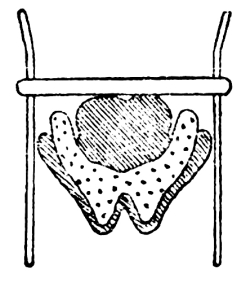
Fig. 2.
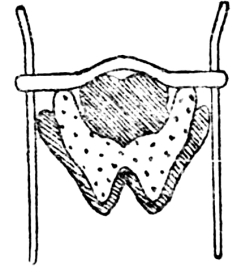
3. The curb should be laid in the chin-groove and be so adjusted that when the bit is pulled back to its greatest extent the angle which the bit forms with the mouth should never exceed 45° even with the lightest-mouthed horse, and should vary between that and 30° according to the degree of hardness of the mouth. The curb should be fixed permanently on to the off curb-hook. The chain should be adjusted by twisting it to the right, putting the last link on to the near curb-hook, and then taking up as many more links as may be necessary. It should admit two fingers easily between it and the jawbone.
4. The headstall should be parallel to and behind the cheek-bone.
5. The noseband should be the breadth of two fingers below the cheek-bone and should admit two fingers between it and the nose.
6. The throat lash should fit loosely, being only sufficiently tight to prevent the headstall slipping over the horse’s ears. [Pg 65]
7. The reins should be of such a length that when held by the middle, in the full of the left hand, with a light feeling of the horse’s mouth, they will touch the rider’s waist.
32. Miscellaneous details.
1. The head rope is put on as follows:—The point of the rope is passed through the lower ring of the jowl piece from the near to the off side, and then through its own ring. It is next passed over the horse’s neck from the off to the near side, and fastened off by doubling back the end, and laying the loop so formed on the standing end of the rope 6 inches from the ring. The free end is then wound round the three returns, passed through the loop, and the loop is hauled taut to it. The number of times the free end is wound round the returns will vary according to the length of the horse’s forehand.
Special for mountain artillery ponies.—Buckle the strap at the end of the rope, buckle down, to the rear D of the head collar: pass the free end from off to near side over the animal’s neck, fasten off by doubling a piece of the rope long enough to make five complete turns, and lay this loop on the standing end of the rope 6 inches from the brass ring; the free end is now wound five times completely round the three returns, and passed down through the loop which is hauled taut to it. The bight of the rope is fastened off the front D on the saddle by a leather tie.
2. The wallets (officers only) are to be placed on the pommel of the saddle with the hollowed side of the connecting piece to the front. The wallet strap is to be passed from the rear through the rearmost staple on the saddle, then through the rear keeper of the wallet, next through the front staple of the saddle, and finally through the front keeper of the wallet and buckled, the point of the strap pointing to the rear, the buckles being in line with the front edge of the wallet. [Pg 66]
3. The sword frog is attached to the rear arch of the saddle on the near side, the girth being passed through the steadying strap.
4. The breast-piece should hang horizontally from the supporting straps, the bottom of it about 1 inch above the point of the shoulder, and should admit the breadth of the hand between it and the horse’s chest.
5. The breastplate should be so fitted that the upper edge of the rosette or leather is the breadth of three fingers above the sharp breast bone, and it should admit the breadth of the hand between it and the flat of the shoulder.
6. The martingale should be used only for exceptional horses. It may be either running or standing, according to which suits the horse the better.
It should be of such a length that it will not interfere with the horse until he gets his head above the proper position. If it is shorter than this it will tend to make him set his head and neck, and lean against it.
If a running martingale is used on reins other than those sewn to the bit or bridoon they should be fitted with “stops” to prevent the rings of the martingale getting caught by the buckles or studs, which fasten the reins to the bit or bridoon.
Running martingales should, as a rule, be put on the bit reins and sufficiently loose to have no bearing on the reins till the horse attempts to raise his head.
The standing martingale should, as a rule, be fastened to the noseband, but under exceptional circumstances it may be fastened to the bridoon or cheek of the portmouth bit.
33. General instructions.
1. The instructions should be divided into three periods, and the pupil should be gradually advanced from one to the other. [Pg 67]
The proper sequence of instruction is a matter of extreme importance, in order to obtain early and satisfactory results and to avoid spoiling horses.
2. The first period should be devoted to the attainment of a firm seat independent of the reins, and its natural consequence—suppleness of the body from the hips upwards. Individual instruction should be the rule during this period.
It is important to give the recruit confidence from the first, and to start with he should be given a quiet, well-trained horse. He should be allowed a saddle and stirrups for the first few days, after which some of his work each day should be without stirrups. The greater part of the instruction at this stage should be without reins. To save the horse’s mouth the pupil should only be allowed to hold his reins when he is riding with stirrups.
As soon as the recruit begins to be at home in the saddle and can rise in his stirrups, cantering and jumping should commence.
3. Before he enters the second period the recruit should be able to control his horse in straightforward movements and simple turns in the school or manège and be able to ride over low jumps at all paces without reins. From now onwards a considerable portion of the work should be outside the riding school.
This second period should be devoted to teaching what are commonly called the “aids,” i.e., the use of the hand and lower part of the leg and the distribution of the rider’s weight to indicate the rider’s will to his horse. (See Sec. 43.)
The instructor should aim at cultivating freedom and elasticity in the shoulders, arm, and wrists. Stiff shoulder-action cramps the play of the elbow-joints and wrists and makes good hands impossible.
The recruit should be instructed to keep the knee firm to the saddle when the lower part of the leg is used. [Pg 68]
4. In the third period more advanced instruction in horsemanship is given. This should commence when the pupil has attained to suppleness of the body and the limbs, and consists in combining the play of both so that the rider may learn to move in unison with his horse.
Exaggerated movement of any sort must be discouraged, and the necessity of quietness and of sitting still emphasized. The best horsemen attain their ends with the minimum of exertion to themselves and to their horses.
During this period the horse artillery recruit should be taught to use his sword, and mounted men should receive instruction in riding with the rifle.
5. After the first few lessons the recruit’s horse should be constantly changed, and he should not be passed in riding until the average animal goes pleasantly with him at any pace.
Concurrently with his instruction in riding the recruit should be taught the principles of saddling and bitting, also the points of the horse and other elementary but useful knowledge connected with horses and stables.
6. By following out the methods described an average man, with careful individual instruction, should be able to ride at a trot and canter and over small jumps without reins after about 30 continuous lessons. He should be fit for dismissal in about 60 lessons.
34. Hints to instructors.
1. It is necessary that an instructor should himself be a practical horseman.
2. Recruits should be carefully taught from the first how to put on and fit their saddles and bridles. The ill effects resulting from bad fitting saddlery should be explained to them.
Examples of horses badly saddled and bridled should be shown to the men, and they should be made to point out what is wrong, and how the mistake should be put right, e.g., if the front tab of the [Pg 69] V-shaped girth attachment is not buckled tightly up, the saddle will slip forward. They should also be taught clearly how the bit acts on the bars of the mouth, and how it should be fitted.
3. An instructor should be mounted, and in addition to a short verbal description, should give a practical illustration of what he requires. A recruit who may have great difficulty in learning his work by mere verbal instruction will quickly do so by copying an expert horseman.
4. A feature of all instructional work should be its quietness; an instructor should never shout and must always keep his temper. He must endeavour from the first to create a spirit of emulation amongst his pupils, and avoid keeping the more forward amongst them back for the sake of the others.
5. An instructor should aim at making his lesson progressive, and as interesting as possible. In order to give recruits confidence, they may be allowed occasionally to amuse themselves in the riding school with their horses, by doing anything they like without interference from the instructor, beyond his taking care that the horses are not ill-treated.
When teaching men in the open they should be encouraged to ride about independently, so as to get into the habit of making their horses go where they like and do what they wish. As the men improve, the instructor should accustom them to riding under as varied conditions as possible.
6. The first portion of the early training can be pushed on much more quickly in a riding school than in the open. The horses are under better control, the nervousness natural to beginners and usually felt by recruits is greatly lessened, for they know that the horse cannot run away, and there is nothing to distract the attention of men or horses. The more advanced training must, however, always be carried out in the open, in order that the pupil may learn real control over his horse and improve his hands.
7. The first object of the instructor is to give his pupils confidence, [Pg 70] to teach them balance, the knee and thigh grip, and to sit well down in the saddle. The lungeing whip should not be allowed inside the school, it does more harm than good, frightens the other horses and upsets the men; if necessary, the recruit should be allowed to carry a stick or whip. No riding school lesson should exceed one hour.
8. Falls should be avoided: they tend to spoil the beginner’s nerve and retard his progress. To this end the recruit’s stirrups should be connected in the initial stages by a strap passing under the horse’s belly, of such a length that the man’s knees are not drawn away from the saddle. The strap saves falls, because it prevents the rider’s legs from flying out far in any direction and the confidence it engenders enables him to acquire balance more quickly. It should not be used when jumping obstacles over 2 feet high.
9. More horses are spoilt from being “jobbed” in the mouth than from any other cause; particularly when jumping; hence the immense importance of teaching the men from the first to leave their horses’ heads alone except for the purpose of control and for applying particular aids.
Men may, with advantage, be taught to ride with their reins fully long.
10. An instructor should be careful not to keep horses reining back, passaging, or bending for more than a few minutes at a time. Generally speaking, half the length of the school is sufficient for one of these exercises.
11. In order to teach a man to have a strong seat, with the knee firmly in the saddle, and at the same time to keep his feet pressed down home in the stirrups with the leathers practically taut, he should frequently be practised in standing up in his stirrups. At first this should be done with the horse standing still, the man resting his hand on the horse’s neck, if necessary, to assist his balance. Afterwards at the walk, trot and canter. [Pg 71]
35. Preliminary training.
1. Before a recruit is allowed to mount a horse his riding muscles should, if possible, have been strengthened on a wooden horse, either under a riding instructor or under a gymnastic instructor who is a good horseman. At the same time he should be taught the correct seat. (See Sec. 38 and Fig. 4.)
2. The following are good exercises:—
iii and iv should be practised on the move when riding proper begins. Before commencing, the pupil must be placed well down in the saddle, and he must be taught to keep his knees firm to the flap and not to cling with the lower part of the leg.
3. These exercises on the wooden horse may be usefully employed during subsequent training, but should not immediately precede or follow a riding lesson. Exercising tired muscles is not only useless, but harmful.
36. First lessons to the recruit.
1. Squads should not exceed 8 in number, and should parade in line, leading their horses. [Pg 72]
“Stand to your horses.”—The man stands at attention on the near side of the horse, toes in line with the horse’s fore feet; the reins, taken over the horse’s head, are held in the palm of the right hand near the ring of the bit, little finger between the reins, back of the hand up; the right arm bent, the hand as high as the shoulder; the end of the reins in the left hand, which hangs down by his side without constraint. This is the position of attention when the man is leading his horse.
When the horse is about to be ridden, the position of attention will be the same as above, except that the reins will not be taken over the horse’s head and will be held by the right hand only near the bit.
“Stand at ease.”—The right hand slides down the near rein to the full extent of the arm, the end of the reins being retained in the left hand. The position of the man’s legs and feet are the same as at dismounted drill.
Note.—If the reins have not been taken over the horse’s head, they will be held in the right hand only, the left arm hanging by the man’s side without constraint.
“In front of your horses.”—Each man being at attention will take a full pace forward with the right foot, turn to the right-about on the ball of it, and take one rein in each hand near the rings of the bit, still holding the end of them in the left hand if the reins are over the horse’s head; hands and elbows to be as high as the shoulders.
This is the position in which a man should stand when showing a horse at the halt.
“Stand to your horses.”—Each man will take a full step forward to the horse’s near side with the right foot, and turn left-about on the ball of it. [Pg 73]
“Quick march.”—Each man will move off holding the reins as above.
“Single files right (or left)” “Quick march.”—Each man will move off in succession, one horse-length from the file in front of him.
2. A man when leading a horse through a narrow gate or doorway should walk slowly backwards, taking care that the horse’s hips clear the uprights. The head collar should be held in both hands, one on either side of the horse’s head, which, however, should be sufficiently free for the horse to see where he is going.
When a soldier, leading a horse, passes an officer he will look towards him.
3. How to pick up a horse’s foot.—The recruit should be taught the right way to pick up a horse’s foot. To do this he should face the rear and run his hand lightly down the leg from the shoulder or quarter along the back of the knee or hock before attempting to lift the foot from the ground.
4. How to run a horse in hand.—The reins should be held as described above in “Stand to your horses” and the horse led off. As soon as he breaks into a steady trot the man should leave go the reins with the hand nearest the horse, and only hold the end of the reins in his outer hand. In turning a horse about when in hand, the man should always move round the horse and not swing the horse round himself. In leading a horse past an officer for inspection, the man should place himself on the side nearest the officer.
37. Mounting and dismounting.
1. Without stirrups.—The reins hanging evenly on his neck, the command will be given:—
“Prepare to mount.”—Turn to the right and close 6 inches to the right. Take the reins in the left hand properly separated as for riding (see Sec. 39), and place the left hand on the front of the saddle. The reins should be of such a length that the horse’s mouth is not interfered with while mounting. The right hand will grip the back of the saddle. [Pg 74]
“Mount.”—Spring up, straightening the arms to assist, pass the right leg over the horse and drop gently into the saddle. When mounting without a saddle the left hand will be placed in front of the horse’s withers, and the right arm on his loins, forearm well to the off side, fingers closed.
“Prepare to dismount.”—Place both hands, with a rein or reins in each, on the front of the saddle, and rise from the horse’s back by straightening the arms. Without saddles, both hands will be placed on the horse’s withers.
“Dismount.—Vault lightly to the ground and assume the position of ”Stand to your horses.”
Mounting and dismounting should also be practised on the offside.
2. With stirrups.—“Prepare to mount.”—Turn to the right about. Take the reins in the left hand properly separated as for riding (see Sec. 39) and with a light and equal feeling on the horse’s mouth. Place the left hand on the horse’s withers, and grasp his mane, or the front of the saddle if he has no mane; then place the left foot in the stirrup, and the right hand on the back of the saddle.
“Mount.”—Spring quietly into the saddle, place the right foot in the stirrup without looking down and assume the position of attention (see Sec.40).
Mounting on the offside will be taught in the same manner, and recruits should be made to practise it regularly.
“Prepare to dismount.”—Shorten the reins (see Sec. 39) and grasp the mane with the left hand, place the right hand on the front part of the saddle and take the right foot out of the stirrup. [Pg 75]
“Dismount.”—Carry the right leg over and lower the body gently to the ground; place the left foot in line with the horse’s fore feet, turn to the left and come to the position of “Stand to your horses.”
3. Whenever the men are dismounted and have been allowed to Stand easy from the position of Stand at ease, they will be recalled to attention by the command “Stand to your horses.”
4. For instructional purposes the order for mounting and dismounting is given by two words of command, e.g.:—
“Prepare to mount.”—“Mount”; “Prepare to dismount.”—“Dismount”; but for trained men there is only one word of command in each case, i.e., “Mount” or “Dismount.”
38. The seat.
1. The recruit must be made to sit evenly on his seat, well down in the saddle, and not on his fork; the flat of the thigh and the inside of the knee pressed against the saddle, but not so tightly that the man rides on his thighs, as the weight of the body should rest principally on the seat. Below the knee the leg should hang free, and in the early stages much attention need not be paid to the position of the body, though from the first the recruit should be taught to get his seat well under him.
2. Great care should be taken to fit the stirrups to the right length to suit the build of the rider. The man should be made to place himself in the saddle with his knees at the height which appears to suit his thigh. The stirrups should then be adjusted so that the bars are in line with the soles of his boots. If a man standing in his stirrups can just clear the pommel with his fork the stirrups are about the right length.
The end of the stirrup leather should be passed under both returns and then under the surcingle. It should not be passed downwards through the buckle.
A man with a short thick leg, however, requires his stirrups shorter [Pg 76] in proportion than a man of equal height but with a flat thigh and thin leg. The stirrups are intended to be an aid and convenience to the rider; if they are too long he will lose his seat by leaning forward in his endeavour to retain them; if they are too short, the seat becomes cramped and the rider is prevented from using the lower part of the leg correctly.
In ceremonial work the stirrups should be kept on the ball of the foot, but at other times the feet may be pushed right home.
39. How to hold the reins.
1. The recruit should next be taught how to hold the reins as described below. In the early stages he should only be allowed a snaffle or single rein attached to the cheek of the universal bit, and no curb, and should ride with the reins in both hands. The instructor should impress upon him the importance of not hanging on by the reins and explain that if he does so he will not make progress, but by injuring his horse’s mouth will make him difficult to ride.
2. The hands should be low and close in front of the body, thumbs uppermost, back of the hands to the front. Wrists should be rounded and supple and the movements of the horse should be followed by means of the play of the shoulders, elbows (which should be kept close to the body), and wrists.
3. Reins in left hand. i. Bridoon or check reins only.—Take the two reins in the left hand, the right rein between first and second fingers, the left rein outside the fourth finger, slack passed across the palm and secured between the thumb and first finger.
ii. All four reins.—Place the right bit rein between the second and third fingers, and the left bit rein between the third and fourth fingers. The right bridoon rein between the first and second fingers, [Pg 77] and the left bridoon rein outside the fourth finger, the slack of all four reins thrown back over the first finger and secured by the thumb.
At riding drill drivers when holding the reins in the left hand should place the right hand on the thigh, as described in Sec. 55.
4. Reins in both hands.—In the first place, whether using single or double reins, take them in the left hand as described above, then take up the right rein or reins in the right hand by placing it in front of the left, pulling sufficient of the slack forward through the left hand to obtain an even bearing on the mouth with both hands held low, just in front of the body and close to the horse’s withers.
In the case of single reins only, the right rein should be held between the third and fourth fingers; with double reins, the two right reins should be separated by the third finger. In each case the right hand should hold only the right rein or reins, the slack of these being secured between the right thumb and forefinger and passing thence into the left hand which holds both the left and right reins. (See Fig. 3.)
Fig. 3.
(Bit reins shown shaded.)
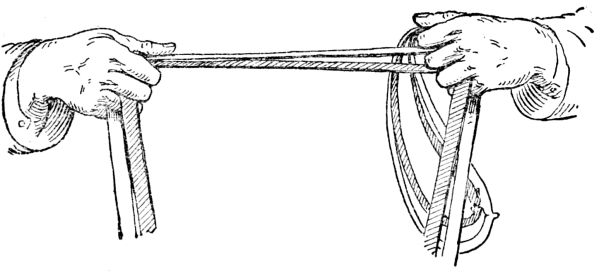
VIEW FROM FRONT.
[Pg 78]
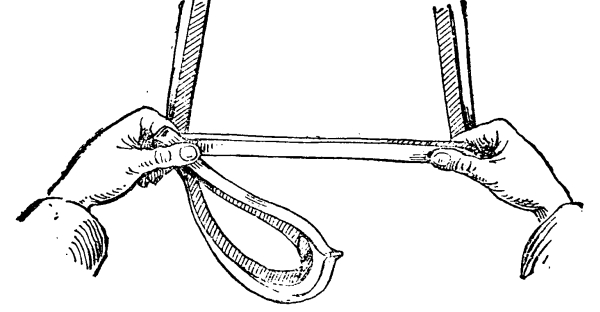
VIEW FROM ABOVE.
5. To lengthen the reins.—Allow sufficient rein to slip gently through the fingers.
To shorten the reins.—Keep the reins in the left hand but drop the slack from between the thumb and forefinger, and take hold of this in the right hand behind the left, slide the left hand forward until the desired length is obtained. Then as before secure the slack, and if riding with both hands on the reins, take up the right rein or reins again in the right hand.
6. The recruit should be well grounded in the proper manner of holding the reins, and frequently practised in changing them quickly from one hand to both and vice versâ, also in shortening and lengthening them at all paces. The importance of keeping the reins supple and unpolished should be impressed on him.
7. Normally the reins should be held in the left hand only, bit reins inside except in the case of beginners, and when riding young or awkward horses, when both hands should often be used. Occasionally the left hand may be required to be free, as when leading another horse, in which case the reins of the ridden horse can be held in the right hand. [Pg 79]
40. Position in the saddle at attention.
Fig. 4.
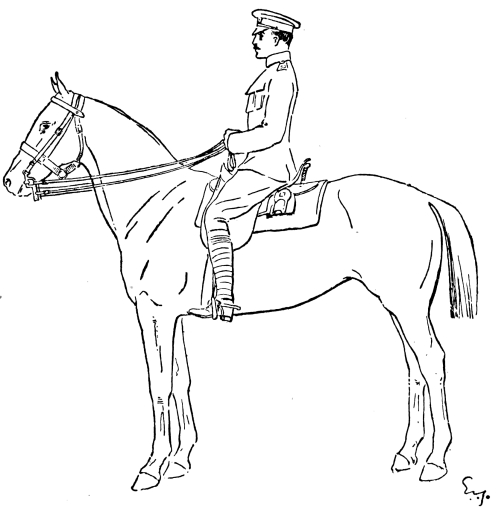
1. The correct position of the rider at attention is shown in Fig. 4. [Pg 80] The head and body should be erect and square to the front; upper arm hanging perpendicular; forearm nearly horizontal; thighs flat on the saddle; legs from the knee down nearly vertical; knees turned inwards so as to enable the toes to point towards the front; the heels should be sunk lower than the toes and the feet pressed down into the stirrups (see Fig. 4).
2. On the command “Sit at ease” the reins should be relaxed by dropping the left hand on the front of the saddle. The right hand should rest on the left, back up.
41. First movements on horseback.
1. The recruit should now be shown how to start his horse off at a walk from the halt, i.e., he should be made to ease the reins slightly, though still keeping a light feeling on the horse’s mouth, and press him forward with the legs from the knees downwards. He should be prevented from jogging his horse in the ribs with his heels and from advancing his hands to slacken the reins. At the same time he should be taught how to halt without jerking his horse’s mouth.
The trot should be slow and for short periods and there should be no cantering for the first few lessons.
2. How to rise in the stirrups.—The loins must be perfectly lissom, so that the seat may be easy and comfortable; the back should not be hollowed, but the upper part of the body should be inclined a little forward.
The recruit should not try, by rising, to follow or to anticipate the movements of the horse, but should let himself be raised.
His knees (and ankle-joints if riding with the stirrup on the ball of the foot) will sustain his movement and will allow him to descend softly into the saddle. It is advisable to let the recruit commence this at a walk.
3. At the trot without stirrups the recruit should allow his body to be thrown up at each step, and fall on his seat.
In cantering, the knees, the inside of the thighs and the seat itself [Pg 81] must remain close to the saddle, the whole body pliant and accompanying the movement of the horse, so that with each stride the rider feels a forward thrust through his seat from the animal’s back.
4. A few turns and circles may now be introduced, and in executing them the recruit should be told how to use the weight of his body. He should be instructed, whilst preserving the grip of his knees and thighs, to incline his weight from the hips slightly backwards and to the side to which he is turning.
5. As soon as he has gained some confidence, the recruit should ride without reins; he should then be taught to jump, at first over small obstacles, such as the bar lying on the ground. (See Sec. 42.)
The recruit should not be allowed to cling with the back of the calf; it should be explained to him that the principal use of the lower part of the leg will be taught to him later.
6. Much of the early training should be without reins, the arms being folded in front of the body, never behind, as the latter tends to throw the upper part of the body forward.
42. Teaching the recruit
how to ride his horse
over a fence.
1. Jumping, when carried out with discretion, is an excellent training for men and horses. Constant practice throughout the recruit’s training will enable the man to acquire, and afterwards to maintain, a firm seat, whilst at the same time the muscles of the horse’s back and thighs are developed and strengthened.
2. Riding over the bar laid on the ground makes a good beginning, the men trotting round the school with suitable distances between horses and jumping it in turn. This has the advantage of leading both men and horses to think that they are doing nothing out of the common, and results in an orderly and quiet procedure. [Pg 82]
The recruit should at first be allowed to hold the end of the rein in the flat of the hand to give him confidence, but should be encouraged as soon as possible to drop the reins altogether. The arms should be folded across the chest. Stirrups should be allowed until the instructor considers it advisable for the beginner to jump without them.
In the first jumping lessons the recruits may be allowed to hold the mane, head rope, or front of the saddle in one hand and the reins loosely in the other. With this assistance they will be found to get confidence, attain their proper balance in a short time and be in a position to control their horses without jerking their mouths.
3. As the horse takes off, the pupil should be instructed to lean forward and to tighten his leg-grip; if he is successful in this his body will soon swing in harmony with the horse. The movements of the body from the hips upwards when riding over a jump vary so much with different horses and different fences, that it is impossible to lay down any rule. It is a matter of the rider balancing his body assisted by a leg-grip. The horse should be eased up gently after a jump, on no account should his pace suddenly be checked.
When the initial stage is passed frequent change of horses expedites progress.
4. The pupil should be gradually trained to handle the reins when jumping, and the greatest care must be exercised to avoid ill-treatment of the horse’s mouth during the process. If the shoulder-joints are given free play when the horse requires more rein, all jerky movements of the arms and wrists will be avoided as the hands go forward. Reins must be held long, and the man taught to keep his hands low and allow them to come freely forward as the horse is on the downward plane. When riding with the reins in one hand, the left shoulder can be brought forward as the horse is descending. [Pg 83]
5. Jumping low obstacles is very little exertion to the horse, and the more the recruit has of it the sooner he will be ready to enter the third period of instruction. Before he enters this stage he should sit his horse with ease, both with and without reins, and, when jumping, should be able to keep a light feeling on the horse’s mouth without in any way interfering with it.
6. The pupil should then be given horses that require “riding” at their fences, and be taught to handle them with resolution. A combination of the qualities of determination and patience are invaluable in a horseman, and should be developed and encouraged at this stage of the training.
The method of dealing with refusers is given in Sec. 81.
43. The aids.
1. General principles.—The “aids” are the signals used by the rider to assist him in directing his horse. These signals are made by means of the reins, legs, spurs, shifting the weight of the body, whip, and voice. For instance, the reins can be used to bend the neck, to raise, lower, or turn the head to any one side; and to make the horse decrease his speed, halt, or rein back.
The necessity of impressing on all recruits the importance of preserving the sensitiveness of the horse’s mouth cannot be over-rated.
The pressure of both legs is an indication to the horse to go forward, and should normally be applied just behind the girth; the leg should only be drawn back when the horse fails to respond to ordinary pressure. The pressure of the leg drawn back on one side is employed to make the hind quarters turn towards the opposite side, or to prevent them from turning towards the side on which the pressure is applied.
When it is necessary to use the spur it should be applied as described [Pg 84] in Sec. 45. If when the horse is on the move the weight of the body is shifted, say to the right, the horse will be inclined to put out a foot on that side, in order to equalize the distribution of weight on its limbs. The hind quarters and forehand are respectively lightened by the rider’s body being brought forward and back, or by lowering or raising the horse’s head. The movement of the body as an “aid” should be slight, except in the case of a man riding a heavy horse, when more movement may often be necessary, but it should not lead to interference with the horse’s mouth.
The indications of the whip are closely akin to those of the leg and spur.
2. To walk or trot.—Without drawing them back, close both legs to the horse according to his temperament, and slightly ease both reins by a slight turn of the wrist or wrists. As soon as the horse advances at the desired pace relax the pressure of the legs and feel the reins again as before.
3. To halt.—Close both legs and feel both reins, at the same time bring the weight of the body slightly back. As soon as the horse halts relax the pressure of the legs.
4. To turn to the right on the haunches.[3]—Close both legs to the horse, using more pressure with the left leg drawn back to prevent his haunches from flying out to the left. At the same time feel the right side of the horse’s mouth, press the left rein against his neck, and lean the body slightly back and to the right.
To turn to the left on the haunche.s—Reverse the above.
5. To turn right about on the haunches.—The same as “right turn,” except that the rider should lean his body slightly back as well as to the right and as required apply more continued pressure on the right rein and firmer pressure with the drawn back left leg to compel the horse to turn on his haunches.
6. To collect the horse.—Make the horse bring his hindquarters [Pg 85] well under him by a pressure of both legs, and induce him to flex his jaw and bring his nose slightly in by a light feeling of the bit rein. The pressure of the legs should precede any feeling of the reins. In this way the rider causes the horse to stand, walk, trot or canter, at attention.
7. To rein back.—Collect the horse as described in the previous paragraph, then feel the horse’s mouth as an indication for the horse to step backwards; the rider must never have a dead pull on the horse’s mouth, but when the horse has taken a step back, should ease the reins and then feel them again. The horse should be kept up to his bit by a pressure of both legs.
The trained horse should rein back collectedly, with head carried fairly high, and the body balanced on all four legs. He must move in a straight line, and must not be allowed to run back out of hand, but must make each movement in obedience to the properly applied indication of the rider. He should not be allowed to halt in an uncollected position.
8. To canter off fore and off hind leading.—Collect the horse, and by a strong pressure of the drawn back left leg make him strike off into a canter. Prevent him from turning his quarters to the right by a supporting pressure of the right leg as required. When cantering the horse’s body, head and neck should be kept in the direction in which he is moving. The horse should be collected and slightly bent in the direction of the leading leg. The horse must be made to canter true and united.
To canter near fore and near hind leading.—Reverse the above aids.
Methods of telling if a horse is cantering true:—
i. Look at his shoulders and fore feet: the shoulder and foot of the leading leg should be the most advanced.
ii. Look at his hind legs. The leading one of these should be on the same side as the leading fore leg. The horse’s croup will be slightly turned towards the side of the leading legs.
[Pg 86] If “disunited,” the movement felt in the seat will be a jolting and twisting motion.
9. To change from off fore and off hind to near fore and near hind at the canter.—Close both legs to the horse and turn his head slightly to the right; prevent him from turning his body to the right by the pressure of the left leg, put the weight of the body slightly backwards and cause him to change by a stronger pressure of the drawn back right leg.
To change from near fore and near hind to off fore and off hind, at the canter.—Reverse the above aids.
10. To circle right at canter (from the halt, walk, or trot).—Apply the aids described for the “Canter, off fore and off hind leading,” and guide the horse round to the right.
To circle left at the canter.—Apply the aids described for the “Canter, near fore and near hind leading,” and guide the horse round to the left.
44. Bending.
1. Bending affords the advanced recruit a lesson in applying the “aids.” It is tiring exercise for the horse and should be practised with discretion.
In all bending work it is very important to get the horse to yield his jaw slightly as this conduces to lightness of hand.
As a rule, bending should be done on the move.
2. To bend a horse:—
i. On the snaffle.—If to the right, the rider should bend the horse by a gentle pressure on the right rein, at the same time giving to him slightly with the left rein but still retaining a gentle feeling on the left side of his mouth, and using the pressure of the legs as required; as soon as the horse bends to the hands cease bending and make much of him. [Pg 87]
ii. On the bit.—The left hand, holding the reins, should have an equal feeling on all four reins. In bending to the right, place the third finger of the right hand between the two right reins and slightly feel the horse’s mouth, using the pressure of the legs as required; when the horse yields to the feeling by relaxing his jaw and bending as required, the hand should immediately yield to him.
The outer rein in bending should always retain a steady feeling to support the inner and to ensure the bend being made at the poll.
3. Bending lesson.—With beginners it is advisable that this should take place in the riding school or closed-in manège, but as the instruction progresses it should be practised outside.
The following movements should be practised (see Fig. 5):—
In all these movements the horse’s neck should be kept straight from the withers onwards to near the poll, his head itself being turned in the direction in which he is moving.
In the “shoulder in” the horse’s body should be inclined at about a half turn to the direction in which he is to move.
In “right” or “left pass” the horse’s body should be kept approximately at right angles to the direction in which he is moving, being inclined only just sufficiently in that direction to enable him to cross his legs.
These movements should all be made in the same way. Thus in “right shoulder in,” the left rein bends and leads the horse assisted by the right rein. The pressure of the rider’s right leg makes the horse [Pg 88] cross his legs (except in the case of the half passage) whilst the rider’s left leg keeps him up to the hand and prevents him from swerving.
Fig. 5.
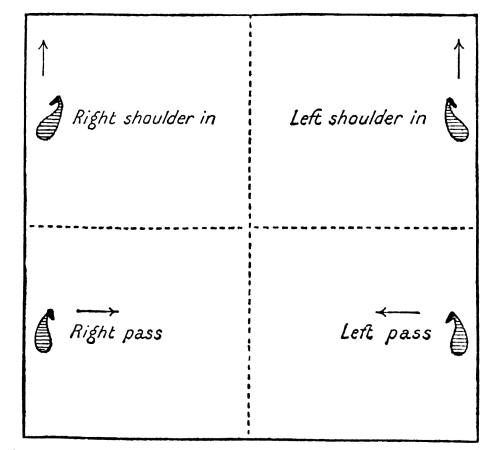
Horses should not be turned at the corners when in the position of “shoulder in.” On reaching a corner each horse should be walked on and again “shoulder in” after passing it.
To turn to the right when passaging to the right:—Stay the hind quarters with the right leg, lead the forehand round with the right rein, keep the left leg closed to prevent the quarters from flying out. [Pg 89]
In working the shoulder in and passages, fore and hind feet should move on four distinct lines parallel to each other.
45. Spurs.
When the recruit has learned to preserve his proper seat and balance, and has a knowledge of the “aids” made with hands and legs, he may ride with spurs. In making use of them he must not open his thighs or move his body forward; the leg from the knee downwards only should move. Spurs with sharp rowels should only be allowed in exceptional circumstances.
The spurs should be used as little as possible, but when they are necessary the horse should be made to feel them; a continual light touch will either make the horse kick or cause him to become insensible to them; a jogging motion of the leg with the heel drawn up should, therefore, never be allowed.
46. Various exercises.
1. General principles.—The recruit’s course should proceed by degrees according to the progress made, and any or all of the following exercises may be found useful.
Others which suggest themselves to the instructor may be added. Each exercise or game, however, should have some definite object, and should be looked on merely as a means to an end.
2. To circle.—The ride being told off by fours, on the command “Nos. 1 Circle right (or left),” each No. 1 will ride his horse in a circle and fall-in the rear of his section of fours, Nos. 2, 3 and 4 doing the same when ordered by the instructor.
“Odd (or even) numbers circle right (or left).”—Each odd (or even) number will ride in a small circle and fall-in behind the even (or odd) number immediately behind him. [Pg 90]
“Heads of fours circle right (or left).”—The leading man of each fours will ride in a circle followed by 2, 3, 4, and will continue in the circle until he gets the command “Go Large,” when he will cease circling and resume his original direction; or the rein may be changed by the word of command “ Heads of fours—change.”
3. Figure of 8.—For preliminary training in this movement the horse should be cantered quietly on a large circle or an oblong of about the same length as the school.
i. In the riding school or manège.
Fig. 6.
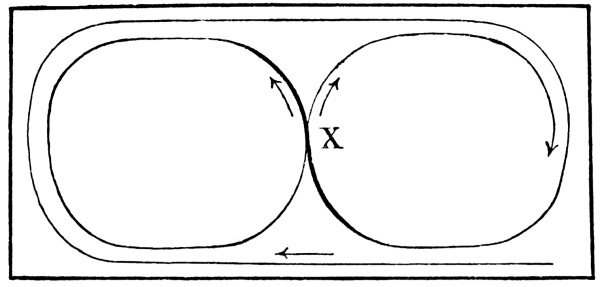
The change of rein and leading legs should be made as soon as the new circle is commenced at X. (See Fig. 6.)
ii. Outside.—First start off at a canter on a moderate sized circle on either rein. As soon as the horse is moving correctly and collectedly, turn inwards and describe a small circle still on the same rein, but about half the size of the first, when this is completed [Pg 91] change the bend of the horse and the leading legs, and make a similar circle on the other rein, the two circles describing the figure of 8 within the original circle. (See Fig. 7.)
Fig. 7.
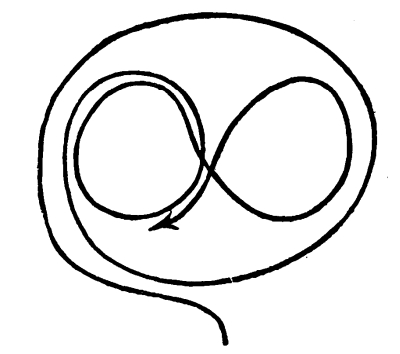
In changing the bend, jerking the horse’s head across from one side to the other should not be allowed; to compel the horse to change legs it is necessary to turn his head slightly outwards, the rider at the same time inclining his weight to the side to which he wishes the horse to change, and pressing with his outer leg; these movements should be made gently, and as soon as the horse has changed the leading legs, both fore and hind, his neck and head should be turned to look the way he is going.
4. The “Ladies Chain” is a useful practice for both man and horse. The leading file turns about, and rides a slightly zig-zag course through the remainder of the ride (who will be at three or four horse-lengths distance from each other), passing on their right and left hands alternately. When each man in succession has done this, the rear file, at increased pace, will zig-zag through the ride from the rear, and the remainder will follow in succession. [Pg 92]
5. Practice in crossing a big V-shaped ditch, about 18 feet wide and 10 feet deep, i.e., large enough to compel the horses to go down one side and up the other, is a particularly valuable exercise, as no horse will face the opposite bank unless his head is left absolutely alone.
47. Paying compliments mounted
without arms.
When riding with both hands on the reins a soldier passing an officer turns his head and eyes in the direction of the officer without moving his hands. When holding the reins in one hand only he should drop the right hand to the full extent of the arm behind the right thigh, fingers half closed, back of the hand to the right, and turn his head in the direction of the officer.
48. Leading horses.
1. When riding one horse and leading another, the led horse should be on the near side, so that when meeting or being overtaken by traffic the man, by keeping on the left of the road, will have the ridden horse between the led horse and the traffic. The end of the led horse’s rein should be held in the left hand lying flat against the reins of the ride horse. If the led horse is fresh his rein should be held short, about 1 foot from his head. If he tries to break away, the man should circle the two horses to the left.
2. When leading two horses one should be on each side.
3. When leading three horses one should be on the near side and two on the off side. When leading two horses on the same side the reins of the outer horse should be passed between the jaw and the jowl piece of the head collar of the inner horse before being gathered up.
49. Securing horses.
1. Tying up a horse.—The chief considerations in securing a horse by the reins or head rope are to prevent him injuring himself [Pg 93] (wire fences or spiked iron railings should obviously not be used) or breaking his reins by treading on them. The knot used should be capable of being quickly tied and untied and should not be likely to come unfastened through the horse fidgetting about.
Fig. 8 shows how a horse may be secured to a suitable branch by first placing the loop of the reins under and round it, and then doubling back the end of the branch and passing it through the reins. A piece of stick will answer the same purpose. The more the horse pulls the tighter the knot becomes.
2. Single horses can also be kept from straying as follows:—
i. By knee-haltering. One end of a rope is made fast above the knee by a clove hitch, fairly tight, with a keeper knot (half-hitch) round the rope to prevent it from coming loose. The other end is then carried back to the head collar and so secured that the horse cannot tread on it. The rope should be from 1 foot to 1 foot 6 inches from the knee to lower ring of jowl piece of head-collar.
Fig. 8.
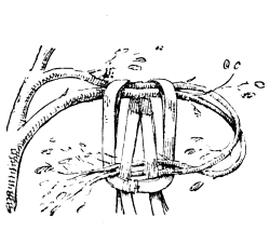
Fig. 9.
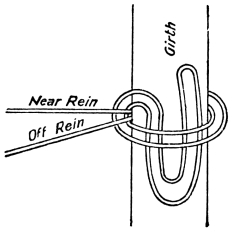
[Pg 94]
ii. By securing the bit to the stirrup iron by means of the rein or a strap.
iii. By securing the bridoon rein to the girth on the near side; this is done by taking the bridoon reins over in the usual way and passing them under the girth from front to rear. They should then be drawn sufficiently tight to bend the horse’s head to the left and fastened by a single hitch, but without drawing the slip end through. (See Fig. 9.) When mounting in haste the rider can easily loosen the slip knot after mounting, and then pull the reins clear and pass them over the horse’s head.
3. Coupling horses.—Horses can be securely coupled by turning them head to tail and tying each with the bridoon rein to the off back-strap or arch of the saddle of the other, taking care that the reins, when tied, are not more than 6 to 8 inches long. (See Fig. 10.)
With three horses one can be tied to the head collar of either of the two horses so coupled. Four horses are secured by tying a horse to each of the two originally coupled. No horse should have more than 1 foot length of rein, and the best knot to be used is a slip knot round the rein itself.
Fig. 10.
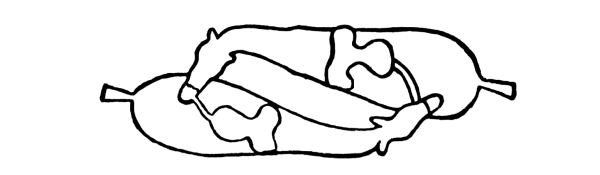
4. Linking horses.—The head ropes are brought over the horses’ heads clear of the reins, without unfastening the coil or knot. Each man hands his rope to the man on his right, who passes it through the upper ring of his own horse’s head collar, and ties it with two half-hitches. [Pg 95]
50. Riding with the sword.
| 1. | To draw | Pass the right hand smartly across the |
| swords. | body, over the bridle arm, draw out the blade | |
| the sword knot on the wrist, give it two turns | ||
| Draw— | inward to secure it, and then grasp the handle | |
| Swords. | with the right arm close to the body, shoulders | |
| One. | square to the front. | |
| Two. | With an extended arm draw the sword | |
| slowly from the scabbard, in the rear of the | ||
| left shoulder, and bring it smartly to the | ||
| “Recover,” that is, with the bar of the hilt in | ||
| line with the bottom of the chin, blade | ||
| perpendicular, edge to the left, elbow close to | ||
| the body. | ||
| Three. | Lower the sword smartly to the “Carry,” | |
| that is, with the top of the guard resting on | ||
| the top of the hand, blade perpendicular, edge | ||
| to the front, the first and second fingers | ||
| gripping the handle under the resistance | ||
| piece, the little finger behind the handle to | ||
| steady it, the wrist resting on the leg and the | ||
| pommel pressed against the side of it, upper | ||
| part of the arm close to the body, and the | ||
| elbow lightly touching the hip. [Pg 96] | ||
| 2. | To slope | Bring the lower part of the arm at right |
| swords. | angles to the upper, hand in front of the | |
| elbow, relax the grasp of the second and third | ||
| Slope— | fingers, and allow the sword to fall lightly on | |
| Swords. | the shoulder, midway between the neck and | |
| point of the shoulder, the top of the hilt resting | ||
| on the top of the hand, the little finger | ||
| still in rear of the hilt. | ||
| 3. | To sit at | Keeping the sword at the slope, place the |
| ease. | hands on the front part of the saddle, with the | |
| Sit at Ease. | right hand over the left. | |
| 4. | To come | |
| to position | ||
| of attention. | Come smartly to the position of “Slope | |
| swords.” | ||
| 5. | To | Resume the grasp of the second and third |
| carry | fingers and bring the blade perpendicular, | |
| swords. | the hilt resting on the thigh, as in the third | |
| Carry— | motion of drawing swords. | |
| Swords. | ||
| 6. | To | Carry the hilt smartly to the hollow of the |
| return | left shoulder, blade perpendicular, edge to | |
| swords. | the left, elbow level with the shoulder; then | |
| by a quick turn of the wrist drop the point | ||
| Return— | in rear of the left shoulder slowly into the | |
| Swords. | scabbard, and resume the position at the end | |
| of the first motion in “Draw swords,” | ||
| One. | shoulders being kept square to the front | |
| throughout this motion. [Pg 97] | ||
| Two. | Push the sword lightly into the scabbard, | |
| release the hand from the sword knot by giving | ||
| it two turns outwards, the right hand remaining | ||
| across the body in line with the elbow, | ||
| fingers extended and close together, back of | ||
| the hand up. | ||
| Three. | Drop the right hand smartly to the side. |
7. When “Draw swords” is ordered at the walk, the men after drawing will remain at the “Carry” until ordered to “Slope”; but if “Draw swords” is ordered at the trot or gallop, the men will come to the “Slope” after drawing.
8. Proving.—In proving with a drawn sword, the sword is brought to the “Carry,” and again sloped on the command “As you were.”
9. Paying compliments with drawn sword.—An officer or soldier should “Carry” his sword and turn his head and eyes in the direction in which the compliment is to be paid.
10. Officers’ salute.—i. The officers’ salute in marching past commences ten yards from the reviewing officer, the sword being at the “Carry.”
First motion: Carry the sword direct to the right to the full extent of the arm, hand as high as the shoulder, back of the hand to the rear, blade perpendicular.
Second motion: Bring the sword by a circular motion to the “Recover,” keeping the elbow as high as the shoulder.
Third motion: Still keeping the elbow the height of the shoulder, bring the hilt to the right shoulder; during this motion let the finger nails come in line with the edge of the sword.
Fourth motion: Lower the sword to the front to the full extent of the [Pg 98] arm, blade 3 inches below the knee, edge to the left, thumb extended in the direction of the point, hand directly under the shoulder. There should be no pause between these motions, but all should be combined in one graceful movement.
The head is slightly turned towards the reviewing officer whilst passing him.
After passing the reviewing officer ten yards, the sword is brought to the “Recover” carrying it well to the front, and to the “Carry” in two deliberate movements.
ii. The officers’ salute at the halt.—The sword being at the “Carry.” First motion: Bring the sword to the “Recover,” but with the thumb pointing upwards.
Second motion: As described in fourth motion of the salute when marching past.
Third motion: Bring the sword to the “Recover.”
Fourth motion: Bring the sword to the “Carry.”
51. Riding with the rifle.
| 1. | To | Take hold of the barrel of the rifle with the |
| mount. | left hand, about 3 inches below the muzzle, | |
| butt downwards, and prepare to mount, but | ||
| Prepare to | with the rifle held in the left hand on the | |
| Mount. | off side of the horse. | |
| Mount as usual, raise the rifle with the left | ||
| Mount. | hand, seize it with the right hand in front of | |
| the magazine, and place it in the bucket. [Pg 99] | ||
| 2. | To | |
| dismount. | ||
| Prepare to | Seize the rifle with the right hand at the | |
| Dismount. | small of the butt. | |
| Two. | Draw the rifle out of the bucket far enough | |
| to allow the hand to re-grasp it just in front | ||
| of the magazine; raise it so as to clear the | ||
| front of the saddle. | ||
| Three. | Lower the butt under the bridle hand, and | |
| hold the barrel with the left hand about | ||
| 3 inches below the muzzle. | ||
| Four. | Place the right hand in front of the saddle, | |
| and quit the right stirrup. On the command | ||
| “Dismount,” dismount as usual, bringing the | ||
| rifle to the position of the “Order” in the left | ||
| hand, and hold the bridle with the right hand. | ||
| If required for dismounted service, as soon | ||
| as the horse is given up, the rifle is passed | ||
| from the left hand to the right. [Pg 100] | ||
| 3. | The | The rifle is held with the right hand in front |
| advance. | of the magazine resting on the upper part of | |
| the right thigh, thumb and fingers round the | ||
| rifle, muzzle pointing to the left front and | ||
| just clear of the horse’s near ear, trigger guard | ||
| to the front. | ||
| 4. | To draw | |
| arms. | Grasp the rifle at the small of the butt. | |
| Draw—Arms. | ||
| Draw the rifle out of the bucket far enough | ||
| Two. | to allow the hand to re-grasp it just in front | |
| of the magazine. | ||
| Three. | Retaining the same grasp, bring the rifle to | |
| the “Advance.” | ||
| 5. | To carry | From the “Advance.”—Without moving the |
| arms. | right hand from its grasp of the rifle, place, | |
| the butt on the upper part of the right thigh, | ||
| Carry. | with the right eye, trigger guard to the left, | |
| —Arms. | back of the hand down, arm slightly bent, | |
| elbow close to the side. [Pg 101] | ||
| 6. | To return | This is done in one motion as follows:—Raise |
| arms. | the butt of the rifle and lower the muzzle | |
| into the mouth of the bucket, pressing the | ||
| Return | rifle well home with the right hand, trigger | |
| —Arms. | guard to the rear, taking care that the bolt lever | |
| does not catch on the edge of the bucket. |
52. Revolver shooting.
1. Revolver shooting is to be practised mounted by all ranks armed with that weapon.
2. At least 10 days’ preliminary instruction, including snapping, should be given immediately before firing the first year’s course, while 5 days’ practice will generally be advisable before subsequent courses. This preliminary instruction is important, in order to inculcate correct methods and to train the eye and muscles of the hand, wrist and arm.
3. The allowance of blank ammunition is required to accustom men to the shock of discharge and horses to the noise. Firing should be carried out first at a walk and finally at a canter.
4. When loaded the revolvers should be carried muzzle down and the finger away from the trigger.
5. To take aim the revolver should be raised on to the mark, keeping the wrist stiff with the forearm, wrist and barrel in the same vertical plane, or it may be brought direct into the alignment. The arm may be kept straight or slightly bent.
Mounted men should learn to shoot, without taking aim along the sights, at the centre of the body of the target. With a little practice they should learn to keep their eyes on the object and, as it were, “throw the bullet” at it.
6. Practice with ball ammunition should be divided into two parts, dismounted and mounted. The latter should not be carried out until a man thoroughly understands the handling of the weapon. [Pg 102]
53. General principles.
1. All officers, non-commissioned officers, and drivers must possess a thorough knowledge of the principles of driving and of fitting harness.
2. Even and steady draught is a matter of paramount importance; the respective weights behind teams are calculated on the assumption that every horse will do his fair share of work; this is impossible unless the driving is of a high order. If the driving is not good, neither quick manœuvre, long marches, nor efficient transport serviceman be assured.
3. When draught is even and steady every trace in the team is taut, and the horses’ heads are facing straight to the front. If, for example, an off horse’s head is pulled inwards, his draught power is reduced and he is liable to become collar galled.
4. The lead driver is responsible for direction, distance, and pace; it is the duty of the centre and wheel drivers to keep the traces taut and cover him.
5. Temperament should be the first consideration in teaming horses. A slug should therefore, if possible, not be included in a team of very willing horses.
6. The position of the horses should frequently be changed; a hand horse, for example, loses his back muscles if he is never ridden, and is also apt to acquire the habit of leaning on the off side of the bit.
54. Fitting harness.
1. The saddle, saddle blanket, girth, surcingle, bit, curb, chain, head rope, nose band, and throat lash will be fitted as for the riding horse. (See Secs. 30-32.) [Pg 103]
2. The riding rein[4] should be fitted of such a length that the driver has complete control over his horse.
In the leading rein the short piece on the near side should be carefully fitted so that the bearing of the bit in the horse’s mouth may be even when the rein is held in the driver’s hand.
The side rein, if required, should be buckled to the cheek of the bit of the horse, the end being buckled to the saddle.
4. The breast collar should hang horizontally from the padded neck straps, the lower edge about one inch above the point of the shoulder. The higher it is in reason the less chance there is of the horse galling.
5. The pole bar supporting straps should be sufficiently short to carry the bar the width of a hand above the sharp breast bone; if lower, the bar will gall the horse’s chest. Care must be taken to have the bar horizontal.
6. The loin straps should be so fitted that the traces shall be in a straight line when the horse is in draught.
7. The length of the traces must depend on the size of the horses. The distance between horses in a team should not be less than one yard from nose to tail, but the traces of each pair of horses must be the same length.
8. The breeching should be fitted about 16 inches below the upper part of the dock; it is kept horizontal by the long loin straps. When put back in the breeching the horse should be at least a foot from the footboard.
9. Pole chains should be so fitted that when wheel horses are standing up to their collars there is no pull on the chains. By the use of a tug neck piece in connection with the pole bar supporting straps, horses with wheel harness can be harnessed to G.S. wagons whether the latter are fitted with pole chains or pole straps. [Pg 104]
10. The kicking strap should be so fitted as to give the play of a hand’s breadth between it and the horse’s croup when he is standing in his collar.
55. Position of a driver standing
to his horses and mounted.
1. The driver stands to his horses on the near side of his riding horse in line with the fore feet, holding the reins of both horses (the leading rein passing over the riding horse’s neck) in his right hand, right arm extended and level with his shoulder; left arm hanging down by his side; whip, stock upwards, in his legging.
2. On the command “Prepare to mount,” the driver turns to his right about, places the leading rein over the riding rein in the palm of his left hand, puts his left foot in the stirrup, and takes hold of the front of the saddle with his left hand and the back of the saddle with his right; if he cannot reach the back of the saddle, he must take hold of the flap.
With the universal reins, the riding horse’s rein is held in the full of the hand, the end hanging down between the first finger and thumb, little finger dividing the reins. The leading rein is held in the full of the hand, the end hanging down from the opposite side of the hand to that of the ride horse’s reins.
At “Mount” he raises himself in the stirrup, passes his right leg over the horse and drops quietly into his saddle. He then adjusts his reins so that he has an even feeling on both horses’ mouths, takes the whip out of his legging with his right hand, which he passes through the loop at the end of the stock and places on his right thigh back up, grasping stock and thong close together, with his elbow a few inches from his body.
This is the position of attention, mounted.
3. On the command “Sit at Ease,” both hands are placed on the pommel of the saddle, the right hand holding stock and thong of whip over the left.
4. On the command “Prepare to Dismount” the driver places the whip in his legging. [Pg 105]
At “Dismount.”—If the driver cannot reach the ground with his right foot while the left is still in the stirrup, he takes both feet out of the stirrups, and the body, at first supported by both hands, is gently lowered to the ground. He then comes to the position of standing to his horses.
5. On the command “Stand at Ease,” keeping both legs straight, he carries the left foot about one foot-length to the left, and slides the right hand (retaining hold of the leading rein) down the riding rein of the riding horse as far as it will go; his left hand hanging down the thigh.
“Stand Easy.”—He fastens the leading rein to the riding rein by means of a thumb knot.
56. Use of the whip.
1. The whip is chiefly used to control the off horse: i.e., to start him, to keep him in the collar, and to guide him when turning. It should be applied lightly on to the off side of the neck just in front of the withers, fingers closed on stock and thong.
2. The driver also salutes with his whip when at a walk, in the following manner:—He brings it to the recover as with a sword, passes it over the withers of the off horse, right arm extended, but with the elbow raised and slightly bent, hand in a line with the waist, back of the hand up and inclined to the front, fingers firmly closed on the stock and thong. The driver should hold his body erect with the shoulders square to the front, and look the officer full in the face. When the salute is finished, the whip is brought to the recover and then down to the position of attention. The salute commences four paces from the officer, and finishes four paces beyond him. A driver when halted, or at the trot, salutes by coming to attention and looking the officer full in the face. [Pg 106]
3. On rare occasions the whip may be used to punish a horse, when the thong should be applied once on the shoulder. This procedure is seldom justified, and is liable to upset the other five horses in the team.
At all other times the thong should be held close against the stock with the end of the lash hanging down.
57. Driving without vehicles.
1. Before recruits are allowed to drive horses in draught they should be practised in manœuvring the team alone. The centre and wheel drivers thus learn in the initial stages to keep the traces taut, and all likelihood of either spoiling or overtiring horses is avoided.
2. The riding school is well suited for this training; three teams can be worked together in an ordinary sized building, and they are more under the instructor’s eye than in the open.
3. The positions of the drivers in the teams should frequently be changed.
58. Hooking in and unhooking.
1. Hooking in and unhooking should be done as in action, that is in complete teams with drivers mounted, and by the same men who perform the duty in action. The supporting bars for the poles are brought up from the footboards of the carriages and attached to the neck pieces of the wheelers. If possible the team should come up on the left of the carriage, as it is easier for the wheel driver to get his horses into position from the near than from the off side.
2. Traces should be fastened and unfastened at the swingle-trees. The two highest available numbers at the gun and wagon respectively hook in and unhook the teams of their own carriage. All numbers work on their own side. [Pg 107]
3. The inside traces of the centre horses pass over the supporting bar to prevent the pole tipping up. When hooking in, the outside trace of each horse is attached before the inside one. In unhooking, each man unfastens what he fastened when hooking in, commencing where he left off.
4. In the case of heavy artillery, should additional horses (over the normal team of eight) be required, they should be attached to the outriggers on the limber and not hooked in front of the team, as the traces are not designed to stand the extra strain.
5. Hooking in.—At “Hook in” the higher number holds up the pole near the footboard, and the lower number goes round by the head of the off wheeler, and as the wheel driver backs his horses guides the ring of the supporting bar on to the pole. As soon as the ring is on the pole the two gunners fasten the wheel traces (see paras. 2 and 3).
Drivers only.—The centre driver dismounts, and having secured his leading rein to his driving rein, raises the pole at the point and guides it into the ring on the pole bar. He then fastens the wheel traces (see para. 3).
6. Unhooking.—The two gunners unhook the wheel traces (see paras. 2 and 3), and as soon as the attachments are released, the wheel driver gives the word “Drive on.” The team drives on, allowing the pole to fall to the ground.
Drivers only.—The centre driver dismounts and unhooks the wheel traces.
7. In exceptional circumstances the team can be unhooked in the following manner. The wheel driver releases the trace attachments of both wheel horses at the breast-collars, and the team drives on, allowing the pole to fall to the ground. The breechings and traces should be replaced on the horses as soon as possible.
59. Traces.
1. When not in draught, the traces of lead and centre horses are [Pg 108] crossed in rear of the saddle and the ends passed forward under the neck strap of the breast collar. In the case of spare horses the ends of the traces are brought forward and fastened by the quick release attachment to the rings on the breast collars, the short traces being carried on the footboards of the vehicles.
In the case of wheel horses the traces are passed through the trace bearers, then turned up under the loin straps and fastened back to the bearers by their quick release attachment.
60. Moving off.
1. On the command “March” the drivers ease the reins and close their legs to the riding horse, laying the whip over the neck of the off horse, to ensure both horses starting together. On the command being given every man in a team should start his horses to prevent loss of distance.
2. In all alterations to a quicker pace the drivers use their legs on the riding horse, and the whip on their off horse as described in Sec. 56.
61. Halting.
1. The lead and centre drivers raise the whip hand as high as the head, the whip horizontal across the front, as a signal to the wheel driver.
All three drivers feel their reins and take their horses out of the collar. The wheel driver, with his right hand on the leading rein, puts his horses back in the breeching.
As soon as the carriage stops, every horse is again put into the collar.
2. At any pace but the walk the lead and centre drivers must allow the wheel driver sufficient time to stop the carriage before they come to the halt.
62. Wheeling to the right.
1. The lead driver wheels his riding horse by leaning his body to the [Pg 109] right and feeling the right rein; he brings his off horse round at the same time by feeling the leading rein with his right hand.
The centre and wheel drivers follow the track of the lead driver, laying their whips over their hand horses’ necks in front of the withers to keep them from flying out or hanging back.
Note.—On a horse that is not properly trained the lead driver may have to apply his right leg as an additional aid. No application of the left leg is necessary, as the traces prevent the horse’s quarters from flying out. (See Sec. 43.)
63. Wheeling to the left.
1. The lead driver wheels his riding horse by leaning his body to the left and feeling the left rein; he brings his off horse round at the same time by applying the whip over his neck.
The lead driver may have to apply his left leg on an untrained horse (see note above).
The centre and wheel drivers follow the track of the lead driver, applying the same aids at the point of wheel.
Riding horses must not be allowed to hang back.
64. Wheeling about.
1. In this case the drivers lean their bodies slightly back, and to whichever side they are turning. In going to the right about the wheel driver should take the leading rein in his right hand instead of placing his whip over the neck of the off horse. In wheeling to the left about it may be necessary for him to use both hands on the riding horse to keep him from turning too soon. Otherwise the aids are the same as for wheeling to the right or left, but are continued longer. [Pg 110]
2. In order to prevent the carriage from locking, the wheel driver must be very careful to keep up his hand, or riding horse, as the case may be, and the lead driver must on no account make the circle too small.
3. Carriages should be advanced one yard before being wheeled about from the halt.
65. Unlimbering.
1. On the command “Action Front” the guns are unlimbered and brought into action as detailed in the respective handbooks. As soon as the limber is free, the order is given “ Limber drive on.” The drivers advance one yard, wheel to the right about at a trot, and proceed direct to the wagon line.
2. On the command “Action Right (or Left)” the guns are unlimbered and the order “Limber drive on” is given.
The drivers advance one yard, wheel to the left (or right) and proceed to the wagon line as directed.
66. Limbering up.
1. On the command “Front limber up” the gun is reversed, the drivers trot up on the right of the gun, keeping one yard clear in passing it.
When clear of the gun wheel they throw their right shoulders forward, until the near wheel of the limber has just passed the trail eye.
They then halt and pass their horses off to the right until square, the lead and centre drivers easing their traces sufficiently to do so.
The wheel driver must be careful not to let the limber run back on the gun.
2. On the command “Rear limber up” the drivers trot up on the right of the trail eye inclining to the right, [Pg 111] if necessary, to allow room for wheeling. The lead driver when he is level with the trail eye wheels to his left and again to his left as soon as he has passed it. To enable the wheel driver to wheel short round, the lead and centre drivers must ease their traces as soon as they have passed the trail eye. The wheel driver by holding in his riding, and keeping up his hand horse, squares the limber, at the same time preventing it running back on the gun.
3. To limber up to the right the drivers trot up; the lead driver passing close to the trail turns to the right when the wheel driver is in line with it; the lead and centre drivers then case their traces and pass their horses off until square. The wheel driver, as soon as he is in line with the trail, turns his horses to the right. In all limbering up the limber is halted by order of the No. 1, but the drivers must look over their shoulders to see that the limber is properly placed.
In limbering up to the left the procedure is similar to the above except that either the wagon or the gun must first be moved clear.
67. Driving up steep hills.
1. To exert his strength to the utmost when pulling up hill, the draught horse must get as much weight as possible forward and into the collar. By assuming a lower and more advanced carriage of the head and neck than he would do if moving balanced and out of draught, he is able to add considerably to his power. He should therefore be allowed full liberty of rein when ascending a steep hill.
2. A draught horse can put more weight into his collar if ridden. Gunners should, therefore, be mounted on the off lead and centre horses when circumstances demand it. All men riding draught horses up hill should lean forward.
3. When manœuvring off the road, steep ascents should be taken in line to avoid checks. [Pg 112]
When on a road or track, and if circumstances permit, the battery should be halted at the foot of the hill and sent up either by sections or subsections, with about 10 yards’ distance between carriages.
4. On exceptional occasions, such as when the team is exhausted, an extra pair may be hooked in to each carriage, but it must be remembered that this is of little use unless the ascent is straight, and that in any case it makes steady draught more difficult.
5. Should a check occur when the column is closed up, the lead drivers in rear must be prepared to throw off their horses to the right or left.
6. The pace should be a steady walk during the whole ascent, by which the top will be reached more easily and surely than if an attempt is made to “spring” the hill.
7. The detachments can also assist with drag ropes hooked into the drag washers, or by applying “wheel purchases,” if the carriage actually sticks. To use a drag rope as a “wheel purchase” it is hooked round the felloe near the lowest spoke, and is then laid on the tyre and passed over the wheel to the front. Should the wheel slip round, a drag rope may be wound round the felloe and tyre, with the turns about a foot apart to enable it to get a grip.
8. After going up a steep hill, the horses should be halted, but when this cannot be done, they should be allowed to move slowly to recover their wind.
68. Jibbing.
Horses jib from various causes, such as sore shoulders, a too heavy load, bad driving, sore mouth, lameness, and vice.
The whip only aggravates the evil. A handful of gravel placed in the horse’s mouth often starts a jibber pulling at once especially if the wheels are manned at the same moment. The latter is important in any case. [Pg 113]
69. Driving down hill.
1. In driving down hill, the lead and centre drivers hold their horses back to allow the wheel driver the management of the carriage, but the traces must be kept up; the wheel driver with his right hand on the leading rein keeps his horses steadily in the breeching, taking care not to throw them on their haunches, and, in the case of shaft draught harness, not to let too much work fall on the off horse.
2. For moderately steep descents, the brake can be used. Should a descent be so steep that the brake is not sufficient, the detachment must hold on with the drag ropes hooked into the drag washers on the gun carriage or wagon body.
70. Applying the brake.
The brake should be put on sufficiently tight to check but not to skid the wheel. In crossing a valley the man in charge of the brake must begin taking it off soon enough for the wheels to be quite free before the beginning of the rise on the other side is reached, or in fording a river before the carriage gets into the water.
71. Reversing in narrow roads.
Before attempting to reverse, the carriage should be drawn up as close to the side of the road as possible. The carriage is next unlimbered, and the lead and centre horses unhooked and taken out. The gun or wagon body is then reversed, followed by the limber.
72. Driving a pair of horses from the box.
1. When driven from the box, horses will neither work comfortably nor [Pg 114] be under perfect control, unless so coupled that when on the move with an even bearing on the reins their heads are straight. The bearing of the bits on their mouths should be light, but constant, and the reins should never be allowed to slip through the driver’s fingers.
A pair of horses, worked as such, should frequently be interchanged. This will prevent the acquirement of bad habits, such as pulling away from the pole, shouldering the pole, &c.
2. To put to.—The horses should be led up alongside the pole by the noseband (not by the bit), the chain should then be passed through the ring of the breast collar or kidney link of the hames. The traces should next be fastened, the outer ones first, and finally the horses should be poled up and coupled together. In unhooking the above procedure is reversed.
The correct adjustment of the coupling reins requires great care. With a view to this, the outer reins have a number of holes punched in them, up and down which the buckles of the coupling reins can be shifted, thus enabling them to be shortened or lengthened to suit each particular horse’s mouth. For instance, if the near horse carries his head to the near side, the coupling rein on the off side should be taken up, when his head will be straightened, and vice versâ.
3. Sitting on the box.—The driver should sit square to his front on the box, which should be low enough to allow of his legs being well bent at the knee. If the box seat is too high he is liable to be pulled off when a horse stumbles.
4. How to hold the reins and whip.—The near rein passes over the forefinger, the off rein between the middle and third fingers of the left hand, both reins fall through the palm of the hand and hang loose on the left side of the driver’s knees. The reins are kept in position in the hand by the pressure of the third and fourth fingers assisted by the second; the thumb and forefinger should not be used for this purpose. The wrist should be rounded. [Pg 115]
The whip should be held between the lower part of the thumb and the base of the forefinger of the right hand, thus leaving the fingers free. The point of the whip should be carried up, the stick inclined across the body and to the front. The position of the whip should not be changed when the right hand manipulates the reins. When required, the right hand can be placed on the reins in front of the left, the first and second fingers on top of the near rein, and the other two between the reins. The former grip the near rein and the latter the off rein.
Reins should always be shortened or lengthened from the front; i.e., either pushed back through the left hand or pulled out through the left hand.
5. Use of the whip.—The whip should be employed as sparingly as possible. When used, the thong should be applied on the shoulder and drawn across from right to left, or vice versâ.
6. Turning.—To turn or incline to the right, the right hand grasps the right rein in the full of the hand, knuckles up and inclined to the front. This gives the firmest hold and at the same time allows of the position of the whip being maintained. To turn to the left, the left rein is grasped in the same manner.
7. Driving up hill.—An even and steady walk should be maintained when travelling up a steep hill; if the load is exceptionally heavy and circumstances permit, the horses should be allowed to incline from one side of the road to the other as the wagon ascends.
8. Driving down hill.—The pace cannot be too slow in descending a hill, and the brake should not be applied until the horses take the breeching. When the shoe is used the wheel to which it is applied should be chained to the carriage; this prevents all chance of accident should the shoe become unshipped when travelling over rough ground. [Pg 116]
73. General principles.
1. The training of the horse must be gradual, and accompanied by a steady development of his physical powers.
It is better to give a remount two short lessons a day than one long one, for it must be remembered that the tendons and muscles of a young, immature animal are easily injured by too much continuous work, and they must be gradually strengthened in order to stand the strain to which they will be subjected.
Simplicity and suggestion should be prominent features in the first stage of training; the horse not only has to learn the meaning of the bridle and the leg, but must also adjust his balance to carrying a weight on his back.
2. Free forward movement should, therefore, be the first aim of the trainer, and as the horse learns the meaning of the bridle he should gradually be made to move well up to it and at the same time taught to carry his head for height in as good a position as nature will allow.
This may be called the first stage of the training, and should be carried out on a snaffle, if available. When the horse will go forward quietly he should be worked in the open.
3. The second stage of the training should consist in balancing and collecting the horse, in teaching him to turn on his hocks, to passage, to rein back, and to obey the aids quickly when ridden with one hand; to go quietly by himself or in company and to leave other horses freely; and where necessary to become accustomed to sword and rifle.
A few horses are naturally so well balanced, that if they have good tempers and are properly ridden, this part of their education offers no difficulties, but most artillery remounts will be heavy in front and awkward to turn excepting on the forehand. For handiness and for the [Pg 117] safety of the rider they should be taught to carry more weight on their hocks—in fact to move in the most balanced manner that is possible, having regard to their make and to the retention of their liberty of movement.
This portion of the training, or most of it, should be carried out with the universal bridle, and while the pressure of the legs will often have to be strong, the handling of the reins should be of the gentlest, or the trainer will defeat his own ends.
4. The third stage of the training consists in teaching the horse to go quietly in draught in any position in a team.
5. Patience, firmness, and pluck are necessary to all entrusted with the training of young horses. Some horses are very much quicker at learning than others, and no rule can be laid down; on no account should the trainer attempt to hurry matters.
The trainer should communicate to his pupil his appreciation of any progress made by immediately rewarding him with a handful of corn or a carrot. Under no circumstances should he lose his temper with his horse, and punishment should only be resorted to when it is certain that the horse understands what he is required to do, but will not do it.
Instructors must not imagine that the animal can learn a lesson only by constant repetition. A horse is quick to receive new impressions, and remembers them after comparatively few lessons, provided they are given in a proper way.
6. As with recruits, jumping should be constantly practised throughout the training, commencing at an early stage over very low obstacles and always with a due consideration for the horse’s legs.
7. The same system of training is not applicable to every breed and condition of horse. The principles, however, are the same, and must be modified to suit the temperament of the animal, and his condition when he reaches the trainer. [Pg 118]
Factors, which greatly influence the duration of the training and its ultimate success, are the capability of the rider and instructor; the temperament, make, and condition of the horse; and the training ground available.
74. First stage.
1. Remounts arrive in all kinds of condition, and the methods adopted with them should be those best suited to their nature, condition and age.
The first day or two will be profitably spent by the trainer in getting thoroughly acquainted with his pupil. A snaffle having been put in the horse’s mouth, the trainer should lead him about, giving him confidence and making him acquainted with his voice. He may then handle him about the head and forehand. To prevent injuries to the mouth, it is a good plan at this early stage to lead the horse by reins attached to the D’s. of the head-collar, the snaffle being left to hang loosely in his mouth. During these lessons the horse should be given a handful of corn or green meat from time to time.
2. Backing a remount.—As soon as the remount has become accustomed to being led from either side and is quiet, he may be saddled, but before he is mounted he should be allowed time to accustom himself to the feel of the saddle.
An assistant should stand in front of the horse, holding a rein of the snaffle in each hand; the man saddling him should hold the saddle by the back arch with the pommel over his right hip (the stirrups and girths having previously been thrown over the seat); he should then place the saddle, quickly and quietly, on the horse’s back, let the girths down, and tighten them gradually.
In backing a horse for the first time the help of two assistants is advisable, one on the off side, who should hold the head collar in his right hand and the off stirrup in his left, the other on the near side holding the snaffle rein in his left hand. The trainer grasping the back arch of the saddle in his right and the front arch in his left [Pg 119] hand, should stand close to his horse on the near side, and raise his left foot up behind him by bending his knee; the second assistant will then grasp his leg just above the ankle and raise him quietly into the saddle on his stomach. This should be repeated several times until the horse is accustomed to the weight, when the assistant will place the rider’s left foot in the stirrup, who will then raise himself in the stirrup and throw his right leg clean over the horse’s quarters and drop quietly into the saddle; the remount should then be led a pace or two forward by the assistant in order to accustom him to the weight whilst moving; the rider avoiding too strong a pressure with the legs.
After two or three lessons, if the horse is quiet, the trainer may mount with the stirrup in the usual way, great care being taken not to touch him with the toe.
3. Considerable time and special pains should be taken to teach the young horse to stand absolutely still when being mounted or dismounted.
In dismounting the first few times it is advisable for an assistant to stand in front of the horse, and the rider after throwing his right leg over to the near side should remain lying across the saddle as in mounting, then quit his left stirrup and slide quietly to the ground. This method will prevent any possibility of the rider sticking his toe into the horse’s ribs, which is liable to make him unsteady.
4. During this period the trainer should devote his time to riding the horse about at a free walk, slow trot and canter, and to teaching him to stand still when required, and to lead easily.
To teach the remount to move forward freely at the walk, the rider should hold his reins long and use his legs.
To teach him to stand still, constant practice and the use of an assistant when necessary are required; the trainer should mount and dismount from either side, time after time, not allowing the horse to move forward immediately after mounting.
The horse should also be taught to do large circles to either hand and [Pg 120] practised over very small jumps and should be ridden frequently outside barracks.
5. In exceptional cases it may be necessary to devote time to raising or lowering the horse’s head to the right position as far as nature will allow. It should be borne in mind that the same good carriage of head and suppleness of neck cannot be expected of all makes and shapes of horses.
The raising or lowering of the horse’s head must be done gradually, and as much as possible on the move, for if done at the halt he is apt to get behind the bit, and his freedom of action will be endangered. It should be effected by the combined action of the legs and hands. The legs compel the horse to move forward, drive and keep him up to the bit; the hands through the reins and snaffle regulate the position of the horse’s head and neck. The trainer must ride with a sympathetic hand; that is, he must relax the pressure as soon as the horse places his head in the required position, only retaining sufficient feeling on the mouth to maintain the head in position. If the horse’s head requires raising, the rider does so by holding his hands high. If the head requires lowering, the hands are depressed, but without jerking the reins.
6. This stage may seem tedious, but it must not be hurried. It is most important towards moulding the horse’s future disposition, and for building up his physical strength and preparing him for harder work later on.
75. Second stage.
1. Balancing and collecting the young horse.—Hitherto the rider’s only endeavour has been to teach the horse to go freely up to the bridle keeping his head at the proper height. He must now be taught to give to the bridle by bending his neck at the poll and slightly yielding his lower jaw, care being taken that in yielding the head is not lowered. [Pg 121]
The trainer must not attempt much at one time. The longer a continuous pressure on the reins is maintained, the less inclined is the horse to yield, for the discomfort becomes less, the mouth losing its sensitiveness. The application of the legs must often be strong to make the horse yield.
A natural law of leverage governs the position of the horse’s head as the head and neck are moved forward and downwards, the centre of gravity of the whole horse is brought forward and he becomes heavier in the forehand and freer or lighter behind. At a trot or canter the horse naturally draws his head up to lighten the weight on his fore legs, and to give them free and equal play with the hind legs.
The young horse should be trained to carry his head fairly high at the trot and canter, and at such angle with the neck as will allow the bit to have the best bearing on the bars of the mouth. As a horse cannot put his fore feet down on the ground beyond his nose, he extends his neck when galloping in order to lengthen his stride. By thus moving his centre of gravity forward he lightens the weight on his quarters and obtains the full propelling power of his hind legs.
A horse when jumping makes use of his neck both as an assistance in taking off and to adjust his balance on landing; his head therefore should remain perfectly free during every phase of the jump.
The bending lesson (see Sec. 44) is useful for balancing and collecting the young horse and for teaching him to obey the rider’s legs. Instruction should commence either on foot or with the horse’s head towards the wall, care being taken to make him bend correctly.
The exercises described in Sec. 46 are useful for teaching the young horse to walk, trot and canter collectedly, but at first plenty of time must be allowed for the horse to settle down quietly at each successive period of cantering, trotting or walking. [Pg 122]
2. The rein back is also a useful exercise in the training of a young horse. It collects him and teaches him to get his haunches under him, but it should never be practised for more than a few minutes at a time, nor should it be attempted until the horse will move well up to his bridle.
To teach a horse to rein back, it is best to begin on foot and to continue mounted, assisted by a man on foot.
The man on foot should stand in front of the horse and endeavour to make him go back quietly one or two paces at a time. He should feel the bit gently, but without a dead continuous pressure; if necessary, he may give a light tap to the horse’s leading foreleg, should he decline to move backwards.
When mounted, collect the horse by leg pressure and bring the weight of the body slightly forward; feel one side (say the right) of the horse’s mouth by the least movement of the wrist, at the same time apply the pressure of the left leg to the horse’s side so as to prevent him from moving his hindquarters to the left; lean the body a little to the right, and feel both reins. As soon as the horse draws back the off fore leg, reverse the aids until he draws back the near fore leg and so on. The ultimate object in view is to teach him to go backwards with his head carried as high as when going forward.
3. During this stage the remount should also be taught to change his legs at the canter, for which purpose the figure of eight (see Sec. 46) is a good exercise, provided the horse is first of all made to go kindly and collectedly on the larger circle.
4. In order that the horse may retain his full freedom of movement he should frequently be made to walk out fast and canter with a loose rein. To make a horse walk out, ease the reins and close the legs alternately, not both legs together as in the trot. [Pg 123]
76. Teaching a horse to stand
still without being held.
A horse can be trained to stand still without being held in the following way:—
Replace the rein with a strong piece of rope, throw the rope rein thus made over the animal’s head, and fasten a sack to the end of it; the effect of this is that as the horse moves forward he treads on the sack, and gives himself a severe job in the mouth; after a few lessons it will be found that the horse will not move when the reins are thrown over his head, and the sack can be left off.
77. Teaching the young horse to jump.
1. General principles.—The aim of the instructor should be to teach the horse to jump ordinary natural obstacles willingly and safely. To this end outdoor jumping courses will be found very valuable. There should be one with small and another with fair-sized jumps, all as much like natural fences as possible, and laid out on cinder-tracks so as to be available all the year round.
Jumps in the school should not only represent height, but breadth; the horse to be useful must learn to jump out as well as up.
The secret in making a safe fencer is gradual and systematic training; even if a horse shows great promise when first jumped his education should in no way be hurried. He may lose his courage through an early and unnecessary fall.
2. First lessons.—There are many ways of commencing; if the horse is fairly fit and will answer to the hand and leg he may be ridden over low and simple fences at once. To avoid all chance of failure it will, however, generally be found best to begin on foot and either to lead or lunge him over the jump. In a school or confined space the best method is first to lead the horse over a bar laid on the [Pg 124] ground, and afterwards to lead him up to it and let him go. The obstacle should be gradually raised, always being put up firmly, and a man should stand at the far end of the school with a basket of corn. In a very short time most horses will jump a fence 3 feet 6 inches high with enjoyment. The class of obstacle should be varied as much as possible as time goes on.
The lungeing whip should never be used, as the horse will watch it instead of measuring his distance and calculating the jump.
If the single lungeing-rein and cavesson are used, the rein may be attached to the front of the cavesson and the animal led over the jump, or it may be fastened to a side D, when he should be made to take the fence on the circle. If done in this way it is a good plan to have a wing made to carry the rein over and prevent it catching in the obstacle and checking the horse suddenly.
3. Further training in jumping.—After a sufficient schooling following any of the above methods, the remount may be sent down a jumping-lane if one is available, an old horse acting as pilot on the first occasion, or if there is no lane he may be ridden over small fences in the open. The first jumping lessons should be given at a trot. At this pace horses learn where to take off and jump from their hocks without chancing a fence.
When a young but not impetuous horse is being ridden at a fence, he should be allowed to go his own pace in reason; in this way he learns to adopt the pace most suited to the obstacle and to get back on his hocks for a high one.
78. Third stage.
1. Before a horse is put into draught he should fulfil the following conditions:— [Pg 125]
i. Stand still to be mounted or dismounted.
ii. Be balanced, as well as make and shape will allow.
iii. Be able to do a figure of 8 correctly, passage, rein back, halt collectedly; change his legs when turning, so as to lead with the correct fore and hind leg, and when turned about do so actively on his hocks and not on his fore hand.
iv. Be a good jumper.
v. Be accustomed to gun fire and traffic.
vi. Go alone or in company, at any pace required of him without pulling, and be ready to shorten his stride and pull up when required.
2. All officers should understand how to train horses to draught.
The remount should be harnessed with great care, and led about until the novelty has worn off. He should then be put into the hand centre in the following manner:—
The drivers being mounted, and the remaining five horses in the team standing just out of draught, the remount should be led up to his place by two men, one on each side, the man on the off side holding the horse’s head rope, which should previously have been undone. The man on the near side should then hand the leading rein to the centre driver, and go to the off quarters of the remount, moving round the horse’s head to get there. He should next push the horse’s quarter gently over until the animal stands square to its front in the team, and make much of him. He should then take the traces quietly and hook in as described in Sec. 58. The remaining five horses should now be put into their collars, and at the command “Walk march” the team should move straight to its front. The centre driver’s whip should be in his leg iron, and he should use his right hand to make much of his hand horse. The remount should not be asked to take the collar until he settles down and walks along quietly, When this is the [Pg 126] case, the man who has been holding the head rope on the off side may knot it round the animal’s neck. He must, however, keep with the team, and be prepared to hold the rope or head collar again when turning is undertaken. All wheeling should be to the left at first. When turns to the right are attempted the greatest care should be taken to prevent the remount from running back and getting a leg over a trace.
As soon as the animal goes quietly in the off centre, knows his work, and understands the application of the whip as an aid, he should be put into the hand lead and then into the hand wheel. When he goes well in any place in the team his education is complete.
79. General remarks.
Remounts joining the Service unbacked or unspoilt, unless exceptionally vicious, ought never to come under this heading. A horse properly trained in the first instance will only develop faults through subsequent bad riding or ill-treatment.
The results of bad handling are shown in defective carriage and paces; in a nervous, sulky, or irritable temperament; or in a combination of the two.
When the animal is put back into the ranks, he should be given to a good horseman, and if possible not be ridden by anyone else. Horses rarely forget bad habits, and quickly relapse into them.
The work of retraining a horse is much more difficult than that of “making” a young and untrained one; riders should therefore be specially selected.
The trainer should first make himself thoroughly acquainted with the animal’s faults, and then set to work to systematically and patiently eradicate them. It will, in some cases, be found best to treat the horse as untrained and begin his education afresh. [Pg 127]
As the work will usually be of a corrective character the horse’s corn and exercise should be carefully regulated according to his amenability to discipline: good results cannot be obtained as long as the animal is “above himself.”
80. Pullers.
1. The usual causes of pulling are:—
2. Excitability.—Some horses, which are naturally of a nervous, highly-strung disposition, become upset by unaccustomed sights and sounds, a crowd, or galloping at a fast pace, especially in company with other horses.
No special bit will cure this kind of puller, the only remedy is plenty of work commencing at slow paces. Only the best horsemen in the unit, possessing patience and good hands, should be allowed to ride them.
3. Pain.—Another frequent cause of pulling is pain. A horse’s mouth is most sensitive, and many horses pull through the pain caused by the bit, or because their grinder teeth are long and sharp and thus cut the sides of their cheeks. Horse’s mouths, especially of those who have suddenly taken to pulling, should be constantly examined, particularly the bars, under the tongue and close up against the grinders. A neglected wound in the mouth may make a young horse pull or spoil his mouth by forcing him to hold the bit on one side to protect the injured part. If a horse’s mouth is found to be sore, he should be given a rest, being exercised if necessary on a cavesson, and when the [Pg 128] wound is healed ridden for a time in a snaffle. If the grinders are long and sharp it is a simple operation to remove the sharp points and edges with a rasp. The corners of the lips also may become sore owing to the bit being too narrow, or through being rubbed; the curb chain may also injure the chin-groove, in which case the wound should first be healed and then a guard should be used.
4. Fear.—Some horses pull through fear. The only remedy for this is to endeavour to accustom them to the cause of their alarm. They should be treated kindly and only ridden by careful, patient men. If a horse in his early training has been taught to obey the voice, this will often be of great assistance in calming him.
5. Freshness.—The remedy for a horse which pulls from this cause is to give him more slow, steady work, and less food.
6. Hard-mouth and bad training.—The best results are, as a rule, obtained from retraining by a good horseman and plenty of school work, especially cantering in small circles and figures of 8. If he pulls with his mouth open, it should be shut by an adjustable noseband.
7. The great object with a puller is to get him to go collectedly. His head should be kept up, but a dead pull on the reins must be avoided, as this enables him to set his head and neck against the pressure on the bit; instead, give and take to him alternately with the reins.
If a horse throws his head up, and pulls with his head in that position, the standing martingale, properly applied, will stop him.
81. Refusers.
1. Refusals may be due to any of the following reasons, or to a combination of several:— [Pg 129]
2. Before attempting to effect a cure every effort should be made to diagnose the cause.
In many cases it is advisable to do a good deal of work on foot, leading and lungeing the horse over low fences. As soon as obedience is assured, the horse should be mounted again.
3. The best way to deal with a horse that has been unintentionally ill-treated in the mouth is to remove the curb chain if he has one, and to jump him over low obstacles without reins, and then gradually to bring him on to jumping with reins.
4. A horse may sometimes refuse because he has lost his nerve temporarily. In such a case, if he is taken three or four times over quite a small fence, and then brought back to the original one, he will probably jump it all right.
5. Sharp rowels may be necessary on a slug or a cur, but the liability of the rider to spur his mount under some conditions without meaning to do so is a disadvantage.
6. The faint-hearted or vicious horse should be treated with resolution, and be made to feel that the rider is determined to jump. This is communicated to the horse by holding the reins in both hands and feeling his mouth with firmness, but not roughly or with undue [Pg 130] pressure, and above all by pressing him to the bit by the legs. Care must be taken not to ride the horse slantingways at the jump or at a spot near the outside edge of the fence; the rider should be on the look out for the horse swerving round or running out. The horse should be taken slowly up to within a few lengths of the fence and then put straight at it by the rider increasing his leg pressure and decreasing slightly the feeling on the horse’s mouth.
If he whips round, the horse should be turned back the opposite way to face the fence, then reined back a short distance and when quite square, put at it again. If necessary he should be helped on with the spur without relaxing the leg pressure. Once over the fence the horse should be made much of.
82. Horses that rush at their fences.
1. Horses that persist in rushing at their fences and that get very excited when jumping are best cured by steady, quiet practice. Such a horse should be circled round in front of the fence as though he were not going to jump it, until he settles down, when he may be jumped over the obstacle.
He should be taught to stand quietly in front of a fence.
On no account should he be spurred or have his mouth jerked. After landing over a fence he should be eased up gently to a slow pace and never allowed to get out of hand.
He should not be jumped when very fresh.
83. Horses that decline to
leave the ranks, and
“fretting” horses.
In addition to putting a good man on their backs such horses may be greatly improved by being kept stabled alone and ridden alone for some months. If a horse refuses to leave the ranks, do not slacken the reins by pushing the hands forward, but feel his mouth and press him on with the legs. Jogging the horse in the ribs with the heels or spurs and [Pg 131] slackening the reins will make him worse. It he continues to decline to leave the ranks, rein him back two or three feet, then suddenly take him unawares and urge him forward with leg pressure.
84. Horses that decline to stand
still when being mounted.
1. Such horses should be mounted and dismounted on both sides slowly, time after time every day.
2. If the horse refuses to stand still after this treatment the following method may be efficacious.
Put a loop under the horse’s upper lip and over the poll with a slip knot, and when he becomes restive give it a slight jerk and say “Steady.” The horse connects the sound of the voice with the pain caused by the twitch, and he will learn to remain still even without the word being said. The twitch must never be used except in conjunction with the voice.
After doing this a few times, when mounting, the trainer should dispense with the twitch, and with the left hand holding the reins and the cheek piece of the bridle, should say the word “steady,” and swing himself into the saddle, without leaving go of the cheek piece till he is firmly seated; the horse connects the word and the pressure of the hand on the cheek piece with the twitch, and will, as a rule, stand as steadily as he would with the twitch still on him.
3. The best way to mount a horse that will not stand still is as follows: With the left hand gather the reins loosely and seize the cheek piece, hold the stirrup iron in the right hand and allow the horse to walk round. Then place the left foot in the stirrup, and transfer the right hand to the pommel or other part of the saddle. The horse will then revolve in a small circle, of which the right toe of the rider is the centre, and the latter should be able to mount without difficulty. [Pg 132]
85. General vice and bad temper.
1. Such horses are most likely to be improved by a careful regulation of work and feeding, by being stabled by themselves, and by gentle treatment both in the stable and outside.
2. Kicking and bucking.—If a horse begins to kick or buck, sit back, and take the reins in both hands—keep the horse’s head up or pulled right round to one side—get him on the move and away from other horses as quickly as possible.
3. Rearing.—If a horse starts to rear, take the reins in both hands, lean forward and leave his mouth alone. If the rider leans his weight on that part of the reins which passes from one hand to the other over the withers (see Sec. 39, 4) it is an assistance. Get the horse on the move at the first opportunity, if necessary hitting him over the quarters, but not between the ears.
86. Refractory draught horses.
1. The vices enumerated in this section should only occur in the case of hired horses or of remounts joining on mobilization.
2. A horse that refuses to be led up to his place in draught.—If all persuasion fails he should be blindfolded with a horse rubber, and then led up; the cloth should not be removed until the team starts.
3. A horse that refuses to stand still when being hooked in.—One fore leg should either be held up or strapped up.
4. A horse that jibs at starting.—Jibbing has already been dealt with in Sec. 68. If there is plenty of time one of the horse’s fore legs should be strapped up until he tires, and then the attempt may be made to start him. Tapping a horse below and behind the knee is sometimes effective.
5. A kicker.—Use either a kicking strap or a tight bearing rein. [Pg 133]
6. A puller.—Use a bearing rein and side rein.[5] Both should be fitted tight when the horse is standing still, or they will be useless when he moves.
7. Leaning on the pole.—A dandy brush strapped to the pole will often cure this.
8. Leaning away from the pole.—Change the horse’s side.
87. Care of saddlery and harness.
1. Care should be exercised in the handling of all articles of harness and saddlery. Saddles should not be dropped or thrown about as fractured arches or broken side bars may result, and the usefulness of collar pads is liable to be destroyed if subjected to unfair usage.
Minor defects should be attended to at once. Stitching should be tested from time to time, as the life of thread is short compared with that of leather.
Stirrup leathers should be exchanged occasionally or be shortened at the buckle end, so as to bring the wear on fresh holes.
Girth tabs require special attention and must be renewed as the holes wear.
2. The leather work of all saddlery should be kept soft and supple. Seats and flaps of saddles and handled parts of reins should not be polished. It is particularly important to keep leather girths supple with grease.
3. It is rarely necessary to scrub leather work. Parts affected by sweat from the horse, such as inside surfaces of breast collars, girths, &c., should be sponged after use with clean cold water, and then soaped. [Pg 134]
4. Leather must not be washed with soda or in very hot water, as its vitality is quickly affected by either; nor must it be subjected to heat from a fire, as this destroys its durability.
5. All saddlery and harness should be taken to pieces periodically and carefully inspected. Once or twice a year certain parts, such as the inside of breechings, should be dubbed, the leather having first been moistened with a sponge, and in cold weather the dubbin should be warmed before use. After two or three days the residue of the dubbin should be removed with a dry brush or rubber.
All leather work should be dubbed before being put away in store, and should be overhauled from time to time, especially in hot or damp climates.
6. Ropes, web girths and whips should be scrubbed with clean cold water when necessary, and pipeclay should not be used on them.
Saddle blankets, panne’s, and numnahs should be placed in the sun or wind to dry, and then beaten and brushed.
7. Steel or iron work such as bits should be wiped over immediately on arriving in billets, stables or camp, and then rubbed with an oil rag. This will save much subsequent trouble if done before rust has time to form.
88. Disposal of saddlery and harness
in harness rooms or stables.
1. Saddlery.—The breastpiece is placed on the saddle peg, the sides hanging straight down.
The traces are folded in three equal lengths, secured by the bearing straps, and are hung by the hooks to the Ds on the breastpiece.
The bridle should be hung up complete, as on the horse’s head, the curb hooked over the front of the bit.
The head rope is hung up as on the horse.
The saddle is placed on the peg cantle outwards, with the [Pg 135] surcingle and girth buckled as if on the horse. The stirrups hang at riding length inside the backband of the head collar.
Nose bags if not in use are kept with the other articles of horse kit.
2. Harness.—The saddles are hung from the pegs, the blankets being placed over the pegs and under the breast collars.
The breast collar is hung on the harness peg by the padded neck strap under the blanket. In the case of lead harness the short traces are hooked to the end link of the chains attached to the tugs and hang straight down. The traces are hung by hooking the Ds on to small pegs on each side of the harness peg.
The bridle is hung on the harness peg as if on the horse’s head—the reins should hang down from the bit.
The head rope is hung up as on the horse.
The breeching is hung under the padded neck strap.
The legging is hung on the same peg as the inside trace of the riding set, by the top strap, which is buckled; the other straps are left unbuckled ready to put on.
The whip is hung by the hand loop on the same peg as the inside trace of the hand set of harness.
89. Disposal of saddlery
and harness in bivouac.
1. Saddlery.—The saddle complete is placed on the ground resting on the pommel; the stirrup irons are hooked on the points of the side bars.
The bridle is placed with the head piece of the bit on the side bars.
The whole is wrapped in the harness wrapper.
2. Harness.—Harness and saddlery are to be laid down one yard in rear of the line of heel pegs. The breast collar is placed on its lower edge in a circle. The breeching is coiled round it. The traces are round the breeching. The saddle is [Pg 136] placed on top, seat uppermost, the bottom of the flaps being turned up inwards—this keeps the breast collar from being crushed when the harness is tied up.
The whole of the head gear is laid across the top of the seat.
The legging is placed inside the breast collar under the saddle of the riding set. The whip is placed inside the breast collar of the hand set. The whole is wrapped in the harness wrapper.
90. General instructions.
(See also Handbooks of the various guns.)
1. It is only by giving constant attention to the vehicles that transport service can be efficient.
The axles and the pipe-boxes of wheels should be frequently greased, and should be kept free of dust, grit and old grease which contains small particles of metal and sand, that wear down the surrounding parts.
2. To grease the axle, remove the wheel and carefully clean the axle and inside of the pipe-box. Then smear the inside of the pipe-box and the outside of the axle with fresh grease and replace the wheel.
3. Wheels, showing too much play on the axletree arm, should have a leather or steel washer placed on the arm at the outer end of the pipe-box, between it and the linch-pin washer.
In very dry climates it may be necessary at times to keep the wheels constantly wetted to prevent the woodwork warping, cracking and shrinking.
91. General instructions.
1. Wagons.—The battery commander should have an inventory of [Pg 137] what each wagon is to carry made out the day previous to a march, unless they are G.S. wagons horsed and loaded according to the official tables in the Field Service Manual. Bulk as well as weight must be taken into consideration in assessing the loads, this is necessary to secure good packing and efficient transport service. The weights of the various articles are given in the Field Service Manual.
The load which is to go in each wagon should be placed beside it before the packing begins. An experienced man should then get up into the wagon and name the articles in the order in which he wishes them to be handed up to him. When the packing is complete the tarpaulin should be roped carefully over the wagon to ensure against wet and loss.
2. Loading a two-wheeled cart.—Care should be taken that the cart when loaded is properly balanced. There should be a weight of about 10 lbs. on the tugs. If the load is placed too far forward, the off horse is unnecessarily weighted: if too far back, draught becomes more difficult.
92. Position of driver.
1. On parade the driver stands to attention on the near side of his mule, holding the loop of the rein in his left hand, which should hang down by his side; while with the right hand he takes hold of the double rein about 6 inches behind the mule’s jaw, keeping the animal’s head in its natural position.
“Stand at Ease.”—Keeping both legs straight, carry the left foot about one foot-length to the left as at dismounted drill, and slide the right hand down the rein to the full extent of the arm.
“March.”—Every driver will at once step off as at dismounted drill, causing the mule to start off steadily at the same time by a gentle feeling of the leading rein. He will march abreast of his mule, and should rarely pull at the leading rein, as mules move best with a loose rein and require a light hand. [Pg 138]
“Halt.”—The driver halts as at dismounted drill, coming to the position of attention and halting the mule at the same time by a gentle pressure on the leading rein. Drivers should be taught to lead their mules from either side.
To salute when passing an officer, a driver should look towards him without moving his hand or altering his position.
93. Fitting saddlery of ordnance mules.
1. The saddle should be placed in the middle of the mule’s back so as to interfere as little as possible with its free action. The two pannels should contain the same quantity of stuffing, should feel elastic, and have an even bearing on the back and sides throughout. It is best to have a distinct channel between the pannels along the top of the mule’s back; the broader the channel the better.
The pannels should be so fitted that the saddle rides level along the mule’s back as low as possible. They must not pinch the withers, nor touch the backbone, and should allow of at least three fingers being inserted in front and rear of the saddle.
2. Girths.—Should be crossed beneath the mule, and should be drawn slightly tighter than with riding saddles, but should be loose enough to allow one finger to be inserted between them and the mule’s body when the load is on.
3. Breast-piece and breeching.—Should hang from their supporting straps as horizontally as possible at such a height as will not impede the free action of the limbs or breathing.
4. Crupper.—Should not be tighter than is necessary to keep the saddle from shifting forward, and should be loose enough to admit the breadth of the hand between it and the mule’s croup. Care must be taken that none of the mule’s hair remains between it and its dock. The dock of the crupper must at all times be kept very soft and pliable.
5. Bits, head collar, and curb chain as for horses. [Pg 139]
6. Leading rein.—To be fastened to both rings of bridoon bit. The Ts of the rein passed through from inside to outside, the reins double in the driver’s right hand, loop of rein in left hand.
The following method of attaching the rein to the bridoon bit may be adopted to gain more control over restive mules and to prevent mules stampeding when under fire, etc.:—
i. Pass one of the Ts of the rein through the near ring of the bit from inside to out.
ii. Pass the other T through the off ring of the bit from outside to in and then through the near ring from inside to out.
The rein can now be used in the ordinary way; when, however, it is required to restrain a restive mule, or it is apprehended that mules may be frightened by coming under fire or otherwise, pull the T of the near rein, thus pulling the rein through the near ring of the bit, pass the loop of the rein in round the mule’s nose and haul fairly taut. The rein is now single in the driver’s hand, and when hauled on, compresses the mule’s nose and stops him.
94. Training young mules.
1. Young mules are naturally timid and easily startled, but they are, as a rule, docile and easily broken in, if treated with great kindness and patience. Rough treatment of any kind must be avoided as likely to prove fatal to the successful training of the mule. Men must be carefully selected to break remount mules, and gunners will assist, if the drivers are natives, so as to accustom the mules to be handled by Europeans.
2. Saddling must be done at first with great caution, the saddle only being placed gently on the mule’s back and moved about quietly so as to accustom the animal to the feel of it before putting on the girths. In girthing up care must be taken not to draw the girths so tight as to cause any uneasiness to the mule, which will then be walked about and [Pg 140] allowed to get used to the saddle before the other harness is gradually added. With the crupper especially great patience must be exercised, as it is likely at first to upset a timid mule.
3. A mule should be thoroughly accustomed to walking about with the saddle and harness before it is tried under a load. It is as well to start training a mule to carry loads by using two bags of sand or earth, weighing 80 lbs. each, and when it walks about with these quietly the training can be completed by substituting other loads. A young mule should always be allowed to become familiar with the sight of a load before this is tried on the saddle.
4. Young mules should accompany the battery on all hill parades from the first to accustom them to difficult ground and train their head and wind for hill work. They should be barebacked at first and when broken to the saddle should be saddled for parade.
5. They should not be loaded on the hillside till five years old, and at first the load should be a light one and only carried for a short distance; it should be gradually increased up to the full weight which the mule will be required to carry.
6. Finally, young mules must be trained to jump small ditches and similar obstacles without hesitation, and, at the end of the training, this should be done with a load on. In leaping a mule, the rein must always be left loose and a whip should not be used.
95. Leading mules.
1. On good ground pack animals should always move closed up to their proper distance, but in going up or down hill and in crossing difficult ground the drivers will increase their distance and regulate their pace as circumstances may require. Should any mules appear distressed, they should be halted to enable them to recover their breath.
2. The driver should always give the mule a long rein when moving over [Pg 141] rough or hilly country; this is quickly effected by the driver letting go the rein with the right hand, seizing the T-piece from the outside of the ring of the bit and pulling the rein through. In difficult ground the gunners will assist by steadying the loads and helping the mules along. It may even be necessary to unload the mules and carry the loads over an obstacle by hand. It is frequently advisable to attach drag ropes to top loads when descending steep places.
For ascents the driver must tighten the breastpiece and loosen the breeching of his mule, and for descents he will tighten the breeching and loosen the breastpiece. This can be quickly done without halting by means of the chain attachments of the breastpiece and breeching.
3. When a halt is ordered, any driver who has lost ground will continue to move with his mule until he has recovered his proper distance. Closing up to recover distance must be done steadily and by a gradual increase of pace, not by rushing. Trotting should not be allowed except by order.
When halting on hill roads, mules should be turned to stand level across the roads with their heads outwards from the hillside. If the width of the road does not admit of this, the drivers must stand to the head of their mules and keep them from turning, so as to avoid accidents.
4. It will happen sometimes on narrow roads that the driver must march in front of his mule. When this is the case, he must resume his position beside the mule and close up again to his proper distance as soon as the road widens sufficiently.
5. If a load becomes disarranged, the driver will fall out to the most convenient flank as soon as he can find room on the road, and when the load has been readjusted, he will, as soon as practicable, regain his place in column.
When a laden mule falls, its head should be held down to prevent it struggling, and the load must be removed before the mule is allowed to get up. In very difficult or dangerous ground the saddle should be removed as well as the load.
[Pg 142]
96. General instructions.
1. The subjects dealt with in this chapter are only divided into sections for purposes of reference. The contents of many of the sections are so closely connected that portions of several of them must often be included in one lecture. In addition it must be realized that it is impossible to deal fully within the limits of a manual with the various subjects mentioned. All that is attempted is to give a brief outline of the principles of modern gunnery.
2. A description of the various patterns of ordnance used in the field, their stores and drill will be found in the respective handbooks; while for further information of a more technical nature reference should be made to the “Text Book of Gunnery,” the “Treatise on Ammunition,” and the “Treatise on Service Explosives.” Instructors should endeavour to use the simplest language; but, as a large number of more or less technical terms must be employed, they must take care that their meaning is clear.
97. Gunnery terms.
Angle of Departure.—The angle which the line of departure makes with the horizontal plane, in other words, the quadrant angle plus the jump. (See 5, Plate II.) [Pg 143]
Angle of Descent.—The angle which the trajectory makes with the line of sight at the point of their second intersection.
Angle of Incidence.—The angle which the trajectory makes with the normal to the surface struck.
Angle of Elevation.—The angle which the line of sight makes with the axis of the gun. (See 2, Plate II.)
Angle of Sight.—The angle which the line of sight makes with the horizontal plane. (See 3, Plate II.)
Axis of the Gun.—A line passing down the centre of the bore. (See A B, Plate I.)
Axis of the Trunnions.—A line passing through the centre of the trunnions. (See C D, Plate I.)
Battery Angle.—The angle formed at the battery by imaginary lines drawn to the target and the observing station.
Calibre.—The diameter of the bore in inches measured across the lands.
Drift.—The constant deflection of the shell due to the rotation imparted by the rifling. (See A, Plate III.)
Direct Laying.—When the gun is laid by looking over or through the sights at the target.
Indirect Laying.—When the gun is laid for direction on an aiming point, or on aiming posts, the angle of sight is adjusted by clinometer and the elevation by the range indicator or drum. (With the 5“ B.L. howitzer the range drum is set at the quadrant elevation.)
Jump.—The angle between the line of departure and the axis of the piece before firing. It is due to the vertical movement of the gun on firing, and for any gun differs according to the mounting and the charge used. (See 6, Plate II.)
Lateral Deviation.—The distance of the point of impact of the projectile right or left of the line of fire.
Line of Departure.—The direction of the shell on leaving the muzzle. (See 4, Plate II.) [Pg 144]
Line of Fire.—A line joining the muzzle of the piece and the target.
Line of Sight.—A straight line passing through the sights and the point aimed at. (See E F, Plate III.)
Muzzle Velocity—The velocity in feet per second with which a shell leaves the muzzle.
Point Blank.—A gun is laid point blank when the line of sight is parallel to its axis.
Quadrant Angle.—The angle which the axis of the piece makes with the horizontal plane. It is termed quadrant elevation or depression according as the gun is laid above or below the horizontal plane. (See 1, Plate II.) The angle of elevation and the quadrant angle are the same when the line of sight is horizontal.
Range.—The distance to the second intersection of the trajectory with the line of sight.
Ranging.—Ranging is the process of finding the elevation, fuze, and line.
Remaining Velocity.—The velocity of a shell at any given point of its trajectory.
Striking Velocity.—The velocity of a shell at the point of impact.
Trajectory.—The curve described by the shell in its flight. (See D F, Plate III.)
98. Natures of artillery fire.
(See Fig. 11.)
High Angle Fire.—Fire from guns and howitzers at all angles of elevation exceeding 25 degrees. But in coast defence the term “High Angle Fire” is used in connection with guns of mountings specially designed for extreme angles of elevation laid by means of instruments specially provided.
Plate I.
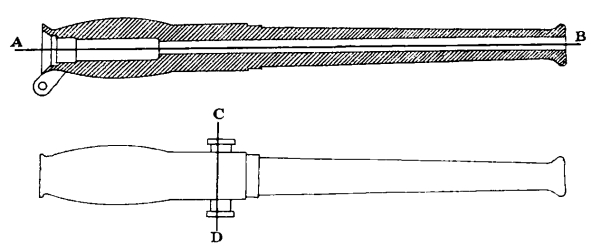
Plate II.
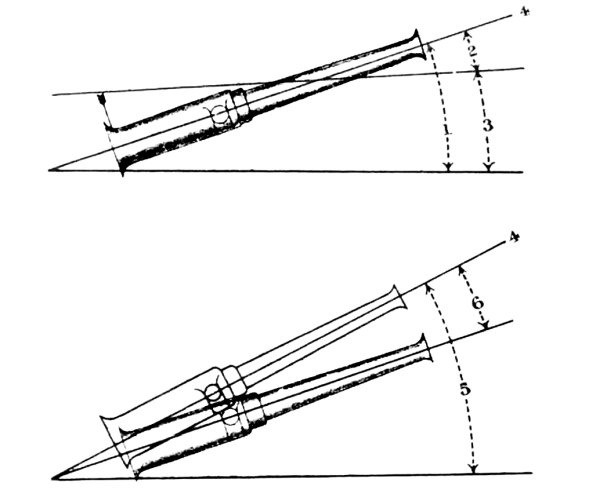
Plate III.
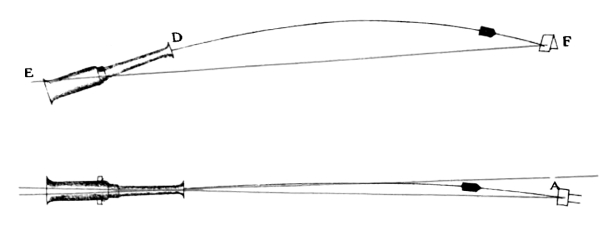
[Pg 145]
Fig. 11.

Enfilade Fire.—Fire which sweeps a line of troops or defences from a flank.
Frontal Fire.—When the line of fire is perpendicular to the front of the target.
Oblique Fire.—When the line of fire is inclined to the front of the target.
Reverse Fire.—When the rear instead of the front of the target is fired at.
99. Gunnery.
1. Gunnery is the science of directing a projectile so that it will strike a given object.
2. A gun serves two purposes. First to confine the gases of the charge so as to allow them to act upon the base of the shell; and second to give the shell the proper initial direction. In order to maintain the shell in its proper direction after it leaves the bore of the gun, some [Pg 146] means of making it spin or rotate rapidly is necessary; since it is a well-known fact that any rapidly-rotating body tries to keep the same direction in which it was pointed when first made to spin. Rifling which consists in a number of grooves cut down the bore, leaving raised ribs called “lands” between them, is the means employed in modern guns, in combination with a soft copper band called a “driving band” secured to the shell near its base. The result of this combination is that when the gun is fired the shell is forced along the bore, but, the diameter of the driving band being bigger than that of the bore, the lands cut into the copper of which it is made and the shell is consequently compelled to follow their course and rotate. Without this spin an elongated shell would soon lose its velocity and accuracy of direction and become as unreliable in its flight as round shot were in the days of smooth bore guns.
3. By the use of elongated shell the following additional advantages besides accuracy of direction are obtained:—
i. A longer and therefore heavier shell can be fired from a field gun than would be possible if the shell had to be round (spherical). Consequently there is more room in the shell for explosive or bullets.
ii. Greater range and greater power at a given range are obtained, because there is a smaller surface, as compared with a round shot of the same weight, offered to the resistance of the air.
iii. By varying the length different kinds of shell for the same gun can be brought to the same weight and thus complications in range tables can be avoided. If necessary a specially heavy projectile can be used.
iv. The flight of the shell being regular, allowance can be made for any deviation observed and thus increased accuracy may be obtained.
[Pg 147]
100. Rifling.
1. The “system of rifling” is the term applied to the method adopted in any particular type of rifled gun for giving rotation to the shell.
2. The aim of each system is to produce accuracy of fire, but it is also essential that it should be simple, that it should not seriously weaken the durability of the gun, and that the shell should not be liable to jam in loading or firing. The “twist of rifling” by which is meant the distance measured in calibres, in which the grooves make one complete circuit of the bore, may be uniform, increasing or a combination of the two.
3. In the case of a uniform twist the distance in which the grooves make a complete circuit of the bore is the same wherever measured, but with an increasing twist the distance decreases as the muzzle is approached.
With a uniform twist the shell is compelled to rotate rapidly as soon as it begins to move, and thus a severe strain is caused both to the gun and shell.
With an increasing twist, this rotation is imparted more gradually, thus relieving the strain, but at the same time causing more friction, and consequent loss of velocity. The shell, moreover, is not so well centred as with a uniform twist.
4. In designing a gun the twist has to be made to suit the shell which it is desired to employ, and its intended velocity. Generally speaking, a long shell with low velocity necessitates a rapid twist to make it steady in flight.
101. Centring.
It is important that the shell when it leaves the bore should be centred, i.e., that the shell should rotate round its longer [Pg 148] axis which should coincide with the prolongation of the axis of the gun at the moment it leaves the bore. Should this not be the case, the shell becomes unsteady and noisy in its flight, and the shooting will be irregular.
102. Forces acting on a shell
in the bore.
1. The velocity attained by a shell at the muzzle of a gun is due to the pressure of the gas during its passage through the bore. The more gradually this velocity is imparted to the shell the less will be the strain upon it and the gun. The object sought is to distribute, as far as possible, the pressure over the whole length of the bore and to obtain the maximum work from a given charge without undue strain on either gun or shell. Theoretically the last atom of the charge should be converted into gas as the shell leaves the muzzle.
103. The resistance of the air.
1. The air consists of innumerable small particles through which a shell has to force its way. This produces a rapid loss of velocity; for instance, the velocity of a shell from the 18-pr. Q.F. gun, which at the muzzle is about 1,610 feet a second, is at 2,000 yards only about 1,030 feet a second, and at 6,000 yards about 740 feet a second.
2. The retardation due to the resistance of the air varies according to the weight and diameter of the shell. If, for instance, two shells of equal diameter, but of different weights, start with the same muzzle velocity, the heavier will lose its velocity more slowly and have the longer range, because it has the greater weight with which to overcome the resistance of the air. On the other hand, if two projectiles are of the same weight but of different diameters, the one with the smaller diameter will have the advantage, because it presents less surface to the resistance of the air. [Pg 149]
3. The shape of the head also materially affects the question, for a shell with a blunt head is plainly not so suited for forcing its way through the air as one with a more pointed head. Thus the longer the shell (other things being equal), the greater will be its remaining velocity at any given range, and the greater will be its range for any given muzzle velocity; but other considerations limit its length, such as the strength of its walls, and the liability to turn over in flight.
4. The relationship between the weight and diameter of a shell, represented by the expression
| W | , |
| (n d²) |
is called the “ballistic coefficient” of the gun. The factor n includes sub-factors which vary with the density of the atmosphere, the shape of the head, the steadiness in flight, &c. The greater the ballistic coefficient the less rapidly does the projectile lose its velocity.
5. It has already been pointed out (Sec. 99) that spin is necessary to the shell if elongated projectiles are to be used. The effect of the resistance of the air on a spinning shell is to deflect it in the same direction as the spin. With all service shell this spin or rotation is right handed, and consequently all shell deflect towards the right in the course of their flight. This deflection is called “drift.”
As this rotation is definite and diminishes very slightly during the flight of the shell, the amount of drift can be determined for each nature of gun by actual experiment and compensation made for it. A description of the method by which this is done will be found in Sec. 119.
104. The force of gravity.
1. The force of gravity is the natural attraction which causes every [Pg 150] unsupported body to fall towards the centre of the earth. Moreover, the longer a body is exposed to its influence the faster does it fall; thus a body falls,
| About | 16 | feet | in | the 1st | second |
| ” | 48 | ” | ” | 2nd | ” |
| ” | 80 | ” | ” | 3rd | ” |
that is, the total drop at the end of any given second of time is proportionate to the square of the time.
Now a shell leaves the muzzle of a gun with a certain velocity, due to the forces which acted on it in the bore, and, if the effect of these forces and of the resistance of the air had alone to be taken into account, it would proceed in a straight line, but at a decreasing pace.
Gravity, however, comes into play and causes the shell to fall with a constantly increasing velocity. Thus in Fig. 12, supposing AB is the direction in which a shell starts, the distances it would travel in the first three seconds of its flight, if there were no gravity, might be represented by AC, CE, EG. Owing to gravity, however, it would at the end of the 1st second have dropped to some point D; at the end of the 2nd second it would have dropped four times as far, to a point F; while at the end of the 3rd second it would have fallen nine times as far, to a point H.
Fig. 12.
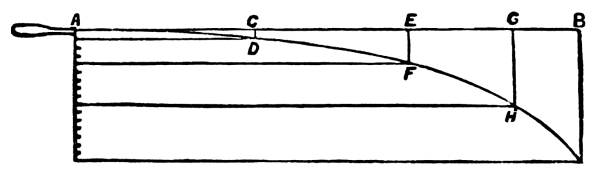
2. The force of gravity is to some extent counterbalanced by the air, which acts as a cushion and tends to support a body falling through it. [Pg 151] In the case of a heavy body, such as a bullet or shell, the distances fallen are but slightly affected by the air.
Gravity is, however, appreciably counterbalanced by the “planeing” effect on an elongated projectile forced at considerable velocity through the air at high angles of elevation so that the value of “g” drops below 32 to about 26.
105. Trajectory.
1. The result of the three forces acting on the shell—the force of projection tending to drive it forward in a straight line in prolongation of the axis, the force of gravity drawing it down from that line, and the resistance of the air tending to stop its progress in each successive instant of time, and also to deflect it to the right—is that it describes a curve, whether regarded from the side or from above. This curve is called the trajectory. (See ADFHI, Fig. 12.)
2. The shell in consequence of its high velocity, and of the short time gravity has had to act upon it, falls at first very little, but this fall—and consequently the curve—increases very rapidly with the range; for example, at 100 yards the 18-pr. Q.F. shell if fired point blank would fall about 8½ inches, but at 500 yards its drop would be about 18¼ feet; at 1,000 yards, about 80 feet; at 2,000 yards, about 372 feet; at 3,000 yards, about 970 feet. The greatest height attained by the trajectory is roughly four times the square of the time of flight.
106. Elevation.
Fig. 13.
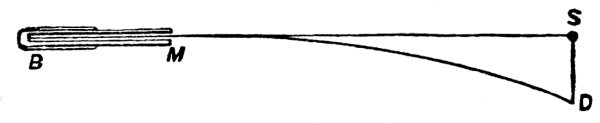
1. It is evident from what has been said that a shell fired from a gun [Pg 152] at a mark, S (Fig. 13) will not hit that mark, but will strike some point, D, below it. To allow for the fall, it is necessary to point the axis as much above the object to be hit as the shell would have fallen below it if the axis had been pointed straight at the mark. This act of tilting the gun so as to allow for the curve of the trajectory, is what is meant by the expression “giving elevation.”
2. The theory of giving elevation may be illustrated by reference to the flight of an 18-pr. Q.F. shell for the first 100 yards. This shell falls about 8½ inches below the line at which the projectile leaves the bore in passing over the first 100 yards of its flight. Assuming that S (Fig. 13) is 100 yards from the muzzle and that SD represents 8½ inches, the axis of the gun must be elevated so that, when produced, it would pass 8½ inches above S, viz., through F (Fig. 14), if an object at S is to be hit.
3. The method of giving elevation to the gun to enable the shell to reach a certain distance called the “range” should then be explained, and it should be shown how the elevation can be marked in yards on the range drum, tangent sight or clinometer.
Fig. 14.
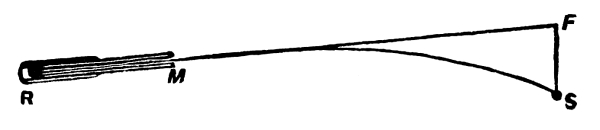
4. The principle of the sighting can be shown by means of a rifle barrel placed on a tripod a few yards from a blackboard. If then aim be taken at some mark on the board with the leaf of the sight upright, and set to (say) 1,000 yards; and subsequently, without moving the barrel, the bore be looked through, it will be seen that the axis produced meets the blackboard considerably above the mark aimed at. [Pg 153]
5. The effect on the shooting of the gun, if the wheels are not level, can be explained by similar means. A stick to represent the trunnions of the gun should be fastened across the barrel. It can then be shown that if the wheels of a gun are not level, or in other words if the axis of the trunnions is not horizontal, the gun (barrel) will not elevate in a vertical plane; the muzzle will move towards the lower side and the breech towards the higher, thus causing the shell to move towards the lower wheel.
Fig. 15.
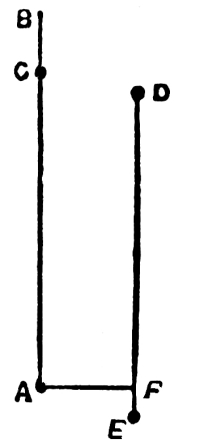
6. The effect on the sight, if the axis of the trunnions is not level, can also be demonstrated. The more the sight is tilted over to one side the less will the elevation become and the more will the gun point to the right or left of the target, according to the way the sight is inclined. In these circumstances the shell, instead of hitting the target, will fall below it and to one side. The greater the elevation on the sight and the more it is inclined, the greater will be the resulting error.
To make this clear, a vertical line, AB (Fig. 15), may be drawn on the blackboard, with A as a spot to aim at. The recruit should then be directed to aim at this spot with the sight, which must be perfectly upright, set at 1,000 yards, and afterwards to look through the rifle barrel, his attention being drawn to the fact that the axis cuts the vertical line at C above the spot aimed at. He should then be made to aim at the same spot with the same sight, but inclined to one side, and to look through the barrel again, when he will see that the axis, instead of being directed upon C as before, is now directed low, and to that side to which the sight is inclined, as at D; consequently as the trajectory always conforms to the movement of the axis, the bullet, instead of hitting the mark, would strike as much [Pg 154] below D as A is below C. Draw a new vertical line through D and measure off on it a distance equal to CA; this will give the spot E, which the bullet would hit. From A draw a horizontal line AF to the new vertical line DF, then AF will show the error of direction, and FE the loss of elevation. The latter may practically be neglected; and a rule is given in Sec. 119 for correcting the former, when the small size of the target renders it necessary.
If it can be arranged it is better to show this with a gun, but a rifle barrel is usually more convenient.
107. Causes affecting the accuracy of shooting.
1. With the exception of the effect of the difference of level of wheels, the various forces which act on a projectile and their effects on its flight are calculated and compensated for before the gun is issued for service.
They will not, therefore, come under the observation of the practical gunner; but there are other causes affecting the accuracy of shooting about which he must have a knowledge.
These are:—
2. If the shell is not rammed home to the same spot each round, the amount of space available for the cartridge will vary and this will cause the shooting to be irregular. The smaller the space left for the [Pg 155] cartridge the greater will be the range, but the greater also becomes the pressure of the gas in the chamber.
The possibility of this occurring in the case of Q.F. guns is prevented if fixed ammunition is used.
3. Wind has considerable effect on the range and direction of the shell. According to its direction it may increase or reduce the range, or drive the shell to right or left. If gusty, and of great force, the shooting will be irregular, especially at long ranges. This becomes of importance only when the target is a narrow one.
4. Unless the trail rests on firm level ground, and is similarly supported during successive rounds, the shooting will be irregular, on account of the variation of the jump. A carriage allowing of axial recoil has practically no jump.
5. It is important that the effect which the above conditions may have on the shooting should be fully understood, in order that the necessity of the process called “ranging”[6] may be realized. By means of this process the total effect of these causes is found out and the sight set so as to counterbalance them. (See Sec. 103.)
108. Cordite.
(See also Treatise on Service Explosives.)
1. Cordite is the smokeless explosive adopted for propulsive purposes.
2. Cordite consists of nitro-glycerine, gun cotton and mineral jelly, [Pg 156] worked into a dough and forced through a die, from which it comes out in long cords. Its composition for small arms and all natures of ordnance is the same, the required rate of combustion being obtained by varying the diameter of the cord. The smaller the diameter the quicker the rate of burning.
3. The cordite in general use for modern guns is termed “Cordite MD” (modified) when in sticks or cords, “Cordite MDT” when in tubes, in order to distinguish it from the earlier pattern of cordite which was found to wear out the rifling of the gun too quickly. Cordite Mk. I is still used in India and for the older patterns of guns and howitzers.
4. Tubular cordite is distinguished by two numbers representing in hundredths of an inch the mean external and internal diameters of the finished article. Other cordite is distinguished by a number representing in hundredths of an inch the diameter of the die through which it was pressed in the course of manufacture.
5. When any particular size is made to more than one length, the length will be included, e.g.:—
6. Cordite will keep in all climates, but it is laid down that the temperature of magazines in which cordite is stored should not habitually exceed 80° F. or fall below 45° F.
The nitro-glycerine in cordite freezes at about 40° F., and if frozen cordite is suddenly thawed it is liable to “sweat.” It should not be handled till the nitro-glycerine has been reabsorbed.
7. The ballistic properties of cordite are affected by heat; the higher the temperature of a charge the greater the muzzle velocity and pressure.
8. Cordite charges are somewhat difficult to ignite, so that a priming [Pg 157] of guncotton yarn, fine grain gunpowder, or some other easily-lighted substance is necessary to assist the flame from the cap or tube.
9. Cordite is safe to handle and store. It is not affected by damp or water; this does not apply, of course, to the gunpowder priming. If wetted with fresh, water a cordite charge may be fired when dried. Before returning a wetted charge to store it should be thoroughly dried in a ventilated building. Cordite wetted with sea water should be well washed in fresh water and dried before repacking.
10. In some cases, after firing cordite charges to windward, a flame issues from the breech when it is opened. This is not of sufficient importance to require, in the case of field guns, any special precautions being taken.
109. Lyddite shell.
1. Lyddite is the high explosive used for filling common shells.
It consists of picric acid, melted and poured into the shell, where it solidifies. In order to detonate the charge the shell are primed with exploders containing picric powder. Complete detonation of a lyddite shell may be assumed to have occurred when the smoke is black and not tinged with yellow, when there is no picric acid colouring the crater formed by the burst, and when the fragments of the forged steel shell present a torn and jagged appearance.
2. Shell filled with lyddite are effective against matériel and artificial cover. They are not intended nor are they suitable for use against personnel in the open owing to the limited numbers of pieces into which they break up and to the very local effect caused by their explosion.
Lyddite shell are carried with howitzer, heavy batteries and mountain batteries armed with 2·75“ B.L. equipment.
110. Shrapnel shell.
1. Shrapnel shell are hollow shell containing as many bullets as [Pg 158] possible together with a bursting charge sufficient to open the shell, release the bullets, and give enough smoke to allow the burst to be observed. They are provided with T. and P. fuzes, thus making it possible to burst them, either on graze (percussion action) or at some selected point of their trajectory (time action).
In the latter case each bullet as soon as it is free follows a trajectory of its own, according to its position in the shell, to the direction and velocity given to it by the bursting charge and by the centrifugal force imparted by the rotation of the shell. Regarded as a whole, however, the bullets form a cone the apex of which is located at the spot where the shell bursts. This cone is called the “cone of dispersion.”
2. If the height of burst is normal, the body of the shell which does not as a rule break up has a trajectory which corresponds approximately to, but is always lower than, that which the shell would have described if it had not burst.
3. The effect of an individual shrapnel depends upon:—
4. The number of the bullets is very closely connected with the weight and construction of the shrapnel, and also depends upon the weight and specific gravity of the bullets.
The greater the weight of the shell, the greater under similar conditions will naturally be the weight and also the number of the bullets. The weight of the total content of bullets increases, however, more rapidly than the weight of the shell, so that of two shells constructed on the same principles, the heavier contains more bullets in proportion to its weight than the lighter. Thus for example, the 13-pr. Q.F. shell which has a weight of 12½ pounds contains 236 bullets [Pg 159] of 41 to the pound, while the 18-pr. Q.F. has a weight of 18½ pounds and contains 375 bullets.
5. A very small energy is required to put living targets out of action. According to experiments it is considered that a striking energy of 60 foot-lbs. is sufficient; which means that a bullet of 41 to the pound would require a striking velocity of about 400 foot-seconds.[7]
The velocity on impact of shrapnel bullets depends upon their velocity at the point of burst, their weight and upon the distance they travel after burst. The latter is of the more importance, since the light shrapnel bullets fall off very much in velocity owing to the resistance of the air.
6. In shrapnel shell with base bursters the spread of the bullets is principally caused by the rotation of the shell. In the 13-pr. and 18-pr. shell, however, the central tube is filled with powder, which tends to increase the angle of opening.
It is difficult to measure this angle accurately; but its tendency is to increase as the range increases. In estimating the front covered by the spread of the bullets, it may be taken as about 35 per cent. of the distance burst short.
7. The effect of the shrapnel depends largely on the nature of the target and the position of the burst. As the distance of the burst short of the target increases, the density of the hits diminishes, and theoretically this distance should be regulated according to the surface presented by the target. The normal height of burst of 13 and 18-pr. Q.F. shrapnel is about 10 minutes above the line of sight at all ranges. In the case of the 15-pr. B.L.C. and 15-pr. Q.F. this height is 12½ minutes, and in the case of 4·5-inch howitzers about 20 minutes, of [Pg 160] 5-inch howitzers 30 minutes, and in the case of the 60-pr. B.L. and 4·7-inch Q.F. about 15 minutes. If the target be of the nature of a column, a lower burst must be obtained.
8. The curve of the trajectory diminishes the depth of the forward effect of the shrapnel. The flatter the trajectory the greater the depth of effect. On the other hand there is little searching effect on troops behind cover, and for this reason the shrapnel of howitzers fired at high angles of elevation are particularly effective, although the ground covered by their cone of dispersion is small.
9. Shrapnel shell is the principal field artillery projectile, and is carried for most natures of field artillery.
10. Percussion shrapnel.—Percussion shrapnel is used for ranging, and in the case of the 18-pr. Q.F. has given excellent results at targets placed behind a brick wall 24 inches thick. It may therefore be considered that the fire of percussion shrapnel will be effective against troops defending any ordinary buildings.
Good effect has also been obtained with it against guns and personnel behind shields when direct hits are obtained.
11. The action of percussion shrapnel differs from that of time shrapnel, for the shell opens after graze, having an ascending angle, and a velocity considerably lessened by the retardation on graze. Its effect depends largely on the nature of the ground at the point of impact; in soft or marshy soil the shell are smothered and results are usually poor.
12. Percussion shrapnel, even at short ranges, must be burst very close to the foot of the target to be effective, otherwise the cone of dispersion passes over it, and descends in a shower some 250 yards beyond graze: consequently, a small error in range is a matter of great consequence.
13. Time shrapnel.—Time shrapnel is used against living targets, against aircraft and balloons, and for ranging.
14. The best effect from time shrapnel fire is obtained when the trajectory passes through or close to the target, and the position of [Pg 161] the mean point of burst should be as close as possible to the target without entailing an undue proportion of grazes. To attain this “ranging” must be carried out till the correct range and length of fuze are determined. (See Sec. 207 et seq.)
111. Star shell.
Star shell are carried by mountain artillery. They contain a number of stars and are fired with T. fuzes. When the shell bursts these stars are ignited and illuminate the foreground.
112. Time and percussion fuzes.
(See Handbooks for description of various fuzes.)
1. Fuzes manufactured under varying atmospheric conditions have variable rates of burning; care should, therefore, be taken in packing limbers and wagons that fuzes of the same thousand should be as far as possible together, so as to obtain uniformity of results.
2. The rate of burning of a time and percussion fuze is influenced by the climate in which it has been kept, and the pressure of the atmosphere.
3. Fuzes also burn longer as the height above the sea level increases, that is, as the height of the barometer decreases. For each fall of 1 inch in the barometer (corresponding to about 1,000 feet in height) the time of burning increases by ¹/₃₀.[8]
4. The mean error in the time of burning of the No. 80 time and percussion fuze in use with the 18-pr. Q.F. gun may be taken as about ·14 seconds.
This error represents a distance of 48 yards at 2,000 yards range, and this distance multiplied by 1·69 (= 81) gives the length of the zone which will contain 50 per cent. of the bursts. If 10 per cent. of the bursts are on graze, the distance of the mean point of burst from the target should be equal to half the length of the 80 per cent. zone, [Pg 162] since 10 per cent. must be taken off the other end in order to keep the mean point of burst in the same place. The 80 per cent. zone is equal to the 50 per cent. zone × 1·90, i.e., 81 × 1·90 = 154. Thus at 2,000 yards, the mean point of burst should be approximately 80 yards short, and at 5,000 yards 55 yards short. Though with the 13-pr. Q.F. the error of the fuze is rather greater than with the 18-pr. Q.F., the same data may be accepted. A larger percentage of grazes must, however, be expected.
113. Fuze indicator.
1. The object of the fuze indicator is to give the correct fuze setting for effective burst at any range, when once the instrument has been adjusted for one range.
2. Theory.—When the graduation 150 on the corrector scale is opposite the arrow on the fuze scale slider, the length of fuze opposite each range is that which will give “an effective point of burst” under normal conditions. It will be noted that any corrector setting found suitable with any particular range will be approximately correct for all ranges under like conditions.
To arrive at this result the indicator has to be graduated on the same principle as a “slide rule.” The fuze scale is graduated in such a way that the linear spaces occupied are proportional to the logarithms of the times of flight. The yard scale is similarly graduated. This explains how in the table in para. 5 below an alteration of corrector makes a proportional correction at various ranges and not an equal correction throughout.
3. In the case of the 18-pr. Q.F. the effective points of burst are taken to be as follows:—
| At 2,000 | yards | 80 | yards | short. |
| At 3,000 | ” | 70 | ” | ” |
| At 4,000 | ” | 60 | ” | ” |
| At 5,000 | ” | 55 | ” | ” |
| At 6,000 | ” | 50 | ” | ” |
[Pg 163] These distances represent approximately an angular height of 10 minutes at all ranges.
The corrector settings likely to give effective points of burst at various altitudes are with the bar indicator as follows:—
| At sea level, or with barometer | 30 | Corrector | 150. | |||
| At 1,000 ft. | altitude | or with | barometer | 29 | ” | 144. |
| At 2,000 | ” | ” | ” | 28 | ” | 138. |
| At 3,000 | ” | ” | ” | 27 | ” | 132. |
| At 4,000 | ” | ” | ” | 26 | ” | 126. |
4. Alterations in the barometer will affect the corrector setting, the normal being when the barometer stands at 30. A fall in the barometer necessitates a decrease, and a rise in the barometer an increase in the corrector setting.
5. Different corrector settings give different heights of burst. To raise the point of burst the corrector settings have to be shortened, and to lower the point of burst the corrector settings have to be lengthened. The amount of the alteration in the corrector settings depends upon the range and the amount that it is desired to alter the point of burst.
By altering the corrector setting from 150 to 140, the fuzes may be expected to burst as follows:—
| At 2,000 | yards | range | 70 | yards | shorter. |
| At 3,000 | ” | ” | 100 | ” | |
| At 4,000 | ” | ” | 125 | ” | |
| At 5,000 | ” | ” | 150 | ” | |
| At 6,000 | ” | ” | 175 | ” | |
It will be seen, therefore, that even smaller alterations than 5 in the corrector settings may be made at long and distant ranges, when it is desired to alter the point of burst of shell already bursting in the air. (See Sec. 227 Examples.) [Pg 164]
6. Comparing the first and third of the above tables it will be seen that 150 corrector at 2,000 yards gives bursts approximately 80 yards short and that an increase or decrease of 10 in the corrector varies the burst 70 yards. Consequently if it is desired to bring the burst on to the line of sight (as in time shrapnel ranging), the corrector must be increased by an amount equal to
| 80 | × 10 (i.e., 10 for each 70 yards) = 11. |
| 70 |
7. The following tables show the approximate difference in corrector settings necessary to effect an alteration in the angular height of burst at various ranges:—
| Range. | 13 and 18-pr. Q.F. |
4·5-inch Q.F. Howitzer ranging in yards. All charges. “Gun range.” |
60-pr. B.L. | 15-pr. Q.F. and 15-pr. B.L.C. |
||||
|---|---|---|---|---|---|---|---|---|
| To raise height 10 minutes. |
To raise height 20 minutes. |
To raise height 15 minutes. |
To raise height 12½ minutes. |
|||||
| 1,000 | 20 | corrector. | ||||||
| 2,000 | 11 | corrector. | 10 | ” | 13 | corrector. | ||
| 3,000 | 7 | ” | 6 | ” | 24 | corrector. | 8 | ” |
| 4,000 | 5 | ” | 4 | ” | 18 | ” | 5 | ” |
| 5,000 | 4 | ” | 2 | ” | 12 | ” | 4 | ” |
| 6,000 | 3 | ” | 9 | ” | 3 | ” | ||
| 7,000 | 6 | ” | ||||||
| 8,000 | 5 | ” | ||||||
| 9,000 | 4 | ” | ||||||
[Pg 165]
4·5-inch Q.F. Howitzer.
Ranging in degrees.
| Elevation (all charges). |
To raise height 20 minutes. |
||
|---|---|---|---|
| 5 | degrees. | 16 | corrector. |
| 10 | ” | 10 | ” |
| 15 | ” | 6 | ” |
| 20 | ” | 4 | ” |
| 25 | ” | 3 | ” |
| 35 | ” | 2 | ” |
Officers should know the figures for the equipment with which their unit is armed.
8. Use.—When a corrector is ordered, the fuze scale slider is moved till the arrow is opposite the required graduation, and clamped. The fuze for any range can now be read off. For the purpose of recording the particular range and so avoiding possible error, the sliding pointer on the top can be moved and set to such range.
Once having found the corrector setting, it is the “corrector setting for the day,” provided that, if indirect laying is employed, the angle of sight is correct. If, when finding the corrector setting, the angle of sight is incorrect, the corrector setting found will be a false one, being too short if the angle of sight is underestimated, and vice versâ.
9. To obtain the corrector setting, an échelon of three rounds may be fired, each round at a different corrector setting. When selecting the échelon of corrector settings an endeavour should be made to choose such lengths of corrector as will give bursts in air and on graze.
10. Bursts should always be judged with reference to the “line of [Pg 166] sight,” otherwise when the target is situated on sloping ground, an unsuitable length of corrector may be selected, as rounds bursting in air short of the target below the “line of sight” would, with the same corrector, give bursts on graze when the trajectory passes through the target.
114. Range tables.
1. Range tables represent the ordinary performance of the gun with service ammunition under normal conditions. They can, therefore, only be taken as a guide. With the object of compiling these tables and of finding out, in a general way, the relative accuracy of the service ordnance and ammunition, series of rounds are fired at varying elevations for range and accuracy.
From these series mean ranges and deviations are obtained for each elevation; the difference of each round from the “mean” gives the “error” and the mean of the errors of the series gives an estimate of the accuracy.
2. The chief causes of inaccuracy, which may exist on the experimental practice ground, where all the conditions are most favourable, are as follows:—
Errors due to the gun will arise if the twist of rifling is unsuited to the length of the projectile.
Errors due to the projectiles will arise if their density has not been distributed in the best manner, or if they are inaccurately centred or vary in weight.
Errors due to the charge can be reduced to a minimum by using explosive of the same lot throughout the experiment, and by giving each charge the same air space to secure uniformity of loading density. [Pg 167]
Errors will also arise if the mounting, or the gun on its mounting, is unsteady when the gun is fired, as this would cause a variable “jump” and consequently a variable angle of departure.
3. The following is an example of one series:—
| No. of round. |
Range. | Difference from mean. |
Deviation right. |
Difference from mean. |
|---|---|---|---|---|
| yds. | yds. | yds. | yds. | |
| 1 | 4,968 | 22·8 | 24·4 | 3·0 |
| 2 | 4,954 | 8·8 | 21·6 | 0·2 |
| 3 | 4,962 | 16·8 | 22·8 | 1·4 |
| 4 | 4,908 | 37·2 | 20·0 | 1·4 |
| 5 | 4,934 | 11·2 | 18·4 | 3·0 |
| 24,726 | 96·8 | 107·2 | 9·0 | |
| Mean | 4,945·2 | 19·4 | 21·4 | 1·8 |
The second column in the above table gives the actual ranges. The mean range is obtained by adding all together and dividing by 5, since 5 rounds were fired.
The third column contains the difference of each round, irrespective of sign, from the mean range just found. The mean of these differences is then obtained, and called the mean error in range or mean longitudinal error. Evidently, if all the projectiles fall nearly at the same range, this mean error must be small.
The fourth column gives the lateral deviation from the direction in which the axis of the gun points; the mean deviation is at the bottom of this column. If any shot had fallen to the left, then the deviation [Pg 168] would be reckoned from a line passing through either the extreme right or the extreme left shot.
The fifth column gives the difference from the mean deviation, with a mean at the bottom called the mean error in deviation or mean lateral error.
Collecting the results from the table we have:—
| Mean range | 4945·2 | yards. |
| Mean longitudinal error | 19·4 | ” |
| Mean deviation right | 21·4 | ” |
| Mean lateral error | 1·8 | ” |
It can be shown by the theory of probabilities that if each mean error is multiplied by the factor 1·69, the breadths of zones (of infinite length), which will contain 50 per cent. of the hits, are obtained.
4. As a result of these and other tests the following information is embodied in the various columns of the range table.
i. Elevation and Range.—The angle of elevation in degrees and minutes is shown for every hundred yards up to the limit of effective range of the gun.
ii. Fuze Scale.—The fuze scale column shows the graduation at which the fuze must be set due to the time of flight for the range shown on the table. In the range table for the 18-pr. Q.F. we find for a range of 4,000 yards the fuze graduation is 12·8. As the fuze scales are compiled for a barometric pressure of 30 inches, this means that a shell with a fuze set at 12·8 will burst at 4,000 yards from the gun when fired at the sea level under normal conditions. For various reasons mentioned in Sec. 112, the fuze scale can only be taken as a guide.
iii. Angle of Descent.—The angle of descent is shown either in degrees and minutes or as a slope.
As a field gun has only one charge, the only way to increase the angle [Pg 169] of descent is to increase the range. With field howitzers varying charges are used, so that any required angle of descent can be obtained by a judicious selection of the position of the gun and the charge to be used.
iv. Remaining Velocity.—This column shows the actual velocity of the projectile at any given range.
v. Five Minutes Alteration of Elevation or Deflection.—These columns show what alteration in the range or point of impact is caused by an alteration of 5 minutes in elevation or deflection. The former is useful in ranging a howitzer battery, and the latter is useful in calculating the deflection to be given to concentrate the fire of the guns of a battery on to one point, and also in calculating the correction required to get parallel lines of fire when using an aiming point (See Sec. 122.) Thus, suppose the range to an aiming point is estimated at 2,800 yards, and the virtual displacement of the gun 16 yards, the displacement difference will be 20 minutes, as the range table shows that 5 minutes deflection alters the point of impact 4 yards at that range.
vi. Time of Flight.—Time of flight is shown in seconds.
vii. Deflection for Drift.—The sights of some howitzers not being arranged to counteract the drift of the projectile, it is necessary to give deflection. The amount required at the various angles of elevation is shown in the table. It is always given to the left.
viii. Accuracy Tables.—These columns give the length or breadth or height within which 50 per cent. of rounds should fall and are based upon actual practice.
Example.—As an example take the 18-pr. Q.F. gun. At 3,000 yards the 50 per cent. length is given as 20 yards, and the breadth as 1·44 yards. A series of rounds might fall, as in Fig. 16, round about a target T. Of these 50 per cent. would be contained between the two lines AB, CD, 20 yards apart, 10 yards on each side of the centre of the group. All the rounds should fall within two lines four times that [Pg 170] distance apart, that is 40 yards on each side of the centre of the group.
Again, of the rounds that fell right and left of the centre of the group 50 per cent. would be enclosed by the two lines FE, HG, Fig. 17, 1·44 yards apart, and all should be contained by two lines four times that distance apart.
If now one pair of parallel lines are placed over the other as in Fig. 18, evidently the rectangle enclosed by them will contain 50 per cent. of 50 per cent., that is 25 per cent. of the total.
Fig. 16.
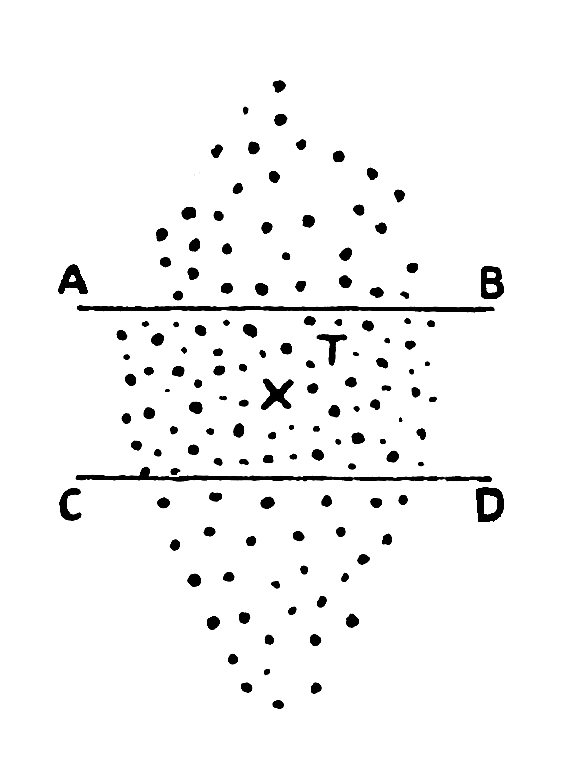
Fig. 17.
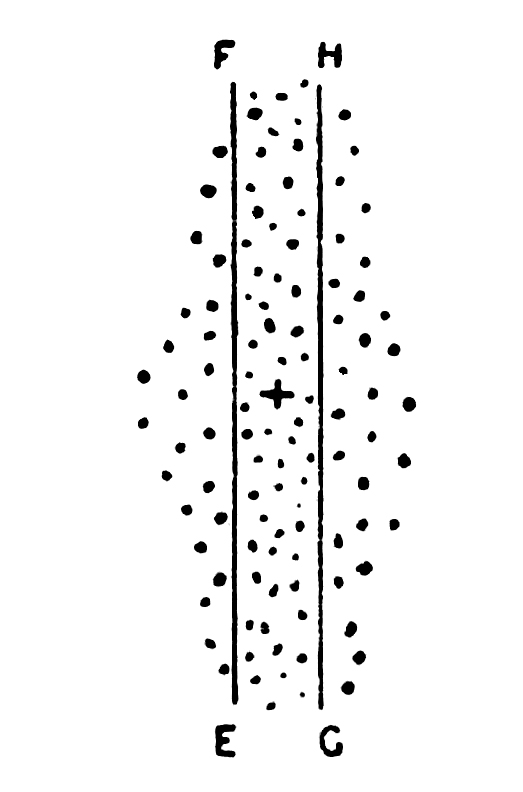
Fig. 18.
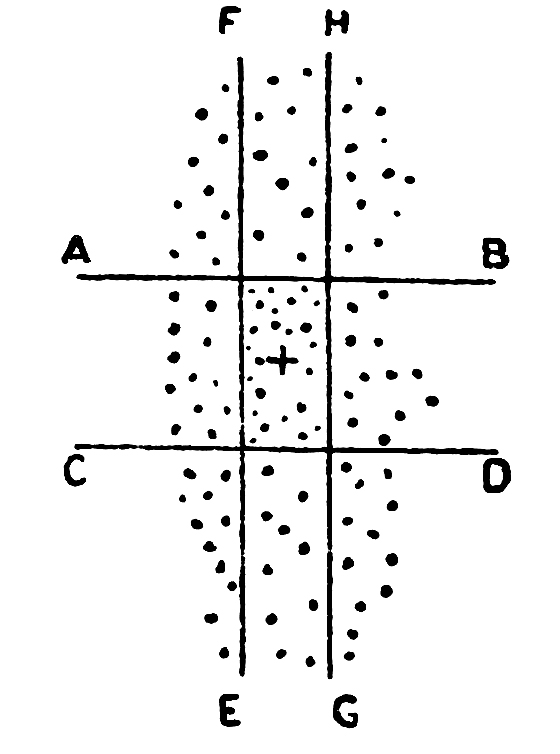
The width of other zones (containing a different percentage of hits) can be obtained by multiplying the width of the 50 per cent. zone by a varying factor (see Text Book of Gunnery).
If the target is a vertical one, the figures in the column “height” should be taken, instead of those under “length.”
5. It is important to realize the effect of these laws in cases of ordinary practice, where errors in range are of chief moment. We have [Pg 171] seen that at 3,000 yards, with the 18-pr. Q.F. gun, a series of rounds would fall within two lines 40 yards on each side of the centre of the series; therefore a shell falling 39 yards short is within normal limits of error, but it should be counterbalanced by other shots falling over.
6. Accuracy of fire is a comparative term; it is said to be good when a group of projectiles, fired under as nearly as possible the same conditions, falls close together.
The probable percentage of hits obtainable from an 18-pr. Q.F. on a shield 4 feet 6 inches high and 5 feet wide, fired under experimental conditions,
| is at | 2,000 | yards | 60 | per cent. |
| 2,500 | ” | 33 | ” | |
| 3,000 | ” | 16 | ” | |
| 3,500 | ” | 8½ | ” | |
| 4,000 | ” | 5 | ” |
Under service conditions these percentages would be considerably reduced.
[Pg 172]
115. General instructions.
1. All guns are so mounted that two motions can be given to the axis of the gun, viz., motion in a vertical direction, termed elevation, and motion in a horizontal direction, termed traversing. Elevation is always given by mechanism, traversing is sometimes carried out by mechanism and sometimes by hand.
A gun is said to be “laid,” when, by elevating and traversing, its axis is made to point in the required direction.
2. Accuracy and rapidity are the two main factors in good laying. Accuracy is required against stationary targets, while rapidity becomes of more importance against large and moving targets.
3. Instruction in laying should be divided into four stages:—
1st Stage.—Instructional target at close distance, explanation of terms and rules, &c.
2nd Stage.—Laying at well-defined natural objects at effective ranges, and continued at less well-defined objects at long and distant ranges.
3rd Stage.—Laying at moving targets. This can be practised [Pg 173] by sending out men, mounted or on foot, to move at the pace and in the direction desired. In order to check the laying they should be halted by signal on the word “fire.”
4th Stage.—Indirect laying.
4. The instructional target will be found valuable in teaching the men of a battery to lay guns correctly and uniformly, as with it personal errors can be shown, both in elevation and direction, and the practical rules for correcting errors can be demonstrated.
5. When laying with open sights, in order to obtain uniform results, one method should be strictly adhered to. The service method of laying a gun is to direct it so that the centre of the imaginary line joining the two highest points of the notch of the hind sight, the point of the fore sight and the target are in line.
The gun should be approximately laid before looking over the sight; the laying should then be completed by depressing the gun and sights on to the target so as to avoid any error due to play of the elevating gear.
The distance of the eye from the sight should be the same from round to round, and all layers of a battery should be trained to keep the eye at the same distance.
6. After the gunner has attained a thorough knowledge of the sights, and can lay accurately and rapidly on well-defined targets, he should be taught to lay on natural objects, such as troops halted and in motion, hedges, batteries, entrenchments, crest lines, at varying ranges and under varying conditions of light, background, &c. The ground line should always be laid on unless orders to the contrary are given.
116. Direct laying.
1. Direct laying can only be employed when the target is visible over or through the sights. [Pg 174]
2. With 13-pr. and 18-pr. Q.F. field guns the elevating mechanism is so designed that, after the sights have been directed on the target, the axis of the gun can be moved independently of the sights, and inclined in a vertical direction at any angle to the line of sight, which remains directed on the target. The angle at which the axis of the gun is inclined to the line of sight, and the range due to it, is shown on the range indicator on the right side of the gun. With the independent line of sight, once the sights are laid on the target any angle of elevation can be given without having to re-lay the gun. To lay the gun, align the sights, or telescope, on the target, and adjust the range indicator to the elevation ordered.
With other field guns the sight is set at the elevation ordered, and the gun is laid by directing the sights or telescope on the target.
3. The advantage of direct laying is that, when the gun is laid, the correct angle of sight is automatically included, and complications will not arise in determining the corrector settings or length of fuze.
The disadvantages are the personal error of the layers, and the difficulties due to light and distance; with the telescopic sight, slowness, over-laying for direction, and difficulty in picking up the target.
4. At medium ranges and against moving targets direct laying, or an aiming point as described in Sec. 120, should be used, according as the formation of the ground and local circumstances render advisable. The telescopic sight is particularly useful against guns in action, trenches, &c., when great accuracy of line is important.
5. When laying direct the sight clinometer should be set level at the earliest opportunity. This enables the laying for elevation to be checked, or a change from direct to indirect laying to be made, should the target become obscured from any cause. [Pg 175]
117. Indirect laying.
1. Indirect laying can be employed whether the target is visible over the sights or not, and is the normal method employed in the field.
If a change from direct to indirect laying is desired, the order “Indirect” must be given, and the layer must immediately pick up an auxiliary aiming point to lay on for direction.
2. For elevation.—With sights provided with an adjustable level the level is set at the angle of sight, and the range indicator or drum at the elevation ordered. The gun is elevated and depressed until the bubble is level.
With sights not provided with an adjustable level, or with field clinometer, the angle of sight is added to the elevation due to the range, if it is one of elevation, and subtracted if it is one of depression. The sight or clinometer is set at the elevation ordered, the gun elevated and then depressed until the bubble is level.
3. The advantages of laying in this way are that the personal error of the layer is eliminated, and the accuracy of the laying is not affected by light or distance.
The disadvantage is that, if the angle of sight has not been accurately measured and allowed for, the range shown on the range indicator or drum will not be the true range, and complications will arise in determining the corrector setting or length of fuze.
Fig. 19.

In Fig. 19 let T be the target, G the gun (18-pr. Q.F.), T being on a higher level than G. [Pg 176]
If the angle of sight be underestimated, the range on the range indicator will not be the true range.
| Supposing | true | range GT | = 3,900 yards. | |
| ” | ” | angle of sight | = 2° 45′ elevation. | |
| Angle of sight ordered | = 2° elevation. | |||
It follows that, in order to hit T, the range on the range indicator must be 3,900 yards + 45 minutes, or about 4,150 yards.
The fuze, however, required will be that for 3,900 yards, but the battery commander being unaware that he has wrongly estimated the angle of sight, the fuzes will be set for 4,150 yards with the corrector ordered, and all grazes may be expected. The corrector setting obtained will not be a true one for the day, nor will the range be true.
4. For direction.—Direction is obtained by laying on an aiming point, or on a line marked by two aiming posts. The method of carrying this out is described in Sec. 198.
When indirect laying is used in the open with guns not provided with the No. 7 Dial Sight, the layer after the gun has been put on the line by the section commander will pick up an auxiliary aiming point with his rocking bar sight or over the dial sight to lay on from round to round. (See Sec. 198, b, ii.)
118. Angle of sight.
1. The angle of sight can be measured by the sights on the gun, by the level on the director, or by any other angle of sight instrument. Considerable care should be taken in making this measurement, as on it depends the accurate determination of the fuze. [Pg 177]
2. When the target is not visible from the guns, or from a position near the guns, the angle of sight can be found by means of the following formula:—
Fig. 20.
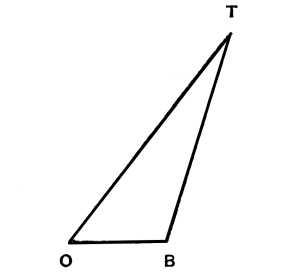
| (a¹ × BO + a² × OT) | , |
| BT |
Angles of elevation are read as plus. Angles of depression as minus.
The No. 3 director is designed to work out this problem automatically, excepting when battery, observing station, and target are approximately in line.
3. When indirect laying is employed, and the sights are provided with adjustable levels, the battery commander should invariably order the angle of sight to the battery, both on first coming into action, and on every subsequent change of target, either by giving out a fresh angle of sight, or by raising or lowering the old angle of sight (see para. 4 below). [Pg 178]
The battery commander must also order the necessary correction in the angle of sight to allow for the differences in levels between the guns or different parts of the target.
4. Any alteration in angle of sight will be effected by the order “Raise (or Lower) angle of sight—minutes.” When engaging stationary targets and the correct trajectory has been found, it is unwise to alter the angle of sight to correct the height of burst.
At moving targets, however, it is better to alter the angle of sight rather than to vary the corrector, except for small final adjustments.
119. Deflection.
1. During its flight various causes are at work tending to make a projectile deviate to right or left of its initial direction.
To counteract deviation it is necessary to set the line of sight at an angle to the axis of the gun in a horizontal direction. This angle is called “deflection.” If the hind sight is moved to the right (called right deflection) the axis of the gun will point to the right of the line of sight and the shot will fall more to the right in accordance with the amount of deflection allowed. Similarly, if the shot is required to go to the left, left deflection must be given.
2. Difference in level of wheels.—See also Sec. 106.
The practical rule for making corrections for difference in level of wheels with gun carriages having a wheel track of 60 inches or thereabouts, is: number of inches or degrees difference in level of wheels × number of degrees of elevation on the range indicator or tangent sight = number of minutes deflection to be given on the side of the higher wheel. When possible, it is better to dig in the higher wheel and level the wheels in this way. This also helps to steady the carriage and improve the shooting.
3. Drift is the deviation of a projectile, due to rotation, that [Pg 179] occurs in all rifled guns. The deviation is to the right or left according as the gun has a right or left-hand twist. Drift increases with the elevation and range of the gun, and is counteracted either by:—
i. Permanently inclining the sight (15-pr. B.L.C.) or axis of the trunnions (13 and 18-pr. Q.F.);
ii. The “set” of the dial sight (5-inch B.L. Howitzer);
iii. An automatically actuated mechanism in the sight carrier (4·5-inch Q.F. Howitzer).
4. Moving targets.—In the case of a target moving across the line of fire, it may be necessary to give deflection; if so, the following is a useful guide:—
| If the | target | is moving | at | a walk | give | 20′. |
| ” | ” | ” | ” | a trot | ” | 40′. |
| ” | ” | ” | ” | a gallop | ” | 1°. |
This should be given by the battery commander.
5. Wind.—The wind, especially at long ranges, causes a shell to deviate to the right or left. Although the strength of a wind may vary at different points of the trajectory of a shell, allowance can be approximately made for it by observing its strength and direction.
A rough estimate of the deflection per thousand yards in the range necessary to allow for a wind blowing directly across the line of fire is given below:—
| 15 | minutes when | the wind is | “Very strong.” |
| 10 | ” | ” | “Strong.” |
| 7 | ” | ” | “Fresh.” |
| 5 | ” | ” | “Moderate.” |
In the case of howitzers these amounts should be slightly increased. [Pg 180]
These corrections decrease as the direction of the wind approaches the line of fire.
Practically each minute of deflection on the sight gives a difference of 1 inch in every 100 yards of range.
6. All officers and N.C.O’s. should know what angles are subtended by various parts of the hand when placed at arm’s length. Thus:—
Thumb and fingers extended, as in Fig. 21 (about 19 degrees), fist clenched (8 degrees), first and second fingers extended (6 degrees), the various knuckles, &c.
Fig. 21.
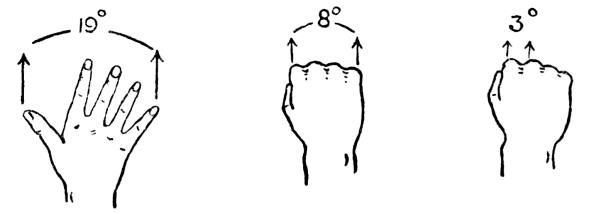
For the purpose of instruction a degree scale calculated for a given distance and painted on a wall will be found useful.
7. In ordering deflection it must be clearly understood that the amount ordered is in addition to any deflection that may be already on the sight, for this reason the word “more” is always to be used. Thus:—sight has 25′ right deflection; if “10′ more right” be ordered the sight will be set at 35′ right. Similarly, if “10´ more left” had been ordered the sight would have been set at 15′ right. [Pg 181]
120. Aiming points.[9]
1. Aiming points are conspicuous points capable of easy description on which the gun sight or dial sight is laid. They are used for two specific purposes, namely:—
As regards i. the aiming point should be as distant as possible and, with a view to reducing the necessary correction for parallelism, as much in prolongation of the line of guns as practicable.
It should, however, be noted that a well-defined aiming point not in prolongation of the line of guns is better than an ill-defined one which is in prolongation, provided that the correction for parallelism is not forgotten. (See Sec. 122.)
As regards ii. when the aiming point cannot be laid on from round to round an auxiliary aiming point must be picked up by the layer.
2. The aiming point or auxiliary aiming points must be made known to the section commander and No. 1, and to the other numbers at the gun as opportunity offers.
3. When the lines of fire are laid out by means of an aiming point, then either two aiming posts can be planted in the line of fire and laid on over the rocking bar sight, or the aiming point or an auxiliary aiming point can be laid on through the No. 7 dial sight, or over the No. 1 dial sight if neither the aiming point nor the auxiliary aiming point are within the field of the rocking bar sight.
121. Clearing the crest.
When guns are in action under cover the section commanders are [Pg 182] responsible that the shell will clear the crest. Immediately on coming into action the section commanders must report to the battery commander the lowest elevation which will clear the crest with zero angle of sight, if no angle of sight has been ordered. The various methods of carrying out this operation are fully dealt with in the handbooks of the guns.
122. Parallelism of lines of fire.
1. It is very important that the lines of fire of the guns of a battery should be parallel when first laid out, and every effort should be made to attain this object. Its commander will then have a definite condition from which to make his calculations, and should be able to switch his guns from one target to another without losing parallelism, to distribute his fire correctly over a given front, or to concentrate it on a given point.
2. When the guns of a battery are laid off an aiming point with the same angle, their lines of fire will not be parallel unless the aiming point is either at an infinite distance, or in exact prolongation of the line of guns.
In Fig. 22 A and B are the positions of the flank guns and CD is the prolongation of the line of guns.
Suppose P is an aiming point which, for simplicity, is taken as the correct line of fire for the right gun, and is at right angles to the line of guns.
If AE is drawn parallel to BP, it will represent the line of fire required for the left gun.
The correction for parallelism for the left gun is consequently the angle EAP, which is equal to the angle APB, i.e., the angle subtending the front of the battery at the range of the aiming point.
This position of the aiming point, namely, at right angles to the line of guns, entails the greatest amount of correction for parallelism for an aiming point at any given distance. [Pg 183]
Fig. 22.
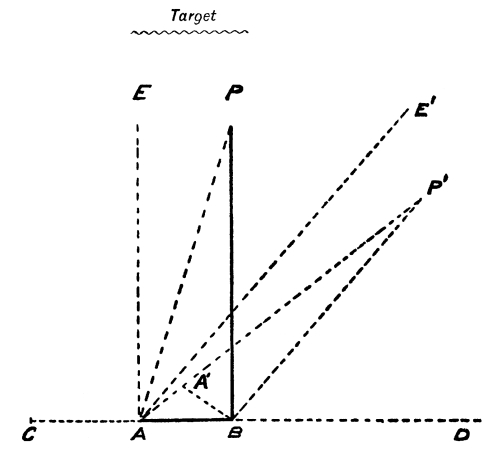
[Pg 184] If the aiming point is in any other position at the same distance, such as P¹, the angle AP¹ B becomes smaller, as the front of the battery A¹ B becomes foreshortened when viewed from the aiming point. This foreshortening continues until the frontage of the battery disappears, i.e., the aiming point is in prolongation of the line of guns, in which case no correction for parallelism is necessary. [Pg 185]
3. The correction necessary to make the line of fire of A parallel to the line of fire of B varies with the distance BP, and the angle PBD.
The total correction, divided by the number of gun intervals, gives the amount of distribution or concentration necessary for each gun.
When the aiming point is in front of the line of guns distribution is required; when in rear the same rule holds good, but concentration is required.
4. The following table gives angular corrections for each gun interval for different positions of the aiming point:—
| Angle between line to aiming point and line of guns. |
Range to aiming point. | ||||||
|---|---|---|---|---|---|---|---|
| 1000ˣ | 2000ˣ | 3000ˣ | 4000ˣ | 5000ˣ | 6000ˣ | 7000ˣ | |
| Mins. | Mins. | Mins. | Mins. | Mins. | Mins. | Mins. | |
| 10 degrees. | 10 | 5 | 5 | 5 | 5 | 5 | 5 |
| 20 ” | 25 | 10 | 10 | 5 | 5 | 5 | 5 |
| 30 ” | 35 | 15 | 10 | 10 | 5 | 5 | 5 |
| 40 ” | 45 | 20 | 15 | 10 | 10 | 5 | 5 |
| 50 to 70 “ | 60 | 30 | 20 | 15 | 10 | 10 | 10 |
| 80 ” 90 “ | 70 | 35 | 25 | 20 | 15 | 10 | 10 |
A good rough rule to ascertain the parallelism required is to divide the angle between the line to the aiming point and the line of guns by the number of thousands of yards range to the aiming point. The result is the number of minutes concentration or distribution for each gun. [Pg 186]
5. Another method is as follows:—Two guns (preferably the flank guns) after their sights have been laid on the aiming point at the angle ordered, may be ordered to lay on each other and report to the battery leader the angles read. The battery leader then adds them together, subtracts their sum from 180° and the result divided by the number of gun intervals gives the distribution or concentration required per gun.
Thus in Fig. 23, supposing No. 1 gun reports “my angle 15°,” and No. 6 gun reports “my angle 160°,” the battery leader knows that 5° is the total distribution for the battery and that 1° is the distribution per gun.
123. Displacement.
1. Single displacement.—When the battery leader is unable to place his director in or quite near to the line of guns a correction known as single displacement becomes necessary to compensate for the difference in the angles between the aiming point and the target, measured at the director and at the battery respectively.
Fig. 23.
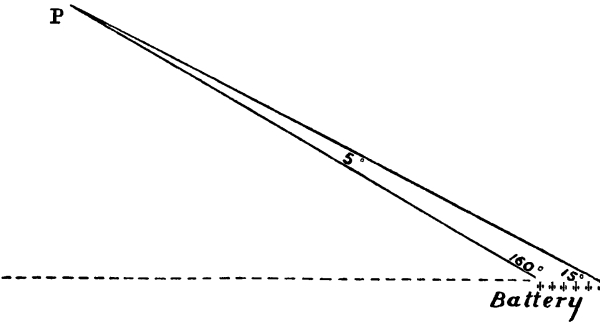
This correction is given to all guns in such a way as to bring the lines of fire towards the director. [Pg 187]
In Fig. 24 suppose T is the target, B the battery, D the battery leader’s director and P the aiming point. If no allowance for displacement was made the lines of fire would be as much to the left of the target as B is to the left of D.
Fig. 24.
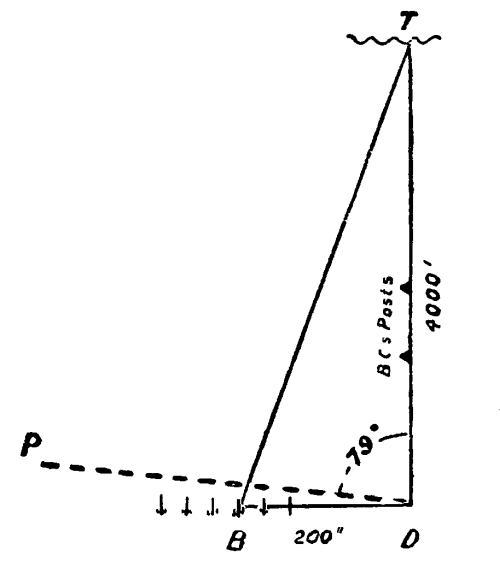
2. A simple rule for calculating the displacement angle is as follows:—
| 6 | × | Base in yards | = Displacement angle. |
| 10 | Range in hundreds of yards |
Example.—Suppose in Fig. 24 the base (BD) is 200ˣ, the range (DT) is 4,000ˣ, and the angle to the aiming point (PDT) is 79°. [Pg 188]
| Then the displacement angle = | 6 | × | 200 | = 3°, |
| 10 | 40 |
and the battery leader would give out the angle “82° (i.e., 79 and 3) Right” to the battery.
If the aiming point had been to the right of the target, the displacement angle would have been deducted from the battery angle.
3. When it is desired to give the line of fire to the battery leader’s director, or to the flank gun, from the observing station and the distance is not enough to warrant the use of the plotter, the above method of computing the displacement angle will be found useful. (See Sec. 198 (2).)
The battery commander will make the necessary correction before sending the angle to the gun or director.
4. Double displacement.—When the observing station is some distance from the battery, the switch angle measured to a new target will usually differ from that required at the guns. This difference is known as double displacement.
5. In Fig. 25, suppose B is the battery, D the director, A the original target, and T the new target.
The angle measured between the original target and the new target at the director will only coincide with that required at the battery, that is the angle ADT will only be equal to ABT, when all the four points happen to be on the circumference of a circle. If T is in any position such as T¹, outside that circle, the angle at D is less than the angle at B; if in any position T², inside the circle, the angle at D is greater than that at B.
6. In practice it is useless to attempt to calculate the difference of the apex angles at A and T. The most accurate method is to work out the [Pg 189] problem on the plotter as described in Sec. 198. The difference between the battery angle and that for the first target will be the switch angle.
Fig. 25.
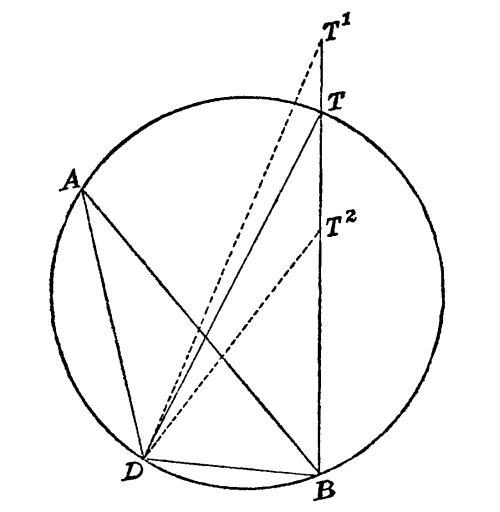
If the line to the first target has been found otherwise than by the plotter, and the observing station is some distance from the battery, the battery leader should measure the battery angle to the first target as soon as possible, and communicate it to the battery commander.
With this information the battery commander, after working out the new battery angle, can ascertain the switch angle to order to the guns.
7. If the tactical situation does not admit of this method, or when, owing to a small difference in range between the two targets, the displacement is likely to be small, an approximation may be arrived at as follows:— [Pg 190]
Decide whether the line joining the two targets is more foreshortened to the battery or to your own eye. If the former the switch angle will be less than that measured, if the latter it will be greater.
8. Another method is to switch over one gun through the estimated angle to the new target, correct its line by observation of fire, and, when line is correct, to order parallel lines to that gun.
124. Gun layers and fuze setters.
1. In all batteries of horse, field and heavy artillery, a list of qualified layers and fuze setters is to be kept by the battery commander.
2. In order to qualify to be placed on the list of layers, a non-commissioned officer or gunner is to be examined as described in “Instructions for Practice.” All serjeants should also be tested in laying.
3. Every battery should have at least 3 men qualified as layers and 6 men as fuze setters per subsection, exclusive of serjeants. These should be tested periodically.
Any non-commissioned officer or gunner with good sight should be able to pass this test.
[Pg 191]
125. General instructions.
1. At drill or manœuvre, the sections of a battery are termed “right,” “centre” or “left,” and the subsections are numbered from 1 to 6 as they stand in line without reference to any number or letter in use for administrative purposes. In column they are termed “leading,” “centre,” and “rear.”
A four-gun battery is organized on similar lines.
At brigade drill batteries are termed “right,” “centre,” and “left,” or “leading,” “centre,” and “rear,” according to their position in line or column respectively.
2. The object of drill is to acquire accuracy and flexibility in carrying out movements necessary for manœuvre.
These movements should be as few and simple as possible, and the brigade or battery should be trained to execute them with precision and rapidity in any direction passing over as little ground as possible.
3. When a general order is not distinctly heard by a part of the line, each commander (when the intention is obvious) will conform as quickly as possible to this movement.
4. Numbering in line is from right to left; in column from the right of the head of the column.
The relative position of batteries within a brigade, of sections within a battery, or of subsections within a section, may be changed at any time, but sections must not be broken up.
The battery or the section on the right of the line is always, for the [Pg 192] time being, the right battery or section. Line is to be formed in any required direction with the utmost rapidity possible, without regard to the original positions which batteries or sections or subsections within sections, occupied when they were last told off.
5. The command “March,” unless preceded by some other command, means “Trot.” This does not refer to heavy batteries.
When moving at any pace exceeding a walk, the command “ Walk” will precede by a few seconds the command “Halt.”
Movements and formations will be made on the move unless the order “to the halt” is given; in the case of formations “to the halt” the base body advances its own depth before halting.
If a formation be ordered when a battery is on the move the original pace will be preserved by the base body, while that of each portion of the remainder will be increased or diminished as may be necessary, until the formation is completed; but in field and heavy batteries, if moving at the trot, and the formation is to the head of the column, the pace of the base body will be reduced to the walk until the formation is completed, when the trot will be resumed.
6. Horse and field artillery cannot be reversed on its own ground; when acting with other troops, the battery interval should be allowed on each flank to enable the subsections to wheel outwards if required. It is generally advisable in parade movements to remain in rear of any intended alignment until the other troops are finally formed.
7. When it is intended to increase the front the formation may be to either or both flanks. If no special order is given the formation will be outwards, the body which is immediately in rear of the head going to the right. If it is intended to form on the right or left it must be so stated.
To pass obstacles, and to facilitate movement, the batteries may increase or decrease the battery intervals. [Pg 193]
Mountain Artillery.
8. Mountain batteries are organized in two lines for drill and manœuvre, the firing battery, and 1st line.
The relief mules which form part of the firing battery should be taken one from each subsection.
At drill and manœuvre the firing battery moves independently of the 1st line, which, if present, follows some distance in rear and conforms generally to the movements of the firing battery.
9. Mountain batteries move usually at the walk, and the command “March” means walk, unless some other pace is ordered. A pace of four miles an hour should be maintained on level ground.
A distance of one yard between mules, measured from nose to croup, is always maintained on a good road.
Batteries should also be able to move some distance at a slow trot and should be trained accordingly.
10. To reverse or take ground.—Every animal is at once turned about, or to the right or left, as ordered, the gun detachments moving round with the mules and maintaining their position relative to them. As a general rule mules are reversed to the left.
In executing a movement to a flank, the half wheel of subsections is to be preferred.
11. In the detail of drill movements contained in sections, the instructions are generally applicable to mountain batteries with the following modifications:—
i. All reference to the movement of wagons of field artillery may be neglected.
ii. Where the incline of subsections or carriages is ordered for a field battery, the movement will be executed by the half wheel of subsections except for diminishing or increasing intervals in line. Where a formation into line or column is effected in field artillery by one part of the battery increasing its pace, in mountain artillery that part of the battery makes no change, but the remainder of the battery checks its pace. [Pg 194]
126. Falling in for parade.
1. The men of each subsection will fall in on foot in front of their own stables, where they will be inspected by their Nos. 1, and the reports made to the battery serjeant-major. The drivers and mounted men of each subsection will then be marched into stables ready to turn out when ordered, and the dismounted men marched to the gun park.
2. The teams will be inspected by the Nos. 1 before they proceed to the gun park. When ordered to turn out, the subsections are formed up, mounted in front of their stables, marched to the gun park and hooked in. Teams should not be hooked in until shortly before the hour for parade.
3. Each section will also be inspected by its section commander, whose duty it is to see that every man, animal, and carriage is properly equipped, that each gun is in working order, the buffer filled and the bore clear.
He should then dismount drivers and detachments and make his report to the captain.
If a section is without an officer, the senior non-commissioned officer of that section takes his place and commands it.
4. When bare charges are carried and when the cartridge is contained in a case which is not attached to the shell, all drill ammunition will be left in barracks or camp.
Mountain Artillery.
5. When ordered to turn out, the drivers will turn out with their mules by subsections and be marched to the gun park, where they will form up behind the guns in the position for action. [Pg 195]
Mules will not be loaded or the girths tightened till the last possible moment.
127. Intervals and distances.
1. Intervals are measured from No. 1 to No. 1 when limbered up, from muzzle to muzzle when in action, and from knee to knee between files.
| Between files | 6 | inches. | |||
| Open files | 2 | yards. | |||
| Half extended files | 4 | ” | |||
| Extended files | 8 | ” | |||
| Close interval | between | subsections | 4 | ” | |
| ” | ” | ” | heavy batteries | 6 | ” |
| Half interval | between | subsections | 10 | ” | |
| ” | ” | ” | heavy batteries | 12 | ” |
| Full interval | between | subsections | 20 | ” | |
| ” | ” | ” | heavy batteries | 25 | ” |
| Battery intervals— | |||||
| Between | batteries at | full intervals | 25 | ” | |
| ” | ” | close ” | 10 | ” | |
| Intervals— | |||||
| between | brigades | 25 | ” | ||
| ” | artillery and other troops | 25 | ” | ||
2. Distances are measured between animals from tail to head, between carriages from rear end of carriages to head of the following team, and between the units of a column or Échelon from No. 1 to No. 1, except when otherwise stated:— [Pg 196]
| Between ranks | half a horse-length (4 feet). | ||||
| Battery column, column or échelon of sections | 40 | yards. | |||
| Column or échelon of sections, heavy batteries | 50 | ” | |||
| Column of | batteries | 125 | ” | ||
| ” | ” | heavy batteries | 100 | ” | |
| Short échelon of sections or batteries | 20 | ” | |||
| Short échelon of section or batteries, | |||||
| heavy batteries | 25 | ” | |||
| Quarter column of batteries | 12 | ” | between carriages and | ||
| lead horses’ heads. | |||||
| ””sections | 6 | ” | ” ” ” ” | ||
| Column of route | 4 | ” | ” ” ” ” | ||
| Between brigades and larger bodies in | |||||
| column of route | 20 | ” | ” ” ” ” | ||
| Between batteries in column of route | 10 | ” | ” ” ” ” | ||
| Column or échelon of sections | |||||
| of mountain batteries | 100 | ” | ” ” ” ” | ||
128. Frontages and depths.
1. The frontage at full interval of a horse, field or mountain battery (6 guns) may be taken to be 100 yards, and that of a heavy battery 75 yards.
2. The depth in column of route of a horse battery with detachments on a flank, or of a field battery, is obtained by allowing 20 yards for each carriage with an allowance for the headquarters. Horse artillery with detachments front or rear requires an extra 8 yards for each detachment; if the detachments are in files, 4 yards must be allowed for every two horses in the detachment. [Pg 197]
The road spaces occupied by batteries in column of route are as follows:—
A horse artillery battery (6 guns and 12 wagons):—
| With | detachments | right or left of the guns | 390 | yards. |
| ” | ” | front or rear | 440 | ” |
| ” | ” | in files | 490 | ” |
| A field battery (with 6 guns and 12 wagons) | 390 | ” |
| A heavy battery (with 8 wagons) | 340 | ” |
The depth of a mountain battery, in column of route, is obtained by allowing 3 yards for each mule or pony, and adding 25 yards for Nos. 1, coverers, range-takers and signallers.
129. Posts of officers, N.C.Os., &c.
1. The positions assigned to the brigade and battery commanders are those to be taken up when the formation is completed; while it is in progress their posts are wherever they can best superintend and be seen and heard by their commands.
In order to carry out this principle effectually, commanders of batteries and brigades should not remain too close to their commands. When moving in line, or in line of battery columns, their normal position is in front of the centre.
In quarter column formations officers (other than those in front) and serrefiles take half distance.
2. Brigade Commander. In line.—In the centre, two horse-lengths in front of battery commanders.
On other occasions.—In the best place from which he can command the brigade.
3. Battery Commander. In line.—One horse-length in front of the centre of the line of section commanders.
In column or quarter column of batteries.—One horse-length in front of, and three from the directing flank of, the battery.
In all other formations.—In front of the battery. [Pg 198]
4. Captain. In line.—One horse-length in rear of the centre of the serrefile rank.
In column of batteries.—As in line.
In quarter column of batteries, full or close interval.—Half a horse-length on the outer flank of the battery, in line with the front rank or gun leaders.
In battery column.—Three horse-lengths on the right flank of the centre of the battery.
In column of subsections and column of route.—One horse-length in rear of the rear carriage.
5. Section Commander. In line.—One horse-length in front of the centre of his section.
In battery column or quarter column.—The leading section commander as in line, the remainder in centre of sections in line with front rank or gun leaders.
In column of subsections and column of route.—Where he can best command his section.
6. Observation Officer (Heavy Batteries).—With the observation party.
7. Adjutant.—The adjutant will, as a rule, accompany the brigade commander and assist him as required.
When a formation is completed he will place himself as follows:—
In line.—On the right flank of the brigade, one horse-length from and in line with the front rank or gun leaders.
In column and échelon.—Three horse-lengths on the right flank of the leading battery in line with the front rank or gun leaders.
8. Brigade Serjeant-Major. In line, in column, and in échelon.—Covering the adjutant at one horse-length distance.
9. Brigade Trumpeter.—With brigade commander.
10. Battery Staff-Serjeants. In line and in column of batteries.—One horse-length in rear of the flank subsections; the serjeant-major on the right. [Pg 199]
In quarter column of batteries, full and close interval.—As in line, but half a horse-length in rear.
In battery column.—The serjeant-major and the quarter-master-serjeant in the centre of the leading and rear section respectively in line with the gun axles. In mountain artillery as for line.
In column of subsections and in column of route.—The serjeant-major on the off side of the leading gun in line with the leaders (in column of route, with the battery commander); the quarter-master-serjeant one horse-length in rear of the rear carriage in line with and on the left of the captain.
11. Serjeant-Farrier and Mounted Shoeing-Smith. In line.—The farrier, one horse-length in rear of No. 2 subsection, and the shoeing-smith (saddler in a British mountain battery) the same distance in rear of No. 5.
In quarter column of batteries, full and close interval.—As in line, but half a horse-length in rear.
In battery column.—One horse-length in rear of the rear carriages, the farrier in rear of that on the right. In mountain artillery as for line.
In column of subsections and in column of route.—One horse-length in rear of the captain and quartermaster-serjeant, except in mountain artillery, where they will be in single file, farrier leading.
12. Trumpeters.—One with the battery commander, the other with the captain.
13. Nos. 1.—Of horse artillery, on the left of the lead driver of the gun or with their detachments. (See Sec. 134 (2).)
Of field artillery, on the left of their gun leaders.
Of mountain and heavy artillery at drill and manœuvre in front of their subsections.
14. Coverers.—On the left of their wagon leaders (of heavy artillery in front).
15. Patrol, Range-Takers, Signallers, and Observers.—In line.—In line one horse-length in rear of the centre of the battery from right to left in the order named; at open files when the [Pg 200] battery is at full or half interval; at close files when it is at close interval.
In mountain artillery these men are dismounted and form in single rank one pace in rear of the centre of the battery.
In column of subsections and column of route.—In a column of parties from front to rear in the order named; the men of each party abreast of one another, and the rear party one horse-length in front of the leading section commanders.
In battery column or quarter column.—In column as above, one horse-length on the right flank of the centre of the battery.
In quarter column of batteries full or close interval.—As in line, but at half a horse-length distance.
16. Spare Horses. In line.—In the serrefile rank in rear of the centre of their sections, those of the centre section on the left of the line of patrols, range-takers, &c.
In quarter column of batteries, full or close interval.—One horse-length in rear of the rear battery. Those of the leading battery on the right, and those of the rear battery on the left.
Mountain artillery.
17. Senior Driver N.C.O. of British Mountain Batteries, (Driver Havildar Major).
In line.—One pace in rear of the pioneer mule of the right section.
In action.—He is in charge of the firing battery mules.
18. Pioneer Mules. In column of route and subsections.—Leading their section.
On all other occasions.—In the centre of the section, in line with the second ammunition mule.
Two gunners, or one only if short-handed, per subsection are detailed as pioneers, and walk alongside the pioneer mules in the order of march.
19. Relief Mules with Firing Battery. In line.—Distributed in rear of the 2nd ammunition mules. [Pg 201]
In battery column and in column of subsections.—Following in rear of the firing battery.
In column of route.—With their subsections.
20. Wheel and Axle Mule. (10-pr. B.L. equipment only.) In line and battery column.—One yard in rear of the pioneer mule of the centre section.
In column of subsections.—One yard in rear of the last mule of the relief mules with the firing battery.
In column of route.—The last of the firing battery mules of its subsection.
Indian mountain batteries.
21. Indian Officers. In line at close order and in battery column.—One horse-length in rear of the centre of firing battery of their sections.
At drill and in action.—Two native officers assist the captain, the third is with the battery commander.
On all other occasions.—On the outer flank of and near the rear of their sections.
22. Battery Staff-Serjeants.—The havildar-major and quartermaster-havildar as for the battery serjeant-major and battery quartermaster-serjeant, but at one pace instead of a horse-length distance.
23. Pay Havildar.—In line in rear of No. 3 subsection.
In battery column.—In rear of right subsection of centre section.
In column of subsections and column of route.—In front of the quartermaster-havildar.
130. Commands and signals.
1. Orders may be given:—
[Pg 202] Words of command.
2. Direct word of command is not suitable for any larger body at the halt than a brigade, or on the move than a battery.
3. All words of command should be given in a firm and explicit manner, and loud enough to be heard by all concerned. The executive part of the command must be clearly distinguished from the preparatory part, and must not follow it too quickly. Commands will be accompanied by the corresponding signals.
4. Battery commanders repeat the brigade whistle and then give their own executive word or signal.
Section commanders, as a rule, command by signal, and give orders by word of mouth only in case of necessity.
Nos. 1 do not repeat commands or signals.
The leader of every unit is responsible that the command is passed on correctly to the next leader.
Signals.
5. The following signals are to be employed to represent the words of command mentioned:—
| Signal. | To Indicate. | |
| i. | Arm swung from rear to front | “Advance,” or “Forward,” |
| below the shoulder, finishing | or “Commence movement.” | |
| with the hand pointing to the front. | ||
| ii. | Arm circled above the head. | “Retire,” or “Subsections—Right |
| about wheel.” (In mountain batteries) | ||
| “Left reverse.” | ||
| iii. | Hand raised in line with the | “Walk,” or “Quick-time.” |
| shoulder, elbow bent, and close | ||
| to the side. | [Pg 203] | |
| iv. | Clenched hand moved up and | “Trot” or “Double.” |
| down between thigh and shoulder. | ||
| v. | Circular movement of hand below | “Gallop.” |
| the shoulder in a vertical plane. | ||
| vi. | Arm raised at full extent above | “Halt.” |
| the head. | ||
| vii. | Body or horse turned in the | “Incline.” |
| required direction and arm extended | ||
| in a line with the shoulder. | ||
| viii. | Clenched hand brought to the | “Right (or left) take ground.” |
| shoulder, and the arm then extended | ||
| sharply in the required direction | ||
| two or three times. | ||
| ix. | Circular movement of extended arm | “Shoulders,” or “Wheel.” |
| arm in line with the shoulder in the | ||
| required direction. | ||
| x. | Arm waved from above the head | “Sections right (or left) wheel.” |
| to a position in line with the | ||
| shoulder, pointing in the required | ||
| direction. | ||
| xi. | Arm waved horizontally from right | 1. “Form line” from |
| to left and back again as though | battery column or line | |
| cutting with a sword, finishing with | of battery columns or mass. | |
| the delivery of a point to the front. | ||
| 2. “Form mass” from | ||
| line, column of route | ||
| or column of sections. | ||
| 3. “Advance in battery | ||
| column” (for a single | ||
| battery in line) or | ||
| “Advance in mass” | ||
| (from brigade in line). [Pg 204] | ||
| xii. | Two or three slight movements | “Form line” from échelon. |
| of the open hand, palm to the | ||
| front (arm extended, hand waist | ||
| high) denoting a forward movement, | ||
| looking to each flank in turn. | ||
| xiii. | As above, but arm to the rear, | “Form échelon” from line. |
| denoting a backward movement. | ||
| xiv. | Two or three slight movements of | “Dismount” or “Lie down.” |
| the open hand towards the ground. | ||
| xv. | Two or three slight movements with | “Mount.” |
| the open hand upwards (palm up). | ||
| xvi. | Arm raised as for “Halt” and then | “Action.” |
| pointed to the ground. | ||
| xvii. | Weapon held up above and as if | “Enemy in sight in |
| guarding the head. | small numbers.” | |
| xviii. | As in xvii, but weapon raised | “Enemy in sight in |
| and lowered frequently. | large numbers.” | |
| xix. | Weapon held up at full extent of | “No enemy in sight.” |
| arm, point of muzzle uppermost. |
Signals for formations from line also apply to échelon.
For signals to first line wagons in action, see Sec. 201.
6. Officers giving signals should, as far as possible, face the same way as those to whom the signals are made, but when a signal ordering a change of direction is made, the body or horse should be turned in the required direction.
All signals should be made with whichever arm will show most clearly what is meant.
In order to ensure uniformity in the system of giving signals, they must be practised in the riding school.
7. Signals of position, such as “Halt” or “Incline,” should be maintained. Signals of movement, such as “Advance” or “Shoulders,” should be repeated until it is clear that they are understood. [Pg 205]
8. The whistle (see also Sec. 201) will be used:—
i. By brigade and battery commanders to draw attention to a signal about to be made—a short blast. The whistle must not be used when approaching guns or infantry already in action.
ii. To turn out troops from bivouac or camp to fall in or to occupy previously arranged positions—a succession of alternate long and short blasts.
When a battery is manœuvring as part of a brigade, the battery commander will only repeat the brigade commander’s whistle, to whom he will look for his signal.
Section commanders will wait for their battery commander’s whistle and act on his signals, not on those of the brigade commander.
Field calls.
9. The following field calls should be understood, and such as are applicable maybe used see (Trumpet and Bugle Sounds for the Army):—
131. Leading and dressing.
1. To preserve uniformity of movement, men and horses must be trained to maintain the regular pace of trot and gallop.
For the same reason the trot and gallop must commence simultaneously throughout the battery.
As large bodies cannot move in perfect order as rapidly as smaller bodies, the leader must regulate the pace accordingly.
2. The “battery leader” is the officer personally leading and controlling the movements of the battery. He should be well to the front.
Should the battery commander for any reason temporarily cease to act as battery leader, his place will be taken by the senior section commander.
3. The “battery guide” is the commander of the directing section, which is the second from the right (or in column and échelon the leading section). He is responsible for the direction and pace of the battery, following and conforming to the movements of the battery leader.
The other sections will keep their relative positions from the directing section. [Pg 207]
4. Similarly in brigade the officer personally leading is the “brigade leader,” and the battery leader of the second battery from the right the “brigade guide.” A line of columns is considered a line in all matters connected with dressing.
In échelon or column movements the battery leader of the leading battery is the brigade guide.
132. Wheeling.
1. When wheeling, dressing is to the opposite flank to that to which the wheel is made. This flank regulates the pace at which the wheel is made, care being taken that the correct interval is preserved from the pivot.
2. To wheel half or quarter, right or left, the word of command is “Half (or Quarter), Right (or Left).” If it is required to complete the wheel to the full quarter circle, after having wheeled half right or half left, the command is “Right (or Left).” When a definite degree of wheel has been ordered no further command is required, the battery or brigade guide being responsible for taking up the proper direction at the conclusion of the wheel ordered.
3. In throwing shoulders forward both flanks are kept in motion, the pivot describing part of a circle, and the outer flank and intermediate subsections by a compound of inclining and wheeling, conforming to the pivot movements. To perform wheels on this principle the command is “Right (or Left) shoulders,” followed by “Forward” when the required degree of wheel has been attained.
4. In small changes of direction (which are usually done by shouldering) the battery leader takes the new direction and the battery guide conforms. When a wheel amounts to a quarter of a circle or nearly so, the battery leader must give the signal to wheel and if desired the word of command and place himself in front of where the centre of the [Pg 208]battery will be when the wheel is completed. He gives the signal “Forward” and moves in the new direction as soon as the battery is facing in the required direction.
5. If it is desired to move the line or column consisting of guns and wagons to a flank, the command is “Right (or Left) take ground,” upon which each carriage wheels at once to the flank named. To move each carriage to the rear the command is “Right reverse,” upon which each carriage wheels about to the right.
When horse artillery receive the command “Right (or Left) take ground, or Right (or Left) reverse,” if the detachments are in front or rear of their guns they wheel right, left, or about on their own ground.
133. Markers.
1. The duties of markers will be restricted at drill to indicating the points for the assembly and formation of the battery or brigade for rendezvous.
2. The markers for a battery are the battery serjeant-major and battery quartermaster-serjeant, who are termed respectively the right and left markers. Battery markers mark for the points nearest to their positions in the original formation. They are placed and dressed by the captain.
3. The markers for a brigade are the brigade serjeant-major and the right marker of each battery. They are termed the brigade and battery markers respectively. They are placed and dressed by the adjutant.
4. On the command “Markers” being given they move to their places, are dressed by the officer in charge of them, and when dressed receive the word “Steady” from him. When the formation is completed he gives the command “Eyes front” and the markers fall in.
5. When marking for line, markers face the new alignment, their horses’ [Pg 209]heads 6 inches from it, battery markers opposite the points where the horses of the Nos. 1 of the flank subsections will be, and the brigade marker in line with, and 1 yard outside, the flank marker on the directing flank.
6. When marking for column of batteries, each marker should place himself 1 yard to the left of the spot where the No. 1 of the subsection for which he is marking will rest when the formation is completed, and should face the front. The brigade marker faces the marker on the directing flank of the leading battery; the adjutant places himself behind the brigade marker and corrects the covering.
Markers are not required for a single battery in battery column.
A line of columns is considered a line in all matters connected with marking.
134. The battery of horse artillery.
1. The number of men required for the service of each gun is 11, of whom 9 are mounted. In addition a man is required with each section as section commander’s horseholder. He is numbered 12, and falls in on the right of the detachment of the left subsection of his section, except in column of route, when he rides with the leading subsection of his section.
2. The senior N.C. officer of each detachment is the No. 1 in charge of the gun, and rides on the left of the lead driver of the gun, except in the case of “detachment front” when he is on the right of the detachment. The next senior is No. 7 the coverer in charge of the wagons, who rides on the left of the lead driver of the firing battery wagon. Having taken this wagon into action he returns with the team or limber to the selected position and is employed in the supply of ammunition as the commander of the wagon line may direct. Nos. 1, 2, 3, 4, 5, 6 are active numbers (see Handbook); Nos. 10 and 11 are [Pg 210] horseholders and hold the horses of the active numbers, except those of 1 and 6 which are held by the centre driver of the gun and wagon respectively. Nos. 8 and 9 are dismounted men and are carried on the first line wagon. The horses of the battery commander and of the man, who works the director, are held by the first trumpeter.
3. A section of horse artillery, with full detachments, is shown in Fig. 26 (the shaded figures representing the horses of active numbers).
In cases of reduced detachments Nos. 6, 5, 10 are omitted in succession.
4. A battery forms for drill and manœuvre as above. Detachments one horse-length on the right of and in line with the gun muzzles. This formation is termed “Detachments right rear.” Lead horses of the firing battery wagons one horse-length on the left of and in line with the gun muzzles.
5. To decrease the front of the subsection the following formations may be adopted:—
| Detachments | Lead horses of guns one horse-length |
| front. | in rear of the detachments covering |
| the centre. | |
| Detachments | Detachments one horse-length in rear |
| rear. | of and covering the guns. |
In each case the firing battery wagons will cover the gun or detachment at a distance of four yards. [Pg 211]
The front may be still further reduced by advancing from the right or left of detachments by files.
Fig. 26.
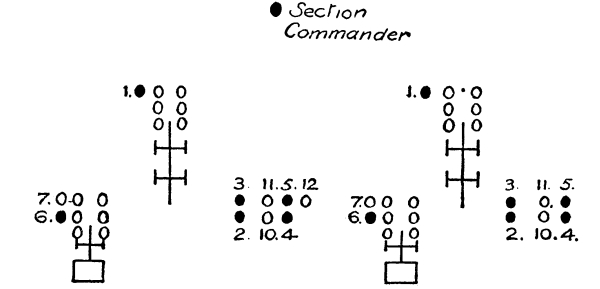
[Pg 213] 6. To dismount and mount detachments, in line, close interval, guns rear.
| At the caution, the front rank advances | |
| Prepare to | one horse-length and halts; the odd |
| Dismount— | numbers, both of front and rear ranks, |
| advance one horse-length,and at the word | |
| Dismount. | “Dismount,” the whole dismount |
| together. | |
| After mounting, the odd numbers of both | |
| Prepare to | front and rear ranks rein back and dress |
| Mount— | on the even numbers. The front rank then |
| reins back one horse-length and halts | |
| Mount. | If this is required to be done with |
| “detachments left” at close interval, the | |
| detachments must be advanced one | |
| horse-length in front of the guns, and | |
| then dismounted, as laid down above. |
135. The field battery.
1. The number of men required for the service of each nature of gun is given in the handbooks. No. 1 is the senior; and the coverers, who are the next senior, are mounted non-commissioned officers. Nos. 1 ride on the left of the lead drivers of their guns and the coverers will occupy a similar position as regards the wagons of the firing battery, will take them into action, and will return with the teams to the first line wagons. They will subsequently be employed for the supply of ammunition, as the commander of the wagon line may direct. The positions of the other numbers of the detachment are given in the handbook of the gun.
2. In action the horses of officers and non-commissioned officers are held as follows. (See Fig. 29, p. 306.)
136. The mountain battery.
1. The number of men required for the service of each gun is given in the handbook. No. 1 is the senior and leads his subsection, walking in front of the leading mule. The gunners walk alongside the mules in the order shown in the handbook. In bad or hilly ground they help the mules whenever necessary.
2. A N.C.O. is detailed to be in charge of and lead the 1st line mules of each subsection, and will be employed in the supply of ammunition.
3. In action the horses of the battery commander and battery serjeant-major are taken by the 1st trumpeter, that of the captain by the 2nd trumpeter, and those of the section commanders by a N.C.O. or driver of their right subsection.
137. The heavy battery.
1. The number of men required for the service of each gun is given in the handbooks. The senior N.C.O. is called the No. 1, and the next senior, the coverer. The No. 1 is in charge of the gun, and the coverer in charge of the wagon.
2. In action the horses of officers and non-commissioned officers are held as follows:—
i. Battery commander’s and serjeant-major’s by the 1st trumpeter.
ii. Captain’s by the 2nd trumpeter.
iii. Section commander’s by a man detailed for the purpose. [Pg 215]
138. Battery drill.
i. The formations of a battery are:—
| 2. | From | The battery leader moves in the required |
| line to | direction. The battery guide follows preserving | |
| advance. | smooth and uniform pace. The remaining | |
| section commanders dress by the battery | ||
| guide and keep section interval from him, but | ||
| without constantly fixing their attention on him. | ||
| March. | The Nos. 1 keep correct interval and distance | |
| from the section commanders. If | ||
| obstacles are met section commanders lead | ||
| their sections round them, or direct individual | ||
| guns to evade them. | ||
| 3. | From | |
| line to | ||
| advance | ||
| in échelon | ||
| or short | ||
| échelon. | ||
| Advance in | The named section advances, the others | |
| échelon (or | follow at the distance ordered. | |
| short | ||
| echelon) | ||
| from the | ||
| right | ||
| (centre | ||
| left)—March. [Pg 216] | ||
| 4. | From | |
| line to | ||
| retire. | ||
| i. Subsections | Wagons and serrefiles follow their gun | |
| right | round. | |
| about wheel—March. | ||
| ii. Right | Each carriage wheels to the right about and | |
| reverse—March. | follows in rear of the serrefiles, who turn about | |
| on their own ground. | ||
| Note.—If it is required to make the rear the | ||
| front the order is “Guns front, Serrefiles | ||
| rear.” |
Note.—The retirement of a mountain battery at full and half interval is usually carried out by the order “Left reverse—March.”
Nos. 1 and serrefiles turn about on their own ground.
On the order “Guns front, serrefiles rear,” the leading mules step short, and the axle mules move to the front by inclining to the right, followed by the others in succession from the rear.
| 5. | From line | The odd subsections advance at the pace |
| to retire | ordered while the even subsections check the | |
| when at | pace. When the odd subsections are clear of | |
| half | the even subsections the battery commander | |
| interval. | orders “Subsection right about wheel,” | |
| and when the subsections are all in line again | ||
| the original pace is taken up. | ||
| The battery | ||
| will retire— | ||
| March. | Note.—A line may reverse when at half | |
| interval in a similar manner. [Pg 217] | ||
| 6. | From line | All the section commanders turn half right |
| to incline. | (or left) while the lead drivers of all the carriages | |
| wheel their horses half right (or left), | ||
| i. Right | (or Left) | |
| incline— | and all move off in the new direction. The | |
| March. | lines of the section commanders, guns and | |
| wagons remain parallel. To resume the original | ||
| direction the order is “Forward.” In horse | ||
| artillery the detachments preserve their | ||
| positions relative to their guns. | ||
| In a mountain battery the incline is | ||
| executed by every man and animal turning | ||
| half right (or left) on his own ground and | ||
| moving in the new direction. | ||
| ii. Subsections | In this case, the wagons follow the guns | |
| half | instead of inclining independently. All resume | |
| right (or | the original direction on the command | |
| left)— | ||
| March. | “Subsections half left (or right).” | |
| Inclining should only be done for short | ||
| distances. | ||
| In a mountain battery each subsection | ||
| follows its No. 1, who turns half right (or left) | ||
| as ordered. | ||
| 7. | From line | |
| to take | Each carriage wheels at once. Officers, &c., | |
| ground to | move to their places in column. | |
| a flank. | In a mountain battery every animal is at | |
| Right (or | once turned to the right (or left) as ordered, | |
| Left) take | Nos. 1 and serrefiles turn on their own | |
| ground | ground. The dressing is towards the axle | |
| —March. | mules. [Pg 218] | |
| 8. | From line | The closing or opening is done upon the |
| to diminish | battery guide. He moves straight forward, | |
| or increase | while the other section commanders and the | |
| the intervals. | carriages incline inwards or outwards, and | |
| when at the required interval, move forward | ||
| in succession. When all are in their places, | ||
| Half | the trot is resumed by order of the battery | |
| (close or full) | leader. | |
| interval | ||
| —March. | Should it be required to diminish or increase | |
| the intervals without advancing the battery, | ||
| the battery guide stands fast, the carriages | ||
| reverse, move inwards or outwards, and form | ||
| up to the halt at the required interval. | ||
| Should the battery commander desire it, he | ||
| may order the formation on any section or | ||
| subsection, when his command will be “Half | ||
| (close or full) interval on the right (or | ||
| left) section (or No. ).” | ||
| 9. | From line | The subsection on the named flank (or, in |
| to advance | the case of an advance from the centre, the | |
| (or retire) | right subsection of the centre section) moves | |
| in column | forward, the section commander placing himself | |
| of route. | in front. The remaining subsections | |
| incline to their right or left, checking the | ||
| pace as required, and turn forward in succession | ||
| when in rear of the head of the column. [Pg 219] | ||
| Advance in | In advancing from the centre, the left subsection | |
| column of | of the centre section follows the right | |
| route from | subsection, then those of the right section. | |
| the right | ||
| (left or | A retirement is carried out in a similar | |
| centre) | manner, the command being, “Retire in | |
| —March. | column of route from the right (left, or | |
| centre)—March.” The subsections wheel | ||
| about and proceed as before. | ||
| 10. | From | |
| line to | This is carried out in a similar manner to | |
| advance | the previous movements, except that on | |
| (or retire) | leaving the alignment the wagons move up | |
| in column | as ordered on the right or left of their guns | |
| of subsections. | at 20 yards interval. | |
| Advance in | The command for a retirement is “Retire | |
| column of | in column of subsections from the right | |
| subsections | (left, or centre)—Wagons right (or left) | |
| from the | —March. | |
| right (left | In mountain artillery the advance or retirement | |
| or centre)— | in column of subsections is done in a similar | |
| (or left) | way, the firing battery mules of subsections | |
| —March. | following each other in succession, and | |
| the 1st line, when this is on parade, moving | ||
| in the same order in rear. | ||
| 11. | From | The advance unless otherwise ordered is |
| line to | always from the centre or directing section. | |
| advance in | The centre section advances straight to its | |
| battery | front. The right section inclines to its | |
| column. | left and follows immediately in rear of the | |
| centre section, checking the pace as required [Pg 220] | ||
| Advance in | to do so. Similarly the left section inclines | |
| battery | to its right and follows the right section. | |
| column (or | The wagons of 3 and 2 disengage and move | |
| from the | forward at an increased pace so as to allow | |
| right or | the guns of the right and left sections to get | |
| left)—March. | into their places without checking. This done | |
| they drop back again. | ||
| To advance in battery column from a flank | ||
| the named section advances, followed by the | ||
| remainder in succession. | ||
| 12. | From | |
| line to | After the subsections have wheeled about | |
| retire in | the movement is carried out as in para. 11, | |
| battery | the section is now on the right following the | |
| column. | centre section. | |
| Retire in | ||
| battery | Note.—In mountain artillery the retirement | |
| column— | in battery column may be done similarly by | |
| Subsections | reversing, the order being “Retire in battery | |
| about | column—Left Reverse—March,” and the | |
| Wheel— | movement is carried out as above when the | |
| March. | reversing is completed. | |
| 13. | From | The rear subsections of sections incline to |
| column | their right and move up at the prescribed | |
| of route | interval on the right of those in front. | |
| to form | If the order “On the left form battery | |
| battery | column” is given, the rear subsections form | |
| column. | in a similar manner on the left of those in front. [Pg 221] | |
| Form | In mountain artillery battery column is | |
| battery | formed from column of subsections in the | |
| column | same way. | |
| —March. | ||
| 14. | From | |
| battery | The right (or left) subsection of the leading | |
| column | section moves straight to the front, the other | |
| to advance | inclines and follows. | |
| in column | The rear section acts similarly, checking | |
| of route. | the pace until there is room for them to move | |
| Advance in | forward. | |
| column of | ||
| route from | In mountain artillery an advance in column | |
| the right | of subsections is similarly carried out. | |
| (or left)— | ||
| March. | ||
| 15. | From | |
| battery | The wagons incline to the left and move | |
| column | up on the left of their guns at close interval. | |
| to form | The sections close up to quarter column | |
| battery | distance. | |
| quarter | ||
| column. | Should it be desired, the wagons can be | |
| Form | brought on the right or at half interval by | |
| quarter | the command “Wagons right half interval.” | |
| column | ||
| —March. | [Pg 222] | |
| 16. | From | |
| battery column | The leading section follows the battery | |
| to form line. | guide. | |
| Form | The centre and rear sections incline outwards | |
| line— | and follow their commanders on to the | |
| March. | alignment. | |
| Special for Mountain Artillery. | ||
| 17. | From | |
| battery | ||
| column to | ||
| form line | The right (or left) subsections of sections | |
| to a flank. | come into action at once in the required direction. | |
| The left (or right) subsections wheel to | ||
| Line to the | the right (or left) at their proper interval, | |
| right | moving at a trot, if possible, and come into | |
| left) for | action on the alignment. | |
| Action—March. | ||
139. Brigade drill.
1. The formations of a brigade are:—
| 2. | From | The brigade advances straight to the front |
| line to | at an even pace. The brigade leader gives | |
| advance. | the direction to the brigade guide, and the | |
| other battery leaders regulate themselves | ||
| March. | and consequently their batteries, by the | |
| latter. | ||
| 3. | From | |
| line to | ||
| advance, | ||
| in échelon | ||
| or short | ||
| échelon of | ||
| batteries. | ||
| Advance in | The named battery advances—the others | |
| échelon (or | follow at the distance ordered. | |
| short | ||
| Échelon | ||
| from the | ||
| right | ||
| (centre or | ||
| left)—March. | ||
| 4. | From | |
| line to | ||
| advance | ||
| in line | ||
| of battery | ||
| columns. | ||
| Advance in | Each battery advances straight to the front | |
| line of | in battery column, the direction, dressing, and | |
| battery columns | pace being regulated as in line. | |
| —March. | [Pg 224] | |
| 5. | From | The batteries advance in battery column. |
| line to | The heads of the flank columns make half | |
| advance | a wheel inwards and move up in line with the | |
| in mass. | centre column, at 25 yards interval. | |
| Advance in | With two batteries, the battery of direction | |
| Mass—March. | moves straight forward, the other closes on it. | |
| 6. | From | The battery of direction forms line and moves |
| mass to | straight forward. | |
| form | ||
| line to | The leading sections of the flank batteries | |
| the front. | make a half wheel outwards and move in that | |
| direction till they have taken their correct | ||
| Form line | distance in line from the brigade guide. They | |
| —March. | then wheel to the front and line is formed. | |
| 7. | From | The leading battery forms battery column, |
| column of | continuing to move straight forward. | |
| route to | The centre and rear battery form battery | |
| form | column and incline to the right and left | |
| mass. | respectively, coming up on either side of the | |
| Form mass | leading battery at 25 yards interval. | |
| —March. | In a similar manner mass may be formed | |
| on either flank. | ||
| 8. | From | |
| column of | ||
| sections to | ||
| form mass. | ||
| Form mass—March. | As in 7. [Pg 225] | |
| 9. | From | |
| line to | ||
| advance | ||
| in quarter | ||
| column | ||
| of batteries | ||
| from a | ||
| flank (or | The right battery advances to clear the front | |
| the centre). | and the other batteries incline to the right. | |
| Advance in | They successively incline to the front and | |
| quarter | close up to quarter column, the wagons of all | |
| column of | coming up on the left of their guns at close | |
| batteries | interval (or on the right or at half interval if | |
| from the | ordered). | |
| right—March. | ||
| 10. | From | |
| line to | ||
| form | ||
| quarter | ||
| column | ||
| of batteries | The centre and left batteries reverse and move | |
| to the | to the rear. The centre battery takes ground to | |
| halt. | its left, and again to its left when in rear of | |
| the right battery, and closes up to quarter | ||
| To the | column. The left battery inclines to its left, | |
| halt, | again to its left when it has room, and takes | |
| quarter | ground to its left when in rear of the column, | |
| column of | also closing up to quarter column. The wagons | |
| batteries. | all come up on the left of their guns at close | |
| on the | interval (or on the right or at half interval | |
| right—March. | if ordered). [Pg 226] | |
| 11. | From | The leading battery moves forward till clear |
| quarter | of the one behind it. The centre battery | |
| column of | inclines (shoulders at close interval) to its | |
| batteries | right and continues in that direction till the | |
| to form | battery guide has got his interval in line from | |
| line to | the brigade guide, when it inclines to the left | |
| the front. | and comes up in line on the right of the directing | |
| battery. Similarly the rear battery | ||
| inclines to the left and comes up on the left. | ||
| Form line— | When the line is formed the trot is taken up | |
| March. | by all. The wagons drop into their places as | |
| soon as possible. | ||
| When this movement is performed from the | ||
| halt to the halt, the rear batteries take ground | ||
| to the right and left respectively, and come | ||
| up in line by a square movement. |
[Pg 227]
140. General instructions.
1. F.S. Regs., Part I, lay down certain principles for the guidance of commanders in the combined employment of the various arms. A knowledge of these principles by artillery commanders is essential for effective co-operation.
2. The instructions contained in this chapter are based on those principles, and are intended further to assist artillery commanders in the solution of problems which will confront them on the field of battle and in training their commands on a uniform system.
These principles are generally applicable to any force of artillery acting under an independent commander, whether his command is of a temporary nature or not.
Characteristics of Field Artillery.
141. Field guns.
1. The principal characteristics of modern field guns are the flatness of the trajectory of their shell, the rapidity and accuracy of their fire and their power to deliver effective fire from concealed positions as well as from those in the open. Other characteristics are mobility, increased power of concealment, owing to the use of smokeless powder, and decreased vulnerability, due to the adoption of shields.
2. The effect of field guns is most fully developed against troops in the open, either in movement or stationary.
They may be used effectively against personnel in entrenchments, in [Pg 228] buildings or behind gun shields. Against personnel protected by entrenchments the effect will be slight unless the defenders are compelled to man their entrenchments by the action of the other arms. Against buildings the effect is usually limited to the rooms facing the guns, as the projectiles are arrested by a second wall, and their destructive and incendiary effect is not great. The destructive effect of direct hits on artillery matériel is considerable, but at long ranges this would entail a great expenditure of ammunition. (See Sec. 114 (6).)
142. Field howitzers.
1. Field howitzers by reason of their high explosive shell and the steep angle of descent of their shrapnel bullets are specially suited:—
2. Their wide field of fire enables howitzers to cover a zone of considerable extent, and they are particularly adapted to the support of infantry in the later stages of an attack, owing to the steep angle of descent of their projectiles. (See Sec. 157.)
Troops in movement or other targets presenting only a fleeting opportunity do not come within the normal rôle of howitzers, which, however, should be prepared to engage such objectives, if circumstances make such action advisable.
3. The chief conditions for effective howitzer fire are good gun platforms, and facilities for both observation of fire and the exercise of command. A position behind natural cover is obviously preferable, provided these conditions are fulfilled. [Pg 229]
143. Heavy artillery.
1. The special characteristics of heavy artillery are accurate long-range fire and great shell power, but these advantages are to a certain extent discounted by a limited mobility. The long-range fire of guns of this nature should be utilized to bring enfilade and cross fire to bear on the enemy’s positions. The sites chosen for them should be such as to facilitate fire being brought to bear on as much of the ground occupied by the enemy as possible. In normal circumstances these conditions are most likely to be obtained by dispersion.
The fire of guns of this nature is of special value against shielded guns, fortified localities and buildings.
2. Owing to the limited mobility of these guns and the fact that they are unprovided with shields, considerable risk may be incurred without adequate compensation, if they are placed too far forward, or exposed on a flank.
Occasions may, however, occur, when to gain decisive results, it will be necessary to use them in line with those of lighter calibre.
3. If well protected and placed on the flanks of a defensive position in an open country, their long-range fire may compel a turning movement to be made on so wide an arc, that time, valuable to the defenders, may be gained.
144. Mountain artillery.
1. In country where wheeled traffic is impracticable, light guns carried on pack animals are the only substitute for field artillery, but the use of mountain artillery is not restricted to such country. Infantry requires effective support throughout the attack, and as pack animals can go practically anywhere that an infantry soldier can go without using his hands, batteries of mountain artillery are peculiarly suited to work with infantry in difficult country of any kind. [Pg 230]
2. Hills, woods, and broken or enclosed country, which might be impassable to wheeled artillery, present little difficulty to pack animals, and, as cover, which will conceal a man standing upright is sufficient for them also, batteries of mountain artillery will often be able to work their way forward on a battlefield without attracting attention, where the movement of wheeled artillery could not escape detection.
Moreover, the utility of mountain artillery is not confined to supporting the infantry in the various forms an attack may assume, for in the defence of woods, in temporary forward positions occupied by the defence, and in rearguard action, its mobility and easy concealment will often enable it to render valuable service.
In short, mountain batteries are capable of being of great value on many occasions when circumstances are unfavourable to the use of wheeled artillery, with which, however, they compare unfavourably in respect of shell power.
145. Objects of fire.
1. Artillery cannot ensure decisive success in battle by its own destructive action. It is the advance of the infantry that alone is capable of producing this result.
To help the infantry to maintain its mobility and offensive power by all the means at its disposal should be the underlying principle of all artillery tactics.
The primary objects of artillery fire should therefore be:—
These objects may be attained by—
[Pg 231]
It is legitimate, therefore, to use artillery fire for any of these purposes, in so far as they contribute towards the end in view.
146. Concealment.
1. The provision of suitable equipment enables batteries to deliver effective fire from positions in which they are completely concealed from the enemy. The batteries may thus be able to retain their mobility, and remain at the disposal of the commander of the force in the event of a change in the situation.
2. Concealment in action increases the difficulties of the hostile batteries, possibly even to the extent of conferring immunity from their fire, thus enabling the concealed artillery to devote its attention to the support and assistance of its own infantry.
Although the employment of aircraft for reconnaissance has modified the possibilities of complete concealment to some extent, guns in action may escape observation from the air if they are carefully sited.
Groups of horses and wagons in the open are very easily seen from aircraft and even when the guns are not visible may be an indication of the presence of artillery. Advantage should therefore be taken of woods, avenues of trees, or other features whenever possible to conceal the limbers, first line wagons and horses of artillery.
The power of delivering effective fire from concealed positions is, however, limited. Rapid movement or very fleeting opportunities are difficult to deal with. Distant observing stations involving the passage of orders by mechanical means increase the difficulty. The amount of dead ground which can be left in front of the guns may also be a matter of serious concern.[10]
[Pg 232] On the other hand batteries exposed to view will usually be compelled to enter into an artillery engagement for their own protection, in which they will start at a disadvantage. This is less likely to occur at the crisis of the fight when the struggle of the infantry at close quarters may monopolize the attention of the combatants.
3. Concealed manœuvre favours surprise, and should therefore be sought for up to the moment of opening fire, due regard being had to tactical requirements. Even if the enemy is at once able to locate the flashes the more vulnerable portions of the battery will probably have been safely disposed and some measure of surprise attained. The advantages to be gained from moving batteries into position under cover of darkness have increased owing to the difficulty of evading observation by hostile aircraft.
4. Concealment, both as regards position and manœuvre, must invariably be foregone for adequate reasons. To support infantry and to enable it to effect its purpose the artillery must willingly sacrifice itself.
To move in column of route on a road in circumstances where a lucky shot will bring the column to a standstill is to court disaster. On the other hand, when deployed, rapid movement over open ground exposed to fire for a short distance is accompanied by but slight risk; or, when the enemy’s attention is fully occupied elsewhere, movements may become possible which would have no reasonable chance of succeeding if the enemy was on the look out for them.
5. Knowledge of the general tactical situation and discrimination are essential on the part of all who order artillery movements on the battlefield.
147. Economy of force.
1. Artillery, owing to its mobility till subjected to effective fire, its great rapidity of fire and its power to fire effectively while remaining concealed, is able in most situations to conserve its energy, [Pg 233] selecting its own time for action and realizing to a great extent the value of surprise effect.
The principle of economy of force is, therefore, particularly suitable to the tactical employment of the arm, but must always be subordinate to the necessity of employing sufficient force to attain the object in view.
2. When an encounter with the enemy takes place sufficient artillery should be deployed to support the advanced troops and to cover the deployment of the infantry. The remaining batteries should be assembled in positions of readiness.
As the plan of action develops, tasks will be assigned to the different artillery units, and they will be brought into positions suitable for their purpose. If it is not necessary to open fire immediately they will remain in observation of the zones assigned to them.
3. Fire will not be opened with more guns than are necessary for the task in hand. In deciding on the number of guns with which to open fire, the total number available, the frontage that they can conveniently cover with their fire and the extent and tactical importance of the objective must be considered. Efforts must also be made to foresee the course of the action, and to keep a reserve of fire power in hand to meet successive requirements as they arise.
To justify the opening of fire there must be a definite tactical object and a reasonable probability of attaining it. Ineffective fire is not only a waste of ammunition, but affords encouragement to the enemy and gives him information. It should therefore be avoided whenever possible.
4. Expenditure of ammunition should, as a rule, be proportionate to the tactical importance of the objective and the probability of obtaining results commensurate with the expenditure. In deciding whether to engage an objective its vulnerability and tactical importance should, therefore, be considered. [Pg 234]
When an objective is both vulnerable and tactically important a considerable expenditure of ammunition is obviously justified, but important tactical objectives are frequently invisible or relatively invulnerable. The expenditure of ammunition in such cases must be governed by the urgency of the tactical situation.
5. The objects of keeping artillery in hand are:—
The methods by which these objects may be attained are:—
It follows as a consequence of the above that the power of the Q.F. gun must be utilized on occasion to its full extent to compensate for the small number of guns employed on a given task.
148. Protection.
1. On the march, artillery, owing to its inability to defend itself, requires protection which is provided by the other arms under [Pg 235] the orders of the commander of the force to which the artillery belongs.
2. On the field of battle artillery will generally be protected by the distribution of the other arms. When, however, guns are in an exposed position, an escort should be detailed, and, if this has not been done, it is the duty of the artillery commander concerned to apply to the commander of the nearest troops, who will provide an escort.—(See F.S. Regs., Part I., Sec. 105). In moving from one part of a battlefield to another artillery commanders must consider, if no escort has been provided, whether one is necessary or whether to avoid delay they should rely on their own patrols.
3. When an escort is provided its commander is responsible for the protection of the artillery. This fact, however, does not absolve the artillery commander from all care for the safety of his guns. He should consult with the escort commander when necessary and should be ready to assist him with any available artillery patrols, when their employment would conduce to greater security.
4. Once in action artillery should be able to protect its own front, provided there is no ground within effective rifle range upon which the fire of the guns cannot rapidly be brought to bear in case of need.
5. Rifles are carried on artillery wagons, except in horse artillery. In action these rifles should, if considered necessary, be distributed to the gunners with the wagon lines, who should assist the escort, if one has been provided, in protecting these vehicles. This precaution is especially desirable in the case of artillery in action on the exposed flank of a force, where hostile cavalry may be operating.
149. Intercommunication.
1. Intelligent co-operation depends largely on the receipt of timely information, and this in turn is dependent on the efficiency of the system of intercommunication. [Pg 236]
2. In open country where the features are bold and the field of fire and view extensive, infantry can often be supported more effectively from a flank than by batteries situated in its immediate zone; and the possibility of bringing effective converging fire to bear on a given locality may be capable of realization. For this to be done the divisional artillery commander must have the means of readjusting from time to time the tasks that have been assigned to the artillery brigades in the original dispositions for battle.
In close or intricate country, on the other hand, where the view is restricted, artillery will rarely be able to do more than support the infantry in its own immediate front. In these circumstances the artillery and infantry may be formed temporarily into groups and the units thus associated must co-operate closely with one another. The limitations of central artillery control must then be met by an increased devolution of responsibility to subordinate artillery commanders. (See Sec. 153, (7).)
Artillery communications therefore involve two distinct ideas, viz., i. communication between the divisional artillery commander and his subordinates; ii. between infantry and artillery subordinate commanders. Both must be kept in view and organized as far as possible, but the relative importance of each varies to a great extent with the nature of the country.
3. The means of communication available are:—
For the purposes of communication between the divisional artillery [Pg 237] commander and his subordinates orderlies are probably the most reliable, but the number of officers and men available for the purpose is limited, and moreover their employment involves the expenditure of considerable time and horseflesh.
The telephone equipment with which each artillery brigade is provided is primarily intended to link up the brigade commander with his batteries. But it may also be possible to utilize this equipment for communication with the divisional artillery commander. When it is desired to maintain direct communication with the divisional artillery commander, and the nature of the country makes it possible, the telephone should be employed. It is impossible, however, to trust entirely to this means, and arrangements must be made to supplement it by others that will be available in the event of breakdown.
Visual signalling is apt to disclose positions to the enemy and, except when the use of the heliograph is possible, is slow and uncertain. In any case the number of signallers available make it impossible to trust exclusively to this method of communication. In open country, and for lateral communications, where it is possible to conceal the use of flags, etc., from the enemy’s view visual signalling is valuable as a means of supplementing other methods.
The divisional signal service affords a useful alternative. When it is desired to use this means of communication it will be advantageous if the subordinate artillery commander can station himself near the infantry brigadier with whom he is co-operating, as it is then possible for him to communicate with the divisional artillery commander by using the cable that connects divisional and infantry brigade headquarters. This line, however, cannot be relied on for urgent messages, as it is often very congested.
4. For the purpose of establishing an understanding between infantry and artillery subordinate commanders the most satisfactory results in a [Pg 238] combined operation are obtained by a personal exchange of views between the commanders concerned before the operation begins. (See sec. 153. (7).)
If this is impossible or if the artillery commander is unable to remain in the vicinity of the infantry commander he should be represented by an officer.
5. It is of the utmost importance that communication should be maintained between the artillery and infantry commanders throughout the operation. It is unsafe to rely on one means of communication only, and two, or even more, should usually be arranged for. The mutual adoption of some system of describing the features of the ground, such as squared maps or panorama sketches, will often save delay and misunderstanding.
150. Employment of aircraft.
1. Both during the period of tactical reconnaissance which precedes the battle, and in the battle itself, the employment of aircraft may assist the artillery.
2. If it is possible before a battle to ascertain the general position and number of the hostile batteries by reconnaissances from aircraft, a valuable clue to the probable grouping of the hostile artillery may be obtained and the allotment of tasks to his artillery by the divisional commander facilitated.
3. During the battle aircraft can assist artillery as follows:—
Aeroplanes may be used for both these objects, but kites are of value chiefly for observation of fire. The latter, however, can only operate in a wind of from 20 to 40 miles an hour. They can lift an observer to a height of 1,500 to 2,000 feet and can keep in telephonic communication with the ground. They cannot easily be damaged by fire. [Pg 239]
151. Signalling from aircraft.
1. The means of communication from aircraft are:—
Wireless telegraphy, in its present state of development, can be used only in a limited number of aircraft and will not generally be provided in aeroplanes allotted for work with artillery.
Visual signals can be made by means of Very’s signal lights, coloured flags or weighted streamers. Electric lamps may also prove of value. Very’s lights are used in three colours; white, red and green. The distance at which they can be seen and distinguished varies with atmospheric conditions, but on a clear day they are easily distinguishable at 3,000 feet overhead, and if the sun is not very bright and in the eyes of the observer at a distance of 2 miles with the naked eye. On a clear evening they can be seen and distinguished as far as 6 miles. Specially prepared lights can be seen at greater distances. Red, yellow, or blue flags, 18 inches square, held out by an observer can be seen with field glasses at a distance of 1 mile with the aeroplane at a height of 2,000 feet. Dark and light streamers can be distinguished with the naked eye at a distance of 1 mile.
A Klaxon horn in an aeroplane can be heard on the ground from a height of 2,000 feet and a distance of 1 mile.
Messages may be written on special weighted message blocks and thrown over, or written on an ordinary form and placed in a weighted bag with streamers, or in a parachute.
152. Signalling from the ground to aircraft.
Any place where it is desired to have messages dropped will be marked by a cross on the ground, made of two strips of white cloth about 15 feet by 3 feet. [Pg 240]
White strips on the ground, 6 feet by 1 foot, can be seen from a height of 3,000 feet, and a prearranged code of signals can be made by this means. (See Sec. 205.)
On a clear evening Very’s lights fired from the ground can be seen from aircraft at a height of 2,000 feet and a distance of 6 miles, and the different colours distinguished.
153. General instructions.
1. The divisional commander is at all times responsible for the tactical employment of the artillery under his command. The divisional artillery commander is responsible for the execution of his orders so far as they affect the artillery.
2. When a force is marching towards the enemy and an encounter is anticipated, the divisional artillery commander will detail officers’ patrols (See Sec. 240) to accompany the advanced troops. These patrols will be found by the artillery brigades of the division, their number depending on the nature of the country and the front occupied by the division when on the march. As soon as an action appears likely these officers’ patrols will rapidly reconnoitre the ground on which it is probable that the force will deploy, and send information as soon as possible to the divisional artillery commander as to the nature and extent of the available artillery positions. A brief report received at the right time will be of greater value than a more elaborate and detailed report which is received too late to be acted upon.
3. The divisional artillery commander will usually accompany the divisional commander on the march. He must be careful to let all concerned, particularly his patrols, know where reports can reach him, both on the march and in action.
4. Should time be of importance and a rapid deployment essential there [Pg 241] may be no opportunity for a detailed reconnaissance by either the divisional or the artillery commander. If time permits, however, it is advisable for the divisional artillery commander to make a personal reconnaissance and report the result to the divisional commander before the manner of the deployment is settled, stating how best in his opinion the artillery can be utilized to further the object in view.
5. In forming a plan of action the manner in which the artillery and infantry will co-operate should be clearly defined, and will depend, as a rule, on the character of the country. If the country is such that the task assigned to the division can be carried out by the troops of the division acting in combination under the immediate control of the divisional commander, it will, generally, be inadvisable to delegate the command of portions of the divisional artillery to subordinate commanders.
Batteries may be able by crossing their fire to afford effective support to infantry other than that operating in their immediate front. To tie them down to limited tasks might reduce the fighting capacity of the division as a whole. In such circumstances, the bulk of the artillery will deploy and occupy positions under the orders of the divisional artillery commander, who will allot tasks to each brigade commander or zones in which he thinks their fire can be employed most effectively.
6. The country may, however, be such as to necessitate the employment of the division on more than one tactical operation, in such a manner that their efforts cannot be directly combined. In such cases it will be advisable that the artillery and infantry should be formed temporarily into groups. The units of the two arms thus associated for a distinct tactical operation should be under one commander. It is the function of the divisional commander to organize these temporary groups. It is then the function of the divisional artillery commander [Pg 242] to convey the necessary orders to the subordinate artillery commanders, placing them at the disposal of the group commanders.
It is the duty of a group commander to report to divisional headquarters when his special task is accomplished. When the special task has been accomplished, unless a new combined task is then to be allotted, the artillery of that group should be again placed at the disposal of the divisional artillery commander without delay, with a view to the issue of fresh instructions by him for its further employment. The artillery commander of the group is responsible for keeping the divisional artillery commander informed as to the course of the operation in which he is engaged, the general disposition of his batteries and the expenditure of ammunition.
7. Whenever a subordinate artillery commander is allotted a task necessitating co-operation with a certain force of infantry, whether he is placed under the orders of the commander of that force or not, it becomes his duty to open communication with its commander, reporting to him in person, if possible, in order to obtain full information as to the character of the operation that he is to support and as to the proposed method of its execution. (See Secs. 149 (4) and 248 (2).)
8. The manner in which the divisional commander’s plan is translated into orders and in which these orders are conveyed to the artillery must depend to a great extent on the nature of the operation. Divisional operation orders lay down what is required of the artillery and contain such information about it as it is necessary for the other arms to know. If infantry and artillery are grouped together temporarily as indicated above, divisional operation orders will give particulars of the grouping, and will also state the task or mission that is assigned to each group. Consequently in cases where divisional operation orders are issued to commanders of artillery brigades the divisional artillery commander will usually only require to supplement them with a few technical instructions. [Pg 243]
In his capacity as a subordinate commander (see F.S. Regs., Part II. Sec. 10), however, the divisional artillery commander is responsible that the necessary orders are issued to his own units. When, therefore, divisional orders are not issued to artillery brigades, or when they do not give sufficient information respecting the artillery, it is his duty to issue his own orders, and he is responsible that they convey to the units under his command all the information respecting the intention of the divisional commander and the movements of the other arms which it is desirable for them to know. It will frequently be necessary to give these orders verbally, and for this purpose the divisional artillery commander may find it convenient to assemble his brigade commanders.
It is his duty to make sure that the necessary orders are issued to the divisional ammunition column commander and that the latter is acquainted with the dispositions of the various artillery units.
9. The divisional artillery commander must bear in mind that during the course of an action unexpected developments are always liable to occur and that the artillery must be prepared to deal with them promptly.
Concealed positions have greatly facilitated this task. Batteries that are in action, but have not been located by the enemy, can often be moved rapidly to other parts of the field. The tasks allotted to some of these batteries may have become of minor importance and they will be available if required. Other batteries may have accomplished the tasks assigned to them and thus be at the disposal of the divisional artillery commander. Notwithstanding these possibilities, however, it may often be advisable to keep some guns in hand ready to reinforce guns already in action or to open fire in a new direction.
10. As the action progresses it may be necessary to rearrange the tasks or zones allotted to artillery brigades to meet the changing [Pg 244] circumstances, or to order changes of position. The position of the divisional artillery commander during an action should, therefore, be chosen with a view to the facilities it affords for keeping in touch with the divisional commander as well as for observing the progress of events and for communicating with his subordinate artillery commanders. (See Sec. 149 (2).) If the divisional artillery commander cannot find a suitable position in the vicinity of divisional headquarters, he must take steps to keep himself in constant touch therewith, in order that he may learn at once all information reaching the headquarters which might be of use to him.
11. For the purposes of directing and controlling the fire of his batteries the information that is of primary importance to an artillery commander is firstly to know exactly where the infantry that he is supporting is from time to time; secondly, what is its immediate objective; and thirdly, what it is that prevents it from attaining its object.
The comparative effect of fire from different portions of the enemy’s position is, however, difficult to estimate from the artillery positions. The establishment of advanced observation posts may, therefore, be necessary to watch the situation generally, to obtain information from infantry commanders, and to report to the artillery commander concerned. Responsibility for establishing posts for this purpose will rest either with the divisional artillery commander or with the commander of the artillery in a temporary group. (See para. 6.)[11]
12. The task of the artillery is likely to be much facilitated in future by the use of aircraft, by means of which targets may be located and the observation of fire assisted.
The divisional artillery commander should therefore point out to the divisional commander whenever necessary the directions in which aircraft can be usefully employed in obtaining information which would be of value to the artillery. [Pg 245]
154. Action of the advanced guard artillery.
(See also F.S. Regs., Part I, Sec. 68.)
1. The advanced guard affords protection to the main body and obtains information; either function may compel it to fight. When the enemy is encountered, and offensive action is intended, the advanced guard should drive back the enemy’s advanced troops till the dispositions of his main body are disclosed, after which the advanced guard will usually be compelled to limit its action to holding the ground gained until the commander has formed his plan and deployed his force.
It follows that the action of the advanced guard may alternate between the offensive and the defensive. The action of the artillery must conform.
2. The commander of the artillery of the advanced guard will accompany the advanced guard commander on the march, so that he may receive early instructions as to his action. The artillery will be allotted positions that will enable it to co-operate with the rest of the advanced guard in carrying out the plan of action that the advanced guard commander may decide to adopt.
The occupation of concealed positions, a wide dispersion of the available guns and a liberal expenditure of ammunition will then assist to deceive the enemy as to the strength of the force opposed to him, and may so contribute materially to the success of the operation.
3. If the enemy is in strength the advanced guard will eventually encounter opposition which it is unable to overcome. The artillery should then occupy the best positions available to assist the advanced guard in holding the ground gained and in repelling any attack that may be made upon it, in which case the principles involved are identical with those discussed later under the heading “Artillery in Defence.” (See Sec. 158 et seq.) [Pg 246]
4. As it is impossible to foresee, when an advanced guard action is entered upon, where and when the main battle will be fought, considerations as to possible eventualities should not be allowed to influence the choice of the most suitable positions for the immediate purpose. Any breaking up of units that may result must be rectified later, if possible.
155. Opening phase of the attack.
(See also F.S. Regs., Part I, Sec. 105.)
1. If the divisional commander decides to attack, the first functions of the artillery will be to support the advanced guard against any possible offensive on the part of the enemy in order to cover the deployment of the infantry of the main body. Usually concealed positions will be the best for this purpose.
2. If the infantry deployment takes place successfully and the enemy is definitely thrown on the defensive the next stage will be the advance of the infantry through the zone swept by the hostile artillery fire. The enemy will probably use his artillery to delay this advance and to inflict loss on the infantry whenever opportunity offers. His guns are likely to be concealed. The task of the artillery at this stage will usually be to locate the enemy’s batteries and, by subduing the fire of those in action, to support the infantry.
To carry this out observation posts must be established and every effort made to locate the hostile batteries or their observation posts. Valuable help can be rendered by aerial reconnaissance, but artillery officers and look-out men should be trained to detect readily the flashes of guns, the dust thrown up by their discharge and the other indications of the presence of a battery in action or of an observing party. When a hostile battery that is impeding the advance of the infantry has been located, every effort should be made to subdue its fire. The range should be obtained as accurately as circumstances [Pg 247] permit, and the battery should be subjected to an accurate, rapid, and intense fire[12] with the object of demoralizing the personnel and driving them temporarily from their guns or compelling them for the time being to cease fire. Should this object be achieved the hostile battery should be closely watched and any further attempt to intervene should be dealt with by a repetition of the same process. (See Sec. 223 (3).)
3. Unless the enemy’s artillery by exposing itself offers an opportunity for its destruction, commensurate with the expenditure of ammunition involved, fire should be confined to those hostile batteries that can be located, which are impeding the infantry advance. If the hostile batteries cannot be located ammunition should be husbanded and efforts directed towards further reconnaissance. The primary object being to assist the infantry to close with the enemy, an artillery engagement should not be entered into at this stage for its own sake.
156. Second phase of the attack.
1. As soon as the infantry reach a point where the effect of the enemy’s rifle fire begins to be seriously felt a fresh stage of the operations is entered upon.
The forward movement of the infantry is henceforward dependent largely on effective covering fire. To be effective this covering fire must be developed by guns, machine guns and rifles in combination. The artillery commanders must therefore have a thorough grasp of the tactical situation and appreciate fully the needs of the infantry.
The two arms must communicate freely and the artillery must watch the progress of the infantry closely. The actual method by which this co-operation should be obtained will vary in accordance with the general nature of the operation. (See Sec. 153 (5).) [Pg 248]
2. The defence of a position usually takes the form of the occupation of certain localities with unoccupied intervening spaces. If the terrain is suitable to defence these localities will mutually support one another and will each be supported by artillery. It follows that the attack must resolve itself into the attack of these localities, and protracted struggles will take place for their possession. When the country is intricate and enclosed the attacks on localities tend to become isolated actions and the system of temporary groupings referred to in Sec. 153 will be resorted to. The mission assigned to each group will be the capture of a certain locality. When the country is open the attacks on the localities, like the defence, can and should be mutually supporting.
3. The fire which prevents the development of an attack on a defended locality may come from the locality itself, or from other localities which are able to give support, or from supporting artillery. Inasmuch as infantry has difficulty in bringing fire to bear on objectives other than those in its immediate front, it follows that the artillery fire of the attack must be distributed according to requirements on all objectives from which effective fire is being brought to bear on the attacking infantry, if it is to be effective in helping the infantry forward.
Judicious distribution rather than over-concentration of artillery fire is therefore indicated, and to arrange for this distribution, and to allot suitable tasks or zones to each unit, is the function of the divisional artillery commander. (See Sec. 153 (5) and (6).)
The method of fire to be employed by each unit will depend on the nature of the actual target that it is engaging. A battery engaging hostile artillery which is seriously impeding the advance of the infantry by its fire should endeavour to overwhelm the hostile artillery as described in Sec. 223. A battery engaging infantry should, by bursts of fire, endeavour temporarily to disturb the enemy’s [Pg 249] aim and reduce the volume and effect of his fire so as to afford its own infantry an opportunity of gaining ground. These bursts of fire should become more frequent and intense as the infantry approaches the enemy’s position and the further advance becomes more difficult. (See Sec. 224.) Covered in this manner by the fire of the artillery the infantry approaches nearer and nearer to the enemy till it reaches a point from which it is possible to assault.
4. During the progress of the fight it will usually become necessary for the artillery to move forward to positions from which it will have a clearer view of the infantry fight and thus be able to afford to the infantry more effective support, especially against local counter-attacks. For this forward movement to be carried out with success and to attain its object certain conditions are necessary, namely:—
These conditions may be found to obtain for small forces of artillery such as sections or single guns, when they do not obtain for a large number of batteries moving simultaneously. In such cases guns should be dribbled forward a few at a time as may be found practicable. The advancing batteries should, when necessary, be supported by the fire of those in action. In cases of extreme difficulty it may be necessary for the forward movement to take place under cover of darkness.
5. To support an attack with success a battery commander must be able to see the ground over which the infantry is advancing and also be able to control the fire of his battery rapidly and effectively, but the more cover that can be obtained compatible with control by voice the better. [Pg 250]
6. Artillery as at present equipped has certain limitations as regards dealing with rapid movement from under cover, such as might be the case if a counter-attack were made unexpectedly, and must reach the crest to develop the full effect of its fire against such targets. Its conduct in such cases must be guided by the principle laid down in Sec. 146 (4).
157. Third phase of the attack.
1. The infantry covered by the fire of the artillery will endeavour to reach a position from which it will be possible to deliver the assault. The distance between this position and the enemy must depend upon the ground and the resisting power of the enemy.
2. The bursts of artillery fire should become frequent and intense at this period, the object of the artillery being to demoralise the defenders and reduce the volume and effect of their fire so as to afford to the infantry the opportunity to assault.
3. Every effort should be made to bring a converging fire to bear on the immediate objective of the attack, such fire being by far the most demoralizing and decisive in its effect.
At the same time no portion of the enemy’s position from which effective fire is being brought to bear on the attackers should be ignored.
4. The number of batteries employed should be limited to the number that can be effectively controlled, and should be proportionate to the extent of the objectives that it is necessary to engage. Provided sufficient batteries are in action for the extent of the objectives a greater volume of fire, if required, should be obtained by an increased rapidity of fire from those batteries that have got the range, rather than by engaging fresh batteries.
5. The losses that may be inflicted by wild artillery fire at this [Pg 251] period may imperil the success of the whole operation, and unless the infantry has confidence in the artillery the effect of the covering fire of the latter may be to delay and hamper rather than facilitate the delivery of the assault.[13]
Battery commanders must, therefore, do all in their power to improve their facilities for observing closely the course of the action and must keep the most complete control over the fire of their batteries that it is possible for them to exert.
6. Whether the artillery can continue its fire until the assaulting infantry is actually on the point of closing with the enemy, or whether it should increase its range on the first signs of the commencement of the assault, must depend on the circumstances of each case. The distance between the combatants just prior to the assault and the slope of the ground are important factors. Where the ground in front of the enemy’s position is steep and broken this distance will probably be short, but a steep slope gives a better view to the artillery and small errors in elevation will not be so dangerous to the infantry as on flat ground. If the ground is flat and exposed the infantry may be compelled to assault from further off, while the artillery will experience increased difficulties in estimating the relative positions of the combatants, and errors in elevation and fuze setting will be more dangerous to the attacking infantry.
The advantages of artillery support at this period are, however, so great that the danger from a few shells falling short must not be allowed to prevent the artillery from continuing their fire till the latest possible moment. (See F.S. Regs., Part I., Sec. 106.)
By changing from time shrapnel to percussion shrapnel it may be possible to defer the moment when the artillery must cease firing at [Pg 252] the immediate objective of the infantry. When it is no longer possible to continue firing at that objective the range of the artillery should be increased so as to search the rear of the position, but no considerable amount of ammunition should be devoted to this object.
7. If the assault is seen to succeed, it is more important to move some batteries forward to pursue the enemy with fire or to support the successful infantry in holding the ground gained against a possible counter-attack than to continue firing over the position. The flanks of the locality that has been captured will often prove the best positions for support against counter-attack.
(See also F.S. Regs., Part I, Secs. 107-109.)
158. General instructions and preliminary measures.
1. When an encounter takes place a force may be thrown temporarily on the defensive by the numerical superiority of the enemy or by his more rapid deployment and greater readiness for action. In such a case time may be required in which to deploy or to bring up reinforcements, or possibly it may be desired to extricate the troops that are engaged and break off the action.
2. If it is desired to gain time for deployment, or to bring up reinforcements, it is usually gained by the action of advanced troops or the occupation of advanced posts. The artillery plays an important part in the support of these troops and in covering their withdrawal later. To give effective support an early deployment of a sufficient force of artillery for the purpose is necessary.
A commander may, however, deliberately assume a defensive attitude in one part of the field in order to exhaust the enemy’s powers, while he prepares an offensive stroke elsewhere. In such a case he will occupy a position with a portion of his force; strengthening it artificially if time permits, in order to reduce as much as possible the force to be [Pg 253] locked up in its defence and to free as many as possible for the subsequent offensive. It is the action of the artillery in the defence of a position of this kind that is considered in the following sections.
3. The defence of a position usually takes the form of the occupation of certain localities with unoccupied intervening spaces. (See Sec. 156 (2).) The troops holding these localities are supported by local reserves, whose functions include the attack of any hostile force penetrating between the localities and the recapture at once of any locality that may be successfully assaulted by the enemy.
In order to carry out this general scheme of defence the position to be defended is divided into sections each comprising one or more of these localities. Commanders are appointed to the sections and troops allotted for their defence, including the local reserves. The remainder of the force forms the general reserve, which is kept in hand for the decisive counter-attack. The artillery allotted to the position will be distributed, in accordance with the general scheme of defence, by the divisional commander after a careful reconnaissance of the ground, in which the divisional artillery commander will take part.
4. The tasks which the artillery allotted to the defence of the position may be called upon to perform are:—
The distribution of the artillery will be settled in accordance with the relative importance of each of the above tasks in the general plan of battle and with due regard to the nature of the ground.
5. When the country is enclosed and the field of fire restricted it will usually be desirable to distribute a large proportion of the artillery to the sections of the defence and to form temporary groups of the two arms as has been advocated in the case of the attack. (See Sec. 153 (5), (6), (7).) In such country the close defence of each defended locality is the chief requirement, and the other tasks assume a minor importance.
When the country is open with bold features and a good field of fire it will often be found that the defended localities can be made mutually supporting, and that artillery posted in one section of the defence can assist the defence of a locality in another section better than the batteries actually posted in that section. In this case the formation of more or less independent groups should seldom be necessary, and the positions will be selected and tasks allotted to the artillery by the divisional artillery commander under instructions from the divisional commander.
In either case it is inadvisable to commit many guns to action until the direction of the enemy’s attack is definitely ascertained.
6. At the commencement of the action it is advisable that the artillery should be concealed as much as possible.
If the intricacies of the ground make such a course desirable, it is permissible to post guns in open positions for the close defence of a [Pg 255] locality and to reserve the fire of these guns for the crisis of the fight. If this is done great care should be taken to conceal the emplacements.
A ridge in rear of the main position and dominating it will facilitate the co-operation of the artillery with the infantry defence, provided the distance between the two is not too great.
Positions where the defender receives the support of his artillery, while the attacker does not, are usually strong for defence.
159. Opening phase of the defence.
1. The use to be made of the artillery fire of the defence during the opening phase of the attack must depend on the general plan for the conduct of the action. A commander may desire to draw the enemy on and induce him to commit himself in a certain direction so as to offer a favourable opportunity for early counter-attack, or he may desire to delay the enemy’s advance and make the progress of his attack as slow, laborious and costly as possible.
In the former case he will reserve his artillery fire and will rely largely on surprise effect when he eventually decides to open fire. Communication must be established throughout the position and control must be rigidly maintained.
In the latter case the artillery of the defence will endeavour to make the enemy deploy at a distance and to delay the advance of his infantry. The enemy will make use of covered approaches and will cross open spaces as rapidly as possible when exposed to view, adopting formations that are the least vulnerable to artillery fire.
2. Searching the covered approaches when the effect of the fire cannot be observed is not likely to have the desired result, and will lead to the waste of valuable ammunition.
The limits of the open spaces over which the enemy is likely to attempt to move and, if necessary, the range of any prominent objects within those limits should be registered (See Sec. 219), [Pg 256] and all arrangements made to establish a belt of fire through which the enemy must pass (see Sec. 224 (4)). The fire should be of such a nature as to impress upon the enemy the certainty of loss if he attempts to cross open spaces without deploying. The result will be to instil caution, cause deployment to take place at a distance, and make the advance slow and difficult.
3. The enemy’s artillery will endeavour to support the advance of the infantry. The best way to defeat this object is for the defending batteries to be concealed. Batteries that are located at this stage may be moved and take up other positions, if such are available.
160. Second phase of the defence.
1. It is only in exceptional circumstances that the artillery of the defence can hope, by the effect of its own fire, to prevent the attacking infantry closing with the defence. A new phase of the operations will be entered upon when the attacking infantry comes under the effective rifle fire of the defence.
2. The object of the attacking infantry at this stage will be to build up firing lines in suitable positions from which to develop effective covering fire to support a further advance.
From now onward the hostile infantry will be compelled to move in extended order by rushes; the number of men moving, and the length of the rushes, depending on the ground, the distance from the defender’s position, and the volume and effect of his fire. The shorter the distance from the position and the more effective the defender’s fire, the shorter will be the length of each rush and the fewer the number of men taking part in it.
Artillery cannot hope to deal effectively with each individual rush. At this stage the object of the artillery should be to foresee the positions where the hostile firing lines will be formed, and to subject these firing lines to bursts of fire of such rapidity and intensity as [Pg 257] to keep them glued to the ground, and to prevent them from developing effective covering fire. The more threatening the hostile infantry is the more frequent and intense should be the bursts of artillery fire.
3. The hostile artillery will do all in its power to reduce the volume and effect of the fire of the defence, both gun and rifle fire.
If the hostile artillery is able to locate the position of the defender’s infantry the latter may suffer severely, and the power of the defence may be seriously weakened thereby. The artillery of the attack therefore must not be ignored, but instead of endeavouring to destroy the hostile batteries by an overwhelming concentration of fire, the object will be to neutralize their fire with as few batteries as possible, so as to free as many as possible to fire on the attacking infantry.[14]
4. Infantry conquers and retains the ground. The principal effort must therefore be directed to bringing the infantry advance to a standstill. When the infantry loses its power of forward movement it is no longer capable of forcing a decision.
When this occurs the enemy’s reserves should be expected and a careful watch kept for their appearance, so that they may be crushed without delay.
161. Third phase of the defence.
1. If the attacking infantry is successful in reaching a position from which it is possible to threaten an assault, no effort must be spared to increase the effect of the fire of the defence. If a forward movement to an open position is likely to contribute to this object it must be undertaken without hesitation. The principle laid down in Sec. 146 (4) applies to this situation.
Should a successful assault be delivered there is sure to be some confusion in the ranks of the attackers, who will probably endeavour to [Pg 258] re-form. The captured locality should at once be subjected to artillery fire, converging if possible.
2. If a counter-attack is launched for the recapture of the locality the artillery will give it the most effective support that is possible in the circumstances. If time permits the divisional artillery commander should organize this support under instructions from the divisional commander; but subordinate artillery commanders must not wait for orders, when aware that such an attack is taking place.
162. Artillery support to local counter-attacks.
1. During the course of the fight all favourable opportunities for local counter-attacks must be seized. (See F.S. Regs., Part I, Sec. 109.) These local counter-attacks must be assisted by the fire of any guns conveniently situated for the purpose. The time for preparation will usually be short, and subordinate artillery commanders must therefore often decide for themselves how this support can best be given and what proportion of the guns to employ. Extensive changes of position should be avoided and should rarely be necessary.
163. Artillery support to the
decisive counter-attack.
(See also F.S. Regs., Part I, Sec. 110.)
1. The nature of the artillery support to the decisive counter-attack must depend on the nature of the ground over which it is delivered and the direction which it takes.
It may be that the counter-attack can best be supported from the positions already occupied by the artillery in the main position. If that is the case it will not be necessary to keep artillery in reserve for the purpose. A change of zones or objectives may suffice to afford the necessary support.
This will not always be the case. If the troops with which it is intended to carry out the counter-attack have been placed at a distance [Pg 259] from the main position, and if the direction of the counter-attack and the ground over which it moves prevents adequate artillery support being given from the main position, special provision must be made. Either artillery must from the outset form part of the troops destined for the counter-attack or batteries must be withdrawn from the main position for the purpose.
Either course is legitimate, and the method to be adopted is a matter for the decision of the commander of the force. If he decides to withdraw guns that are in action every effort must be made to ensure their timely arrival in their new positions. As the success of the counter-attack is usually dependent on correct timing this is a matter of great importance.
2. The action of the artillery in support of the counter-stroke should be characterized by boldness. The moral effect of batteries advancing boldly in support of their infantry may decide the issue, when success or failure hang in the balance.
163 A. The employment of artillery in wood fighting.
1. As obstacles to movement and view woods exercise an important influence on artillery tactics both in attack and defence. A wooded area increases the difficulty of observation of fire.
2. A wood of small extent that is held by the enemy lends itself to envelopment, and the hostile troops will usually be posted outside it. In such a case the wood itself should not materially interfere with artillery support for the attacking infantry.
3. A wood of large area presents a serious obstacle to effective co-operation between the attacking artillery and infantry. The enemy may have prepared the wood for internal defence, using existing [Pg 260] clearings and making others; or he may have taken up a position behind it, sufficiently near to bring a concentrated artillery and rifle fire to bear upon the attacking troops as they attempt to debouch. In either case the problem which confronts the attacking infantry is the same, namely, to issue from a belt of wood and cross an open space under close fire from hostile artillery and infantry.
Provided observation parties can establish themselves in suitable positions and adequate means of intercommunication are available, the attacking artillery may be able to support the infantry from positions outside the wood.
The most effective means of assisting the infantry, however, will be the employment of sections or even single guns in the wood itself in close support of the firing line.
4. In dealing with a wood of considerable extent the best position for troops compelled to act on the defensive will often be in rear of the wood at such a distance from it that artillery and infantry fire can be brought to bear at close ranges on the hostile infantry as it attempts to issue from the wood.
The edge of the wood should be prepared with abatis or entanglements and arrangements should be made for artillery fire to be brought to bear on any gaps between the obstacles or other places where hostile bodies are likely to assemble when emerging from the wood.
Arrangements should further be made for artillery to support the action of local reserves against hostile bodies that may succeed in issuing from the wood, and to deal with outflanking movements by the enemy.
If a clearing of suitable extent exists or can be made within the wood, troops may be placed in position along the edge of it furthest from the enemy, the opposite edge being prepared with obstacles as explained above. Guns should be placed in position with the infantry, care being taken to dispose them so that their fire can be brought to bear on any open spaces likely to be crossed by the enemy. [Pg 261]
Special arrangements should be made for the timely withdrawal of the guns to positions behind the wood should the infantry be driven back to the main position.
5. Against troops located in a wood high explosive shell or percussion shrapnel will be more effective than time shrapnel.
163 B.
Artillery in the attack and defence
of villages.
1. Villages not only lend themselves to conversion into strong tactical localities, but troops are instinctively attracted towards them.
2. In defending a village infantry will usually be entrenched outside it, in front of it, and on its flanks. Artillery should also be placed outside the village in positions where the guns command the approaches to it and the exits from it.
A portion of the artillery may be posted in advance of the village at the outset, in order to compel the enemy to make an early deployment. In this case careful arrangements should be made for the timely withdrawal of the guns to positions on the flanks or in rear of the village, as the attack develops.
As in the case of wood fighting it is important to arrange for adequate artillery support for local counter-attacks by the local reserves.
3. In the attack of a village artillery fire should be concentrated on the hostile infantry as soon as it is located.
When the enemy has been driven from his trenches the fire of the artillery should be concentrated on the village itself in order to deny its cover to the hostile troops retiring through it.
When the attacking infantry reaches the village the artillery should push forward on the flanks and engage any hostile bodies posted in rear of the village to command the exits from it.
164. General instructions.
1. “Night operations may be classified as night marches, night advances and night assaults.” (See F.S. [Pg 262] Regs., Part I, Sec. 129.) Artillery must be prepared to take part in any of these operations. It may also be required to participate in the defence, at night, of a position or locality.
2. In a night march artillery usually marches at the least exposed portion of the column, i.e., in rear or on the protected flank. In this case preliminary reconnaissance by the artillery is not possible, its preparations being chiefly directed to reducing the noise caused by the horses’ harness and by the vehicles.
3. “The purpose of a night advance is to gain ground from which further progress will be made in daylight and not to deliver a decisive assault during darkness.” (See F.S. Regs., Part I, Sec. 134.)
Such advances are made when in contact with the enemy, either as a preliminary to opening a battle, or to gain an advantage during its course. The ultimate object in view in each case may be either an assault at dawn, or to gain better fire positions. The immediate aim of the artillery must be to get the guns during darkness into favourable fire positions, ready to open fire at dawn. Careful reconnaissance of the positions to be occupied is an essential preliminary. (See Sec. 189.)
4. Night assaults may be undertaken to gain a point of support for further operations in daylight, to drive in an enemy’s advanced troops or to secure an outpost position as a preliminary to an attack at dawn. (See F.S. Regs., Pt. I, Sec. 135.)
The extent to which artillery can participate in a night assault depends principally on whether the assault follows immediately on a night march or is a continuation of previous operations. In the former case artillery can rarely be of assistance during darkness; in the latter, guns may occasionally be able to assist, provided thorough preparations have been made in daylight, and careful steps taken to ensure the timely cessation of fire. [Pg 263]
5. In the defence artillery may be able to give effective assistance when the front to be defended is narrow, and there is limited ground over which the enemy must pass if he wishes to attack. In these circumstances all arrangements for concentrating fire on various zones should be made in advance.
165. Retirements.
(See also F.S. Regs., Part I, Sec. 113.)
1. It must be a point of honour with troops never to retire, without orders, from a position they have been detailed to hold to the end. On occasions it may be advisable to order batteries when exposed to accurate and destructive fire to cease fire temporarily; or they may be compelled to do so by want of ammunition. In either case they must remain in action and wait for the fire to diminish, or the arrival of more ammunition. When any movement to the rear is ordered it must be carried out in an orderly manner, otherwise it cannot fail to have a bad moral effect.
2. Should it become necessary to abandon a position, a portion of the artillery will usually be required to establish itself as quickly as possible in positions from which the retirement of the rest of the force can be covered. The fire of heavy guns from positions overlooking the main position, combined with that of field guns which, owing to their greater mobility, may occupy more advanced positions, would usually form the most effective means for securing the withdrawal of the rest of the force.
When it is a question of ensuring the safe withdrawal of the main body, artillery must be ready to take any risk, and loss of matériel is then fully justified.
3. The organization of a rearguard to cover further retreat is the function of the commander assisted by the general staff, but, in order [Pg 264] that the most efficient artillery units may be allotted to such a force, it is necessary for divisional artillery commanders to keep themselves acquainted with the position and relative condition of each artillery brigade as regards losses and ammunition.
It is also the duty of the artillery commander to appoint a commander of the rearguard artillery, and to inform him of the batteries at his disposal and of the name of the commander of the rearguard.
4. The withdrawal of the rest of the artillery and its subsequent formation on the march is the next most important duty for the divisional artillery commander in co-operation with the general staff of the division.
166. Rearguards.
(See also F.S. Regs., Part I, Secs. 71, 72.)
1. The object of a rearguard is to gain time and then to withdraw without becoming too deeply engaged. This is best effected by compelling the enemy to halt and deploy for attack as frequently and at as great a distance as possible.
With these objects in view a rearguard is usually strong in artillery.
2. The commander of the artillery of a rearguard should, as a rule, accompany the rearguard commander, in order that he may have early information as to the next position to be occupied, its extent and the general dispositions for its occupation.
3. Batteries in direct fire positions are apt to be pinned to their positions by the hostile artillery, and withdrawal from such positions is often difficult. As, moreover, the close defence of a position is rarely required in a rearguard action it will not, as a rule, be necessary for artillery to bring fire to bear on the ground close in front of the position. Positions in rear of the crest are therefore preferable but battery commanders must arrange to keep their immediate front under observation. [Pg 265]
4. The flanks of a rear guard position are specially important and some guns should usually be employed in their defence. It is the duty of the commander of these guns to see that they have an escort. Any artillery patrols that may be available should also be allotted to them rather than to guns centrally situated whose position is more secure.
5. While it is the duty of the rearguard commander to select the time and method of retiring and the position where the next stand is to be made an artillery officer should, if possible, accompany the officer detailed to reconnoitre this position in order to select the most suitable positions for the batteries and to supply the artillery commander with information.
Subordinate artillery commanders must endeavour to have lines of retirement reconnoitred, in order to avoid interfering with the movements of other troops.
6. The supply of ammunition to a rearguard requires careful arrangements to be made by the divisional artillery staff in accordance with the orders of the divisional commander. Sections of brigade ammunition columns may be disposed at suitable points; or sometimes small depôts of ammunition may be left in easily recognized localities at which empty ammunition wagons can refill. The commander of the rearguard artillery must be informed of the arrangements made for replenishing ammunition.
(See also “Cavalry Training.”)
167. General instructions.
1. The paramount duty of horse artillery is to prepare the way for the cavalry and to support it in the fight.
The principles laid down in the preceding sections regarding the employment of artillery apply equally to the horse artillery, although the special characteristics and functions of cavalry may call for modification in methods. [Pg 266]
2. The main functions of cavalry in war are—
3. Cavalry is trained to fight either mounted or dismounted, and the power to combine shock with fire action, or to adopt either method at will, not only increases its independence, but adds materially to its offensive and defensive power.
For the full development of fire power artillery is required, hence a force of cavalry is usually accompanied by one or more batteries of horse artillery.
4. The duty of the horse artillery commander being to help and support the cavalry, it is essential that he should know the general intentions and tactical plan of the cavalry leader. It will, however, frequently be impossible for the cavalry leader to do more than give a general indication of his plans and intentions; the horse artillery commander must therefore study his superior’s methods, and endeavour to regard the situation, as it develops, from the point of view of that officer, training himself to appreciate his wishes rapidly and to anticipate his orders.
5. The horse artillery commander and his subordinates must have a thorough understanding of the principles upon which the conduct of a cavalry fight is based, to enable them to grasp at once the object of each movement and to ensure co-operation on the part of the guns.
6. The methods to be adopted by the horse artillery will vary according as the cavalry to which it is attached is opposed to cavalry or other troops and whether fire or shock action is to form the principal means of reaching the desired result.
Where shock action is anticipated, opportunities for effective participation in the fight will occur with so little warning, and be of so fleeting a nature that horse artillery must be granted a greater [Pg 267] measure of independence than is the case with other artillery in the field.
To take advantage of such opportunities promptness of decision, readiness of resource, and rapidity of action are essential, and these characteristics should distinguish all ranks.
168. Position on the march.
1. On the march the distribution of the horse artillery will be decided by the commander of the force. As a rule, the artillery of a mounted force is kept concentrated with the main body. When marching in column, horse artillery is usually placed near the head of the column, normally in rear of the leading unit.
2. Whether the first line wagons accompany the guns or march in rear of the fighting portion of the column will depend upon the tactical situation; within striking distance of the enemy, and when the power to deploy quickly and manœuvre with freedom is desirable, the latter course will usually be advisable.
3. When moving on a broad front, or across country, guns should be allowed a certain latitude in conforming to the pace and movements of the cavalry, advantage being taken of roads or firm ground.
169. Escorts.
1. In normal conditions horse artillery requires no special escort. When guns are detached from the main body or otherwise exposed, it is the duty of the horse artillery commander to ensure that a suitable escort is detailed.
Should no escort have been detailed and should the development of the situation at any time render an escort desirable, it is the duty of the horse artillery commander on the spot to call upon the commander of the nearest body of cavalry to provide one.
2. The principal duties of the escort are— [Pg 268]
3. It is important that communication be maintained between the guns and their escort. For this purpose the escort commander will attach an officer or non-commissioned officer to the artillery commander.
4. The senior officer with the wagon line, whether in action or on the move, will make such dispositions as may be possible for their defence.
170. The approach march.
1. The object of the approach march of a force of cavalry is to close upon the enemy in order to attack him. The principles governing the disposition of the force are dealt with in “Cavalry Training.”
2. The position of the horse artillery will be ordered by the cavalry commander. As a rule, horse artillery will move massed on the flank of the cavalry in line with the head of the main body. The formation adopted must ensure elasticity and allow the guns some latitude in conforming to the pace of the main body when moving over undulating country.
The guiding principle is that the guns shall be readily detachable and free to move at a rapid pace to the selected fire position without interfering with the deployment of the remainder of the force.
3. On commencing the approach march the horse artillery will assume the most convenient formation, probably divisional mass or column of brigade masses, all wagons other than those of the firing batteries joining the first line transport of the force.
4. The horse artillery should usually remain concentrated with a view to bringing the most intense fire possible to bear on the hostile formations when encountered, but occasions will occur especially in undulating country when it will be advisable to leave some guns on one ridge, to cover the occupation of the next. It may sometimes be [Pg 269] advisable to place the guns on both flanks, in order to deny ground to the enemy by which he might otherwise approach.
5. The horse artillery commander must accompany the cavalry commander during the approach march. He will thus be in a position to receive the earliest information regarding his superior’s plans and will himself be well placed to watch the situation and examine the ground on which the action is expected to take place. His headquarters will not actually accompany him, but such of its members as he requires will remain in close touch.
6. As a general rule, the plan will consist of a mounted attack combined with the fire attack of guns, machine guns and, if the range admits, of their escort.
In combining fire action with mounted action the chief factors of success are:—
The nature of the country, the time available, the action of the enemy and the safety of the guns are factors to be considered when deciding to what extent the guns can be separated from the cavalry.
7. As soon as the cavalry commander has settled on his general plan of attack he informs his artillery commander of the general rôle that he wishes the artillery to take in it. The situation is liable to change [Pg 270] with such rapidity that more than this is usually impossible, and the exact spot for coming into action, and the moment for opening fire or changing position, can only be decided by the artillery commander in accordance with the development of the fight.
After receiving his instructions, therefore, the artillery commander proceeds to reconnoitre for positions and will have complete freedom of action within the limits of the instructions he has received. It will generally be advisable for the artillery commander to leave an officer with the cavalry commander, to keep him informed, as far as possible, of the latter’s plans and intentions.
Fig. 27.
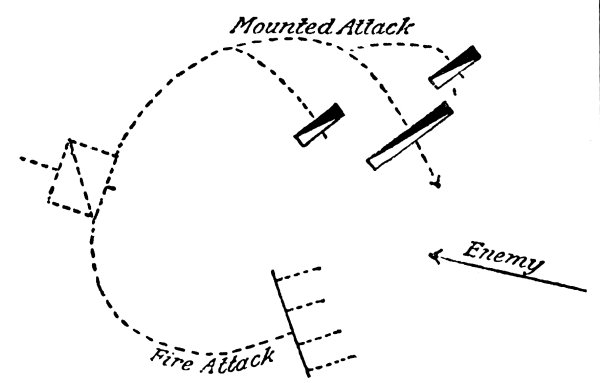
171. The advance into action.
1. The manœuvres which precede the charge take place in such rapid [Pg 271] succession that little time will be available for elaborate orders or dispositions. Horse artillery brigade commanders must therefore be ready to join the artillery commander as quickly as possible, when he proceeds to carry out his reconnaissance, so as to receive his verbal orders and communicate them without delay to brigade leaders.
2. The two chief duties of the horse artillery commander are to reconnoitre a position for his brigades and to watch the manœuvres of his own and the corresponding movements of the opposing cavalry. To save delay and to enable him to devote more time to the tactical situation he should usually be accompanied and assisted in his reconnaissance by the commanders of horse artillery brigades.
3. The principal considerations involved by the above duties are, firstly, the selection of a position the fire from which will not easily be masked by the advance of the cavalry, and, secondly, the correct moment for coming into action, taking into account the time which must elapse between opening fire and obtaining effect. If the cavalry machine guns are to act on the same flank as the horse artillery their commander must ascertain the position of the guns, so that he may avoid masking their fire at a critical moment.
4. Every effort should be made to conceal the guns till the last moment, so that the fire may come as a surprise. A covered line of advance, to the selected position should, therefore, be sought, while, if exposed ground has to be crossed, the distance of the enemy and the possibility of coming under fire must be considered in deciding on the formation to be adopted, it may be possible to deceive hostile patrols by masking the guns with the detachments. The position itself must be suitable for direct laying.
5. Both in the advance to and occupation of the position the artillery commander should ensure that the exposed flank of the guns is watched by artillery patrols, if no escort has been provided. If no natural [Pg 272] obstacle covers this flank in action, it may be advisable to dispose some of the guns so as to cover it with their fire.
6. Batteries should be retained in positions of readiness as long as possible, in order not to lessen their mobility, should the situation change unexpectedly.
The temptation of gaining a temporary advantage must not be allowed to lead artillery into premature action. Such tactics, far from assisting in the defeat of the hostile cavalry, are liable to divulge the cavalry leader’s plans and may give the enemy a chance of immobilizing, with a fraction of his own artillery, the guns thus engaged, while the remainder of his troops are able to manœuvre in a direction out of reach of fire.
As a general rule, fire should not be opened until the cavalry is in a position to take immediate advantage of its effect. On the other hand the cavalry commander’s plan may render it desirable to open fire for some special purpose, such as to occupy the enemy’s attention or to force him to deploy prematurely or in a faulty direction.
172. The fight.
1. The most favourable moment for the guns to open fire will usually be when the opposing cavalry has definitely committed itself.
2. As success depends on the result of the cavalry charge, it is the paramount duty of the horse artillery to concentrate its fire on that portion of the enemy’s cavalry on which the decisive attack is about to be delivered.
The time during which this portion of the enemy’s force is likely to be exposed to fire being of very brief duration, effect must be sought by the greatest rapidity of fire and well judged distribution.
3. When the guns can no longer engage the immediate object of the attack, fire should be directed on any supports or reserves that may be [Pg 273] visible. It is most important that any formed bodies of fresh troops be dealt with at once.
As a rule, it is only when the guns become masked from the hostile cavalry, that their fire should be directed on to the enemy’s artillery. If, however, the enemy’s artillery exposes itself while limbered up or is bringing a heavy fire to bear on the main body of the cavalry during its approach march, the artillery commander will be justified in modifying the above procedure to meet such cases.
173. Pursuit or retreat.
1. If the attack succeeds the artillery commander should send forward part of the artillery at once to support and assist the immediate pursuit. The object of these guns is to prevent the enemy re-forming or holding positions which would check the pursuit.
At the same time the artillery commander should retain control of some portion of the artillery so that he may be ready to comply with any demand which the cavalry commander may make on him for guns to co-operate in an organized pursuit.
2. If the attack fails the horse artillery must remain in action and by its fire form a screen in rear of which the cavalry may rally.
174. Horse artillery with cavalry
acting dismounted.
1. Occasions will frequently occur on reconnaissances, in advanced or rearguard actions, and in the seizure of advanced positions, when mounted troops will be involved in a fire fight, where mounted shock action is either not contemplated or is not of primary importance.
2. In such circumstances the mobility of mounted troops is generally [Pg 274] employed in enabling successive fractions to move rapidly from one tactical point to another covered by the fire of those at rest. When taking part in such a fight, horse artillery should be guided by the general principles laid down for artillery co-operating with infantry. (See Sec. 154 et seq.)
As a rule an action of this nature will be initiated more deliberately than in a purely mounted combat.
The first requisite is information. The second that, in order to keep in touch with the developments of the action—conducted as it will probably be over a wide area—the positions for the guns should be chosen with a view to affording facilities for movement as well as for effective fire support.
3. A combination of a mounted attack with the fire attack will often form part of the plan of action.
In this case the mounted attack will usually endeavour to gain the flank of its objective while the artillery with the dismounted part of the force brings fire to bear at the right moment, in order to distract the enemy’s attention and pin him to his ground and so prevent any change of position to meet it.
4. Sometimes, however, it will be essential for mounted troops to drive home an attack against a locality on foot. On such occasions they must be formed for attack in depth, the object being to establish a firing line in a position as close as possible to the enemy and to obtain superiority of fire over him. When such is the case the action of the horse artillery will resemble that of field artillery in co-operation with infantry, and time will usually be available to draw up a systematic plan of attack. (See Sec. 153.)
5. The assistance of horse artillery will also be of great value when a mounted force has recourse to dismounted action either with a view to holding a locality till other troops arrive or simply to denying it to the enemy. Its method of employment will approximate to that of field artillery in the defence, but full advantage should be taken of its mobility to support any extensions or changes of front which may be adopted. [Pg 275]
175. Horse artillery in a
general engagement.
1. Occasions for the employment of shock tactics against infantry or artillery may arise on the battlefield of the future, as they have in the past. Success can, however, only be anticipated when the enemy is either taken by surprise or when demoralized.
2. Surprise may be achieved by a skilful use of the ground or through the enemy’s attention being absorbed by the attack of the other arms. The enemy’s demoralization will depend on the action of the guns and infantry. Hence cavalry before attacking the enemy’s infantry or artillery must chiefly look to the way being prepared for it by the action of the other arms.
Horse artillery must be ready to assist in this preparation, and it will be the duty of its commander, under the instructions of the cavalry commander, to ascertain how best this assistance can be rendered. To this end the establishment of communication with the commanders of adjacent bodies of troops will be advisable.
176. Ammunition supply.
1. Previous to an action the commander of each horse artillery brigade ammunition column should send an officer or non-commissioned officer to artillery headquarters.
2. The artillery commander is responsible for informing the ammunition column commanders as early as possible of the intended course of action and of the localities to which they are to move.
The original positions of these columns should be chosen with a view to the facilities for replenishing ammunition and suitability for defence.
3. If the force is to operate on a wide front, or if part of it is to act independently, instructions as to detaching sections or attaching orderlies to the various cavalry and artillery brigades will be necessary. [Pg 276]
4. In the event of a cavalry or horse artillery brigade requiring more ammunition its commander will either send back the orderly to the ammunition column or apply direct to cavalry divisional headquarters as may be most convenient. The place to which the ammunition is to be sent and what arrangements, if any, have been made for its protection should be stated.
177. The attack.
(See also F.S. Regs., Part I, Secs. 118-125.)
1. In the attack of a fortress the first object will be to capture any advanced positions which the enemy may have occupied. These positions will often be provided with field works the extent of which will depend on a variety of circumstances. To drive the enemy out of such positions the employment of heavy mobile artillery may be necessary, but opportunities will also occur for the employment of the lighter guns in support of the infantry attacks.
These operations should be conducted on the same principles as laid down in Secs. 154-157, every opportunity being taken to cause losses to the enemy which he cannot replace.
2. During the siege operations the field artillery will be employed as directed by the commander of the besieging force. The whole, or a portion of it, may be temporarily or permanently placed under the orders of the siege artillery commander.
The positions of batteries, which have not been placed under the siege artillery commander’s orders, will be selected by divisional artillery commanders, under the orders of divisional commanders. Care must be taken to ensure that the fire from these batteries will assist, and not interfere with, the siege artillery. [Pg 277]
3. In the attack of permanent works, the fire of field guns being of little or no value, their use should be restricted to supporting infantry assaults, or to repelling sorties, which compel the enemy’s troops to expose themselves.
Howitzers and heavy artillery, on the other hand, would usually be called upon to take part in destroying the enemy’s armament and works.
4. Accuracy of fire being most important, the judicious selection of observing stations and positions is as important for field batteries as for heavier guns. The gun sites should be concealed and artificially protected, and, when possible, platforms for the howitzers should be provided. A good system of intercommunication and an efficient supply of ammunition are additional factors of importance.
178. The defence.
(See also F.S. Regs., Part I, Secs. 126-128.)
1. In the defence of a fortress delay is usually one of the principal objects. The longer the close investment can be prevented the more will it assist this object.
2. If assisting in the defence of a coast fortress, the first duty of the mobile artillery will be to oppose hostile landing parties. For this purpose it must be able to sweep the probable landing-places with shrapnel fire. It should, if possible, be screened from view of the ships supporting a landing. The best positions for opposing a hostile advance, from whatever quarter it may come, should be chosen in peace, and the sites for the guns thoroughly reconnoitred.
3. With the object of delaying the investment of the fortress one or more advanced positions may be occupied in front of the main line of defence. The distance of an advanced position from the main line of defence cannot be precisely laid down, but it must be far enough [Pg 278] forward to deny to the enemy artillery positions from which fire can be opened against the main works, and should be strengthened by all artificial means available. In the advanced position will be placed the heavier guns of the movable armament; the light guns being employed in the counter-attacks that will be made from it with a view of inflicting loss upon the enemy, and hindering the establishment of his batteries. Sites for the various guns and howitzers available should be got ready in good time if this has not been done in peace.
4. As the assailants make good the ground, the last of the advanced positions will eventually be evacuated. The mobile artillery will then be distributed amongst the various sections of the defence, a proportion being retained with the general reserve.
5. As soon as the direction of the main attack has been made clear, the artillery on this front will be reinforced by all the guns that can be spared from elsewhere. The disposition of this armament will vary according to its nature and local conditions. Well-concealed positions for the howitzers and for Q.F. guns, positions from which they can fire direct against assaulting infantry, must be sought.
6. The same general rules apply to the use of projectiles in the defence as in the attack; high explosive shell being employed against matériel, and shrapnel fire against personnel.
179. General principles.
(See also F.S. Regs., Part I, Chap. X.)
1. The extent to which tactical methods differ in small wars from those obtaining in regular campaigns varies widely in different cases.
In each instance the special characteristics, armament and tactics of [Pg 279] the enemy must be considered, in addition to the nature of the country in which the operations are to take place, and the object in view. General indications, therefore, can alone be given as to the form which artillery tactics should assume.
2. The importance of impressing such foes as are met with in these campaigns with a feeling of inferiority cannot be overestimated. Consequently a bold offensive is generally adopted and every endeavour made to inflict serious loss on the enemy. Against opponents such as are met with in irregular warfare the moral effect of guns is very great, but without material effect, moral effect is like to be transitory. Sometimes it may be expedient merely to drive the enemy off by shell fire, but, as a rule, this should not be the primary object of the guns.
3. In irregular warfare, guns should generally be dispersed rather than concentrated, so as to bring effective fire to bear at any point where opportunities may present themselves. Moreover any artillery the enemy may possess will usually be inferior in numbers and certainly in training and efficiency, and therefore direct fire and shorter ranges than are usual in regular warfare should be employed. Against irregulars armed with rifles, who rely chiefly on fire action, covering fire from part of the artillery may be necessary, but a prolonged preparation of the attack may cause the enemy to disperse before the attack can be pushed home and is incompatible with anything in the nature of a surprise. The guns not used for covering fire should be pushed forward in order that when the enemy is finally driven out of his position he may be vigorously pursued by shell fire.
[Pg 280]
180. General instructions.
1. The brigade is the tactical unit. Its commander is responsible for reconnoitring and selecting positions for the batteries composing the brigade, for the method of occupying them, and for the allotment of zones, tasks, or objectives to each battery within the limits of the orders he has received.
2. When the brigade commander finds it necessary to change the objective of one of its batteries he should inform other batteries whom it may concern.
Should it become necessary to open fire on a target outside the area allotted to him, he must be careful to report the circumstances to the divisional artillery commander.
As changes of target entail fresh ranging and consequently some loss of fire effect, they should not be lightly ordered.
3. The brigade commander exercises general control over the expenditure of ammunition, but the ranging, the method of engaging an objective and the rate of fire should be left in the hands of battery commanders. The brigade commander may, if in close touch with a battery commander, give him precise orders as to the nature and rate of fire; otherwise he should only interfere if he has convinced himself that the fire of a battery is ineffective, or unsuited to the tactical situation.
181. Reconnaissance.
1. As soon as the brigade commander has received his orders, which should include full information as to the tactical situation and the [Pg 281] intention of the divisional artillery commander with regard to the action of his batteries, he communicates them to his battery commanders, and informs them if they are to accompany him during his reconnaissance.
As a rule, he should then seek out the commander of any infantry with which he is to co-operate, and obtain from him full information as to his intended action. (See also Sec. 153 (7).)
2. Before proceeding to reconnoitre with a view to selecting the most suitable positions from which to carry out the task allotted to him, the brigade commander should indicate to the brigade leader the pace and general direction of the advance.
If he is unable to direct the brigade to any definite spot near its probable position in action he should select a point or series of points, if possible marked on the map, which the brigade is to pass in its advance and at which he can communicate to the brigade leader any necessary instructions as to its further movements.
If the brigade commander thinks it necessary to supplement this system of intercommunication he may be accompanied in his reconnaissance by a few additional men to direct the brigade at doubtful points. These men will join the brigade when it reaches them unless they receive orders to the contrary.
In carrying out his reconnaissance the brigade commander should be accompanied only by such men as are essential for the purpose and for communication between himself and the brigade, the remainder of the headquarters with the telephone wagon following at the head of the brigade.
A natural eye for country, and previous training will materially assist him in coming to a decision as to the best position to be occupied. At the same time he should be well ahead of his batteries, so that he may have as much time as possible to reconnoitre the position before they arrive.
3. The selection of an observing station, which is not likely to be [Pg 282] readily recognized as such by the enemy, which affords cover to the observing officer and his assistants, from which the tactical situation can be watched, and which offers facilities for intercommunication with the infantry and the batteries should be one of the brigade commander’s first cares. This position should be occupied and the enemy observed by himself or another officer from the earliest possible moment.
4. In selecting the position for the batteries the first consideration is that they should be able to carry out the task allotted to them. If this task involves bringing fire to bear over an extensive area, it may be advisable to divide the area into zones, and to select positions for the batteries, which will ensure each of them observing a different zone.
5. The extent to which dispersion, combined with concealment, may be possible, must depend partly on the ground available and partly on the amount of dead ground that can safely be left near the guns.
The further a position is in rear of a crest the greater become the difficulties of command or of a change to a position in which direct fire is possible, and the greater must the interval be between units. On the other hand greater immunity will be obtained from hostile fire, of which oblique or enfilade fire is the most dangerous.
At a distance of 400 yards from the crest it is doubtful if the enemy’s searching fire would be effective.
6. A position with rising ground behind and with a wood or rising ground in front has the advantage that concealment can be obtained without sacrificing spaces for observation, since the battery commanders can observe and control the fire from a position in rear. In such a position special arrangements for the replenishment of ammunition will be necessary, if concealment is to be maintained.
7. The following points, some of which must often be left to battery commanders to decide, are also important:— [Pg 283]
182. Leading.
1. Having due regard to the urgency of the tactical situation the leader’s aim is to bring the brigade to its position for action without being discovered by the enemy and with as little distress as possible to the teams. Correct utilization of the ground is, therefore, important.
To judge whether troops moving by a certain route will be concealed or not from ground which the enemy may be occupying requires experience and a good eye for country.
2. The brigade leader should keep well to the front to get early information as to the brigade commander’s intentions, and to reconnoitre the routes between the various points which the brigade is to pass in its advance (See Sec. 181 (2)). The brigade guide will follow and conform to the directions he receives from the brigade leader.
The number of men required to maintain communication between the brigade guide and the brigade leader may sometimes be reduced if the latter selects intermediate points, which the brigade is to pass in its advance and at which any necessary changes of direction or formation can be communicated to the brigade guide. [Pg 284]
3. The brigade leader should try to avoid ground, such as a dusty road, which would be likely to give indication of movement to a vigilant enemy. He will sometimes have to make up his mind whether to make a long detour to ensure concealment or to risk detection by moving over a sky line. If he selects the latter alternative he must decide, according to his knowledge of the situation, in what formation he should move.
To take advantage of local conditions, column of sections or even column of route may often be retained until close to the position, but changes of formation and flank movements within view of the enemy should be avoided and line or double échelon is then the most suitable formation.
4. The procedure of each battery need not be identical. Each battery leader, while employing the formation that appears most suitable, must conform as far as possible to the general direction and pace of the brigade.
In passing through obstacles where only a few passages exist, no battery or section should increase its proper frontage, if by so doing it will interfere with troops on its flank.
5. When artillery is obliged to move through other troops, notice should be sent to their commander so that an opening may be made.
6. Movements under fire should be carried out as rapidly as is consistent with steadiness and a proper regard for the horses and equipment. Modern equipments are complicated and delicate and care must be taken that guns are not moved over rough ground with unnecessary rapidity.
7. Battery commanders should ride at the head of the brigade when in column, so as to be ready to join the brigade commander quickly.
183. Ground scouts.
1. Ground scouts are mounted men, whose duty it is to precede the brigade and ascertain whether the ground is suitable for its movement, [Pg 285] to point out obstacles, and to look for and indicate the best points of passage. Artillery should never manœuvre without them.
In mountain artillery dismounted men are employed as ground scouts and the gunners detailed to act as pioneers may often be used for this purpose.
2. The number of scouts employed must depend upon the nature of the ground and the rapidity with which the movement is to be made. In ordinary circumstances one man per battery is sufficient, but when a single battery is moving fast over difficult ground, two or more scouts may with advantage be sent out; one man can then halt to point out a passage while the others explore further on.
3. Ground scouts must be told the original direction of the movement, but they must be careful to keep an eye on their batteries so as to conform to any change in pace or direction, and must avoid exposing themselves to view on high ground or against the sky line.
They must be sufficiently far in advance to give ample warning of obstacles, but never out of sight of their batteries. As a rule they should not be less than 200 or more than 500 yards to the front.
4. If the ground is boggy or otherwise impassable, a scout will halt and raise his right arm perpendicularly; he will then make for whatever point appears practicable, indicating the direction in which the brigade or battery should move. If the ground within view in front and on either side is quite impracticable, a scout will face the brigade, raise his right arm, and ride in to report.
5. Ground scouts must be careful not to ride on to the position on or behind which the brigade is about to come into action. [Pg 286]
184. Occupation of a position.
1. The brigade commander, having completed his reconnaissance, will send an officer back to meet the brigade. This officer will point out the position of the brigade commander to the battery commanders, who at once ride on to receive their instructions. He will direct the telephone detachment to the brigade observing station and, if ordered to do so, the remainder of the headquarters, and will lead the brigade in the required direction.
2. The brigade commander should first point out the areas to be observed by each battery or the objectives for their fire, and his own observing station. He should then give orders as to the positions for the batteries and whether they are to occupy “positions in readiness,” “positions in observation,” or to open fire without delay.
A “position in readiness” implies that a battery is limbered up under cover, but that all possible alternative positions in the immediate neighbourhood have been reconnoitred and preparations made for their occupation.
The actual positions for the guns should be determined, aiming points, reference points, and observing stations selected, and arrangements made to watch the situation.
A “position in observation” implies that a battery is in action, concealed as much as possible, that it is ready to open fire, and that it is watching all ground within the zone allotted to it.
3. In deciding whether he will occupy positions in observation or retain all or any of his batteries in readiness, the brigade commander will be guided by the principles laid down in Sec. 147, bearing in mind that to commit his batteries to action prematurely may, upon the development of the tactical situation, necessitate a change of positions and consequent delay in opening fire. [Pg 287]
4. The extent, to which detailed instructions for the occupation of the position can be given will vary, but, as a rule, some latitude should be allowed battery commanders in the choice of the actual sites for their batteries.
If, however, the position is a covered one, confusion and delay will be avoided if the brigade commander indicates generally the positions for the battery observing stations. This difficulty does not arise in the case of howitzers, where observation can take place from immediately in front of the battery.
5. The brigade commander’s orders to battery commanders should in every case include instructions as to opening fire.
If the batteries are to come into action, the brigade commander decides by which of the two following methods he will occupy the position.
6. Ordinary method.—The adjutant or other officer leads the brigade to the position, taking care not to arrive too close to it before the battery commanders have completed their reconnaissance and marked the line of fire. If necessary, he must check the pace or even halt the brigade under cover.
The subsequent procedure is as described in Sec. 193, unless the advance into action is to be simultaneous, in which case the adjutant or other officer himself gives the order to advance when he sees that all is ready.
To facilitate the leading of the brigade, the brigade commander may, if he thinks desirable, mark the line of fire for the centre of the brigade by placing the brigade serjeant-major about 200 yards in rear of his own position, or by any other method so long as the officer leading the brigade understands it.
7. Special method.—The brigade commander selects the preliminary position (See Sec. 193 (7)), and the adjutant or other officer guides the brigade to it. [Pg 288]
The battery commanders select the exact positions for their batteries and then proceed as laid down in Sec. 193 (8).
The batteries come into action independently by their own commander’s order.
185. Intercommunication service.
Communication between brigade and battery commanders should be established immediately on coming into action, and it is the duty of the battery commanders to see that it is so established. The adjutant is responsible for organizing the communications between the brigade observing station and their points. (See Secs. 149, 246 and 247.)
Instructions regarding field artillery telephone equipment and drill for its use are contained in “Training Manual—Signalling.”
186. Allotting objectives and ranging.
1. The extent of front which a battery can cover is given in Sec. 214 (2). As a general rule it is better to increase the rate of fire rather than add to the number of guns engaging any given objective.
2. If the batteries of a brigade are in action close together, and the objective is sufficiently broad, it would usually be desirable to divide it into suitable widths and allot one to each battery.
The batteries of the brigade may, however, be dispersed in order to obtain the advantages of enfilade, oblique or cross-fire as well as for the sake of concealment. Or it may be desired to cross the fire of the whole or a portion of the guns of the brigade with those of another brigade for the same purpose. In such cases special arrangements may be necessary to enable each battery to obtain the range. The principle of economy of force still applies, and when once the fire of the desired [Pg 289] number of batteries has been made effective an increased volume of fire should be obtained by the increasing rapidity of fire of the batteries engaged rather than by the introduction of fresh batteries.
3. When the probable objectives are dispersed, the extent to which oblique or cross-fire can be secured, and the facilities for observing its effect will be the principal factors in deciding which battery shall engage any particular target, and the latitude to be allowed its commander in the selection of other objectives.
4. It will be of great assistance in allotting objectives it conspicuous features and prominent points are given names, and all concerned made acquainted with them.
5. One method of pointing out objectives is to describe them with reference to some prominent point, making use of the figuring of the face of a clock. This point is termed the “reference point” and must not be confused with the “aiming point.” (See Sec. 120.)
The reference point being considered to be the centre of the face of the clock, the direction of any object with reference to it can be indicated by the figuring of the face thus:—
Fig. 28.
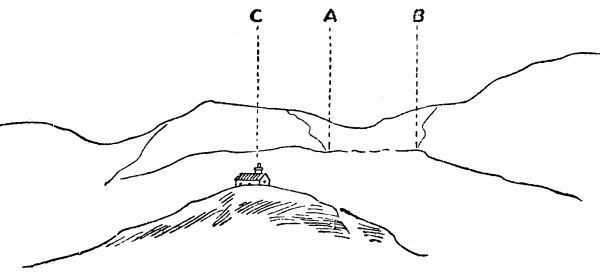
[Pg 290]
In Fig. 28, A is the left of the objective, AB its extent, C is the chimney of the cottage on Green Hill.
Having pointed out the objective and its extent as above, it can be allotted to batteries by naming a number of degrees and minutes for each to engage. Thus:—
Changes of objective can be indicated in the same manner.
6. Another method of indicating targets is by means of panorama sketches. (See Sec. 244 (2).)
Each battery having prepared sketches of the enemy’s position forwards two copies to the brigade commander, who letters all prominent points on the sketches in such a way that the same letter refers to the same point on each sketch. The duplicates are returned to the batteries, and the brigade commander can then refer to any target or locality with reference to the letters on the sketches.
Thus:—“Target H” or “crest of hill, 3 o’clock, from Wood B”. The brigade commander having a copy of the sketch from the position of each battery, can at once tell which battery is best able to engage any target, also whether all batteries can concentrate fire on any particular spot or not.
187. Observation and control.
1. Responsibility for watching the tactical situation and redistributing the fire of his batteries in accordance with the progress of the fight rests with the brigade commander. [Pg 291]
To maintain touch with the situation a position near the commander of the infantry brigade or other body with whom the artillery is acting has many advantages. (See Sec. 149.)
2. If the brigade commander is unable to accompany the infantry commander himself, it will usually be advisable to detail an officer with the necessary means of communication to do so. The duty of this officer will be to keep the brigade commander informed as to the position of the infantry and as to the localities from which the hostile fire is most damaging. (See Sec. 149 (4) (5).)
3. If the batteries of the brigade are dispersed the brigade commander can usually only indicate fresh targets by means of telephone, signalling or messenger. Such instructions may be amplified by the use of panoramic sketches. (See Sec. 186 (5) (6).)
188. Change of position.
1. During the fight, the brigade commander should endeavour to have fresh positions and the best lines of advance to them reconnoitred. In the event of an advance to a new position being ordered, the procedure is as far as possible the same as described in Sec. 181.
2. Before going forward himself, the brigade commander will send word of his intention to the battery commanders, indicate the general direction of the advance, and give orders when it is to commence, and if all the batteries are to move together or not. The subsequent procedure is similar to that described in Sec. 184.
3. In the case of a retirement, the adjutant precedes the brigade and selects the new positions. He is accompanied by one or more range-takers from the batteries if they can be spared and by sufficient men of the brigade headquarters to guide the brigade commander to the position. He will communicate the dispositions to the battery captains. [Pg 292]
189. Night firing.
(See also Secs. 164 and 199 (3).)
1. In favourable circumstances a fairly effective fire can be achieved, both in attack and defence, at close and effective ranges.
2. The use of searchlights is confined to defensive action, and is referred to in F.S. Regs., Part I, Sec. 140. In addition to their use as fixed beams, as therein stated, they may be used to search for targets.
Up to 3,400 yards under favourable conditions of atmosphere and background a well-defined target can be picked up, but not an ill-defined one. Movement, however, can be detected and ranging can be carried out at this distance.
3. Before moving guns into positions by night the following arrangements should be made:—
i. The roads or tracks leading to the gun positions should be thoroughly reconnoitred by those who will lead the guns.
ii. The route should be marked where required by patches of white, bundles of straw, or anything else that will be visible.
iii. The actual gun positions should be carefully marked and the bearing of the line of fire taken. In doing this every precaution must be taken not to give any hint to the enemy of the intended occupation.
iv. The officers concerned should be furnished with orders in writing notifying the time of moving off from rendezvous, order of march, route they are to follow, and time of opening fire.
4. Care must be taken to prevent limbers or teams of a battery which has occupied its position clashing with batteries or other troops which are still advancing.
5. All ranks must understand that no lights or smoking are allowed, and that the occupation of the position as well as the entrenching must be carried out as silently as possible.
Steps should be taken to deaden the noise of wheels and jingling of harness as far as possible.
[Pg 293]
190. General instructions.
1. The battery is the fire unit, except in heavy artillery, in which, each section being self-contained, the battery or the section is the fire unit according to circumstances. To enable effective fire to be brought to bear in the shortest possible time on such objectives as the tactical situation may require, correct observation and promptness of decision on the part of the battery commander are as essential as a high standard of fire discipline throughout the battery.
2. By fire discipline is meant not only careful attention to all the details of drill when in action, but also ready response to the signals and orders of all superiors. It demands, in addition, endurance of the enemy’s fire, even when no reply is possible.
3. The battery commander should be allowed latitude as regards the choice of objectives within the task allotted to him, which may be wide or circumscribed. (See Sec. 184 (2).) If the battery commander assumes the responsibility of departing from his allotted task he must be prepared to justify his action, which should be reported at once to the brigade commander.
4. The principles which guide a commander in applying the fire of his battery in different circumstances should be known to all officers and non-commissioned officers.
5. When a battery is acting independently, its commander is responsible not only for its fire action, but for those other duties which are [Pg 294] described under the head of brigade tactics, In this case it may be desirable for the commander to devote his whole attention to watching the tactical situation, and to leave the conduct or fire to the next senior officer; this may sometimes be advisable even when the battery is in brigade,
6. For manœuvre the battery is divided into:—
The firing battery.
The first line wagons.
The “firing battery” consists of 6 guns and 6 ammunition wagons, except in the case of 4-gun batteries, when it consists of 4 guns and 4 wagons. The wagon of the firing battery always accompanies its gun.
The “first line wagons” consist of the remainder of the ammunition wagons authorized to accompany a battery. In Q.F. batteries these are 6 in number.
The 1st line mules of a mountain battery correspond to the 1st line wagons of a field battery for the purpose of manœuvre. References to the procedure of the 1st line wagons in the succeeding paragraphs apply therefore to the 1st line mules of mountain batteries. (See also Sec. 125 (8).)
191. Preparation for action.
1. The object of preparation for action is to minimise as far as possible the pause between coming into action and opening fire. The exact time and place for this cannot be laid down. If the enemy is likely to be met it is advisable to prepare for action before the march commences; if this has not been done a short halt will be necessary for the purpose.
2. When preparing for action the firing battery will be separated from the first line wagons which will be formed up by the captain as may be most convenient. If preparation for action takes place while in column [Pg 295] of route on a road, the 1st line wagons will follow in rear of the battery when it moves oil, but if the road is narrow it may be better to delay the separation of the firing battery from the 1st line wagons, in order to avoid blocking the road.
192. Reconnaissance of a position.
1. The battery commander, as soon as he receives his orders, rides forward to the brigade commander accompanied by not more than two of his headquarters. The latter should remain under cover while the battery commander is receiving his instructions, when they proceed with him to reconnoitre the position for the battery.
It may also be advisable for the battery commander to take a section commander with him. This officer should be accompanied by a signaller and horseholder with director, and he can then be utilized to select the actual position for the guns, to convey any information required to the battery leader, and to mark the line of fire, should the battery commander remain at his observing station.
2. The remainder of the battery headquarters, including the observation wagon will follow at the head of the battery until they are required by the battery commander, who will then send for such portions of the headquarters as he requires before the arrival of the battery. They should then be brought up under suitable command, care being taken to make use of any available cover, so as not to attract the attention of the enemy. For the same reason they should not follow the battery commander on to the actual position, nor should ranges be taken from it.
3. The first object of this reconnaissance, if a position under cover is to be occupied, should be the selection and occupation of the observing station (see Sec. 199), the concealment of which from the enemy is of great importance. The battery commander must then decide on the approximate position for the guns, ascertain that the trajectory will clear the crest, settle how the position is to be [Pg 296] occupied and mark the line of fire, unless he delegates this duty to the section commander, who may have accompanied him. He must also decide whether he will use his observation wagon or not, and must give orders as to the placing of the wagon, with a view to its concealment, as far as possible, from all portions of the enemy’s position.
4. In estimating the amount of cover that will be necessary, regard must be paid to the general tactical situation. Defilade from the immediate objective is not sufficient. All ground in occupation of the enemy from which fire may be observed and controlled should receive consideration.
5. The orders issued to the battery commander will, as a rule, include instructions as to the position to be occupied.
A battery position may be either an “open position,” a “semi-covered position” or a “covered position.”
6. An “open position” is one in which the objective can be seen over the sights and in which direct laying is possible. In such positions the guns may or may not be exposed to the enemy’s view before fire is opened. If they can be concealed up to the moment of opening fire the value of surprise effect may be gained coupled with good facilities for control of fire, for distribution, and for dealing with movement. When once located accurately by the enemy the guns are fully exposed to the effects of hostile fire, and in conditions favourable to the enemy are liable to destruction by direct hits and by oblique fire.
7. A “semi-covered position” is one in which it is necessary to employ indirect laying but in which the degree of cover obtained is insufficient to conceal the flashes of the guns or the dust raised by them after fire has been opened. Such positions, as a rule, enable direct control by voice to be used. As compared with covered positions they facilitate the engaging of fresh objectives, and if required the guns can be run up to the crest. Heavy manual labour is sometimes [Pg 297] necessitated in their occupation. Searching fire may be effective against such positions.
8. A “covered position”[15] is one in which the guns and their flashes are completely concealed from the enemy and in which it is necessary to use indirect laying. Such positions confer immunity from fire, but they increase the difficulty of control, frequently necessitating artificial means of communication such as telephones, signalling and the use of plotters. For this reason they increase the difficulties of engaging fresh objectives and of dealing with movement.
193. Methods of occupying a position.
1. There are two methods of occupying a position:—
The words ordinary and special apply to the method by which the battery is brought to the firing position and have no reference to cover, concealment, or the method of fire.
The ordinary method.
2. The battery commander having completed his reconnaissance and selected the exact position for the battery, places himself where its centre will halt for action, the battery serjeant-major marking the prolongation of the line of fire at least 50 yards in his rear. The battery commander will use his discretion as to whether he and his serjeant-major, or he alone, should dismount while marking the line of fire, but he must ensure that they are both visible to the officer leading the battery.
3. This will be the procedure in an open position when the battery commander intends to command from the centre of the battery, but if he decides to command from a flank the line of fire may be marked by the [Pg 298] battery serjeant-major and another man, or by any other means so long as the battery leader understands them. In many cases instead of marking the line of fire it may be preferable to mark where the flanks of the battery will rest.
The battery is then led up, halted and brought into action by the battery leader.
4. When the battery commander is at an observing station some distance from the battery the exact position for the guns may be chosen by the battery leader, or by the section commander, who accompanies the battery commander in his reconnaissance, see Sec. 192 (1). The battery leader or the section commander with the battery commander assisted by a signaller marks the line of fire for the battery, or the position where its flanks will rest. The battery leader brings the battery into action. The officer who chooses the position for the guns is responsible that the battery commander’s observation station shall not be within the danger angle of the guns when in action. To ensure that the observing station shall not be within the danger angle (Sec. 197 (3)) the battery commander should after laying his director on the target or on the centre of the zone allotted to him, swing it round through an angle of 120° towards the position for the battery. The battery must not be behind this line, which allows for a subsequent switch of about 15°.
5. On rough ground the Nos. 1 should be sufficiently ahead to enable them to select the best platforms for their guns. They must be careful to halt their guns on the selected spots, for which purpose it may be advisable for them to dismount. They should not, however, be so far ahead that they prematurely disclose the position.
6. A covered position should be occupied by the ordinary method if the cover is sufficient to completely conceal the guns and teams while coming into action.
If the nature of the ground compels the battery to adopt a column formation till the position itself is nearly reached, and it is [Pg 299] important to open fire without delay, guns may be brought into action by sections, or even singly.
The special method.
7. This method should only be employed when it is impracticable to occupy the position by the ordinary method.
The battery commander, having chosen his position of observation, selects or indicates a position for the battery in action and a preliminary position under cover and close in rear, and sends his serjeant-major, or section commander if he has one with him, to guide the battery to it.
8. The battery commander then gives the order “Section commanders (mounted or dismounted, as the case may be), one aiming post.” The section commanders, with an aiming post for each of their guns, fall out to the battery commander, who points out to them the target, general alignment of the battery and position of one gun. They then mark with an aiming post the exact spot for each of their guns according to the accidents of the ground, care being taken to avoid danger angles. (See Sec. 197 (3).)
If the soil renders the planting of aiming posts difficult, the layers may be fallen out to mark the positions the guns will occupy.
As soon as these arrangements are completed each section commander brings his section into action by the simplest method.
9. When using the special method in a semi-covered position, in order to avoid exposing the battery, the guns and wagons should be driven as near the position as possible, and run up the remainder of the distance by hand. It may sometimes be advisable to bring up the carriages with wheel horses only, leaving all other horses under cover.
10. In the case of guns not fitted with the No. 7 dial sight care must [Pg 300] be taken when occupying a semi-covered position to select an aiming point which can be laid on from round to round, as the planting of aiming posts might disclose the position to the enemy. If it is found necessary to plant aiming posts, care should be taken that the men planting them are not exposed.
11. When using the special method in a covered position it should be possible to drive the guns to the position they will occupy by following the line formed by the aiming posts, and coming into action right or left. After the guns are in position, the wagons should be driven as near as possible to the position they ought to occupy. Drivers should not be dismounted to lead their horses if there is any danger of coming under fire.
12. This method has many advantages for heavy artillery, where platforms are all important, and the guns difficult to man handle.
194. Orders.
1. The battery commander should give section commanders as much information as possible before bringing the guns into action, in order to eliminate as far as possible the pause that takes place after the guns are unlimbered and before fire is opened.
2. He must clearly point out or indicate the target and extent to be engaged by each section when visible, and the aiming point or reference point (if one is used).
His orders must also include:—
These orders should always be given out in the above sequence.
3. The following abbreviated words of command will be used:—
| Collective | for | Collective ranging. |
| Right ranging | ” | Right section ranging. |
| No. 1 ranging | ” | No. 1 gun ranging. |
| Fire | ” | Commence firing. |
| Stop | ” | Stop firing. |
| Corrector | ” | Time shrapnel corrector. |
| Échelon | ” | Échelon corrector. |
4. To avoid mistakes and for the sake of uniformity the elevation will be ordered as shown in the following examples:—
| 1,000 | yards | “One thousand.” |
| 1,800 | ” | “Eighteen hundred.” |
| 1,950 | ” | “Nineteen fifty.” |
| 2,000 | ” | “Two thousand.” |
| 2,100 | ” | “Two one hundred.” |
| 2,350 | ” | “Two three fifty.” |
If two ranges are ordered at the same time the order would be as follows:—
| 1,800-1,500 | yards | “Eighteen hundred, fifteen hundred.” |
| 2,400-2,100 | ” | “Two four, two one,” |
| 5,000-4,700 | ” | “Five thousand, four seven.” |
5. Corrector settings will be ordered as shown in the following examples:—
| 136 | “One three six.” |
| 150 | “One five o.” |
[Pg 302] 6. Angles from an aiming point will be ordered as shown in the following examples:—
| 80 | degrees | “Eight o degrees.” |
| 58 | ” | “Five eight degrees.” |
195. Advance for action.
1. The senior section commander with the battery leads it, and the captain directs the movements of the first line wagons, which will be led by a non-commissioned officer detailed by him, communication between the two being kept up by means of the mounted non-commissioned officers of the wagon line.
2. The directions for the maintenance of communication between the brigade commander and his brigade, for the leading of a brigade and for the employment of ground scouts (see Secs. 181, 182 and 183) are applicable to a battery acting by itself. The officer leading the battery must avoid pressing on the battery commander during his reconnaissance, and should not lead the battery on to the position until he sees that the line of fire has been marked, if it is to come into action by the ordinary method. If the special method is to be employed he will receive instructions as to the preliminary position to be occupied. (See Sec. 193 (7).)
3. Section commanders and Nos. 1 when advancing in line will ride ahead of their guns to select the best ground and to give warning of obstacles.
It is the duty of section commanders to dismount their detachments if necessary.
4. The first line wagons conform to the movements of the firing battery. The distance to be maintained between the firing battery and the first line wagons cannot be laid down, but should not, as a rule, exceed half a mile. The captain must go forward and obtain information, [Pg 303] as soon as possible, as to the intended position of the battery, in order to select a position for the wagon line, which offers facilities for the supply of ammunition, and where the men and horses will be under cover.
To avoid searching fire directed at the firing battery, the position of the wagon line should be to a flank, or if directly in rear of the guns not less than 400 yards distant.
If it is impossible to obtain cover for the whole wagon line in one place, the captain must use his discretion as to how best he can sub-divide it.
In selecting the position for the wagon line the captain must be careful not to block lateral communication, or the lines of advance of troops in rear, nor must he endeavour to forestall another battery in a position which more naturally belongs to the latter. Easy access to his own battery is essential.
5. As soon as the battery is in action he will select alternative positions of assembly for possible use when changing position (See Sec. 228 (1) iii and Sec. 229 (1) ii).
196. To come into action.
(See also Secs. 65, 66, and 233.)
1. Horse artillery.—On approaching the position the wagons do not drop back unless ordered to do so, but on the command “Action front” are at once driven up alongside their guns, halting with their axletrees one yard in rear of the axletrees of the gun and 6 inches to a flank. They are then unlimbered (unless otherwise ordered) by No. 6, who lowers the perch to the ground at the same time giving “Limber drive on.” The limbers reverse to their left and go to the place selected for the 1st line wagons, forming up in front of their own gun limbers.
2. One of the wagon limbers of the firing battery may be utilized to [Pg 304] give protection to the battery headquarters and will be placed where ordered by the battery commander. Instructions to this effect must be sent to the battery before it arrives on the position.
As soon as the limbers and teams are clear, they will proceed to the wagon line under the direction of the captain, who, however, will not wait to collect them, but will indicate the direction they should take and allow all horses to get clear as soon as possible.
3. All led horses except those accompanying the teams go at once to the wagon line independently.
4. Detachments should remain as far as possible under cover of the shields and unnecessary movement in the battery must be avoided, as such movement may enable the enemy to locate the position of the guns. If, however, the guns are in action on a forward slope it will usually be necessary to dig in the trails.
5. Field artillery.—On approaching the position the wagons will drop back about 10 yards in rear of the guns. As soon as the trail of each gun is on the ground, its wagon will drive up on its left and halt with the axletree of the wagon body one yard in rear of the axletree of the gun and not more than 6 inches to a flank, in order to obtain the full benefit of the shields. Wagons may, however, be placed on the right of guns by order of the section commander, when he considers it advisable. In either case the wagon teams will be immediately unhooked.
When the battery is coming into action under cover and the line of fire has to be obtained, the wagons should not drive up to their guns until the latter are in the correct line.
The procedure of the wagon limber for the protection of the battery commander, and of teams, led horses and detachments will be similar to that laid down above for horse artillery.
In special cases, the wagons of the firing battery may be unlimbered. [Pg 305]
The approximate positions[16] of individuals and led horses not mentioned in the handbook of the gun are as shown in Fig. 29.
The position of the wagon line in the figure has no reference to the position of the battery.
The 2nd trumpeter, farrier, and shoeing smith will be used as desirable to maintain communication between the firing battery and 1st line wagons.
6. Howitzer and heavy batteries.—The procedure is as described above for field gun batteries, except that 2 yards must be left between guns and wagons in the case of 5“ B.L. howitzers and 1 yard in the case of heavy batteries, for the free working of the guns in action, and in howitzer and heavy batteries the centre of the perch should be in line with the gun axletree.[17]
7. Mountain batteries.—On the command “Action front,” the guns are unlimbered and brought into action just in front of the wheel and axle[18] mule of each subsection. The mules move off to the rear independently as each is unloaded, and proceed to join the 1st line mules under the direction of the captain. The ammunition boxes of the firing battery are placed on the ground immediately to the left of the gun, unless cover is available close by.
Sometimes a suitable position for the firing battery mules can be obtained under cover in close proximity to the battery, where it is inconvenient to bring, or there is not sufficient space to accommodate, all the 1st line mules as well. In such cases the captain will select another position for the 1st line mules further to the rear, and only order up such extra ammunition mules to join the firing battery mules as are necessary to ensure facility of ammunition supply. [Pg 306]
Field battery in action.
Fig. 29.
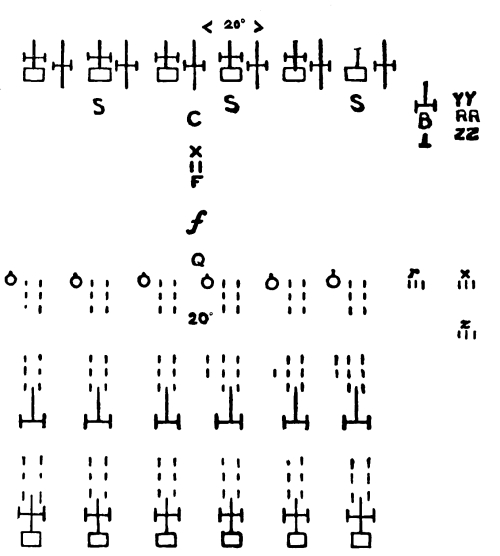
Look-out men and signallers posted as convenient.
Range-takers under cover if not employed.
[Pg 307]
Explanation of the symbols used in Fig. 29.

[Pg 308]
197. Duties of officers, &c., in action.
1. Battery commander.—The battery commander controls and directs the fire of the battery.
2. Captain.—The captain commands the 1st line wagons and in action controls the vehicles and horses of the firing battery. He is responsible for the supply of ammunition to the firing battery and for seeing that the wagon line is kept filled with ammunition. It is his duty to arrange for the replacement of casualties in men, horses, and matériel (see Sec. 230 et seq.), and to select positions of assembly (see Sec. 195 (5)). To carry out these duties in action the captain must be as much as possible in personal communication with the firing battery; when he is not with the line of guns he will leave one of his assistants with the firing battery to carry orders to him. The commander of a wagon line situated on an exposed flank is responsible for taking measures for protecting the wagon line (see Sec. 148 (5)).
3. Section commanders.—Section commanders will place themselves where they can best see and hear the battery commander and will only move about their sections when necessary for the supervision of their command. In ordinary circumstances each should be in rear of the wagon of his section which is the nearer to the battery commander.
They will acknowledge the battery commander’s orders by saluting. When the orders cannot be heard throughout the battery they are to be passed from one section commander to the next, not repeated simultaneously. Each section commander is responsible that the next section commander receives the order. If in giving an order the battery commander makes an obvious verbal slip, it is the duty of the section commander nearest to him to draw his attention to it.
They are responsible that their guns are laid in the direction ordered. [Pg 309] When the target is visible from the battery, they will give alterations in deflection to their guns when ordered to do so by the battery commander.
They are responsible that their guns are not fired when within the danger angle, i.e., the line of fire of any gun must not make a less angle than 45 degrees with a line joining its muzzle and the muzzle of any other gun.
In firing from behind cover they must ascertain that the trajectory will clear the crest (see Sec. 121), running their guns up or back as necessary without waiting for orders if slight alterations only are required, but informing the battery commander if a considerable change of position is necessary.
Before reporting a gun out of action or a casualty to any part of the equipment of their section, section commanders must first ascertain personally whether it is possible to repair the damage with the means at their immediate disposal in the firing line; if not, application should be made to the captain. No casualty should be reported to the battery commander during ranging, unless it is of a permanent nature or likely to interfere with the process of ranging.
4. Observing officer, heavy artillery.—He is responsible for the efficiency of the observing parties in all respects.
5. Battery serjeant-major.—The battery serjeant-major supervises the placing of the battery commander’s limber or observation wagon, and the work of the battery headquarters.
During ranging he reports the number of each gun as it is fired, if the battery commander wishes him to do so; reports prematures, and calls the attention of the battery commander to verbal slips or omissions. (See 210 (3).)
He will be frequently used to pass the battery commander’s orders, but if desired some other man from the battery headquarters may be employed for this purpose instead of him. The megaphone should be used when necessary.
If the battery commander becomes a casualty the battery serjeant-major [Pg 310] must be in a position to give all information as to the situation, target, and point on which lines of fire were laid out, &c., to the new battery commander, and to carry on until he arrives.
6. Nos. 1.—Nos. 1 are responsible for the correct service of their guns. They will see that the correct angle of sight has been put on, and will order the necessary allowance in deflection for difference in level of wheels. They will acknowledge all orders relating to their guns by saluting, and when difficulty is experienced in passing orders they should assist.
If a section commander is temporarily absent from his section or occupied with damaged equipment, the senior No. 1 not engaged with him must act for him.
198. Laying out the line of fire.
(a) In a covered position.
1. If the target can be seen from the vicinity of the position selected for the battery to come into action, or its direction obtained from the flashes of the enemy’s guns, from a map, or from patrols, &c., the battery commander, or the section commander who has accompanied him in his reconnaissance, marks the line by planting two aiming posts.
2. The battery having been brought into action on the selected position, lines of fire in the direction of the target can be obtained by one of the following methods:—
i. The battery leader, or section commander who accompanied the battery commander in his reconnaissance, sets up his director in line with the two aiming posts and as close to the battery or its intended position as possible, and selects an aiming point. He then measures the angle between the direction of the target and the line from the director to the aiming point and gives it out as an order to the battery. (See Sec. 123 (3).) He will leave the director laid and clamped on the aiming point for the information of the battery. The dial [Pg 311] sight of each gun is set at the angle ordered and laid on the aiming point.
ii. The director is clamped at zero and laid in the line of the aiming posts with the foresight towards the target. The battery commander or battery leader then faces the battery and laying back over the director (namely, foresight—backsight) aligns it on the dial sight of each gun in turn. The angles are noted down and communicated to the battery, or by word of mouth to each individual gun. Thus:—
| “Lines of Fire” | (Director behind battery.) |
(Director in front of battery.) |
|||
|---|---|---|---|---|---|
| “No. 1 | 152 | Right” | or | 28 | Right |
| “No. 2 | 164 | Right” | 16 | ” | |
| “No. 3 | 176 | Right” | 4 | ” | |
| “No. 4 | 172 | Left” | 8 | Left | |
| “No. 5 | 160 | Left” | 20 | ” | |
| “No. 6 | 148 | Left” | 32 | ” | |
The dial sight of each gun is set at the angle ordered, and laid on the director.
When using this method the director must be at least 80 yards in front or rear of the line of guns.
iii. If the line of fire cannot be marked by planting two aiming posts (See para. 1) the procedure will be as follows, or as in method iv. below. From his observing station the battery commander, using his director as in ii., sends down the angle to one gun or to the battery director. In the latter case the battery leader or officer who is working the director obtains the line of fire by setting it to the angle ordered. He then measures the angle to an aiming point as described in i. and gives it out to the battery. When the angle is sent to one gun the section commander to whom the gun belongs directs his gun on to the line of fire and the subsequent procedure is as in para. 4 [Pg 312] below. In both cases the battery commander will make the necessary correction for displacement before sending down the angle. (See Sec. 123 (3).)
iv. From his observing station the battery commander, having fixed the compass on the No. 3 director, measures the angle which the direction of the target makes with magnetic North, and after making the necessary correction for displacement sends this angle down to the battery as ... degrees Right or Left of magnetic North.
The officer working the battery director, having fixed his compass to the director, sets the director at the angle ordered with reference to magnetic North and the subsequent procedure is as in i or ii.[19]
3. In each method the aiming point is laid on, either through the No. 7 dial sight or over the No. 1 dial sight, or else auxiliary aiming points are picked up and laid on, from round to round. Should aiming posts be used, they are planted in line with the No. 7 dial sight, or the rocking bar, or gun sights set at zero.
4. To obtain parallel lines of fire to that of a gun whose line is correct, the battery commander gives the order “Parallel lines to No ________” The dial sight of the named gun is used as a director, and lines obtained as in method i.
5. In the case of guns which are not provided with dial or panoramic sights, but with gun arcs, or the shields graduated as gun arcs, slight modifications of the three methods mentioned above are necessary.
i. The best aiming points will be such as are within the capacity of the arc, right or left of the line of fire, either to the front or to the rear. Any angle can, however, be employed either by repeating the process of switching, or by using the whole extent of the gun arc, or [Pg 313] by using the prolongation of the gun arc in order to obtain an angle of 90°,
ii. When the director is behind the battery the gun layer must lay back on the director. As the large angles cannot be read on the gun arc the officer laying out the lines of fire will, after clamping the director at zero on the target, align it backsight—foresight on the centre of each breech and give out the angles.
6. If the direction of the target cannot be obtained from a position near that selected for the battery and the distance of the observing station is too great to render any of the above methods available, the battery commander as soon as he has completed his reconnaissance and pointed out the approximate position of the battery to the battery leader, returns to his observing station; where he has previously left his range-takers, signallers, and such other portions of his headquarters as he requires.
Communication is at once opened up, the signallers taking care to keep under cover. The telephone if available is laid between the battery and the observing station. The range-takers take the range to the target, and to the battery (if the “sub-base,” para. 7, is not used), and afterwards to other objects in the field of fire.
The battery commander sets up his director under cover and measures the angle between the battery and the target.
When necessary, a flag is placed on the battery director, but the observing station director should be rendered conspicuous in some other manner.
He then works out by means of the plotter the battery angle (T B O in Fig. 30) and the range from the battery to the target, and communicates them to the battery leader, taking care that the battery angle is sent down right or left according as the target is right or left of the line joining the battery and the observing station (B O in Fig. 30). He then calculates the angle of sight and communicates it to the battery leader. [Pg 314]
If the dial sight is used, it is set at the battery angle, and when laid on the observing station director the gun is in the line of fire. If the director is used, it is set at the battery angle and laid on the observing station director; the direction of the target is shown, when the arrow head is brought to zero.
Fig. 30.
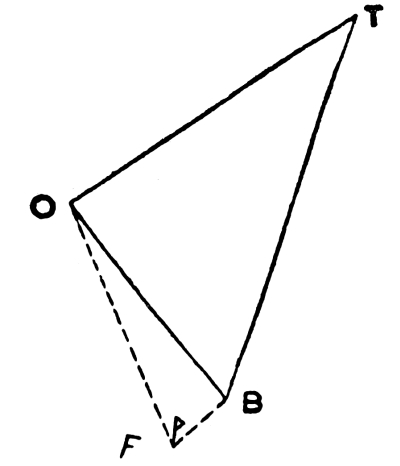
The direction of the target having been obtained at the battery, lines of fire for the guns can be given by one of the methods described above.
7. The distance from the observing station to the battery can be rapidly measured by the use of a sub-base at the battery. An aiming post or signalling flag, F (see Fig. 30) having been placed at a convenient distance, 20 to 50 yards, from the battery director and at [Pg 315] right angles to the line B O, the angle that this base subtends at O is measured with the director and the range deduced from the formula:—
| 6 | × | Sub-base in yards | = Base in hundreds of yards. |
| 10 | Apex angle in degrees |
8. Should preparations for opening fire be required and no target be visible, a suitable reference point in the enemy’s position is selected and lines of fire laid out to this point.
The switch angles, ranges, and angles of sight to all points on which fire may have to be directed are then ascertained, and all other preparations made which will conduce to fire being opened as quickly as possible when required.
The fire is controlled and the ranging carried out in the ordinary manner by the battery commander.
If the observing station is so far from the battery or the intervening ground so broken that in case of emergency it would be difficult for the commander of the battery to reach the guns in time, it may be necessary for him to remain with the guns and to detail another officer to control the fire. (See Sec. 199(2).)
(b) In an open or a semi-covered position.
9. In an open or semi-covered position where the target can be seen by the section commanders standing up, the target and its extent may be indicated:—
i. By the director placed in the centre of where the battery will be when in action, pointing on the centre of the target or zone, with a N.C.O. in charge to inform the section commanders on their arrival as to its direction and extent, or—
ii. By the director placed as before, but pointing on the reference point, the target and its extent with reference thereto being described to the section commanders by the N.C.O. left in charge.
In both i. and ii. the section commanders will throw their guns on to the line themselves but the battery commander will frequently put the first gun on to the line himself. [Pg 316]
When indirect laying is used in such a position, the layer, after his gun has been thrown on to the line by the section commander, will immediately pick up an auxiliary aiming point to lay on from round to round. With guns not provided with No. 7 dial sights, an auxiliary aiming point must be picked up which is in the field of the rocking bar sight or which can be laid on over the dial sight.
In a semi-covered position when the section commander cannot see the target, the procedure will be as in a covered position.
10. Guns not provided with No. 7 dial sights will be laid if possible on auxiliary aiming points; otherwise they will be laid from round to round over the No. 1 dial sight on the original aiming point. Aiming posts should seldom be necessary.
199. Observation of fire.
1. To derive full benefit from the accuracy and rapid fire of modern equipment and to ensure effective support to the other arms, correct observation with reference to the objective is most important.
2. To enable a battery to engage an objective, a position must be selected from which to observe and control the fire of the battery. This is called the “observing station.”
The position of this station should be as close to the battery as possible, provided a good view of the field of fire is obtainable. With this object use should be made of any means such as a tree, house, haystack, limber, ladder, &c. When the observing station is near the battery it should, if possible, be behind the line of section commanders to facilitate the passage of orders, due regard being paid to the direction of the wind.
The officer who observes and controls the fire from the observing station is the battery commander for the time being. Any other officer sent out to assist in the observation of fire is called an “observing officer.” [Pg 317]
Observation should be made with glasses having as large a field of view as is compatible with good power of magnification, and graticules will be found of the greatest assistance. The telescope, on account of the smallness of its field, is unsuited for the observation of fire when ranging, but is very useful for watching the effect of fire when ranging has been completed.
3. Combined observation.—In the case of targets which are distant, very difficult, or behind an intervening crest, and in night firing, the battery commander will generally find it useful to combine his own observations with those of a flank or advanced observing party. In the case of a flank party the method of its employment is illustrated in the figure which follows:— [Pg 318]
Fig. 31.
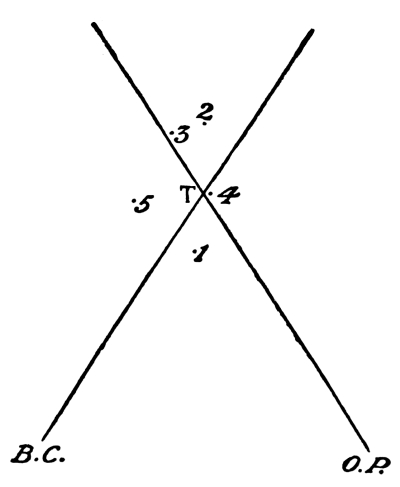
| B.C.’s Observations. |
O.P.’s Observations. |
B.C.’s Deductions. |
|---|---|---|
| 1. Right | Left | - |
| 2. Left | Right | + |
| 3. Left | Line | + |
| 4. Line | Line | T |
| 5. Left | Left | Left, give right deflection. |
[Pg 319] This method is also applicable when the battery commander, being unable to observe himself and great accuracy being required, decides to make use of two observing parties.
When this system is employed each observing party will only send in results of its observations as right or left of the line from it to the target. The amount right or left should be measured in degrees and minutes.
Heavy batteries.
4. In a heavy battery there are two observing parties, one to each section. When the battery is intact both parties are under the direct command of the “observing officer.” When a section acts independently, its own observing party accompanies it.
When the battery commander goes forward to reconnoitre he will be accompanied by the observing officer, in addition to the section commander mentioned in Sec 192 (1).
The observing officer will take charge of the observing party when one is employed. If two observing parties are employed he will superintend the work of both as far as possible. When the battery commander observes for himself, the observing officer will assist as may be required.
200. Look-out men.
1. As the attention of battery commanders is so much taken up by the observation and control of the fire of their batteries, men, termed “look-out men” are to be trained in every battery, whose duty it is to assist the commander in watching areas of ground and the movements of hostile and friendly troops.
2. Look-out men should be selected for their intelligence and good sight, and should be adepts in the use of the telescope. There should [Pg 320] usually be two in each battery (not the range-takers or signallers). One of these men may be employed, if desired, by the battery commander to assist him in taking angles of sight, &c.
In action they should take up a position as near the battery observing station as is compatible with the instructions they have been given.
They should be trained to co-operate with the range-takers so that the latter may receive early information as to possible objectives.
It is not their business to observe the fall of the shell, nor should they be used as patrols.
201. Control of fire.
1. The fire of a battery is controlled by means of the voice or through the medium of the telephone, signalling, orderlies, or whistle.
2. Voice.—If the observing station is near the battery, the battery commander gives his orders direct to the battery, or he may employ a selected man to call them out.
If the observing station is at a distance the battery leader repeats the orders of the battery commander. Whilst performing this duty he will cease for the time to act as section commander, and will supervise the means of communication at the battery. In this case a position in rear of the line of section commanders, with due regard to the direction of the wind, is generally best.
3. Telephone.—When the telephone is the means of communication, signalling communication should also be established. (See “Training Manual—Signalling.”)
4. Signalling.—The semaphore code will be used.
Semaphore signalling with small flags can be read in a clear atmosphere [Pg 321] without glasses up to 1,200 yards, and with the telescope up to 2,000 yards; signalling with the arms can be read up to 600 yards in favourable conditions.
A quick method of utilizing semaphore signalling is to employ two sets of signallers, each pair having different coloured flags. Those with the same coloured flags should communicate with each other only.
The procedure for “attracting attention,” “moving of signallers,” and “erasing of signals,” will be as ordinarily employed in signalling. Special attention should be paid to light, background, &c.
5. In sending orders or the result of observations by signal, the following abbreviations will be used:—
| Aiming point | AP | Fuze | FZ |
| Air | AR | Go on | GO |
| Air high | AR | Graze | GZH |
| All guns | AL | Gun fire | GFL |
| Angle | AN | Left | LG |
| Angle of sight | AS | Left-half battery | LH |
| Battery fire | BY | Line | LIF |
| Both guns | BO | Line of fire | LOTH |
| Centre | C | Lyddite | LY |
| Collective ranging | CO | Minutes | MIL |
| Commence firing | FI | More left | MLRE |
| Common shell | CS | More right | MR |
| Concentrate | CO | One round | ORN |
| Core only or first | CO | Over or increase | PLRE |
| Core and one ring | CO | Parallel | PAOR |
| Core and two rings | CO | Percussion shrapnel | PSTR |
| Corrector | CO | Probably | PBR |
| Deflection | DF | Put flag on director | PFN |
| Degrees | DE | Range | RGG |
| Depression | DE | Ranging | RGP |
| Distribute | DI | Repeat | RES |
| Doubtful | QY | Right | RT |
| Échelon | EC | Right-half battery | RHH |
| Effective fire | EF | Round | RD |
| Elevation | EL | Seconds | SE |
| Far | F | Second charge | SC |
| Fourth charge | FO | Section | XC |
| Full charge or fifth | FC | Section fire | XF [Pg 322] |
| Short or drop | MN (minus) | Third charge | TC |
| Stop firing | STOP | Time shrapnel | TS |
| Target | TG | Unload or empty guns | MT |
| Take flag off director | TFD | Unobserved | UN |
6. For communicating by signal with the wagon line the following abbreviations may be used:—
Any of these signals may also be used in combination with one another, thus:—
“Send up gun limbers and wagon teams”—G L W T.
Mountain artillery.—“Send up one ammunition mule per subsection”—Both arms above the head.
“Send up firing battery mules to limber up”—Both arms extended horizontally.
7. Orderlies.—A long chain of orderlies is an unsatisfactory means of communication which multiplies opportunities for error and is not well suited to service conditions, but a chain of not more than two specially trained men may be very useful when flag signalling would disclose the position.
8. Whistle.—A long drawn out blast denotes “Stop Firing,” only to be used when rendered necessary by the fact that a word of command is likely to be either unheard, or to take a long time getting through the battery. On hearing the whistle, section commanders will order “Stop Firing.” Firing will be resumed on the command “Go On.”
Batteries in brigade, or in action close to other batteries, must avoid using the whistle unless it is an absolute necessity.
Section control.
9. Should the battery commander consider it advisable at any time to place the control of fire in the hands of the section commanders he [Pg 323] will order “Section control.” On this order section commanders will direct the fire of their sections, making any alteration in elevation, line, or corrector setting that may be necessary, or range their sections independently as may be required. The senior No. 1 may perform the duties of section commander.
The battery commander will watch the tactical situation and control the expenditure of ammunition. When he desires to resume control he will give the order “Battery control.”
202. Methods of fire.
1. There are three methods of fire:—
2. In all methods of fire, guns are loaded and fired by order of Nos. 1.
3. Battery fire.—In battery fire the guns are fired in succession throughout the battery commencing from the right at an interval of 5 seconds, unless another interval is ordered.
4. Section fire.—In section fire the guns of each section are fired at the interval ordered by the battery commander, without reference to other sections.
5. Gun fire.—In gun fire the battery commander orders the number of rounds to be fired, with or without an interval. The specified number of rounds is then fired at the interval ordered; if no interval is ordered, each gun is fired when reported “ready” and “set.”
In the case of an attack at close ranges, the number of rounds to be fired is not ordered, but fire is continued until an order to stop firing is given. [Pg 324]
203. Location of targets from aircraft.
1. The general method of procedure is as follows:—The pilot, or observer, or both, remain close to the artillery commander. When the latter wishes to use an aeroplane to locate a target he explains what he requires, and if possible the nature of the target and its general direction. The aeroplane then rises to the necessary height behind the battery in order to run less danger of injury by hostile fire. Meanwhile, two strips of white cloth are laid out on the ground near the battery so as to give the supposed direction of the target. The aeroplane, having got to the required height, flies out over the battery to find the exact position of the target.
2. Three different methods may be adopted to convey this information:—
A combination of any two or of all these methods may be used. [Pg 325]
204. Observation of fire from aircraft.
1. For observation of fire from aeroplanes a different system to that ordinarily employed for ranging must be adopted. It is generally necessary to correct for line, range and fuze in succession, and not simultaneously.
As a rule single rounds are sufficient for observation, but it may sometimes be necessary in the case of Q.F. batteries to fire salvoes of two or more guns.
Salvoes may also be used when it is desired to carry out the observation of fire of one particular battery by aeroplane, and it is necessary to distinguish its fire from that of several others firing at the same target.
2. Shrapnel bursting in the air can be easily seen, but it is difficult to determine the height of burst, and consequently the position relative to the target. Bursts on graze are generally visible. In the case of 18-pr. guns, it is usually impossible to observe the strike of the bullets on the ground. The burst of lyddite shell from howitzers can be seen easily.
3. Very’s lights form the best means of signalling from the aeroplane to the ground, and white strips of cloth, 6 ft. by 1 ft., for communication from the ground to the aeroplane. If available a Klaxon horn in the aeroplane is also useful. For code of signals, see Sec. 205.
When possible, the observing aircraft should remain close to their own guns at the best height for observation, in order to facilitate communication. In some cases, however, it may be necessary to fly out further towards, or even over, the target in order to ensure accurate observation. In such cases much delay will ensue if the aeroplane has to come back over its own guns to signal the results; on the other hand, if it remains out in front the signals may not be seen.
4. The observer, having located the position of the target and conveyed the information to the artillery commander (See Sec. 203) receives from him the signal “Observe for line” (See Sec. 205). [Pg 326]
Fig. 32.
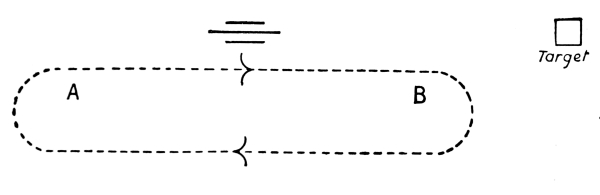
[Pg 327] The aeroplane now moves as in Fig. 32, keeping on that side of the battery furthest from the sun, so that the signals can be easily seen.
Shots can only be seen with ease when the aeroplane is moving out towards the target. If the distance A to B is about 1 mile, two rounds can be observed during each outward flight. As soon as line is obtained the signal “Observe for range” (See Sec. 205) is sent; the aeroplane now moves in an elongated figure of eight, as in Fig. 33, always turning towards the target. It will keep behind or in front of the battery according to the position of the sun. Shots can be seen at any time.
Fig. 33.
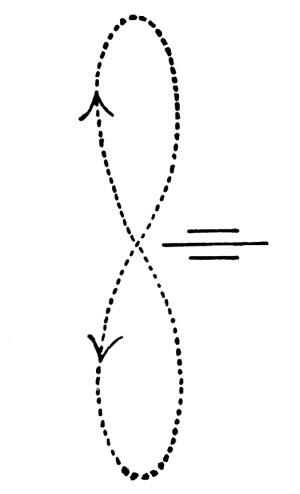
[Pg 328] Range having been obtained the signal “Observe for fuze” (See Sec. 205) is sent, the aeroplane still moving as in Fig. 33.
Subsequent observation as to the general effect of the fire can best be made from over the target, the results being written out in a message and dropped at the battery.
When the signal “Land” is sent the aeroplane comes down at a place previously selected and not necessarily at the spot whence the signals are sent.
Two men should be detailed from the battery to watch the observing aeroplane, one with field glasses looking for the signals, the other with his naked eye keeping a continuous watch on it so as to make certain that no mistake is made as to the actual machine, since, when there are several aircraft out in observation, confusion between them is very likely to arise.
205. Signals from and to aeroplanes.
1. With Very’s lights the following code of signals will be used for communication from the aeroplane to the ground:—
| Light used. | For Line. | For Range. | For Fuze. |
|---|---|---|---|
| One red. | Right. | Over. | Air. |
| Two reds. | Far right. | Far over. | — |
| One green. | Left. | Short. | Graze. |
| Two greens. | Far left. | Far short. | — |
| One red, one green. | Line. | Range. | Fuze correct. |
| One green, one red. | Unobserved. | Unobserved. | Unobserved. |
[Pg 329] The signal “Far right” or “Far left” should be made when the shell bursts 8 degrees or more from the target. Any shell bursting 500 yards or more short of or beyond the target should be signalled as “Far short” or “Far over.” “Fuze correct” will be signalled when some of the shells burst on graze and others in air.
A white light fired at any time after fire has commenced means “Stop, am about to drop a message.”
2. Strips of white cloth 6 feet by 1 foot, placed on the ground, can be used for signalling from the ground to aeroplanes. The following code of letters formed from the white strips placed on the ground will be employed.
| 3. | I | Direction of target. |
| I | ||
| L | Observe for line. | |
| X | Observe for range. | |
| Z | Observe for fuze. | |
| V | Observe for general effect of fire. | |
| N | Repeat last signal. | |
| T | Land. | |
| F / | Fresh target on right. The letters | |
| I, K or A may be placed immediately after the F | ||
| to indicate to the aeroplane observer the nature of | ||
| the target, viz., I for infantry, K for cavalry, and A | ||
| for artillery. | ||
All letters should be placed on the ground so that the top of the letter is towards the target.
206. Observation of fire from kites.
1. When kites are available the results of the observation can be telephoned down to the guns and there is no waste of time, but they can only operate in a wind (See Sec. 150), and their range of vision and power to see behind cover is limited. [Pg 330]
Kites require special consideration and the exact place from which they should be flown should be chosen by a kiting officer. Some of the requirements are:—
207. General instructions.
1. Ranging is the process of finding the elevation, fuze and line.
2. When the battery commander has given an order to load with any nature of projectile, that loading will be continued until an order to change is given.
3. With fixed ammunition, if a change of elevation or corrector be ordered when time shrapnel is being fired, Nos. 1 order “ Unload,” and guns are reloaded for the new elevation or corrector. A similar order should be given when for any other reason it is desired to empty guns already loaded, as, for instance, when ceasing fire.
If fixed ammunition is not used, and a change of elevation is ordered, guns loaded with the fuze for the old elevation will be fired at the new elevation. If for any reason it is required to empty guns already loaded, the order is “Empty guns,” and the guns are fired at once without any fixed interval.
4. As soon as ranging is completed the battery commander will send the angle of sight, elevation, corrector or fuze to the brigade commander, and in the case of howitzers the charge also. [Pg 331]
208. To find the elevation.
1. Under service conditions it is seldom possible to estimate with accuracy the distance the burst of a shell is short or over with regard to the target. The principle of ranging for elevation is, therefore, to find two elevations, the longer of which will throw the shell beyond and the other short of the target, thereby enclosing it in what is called a “bracket.”
This bracket is large at first, usually 300 yards.[20] If a smaller bracket is required one or more rounds, according to the nature of the ranging employed, are fired at the intermediate hundreds. This gives the 100 yard bracket, which in ordinary circumstances is the one required. The elevation is then verified by repeating the two ends of the bracket. The important point is to make certain of this bracket.
2. Ranging is either “Collective,” “Single Gun,” “Section,” or “All Guns.”
The method adopted should be that best calculated to obtain effective fire with the least delay, and with this end in view a combination of the different methods may sometimes be used. An example of combined “section” and “collective” ranging is given in Sec. 227.
By “Collective Ranging”[21] is meant more than 2 guns fired in quick succession at the same elevation and fuze. The form that collective ranging should take in a 6-gun unit is the fire of half batteries alternately; in a 4-gun unit the fire of the three right guns.
By “Single Gun Ranging,” “Section Ranging” and “All Guns Ranging” is meant ranging with one, two, or all guns fired singly.
In “All Guns Ranging” a single initial elevation is ordered, subsequent elevations being given out singly on the observation of the previous round.
In “Section Ranging” two elevations are ordered with or without an interval. [Pg 332]
In “Single Gun Ranging” either of the above two methods may be followed, but only one gun is used.
3. The fall of the rounds is judged from the smoke of the burst of the shell or splash of the bullets, which should be clearly observed as short of or beyond the target.
4. In order to obtain good results when ranging with time shrapnel a length of corrector or fuze should be employed, which will give bursts on or just below the line of sight. When indirect laying is employed it may occasionally be advisable to commence with a corrector or fuze échelon series, in order to select a suitable length. (See Sec. 209 (2).)
5. Elevation should always be given at first in round numbers, beginning, in the case of yards, at the nearest 100, or in degrees, at the nearest degree or half degree. It is seldom worth while to make a smaller change of elevation than 25 yards, or its equivalent.
When the whole series depends on the correct observation of a single round, that round should be repeated and another fired with 100 yards more (or less) elevation.
Further alterations in the elevation from the observation of the splash of the bullets and fall of the case of the shell, when visible, are made as required. This will often be necessary for individual guns.
If a shell is observed to strike the target, a verifying series of one or two rounds should be fired.
6. The battery commander details the method of ranging and the nature of the projectile thus:—
| “Collective” | ... | “Corrector” |
| or | ||
| “Right (Centre or | or | |
| Left) Ranging” | ||
| or | “Percussion” | |
| “No. ... Ranging” | ||
| or | or | |
| “All Guns Ranging” | “Lyddite.” [Pg 333] |
“Collective Ranging.”
7. When collective ranging is employed the battery commander gives out one elevation and corrector for example:—
“Collective—Corrector 156—4600.”
This elevation is fired by the right half battery,[22] commencing from the right at battery fire 3 seconds unless otherwise ordered. The battery commander from the result of these rounds alters the corrector if necessary, and orders a fresh elevation to the left half battery to obtain his 300 yard or other bracket. He then sends down corrections for line for the right half battery unless one correction to the whole battery is advisable, in which case he will send it down before the new corrector and range. This process is continued until the size of the bracket is, if possible, reduced to 100 yards. (See Sec. 227, Example 1.)
“Section Ranging.”
8. When a section is being used for ranging the battery commander gives out two elevations differing by 300 yards or multiple of 300 (the longer elevation first). The elevation which is given out first is fired by the right gun, the second by the left gun of the section, at an interval of 5 seconds, unless another interval is ordered. If the target is not bracketed two fresh elevations are ordered.
Should a gun of the ranging section become temporarily or permanently disabled, the section commander continues with the other gun of the section, or informs the section commander next him, who will place the nearest gun temporarily under his command.
“Single gun Ranging.”
9. If one gun is used for ranging, elevations will be given out singly or in pairs, the general procedure for bracketing the target being similar to the above. [Pg 334]
“All guns Ranging.”
10. Ranging with all guns is in certain circumstances admissible, particularly when high explosive shell are alone to be used. Elevations will be given out singly. In the case of field guns this method would only be an advantage in very exceptional cases. It presupposes that the range from each gun is identical and that observation is easy.
209. To find the fuze.
1. As a rule no special ranging for fuze should be necessary. The battery commander before or after ranging for elevation will select what he considers to be a suitable length of corrector and modify it later according to circumstances.
2. When fighting in a hilly country or when from any cause no reasonable estimate of the corrector can be formed it may prove economical in ammunition to fire an échelon before proceeding to fire with time shrapnel. (See also Sec. 208 (4).) When an échelon is considered necessary it will, except in the case of howitzers and heavy guns, be fired before ranging for elevation commences. The échelon is fired by the three right guns from right to left at 5 seconds interval unless another interval is ordered. The fuze indicators, or fuze setters, are set at lengths increasing by 10, the order being “Échelon] ... Range....” In ordering the initial corrector settings, the battery commander should endeavour to select an échelon which will give bursts in the air and on graze.
On this order the No. 1 of No. 1 gun orders his corrector to be set at the graduation ordered. The Nos. 1 of the other guns order their correctors to be set at a successive increase of 10. It may in very exceptional circumstances be necessary to fire a second échelon. The above procedure is then repeated. [Pg 335]
3. If a gun misses its turn during the échelon the fact will be reported to the battery commander, and the gun will be fired when ready unless otherwise ordered. The section commander will, however, be careful that the gun is not fired during the échelon.
4. When fire is being corrected by observation from a distant observing station and the battery angle proves to be correct, any considerable discrepancy between the gun range and the plotter range will be due to a miscalculation of the angle of sight. The correct fuze will then be that for the plotter range.
210. To find the line.
1. Except in the case of fleeting opportunities, battery fire will be continued till the battery commander is satisfied that the correct line of fire for each gun has been obtained. Even in the case of fleeting opportunities it will sometimes be advisable to fire a round of battery fire at small intervals to check the lines.
To avoid waste of ammunition, especially in the case of guns which cannot be unloaded, it may be advisable to increase the normal interval between the rounds of an échelon or at battery fire. Line corrections are preferably made on the fall of each round, but see Sec. 208 (7).
2. The battery commander will correct the deflection for each gun unless he has delegated this duty to the section commanders. (See Sec. 197 (3).) Should he consider from the first ranging rounds that his lines are not correct he should order an initial correction for the remaining guns.
3. To assist the battery commander in correcting for line when the observing station is not close to the battery, the number of each gun as it fires, also all prematures, should be reported by signalling or telephone. (See also Sec. 197 (5).) [Pg 336]
211. General instructions.
1. The general principles of ranging are the same as for field guns, but certain differences exist owing to the equipment, weight of shell, etc.
2. As a general rule, a steep angle of descent is a paramount condition for effective howitzer fire. When firing lyddite, an angle of descent of at least 20° is desirable.
3. Against troops in the open, the full charge should be employed in order to obtain the forward effect of a comparatively flat trajectory. When engaging objectives such as a wall, or buildings, which present a high vertical target, the full charge should also be used.
Redoubts or overhead cover on the contrary require a steep angle of descent; the same applies to trenches and shielded guns.
4. Howitzers frequently require individual corrections due to variations in the muzzle velocities of the guns, but such corrections should only be made on the observation of groups of rounds. The smallest correction which it is worth making is one equivalent to 25 yards.
5. When a change from lyddite to time shrapnel is made and it is known that lyddite shell range differently to the shrapnel a few rounds of time or percussion shrapnel should be fired to verify the elevation. Owing to the steep angle of descent it is often easier to observe the splash of the bullets of time shrapnel than the burst of percussion shrapnel.
212. Howitzers.
1. Ranging can be carried out with lyddite, percussion or time shrapnel.
The ranging is carried out with one section or one gun of the battery, [Pg 337] but all guns may be used for ranging if lyddite is to be used subsequently, and the target is of narrow front, or presents no obliquity to the battery.
2. When a section is employed for ranging, a bracket to approximate as nearly as possible to 300 yards, or multiple of 300 yards, should be ordered, but round numbers should usually be adhered to, such as 28°-25°, not 28°20´-25°20´.
This bracket is further reduced to one corresponding to about 100 yards, or 1-3rd of the original bracket. The elevation is then verified by repeating the two ends of this bracket.
When lyddite only is to be used, the bracket will be further reduced to 50 yards, and the two ends of the bracket repeated.
For howitzers fitted with the range drums graduated in yards for the fourth charge, the B.C. will range in yards as with other field guns, and will select the approximate ranges to start with, in accordance with the charge to be used, by means of the ranging rule provided.
If the range rule is not available, the following calculation will give the approximate range for different charges:—
| When using | full charge | subtract ¼ from the real range. |
| ” | fourth charge | give the real range. |
| ” | third charge | add ⅓ to the real range. |
| ” | second charge | add ⅔ to the real range. |
| ” | first charge | double the real range. |
3. When ranging with one gun, or with all guns, only one elevation will be ordered at a time, the principles of bracketting as laid down above being adhered to.
4. To find the fuze.—The battery commander, after ranging for elevation, may find it necessary to order an échelon (this will nearly always be necessary for batteries not provided with fuze indicators). The échelon is fired from right to left by the three right guns at 5 seconds interval, unless another interval is ordered, as in field gun batteries.
5. In the case of batteries not provided with fuze indicators, a fuze [Pg 338] and an increment will be ordered, such increment to be a division or half division according to which most nearly corresponds with 100 yards.
If the battery commander begins ranging with time shrapnel the procedure will be the same as for other field guns except that collective ranging will not be used. (See Sec. 208 (4)).
213. Heavy batteries.
1. The procedure of these guns is identical with that of field howitzers, except that ranging will not be carried out with time shrapnel. At long ranges it is advisable to order one elevation at a time.
2. When firing with lyddite, as with howitzers, the 50 yard bracket should be verified. At distant ranges, however, the bracket should not be less than twice the 50 per cent. zone.
When time shrapnel is to be used the 300 yard bracket may be found with lyddite or percussion shrapnel.
3. The procedure in ranging for fuze is that of firing an échelon as laid down for howitzers.
214. General principles.
1. Distribution of fire over the target allotted to the battery should, whenever possible, commence from the first round.
This should not prevent a battery commander in the case of an indistinct target from ranging on the most conspicuous portion, and distributing his fire subsequently.
2. Assuming 50 yards to be the average distance required to burst a shell short of the target, and that the lateral space covered by the cone of dispersion of a shell is about 35 per cent. of the distance [Pg 339] burst short, it will be seen that the width a battery at normal intervals can effectively cover when the lines of fire of its guns are parallel is approximately equal to its own front. By “sweeping” (see Sec. 216) it can cover a width of 3 times its own front.
3. When section commanders are ordered to correct for line (See Sec. 197 (3)), each of them should be made responsible for a definite portion of the target. The extreme edge of a target should not be laid on, as a small error might cause the shell to be wasted.
4. If it is required to concentrate or distribute the fire of a battery over a front of a lesser or greater width than that covered when the lines of fire are parallel, it is effected by ordering concentration on, or distribution from, a named gun. When an aiming point is employed an angle is given to the battery, followed by the amount of concentration or distribution required.
5. The amount of concentration or distribution to be given will depend on the width of the target, the angular measurement of which varies with the range.
Thus:—
| At | 2,000 | yds., | 100 yds. | measure. | 3°, | 60 yds. | measure | 1° 45′. |
| ” | 3,000 | ” | ” | ” | 2° | ” | ” | 1° 10′. |
| ” | 4,000 | ” | ” | ” | 1½° | ” | ” | 50′. |
| ” | 5,000 | ” | ” | ” | 1° 10′ | ” | ” | 40′. |
| ” | 6,000 | ” | ” | ” | 1° | ” | ” | 35′. |
These may be taken as the front covered by a 6-gun or 4-gun battery respectively when the lines of fire are parallel.
6. The angle given to the battery must bring the flank guns inside the flanks of the target. The total distribution required is the difference between the front covered by the battery and the extent of the target. This must be divided by the number of gun intervals to obtain the distribution between each gun. If the target is narrower than the front [Pg 340] covered by the battery a similar rule applies, but concentration will be needed.
If a switch from one target to another is involved, the angle between the line of fire of a flank gun and the spot on which it is desired to direct the new line of fire of the same gun should be measured.
7. Example I.—Supposing a 6-gun battery is required to fire at a range of 3,000 yards against a target measuring 3°, the fire of the battery with parallel lines will cover a front of 2°. An extra distribution of 1° is, therefore, needed. This amount divided by 5 will give 12 minutes for each gun interval, which would be taken as 10 minutes to prevent the fire of the further flank gun being outside the target. The order would then be “Distribute 10 minutes, from No. 1.”
No deflection is given to the named gun, but each of the remaining guns would be given 10 minutes left deflection for every gun interval between it and No. 1 gun.
Example II.—Supposing it is desired to concentrate the fire of the above battery on the right to cover a front of about 30 minutes at a range of 3,600 yards, the battery commander’s order would be “Concentrate 15 minutes on No. 1.” No deflection is given to the gun named; each of the remaining guns would be given 15 minutes deflection for every gun interval between it and the gun named, viz., No. 2 gun 15 minutes more right, No. 3 gun 30 minutes more right, and so on.
Example III.—A 4-gun battery firing at a target whose angular extent is 4°. It is desired to switch the fire on to a target whose angular extent is 2°, therefore the difference 2° or 120 minutes divided by 3 (gun intervals) gives 40 minutes which is the concentration to be ordered.
When there is a considerable difference in range from one target to the other, parallelism should be first given to the guns before making the switch. [Pg 341]
After the operation of ranging has been completed, the battery commander has to determine by what method of fire he will engage the objective. He may do so by one of the three methods described in Sec. 202 (1), combined, if desired, with “searching” or “sweeping.”
215. Searching.
1. “Searching” means distributing fire in depth over an area of ground by successive alterations in elevation.
2. It will often be impossible to obtain the true range of a target, either owing to the difficulty of locating its exact position, or to want of time. All that can then be done is to ascertain two limits within which the target lies, and to search within those limits. Ranges at which fire is seen to be ineffective are cut out and the space under fire is thus gradually reduced.
3. Sometimes it will be necessary to range on a crest line behind which the target is located. In this case searching should not be attempted to a greater depth than 400 yards from the crest or other obstacle to view, unless the battery commander can obtain information as to the result of his fire or the approximate position of the target, as results are unlikely to be proportionate to the expenditure of ammunition. In this connection flank observing parties may be of great value.
4. Orders as to changes in elevation and number of rounds to be fired are given by the battery commander.
The amount by which the elevation should be increased for each series of rounds will depend on the depth of ground which is effectively covered by the burst of the shell. This amount varies from 100 yards at short ranges to 50 yards at extreme ranges.
Should the ground to be searched slope considerably to the front, the above increments should be increased; if to the rear, they should be [Pg 342] diminished. When such is the case the angle of sight will be different for each successive range. It is generally inadvisable to alter this angle on the sights, but the slope can be allowed for by altering the corrector setting, decreasing it if the angle of sight is increased and vice versâ.
216. Sweeping.
1. “Sweeping” means distributing fire in width over a front greater than a battery can cover in the ordinary way.
2. When sweeping fire is employed the lines of fire of the guns must first of all be opened out, the amount depending on the width of the target. To obtain the amount of sweep required after the guns have been opened out multiply the frontage subtended by the target in degrees by three for a 6-gun battery, five for a 4-gun battery, and ten for a section. This gives approximately the number of minutes sweep required. In giving the order to sweep, the battery commander will state in degrees or minutes the amount of sweep necessary, and such order will always be prefaced by the rate of fire required, thus:—Battery commander orders “Range ... Section (or battery) Fire ... seconds, Sweep ... degrees or minutes.” On this order the first round from each gun is fired in the line ordered, and the second ... degrees (or minutes) to the right, and the third ... degrees (or minutes) to the left of the line of the first. This procedure is repeated for as long as is necessary, the fourth round being fired on the line of the first and so on.
The guns must be re-laid for elevation and direction after each round. If the battery is already at section or battery fire and sweeping fire is required, the battery commander must give the order:—“At Section (or Battery) Fire ... Sweep ... degrees (or minutes),” as otherwise the procedure will be as in para. 3.
3. If it is desired to sweep an area with great rapidity, the battery commander will order:—“Sweep ... degrees (or minutes),” [Pg 343] and the guns will be fired at gun fire. With guns fitted with traversing gear on the carriage the layer lays for direction for the first round only, the line for the second and third rounds being obtained by moving the traversing gear to the amount of sweep, right or left. The guns must be re-laid for elevation after each round. After the third round is fired the gun is traversed on to the original line and the direction checked by the sights. If it is necessary to repeat this procedure, the battery commander orders:—“Repeat.”
4. Searching and sweeping combined.—If the target possesses considerable width and depth a combination of searching and sweeping may be employed.
217. Change of target.
1. When a change of target is ordered, the battery commander measures the angle between the new and old target. He determines whether any allowance is necessary to counteract the difference between the angle he has taken and that required for the battery. (See Sec. 123 (4).) He then orders or communicates the angle to the battery thus: “All guns ... degrees more right (or LEFT).”
2. With guns not fitted with No. 7 dial sight, if the angle is within the amount of deflection which can be given on the deflection scale, the position of the aiming posts may not have to be changed, and the order is given thus:—
“All guns ... degrees more right (or left).”
otherwise it is necessary to move the aiming posts and the order will be—
“Lines of fire ... degrees more right (or left).”
218. General instructions.
1. The choice of objective, the opening of fire, and the expenditure of [Pg 344] ammunition are governed by the tactical situation and are dealt with in Chapter VII. The following sections deal primarily with the methods by which fire can be applied with effect to various objectives.
2. The methods of ranging are described in Sec. 208, and the examples in Sec. 227 illustrate those methods. Officers are responsible for using their discretion as to which method should be employed so that the fire of their batteries may achieve the object in view.
219. To register a zone.
1. A battery occupying “a position in observation” (see Sec. 184) may be called upon to “register” a certain zone or area of country. To do this the range should be obtained to various points in such a manner that fire may be opened rapidly on any objective that may subsequently appear in their neighbourhood.
Such points may be crest lines, hedges, bridges, roads, clumps of trees, buildings, the edges of woods, or the limits of open spaces over which the enemy may be expected to move.
Registering may be carried out with a section or single gun, time or percussion being used. It is advisable to number or letter the objects registered from the right, a careful record being kept of the points registered.
2. The degree of accuracy to which it is desirable to obtain the range to such points must vary according to the nature of the objective that may be expected to appear. The range to a crest on which artillery is expected to come into action must be accurately found. The limits of open spaces over which movement may be expected cannot, as a rule, be accurately defined. A few trial shots, therefore, may give sufficient indication for the purpose.
220. Localities.
1. Villages or individual houses may be fired on by artillery in order [Pg 345] to reduce their resisting power and render the approach to them easier. Field howitzers or heavy artillery firing lyddite should be used if available.
2. To destroy an individual house accurate ranging is necessary, only a sufficient number of guns or howitzers being employed for the purpose.
3. To destroy a village by setting it on fire or to prevent the massing of reserves in the streets a searching fire should be used.
4. To facilitate the attack on a village or house occupied for defence, field guns firing percussion shrapnel may be used, as well as howitzers and heavy artillery, as their projectiles are effective against personnel behind all ordinary walls. Accurate ranging is necessary; particularly for line, as it is necessary to hit each individual house.
5. If the edge of a wood is occupied by the enemy’s infantry, it should be ranged on in the same manner as a trench (see below). A searching fire may be employed against troops taking cover in a wood, but as it will usually be difficult, if not impossible, to establish a bracket with any certainty, effect must depend to a great extent on chance.
221. Staffs.
1. It may be possible to locate groups of officers forming staffs either mounted or dismounted. Such objectives should be ranged on rapidly and a quick rate of fire opened for effect till they either disperse or disappear.
222. Cavalry.
1. Cavalry when mounted must usually be engaged on the move. It may present a variety of targets; a mass, a line more or less at right angles or parallel to the line of fire, or an area over which a number [Pg 346] of comparatively small bodies is moving. The direction and pace of movement must always be reckoned with.
2. A mass will break up under artillery fire, so should be dealt with by rapid ranging, and an extremely rapid and intense fire till it breaks up, followed by a searching fire with suitable deflection to allow for movement.
3. To stop an advancing line the chief considerations are a suitable distribution and rapid changes of elevation, arranged so that the cavalry is always advancing into the fire.
At ranges under 2,000 yards it may be advisable to order lengths of fuze instead of corrector settings.
4. To enfilade a cavalry line moving across the front requires concentration of the lines of fire with varying elevations for each section and suitable deflection to compensate for movement.
5. Cavalry, covering a wide area, requires distribution both laterally and in depth, with deflection and alterations of range to compensate for movement.
6. Dismounted cavalry will usually be dealt with as infantry. Its led horses, if they can be located, form a vulnerable objective, which should be dealt with by rapid ranging followed by rapid fire for effect till the horses either disperse or gain cover.
223. Artillery.
1. To engage a battery of which the flashes or dust thrown up by discharge are visible behind a crest, the crest should be bracketed, and searching fire employed for a suitable distance behind the crest. If the slope of the ground behind the crest is known, or can be ascertained, it may afford an indication of the distance behind the crest to which it is desirable to search.
2. A battery in action or attempting to come into action in the open engaged by a battery also in the open should be ranged on as quickly as [Pg 347] possible and should be subjected to fire for effect at the earliest possible moment. The bracket should then be narrowed down and the fire maintained till the enemy’s fire slackens or becomes inaccurate. If the range is suitable and observation sufficiently easy, efforts may then be made to destroy the matériel with percussion shrapnel. To do this each gun should engage a hostile gun, and the fire of each gun should be carefully corrected.
A concealed battery engaging a hostile battery in the open will adopt a similar procedure, but there is not the same need for haste, and the ranging may be more deliberate.
3. To neutralize a battery it should be subjected to a rapid, accurate and intense fire till its fire is mastered. It should then be observed and if it endeavours to intervene again it should be subjected to the same treatment. A hostile battery, the fire of which has been mastered, may be neutralized by a portion only of a battery, which should employ a rapid sweeping fire to compensate for the reduction in the number of guns.
If a rapid and intense fire is desired against hostile artillery it is preferable to employ a quick rate of section or battery fire.
4. Guns coming into action in the open can usually establish themselves in action before the process of ranging on them is completed, unless the range to some point in the immediate neighbourhood of the position has been previously ascertained. If this has been done the rapid opening of fire for effect may cripple the hostile battery before it is able to open fire.
5. Howitzers and heavy artillery, if available, are especially suitable for dealing with entrenched guns, the former using shrapnel against the personnel and lyddite against the entrenchments. The latter would preferably use lyddite against the entrenchments. Very accurate ranging is desirable.
6. Every effort should be made to locate the enemy’s observing stations. When located they should be engaged with a portion of the guns available. [Pg 348]
7. The wagon lines of batteries in action form a vulnerable objective if they can be located. They should be dealt with in the same manner as the led horses of cavalry (see Sec. 222 (6).)
224. Infantry.
1. Artillery may fire on hostile infantry for any of the following reasons:—
These objects are not likely to be fulfilled unless the fire of the artillery is sufficiently accurate to cause the infantry loss. The losses inflicted should, however, be looked upon as the means to the end.
2. To facilitate the advance of its own infantry against the hostile infantry the enemy’s fire position must be subjected to an accurate and well distributed fire. The fire position, whether it be a trench, a series of trenches, a crest line, the edge of a wood or some other tactical feature, will seldom be a continuous straight line parallel to the front of the battery. The line may be broken and the range and angle of sight to various portions of it may vary.
When engaging irregular shaped targets, such as these, it is advisable, after obtaining a bracket on a portion of the target, to correct lines and range during battery fire, and to order individual guns or sections to add or drop the necessary number of yards.
This applies equally to other irregular targets besides infantry.
In the open “section control” may be desirable, if the target is wide and the line broken, but during the infantry advance bursts of fire should be in the hands of the battery commander.
Fire for effect should be arranged in bursts of section or battery fire during which the infantry may gain ground. [Pg 349]
3. To cause hostile infantry in close formation to deploy requires rapid ranging, the obtaining of the best bracket possible in the shortest possible time and a rapid searching fire for effect within the limits of the bracket found.
If the appearance of formed bodies of hostile infantry in a certain locality has been foreseen and the zone has been registered the process of ranging may be dispensed with, and the full value of surprise effect may be obtained.
4. When the enemy’s infantry is still beyond the range of rifle fire it will endeavour to cross open spaces exposed to artillery fire as rapidly as possible in the least vulnerable formations. If these open spaces have been registered the advance of the infantry may be delayed and possibly prevented by establishing a belt of fire through which it must pass. This belt can be moved at will but if the enemy’s infantry is only visible at intervals, accurate prediction is required as to the places where it will be exposed to fire.
5. When the infantry comes under effective rifle fire it will be compelled to form firing lines in the best fire positions available. These positions should, if possible, be foreseen and the ranges ascertained. The method of engaging the infantry when it occupies these positions will be similar to that referred to above for supporting the advance against infantry in position. The essentials are accuracy and suitable distribution. The moral effect of a great volume of fire should be borne in mind. A rapid and intense fire for a short period may bring an advance to a standstill or prevent it being resumed. In a similar way infantry advancing by rushes in extended order may be stopped or driven to cover by bursts of fire.
6. The most intense fire possible should be employed to prevent the delivery of an assault.
7. Infantry advancing rapidly to counter-attack must be dealt with by rapid ranging and rapid fire for effect directed against the front line [Pg 350] of the infantry and corrected as regards range and line in accordance with its movements. If the advance is checked a searching fire directed so as to include the supporting troops may be usefully employed.
225. Machine guns.
1. Machine guns often form objectives of great tactical importance, and it may be necessary to subject them to a very intense fire in order to silence them. When employed in sections they present a target with a narrow front and accuracy of line is important. Only a sufficient number of guns for the purpose should therefore be employed. This would usually be a section. When entrenched it may be desirable to use howitzers with either shrapnel or lyddite or both against them.
2. The difficulty in dealing with machine guns in action lies in the facility with which they can be concealed. If they can be located accurate ranging for elevation and line are necessary and a few well placed rounds should either disable the detachments or drive them to cover. If they cannot be located accurately it may still be possible to obtain sufficient indication of their whereabouts to enable a wide bracket to be obtained. Searching fire between the limits of such a bracket must then be resorted to.
226. Aircraft.
1. It is at present difficult to distinguish hostile from friendly aircraft, but this difficulty will probably decrease in the future as the aircraft of different nations tend to develop on distinctive lines.
The strictest control must be exercised over all fire directed against aircraft as indiscriminate fire may endanger neighbouring units and may [Pg 351] disclose the position of the troops to the enemy’s observers.
2. To engage such objectives certain preparations should, if possible, be made beforehand. These preparations consist in digging trenches for the trails and in organizing flank observing parties with telephones. Some modification of the usual procedure is necessary owing to the variations which occur in height, range, and direction of these objects under different influences.
3. Captive balloons or kites.—Efforts should be made to enclose such targets within the limits of a 500 or 600 yards bracket, employing a corrector which gives bursts near the line of sight. The layer must devote his attention to keeping the gun on the part of the target indicated.
Subsequently the bracket having been reduced and the corrector shortened, occasional rounds of gun fire should be fired, each section using a different elevation.
4. Airships.—Provided an airship is not moving across the front at a rapid rate it may be engaged successfully in a similar manner. The principal points to be attended to are the establishment of a bracket, and the employment of a corrector, when fire for effect is being attempted, which will give high bursts. A similar procedure will be employed against aeroplanes.
227. Examples of Ranging.
Note.—These examples are only intended to illustrate the different methods of ranging.
The methods of engaging various objectives are described in Secs. 218 to 226. [Pg 352]
I.—Example of “Collective Ranging.”
(For all batteries except howitzer and heavy.)
| No. of round. |
No. of Subsection |
Elevation | Corrector or P.S. |
Observed. | Battery Commander’s Orders. |
||
|---|---|---|---|---|---|---|---|
| + or - |
A or G. |
Height of burst. |
|||||
| “Guns in action.” | |||||||
| “Angle of sight 1° 30′ elevation.” | |||||||
| “Collective.” “Corrector 154.” | |||||||
| “3400.” “Fire.” | |||||||
| 1 | 1 | 3400 | 154 | ? | A | 20′ | “No. 1—30′ more right.”[23] |
| 2 | 2 | ” | ” | ? | A | 20′ | “No. 2—1° more right.”[24] |
| 3 | 3 | ” | ” | + | A | 5′ | “No. 3—30′ more right.”[25] |
| “All guns 30′ more right.”[26] | |||||||
| “Corrector 162.” “3100.” | |||||||
| 4 | 4 | 3100 | 162 | A | “No. 4—10′ more left.”[27] | ||
| N.B.—Notes [23] and [24] apply to 6-gun batteries only. In 4-gun | |||||||
| batteries individual corrections for line must be sent down | |||||||
| before the new corrector or elevation is given. | |||||||
[Pg 353]
I.—Example of “Collective Ranging”—continued.
| No. of round. |
No. of Subsection |
Elevation | Corrector or P.S. |
Observed. | Battery Commander’s Orders. |
||
|---|---|---|---|---|---|---|---|
| + or - |
A or G. |
Height of burst. |
|||||
| 5 | 5 | 3100 | 162 | - | G | ... | “No. 5—20′ more right.”[28] |
| 6 | 6 | ” | ” | - | G | ... | “3300.” |
| 7 | 1 | 3300 | ” | - | A | 5′ | |
| 8 | 2 | ” | ” | - | G | ... | “No. 2—20′ more right.” |
| 9 | 3 | ” | ” | - | A | 5′ | “Corrector 158” “3350.” |
| “Battery fire 10 seconds.” | |||||||
| 10 | 1 | 3350 | 158 | - | A | 10′ | |
| 11 | 2 | ” | ” | + | G | ||
| 12 | 3 | ” | ” | - | A | 10′ | |
| 13 | 4 | ” | ” | - | A | 5′ | |
| 14 | 5 | ” | ” | - | A | 15′ | |
| 15 | 6 | ” | ” | - | A | 10′ | |
| 16 | 1 | ” | ” | - | A | 5′ | |
| 17 | 2 | ” | ” | - | G | ||
| 18 | 3 | ” | ” | - | A | 10′ | “5 seconds.” [29] |
[Pg 354]
II.—Example of combined “Section” and
“Collective Ranging.”
(For all batteries except howitzer and heavy.)
| No. of round. |
No. of Subsection |
Elevation | Corrector or P.S. |
Observed. | Battery Commander’s Orders. |
||
|---|---|---|---|---|---|---|---|
| + or - |
A or G. |
Height of burst. |
|||||
| “Guns in action.” | |||||||
| “Angle of sight 1° 30’ elevation.” | |||||||
| “Right Ranging.” “ Percussion.”[30] | |||||||
| “45—42.” “Fire.” | |||||||
| 1 | 1 | 4500 | P.S. | + | ... | ... | “No. 1—30′ more right.” |
| 2 | 2 | 4200 | P.S. | - | ... | ... | “No. 2—30′ more right.” |
| “Remainder 30’ more right.” | |||||||
| “Collective.” “Corrector 154.” | |||||||
| 3 | 1 | 4300 | 154 | ... | 20′ | “4300.” | |
| A | (Bullets | ||||||
| short). | |||||||
| 4 | 2 | ” | ” | ? | A | 20′ | |
| 5 | 3 | ” | ” | - | A | 5′ | “Corrector 162.” “4400.” |
| 6 | 4 | 4400 | 162 | + | A | 5′ | “No. 4—10′ more left.” |
| 7 | 5 | ” | ” | + | G | ... | “No. 5—20′ more right.” |
| 8 | 6 | ” | ” | + | G | ... | “Corrector 158.” “4350.” |
| “Battery Fire 10 seconds.” | |||||||
| 9 | 1 | 4350 | 158 | - | A | 10′ | |
| 10 | 2 | ” | ” | - | A | 10′ | |
| 11 | 3 | ” | ” | + | G | ... | “No. 3—10′ more left.” |
| 12 | 4 | ” | ” | - | A | 10′ | |
| 13 | 5 | ” | ” | - | A | 5′ | |
| 14 | 6 | ” | ” | - | A | 10′ | “Section fire 10 seconds.”[31] |
[Pg 355]
III.—Example of “Section Ranging.”
(For all batteries.)
| No. of round. |
No. of Subsection |
Elevation | Corrector or P.S. |
Observed. | Battery Commander’s Orders. |
||
|---|---|---|---|---|---|---|---|
| + or - |
A or G. |
Height of burst. |
|||||
| “Open Sights” (or “Telescope sights”). |
|||||||
| “Right ranging.” “Percussion.”[32] |
|||||||
| “28—25.” “10 seconds.”[33] |
|||||||
| 1 | 1 | 2800 | P.S. | + | ... | ... | “Section Commanders |
| correct for line.” | |||||||
| 2 | 2 | 2500 | “ | - | ... | ... | ”27—26.“ ”2 seconds.“[34] |
| 3 | 1 | 2700 | “ | + | ... | ... | |
| 4 | 2 | 2600 | “ | + | ... | ... | ”26—25.” |
| 5 | 1 | 2600 | “ | + | ... | ... | |
| 6 | 2 | 2500 | “ | - | ... | ... | “Corrector 144” “2550.” |
| “Battery Fire, 10 seconds.” [35] | |||||||
[Pg 356]
III.—Example of “Section Ranging”—continued.
| No. of round. |
No. of Subsection |
Elevation | Corrector or P.S. |
Observed. | Battery Commander’s Orders. |
||
|---|---|---|---|---|---|---|---|
| + or - |
A or G. |
Height of burst. |
|||||
| 7 | 1 | 2550 | 144 | ... | A | 5’ | |
| 8 | 2 | ” | ” | + | G | ... | |
| 9 | 3 | ” | ” | - | G | ... | “Corrector 138.” |
| 10 | 4 | ” | 138 | ... | A | 10′ | |
| 11 | 5 | ” | ” | ... | A | 10′ | |
| (Bullets | |||||||
| over) | |||||||
| 12 | 6 | ” | ” | ... | A | 10′ | “Left section drop 50.” |
| (Bullets | |||||||
| over) | |||||||
| 13 | 1 | ” | ” | ... | A | 10′ | |
| 14 | 2 | ” | ... | Range | G | ... | |
| 15 | 3 | ” | ... | ... | A | 10′ | |
| 16 | 4 | ” | ... | ... | A | 5′ | |
| 17 | 5 | 1500 | ... | ... | A | 10′ | |
| 18 | 6 | ” | ... | ... | A | 10′ | |
| 19 | 1 | 2550 | ... | ... | A | 10′ | ”2 seconds.“[36] |
| 20 to 40 |
... | ... | ... | ... | ... | ... | ”20 seconds.“[37] |
[Pg 357]
IV.—Example of engaging advancing (or retiring) infantry.
| No. of round. |
No. of Subsection |
Elevation | Corrector or P.S. |
Observed. | Battery Commander’s Orders. |
||
|---|---|---|---|---|---|---|---|
| + or - |
A or G. |
Height of burst. |
|||||
| “All guns 3° more right.” | |||||||
| “Angle of sight 20′ depression.” | |||||||
| “Right ranging.” | |||||||
| “Percussion.”[38] | |||||||
| “37—36.” “Fire.” | |||||||
| 1 | 1 | 3700 | P.S. | + | |||
| 2 | 2 | 3600 | “ | - | ... | ... | ”All guns 1° more right.” |
| “Corrector 146.” | |||||||
| “3650.” “One round battery | |||||||
| fire 10 seconds.” | |||||||
| 3 | 1 | 3650 | 146 | - | A | 10′ | |
| 4 | 2 | ” | ” | - | G | ... | ”No. 2—20′ more right.” |
| 5 | 3 | ” | ” | - | A | 15′ | |
| 6 | 4 | ” | ” | - | A | 10′ | |
| 7 | 5 | ” | ” | + | G | ... | ”No. 5—10′ mere left.” |
| 8 | 6 | ” | ” | - | A | 5′ | [39] |
[Pg 358]
V.—Example of “Section Ranging.”
(Howitzer battery. Ranging in degrees.)
| No. of round. |
A | B | C | D | Observed. | Battery Commander’s Orders. |
|||
|---|---|---|---|---|---|---|---|---|---|
| + or - |
Line. | A or G. |
Height of burst. |
||||||
| “Trench.” | |||||||||
| “Angle of sight..........” | |||||||||
| “Right ranging lyddite.[40] | |||||||||
| 3rd charge.” | |||||||||
| “26°—23°, fire.” | |||||||||
| 1 | 1 | 26° | L | ... | + | Left | |||
| 2 | 2 | 23° | L | ... | - | ” | ... | ... | “All guns 1° more right.” |
| “25°—24°.” | |||||||||
| 3 | 1 | 25° | L | ... | + | Right | ... | ... | “No. 1—20’ more left.” |
| 4 | 2 | 24° | L | ... | - | Line | ... | ... | “Repeat.” “Time shrapnel.” |
| 5 | 1 | 25° | L | ... | + | ” | |||
| 6 | 2 | 24° | L | ... | - | ” | ... | ... | “Échelon 140.” “24° 30′.” |
| 7 | 1 | 24°30′ | T.S. | 140 | ? | ” | A | 60′ | |
| 8 | 2 | ” | ” | 150 | + | ” | A | 40′ | |
| 9 | 3 | ” | ” | 160 | ? | Right | A | 10′ | “No. 3—1° more left.”[41] |
| “Corrector 154, one round | |||||||||
| battery fire.” | |||||||||
| 10 | 1 | ” | ” | 154 | - | Line | G | ||
| 11 | 2 | ” | ” | ” | - | ” | A | ||
| 12 | 3 | ” | ” | ” | ? | Left | A | ... | “No. 3—20′ more right.”[42] |
| 13 | 4 | ” | ” | ” | ? | Right | A | ... | ”No. 4—30′ more left.” |
| 14 | 5 | ” | ” | ” | + | Line | A | ||
| 15 | 6 | ” | ” | ” | + | ” | G | ... | “Section fire 40 secs.” |
| Notes.— | With 3rd Charge 1° elevation = 85 yards. | ||||||||
| With 3rd Charge 50% zone = 45 yards. | |||||||||
[Pg 359]
VI.—Example of “Single Gun Ranging.”
(Heavy battery.)
| No. of round. |
A | B | C | D | Observed. | Battery Commander’s Orders. |
|||
|---|---|---|---|---|---|---|---|---|---|
| + or - |
Line. | A or G. |
Height of burst. |
||||||
| “Guns in action.” | |||||||||
| “Angle of sight | |||||||||
| —1° 30′” elevation.” | |||||||||
| “No. 1 ranging.” | |||||||||
| “Lyddite.” | |||||||||
| “6800.” “Fire.” | |||||||||
| 1 | 1 | 6800 | L | + | Left | “All guns 20′ more | |||
| right.” “6500.” | |||||||||
| 2 | 1 | 6500 | L | - | Line | “6700.” | |||
| 3 | 1 | 6700 | P.S. | - | ” | “6800.” | |||
| 4 | 1 | 6800 | ” | + | ” | “6700.” “Time shrapnel.” | |||
| 5 | 1 | 6700 | ” | + | ” | “Échelon 140.” “6700.” | |||
| 6 | 1 | ” | T.S. | 140 | ? | ” | A | 40′ | |
| 7 | 2 | ” | ” | 150 | - | Left | A | 10′ | “No. 2—30′ more right.” |
| 8 | 3 | ” | ” | 160 | + | ” | G | “No. 3—20′ more right.” | |
| “Corrector 146.” “One round battery fire.” |
|||||||||
| 9 | 1 | ” | ” | 146 | - | Line | A | 30′ | |
| 10 | 2 | ” | ” | ” | + | ” | A | 20′ | |
| 11 | 3 | ” | ” | ” | - | ” | A | 10′ | |
| 12 | 4 | ” | ” | ” | ? | Left | A | 25′ | ”No. 4—10′ more right.” |
| “Section fire, 40 seconds.” | |||||||||
[Pg 360]
228. To advance.
1. The alternative methods are as follows, that adopted depending upon the circumstances of the moment.
i. The battery commander orders “Prepare to advance” and issues his instructions to the battery leader. The captain orders up the gun limbers followed by the first line wagons. As these approach the position the battery commander orders “Cease firing,” “Front (or rear) limber up.” The firing battery wagons remain on the position and are removed under the orders of the captain.
ii. If it is proposed to advance with the firing battery wagons the battery commander orders “With firing battery wagons prepare to advance.” Procedure is similar to that in i., except that the teams (or limbers, if wagons have been unlimbered) of the firing battery wagons are sent up in the place of the first line wagons.
iii. The battery commander orders “Prepare to limber up,” and issues instructions to the battery leader and section commanders. The guns are run back to cover by hand and limbered up independently under the supervision of section commanders. The captain directs the first line wagons under charge of a non-commissioned officer to the position of assembly (Sec. 195 (5)), and sends up each limber to its gun as soon as he sees that it is required. When limbered up each gun proceeds independently to the position of assembly, where it is formed up by the non-commissioned officer in charge of the first line wagons. The firing battery wagons are left on the position to be removed under the orders of the captain as circumstances permit.
[Pg 361] In a covered position it will generally be possible to adopt methods i. or ii.
In an open or semi-covered position a cessation of hostile fire may permit of method i., but more often it will be necessary to adopt method iii.
On occasions it may be advisable to move a portion of the battery covered by the fire of the remaining guns.
229. To retire.
1. When a retirement is contemplated the battery commander informs the captain of his intentions, specifying the general direction to be followed, and, should he intend the battery to come into action again, the approximate locality of the new position. He will also give orders as to whether the first line wagons are to accompany or precede the battery in the retirement. The captain arranges for the movement of the first line wagons accordingly.
Two alternative methods of carrying out the retirement are given, that adopted depending upon the circumstances of the case, and being subject to modifications if the battery is under heavy hostile fire.
i. The battery commander orders “ Prepare to retire” and issues his instructions to the battery leader. The captain orders up the gun limbers, followed by the teams (or limbers, if wagons have been unlimbered) of the firing battery wagons. As these approach the position the battery commander orders “Cease firing,” “Rear (or front) limber up.”
ii. The battery commander orders “ To retire, prepare to limber up,” and issues any necessary instructions to the battery leader and section commanders. A few rounds are taken from each wagon and laid on the ground beside the gun. The firing battery wagons are run back under cover by hand. Their teams (or limbers, if wagons have been unlimbered) are then sent up by the captain as required, and the wagons driven to the position of assembly. As soon as the battery commander sees that the firing battery wagons are clear, he orders “Cease firing,” and the guns are run back by hand and limbered up as in method iii., Sec. 228.
[Pg 362] It may sometimes be advisable to withdraw a portion of the battery covered by the fire of the remaining guns.
Should it be intended to come into action again, the captain (or a section commander), as soon as his duties allow, accompanied by the range-takers, and such other members of the battery headquarters as can be spared, proceeds to reconnoitre and select the new position.
In a covered position it will generally be possible to adopt method i.
In an open or semi-covered position a cessation of hostile fire may permit of method i., but more often it wall be necessary to adopt method ii.
230. Casualties on the move.
1. If during an advance or retirement a wagon becomes separated from its gun, the gun will proceed and come into action with the battery. The wagon will drive up into its place as soon as it is able to catch up, or in case of a serious breakdown, the captain will send up a wagon from the first line wagons. Till the arrival of the wagon, ammunition will be obtained from the wagon limber of the other gun of the section.
Should a casualty occur to a gun, the damage should, when possible, be made good from its wagon.
2. In mountain artillery, if a firing battery mule becomes a casualty, its load will at once be transferred to the relief mule, another relief mule to replace this one being immediately ordered up from the first line mules. It will sometimes save delay, when the distance to the position for action is short, to bring up the load by hand. [Pg 363]
231. Casualties in action.
1. The following rules refer to the immediate replacement of casualties in action. They do not preclude other arrangements being subsequently made by superior authority. (See also Handbook of the gun.)
1. Casualties are replaced by the next senior as soon as circumstances permit. All ranks must, therefore, know what duties they will perform in the event of casualties occurring.
ii. If, when the battery commander becomes a casualty, the captain is not with the line of guns, the senior section commander will command until the latter arrives.
In cases where the battery commander only leaves the battery temporarily (as, for instance, when he is the senior battery commander, and takes command of the brigade while its commander is reconnoitring), the senior section commander leads the battery, the captain remaining in charge of the wagons.
iii. Men sent up to replace casualties will report themselves to the section commanders who should order such changes of duties in their detachments as they consider necessary. Section commanders must remember that the layer will probably not show any visible signs of fatigue until long after he has for the time being lost his efficiency as a layer. When firing is continuous he should be changed after about half an hour.
iv. Wounded will be sent back to the line of wagons, if it can be done without impediment to the service of the guns, from whence they will be removed to the dressing station.
2. Ammunition wagons may be ignited on being struck either by projectiles or bullets, the liability increasing with the amount of wood used in the construction of the wagons or boxes. Should a wagon be ignited by a projectile there is usually very little danger of it blowing up immediately; attempts should therefore at once be made to put out the fire, remove the ammunition from the wagon, or move the wagon away.
[Pg 364]
232. General instructions.
1. The necessity for an ample supply of ammunition for guns and rifles makes the position of wagon lines and ammunition columns in action a matter of great importance.
2. The object to be kept in view therefore is that the various échelons should be so situated on the march that when an engagement takes place it may be possible to arrange for a regular supply of ammunition from rear to front to replace that expended in action.
The supply from ammunition columns is not necessarily restricted to troops of their own division or brigade; any troops are to receive ammunition on demand during an action, from any column which may be at hand.
3. The work of replenishment is divided between:—
4. The artillery ammunition available with the fighting troops is distributed in action as follows:—
[Pg 365] Details regarding the amounts carried for the various types of ordnance are shown in “War Establishments.”
233. Ammunition supply within the battery.
(Wagon supply.)
1. The supply of ammunition will be, as a rule, first from the wagon body and next from the wagon limber. When the ammunition in the wagon body is exhausted it will be unlimbered and run out of the way, and the limber will be run back till its axletree is in line with that of the gun.
The captain is responsible for maintaining the supply of ammunition in the battery.
Mountain artillery.—The battery supply of ammunition is carried on 8 ammunition mules, of which 2 accompany the firing battery and 6 go with the 1st line mules. The supply of ammunition will be from the first pair of boxes with the firing battery, while the ammunition in the second pair of boxes will be kept as a reserve, and only used in emergency.
(Limber supply.)
2. It may sometimes be necessary for the guns of a firing battery to leave the wagons and trust to the ammunition in the limbers. The horses will then be unhooked from the limbers as soon as the limbers have reversed, and the limbers will be placed in position by hand on the right of the guns, poles to the front, axletrees of limbers in line with, and 6 inches from, the axletrees of the guns.
In the case of horse artillery taking part in a cavalry action, or of field artillery, when limbered up, being charged by cavalry, it may be necessary to draw ammunition from the limbers without unhooking. The battery commander orders “Without unhooking limber supply,” [Pg 366] and on coming into action, the limber is halted 5 yards in rear of the trail eye, the team facing to the rear.
In either case if the wagons arrive, they will not be brought up to the firing battery, unless specially ordered, but will be halted in such a position as to be available for the next move, when, if required, the wagon limbers may be substituted for the gun limbers.
234. Replenishment of ammunition.
1. When the captain becomes aware, either by personal observation or by the receipt of information from the battery that ammunition is required, he will send or order forward the first line wagons.
2. It is his duty to arrange how the wagons can best be brought up to the firing battery and to inform section commanders of his proposed arrangements.
If the battery is not under a heavy fire, and there is no danger of disclosing the position of guns hitherto undetected by the enemy, the wagons can be driven into position on the right of the guns, the teams subsequently hooking into the empty wagons and taking them back to the wagon line.
Sometimes it may be feasible to push forward a few wagons from the first line wagon position to a point nearer to the battery, from which the replenishment of ammunition can be carried out by hand, using ammunition carriers.
3. Whenever the brigade commander, or battery commander if acting independently, considers that the tactical situation or the position the guns will occupy, make it desirable to have more ammunition with the guns than is contained in the six wagons, he may order the first line wagons to accompany the battery into action. In this case the first line wagons follow the firing battery wagons. The latter form up [Pg 367] and unhook in the usual manner; the former halt as close as possible in rear of the guns, unlimber, and the limbers return with the gun limbers.
Mountain Artillery.
When the ammunition in the first pair of boxes is becoming exhausted, the captain orders up one mule per subsection from the 1st line; these will be sent up under a N.C.O.
The reserve numbers take off the full boxes and load up the empty ones, while No. 5 takes out any rounds that may be unexpended from the first pair of boxes, placing them under the lid of one of the second pair.
The mules with the empty boxes will be led back to the 1st line by the N.C.O. who brought them up. If the firing battery mules are separated from the 1st line, six more ammunition mules will then be sent under a N.C.O. to join them.
In order that the battery may always move with two full pairs of boxes per subsection in the firing battery, the captain will see that one ammunition mule per subsection loaded with a full pair of boxes accompanies the firing battery mules, when the order to limber up is given. The partly empty pair of boxes will be loaded upon the mule sent up for the purpose, which will then join the 1st line.
The ammunition in partly empty boxes will be redistributed so as to keep as many full boxes as possible, and mules with empty boxes will be sent to the ammunition column to replenish.
235. Brigade ammunition columns.
1. Brigade ammunition columns form an integral part of the artillery brigades to which they belong. Besides supplying ammunition, they form [Pg 368] a reserve in men, horses, and matériel to the batteries of their brigade. If necessary their own efficiency must be sacrificed to make good losses in the batteries. In cases of emergency help should also be extended to batteries of other brigades.
2. Brigade ammunition columns usually march in the rear of the fighting troops of their division, or brigade in the case of a cavalry brigade not allotted to a cavalry division. When an action is probable a non-commissioned officer from the ammunition column should accompany the headquarters of the artillery brigade for purposes of intercommunication.
3. The position of the columns during a battle will normally be regulated by artillery brigade commanders in accordance with the instructions of divisional artillery commanders. It may sometimes be necessary for the higher commanders to issue special orders as to their positions and as to the units they are to supply. The positions selected should offer facilities for intercommunication and movement, and should be about a mile in rear of the battery wagon lines.
4. On arriving at the position allotted him the commander of a brigade ammunition column will inform the commander of the artillery brigade of his arrival, and place himself in communication with the units he receives orders to supply. He will provide the commander of the infantry brigade ammunition reserve and each battery wagon line commander with an orderly, who is to be used only in connection with ammunition supply. One of the mounted men with the battery wagon line should also know the position of the column and the best way to it.
5. If troops are scattered, it may be necessary to distribute the sections of the ammunition column in order to bring the reserves of ammunition nearer the troops engaged. Commanders of sections will then deal direct with wagon line or infantry brigade ammunition reserve [Pg 369] commanders, keeping the brigade ammunition column commander informed of the issues made by them.
6. On receipt of a message that ammunition is wanted, the column commander will send forward the number of wagons or carts demanded (under an officer if possible) the orderly who brought the message being used to guide them to their destination. The ammunition is then either transferred from the full to the empty vehicles, or an exchange of vehicles is effected. If the latter procedure is adopted, it will be necessary to transfer men’s cloaks and equipment from one set of wagons to the other.
If the position of the wagon line or infantry brigade ammunition reserve is much exposed, the empty vehicles should be withdrawn and the transfer of ammunition carried out under cover.
7. Indents on ammunition columns are unnecessary. Receipts will be prepared by the officer handing over the ammunition for the number of full wagons or carts issued from the column, and will be signed by the officer receiving them, who is responsible for seeing that they contain what he requires.
The account of rounds fired by any unit during an action is not the affair of the brigade ammunition column commander. Such accounts must be kept under the orders of the commander of the unit.
Field artillery (howitzer) brigade ammunition
columns, and ammunition columns with mountain
or heavy batteries.
8. The procedure of field artillery (howitzer) brigade ammunition columns and ammunition columns with mountain or heavy batteries, will, as regards artillery ammunition, be similar to that laid down in the foregoing paragraphs. [Pg 370]
Horse artillery ammunition columns.
9. The procedure of horse artillery ammunition columns, as regards the provision of gun ammunition to batteries will be carried out as far as possible on similar lines to those laid down in paras. 1 to 7 above. (See also Sec. 176.)
236. Divisional ammunition columns.
1. Divisional ammunition columns form part of the divisional artillery. They are under the immediate orders of divisional artillery commanders. Normally, their position on the line of march is regulated by divisional headquarters, but may, if necessary, be fixed by army or general headquarters.
2. Each divisional ammunition column consists of four sections, of which the first three carry small arm and 18-pr. ammunition and the fourth ammunition for the howitzer brigade and heavy battery.
3. When an action is imminent sections of the divisional ammunition columns will be ordered to form reserves of ammunition at convenient points, which will also be the refilling points for such sections. (See Sec. 237 (4).) The position of these points will be fixed by divisional headquarters, if necessary under instructions from army headquarters, and should usually be about two miles in rear of brigade ammunition columns.
4. The divisional ammunition column commander should establish his headquarters at the rendezvous selected for the divisional ammunition park. (See Sec. 237 (4).)
It is his duty to ascertain the position of this rendezvous if this information is not sent to him, and to arrange for the replenishment of ammunition within the limits specified in such orders as he may have received from the divisional artillery commander. [Pg 371]
5. Each commander of a section which is detached will notify his arrival at his destination to the divisional artillery commander and to the divisional ammunition column commander, and will also send an orderly to open communication with each brigade ammunition column which he is to supply.
6. The supply of ammunition from these sections to brigade ammunition columns will be carried out on the same principles as those laid down for brigade ammunition columns and batteries, ammunition being sent forward to the brigade columns in the vehicles belonging to the divisional columns.
7. There are no divisional ammunition columns for the cavalry division or army troops.
237. Ammunition reserves on the line of communication.
1. The ammunition held in reserve on the line of communications is divided between ordnance depôts and ammunition parks. The proportion of ammunition to be held at each depôt is determined by the inspector-general of communications in accordance with the instructions he receives from general headquarters.
2. The inspector-general of communications is responsible that the ammunition reserves are pushed up by means of the railway and parks to within reach of the fighting troops.
3. During an action, the ammunition park will be sent forward to a rendezvous as directed by the inspector-general of communications under instructions from general or army headquarters. This rendezvous should be placed sufficiently far behind the fighting troops to ensure freedom of movement to the latter.
As a rule the best position for the headquarters of the ammunition park will be at railhead or corresponding locality but either the commander of the park or his representative will be required at the rendezvous, which will also be the headquarters of the divisional ammunition column. (See Sec. 236 (4).) [Pg 372]
4. From the rendezvous sections or portions of sections will be sent forward to the refilling points (Sec. 236 (3)) to replenish sections of the divisional ammunition column in accordance with the demands of the divisional ammunition column commander, who is responsible for regulating the amount of ammunition sent forward from the parks to refill these sections.
In favourable circumstances it may be possible to refill brigade ammunition columns direct from park vehicles.
After reaching the rendezvous the movements of the ammunition park for a cavalry division and for a cavalry brigade (with attached troops) not allotted to a cavalry division will normally be regulated by the headquarters of the cavalry formations concerned under instructions received from general headquarters. Ammunition parks for these troops carry ammunition direct to brigade ammunition columns or to regiments, &c., as may be convenient.
5. Ammunition required to replenish ammunition parks will be demanded by park commanders through the headquarters of the inspector-general of communications, who is responsible that the ammunition required to refill the parks is sent to suitable localities on the railway.
6. An artillery officer is allotted to each ammunition park who is responsible for seeing that the lorries forwarded to the various refilling points contain the nature of ammunition required. In order to carry out this duty he should, during an action, locate himself at the rendezvous.
[Pg 373]
(See also “Manual of Field Engineering.”)
238. Entrenching and concealing guns.
1. The importance of concealment, both in attack and defence, has increased with the destructive effect of quick firing artillery, but is valuable only so long as its employment does not interfere with effective fire.
2. There is a two-fold object in making use of cover, viz., concealment from view and protection from fire. By these means the possibility of surprising the enemy with fire is increased, while the possibility of being immobilized by hostile fire is diminished.
3. Guns may be concealed either by making use of natural or artificial cover, and sometimes by the selection of sites with a suitable background, but reconnaissance of the position can alone show if concealment is likely to be temporary or permanent. If circumstances permit, the sites for the guns should be viewed from the most suitable observation posts for the enemy’s artillery before they are finally fixed, bearing in mind that positions which are effectively hidden from the front often become visible by moving a short distance to a flank. [Pg 374]
4. Advantage should invariably be taken of any natural cover available, but to give efficient protection against fire some artificial cover will usually be required.
When the contour of the ground is favourable trees will give valuable cover from view, and so make it more difficult for the enemy to obtain the range. A position behind a wood, a hedge or belt of trees can often be found where the guns can be brought into action unseen by the enemy, the fire being observed from a position in rear.
5. Experience shows that anything that breaks the view close in front of distant objects greatly increases the difficulty of seeing them. Such material as nets or bamboo trellis with bits of the surrounding vegetation stuck into them may be used for this purpose. If guns have to be placed on a skyline, a strip of sacking stretched in front of them may serve as a false skyline when viewed from the enemy’s position. Similarly brushwood hurdles placed behind guns to act as a background will often conceal them for the time being.
To prevent guns being located by the dust thrown up on discharge the ground should be watered for some yards in front of the muzzles, or such material as raw hides, and sacking, pegged down over it.
For a similar reason the movements of guns and individuals must be restricted as much as possible when there is any likelihood of the enemy being able to observe them.
6. In entrenching guns the first consideration is fire effect, the second that while getting some cover in the shortest possible time the form of the work should be such as to admit of gradual improvement in the event of more time being available.
The site of a gun emplacement having been selected, the first step is to decide whether an epaulment or pit is most suitable, the next is to mark out the platform for the gun, which must be large enough to enable it to be traversed so as to engage any likely objective. [Pg 375]
In deciding whether gun pits or epaulments are to be made, it must be remembered that sinking the guns reduces their field of fire and makes more dead ground in front of them if the position is not already under cover.
On the other hand the difficulty of locating guns from aircraft is greater if sunken sites without parapets are employed.
7. At first, a simple parapet to supplement the cover afforded by the shield and to protect the detachment, when kneeling, from oblique fire should be provided. For this purpose some empty corn sacks may be carried by guns on active service. These may also be found useful in bright weather in preventing the glint from the tyres disclosing their position. Subsequently the cover can be improved and pits, with ammunition shelves or recesses in front or rear to cover the detachment standing, may be added, but a clear space of 13 feet between these pits is necessary for working field guns. The breadth of the embrasure will depend on the field of fire to be covered. The recoil of the gun carriage should be prevented by digging a trench for the spade, butting it against a plank or sleeper.
8. Every effort should be made to assimilate the emplacement with its surroundings. Sharp angles, steep ends and clearly defined embrasures, which throw dark shadows, should be avoided as likely to attract attention, and the intervals between the emplacements themselves may be filled with some form of screen with advantage.
Any newly-turned earth, if liable to be seen by the enemy, should be covered with turf, bushes, &c.
9. If time and tools permit, cover for an ammunition wagon near each gun, and a blinded communication trench for the men replenishing ammunition should be provided; or, where this is not practicable, some shelter pits to afford resting places for the men supplying ammunition by hand from the wagon line.
Where still more time is available traverses against enfilade fire and [Pg 376] overhead splinter-proof cover may be prepared. For the latter purpose uprights are needed to carry horizontal transoms on which planks or corrugated iron are arranged to support earth to the thickness of 12 inches. Uprights and transoms should be 8 to 10 inches in diameter, except in the case of such of the latter as are only required for short spans.
Special cover is required for the battery commander and his headquarters, the battery leader and his signallers, and section commanders. A type of protected observing station is shown in Plate IV. If time admits, head cover with some form of loophole should be added.
10. Diagrams of an epaulment and gun pit are shown on Plates V and VI, but they are not intended as types to be rigidly copied on all occasions.
For heavy guns a parapet about 3 feet in height should be carried round in front of the carriage, and should be constructed with a radius admitting of ample interior space and a wide field of fire. The gun should be run as close to the parapet as possible. It is generally inadvisable, unless artificial platforms are available, to disturb the natural surface of the ground.
11. Cover from both view and fire may sometimes be obtained by a combination of natural and artificial cover:—
Fig. 34.
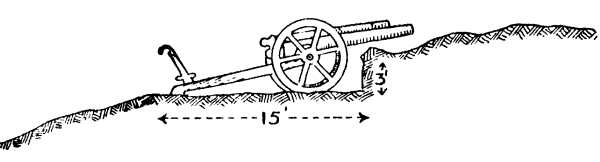
Plate IV.
Protected Observing Station.

Plate V.
Gun Epaulment for Shielded Gun.
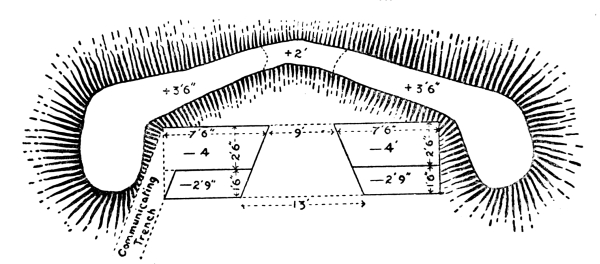
(Not drawn to Scale.)
The breadth of the embrasure must depend on circumstances; if the field of fire is limited by ground or by the target it can be narrowed, if not it must be fairly broad.
Plate VI.
GUN PIT FOR SHIELDED GUN.
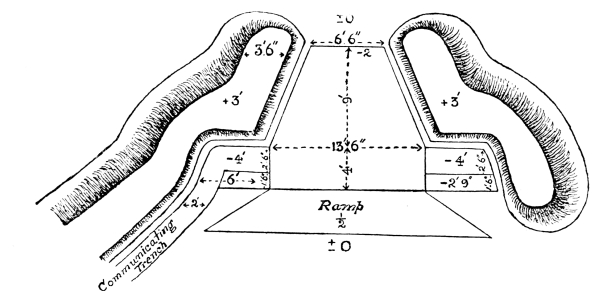
(Not drawn to Scale.)
The breadth of the embrasure must depend on circumstances; if the field of fire is limited by ground or by the target it can be narrowed, if not it must be fairly broad.
[Pg 377]
Fig. 35.
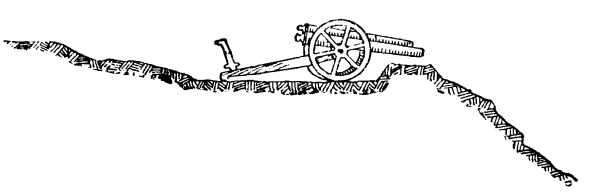
12. In some circumstances guns may have to be entrenched under cover of darkness in readiness to open fire at daylight. Careful preliminary reconnaissance is the chief essential to avoid mistakes in carrying out the various works (See Sec. 189), special care being taken to make sure that the principal line of fire is laid out correctly.
While the nature of the soil, the proximity of the enemy and the time available will all have their influence on the details of the works, every endeavour should be made to conceal them from view.
239. Passage of obstacles.
1. The obstacles likely to be met with will vary from walls or ditches to unfordable rivers. In the case of the smaller obstacles a few minutes’ use of the tools carried with the battery will often be all that is required.
2. Obstacles should be crossed at right angles and in column of route, as each carriage will make the way easier for the one which follows. In the case of boggy places, however, each carriage should cross at a [Pg 378] different spot. The gunners should always be dismounted from the carriages if there is any likelihood of the latter being overturned.
3. For the passage of small ravines a serviceable bridge can be quickly made by using a pair of wheels on their axle to support the road-bearers. See Fig. 36.
If the bottom of the ravine is soft, two spars, D and E, should be lashed to the wheels as shown. The wheels are then lowered, hauled into position, and secured by guys AB, BC.
One or two transoms (H) are then lashed across the top of the wheels with square lashing and the road-bearers (R, R) placed in position. The number of the latter depends on their strength and on the weight to be passed over.
Transoms 4 × 9 inches (8 inches in mean diameter if round) and 5 road-bearers, mean diameter 6½ inches, will bear field guns and howitzers. The road-bearers should be butted against pieces of timber (F, G) sunk in the ground.
If planks are procurable to form the roadway, they should be used. If not, the road-bearers must be placed close together and covered with branches of trees and brushwood. If horses are to cross the bridge, it should be covered with earth to deaden the sound.
Fig. 36.
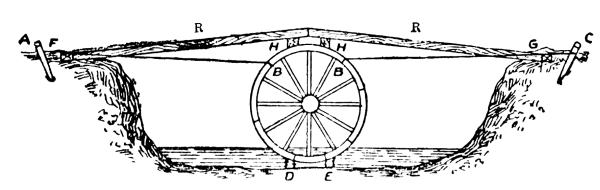
4. Plate VII shows another type of bridge constructed with stores, most of which are carried with a battery.
Plate VII.
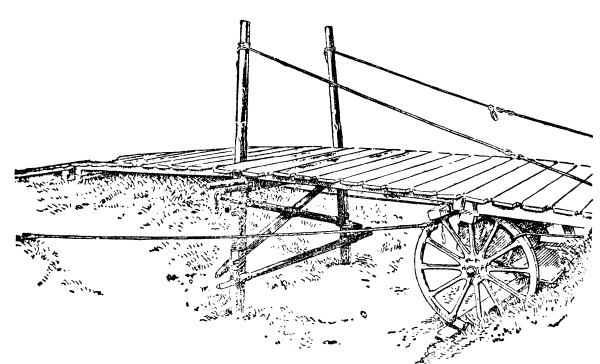
Plate VIII.
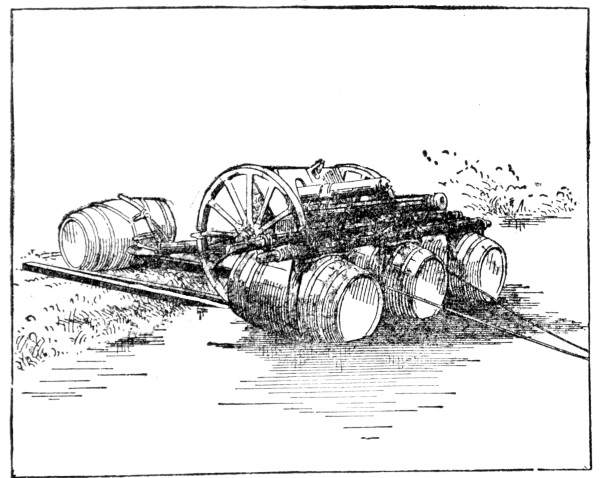
[Pg 379] 5. Should it be required to pass field guns across a river quickly, the gun and carriage can be floated across by means of four casks lashed as shown in Plate VIII.
The number of casks required can be calculated from the following rule:—
The available buoyancy of a cask (i.e., weight which it will support) in pounds is found by multiplying its contents in gallons by 9. Thus a 108-gallon cask has an available buoyancy of 972 lbs.
[Pg 380]
240. General instructions.
1. The primary object of artillery reconnaissance is to collect and transmit information, which is important from an artillery point of view, to the commander who orders the reconnaissance. At the same time anything which is likely to prove of value to the other arms should be noted. While smokeless powder and long-range weapons have increased the difficulties of reconnaissance, they have also added to the value and importance of accurate information. It is essential, therefore, that artillery should be well trained in this difficult work.
2. In each artillery brigade there should be at least one officer’s patrol, the members of which are accustomed to work together, and capable of carrying out a combined reconnaissance.
These patrols, which should ordinarily consist of an officer with one or two selected non-commissioned officers and range-takers, may often be required to carry out reconnaissances for the divisional artillery commander. (See Sec. 153 (2).)
When not so required they are at the disposal of the brigade commander. As batteries may also have to act singly, there should be some men in each capable of carrying out a simple reconnaissance. [Pg 381]
Men selected for this work should be good riders and horse-masters.
3. The mounted men of brigade or divisional artillery headquarters should also be trained in reconnaissance and scouting, so that they may be capable of:—
These duties cannot all be performed simultaneously with the number of men available. A commander must, therefore, husband his resources so as to have one or more of his headquarters available in an emergency.
4. The training should be individual and progressive and should be made as interesting as possible. The following sections are intended to serve as a guide to the principal points to which attention should be directed.
241. Visual training.
1. The men should be taken to some ground with a good view all round, and each in turn questioned as to what he makes of distant objects such as men, cattle, bushes, rocks, &c.; his answers being checked with field glasses by the instructor. These practices should be repeated till the men are proficient at picking out objects under varying circumstances of light, atmosphere, background and surroundings.
2. The effect which these conditions have on the appearance and apparent distance of objects should be pointed out. Thus the ranges to [Pg 382] objects are underestimated in a bright light or clear atmosphere, when background and object are of different colours, with the sun at one’s back, with water or snow to look over and when looking up or down hill.
With a dark background, with the light in the eyes, on broken ground and when looking over a valley or undulating ground, the ranges to objects are overestimated.
Objects dimly seen at evening, and in misty weather, appear more distant and larger than in reality. When the sun shines on entrenchments, the salient parts project their shadows on to the re-entering parts and when freshly raised they look lighter than the surrounding ground.
242. Training in judging distance.
1. The faculty of judging distances correctly can be developed by practice, but rapid and accurate estimates cannot be expected until the visual powers of the soldier have been developed.
When judging distance a man must not be allowed to guess, but must be made to give reasons for his estimate.
2. The following is the system usually recommended:—
i. Measure out distances of hundreds of yards, from 100 to 500, and accustom the soldier to recognize these distances.
ii. Ascertain the exact range of certain objects visible from the drill ground or barracks and teach him to note from these places the appearance of the objects under varying atmospheric conditions. When he has got the measured distances and the appearance of the objects firmly into his mind he should be exercised at longer ranges. To judge these he should measure the intervening ground by mental comparison with the distances with which he is familiar, or, should all the ground up to the object not be visible, he must judge the range from the impression [Pg 383] conveyed to his eye by the object, bearing in mind how this impression may be affected by the conditions mentioned in Sec. 241 (2), as well as those which follow.
3. Under normal conditions:—
4. In estimating long distances, the time taken in going over them should form a very fair guide. A man should know his own normal pace and the various rates at which his horse walks and trots.
5. Distance can also be judged by sound. The time in seconds between the flash of a gun and hearing the report multiplied by 370 gives the distance (in yards) travelled by the sound approximately: this, however, may be affected by wind and atmosphere.
243. Training in observation.
1. The habit of noting and remembering small signs or details, both at a distance and near at hand, is important. It is closely connected with the two subjects discussed above, and should be gradually introduced while they are being taught.
2. The following is one method of training men in this subject:—
The whole terrain in front is roughly divided into right, centre and left sections.
These again are divided into:—
[Pg 384] The men are formed up in extended order and allowed to observe the landscape for a few minutes, and then turned about. The instructor then ascertains the number, nature, and distance, of the objects each man has noted in these divisions. Even if only one object is noted in each, it makes six objects noticed, and this is more than the untrained mind usually identifies.
They should learn to classify the objects they see under various headings, as for example:—
They should also know such facts as that dust raised by cavalry forms a high light cloud; by infantry a lower and denser one; by wheeled vehicles denser still, and broken.
3. Regular instruction of this kind, whether held indoors or in the open, gradually educates men to make an intelligent use of their eyes until an automatic connection is established between the eye and brain, and sight becomes observation.
When the instruction of the men has advanced sufficiently, they may be classified both by a “time test” and a “number of objects” test, which increases the interest.
4. The men who prove themselves most proficient in these exercises should be further instructed in the use of the telescope and field glasses. When ground is available, a military aspect should be given to the training as much as possible. For instance, a number of objects such as dummies, kneeling and lying behind rocks, hats or helmets resting on stones or bushes, horses or dummies standing against a dark [Pg 385] background, and dummies’ heads on the sky line may be arranged on some position the distance of which from the selected point of observation will depend on the atmospheric conditions. The class is then taken out by the instructor, the battery telescope on the tripod set up, each man looks through it, identifies as many objects as he can, and writes them down. When a certain amount of proficiency has been attained in this way the tripod should be dispensed with and the men taught to use the telescope kneeling or prone, making use of any improvised rest that may be available.
Practice at locating and identifying moving objects should also be given.
5. Exercises in observation may be carried out during a march or at exercising order. Thus, after going a certain distance each man may be questioned upon, or required to jot down what he has observed of any military importance, e.g., rivers, bridges, cross roads, sign posts, villages, provision shops, smithies, post and telegraph offices, haystacks, &c. These occasions also afford the instructor an opportunity of pointing out such objects of interest as the varieties of trees and vegetation, and the habits of animals.
244. Reports and sketches.
(See also F.S. Regs., Part I, Sec. 16.)
1. Officers who may be called upon to carry out reconnaissances should be capable of executing rough maps and also panorama sketches. They should be trained in selecting aiming points, in calculating the necessary deflection from them to various objectives, and in estimating slopes over which guns can fire at given ranges.
They should be able to write a concise report containing only such information as will be of use to the officer for whom it is intended, and which is relevant to the object in view. If an area is being [Pg 386] reconnoitred for artillery positions the report should commence with a brief description of the area reconnoitred, the positions available with their special advantages or disadvantages.
The positions recommended to be occupied should then be given and information furnished on such points as the following:—
If time admits a rough map on a scale of about 4 inches to 1 mile, showing the proposed positions of the guns and 1st line wagons, the approaches to them and the position of any natural screens, will be a valuable addition to the report and will often save much writing.
Concurrently with the above any information obtainable on the following points should be noted and reported:—
Plate IX.
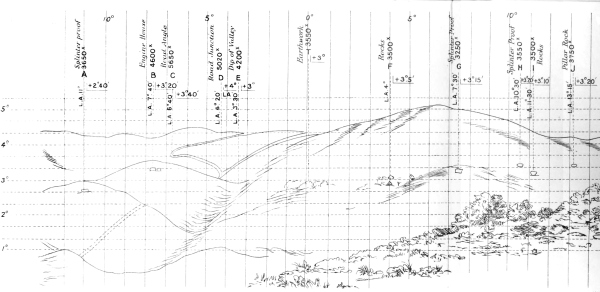
Position P
VIEW FROM FARM LOOKING NORTH.
Plate X.
Range-Taker’s Card.
Ranges taken from position P.
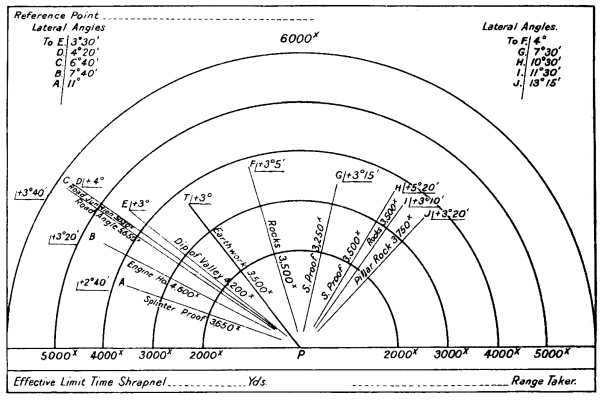
[Pg 387] 2. A panorama sketch of the enemy’s position should, if possible, be made and will save much writing. For firing at moving objects from under cover, for switches, and in night firing a sketch of this nature is invaluable.
Plate IX shows a form on which the sketch may be made so as to render it a most useful and practical aid more particularly adapted to hilly country. It will be seen that the lateral angle and the angle of sight to any point can be judged with considerable accuracy at a glance. It has, moreover, the great advantage that, with its assistance, the poorest draughtsman can produce a useful, panoramic sketch.
The sketch should show the principal features in outline, one of which near the centre of the field of view is chosen as the reference point. A line is drawn from each of these features, with the range and description marked thereon, also the angle of sight on the right of the line and the lateral angle, in degrees, between it and the reference point on the left of the line, thus—L.A. 4° | L 3°.
The sketch should state clearly the point from which it is made.
3. If time does not admit of this sketch, it may be replaced by a range-taker’s card (Plate X), on which the following should appear:—
i. A line, if possible in red, drawn to the most prominent object near the centre of the field of view. (See P.T., Plate X.) The object so selected is called the reference point. In drawing this line the card should be set so that its longer edge roughly corresponds to the line of the position to be occupied. The lateral angle, in degrees, between the line to the reference point, and a line to all prominent features for ranging upon should be given.
ii. The range to and the angle of sight of these features which should be given names. It may often be more convenient to letter and describe them with their ranges and angles of sight on a separate paper. [Pg 388]
4. The above instructions apply to officers, but in order that N.C.Os. and men employed on reconnaissance work may be of use to them, they will require training in the following subjects:—
i. Map reading.—They should be able to find the way in a strange country, first, by practical map reading; then by memory of the map; by sun and compass; by landmarks; by questioning natives of the country. As maps may not always be available on service, they should be practised in working without their aid.
It should be a habit with them to notice the general direction taken and changes of direction subsequently made.
ii. Sketching.—When they have learnt to read a map, elementary instruction in sketching should be given. This to include instruction in conventional signs; judging distances by time or by eye; making a simple approximate scale, finding approximate north point; dictating a map; sketching a piece of simple country; drawing a map from memory; estimating heights.
iii. Reporting.—As the value of the men’s work depends largely on their ability to furnish a clear report they should receive instruction in this subject. Written reports should be in telegraphic language, and verbal reports thought out beforehand.
iv. Concealment.—Their attention should be drawn to the great importance of dismounting and taking cover and of selecting a background to suit the colour of their clothing when observing; the importance of remaining perfectly still; of avoiding the sky line; of selecting look-out points when on the move, and of getting from one to another quickly, and unseen.
245. General instructions.
1. However accurate in itself the instrument for finding the range may [Pg 389] be, satisfactory results can only be expected if the range-takers are themselves efficient. To ensure this, careful training and regular practice are essential. In order that the system of instruction may be similar in each brigade, the brigade commander should personally supervise it; an officer or qualified non-commissioned officer being detailed annually to take charge of the instruction of all range-takers in the brigade.
2. In addition to the authorized establishment of range-takers an adequate and efficient reserve to replace possible casualties must be maintained.
3. These requirements necessitate a class being formed each year, which should commence work during the period of individual training.
4. The men selected for a course must be active and willing to learn. They must have good hearing and eyesight and a steady hand. They should be able to write clearly, and it will be an advantage if they can read a map and be a good judge of distance before commencing work.
5. The course should be a progressive one, beginning with a few short lectures, which should be devoted to explaining the working of the instrument, the names of its various parts and their uses, and the errors that are commonly made. The proper way to handle the instrument can also be taught.
6. The next step is to take the class out of doors and practise them in taking ranges to well-defined upright objects, such as chimneys and later to smaller objects, such as posts, at close and known ranges. Any errors in the handling of the instrument or in the methods employed should be pointed out at the time.
7. The men should now be ready to be taken into the country and practised in taking ranges at first to well-defined objects from three to four thousand yards away, and subsequently to others, such as crest lines and hedges, which would form the more usual and less distinct objectives in war. [Pg 390]
8. It is a matter of the greatest importance that the men should learn to take ranges with the least possible exposure, in order to avoid giving any information to the enemy as to the artillery positions. The instructor should, from the earliest moment possible, act as though he were a battery commander and, having pointed out the objects to which he requires the range, should insist on the men withdrawing under cover and moving to another position before taking it, unless well concealed in their present position. The same precautions should be taken when reporting the range, due allowance being made for any extra distance to the front or rear that the range was taken from.
9. All officers should understand the general working of the instrument in use in their unit and be capable of taking ranges with it.
246. General system and principles.
1. Artillery communications in the field are divided into:—
2. The means of communication available for horse and field artillery are given in Sec. 149.
3. The signalling personnel allowed is laid down in War Establishments. This establishment is based on the principle that signalling personnel is required for the purpose of providing communications downwards, i.e., with subordinates, and laterally, i.e., with equals. [Pg 391]
To enable commanders of artillery brigades to carry out this principle they must be able to communicate with brigade stations of the divisional signal service as well as with their subordinates. The standard of efficiency of a proportion of the signallers must therefore be equal to that required of the divisional signal service. On the other hand, as long distance work is not needed within the batteries, the standard required of their signallers need not be so high.
The signalling personnel is therefore divided into two classes—
4. As it is usually of importance to ensure the continuity of communications when once they have been opened between any two points, alternative methods should be established, if possible. To enable this to be done it is essential that men employed on the service of communication should be capable of acting in any of the capacities laid down for the classes to which they belong. All signallers should also be capable of acting as despatch riders, since it will often be quicker to send a message in this way than by signal. Instructions for training despatch riders are laid down in Signal Training, Part II.[43]
247. Internal communications.
1. For communicating between brigade headquarters and the headquarters of batteries and ammunition columns an establishment of brigade signallers is provided as an integral part of brigade headquarters. These men should be fully qualified signallers as laid down in Training Manual—Signalling.
This establishment has been calculated on the assumption that communication with one battery at least will be more conveniently carried out verbally or by message. Communication by telephone or [Pg 392] visual signalling will not, therefore, be required with more than two batteries, orderlies being used to communicate with the brigade ammunition column.
The officer in charge of communications at brigade headquarters is responsible for allotting the brigade signallers to batteries for the purpose of maintaining communication between them and brigade headquarters in accordance with circumstances.
2. Communication within the battery from the battery commander to his guns and observers will be carried out by the battery signallers. These battery signallers are maintained solely for purposes of communication within the battery. Their training is limited to the use of semaphore, telephone and buzzer.
Communication may be carried out by means of:—
For the purpose of maintaining communication between a battery and its observing station, four signallers are necessary, two at each station. They should be provided with telephones and flags, so that alternative means of communication may be available.
Semaphore signalling is the most rapid system of visual signalling with small flags. (See Sec. 201 (4).)
The best way of utilizing semaphore signalling is to employ two sets of signallers, each pair having different coloured flags. Those with the same coloured flags should communicate with each other only.
In sending orders, or the result of observations, by signal the abbreviations laid down in Sec. 201, will be used.
248. External communications.
1. Effectual co-operation between artillery and infantry depends largely on the receipt of timely information. An efficient system of communication is therefore very important. [Pg 393]
2. A personal exchange of views between subordinate infantry and artillery commanders is likely to produce the best results in a combined tactical operation. If unable to remain in the vicinity of the infantry commander, the artillery commander should be represented by an officer (See Sec. 153 (7).)
3. No rules can be laid down as to the means by which communication is to be maintained between this officer and the artillery commander.
If circumstances are favourable communication may be maintained by the brigade telephone or by visual signalling, but as the infantry commander will usually change his position as the fight progresses, it may be necessary to rely on orderlies, or a combination of orderlies and telephone or visual signalling.
4. It may be possible to arrange direct communication between the artillery commander and advanced observation posts, with a view to keeping him informed as to the progress of the attacking infantry and the effect of the artillery fire. (See Sec. 153 (11).)
The means of communication which can be employed will depend on the nature of the country.
Visual communication will usually be inadvisable on account of the difficulty of finding positions which are invisible to the enemy, and the telephone may be expected to give the best results. When no artillery telephone is available the possibility of sending information of equal importance to the artillery and infantry through the infantry communication service should be kept in view. It must be borne in mind that a message sent by orderly will take an appreciable time to reach its destination.
[Pg 394]
249. Marches and march discipline.
(See F.S. Regs., Part I, Chap. III.)
1. March discipline includes everything that affects the efficiency of man and horse during a march. On it depends not only the comfort of a column of troops as a whole, but also the time which is needed to perform a march or deploy for battle.
The principles which govern the order of march of a body of troops are laid down in F.S. Regs., Part I, Chap. III.
2. The following rules should be observed by artillery:—
[Pg 395] Men may mount or dismount when the column is moving at a walk.
3. In column of route when two ammunition wagons per subsection are present they immediately follow their gun until the batteries prepare for action, when those which do not accompany the guns into action, will assume a preparatory formation under the command of the captain. (Sec. 191.)
4. On a march the first halt usually takes place not long after the start, when a careful examination should be made of the horses and harness. Subsequent halts are made at regular intervals at the discretion of the commander of the column. The duration of these halts and the time when they are to take place, should be made known in advance.
5. It is of great importance to relieve horses as much as possible of the heavy weights they have to carry. They should be harnessed up as short a time as possible before turning out, and should not be hooked in until just before the time for marching off.
When they are standing in harness the drivers should be dismounted.
When marching at a slow pace with other troops men are inclined to lounge in their saddles and thus to cause sore backs. On this account mounted men should be instructed to walk and lead at intervals, and the drivers may be relieved occasionally by capable gunners. For the same reason slouching in the saddle, even when riding at ease, should be prevented and, when trotting, every man should rise in his stirrups.
6. Opportunities which may occur for watering and feeding horses should always be seized. Watering requires to be carried out on a regular system if it is to be done smoothly and expeditiously.
7. When artillery is moving independently of other troops, very early [Pg 396] starts are undesirable, except for some special reason. The men should have time to get breakfast and the horses should be fed before the march commences.
The maintenance of an even and regular pace is essential, otherwise the constant opening out and closing up, which occurs in rear, becomes trying, both to men and horses.
In some circumstances, such as when the roads are hilly or dusty, the intervals between files and the distances between carriages may be increased.
The last couple of miles of a march should be at a walk, so as to bring the horses in cool, and during this period they should be watered, if there be a convenient place.
250. Billets.
1. The principles to be observed in the allotment of billets, and instructions for administration and discipline in billets, are laid down in F.S. Regs., Part I, Chap. IV.
2. Billets are of three descriptions, viz.:—
When billets with subsistence are provided, officers and others must be satisfied with the usual fare of the householder on whom they are billeted.
All billets will include attendance and, when required, the use of ordinary cooking utensils, but bedding cannot be demanded as a right.
3. Billeting areas are allotted by the quartermaster-general’s branch of the staff. The commanders of these areas then distribute the accommodation among the units to be quartered in them and issue billeting demands to their representatives.
4. A billeting party should consist of one officer or senior non-commissioned officer per brigade, and one rank and file N.C.O. per [Pg 397] battery or ammunition column. Before starting for his allotted area, the commander of the party should obtain a statement showing the number of officers, men, and horses for whom accommodation is required.
5. On arrival in the locality in which his formation is to be billeted, the commander of the billeting party will first proceed to the mayor, or other chief official, hand him the billeting demand, and notify him of the hour at which the troops may be expected. If time permits billeting orders should be obtained from the local authority for each inhabitant on whom men and horses are to be quartered.
6. On receipt of these orders the commander of the billeting party will issue them in proper proportion to the representative of each unit, who will be given instructions as to the posting of any special notices, arrangements for watering, &c., and the rendezvous, when the billets have been inspected. The men of the party then proceed to the houses and stables allotted to their units, inspect and mark them and hand the billeting orders to occupiers. In arranging for billets horses should be billeted near the men, and as close as possible to the guns and vehicles. Each unit should, if possible, be allotted both sides of a street.
7. In the meantime the commander of the party will select and mark the position of the headquarters of the brigade, guard-room, sick inspection room, and gun parks. (See F.S. Regs., Part I, Sec. 49.) He will also ascertain the most suitable lines for communicating with neighbouring units and the best lines into and out of the area.
8. In fixing the sites of gun parks and arranging accommodation for horses, precautions must usually be taken against discovery by hostile aircraft.
Although to avoid blocking roads and communications it may be necessary to place guns and other vehicles outside towns or villages, they should not be parked in a regular formation in the open. As many vehicles and [Pg 398] horses as possible should be placed under cover, the remainder being concealed by placing them close to hedges, buildings, stacks, or any other object which will screen them against observation from the air.
Subject to the conditions above, guns and wagons should be parked, where possible, on dry ground, but near water, with easy approaches and plenty of room. Additional entrances may be needed to facilitate movement. Provided there is plenty of room for movement and it is possible to conceal the carriages from observation by aircraft a single gun park has advantages.
9. After completing the above, the commander of the billeting party should, if possible, prepare a rough plan of the area, showing the allotment of billets, main roads and communications, position of gun parks, together with a statement as to any special arrangements that may be necessary as regards watering horses, and other details.
10. On reassembling his men, he will notify them of the positions of headquarters, guard, gun parks, etc., and will despatch a proportion to convey this information to the units. (See F.S. Regs., Part I, Sec. 48.)
11. When time is not available for the above procedure troops will be halted outside their billeting areas. Meanwhile brigade billeting parties will proceed to the town hall or similar place, where a representative of the commander of the area will allot certain streets or groups of houses to them, which they in turn will assign to units.
12. A list of the addresses of the officers should be given to the commander of the main guard.
251. Bivouacs.
1. The general rules for the occupation of a bivouac are given in F.S. Regs., Part I, Sec. 56.
2. The commander of the billeting party, as soon as he has been shown [Pg 399] the area allotted to him, selects the sites for the bivouacs for each battery, and has the positions of kitchens, slaughter-places, and latrines marked out.
He then goes to meet the artillery commander with information on the various details dealt with in F.S. Regs., Part I, Secs. 56 and 57.
Orders dealing with any of these points, which it is necessary for the troops to know, should be communicated to them before leaving the gun park.
3. It will generally be necessary to take precautions against observation by hostile aircraft, and when this is the case regular formations should be avoided and all possible arrangements made to conceal the guns and horses (See Sec. 250 (8)). Bivouac shelters, if used, should not be put up till after dark. When artillery reach their bivouac in darkness and when it is not necessary to take precautions against discovery by hostile aircraft the method of arranging a bivouac for a battery in Fig. 37 may be used.
This method, which is quick and economical of space is given as a guide and should be followed only so far as the ground allows.
The guns are formed in line at half interval (10 yards) with the firing battery wagons on their left at 2 yards interval, three of the first line wagons in rear of and at right angles to the line of guns and 5 yards from them. The remaining three are then formed up parallel and about 60 yards from the above.
4. The picketing ropes are stretched between the upper spokes of the 1st line wagons. The rope can be stretched taut by lifting and heaving on the wagons furthest from the gun park, and, if necessary, sinking a small trench for the wheels to rest in. If the length of rope required is considerable it may be advisable to use other wagons to support it half-way. [Pg 400]
Fig. 37.
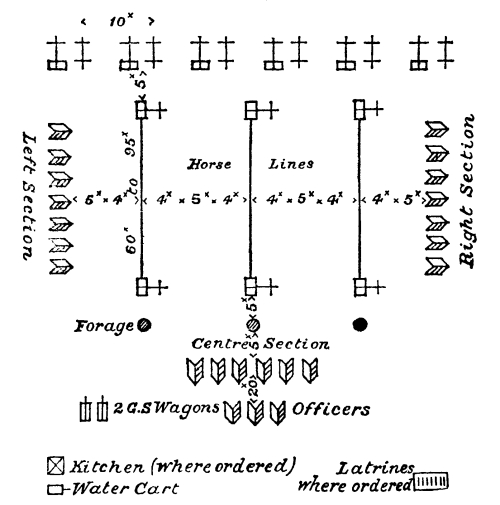
The horse lines of each section should be as far as possible in rear of the guns of its own section.
The horses of each section are then fastened to one rope, using both sides of the rope. No horse should be fastened within 5 yards of a carriage in order to prevent the possibility of damage. [Pg 401]
The harness is placed in rear of the heel pegs, blankets folded on the saddles and the whole bound up in the harness cover: forage 5 yards from the horse lines at the opposite end to the gun park.
The sections are arranged so that the personnel may be as near their own horses as possible. The right and left sections parallel to the horse lines, the centre section at right angles to them at 10 yards distance. The officers 20 yards in rear of the centre section.
252. Transport by rail.
The transport of troops in peace by land and sea is dealt with in the “King’s Regulations.” Owing to the variations in size of carriages and trucks in the different countries where campaigns may take place, it is impossible to fix the number of vehicles or trains required for a battery.
Rolling stock, such as in common use in the United Kingdom, will take:—
The number of vehicles in a train varies on different railways, according to the ruling (i.e., maximum) gradient, speed, and the types of locomotives and trucks.
In the United Kingdom each six gun battery of horse or field artillery [Pg 402] at war strength would require 2 trains, while the brigade headquarters and ammunition column for a howitzer, 13-pr. and 18-pr. artillery brigade would occupy 2, 3 and 4 trains respectively.
It may be necessary to entrain and detrain horses and carriages without the use of raised platforms by means of ramps. Regular practice in doing this is required in order to avoid delay.
Fixed ramps can be made with earth revetted with sleepers, or sleepers alone may be used.
Plate XI shows ramps which can be quickly improvised if portable ramps are not available. The stores required are two rails, 21 ft. to 24 ft. long, and 40 or 50 sleepers for each ramp.
The following are the principal points to which attention should be paid when loading horses and guns and carriages.
i. Horses.
1. The entrainment and detrainment of horses will be carried out in accordance with the instructions given in F.S. Regs., Part I., Sec. 38.
2. The floors of trucks used for the conveyance of horses should, if of wood, be at least 1½ inches thick. Cinders, sand or gravel should be sprinkled on them to prevent the horses slipping; on no account should straw or any inflammable material be used for this purpose.
3. A man leading a horse into a truck should walk freely in with a loose head rope, as though leading it into a stall. He should not stare in the animal’s face. Much time may be lost in dealing timorously with a jibbing horse; two men should be ready to clasp hands above its hocks and hustle it into the truck.
4. If possible, on long journeys, horses should be taken out of a train at least once every 24 hours, walked about, and allowed to roll on sand or grass.
Plate XI.
Temporary Ramp
For Entraining Guns.
(End Loading)
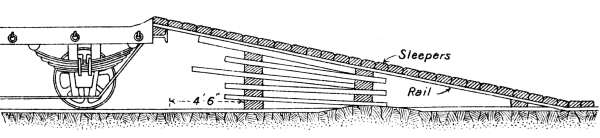
Temporary Ramp
For Entraining Horses.
(Side Loading)
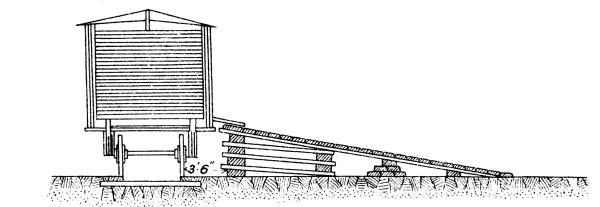
[Pg 403]
ii. Guns and carriages.
The general points which should be attended to are:—
To distribute the load evenly over the floor, and if any of the flooring planks are rotten, to put a sleeper across them under the wheels. The minimum thickness of floor should be 2 inches.
To see that the points of poles or shafts do not stick up so that they would strike against bridges, &c., as would usually occur if they were more than 7 feet above the floor of the trucks.
To lash the wheels nearest to the ends of the trucks securely to the false buffers or to rings by a rope, which is also given a turn round the axle of each pair of wheels on the truck to prevent them shifting with the jerks of the train.
Generally the best way to stow the carriages is, poles, trails, and perches resting on the floor, poles to the front, perches and trails to the rear, the wheels of each vehicle interlocking with those of the carriage in front of it.
253. Slinging horses.
(Transports alongside.)
1. If horses are to be embarked by slinging, they should on arrival alongside the ship be unsaddled or unharnessed, the head rope should be fastened in the ordinary way round the neck; the ship’s halter will be put on under the head-collar; the bridoon reins should be left loose (as they may be required for keeping the head in the proper position while lowering down the hatchways), but they should be knotted to prevent them getting entangled in the horse’s legs. Slings should be minutely inspected before the embarkation begins. A double guy should be [Pg 404] made fast to the horse’s head, one end being held on shore and the other on board, in order to keep the head steady; the surcingle must be moved round so that the buckle is on the seat.
2. In slinging horses, five men are required, one at the head, one at each side, one at the breast, and one behind. One end of the sling is passed under the horse’s belly, and both ends are brought up to meet over his back; one man passes his loop through the other loop, and it is received by the man on the other side, who hauls it through, hooking the tackle to it, both men holding up the ends of the sling until it is taut. The men at the breast and behind bring their ropes round and make them fast to the grummets, and the man who holds the horse’s head makes fast the guys to the ship’s head-collar. The breech band and breast girth must be securely fastened. Timid or restive horses should be blindfolded. When all is ready, the words “Hoist away” will be given, and the horse is to be rapidly run up from the ground to the necessary height, and then carefully lowered down to the hatchway. Two or three men should be stationed at the hatchway and between decks to guide the horse in being lowered. A soft bed of straw or coir mats must be provided for the horse to alight upon, and the men stationed in the lower deck must be ready to receive him and take off the sling, as on first feeling his legs, unless firmly handled, he is apt to plunge and kick violently.
3. In disembarking, sand or straw must be laid on the wharf for the reception of the horses. Horses are apt to fall on their knees at once unless carefully held up.
(Transports not alongside.)
4. The method of embarking horses in boats or flats will vary according [Pg 405] to circumstances. If the boats can come alongside a wharf, or can approach close to an open beach, the horses can either be led on board by gangways (horse brows), or be slung in the manner described above, sheers or a derrick being erected. Horse brows may be at steep angles of ascent or descent if there is considerable rise and fall of tide. When the boats cannot come sufficiently near the shore to enable horses to be hoisted on to them, piers or platforms must be constructed. The piers should always be provided with stout side railings about three feet high, and the floor covered with shingle, straw, or something to prevent the horses slipping.
5. When embarking in boats, the detachment should be formed up opposite them, and the same rules, so far as practicable, followed as when embarking in vessels alongside a wharf. A man must be told off to each horse, and take with him in the boat the whole of his kit, equipment, saddlery, &c. The men should take off arms, belts, and spurs. The horses should, if possible, be placed athwart the boat alternately, the head to tail. Each man must hold his horse until the vessel is reached. Sand or straw should be put in the boats to prevent the horses slipping.
6. In the absence of boats and appliances, the following method of embarking horses by swimming may be employed:—
The horses having been halted a short distance from, and out of sight of, the point of embarkation, are stripped of all appointments except the bridoon and headstall, which latter should be close fitting.
A horse having been led to the landing place, two men prepare him for the water. No. 1 holds his head. No. 2 places the sling in position and secures the straps with yarn, so as to prevent the sling opening in the water; he then fastens the breast rope and breeching securely. A rope of about eight yards in length, with an eye at one end, is next passed [Pg 406] round the neck and fastened rather tightly by an overhand knot, so as to prevent its becoming either looser or tighter. The bridoon is then taken off, and to support the horse in the water another rope is attached to the lower ring of the headstall under the chin, or else a short rope is passed round the girth in front of the sling and close behind the elbows, the ends being brought up and fastened over the withers. The horse is controlled altogether by the neck rope.
The horse is then led into the water as far as he will walk towards the boat, in the stern of which should be a man, who receives the neck rope in his right hand, and immediately reeves it through the stern ring of the boat to secure additional power in the event of the horse plunging; the headstall or girth rope he receives in his left hand.
When once the horse is swimming, the neck rope should be hauled close up while the headstall or girth rope gently supports him in the water.
A small rowing boat with two oars will be sufficient. It should not be pulled too fast, or the horse will make no attempt to swim.
On reaching the ship’s side the hook and tackle should be lowered, the hook passed through the sling’s eye, and the horse hoisted up on board.
Care should be taken to arrange the tackle so that the horse, in being hoisted in, is kept clear of the ship’s side.
7. Horses may, in cases of emergency only, be disembarked by swimming. When this method is adopted, the horse should be lowered in the sling over the side of the vessel without fastening the breast rope or breeching. When the tackle is unhooked the sling opens, and is at once slipped from under the horse. The neck rope should be hauled up and secured, and the horse supported, as explained above. If necessary, four horses may be made to swim ashore at a time, two on each side of [Pg 407] the boat. It is important that horses should be kept at the point to which the others are to swim.
Horses should be cool before being put into the water.
254. Slinging guns and vehicles.
1. For slinging guns, limbers and limbered wagons, the following method has been found to give good results:—
Two four-inch slings are used, one round each axletree, and a hook rope hooked into the trail eye. The bights of the slings are placed on the tackle hook, to which the end of the hook rope is also made fast.
Limbers are slung in the same way as guns, the hook rope in their case being made fast to about the centre of the pole, unless special instructions to remove the poles are issued.
Limbered wagons will, as a rule, be embarked loaded on their wheels, the poles should not be removed before slinging. If the wheels are removed, special care must be taken that the linch pins and washers are put away. Those carriages first required on disembarkation should be stowed away last.
2. G.S. wagons can be slung by four chain slings connected to a common link at the one end and provided with hooks at the other, these four hooks are then secured to all four wheels of the vehicle. The poles must be removed before slinging, and made fast to the body of the wagons.
If cordage only is available, two slings each, consisting of one rope 3 in. by 60 ft., knotted at a suitable length, and two lashings, 1½ in. by 30 ft. for guy ropes are required.
To adjust the front sling pass one end inside the wheels and under the [Pg 408] futchels of the fore carriage in front of the axle. To adjust the back sling loop one end of the sling over the nave of the off hind wheel. Pass the sling over the load and loop the other end to the nave of the near hind wheel. Care must be taken to see that the drag washers are turned down to prevent the sling from slipping off.
The hook of the hoisting tackle is then passed through the end of the two ends of the front sling and under the centre of the back sling.
The pressure can be taken off the sides of the carriage by making use of loops made with polechains or ropes at the end of poles through which the slings are passed.
[Pg 409]
The following syllabus of training for recruits of R.H. and R.F.A. is given as a guide to officers charged with the training of recruits. It is not intended that it should be followed rigidly.
SYLLABUS OF TRAINING.
GUNNERS.
| Subject. | 1st fortnight. |
2nd | 3rd | 4th | 5th | 6th | Total hours per subject. |
|---|---|---|---|---|---|---|---|
| Physical training | 10 | 10 | 10 | 10 | 10 | 10 | 60 |
| Dismounted drill—without arms | 30 | 20 | 10 | 10 | 10 | 10 | 90 |
| Rifle exercises—including musketry | 5 | 5 | 5 | 5 | 5 | 25 | |
| and visual training | |||||||
| Cordage, knotting, &c. | 5 | 5 | 3 | 3 | 3 | 19 | |
| Semaphore | 5 | 5 | 5 | 5 | 20 | ||
| Gun drill—including gunnery, | 10 | 12 | 12 | 12 | 46 | ||
| laying, fuze setting, and | |||||||
| visual training | |||||||
| Lectures | 5 | 5 | 5 | 5 | 5 | 5 | 30 |
| Total hours per fortnight | 45[44] | 45 | 50 | 50 | 50 | 50 | 290 [Pg 410] |
DRIVERS.
| Detail. | Fortnight. | Total. | |||||
|---|---|---|---|---|---|---|---|
| 1st | 2nd | 3rd | 4th | 5th | 6th | ||
| 1. Physical training | 10 | 10 | 10 | 10 | 10 | 10 | 60 |
| 2. Foot drill | 30 | 20 | 10 | 10 | 10 | 10 | 90 |
| 3. Rifle exercises and visual training | 5 | 10 | 5 | 5 | 5 | 30 | |
| 4. Cordage, knotting, &c. | 5 | 2½ | 7½ | ||||
| 5. Semaphore | 5 | 5 | 5 | 5 | 20 | ||
| 6. Wooden horse | 2½ | 2½ | 2½ | 7½ | |||
| 7. Fitting and cleaning harness, &c. | 2½ | 5 | 5 | 12½ | |||
| 8. Stable management | 10 | 10 | 10 | 10 | 40 | ||
| 9. Lectures | 5 | 5 | 5 | 2½ | 2½ | 2½ | 22½ |
| Total hours per fortnight | 45[45] | 45 | 50 | 50 | 50 | 50 | 290 |
[Pg 411]
Precautions to be Taken when
Firing Blank Ammunition.
1. No officer, non-commissioned officer, or gunner, is to command or form part of a section or gun detachment firing blank ammunition at salutes or on field days who has not been trained and passed in gun drill.
2. When bare charges are used, no gun is to be reloaded within 30 seconds after firing. When firing Q.F. blank cartridges, no gun is to be reloaded within 15 seconds after firing.
Even after these intervals no gun is to be reloaded unless the No. 1 has examined the chamber and the bore and removed any “debris” remaining from the previous round. (N.B.—With the 4·5-inch Q.F. Howitzer the lid of the cartridge is not to be removed when firing blank ammunition.)
3. In firing salutes not less than four guns are to be used. When firing signal rounds at field days and manœuvres, however, any number of guns may be used provided that the conditions of paragraph 2 are fulfilled.
4. In the event of a missfire, at least one more attempt should be made to fire the gun, when it is again its turn, but in any case the breech must not be opened for at least one minute with “black powder” charges and ten minutes with “smokeless powder” charges after the last failure to fire the gun. None of the detachment should be directly in rear of the breech when it is opened.
In firing salutes, an officer or senior non-commissioned officer should be detailed for the special duty of timing the interval after a missfire, and informing the No. 1 of that gun when he may open the breech.
[Pg 412]
NOTE.—No reference to drill movements is made in this Index. Headings of sections dealing with drill will be found in the Contents.
Footnotes:
[1] The mule is referred to as the normal pack animal with mountain batteries throughout this manual. The same principles are generally applicable to pack ponies.
[2] Heavy and mountain artillery drill as laid down for infantry.
[3] Note.—Trained horses should never be turned except on their haunches.
[4] Note.—Special reins for near and off horses will eventually be abolished and ordinary reins substituted.
[5] Neither bearing reins nor side reins are part of peace equipment stores, but they can be made up by the saddler.
[6] “Ranging” and “Range-finding” must not be confused with one another. The latter is the measurement of the distance in yards to the target by mechanical means, and the former the process by which the elevation necessary to make a shell travel that distance is ascertained, an elevation which, owing to the various causes mentioned above, will rarely correspond with the distance given by the range-finder.
[7] Note.—This is obtained from the formula
| v2 |
| w × 2g |
representing the energy of a body. In this case
| v2 | = 60; whence v = 400 (approx.). |
| 41 × 2g |
[8] Note.—¹/₄₄ for the No. 80 fuze.
[9] Note.—An aiming point must not be confused with a reference point. (See Sec. 186.)
[10] Supposing that guns and target are on the same level, then to guns 60 yards in rear of a crest and 16 feet below it all ground is dead within 3,000 yards; if 9 feet below it all ground is dead within 2,000 yards; if 3 feet below it all ground is dead within 1,000 yards.
[11] This does not preclude subordinate artillery commanders from making the arrangements for observation of fire referred to in Sec. 199.
[12] Should the limits within which the hostile battery is located be wide the fire must be of a searching nature.
[13] The distance at which artillery other than howitzers can with safety fire over the heads of its own troops varies. At ranges under 1,500 yards on the level it would be dangerous to fire over friendly troops; at longer ranges infantry should be sufficiently safe at 500 yards (with heavy artillery 800 yards is necessary) from the guns.
[14] The methods by which a hostile battery should be neutralized are described in Sec. 155 (2).
[15] Note.—In normal circumstances the amount of cover necessary to hide the flashes is about 13 feet for field guns, and 20 feet for howitzers and heavy guns.
[16] Ground scouts’ horses will also be with the wagon line.
[17] In batteries armed with 4·7-inch Q.F. guns the wagons will be placed 2 yards to the left flank and 10 yards in rear of the trail eye, poles to the rear.
[18] Axle mule in the case of the 10-pr. B.L. gun.
[19] At present this procedure is only possible with batteries provided with two No. 3 directors.
[20] Or multiple of 300.
[21] Collective ranging does not apply to howitzers and heavy guns.
[22] In a 4-gun battery by the three right guns.
[23] These individual corrections are noted but will not be sent down to the battery, as one correction proves sufficient for all guns.
[24] These individual corrections are noted but will not be sent down to the battery, as one correction proves sufficient for all guns.
[25] These individual corrections are noted but will not be sent down to the battery, as one correction proves sufficient for all guns.
[26] As the correction is one for all guns it is sent down before the new corrector and elevation.
[27] Individual corrections are noted but will not be sent down to the battery until the elevation for the next salvo has been given.
[28] Individual corrections are noted but will not be sent down to the battery until the elevation for the next salvo has been given.
[29] Line having been accurately found the battery commander varies his rate of fire to such speed as the tactical situation may demand.
[30] —Notes Or “Corrector 154.” “45—42.”
[31] —Or “Battery fire ... seconds.”
[32] Or “Corrector 152”—“28—25.”
[33] Interval suitable to time of flight is ordered as the battery is firing over the heads of its own infantry which is approaching the objective.
[34] The battery commander is satisfied that his infantry is in no danger from his fire, so he shortens the interval.
[35] As battery commander is not certain that the whole extent of the target is parallel to the front of the battery, he orders a longer interval in order that he may correct the range of individual guns if necessary.
[36] Battery commander sees that his infantry is checked, so orders a burst of fire.
[37] Battery commander seeing that his own infantry has been helped to advance, as desired, comes back to a slow rate.
[38] —Or “Corrector 154.”
[39] —Battery commander has now corrected his lines and has established a “belt” of fire parallel to the front of his guns, through which the infantry must pass. In this example lines are not opened out. The whole “belt” can be shifted up and down, right or left, as the subsequent movement of the enemy may dictate, and a quick rate of battery or section fire can be employed as necessary.
[40] Or “Right ranging, 3rd Charge, Corrector 150, 26°—23°. fire.”
[41] Splash of bullets visible.
[42] Splash of bullets visible.
[43] In course of preparation.
[44] It is calculated that in addition about 2½ hours a week in the first fortnight are spent on medical inspection, fitting clothing, and school tests.
[45] It is calculated that in addition about 2½hours a week in the first fortnight are spent on medical inspection, fitting clothing, and school tests.
Transcriber’s Notes:
Deprecated spellings or ancient words were not corrected.
The illustrations have been moved so that they do not break up paragraphs and so that they are next to the text they illustrate.
Typographical and punctuation errors have been silently corrected.