Transcriber’s Note:
New original cover art included with this eBook is granted to the public domain.
THE QUARTERLY
OF THE
Oregon Historical Society.
Volume 1
DECEMBER, 1900
Number 4
OREGON TRAIL NUMBER.
CONTENTS.
| F. G. Young—The Oregon Trail |
339 |
| Jesse Applegate—A Day With The Cow Column in 1843 |
371 |
| Col. George L. Currey’s Tribute to the Ox Whip |
384 |
| Sam L. Simpson—The Camp Fires of the Pioneers |
385 |
| Joaquin Miller—Pilgrims of the Plains |
395 |
| Joaquin Miller—Pioneers of the Pacific |
397 |
| Documents—The Oregon Emigrants, 1843 |
398 |
PRICE: THIRTY-FIVE CENTS PER NUMBER, ONE DOLLAR PER YEAR
The Oregon Historical Society
Organized December 17, 1898
| H. W. SCOTT |
President |
| C. B. BELLINGER |
Vice-President |
| F. G. YOUNG |
Secretary |
| CHARLES E. LADD |
Treasurer |
| George H. Himes, Assistant Secretary. |
DIRECTORS
THE GOVERNOR OF OREGON, ex officio.
THE SUPERINTENDENT OF PUBLIC INSTRUCTION, ex officio.
Term Expires at Annual Meeting in December, 1901,
F. G. YOUNG, L. B. COX.
Term Expires at Annual Meeting in December, 1902,
JAMES R. ROBERTSON, JOSEPH R. WILSON.
Term Expires at Annual Meeting in December, 1903,
C. B. BELLINGER, MRS. MARIA L. MYRICK.
Term Expires at Annual Meeting in December, 1901,
H. W. SCOTT, MRS. HARRIET K. McARTHUR.
The Quarterly is sent free to all members of the Society. The annual dues
are two dollars. The fee for life membership is twenty-five dollars.
Contributions to The Quarterly and correspondence relative to historical
materials, or pertaining to the affairs of this Society, should be addressed to
Subscriptions for The Quarterly, or for the other publications of the
Society, should be sent to
GEORGE H. HIMES,
Assistant Secretary.
City Hall, Portland, Oregon.
Volume I] DECEMBER, 1900 [Number 4
THE QUARTERLY
OF THE
Oregon Historical Society.
339
THE OREGON TRAIL.
The early Oregon pioneers not only gained the first
secure foothold for the American people on the Pacific
Coast, but their movement opened the way to American
occupation and in itself counted as an occupation of that
realm for American civilization. They moved across the
continent at an auspicious time, and so were able to
influence, if not to shape, the course of great events
touching the widening of the American dominion on the
Pacific. It was all done so quietly, so efficiently, at so
comparatively small cost and without any shock of harrowing
disaster, that the world has yet to connect the
momentous results with a cause seemingly so inadequate.
As the American people come to realize that their
distinctively national achievement so far, next to that of
maintaining a national integrity, has been that of preempting
and subduing an adequate dominion and home
for a civilization they will revere the services of those
340who made the transcontinental migrations in the thirties,
forties and fifties. The glory that belongs to the participants
in those migrations is the peculiar birthright of
the patriotic Oregonian. The passage from the Atlantic
slope to the Pacific of these first American households
bearing the best embers of western civilization must ever
stand as a momentous event in the annals of time.
For twenty-eight years, now, surviving participants
in this world event have annually assembled to recount
the incidents of their coming to Oregon, to live over that
trying but hallowed time, to rekindle old flames of friendship
and form new ties on the basis of their common
experiences. At these meetings of the Oregon pioneers
there was always an “occasional address” in which the
reminiscences of the immigration of some particular year
were given. As the journal of the association puts it,
the object of the association “should be to collect reminiscences
relating to pioneers and the early history of
the territory; to promote social intercourse, and cultivate
the life-enduring friendships that in many instances had
been formed while making the long, perilous journey of
the wide, wild plains, which separated the western boundary
of civilization thirty years ago from the land which
they had resolved to reclaim.” The biographical notices
contained in the transactions of their association all mark
this coming to Oregon as a dividing event in the lives of
their subjects. That generation of Oregonians suffered
something like a transfiguration through this movement,
which also widened the nation’s outlook—in making
it face a greater sea. These transforming influences
wrought their effects during the summer season that
each successive immigration spent on the Oregon trail,
while journeying in canvas-topped oxen-drawn wagons
from the banks of the Missouri to those of the Willamette.
The greatest epochal expansion of the nation was insured
through these migrations at the same time that the participants
were translating their lives to a new sphere.
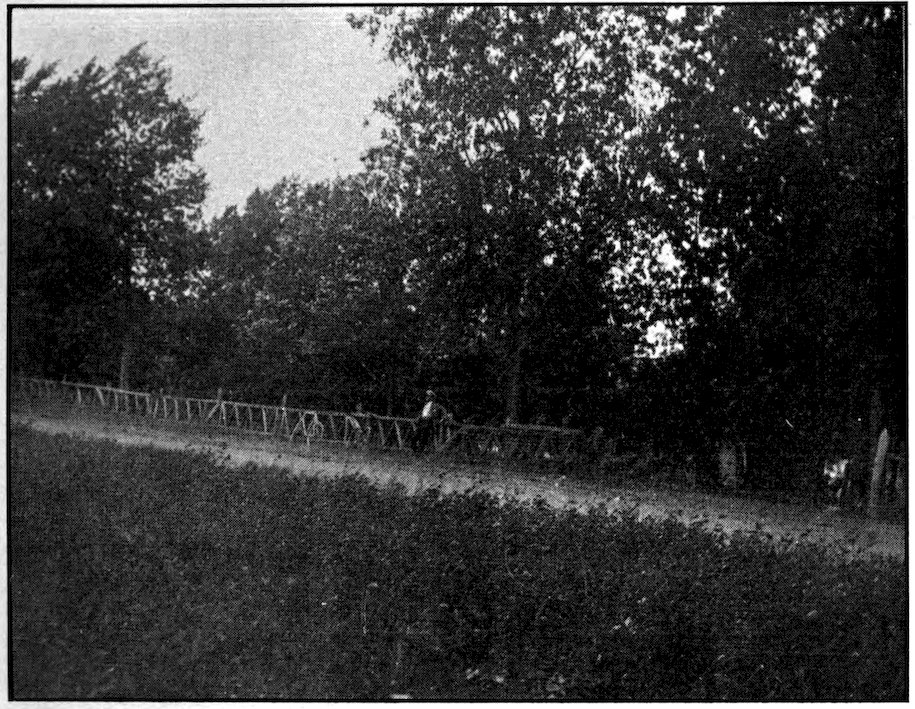
1.—Near the site of Fort Kearney on the Platte. (Part of pontoon bridge is used as road fence.)
341For engaging and vivid detail of experiences in this
movement, recourse must be had to the transactions of
the Oregon Pioneer Association, and to journals kept on
the way across the plains. These will ever have an interest
for the heart of man as they show life under heroic
impulse and in trying conditions long sustained. The
whole movement Oregonward has an epic unity, and when
its significance has become fully manifest will challenge
the powers of the national poet.
But the movement has not yet, even in its outward
aspects, been viewed as a whole. To mark off its limits
in time, in routes taken, in numbers and population elements
involved; to note the main motives, the forms of
characteristic experiences; in a word to make, as it were,
a composite view with relation to national history as a
background,—would seem to be the first step for realizing
the due appreciation of the significance of the work of
the Oregon pioneers. A sketch of the outlines of the
movement in its more salient features, then, is what is
attempted here, with the hope that such setting forth of
the movement as a whole, with outlines more or less
closely defined, will lead to its being brought fully into
relation with the general course of events of American
history. Until the story of the Oregon movement is thus
set forth, the historians of our national life cannot weave
it into its proper conspicuous relations in their narratives.
It has no doubt been largely due to this lack if
the story of this pioneer achievement in available form
that a somewhat undue estimate of Doctor Whitman’s
services and the acceptance of mythical accretions to them
have come about. The Whitman story was early available
and was made to do service in accounting for a larger
outcome than facts warranted.
342The Oregon migrations effected at one sweep a two
thousand mile extension of the Aryan movement westward
in the occupation of the north temperate zone—“a
far-flung” outpost of occupation and settlement. To
appreciate the boldness, intrepidity and consummate
effectiveness of such pioneering we have but to note that
no previous extension had compassed one-fourth this distance.
Nor were the conditions in this instance easy.
One continuous stretch of Indian country infested with
most formidable predatory tribes had to be passed
through. Conditions approximating those of a desert
had to be faced during a large part of the migration.
There were swift rivers to ford or ferry, and three mountain
ranges to scale. Only one form of the usual difficulties
of pioneer road-making did not appear. There
were no extensive forests to penetrate except on the
ridges of the Blue and the Cascade Mountains.
The settlements of the blue grass region of Kentucky,
and the Nashville district, in Western Tennessee, were,
when first made, the most isolated from the main body
of the American people. Yet, these had less than a four-hundred
mile stretch between them and the settled region
of the Atlantic slope. No other outward movement of
Aryan people ever covered anything like the distance
made by the Oregon pioneers on the Oregon trail. Measured
by the sea voyage, the Oregon settlements were a
leap of seventeen thousand miles.
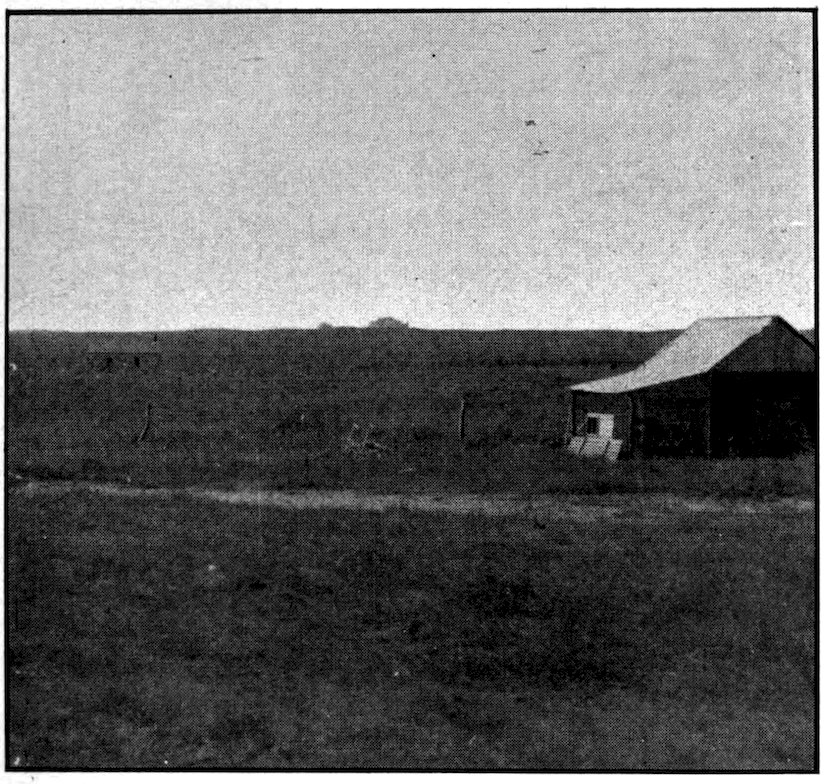
2.—“LONE OR COURT HOUSE ROCK.”
Though the Oregon pioneers traced the first trail
across the continent, adapting for sections of it the lines
of travel of fur trading expeditions; yet, were it not for
the title of Francis Parkman’s narrative (which, however,
has only the slightest references to anything pertaining
to its title), I am not sure but that the very name
would have been lost to all except Oregonians. The
meagerness of Parkman’s presentation of the transcontinental
343movement is easily accounted for. He did not
take his trip of roughing it to Fort Laramie and the
Black Hills, in 1846, to see the Oregon pioneers. His
plans to write the history of the new France in America
tended to narrow his interest strictly to aspects of Indian
life as they were with the Indian in his original state.
He was concerned solely during his life on the plains to
get that insight into Indian character and customs that he
might interpret the records of the relations of the French
with them, and give his narrative in his great life work
truth, life, and color. Had he been inclined to associate
himself with the westward moving trains, and to enter
into their life and thought, his “Oregon Trail” would
naturally have been a final characterization of the migrations
up to the stage they had assumed at that time.
There are, however, indications in some of his references
to the pioneers that their necessarily deshabille condition
while en route, and the astounding and almost reckless
character of their undertaking were by him set in contrast
with the steady comfortable ways of the New England
folk from which he hailed and the Oregonians correspondingly
disparaged. In this he would be bringing a
pioneer phase of civilization into comparison with a more
finished form. The wayfaring pioneers were still marking
out wider and more natural limits for the national
home, while the New Englanders were advancing the
arts of life on the original nucleus of national territory.
But who can say to which the nation in its destiny owes
the more?
Two years ago there appeared a book of five hundred
and twenty-nine pages written by Colonels Henry Inman
and William F. Cody, bearing the title, “The Great Salt
Lake Trail.” In its preface there is to be found the following
comment on its title: “Over this historical highway
the Mormons made their lonely hegira. * * *
344Over this route, also, were made those world renowned
expeditions by Fremont, Stansbury, Lander, and others
of lesser fame, to the heart of the Rocky Mountains,
and beyond, to the blue shores of the Pacific Ocean.
Over the same trackless waste the pony express executed
those marvelous feats in annihilating distance, and
the once famous overland stage lumbered along through
the seemingly interminable desert of sage brush and
alkali dust—avant-courieres of the telegraph and the
railroad.”
The body of the book touches upon topics ranging in
time from Jonathan Carver’s explorations in 1766-’68 to
the building of the Union Pacific Railroad. Its map
lays “The Old Salt Lake Trail” exactly on the route of
the Oregon trail as far as Fort Bridger, in Southwestern
Wyoming. But the Oregon migrations are not hinted
at by a single word in the body of the book. The authors’
account of them could not have been crowded out
by more weighty matters, as all the disjointed fragments
of Indian hunting and fighting and drunken carousal,
whether happening on the line of the trail or not, are
crowded in. Either the story of the Oregon movement
during the thirties, forties and fifties was absolutely
unknown to Colonels Inman and Cody, or, if known,
thought worthy of relegation to oblivion by them.
In interviews last summer with people living along
the line of the trail, only those whose experiences extended
back to the time of the Oregon migrations recognized
the trail as the Oregon trail. It was always the
“California trail” or the “Mormon trail.”
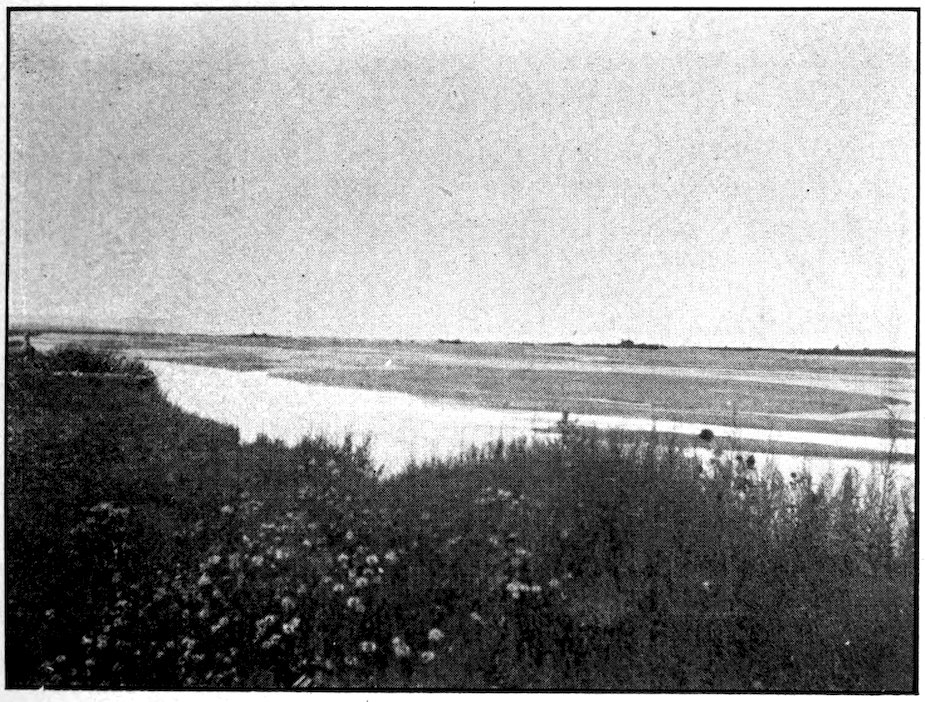
3.—The North Fork of Platte—its sandy bottom exposed.
It is, of course, to be conceded that more people
traveled this road to California than to Oregon. But
the Oregon movement was first in time. By it the feasibility
of the route was demonstrated, and people susceptible
to the western fever were accustomed to think of
345the trip across the plains in a way that brought them
when the cry of California gold was raised, or when as
Mormon converts they were longing for a refuge from
molestation. Then, too, the Oregon pioneers not only
led the way; they decided our destiny Pacificward. It
is time that history was conferring its award of justice
to them. The highway they opened to the greater sea,
and which their march made glorious, should take its
name from them and thus help to commemorate unto
coming generations the momentous import of their
achievement for all the future of mankind.
The transcontinental movement as a march of civilization
to the west shore of the continent was in its
incipiency a missionary enterprise. There is hardly any
doubt, however, but that the home-seeking pioneer
would have been on the way just as soon without the
initiative of the missionary heroes and heroines. It is,
nevertheless, the lasting glory of the Presbyterian and
Congregational denominations that under the auspices
of their missionary board the first American families
successfully made the passage that was to sweep such a
marvelous movement into its train. The Methodist
Episcopal missionary enterprise antedated all others
and played a conspicuous role in the political organization
of the Oregon community, but it was not first in
setting up the American home. So long as it lacked
that it could not bear an American civilization, which
was the crucial matter. It was Whitman who demonstrated
the possibility of taking households across the
plains, and this achievement, too, was a decisive initiative.
But how did the impulse to make this dangerous
and arduous journey to the then far-off wilderness of
Oregon originate with the missionary and the home-seeking
pioneers? The inception of the Oregon movement
346in both its missionary and its pioneering aspects
is best understood when viewed as outbursts of missionary
zeal and energy and pioneer daring and restlessness
from vast stores of potential missionary and pioneer
spirit existing in this country in the thirties. Missionary
activity in the direction of Oregon was liberated
by something like a spark, or, to change the metaphor,
by a “long-distance” “Macedonian cry.” A delegation
of four Nez Perces Indians from the upper waters of the
Columbia arrived in St. Louis in 1832 in search of “the
white man’s Book of Heaven.” An account of this
singularly unique mission was published in the newspapers
of the time. The story was made all the more
effective and thrilling, with those of deep religious sensibilities,
through its including what purported to be a
verbatim report of a most pathetic farewell address
made in General Clark’s office by one of the two surviving
members of this mission.
The closing passage of the speech, as it has been
handed down, is as follows:
“We are going back the long, sad trail to our people.
When we tell them, after one more snow, in the big
council that we did not bring the Book, no word will be
spoken by our old men, nor by our young braves. One
by one they will rise up and go out in silence. Our people
will die in darkness, and they will go on the long
path to other hunting grounds. No white man will go
with them, and no Book of Heaven to make the way
plain. We have no more words.”
The missionary boards of several Protestant denominations
were already establishing foreign missions in
Africa, India, and among the western North American
Indians. Hall J. Kelley had been agitating the cause of
the Oregon Indians for half-a-generation. An appeal for
missionary help so pathetic, so unheard of, and withal
shedding such luster on those from whom it came, as
was that of the Nez Perces delegation to St. Louis, could
not fail to bring forth a missionary movement towards
Oregon.
347The spirit that materialized in the Oregon pioneer
movement was not kindled by any special spark like that
which called forth the missionary enterprises. Nor was
it aroused by anything like the cry of gold that brought
on the mad rush to California in ’49 and the early fifties.
The Oregon migrations were the outcome of cool, calm,
reasoned determination. This characterized the movement
collectively as well as individually.
In a sense, the Oregon movement was in preparation
from the time when in 1636 Puritan congregations were
led by Hooker and others from the vicinity of Boston
westward through the forests to the banks of the Connecticut.
This initial western movement was communicated
along the Atlantic coast settlements by the Scotch-Irish
crossing the Blue Ridge Mountains in Pennsylvania,
and by the Virginians penetrating to the Shenandoah
Valley. Some would say that an instinct to move
west has been growing in strength among civilized peoples
since about 1000 B. C., when the Phœnicians moved
west on the Mediterranean to found Carthage, and the
Greeks to plant colonies in southern Italy and at Marseilles.
So largely had pioneering been the mode of life of
those who were living in the western zone of settlement
in the United States in 1840 that it was almost a cult
with them. The traditions of each family led through
the Cumberland Gap or west to Pittsburg and down the
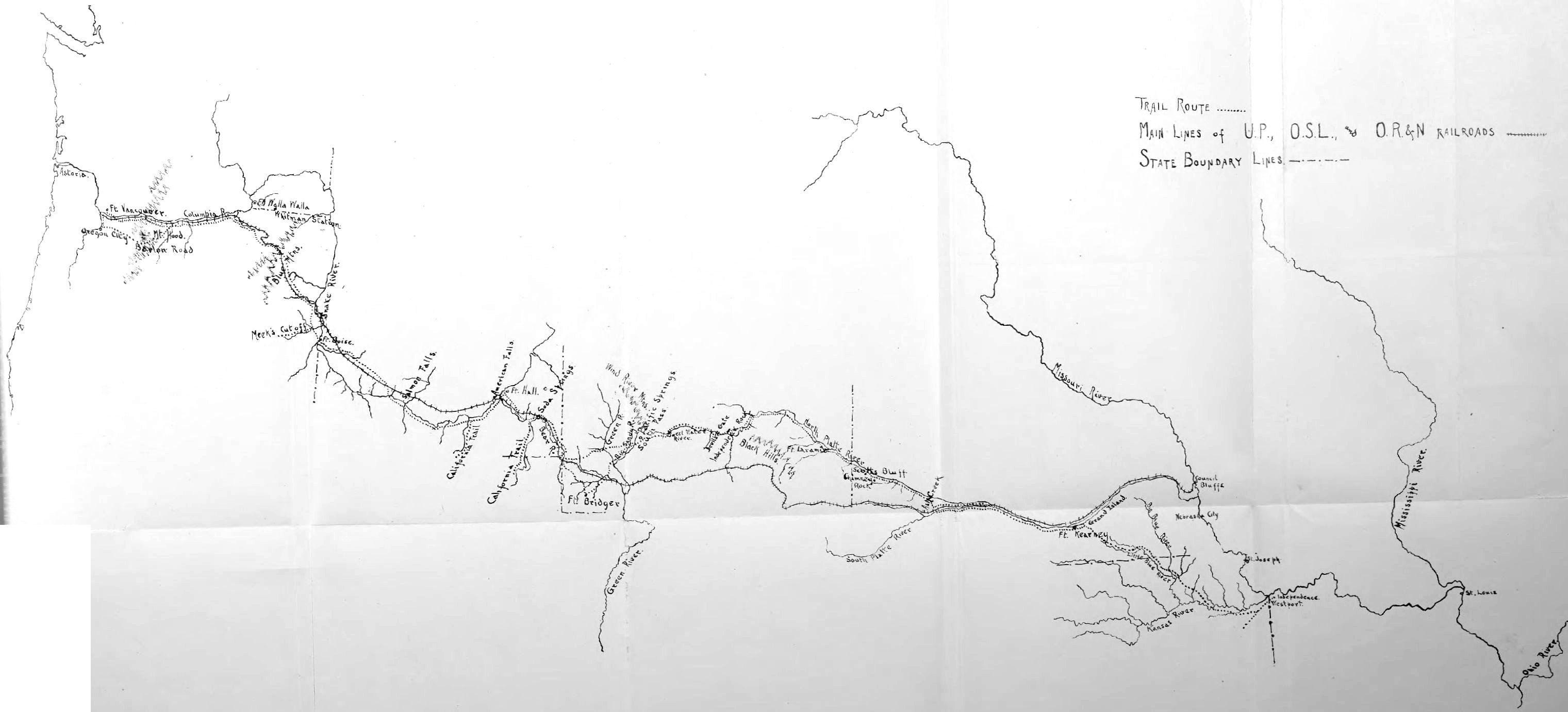
Ohio, or along the line of the Great Lakes. Hon.
W. Lair Hill, in his “Annual Address” before the Pioneer
Association in 1883, fitly characterizes the people
among whom the Oregon movement took its rise. “The
348greater number of them were pioneers by nature and
occupation, as their fathers had been before them. In
childhood the story of their ancestors’ migrations from
the east to the west, and then to the newer west was
their handbook of history. Homer or Virgil, of whom
few of them had ever heard, could have rehearsed no
epic half so thrilling to their ears as the narratives of
daring adventure and hairbreadth escapes, which, half
true and half false, ever form the thread of frontier history.
They knew nothing of Hector and Achilles, but
they knew of Daniel Boone, who, Lord Byron said, ‘was
happiest among mortals anywhere,’ whom civilization
drove out of Pennsylvania by destroying the red deer
and black bear, and who, after some years of solid comfort
in his log cabin amid the wilds of Kentucky, was
again pursued and overtaken by the same relentless
enemy and compelled to retire into the Missouri wilderness,
beyond the Mississippi; and who, even in that
distant retreat, was soon forced to say to his friend and
companion, according to current anecdote, ‘I was compelled
to leave Kentucky because people came and settled
so close around me I had no room to breathe. I thought
when I came out here I should be allowed to live in
peace; but this is all over now. A man has taken up a
farm right over there, within twenty-five miles of my
door.’ Of Boone, and such as Boone, most of them who
founded the commonwealth of Oregon, knew much more
than of the great names of literature, statesmanship, or
arms, and their minds dwelt fondly on the exploits of the
frontiersman, whether in the contests with the savages or
the chase. More familiar with the log cabin than with
the palace, with the rifle than with the spindle and loom,
with saddle than with the railway, they felt cramped
when the progress of empire in its westward way put
restraint upon those habits of life to which they were
accustomed.”
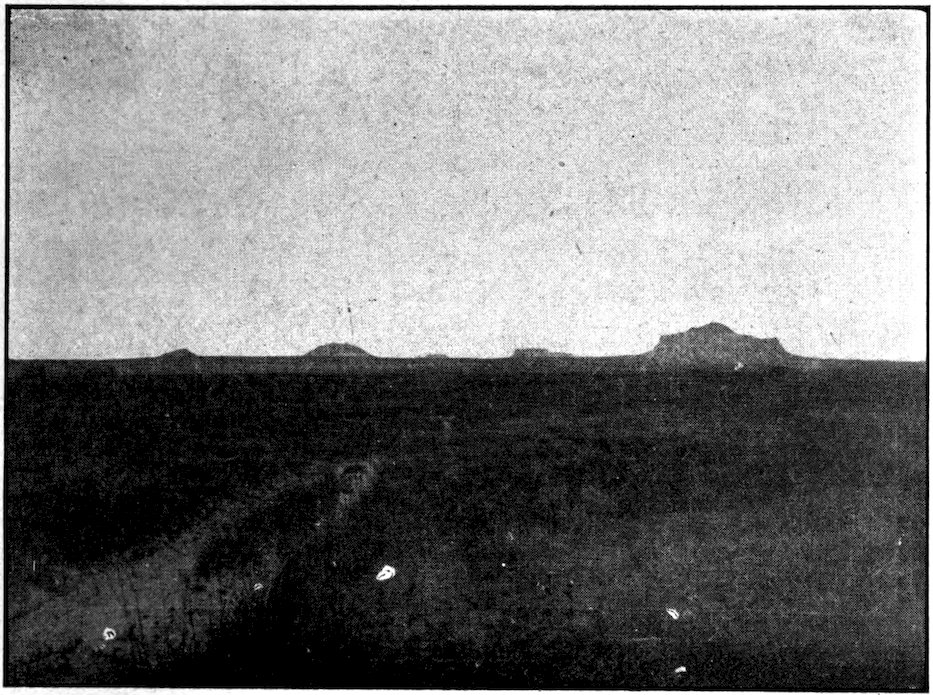
5.—“CASTLE AND STEAMBOAT ROCKS.”
349Knowledge of a “new country” was sure to create in
them an almost irrepressible longing to move on. Such
natures as these furnished the best culture conditions in
which to develop an Oregon movement with the reports
explorers and travelers brought from the far Pacific Coast
region. Such Oregon material had early been disseminated
among these susceptible people. The journal of
the Lewis and Clark expedition was published in 1814
and distributed far and wide as a government document.
Pioneers speak of reading it as boys and of becoming
permanently interested in the Oregon Country. The
journal of Patrick Gass, a sergeant in the company of
Lewis and Clark, fell into the hands of others and stirred
their imaginations. From 1817 on until 1832 Hall J.
Kelley, a Boston schoolmaster, was compiling and distributing
information designed to awaken a desire to join
in a movement to establish a civilized community in Oregon.
His society is said to have had thirty-seven agents
scattered through the union. An Oregon question became
a subject of negotiation between Great Britain and
the United States in 1818. These negotiations were renewed
in 1824, 1827 and 1842. The occupation of Oregon
was proposed in congress in 1821. The subject was kept
before congress almost continuously until 1827, and again
from 1837 on. The proposed legislation elicited exhaustive
reports and warm discussions, which were published
in the newspapers of the land. The bill of Dr. Lewis F.
Linn, senator from Missouri, introduced in 1842, with its
provision for a grant of six hundred and forty acres of
land to every actual male settler, was naturally a most
potent cause of resolutions to go to Oregon. The fact
that during all these years Great Britain disputed our
350right to claim the whole of the Oregon Country only
added to the ardor of some who thought of going thither.
Soon sources of fresh information brought direct
from Oregon became available. St. Louis was the
winter rendezvous of representatives of fur companies
and independent trappers who were operating in the
Rocky Mountains. These came in contact with officers
and employees of the Hudson’s Bay Company, and
from them secured much information about Oregon.
Nathaniel J. Wyeth conducted two expeditions overland
to the Lower Columbia between 1832 and 1836. Mr.
William N. Slacum, who had been commissioned by
President Jackson to visit the North Pacific Coast to conduct
explorations and investigations among the inhabitants
of that region, reported in 1837. Irving’s Astoria
was brought out in 1836, and his Adventures of Captain
Bonneville in 1837. In 1838 Jason Lee, the Methodist missionary,
returned to the States, and talked Oregon wherever
he went. His lecture on Oregon in Peoria, Illinois,
that year netted an expedition of thirteen or fourteen
persons for Oregon the next. The leader of this party,
Thomas J. Farnham, returned to the East, and in 1841
published a book of travels, which had a wide circulation.
Dr. Elijah White, for several years associated with the
Methodist mission enterprise, but who had returned to
his home in New York, received an appointment in 1842
as sub-Indian agent for Oregon. He immediately began
a canvass for immigrants to Oregon. His party, made up
mainly of those found on the Missouri border ready to
start, added one hundred and twenty-seven to the American
population in Oregon. During this same year
Commodore Wilkes’ naval exploring expedition to
Oregon returned and reported. Early in this year, too,
Fremont’s overland party was organized, and was on
the trail a short distance in the rear of Doctor White’s
pioneer party. On February 1, 1843, the Linn bill
passed the senate. All the missionaries were sending
back letters giving glowing accounts of the attractions
of Oregon. The famous winter ride of Doctor Whitman
from Oregon to Missouri was made in the winter of
1842–3. He did go to Washington and he urged the
importance of American interests in Oregon upon President
Tyler and some of the members of his cabinet.
Returning west in the spring of 1843, he was at the
Shawnee mission school, near Westport, Missouri, while
the great migration of 1843 was forming and filing by.
The sight reassured him that Oregon was to be occupied
by American citizens. His thought seemed no longer
mainly concerned with the pioneers getting to Oregon.
There would be no trouble about that. His plans
reached forward to include the conditions of a stable and
progressive civilization there. His letters at this time,
after mentioning the number of emigrants, turn to
matters that would determine their condition as proposed
settlers. He says: “A great many cattle are
going, but no sheep, from a mistake of what I said in
passing.” And again: “Sheep and cattle, but especially
sheep, are indispensable for Oregon. * * * I
mean to impress the Secretary of War that sheep are
more to Oregon’s interests than soldiers.” Doctor
Whitman’s influence had probably not been decisive
with many of the pioneers, possibly not with any, in
getting them started, but all the leaders of that great
immigration testify that his services as pilot and counsellor
were most valuable in getting them through.
351The facts so far marshalled on the origin of the pioneer
movement to Oregon disclose the existence of a
people in the Mississippi Valley competent for the undertaking,
and on general principles not disinclined towards
it, whose thought, moreover, had been arrested by some
352unique advantages claimed for the Oregon country. But
the Oregon movement, like most migrations, has most
light thrown on its origin and motive by an inquiry into
the conditions that made the old home undesirable, and
in some cases even unbearable.
Not a few came from Missouri, Kentucky and other
border slave states because they were not in sympathy
with the institution of slavery. Their aversion to slave
owning placed them at a great disadvantage in those
states. Their families were not recognized as socially
the equals of the more influential portion of society.
They were accustomed to labor, and slavery brought a
stigma upon labor. In the cultivation of tobacco and
hemp, the main articles of export, the owner of slave
labor had a decided advantage. The employer of free
labor found it exceedingly difficult to make ends meet.
Snubbed in a social way, worsted in industrial competition,
in individual cases they were even mobbed when
they tried to express their anti-slavery sentiments at the
polls. Some of the more nervous of the slave-owning
population, too, were impelled to seek relief in the same
movement from the constant dread of a negro insurrection.
The “fever and ague” was a dread visitant to very
many engaged in turning over the virgin soil of the Mississippi
Valley. In Oregon they would be free from this
curse, so the “fever and ague,” with not a few, brought
on the “Oregon fever.” The frequent recurrence of the
awful scourge of the cholera in the towns of the middle
west in the late forties and early fifties made many, in
the hope of safety, more than willing to brave the dangers
and hardships of the journey to Oregon. The
warning signals of approaching old age no doubt were
the deciding influence with some who set out as modern
Ponce de Leons in search of fountains of renewed youth
in Oregon.
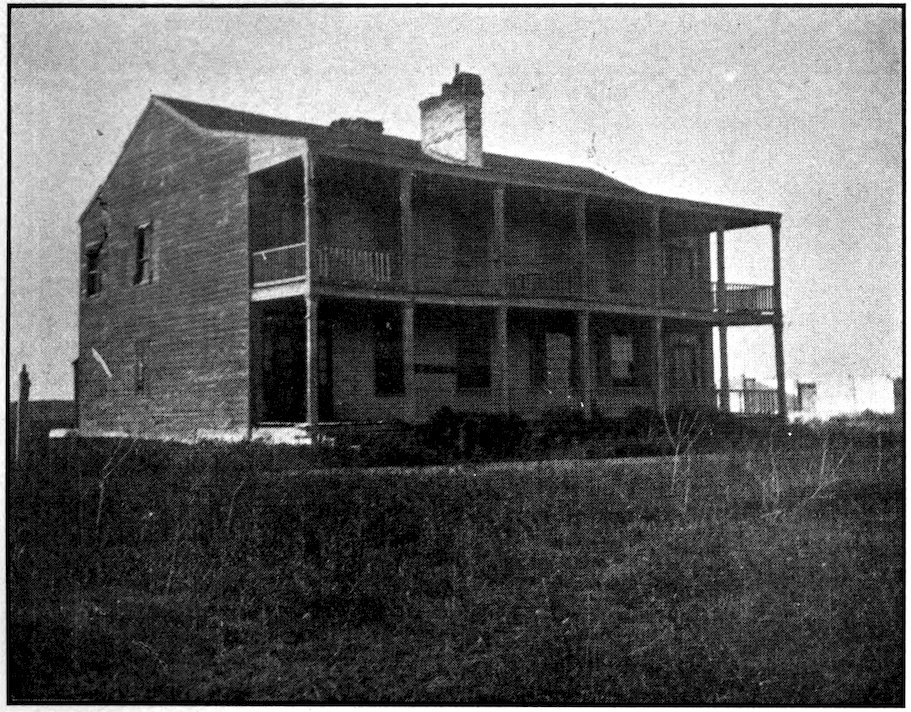
7.—“OLD BEDLAM”—SITE OF FORT LARAMIE.
353Monetary disturbances had made business stagnant
all over the country from 1837 to 1841. Many had gone
to the wall, and had been compelled to see their homes
turned over to others. The hard times were felt keenest
in the then farthest west. They were so far inland that
commercial intercourse with the rest of the world was
almost totally cut off. What traffic they had was carried
on by slow, laborious and expensive processes. Railroad
building had not progressed so as to give a hope, hardly
even an intimation, of its wonderful solution of the
problem of maintaining a high civilization far inland.
By going to Oregon they would, as they thought of it,
again be on the open shores of the greater sea, within
easy reach of the highway of the civilizations of the world.
Not often, perhaps, were their motives formulated. These
were allowed to rest in their minds in the most naive
form of impulse. Col. Geo. B. Currey, in his “Occasional
Address” before the Pioneer Association, in 1887, endorses
the following as the best reason he ever got. It
was, as he says, “from a genuine westerner,” who said
he came “because the thing wasn’t fenced in, and nobody
dared to keep him out.”
The western border of Missouri was the natural jumping
off place for the plunge into the wilderness. The
settlements there had extended out like a plank beyond
the line of the border elsewhere. The Ohio and the Missouri,
with a short stretch of the Mississippi, had furnished
the line of least resistance to the westward movement.
Each recurring spring tide from 1842 on witnessed the
gathering of hosts at points on the Missouri, from Independence,
near the confluence of the Kansas with the
Missouri, north to what is now Council Bluffs. They
354were enamored with one idea, that of making homes in
far away Oregon. This part of the border was also the
starting line for the California and the Mormon migrations.
The California movement was only sporadic until
1849. This was seven years after the Oregon movement
had become regular. The Mormons first struck across
the continent in 1847.
Independence and Westport, just south of the Missouri’s
great bend to the east, were the gateway of the
earliest regular travel and traffic across the plains.
These towns are now the suburbs of Kansas City. The
Oregon migrations of 1842 and 1843 were formed exclusively
in this vicinity. The old Santa Fe trail led by these
settlements. From these points, too, the fur trading
companies conducted expeditions annually to the upper
waters of the Green River beyond the Rocky Mountains.
The route was up the south side of the Kansas River
some fifty miles, then turning to the right, the river was
forded or ferried and a general northwest course adhered
to, more direct for Oregon.
Beginning in 1844 Saint Joseph, then a thriving border
town, situated on the river some fifty miles to the north
of the first jumping off places, became an important fitting
out place. Those who took steamboat passage to
the border would naturally wish to make as much of the
distance to Oregon in that way as possible. The vicinity
of Saint Joseph seemed to furnish excellent facilities
for securing the necessary ox teams and other needs for
the trip. The Saint Joseph route, too, was a more direct
one for those coming across the country from Iowa,
Illinois and Indiana. After 1850 the Council Bluffs’
route had the largest transcontinental travel. Weston
and old Fort Kearney, the present Nebraska City, both
on the Missouri, the former between Independence and
Saint Joseph and the latter between Saint Joseph and
Council Bluffs were minor points of departure. Smaller
companies would cross the river wherever there was a
ferry.
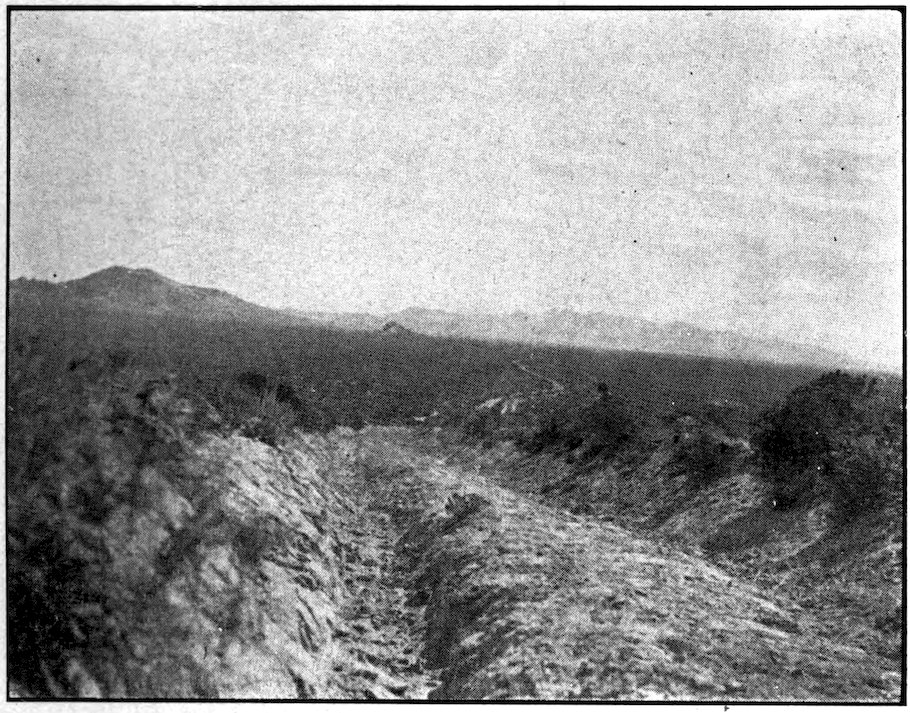
8.—The Trail leading down to bottom lands of the Sweetwater.
355Steamboating on the treacherous Missouri during
those spring seasons while the tide of emigration was
strongly westward set is given a lurid hue in the journals
of the emigrants. The river route was the natural
one for all coming from Ohio and the states to the east,
also for many coming from Indiana.
One entry made during this part of the trip in 1852
reads as follows: “We have a bar on our boat, too, and
that is visited about as often as any other place I know of.
A son of temperance is a strange animal on this river, I
can assure you. I think there are three or four sons on
the boat, and the rest, about five hundred people, like a
dram as often as I would like to drink a little water. * * * We get a little scared sometimes, for we hear
of so many boats blowing up. There was another boat
blown up at Lexington last Saturday and killed one hundred
and fifty persons, the most of which were emigrants
for California and Oregon. These things make us feel
pretty squally, I can assure you, but it is not the way to
be scared beforehand. So we boost our spirits up and
push on. * * * Got to Lexington at 12 o’clock.
There we found the wrecks of the boat that blew up five
days ago. There were about two hundred people aboard,
and the nearest we could learn about forty persons escaped
unhurt, about forty were wounded and the balance
were killed.”
The man who kept this journal fitted out with a company
at Saint Joseph. The company planned to drive
up the east side of the Missouri and cross at old Fort
Kearney. But, finding the roads too bad on that route,
they made for a ferry ten miles north of Saint Joseph.
356I quote from his account of their experiences in getting
across the river: “Went up to the ferry. Mr. H—‘s and
Mr. S—’s wagons went over safe. Then Mr. S—’s family
wagon and five yoke of cattle and all of Mr. S—’s family
except two boys went on the ferry boat, and when they
were about one-half way across the boat began to sink.
They tried to drive the cattle off, but could not in time
to save the boat from sinking. My family are still on
the east side and I—S— with his teams. We witnessed
the scene and could do nothing. Mrs. S— and the baby
and next youngest were all under water, but the men of
the boat got into the river and took them out, and the rest
of the family got upon the wagon cover and saved themselves
from drowning. A Mr. R— jumped overboard
and thought he could swim to shore, but was drowned.
He was one of Mr. S—’s hired hands. By the assistance
of one of the other boats the rest were saved, but we
thought from where we were that it was impossible that
they could all be saved. Well, I paid a man fifteen cents
for taking my wife and little children across in a skiff.
They have no skiff at the ferry, but they have three good
ferryboats that they work by hand. But the people here
are as near heathens as they can be, and they go for shaving
the emigrants, and then they spend it for whiskey
and get drunk and roll in it. But we are all over on the
west shore of the Missouri and in Indian territory.”
For those congregated hosts, encamped each early
spring at different points along the banks of the Missouri,
and intent as soon as grass had grown to be sufficient for
their stock to sally forth on a two thousand mile passage
to the Valley of the Willamette, the natural features of
the continent pointed out just one general route to travel.
This road, so clearly marked out by the configuration of
the country for all using their mode of conveyance, lay
up the Valley of the Platte; its tributary, the Sweetwater;
through South Pass; across to the Valley of the
Snake, the tributary of the Columbia; following down
the course of the Snake to its great bend to the north;
across to the Columbia; down the Columbia to their
destination.
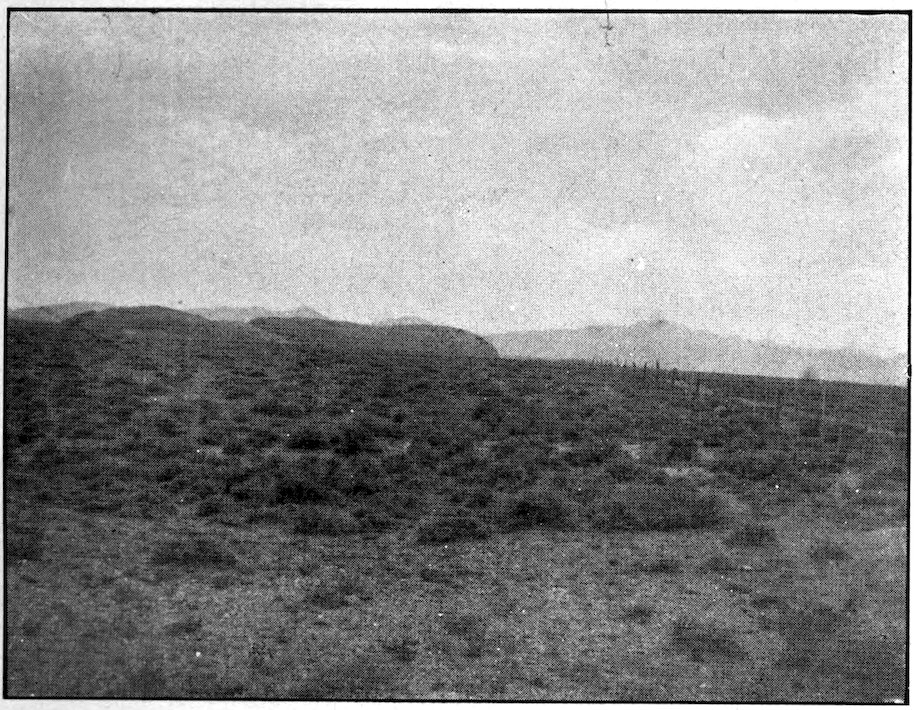
357Those sections of the trail which constitute connecting
links, as it were, to the grander portions, can be
accounted for almost as clearly as the main sections can.
Forage and water must be regularly available to those
traveling with horses, mules or oxen. These must be
found in great abundance by those who are driving considerable
droves over long stretches of arid wastes. In
summer months, on the unsettled parched plains, these
resources were insured only along river or creek bottoms.
So in striking out from Independence or Saint Joseph for
the Valley of the Platte to the north, to economize in the
distance traveled to the Oregon goal, and insure supplies
of the prime requisites—good water and grass—their
course would be such as to bring them to nightly camps
on the banks of one of the numerous streams flowing
into the Kansas. Passing one they would make for a
higher point on the next to the west so as to keep in a
more direct line for Oregon. Fuel, so necessary for preparing
their meals, was in that region found only on the
banks of these streams. Along the Platte, the North
Fork, and the Sweetwater “buffalo chips” sufficed fairly
well the need of fuel, except the night was wet. In
moving from the South Pass to the basin of the Columbia,
mountainous country made a direct route impracticable.
In the detour to the southwest the valleys of
the tributaries of the Upper Green were utilized, and
particularly the most convenient northwest course of the
Bear River. The details of the course in this detour
were determined by the stepping stones, as it were, of
water, grass and wood. These were found in that desert
358region, too, only in the river and creek bottoms. On
issuing from the South Pass, then, the valleys of the
Little Sandy, Big Sandy, and the Green itself, had to be
followed, with such crossings from one to the other as
were feasible, and were in the interests of economy in
distance, until they struck a tributary coming in from
the west, up which a passage could be made and the
divide crossed, bringing them into the Valley of the
Bear, a part of the Great Salt Lake Basin. The Valley
of the Bear has a general northwest direction of some
seventy-five miles from where they usually entered it.
It was in every way a natural road to them to the point
where it makes its bend to the south. At this bend was
the first fork made in early times by the California trail’s
turning off to the south. The divide at this point between
the Basin of the Great Salt Lake and the Valley of
the Snake was comparatively easy. The Snake River
Valley, with its barren wastes, deep precipitous canyons,
sharp lava rocks, made a trying portion of the route.
There were several optional routes. None so acceptable
as the Platte Valley had furnished. To follow the
Snake in its long bend to the north would have led them
far out of their way, so they took the available valleys
of the Burnt and Powder rivers that led them farthest
on their way towards the westerly flowing Umatilla, a
tributary of the Columbia. They thus not only kept on
in a comparatively direct line towards the Valley of the
Willamette, but were also afforded water, grass and
wood so necessary for further endurance of the now well
fagged transcontinental wayfarers. But the Blue Mountains
lay across this short cut and gave them their first
real experience in climbing steep mountain sides. From
the crest of these mountains the way to their goal lay
down hill, except they chose a road across the Cascade
Mountains. But whether they took the Barlow Road or
dared the dangers of the gorge of the Columbia, the
darkest, sternest trials were yet to be faced by the now
weak and famished pioneers. They were, however,
veterans now, and if succored with fresh supplies from
settlers in the Willamette Valley and the strength of
their cattle sufficed, no difficulties, however stupendous,
could daunt them.
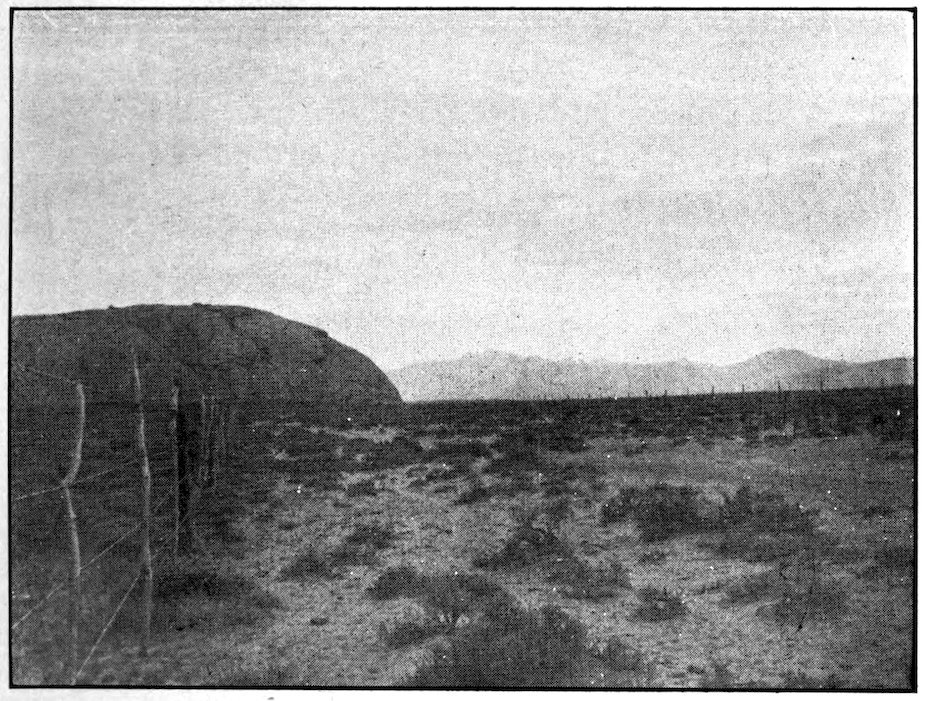
10.—WEST END OF INDEPENDENCE ROCK.
359On the whole, those home-seeking pioneers, as they
lay encamped on the banks of the Missouri, could congratulate
themselves that no specially stupendous natural
obstacles had been interposed in that immense
stretch that lay between them and their destination.
There was only the interminableness of it, and the facts
that it was to be entered upon while the fierce pelting
spring storms of wind, rain and hail were liable to be of
daily and nightly occurrence; that muddy sloughs would
cause breakdowns, and freshet-swollen streams would be
fraught with danger; that there would then be four
months in which the fierce burning, blistering sun would
have them at its mercy, and a dense, stifling dust would
enhance their misery during the midday hours to the
point of wretchedness, and no bathroom in the evening
in which to find relief; that in the later and almost final
days of the journey they would probably be exposed in
approximate nakedness to the searching blasts of the
oncoming winter, fortunate if they were not caught and
held fast in mountain snows. Withal, they knew it would
be a lumbering trudge with ox teams that would take
them all summer and far into the autumn.
Each recurring spring season family or neighborhood
groups who had determined to try their fortunes in Oregon
would move out to one of the points of departure on
the Missouri border. They would soon find themselves
a part of a larger aggregation. Generally there was no
more prearrangement for this meeting than there is
360among birds that flock for a migration. All who constituted
the company from any one point had simply selected
the same jumping off place.
When the grass had grown abundant enough to furnish
subsistence for their stock and draft animals, those
who were ready with their outfit would begin to file out
on the prairie trails converging upon the main Oregon
road. After having traveled a day or two a halt was
called by those in advance to await the coming up of
others who proposed to undertake the same trip with
themselves. The American instinct for organization
would then assert itself, and there was occasion for its
activity. They were in an Indian country. It was not
wise to tempt the predatory propensities of the savages
by too much straggling in their traveling or by too much
unwariness in guarding their cattle and horses. In
order to avoid molestation by prowling bands of Pawnees,
Otoes, Cheyennes and Sioux, through whose ranges
the trail east of the Rockies passed, it was necessary to
travel in companies of some size and with such discipline
as to be able to establish an effective guard at night and
to make some demonstration of force when encountering
considerable bands of Indian warriors.
There was much economy, too, in bunching their
several droves of loose stock into a single herd, in having
a single lookout for selecting camping places, in the help
that each would receive in case of accidents that all were
liable to. Very essential, too, were organization and
discipline when they came to a bank of a large stream
across which their trail led. With the earlier migrations
before printed guide books were available, organization
was necessary to secure the services of a pilot.
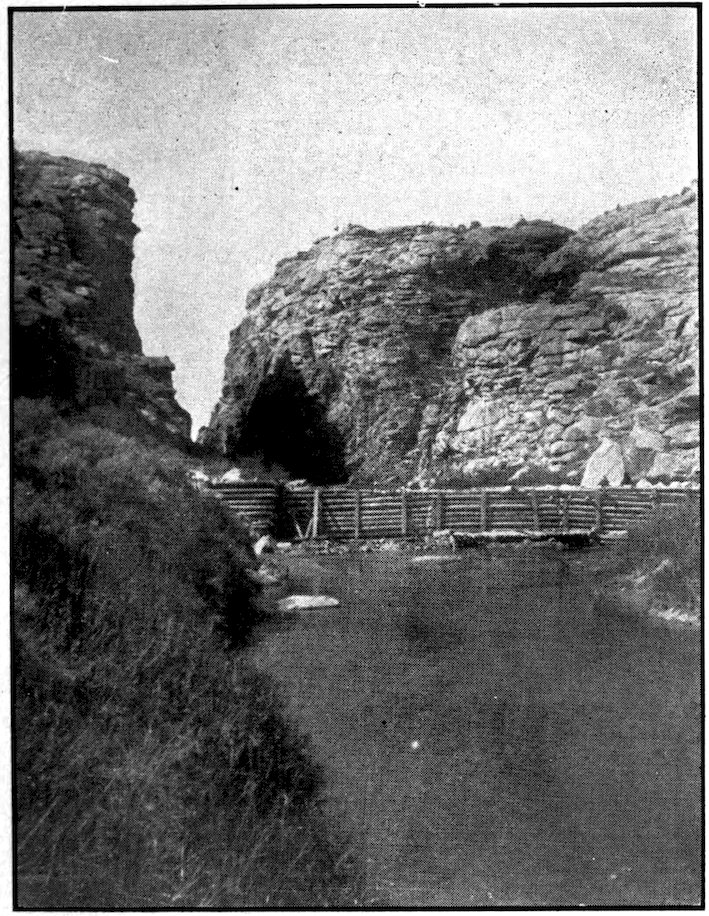
11.—“DEVIL’S GATE,”
Showing dam for leading out an irrigating ditch.
The first large migrations—those of 1843 and 1844,
and even of 1845—erred in attempting to go as one
compact body. The difficulty of securing adequate
361grazing was much enhanced as the company increased
in size. From this fact and the further fact that in case
of a hitch or accident of any kind in a large company,
many would be delayed who could be of no service in
getting things fixed up for a fresh start, it resulted that
twenty or thirty wagons were the maximum limit to the
size of companies that did not chafe under their organization.
In later years six or eight wagons were a
normal number for a company. Even in the earlier
migrations, when the Upper Sweetwater was reached
and the danger from the Indians was measurably past,
the large companies would divide up into sections. The
earlier migrations, too, took precautions that no person
attached himself to the train unless he was furnished
with such resources as to rations and transportation that
he would not likely become a common burden.
The records of the migrations give ample corroboration
to the truth of the adage, “Uneasy lies the head,
etc.,” and yet these privately penned diaries disclose
comparatively little bickering or unwholesome feeling,
notwithstanding the severe strain human nature was
under in the conditions of this four, five, and sometimes
six months’ passage. Whenever conditions developed
making advisable a division of the body into two or
more, the division was made, and all was smooth again.
The documentary material printed in this number of the
Quarterly throws light on this phase of their experience
and depicts the unique proceedings of the pioneers of
1843 in effecting an organization.
The type of the transcontinental pioneer changed
materially after the gold-seeker was in the majority.
From 1849 on the diarist’s account is not devoid of the
tragical. “These plains try and tell all the dark spots
in men,” says Rev. Jesse Moreland in his journal of the
trip from Tennessee to Oregon in 1852. He describes
362evidence of three executions for murder by hanging.
He says: “As they had nothing to make a gallows out
of, they took two wagon tongues, put them point to
point and set a chair in the middle, and the man stood
on the chair till the rope was tied, and then the chair
was taken from under him. This is the third we have
heard of being hanged.”
Before 1849, while the Oregon movement still constituted
the great part of the transcontinental travel, and
a fierce commercial spirit was not yet dominant, the
humanity of the pioneers seemed to stand remarkably
well the strain incident to the experiences on the plains.
Their journals do not reveal half the irritation and
demoralization that the accounts of Parkman and of
Coke do in companies that had vastly better outfits and
were passing over the same routes.
The average company of immigrants in pulling through
the miry sloughs of the Missouri bottom lands in early
spring, with only partly broken ox teams, would break a
wagon tongue, an axle tree, or a wheel, and suffer more
or less exasperating delay. The fierce spring storms of
rain and hail would play havoc with their tent coverings,
and drench and pelt all who must stand outside to prevent
the teams and stock from stampeding. These freshets
would make impassable, for the time being, the numerous
streams of the Kansas and Nebraska prairies. With
the feeling that they must not over-exert their teams mere
trifles even were allowed to delay them during the first
four or five hundred miles of the journey.
Except they had some one like a Doctor Whitman
with them to persistently urge them to “travel, travel,”
as the only condition of getting through, there would be
too much loitering in the early stages of the journey.
Those who entered upon the trip in later years had more
nearly an adequate sense of the vastness of the distance
they must cover, and wasted no time in the initial stages.
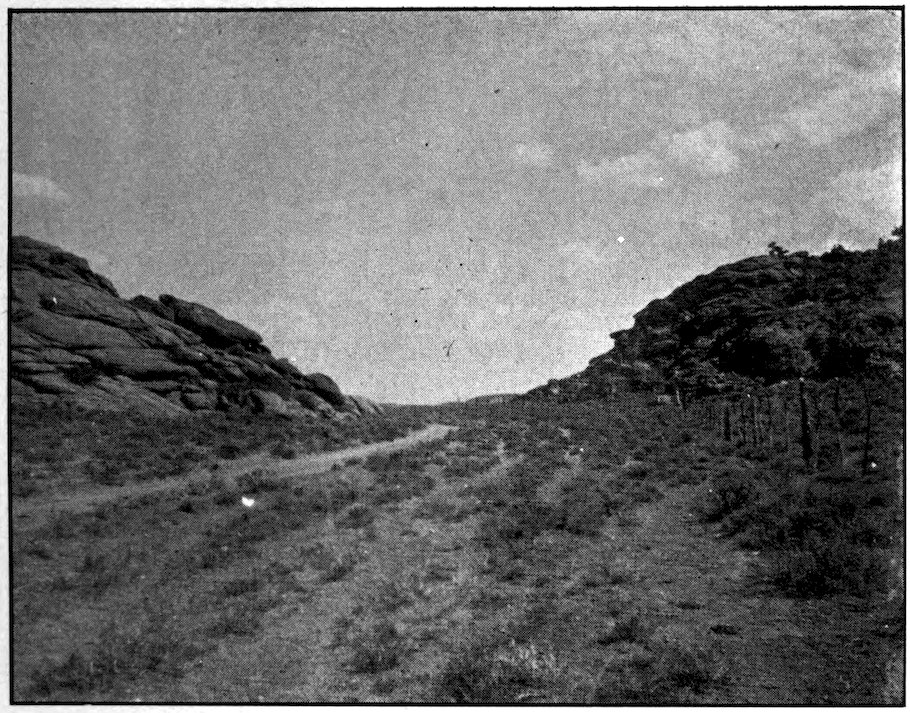
12.—Gap just south of Devil’s Gate—used for the Trail.
363Especially the migration of 1849, and to some degree
those of 1850 and 1852, were in deepest dismay over the
presence among them of the dreadful scourge of cholera.
The trail was lined in places along the south side of the
Platte through the width of rods with mounds of freshly
made graves after these migrations had passed.
The Hon. F. A. Chenoweth, in his “Occasional Address”
before the Oregon Pioneer Association, in 1882,
gives the following account of the ravages of the cholera
among the trains of 1849:
“But the incidents of hardship which I have noticed
were the merest trifles compared to the terrible calamity
that marked with sadness and trailed in deep desolation
over that ill-fated emigration. Very soon after the assembled
throng took up its march over the plains the
terrible wave of cholera struck them in a way to carry
utmost terror and dismay into all parts of the moving
mass.
The number of fatally stricken, after the smoke and
dust were cleared away, was not numerically so frightful
as appeared to those who were in the midst of it. But
the name “cholera” in a multitude unorganized and
unnumbered is like a leak in the bottom of a ship whose
decks are thronged with passengers. The disturbed
waters of the ocean, the angry elements of nature, when
aroused to fury, are but faint illustrations of the terror-stricken
mass of humanity, when in their midst are falling
with great rapidity their comrades—the strong, the
young and the old—the strength and vigor of youth
melting away before an unseen foe. All this filled our
ranks with the utmost terror and gloom. This terrible
malady seemed to spend its most deadly force on the
flat prairie east of and about Fort Laramie.
One of the appalling effects of this disease was to
364cause the most devoted friends to desert, in case of
attack, the fallen one. Many a stout and powerful man
fought the last battle alone on the prairie. When the
rough hand of the cholera was laid upon families they
rarely had either the assistance or the sympathy of their
neighbors or traveling companions.
There was one feature mixed with all this terror that
afforded some degree of relief, and that was that there
was no case of lingering suffering. When attacked, a
single day ordinarily ended the strife in death or recovery.
A vast amount of wagons, with beds and blankets,
were left by the roadside, which no man, not even an
Indian, would approach or touch through fear of the
unknown, unseen destroyer.
While there were sad instances of comrades deserting
comrades in this hour of extreme trial, I can not pass
this point of my story without stating that there were
many instances of heroic devotion to the sick, when such
attention was regarded as almost equivalent to the offering
up of the well and healthy for the mere hope of
saving the sick and dying.”
Not a few who had purposed to go to California that
year turned off on the Oregon road to escape the contagion
which the dense crowd seemed to afford this
disease. Excepting in these cholera years and in 1847
there were only infrequent cases of mountain fever and
forms of dysentery that were developed in the alkali
regions of the mountains.
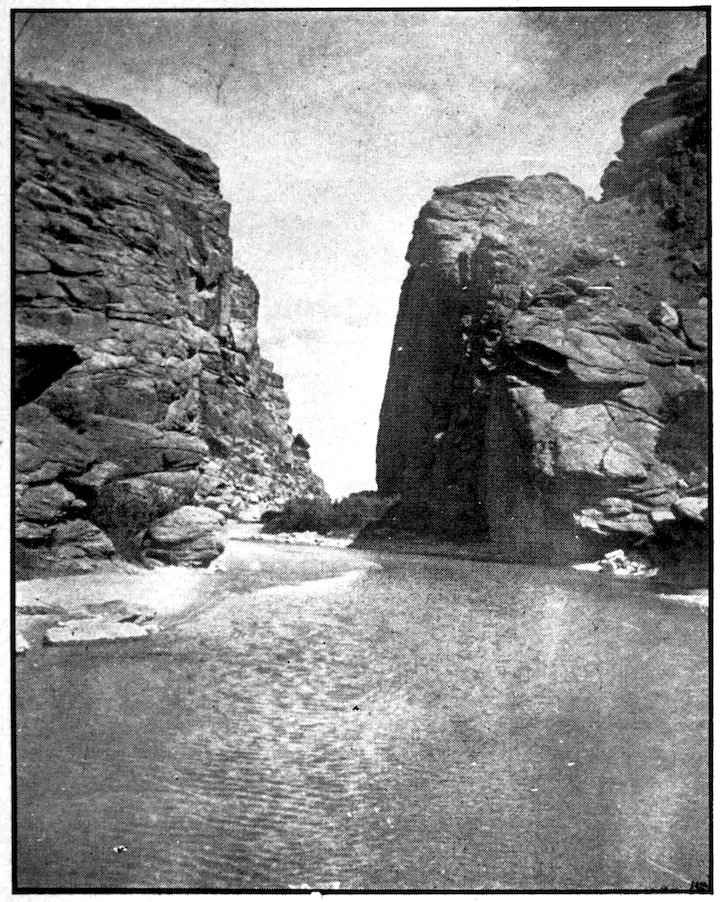
13.—“DEVIL’S GATE,” AS SEEN FROM ABOVE.
A train of pioneers with sensible outfit emerging into
the valley of the Platte in a season free from the cholera
affliction could almost make it for a time a grand pleasure
excursion. The heat was not yet oppressive, the roads
good, the air exhilarating, the boundless expanse of green
undulating prairie under crystal skies filled them with a
sense of freedom. The exciting buffalo hunt was soon
365on and afforded them a welcome addition to a diet exceedingly
unvaried at best. After the usual trudge during
the day amid a panorama not yet monotonous the
wagons would be driven to form approximately a circle—the
end of the tongue or the front wheel of one lapping
the hind wheel of the wagon in front, according as a more
or less spacious corral was desired. The oxen would be
unyoked and taken to water and then to the selected
grazing spot. Fires would be kindled alongside each
wagon outside of the corral for preparing the evening
meal. After it was partaken of there would be an hour or
two before darkness settled down upon them. Then the
cattle would be brought within the corral, if there was
the least apprehension of danger, and all except the
guards for the first watch and possibly the matrons with
multitudinous family cares would quickly surrender themselves
to sleep. But congenial groups of young people
would generally have a social hour or two. A blanket
or extra wagon covering was thrown on the ground beside
the wagon, and, when rain threatened, spread under the
wagon. (Most were probably without tents other than
the canvas tops of their wagons.) This with something
for a covering sufficed for the beds of the young men and
boys. In the morning at a given signal all were astir—and,
if the cattle had not strayed during the night or
been stampeded by Indians, breakfast over, everything
was soon in readiness for falling in, each in his appointed
place, and taking up the march that should bring them
a day nearer to their Oregon home. But this idyllic succession
of days very soon developed a very seamy side.
The sun’s rays became more and more scorching in
their fierceness, the plains assumed a dull, leaden grayish
aspect. The sagebrush and cactus took the place of
the waving grass. The burning sand and stifling dust
became deeper. These the west wind would raise into
366a cloud continuous from morning until night. This
cloud of sand and dust particles beating against them at
a terrific velocity they had to face all day. Soon eyes
and lips were sore. To relieve the uncomfortable feeling
that the parching air gave the lips they would unwisely
be moistened and the soreness thus extended and
deepened. Soon everything was obdurately begrimed.
Rags then were in evidence. Shoes worn so as to no
longer protect the feet. In the dry, scorching air the
wagons would develop loose joints and lose their tires.
The monotony was relieved by lying by a day now
and then during which the women would wash and mend
the clothes and the men repair wagons and hunt buffalo,
the meat of which would be jerked to furnish a supply
after they had passed beyond the limits of the buffalo
country. The buffalo did not commonly range west of
the Lower Sweetwater.
The experiences which the buffalo gave them were
not limited to the fine sport of hunting him and the
delicious feasts his steaks afforded. His presence seemed
to kindle into life the old ancestral wildness of the ox
and the horse. Without the least warning some sedate
member of a team would raise his head and give the old
racial snort of freedom. This would kindle the same
spark in every animal of the train, and away they
would stampede with wagons, inmates and all, and not
to be stopped until utterly exhausted. In these stampedes
people would be run over, bones would be broken,
oxen dehorned, their legs broken, and things demolished
generally. The simple-minded pioneer with any tendency
to personify could not help but believe that the
devil had gotten into his hitherto always tractable
animals. I quote a pioneer’s account of a stampede,
though he does not ascribe it to the presence or influence
of the buffalo, as is almost always done: “After passing
Devil’s Gate, a beautiful stretch of road lay before us.
All at once the teams broke into a run—something
started them, no one seemed to know what. It was a
regular stampede as to our team. Father and mother
were walking; I was walking also, and some of the
children were in the wagon. Away the team went, the
hardest and the wildest running I ever saw. When
they stopped and we caught up with them, we found the
children were not hurt, but the two wheelers were down
and one of them dead. It took our team a long time to
get over the scare.”
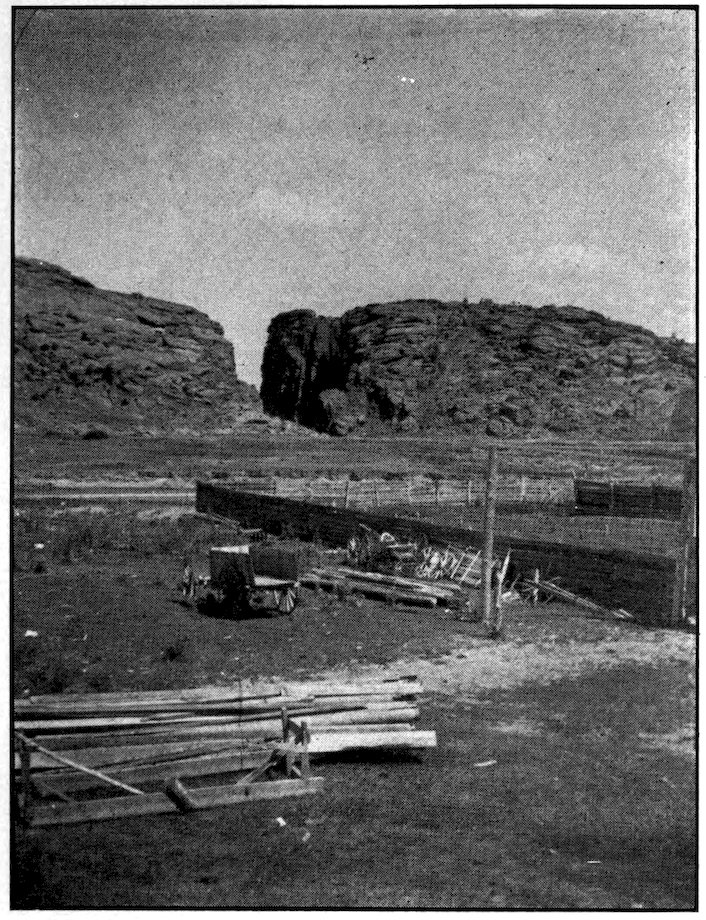
14.—“DEVIL’S GATE,” FROM SOME DISTANCE ABOVE.
367There was still another condition in which the spirit
of the buffalo made the pioneer show deference to it.
This happened when a great horde of buffalo was on a
stampede bearing down upon an emigrant train that
happened to be passing across its trail. The moment
was almost enough to bring dismay to the pioneer.
Either the teams of the train were urged into something
of a stampede to get out of line of the horde’s advance,
or a corral was formed and volleys fired into the impending
mass to divide it so as to leave the corral a safe
island between a destructive flood rolling by on either
hand.
Distressing accidents must almost of necessity befall
them from their carrying their loaded guns commingled
with household goods on their wagons. It is not
strange that at least half of the journals should have
records of fatalities thus caused. Under the law of
mathematical probabilities, with the frequent occasion
there was to remove gun or blanket thus intermixed,
while the members of the family were standing around
the wagon, accidents must occur. The small boy of the
family during this four or five months’ trip had very
many occasions to clamber out of and into the wagon
while it was in motion. He, too, would come to grief
368with a broken leg. Any ordinary fracture, however,
even though there were no surgeon at hand, would be
attended to, so that no deformity resulted. If the case
was one seeming to require an amputation “a butcher
knife and an old dull hand saw” were improvised as
surgical instruments. But I have not found that a
patient survived such an operation and got well. The
other great epochal events of family life, marriages and
births, were not infrequent on the trail, and seemed to
cause little distraction.
The experiences of the pioneers in crossing the rivers
in the line of the trail were very diverse. It is reported
of one of the migrations that they were not compelled
to ferry until they reached the Des Chutes in Oregon.
But the migration of 1844 had a serious time even with
the Black Vermillion and Big Blue, tributaries of the
Kansas. Where logs were available they were hollowed
out and catamaran rafts made so as to fit the wheels of a
wagon. Sometimes the best wagon boxes would be
selected and caulked and used as flatboats. Where buffalo
skins were plentiful they would be stretched around
the wagon box to make it water-tight. In later stages
of the journey, after their teams were more reliable, it
was a common practice to raise the wagon beds several
inches above the bolsters, if the depth of the stream
required it, couple several teams into a train with the
most reliable in front on a lead-rope, and drivers along
the down-stream side of the other teams. They would
then ford as trains. After the rush in 1849 ferries were
established at the more important crossings, whose owners
reaped rich harvests.
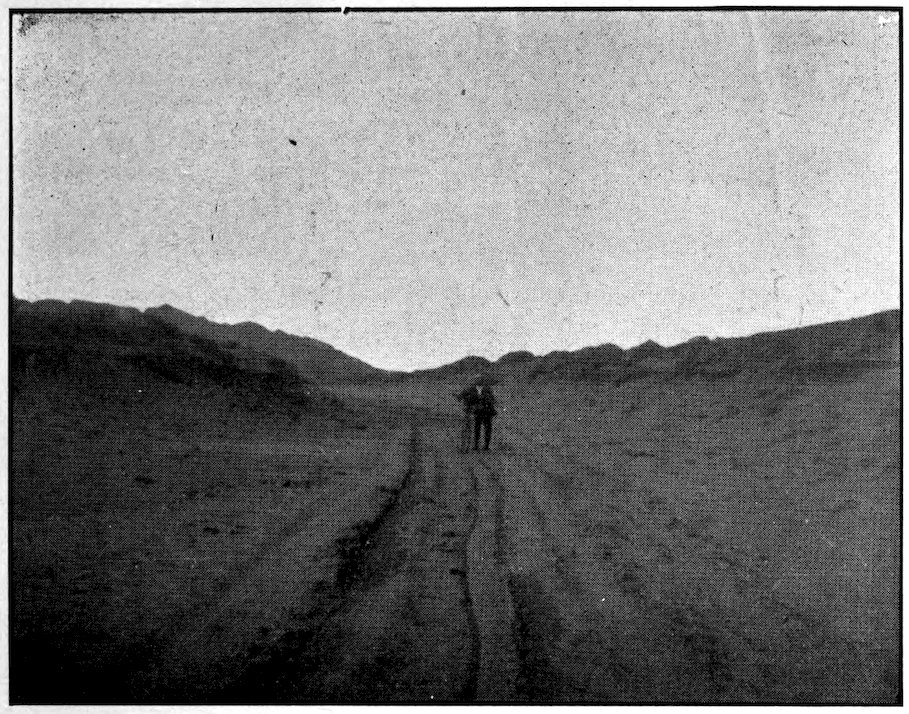
15.—The deeply worn Trail along the Sweetwater.
Their route had no rich diversity of scenic grandeur.
There are most impressive natural features along the
line of it, but with their slow mode of travel one phase
became exceedingly monotonous before another was
369reached. There were the vastness and solitude of the
prairies and plains, the transparency of the atmosphere
that gave magnificent sweep of view. Along the North
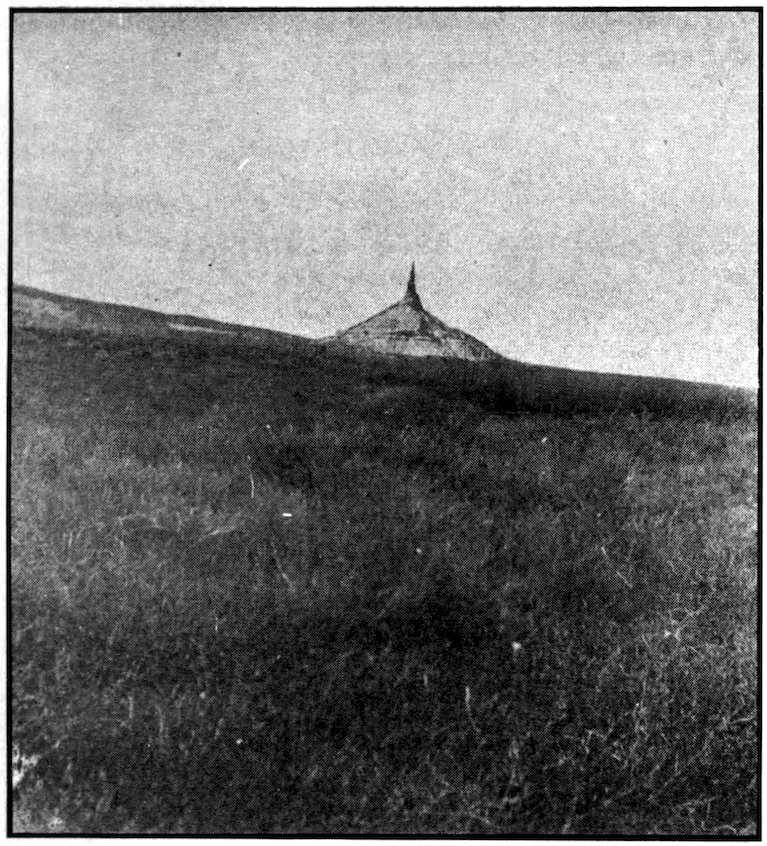
Fork of the Platte stood great sentinel rocks with interesting
sculptured proportions. Among these are the
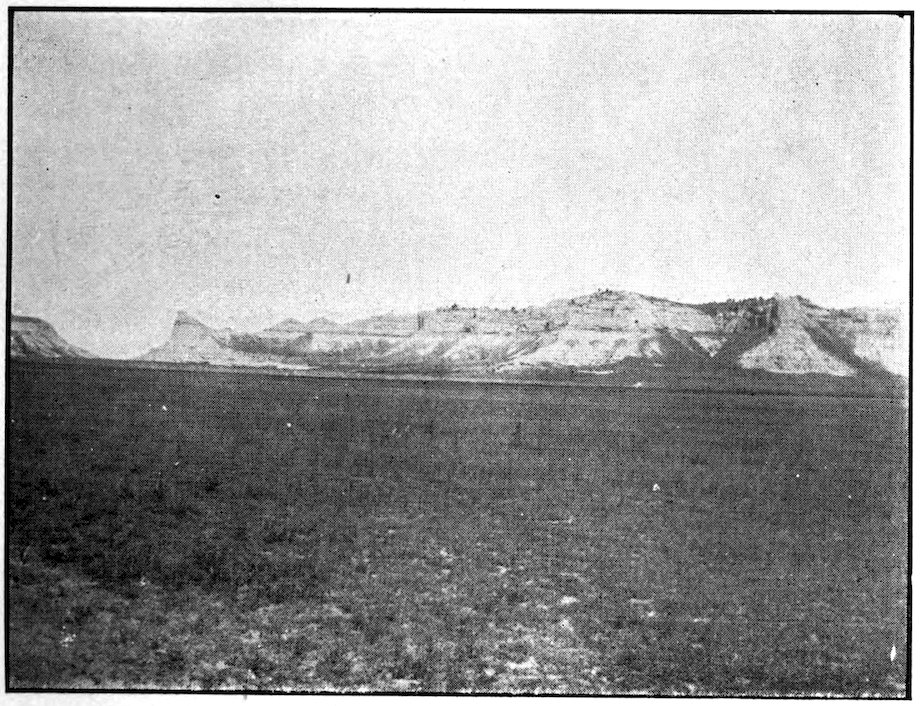
Lone or Court House Rock, Chimney Rock, Castle Rock,
Steamboat Rock, and Scott’s Bluff. Farther along on
their journey they come to Independence Rock and
Devil’s Gate on the Sweetwater, one a huge basaltic
mound upon which with tar or with iron chisels they
would register their names; the other a most unique
breach in a granitic range with sides two hundred feet
high, through which the Sweetwater flows. A week or
two later they would have the exhilarating sense of standing
on the backbone of the continent in South Pass, with
the towering Wind River Mountains to their right and
the Oregon buttes to their left. A few miles on they
would drink from the Pacific springs and know they
were in what was then called Oregon. Scenery most
unique was still before them on their way. Some of it,
like the panorama from the divide between the Green
and the Bear rivers and the Soda Springs, they would
enjoy. But their march from the South Pass on was a
retreat. Oxen would fall helpless in their yokes, wagons
would become rickety beyond repair. The trail was
strewn with wreckage, and the stench from the dead
cattle was appalling. The watering places along the
Snake were contaminated by the stock that had perished.
As soon as they reached the Blue Mountains their stock
was safe from starvation, but the exertion required of
their way-worn and weak oxen on the steep grades now
before them was the last straw often that these creatures
now could not bear. They could not let them recruit;
the season was far advanced towards winter; they must
press on.
370Data for determining the numbers that came across
the plains to Oregon during the successive years are as
yet very unsatisfactory. The estimates given below for
1842 and 1843 are well founded, but the others, especially
from 1847 on, are from no very tangible basis.
At the close of 1841 the Americans in Oregon numbered
possibly four hundred.
| The immigration of 1842 estimated from |
105 to |
137 |
| The immigration of 1843 estimated from |
875 to |
1,000 |
| The immigration of 1844 estimated about |
|
700 |
| The immigration of 1845 estimated about |
|
3,000 |
| The immigration of 1846 estimated about |
|
1,350 |
The above figures are taken quite closely from those
given by Elwood Evans in his address before the Pioneer
Association in 1877. I make the immigration of 1844,
however, seven hundred, instead of four hundred and
seventy-five, as he gives it.
| The immigration of 1847 between |
4,000 and 5,000 |
| The immigration of 1848 about |
700 |
| The immigration of 1849 about |
400 |
| The immigration of 1850 about |
2,000 |
| The immigration of 1851 about |
1,500 |
| The immigration of 1852 about |
2,500 |
No doubt this one summer on the plains was an ordeal
under which some sensitive natures were strained
and weakened for life. It may be, too, that living for five
or six months, as families, on the simplest, barest necessities
of life, fixed standards of living lower than they otherwise
would have been. The effect, however, on strong,
resourceful natures of these months on the plains could
not have been other than salutary. The pioneers, when
they started, were most distinctively American in their
characteristics. As such they needed to be socialized.
No better school could have been devised than the organization
and regimen of the trip across the plains for socializing
their natures.
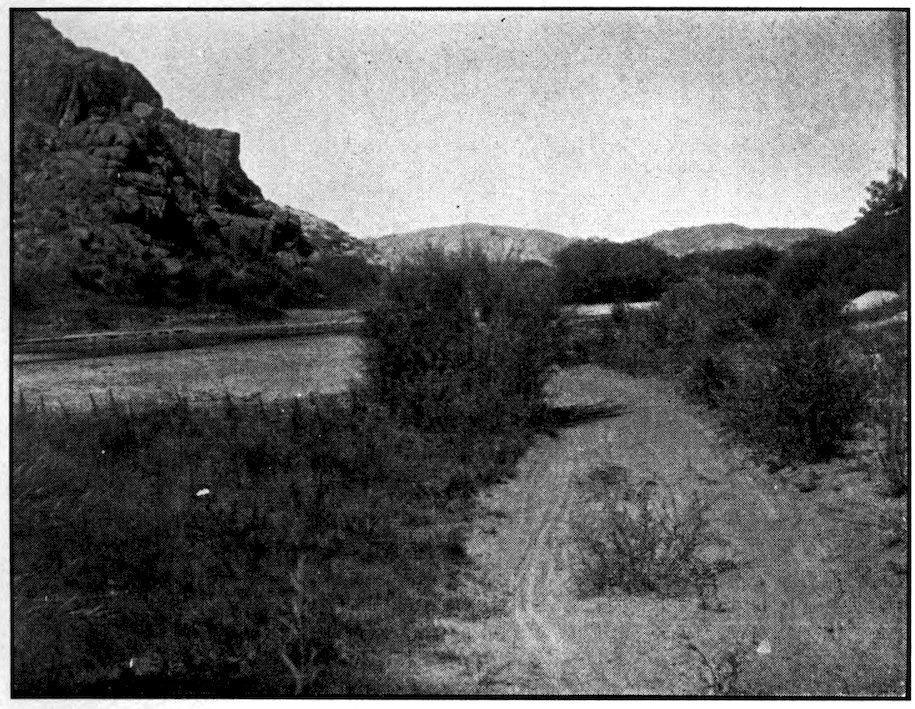
16.—The “Three Crossings” of the Sweetwater.
371
A DAY WITH THE COW COLUMN IN 1843.
By JESSE APPLEGATE.
(Read before the Oregon Pioneer Association in 1876; reprinted from transactions of that society.)
The migration of a large body of men, women and
children across the continent to Oregon was, in the year
1843, strictly an experiment; not only in respect to the
members, but to the outfit of the migrating party. Before
that date, two or three missionaries had performed the
journey on horseback, driving a few cows with them,
three or four wagons drawn by oxen had reached Fort
Hall, on Snake River, but it was the honest opinion of
the most of those who had traveled the route down
Snake River, that no large number of cattle could be
subsisted on its scanty pasturage, or wagons taken over
a country so rugged and mountainous.
The emigrants were also assured that the Sioux would
be much opposed to the passage of so large a body through
their country, and would probably resist it on account of
the emigrants’ destroying and frightening away the buffaloes,
which were then diminishing in numbers.
The migrating body numbered over one thousand
souls, with about one hundred and twenty wagons,
drawn by six-ox teams, averaging about six yokes to the
team, and several thousand loose horses and cattle.
The emigrants first organized and attempted to travel
in one body, but it was soon found that no progress
could be made with a body so cumbrous, and as yet so
372averse to all discipline. And at the crossing of the “Big
Blue” it divided into two columns, which traveled in
supporting distance of each other as far as Independence
Rock on the Sweetwater.
From this point, all danger from Indians being over,
the emigrants separated into small parties better suited
to the narrow mountain paths and small pastures in
their front.
Before the division on the Blue River there was some
just cause for discontent in respect to loose cattle. Some
of the emigrants had only their teams, while others had
large herds in addition, which must share the pasture
and be guarded and driven by the whole body. This
discontent had its effect in the division on the Blue.
Those not encumbered with or having but few loose
cattle attached themselves to the light column; those
having more than four or five cows had of necessity to
join the heavy or cow column. Hence the cow column,
being much larger than the other and much encumbered
with its large herds, had to use greater exertion and observe
a more rigid discipline to keep pace with the more
agile consort. It is with the cow column that I propose
to journey with the reader for a single day.
It is four o’clock A. M.; the sentinels on duty have
discharged their rifles—the signal that the hours of sleep
are over—and every wagon and tent is pouring forth its
night tenants, and slow-kindling smokes begin largely
to rise and float away in the morning air. Sixty men
start from the corral, spreading as they make through
the vast herd of cattle and horses that make a semicircle
around the encampment, the most distant perhaps two
miles away.
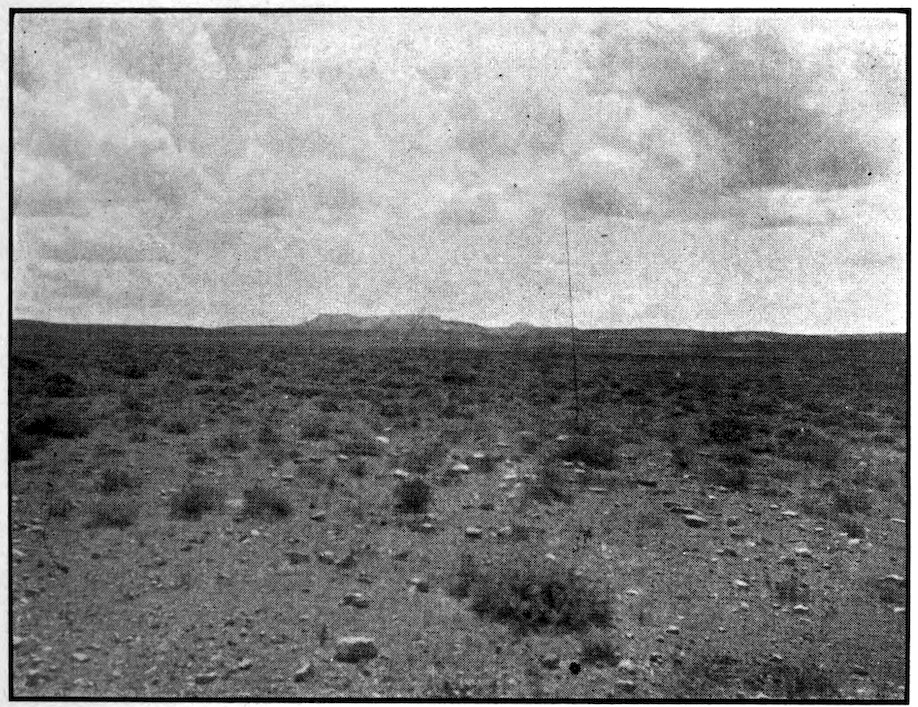
17.—“Oregon Buttes,”—taken from South Pass.
The herders pass to the extreme verge and carefully
examine for trails beyond, to see that none of the animals
have strayed or been stolen during the night. This
373morning no trails led beyond the outside animals in
sight, and by 5 o’clock the herders begin to contract the
great, moving circle, and the well-trained animals move
slowly towards camp, clipping here and there a thistle or
a tempting bunch of grass on the way. In about an
hour five thousand animals are close up to the encampment,
and the teamsters are busy selecting their teams
and driving them inside the corral to be yoked. The corral
is a circle one hundred yards deep, formed with
wagons connected strongly with each other; the wagon
in the rear being connected with the wagon in front by
its tongue and ox chains. It is a strong barrier that the
most vicious ox cannot break, and in case of an attack of
the Sioux would be no contemptible intrenchment.
From 6 to 7 o’clock is a busy time; breakfast is to be
eaten, the tents struck, the wagons loaded and the teams
yoked and brought up in readiness to be attached to their
respective wagons. All know when, at 7 o’clock, the
signal to march sounds, that those not ready to take
their proper places in the line of march must fall into
the dusty rear for the day.
There are sixty wagons. They have been divided
into fifteen divisions or platoons of four wagons each,
and each platoon is entitled to lead in its turn. The
leading platoon today will be the rear one tomorrow,
and will bring up the rear unless some teamster, through
indolence or negligence, has lost his place in the line, and
is condemned to that uncomfortable post. It is within
ten minutes of seven; the corral but now a strong barricade
is everywhere broken, the teams being attached to
the wagons. The women and children have taken their
places in them. The pilot (a borderer who has passed
his life on the verge of civilization and has been chosen
to the post of leader from his knowledge of the savage
and his experience in travel through roadless wastes),
374stands ready, in the midst of his pioneers and aids, to
mount and lead the way. Ten or fifteen young men, not
today on duty, form another cluster. They are ready to
start on a buffalo hunt, are well mounted and well armed,
as they need be, for the unfriendly Sioux have driven the
buffalo out of the Platte, and the hunters must ride fifteen
or twenty miles to reach them. The cow drivers are
hastening, as they get ready, to the rear of their charge,
to collect and prepare them for the day’s march.
It is on the stroke of seven; the rush to and fro, the
cracking of whips, the loud command to oxen, and what
seemed to be the inextricable confusion of the last ten
minutes has ceased. Fortunately every one has been
found and every teamster is at his post. The clear notes
of a trumpet sound in the front; the pilot and his guards
mount their horses; the leading divisions of the wagons
move out of the encampment, and take up the line of
march; the rest fall into their places with the precision
of clock work, until the spot so lately full of life sinks
back into that solitude that seems to reign over the broad
plain and rushing river as the caravan draws its lazy
length towards the distant El Dorado. It is with the
hunters we shall briskly canter towards the bold but
smooth and grassy bluffs that bound the broad valley,
for we are not yet in sight of the grander but less beautiful
scenery (of Chimney Rock, Court House and other
bluffs, so nearly resembling giant castles and palaces),
made by the passage of the Platte through the highlands
near Laramie. We have been traveling briskly for more
than an hour. We have reached the top of the bluff, and
now have turned to view the wonderful panorama spread
before us. To those who have not been on the Platte,
my powers of description are wholly inadequate to convey
an idea of the vast extent and grandeur of the picture,
and the rare beauty and distinctness of the detail. No
haze or fog obscures objects in the pure and transparent
atmosphere of this lofty region. To those accustomed
only to the murky air of the seaboard, no correct judgment
of distance can be formed by sight, and objects
which they think they can reach in a two hours’ walk
may be a day’s travel away; and though the evening
air is a better conductor of sound, on the high plain during
the day the report of the loudest rifle sounds little
louder than the bursting of a cap; and while the report
can be heard but a few hundred yards, the smoke of the
discharge may be seen for miles. So extended is the
view from the bluff on which the hunters stand, that
the broad river glowing under the morning sun like a
sheet of silver, and the broader emerald valley that
borders it, stretch away in the distance until they narrow
at almost two points in the horizon, and when first
seen, the vast pile of the Wind River Mountains though
hundreds of miles away, looks clear and distinct as a
white cottage on the plain.
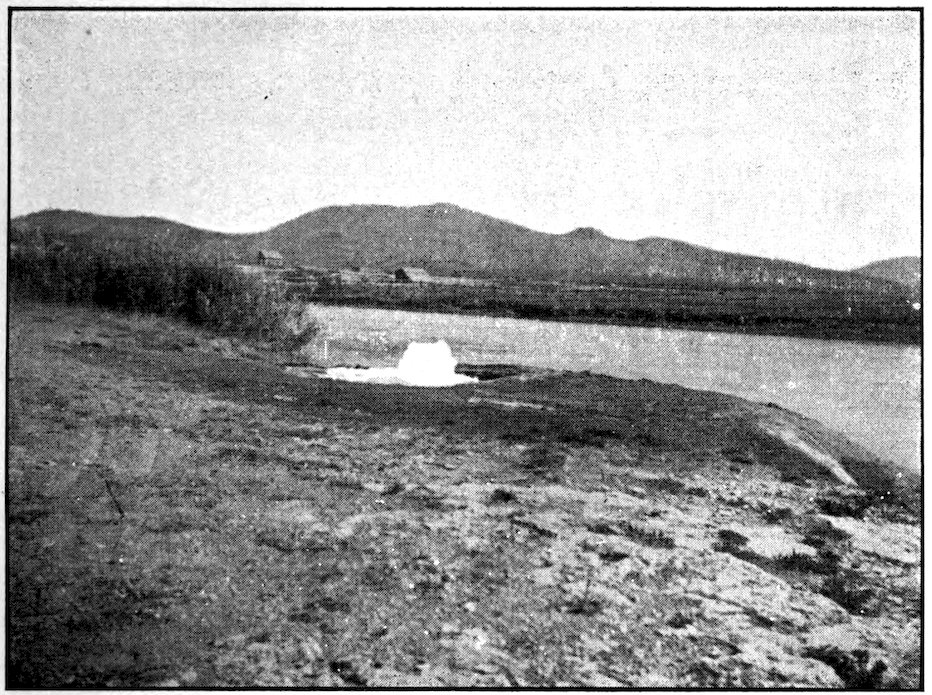
18.—“STEAMBOAT SPRING” ON THE BANKS OF THE BEAR RIVER.
375We are full six miles away from the line of march;
though everything is dwarfed by distance, it is seen distinctly.
The caravan has been about two hours in motion
and is now as widely extended as a prudent regard
for safety will permit. First, near the bank of the shining
river is a company of horsemen; they seem to have
found an obstruction, for the main body has halted while
three or four ride rapidly along the bank of the creek or
slough. They are hunting a favorable crossing for the
wagons; while we look they have succeeded; it has
apparently required no work to make it passable, for all
but one of the party have passed on, and he has raised
a flag, no doubt a signal to the wagons to steer their
course to where he stands. The leading teamster sees
him, though he is yet two miles off, and steers his course
directly towards him, all the wagons following in his
376track. They (the wagons) form a line three-quarters of
a mile in length; some of the teamsters ride upon the
front of their wagons, some march beside their teams;
scattered along the line companies of women are taking
exercise on foot; they gather bouquets of rare and
beautiful flowers that line the way; near them stalks a
stately greyhound, or an Irish wolf dog, apparently
proud of keeping watch and ward over his master’s wife
and children. Next comes a band of horses; two or
three men or boys follow them, the docile and sagacious
animals scarce needing this attention, for they have
learned to follow in the rear of the wagons, and know
that at noon they will be allowed to graze and rest.
Their knowledge of time seems as accurate as of the
place they are to occupy in the line, and even a full-blown
thistle will scarce tempt them to straggle or halt
until the dinner hour has arrived. Not so with the
large herd of horned beasts that bring up the rear;
lazy, selfish and unsocial, it has been a task to get them
in motion, the strong always ready to domineer over the
weak, halt in the front and forbid the weak to pass
them. They seem to move only in the fear of the
driver’s whip; though in the morning, full to repletion,
they have not been driven an hour before their hunger
and thirst seem to indicate a fast of days’ duration.
Through all the long day their greed is never satisfied,
nor their thirst quenched, nor is there a moment of
relaxation of the tedious and vexatious labors of their
drivers, although to all others the march furnishes some
season of relaxation or enjoyment. For the cow drivers
there is none.
But from the standpoint of the hunters, the vexations
are not apparent; the crack of whips and loud objurgation
are lost in the distance. Nothing of the moving
panorama, smooth and orderly as it appears, has more
attractions for the eye than that vast square column in
which all colors are mingled, moving here slowly and
there briskly, as impelled by horsemen riding furiously
in front and rear.
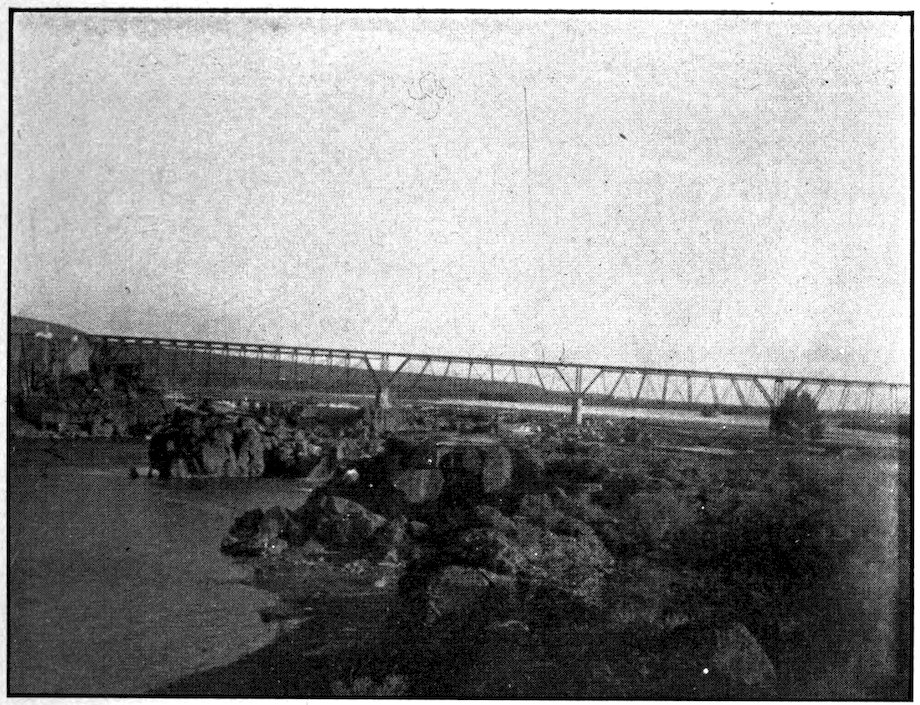
19.—“AMERICAN FALLS.”
Railroad bridge of the “Oregon Short Line.”
377But the picture in its grandeur, its wonderful mingling
of colors and distinctness of detail, is forgotten in
contemplation of the singular people who give it life and
animation. No other race of men with the means at
their command would undertake so great a journey, none
save these could successfully perform it, with no previous
preparation, relying only on the fertility of their own invention
to devise the means to overcome each danger and
difficulty as it arose. They have undertaken to perform
with slow-moving oxen a journey of two thousand miles.
The way lies over trackless wastes, wide and deep rivers,
ragged and lofty mountains, and is beset with hostile
savages. Yet, whether it were a deep river with no tree
upon its banks, a rugged defile where even a loose horse
could not pass, a hill too steep for him to climb, or a
threatened attack of an enemy, they are always found
ready and equal to the occasion, and always conquerors.
May we not call them men of destiny? They are people
changed in no essential particulars from their ancestors,
who have followed closely on the footsteps of the receding
savage, from the Atlantic seaboard to the great Valley
of the Mississippi.
But while we have been gazing at the picture in the
valley, the hunters have been examining the high plain
in the other direction. Some dark moving objects have
been discovered in the distance, and all are closely watching
them to discover what they are, for in the atmosphere
of the plains a flock of crows marching miles away, or a
band of buffaloes or Indians at ten times the distance
look alike, and many ludicrous mistakes occur. But
these are buffaloes, for two have struck their heads together
378and are, alternately, pushing each other back.
The hunters mount and away in pursuit, and I, a poor
cow-driver, must hurry back to my daily toil, and take
a scolding from my fellow herders for so long playing
truant.
The pilot, by measuring the ground and timing the
speed of the wagons and the walk of his horses, has determined
the rate of each, so as to enable him to select
the nooning place, as nearly as the requisite grass and
water can be had at the end of five hours’ travel of the
wagons. Today, the ground being favorable, little time
has been lost in preparing the road, so that he and his
pioneers are at the nooning place an hour in advance of
the wagons, which time is spent in preparing convenient
watering places for the animals, and digging little wells
near the bank of the Platte, as the teams are not unyoked,
but simply turned loose from the wagons, a corral is not
formed at noon, but the wagons are drawn up in columns,
four abreast, the leading wagon of each platoon on the
left, the platoons being formed with that in view. This
brings friends together at noon as well as at night.
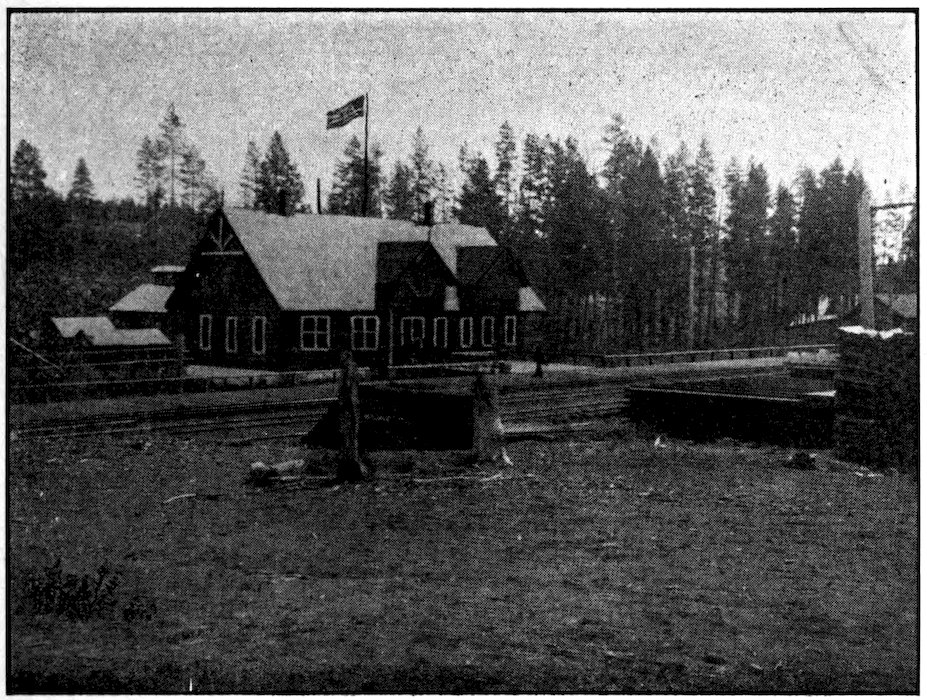
20.—Near summit of Blue Mountains—Meacham Station of O. R. & N. R. R. on the Trail, and site of “Lee Encampment.”
Today an extra session of the council is being held,
to settle a dispute that does not admit of delay, between
a proprietor and a young man who has undertaken to do
a man’s service on the journey for bed and board. Many
such engagements exist, and much interest is taken in
the manner in which this high court, from which there
is no appeal, will define the rights of each party in such
engagements. The council was a high court in the most
exalted sense. It was a senate composed of the ablest
and most respected fathers of the emigration. It exercised
both legislative and judicial powers, and its laws
and decisions proved it equal and worthy of the high
trust reposed in it. Its sessions were usually held on
days when the caravan was not moving. It first took the
379state of the little commonwealth into consideration; revised
or repealed rules defective or obsolete, and enacted
such others as the exigencies seemed to require. The
common weal being cared for, it next resolved itself into
a court to hear and settle private disputes and grievances.
The offender and the aggrieved appeared before
it; witnesses were examined, and the parties were heard
by themselves and sometimes by counsel. The judges
being thus made fully acquainted with the case, and being
in no way influenced or cramped by technicalities,
decided all cases according to their merits. There was
but little use for lawyers before this court, for no plea
was entertained which was calculated to hinder or defeat
the ends of justice. Many of these judges have since
won honors in higher spheres. They have aided to establish
on the broad basis of right and universal liberty two
pillars of our great Republic in the Occident. Some of
the young men who appeared before them as advocates
have themselves sat upon the highest judicial tribunals,
commanded armies, been governors of states and taken
high position in the senate of the nation.
It is now one o’clock; the bugle has sounded and the
caravan has resumed its westward journey. It is in the
same order, but the evening is far less animated than
the morning march; a drowsiness has fallen apparently
on man and beast; teamsters drop asleep on their
perches and even when walking by their teams, and the
words of command are now addressed to the slowly
creeping oxen in the soft tenor of women or the piping
treble of children, while the snores of the teamsters
make a droning accompaniment. But a little incident
breaks the monotony of the march. An emigrant’s wife,
whose state of health has caused Doctor Whitman to
travel near the wagon for the day, is now taken with
violent illness. The Doctor has had the wagon driven
380out of the line, a tent pitched and a fire kindled. Many
conjectures are hazarded in regard to this mysterious
proceeding, and as to why this lone wagon is to be left
behind. And we too must leave it, hasten to the front
and note the proceedings, for the sun is now getting low
in the west and at length the painstaking pilot is standing
ready to conduct the train in the circle which he has
previously measured and marked out, which is to form
the invariable fortification for the night. The leading
wagons follow him so nearly around the circle that but
a wagon length separates them. Each wagon follows
in its track, the rear closing on the front, until its tongue
and ox chains will perfectly reach from one to the other,
and so accurate the measure and perfect the practice,
that the hindmost wagon of the train always precisely
closes the gateway, as each wagon is brought into position.
It is dropped from its team (the teams being inside
the circle), the team unyoked and the yokes and
chains are used to connect the wagon strongly with that
in its front. Within ten minutes from the time the leading
wagon halted, the barricade is formed, the teams
unyoked and driven out to pasture. Every one is busy
preparing fires of buffalo chips to cook the evening
meal, pitching tents and otherwise preparing for the
night. There are anxious watchers for the absent wagon,
for there are many matrons who may be afflicted
like its inmate before the journey is over; and they fear
the strange and startling practice of this Oregon doctor
will be dangerous. But as the sun goes down the absent
wagon rolls into camp, the bright, speaking face
and cheery look of the doctor, who rides in advance, declare
without words that all is well, and both mother
and child are comfortable. I would fain now and here
pay a passing tribute to that noble and devoted man,
Doctor Whitman. I will obtrude no other name upon
the reader, nor would I his were he of our party or even
living, but his stay with us was transient, though the
good he did was permanent, and he has long since died
at his post.
21.—Falls of the Willamette—the objective point of the pioneers.
381From the time he joined us on the Platte until he
left us at Fort Hall, his great experience and indomitable
energy were of priceless value to the migrating
column. His constant advice, which we knew was based
upon a knowledge of the road before us, was, “Travel,
travel, TRAVEL; nothing else will take you to the end of
your journey; nothing is wise that does not help you
along; nothing is good for you that causes a moment’s
delay.” His great authority as a physician and complete
success in the case above referred to, saved us
many prolonged and perhaps ruinous delays from similar
causes, and it is no disparagement to others to say
that to no other individual are the emigrants of 1843 so
much indebted for the successful conclusion of their
journey as to Dr. Marcus Whitman.
All able to bear arms in the party have been formed
into three companies, and each of these into four watches;
every third night it is the duty of one of these companies
to keep watch and ward over the camp, and it is so arranged
that each watch takes its turn of guard duty
through the different watches of the night. Those forming
the first watch tonight will be second on duty, then
third and fourth, which brings them through all the
watches of the night. They begin at 8 o’clock P. M.,
and end at 4 o’clock A. M.
It is not yet 8 o’clock when the first watch is to be
set; the evening meal is just over, and the corral now
free from the intrusion of cattle or horses, groups of
children are scattered over it. The larger are taking a
game of romps; “the wee toddling things” are being
taught that great achievement that distinguishes man
382from the lower animals. Before a tent near the river a
violin makes lively music, and some youths and maidens
have improvised a dance upon the green; in another
quarter a flute gives its mellow and melancholy notes to
the still night air, which, as they float away over the
quiet river, seem a lament for the past rather than a
hope for the future. It has been a prosperous day;
more than twenty miles have been accomplished of the
great journey. The encampment is a good one; one of
the causes that threatened much future delay has just
been removed by the skill and energy of that “good
angel” of the emigrants, Doctor Whitman, and it has
lifted a load from the hearts of the elders. Many of
these are assembled around the good doctor at the tent
of the pilot (which is his home for the time being), and
are giving grave attention to his wise and energetic
counsel. The care-worn pilot sits aloof, quietly smoking
his pipe, for he knows the brave doctor is “strengthening
his hands.”
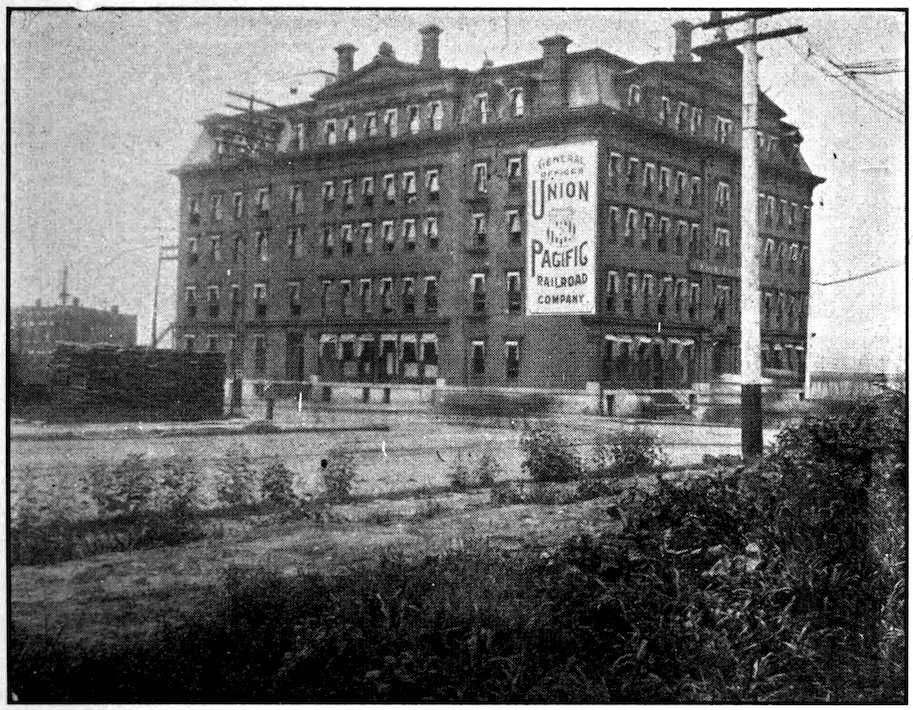
22.—The Union Pacific Building, Omaha,—site of one of the “jumping off” points for Oregon.
But time passes; the watch is set for the night; the
council of old men has been broken up, and each has returned
to his own quarter; the flute has whispered its
last lament to the deepening night; the violin is silent,
and the dancers have dispersed; enamored youth have
whispered a tender “good night” in the ear of blushing
maidens, or stolen a kiss from the lips of some future
bride—for Cupid here, as elsewhere, has been busy bringing
together congenial hearts, and among these simple
people he alone is consulted in forming the marriage tie.
Even the doctor and the pilot have finished their confidential
interview and have separated for the night. All
is hushed and repose from the fatigues of the day, save
the vigilant guard and the wakeful leader, who still has
cares upon his mind that forbid sleep. He hears the 10
o’clock relief taking post and the “all well” report of the
383returned guard; the night deepens, yet he seeks not the
needed repose. At length a sentinel hurries to him with
the welcome report that a party is approaching—as yet
too far away for its character to be determined, and he
instantly hurries out in the direction in which it was
seen. This he does both from inclination and duty, for
in times past the camp had been unnecessarily alarmed
by timid or inexperienced sentinels, causing much confusion
and fright amongst women and children, and it
had been a rule that all extraordinary incidents of the
night should be reported directly to the pilot, who alone
had the authority to call out the military strength of the
column, or of so much of it as was in his judgment necessary
to prevent a stampede or repel an enemy. Tonight
he is at no loss to determine that the approaching party
are our missing hunters, and that they have met with
success, and he only waits until by some further signal
he can know that no ill has happened to them. This is
not long wanting. He does not even await their arrival,
but the last care of the day being removed, and the last
duty performed, he too seeks the rest that will enable
him to go through the same routine tomorrow. But here
I leave him, for my task is also done, and unlike his, it
is to be repeated no more.
Note—A Correction—Col. George B. Currey was the author of
“The Tribute to the Ox Whip,” not Col. George L. Curry, as printed
in this number.
384
COL. GEORGE L. CURRY’S TRIBUTE TO THE OX WHIP.
(Reprinted from Transactions of the Oregon Pioneer Association.)
My task is to call from dust and dark forgetfulness
that advance banner of Americanism and progress—the
ox whip. Its crack was the command “Forward to the
nation.” Its sharp, keen accent proclaimed that obstacles
to prayers must be overcome. It waved aloft on the
prairies of the “Old West,” and pointing to the new, a
vast throng took up the westward march, which, keeping
step to the music of destiny, dashed across the broad
Missouri, rolled a living tide up the grassy slope of the
Platte, scaled the imperial heights of the Rocky Mountains,
and with “the tread of a giant and shout of a conquerer”
defied the heat, dust, thirst and hunger, the
desert heart of the continent, leaped the Blue Mountains,
paused but quailed not on the banks of the deep,
wide Columbia, where again the potential crack is heard
and the mighty, “rock-ribbed” walls of the Cascades are
stormed, and as the line rolls bravely over the giddy summit
the exultant driver gives a grand triumphant crack
into the stolid face of grand old Hood, the storm-clad
sentinel of the mountain fastness. The people have
reached their goal. The spell is broken. The errand has
lost its magic, its mission has been accomplished. A
state, with freedom’s diadem effulgent on its brow salutes
the eye, and dipping its young hand in the Pacific completes
the baptism of human liberty and proclaims an
“ocean-bound republic.” All hail and honor to the ox
whip, the symbol of the grand, achieving force of its
age.
23.—Street, Oregon City,—about where the pioneers broke ranks.
385
THE CAMP FIRES OF THE PIONEERS.
VINCERE EST VIVERE!
By SAM L. SIMPSON.
[Reprinted from Transactions of Pioneer Association.]
Striking at ease his epic lyre,
The laureled Mantuan has sung
Beleagured Troy’s illustrious pyre—
The daring sail Æneas flung
To wayward gales, the voyage long
That tracks the silver wave of song;
Until the worn and weary oar
Has kissed the far Lavinian shore;
The Argo’s classic pennon streams
Along sweet horizons of dreams,—
The Mayflower has furled her wings,
And restfully at anchor swings—
Columbia chants to columned seas
The triumph of the Genoese,
And yet, stout hearts, no fitting meed
Of panegyric crowns your deed
From which a stately empire springs.
The minions of a perfumed age
Already crowd upon the stage,—
The massive manhood of the past
In many a graceful mould is cast;
And yet with calm and kindly eyes
You view the feast for others spread,
And hail the blue benignant skies
Resigned and grandly comforted.
It was for this you broke the way
Before the sunset gates of day—
For this, with godlike faith endued,
You scaled the misty crags of fate,
And, with resounding labors, hewed
The Doric pillars of the state.
There is no task for you to do—
Your tents are furled, the bugle blown—
But yet another day, and you
Will live in clustered fame alone.
The fir will chant a song of rue,
The pine will drop a wreath, may be,
And o’er the dim Cascades the stars
Will nightly roll the gleaming cars
You followed well from sea to sea.
Before your scarred battalion’s wheel
Into the mystic realm of shade,
And on your grizzled brows the seal
Of mystery is softly laid,
386Once more around your old campfires,
That smoulder like fulfilled desires,
Rehearse the story of your toils
Display the hero crowned with spoils—
The glimmer of triumphant steel,
Beneath the garland and the braid.
O, further than the legions bore
The eagles of Imperial Rome—
Three thousand miles, a weary march,
You followed Hesper’s golden torch,
Until it stooped on this green shore,
And lit the rosy fires of home.
It was a solemn morn you turned
And quenched the sacred flames that burned
On hearths endeared for years and years;
It seemed your very souls grew dark
With those sweet fires—the latest spark
Was drowned in bitter, bitter tears.
A softer, sweeter sunlight wrapt
The forms of all familiar things,
And as each cord of feeling snapt
Another angel furled its wings:
The lights and shadows in the lane,
The oak beside the foot-worn stile
Whose wheeling shades a weary while
Had told the hours of joy and pain—
The vine that clambered o’er the door
And many a purple cluster bore—
The vestal flowers of household love—
The sloping roof that wore the stain
Of summer sun and winter rain,
And smoky chimney tops above—
The beauty of the orchard trees,
Bedecked with blossoms, glad with bees—
The brook that all the livelong day
Had many things to sing and say—
All these upon your vision dwell
And weave the sorrow of farewell.
And now the last good-bye is said—
Good-bye! the living and the dead
In those sad words together speak,
And all your chosen ways are bleak!
Forward! The cracking lashes send
A thrill of action down the train,—
Their brawny necks the oxen bend
With creaking yoke and clanking chain;
The horsemen gallop down the line,
And swerve around the lowing kine
That straggle loosely on the plain—
And lift glad hands to babes that laugh
And dash the buttercups like chaff.
Hurrah! the skies are jewel blue—
In tasseled green and braided gold
The robes of April are enrolled,
387And hopes are high and hearts are true!
Hurrah! hurrah! the bold, the free—
The sudden sweep of ecstacy
That lifts the soul on wings of fire,
When fears consume and doubts expire,
And life, in one red torrent, leaps
To join the march of boundless deeps!
And now the sun is dropping down
And lights and shadows, red and brown
Are weaving sunset’s purple spell:
The teams are freed, the fires are made,
Like scarlet night flow’rs in the shade,
And pleasant groups before, between,
Are thronging in the fitful sheen—
The day is done, and “all is well.”
So pass the days, so fall the nights;
A banquet of renewed delights;
The old horizons lift and pass
In magic changes like a dream,
And in the heavens’ azure glass
Tomorrow’s jasper arches gleam—
With many a vale and mountain mass,
And many a singing, shining stream.
The post is dead and daisied now—
In shadow fades from heart and brow—
The air is incense, and the breeze
Is sweet with siren melodies,
And all the castled hills before
In blooming vistas sweep and soar
Like silver lace, the clouds are strewn
Along the distant, dreamy zone;
It is a happy, happy time,
As wayward as a poet’s rhyme,
And ever as the sun goes down
The west is shut with rosy bars,
And Night puts on her golden crown
And fills the vases of the stars.
A hundred nights, a hundred days,
Nor folded cloud nor silken haze
Mellow the sun’s midsummer blaze.
Along a brown and barren plain
In silence drags the wasted train;
The dust starts up beneath your tread,
Like angry ashes of the dead,
To blind you with a choking cloud
And wrap you in a yellow shroud.
There are no birds to sing your joy,
You have no joy for birds to sing,—
A hundred fangs your hearts destroy—
A thousand troubles fret and sting.
The desert mocks you all the while
With that dry shimmer of a smile
That dazzles on a bleaching skull,—
388The bloom is withered on your cheek
You slowly move and lowly speak,
And every eye is dim and dull.
Alas, it is a lonesome land
Of bitter sage and barren sand
Under a bitter, barren sky
That never heard the robin sing,
Nor kissed the larks’s exultant wing,
Nor breathed a rose’s fragrant sigh!
A weary land—alas! alas!
The shadows of the vultures pass—
A spectral sign across your path;
The gaunt, gray wolf, with head askance
Throws back at you a scowlling glance
Of cringing hate and coward wrath.
And like a wraith accursed and banned
Fades out before your lifted hand;
A dim, sad land, forgot, forsworn
By all bright life that may not mourn—
Acrazed with glist’ning ghosts of seas
In broideries of flower and trees,
And rivers, blue and cool, that seem
To ripple as in fevered dream—
Only to taunt the thirst, and fly
From withered lips and lurid eye.
A hundred days, a hundred nights—
The goal is farther than before,
And all the changing shades and lights
Are wrought in fancy’s woof no more.
The sun is weary overhead,
And pallid deserts round you spread
A sorrowful eternity;
And if some grisly mountain here
Confront your march with forms of fear,
You turn aside and pass them by.
And all are overworn—the flesh
Is now a frayed and faded mesh
That will not mask the inward flame;
There is no longer any care
To round the speech, or speak men fair,
Or any gentle sense of shame;
The hearts of all are shifted through—
The grain drops through the windy husks
And false lights flick’ring round the true
Are quenched at last in dews and dusk.
And some are silent, some are loud
And rage like beasts among the crowd,—
And some are mild, and some are sharp
In word and deed, and snarl and carp,
And fret the camp with petty broils;
And some of temper, sweet and bland,
Do seem to bear a magic wand
That wins the secret of their toils—
Rare souls that waste like sandal-wood
In many a fragrant deed and mood;
And some invoke the wrath of God,
389Or feign to kiss the burning rod,—
And some, may be, with better prayers,
Stand up in all their griefs and cares
And clinch their teeth, and do and die
Without a whine, a curse or cry.
And so the dust and grit and stain
Of travel wears into the grain;
And so the hearts and souls of men
Were darkly tried and tested then
That, in the happy after years,
When rainbows gild remembered tears,
Should any friend inquire of you
If such or such an one you knew—
I hear the answer, terse and grim,
“Ah, yes; I crossed the plains with him!”
And, lo! a moaning phantom stands,
To greet you in the lonely lands,
Among all lesser shadows, dight
With spoils of death; his meager hands
Salute you as you pass, and claim
The sacrifice that feeds his flame.
The march has broken into flight,
And wreck and ruin strew the road
The flaming phantom has bestrode;
The ox lies gasping in his yoke
Beside the wagon that he drew—
Where the forsaken campfires smoke
To hopeless skies of tawny blue;
And here are straight, still mounds that mark
The flight of life’s delusive spark—
The somber points of pause that lie
So thick in human destiny.
And oh, so dark on this bleak page
Of drifting sand and dreary sage!
The sultry levels of the day,
The night with weird enchantment fills,
And frowning forests stretch away
Along the slopes of shadow hills;
And in the solemn stillness breaks
The wild-wolf music of the plain,
As if a deeper sorrow wakes
The dreary dead in that refrain
That swells and gathers like a wail
Of woe from Pluto’s ebon pale,
And sinks in pulseless calm again.
A change at last!—an opal mist
Along the faint horizon’s rim
Is banked against the amethyst
Of summer sky—so far, so dim,
You shade your eyes, and gaze and gaze,
Until there wavers into sight
A swinging, swaying strand of white,
And then the sapphire walls and towns
That breaks the light in quiv’ring showers
390And float and fade in diamond haze;—
It is the mountains!—grand and calm
As God upon his awful throne;
They build you strength and breathe you balm,
For all their templed might of stone
Is our eternal sculptured psalm!
And now your western course is led
Where grassy pampas spread and spread
The pastures of the buffalo;
And like the sudden lash of foam
When tropic tempest smite the sea
And masts are stript to ward the blow—
A ragged whirl of dust described
Upon the prairie’s sloping side
Portends a storm as swift and free,—
And lo, the herds—they come! they come!
A sweeping thunder cloud of life
Loud as Niagara, and grand
As they who rode with plume and brand
On Waterloo’s red slope of strife;
Wild as the rush of tidal waves,
That roar among the crags and caves,
The trampling besom hurls along—
A black and bounding, fiery mass
That withers, as with flame, the grass—
O! terrible—ten thousand strong!
Meanwhile, the dusty teams are stopt,
The wagon tongues are deftly dropt,
And drivers by their oxen stand
And soothe them with soft speech and hand.
And yet, with horns tossed free, and eyes
Ablaze with purple depths of ire,
A thousand servile years expire
And flashes of old nature rise,
As if a sudden spirit woke
That would not brook the chain and yoke,—
And then, the stormy pageant past,
They bow their callous necks at last,
And with a heavy stride and slow,
The dreams of liberty forego.
Alas! it is a land of shades.
And mystic visions, swift alarms;
The fretted spirit flames and fades
With clanging calls to prayers or arms.
* * * The day is dying, and the sun
Hangs like a jewel rich with fire
In the deep west of your desire.
And o’er the wide plateau is rolled
A surge of crinkled sunset gold,
Bordered with shadows gray and dun.
A horseman with loose, waving hair,
Black as the blackest of despair,
Wheels into sight and gives you heed,
And on its haunches reins his steed,
All quivering like a river reed,
391And sits him like a statue there,—
Transfigured in the sunset sea—
A bronze, bare sphynx of mystery!
A moment thus, in wonder lost,
His eagle plumes all backward tossed,
Then wheels again, as swift as wind,
The wild hair floating free behind.
And sunset’s crinkled surges pour
Along an empty waste once more!
But you, since that fantastic shade
Across your desert path has played,
Distrust the very ground you tread,
And shiver with a nameless dread
Till stars drop crimson, and the sky
Is wan with heartless treachery.
For many days a form of white
Has flashed and faded in your sight
In fleeting glimpses, as of wings,
Our God’s bright palm in beckonings.
It is a secret nursed of each—
You dare not give the thought in speech,
So wierdly solemn is the sign—
As if, upon the western stairs,
The angels of a thousand prayers
Were come with sacred bread and wine.
Again, the still, enchanted hour
Of sunset burns in crimson flower,
And purple-hearted shadows sleep
Like clustered pansies, warm and deep,
Eastward of wreathen crag and wall.
The road that wound and wound all day
In many a dark and devious way
At last with one swift curve ascends
A rolling plain that breaks and bends
Westward, till rosy curtains fall
O’er mountains massed and magical.
Resplendent as a pearly tent
Upon the fir-fringed battlement—
Serene in sunset gold and rose,
A pyramid of splendor glows,
So vast and calm and bright your dream
Is dust and ashes in its gleam.
A maiden speaks—“He led us far—
It is the golden western star!”
And then a youth—“Our goal is won—
’Tis the pavilion of the sun.”
A gray sage, then, in undertone—
“It must be Hood, so grand and lone—
The shining citadel and throne
Of Terminus, that Roman god
Who marked the line that legions trod,
And set the limits of the world
Where Cæsar’s battle flags were furled!
Oh, for the days of dark-eyed prophetess
Who sang in Syrian wilderness
The gilded chariots’ overthrow,
392To lead us for the cymbaled song
To him, the beautiful and strong,
Who dashed the brimming cup of woe
And was our cloud and flame so long!”
Forward! the crested mountains kneel
To patient tolls of fire and steel—
A way is hewn and you emerge
Upon the Cascades’ battled verge;—
And far beneath you and away
To ocean’s shining fringe of foam
And summer vail of floating spray,
Behold the land of your emprise,
Serene as tender twilight skies
When day is swooning into gloam!
It is the morning twilight now
That wraps the valley’s misted brow;
The bourgeoning and blooming dawn—
The reveille of Oregon.
How brightly on your vision, first
The pictured vales and woodlands burst,—
The lakelets set like twinkling gems
Along the prairies’ pleated hems,—
The silver crooks and rippled sweeps
Of happy rivers here and there,
And many a waterfall that leaps
In rainbow garlands through the air,—
The skirted maples and the groves
Of oak the mild home-spirit loves—
Enameled plains and crenelled hills
And tangled skeins of brooks and rills,—
Imperial forests of the fir,
All redolent of musk and myrrh,
That fling and furl their banners old,
And still their gloomy secret hold
As Time his cloudy censer fills.
Where the foothills are wedded to the meadow
In the dimples that dally and pass
And the oak swings an indolent shadow
On the daisies that dial the grass.—
In the crescents of rivers; in hollows
Red-lipped in the strawberry time,
And the slope where the forests half follows,
A brooklet’s melodious rhyme,—
On the sun-rippled knolls, and the prairies,
Beloved of the wandering kine—
In the skirts of the woodland the fairies
Embroidered with rose and with vine—
There’s a tent, and a smoke that is curling
Above in the beautiful dome,
Like a guardian spirit unfurling
Soft wings o’er the temple of home.
393And the ax of the woodman is ringing
All day in sylvestrian halls,
Where the chipmunk is playfully springing
And the blue-jay discordantly calls;
And the red chips are fitfully flying
On the asters that sprinkle the moss;
Where the beauty of summer is dying,
And the sun lances glimmer across;
There’s a bird that is spectrally knocking,
On a pine that is withered and bare,
For the fir-top is trembling and rocking,
In the blue of the clear upper air—
There’s a crackling of fiber—the crashing
Of a century crushed at a blow,
And the fir-trees are wringing and lashing
Their hands in a frenzy of woe!
A pheasant whirs up from the thicket
In the hush that comes after the fall,
And the squirrel retires to his wicket,
And the bluebird renounces his call;
And the panther lies crouched by the bowlder
In the gloom of the canyon anear,
And the brown bear looks over his shoulder,
And the buck blows a signal of fear;
But there’s never a pause in your duty,
And the echoing ax is not still
As you waste with the green temples of beauty
For the puncheon and rafter and sill
That are wrought in a cabin so lowly
The trees will clasp hands over head,
But the heart calls it home, and the holy
Love-lights on its hearthstone are shed.
It is staunch and rough-hewn, and the ceiling
Of the fragrant red cedar is made,
With an edging of silver revealing
A picture of sunlight and shade.
And the Word has its place, not a trifle
Obscured in a pageant of books,
And above the broad mantle your rifle
Is hung on accessible hooks.
Oh, the freshness of hope and of fancy
That illumines the home and the heart,
With the grace of a bright necromancy
That excels the adorning of art!
And you rise and look forth and the glory
Of Hood is before you again,
And the sun weaves a gold-threaded story
In the purple of mountain and glen.
Stand up, and look out from the mansion
That adorns the old scene of the past
On the fruitage of hope—the expansion
Of the fruits of your vigils forecast!
394While the shadows of Hood have been wheeling
Away from the face of the sun,
What a glamour of change has been stealing
On the fields that you painfully won!
Like the castles that fade at cock-crowing
The enchantments arise and advance
Where the cities of commerce are glowing
Like pearls in the braids of romance;
For a state, in the shimmering armor
Of the Pallas Athena has come,
And her ægis is fringed with the warmer
Refulgence that circles our home.
As for you, you are gray, and the thunder
Of the battle has smitten each brow
Where the freshness of youth was turned under
By Time’s immemorial plow;
But the pictures of memory linger,
Like the shadows that turn to the East,
And will point with a tremulous finger
To the things that are perished and ceased;
For the trail and the foot-log have vanished,
The canoe is a song and a tale,
And flickering church spire has banished
The uncanny red man from the vale;
The cayuse is no longer in fashion—
He is gone—with a flutter of heels,
And the old wars are dead, and their passions
In the crystal of culture congeals;
And the wavering flare of the pitch light
That illumines your banquets no more,
Will return like a wandering witch-light
And uncrimson the fancies of yore—
When you dance the “Old Arkansaw” gaily
In brogans that had followed the bear,
And quaffed the delight of Castaly
From the fiddle that wailed like despair;
And so lightly you wrought with the hammer,
And so truly with ax and with plow—
And you blazed your own trails through the grammar,
As the record must fairly allow;
But you builded a state in whose arches
Shall be carven the deed and the name,
And posterity lengthens its marches
In the golden starlight of your fame!
395
PILGRIMS OF THE PLAINS.
A tale half told and hardly understood;
The talk of bearded men that chanced to meet,
That lean’d on long quaint rifles in the wood,
That look’d in fellow faces, spoke discreet
And low, as half in doubt and in defeat
Of hope; a tale it was of lands of gold
That lay toward the sun. Wild wing’d and fleet
It spread among the swift Missouri’s bold
Unbridled men, and reach’d to where Ohio roll’d.
Then long chain’d lines of yoked and patient steers;
Then long white trains that pointed to the west;
Beyond the savage west; the hopes and fears
Of blunt, untutor’d men, who hardly guess’d
Their course; the brave and silent women, dress’d
In homely spun attire, the boys in bands,
The cheery babes that laughed at all and bless’d
The doubting hearts with laughing lifted hands—
What exodus for far untraversed lands!
The Plains! The shouting drivers at the wheel;
The crash of leather whips; the crush and roll
Of wheels; the groan of yokes and grinding steel
And iron chain, and lo! at last the whole
Vast line, that reached as if to touch the goal,
Began to stretch and stream away and wind
Toward the west, as if with one control:
Then hope loom’d fair, and home lay far behind;
Before, the boundless plain, and fiercest of their kind.
At first the way lay green and fresh as seas,
And far away as any reach of wave;
The sunny streams went by in belt of trees;
And here and there the tassell’d tawny brave
Swept by on horse, looked back, stretched forth and gave
A yell of hell, and then did wheel and rein
Awhile and point away, dark-brow’d and grave,
Into the far and dim and distant plain
With signs and prophecies, and then plunged on again.
Some hills at last began to lift and break;
Some streams began to fail of wood and tide,
The somber plain began betime to take
A hue of weary brown, and wild and wide
It stretch’d its naked breast on every side.
A babe was heard at last to cry for bread
Amid the deserts; cattle low’d and died,
And dying men went by with broken tread,
And left a long black serpent line of wreck and dead.
396Strange hunger’d birds, black-wing’d and still as death,
And crown’d of red and hooked beaks, flew low
And close about till we could touch their breath—
Strange unnamed birds, that seem’d to come and go
In circles now, and now direct and slow,
Continual, yet never touch the earth;
Slim foxes shied and shuttled to and fro
At times across the dusty weary dearth
Of life, looked back, then sank like crickets in a hearth.
Then dust arose, a long dim line like smoke
From out of riven earth. The wheels went groaning by,
The thousand feet in harness, and in yoke,
They tore the ways of ashen alkali,
And desert winds blew sudden, swift, and dry.
The dust! It sat upon and fill’d the train.
It seem’d to fret and fill the very sky.
Lo! dust upon the beasts, the tent, the plain,
And dust, alas! on breasts that rose not up again.
They sat in desolation and in dust
By dried-up desert streams; the mother’s hands
Hid all her bended face; the cattle thrust
Their tongues and faintly called across the lands.
The babes that knew not what the way through sands
Could mean, did ask if it would end today.
The panting wolves slid by, red-eyed, in bands
To pools beyond. The men look’d far away,
And silent deemed that all a boundless desert lay.
They rose by night, they struggl’d on and on
As thin and still as ghosts; then here and there
Beside the dusty way before the dawn,
Men silent laid them down in their despair,
And died. But woman! Woman, frail as fair!
May man have strength to give to you your due;
You falter’d not nor murmur’d anywhere,
You held your babes, held to your course, and you
Bore on through burning hell your double burdens through.
Men stood at last, the decimated few,
Above a land of running streams, and they?
They pushed aside the boughs, and peering through
Beheld afar the cool refreshing bay;
Then some did curse, and some bend hands to pray;
But some looked back upon the desert wide
And desolate with death, then all the day
They mourned. But one, with nothing left beside
His dog to love, crept down among the ferns and died.
397
PIONEERS OF THE PACIFIC
The wild man’s yell, the groaning wheel,
The train moved like drifting barge;
The dust rose up like a cloud,
Like smoke of distant battle loud! Loud
The great whips rang like shot, and steel
Flashed back as in some battle charge.
They sought, yea, they did find their rest
Along that long and lonesome way,
Those brave men buffeting the West
With lifted faces. Full they were
Of great endeavor.
When
Adown the shining iron track
We sweep, and fields of corn flash back,
And herds of lowing steers move by,
I turn to other days, to men
Who made a pathway with their dust.
398
DOCUMENT.
The following is one of a set of documents giving
contemporary evidence on a most important epoch of
Oregon history. It was secured by Principal J. R.
Wilson.
(From the New Orleans Picayune, November 21, 1848.)
PRAIRIE AND MOUNTAIN LIFE—THE OREGON EMIGRANTS.
During our detention among the upper settlements,
before starting out, a constant source of interest to us
was the gathering of people bound to Oregon. One
Sunday morning, about the usual church hour in a
larger place, five or six wagons passed through the town
of Westport, and one old man with silver hair was with
the party. Women and children were walking, fathers
and brothers were driving loose cattle or managing the
heavy teams, and keen-eyed youngsters, with their chins
yet smooth and rifles on their shoulders, kept in advance
of the wagons with long strides, looking as if they were
already watching around the corners of the streets for
game. There was one striking feature about the party
which leads us to name it more particularly. Though
traveling on the Sabbath and through the little town
that was all quiet and resting from business in reverence
of the day, there was that in the appearance of the people
that banished at once even the remotest idea of profanation.
They were all clean, and evidently appareled
in their best Sunday gear. Their countenances were
sedate, and the women wore that mild composure of
visage—so pleasantly resigned, so eloquent of a calm
spirit, so ready to kindle up into smiles—that is seen
more often among churchgoers, perhaps, than in ballroom
or boudoir. Some of the women carried books,
399and the prettiest girl carried hers open before her as she
stepped a little coquettishly through the dust of the road.
Whether she was reading, or trying, or pretending to
read, was hard to tell, but the action had a naive effect,
and as she passed she was, no doubt, much astonished
at a strange young gentleman who audibly addressed
her with, “Nymph, in thy orisons, be all my sins remembered.”
Many other small bodies of these adventurous travelers
crossed our notice at Independence, Westport, and at
encampments made in the vicinity of these and other
towns, but in their largest force we saw them just after
crossing the Kansas River about the first of June. The
Oregonians were assembled here to the number of six or
eight hundred, and when we passed their encampment
they were engaged in the business of electing officers to
regulate and conduct their proceedings. It was a curious
and unaccountable spectacle to us as we approached.
We saw a large body of men wheeling and marching
about the prairie, describing evolutions neither recognizable
as savage, civic or military. We soon knew they
were not Indians, and were not long in setting them
down for the emigrants, but what in the name of mystery
they were about our best guessing could not reduce
to anything in the shape of a mathematical probability.
On arriving among them, however, we found they
were only going on with their elections in a manner perhaps
old enough, but very new and quizzical to us.
The candidates stood up in a row behind the constituents,
and at a given signal they wheeled about and
marched off, while the general mass broke after them
“lick-a-ty-split”, each man forming in behind his favorite
so that every candidate flourished a sort of a tail of his
own, and the man with the longest tail was elected! These
proceedings were continued until a captain and a council
400of ten were elected; and, indeed, if the scene can be
conceived, it must appear as a curious mingling of the
whimsical with the wild. Here was a congregation of
rough, bold, and adventurous men, gathered from distant
and opposite points of the Union, just forming an
acquaintance with each other, to last, in all probability,
through good or ill fortune, through the rest of their
days. Few of them expected, or thought, of ever returning
to the states again. They had with them their
wives and children, and aged, depending relatives. They
were going with stout and determined hearts to traverse
a wild and desolate region, and take possession of a
far corner of their country destined to prove a new and
strong arm of a mighty nation. These men were running
about the prairie, in long strings; the leaders,—in
sport and for the purpose of puzzling the judges, doubling
and winding in the drollest fashion; so that, the
all-important business of forming a government seemed
very much like the merry schoolboy game of “snapping
the whip.” It was really very funny to see the candidates
for the solemn council of ten, run several hundred
yards away, to show off the length of their tails, and
then cut a half circle, so as to turn and admire their
longitudinal popularity in extenso themselves. “Running
for office” is certainly performed in more literal
fashion on the prairie than we see the same sort of business
performed in town. To change the order of a town
election, though for once, it might prove an edifying
exhibition to see a mayor and aldermen start from the
town pump and run around the court house square, the
voters falling in behind and the rival ticket running the
other way, while a band in the middle might tune up
for both parties, playing “O, What a Long Tail Our Cat’s
Got;” which we surmise some popular composer may
have arranged for such an occasion.
401After passing them here, we never saw the Oregonians
again. They elected a young lawyer of some
eminence as we were told, named Burnett, as their captain,
and engaged an old mountaineer, known as Captain
Gant, as their guide through the mountains to Fort Hall.
Several enactments were made and agreed to, one of
which was called up to be rescinded, and something of
an excitement arose in regard to it. The law made was
that no family should drive along more than three head
of loose stock for each member composing it, and this
bore hard on families that had brought with them cattle
in large numbers. The dispute resulted in a split of
the large body into two or three divisions; and so they
moved on, making distinct encampments all the way.
Captain Gant was to receive $1.00 a head from the company,
numbering about a thousand souls, for his services
as guide. But a few more such expeditions following in
the same trail will soon imprint such a highway through
the wilderness to Oregon that emigrants may hereafter
travel without such assistance.
We left them here about the last of May and encountered
no sign of them again until returning in September,
when we struck their trail on the Sweetwater,
near the south pass of the mountains. They had followed
in our own trail as far as this point and had
here turned off, our course lying in another direction.
From here, all the way to Fort Laramie, we found the
now deeply worn road strewn with indications of their
recent presence. Scaffolds for drying meat, broken utensils
thrown away, chips showing where wagons had been
repaired, and remnants of children’s shoes, frocks, etc.,
met our notice at every deserted encampment.
But one death seemed to have occurred among them,
and this was far out under the mountains. Here the
loose riders of our moving camp gathered one morning
402to examine a rude pyramid of stones by the roadside.
The stones had been planted firmly in the earth, and
those on top were substantially placed, so that the wolves,
whose marks were evident about the pile, had not been
able to disinter the dead. On one stone, larger than the
rest, and with a flat side, was rudely engraved:
And we place it here as perhaps the only memento those
who knew him in the States may ever receive of him.
How he died, we of course cannot surmise, but there he
sleeps among the rocks of the West as soundly as if
chiseled marble was built above his bones.
On returning to Rock Independence, a point about
nine hundred miles from the settlements, we were astonished
at finding that the Oregonians had reached and
passed it only four days behind us. We had confidently
supposed them four weeks in our rear, and their rapid
progress augurs well for the success of their enterprise.
On the rock we found printed:
“THE OREGON CO.
arrived
July 26, 1843.”
At Fort Laramie we were told that they were still
well provisioned when passing there, and could even
afford to trade away flour, coffee, etc., for necessaries of
other kinds. But it was droll to hear how the Sioux
stared at the great caravans. Some of them on seeing
the great number of wagons, and particularly white
women and children, for the first time, began to think
of coming down here, having seen, as they supposed,
“the whole white village” move up the mountains.
403
INDEX.
405
TOPICAL INDEX.
- ADAMS—
- Proposals on the Oregon Question, 220
- ASTORIA—
- Settlement of, 10
- Restitution of, to U. S., 214
- BAYLIES—
- Speeches of, on Oregon, 21
- BENTON—
- Oregon policy of, 13, 16, 50, 52
- CALHOUN—
- Opposition of, to Oregon bill, 235
- CALIFORNIA—
- Contract labor in mines of, 281
- CARVER—
- Use of word Oregon by, 112, 166
- CHAMPOEG—
- Origin of name, 88
- Early life in, 88, 89
- Early settlement near, 173
- Early manners of, 172, 176
- CHOLERA—
- Ravages of, among immigrants to Oregon, 363
- CLAY—
- On the Oregon Question, 221
- COLUMBIA RIVER—
- Discovery of, 113
- Proposed as boundary, 215
- DOUGLAS—
- Interest in Oregon Question, 40
- ENGLAND—
- Rivalry of, in Oregon Country, 6
- EDUCATION—
- Appropriation of public land for in Oregon, 148
- FLOYD—
- Oregon policy of, 13–17, 218
- FREMONT—
- GOVERNMENT—
- Lack of in early Oregon, 9, 10
- First exercise of, 10, 11
- 406GOLD—
- Effect of early discoveries of, 103
- GRAY—
- INDIANS—
- Customs of, 77
- Behavior toward white women, 82
- Matthieu’s recollections of, 99
- Religious customs of, 179
- Legends of the, 183
- Request of, for missionaries, 225, 346
- First estimate of, in Oregon Country, 296
- Position of women among the Oregon, 296
- Funeral customs of, 300
- Poor food supply of, 302
- Estimate and census of Oregon Indians, 314
- Language, peculiarities of, 317
- JACKSON—
- Effort of, to acquire San Francisco Bay, 228
- KELLEY, HALL J.—
- Visit to Oregon in 1834, 195
- Work in Oregon, 224
- Work of, 349
- LEE—
- Petition of, to Congress, 28, 29
- LINN—
- Oregon policy of, 26, 230, 235
- LANDS—
- Cession of state claims to western, 136
- LANE—
- LEDYARD—
- Plan of, for exploring Oregon, 115
- LEWIS AND CLARK—
- Plan for the expedition of, 120
- Grant of land to, 144
- LOUISIANA—
- Purchase of, by U. S., 147
- McLOUGHLIN—
- Influence of, 11, 12
- Notes on, 95, 96
- Treatment of American settlers, 105
- Domestic life of, 158
- Trouble with American immigrants, 201
- Hospital work of, 308
- MISSIONARIES—
- Early settlements of, in Oregon, 194, 196, 225
- MONEY IN EARLY OREGON, 102
- 407NOOTKA—
- OREGON—
- Original extent of, 4, 111
- Primitive isolation of, 6
- Territorial admission of, 52
- Motives for statehood in, 53
- Opposition to statehood in, 54
- Constitutional Convention of, 55
- Admission of, as a state, 58
- Dangers of pioneer travel to, 61, 62
- Characters of pioneers in, 63, 64
- First use of the name, 112, 166
- Spanish claims to, 122
- Southern boundary of, fixed, 127
- Russian claims to, 128
- Northern boundary of, fixed, 127
- School lands of, 154
- Early American visitors to, 193
- Early immigration to, 198
- Dispute over northern boundary of, 215
- Discussion over occupation of, 218
- Character of early settlement in, 224
- Fifty-four deg. 40 min. boundary of, 243
- Settlement of northern boundary of, 251
- Estimate and census of Indians in, 314
- Condition of, in 1842, 327
- Fur trade in, 329, 335
- Motives for movement to, 352
- Summary of negotiations for, 349
- Difficulties of route to, 359
- Estimate of immigrations to, 370
- Character of immigrants to, 398
- PARKMAN—
- Estimate of work of, on Oregon Trail, 342
- POLK—
- Inaugural address on Oregon, 46
- Message of, 1845 on Oregon, 47
- Message of, 1847, 49
- POPULATION MOVEMENT—
- PROVISIONAL GOVERNMENT—
- Notices for, 32, 33
- First steps toward, 33
- Objections to, 34, 35
- Plan of, 36
- Changes in, 37, 38
- Effectiveness of, 39
- Indian attitude toward, 40
- Lane’s verdict on, 52
- Notes on organization of, 91
- SAUVIE’S ISLAND—
- Indian population of, 310
- 408SLACUM—
- Visit of, to Oregon Country, 228
- SLAVERY—
- Influence of, on admission of Oregon Territory, 48, 50, 51, 147
- In Constitutional Convention, 56
- In early Oregon, 101
- SOVEREIGNTY—
- Occupation the test of, 123
- TEXAS—
- Influence of, on Oregon Question, 288
- TYLER—
- Message of, 1842 on Oregon, 41, 234
- Message of, 1843, 44
- Message of, 1844, 45
- WASHINGTON—
- Territorial formation of, 53
- WEBSTER—
- Opinion of, on Oregon Question, 239
- WHITE—
- Appointment of, as sub-Indian agent, 31
- Settlement of, in Oregon, 241
- WHITMAN—
- Character and aims of, 41, 42
- Work of, 42, 241
- Character of, 61
- Matthieu’s estimate of, 85
- Views of, on Oregon’s needs, 351
- Influence of, 381
- WILKES—
- WYETH—
- Visits of, to Oregon, 194
- Settlement in Oregon, 223
PUBLICATIONS
OF THE
Oregon Historical Society
SOURCES OF THE HISTORY OF OREGON
Number 1.—Journal of Medorem Crawford—An Account of His
Trip Across the Plains in 1842. Price, 25 Cents.
Number 2.—The Indian Council at Walla Walla, May and June,
1855, by Col. Lawrence Kip—A Journal. Price, 25 Cents.
Numbers 3 to 6 Inclusive.—The Correspondence and Journals of
Captain Nathaniel J. Wyeth, 1831–6.—A Record of Two Expeditions,
for the Occupation of the Oregon Country, with Maps, Introduction
and Index. Price, $1.10.
The Proceedings of the Oregon Historical Society for 1898–9,
Including Paper by Silas B. Smith, on “Beginnings in Oregon,”
97 Pages. Price, 25 Cents.
The Proceedings of the Oregon Historical Society for 1899–1900.
Including Two Historical Papers, 120 Pages. Price, 25 Cents.
QUARTERLY OF THE OREGON HISTORICAL SOCIETY.
| No. 2, Vol. I, June, 1900. |
|---|
| Joseph R. Wilson—The Oregon Question |
111 |
| Frances F. Victor—Our Public Land System and its Relation to Education in the United States |
132 |
| Mrs. William Markland Molson—Glimpses of Life in Early Oregon |
158 |
| H. W. Scott—Not Marjoram.—The Spanish Word “Oregano” not the Original of Oregon |
165 |
| H. S. Lyman—Reminiscences of Louis Labonte |
169 |
| Frances F. Victor—Dr. Elliott Coues |
189 |
| Document.—A Narrative of Events In Early Oregon ascribed to Dr. John McLoughlin |
193 |
| Reviews of Books.—Eva Emery Dye’s “McLoughlin and Old Oregon” |
207 |
| H. K. Hines’ “Missionary History of the Pacific Northwest” |
210 |
| Note.—A Correction |
212 |
| No. 3, Vol. I, September, 1900. |
|---|
| Joseph R. Wilson—The Oregon Question II. |
213 |
| H. S. Lyman—Reminiscences of Hugh Cosgrove |
253 |
| H. S. Lyman—Reminiscences of Wm. M. Case |
269 |
| John Minto—The Number and Condition of the Native Race in Oregon When First Seen by White Men |
296 |
| H. S. Lyman—Indian Names |
316 |
| Documents—Oregon articles reprinted from a file of the N. Y. Tribune, 1842. |
327 |
| Letter by William Plumer, Senator from N. H. |
336 |
PRICE: THIRTY-FIVE CENTS PER NUMBER, ONE DOLLAR PER YEAR.
UNIVERSITY OF OREGON.
THE GRADUATE SCHOOL confers the degrees of
Master of Arts, (and in prospect, of Doctor of Philosophy,)
Civil and Sanitary Engineer (C. E.), Electrical
Engineer (E. E.), Chemical Engineer (Ch.E.),
and Mining Engineer (Min. E.)
THE COLLEGE OF LITERATURE, SCIENCE, AND THE
ARTS confers the degree of Bachelor of Arts on
graduates from the following groups: (1) General
Classical; (2) General Literary; (3) General Scientific;
(4) Civic-Historical. It offers Collegiate Courses
not leading to a degree as follows: (1) Preparatory
to Law or Journalism; (2) Course for Teachers.
THE COLLEGE OF SCIENCE AND ENGINEERING.—
A.—The School of Applied Science confers the degree
of Bachelor of Science on graduates from
the following groups; (1) General Science; (2)
Chemistry; (3) Physics; (4) Biology; (5) Geology
and Mineralogy. It offers a Course Preparatory
to Medicine.
B.—The School of Engineering: (1) Civil and Sanitary;
(2) Electrical; (3) Chemical.
THE SCHOOL OF MINES AND MINING.
THE SCHOOL OF MEDICINE at Portland.
THE SCHOOL OF LAW at Portland.
THE SCHOOL OF MUSIC.
THE UNIVERSITY ACADEMY.
Address
The President,
Eugene, Oregon.
- Fixed typos; non-standard spelling and dialect retained.