The Project Gutenberg eBook of The silver cat, and other poems

This eBook is for the use of anyone anywhere in the United States and most other parts of the world at no cost and with almost no restrictions whatsoever. You may copy it, give it away or re-use it under the terms of the Project Gutenberg License included with this eBook or online at www.gutenberg.org. If you are not located in the United States, you will have to check the laws of the country where you are located before using this eBook.

Title: The silver cat, and other poems

Author: Humbert Wolfe


Release date: March 19, 2026 [eBook #78243]

Language: English

Original publication: New York: The Bowling Green Press, 1928

Other information and formats: www.gutenberg.org/ebooks/78243

Credits: Tom Trussel, Aaron Adrignola and the Online Distributed Proofreading Team at https://www.pgdp.net (This file was produced from images generously made available by The Internet Archive)

*** START OF THE PROJECT GUTENBERG EBOOK THE SILVER CAT, AND OTHER POEMS ***

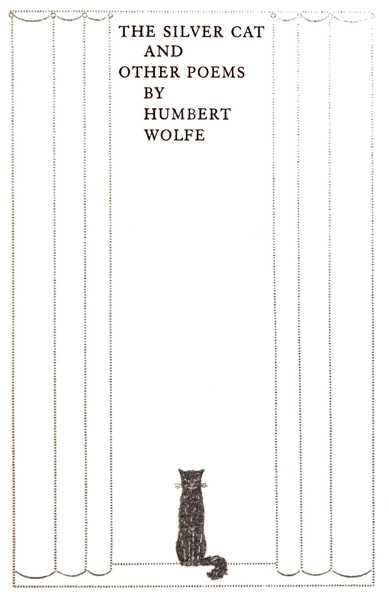
THE SILVER CAT

AND

OTHER POEMS

BY

HUMBERT

WOLFE


COPYRIGHT, 1928, BY THE BOWLING GREEN PRESS. PRINTED IN U.S.A.


CONTENTS

Invocation
The Silver Cat
From “Polly Put the Kettle On”
Thus Freedom Comes, Thus Peace
Spring and Death
The Immortal Hour


INVOCATION

If in a fallen
petal shews
the outline of
the perfect rose,
no less on these
a hint may fall
of the divine
original.

THE SILVER CAT

Two orange candles like cat’s eyes
glittered. The yellow tapestries
were smooth against the dark, and all
the room, like a hushed waterfall,
plunged softly down between the two,
who sat together all night through.
She spoke across the darkness “Slow
the dark dividing moments go
between us, and, before we guess,
there is an end of loveliness.
What do we gain by sitting still?
The distant dawn on daffodil
cities, unseen of us, awakes,
and even now the mountain-lakes,
between that touch of lips and this,
change with the sun to topazes.
Or slimmer than slim willow-trees,
in silver secret, Javanese
Srimpis—cold ballet—weave in trance,
still, save for sliding hands, their dance
unseen by us. By us unseen
under red eaves in gold Pekin
the yellow dotards, peering, gage
the leap of crickets in a cage.
Beauty is spilling thus even now
through all the world, while I and thou—
we sit in dark, where no winds stir,
nor seas, each other’s prisoner.
For orange moons in skies of jade,
these candles. For the ambuscade
of drifting isles on lifting seas
we have these quiet tapestries.
For distance, and all adventurings,
this room, and for the white bird’s wings
up, up, and still white wings above—”
“For all these things” he answered “Love.”
“Tell me of love,” she whispered. Stale
jewels—the candle flames grew pale,
and sunk. The room a midnight pool
with night’s dark shape was beautiful.
Pool-charméd he spoke with the grave
cold accent that still waters have.
“What is the world but a guess and a blending
of what was never with that which has an ending?
The waves—those crumpled lions—are but a shadow
of motion in the green mind, sky’s loamy meadow
is with the punctual gold of vision starry,
and on her shoulders slim a dream must carry
—Atlas—the weight of the world’s loveliness.
And Eastern cities, though daffodil, no less
oar, and are anchored in the mind. At most
built of an air so delicate, so ghost,
a whisper of death’s wind, and each one slips
her cable for the dark. And these dim ships
no port for all their burthen of beauty have,
and there is no sea, no landfall in the grave.
These are the ensigns of mortality,
but love from their bright difference is free.
And where he is, what sees and what is seen
are one, and he has healed the old chagrin
’twixt the thinker and his thought. And there’s no war
between the star that sets and the rising star;
for all love’s battles are civil victories,
war self-declared, and internecine peace.
Is he accused of quiet? But love goes riding
to adventure beyond the world, and still he’s chiding
the measurable hearts, whose fears would bind him,
and the cries of the cowards failing shrill behind him.
But love (for you) is only wings that brush
the spirit afraid, and a whisper in the hush,
that stops the heart on a beat? Yet think of this!
When you are old, a pale forgotten kiss
will touch your eyelids, where you sit and ponder,
and all will be gone from you then, all youth, all wonder
—the coloured cities you knew, the amethyst
pennons on the lance of dawn, and the white mist
unrolling from the world—all will be gone,
but the kiss will touch your eyes, where you sit alone.”
Thus he. With lips that hardly move
“Let in the dawn,” she said, “and love.”
He drew the curtains, and at that
from where he lay a silver cat
rose, stretched his silky paws to yawn
at the geraniums of the dawn,
whose petals splashed the window. Then
curled himself up to sleep again.
FROM “POLLY PUT THE KETTLE ON”

VII. CODA
Largo, Marcato
In that dark house at the road-end
lives the old fiddler. Some folks say
he’s ninety past. Others pretend
he’s older. I don’t know. I’ve heard him play.
I ask no more. The jasmine-lovely twilight
settled to dark. The moon’s grace entered in
like a tall girl, and softly, in the shy light
’twixt eve and night, he touched his violin.
“The moon was in it first.
The shepherd he played,
Endymion, whose thirst
with that cold star was stayed.
‘Youth, youth,’ the sobbing string
called, and love that is still
with the moon murmuring
in the night, on her hill....
Softly; and louder then
he played on colder string
how, though they lose love, men
forgive the heartbreaking;
how they say: it is over,
and her beauty is passed,
but love is a lover
we love to the last....
Then, on a rising chord,
failure he played, and ending,
when the dream adored
is broke, and there’s no mending,
save in courage that is
more than the dream, and stays
when all her witcheries
have gone their golden ways.
Courage, he played, to face
hope changing from little to less,
and age, and the heart’s disgrace
in her own ugliness.
Courage, when nothing is there
but the long empty road,
and the grey traveller
with naught in life but his load.
Courage to the road-end, and after,
he played, and the last breath
crying ’twixt a sob and laughter
‘Death? What is death?’
The moon was in it last,
and wings that brush
the soul in the dark, and go past
with a single beat in the hush.”

THUS FREEDOM COMES, THUS PEACE

And I shall say to these:
“You cannot traffick in peace,
and you cannot quote it as priced
in the Stock Exchange list. For Christ,
(or whatever name is given
to the secret kingdom of heaven,
in which we are, and have
this shadow of life, that shadow of the grave)
to those who remain has said:
‘Leave the dead to bury the dead!
Rich though they be, you cannot sell
or buy their miracle,
nor be enriched by it, nor in Jerusalem,
sweet with the bugles blowing over them,
set up your market place, and have increase—’
Not thus comes peace,
nor freedom thus. But slowly,
making more holy what is holy,
from the guarded pool
of the spirit swift, cold, and beautiful,
in mists diaphanous his rain
a god draws back again.
And, as the sun builds with the clouds, of these
he builds his city of peace—
those stoneless streets, at whose sweet end
friend meets with friend,
those star-hung towers, in which the light of the sun
with the moon’s light is one,
with love as visible and exquisite
as the little lamps with which the yew is lit,
(so luminously red in the translucent green
of that deep air the lanterns of love are seen)
and the music of meeting, and the trumpet at the gate
sounding: ‘All ye, who enter here, abandon hate.’
Thus freedom comes, thus peace.”
I shall say to these.

SPRING AND DEATH

Time, old and fertile serpent that endures
from spring to spring, softly beneath the ground,
now at the root of life snake-darkness pours
in feathered coils, that choke without a sound
winter, the death, that dies each spring to rise
on the right hand of May in Paradise.
Here in the North the black and haggard beech,
as though the nails were driven through the palm,
stretches gaunt arms too twisted to beseech
even the spear, and death’s atrocious calm,
nor dreams she earns by her slow agony
the green and drifting kingdom of the tree.
But in your South the earth is Magdalene
to death, and wins him, leaning from gold sheaves
her white, prevailing arms, that out of green
lift his pale head against her through the leaves;
and death looks upward through her heavy hair
finding all colour, song and fragrance there.
Wild lavender and pomegranate-tree,
cypress and blue grape-hyacinth, and pale
wind-flower that we call anemone,
you are life’s brief and many-coloured veil,
with which death, like a bridegroom, in the South
covers his bride, and sinks against her mouth.
Death—but there is no death where these things be,
and, though the snake may coil his feathered ring,
grape-hyacinth and pomegranate-tree!
Where is his victory, what is his sting,
when even the Judas-blossom, bursting the prison
of old dead treasons, whispers “He is risen.”
And hark! as though death were the fabled thorn,
upon which life, to give her soul release
in music, leaned, the nightingale’s high scorn
touches the flute of night on moonlit keys,
and with the silver star-dust of her breath
muffles the wings triumphant over death.

THE IMMORTAL HOUR

I. SEMI-CHORUS:
We have no tears, who are the source of weeping,
and what is laughter to us, whose laughter first
of laughter woke in the man the sweet unsleeping
hunger and thirst?
We are the words the poets hear and fail of,
we are the note beyond the fiddle’s cry,
we for all lovers of beauty are a tale of
beauty that passes by.
II. SEMI-CHORUS:
Cried a ghost-king by night “Divine Augustus,
you tread the ends of the world only to find
that the long roads of dreams go sweeping past us
into a world behind.
A fleeting throne, a shadow godhead these are,
whose symbol is the axes and the rod,”
saying “There is another kingdom, Caesar,
a further heaven, God.”
I. SEMI-CHORUS:
We walk with the wind’s feet, and do not rest,
we walk between the leaves in the high meadows,
our hair with their green wings of light, our breast
stained with the soft green shadows.
Fleeter than the heart’s desire, one by one
we leave delights that are well spoken of,
and far behind us echo, as we run,
the tired feet of love.
II. SEMI-CHORUS:
We are impatient of truth, that is no more
than finite stain upon the infinite,
a fading seamark on a distant shore
and we have gone from it,
whose lips, though grave, are not too grave to smile at
the heart of man crying in his vext youth:
“What is the truth?” and to make answer “Pilate,
we are the truth.”

PRINTED IN JANUARY, 1928, BY WILLIAM EDWIN RUDGE PUBLISHED BY THE BOWLING GREEN PRESS, NEW YORK AND BY ERNEST BENN, LTD., LONDON

780 COPIES

B R

TRANSCRIBER’S NOTE:

New original cover art included with this eBook is granted to the public domain.