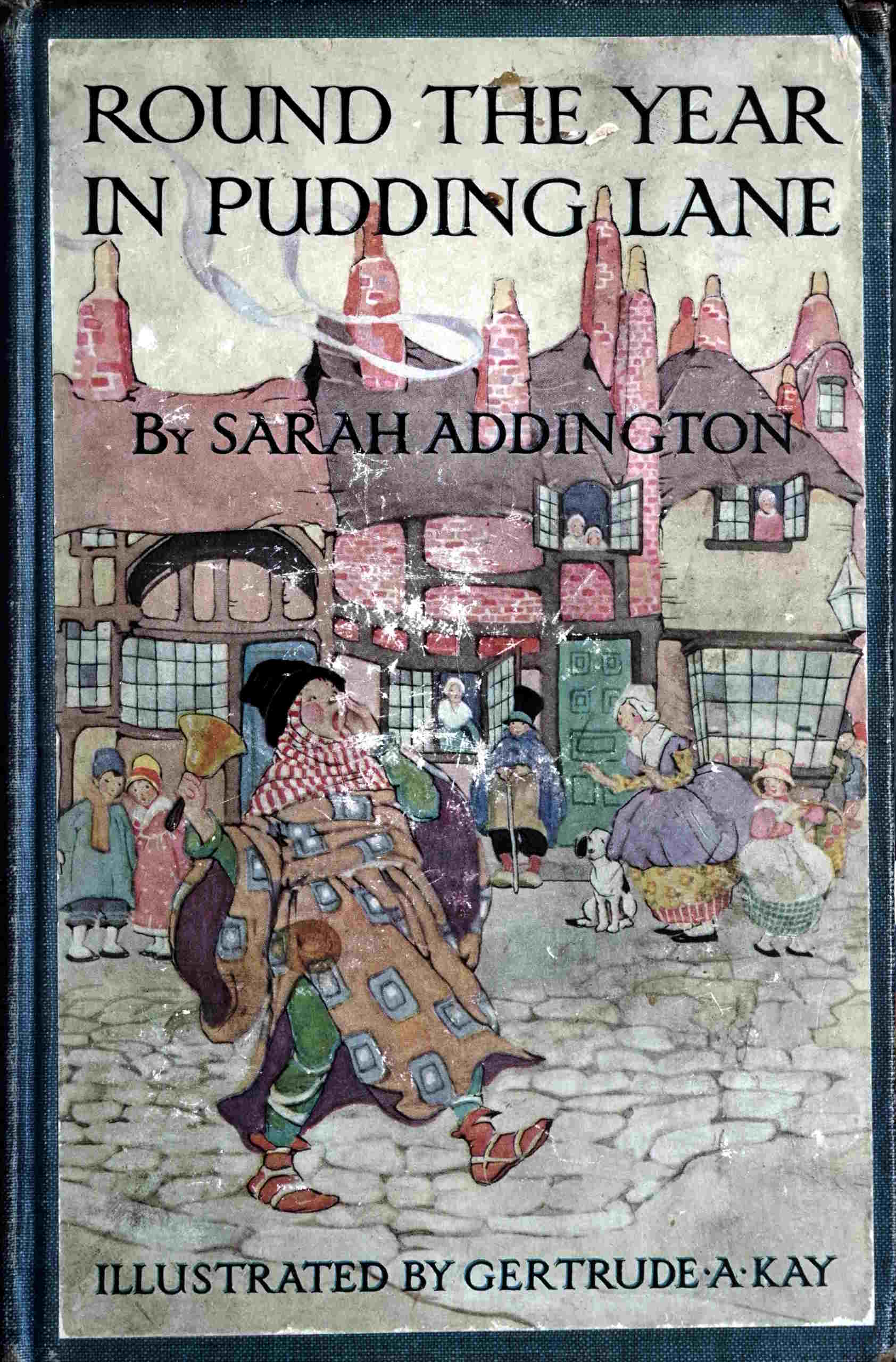
Title: Round the year in Pudding Lane
Author: Sarah Addington
Illustrator: Gertrude A. Kay
Release date: March 30, 2026 [eBook #78322]
Language: English
Original publication: Boston: Little, Brown, and Company, 1923
Other information and formats: www.gutenberg.org/ebooks/78322
Credits: Alan, The Online Distributed Proofreading Team at https://www.pgdp.net (This file was produced from images generously made available by The Internet Archive)
By Sarah Addington
The Boy Who Lived in Pudding Lane
The Great Adventure of Mrs. Santa Claus
Round the Year in Pudding Lane
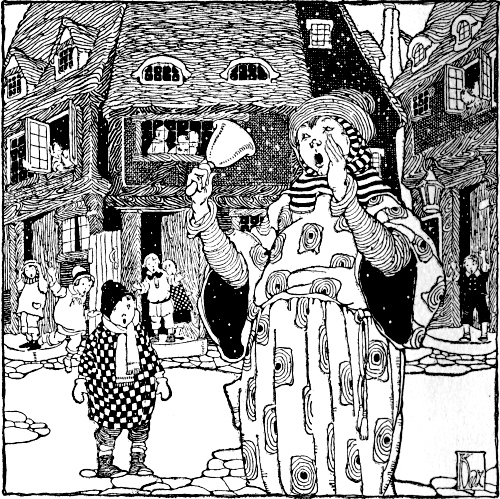
The Town Crier was seen coming down Pudding Lane,
ringing his bell. FRONTISPIECE. See page 3.
ROUND THE YEAR
IN PUDDING LANE
BY
SARAH ADDINGTON
WITH ILLUSTRATIONS BY
GERTRUDE A. KAY
BOSTON
LITTLE, BROWN, AND COMPANY
1924
Copyright, 1923, 1924,
By Sarah Addington
All rights reserved
Published September, 1924
Printed in the United States of America
CONTENTS
| CHAPTER | PAGE | |
| I | When the Snow Man Sat by the Fire | 1 |
| II | The Valentine Mistress Mary Found | 18 |
| III | How Humpty Dumpty Went to the King’s Party |
34 |
| IV | Simple Simon Has His Day | 52 |
| V | Mrs. Claus Has a Great Honor | 67 |
| VI | The Poodle That Didn’t Know English | 81 |
| VII | Bo-Peep Finds Out How a Dutch Uncle Talks |
93 |
| VIII | The Sand Man’s Scare | 110 |
| IX | Why Taffy the Welshman Stole Meat | 124 |
| X | The Crooked Man Gets a Brand-new Reputation |
139 |
| XI | Mother Goose Settles a Difficulty | 155 |
| XII | Santa Claus Hangs Up His Stocking | 187 |
ILLUSTRATIONS
| The Town Crier was seen coming down Pudding Lane, ringing his bell |
Frontispiece |
| PAGE | |
| Everybody was happy, including Mrs. Claus who dozed by the fire |
20 |
| No Lady Wind was that. No dog either. But a bear that stood before her |
43 |
| They were dancing around a Maypole, a beautiful, flower-covered Maypole |
76 |
| On the same stagecoach from Dover came a present from the King of France to Mrs. Claus |
81 |
| “Look here,” he said to the black sheep. “You’re responsible for all this.” |
105 |
| What could Mrs. Blue do? She could do nothing but climb the fence, skirts and all |
111 |
| The next morning at nine o’clock the whole town started out for Honeysuckle Hill |
129 |
| “But it’s too far to walk before dark,” said Santa Claus. “We live ’way off in Pudding Lane” |
148 |
[Pg 1]
WHEN THE SNOW MAN SAT BY THE FIRE
IT had been a poor year for snow men that winter in Pudding Lane. November had brought not one single flake of snow (though I don’t see what good one flake would have done, anyway). December had been almost as bad. Even at Christmas there had been only the thinnest smattering of snow, which, like bread that has only a little sugar on it, is worse than none at all.
But here it was January, a gray, moisty, misty day that certainly looked and felt like nothing else in the world but snow. So that it was no wonder the children of Pudding Lane kept rolling their eyes at the world outside as they were having their lessons that morning.
“One, two, buckle my shoe,” recited Santa to Mrs. Claus. The snow would surely come any minute now. “Three, four, shut the door.” Would it be big dry flakes or little watery ones? Little watery ones were no earthly good, of course. “Five, six, pick up sticks—”
[Pg 2]
“A, B, C, tumble-down D,” chanted Judy to the Old Woman Who Lived in a Shoe. Was that a flake of snow she saw through a buttonhole of the Shoe there? No, only a bit of paper drifting by. “E, F, and a pick-him-up G,” she continued.
Even Simple Simon was having a lesson.
“Thirty days hath September,” he began, but poor Simon never got any farther than that in the rhyme, for he never could remember that April came next. April ought not to follow right after September, even in a poem, he thought.
So they went on, every one of them, for Old King Cole had given emphatic orders that lessons were to be held at any cost, every single morning, in every single home in Pudding Lane. And then, right in the middle of everything, it began to come, the snow that all the children had been waiting for all the winter long.
Jill saw it first, for Jill was the kind of girl that could see several things at once, so that, although it looked very much as if Jill had her eyes nailed down tight to her spelling book, she really was looking through the window out of the tail of her eye. Some people are like that, especially girls.
But Jill saw the snow only half a second before[Pg 3] the other children saw it. For the next thing the mothers of Pudding Lane knew, their pupils were all running to the windows and jumping up and down and shrieking with delight. It began to look as if school were over for the day, willy-nilly, as Mrs. Claus said. She, for one, couldn’t manage five boys during the first snowstorm of the year.
Well, sure enough, school was over for the day, for the next minute the Town Crier was seen coming down Pudding Lane, ringing his bell and shouting, “The King says let the children out; the King says let the children out, the first snow of the year!” Seriously, now, was there ever such a good king as that merry Old Soul? Or such a wise one? Not many kings would understand that a snowstorm is more important than lessons.
You should have seen the Snow Man those children made! Such a fine figure of manhood as he was, with sturdy, stout legs and a pipe in his mouth (the candlestick maker wondered where in the world his pipe had disappeared to!) and a snub nose such as snow men always, always have. Why is it, do you suppose, that snow men never have handsome Roman noses like Mother Goose’s, or tip-tilted ones like Jill’s,[Pg 4] or long lean noses like the candlestick maker’s? Merely a family trait, I suppose. In fact, if I ever met a snow man with a long nose, I’d rather suspect him of not belonging to the real snow family, wouldn’t you?
But this one was a true descendant of the inner circle of snow men. Little Boy Blue stuck on his ears. Jack and Jill made his arms—long arms they were, that fell from his shoulders in a most realistic manner. Simple Simon put Mr. Claus’s green carpet slippers at the bottom of the Snow Man’s legs. (And you should have seen Mr. Claus running around the house in his bare feet that night, poor man.) Simple Simon got the right shoe on the left leg, and the left shoe on the right leg, but that only made the Snow Man look funnier than ever, and Simon was indeed proud that he had done his job so cleverly. Yes, every child in Pudding Lane had a hand in that Snow Man, except Polly Flinders.
And Polly, of course, would not come out. Not that she was not invited. Santa Claus, who was the most polite boy in Pudding Lane, made a special trip to the Flinderses’ to get her, for it was thought that Polly, being a newcomer to the village, might feel a little shy. But although[Pg 5] Polly liked Santa Claus very much and was really most anxious to play with the other children, and most anxious, too, to get acquainted with the Snow Man, still, on account of her toes, Polly had to refuse Santa’s invitation. So Santa ran back to his little friends and Polly, after waving them good-by, returned to her cinders.
She did not stay by the fire long, however, for the shouts and laughter of the children rang out like chimes through Pudding Lane that day, and she could not keep herself from going to the window to watch them. For the truth about Polly Flinders was that, though she did choose to stay close by her fire rather than to play outdoors with the children, she really was a very lonely little girl. She got tired of herself and she got tired of her dolls and books. She even got tired of her cinders. So Polly really was not very happy by her fireside, after all. It was too bad about her toes, really.
When the children saw Polly at the window on this day, they waved and laughed and beckoned her to come out. Polly waved back and smiled, too, but still she could not bear the thought of the cold, so she shook her head sadly and presently they forgot all about her as they[Pg 6] went on playing. And finally the lonely little Polly went back to the fire again.
It was dark and cold when the children of Pudding Lane at last left their Snow Man and went home. They had fought snow battles and built snow houses and dug snow tunnels. They had plowed up the fields of snow until it looked like some winter planting time. But the day closed at last and they had to go home to supper and to bed.
Only Polly Flinders, as night came on, remembered the poor Snow Man who was left there in the ruins alone on the cold winter night. She could hardly eat her supper for thinking about him, and she shivered closer to the fire, as she considered how cold it must be out there for the Snow Man, who himself was not a very warm fellow to begin with.
So Polly thought about him all evening, and still she could not forget him when it came time for bed and her mother came in to take her upstairs. Polly begged to stay up longer.
“But it’s very late,” objected her mother.
In the end, however, she went off to bed without Polly, shaking her head and saying to Mr. Flinders that she never did see such a girl for the cinders.
[Pg 7]
As Polly sat by the fire, she kept thinking of the Snow Man and kept on feeling so sorry for him that she even cried a little to herself, as the clock ticked and the cinders clinked in the grate. She went to the window to look out at him. There he stood in the cold light of a frosty moon, alone, neglected, freezing. Oh, dear, how unhappy he looked. He wasn’t funny any more, but pitiable and pathetic, like any other outcast.
Polly stood by the window a long time, watching him tearfully. Then through her tears, she saw, or thought she saw, the Snow Man move. He seemed to raise his arms to her in a gesture of pleading. The Snow Man was motioning to her to come to him! The Snow Man wanted her help!
Quick as a flash Polly turned from the window and rushed to the door. Quick as a wink she had flung the door open and was running down the path to Pudding Lane and across the lane to the Snow Man. She quite forgot her toes, did Polly. She forgot the cold and the snow. She forgot everything except that the poor Snow Man needed somebody to help him and that she was the somebody. When she got to the Snow Man, she spoke to him breathlessly.
[Pg 8]
“I’ve come to take you in to the fire,” she told him. “I know how wretched it is to be cold and lonely. I suffer from the cold myself, Mr. Snow Man, and I’m rather lonely too.”
The Snow Man did not reply, but stood there immovable, his long arms hanging listlessly, his pipe askew, his hat set rakishly on one ear. Polly surveyed him and spoke again.
“Can you walk?” she asked him. He was still silent.
Polly touched him softly. He was hard and as solid as rock. She never would be able to budge him. She put her arms around him. Ooooh, how cold he was! She really must hurry and get him in to the fire, or he would be frozen past all help.
What should she do? He was freezing, freezing! She must not leave him there another minute. But he was too big to carry and too stiff to walk. Polly looked around desperately. There was only that icy moon above and the fields of snow about her and the still cold of night. No help was in sight. Not a candle shone out from a single window. Not a soul was awake in that respectable little village. Alas, Polly began to think that her visit to the Snow Man was all in vain, that she could not rescue him, after all.
[Pg 9]
And then, just as she was despairing of her mission, she spied Jack Horner’s little red sled near one of the snow forts. It was the very thing! She would take the Snow Man home on that sled. She would take him to her own fire and there warm him until he was quite comfortable.
Hastily she began to drag the sled over to the Snow Man. Quickly she commenced the delicate operation of putting the Snow Man on the sled. And it was a delicate operation, indeed. For the Snow Man’s joints, if he ever had any, were as stiff as sticks, and the Snow Man’s muscles, if he had muscles, were as useless as a doll’s. He was very heavy and hard to move, as Polly put her arms around him and tried it. Moreover, the Snow Man, although so frozen and hard, had a tendency to break at places. Polly was very, very careful as she tugged and pulled at him, but there! his left arm snapped off clear up to the shoulder, and—oh, dear, there went his right thumb, plunged into the snow at his feet.
“Excuse me, excuse me,” whispered Polly to the Snow Man in distress. “I didn’t mean to, really.”
But it did not seem to hurt the Snow Man[Pg 10] very much to lose an arm and a thumb, for he did not bat an eyelash, though maybe that was because he didn’t have an eyelash to bat.
At last Polly had him on the sled, lying on his back, feet foremost, pipe in the air. Only the green carpet slippers were left behind in the snow, for somehow they wouldn’t stick. At last, after much hard pulling, Polly had the sled with the Snow Man right in front of her very door. And at last, after more tugging and working, she had him standing upright in front of her own warm cinders, which she now poked up into a fine bright blaze again. Then she smiled radiantly at the Snow Man.
“Now you’ll be all right,” she assured him. “You’ll get all warm and happy again, Mr. Snow Man.”
But, my goodness, was the Snow Man crying? It certainly looked like it. Those were surely drops of water on his face. It looked, too, as if he needed a handkerchief. Polly hastily got out hers and applied it to the Snow Man’s nose.
“You ought to learn to use your handkerchief yourself,” she told him rather severely. “I learned to use mine when I was a very little girl. But don’t cry. Oh, don’t cry so hard!”
By this time the tears were streaming down[Pg 11] the Snow Man’s face like rain. In fact, he hardly had a face any more; the snub nose had vanished almost completely; his eyes had cried themselves out; his ears were just little nubs now and were fast becoming even smaller nubs. More than that, the Snow Man’s arms and shoulders seemed to be raining tears too, and from his feet and body ran rivers of water.
Oh, dear, how frightened Polly was!
“Please don’t cry all over like that!” she begged him. “Oh, please don’t!”
But the water continued to flow from every pore of the Snow Man’s body.
“Perhaps,” thought Polly, “it’s just perspiration. But if it is, it’s a pretty bad case of it.”
Whatever the malady, it was fast reducing the unfortunate Snow Man into a mere pillar of slush and streaming water. His pipe fell away from his face and dropped to the floor with a dismal sound. His poor old hat fell off too. His legs were rapidly giving way. And as Polly watched the Snow Man approaching his sad end, she cried heart-brokenly. Such a beautiful Snow Man as he had been! How she had worked to help him out of his difficulty! And now he was going, going, going. He would soon be gone. He was gone. She looked at the floor where a[Pg 12] pond of water lay, an old black pipe floating desolately around in it. It was the saddest sight that Polly had ever seen.
She cried until her mother, hearing her from upstairs, came down to her.
“Why,” began Mrs. Flinders, “what in the world—”
Polly sobbed.
“What was it?” her mother asked again.
Polly choked as she tried to answer.
“The Snow Man—” she began, then sobbed aloud again.
Then Mrs. Flinders, seeing the water, understood.
“Oh, that’s too bad,” she said sympathetically. Then, “But didn’t you know he would melt?” she asked.
It seemed unbelievable that a child of hers would make such a foolish mistake.
“I forgot,” confessed Polly. “It was silly of me, but I honestly forgot. I was so anxious—”
“Well,” said Mrs. Flinders, “it’s too bad. But come, let us mop up the Snow Man before he spreads all over the house.”
So Mrs. Flinders in her nightcap and Polly, sniffling loudly, mopped up the Snow Man, who[Pg 13] an hour before had been a beautiful creature and was now mere dirty water. Polly was indeed very sad about the whole affair, and more than that she was ashamed, for she realized now how silly she had been and she dreaded what the children of Pudding Lane would say the next day.
But to Polly’s everlasting surprise, the children of Pudding Lane, instead of being angry with her, instead of laughing at her, were most sympathetic, when she told them what she had done.
“I think it was very nice of you to want to be kind to the poor Snow Man,” said Jill.
“And of course you forgot he was made of snow,” put in Miss Muffett. “For he was such a friendly fellow.”
At this Polly began to sniffle.
“There, there!” Jumbo patted her shoulder. (You remember Jumbo, don’t you, the oldest son of the Old Woman Who Lived in a Shoe?) “We’ll build another Snow Man,” he said. “And we’ll wrap this Snow Man up in a blanket to-night so he won’t get cold.”
So the children began to build another Snow Man, and even Polly, whose toes were warmly done up in leggings and overshoes, stayed out[Pg 14] to help them. For Polly felt responsible for the damage she had done, and she felt grateful, too, to the children for their kindly attitude toward her silly mistake. And so, although it was bitter cold, and she did mind it terribly, she worked on and on until finally the Snow Man was finished. But oh, how miserable she was, and how glad she was when the Snow Man stood there complete, and she was free to return to her cinders. Yet, as she started to say good-by, her heart sank a little. She would be lonely again when she went back into the house by herself. If her toes only did not trouble her so much!
The children were astonished when she told them she was going indoors.
“Why, Polly, we thought you liked us now,” cried Judy.
“We thought you were having a good time with us,” said Tom, Tom, the piper’s son.
Poor Polly shook her head. “I do like you,” she protested. It was dreadful to have such toes as she had, but she couldn’t help it.
“But you don’t like to play out here with us,” said Little Boy Blue.
“No,” confessed Polly in a small ashamed voice. “You can’t enjoy things when your toes ache, can you?”
[Pg 15]
“I suppose not,” Boy Blue answered politely, though his toes never had ached.
But Jumbo went up to Polly and took her arm.
“Then I think it was very brave of you to go out to get the Snow Man last night,” he said. “And it was brave of you to stay out here to-day and help us make a new one, when your toes ached all the time.”
He expected the rest of the children to say, “Yes, indeed, it was,” but somehow they did not say it, nor did they say anything, not being used to pretty speeches. But they thought it, anyway, and they looked it, every one of them smiling at Polly in the friendliest fashion possible, so that Polly was a little bit comforted.
Her real comfort, however, came later from Jumbo, as he sat before her cherished cinders with her. He looked at her pretty little toes, which were shiny patent leather with silver buckles, and smiled.
“Judy has big square brown shoes,” he said. “And Jill has copper toes on her boots.”
Polly looked at him gratefully.
“And I rather like the cinders myself,” he went on. “Do you see that little dwarf in there with the hood over his head?”
[Pg 16]
Polly looked deep into the fire.
“Oh, yes,” she said. “Isn’t he funny? And do you see that princess with the long flames of hair?”
“Red hair,” Jumbo grinned. He looked at Polly’s fair curls. “I like yellow better myself.”
Polly sighed. Perhaps she wasn’t quite hopeless, after all, in spite of her terrible affliction. Then a coal fell in the grate with a soft cluck of a noise.
“Oh!” she exclaimed excitedly. “The dwarf got thumped. Who did it, did you see?”
“I didn’t see a thing,” replied Jumbo, “so it must have been a fairy. And there, the Princess is disappearing.”
“Going home to the Prince, I guess,” murmured Polly contentedly.
“Yes.” Jumbo nodded. “Wow! But that fairy came just in time. In another minute the dwarf would have had her.”
And that was the way that Polly Flinders had her one and only experience with a Snow Man, a rather unhappy experience it was too. That was the way the children of Pudding Lane found out what a courageous girl Polly was. And that was the way Jumbo became Polly’s daily playmate,[Pg 17] so that she was never lonely by her cinders any more, but was both happy and warm thereafter. For Jumbo liked the fire, too, especially when he and Polly sat before it spinning fairy tales, as they did on that first day.
[Pg 18]
THE VALENTINE MISTRESS MARY FOUND
IT was past eight o’clock on that St. Valentine’s Eve, and yet from every window in Pudding Lane shone forth the yellow light of a candle, a phenomenon which made all the clocks in the town wonder whether they hadn’t skipped an hour somewhere or other. For every timepiece in the village, from Mrs. Flinders’ fine old grandfather’s clock to Mrs. Dumpty’s pert little cuckoo, had good reason to know that one of old King Cole’s strictest rules was, “Early to Bed and Early to Rise”; and yet here it was eight o’clock and nobody abed yet. Queer, thought the cuckoo, as he stepped smartly out of his box and cuckoo’ed eight times with a significant look at Humpty Dumpty. Odd, thought the grandfather’s clock, as he rumbled his eight strokes in Polly Flinders’ ear.
Silly clocks, they had forgotten what night it was, or they never would have been so mystified. For we know what was going on that[Pg 19] night in Pudding Lane, don’t we? We do it ourselves on St. Valentine’s Eve. So we can just see Boy Blue addressing an envelope to Judy, The Shoe, Pudding Lane, and another to Bessie, The Candlestick-Maker’s, Pudding Lane. And we can see Jill writing a verse to Jack:
Yes, they were all making Valentines that night. The children of the Old Woman had the Shoe cluttered up with paper and ribbon and paints. Simple Simon was busy copying a verse for Mistress Mary. It was hardly a delicate sentiment, reading as it did:
But it was the only poem Simple Simon knew. Besides, it is doubtful whether Mistress Mary would be able to read it, anyway, for Simple Simon’s handwriting, as you know, was highly individual.
[Pg 20]
At the Clauses’, Santa and the two batches of twins were busy making Valentines. Santa was good at cutting and pasting, and Matthew, Mark, Luke and John were good at getting in his way and cluttering things up, so everybody was happy, including Mrs. Claus, who dozed by the fire, Mr. Claus, who was reading the Banbury Cross Weekly over his spectacles, and Misery, the cat, who sat solemnly watching them all.
Indeed, everybody in Pudding Lane was busy making Valentines, except—guess who—Cross-Patch. You know Cross-Patch, that unpleasant old woman who lived down at the end of Pudding Lane. Of course, Cross-Patch was not making Valentines. She didn’t believe in such foolishness!
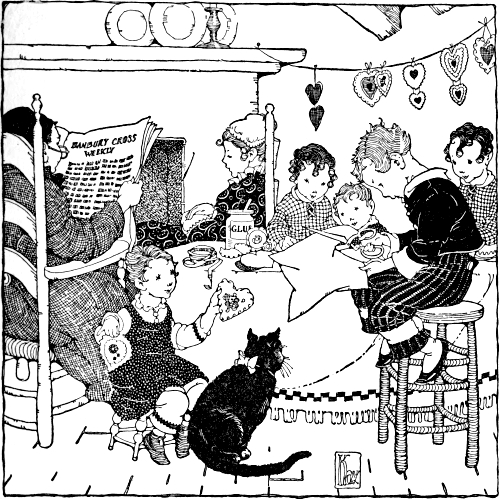
Everybody was happy, including Mrs. Claus who
dozed by the fire. Page 20.
Yet somebody was making a Valentine for her, and that person was—you’ll never believe it, but it’s true—the candlestick-maker. Now although you have known the candlestick-maker quite intimately, would you ever have guessed that he Nursed a Secret Passion for Cross-Patch? Of course you wouldn’t. But that’s the sort of thing that comes out on St. Valentine’s Day. He may seem like a queer kind of lover, the toothless, bent-over old man, yet he was an earnest one, nevertheless, and he cackled[Pg 21] gleefully as he pasted a yellow paper rose on a pink paper heart and wrote:
When he tried to say this verse, the candlestick-maker always said, “Peedles and nins, peedles and nins”, but it seemed to go all right with a pencil. However, it did not sound very loving, he thought, after he had written it, so he added a little verse like this:
It may not seem very clear to us, but the candlestick-maker was charmed with it, and said to himself he could be a poet as well as anybody else if he’d just take the time to it. And then, with one last delighted cackle, he called Jack, his nephew, and bade him be nimble and be quick about delivering that Valentine to Cross-Patch. Jack hastily jumped over the candlestick as directed and ran down Pudding Lane with the pink paper heart in his hand.
[Pg 22]
Jack had gone but a few steps when he heard a little squeaking noise which sounded like—well, it sounded to Jack like a mouse with a cold in its nose. He stopped to listen. Yes, there it was, a choked little squeak of a noise. Then, to Jack’s surprise, up started somebody from behind the winter hedge near by. It was Mistress Mary, Quite Contrary, and it was she who was making the noise. Mistress Mary was crying.
Of course, she pretended she wasn’t. When she saw Jack, she giggled in a silly little desperate way to cover up her sobs, the way girls often do when they’re caught in tears.
“Hello,” said Jack. He was glad she had stopped crying.
“Hello,” said Mistress Mary gayly, quite as if she had never shed a tear in her life. “Where are you going?”
“Taking a Valentine,” began Jack, when Mistress Mary unexpectedly began to cry again in that little squealing way. Jack, much disturbed, asked Mistress Mary what was the matter. Whereupon, the poor girl, still weeping, explained the cause of her woe. She was crying, she said, because she had no Valentine for Santa Claus, of whom she was so very fond.
[Pg 23]
“But why haven’t you a Valentine?” asked Jack.
“Just because I was so contrary, I guess,” admitted Mistress Mary. “My mother told me to get one ready, but I didn’t want to then—and now it’s too late. Oh, dear, it’s often very uncomfortable to be contrary, Jack.”
“It must be,” thought Jack to himself. But to Mistress Mary he said, “Well, what are you going to do about it?”
“I don’t know,” answered Mistress Mary mournfully. “I’m afraid there’s nothing to do now. And, oh, Santa Claus will think I don’t love him. And I love him better than anybody else in Pudding Lane.”
“Why don’t you send Santa Claus a flower from your garden, Mistress Mary?” Jack suggested. “Flowers make fine Valentines, you know.”
Mistress Mary shook her head sorrowfully.
“Alas,” she said, “my crocuses are contrary, too, Jack. They ought to be out now, but somehow they just won’t bloom.”
“I see,” said Jack gravely. Truly this was pretty bad, he thought to himself, that a girl should set such an unhappy example to the very flowers in her garden.
[Pg 24]
Then he thought of Mother Goose, who always knew how to get people out of trouble.
“Let’s ask Mother Goose what to do,” he said to Mistress Mary.
“But Mother Goose is not here.”
“Yes, she is,” Jack told her. “She’s spending the week-end with old King Cole. Let’s run right up to the palace and ask her.”
“Oh!” cried Mistress Mary, “that’s the very thing.” For once in her life the contrary girl agreed with somebody, so the two children ran off hand in hand toward the palace of Old King Cole.
Mistress Mary was not the only person in Pudding Lane that night who was in trouble. Meanwhile, something had happened at the Clauses’. It happened so quickly too. The children had all gone to bed and Santa Claus and his mother were sitting up addressing the last of the Valentines and Misery was watching them. Then the next minute, while they were still busily scratching away with their pens, Misery wasn’t watching them.
“Where’s that cat?” asked Mrs. Claus, as she looked up. She always called Misery “that cat” and she always pretended that she did not like him a bit, yet it was Mrs. Claus who had[Pg 25] given Misery so much cream when he was a kitten that it made him fearfully sick, and it was Mrs. Claus who now had to be watched lest she give him more meat and gravy than was good for his digestion.
So now she said, “Where’s that cat?” in a tone of great asperity, and she frowned blackly at the place by the stove where Misery had been but a moment before.
“Perhaps he’s gone to bed,” said Santa Claus, as he carefully drew a great flourish under Humpty-Dumpty’s name.
Mrs. Claus got up and went over to the box where Misery slept.
“Not here,” she reported, after rummaging around in it. “Where is that cat?”
She looked under the stove and in her workbasket and behind the baby’s cradle. No Misery! She went into Mr. Claus’s bedroom and looked in the drawer where he kept his best blue shirt. No Misery! She finally went out into the woodshed and prowled around there in the dark, calling for Misery. No green eyes appeared. No purring black shape came to rub against her feet. By this time Mrs. Claus was really alarmed. She flew back to the kitchen and Santa.
[Pg 26]
“He’s gone!” she told her little boy.
“Misery?” Santa asked, staring.
“Misery himself,” answered Mrs. Claus.
Santa jumped to his feet and ran around the room, calling the cat. He ran all over the whole house, looking for Misery. No cat was to be found, but the twins and Mr. Claus and even the baby woke up at his racket, and they set up a horrible din at the news of Misery’s departure. The four boys howled with grief; the baby screamed to keep them company; Mr. Claus kept shouting, “Great snakes, great snakes, great snakes,” and, oh, dear, such a time as there was in the Claus household at that late hour on St. Valentine’s Eve.
Of course, the Clauses kept right on looking for the cat. Mr. Claus, good soul, even went outdoors in his bare feet (he never had got his green slippers back since the time of the first Snow Man that year). He went out into the yard, calling the cat so loudly that if the creature had been within ear-shot, he would have been frightened away by the noise. He went into the shop with a candle and poked around in the shelves and drawers there. (They had found Misery sleeping sweetly there in a nest of buns one time.) But although they all hunted[Pg 27] high and low for that cat, it soon became apparent that Misery was not to be found.
It was a sad and sober company that gathered around the kitchen stove when the search had been abandoned.
“He’s gone,” spoke Mr. Claus in a hollow tone. Mr. Claus looked rather peculiar in his nightcap and overcoat and bare feet, but nobody noticed that.
The twins howled again. Santa Claus blinked. Mrs. Claus was seen to rub her eyes impatiently.
“I knew that cat would get us into some kind of a bother,” she said.
“And the mice,” said Mr. Claus. “I’m afraid that when the cat’s away, the mice will play.”
“Of course they will,” spoke up Mrs. Claus sharply. “Anybody knows that.” Then Mrs. Claus looked at the clock and jumped energetically out of her chair.
“Mercy on us, Mr. Claus,” she exclaimed. “Here it is after nine! What can we be thinking of to let the children stay up like this?”
With which she gathered her six children up and packed them all off to bed.
But if you think Santa Claus could go to sleep[Pg 28] that night, well, you just never were the owner of a runaway cat. For Santa could think of nothing but Misery as he lay in bed. He could see nothing but Misery’s beautiful green eyes and swaying tail. He could hear nothing but Misery’s purr, “the bee buzzing inside him,” as he called it. The Valentines were forgotten, all the fun of the next day was forgotten, as Santa mourned his lost Misery that night.
But presently he heard a slight noise outside the house. It sounded as if it were right there by his window. He thought he heard a whisper, then a tiptoe, then a little hushed-up laugh. For a moment, he was afraid. It might be Taffy, for Taffy was a Welshman, Taffy was a thief, and came around at night quite often to steal a round of beef. Then he jeered at himself for being a scaredy-cat and climbed bravely out of bed. He looked out of the window and saw there—what do you think? Four hands, two green eyes, and a curly head. It was Jack and Mistress Mary with Misery in their hands!
“Hey!” screamed Santa Claus excitedly.
Mistress Mary laughed and Jack called out softly “Hello!”
“Hey!” screamed Santa Claus again. He reached out his hands and took Misery in them.[Pg 29] Oh, how nice and warm Misery felt to him. And was the bee buzzing inside him? Santa Claus put his ear down to the silky black body. Yes, there it was. Misery was happy too, glad to get home again.
Then the rest of the Clauses came rushing in. A boy can’t shout “Hey!” in the middle of the night, as Santa Claus had done, without waking folks up, you know. When they saw the cat, they cried out too. And when they looked out of the window and saw Mistress Mary and Jack standing there laughing, they cried out again. At least, Mrs. Claus did.
“Good gracious!” she exclaimed. “Where did you children come from?”
“From old King Cole’s palace,” they told her.
“And what are you doing here?” she asked them.
“We brought Misery back,” they explained.
“Name of goodness,” was all Mrs. Claus could say.
Then Jack and Mistress Mary went around to the front door, came into the parlor, and the Clauses all gathered around them to hear the story of the discovery.
“Well, there isn’t much of a story,” said Mistress Mary. “Jack and I just went up to the[Pg 30] palace to see Mother Goose a minute. We wanted to ask her—something.” She looked warningly at Jack. “And when we got there, we found them having a party in the throne room. The King and Mother Goose were dancing a polka, the fiddlers three were playing their fiddles, and the Queen of Hearts, well, the Queen was asleep, but her ladies in waiting weren’t, for they were playing games with the King’s Men—oh, it was quite a party!”
“It must have been,” said Mrs. Claus. She wondered how often the King indulged in such goings-on while his people were asleep in their beds.
“But the cat,” prompted Santa. “Where did you find the cat?”
“Why, right there,” said Mistress Mary. “Right there.”
“In the King’s palace?” asked Mrs. Claus incredulously. “Our Misery up at King Cole’s?”
“Yes,” responded Mistress Mary.
“Why, a cat may look at a King, Mrs. Claus,” the baker reminded her.
But Mrs. Claus was flabbergasted.
“Little did I ever think that our cat would go amongst royalty,” she said.
[Pg 31]
“Well, he did, anyway,” said Mistress Mary. “And he was having a lovely time too. I never heard of a cat doing that before, running away to the king’s, but that’s where your cat was, just the same, for we found him right there, didn’t we, Jack?”
“We did that,” said Jack.
“Well,” said Mrs. Claus, “I suppose it was too dull for him here, Santa Claus, with just you and me here in the kitchen. Misery loves company, you know.”
Then she got up and went to the door.
“I don’t wish to seem unmannerly,” said Mrs. Claus, “but I know you two children ought to be home and asleep. Does your mother know where you are, Mistress Mary?”
“We stopped and told her on the way,” replied Mistress Mary, “but we ought to go now, I know.” Then Mistress Mary went over to Santa. “I meant to give you a Valentine, Santa Claus,” she said. “I did mean to, but here it is St. Valentine’s Eve and I haven’t any for you, after all. I was contrary about it—”
“Why, Mistress Mary,” exclaimed Santa Claus, “you brought Misery back to me. And Misery’s the very best Valentine I could possibly have.”
[Pg 32]
Mistress Mary, happy as could be at this, beamed at Santa Claus. Mother Goose had told her that same thing—that if she took Misery back to his master, it would be the best Valentine he could have. And now Santa Claus had said so himself, and everything was all right. She went home overjoyed, and as Jack walked beside her, he thought what a nice girl Mistress Mary was when she forgot to be contrary.
It was not until Jack got clear inside the candlestick-shop that he remembered the Valentine his uncle had given him to take to Cross-Patch. Then what a sinking feeling he had in his heart. What would the old candlestick-maker say? How could he have forgotten to deliver the Valentine when it was the very thing he had been sent out for? Poor Jack, usually so nimble, so quick, so obedient, could have thrashed himself for his forgetfulness. He turned around to the door. Perhaps he could go back now and slip the Valentine under Cross-Patch’s door. But the candlestick-maker, who had looked as if he were dozing there on the bench, opened his eyes and spoke to Jack.
“Did ye leave her the Valentine?” he asked.
Jack grew red and began to stammer.
[Pg 33]
“I’m going—I’m going back—now—” he said.
“Then ye didn’t leave it?” asked the old man.
Oh, dear, how Jack hated to admit his disobedience. The old candlestick-maker was really such a good uncle to him, and now he had just gone off and forgotten to do his errand. But he had to answer, for the old man had his little eyes pinned on him.
“No, sir,” he said hesitatingly. “No, sir, I forgot it, somehow. But I’ll go back now.”
The old man closed his eyes again for another doze.
“Never ye mind,” he said. “It’s just as well. Don’t believe me and that old woman would get along very well, anyway.”
[Pg 34]
HOW HUMPTY DUMPTY WENT TO THE
KING’S PARTY
IT was the fourteenth of March and there was a great stir and bustle in Pudding Lane. The ladies, in curl papers, were washing and ironing and mending like women possessed; the men hustled about their work at topmost speed; even the children had no time for play, but were busy running errands, taking baths, helping their mothers, fast and furiously.
And what was the reason for all this industry? Why, the day of the month was the reason. But perhaps you don’t know what the fourteenth of March stands for; I have met children who didn’t. The fourteenth of March is Old King Cole’s birthday, and on this particular day the merry old soul was going to have a party in the palace, to which he had invited every single person in Pudding Lane.
“I declare,” said Mrs. Claus suddenly, as she rushed about her tiny house with even more energy[Pg 35] than ever, “I declare, I forgot all about Humpty Dumpty!”
She looked up at the baker, who was baking—well, it’s a secret what Mr. Claus was baking, and a surprise, so I think I’d better not tell even you what it was. “Well,” went on Mrs. Claus, “I am be-twittered, or I never should have forgotten Humpty Dumpty, Mr. Claus.”
“Of course you wouldn’t,” agreed Mr. Claus, adding an extra flourish to the—well, to it.
Mrs. Claus ran to the door.
“Santa,” she called, “run right down to the Dumpties’ and see who’s going to sit up with Humpty to-night. I clean forgot about him. Tell Mrs. Dumpty I’ll sit myself, if nobody else has offered.”
Mr. Claus looked up in alarm.
“You’d never miss the birthday party to sit up with Humpty Dumpty, would you?” he asked.
“I would if there was nobody else to sit up with him,” replied his wife stoutly, though in her heart she did hope she would not have to miss the King’s birthday party, for she had made herself a fine new yellow waist, had Mrs. Claus, and she was expecting to make quite a sensation in it.
[Pg 36]
“Dear me,” said Mr. Claus, “I don’t want to go to the party alone with five children, Mrs. Claus.”
“Well, you may have to,” was his wife’s comforting reply. “Poor Humpty Dumpty! He’s a public charge, Mr. Claus, what with having no father, and I’m not the one to neglect him, I’m really not.”
Mrs. Claus, for all her tart speech, was a good soul, wasn’t she? It’s not hard to see where Santa Claus got his kind heart.
But when Santa came back from the Dumpties’, it was to report that Jack and Jill, who lived in the Dumpty block, had offered to stay with the invalid while Mrs. Dumpty disported herself with royalty for one evening. Jack, who still had his crown bandaged up, and Jill, who wore a patch on her cheek even now, had painful memories of their own tumble, you see, and so naturally felt most sympathetic toward poor Humpty in his misfortune.
“Why, bless their little hearts,” said Mrs. Claus, “aren’t they good children? I never would have thought it of that tomboy Jill, to be frank with you.”
After which display of candor, Mrs. Claus went on with her ironing and mending, to the[Pg 37] end that the Clauses should make a respectable appearance before Old King Cole and the Queen of Hearts.
But even if Mrs. Dumpty were going to the party, her heart felt heavy about it, poor soul. For there sat her Humpty, confined to his chair, the most dejected of boys. And who wouldn’t have been dejected under those circumstances? This was the first time that Old King Cole had ever celebrated his birthday with the humble people of Pudding Lane. Once the King of France had come for that great occasion, and Mother Goose was often invited to share his birthday cake, but until to-day the people of Pudding Lane had never been invited for the festivity.
And such an occasion as this was going to be too! There was to be a supper two hours long; there was to be music from London; there was to be a Punch-and-Judy show; but wonder of all wonders, there was to be a trained bear! All this, not to mention the surprise that Mr. Claus was baking. Oh, dear, Humpty Dumpty did wish he could walk up the hill to the palace. If he just could! Or if somebody could carry him. But, alas, it was impossible. Humpty was too heavy, the hill was too steep. So that all the[Pg 38] poor boy could do was to sit in his chair and think, think, think and wish, wish, wish.
Mrs. Dumpty came in when she was dressed and looked at him anxiously.
“You know Jack and Jill are only going to stay until you fall asleep,” she told him. “It wouldn’t be right to ask them to miss all of the party.”
“Oh, no,” replied Humpty, but he could not, for the life of him, look as cheerful as he wanted to.
“Poor boy,” said Mrs. Dumpty. Then she added with sudden conviction, “I’m not going at all. I’m not going. I shall stay right here with you.”
But Humpty protested so vigorously that Mrs. Dumpty finally yielded to his entreaties. It would be disrespectful to the King to stay home, she admitted, though she certainly didn’t feel very partyfied, she added. Then she asked Humpty if he liked her beads, and Humpty told her he liked them very much, though what that boy knew about beads was very little, I suspect.
“I always did like a red bead,” said Mrs. Dumpty. “Good-by, darling Humpty. I’ll bring you a piece of birthday cake, whether or no.”
[Pg 39]
I don’t believe Pudding Lane ever saw anything half so grand as that party at Old King Cole’s palace. There were flowers and music, fruits and confections, jewelry and satins, all mixed up, until it made your head swim.
The King and Queen stood up to receive their guests in the most cordial manner possible. It was true that the Queen of Hearts could think of nothing else to say but “And how are you this evening?” and then didn’t listen as the good, honest people of Pudding Lane started to tell her in great detail just exactly how they were that evening. It is equally true that Old King Cole laughed immoderately, no matter what anybody said, and that he even laughed at Mrs. Dumpty when she tearfully offered Humpty’s regrets,—behavior that made that devoted mother highly indignant. But that was just Old King Cole’s way of being pleasant; and it was certainly much better than folding your arms and frowning prodigiously, as the butcher did; or pulling a long, melancholy face, like the baker; or bowing and jerking forward incessantly, as the candlestick-maker seemed to think it necessary to do. There are all kinds of ways of being polite, but it does seem as if the butcher[Pg 40] and the baker and the candlestick-maker might have selected more winning methods.
“Dear me, Mr. Claus,” said Mrs. Grundy, coming up to him as he stood between his neighbors, the picture of dismal woe, “is it such a sad occasion as that?”
Mr. Claus jumped and looked at her even more solemnly than ever, and the butcher glared ferociously at her, and the candlestick-maker, bowing low, bumped the good lady’s fan out of her hand.
“Mercy on us!” ejaculated Mrs. Grundy. “Somebody rescue me from these creatures.”
Whereupon up came Jack Spratt to offer her his arm.
“There’s lean meat on the banquet table,” he whispered. “Come, let’s have some of it.”
So Mrs. Grundy disappeared on the arm of the accomplished Jack Spratt as Mr. Claus watched them enviously.
“I wonder how he does it,” thought the baker to himself. Poor Mr. Claus, he was but a humble fellow, more at home with his pies and cakes than in such brilliant company as this.
Mrs. Claus, however, was no dullard in society, for she could speak her mind to anybody, and was even now telling the Queen of Hearts[Pg 41] how she had made that yellow waist she wore out of just one yard and an eighth of cloth, not counting the cuffs. Santa, too, was having a fine time with all the other children, Bo-Peep, Jack Horner, Little Miss Muffett, Matthew, Mark, Luke and John and all the rest.
Yes, they were all having a delightful time at Old King Cole’s party. Even Simple Simon felt at home in the palace, as he went happily about, eating and drinking, smiling and nodding. He even danced a bit, did Simple Simon, and did not seem to mind at all that while he was doing the polka, everybody else, including his partner, was dancing a waltz. But his partner minded, I can tell you, and if any little girl wants to have her toes stepped on and her shoes completely spoiled, just let her try to dance with Simple Simon as Polly Flinders did on that night of the fourteenth of March.
At last, when everybody had danced a little, and eaten and drunk quite a lot, and talked some, and stared at all the trappings of the palace a great deal, at last it came time for the trained bear. At the announcement the little boys yelled with delight, the little girls shivered, the mothers and fathers sat up importantly and looked exceedingly brave.
[Pg 42]
For this was no common bear, but a noted beast from London who had made that great city laugh and gasp many a night with his antics and tricks. And here he came! Oh, how funny he was, that bear. The way he walked was funny, as he ambled slowly in, straight past the King and Queen without so much as a glance at their royal personages. The way he looked was funny, as his little eyes glimmered from their depth of brown fur, and he yawned softly in the most bored fashion possible. The way he acted was funny, too, and the children screamed as he put up one paw and slowly rubbed his nose, for all the world like a meditative old man.
But his tricks were funnier still, and as Tubby Tim, the old bear trainer, cracked his whip and shouted his commands, the children of Pudding Lane, and the grown-ups, too, thought they had never seen such a remarkable bear. As indeed, they had not, never having seen any bear at all before.
“Up, Bumbo, old boy!” shouted Tubby Tim, and the bear stood on his hind legs.
“Waltz, Bumbo! One, two, three!” ordered Tubby Tim, and lo, the bear was swaying around on his hind feet in a waltz that nobody[Pg 43] would have been ashamed of. In truth, Polly Flinders was thinking to herself that she’d a great deal rather dance with the bear than with Simple Simon.
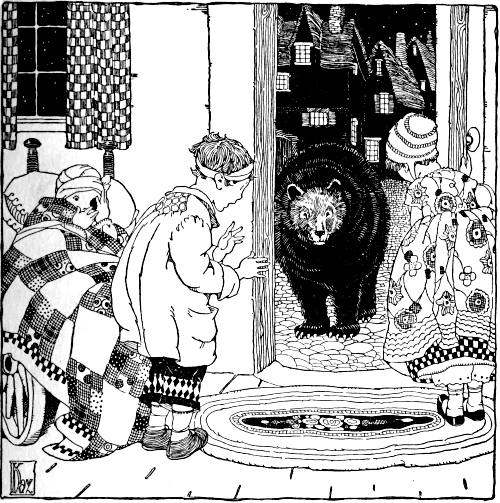
No Lady Wind was that. No dog either. But a
bear that stood before her. Page 43.
But at last, when the old bear had roared loud and alarmingly at the children (who stopped laughing then), when he had stood on his head and shown his teeth and rolled a hoop and done a great many other astounding things, Tubby Tim said abruptly, “That’s all”, and led him out. But the party wasn’t over yet by a good deal, for there was still the puppet show, which Tubby Tim now started to make ready.
Jack and Jill and Humpty Dumpty down in the Dumpty house meanwhile were having a quiet little game of “Button, button” when they heard a noise at the door.
“What’s that?” asked Jack.
“The Lady Wind,” answered Jill. “March is her month, you know.”
“It sounds more like a dog than a lady,” said Jack.
“Ho, ho,” scoffed Jill, “you don’t even know wind when you hear it.” With which Miss Jill flounced to the door and flung it wide open. But goodness, what was that in the doorway? No Lady Wind was that. No dog either. But[Pg 44] a bear that stood before her, yellow-eyed and open-mouthed!
“Oh!” gasped Jill faintly.
“Oh, oh!” breathed Jack and Humpty together.
The bear ambled into the room.
“Run,” cried Jack to Jill. “Run upstairs and shut the door tight, or he’ll eat you!”
“But he’ll eat you too! Come along,” whispered Jill.
Then they both looked at Humpty Dumpty, who sat quaking and white in his chair. For Humpty could not run, of course, and he saw himself a fine meal for that open mouth.
“No, we must stay with Humpty,” said Jill, shivering with fear.
“Of course,” answered Jack, trembling.
“Perhaps if we all fight him, we can get him out,” suggested Jill.
“Yes, come on, let’s fight him,” replied Jack.
“I can’t fight,” said Humpty from his chair, “but I can glare mighty hard. I’ll glare at him, Jill.”
“Yes, you glare, Humpty Dumpty,” said Jill encouragingly.
Jack by this time had rolled up his sleeves, ready for battle, and Jill, flinging back the hair[Pg 45] from her eyes, rushed at the bear headlong. But what was that bear doing, anyway, if he were not rubbing against Jill’s knees with the affection of an old family cat? What was he pawing at her so softly, so gently for, if it were not because he wanted her to play with him? Why did he look up at her with those funny little yellow eyes, if it were not to reassure her as to his good intentions?
“Why,” cried Jill, “I believe he’s a pet bear!”
“I think he is!” answered Jack.
“I wonder if he’d like to be patted,” ventured Humpty, putting a timid hand on Bumbo’s back. The bear dropped on his back and pawed playfully in the air.
“He does want to play,” cried Humpty Dumpty.
What a fine playfellow he was, too, that Bumbo bear, as the three children romped with him there in Mrs. Dumpty’s back parlor. How he rolled and pawed and growled—just a pretend-growl, though; you could tell he didn’t mean a thing by it. How he tumbled and jumped and trotted around the room. He even seemed to understand that Humpty could not play as the other children could, but went to[Pg 46] Humpty’s chair and nosed and pawed around so amusingly that the poor invalid quite forgot himself in his delight.
The Punch-and-Judy show was meanwhile progressing at the palace, and Judy had just given Punch a mighty cuff on the cheek, to the infinite pleasure of the audience, when Mr. Claus, who had laughed until the tears came, began to fish for his pocket handkerchief. But, as he fished, his eye was arrested by a startling vision at the door.
“Great snakes!” he roared suddenly.
Tubby Tim dropped his puppets and everybody looked up quickly.
“Saints preserve us!” shrieked Mrs. Grundy.
And immediately there arose such a bellowing and crying, such a tumbling of chairs and confusion of figures, as to make Old King Cole’s birthday party look like a riot instead. Mr. Horner was seen to throw off his coat in great haste, Simple Simon began to call loudly and insistently for help, Mrs. Dumpty started to faint, then thought better of it, and came to again. As for the Queen of Hearts, that royal lady straightway went into a fine fit of hysterics, deportment which she considered highly becoming to queens in time of stress.
[Pg 47]
And what do you suppose was the cause of all this uproar? What was this vision in the doorway that had suddenly set all of Pudding Lane to screaming and bawling?
It was nothing more than our friend Bumbo, who stood in the doorway blinking soberly, with Humpty Dumpty on his back and Jack and Jill on each side of him. Which, you’ll have to admit, was pretty much of a surprise for people who had supposed that the bear was snoozing in the pantry; and which looked indeed like a dangerous business to folks that didn’t know what a very friendly bear Bumbo was.
But so smiling and serene were those three children, so extremely placid was Bumbo himself, that it finally became apparent that there was really nothing to howl about. And so at last the noise did subside somewhat, save for the exceedingly loud sniffling of Jill’s mother, who was having a little weep all to herself, and quite naturally too.
Then Jill explained the business.
“He was such a friendly bear,” she ended, nodding brightly at Tubby Tim, “so well-trained, that Jack and I thought there would be nothing easier than to bring Humpty up here[Pg 48] on his back. And it was; it was as easy as pie. And here he is.”
But Mr. Claus had started up suddenly at the mention of “pie” and bolted through the assemblage and out of the door. Old King Cole looked over at Mrs. Claus in a rather annoyed manner.
“What’s happened now, Mrs. Claus?” he asked crustily. “Is your husband ill, perhaps?”
“Well, I wouldn’t know, your Majesty,” replied Mrs. Claus, who, if the truth must be told, was deeply ashamed of her husband’s odd company manners. “He was all right when we left home,” and to herself she muttered that it wasn’t her fault if the man acted like a zany. Do you know what a zany is? Well, Mrs. Claus didn’t either, but she supposed it was some kind of animal, and she liked to apply the word to Mr. Claus in what she called his “off” moments.
But bless you, it was Mrs. Claus who was having the off moment this time, for what the baker had gone for was the secret, a thing that everybody had completely forgotten in the hubbub and excitement. So that not only Old King Cole, but everybody else was surprised when Mr. Claus came strutting back with it, the secret,[Pg 49] in his hands. When they did see it, they remembered again, and all started to sing a verse that Mrs. Grundy had composed for the occasion, which began, “Sing a song of sixpence, pocket full of rye.” And now you know, don’t you, what the surprise was that Mr. Claus had baked for Old King Cole’s birthday? And sure enough, when that merry old soul cut open his birthday pie, out flew the four and twenty blackbirds and began to sing; and, as Mrs. Grundy said, was that not a dainty dish to set before a king?
Old King Cole thought it was. He was the most surprised and delighted man you ever saw, and as the birds flew around the room and sang, he became more charmed and bewildered than ever, so that he really was in no condition to make a speech when the people called for one. But he arose just the same and, taking off his crown, fumbled nervously with it, as he tried to think of something to say. His people the meanwhile beamed loyally at him, so happy that they had really pleased Old King Cole, who was always doing something to please them.
“Friends,” began the King, “I am deeply obliged—” Then he stopped and burst into a hearty laugh, which rang and reverberated down[Pg 50] the great halls and rooms of the palace until the building almost shook.
And that was as far as Old King Cole ever got, for every time he’d try to sober down and go on with the speech, laughter overcame him, until at last all the people there began to laugh just to see him. They roared, they shook, they rocked with laughter, did those good people of Pudding Lane, until it began to look as if they would never get their faces straight again, never get their breath again, never stop holding their sides. Even the butcher left off frowning, the baker stopped looking dismal, the candlestick-maker ceased bowing, as they all laughed there together. And of course Jack and Jill laughed, and Humpty Dumpty, too, for they were the ones to whom it was the most fun of all, because they were the ones who had nearly missed the party.
And let me tell you something. The bear laughed too. He didn’t make a noise about it, and he didn’t shake, but there was a look in his eye that was plainly a look of laughter, and there was a twist to his mouth, as he stood there by Tubby Tim’s legs, that was unmistakably a grin. Yes, Bumbo laughed too. And if anybody wants to know, he laughed many times[Pg 51] after that as he thought of King Cole’s birthday party and of his part in the whole performance. For, of course, if Bumbo had not trotted off adventuring as he did, Humpty Dumpty would never have got to the party, and if—oh, well, he did go trotting off, so what’s the use of if-ing about it?
[Pg 52]
SIMPLE SIMON HAS HIS DAY
IT had seemed to the children of Pudding Lane that April Fool’s Day would never, never come, they had been waiting for it so long; and now that it had come, blest if it wasn’t raining pitchforks, as Mrs. Claus said. And blest if it wasn’t. It really did look like pitchforks, that rain, as it came slanting down in sharp, shining spears, splash, splash, splash, as fast as it could come. It really looked as if the sun would never shine in Pudding Lane again, for surely no sun would be foolish enough even to try to break through all that darkness and wetness and gloom.
And so, if you had been a frog in a puddle on Pudding Lane that morning, you would have seen noses pressed tight against every window there and disappointed eyes fastened sadly on the rainy world outside. You might even have seen rain in those eyes themselves, though I wouldn’t be positive of that. That roundish[Pg 53] nose there against the first window was Humpty Dumpty’s; the turned-up one was Jill’s; the straight little pretty one was Miss Muffett’s; all those pert affairs sticking out of the buttonholes of the Shoe were no others than the noses of the children of the Old Woman Who Lived there.
The only nose that was not plastered against a window was Simple Simon’s and the reason that Simple Simon’s nose was not there was because Simple Simon himself was out in the rain, and his nose was with him. Yes, that foolish fellow was standing in front of the butcher shop, and as composedly as if it were the sun, and not the rain, that was beating down on his head. But why was he holding that long thick rope so carefully in his right hand? And what was that tiny object on the walk to which his eyes were directed so intently?
That object seemed to be a purse, a very, very small purse—oh, now we know what poor Simple Simon thought he was doing, don’t we? He thought he was going to fool somebody with that old, old trick. He thought somebody would come along pretty soon, stoop to pick up the pocketbook, and that he, the clever Simon, would jerk it out of reach. He could see now,[Pg 54] in his mind’s eye, how silly the somebody would look, and he snickered there to himself at the mere thought of that delicious moment. Oh, Simon, Simon! As if anybody with half an eye would not have seen the rope long before he saw the wee pocketbook. As if anybody would have been apt to come strolling along in the rain, anyway! Ah, me, I’m afraid Simple Simon’s wits do not improve much with the years.
Well, it kept on raining and Simple Simon kept on standing there and the rest of the Pudding Lane children kept on looking forlornly at the rain, when whirr, swish, plop,—down dropped Mother Goose on the gander’s back, directly in front of Simple Simon. Simple Simon wrenched his eyes a moment from the purse to smile swiftly and delightedly at the beloved old lady, who now hardly looked like herself, so drenched and dripping was she.
“Good morning, Simon,” said Mother Goose, as the gander shook a shower of water from his back.
Simon’s smile waxed wider.
“Morning, mum,” he answered with a bow, then straightened up and sent his eyes flying back to the purse. He didn’t want anybody to come along and pick it up when he wasn’t looking,[Pg 55] you see! Mother Goose regarded him curiously for a moment.
“Fooling somebody, Simple Simon?” she asked.
“Yes’m,” replied Simple Simon gleefully.
Mother Goose laughed softly.
“Well, I guess it’s Simple Simon you’re fooling,” she said, and ran into the Clauses’ next door.
Simple Simon meditated a while over what Mother Goose had just said and was highly pleased. How funny that was, he thought, to be fooling yourself! For, of course, Simple Simon did not mind in the least being the butt of his own joke. And if he didn’t mind, I suppose we needn’t. Only it does seem like a queer kind of April Fool’s trick to go to all that trouble just to fool yourself, doesn’t it?
Inside the cozy little kitchen at the Clauses’ Mother Goose dried her clothes and visited comfortably with her daughter, Mrs. Claus, and the rest of the family.
“My goodness, Santa,” she exclaimed, “you are a long-faced little boy! And the twins! Why, what can be the matter with these children, Nellie?” She turned to her daughter, “Are they ill?”
[Pg 56]
“It’s April Fool’s Day, Mother Goose,” spoke up little Santa.
“I know that,” replied his grandmother promptly. “And I, for one, think that the Weather Man has done a fine job of fooling all you children.”
Santa Claus looked up surprised.
“Do you suppose that’s why he sent the rain?” he asked Mother Goose.
“Not a doubt of it in the world,” answered the old lady vigorously. “The Weather Man has to have a little fun, you know. And I’ll venture he’s laughing fit to kill at the sight of your doleful chops.”
Here Mother Goose laughed merrily, and Santa Claus tried manfully to laugh too; but it’s hard to laugh when the joke’s on you, and I’m afraid he didn’t make a very good job of it.
“Maybe he’ll fool you again and send the sun pretty soon,” suggested Mrs. Claus. She felt pretty sorry for the children, did Mrs. Claus, and she was surprised that Mother Goose did not seem more sympathetic.
“Nonsense,” said Mother Goose tartly. “I say, you people are serious-minded folk for such a day as April Fool’s. You must take a joke better than this, you know, or you’ll spoil the[Pg 57] Weather Man’s fun entirely. Why, I shall be ashamed to show my face up there at the Weather Man’s house if he thinks my grandchildren don’t know how to take a joke!”
“Are you going up to see the Weather Man?” asked Mrs. Claus.
“I’m on my way there now,” Mother Goose told her.
“And what about the Man in the Moon?” asked Mrs. Claus, smirking at the baker, who tried his best to smirk back.
“The Man in the Moon is suffering a temporary eclipse,” replied the old lady sharply, at which Mrs. Claus and Mr. Claus both laughed heartily, and Santa wondered what kind of disease an eclipse was, and if it hurt as much as the mumps did.
“As I was going to St. Ives, I met a man with seven wives, Mr. Claus,” said Mother Goose casually to her son-in-law.
Mr. Claus jumped out of his chair.
“Seven wives!” he exclaimed. “Great snakes, Mother Goose, seven wives! Why, what would a man want with seven of ’em—that is—oh, dear, seven!” Clearly Mr. Claus was greatly agitated over this piece of news.
“But they weren’t his wives, Mr. Claus,”[Pg 58] added Mother Goose. “They were his brothers’ wives. Ha, ha, April Fool!” cried Mother Goose. At which she and Mrs. Claus and the children shouted with delight, as poor Mr. Claus grinned foolishly and wished he hadn’t been so quick to bite at Mother Goose’s bait.
But while all this was going on in the Clauses’ house, Simple Simon was playing another joke all by himself outside. For it had occurred to him that it would be the best possible fun to play a joke on old Mother Goose herself. And so, what did Simple Simon do but step softly around to the shed where the old lady had left her gander? What did he do but take that gander and carry him into The-House-that-Jack-Built, that big uninhabited house a few doors away? What did he do but hide the gander there and then come out on to Pudding Lane again, looking as wicked and proud of himself as you please?
“Well,” said Mother Goose, when she went out to the shed and found that the gander was not there, “this is a pretty pickle.”
Mrs. Claus agreed that it was a pretty pickle, but Mr. Claus differed a bit with the ladies and called it a “fine how-do-you-do.” Anyway what they all meant was that it wasn’t a pretty[Pg 59] pickle, or even a fine how-do-you-do, but that it was instead a very serious thing for Mother Goose to lose her gander. So they started straightway to hunt the gander, but although they searched and searched and called and called that bird, they could not find him in all of Pudding Lane. And at last they came back to the house, drenched with rain, and sat down in a gloomy circle around the stove.
“Whatever will you do without the gander, Mother Goose?” asked Mrs. Claus.
“Do?” repeated Mother Goose with some asperity. “Well, I’ll just stay here the rest of my days, I suppose. I certainly can’t fly around the world with nothing to fly on, can I?”
“But what will the Weather Man think when you don’t appear for your visit?”
“Goodness only knows,” answered Mother Goose. “He’ll think something, you may be sure. And we’ll know soon enough what he thinks. If he’s angry, he might even send a tornado. Oh, don’t shiver now, baker. It hasn’t struck us yet. What is coming over that bird? He acts like a loon sometimes. I really think I’ll have to get myself a fine turkey gobbler to ride on. They have more sense than ganders.”
Mother Goose would not have scolded and[Pg 60] fussed like this at the poor absent gander had she known what a flutter that bird was in himself. For the gander had not run away at all, but had been taken by Simple Simon entirely against his will, and now as he stood in The-House-that-Jack-Built, tied fast to a bedpost, his were harsh and desperate thoughts. To think that he had been tricked like this by that absurd Simple Simon, he of all fowls the most trustworthy, the most sagacious. Tied to a bedpost indeed! What humiliation, what degradation! The poor gander squirmed and writhed with the bitter shame of it; but he might as well have stood still, for he was tied with that very rope Simple Simon had used for his other joke, and that rope, as we know, was a very substantial affair, such as no mere gander could break.
But while Mother Goose fussed and the gander squirmed, one person was laughing aloud at the fun of it all, and that person was, of course, Simple Simon. He could hardly contain himself as he stood there in the rain and thought about it. And to tell the truth, Mother Goose and Mr. Claus had looked pretty funny as they ran down Pudding Lane, calling the gander. Mother Goose, indeed, always looked funny when she ran, for the good old lady was so accustomed[Pg 61] to riding that she took very ill to running. But when she ran in a rainstorm, as she did on this day, she was just a little more ridiculous than ever, with her long skirts wound damply around her legs, her glasses streaming with water, her feet in Mr. Claus’s enormous rubber boots which sloshed, sloshed, sloshed.
As for Mr. Claus, he was not quite so funny until you noticed the cascade of rain that came spouting down on his nose through a hole in his umbrella, and then he became very funny indeed. And the really ludicrous thing about that was that the more Mr. Claus tried to dodge the waterfall, the faster it came through the hole; and the more he shifted the umbrella around, the more accurately did the waterfall strike him on the very tip-tip of his nose. Yes, that was very amusing, and Simple Simon laughed himself weak now as he remembered it. All the other children at the windows had laughed at the sight too, though they did not know why Mr. Claus and Mother Goose were out in the rain like that. They had paid no attention to Simon and his tricks. Nobody ever did.
Up in his home the Weather Man was becoming decidedly worried at the non-arrival of[Pg 62] his expected guest, Mother Goose, and he confessed to the Weather Woman, his wife, that he was afraid something was terribly, terribly wrong.
“She always keeps her engagements,” he said. “She is a most punctual woman.”
“Perhaps she is ill,” suggested the Weather Woman.
“She’s never been ill in her life,” said the Weather Man.
“No sign she never will be,” retorted the Weather Woman.
Just then the Weather Girl and the Weather Boy came in, those two hardy children of the Weather Man.
“Where’s Mother Goose?” they demanded.
“Not here,” replied the Weather Man.
“Didn’t come,” said the Weather Woman.
“Not here! Didn’t come!” repeated the Weather Children. “Why, what’s the matter? Is the rain too much for her?”
The Weather Man looked thoughtful at this suggestion, then turned to his wife.
“Weather Woman,” he addressed her, “do you suppose that this rain could possibly be the reason for Mother Goose’s failure to appear?”
“I shouldn’t wonder a bit,” replied the[Pg 63] Weather Woman. “You know how those earth-people are about rain. I declare, sometimes I think they’ll never get used to it, the way they carry umbrellas in the rain, and wear waterproofs against it, and stay at home because of it, as if a little water once in a while would hurt the dear creatures!”
“Well,” spoke the Weather Man, “if that’s the reason that Mother Goose hasn’t come, we’ll have to stop the rain, that’s all. Weather Children,” he ordered, “kindly shut off the rain and turn on the sun. Perhaps we’ve fooled the children of Pudding Lane long enough, anyway.”
So that is how it happened that three minutes later, Pudding Lane found itself bathed in clear, sparkling sunshine which left no sign of the previous rain except the puddles in the street, the gently dripping trees, and some little ruffled-up birds, who shook themselves furiously in the sun and sang loud songs of thanksgiving that the downpour was over. And that is how it happened that all the children came tumbling out of their homes pell-mell as they did and began fooling each other as fast as ever they could to make up for lost time.
Such jokes as those children played too! There was Handy-Spandy, Jack-a-Dandy, for[Pg 64] example, who really was such easy prey it was almost too bad to fool him. For when Santa Claus offered the greedy fellow a nice plum cake, or what looked like a plum cake, Handy-Spandy just grabbed it and sank his teeth into it without a single question—without even much of a thank-you, though I guess that mumble in his throat was meant for a thank-you. And when he bit down into the cake, oh, how the children screamed, for it wasn’t a plum cake at all, but a cotton cake, which Mr. Claus had made especially for the children to fool Handy with on that first day of April.
They fooled Santa Claus too, telling him that Judy wanted him down at the Shoe; but when Santa ran as fast as he could run down to the shoe, there was nothing waiting there for him but a big sign which said, “April Fool, Santa!” Which did surprise that little boy vastly, for he had forgotten he could be fooled, so busy was he trying to fool other people.
The children had a good deal of fun with Tom, Tom, the piper’s son, for when he wasn’t looking, Johnny Bo-Peep pinned a big card on Tom’s back which read, “Please to kick me, my dears!” And then when the children proceeded to obey the injunction, poor Tom looked so bewildered[Pg 65] and foolish that it almost seemed as if that were the very funniest joke of all.
Oh, everybody was fooled good and plenty, and great was the noise, the laughter and shouting. And at last, when all the tricks had been exhausted, and when the children were exhausted too, out came Mother Goose from the Clauses’ house.
“I say,” she cried to the children, who had surrounded her until you couldn’t see a thing of her but the tip of her pointed hat, “I say, I know somebody you haven’t fooled!”
Oh, was there still somebody to fool? Delightful!
“Yes,” went on Mother Goose, “we can still fool somebody else. We can still fool the gander, children! For he’s run off to fool us, I suppose, and now if we find him, it’ll be a joke on the silly bird, you see.”
So they started out on the great search for the gander, all of them, scattered in every direction. And what of Simple Simon? Well, Simple Simon was just as pleased as he could possibly be over the whole affair, for now that he had fooled Mother Goose by hiding her gander, he was perfectly willing to fool the gander by bringing him back to Mother Goose. You see,[Pg 66] he was so simple that he didn’t comprehend that to bring the gander back would not really fool him at all. So into The-House-that-Jack-Built trotted Simple Simon, chuckling jovially at the whole affair, and out he came again in half a minute, leading the dejected old gander behind him.
“Bless me,” said Mother Goose, when she caught sight of the gander, “here he is. Why, Simple Simon, you are a fine fellow, indeed you are.”
Simple Simon, no longer able to contain himself, laughed outright.
“I did fool you, after all, didn’t I?” he asked proudly. “I hid the gander, Mother Goose,” he went on excitedly, “and you never guessed it at all.”
And there the absurd fellow had given the whole thing away! Oh, how the children enjoyed that joke, and how Mother Goose laughed too. But above all the racket could be heard Simple Simon’s great guffaws celebrating his own wit and smartness, like the simpleton he was.
[Pg 67]
MRS. CLAUS HAS A GREAT HONOR
MRS. PETER, PETER, PUMPKIN-EATER was briskly shaking out her best parlor rug in her back garden one fine May day when flap, flap, clack, clack, came a noise to her ears.
“Bless me,” said the tiny lady, looking up, “if Mrs. Dumpty isn’t at it too.”
True enough, the mother of Humpty was likewise in her back garden, beating a rug, and as Mrs. Pumpkin-Eater looked to the other side of her, she discovered that Jill’s mother was doing precisely the same thing. Then she saw that the Old Woman Who Lived in a Shoe was shaking out her rugs too, and so were Mrs. Grundy and Mrs. Claus, the mother of Santa,—why, all of Pudding Lane was shaking out its rugs at that very minute! Which was not so strange, when you consider that this was the first day of May, which, as anybody knows,[Pg 68] means house-cleaning to any right-thinking woman. But the first of May means also a Maypole and a May Queen and baskets of flowers on the door knobs. And now we’re coming to the really sad part of this story.
For it did look as if house-cleaning this year were going to crowd out May Day in Pudding Lane completely. Always before, while the mothers of Pudding Lane were cleaning their houses, Mother Goose had come to give the children their May Day, so that they had never missed it. But this year Mother Goose had gone to a house party at the Frosts’, Jack and his wife, you know, who do a good deal of entertaining in their slack season. And so, since Mother Goose was not there and the mothers of Pudding Lane were so busy with house-cleaning, it did look very doubtful about the Maypole.
The children, Bo-Peep, Jack Horner, Polly Flinders, Jack and Jill and Santa Claus, were talking about it in Santa Claus’s shed that very morning.
“They could house-clean to-morrow. I wouldn’t mind living in a dirty house one more day,” ruminated Jack.
“I wouldn’t mind it forever,” spoke up Jill.[Pg 69] Which was probably true, for Jill was not the tidiest little girl in the world.
Then Simple Simon jumped up quite suddenly and began to dance, throwing his long legs gleefully around and laughing as he did so,—quite a spectacle, I can assure you. Even the children, who were used to his queer ways, were astonished, and they were still more astonished when he abruptly sat down, and drawing them all close about him on the shed floor, began to tell them a wonderful secret, in a whispering voice so full of “shishes” and “shushes” they could hardly hear what he said.
And as soon as Simple Simon had finished, the children all jumped to their feet and ran off together, so that in another moment not one of them was to be seen in Pudding Lane. Their mothers did not even miss them, so deep were they in the business of house-cleaning.
A deadly earnest business it was too. You could see by the way Mrs. Dumpty pressed her lips together that this was no laughing matter. You could tell by the set of Mother Hubbard’s jaw that she’d see this affair through to the finish, come what would. And as for the tiny Mrs. Pumpkin-Eater, well, although her rug was three times as big as she was, and she herself[Pg 70] was only one third as big as she ought to have been, she shook that offending piece of carpet as if to shake its very red roses off, and I think she would have loosened a petal or two, if they had been any but woolen roses.
But if all this were deadly serious to those excellent housewives themselves, it was an even grimmer business for their husbands. If ever a man is miserable, it is during spring house-cleaning, and already on this day uncomfortable things had begun to happen to the men of Pudding Lane. Mr. Claus, for one, had risen to find the kitchen table upside down in the back garden and had been forced to eat his breakfast from the window sill, no good way to start the day, certainly. But it was rather worse for Jack Spratt, who got no breakfast at all. Mrs. Spratt simply told him she couldn’t be bothered, unless, she added, he’d “do with a piece of fat meat”, which of course, being the man he was, he couldn’t do with.
Mr. Horner, poor man, slipped on a piece of wet soap which was on the kitchen floor—though it certainly had no business there—and nearly broke his neck. And Peter, Peter, Pumpkin-Eater was forced to appear in public in his shirt sleeves, because, when he had marched to[Pg 71] his old peg that morning to fetch his coat as usual, it was to discover that not only had the coat disappeared, but the peg had too—which shows how far things had gone in the pumpkin shell that morning.
But the most miserable of all men in Pudding Lane that day was Old King Cole, the merry old soul himself. It does seem as if a King ought not be bothered with such unpleasant affairs as house-cleaning. But Old King Cole was bothered, for the Queen of Hearts was nothing if she was not a good housekeeper. Consequently, the king had awakened that morning to find carpets up and curtains down, furniture stacked, dishes, brushes, paint cans, brooms, buckets everywhere, and the Queen, her royal head in a dust cap, chasing the servants about in what looked like a mad game of tag.
Moreover, as the Queen was having the throne regilded and the chairs all resilvered, poor Old King Cole had to stand up all the time, unless he chose to sit on wet paint, which he didn’t. And worse than that, he had to stand perfectly still too, for when he tried to walk, he found himself stumbling over mattresses, crashing into glass dishes, stepping into buckets of water, and slipping on wet paint brushes.[Pg 72] My goodness, how uncomfortable he was, standing there in the midst of all that higgledy-piggledy, while the Queen and the fiddlers three and all the king’s men rushed insanely around, never once looking at him.
His legs soon began to ache dreadfully; his head buzzed with the noise. He called for his pipe. Nobody paid the least attention. He called for his bowl. It was not brought. He called for his fiddlers three. They leaped up to him, made deep hurried bows, offered their apologies, and were off to help the Queen of Hearts again, who at that moment was at the top of a stepladder, wrestling with a curtain rod.
“This is enough,” said Old King Cole bitterly to himself, and, smashing through the glass dishes, paint buckets and wet mops on the floor, he bounded out of the throne room and through the front door. Old King Cole had run away from home and family. Not that the Queen of Hearts cared in the least. In fact, as she saw her liege lord departing, she was heard to murmur something about “good riddance”, hardly the way to speak of a king, I should think. Then she continued battling with that curtain rod with the greatest relish in the world.[Pg 73] There’s something about a curtain rod that makes women—well, anyway, the Queen of Hearts was certainly enjoying herself, that was evident.
He ran and ran, did Old King Cole, and he didn’t know in the least where he was going, and finally, being fat, he just had to stop for breath. So he did. And then he saw that, although he had been running a long time, he really hadn’t run far at all, having gone in a circle, as people so often do when they think they’re going straight.
“Fiddlesticks,” said Old King Cole. “I thought I’d be halfway to Dover by this time.”
Dover? Dover? What was he going to Dover for, do you suppose? Could it be that Old King Cole had reached such a pitch that he was thinking of going away over to France to see the King of France for a while? I shouldn’t be surprised. He really was quite worked up.
Well, anyway, there he stood on Pinafore Pike, puffing and blowing and saying “Fiddlesticks”, and goodness knows what he would have done next if he hadn’t seen Simple Simon ambling along the road. But he did see him, and Simple Simon told him the secret, and the first[Pg 74] thing that old king knew, he and Simon had gone off in just the opposite direction from Dover.
Meanwhile, however, something pretty serious was happening in the palace. For just at the moment when everything was at its topsy-turviest, who should walk in on the Queen of Hearts but the King of France? Yes, right through the front door came that elegant fellow, and there was the Queen of Hearts, dust cap and all, on the top step of the ladder. Was ever a woman so humiliated? Was ever a Queen caught in such a condition? The Queen of Hearts thought not, and as she climbed, blushing and confused, down that horrible ladder, she wished desperately to herself that she had never heard of house-cleaning.
And what was her chagrin when the King of France told her that the very reason he had left France was to escape the house-cleaning in his own palace. And he had walked right into the same muss here in Pudding Lane! The King of France laughed heartily as he told the Queen of Hearts this, because he thought it was funny, but it wasn’t funny to the Queen of Hearts—no indeed—and she wrung her grimy hands in despair.
[Pg 75]
The news spread quickly through Pudding Lane that Old King Cole had slipped away, and that the King of France had walked in suddenly and caught the Queen in her dust cap. And you may be quite sure that the people of Pudding Lane soon gathered together to talk it over.
“We ought to Pay our Respects to him,” said the candlestick-maker.
They all agreed that they ought.
“But how do you Pay Respects?” asked Mr. Horner.
The candlestick-maker, not having the least idea, pretended to be too deep in thought to hear.
“It’s certain and sure the poor Queen can’t entertain him for long,” spoke up Mrs. Grundy, who had a small opinion of Her Majesty, as we know.
“She ain’t exactly the brilliant talker,” admitted the candlestick-maker, who wasn’t exactly the brilliant talker himself, when it came to that.
Then Mrs. Claus, looking quickly around, gave a little cry, at which everybody jumped.
“Where are the children?” she cried. “I haven’t seen a child since early morn.”
[Pg 76]
Great goodness, where were the children? Pudding Lane had forgotten them completely in the excitement of house-cleaning, foreign visitors, and suchlike. But they were aroused to action now, those mothers and fathers. They ran around the village, calling and shouting, until the Queen of Hearts and her regal guest heard them and came down to see what the noise was about. They joined the search party then, and just as everybody had begun to think that the children had been swallowed by the earth, or eaten by bears, or something else terrible, they came across them all, down behind Honeysuckle Hill. And what do you suppose they were doing?
They were dancing around a Maypole, a beautiful, flower-covered Maypole, which stood a little tipsy in the ground, it is true, but which, nevertheless, was one of the best Maypoles that Pudding Lane had ever seen. They were dancing and singing, every one of them, and what’s more, there was Old King Cole himself, between Mistress Mary and Polly Flinders, galloping around that pole as if he had never heard of gout. For once, Simple Simon had thought of something really worth while. For this, you see, had been his secret. He had suggested to[Pg 77] the children that they build their own Maypole, and they had done it.
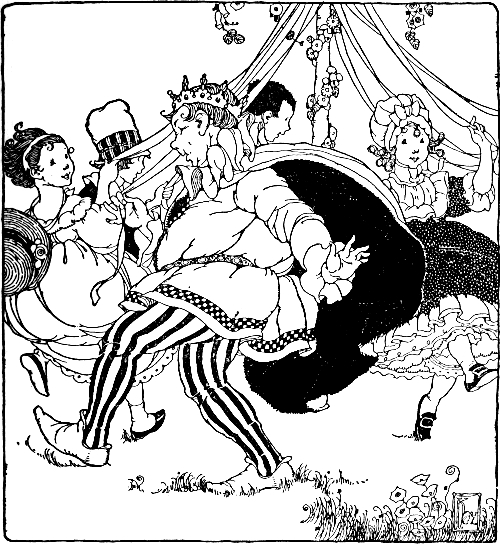
They were dancing around a Maypole, a beautiful, flower-covered Maypole. Page 76.
Well, how surprised the parents were, to see what a beautiful Maypole the children had made. How surprised Old King Cole was to see the King of France. And how surprised the Queen of Hearts was to find her husband there with the children. Indeed, everybody had something to be surprised about, and so, of course, it was a most exciting occasion.
Then Old King Cole proposed that the mothers and fathers, with the King of France and the Queen, should join in the dance. Then the ladies protested that they weren’t dressed fit and proper. Then Old King Cole said “Nonsense”, and finally it all ended up with everybody’s getting in, and dancing and singing, and having a perfectly riotous time.
They had a Queen of the May too. Everybody thought the Queen of Hearts ought to be the May Queen, except the Queen of Hearts herself, who was so tired of being a Queen, and Mrs. Grundy, who wanted to be the May Queen herself. So Mr. Spratt, who knew what to do and when to do it, suggested that “our royal and honored guest, the King of France, crown the Queen of the May, whomsoever he would.”
[Pg 78]
The King of France looked critically around the circle of ladies. He looked at Mrs. Grundy and passed her by. He looked at Humpty Dumpty’s mother, and that little lady thought she should faint from agitation. Then he looked at the Old Woman, at Mrs. Horner, at Mrs. Flinders, and passed them all by. After which, to everybody’s intense excitement and joy, he marched straight up to—Mrs. Claus, of all people!
Oh, dear, what a stir that created! And can you imagine how Mrs. Claus herself felt at this honor? Can you see her blushing and bobbing and saying, “Yes, Your Majesty,” two dozen times without stopping? Can you see her grow glassy-eyed with embarrassment when, a moment later, the King of France laid the crown of roses on her topknot,—which, as she thought to herself bitterly, hadn’t been crimped for days? Can you see her sitting stiff as a ramrod and burning with blushes, at the side of the resplendent King of France, who was also King of the May?
Well, perhaps a May Queen should not be goggle-eyed and red-faced as Mrs. Claus was. Perhaps she should not gulp and wring her hands as Mrs. Claus did. Perhaps she should[Pg 79] have had her hair crimped, and perhaps she would have been better dressed in a gown without those big patches under the arms. But Pudding Lane was well satisfied with their May Queen, and thought her most queenly and elegant. So they danced around her, singing and clapping, and never did a woman feel more proud and happy than did Mrs. Claus on that day. Only one person felt prouder and happier than she, and that was Mr. Claus, who at all times thought his wife a remarkable woman, but in this new glory considered her too wonderful for speech. And of course, Santa Claus and the twins nearly burst with pride in their mother.
As for the real Queen, she was having a lovely time. It seemed so nice not to have to be regal for once, and she skipped and frolicked between Jack Spratt and Peter, Peter quite like an ordinary woman. Peter, Peter, by the way, was the only person there who was not quite happy. For Peter’s coat never had been found in the frenzy of his wife’s house-cleaning, and the poor little man was therefore dancing there in his shirt sleeves, to his great mortification and shame.
And when it was quite dark, and they couldn’t dance any more, if the Queen of Hearts, in a[Pg 80] spasm of generosity, didn’t invite them all up to the palace for tarts and lemonade, a fine finish for any May-Day party. After which the King of France said he thought he ought to be off. So he went away, and the people of Pudding Lane went home at last, after a happy and eventful day.
And ever after that, while the mothers of Pudding Lane cleaned house on the first of May, the children and the men prepared the May-Day party, which turned out to be just the way to manage the first-of-May problem, so that everybody should be happy. So Old King Cole never ran away from the palace again, of course. And by the way, Old King Cole never did tell anybody that he had started out for France that time when he ran away, for he didn’t want to confess that he had gotten lost. But wouldn’t it have been funny if he had gotten to France only to find the French palace in the same uproar as his own? There might be a moral to that, something about home-keeping hearts, or sticking to the ship, or some such, but I guess we won’t bother with morals.
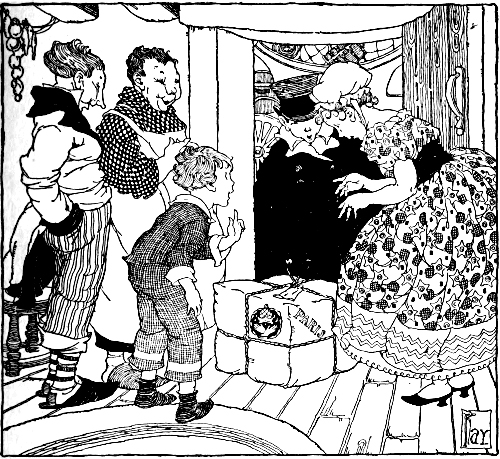
On the same stagecoach from Dover came a present
from the King of France to Mrs. Claus.
Page 81.
[Pg 81]
THE POODLE THAT DIDN’T KNOW ENGLISH
IT was about a month after the King of France had been to visit Pudding Lane that the stagecoach from Dover brought the Jack of Hearts on a visit to Old King Cole and the Queen of Hearts. As you remember, the Jack had no use for Pudding Lane because it wasn’t Paris, and nobody quite knew, indeed, why he ever came to the little village which he held in such scorn. Mrs. Grundy said he came when he ran out of funds and wanted to live a while on his relatives. Perhaps that was merely Mrs. Grundy’s rather vulgar way of putting it, and perhaps it was true. Anyway, he came and upset the palace quite as much as usual with his French and his fine manners and his old habit of stealing tarts.
But on the same stagecoach from Dover came a present from the King of France to Mrs. Claus, which was far more exciting to Pudding Lane than the presence of the Jack of Hearts.[Pg 82] You remember, of course, what an impression Mrs. Claus had made on His Majesty on May Day, but did you ever dream he would go so far as to send her a gift? Well, nobody else did, least of all Mrs. Claus herself, who almost fainted when the coach drove up to her house and the driver climbed down and handed her a large square wooden box.
“Whatever—?” shrieked Mrs. Claus excitedly.
“Great snakes!” ejaculated the baker, who was standing by.
“What could be in such a box?” inquired Mrs. Claus of the world at large.
“Fine French china,” guessed Mr. Claus.
Mrs. Claus’s eyes glittered hopefully.
“A lamp,” suggested the candlestick-maker, who was there too.
“A dog,” burst out Santa Claus.
Santa was right. The King’s present was a French poodle, as jolly a little puppy as Pudding Lane had ever seen. It was surely very kind of the King of France, and Mrs. Claus was deeply sensible of the honor paid her by His Majesty, but what did she want with a puppy dog, she who had six children? as she rather clumsily put it. Santa Claus and the twins[Pg 83] begged so hard to keep him, however, that Mrs. Claus said well, if they would feed him and wash him and make him mind, he might stay.
But the Clauses could not keep the poodle, after all, and all because of Misery. For that wretched cat began to act like a feline possessed the minute he laid his green eyes on the newcomer, and clawed and scratched and spat at the poor little dog until he squealed with terror.
After a few hours of this, Mrs. Claus shut Misery up in the woodhouse and locked the poodle in the kitchen and ran over to Mrs. Pumpkin-Eater’s.
“But I thought Misery loved company,” said Mrs. Pumpkin-Eater, when the story was finished.
“Not when the company’s a dog,” said Mrs. Claus. “And, oh, dear, Mrs. Pumpkin-Eater, I don’t know what we’ll do unless—unless—well, unless you’ll take the dog off our hands as a kind and neighborly act.”
“But, Mrs. Claus,” objected Mrs. Pumpkin-Eater, “isn’t the pumpkin shell too small for a poodle? There is really so little room here.”
Mrs. Claus looked around the pumpkin shell appraisingly.
[Pg 84]
“It is a bit small; he’s a fat poodle.” Then she brightened. “But perhaps the carpenter would build you a kennel in the back garden, Mrs. Pumpkin-Eater, and you could keep the poodle there.”
And so it was decided, and that very afternoon the carpenter built the kennel and the poodle was brought over to the Pumpkin-Eaters.
The Pumpkin-Eaters were rather nervous over the prospect of keeping a poodle, but they did consider it an honor to have a gift that the King of France had sent, and so they met the situation unflinchingly. Mrs. Pumpkin-Eater fed the poodle with the rarest of titbits, beef-steak, and cream, and mashed potatoes with gravy, until the greedy little puppy was panting and breathless. Mr. Pumpkin-Eater diddle-daddled around the kennel, patting the poodle and talking to him, and when Mrs. Pumpkin-Eater wasn’t looking, he brought his own pillow from their bed, so that the poodle should lie comfortably in his new home. Yes, Mr. and Mrs. Pumpkin-Eater were just as kind as people could be to that poodle, and there was no earthly excuse for his acting the way he did.
But it soon became apparent that he was just about the most troublesome poodle that ever[Pg 85] lived. Not that he was really bad; you could hardly say that of him. He just acted as if he didn’t have any sense.
It began after he had recovered his breath from eating. Until then he was very quiet, except for little grunts, just little happy, eating grunts that nobody could have objected to. Then, when he did get his breath, up he jumped from his pillow, and the trouble began.
The first thing he did was to run straight from the kennel into the pumpkin shell and upset every stick of the tiny furniture that the poor Pumpkin-Eaters were so proud of. I don’t think he meant to upset the furniture, but puppies are not the most graceful beasts in the world, and so as he waddled through the shell, which was pretty small for him anyway, he just naturally bumped into the tables and chairs and sent them spinning.
How agitated Mrs. Pumpkin-Eater was then.
“Shush!” she called imperiously. “Shoo! Get out! Scat!” She said everything she could think of, and still the puppy kept running around, knocking over more things, until he finally bumped into Mrs. Pumpkin-Eater and knocked her over too! Mrs. Pumpkin-Eater was extremely small, as you know, and I suppose it[Pg 86] didn’t take much to upset her. She screamed weakly as she hit the floor, at which Mr. Pumpkin-Eater came running in from the garden.
“Hey!” called out Mr. Pumpkin-Eater angrily to the poodle. Then he shushed and shooed and scatted at the poodle, but the blessed dog just jumped up against him as if he had done something praiseworthy, and the next thing they all knew, Mr. Pumpkin-Eater was flat on his back too, bellowing for help, as the poodle ran excitedly about, yelping with joy.
The neighbors came running in to help, the Clauses, the butcher, Mrs. Dumpty (who was sure somebody else must have fallen off the wall), the Old Woman, Mr. Horner, Mr. and Mrs. Flinders, all of them. Of course, they didn’t all go inside the shell, for there wasn’t room. But Mr. Horner did and gallantly picked up the prostrate Mrs. Pumpkin-Eater, and the butcher squeezed his way in and lifted Mr. Pumpkin-Eater to his feet. Then Mr. Pumpkin-Eater made a dive for the poodle, who by that time was on the bed, chewing up Mrs. Pumpkin-Eater’s best lace spread. The puppy, still thinking it all the greatest joke in the world, ran out of the shell into the garden and jumped right up into the Old Woman’s arms,[Pg 87] squealing as happily as if he had found an old friend.
“Well,” said the Old Woman, “here he is.”
“Put him in the kennel!” cried everybody.
The Old Woman started for the kennel with the puppy wriggling delightedly in her arms—he still thought it all a lovely lark—and maybe all would have been well then, if a certain perky little sparrow had not chosen that particular moment in which to poke his nose into the kennel.
He did choose that moment, however, and so the tragedy happened. The sparrow was halfway into the kennel, pecking at some toothsome crumbs, when the poodle suddenly leaped from the Old Woman’s arms full on the back and tail of the unsuspecting little bird. A cry of joy from the poodle, a shower of feathers, then out backed the poor sparrow, tottering and surprised, with his tail nipped off.
How indignant Pudding Lane was at that! How they all scolded the poodle and sympathized with the sparrow. Sparrows until then had not had very good standing in the village, as perhaps they have not in yours, but this calamity made the people forget their old grievances against the passeres (that’s the sparrow’s[Pg 88] dress-up name) and they could only feel sorry now for the particular passer, oh, very sorry. True, the sparrow, though he staggered uncertainly around and blinked in amazement, did not act as if he were in pain. But if you’re used to tails, of course you miss them, and the sparrow’s had disappeared so suddenly.
Meanwhile, the poodle was acting just as absurdly as before. He was running and rolling and yapping in a perfectly abandoned way, and the more the Old Woman and the butcher and all the rest of them scolded him, ordered him down and bade him be quiet, the more he cut up. It was almost as if he were a mad dog, and yet you could see, just by looking at him, that he was innocent as could be, that he didn’t know in the least he was doing wrong. Puppies don’t naturally have morals, you know, and this one apparently hadn’t been taught any.
Well, things finally got to such a pitch that Mr. Pumpkin-Eater said firmly that he wouldn’t have such a beast about any more, and Mrs. Claus declared she wouldn’t have him either, even if he were a royal poodle straight from the King of France. They decided that the only thing to do was to put the poodle back in the box and send him home to Paris.
[Pg 89]
“But the King!” remonstrated Mrs. Flinders.
“I know,” said Mrs. Claus. “But Pudding Lane would be in ruins if we let this dog stay.”
“But nobody ever sends presents back to a king,” chimed in Mrs. Grundy.
“Well, I know somebody that’s a-going to,” said Mrs. Claus stubbornly.
“He might throw you in prison or something,” suggested Mrs. Grundy.
At which Mrs. Claus turned white, but stood her ground: she’d have no dog that threatened the future happiness and safety of Pudding Lane.
Just then who should come dawdling down Pudding Lane but the Jack of Hearts, airy as usual? When he saw the commotion in the Pumpkin-Eaters’ garden, he stepped in. The people curtseyed obediently; they had manners, even though they didn’t like the Jack. Then they told him what was the matter.
“And he won’t do a thing you tell him to!” concluded Mrs. Pumpkin-Eater. “I never saw such a disobedient dog.”
At that, the poodle leaped up against Mrs. Pumpkin-Eater’s skirts.
[Pg 90]
“Down!” she commanded.
He barked joyously and leaped the higher.
“Hush!” she ordered.
But he didn’t down and he didn’t hush.
“There!” exclaimed Mrs. Pumpkin-Eater exasperatedly to the Jack. “You see, he doesn’t mind a single thing.”
“Of course he doesn’t,” replied the Jack of Hearts quietly.
“Of course!” repeated Mrs. Pumpkin-Eater. “I don’t see any ‘of course’ about it.”
“Well,” said the Jack of Hearts with his best sneer, “I suppose you don’t. But didn’t you say the poodle was from France?”
“Yes, sir,” answered Mrs. Pumpkin-Eater. She did wish the obnoxious fellow would go away and stop interfering.
“And haven’t you been talking to this French poodle in English?” he demanded further.
“Yes. Well—oh, I see,” cried Mrs. Pumpkin-Eater suddenly.
“Oh!” murmured everybody else. “Of course!”
The dog just then sprang higher against the wee Mrs. Pumpkin-Eater and began to lick her face. She cast a beseeching look at the Jack.
“Va te coucher!” commanded that fine fellow[Pg 91] to the dog. The poodle instantly quieted down at Mrs. Pumpkin-Eater’s feet and began to whine a little.
“Veux-tu te taire!” he demanded further, and the whining stopped at once.
The Jack of Hearts looked at the abashed Mrs. Pumpkin-Eater and the rest of the Pudding Laners, who stood there stupefied.
“I guess you wouldn’t understand it either, if somebody talked to you in another language,” he said crushingly, and walked indolently away, swinging his cane.
The people of Pudding Lane could have kicked themselves for their stupidity, they said. Of course, a French poodle straight from Paris could not understand English. Why had they supposed that he could? And they were disgusted still more to have been humiliated by the disagreeable Jack of Hearts.
But kicking themselves wouldn’t do any good now. There was only one thing left to do, and that was to present the poodle to the Jack, whether they wanted to or not, for Mrs. Pumpkin-Eater couldn’t learn French for any dog. And if she could have, she wouldn’t have, for Mrs. Pumpkin-Eater had an idea that foreign languages were an indulgence, like mince pie at[Pg 92] night or two dresses in one year, and she wouldn’t have yielded to it for anything.
So that’s what they did. They handed the puppy over to the Jack of Hearts, who could speak to him in his native tongue and make him mind like an angel.
As for the sparrow, he soon recovered; that is, he learned to walk as smartly and perkily as ever without a tail; he even learned to fly without it, which, as any bird will tell you, is quite a feat. He looked funny, with his swelled-out chest and airy manners and poor little chopped-off stumpy back view. But the Pumpkin-Eaters didn’t care how he looked, for he just exactly fitted the pumpkin shell now and at last they had a pet, did the Pumpkin-Eaters, just exactly suited to their needs. So that if you ever pass by the pumpkin shell and look in at the window, you’ll see him there. But if he turns his back, don’t laugh at the poor little fellow. It might hurt his feelings. He’s never seen his back and doesn’t know how funny he looks.
[Pg 93]
BO-PEEP FINDS OUT HOW A DUTCH UNCLE
TALKS
MR. BO-PEEP came home to dinner one hot July day to find his daughter not there.
“Little Bo-Peep has lost her sheep and doesn’t know where to find them,” explained his wife.
“Oh, leave them alone and they’ll come home and bring their tails behind them,” answered Mr. Bo-Peep, sitting down to his dinner.
“That’s what I told her,” said Mrs. Bo-Peep, “but you know how she is.”
“Yes, I know how she is,” sighed Mr. Bo-Peep.
And indeed he did, as did everybody else in Pudding Lane, for hardly a week went by in that village that Little Bo-Peep did not lose her sheep. It was really a wonder that she bothered with sheep at all, for certainly she had more trouble with her flock than any other shepherdess did in the whole world. And to-day they[Pg 94] were lost again, and, as usual, Little Bo-Peep was hunting for them.
She walked along Pinafore Pike and passed the Blues’ house, where she saw Little Boy Blue taking his customary nap under the haystack. She came to the pickled pepper field where Peter Piper was industriously picking his peck. She met Old Mother Hubbard’s dog sniffing around a tree trunk.
But although Little Bo-Peep saw these familiar Pudding Lane scenes, not a woolly strand did she see of her sheep until, just as she was about to give up in despair, she turned a corner and plump! she bumped into the whole flock of them running down the road toward Pudding Lane as fast as they could run.
But who was that driving them and scolding them? A strange-looking creature with great billowing trousers and a little blue jacket and the rosiest—though the crossest—face you ever saw.
“Hey!” called Bo-Peep.
The rosy-faced man looked up, scowling.
“Hey!” he replied. “Stop!” he commanded the sheep. “Stop this minute, you abominable wretches, you stupid beasts, you—”
“My goodness!” gasped Bo-Peep. “How[Pg 95] dare you talk to my sheep like that? How—”
“Look here,” interrupted the rosy-faced man. “You be still. You don’t know who I am.”
“Well, you’re not very polite, whoever you are,” replied Bo-Peep indignantly. “You’re certainly not a gentleman.”
“I am a gentleman!” shouted the man. “And if you were a lady, you’d know a gentleman when you saw one. Haven’t I got on a gentleman’s clothes? Haven’t I got a gentleman’s haircut?” He bent down his head and swept off his hat to show her. “Well, then, I am a gentleman. But don’t you wish you knew me?”
“I’m afraid I don’t,” replied Little Bo-Peep more softly. For after all, she thought to herself, she need not lose her temper just because he did. “No, sir, I don’t like you very much, really, and I’m going home now with my sheep.” Then she added, “But I do thank you, sir, for bringing my sheep back. How did you do it? They’re usually very disobedient.”
“How did I do it?” repeated the rosy-cheeked man. “Why, just by talking to them like a Dutch Uncle. For that’s who I am, my fine young lady. I am the Dutch Uncle, you know.”
[Pg 96]
So he was the Dutch Uncle of whom Little Bo-Peep and all the other children of Pudding Lane had heard so much, the cross old fellow who scolded everybody he knew, even those people whom he loved the best. Bo-Peep had never seen him before, for the Dutch Uncle had not been to Pudding Lane since many years ago, before Mr. and Mrs. Bo-Peep had been married, ’way back there when the Queen of Hearts was a bride and Humpty Dumpty was a baby. But the people of Pudding Lane, often, oh, very often, referred to the Dutch Uncle; and now here he was, and it was no wonder Bo-Peep stared.
“Whose uncle are you, sir?” she asked in her gentlest tones.
Questions are supposed to be rude, but if you ask them gently, they somehow don’t sound rude, Bo-Peep had found out.
“Everybody’s, of course!” replied the Dutch Uncle. “My goodness, you are an ignorant girl. Now if your parents would only put you in my charge—”
Oh, dear, he was off again! But he finally stopped, so Bo-Peep tried another question.
“And where is the Dutch Aunt?”
“Dutch Aunt!” exclaimed the Dutch Uncle[Pg 97] scornfully. “She asks me where the Dutch Aunt is! There isn’t any Dutch Aunt. Didn’t you know that?”
“No, sir, I didn’t,” replied Little Bo-Peep. “There ought to be one, you know. Uncles always do have aunts.”
She didn’t mean that exactly, but you know and the Dutch Uncle knew what she meant. And now, strangely enough, the Dutch Uncle stopped frowning at her and smiled.
“I do indeed need a Dutch Aunt,” he agreed. “In fact, that’s just what I’ve come to Pudding Lane for, Bo-Peep, to find a Dutch Aunt.”
“To take her away from Pudding Lane and back to Dutchland?” asked Bo-Peep.
“Dutchland!” laughed the Dutch Uncle. “Oh, dear, Bo-Peep, you are an ignoramus.”
“Holland, I mean,” Little Bo-Peep corrected herself.
Only she did think to herself that Dutchland was a better name for it, after all, than Holland. And she was thinking, too, what an exceedingly pleasant fellow the Dutch Uncle was when he forgot to talk like a Dutch Uncle.
Which is exactly what the people of Pudding Lane had always said about him; that if only he hadn’t been such an old busybody, attending[Pg 98] to everybody’s affairs, he would have been the nicest uncle in the world.
The Dutch Uncle got a tremendous ovation when he and Bo-Peep got back to Pudding Lane with the sheep a few minutes later. At least “ovation” is what the Town Crier called it. Anyway, they made a big fuss over the Dutch Uncle, for they loved the old fellow, even if they did call him names, and they were glad to see him after all these years.
As for the Dutch Uncle himself, he was overjoyed to see his old favorites, and he greeted and scolded them all in the most affectionate manner possible.
“As I live and breathe, Mrs. Dumpty!” he exclaimed, catching sight of that fat little lady. “How glad I am to see you. But you ought,” here he frowned in the midst of his rosy smile, “you ought to take Humpty to London, you know, to consult the great doctors there.”
“And there’s Mr. Claus! Baker, baker, why will you waste your talents in Pudding Lane when you might easily be Assistant Chief Currant Bun Maker to the Lord Mayor of London himself?”
(You would have thought he was the British Uncle the way he talked about London.)
[Pg 99]
“Ah, Mrs. Grundy!” He bowed low and kissed that lady’s hand. “How many moons has it been since I have had this privilege? But that long face of yours won’t do, my dear old friend. Really, you ought to cheer up, you know.”
He next spied a young girl.
“Mistress Mary, Quite Contrary!” he cried delightedly. “How does your garden grow? You were just a baby when I saw you last. But you must mend your ways, Mistress Mary. Contrary girls, you know—”
And so he went the rounds. He chided Simple Simon for not trying to improve his wits. He urged Little Miss Muffett to give up her diet and try green vegetables. He insisted that the Old Woman abandon her Shoe and go to live in a house like other respectable folk. And he even rebuked Old King Cole as being far too merry for the dignity of his position.
Yes, he was just the same. Queer, wasn’t it? But then everybody is queer in one way or another, and the Dutch Uncle really did have the softest heart in the world under his little blue jacket, as the people of Pudding Lane had always suspected and now found out that very day.
[Pg 100]
For suddenly the Dutch Uncle whirled around and demanded:
“And where is pretty Dolly Daffy-Dill?”
“Pretty Dolly Daffy-Dill?” repeated everybody, and then they all looked at each other.
Could it be possible that the Dutch Uncle believed that Dolly Daffy-Dill was still the same girl he had known so many years ago? Did he not know that she had grown older, just as everybody else had? Had he not heard how crabbed she had become, so crabbed, indeed, that she wasn’t even called Dolly any more, but Cross-Patch, which suited her much better?
It seemed impossible that the Dutch Uncle did not know all these things, but he didn’t, apparently, so Mr. Horner, the father of Jack, tried to explain.
“She’s older now, you understand,” he said. “And we call her—Cross-Patch.”
quoted Mrs. Grundy.
Oh, dear, it was too bad that the Dutch Uncle had to find out all this about Dolly, and they all felt very sympathetic. But was the Dutch Uncle distressed? No, indeed.
[Pg 101]
“Of course, she’s older!” he exclaimed. “I had forgotten that, but it’s all the better. And you say she’s cross? Hurray, what a fine Dutch Aunt she’ll make!”
With which, to everybody’s astonishment, the Dutch Uncle hastened to old Cross-Patch’s house, the same little house where he used to call on her when she was a girl and he a dashing young blade.
And so his courtship commenced, the strangest courtship that Pudding Lane had ever seen. Isn’t it queer that a cranky old woman like Cross-Patch should have inspired the tender passion in the hearts of such hosts of men? First there was the candlestick-maker and now here was the Dutch Uncle. Well, that’s love, you know, and there’s no doing anything about it.
But something else happened in Pudding Lane that quickly drove the Dutch Uncle’s love affair out of everybody’s thoughts. It was really something so terrible and so sad that nobody would have ever dreamed it could happen. And this is what it was: Bo-Peep’s sheep came home one day, after a long absence, and they didn’t have their tails behind them!
Oh, so sad! So sad!
And how Bo-Peep cried, how the lambs[Pg 102] bleated, how Mr. Bo-Peep hunted for the tails, how doleful Old King Cole looked, how frightened everybody was. But although Little Bo-Peep wept and Mr. Bo-Peep hunted and Old King Cole worried himself sick, the missing tails were not returned to their owners and King Cole finally said that everybody, every single person, would have to go out on a hunt for them. He even made a speech about it.
“What is a sheep without a tail?” he asked the assemblage.
“Nothing!” he answered himself triumphantly, which wasn’t strictly true, although it made a profound impression on his hearers.
“Well, then, what is a whole flock of sheep without a tail?” he finished up in grand climax.
And so, spurred on by Old King Cole’s oratory, all of Pudding Lane started on the hunt. It did seem as if they were always searching for something in that town. Once it was Santa Claus, once it was the Pied Piper, ganders, cats, and now it was tails.
I said all of Pudding Lane went on the hunt, but I forgot the Dutch Uncle, who was sitting with Cross-Patch in her back garden, sipping a cup of tea. And he must have been talking awfully loud and drinking tea awfully hard, for he[Pg 103] didn’t seem to hear a bit of the commotion when the whole town departed on its quest.
But Cross-Patch had sharp ears and she knew what was up, and she said to her gallant caller:
“Why don’t you help a body who’s in trouble instead of fiddling with a teacup?”
The Dutch Uncle looked at her amazed, for he had just been telling her what a sweet creature she was and her remark sounded rather abrupt.
“What is it, my love?” he asked.
“I said why don’t you go out and help a body? Why don’t you join in the search for the tails of the sheep?”
The Dutch Uncle jumped up, ashamed.
“Oh, I ought to help, I know. I am very fond of Little Bo-Beep and feel so sorry for her in her trouble.”
“Then go out and show your sympathy,” replied the Dutch Uncle’s lady love grimly. “I’d go myself if I weren’t so old and crippled.”
“Old, love!” repeated the Dutch Uncle playfully. “Crippled!”
“Go on to your tails,” replied Cross-Patch stolidly.
The Dutch Uncle, looking crestfallen, ceased[Pg 104] his gestures, picked up his hat and started for the gate. Indeed, he looked so wretched that Cross-Patch relented a bit.
“Look here,” she called after him. “If you find the tails, Dutch Uncle, I might—in fact I will—consider becoming the Dutch Aunt.”
The Dutch Uncle looked at her beaming, yet almost unbelieving.
“Wonderful woman!” he exclaimed rapturously. “Glorious—”
“Will you get on to those tails?” cried Cross-Patch, exasperated.
She hated foolishness, did Cross-Patch, and the Dutch Uncle was so full of it. She often wished that he would scold her as he did everybody else. Being cross herself, she would have enjoyed it.
When the Dutch Uncle got into the street, he found that every single person was gone. All the houses and shops were closed. Even the palace at the top of the hill looked deserted.
But the Dutch Uncle could hear a little noise from somewhere or other, and as he listened intently, he decided that it must be the bleating of those poor little sheep down in Bo-Peep’s meadow. He then went down to the meadow and there they were, bleating pitifully, and there [Pg 105]was Bo-Peep too, under a tree and crying as if her heart would break.
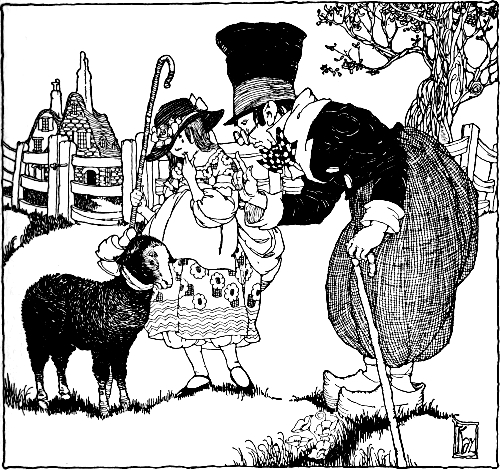
“Look here,” he said to the black sheep. “You’re
responsible for all this.” Page 105.
She raised herself up when she heard the Dutch Uncle’s step and wiped her eyes.
“Do you hear them bleating?” she asked him.
“Yes,” replied the Dutch Uncle, “I do.”
The Dutch Uncle then made a discovery; the black sheep of the flock was not bleating at all, but was frisking around as merrily as could be, watching the others with wicked glee out of the corner of his eye. The Dutch Uncle watched him a moment and then, without a word to Little Bo-Peep, he marched straight up to that black sheep, took hold of his pink ribbon collar and looked him sternly in the eye. The sheep squirmed a little and tried to brave it out, but the Dutch Uncle was too much for him, so he squirmed a great deal more and dropped his eyes in the most ashamed way.
Whereupon the Dutch Uncle did give him a dose of his best Dutch Uncle talk—such a dose!
“Look here,” he said to the black sheep. “You’re responsible for all this. You know exactly where those tails are, and you’ve known all along, and now right this minute you’re going to take Little Bo-Peep and me and show us where they are. You are a wicked, wicked sheep,[Pg 106] you are, but we’ve got you this time, you wretch, you—” Well, he couldn’t think of anything worse than a wretch, so he stopped with that, and waited for the black sheep to do something.
And the black sheep did something, right enough. He turned around and walked off, the Dutch Uncle and Little Bo-Peep behind him, and he kept on walking until at last they came to a wood on the very edge of which stood a tree. And there the black sheep stopped.
“What’s this?” asked the Dutch Uncle.
“I don’t know,” answered Little Bo-Peep.
Then the sheep raised his eyes, the Dutch Uncle and Bo-Peep raised theirs, and there on a branch what should they see but ten little white tails all in a row, hanging like white flowers among the green leaves, with one little black one in the middle!
“Oh!” shrieked Little Bo-Peep joyfully.
“Ah-ha!” exclaimed the Dutch Uncle.
And the next thing the tails knew, they were being carried back to the sheep in the meadow at Pudding Lane.
Everybody was overjoyed when it was known that Little Bo-Peep had found her sheep’s tails, but of course, the next problem was to get them back on the sheep. The carpenter was all for[Pg 107] tacking them on, though he quickly took back his suggestion when he remembered that it was sheep they were talking about, not houses or boards. Jack-of-All-Trades offered to glue them neatly back in their places, and the cobbler said that if sewing were necessary, he would gladly render his services.
The cobbler’s idea was considered a good one, for the great London doctors were sewing people now, and if it were good for people, it would certainly do for sheep. So they called Doctor Foster, who had just got back from Gloucester, and asked his advice about the sewing.
“No, no, no!” said Doctor Foster. “Doctors don’t sew things on, they just sew things up. But if you just tie these tails to the sheep, they’ll grow back as nicely as you please.”
So that’s what they did, and the tails did grow back, just as he had said, as nicely as you please. Only one looked a little different from its old self, and that was the black sheep’s, which was rather to one side and at a rakish angle. But then the black sheep deserved it, for all the trouble he had caused. Because the Dutch Uncle thought that the black sheep not only knew where the tails were all the time, but that he himself made the sheep lose their tails. I don’t[Pg 108] see how he could have, really. I think the tails just dropped off. Still, the Dutch Uncle may be right. We’ll never know, for sheep can’t talk, and the black sheep wouldn’t tell if he could. Anyway, it all came out all right.
All but one thing and that concerns the poor Dutch Uncle, who didn’t get his Cross-Patch, after all. For when he went back to her in high glee, told her about the tails, and began calling her high-sounding names, Cross-Patch suddenly became fifty times crosser than she had ever been before, told him she couldn’t stand his sugarish nonsense and left the room.
And that was the end of the Dutch Uncle’s romance. All might have been different if he had only talked to Cross-Patch like a Dutch Uncle, but that’s so often the way with gentlemen in love; they become such different creatures. However, he did turn on Cross-Patch just as she was leaving the room, and then he certainly did talk to her like a Dutch Uncle, for he was very angry and disappointed.
Too late, though. Cross-Patch drew the latch, sat down to spin and never for a second regretted her action. She was even glad the old bother was gone.
Poor Dutch Uncle, having to go back to Holland[Pg 109] without the Dutch Aunt of his dreams. Everybody felt sorry for him, and especially did Little Bo-Peep, who had come to love him so much.
It was Little Bo-Peep who walked with him down the road when he set out that day for Banbury Cross. They said good-by and shook hands. The Dutch Uncle had tears in his eyes and Bo-Peep was sniffling right out.
But the Dutch Uncle soon came to himself.
“Look here, you shouldn’t have come so far with me. The sheep will get lost and your mother will be worried. Go straight home, you naughty child.”
But Bo-Peep only smiled at him.
“You’re an old fraud,” she told the Dutch Uncle.
And then it was that the Dutch Uncle knew that she had found him out, this Little Bo-Peep of Pudding Lane. Yet he wouldn’t give in, even then.
“Go straight home, I tell you!”
But he kissed her, and then was gone.
[Pg 110]
THE SAND MAN’S SCARE
MRS. BLUE was busy in her kitchen one August morning when she heard a racket in the cornfield.
“At it again,” she murmured and ran out to the side fence.
“Little Boy Blue,” she called loudly, “come blow your horn. The sheep’s in the meadow, the cow’s in the corn.”
No answer from the little boy, lying under a near-by haystack. Mrs. Blue opened her mouth to call again when up popped Farmer Tom from behind the barn. Farmer Tom was the Blues’ neighbor, and it was Farmer Tom’s cornfield that the cow was in.
“Where’s the boy that looks after the sheep?” demanded the farmer.
“He’s under the haystack fast asleep,” admitted poor Mrs. Blue.
What could Mrs. Blue do? She could do nothing
but climb the fence, skirts and all. Page 111.
Farmer Tom snorted.
[Pg 111]
“Well, he must get them animals out of my corn,” he said.
“Yes, sir,” answered Mrs. Blue nervously, and then called again, “LITTLE BOY BLUE!” so loudly that you would have thought any fellow might have waked up. Little Boy Blue did almost wake up too. He grunted, stirred, rubbed his eyes, but then if he didn’t curl down deeper in the hay and go straight back to sleep.
What could Mrs. Blue do? She could do nothing but climb the fence, skirts and all—for the gate was a long way off—and go after Little Boy Blue, so that’s what she did. She climbed the fence, marched over to the haystack and shook—yes, shook—her sleeping son until at last he was awake. Then he scuttled away and led the sheep and cow into the pasture where they belonged.
This was the way things were always going with the Blues. Boy Blue was forever falling asleep, the cows were forever getting in the corn, Farmer Tom was always scolding and fussing and Mrs. Blue was always worrying. Of course, it was worse in summer, when the warm air was drowsy and the haystack was soft and inviting. But even in winter it was bad enough, for then Little Boy Blue went to sleep over his books,[Pg 112] over his supper, over his games. He had actually been caught at it during an exciting game of Hide-and-Go-Seek, when he had hidden behind the hedge in Mistress Mary’s garden and then promptly gone to sleep there.
But you cannot sleep all of the time, even if you’re a Little Boy Blue, and so it was that Little Boy Blue found that he was not sleeping very well of nights, because he slept all day. It was a dull business too, lying awake in the dead of the night, with nothing to see except perhaps a streak of moonlight or the shadow of the pear tree, nothing to hear except the dickery, dickery, dock, of the kitchen clock, nothing to do but wait for daylight to come.
And so on this same night, as usual, Little Boy Blue lay stark awake, even starker awake than he sometimes was, for his naps had been more frequent and longer that day. It was early still, about eight o’clock, and although Little Boy Blue had been in bed only half an hour, it seemed to him that he had been there exactly one hundred years, he was so tired of it.
He twisted and turned and rolled and kicked. He propped himself up on his elbows and stared up at the stars: “Twinkle, twinkle, little star, how I wonder what you are,” and then he almost[Pg 113] did go to sleep wondering just exactly what stars were—fire or silver or flowers or what. Little Boy Blue had not studied astronomy yet. But just as he almost fell asleep, clink, clank came a noise, and he came to with a jerk. What was that noise? It sounded like a milk pail, clink, clank. He listened hard, but no further sound came. He squirmed and turned some more. Finally he sat up straight in bed.
“I’m going to get up,” he said to himself. “Right up.”
Which he did. He groped in the dim light for his clothes and put them on—his blue suit, his shoes and stockings, his favorite blue cap with the red button on top. Then he tiptoed softly out of his room, through the kitchen and into the yard.
Oh, Little Boy Blue, what would your mother say if she knew you were not in bed and asleep? What would your father say if somebody should tell him that his little boy was out in the middle of the night like this, walking around? But they didn’t know it, those two good souls nodding by their candle in the second-best parlor, which is probably a good thing, as it would have distressed them. Not that Little Boy Blue meant the least harm in the world. He had just[Pg 114] thought he’d take “a bit of a turn” and try that way to get sleepy. He had heard the candlestick-maker say once that he always took “a bit of a turn” before he went to bed, which made him sleep like a top. As if tops did sleep—the funny old candlestick-maker.
Little Boy Blue had hardly taken three steps when clink, clank, his foot bumped against something which made that same noise he had heard a few moments before in bed. He stooped down. It looked like a bucket, but it wasn’t one of his mother’s milk pails. What could it be? He put his hands into it. There was something inside that felt gritty and sticky and damp. He looked closer and felt it again. It was sand.
But what on earth was a bucket of sand doing on the Blues’ side stoop, and who in the world had left it there? Little Boy Blue did not know. Perhaps his father had forgotten it, he thought. Perhaps Farmer Tom had put it there. He and Mr. Blue were always lending each other things—bags of gravel, baskets of chips, nails and bridles and chicken feed.
Well, whatever it was, this was not the place for it, Little Boy Blue knew that. So he picked it up and carried it back to the tool house, and there he put it in a corner out of harm’s way, like[Pg 115] the careful little boy that he was. And then he went away to take his bit of a turn.
Little did Boy Blue know what he had really done by hiding that bucket of sand, though the fact was that he had done something epoch-making in Pudding Lane. Epoch-making is a big word, but then Little Boy Blue had done a big thing. For whom do you suppose that sand belonged to?
It belonged to the Sand Man, that fellow who slips along by our windows at night, throws his handfuls of sand in our eyes and makes us feel heavy in our eyelids and sleepy all over. He had left his sand for the least little while on the Blues’ side stoop, while he went up to the palace to put the King and Queen to sleep, and now Boy Blue had hidden it. Think of it! The Sand Man without his sand!
Do you wonder that when he came back, he wrung his sandy hands and beat his breast in frenzied despair? Do you wonder that he trembled all over? Poor Sand Man! It did look bad for him. Never before had he failed to do his work. Every single night, for years and years and years, he had gone on his circuit from house to house, and put folks to sleep, first the children, then the grandfathers, and after that, sometimes[Pg 116] quite late, the mothers and fathers and big sisters in the parlor.
And now on this night, his sand was gone, everybody would stay wide awake, and goodness knows what angry message Old King Cole would send him. That merry old soul might even deprive him of his job, and then what would he do for a living, and what would the Sand Woman do, and all the little Sand Children? It was a sad thought, and the Sand Man shuddered as he stood there in the shadow of the Blues’ house, wondering what to do next.
As Little Boy Blue walked down Pudding Lane, he wondered why the Shoe was lighted up so brilliantly, and as he passed the Dumpties’ he thought it strange indeed that the candle in Humpty’s room was still burning. It was late. What should children be doing awake at such an hour? They hadn’t slept all day to make them wakeful, like Boy Blue himself. The Clauses’ house was brightly lighted too, and he could see the Flinderses’ fine new lamp from London burning gayly in Polly’s room.
Now, of course, we know exactly what was happening, even though Little Boy Blue did not. We know and the Sand Man knew, but Little Boy Blue did not know, and certainly the distracted[Pg 117] mothers of Pudding Lane did not know what was the matter with their children that night. And how exasperated they were too, those mothers.
“What does ail you, Santa Claus?” asked his mother of that little boy, who was sitting up in bed with not a sign of sleep about him.
“I don’t know,” answered Santa Claus, much puzzled himself. “Only I just can’t sleep, and I don’t believe I ever will sleep again.”
“Mercy on us!” breathed Mrs. Claus fearfully.
“Humpty, darling, are you ill?” asked Mrs. Dumpty anxiously. “You’ve never been wakeful like this before.”
“No, not ill, just wide awake,” answered Humpty.
“Children, will you get into your beds and go to sleep?” demanded the Old Woman Who Lived in a Shoe, beside herself with impatience at all these dozens of children scampering around the Shoe at the impossible hour of nine o’clock.
“But we’re not a bit sleepy,” spoke up Judy.
“Not a single bit!” echoed Polly and Jumbo and Jocko and all the rest.
That was the way it was in every house in Pudding Lane that night. The mothers tried[Pg 118] spanking, and it didn’t work. Spanking really doesn’t make you sleepy, though sometimes it makes you try harder to get sleepy. They tried bread and milk. They tried lullabies. They tried everything, and still the children of Pudding Lane were as wide awake as could be until finally, when they all begged their mothers to let them go out and play, those frantic women, wondering what Old King Cole would say to such a performance, consented. And with a whoop loud enough to be heard in Banbury Cross, the children of Pudding Lane rushed outdoors for a glorious romp in the moonlight.
What a night that was! Everybody was up, even Humpty Dumpty, looking on from his window. Little Boy Blue had joined them, of course. Polly Flinders, Little Bo-Peep, all the Old Woman’s children, Jack Horner—not a single child in Pudding Lane was missing, for even that baby, The Little Girl Who Had a Little Curl, was brought out and dumped in the midst of the fun. You know her. She was only three, but already she was a well-known character in the village. A changeable child. One minute she would be very good indeed, and the next she would be—simply horrid. But she[Pg 119] was very pretty, and she had a little curl right down in the middle of her forehead.
Unless you have played outdoors in the moonlight yourself, you can never imagine how much fun it is. There’s something about it that makes mere playing in the daylight and sunshine seem very ordinary. Perhaps it’s the shadows. You’re always mistaking them for something else, which is very funny. Little Bo-Peep actually tagged the shadow of the Clauses’ gate once, thinking it was Jumbo! Perhaps it’s the moonlight itself, thin and gleaming and rare. Perhaps it’s the jolly little stars, kicking up their heels there in the sky. Anyway, it’s pure delight to be out on such a night, and the children of Pudding Lane thought they simply never had had such a good time as they were having that night.
They played Tag and Blind Man’s Buff and Ring-Around-a-Rosy. Oh, yes, I forgot to say that singing on such a night seems to be music of a special sort. Even Simple Simon’s poor cracked voice did not sound bad that night as they sang “Ring Around a Rosy, Pocket Full of Posies.” They played Drop-the-Handkerchief, too, which is particularly good at night, for the handkerchief is so hard to see.
[Pg 120]
Well, they played on and on, while the mothers looked at them round-eyed from the windows and wondered if their darling children would ever, ever, ever get sleepy and come in to bed like good and law-abiding citizens. They played on and on and on, while the Sand Man crouched in a corner of the Blues’ side stoop and pondered desperately on his fate. And they might have been playing yet if the Little Girl with the Curl had not suddenly cut up one of her capers.
But she did. She cut up a terrible caper. She cried and kicked and jumped up and down. She screamed and howled and made faces. Oh, she was horrid!
At first, the children tried to pacify her by ordinary means.
“Come ride on my back, Little Girl,” invited Santa Claus. “I’ll be the horse and you can be the rider.”
But the Little Girl only stamped her foot at him.
“Little Girl, look here, I’ve got a top!” called out Tom, Tom, the piper’s son.
But the Little Girl only stuck out her tongue at him!
“Little Girl, look at me!” cried Jack-Be-Nimble,[Pg 121] jumping over a candlestick for her benefit.
But the Little Girl only lay down on the ground and kicked and screamed some more.
The Little Girl’s mother came out, and the Little Girl’s father came out, and they spanked her. But even that did not do any good on this terrible night.
They were all perfectly desperate. What could they do with such a child? The party was spoiled. The fun was over. The beautiful midsummer night’s dream was broken. And all because of that horrid Little Girl.
At last, however, in the midst of her caper, Little Boy Blue had a sudden idea. He didn’t say a word to anybody, but he ran back to his father’s tool house, picked up the pail of sand and brought it to the Little Girl. And lo, when the Little Girl saw that bucketful of lovely sand, she stopped right in the middle of a howl, sat down and began to dig in it as hard as she could dig. She dug with both fists and sent the sand flying. She loved sand to play in, the Little Girl did, and Pudding Lane had so little sand, being far from the sea.
The children, breathing sighs of relief, began to play again.
[Pg 122]
But the next moment, the games and the night and the whole beautiful party began to seem rather stupid. First it was Jill who yawned.
“Oh, dear, I’m really getting sleepy,” she confessed.
Whereupon Jack said that he was really getting sleepy too. Humpty Dumpty was seen nodding at the window. The Little Girl with the Curl had fallen over on her pail, fast asleep. Simple Simon had one eye closed. Santa Claus had both eyes closed. The Old Woman’s children were blinking like lazy little pussy cats and Little Boy Blue had gone to sleep standing up.
And the next thing they knew it was to-morrow. How surprised they were to find themselves in bed exactly as if nothing had happened.
“What did happen?” they asked their mothers.
“Why, you just got sleepy,” answered the mothers.
But of course, that really wasn’t it at all, and I think it’s funny that nobody guessed that the sand belonged to the Sand Man. Nobody did, however, and they don’t know it to this day.
And one thing you may be sure of and that is that the Sand Man was never so careless as to[Pg 123] leave his sand bucket around any place again. That night, when the children had all been carried in to their beds, he sneaked quietly down from the Blues’, snatched his precious bucket quickly under his arm and, after putting the grown-ups to sleep, ran for home.
“Look here,” he said to the Sand Woman, after he had told her his exciting story, “I want you to sew a button on my jacket for me to hang the sand pail on, so that I shall never, never, never forget and leave it any place again.”
So the Sand Woman sewed a large button on the Sand Man’s coat, and ever after that the Sand Man kept his pail right with him wherever he was, and never, never, never forgot and left it any place again.
[Pg 124]
WHY TAFFY THE WELSHMAN STOLE MEAT
TAFFY the Welshman had come to Pudding Lane and that quiet village was in a turmoil. For Taffy was not only a Welshman but Taffy was a thief. Perhaps you have heard of him. He specialized in meat.
Some thieves go in for gold watches, some deal in silver spoons. Taffy confined himself to meat. Once in a while he descended to bones, but usually it was meat, here a knuckle of veal, there a shoulder of lamb, yonder a round of beef. If ever a man knew how to steal meat, Taffy was that man. He could nip off a roast as you or I couldn’t nip off a feather, airily, easily, with jaunty grace. He could nip it when you weren’t looking or when you were. He could nip ten pounds or one pound with equal art. A born genius was Taffy, and he loved his work and pursued it diligently.
Thus it was that every morning Mrs. Dumpty, Mrs. Claus, the Old Woman Who Lived in a[Pg 125] Shoe, Mrs. Jack Spratt and all the other women of Pudding Lane would trot to the butcher’s and buy meat; every afternoon Taffy would steal it, and every night—no meat for supper. And the men were getting tired of it. Especially Jack Spratt.
“It’s all very well,” he said to Mrs. Spratt one day, “it’s all very well for these foreigners to come swarming into our fair city, but I must have lean meat soon, or I don’t guarantee, Mrs. Spratt, I don’t guarantee that nothing will happen.”
Mrs. Spratt quailed. Her husband’s was a delicate constitution and she well knew what the effect would be if he were deprived of meat much longer. He would probably slam doors and kick things. He might even hurl his shoe. Once he had hurled his shoe when there was a shortage of lean meat in Pudding Lane. Awful to think of it, but he did do it.
“Yes,” repeated Jack Spratt, “it’s all very well for foreign robbers to come swarming—”
Really though, Jack Spratt was talking nonsense. In the first place, poor Taffy hadn’t “swarmed” into Pudding Lane. If there’s only one of you, you can’t swarm; there was only one of Taffy. In the second place, Jack Spratt[Pg 126] needn’t have laid down the law like that to his wife. She couldn’t help it if Taffy was a thief. She was tired of eggs and lettuce herself, and thought yearningly of her own favorite fat meat. At night she dreamed of it, juicy, dripping chunks of it.
It was like that in every house in Pudding Lane, the men demanding meat, the women buying it, and then losing it that way. It did seem rather queer that the women couldn’t keep their meat once they had bought it, but they couldn’t. Even the Queen of Hearts couldn’t keep her meat, and the unfortunate lady had many a scene with Old King Cole over the disappearance of the royal chops.
“I can’t help it,” she told him, “if your friend Taffy steals meat all over the place. But if I were the King—of course, I’m only a woman, a mere Queen—but if I were the King, I’d soon fix that fellow. I’d take it up with the Welsh ambassador.” Which shows how much she knew about diplomatic matters. And it wasn’t any use talking to her, for if Old King Cole had said there wasn’t any Welsh ambassador, the Queen would have demanded, “Well, why isn’t there one?” and a long argument would have ensued. Some women are like that.
[Pg 127]
Only two people in Pudding Lane did not suffer from the ravages of the thieving Taffy. One was Little Miss Muffett, who was quite content now, as always, with her curds and whey; and the other was the butcher. For the more meat Taffy stole, the more meat the butcher sold. He was doing a rushing business and he was very happy. Furiously he bought pigs and sheep and beeves at the big market in Banbury Cross, and brought them back on loads and droves to Pudding Lane. Furiously the women bought his meat butchered from these pigs and sheep and beeves. Furiously Taffy nipped the meat from their cupboards and cellars and shelves. Yes, the butcher was very happy.
But as Jack Spratt had intimated, this state of affairs could not go on forever. The men were getting worse. They stalked savagely; they had glitterings in their eyes; they gathered in the candlestick-maker’s shop and muttered together. Even that mild husband and father, Mr. Claus, was a changed man, and one day, as he eyed his wife in an odd, bloodthirsty way, Mrs. Claus spoke her mind.
“Look here, Mr. Claus,” said she, “I’m not a roast of mutton, sir.”
Mr. Claus gaped.
[Pg 128]
“Nor am I a leg of pork,” went on the extraordinary woman.
Mr. Claus gaped wider.
“So you needn’t look at me like a cannibal,” she told him. “I won’t be cooked and eaten, even by you. Pray don’t delude yourself.”
“My dear—” remonstrated the baker with a ghastly smile.
“No,” continued Mrs. Claus, “nor shall you cast your eyes upon my children in that fashion. No doubt Santa Claus would make a delicious meal, Mr. Claus, but you shall not feast yourself upon him. Yes, and the twins would probably be as tender flesh as a man could taste, but you are not the man who will taste it. I am surprised at you, Mr. Claus, that you should turn heathen like this and want to eat your family alive; I really am.”
Oh, what a woman she was! Had Mr. Claus mentioned eating his family? Had he even thought of such an atrocious thing? Yet on and on rattled Mrs. Claus, and she probably would have been rattling on yet, if just then the Town Crier had not come along, ringing his bell and shouting something. What was he saying?
“Make your sandwiches! Bake your cakes! To-morrow is picnic day!”
The next morning at nine o’clock the whole town
started out for Honeysuckle Hill. Page 129.
[Pg 129]
Picnic day, oh, yes, so it was. To-morrow was picnic day; Mrs. Claus had quite forgotten it.
Now the picnic that the Town Crier was calling was the picnic that Pudding Lane had been talking about all summer, but never, until now, had really got around to. It was a bit late for picnics, being September, but you have to have at least one picnic a year, and if it won’t come off early in the season, it just has to come off late, that’s all. And to-morrow, finally, Pudding Lane’s annual picnic was to come off.
But how can you have a picnic without ham? Mrs. Claus wanted to know. And what is a picnic without cold tongue? demanded Mrs. Dumpty. Nevertheless, the women went ahead making their sandwiches just the same, cheese sandwiches and currant jam sandwiches, and sandwiches of watercress. They baked their cakes and stuffed their eggs and fished out their pickles and collected their bananas and packed their baskets with all these things. And the next morning at nine o’clock the whole town started out for Honeysuckle Hill.
The picnic went off with a bang, despite the meat crisis. Indeed, so successful an affair was that picnic that Old King Cole felt moved to make a formal statement, and he did so, saying[Pg 130] that it was very gratifying to him as king for a picnic to attain such heights as this. Although just why he should have been gratified, I don’t know, since all he did for the picnic was to come to it and eat at it. Still, his statement made the women very happy; it’s a great thing to please a king.
And so everything was going as smoothly as you please—until something happened to Miss Muffett.
It was this way. Little Miss Muffett sat on a tuffet, eating her curds and whey. She was talking and smiling and having a lovely time when along came a spider and sat down beside her. Oh, dear, how she jumped and screamed. For if there was anything in the world that Little Miss Muffett was afraid of, it was a spider. And yet spiders were always pursuing her. Every time that girl sat down on a tuffet to enjoy her repast of curds and whey, along would come a spider and sit down beside her, just as that spider did to-day. It may be that spiders are particularly fond of curds and whey, or perhaps Miss Muffett herself had a fatal fascination for spiders. Anyway, wherever she went she was pursued by spiders, an unhappy fortune, surely, for a little girl as timid as Miss Muffett.
[Pg 131]
To-day, however, the courtly Mr. Horner, always the man to assist a lady in distress, rose up heroically and chased the spider off. At least, he thought he chased the spider off, and everybody else, including Miss Muffett, thought so too, when suddenly the spider appeared again beside Miss Muffett and this time frightened Miss Muffett away.
One look at the hideous creature sitting there so calmly beside her, and overboard went the bowl of curds and whey, up flew Miss Muffett shrieking, and away she was gone, down Pinafore Pike in a cloud of dust.
Mr. Horner, the butcher, the baker, the candlestick-maker and all the other men let out great roars, the women screamed, the children cried. What a scene, where all had been sweet peace before. And then, away leaped Mr. Horner down the road after Miss Muffett, away leaped Mr. Spratt after him, and in another moment every man, woman and child in Pudding Lane was tearing madly down Pinafore Pike behind the flying skirts and scampering feet of Little Miss Muffett.
And the spider? Well, the spider with one look at the empty havoc around him, legged it off to Mrs. Spider and the children, sighing as[Pg 132] he went. It was too bad, he was thinking to himself. He adored Little Miss Muffett with all the fervor of his spiderish heart, yet every time he went near her, she squealed and pulled up her skirt and ran away from him.
Perhaps she didn’t like him, he thought. Oh, dear, it’s a hard world for spiders. Nobody really likes them, even when they are as faithful and devoted as this old fellow was. Well, Mrs. Spider liked him anyway, he reflected, and the spider children liked him too. Home was the place for spiders, so home he would go and there in the bosom of his family console himself as best he could.
For ten good minutes the people of Pudding Lane kept their furious pace down Pinafore Pike. They panted and heaved and got red in the face, especially Mrs. Dumpty; their knees wobbled and waggled, especially the candlestick-maker’s; their tongues hung out, particularly Simple Simon’s; their arms flapped, Mr. Claus’s most of all. But still they kept on.
Old King Cole lost his best ruby crown and never looked back after it. Polly Flinders stubbed her pretty toes and bore the pain unflinchingly. Mrs. Claus’s back hair went streaming in the wind, and she didn’t even know it.
[Pg 133]
What they were running for, I don’t know, and they didn’t know themselves, I’m afraid. Why they didn’t stop, I can’t say. But they didn’t, until they turned the corner toward Banbury Cross and there they did stop, suddenly and stock-still.
And it was no wonder they stopped, for the most astonishing sight confronted them. Indeed, it was so astonishing they couldn’t believe they were seeing aright. It didn’t seem possible that they could be seeing hundreds of cats and hundreds of dogs like that.
For that’s just what they saw: hundreds of cats and hundreds of dogs, all there together, with hundreds of bones and hundreds of chunks of meat. And in the midst of that mass of fur and sharp eyes and wagging tails and crunching jaws stood Taffy the Welshman, smiling happily at the scene.
The people of Pudding Lane blinked; they rubbed their eyes. Surely something was the matter with their eyesight. But Taffy himself looked natural enough, and his voice when he spoke, sounded natural too. Taffy was speaking; he addressed himself, very properly, to Old King Cole.
“Welcome, sir,” said he graciously. “Welcome[Pg 134] to Your Majesty, welcome to the Queen of Hearts, and heartiest greetings to all your people here.”
But Old King Cole couldn’t answer, for staring at the cats and dogs.
“I knew you would come some day,” went on Taffy smoothly, “and now—here you are. We welcome you, sir, cats, dogs and Taffy himself.”
No answer from Old King Cole, glaring angrily now at the cats and dogs.
“You must understand, sir,” began Taffy.
“But that’s just it,” burst out Old King Cole, “I don’t understand at all. I tell you, Welshman, this is a serious thing. You break the law, you defy punishment, you steal meat from my people day in and day out, and now I find you here, consorting with hundreds of dogs and hundreds of cats on the public highway. Can it be, sir, that you have robbed us of beef and mutton only to feed these beasts?”
“That is the truth, Your Majesty,” answered Taffy softly. “I spend my life stealing meat for these poor creatures. Is it so wrong of me?”
“Wrong? Of course it’s wrong,” thundered Old King Cole. “Don’t you know wrong from[Pg 135] right, Welshman? Didn’t your mother teach you that it was wrong to steal?”
“Ah,” replied Taffy, “but you don’t know about these cats and dogs, King Cole. These are special cats and dogs, sir.”
“Special cats and dogs?”
“Yes, sir, stray cats from London and Banbury Cross, the loneliest cats in the world; dogs without owners, the most miserable dogs there ever were. Oh, you should have seen them when they first came to me. They would have broken your heart. Seedy, dingy, scrawny, all of them, sad-eyed and starving.”
“Starving?” repeated Old King Cole incredulously.
“Starving,” whispered everybody else, frightened.
“Starving,” said Taffy again. “That’s why it takes so much meat now, King Cole. They eat all the time, sir. You can see how they’re eating now. I don’t suppose they ever will get really filled up. They’ve been at it for days, yes, and for nights too.”
“They eat all night too?” asked King Cole.
“All night long and all day long and never stop except for the briefest of naps,” Taffy told him. “You see, there’s no joke about this,[Pg 136] King Cole. These are really hungry animals.”
It was easy to see that Taffy was right, for as the people of Pudding Lane looked at the animals, not one cat raised an eye at them, or not one dog, but lickety-lick, crunchety-crunch, they kept on eating, eating, eating.
It was an odd sight, all those gray and black and brown furry bodies, all those tails in the air, all those clamping jaws, and not one sound but lickety-lick, crunchety-crunch. It was a sad sight too, for the people of Pudding Lane had never known that animals could be as hungry as that.
And so they nearly turned themselves inside out in their generosity, those kind-hearted citizens of Pudding Lane. Mr. Spratt declared rashly that he didn’t care if he never saw a piece of lean meat again; Mr. Claus magnificently offered to abstain from beef the rest of his life; and Old King Cole ordered the Queen of Hearts to see that eggs appeared thereafter on the royal breakfast table, instead of the usual chops.
Taffy, however, wouldn’t listen to these sacrifices. He was about to move on anyway, he said.
“I’m going to Hamelin next and after that, who knows, I may even go to France and steal[Pg 137] some meat from the French awhile. The cats and dogs have to be fed, but of course I can’t deprive you good people of your proteins forever.”
The good people didn’t know what proteins were, but they vowed again that these poor creatures could have Pudding Lane’s meat as long as Pudding Lane had any meat, such a pitch had their ecstasy reached.
But no, Taffy insisted that they had suffered enough, and that he must go. And before they knew it, he was gone, followed by his winding procession of cats and dogs.
The funny part about it was that the people of Pudding Lane were actually sorry to see him go. They had forgotten he was a thief, you see; they had forgotten their recent anger and annoyance against him. They had forgotten everything except that Taffy the Welshman was a man who was kind to animals, a man who lived and plied his trade for cats and dogs alone. And this fact was so important that they had forgotten the picnic too; they had even forgotten the spider.
And so those very people who had called Taffy the worst names only that same morning now watched his departing figure down the road[Pg 138] and called out, “Good-by, Taffy, good-by. Good luck, good luck.”
Fancy wishing a thief good luck! It doesn’t seem respectable, but that’s what they did.
And as for Taffy, he did have good luck. He went on his way ever after that, stealing meat, feeding the cats and dogs and having a lovely time. For Taffy enjoyed the stealing part quite as much as the feeding part, if the truth must be known. It’s deplorable. People oughtn’t to enjoy stealing, but Taffy did enjoy it, and there’s nothing we can do about it.
Perhaps some day he’ll reform and be an honest man. Yet if he did, the cats and dogs might have a hard time of it, so we’d better let him alone, I guess. If we must have thieves in the world, Taffy’s the very sort to have.
[Pg 139]
THE CROOKED MAN GETS A BRAND-NEW
REPUTATION
THE Crooked Man had invited Santa Claus to visit him and the Clauses were sitting at the kitchen table trying to decide about it.
“I can’t think why he should have asked Santa to his house,” said Mrs. Claus. She looked down at the letter in her hand, which was, of course, written in extremely crooked characters on a funny little crooked piece of paper.
“Perhaps he’s heard about the toys and wants Santa Claus to make some for the crooked children next Christmas,” suggested Mr. Claus.
“The crooked children!” exclaimed Mrs. Claus. “You ought to know by this time, Mr. Claus, that the Crooked Man is a bachelor.”
“Is he?” asked Mr. Claus. “Dear me. Then who lives with him on the Crooked Mile?”
“He bought a crooked cat which caught a crooked mouse, and they all live together in a little crooked house,” explained his wife.
[Pg 140]
“Oh, I see,” said the baker. But he didn’t see. He simply couldn’t imagine a crooked man and a crooked cat and a crooked mouse all living together in a little crooked house. It sounded like a bad dream to Mr. Claus, not like real life. In real life, men and cats and mice are straight.
“I suppose it will be all right for Santa Claus to go,” Mrs. Claus was saying.
“I suppose so,” assented her husband.
“Nobody ever did visit him, though.”
“No,” said Mr. Claus, “the Crooked Man doesn’t stand very well among the best people, I must admit.”
“Well, do you suppose,” Mrs. Claus stopped, reddening. “Could it be, baker, that the Crooked Man’s morals are crooked, too?”
The baker’s face fell. Morals. He hadn’t thought of them. But naturally, the morals of a crooked man would be crooked, wouldn’t they?
So he said to Mrs. Claus, “Why, yes, certainly his morals would be crooked. Santa Claus must not accept this invitation to visit the Crooked Man. In fact, Mrs. Claus, I forbid it,” he finished up pompously, just as if he, a sage man, had thought up the morals himself.
Santa Claus, who was sitting at the table too, didn’t quite understand.
[Pg 141]
“What are morals?” he asked his mother.
“Morals?” replied Mrs. Claus. “Why, washing your face every morning is morals, and telling the truth, and going to bed at eight o’clock, and minding your parents, and saving your pennies—all those are morals, Santa.”
“Do you have to have them?” asked Santa. They sounded very uninteresting. He could think of lots of people who were most amusing and lovable, though they didn’t do all those things: the candlestick-maker, for instance, who didn’t wash very often; and Piggy Peddler who stayed up till all hours; and Simple Simon, who didn’t ever save his pennies, but squandered them prodigally on horehound lozenges, his favorite confection.
“Have to have them?” repeated Mrs. Claus, shocked. “Well, I guess you do, Santa Claus. If you don’t have morals, you don’t get very far in this world, sir. Morals make the world go ’round, don’t they, Mr. Claus?”
Mr. Claus, thus appealed to, looked dubious.
“I thought it was love that made the world go ’round,” he ventured.
“Well, love is morals,” asserted Mrs. Claus. You can’t catch that woman very often.
[Pg 142]
The subject was getting too deep, however, and she hastily changed it.
“I’ll tell you,” she said. “Instead of visiting the Crooked Man, Santa Claus can go to the Gingerbread Fair.”
At which suggestion Santa Claus forgot morals and love and the Crooked Man and everything else, so thrilled was he over the Gingerbread Fair.
The Gingerbread Fair was the great celebration which was held at Pye Corner every year. It was a magnificent affair, of that Pudding Lane was certain, although only Mr. Claus and King Cole had ever gone so far as to attend it. Mr. Claus went on business, of course, and Old King Cole went for pleasure.
And now Santa Claus was going. What an experience for a little boy only nine years old! Why, most of the grown-ups of Pudding Lane lived and died without going to it. Even Mr. Flinders, the wealthy, had not permitted himself that luxury, though it was said that he was planning to take Mrs. Flinders to the Gingerbread Fair on their twentieth wedding anniversary.
Pye Corner was so very far off, you see. It was farther than Banbury Cross, farther than Hamelin, almost as far as London. You went[Pg 143] down Raspberry Road, along the Crooked Mile, across Minnow Creek, up Rocking-horse Row, and there, just before you got to London Bridge, was Pye Corner. It took almost a day to get there by foot; it took half a day to get there by coach. No wonder the citizens of Pudding Lane had never traveled so far.
It was decided that Judy-Who-Lived-in-a-Shoe should accompany Santa Claus on his trip to Pye Corner, for Santa Claus could hardly bear to do anything without his favorite little friend, and to do such a wonderful thing without her was unthinkable.
Mr. Claus was to take Santa and Judy to the Gingerbread Fair, but Mr. Claus didn’t take them; he took the mumps instead. Where he took them from was not known, for the Claus children had had the mumps long before, but where he took them at was quite clear. His poor jaws swelled up like balloons, his face ached worse than he had ever supposed a mere face could ache, and on the very day of the Gingerbread Fair, Mr. Claus lay in his bed, moaning, without a thought of gingerbread.
Poor Mr. Claus, with those aching balloons where his face used to be. Poor Santa, without any father to take him to the Gingerbread[Pg 144] Fair. Poor Judy, all dressed up and waiting in the Shoe for a Mr. Claus that would never come.
Mrs. Claus, however, was not the woman to let plans slip simply because her spouse had chosen this unlucky moment in which to take on a distressing malady. She would never get to the Gingerbread Fair herself, probably, but she was determined that Santa should go. So what did she do but bustle down to the Town Crier’s and beg him to take the children and the pies to the Gingerbread Fair? Not that it took much begging. The Town Crier had his hat on his head before she had finished her first sentence, and before she had started her second, he was halfway down Pudding Lane toward the baker’s shop.
So it was the old Town Crier instead of Mr. Claus who climbed into the stagecoach ten minutes later, with Santa and Judy in tow, and a great basket of Mrs. Claus’s pies on his arm. Into the coach they got and away they went, Santa Claus and Judy and the Town Crier and the pies. They bowled along Raspberry Road, they bumped along the Crooked Mile, they forded Minnow Creek, they rolled along Rocking-horse Row, and they swung into Pye Corner, that great metropolis, at exactly twelve o’clock.
[Pg 145]
“We have arrived,” announced the Town Crier sonorously. The Town Crier never said things; he always announced them. Even when he uttered a mere “Good morning”, he rolled it out like a piece of news, sang it, cried it.
But Santa Claus and Judy knew they had arrived without his telling them. They knew it by the sound of a fife and drums; they knew it by the sight of a dozen merry-go-rounds, of Punch and Judy shows, of brightly colored stalls, of children, children, everywhere; and most of all, they knew it by the mountains of gingerbread pigs that were piled up as high and as far as they could see.
“Oh, Judy!” whispered Santa Claus, pressing her hand fervently.
Judy nodded blissfully.
“I know,” she answered. “But come on. Let’s hurry. Oh, it’s a lovely Gingerbread Fair, Santa Claus.”
And it was a lovely Gingerbread Fair, quite the loveliest one Pye Corner had ever had. And such a time as Santa and Judy had that whole long, sunny afternoon, while the Town Crier at his stall announced Mrs. Claus’s pies and made change, incorrectly, for the buyers who ate Mrs. Claus’s pies.
[Pg 146]
The first thing to do was to buy their gingerbread pigs, those brown crusty beasts with curled tails and sprouting horns (the gingerbread species have horns if other pigs do not), and each pig bearing the name of its owner in sticky pink-and-white icing. There on her pig you could read Judy’s name, plain as day, J-u-d-y, and there on Santa’s pig blazed forth his name too, S-a-n-t-a. The man did it with a little squeezer while you waited.
You picked the pig, you told your name, you paid your penny, and the pig was yours miraculously.
Some of the pigs had freckles, candy ones, but the freckled pigs cost two pennies, and a plain pig does very well if your pennies are limited, as Santa’s and Judy’s were. There was the merry-go-round yet to be reckoned with, and the circus, and the Punch and Judy—oh, lots of things.
The merry-go-round came next. Judy rode a wild bull, a creature with snorting nostrils, angry red eyes and a lolling tongue; Santa Claus strode a Mexican pony whose long tail stuck out straight behind him. They had just mounted when the music commenced, a tune that wheezed from a bronchial music box in the middle somewhere;[Pg 147] the platform began to move slowly, the bull and the pony started to rock.
Faster went the music, faster went the platform, faster rocked the pony and the bull. Judy’s fat little legs clung frantically; Santa Claus gripped tight with his fists. The world spun around them, a flying haze of faces and colors and shapes. On and on and on they went, whirling, rocking, dipping, swaying, plunging.
When it was over and they stood dazed on the ground again, Judy gulped, then turned to Santa.
“But what makes the merry go ’round, Santa?” she asked.
Santa Claus didn’t know exactly. In fact, he didn’t know at all. But that only made it better. If you don’t know precisely how wonderful things happen, it seems to make them more wonderful, somehow.
In the circus, they saw an elephant that waltzed and a clown who was fearfully funny because his coat tails were forever getting afire. In the Punch and Judy show there were six Punches and five Judys. Think of it! At the candy stall, Judy and Santa bought taffy that was spun off a wheel like wool. They shot guns and threw rings at bottles and bowled at ninepins.[Pg 148] And then, when they had spent every single penny they had, they went back to get the Town Crier—and he wasn’t there. The stall was deserted, the pies were gone, and so, evidently, was the Town Crier.
They looked all over the whole Gingerbread Fair, but no Town Crier was to be found. Where he had gone, nobody could say, until an old apple woman in the next stall, who had known it all along, mumbled that he had picked up his traps and gone home by the five-o’clock stage.
“Gone home!” ejaculated Judy.
She and Santa looked at each other.
“He does forget things, you know,” Santa reminded Judy.
“But he wouldn’t forget us,” Judy said.
“He did, though,” put in the old apple woman. Then she softened. “Look here, you childer,” she said, “it’s yet light. Best hurry home afore dark. Your mothers will be worried-like.”
“But it’s too far to walk before dark,” said Santa Claus. “We live ’way off in Pudding Lane.”
“But it’s too far to walk before dark,” said Santa
Claus. “We live ’way off in Pudding Lane.”
Page 148.
The apple woman considered them a moment. Then she spoke.
[Pg 149]
“I’ll give yer a lift. Nobody’s buying apples, anyway,” she said savagely.
She did give them a lift, if you can call it a lift, that short ride she gave them in her wheelbarrow on top of apples. Still, even if Judy did keep tumbling off like a very apple herself, even if Santa Claus did ache all over from sitting on the knobby things, it was better than nothing, the apple woman’s lift. And when she dumped them in front of her cottage on Rocking-horse Row with a hoarse “Good night to yer”, Judy and Santa thanked her heartily.
Their thanks were hearty, though their hearts were rather faint. It did seem forlorn to be there alone on Rocking-horse Row, so far from home at such an hour. It was now nearly seven, and the sun was getting ready for bed behind the hill.
But Santa and Judy were brave children. Judy didn’t cry and Santa didn’t flinch. They simply picked up their tired feet and went on. They weren’t really lost, you see, because they knew the way. Only it was such a long way; that was the trouble.
Well, they walked and walked, and finally they came to Minnow Creek, several inches deep and at least four feet wide. Minnow Creek was[Pg 150] fun, though, because they took off their shoes and stockings and waded across it. They wiped their feet on Judy’s petticoat, put on their shoes and stockings and approached the Crooked Mile. That indeed looked bad. It was such a crooked mile, twisting and curving like dozens of horseshoes. People always got lost on it. And now, to make it worse, it was almost dark. In another moment, it would be pitchy. Then what would they do?
The darkness plumped down on them at last. Santa Claus could see nothing but a few feeble stars overhead; Judy could not see a foot ahead of her. Hands clasped, they walked on, frightened and quiet, hardly daring to whisper.
Then, suddenly, a yellow light flashed up ahead of them.
“Firefly,” said Judy.
“Lantern,” said Santa.
But it wasn’t a firefly, it wasn’t a lantern; it was a lamp in a house. As they got closer, they talked about the house, whose it was and whether they should knock on the door or not. Judy was afraid it might be a witch who lived there, but Santa Claus pooh-pooh’ed that.
“You know there aren’t any witches except in stories,” he said.
[Pg 151]
“But this may be a story,” was Judy’s answer.
“You only read stories.”
“You could be a story as well as read it,” asserted Judy.
Santa didn’t understand that, so he made no answer, but marched straight up to the door and knocked. Witch or no witch, he was going to ask for help.
The man that came to the door looked something like a witch, to be sure, gnarled and twisted as he was, with a long irregular nose, and knotted, hunched-up body. He spoke pleasantly enough, however.
“Good evening,” said he. “Why, bless my soul, it’s children.”
“Please, sir,” spoke Santa Claus courageously, “it’s Judy and Santa Claus of Pudding Lane.”
“You don’t tell me,” exclaimed the gnarled man. “Why, come in, Judy and Santa Claus of Pudding Lane.”
He held the door open so that the yellow light streamed out of the little house. The children could see the house more plainly now. It was an odd-looking house, leaning every which way, like a house in a puzzle. Its door sagged at a dizzy angle; its windows were put in aslant.[Pg 152] Its very chimneys were askew on top of its zigzag roof.
Wondering, the children followed the hunched-up man into his crazy house. How queer it was inside too. The fireplace seemed to stand on its ear; the table supported itself on one leg; the lamp was upside down. And there, beside the fire, lay a cat such as had never been seen before, a cat all angles and points, between his paws a mouse whose ears were crisscross, whose tail was curly like a corkscrew.... Oh, now Santa Claus knew.
This was the Crooked Man, and here was the crooked cat who caught a crooked mouse and they all lived together in this little crooked house.
Santa Claus had guessed the truth. When he asked the man timidly if he really were the Crooked Man, his host gave a pleasant, crooked smile and jerked his crooked head in assent.
“I am that,” he replied. “And I’ve wanted to see you, oh, so much, Santa Claus, because you’re an understanding fellow, even if you are only nine, and I thought—”
“You thought—” prompted Santa.
“Well, I thought—” the Crooked Man seemed rather embarrassed “—I thought that[Pg 153] maybe if you knew me and liked me, just a little, of course—that maybe—”
“That maybe everybody else would like you too, and not be afraid of you any more?” finished up Santa for him.
The Crooked Man nodded vigorously, with an eager look in his eyes.
“Why, of course they will,” said Santa Claus. “I do like you, Crooked Man. You’re very kind and agreeable, and when I tell my friends in Pudding Lane just how nice you are, I’m sure you’ll be very popular there. I really am sure of that, sir.”
The Crooked Man blinked at this, trying to keep back some grateful tears that wouldn’t be kept, however, but pursued a crooked course down his cheeks.
“It’s rather lonely being crooked, I suppose,” said Judy, trying to be tactful.
“It is,” replied the Crooked Man huskily. “It isn’t being crooked that’s so bad; it’s just that nobody else is crooked, you see.”
“Yes, I see,” said Judy soberly. “It’s like spelling. If nobody else knew how, you wouldn’t have to learn, but they do, so you do,” she ended up rather incoherently.
“Only I can’t help being crooked, no matter[Pg 154] how hard I try,” said the man, “and you can learn spelling.”
“Can you?” thought Judy. Privately, she thought she would never learn spelling any more than the Crooked Man would ever straighten out.
Well, that was the way Pudding Lane discovered what a nice chap the Crooked Man was, after all. For, of course, he took the children home in his cart as fast as he could, when they told him their story, took them home to their mothers, and was the object of much praise and admiration from all of Pudding Lane. Especially did the Town Crier praise and admire him.
“I don’t see how you remembered to bring ’em,” he said, marveling. “I forgot ’em clean as a whistle. Had a feeling I had left something behind, but couldn’t remember what it was. You must have an excellent memory,” he went on. “Perhaps crooked memories are better than straight ones.”
“Perhaps,” agreed the Crooked Man, smiling crookedly.
[Pg 155]
MOTHER GOOSE SETTLES A DIFFICULTY
THE Old Woman Who Lived in a Shoe was busy making broth one afternoon when she looked out through the lowest buttonhole of her home and spied Mrs. Dumpty coming up the walk.
“Why, Mrs. Dumpty, this is a surprise!” cried the Old Woman. “I’m so glad to see you. Do come right in.”
Mrs. Dumpty could not muster a smile in answer to the Old Woman’s cordial greeting. She was a jolly little pudding of a lady with a round face and no waistline whatever, but to-day her mouth drooped at the corners and she looked very worried, as indeed she had looked all these weeks of Humpty’s confinement. “I just thought I’d run over a while,” she said to the Old Woman. “Humpty’s asleep.”
“Of course!” exclaimed the Old Woman Who Lived in a Shoe delightedly. “I’m so glad you did, Mrs. Dumpty. Now come right in.”
[Pg 156]
Mrs. Dumpty sighed heavily. She was very fond of the Old Woman, but it was an ordeal to climb into that Shoe every time she wanted to call, and she had always said she didn’t know why in the world the Old Woman didn’t call Jack-of-all-Trades and let him build a few steps up to the Shoe. However, the Old Woman was queer about her home, and so now Mrs. Dumpty bravely lifted one fat little foot for the climb, and pretty soon, panting and pink, she had scrambled into the Shoe.
“And how is Humpty?” inquired the Old Woman Who Lived in a Shoe, as she hastened to put the kettle on.
“He will never be any better,” answered Mrs. Dumpty sadly. “He will never walk another step. Oh, Old Woman, if he had only not sat on the wall that day—”
“I know,” murmured the Old Woman sympathetically. “But Humpty doesn’t suffer any pain, does he?”
Mrs. Dumpty’s face cleared. “No, not a bit,” she answered. “But, Old Woman, what do you suppose the doctor says he must have now?”
“I haven’t the faintest notion,” declared the Old Woman.
[Pg 157]
“A wheel chair!” Mrs. Dumpty’s little eyes bulged as she told her news.
“A wheel chair!” repeated the Old Woman Who Lived in a Shoe. “Well, whatever in the world is that?”
“It’s a chair with wheels on it,” explained Mrs. Dumpty. “You see, Old Woman, if Humpty could be pushed around in a wheel chair, it would be almost—not quite, but almost—as good as walking.”
“Why, of course!” agreed the Old Woman. “What won’t they be thinking up next?” she concluded admiringly.
“But,” Mrs. Dumpty’s face became troubled again, “there isn’t a wheel chair in all of Pudding Lane. I’ve been to the butcher’s and the baker’s and the candlestick-maker’s, and they haven’t any. And all the king’s horses and all the king’s men, which the king has so generously put at my disposal”—here Mrs. Dumpty straightened up a bit proudly—“even they have no wheel chair. And meanwhile my poor Humpty sits by the window in his rocker.” She was ready to cry, poor thing.
The Old Woman Who Lived in a Shoe brought her a cup of tea without a word, and without a word sat down beside her guest and began to[Pg 158] stir her own tea vigorously. She was thinking, was the Old Woman, for this was indeed a dilemma for the Dumpties, and the Old Woman wanted to help them out of it if she could. So she stirred and stirred and stirred her tea, making a great clatter, while Mrs. Dumpty sat looking sadly at her cup.
And finally the Old Woman Who Lived in a Shoe set her cup down noisily, with a great light in her eye. “Well, Mrs. Dumpty, why don’t you ride a cockhorse to Banbury Cross and get a wheel chair there?” she exclaimed triumphantly.
At this suggestion Mrs. Dumpty stared at the Old Woman in amazement. It was a daring idea—Mrs. Dumpty had never been to Banbury Cross in her whole life; but it was a sensible one, too, for surely if any place would have a wheel chair, Banbury Cross would be that place. Mother Goose had been to Banbury Cross time and again, and she had reported it to be a flourishing center, with as many as a dozen shops.
Mrs. Dumpty opened her mouth into a little round “O”, then closed it again and finally spoke. “Why—” she brought out. It was such a truly astonishing idea, she just couldn’t grasp it all at once. And yet, too, the minute[Pg 159] the Old Woman had spoken, Mrs. Dumpty knew that to go to Banbury Cross was the very thing to do.
“Why not?” the Old Woman Who Lived in a Shoe was urging her. “You could go one day, come back the next, and stay at the Threepenny Inn all night. It’s a very fine inn, I hear.”
Mrs. Dumpty hesitated. “I’ve never traveled,” she ventured timidly, her fat little body quivering with the excitement of merely thinking about traveling.
“Good time to begin,” replied the Old Woman energetically.
“It’s as far as ten miles,” she objected feebly.
“The end of the world is farther,” was the Old Woman’s response.
“I don’t know how to ride a cockhorse.”
“You just sit on ’em,” the Old Woman enlightened her, though she herself had never ridden one and didn’t know in the least what she was talking about.
Mrs. Dumpty looked at her friend admiringly. “You are so brave,” she said. “Oh, Old Woman,” she cried out suddenly, “will you go with me?”
“In the name of goodness!” exclaimed the Old Woman Who Lived in a Shoe. “What[Pg 160] would I do with all my children? Who would spank them and tuck them in their beds?”
But it was finally arranged that the Old Woman should go with Mrs. Dumpty to Banbury Cross to buy the wheel chair for Humpty, and that night everybody in Pudding Lane knew of the proposed expedition. Mrs. Claus had kindly offered to look after Humpty, and Old Mother Hubbard had been asked to bring her poor dog over and stay in the Shoe with the innumerable children. Needless to say, Mother Hubbard was only too glad to leave her bare cupboard for a full one, for a couple of days.
And so the night before the great day Mrs. Dumpty went to bed, trembling with agitation over the bold undertaking of the morrow, and hardly slept a wink. But the Old Woman, who stayed awake too, smiled into the dark as she thought of the journey, for she was an adventurous old woman, and it looked like a lark to her.
Of course the Town Crier had got everything all mixed up in his announcement about the coming event. For he had told it far and wide that the Old Woman Who Lived in a Shoe and Mrs. Dumpty would start on their momentous journey at seven o’clock, which was not at all[Pg 161] the truth, the ladies having set their hour for six. It seemed rather early; but, as Mrs. Dumpty said, ten miles was a long way, and they might not get there the same day,—terrifying thought.
But somehow, what the Town Crier had said didn’t seem to make any difference, for everybody on Pudding Lane was there at six o’clock just the same. That is, everybody was there except poor Humpty Dumpty himself and the Town Crier (who was much astonished when he went out at seven o’clock to find that the ladies had already gone). The Old Woman Who Lived in a Shoe and Mrs. Dumpty were indeed being honored with an impressive send-off.
And you should have seen those two women! They had never been so magnificent before; no, not even when Mrs. Claus gave a party and everybody had been so enormously dressed up. Mrs. Dumpty had got out her wedding dress for the occasion, and she surely did look elegant in it, in spite of the fact that it was much too tight, as fat ladies’ wedding dresses always, always are. In one hand she carried a package containing her nightcap, three fresh handkerchiefs and a bottle of cough sirup; in the other an egg basket filled to bursting with lunch. The Old Woman Who Lived in a Shoe had wanted very much to wait[Pg 162] and have dinner at the Threepenny Inn, but Mrs. Dumpty would hear of no such carryings-on.
As for the Old Woman herself, she was in black silk with a fine new feather on her bonnet and a pea-green parasol to keep the sun away. Jumbo and Jocko and Judy and all the other children of the Old Woman, who followed their mother in a winding string from the Shoe to the crossroads, had never seen her look so regal and were extremely proud of her appearance.
Well, there they stood at the crossroads, Mrs. Dumpty quivering with fear and excitement, the Old Woman impatient to be off, and all their friends standing around and wondering how it felt to be going on such a long journey. And precisely at six o’clock into their midst pranced the jaunty little cockhorses driven by the keeper of King Cole’s stables. For these travelers were to ride no ordinary cockhorses, but the King’s best. The King was still deeply interested in Humpty’s case and was helping in this substantial manner. One of the horses was a sleek little white horse with a bright eye; the other was black and tossed his mane in the liveliest fashion possible. Mrs. Dumpty grew pale at the sight of them, for she was sure she was going to fall and break her neck. But the dauntless Old Woman[Pg 163] picked up her skirts and almost danced a jig in her impatience to be off.
And now the great moment was here. The Old Woman Who Lived in a Shoe began hastily to kiss all her children, which took some time, of course. Mr. Claus, the baker, stepped gallantly forward to offer his services to Mrs. Dumpty in mounting her horse, a service that Mrs. Dumpty accepted with deep gratitude. Mr. Claus bent low and cupped his hand, into which Mrs. Dumpty stepped timidly and uncertainly. As Mr. Claus gave her a boost, Mrs. Dumpty grabbed the horse’s mane, the horse started to go, but “Whoa, whoa!” commanded Mr. Claus in a bellowing voice, and finally, shaking and pale, the little fat lady was on her horse.
She was on, but she wished for all the world that she were off.
However, there was nothing to do except start, and there, who was that galloping by on the white horse but the Old Woman, holding on for dear life and waving her parasol in joyful excitement! The black horse started then too, and clutching the lines and the egg basket and her bonnet all at once, and screaming weakly, Mrs. Dumpty was seen to follow her friend in a mad gallop down Pinafore Pike.[Pg 164] And that was the last that Pudding Lane saw of them for seven whole days.
Yes, Mrs. Dumpty and the Old Woman Who Lived in a Shoe actually stayed away from home for seven whole days, a thing that nobody in Pudding Lane had ever done before, except Mother Goose, who was of course a privileged character.
At the end of the second day everybody went down to the crossroads to meet the home-coming travelers, for nobody dreamed that they wouldn’t come back just as they had promised; they were such extremely reliable women. But dusk came, and they had not appeared. Little wobbly stars ventured out, and no cockhorses came flourishing around the corner. At last it grew quite black and was really night, and still the Old Woman and Mrs. Dumpty had not come home to their children.
Where could they be? asked everybody of everybody else. It was very mysterious.
“I’m afraid they’re lost on the road,” said the butcher.
“It’s a perfectly straight road,” the baker reminded him.
“They may have come to grief in Banbury Cross,” suggested the candlestick-maker.
[Pg 165]
“I fear they have,” said the carpenter.
Just then one of the king’s men came riding by and saw the anxious group. “What is the matter?” he inquired.
The cobbler stepped up with respectful importance. “The Old Woman Who Lived in a Shoe and Mrs. Dumpty went to Banbury Cross two days ago and have not returned, sir,” he said.
“Have you had bad news of them?” asked the king’s man. “No news is good news in King Cole’s kingdom, you know,” and with that he flicked his horse and rode off.
How relieved they all were! For of course that explained everything. No news was good news. That was one of old King Cole’s laws. How they had forgotten it, even for a moment, they could not imagine; but they had, every one of them, though you couldn’t find a body of more law-abiding citizens in the whole kingdom. So they went home to bed, with no further anxiety about the Old Woman and Mrs. Dumpty so far away in Banbury Cross.
But even if the Old Woman Who Lived in a Shoe and Mrs. Dumpty had not been safe and sound, Pudding Lane would have had no time to worry about them after that. For something[Pg 166] else happened so much more serious that nobody could think of anything except that.
It began, indeed, that very night. Everything was still and quiet throughout the whole village, for it was way past midnight and Pudding Lane had been asleep hours and hours, when suddenly Polly, one of the little girls who lived in the Shoe (the fat one, you know), woke up. It was a queer thing for her to do, to wake up right in the middle of the night like that, but then she felt queer, with a wavy feeling in her stomach that was most uncomfortable. Polly had never had such a feeling before, except one time when she ate too much jelly cake at Mistress Mary’s birthday party. But there had been no jelly cake this night. Just the usual broth and spanking. The broth could not do that to her stomach, she thought to herself, and certainly Old Mother Hubbard’s gentle little spankings wouldn’t hurt a mouse. The tender-hearted old lady did not enjoy that part of her duty in the Shoe one bit, and the children had really almost forgotten what a good sound spanking was like.
As Polly lay there, wishing the wavy feeling would go away, she heard Patsy in the next bed give a little moan. (Patsy was the one without[Pg 167] any front teeth.) The next minute Judy, on the other side of her (the one who couldn’t spell), turned over in her sleep with a sob. The baby began to cry; Jocko and Jumbo and the twins and the several unnamed children sat up in bed with a start; Mother Hubbard’s poor dog began to bark as if in pain.
“Mercy on us!” Mother Hubbard jumped out of bed and began to fumble for a candle. “What in the world is the matter with you children?”
Just then she stumbled against one of the little beds and the next minute was pitched off her feet over against another bed.
“What is the matter?” cried old Mother Hubbard desperately. “Why are the children sobbing and moaning? Why is this beast yowling? Why can’t I keep my feet?”
With that she lighted a candle and looked around, and she soon discovered what the trouble was. The trouble was that the Shoe, up to that time a perfectly substantial dwelling, was swaying ever so slightly in the wind, for all the world like a ship on the gently rolling waves of the sea. No wonder the children were sick! No wonder the poor dog yowled and old Mother Hubbard couldn’t walk straight!
[Pg 168]
But old Mother Hubbard knew what to do, right enough. She staggered to the cupboard and took down a big bottle, after which, stumbling and tumbling, she went to each little bed with a dose and a comforting pat for every child. She gave the poor dog, not a bone, but a dose of medicine too, and finally, after she herself had taken a big tablespoonful, she rolled back into bed, the baby in her arms, her nightcap over one ear.
The wind quieted down and the children went to sleep, but the next day old Mother Hubbard had a fine tale for the women of Pudding Lane.
“Well, I never!” exclaimed Mrs. Claus, when she heard of it. “Whatever did you do?”
“I gave ’em a quart of peppermint oil,” related Old Mother Hubbard. “And they all went to sleep.”
“Well!” Mrs. Claus drew a long breath. “I must say, neighbor, I’m glad I have only Humpty to look after. To live in a shoe with all those children, and to have it act like a rocking-chair at night—” Mrs. Claus threw up her hands at the thought of such a situation and thanked her stars it wasn’t her who had to go through it.
[Pg 169]
And that was only the beginning of it. The real disaster came four nights later.
It was the worst night Pudding Lane had seen in many a day, as Mrs. Claus said,—a real November storm with a whipping rain that lashed angrily in every direction and wind that tore at trees and chimneys until they creaked and cracked with the strain.
Nobody on Pudding Lane so much as stuck a nose out that night. By seven o’clock everybody was tight in bed, some of them even hiding under the bedclothes, and there wasn’t a candle burning in the whole of the village, not even in the palace of Old King Cole.
Mrs. Claus, who was staying at the Dumpties’, wondered anxiously about her own children at home with the baker. As for Mother Hubbard, she did wish to goodness that she were not sleeping in an old, weather-beaten shoe that night, for although Jumbo had fastened the buttons up tight and had put the canvas top up, still she feared that the Shoe might rock again as it had the other night.
And sure enough, just as she feared, as the storm grew worse and worse, the Shoe began to do its old trick. At first it rocked only gently, slipping uncertainly around in the mud.
[Pg 170]
“Oh, dear!” cried Polly. “We are rocking again, Mother Hubbard.”
“We are that,” replied Mother Hubbard grimly, longing for the safety of her own kitchen.
“What shall we do?” asked Polly. “Shall we take more peppermint oil?”
“There is no more,” replied Old Mother Hubbard. “Let’s see. Supposing—” She was trying to think of some way to amuse all the children so they would forget the storm.
But Mother Hubbard got no further, for suddenly the Shoe leaned over to one side in the wind, tipping everybody and everything into one corner. Such a hubbub of noise and confusion as there was! The pots and pans rattled as they flew from their hooks; the poor dog whimpered and wailed; the baby cried. Even the older children, who tried to be brave, were bruised from the bumping and frightened beyond words. Oh, dear, what a fearful and unexpected catastrophe! And still the storm grew worse, and the Shoe rocked harder, until they felt as if they were in a tipsy boat on a sea that raged and tossed. You never would have thought that this was the dear old Shoe that had been such a happy home all these years.
[Pg 171]
“We’ll have to get out,” said Old Mother Hubbard to herself.
But as she peeped through the lowest buttonhole she saw that the rain was beating harder than ever against the trees, and the wind was waving a thousand arms.
Worse and worse it got. The Shoe tilted to one side and then the other. Once it almost tipped completely over, but the wind whirled suddenly around the other way, and up came the Shoe again, tottering dizzily.
There was no hope. Mother Hubbard looked around at the frightened children in the madly-rocking Shoe.
“We must get out,” she said. “Jumbo, fly out and unbutton the Shoe as fast as ever you can. Jocko, take the twins with you. Judy and Patsy and Polly and Nancy, and all the others, line up in a row. I’ll take the baby. The rest of you jump out the minute the Shoe is opened.”
Jumbo bravely climbed out of the top of the Shoe into the storm. Jumbo was twelve and very courageous, as you see. It was his duty to open and close the Shoe every night, and although the buttonhook was a rather large and clumsy affair, he handled it like a man, and had often been much complimented on his skill. In[Pg 172] a twinkling the Shoe was open, and in another twinkling the children had all jumped out into the rain and wind and thunder and lightning.
They were just in time. Old Mother Hubbard and the poor dog had but just stepped out of the rickety Shoe when over it went for the last time, spilling beds and stoves and stools helter-skelter. It was a sad spectacle for the children of the Old Woman Who Lived in a Shoe. But there was no time for repining. Already they were all soaked and shivering. On a run they all started for Mother Hubbard’s kitchen.
You can imagine what an uproar there was in Pudding Lane the next day, when everybody heard of the accident that had happened to the Shoe. Everybody went to Mother Hubbard’s kitchen to see the children, to ask questions, to shake their heads and to say what a dreadful thing it was. It was a great day for the children who had lived in the Shoe, for although it was sad to be homeless, still they did enjoy being talked about and made over, and soon began to feel very important.
On that day nobody even thought of poor Humpty Dumpty, except Mrs. Claus, who was still staying with him, and Humpty sat at home[Pg 173] alone, wondering where his mother was and wishing somebody—oh, just anybody—would come to see him. And just as he was wishing that, who do you suppose came up the walk?
Yes, it was Mrs. Dumpty, wheeling a great chair in front of her and smiling as she used to smile in the days when Humpty was well. When he saw her, Humpty almost jumped out of his rocker with delight, and indeed that reunion between the Dumpties was such a one as to make Mrs. Claus, who was there, sniffle and clear her throat.
“Well, where on earth have you been?” was Mrs. Claus’s question.
“We’ve been in Banbury Cross,” answered Mrs. Dumpty. “Where else?”
“But why did you stay so long?” persisted Mrs. Claus. “We have been so alarmed about you.”
“Oh,” replied Humpty’s mother, “we had to wait for the sick boy, who had this chair, to get well. It was the only chair in Banbury Cross, you see.”
Mrs. Dumpty’s home-coming was a happy one, but what do you think the feelings of the Old Woman Who Lived in a Shoe must have been when she found out what had happened?
[Pg 174]
The Old Woman had had a good time in Banbury Cross. In fact, she had never had quite such a good time in all her life, she told Mrs. Dumpty. But just the same, she was most eager to get home to her dear children, and she was anxious to live in a shoe again after those days in the Threepenny Inn. And so as she rode the cockhorse up Pinafore Pike and turned into Pudding Lane, she was indeed a happy woman.
And then her eyes fell on the poor old overturned Shoe, and she thought she should faint with terror. Up she dashed to inspect the ruins. The Shoe was twisted and bent and lying on its side deep in the mud. How horrible to come home from a journey and find your home a wreck!
But where were the children? Had they all been carried off by the storm? With a cry the Old Woman Who Lived in a Shoe ran down Pudding Lane. Soon she learned the truth. She was indeed relieved to find her children, every single one of them, safe and happy with Old Mother Hubbard. But it was a sorrow to have no home, and the Old Woman, for the first time in her life, had not the heart to spank the children all around before putting them to bed.
The next morning King Cole sent for the Old[Pg 175] Woman to come to the palace, and it was suspected that the merry old soul had some plan for new quarters for her and all her children. Mother Hubbard’s cupboard was barer than ever now, and they really could not stay there another day longer. It turned out to be just as the two women had thought. Old King Cole, after considering the matter carefully, handsomely offered the Old Woman the use of The House-that-Jack-Built, rent free, until another shoe could be found. Shoes were so scarce, you know, that she might never find one again. And so it was considered that the King’s offer was a very fine one, and that the Old Woman Who Lived in a Shoe and her children ought to be thankful and happy to be given such a beautiful home.
But somehow the Old Woman was not happy one single bit, for although The House-that-Jack-Built was a much more elegant affair than the old Shoe, still the Old Woman didn’t like houses, however elegant, and had always said, you know, that she would never live in one.
She thought and thought before she accepted the King’s offer. The old slipper she had gone to housekeeping in so many years ago was empty, but it was far too small for the innumerable[Pg 176] children and therefore would not do. The laced shoe she had moved into next was unfit for habitation now. It had never been repaired or blackened since it was first made, and, of course, no shoe can last with that kind of treatment. So finally she had to accept Old King Cole’s offer, simply because there wasn’t anything else to do. And that afternoon they moved in, the Old Woman and all those children.
The House-that-Jack-Built was really a very beautiful house, with porches and steps and fine furniture; for Jack had expected to live there himself and had put a good deal of work on it, as you know. Moreover, nobody had ever lived in it at all, for Jack had suddenly lost interest in the house and had gone back to the city, after selling the house to King Cole. It was understood that the lady for whom Jack was building the house had changed her mind about marrying him.
Yes, it was a beautiful house, but somehow the Old Woman and even the children did not appreciate it at all. It was hard for them to live in a house, you see, after spending their lives in a shoe, and it really isn’t any wonder that they all cried a little bit into their pillows that night before going off to sleep.
[Pg 177]
The Old Woman Who Lived in a Shoe had really expected that she and her children would get over their homesickness but it seemed that every day they longed for their old home a little more, until they really were not happy at all, but quite miserable. They were ashamed of themselves, for King Cole had been so good to them they felt almost wicked to be ungrateful, and they tried hard not to let anybody know how wretched they were in their grand new house. But the truth was that they all wanted only one thing in the world, and that was their old buttoned Shoe again, where they could go on living as before.
And then one day it all came out. The Old Woman was calling on Mrs. Claus when somebody mentioned the Shoe. Before she knew what she was doing, the Old Woman was crying—yes, crying as hard as she could cry—and though she was furious with herself for doing it, she couldn’t stop at all.
Mrs. Claus was amazed at this. “Why, Old Woman,” she said kindly, “I didn’t know you felt that way about the Shoe.”
The Old Woman nodded her head, as she continued to sob and rock. And right then Mrs. Claus made a promise to herself. She promised[Pg 178] herself that Mr. Claus, who was a very influential citizen, should go to the King and tell him just how the Old Woman felt, for surely their good, kind King could do something about the Shoe, if only he knew how important it was.
Mrs. Claus kept that promise to herself, and the next day the baker went off to interview the King, who was most surprised to hear this news and extremely worried over it. He was such a merry old soul he could not bear to have anybody in the kingdom in the least troubled or unhappy.
“But there’s no other shoe,” he told Mr. Claus. “What can I do to help the poor Old Woman?”
“Could this one not be set up again?” inquired Mr. Claus helpfully. “Mended, perhaps, and fastened firmly against future storms?”
“I’ll see; I’ll see,” said the King. “I’ll send for the carpenter and let him look it over.”
That same afternoon the carpenter made a careful inspection of the Shoe. He looked at the buttons. They seemed sound and good. He investigated the buttonholes, and they were found to be satisfactory. The sole had not a single hole in it, and the toe could be patched[Pg 179] to be as good as new. But there was that heel, a run-over affair that made the whole Shoe stand crooked. And even if that were made even again, he doubted whether it would not slip in the mud as it had before, when the rains came again.
The carpenter was about to give an unfavorable report to King Cole, when he had a sudden and brilliant idea. They could put a rubber heel on the Shoe, and it would then stand firm and true and never again be blown by the wind and pushed around in the mud. It was the very thing!
Old King Cole hailed this as a most excellent idea and straightway sent for the Old Woman.
“Dear me, what next?” said the Old Woman, when she got the message to appear again at the royal palace, for she did not know that Mr. Claus had taken up her case with the King, you see.
But up to the palace she went, and when old King Cole told her that she could live in her Shoe again, after it had been repaired with a patch on the toe and a rubber heel, the elated woman just danced a jig right there in the throne room, until King Cole laughed to see her, and even the Queen was amused. She could hardly[Pg 180] stop to thank the King, but she did manage to make a bow, after which she ran home to the children, kicking up her heels and waving her arms in hilarious delight. Such a furor as she created when she told those children that they were going back to live in the Shoe again. They had never been such a happy family before.
Old King Cole had said that they might move into the Shoe in exactly one week, during which time the carpenter was to make the Shoe as good as new, even to polishing it with fine new polish. But the King did not know, when he made that promise, that there was going to be more trouble.
The trouble arose when the cobbler heard that the carpenter was going to London to buy a rubber heel for the Old Woman’s Shoe.
“Shoes are a cobbler’s business,” he said, and with that he went in great indignation to Old King Cole.
“What is this you are saying?” asked the King, who did not always listen very carefully to what people said.
“I’m saying, sir,” repeated the cobbler, “that shoes are a cobbler’s business.”
“I agree with you,” replied the King. “But why have you come here to tell me what I already know?”
[Pg 181]
“Because, sir, you have put the carpenter to work mending a shoe here in Pudding Lane,” said the cobbler.
“Nonsense, of course I haven’t,” began King Cole. “Oh, I see, you mean the Old Woman’s Shoe?” he asked.
“That, and no other, sir,” said the cobbler.
The King looked embarrassed. “Oh—er—well, let’s call the carpenter in,” he said, for he saw that the cobbler was determined to stay it out.
But when the carpenter came in, and old King Cole told him that the cobbler had objected to their previous arrangement, then it was the carpenter’s turn to be offended.
“But, sir,” said he, “the Shoe is the Old Woman’s house, isn’t it? Then why isn’t it a carpenter’s business to make the necessary repairs?”
The King sighed. It was a problem. Whose business was it to mend the Old Woman’s Shoe, the cobbler’s or the carpenter’s? It was a shoe, and it was a house. He was frank to say he couldn’t settle it. He turned to the queen, but she, as usual, was asleep, her crown on her nose. The poor King didn’t know which way to turn.
There was nothing to do except send for the[Pg 182] whole town to come up to the palace to consider the weighty problem. So the Town Crier was sent out in a great hurry to summon all the people to the palace. And for once in his life the Town Crier managed to get through the job without making a single mistake.
The people of Pudding Lane were indeed surprised that King Cole should send for them in that hasty manner.
“It must be very serious,” they told each other.
“Maybe the Queen is sick,” suggested Mr. Horner.
“She might even be dead!” Mrs. Grundy added hopefully.
“Well, come along, let’s hurry,” urged the piper, and so they all rushed into the street and hurried pell-mell to answer the summons of the King.
The King shook hands with everybody and then tried to awaken the Queen, but that lady must have been exceedingly tired and sleepy, for though he shook her and shook her, she wouldn’t wake up at all.
“Let her sleep,” said the butcher in a kindly manner. “We all know what it is to be sleepy.”
The King, looking relieved, cleared his throat[Pg 183] and told them all just what the trouble was. When he mentioned the Shoe the Old Woman almost fell over with astonishment, for she had no idea that it was on account of her that the meeting had been called. And when he related how the cobbler and the carpenter were quarreling, the Old Woman felt a terrible fear in her heart. Supposing the matter never could be settled, and she would have to stay in The House-that-Jack-Built all the rest of her life.
“And now,” the King ended, “I leave it to the people to decide.”
Everybody looked scared. It was such a knotty problem, and there was so much to be said for the standpoint of both the cobbler and the carpenter, that they just stood there and didn’t say anything.
“Come,” said King Cole. “What do you say, candlestick-maker?”
The candlestick-maker started and then tried to look wise. “Well, I wouldn’t exactly know what to say, sir,” he said importantly.
“What about you, Mr. Horner?” The King turned to Jack Horner’s father. “What advice have you to offer?”
Mr. Horner shook his head. “It’s too much for me, sir,” he admitted.
[Pg 184]
Then the Old Woman herself was asked for an opinion.
“Oh, I don’t know, I don’t know, King Cole!” she cried out. “But do let’s settle it somehow. I feel as if I should die if I couldn’t go back to live in the old Shoe once more.”
At this outburst of grief the King’s distress increased. He looked at the cobbler and at the carpenter, but neither one of them would give in an inch; he could tell that by the set look of their faces. King Cole sighed loudly, and then opened his mouth to speak. He was going to tell the Old Woman that, after all, she could not live in the Shoe again, but would have to put up with the House-that-Jack-Built as best she could.
And just at that moment Mother Goose was ushered in. She was on her way for a visit to the Clauses, and she said she thought she’d just run in to say hello to the King.
“But, mercy on us!” she exclaimed, looking around at the assembled people. “What is it—a coronation?”
Old King Cole explained affairs to his friend. He told her how sad the Old Woman was and pointed out the cobbler and the carpenter, who[Pg 185] were standing there, glaring at each other, the cause of the whole trouble.
“Now isn’t that a hard one?” he asked the old lady, looking at her anxiously to see what she thought of the matter.
“Hard one, nothing!” replied Mother Goose, looking sharply at the cobbler and the carpenter. “Give the business to Jack-of-All-Trades and let those fellows go.”
What a happy solution that was. How glad they all were. The Old Woman Who Lived in a Shoe was too overjoyed for words, but the rest of the people just chattered and buzzed and fluttered around in their pleased excitement.
And so it was decided that Jack-of-All-Trades should mend the shoe, and the cobbler and the carpenter, feeling very cheap, were dismissed from the presence of the King.
It was exactly one week later that the Old Woman took all her children and moved back into the Shoe, which now stood up proudly on its rubber heel, mended and polished until it looked like new. In fact, it looked so fine that the Old Woman and her children hardly recognized it as the same old Shoe and were almost afraid the King had fooled them and had got a new shoe somewhere.
[Pg 186]
But, sure enough, when they climbed inside, there were the same old spots and stains on the wall, the same old beds, and the same old pots and pans. And then they all settled down and knew they would be happy forever after, because they were back in their dear Shoe, never to leave it again.
[Pg 187]
SANTA CLAUS HANGS UP HIS STOCKING
1
PUDDING LANE was creaking and cracking with snow. Snow, snow, snow! It ground under the heel of Old Mother Hubbard as she went to the butcher’s to buy an especially juicy bone for the poor dog; it crunched under the tread of Mr. Horner as he walked to the baker’s to order Jack’s Christmas pie; it squeaked under the tread of the Town Crier as he trudged up and down Pudding Lane, calling, “Christmas is coming, Christmas is coming, Christmas, Christmas, Christmas!”
For Christmas was coming, and although such an announcement was not exactly news to the people of Pudding Lane, still it was pleasant just to hear the Town Crier say it. There’s something about the very word “Christmas” that makes you feel happy and jolly.
And so, since Christmas was so close, everybody in Pudding Lane was as busy as busy could[Pg 188] be. The candlestick-maker sat day and night working his copper and brass. The Clauses were up to their eyes in pies and cakes. Even the children had no time for play, but spent all their spare moments gathering holly and mistletoe to deck the windows and fireplaces with. And as for little Santa Claus, nobody saw him these days, for Christmas was his busy season, and many weeks before he had retired to the woodshed and emerged now only for meals and bed.
But this Christmas there was something else going on in Pudding Lane, something exciting and mysterious and very important. It was a tremendous secret. And it was this: the people of Pudding Lane were going to surprise Santa Claus himself; they were going to hang up his stocking and put gifts in it, just as if he were not Santa Claus at all, but a regular little boy like all the others.
It was strange that nobody had ever thought of this before, for Santa Claus was just a regular little boy, after all, and surely all little boys, even Santa Claus, should have a Christmas stocking. But somehow nobody had thought of it, and although Santa Claus, all these years, had been giving Christmas gifts to everybody else, he never had got one himself. He had[Pg 189] never hung up his stocking; he had never been surprised on Christmas morning; he had never had any Christmas fun except the fun of surprising other people. The funny part of it was, too, that he had never even thought of such a thing.
But this year, although Santa Claus had not thought of such a thing, the rest of Pudding Lane had, and so the secret had been hatched, and the plans were going merrily on, the plans for surprising Santa Claus on Christmas morning.
It was a good thing that Santa Claus was so occupied, or he surely would have guessed that something unusual was going on. He would have guessed it from the way Simple Simon sniggered every time he came near Santa, or by the way Judy kept asking him over and over what he wanted for Christmas, or by the way everybody nudged everybody else whenever he appeared in public. But luckily for them, he paid no attention to all these hints, being far too engrossed in his own Christmas affairs to notice anything at all.
Indeed, he was so abstracted as to call forth a comment from that plain-spoken woman, his mother.
[Pg 190]
“Dear me, Santa Claus,” she said one day at dinner, as he sat staring at the wall, “I really think that if a bear should walk in on you, you’d sit there staring just the same,—or indeed, if fifty bears should walk in on you.”
This flight of imagination brought Santa to.
“I was thinking about that little red wagon,” he explained. “Simple Simon wants a little red wagon for Christmas, you see, and it seems like such a queer gift for him.”
“Queer gifts to queer people,” replied Mrs. Claus. “But eat your dinner now, Santa Claus. I don’t intend to cook my life away and have my children starve to death.”
There was a reason why Mrs. Claus wanted Santa Claus to hurry and finish his dinner. The reason was that all the grown-ups of Pudding Lane were coming to the Clauses’ that evening to discuss the final plans for Santa Claus’s surprise. Consequently, Mrs. Claus had a great deal of work to do, and she wanted Santa Claus well out of the way. It was with a great sigh of relief, therefore, that she saw Santa finish his dinner and depart again for the woodshed.
“Well,” said she to Mr. Claus and the twins, “he like to never went!”
“Yes, he did,” replied the baker, meaning, I[Pg 191] suppose, that Santa Claus did like to never went, whatever that meant. “Do you think, Nellie, that he guesses the least tiny bit that we’re planning this Christmas surprise?”
“No, he doesn’t guess a thing,” replied Mrs. Claus. “He’s thinking only of little red wagons.”
“Won’t he be surprised, though?” Mr. Claus grinned at the prospect.
“No little boy was ever so surprised in the whole world as Santa Claus will be this Christmas morning,” said Mrs. Claus with conviction. “But look here, baker, this is no time to sit idly in the kitchen. What about Jack Horner’s pie, sir? And the animal crackers. Mr. Claus, I am surprised that you would neglect the animal crackers like this!”
Whereupon, Mr. Claus, much ashamed of himself, departed for the bakeshop and Mrs. Claus began to tear things up in the front parlor for the company that was coming that night.
Santa Claus and the twins and the baby were all in bed and sound asleep that night when Mrs. Claus, attired in her best, and Mr. Claus, attired in his best, sat awaiting their guests. But in spite of their fine clothes, and in spite of the fact that the Clauses’ front parlor was brilliantly[Pg 192] lighted with as many as eight or ten candles, in spite of the fact that this was perhaps the most important event that ever was to take place in the humble home of the Clauses, the host and hostess at that moment were a far from lively couple.
For as Mrs. Claus sat there stiffly, she kept opening and closing her mouth in such tremendous yawns that it was a wonder she didn’t swallow herself. And as Mr. Claus stood at attention by the door, he dozed and came to with such lurches and pitches that it seemed as if he must fall down on the floor just any moment, plunged into the deepest of slumbers. Indeed, he would have, I do believe, if Mrs. Claus, between yawns, hadn’t called out: “Look out there, Mr. Claus! Look out!” At which he then would look out from his heavy, half-shut eyes and stop lurching for the briefest while.
The truth was that the Clauses were already so terribly, fearfully, awfully sleepy that it didn’t seem at all possible that they would get through the evening, inasmuch as the evening hadn’t even started yet. Night life in Pudding Lane was not what it might have been and late hours were extremely rare.
Well, there they were, Mrs. Claus one great[Pg 193] enormous yawn, and Mr. Claus reeling like a sleepy wooden soldier, when thumpety, thump, came a noise down Pudding Lane. Mrs. Claus heard the thumpety-thump first and sat up straighter than ever.
“Look out there, Mr. Claus, look out!” she warned him, for Mr. Claus by that time was swaying in a most terrifying fashion. Mr. Claus opened his eyes.
“They’re coming!” she told him.
“Who’s coming?” asked Mr. Claus stupidly. He was far gone, wasn’t he?
“They!” cried Mrs. Claus, exasperated. “The company!”
Just at that minute there came a great bang at the door. Mr. Claus jumped a foot high.
“Who in the world can that be?” he cried. “Who are you?” he demanded fiercely. “Who are you?”
“Mr. Claus,” screamed his wife frantically, “will you open that door or won’t you? It’s the company come.”
But Mr. Claus, determined to be a hero at whatever cost, continued to grow more and more heroic, as the banging at the door went on, and striking a warlike pose he thundered, “Who are[Pg 194] you, I say, coming to disturb good honest people at such an hour of the night?”
“Oh!” yelled poor Mrs. Claus at this. “What a man!” She flew from the sofa and flung open the door for the crowd of people that was waiting.
Mrs. Grundy, as usual, came strutting in first, ahead even of Old King Cole, which was not exactly according to court procedure.
“Well, I must say, baker!” she said haughtily, though what she thought she must say, she didn’t say, somehow.
“What’s this, Claus?” asked the butcher jovially. “Did you think we were come to steal the silver?”
The Queen of Hearts gave Mr. Claus a playful dig with her elbow.
“Such a man as you are, baker,” she tittered, “to joke with us like that.”
But Mr. Claus, still blinking, did not in the least know what it was all about, and as he looked from one to the other of that vast company of his neighbors and friends, he showed such complete bewilderment and perplexity that they all burst out laughing. All but Mrs. Claus, that is. If looks could kill, Mr. Claus would have been dead on the spot. For Mrs. Claus[Pg 195] was a hospitable soul and to have her husband treat company that way was more than she could bear.
It was the Old Woman Who Lived in a Shoe who finally took pity on him, as the rest of the company just stood there and laughed at his funny puzzled countenance.
“Wake up, Mr. Claus,” she said.
“Wake up and stay awake!” added Mrs. Claus, as the Old Woman continued, “Wake up! We’ve come to talk about the Christmas surprise for Santa Claus. Don’t you remember?”
Then suddenly Mr. Claus did remember, and, oh, how chagrined he was then, how extravagantly he apologized for his rudeness to the company, and how he upbraided himself for being such a dunderhead, as he expressed it.
It was very late in the evening when Old King Cole, rising heavily to his feet, called for a summing-up of the evening’s business.
“Mr. Horner,” said he to Jack Horner’s father, “will you please to summarize the conclusions we have reached this night in regard to Santa Claus’s Christmas surprise?”
Mr. Horner, jumping up, bowed low to the[Pg 196] King, cleared his throat, looked uncertainly around him, opened his mouth and began to speak.
“I—sir—I suggest—”
“Oh, no,” Old King Cole waved his hand. “No more suggestions, please. Just summarize, if you will, Mr. Horner, just summarize.”
Mr. Horner tried again.
“Your Majesty, I would remark—”
“Mr. Horner, if you please,” interrupted the merry old soul testily, “I don’t want you to remark. All that I ask of you is that you summarize. Surely a King may ask such a small favor of a loyal subject, Mr. Horner.”
“Your Majesty,” spoke Mr. Horner with dignity, “I’m afraid I must refuse to—to—sum—well, to do as you require.”
With that, Mr. Horner sat down, his face red and his hands shaking. For the trouble with Mr. Horner was that he didn’t know what “summarize” meant, but rather than admit it, he would have gone into a deep dungeon and stayed there the rest of his life, so proud a man was Mr. Horner.
When Mr. Horner refused the King and sat down as he did, everybody, including Mr. Horner himself, expected something calamitous to[Pg 197] happen, for that’s what it means to be a King, to have people do as you tell them. They all shivered as they sat there. What would the King say to the disobedient Mr. Horner and what would he do? Only Mrs. Horner did not shiver, for she was too frightened even to shiver, but sat stone-still in her rocking chair, like a rigid, glass-eyed doll.
But what was everybody’s astonishment when Old King Cole began to chuckle, then laugh out loud, and finally so jolly did he become that he rocked and gasped and held his stomach in a perfect storm of merriment. Indeed, it began to look as if he would never recover. He did recover, however, due to the presence of mind of Mrs. Grundy, who fetched a pitcher of water, saying, as she did so, and very truly too, that there’s nothing like water to bring a man to his senses.
“Well, Mr. Horner,” said the King, as he wiped his eyes of their tears of laughter and his face of the deluge of water, “I admire your spirit, sir. But come now, it is growing late. Who will summarize for me?”
Jack Spratt jumped up eagerly. He knew what “summarize” meant and was bursting to show off his knowledge. And here is the speech[Pg 198] he made. You will agree, I am sure, that Jack Spratt was a masterly hand at speeches.
“Your Majesty, Your Gracious Beauty,” (this last was meant for the Queen of Hearts who now bowed her head in ill-concealed delight at such praise) “ladies, one and all, and gentlemen:
“We have decided here to-night on these things, namely, and to wit:
“That Santa Claus, being quite the kindest, most generous, most wonderful little boy in Pudding Lane” (you should have seen Mrs. Claus’s face at that) “in fact, the kindest, most generous, most wonderful little boy in the wide world” (look out, Mrs. Claus, you almost fell off your chair then), “that Santa Claus, therefore, shall be surprised on Christmas morning as he always surprises other children;
“We have decided further, sir, that all the children shall make with their own hands gifts for Santa Claus and that Mother Goose shall buy gifts for us in Banbury Cross, as well;
“That then these gifts shall be stored here in Mrs. Claus’s cupboard, shall be locked with a strong key and stay locked until Christmas Eve when, you, Your Majesty, are to get these things, go up to the roof, slide down the chimney,[Pg 199] and fill little Santa’s stocking full as it will hold, yes, even fuller, for it is well known, comrades, that a Christmas stocking isn’t much of a stocking if it doesn’t overflow with gifts.”
“Hurrah!” shouted Old King Cole, as Jack Spratt, with one final flourish of a bow, took his seat again, flushed with success.
“Hurrah!” they all cried, “Hurrah! Hurrah! Hurrah! Long live Jack Spratt!”
But they had cried hurrah one time too many. For upon that last resounding cry, Santa Claus, in his little bed upstairs, had awakened. He did not know what this noise was, having no idea that Mr. and Mrs. Claus were entertaining company that night. And so, since he did not know what the sound was, he thought he would get up and find out. Which he did. He fumbled around in the dark for his slippers, groped for his dressing gown, and upon finding these, hurried into them and ran down the back stairs.
The noise had subsided now, however, and as Santa Claus tiptoed in toward the front parlor, he heard only the low murmur of voices. This surely was a strange thing, thought Santa Claus to himself—people to be talking in the Clauses’ front parlor in the middle of the night. He crept[Pg 200] to the parlor door and listened. It sounded as if all Pudding Lane were there, he thought. Buzz, buzz, hum, hum, whisper, whisper! He could hear the deep voice of Old King Cole, rumbling. He could hear Mrs. Dumpty’s high little chirp. He could hear the cackle of the old candlestick-maker. Buzz, buzz, hum, hum, whisper, whisper!
And what do you think they were talking about? Were they still discussing the Christmas surprise? And would Santa Claus hear it all now? Oh, what a disaster that would be. Let us put our ears close to the door, as Santa was already doing. Hark! The Old Woman Who Lived in a Shoe is talking.
“Well,” she was saying, “I wish I were a child. I’d love to hang my stocking up Christmas Eve, I would.” Whew, that was a narrow squeak, all right. They might still have been talking about the surprise.
“You know,” said Mrs. Spratt, “I’ve often wished that myself. That’s the worst thing about growing up, that you don’t hang up your stocking on Christmas.”
“But we could,” exclaimed Mrs. Peter, Peter Pumpkin-Eater, “we could hang up our stockings on Christmas Eve if we wanted to.”
[Pg 201]
“Who’d fill ’em?” asked the candlestick-maker bluntly.
“Yes, who’d fill ’em?” demanded every one else. “There isn’t much use of hanging up your stocking, Mrs. Peter, if nobody fills it.”
Mrs. Peter, Peter looked a bit crestfallen. “No, I suppose there isn’t,” she answered. “Still, I think we might hang them up and just see whether they got filled or not.”
“Now, Mrs. Peter, Peter Pumpkin-Eater,” said Mr. Horner, “you surely don’t think that that little boy, Santa Claus, would fill our stockings if we hung them up, do you? Why, Santa’s got his hands full already, attending to the children’s stockings.”
“No, I’m not so foolish as to think that, Mr. Horner,” said Mrs. Peter, Peter, “but some one else might.”
“Who might?” they all asked her. “Whoever would fill our stockings, Mrs. Peter?”
“Mother Goose might or a fairy might,” burst out the little lady triumphantly.
And the grown-ups had to admit to themselves that in truth Mother Goose or a fairy might fill their stockings on Christmas Eve. Mother Goose had been known to do stranger things than that in her day, and as for the fairies,[Pg 202] well, nobody can ever tell what they’re going to do.
Supposing, then, that they all should hang up their stockings on Christmas Eve! Supposing somebody did fill them with the gifts of their hearts’ desire! Mrs. Dumpty’s heart fluttered wildly at the thought; the Old Woman had a new strange light in her eyes; and the candlestick-maker fidgeted excitedly in his chair. Foolish grown-ups, to sit there dreaming of impossible things. Or perhaps they were wise. Anyway, they were certainly happy, as they all forgot everything for a moment and pretended that it was Christmas Eve and that they were young again.
Old King Cole finally broke the silence.
“Old Woman,” he said gently, “what would you rather have than anything else in the world? What would you want in your Christmas stocking if you did hang it up, Old Woman?”
The Old Woman began to murmur as if to herself, “Once upon a time when I was a girl, there was a ball given in Banbury Cross, and I was invited. The Prince was to be there, Prince Charming himself, you know, and I had a red dress for it, and a pair of gold slippers. Then I[Pg 203] got the measles and I couldn’t go. I’ve never been the same since.”
“Why, Old Woman,” said the King, “you mean to say you want a ball in your Christmas stocking?”
“That’s the only thing I do want,” replied the Old Woman. “Only it would have to be the same ball, you know. No other ball would do at all.”
“Of course not,” King Cole said gravely, “no other ball would ever do. I don’t care much for balls, Old Woman, but I can understand that perfectly.” He sighed heavily. It was sad to hear the Old Woman mourning for that lost joy of her youth, and sadder still, he thought to himself, that things like balls could never, never, never be put into old women’s Christmas stockings. He turned then to Mrs. Dumpty.
“And do you want a ball too, Mrs. Dumpty?”
Mrs. Dumpty looked up at His Majesty timidly.
“No, sir,” she replied, and then she hesitated.
“Well—?” said Old King Cole encouragingly.
“I’m afraid, sir, that you’ll think I’m rather a[Pg 204] foolish woman to want what I want,” she told him.
“People aren’t foolish to want things, no matter what they want,” King Cole pronounced sagely. “What do you want in the whole world, Mrs. Dumpty?”
“Well, sir,” began Mrs. Dumpty, “I want—I want—well, I want a lace petticoat, King Cole, a lace petticoat with a thousand ruffles!”
“A thousand ruffles!” repeated King Cole, astonished. “Why, Mrs. Dumpty, I don’t believe there ever was a petticoat with a thousand lace ruffles on it!”
“Maybe there wasn’t, and maybe there isn’t,” answered Mrs. Dumpty doggedly, “but that’s what I want, King Cole. I never had enough ruffles in my whole life, sir. And somehow, there’s nothing quite like ruffles to make a woman happy.”
The women all murmured sympathetically at this, as King Cole nodded next to Old Mother Hubbard.
“Ruffles for you too, Mother Hubbard?” he asked. Women were queer, he was thinking to himself. What on earth did they want of ruffles?
“Ruffles are all very well,” responded Mother[Pg 205] Hubbard, “but I know something better even than ruffles, sir.”
“And that is—” King Cole smiled reassuringly at her.
“And that is a—” Old Mother threw a reckless glance around the room, “that is a—hurdy-gurdy!”
A hurdy-gurdy! No wonder they all gasped. Who but Mother Hubbard would ever have thought of a hurdy-gurdy?
“Yes,” she repeated defiantly, “a hurdy-gurdy! You all may think it’s funny to live alone with a dog, with a bare cupboard yawning in your face, but I tell you it’s not a bit funny. No, not funny at all.” Poor Mother Hubbard’s voice choked a bit, but she swallowed hard and went on, “And if I had a hurdy-gurdy—oh, I’ve always longed for music, King Cole, but now more than ever. If I had a hurdy-gurdy—”
“If you had a hurdy-gurdy,” supplied Old King Cole eagerly, “you could play it—”
“And you could sing—” the Old Woman put in.
“And you could dance,” cried Mrs. Flinders.
“And the dog could dance too,” finished up Mrs. Claus.
“And see how jolly we’d all be,” said Mother[Pg 206] Hubbard. “Now a hurdy-gurdy would be a good thing for me, wouldn’t it?”
So there they sat, those grown-ups, talking about what they wanted in their Christmas stockings just as Jack and Jill, just as Mistress Mary, just as Polly Flinders, and Simple Simon, and Little Boy Blue talked about what they wanted in their Christmas stockings every single year.
And these grown-ups did want the strangest things. The candlestick-maker, who was the dirtiest and shabbiest old man in Pudding Lane, confessed that he wanted a swallow-tail coat, “with pearl buttons on it,” he added, “and a silk hankersniff in the top pocket.” The candlestick-maker always said “hankersniff” for “handkerchief” and if you corrected him, he would declare emphatically that of course it was sniff—what else was a hanker for?—which seemed to settle the matter.
Mr. Flinders, that citified gentleman who had come to Pudding Lane from London, stated that he desired pigs. For in pigs, said he, he thought a man might find a deal of comfort and a relief from the complexities of this world. The butcher was frank to say that he wanted nothing in this world but a wife. And Old Cross-Patch, who hadn’t said a word all the evening,[Pg 207] startled the company by grunting suddenly that she would like to have a baby.
What amazing things! A ball, a thousand ruffles, a hurdy-gurdy, a swallow-tailed coat, pigs, a wife, a baby! As Santa Claus stood there listening behind the door, he thought to himself that no little boy in the world had ever faced such a problem as this was. For, of course, if they wanted these things, it was Santa Claus’s duty to provide them, he thought. That was the kind of boy he was, you know. If anybody in the world wanted anything, he considered it his business to see that it was forthcoming.
Moreover, these grown-ups, Mrs. Pumpkin-Eater, Mrs. Dumpty, the Old Woman, the candlestick-maker, Mr. Flinders, the butcher, Cross-Patch and all the others, had reached such a pitch now that they were actually going to hang up their stockings on Christmas Eve. They were going to do this just for fun, as they said, and yet Santa Claus could tell by the wistful tone of their voices, by the yearning hope in their voices, that they did halfway expect that somebody or other would, after all, make their Christmas wishes come true.
No wonder he didn’t sleep a wink that night, or at least many winks. For this was the greatest[Pg 208] dilemma any boy ever was in. Here were people wanting things. Here were people about to hang up their Christmas stockings. And here was he, Santa Claus, without one thing to put in those stockings.
How could he get a swallow-tail coat with pearl buttons and a silk hankersniff in the top pocket? How could he manage a ball for the Old Woman? And how on earth could anybody, even Mother Goose or a fairy, produce a wife for the butcher? Or a baby for Cross-Patch? Santa Claus’s heart was very heavy as he thought of these things and he almost wished, although not quite, of course, that he had never gone into the Christmas business.
But little did Pudding Lane guess what was going on in Santa Claus’s mind these days. They were all too busy attending to his surprise.
The children made presents for Santa Claus. Judy was knitting, with many grunts and sighs, a pair of red mittens, and although the poor little girl had made a mistake and knitted both mittens for the left hand, still they were extremely handsome mittens, red as a holly berry and warm as fur. Humpty-Dumpty carved a whistle for Santa, one that blew so shrill and loud that it sounded like the wind itself whistling[Pg 209] around the corner. Jack and Jill had planted an orange seed in a geranium pot and now, bless you, there was growing up in that pot a lovely little orange tree, such as nobody in Pudding Lane had ever seen before. In fact, when they told Mrs. Claus about it, she didn’t believe it.
“Has it got oranges on it?” she wanted to know.
“No,” admitted Jill.
“Has it got orange blossoms on it?”
“No, ma’am,” Jill was constrained to admit. “No blossoms, Mrs. Claus.”
“Well, then,” said that lady, “how do you know it’s an orange tree?”
“Because it grew from an orange seed,” explained Jill; “nothing would grow from an orange seed but an orange tree, would it, Mrs. Claus?”
“That I don’t know,” answered Mrs. Claus, “but it looks to me as though an orange tree ought to have oranges on it.”
It was about this time that Mother Goose sent a big box of gifts from Banbury Cross for Santa Claus’s stocking. It was about this time, too, that Jack-of-All-Trades made a fine new key for Mrs. Claus’s cupboard, so that when the gifts[Pg 210] were stored there they might be safely locked up against Santa Claus’s discovery.
But still Santa Claus himself was deeply troubled. He hammered and pounded as usual in the old woodshed, making the children’s gifts, but still he wondered and pondered about the grown-ups’ Christmas, and still he could see no way out of this overwhelming difficulty. The days flew by, Christmas was coming closer and closer, and he had done nothing toward getting the ruffled petticoat, the swallow-tail coat, the wife and the baby and all the other things.
And then, unannounced, Piggy-Peddler dropped in one day and something happened.
Of all the children in Pudding Lane, Santa Claus was Piggy-Peddler’s favorite, and so it was quite natural that Piggy-Peddler should notice how Santa’s little fat chops drooped and how melancholy were his blue eyes. He did notice these things, and he wasted no time in making inquiries, but took Santa Claus off into a corner and said, “Look here, old man, something’s up. Why don’t you tell Piggy-Peddler about it?”
Santa Claus, oh, so relieved now to have somebody to confide in, told Piggy-Peddler the whole story. He told Piggy-Peddler how he had heard[Pg 211] the grown-ups talking that night about the things they wanted, how those grown-ups had planned to hang up their stockings just to see if something wouldn’t happen, and how he, Santa Claus, longed to find those things for the grown-ups and put them in their stockings, but couldn’t possibly do it.
Piggy-Peddler listened intently, and when Santa Claus had finished, he spoke softly.
“So that’s it,” he said. “Those dear, funny, grown-up people. They want the things they’ve never had. Of course they do.”
“And they’ve been wanting them ever since they were young,” added Santa Claus.
“Mrs. Dumpty and her ruffles,” said Piggy-Peddler.
“And Cross-Patch,” said Santa.
“And the candlestick-maker!” continued Piggy-Peddler. “Can’t you just see him, Santa Claus, switching those tails around, with a dirty shirt above them, and his rusty boots below?”
“Still, I think he’d look nice,” Santa Claus said.
“Nice! He’d look elegant!”
Santa Claus laughed aloud. It would be such fun, he was thinking, to see the candlestick-maker flourishing happily around in his tails.
[Pg 212]
“I wonder”—Piggy-Peddler was musing—“I wonder if he would do it, just this once, for these people of Pudding Lane.”
“Who?”
Piggy-Peddler was lost in thought.
“Who, Piggy-Peddler?” persisted Santa Claus. “You wonder if who would do what?”
“Oh!” Piggy-Peddler started and laughed. “Why, I was wondering, Santa Claus, if Father Time wouldn’t, just this one time, let these people have an hour of their youth again. If he would, you know, they could have all their desires. Their wishes would all come true.”
At this Santa Claus could only stare.
“I don’t understand,” he said.
“Well, it’s just this, Santa Claus,” explained Piggy-Peddler. “Father Time, if he wanted to, could turn the clock back on Christmas Eve. He could let these people fly back to the time when they were young, and he could give them whatever they wanted.”
“He could?” Santa’s mouth was wide open at such news.
“He could,” replied Piggy-Peddler.
“Would they be children again?”
“No, you never can be a child again, quite, you know, after you’ve once grown up,” Piggy[Pg 213] said. “But you can feel very young, oh, very young, even as young as sixteen.”
Santa Claus, thinking to himself that sixteen was not what he’d call young, spoke again.
“He could make their wishes come true, you say?”
“For an hour.”
“Only for an hour?”
“Oh, that’ll be long enough. It isn’t keeping things that’s fun, you know. Why, they wouldn’t want these things forever, Santa Claus. The Old Woman can’t jig around at a ball the rest of her life, can she? And that petticoat! Mrs. Dumpty would worry her life out washing the thing! You know what a fussy little lady she is.”
“But the baby for Cross-Patch?” pursued Santa Claus. He was thinking how badly he’d feel if his baby sister should have stayed with them only an hour.
“Well, that is a little different,” admitted Piggy. “But think of the poor baby living with old Cross-Patch. I’ll tell you, Santa, we’ll get her a parrot afterwards. They’re lots better for old cross-patches than babies. Also, the butcher doesn’t really want a wife, you know. He only thinks he does.”
[Pg 214]
“But they said they wanted these things more than anything else in the world,” said Santa Claus persistently.
“They do!” cried Piggy. “The things you’ve always wanted are the very things you want most. But that doesn’t mean you have to keep them forever. And think how happy they’d all be on Christmas. Why, this will make them happy the rest of their lives, and they’ll never get through talking about it.”
“And Father Time could do this?” asked Santa again.
“He could,” replied Piggy-Peddler. “He’s very powerful, you know. The only question is, would he? That’s what I am wondering.”
“Do you know him, Piggy-Peddler?”
“Very well,” answered Piggy.
“Could you ask him?”
“I could and I will,” came Piggy-Peddler’s reply. “He ought to do it for you, Santa Claus. Father Time thinks very highly of you, you know.”
“He doesn’t know me,” said Santa.
“Oh, yes, he does. He knows everybody. He may be old and his beard may be long and white, but he knows everybody in the world, Santa Claus, and don’t you forget that.”
[Pg 215]
“And you will go to him, Piggy-Peddler,” begged Santa Claus, “and ask him to turn the clock back?”
“I will,” replied Piggy-Peddler, “this very minute I’ll go, Santa Claus.”
And he did. He left Pudding Lane that very minute, and as Santa Claus went back to his work, his heart beat a little rat-a-tat-tat of joy, as he reflected that maybe, after all, The Old Woman could have her ball, Mrs. Dumpty her ruffles, and Cross-Patch her baby on Christmas morning.
2
Christmas Eve had come. Deeper than ever was the snow. The houses looked as if their mothers had put white hoods on them; the ground was spread as with white fur; and the trees held their burden of snow as lightly as if it were lace.
But nobody had time for scenery in Pudding Lane that night. In every house, lights were burning; in every house, the mothers were flying madly about, the fathers were jumping from room to room, and the children were hopping, shrieking, dancing, as children always do on this best night of the year.
[Pg 216]
At last, however, the stockings were all up at the fireplaces. At last the children were all in bed and sound asleep. At last it was time for Santa Claus, that fat little boy in a bright red suit, to take his pack, go to the roofs, slide down the chimneys and fill the stockings as he did every year.
But what about the surprise for Santa himself? Wait a bit. It wasn’t time for that yet. And what about the gifts for the grown-ups? Were they to get the things they wanted? Was Father Time really going to turn the clock back, as Piggy-Peddler and Santa Claus had so ardently hoped he would?
Well, whether Father Time was going to make the wishes come true or not, the grown-ups were certainly hanging up their stockings. For there was the old candlestick-maker in his shop, pawing through a drawerful of socks. First he pulled out a white sock, but that one, alas, had a hole in it. Then he found a brown one, but oh, my goodness, that one had two holes in it. Then he found a gray sock, a woolen one that Mrs. Claus, good soul, had knitted for him. But that one had shrunken in the wash, and nobody wants a shriveled-up sock to hang up for Christmas. At last he came upon a fine black affair[Pg 217] that looked as if it had been made for a giant, so enormous it was. This was the very thing, and cackling and wheezing, the candlestick-maker hung it up beside Jack-Be-Nimble’s smaller stocking and went to bed.
The butcher hung up his stocking, and lonely it looked too, that stocking, as it dangled from his bachelor’s fireplace. The Flinderses hung up their stockings, one on each side of Polly’s; Mrs. Dumpty hung up hers,—oh, all the grown-ups hung up stockings that night. And although they tried to pretend to themselves that it was all in fun, still they all knew perfectly well that it wouldn’t be a bit funny if they should get up the next morning to find these stockings empty and their wishes still just wishes.
Only Mr. and Mrs. Claus did not join in this great stocking ceremony. Something had happened at the Clauses’, which had turned that humble home almost inside out and left no time for such minor considerations as stockings.
Mrs. Claus discovered it just after Santa had left with his pack.
“Now,” said she to Mr. Claus, “I’ll get out the things for his stocking.”
“But he’ll see ’em when he comes in,” objected the baker.
[Pg 218]
“Now, Mr. Claus, you ought to know by this time he always comes in by the back door and goes up the back steps on Christmas Eve. What’s the harm, then, of getting out the things now and putting them in his stocking in the front room?”
“No harm, no harm at all,” agreed Mr. Claus hastily.
So Mrs. Claus went to her workbasket to get the key to the cupboard in which Santa’s surprises were hidden. The key, oddly enough, was not there.
“Well, that’s funny,” Mrs. Claus said. Whereupon she went to the kitchen shelf, but the key wasn’t there, either. Nor was it behind the clock on the mantel, or in the best alabaster vase in the parlor, or in the old valise upstairs. And if it wasn’t in these treasure troves, where was it? That is what Mrs. Claus wanted to know.
“Where did you put it?” asked the baker innocently.
“How do I know?” retorted Mrs. Claus. “I seemed to remember putting it in all these places, but I didn’t.”
“Look in the almanac,” suggested her husband.
[Pg 219]
“The almanac!” repeated Mrs. Claus contemptuously, but she looked there just the same.
She also looked in the woodbox and in the apple barrel and in the cooky jar, where no key ought ever to be and where no key was, either. She ripped open the beds and searched under the mattresses, and the fact that her children were in those beds made no whit of difference to Mrs. Claus. She tore up the carpet from under Mr. Claus’s feet; she scratched in the corners of the room like a cat digging for a mouse; she peered sharply down into the stove, and when the key was not discovered there, shook down the coals angrily. And at last, after tearing up the entire house by its roots, she sat down on a chair and looked at Mr. Claus with a tragic face.
“It’s lost,” she announced hoarsely.
“Never mind,” Mr. Claus replied soothingly, “we’ll get another.”
“But it’s a special key,” she wailed, “made specially for this Christmas Eve. And Jack-of-All-Trades is dead asleep by now, and if he wasn’t, he’d never have time now to make another.”
“Well, then, we’ll have to break the door open,” said Mr. Claus.
“But we have no ax!” Poor Mrs. Claus,[Pg 220] she had lost all her old enterprise in that short time.
“We’ll borrow one,” replied Mr. Claus, and with that they both leaped out of the kitchen to borrow an ax from the neighbors.
It was exactly midnight when Santa Claus had finished filling the stockings of Simple Simon, Jack and Jill, little Bo-Peep and all the other children of Pudding Lane. He had just clicked Mistress Mary’s gate behind him, when up popped Piggy-Peddler in front of him.
“It’s all right,” whispered Piggy-Peddler delightedly. “It’s going on right now.”
“Oh!” cried Santa Claus. “It is? He’s really turning the clock back?”
“This very minute,” reported Piggy-Peddler.
“But it’s too early, Piggy-Peddler,” said Santa Claus. “The grown-ups will never be awake at this hour. They’ve just gone to bed.”
Piggy-Peddler laughed.
“Don’t you worry about those grown-ups. They’re worse than children ever thought of being. Mark my word, they’re sneaking down the steps right this minute. Father Time knows them; that’s why he set this hour.”
“Are they really going to get the very things they asked for?” asked Santa Claus.
[Pg 221]
“The very things,” Piggy told him.
“The petticoat?”
“Oh, such a petticoat! A riot of ruffles!” Piggy-Peddler answered.
“A thousand of them?”
“A thousand, and one for good measure. A thousand and one ruffles, Santa Claus.”
“And the baby?”
“The most wonderful baby,” replied Piggy. “He never cries and never wakes up in the middle of the night and never swallows safety pins.”
“Then he isn’t a real baby,” declared Santa Claus. He knew about babies. There had been five of them in his family.
“Yes, he’s a real baby,” Piggy-Peddler insisted. “For he does fall out of bed, and he does eat old shoes, and he does chase sunbeams all over the nursery floor.”
Santa Claus, however, was not quite convinced.
“Does he go into a rage if he can’t get the sunbeam?”
“The most awful rage, bellowing and roaring.”
“No tears though,” supplemented Santa Claus.
[Pg 222]
“No tears,” corroborated Piggy. “Too mad for tears.”
“Well, I guess he’s a real baby then,” Santa Claus admitted. “But, oh, Piggy, don’t you wish we could peep in at the windows and see the grown-ups getting their Christmas presents?”
“I never wished anything so much in the world,” was Piggy’s heartfelt reply.
“But it isn’t nice to peep in at windows, is it?”
“Peeping is dreadful,” said Piggy-Peddler.
“So I suppose we’d better go home,” suggested Santa.
“I think that’s all we can do,” Piggy agreed.
So Santa Claus went home, and Piggy went to the Horners’, where he was staying over Christmas.
Piggy did not go straight to bed, however, for not only did he find Mr. and Mrs. Horner up and gloating over the lovely gifts in their Christmas stockings, but he found Jack Horner up too—think of it, on Christmas Eve—and moreover, making a great to-do about his Christmas pie.
“He wants to eat it now,” Mrs. Horner told Piggy.
[Pg 223]
“Well, let him eat it then,” advised Piggy-Peddler, disgusted.
You couldn’t do anything with a boy like Jack, he was thinking, and there was no use trying.
The rest of the grown-ups, however, had no such difficulties to spoil their Christmas stockings, and right that minute they were all tiptoeing down to their front parlors just as Piggy-Peddler said they would be doing.
Mrs. Dumpty, in her pink flannel nightgown and with her eyes bulging over her sputtering candle, was the first one down. She craned her neck as she got near the stocking, and her eyes, pushing themselves almost out of their sockets, searched the dimness intently. Would the petticoat be there? Oh, beating heart, be still! Supposing it were not—
Ah, but there it was, the petticoat of her heart, lovelier even than she had imagined. Such foamy ruffles! So many of them! Oh, what a petticoat! Suddenly Mrs. Dumpty threw it around her and rushed out. Where was the woman going?
At about the same time old Cross-Patch came shuffling in to her stocking. She hadn’t slept much in her excitement, but had lain there tense[Pg 224] and still until at last she could stand it no longer. There she came, shuffle, shuffle. She held the candle high and squinted at the stocking. Was that—could it be—a baby’s fuzzy head poking up out of the top? It was! Oh, happy old Cross-Patch. She pinched the baby to see if it were real; she grunted and chuckled and cackled. She wasn’t a bit cross now. Then, taking the baby under one arm, she too rushed out and away.
And did the candlestick-maker get his swallow-tail coat? He did. Pearl buttons, hankersniff and all? Pearl buttons, hankersniff and all. Did Mr. Flinders find himself possessed of pigs? Most assuredly. Red little pigs, big black pigs, middle-aged speckled pigs, and all grunting and wallowing in a manner to delight any pig-lover’s heart.
But surely the butcher didn’t find a wife in his stocking? Well, he just did. A charming lady with a pink cheek, a high heel, and a mincing step, a woman exactly to the butcher’s taste. Old Mother Hubbard got her hurdy-gurdy too, and you should have seen her and the dog dancing to its music.
But the strange thing was that all of them took their gifts in their arms and rushed out from[Pg 225] their homes, just as Mrs. Dumpty and Cross-Patch had done. They all went to the same place too, and that place was—guess where—the Old Woman’s Shoe.
Words fail me as I try to describe the scene they all found in the once humble old Shoe. There was the Shoe ablaze with light and color; there were the ladies and gentlemen of the ball, in satins and velvet, bowing and pirouetting; there was Prince Charming himself, the most agreeable man you ever want to see; and finally there was the Old Woman, gay as a feather, almost unrecognizable now in her fine red dress and her gold, gold slippers.
With great hilarity the Old Woman greeted her friends, and if she kissed Mr. Horner and shook hands with Mrs. Horner instead of the other way around, as she intended, nobody minded, especially Mr. Horner. Indeed, so enlivened became the gentlemen that they all said they wanted such a handshake,—which was certainly a gay turn for the party to take.
So they frolicked on and danced and were merry. Oh, yes, they admired each other’s Christmas presents too. The butcher’s wife was received with great cordiality, Cross-Patch’s[Pg 226] baby was declared to be the nicest baby everybody had ever seen; and Mother Hubbard’s hurdy-gurdy rolled out its lovely tunes as Mrs. Dumpty, in her ruffled petticoat and the candlestick-maker, in his tails, stepped gravely through a minuet.
Only the Clauses were not there.
But we know where they were, don’t we? Or do we?
For if Mr. Claus at that moment didn’t come tumbling head-first into the Shoe, and if Mrs. Claus didn’t come falling in after him, and then, right on their heels, if Jack Horner didn’t burst in on everybody.
“We want an ax!” shouted Mr. Claus. “Been all over the whole town and not a soul was home.”
“An ax!” they all shouted back at him.
“But look here!” called out Little Jack Horner.
He was holding up a tiny something in his hand.
“What’s that?” they asked.
“I stuck in my thumb,” began Jack Horner.
“Oh, it’s only that old plum he’s always talking about,” said Mrs. Grundy.
“No, ma’am,” Jack cried excitedly, “it’s not[Pg 227] a plum. It’s a key. I stuck in my thumb and pulled out a—key!”
Everybody gasped, Mrs. Claus gave a jump, and as for Mr. Claus, “Great snakes!” he roared. “It’s it!”
And before anybody could say another word, he had snatched the key from Jack Horner’s hands and was gone, leaving Mrs. Claus to explain the whole thing, a feat she accomplished with much hemming and hawing.
For Mrs. Claus, you see, in her excitement had baked the key to the cupboard in Jack Horner’s Christmas pie. Nobody knows how in the world she could have done such a thing, and indeed, to this day she swears she couldn’t have done it, but she did do it, just the same, and everybody knows it.
The people of Pudding Lane were very kind to her about this mistake.
“Never mind, Mrs. Claus,” said the Old Woman comfortingly, “it’s all right now. Mr. Claus has gone home to get the things out of the cupboard and Santa Claus will have his Christmas stocking just the same, even if you did think the key was a plum.”
“I didn’t,” retorted Mrs. Claus. “Whoever could think a key was a plum?”
[Pg 228]
“Well,” cackled the candlestick-maker, “you put the key into the plum pie, Mrs. Claus.”
Mrs. Claus wrung her hands and could make no answer.
“Shame on you, candlestick-maker,” said Cross-Patch reprovingly. “Your tails have made you cruel, sir. Cheer up, Mrs. Claus,” she went on, “it’s just as the Old Woman said. Santa Claus will have his Christmas stocking, after all, and there’s nothing to worry about now.”
“Well, then,” spoke the Old Woman, “we ought to go on with our party, oughtn’t we?”
“We ought to, I suppose,” said Mrs. Dumpty, smoothing her ruffles, “but—”
“But what, Mrs. Dumpty?” asked Mr. Flinders from among his litter of pigs.
“But—” Mrs. Dumpty hesitated again, “well, the truth is, neighbors, I’ve had about enough of party.”
The candlestick-maker stopped switching his coat-tails to give vent to a great yawn.
“Wouldn’t mind going to bed myself,” he admitted.
“The baby’s asleep,” said Cross-Patch. “I guess I’ll go home.”
The Old Woman rubbed her eyes.
[Pg 229]
“Balls are all right,” she said, “but bed is the place for old women at this time of the night.”
And that was the end of the lovely Christmas party. It was the end of the pigs and the ruffles and the swallow-tail coat; it was the end even of the butcher’s wife and Cross-Patch’s baby. They had had their wishes, those grown-ups of Pudding Lane, every one of them, and they had enjoyed that Christmas Eve as they had never enjoyed anything else before. But now they were just their old selves again and wanted to go to bed. Father Time had turned the clock up again, you see, and their hour of youth was past.
But Santa Claus’s hour was not past, no indeed.
For the next morning, when he came clattering down the stairs to see his brothers and sister open their Christmas stockings, what should he see but his own red stocking hanging there, with a great sign on it, saying, “Merry Christmas, little Santa, from all your loving friends!”
And what should he find in that stocking but Judy’s mittens, and Jack and Jill’s orange tree (and it did have a tiny white blossom on it, after all) and the whistle that Humpty-Dumpty had carved for him? And what was there all around that stocking but piles and piles and piles of[Pg 230] gifts, the nicest things that could be bought in Banbury Cross?
Was he surprised? He nearly swooned, that fat little boy, so surprised was he. Did he like his gifts? You should have heard him chuckle and shout and exclaim. Was he touched at the thoughtfulness of his friends? He thanked them and thanked and thanked them, until they stopped their ears, and he told his mother that night that never in all the world were there any such people as those in Pudding Lane. He was curious, too, to know how they managed it all.
“Who brought the things down the chimney?” he wanted to know.
“King Cole,” Mrs. Claus told him.
“King Cole himself?”
“King Cole himself,” said Mrs. Claus, but she did not add that the King had stuck in the chimney on the way down and had to be pulled through by his feet, although that really happened.
So that’s the way it all came out.
Father Time turned back the clock so that the grown-ups could be young again and have the wishes of their youth. Jack Horner, the glutton, ate his Christmas pie too early, but, by doing so, saved the day. For if he hadn’t, they[Pg 231] wouldn’t have found the key, and Santa Claus might not have had his wonderful Christmas stocking. Oh, yes, they would have taken the ax to the cupboard, I suppose, but that’s no way to open a cupboard, after all.
THE END
Transcriber’s Notes:
Variations in spelling and hyphenation are retained.
Perceived typographical errors have been changed.