Title: Sitka, the snow baby
Author: Allen Chaffee
Illustrator: Peter DaRu
Release date: April 3, 2026 [eBook #78351]
Language: English
Original publication: Springfield: Milton Bradley Company, 1923
Other information and formats: www.gutenberg.org/ebooks/78351
Credits: Alan, Charlene Taylor and the Online Distributed Proofreading Team at https://www.pgdp.net (This file was produced from images generously made available by The Internet Archive/American Libraries.)
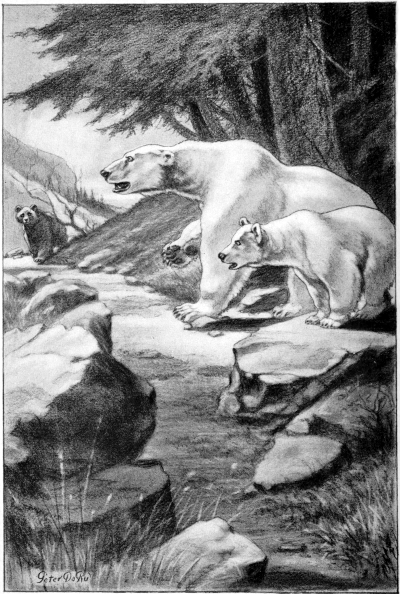
Along came a huge brown bear. —Page 32
By Allen Chaffee
Author of “Unexplored”, “Lost River”
The “Twinkly Eyes Books” “Fuzzy Wuzz” Etc.
Illustrated by
PETER DA RU
MILTON BRADLEY COMPANY
Springfield, Massachusetts
Copyright, 1923
By MILTON BRADLEY COMPANY
Springfield, Massachusetts
———
All Rights Reserved
Bradley Quality Books
Printed in United States of America
To
Peter DaRu
who knows and loves the Alaskan wilderness
FOREWORD
Here, in story form, is the natural history of Alaska, our last great American wilderness.
In the adventures of the wee white polar bear, who drifts down the coast on a floating berg, the young reader has a chance to see Southern Alaska, with its two months of lush summer verdure, as well as the long frozen winter under the Northern lights, and the later summers far out in Bering Strait.
With the enterprising bear cub, he can watch Eskimos and reindeer, seals and walruses, migratory sea birds and the salmon who swim the inland waterways to spawn. He will witness the birth of an ice-berg and adventure amid the storms and glaciers of the polar night.
There is also the story of a seal baby, who became the pet of the fisherman’s little boy.
CONTENTS
SITKA, THE SNOW BABY
| Chapter | Page | |
| I. | The Little White Bear | 1 |
| II. | Unga, the Eskimo Boy | 8 |
| III. | Adrift on an Ice-Berg | 15 |
| IV. | The Walrus Herd | 22 |
| V. | Summer in Alaska | 29 |
| VI. | Blueberries and Mosquitoes | 34 |
| VII. | An Adventure | 41 |
| VIII. | Wolves and Salmon | 47 |
| IX. | The Birth of an Ice-Berg | 56 |
| X. | Monsters of the Sea | 62 |
| XI. | Tooth and Fang | 68 |
| XII. | “Let There Be Peace” | 81 |
| FINNY-FOOT, THE SEAL | ||
| I. | The Water Puppy | 88 |
| II. | Pietro’s Pet | 95 |
| III. | The Trained Seals | 101 |
| IV. | Flapper the Fur Seal | 108 |
| Glossary of Alaskan Words | 116 |
[Pg 1]
THE LITTLE WHITE BEAR
SITKA, the Snow Baby, opened his eyes on a world all blue-white ice-bergs and green-blue ocean under a sky that sparkled in the spring sunshine.
He was as fat as butter and as fuzzy as a kitten, was Sitka, the little white bear. He looked for all the world like a big puppy, with his long white fur that was to keep him warm in this land of ice and snow. For his home was Alaska, that great Western frontier of the United States that reaches to the North Pole.
Why was Sitka white, instead of black like his cousin Twinkly Eyes, of the deep, black-shadowed pine woods? One reason for his having white fur in that land of white was so that his enemies could not see[Pg 2] him so plainly. For there were fierce white wolves that would have eaten him, had they found him, he was so little and soft and helpless. Of course his mother could protect him,—if there weren’t too many wolves, she was so big and fierce. Mother White Bear, like all the polar bear tribe, was at least twice as big as Mother Black Bear.
Sitka had been born five weeks before in the cave in the ice-berg where his mother had slept the winter away. At first he had been naked and blind and helpless. Now his fur had grown and his eyes had opened, and he was ready to take a look at the world.
My, how cold it was, even in spring, here in Alaska! His mother kept walking back and forth, back and forth, on the ice, because the minute she stopped her feet would have frozen fast, even though their soles were covered with fur. Sitka watched her for a few minutes, then he, too, began pacing back and forth, back and forth, without stopping.
His mother had a longer neck than most bears, because it helped her to keep her nose[Pg 3] above water when she swam. She was a great swimmer, for she lived on fish most of the time, and in her search for salmon and mackerel and shell-fish she often went far from shore, swimming from one ice-floe to the next through the open sea. The polar bear is often called the sea bear.
Now this is what had become of Sitka’s father.—When the long, dark polar winter had set in and Sitka’s mother had curled herself up in the ice cave to hibernate, her mate had gone roaming over land and sea in search of good things to eat. He never slept the winter away as she did, and the cold gave him a ravenous appetite. Something must have happened to him during his wanderings, for he never came back. Perhaps an Eskimo killed him, to make his warm white fur into a rug for his igloo, as they call the little round snow houses these little brown people live in. Or perhaps he wanted a bear skin to make himself a parka, the hooded shirt they wear.
Sitka’s mother had selected for her winter sleep a den on the ice-berg. This was[Pg 4] when the sea froze over. When the spring sunshine began shining through the glassy walls of her retreat, and Sitka was strong enough to follow her, she burst her way through the icy door of her cave and led him forth, while she looked this way and that for something she could eat. The berg had broken away from the harbor ice, and floated this way and that through the open sea, as the wind blew it along. There wasn’t a thing she could eat on that ice cake, and she was starved after her winter’s fast.
Most of the year she had to live on fish and clams, and the eggs of sea birds, because only in mid-summer were there berries and grasses. She loved salmon perhaps best of all. Once she found a good fishing ground, she could catch the great silver fish with her claws. But not one fish could she see in the water that broke in little waves against their floating island.
Small sea-gulls were flying low above their heads. They were Arctic tern, and it made her mouth water to look at them. Leaping after one that flew low overhead,[Pg 5] she made a grab at it with her paw, but failed to catch it. Wee Sitka also made a grab at them, but his fat legs slipped from under him, and over and over he rolled like a furry ball. The birds had been wintering in the South, and they had flown thousands of miles on their long wings to get back to Alaska. By and by, when the short Arctic summer came, it would be the most wonderful place in the world to raise their families and find the things they liked to eat. They had webbed feet, so that they could swim when their wings got tired, and their long bills were hooked at the tips to help them catch their slippery prey.
Just now the circling birds wheeled at the call of their leader and went flapping Eastward toward the Alaskan shore. “That means they’ve seen something good,—perhaps a school of mackerel,” Sitka’s mother rumbled deep down in her throat. No wonder the Eskimos watch the tern for a sign of good luck, for the bright eyes of a flock of gulls are sure to see where the best fishing ground lies.
[Pg 6]
Mother White Bear plunged into the icy water, bidding the snow baby follow her. Sitka dipped one fat paw into the icy tide, and squealed that he was afraid. “Come on,” she urged him. “Just catch hold of my tail and I’ll tow you along.” (For you know the polar bear has a wee stub of a tail.)
“No-o-o-o!” he squealed, afraid. But wise Mother White Bear sank almost out of sight in the blue-green water. “Wa-i-t!” he wailed.
Of a sudden she lifted her head high on its long neck, and sniffed the current of the wind. Sitka also sniffed, to find out what it was she smelled. Just then his feet slipped from under him, and off into the icy water slid the fat white cub. “Oosh! Huff—huff—huff!” he gasped, the plunge fairly taking his breath away. He felt sure that he was going under. Without once realizing that he was learning to swim, he struck out with all fours, just as if he were running, till he could make a grab for his mother’s tail. Then he clung to it with his teeth,[Pg 7] while she swam strongly to the next great, floating ice cake. There she scrambled over the edge, and Sitka with her, and stood shaking her wet fur and sniffing the wind.
“I smell birds’ nests,” she explained. “But I get a message about something else, too. It must be an enemy;” for the fur was rising along the back of her neck, the way it does when danger threatens.
[Pg 8]
THE ESKIMO BOY
THE little white bear wondered why his mother wriggled her nose, with the fur rising so angrily on the back of her neck.
It was only a boy,—Unga, an Eskimo lad, who, unlike Sitka, walked on his hind legs all the time. But Mother White Bear had been hunted so many times by these small brown people that her first instinct was to dive beneath the icy water and swim to safety. But with the wee, fat cub it would be hard to dive without drowning him. Of course, had she been alone, she could have handled the little Eskimo with one blow of her huge fore arm. But she knew he could throw a spear that might hurt Sitka. Then[Pg 9] he would take the cub’s soft fur to make a fur coat. That had happened, once, to a polar cub. The thought made her growl ferociously, deep down in her throat.
A moment more and the fur-clad little fellow came in sight. Fortunately for Sitka, he was alone. He had not brought one of the great, wolfish “husky” dogs that bears are so afraid of. His father was driving the dog-team to his sled that day.
Sitka’s mother turned. The odor of the birds’ nests was very near now. Following that wonderful nose of hers straight across the ice, she swam another bit of open water, hoping to leave the boy behind her. Again she crossed an ice-floe, Sitka close behind, and again she swam an open lane of water. That way, they came to a rocky islet that was covered thick with eider ducks. The great, handsome birds had plucked the soft feathers,—the eider down—from their own breasts to line their rocky nests, and in these nests were hundreds and thousands of pale eggs. The whole rocky islet was covered with these nests.
[Pg 10]
“Um!” sniffed Mother White Bear hungrily. “I think we have left that boy behind, and I am going to have eggs for supper.” With Sitka close at her heels, she shuffled along between the nests, taking here an egg and there an egg and crunching it in her great jaws. The meal put new strength into her; it would enable her to nurse her furry baby when she put him to sleep.
The ducks quacked and scolded, but there were so many eggs that there would be plenty left to hatch into ducklings.
So busy had Mother White Bear been at her feast that she had almost forgotten about the Eskimo boy. Of a sudden she saw him paddling around the islet in his seal-skin boat. At the same instant he saw wee, fuzzy Sitka galloping along behind his mother, trying his best to keep up with her. The boy raised his spear to hurl it at the Snow Baby.
At that moment Sitka’s life was certainly in danger. But great, nine foot Mother White Bear, catching a whiff of the wind[Pg 11] that blew straight to her wonderful nose from the dirty, greasy Eskimo lad, turned back just in time. Furiously she batted the spear with her powerful forearm as it came whistling through the air. In another instant it would have struck her baby. Growling awful threats, she rushed at Unga to drive him back.
The little white bear, terrified by the battle that seemed about to be fought over his small person, turned tail and ran for all he was worth. From a point that jutted from the rocky islet he scrambled aboard a blue-white chunk of ice. The next thing he knew, the ice cracked with a sound like the roar of a cannon, and the floe he was on split off and began floating away. Sitka whimpered in fright as he watched the blue-green water rush in between him and the isle.
But his mother saw him and came racing across the rocks, stepping, smash! all over the birds’ nests in her hurry. Swimming the strip of open water, she scrambled up beside him, and began nuzzling him all over to see if he was hurt. The Eskimo boy[Pg 12] would trouble them no more. They could see him paddling away in his skin canoe.
Sitka was to have an even more exciting time later that spring. Awaking in his mother’s warm, furry arms to a morning of golden sunshine and blue sky, with gulls flying overhead crying “que-ok, que-ok, que-ok!” and the ice-bergs that rose like blue-white mountain peaks to seaward, he was startled by a rumbling like thunder. All about them it began sounding, for the ice cakes were breaking apart, floating this way and that and grinding against one another. But their own berg, so snug and safe with its cave in which they always slept, towered among the up-ending ice cakes as secure as a miniature mountain peak.
Away off in the open water they could see little spouts of water. Sitka’s mother said it was whales “blowing.”
“What are whales?” the cub demanded, round eyed with wonder.
“Whales,” said his mother, “are great fish-like creatures, ever and ever and ever[Pg 13] so much bigger than the biggest polar bear that ever lived. But the queer thing is that they are not fish, really, though they spend their lives in the ocean, because they have fur instead of scales, and the mother whale nurses her baby just as a cat does her kitten.”
“Oo! Aren’t you afraid of whales?” Sitka marvelled.
“No. They have the tiniest mouths. But whale meat is delicious. These little brown men hunt them for their blubber, as they call the fat that lines their sides, and I’d love nothing better than to find a strip of blubber. Let’s go a little nearer.—Um! I smell blubber now. I do believe those Eskimos have been whale-hunting. If we could just find where they’ve been cutting blubber, what a feast it would be!”
The Snow Baby was happy to go exploring. Climbing a steep, icy slope to the ridge of the next ice pan, they could see, away across the ice, which had frozen in ridges like the waves of the sea, a huge dark body that Mother White Bear’s nose said was a[Pg 14] whale. But further out, a horde of the fur-clad little brown men were racing toward another whale in their seal-skin boats, with spears raised. Mother White Bear hesitated. She hated to take Sitka too near these Eskimos. But the odor of whale meat came tantalizingly to her nostrils, and she was dreadfully hungry. Cautiously she padded forward, and Sitka after her, ready at a moment’s notice to run for their lives. But they reached the meat in safety.
She had just begun to eat ravenously when a sudden shout went up. One of the little brown men had seen her, and turned in pursuit.
[Pg 15]
ADRIFT ON AN ICE-BERG
NO sooner had Mother White Bear seen the Eskimo turn to pursue her than she started running back over the ice floe, urging the fat cub to follow.
Sitka raced as best he could, but his fat forelegs were so much shorter than his hind legs that he stepped on his own feet and fell, and rolled this way and that. Again and again he fell, till Mother White Bear came back and tried to carry him by the scruff of the neck. But he was too heavy for that now. And all the time the little brown man was coming closer. At last the Eskimo raised his spear to hurl it at Sitka.
Mother White Bear had just come to the top of a steep, slippery place on the ice-floe[Pg 16] where it sloped to the sea.[1] In desperation, the great, furry mother took wee Sitka in her almost human forearms, and sitting down at the top of the slide, coasted straight down the ice-pan into the white-capped waves. By the time the Eskimo had climbed to the top of the slide, where he could see what had become of them, they were swimming rapidly away, the cub holding fast to his mother’s tail.
[1] Note—A polar bear seen on the broken ice off Wrangel Island was seen to climb to the top of an uptilted ice-pan, lay down on his side, and pushing himself off with one hind foot, coast down head foremost to the water thirty of forty feet below, states E. W. Nelson in a publication of the National Geographic Society.
Another time he saw a mother bear shelter her cub from flying bullets by taking him between her fore legs and swimming away with him.
Even then the little brown man could have thrown his spear and struck them, but Mother White Bear, suspicioning as much, made a dive under a floating cake of ice. They came up on the other side, where he could not see them, their noses just barely out of water,—and there they waited till long after the little brown man had given[Pg 17] up and gone back to the whale hunt.
There followed delightful days on Egg Island, as they called the rocks on which they had found the eider ducks. It rained a good deal, but they did not mind. The days were getting longer now. There were only a few hours of darkness between sunset and sunrise. The ice of inland rivers was thawed through in spots, where the Eskimos had chopped holes to catch salmon. Mother White Bear would sit all day at one of these salmon holes, watching for the big red fish. When she saw one, biff! would go her fore arm, claws out like five ivory fish hooks, to nab the slippery fellow. Then how she did feast! Sitka watched every move she made, because by and by he, too, wanted to be a mighty fisherman.
One day she took him to visit Seal Rocks. From far away they could hear the dog-like barking of the queer creatures, as they lay basking in the noonday sun. Now and again one would come swimming along with a fish in his jaws, clambering up on the rocks with his flippers.
[Pg 18]
Long ago, when the world was young, Mother White Bear told Sitka, the seals all lived on land, and had legs, but they found it so much easier to get their food from the sea that they became expert swimmers. That meant that Mother Nature had to flatten their fore-legs into flippers, with webbed fingers, so that they could use them as paddles, as a fish does his fins. Their hind legs she turned into flappers that they could hold snug together and use, like a fish’s tail, to steer with. This makes it hard for them to get about on land, and Sitka thought it was the funniest sight in the world to see them humping themselves along over the rocks. But they were wonderful at swimming and diving and catching fish.
Mother White Bear would not swim too near Seal Rocks today, however, because the great bull seals, the fathers and grandfathers, were there to protect the little ones. And my, how those old bulls did bark at them! For they feared that Mother White Bear might like the flavor of baby seal.[Pg 19] Nearly every cow-seal had a baby with soft, woolly white fur, though when it grew up it would be brown and tan. Mother White Bear would have liked to take Sitka a little nearer, but though the cow seals were not much bigger than big dogs, the bulls were almost as huge as herself. That, she told the inquiring cub, was because every bull had to protect at least a dozen cows and their babies. The young bulls are killed for their skins, and that makes the numbers uneven.
The seals had all been South for the winter. In May the bull seals had returned to the islands, swimming through the icy water so fast that the cows could not keep up with them. For several weeks the bulls had held contests, and fought among themselves to see who was strongest, and who should have the best home sites on the islands. In June their mates had come, and almost the same day, the seal pups had been born. It is still cold in Alaska in early summer, but the seals have such thick fur—these Alaska seals—that they do not mind.[Pg 20] Of course the best deep sea fishing cannot be found so near shore, and the mother seals often had to swim for miles to find food. Then they would come back and nurse their babies. By fall the little ones would be able to fish for themselves, and they would all go South for the winter.
The two bears next swam past some rocks where they saw a herd of huge fat walruses. These leather-skinned old fellows, who looked as if they might be second cousins to the seals, had great tusks that curved from their jaws to the very ground. Sitka was terribly afraid when he saw those ivory tusks. But his mother only laughed and bade him watch and see what they did with their ferocious-looking weapons. Then she led him over the rocks, past the lazy, lubberly creatures, who eyed them stupidly, to where one old fellow was busy just off shore. To Sitka’s immense surprise, the monster was digging clams with his tusks. He had quite a pile of them waiting for his supper.
Sitka watched with twinkling eyes till[Pg 21] the old fellow’s back was turned. Then he made a dash to see what those clams were like. My, how that walrus roared at him! He made for him with his tusks, but Sitka dodged to one side too quickly for his clumsy lunge.
[Pg 22]
THE WALRUS HERD
ON a bare, flat island of the ice pack sprawled a herd of walruses. Sitka stared!
They were the fattest, ugliest, fiercest looking monsters the little white bear had ever seen. They were not as fierce as they looked, however, as Mother White Bear knew, for they lived on clams and shell-fish. Their fierce appearance came partly from the long ivory tusks with which they dug their clams.
They were enormous creatures, some of the old bulls weighing fully two thousand pounds. Like seals, their legs consisted of flappers. But there the resemblance ended. Instead of silky fur, they had ugly, hairless,[Pg 23] warty-looking hides, tough and wrinkled and of a muddy brown.
Neither have they the brains of the seal tribe: for they had found the life of the clam digger so easy that they had no need of brains, and Nature takes back what we do not use. Their thick necks ended in heads so shallow that there seemed to be nothing there but a pair of tiny eyes and the whiskers at the roots of their tusks.
On land these ungainly monsters were almost helpless in their fatness,—instead of being agile like seals. But in the sea they were marvelous swimmers, their layers of fat blubber helping there to float them.
However, like all mammals, they will fight fiercely when their babies are in danger.
As Sitka and his mother approached the ice where lay a herd of mother walruses and their young, the mothers eyed them angrily, and the moment they scrambled aboard the floe, several of them charged with the utmost ferocity, bellowing and rearing themselves high on their hind quarters[Pg 24] as if to fling themselves on the intruders and crush them flat, as, indeed, they might have done, had not Mother White Bear given Sitka the signal to dive off into the water again. Dearly would she have loved to treat him to walrus calf, but it was plain they would have to try strategy in capturing such prey.
For a time they swam around, not too close to the mother walruses. The fathers were digging clams, heaping great piles of them on shore, then settling to their feast, or sometimes eating as they dug. Sitka eyed these clam piles with envy and a little mischief. “Mother, I’m going to try it again!” he announced. And before she could utter a warning, he had made a dash for the breakfast a huge old bull was looking forward to, as he dug away in the shallow water.
With a bellow of wrath the old fellow reared his monstrous head and eyed the white cub with a gleam of anger. “Come back!” whoofed Mother White Bear. But Sitka did not hear. The next moment the[Pg 25] ivory tusks would have come down straight into the middle of Sitka’s back, but that he dodged, and slid into the water with no more than a red gash on his white side.
“Just wait till I’m a little bigger!” he roared at the walrus. “You just wait!”
It was therefore with huge interest that he watched his mother, towards dusk that afternoon, prepare to creep up on a walrus calf. Bidding Sitka remain in hiding behind a chunk of ice, she flattened herself like a cat creeping up on a bird, and waited till it should be wholly dark. She had fixed on a calf who, with his mother, lay a little to one side of the main body of the herd, and in order to take them by surprise, she and Sitka had made their approach by swimming first out to sea, then doubling back and approaching with nothing showing above water-line save the black tips of their noses.
In that interval just between sundown and the first stars, when it was darkest, she began creeping slowly forward. Once her foot scraped the ice, and the walrus cow[Pg 26] looked up suspiciously, and Mother White Bear held as still as a rock till the cow had gone to sleep again. Then forward she crept, nearer, nearer, nearer, nearer! Sitka could no longer see her white bulk for the darkness, nor could he hear aught but the wind and the waves.
With a sudden dash she had broken the calf’s neck with a blow and was dragging his huge weight back over the ice. The walrus cow was roused now and rearing this way and that, trying to overtake them. But so awkward are walruses on land that she could make no headway compared with agile Mother White Bear; and though her bellowing awoke the herd and they raised the most terrific alarm, they were still farther away than she. In the inky darkness they only tumbled over one another in their awkwardness, searching in vain for the cause of the disturbance. Had Mother White Bear met them in the water, it would have been a different story. But she did not take to the water till she had reached the place where she had left Sitka. Then,[Pg 27] softly, softly, they slipped over the edge of the ice and began towing the fat body of the calf to shore. It meant feasting for many days.
*****
It was only a week later that they watched, themselves safely hidden, their black noses just barely out of water, while a band of Eskimos went walrus hunting, and Sitka marveled to see what cowards walruses could be. As the little brown men approached in their kyacks (fearless in these frail skin boats), the whole herd simply rushed terrified into the water and swam for their lives. Even then it was simple enough for the hunters to make a kill with their bone-pointed spears. Had the walruses not been such cowards, it would have been the easiest thing in the world for them to have reared their tusked heads out of the water and crushed the boats.
[Pg 28]
SUMMER IN ALASKA
THE ice-berg on which Sitka and his mother had their den was drifting further and further South.
It was but one of many bergs, and a small one, at that. Huge, mountainous looking islets of the blue-white ice swam all about them, sometimes bumping against one another with a roar. Sea birds screamed above their heads, and the sun glinted from the water merrily, on days when it did not rain. Sitka felt that they were bound on a great adventure.
Sometimes the wee white bear watched the waves that broke in white foam against the floating bergs, and nowhere could he see anything but sea and sky. Again they floated close to shore, where steep granite[Pg 29] cliffs jutted in long arms between the fiords,—the narrow inlets the ice had cut. In places, the cliffs were red with the cooled lava that had come pouring hot from some ancient volcano; and Mother White Bear would tell Sitka how, when the world was young, the mountain peaks that lined the shore had flamed and smoked and rumbled, and sent forth a fountain of fire and ashes. For that was the way new mountains were made. At such times Sitka’s eyes would grow round with wonder.
“Will it happen again?” he asked uneasily.
“Sometimes it happens even now,” his mother told him. “But it is nothing to be afraid of. We won’t go near.”
“But where does the fire come from?” he would ask.
“From away inside the earth. You know it was once all hot millions of years ago, but it has cooled until we have ice and snow.”
Their little berg soon began floating down a shore covered by green forest, which[Pg 30] crept to the very water’s edge. Birds sang in the tree tops, and lovely waterfalls poured over the pink limestone cliffs. It was like paradise. Tall ferns and brilliant flowers embroidered the brook banks. Mother White Bear sniffed. She could smell ripening berries. It would be worth while to swim ashore and have a little change from fish. Sitka was the happiest little bear in all Alaska.
That day they feasted on clams and mussels and other shell-fish that they found among the rocks. They had juicy meadow grasses, too, and lilies with roots like onions. The days were growing longer and longer, till there were just a few hours of darkness, and all the rest was day. For it was the land of the midnight sun. “In winter Sitka’s mother reminded him, it was dark almost all day, where they came from,—so near the North Pole.
Sometimes Mother White Bear would lead the way along the beach till they came to the river. It began just behind the falls that shot over the cliff in rainbow-tinted[Pg 31] spray. Along that river was a bear-path beaten hard into the soft soil by the feet of hundreds of other bears black and brown and gray, who fished every year along the bank. There the two explorers would catch salmon and leaping trout, and sometimes they found great piles of fish that had been washed ashore by the spring floods. These expeditions were a bit of a risk for a polar bear, and Sitka’s mother was conscious that their white coats no longer blended with the background of white ice that Mother Nature intended them to live on. Still, they could always return to their cave on the berg to sleep. It floated so slowly that they could ramble all day on shore, and still swim back to it when night came. For Mother White Bear could swim as fast as a motor boat when she wanted to.
One thing she always avoided, and that was the settlements where Indians, and sometimes white men, lived. When they passed a town, she would “lay low.” For it was not of other animals she was afraid,[Pg 32] so long as she was with Sitka to protect him, but of the red men.
She was, however, careful to keep out of the way of the huge brown bears that lived along the shore. One day they had smelled ripe blueberries, and she had led Sitka cautiously ashore for a taste of the fruit. It was boggy where they grew. The heavy rains had left the ground soaked with moisture, and they had to keep to the firm ground around the edge. Even then, sometimes, the cub would slip on a soft bit of moss and sink to his armpits in the oozy swamp or tundra, before his mother could yank him out by the scruff of his neck.
Here they felt the first mosquitoes Sitka had ever known. But they couldn’t do much damage, through his thick fur, except around his face. By and by, along came a huge brown bear, a kadiak bear, larger than Mother White Bear. Sitka’s mother promptly hid him in a thick clump of alders, but the kadiak never even looked in their direction. He was following his nose to the blueberry bog.
[Pg 33]
Now they had noticed how thick the mosquitoes were, out over the bog. There were black clouds of them. Mosquitoes are worse in the short Alaska summer than anywhere else in the whole United States, because the ground is so wet and the sun so hot. The big brown bears and the little black bears that live in Southern Alaska always go to the mountains for the summer to get away from the mosquitoes, because on the cool, windy mountainsides the maddening insects cannot live. But it is a great temptation to come down sometimes and go blueberrying, where the berries are thickest.
This old brown bear, Sitka’s mother whispered to him, as they stood hiding in the alder thicket, was very likely on his way to the mountains for the two hot months. But first he was going to cross the bog. “And the mosquitoes will eat him alive.”
Sitka wondered how such tiny insects could harm such a great, shaggy brute as the kadiak bear.
“Suppose we watch and find out,” his mother suggested.
[Pg 34]
BLUEBERRIES AND MOSQUITOES
YES, sir, those mosquitoes will almost eat him alive!” Sitka’s mother assured him.
Sitka, wondering greatly, watched, as the huge old kadiak bear lumbered across the bog. Sure enough, the mosquitoes followed him in swarms. A black cloud of them hung over him, singing their horrid song. They settled black on his fur, but that did him no harm. They could not reach through to his hide. But there was, of course, no fur to protect his eyes and nostrils, and the insects began settling on his eyelids and on the tip of his nose till he had to paw them off angrily. And my, how they could sting! Every time they poked their beaks into him for a drop of blood, they left a tiny drop of[Pg 35] poison in the wound, and made it burn and swell. By and by the poor old fellow’s eyelids were so swollen that he could not open his eyes to see where he was going. He just wandered around and around in the bog, till he thought he never would find his way out again. He had come that way for the berries, but his lips and tongue were now so swollen from the mosquito bites that he could not even enjoy the fruit.
But at last he happened to wander near the edge of the bog. Then he heard the sound of roaring water, where a river came rushing down the mountainside to the sea. Making blindly for the sound, he plunged into an icy pool, where he could cool his fevered face. And there he stayed, just the tip of his nose above water so he could breathe, until the swelling had gone down and he could see to go on up into the mountains.
“Once upon a time,” Sitka’s mother told him, “a big brown bear tried to cross the swamp, and the mosquitoes bit him till he couldn’t see, and he just wandered around[Pg 36] and around in that swamp till he starved to death. And all the time, the mosquitoes kept pricking him for the tiny drop of his blood that each one got. That is what I meant when I said they could fairly eat one alive,—tiny as they are, when there are so many of them.”
Sitka looked back wonderingly at the kadiak bear that had had such a narrow escape. He was shuffling rapidly up the mountainside.
The next time the polar cub and his mother went exploring, they saw a band of Indians camping on the river bank. The women and children, dressed in bright hued calicoes, were fishing and gathering berries, and cooking fish over little fires. Now fire was something that Sitka had never seen before, and it looked so pretty that he wanted to feel of one. But Mother White Bear was terribly afraid of fire, because it was something she did not understand, and she kept him in hiding among the tall ferns. It was dangerous enough, she said, for a white bear to go into the woods at all, when[Pg 37] the red men were about.
By and by they saw a band of Indian men start up the mountainside. When they had passed out of sight, Sitka’s mother began leading him up another way. Far ahead, they could see the peaks and hollows filled with snow, and she thought it would feel good to roll in the snow again. Their fur was much too warm for this kind of weather. Besides, she smelled wild mushrooms, and she meant to have a feast. In the snow they could hide perfectly, should the red men come near.
There were choice berries and other good things along the way to eat. They started following the river, where the rainbow trout leapt out of the water every now and again. They padded along as soundlessly as possible on their furry feet. The clouds were gathering about the peaks, throwing cool shadows over the woods. It would probably rain by and by, but they didn’t mind in the least. They really enjoyed being out in the rain.
At first their way lay along the bear path[Pg 38] where the earth had been beaten hard along the river bank. On one side, the icy water swirled over rocks and fallen logs, or slid in smooth sheets over the gold-specked sands. For this was a land where much gold was found. On the other side of the path, rank meadow grass grew high on the moist soil, and even Sitka’s mother could not see above its waving tops. The cub slipped into the soft black mud, till no one would have believed, when his mother fished him out, that he had ever been a little white bear.
In this tall grass they could hear queer rustlings,—little squeals and scufflings, and Sitka wondered what could be going on in there. By and by the grass was not so tall. It was only about as high as Mother White Bear. They were on a steep slope now, where the trees had all been burned to blackened stumps, and the bunch grass grew. Suddenly a sound of many hooves thudded along the ground, and Mother White Bear drew Sitka into hiding between two granite boulders. A few minutes later,[Pg 39] a herd of reindeer went leaping and bounding over the grass and up the mountainside. These Alaskan caribou can stand weather 60 degrees below zero. But in summer they enjoy three months of feasting on the bunch grass.
At last the two bears reached a ridge where they could see ever and ever so far. They could look back along the way they had come, across the level stretch of grass and down the river glinting in the sun. They could even see where the ocean beat against the cliffs in white foam, and beyond, where the white bergs drifted. Up here the wind was cold, and snow lay in the shady places.
Then that same band of reindeer went leaping across the side of the mountain opposite, and on up the steep slopes. After them came racing the Indians, trying to head them off and capture them. They use reindeer for both horses and cows,—driving them, milking them, and using their hide to make their clothing, boats and houses. That is, they do, when they capture them. They had all passed out of sight[Pg 40] in a twinkling and Sitka never knew whether they caught them or not. He hoped the beautiful brown animals had escaped.
But that night he found he had troubles of his own.
[Pg 41]
AN ADVENTURE
I DO hope our ice-berg doesn’t drift too far away!” said Mother White Bear. “We’d spend another day on the mountain, if I thought it was safe to.”
“Let’s stay,” begged Sitka.
The way now grew steeper, and the river grew narrower and swifter, until the bunch grass gave way to tall ferns and the ground was soft with pretty colored mosses. In winter the reindeer paw the snow away with their feet and eat these mosses. Next came pale green willows and dark green spruce and cedar trees. The Snow Baby, sniffing their piny fragrance, rolled delightedly on the soft ground beneath them.
Later the slopes were all wet moss, into[Pg 42] which the wee fellow sank so deep that his mother tried to lead him along the fallen tree trunks. But they too were slippery with moss, and every now and again he would slide off and have to be rescued. But then, there were the finest, big, juicy berries! Blue-berries, thimble-berries, fat ripe huckleberries, tart cranberries, and mild, sweet service-berries. It was a paradise for bears!
There were mushrooms, too, growing around the hollow logs, and Mother White Bear knew just which it was safe to eat, and which were poisonous. My, how she did love mushrooms!
“Mother,” Sitka begged, “let’s stay here all the time.”
But she explained that the summer is very short, just July and August, here in this part of the world, and soon would come ice and snow again, and they would have to go back to sea, where they could fish. Besides, she preferred the sea.
Sitka found it hard to imagine it ever being cold there, where the sun shone so[Pg 43] hot! But by September, she told him, would come the long rains, and the days would grow shorter and shorter, till in mid-winter it was terrifically cold on these mountains.
Returning the way they had come, they found the Indians still singing and laughing about their little cook-fires. Along the river bank stood their baskets heaped with red and purple berries, and Sitka grabbed a pawful every chance he got. But Mother White Bear led him away around the Indian camp, as softly as she could walk, for “Safety First” was her motto where the red men were concerned.
Sitka was exhausted now, and they were eager to get back to their cave in the ice-berg. But the little berg, which Mother White Bear recognized by its shape, was away off behind two smaller bergs. Her first thought was to swim clear around them, but the cub was by now so tired and sleepy that he began whimpering and begging her to carry him. How she longed to get back to the safety of their cave, where[Pg 44] he could sleep away the strange, sunlit night.
As the bergs were drifting in the blue summer sea, there was a narrow lane of water they might swim between the two new bergs, to reach their home. Well, she decided, she would chance it. She was a powerful swimmer, and Sitka could cling to her tail. If only those huge chunks of ice would stop drifting about so!
She had swum perhaps half this narrow channel when she suddenly became aware that the walls of ice that towered on either side were closer than when she had started. The two bergs were floating together, and the spray that dashed against their sides began to fill her eyes with mist, and her ears with the sound of the surf. Sitka, paddling wearily along behind her, with her stub of a tail in his mouth, began to squeal that he was being drowned, for the waves were chopping right over his head.
Mother White Bear redoubled her efforts, knowing that if they did not get through[Pg 45] the channel quickly, they would surely be crushed between those two walls of ice. Anxiously she measured the distance that lay ahead, then with a backward glance she made a hasty estimate of the distance that lay behind them. Yes, they must be just about half way through the channel.
But ahead the space was narrowed till it seemed as if the icy walls must clash together before they could pass them. And the tide was all against her. Swim as she might, she could not seem to swim fast enough. How she wished now that she had taken the long, safe way around. But it was too late.
But was it?—If only she were headed the other way, the tide would help instead of hinder her. She glanced behind once more. To her surprise, the way was widening, instead of narrowing, behind them. In fact, the icy walls were drifting together in a V, and they were headed toward the point of the V.
Quick as thought, she turned, and began towing the tired Sitka back the way they[Pg 46] had come. Then the ice ahead came together with a grinding roar, and the wave chop nearly strangled them. But she swam on, and the wee cub behind her, till they were out in open water. One last mighty effort and they were safe! An instant later the icy walls clashed again, grinding together until the channel was entirely closed. But they were safe!
[Pg 47]
WOLVES AND SALMON
WHEN Mother White Bear saw that they could not get back to their own berg, she towed Sitka around the neighboring bergs to see if they could not find a new home among them. They were of course tiny bergs,—hardly deserving the name, but still affording them cool and comfortable shelter through the long daylight nights. But all were too steep to climb.
There was nothing for it, then, but to return to shore. As she swam back through the icy water, so pleasant after their hot day, she wondered where they could hide themselves in the strange brilliance of the Alaskan summer night. Nowhere along shore, certainly, with those Indians encamped so near, and the excursion steamers[Pg 48] of the white men passing every now and again.
There seemed nothing for it but to return to the snow fields of the high mountains. So long as the summer lasted, there was food in plenty. Later the salmon streams would freeze, and they would have to seek their fish from the sea. But if they headed generally Northward in their wanderings, along the snow-capped range, they would soon be back in a land better suited to their heavy furs. Polar bears are, like all bears, great wanderers. It was the first time in her life that Mother White Bear had ever visited land in summer; but once in early winter she had ranged Southward over the pack ice, in which she had denned for her winter sleep. The breaking up of the pack in spring had left her to summer on an island with Sitka’s older brother, then a wee cub, though they had finally made their way back home by swimming many miles through the open sea.
Tonight as Sitka and his mother neared shore again, they were startled to hear the[Pg 49] baying of wolves. They hid behind an up-jutting boulder just off shore, and waited to see what was going to happen. Through the meadows that here lay between woods and shore came a herd of deer, and from their enormous leaps and bounds Mother White Bear decided that it must be a matter of life and death.
Behind them the tall grass, man-high, moved here and there as if blown by a wind, but it must be something else that moved it. Then out on the rocky shore came the terror-stricken deer, and close at their heels, there emerged from the concealing grasses three great fierce white wolves. The deer were all but exhausted now, for they stumbled as they leapt. They must have come a great distance,—perhaps from the mountain-sides where they browsed in summer. But the wolves had gained on them and the race was nearly done.
Then the leader of the herd, raising his great antlers, leaped into the water. After him plunged the others, and away they swam, straight toward the rim of a green[Pg 50] island that lay off-shore. The wolves stopped at the water’s edge, for they are not good swimmers, baying their disappointment till the fearful sound echoed and re-echoed from the tossing bergs.
But were the three wolves to go hungry? Sitka watched with frightened eyes as the trio seated themselves in a row and howled their disappointment to the curtain of light that now began to glow in the North. There was nothing else to do but to watch the wolves and the Aurora, for Mother White Bear would not venture ashore till they had gone.
Never would Sitka forget the shimmering silver folds of the curtain that hung from the Auroral arch, the star-strewn sky, and the midnight sun circling the horizon, glinting pink from the blue-white bergs that tossed in the purple sea. The grinding of berg on berg, the smell of sea-weed and the weird howling of the wolves, the slap-slap of the waves, comfortingly cold against the furry sides of the wanderers from the North, and the gurgling of the [Pg 51]glacial salmon stream, all these things went to make up the scene. Then the silver curtain ceased to shimmer, and nothing remained but the long flames of white fire that sprang from the zenith.
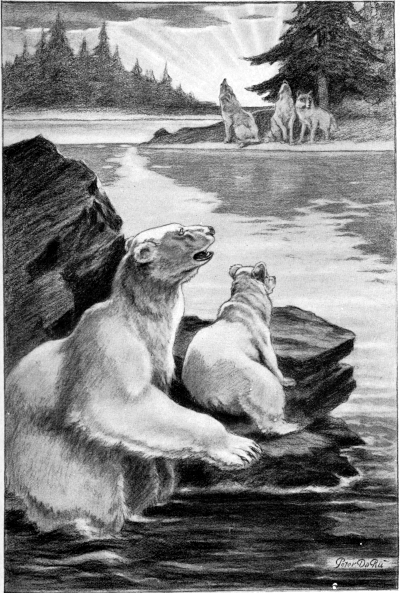
The wolves stopped at the water’s edge.
As suddenly as they had appeared, the three wolves were gone, doubtless to chase rabbits for their breakfast.
Mother White Bear now led the way back along the same river they had explored before. Sitka was tired and sleepy, but she would not stop for him to rest till she had him back so high on the mountainside that they could burrow into a snow bank. “Now we are safe,” she told him “and we can take it leisurely.” Sitka drifted into dreams of catching mammoth salmon.
Now Unga’s tribe were of the Eskimos who hunt on the inland ice. Probably, no one knew how long ago, their people had come over the ice from Greenland, skirting the Arctic Ocean. Those there had been among them, the tale had been handed down to them, who, wandering Southward, had seen some of the Aleutian Islands born,[Pg 52] spewed up as molten rock from volcanic depths. Within the memory of Unga’s father two of these islands had shot fire into the sky and covered all the sea with ashes. Strange sights had been seen in that strange land,—and might be seen again. For geography was still in the making.
It was also rumored that tribesmen who had ventured far in their bidarkas, venturing from one island to another, had found them leading in a chain straight across to Siberia, dividing Bering Sea from the Pacific. All this had been repeated around the fire of the council house.
Had Sitka and Mother White Bear but known it, they had drifted to one of the three great sounds of the West Coast, Bristol Bay, in the language of the white man. From this a chain of mountains reached North-East to a branch of the Yukon, which mighty river they later followed to the sea as it skirted another mountain range. For from the Bay, where the air was warmed and moistened by a branch of the current that crosses the ocean from Japan, they[Pg 53] traversed many a hundred miles of mountainside before they reached that river whose red salmon tempted them to follow its length.
That river, cut deep by the rush of the spring ice, ran Westward across that mighty land to empty into Bering Sea, there to spread fan-wise amid a thousand wooded islands into Norton Sound.
But before Sitka and his mother had traversed its length, they had skirted the sheer cliffs of foaming gorges, and fought mosquitoes along miles of lake-dotted tundra. Their award was that they could often creep up on sleeping ducks or plover, who slept in countless thousands on these lakes as their clans gathered for the great migration Southward for the winter. The two bears were overjoyed when at last, after weeks of untiring travel, they could see the waves breaking in white mist against the spruce-dark shore. The iron mountains behind them shone rose-colored. They had feasted fat on the red and silver salmon, and the grayling and whitefish of the teeming[Pg 54] river, and now at last the only barrier between them and the open sea was a series of sand-bars and whirlpools and an excursion steamer, all to be avoided with equal care. But that is getting ahead of our story.
The river which cascaded from high up the mountain-side was agleam with the shining bodies of samlets, young silver salmon with red spots and black markings on their sides. Such luscious fish the little white bear had never tasted as those they waded into the stream to catch.
In the spring the parent salmon,—huge, silvery fish with black spots on their sides,—had left the sea, with its teeming food supply, to swim up-stream to the spawning beds. The gold seekers of ’98 had often watched as the agile fish swam through the rushing torrents, leaping up the waterfalls as easily and gracefully as a kitten leaps to the top of a hedge. High in the mountains, where the stream runs shallow, they had laid their eggs and left their young to hatch. And now the stream was fairly[Pg 55] alive with these samlets, some of them only a few months old, some as much as two years. The spring of their third year they would be large enough to go down to the sea.
Mother White Bear showed Sitka a salmon laying her eggs. First the great four-foot fish lay down in the gravel of the shallows and rounded out a nest with her side. There she left hundreds and hundreds of tough, elastic shelled eggs, hardly half the size of peas. Before they left the eggs to their fate, the parent fish would cover them over with gravel so that the water could not wash them away. Out of so many, many eggs, surely enough would hatch and survive to fill the river with samlets.
[Pg 56]
THE BIRTH OF AN ICE-BERG
LIKE all explorers, Sitka and his mother knew not what unexpected dangers might lie in their pathway, as they turned their noses Northward. But like all explorers, they thrilled at thought of the new scenes they might enjoy.
Their way lay first along the crest of the range,—the Northern extension of that great mountain system which in California is called the Sierra Nevada and in Oregon and Washington the Cascades and the Selkirks. The same great upheavals of the earth’s crust, the same glaciers and volcanoes, helped to build them all.
In the tonic coolness of the high peaks, Sitka raced and rolled like a puppy, plunging whoofing, into the soft snow, or coasting[Pg 57] when the crust was hard. For a little while this land of sternness, hardship and hunger, smiled in the sunshine, and life was not so serious as it had been, and would be again. With the abundance of food and exercise, Sitka was growing fast. His muscles were as hard as iron. He could go for miles over the mountain-sides without tiring. At the same time his mother was teaching him a million things a polar bear should know about the world in which soon he would have to make his living and defend himself against the elements.
They watched an Arctic fox to see how he caught the ptarmigan, those brown and white grouse which are so abundant on the lower passes. These wild hens of the Arctic, nesting in the snow banks, and gradually changing their brown summer costumes for the white of winter, were not so well hidden as they would be later, when their camouflage would be complete. But try as he might, fat, clumsy Sitka could never creep up on them as did the sly white Reynard. He could[Pg 58] swim after his salmon as the fox could not, but his mouth watered in vain for the ptarmigan.
They gobbled down luscious fungi, those fan-shaped mushrooms that grow on birch trees, and they browsed like cattle on the juicy grass that had sprung up in the paths of snow-slides. All that was delightful. But the cub shivered at the weird, laughing cry of the great Northern loon that haunted the glacial lakes.
He was fascinated, though, by the whistlers, (Arctic woodchucks), who disappeared into their holes at his approach, peeking out at him, then disappearing, peeking and disappearing, till Sitka was frantic with the longing to catch one of them. But try as he might, he was never quick enough for those little fellows. Their shrill, whistling calls tantalized him on every side.
They saw moose and mountain goats, porcupines who gnawed the spruce trees without even bothering to look up at them, and ermine who swam after their fish, twisting and turning as lithe as eels. They crossed[Pg 59] glaciers, leaping the crevices and coasting down the slopes of these almost motionless rivers of ice. On and on they wandered, through the shortening days, now cooled by gray clouds which brought flurries of soft snow to the higher slopes. By September they had gales of wind, with sleet and hailstones, and the clouds were constantly forming on the mountain-tops and sinking lower and lower, till all the tundra between the mountains and the sea lay hidden by gray fog. But Sitka loved the coldness of it, dressed as he was in his thick white furs, and he was the happiest little bear in all Alaska when at last Mother White Bear told him they were now far enough North to return to the sea in safety.
How many hundreds of miles they had traveled they had no means of knowing, but bears are tireless travelers, and polar bears are the most tireless of all. The hardest was when they began following the rim of one of the narrow ice-carved canyons, with its roaring river, and innumerable falls that had to be circled about. But at last they[Pg 60] came out at a fiord of the sea. The wind of an icy rain was frosting the gray-green waves of the great twenty-foot tide and blowing balls of the scud into the tree-tops of the encircling woods. The air rang with the cries of sea birds. Sitka leaped and frisked after the foam, glorying in the salt smell of the sea.
Further out, there were the great bergs growling and grinding against one another and making great waves in the fiord. A distant glacier cracked with a sound like thunder as a mammoth chunk of it broke off and a new berg was born, to toss and splash and cause even more excitement among the lashing waves.
“Hurray!” whoofed Sitka. “This feels like home again.” And following Mother White Bear, he plunged off the pink limestone cliff into the water and started swimming with great, powerful strokes of his fore paws.
Had anyone told the cub as he frisked so exuberantly in his favorite element that anything ugly and dangerous inhabited[Pg 61] those winging waves, he would not have believed it. And yet at that very moment—but that is another chapter!
[Pg 62]
MONSTERS OF THE SEA
ON a sea ruffled to purple in the wind, Mother White bear, busy catching fish, glimpsed three large black fins.
Three piratical black fins, farther out at sea, approached like the sails of so many fishing dories, all in a row. That, she knew, meant orcas—killer whales! With a loud whoof she summoned Sitka to turn back and make for shore. He responded with that swift obedience she had taught him. But though he was swift, the orcas were swifter. But he was not far from a high rock that jutted up out of shoal water. When he had scrambled up beside his mother, his legs were trembling and his breath quite gone.
When the disappointed orcas had swum away again, their great black fins rising[Pg 63] from the curve of their backs, and the two white streaks on their sides shouting a warning to those that could read it, Mother White Bear was reminded of a battle she had once seen between an orca and a cachalot, one of the giant sperm whales. Of course Sitka wanted the story.
“Fortunately,” said Mother White Bear, “cachalots never come as far North as this. It was the time I drifted so far South on the ice that I saw this battle. A cachalot mother had come to a quiet inlet off the coast of Southern Alaska to rear her baby. It must have been an exceptional case, for though I have heard of orcas going far South, I never knew of but the one cachalot to come so far North. But a traveler such as myself sees many an unusual happening.”
“I’m going to be a traveler, too,” vowed Sitka.
“You certainly will, if you grow up into a regular bear,” she agreed. “But first you know that whales are mammals, like bears and dogs, and nurse their babies.”
[Pg 64]
“Honestly?” marvelled Sitka.
“Yes. And the orca mother has a way of carrying her calf tucked behind her left flipper, or as it were, in her left arm, and nursing it as she lies floating on a quiet sea. Both she and her calf are cream colored on their under sides, so that the fish below cannot see them so plainly. For of course they live largely on fish.
“She herself is content to eat the great, sluggish fish that live in shallow seas, though she is also fond of seals, and I have seen her devour one whole. The one I saw and I suppose they are all alike, was lean and quick, and could dive and swim with marvelous agility. The Eskimos would have found very little blubber on her. And unlike the great, stupid, lubberly creatures you saw the Eskimos hunting, this particular whale is a good fighter, as you shall see, and cunning too. But with all this, she loves her calf.”
“What happened?” begged Sitka impatiently.
“I was watching from a cliff,” continued[Pg 65] Mother White Bear. “First I saw this cachalot mother nursing her calf under her left flipper, and I was amazed that such a huge creature could be so gentle. For this giant creature had a head nearly a third of her entire size, and she could open her jaws till you and I could have found room to den up for the winter right in her mouth. And that huge mouth was armed with teeth that could have crunched you in one bite.” Sitka shuddered.
“Then I saw a band of orcas coming. She saw them, too, and started out to meet them, but it meant leaving her calf behind, and she turned back to the little fellow, perhaps afraid that something might come by and eat him while her back was turned. But if she stayed, the orcas would get him. So she turned once more to meet their advancing front. Picture that row of black fins coming all in a row!
“Well, that cachalot just simply opened that huge mouth of hers and snapped her jaws on the first orca she could reach, and the water turned red around them!—The[Pg 66] other orcas,—there were five of them in that pack,—tried to swim around either side of her, at a good safe distance, but she was so afraid they would reach her calf that she chased them ferociously, without a thought for her own safety, and you would have laughed to see these same orcas, these dread killer whales, turning tail and admitting their defeat, five to one that they were! But they would have stood not a chance with those great jaws of hers, swift and fierce as the orcas were.”
“Everything is afraid of something else, isn’t it, Mother?” said Sitka.
“There is nothing I fear for myself save wolves,” said Mother White Bear.
“I am afraid of that Eskimo boy,” Sitka admitted.
“And perhaps he is afraid of you.”
“And of orcas?” the little bear surmised.
Note—The Eskimos around Bering Sea believe that the killer whales are wolves in sea form. They tell it that when the world was young the wolves of the land used to enter the sea, changing their form as they did so and becoming orcas. When they returned to land, they changed back to wolves. To this day the little brown men fear the orca as the wolf of the sea.
[Pg 67]
A sweep of her paw and Mother White Bear had landed a shining fish, which she proceeded to eat, bidding Sitka go catch one for himself. For he needed practice.
After they had both dined and slept, and felt ready to go on, they swam about thirty miles fairly close to shore. A polar bear can swim forty miles at a stretch if she has to. Sitka tired, and his mother allowed him to tow himself along by her tail once in a while to rest him. And again they caught fish and climbed aboard a floating ice pan to sleep the lengthening night away.
That was their program for many days,—swimming so close to shore that they could see the ragged outline of the pointed green-black firs when it was not too foggy. The thunder of the surf was in their ears, and the taste of the bitter brine was in their nostrils, for the wind blew the sea into foam.
Then one day, their first sunny day in weeks, they came to the edge of the pack ice.
[Pg 68]
TOOTH AND FANG
THE winter sun circled lower and lower about the horizon as the ice packed more and more solidly in the bay. By the first of November it was forty degrees below zero. But Sitka and his mother loved it.
They had fed fat all fall, in preparation for their long winter sleep. Then Sitka had grown amazingly. He could now swim under ice, if he had to escape the lunge of some infuriated walrus, or he could fell a seal with one blow of his powerful fore-arm.
Now that they were back on the pack-ice, they often saw Unga, the Eskimo boy who had tried to capture Sitka as a wee cub. Mother White Bear could not forgive that escapade. Sometimes the boy tried to creep up on the white cub when he was a[Pg 69] little separated from his mother, and the lad vowed to the boys of his village that the cub’s fur should be his.
The little Eskimo and his tribe lived on a peninsula that reached far out into the polar sea, now all pack-ice, which rose in ridges like the waves of the sea it covered. Their igloos were cunningly fashioned of stone blocks into huts as round as bee-hives, and had to be entered by stooping low through a winding tunnel, and finally getting down on hands and knees. But once inside, they were as warm as the lamp of blubber with its wick of moss could make it, and these hardy people half hibernated comfortably enough through weather sixty below zero.
Unga, like all Eskimos, had to make it his chief concern in life to find enough to eat,—and he loved bear meat best of all. Second, he had to have warm clothing, and warm bedding, or he would die. Bear fur was his favorite blanket, and bearskin the material of which his tribe fashioned their knickerbockers. After his fourteenth year[Pg 70] he used to join the bands who went out, for weeks and sometimes months at a time in summer, taking skin tents on their dog sleds, in search of the great white bears, and the half-human track of one of these in the snow, plainly visible even in the blue moonlight of the Arctic dusk,—would send a thrill of delight down Unga’s spine. The black eyes and nose tip, which was all that could be seen of the snowy animals against the snow, unless they moved, was the signal for setting the dogs on their trail. But Sitka always had the presence of mind to run against the wind, so that the dogs could not scent him. Most of the time he kept well out at sea.
When the ice lay shiny and free of snow, however, bears and Eskimos alike used to go seal hunting in the famine of spring. That way, Sitka and Unga often met. Their method of hunting was curiously alike, for Unga tied fur to his feet and his tread was noiseless. As a seal would come up to its breathing hole in the ice, a series of loud blowing sounds meant that it was filling its[Pg 71] lungs for a dive. At this time the hunter boy or bear, could approach unheard. Between whiles he laid low behind a furrow of the ice. If the seal took alarm, the boy, lying flat on his stomach, would cunningly move his feet like seal’s hind flippers and so deceive his intended victim. Sitka learned that trick of him. Then would come the boy’s harpoon, or the bear’s harpooning claws, thrust through the hole into the head of the disappearing seal.
In their igloos these stubby, fur-clad little brown people, who were Unga’s people, would spend the winter half starving and half feasting on their occasional catch of seal or bear meat. Sitka often used to see them racing through the twilight of the autumn day behind their dog-sleds, the crackling of their whips echoing from the great bergs.
The water, where it lay open, now shone blue-black under the long night, and the seals remained somewhere below the ice-pack, save when they came to poke their noses through their air-holes. Sitka found[Pg 72] he was just able to scramble through the larger air holes.
One day the air was such a mist of falling flakes that Sitka and his mother could not see two steps before them. The swirl and drift of the on-coming blizzard fairly carried them off their feet. Then came sharp ice spicules that filled the air blindingly and cut into their nostrils. “It is high time we found a place to hibernate,” decided Mother White Bear. But wander as they would, through the dark and the drift, they could find neither cave nor shelter. Sitka grew terribly sleepy, and would have curled up on the naked ice, but that his mother insisted on keeping up the search for a few days longer.
Then one day—the first warning came as a swirl of snow. In five minutes the wind from the mountains had lifted them bodily and flung them down on the ice. Nor would the on-coming storm allow them to rise to[Pg 73] their feet again, but blew them along, till, with a roar that nearly split their eardrums, black darkness pressed upon them. In that same instant they went over the edge of a fissure that cut a deep V in the ice.
Note—In the face of storms like these, Peary and other white explorers (aided by the Eskimos) have sought to make their way into our “farthest North.”
Their fall was softened by the snow that filled the crevice, and turning their misfortune into good, they welcomed the shelter it gave them from the freezing wind, and huddled together till the storm should have done its worst. The snow drifted in upon them, but the warmth of their breathing kept a little air space melted about their faces. But Mother White Bear knew better than to spend the winter in such a dangerous place.
Later they had a dreadful time scrambling up the slippery sides of their prison, but they clung with their steel claws to every roughness of the ice walls, and finally flung themselves over the edge.
Another time it was the Eskimo village they unwittingly wandered into in the storm. It was an igloo with its winding entrance tunnel against which they had[Pg 74] taken shelter, and within that igloo—as luck would have it—lived the boy who had set his heart on having Sitka’s fur.
When, three days later, the two bears were awakened by hearing a savage snarling as the husky dogs began digging them out, they realized that it was to be tooth and fang if they were to get out of the place alive.
Savage as wolves were the great gray dogs of Unga’s father’s sledge team. Savage and hungry!—And fond of bear meat!—It was a circle of fangs they faced as they rose on their haunches to meet the foe. But Sitka and Mother White Bear had fangs of their own, and what was more to their advantage, each powerful fore-paw was armed with a set of razor-sharp claws, and each fist could have felled any dog on whose skull it could land a blow.
Fortunately for the two bears, Unga was asleep in the igloo when the trouble started. “Snap!” went the jaws of the foremost husky dog, the leader of the team, a savage brute, half wolf.—Sitka’s paw barely escaped.[Pg 75] Then “swish” went Sitka’s right fore-paw, ripping the husky’s side in a long red gash. “Snap!” “Snap!” “Swish!” raged the combat, the two bears just holding their own against a semicircle of five huskies. Mother White Bear could handle four to Sitka’s one.
It all happened in a twinkling. Then just as Mother White Bear gave the cub the signal to make a dash with her for the open, on came two more huskies who had broken loose from a team that stood harnessed within sound of the rumpus.
“Slash! slash!” went Mother White Bear, sending the two new dogs howling. “Biff, biff, biff!” and she had keeled over three more of her foes. “Slash!” went Sitka, nearly finishing another of the huskies. Just as he wheeled to follow his mother, Unga appeared at the door of the tunnel, bone-tipped spear in hand. “Biff!” went Sitka, whirling like a spinning top, just happening to knock the spear out of his enemy’s hand.
In that instant of time, Mother White Bear had disappeared, doubling and dodging[Pg 76] through the igloos with one dog nipping at her heels. Sitka sped frantically to one side, knowing nothing of where he was headed. By one of those chances, so-called, that sometimes happen, he came to a seal hole. It was a tight squeeze, but he just managed to dive through it before two of the huskies he had wounded would have been upon him.
It was the cache of the white explorers that finally reunited Sitka, the little white bear, and his mother.
The ship of the white men lay frozen fast in the harbor, till Spring should once more come to the Arctic Circle; and two weeks travel by dog-sled, a ton of dried salmon to be fed to their sledge dogs lay beneath a rock pile. But though the fish lay hidden beneath rock and ice and snow, it was not hidden from the sharp noses of Sitka and Mother White Bear. No sooner had the great storm subsided than those noses, which peopled the Alaskan world with a million odors no human being could detect,—those wonderful noses of theirs caught[Pg 77] the odor of that salmon. And my! how they clawed away the rocks with their powerful claws, and my! how they feasted! Their furry white sides fairly stuck out before they had finished. Though it was time for their long winter sleep, they could keep alive on that through all the bitter polar night. It was a rare piece of good fortune for the two travelers.
After that they found a cave in the ice, tiny, but snug, and large enough for the pair of them to curl up together comfortably.
In the spring Sitka discovered that he had grown enormously while he slept. He could now tease the old bull walruses to his heart’s content, mischievously stealing their clams every time their clumsy backs were turned, with no fear of being overtaken and punished.
He even caught himself a bellowing walrus calf for dinner. Life would no longer be so serious to young Sitka, for there remained absolutely nothing in all the seas that he feared.
[Pg 78]
Of course, on land, there were the fierce Arctic wolves and the wolfish husky dogs. But he had little intention of going near either of these.
He feared neither cold nor darkness now, nor anything in all that white world save one living creature. He remembered the Eskimo lad with his spear, and his strange way of walking on his hind legs and wearing other animals’ fur, and him he did fear when next they met, with such a fear when again the boy pursued him that the little bear ran for his life.
Mother White Bear finally decided that they should spend the summer far out at sea. They could ramble over the ice floes as far as Bering Strait, catching fish along the way and keeping a sharp eye out for any such delicacy as a chunk of whale blubber left behind at the Eskimo hunting grounds.
As the sun circled higher and higher, they began to come across bird colonies on the rocky islets,—auks sitting in prim rows along the edge of the cliffs, gulls robbing[Pg 79] the little puffins, with a clamor of their shrill “ka-ka-ka,” of their catch of herring, sometimes the auks robbing the nesting gulls of their one precious egg. Again the pirate skuas darted hawklike to rob the auks of their one precious egg. It was a hard land, and bird and beast were hard of heart, for it was a bitter struggle just to keep alive.
Sitka and his mother had fine times breakfasting on birds’ eggs.
How the little white bear loved the thunder of the surf, the crackle of floes breaking from the ice-fields, and the roar of ice-berg grinding against berg!
He loved the gray fog and the smell of the bitter brine, and the sleety rain of which they had so much. In his warm white furs he would have found sunshine uncomfortable. He enjoyed this trip better than their accidental visit of the summer before on the South-floating berg.
Never did he tire of staring at the Auroras, and the glaciers glowing with the reflection of the stars.
[Pg 80]
Later in the summer Mother White Bear became acquainted with a handsome great nine-foot polar bear who was a champion in several ways. He could swim forty miles through the icy seas, and he had come off victorious in many a battle with wolves and Eskimos. As the long daylight warmed the air, they two used to go on long fishing trips, leaving Sitka behind,—though the first thing that youngster knew, he was so big and self-reliant that he really preferred to explore the ice floes by himself.
[Pg 81]
“LET THERE BE PEACE”
ONCE the next fall Sitka again met the Eskimo, who again pursued him with his spear. This time the little bear made a great dive into the sea and swam to safety under water.
But apparently the little brown boy was determined to have his hide,—as determined as the little white bear was to keep it. For Unga had boasted in his village that he meant to get that bear. He had vowed to have Sitka’s great fur coat.
The next year, when Sitka had grown larger still, and Mother White Bear was too busy with his new little brother to pay him any attention, the Eskimo nicked his ear with his bone-pointed spear. After that he knew him by that nicked ear. The year[Pg 82] after he grazed Sitka’s side, and Sitka turned and pursued him angrily, as determined now to get the boy as the boy was to get the bear.
Year after year went by, while Sitka grew into a huge white monster, and Unga developed into a lithe little brown-faced man clad in the fur of his kill. And it came to pass that the Eskimo’s one great desire was to carry Sitka’s pelt to his igloo and deliver his boast to the admiring eyes of his village. And Sitka knew that the Eskimo youth would never leave him in peace while they both should live.
One autumn when Sitka was ten years old and the Eskimo twenty, they had both gone far inland over the Arctic barrens, and both for the same reason, in the hope of securing some reindeer meat. As it happened, a hoard of the great, white Arctic wolves had also followed the deer.
One night Sitka stood gazing at the most wonderful Aurora he had ever seen. Brilliant bars of light colored like the rainbow marched across the Northern sky-line,—always[Pg 83] from West to East. Suddenly across the glowing North stalked a row of seven of the great white wolves. Failing to find the reindeer, and seeing Sitka so far from his native seas, they began circling toward him; and though the lone bear knew better than to hope to fight off so many foes, and though he took to his heels with all swiftness, the wolves were swifter, and soon he was baring fang and claw to a circle of famished green eyes and slavering jaws. Sitka reared himself on his great haunches, towering tall above them, that he might sell his life dearly.
But Unga had also seen the seven wolves, white against the ruddy sky. And he had seen the great white bear prints, and knew that his old-time foe was near. Now, he told himself with chagrin, the wolves would get the bear, not he,—and he could never bring the great white pelt to his village in the pride of his long-time boast.
Like the flight of a falling star a bright idea shot into his head. He, armed as he was with the musket the white men had[Pg 84] given his father, would fight the wolves off the bear! Then he would still have a chance, some day, of getting the bear himself.
With the fire-arm that spoke death from afar, he came running to meet the wolves. With his musket that out-marvelled the sharpest spear he brought down the foremost wolf. But the shot only wounded that great beast, so white against the surrounding whiteness,—it did not stop him long. The surprise of that gave the little brown man pause. A new thought appalled him. Should his gun fail too often, might he not find himself in danger?
On came the ravening wolf pack, and back fell the Eskimo with his weapon that here broke a leg and there caused the red blood to flow, but did not stop the wolves. Soon Unga was standing back to back with the great white bear, within the narrowing circle of their foes, aware that not the bear’s life alone, but his own, lay largely in Sitka’s fighting powers.
But though the great bear unaided could not have felled so many foes, who darted[Pg 85] now on this side, now on that, under his guard in intent to ham-string him, nor could the Eskimo alone have handled so many with even the best of weapons, between them they put first one, then another of the attacking hoard to rout. Where the great bear was taken at a disadvantage, the Eskimo came to the rescue. Where the little brown man would have been overwhelmed, the mailed white forearm of his furry foe sent one more of their common foes to writhing in an agony of deep-cut wounds. Now the leader wolf had turned the brunt of his ferocity on the weaker animal, which was the man. But Unga’s musket, pointed close, blew the old wolf’s head off. Then the next in leadership of the wolf pack approached the bear, keen to dart under his mailed fist, that guarded his vitals, and out again before punishment descended. But the lightning swiftness of that mailed fist was aided by the roar of the man-made weapon close at his head, and he was done for.
All this while the little brown man recognized[Pg 86] with amazement that for himself as well as the bear it had become a matter of life and death. They two stood back to back, comrades of battle, with Sitka, red-eyed and furious, turning the tide of battle in his favor. And twin to the thought, he also recognized that, were it not for his musket, the bear would soon have been laid low on the snow instead of the mangled wolves.
The bear also was bleeding, as was the little brown man, but both would heal quickly, as the wounds were not deep. But the wolves lay dead at their feet.
The bear stood licking his wounds, while the Auroral curtain shot beauty across the frozen sky, as if nothing but beauty could exist in all the white Arctic world. Sitka was too blinded with blood to see his remaining enemy,—his life-long enemy, more feared by far than the wolves had ever been. Unga could have got him then. But he didn’t!
He had fought side by side with this great furry fellow, with their two lives in the balance. He had fought to save the bear,[Pg 87] and the bear’s good fight had saved his own life. They were fellow fighters! They had fought together,—and won!
It came to him then that he no longer wanted the pelt of the plucky brute. He no longer cared to make it his boast in the village nor wear it before his igloo. Why, he owed a debt of gratitude to that bear, and the bear was already his in the sense that he had saved him. Besides, the great white beast, whom he had watched from the days of his wee, fat cub-hood,—this dumb brute who would now be so helpless against the pointing of the man-made musket,—had he not fairly won his life and freedom?
“Do you go your way, and I will go mine,” he said in his heart, and by some strange telepathy, Sitka in his heart understood. “Henceforth, let there be peace between us!”
The little brown man sped away into the Arctic night, to the East where the reindeer herded, and Sitka shambled off toward the West, where the fish of the sea never failed him.
[Pg 88]
I. THE WATER PUPPY
FINNY-FOOT first opened his round, wondering eyes on a world of sun-kissed waves, deep blue beneath a deep blue sky.
The waves slapped in white foam against the rocks, and the sky foamed with white wind clouds. The rocks were slippery with sea-weed, and shone as sleek as the wet brown fur of the seals. Finny-Foot’s woolly white coat, which is what Harbor Seal babies always wear their first spring, made him look like just another of the fat white balls of foam that the April wind tossed up and down the yellow sand of the beach. But the gray gulls flying over-head knew, and called to one another to see the new water puppy.
[Pg 89]
His parents, like the aunts and uncles and grandfather of the little colony, wore gray, like the ocean on a dull day, with spots of darker gray. But the new young cousins were all white like Finny-Foot.
In the beginning, while Mother Nature was still trying first one kind of animal, and then another, to see which made the best pattern, these water puppies had lived on land, and had outside ears like any other dog, and four short legs on which to carry their fat, furry bodies. Then their great-great-ever-so-great grand-parents had decided to live on the rocks of the harbors up and down the sea-shore, where it would be easier to catch the fish on which they lived. Of course then Mother Nature changed their legs to “flippers” or fin-feet, so that it would be easier for them to swim. That is why seals look so much like fish, with their fore flippers for fins and their hind ones held together like a tail.
They bark like dogs, though, and those finny-looking fore-feet help them to crawl about on land, as well as swim. Of course[Pg 90] now that they have become water animals, their ears are all covered with fur, so that you might think they didn’t have any ears at all. But they can hear a fish swim by, for all that.
At first Finny-Foot cried when he was hungry, in a voice almost like that of a human baby, and was nursed like any other puppy. Then he learned to eat the tender young sea salmon that his mother caught for him,—and the clams and scallops that she found and shelled for him. It was a pleasant life. He had nothing to do but tumble about with the other seal babies, or lie watching the gulls that circled back and forth with the big, salt-smelling waves, singing in their hoarse voices that sounded so like rusty hinges, and watching for fish they might grab.
One day, too, the whole sky seemed covered with a mammoth flock of ducks, (Surf Scoters), who were going to Alaska for the summer, where they would not find it so crowded when their young were hatched. For hours the V-shaped flocks swept Northward[Pg 91] in a gray-black cloud, while the air rang with their musical whistle. Finny-Foot stared, his puppy-like eyes round with wonder, but at last they all disappeared into the blue distance. There must have been hundreds and thousands and millions of them. How he wished he, too, might travel and see the world beyond those rocks! He little dreamed how soon his wish was to come true, nor in what an amazing fashion.
His mother kept his oily fur sleek and shining, so that he could slide through the water easily, and he had no trouble at all about learning to swim. Soon he could catch a tiny fish in his jaws, if he swam after it fast enough, and his fur turned gray in leopard-like spots.
One day, though, these happy, quiet times came to a sudden end. At first the only thing he noticed was a row of half a dozen long black fins cutting through the waves, far out at sea. Swiftly the black fins came nearer, then an up-toss of their heads showed the circling gulls a row of mammoth jaws, armed with the most murderous-looking[Pg 92] teeth. It was a band of killer whales, and at the sight, every seal on the rocks started swimming for shore as fast as he could go.
Finny-Foot’s mother towed him with her when his strength gave out, and so great was her fright that she never stopped till she had him far up on the sandy beach, where the whales could not follow. Those of their colony who were not swift enough got caught, and were devoured by the fish-shaped monsters who were not fish, and whose ugly black sides bore white patches that glistened in the sun. Each one had a fin on the middle of his back that stuck straight up, so that you could see it a long way off. It was that that had given them warning.
All afternoon they waited on the beach. Then at last the row of black fins headed out to sea, and it was deemed safe by Grandfather Seal to return to the rocks and fish for supper. And to hear them barking under the moon that night, watching the white foam blowing down the beach in the [Pg 93]wind, no one would have known the bloody fate that they had so narrowly escaped.
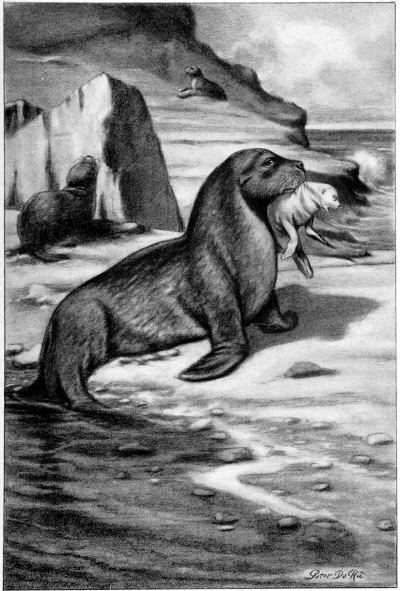
She never stopped till she had him on the sandy beach.
But the killer whales came back next day, and this time took them so nearly by surprise that there was not time to swim to shore, and those who could not scramble to the highest point of the highest rock were swallowed whole. How they huddled together upon that high rock, while the killers swam around and around them watching to see if one of them would not fall off into the water where they could reach them! Finny-Foot’s mother tucked him into a crevice and stood over him. No use for his father, and the other fathers, even to put up a fight against the killers. They wouldn’t have had a chance in the world. But once more the whales swam back to sea, and this time they did not return; for they, too, were on their way to Alaska, where they hoped to catch the fur seals as they migrated Southward.
One day that summer, when Finny-Foot’s mother and her neighbors felt quite sure there were no killers about, (Grandfather[Pg 94] had been watching the sea all day with his big, round eyes), they decided to have a picnic, and explore some rocks further out in Monterey Harbor, where the painted boats of the fishermen pass.
It proved to be a wonderful fishing-ground. Finny-Foot, forgetting his mother’s command to stay close by her side, swam out to the dories, his round eyes bulging with wonder at the way they pulled up their netfuls of fish. Then he saw a big salmon that he wanted to catch.
The fish made a sudden dive, and Finny-Foot, taking a deep breath, dove after him. The next thing he knew, he was all tangled up in something. Then he was lifted straight into the air, in the midst of a netful of wriggling, flapping fish.
“Father!” cried a black-eyed little boy. “See what I’ve caught! Oo!—May I have it?”
[Pg 95]
WHEN Finny-Foot, the seal baby, found himself in the fisherman’s net, he never once thought how easy it would be to catch one of the fish wriggling all about him.
[2] Note—Pronounce Pya tro.
His first thought was surprise that he should be rising out of the water against his will. Then he was afraid. He had never seen a human being so close before. Sometimes he had barked, with the family group on seal rocks, as people came to watch them from the beach. Then he would swim to the other side of the rocks to wait till all was safe once more.
It was a boy of nine whose black eyes first spied Finny-Foot as the net was emptied. “Pietro” his father called him. His cheeks were flushed with the kiss of the[Pg 96] California sun, and his black curls blew in the breeze, as he stood bare-footed in the fishing-boat. This boy spoke words that Finny-Foot, of course, could not understand. But he read the kindness in his tones, and he felt the gentleness with which the boy stroked his furry head, and he was no longer quite so frightened.
The boy must have asked his father if he might have the seal for a pet, because in another moment he was hugging him joyously, both arms tight around him, while the fish squirmed at their feet, and the man and his partner set sail for home.
But though Finny-Foot was no longer so afraid of being killed and eaten, as the killer whales would have eaten him, swallowing the little fellow whole, he suddenly realized that he was a long way from home and mother. Putting his fore flippers on Pietro’s shoulder, he began to cry, and you would never believe how much it sounded like a human baby crying for its mother.
Pietro stroked his wet, oily, fishy-smelling fur, which was as soft as a kitten’s, and[Pg 97] tried to comfort him, but still the seal baby wailed his loneliness.
His mother heard him, too, and came swimming after the boat, her great eyes questioning his round, frightened eyes, as he peered over Pietro’s shoulder. But when he struggled to get free, the boy only held him the tighter, and Pietro and the men had their eyes on the course ahead, for the stiffening wind was carrying them along at a great rate. But she followed as far as she could, then sadly gave it up and went back to tell the colony what had happened.
By and by it occurred to Pietro that his pet might be hungry, and he offered him a little fish. Finny-Foot ate it eagerly, and the boy laughed at his round, puppy-like head, and kitten-like whiskers, and the clever fore fins that he had instead of arms. He looked like a fish, in one way, too, with his hind flippers held back close together like a tail.
When they had landed at Fisherman’s Wharf and Pietro had carried the pale, spotty-coated little fellow to the shack[Pg 98] where the nets hung drying, young Finny-Foot surprised the boy by walking across the porch. It was a funny walk, but we will have to call it that, because it certainly was not swimming. First the seal would raise himself on his fore nippers, then draw himself forward, with a hump of his back. Sometimes he used his hind flippers, and sometimes he kicked them together straight up in the air. The other fishermen’s children greeted this performance with shrieks of laughter; and they offered him fish till Pietro had to put a stop to it, for fear Finny-Foot would over-eat.
He got his mother’s wash-tub and filled it with sea water for his strange visitor; then, with the help of some of his young neighbors, he rolled a great rock up on the porch beside it, in the sunshine. There, he felt, the little seal might feel at home. Then he hooked the screen door on the inside, so that no one could get in to tease him.
Finny-Foot was a tiny fellow. His mother had been only five feet long, for she was a harbor or leopard seal, not a fur seal. Her[Pg 99] tribe, an old sailorman told Pietro, are found everywhere, from the Arctic Ocean to South Carolina on the Atlantic side and Southern California on the Pacific. All up and down the coast, this old sailor had seen harbor seals, barking on the rocks and fishing on the sandy bars. He had heard they even swam away up some of the big rivers and into the Great Lakes. They have been seen off the coast of the British Isles, and as far away as Japan.
Finny-Foot soon learned to know the boy as his friend, and inside of a week was genuinely fond of him. He loved to have Pietro stroke his silky fur. He would come humping himself along to where the boy sat in the sunshine, mending his father’s nets, and lay his round, white head against his arm, and make a funny puppy-like sound that the boy came to understand meant: “Please come and play with me!”
Then Pietro would teach him to fetch and carry a stick, or some other simple trick. He longed to try throwing the stick in the water for Finny-Foot to retrieve, but he[Pg 100] never felt quite sure that his odd pet would swim back to him.
An old seaman used to watch the seal at his antics. One day he offered the boy a dollar for his pet. He said he wanted to take Finny-Foot on board the whaling vessel for a mascot, to bring them luck. But the boy would not part with him.
The next day the old sailor offered him five dollars, but still Pietro would not listen. His ship was to sail the next day at dawn, and the boy heaved a sigh of relief when, with a final offer of seven dollars, the old man said goodbye. The money would have meant needed clothes to the fisherman’s boy, but he would not part with his pet.
Then as Pietro was looking at a newspaper that someone had left on the wharf, his eyes caught the picture of a troupe of trained seals rolling barrels. They were to be in next week’s vaudeville show, and Pietro resolved to find a way to see it.
[Pg 101]
I’VE got a trained seal,” Pietro told the man at the ticket window, as he stood on tip-toe to buy his seat. He had earned the quarter mending a net for a neighbor on Fisherman’s Wharf.
“What’s that?” demanded a sharp-eyed man behind him, who happened to be the owner of the show.
Pietro told him about Finny-Foot.
“Where do you live?” the man asked, with a peculiar gleam in his eye. But the boy was too over-awed by the mirrored magnificence of the theatre to wonder at the question.
The whole program, the usual vaudeville, entranced him. But when the trained seals appeared, his heart thrilled with delight. The curtain rose on a row of the clumsy fellows seated in a circle on up-turned barrels, barking in chorus.
[Pg 102]
First came a barrel-rolling contest, at which the audience applauded mightily, as it is rare to see trained seals. Pietro assured himself Finny-Foot did as well as the best of them. There was a trick seal who was always hiding from the showman. There was a mother seal in trailing skirts and plumed hat, holding her baby in her flappers. (The little seal looked too cunning in his white bonnet and long dress). There were other tricks, and every move the animals made, with their awkward flappers, sent the audience into gales of laughter. There was even a seal orchestra, which set Pietro wondering how they could hold their violins. He could not see that both instrument and bow were tied in place. The showman rewarded each performer with a fish, just as Pietro did Finny-Foot. The big bull seal at the kettle drums would hammer away with all his might till he saw the man approach, then he would open his jaws for his fish and eat it, before again taking part in the symphony.
But the thing everyone enjoyed the most[Pg 103] was when a large glass tank was drawn on the stage. On an up-standing rock in the middle lay three seals, barking just as they might have off the shore of Monterey. The showman threw in a fish, and all three dove for it. He threw them another, and another, then a whole handful of small, silver-shining fingerlings, and the seals dove again and again for them, bringing them up in their jaws and holding them down with one flapper while they ate, if they were too large to swallow whole.
Pietro went home as proud as a peacock to think that his seal could do tricks as good as those people paid to see.
That evening, just as he had seated himself on the porch in the sunset glow, with Finny-Foot scrambling awkwardly for his supper, the showman appeared.
“Now where is that seal?” he asked briskly.
Finny-Foot was put through his paces, the boy proud and flattered by the showman’s interest.
“What will you take for him?” the man[Pg 104] asked at last. “I need another seal for my pyramid act.”
“What’s that?” Pietro’s father called through the window.
“I’ll give you five dollars for that seal,” said the showman, holding out a green-back.
“But I don’t want to sell him,” said Pietro promptly.
“Better take it,” advised his father. “It will buy a new coat for school.”
“Do I have to, Father?”
“As you please. It is your seal.”
The showman added a dollar to the five in his hand. Pietro looked at the money, then at his ragged jacket. Six dollars would mean a lot to him. Then he looked down at Finny-Foot, whose round, puppy-like eyes were fastened on his trustingly. He wondered if the showman was kind to his seals. Then he remembered the whip he had snapped at them when they were slow to obey a command. Besides, how could a seal be happy so far from the ocean he loved? He remembered the old seal who[Pg 105] lay all day on the side-walk of the Cliff House beach.
“No!” decided the fisherman’s boy. Nor did the offer of more money change his mind. He only hugged his pet to his ragged coat and shook his curly head. Nor could the showman persuade Pietro’s father to interfere.
After that the boy fell to thinking. Soon school would begin, and he must have shoes. One bright morning he took Finny-Foot in his arms, and made his way to the Ferry Building, where he sometimes earned a dime carrying someone’s suitcase. He was followed by a troupe of small boys and a dozen older people, who closed in about him in a circle when he set the seal on the ground. Borrowing an empty barrel from a man he knew at a fruit-stand, he began putting the seal through his barrel-rolling trick. Then he passed his hat. Nickels, dimes and pennies came pouring in,—mostly from the grown-up portion of his audience. When the next ferry-boat landed, pouring a new audience into the facade, he repeated[Pg 106] his show. A third time he put Finny-Foot through his paces, and then passed the hat.
A policeman stopped him. It seemed that there were several reasons why he could not give another show. But he had already earned enough money to buy the new shoes.
After that Pietro had to leave Finny-Foot shut up all day while he went to school, and the young seal did not thrive. No longer would he caper joyously after the fish that were thrown him. No longer did his fur gleam velvety and his brown eyes shine. Pietro realized that a seal does not belong on dry land. He needs to live on the rocks off-shore, where he can dive for his dinner. Finny-Foot might even be homesick for the other seals. The boy’s heart ached with pity.
Then he had an idea! When Saturday came, he went with his father in the fishing dory, and with them went Finny-Foot.
They were not heading toward where Pietro had found his pet, but he waited till he had scanned the water in every direction to make sure there were no sharks, then he[Pg 107] gave Finny-Foot one last pat on his puppy-like head, and hugged him, and let him slip into the water.
The young seal, joyous with the feel of the salt tide, and never once thinking that he was leaving his friend, struck out for a point of rock he could just see above the wave tops. His muscles were soft from disuse,—but just let him reach those rocks, and rest awhile, and he would see if he could not find his way home!
[Pg 108]
IT was “sink or swim” for Finny-Foot,—and it was a long swim to the point of rock he had seen.
He had almost given up, when the tide turned and carried him right toward it. But where was his mother, and the others he had left? Here was no sound of barking seals, though over on the yellow ribbon of beach sand the wee sandpipers ran up and down with the waves, just as they had at Monterey, and the gulls creaked and curveted overhead.
“I want to go home!” wept Finny-Foot, in his voice like a human baby’s wail. But the only answer he received was the slap of the waves against his rock and the creak of gulls overhead.
He caught a fish and ate it before he hid himself in a cranny of the rocks to take a nap. He awoke to an ocean deep blue[Pg 109] under the California sun, and a cloudless sky that seemed to bend down to meet it everywhere except where the beach met the never-ending waves with its yellow sand dunes. He caught another fish, and took another nap, and when he awoke this time he felt much better.
He was just wondering if he could find Seal Rocks if he were to swim along close to shore, when he spied the up-standing fins of a band of killer whales. They were far out at sea, but he remembered what had happened to the seal colony when the killers had pursued them, and for days afterward he dared not make the venture.
Then one morning, when the sea was calm, he sighted a big rock shining black and wet, further down the coast, and swam for it. This rock was even better for basking in the sunshine and diving for passing fish. But it was not home, and Finny-Foot was even lonelier now than he had been with Pietro. Again and again he started swimming further South, where he seemed to feel that home ought to be. But always[Pg 110] he saw sharks, and had to hide himself behind the nearest rock. Sometimes, too, after a long, tiring swim, he failed to find a good fishing ground and had to go hungry to sleep. Then he came to another town, where he was afraid to go too close to shore, and waited long days on a point of rock that looked far out to sea. There were always plenty of fish, but would he have to live all his life alone?
One day he saw a sleek dark form swimming just off shore. Now Finny-Foot’s own family, like all harbor seals the world over, were gray spotted when full grown. But the newcomer was a rich dark brown and ever so much larger. Still, Finny knew he was a seal by the way he swam, and himself swam out to greet him.
The visitor proved to be an Alaska fur seal, a young fellow who had migrated South with the other fur seals, but who had been wounded by a shark and had to go ashore till his wound was healed. He told Finny-Foot of that land of ice and snow where his own colony made its home. Finny-Foot[Pg 111] decided that it must be the need of keeping warm so near the North Pole that gave him such wonderful fur, for he would need it there to keep him from freezing.
There were millions of them where Flapper the Fur Seal came from. Every spring, he said, they started North, after a winter along the coast of Canada and as far South as Northern California. Often for days and weeks at a time they had to swim through a sea that was beaten into giant waves by the storm winds. Often rain and snow and sleet pommeled the sea all about them, and the sky hung low and gray with clouds, and they could hardly see for the gray fog that hung over everything. Sometimes they had to dodge between drifting ice-bergs that roared and cracked in the most terrific manner. Sometimes a storm would raise the waves so high that they were nearly drowned.
But at last, just in time for the short Alaskan summer, they would reach the small, fog-hidden Pribilof Islands, where the mother seals, hundreds of them together,[Pg 112] would raise their babies. The fish are so plentiful that the season is one long feast.
The fur seal babies are a woolly black. And here the seal youngsters would play like puppies, racing and tumbling about together with their funny, awkward flappers, diving and swimming and leaping from the water, all in the merriest way imaginable.
But even there the killer whales pursued them. Then, too, there were men who killed them for their fur, (Flapper said). There were great white polar bears who tried to catch them, and Eskimos and Indians, who kill them both for food and fur, so that a fur seal has to be continually on the alert.
But all this danger and hardship had made Flapper unusually well able to take care of himself, and he thought that if Finny-Foot wanted to come along, they ought to be able to keep out of harm’s way until they found the little colony off Monterey. He himself, thought Flapper, ought now to wait until he saw some band of migrants[Pg 113] returning to Alaska, and join them for the two thousand mile journey home.
Finny-Foot invited him to join the colony at Monterey, but Flapper said the warm climate was beginning to make him feel itchy in his heavy furs, and if he did not find his people within a few days more, he was going to swim back North by himself, at least as far as Canada.
One curious thing he told Finny-Foot. Instead of each family having just one mother, as harbor seals did, there in Alaska a family might have a hundred mothers all bringing up their children on the same rocky islet. But that was because of several reasons. First, so many things happened to the more adventurous father seals, who had to fight off intruders, that often there weren’t enough to go around. Then the bull seal is so large, (four or five times as large as his mates), that he can easily protect a whole colony of mothers and babies.
Finny-Foot thought he would much prefer to have the kind of families his own colony believed in. But then, of course,[Pg 114] everything is so different in Alaska, where it means a struggle just to keep alive, that he supposed it must be necessary.
One day he and Flapper had been playing together, Flapper leaping high above the water in great, glistening curves that Finny-Foot could not begin to imitate, when Flapper gave a bark of amazement. There, on a cluster of rocks in a curving harbor, above which the gulls creaked and curveted as they watched for fish, he could see a number of gray objects moving awkwardly about or diving into the tide.
“Look!” he urged Finny-Foot. “I’ll bet that’s your colony!” But the little seal could not see. “Come on, let’s find out!” Flapper urged, almost as glad as if it had been his own people that he had found. And sure enough, there on the very rock on which Finny-Foot had spent his babyhood, a snow white pup, he saw his gray spotted mother, all alone.
Just at first she did not recognize him, for he had grown so large and had turned gray spotted like herself. When she did[Pg 115] realize that it was her son, whom she had given up for gone, she barked so joyously that every member of the colony came crowding around them, barking their welcome to him.
(THE END.)
[Pg 116]
Aurora Borealis—Northern Lights.
Bidarka—Eskimo canoe.
Cache—A hiding-place for food supplies.
Fiord—A narrow inlet of the sea between steep cliffs.
Glacier—A river of slow-flowing ice.
“Husky”—Alaskan wolf-dog.
Ice Berg—A huge chunk of ice that has broken off a glacier and floats in the sea.
Ice Floe—A smaller chunk of ice.
Ice Pan—The ice where the sea has frozen over.
Igloo—Eskimo house.
Lava—Molten rock from a volcano.
Samlet—A young salmon.
Tundra—Alaskan bog.
Volcano—A mountain that spouts fire and lava.
Zenith—The region of the North pole.
Transcriber’s Notes:
Variations in spelling and hyphenation are retained.
Perceived typographical errors have been changed.