Title: Essay on comets
Author: David Milne-Home
Release date: April 5, 2026 [eBook #78362]
Language: English
Original publication: Edinburgh: Adam Black, 1828
Other information and formats: www.gutenberg.org/ebooks/78362
Credits: Thiers Halliwell, Marilynda Fraser-Cunliffe, David Garcia and the Online Distributed Proofreading Team at https://www.pgdp.net (This file was produced from images generously made available by The Internet Archive/Canadian Libraries)
This book comprises a prize-winning essay concerning the understanding of comets in the early 19th century: their nature, their orbits, and their possible significance (good or evil? were they inhabited?). It contains many pages of complex mathematics and is not an easy read. It is best viewed on a wide screen, to avoid undesirable text wrapping in the many tables.
More detailed comments can be found at the end of this e-transcription
Comètes que l’on craint à l’egal de tonnèrre,
Cessez d’epouvanter les peuples de la terre.
Voltaire.
EDINBURGH:
PRINTED BY P. NEILL.
ADVERTISEMENT.
This Essay stands in no need of a formal introduction. The following documents will sufficiently explain its origin, and the circumstances which have brought it forth to the world. On this account, the Author has little to address to the reader; but he may be permitted to remark, that the subject is one which does not demand so much a studied elegance of composition, as accuracy of related facts, and perspicuity of mathematical reasoning. This Essay, therefore, is not glossed over with the gay colouring of fancy, or enriched with the stores of classic association; nor does it require for its perusal any very profound knowledge of Astronomy. Originally never designed for publication, it ought not to be judged of by its own merits, but rather in relation to that academical object for which alone it was composed.
viii
UNIVERSITY OF EDINBURGH.
DR FELLOWES’ PRIZES.
“Robert Fellowes, Esq. LL.D., of Reigate in Surrey, proposes, for the encouragement of Science, to give the following Prizes:
“The sum of Fifty Pounds with a Gold Medal, for the best Essay on Comets, and Twenty-five Pounds for the next in merit, to be composed by those Candidates who, within the last twelve years, have finished their Philosophical Studies at the University of Edinburgh.
“The writer of the Essay on Comets will begin with the earlier notions entertained on that subject, and trace their influence on the conduct and opinions of mankind; he will then review the hypotheses which have been successively advanced; and having produced his own speculations, he will conclude with a clear Exposition of the most improved Mathematical Theory of the Cometary Motions. This Discourse should be of moderate length, perhaps not exceeding 100 quarto pages: it must have a motto annexed, which is also, with the name of the Author, to be put under a separate cover, and the whole sealed up and transmitted to Professor Leslie before the 1st of March 1827. The decision will be announced in the following month.”
“18th October 1826.”
ix
The following notice appeared in the Scotsman Newspaper 23d May 1827:
“The Essays on Comets written for Dr Fellowes’s Prizes being extended to a great length, and crowded with intricate formulæ, have required longer time for examination than was anticipated. Though deserving generally high commendation, they are not considered as possessing that degree of originality, or the clearness and fulness of exposition, which should entitle them in their present form to obtain the award. The programme is therefore renewed, and those competitors, with such others as may be inclined to join them, are invited to send their Essays to Professor Leslie, on the first week of November next; and they are recommended to exemplify the precepts by the calculation of the elements of the comet observed by Mr Rumker at Paramatta, as stated at p. 315, in the Philosophical Magazine for April. The final decision, it is expected, will be announced about Christmas.”
“Sir,
Edinburgh College,
20th March 1828.
“I have much pleasure in transmitting to you the inclosed copy of a Minute of the Senatus Academicus, which was unanimously approved of at a meeting held on the 4th instant; and
“I have the honour to be,
“Sir,
“Your most obedient servant,
“ANDREW DUNCAN jun.”
“To David Milne, Esq.”
x
Copy of a Minute of the Senatus Academicus of the University of Edinburgh, of date 4th March 1828.
Professor Leslie laid before the Senatus Academicus a Report as to the Fellowes’ Prize; of which the Senatus unanimously approved.
The Report was as follows:
“With the assistance of my learned colleague Professor Wallace, I have carefully examined the Essays on Comets received by me since the enlarged programme was issued, and find that the Discourse written by Mr David Milne is very far superior to the rest, and fully entitled to the First of Dr Fellowes’ Prizes. We also find, that, though the other Essays evince ingenuity, and considerable extent of reading, yet we do not think ourselves warranted to bestow the Second Prize on any of them.
“We hope, therefore, that the Senatus Academicus will sanction this decision; and we farther propose that our body should testify their regard for so estimable an alumnus as Mr David Milne, by desiring him to print the Essay. Mr Milne has already obtained the honour of A. M.
(Signed) “JOHN LESLIE.
“WILLIAM WALLACE.”
Extracted from the Minutes of the Senatus Academicus by
ANDREW DUNCAN jun.
xi
| PART I. | ||
| PHYSICAL CONSTITUTION OF COMETS. | ||
| Page | ||
| 1. | Nucleus of Comets, | |
| 2. | Envelope of Comets, | |
| 3. | Tails of Comets, | |
| 4. | Light of Comets, | |
| 5. | Examples of these Phenomena, | |
| 6. | Opinions respecting their Nature, | |
| PART II. | ||
| MOVEMENTS OF COMETS. | ||
| 1. | Opinions relative thereto, | |
| 2. | Orbits of Comets, Conic Sections, | |
| 3. | Orbits most probably Elliptic, | |
| 4. | Difficulty of finding the Elliptic Orbit, | |
| 5. | Parabolic Method of Investigation, | |
| 6. | Elliptic Method of Investigation, | |
| xii | ||
| PART III. | ||
| INFLUENCE OF COMETS AND PLANETS ON EACH OTHER. | ||
| 1. | Perturbations in their Motions, occasioned by proximity, | |
| 2. | Physical changes caused by proximity, | |
| 3. | Perturbations in their Motions, occasioned by a collision, | |
| 4. | Physical changes, caused by a collision, | |
| 5. | Has such a collision ever happened to the Earth? | |
| 6. | Will it ever happen to the Earth? | |
| PART IV. | ||
| COMETS IN VARIOUS STAGES OF MATURITY. | ||
| 1. | Diminution of the substance of Comets, | |
| 2. | Herschell’s theory of Consolidation, | |
| 3. | Are Comets habitable bodies? | |
| PART V. | ||
| VIEWS RESPECTING THE SYSTEM IN GENERAL. | ||
| 1. | Theories respecting the origin of Planets and Comets, | |
| 2. | An objection to La Place’s theory removed, | |
| 3. | Olbers’ theory as to the extent of the Planetary System, erroneous, | |
| 4. | The existence of an Ethereal Medium, proved by Comets, | |
| 5. | Comets indicate the universality of Gravitation, | |
| 6. | Conclusion, | |
| NOTES, | ||
In the whole range of Astronomy, there is no subject so productive of curious speculation, or presenting so wide a field for discovery, as that department of the science which relates to Comets. These bodies, from the striking peculiarities of their movements, no less than the anomalous nature of their physical constitution, of late years have engaged the especial attention of philosophers; and the interest thus excited on their own account, is yet farther increased, by the important information which they communicate concerning the extent and constitution of the System. But though it is only recently that Comets have begun to direct the labours of the astronomer, they have for a long period attracted the general observation of mankind—not so much, however, as the objects of science, as objects of superstitious terror. Suddenly presenting themselves in the firmament, and dragging after them a luminous train which often stretches to a prodigious distance, but continuing visible only for a short time and then vanishing from mortal sight, Comets, in earlier ages of the world, were conceived to possess a malignant influence over human affairs—portending the occurrence of wars and of famines—foreboding the dethronement of monarchs, and the dissolution of empires—causing, in short, every calamity and disaster “which flesh is heir to.” But, like most other prejudices, which gradually disappear 2on the advancement of knowledge, the absurdity and extravagance of these opinions have at length been fully exposed. The discoveries of Astronomy have shown, that Comets form only component parts of the solar system, being constituted of like materials, and guided in their course by the same laws of attraction, as the Planets themselves; so that unless this moral influence belongs likewise to the Planets, it cannot justly be ascribed to Comets, which hold so many essential characters in common with the former.
But notwithstanding the general identity of character which exists between the Planets and Comets, as members of the same system, it will be found that in other respects they form distinct classes of bodies, and that the Comets are not only vastly more numerous, but occupy a far more important place in the economy of the system. The planets in their revolutions are confined to a narrow zone in the heavens, but comets range freely through every part:—the planets as well as their satellites, move only in one particular direction; but comets are not limited to one direction more than to another:—the planets are constrained to revolve in orbits which allow them to vary little in their distance from the sun; but comets follow paths extremely eccentric, traversing the planetary orbits, and even wandering beyond the known limits of the system. The number of planetary bodies, including the satellites, is no more than twenty-nine; whilst the number of comets actually observed exceeds four hundred, and the whole number which permeate the system must amount to many thousands. If, then, in addition to those circumstances, we consider their singular appearance, differing so widely from that of all the other heavenly bodies, it must be admitted that Comets form a subject of philosophical investigation, highly interesting, as much on account of their own striking peculiarities, as of the general views respecting the planetary system which they will be found to suggest.
Yet curious and important as it is, there is no branch of Astronomy in which slower progress has been made, or in which less of certainty prevails. The subject, indeed, is one in itself of so much real difficulty, and the prejudices which stood in the way of discovery have been but so recently 3removed, that this circumstance need not perhaps excite our surprise. Much time and observation are required before a sufficient number of data can be obtained; and without those data as a groundwork, any theories which we attempt to form respecting Comets, can be only empirical. Within these few years, however, the assiduity of astronomers in almost every quarter of the globe, has added a multitude of facts to the store formerly obtained;—facts which, while they demonstrate the fallacy of many of the opinions generally held respecting comets, now enable us to make very considerable approaches towards a knowledge of the true nature of these singular bodies.
In a science like that of astronomy, whose advancement depends so much on the result of experience, it is necessary that we should frequently review the progress already effected, class according to certain principles the new facts which may have been acquired, and observe the general inferences to which their discovery leads. If this remark be true as to Astronomy in general, it applies with peculiar force to that department of the science upon which we are now entered; and this is the object which in the following Essay I shall endeavour to keep mainly in view.
It may be proper here to premise very shortly the arrangement which has been adopted. The extraordinary appearance of Comets being what first and most forcibly excites our attention, I shall begin with describing the physical constitution of Comets, as far as the latest discoveries have ascertained. The next consideration naturally is the course which these bodies follow in moving through the heavens; and in this part of the subject, the nature of their orbits, together with the methods of determining the elements of the orbits, will be explained. The perturbations to which all the bodies in the system are more or less exposed by foreign attraction, apply in an especial manner to comets; and therefore, the consideration of the mutual influences of the Comets and Planets on one another, will constitute the third division of the Essay. A fourth part will be devoted to 4several speculative inquiries relative to the different stages of maturity which Comets may be supposed to have attained. It has been already remarked, that Comets, both from their prodigious number, and their extensive movements through the system, are calculated to suggest many important views with respect to the planetary system in general. The consideration of these views will form the fifth and concluding part of the Essay.
5
Comets differ so widely in their external aspect from all the other heavenly bodies, that this circumstance alone might be sufficient to distinguish them. They do not generally present a disc like the planets, shining with a brilliant light, and at the same time well defined in form. Their light is faint and scattered, whilst they have the appearance of a mass of vapours gathered about a nucleus, which is itself not always visible. But the phenomenon most strikingly characterising comets, is a long train of light called a Tail, stretching out on one side of them. These several peculiarities in the physical constitution of Comets will, however, be better understood by a distinct and separate description of the several parts. We shall describe them in the following order: 1. The Nucleus or solid body of the comet: 2. The Envelope, which surrounds the nucleus; and, 3. The Tail of the comet.
I. The Nucleus of the Comet, is generally to be distinguished by its forming a comparatively bright point in the centre of the head. In most instances it has the appearance of a solid body, and frequently subtends an angle capable of telescopic measurement. It is usually enveloped in a dense nebulous stratum, which is supposed to consist of matter raised from the surface of the comet by the action of the sun’s heat. This stratum so frequently renders the edge of the nucleus indistinct, that it is extremely difficult to ascertain its diameter with any precision.
But though in general Comets possess this nucleus or solid body, there 6are many of them in which it seems to be entirely wanting, and which present only a nebulous mass having a gradual condensation towards the centre. And accordingly, the result of modern discoveries has shown that there is a regular gradation of Comets, from such as are composed merely of a gaseous or vapoury medium, to those which, by the mutual attraction and consolidation of their nebulous particles, have at length acquired a consistent nucleus. In the small comet of 1804, for example, no solid body could be discovered: it seemed to consist entirely of vapours. Olbers mentions that he was able to distinguish a star of the sixth magnitude through the very centre of the comet of 17961; and Herschel asserts a similar fact with respect to the comet of 1795. Olbers says, that he observed through the comet of 1802 a star of the tenth magnitude, with hardly any diminution of its light2. The second Comet which appeared in 1798 was estimated by Schröter to have a nucleus or solid part 27 miles in diameter. The nucleus of the comet seen in December 1805 was computed to be 30 miles in diameter3. The one which appeared in 1799 had a nucleus 373 miles in diameter; that of the first which appeared in 1811 was computed to be 428 miles in diameter. The comet of 1807 had a nucleus the diameter of which, according to the last-mentioned observer, amounted to 538 miles. The second comet of 1811 was observed to possess a nucleus of prodigious size: from Herschel’s calculations, it was no less than 2637 miles in diameter, or one-third of the earth’s.
It has been already mentioned, that there is always much difficulty in making correct observations of this nature; and accordingly, astronomers differ widely in their estimations of the magnitudes of some comets. The two last which have just been noticed are remarkable instances of this fact. Herschel deduced from his observations of the Comet of 1807, and in which he resorted to various methods of measurement for the sake of greater accuracy, that the nucleus was 538 miles in diameter4; but 7Schröter computed it at 997 miles. With respect to the second Comet of 1811, the magnitude of whose nucleus Herschel computed to be no less than 2,637 miles in diameter5, Schröter differs still more widely; he reckoned it only 570 miles. Which of these two observers is the most correct, belongs not to our determination; but judging from the well known excellence of Herschel’s instruments, and his great attention to the subject, astronomers seem disposed to give the preference to the measurements which he deduced. From what has been remarked, it is evident that little faith can be reposed in those ancient accounts which are handed down to us by historians concerning the size of several comets. For instance, we are told of some of these bodies having been seen whose magnitude approached that of the moon6; and hence some have attempted to attribute the occurrence of eclipses recorded in history, and inexplicable from the known positions of the sun and moon, to the interposition of large comets. Such are those mentioned by Herodotus7, as well as the eclipse said to have happened shortly before the death of Augustus; and to this cause has also been referred the darkness which took place at the crucifixion of our Saviour. But the relations which are given of comets possessing so extraordinary a size are not considered sufficiently authentic, as to form a proper groundwork for any such speculations.
II. In all Comets there is an envelope of light, which in some cases seems to be united with the nucleus, but which, in general, is situated from it at a greater or less distance. This envelope almost never surrounds the nucleus, but forms a sort of hemispherical cap on the side next the sun, and then diverges into two brilliant streams on the opposite side, giving rise to the singular and well known phenomenon of the comet’s tail. Some Comets, however, have been observed, as the second of 1811, with hardly any tail at all; and in these cases the whole nucleus 8presents only a globular mass of nebulosity. This shining envelope is supposed to be of the same nature as the stratum immediately contiguous to the nucleus, viz. matter raised from the surface by the action of the sun’s heat, and converted into a state of high attenuation. It is found to vary considerably, as well in its own thickness as in its distance from the nucleus. In the Comet of 1811, for example, the depth of the envelope at one time amounted to no less than 25,000 miles, and its distance from the centre of the nucleus to about 30,000 miles. In the Comet of 1807, the depth was found to be 30,000 miles. The depth of this envelope in the comet of 1799 was estimated to be 20,000 miles: the small comet of 1804, and which, as already mentioned, seemed to have no solid part at all, presented a mass of nebulosity about 5,000 miles in diameter.
It is natural to inquire how this envelope is constituted, and in what way its distance from the nucleus is determined. All astronomers seem to agree in the opinion, that this globular medium consists of the matter of the nucleus itself, partly volatilized by the violent action of the solar heat. But as to the manner in which it rises from the surface of the Comet, and preserves its spherical shape round the side of the head next the sun, philosophers are not agreed. Olbers, with several other astronomers on the continent, conceives that there exists in the comet’s nucleus a certain power of repulsion sufficient to produce this effect, which is overcome on the side next the sun by a like power emanating from the sun; while on the opposite side, where the supposed repulsive power of the comet is not counteracted, but rather assisted by the analogous force in the sun, the envelope will there be pushed into the form of the tail. With regard to this theory, I may remark, that, in the first place, two violent assumptions are made, of there being a repulsive power in the Comet, and another repulsive power in the sun, for whose existence not the shadow of a proof is offered, nor of which is there any probability, from all that we know of the planetary system; and that, in the second place, this theory does not accord with observation: for it would follow, that, when the Comet removes *7to a distance from the sun, its own inherent power of repulsion being then less opposed by the sun’s repulsive power, would naturally have the effect of driving the envelope still farther from the nucleus; whereas it is observed, that in this case the envelope uniformly sinks down upon the surface.
A much better explanation has been given by Herschel, and one, moreover, which has the advantage of resting on accurate observations, not upon vague hypotheses. According to Herschel, there is a transparent and very elastic medium surrounding Comets like an atmosphere, in which, when the cometic matter has become sufficiently rarefied by the solar heat, it rises to a certain elevation, and remains there suspended. The reality of this atmospherical medium Herschel seems to have ascertained beyond the possibility of doubt, in the case of the two Comets of 18118. And its existence in many other Comets, which exhibited phenomena exactly similar to those of this year (1811), seems also to be highly probable. That the atmosphere of Comets must be of very considerable extent, is evident, both from the great depth which the envelope possesses, and from the not unfrequent occurrence of several of these nebulous envelopes one above another, all of which must necessarily be suspended in the same buoyant medium. As any matters which are suspended in such a medium must have a density inversely proportional to their height, it would follow that the outermost of these envelopes should not be so bright as those nearer to the nucleus; and this corollary from Herschel’s theory is fully verified by observation.
It may be here proper to explain how these nebulous envelopes are formed. When the Comet is approaching its perihelion, the nebulous matters suspended in its atmosphere will evidently be made to rise higher by the increasing energy of the sun’s heat. For the same reason, after one envelope has risen to a considerable height, so much matter may subsequently be detached from the nucleus as to constitute a second, which, from being more dense than the first, will occupy a lower situation in the atmosphere. *8And in like manner a third or fourth envelope, if this volatilization continue, may be successively formed. Thus, the Comet of 1744, which at its perihelion approached exceedingly near the sun (only within one-fifth of the earth’s distance), was observed about three weeks previous to its perihelion passage to have a double envelope, and on the seventh and eighth day after the passage (when the effect of the sun’s heat upon it was the greatest) to have acquired a third9. So we also find, from Herschel’s observations of the great Comet of 1811, that in receding from the sun, the envelope, losing its high degree of attenuation, from the gradual diminution of the solar heat, at length subsided altogether upon the nucleus, which previously it had surrounded at a considerable distance.
III. We come now to describe the tails of Comets, which form generally the most conspicuous and remarkable part of them; exhibiting phenomena totally different from any appearances presented by the other bodies in the firmament. The tail, as has been noticed, is only a continuation of the nebulous envelope, which after nearly encompassing the hemisphere of the nucleus of the Comet next the sun, diverges to a greater or less extent in the opposite direction. The lengths of the tails of Comets are very various. The small Comet of 1804, which I have mentioned as one possessing no visible nucleus, could not be observed to have any tail at all, but presented only a globular nebulous aggregation. The second Comet of 1811 was accompanied with a very short and faint tail. But the Comet of 1744, which, as we have just stated, approached so near to the sun, had a tail above seven millions of miles in length; the Comet of 1769 which came still nearer the sun, a tail of forty millions; and the tail of the great Comet of 1680, which of all Comets that have been observed, approached the closest to the sun, was computed to be no less than one hundred millions of miles in length10. The tail is always found to have a conical shape, 9the apex being the hemispherical envelope, and the base generally ten or twelve times broader than the diameter of the nucleus. The tail is likewise characterized by the extraordinary circumstance of its being hollow; and for this obvious reason, that, as the whole envelope surrounding the nucleus is equally exposed to the action of the sun (which, as will immediately be seen, produces the tail) all the parts are caused by the force of impulsion to assume the shape of a conoid. It is from this cause, that the sides or edges of the tail have usually the appearance of two brilliant streams, and the space between them of being filled with a much less quantity of nebulous matter: Because, as there is a greater number of luminous particles traversed by the line of vision at the sides (where that line is a tangent to the cone) than towards the middle, (where the line of vision is more perpendicular to the envelope), there is necessarily a much greater quantity of light at the sides, than at any other point11. Another fact proves at once the hollowness as well as conical form of the tail; that, in whatever position Comets are placed, (and they are frequently observed during a course of 180° round the sun), they constantly present the same appearance, both with regard to the shape of the tail, and the superior brilliancy of its lateral edges.
I have said that the direction of the Comet’s tail is opposite to the sun, being, therefore, in a line with the prolongation of the radius vector. It is true that this is the usual direction, both in approaching and receding from the sun. But when the Comet is near its perihelion, there is a considerable variation from this rule. The tail is then somewhat inclined from the line of exact opposition to the sun, being turned towards that part of the heavens just traversed by the Comet; and, at its extremity, a curvature is visible, which, shortly after the perihelion passage, occasionally amounts to even 70° or 80°12. There are, therefore, two important phenomena to be explained, respecting the tails of Comets; first, their ordinary direction of opposition 10to the sun; and, secondly, their bending at the extremity, when near the perihelion.
1. Among all the phenomena exhibited by Comets, there is none so perplexing as that of their tails. The difficulty seems chiefly to arise from the circumstance, that we see nothing analogous to this remarkable appearance, in the case of the planets; nor have we any direct or unequivocal evidence for the existence of a physical power, adequate to produce such an effect. Astronomers accordingly differ widely in their opinions on this subject; there being few who have not advanced some theory of their own, which appears to them more plausible than all the rest. One maintains, that the rays of light streaming from the sun are capable of driving away the nebulous envelope of the Comet, into the shape and direction which the tail generally presents: Another will not allow that the solar light possesses any such power; but argues, nevertheless, for a certain unknown power of repulsion in the sun, which is followed precisely by the same effect: Some again maintain, that the tails of Comets are formed solely by the attraction of the sun, and affirm, that it produces these phenomena in the same manner, as the attraction of the moon creates the tides of the ocean: Others assume the existence of a dense atmosphere about the sun, in which the rarer medium attached to the nucleus of Comets strives to rise up, as smoke does in the atmosphere of the earth. A German astronomer, besides assuming the reality of this solar atmosphere, as well as of a repelling power in the sun itself, maintains that there is something in the Comet’s tail, which he calls a negative gravity (eine negative Schwere), giving it a propensity to remove from the nucleus; without seeming to be aware that, by the united operation of these three forces, a Comet’s tail would infallibly be dispersed altogether: Whilst others, again, displaying a like fondness for conjecture, and no less boldness of conception, try to explain these phenomena upon electrical principles; and hold, that, just as bodies charged with one kind of electricity repel each other, so the tails of Comets have a natural tendency to avoid or fly from the sun.
11
The strange variety of these conflicting opinions, each of which can claim for its support the names of very distinguished astronomers, serves to shew how little is known with certainty on this subject: whilst the extraordinary nature, and equally unphilosophical application of the principles assumed, may at once convince us of the difficulty of the subject we have to consider. The truth is, that, with regard to these phenomena in particular, our data are as yet too scanty, to afford any very satisfactory explanation; and, for this reason, though each of the theories advanced, may perhaps embrace the greater part of the phenomena at present ascertained, every one of them must be empirical, and may be overthrown by future observation. In the mean while, however, it is by no means useless to generalize the data which we possess, by the aid of some theory founded upon the physical laws that are already known. For it is only in this manner that we can hope to arrive at some general principle, by which the observed phenomena are to be linked together and explained; and which may lead us to seek for certain other facts, whose discovery will completely develope the true nature of the tails of Comets.
Many of the opinions on this subject, held even at the present day, are so totally discordant with the most obvious phenomena, that they scarcely merit consideration. But in such an inquiry as this, in which so little of certainty prevails, we are bound to examine any hypothesis advanced, with attention and impartiality. With respect, then, to that theory which would explain the formation of a Comet’s tail, by the gravitation of the nebulous particles towards the sun, in like manner as the moon’s attraction affects the ocean, very few words will be sufficient to point out its absurdity. For, since the effect of this solar attraction would be, to draw out the Comet’s envelope, equally on the side next to the sun, as on the other side, two tails would thus always be formed, diametrically opposite to one another. The only circumstance, which in the smallest degree seems to favour this hypothesis, is the remarkable phenomenon exhibited by a Comet seen in January 1824, which had two tails on opposite sides of the nucleus. The tail 12turned towards the sun was greatly less luminous and less extensive than the ordinary tail turned away from the sun. At first they were diametrically opposite, but soon began to form a visible angle. On the last day that both tails were seen, the angle between them was 130°. The phenomenon remained visible for eight or ten days13. But this single unprecedented fact cannot be adduced to support a hypothesis, which is intended to apply to comets in general: Because, first, this is the only instance in which a comet ever presented this extraordinary appearance; secondly, the two tails of this comet did not remain diametrically opposite to one another; and, in the third place, according to the hypothesis, not only should there be in all comets a tail on opposite sides, but the tail next the sun, ought not certainly to be smaller than the other; whereas in this instance, it was hardly one-third of the size of the ordinary tail. This hypothesis, therefore, with regard to the formation of the Comet’s tail, by means of the sun’s attraction, may on these grounds be set aside. Were it requisite to find more detailed objections, Herschel’s remarks on the several parts of the Comets of 1807 and 1811 would readily suggest them14.
The theory which assumes the existence of an atmosphere round the sun, in whose buoyant medium the tails of Comets rise up like smoke, appears to have had, in addition to other celebrated names, in some measure the countenance of Newton. It is true, that several of the phenomena presented by the tails of Comets, are explained very satisfactorily by this theory; but there are many more, with which it is totally irreconcilable. In the first place, if it be true that the light of the tail is derived from the reflection of the solar rays, why do we not also perceive the atmospherical medium, through which the Comet moves, seeing that its density (according to the theory), is so much greater than that of the tail itself? In 13the second place, if any such solar atmosphere in which the tails of Comets acquire a buoyant force, does exist, its extent must be quite incredible: since the distance of the comet of 1729 from the sun, even at its perihelion, was above four times that of the earth. This medium, then, in which Jupiter himself, and probably the more remote planets likewise, must be supposed to circulate, would certainly have produced some derangement in the planetary movements, which long ere this, had it existed, astronomers would have been able to discover.
The electric theory also claims shortly our attention. It seems to have been framed, chiefly to account for certain appearances in the tails of Comets, compared by Dr Hamilton (who first broached the theory), as well as by Shroeter, to the phenomena of the Aurora Borealis. Frequently, a shooting or streaming of light, is observed through the whole extent of the tail, which moves with a rapidity of many millions of miles in a second. This light, on account of its resemblance to the above phenomena, has been referred to electricity. Now, many circumstances militate strongly against such a supposition. In the first place, it is extremely improbable, from what we already know of electricity, that its velocity, in so attenuated a medium as that of a Comet’s tail, would at all approximate the rate at which this light is observed to move. In the second place, on account of the frequent obliquity of the Comet’s tail to the line of vision from the earth, a much longer interval of time ought to elapse, before these luminous streams can reach the extremity of the tail, than what is found to be the case. If, for instance, the extremity of the tail be no more than one million of miles farther distant from the earth, than the head of the Comet, the rays of light leaving the former point cannot, from the known velocity of light, reach the earth till 25″ after the arrival of the light from the nucleus. But this calculation supposes, that the rays of light set off at the same instant, both from the nucleus, and from the farther extremity of the tail; so that when we take into account, the additional time necessary for the transmission of those rays, from the one point to the other (a distance in some Comets 14amounting to eighty or one hundred millions of miles), we shall, on the whole, obtain an interval of time, for the transmission through the tail, infinitely greater than what observation warrants us to admit. To what causes, then, are these luminous appearances to be referred? It does not seem improbable that they originate in our own atmosphere: light vapours floating in the higher regions, as they pass between the comet and the eye of the observer, deprive successive portions of the tail of some of their light, and thus give rise to the shooting or streaming appearances in question. It is in like manner, owing to the varying state of our atmosphere, that the tails of Comets have been observed to undergo considerable alterations in a short interval of time, and likewise to vary in brilliancy and extent in different quarters of the globe15.
Passing over several other hypotheses, too absurd now to be countenanced, as, for instance, that of Appian and Tycho Brahe, who both imagined the tails to be nothing more, than the sun’s rays transmitted through the Comet, as through a lens of glass,—we proceed to examine a theory, first proposed by Euler, and far more probable than any of these, that the tails of Comets are formed by the impulsion of the sun’s rays. It is quite evident, I think, and it is a fact which all the theories concur in admitting (except the theory already noticed, which supports the principle of smoke), that there must reside in the sun, the body whose regulating and vivifying influence pervades the whole system, some power which occasions the general phenomena of the tail. When a comet approaches the sun, we find that its light receives a gradual augmentation; that nebulous matter rises up in abundance from the nucleus; and, in particular, that the tail rapidly augments both in brilliancy and extent; whilst, as the comet recedes from the sun, a contrary but conformable series of changes takes place. It was extremely natural, therefore, to attribute these corresponding phenomena to the same cause, viz. the illuminating and impelling action of the sun’s rays. Every circumstance with regard both to the form 15and the direction of the tail, leads directly to this principle; and accordingly the most celebrated astronomers of modern times have acknowledged its operation. Herschel, in his valuable remarks on the first Comet of 1811, relates several circumstances, as “proofs of the continued action of the sun, upon the luminous matter already in a high state of rarefaction; and,” he continues, “if we suppose the attenuation and decomposition of this matter to be carried on, till its particles are sufficiently minute, to receive a slow motion from the impulse of the solar beams, then will they gradually recede from the hemisphere opposed to the sun, and ascend in a very moderate diverging direction, towards the regions of the fixed stars.”
But though, in a general view, the impulsion of the sun’s rays may seem adequate to push the nebulous envelope of a Comet into the form of a tail, on a nearer examination of the matter, a difficulty occurs, which it requires some modification of this theory to overcome. The curvature or bending usually observed at the extremity of the tail, and causing it to deviate from the line of exact opposition to the sun, can be referred to no other cause, as we shall immediately see, than the resistance of an ethereal medium diffused through the planetary regions. How, then, it may be asked, if the solar beams are able to push away the nebulous matter suspended in a Comet’s atmosphere, into a prodigious tail behind the nucleus, will they not also disperse this ethereal medium, whose tenuity must be so much greater than that of the tail? This is the chief objection, which may be advanced against Euler’s theory. The force of the objection is undeniable, and, therefore, before this theory can be received, as affording a satisfactory explanation of the phenomena, some modification of it is requisite.
In hazarding the following remarks on this intricate question, on which so many eminent astronomers have vainly endeavoured to throw light, I do not pretend to offer a theory or system, which claims the merit of affording a complete explication of all the phenomena, which have been hitherto ascertained and may yet be observed. What I would at present attempt, and in fact no more can yet be done with any prospect of success, is merely 16to reconcile the known phenomena, with some physical law, whose existence in nature has been already established on independent and undoubted evidence.
There prevail two opinions, it is well known, among philosophers, respecting the propagation of light; the one, that it consists of minute particles, which are projected from all bodies by an inherent repulsive force; the other, that it is produced by the excitement of vibrating or undulatory motions, in an elastic medium, analogous to the motions constituting sound16. The first of these opinions, or the system of emanation, as it is called, is liable to many objections, which its advocates have never yet been able to remove; whilst the latter accounts in the most satisfactory manner, for a variety of phenomena, which it is impossible on any other hypothesis to explain, and is daily receiving confirmation by the advances of science. Other objections, however, may be stated to the former, or Newtonian system, more connected with our present subject. In the first place, if light were a material substance, as that system supposes, ought it not, after a series of some thousands of years or ages, to have gathered round the planets and satellites, so as in some way to become discoverable? Secondly, the objection above mentioned to Euler’s theory, that if the sun’s rays have a sufficient impulsive force to push the nebulous matter of a Comet into the form of a tail, they ought also to disperse the minuter particles of the etherial medium, can apply to that theory, only on the supposition, that the solar rays are material particles, propelled from the body of the sun. But by the Huygenian hypothesis, this ethereal medium is supposed to be the medium itself, through which the vibrations are conveyed; and therefore its existence is absolutely indispensable for the propagation of light. Upon the grounds, however, on which this theory rests, countenanced as it is by the ablest chemists and philosophers of the present day, I am not here to enter 17farther. But it will be admitted, that if, by its means, we can afford an explanation of the formation of a Comet’s tail, more satisfactory than on any other hypothesis, this theory, probable as it is from various considerations, will thus obtain new and powerful support.
Our inquiry, therefore, hinges upon this simple question, Whether or not these vibrations are capable of giving any impulse, to the nebulous matter composing the tails of Comets. Now, when we consider the effect of vibrations excited among the particles of any medium, it is obvious that a series of changes takes place, by which each particle exerts upon the next to it an impulsion, that is conveyed successively through the whole. When, for instance, we place our ear at one end of a log of wood, which is struck by a hammer at the other end, the effect is conveyed by means of vibrations excited among the particles of the wood; these vibrations transmit to the tympanum, the impulsive action of the hammer; and the delicate membrane of the tympanum, being struck upon, acts in its turn upon the nerve in such a manner, as to cause the sensation of hearing. The remarkable influence of pendulums suspended from the same beam, upon one another’s rate of going, however far separate they may be,—together with the various and striking phenomena of sympathetic sounds17, too well known to be here detailed,—serve likewise to illustrate the principle, that vibrations excited among the particles of a body, will be able to act upon any other body in contact with it: and it is by reason of the same law, that the tolling of a bell, according to the experiments of Sir H. Inglefield, is found to produce a sensible effect even upon the barometer18. It is true that these examples of impulsion produced by vibratory motion, are derived from the analogous phenomena of sound; but if it be admitted, on the Huygenian hypothesis, that light is likewise transmitted by vibrations or undulations, and that therefore, in fact, the only essential difference between light and sound consists in the velocity and peculiar nature of their respective vibrations19, the 18same conclusion is fairly applicable to both. It has been asserted by persons who possessed the means of making the experiment, that light substances, when placed in the focus of a large burning glass, are made to acquire a motion, by the concentrated impulsion of the solar rays20. If this be a fact well ascertained, it is unnecessary to resort to arguments drawn from analogy21.
If it appears, then, that, in the ethereal medium, there is a continual excitement of vibratory motions, causing the propagation of light, and capable, like all vibrations, of producing a certain degree of impulsion, there is little difficulty in conceiving, how the attenuated matter appertaining to Comets, may by them be pushed into the form of a tail. But what is the nature of that nebulous matter, which we thus suppose to be so sensibly acted on, by the vibratory motions excited in the ethereal medium? for, in order to render such an effect possible, the tenuity of that nebulous matter must be prodigious. Observation is found completely to accord with this condition. The circumstance before mentioned, that even the twinkling of the smallest stars, can be distinctly seen through the substance of the tail, is a fact sufficient to establish its highly attenuated nature. We are able sometimes to discern the heavenly bodies, through a light cloud floating in the atmosphere; but when this cloud removes to a somewhat greater distance from the observer, we find that we are no longer, or at all events are less able, to distinguish through it; the effect of the removal being the same, as if the vapoury particles had been brought closer together, and thus the cloud rendered less transparent than before. If, then, according to the distance of a medium, its density must proportionally decrease, in order to preserve a uniform transparency, some idea may be formed of the amazing tenuity of a Comet’s tail, which, though at so great a distance from the 19earth, hardly intercepts the twinkling of stars of the smallest magnitude. Newton calculated, that if all the matter constituting the largest tail of a Comet, were to be compressed to the same density with our atmosphere, it would occupy no more than a cubic inch22.
From these considerations we may conclude, that the general direction of the tails of comets, which is opposite to the sun, both in their approach to the perihelion, and in their regress, is caused by the impulsive influence of the solar rays: and, moreover, that this impulsion is produced, by means of those vibratory motions necessary for the propagation of light, which are excited by some quality in the sun, and transmitted through the ethereal medium.
2. But I have likewise mentioned that the tails of Comets, when near the perihelion, suffer a considerable change from the direction which they ought to assume, by the mere impulsion of the solar rays; and, in particular, that they present a curvature at their extremity. The reason of this fact will become apparent, if we attend to the circumstances of a Comet’s motion in this part of its orbit. Hitherto the particles of the tail are at no very great distance from the nucleus, and for this reason, as also from the circumstance of the Comet’s direction, readily conform to its movements. But when, by the closer proximity to the sun, a higher degree of attenuation in the nebulous matter is produced, as well as a greater amount of centrifugal force arising from the increased velocity, the particles of the Comet’s tail become gradually more detached from the head, and move along simultaneously in paths of their own.
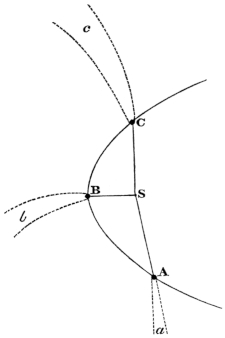
In order to determine the nature of these paths, let us consider the forces which act upon the particles of the tail. One is, the attraction of these particles to the nucleus itself, by which they are made to conform to the motion of the Comet; and another is, the power of repulsion residing in the sun, whatever be the mode of its operation, which causes the tail to 20extend in an opposite direction. Besides these two forces, there may possibly be another, viz. the resistance of the ethereal medium, by which their combined effect must be in some degree modified. But without at present regarding this third force, for whose existence we have not the same a priori evidence, let us now consider the direction which the tail will assume by the influence of the two former forces alone. Let S be the sun, and A B C the part of the comet’s orbit near the perihelion, and let A be the comet in its approach, with its tail A a in opposition to the sun. Were there no other circumstance to interfere, the power of the sun’s impulsion on the nebulous particles, ought still to produce the same direction at B. The gravitation of these particles to the nucleus, which remains constantly the same, will in no case affect the operation of this impulsive power. But it must be recollected, that the motion of the tail is not governed like that of the comet in its orbit, by the sun’s attraction; the nebulous particles are guided only by the attraction of the nucleus; so that when the comet’s velocity at B has become greatly accelerated, the speed of the tail will not instantly be increased in a corresponding ratio. In consequence of this, the tail will be left somewhat behind the line of exact opposition to the sun: and hence, as this variation of the several particles will be in proportion to their distance from the nucleus, a curve will be formed as B b, and C c, to which the radius vector S B and S C will be a tangent.
Such is the shape and direction which the tail ought to assume by the combined influence of the two forces above mentioned. But, in comparing 21these theoretical results with actual observations, we find a considerable discrepancy. So far from the radius vector forming a tangent to the curvilineal tail, or making only a small angle, it is invariably found that the angle is much greater than what the foregoing considerations will allow; and, moreover, that there is no curvature, except near the extremity of the tail, the intermediate parts forming a straight line. In order to account for these phenomena, we are obliged to have recourse to the third force formerly noticed, the resistance of the ethereal medium, which introduces such a modification in the foregoing results, as observation requires.
However great may be the tenuity of the ethereal medium, it is natural to suppose that its resistance must be able to produce some effect, upon the particles which compose the tails of comets. The highly attenuated nature of the nebulous matter, in this part of the orbit, has been already noticed; and when we likewise consider the perpendicular direction in which the resistance is here made to act, its influence upon the form of the tail becomes still more evident. From the powerful action of the sun’s heat upon the nucleus, at this part of the orbit, supplies of nebulous matter are continually detached; and as this effect must continue for a considerable time after the perihelion passage, it is evident that the tail will then be the most extensive. For the same reason it will then also present the greatest deviation, as the resistance of the ethereal medium will be rendered more effective on account of the increased attenuation. Another consequence of this resistance to the tail, will be to flatten its curvilineal shape, in that part of it next to the nucleus, where the resistance acts in a perpendicular direction; whilst the original curvature towards the extremity, not being opposed in the same manner, will remain exempt from any alteration.
IV. Having thus pointed out the most prominent features in a comet’s appearance, and endeavoured, by known established principles, to explain the constitution of its parts, this will perhaps be the most proper place to take notice of another very important subject, viz. the Light of comets. 22Besides the criteria already mentioned, which distinguish these bodies from the planets, it affords another characteristic mark, that the former shine with a much paler and more scattered light. This point was accurately ascertained by Shroeter, with regard to the Comets of 1798, 1799, 1805, and 1811; in most of which, by comparisons with Mars, the light was found to be only one-half or one-third as bright.
To account for this difference, two theories have been proposed: the one that Comets shine by a native light, of a phosphorescent nature; the other, that they shine only by the reflected light of the sun, which is weakened by their highly attenuated constitution. As the Comet approaches the sun, it is conceived by those who advocate the former opinion, that self-luminous matter is detached from the surface, which, rising in the Comet’s atmosphere, and yielding to the influence of the sun’s power, in the manner already described, produces the phenomena of the envelope and tail. In support of this opinion, they seem to insist chiefly upon the circumstance, that when Comets have come into a position between the Earth and the Sun, no phases have ever been observed on their surface; and no partial obscurations of the sun, by the transit of a Comet across his disc. But it is by no means a fact so well established, that such phases or obscurations have never been seen. On the contrary, Cassini, in observing the Comet of 1744, remarked an appearance upon the nucleus, “which,” he says, “would have formed phases, completely resembling those of the Moon, or of Venus, if its disc had been as distinct as that of these two planets23.” The edge and surface of the nucleus were concealed by the nebulous matter raised by the sun’s heat: and let it be remarked, that the position of the Comet at the time, with respect to the sun and earth, seems to have been extremely favourable for such an observation. The Comet was then considerably within the orbit of Mercury; it was also between the earth and the sun, and its elongation or angular distance from the sun, amounted only to a few degrees. 23In the Comet of 1769 likewise, when it was about midway between the earth and the sun, an observer in England mentions that he saw it distinctly exhibit phases, from the crescent to the full, in approaching its perihelion24. As a third instance, I may adduce the comet of 1682, whose phases are taken notice of by De Lambre25, as well as by La Place26. But an instance still more recent and more remarkable than any of these, is the comet of 1819. This comet, according to Olbers’ calculations, made a transit across the sun’s disc, on the 26th June 1819, the commencement of the transit being at 6 o’clock A. M. At 8 o’clock on the same morning, Mr Pastorf, in looking at the sun, happened to discover this comet in its transit, which he describes as then presenting the appearance of a nebulous spot upon the sun’s disc27; and other astronomers agree in the observation28. Now, it seems to be infinitely more probable that such a spot was formed by a body naturally opaque, rather than by one which shone with a light independent of the sun. With respect to the same comet, a fact still more decisive of the point was remarked by Cacciatori, the director of the observatory at Palermo, who says, that he “observed very distinctly phases in the nucleus of the comet of 1819, and hence concludes, that comets are not luminous per se, but that their nucleus, their coma, and their tail, shine only by reflected light29.”
But even though every one of the accounts which are given of comets exhibiting phases, or causing a partial obscuration of the sun, were proved to be totally incorrect and fabulous, still the absence of these facts would not be inconsistent with the theory of a reflected light. For how is it, that the small nucleus of the comet, (the only part which can exhibit phases), is illuminated by the sun’s rays? It is surrounded, as we have seen, by a nebulous envelope of prodigious depth, which, besides rendering the nucleus very indistinct, prevents the sun’s rays from reaching the surface, 24in any other way than by refraction; so that the parts, even behind the nucleus with respect to the sun, must, on account of this refraction, receive a considerable quantity of light. If, however, there be a nucleus on which, by reason of its own magnitude, in comparison with the small depth of the envelope, some spot still remains unenlightened, this spot can only be between the streams of the tail; whose diffused and scattered light, in addition to the luminousness of the envelope, will render it exceedingly difficult to observe the spot. When, besides this, we reflect that it is only in those comets whose perihelia lie nearer to the sun than the earth30, and only in certain positions of these Comets not likely often to occur, that either phases or partial obscurations can possibly be observed, we may easily understand why they have so very seldom occurred, and need not be surprised if they had even never been noticed at all. Nevertheless, the supporters of a native light in Comets, are obliged to allow that at least some Comets are opaque bodies, enlightened by the sun’s rays. Herschel himself, who most ably advocates the theory, distinctly admits that the second Comet of 1811 must have shone by the reflected light of the sun; though he had been induced to form a different opinion, regarding the first Comet of that year.31
On the whole, it seems more philosophical, considering the facts which have been obtained, and the analogy which the light of the other heavenly bodies suggests, to suppose, that Comets shine by the reflected rays of the sun; and to ascribe the faintness of their light, to the attenuated nature of their nebulous medium. At the same time, it must be observed, that the most eminent philosophers are at issue on this subject: and the point can only be decided, by the results of more extended observation.
V. Such being the physical constitution, and such the causes giving 25rise to the phenomena of comets, we shall now be better able to account for the various changes which their several parts are found to undergo, during their progress round the sun. I shall here, therefore, give a succinct account of the most general appearances presented by comets, from the period of their first being seen, till they have removed too far from the sun to be longer visible; explaining, likewise, as they occur, the more remarkable phenomena, which have not already been described.
The following observations of the Comet of 1769, are extracted
from Messier’s account of its motions32.
This comet passed its perihelion on the 7th October. “8th Aug.—I
discerned,” says he, “a little above the horizon, something resembling
a small nebula; it turned out to be a comet. 15th Aug.—I
observed the comet again: It had acquired a tail about 6° in length;
and the brightest part of its nucleus had a diameter of 1′ 26″; but
its edge was indistinct. The diameter of the envelope was about 4′
30″. 27th Aug.—The tail now had a length of 15°. A dark shade
was observable through the middle parts of it, which did not extend
far from the nucleus.33 The nucleus likewise had become brighter,
though its edge was still ill-defined. 30th Aug.—The diameter
of the nucleus seemed34 to be 2′ 9″; but its circumference was
indiscernible, from the abundance of nebulous matter. The tail was
now 24° in length: It still retained the darkish appearance along the
middle. But in addition to the principal tail, there was a smaller
one accompanying it, which showed itself by two short streams of
light, forming angles of a few degrees, with 26the larger streams35. These angles were not
of equal magnitudes; the angle made by the lower stream was about
twice the size of the angle on the uppermost side. 2d Sept.—The
diameter of the nucleus was 2′ 53″. The nebulous matter round it
seemed to have increased in quantity. The length of the tail was 36°.
It had the same appearance as on the 30th August, with respect to the
darkness along its middle parts; and the occurrence of a smaller tail
round it. But the larger of the angles formed by the two small streams
with the principal tail, was now observed to be, not, as before, on
the lower side, but on the uppermost side36. The streams also
had approached closer to the principal tail. 3d Sept.—The
diameter of the nucleus 3′ 15″, but its disc still very indistinct,
on account of the increasing quantity of nebulous matter. The tail
now measured 40° in length. The two streams appertaining to the short
tail had disappeared37. The light of the envelope was more brilliant
than the light of the tail: the latter somewhat resembled smoke.
4th Sept.—The diameter of the nucleus 3′ 40″. The length of the
tail was now 43°. Towards its extremity a bending or curvature was
observable. On each side of the tail there again appeared a stream,
forming in this manner another small tail as before. The sides of both
tails were nearly parallel to one another38; and between them could
be distinguished a darkish space, through which telescopic stars were
discerned, considerably deprived of their light. 27That part of the nebulous envelope which
was next the sun, seemed as if compressed against the nucleus,
its depth there being less than elsewhere. 5th Sept.—The
tail now measured about 49° in length; it showed a deviation from
the direction of exact opposition to the sun. The nucleus, though
much increased in size and brilliancy, was not very distinct; it
subtended an angle of 4′. At this period the diameter of the head was
altogether about a degree; (on the 15th August, as we have seen, its
diameter was only 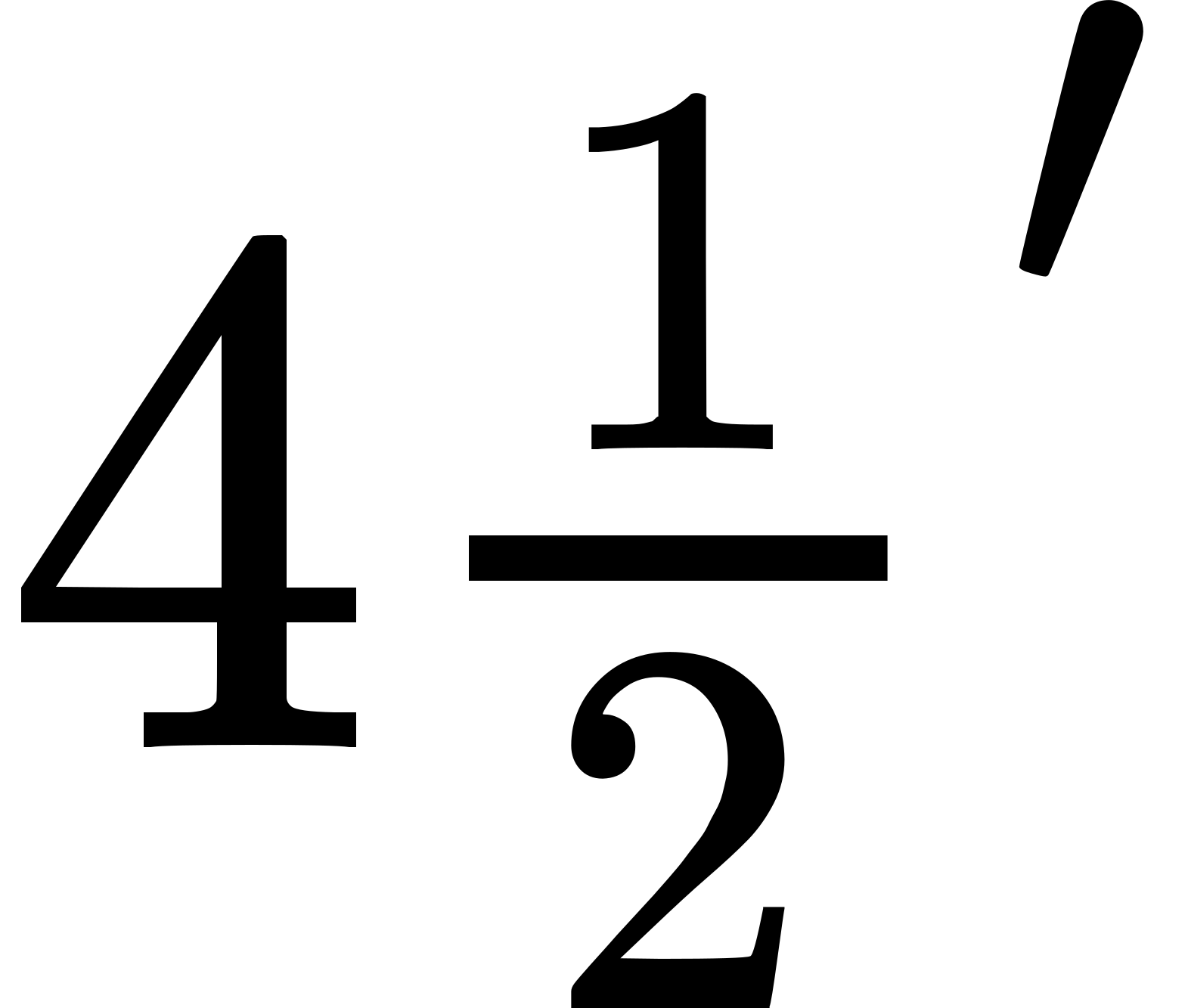 . 8th Sept.—The tail
now amounted to 55°. Every thing else remained the same. 9th
Sept.—The tail was now 60° in length. 13th Sept.—The nucleus
appeared much brighter and larger than before. No farther observations
could be made of this comet before the perihelion passage, owing to its
immersion in the sun’s rays; but those now given are quite sufficient,
I think, to illustrate the formation and developement of the several
parts.”
. 8th Sept.—The tail
now amounted to 55°. Every thing else remained the same. 9th
Sept.—The tail was now 60° in length. 13th Sept.—The nucleus
appeared much brighter and larger than before. No farther observations
could be made of this comet before the perihelion passage, owing to its
immersion in the sun’s rays; but those now given are quite sufficient,
I think, to illustrate the formation and developement of the several
parts.”
It is at the time when the Comet has approached nearest to the sun, that the effect of the solar action upon its physical constitution naturally becomes most conspicuous. Newton remarks with respect to the Comet of 1680, that, in the month of December, (its perihelion passage being on the 18th December), its tail was much more extensive and effulgent than in November previous; and that, during the two days following the perihelion passage, as much matter was detached, as would have formed the whole tail, which the Comet possessed on the 10th December39. “Et universalitur,” he adds, “caudæ omnes maximæ fulgentissimæ cometis oriuntur, statim post transitum eorum per regionem solis.” It is on the nucleus that the action of the sun’s heat produces the most remarkable effects; bringing about physical changes, as sudden in their occurrence as they are often difficult of explanation. Of this nature were the phenomena observed by Schröter, in the Comet of 1799, during the month of its greatest proximity to the sun. From the 30th August to the 14th September, this Comet presented nothing unusual in its appearance; but upon the 16th 28September the diameter of its nucleus seemed suddenly reduced to two-thirds of its former size; whilst between the 20th and 21st the surrounding nebulous matter had also lessened one-fourth part. On the 21st the nucleus still remained indistinct; but on the 22d it shone with greater splendour than on the former days, and continued to do so until the 25th, when it again relapsed into a state of extreme faintness. No alteration occurred till the 25th Oct., when the nucleus appeared suddenly to burst forth from its vapoury covering, and resumed its former brilliancy. Observations, very similar to these, were also made by Schröter, respecting the Comet of 1807. There was the same series of changes, in the apparent magnitude of its nucleus; as well as continual transitions, from one degree of density or obscurity to another, throughout the whole nebulous envelope, but particularly in those parts contiguous to the surface of the nucleus40.
There can be very little doubt, I think, that the sun’s heat acting on the substance of the nucleus, was the main cause of those extraordinary appearances. But astronomers are by no means agreed as to the manner in which this agent operates. Schröter imagines, that the solid part of the Comet remains quite unaltered; and ascribes the varying appearances exhibited, in so rapid succession, to a dense stratum of vapours, contiguous to the nucleus. Many others, considering the nucleus of a Comet as only nebulous matter, more or less consolidated, attribute these appearances to great physical changes on the surface of the nucleus itself, produced by the powerful agency of the solar heat. This latter opinion is the most probable, as more consistent with observation. For, if it be recollected that many comets have been seen, some with exceedingly small nuclei, and others, which seemed to consist entirely of a mass of vapours, having a slight condensation towards the centre, we shall readily admit, that the sun’s heat may be sometimes sufficiently powerful to detach from the more solid parts of Comets, considerable quantities of their nebulous substance. It is very evident, from Schröter’s own account of the Comet of 291799, that, to the envelope, there must have been frequent additions of nebulous matter, by which the edge or surface of the nucleus occasionally became obscured, its brilliancy impaired, and its apparent diameter lessened; nor is it possible to conceive whence those supplies could have been derived, if the looser and more recently consolidated materials, on the surface of the nucleus, were not capable of being volatilized and elevated by the solar heat. When, in this manner, dense clouds or exhalations of nebulous matter, rise up in abundance in the atmosphere of the Comet, the nucleus must necessarily for a time be shorn of its splendour; and when the nebulous matter, by the continued action of the sun, has become so much expanded as to detach itself completely from the surface, the nucleus shines again with its wonted lustre41.
I have remarked, with regard to the deviation of the Comet’s tail from its ordinary direction, that this continually increases, till shortly after the perihelion passage, when it reaches its maximum. The causes have already been explained; it remains only to produce an illustration of the remark. Any Comet, on which correct observations of this nature have been made, will supply illustration; but the following facts, with respect to the first Comet of 1811, may suffice. Two days before the perihelion passage, which happened on the 12th September, a straight line, joining the nucleus, with a point in the tail, distant ·21 from the nucleus, (the earth’s distance from the sun being = 1), made an angle with the prolongation of the Comet’s radius vector, equal to 7° 51′. Now, if the tail had extended in the direction of exact opposition to the sun, this angle would have been zero, so that its magnitude affords a just measure of the actual deviation. On the 18th Sept., or six days after the perihelion passage, this angle formed, by a line drawn to a point ·10 distant from the nucleus, only 8°. On the 19th Sept., this angle, at the former distance of ·21, was 9°. On the 21st 30Sept., this angle, at the same distance, was 10° 33′. About this period the deviation seems to have been greatest; for whilst, on the 21st Nov., the above angle at the distance of ·121, was 7°, on the 6th Dec. at the greater distance of ·158, it was no more than 4° 18′.
As a Comet recedes from the sun, a series of changes
begins to take place, analogous to those which are observed before
the perihelion passage. But they necessarily occur in a contrary
order; for, by the gradual diminution of the solar energy, the
nebulous envelope draws nearer to the nucleus, the tail becomes
less extensive, and all the parts soon lose their distinctness and
brilliancy. The Comet of 1807, and the great Comet of 1811, afford
good illustrations of these appearances. A very few particulars may
be sufficient. I shall notice first the changes that were observed in
the Comet of 1807, in its regress from the sun. “4th Oct.—The
diameter of the nucleus was, at this time, diminished to 3″. On the
5th it measured only 2″·77. 18th Oct.—The length of the tail
amounted to 3°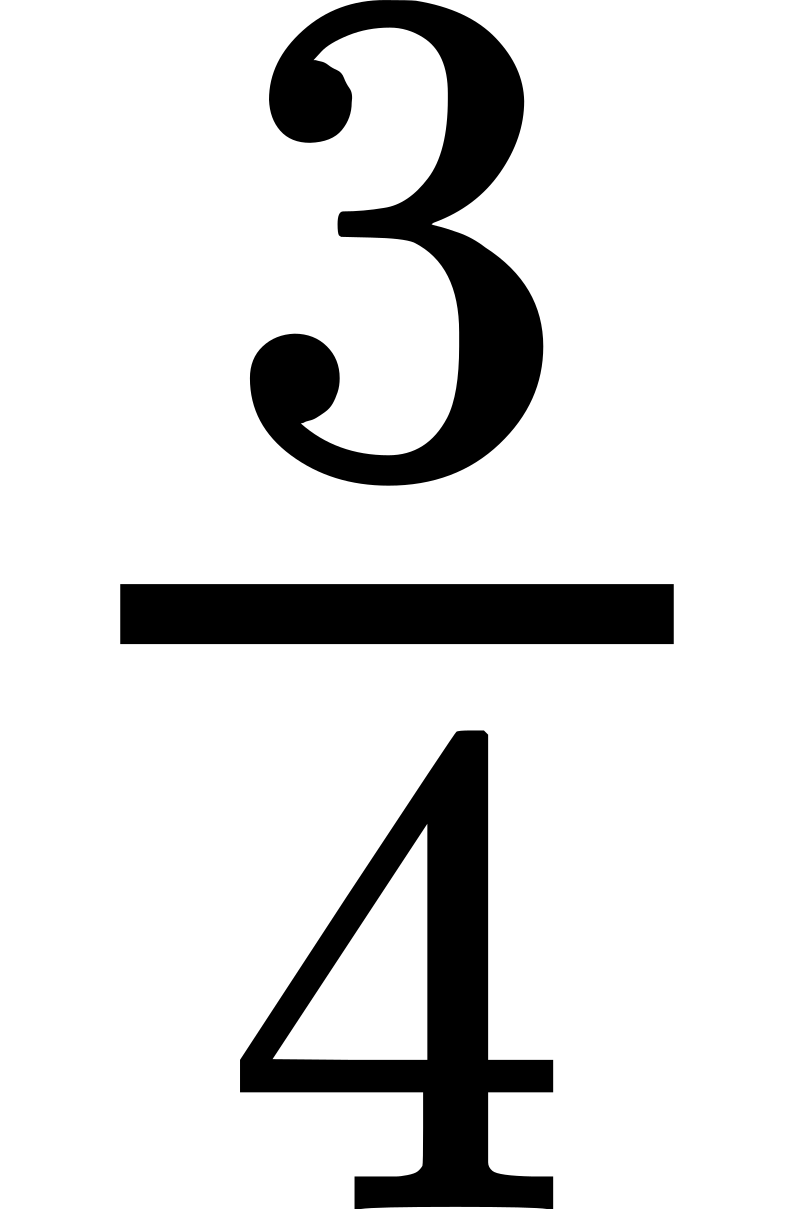 . 19th Oct.—The diameter of
the nucleus was less than 2″·47; that of the nebulous envelope about
6′. 28th Oct.—The preceding side of the tail, in all its length,
except towards the end, was well defined; but the following side was
everywhere hazy and irregular, especially towards the end. 31st
Oct.—The tail continued better defined on the preceding side, than
on the following side. 20th Nov.—The nucleus had now become
extremely small, being little more than a mere point; the tail also
was no more than 2°
. 19th Oct.—The diameter of
the nucleus was less than 2″·47; that of the nebulous envelope about
6′. 28th Oct.—The preceding side of the tail, in all its length,
except towards the end, was well defined; but the following side was
everywhere hazy and irregular, especially towards the end. 31st
Oct.—The tail continued better defined on the preceding side, than
on the following side. 20th Nov.—The nucleus had now become
extremely small, being little more than a mere point; the tail also
was no more than 2°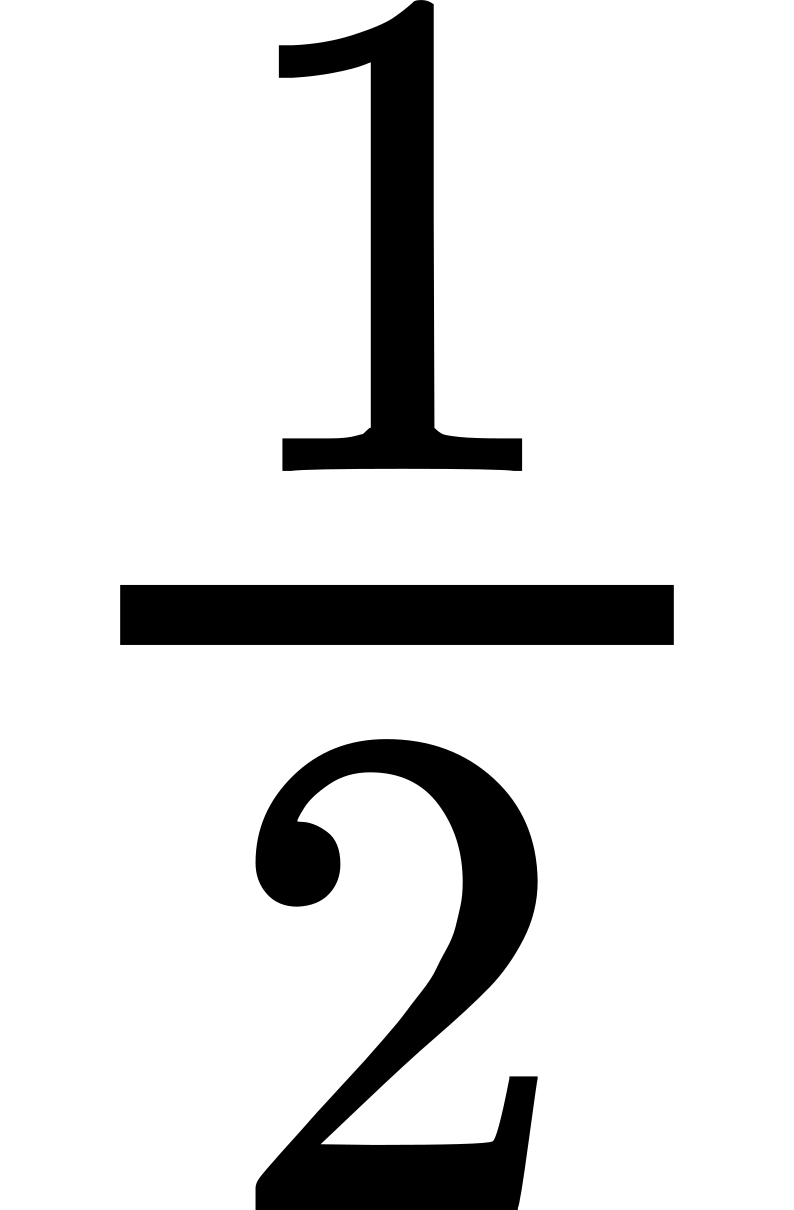 long. 6th Dec.—By this time
the diameter of the envelope had lessened to 4′·45; and the length of
the tail to 23′. 2d Feb.—The comet was reduced to the appearance
of a mere nebula; having a faint diffused nebulosity, projecting from
the side opposite to the sun, being the vanishing remains of the
comet’s tail.”
long. 6th Dec.—By this time
the diameter of the envelope had lessened to 4′·45; and the length of
the tail to 23′. 2d Feb.—The comet was reduced to the appearance
of a mere nebula; having a faint diffused nebulosity, projecting from
the side opposite to the sun, being the vanishing remains of the
comet’s tail.”
These appearances unequivocally attest the influence of the sun’s heat, corresponding exactly with the Comet’s increasing distance. The only circumstance, which here seems to require any comment, is the observation of the 28th October, that the following side of the tail was hazy and 31irregular, while the preceding side appeared distinct and well defined. What is the cause of this difference, when both sides of the tail are composed of matter, in the same state of rarefaction? It is an appearance generally observed in all Comets; but I have met with no explanation of the fact. Astronomers are silent on the subject, except when they merely notice its occurrence. It is on account of this general silence, that I venture to offer a conjecture. When we reflect upon the immense velocity of the tail at this part of the Comet’s orbit, it is evident that the resistance which it suffers from the ethereal medium must be very considerable. On this account, there will necessarily be a partial condensation of the luminous particles, upon the preceding side, which will have the effect of imparting a greater degree of brilliancy to it, than in those parts less subject to the same resistance. Whilst, on the following side of the tail, there will likewise, on account of the velocity, be at the same time a slight rarefaction of the ethereal medium, and consequently of the nebulous matter: in this manner, there is produced a sort of eddy on the following side of the tail, which breaks the regularity of its outline, and diminishes the general brilliancy of these parts.
The following were the appearances which the great Comet of 1811
exhibited whilst receding from the sun. “4th November.—The
envelope had subsided in the Comet’s atmosphere, which was, in
consequence, much filled with scattered light. Its distance from the
centre was 7′ 10″. The envelope, moreover, had become double towards
the sun, and divided itself at each side, into three streams; those
on the outside being very faint, and of no great length. A darkness,
also near the tail, had grown conspicuous; the middle parts being
less filled with scattered light. 5th Nov.—On the preceding
side the envelope was very faintly accompanied by an outer one,
but not on the following side. The tail had lately become much
reduced; its utmost length not exceeding
12°. 9th
Nov.—The cometic atmosphere was now nearly covered with scattered
light, on account of the close approximation of the envelope to the
nucleus. Its distance 32was
only 5′ 43″. The tail, also, was but 10° long. 10th Nov.—The
envelope could be distinguished from the nucleus only by a small
remaining darkish space, in which the atmosphere might still be seen.
The distance of the envelope 4′ 46″. A considerable darkness prevailed
between the streams of the tail. 19th Nov.—The envelope was now
so sunk down and scattered, as to leave no room for discerning the
atmosphere. The comet seemed to be fast returning to the appearance of
a mere nebula. The tail was no more than 6° 10′ in length. The darkness
between the two streams was increased. 24th Nov.—The envelope
was turned into haziness; and, on the side towards the sun, the Comet
had already the appearance of a globular nebula, with a faint hazy
border. 2d Dec.—The tail was hardly 5° long, and had a very
feeble light.”
These phenomena, the account of which now given has been extracted from Herschel’s interesting observations, clearly illustrate the agency of the principles which were formerly laid down. The gradual approach of the envelope to the nucleus, lessening the apparent diameter of the latter, together with the ultimate subsidence of the envelope on the nucleus, indicate a continual decrease of that attenuation, by means of which, the envelope had been before suspended in the cometic atmosphere; and this decrease of attenuation, could arise from no other cause than the diminished agency of the solar heat, occasioned by the retrocession of the Comet. To the same cause, must be ascribed the shortening of the tail, as well as the conspicuous darkness about the middle of it, which seemed to be greater near the nucleus, on account of its proximity to stronger light: For, as the matter composing the tail subsided on the surface of the nucleus, the conical shell would necessarily become thinner, and thus shine with a fainter light. Whilst this condensation of the nebulous matter was advancing, all of which might not be exactly of a homogeneous nature, some portions were able to retain a little longer than others their attenuated condition, and thus formed another envelope, and other streams round the tail, more faint as they were more rarefied, than the principal envelope and tail. It is 33for the same reason, undoubtedly, viz. some physical difference in the nebulous matter, that, on the outside of the two brilliant streams forming the tail, there occasionally appeared other streamlets, but very hazy and imperfect.
The only other circumstance, respecting the changes observable in
a Comet’s appearance, of which it may be proper to give some example,
is the direction of the tail, in the comet’s regress from the sun.
We have seen, that, in approaching the perihelion, the tail presents
a considerable deviation from the prolongation of the radius vector,
and that the point where the angle of deviation is greatest occurs
shortly after the perihelion passage; at this point, the tail begins
again to assume its ordinary direction, and at length the deflection
becomes no longer perceptible. Whether it be that observers are not
sufficiently attentive to this fact, and have thus overlooked the
appearances connected with it, or whether there be great difficulty in
making observations of this nature, when the Comet is so near the sun,
I am ignorant; but in the descriptions of the successive appearances
exhibited by comets, there is no example which of itself affords
a good illustration of the phenomenon. However, the two following
cases will serve to attest the general fact42: The Comet of 1664
passed its perihelion on the 4th December; on the 17th,
the average deviation of its tail from the radius vector was 43°;
on the 18th it was 35°; on the 22d only 20°; on the
24th 19°; on the 26th 18° 40′; on the 30th 10° 5′;
and on the 2d January, after which date no farther observations
could be made, 6° 20′. The Comet of 1652 passed its perihelion on the
12th November; on the 20th December the deviation of its
tail was 17°; on the 23d it was 13°; on the 26th only 7°;
on the 27th 5°; and on the 30th
4°. We have
already explained how this deviation of the tail is caused, which
increases until after the perihelion passage; the same principles apply
to the present phenomenon. If, in the first part of the orbit, it be
owing to the greater centrifugal force and higher rarefaction of the
tail, that it is made 34to
decline from exact opposition to the sun; so it is by the diminution of
both these causes that, after the comet passes its perihelion, the tail
gradually resumes its ordinary direction.
Such is the amount of our present knowledge respecting the physical constitution of Comets. This knowledge is the fruit of but recent experience; and certainly, considering the shortness of the period, during which accurate and philosophical observations of those bodies have been conducted, it seems remarkable how little there is among the complicated phenomena they exhibit, of which we cannot offer some satisfactory explanation. No hypothesis has been resorted to for this purpose, which can be said to be inconsistent with sound philosophy. All the principles on which the several parts in the constitution of these bodies have been shewn to depend, accord with the acknowledged laws of nature; and in tracing a comet in its course round the sun, from the first moment of its appearance, till it has receded too far to be longer visible, we have explained the mode in which those principles operate, and found them in perfect conformity with observation.
VI. It is curious to contrast the extensive and scientific information, which we now possess on this interesting branch of astronomy, with the vague and fanciful notions that prevailed in former times. Such views regarding the history of knowledge are equally curious and beneficial. They illustrate most strikingly the powers of moral advancement, possessed by the human understanding; they demonstrate the slow and progressive manner, which always marks the discovery of truth, and at the same time furnish to astronomers a lesson, useful in every department of philosophy, not to seek from imagination and conjecture, the results which observation and experience only should supply.
It is not my intention, however, to enter into any detailed account of the various opinions entertained by the ancients respecting Comets; such a subject opens far too wide a field of investigation, and would lead to details, 35of little practical utility. A few remarks may be sufficient to convey a general idea of the notions which prevailed on this subject in earlier ages of the world.
The opinions of the Greek philosophers are first entitled to our consideration, as it was by their agency that mankind were induced to turn their attention to intellectual pursuits, and a basis of inquiry prepared for the superstructure of knowledge. Their ethical disquisitions are replete with manifestations of an acute and inventive genius; whilst, in those speculative views respecting the constitution of the universe, to which they were so prone, they displayed a boldness and originality of conception, which the character of no people has exhibited in the same degree. But, in all their researches, whether moral or physical, they never could submit to the guidance of induction, nor patiently await the certain results of experience. From the resources of their own creative mind, they drew the materials, on which to form their judgment, forgetting that our knowledge of nature is dependent solely on observation; and hence their doctrines with respect to the heavenly bodies rather evince fertility of imagination than depth in philosophy. One opinion, for example, concerning Comets, taught in the Grecian schools, was, that these bodies are formed by the fortuitous concourse of small planets, moving through the system by no determinate law: these planets, before invisible, from their diminutive size, were supposed capable, by this conjunction, of transmitting so much light, as at length to become distinguishable, and thus generated comets. Hippocrates, and others of the Pythagorean school, considered comets to be real planetary bodies, like Venus or Mercury, which wander about the heavens without any fixed course, and occasionally approach near enough the earth to be discernible. Many philosophers, dissatisfied with these and similar equally absurd opinions (which it would be very unprofitable to detail), advanced a different explanation, and which they deemed far more satisfactory than any,—that Comets are not material bodies at all, but only optical illusions, arising from refraction, such as the parhelion or the rainbow. Aristotle’s 36conclusion, however, seems to have been the one most generally adopted, not because it was perhaps less absurd than any of the others, but because it came forth under the patronage of a name, which stood highest in every province of philosophy. According to the doctrines maintained by his sect, the atmosphere surrounding the earth is divided into three regions. The lower region contiguous to the surface is the air we breathe, and is motionless: whilst the upper region participates in the diurnal revolution of the heavens round the earth; it is of a warm temperature, from being near the region of flame, and receives continual supplies of exhalations from the earth’s surface. The exhalations, on account of the rapid motion to which they are subjected in rising into this second region, become condensed; and then, from their vicinity to the region of flame, as well as the influence of the sun, they take fire, and thus produce comets. These exhalations continue visible as long as the inflammable matters exist, till at length the combustion ceases by the whole being consumed, and then the comet disappears. This notion it is probable that Aristotle adopted, in consequence of his favourite doctrine respecting the solidity of the planetary spheres,—a doctrine which, he could plainly see, was wholly irreconcileable with the supposition, that comets traverse freely through the system.
But, though the doctrines respecting comets generally taught by philosophers in those earlier ages, resting as they did upon mere conjecture, were only remarkable for their extravagance, there were some few who possessed juster conceptions: Nor need it excite our surprise, if, among the numberless attempts to reach the truth, some approximation should occasionally have been made, to the great and important discoveries of more modern times. It was supposed by the Chaldeans, a people who, among the most ancient in the history of mankind, yet seem to have advanced the farthest in astronomy and the other arts of high civilization, that Comets are situated among the heavenly bodies; having regular periods of revolution like the planets, but moving in orbits far more extended: And hence they explained why comets are seen only for a short period, when they advance to that portion 37of their orbit nearest the earth43. These opinions transplanted into Greece, with other branches of knowledge, received countenance in the Italic and Pythagorean Schools: for Pythagoras himself, the founder of the sect, looked upon comets as partaking so much of the nature of planetary bodies, as to have their periodical times of appearing in the same quarter of the heavens. But these happy surmises, which have been so fully confirmed by modern discoveries, not being founded on observation, were soon compelled to give way to other opinions, bearing on them the stamp of higher authority. The opinion of Aristotle was universally adopted; and, though his philosophy, as well as all the arts characteristic of an enlightened people, soon disappeared from Greece, when that country lost her liberties, his doctrines and influence were afterwards revived in Rome.
The Romans, with all their known boldness of character, possessed little of the inventive and speculative genius which so eminently distinguished the people, from whom their knowledge was derived. Constrained by the warlike tendency of their form of government, which, from its original institution, was designed only for empire, the Romans seem to have been always unable or unwilling to proceed far in philosophical researches; and thus they were rendered more exposed to the influence of those superstitious ideas, which a limited or partial knowledge of nature is so apt to inspire. Accordingly, the views which the Romans formed with respect to Comets, were uniformly tinctured with apprehensions concerning the moral and malignant influence of these bodies over human affairs; believing them to be the causes of the most terrible disasters which can afflict mankind. And though, in cherishing these ideas, they may have been warranted by the proverb, 38common among the Greeks themselves, “Ουδεις κομητης όστις οὐ κακον φεϱει;” yet such superstitious feelings seem to have altogether absorbed their attention, and thus prevented them from making much progress in philosophical inquiries. Pliny states, that “the shortest time during which comets are seen, is seven days, and the longest, eighty days. Some follow a course like the planets, whilst others are altogether motionless. Almost all make their appearance towards the north, and chiefly in that part of the firmament which is termed the Milky Way. These portend storms and excessive heat. But a comet is never situated in the west. It is a body particularly frightful, and not easily propitiated, as was the case during the civil commotions in the consulship of Octavius, and again in the war between Cæsar and Pompey. Even in our own time, its cruel and powerful agency shewed itself in the poisoning of Claudius and the tyranny of Nero, his successor. It is of consequence to note the parts towards which it is shooting, the constellations whose influence it receives, and the particular aspects which it assumes. If the comet have the form of flageolets (tibiarum), then it portends something to musicians: woe betide those who are in love, if it be seen below the Girdle: it refers to artists and learned men, if it resemble a triangular or foursided figure with equal angles in the situation of any of the fixed stars: and if it be situated in the head of the Dragon either north or south, it sprinkles poisonous matter44.” The evil of which comets were thus reckoned the occasion, was little fixed or specific in its nature. It may be said to have comprehended almost every calamity which could befall nations or individuals; though, in regarding these bodies as “prænuntiæ futurarum rerum,” it was natural that men should deem them the precursors of those disasters chiefly, which their own particular interests led them most to apprehend:
39
This universal superstition respecting Comets once established, it was not difficult, whenever they were seen in the firmament, “rubescentes ferali crine,” to discover some dire misfortune which had followed their appearance; and which, it was therefore believed, they had certainly foretold. This superstition we find every where recorded by the historians of those times, who never fail to mention among the various prognostications of political events, the frightful apparition of a comet. Tacitus, when enumerating, on one occasion, “prodigia imminentium malorum nuntia,” says, “Inter quæ et sidus Cometes effulsit; de quo vulgi opinio est, tanquam mutationem regnis portendat.”45 This was one of the omens which, according to the same historian, was “sanguine inlustri semper Neroni expiatum46;” for the tyrant had been informed, that it was a prodigy, “quæ summis potestatibus exitium portendere vulgo putatur;” and, therefore, in order to avert the foreboded mischief from his own head, “he resolved upon the destruction of the chief nobility in Rome47.” Cicero himself, with all his philosophy, seems not to have been exempt from the universal prejudice; for, in describing the phenomena of the natural world, by means of which men are enabled to interpret the will of the gods, and to ascertain the occurrence of future events, he particularly mentions, “Stellis iis, quas Græci cometas, nostri cincinnatas vocant, quæ nuper bello Octaviano, magnarum fuerunt calamitatum prænuntiæ.” In farther evidence of the superstitious notions which existed among the Romans respecting comets, I might refer to the numberless glowing descriptions of the poets: “Regnorum eversor lethale Cometes,”—“exitiale micans,”—“fax dira Cometæ,”—“nunquam terris spectatum impune Cometam,” are expressions continually employed in their relation of some dread-impending calamity: and, in resorting to this imagery, it was not a mere fable, or an idle dream, which was thus introduced for occasional embellishment; but an opinion cherished even by philosophers, and consonant to the prevailing temper and belief of the age.
40
Although, in general, Comets were thus looked on as the precursors of evil, there is one which seems to have escaped this ill-omened character. It was that which appeared at the games celebrated by Augustus, to honour the memory of Julius Cæsar. It was observed for seven days consecutively, rising about 5 o’clock in the evening, and shining with uncommon brightness. The Emperor ingeniously gave out, that it was the blessed soul of the murdered Dictator, now admitted into heaven; and, in commemoration of the prodigy, he placed a star on the head of Cæsar’s statue, which he dedicated in the Forum50. But the fact is certain, that, with this single exception, Comets were invariably looked upon, in all ages of the world, as the peculiar heralds of evil; and it would afford a subject of curious inquiry, to explain this propensity of the human mind, which, in judging of the moral influence of comets on mundane affairs, led mankind to consider that influence, to be baneful, rather than benignant.
The only individual who seems to have risen above the prejudices of his age and country, was Seneca:—Nor was he superior merely to superstitious associations; he entered into the most profound and philosophical views respecting the nature and motions of Comets, and was even able to form such opinions, with regard to both, as the discoveries of modern Astronomers have served fully to confirm. “I cannot persuade myself,” says Seneca, in allusion to the doctrines of Aristotle, “that a comet is merely a fire suddenly kindled: it is rather one of the eternal works of nature. The ordinary meteors, which we observe in the atmosphere, never 41vary in their course, from a straight line. A circular motion is a property characterising the heavenly bodies alone. Whether the course of former comets was of this kind, I know not; but that of the two which appeared in our time, certainly was circular.” Besides, every thing which owes its production to transient causes, quickly perishes. The meteors in the firmament disappear almost as soon as kindled; the stars which are called falling stars, become extinguished in shooting through the air. What alterations would we not observe in comets, if they were only a mass of flame lighted by some accidental cause? Their size would vary continually with the quantity of inflammable matter which nourished them. Comets are situated among the heavenly bodies, and hence they do not disappear almost immediately after becoming visible; they follow an orbit of their own, and are never extinguished, they only remove out of our sight.—“If, moreover,” he says “we reflect upon their motion, their rising and setting, their light and brilliancy, we are struck with the analogy existing between them and the heavenly bodies. But it is requisite to have an exact account of the comets which have been formerly seen; for, from the infrequency of their appearance, we cannot yet ascertain if their movements through the heavens are regular; we are still ignorant whether describing some constant orbit, they reappear at intervals periodical and determinate.”—“It is reserved,” he adds, “for some person, one day to point out the place, to which comets withdraw themselves; why their orbits differ so much from those of the planets; what is their physical nature, and their number in the system51.”
Notwithstanding these arguments, directed with so much force against the prevailing notion, that Comets are only igneous exhalations in the earth’s atmosphere, and those sounder views respecting their nature and movements, mankind were unwilling to alter the belief, which time and superstition had united to strengthen: and Aristotle’s opinion continued 42to be held in reverence. For a long period after this, the cause of science and philosophy remained totally neglected. Men were incapable of the least effort to rouse themselves from that state of lethargy and ignorance, into which they had relapsed; and the sixteenth century found them perhaps even less advanced in the knowledge of astronomy, than they were in the days of Seneca or Pythagoras. During the period of the middle ages, when Europe presented a melancholy scene of Gothic barbarism, and when the human understanding seemed paralysed with the dread of imaginary evils, comets were more than ever considered as influencing the tide of human affairs; sowing dissensions among nations; foreboding the dethronement of kings; causing the death of illustrious men; and scattering pestilence and famine among the people. In the almanacks published by one Leonard Digges, in the fourteenth century, we find the following summary description given of Comets. “They signifie,” says this learned astronomer, “corruption of the ayre; they are signes of earthquake, of warres, chaunging of kyngdomes, great dearth of corne, yea a common death of man and beast.” Another author, who wrote about the same period, gives the following reasons why Comets produce wars and civil commotions:—“Quia corpora fiunt biliosiora, ideo et ad iram prona, hinc subito moliuntur seditiones; principes aliis principibus vicinis bella inferunt.” And, in like manner, he endeavours to explain the influence, which Comets were supposed to exercise over the destiny of princes:—“Quia principes habent corpora teneriora aliis, ideo præ aliis ab infecto exhalationibus aere magis afficiuntur, et a morbis qui tum grassantur interimuntur.” Nor perhaps will either of these statements appear very unphilosophical, if we reflect on the physical effects of the anxiety and terror which Comets were in those days capable of inspiring.
Various were the speculations, regarding the source from which these strange and terrible portents in the firmament, could be derived. Claud Comirs believed that they issue from the body of the sun, and float 43through the planetary regions, as soap-bubbles in the air. The Spanish monk Valderama, proposed a theory more allied to his profession, and maintained that Comets must assuredly be sent by some infernal demon, as a just retribution for the impieties of mankind; nor indeed were they ill suited to be the instruments of divine wrath, if we believe these most unmusical lines, where a Cracovian astrologer relates the evils, which comets were held to occasion:
John Bodin, a French lawyer, published his opinion of Comets, in a work entitled Universæ Naturæ Theatrum, 1575, which assigns to them a new character. “I have reflected,” says he, “upon the opinion of Democritus, and with him am induced to think that comets are spirits, which, having lived on the earth innumerable ages, and having at last completed their term of existence, celebrate their last triumphs, or are recalled to heaven, in the form of shining stars!” A more extraordinary fancy was entertained by Kepler, who, though in some measure the father of modern astronomy, yet had very incorrect notions respecting the system of nature in general. The planets he imagined to be animals swimming round the sun by means of fins acting upon the ethereal fluid; and, agreeably to this strange belief, he held Comets to be also huge uncommon creatures, generated in the celestial spaces, and that they “were made to the end, the ethereal fluid might not be more void of monsters, than the ocean is of whales, and other great thieving fishes; and that a gross fatness being thus gathered together, as excrements into an apostume, the ethereal medium might thereby be purged, lest the sun should be obscured, as he was for a year together, when Julius Cæsar was slain; when being weakened by a bloody colour, he cast but a dim and disdainful light!” He even supposes that the faculty of the earth, which he fancied to be animated like all the other planets, 44is so terrified at the approach of a comet, that it “sweats out a great quantity of vapour through terror, and that hence arise great rains and floods52.”
In the following harmonious strains, Du Bartas labours to describe minutely a Comet’s physical appearance; and it will not be denied, that the author has succeeded marvellously in upholding the reputation of those bodies, as the dreaded messengers of evil.
We need not, then, be surprised to find the descriptions given by the historians and professed astronomers, so deeply tinged with the superstition by which the age was characterised, and often so highly coloured or caricatured, as to render it even difficult to recognise the thing described to be a comet. When, for instance, we read of comets which resembled flaming swords and glittering spears, or one which (as Lubienitz54 relates), came out from an opening in the heavens, like to a dragon with blue feet, and a head covered with snakes; we only pity the degradation of the human mind, which either could invent or could tolerate such monstrous 45absurdities. The following remarkable description is taken from the “Exempla Cometarum” of Rossenburgh. “In the year 1527, about 4 in the morning, not only in the Palatine of the Rhine, but nearly over all Europe, appeared for an hour and a quarter, a most horrible Comet, in this sort. In its length it was of a bloody colour, inclining to saffron. From the top of its train appeared a bended arm, in the hand whereof was a huge sword, in the instant posture of striking. At the point of the sword was a star. From the star proceeded dusky rays, like a hairy tail; on the side of them, other rays, like javelins or lesser swords, as if imbrued in blood, between which appeared human faces, of the colour of blackish clouds, with rough hair and beards. All these moved with such terrible sparkling and brightness, that many spectators swooned with fear!”
47
I. It was not till the period, when a general spirit of inquiry burst forth, and men began to seek, from observation, the acquaintance with nature, which mere conjecture had before supplied, that these extravagant prejudices with respect to Comets began to be shaken. But the great barrier to be overcome, was the universal acquiescence in the doctrines of Aristotle; for his name reigned paramount, in every department of learning; and it is a curious fact, that, so late as the seventeenth century, in some of the universities of Europe, the professors were required to declare upon oath their belief, that those doctrines were infallible, and promise, in their public lectures, to follow Aristotle as their only guide. The first circumstance which contributed to change the tide of popular opinion, were two facts ascertained with respect to the direction of the tail, and the distance of Comets from the earth. Appian, between the years 1531 and 1539, had attentively observed several comets; and he was particularly struck with the discovery, that all of them, in every part of their course, constantly kept their tails in a direction opposite to the sun. As the same fact was soon remarked, in many other comets, its general occurrence led astronomers to suspect some relation between them and the sun, on which the formation of the tail, as well as the motion of the comet itself, might probably depend. Another discovery, still more important, was soon afterwards made, which served to confirm this idea. Tycho Brahe, who had the advantage of possessing better instruments for observation, than those hitherto used by astronomers, occupied himself sedulously in examining the Comet 48of 1577; he found its parallax to be no more than 20′; and hence he was enabled to establish the extraordinary fact, that the comet, so far from occupying the atmosphere of the earth, according to universal belief, must have been nearly three times more distant than the moon, (the moon’s parallax being 54′). In accordance with this discovery, Tycho was led to consider these bodies as formed by exhalations from the planets, moving in the heavens like them, though of a highly attenuated constitution; and he supposed them to revolve round the sun in orbits, beyond Mercury and Venus: In this manner, he attempted to account for the inequalities in the motion of Comets, by supposing their orbits not so uniformly circular, as those of the planets, but resembling more the form of an egg; an opinion which, although originating in mere conjecture, may be deemed nearly a divination of the truth.
Thus, then, by progressive steps, were astronomers able to demonstrate the absurdity of the doctrines which had so long prevailed, and approached to some knowledge of the place really occupied by comets in the system. But little advance could as yet be made beyond this point; for, with respect to the manner in which Comets move through the planetary regions, or still more, as to their formation and origin, the conjectures even of the wisest were extremely crude. The human mind, in the first exercise of its powers, after a long period of inactivity, is ever prone to indulge in the wildest speculations. Kepler himself, the disciple of Tycho Brahe, and the father of modern astronomy, had no idea that comets are guided in their course, by the same simple and universal laws, which he had found to regulate the motions of the planets; but entertained the truly ridiculous belief, that they are monsters moving in the celestial spaces, engendered by a certain animal faculty existing in the air. However, notwithstanding this extravagant conjecture, Kepler was very attentive to the motions of these strange bodies, and found that they were not confined in their course to straight lines, as was imagined. James Bernouilli, an Italian astronomer, 49started the idea that they might be the satellites of some distant planet, which are always too far removed to be visible from the earth, unless when they come into a certain portion of their course. The theory of Tycho Brahe, however, that comets move like the planets, in orbits nearly circular, seems, perhaps from its simplicity, to have obtained the most general credit; but all astronomers were now agreed upon one point, on account of the small parallax which comets were discovered to possess, that whatever might be the actual line of their course, they must be situated far beyond the atmosphere of the earth.
But, that the path of Comets could not be represented by a circular orbit, was soon shewn by more accurate and extended observations. Hevelius was the first who distinctly proved this fact, by delineating on a planisphere, the apparent motion of several comets. The result showed, that although in one part of its track, the orbit of a comet may be circular, yet that, in general, it more nearly approaches a straight line; and therefore he concluded, that the cometary orbits must be elongated curves, of a lenticular shape. Hevelius being disposed, with Tycho, to consider the comets as planetary meteors moving through the celestial regions, it occurred to him, that their course might be analogous to the path of bodies, projected in our own atmosphere: and as he observed with regard to the latter, that, solicited by two forces, viz. their own original impulse, and the attraction of the earth, they describe a parabola, he thought that the trajectories of comets, must be determined by similar laws. He therefore investigated what are the forces, which may cause a comet to pursue its course: one is the force of impulsion, by which, according to him, they quit the atmospheres of the planets; another is, their natural tendency towards the sun; and in this consideration he found a confirmation of his opinion. He even went so far as to remark, that the velocity of comets is greatest at the point, where the curvature of their orbit is the most considerable, and where the line drawn to them from the sun, is perpendicular to the curve;—in short, at the vertex of the parabola. From this, Hevelius deduced, 50that the sun itself, must be situated in the plane of the Comet’s orbit, and occupy some point in the line which is termed the axis of the parabola. But though Hevelius was thus able to arrive at the important fact, that comets, in their progress round the sun, describe a conic section in common with the planets, he was able to proceed no farther. The determination of that orbit in the case of any particular comet, was yet reserved for a more advanced period of the science, when astronomers should be both more unanimous in their opinions regarding the paths of comets, and better able, by the possession of instruments, to observe their course.
Cassini, however, entertained very different ideas. He revived Kepler’s notion, that these bodies move in straight lines; and was even able to give a semblance of truth to this absurd opinion, by predicting, with wonderful success, the path which several comets would follow through the heavens. This coincidence of fact with theory, a theory so wide from the truth, is not however, very surprising; seeing that, during a considerable portion of their orbit, the curve does not materially differ from a straight line. But why Comets, after having reached the sun, should return towards the same quarter of the heavens, whence they had come in their approach, was a fact which Cassini in vain sought to reconcile with his theory; and he therefore endeavoured to make out, that when a comet did not seem to fall into the body of the sun as he imagined, but to describe a track round it, this was a different Comet altogether, which had never been observed before. No farther approximation was made to the truth, till the great Comet of 1680 appeared.
This Comet, which, from its magnitude and brilliancy, excited among the vulgar the most feverish anxiety and even terror, proved an object of no less interest and profound attention to astronomers. Its course was carefully watched, and various theories were framed to account for its motions, and ascertain its orbit. The merit of having first started the idea, that the orbit of this comet was a parabola, has been commonly ascribed to Döerfield, an obscure clergyman of Saxony; who, adopting the opinion of Hevelius, only with this difference, that Döerfield supposed the sun to occupy the 51focus itself of the parabola, published his theory in a small work in the year 1680. If, however, merit is at all due to a discovery, founded rather on vague conjecture than any certain data, that merit must be ascribed to our own countryman, Henry Percy, Earl of Northumberland, who, in the beginning of the same century, advanced much nearer the truth, by assuming an ellipse as the curve of a comet’s orbit, of which the sun is in one of the foci55.
But the period was now at hand, when, according to the prediction of Seneca, a person should at length appear, to point out the proper path of discovery; and who, like those very comets whose laws he explained when they issue from the dark abysses of space to their perihelion, would at once emerge from this undigested chaos of conjecture, into the full light of truth. It was Newton, who, by the inspirations of his comprehensive genius, was the first to divine the nature of those mysterious bodies; and who, subverting the futile and fanciful notions of preceding ages, established a theory of his own, upon the immutable basis of demonstration. Having already discovered, that gravitation is the great principle by which all the planetary motions are governed, Newton had little doubt that comets, which were now known to be situated far beyond the earth’s atmosphere, would be found to afford the most decisive proof of the universality of this fundamental law. Led to this supposition on the ground of the strongest analogy, an opportunity only was wanting to try it by the test of observations, which astronomical records were yet too imperfect to supply. The Comet of 1680 above mentioned, afforded that opportunity; and from the diligent manner in which it was watched during its progress round the sun, Newton at length had the satisfaction of finding, that it was guided in its track by exactly the same laws as those which regulate the movements of the planets.
II. In fact, this result was a necessary, and
it may even be said an obvious consequence of the principle of
universal attraction, which, independent 52of the more cautious but circuitous method of
induction, Newton might with certainty
have anticipated: since it follows from the theory of central forces,
that a body moving round another by the action of a power (such as
gravitation) tending to its centre, must describe a conic section,
of which the latter body is the focus. With respect to all bodies
following a curvilineal track, there are two forces alone to be
considered. The first is the centripetal force, which is the immediate
effect of that attraction by which it is drawn towards a certain point;
and the next is the centrifugal force, arising and inseparable from
a curvilineal track. Suppose that the body is first put in motion by
some projectile force, whose action would cause it to move uniformly
in a straight line; by the operation of the central force, however,
it is continually deflected from this rectilineal path, and therefore
the body is compelled to circulate in a curvilineal track around the
central or attracting point. The orbit which is actually followed must
evidently pass through the points where the centripetal and centrifugal
forces exactly counterbalance each other; and hence it will just depend
on the mutual relation of those opposite forces, whether the curve
described shall be a circle, a parabola, a hyperbola, or an ellipse.
If, for instance, the intensities of the central and projectile forces
are exactly equal, then the curve produced by their combined operation
will be a circle: If, however, we suppose the projectile force to be
greater, and the ratio to be that of 1 to 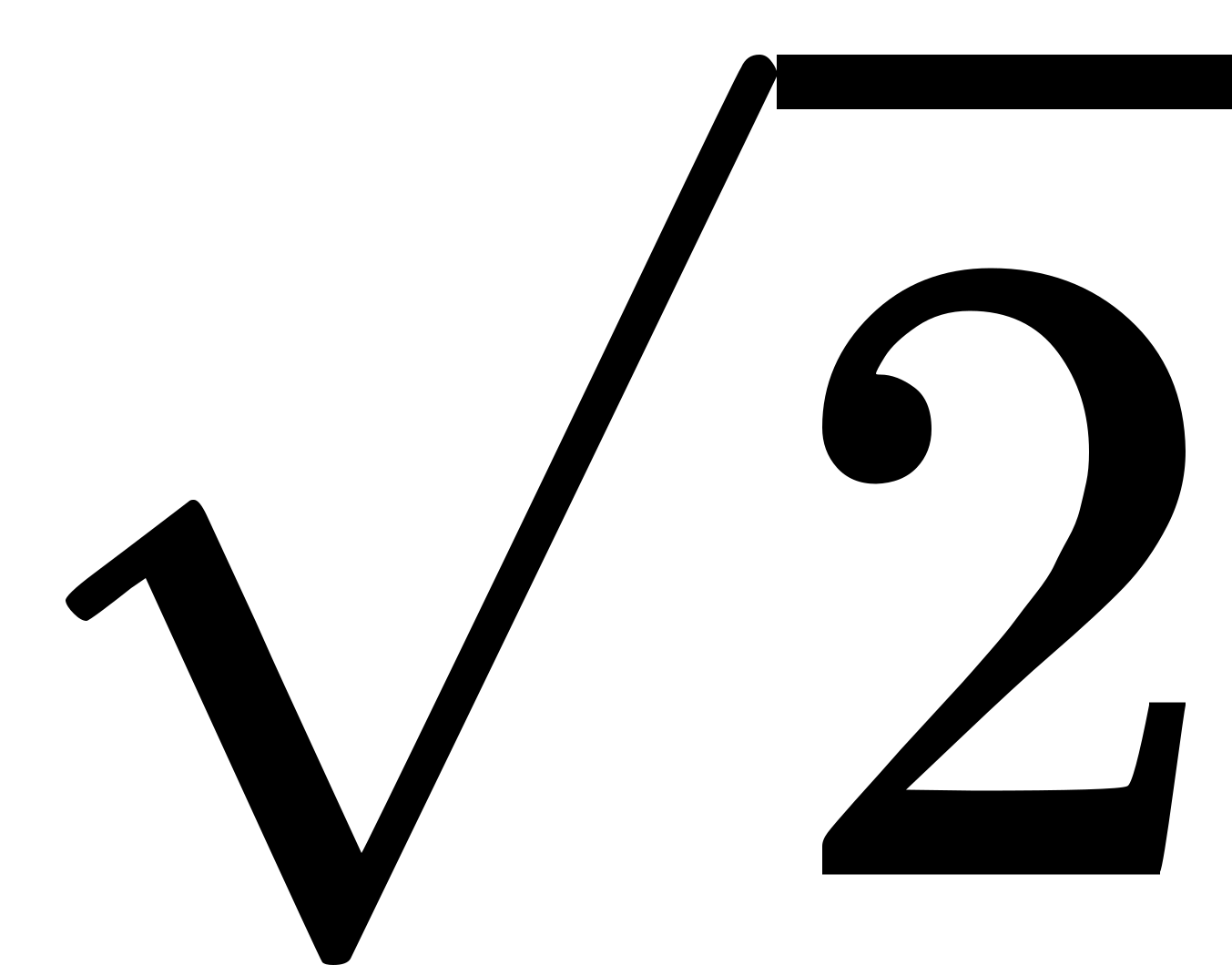 , then the velocity of
the body is augmented, and the orbit will become parabolic. Should the
intensity of the projectile force at all exceed this, then the orbit
will be a hyperbola: But if it does not amount to so much as ,
varying between and unity, then the orbit will be elliptic56.
Thus, the Earth, when nearest the sun, has a velocity of about 102,300
feet per second, this being the result of its own projectile force,
arising from the initial impact which first set it in motion, and
the power of the sun’s attraction: By reason of this velocity, it is
constrained to move in an elliptic orbit: But if, by an augmentation
of the projectile force, the earth’s velocity at this point were to
amount to 144,700 feet, the orbit would become 53parabolic; and any velocity surpassing this
would necessarily make the course hyperbolic: If the velocity of the
earth were about 101,000 feet per second, or a little less than what
it actually possesses, the orbit would be exactly circular. Let us
assume as another example, the great Comet of 1680, already noticed.
In order that this Comet should move in a circle, taking into account
its different distances from the sun at the perihelion and aphelion,
a velocity of about 1,277,000 feet per second at the former point,
and of 8768 feet per second at the latter, would be required. To make
it describe a parabola, whose vertex should be at either of these two
points, there must be velocities respectively of 1,806,000 feet, and of
12,390 feet; and with a velocity somewhat exceeding what is necessary
to produce a parabolic course, a hyperbola would be generated: Its
actual velocity, however, at its perihelion, is 1,768,200 feet, at
its aphelion 83 feet, and hence it is constrained to move in a very
eccentric ellipse.
, then the velocity of
the body is augmented, and the orbit will become parabolic. Should the
intensity of the projectile force at all exceed this, then the orbit
will be a hyperbola: But if it does not amount to so much as ,
varying between and unity, then the orbit will be elliptic56.
Thus, the Earth, when nearest the sun, has a velocity of about 102,300
feet per second, this being the result of its own projectile force,
arising from the initial impact which first set it in motion, and
the power of the sun’s attraction: By reason of this velocity, it is
constrained to move in an elliptic orbit: But if, by an augmentation
of the projectile force, the earth’s velocity at this point were to
amount to 144,700 feet, the orbit would become 53parabolic; and any velocity surpassing this
would necessarily make the course hyperbolic: If the velocity of the
earth were about 101,000 feet per second, or a little less than what
it actually possesses, the orbit would be exactly circular. Let us
assume as another example, the great Comet of 1680, already noticed.
In order that this Comet should move in a circle, taking into account
its different distances from the sun at the perihelion and aphelion,
a velocity of about 1,277,000 feet per second at the former point,
and of 8768 feet per second at the latter, would be required. To make
it describe a parabola, whose vertex should be at either of these two
points, there must be velocities respectively of 1,806,000 feet, and of
12,390 feet; and with a velocity somewhat exceeding what is necessary
to produce a parabolic course, a hyperbola would be generated: Its
actual velocity, however, at its perihelion, is 1,768,200 feet, at
its aphelion 83 feet, and hence it is constrained to move in a very
eccentric ellipse.
From these remarks, it is obvious, that the orbits described by Comets, or by any other body moving in space, by the sun’s attraction, are indiscriminately circles, parabolas, ellipses, or hyperbolas, according to the initial velocity. But when we come to calculate respectively the probabilities of these curves, as constituting the course actually followed by Comets, a considerable difference is observable. The chance that either a circle or parabola shall be described, is extremely small, in comparison with that which generates the hyperbola or ellipse; since to produce either of the two former, one particular velocity is absolutely necessary, the slightest increase or diminution of which will cause it to deviate into one or other of the two latter curves. In regard, again, to the respective probabilities of a hyperbola and of an ellipse, either of which may be produced by an extensive range of velocities, why is it that the ellipse is the only curve which is traced by Comets? But is it a well ascertained fact that an ellipse is really the curve which all comets describe? It is evident that this is a point to be determined only by observation, and it is one in which considerable difficulty occurs. For, when we recollect that the hyperbola is not a 54curve of such a nature as the ellipse, in which a moving body must perform periodical revolutions, it is evident, that if a comet in its course round the sun does describe a hyperbola, after it has once passed its perihelion, and entered on the other branch of its course, it will continue to recede to an indefinite distance from the centre of the system, and never make a second approach. When, therefore, the frequent periodical appearances of a comet in the neighbourhood of the sun, will necessarily indicate the ellipticity of its orbit, no such returns of those whose course is hyperbolic can possibly be expected; and hence it follows, that of all the comets which are observed, even though there existed in the system an equal number of both kinds, there can be seen very few indeed which follow the hyperbolic path, compared with the numbers of those whose orbits are elliptic. The latter are more closely allied to the character of planets, on account of their periodical revolutions. They are attached to the same centre, and are fettered by the same chain with ourselves. That chain permits them, it is true, to range to a greater distance from the centre, but it as certainly constrains them to return. But those comets, on the other hand, whose orbits are hyperbolic, are not so restricted in their movements. By their own peculiar energy, they are able to pass far beyond the planetary limits, and wandering into the most remote regions of space, may there come within the influence of some other sun, which prevents them from ever revisiting our system. When, accordingly, we examine the orbits of those comets whose elements astronomers have been enabled to compute, we find no more than two whose course is best represented by a hyperbola: these are the Comets of 1771 and of 182457. But there is still one circumstance not to be forgotten, 55which may have a material effect in determining whether or not a Comet’s orbit shall be hyperbolic or elliptic; that circumstance is the great difference of the velocities due to these two curves. For if we contrast the extreme velocity (as exemplified in the two cases given above of the Earth and the Comet of 1680), requisite to generate a hyperbolic course, with the velocity that is sufficient for an ellipse, which any slight attraction may easily occasion, we must acknowledge that the probability preponderates considerably in favour of the ellipse.
III. The orbits of the Comets, then, are of the same nature exactly as those of the planets. In both, the laws of centripetal and centrifugal forces are exerted: in both, the Sun is the common focus of the curve described; but whether the particular curve be an ellipse or an hyperbola (though the former is much more probable), can be discovered only from observation. After having deduced the respective courses which the comet would follow, upon the supposition of both curves, we fix at length upon that orbit as the true one which most correctly represents the observed motions. In order to determine the orbit, the following elements are required: 1. The perihelion distance of the Comet, or its shortest distance from the sun: 2. The situation of the perihelion, fixed by its heliocentric longitude: 3. The place of the nodes, or those points where the Comet intersects the plane of the ecliptic: 4. The inclination of the Comet’s orbit to the ecliptic: 5. The time of the perihelion passage; and, 6. The period of the Comet’s revolution in its orbit.
The investigation of these six elements is a problem extremely intricate, requiring for its solution a skilful and laborious application of the most refined analysis. When Newton himself, whose genius enabled him to surmount and make smooth even the most appalling obstacles to the discovery of truth, describes it as “Problema longe difficillimum,” and when even astronomers of the present day, with all the advantages of improved science, find so many discrepancies in their calculations, the determination 56of a Comet’s orbit may justly be considered one of the most complicated problems in astronomy. This difficulty arises from several circumstances peculiar to comets. In the first place, from the elongated form of the orbits which these bodies describe, it is only in a very small portion of their course that they are discernible from the earth, and the observations made during that short period, cannot afterwards be verified on more convenient occasions; whereas in the case of the Planets, whose orbits are nearly circular, and whose movements may be followed uninterruptedly throughout a complete revolution, no such impediments to the determination of their orbits occur. In the second place, there are many Comets which move in a direction opposite to the order of the signs in the zodiac, and sometimes nearly perpendicular to the plane of the ecliptic; so that their apparent course through the heavens is rendered extremely complicated, on account of the contrary motion of the earth58. In the third place, as there may be a multitude of elliptic orbits, whose perihelion distances are equal59, it is obvious, that, in the case of very eccentric orbits, the slightest change in the position of the curve near the vertex, where alone the Comet can be observed, must occasion a very sensible difference in the length of the orbit; and therefore, though a small error produces no perceptible discrepancy between the observed and calculated course, while the Comet remains visible from the earth, its effect, when diffused over the whole extent of the orbit, may acquire a most material or fatal importance. On account of these circumstances, it is found exceedingly difficult to lay down the path which a comet actually follows through the whole system, and least of all possible to ascertain with accuracy the length of the major 57axis of the ellipse, or consequently the periodical revolution. An error only of a few seconds will cause a difference even of many hundred years. In this manner, though Bessel determined the revolution of the Comet of 1769 to be 2089 years, it was found that an error of no more than 5″ in observation would alter the period either to 2678 years, or to 1692 years60. Some astronomers, in calculating the orbit of the great Comet of 1680, have found the length of its greater axis 426 times the earth’s distance from the Sun, and consequently its period 8792 years; whilst others estimate the greater axis 430 times the earth’s distance, which alters the period to 8916 years61. Newton and Halley, however, judged that this comet accomplished its revolutions in only 570 years.
IV. Disheartened by the difficulty of attaining to any precision in that circumstance, by which an elliptic orbit is characterized, and, moreover, taking into account the laborious calculations necessary for its investigation, astronomers usually satisfy themselves with ascertaining the elements of a Comet, on the supposition of its describing a parabola; and, as this is a curve whose axis is infinite, the procedure is greatly simplified by having to leave entirely out of consideration the periodical revolution. It is true that a parabola may not represent with mathematical strictness the course which a comet actually follows; but as a parabola is the intermediate curve between the hyperbola and ellipse, it is found that this method, which is so much more convenient for computation, also accords sufficiently with observation. All the common elements of a Comet’s motion can thus be readily determined; and if it does not enable us to pronounce immediately upon the identity or non-identity of two comets, by showing at once the respective periods of revolution, yet it furnishes other means of effecting this, no less certain and conclusive; for if any two or more Comets exactly coincide in all the elements of their orbits, then we may conclude that these Comets are 58only one and the same, whose period of revolution is shown by its successive approaches to the centre of the system.
In proceeding now to demonstrate the methods by which the elements of a comet’s orbit are determined, it is not my intention to enter into historical details, respecting the various solutions which astronomers have proposed, from Newton down to the present time, or into any abstract mathematical inquiries respecting the comparative merits of these solutions. It will be sufficient to give an exposition of the most approved of these methods which the present state of the science affords. I have remarked, that the parabolic method, as being far less difficult than the elliptic, is usually resorted to by astronomers in computing the first elements of a comet’s orbit. I shall therefore in the first place enter upon the parabolic investigation, and proceed afterwards to the elliptic method.
One of the simplest and most ingenious of the solutions which have been proposed on the parabolic hypothesis, is the method of Olbers. This method I shall now demonstrate, following nearly the steps of the author himself, but occasionally introducing expositions where the reasoning seems to require them.
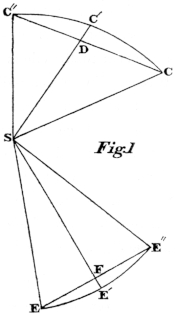
Let S be the Sun (Fig. 1.), E, E′, E″, three places of the Earth, and C, C′, C″, the corresponding points in the Comet’s orbit at the three periods of observation. Join the extreme places C, C″, and E, E″, and let the intersection of the radius vector in both cases, with the chord of the arc passed over, be D and F. It is evident, that if t, t′, be the intervals of mean time between the three observations successively, t : t′ :: sector CSC′ : sector C′SC″; and in like manner, t : t′ :: sector ESE′ : sector E′SE″. If, however, we assume, for the present, that these sectors are proportional to the triangles which have as their bases the parts 59of the chords CC″, EE″, we shall obtain simply t : t′ :: CD : DC″ :: EF : FE″. Nor is the error of this supposition of any material consequence, in seeking the approximate elements, which is all that in the first instance we can expect. For the inequality between the ratio of the triangles (assumed proportional to the times) and the ratio of the sectors (which are truly proportional to the times), is so trifling that it is of an order higher than the sectors themselves. Besides, Newton has demonstrated that there is a certain position of the revolving radius for each parabolic or elliptic arc, which divides the chord in the exact ratio of the areas (Princip. iii. lem. 8.), and he shews that the true proportion can never differ much from the one above assumed, unless in very unequal intervals of time. With regard to the Earth, the amount of this difference is almost inappreciable, since its orbit approaches so nearly a circle. For the present, therefore, we shall assume that the chords CDC″, and EFE″ represent the observed movements of the Comet and Earth at the three periods of observation.
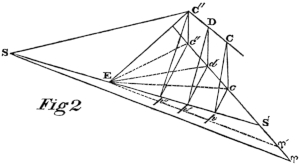
Having premised these remarks, let CDC″ (Fig. 2.) be the chord in which we are to consider the motion of the Comet; and let c, d, c″, be the places in that chord projected on the ecliptic. Let S be the Sun, and E the Earth, at the time of the second observation. Join E with c″, as also with c, d, c″. Draw SE, and prolong it to cut the ecliptic in S′. Let Υ be the point on the ecliptic from which the heliocentric longitudes are reckoned; join SΥ; then EΥ′ parallel to SΥ will serve for the measurement of the geocentric longitudes.
| Let L, L′, L″ | = | the angles S′SΥ or the arcs S′Υ, &c. viz. the longitudes of the Earth. |
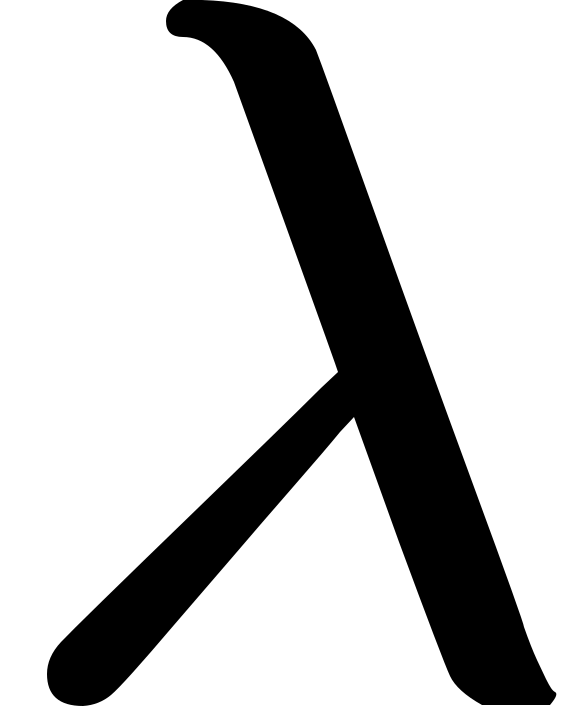 , ′, ″, , ′, ″,
|
= |
the angles cEΥ′, dEΥ′,  ″EΥ′, viz. the geocentric longitudes of the Comet. ″EΥ′, viz. the geocentric longitudes of the Comet.
|
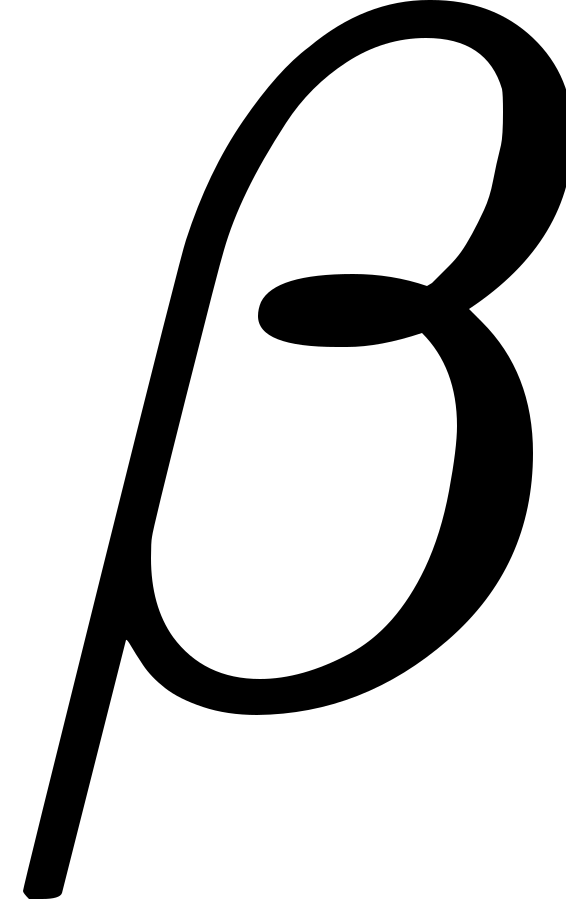 , ′, ″, , ′, ″,
|
= | the angles C″Ec″, &c. viz. the geocentric latitudes of the Comet. |
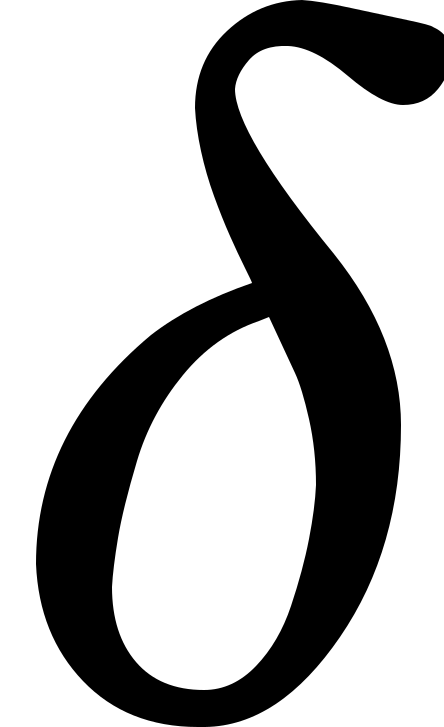 , ′, ″, , ′, ″,
|
= | the straight lines Ec, Ed, Ec″, viz. the curtate distances of the Comet from the Earth. |
Draw cp, dp′, c″p″ perpendicular to SES′, and join pC, p′D, p″C″; call the angles Cpc, Dp′d, C″p″c″ respectively b, b′, b″.
Then, since  , and
, and  ,
we have
,
we have  .
In like manner,
.
In like manner, 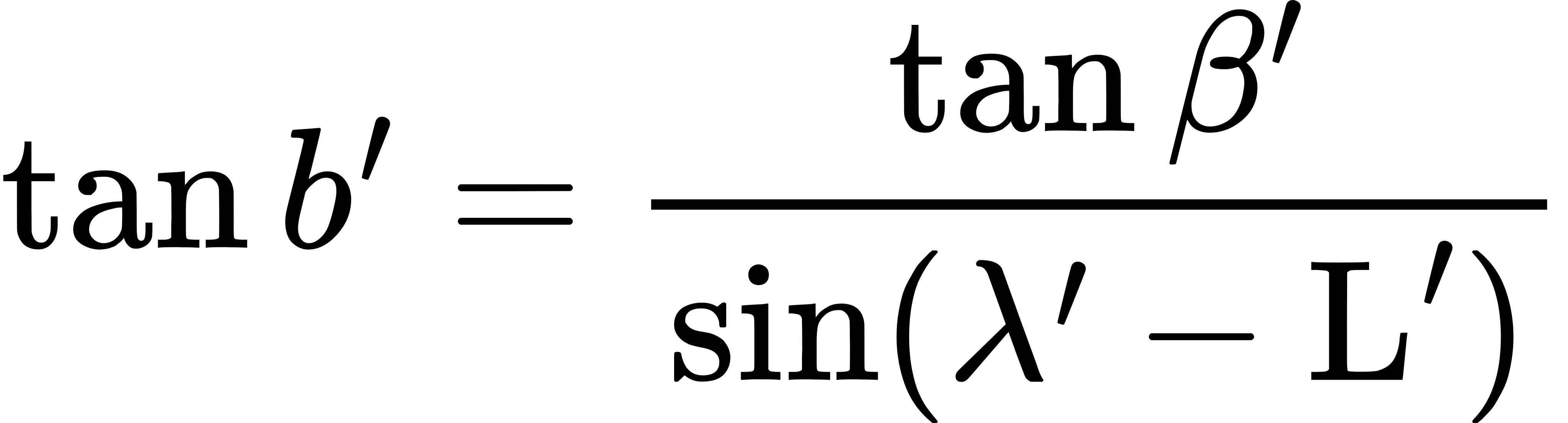 , and
, and
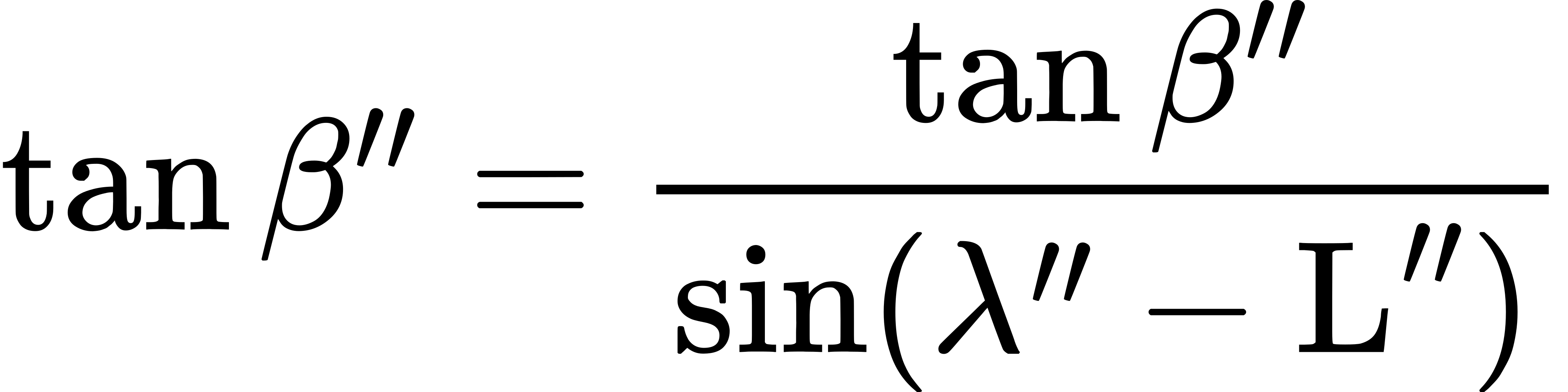 .
Also,
.
Also,  ,
hence
,
hence 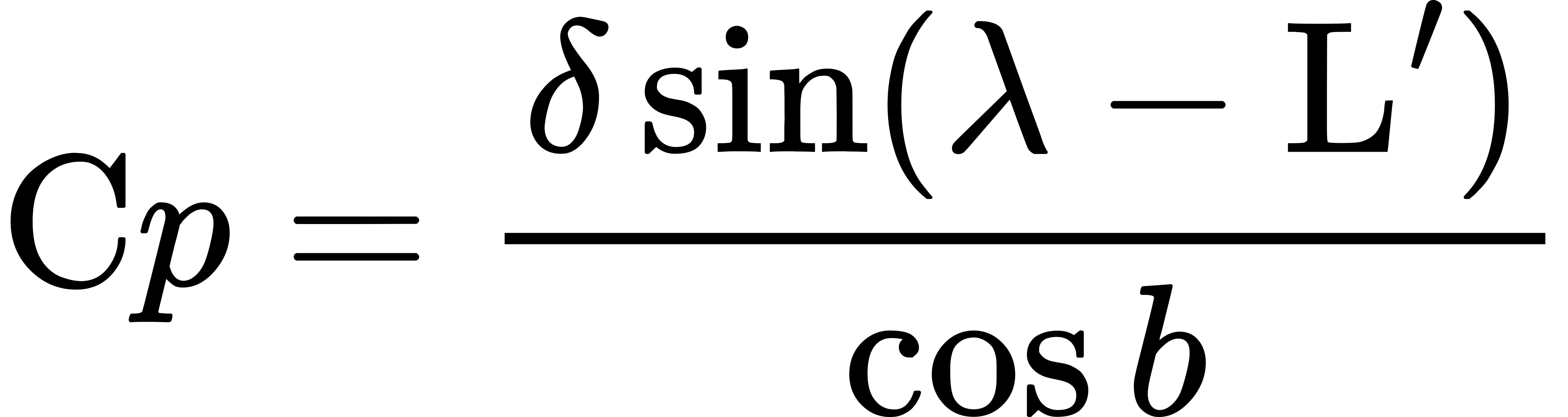 ;
and so likewise C″p″ =
;
and so likewise C″p″ = 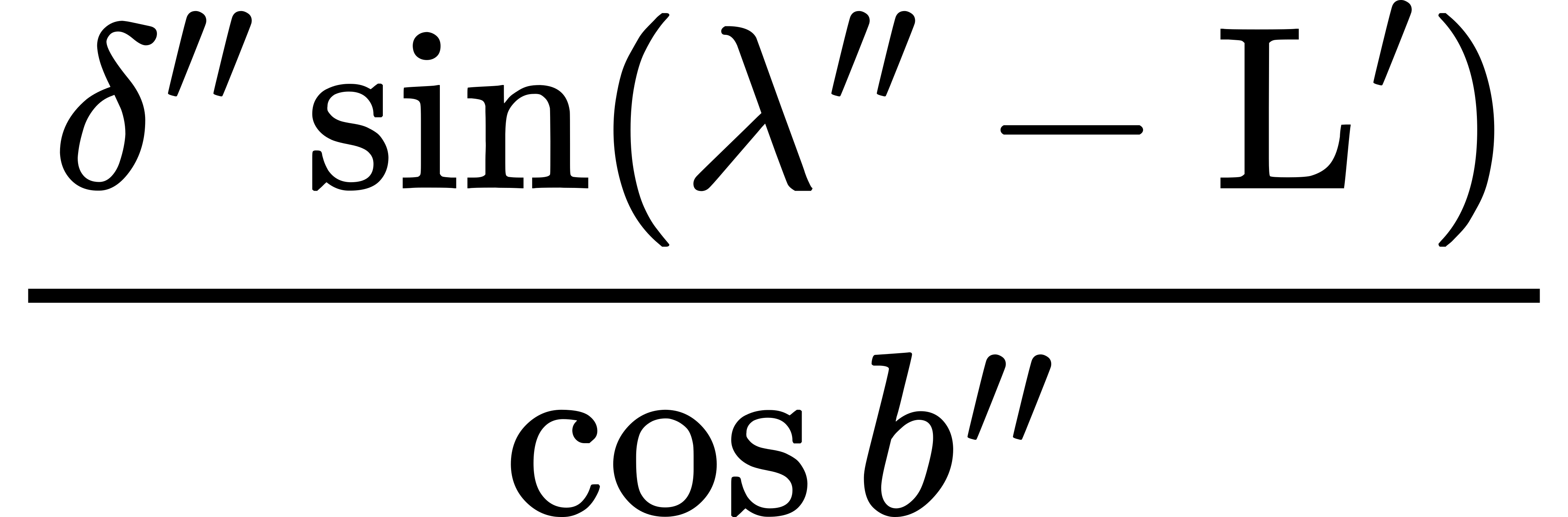 .
.
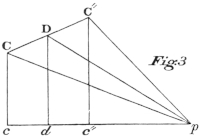
Suppose that the two planes Ccp, Ddp′ are projected upon the third plane C″c″p″, (as in Fig. 3.), in which case it is evident, that CD and C″D, with all the other parts of the figure, will still bear the same proportion to one another as in Fig. 2.
Then, because sin D : Cp :: sin (b – b′) : CD, and
C″p : sin D :: C″D : sin(b″ – b′), we have, by a
comparison of these two series of ratios, C″p : Cp :: C″D
sin (b′ – b) : CD sin (b″ – b′).
Now, making the assumption (to be afterwards corrected) that the
C″D, CD are exactly proportional to the intervals of time t′,
t, we get
61
C″p″ = 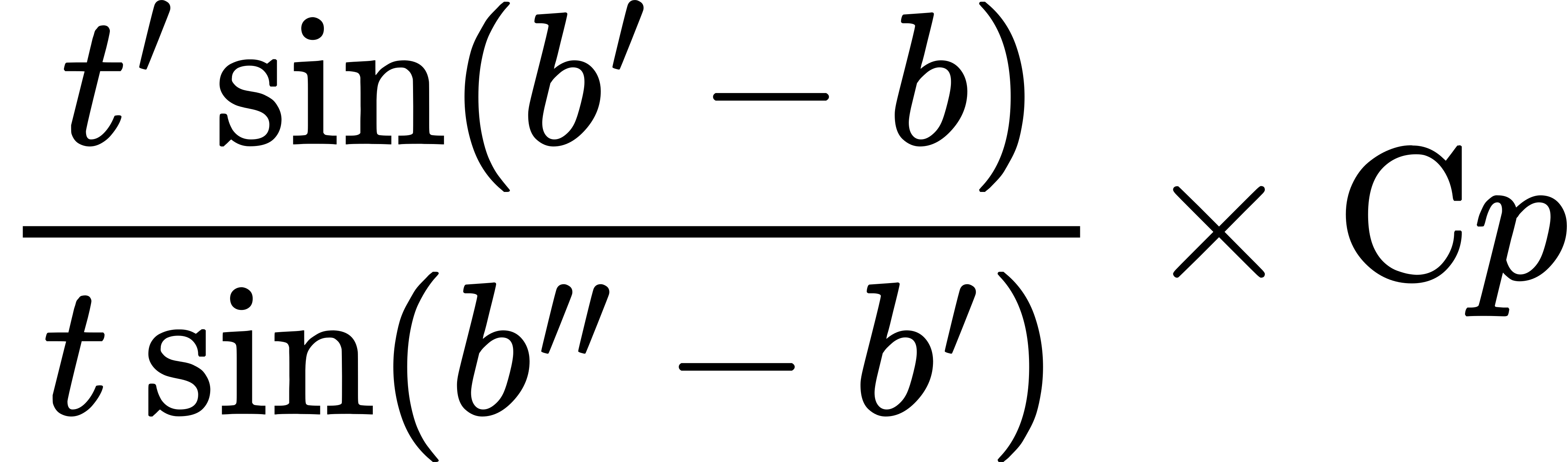 ,
and substituting for C″p″, Cp their values as found above,
,
and substituting for C″p″, Cp their values as found above,
 Reducing this expression, it becomes
 and substituting for
 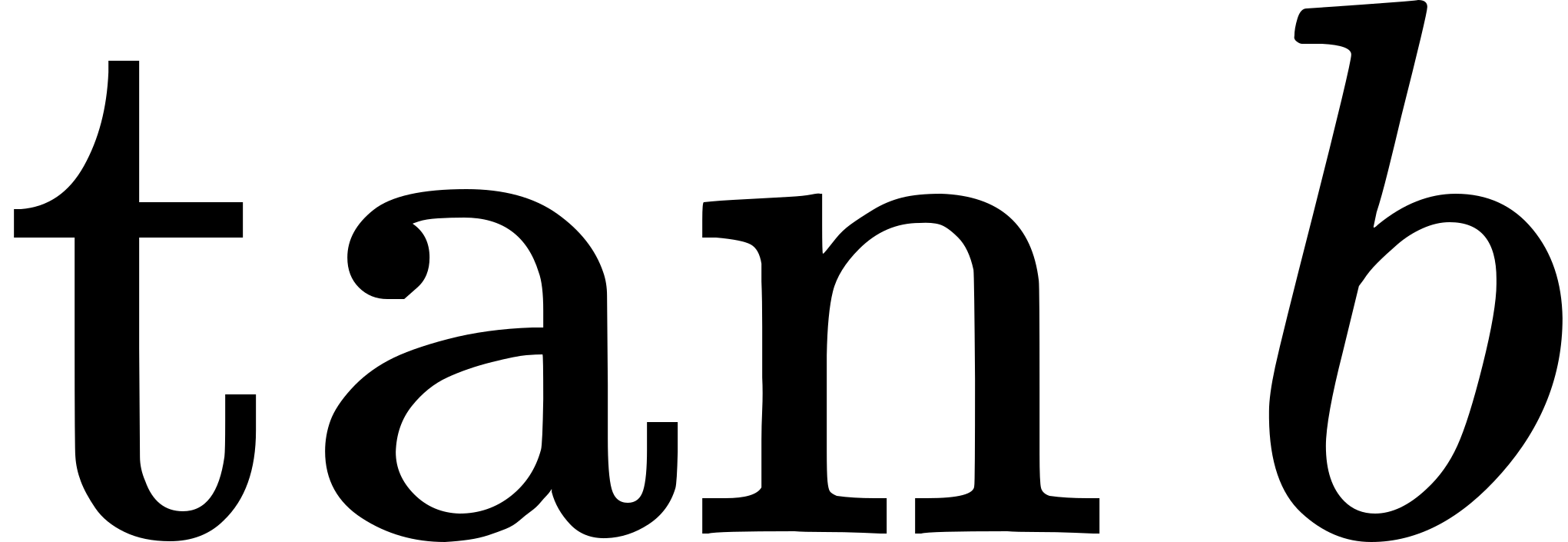 the values as found before, =
 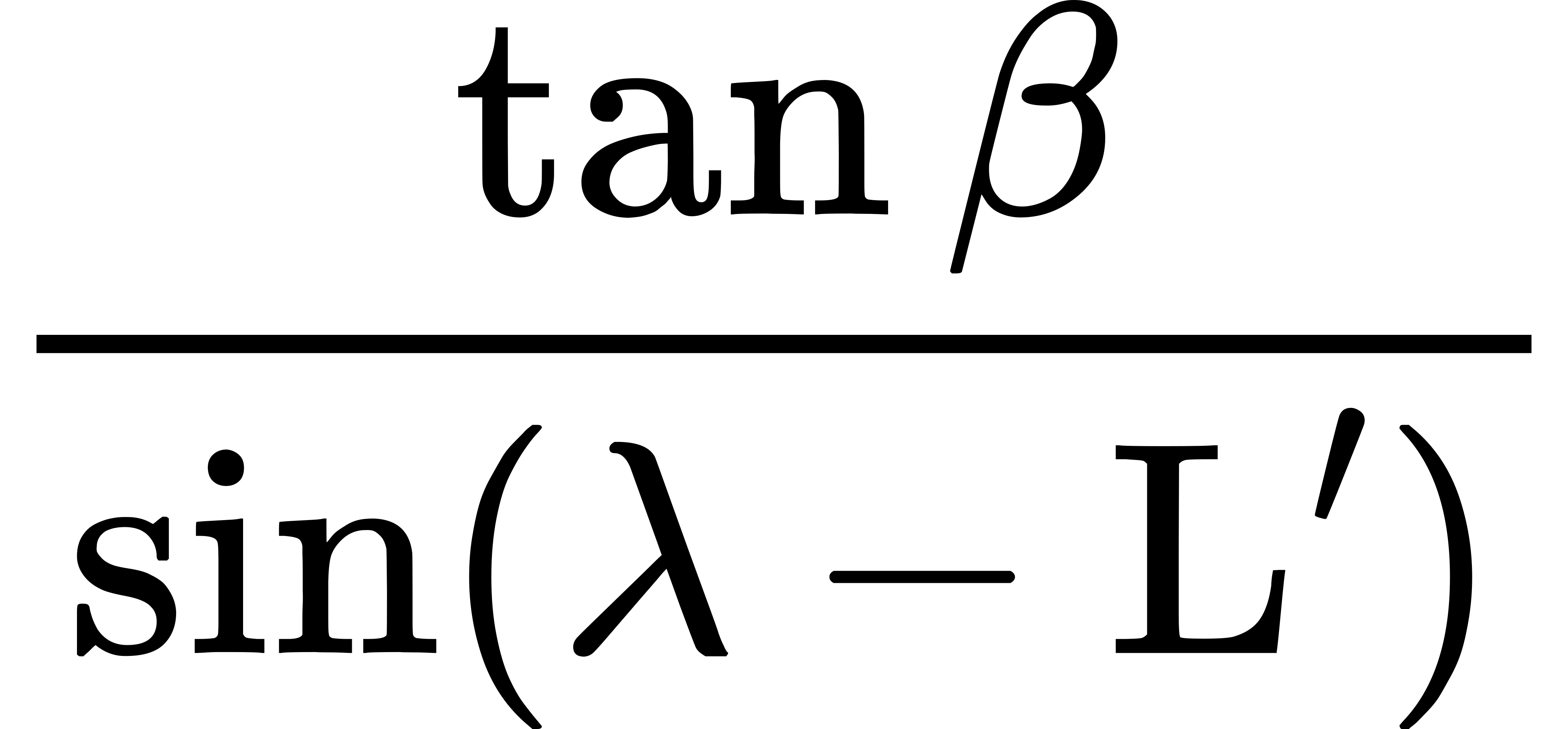 , we obtain finally

Such is the ratio of the curtate distances of the Comet from the Earth
in the first and third observations. In order to determine the real distances
themselves between the Sun and Comet, join (in Fig. 2.) SC″; call SC″ = r″,
and SE = R: Then, since C″p″ is perpendicular to SES′, we have
C″S2 = ES2 + C″E2 + 2SE × Ep. But EC″ = 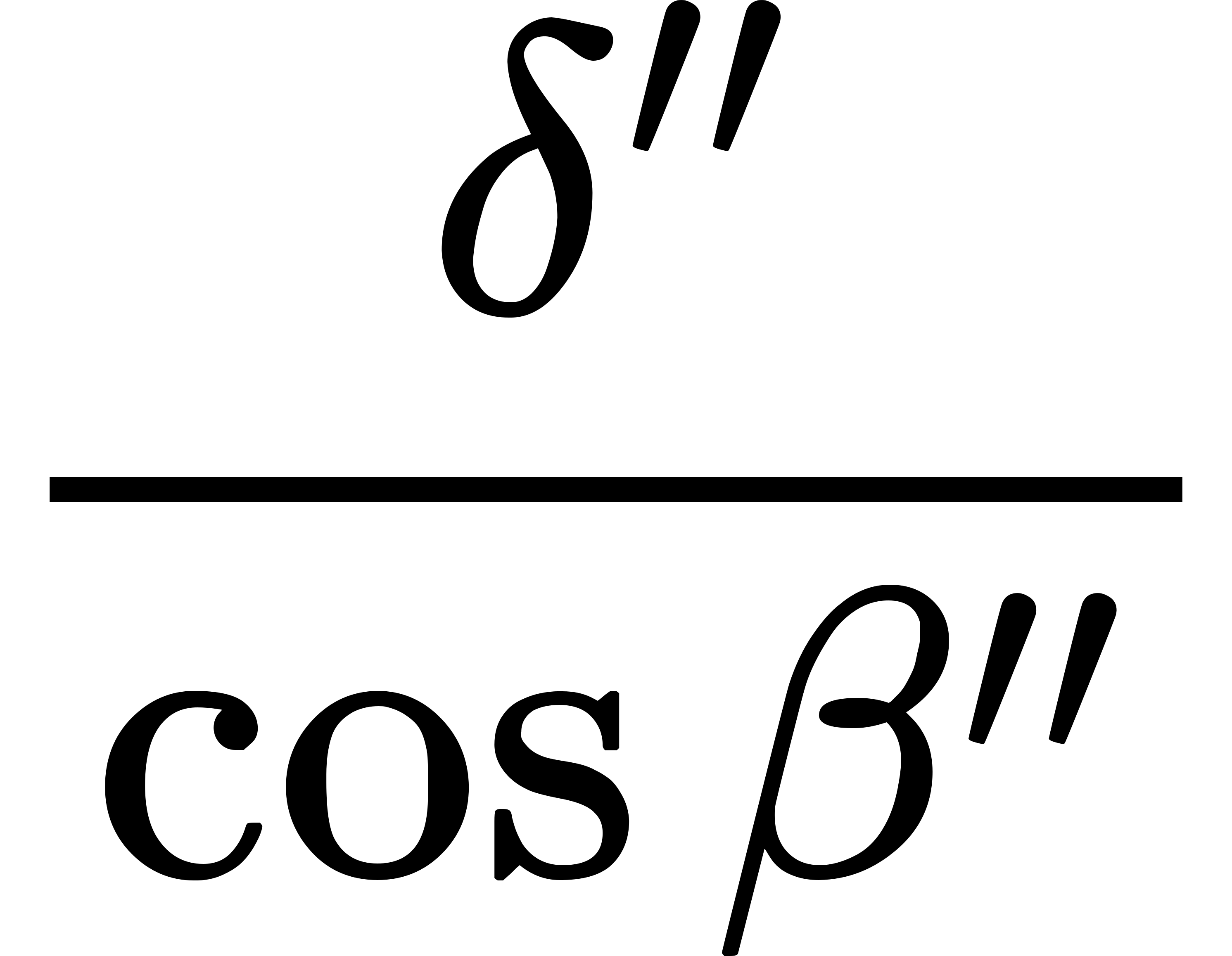 , and Ep″ = Ee″
cos C″Ep″; and therefore, since by spherics cos C″ES = cos SEc″ ×
cos C″Ec″ (the plane C″Ec″ being at right angles to SEc″), we have
Ep″ =
, and Ep″ = Ee″
cos C″Ep″; and therefore, since by spherics cos C″ES = cos SEc″ ×
cos C″Ec″ (the plane C″Ec″ being at right angles to SEc″), we have
Ep″ =  :
Therefore, we obtain
:
Therefore, we obtain
 or, as we have called δ″ = Mδ,
 and in like manner,

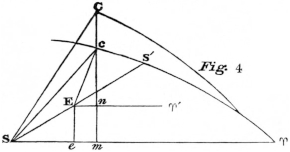
We have next to determine the length of the chord CC″ joining
the extreme points in which the Comet has been observed. And for
this purpose, we first find the position of the comet relative to the sun,
62by means of the co-ordinates x, y, z. In Fig. 4. draw cm and Ee
(where c is the curtate place of the Comet, E the Earth, S the
Sun, and C the Comet in its orbit,) perpendicular to 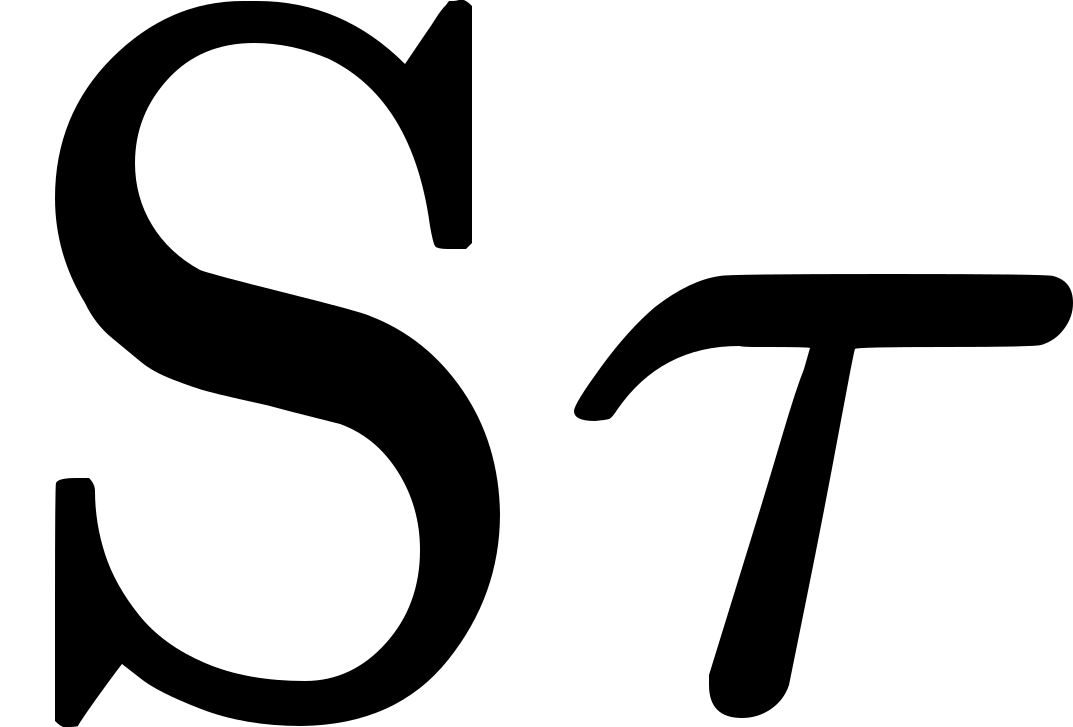 : Then
Sm will represent x, mc = y, and Cc = z.
It is evident, that
: Then
Sm will represent x, mc = y, and Cc = z.
It is evident, that
 , and so also
 ;
and hence, if
;
and hence, if 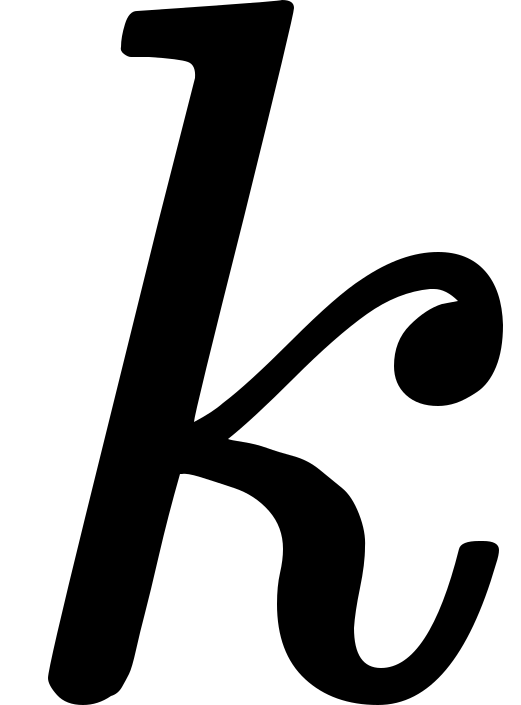 represent the chord between the radii vectores
 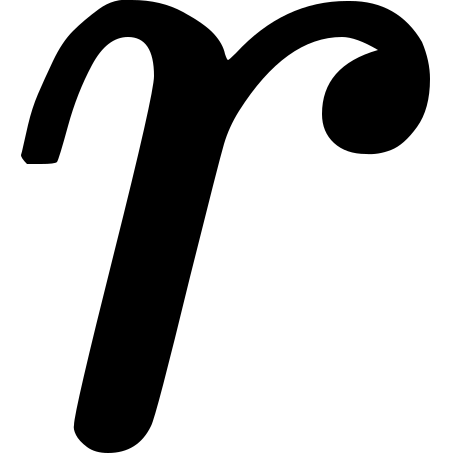 ,
, 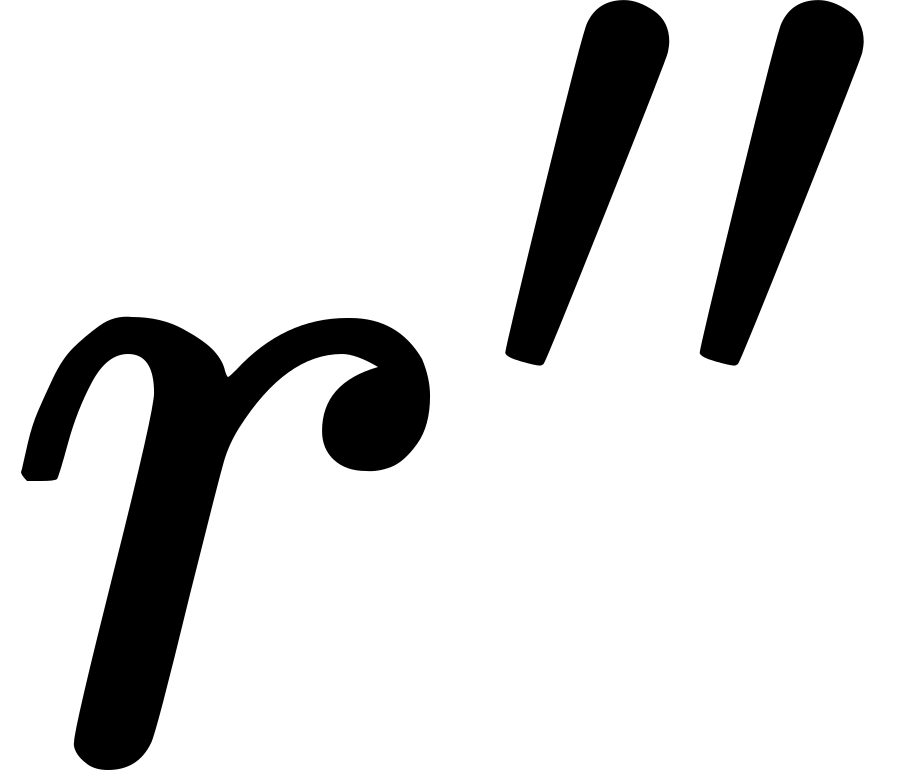 ,
,
 , by reduction, and substituting
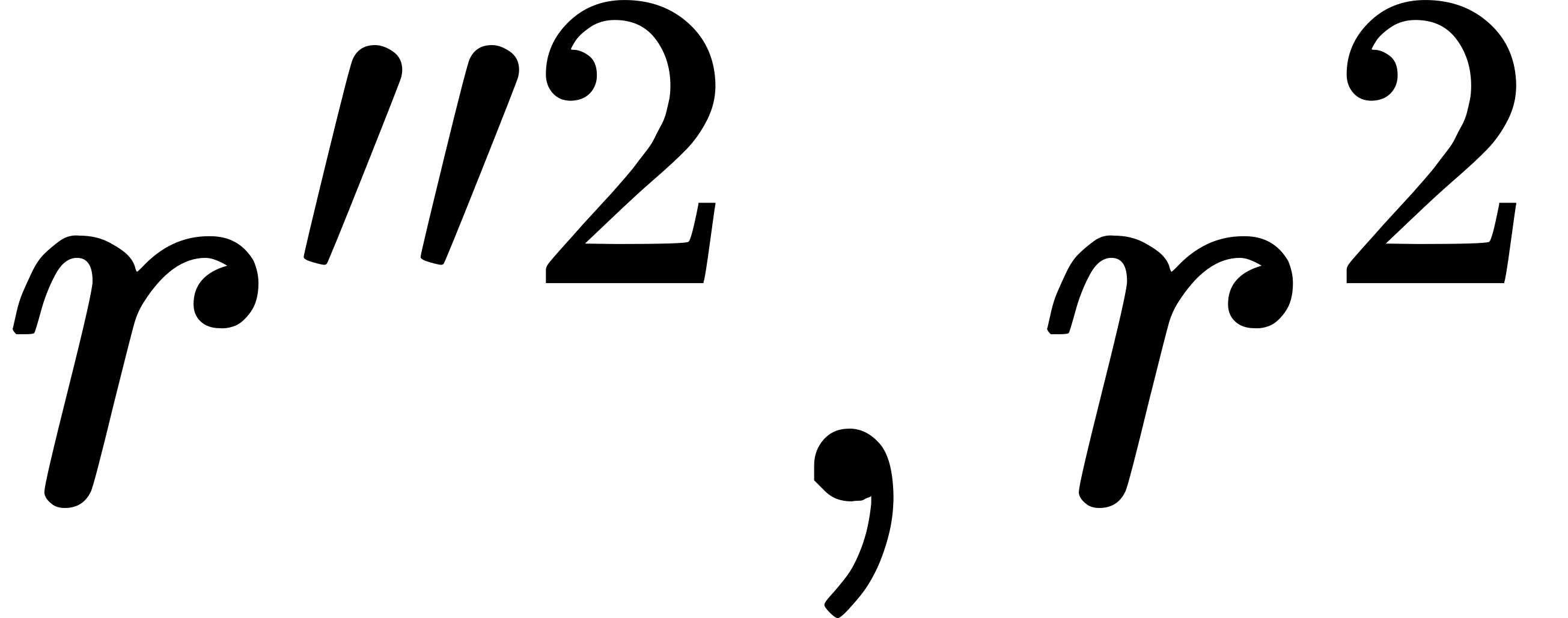 for their values. But we see that
 ; z =
; z = 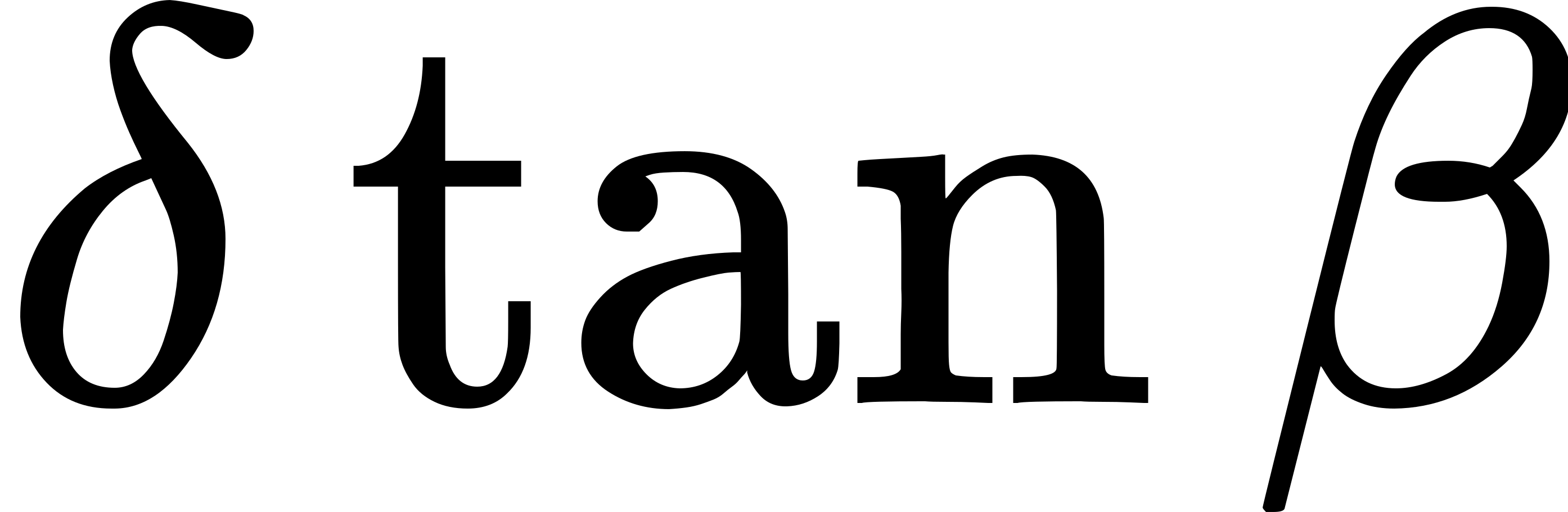 ;
therefore, substituting, we get
;
therefore, substituting, we get  ; or since
 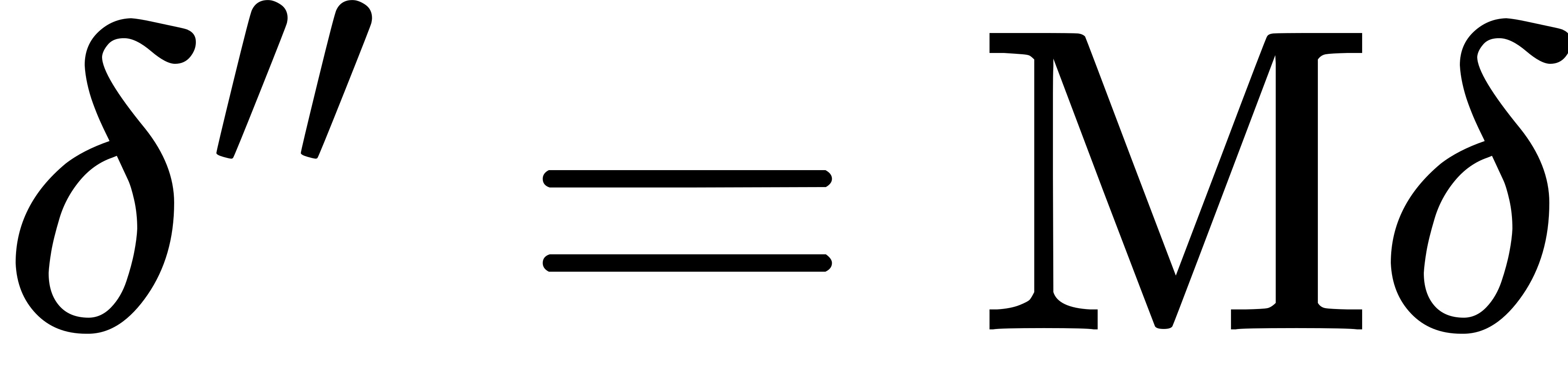 ,
,

Having thus obtained , , and , we are now to make use of them, in
the following important formula where  represents the time
which the comet has taken to move from C to C″, and
represents the time
which the comet has taken to move from C to C″, and  = the number ·017202,
 In order to demonstrate this equation, we have to compare the motion
of the comet in a parabola, with some other known motion, as that of
the earth. Let us for this purpose first suppose the comet’s perihelion
distance to be equal to the earth’s radius vector; then, from what has
been already said62, it is evident, that the velocities in the parabola and
circle will be simply as
In order to demonstrate this equation, we have to compare the motion
of the comet in a parabola, with some other known motion, as that of
the earth. Let us for this purpose first suppose the comet’s perihelion
distance to be equal to the earth’s radius vector; then, from what has
been already said62, it is evident, that the velocities in the parabola and
circle will be simply as 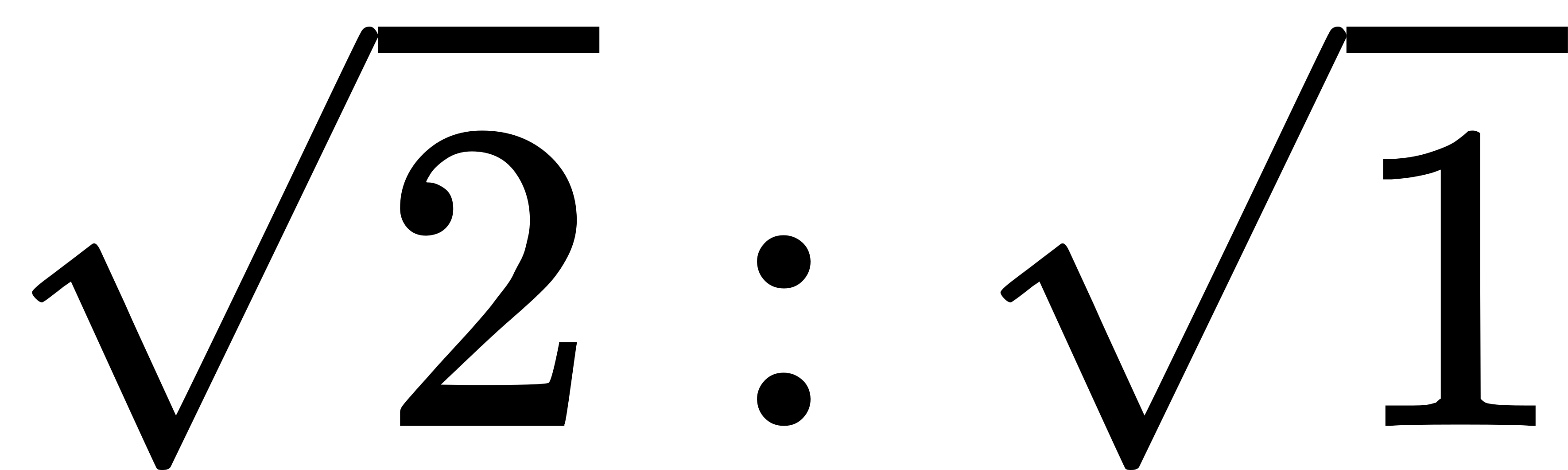 , and hence the times which the comet and
the earth respectively require, to pass over the same anomaly, (being inversely
63proportional to the velocities), will be as
, and hence the times which the comet and
the earth respectively require, to pass over the same anomaly, (being inversely
63proportional to the velocities), will be as 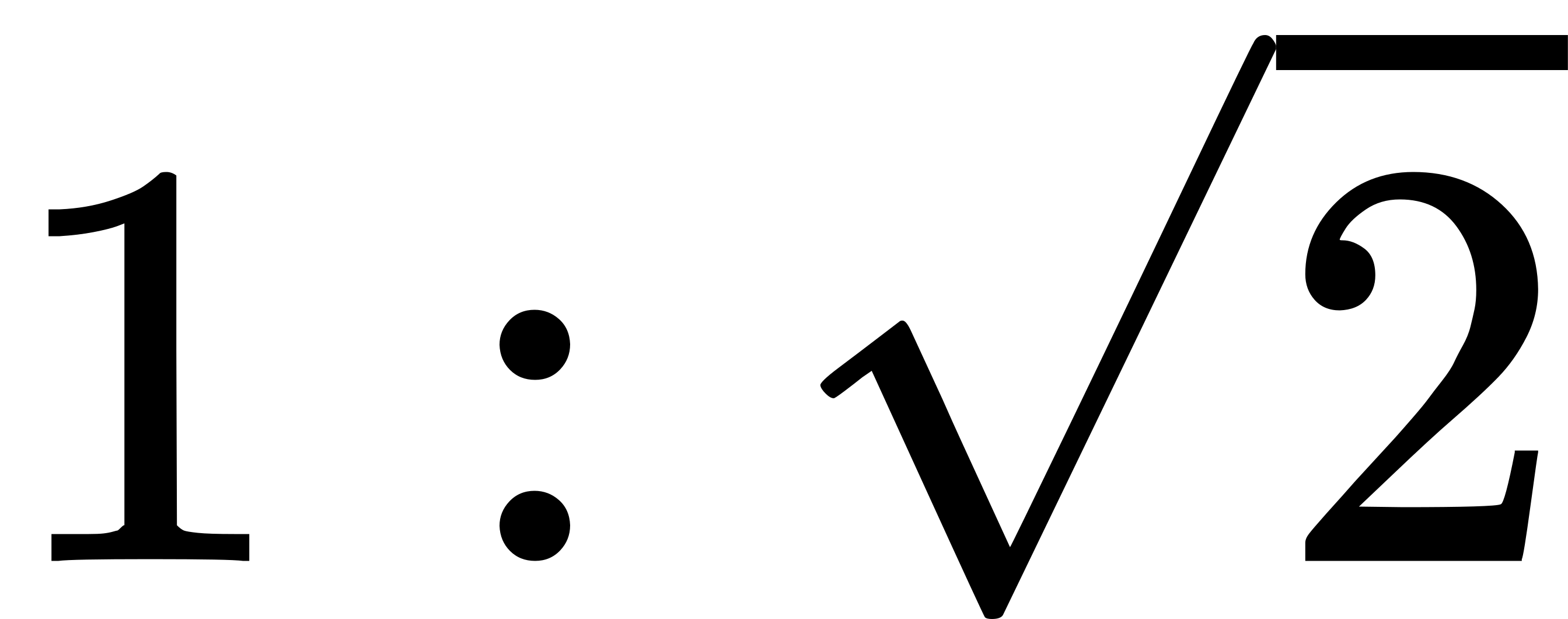 .
Since the area of the rectangular sector in the parabola is equal to
.
Since the area of the rectangular sector in the parabola is equal to 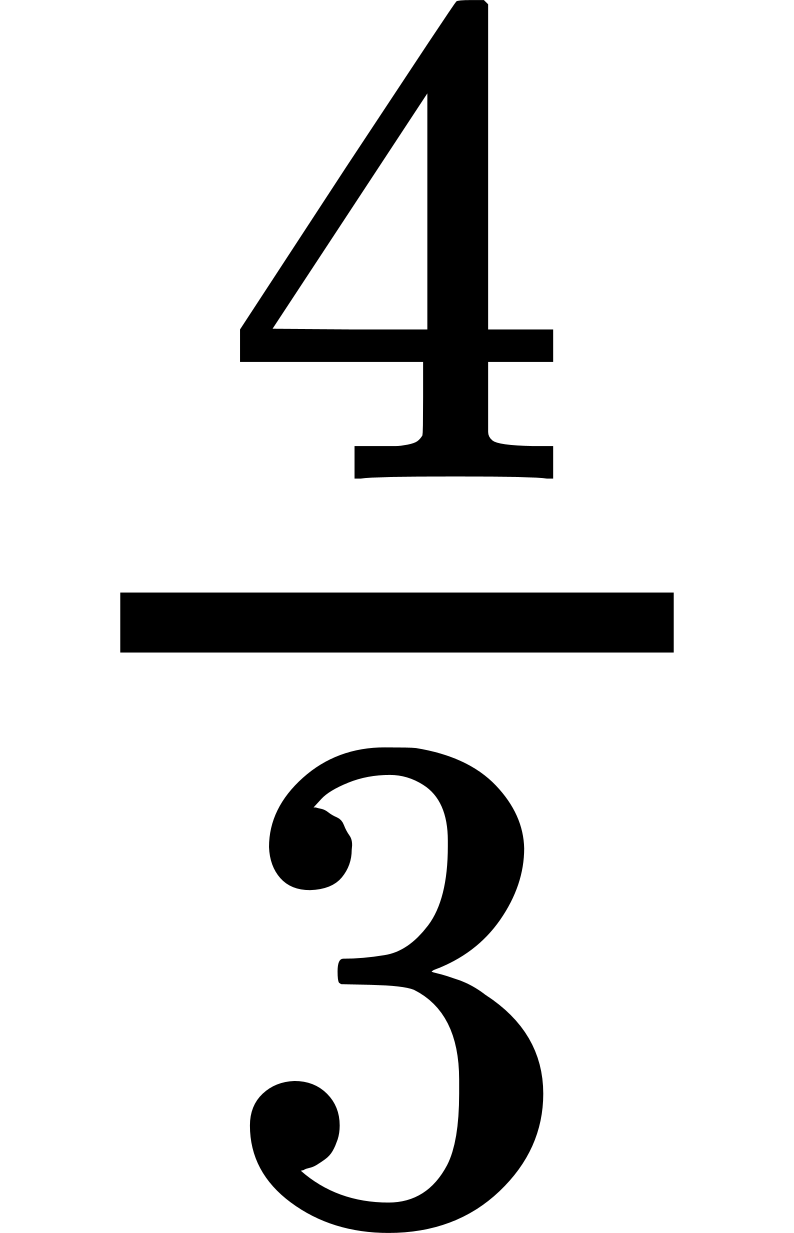 of the corresponding quadrant, we have therefore
 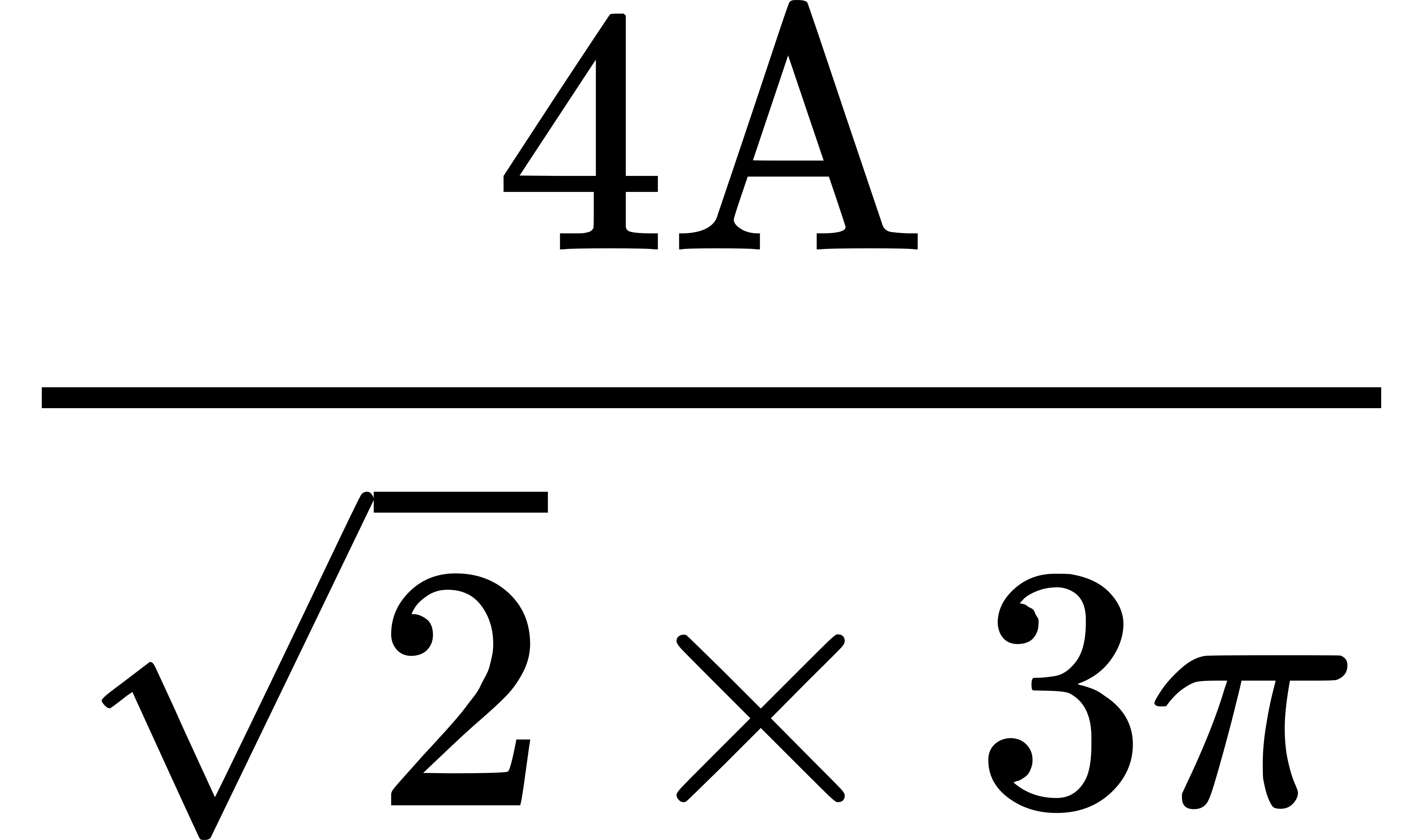 for the time which the comet will take to pass over 90° of anomaly
(where A is the length of the sidereal year, and
for the time which the comet will take to pass over 90° of anomaly
(where A is the length of the sidereal year, and 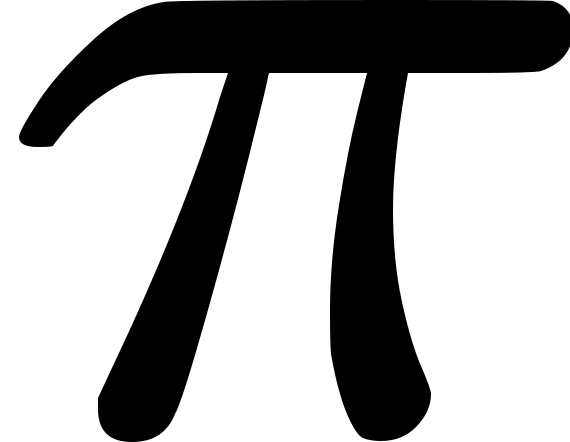 the area of a
circle whose radius =
the area of a
circle whose radius =  ). From this we are enabled to compute the time
required for describing any other angle
). From this we are enabled to compute the time
required for describing any other angle 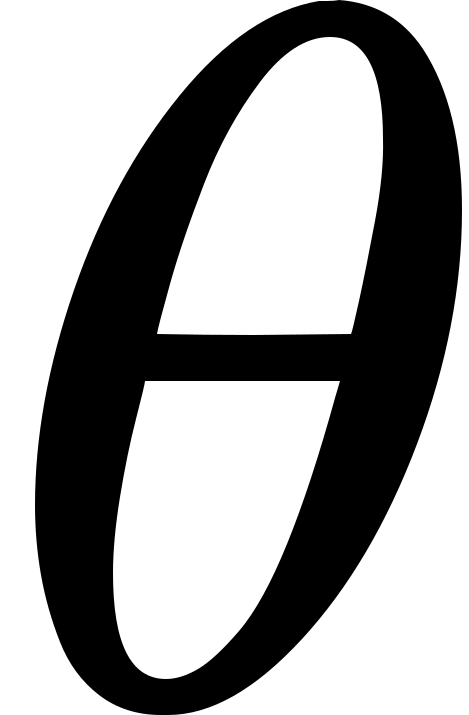 ; for as the area =
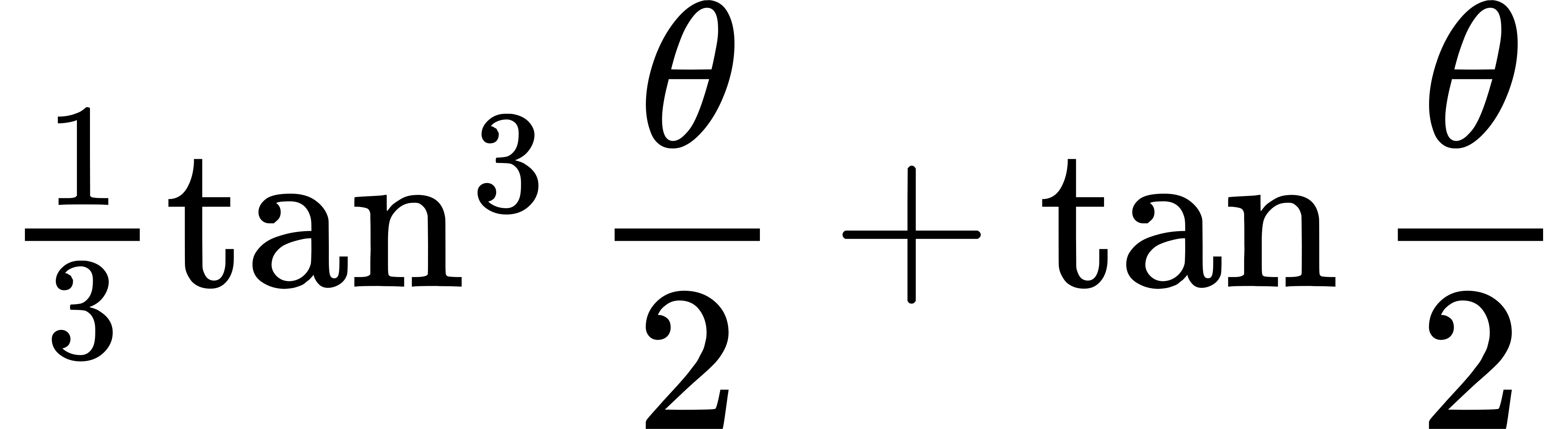 , we get
area of sector 90° : area of sector :: time of describing 90° : time of describing ; and time of describing θ, which call
, we get
area of sector 90° : area of sector :: time of describing 90° : time of describing ; and time of describing θ, which call
 63.
But as this is the time of a comet whose perihelion distance = , and as for
different parabolas the times are as the
63.
But as this is the time of a comet whose perihelion distance = , and as for
different parabolas the times are as the 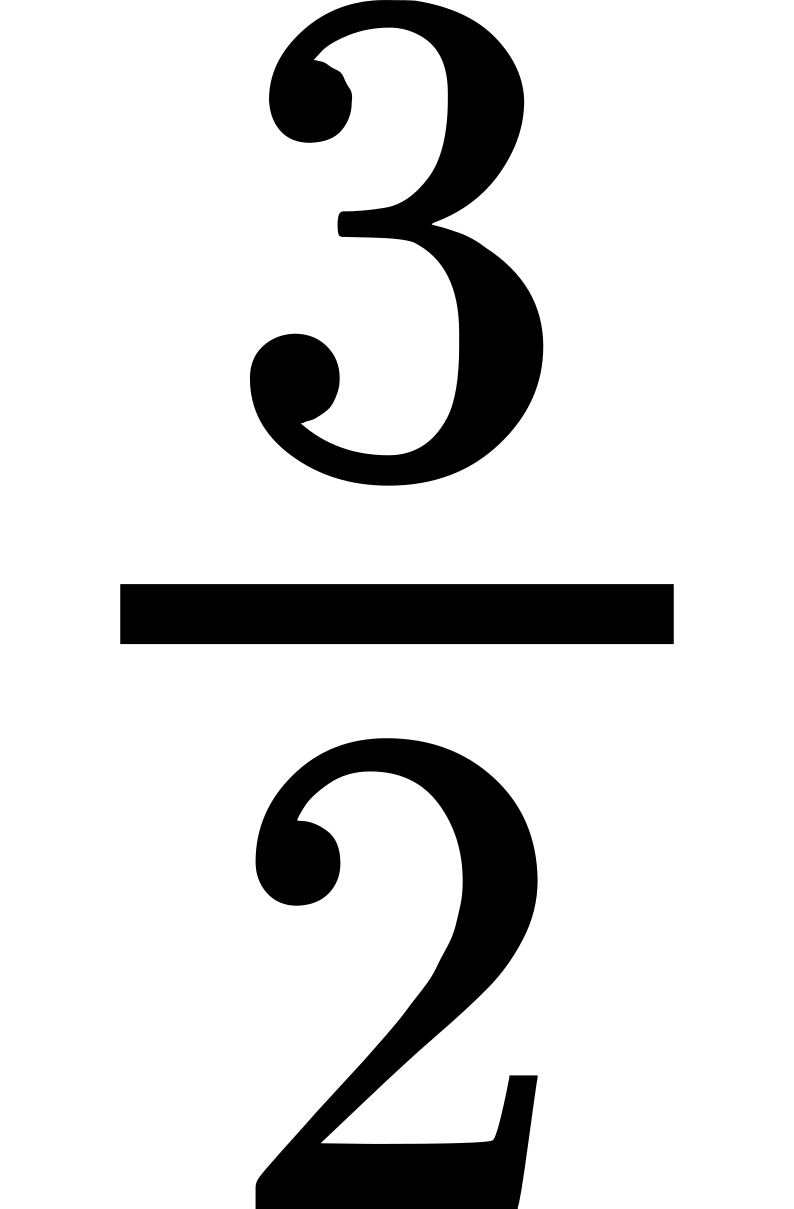 powers of D their perihelion distance,
we have for the time which any comet takes to describe the anomaly ,
powers of D their perihelion distance,
we have for the time which any comet takes to describe the anomaly ,
 .
Now, if
.
Now, if 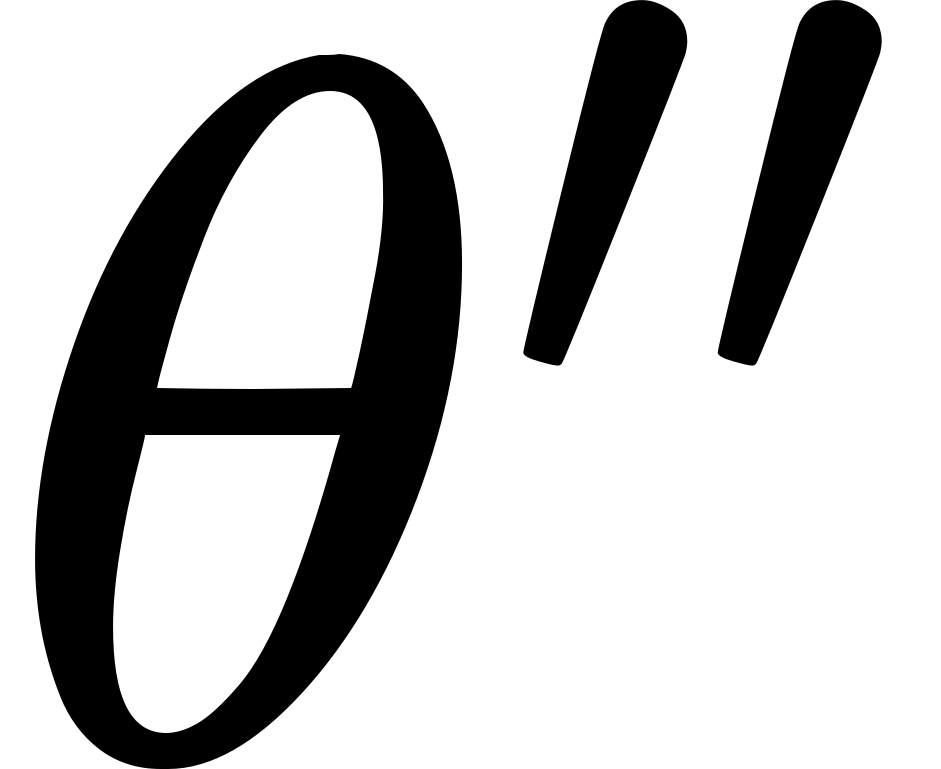 be the anomaly corresponding to the radius vector r″ at the time of the third observation,
we have in like manner
be the anomaly corresponding to the radius vector r″ at the time of the third observation,
we have in like manner
 ; but it will be found that
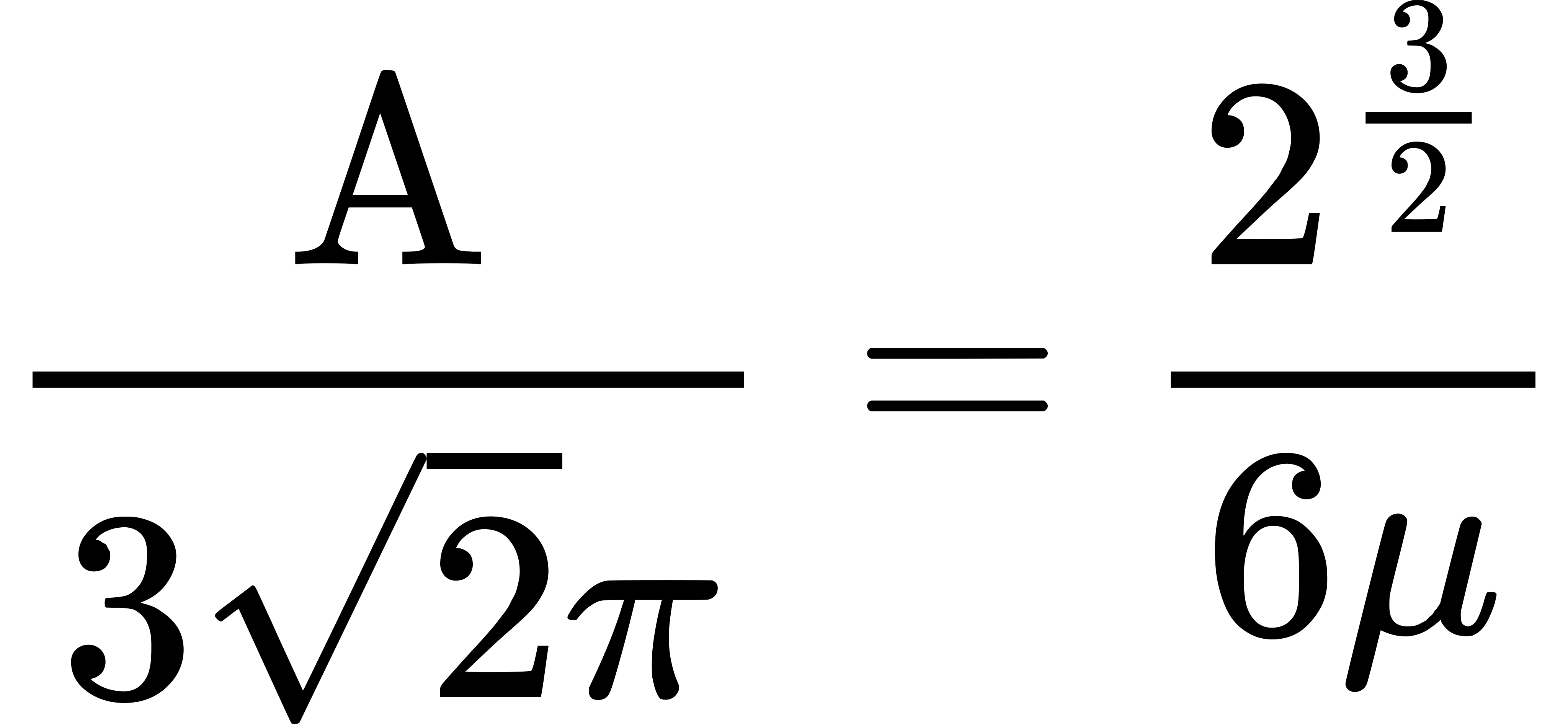 , since A = 365.25 =
  ; hence,
 But, by a fundamental property of the parabola,
 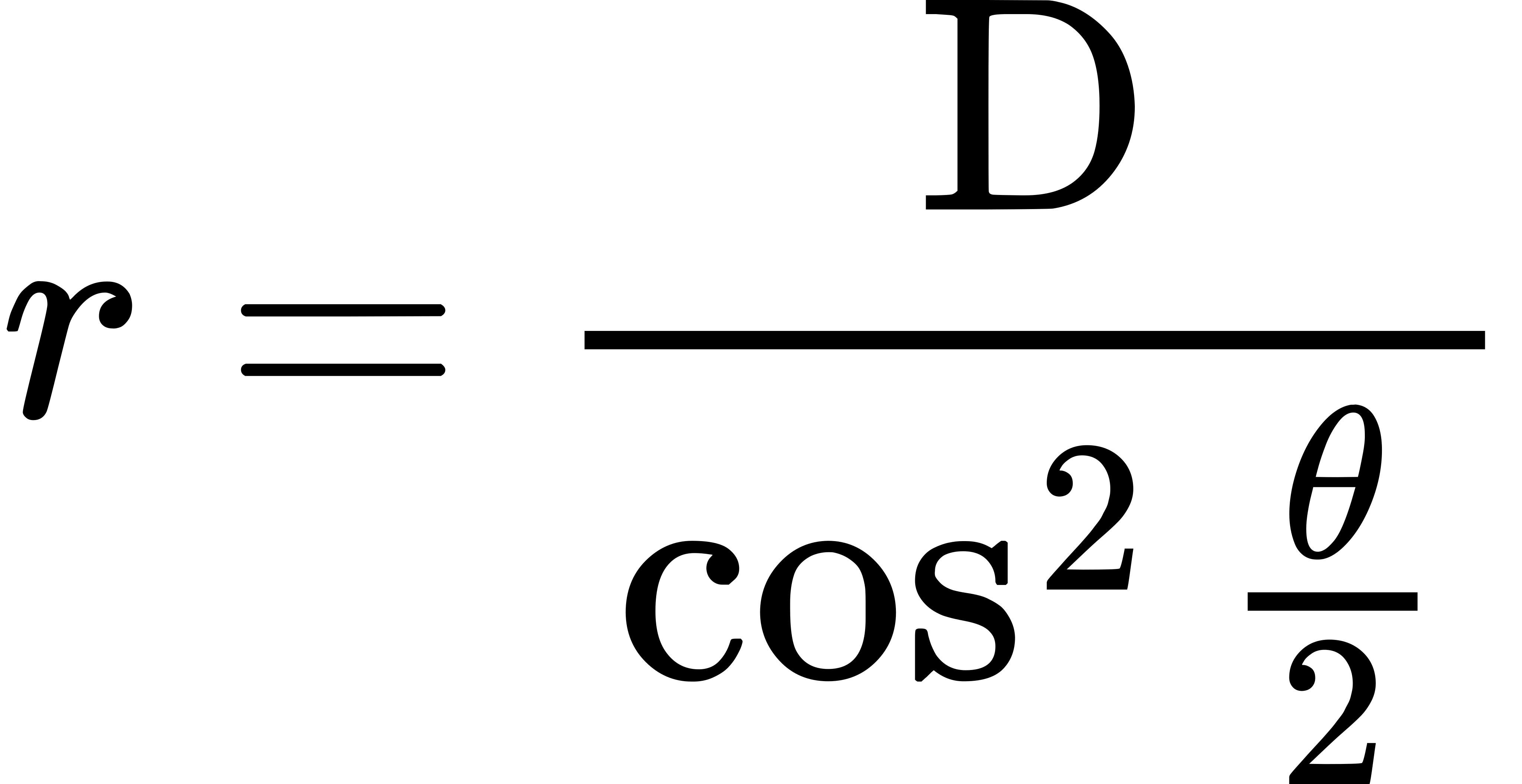 and
and 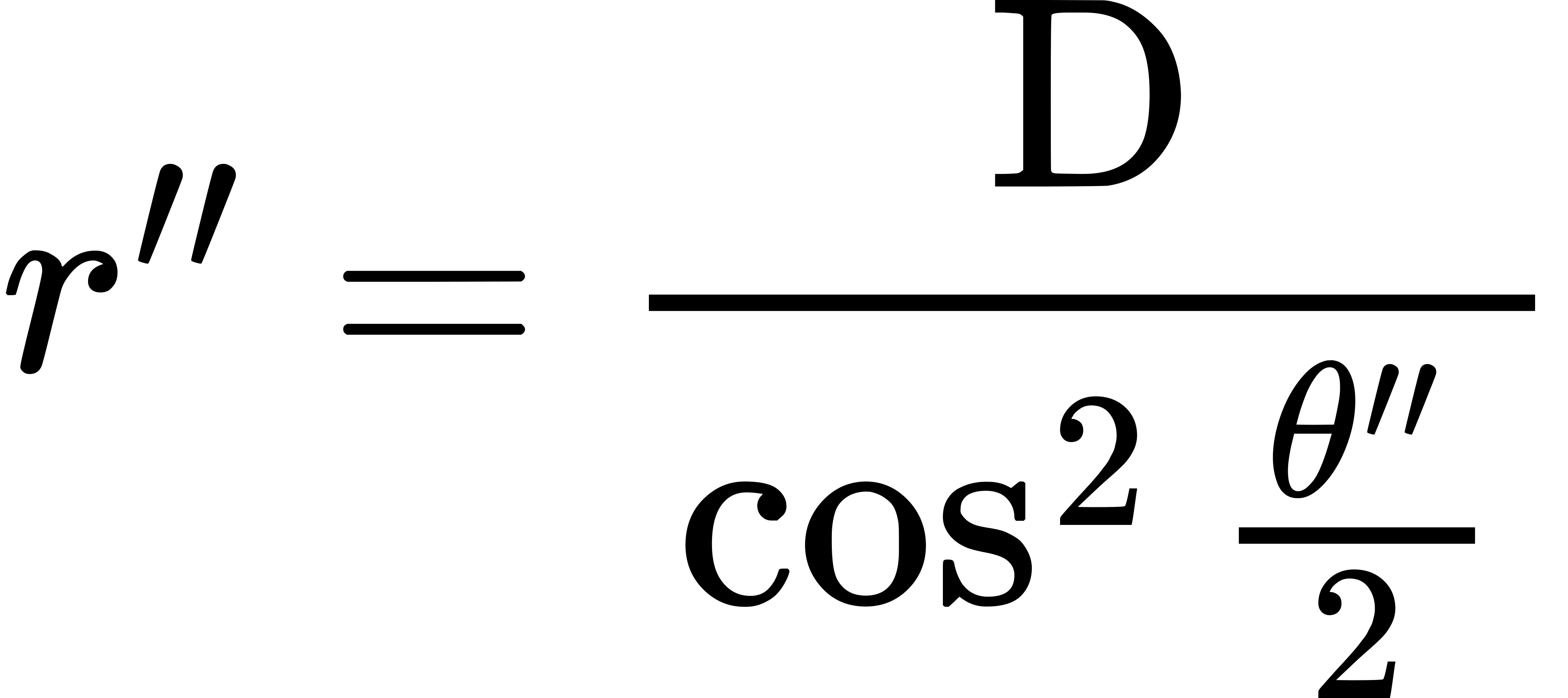 ,
whence, by a mutual division, and substituting
,
whence, by a mutual division, and substituting 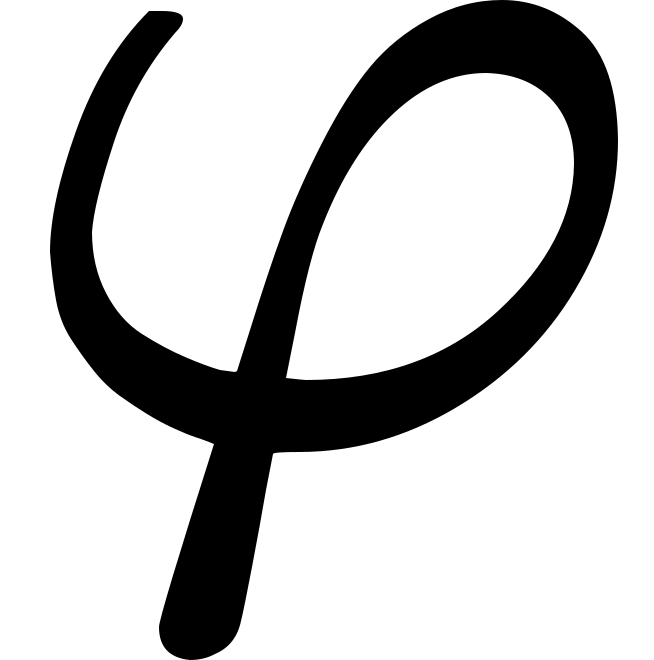 for
for 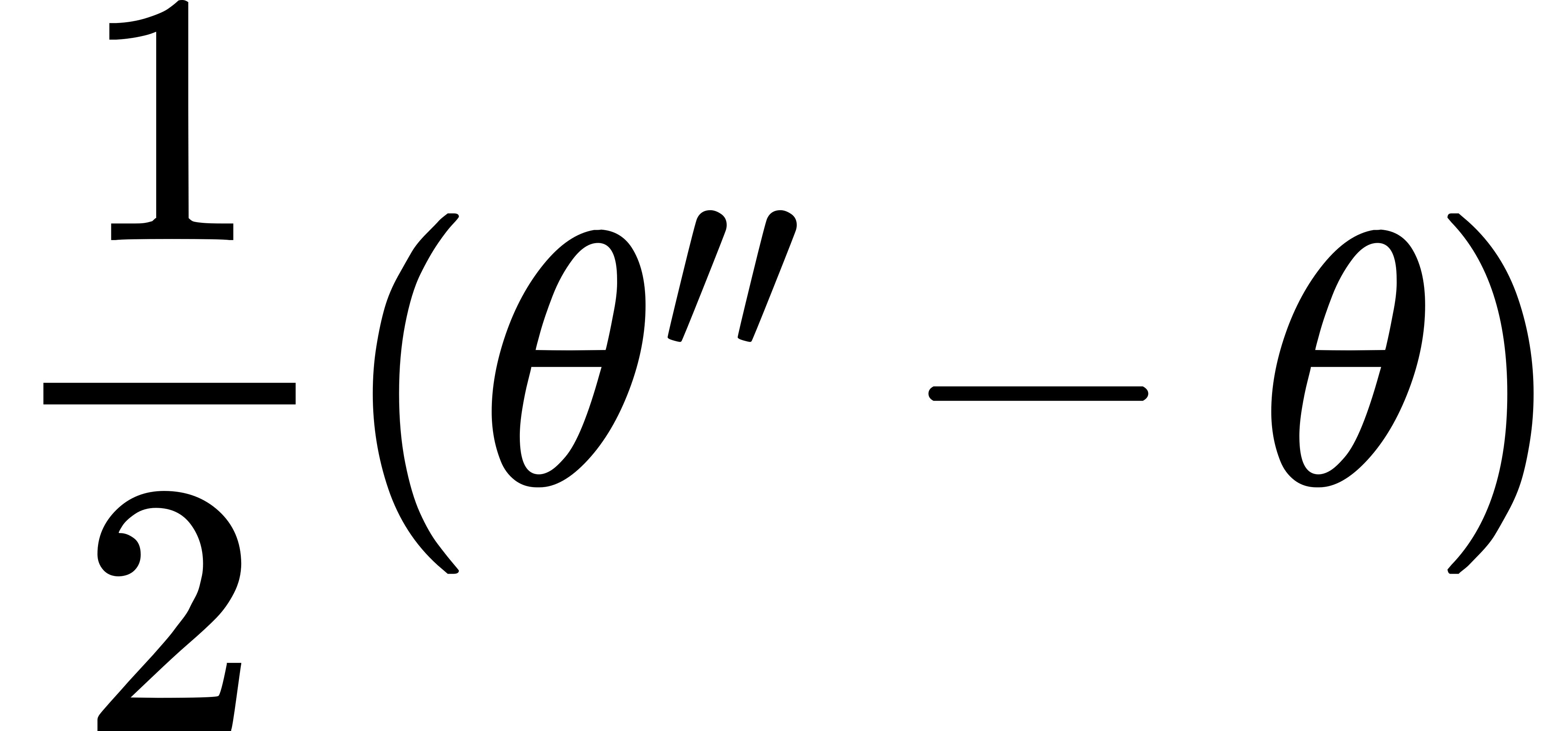 , we have
64
, we have
64
 ; therefore we get finally
 But k being the side of a triangle opposite to the angle
 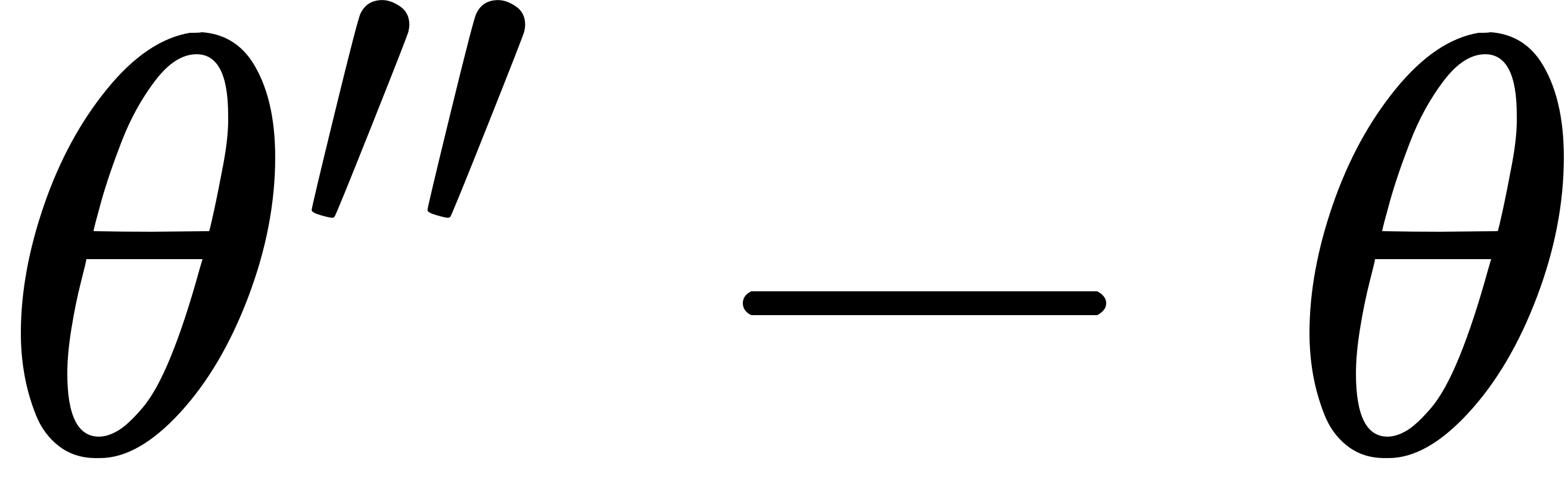 or 2, and
r, r″ the sides adjacent, we have, by trigonometry,
or 2, and
r, r″ the sides adjacent, we have, by trigonometry,
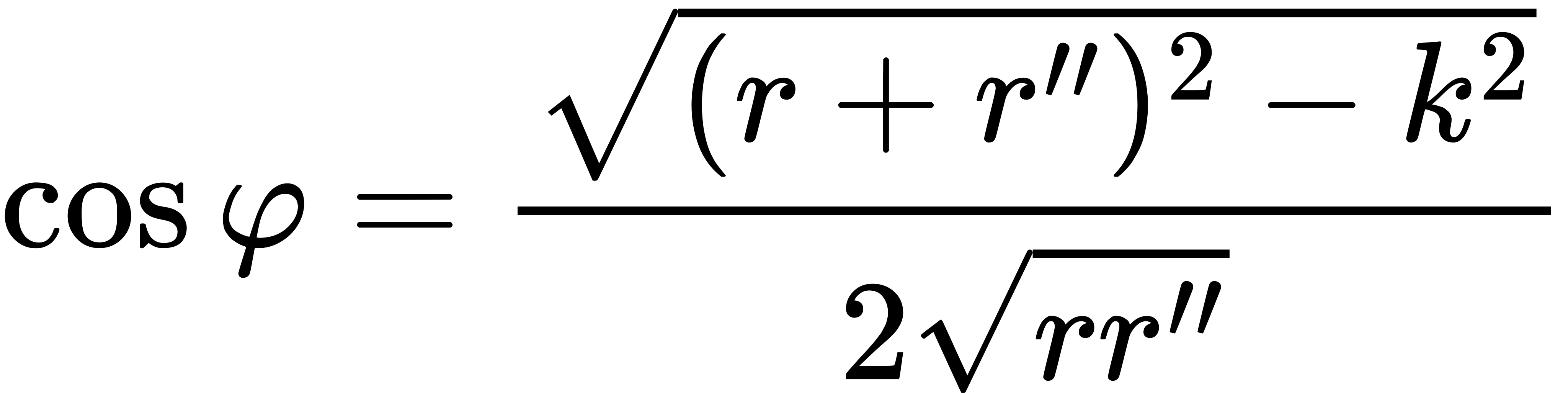 , and
, and 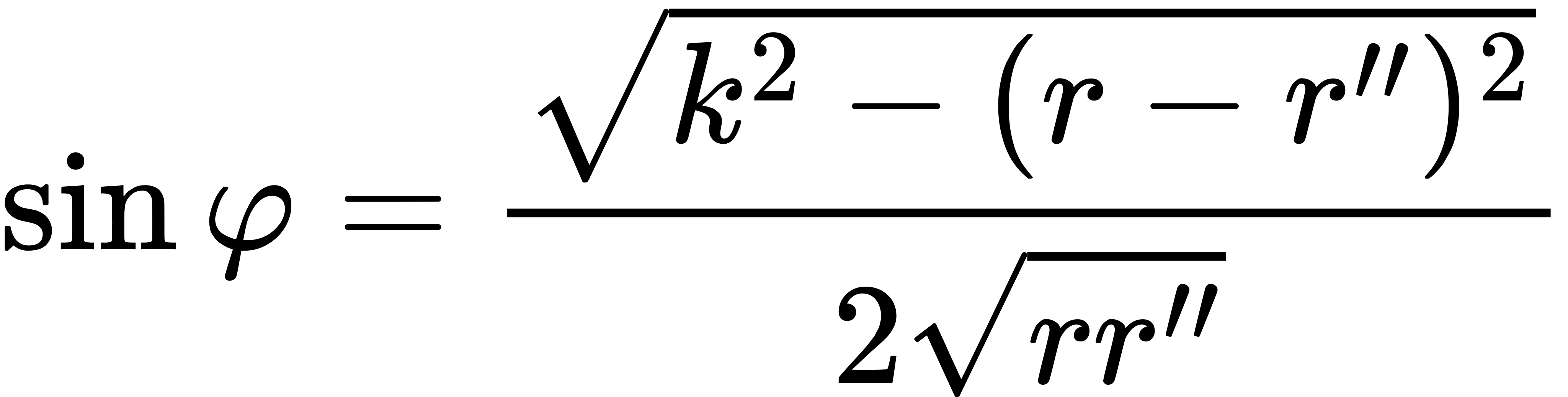 ; or, putting R for
 , and S for
  ,
, 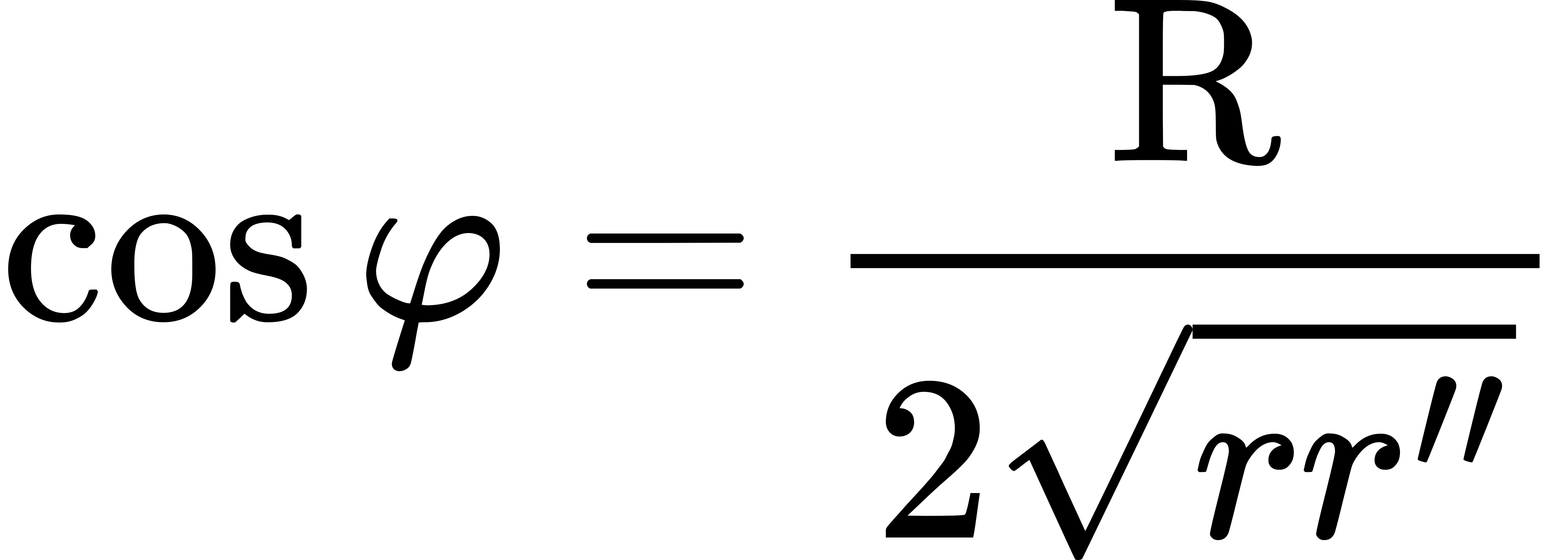 ,
, 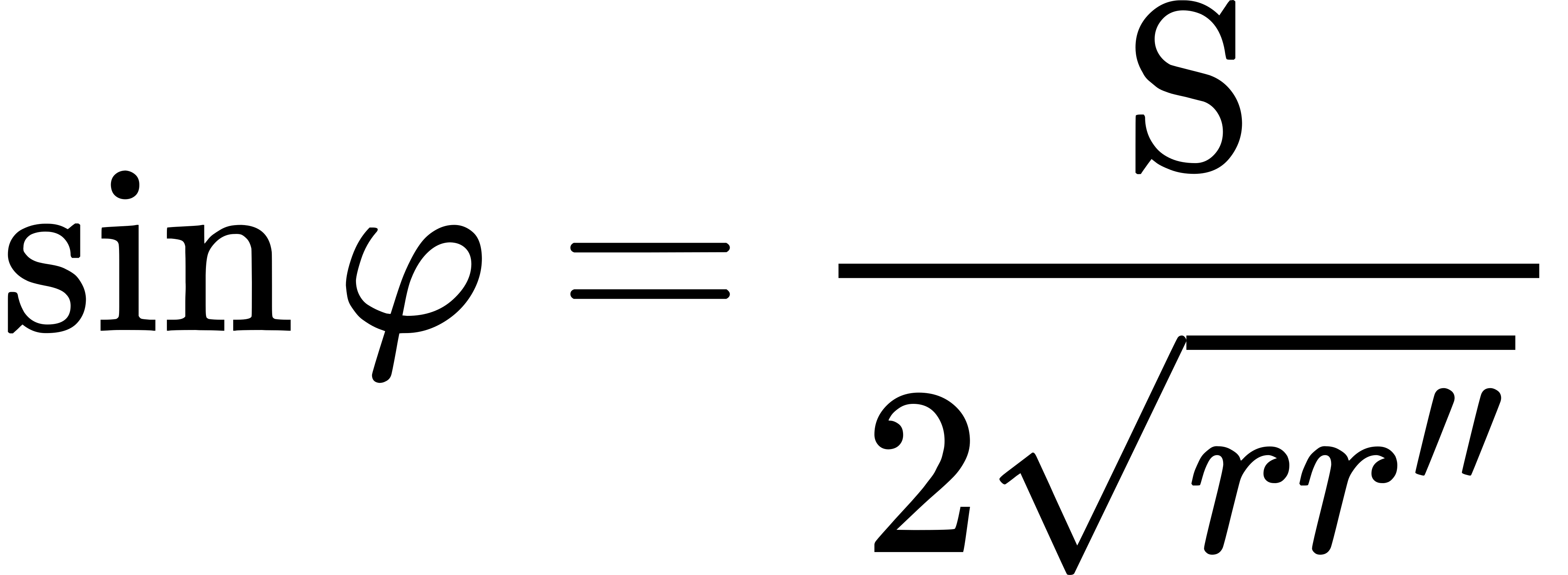 ;
hence we find
;
hence we find 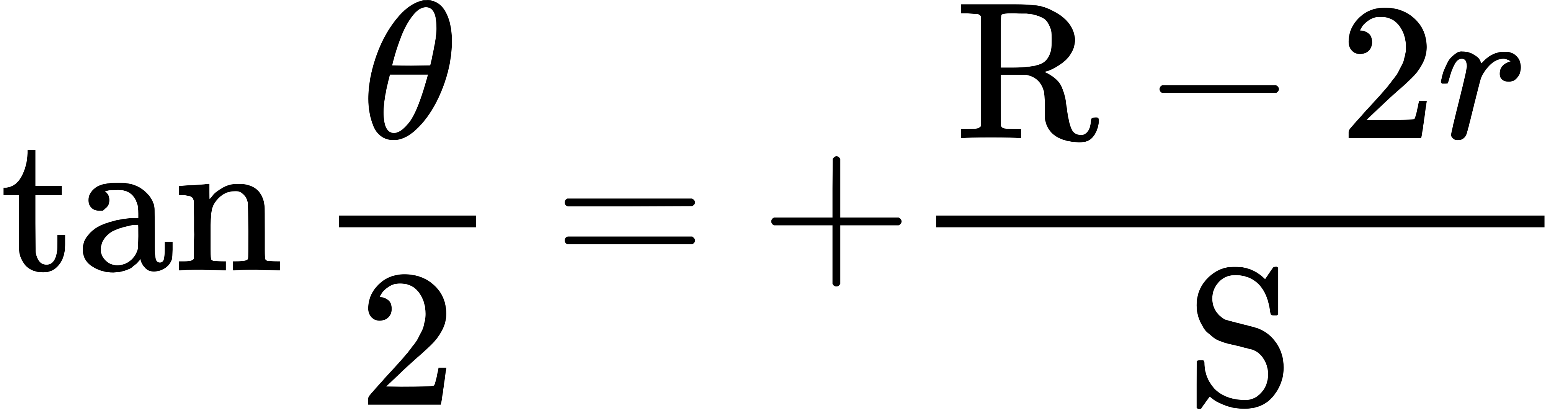 , and
, and 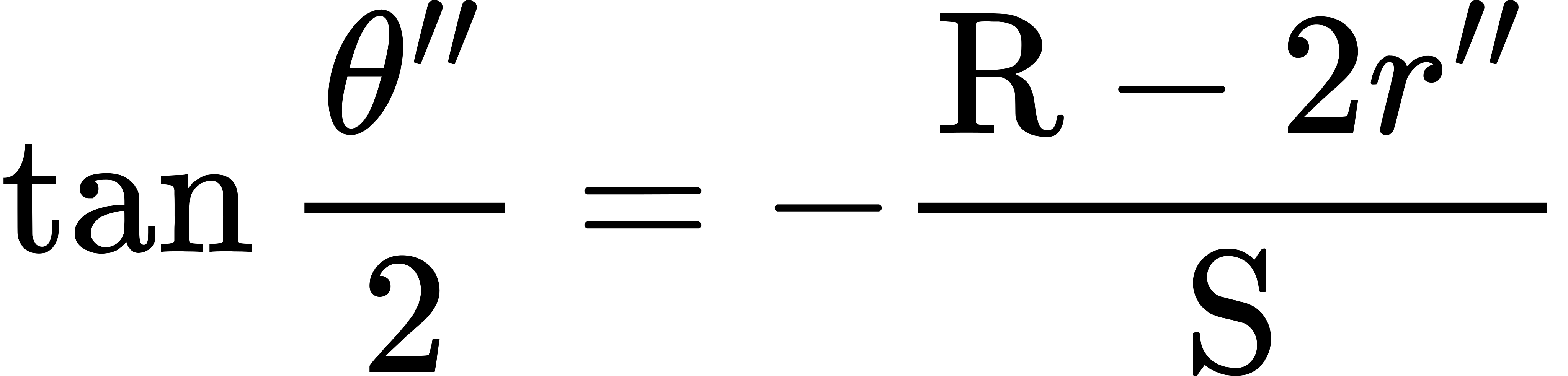 ; consequently,
 ; and by substitution,
  .
But
.
But  ; therefore
 , and consequently,
  .
Now,
.
Now,  ; so that
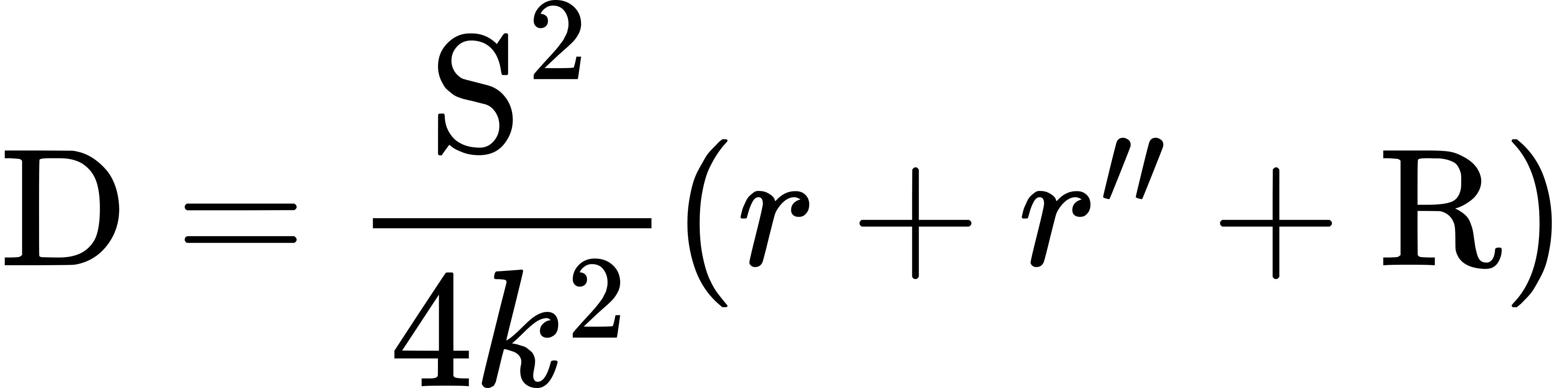 ; and therefore
 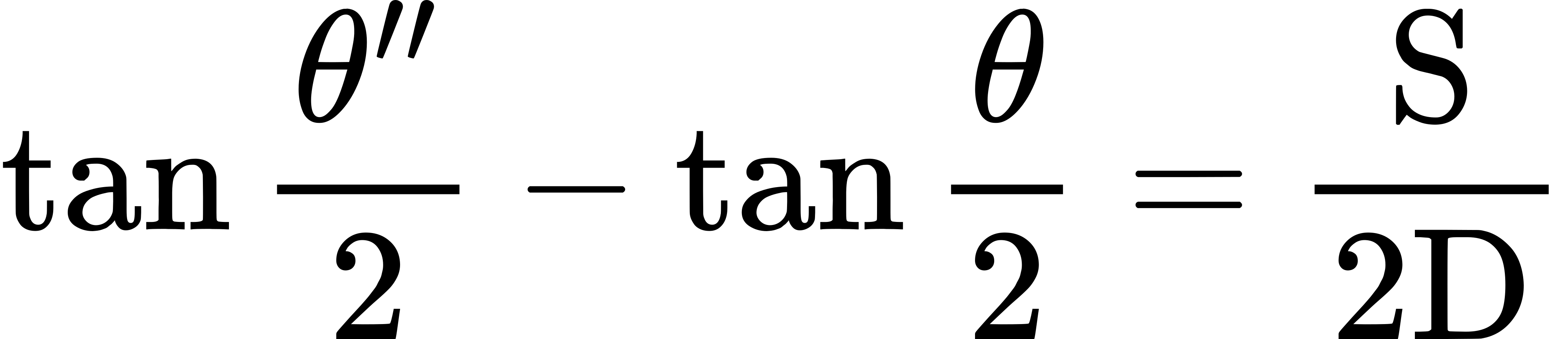 .
Multiplying each side of this last equation by
.
Multiplying each side of this last equation by 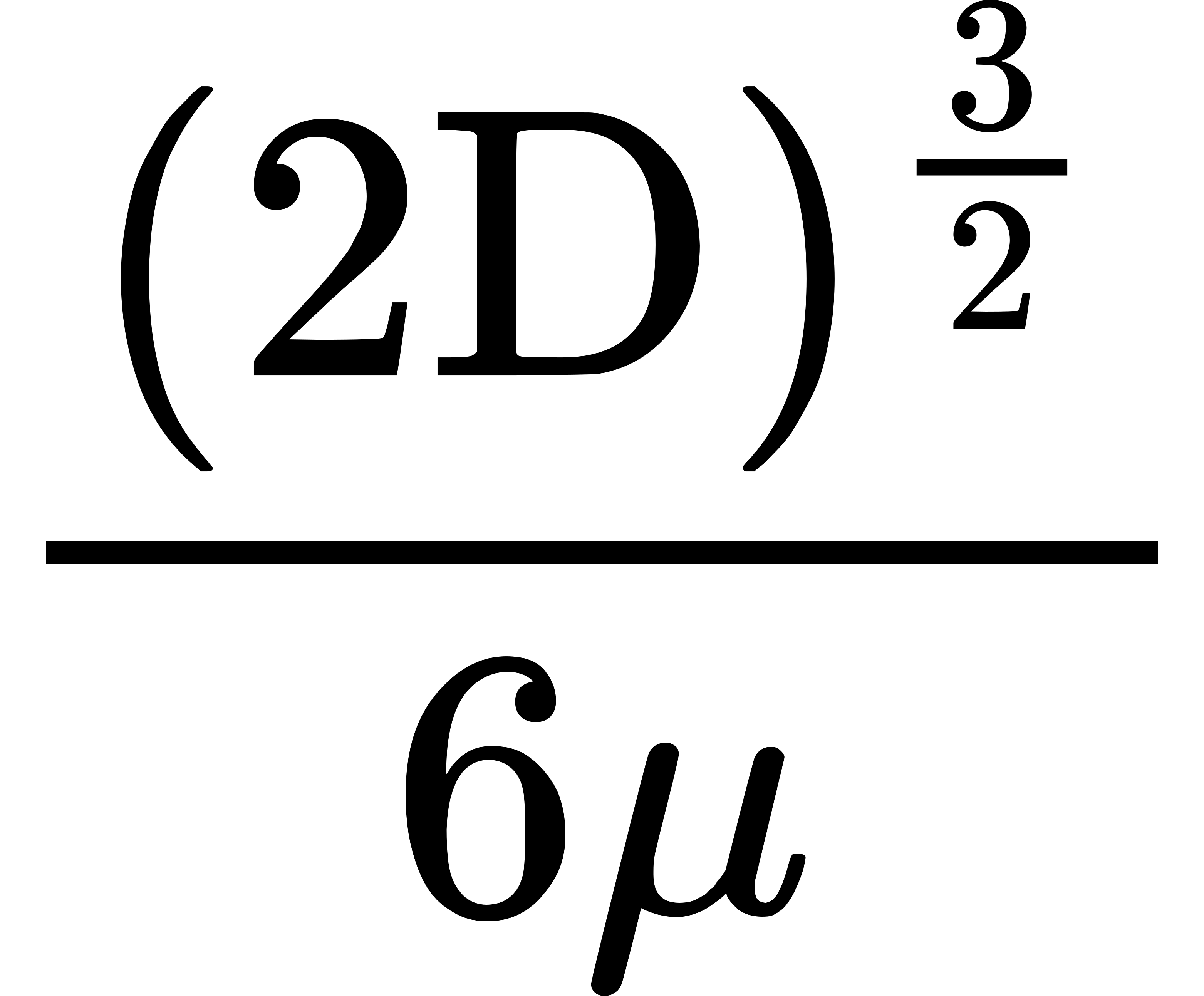 , we have
 Now, if we put T, T″ for
 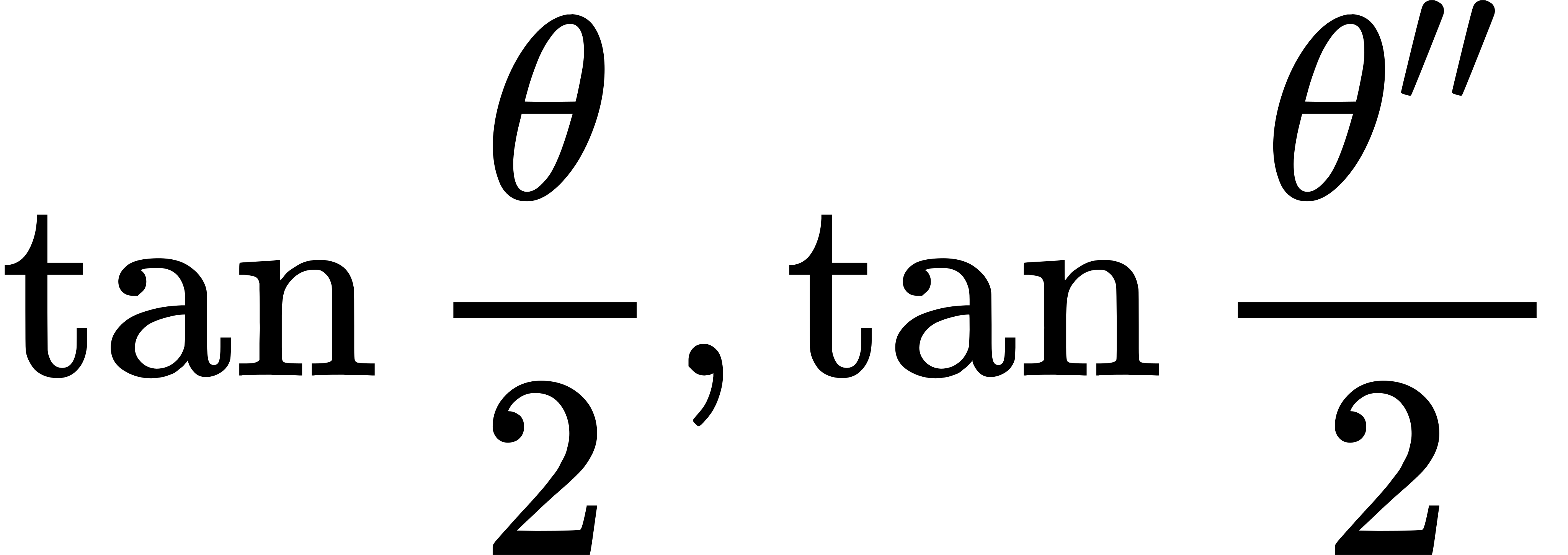 , we have, from equation (5.), seeing
that
, we have, from equation (5.), seeing
that 
 The part
 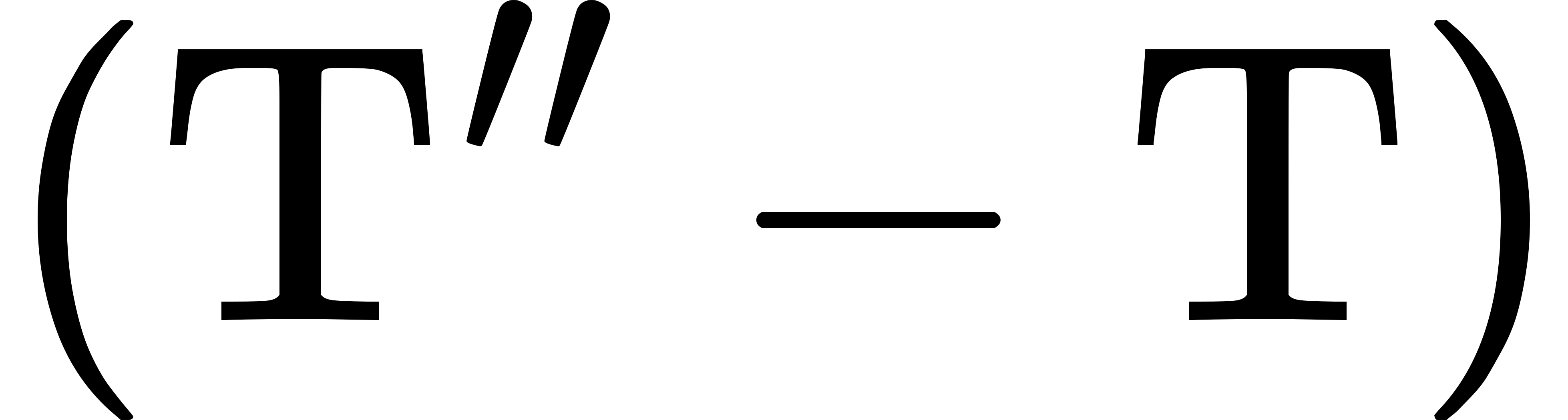 has already been considered, let us now examine the part
following
has already been considered, let us now examine the part
following  . If, then, in this expression, we substitute
for
. If, then, in this expression, we substitute
for 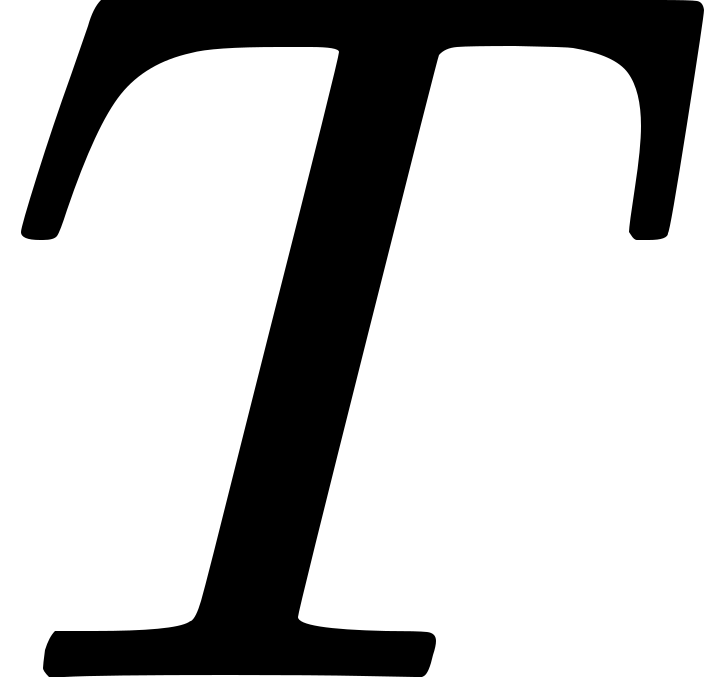 ″ and their values found before,
 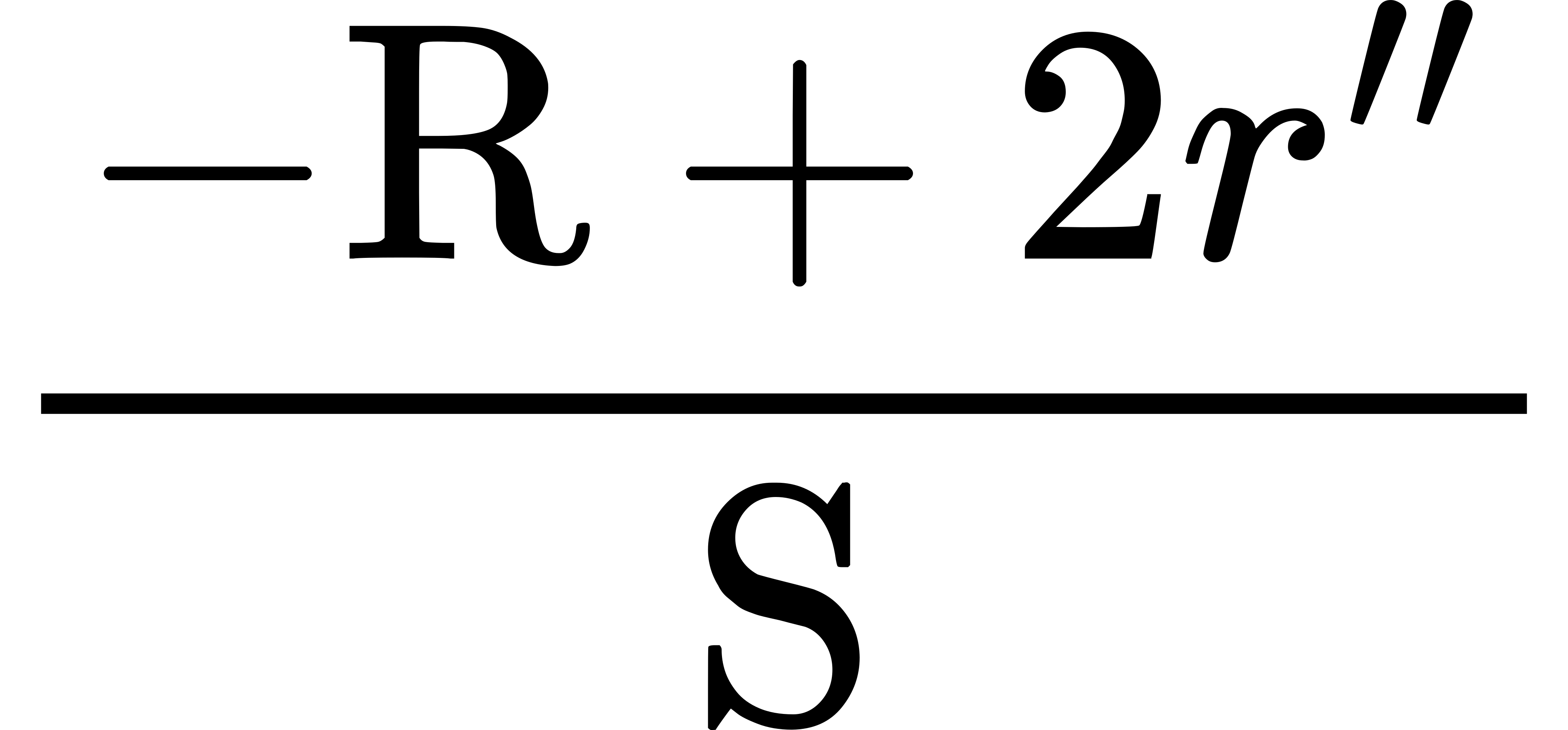 , and
, and 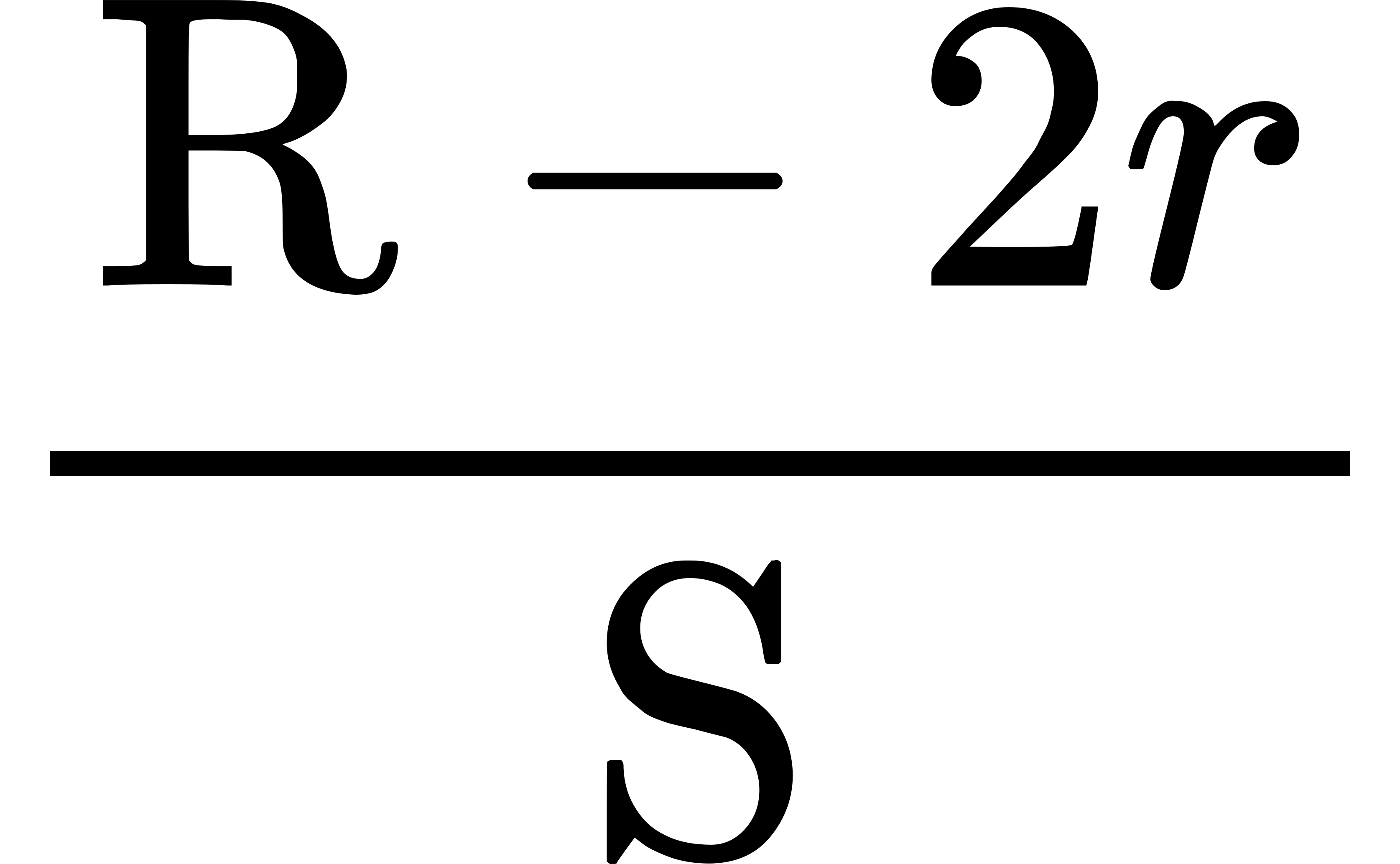 , it becomes
65
, it becomes
65
 ; but
; but  (as above)
=
(as above)
=  ; hence
  ,
so that the expression reduces itself to
,
so that the expression reduces itself to
 therefore, since it has been shewn that
  ,
we have
,
we have
 But
But  because
  ; hence,
 Now,
Now,  , so that the two radicals in this expression are of
the form
, so that the two radicals in this expression are of
the form  , putting
  for
for  . Hence, the usual rule for
extracting the root of a binomial surd applies to them, the root being, as is
shewn in all books of algebra,
. Hence, the usual rule for
extracting the root of a binomial surd applies to them, the root being, as is
shewn in all books of algebra,  : consequently we obtain
 and, by reducing this equation to its simplest terms,

We have now obtained four equations (2.), (3.), (4.), (7.), comprehending the
four unknown quantities , , , ; and from these we have only to extract
their values. The easiest way of effecting this, in reference to these equations,
is, not by resolving directly an equation of so high a power, but by
the method of false position, one of the simplest and most useful rules of elimination
known in mathematics. Assume some value for , as near the
truth as may be conjectured, and apply this in the equations involving , in
order to obtain values for , , and ; then, by substituting these values in
66the equation for the time, just demonstrated, call the discrepancy between
the result and the known quantity 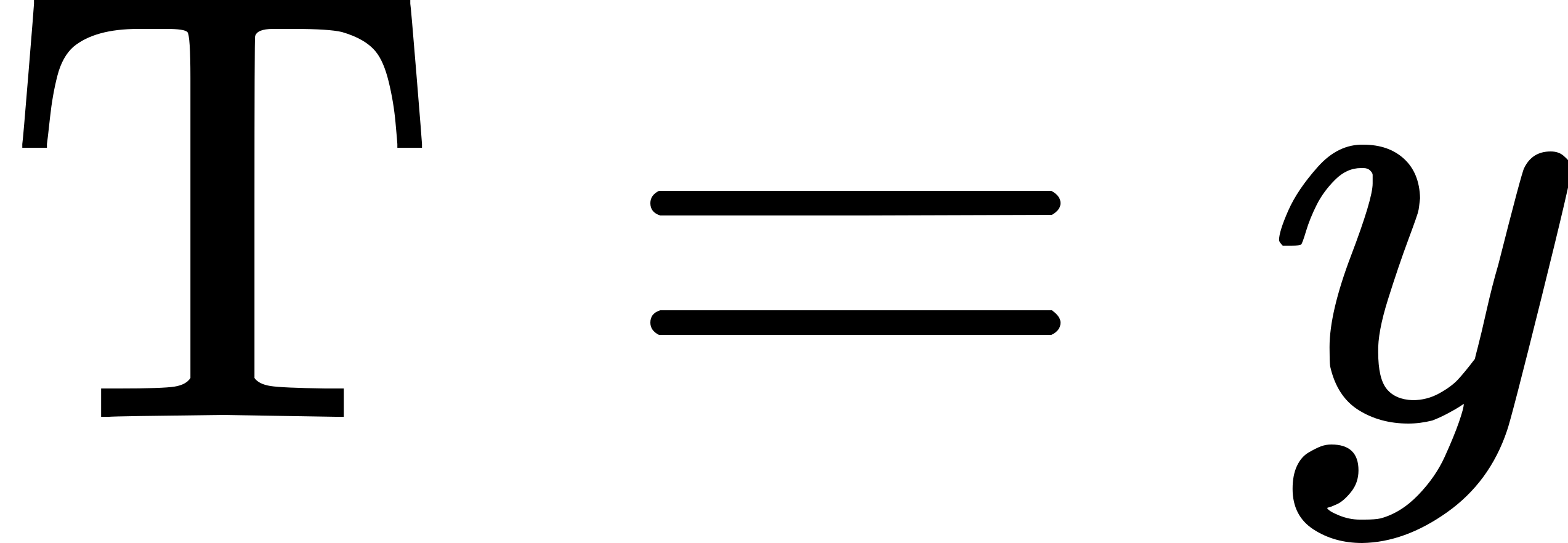 . Make, then, for a new value of
, some less erroneous hypothesis,
. Make, then, for a new value of
, some less erroneous hypothesis, 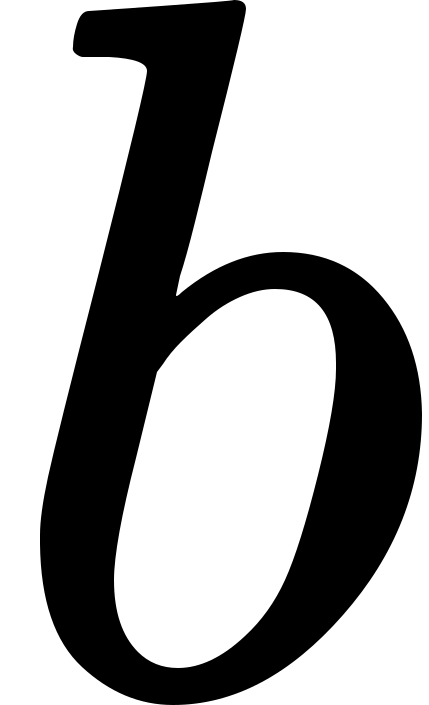 ; and proceeding throughout exactly in
the same manner as in the first instance, call the error this time
; and proceeding throughout exactly in
the same manner as in the first instance, call the error this time 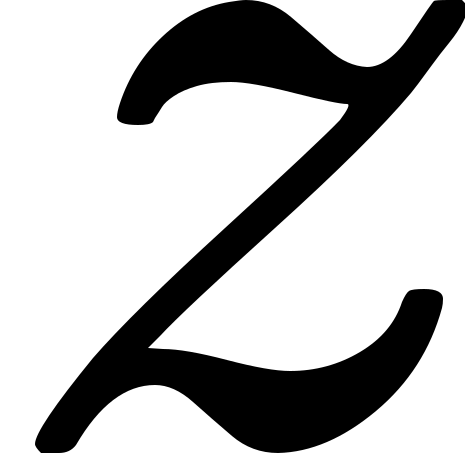 , then
 , and therefore
 which will furnish a yet more correct value for . By substituting this corrected
value of , and repeating the process a third time, we approximate
still more nearly to the truth; nor is it ever necessary to resort to a sixth
hypothesis, the fourth is in general sufficiently correct.
which will furnish a yet more correct value for . By substituting this corrected
value of , and repeating the process a third time, we approximate
still more nearly to the truth; nor is it ever necessary to resort to a sixth
hypothesis, the fourth is in general sufficiently correct.
Having in this manner discovered the values of , , and , and therefore
also of  (which is equal to
 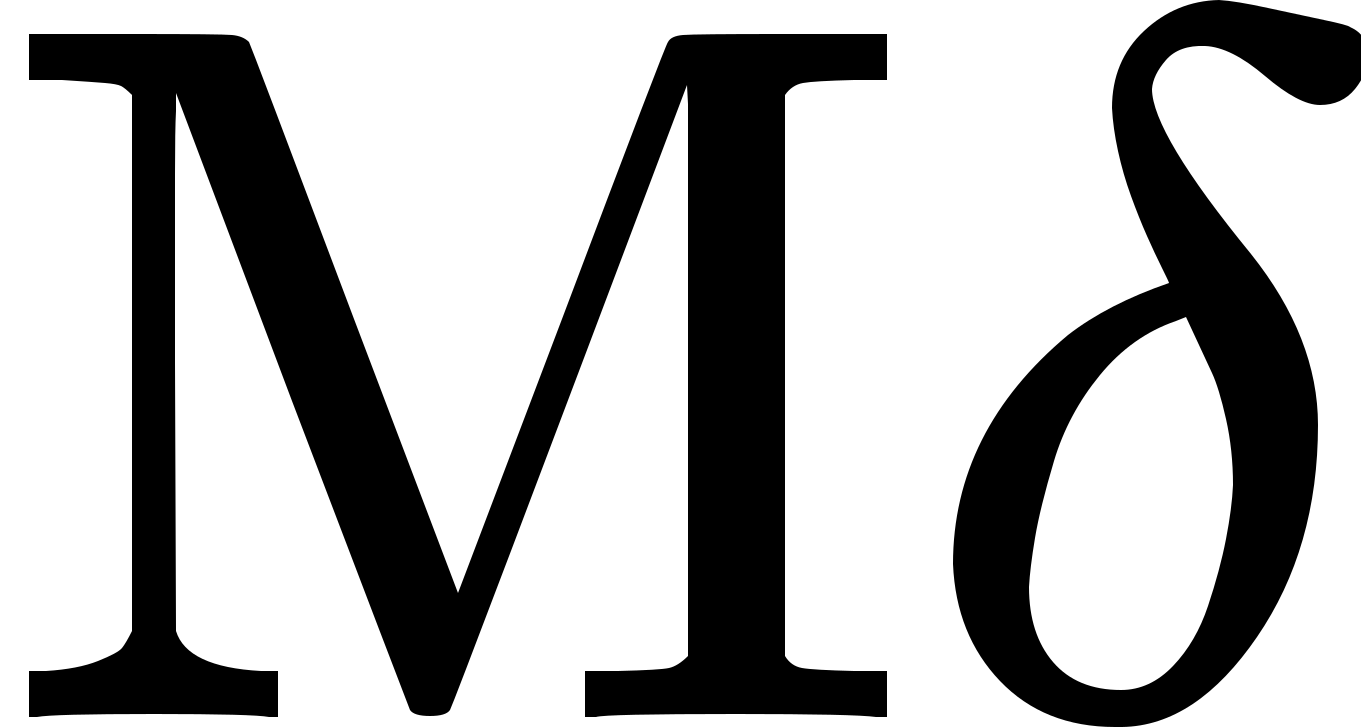 , we proceed next to extract the heliocentric
latitudes and longitudes. Let
, we proceed next to extract the heliocentric
latitudes and longitudes. Let 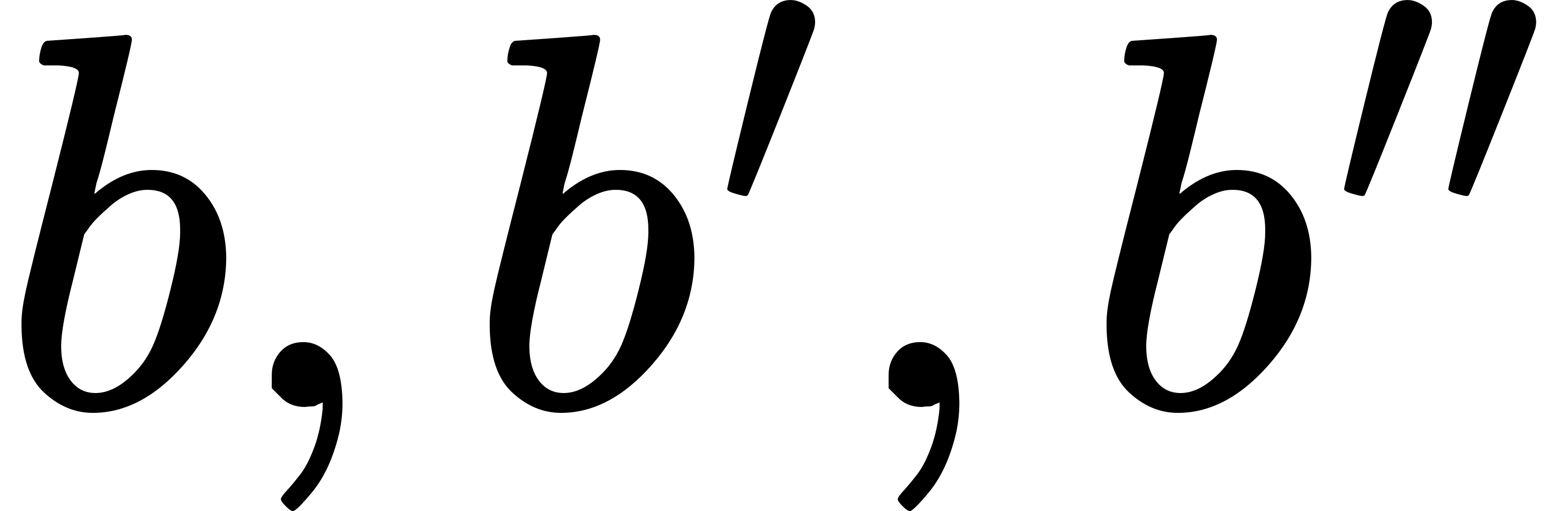 represent the former, and
 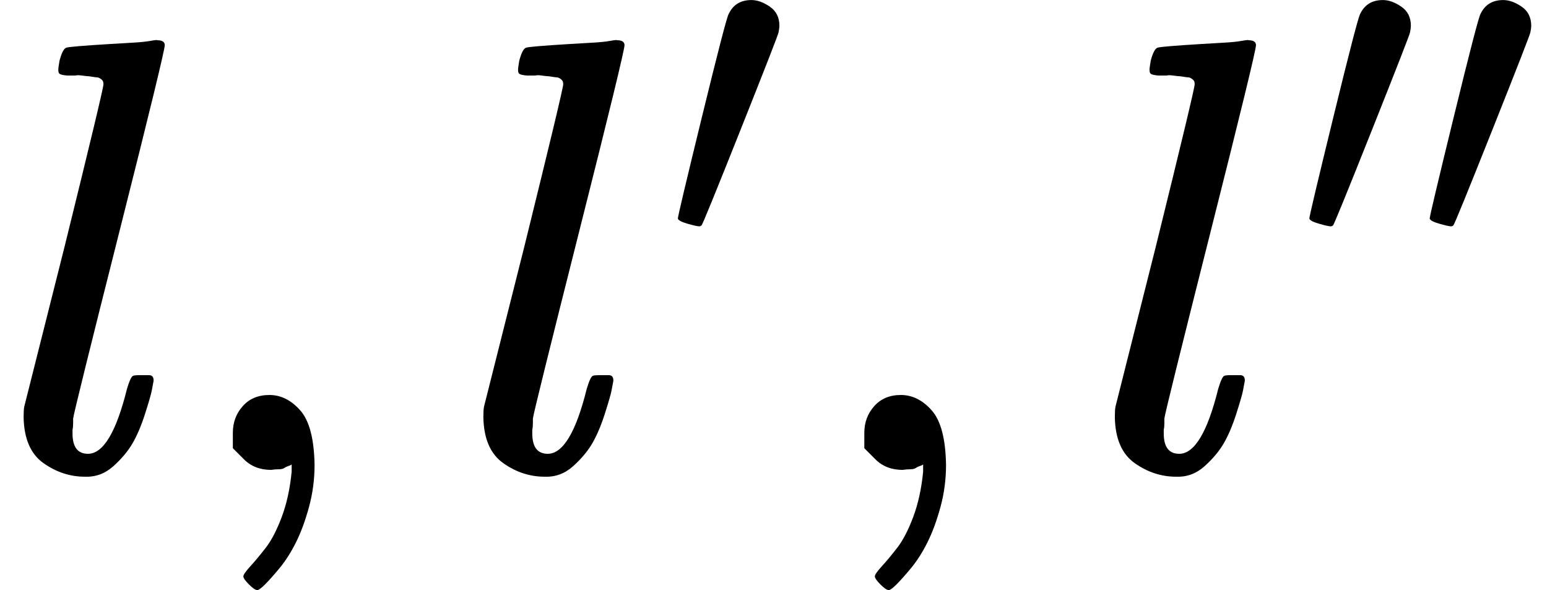 the latter. Since
  , we have
 and (in Fig. 4.) since
  , we have
64
, we have
64

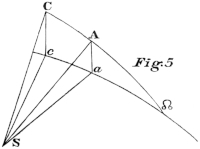
From the heliocentric latitudes and longitudes, we easily obtain the place
of the comet’s node, and the inclination of the orbit to the ecliptic:
For in the right-angled spherical triangle
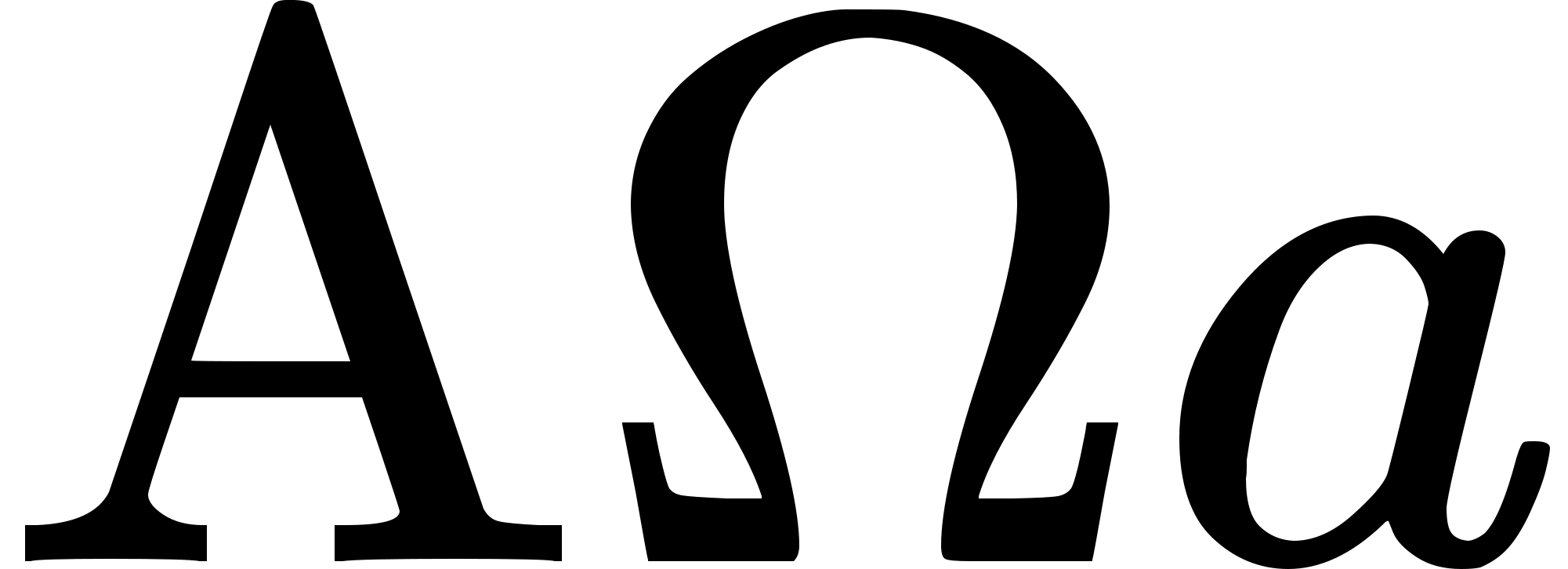 (Fig. 5.), where A is the perihelion,
 the node, and I the angle at which
the comet’s orbit is inclined to the ecliptic, we have
the node, and I the angle at which
the comet’s orbit is inclined to the ecliptic, we have
 , and
, and  ; hence
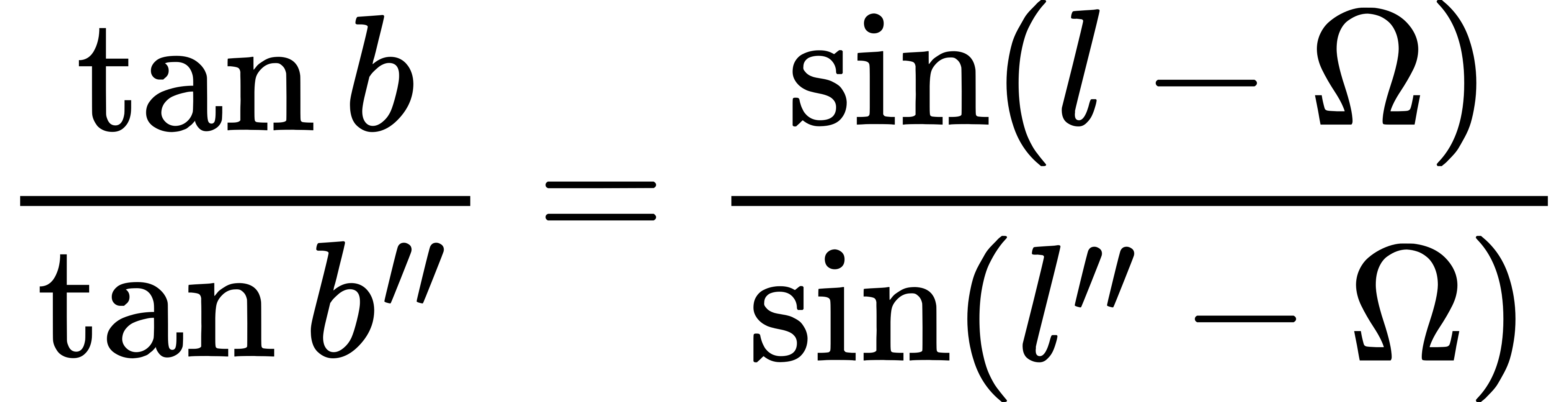 ,
67
which, by a well known property of sines, gives
,
67
which, by a well known property of sines, gives
 ,
or 65
,
or 65  hence, also,
If  ,
, 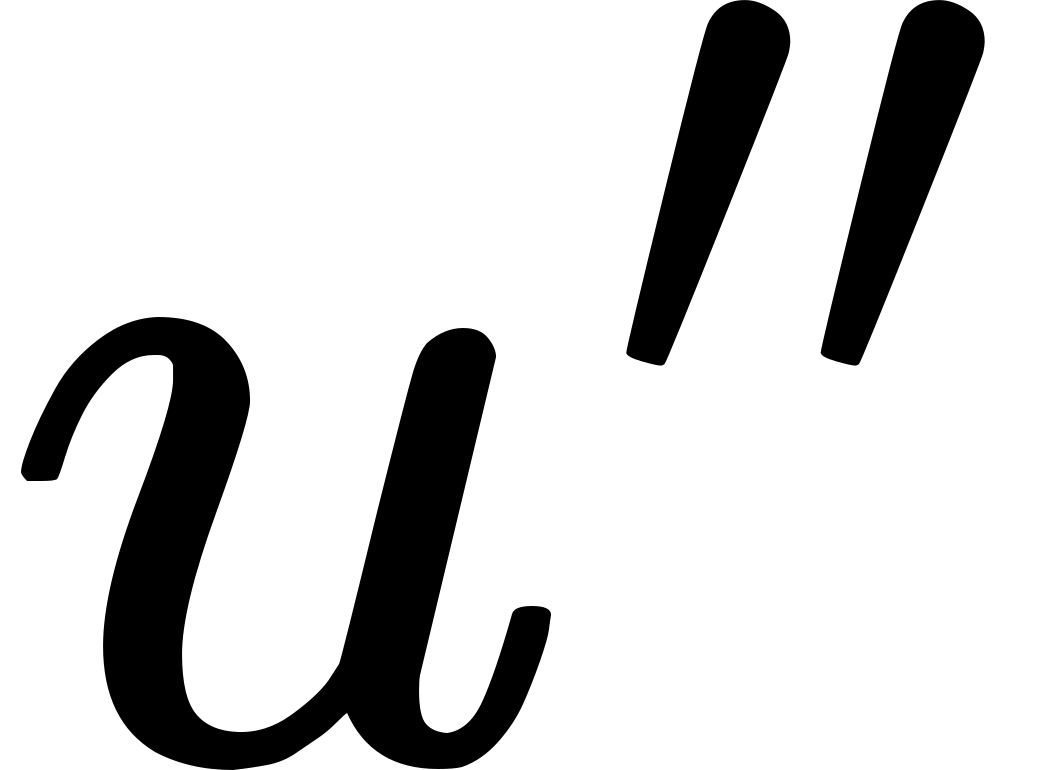 be the arguments of the comet’s latitude on its orbit, we have
 but
but 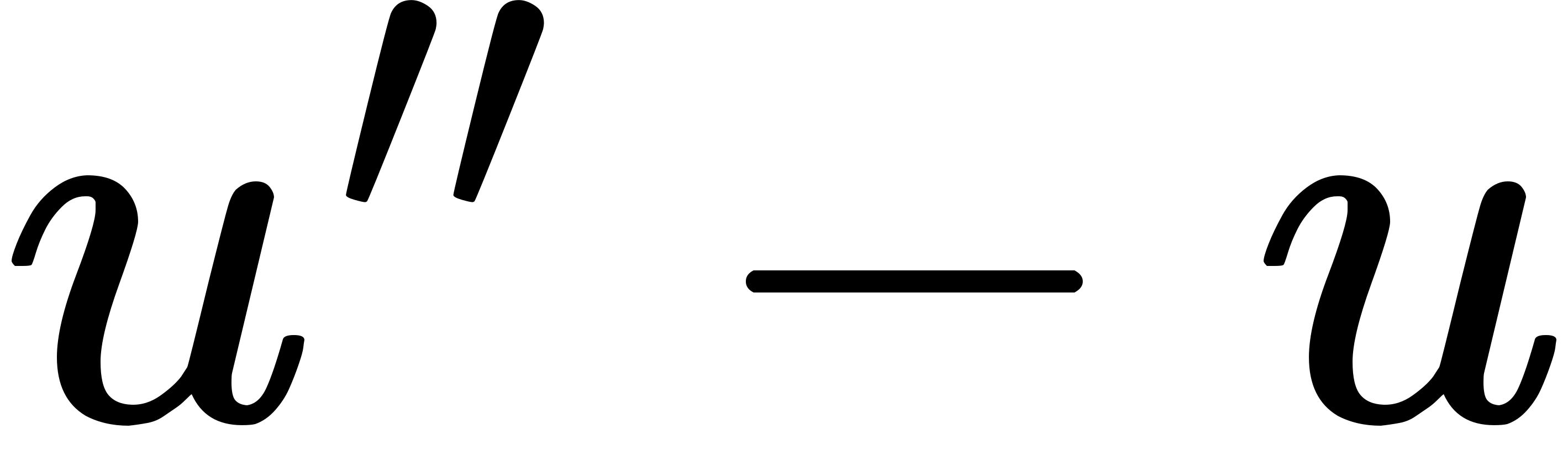 is the same as the difference of the true anomalies, or
 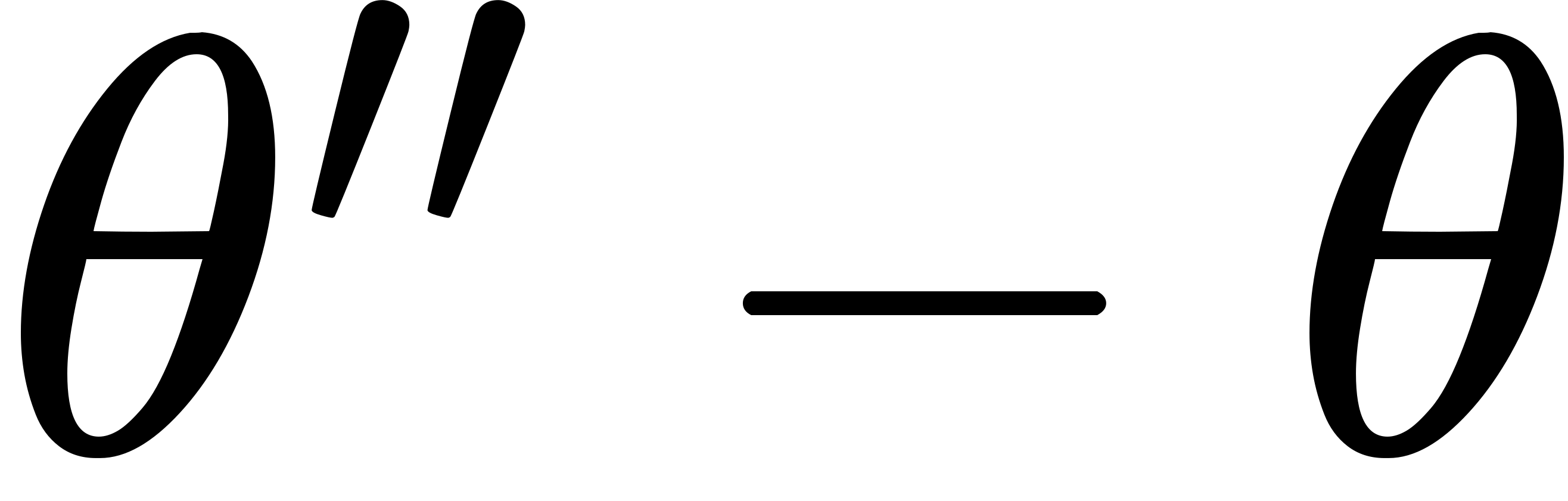 ,
and therefore, we can determine the amount of each anomaly by means of
the equation already demonstrated, and marked (6.)
,
and therefore, we can determine the amount of each anomaly by means of
the equation already demonstrated, and marked (6.)
 Hence, the comet’s perihelion distance,
 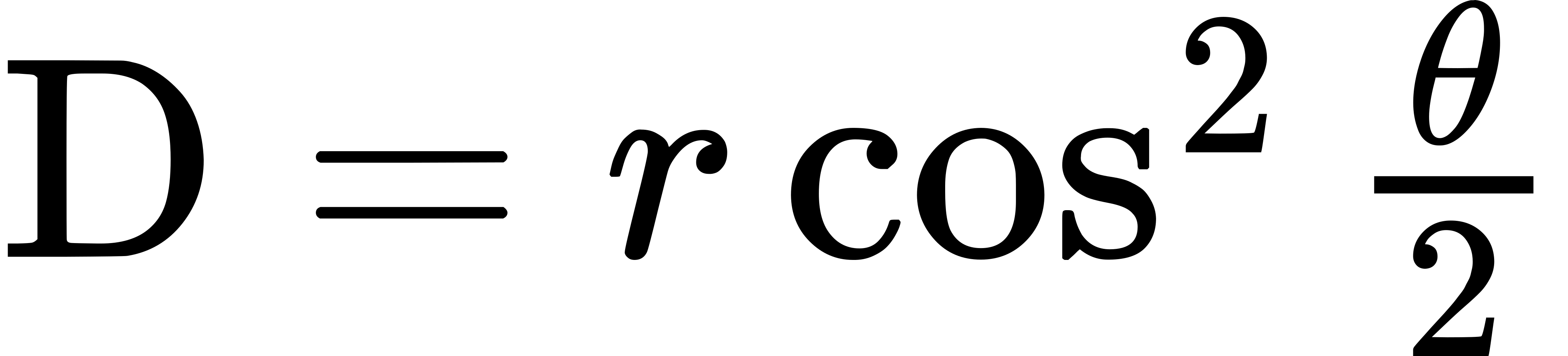 is obtained, and
the longitude of the perihelion, not reduced to the ecliptic, from the equation
is obtained, and
the longitude of the perihelion, not reduced to the ecliptic, from the equation
 Finally, we derive the time of the perihelion passage before the first observation,
from the formula demonstrated on page 63.,66
Finally, we derive the time of the perihelion passage before the first observation,
from the formula demonstrated on page 63.,66

The perihelion passage will be before or after the first observation (in the
case of direct motion), according as the longitude π of the perihelion is less
or greater than the heliocentric longitude l at the first observation; the reverse
will be the case in retrograde motion.
The perihelion passage will be before or after the first observation (in the
case of direct motion), according as the longitude π of the perihelion is less
or greater than the heliocentric longitude l at the first observation; the reverse
will be the case in retrograde motion.
68
The method which we have now demonstrated, of discovering from three observations of a comet, what are the elements of its orbit, is allowed to be one of the simplest and most convenient known to astronomers. After having obtained the geocentric latitudes and longitudes of the comet, we can in the course of a few hours labour, obtain a near approximation to its place and path in the system. But simplicity of solution, and facility of calculation, are not the only advantages which distinguish the method of Olbers. It is found also to represent with accuracy the motion of comets in general, and of all those especially whose orbits, from their great eccentricity do not differ much from a parabola.
We proceed to show the application of these formulæ, by employing them in the investigation of the orbit of a particular comet. The Comet observed at Paramatta in 1826, having been proposed for that purpose, the following are the observations of it made by Mr Rumker, as given in the Philosophical Magazine April 1827.
|
|||||||||||||||||||||||||||||||||||||||||||||||||||||||||||||||||||||||||||||||||||||||
Since in the foregoing method three observations only are necessary, we fix upon the first, second, and fourth, as affording intervals of time the least unequal. The first step is to extract from these data the geocentric longitudes and latitudes of the comet, as well as the mean solar time at Greenwich. The longitude of Paramatta is 10° 4′ 14″.5 East of Greenwich.
69
|
|||||||||||||||||||||||||||||||||||||||||||||||||||||||||||||||||||||||||||
70
The apparent motion of the Comet being determined, we have next to find the position of the Earth at the several periods, by means of the sun’s longitude and the earth’s radius vector. These are found to be,
| 161° 40′ 2″ | 163° 31′ 35″ | 165° 27′ 10″ |
| 1·0077198 | 1·0072182 | 1·0066872 |
Several small corrections, however, must be applied, before these data can represent accurately the comet’s route in the heavens. It is presumed that the errors of Refraction have been already expunged: it only remains to calculate the effects of Precession, Aberration, Nutation, and Parallax.
Let the epoch from which the apparent places are to be computed
be the 1st January 1827. The Precession for the first observation is
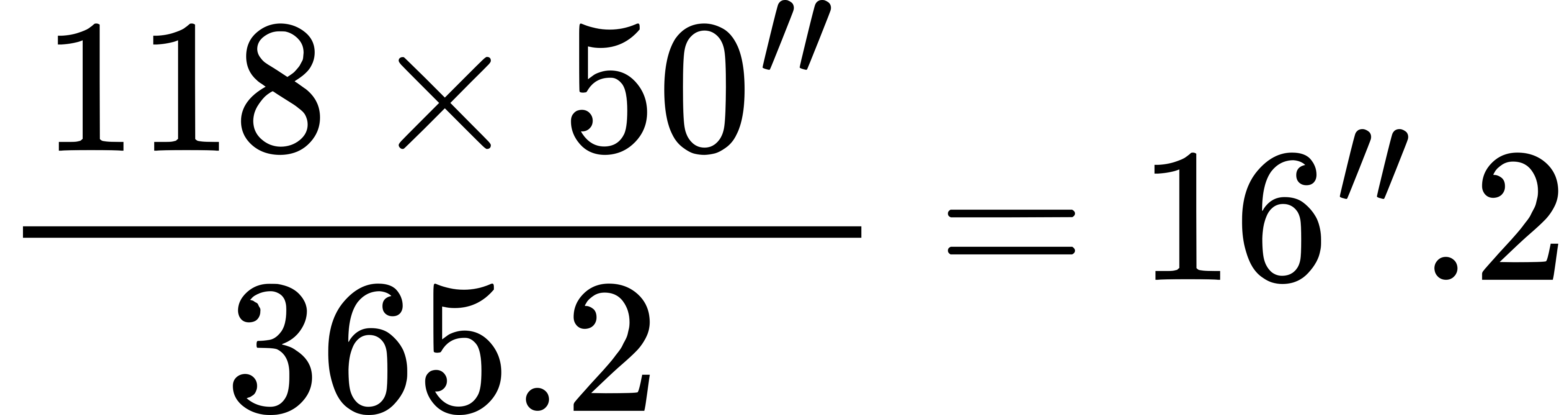 ; for the second,
 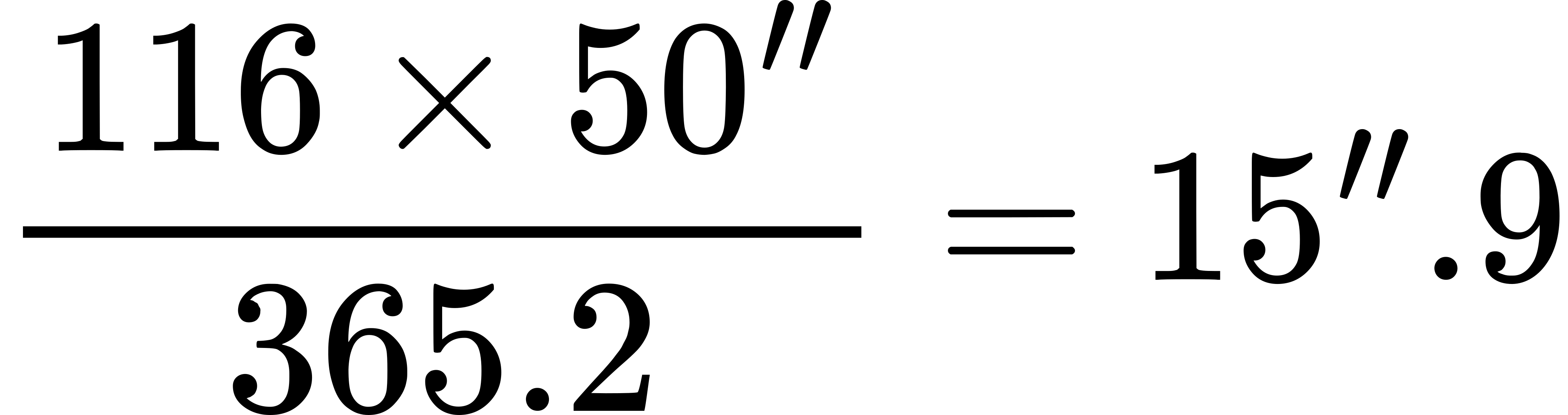 ; and for the third,
 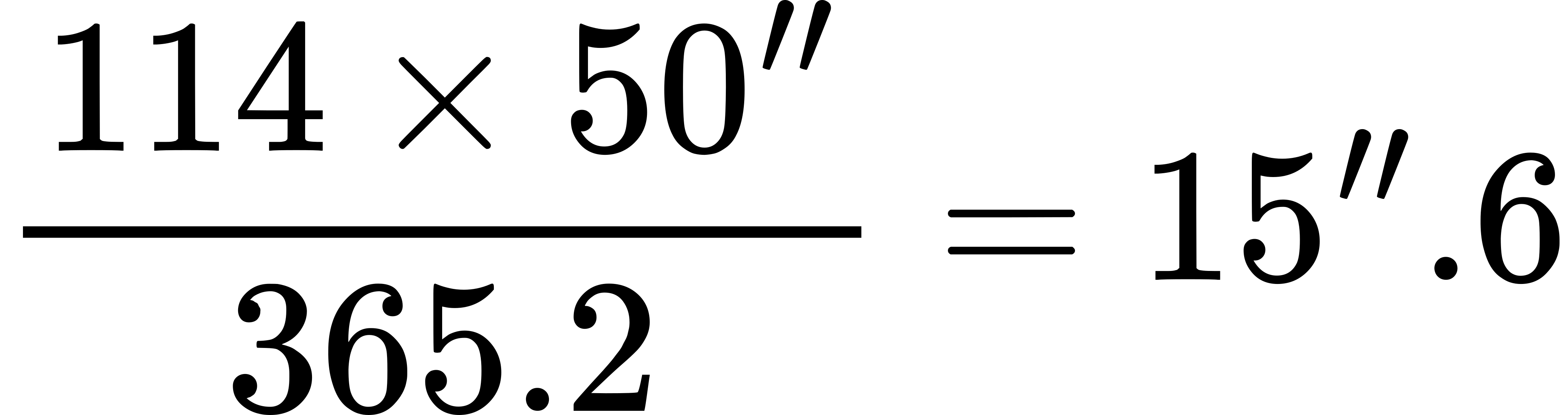 .
.
In the Nautical Almanack, we find the Nutation to be -15′.1, -15″.1, -15″: it is taken with the sign reversed, as the observed or apparent positions must be converted into the mean.
In order to estimate completely the Aberration, we ought to know the distance of the Comet from the Earth. But as this is as yet unknown, we must proceed according to the method pointed out by Gauss, (70.) by first correcting the latitudes and longitudes of the comet for the aberration of fixed stars, and afterwards applying the requisite correction when the above element is determined.
71
The aberrations of the stars is thus found by the table (Encycl. Edin. p. 801.),
| The ☉’s longitude, | 161° 40′ | |||
| Comet’s longitude, | 83 16 | |||
| 78 24 | gives | 4″.02 | ||
| Comet’s latitude, | 32 8 | sec. of | 1 .18 | |
| Aberration in longitude for first observation, | = | 4 .7 | ||
which must be applied with the contrary sign, for the same reason as in the case of nutation; so also 5″.4, and 6″ are the aberrations for the other two observations. The aberrations in latitude are -10″.4, -9″.8, and -9″.
| Comet’s longitude, | 83° 15′ 42″ | 87° 4′ 40″ | 90° 53′ 53″ | ||
| Precession, | +16.2 | +15.9 | +15.6 | ||
| Aberration, | + 4.7 | + 5.4 | + 6 | ||
| Nutation, | -15.1 | -15.1 | -15 | ||
| Corrected longitude, | 83° 15′ 47″.8 | 87° 4′ 46″.2 | 90° 53′ 59″.6 | ||
| Comet’s latitude, | -32° 8′ 33″ | -30° 19′ 49″ | -28° 16′ 45″ | ||
| Aberration, | -10.4 | - 9.8 | - 9 | ||
| Corrected latitude, | -32 8 43 .4 | -30 19 58 .8 | -28 16 54 |
The positions of the Earth must be freed also from the effect of Parallax.
| Parallax68, | -6″.8 | -6″.9 | -7″ | ||
| Precession, | +16.2 | +15.9 | +15.6 | ||
| Aberration for sun, | +20 | +20 | +20 | ||
| Nutation, | -15.1 | -15.1 | -15 | ||
| Earth’s longitudes, | 341° 40′ 2″ | 343° 31′ 35″ | 345° 27′ 10″ | ||
| Corrected longitudes, | 341 40 16 .3 | 343 31 48 .9 | 345 27 23 .6 | ||
| Radii vectores, | 1·007719 | 1·007218 | 1·006687 | ||
| Parallax, | + 000019 | + 000036 | + 000041 | ||
| Corrected Radii, | 1·007739 | 1·007254 | 1·006728 |
| Mean Time.72 | Comet’s Longitudes. | Comet’s Latitudes. | Earth’s Longitudes. | |||
| ° ′ ″ | ° ′ ″ | ° ′ ″ | ||||
| 1826, Sept. 4.306656 | λ = 83 15 48 | β = -32 8 43 | L = 341 40 16 | |||
| 6.220741 | λ′ = 87 4 46 | β′ = -30 19 59 | L′ = 343 31 49 | |||
| 8.202309 | λ″ = 90 53 59 | β″ = -28 16 54 | L″ = 345 27 24 | |||
| t = 1·914085, t′ = 1·981568, R = 1·007739, R′ = 1·007254, R″ = 1·006728. | ||||||
73
We now proceed to apply these values in the formulæ already demonstrated.
In the first place, we compute 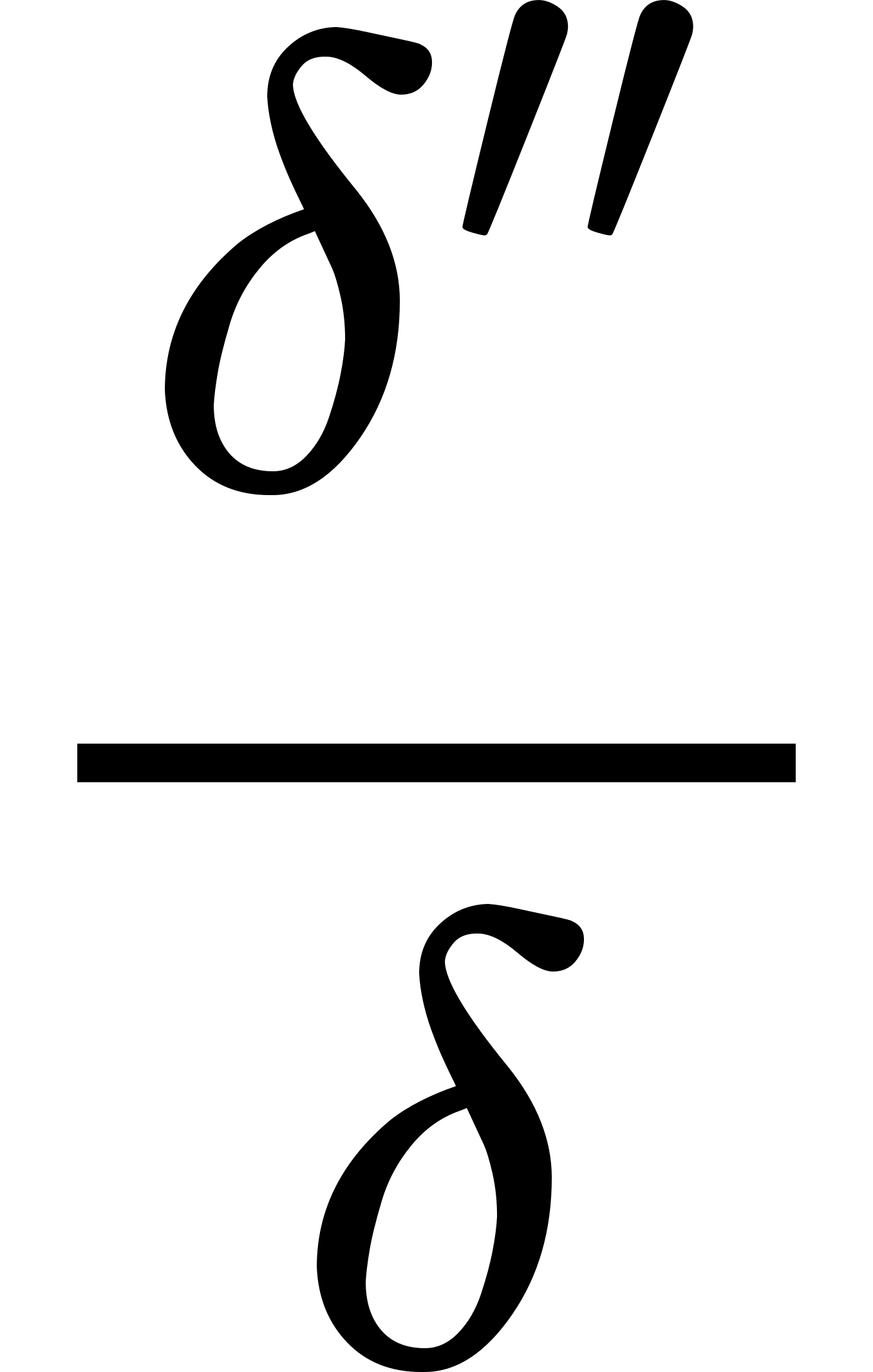 by means of the equation69

| log sin(L′- λ′) | = | 256° 27′ 2″ | = | 9·9877414 | - | log sin(L′ - λ″) | = | 252° 37′ 49″ | = | 9·9797296 | - | |
| log tan β | = | 32 8 43 | = | 9·7982366 | - | log tan β′ | = | 30 19 59 | = | 9·7672501 | - | |
| ·61091114 | = | 9·7859780 | + | ·55844412 | = | 9·7469797 | + | |||||
| log sin(L′ - λ) | = | 260° 16′ 0″ | = | 9·9937030 | - | log sin(L′ - λ′) | = | 256° 27′ 2″ | = | 9·9877414 | - | |
| log tan β′ | = | 30 19 59 | = | 9·7672501 | - | log tan β″ | = | 28 16 54 | = | 9·7308080 | - | |
| ·57670414 | = | 9·7609531 | + | ·52305748 | = | 9·7185494 | + | |||||
| Numerator, | ·03420700 | = | 8·5341150 | ·03538664 | Denominator. | |||||||
| Denominator, | ·03538664 | = | 8·5488393 | log t′ | = | 1·981568 | = | 0·2970089 | ||||
| 9·9852757 | log t | = | 1·914085 | = | 0·2819611 | |||||||
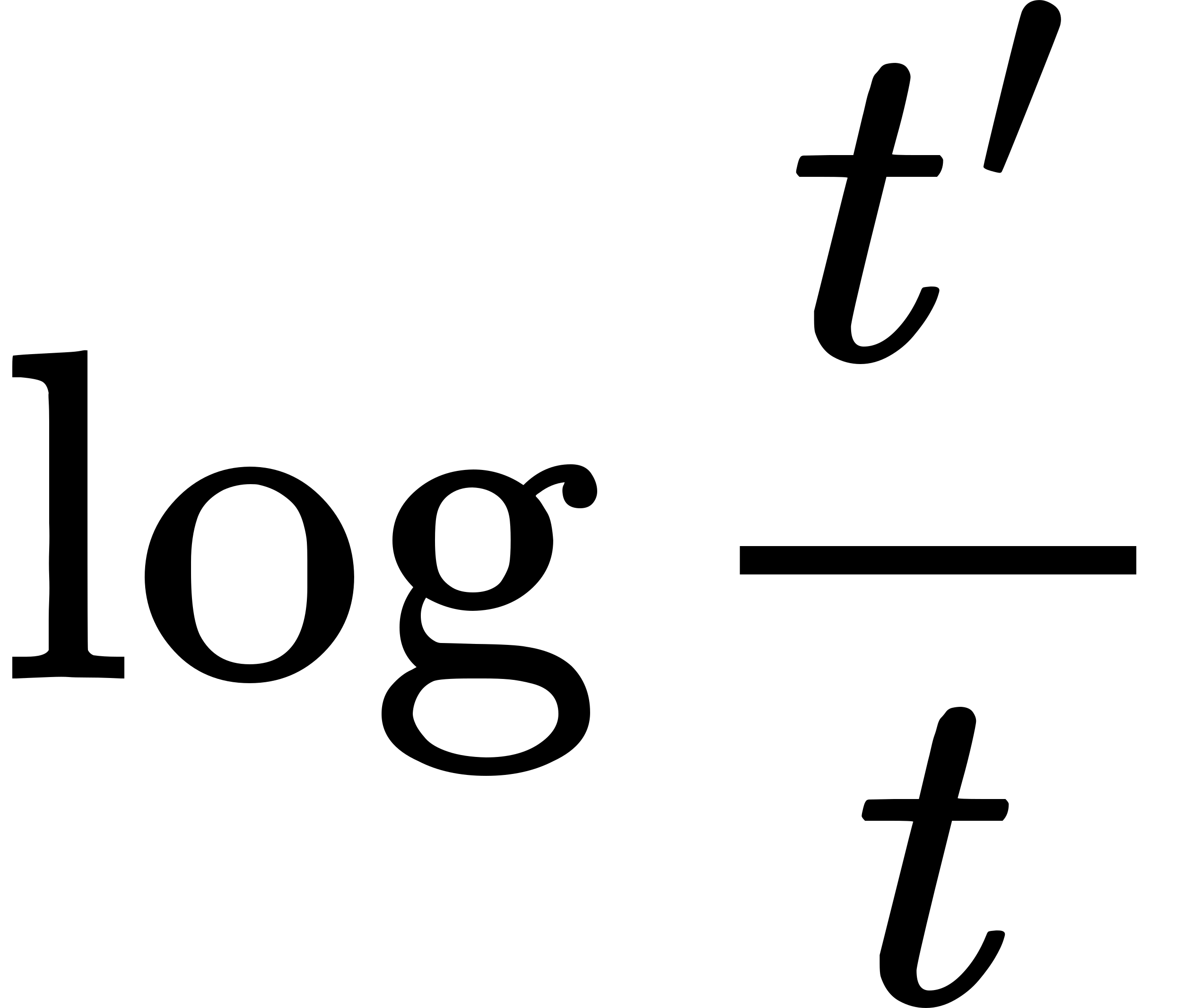
|
= | 0·0150478 | ............................... | 10·0150478 | ||||||||
| 0·0003235 | = | log M. | ||||||||||
Having thus obtained M, we employ it to find the comet’s distance from the sun, at the first and third observations, in the formulæ (2.) and (3.).

74
| ° ′ ″ | ° ′ ″ | |||||||||||
| log sec β | = | 32 8 48 | = | 0·0722696 | log sec2 β″ | = | 28 16 54 | = | 0·1104140 | |||
| × 2 | log M2 | = | 0·0006470 | |||||||||
| sec2 β | = | 1·39488738 | = | 0·1445392 | 1·29140059 | = | 0·1110610 | |||||
| ° ′ ″ | ° ′ ″ | |||||||||||
| log = cos(L - λ) | = | 258 24 27 | = | 9·3030873 | - | log cos(L″ - λ″) | = | 254 33 24 | = | 9·4253470 | - | |
| log R | = | 1·007739 | = | 0·0033481 | log R″ | = | 1·006728 | = | 0·0029122 | |||
| log 2 | = | 0·3010300 | log 2M | = | 0·3013535 | |||||||
| - | ·405009746 | = | 9.6074654 | - | - | ·536553125 | = | 9·7296127 | ||||
| log R | = | 1·007739 | = | 0·0033481 | log R″ | = | 1·006728 | = | 0·0029122 | |||
| R2 | = | 1·01553818 | = | 0·0066962 | ||||||||
| R″2 | = | 1·0135014 | = | 0·0058244 | ||||||||
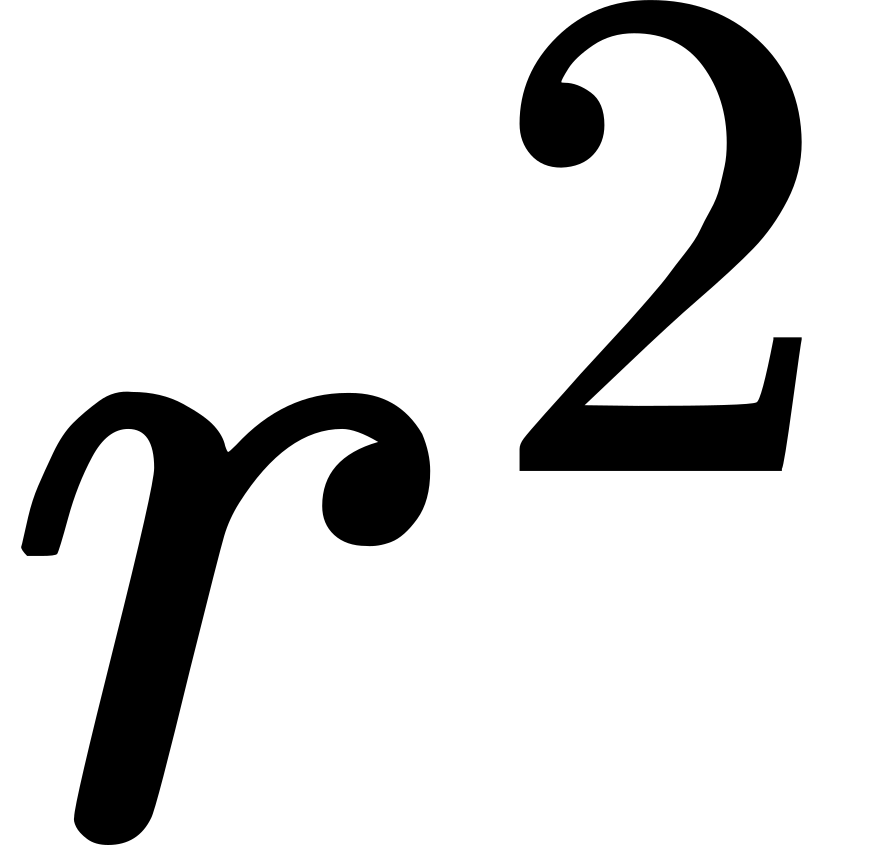
|
= | 1·01553818 | + |
1·39488738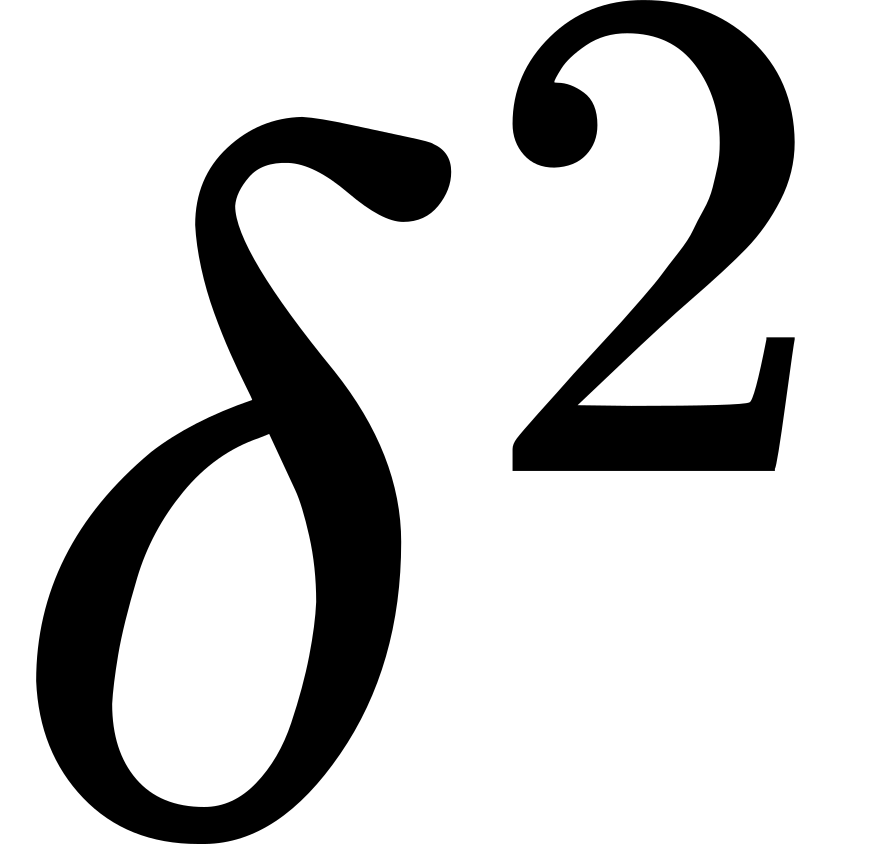
|
- |
·405009746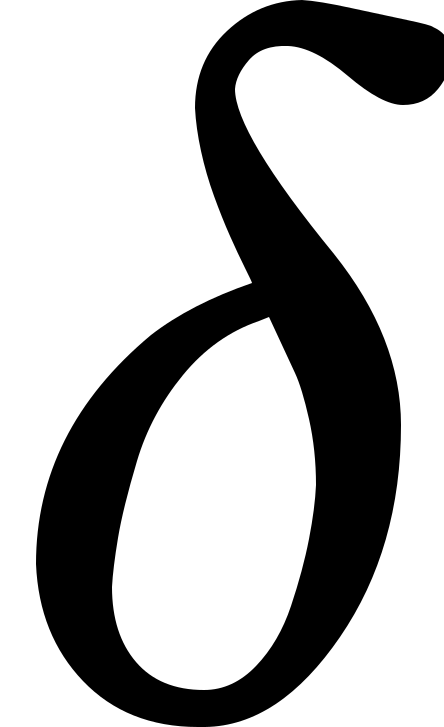
|
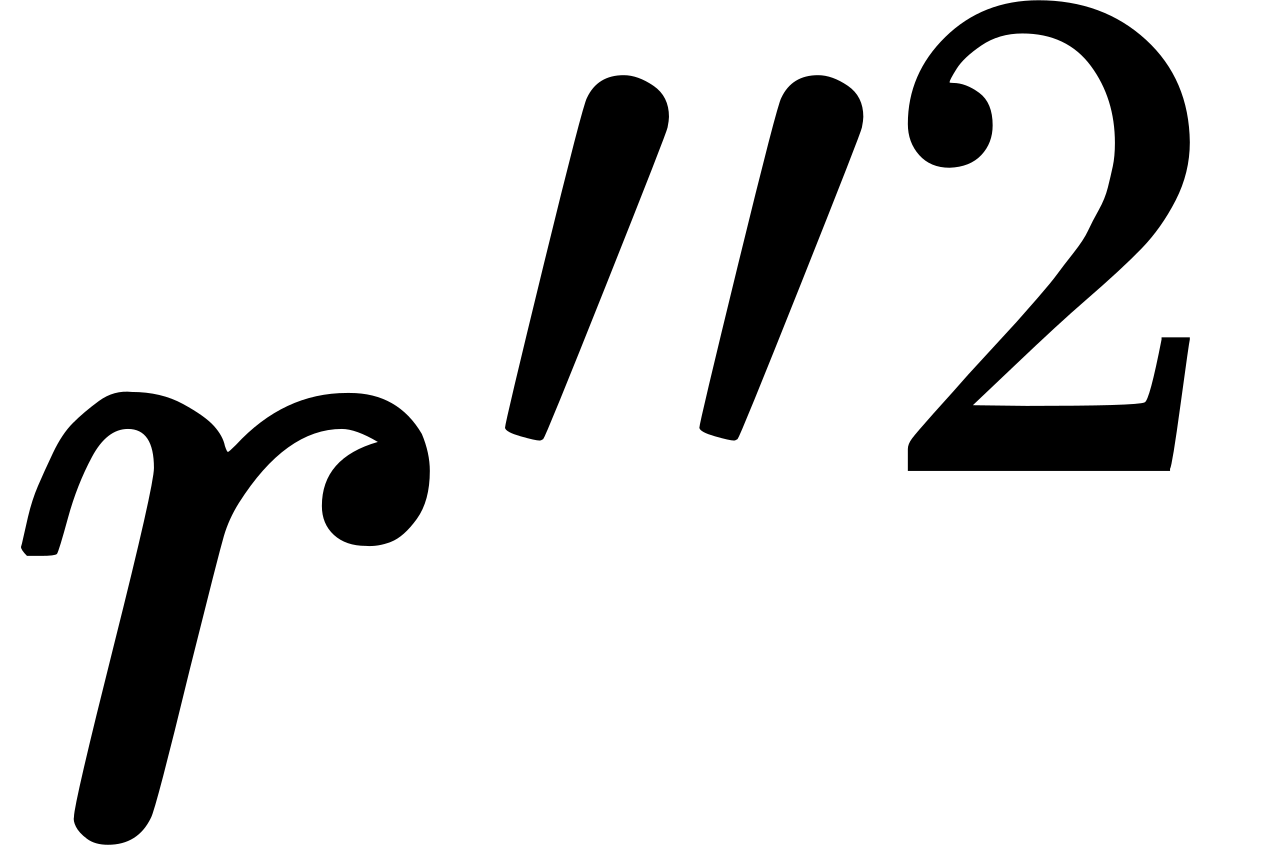
|
= | 1·01350140 | + |
1·29140059
|
- |
·536553125
|
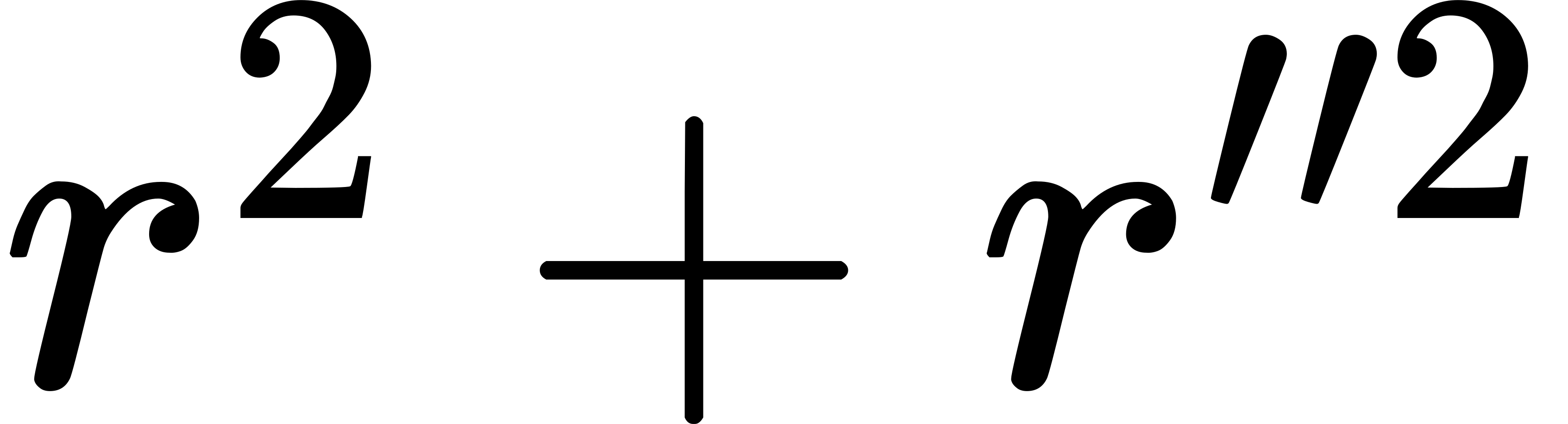
|
= | 2·02903958 | + |
2·68628797
|
- |
·941562871
|
We next calculate the chord joining the two extreme positions of the comet by means of equation (4.)

| ° ′ ″ | ° ′ ″ | ||||||||||||
| log tan β″ | = | 28 16 54 | = | 9·7308080 | - | log cos (L - λ″) | = | 250 46 16 | = | 9·5176481 | - | ||
| log tan β | = | 32 8 43 | = | 9·7982366 | - | log 2MR | = | 0·3047016 | |||||
| ·33809954 | = | 9·5290446 | + | - | ·66427776 | = | 9·8223497 | - | |||||
| ° ′ ″ | ° ′ ″ | ||||||||||||
| cos (λ″ - λ) | = | ·99113144 | = | 7 38 11 | log cos (L″ - λ) | = | 262 11 35 | = | 9·1330138 | - | |||
| 1·32923098 | = | 0·1236004 | log 2R″ | 0·3039422 | |||||||||
| log 2M | = | 0·3013535 | - | ·27349912 | = | 9·4369560 | - | ||||||
| + | 2·66044242 | = | 0·4249539 | - | ·93777688 | ||||||||
| ° ′ ″ | |||||||||||||
| 2·02903958 | + | 2·68628797δ2 | - | ·94156287δ | cos (L″ - L) | = | 3 47 8 | = | 9·9990514 | ||||
| 2·02461137 | - | 2·66044242δ2 | + | ·93777688δ | log 2RR″ | = | 0·3072903 | ||||||
| k2= | ·00442821 | + | ·02584555δ2 | - | ·00378598δ | + | 2·02461137 | = | 0·3063417 | ||||
75
We have now to compute from these three equations the values for
r, r″, and k. The formula  supplies the fourth equation necessary for the
elimination of these unknown quantities, T being in the present case
3·895653 days. As it is not practicable to resolve these equations
directly, let us apply the method of false position, by assuming
different hypotheses for .
supplies the fourth equation necessary for the
elimination of these unknown quantities, T being in the present case
3·895653 days. As it is not practicable to resolve these equations
directly, let us apply the method of false position, by assuming
different hypotheses for .
In the first place, let us assume = 1. In this case, we find
| r2 | = | 1·01553818 | + | 1·39488738 | - | ·40500975 | = | 2·0054158 | and | log r | = | 0·1511022 |
| r″2 | = | 1·01350140 | + | 1·29140059 | - | ·53655312 | = | 1·7683488 | ... | log r″ | = | 0·1237839 |
| k2 | = | ·00442821 | + | ·02584555 | - | ·00378598 | = | ·02658777 | ... | log k | = | 2·2123409 |
| r = 1·416127, r″ = 1·329792, k = 0·16305 | ||||||||||||
(r + r″ + k)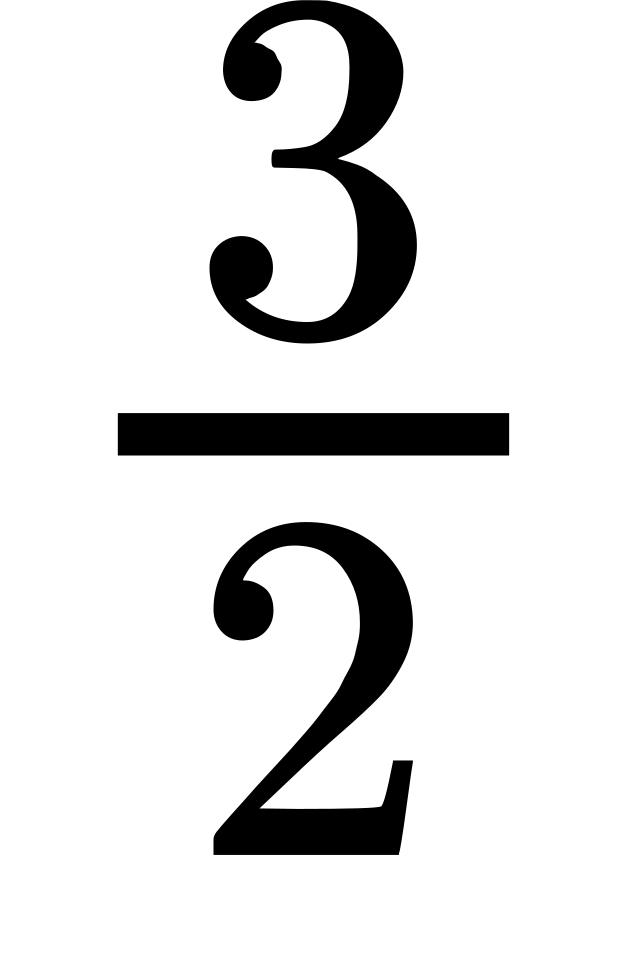 -(r + r″ - k)=·81048, -(r + r″ - k)=·81048,
|
log = 9·9087423 | |
| 9·0137302 | ||
| 10·8950121 | =7·8526 days |
The result ought to have been 3·8956 = t + t′, rather less than half. Let
us for a second hypothesis take = ·5. In this case we get
| r2 | = | 1·015538 | + | ·348722 | - | ·202505 | = | 1·161755, | and | log r | = | 0·0325573 |
| r″2 | = | 1·013501 | + | ·322850 | - | ·268276 | = | 1·068075, | ... | log r″ | = | 0·0143009 |
| k2 | = | ·004428 | + | ·006461 | - | ·001893 | = | ·0091962, | ... | log k | = | 2·9818042 |
| r = 1·077847, r″ = 1·033477, k = ·095897, | ||||||||||||
|
(r + r″ + k)-(r + r″ - k) = ·417990 log = 9·6211659
|
||
| 9·0137302 | 3·89565 = T | |
| 0·6074357 | = | 4·04982 days |
| + | ·15417 Error |
The value assumed for is yet too large, though evidently not very distant
from the truth. To find a more correct hypothesis, we employ the method
already pointed out (8.),  . Let us then calculate
the equations on this third hypothesis:
. Let us then calculate
the equations on this third hypothesis:
76
| r2 | = | 1·0155381 | + | ·3213820 | - | ·1944046 | = | 1·14251555, | log r | = | 0·0289310 |
| r″2 | = | 1·0135014 | + | ·2975387 | - | ·2575455 | = | 1·05349460, | log r″ | = | 0·0113161 |
| k2 | = | ·0044282 | + | ·0059548 | - | ·0018172 | = | ·00856579, | log k | = | 2·9663837 |
| r = 1.068885, r″ = 1.026398, k = .092551, | |||||||||||
|
(r + r″ + k)-(r + r″ - k) = ·401873, log =
|
9·6040888 | ||
| log 6μ = | 9·0137302 | 3·89565 = T | |
| 0·5903586 | = | 3.89366 days | |
| - | ·00199 Error. |
It is evident that we have assumed the value of rather too small. Let us next try ·48037:
| r2 | = | 1·01553818 | + | ·32187773 | - | ·19455449 | = | 1·14286142, | log r | = | 0·0289967 |
| r″2 | = | 1·01350140 | + | ·29799761 | - | ·25774400 | = | 1·05375501, | log r″ | = | 0·0113698 |
| k2 | = | ·00442821 | + | ·00596400 | - | ·00181867 | = | ·00857354, | log k | = | 2·9665801 |
| r = 1·06904688, r″ = 1·02652542, k = ·09259342, | |||||||||||
(r + r″ + k)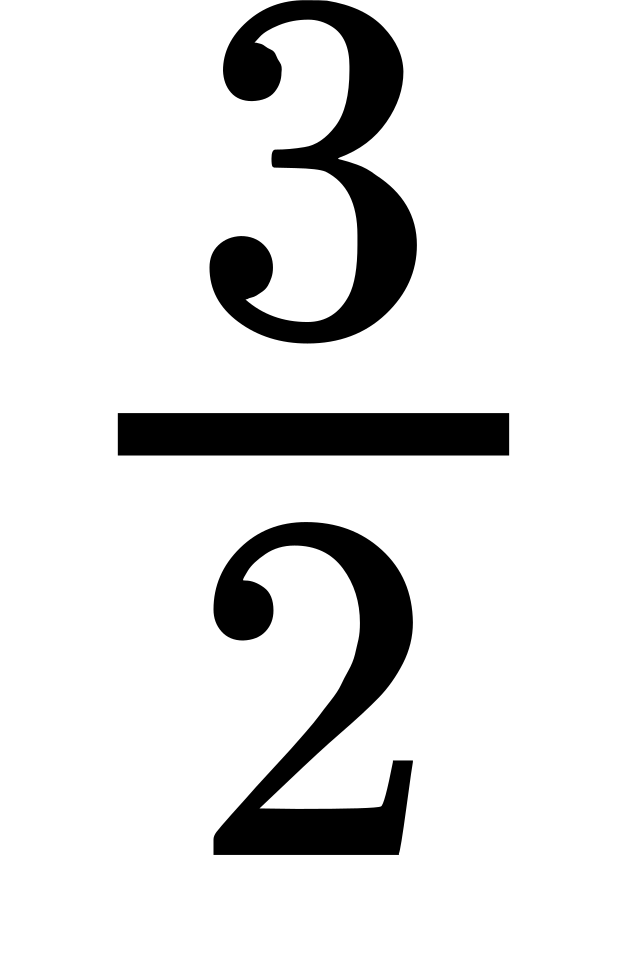 -(r + r″ - k) = ·4020855, log = -(r + r″ - k) = ·4020855, log =
|
9·6043184 | ||
| log 6μ = | 9·0137302 | 3·895653 = T | |
| 0·5905882 | = | 3·895724 days | |
| + | ·000071 Error. |
The aberration from the truth is now very trivial; let us, however, make a
fifth hypothesis, and call = ·4803483 as derived from a comparison of the
two last, we then find,
| r2 | = | 1·01553818 | + | ·32184873 | - | ·19454572 | = | 1·14284119, | and | log r | = | 0·0289929 |
| r″2 | = | 1·01350140 | + | ·29797075 | - | ·25773236 | = | 1·05373979, | ... | log r″ | = | 0·0113667 |
| k2 | = | ·00442821 | + | ·00596346 | - | ·00181859 | = | ·00857308, | ... | log k | = | 2·9665684 |
| r = 1·06903739, r″ = 1·02651828, k = ·09259092, | ||||||||||||
|
(r + r″ + k)-(r + r″ - k) = ·402071, log =
|
9·6043028 | ||
| log 6μ = | 9·0137302 | 3·895653 = T | |
| 0·05905726 | = | 3·895584 days | |
| - | ·000069 Error. |
The true value of lies therefore between ·48037 and ·4803483. It will be
sufficiently accurate to institute the following proportion:
| Fourth hypothesis, |
|
= | ·48037 | r | = | 1·06904688 | r″ | = | 1·02652542, | T | = | 3·895724 | ||||
| Fifth hypothesis, | = | ·4803483 | = | 1·06903739 | = | 1·02651828, | = | 3·895584 | ||||||||
| ·0000217 | ·00000949 | ·00000714 | ·000140 |
| Diff. | Error. | Diff. | Error. | |||||||||
| ·000140 | : | ·000069 | :: | ·0000217 | : | ·0000107, |
hence
|
= | ·4803590 |
log
|
= | 9·6815659 |
| ·00000949 | : | ·00000467, | r | = | 1·0690406 | log M | = | 0·0003235 | ||||
| ·00000714 | : | ·00000352, | r″ | = | 1·0265280 |
log ″
|
= | 9·6818894 |
Having thus determined the comet’s distances from the sun, at the first and third observations, together with its curtate distances from the earth, we next proceed to determine the heliocentric latitudes and longitudes, as well as the elements of the orbit. From the diminution of the radius vector, it is evident that the comet was at this time approaching its perihelion.
 are the formulæ.
| ° ′ ″ | ° ′ ″ | |||||||||||
| log tan β | = | 32 8 43 | = | 9·7982366 | log tan β″ | = | 28 16 54 | = | 9·7308080 | |||
| log δ | = | 4803590 | = | 9·6815659 | log δ″ | = | ·4800714 | = | 9·6818894 | |||
| 9·4798025 | 9·4226974 | |||||||||||
| log r | = | 1·0690420 | = | 0·0289947 | log r″ | = | 1·0265218 | = | 0·0113682 | |||
| sin b | = | 16 24 4.5 | = | 9·4508078 | sin b″ | = | 14 35 36.5 | = | 9·4013292 | |||
| ° ′ ″ | ° ′ ″ | |||||||||||
| sin (L - λ) | = | 258 24 27 | = | 9·9910495 | - | sin (L″ - λ″) | = | 254 23 24 | = | 9·9840294 | - | |
| log δ | = | ·4803590 | = | 9·6815659 | log δ″ | = | ·4800714 | = | 9·6818894 | |||
| 9·6726154 | - | 9·6659188 | - | |||||||||
| ° ′ ″ | ° ′ ″ | |||||||||||
| log cos b | = | 16 24 4.5 | = | 9·9819580 | log cos b″ | = | 14 35 36.5 | = | 9·9857578 | |||
| log r | = | 1·0690420 | = | 0·0289947 | log r″ | = | 1·0265218 | = | 0·0113682 | |||
| 10·0109527 | 9·9971260 | |||||||||||
| ° ′ ″ | ° ′ ″ | |||||||||||
| sin (L - l) | = | -27 18 44.3 | = | 9·6616627 | - | sin (L″- l″) | = | -27 48 11.7 | = | 9·6687928 | - | |
| L | = | 341 40 15.2 | L″ | = | 345 27 28 | |||||||
| sin l | = | 8 58 59.5 | sin l″ | = | 13 15 34.7 |
78
Having thus computed the heliocentric latitudes and longitudes, we
next find the place of the Node, which, in the case of direct motion, will be
the comet’s ascending node. The increase of the longitudes, shows that
this comet is direct, and the diminution of the latitudes, which are south,
that it was situated in the part of its orbit below the ecliptic, and moving
towards the point of intersection. The place of the Node may be computed
by means of the formula,
 70.
70.
| ° ′ ″ | ° ′ ″ | |||||||||
| log tan b | = | 16 24 4.5 | = | 9·4688488 | log tan b | = | 16 24 4.5 | = | 9·4688488 | |
| log sin l″ | = | 13 15 35 | = | 9·3605282 | log cos l″ | = | 13 15 35 | = | 9·9882647 | |
| ·067511376 | = | 8·8293770 | ·286492659 | = | 9·4571135 | |||||
| log tan b″ | = | 14 35 36.5 | = | 9·4155723 | log tan b″ | = | 14 35 36.5 | = | 9·4155723 | |
| log sin l | = | 8 58 59.5 | = | 9·1935274 | log cos l | = | 5 58 59.5 | = | 9·9946401 | |
| ·040653665 | = | 8·6090997 | ·257165294 | = | 9·4102124 | |||||
| Numerator | = | ·026857711 | = | 8·4290690 | ·29327365 | Denominator. | ||||
| Denominator | = | ·029327365 | = | 8·4672729 | ||||||
| 9·9617961 = 42° 28′ 56″.3 = tan Ω. | ||||||||||
By equation (12.), 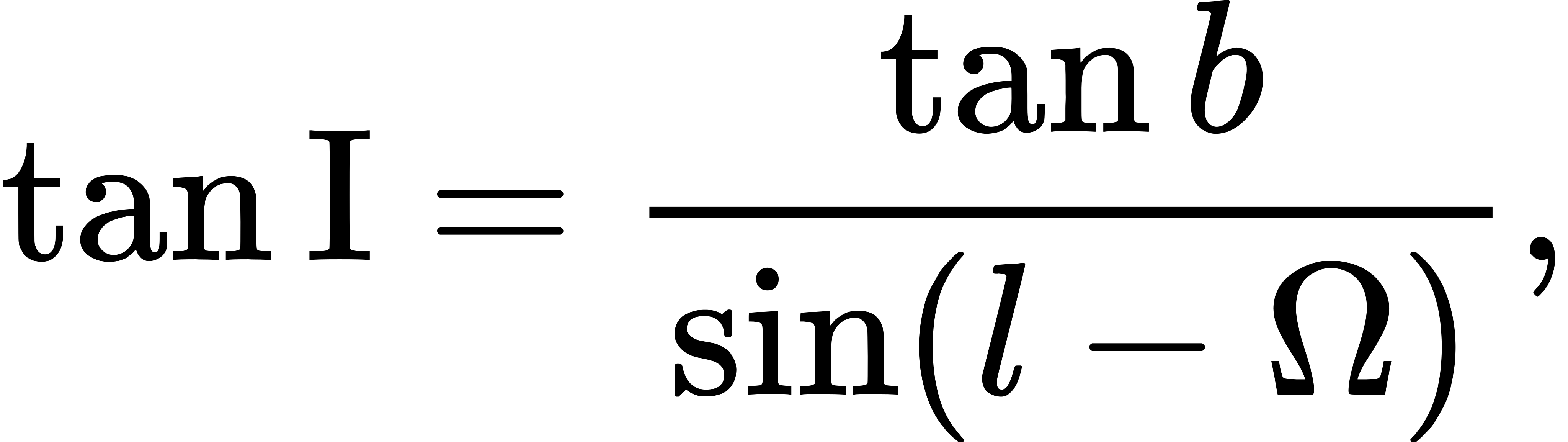 we find the inclination of the comet’s orbit to the ecliptic71:
and by equation (13.),
we find the inclination of the comet’s orbit to the ecliptic71:
and by equation (13.),  ,
the arguments of the latitude72.
,
the arguments of the latitude72.
79
| ° ′ ″ | ° ′ ″ | |||||||||
| log cos b | = | 16 24 4.5 | = | 9·9211070 | log cos b″ | = | 14 35 36.5 | = | 9·9857577 | |
| log cos (l - Ω) | = | 33 29 59.7 | = | 9·9819580 | log cos (l″ - Ω) | = | 29 13 24.2 | = | 9·9408764 | |
| cos u | = | 36 52 27.2 | = | 9·9030650 | cos u″ | = | 32 22 27.9 | = | 9·9266341 | |
| log tan b | = | 16 24 4.5 | = | 9·4688488 | u | = | 36 52 27.2 | |||
| log sin (l - Ω) | = | 33 29 59.7 | = | 9·7418885 | u - u″ | = | 4 29 59.3 | |||
| tan I | = | 28 4 13.3 | = | 9·7269603 |
(u - u″)
|
= | 2 14 59.6 |
Having thus obtained the arguments of the latitudes, whose difference is the same as that of the true anomalies, we are enabled to calculate the anomaly itself at the first observation by the equation73

| ° ′ ″ | ||||||||||
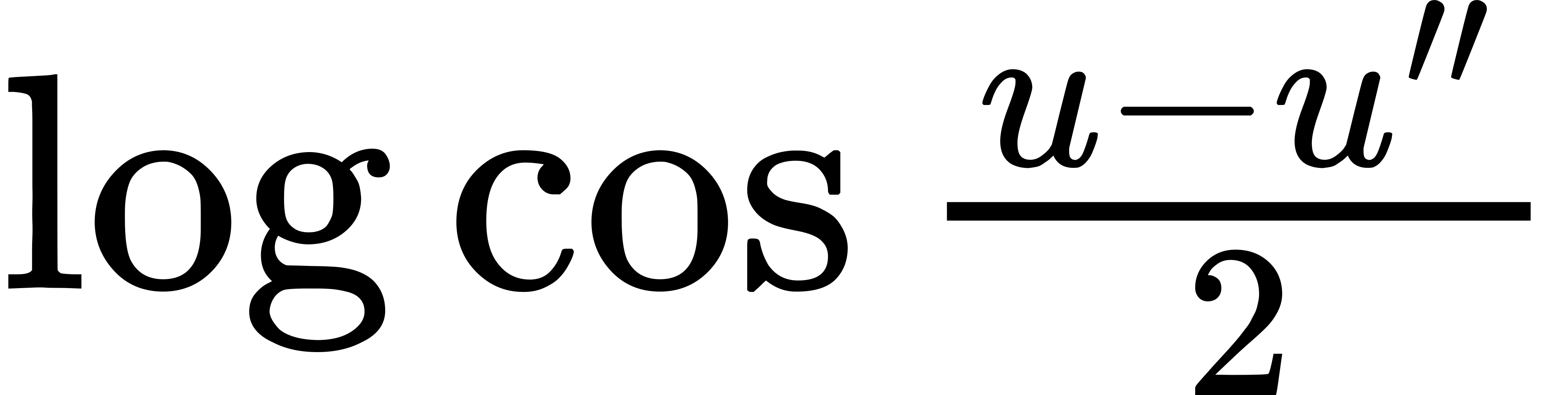
|
= | 2 14 59.6 | = | 9·9996650 | = | ·99922902 |
log
|
= | 10·0289947 | |
|
log
|
= | 10·0113682 | ||||||||
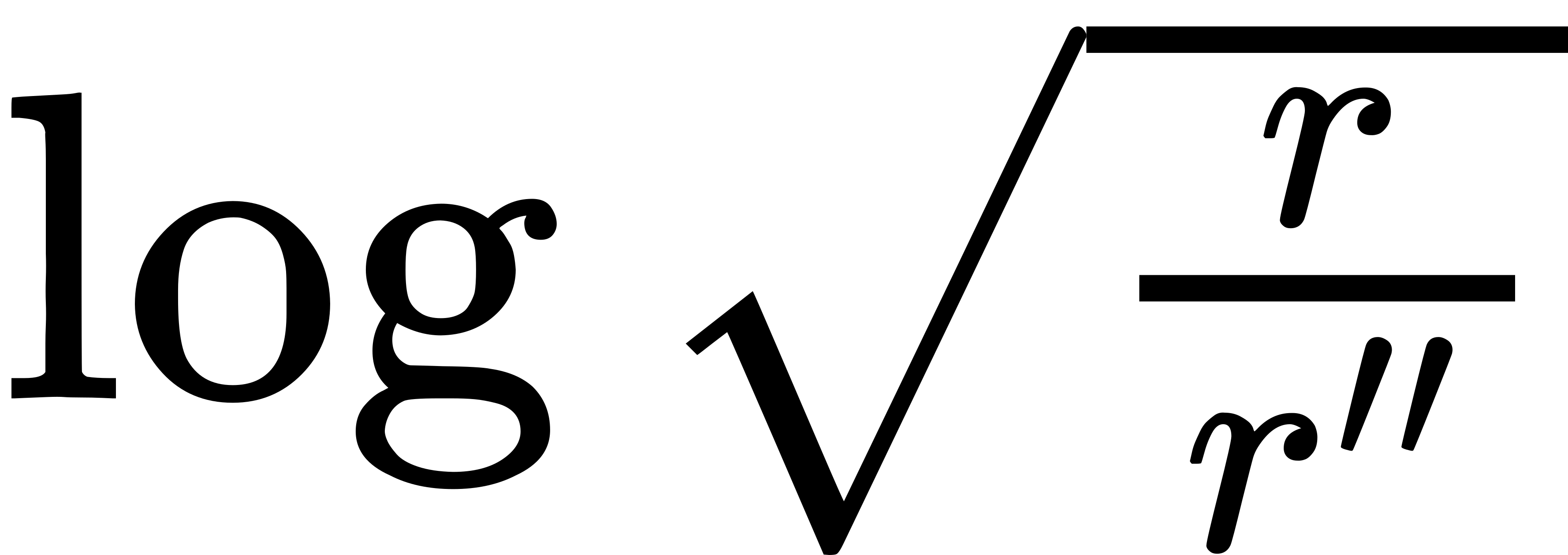
|
= | 0·0088132 | = | 1·02050047 |
log 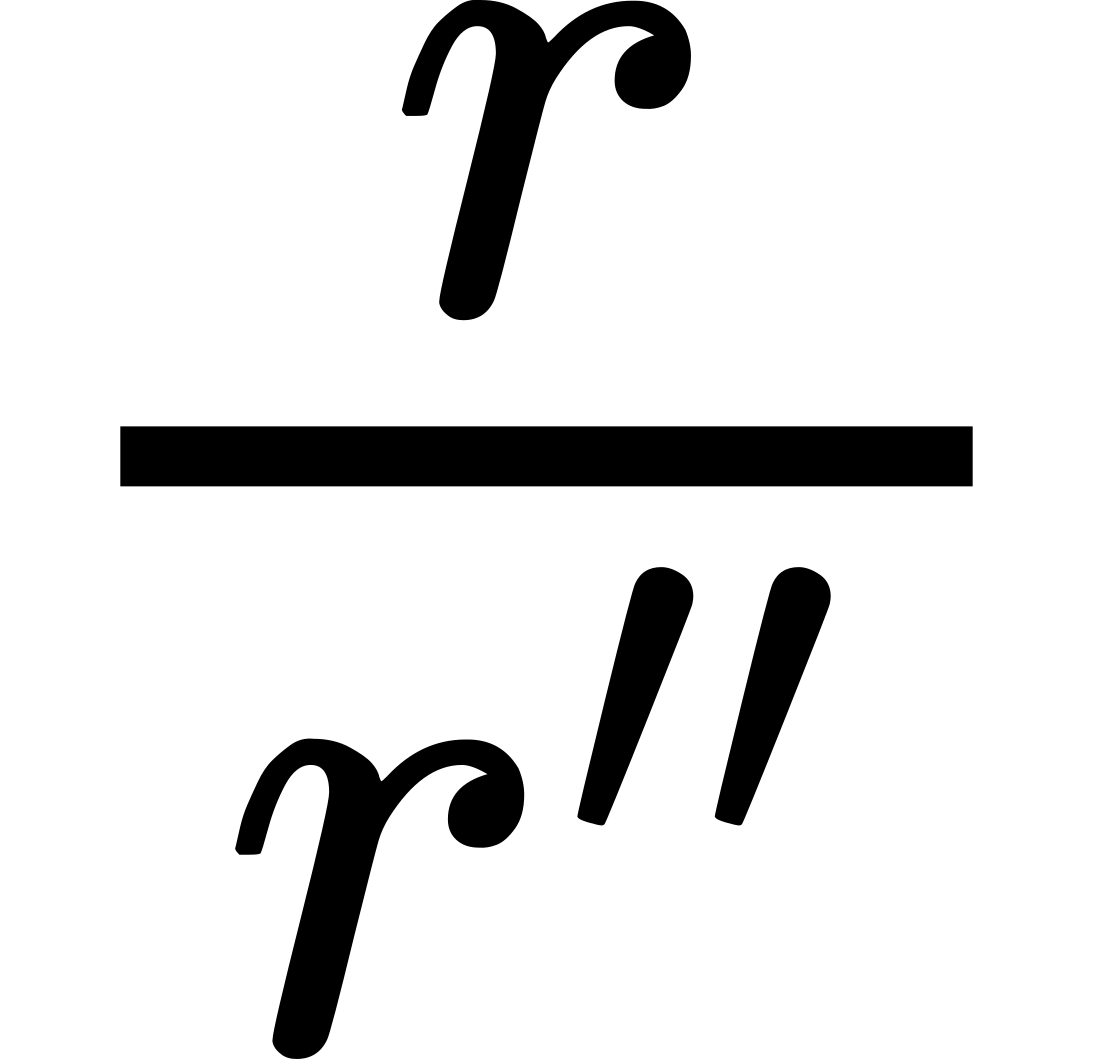
|
= | 10·0176265 | |||
| ° ′ ″ | ||||||||||
| 8·3277971 | = | 0·2127145 |
|
= | 56 54 3.2 | |||||
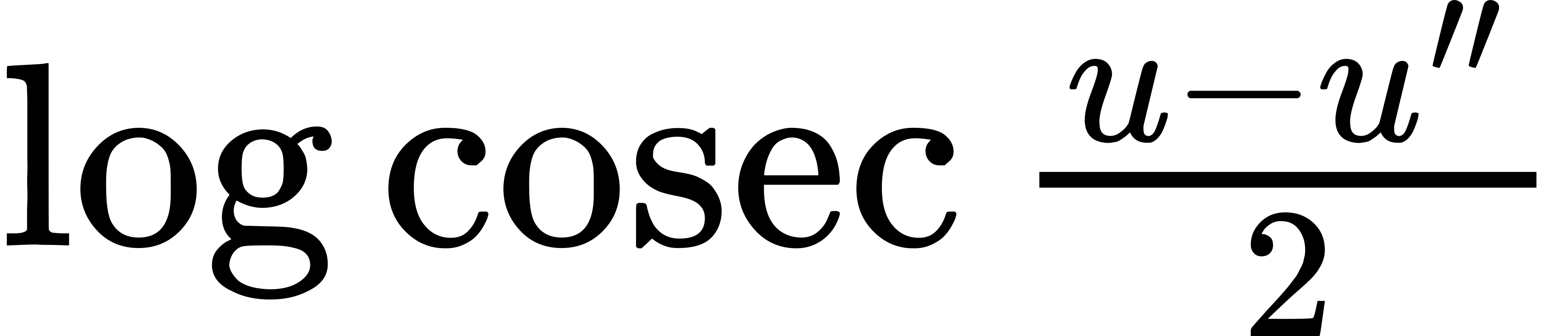
|
= | 2 14 59.6 | = | 1·4060705 |
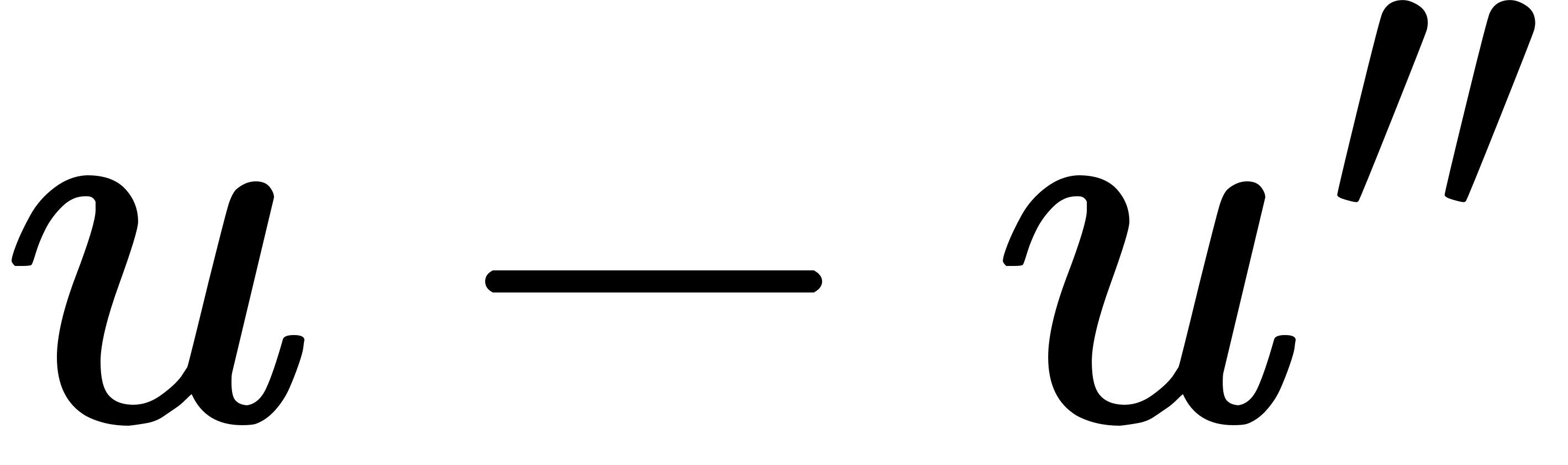
|
= | 4 29 59.3 | |||
tan 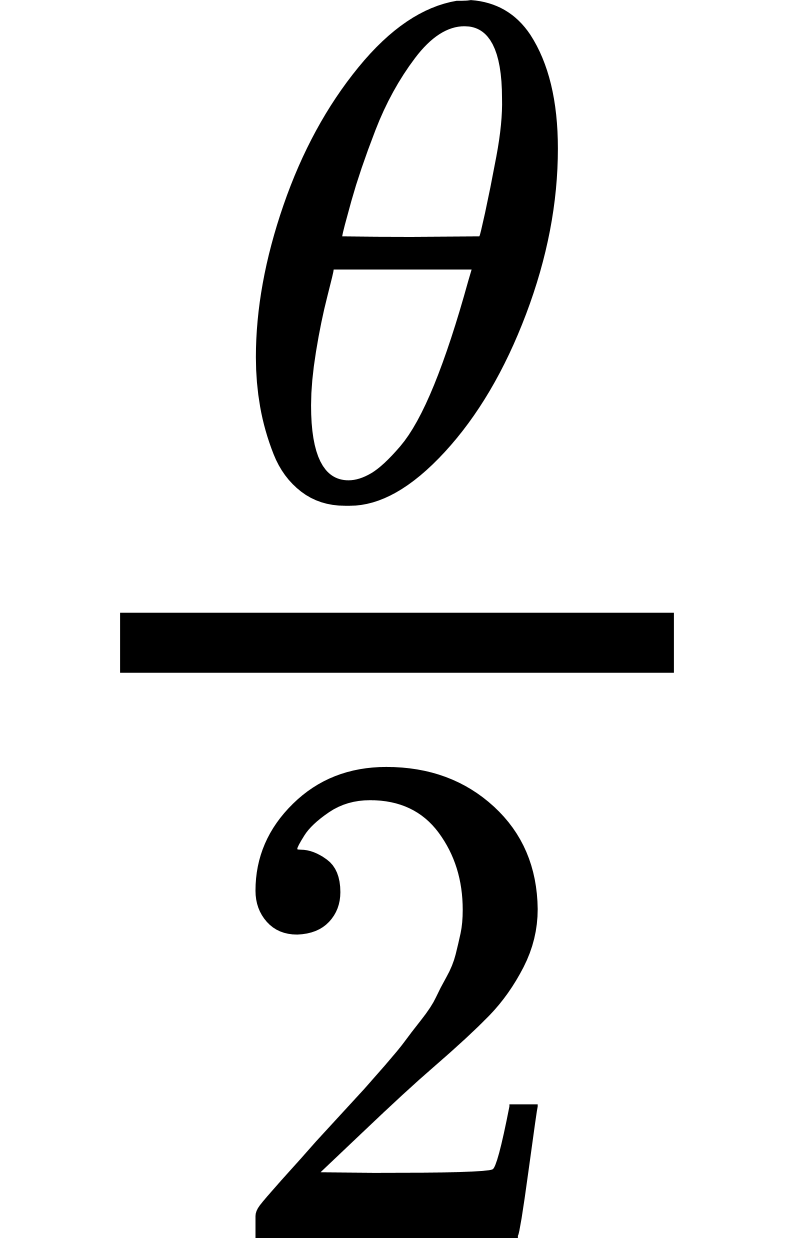
|
= | 28 27 1.6 | = | 9·7338676 |
″
|
= | 52 24 3.9 | |||
The Perihelion Distance, and longitude of the Perihelion, are derived
from the equations 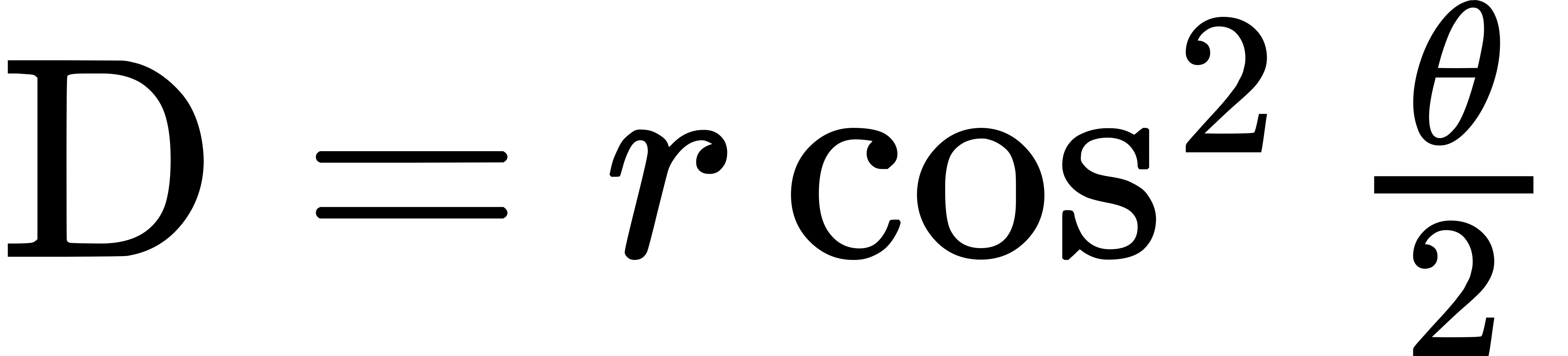 74, and
  .
.
80
| ° ′ ″ | ° ′ ″ | |||||||
|
log cos
|
= | 28 27 1.6 | = | 9·9441023 |
|
= | 56 54 3.2 | |
| 2 | u | = | 36 52 27.2 | |||||
|
log cos2
|
= | 9·8882046 |
- u
|
= | 20 1 36 | |||
| log r | = | 0·0289947 | Ω | = | 42 28 59.2 | |||
| D | = | ·8264172 | = | 9·9171993 | π | = | 62 30 35.2 |
It only remains to calculate the time of the Perihelion Passage, which must evidently be posterior to the last observation, since the longitude of the perihelion is greater than the comet’s heliocentric longitude. The anomaly at last observation having been 52° 24′ 18″.9, we look in the table for the number of days corresponding.
| Opposite to | 52° 12′ 9″.8 | is 43.50 days, and the difference between this anomaly and | |||||||
| the comet’s, | viz. 11 54 .1 | gives | .21923 | for the corresponding interval: therefore, | |||||
| the anomaly, | 52 24 3 .9 | gives | 43.71923, | log | = | 1·6406725 | |||
|
log D
|
= | 9·8757989 | = | 8·202309 | time of 3d obs. | ||||
| 1·5164714 | = | 32·845160 | days. | ||||||
| Perihelion Passage | = | 41·047469 | days subsequent | ||||||
| to the 1st September75. | |||||||||
The approximative elements of this comet, obtained by the foregoing investigations, are therefore,
| Greenwich. | ||
| Passage of Perihelion, | 1826, Oct. | 11·047468 |
| Longitude of Perihelion, | 62° 30′ 35″ | |
| Longitude of the Node, | 42 28 59 | |
| Inclination of Orbit, | 28 4 13 | |
| Distance of Perihelion, | ·8264172 | |
| Motion, | Direct. |
81
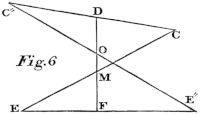
Still, it must be remembered, that the elements, as thus obtained by
Olbers’ method, on account of the imperfection of the method, are no
more than approximate. One of the fundamental data on which that method
is grounded, however slight its aberration from the truth, is nevertheless
not mathematically correct. It will be recollected, that, at the commencement
of the method, we assumed that the radii vectores of the earth
and of the comet divide the chords of the arcs passed over by them, in the
exact proportion of the times;—an assumption involving a slight inaccuracy,
but which served to facilitate considerably the solution of the problem.
We have now therefore to rectify the value of ″, as given by equation (1.)
and, instead of supposing it = M, let us make it = (M + v) + h. We
have only to determine v and h, to find the real value of ″. It is evident
from Fig. 1. that EF : FE″ :: SE × sin ESF : SE″ × sin FSE″; and in
like manner, that CD : DC″ :: SC × sin CSD : SC″ × DSC″. It is also
evident, that the angles ESF, FSE″, are the differences between the
earth’s longitudes, in the second and third observations; and that the angles
CSD, DSC″, are the differences between the comet’s true anomalies, also
in the second and third observations, determined by the foregoing investigations:
So that calling these last angles τ and σ, we obtain from the
above proportions
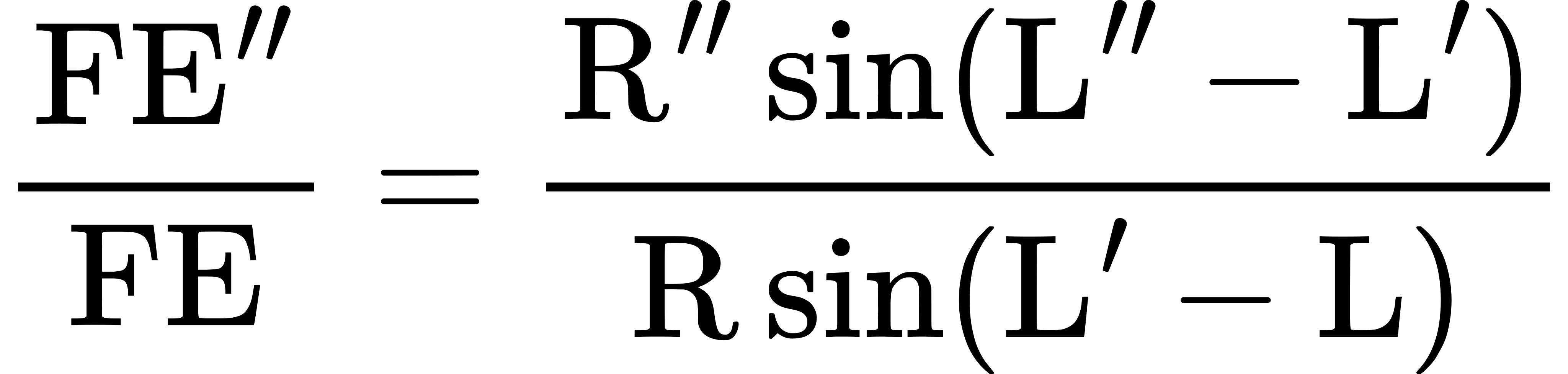 , and
, and 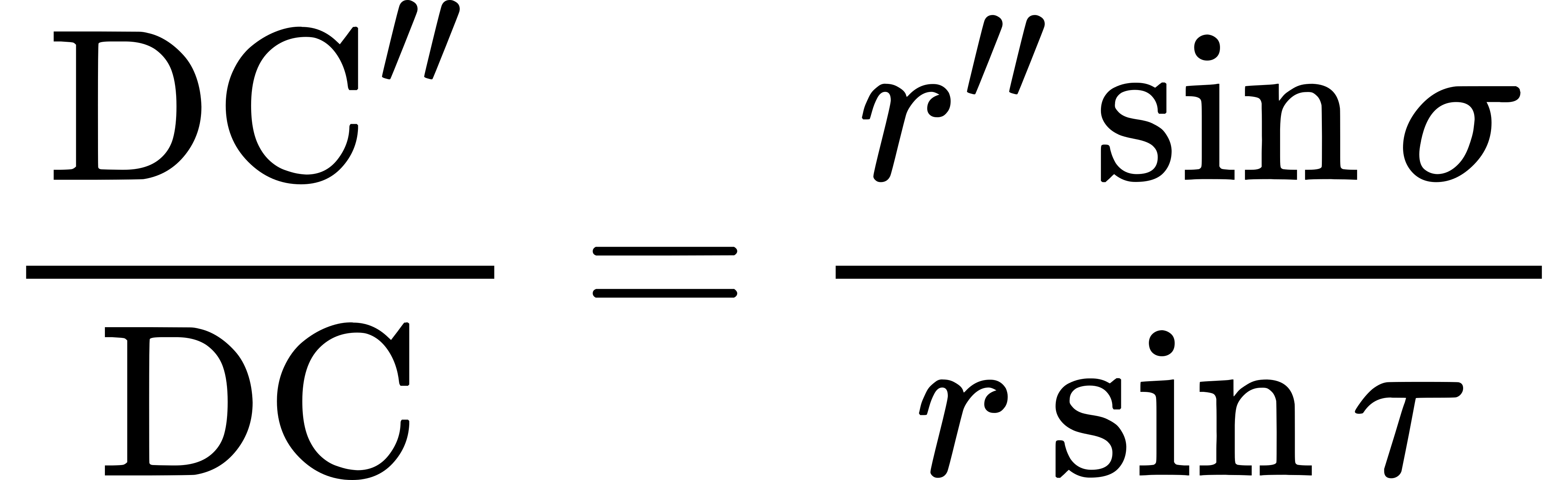 .
In the accompanying figure, let CDC″, EFE″
be the chords of the comet and of the earth,
projected on a plane perpendicular to the intermediate
radius vector of the earth, or a
circle of latitude. Join the intermediate points D F, by the line DF,
cutting C″E″, CE, in O and M. Now, since
C″O : sin D :: C″D : sin O, by the common property of triangles,
and sin D : CM :: sin M : CD. Therefore, we obtain by the comparison
of these two series,
.
In the accompanying figure, let CDC″, EFE″
be the chords of the comet and of the earth,
projected on a plane perpendicular to the intermediate
radius vector of the earth, or a
circle of latitude. Join the intermediate points D F, by the line DF,
cutting C″E″, CE, in O and M. Now, since
C″O : sin D :: C″D : sin O, by the common property of triangles,
and sin D : CM :: sin M : CD. Therefore, we obtain by the comparison
of these two series,
82
In the same manner, we get
from both of which we obtain
 Now, calling EM,
 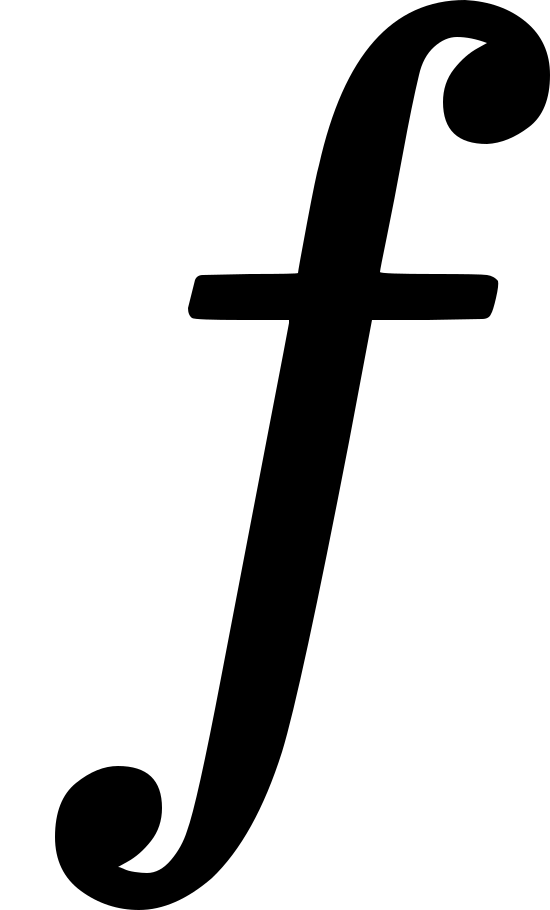 ; and EC,
 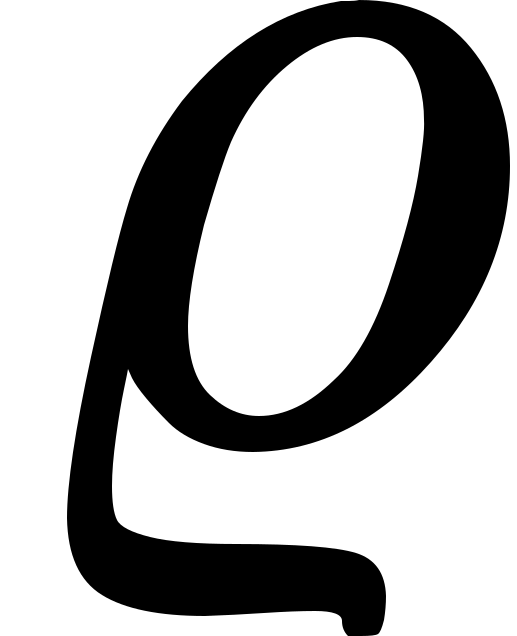 , we have CM =
 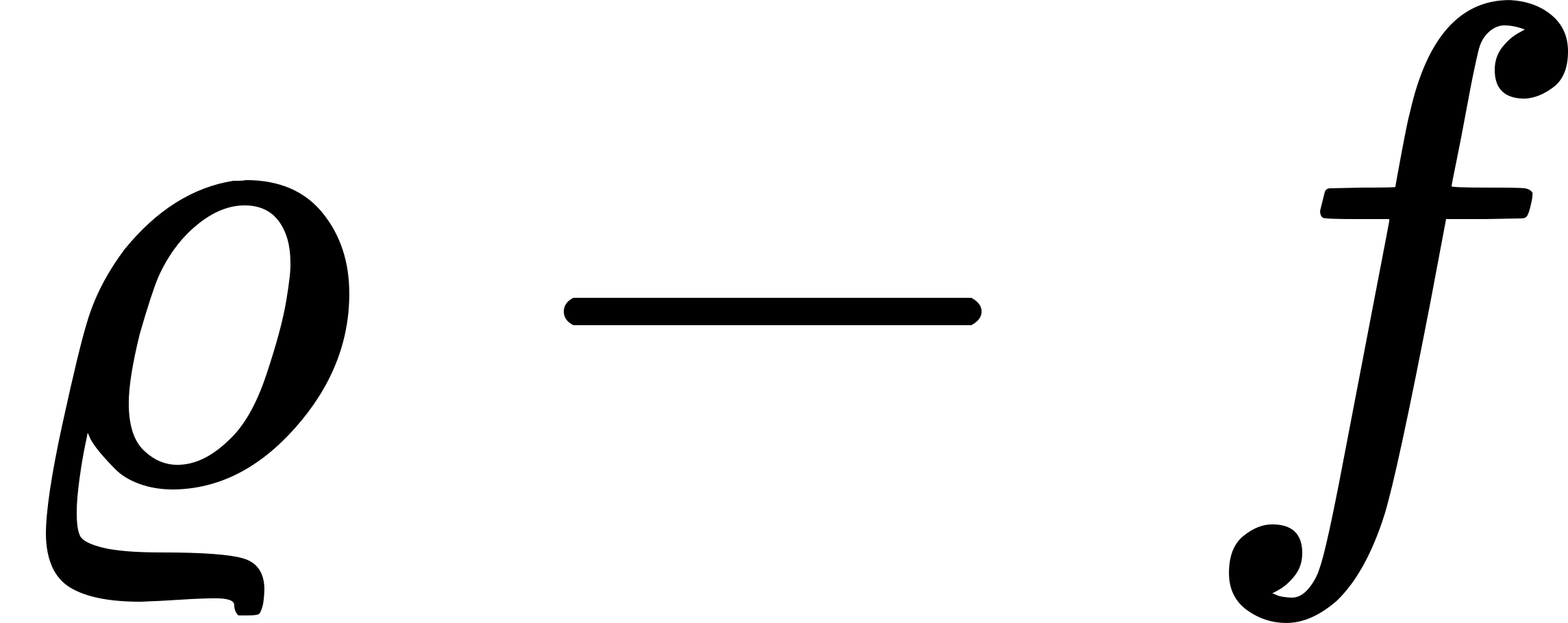 . We have likewise,
as at the commencement of the parabolic investigation,
. We have likewise,
as at the commencement of the parabolic investigation,  M, (or the
angle at the intersection of the first and second projected distances, EC,
FD) =
M, (or the
angle at the intersection of the first and second projected distances, EC,
FD) = 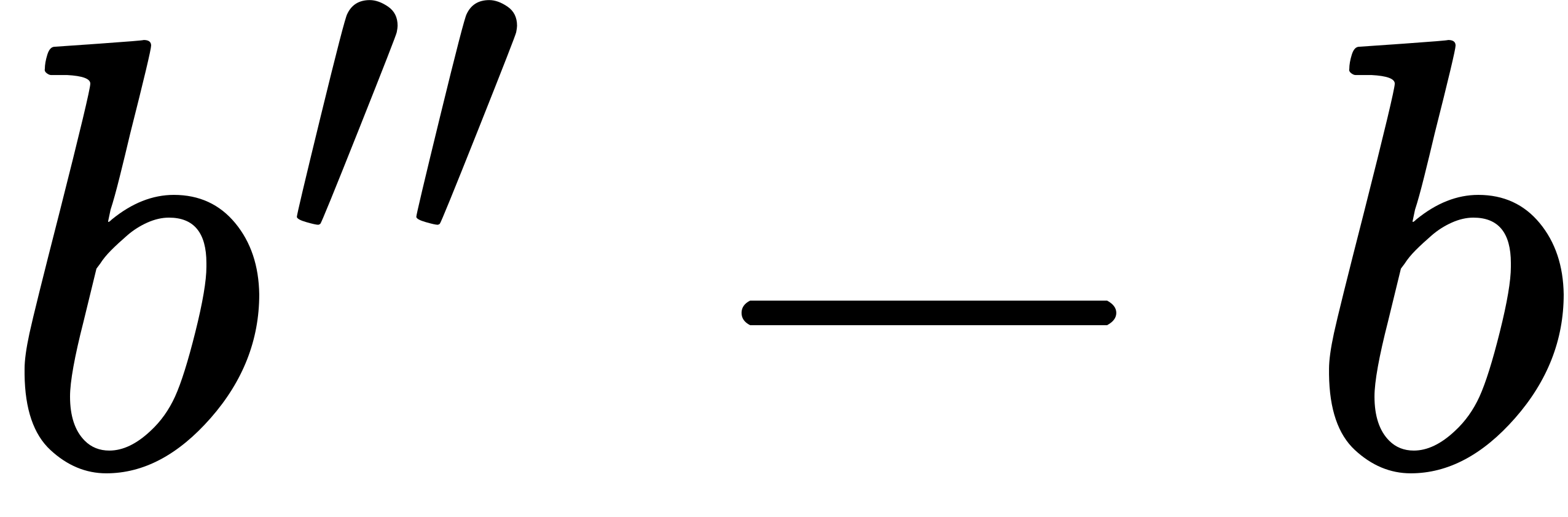 : and D (or angle formed by the second and third projected
distances) =
: and D (or angle formed by the second and third projected
distances) = 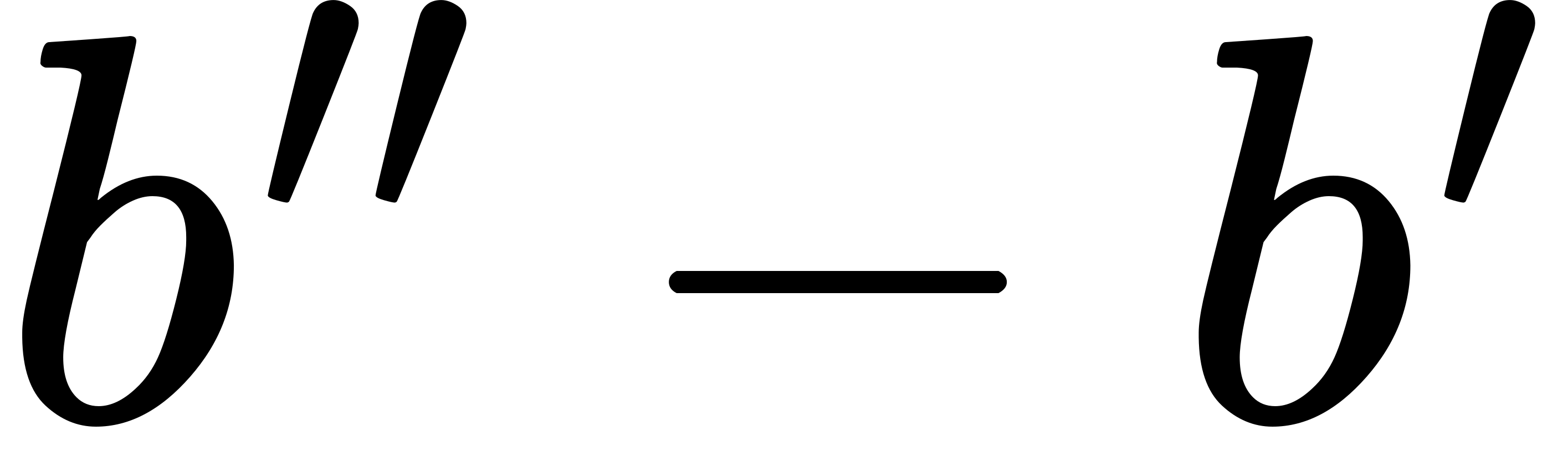 : so that, making these substitutions, the above
equation becomes
: so that, making these substitutions, the above
equation becomes

If now we put 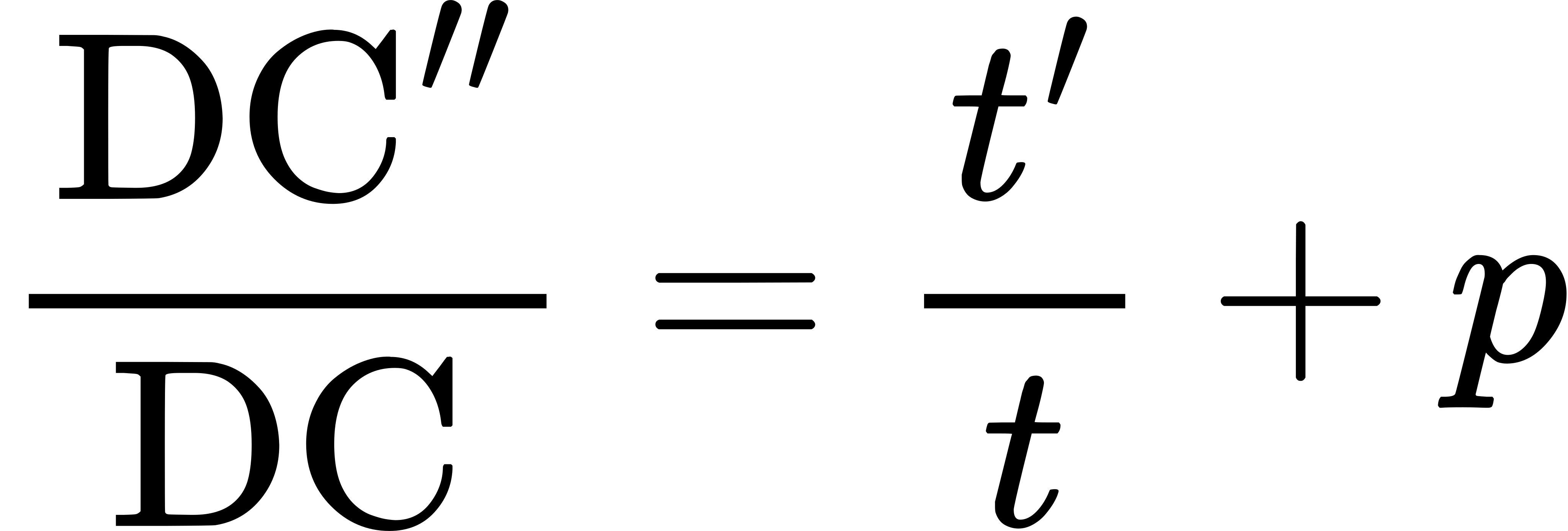 , and
, and 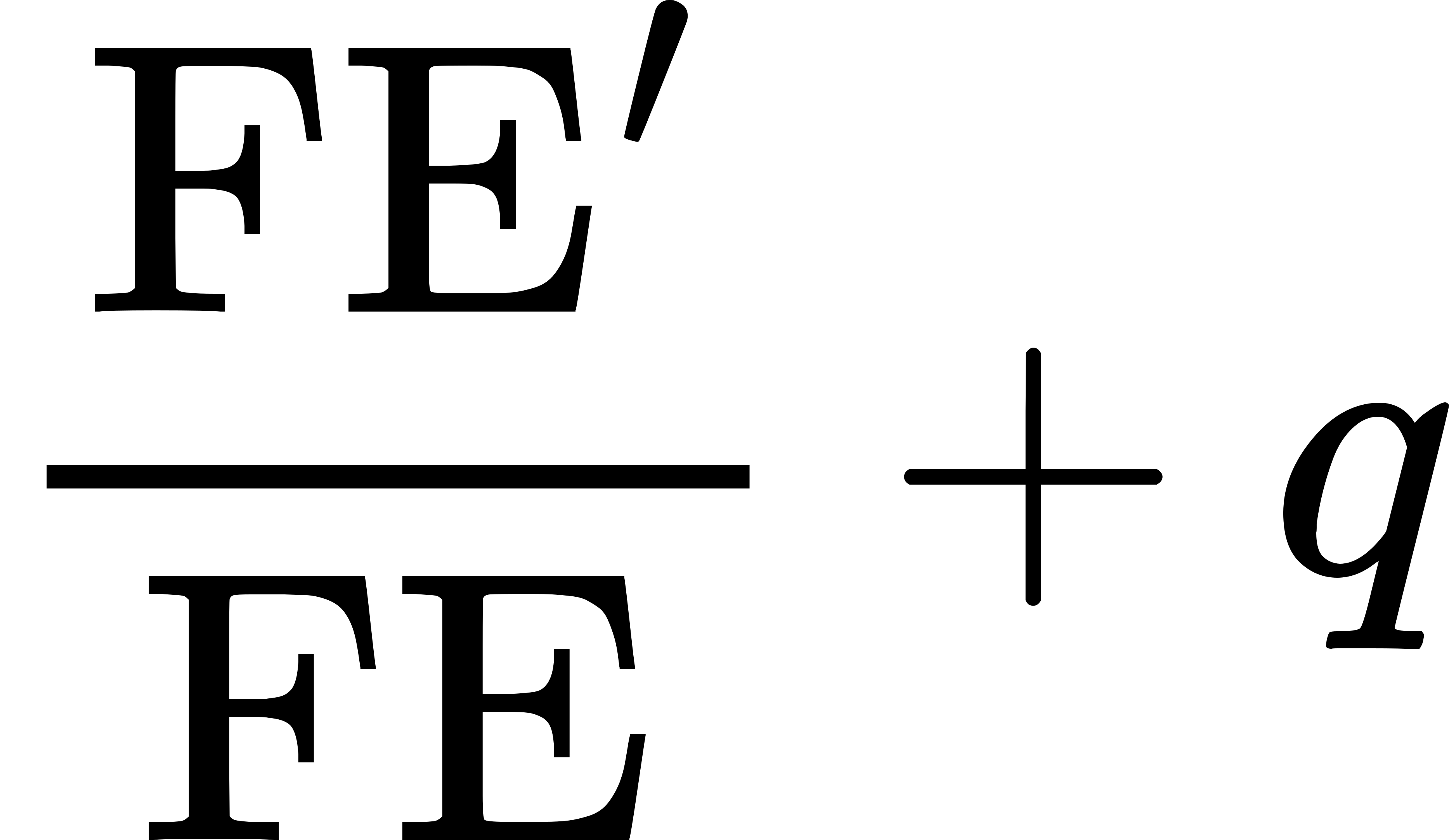 , we have, from equations (16.) and (17.)
 the first being the correction for the comet’s orbit, the other for the earth’s. But
 so that calling
 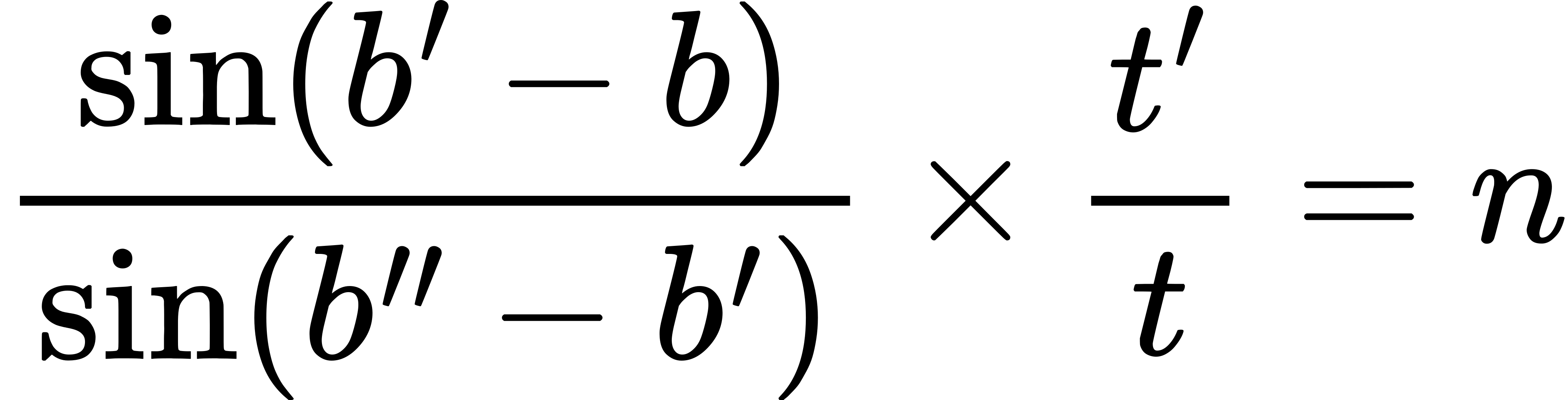 , we get
 Now, in deducing equation (1.) we found C
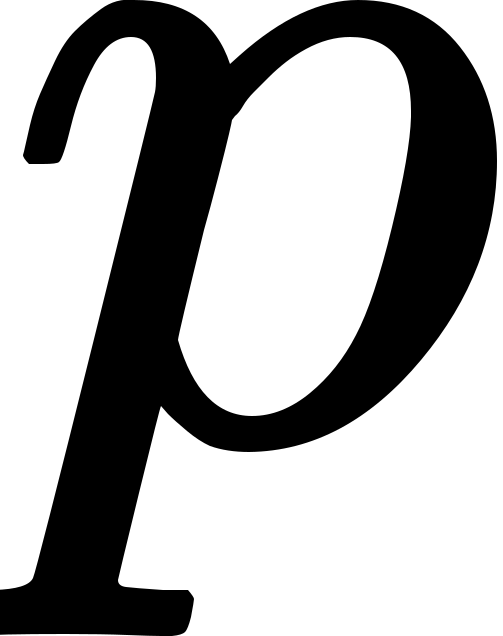 , or (since E is here supposed
projected on the plane
, or (since E is here supposed
projected on the plane  C),
C),
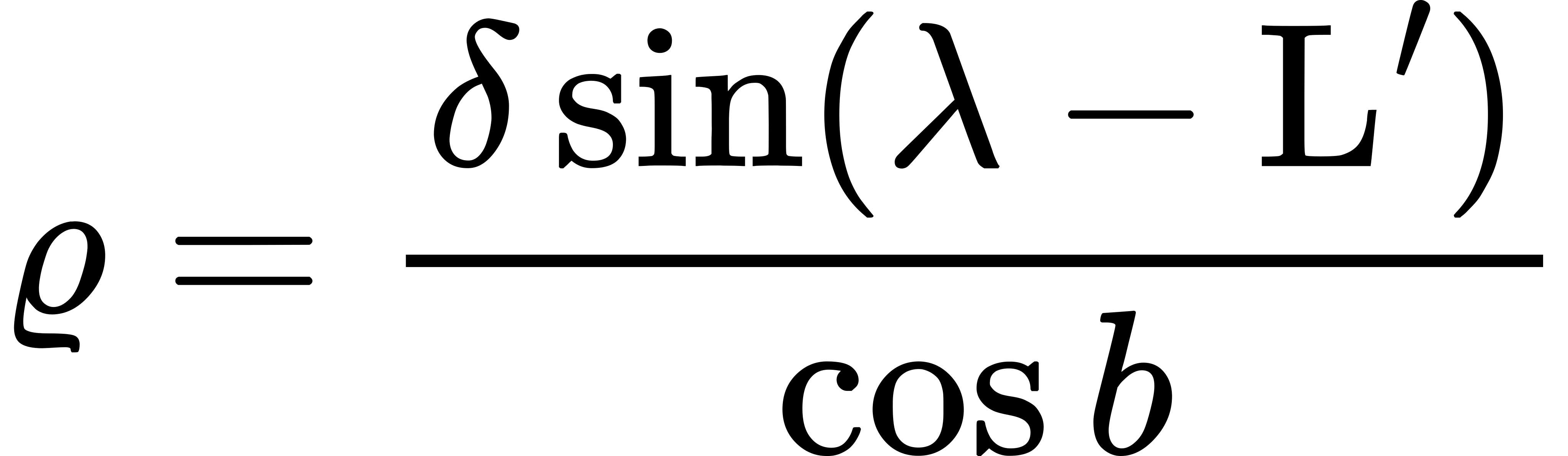 , and
, and 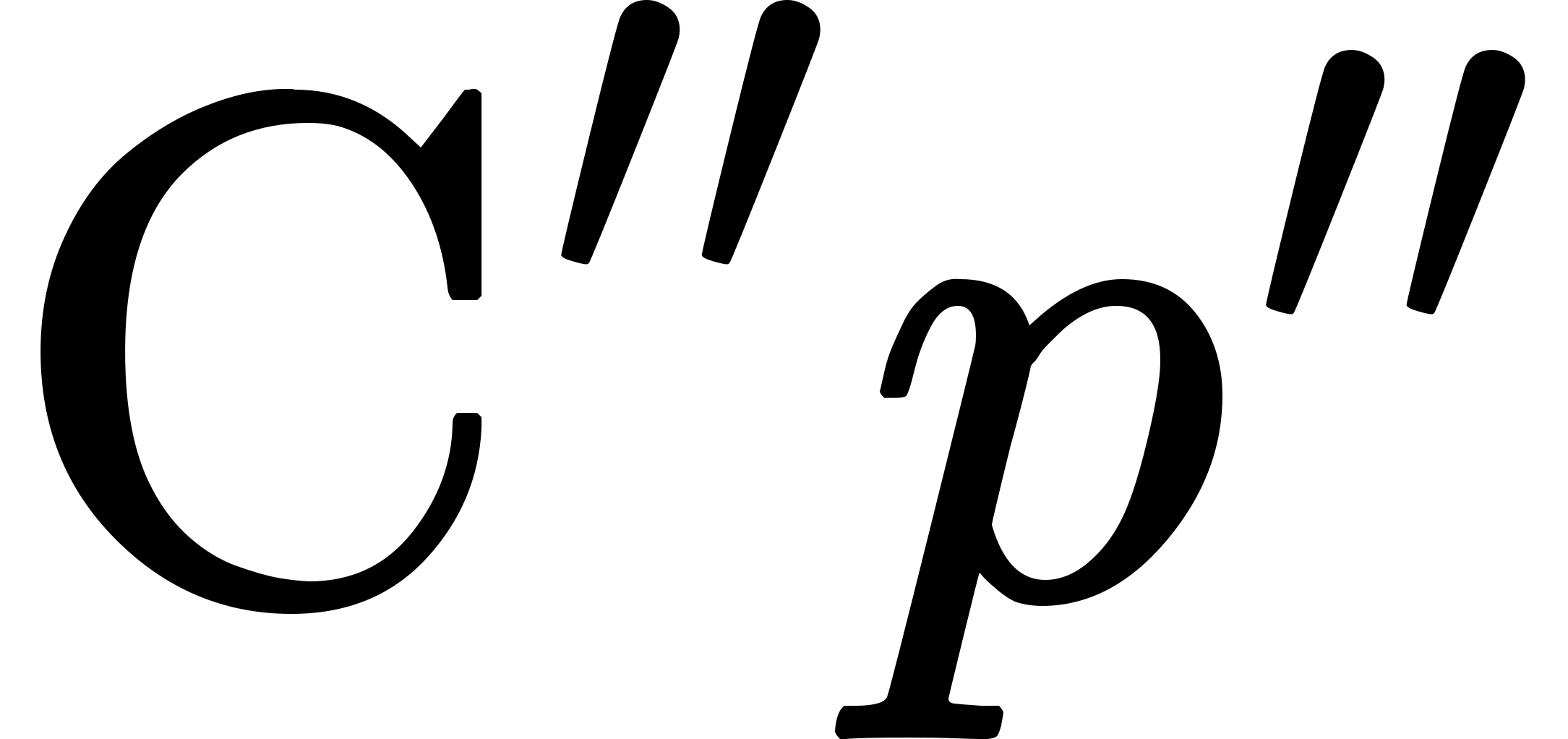 or
or 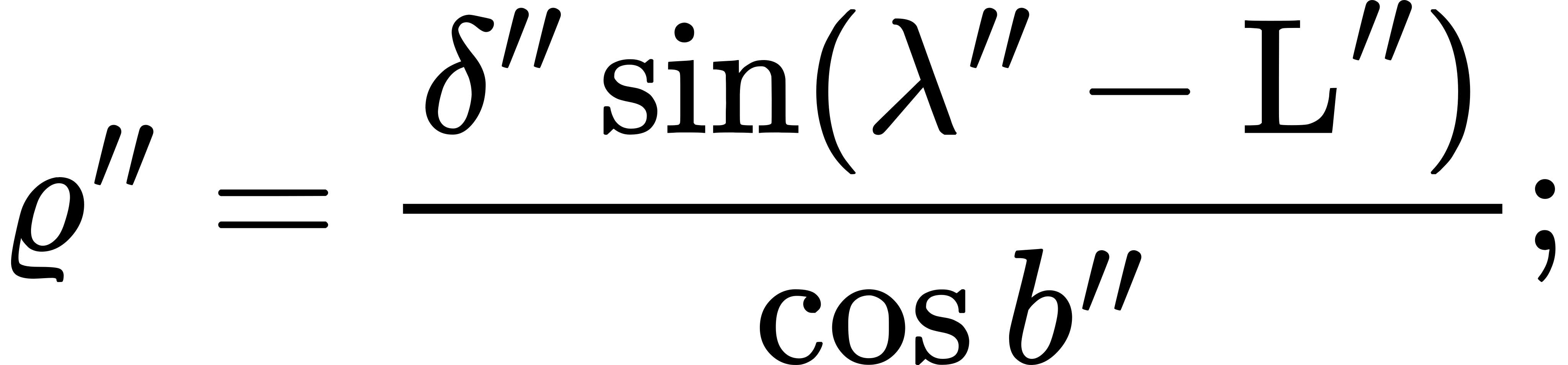
whence we now have

 83
If in this last, and somewhat complicated equation, m is substituted for
83
If in this last, and somewhat complicated equation, m is substituted for
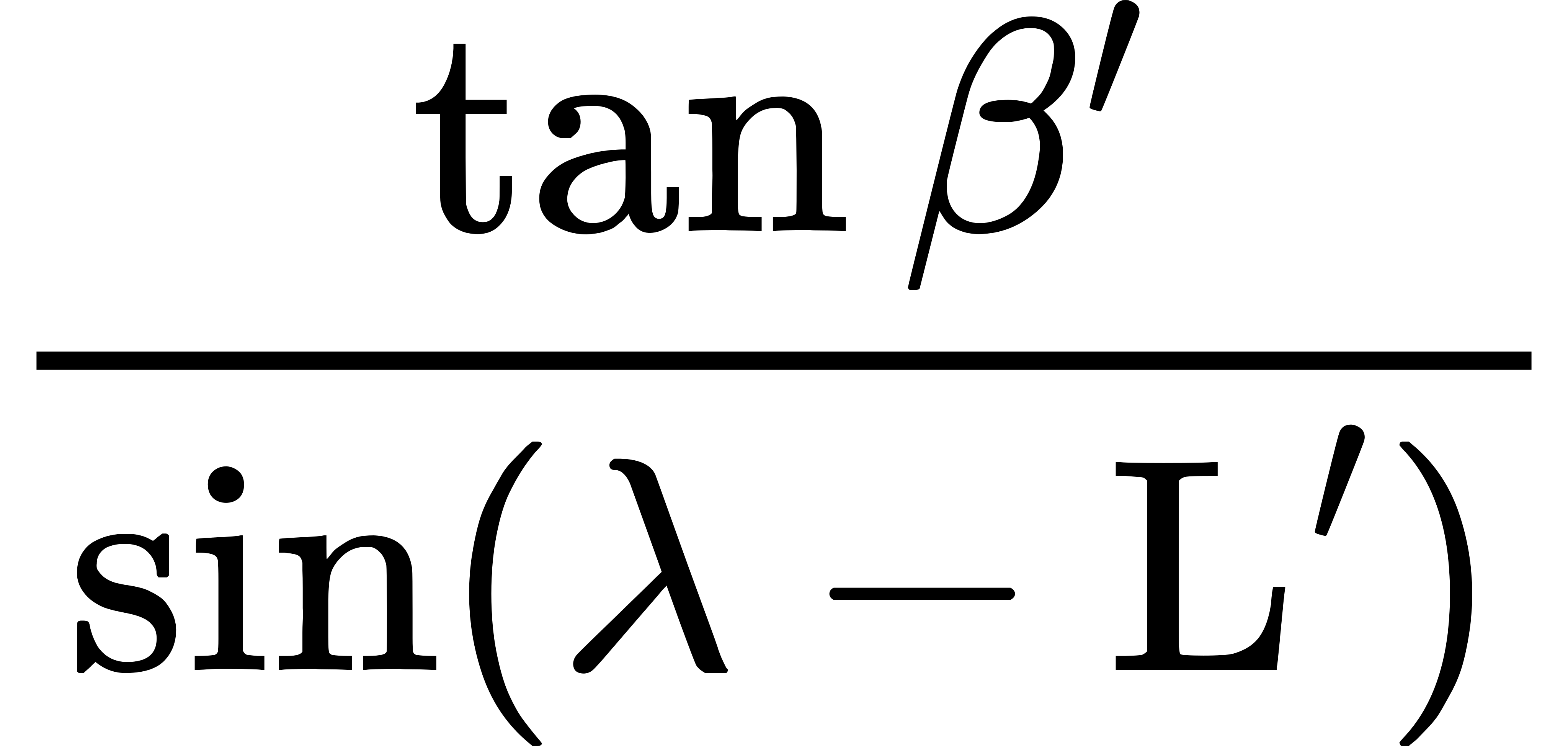 , we obtain

 So that this last term of the equation becomes
 this expression may be converted also into76
 The whole equation becomes therefore

With this corrected value for the ratio of , we may proceed at once to
amend our calculations. But, as Olbers observes, the labour is much
abridged, by recollecting that the already computed can differ very slightly
from the true value now to be found; and if we call the approximate value (), we shall have
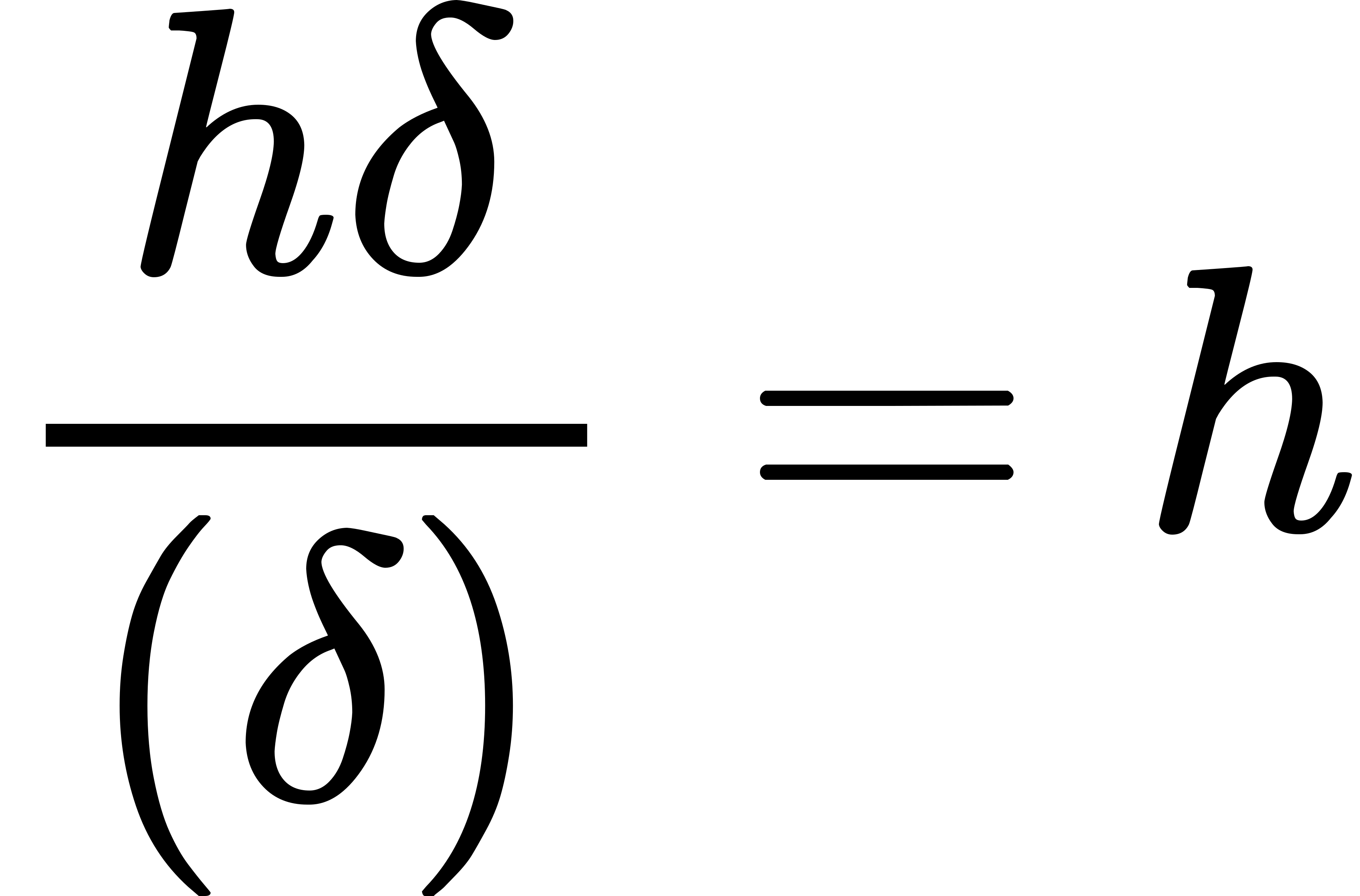 , and the above equation for becomes
 being =
 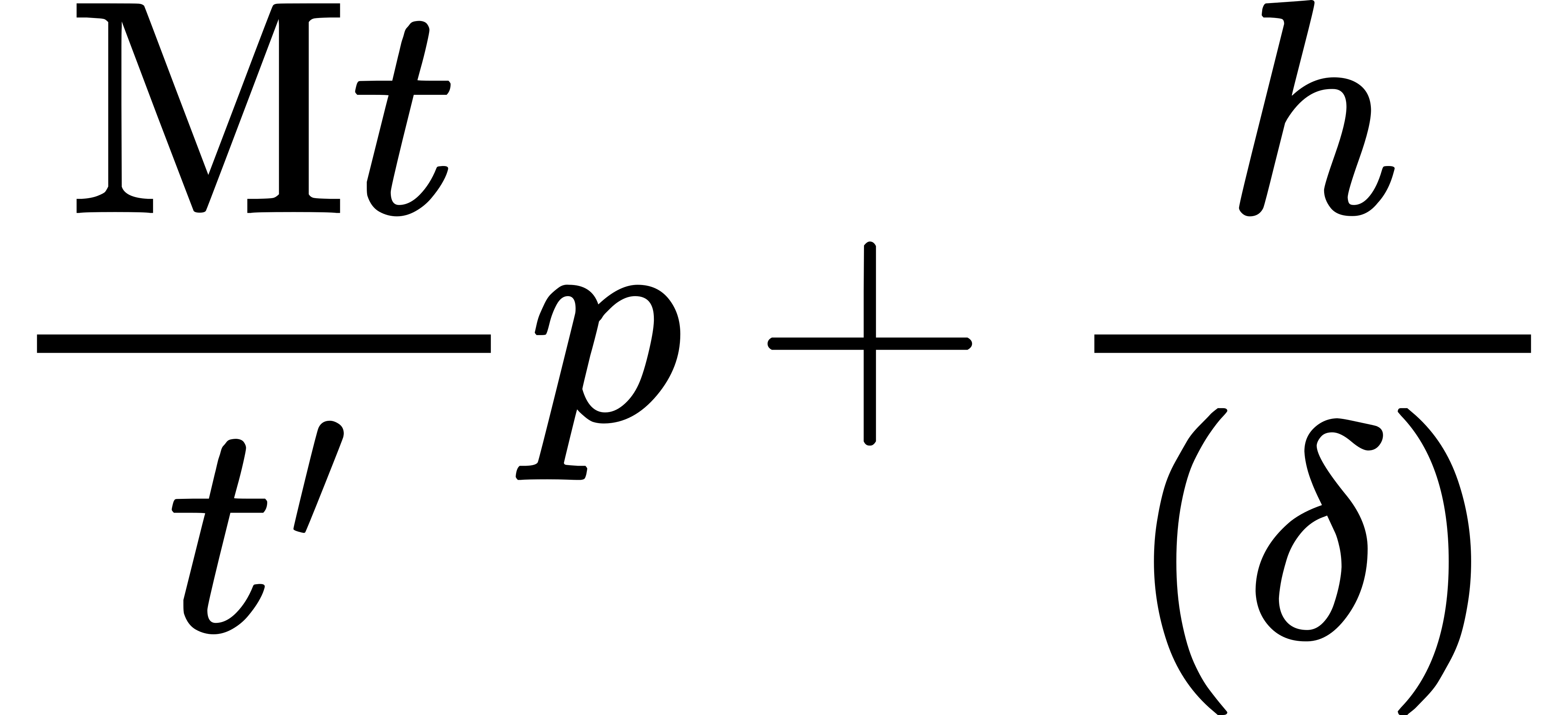 . In order, therefore, to correct the equations (2.)
and (7.), giving the approximate values of ″ and , we must multiply all
the coefficients which contain M, by
. In order, therefore, to correct the equations (2.)
and (7.), giving the approximate values of ″ and , we must multiply all
the coefficients which contain M, by 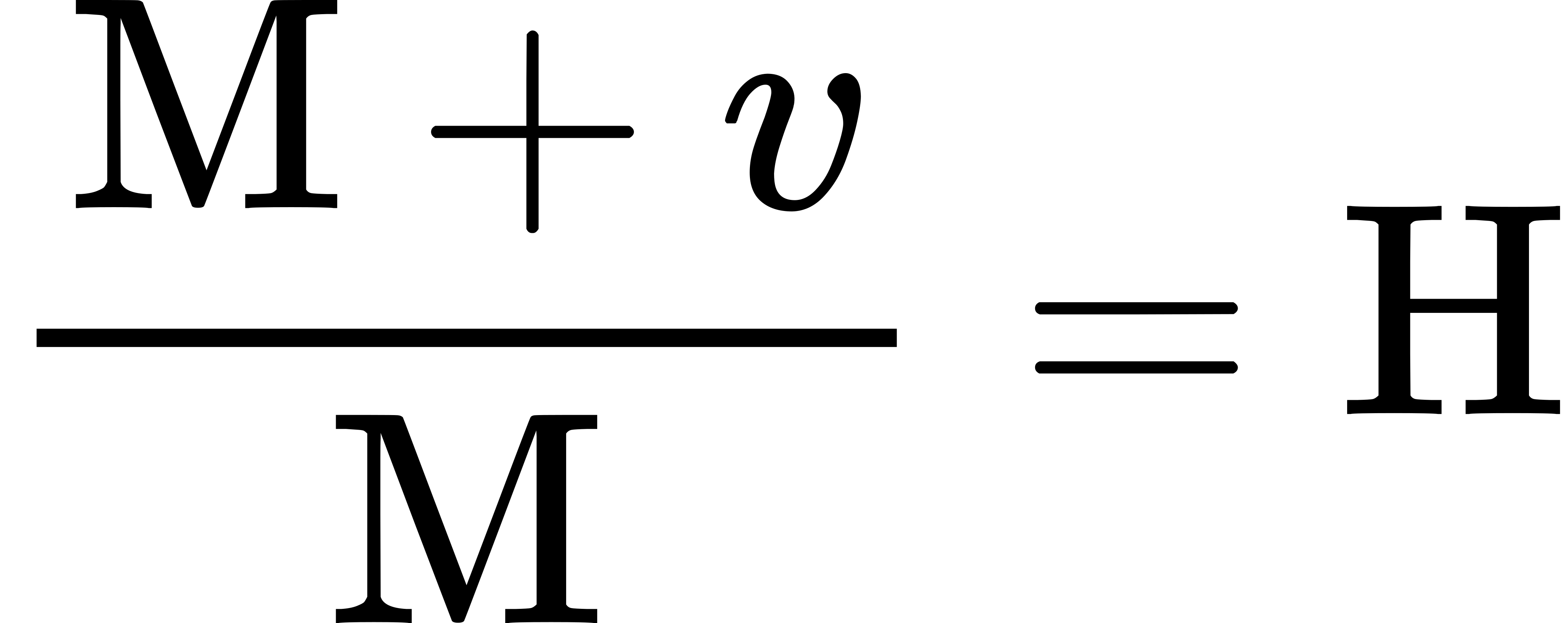 , and those containing
 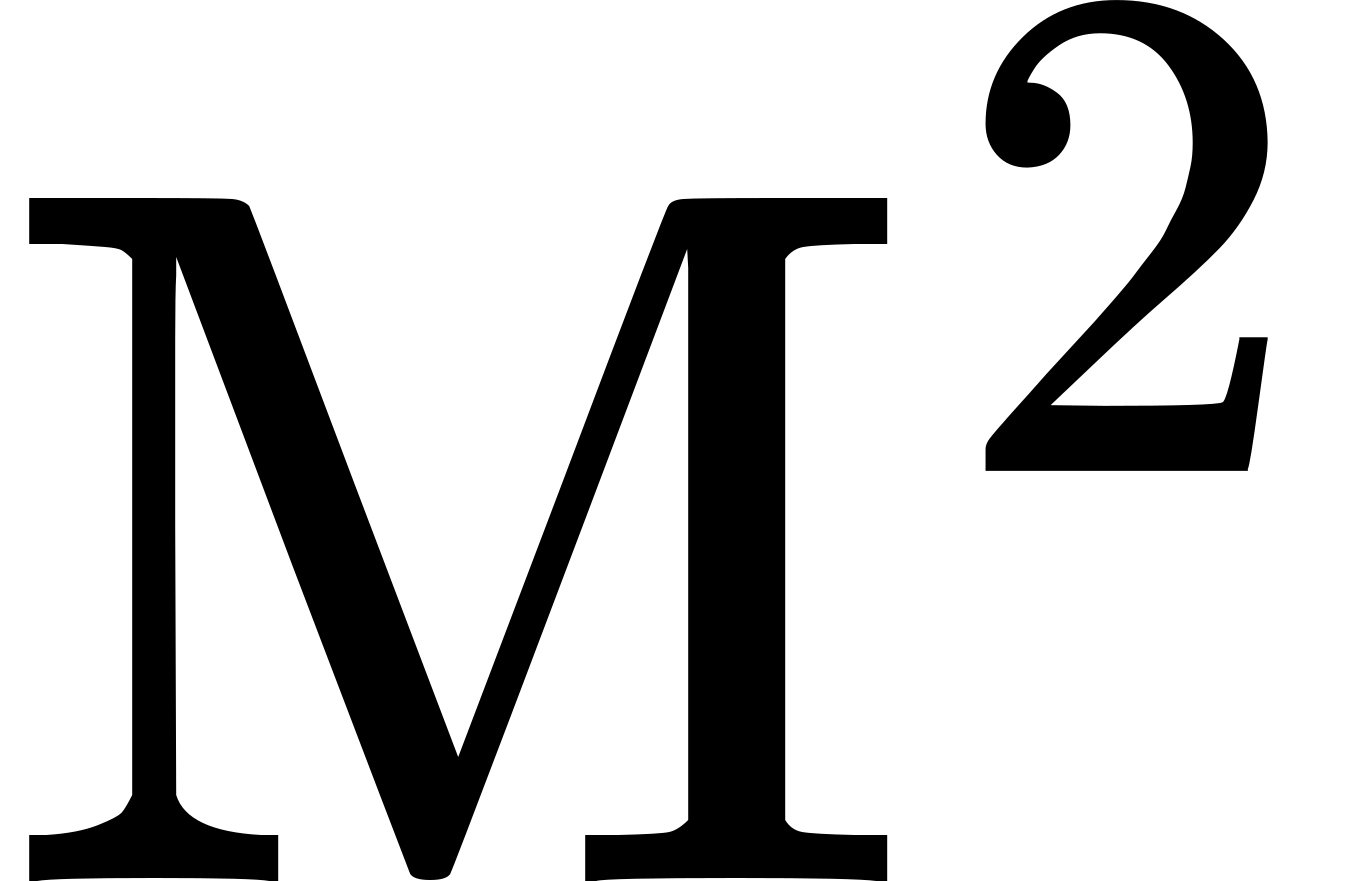 by
by 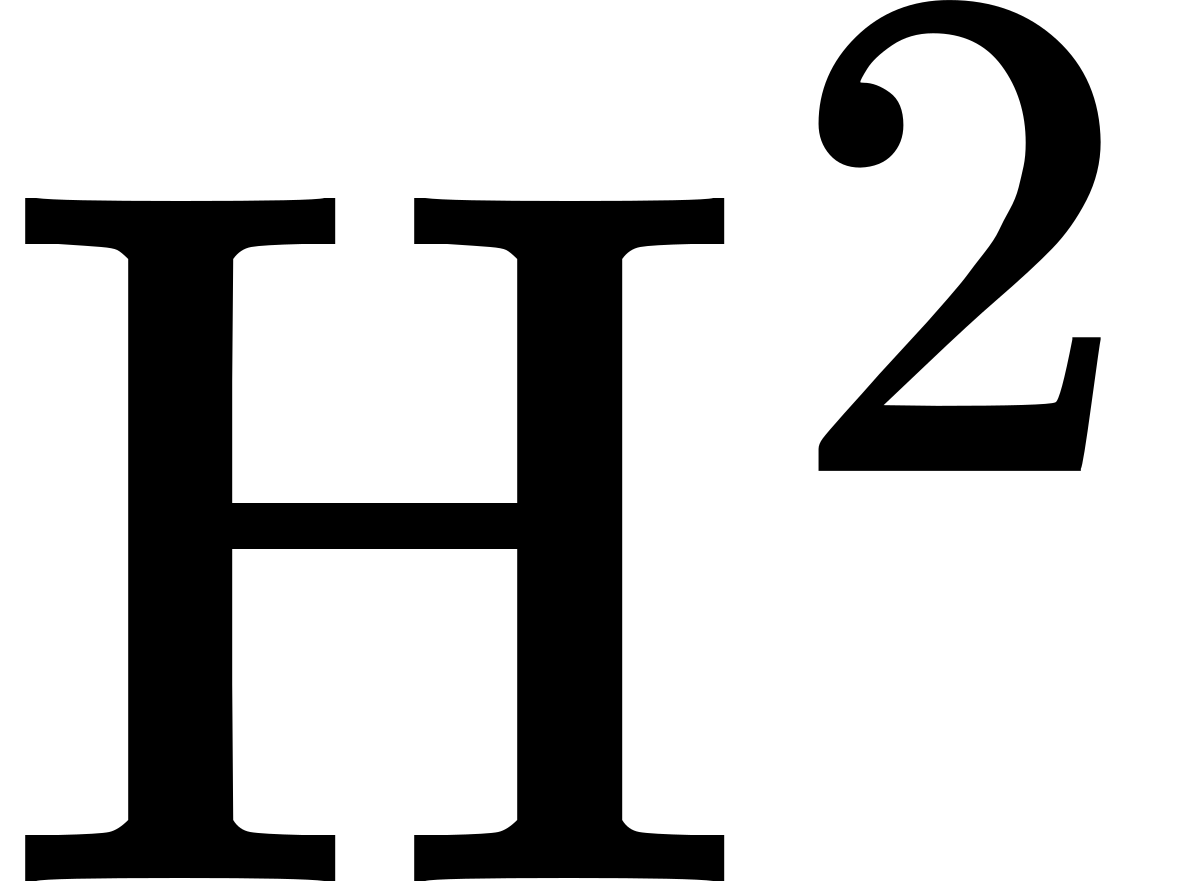 . The equation for remains of course unaltered, as M does not enter
into any of its terms.
. The equation for remains of course unaltered, as M does not enter
into any of its terms.
84
For the sake of conveniently applying the equations requisite for determining
H, let us collect them from the preceding investigations. Having
already obtained the approximate values of σ, τ, and ″, we have only to
substitute them, along with that of , in the following equations.
 where, as before,
 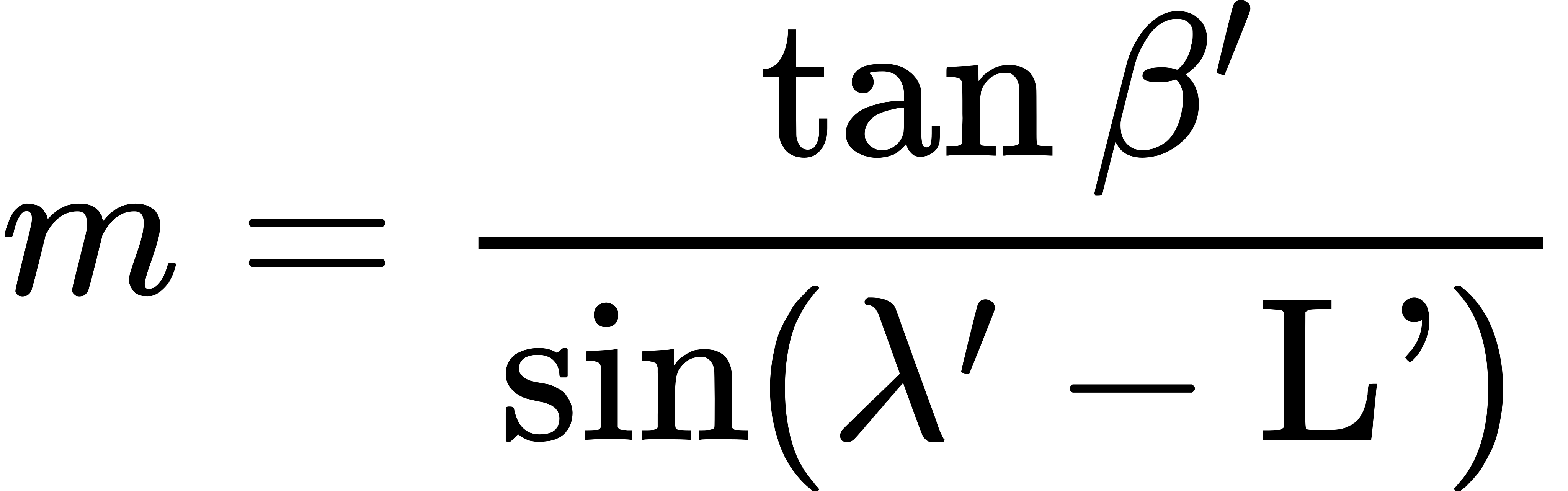 and finally,
 for, in the last term of the equation for H, the quantities h and M have
the same denominator, which necessarily disappears in the fraction
for, in the last term of the equation for H, the quantities h and M have
the same denominator, which necessarily disappears in the fraction 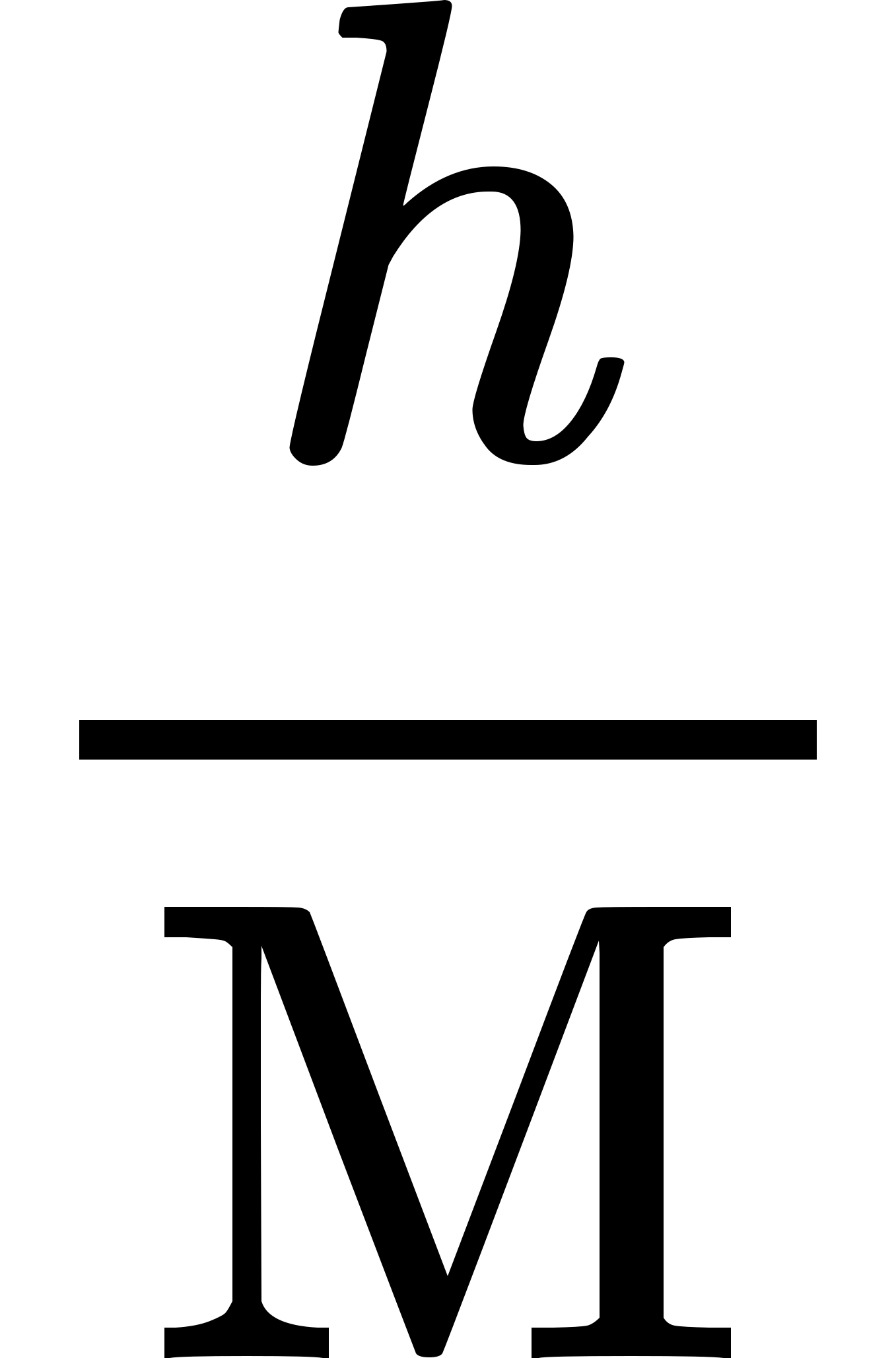 .
.
This method of correction just demonstrated, is very simple, and equally convenient for calculation. It is also, in its application, extremely general; for, by means of it, we are enabled to amend the approximate elements, without being obliged to resort to any other observations than the three, if they are not remote from one another, which have been already employed in obtaining them. But it is to be remarked, that the orbit of a comet will be determined much more correctly, if the observations are made after the lapse of considerable intervals; because then the small errors committed either in observation or computation, or which arise from inaccuracies in the sun’s tables themselves, when thus diffused over a considerable space, have that influence lessened which otherwise would affect the correctness of the results. It is therefore extremely desirable, when we happen to possess a long series of observations, comprehending, for instance, intervals of twelve or sixteen days, to be able to employ them in a more complete rectification of our approximate elements; and the ingenuity of Olbers has here also supplied a method alike remarkable for its conciseness and certainty.
Fix upon two extreme observations, as far distant as possible from each
other, and, by means of the elements already computed, determine the curtate
85distances Δ Δ″ of the comet from the sun, and likewise the heliocentric
latitudes and longitudes. These computations are readily made; for the
angle at the projected place of the comet on the plane of the ecliptic (Fig. 4.)
is found by the equation
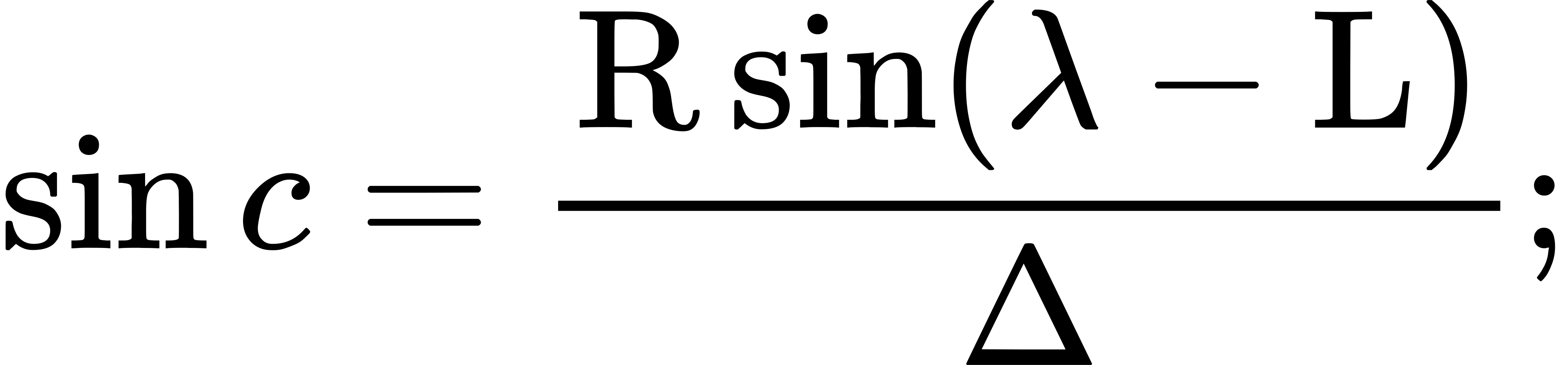 observing, however, to take the angle acute or obtuse, according to circumstances;
and hence we find
observing, however, to take the angle acute or obtuse, according to circumstances;
and hence we find  , the elongation of the comet from the earth
=
, the elongation of the comet from the earth
= 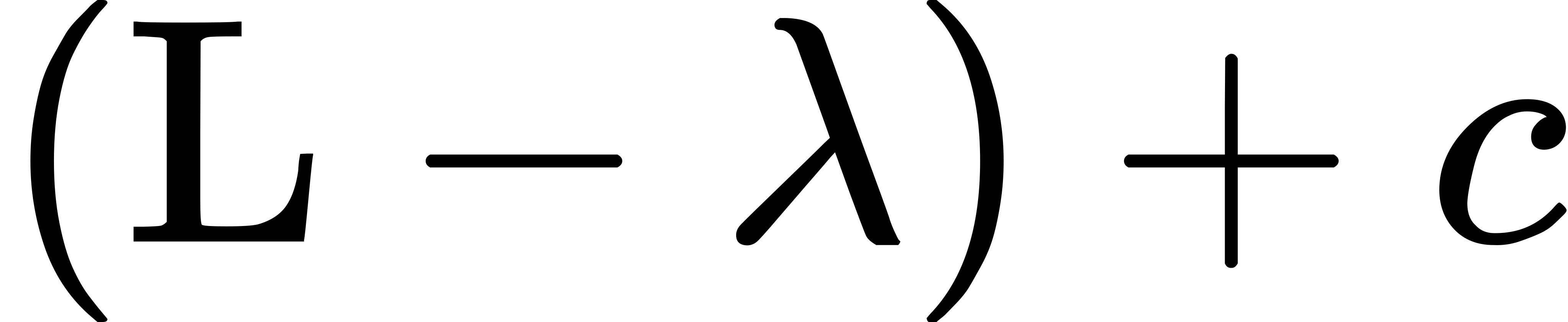 : and for the heliocentric latitude, since
 we have the equation
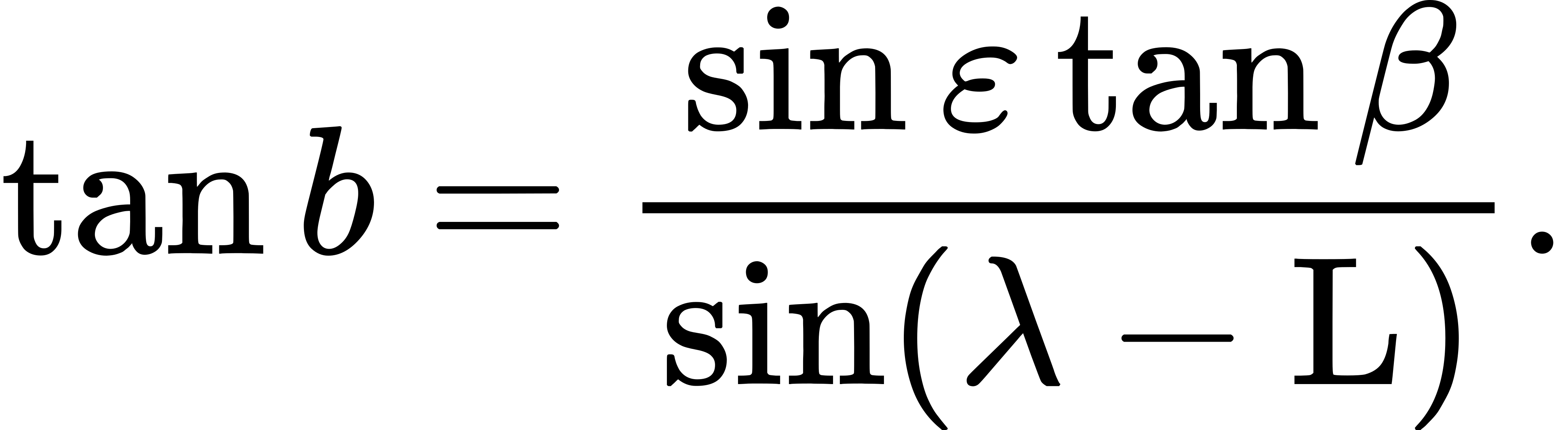 The heliocentric longitudes may then be obtained by means of equat. (10.),
 We then make successively two small variations in the curtate distances,
Δ + m, and Δ″ + n; and the hypotheses will stand thus:
We then make successively two small variations in the curtate distances,
Δ + m, and Δ″ + n; and the hypotheses will stand thus:
| 1st Obs............. | Δ, | Δ + m, | Δ |
| 3d Obs. ............ | Δ″, | Δ″, | Δ″ + n. |
According to the method already pointed out, we next compute the longitude
of the ascending node, and the inclination of the orbit for each of these
three hypotheses; and since  , and
, and  , we hence find
the anomalies in both observations, the distance of the perihelium, and the
time from the perihelium to the first and third observations, which gives
us the time that ought to elapse between these observations, according to
each of the hypotheses; hence we have the first comparison. We then
add, for each of the three orbits, to the time between the perihelium and
the first observation, the observed time from the first to some other observation,
sufficiently remote from both the others: Lastly, we compute the geocentric
place of the comet, in longitude or latitude, according as the one or
86other varies most rapidly, and the place so computed gives, together with
the observation, the second comparison.
, we hence find
the anomalies in both observations, the distance of the perihelium, and the
time from the perihelium to the first and third observations, which gives
us the time that ought to elapse between these observations, according to
each of the hypotheses; hence we have the first comparison. We then
add, for each of the three orbits, to the time between the perihelium and
the first observation, the observed time from the first to some other observation,
sufficiently remote from both the others: Lastly, we compute the geocentric
place of the comet, in longitude or latitude, according as the one or
86other varies most rapidly, and the place so computed gives, together with
the observation, the second comparison.
The whole proceeding will ultimately stand thus:
| 1st Hyp. | 2d Hyp. | 3d Hyp. | True Orbit. | |
| Curtate distance, 1st observation, | Δ | Δ + m | Δ | Δ + x |
| ..... ..... 3d observation, | Δ″ | Δ″ | Δ″ + n | Δ + y |
| Time between 1st and 3d observ. | τ | τ + p | τ + q | T observ. |
| Longitude in 2d observation, | a′ | a′ + r | a′ + s | λ′ observ. |
By the method of false position, we obtain from the comparison of these
true and hypothetical values,
 from which equations we obtain finally77

As an example of the manner of rectifying the approximate parabolic elements of a comet, let us take the same comet observed at Paramatta, whose orbit has been already calculated. In choosing which method of correction we shall employ, it may be noticed, that, in this example, there are no observations comprehending any considerable intervals of time; and therefore, we must resort to the first of the two methods pointed out.
Recollecting, then, the quantities which enter the formulæ, we have to
compute, in the first place, the comet’s anomaly at the second observation,
in order to find the values of 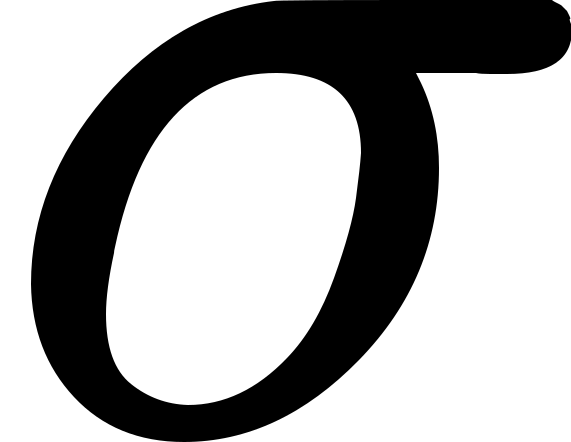 and
and 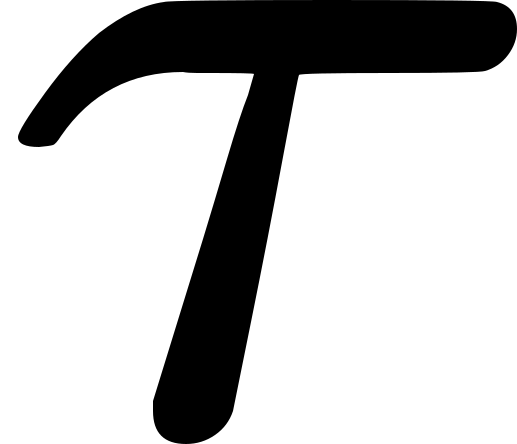 .
.
We have already found, that the Perihelion Passage took place
41·047469 days after the 1st September, whence 34·826728 is the interval
between the perihelion passage and the second observation, which corresponding
to 54° 44′ 8″.1 of anomaly; and hence = 2° 20′ 4″.2, and =2° 9′ 55″.1.
87
| ° ′ ″ | ° ′ ″ | |||||||||
| log sin σ | = | 2 20 4.2 | = | 8·6099510 | log sin (L″ - L′) | = | 1 55 35 | = | 8·5265395 | |
| log r″ | = | 0·0113682 | log R″ | = | 0·0029122 | |||||
| 8·6213192 | 8·5294517 | |||||||||
| log sin τ | = | 2 9 55.1 | = | 8·5772932 | log sin (L′ - L)) | = | 1 51 33 | = | 8·5111195 | |
| log r | = | 0·0289947 | log R | = | 0·0033481 | |||||
| 8·6062879 | 8·5144676 | |||||||||
| 1·03521669 | = | 0·0150313 | 1·03510428 | = | 0·0149841 | |||||
In order to find q and p, we ought now to subtract from these values 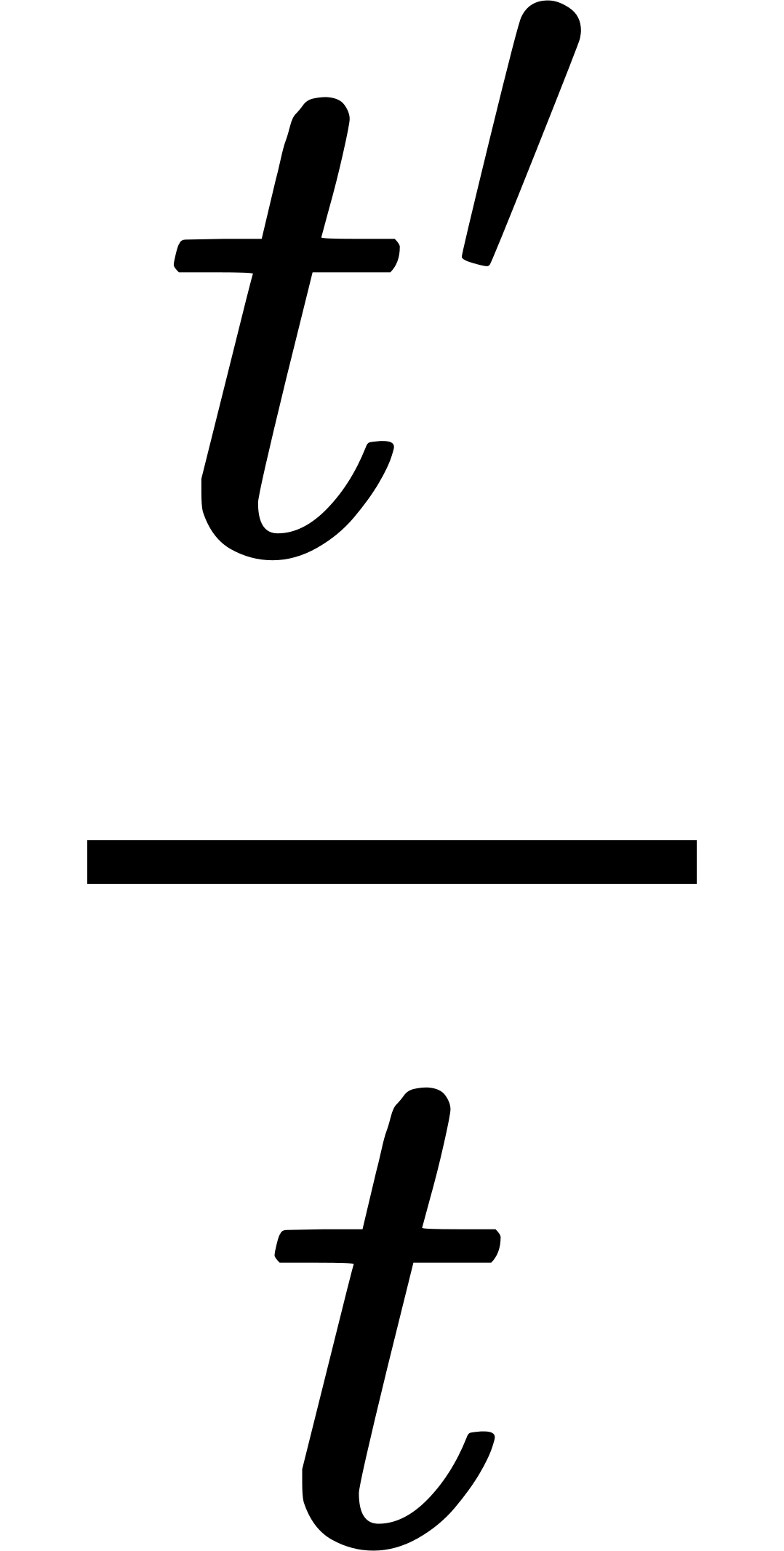 ,
but as in the commencement of the process we deferred applying the full
correction for aberration, until the comet’s distance from the earth had been
ascertained, we have now to make a small alteration in the intervals. We
have already found the comet’s curtate distance at the first and third observations.
The real distance is equal to
,
but as in the commencement of the process we deferred applying the full
correction for aberration, until the comet’s distance from the earth had been
ascertained, we have now to make a small alteration in the intervals. We
have already found the comet’s curtate distance at the first and third observations.
The real distance is equal to 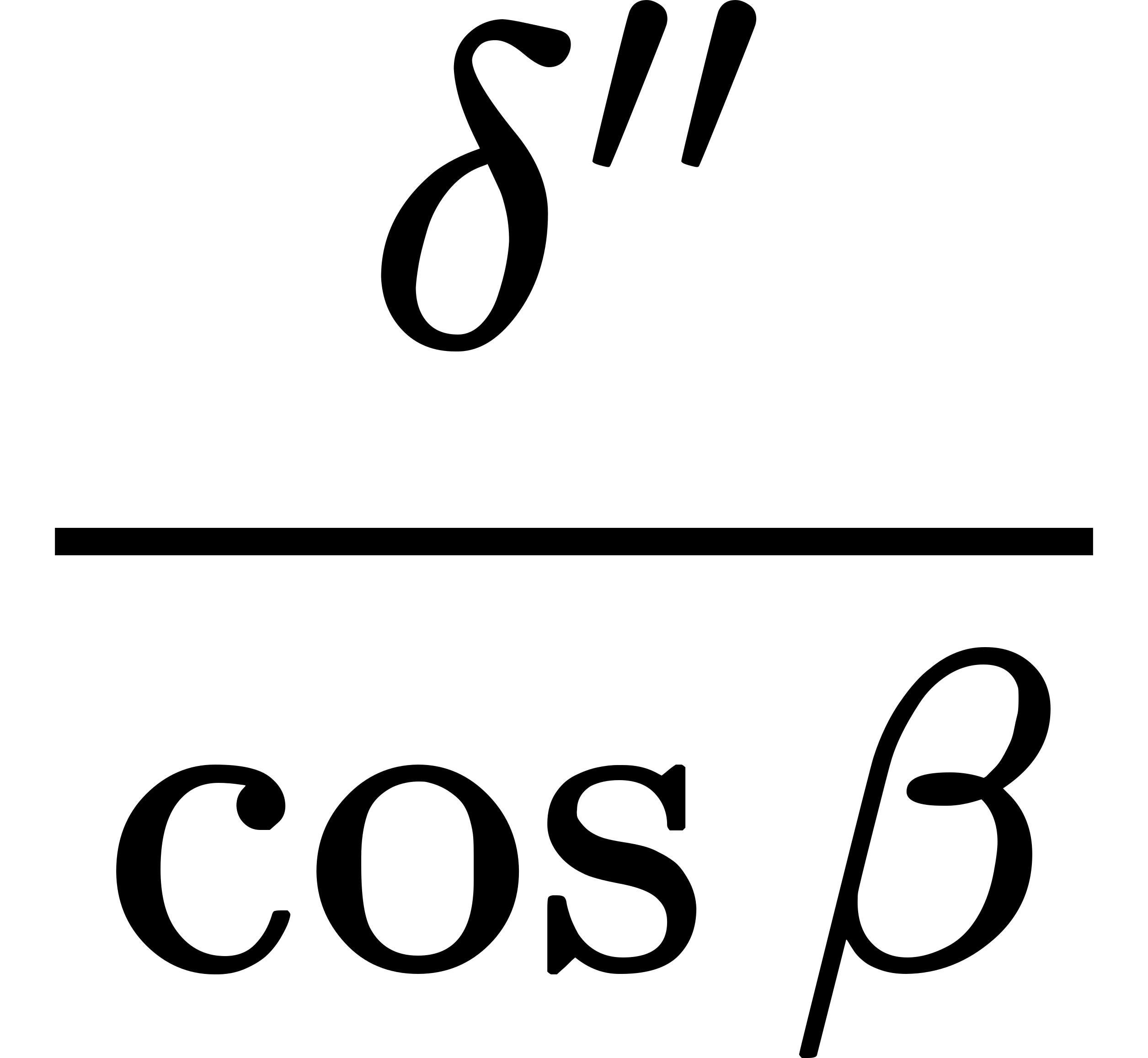 , and we have to multiply it by 493″, or D0·005706.
| log δ | = | 9·6815659 | log δ″ | = | 9·6818894 | |||||
| log cos β | = | 9·9277304 | log cos β″ | = | 9·9447930 | |||||
| 9·7538355 | = | log comet’s dist. | 9·7370964 | = | log comet’s dist. | |||||
| 7·7563318 | = | log 0·005706 | 7·7563318 | = | log 0·005706 | |||||
| log Reduct. | = | 7·5101665 | = | ·003237 | log Reduct. | = | 7·4934282 | = | ·003115 | |
| Time of 1st obs. | = | 4·306656 | Time of 3d obs. | = | 8·202309 | |||||
| Corrected, | 4·303419 | Corrected, | 8·199194 | |||||||
In order to find the correction for the second observation, the comet’s
distance must be calculated by means of the elements already obtained.
We find ′ by means of the equation ′ = 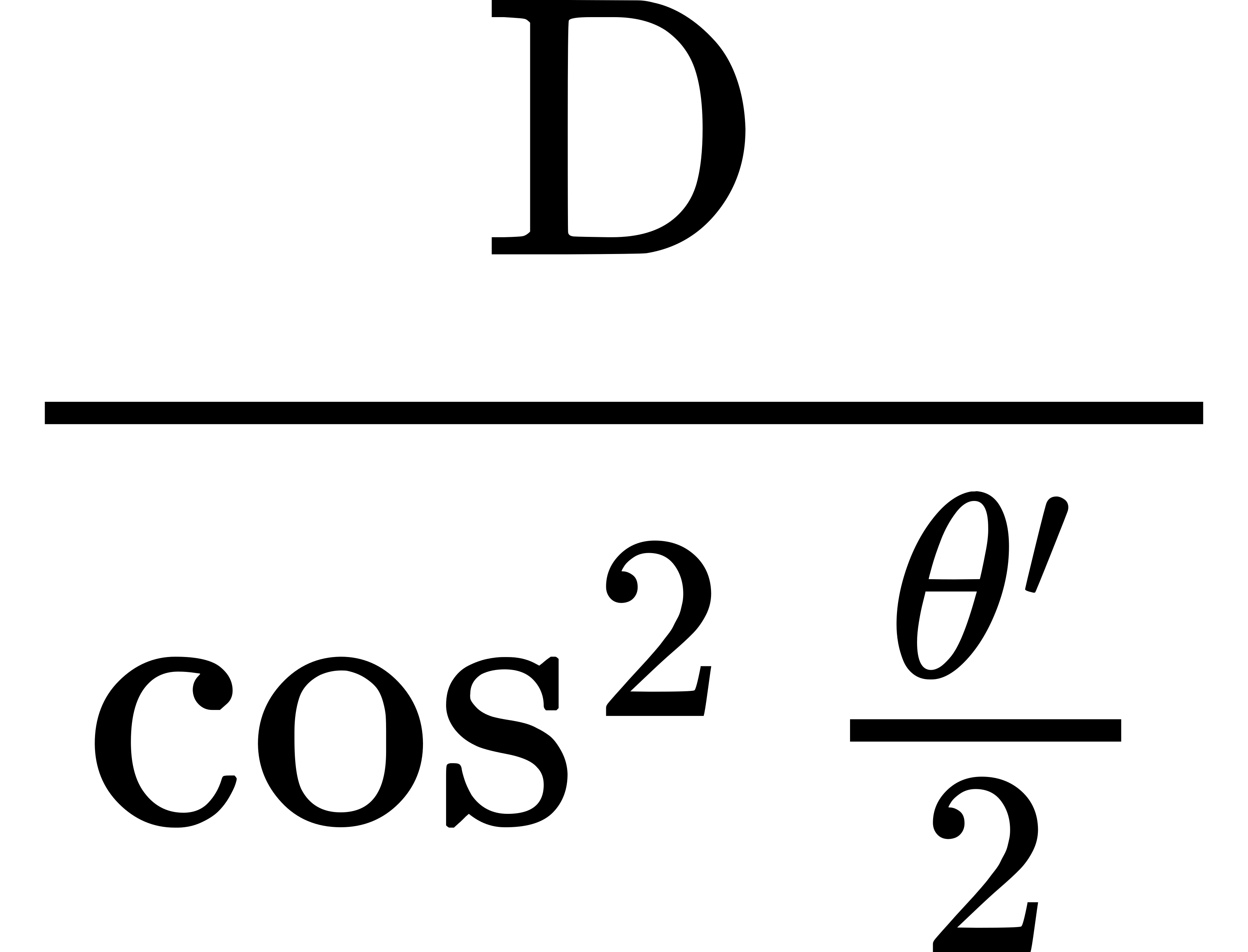 ,
the log. of which is 10·0213005, and ′ = 34° 42′ 32″·1. The comet’s real distance from the
88
earth =
,
the log. of which is 10·0213005, and ′ = 34° 42′ 32″·1. The comet’s real distance from the
88
earth = 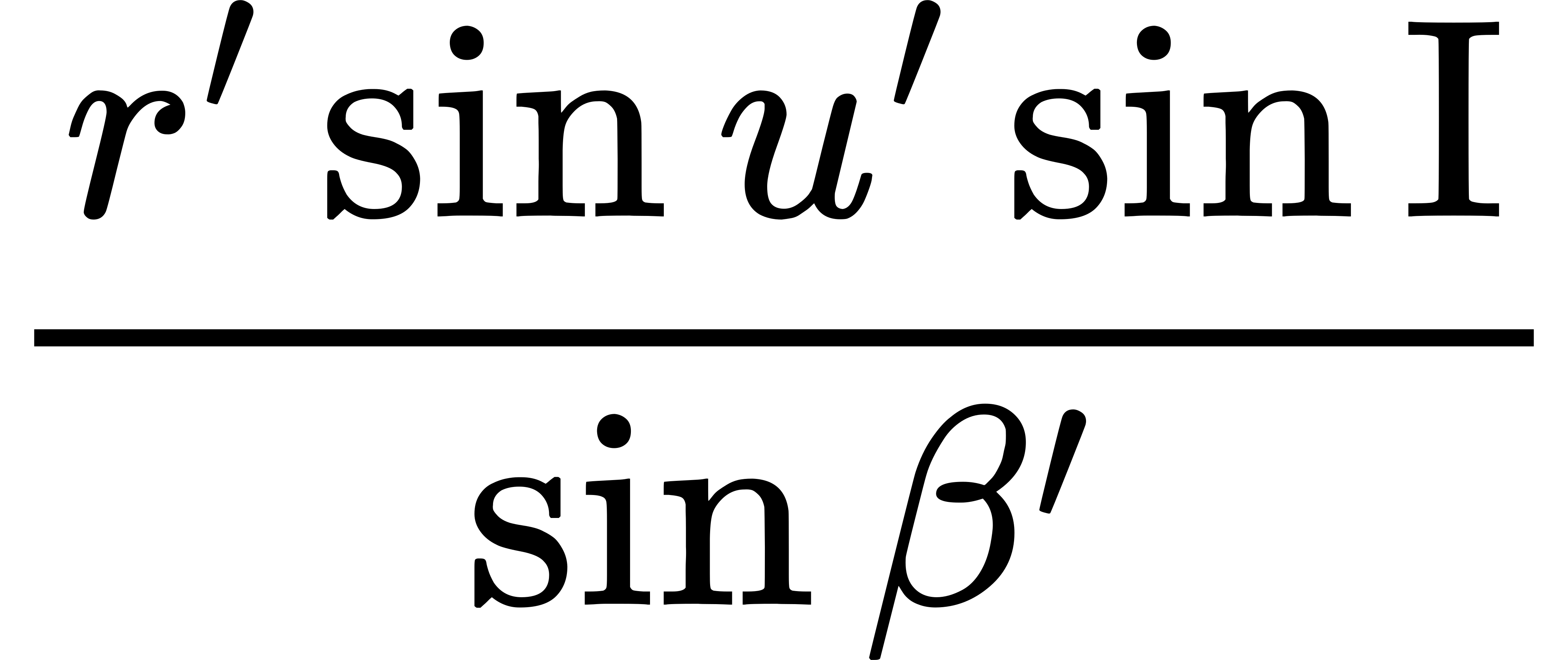 , whence is found
| log comet’s dist. | = | 9·7458053 | ||
| log 0·005706 | = | 7·7563318 | ||
| log Reduction | = | 7·502137 | = | ·003177 |
| Time of 2d obs. | = | 6·220741 | ||
| Corrected, | = | 6·217564 | ||
Whence the intervals now are t = 1·914145, and t′= 1·981630.
log 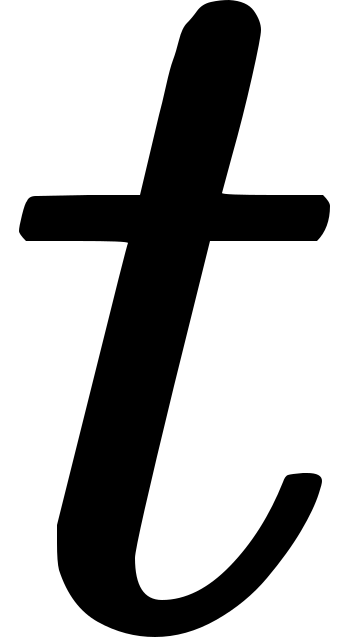 ′ ′
|
= | 0·2970226 | ||||||
|
log
|
= | 0·2819748 | 1·03521669 | 1·03510428 | ||||
log 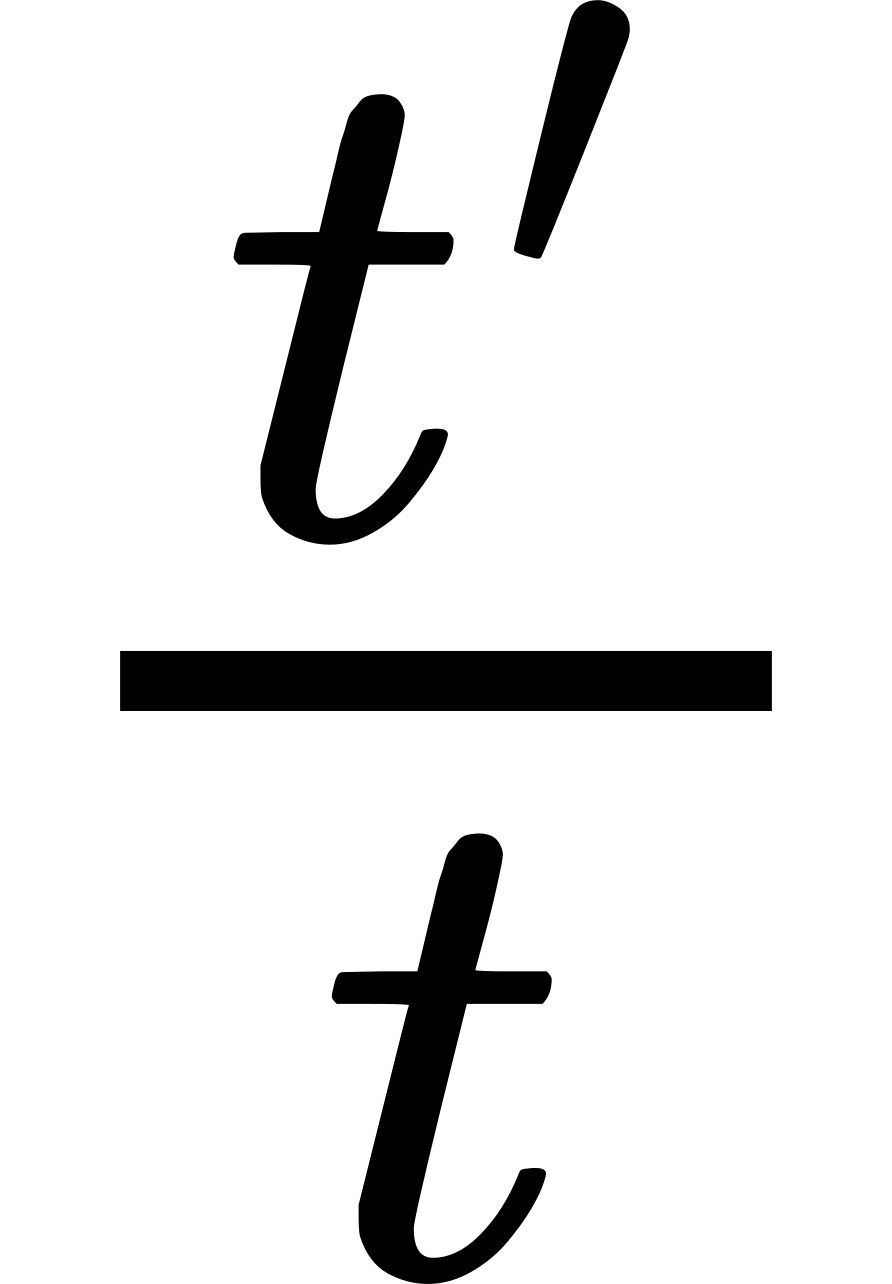
|
= | 0·0150478 | = | 1·03525595 | ............ | 1·03525595 | ||
| 5·5939503 | = | -·00003926 |
=
|
-·00015167 | = |
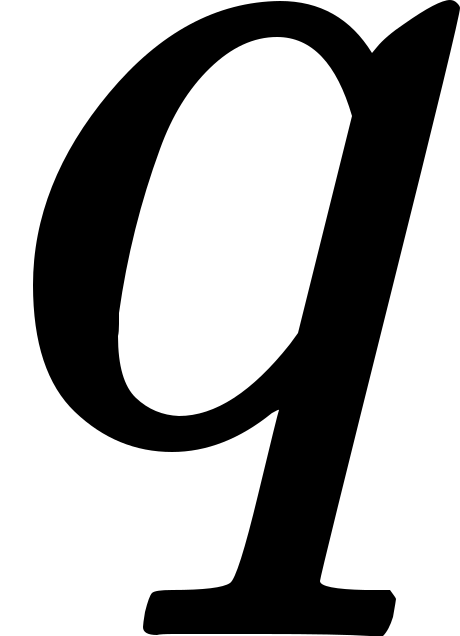
|
||
log 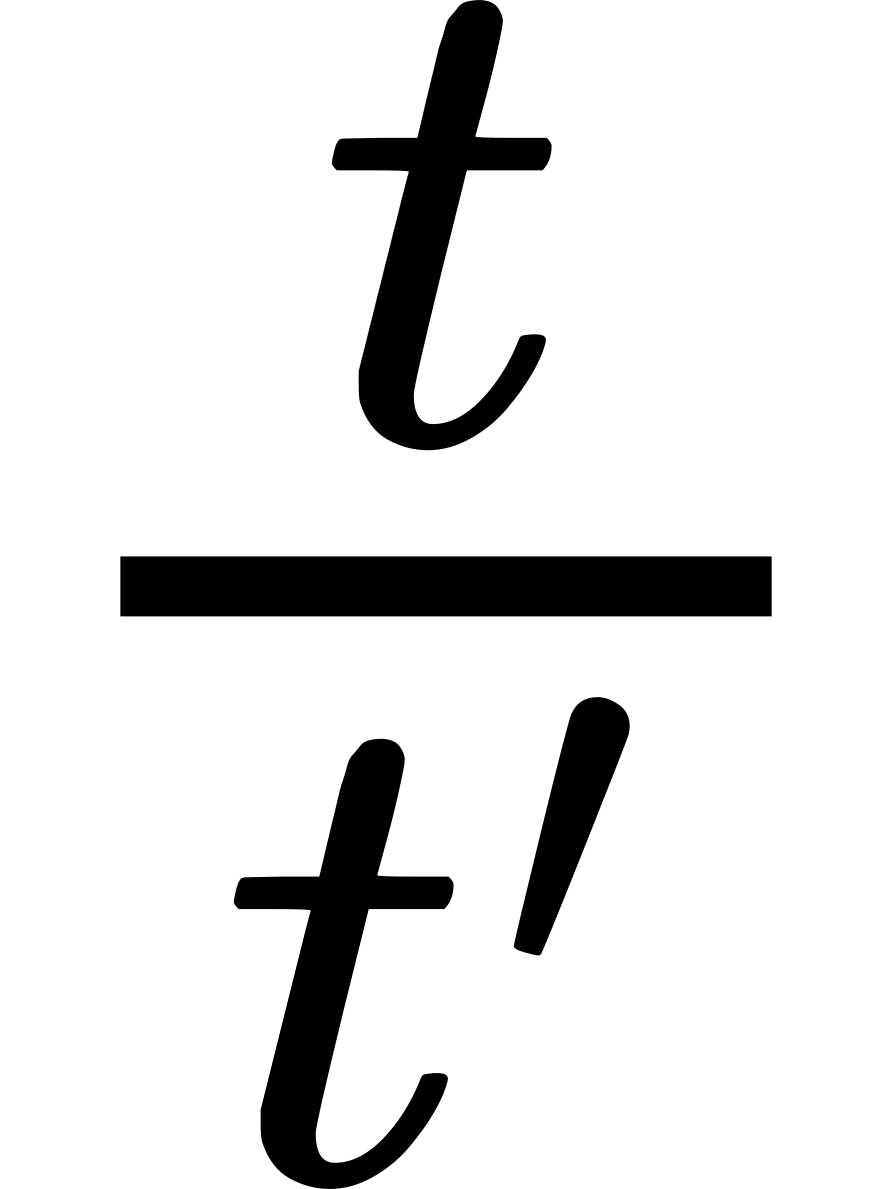
|
= | 9·9849522 | -·00003926 | = |
|
|||
|
|
= | 5·5789025 | = | -·000037923 | -·00011241 | = |
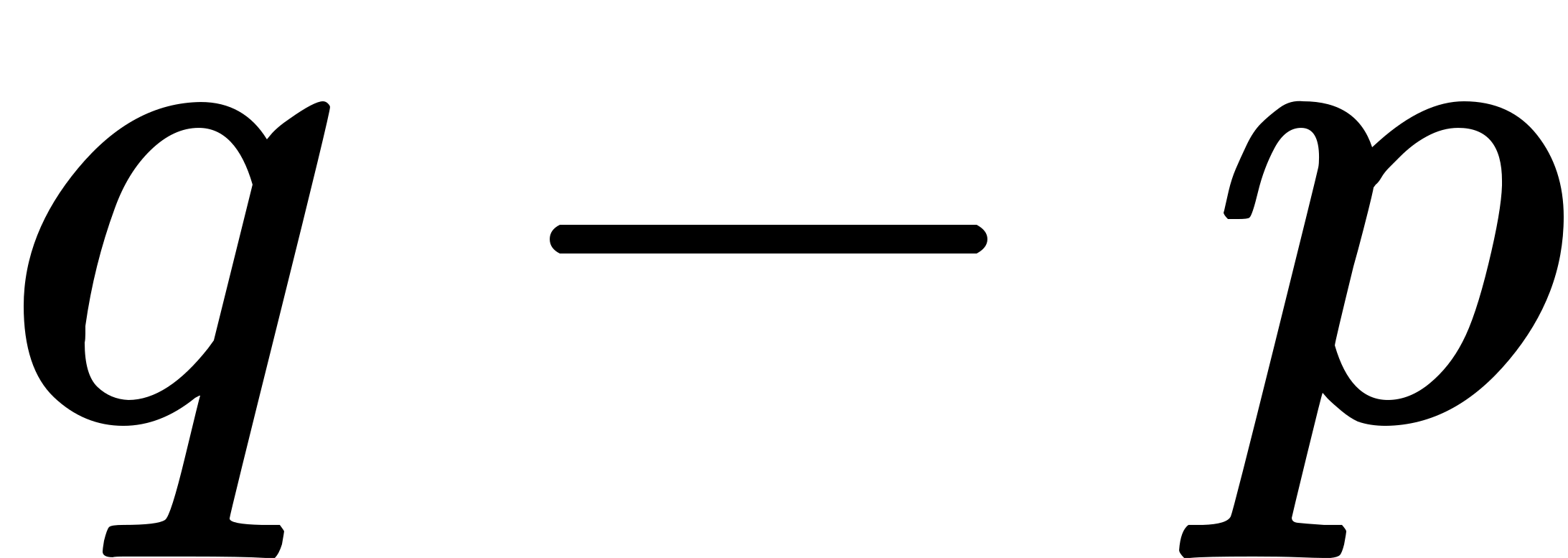
|
log 
|
= | 8·5144676 | log tan β′ | = | 30° 19′ 59″ | = | 9·7672501 | - | ||
log 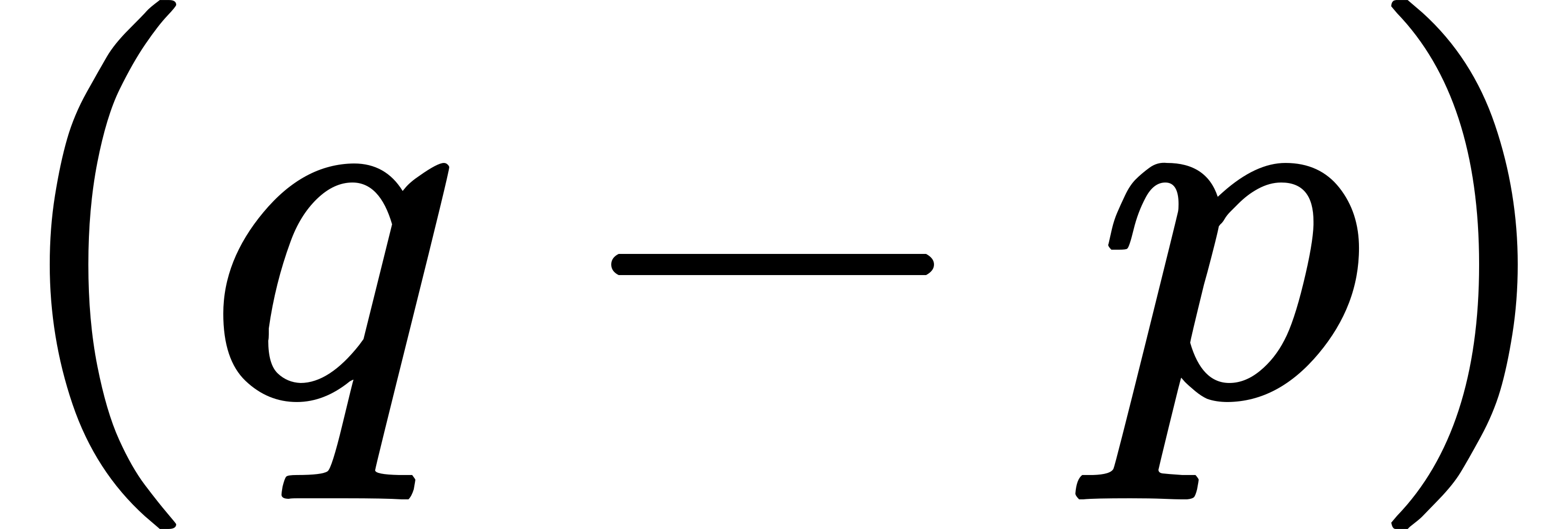
|
= | 6·0507663 | - |
sin 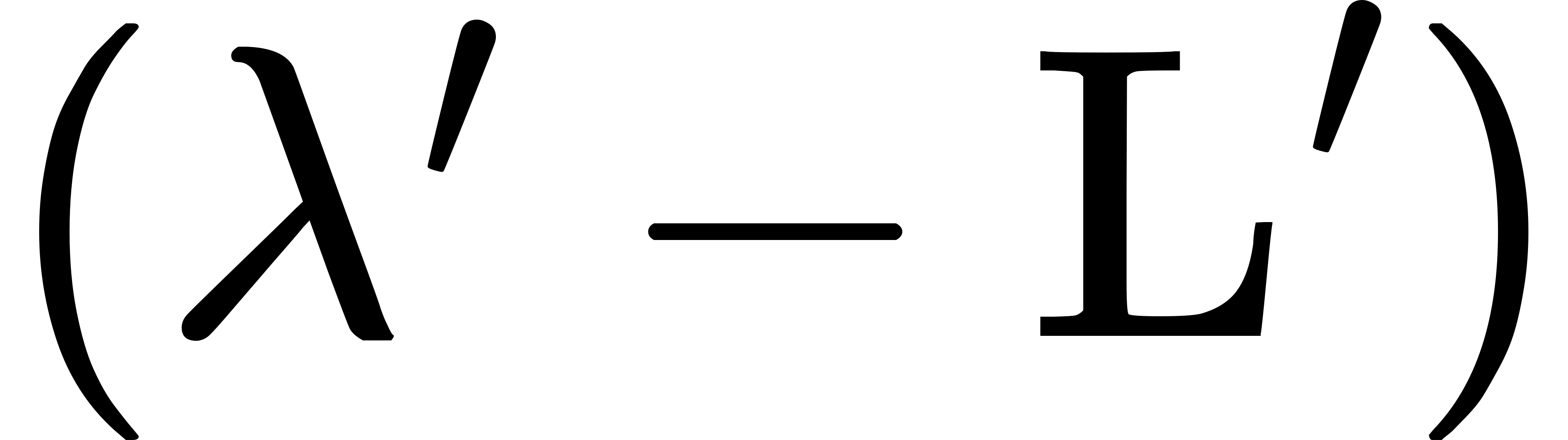
|
= | 103 32 58 | = | 9·9877414 | ||
log 
|
= | 9·7795087 | - |
log
|
= | 9·7795087 | - | |||
| 4·3447426 | + |
sin 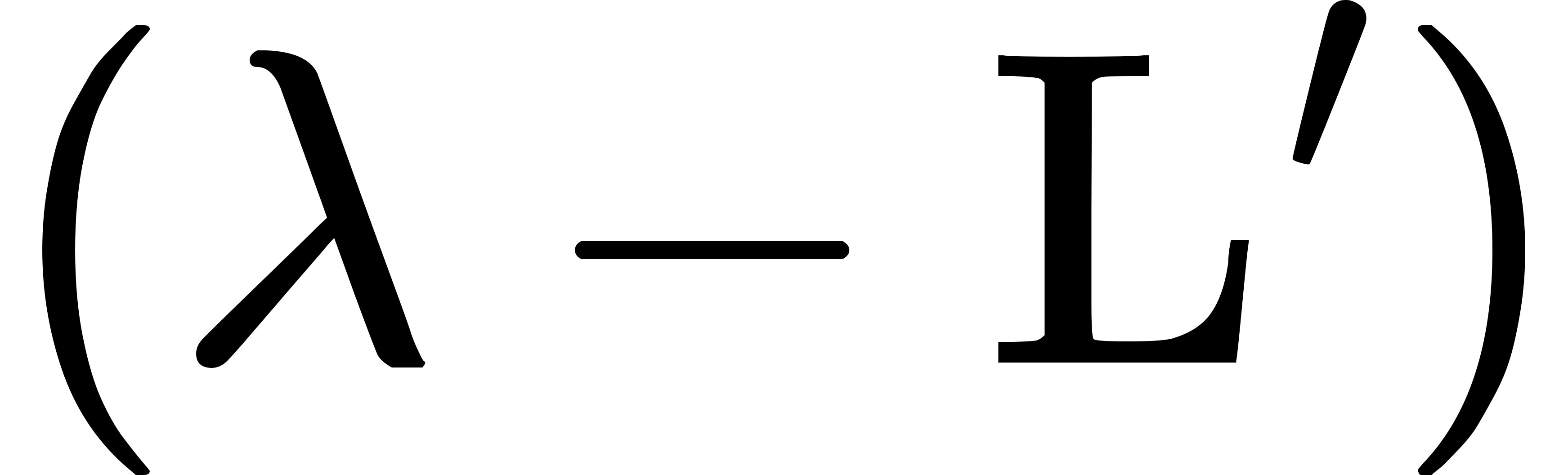
|
= | 99° 44′ 0″ | = | 9·9937030 | ||||
log 
|
= | 8·5463718 | -·59321441 | = | 9·7732117 | - | ||||
|
log
|
= | 9·6815659 | +·62840057 | = | -tan β | |||||
|
log
|
= | 0·0150478 | +·03518616 | = | 8·5463718 | |||||
| 8·2429855 | ||||||||||
log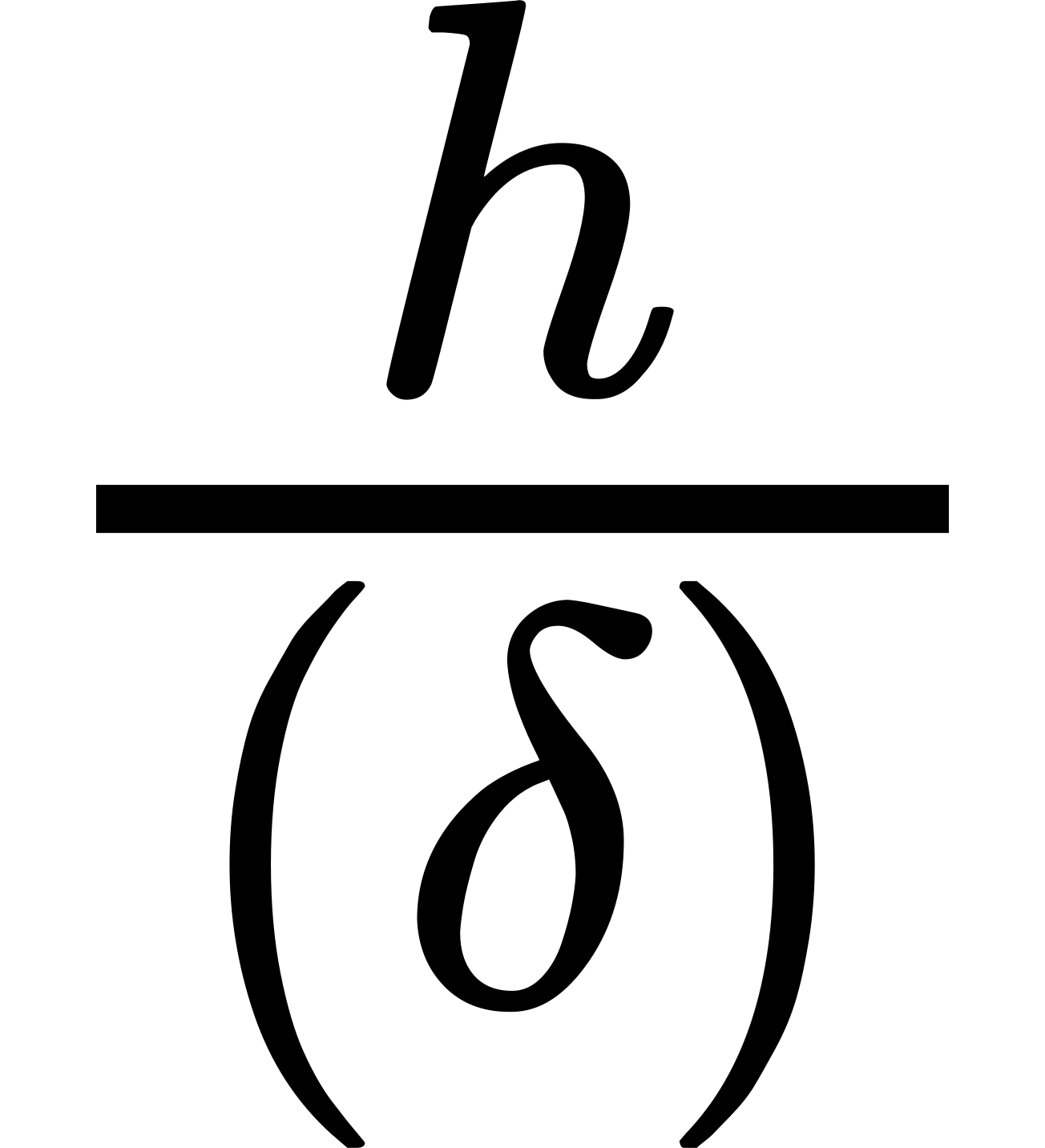
|
= | 6·1017571 | =1·000126403 | = |
1 + 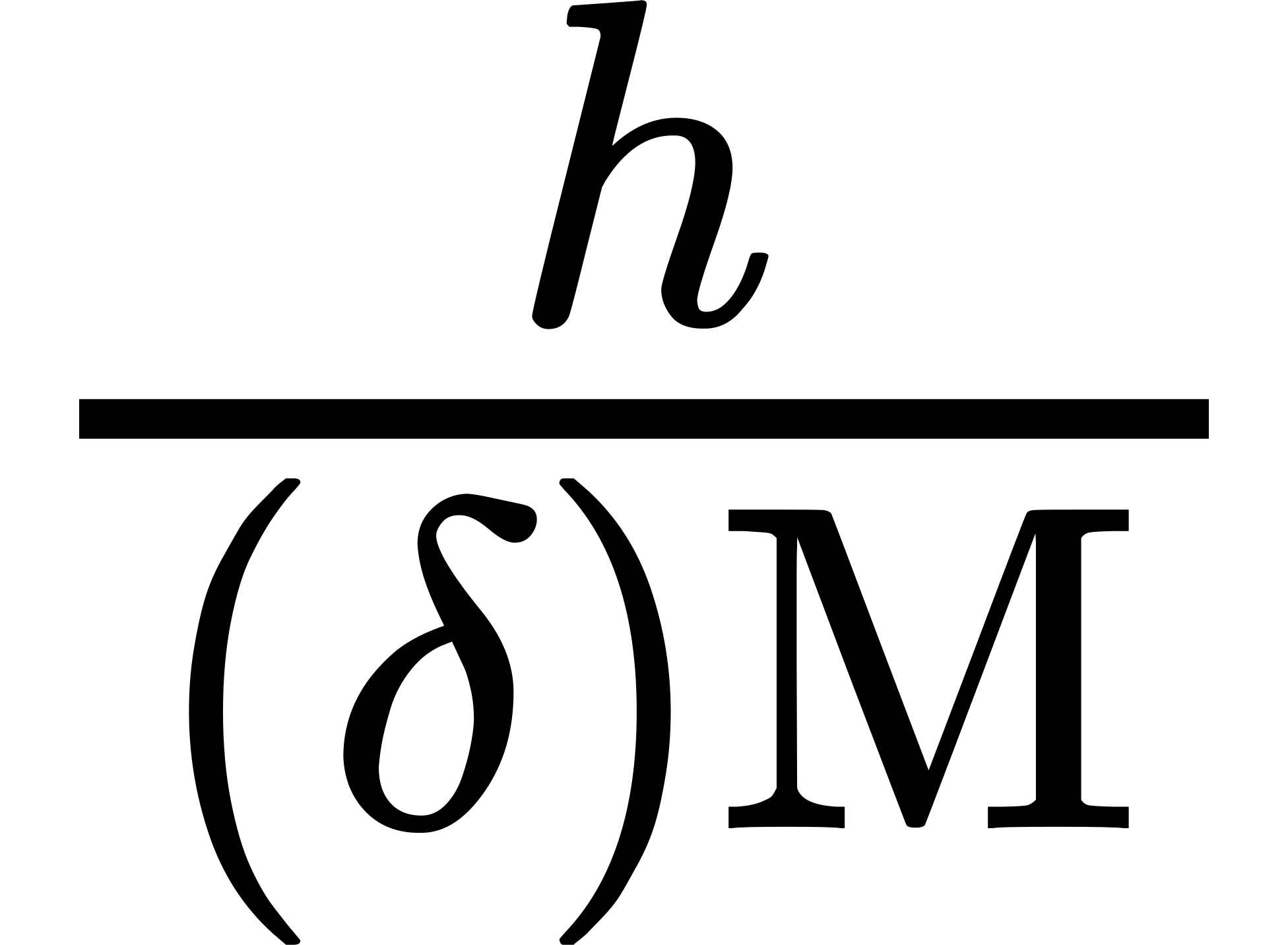
|
|||||
| − ·000037923 | = |
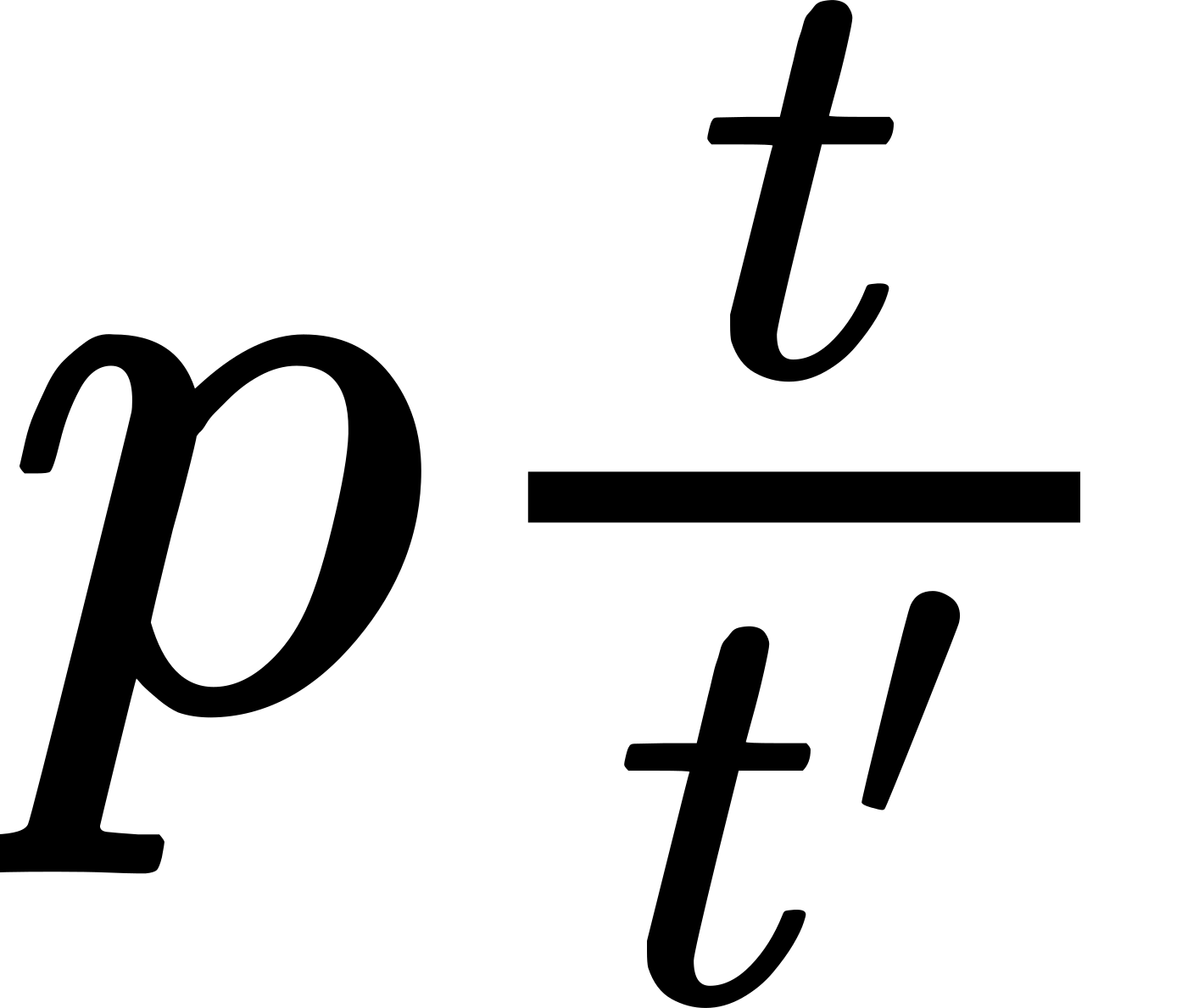
|
||||||||
| H | =1·00008848 and log H = 0·00003842 | |||||||||
With this correction we proceed to rectify the value of M, found at
the commencement of the calculation. The equations for ″and will
accordingly suffer some alteration, in the terms which involve M. These
terms must be multiplied by H when they contain M, and by H2 when
89M2 occurs; the equation
for r remains the same. We then find
|
|
= |
1·01350140 + 1·29162921 - ·53660049
|
corrected. |
|
|
= |
1·01553818 + 1·39480738 - ·40500974
|
as before. |
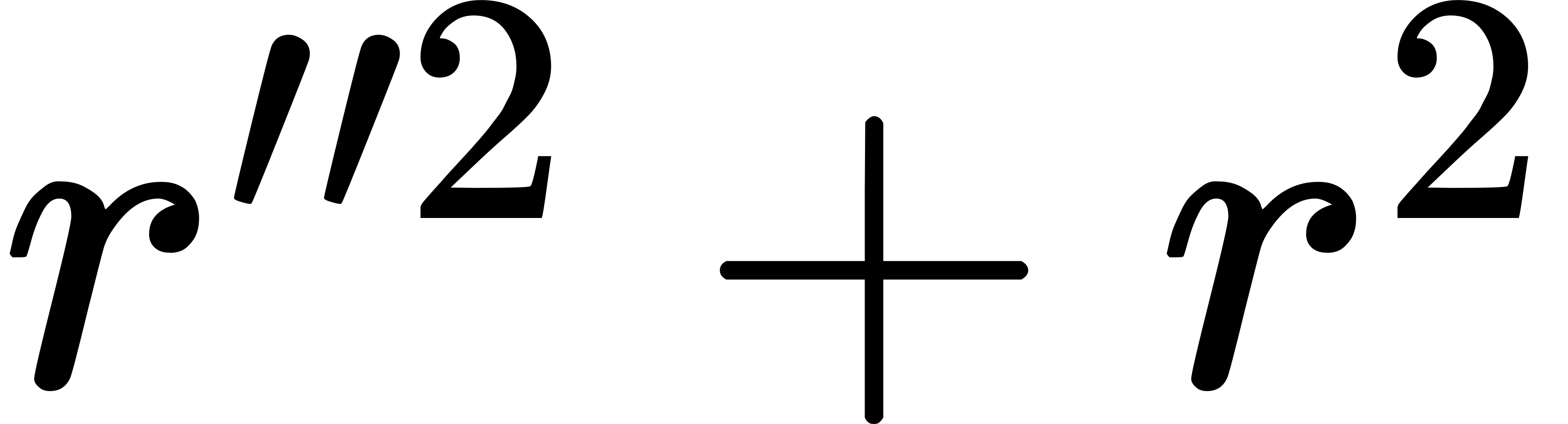
|
= |
2·02903958 + 2·68643659 - ·94161023
|
|
|
2·02461137 - 2·66067800 + ·93783558
|
|||
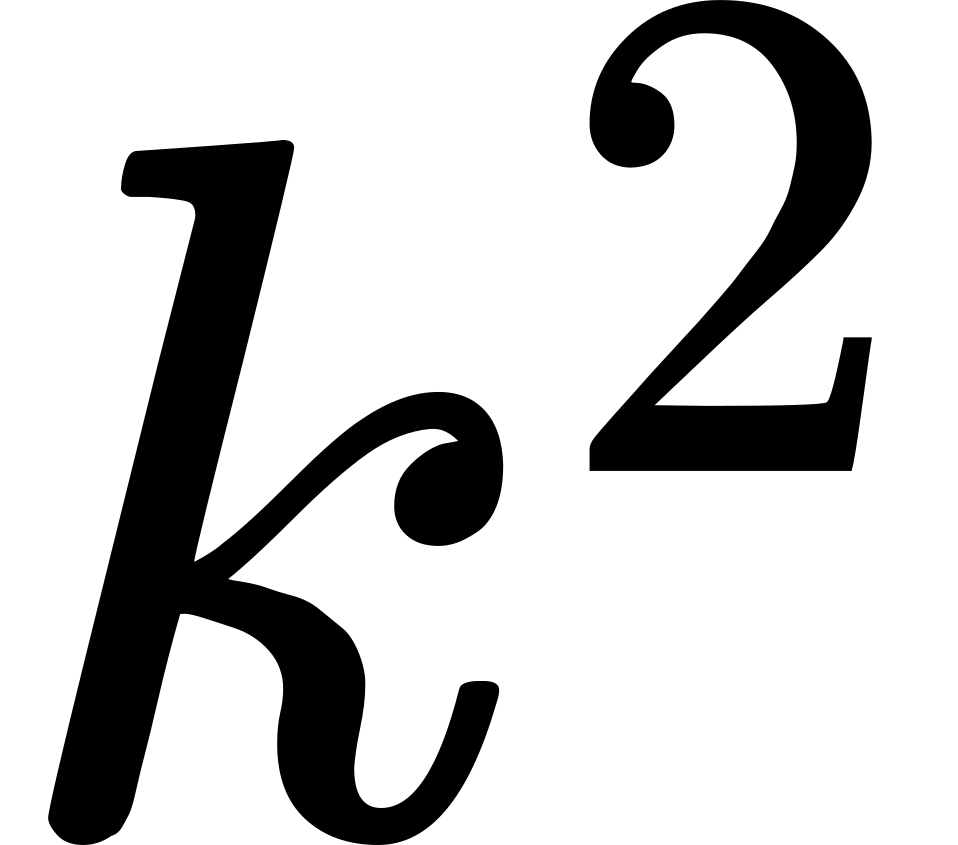
|
= |
·00442821 + ·02575859 - ·00377465
|
With these new equations, which do not differ much from those formerly
obtained, we proceed to find the correct value of . Let us as our
first hypothesis take = ·48037 as before. In this case,
| r2 | = | 1·01553818 | + | ·32187773 | - | ·19455449 | = | 1·14286142, | log r | = | 0·0289967 |
| r″2 | = | 1·01350140 | + | ·29798554 | - | ·25773883 | = | 1·05374811, | log r″ | = | 0·0113760 |
| k2 | = | ·00442821 | + | ·00596422 | - | ·00182255 | = | ·00856988, | log k | = | 2·9664874 |
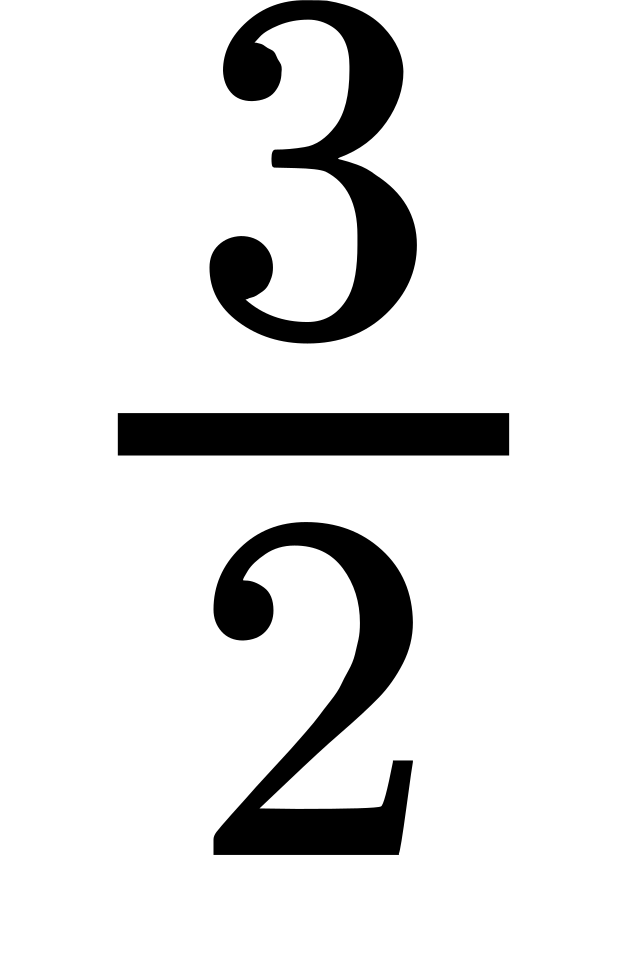 - (r + r″ - k) = ·4017436
whence ·40174366 = 3·892411,
which, subtracted from t + t′ = 3·895775, leaves -·003364 as the error.
As a second hypothesis, let be assumed = ·48099. We then find,
- (r + r″ - k) = ·4020942,
which, divided by 6μ, gives 3·895807, the error of which is only +·000032. Comparing now these two hypotheses, the method of false position gives ·480984 as a more correct value. Proceeding on this third assumption, we get
- (r + r″ - k) = ·4020911,
which gives 3·895779 days as the result, the error now being only -·000004.
The last hypothesis, therefore, may be taken as the value of . In order to
90find ″, we must add to log δ the logarithms of M and of H, which gives
″ = 9·6824918.
In the same manner, exactly as before, we calculate, by means of these data, the heliocentric elements. The latitudes b and b″ are found to be respectively 16° 25′ 8″, and 14° 36′ 39″: the longitudes l and l″ 9° 1′ 0″.7, and 13° 17′ 50″. The longitude of the node is 42° 33′ 48″.7, and the inclination of the orbit 28° 4′ 5″.2. The arguments of the latitude at the two periods are u = 36° 55′ 21″, and u″ = 32° 25′ 10″, from which the comet’s anomaly is found to be θ = 56° 54′ 18″, and θ″ = 52° 24′ 7″. The perihelion passage is thence found to be 41·059761 days after the first observation, and the corrected elements are as follows78:
| Mean Solar Time at Greenwich. | ||
| Perihelion Passage, | 1826, October | 11·059761 |
| Longitude of the Perihelion, | 62° 32′ 46″ | |
| Longitude of Ascending Node, | 42 33 49 | |
| Inclination of the Orbit, | 28 4 5 | |
| Perihelion Distance, | ·8265950 | |
| Motion, | Direct. | |
VI. Such is the method by which the Parabolic elements of a comet’s orbit may be determined. Those elements are always sought by astronomers first, on account of the comparative facility with which they may be calculated, and the sufficient degree of correctness with which they represent the movements of any particular comet.
The period of the comet’s revolution is an element concerning which the Parabolic method necessarily can afford no intelligence. It is calculated to point out the course of the comet, only while it remains in the vicinity of the earth, and cannot follow it in its eccentric track through the whole system. But if the parabolic hypothesis is therefore not so perfect as to point out immediately the comet’s period of revolution, there is an indirect method 91by means of which, with these elements alone, it is possible to discover this important element, with perhaps even greater certainty than by the elliptic hypothesis. With the parabolic elements we search among all the comets formerly observed, if there are any which agree; and if in this manner two comets are found possessing elements nearly the same, then there is a high degree of probability that the two comets are identical; and the probability will be increased, if there be a third or a fourth comet with similar elements, and which passed the perihelion at about the same interval of time as the former. The data on which we are to proceed in the comparison, are, the perihelion distance, the position of the perihelion, the place of the nodes, and the inclination of the orbit to the ecliptic. If these elements differ only very little from one another, in the case of two or more comets, it is extremely probable that they will turn out to be the same one which has been observed at its successive returns to the sun. It was by this method that Halley first ascertained the period of the Comet seen in 1682, and which he predicted would again appear in 1759. He observed that its elements agreed very nearly with those of the comets which had been seen in the years 1607, 1531, and 1456, between each of which there was an equal interval of seventy-five or seventy-six years79. According to this estimate, it ought also to have come to its perihelion in the years 1380, 1305, and 1230; and it so happens that historians speak of a remarkable comet which was observed in each of those several years. This comet did appear, as Halley had announced, in 1759, though its period was made somewhat longer by the attraction of Jupiter and Saturn. On the same data, there is not the least doubt that this comet will again reach its perihelion about the year 1834.
92
But astronomers are not satisfied with this indirect and retrospective method of ascertaining the periodic revolutions of comets, for which a succession of many ages often is required. They must possess a method more immediate—a method by which, from three present observations, without reference to the history of former comets, they can at once say when a comet now seen for the first time last passed its perihelium, and when it will again become visible. Moreover, it is found, that there are some comets whose course through the heavens cannot be correctly represented by any Parabola; because, when the true orbit is not very elongated, it will differ from that curve even towards the vertex; and this aberration occasions considerable errors in the elements themselves. It is therefore in some cases desirable to determine the movement of the comet through the system on more accurate data; and this object, as well as the immediate determination of the periodic time, is attained by computing the Elliptic elements.
Of the various solutions which have been given of this difficult problem, none seem to be so generally recommended and resorted to by astronomers as that of Gauss. La Place may have displayed greater dexterity in managing the powers of the higher calculus—many mathematicians may have proposed other solutions better adapted to particular circumstances—but Gauss’s method can be much more readily employed in practice, and is found to apply to every possible case. I now therefore proceed to point out the manner in which, according to Gauss’s method, the Elliptic elements of a comet’s orbit may be found.
But it is quite impossible here to do more than merely develope the mode of procedure, in so far as may be necessary for calculation; because, were I to detail each step in the complicated investigation, as I have been led to do in the shorter method of the parabola, it would require us to enter on a long train of analytical reasoning, quite inconsistent with the due limits of this Essay. I am under the necessity, therefore, of giving only those equations which are immediately subservient to the actual computation of the elements, 93shortly describing, however, the process by which the greatest part of them is derived; and in the rest, where the demonstration is too tedious to be pointed out, referring to Gauss’s great work “Theoria motuum corporum cœlestium.” The same method is also demonstrated at great length in one of the volumes of Delambre’s Astronomy, where the whole investigations of the formulæ are minutely detailed, and where, at the same time, various examples are given of their application. I may remark generally, that there are certain leading features common to both methods, by which the procedure in the method now to be pointed out is very similar to the parabolic hypothesis. The only difference arises from the peculiar nature of the curves, by which the elliptic method is rendered more involved, but is not dissimilar in general character.
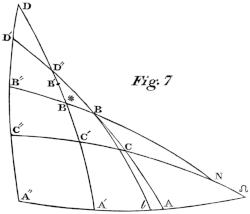
Let A, A′, A″ (Fig. 7.) be the heliocentric places
of the earth at the three periods of observation, and B, B′, B″ the
geocentric places of the comet. Let great circles pass through these
points, joining AB, A′B′ and A″B″. The first object is to determine the
position of these circles with respect to the ecliptic AA″, as well as
the position of the points B, B′, B″. For this purpose, let the angles
which these great circles make with the ecliptic be called y,
y′, y″80, and the arcs themselves AB, &c. , ′, ″:
then, denoting, as before, the geocentric longitudes of the comet by
, ′, ″, its geocentric latitudes by , ′, ″, and the heliocentric
longitudes of the earth by L, L′, L″; it is obvious, by drawing a
perpendicular to the ecliptic from B, that81
94
 In the same manner, y′, y″, and δ′, δ″ are computed.
In order now to estimate the position of the great circles AB, &c. with respect to one another, let them intersect in the points D, D′, D″, and call the angles at these points respectively ε, ε′, ε″. In the spherical triangle A′DA″, it may be shown that
|
sin ε sin (A′D + A″D)
|
= |
sin (L″ - L′) sin (y″ + y′),
|

|
|
sin ε cos (A′D + A″D)
|
= |
cos (L″ - L′) sin (y″ - y′),
|
|
|
cos ε sin (A′D - A″D)
|
= |
sin (L″ - L′) cos (y″ + y′),
|
|
|
cos ε cos (A′D - A″D)
|
= |
cos (L″ - L′) cos (y″ - y′),
|
in which equations sin ε, and cos ε are always positive. From them we
extract the values of A′D, A″D, and ε. By considering in like manner
the other two triangles, we obtain AD′, A″D′, ε′, and AD″, A′D″, ε″82.
Let the two extreme geocentric places B, B″ of the comet be now joined
by a great circle, in the same manner as in the parabolic method. This great
circle must intersect A′B″, but will probably not pass through B′, the
second place of the comet. Call the distance of the intersection from B′
or B′B* = ; and we then obtain finally an equation, which combines the
respective positions of the earth and comet,

We now pass from the geocentric to the heliocentric situation of the
Comet. Let C, C′, C″ be its three places, as seen from the sun: these points
will lie somewhere in the corresponding great circles AB, A′B′, A″B″, and
at the same time be united by another great circle, viz. that which forms
95
the projection of the orbit on the celestial sphere. Preserving the same
notation as before, let the radius vector of the comet at its several places
be r, r′, r″, and the corresponding radius vector of the earth R, R′, R″.
Now, it is a property of the ellipse, that if η represent a sector bounded
by the two radii vectores r, r″ and the intervening curve 2h, t the time
which is required to describe this sector, and a constant number
·017202 (employed also in the parabolic investigation), the semi-parameter
= 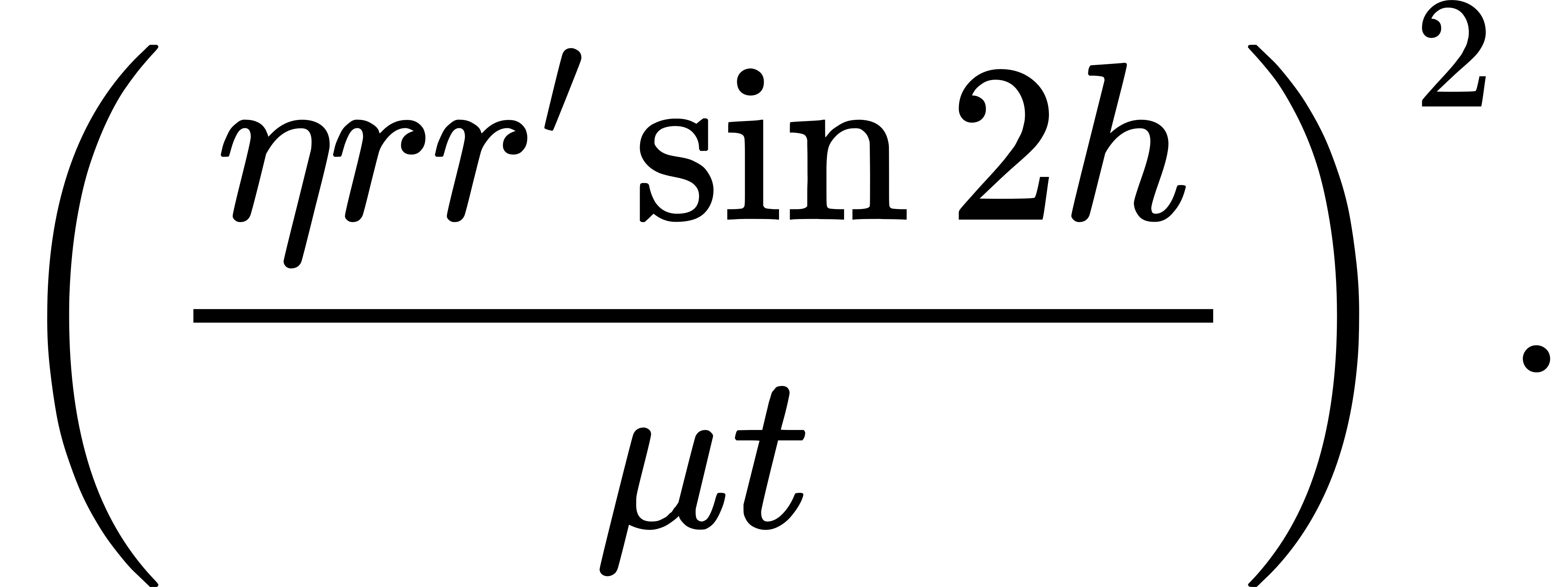 Make
Make 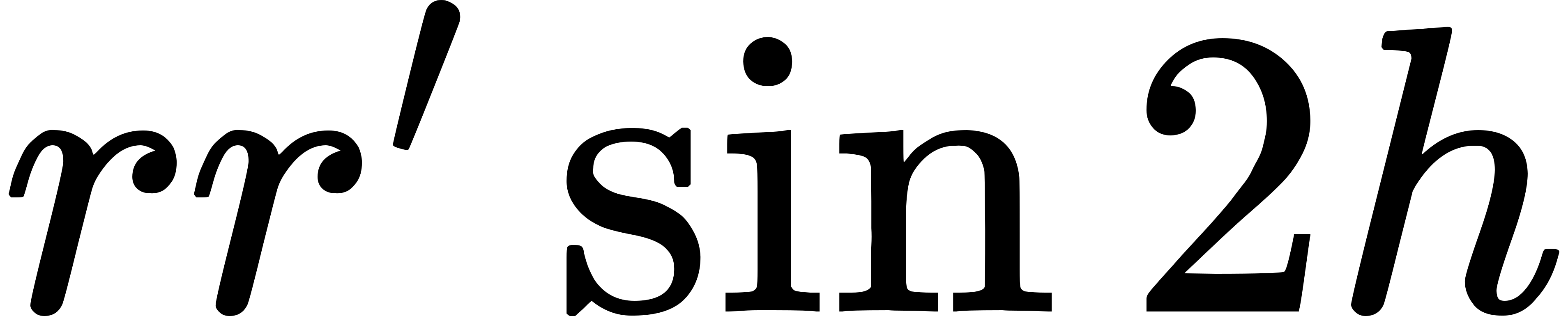 , which is the triangular sector =
  ;
and
;
and 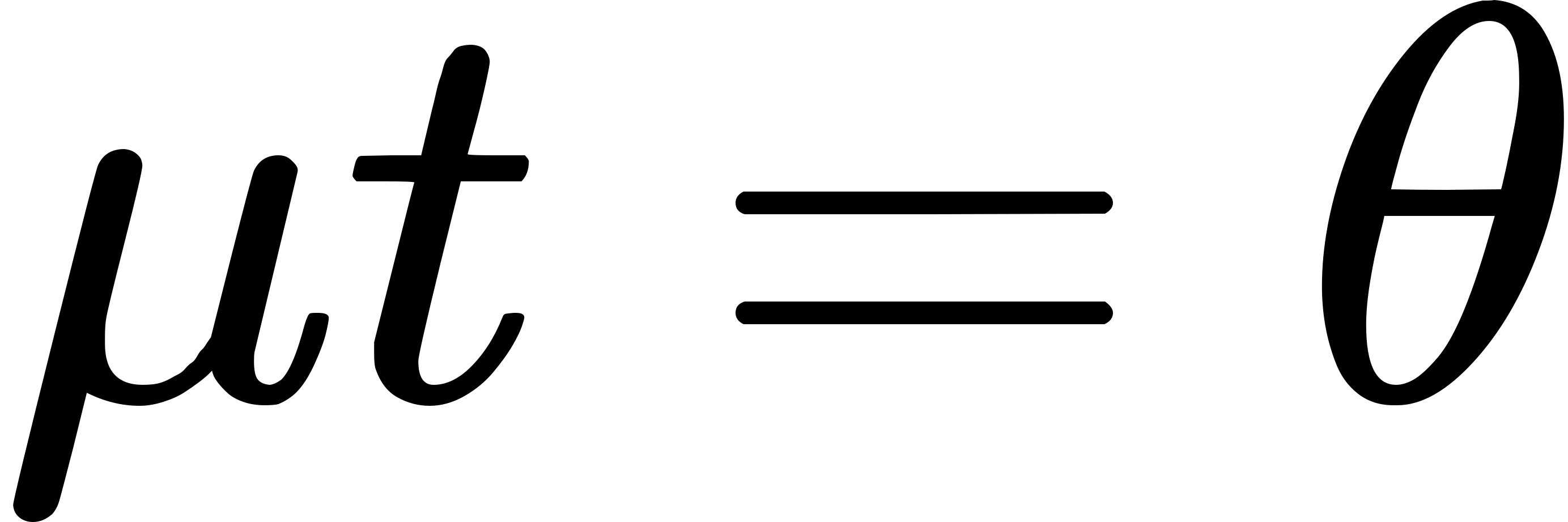 ; then the semi-parameter is equal to
 Let
Let 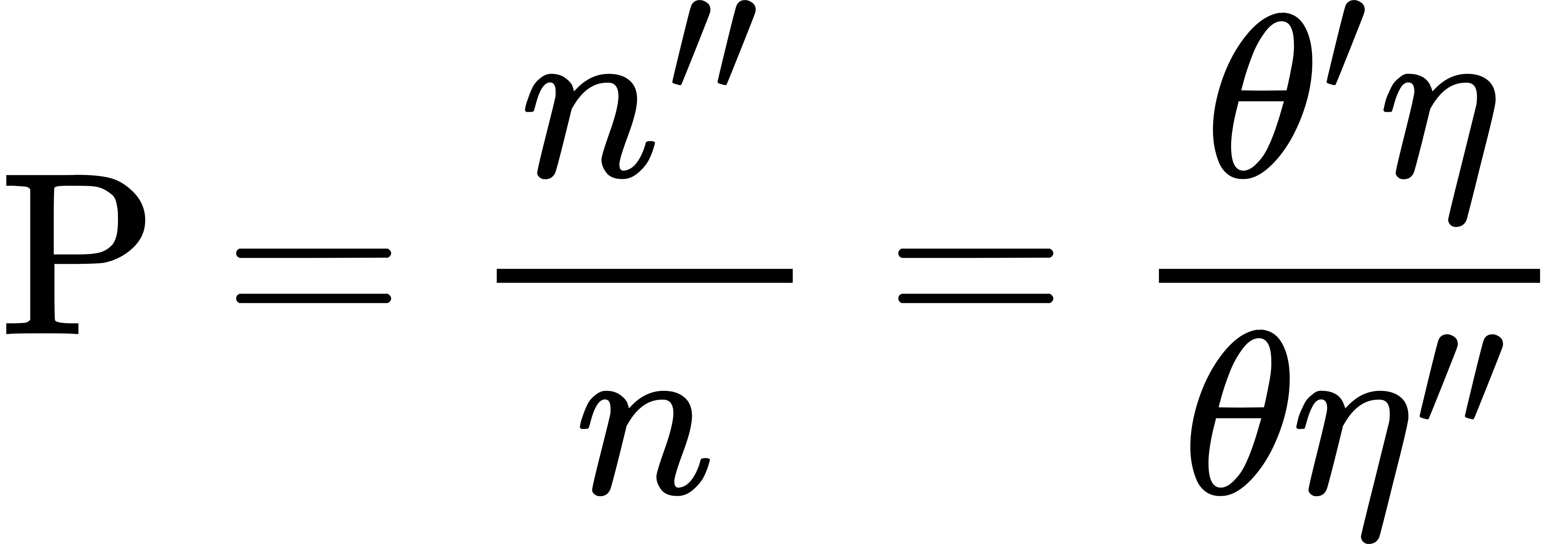 ; and
; and  ,
where ′ is the sector formed by , ″ and the chord of 2
,
where ′ is the sector formed by , ″ and the chord of 2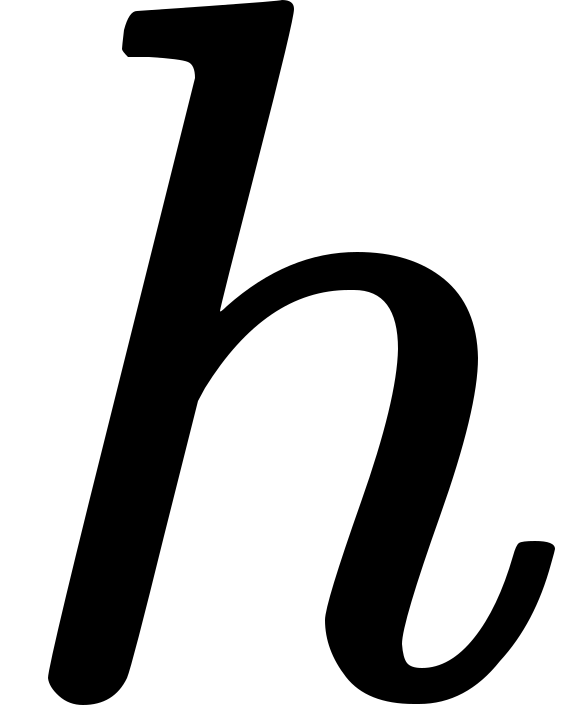 ′. But as , ′ ″;
, ′ ″ and therefore
′. But as , ′ ″;
, ′ ″ and therefore 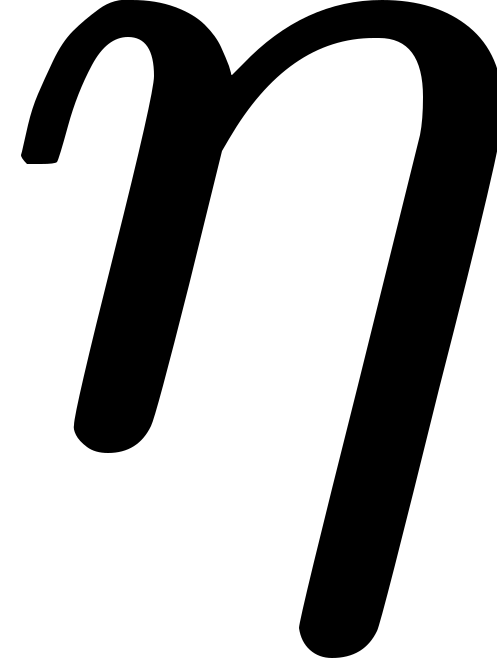 , ″ are yet unknown, let us for the present assume
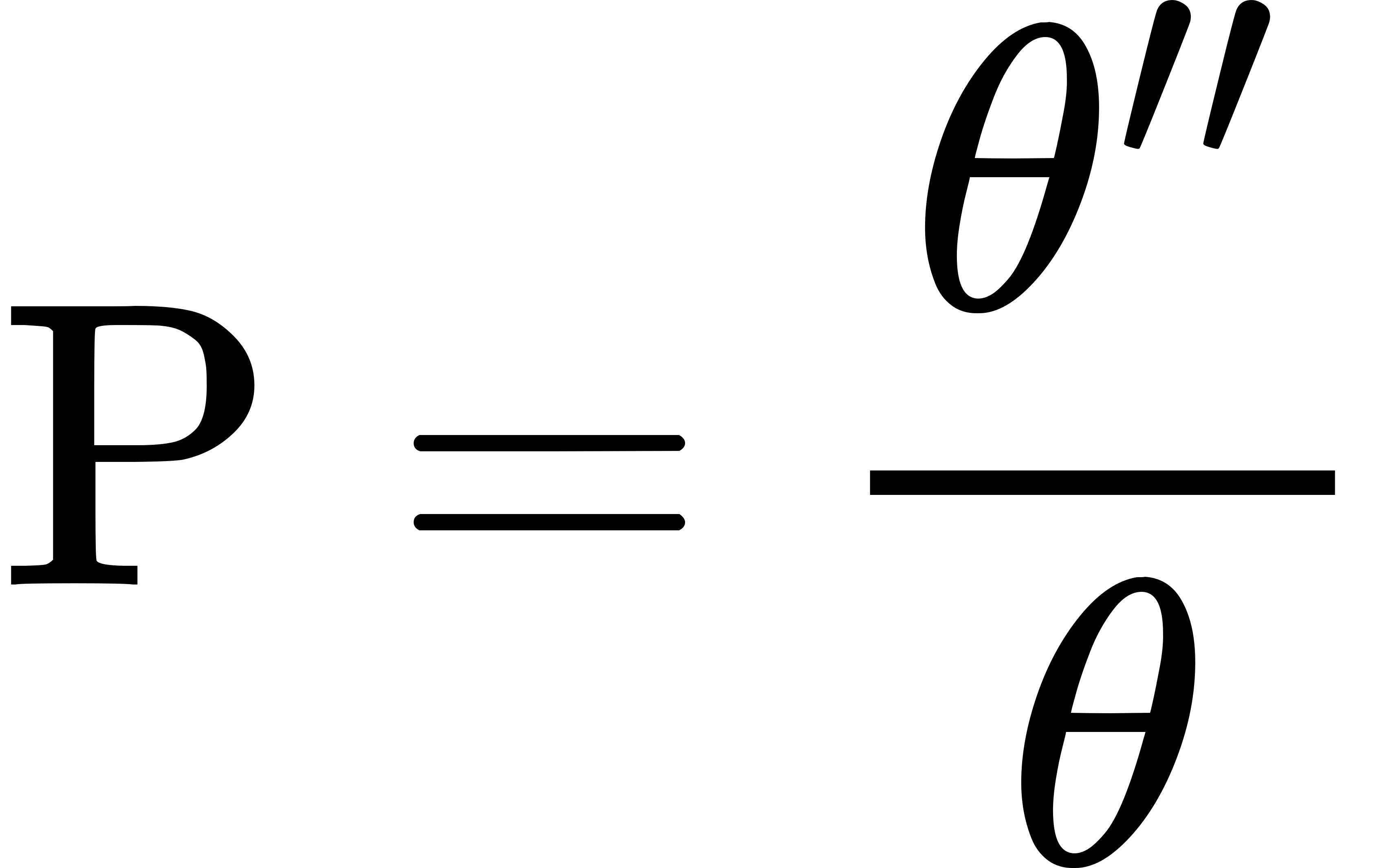 , and
, and 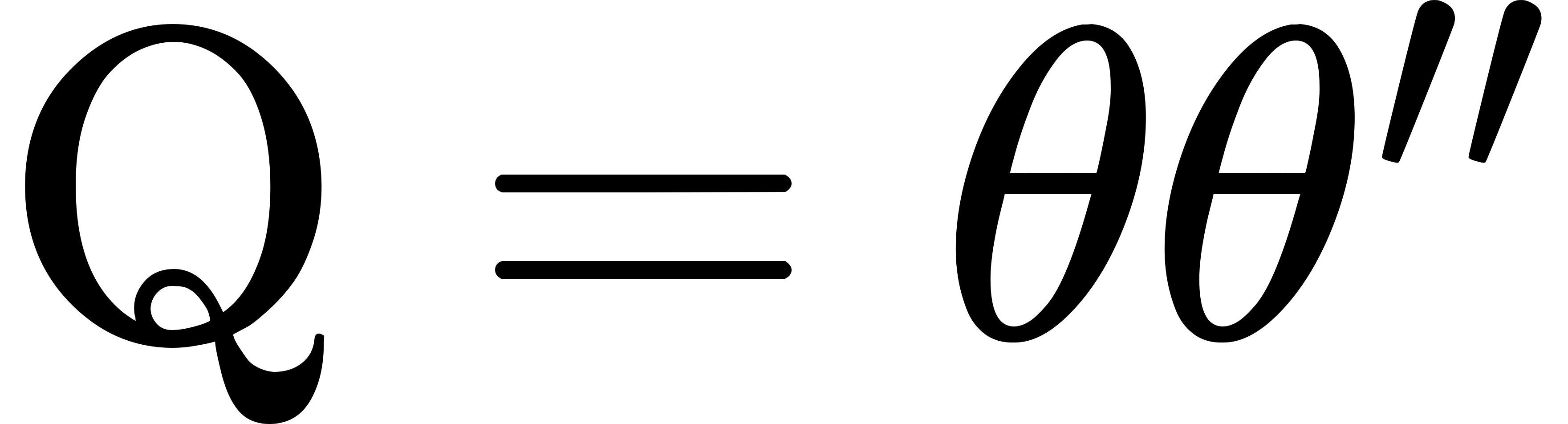 . Find next the value of the equations83

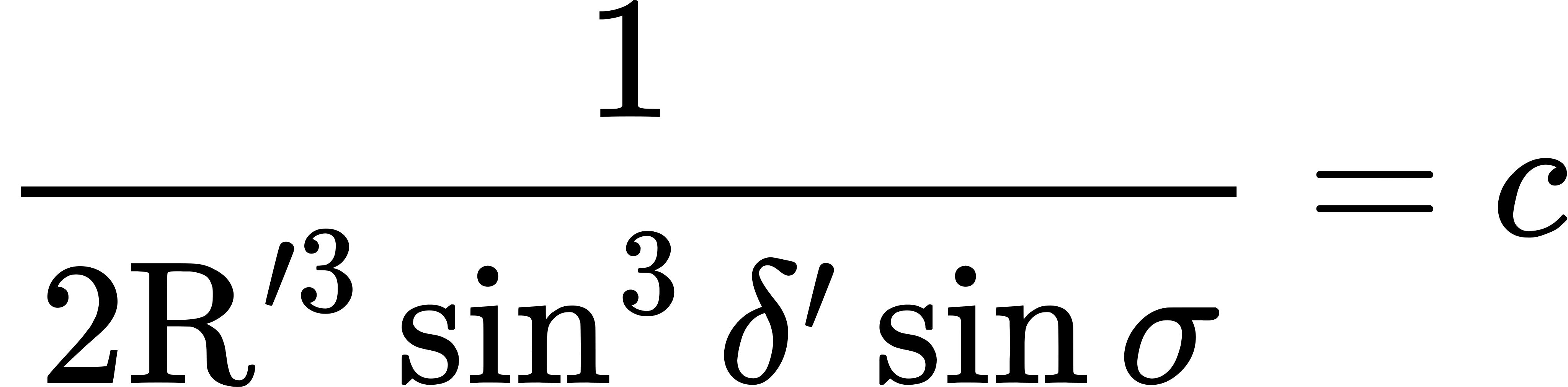 ,
, 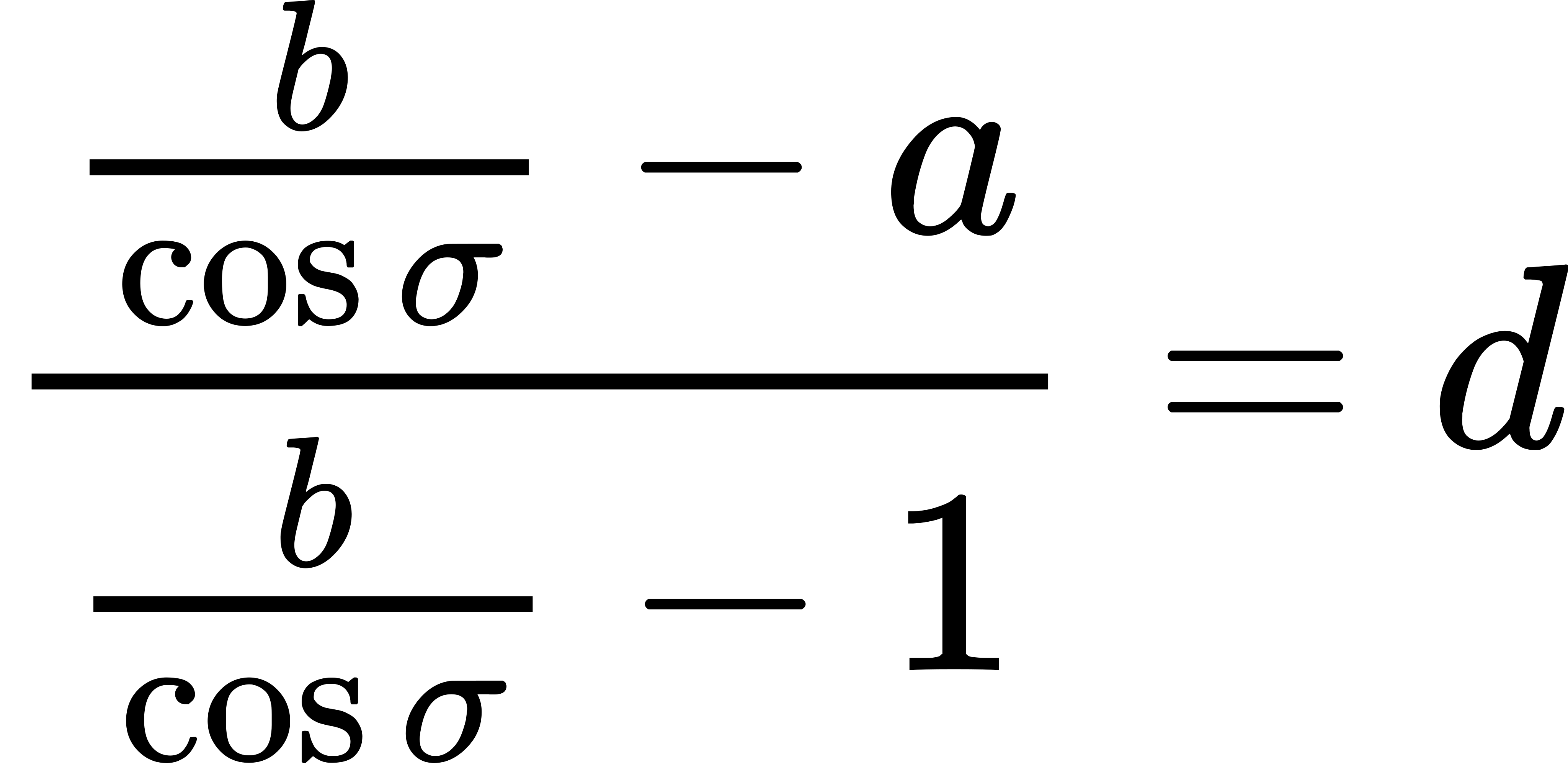 ,
, 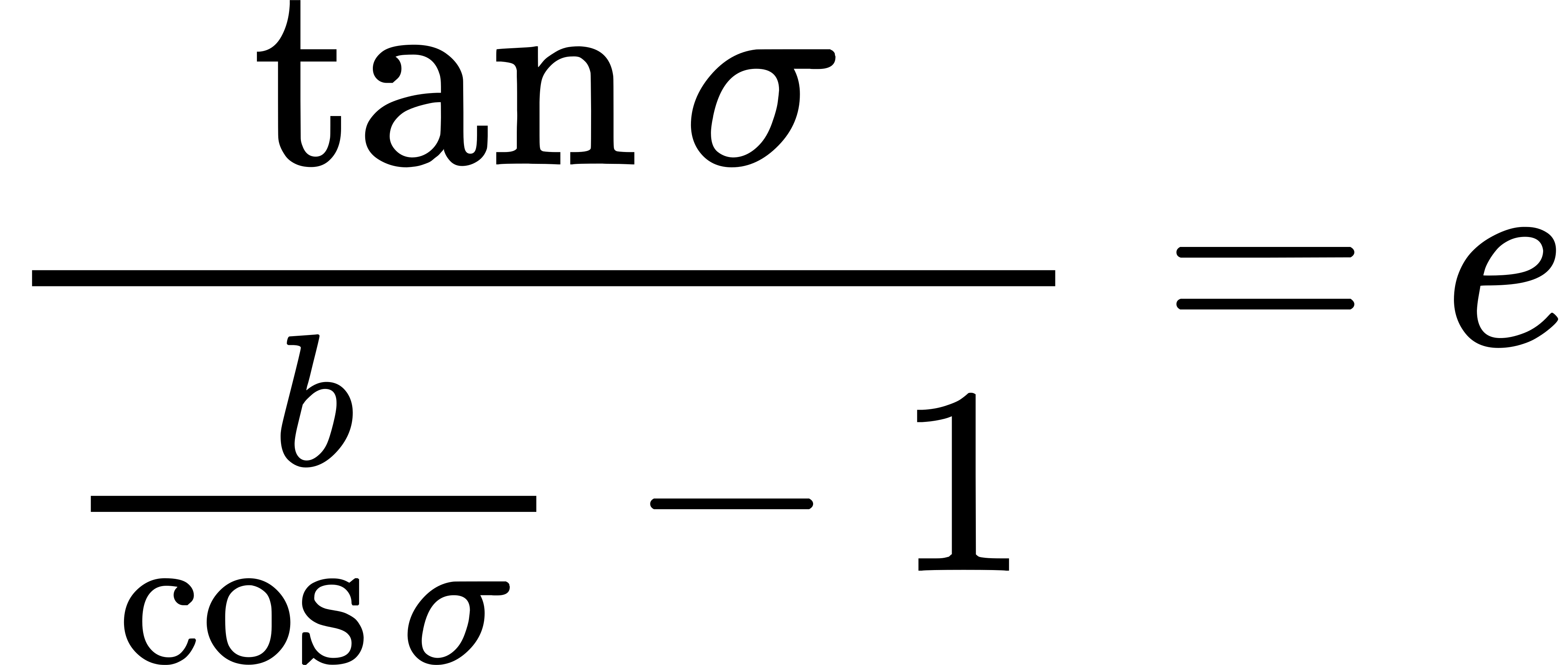 . Then we get
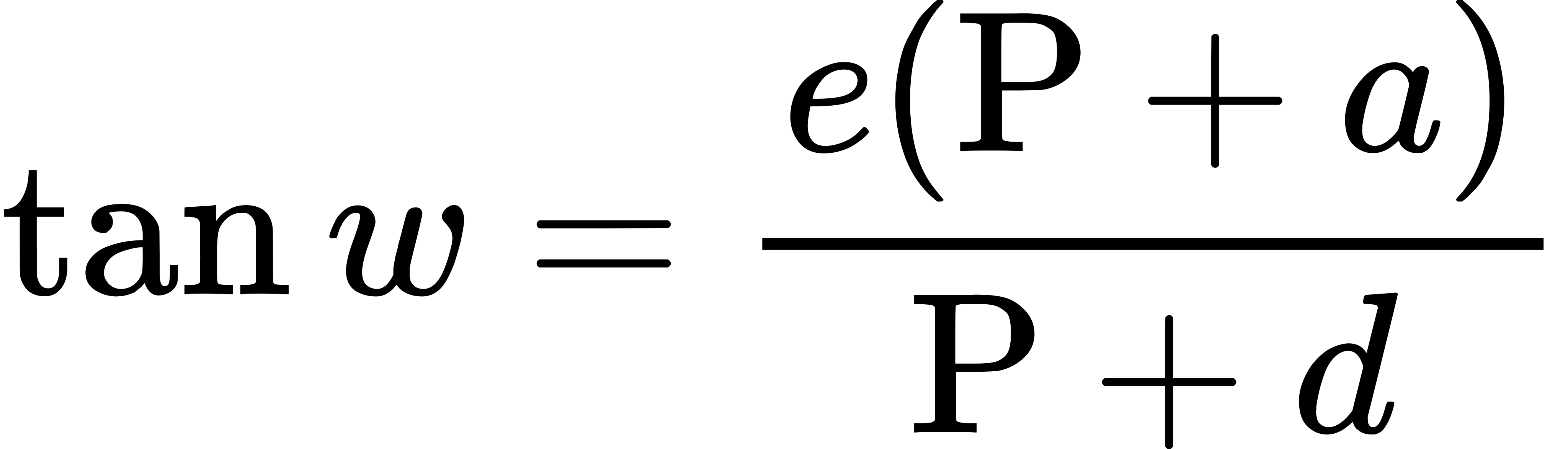 , and
, and 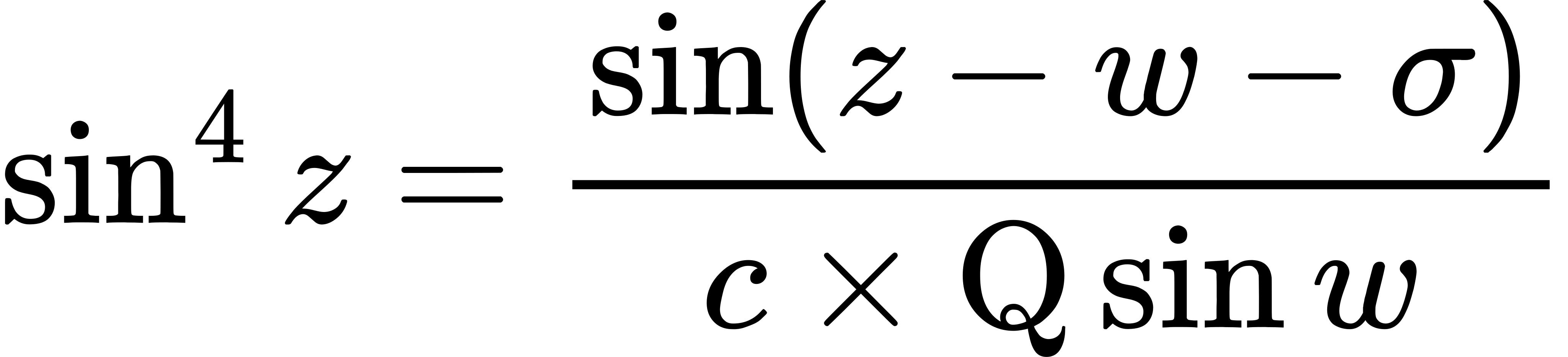 ,
where represents the arc C′B′84.
96
,
where represents the arc C′B′84.
96
We next compute the two equations
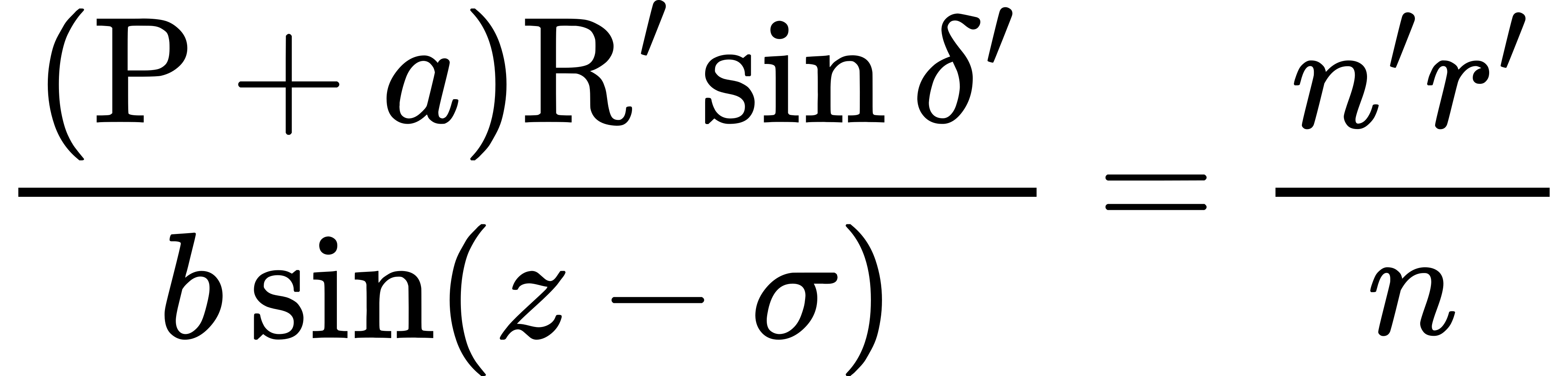 , and
, and 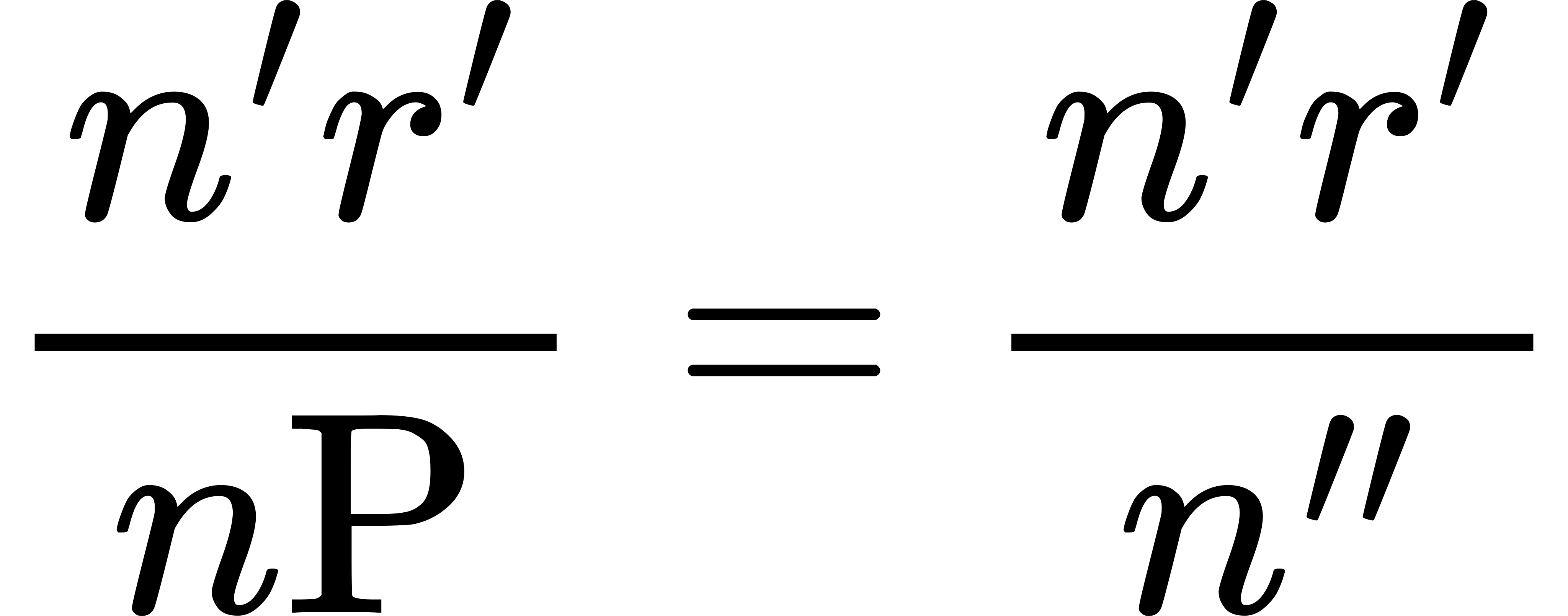 , from which we get
 , and
, and

The following four equations
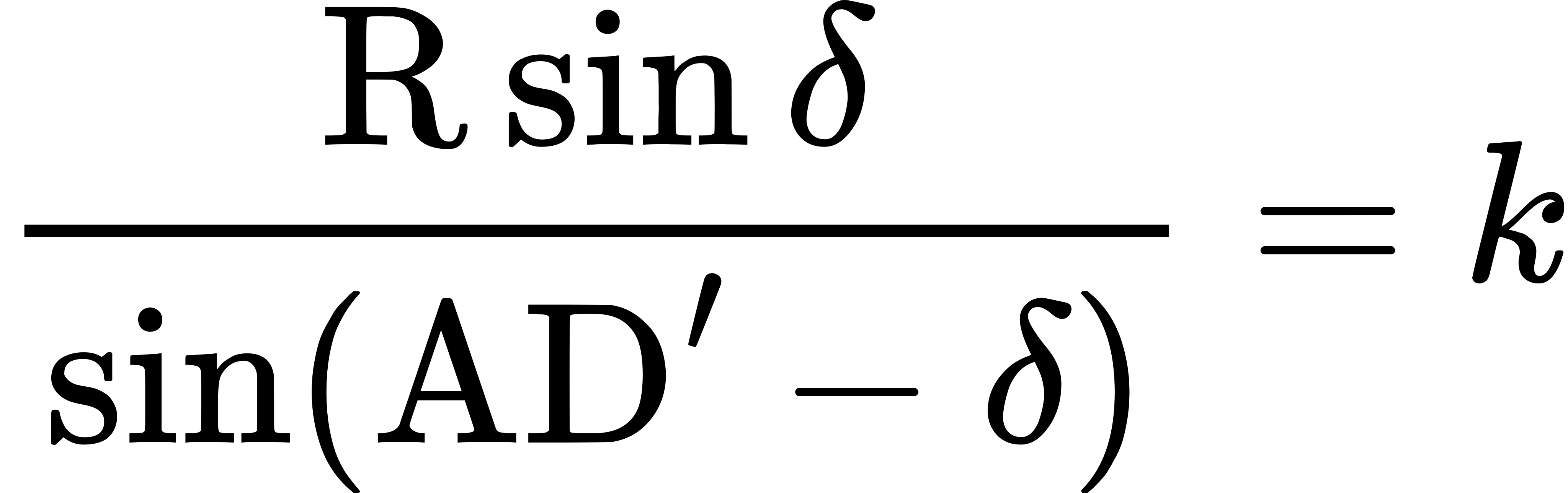 ,
, 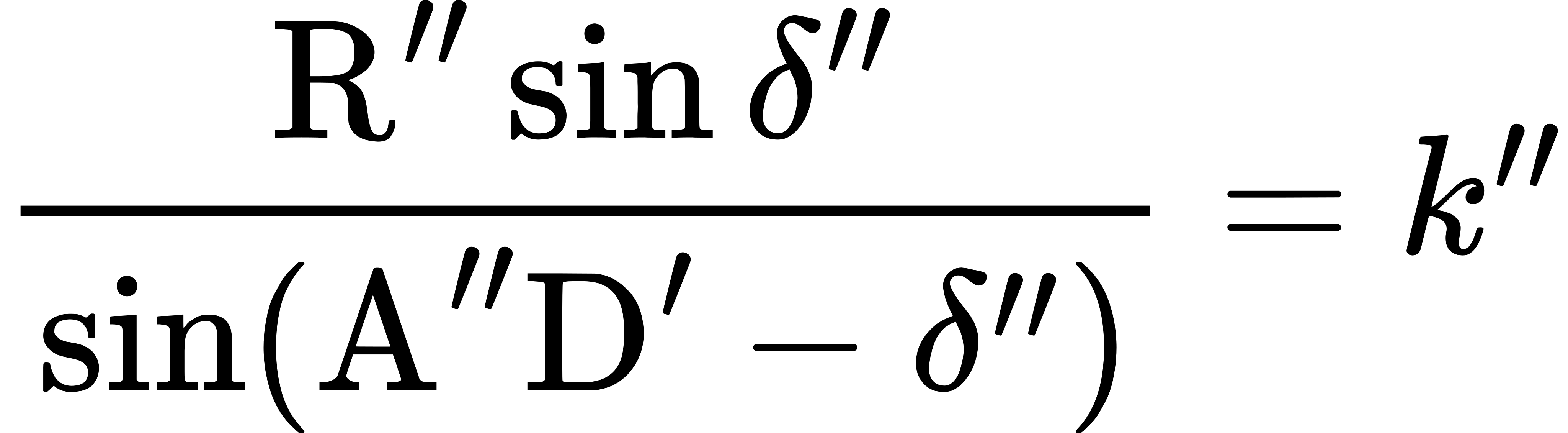 ,
, 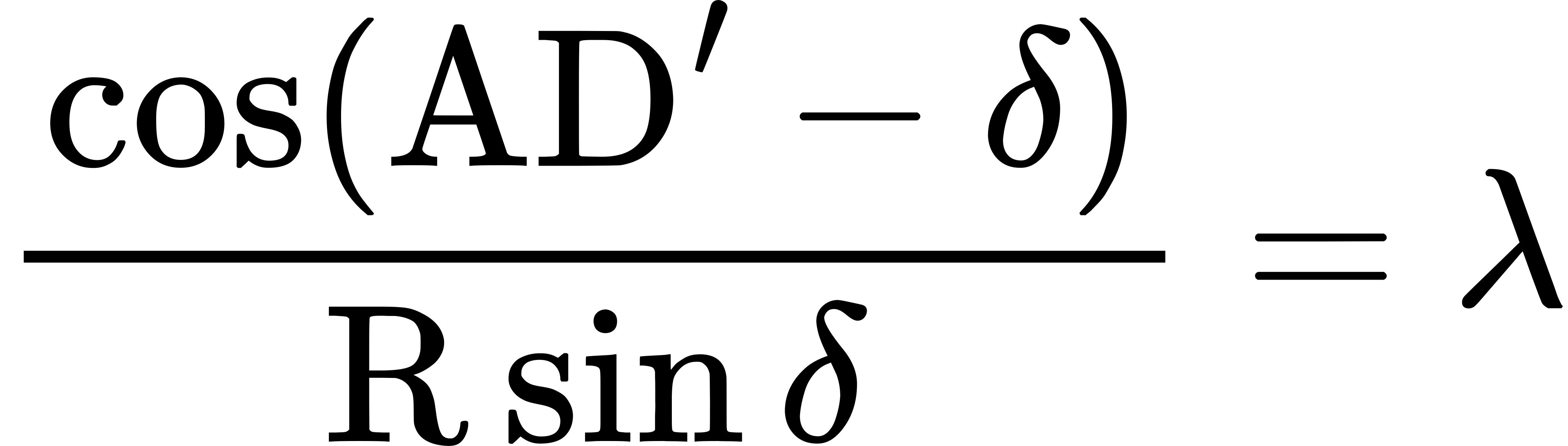 ,
, 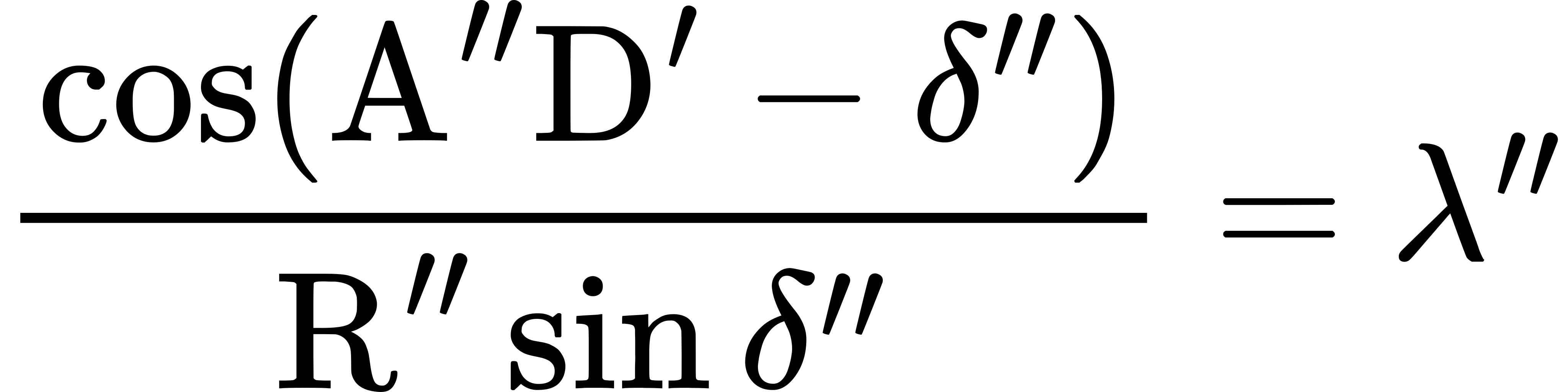 enable us to calculate
  ,
,  . From these
we obtain , ″,
. From these
we obtain , ″,  , ″ by the equations

If now C′C″, CC″, CC′, or the differences of the comet’s heliocentric
longitudes on its orbit, be represented by 2, 2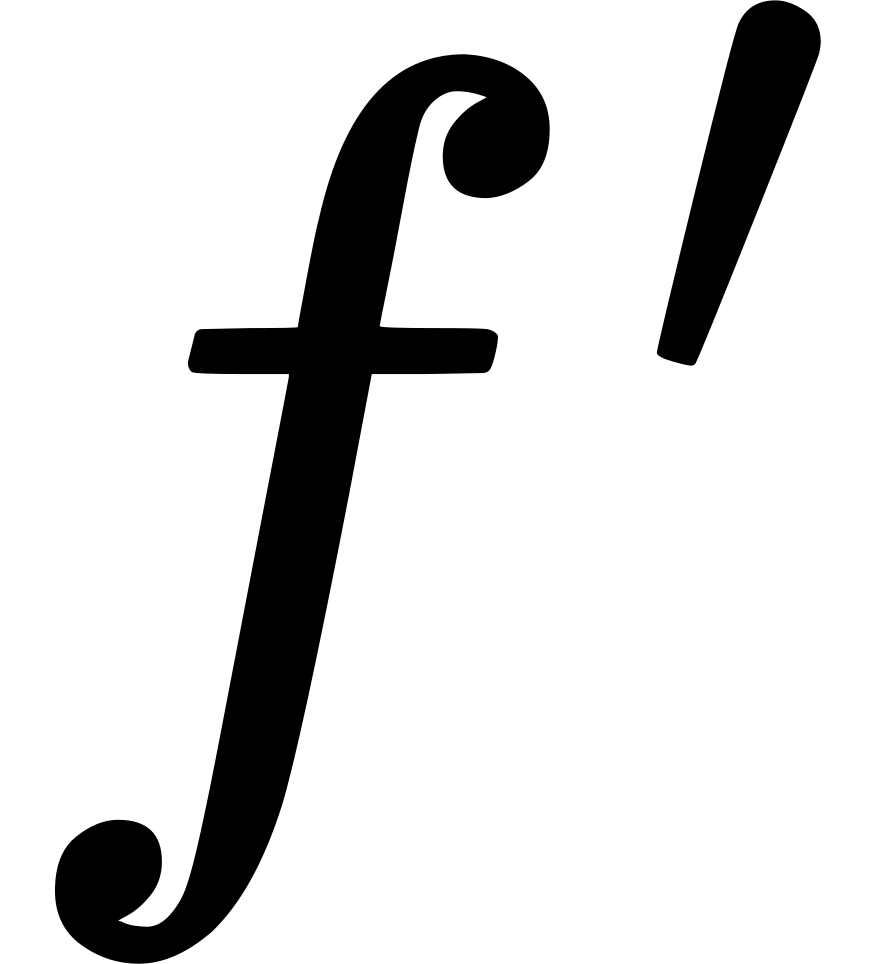 , 2
, 2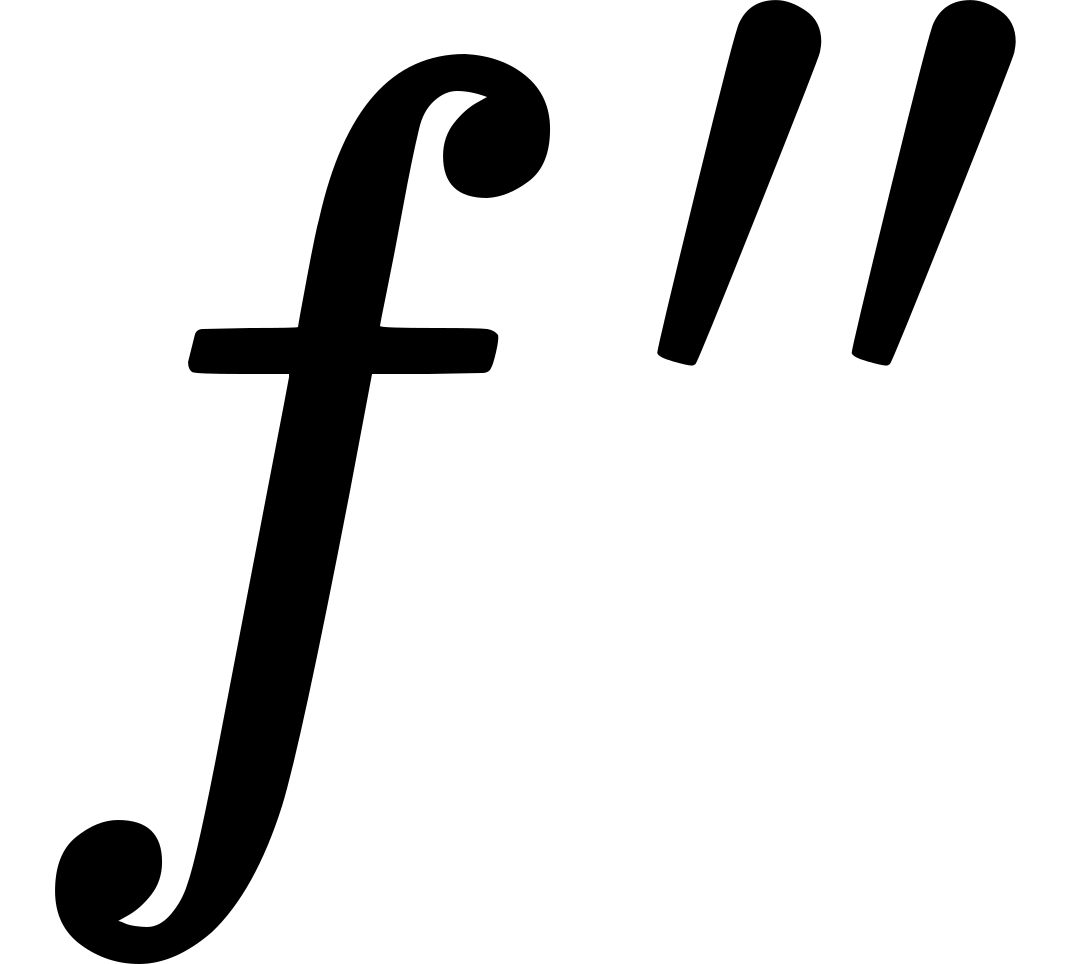 , and ″, be the
inclinations of the great circles AB, A″B″ to the great circle CC″, we
shall have the following four equations for the determination of ′, as well
as of ″ and :
, and ″, be the
inclinations of the great circles AB, A″B″ to the great circle CC″, we
shall have the following four equations for the determination of ′, as well
as of ″ and :
|
sin f′ sin (k″ + k)
|
= |
sin ′ sin ( + ″)
|
|
|
sin f′ cos (k″ + k)
|
= |
cos ′ sin (′ - ″)
|
|
|
cos f′ sin (k″ - k)
|
= |
sin ′ cos ( + ″)
|
|
|
sin f′ cos (k″ - k)
|
= |
cos ′ cos ( - ″)
|
The two first of these give (k″ + k), and sin f′, and the two others
(k″ - k), and cos f′. At present, however, it is only necessary to compute
f′. Having found the value of f′, we at once obtain f and f″ by the equations

Having now therefore determined the quantities f, f′, f″, on which the
values of , ″ depend, we proceed to rectify our former assumption of
, and of ,
instead of 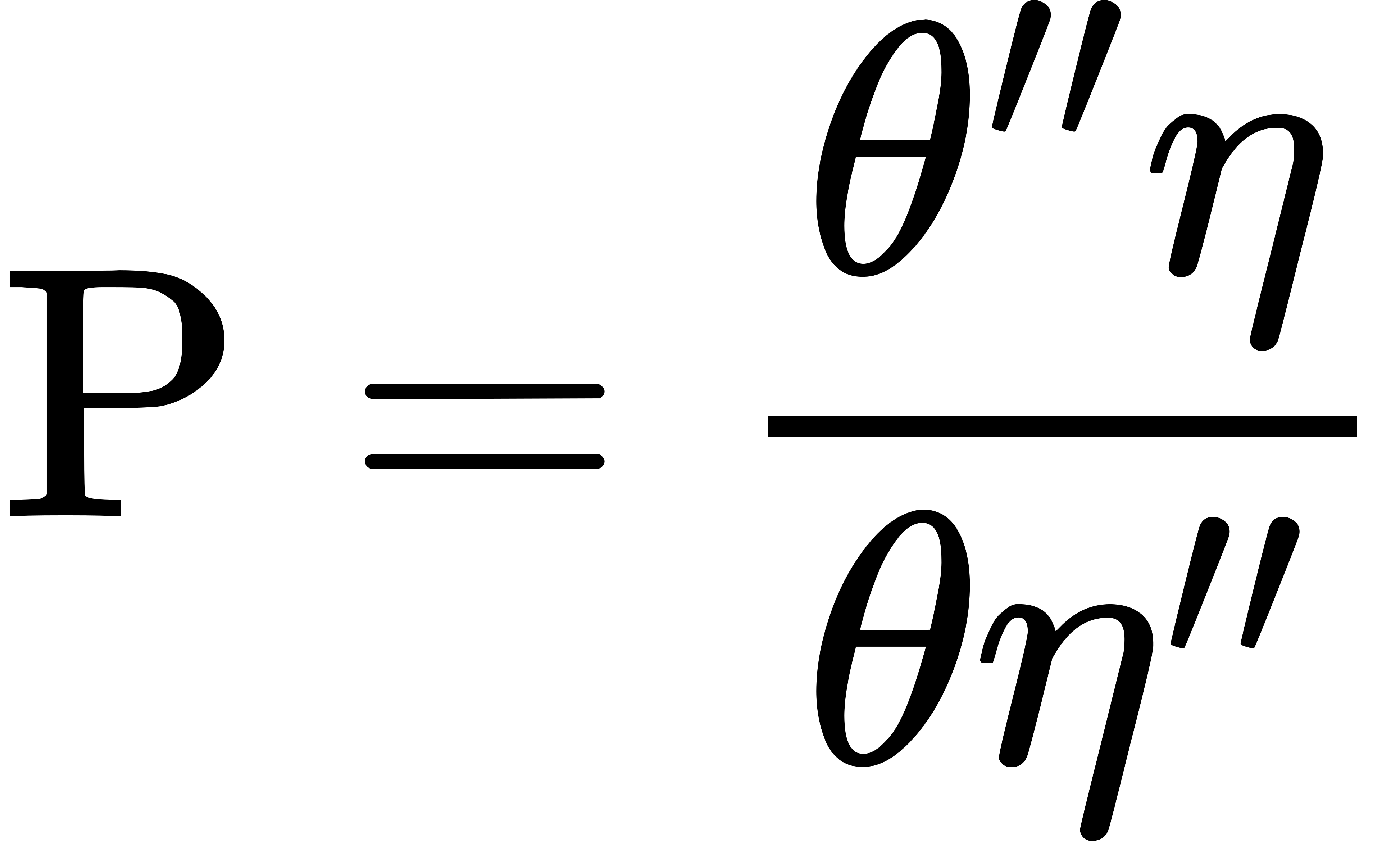 and
and 
It will be recollected that , ″ are the intervals of time multiplied into
the constant number , and , ″ the sectors comprehended by r′, r″, 2f,
and r, r′, 2f″. The new values for P and Q thus obtained, will shew the
97amount of the error involved in our hypothesis. With these new values,
we compute over again the same equations, and thus finally find more correctly
and k, upon which the determination of the elements depends.
Call the inclination of the orbit to the ecliptic I, the longitude of the
ascending node  , the argument of the latitude, at the first observation, u:
Then, in the spherical triangle AC (Fig. 7.), whose sides are AD′-,
u, L - , and the opposite angles I, 180° - y, and k, we get the following
equations, similar to our former equations:
, the argument of the latitude, at the first observation, u:
Then, in the spherical triangle AC (Fig. 7.), whose sides are AD′-,
u, L - , and the opposite angles I, 180° - y, and k, we get the following
equations, similar to our former equations:
|
sin I sin (u + (L - ))
|
= |
sin (AD′ - ) sin (y + k)
|
|
|
sin I cos (u + (L - ))
|
= |
cos (AD′ - ) sin (y - k)
|
|
|
cos I sin (u - (L - ))
|
= |
cos (AD′ - ) cos (y + k)
|
|
|
cos I sin (u - (L - ))
|
= |
cos (AD′ - ) sin (y + k)
|
From these equations we eliminate I, u, and L - ; and consequently
itself, since L is the earth’s longitude, which is known.
The comet’s true anomaly v, is to be obtained by means of the following
equations, Gauss, 96.85
98
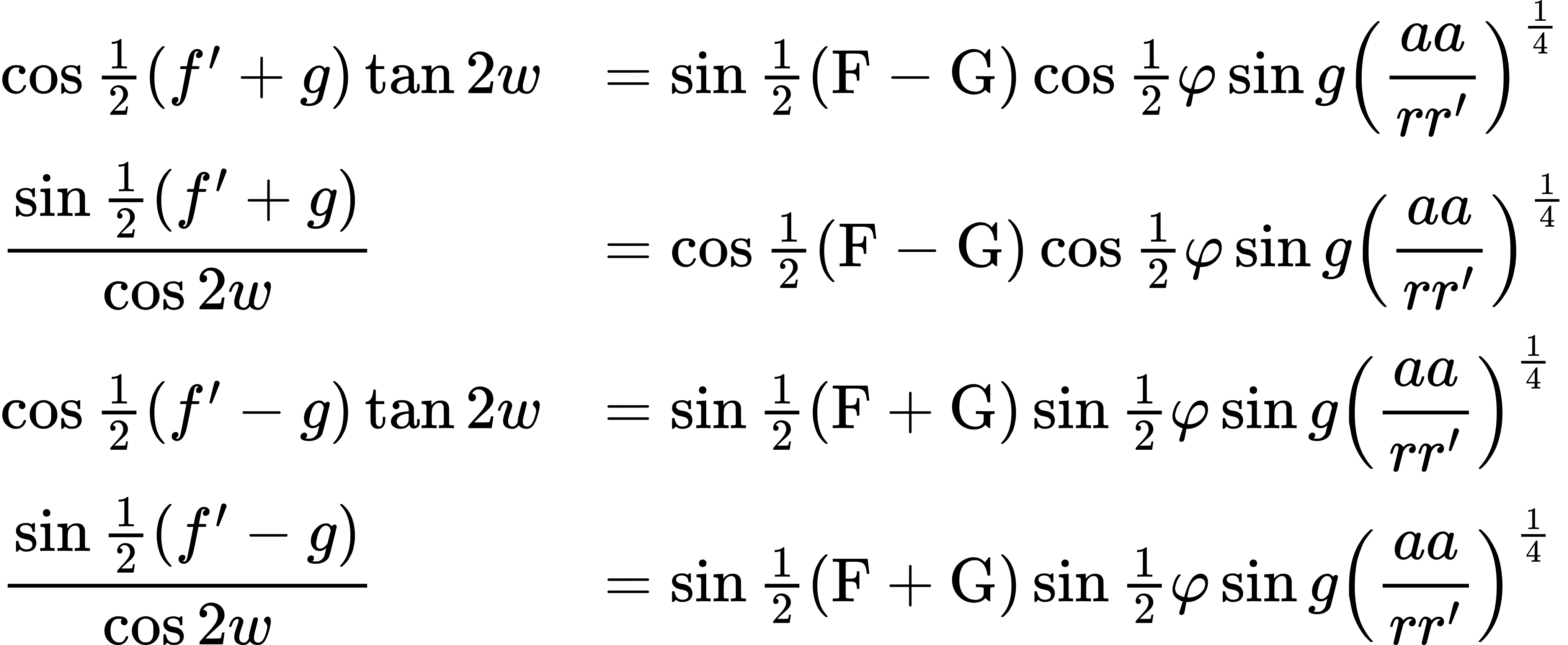 Here F = half the sum of the true anomalies, and G = half the sum of the
eccentric anomalies. From the two first equations we extract (F - G),
and from the two last (F + G): hence F = (v + v″) is found, and
therefore since f′ = half the difference of the arguments of the latitudes, is
the same as half the difference of the anomalies, we have F - f′ = v, the
true anomaly at the first observation. The distance of the perihelion from
the node = u - v, and hence the longitude of the perihelion
Here F = half the sum of the true anomalies, and G = half the sum of the
eccentric anomalies. From the two first equations we extract (F - G),
and from the two last (F + G): hence F = (v + v″) is found, and
therefore since f′ = half the difference of the arguments of the latitudes, is
the same as half the difference of the anomalies, we have F - f′ = v, the
true anomaly at the first observation. The distance of the perihelion from
the node = u - v, and hence the longitude of the perihelion

From the above equations we also obtain G = (E + E″) or half the
sum of the eccentric anomalies; and as we also know half their difference,
or g, we immediately derive E and E″. The eccentricity itself e = sin
is derived from the first and third equations, which give
 Hence we find the semi-parameter
  , and the semi-transverse
axis of the orbit
, and the semi-transverse
axis of the orbit 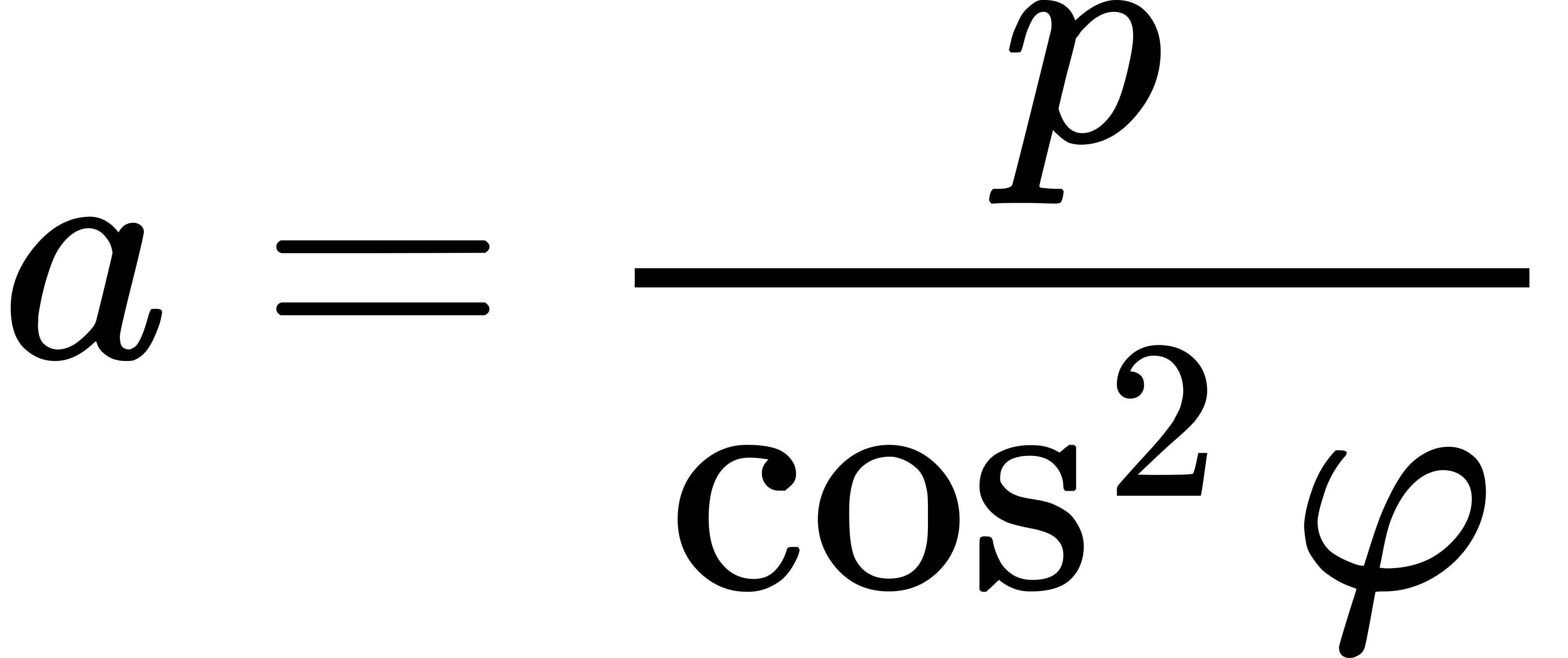 .
. 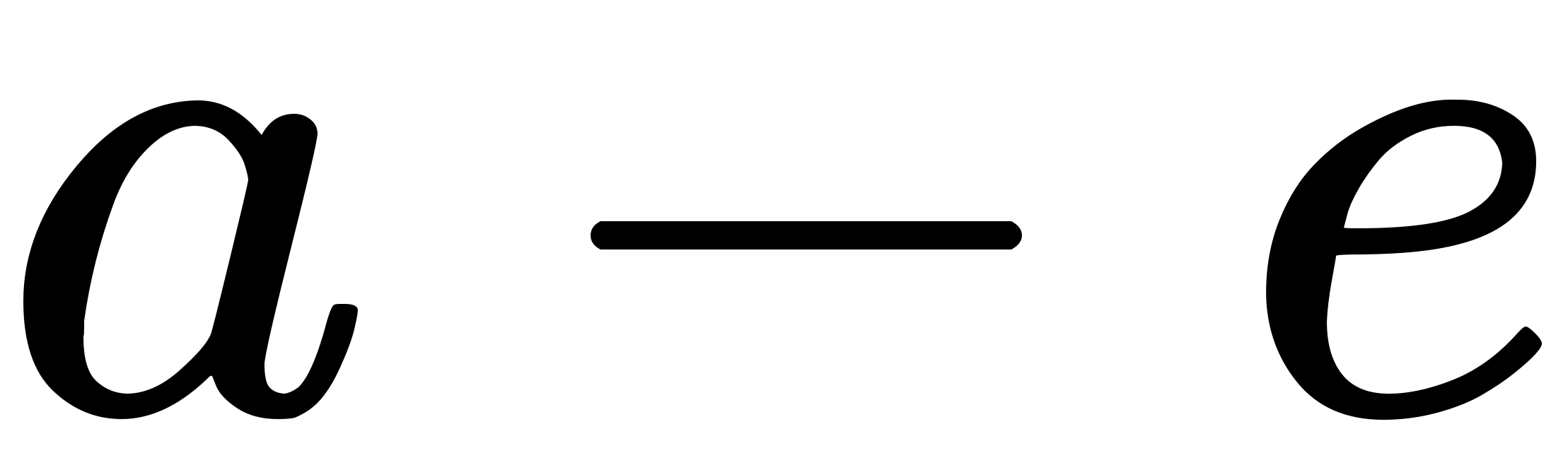 will give the comet’s perihelion
distance; and, finally,
will give the comet’s perihelion
distance; and, finally, 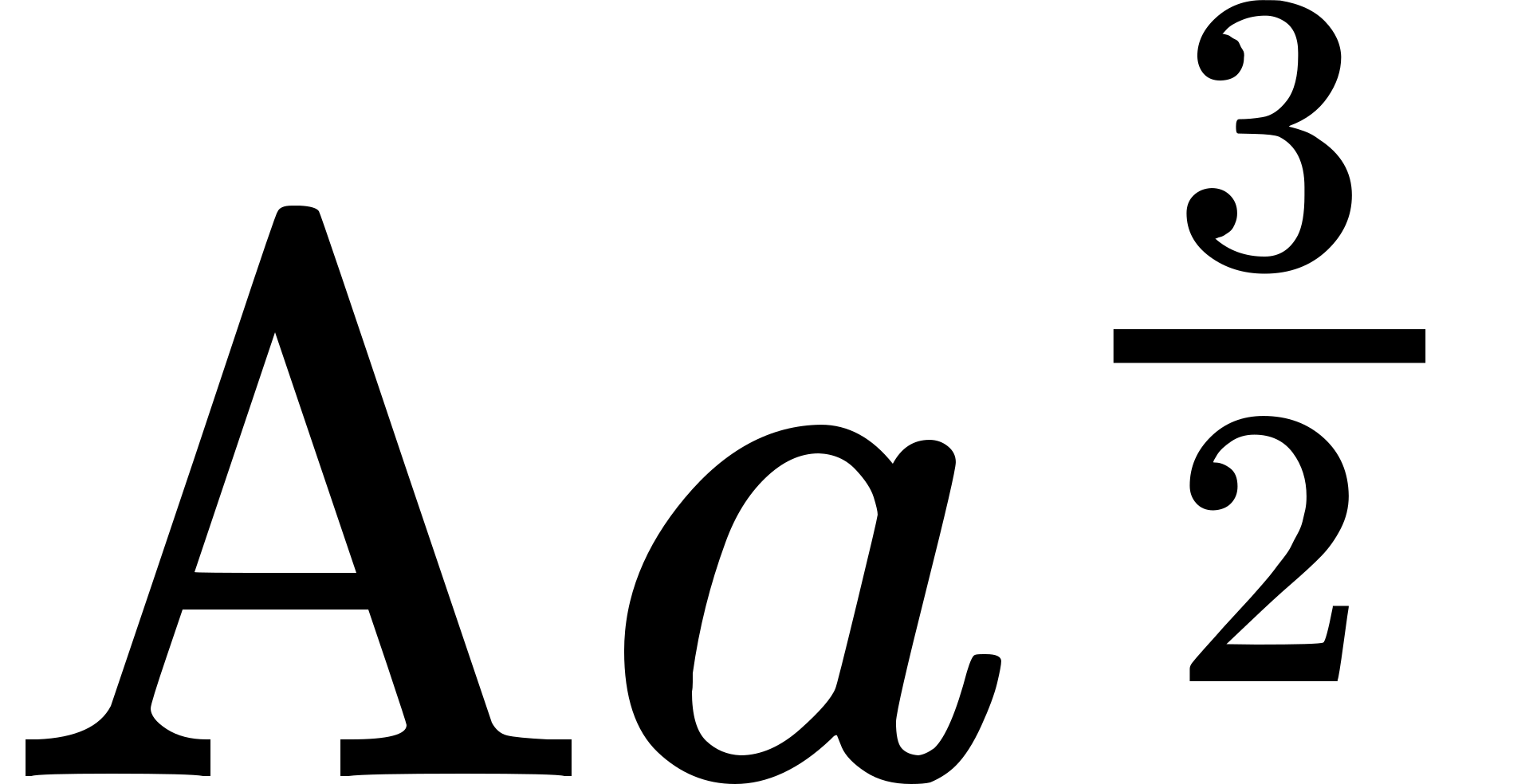 (where A is the length of a sidereal
year) will be the comet’s periodic time.
(where A is the length of a sidereal
year) will be the comet’s periodic time.
The only remark which seems requisite to be made upon the method now developed, of obtaining the Elliptic elements of a comet, is with respect to the intervals of time between the observations. They ought not to be taken too great, nor should they be very unequal. In fact, it would contribute to much superior accuracy, as well as simplicity in the investigation, were the observations to comprehend intervals exactly equal.
99
Such are the methods in most common use for discovering the elements of a comet’s orbit. After the very ample details into which we have entered in our explanation of each, it now remains for us only to add a few remarks upon their respective merits. It cannot be denied, that the processes in both are extremely intricate, especially in the Elliptic method, where so great a degree of precision is required: nor can I here forbear to state, that the labours of calculation in applying the formulæ are excessive. In the Parabolic method itself, as we see by the example given, considerably above 200 logarithms to seven decimals must be employed, besides various other arithmetical operations, in which the slightest error, if committed near the commencement, though amounting to no more than a single second, will often produce at the conclusion the most material variations from the truth. If, even in the Parabolic method, therefore, the risk of mistake be so imminent, and the labours of calculation so enormous, the difficulties of the Elliptic method may be readily conceived, where the formulæ are greatly more numerous and complicated. In the practical application, these circumstances are not lost sight of by astronomers; and on this account, it is always deemed preferable to calculate the orbit of a comet first on the more easy and convenient hypothesis of the Parabola. Besides, as Olbers remarks, “It will seldom or never occur to us to compute the Elliptic orbit, for the sake of any material utility or advantage. The portion of the orbit which is in the neighbourhood of the sun, may almost always be so accurately determined by the Parabolic hypothesis, that we can represent, and predict, and judge of its course, and its distance from the earth and sun, and identify it upon a second appearance with sufficient precision. And this appears to me to be the whole object of the calculation of a comet, since the determination of the Elliptic orbit can never ascertain the period of revolution with any certainty, the deviations 100from the parabolic orbit being complicated with the errors of observation; and these errors are in many cases greater than could have been imagined, partly from the nature of the light and the form of the comet, and partly from the imperfections of our catalogue of fixed stars.” If, then, on the parabolic hypothesis, we are enabled to find the elements of a comet’s orbit with so much facility and precision, what advantage, it may be asked, is there in the elliptic method at all; since, in the only additional information which it is intended to supply, viz. the period of revolution, it gives results often so erroneous? It is only in those cases where a parabolic orbit will not represent the observed path of the comet, that the elliptic method may be resorted to; and when it is employed, the observations must evidently be made with the greatest care, and likewise be made to comprehend considerable intervals of time.
101
I. Although the foregoing investigations of the Elements of a Comet’s orbit are founded on the strictest mathematical principles, and truly represent the track of the Comet during the time of observation, yet it is found that they do not hold good for every return to the perihelion, or even in some cases for a single revolution. In those investigations we have proceeded all along on the supposition, that the Comet is subjected in its course to no power except the attraction of the Sun. But it must be remembered, that the law of gravitation is universal; that a like power of attraction resides in all the heavenly bodies, varying only in its intensity; and that whenever a comet has entered within the sphere of their influence, its movements are liable to be disturbed. The highly attenuated nature of comets renders them peculiarly liable to such perturbations;—perturbations, by which the progress of the Comet may be accelerated or retarded, the place of its nodes changed, its perihelion distance diminished or increased, and the inclination as well as eccentricity of the orbit, altered. And the effect of these changes even during one revolution, are sometimes so considerable, as to render the identity of a comet at its successive returns to the sun very problematical.
Halley’s Comet was the first which drew the attention of astronomers to these perturbations, and suggested the true method of calculating correctly the periodical return of comets. After having ascertained its approaches to the sun in the years 1531, 1607 and 1682, Halley was surprised to find that the period of its first revolution was longer by thirteen 102months than the period of the one following. It occurred to him that this difference might possibly have arisen from the disturbing action of the planets, particularly Jupiter and Saturn, the two largest bodies of our system; and after a rough estimate of the amount of their attractions, during the revolution then about to be completed, he ventured to announce, that the Comet would again become visible about the end of 1758 or the beginning of 1759. The prediction was one of too much importance in itself, and moreover too intimately connected with the theory of gravitation, which was then only recently given to the world, not to excite the curiosity of all who were interested in the progress of science; and, accordingly, the predicted period was looked forward to with the utmost anxiety. About this time, the well known problem of the Three Bodies had been solved, and Clairault, an eminent mathematician, who was one of the first to give a solution, applied it to determine exactly the alterations which the Comet’s orbit might have sustained, by the united influence of Jupiter and Saturn. His labours shewed that its regular period was lengthened 100 days by the action of Saturn, and no less than 518 days by the action of Jupiter; so that instead of the revolution being accomplished as usual in 74 years 323 days, it would take 76 years 211 days. Since, therefore, the Comet passed its last perihelion on the 14th September 1682, he judged it very probable that the time of its next perihelion passage would be the 13th April 1759. The Comet did actually appear about the end of December 1758, as Halley had announced, and reached its perihelion on the 13th March 1759. Clairault, on revising his calculations, lessened the error of the prediction to 19 days; and the slight discrepancy which still remained, is fairly attributable to the attractions of Saturn and of Uranus: For La Place has shewn, that if the mass of Saturn had been ascertained then as exactly as it now is, the error might have been farther reduced to 13 days. The planet Uranus was not even known to exist until many years after86.
103
The Comet which appeared in 1770 between the months of June and
October, exhibited still more remarkable changes in its orbit. Astronomers
had in vain endeavoured to represent its observed course by a parabola.
But at length Lexell discovered its real orbit to be an ellipse, not
so elongated as to approximate to a parabola, but much shorter, and requiring
for each revolution a period of only 5 years. This result seemed
very extraordinary, since the Comet, which ought to have been so often
visible, on account of the shortness of its period and perihelion distance, yet
had been never seen on any previous occasion: and the circumstance was
still more unaccountable, when it was found that the comet made no subsequent
return to the sun. The French Institute, desirous, as it always has
shewn itself, to promote the interests of science, and deeming the phenomenon
a fit subject of curious mathematical and astronomical inquiry, offered
a prize for the most complete investigation of the elements of this comet,
taking into account every circumstance which could possibly have produced
an alteration in its course: But the result served only to confirm the
correctness of Lexell’s calculations. At length, Burckhardt, aided by
certain analytic processes, which had been communicated to him by La
Place, was enabled to solve the mystery; and the discovery may certainly
be looked upon as having brought to light one of the most astonishing
facts in the whole history of astronomy.
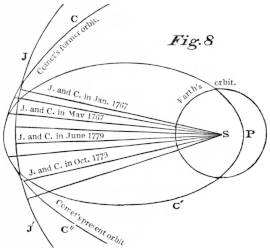
By tracing back the movements of this Comet in its orbit, for some
years previous to 1770, Burckhardt found,
that, at the beginning of 1767, it had entered considerably within
the sphere of Jupiter’s attraction. Calculating the amount of this
attraction, from the known mutual proximity of the two bodies, he was
next enabled to determine the orbit which the Comet must have had
previously; and the result showed it to have then moved in an ellipse
of greater extent, having a period of 50 years, and in which the Comet,
even when nearest the sun, was still as far distant as Jupiter. It
was therefore very evident, why, as long as the Comet continued to
circulate in this orbit so far from the centre of the system, it never
became visible from the Earth; and equally manifest, that the cause
104of its apparition in
1770, was the disturbing action of Jupiter, which had constrained it to
move in a shorter ellipse, and at a smaller distance from the sun. To
render this exposition the more intelligible, let S be the Sun (Fig.
8.), and J J′ a portion of Jupiter’s orbit; C is a branch of the orbit
which the Comet moved in before the perturbation of its motions by
Jupiter. In January 1767, Jupiter and the Comet happened to be very
near one another, as shewn in the figure, and as both were moving
in the same direction, and nearly in the same plane, the proximity
continued during a period of several months; the consequence of this
was, that the Comet’s orbit was changed into the much smaller ellipse
C′P, in which each revolution was accomplished in the space of 5
years. In conformity to the period of revolution in this new orbit,
the Comet would again have been seen at its perihelion P in March
1776, had it not then, with respect to the Earth, been exactly behind
the body of the sun, and rendered invisible by his rays, during the
whole time, when only it could have been observed. In the course of
the subsequent revolution, as it was approaching the sun in 1779, it
happened again to fall in with Jupiter. It was in the month of June
that the attraction of the planet began to have a sensible effect,
and it was not until the month of October following that they were
finally separated. At the time of their nearest approach, in August,
Jupiter was distant from the Comet only 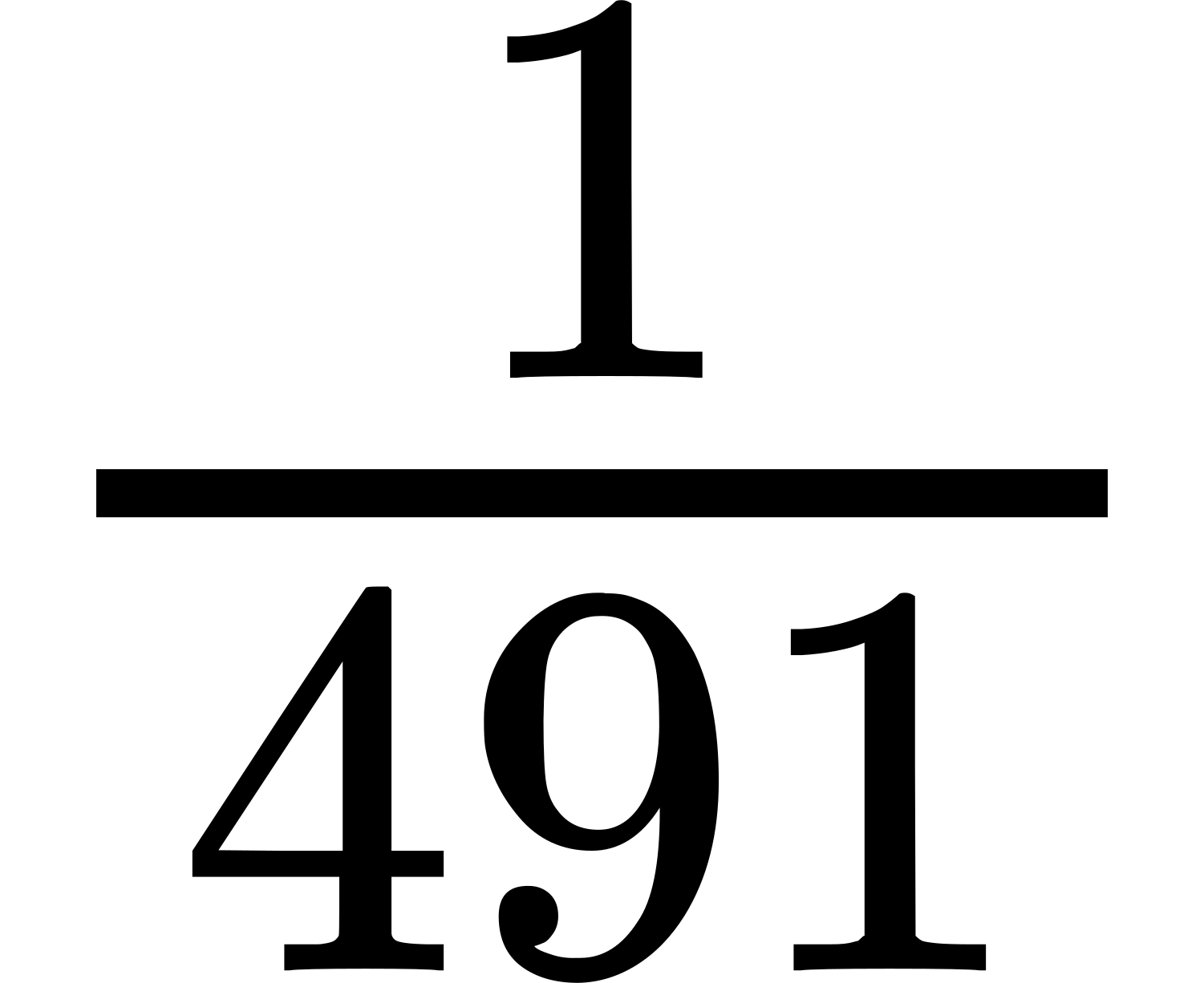 of its distance from the
sun, and hence exerted upon it a force 225 times greater87.
By reason of this powerful attraction, the line of the comet’s route
105was again shifted into
a more extensive ellipse C″, which, even at the perihelion, comes no
nearer to the Sun than the planet Ceres. In this third orbit, which
is the one at present followed, the comet requires about 20 years to
accomplish a revolution; but now it is situated at so great a distance
from the Earth, that it will always remain invisible to us, unless
in the lapse of time it shall again undergo other perturbations,
similar to those which have so often forced it to deviate from its
regular course88.
of its distance from the
sun, and hence exerted upon it a force 225 times greater87.
By reason of this powerful attraction, the line of the comet’s route
105was again shifted into
a more extensive ellipse C″, which, even at the perihelion, comes no
nearer to the Sun than the planet Ceres. In this third orbit, which
is the one at present followed, the comet requires about 20 years to
accomplish a revolution; but now it is situated at so great a distance
from the Earth, that it will always remain invisible to us, unless
in the lapse of time it shall again undergo other perturbations,
similar to those which have so often forced it to deviate from its
regular course88.
Other instances might be adduced, to prove the extensive changes to which the orbits of Comets are exposed, were not a bare reflection upon their physical constitution sufficient for this purpose. The planets, whose orbits are nearly circular, affect one another only by producing certain inequalities too trivial and temporary to be detected, except by the most minute and protracted observations. But the Comets, following as they do paths extremely eccentric, and wandering into the most distant regions of the system, are subject to the disturbing influence not only of the known planets, whose orbits they intersect, but of any other heavenly body yet undiscovered, circulating beyond the planetary limits.
Seeing, then, that, from various causes peculiar to Comets, they are so liable to be deflected out of their own path, by other bodies in the system, it has been asked, whether a comet may not be so powerfully acted on by a planet as to be retained by its attraction and forced to circulate round it as a satellite? This question has been instituted chiefly in reference to our own Moon, which Maupertuis conceived to have been originally a Comet, retained in this manner by the Earth; and a similar inquiry might, in like manner, be extended to the satellites of the other planets.
M. Du Sejour, in his “Traité analytique” has devoted a chapter to the consideration of this question. I may mention in passing, that the great object of Du Sejour’s two quarto volumes was, if possible, to show the groundlessness of the fears which were entertained respecting the approach 106of Comets: and having set out with this fixed purpose, it is generally allowed, that, in his examination of the opinions advanced by Maupertuis, La Lande, and various others, he has been rather too forward and too hasty in drawing the conclusions which were necessary to refute them. With respect to the present inquiry, whether a Comet, entering within the sphere of the Earth’s attraction, might not be forced to circulate round it, he first examines the case of parabolic and hyperbolic comets, and then proceeds to the consideration of those whose orbits are elliptic. With respect to the former, he deems it quite impossible that any such Comet could become a satellite of the earth. It is unnecessary to enter into the reasoning which he employs in support of this conclusion; because he has supposed a case, with respect to the nature of the orbits, which, as we have already shewn, can hardly be admitted to exist. Nor does his reasoning seem to rest upon grounds wholly unimpeachable, when he takes for granted that the earth’s power of attraction reaches only to about twice the distance of the moon. At all events, in the case of Comets whose orbits are elliptic, Du Sejour is obliged to admit the possibility of their being so retained as satellites of our planet; though he is still unwilling to think that the occurrence of such an event is attended with any degree of probability. “Il nous est donc impossible,” says he, “de prononcer definitivement, si une Comète elliptique, ayant tourné primitivement autour du Soleil, ne pourrait pas devenir Satellite de la Terre. Ce qu’il y a de sûr, c’est que dans le cas même, où géométriquement parlant, l’impossibilité n’en paroîtroit pas démontrée, la réunion des circonstances qui devroient concourir pour que cela eût lieu, est telle que l’évenement est contre toute probabilité.” Whether or not our Moon has been a Comet thus arrested by the earth, is a question to which it seems very difficult to afford an answer. Some have, however, been led to such a conjecture, on account of the vitrified and cinerary appearance which the lunar disc presents, as also from the traditionary legend of the Arcadians, who dated the origin of their nation previous to the existence of the moon. But, whoever has considered 107the theory of La Place, by which he accounts for the formation both of planets and satellites out of a solar atmosphere, must be convinced that it furnishes the true explanation of all the peculiarities of the system, and totally excludes the idea of our Moon having once been a Comet89.
When we reflect upon the prodigious number of comets
which are wandering in every direction through space, approaching
exceedingly near, as they sometimes do, to the other bodies of the
system, whose attraction so materially affects their motions, it is
natural to inquire, in the next place, whether Comets be capable of
reacting on the Planets, so as to produce any perturbations in
their course. It is well known that comets have approached exceedingly
near to planets; and from the effects which on these occasions have
taken place, astronomers have been enabled to form some estimate of
their density, that quality on which their power of perturbation
depends. We have already noticed the close approaches made by the
comet of 1770 to Jupiter: In fact, it traversed on the two occasions
above mentioned, the whole system of his satellites, and at each time
required four months to free itself from the sphere of the planet’s
attraction. Notwithstanding this, the slightest alteration could
not be observed to have taken place in the motions of these small
bodies; though from its brilliant aspect, this comet must have been
one of considerable magnitude, and was even computed by some to have
a diameter nearly thirteen times greater than the Moon90. The
same comet approached likewise very near the Earth; so near, indeed,
as to have its own sidereal revolution shortened, by this cause alone,
2.046 days91. What, however, was the amount of its
reaction upon the earth? La Place
has shewn92, that,
108
supposing the comet’s mass to have been equal to the earth’s, it
ought to have lengthened our sidereal year by 2h 47′: But,
calculations for constructing the tables of the sun, performed with
great accuracy and minuteness, prove, that, in the length of that
year, no alteration could have taken place exceeding 2″; and hence it
followed, since 10027″ : 2″ :: mass of earth : mass of comet, that
the Comet’s mass could not have amounted to 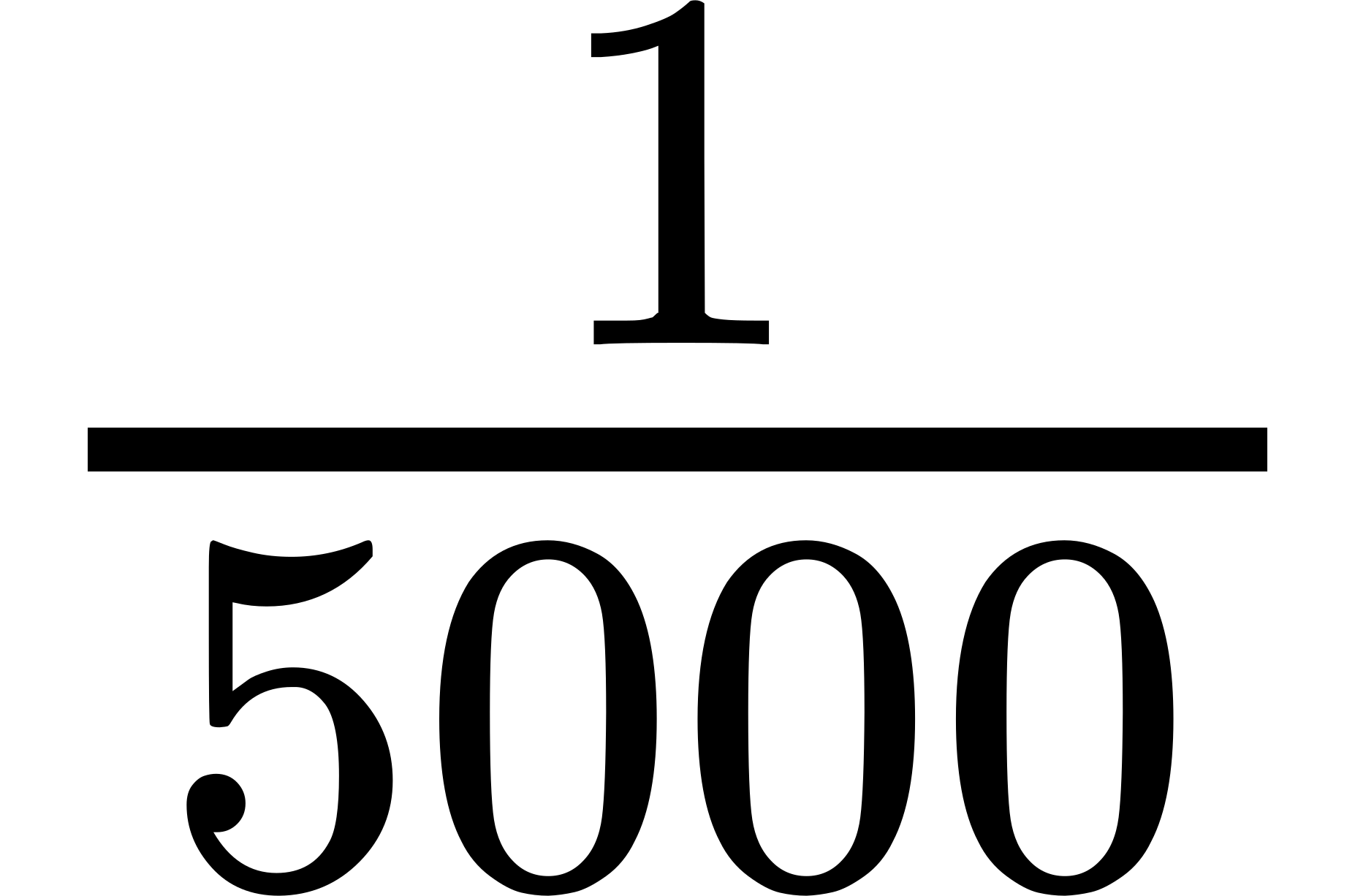 th part of the mass
of the Earth. From these circumstances, then, it is manifest that the
highly attenuated nature of comets, though it renders them extremely
liable to be deflected from their own orbits by the other bodies in the
system, effectually prevents them from reacting in a similar manner
upon the movements of the planets.
th part of the mass
of the Earth. From these circumstances, then, it is manifest that the
highly attenuated nature of comets, though it renders them extremely
liable to be deflected from their own orbits by the other bodies in the
system, effectually prevents them from reacting in a similar manner
upon the movements of the planets.
After these remarks, it will not be difficult to see the improbability of the supposition93, that either the Earth, or our Moon, or any of the other planetary bodies, can be carried altogether out of its course by the attraction of a comet. Du Sejour has shewn, that were a comet, having a mass equal to that of the Earth, to approach us within 13,000 leagues, the only effect would be to increase the length of the year by 22 days; and when we consider the diminutive size of these bodies in general, it is abundantly evident that none of the planets are exposed to any very great risk of having their orbits materially altered by their attraction.
II. But, though the changes which Comets may effect in a planet’s movements are too minute to be appreciated, the most extraordinary notions have been entertained respecting their influence upon the order of things on a planet’s surface. It has been already noticed, that in times of ignorance and superstition, the apparition of a Comet was thought to betoken, with regard to human affairs, the most awful and inevitable disasters. Convulsions, not so much in the physical, as in the moral and political world, were among the fancied calamities which it foreboded, and each 109comet, according to the form of its tail and the direction of its course, threatened destruction to some particular nation. The comet of 1454, seen at Constantinople, seemed there to be moving in the firmament from west to east, and to present the aspect of a flaming sword; from its great magnitude, it is said even to have eclipsed the Moon, and created among the Turks the utmost consternation, as it was thought to prognosticate nothing less than a crusade from all the kingdoms of Christendom, and forebode the certain overthrow of the Crescent94. Only two years afterwards, when, notwithstanding these direful omens, the Turkish arms had proved eminently victorious, and were spreading dismay over all Europe, Halley’s Comet, in 1456, with a long tail turned towards the east, created reciprocal and still greater alarms on the part of the Christians. Pope Calixtus believed it to be at once the sign and instrument of divine wrath; he ordered public prayers to be offered up, and decreed that in every town the bells should be tolled at mid-day, to warn the people to supplicate the mercy and forgiveness of Heaven95; “ut omnes de precibus contra Turcarum tyrannidem fundendis admonerentur.”
These fears concerning the moral influence of Comets, the production of a weak and debasing superstition, have long since been rooted out from the faith of enlightened Europe: But they have disappeared only to be succeeded by others, respecting their physical influence, which have sprung up even from the researches of science.
It was apprehended by many astronomers, that if a comet were to
approach the Earth, within a short distance of its surface, the
attraction of the comet might be sufficient to elevate the ocean to
a prodigious height, and thus occasion all the horrors of a deluge.
La Lande computed, that were a Comet
of the size of the Earth to come within 13,000 leagues, or 110about five or six times nearer
than the Moon, the waters of the Earth would be raised “2000 toises
above their ordinary level, and thus inundate all the continents
of the world96.” Such would undoubtedly be the effect of
the mere proximity of the Comet; but, as Du
Sejour very justly remarks, this result is materially modified
by several circumstances. La Lande’s
calculation is founded on the supposition, that the Comet remains
vertical over the same part of the Earth, till the full effect of
its attraction is produced. Now Du Sejour
shows, in the most satisfactory manner, that, supposing the ocean
to have a uniform depth of a league, nearly 11 hours must elapse
before the inertia of the waters could be overcome; if the depth be
supposed two leagues, 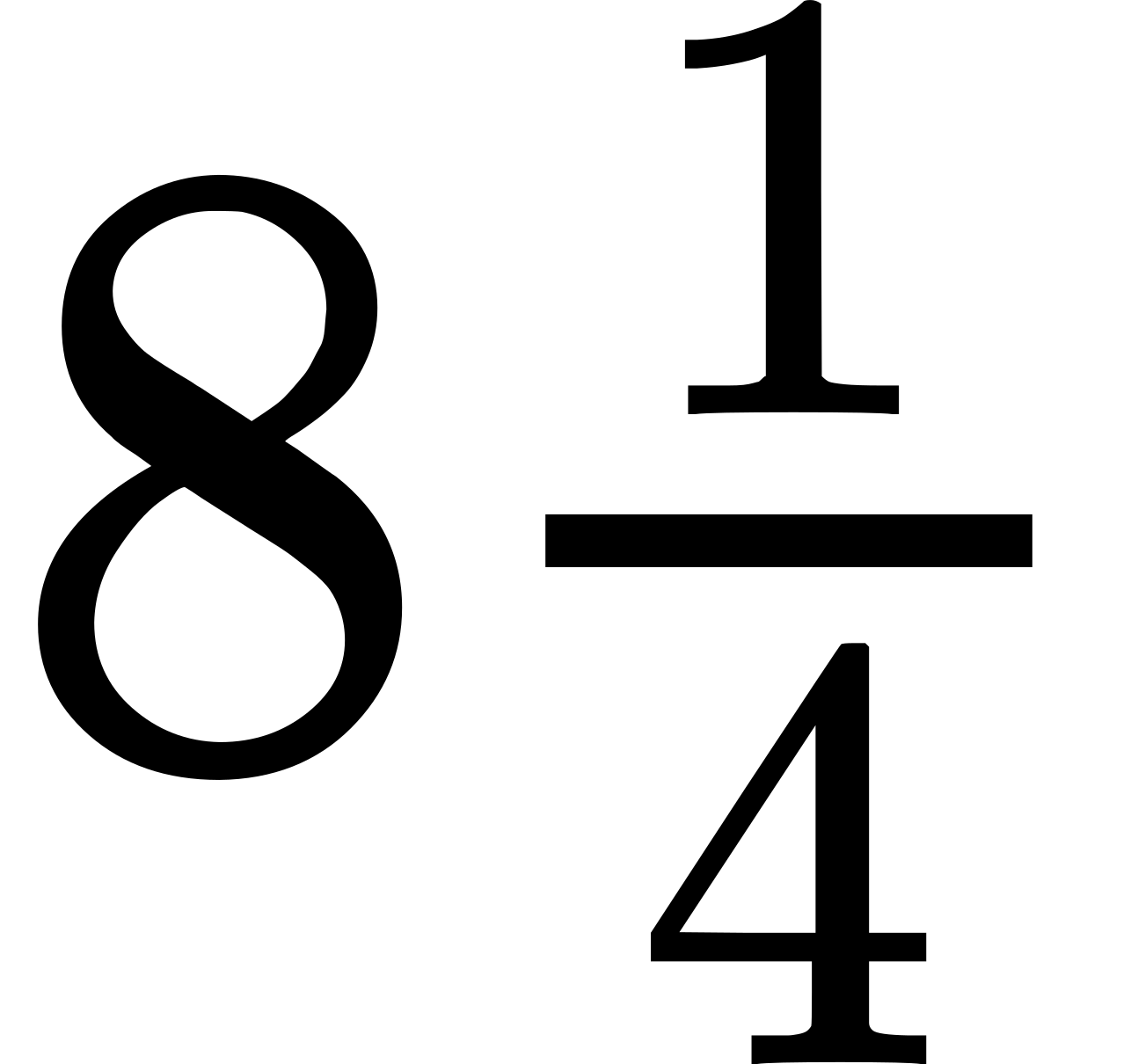 hours would be necessary. But, 1st, The
Comet cannot remain beyond a very short period over the same spot, on
account both of its own progressive motion and the rotation of the
Earth. 2d, The Comet would soon have removed to so great a distance
as to lose all its power of attraction97. 3d, The waters of the
ocean are not spread uniformly over the surface of the globe; and this
is a circumstance which, as in the Mediterranean and other inland
seas, diminishes very considerably the elevation of the tides. But,
along with these considerations, it is essential also to remember
the small mass which characterises the generality of Comets. La Place, as was already stated, shewed that the
mass of the Comet of 1770, one of the largest ever observed, could not
have amounted to th part of the mass of the Earth: but, assuming
that its mass was even equal to this, what is the actual effect which
its attraction could have produced on the ocean, in comparison with
111the moon’s influence.
The power of attraction, it is well known, is proportional to the
mass; so that if we assume the Comet of 1770 to have had a power of
attraction equal to
hours would be necessary. But, 1st, The
Comet cannot remain beyond a very short period over the same spot, on
account both of its own progressive motion and the rotation of the
Earth. 2d, The Comet would soon have removed to so great a distance
as to lose all its power of attraction97. 3d, The waters of the
ocean are not spread uniformly over the surface of the globe; and this
is a circumstance which, as in the Mediterranean and other inland
seas, diminishes very considerably the elevation of the tides. But,
along with these considerations, it is essential also to remember
the small mass which characterises the generality of Comets. La Place, as was already stated, shewed that the
mass of the Comet of 1770, one of the largest ever observed, could not
have amounted to th part of the mass of the Earth: but, assuming
that its mass was even equal to this, what is the actual effect which
its attraction could have produced on the ocean, in comparison with
111the moon’s influence.
The power of attraction, it is well known, is proportional to the
mass; so that if we assume the Comet of 1770 to have had a power of
attraction equal to 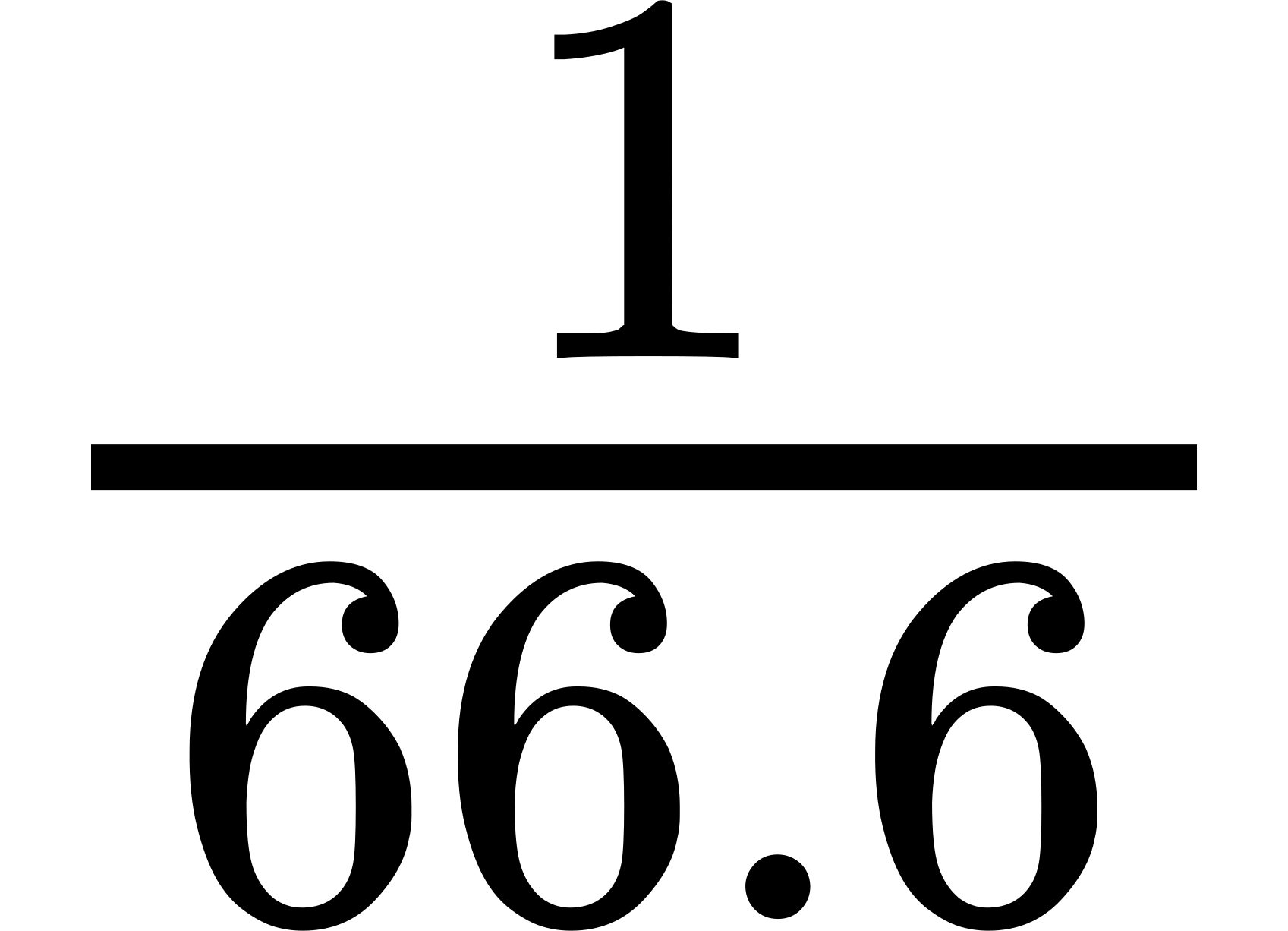 th part of the moon’s, and modify this
according to the law established by Newton,
that the effect increases in the inverse triplicate ratio of the
distance, we find, that, in order to produce only the same elevation of
the tides as the moon does, the Comet must be
th part of the moon’s, and modify this
according to the law established by Newton,
that the effect increases in the inverse triplicate ratio of the
distance, we find, that, in order to produce only the same elevation of
the tides as the moon does, the Comet must be 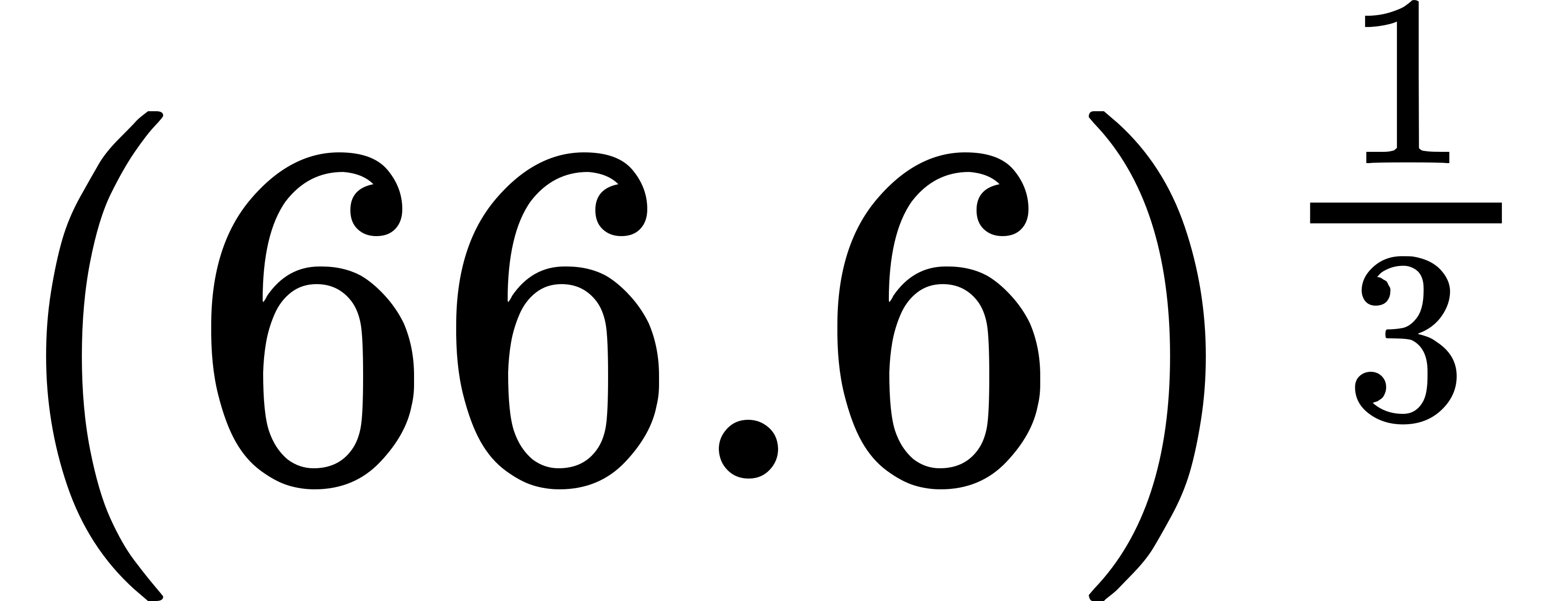 , or
about four times nearer to the Earth than the moon: But, at so short a
distance, and possessing, therefore, so great an angular velocity, the
Comet would have passed by, long before any such effects could have
taken place.
, or
about four times nearer to the Earth than the moon: But, at so short a
distance, and possessing, therefore, so great an angular velocity, the
Comet would have passed by, long before any such effects could have
taken place.
Another opinion respecting the influence of Comets of a more singular nature, which has sometimes prevailed both in this country and on the Continent, is, that these bodies are capable of generating atmospherical changes, so as to affect the state of the weather. Thus, the Comet of 1769, whose tail exceeded 40 millions of miles in length, was thought to have occasioned the very rainy season which immediately followed its apparition98. A like notion was entertained still more strongly a few years afterwards, which was not confined to the creed of the “profanum vulgus,” but found a place in the belief even of men of science. “It is an error,” says Olbers99 (and with some truth), “of those philosophers who have attributed the fogs and clouds which, in the summer of 1783, covered Europe, Asia, and the north of Africa, for nearly two months, to the mixture of our atmosphere with that of a Comet100.” Nay, what is still more astonishing, similar prejudices existed even in England so recently as 1811: It may be remembered, that the summer and autumn of 1811 were, over the whole of Europe, remarkable for long continued heat, and the cause was 112generally ascribed to the great comet which appeared during the course of that year. Hence connoisseurs in wines are still in the habit of distinguishing the claret made from the vintage of that year, by the appellation of the Comet Wine, on account of the effect which this comet was supposed to have had in maturing the vintage.
But the most remarkable account of the agency of this comet occurs in a periodical publication of considerable notoriety101, from which the following statement is extracted. After premising the opinion of Bacon, that “Comets have some power and effect over the gross and mass of things,” the author goes on to observe, that “the Comet, which appeared in 1811, seems a proof of the justness of this remark;” and he then proceeds to state “some singular changes and circumstances” which its influence occasioned. “The winter,” says he, “was very mild; the spring was wet, the summer cool, and very little appearance of the sun to ripen the produce of the earth; yet the harvest was not deficient; and some fruits, not only abundant, but were deliciously ripe; such as figs, melons, and wall-fruit. Very few wasps appeared, and the flies became blind, and disappeared early in the season. No violent storms of thunder and lightning; and little or no frost and snow the ensuing winter. Venison, which has been supposed to be indebted for its flavour to a dry and parched summer, was by no means deficient in fat or in flavour. But what is very remarkable,” continues this sage observer, “in the metropolis, and about it, was the number of females who produced twins; some had more; and a shoemaker’s wife, in Whitechapel, produced four at one birth, all of whom,” &c. &c. But enough of so deplorable an example of astrological faith, more worthy of the darker ages, than of a country and times so enlightened as ours. It would be a mockery of common sense to enter into any formal refutation of such monstrous absurdities102. Yet, let us, for a moment, consider how they could possibly have originated. The only attempt which I can discover that has been made to account 113for these strange effects, consists in the notion that, in the one case, the Earth, by being enveloped in the Comet’s vapoury tail, will thereby receive a great accession of moisture; and, in the other, that the Comet in its return from the sun, and passing very near the Earth, may communicate a portion of its recently acquired heat. But such an opinion will hardly stand the test of the slightest reflection. All that we have already discovered respecting the nature of a comet’s tail, induces us to believe that it does not consist of a vapoury medium, capable of rendering our atmosphere more humid; and whether we suppose the heat of comets to be derived from the sun’s rays, or from a native and internal source, it must be equally inadequate to produce any appreciable influence on the large and distant mass of the Earth.
But it would be as difficult to discover any presumptive evidence for this strange opinion, respecting these opposite effects of a comet upon the Earth, as it would be idle to say one word more on the subject;—were it not that Whiston an astronomer very celebrated in his day, proceeding on the two hypotheses just mentioned, framed a theory, which aimed at nothing less than to disclose the past, and prophesy the whole future history of our planet.
Whiston imagined that he had discovered the cause of the Deluge recorded in Scripture, by means of the Comet of 1680, which he conceived to have come to its perihelion about the supposed period of that event. The demonstration of this point seems to have been the grand object of his Theory; but besides this, it also embraced more extended views: he sought not only to explain the occurrence of the Deluge, but also to account for the formation of the Earth, and even to anticipate the disasters which are still to befall our globe. With this view, Whiston finds it necessary to assume the existence of three comets. The first of these is the Earth itself; for, according to him, the whole system originally was composed of comets. This terrestrial comet he supposes to have had at first no rotation about its axis, consequently no alternation of day and night; and was not yet capable of 114supporting living creatures on its surface. After a period, however, of some thousand years, there came booming forth from the regions of space another comet, which jostled with the Earth while quietly pursuing its course, and thus caused it instantly to spin round an axis of its own. Henceforward, life and organization commenced upon its surface, in all their various forms. Plants and animals were engendered by the warmth every where diffused, and at length man himself started into existence, to enjoy the grateful vicissitude of day and night. This first condition of things upon our globe, comprehending its primeval chaos, the formation of its widely diversified inhabitants, the supreme delights of paradise, and the blissful innocence of the human race, are all described by Whiston in the most glowing colours: till at length, as if satiated with the happiness which his fancy had drawn, he shows us the reverse of the picture,—representing the extreme iniquity of the human race, and the awful punishment to which they were to be justly consigned. For this purpose, Whiston again brings into the drama the Comet of 1680, which he causes, not to come in contact with the Earth, and thus at once sweep away its guilty inhabitants, but only to approach so close to our planet, as to wrap it in its prodigious tail, and drown all living things with the waters of which he conceived the tail to be composed. What more natural, or more sublime expedient, (he exclaims, enraptured with the idea), can be imagined, to account for that universal Deluge, which was employed by heaven to purge the world of its sins, and to convey to all future generations, by the proofs every where left of its occurrence, an awful and indelible impression of the Creator’s power! Not satisfied, however, with having thus sought to explain, with the primitive formation of the Earth and its inhabitants, and the direful catastrophe which had befallen both, Whiston spurs on his imagination to traverse the regions of futurity, and reveal the destinies which our world is doomed yet to undergo. It is perhaps hardly necessary to mention, that another Comet is likewise made subservient to this end; one, however, which, producing neither the collision of the first nor the inundation of the second, 115but being heated to an excessive degree by its vicinity to the Sun, envelopes the world in flames, and scatters the ashes of its dissolved elements through the regions of heaven103.—It is almost incredible, though nevertheless true, that, at the time when this Theory of Whiston’s was promulgated, it was regarded as the noblest production of genius and science which had ever been given to the world. But it has long ago been consigned to the oblivion which the extravagance of its views deserves; or if it be yet noticed at all, it is chiefly as a warning to those who investigate the phenomena of Nature, not to desert the safe and open path of induction, for the darkness and uncertainty of vague conjecture104.
III. Upon the whole, then, we may be assured, that, by proximity alone, Comets are almost wholly incapable of affecting either the movements of the Planets, or the system of things upon their surface. But the case is very different, on the supposition of actual contact: for one of those circumstances, which would be the chief means of counteracting a comet’s influence in approaching a planet, viz. the rapidity of its motion, would serve, by the momentum, to give great effect to a collision. Still it must be observed, that, though this occurrence will necessarily be attended with far more alarming consequences, it is one of which the risk is infinitely less, than a mere approach. For, in order that the collision should happen, it is requisite, first, that the radius vector of the Comet be exactly equal to the Planet’s distance from the Sun; secondly, that the Comet be in the plane of the Planet’s orbit; and, thirdly, that the longitude of its ascending or descending node be the heliocentric longitude of the 116Planet. When, therefore, we consider the improbability that all these conditions should be simultaneously fulfilled; and add to this circumstance, the immensity of the celestial spaces through which the orbits of comets extend; it will at once appear how unlikely it is, that such an occurrence should take place in the succession of many ages105.
But though the probability of such a collision is extremely small,
we see that it is perfectly possible in itself; whilst the amount
of that probability may be greatly increased by lapse of time. Let
us now, therefore, shortly attend to the consequences which might
ensue from such an event. It is evident that much will depend on the
direction of the Comet’s course at the time of its encountering a
Planet. If both be moving towards the same quarter of the heavens,
each will glide off from the surface of the other, and no very
material changes will be produced, either on their movements or on
their physical constitution. But should the directions of their
respective courses be exactly opposite, when the concurrence takes
place, (a case, however, which it is easy to see can happen only with
retrograde comets), the consequences would necessarily be far more
serious and permanent. It is true, that, in general, comets are of
very inconsiderable magnitude; but the deficiency of mass is amply
compensated by the prodigious momentum, by means of which a planet
might be impeded or even altogether arrested, in its orbit. If, for
instance, a retrograde Comet, moving at the rate of 1,734,000 feet
per second106, should in this manner meet the Earth,
assuming the earth’s velocity at the time to be 102,000 feet per
second, the shock would have the effect of at once destroying the
progressive motion of both bodies and causing them to fall to the Sun,
were the Comet’s mass only about 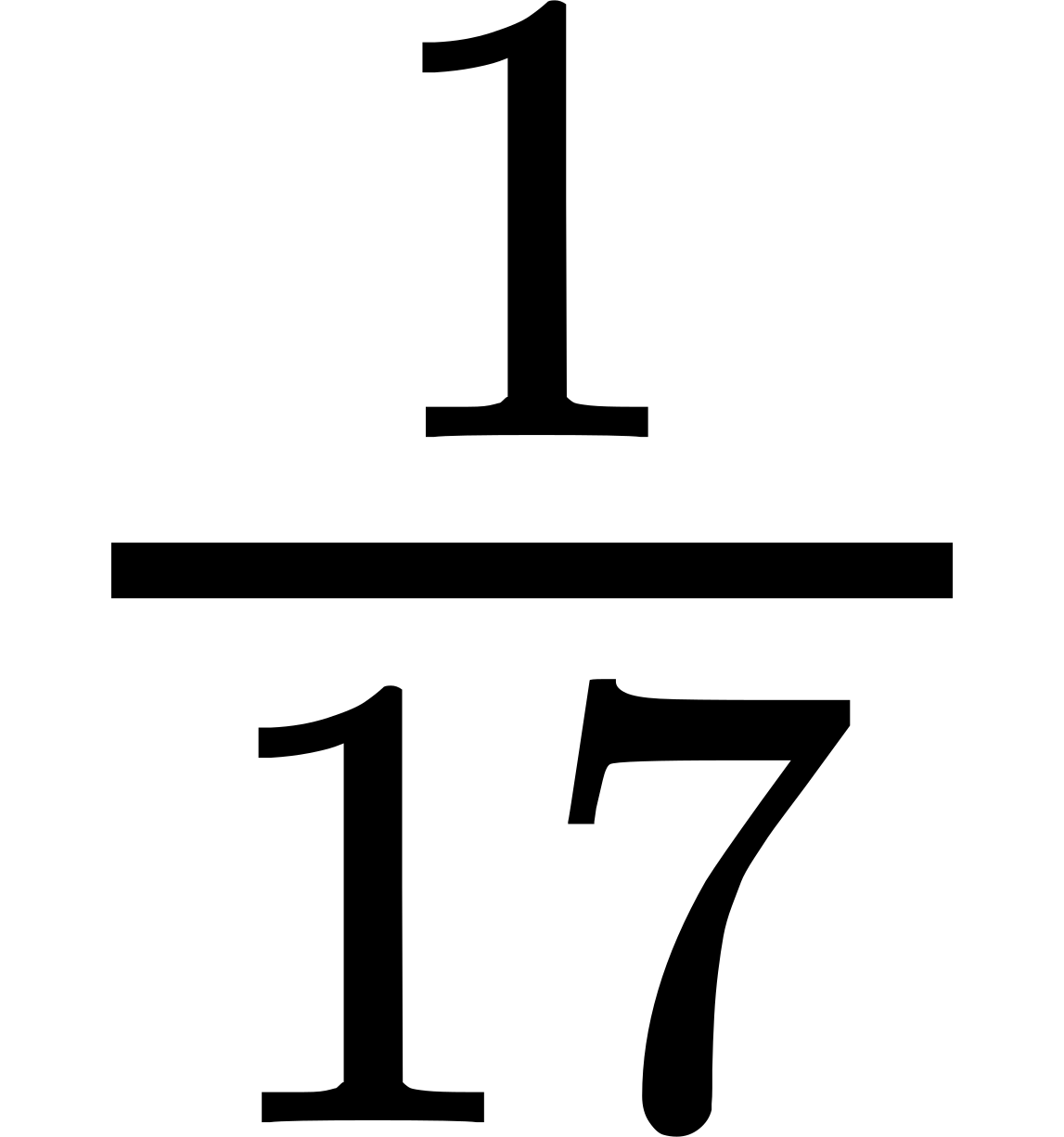 th of the Earth’s, or 4 times that
of the Moon107. It is true, we have no very authentic records
of many comets of such a size having been observed; though, even if
there were 117none at all,
the fact would afford an illustration of our limited knowledge, rather
than a proof of the non-existence of such bodies in the system. But
even in our own times, a Comet has appeared, whose nucleus, if Herschel’s estimate be correct, exceeded the Moon
in diameter; and which, if it had chanced to strike this body in a
particular direction, would most infallibly have caused it to descend
to the Earth’s surface.
th of the Earth’s, or 4 times that
of the Moon107. It is true, we have no very authentic records
of many comets of such a size having been observed; though, even if
there were 117none at all,
the fact would afford an illustration of our limited knowledge, rather
than a proof of the non-existence of such bodies in the system. But
even in our own times, a Comet has appeared, whose nucleus, if Herschel’s estimate be correct, exceeded the Moon
in diameter; and which, if it had chanced to strike this body in a
particular direction, would most infallibly have caused it to descend
to the Earth’s surface.
Seeing, then, that the collision of a Comet and Planet is an event lying within the verge of possibility, have we any reason to suppose that it is one which has ever happened? This question we can answer, only by examining the movements and constitution of the Planets as they at present exist, and tracing back the circumstances now characterizing both to those causes by which they seem to have been produced.
With regard to any derangement in the planetary motions
caused by the collision of a comet, I must, in the first place,
take notice of a Theory proposed some years ago by Dr Brewster, which attempted to account for
two phenomena, that in some respects appeared to form anomalous
facts in the planetary system, viz. The total disappearance of the
Comet of 1770, and, more especially, the prodigious size of the
atmospheres of Ceres and Pallas. We have already observed, that,
if nothing had occurred to derange the orbit of this Comet, whose
period was only 5 years, it ought, since it was last seen, to
have reached its perihelion ten times. From this circumstance, Dr
Brewster thinks that “we are therefore
entitled to conclude that the Comet of 1770 is lost; which,” says he,
“could happen only from its uniting with one of the planets whose
orbit it crossed.” Let us attend to the mode of reasoning which he
employs to establish this position. “If such an union took place,
two consequences would obviously flow from it. The planet would
suffer a sensible derangement in its motions, and its atmosphere
would receive a vast accession of nebulous matter, of which the
comets are often wholly composed. Now, as no such changes have been
sustained by Venus, the Earth, Mars, or Jupiter, each of whose
orbits was intersected by the Comet’s path, we must look,” says Dr
Brewster, “to 118the four new planets, for some indication of
the presence of a comet; and if they exhibit any phenomena that are
unequivocally of this description, we must consider such a coincidence
as a strong proof of the theory, or as one of the most wonderful facts
in the history of science. Two of the new planets, Ceres and Pallas,
exhibit, in the form and position of their orbits, evident marks of
some great derangement; but as this may have arisen from that explosive
force, by which they seem to have been separated from a larger
planet, we are not entitled to regard it as a proof of the present
Theory108.” Dr Brewster
then comes to apply his second criterion, viz. the height of their
atmospheres; which are found to be much more considerable than those
of the other planets: and out of this single circumstance, he puts
forth an inference, which can scarcely be deemed a legitimate one,
that there must necessarily have been an addition of nebulous matter
to the quantity originally possessed; and he thinks that this addition
can have been derived only from the “lost” Comet of 1770. “If,” says
he, “the new planets are the fragments of a larger body endowed
with an extensive atmosphere, each fragment would obviously carry
off a portion of atmosphere proportional to its magnitude.” Let us
therefore see what is the bulk and extent of atmosphere which each
of these planets has been found to possess. If it appear that the
quantity of atmosphere is in exact proportion to the planet’s bulk,
then the coincidence may undoubtedly be looked on as a fact strongly
corroborative of Olbers’ theory, that they
are the fragments of a larger planetary body, which possessed an
extensive atmosphere: but in order to give any plausibility to the
notion of Dr Brewster, that two of the
fragments since this explosion have received an accession of nebulous
matter from the Comet of 1770, it is manifestly necessary, that, in
these fragments, as compared with the other two, there shall be a great
disproportion between the size of the planet and the extent 119of atmosphere. What, then, are
the measurements of both of these, as deduced by the best observers?
According to Herschel, the diameter
of Ceres is 163 miles, and the diameter of Pallas, 80109
miles; of the other two, Vesta is the smallest, having a diameter of
only 49 miles110. Now, what has been ascertained as to
their atmospheres? Schröter makes the
atmosphere of Ceres 675 miles in height, and the atmosphere of
Pallas 468 miles; each nearly corresponding with the bulk of the
fragment. With respect to Juno, which is the next less in size:
“Though there is no nebulous appearance around the planet Juno,”
says Dr Brewster, “yet it appears, from
the observations made by Schröter, that
it must have an atmosphere more dense than that of any of the old
planets of the system.” And with regard to Vesta, which is so very
small a body, if it has any atmosphere at all, it is of too limited
extent to be yet observable. Thus, then, we perceive, that the only
condition which could afford any degree of plausibility to Dr Brewster’s theory, is directly contradicted
by facts. If it had appeared that Vesta or Juno, the two smallest
fragments, were possessed of atmospheres much larger than those
belonging to Pallas or Ceres, then there would have been a shadow
of presumption thrown upon Dr Brewster’s
theory, because this disproportion would have indicated some accession
of nebulous matter since the period of the explosion; but seeing
that the extent of atmosphere belonging to each planet bears a fair
proportion to the size of its solid part, the only ground on which his
theory can rest is entirely destroyed. Even if the few observations
which have yet been made of those telescopic bodies, could warrant
any inference less contradictory of the theory, it would be more
consistent in those who imagine that they are fragments of a larger
120planet “endowed with
an extensive atmosphere,” to ascribe the quantity of atmosphere now
surrounding each rather to the manner of the rupture itself, than to
the subsequent acquirement of nebulous matter by the collision of a
comet. But at all events, it is not requisite to have recourse to any
such hypothesis, in itself extremely fanciful, to account for the
disappearance of the Comet of 1770; that Comet is not lost, as
Dr Brewster imagines. The result of the most
profound and unimpeachable investigations, has proved, beyond a doubt,
that its elements have only undergone such an alteration, through the
disturbing influence of Jupiter, as to render the Comet now no longer
discernible from the Earth; and this explanation has been deemed so
adequate by philosophers, that it is recorded in the annals of human
knowledge as one of the noblest efforts which Astronomy has achieved,
in unravelling the mysteries of Nature111.
La Place, to whose opinions the
highest respect is due, has given more satisfactory and more
comprehensive views, on this part of our subject,—which render it
extremely improbable that any of the planets have ever been struck
by a comet, so as to sustain any very material perturbations in the
movements by which it was originally characterized. Assuming that
all the circumstances of the planetary phenomena may be referred to
certain general causes, which have operated in the arrangement of
the system, La Place infers, that either
no comets have ever come in contact at all with the planets, or such
comets only, as, from the smallness of their mass, were not capable
of deranging the primitive elements of their orbits. “It cannot be
doubted,” says this great philosopher, “that if one of those comets
supposed to have struck our moon or a satellite of Jupiter, had a mass
equal to that of the moon, it would have made their orbits extremely
eccentric.”—“The shock of a comet,” he adds, “whose mass should be
no greater than the 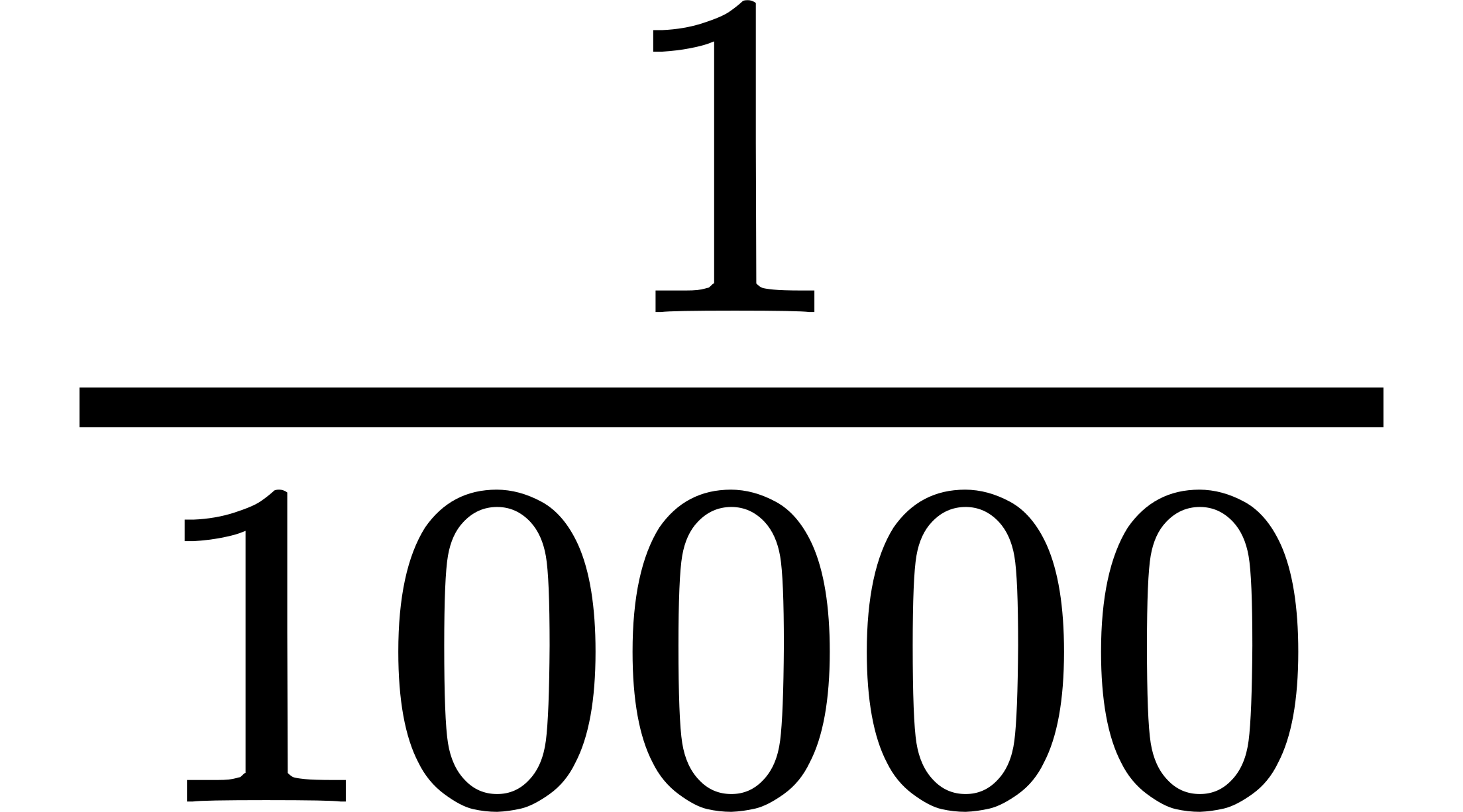 th part of the moon, would have been
sufficient to give very sensible values to the real libration both of
our moon, and of Jupiter’s satellites112.”
th part of the moon, would have been
sufficient to give very sensible values to the real libration both of
our moon, and of Jupiter’s satellites112.”
121
IV. From these statements, therefore, it appears highly probable that none of the planetary bodies have sustained any alterations in their orbits by the collision of a comet. But on this account we are not to suppose that a contact has never taken place; because, though it may not have been sufficiently violent to have altered the planet’s orbit, it may nevertheless have materially affected its physical organization, by impinging on its surface; nor, least of all, are we to conclude, from the experience of the past, that the collision of a comet with any of the planetary bodies, will never happen in the course of time. Even though it were demonstrated that such a catastrophe has never yet been fulfilled, this circumstance could afford no assurance that it may not occur at some future period; and therefore, it behoves us shortly to consider what would be the nature and amount of the physical changes which the collision of a comet would produce on the surface of a planet.
It is very true, as was formerly remarked, that the masses of comets are usually small; and for this reason we might be disposed to imagine, that the result of a collision would be trivial. But if a comet, moving with the prodigious velocity which it acquires near its perihelion, should chance to strike a planet, as for instance the Earth, then coming in an opposite direction, the consequences would be truly disastrous. In the opinion of La Place, the axis of the Earth would be immediately changed, and the situation of the poles made to occupy or approximate the equatorial line. The waters of the ocean, now attracted by the close approach and next driven from their ancient bed by the contact of the comet, would sweep over the face of the globe, covering even the highest mountains in their impetuous course, and involving all things in undistinguishable ruin. Whole species of plants and animals, existing in different quarters of the Earth, would, by this cataclysm, be at once overwhelmed and annihilated: whilst the few among the human race, who should happily be saved amid this shipwreck of Nature, would soon relapse into a state of pristine ignorance and barbarism. After such an event, by which all the monuments of 122art, and all the records of learning, would be destroyed, mankind would necessarily for many centuries be occupied with providing for their bare subsistence; and a long succession of ages would elapse, before those stores of knowledge could be retrieved, which their ancestors had been able to attain. When, however, posterity, in the progress of time, had again become so far enlightened, as to observe and speculate on the striking physical appearances, which in all parts of the world would meet their attention, they could not fail to consider them as the records of some great and sudden catastrophe, which at one period must have befallen their globe. If such be the probable effects of a collision between our Earth and a Comet, was there not some reason for the ejaculation of Halley—“Collisionem vero vel contactum, tantorum corporum ac tanta vi motorum (quod quidem manifestum est, minime est impossibile), avertat Deus Optimus Maximus!”
V. But, in surveying the surface of our Earth, even at the present period of its history, are we able to discover no indications of any such event as that whose effects we have just described? When we contemplate the broken and lacerated appearance which the map of the world exhibits; when we consider the irregularity and confusion characterizing the constitution of its crust; when we reflect upon the discovery of numerous plants and animals, in every different climate and situation, buried under the surface;—we can hardly entertain a doubt that tremendous convulsions have taken place upon the Earth, attributable to sudden inundations from the ocean; and that event, of whose occurrence, geography, geology and natural history combine to furnish evidence, the universal tradition of every people, however barbarous, serves to confirm. It has been supposed, that the deluges, which are said to have taken place at different periods in the history of the world, may have been occasioned by the collision of comets; and it cannot be denied, that, on reflecting with attention upon the various circumstances by which these deluges are still recorded, the supposition does not seem destitute of foundation. It is impossible, however, to enter here into all the details 123of this inquiry, opening up so wide a field of speculation and curious research, little connected, in other respects, with the main object of this Essay: but I cannot forbear to advert to a few leading facts, which render it highly probable that a comet has at some former period impinged on the surface of the Earth, and thus occasioned many of the convulsions which our globe appears to have undergone.
De Luc, Cuvier, and many other celebrated philosophers concur in thinking that our globe has originally existed in a fluid state; and, in consequence of the attraction of its parts, that its crust at a former period was composed of strata nearly horizontal, and equally distributed over the two hemispheres113. But when we contemplate the present aspect and constitution of our planet, we are able to discover little indication of this pristine arrangement, either on its surface or in its interior. On glancing our eye over a map of the world, we behold nearly five times the quantity of dry land in the one hemisphere that there exists in the other; and portions of land, which have at one time been united and continuous, are now disjoined or intersected by arms of the ocean. If we explore, next, the recesses of the Earth, we find still less indication of that regularity which originally characterized its structure: the strata no longer continuous and horizontal, but broken asunder and heaped on one another, in the most perplexing disorder; at one place, parallel, and gently inclined; at another place not very remote from the former, bent and distorted into fantastic shapes, or rising up and running for a considerable distance, even in a perpendicular direction. Such is the picture of changes, which the geography and geology of our Earth present; and the more attentively we examine it, the more convinced must we become of the occurrence of convulsions on its surface, equally violent and extensive.
By what physical agent, then, can we conceive those convulsions to have been produced? Every circumstance leads to the belief, that the 124agent whose gigantic power we now contemplate in its effects, can have been no other than a deluge from the ocean. For, what other cause could have broken the surface of the Earth into so many distinct and unequal portions, disorganized the whole system of arrangement once characterizing its internal structure, or created that picture of ruin and desolation which meets the eye of the observer in every quarter of the globe?
But if such an event ever took place, as that which these facts so strikingly suggest, it is natural to suppose that there ought to exist yet more numerous marks of its occurrence. Sweeping with resistless force over the face of the Earth; tearing asunder huge fragments of rocks, which it would carry along to a great distance; burying whole genera of plants and animals in the general chaos; and leaving upon the dry land, even on the highest mountains, deposits of the native inhabitants of the deep; we should now be able to trace by such infallible characters as these, the effects of a deluge, if it ever happened. And, accordingly, the multifarious facts which have been brought to light, by the united researches of the geologist and naturalist, afford all the evidence which the case seems to require. The large round masses of rock, termed Boulders, which lie scattered over every country in Europe, must be regarded as direct and unequivocal proofs of this deluge. These masses, judging only from their outward appearance, bear all the marks of having been rolled along an uneven surface,—and this supposition is fully confirmed by an internal examination; for they are generally found to consist of species of rocks which occur only at a great distance from the place where they are situated. Thus, “the granite of Mont Blanc has been found on the sides of Jura, and even on that side of it farthest from the Alps. But in the present state of the Earth’s surface, between the central chain of the Alps, from which these species of granite must have come, and the ridge of Mont Jura, besides many smaller valleys, there is the great valley of the Rhone, from the bottom of which to the place where they now lie, is a 125height of not less than 3000 feet114.” Immense fragments of a similar nature are found in the plains of Lombardy, which have been transported from a distant part of the country; “and the ruins of the Carpathian Mountains lie scattered over the shores of the Baltic115.” Now, what are all these facts, we would ask, but the natural effects, and the indubitable records, of an ocean upturned from its bed, and impelled by some foreign and powerful agent over the continents of the Earth? The consideration of fossil remains, leads us still more conclusively to the same result. It is well known, that the bones of great numbers of animals have been found buried in the present crust of the earth. Many species of these animals seem to have been altogether annihilated, by the catastrophe whose occurrence their remains attest; for they are wholly unlike any of the races which now subsist upon the earth116. It is, moreover, a curious fact, and one whose bearing upon this subject will be at once perceived, that animals are frequently found lying together, whose habits and instincts are of the most opposite kind. In the caverns recently discovered in various parts of Europe, filled with prodigious quantities of fossil remains, the bones of carnivorous animals are found mingled with those of the herbivorous races; and those whose natures are the most alien and averse to one another, are lying promiscuously in the same common heap. Thus, in the caverns opened at Montpellier117 lions and tigers are seen by the side of deer and oxen, bears and hyænas by the side of the rat and roebuck, wolves and dogs by the side of sheep and rabbits118. It is also said, that, in some places, even human 126bones have been found deposited with those of the horse and the rhinoceros119. What a spectacle is here exhibited, of the desolation which has taken place, perhaps more than once, upon the surface of our planet! and how strongly these facts corroborate the general tradition existing among all nations, of some great catastrophe, in which the whole human race has been involved! If any additional evidence be required to establish still more clearly, that this catastrophe could have been no other than a deluge from the ocean, we need only refer to the remains of marine plants and animals which have been found even in the most elevated portions of the dry land. De Luc found ammonites and pectenites among the Alps, nearly 8000 feet above the present level of the sea. Ulloa, in like manner, discovered various species of shell-fish in Peru, at a height of more than 14,000 feet120; and very recently bones of horses and deer have been met with among the Hymalaya Mountains 16,200 feet above the sea.121.
There seems, then, to be no fact better authenticated in the physical history of our globe, than that there have taken place the most violent and extensive inundations from the ocean: The only question of doubt or difficulty, is to fix upon the causes which could thus have impelled the ocean from its natural bed; and I have been somewhat particular in detailing the various phenomena, in order that we may possess some data for estimating the character of the agent to which these striking physical convulsions must be attributed. Now, it is quite evident, that there exists no agent on the earth itself, at all capable of creating such vast effects as those which have been here described; seeing that there are no physical causes of change on the surface of our planet, but what are so local and so gradual in their operation, as to be totally inconsistent with the sudden and extensive convulsions 127which we seek to explain. Since, then, this deluge cannot be referred to any agent residing in the Earth itself, the only foreign cause to which it can be ascribed, is either the near approach, or the actual contact, of a Comet. But it is not difficult to see which of those two hypotheses is, in this case, the one to be adopted. For when we consider the astonishing violence by which this deluge was characterised; huge fragments of rocks rent asunder and transported over ridges and valleys; whole species of animals overwhelmed, and even the highest mountains overtopped; the surface of the globe broken into isolated or disjointed groups, and even a large portion of the materials of the southern hemisphere driven beyond the equator,—it is impossible to conceive that these tremendous effects could have been occasioned by any other agency, not wholly miraculous, than the collision of a Comet.
I am aware that this idea respecting the collision of a Comet with the Earth, to those who have been accustomed to consider it, only under the extravagant form of Whiston’s Theory, may seem to go beyond the bounds of a safe philosophy, or even to bear on its mere annunciation somewhat of the air of romance. But it is with the utmost deference, and not without a due share of reflection, that I have ventured to submit this opinion as a legitimate inference, from acknowledged facts; and an opinion farther supported by numerous other considerations, geological and organic, into which, however, it is quite impossible for us here to enter.
I may farther remark, that geologists have attempted to ascertain the direction in which the deluge has swept over the face of the earth; a circumstance leading to an important conclusion in the present inquiry. It was the opinion of Kirwan, founded solely on the external appearance of the earth, that its surface must formerly have been assailed by a mighty flood or rush of water from the southward, which, by its overwhelming force, carried the looser materials of the one hemisphere into the other, and impressed upon all the great continents of the world, their peculiar geographical 128forms122. And to this fact, noticed by Kirwan, I would add another equally pertinent to our subject, that in almost all countries, the mountains generally exhibit on their south-western sides a bold and rugged aspect, but towards the north-east an accumulation of loose alluvial matters, by which they are there rendered more gentle in their acclivity, and better clothed with vegetation123. It would certainly be absurd, in the existing state of our knowledge, to search for the particular spot on the Earth’s surface where this collision occurred; but, if the foregoing speculations are sufficient to warrant any probable conjecture, we would be inclined to suppose that the collision of the Comet, by means of which these physical changes were effected, must have taken place somewhere in the southern hemisphere.
VI. The same propensity which leads men to search into the history of the past, awakens into the mind a still stronger desire of knowing the secrets of futurity: And, accordingly, astronomers, not content with the endeavour to learn the physical revolutions which the earth has already sustained by the contact of a Comet, have sought to discover the period when it may be again exposed to a similar catastrophe. This they have attempted to accomplish, by computing for a multitude of successive revolutions the motions of those Comets, whose orbits are exactly computed, and ascertaining the time of their greatest proximity to the earth. But, before we detail the result of these curious investigations, it may be proper to give some account of the Comets, whose calculated orbits and periods of revolution have been verified by observation.
We have already taken notice of Halley’s Comet, whose period of revolution was reckoned about 75 years. Its last return to the perihelion 129was predicted, as has already been mentioned, within 19 days of its actual arrival, at a time when astronomical science was yet in its infancy. It may therefore be reasonably expected, that the announcement of its next approach towards the centre of the system, will be found to be still much nearer the truth. Damoiseau has already computed the effect of the planetary perturbations upon the movements of this Comet, and announced the time of its perihelion passage to be the 16th March 1835. But Halley’s Comet cannot approach so near to any of the planets, as to have the elements of its orbit very essentially altered, far less to produce any disorder in the planetary system. In 1818, Pons discovered a small Comet, whose period of revolution was ascertained by Encke to be no more than 1208 days: This remarkable result, deduced from most accurate and laborious investigation, was farther confirmed by the fact, that this Comet had already been observed in its successive approaches to the sun, in 1786, 1795, and 1805, as appeared from the similarity of their elements. Encke, in computing the elements of this Comet during the revolution succeeding its perihelion passage in 1819, found that its period would be altered by planetary perturbations to 1203 days; and foretold, that, at its next return, in 1822, it would not be visible in Europe, but might be observed in 34° of South latitude about the beginning of June, elevated 24° above the horizon, and having the brilliancy of a star of the fourth magnitude; it was actually discovered at Paramatta in South latitude 33° 49′, on the 2d day of the predicted month. Its appearance was again announced by Encke, for August 1825; in which month it was accordingly discovered; and from the observations then made, it appeared that the error of Encke’s calculations did not amount to a single minute124.
130
Besides these two Comets, whose movements, as shown by calculation,
have been fully verified by their actual return to the sun, various others
might be mentioned, whose orbits are as accurately known, although, from
the great length of their periods, there has not yet been time to show that
they are correct by a completed revolution. Thus, the Comet discovered
by Olbers in 1815, which requires 75 years to perform each revolution,
though never observed more than once at its perihelion, may yet be as
closely followed in its course, and as certainly looked for at its next approach
to the centre of the system in 1890, as the Comets of Halley
and Encke. It is needless to describe here the various other Comets,
whose extensive periods of revolution require the succession of many years
or centuries, before they can again become visible from the earth. I may
merely notice one other small Comet, discovered by Gambart in 1826,
and computed to have a period of no more than 6 years. M. Clausen
of Altona has satisfactorily shewn, that this Comet is identical with those
of 1772 and 1805; and that the inequality of its periods, occurring between
its three observed returns, has arisen from the disturbing influence of
Jupiter in the years 1782 and 1794125.
But, of all the Comets whose orbits have been ascertained, none is found to approach so near to the planets as the Comet of Encke. Never removing from the sun to a greater distance than Pallas, and crossing the track of the Earth, as well as that of every other planet below Pallas, more than sixty times in a century, it is from this Comet chiefly that we have to apprehend the risk of a collision. It is found to be particularly liable to suffer perturbation from the attraction of Mercury, which it sometimes approaches so near as 360,000 miles. This circumstance has led some to apprehend, that, at a future period, a collision may take place between this Comet and Mercury; at all events, their frequent proximity will 131afford to astronomers the means of determining that planet’s mass, which is not yet very accurately known126. Concerning its approach to our own planet, Olbers has computed, that, in the course of 88,000 years, this Comet will come as near to us as the moon: That, in four millions of years, it will pass at the distance of about 7,700 geographical miles, when, if its attraction should equal that of the earth, the waters of the ocean will be elevated 13,000 feet, that is, above all the European mountains, except Mont Blanc: The inhabitants of the Andes and the Hymalaya mountains, therefore, would alone be able to escape such a deluge, which would probably leave upon our globe records of its occurrence, similar to those discoverable at the present day. After a lapse of 219 millions of years, according to the calculations of the same astronomer, an actual collision will take place between this Comet and the Earth, severe enough to shatter its external crust, alter the elements of its orbit, and annihilate the various species of animated beings dwelling on its surface127.
These computations may perhaps, to some minds, appear chimerical,
merely on account of the immensity of the period over which they are extended.
Nevertheless, they are grounded on the basis of demonstration.
The following is the reasoning by which Olbers has arrived at these striking
results. He first supposes a sphere to be described round the sun,
and, coalescing with the earth’s orbit, here assumed as circular. Upon this
sphere he next draws a small circle at the distance a, with the earth as a
pole. It is evident that the probability of a Comet coming nearer to the
Earth than a, among those comets whose perihelion lie within the earth’s
132
orbit, will be in the ratio of double the contents of the small circle on the
sphere128 to the surface of the whole sphere. But, on account of the movements
of the earth and comet, it is evidently possible that a comet may
intersect the sphere without the small circle, and yet pass nearer to the
earth than : we must therefore modify the terms according to the laws
of parabolic motion, and Olbers shews, that, instead of a circle with a
radius , we must assume an ellipse, whose transverse axis = 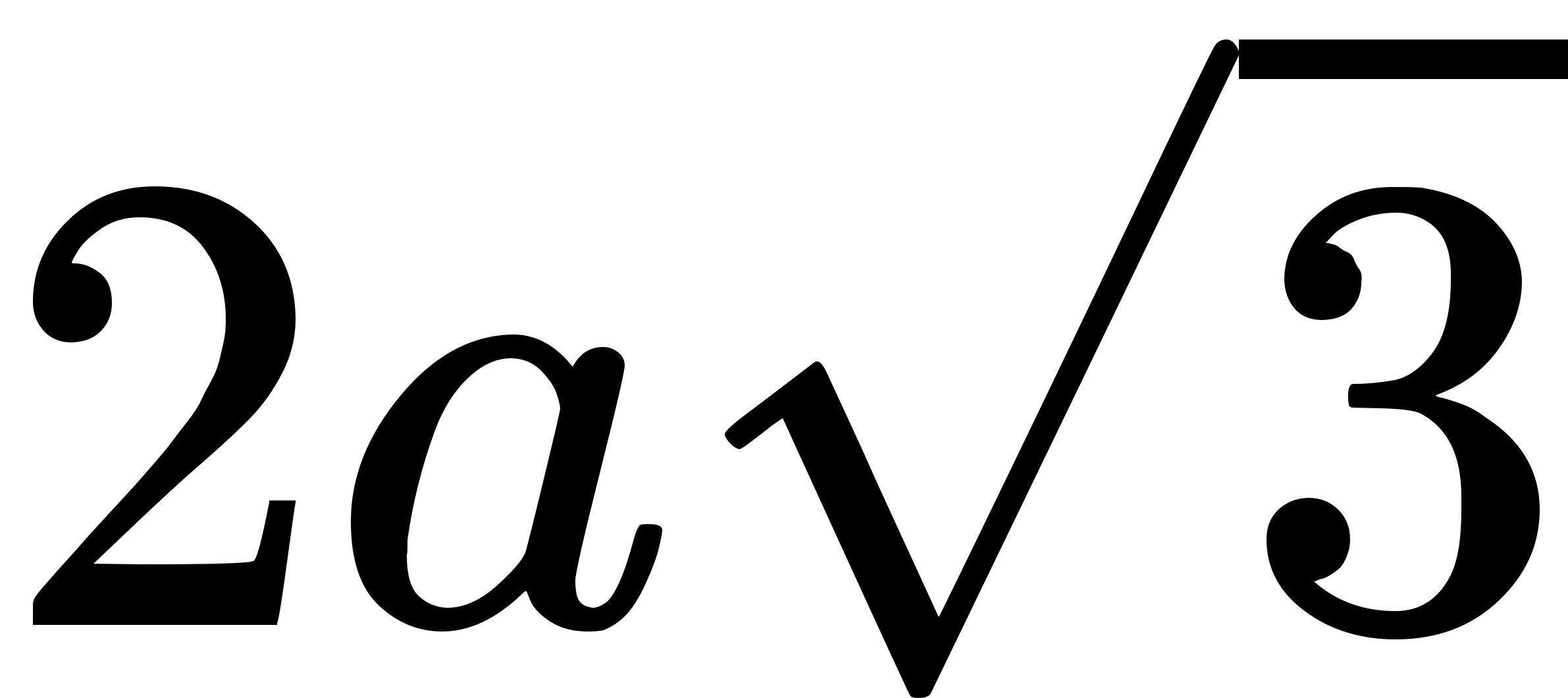 and
conjugate axis =
and
conjugate axis = 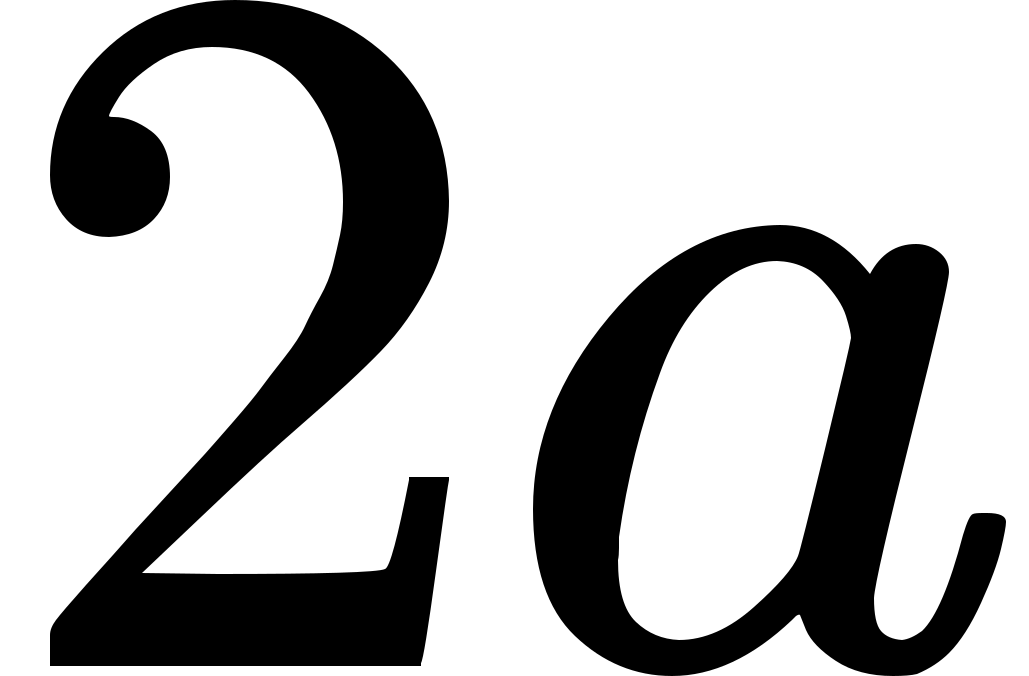 . The contents of this ellipse =
  , and
the surface of the sphere calling its radius
, and
the surface of the sphere calling its radius  : we have
therefore
: we have
therefore  for the ratio of the two quantities, and the probability
that a Comet will not approach the Earth nearer than
for the ratio of the two quantities, and the probability
that a Comet will not approach the Earth nearer than
 In order that a Comet should collide with our globe, it is manifest that
must be less than the sum of the radii of the Earth and Comet; let us suppose
the average diameter of Comets to be
In order that a Comet should collide with our globe, it is manifest that
must be less than the sum of the radii of the Earth and Comet; let us suppose
the average diameter of Comets to be  th of the Earth’s, and assuming R
to be 23405 times the Earth’s radius, we have
th of the Earth’s, and assuming R
to be 23405 times the Earth’s radius, we have  ,
which expresses, that if there were 439 millions of Comets entering at the
same time the sphere whose radius = R, the Earth would be struck by
one of them: or that, if once every year a Comet should approach the
sun, whose perihelion distance is less than R, ere 439 millions of years
had elapsed, the earth would be struck. Now, of the Comets observed to
pass the earth during the course of a year, there is generally one whose
perihelion distance is less than R, and therefore, when it is considered how
many pass unseen, we may suppose that in reality there are at least two on
an average; hence we may conclude, that, in the course of 219 millions of
years, our globe will certainly be smashed by a Comet. I have remarked,
that Encke’s Comet approaches nearer the earth’s orbit than any other yet
133
discovered; and hence the probability is, that the fate which is thus demonstrated
to be reserved for our globe, will be fulfilled by means of this particular
Comet129.
,
which expresses, that if there were 439 millions of Comets entering at the
same time the sphere whose radius = R, the Earth would be struck by
one of them: or that, if once every year a Comet should approach the
sun, whose perihelion distance is less than R, ere 439 millions of years
had elapsed, the earth would be struck. Now, of the Comets observed to
pass the earth during the course of a year, there is generally one whose
perihelion distance is less than R, and therefore, when it is considered how
many pass unseen, we may suppose that in reality there are at least two on
an average; hence we may conclude, that, in the course of 219 millions of
years, our globe will certainly be smashed by a Comet. I have remarked,
that Encke’s Comet approaches nearer the earth’s orbit than any other yet
133
discovered; and hence the probability is, that the fate which is thus demonstrated
to be reserved for our globe, will be fulfilled by means of this particular
Comet129.
But such speculations, however striking the results, conduce to no practical advantage, and contribute little to the advancement of science. They afford astonishing proofs of the energy of man’s intellectual power, by which he extends his vision to the horizon of the most distant futurity, and looks forward, it may be, with a feeling of complacent assurance, to those momentous events, which, from his knowledge of nature, he is enabled to foresee. But let him not rest too confidently on the verity of such anticipations. Astronomers have prophesied, it is true, the collision of a Comet with the earth; an event that will at once destroy the greater part of the human species: but any slight attraction, which, in calculating the movements of this comet, they have chanced to overlook, must invalidate all their conclusions, and render the prediction at once vain and futile; while, perhaps, some other comet, among the many thousands traversing the system, and following an orbit to us unknown, may, in the mean while, come in contact with our globe, and thus, without any warning of its approach, produce the same terrible effects, long before the expected period has arrived.
134
I. From a careful examination of those Comets whose motions are exactly known, on their successive returns to the perihelion, much valuable information of a different nature may be obtained. For if they happen to have undergone any change in their physical constitution, during the period of their absence, that change will probably be indicated by a corresponding variation in their appearance. Since the effect of the solar power is so great (whatever be the mode of its operation) in pushing away the nebulous matter of the Comet, into the form of a tail, it has been supposed that some of this nebulous matter may even be altogether detached from the attraction of the nucleus, so as to cause a gradual diminution in the Comet’s substance; and this effect, it is obvious, will be the more easily produced, if the gravitation of the nebulous particles to the nucleus be weakened by a rotatory motion of the Comet. Now, an attentive examination of those comets, whose approaches to the sun at the perihelion are near in respect of distance, and frequent in respect of time, may enable us to judge whether or not this supposition be well founded. But this is a point to which the attention of astronomers has been too recently directed, to be yet very satisfactorily fixed. Numerous data are requisite, which a constant and careful observation can alone supply, before any decisive result can be obtained. But certainly the observations of astronomers, as far as they have been made, with regard both to the diminished size of the nucleus of all comets after a perihelion passage, and the inferior brilliancy of Halley’s in particular, 135at its last appearance130, seems to confirm what other considerations abundantly suggest, that a partial abstraction of nebulous matter does take place at every approximation of a comet to the sun.
The question, therefore, very naturally occurs, whether a Comet, after a long succession of revolutions, will not be liable to become altogether annihilated by this dispersion of its nebulous matter? Herschell’s opinion respecting the constitution and formation of comets, here deserves our attention, as it satisfactorily resolves the difficulty which is now proposed. There is no individual perhaps in the annals of astronomy, who has contributed more to our knowledge of the heavens than Sir William Herschell, both by extending the limits of our vision into the most distant parts of the universe, and by investigating the laws which govern the more complicated phenomena of nature. But of all his contributions to the science, none are so important in themselves, or so well calculated to disclose to us the secret and marvellous operations going on in the workshop of Nature, as the discoveries which he has made concerning nebulæ. These nebulæ, it is supposed, are formed by the partial condensation of matter, probably the etherial medium itself diffused throughout the universe; and that their number must be prodigious, is sufficiently proved by the fact, that Herschell, by his own efforts alone, discovered 2000 of them. Some of the nebulæ are found to have so strong a resemblance to many comets, which, on account of their distance from the sun, can just be discerned from the earth, that they are not unfrequently confounded131; and it is only by a nearer approach, or by an intimate acquaintance with all the nebulæ in the same quarter of the heavens, that astronomers are able to distinguish them. Now, it 136is the opinion of Herschell, and his opinion is strongly supported by the authority of La Place132, that Comets are originally minute nebulæ, which, by the continual approximation of their particles, have at length acquired such a degree of density, as to be capable of being attracted by the sun, and of describing an orbit of their own. As the nebulous mass approaches the sun, one result, as we have seen, is the expansion of its parts, and their prolongation into what has been termed the Tail: But, another result, according to Herschell, and one no less important, is a gradual consolidation of the nebulous matter by the agency of the solar heat. “It is admitted on all hands,” says he, “that the act of shining denotes a decomposition, in which at least light is given out; but that many other elastic volatile substances escape at the same time, especially in so high a degree of rarefaction, is far from improbable. Since light then, certainly, and very likely other subtile fluids also, escape in great abundance during a considerable time before and after a comet’s nearest approach to the sun, I look,” says Herschell, “upon a perihelion passage in some degree as an act of consolidation133.”
II. This process of consolidation will evidently be the more powerful, the more that the Comet is subjected to the sun’s calorific action; a condition which depends upon two circumstances, one, the perihelion distance of the Comet, the other, the time in which it completes its revolution. It follows from this consideration, that we may be able even to estimate the degree of solidity which Comets have attained, simply by taking into account these two circumstances; and a reference to observation will at once shew whether or not the theory be correct. But, before attempting to apply this test, one remark must be made, which shews that the application of it may not in all cases be conclusive. If all Comets during their successive revolutions round the sun, were to remain totally exempt from 137the possibility of receiving any accession of foreign matter, tending to enlarge their bulk, then we might expect that the consideration of their perihelion distance and their period of revolution should always correspond with the amount of their solidity, or, in other words, the actual size of their nucleus. But, if we suppose with Herschell, La Place, and other eminent astronomers, that there exist multitudes of nebulæ throughout space in every different stage of maturity, from those whose formation has just commenced, to those whose condensation by the attraction of the particles has already so far advanced, as will soon render them capable of gravitating towards the sun, we must reckon it not impossible, that Comets, in the extensive range of their orbits, may occasionally meet with some of these nebulæ, and thus carry with them a new supply of unperihelioned matter in their next approach to the centre of the system. In this manner, the loss of substance to which, as we have above remarked, comets are exposed by volatilization, may possibly be restored; while, in process of time, they may acquire a magnitude and solidity considerably surpassing what could have arisen from the primitive quantity of their nebulous matter. Certainly we are not at liberty to suppose, that this fortuitous junction of a comet with nebulæ takes place frequently; but, in estimating the consolidation of different Comets, in order to find whether the result corresponds with what the frequency and nearness of their approach to the sun would lead us to expect, we ought to recollect that the test is not infallible, from the possibility of an accession of nebulous matter having occurred in the manner we have now described.
Herschel’s theory, with respect to the agency of the solar heat, in promoting the consolidation of comets, necessarily implies, that the envelope and tail gradually become less extensive, and that the nucleus, upon whose surface the nebulous matter consolidates, gradually increases in magnitude. In these respects, therefore, some difference ought to be indicated by the physical appearance of those comets whose perihelion distances and periods of revolution are not the same; a condition confirmed by the 138examination of several, that have been the most attentively observed. The second Comet of 1811 had a nucleus, which, according to the continental astronomers, amounted to 570 miles134; while its tail was 500,000 miles in length. The Comet of 1807 possessed a nucleus of less size, but a tail of greater brilliancy; the diameter of the one being only 538 miles, the length of the other 9,000,000. The first Comet of 1811, which, from its splendid appearance, has been termed the great Comet of 1811, was observed to have a smaller nucleus, but, on the other hand, its envelope and tail were far more extensive; the diameter of its nucleus was 428 miles, and its tail stretched out no less than 132,000,000 of miles. The first of these three Comets, then, according to Herschel’s theory, must have been subjected in a much greater degree to the consolidating influence of the sun’s heat than either of the other two, seeing that it had the largest nucleus, and the least quantity of nebulous matter: and the like result ought to be indicated with respect to all the three Comets, on a comparison of their respective periods and perihelion distances. The periodical revolution of the great Comet of 1811 is found to be 3383 years, and it approaches 1.55 nearer the sun at its perihelion, than the other Comet of 1811: the product of these two numbers is 5243. The periodical revolution of the Comet of 1807 is 1713 years, and its perihelion distance is 2.46 times less than that of the second Comet of 1811: the product of these two numbers is 4213. The periodical revolution of the second Comet of 1811, whose perihelion distance we have taken equal to 1 as the standard of comparison, is 875 years. These numbers, then, 5243, 4213, 875, representing inversely the result of the sun’s long continued action upon the nebulous matter of the three comets, correspond very nearly with the relative magnitudes of their nuclei, as indicated by observation; and hence the confirmation of Herschel’s theory is 139complete135. If this comparative view of Comets be verified by more extended observations, it will serve to give some insight into the origin and arrangement of these bodies, and inform us of the true place which they occupy in the planetary system. Nor will it be the least important result of the establishment of this theory, that it will enable astronomers to arrange comets according to the various stages of maturity at which, in the progress of consolidation, they have arrived. Observation has, in fact, already furnished us with an extensive scale of comets, which are distinguishable by means of this important criterion. Several have been seen which had no nucleus at all, presenting only a gradual thickening towards the middle parts, which were nearly translucent; while, on the other hand, there are many whose condensation has proceeded so far, by having been more subjected to the action of the solar heat, as to have a nucleus 100, 1000, or even 2000 miles in diameter. Those of the latter description approach, in all the circumstances of their physical character, to the nature of planetary bodies; and particularly, like them, are less exposed to those sudden changes from the violent action of the sun’s heat near their perihelion, which Comets of a smaller size and a looser texture are observed to undergo.
III. From these observations, we shall be the better able to estimate the probability of a supposition, perhaps it may be said more speculative than useful, but nevertheless founded on philosophical principles, whether or not Comets be habitable bodies? It is very evident that such a supposition can never apply to the generality of comets; for, with regard to those whose consolidation is still only partial, the violent changes which take place in their constitution and structure, both at the perihelion and at the aphelion, are totally incompatible with all our ideas of either animal or vegetable existence. But with respect to those Comets, whose advanced 140state of maturity renders the sun’s influence incapable of materially affecting the surface of the nucleus, there seems to be no physical impossibility why many of them may not be the abode of living creatures, as well as the Earth and the other planets of the system.
Yet considering the extremes of distance from the sun, at which the Comets are placed in different parts of their eccentric orbits, it has been conceived, that the prodigious variations of heat and cold to which the inhabitants of a comet must be exposed, render the above supposition quite untenable. This, however, is an objection, which, though applicable to all comets, whatever be their state of consolidation, is truly more specious than substantial. Newton indeed calculated that the great Comet of 1680, which passed within 150,000 miles of the sun’s surface, must have been heated to a temperature 2000 times greater than red hot iron. But the simple fact, that the comet, even if its density had exceeded that of iron itself, was not instantly dissipated by the violence of such a combustion, indicates some error in the data on which this calculation is founded. Still though it should be allowed that the heat is not so great as Newton was inclined to estimate, it may be supposed that the variations of temperature to which a comet is subjected, are yet much too considerable for the existence and abode of beings, possessing constitutions at all analogous to those upon the Earth. But an application of the laws of chemical science to this subject, demonstrates that these extremes of heat and cold are by no means so excessive, as the mere alterations in the comet’s distance from the sun might perhaps lead us to imagine.
In the first place, it is well known, that, in the heating of bodies, when the compression to which they are subjected remains the same, there is a certain point, beyond which, whatever be the means employed, their temperature can never be elevated. Water, for instance, under the common atmospherical pressure, may be heated up as far as 212° of Fahrenheit; but all the heat which we employ in the endeavour to raise this temperature higher, is only dissipated in the ensuing evaporation. In like manner, 141the substance constituting a comet must have a certain point of its own, which, however near it may approach the sun, its mean temperature can never exceed. The tail of the comet may be expanded to a prodigious length, the nebulous envelope may become enlarged to an equal extent; even the materials on the surface of the nucleus, by volatilization, may pass into a gaseous or aërial form; but the planetary or solid body itself will experience no accession of heat beyond that point of maximum temperature, which its own nature and constitution determine.
In the second place, we may observe, that when, by any means, the
density of bodies is made to change, by a process, whether of rarefaction,
on the one hand, or of condensation, on the other, they are always found to
undergo a corresponding diminution or increase of temperature136. When,
therefore, in the approach of a comet to the sun, all the parts of its nebulous
envelope and tail, which in the remoter regions of its course had been
gathered close about the head, become expanded and attenuated, a very large
proportion of the solar heat, which would otherwise have passed into the nucleus,
and contributed to raise its temperature to a certain point, is carried off
by the envelope and tail, in order to preserve an equilibrium among the several
parts. Let us attempt to form some estimate of the actual loss of temperature
thus sustained by the rarefaction. If we assume that the nebulous
matter is elevated about 30 times its former height, the diminution of density,
corresponding with the increase of volume, will amount to (30)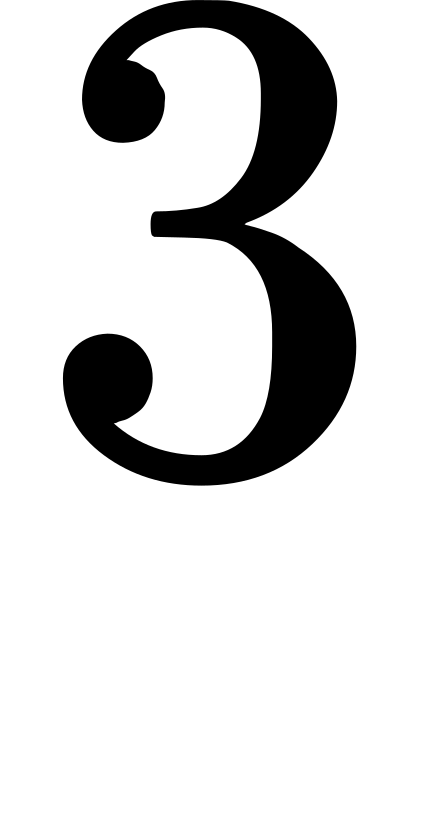 , or
27,000; and employing the formula given in the Supplement to the Encyclopædia
Britannica, article ‘Climate,’ we have 45° × {27,000 -
, or
27,000; and employing the formula given in the Supplement to the Encyclopædia
Britannica, article ‘Climate,’ we have 45° × {27,000 - 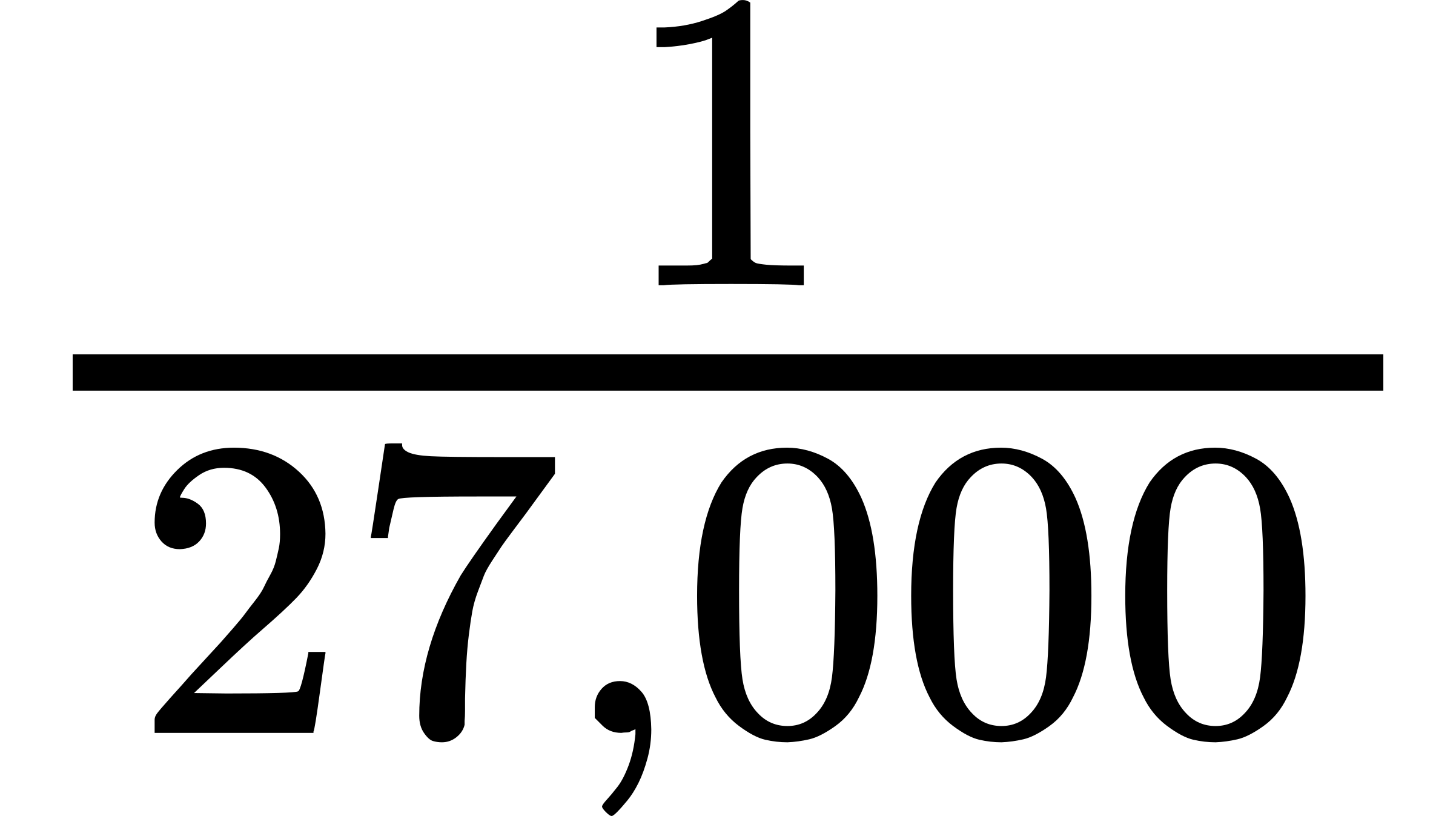 } or
nearly 1,215,000 degrees of Fahrenheit, for the quantity of caloric abstracted.
Now, Newton, judging from the proximity of the Comet of 1680 to the
sun at its perihelion, shews that its temperature ought to be about 2000 times
greater than the temperature of iron red hot, or about 9000 times greater
than the heat of boiling water; the boiling point of water being 212° of
142Fahr., the sun communicated to this comet a supply of caloric amounting
to 1,908,000°. But the loss, which, as we have just seen, must have been
sustained by the rarefaction above supposed, amounted to two-thirds of this
quantity; so that the actual influence of the sun, in raising the temperature
of the comet, will undoubtedly be diminished in the same proportion. In a
corresponding manner, when the comet retires towards its aphelion, where
the heat of the sun becomes so much weakened on account of the distance,
the condensation of the nebulous matter forming the tail and envelope serves
not only to furnish the nucleus with continual supplies from the heat acquired
at the perihelion, but even to render the warming influence of the
solar rays much more efficacious than at a less remote part of the comet’s
orbit.
} or
nearly 1,215,000 degrees of Fahrenheit, for the quantity of caloric abstracted.
Now, Newton, judging from the proximity of the Comet of 1680 to the
sun at its perihelion, shews that its temperature ought to be about 2000 times
greater than the temperature of iron red hot, or about 9000 times greater
than the heat of boiling water; the boiling point of water being 212° of
142Fahr., the sun communicated to this comet a supply of caloric amounting
to 1,908,000°. But the loss, which, as we have just seen, must have been
sustained by the rarefaction above supposed, amounted to two-thirds of this
quantity; so that the actual influence of the sun, in raising the temperature
of the comet, will undoubtedly be diminished in the same proportion. In a
corresponding manner, when the comet retires towards its aphelion, where
the heat of the sun becomes so much weakened on account of the distance,
the condensation of the nebulous matter forming the tail and envelope serves
not only to furnish the nucleus with continual supplies from the heat acquired
at the perihelion, but even to render the warming influence of the
solar rays much more efficacious than at a less remote part of the comet’s
orbit.
It appears, then, that the variations of heat and cold, to which Comets are exposed in the opposite points of their course, are by no means so great as to be incompatible with the supposition of their being fit abodes for animated beings: and if we recollect the facility with which our own bodies can adapt themselves to great and sudden extremes of temperature, as exemplified by various experiments, we may even conjecture these beings to possess a constitution not very dissimilar to that of the human species. Individuals, we know, have often allowed themselves to be confined for a considerable time in apartments heated to 260° and 280° of Fahr., without feeling much inconvenience; and though we cannot as easily ascertain the extent to which cold may be endured by the human frame, we know that it is frequently exposed, without any injurious effects, to an intensity far surpassing what is necessary for the congelation of mercury137. In order, then, to be capable of sustaining those variations of temperature to which a Comet may be subjected, it is not necessary that the constitution of its supposed inhabitants should be very different from the constitution of the beings 143belonging to the Earth. And when we recollect that these variations proceed in a gradual manner, not by the rapid transitions which we often experience on our own globe, the progress from one degree of temperature to another, as the Comet journeys onward in its course, may be little perceived by its inhabitants.
It is true that the atmosphere respired by these beings, while it is at one place a highly attenuated gas, is at another converted into a medium extremely dense; and therefore it may be difficult to conceive how animation can be supported in these opposite situations. But when Halley was able to breathe freely in a diving-bell, in which the compressed air was twelve times more dense than that on the tops of mountains,—and when the lungs, with all the other bodily organs, can so readily accommodate themselves to the most variable and trying circumstances, we do perceive how it is possible for respiration to be carried on, notwithstanding these changes in a comet’s atmosphere, which, though undoubtedly extensive, yet take place in a slow, and therefore harmless, manner. Another objection has been started to the existence of living beings on comets, on account of the alternations of light and darkness to which, in the opposite portions of their orbit, they are thought to be exposed. But I find it remarked by Bailly, that the Comet of 1680, supposing it at the aphelion to be 138 times more distant from the sun than the Earth, ought for this reason to receive five times as much light from the sun as we do from the full moon; and when we add to this the superior density of the comet’s atmosphere at this distant part of its orbit, it is capable of obtaining a still greater quantity of light by refraction138.
These explanations, then, if they be deemed correct, make it appear that the several changes which are produced upon the constitution of a Comet, in consequence of its varying distances from the sun, are not incompatible with our ideas of animated existence, and go so far as to render it not improbable, that the beings which inhabit Comets may even possess 144bodily frames resembling those of terrestrial beings. But why, it may be asked, are we so solicitous to establish this resemblance between ourselves and the inhabitants of a Comet, as if that were a condition which alone could render their existence possible? When we survey the wide field of animal organization which lies within the scope of our own experience, from Man, the proud lord of creation, to those tribes of zoophytes which we place lowest in the scale, do we not behold a continual succession of beings, as infinite in variety as in extent? If, then, upon the surface of our own little planet, we behold so diversified a picture of animal life, why should we deem it as either unnatural or unlikely, that Comets may be the residence of beings widely different from those which fall within the narrow sphere of human observation. What though these beings, from the peculiarities of their situation, be endowed with neither lungs, nor eyes, nor the feelings which afford the sensations of heat and cold, like unto our bodily organs? Does this want imply either any improbability as to their existence, or even any inferiority, compared with ourselves, in the scale of creation? Most certainly not: for, if we estimate the intelligence of beings by the knowledge which their place in the universe is fitted to impart, we are compelled to regard the Cometary inhabitants as of an order even superior to the creatures of the Earth. When, for example, they find themselves passing through the midst of the satellites, those small bodies, which we can scarcely discern with telescopes,—or when they are brought so close to the planet Saturn, that they can examine the wonderful phenomenon of his rings even with the naked eye,—or when at the perihelion passage, they are able to observe every thing on the surface of the Sun, that great luminary, the mysterious source of life, and light, and energy, to the system;—what spectacles of delightful contemplation must they enjoy, and what means of attaining an acquaintance with the works of Nature, infinitely greater than any which we shall ever command! Traversing, as they do, the whole extent of that system of which the Earth forms so insignificant a member, and directing their course far beyond its known limits into those 145regions of space, whose dark and unfathomable nature it will for ever baffle human penetration to explore, the beings who have their abode on Comets must be familiar with many important truths, of which we can obtain only a few casual glimpses, and witness such glorious and sublime displays of the manifold wonders of creation, as must afford to them the noblest conceptions of that Almighty Being, by whose wisdom they were constructed, and by whose power they are still sustained.
146
From the length to which these inquiries with regard to the nature and motions of Comets have extended, arrived at this point, I should be inclined to bring this Essay to a conclusion. But as, in an inquiry like the present, it would be improper to omit any consideration calculated to throw light either upon the extent or on the formation of the planetary system, of which the Comets form so important a part, I cannot forbear to notice the information which these bodies afford on this most interesting branch of Astronomy.
I. Buffon was the first who attempted, in a philosophical manner, to throw some light upon the origin of the Planets. Struck with the remarkable fact, that all of them move round the sun in one direction, and nearly in the same plane, he imagined that originally they were fragments, struck off from the body of the sun whilst in a fluid state, by the concussion of Comets; and that, by the mutual attraction of their particles, and the rotatory motion likewise given to them at the time of their detachment, they have gradually acquired the spherical forms which each is found now to possess. This theory, it has always been allowed, has the merit of at least being ingenious, and serves sufficiently well to explain the particular phenomenon which exclusively engrossed the attention of its author. But there are many other facts, equally characteristic of the planetary movements, totally irreconcileable with such an hypothesis. 147For, if these fragments set out upon their respective courses from the same point, it is demonstrable by the laws of central forces, that if, after one revolution, they did not relapse into the body of the sun, from which they were driven, their orbits ought at least to be extremely eccentric, and intersect at no great distances either from the sun or from one another. But our knowledge of the actual arrangement of the system gives results very different from these conclusions. The simple fact, that the orbits of the planets do not vary materially from circles of which the sun is the common centre, is sufficient at once to overturn Buffon’s theory. How, moreover, are we to explain the remarkable conformity of direction, by which all the satellites are characterized in their motion round their primaries,—a direction the same as that of the planets in their own course?—and how the equally remarkable concurrence of direction, in the diurnal rotation of all the bodies of our system, with that of the progressive movement in their orbits139?
These are questions which have exercised the genius and researches of astronomers more eminent and profound than Buffon; and many are the solutions which have been attempted. But whatever be the theory proposed, it is evident that it ought to embrace the explanation of all the above mentioned phenomena; and the causes will then most probably stand revealed, which have operated in the formation of the whole planetary system.
This accordingly was the safe ground on which La Place proceeded, when he applied the force of his profound and comprehensive genius to this difficult subject; and, as the theory which he advanced leaves out none of the conditions of the problem, it has been regarded by astronomers, if not 148developing the precise manner in which the Planets and Comets were actually generated, as at least shewing the general principles which characterize the formation of the system. La Place supposes, that the planets have been produced out of an extensive atmosphere or nebulous medium, which originally existed about the sun. The mass of the sun, having by some means (probably the decrease of its temperature) contracted in bulk, the velocity of its rotation thereby became augmented, and a portion of its atmosphere detached by reason of the centrifugal force. Thus a zone would be produced, which, though separated from the sun, would still continue to circulate round it in the same direction; and as the process of refrigeration and increased velocity simultaneously advanced, other zones would in like manner be successively formed, having the sun as the centre of their motion, and all situated in nearly the same plane. The nebulous particles composing these zones would then gradually acquire a tendency to coalesce with one another, and at length a spheroidal mass would be the result of the general attraction. In this manner, La Place ingeniously accounts for the origin of the planets, whose revolution is in the same direction with the sun’s rotation about its axis, and all of which move nearly in the plane of the ecliptic. The theory likewise accounts for the remarkable circumstance of their diurnal rotation being in the same direction as their progress in their orbits: because since in each of the zones above mentioned, the convex side must have possessed a greater velocity than the concave, whenever these zones had coalesced into the globular shape, a rotation would be communicated to all, in the same direction as their movement round the sun. If now we follow up the changes which would subsequently take place in those liquid or nebulous masses of which the planets originally consisted, it is evident, that, after some time, there would gradually be formed a nucleus in the centre of each. This nucleus would become surrounded with an atmosphere of the more attenuated matter, and in miniature, would exactly represent the sun, as above described, with its extensive nebulous medium round it. The gradual condensation of the particles must, in this 149case also, as the atmosphere contracted in size and increase in velocity, have been attended with similar phenomena; and thus solid rings, or Satellites, would at length be produced, coinciding in all the circumstances of their movements with the Planets themselves.
Such is the theory of La Place, respecting the origin of the planetary system, and which most satisfactorily accounts for all its observed peculiarities. But the Comets, on account of the striking peculiarities of their movements, could not possibly be reconciled to this hypothesis. The circumstance of their moving in every direction indiscriminately, sometimes nearly at right angles to the ecliptic140, sometimes in a manner quite opposite to the course of the planets, proved, that they could not possibly have had their origin, in common with them, in a solar atmosphere. The eccentricity of their orbits indicated that they come from, and probably originate in, a quarter of the heavens far beyond the limits of the solar atmosphere, or planetary spheres; while their highly attenuated nature, as shewn by various circumstances already noticed, rendered it probable that they must be formed by the local condensation of some medium diffused through celestial space. “Dans notre hypothèse,” says La Place, “les comètes sont étrangères au systême planétaire. En les considérant, ainsi que nous l’avons fait, comme de petites nébuleuses errantes de systèmes en systèmes solaires, et formées par la condensation de la matiere nébuleuse répandue avec tant de profusion dans l’univers; on voit que lorqu’elles parviennent dans la partie de l’espace où l’attraction du soleil est prédominante, il les force à décrire des orbes elliptiques ou hyperboliques141.” This idea respecting the nature and constitution of Comets, coincides, as we see, with the opinion of Herschel, derived from other considerations already mentioned; and it certainly accounts as satisfactorily for the striking peculiarities of cometary movements, as the other part of the theory does for the motion and constitution of the planets. That the physical 150cause, which has restricted the course of the planets to one direction, and the inclinations of their orbits to a narrow zone in the heavens, cannot have operated in the same manner upon Comets, is farther incontestibly proved by the fact, that, out of all the Comets, whose elements are known up to the year 1826, there are sixty-eight which have moved from west to east, and sixty-four which have moved from east to west; and that, moreover, if we calculate the average amount of the inclinations of their orbits, including both direct and retrograde Comets, the result will be found to be as nearly as possible 90°. These two curious coincidences, prove, first, that the causes to which the movements, as well as formation, of the Comets are to be ascribed, must be essentially different from those which have operated in the planetary arrangement; and, secondly, that a fortuitous condensation of different portions of the etherial medium, to which, consistently with the opinions of Herschel and La Place, we would refer the production of Comets, is a theory supported in the most striking manner by observation.
II. But, though the phenomena exhibited respectively by the Planets and Comets, when thus separately considered, agree well enough with the two hypotheses of La Place, concerning the origin and formation of both, this agreement is not sufficient of itself to establish the truth of these hypotheses. It is to be remembered, that they form together one theory, applicable to the whole solar system, of which the planets and comets are only the constituent members. These two hypotheses, therefore, have an essential and intimate connection with each other; and any discrepancy between them must render the theory objectionable, so long as the discrepancy remains unremoved. Now, it will be observed, that, in La Place’s hypothesis with respect to the origin of Comets, it follows, that the orbits of all of these bodies must extend, towards their aphelia, considerably beyond the limits of the planetary spheres. But though this circumstance may be predicated of Comets in general, recent observation has shewn, that it does 151not always hold true. Encke’s Comet, for instance, in its course through the heavens, never passes the orbit of Jupiter; and the Comet of 1826, discovered by Gambart, and shewn by him to have been observed in 1772 and 1805, does not, at its greatest distance from the sun, go much beyond the orbit of the same planet. These, therefore, are striking facts, which I venture to state as appearing to me quite inconsistent with La Place’s theory. The theory, however, accounts so satisfactorily for all the general phenomena, of both the planetary and cometary movements separately considered, and is so plausible from its very simplicity, that à priori we are disposed to consider the objection as one which, though grounded on indisputable facts, it may still be possible to remove.
Nor does it seem very difficult to accomplish this important object, and even to derive out of the apparent discrepancy, an additional argument in favour of La Place’s theory. For, if we reflect upon the extreme liability to which Comets are exposed, on account of their highly attenuated nature, to have their movements affected by reason not only of planetary attractions, but likewise of the resistance of the ethereal medium, we obtain a clew by which the anomaly may be at once explained. Gambart’s Comet, for example, is shown by him to have been very considerably affected by planetary attractions; and, with regard to Encke’s Comet, some investigations recently made respecting its movements, during a series of revolutions, indicate a gradual diminution of the greater axis of its orbit; a circumstance which we shall afterwards show (when we come to mention these investigations more particularly) can be attributed only to the resistance of the ethereal medium. It is therefore extremely probable, nay, almost demonstrated, that, after a great multitude of revolutions, those two Comets above mentioned, which did not perhaps go very far originally beyond the limits of the planetary system, have either, from the resistance of the ethereal medium, or the effect of planetary attractions, or from both causes combined, sustained such alterations in their course, as to have been at length brought within the orbits of the planets;—alterations which may still be slowly 152continuing, and will in process of time diminish yet farther the eccentricity of their paths. It is by no means impossible, that the orbits of these two Comets have experienced alterations similar to those that happened to the well-known Comet of 1770, owing to which, during a period of twelve years, it was prevented from following its accustomed course beyond all the planets, and constrained to move in a new orbit, never extending much beyond Jupiter: at the end of this period of twelve years, its orbit was altered again, by a second approach to Jupiter; and, in its present movements, it never goes beyond the orbit of Uranus; so that it affords, in addition to the Comet of Encke and Gambart, a third instance of the orbit of a Comet lying wholly within the limits of the planetary system. If it were possible to show, by actual calculation, in the same manner as has been done with regard to the Comet of 1770, that the Comets of Encke and Gambart on account, whether of planetary attractions, or the continued resistance of the ethereal medium, have also been deflected from their original paths, into the paths which they now follow, arguments of irresistible force would be gained in support of La Place’s theory. But, even in the absence of direct evidence respecting these two Comets, and resting solely on the remarkable instance of the Comet of 1770, the probabilities are so numerous for the opinion, that all those Comets whose orbits do not extend beyond the confines of the planetary system, have sustained some alteration in their course by disturbing causes, as to convert the above apparent anomaly, if not into a decisive argument, into at least a presumption of the strongest nature, in favour of La Place’s theory.
III. Not satisfied with having investigated the primitive causes which have operated in producing the planetary as well as the cometary bodies, astronomers have sought to determine, and without even having recourse to observation, the actual number of planets belonging to our System. Olbers attempted to determine this point by the movements of his own Comet 153and those of Halley’s. The remarkable inference which he deduced from his investigations was, that there are no more planets than what have been already discovered. But this result, though it seems to have been received by astronomers on the Continent142, as the correct and decisive answer to the above important inquiry, is completely refuted by a reference to the movements of other Comets; and, in fact, though with all deference to the authority of Olbers, deserves to be regarded rather as the fruit of a wild and overweaning philosophy, than as a sound and deliberate deduction of science. The grounds on which Olbers proceeded in this inquiry are these: Since all the known planets are found in their respective distances from the sun, to observe a common law of progression, he assumed at the outset, that, if any planet does exist beyond Uranus still undiscovered, it must be at a certain distance, which, as depending on the same law, may be at once determined. It follows, therefore, from this, that if there be a planet revolving beyond Uranus, it will be situated 38.8 times farther from the sun than the earth143. But, proceeding on La Place’s theory, which, as we have just seen, implies that the aphelia of all Comets lie considerably beyond the sphere of the planets, Olbers inferred, that if any Comet is known, whose orbit does not extend so far as the point at which this additional planet would revolve, then this single fact must at once refute the possibility that any such planet can exist. Now, Halley’s Comet, even at its greatest distance from the sun, as well as the Comet which Olbers himself had recently discovered, never removes farther from the sun than 36 times the earth’s distance; and he therefore thought himself entitled at once to conclude, that no planet can revolve beyond 154Uranus, and therefore that all the planets which belong to our system are already known. But, if the astonishing advancement which astronomy has effected within the few last years144, were not sufficient to cast strong doubts on the correctness of this bold assertion, the recent discovery of two Comets, the greater axes of whose orbits do not exceed one-half the distance of Uranus from the sun, completely demonstrates its absurdity. For, upon the same grounds, and with just as much semblance of truth, it might be maintained, from a consideration of the Comet of Encke, that no planet exists in a quarter of the heavens where the three largest bodies of the system, Jupiter, Saturn, and Uranus, do actually revolve. So far, indeed, from its being probable, that no other planets now remain to be discovered, there are various reasons which lead us to believe that many still exist beyond the known limits of the system; but whose prodigious distance and highly attenuated nature, place them perhaps altogether beyond the reach of human discernment. If any such bodies there are belonging to our system, a Comet will be the most likely means of giving us assurance or information of their existence, by means of the perturbations which it may sustain, on coming within the sphere of their attraction. Astronomers will thus be enabled, even though these planets should remain for ever invisible from the earth, not only to ascertain the peculiarities of their extensive orbits, but even to obtain some intelligence concerning their physical constitution.
IV. But though Astronomers may thus justly look forward to the most wonderful discoveries respecting the extent and constitution of the planetary system, which, at a future period, will be effected by the aid of Comets, these bodies have already added one very curious and important fact to our 155knowledge of the universe. From Newton down to La Place, the most celebrated philosophers have concurred in thinking, that an ethereal medium, or some material substance of a highly attenuated nature, must be diffused through the celestial regions. But they were unable to obtain any conclusive or positive evidence, in support of this opinion; and though it was hardly conceivable that the spaces in which the heavenly bodies revolve, should be absolutely empty, their reasoning on the subject was rather of a negative description, and not very dissimilar to the ancient doctrine, of Nature’s abhorrence of a vacuum. It was necessary that the fact should be established by the positive and satisfactory evidence of observation, to entitle it to rank as one of the most brilliant discoveries of astronomical science. Clairault was the first who attempted to estimate the influence which such a resisting medium was calculated to produce upon the motions of the heavenly bodies; and, in an appendix to his celebrated work, which announced the return of Halley’s Comet within so short a time of its actual arrival, he endeavoured to calculate the effect which this resistance would have upon its motions. It is obvious that the principal effect will be, to weaken the projectile and centrifugal force which the moving body originally possesses, and thus cause the sun’s attraction to exert a greater power in controlling its movements; so that, in general, the resistance of such a medium will continually be shortening the greater axis, and thus cause a diminution of the eccentricity, and a corresponding augmentation in the mean motion; while the nodes and inclination, which alone affect the plane of the orbit, will remain wholly exempt from alteration. Proceeding on these data, Clairault found, with respect to Halley’s Comet, that the change produced on its mean distance from the sun, would be nearly three times what a planet moving in a circular orbit would sustain, having the same period as the comet (or 75 years): and from this he inferred, that, in the course of each revolution, there would be an acceleration of 7 12 minutes in the periodic time. But Halley’s Comet, on account of the eccentricity and great extent of its orbit, is exposed to too many perturbations 156from planetary attractions, to afford any very certain evidence of such an effect having been actually produced: nor was it likely, when we consider the infancy of astronomical science in 1759, that so small an alteration could have been easily detected.
Encke’s Comet, whose period is much shorter, and has now been observed on its return to the perihelion six times, is better calculated for the prosecution of this delicate inquiry. In determining the elements of this Comet for every succeeding return, Encke has found that a small variation constantly prevails between his calculations and the result of observation, which the strictest regard to planetary perturbations is not sufficient to correct. Now, this variation corresponds exactly with the alterations, such as we have already described, which a resisting medium would produce upon the comet’s movements. The eccentricity of its orbit is found to be slowly but constantly, diminishing, its mean motion augmenting, and the period of its revolution becoming shorter; whilst the inclination and place of the nodes remain nearly uniform: and, in order to account for these changes, “the most natural of the causes which we can suppose,” says M. Encke, “is the resistance of an ether diffused in space.” Encke, proceeding on the supposition that such a medium does exist, computed the effects of its resistance upon the elements of the comet, as they should have been indicated by observation in 1795, 1805, and 1819; and in this manner he was able to reduce the errors for these three revolutions to less than half the amount. If we be not yet entitled, therefore, to conclude that some resisting ethereal medium has been fully proved, by means of the Comet of Encke, it will be admitted, that at least we have now the highest probability of its existence. But it is remarked by Olbers,145 that, “with respect to this comet, such a resistance seems to be almost demonstrable à priori; for it moves during a considerable portion of its period, in that part of the open space of the system, in which the visible substance 157of the zodiacal light, or solar atmosphere, is found. It is this same comet through the middle of which, Herschel, on the 9th November 1795, saw a small double star of the 12th or 13th magnitude, with very little diminution of its brightness. This fact seems to demonstrate, that the density of the comet bears some finite proportion to that of the zodiacal light, and that the substance causing this light may afford a sensible resistance to the motion of the comet. If, then, all the rest of the space surrounding us were to be considered as perfectly void, and free from resistance, which I do not believe, still the resistance of the zodiacal light, which certainly does exist, is sufficient to explain the phenomena of a diminution in the periodic time, and in the eccentricity of the orbit.”
It has, however, been objected to the supposition of an ethereal medium, that its existence should also have been made apparent by its influence on the movements of the planetary bodies, in like manner as upon those of comets. But it must be recollected, that this resistance is capable of affecting the planets in an infinitely less degree than the comets, which, possessing perhaps a volume of 1000 times as great, have a mass 1000 times smaller than the former; so that, though the resistance of the ethereal medium may affect the movements of the planets in too slight a degree to be detected, its effect upon comets, as it is so greatly superior, will be much more easily observed.146 It has also been suggested that the ethereal medium most probably possesses a motion of its own round the sun, in conformity with the solar atmosphere, out of which (according to La Place’s 158theory) the planets have been formed; so that its resistance to these bodies, moving in the same direction with itself, can, for this additional reason, be very little appreciable; whilst upon the comets, which in their movements have nothing at all in common with the planets, the effects of its resistance will entirely depend on the direction of the comet.
Nor ought we to forget in this place the farther proofs of the existence of this ethereal medium, which the form and direction of a comet’s tail so readily suggest. But as these phenomena have been already detailed in a former part of the Essay, and their production fully explained on the supposition of resistance arising from this cause, we need here only refer to what has been there stated.
V. Were not the period now long since past, in the history of philosophy, when the theory of universal gravitation, that principle which has served as the talisman of modern astronomy, required to be established on the basis of extensive observation, the movements of comets would afford the most effectual means. Wandering away into distant and invisible regions of space, we can follow them with this principle as our guide, and even anticipate the period when, after the lapse of centuries or of ages, they shall again return to the sun: and even when they have been deflected from their regular track, and suffered in their orbits the most extensive changes, the same principle at once suggests the cause, and enables us to compute their amount. Mankind have hitherto been accustomed to look upon the Solar System as if it were circumscribed by the orbit of the farthest planet;—but the paths of comets, which are determined by the same law that governs the movements of the planetary bodies, indicate an extent of power residing in the sun, of which astronomers as yet can form a very inadequate conception. Some comets, indeed, whose orbits have been computed, already shew that the solar attraction exerts its power in regions 159of space, above 700 times the Earth’s distance from the sun.147 But as our knowledge of these interesting bodies advances, astronomers in a future age of the world will be enabled to form more probable conjectures concerning the magnitude of the sphere, within which the sun’s attraction is confined. For it is evident, that some such limit must exist; and every orbit of a comet, found more distant than another, will facilitate a gradual approximation towards the discovery of this limit.148
VI. Such are a few of the leading views, with regard to the Solar System, which Comets, from the peculiarities of their movements and physical nature, serve to develope. But, besides these inquiries, which form of themselves so interesting a part of Physical Astronomy, there are other reflections which cannot be overlooked at the conclusion of an Essay like the present. When we contemplate the former opinions of mankind upon those general views respecting the universe, to which we have just been adverting, there is no circumstance in the history of the species so pregnant with moral instruction, as to witness how effectually Astronomy has removed the prejudices of preceding ages. The time once was, when the heavenly bodies were looked upon only as subservient to the affairs of this Earth. The stars were believed to be the abode of heroes and lawgivers, who, after having benefitted this world by their labours, were there translated for the enjoyment of eternal bliss. The benignant or baneful influence of the planets was conceived to determine the destinies of men at their birth, and to operate on their fortunes till the latest moment of life; while many an enterprise, on whose issue the fate of Empires depended, has failed or succeeded by the unlooked-for occurrence of an eclipse. The Comets, as we have had frequent occasion to notice in the course of this Essay, were beheld with feelings of peculiar terror. The heralds of war,—the precursors of plague and famine,—the abode of the damned,—ministers of the vengeance 160of heaven;—these were among the more important offices assigned to them. Every event and circumstance was viewed, only as it appeared to affect the concerns of mortals. The Earth was made the centre of the boundless universe; it was conceived to be endowed with a soul, emanating from the essence of the Deity; and the beings, to whom it had been given as a dwelling, were deemed to participate in the same celestial attributes.
Such doctrines as these, so revolting to reason and philosophy, evidently sprung from those haughty ideas respecting the nature and destinies of man, which were the offspring of his pride and selfishness. Wholly absorbed in the enjoyment of low desires, or engrossed with the pursuit of their puny interests, men carried not their view beyond the narrow spot, of which they found or fancied themselves the undoubted lords. Every reflection was banished which could offend the bold and arrogant pretensions of this creature of clay, and lower his lofty conception of the place which he held in the scale of existence. In his opinion, the welfare of the species occupied a large space in the vision of Providence,—formed an important object in the vast arrangements of Nature; and no phenomenon could take place, whether on the surface of the earth, or even in the wide expanse of the heavens, which was not believed to have a peculiar reference to the concerns of this nether world.
To loosen the hold of such prejudices on the mind, and promote juster conceptions of the various parts of creation, it was necessary that men should be accustomed to more extended and comprehensive views. Happily we may say, that, in the present enlightened period of the world, those prejudices exist no longer; and it is chiefly by the discoveries of Astronomy that the mighty change has been effected. No longer now do we find the character and fortune of individuals imputed to the Martial, Jovial, Saturnine, or other planetary influences, which happened to predominate at their natal hour. No longer do Comets “from their horrid hair shake pestilence and war;” or occasion any of the other thousand calamities which, by their dismal aspect, they were conceived to portend. Comets and Planets have long 161since been referred to their true places in the system: the movements of both, as well as their physical agency on one another, have become a matter of easy calculation; and those of them, in particular, which were formerly the objects of so much superstitious dread, have been stripped of all their terrors, and converted into objects of science. The globe which he inhabits, and for which, as the scene of his existence, man has ever been solicitous to claim an important situation in the universe, is found to be only one and one of the least among many worlds like itself; and even besides the Planets and Satellites, of which our System was once believed to be solely composed, Astronomy has shewn that there exist a multitude of other orbs, viz. the Comets, which likewise revolve about the sun, each forming a world by itself, fulfilling its own separate functions in the great economy of Nature.
When we thus carry our view over the vast and varied field of worlds and of systems which Astronomy unfolds, our own terrestrial habitation sinks into insignificance. How little, how insignificant, compared with the same standard, is Man! If the globe, on which he measures out the short thread of his existence, is no more than a mere speck in the immensity of the Universe, what simile can represent, or what imagination apprehend, the nothingness of the beings to whom that speck is a world! Have we not every reason, which the nature of the case admits, for supposing that the Comets are peopled with living creatures as well as the Earth?—and if so, what myriads of them, exceeding the possibility of computation, must there be diffused through every part of the universe! Moreover, from the peculiar situation which they occupy in our System, it is not unnatural to think that those beings are of an order far superior to the human species; if we only reflect upon the immense facilities they possess of acquiring that intimate and extended knowledge of Nature, on which their rank in the scale of intelligence must be admitted mainly to depend.
With how little reason, then, has man been accustomed to look upon the puny ball, on which his lot is cast, as the most distinguished among the 162multitude of worlds scattered over the expanse of the heavens! With how little right, does he presume to arrogate to himself the highest place in the scale of animated being, when the whole universe teems with life and with intelligence! The human species forms no more than a link in that chain of existence, which, without any visible termination, stretches over the boundless field of creation. Where, then, we may ask, are the proofs which philosophy can advance of the vaunted and exalted nature of Man? Formed of the like frail materials as the vilest worm which he treads on, Man for a while may exert his pigmy strength on the surface of his molehill, sacrificing the lives of millions to his merciless ambition, and subverting the order of all things within the narrow spot of his abode: but can he, by the might of his arm, avert the fatal stroke which levels him in the dust, or retard for one instant the globe, which hurries him onward through space? A few brief years, spent in the pursuit of vanities, make up the whole sum of the life of man; and then, like the plants, or the beasts of the field, he sinks down into his native earth. Thus it is that one generation makes way for another, in rapid and melancholy succession. The same characters are for ever flitting along the stage of the world: all are silently carried away by the stream of Time, and launched at length into the gulf of Oblivion.
And yet, if we compare the insignificance of Man, as thus forcibly evinced by the immensity of the Universe, with the powers of mind he can exert, and the knowledge he has acquired, the reflection serves to alleviate the impressions which these solemn, but philosophical, views of human nature have a tendency to excite. When we contemplate the astonishing discoveries which this same pitiful creature Man has effected, concerning the movements and origin of the heavenly bodies, as well as the extent and constitution of the planetary system, we are lost in wonder and admiration. Darting his feeble vision from the surface of his own globe, by means of the telescope he directs his inquiring eye to the farthest limits of creation, he examines other worlds moving in their various courses, at almost immeasurable distances from his own: he is able to discover the peculiarities 163of their orbits, and even to obtain intelligence respecting their physical structure. Those other bodies, the Comets, which withdraw themselves far beyond the reach of perception, are not for that reason altogether lost to him. With the penetrating eye of science he can follow them through their mazy and eccentric courses, and exactly anticipate the period, when, after ages have elapsed, they will again be witnessed by posterity returning to the centre of the system. These bodies may thus be regarded as the couriers of man, bringing information of various facts from the unexplored and unknown regions of space, which his own scanty and imperfect faculties could never directly obtain. By aid of the vast stores of knowledge which man by such means has acquired, he is able to predict the great phenomena of the heavens long before their actual occurrence; he delineates the tracks which the countless orbs rolling through space will pursue for thousands of years; and can predict those terrible catastrophes arising from the crush of worlds, which will not only cause the annihilation of his species, but disorganise or alter the whole fabric of the system. Thus winging his adventurous way upon the resources of science, and rising to an acquaintance with the designs of Providence itself concerning the destinies of the world, Man nobly vindicates the superiority of his lofty character! We behold the vigorous efforts of his soul, that vital principle in which his strength resides, struggling to free itself from this mortal coil,—elevating him far above his material nature; and even prolonging his existence to the remotest limits of time, by opening to his view a prospect of the future, as available and certain, as his experience of the past.
165
167
NOTE A, Page 7.
In his interesting account of the first Comet of that year, Herschel says, “In every instrument through which I have examined the Comet, I perceived a very faint, or rather darkish interval surrounding the head, wherein the gradually diminishing light of the central brightness was lost. This can only be accounted for, by admitting a transparent elastic atmosphere to envelope the head of the Comet. Its transparency I had an opportunity of ascertaining on the 18th September, when I saw three very small stars, of different magnitudes, within the compass of it: And its elasticity may be inferred from the circular form under which it was always seen; for being surrounded by a certain bright equidistant envelope, we can only account for the equality of the distance, by admitting the interval between the envelope and the head of the Comet, to be filled with an elastic atmospherical fluid.” See likewise Herschel’s Remarks on the Second Comet of the same year.—Philos. Trans. 1812.
NOTE B, Page 8.
According to this comparative view of the lengths of the tails of Comets, it would appear that they depend wholly upon their nearness to the sun at the perihelium. This coincidence, though found to prevail generally, and well exemplifying the action of the sun in producing the tail, cannot be assumed as the exact law: Much evidently depends on the physical constitution of the Comet. But this point will be more fully discussed afterwards.
168
NOTE C, Page 9.
For the same reason, the top of the hemispherical cap, or that part of the envelope nearest the sun, is generally more brilliant than any other point. In the first Comet of 1811, for example, the line of vision traversed at the top of the cap, was about five times the quantity of luminous matter which it traversed at the side nearest the observer; for, at the latter place, there was no more than the actual thickness of the shell.
NOTE D, Page 14.
On the 14th October Herschel estimated the length of the above Comet’s tail to be
17°; on the following night, he judged it to be 23°. The tail of the Comet of 1759, appeared
at Paris to be only 2° or 3° in length; but at Montpellier 25°. The Comet of 1769
at Paris, seemed to have a tail 60° long; but at Boulogne 70°; and at the Isle of Bourbon
97°.—Encycl. Edin. Astron. 675.
These examples prove, how much depends on the constitution of our own atmosphere, in judging of the form and extent of a Comet’s tail. Newton himself entertained the same idea with respect to these appearances in Comets’ tails. His words are, “De caudarum agitationibus subitaneis et incertis, deque earum figuris irregularibus, quas nonnulli quandoque describunt, hic nihil adjicio; propterea quod vel a mutationibus aëris nostri, et motibus nubium caudas aliqua ex parte obscurantium oriantur; vel forte a partibus Viæ Lacteæ, quæ cum caudis prætereuntibus confundi possint, et tanquam earum partes spectari.”
NOTE E, Page 26.
This change of the two angles to opposite sides, evidently indicated a corresponding change in the position of the streams themselves.
Does this circumstance not point out a rotatory motion of the Comet’s tail? Herschel
was likewise induced, though on different grounds, to ascribe a rotation to the Comet of
1811: And Mr Dunlop, the assiduous astronomer of Paramatta, has made observations on
169a Comet, seen there in 1825, which tend to establish a similar result. In a paper, read
last session at the Royal Society of Edinburgh, and published in Brewster’s Journal of
Science for January 1827, Mr Dunlop has given seventeen drawings of the different appearances
which this Comet exhibited from 5th October to the 8th November. These seemed
to indicate, plainly, a periodic return of the several branches of the tail to the same form
and position; and computing the intervals of time which elapsed between these regularly
recurring appearances, Mr Dunlop found the period of rotation to be 20 hours. In the
same paper we also find instances of the concavity of the tail on the following side, and its
convexity on the preceding, as well as of the formation of smaller tails or branches out of
the envelope, and external to the principal tail. It is evident that these branches, or smaller
tails, will be the more readily produced if the Comet have a rotatory motion; because, in
that case, the centrifugal force greatly diminishes the gravitation of the nebulous particles,
and renders them more capable of being acted on by the sun’s rays.
NOTE F, Page 27.
Sturmius also, who observed the great Comet of 1680, remarks, that, on the 20th December, its tail was 20° in length, and that in a short time it attained 60°; afterwards, it rapidly diminished. He also remarks, that, soon after the perihelion passage, the nucleus had the appearance of being enveloped in smoke.
NOTE G, Page 38.
This notion of the ancients, respecting the influence of the constellations upon comets, as they move through them, seems also to have prevailed in the darker ages, in Europe. The author of a romance, the scene of which is laid about that period in Germany, alludes to the belief in these lines:—
170
NOTE H, Page 41.
The whole of this book De Cometis, is well worthy a perusal. Seneca not only enters into a detailed account of the opinions of the Greek philosophers upon this subject, and, by the most philosophical arguments, demonstrates their absurdity, but he also occasionally enters upon general statements as to the nature of the planetary movements, which show equally the extent and soundness of his views respecting the arrangement of the system. Next to Aristotle’s opinion, which I have endeavoured to explain, the doctrine of Artemidorus, Democritus, and some others, appears to have gained the most general credit; at least Seneca devotes a large portion of this book to its refutation. These philosophers held, that there are wandering through the universe a multitude of bodies, which, from the weakness of their light, are invisible, but which, by their fortuitous junction, become capable of transmitting so many rays, as to be discernible for a time. Respecting this doctrine, Seneca makes the following just observations:—“Hoc ex his quæ mentitur, levissimum est. Tota ejus narratio mundi mendacium impudens est, nam si illi credimus, summa cœli ora solidissima est, in modum tecti durata, et alti crassique corporis, quod atomi congestæ coacervatæque fecerunt. Huic proxima superficies est ignea, ita compacta, ut solvi vitiarique non possit. Habet tamen spiramenta quædam et quasi fenestras, per quas ex parte exteriore mundi influant ignes, non tam magni, ut interiora conturbent. Rursus ex mundo in exteriora labuntur. Itaque hæc quæ præter consuetudinem apparent, influxerunt ex illa ultra mundum jacente materia. Solvere ista,” he adds, “quid aliud est, quam manum exercere, et in ventum jactare brachia?” It is evident, that these remarks are also intended to apply to the well known doctrines of Aristotle, concerning the solidity of the planetary spheres, which may well be styled “mendacium impudens” by every one imbued with juster views of the universe. He then refutes the opposite notion of Apollonius Myndius, who conceived that there was no real difference between comets and the other heavenly bodies. Seneca relates the doctrine of Apollonius in the following terms:—“Non est species falsa, nec duarum stellarum confinio ignis extentus, sed et proprium sidus, cometes est, sicut solis aut lunæ. Talis forma est, non in rotundum restricta, sed procerior, et in longum producta. Ceterum non est illi palam cursus: altiora mundi secat, et tunc demum apparet, quum in imum cursus sui venit. Nec est, quod putemus, eundem visum esse sub Claudio, quem sub Augusto vidimus: nec hunc, qui sub Nerone Cæsare apparuit, et cometis detraxit infamiam, illi similem fuisse, qui post necem divi Julii, Veneris ludis Genetricis, circa undecimam horam diei emersit. Multi variique sunt 171dispares magnitudine, dissimiles coloere.” In opposition to the doctrine of Apollonius, Seneca refers to the path which comets follow in the firmament, so totally different from the planets, and likewise to the extraordinary circumstance, which, however, is generally considered entirely a modern discovery, that the body of the comet is sometimes so transparent as to permit the stars to be seen through it. “Si erraret cometes, essetque sidus, intra signiferi terminos moveretur, intra quos omne sidus cursus suos colligit. Nunquam apparet stella per stellam. Acies nostra non potest per medium sidus exire, ut per illud superiora prospiciat. Per cometem autem non aliter, quam per nubem alteriora cernuntur, ex quo apparet, illum non esse sidus, sed tenuem ignem ac tumultuarium.” It is unnecessary here to add any farther account of the just and truly philosophical refutation of the Aristotelian doctrines. But I may be permitted here to observe, that the error into which Aristotle fell, and indeed almost all the ancients, was conceiving comets to be of the same nature as the common meteors of the atmosphere. And to this erroneous impression may probably be referred the belief taught by Aristotle, and universally entertained, “Cometas significare tempestatem, et ventorum intemperantiam atque imbrium.” The phenomena of the Aurora Borealis, Coronæ, Falling Stars, and other electrical productions, we know are intimately connected with the state of the atmosphere; and, hence since comets were classed among these appearances, it was not unnatural that they should also be looked upon as the causes or concomitants of great changes in the weather. Accordingly, in reviewing the general opinions held on this subject, Seneca is most anxious to prove how little the supposed connection of comets with the weather is supported by facts. “If,” says he, “wind be prognosticated by comets, then none should appear unless there be wind. But comets are observed in the calmest atmosphere. Finally, if they owed their production to wind, they would disappear when the wind ceased, and burn with the brighter flame when the wind blows with greater violence.” It is quite impossible not to admire the cautious and yet confident manner in which Seneca endeavours to overturn these vulgar prejudices; confident, from the undoubted facts and conclusive arguments which he adduces, but at the same time cautious in a subject as yet so far removed from experience, and so little illumined by the rays of science. The sentiments with which he sets out at the commencement of the book, evince the profoundest knowledge of human nature, and the most astonishing superiority to the general opinions of the times: after reading them, we cannot help expressing our surprise that these sentiments should have been written in the days of ignorance and superstition. “Nemo usque eo tardus, et hebes, et demissus in terram est, ut ad divina non erigatur, ac toto mente consurget, utique ubi novum aliquod e cœlo miraculum fulsit, nam quamdiu solita decurrent, magnitudinem rerum consuetudo subducit. Ita enim compositi sumus, ut nos quotidiana, etiamsi admiratione digna sunt, transeant; contra minimarum quoque rerum, si insolitæ 172prodierunt, spectaculum dulce fiat. Hic itaque coetus astrorum, quibus immensi corporis pulchritudo distinguitur, populum non convocat. At quum aliquid ex more innovatum est; omnium vultus in cœlo est. Sol spectatorem, nisi quum deficit, non habet. Nemo observat lunam, nisi laborantem. Tunc urbes conclamant, tunc pro se quisque superstitione vana trepidat.”—“Si quid turbatum est, aut præter consuetudinem emicuit, spectamus, interrogamus, ostendimus. Adeo naturale est, magis nova quam magna, mirari. Idem in cometis fit. Si rarus et insolitæ figuræ ignis apparuit, nemo non scire quid sit, cupit, et oblitus aliorum, de adventitio quærit; ignarus, utrum debeat mirari, an timere, non enim desunt qui terreant, qui significationes ejus graves prædicent.”
NOTE I, Page 44.
Lubienitz was a Polish writer. In his “Theatrum Cometicum, opus mathematicum, physicum, historicum, politicum, theologicum, ethicum, œconomicum, chronologicum,” a ponderous work in three thick folio volumes, he pretends to give a historical account of every comet which ever was observed. But he gives us rather an enumeration of the events which comets were thought to have occasioned, than any satisfactory account of the comets themselves. His chief design seems to have been to prove, that these bodies ought to be a source of comfort to the virtuous, and of terror to the wicked. “Bona bonis, Mala malis,” form the title of his work, and are frequently repeated through the course of it. Where former historians are silent respecting the appearance of a comet immediately preceding so remarkable an event, Lubienitz finds no difficulty in supplying the deficiency.
In a treatise by one Blaise Vigenere, entitled, “Traité des Cometes ou Estoiles chévelues, apparaissantes extraordinairement au ciel, avec leurs causes et leurs effets, Paris 1578,” we have the following description: “Entre tous les signes qui se manifestent au ciel, en horreur et espouvantement des humains, entre tous les prodiges dont Dieu visiblement nous menace, les éclypses et les Comètes sont les plus frequentes et les plus communes. Il est plus facile de dire des Comètes, ce n’est pas ceci ni cela, que d’affermer résolument ce que c’est; neantmoins la plus solide et reçue opinion tient que ce sont estoiles attachés à la huitieme sphere, et leur queue, chevelue ou barbe, une excroissance de lumière qui à certaines revolutions de tems, s’epanouit de leurs globes.”
Milichius, who was Professor of Mathematics at Maidenburgh, observes, that “there are good grounds for the usual behaviour of men as to comets; for they have reason to gaze at them with so much terror and astonishment as they do, because it has been proved, by a 173large induction of experience and observation, that they denounce great slaughter to the world, sacking of cities, subversion of kingdoms, and other public disasters.”—Commentary on 2d book of Pliny.
“The great Comet of 1680,” observes a late author, “followed by another lesser one in 1682, was evidently the forerunner of all those remarkable and disastrous events that ended in the Revolution in 1688. It also manifestly presaged the revocation of the edict of Nantz, and the cruel persecution of the Protestants by the French King Louis XIV.; and which was afterwards followed by those terrible wars, which, with little intermission, continued to ravage the finest part of Europe for nearly twenty-four years.”
NOTE K, Page 51.
It was the Baron de Zach who first ascertained this fact, unknown before in the history of astronomy, and adding a new star to the constellation of genius, which shone so brightly in England during the 17th century. When the Baron visited this country some years ago, the MSS. of Thomas Harriot, a celebrated, but unjustly obscure, mathematician of that age, were put into his hands; and among them, he discovered a letter to Harriot, written by Henry Percy, Earl of Northumberland, who was then a state prisoner in the Tower of London. This letter was written in the year 1610, and clearly points out not only his own views with respect to the real path of comets, but the discovery by his friend Harriot, of many astronomical facts, long before the period to which they are now generally referred. The following is an extract from this curious fragment:—
“I have received the perspective cylinder that you promised me, and am sorrie that my man gave you not more warning, that I might have had also the 2 or 3 more that you mentioned to chuse for me. Henceforward, he shall have order to attend you better, and to defray the charge of this an others; for he confesseth to me, that he forgot to pay the workeman.
“Accordingly as you wished, I have observed the Moone in all his changes. In the new, I discover manifestlie the earthshine, a little before the dichotomie, that spot which represents unto me the man in the moone, (but without a head), is first to be seen. A little after, near the brimme of the gibbous parts, towards the upper corner, appeare luminous parts like starres, much brighter than the rest; and the whole brimme along looks like unto the description of coasts, in the Dutch bookes of voyages. In the full, she appaers like a tarte that my cooke made me the last weeke. Here a vaine of bright stuffe, and there of 174darke, and so confusedlie al over; I must confesse I can see none of this without my cylinder. Yet an ingenious younge man that accompanies me here often, and loves you and these studies much, sees manie of these things even without the helpe of the instrument; but with it sees them most plainielie.
“Kepler I read diligentlie, but therein I find what it is to be so far from you. For as himselfe, he hath almost put me out of my wits, his aequants, his sections of excentricities, librations in the diameters of epicycles, revolutions in ellipses, have so throughlie seased upon my imagination, as I do not onlie ever dreame of them, but oftentimes awake lose myself and power of thinkinge with so much wantinge to it, not of his causes, for I cannot phansie those magnetical natures, but about his theorie which me thinks (although I cannot yet overmaster many of his particulars) he establisheth soundlie, and, as you say, overthrows the circular astronomie. Do you not here startle, to see every day some of your inventions taken from you, for I remember, long since, you told me as much, that the motions of the planets were not perfect circles. So you taught me the curious way to observe weight in water, and within a while after Ghetaldi comes out with it in print. A little before Vieta prevented you of the gharland for the greate invention of algebra. Al these were your deues and manie others that I could mention, and yet to great reservednesse hath robd you of these glories.” “Let your countrie and friends injoye the comforts they would have in the true and great honour you would purchase yourselfe by publishing some of your choise workes. But you know best what you have to doe. Onlie I, because I wish you all good, wish this, and sometimes the more longhinglie, because in one of your letters you gave me some kind of hope thereof.
“But again to Kepler, I have read him twice over cursaridlie, I read him now with calculation. Sometimes I find a difference of minutes, sometimes false prints, and sometimes an other confusion in his accounts;” “for his theorie, I am much in love with these particulars,
“1mo, His permutation of the medial to the apparent motions;
“2do, His elliptical iter planetarum; for me thinks it shewes a way to the solving of the unknowne walks of comets.”
This Earl of Northumberland, who thus shed a lustre upon his high rank and family by applying himself to scientific pursuits, was no less distinguished by having been one of the commanders of the British fleet sent to oppose the Spanish armada. He was made Knight of the Garter by Queen Elizabeth, and by James I. created a member of the Privy Council and Captain of the Company of Pensioners. In 1606, however, he was brought before the Star-Chamber, accused of allowing his own father to become a pensioner without making him take the Test-Oath, though he knew him to be a Catholic. In consequence of this offence, 175he was sentenced to pay a heavy fine, to be deprived of all his honours, and be confined the rest of his life in the Tower. It was during this latter period that he seems to have prosecuted his astronomical pursuits, most probably as a source of amusement during his weary and cruel confinement. In the year 1621 he again obtained his liberty, but by that time Harriot, with whom he had carried on his scientific studies, was dead. From the little that is as yet known respecting the manuscript works of Harriot, he appears to have been the greatest mathematician of which England could boast at that time. Even from the casual remarks which occur in the extract of the Earl of Northumberland’s letter given above, it appears that he was in the habit of using a telescope in his observations, though the invention of this wonderful instrument, which has made known to mankind the whole system of the universe, has been commonly ascribed to Galileo in the year 1610; likewise that Harriot was acquainted with the specific gravities of bodies before Ghetaldi, and that he may even dispute with Vieta the discovery of algebra itself; it also seems that he was aware of the planetary orbits being not circular but elliptic, long before the observations of Kepler were published, and that the elliptic course of comets was not unknown to him. It was from the observations made by Harriot of Halley’s Comet in 1607, that Bessel was enabled to calculate its orbit with great precision, and confirm the soundness of all the speculations which astronomers had previously entertained respecting its period of revolution. Were these manuscripts published, from the few specimens which we already possess of the hidden treasure, we are warranted in thinking, that much curious and valuable information would undoubtedly be obtained. Even if they could effect little in promoting the advancement of science, they would at least furnish many new facts in the history of human knowledge; and if they should serve no higher purpose than to add another name to the catalogue of great men who have reflected honour upon their age and country, they would be applied to a far nobler use than by being consigned to inglorious oblivion on the shelves of the University of Oxford.
Doerfel, mentioned in the text as the person to whom the merit is generally ascribed of having first started the idea of the cometary orbits being parabolic, was a Protestant clergyman at Wieda, a small village six leagues from Plauen. His work consisted of five leaves in quarto, with a wood cut representing parabolic orbits. It was published at Plauen in 1689.
176
NOTE L, Page 52.
These results are derived from the formula  , demonstrated in all
the books of Astronomy, where M, m, represent the masses of the bodies acting on each
other (in this case, the Sun and Comet), r their shortest distance from each other, and a the
semi-major axis of the curve they describe. In the circle a = r, and the formula becomes
, demonstrated in all
the books of Astronomy, where M, m, represent the masses of the bodies acting on each
other (in this case, the Sun and Comet), r their shortest distance from each other, and a the
semi-major axis of the curve they describe. In the circle a = r, and the formula becomes
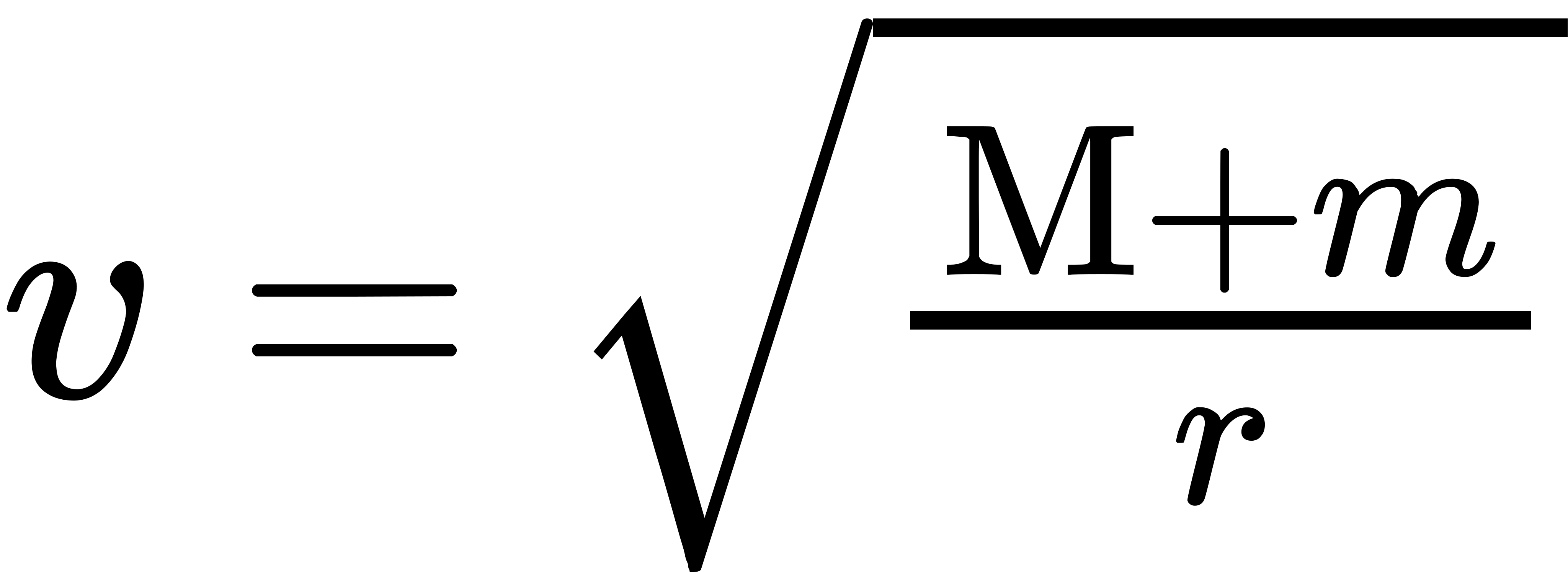 : In the parabola, where the axis is infinite, and therefore
 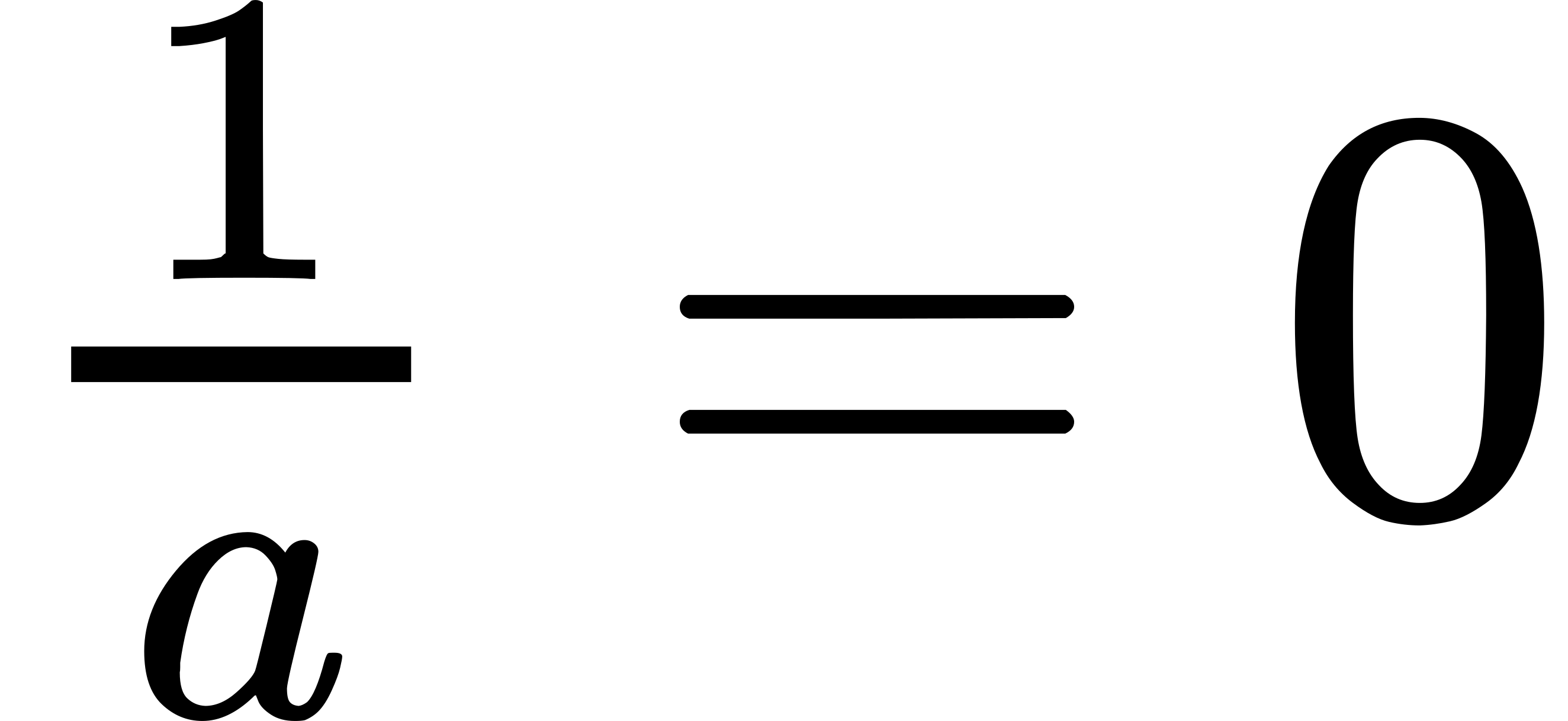 ,
, 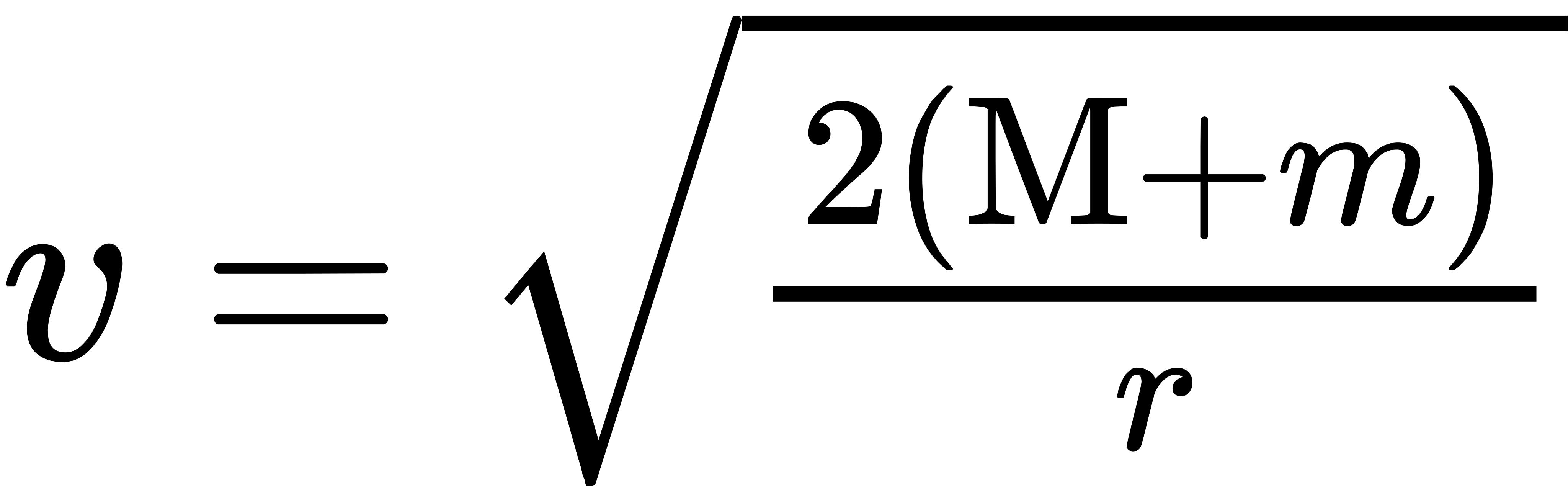 ;
the velocities in the circle and in the parabola, are therefore
;
the velocities in the circle and in the parabola, are therefore 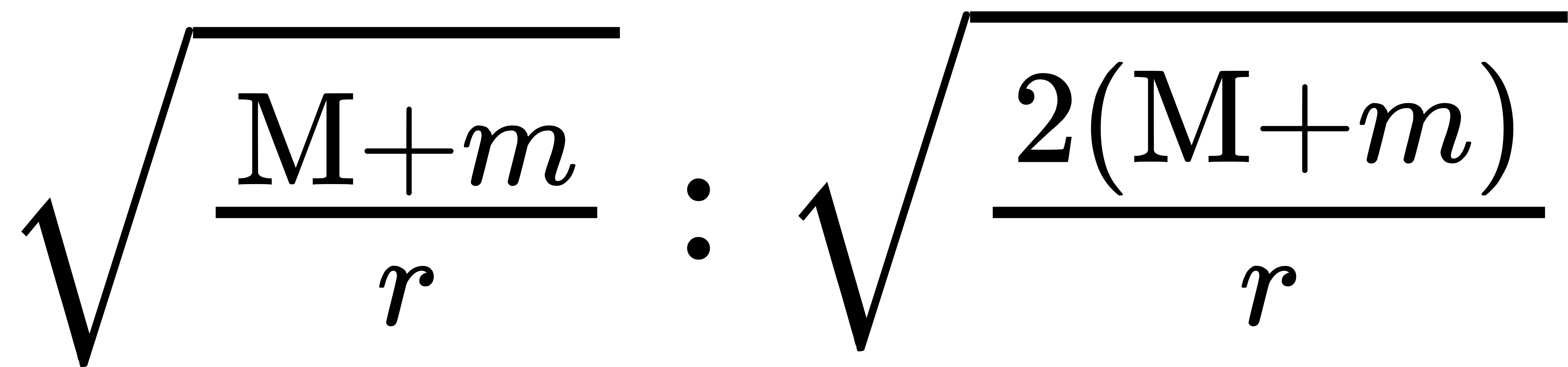 or
or 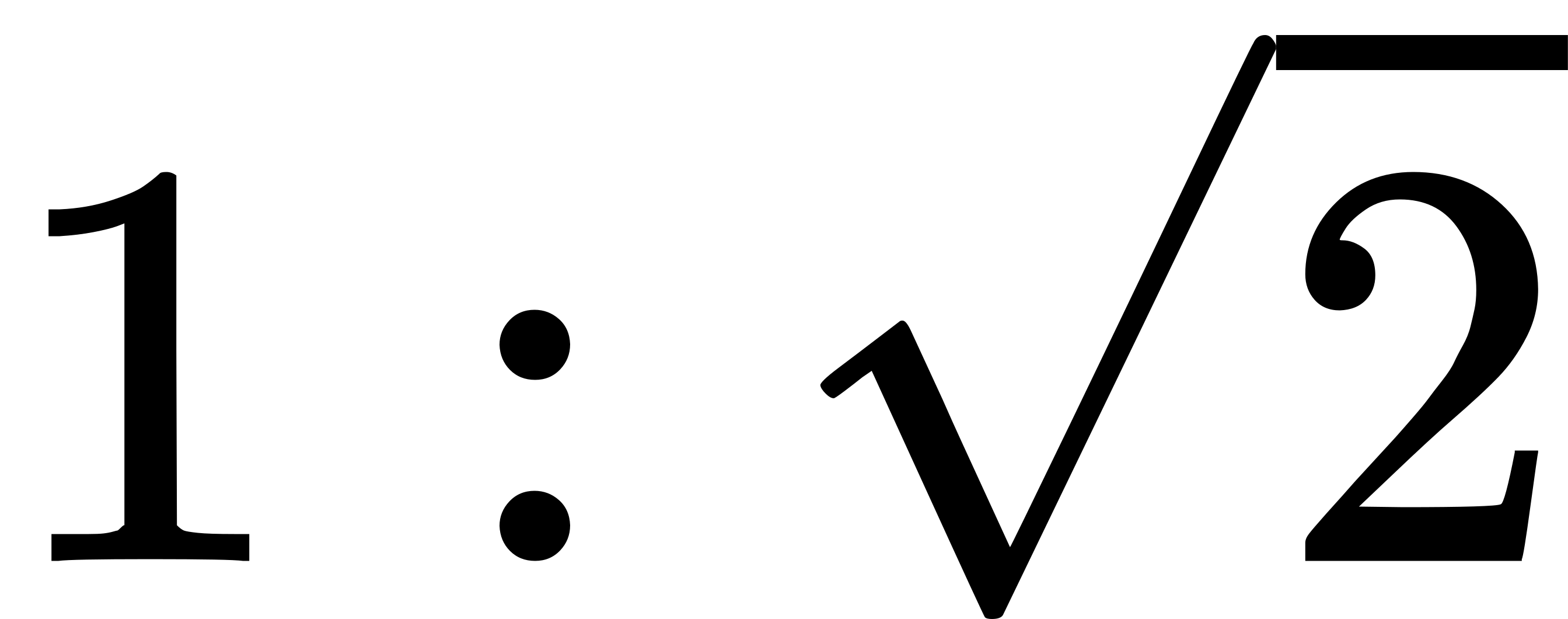 .
In the hyperbola a is negative, which renders the velocity greater than in either the circle
or the parabola. In the ellipse, a is positive, which occasions velocities smaller than in the
parabola.—See also Leslie’s Nat. Phil. p. 122.
.
In the hyperbola a is negative, which renders the velocity greater than in either the circle
or the parabola. In the ellipse, a is positive, which occasions velocities smaller than in the
parabola.—See also Leslie’s Nat. Phil. p. 122.
NOTE M, Page 90.
This Comet, whose elements we have now computed, was also observed in Europe. The following are the elements deduced by several astronomers:—
|
Mr Nicolai, Manheim. |
Mr Del Re, Naples, |
Mr Santini, Padua. |
|
| Perihelion passage, October 1826, | 9·02648 | 9·09138 | 9·19806 |
| Longitude of perihelion, | 57° 58′ 27″ | 57° 3′ 53″ | 57° 35′ 6″ |
| Longitude of ascending node, | 43 5 41 | 44 46 16 | 43 9 5 |
| Inclination of the orbit, | 26 1 49 | 25 32 18 | 25 30 7 |
| Perihelion distance, | ·85110 | ·85835 | ·85169 |
| Motion, | Direct. | Direct. | Direct. |
Mr Henderson of Edinburgh has also computed the elements of this comet from the observations made at Paramatta, with a sight of which I have been favoured: By a comparison of the whole observations taken together, he obtained the following elements:—
177
|
Mean Time at Greenwich. |
|
| Perihelion passage, October 1826, | 10.09593 |
| Longitude of perihelion, | 60° 20′ 1″ |
| Longitude of ascending node, | 43 7 55 |
| Inclination of the orbit, | 27 4 23 |
| Perihelion distance, | ·838633 |
| Motion, | Direct. |
From the discrepancy which exists between the elements deduced from the European observations, and the elements obtained by Mr Henderson and myself, we are led to think that the observations made at Paramatta have been by no means very accurate.
NOTE N, Page 102.
Halley’s Comet, according to La Place, (Mec. Celeste), before it completes its next revolution, will undergo a very considerable variation from its course by the disturbing influence of Uranus. To estimate the precise alterations which will thereby be produced on the period of its revolution, as well as to frame some theory for cometary perturbations in general, has been proposed twice by the French Institute as the subject of their prize. I have not entered upon the mathematical theory of cometary perturbations: The subject is one of too much difficulty, and of too much detail, to be discussed within the limits of this Essay. I confine myself to a more popular and intelligible statement of the effects which the disturbing action of the planets is able to produce on the comet’s orbits. The difficulty of this branch of the subject will be the more readily conceived from the fact, that the above annual prize of a gold medal, worth 3000 francs, proposed by the Institute of France, to all the astronomers and mathematicians of Europe, not having been adjudged, was lately renewed for the third time. Astronomers seem to be appalled by the labours required in these investigations.
178
NOTE O, Page 105.
It may also be here noticed, that according to Lexell’s calculations, it appeared, that, on
the 27th May 1767, the distance of this Comet from Jupiter was 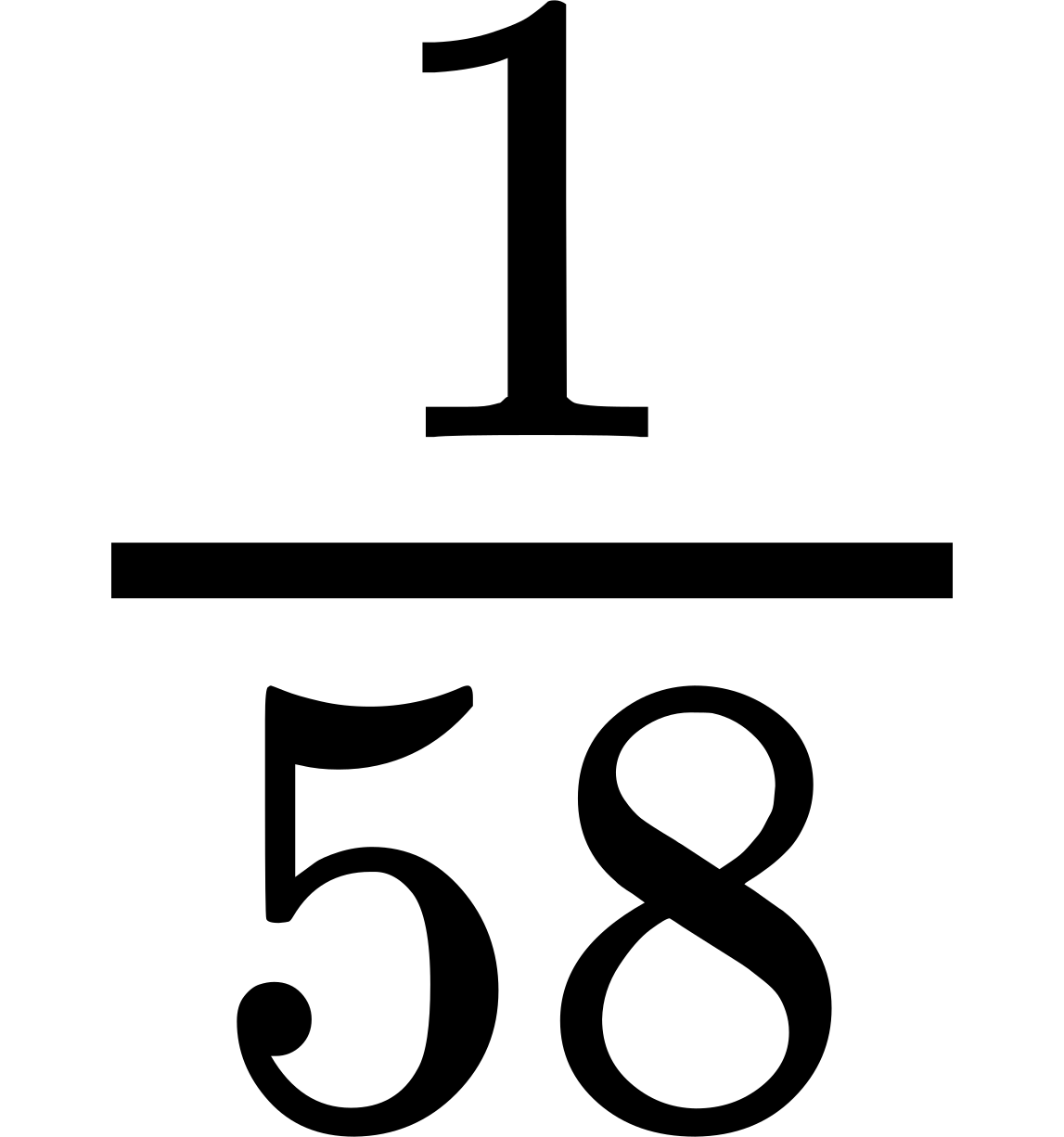 th of its distance from the
Sun; the attraction of Jupiter was therefore, at this point, three times greater than that of
the Sun, and its power of disturbing the motions of so small a body was still more increased,
from the inconsiderable velocity of the Comet at this time, and also the concurrence of direction
in their motion, which caused it to remain much longer within the sphere of the
planet’s attraction.
th of its distance from the
Sun; the attraction of Jupiter was therefore, at this point, three times greater than that of
the Sun, and its power of disturbing the motions of so small a body was still more increased,
from the inconsiderable velocity of the Comet at this time, and also the concurrence of direction
in their motion, which caused it to remain much longer within the sphere of the
planet’s attraction.
NOTE P, Page 107.
If the Moon’s inclination to the Equator, instead of being only about five degrees, had been very considerable, then La Place’s theory could not have applied, and there might have been some grounds for conjecturing it to have been a Comet arrested in its course. But though we, therefore, agree with Du Sejour in the opinion that our Moon has not this origin, we can by no means allow the legitimacy of his inference, that there is no possibility of the Earth ever acquiring another moon or satellite. Indeed his own statement contradicts itself. “Il me paroit suivre evidemment de ce qui vient d’être dit, que la Terre ne peut pas espérer de nouveau satellite. Certainement elle ne peut forcer aucune Comète parabolique au hyperbolique à tourner autour d’elle; et quand même on ne regarderoit point comme impossible, l’hypothèse, la Terre ne pourrait espérer de nouveau satellite, qu’autant qu’elle forcerait une Comète elliptique à s’áttacher à elle.”
NOTE Q, Page 109.
George Phranza, who was Master of the Wardrobe to the Emperors of Constantinople, observed and describes this Comet in the following terms: “Durant l’été 1454, une Comète commença à paroitre tous les soirs après le coucher du Soleil; elle avait la figure d’une longue épée. La Lune ayant atteint son plein, la Comète passa devant son disque, et l’éclipsa, 179conformément au loix qui occasionment les éclipses des corps célestes. Quelques-uns faisant attention à la forme d’épée qu’on remarquait dans cette Comète, la voyant d’ailleurs s’avancer d’occident en orient, approcher de la Lune, et la depouiller de sa lumière, conclurent que les princes Chrétiens, formant ensemble une puissante ligue viendroient de l’occident, attaqueroient le trône Ottoman et le renverseroient. Ce prodige ne causa pas même de petites frayeurs dans l’esprit des Turcs.”—Pingre, i. 456.
NOTE R, Page 110.
Those calculations by La Lande, were contained in a Memoir published by him in 1773. The terror which this Memoir occasioned, not only in Paris but over all France, was equally ludicrous and unfounded. But at this period mankind were scarcely emancipated from the thraldom of superstition, and had not yet freed their minds from that proneness to imaginary fears, which ignorance of nature so easily inspires. This Memoir by La Lande was intended to be read at a meeting of the Academy of Sciences. “Le Memoire,” as MONTUCLA relates, “ne fut pas lû; mais ce que l’on en dit ce jour-la après la séance, passa de bouche en bouche, et s’accrut beaucoup plus rapidement qu’on n’auroit pu le croire. Bientôt on dit qu’il avoit annoncé une Comète, que dans un an, dans un mois ... dans huit jours, alloit causer la fin du monde, &c. Ces bruits populaires vinrent au point d’effrayer; et le lieutenant de police demanda au cit de La Laude une explication prompte capable de rassurer le public; elle parut en peu de mots dans la Gazette de France, du 7 Mai; mais cela ne suffisait pas pour justifier l’auteur de toutes les choses absurdes qu’on lui imputoit presque géneralement à Paris, et meme dans les provinces; la multitude des lettres qu’il reçut, et des questions qu’on lui adressa à ce sujet, lui fit juger qu’il étoit indespensable de publier sans délai cette portion de son memoire.”
NOTE S, Page 111.
I may remark, in passing, that even the mind of the great Newton was not exempt from this absurd notion. He gives it as his opinion, that, for the preservation of humidity in the planets, comets are absolutely requisite, from whose vapours and exhalations all the moisture expended in vegetation may be supplied. His words are, “Ad conservationem marium 180et humorum in planetis requiri videntur Cometæ, ex quorum exhalationibus et vaporibus condensatis, quicquid liquoris per vegetationem et putrefactionem consumitur, et in terram aridam convertitur, continuo suppleri et refici posset.” And he shortly after adds a conjecture, still more extravagant, in the following terms: “Porro suspicor spiritum illum, qui aëris nostri pars minima est sed subtilissima et optima, et ad rerum omnium vitam requiritur, ex Cometis præcipue venire.” Principia, lib. iii.
This notion, that Comets produce atmospherical changes, resembles another popular prejudice
respecting the influence of the Moon upon the weather. If persons, who speak and
act upon this belief, are asked, What may be their reasons for attributing such an influence
to the Moon? the sole reply, generally obtained, is, that such has always been the common
opinion: no other evidence whatsoever is adduced for the assumption. The ordinary
manner in which the Moon affects the Earth is by producing the tides; an effect totally unconnected
with the existence of atmospherical changes. As this effect of the lunar attraction
is periodical, depending on the position of the Moon, in like manner, if any similar influence
were exerted upon the atmosphere, it would be followed by such periodical alterations
in the state of the weather, as would have been easily detected by long continued
observation of the barometer. Unquestionably there is some effect produced on the atmosphere
by the Moon’s attraction, as upon the waters of the ocean.—But that it is infinitely too
small to alter the state of the weather has been lately proved by La Place, who computed,
from a series of 4752 barometrical observations, made between 1815 and 1823, that the magnitude
of the lunar atmospherical tide amounts to no more than 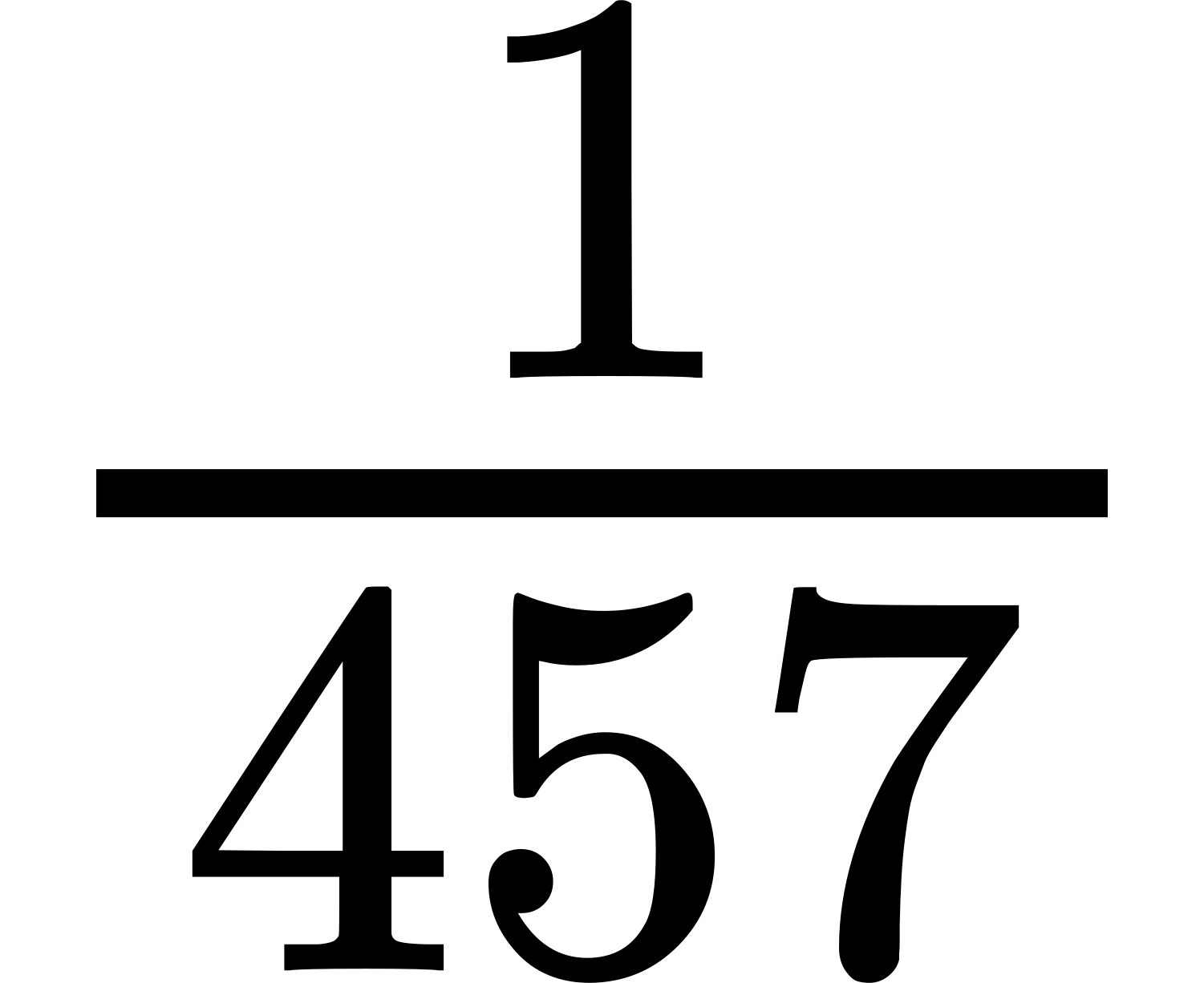 th of an English inch.—Brewster’s
Journal of Science, 1823.
th of an English inch.—Brewster’s
Journal of Science, 1823.
But in the same manner as with Comets, the Moon’s influence upon the earth has not been limited to the production of physical changes. It was long imagined, and by many even at the present day it is still believed, to exert a moral or some other mysterious agency. I allude here to the opinion, that lunatics, as the term imports, are liable to be affected by the Moon; and I am informed, that at one of the late meetings of the Royal Medical Society of Edinburgh, a paper was read and discussed concerning the influence of the Moon upon the human constitution. Such prejudices, however, if they yet linger in some places among the shattered remnants of that ignorance and superstition which once overspread Europe, are now rapidly disappearing before the advancement of science: they resemble the shadows of the night that flit for a while amid ruins, though the general darkness has passed away; but which, ere long, also vanish, by the progressive and brightening influence of the sun.
181
NOTE T, Page 112.
“The comet of 1807,” says a late author, “which appeared towards the south in September, presaged the troubles in Spain, the dethroning of its king, and the subsequent usurpation of his son Ferdinand, with those remarkable events that almost immediately succeeded its appearance. But the great comet of 1811, which appeared near the constellation Ursa Major, and whose orbit crossed the ecliptic in the 16th degree of Leo and Aquarius, was the most remarkable that has appeared in modern times, when about the time of its greatest northern declination, and when its appearance was in consequence most conspicuous, it daily passed over the midst of Europe. Neither were the nightly changes, of which it was the forerunner, less conspicuous in their quick and rapid succession. A few months afterwards, the late French emperor, guided by his evil star, commenced his unfortunate march against Russia. The burning of Moscow, the destruction of his armies, and the stupendous events which almost immediately followed the appearance of that celestial omen, are subjects of history never to be forgotten. And he who would deny the possibility of comets being sent as special tokens to forewarn mankind, after considering such facts as the above, offers a most pointed insult to the divine wisdom of the Most High, the Almighty Ruler of the Universe.” It is added in farther evidence of comets being sent as signs to the human race of the will of Heaven, “that the greatest of them, and the most remarkable, have uniformly appeared in the northern hemisphere; thus passing over those nations which have been the most convulsed by great political events.”
Will it be credited, that the work from which this extraordinary statement is extracted, was published in England in the present year? That such a pitiful combination of superstition and ignorance should have been exposed to the world, is disgraceful to the country, and insulting to the spirit of the times. Josephus, in relating the blindness and obstinacy of his countrymen who shut their eyes even to the direct forewarnings of Providence of the approaching destruction of their city, expressed by various prodigies in the firmament, mentions, as one of these premonitory signs, the appearance “of a Comet, in the form of a sword, which hung over Jerusalem for a whole year together.”—Josephus V. v. 3. We may not perhaps feel much surprise at the pious credulity of the Jewish historian; those events in the natural world, which are beyond the understanding of men, have in all ages been deemed miraculous; but we were certainly little prepared to expect that these absurd prejudices should be again revived in the 19th century.
182
NOTE U, Page 115.
The agency of the Comet of 1680, here employed by Whitson to produce both a deluge and a conflagration, has also been resorted to by M. Freret, to account for another great catastrophe of a similar nature, the deluge of Oxyges. The historians, who relate this event, mention a fact, upon which, as it would seem, M. Freret’s theory has been wholly grounded, viz. that forty years before the deluge the planet Venus was observed to abandon its ordinary situation, and shrouding itself in a long train of light, to commence a course towards the north. From the relation of this one fact (the date of which deserves to be noted) M. Freret draws the following remarkable conclusions: 1st, That this was not the planet Venus at all, but a Comet emerging from behind the Sun! 2d, That this Comet could be no other than the great Comet of 1680! 3d, That this Comet occasioned the deluge of Oxyges! Will it be credited that these notions were made the subject of serious philosophical discussion, and deemed worthy of a place in the Memoirs of the Academy?
NOTE V, Page 116.
The case in which these several conditions are combined, may be represented by an equation.
According to the notation formerly employed in equat. (2.) and (3.) of the parabolic
method, let the planet’s radius vector be R, that of the Comet r, and call the distance between
the planet and comet ; then we obtain from the ordinary property of triangles, combined
with equation (10.)  : But since
 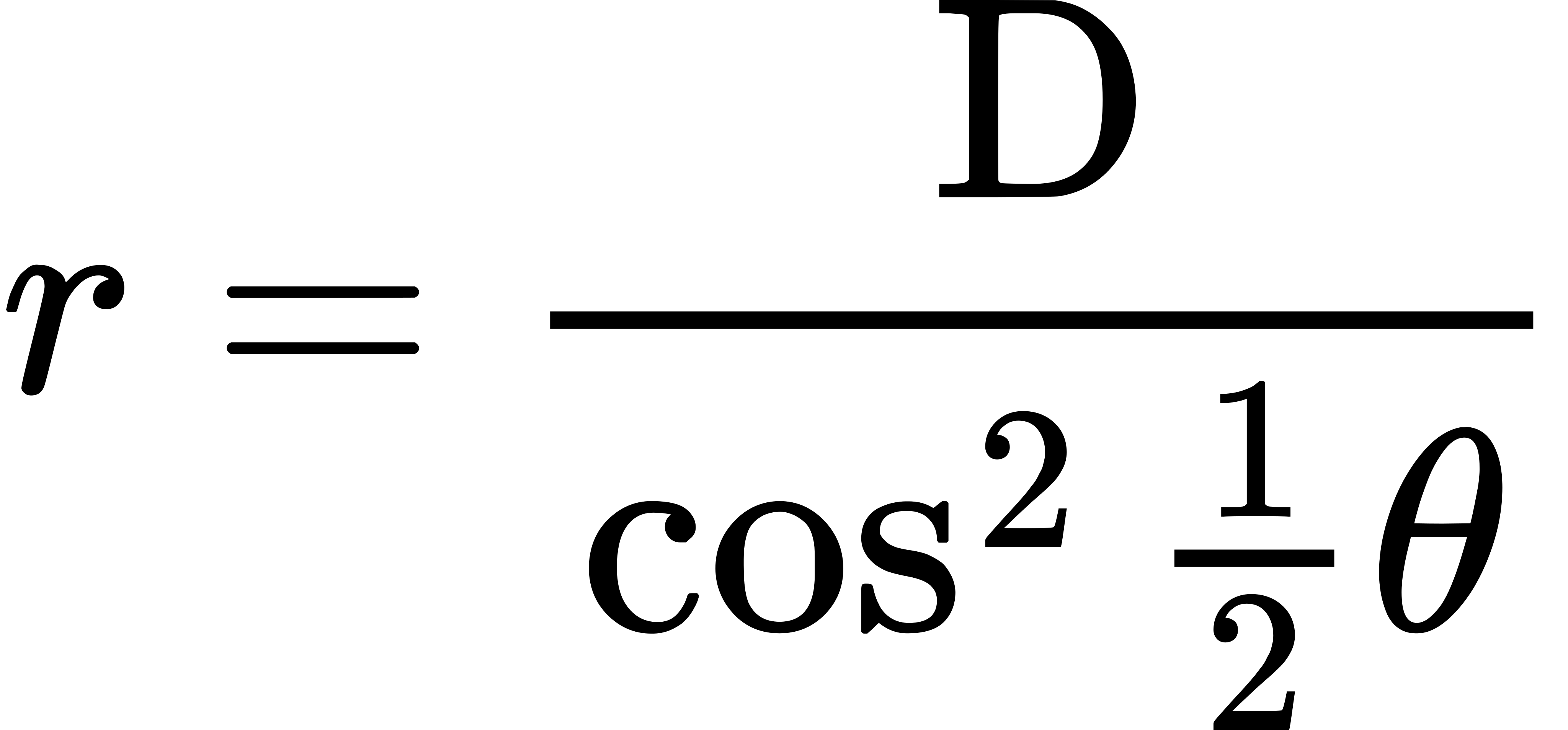 , where
D is the perihelium distance and the anomaly, in the supposed case equal to
, where
D is the perihelium distance and the anomaly, in the supposed case equal to 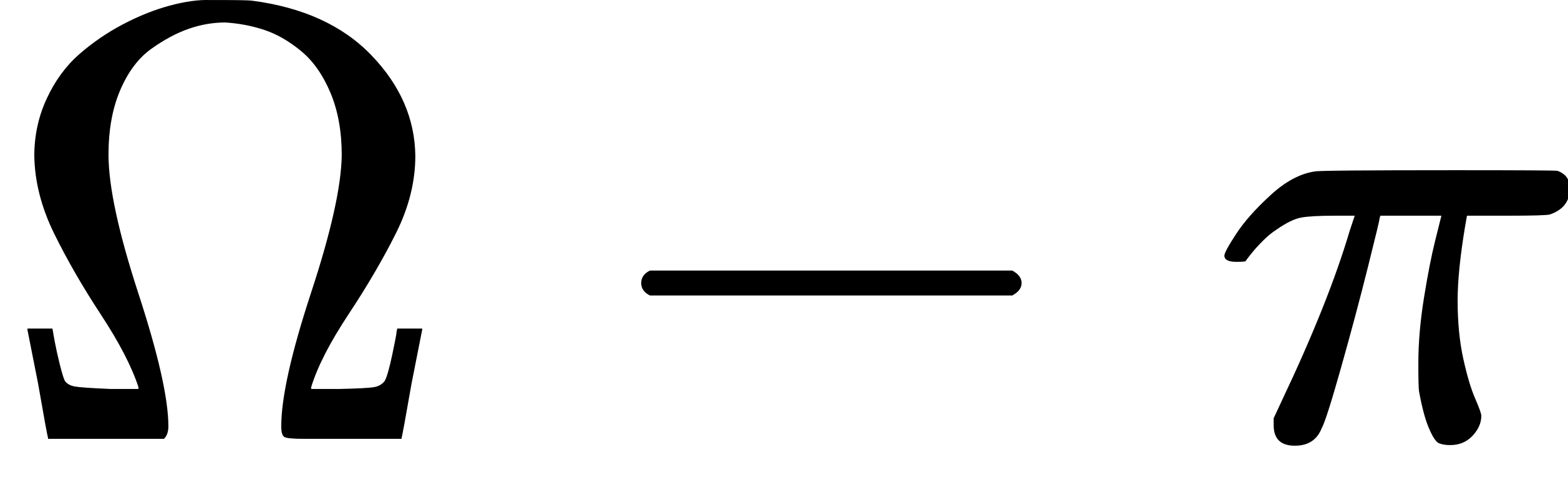 , we
have
, we
have  . In order that a shock shall
take place, it is evident that should not exceed the semidiameter of the planet and comet.
. In order that a shock shall
take place, it is evident that should not exceed the semidiameter of the planet and comet.
183
NOTE W, Page 123.
This conclusion, which is derived from geological data, is strikingly confirmed by astronomical considerations. If the earth had been originally a fluid of uniform density, it would have followed, from the mutual attraction of its parts, and the rotation on its axis, that the increase of the length of the seconds pendulum would be nearly as the square of the sine of latitude: Also, if the earth had been a fluid of unequal density, the denser parts would so arrange themselves towards the centre, that the same law would still be preserved. Now we know, from various experiments, that the interior of the earth is much denser than the parts nearer the surface, and that in both hemispheres the length of the pendulum is proportional to the square of the latitude; whence it follows, that our globe must originally have existed in a fluid state. The above deduction, therefore, which the appearance of our Earth suggests, is strikingly confirmed by this test, the combined result of experiment and theory; and, according to La Place, may be marked as one among the few certainties known in geology.
NOTE X, Page 125.
As an instance of these boulders, Playfair, from whose well known work this passage is taken, mentions a block of granite on the east side of the lake of Geneva, called Pierre de Gauté, about 10 feet in height, with a horizontal section of 15 by 20. “From the present situation, to the place whence it must have been transported, the distance,” says he, “is about 30 English miles, with many mountains and valleys at present interposed.”
NOTE Y, Page 126.
Regarding the celebrated Kirkdale cave, we are told that “on its sides there are seen spines of sea-urchins and other marine remains, incrusted in the mass of the rock; but it is on the bottom, and there only, that there is found the stratum of mud, of about a foot thick, stuck full of bones, as at Gaylenreuth.”—“The greatest number of these bones, without 184comparison, belong to hyenas of the same species as those of the caverns of Germany; but there are also many of other large and small animals, which Mr Buckland supposes to form twenty-one species. From the pieces which I have under my eye, says Cuvier, there indisputably occur bones of the elephant, hippopotamus, horse, an ox of the size of the common deer, rabbits, field-rats; also bones of some other carnivora, viz. tiger, wolf, fox, weasel.” The cave of Gaylenreuth in Germany, presents a still more striking aggregation of various species. According to Cuvier, the bones of carnivorous animals found there, are those of the bear, the hyena, tiger, wolf, fox, glutton, and polecat. According to Rosenmuller’s recent examinations, there are also found in the same cavern bones of men, horses, oxen, sheep, deer, roes, mules, badgers, dogs, but which, in his opinion, must have been deposited at a period subsequent to those of the bear, tigers, and hyenas149. In order to account for these extraordinary accumulations of animal remains, Cuvier thinks that only three general causes can be imagined, which could have brought these bones into their present situation. Either, 1st, They are the remains of animals which tenanted the caverns, and died peaceably in them; or, 2d, They have been carried there by inundations, or some other violent agent; or, 3dly, They have been enveloped in the strata, by the dissolution of which these caves have been formed, and the bones have been left by the water which carried off the matter of the strata. The last supposition is allowed on all hands to be quite untenable, from the single fact, that the strata in which the caves occur never contain any bones. Some have also strong objections to the second supposition, on account of the entireness of the bones themselves, which seem to warrant the conclusion, that the bones cannot have been rolled from a distance. “We are therefore obliged to have recourse to the first supposition, whatever difficulties it presents on its part, and to say that these caves served as a retreat to carnivorous animals, and that these carried there, for the purposes of devouring them, the animals which formed their prey.”150 But it is exceedingly difficult to reconcile this theory with several points. For, 1st, If it be said that the bones of the herbivorous races have been dragged into these caves by carnivorous animals, how is it that the remains of the former seem, in many instances, to have been deposited at a much more recent date? 2d, Is it possible to imagine that so many different animals of the carnivorous tribe would have lived in the same cave, or that the habits of the tiger in these days would have led him to choose a subterranean retreat? 3d, It has been found that the aperture leading into those caverns is often much too small to have admitted its supposed inhabitants.151 The second supposition, therefore, does humbly appear to me to be the least objectionable. That the bones are yet entire and unbroken, is not really a circumstance which excludes the possibility 185of their having been brought into their present situation by an inundation. For if it be supposed that, when this event took place, the animals themselves were transported by the rush of waters, then no injury could have been sustained by the bones, which would not be deposited till the bodies decayed. And it is worthy of remark, that, in the cave of Gaylenreuth above mentioned, “there are found, confusedly mixed with the bones, pieces of a bluish marble, of which all the corners are rounded and blunted, and which appear to have been rolled152.” Accordingly, Cuvier himself seems to have adopted this idea. When speaking of the remains in the cavern near Besançon, he says that “these remains must have been accumulated for a long time, and at last were buried in the mud which has been thrown there by some great inundation153.”
NOTE Z, Page 126.
Mr Buckland, in his Reliquiæ Diluvianæ, relates the same fact. “The occurrence of these bones,” he says, “at such an enormous elevation in the regions of eternal snow, and consequently in a spot now unfrequented by such animals as the horse and deer, can, I think, be explained only by supposing them to be of antediluvian origin, and that the carcasses of the animals were drifted to their present place, and lodged in sand, by the diluvial waters. This appears to me the most probable solution that can be suggested; and, should it prove the true one, will add a still more decisive fact to those of the granite blocks drifted from the heights of Mont Blanc to the Jura, and the bones of diluvial animals found by Humboldt on the elevated plains of South America, to show that all the high hills and mountains under the heavens were covered at the time when the last great physical change by an inundation of water took place over the surface of the whole earth.
NOTE AA, Page 128.
“The Hymalaya mountains,” observes a late author, “the loftiest in the world, are extremely precipitous on the side of Hindostan; while they decline, with a very gradual descent, towards the elevated plains of Thibet. In like manner, the Alps, which rise abruptly 186on the side next Italy, present a more easy ascent on the side of Switzerland. A similar remark is applicable to the Andes, which, though extremely steep on their western flanks, gradually sink away on the eastern sides, into the immense basins of the Amazon and Oroonoko.”—“The most abrupt sides,” it is added, “of all the principal mountains, seem to face the south and west, though occasionally they look to the opposite points of the horizon.”—Encyc. Edin. Physical Geography.
In the 7th volume of the Transactions of the Royal Society of Edinburgh, there is a very
elaborate and instructive paper by Sir James Hall of Dunglass, upon the proofs of diluvial
action occurring in the neighbourhood of Edinburgh. From the abundant proofs which he
brings forward, in the subversion of the strata, in the occurrence of boulders, in the excavation
of valleys, and in singular but well-marked ruts or scratches on the faces of the rocks,
which were exposed to the action of the torrent of waters, the operation of the deluge in this
quarter of the world has been completely established. Describing the small sandstone hills
which are so numerous round Edinburgh, Sir James Hall observes, that “from each of
them a tail or prolongation extends to the eastward, formed chiefly of the blue clay already
mentioned, together with beds of sand and gravel. These decline very gently, and maintain
to a considerable distance the individual character given to each by the firm mass producing
it.” Thus it is that the various ridges have been formed which may be observed every
where in the Lothians; and, to use the words of this distinguished geologist,—“It is an important
circumstance, that these ridges maintain a very correct parallelism with each other
with the tail of the Castle Rock, and of the Calton Hill, and with the alluvial prolongations
that extend to the eastward, from all the eminences of this neighbourhood.” After enumerating
those various striking geological facts, Sir James Hall states, that “the direction
of the stream in the neighbourhood of Edinburgh, as indicated by the medium result of a
number of observations, appears to have been from 10° S. of West to 10° N. of East, by true
bearings taken with a needle, and allowing 27 degrees West of North for variation.”
NOTE BB, Page 133.
By the same rule we may calculate the probability of a comet approaching this Earth so near
as the Moon, which, if Phranza’s relation be true, has actually happened. The Moon is distant
from us about 60 semidiameters of the Earth, therefore 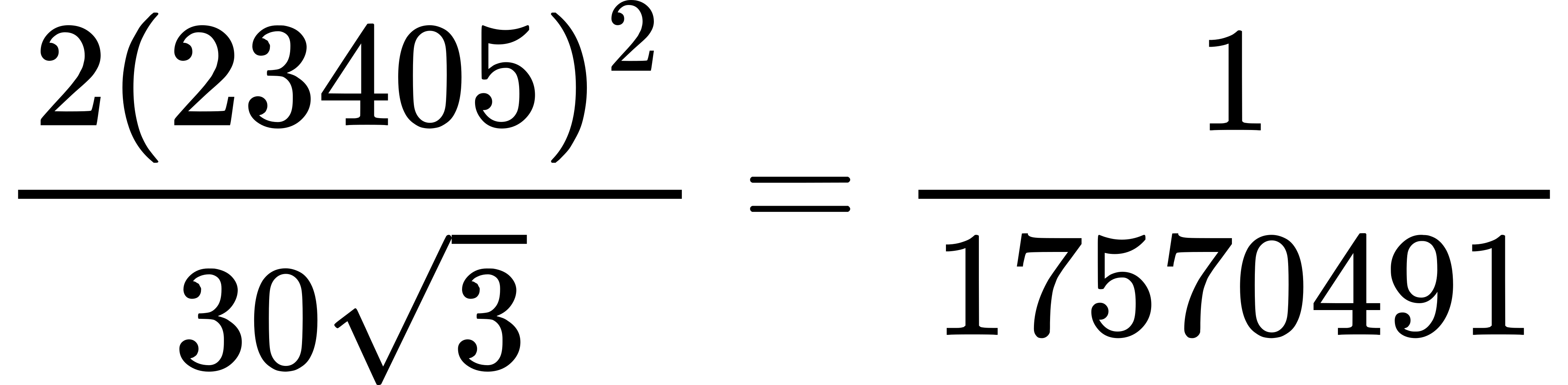 expresses
187
the probability; or, in other words, that in about 88,000 years this event will again take place.
The Comet of 1770, so often already mentioned, approached the Earth about six times the
distance of the Moon; this event may happen, therefore, in the space of 2336 years. This
interesting paper of Olbers was first published in Monat. Corresp. II. p. 409.
expresses
187
the probability; or, in other words, that in about 88,000 years this event will again take place.
The Comet of 1770, so often already mentioned, approached the Earth about six times the
distance of the Moon; this event may happen, therefore, in the space of 2336 years. This
interesting paper of Olbers was first published in Monat. Corresp. II. p. 409.
The following are some of the comets whose elliptic orbits have been computed, together with their respective periods of revolution, and aphelion distances. The aphelion distances are reckoned in millions of geographical miles, and the periods of revolution in sidereal years.
| Years. | Aph. Dist. | Periods. |
| 1680 | 2898 | 575 |
| 1759 | 363 | 75 or 76 |
| 1763 | 15500 | 7334 |
| 1769 | 3967 | 929 |
| 1770 | 117 |
5
|
| 1772 | 415 |
6
|
| 1805 | 98 |
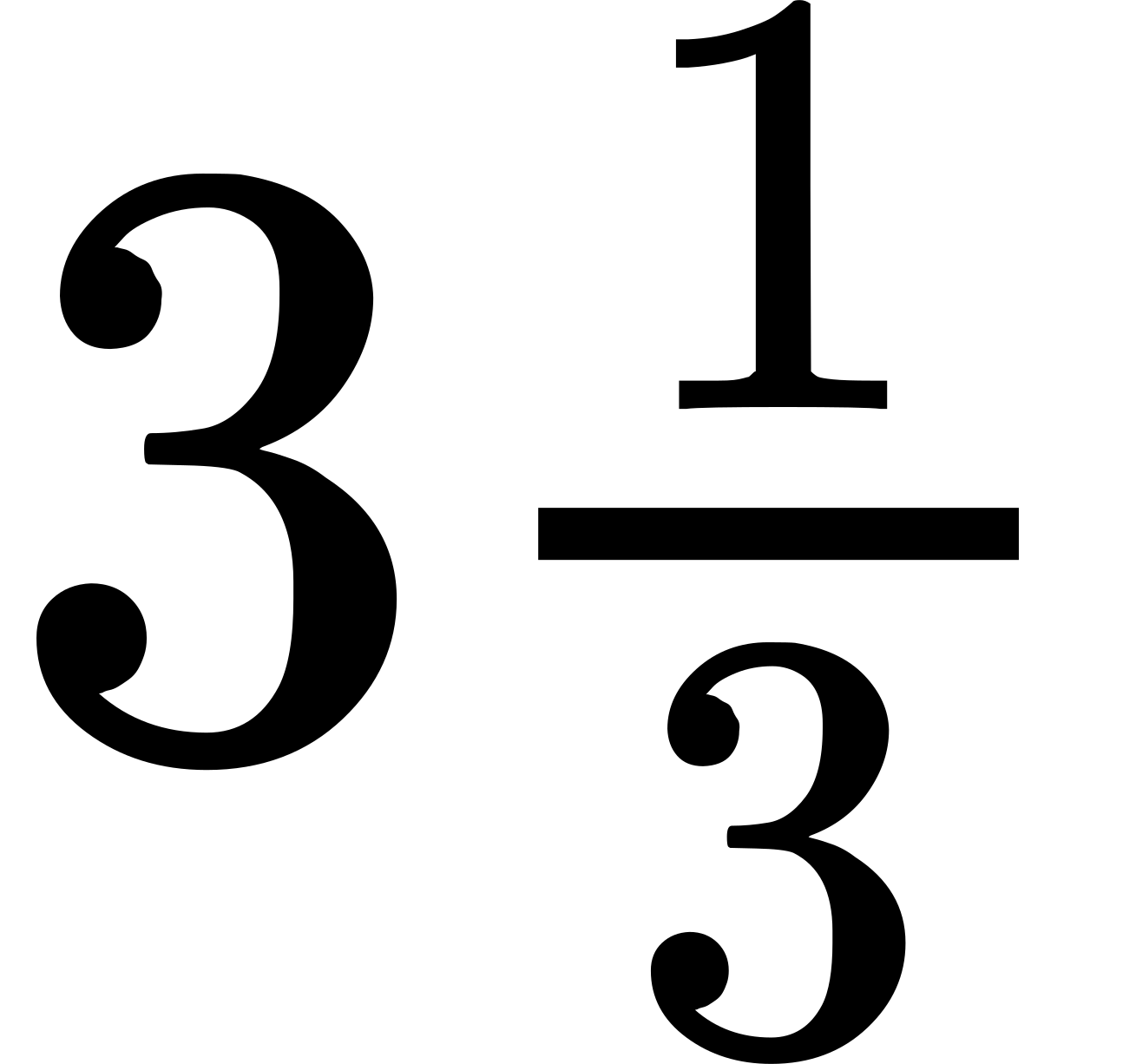
|
| 1807 | 5943 | 1713 |
| 1st 1811 | 8747 | 3383 |
| 2d 1811 | 1873 | 875 |
| 1815 | 700 | 74 or 75 |
It may here perhaps be proper to make some remarks upon the probable number of comets traversing the system. Historical records give intimation of about 400 comets; but there are not more than 130 whose orbits, up to the present year (1827), have been computed. We are not to imagine, however, that we thus obtain any information with respect to the actual number; for the discoveries of these bodies, as well as of new facts in every other branch of astronomy, have been increasing with every succeeding year, depending wholly on the improvement of instruments and the assiduity of observers. There are several circumstances which prevent the more frequent discovery of these bodies. Many comets which, even at their nearest approach to the Sun, are still too far distant to be discovered from the earth; many which, requiring, as the above list shows, thousands of years to accomplish a single revolution, have seldom or never yet reached their perihelion within the recorded experience of mankind; many which, on account of their diminutive size, may be invisible to the naked eye, and are only discovered by an accidental position of the telescope; many which are to be seen only on the south side of the equator, where there are as yet but few means of observation; many which, though on the north side of the equator, rise above the horizon only during the day, when the Sun’s light prevents them from being discerned; many, finally, which pass the Earth unnoticed, owing to cloudy weather, or other unfavourable circumstances,—many such must be traversing the system, of which we have no possible intelligence.
But from the number of comets which have been observed, we may attempt to form some conjecture concerning the probable amount. In examining a catalogue of comets where the perihelion distances are given, it will be found, that about 70 have been observed within the orbit of the earth, during the last century. Considering, however, the multitude of 188comets which, for some of the reasons above assigned, have not been perceived, we may assume 140 as the number which, within the last 100 years, have passed between the sun and the earth. If we reckon, therefore, 1000 years to be the average period of the revolutions of comets, which is certainly not too great; and reflect, that if astronomers had always been as assiduous in their observations as during the last century, an equal number might have been seen, it follows, that (1000100 =) ten times the number of comets would have been recorded that there actually are; and hence we have 140 × 10 or 1400, the whole amount of comets in the system, which come nearer the Sun than the Earth. In order now to estimate the number, whose perihelia are situated within Uranus, we must farther multiply this number by the cube of 20, which is the distance of Uranus from the Sun, calling the Earth’s radius unity. Hence (1400 × 203 =) 11,200,000 of comets, may be considered as an approximate estimate of the number of these bodies, which, in their approach to the Sun, pass within the orbit of Uranus. But may there not also be Comets, whose perihelia are situated even beyond the orbit of this planet?
NOTE CC, Page 139.
This theory, concerning the consolidation of comets, is strikingly supported by the analogy of the planets. It is well known that their densities diminish pretty regularly with their distance from the Sun. Is it not possible that this law may depend on the actual influence of the solar heat? A general view of the case renders the hypothesis extremely probable; and if we take the product of their respective distances and periods of revolution, as I have now done with respect to comets, their densities will be found to follow very nearly the same proportion. It is true, however, that La Place’s theory, as to the origin of the planets, may also explain this circumstance with respect to their density. He supposes the planetary bodies to have been formed out of a nebulous medium surrounding the Sun like an atmosphere; and if the density of this circumambient medium, like any other atmosphere, diminished in proportion to the distance from the Sun, the bodies themselves, formed out of this medium, must be affected by the same law.
189
NOTE DD, Page 141.
When a receiver begins to be exhausted of its air, a thermometer placed inside will indicate a sudden decrease of temperature; whilst if the air be compressed, an opposite effect is produced. It is in an ingenious application of this principle of rarefaction, as promoting evaporation, that Professor Leslie’s well known method of freezing chiefly consists: and on the opposite principle of condensation, that a little instrument has been constructed, in which, by the sudden stroke of a piston to compress the air, fire is instantaneously generated.
The EDINBURGH MEDICAL and SURGICAL JOURNAL. Vols. VII. and VIII. being those for 1827. Published in Numbers, Quarterly, price 6s.
This Journal, which is extensively circulated through the British dominions, in France, Germany, Italy, and other countries of Europe, in the East and West Indies, and the United States of America, consists of three Parts.
The first contains Original Essays and Communications on important subjects in Anatomy, Medical and Surgical Pathology and Practice, by various practitioners. Some of them have been republished in the journals of France and Germany, and other foreign countries.
The Second Part consists of Reviews, or accounts of the works of eminent Physicians and Surgeons, published in this country and on the continent of Europe. As it is impossible to notice every work that issues from the press, regard is always paid to those which promise to be most useful to the practitioner, and which tend most to the advancement of medical knowledge.
By introducing the most recent and useful information on Pathology, Therapeutics, and those departments of medical science which tend to the improvement of practical knowledge, it is made to communicate a tolerably just view of the general progress of Medicine.
In the Third part, entitled Medical Intelligence, is given a selection of articles on important and useful discoveries, additions, or improvements in every department of medical learning. These notices being derived at the earliest opportunity from various foreign and domestic sources, more especially from the best French, German, and Italian Journals, and occasionally from those of the United States, present, in a short and comprehensive form, a great proportion of useful and curious information.
The whole work is admitted, by competent judges, to form a valuable compendious view of the present state and progressive advancement of medical and surgical knowledge, and is indispensable to the practitioner.
The EDINBURGH NEW PHILOSOPHICAL JOURNAL, exhibiting a View of the Progressive Discoveries and Improvements in the SCIENCES and the ARTS. Conducted by Robert Jameson, F. R. S. L. & E. Regius Professor of Natural History, Lecturer on Mineralogy, and Keeper of the Museum of the University of Edinburgh, &c. &c. Published Quarterly, price 7s. 6d.
The great object of this Journal has been to exhibit a view of the progress of Discovery in Natural Philosophy, Geology, Chemistry, Natural History, Comparative Anatomy, Practical Mechanics, Geography, Navigation, Statistics, Antiquities, and the Fine and Useful Arts; and the publishers, with confidence, appeal to the Numbers which have come forth during the last two years, as affording the best and most convincing evidence that the object has been kept steadily in view, and accomplished, they trust, in a manner creditable to all concerned.
It seems unnecessary to particularize individual articles in these various departments. But it may be mentioned, that, in addition to them, the Biography of recent distinguished philosophers and naturalists has been introduced, and now forms the first article in each number.
Still farther to increase the variety of reading, space has, of late, been found for some topics connected with Political Economy; and the very important subject of Benefit or Friendly Societies, and the principles on which alone they can be established with safety, are discussed in a very satisfactory manner.
Particular attention has been given to render the department of Scientific Intelligence exceedingly various, and generally interesting to all classes of readers; and in this Journal alone will be found the proceedings of the Wernerian Natural History Society.
In short, much attention has been paid, and will continue to be paid, to variety in the selection of subjects; so that readers of every description may find some articles more particularly suited to their tastes.
A SYSTEM OF UNIVERSAL GEOGRAPHY, by M. Malte-Brun, Editor of the “Annales des Voyages,” &c. Parts I. to XII. Price 7s. 6d. each. To be completed in 14 Parts.
The Publishers are extremely happy to be able to state, that, notwithstanding the lamented death of M. Malte-Brun, the remainder of this great work, comprising the description of Western Europe, will be completed in a style every way worthy of what has been already executed. The papers and collections of M. Malte-Brun have been placed in the hands of M. Valknaer, with whose numerous and valuable contributions to geographical science, the scientific portion of the public have been long and familiarly acquainted. There can, therefore, be no doubt that the high and established character of the Original Work will be maintained to its close; and the British public may be assured that no efforts will be spared to render the Translation, now in course of publication, not only equal, but even superior, to the original. The account of the British Empire will be carefully revised, and, if necessary, rewritten by gentlemen who are extremely well versed in statistical inquiries. The reports and papers printed by order of the House of Commons will be referred to for every fact of importance; and the publishers believe that they may venture to say, that the account which will be given in this work of the Agriculture, Manufactures, and Commerce of Great Britain, will be decidedly superior to any that has hitherto appeared.
The account of the United States given in the Translation, is an entirely original composition; and it is admitted by the Americans themselves to contain the most able, comprehensive, and luminous account of that powerful confederacy that has ever been published.
The account of Hindostan in the Translation, is also, in a great measure, original; and numerous facts and details have been derived from official journals, and the works of recent travellers, that were not accessible to the author.
Similar improvements have been made in almost every part of the work, and the publishers are determined to spare no expence to give effect to their purpose of rendering it as perfect as possible; and of filling up a great desideratum in the literature of the country, by putting the public in possession of a COMPLETE AND WELL AUTHENTICATED BODY OF GEOGRAPHICAL SCIENCE.
“M. Malte-Brun is probably known to most of our readers as the author of a systematic work on Geography; he is, besides, the editor of a periodical digest, under the title of Nouvelles Annales des Voyages de la Geographie, et de l’Histoire; the first is as much superior to the compilations of our Guthries and Pinkertons, as the other is to the garbled productions of our Truslers and Mayors.—Quarterly Review, No. 52.
A DICTIONARY of MEDICINE, designed for Popular Use; containing an Account of Diseases, and their Treatment,—including those most frequent in warm climates: With Directions for administering the various Substances used as Medicines; the Regulations of Diet and Regimen; and the Management of the Diseases of Women and Children. By Alexander Macaulay, M. D. Fellow of the Royal College of Surgeons of Edinburgh, and Physician-Accoucheur to the Edinburgh New Town Dispensary. In 1 thick vol. 8vo. double columns. Price 14s. bds.
“The observations on climate, diet, regimen, and the management of infants, are interesting and judicious. They comprise all the best established information on the subject, and, like several parts of the work, may be perused even by professional readers with advantage. To parents, and those who have the superintendence of children, this work must be a useful guide; in all respects, indeed, the Dictionary of Dr Macaulay is calculated to gratify rational curiosity, to enlighten the minds of the public in general on medical subjects, and to diffuse correct notions on many topics which are too often disguised in technicalities, or debased by superstition. It is, above all, an excellent antidote to every species of quackery and empiricism.”—Edinburgh Medical Journal, No. 96.
An ESSAY on NAVAL TACTICS, Systematical and Historical, with upwards of Fifty Explanatory Plates; in Four Parts. By John Clerk, Esq. of Eldin, Fellow of the Society of Scottish Antiquaries, and of the Royal Society of Edinburgh. Third Edition, with Notes by Lord Rodney, and an Introduction by a Naval Officer. 8vo. Price L. 1, 5s. boards.
“We are most happy to see another edition given to the Navy. We strongly recommend not only the perusal, but the study, of it to the young officer; and even the oldest and most experienced will gain information and knowledge by reading it. The great necessity of doing away the chance which must exist in all naval actions, is not yet sufficiently appreciated by British seamen. Their valour leads them yet to consider tactic and manœuvre as two secondary objects; but reflection and the study of tactics, will shew them, as well as the result of late practice, that in all cases it is well to bring the whole force on a part of that of the enemy, and secure first a certain victory, by a capture of a part of the adverse ships, instead of, in the hope of capturing the whole, to bring on an action ship to ship, which must, even with skill and bravery on one side, be attended by doubtful results. We conclude this by declaring our firm opinion, that Great Britain and her Navy owe to the late Mr Clerk the greatest obligations.”
WERNERIAN SOCIETY’S TRANSACTIONS, with numerous Engravings, Vol. IV. Parts I. and II. 8vo. 10s. 6d. each. Vol. V. Parts I. and II. 8vo. 10s. 6d. each.
P. NEILL, PRINTER.
1 Delambre, Astronomie, iii. 425.
2 Ibid. 426.
3 Ibid.
4 Phil. Trans. 1808.
5 Phil. Trans. 1812.
6 Justin, lib. 36.
7 Lib. 7. cap. 37. and lib. 9. cap. 70.
9 Unfortunately no observations of the Comet between these two periods could be made, on account of its proximity to the sun.
12 This was the case in the Comet of 1744.
13 Connoiss. des Tems (1826.)
14 See this Theory detailed in the Jahrbuch für 1826; and Jameson’s Philosophical Journal, 1826.
16 For a statement of the Newtonian and Huygenian Theories, respecting the propagation of Light, see Young’s Lectures, vol. i.
17 Young’s Lectures, i. 386.
18 Ibid. ii. 269.
19 The different rates at which these respective vibrations are transmitted are well known: light travelling about six hundred thousand times more rapidly than sound.
20 Barlow’s Mathematical and Philosophical Dictionary, article Light, mentions these experiments.
21 Ibid.
22 Principia, iii. 41.
23 Mém. de L’Acad. 1744. La Place, Systême, i. 9.
24 Mém. de l’Acad. 1775.
25 Astron. ch. 33.
26 Connoiss. des Tems, 1816.
27 Zach Corresp. Astron. xi. 550.
28 Bode’s Jahrbuch, 1823.
29 Edin. Philos. Journal, 1821.
30 Thus the perihelion distances of the Comets 1682, 1769, 1744, and 1819, which are said to have shown phases, are respectively ·58, ·12, ·22, ·36.
31 Philosophical Transactions 1812, 234.
32 Memoires de l’Acad. Roy. 1775.
33 The cause of this obscurity, which occurs generally in the tails of all comets, has already been mentioned, p. 9. of this Essay.
34 These successive alterations in the apparent diameter of the nucleus, are only to be accounted for, by supposing that they indicate physical changes in the lower part of the envelope. The continuing indistinctness at the edge of the nucleus, must be ascribed to the effects of the sun’s heat upon its surface, affording to the nebulous envelope renewed supplies.
35 This smaller tail formed of course a hollow cone round the principal tail, and having a very thin shell. Its greater proximity to the one side than to the other, probably arose from some physical peculiarity in the matter detached, or from their not having risen simultaneously from the nucleus.
37 What had become of the smaller tail? Had the nebulous matter out of which it was produced been expended and driven into space? Or had it been forced to unite with the principal tail, on account of the increased energy of the sun?
38 This smaller tail, from the parallelism of its sides, must have been attached at its vertex to the most elevated parts of the envelope, out of which in fact the attenuated matter composing it had been derived.
40 Brandes Astron. vol. iv.
41 It is by a process similar to this that the several bright envelopes, or shells of luminous vapour sometimes observed surrounding the heads of comets, are formed. Their production has been already explained, p. 9.
42 Brande.
43 We are informed by Diodorus that they were even able to predict the reappearance of comets, by being possessed of long continued observations; but, as was well remarked by Halley, with respect to this supposed knowledge of the Chaldeans, “Comme ils savaient aussi, nous dit le même auteur (Diodore), prédire les tremblements de terre et les tempêtes, il est hors de doute, que ces prédictions étaient chez eux de simples annonces astrologiques, plutôt que des calculs véritablement astronomiques.”—Delambre.
45 Tacit. lib. xiv. p. 22.
46 Tacit. lib. xv. p. 47.
47 Suet. in Ner. p. 36.
48 Manilius.
49 Claudius.
50 Suet. in Caes. 88.
52 Harmonices Mundi, (Tab. IV. Cap. VII). This work Kepler published in 1619, and dedicated to James VI. of Scotland. Another treatise of his appeared in the same year, entitled, Prognosticon, &c. or the Prediction of Misfortunes for Governments and Churches, principally from the Comet and the Earthquake in 1618 and 1619. This, however, is the individual whom Halley describes as “Astronome d’un sagacité extrême, et d’un génie presque divin.”—(Delambre, Hist. d’Astr. Halley.)
53 Du Bartas lived in the sixteenth century. He wrote a poem which was famous in its day, entitled “The Week of the Creation,” in seven books, and which was translated by Silvester. The above quotation is no very flattering specimen of its merits.
57 With respect to this Comet, much interest was excited among astronomers on the Continent. I find the following notice concerning it: “Quel sera donc, le sort de la Comète de l’Eridan? Dieu le sait. Après avoir calculé, comme à l’ordinaire, des orbites paraboliques, on en a essayé des elliptiques, qui n’ont pas mieux réussi. M. Nicolai vient à présent de trouver, une orbite hyperbolique, qui satisfait mieux aux observations.”—(Zach, Corresp. Astron. xiv. 509.) Encke likewise found hyperbolic elements; though, subsequently, he seems to have suspected their correctness.
58 Thus, the Comet of 1759, by reason of its retrograde motion, moved through 41° of longitude and 4° of latitude in the space of twenty-four hours; and the Comet of 1472, likewise retrograde, no less than 120° in the same interval. The Comet of 1821, observed by Captain Basil Hall at Valparaiso, described in the space of three months an arc of nearly 300° round the sun.
59 Thus, in the case of the Comet of 1680, already mentioned, velocities ranging from 1,277,000 feet to 1,806,000 feet per second, would produce various ellipses, requiring very different periods of revolution.
60 De Lambre, Astr. iii. 423.
61 By reason of Kepler’s third law, that the squares of the times of revolution are as the cubes of the respective distances from the sun.
63 It is by means of this formula that the table of the motion of a comet of 109 days is constructed. This table gives the time from the perihelion passage, corresponding to every degree of anomaly: by means of it we are enabled to deduce the anomaly, knowing the corresponding time; or the time, when we know the corresponding anomaly of a comet, whose perihelion distance has been determined. Kepler’s third law gives this, “that the squares of the periodic times of the planetary bodies are as the cubes of the respective distances from the sun.”
64 Here it is important to remark, whether or not l′, l″ be greater than l. If they be each of them greater, the comet’s motion is direct; if less, retrograde. It may be noticed, that we already know from the values of r and r″, whether the comet is approaching or receding from the sun. If r″ be greater than r, of course it is receding.
65 If the motion of the comet be direct, the value of Ω in this equation will be the longitude of the ascending node; but if retrograde, it is evidently that of the descending; and to get that of the ascending, 180° must be added.
66
Or, in order to save the trouble of calculation, if we seek in the table of a comet of 109
days (Delambre, vol. iii.), by interpolation the number of days corresponding to the anomaly
θ, we have only to multiply this by 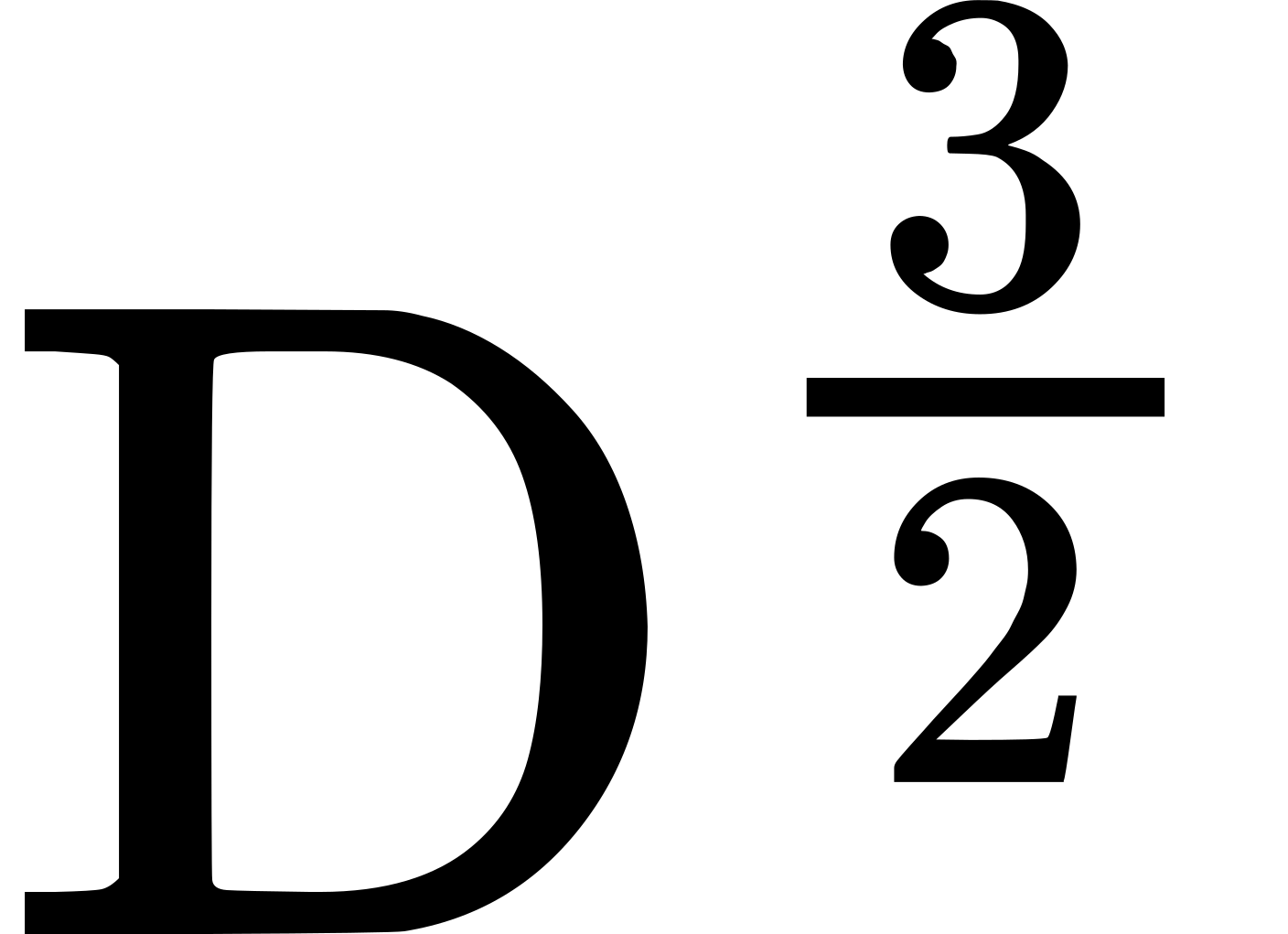 , to obtain at once the value of T.
67 It is unnecessary to detail the whole calculations in these preliminary processes. It will be sufficient to show the computations for the first observation.
| h ′ ″ | h ′ ″ | |||||
| Sidereal time at Paramatta, | = | 4 19 19 | ☉ M. AR at app. noon, | 10 51 15·5 | ||
| Longitude of Paramatta, | = | 10 4 14·5 | Reduct. to sidereal time, | 1 1.4 | ||
| Sidereal time at Greenwich, | = | 18 15 4·5 | ☉ M. AR at mean noon, | = | 10 52 16·7 | |
| 10 52 16·9 | h | ′ ″ | ||||
| 7 22 47·6 | for 7 subtract 1 8·8 | |||||
| 1 12·5 | 22′ .......... 3·6 | |||||
| Mean Solar time at Greenwich, | = | 7 21 35.1 | 47″ .......... 1 | |||
| 1 12·5 | ||||||
To compute the longitude and latitude from the right ascension and declination, we
have the following formulæ given by Gauss, Theoria Motuum Cœlestium (64.);
 where is the declination, a the right ascension, e the obliquity of the ecliptic, the longitude,
and the latitude.
where is the declination, a the right ascension, e the obliquity of the ecliptic, the longitude,
and the latitude.
| ° ′ ″ | ° ′ ″ | |||||||||||
| log tan δ | = | -8 49 0 | = | 9·1906287 | - | log tan (ξ - e) | = | -32 19 18 | = | 9·8012000 | - | |
| log sin a | = | 84 13 47 | = | 9·9977938 | log sin λ | = | 83 15 42 | = | 9·9969896 | |||
| tan ξ | = | -8 51 39 | = | 9·1928349 | - | tan β | = | -32 8 33 | = | 9·7981896 | - | |
| -e | = | -23 27 39 | ||||||||||
| cos (ξ - e) | = | -32 19 18 | = | 9·9268874 | log cos δ | = | -8 49 0 | = | 9·9948377 | |||
| log tan a | = | 84 13 47 | = | 10·9954541 | log cos a | = | 84 13 47 | = | 9·0023397 | |||
| Numerator,........ | 10·9223415 | Numerator,........ | 8·9971774 | |||||||||
| log cos ξ | = | -8 51 39 | = | 9·9947857 | log cos λ | = | 83 15 42 | = | 9·0694339 | |||
| tan λ | = | 83 15 42 | = | 10·9275558 | + | cos β | = | -32 8 33 | = | 9·9277435 | ||
To find now the Sun’s longitude, we must take it from the ephemeris for apparent time, by adding the equation of time to the mean time at Greenwich, which makes it, Sept. 4. at 7h 22′ 42″:
| ° ′ ″ | ||
| ☉ longitude on 4th Sept. | = | 161 22 8 |
| For 7h 22′ 42″ add | 17 54 | |
| 161 40 2 |
As the radius vector given in the Nautical Almanack is not always correct, we take it from Schumacher’s Hülfstafeln, in which the computations are made for mean time, and at the meridian of Altona, 39′ 47″ East of Greenwich. To find the radius vector for the first observation, we must therefore take it from the ephemeris on Sept. 4·33427. On the 4th, we find the log. 10·0033772, on the following day 10·0032654. The difference for one day on the 4th being thus ·0001118, we find the difference for the interval to be ·00000373, which being subtracted from the logarithm on the 4th, gives 10·0033398 for the log. of radius vector at the first observation.
68 To ascertain the correction for parallax, according to the method pointed out by Gauss, we must first compute the longitudes and latitudes of the zenith point. This is effected by the same formulæ which give the geocentric longitude and latitude, δ being in this case the latitude of Paramatta, and a the sidereal time there:
| ° ′ ″ | ° ′ | ||||||||||
| log tan δ | = | -33 48 45 | = | 9·825918 | - | cos (ξ - e) | = | -59 58 | = | 9·699407 | |
| log sin a | = | 64 50 | = | 9·956684 | log tan a | = | 64 50 | = | 10·328037 | ||
| tan ξ | = | -36 30 | = | 9·869234 | - | 10·027444 | |||||
| -e | = | -23 28 | log cos ξ | = | -36 30 | = | 9·905179 | ||||
| tan (ξ - e) | = | -59 58 | = | 10·237977 | - | tan l | = | 52 58 | = | 10·122265 | |
| log sin l | = | 52 58 | = | 9·902158 | |||||||
| tan b | = | -54 5 | = | 10·140135 | - |
We have now, therefore, the following data by which the parallax may be found,
= 83° 15′ 42″, = -32° 8′ 33″, L = 341° 40′ 2″, l = 52° 58′, b = -54° 5′, R = 1·0077198,
B = -0″·46, = 8″·6; B being the sun’s latitude, and π the solar parallax. The following
are the formulæ:


| log R | = | 10·00334 | log π | = | 10·93450 | log (RB + π sin b) | = | 10·87081- | ||||
| log B | = | 9·66275 | - | log sin b | = | 9·90832 | - | log cotan β | = | 10·20181- | ||
| log RB | = | 9·66609 | - | 10·84282 | - | log μ | = | 11·07262+ | ||||
| log π | = | 10·93450 | C. log 206255 | = | 4·68557 | |||||||
| log cos b | = | 9·76852 | log cos (λ - L)) | = | 9·30316- | |||||||
| C. log 206255 | = | 4·68557 | + ·0000115 | = | 5·06135- | |||||||
| log cos (l - L) | = | 9·50598 | + ·0000078 | |||||||||
| ·0000078 | = | 4·89457 | R′ = R + ·0000193 | = | 1·0077391 | |||||||
| log π cos b | = | 10·70302 | log μ | = | 11·07262 | |||||||
| log sin (l - L)) | = | 9·97645 | log sin (λ - L)) | = | 9·99104 | |||||||
| compl. log R′ | = | 9·99665 | compl. log R′ | = | 9·99665 | |||||||
| 4″·7 | = | 10·67612 | -11″·5 | = | 11·06031+ | |||||||
| + 4 ·7 | ||||||||||||
| Correction for the sun’s longitude, - 6 ·8 | = | L′-L | ||||||||||
69
This algebraical expression for M may be modified, so as to afford another method
of computation, by which the correctness of the calculations may be proved. In the
above expression, let both the numerator and denominator be divided by sin (L′ - λ′): it
then becomes 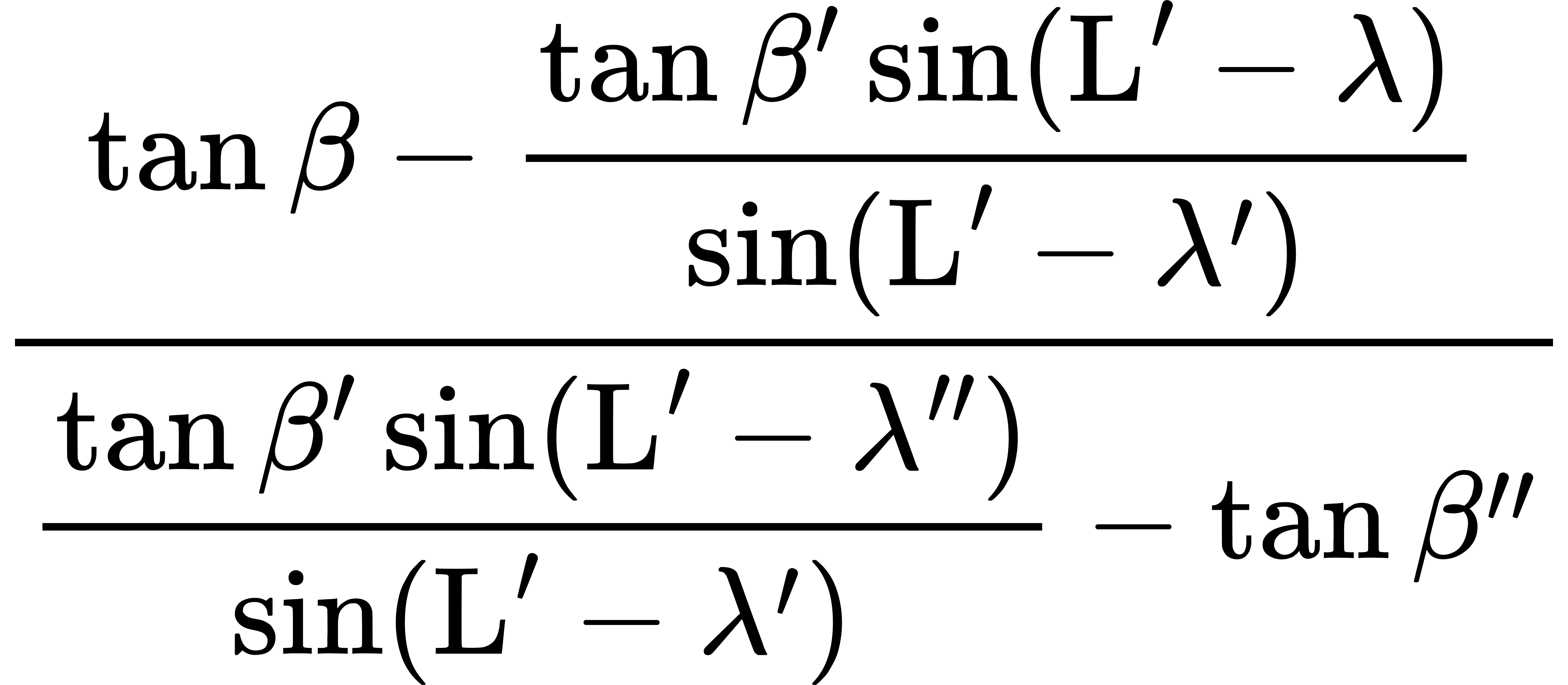 ;
now, calling
;
now, calling 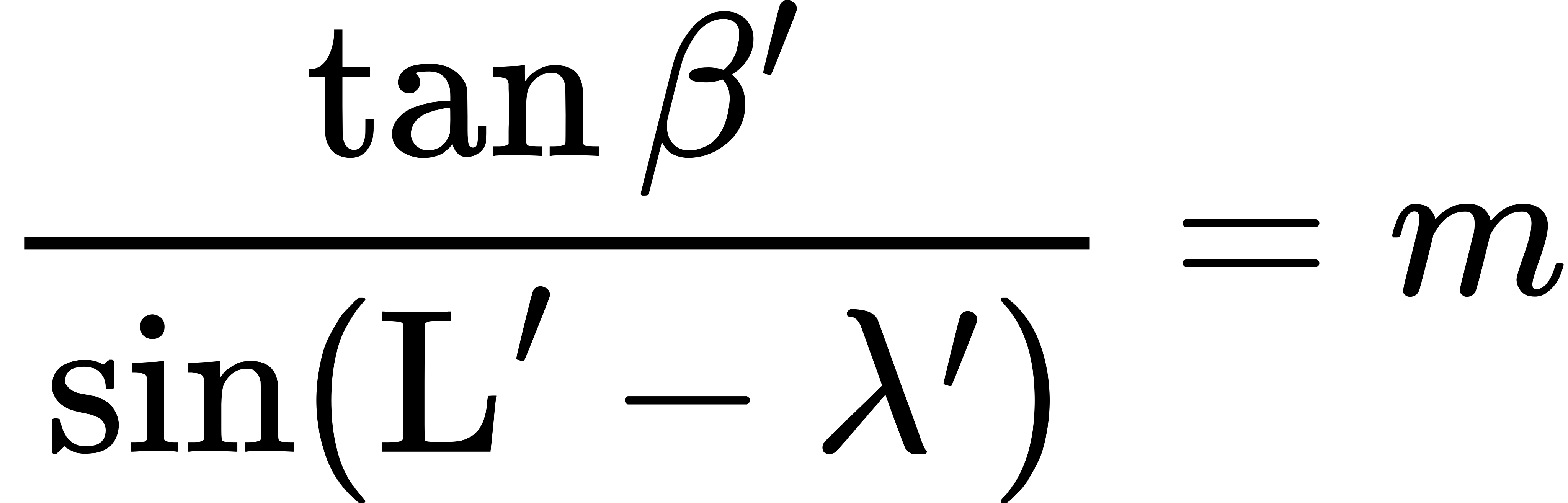 , we get
 . This is the expression given by De Lambre.
70
In order to prove the computation, the equation
 may be employed.
71 The inclination may of course be also obtained by means of the comet’s longitude and latitude at the third observation.
72
It is obvious, from an inspection of the figure, that 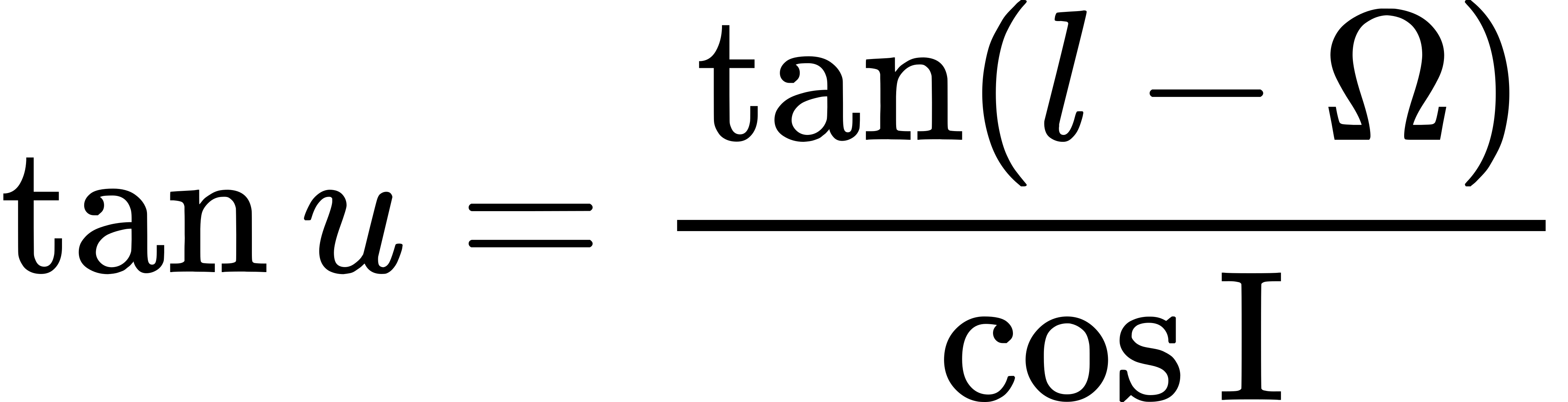 .
.
73
If in this equation we change 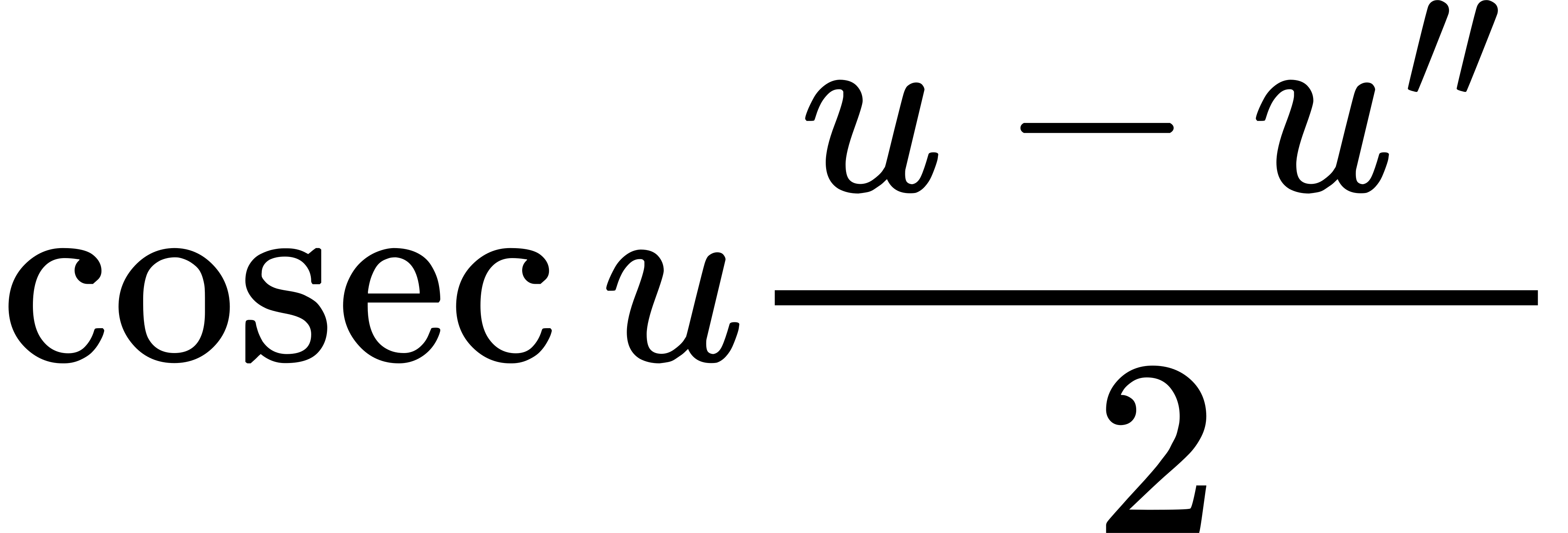 for
for 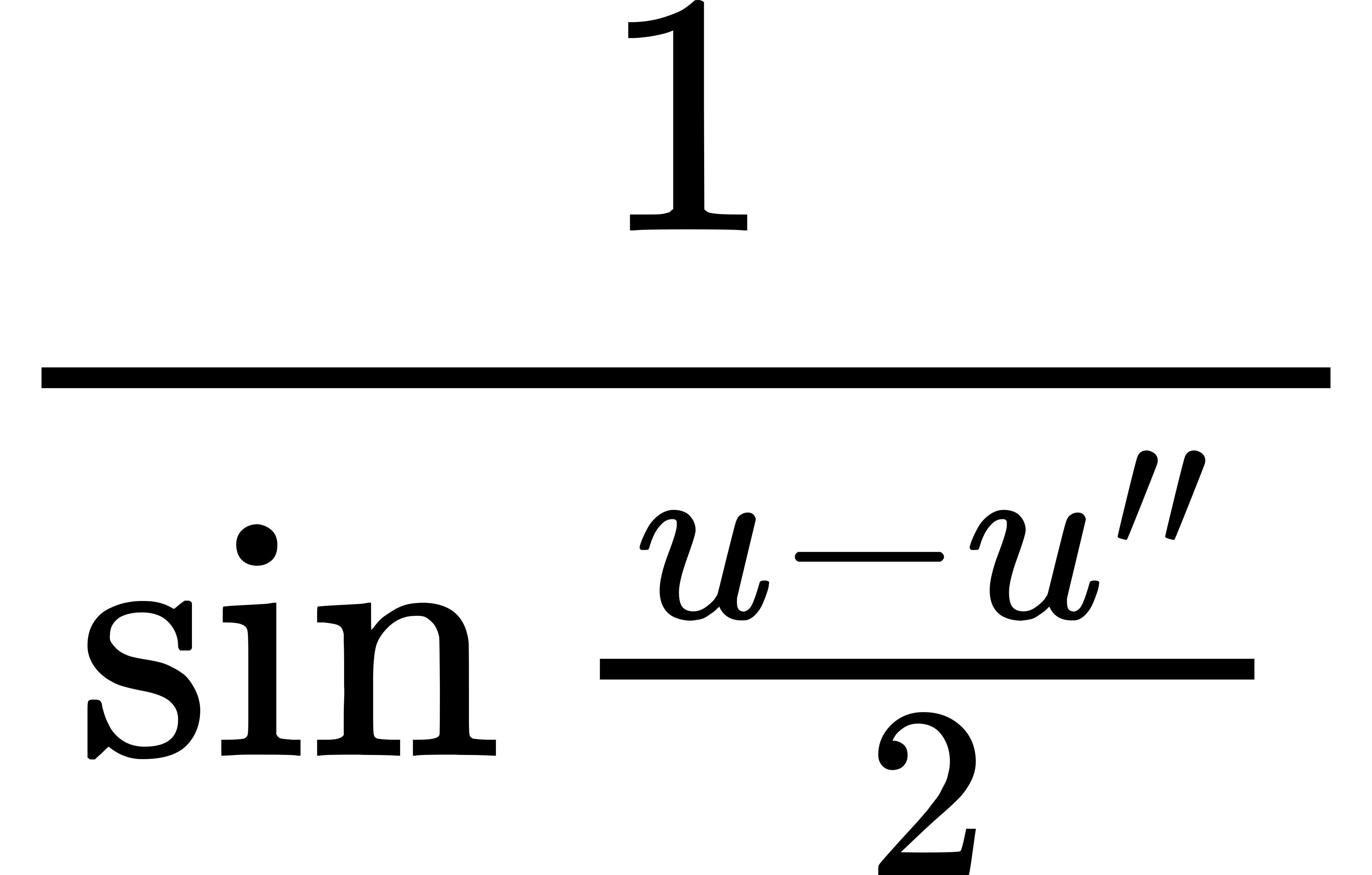 , we get a different expression,
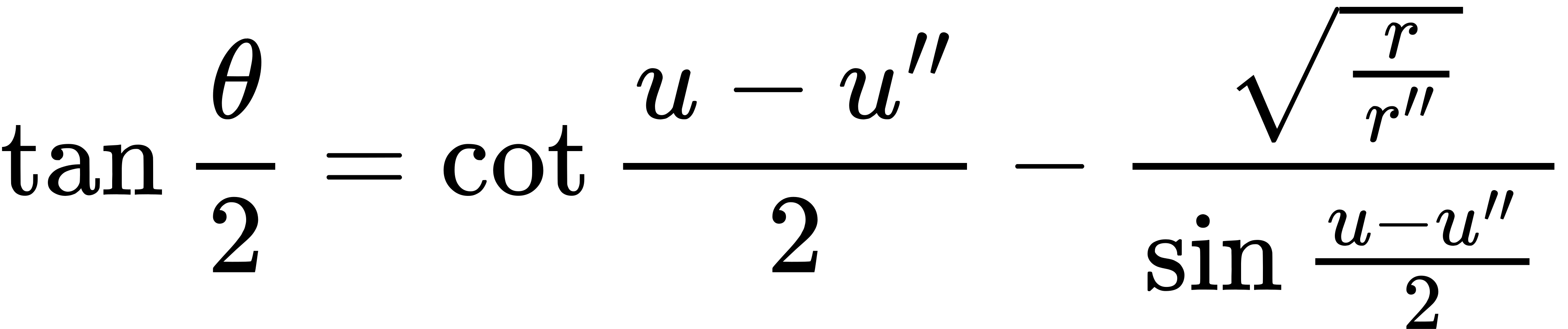 , which will serve to verify the computation of .
74 The perihelion distance may be equally well obtained by means of the third observation.
75 The time of the perihelion may be also derived from the first observation. If the result by each method agrees, it is a certain proof that the calculations have been correctly performed. Taking, therefore, the first observation, we find that it gives 41·047466 days; the variation in too small to be regarded.
76
By recollecting, that  , which, divided by
 , gives
  ; and then, substituting the values of
 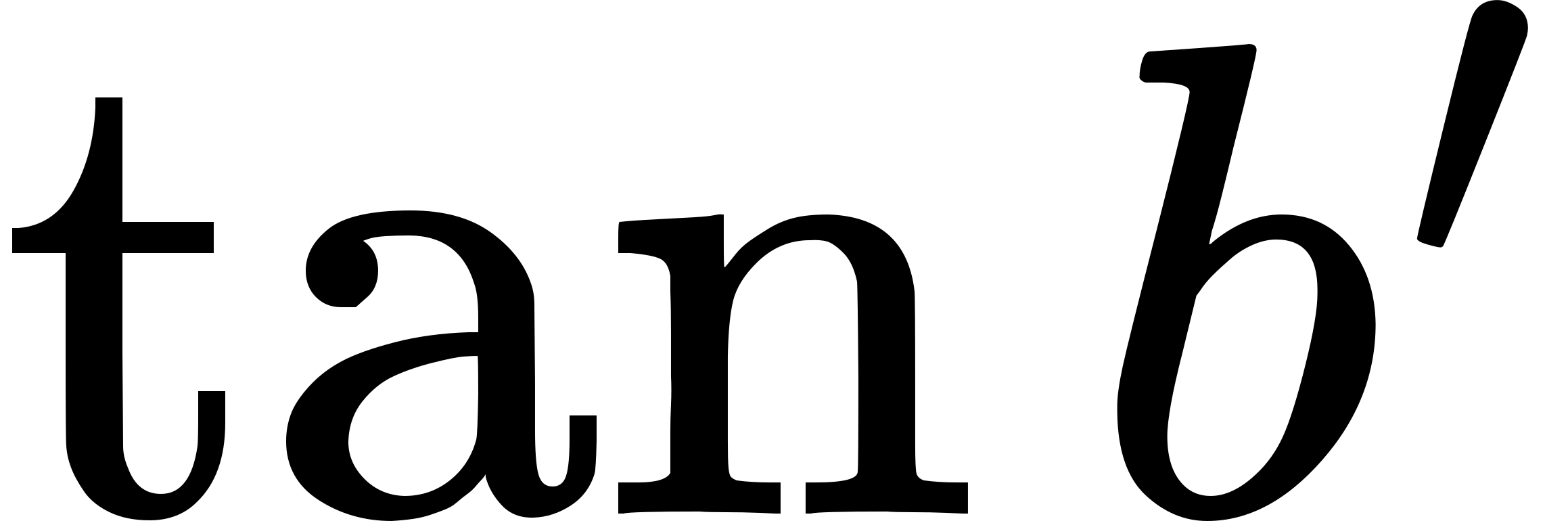 and
and 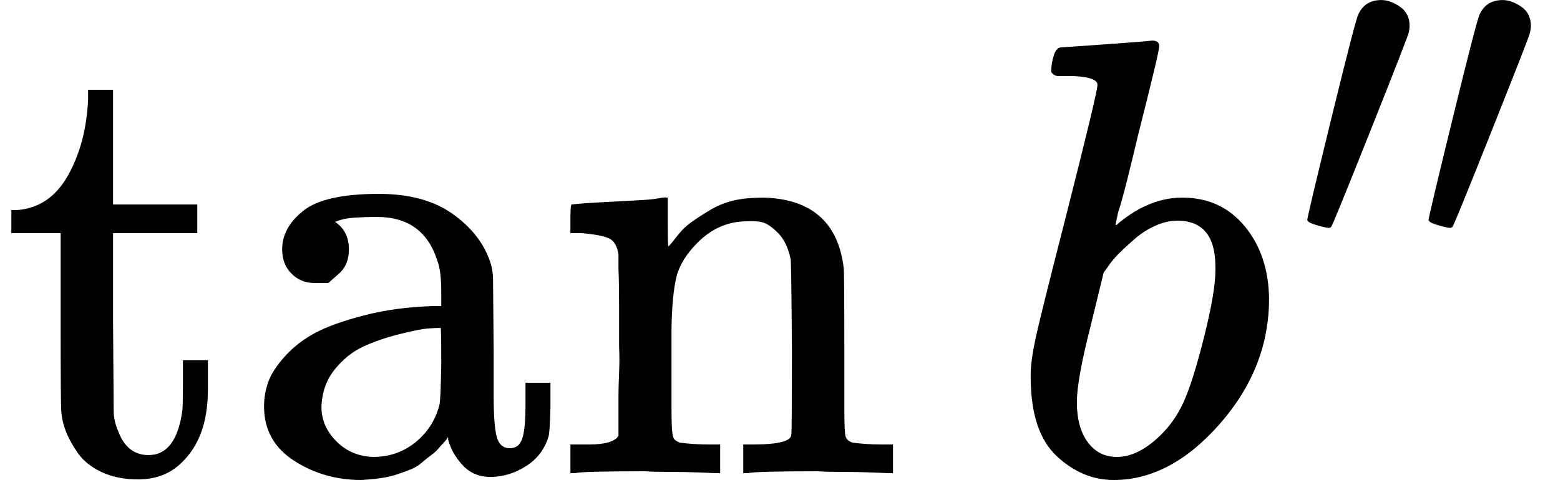 ,
found in p.60.
,
found in p.60.
77 Delambre, vol. iii.
79
Laplace has shown, that, “comparing thus the elements of the comets of 1607 and 1682,
Halley was able to announce, with a probability = 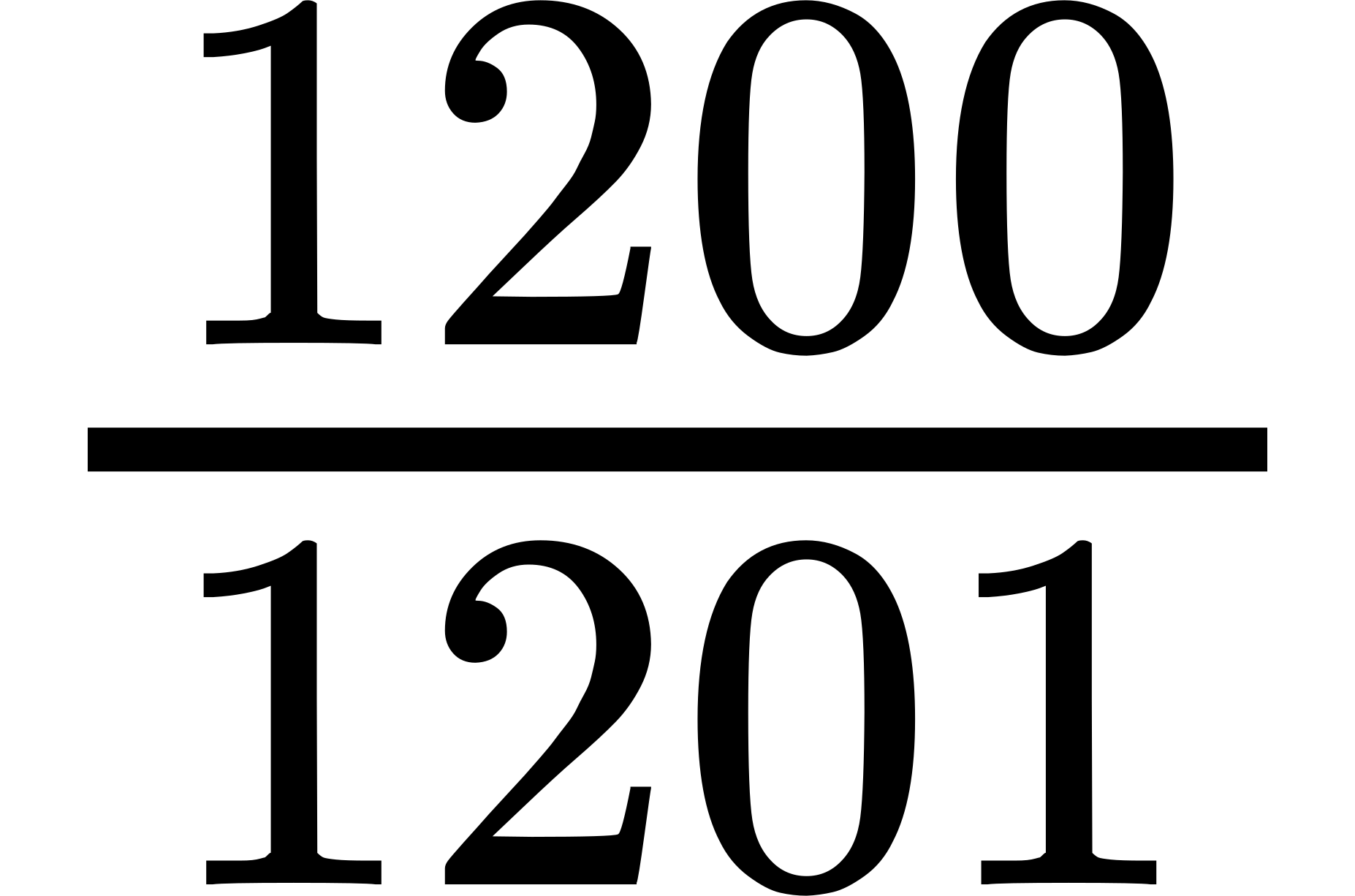 , that they were the same, and
that the comet would reappear towards the middle of the eighteenth century. The risk of
being deceived, though very small, nearly vanished, when he also recognized the elements of
this comet in the comet of 1531.”—Syst. du Monde.
, that they were the same, and
that the comet would reappear towards the middle of the eighteenth century. The risk of
being deceived, though very small, nearly vanished, when he also recognized the elements of
this comet in the comet of 1531.”—Syst. du Monde.
80
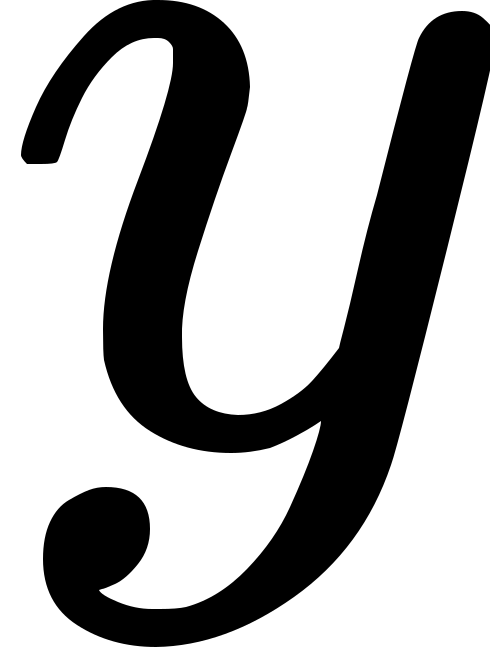 , ′, ″, it is observed by Gauss,
vary from 0° to 360°; , ′, ″ from 0° to 180°.
, ′, ″, it is observed by Gauss,
vary from 0° to 360°; , ′, ″ from 0° to 180°.
81
As a proof of the computation, we have 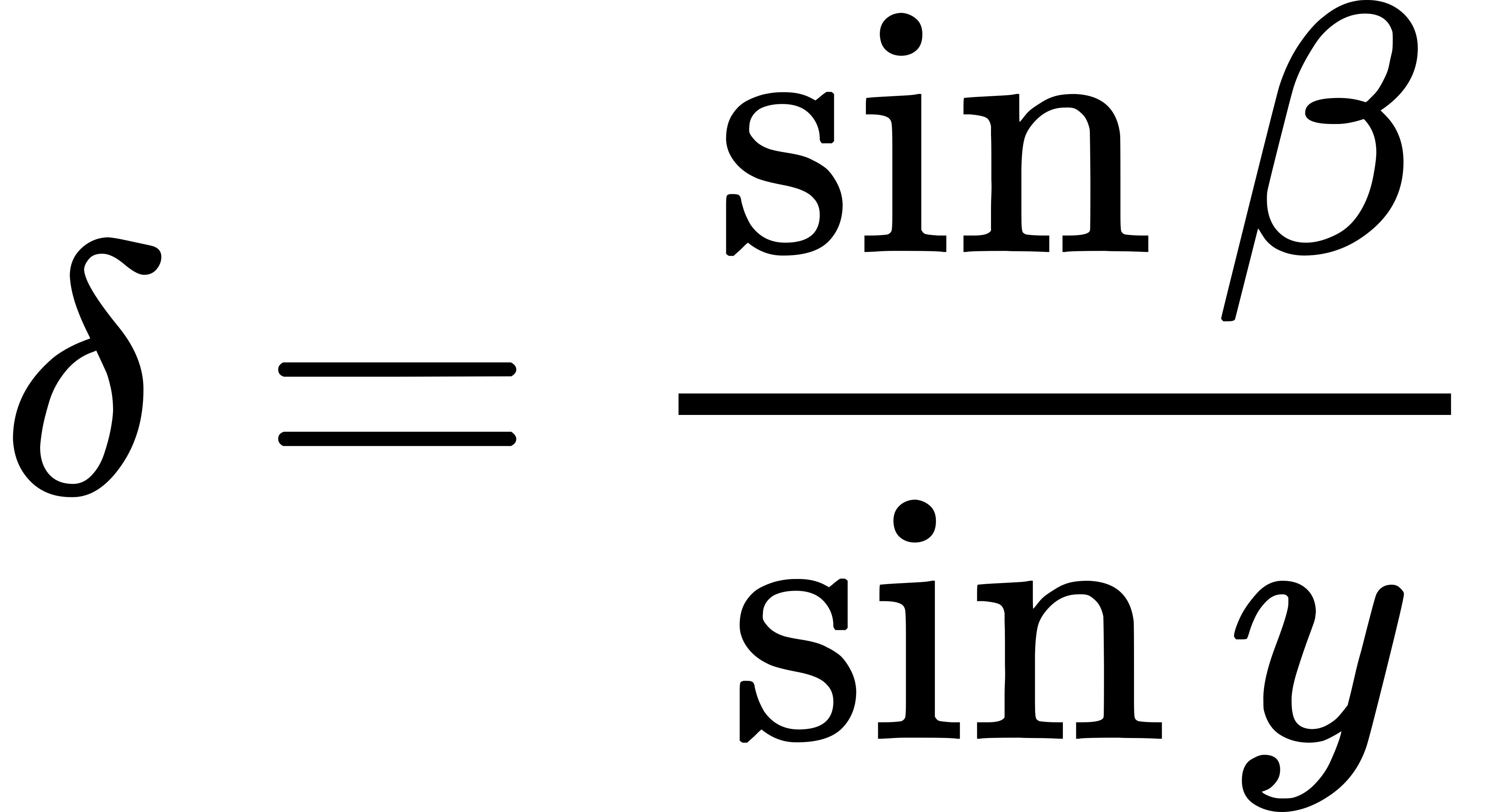 and
and  .
.
82
As a confirmation of our calculations, we have,

83
We have also  .
It is observed by Gauss, with respect
to these two equations giving the values of b, that if
.
It is observed by Gauss, with respect
to these two equations giving the values of b, that if  be greater than
 , the formula given in the text should be employed; if not, then the other may
be resorted to.
, the formula given in the text should be employed; if not, then the other may
be resorted to.
84
To know which of the roots of z gives the value here to be taken, it is to be remarked,
that all which are negative, the nature of the problem rejects; and of those which are positive,
it is that one only whose amount is not greater than ′ already determined.
85
In these equations, the value of w is found from  . In order
to discover the value of g, here also supposed known, the following is the procedure pointed
out by Gauss. First compute
. In order
to discover the value of g, here also supposed known, the following is the procedure pointed
out by Gauss. First compute
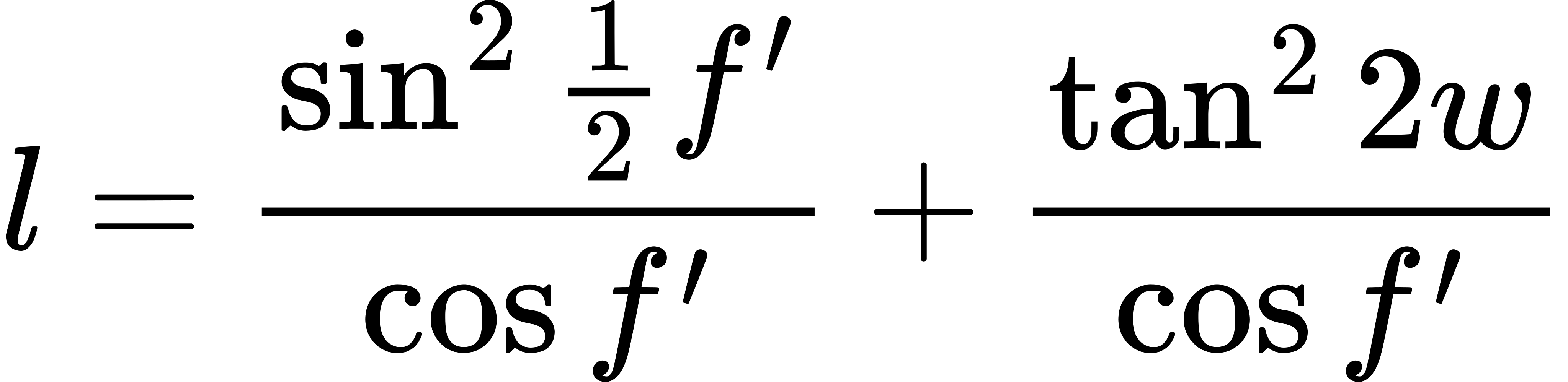 , then
 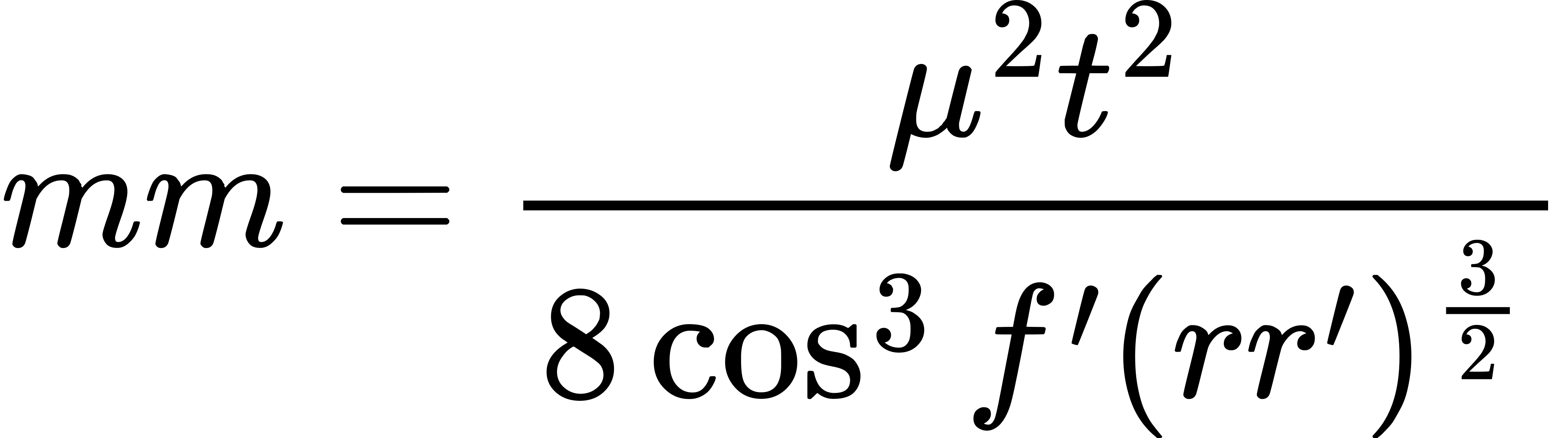 , and
, and 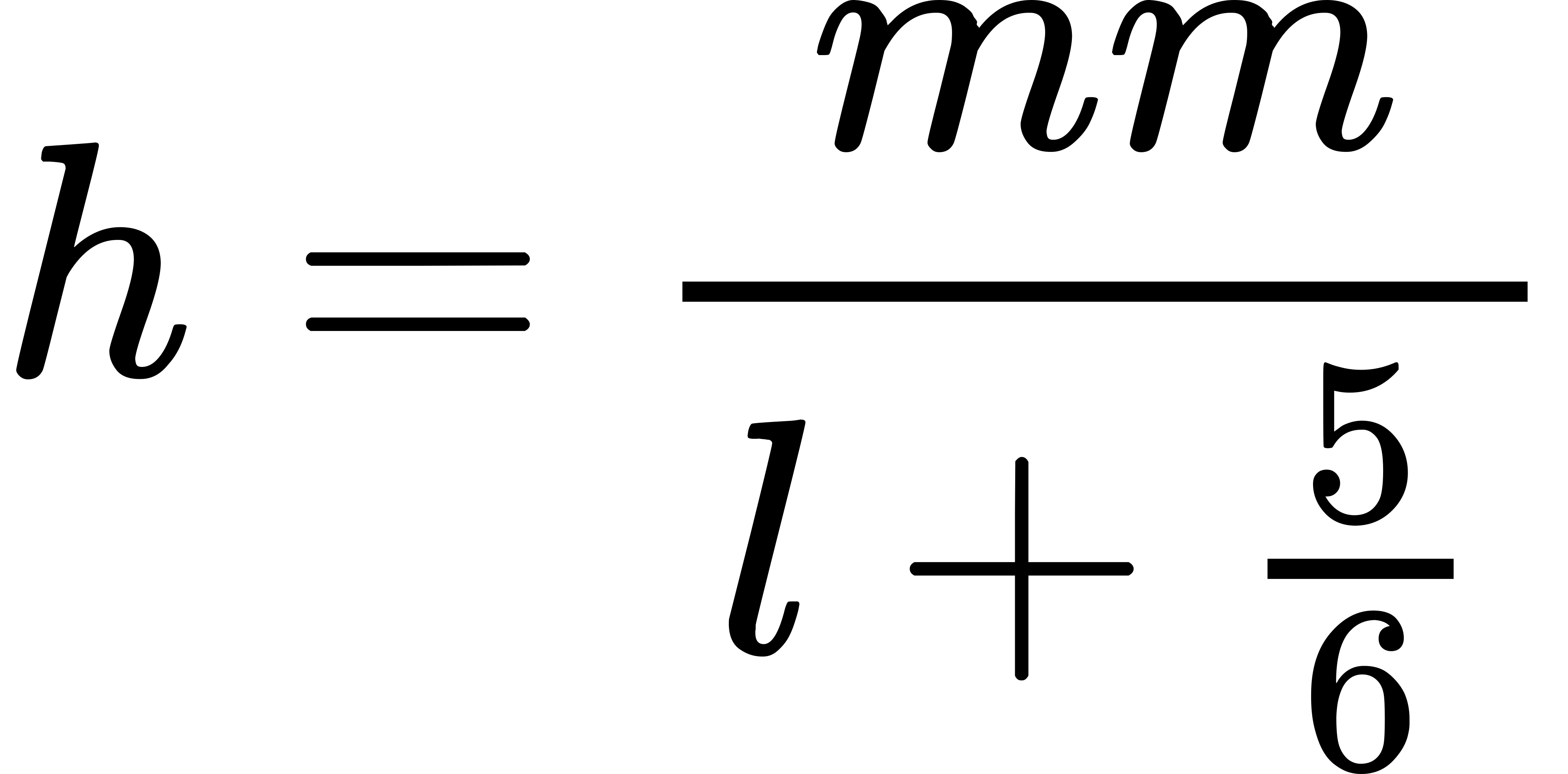 .
Corresponding to the value of h in Table II. given by Gauss, we find log yy, by means of
which we finally obtain
.
Corresponding to the value of h in Table II. given by Gauss, we find log yy, by means of
which we finally obtain 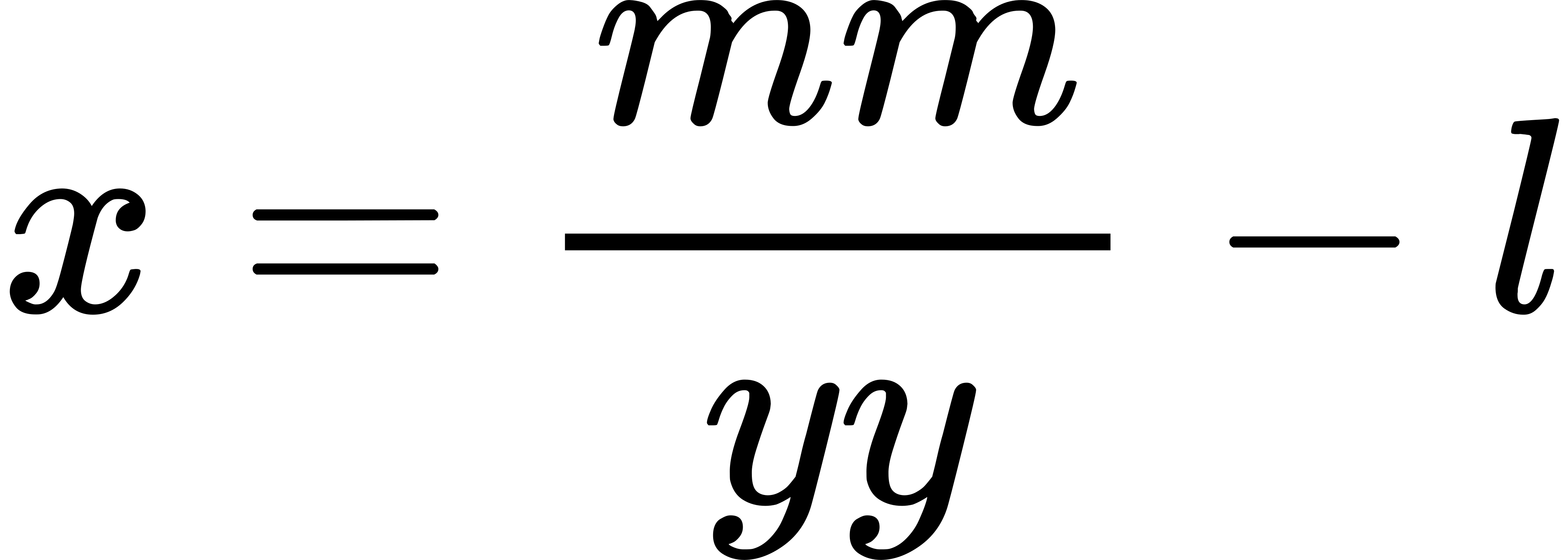 . Sometimes a small correction of h is to be applied: opposite
to the value of x in Table III. will be found
. Sometimes a small correction of h is to be applied: opposite
to the value of x in Table III. will be found 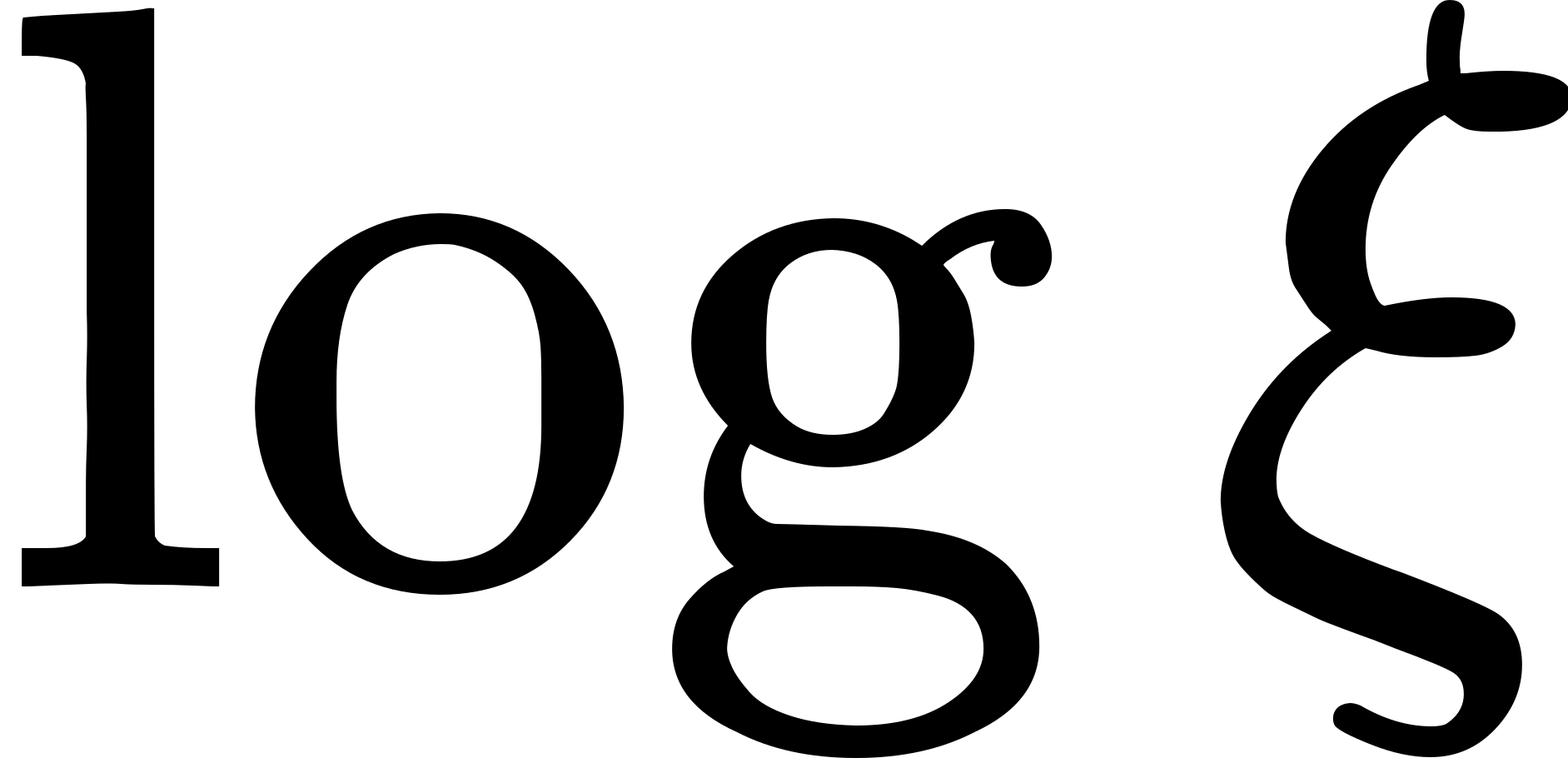 , which is then to be used in the
formula
, which is then to be used in the
formula 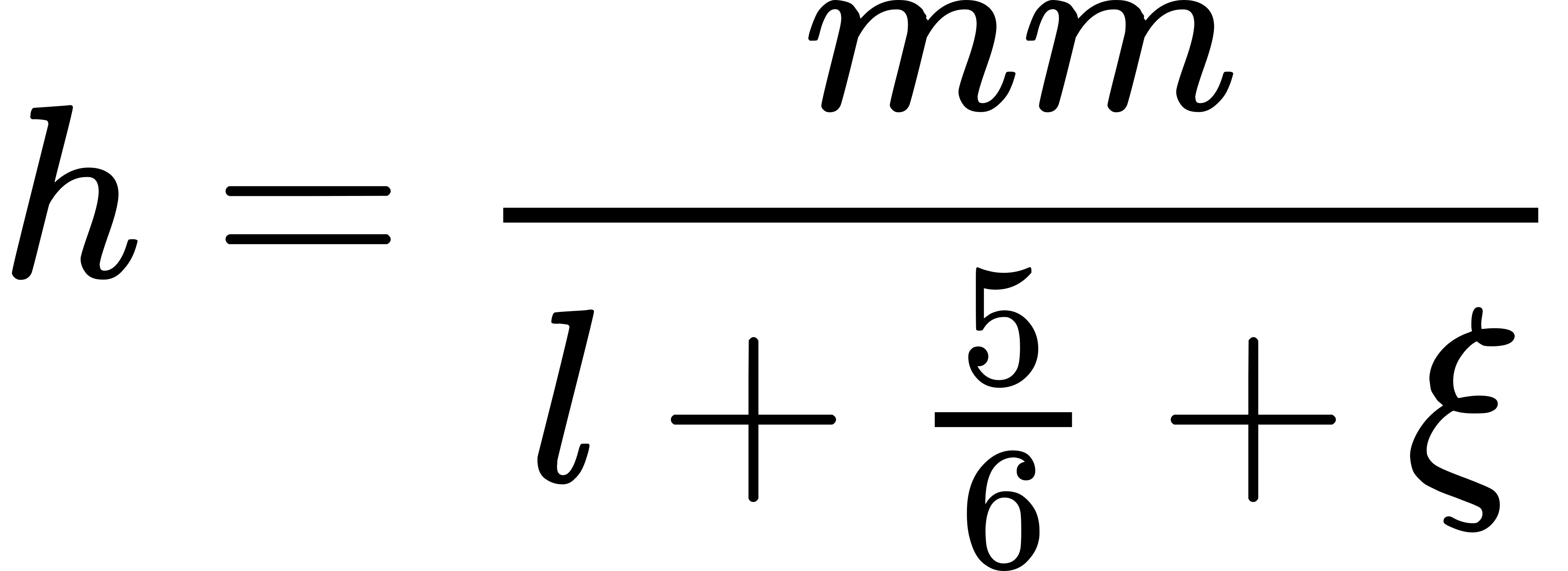 . This will give more correct values for y and x; and having thus
computed x, we have
. This will give more correct values for y and x; and having thus
computed x, we have 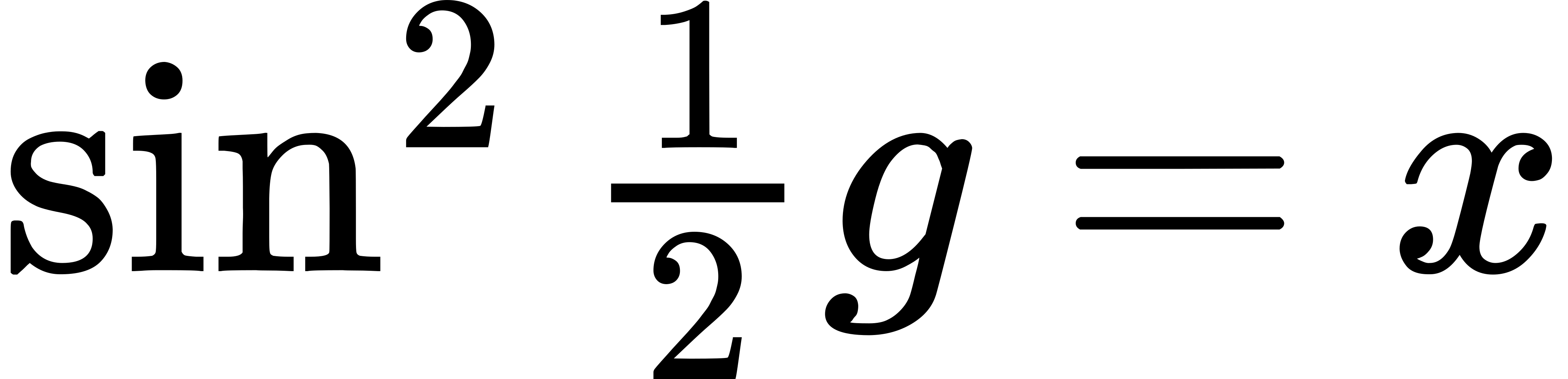 .
.
87
For since bodies attract directly as their mass, and inversely as the square of the distance,
and Jupiter being about 1070 times smaller than the Sun, we have the amount of Jupiter’s
attraction = 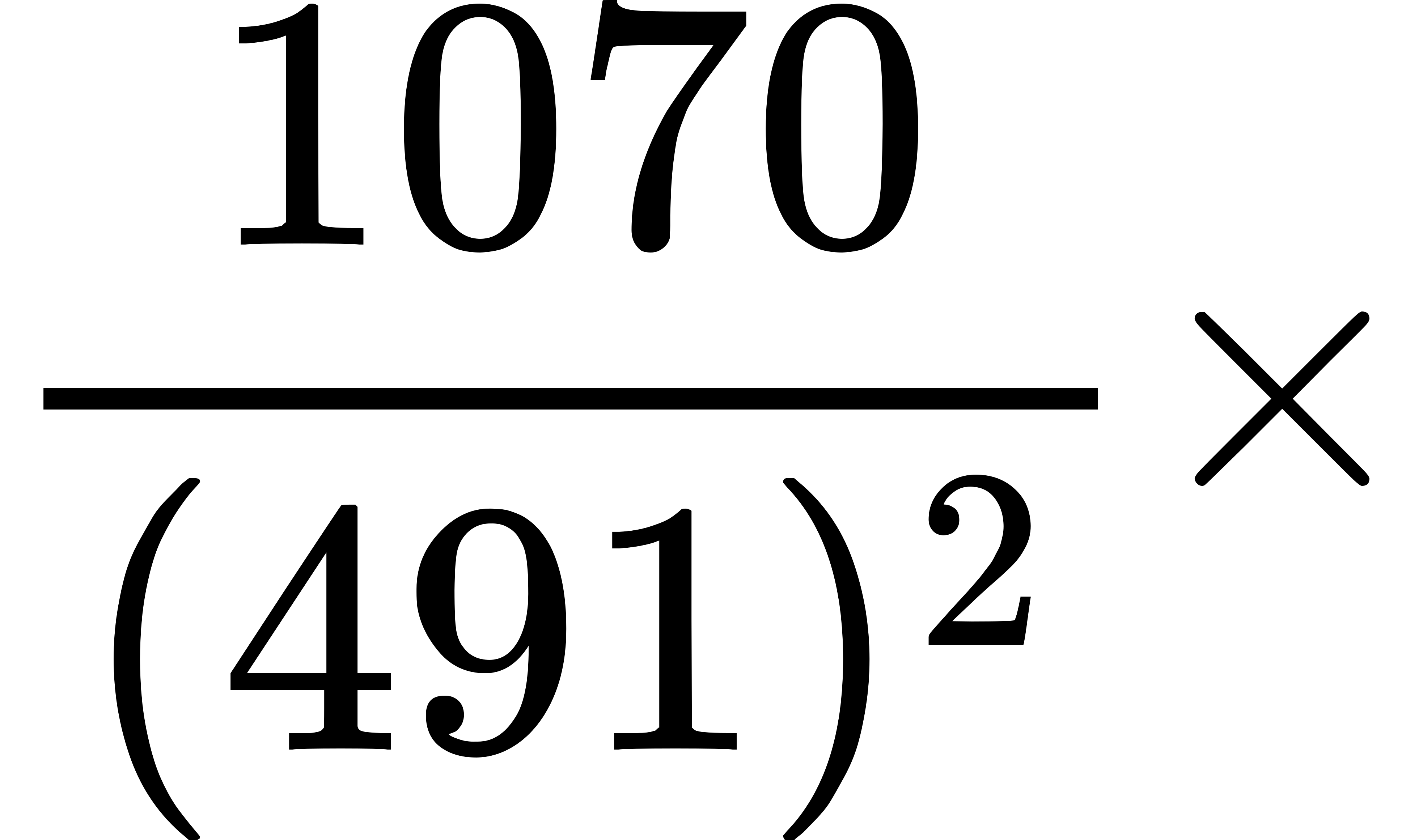 Sun’s attraction, = 225 times the Sun’s attraction.
90 Fries über die Sternkunde, 385. (Advocates’ Library.)
91 At this time, 1st July 1770, the distance of the Comet from the Earth was about six times that of the Moon.
92 Mec. Celeste, tom. iv.
93 This was one of the many apprehensions entertained by Maupertuis with respect to Comets.
95 In this circumstance actually originates the custom, still prevalent in many Catholic countries, of ringing the cathedral bells at noon. De Lambre, Hist. d’Astron. II. 539.
97 Pingré calculates, that, after the lapse of one hour, the Comet, in a certain case, would be vertical to a part of the Earth, distant 23° from the former; and by that time have also removed itself nearly 1.3 farther from the earth. In another supposition, he finds, that, after the lapse of the first half hour, the change in its vertical position would amount to no less than 81°; and in its distance from the earth, nearly three times the original distance of 13000 leagues.
98 Gelpe, Ansicht über den Naturbau der Kometen, (12.)
99 Brande’s Journal of Science, 1827, p. 373.
101 Gentleman’s Magazine, 1813, p. 432.
103 Unfortunately, however, for the feasability of this method of firing our globe, it has been shewn by Du Sejour, that the Comet of 1680, in receding from the Sun, after having received the requisite supply of heat, can never pass the Earth at a less distance than 9,000,000 of miles. If Whiston had lived to the year 1770, he would have seen, that it is possible for a comet to pass within 750,000 miles of the Earth, without creating a deluge, or setting our world on fire.
106 The velocity of the Comet 1680, at its perihelion, was, as has been already stated, 1,768,200 feet per second.
107
Reckoning the Moon’s mass at 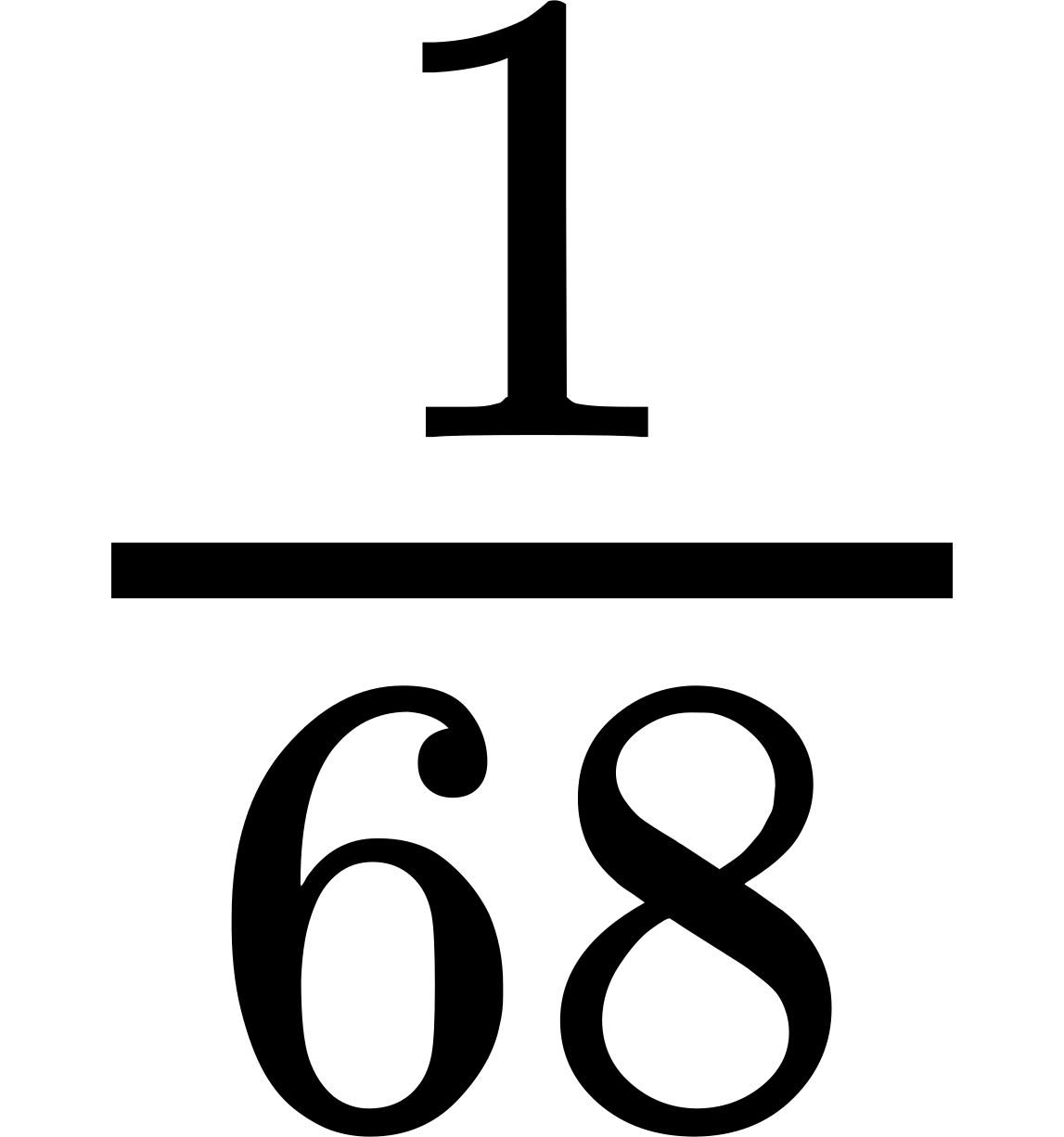 th of the Earth’s.
[08 This refers to another Theory regarding these small planets, first suggested by Olbers of Bremen, and adopted by Dr Brewster, that they are the fragments of a larger planet, which by some means or other has exploded.
109 Edinb. Encyclop. (edit. by Brewster), Astron. 639.
110 Littrow, Astron. ii. 184. (Vien. 1825.) Shrötermakes the diameters of all these planets immensely greater than Herschel; thus rendering the comparative heights of their atmospheres less surprising. According to him, Pallas is 2099 miles, Ceres 1624 miles, Juno 1425 miles, and Vesta 238 miles. The only measurements of the atmospheres which have as yet been made, are by Shröter. If they had been computed by Herschel, they would probably have been made much less.
111 Mecan. Celeste, Preface 28, & iv. 223.
112 Ibid. iv. 230.
115 Illustrations, &c. § 112.
116 Of the seventy-eight different quadrupeds, in the viviparous and oviparous classes, discovered by Cuvier, in a fossil state, forty-nine are distinct species, which are now wholly extinct.
117 Brewster’s Journal of Science, iv. 373.
118 In the cave at Kirkdale, similar aggregations of bones have been discovered; and in them also not only are the various animals now mentioned found in great quantities, but along with them different species of birds, mostly of the duck species. Note Y.
119 Jameson’s Manual of Mineralogy, 445.
120 Hist. Acad. des Sciences, 1770.
122 A mere glance, or recollection of a map of the world, will at once shew that all the great continents of Europe, Asia, Africa, and America, have their capes or promontories towards the south.
124 This Comet comes again to its perihelion on the 10th January 1829. The position of the Earth in its orbit will then be very favourable for viewing it from Europe. An ephemeris of its course has been computed by Encke, from which it appears, that the most advantageous time for observing it will be during the whole of next November and the first twenty-five days of December. (Brande’s Journal, Jan. 1828.)
125 This Comet, in its next approach in 1832, will pass the Earth’s orbit at the distance of about 14,000 leagues: But, at a period when the Earth will be in a different part of the orbit, and therefore no mutual attraction can by any possibility take place.
126
Already the movements of this Comet have indicated a difference of at least 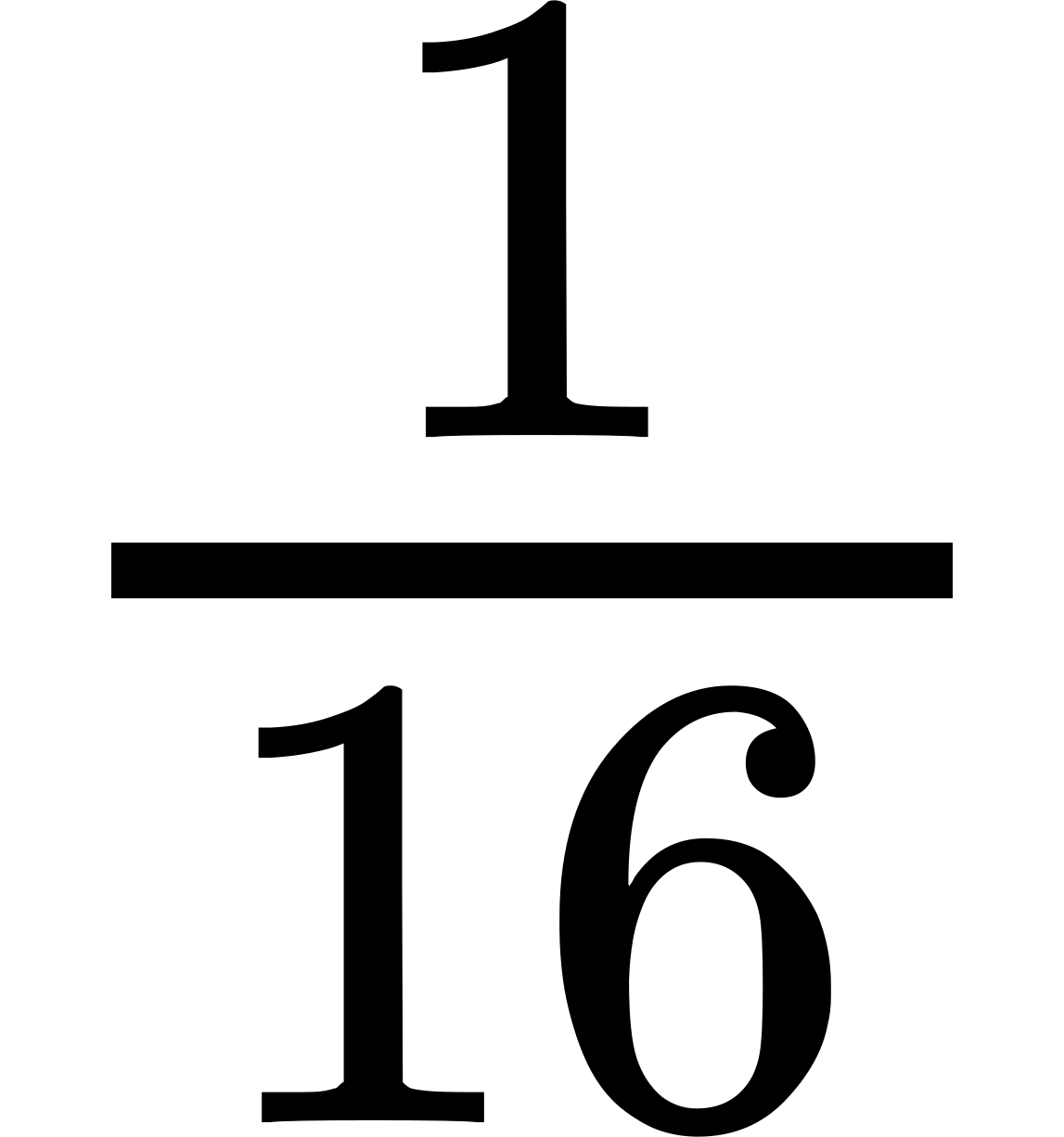 th part
in the mass of Jupiter, estimated by La Place. (Bode’s Jahrbuch, 1826). This important
result is also confirmed by the perturbations of Pallas, which, according to Gauss, prove a
difference of
th part
in the mass of Jupiter, estimated by La Place. (Bode’s Jahrbuch, 1826). This important
result is also confirmed by the perturbations of Pallas, which, according to Gauss, prove a
difference of 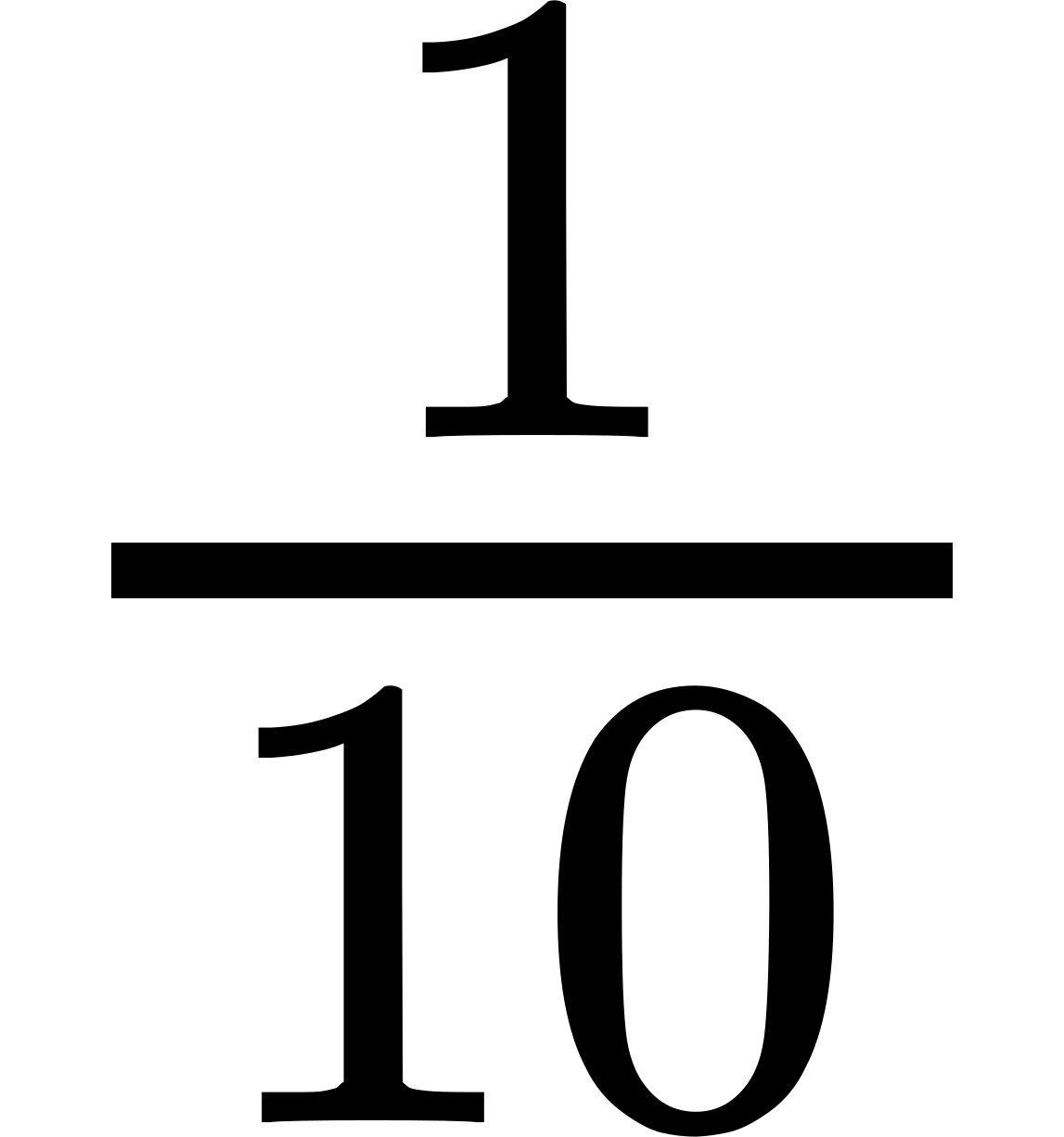 th part of Jupiter’s mass, given in the Mec. Celeste. (Edin. Phil. Journ.
July 1822).
th part of Jupiter’s mass, given in the Mec. Celeste. (Edin. Phil. Journ.
July 1822).
127 Gentleman’s Magazine, 1819.
128 There is a twofold chance of a comet’s intersecting this small circle, both before and after its perihelion.
130 Brande’s Astron. ii. 68.
131 “By the gradual increase of the distance of our Comet,” says Herschel, speaking of the Comet of 1807, “we have seen, that it assumed the semblance of a nebula; and it is certain, that had I met with it in one of my sweeps of the zones of the heavens, as it appeared on either of the days between the 6th December and the 21st February, it would have been put down in the list I have given of nebulæ.”
132 Connoissance des Tems, 1816.
133 Philos. Trans. 1812–14.
134 Brande’s Astron. ii. 31. I may here again advert to the difference in the measurements of this comet, made by Shröter and Herschel. If we assume the measurement given by the latter, it becomes even more favourable to the theory submitted in the text.
137 Gay Lussac mentions, that natural cold has been observed, and therefore sustained by the human frame, so severe as -58° of Fahrenheit—Brewster’s Journal, iii. 181.
138 Bailly, Hist. d’Astron. iii. 257.
139 “This system,” says Playfair, speaking of Buffon, “need not be considered in detail; the foundation of it is laid in such defiance of the principles of geometry and mechanics, that the architect, notwithstanding all the fertility of his invention, and all the resources of his genius, was never able to give any solidity to the structure.”—Illustrations of the Huttonian Theory, p. 434.
140 The inclination of the great Comet of 1819, amounts to 81°.
141 Syst. du Monde, ii. 5.
142 See Littrow, “Populare Astronomie” (Wien 1821), ii. 209, who speaks of Olbers’ theory in terms of the highest commendation.
143 The law of progression is this: That if 4 represent the distance of Mercury from the sun, all the other planets in succession will have their distances generally represented by the expressions 4 + 3 . 2°, or 7 for Venus; 4 + 3 . 21, or 10 for the earth; 4 + 3 . 22, or 16 for Mars; 4 + 3 . 23, or 28 for the new planets; and so of the rest.
144 It is a striking illustration of this remark, that 5 out of the 11 planets belonging to the system have been discovered only within the last half century. I may farther notice, that, from the year 1637 to 1757, or a period of 120 years, only 30 Comets altogether were observed; whilst from 1757 to 1817, or in exactly half that period, 60 Comets were observed, So much depends on the perfection of instruments!
145 Bode’s ‘Jahrbuch,’ 1826, p. 126.
146 An interesting paper will be found in the Memoirs of the Astronomical Society, vol. ii. concerning the effect of this resisting medium on the planets. It is there shewn, that, if the density of the ether be supposed 360,000,000,000 times less than that of atmospheric air, the resistance will be sufficient to produce the acceleration observed in the mean motion of Encke’s Comet. On investigating the effect of such a medium upon the movements of the planet Mercury, it is calculated that, in 100 Julian years, there would be a difference of no more than 31″.2 in the mean geocentric longitude of the planet at its inferior conjunction. It is here assumed that the density of the ether diminishes with the square of the distance from the Sun.
147 The Comet of 1763, in the aphelion part of its orbit, is 15,500,000,000 of geographical miles from the Sun. The Earth’s distance is nearly 21,000,000.
148 La Place conjectures that this limit may be about 100,000,000 times the Earth’s distance from the Sun—Connoiss. des Tems, 1816.
149 Cuvier’s Theory of the Earth, by Jameson, 523.
150 Ibid. 537.
151 Ibid. 544.
152 Ibid. 535.
153 Journal of Science, iv. 281.
The text of this e-book has mostly been preserved in its original form. However it contains numerous tables that use a monospaced font to ensure correct alignment of columns of figures and these may display variably on different viewing devices. On p.80 a paragraph containing numerals has also been displayed in the form of a table for the same reason.
In the Table of Contents, subsections of each Part of the book are listed with Arabic numbers and a ‘title’ that would usually appear as a subheading in the text. However, within the text they are identified only by Roman numerals, without a heading. In Part II, the fifth subsection is not specifically identified at all.
The book contains many footnotes, some quite complex, and these have been numbered consecutively and placed at the end of the book. Some footnote anchors were originally located at the end of equations, but they have had to be moved to the end of the preceding text due to software limitations.
Two pages were added to the book, presumably after typesetting was complete, and were inserted as pp. *7 and *8.
A footnote on p.69 (now footnote #67 at the end of this e-transcription) contains a symbol ☉ that might be unfamiliar to some readers. It represents the sun. The same footnote also has the characters AE, shorthand for Aspect Ratio. These appear as a conjoined ligature in the book, but cannot be represented that way digitally. The same ☉ symbol also appears in a table on p.71.
Page 73 has cross references to, and copies of, equations 2 and 3 on p.61. However, the copied equations are transposed and the parenthetic contents of equation 2 are reversed.
A table on p.78 has two values for Denominator, the second occurrence supposedly being a copy of the first, but in the book it lacks an initial zero. The missing digit has been inserted in this e-transcription.
Several of the equations are numbered and are x-referenced elsewhere in the text. Hyperlinks have been inserted to jump to the page where the equation occurs, but it is not possible to jump back to the site of the x-reference, On p.82 there are x-references to equations (16.) and (17.) but the book has no numbered equations beyond (14.)
There are many inconsistencies in the book, some probably attributable to typesetting errors during the laying out of the complex mathematics, rather than to the author. They affect spelling, punctuation, parentheses, use of italics, diacritics and primes, placement of superscripted characters (sometimes beside, sometimes above the relevant target character), and irregular use of mathematical symbols – the relevant symbol is sometimes missing altogether. Low dots (.) and mid-dots (·) are used interchangeably to represent decimal points (even within same equation) and both mid-dots and × are used to indicate multiplication. When primes and exponents occur together, e.g. \(''^{2}\) they are not always in the correct sequence.
Some spelling inconsistencies probably relate to language shifts over time. For example, N-gram analysis of the following diacritic variations – Systême/Système, Memoires/Mémoires, l'évenement/l'événement – show that the former predominated in the 1700s but switched to the latter in the 1800s.
The following spelling inconsistencies have
not been altered:
cos/cos.
De Lambre/Delambre
Fellowes'/Fellowes's
irreconcileable/irreconcilable
perihelium/perihelion
Shroeter/Schröter
but the ones below have been changed silently:
Apres → Après
Atron → Astron
aux → eux
encreases → increases
extreme → extrême
Olber’s → Olbers
perod → period
predictions → prédictions
Tems → Temps
tremblemens → tremblements