THE POETICAL WORKS
OF
HENRY WADSWORTH LONGFELLOW.

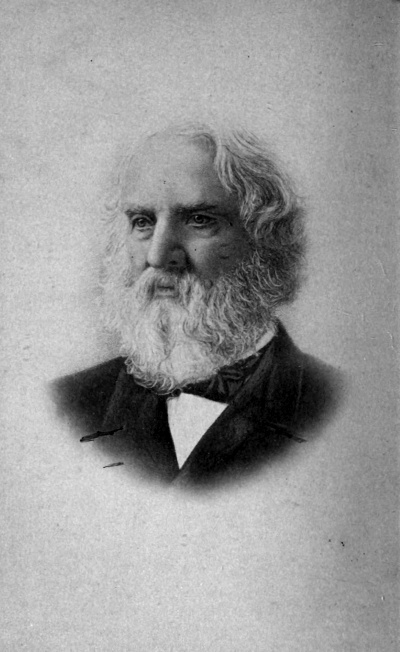
Portrait of HENRY W. LONGFELLOW.
THE “IMPERIAL” POETS.
THE POETICAL WORKS OF
HENRY WADSWORTH
LONGFELLOW.
REPRINTED FROM THE REVISED AMERICAN EDITION,
Including Recent Poems and Illustrated Memoir.
LONDON:
FREDERICK WARNE AND CO.
BEDFORD STREET, STRAND.
1889.
Morrison and Gibb, Edinburgh,
Printers to Her Majesty’s Stationery Office.
PUBLISHERS’ PREFACE.
The Publishers have the pleasure of presenting to the Public
in this volume an edition of Longfellow’s Poems,
revised and corrected by comparison with his last American Edition, in
which he made many emendations; and including his earliest and latest
Poems, among which are several that have not appeared in any other
edition of this popular Author’s works.

EARLY POEMS. |
| |
page |
| An April Day |
1 |
| Autumn |
2 |
| Sunrise on the Hills |
3 |
| Woods in Winter |
4 |
| Hymn of the Moravian Nuns of Bethlehem, |
|
| at the Consecration of Pulaski’s Banner |
4 |
| Burial of the Minnisink |
5 |
| The Spirit of Poetry |
5 |
VOICES OF THE NIGHT. |
| Prelude |
7 |
| Hymn to the Night |
8 |
| A Psalm of Life |
9 |
| Footsteps of Angels |
9 |
| The Reaper and the Flowers |
10 |
| The Light of Stars |
11 |
| Flowers |
11 |
| The Beleaguered City |
13 |
| L’Envoi |
13 |
| Midnight Mass for the Dying Year |
14 |
BALLADS. |
| The Skeleton in Armour |
15 |
| The Wreck of the Hesperus |
17 |
POEMS ON SLAVERY. |
| To William E. Channing |
20 |
| The Slave’s Dream |
20 |
| The Slave in the Dismal Swamp |
21 |
| The Good Part that shall not be taken away |
21 |
| The Quadroon Girl |
22 |
| The Witnesses |
23 |
| The Warning |
23 |
| The Slave singing at Midnight |
24 |
MISCELLANEOUS POEMS. |
| It is not always May |
25 |
| The Rainy Day |
25 |
| The Village Blacksmith |
26 |
| Endymion |
26 |
| God’s-Acre |
27 |
| To the River Charles |
27 |
| Blind Bartimeus |
28 |
| The Goblet of Life |
28 |
| The Sea-Diver |
29 |
| The Belfry of Bruges |
30 |
| Maidenhood |
32 |
| The Arsenal at Springfield |
33 |
| A Gleam of Sunshine |
34 |
| Nuremberg |
35 |
| The Indian Hunter |
37 |
| The Norman Baron |
38 |
| To a Child |
39 |
| The Occultation of Orion |
43 |
| Rain in Summer |
44 |
| The Bridge |
45 |
| Excelsior |
46 |
| To the Driving Cloud |
47 |
| Curfew |
48 |
SONGS. |
| To an old Danish Song-book |
49 |
| The Arrow and the Song |
50 |
| Walter Von der Vogelweid |
50 |
| The Day is Done |
51 |
| Sea-weed |
51 |
| Drinking Song |
52 |
| The Old Clock on the Stairs |
53 |
| Afternoon in February |
54 |
THE SPANISH STUDENT |
55 |
EVANGELINE |
106 |
THE SEASIDE AND THE FIRESIDE. |
| Dedication |
139 |
| BY THE SEASIDE. |
| The Building of the Ship |
140 |
| Twilight |
145 |
| The Fire of Drift-wood
[Pg vi] |
145 |
| The Lighthouse |
146 |
| Sir Humphrey Gilbert |
147 |
| The Secret of the Sea |
148 |
| The Evening Star |
149 |
| BY THE FIRESIDE. |
| Resignation |
149 |
| The Builders |
150 |
| Sand of the Desert in an Hour-glass |
151 |
| Pegasus in Pound |
152 |
| King Witlaf’s Drinking-horn |
153 |
| Tegner’s Drapa |
153 |
| The Singers |
154 |
| Suspiria |
155 |
| The Open Window |
155 |
| Hymn |
155 |
| Gasper Becerra |
156 |
THE GOLDEN LEGEND. |
| Prologue |
157 |
| The Nativity: A Miracle-Play |
197 |
| Epilogue |
249 |
| |
| Martin Luther |
251 |
| St. John |
253 |
| |
| THE SONG OF HIAWATHA |
255 |
| |
| THE COURTSHIP OF MILES STANDISH |
314 |
TALES OF A WAYSIDE INN. |
| DAY THE FIRST. |
| Prelude—The Wayside Inn |
338 |
| The Landlord’s Tale—Paul Revere’s Ride |
341 |
| Interlude |
344 |
| The Student’s Tale—The Falcon of Ser Federigo |
345 |
| Interlude |
351 |
| The Spanish Jew’s Tale—The Legend of Rabbi Ben Levi |
352 |
| Interlude |
353 |
| The Sicilian’s Tale—King Robert of Sicily |
354 |
| Interlude |
358 |
| The Musician’s Tale—The Saga of King Olaf |
359 |
| I. The Challenge of Thor |
359 |
| II. King Olaf’s Return |
359 |
| III. Thora of Rimol |
360 |
| IV. Queen Sigrid the Haughty |
361 |
| V. The Skerry of Shrieks |
363 |
| VI. The Wraith of Odin |
364 |
| VII. Iron-Beard |
366 |
| VIII. Gudrun |
368 |
| IX. Thangbrand the Priest |
368 |
| X. Raud the Strong |
369 |
| XI. Bishop Sigurd at Salten Fiord |
370 |
| XII. King Olaf’s Christmas |
371 |
| XIII. The Building of the Long Serpent |
372 |
| XIV. The Crew of the Long Serpent |
373 |
| XV. A Little Bird in the Air |
374 |
| XVI. Queen Thyri and the Angelica-stalks |
374 |
| XVII. King Svend of the Forkèd Beard |
375 |
| XVIII. King Olaf and Earl Sigvald |
376 |
| XIX. King Olaf’s War-horns |
377 |
| XX. Einar Tamberskelver |
378 |
| XXI. King Olaf’s Death-drink |
378 |
| XXII. The Nun of Nidaros |
379 |
| Interlude |
380 |
| The Theologian’s Tale—Torquemada |
381 |
| Interlude |
386 |
| The Poet’s Tale—The Birds of Killingworth |
386 |
| Close of First Day |
392 |
| THE SECOND DAY. |
| Prelude |
392 |
| The Sicilian’s Tale—The Bell of Atri |
394 |
| Interlude |
396 |
| The Spanish Jew’s Tale—Kambalu |
397 |
| Interlude |
399 |
| The Student’s Tale—The Cobbler of Hagenau |
399 |
| Interlude |
402 |
| The Musician’s Tale—The Ballad of Carmilhan |
403 |
| Interlude |
406 |
| The Poet’s Tale—Lady Wentworth |
406 |
| Interlude |
410 |
| The Theologian’s Tale—The Legend Beautiful |
410 |
| Interlude |
412 |
| The Student’s Second Tale—The Baron of St. Castine |
412 |
| Finale |
419 |
| |
| Scanderbeg |
419 |
| The Rhyme of Sir Christopher |
421 |
| Charlemagne |
423 |
FLOWER-DE-LUCE. |
| Beautiful Lily |
425 |
| Palingenesis |
426 |
| Hawthorne |
427 |
| The Bells of Lynn |
428 |
| The Bridge of Cloud |
429 |
| The Wind over the Chimney
[Pg vii] |
429 |
| Killed at the Ford |
430 |
| Noël |
431 |
| Christmas Bells |
432 |
SONNETS |
| Autumn |
434 |
| Giotto’s Tower |
434 |
| Dante |
435 |
| To-morrow |
435 |
| The Evening Star |
435 |
| Divina Commedia |
436 |
| On Mrs. Kemble’s Readings from Shakespeare |
437 |
| Nature |
438 |
| In the Churchyard at Tarrytown |
438 |
| Eliot’s Oak |
438 |
| The Descent of the Muses |
439 |
| Venice |
439 |
| The Two Rivers |
439 |
| Chaucer |
441 |
| Woodstock Park |
441 |
| St. John’s, Cambridge |
441 |
| Boston |
442 |
| The Burial of the Poet |
442 |
| The Three Silences of Molinos |
442 |
| My Cathedral |
443 |
| To the River Rhone |
443 |
| Wapentake |
443 |
| The Broken Oar |
444 |
| Agassiz |
444 |
| |
| THE HANGING OF THE CRANE |
445 |
| MORITURI SALUTAMUS |
447 |
| |
| KÉRAMOS |
454 |
BIRDS OF PASSAGE. |
| FLIGHT THE FIRST. |
| Prometheus; or, The Poet’s Forethought |
459 |
| The Ladder of St. Augustine |
460 |
| Birds of Passage |
460 |
| The Phantom Ship |
461 |
| The Warden of the Cinque Ports |
462 |
| Haunted Houses |
463 |
| The Emperor’s Bird’s-nest |
464 |
| In the Churchyard at Cambridge |
465 |
| The Two Angels |
465 |
| Oliver Basselin |
466 |
| The Jewish Cemetery at Newport |
467 |
| Victor Galbraith |
469 |
| Daylight and Moonlight |
470 |
| My Lost Youth |
470 |
| The Ropewalk |
472 |
| The Golden Milestone |
473 |
| Catawba Wine |
474 |
| Daybreak |
475 |
| Santa Filomena |
476 |
| The Fiftieth Birthday of Agassiz |
476 |
| The Discoverer of the North Cape |
477 |
| Children |
478 |
| Sandalphon |
479 |
| Epimetheus; or, The Poet’s Afterthought |
479 |
FLIGHT THE SECOND. |
| A Day of Sunshine |
480 |
| The Children’s Hour |
481 |
| Enceladus |
481 |
| The Cumberland |
482 |
| Something Left Undone |
483 |
| Weariness |
483 |
| Snow-flakes |
484 |
FLIGHT THE THIRD. |
| Cadenabbia |
484 |
| Charles Sumner |
485 |
| Monte Cassino |
485 |
| Amalfi |
487 |
| A Dutch Picture |
488 |
| The Sermon of St. Francis |
489 |
| Travels by the Fireside |
490 |
FLIGHT THE FOURTH. |
| The Herons of Elmwood |
491 |
| Vittoria Colonna |
491 |
| Song |
492 |
| A Ballad of the French Fleet |
492 |
| Castles in Spain |
493 |
| The White Czar |
494 |
| The Leap of Roushan Beg |
495 |
| Haroun Al Raschid |
496 |
| The Three Kings |
496 |
| King Trisanku |
498 |
| Vox Populi |
498 |
| The Revenge of Rain-in-the-Face |
498 |
| To the River Yvette |
499 |
| The Emperor’s Glove |
499 |
| A Wraith in the Mist |
499 |
MISCELLANEOUS POEMS. |
| The Golden Sunset |
500 |
| From my Arm-chair |
500 |
| The Chamber over the Gate |
501 |
| The Four Lakes of Madison |
502 |
| The Sifting of Peter |
503 |
| Helen of Tyre |
503 |
| The Iron Pen |
504 |
| The Poet and his Songs |
504 |
| Robert Burns |
505 |
| Bayard Taylor |
506 |
| Old St. David’s at Radnor |
507 |
| Jugurtha
[Pg viii] |
508 |
| Maiden and Weathercock |
508 |
| The Windmill |
509 |
| Via Solitaria |
510 |
| Auf Wiedersehen |
511 |
| Ultima Thule |
511 |
| Hermes Trismegistus |
512 |
| Decoration Day |
513 |
| Mad River |
514 |
| Inscription on the Shanklin Fountain, Isle of Wight |
515 |
| The Bells of San Blas |
516 |
| President Garfield |
517 |
EARLIEST POEMS. |
| Thanksgiving |
518 |
| Autumnal Nightfall |
519 |
| Italian Scenery |
520 |
| The Lunatic Girl |
522 |
| The Venetian Gondolier |
524 |
| Dirge over a Nameless Grave |
525 |
| A Song of Savoy |
525 |
| Jeckoyva |
525 |
| Musings |
527 |
| Song |
528 |
TRANSLATIONS. |
TRANSLATIONS FROM THE SPANISH
AND PORTUGUESE. |
| Coplas de Manrique |
529 |
| The Good Shepherd |
535 |
| The Brook |
535 |
| Santa Teresa’s Book-mark |
535 |
| To-morrow |
536 |
| The Native Land |
536 |
| The Image of God |
536 |
| Two Sonnets from Francisco de Medrano |
537 |
TRANSLATIONS FROM THE ITALIAN. |
| The Celestial Pilot |
538 |
| The Terrestrial Paradise |
539 |
| Beatrice |
540 |
| Three Cantos of Dante’s Paradiso |
541 |
| The Old Bridge at Florence |
551 |
| The Nature of Love |
552 |
| To Italy |
552 |
TRANSLATIONS FROM THE FRENCH. |
| Spring |
553 |
| The Child Asleep |
553 |
| Rondel—From Froissard |
554 |
| Rondel—From the Duke of Orleans |
554 |
| Renouveau |
555 |
| Friar Lubin |
555 |
| Death of Archbishop Turpin |
556 |
| To Cardinal Richelieu |
557 |
| Consolation |
558 |
| The Angel and the Child |
559 |
| A Christmas Carol |
560 |
| The Blind Girl of Castèl-Cuillè |
560 |
| My Secret |
569 |
| Barréges |
570 |
| On the Terrace of the Aigalades |
570 |
TRANSLATIONS FROM THE ANGLO-SAXON. |
| The Grave |
571 |
| Beowulf’s Expedition to Heort |
571 |
| The Soul’s Complaint against the Body |
573 |
TRANSLATIONS FROM THE SWEDISH. |
| Frithiof’s Homestead |
573 |
| Frithiof’s Temptation |
574 |
| The Children of the Lord’s Supper |
576 |
TRANSLATIONS FROM THE GERMAN. |
| The Statue over the Cathedral Door |
585 |
| The Hemlock-tree |
586 |
| Annie of Tharaw |
586 |
| The Legend of the Crossbill |
588 |
| Poetic Aphorisms |
588 |
| The Sea hath its Pearls |
590 |
| Song of the Silent Land |
590 |
| Blessed are the Dead |
591 |
| The Wave |
591 |
| The Bird and the Ship |
592 |
| The Happiest Land |
593 |
| Whither? |
593 |
| Beware! |
594 |
| Song of the Bell |
594 |
| The Dead |
594 |
| The Castle by the Sea |
595 |
| Wanderer’s Night-Songs |
595 |
| The Black Knight |
595 |
| Silent Love |
596 |
| The Luck of Edenhall |
597 |
| The Two Locks of Hair |
598 |
| Remorse |
599 |
TRANSLATIONS FROM THE DANISH. |
| King Christian |
599 |
| The Elected Knight |
600 |
| Childhood |
602 |
MISCELLANEOUS TRANSLATIONS. |
| The Fugitive |
603 |
| To the Stork |
604 |
| The Boy and the Brook |
605 |
| The Siege of Kazan |
605 |
| Columbus |
606 |
NOTES |
607 |
INDEX OF FIRST LINES |
627 |
Henry Wadsworth Longfellow was born at Portland, Maine, on the 27th of
February, 1807. His father, Mr. Stephen Longfellow, a native of Gorham,
Maine, then a District of Massachusetts, was a descendant of William
Longfellow, of Newbury, in the same state, who was born in Yorkshire,
England, in 1651, and emigrated to America in early youth. He married
Miss Anne Sewell, and after a married life of fourteen years was
drowned at Anticosti, a large desert island in the estuary of the St.
Lawrence. Mr. Stephen Longfellow, a descendant in the fourth generation
of this gentleman, was born in the year in which the colonies declared
their independence of the mother country. He graduated at Harvard
College in his twenty-second year, and devoted himself to the law,
removing to Portland at the beginning of the present century. He was a
good jurist, as the Massachusetts and Maine Reports testify, and was a
member of the national Congress when it was an honour to belong to that
body. He was also the president of the Maine Historical Society. He was
the father of our poet, whose mother was a descendant of John Alden:
who must have been a prolific old Puritan, for his descendants have produced
two American poets, William Cullen Bryant and Henry Wadsworth Longfellow.
[Pg x]
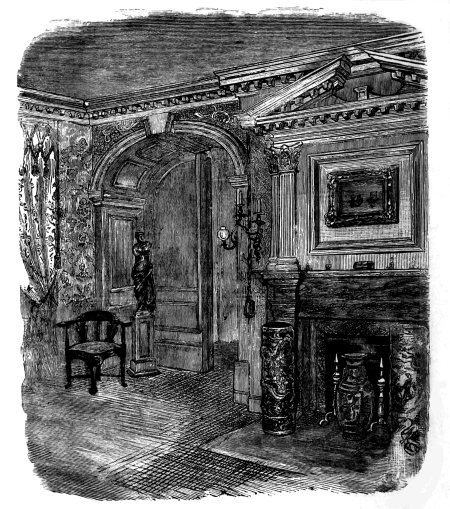
LONGFELLOW’S DRAWING-ROOM.
The first school the young poet attended was kept by a Mrs. Fellows, in
a small house in Spring Street. Later he went to the town school, and
soon after to the private school of Nathaniel H. Carter. Afterwards he
attended the Portland Academy under the same master, and also under the
mastership of Bezaleel Cushman. He entered Bowdoin College at the age
of fourteen. It was a remarkable class in which he found himself for it
contained, among other men who have arrived at eminence in literature,
Nathaniel Hawthorne, George B. Cheever, and J. S. C. Abbott: and he
must have distinguished himself, or he would not have received—as he
did—the appointment of professor of modern languages and literatures,
[Pg xi]
shortly after he graduated, in 1825. He accepted this appointment, with
the privilege of going abroad for three years, in order to qualify
himself fully for his duties, and the following year saw him travelling
on the Continent.
During his last years at college, the future professor of modern
literature contributed in a modest way to the poetry of his native
land. There was no American poet at the time worth speaking of, except
Bryant; and there were no periodicals in the states, to which young
aspirants could send their contributions. Attempts had been made to
establish them, but without success, for they either died after a few
months’ struggle, or were merged in others, which were threatened with
dissolution. There was in New York a “Literary Gazette” (for which
Griswold says Sands wrote); then an “Atlantic Monthly”; and then the
“New York Review and Athenæum Magazine,” of which Bryant was the first
editor. This became, by the process of merging, the “New York Literary
Gazette and American Athenæum,” which culminated in the “United States
Literary Gazette.” It was in the pages of this last publication, which
was issued simultaneously in New York and Boston, that the early poems
of the young Bowdoin student were given to the world.
With rare exceptions, early poems are imitative, either of one or
more poets whom their writers have read and admired, or of what is
most marked in the poetry of the period. A careful reading of the
“United States Literary Gazette” would show, I have no doubt, that
Mr. Longfellow was not the only American singer, young and old, whose
work bore the impress of the Author of “Thanatopsis.” It is legible
in “Autumn,” “Sunrise on the Hills,” and “The Spirit of Poetry” (I
am writing of Mr. Longfellow’s early poems), and it is present, in
suggestion, in “An April Day,” “Woods in Winter,” and “The Burial of
the Minnesink.” Description of nature is the motive of these pieces,
which are written from books rather than from observation. They show
an apt ear for versification, and a sensitive temperament, which makes
its own individuality felt in the midst of alien poetic influences.
Clearly, a new poet had appeared in the “United States Literary Gazette.”
European travel was not common among Americans fifty years ago; nor
were the places to be visited always determined beforehand. A certain
amount of originality was allowed to the tourist, and if he wrote a book
[Pg xii]
about what he saw it was not expected that he should cram it with
information. He could be desultory, scholarly, whimsical,—he might
even be a little dull: what was wanted were his impressions. The time
allotted to Mr. Longfellow by his alma mater was passed in
France, Spain, Italy, Germany, Holland, and England. We have glimpses
of what he saw in the first three of these countries, and, in a
measure, of his studies and meditations therein. He has not enabled us
to follow his itinerary with any certainty.
Mr. Longfellow returned to America, and to his duties at Brunswick, and
took to himself a wife in his twenty-fourth year.
His first volume, which was published in Boston, in his twenty-sixth
year (1833), is a translation of the “Coplas de Don Jorge Manrique,”
a thin little twelvemo of eighty-nine pages, which opens with an
“Introductory Essay on the Moral and Devotional Poetry of Spain.” This
scholarly paper contains all that the average reader of forty-five
years ago would care to read in regard to the comprehensive subject
which it discussed. The preface briefly dismissed the original writer
by saying that he followed the profession of arms, as did most Spanish
poets of any eminence; that he fought beneath the banner of his father
Roderigo Manrique, Conde de Parades, and Maestre de Santiago, and that
he died on the field of battle near Cañavete, in the year 1479. This
young soldier has rendered imperishable the memory of his father, in
an ode which is a model of its kind, and which ranks among the world’s
great funeral hymns. It is admirably translated by Mr. Longfellow,
other of whose Spanish studies follow it in the little volume of which
I have spoken in the shape of seven moral and devotional sonnets;
two of which are by Lope de Vega, two by Francisco de Aldana, two by
Francisco de Medrano, the last, “The Brook,” being by an anonymous
poet. The sonnets of Medrano, “Art and Nature,” and “The Two Harvests,”
were omitted in the later editions of Mr. Longfellow’s works, but have
been restored to their proper place in this volume.
The fruits of Mr. Longfellow’s three years’ residence in Europe were
given to the world two years later. If Bryant had been unconsciously
his model in his early poems he cannot be said to have had a model in
“Outre-Mer.” It has reminded certain English critics of Washington
Irving; I fail to see in what respect. It is more scholarly than “The
[Pg xiii]
Sketch Book,” and the style is sweeter and mellower than obtains
in that famous collection of papers,—the writer warbling, like
Sidney, in poetic prose. France receives the largest share of his
attention, and is most lovingly observed, partly for its old-fashioned
picturesqueness, but more, perhaps, because it happened to hit
his fancy. In the ninth chapter or section, which glances at “The
Trouvères,” we have the first French translations by Mr. Longfellow.
One is a song in praise of “Spring” by Charles d’Orleans, the other is
a copy of verses upon a sleeping child by Clotilde de Surville. They
are elegantly translated, but we feel in reading them that the subtle
aroma of their originals has somehow escaped. They do not suggest the
fifteenth but the nineteenth century.
“Outre-Mer” is interesting to the student of American literature
as an excellent example of a kind of prose—half essay and half
narrative—which ranks among the things that were. It could not
flourish now, nor can it flourish hereafter, but it delighted a
literary and sympathetic class of readers forty years ago, to whom it
was a pleasant revealment of Old World places, customs, stories, and
literatures. It was quietly humorous, it was prettily pathetic, and it
was pensive and poetical. Sentimental readers were attracted to the
little sketch of “Jacqueline,” humorous readers to “Martin Franc and
the Monk of Saint Anthony,” and “The Notary of Périgueux,” and literary
readers to “The Trouvères,” “Ancient Spanish Ballads,” and “The
Devotional Poetry of Spain.” (The last paper, by the way, was a reprint
of the introduction to the “Coplas de Don Jorge Manrique”)
The publication of “Outre-Mer,” and his growing reputation as a poet,
pointed out Mr. Longfellow as the successor of Mr. George Ticknor, who
in 1835 resigned his professorship of modern languages and literature
in Harvard College. He was elected to fill the place of the erudite
historian of Spanish Literature, and resigning his chair at Brunswick,
he went abroad a second time in order to complete his studies in the
literature of Northern Europe. He remained abroad a little over a year,
passing the summer in Denmark and Sweden and the autumn and winter in
Germany. The sudden death of his wife at Rotterdam arrested his travel
and his studies until the following spring and summer, which were
spent in the Tyrol and Switzerland. He returned to the United States
in November, 1836, and entered upon his duties at Cambridge which he
discharged for eighteen years.
[Pg xiv]
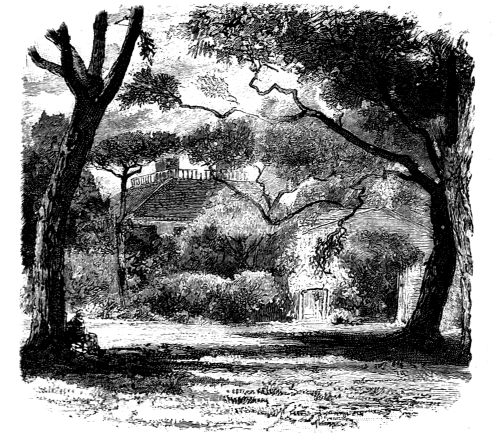
THE REAR LAWN LOOKING TOWARD LONGFELLOW’s HOUSE.
(ALL THIS PART OF THE LAWN IS COVERED WITH GIGANTIC ELM-TREES.
THE HOUSE IS NEARLY HIDDEN BY THE TREES AND LILAC BUSHES.)
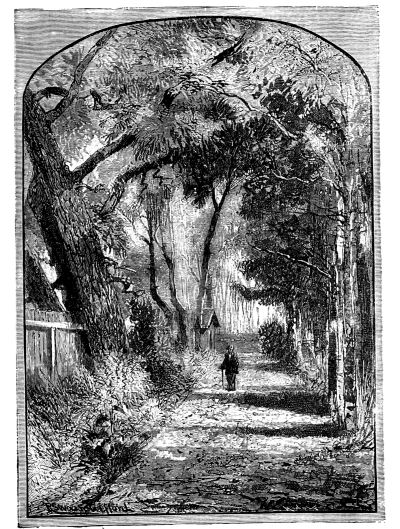
THE AVENUE NORTH OF THE HOUSE.
Mr. Longfellow’s house at Cambridge is one of the few American houses
to which pilgrimages will be made in the future. It was surrounded with
historic associations before he entered it, and it is now surrounded
with poetic ones,—a double halo encircling its time-honoured walls. It
is supposed to have been built in the first half of the last century
by Colonel John Vassal, who died in 1747, and whose ashes repose in
the churchyard at Cambridge under a freestone tablet, on which are
sculptured the words Vas-sol, and the emblems a goblet and sun.
He left a son John, who lived into Revolutionary times, and was a
royalist, as many of the rich colonists were. The house passed from his
[Pg xv]
hands, and came into the hands of the provincial government, who
allotted it to General Washington as his head-quarters after the battle
of Bunker’s Hill. Its next occupant was a certain Mr. Thomas Tracy, of
whom tradition says that he was very rich, and that his servants drank
his costly wines from carved pitchers. He appears to have sent out
privateers to scour the seas in the East and West Indies, and to worry
[Pg xvi]
the commerce of England and Spain; though why he should include the
galleons of Spain in his free-booting voyages is not clear. He failed
one day, and the hundred guests who had been accustomed to sit down
at the banquets of Vassal house, were compelled to find other hosts.
Bankrupt Tracy was succeeded by Andrew Craigie, apothecary-general of
the northern provincial army, who amassed a fortune in that office,
which fortune took to itself wings, though not before it had enlarged
Vassal house, and built a bridge over the Charles River connecting
Cambridge with Boston and still bearing his name.
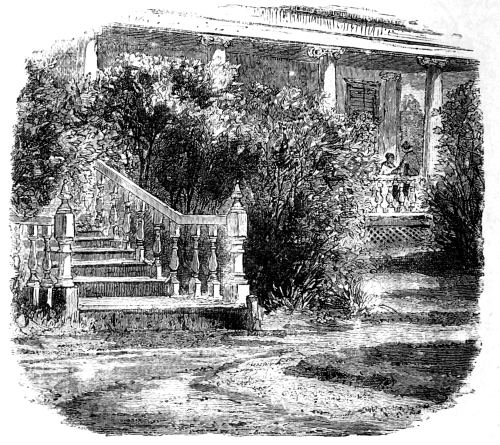
THE WESTERN ENTRANCE.
(FROM THE PIAZZA THERE IS A VIEW OF THE RIVER CHARLES,
BRIGHTON, AND THE DISTANT HILLS.)
In the summer of 1837, a studious young gentleman of thirty might have
been seen wending his way down the elm-shaded path which led to the
Craigie house. He lifted the huge knocker, which fell with a brazen
clang, and inquired for Mrs. Craigie. The parlour door was thrown open,
[Pg xvii]
and a tall, erect figure, crowned with a turban, stood before him. It
was the relict of Andrew Craigie, whilome apothecary-general of the
dead and gone northern provincial army. The young gentleman inquired if
there was a room vacant in her house.
“I lodge students no longer,” she answered gravely.
“But I am not a student,” he remarked. “I am a professor in the
University.”
“A professor?” she inquired, as if she associated learning with age.
“Professor Longfellow,” said the would-be lodger.
“Ah! that is different. I will show you what there is.”
She then proceeded to show him several rooms, saying, as she closed
the door of each, “You cannot have that.” At last she opened the door
of the south-east corner room of the second story, and said that he
could have it. “This was General Washington’s chamber.” So Professor
Longfellow became a resident of this old historic house, which had been
occupied before him by Edward Everett and Jared Sparks, and which was
occupied with him by Joseph E. Worcester, the lexicographer. Truly, his
lines had fallen in pleasant places.
Professor Longfellow’s collegiate duties left him leisure for
literary pursuits, and he turned it to advantage by writing a paper
on “Frithiof’s Saga,” and another on the “Twice-told Tales” of his
fellow-collegian, Hawthorne, whose rare excellence he was among the
first to perceive. These papers were published in the “North American
Review,” in 1837. They were followed during the next year by other
papers: among them one on “Anglo-Saxon Literature,” and another on
“Paris in the Seventeenth Century,” which were contributions to the
same periodical.
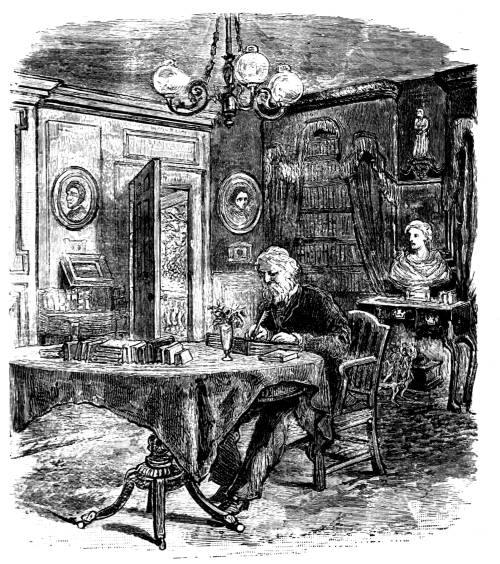
THE STUDY.
The papers mentioned, or some of them, were written in the chamber
which Washington had occupied, as well as a series of papers of which
European travel in Germany and Switzerland, and European experience
and legend, were the chief themes. Through these, like a silken string
through a rosary of beads, ran a slight personal narrative which may
have been real, and may have been imaginary, but which was probably
both. This narrative concerned itself with the life-history of Paul
Flemming, a tender-hearted and rather shadowy young gentleman who had
lost the friend of his youth, and who had gone abroad that the sea
might be between him and the grave. “Alas, between him and his sorrow
[Pg xviii]
there could be no sea, but that of time!” He wandered from place to
place,—noting what struck his sensitive fancy and discoursing of
men and books,—student at once and pilgrim. The hand that penned
“Outre-Mer” was visible on every page of “Hyperion,” but the hand had
grown firmer in the Craigie house than it was at Brunswick; and the
scholarly sympathies of the writer had embraced a richer literature
than that of old Spain and old France. Dismissing the romantic element
of “Hyperion” for what it is worth (and there must have been genuine
worth in it, for it was the cause of its immediate popularity), the
[Pg xix]
chief and permanent value of the book lay in the new element which it
introduced into American literature—the element of German fantasy
and romanticism. It would have come in time, no doubt, but to Mr.
Longfellow belongs the honour of having hastened the time, and ushered
in the dawn. He was the herald of German poetry in the New World. The
second book of “Hyperion” contains Mr. Longfellow’s first published
translation from the German poets—the “Whither?” of Müller (“I heard
a brooklet gushing”); the third book contains the “Song of the Bell”
(“Bell, thou soundest merrily!”); “The Black Knight” (“’Twas Pentecost,
the Feast of Gladness”); “The Castle by the Sea” (“Hast thou seen that
lordly castle?”); “The Song of the Silent Land” (“Into the Silent
Land”), and “Beware!” (“I know a maiden fair to see”). Besides these
translations in verse, there is, in the first book, a dissertation or
chapter on “Jean Paul, the Only One,” and in the second book a chapter
on “Goethe,” whom Mr. Paul Flemming, by the way, does not greatly
admire. His friend the Baron defends the old heathen by saying that he
is an artist and copies nature. “So did the artists who made the bronze
lamps of Pompeii. Would you hang one of those in your hall? To say that
a man is an artist and copies nature is not enough. There are two great
schools of art, the imitative and the imaginative. The latter is the
more noble and the more enduring.”
The dignity of the literary profession was earnestly maintained by
Mr. Longfellow. “I do not see,” remarked the Baron in one of his
conversations with Paul Flemming, “I do not see why a successful book
is not as great an event as a successful campaign, only different
in kind, and not easily compared.” The lives of literary men are
melancholy pictures of man’s strength and weakness, and, on that very
account, he thought were profitable for encouragement, consolation,
and warning. “The lesson of such lives,” continued Flemming, “is told
in a single word—wait! Therefore should every man wait—should bide
his time. Not in listless idleness, not in useless pastime, not in
querulous dejection; but in constant, steady, cheerful endeavours,
always willing, and fulfilling and accomplishing his task, that, when
the occasion comes, he may be equal to the occasion. And if it never
comes, what matters it? What matters it to the world whether I or you
or another man did such a deed, or wrote such a bock, so that the deed
[Pg xx]
and book were well done? It is the part of an indiscreet and
troublesome ambition to care too much about fame—about what the world
says of us; to be always looking in the faces of others for approval;
to be always anxious for the effect of what we do and say; to be
always shouting, to hear the echo of our own voices.” “Believe me,” he
concluded, “the talent of success is nothing more than doing what you
can do well, and doing well whatever you do, without a thought of fame.
If it come at all, it will come because it is deserved, and not because
it is sought after. And, moreover, there will be no misgivings, no
disappointment, no hasty, feverish, exhausting excitement.”
If fame comes because it is deserved, it certainly comes to some men
much sooner than to others; why, their contemporaries and rivals do not
perceive as clearly as those who come after them. Mr. Edgar Allan Poe,
for example, could never understand why Mr. Henry Wadsworth Longfellow
was a more successful writer than himself.
We hardly know how to characterize the seed which Mr. Longfellow began
to sow in “The Voices of the Night.” Romanticism does not describe
it, for there is nothing romantic in “The Hymn to the Night,” nor
does morality describe it, except, perhaps, as it bourgeoned in “A
Psalm of Life.” The lesson of the poem last named and of “The Light
of Stars,” was the lesson of endurance and patience and cheerfulness.
It had been taught by other poets, but not as this one taught it, not
inverse that set itself to music in the memory of thousands, and in
words that were pictures. The young man who wrote “A Psalm of Life”
possessed the art of saying rememberable things, and a very rare art
it is. Shakespeare possessed it in a supreme degree, and Pope and
Gray in a greater measure than greater poets. Merciless critics have
pointed out flaws in the literary workmanship of “A Psalm of Life,”
but its readers never saw them, or, seeing them, never cared for them.
They found it a hopeful, helpful poem. “Footsteps of Angels” is to us
the most satisfactory of all these “Voices of the Night.” There is an
indescribable tenderness in it, and the vision of the poet’s dead wife
gliding into his chamber with noiseless footsteps, taking a vacant
chair beside him, and laying her hand in his, is very pathetic. “The
Beleaguered City” is a product of poetic artifice of which there are
but few examples in English poetry. It appears to have been compounded
after a recipe which called for equal parts of outward fact and inward
[Pg xxi]
meaning. Given a material city, a river, a fog, and so on, the poet
sets his wits to work to discover what corresponds, or can be made to
correspond, with them spiritually. If he is skilful, he constructs an
ingenious poem, of doubtful intellectual value. “Midnight Mass for
the Dying Year” is a medley of mediæval suggestion and Shakespearean
remembrance, which demands a large and imaginative appreciation. The
[Pg xxii]
Shakespearean element appears somewhat out of place, though it adds
to the impressiveness and effectiveness as a whole. It is a medley,
however, and it must be judged by its own fantastic laws. Whatever
faults disfigured “The Voices of the Night” were lost sight of or
forgiven for the sake of their beauties and the admirable poetic spirit
which they displayed. A healthful poet was singing, and his song had
many tones.
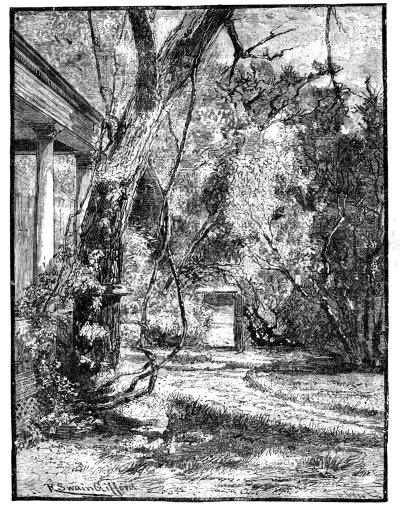
VIEW FROM THE REAR PIAZZA.
(THE OPEN GATE-WAY LEADS TO THE LAWN, A BROAD
AND SPLENDID STRETCH RUNNING TOWARD THE NORTH.)
“Hyperion” and “The Voices of the Night,” which were published in the
same year (1839), established the reputation of Mr. Longfellow as a
graceful prose writer, and a poet who resembled no poet of the time,
either in America or England. His scholarship was evident in both, and
was not among the least of the charms which they exercised over their
readers.
Mr. Bryant was the only American poet of any note who had enriched
the literature of his native land with translations. They showed his
familiarity with other languages, and were well thought of by scholars,
but they added nothing to his fame, for famous he was from the day he
published “Thanatopsis.” It was otherwise with the translations of
Mr. Longfellow, which brought him many laurels, and were in as great
demand as his original poems. There were twenty-three of them in the
little volume which contained “The Voices of the Night,” culled from
“Hyperion,” “Outre-Mer,” his review articles, not forgetting the
great ode of Don Jorge Manrique, and they represented six different
languages. They were well chosen, with the exception of the two
versions from the French; the subjects being in themselves poetical,
and the words in which they were clothed, characteristic of the
originals. The highest compliment that can be paid to Mr. Longfellow is
to say that they read like original poems. The most felicitous among
them are “The Castle by the Sea,” “Whither?” “The Bird and the Ship,”
and the exquisite fragment entitled “The Happiest Land.” Nearly forty
years have passed since they were collected in “The Voices of the
Night,” and these years have seen no translator equal to Mr. Longfellow.
Mr. Longfellow’s second poetical venture, “Ballads and Other Poems,”
determined his character as a poet. It was more mature, not to say more
robust, than “The Voices of the Night,” and its readers felt sure of
its author hereafter, for he felt sure of himself. The opening ballad,
“The Skeleton in Armour,” was the most vigorous poem that he had yet
[Pg xxiii]
written,—a striking conception embodied in picturesque language,
and in a measure which had fallen into disuse for more than two
centuries—the measure of Drayton’s “Ballad of Agincourt.” I do not see
that a line or a word could be spared. There were two elements in this
collection not previously seen in Mr. Longfellow’s poetry, one being
the power of beautifying common things, the other, the often renewed
experiment of hexameter verse. What I mean by beautifying common things
is the making a village blacksmith a theme, and a legitimate theme,
too, for poetry. Mr. Longfellow has certainly done this. More purely
poetical than “The Village Blacksmith” is “Endymion” and “Maidenhood.”
The sentiment of the last is very refined and spirited. “It is not
always May,” “The Rainy Day,” and “God’s Acre,” are each perfect of its
kind, and the kinds are very different. “The Rainy Day,” for instance,
is in the manner of “The Beleaguered City,” which for once has produced
a good poem,—I suspect, because it is a short one. “To the River
Charles” is a pleasant glimpse of Mr. Longfellow’s early Cambridge
life, and the art of it is perfect.
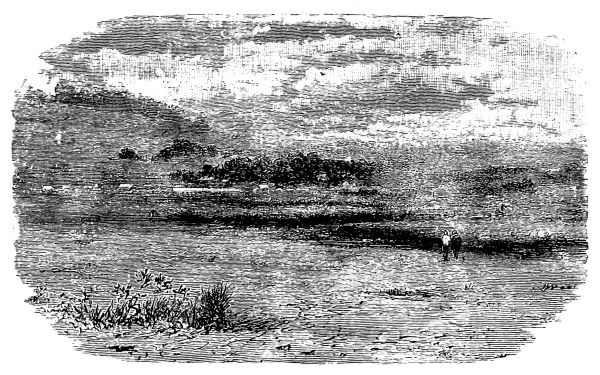
CHARLES RIVER.
The most popular poem in Mr. Longfellow’s second
collection—“Excelsior”—has more moral than poetical value. The
conception of a young man carrying a banner up a mountain, suggests a
[Pg xxiv]
set scene in a drama, and the end of this imaginary person does not
affect us as it should, his attempt to excel being so fool-hardy.
That he would be frozen to death was a foregone conclusion. The most
important of the translations here (all of which are excellent) was
“The Children of the Lord’s Supper,” from the Swedish of Tegnér. It
renewed, as I have said, the often baffled attempt to naturalize
hexameters in English poetry,—an attempt which Mr. Longfellow had
made four years before, in his paper on “Frithiof’s Saga,” when he
translated the description of Frithiof’s ancestral estate at Framnäs
into this measure. The poets and poetasters of the Elizabethan era
tried in vain to revive it. Gabriel Harvey, the friend of Spenser,
projected a reform of English poetry,—a reform which, if it had
succeeded, would have caused “a general surceasing of rhyme” and a
return to certain, or uncertain, rules of quantity. “Spenser suffered
himself to be drawn into this foolish scheme,” says Professor Child,
“and for a year worked away at hexameters and iambic trimeters quite
seriously.” (The year in question, I take it, was 1580.) Harvey’s
project was taken up with zeal by a coterie over which Sidney and Dyer
presided; but the wits, notably Nash, ridiculed it, the latter saying
(in substance) that the hexameter was a gentleman of an ancient house,
but that the English language was too craggy for him to run his long
plough in it. And Ascham wrote of it, about fifteen years before,
that it rather trotted and hobbled than ran smoothly “in our English
tong.” So thought not Master Abraham Fraunce, who, in 1587, published
a translation of the “Aminta” of Tasso, in hexameters, and in the
following year a work entitled “Lawier’s Logicke,” wherein he stowed
away a version of Virgil’s Eclogue of Alexis, in the same measure.
Less than a century from this date, Edward Phillips, the nephew of
Milton, paid his respects and disrespects to the ancient and modern
poets in his “Theatrum Poetarum” (1675),—a curious little book, which
is thought to reflect the opinions of his illustrious uncle. He sums
up the unlucky translator of Tasso in a few lines: “Abraham Fraunce,
a versifier of Queen Elizabeth’s time, who, imitating Latin measure
in English verse, wrote his ‘Ivy Church’ and some other things in
hexameter, some also in hexameter and pentameter; nor was he altogether
singular in this way of writing for Sir Philip Sidney, in the pastoral
interludes of his ‘Arcadia,’ uses not only those, but all other sorts
[Pg xxv]
of Latin measure, in which no wonder he is followed by so few, since
they neither become the English nor any other modern language.”
Winstanley expressed the same unfavourable opinion of Fraunce’s
hexameters twelve years later (1687), stealing the very words of
Phillips for that purpose.
Langbaine, in his “Account of the English Dramatick Poets” (1691),
adds four separate works, not mentioned by Winstanley and Phillips,
to the list of Fraunce’s productions (all in hexameters), and records
the disuse of quantitive experiments in English versification.
“Notwithstanding Mr. Chapman in his translation of Homer, and Sir
Philip Sydney in his Eclogues, have practised this way of writing, yet
this way of imitating the Latin measures of verses, particularly the
hexameter, is now laid aside, and the verse of ten syllables, which
we style heroic verse, is most in use.” The next attempt to revive
hexameters on any scale was made by that metrical experimentalist,
Southey, in his “Vision of Judgment,” in 1821,—a piece of obsequious
profanity which richly deserved the ridicule that Byron cast upon it.
Such, so far as I know, is the history of this alien measure in English
poetry. Mr. Longfellow thought well of it, as we have seen, and was
justified in so thinking by the excellence of his own practice therein.
“The Children of the Lord’s Supper” is a charming poem, to which its
antique setting is very becoming.
Mr. Longfellow made a third voyage to Europe after publishing his
“Ballads and other Poems,” and passed the summer on the Rhine. He
returned after a few months, bringing with him a number of poems which
were written at sea, and in which he expressed his detestation of
slavery. “Poems on Slavery” were published in 1843, and dedicated to
W. E. Channing, who did not live to read the poet’s admiration of his
character and his work. This dedication, which is spirited, contains a
noble stanza:
“Well done! Thy words are great and bold,
At times they seem to me
Like Luther’s, in the days of old,
Half battles for the free.”
“The Slave’s Dream” is one of the few rememberable poems of which
the “peculiar institution” was the inspiration. It is exceedingly
picturesque, and its versification is masterly. The harmony of sound
and sense,—the movement of the fourth stanza is very fine:
[Pg xxvi]
“And then at furious speed he rode
Along the Niger’s bank,
His bridle-reins were golden chains,
And, with a martial clank,
At each leap he could feel his scabbard of steel
Smiting his stallion’s flank.”
The fertility of Mr. Longfellow’s mind, and the variety of his powers,
were manifested in his thirty-sixth year, when he published the “Poems
on Slavery,” of which I have just spoken, and “The Spanish Student,”—a
dramatic poem, the actors in which were the antipodes of the dusky
figures which preceded them. Judged by the laws of its construction,
and by the intention of its creator, “The Spanish Student” is a
beautiful production. It should be read for what it is,—a poem, and
without the slightest thought of the stage, which was not in the mind
of the author when he wrote it. So read, it will be found radiant with
poetry, not of a passionate or profound kind, which would be out of
place; for the plot is in no sense a tragic one, but of a kind that
suggests the higher walks of serious poetic comedy. The characters
of the different actors in this little closet play are sketched with
sufficient distinctness, and the conversation, which is lively and
bustling, is suited to the speakers and their station in life. The
gipsy dancing girl, Preciosa, is a lovely creation of the poet’s fancy.
In 1843, Mr. Longfellow was married for the second time, and became
the possessor of the Craigie house. Three years later he published
“The Belfry of Bruges and other Poems.” Traces of his early manner,
as unsuccessfully manifested in “The Beleaguered City,” appear in
“Carillon,” the prologue to the volume, and in “The Arrow and the
Song,” which is perhaps the most perfect of all his smaller pieces.
“The Belfry of Bruges” is a picturesque description of that quaint
old city, as seen from the belfry-tower in the market-place one
summer morning, and an imaginative remembrance of its past history,
which passes like a pageant before the eyes of the poet. Everything
is clearly conceived and in orderly succession, and in no poem that
he had previously written had the hand of the artist been so firm.
“Nuremberg,” a companion-piece in the same measure, is distinguished
by the same precision of touch and the same broad excellence. There is
an indescribable charm, a grace allied to melancholy, in “A Gleam of
[Pg xxvii]
Sunshine,” which is one of the few poems that refuse to be forgotten.
“The Arsenal at Springfield” is in a certain sense didactic, I suppose,
but I do not quite see how it could be otherwise, and be a poem at all.
A poet should be a poet first, but he should also be a man, and a man
who concerns himself with the joys and sorrows of his fellow-creatures.
There was a great lesson in the burnished arms at Springfield, and a
lesser poet than Mr. Longfellow would not have guessed it.
“Were half the power that fills the world with terror,
Were half the wealth bestowed on camps and courts,
Given to redeem the human mind from error,
There were no need of arsenals and forts:
The warrior’s name would be a name abhorred,
And every nation that should lift again
Its hand against a brother, on its forehead
Should wear for evermore the curse of Cain!”
“The Norman Baron” is a study of the mediæval age, and “Rain in
Summer,” a fresh and offhand description of a country shower.
Not many English-writing poets, good fathers as most of them were,
have addressed poems to their children. Ben Jonson wrote some lines
about his first daughter, who died in infancy. Coleridge sang a
serious cradle-song over his son Hartley, in “Frost at Midnight.”
Shelley bewailed the early death of his son William; and Leigh Hunt
celebrated two of his children in two characteristic poems, the most
natural of which he inscribed to his son John, “A Nursery Song for a
Four-Year-Old Romp.” These are some of the best-known English poets, to
whom childhood was a source of inspiration. Mr. Longfellow distanced
all of them, and apparently without an effort, in the volume under
consideration. His poem “To my Child,” has no superior of its kind in
the language. We have a glimpse of the poet’s house for the first time
in verse, and of the chamber in which he wrote so many of his poems,
which had now become the child’s nursery. Its chimney was adorned with
painted tiles, among which he enumerates:
“The lady with the gay macaw,
The dancing girl, the grave bashaw
With bearded lip and chin;
And, leaning idly o’er his gate,
Beneath the imperial fan of state,
The Chinese mandarin.”
[Pg xxviii]
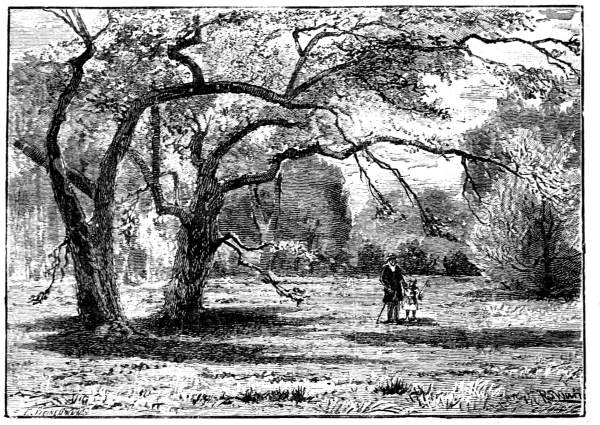
VIEW ACROSS THE LAWN, NORTH-WEST OF THE HOUSE.
The child shakes his coral rattle with its silver bells, and is content
for the moment with its merry tune. The poet listens to other bells
than these, and they tell him that the coral was growing thousands
of years in the Indian seas, and that the bells once reposed as
shapeless ore in darksome mines, beneath the base of Chimborazo or the
overhanging pines of Potosi.
“And thus for thee, O little child.
Through many a danger and escape,
The tall ships passed the stormy cape;
For thee, in foreign lands remote,
Beneath a burning, tropic clime,
The Indian peasant, chasing the wild goat,
Himself as swift and wild,
In falling, clutched the frail arbute,
The fibres of whose shallow root,
Uplifted from the soil, betrayed
The silver veins beneath it laid
The buried treasures of the miser Time.”
He turns from the child to the memory of one who formerly dwelt within
the walls of his historic mansion:
[Pg xxix]
“Up and down these echoing stairs
Heavy with the weight of cares,
Sounded his majestic tread:
Yes, within this very room
Sat he, in those hours of gloom,
Weary both in heart and head.”
These grave thoughts are succeeded by pictures of the child at play,
now in the orchard and now in the garden-walks, where his little
carriage-wheels efface whole villages of sand-roofed tents that rise
above the secret homes of nomadic tribes of ants. But, tired already,
he comes back to parley with repose, and, seated with his father on a
rustic seat in an old apple-tree, they see the waters of the river, and
a sailless vessel dropping down the stream:
“And like it, to a sea as wide and deep,
Thou driftest gently down the tides of sleep.”
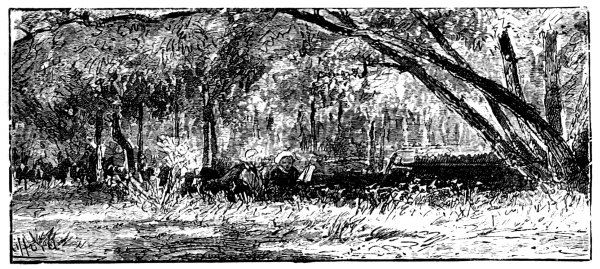
THE OLD WILLOW.
The poet speculates gravely on the future of his child, and bids him
remember that if his fate is an untoward one, even in the perilous hour
“When most afflicted and oppressed
From labour there shall come forth rest.”
In this poem, and in “The Occultation of Orion,” Mr. Longfellow has
reached a table-land of imagination not hitherto attained by his Muse.
“The Bridge” is a revealment of his personality, and a phase of his
genius which has never ceased to charm the majority of his readers. The
[Pg xxx]
train of thought which it suggests is not new, but what thought that
embraces mankind is new? Enough that it is natural, and sympathetic,
and tender. The lines to “The Driving Cloud” are an admirable specimen
of hexameters, and a valuable addition to America’s scanty store of
aboriginal poetry—the forerunner of an immortal contribution not yet
transmuted into verse.
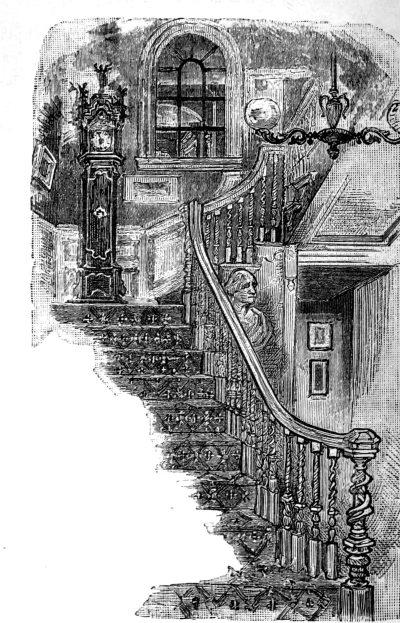
“THE OLD CLOCK ON THE STAIRS.”
Under the head of “Songs” we have eight poems, two of which are
modelled after a fashion that Mr. Longfellow had succeeded in making his
[Pg xxxi]
own. I refer to “Sea-weed” and “The Arrow and the Song,” two charming
fantasies in which the doctrine of poetic correspondence (if I may
be allowed the phrase) works out a triumphant excuse for its being.
“The Day is Done” belongs to a class of poems which depend for their
success upon the human element they contain, or suggest, and to which
they appeal. “The Old Clock on the Stairs” is an illustration of what I
mean, and as good a one as can be found in the writings of any modern
poet. The humanities (to adapt a phrase) were never long absent from
Mr. Longfellow’s thoughts. We feel their presence in “The Old Clock on
the Stairs,” in “The Bridge,” and in the unrhymed stanzas “To an Old
Danish Song-book.” This volume introduced Mr. Longfellow in a species
of composition in which we have not hitherto seen him—the sonnet, of
which there are three specimens here, neither of the strictest Italian
form; the best, perhaps, being the one on “Dante,” of whom, by the way,
we had three translations, all from the “Purgatorio,” in the “Voices of
the Night.”
Mr. Longfellow’s next volume was, in a certain sense, the gift of
Hawthorne, to whom he was indebted for its theme. It is stated briefly
in the first volume of his “American Note-books,” in a cluster of
memoranda written between October 24th, 1838, and January 4th, 1839.
Voilá: “H. L. C—— heard from a French Canadian a story
of a young couple in Acadie. On their marriage day, all the men
of the province were summoned to assemble in the church to hear a
proclamation. When assembled, they were all seized and shipped off to
be distributed through New England, among them the new bridegroom. His
bride set off in search of him, wandered about New England all her
lifetime, and at last, when she was old, she found her bridegroom on
his death-bed. The shock was so great that it killed her likewise.”
This forcible deportation of a whole people occurred in 1755, when the
French, to the extent of eighteen thousand souls, were seized by the
English, in the manner stated. History, which excuses so much, has
perhaps excused the act; but humanity never can. It is as indefensible
as the Inquisition.
“Evangeline,” which was published in 1847, disputed the palm with “The
Princess,” which was published in the same year. The two volumes are so
unlike that no comparison can, or should, be made between them. Each
[Pg xxxii]
shows its writer at his best, as a story-teller, and if the mediæval
medley surpasses the modern pastoral in richness of colouring, it
is surpassed, in turn, by the tender human interest of the latter.
Evangeline, loving, patient, sorrowful wanderer, has taken a permanent
place, I think, among the heroines of English song; but, whether
the picturesque hexameters in which her pathetic story is told will
hereafter rank among the standard measures of the language, can only be
conjectured. That the poets have fancied them is certain, for the year
after the publication of “Evangeline” saw Clough writing them in “The
Bothie of Tober-na-Vuolich,” and ten years later saw Kingsley writing
them in his “Andromeda.” Matthew Arnold maintains that the hexameter is
the only proper measure in which to translate Homer; and already two
versions of the Iliad in this measure have been made, one by Herschel
(1866) and another by Cochrane (1867).
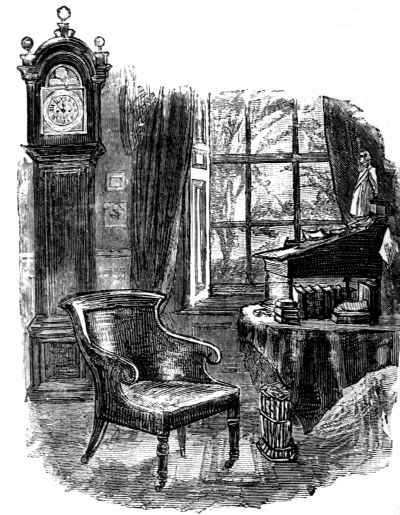
A CORNER OF THE STUDY
[Pg xxxiii]
Two years before the publication of “Evangeline” (1845), Mr. Longfellow
conferred a scholarly obligation upon the admirers of foreign poetry
by editing “The Poets of Europe,” a closely printed octavo of nearly
eight hundred pages, containing specimens of European poets in ten
different languages, representing the labours of upward of one hundred
translators, including himself. Four years later (1849) he published a
tale, entitled “Kavanagh.” It has no plot to speak of, but its sketches
of character are bright and amusing, and its glimpses of New England
village life are pleasantly authentic.
The five years which included the publication of the next three volumes
of his poetical writings—“The Seaside and the Fireside” (1850), “The
Golden Legend” (1851), and “The Song of Hiawatha” (1855),—added
largely to his reputation as a man of varied attainments, to whom
poetry was an art in which he was perpetually discovering new
possibilities. There are twenty-three poems in “The Seaside and the
Fireside” (including the dedication and the translations), no two of
which are alike, though they all disclose the skilful hand by which
they were wrought. The most important of them, as a work of art, is the
best poem, of which Schiller’s “Song of the Bell” was the model—“The
Building of the Ship.”
“The Golden Legend” transports us back to the Middle Ages, of which we
have had transitory gleams in the earlier writings of Mr. Longfellow.
The poetic atmosphere of that remote period envelops a lovely story,
which turns, like that of “Evangeline,” upon the love and devotion of
woman, that in this instance is happily rewarded.
The figure of Elsie, the peasant girl, who determines to sacrifice
her life to restore her prince to happiness, is worthy of an exalted
place in any poet’s dream of fair women. The charm of the poem, apart
from its poetry, is the thorough and easy scholarship of the writer,
who contrives to conceal the evidences of his reading,—an art which
few poets have possessed in an equal degree, and which Moore did not
possess at all. Mr. Ruskin reflected, I think, the judgment of most
scholarly readers of this poem, when he wrote in his “Modern Painters”
that its author had entered more closely into the temper of the monk,
for good and for evil, than ever yet theological writer or historian,
though they may have given their life’s labour to the analysis.
[Pg xxxiv]
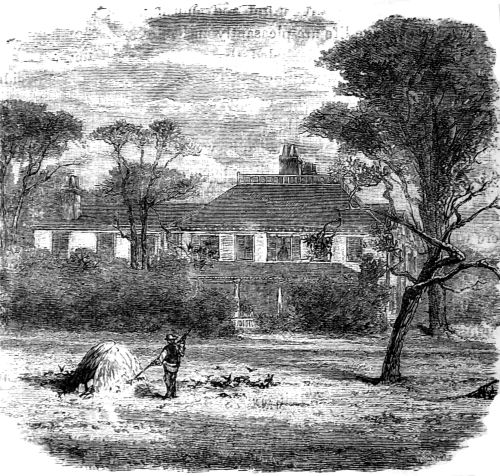
WEST SIDE OF LONGFELLOW’S HOUSE.
(TAKEN FROM A POINT NEAR THE OLD WILLOW.)
That there was a poetic element in the North American Indian several
American poets had believed, and, so believing, had striven to quicken
their verse with its creative energies. Sands and Eastburn wrote
together the ponderous poem of “Yamoyden.” Hoffmann wrote a “Vigil
of Faith;” Seba Smith a “Powhattan;” Street a “Frontenac.” They were
unanimous in one thing,—they all failed to interest their readers. The
cause of this was not far to seek, we can see, since success has been
achieved, but it demanded a vision which was not theirs, and which, it
seemed, only one American poet had. He saw that the Indian himself,
as he figures in our history, was not capable of being made a poetic
hero, but he saw that there might be a poetic side to him, and that it
existed in his legends, if he had any. That he had many, and that they
[Pg xxxv]
were remarkable for a certain primitive imagination, was well known.
They were brought to light by the late Henry R. Schoolcraft who heard
of their existence among the Odjibwa Nation, inhabiting the region
about Lake Superior in 1822.
Specimens of these aboriginal fictions were published by Mr Schoolcraft
in his “Travels in the Central Portions of the Mississippi Valley”
(1825), and his “Narrative of the Expedition to Itaska Lake” (1834),
but they were not given to the world in their entirety until 1839 in
his “Algic Researches.” They were as good as manuscript for the next
sixteen years, though one American poet had mastered them thoroughly.
This was Mr. Longfellow, who, in 1855, turned this Indian Edda, as
he happily called it, into “The Song of Hiawatha.” The great and
immediate success of this poem, and the increase of reputation which
it brought its author, recalled the early years of the present century
when Scott and Byron were sure of thousands of readers whenever it
pleased them to write a metrical romance. It was eagerly read by all
classes, who suddenly found themselves interested in the era of flint
arrow-heads, earthen pots, and skin clothes, and in its elemental
inhabitants, who, dead centuries ago, if they ever existed, were now
living the everlasting life of poetry. Everybody read “The Song of
Hiawatha,” which passed through many editions. Its intellectual value
was universally admitted, but its form was questioned, as all new forms
are sure to be. For the form was new to most readers, though not to
scholars in the literatures of Northern Europe. It is original with
Mr. Longfellow, his friends declared. No, his enemies answered, he
has borrowed it from the Finnish epic, “The Kalewala.” The temporary
novelty of its form led to innumerable parodies, but to nothing
serious, that I remember; which I take to be a silent verdict against
its permanency in English versification.
Mr. Longfellow added, three years later, to the laurels he had won
by “Evangeline,” by a second narrative poem in hexameters,—“The
Courtship of Miles Standish.” It lacks the pathetic interest which
is the charm of the earlier poem, but it possesses the same merit of
picturesqueness, and a firmer power of delineating character. Priscilla
is a very vital little Puritan maiden, who sees no impropriety in
asking the man she loves why he does not speak for himself, and not for
Miles Standish, who might find time to attend to his own wooing. The
Puritan atmosphere here is as perfect of its kind as the Catholic
[Pg xxxvi]
atmosphere of “Evangeline,” and is thoroughly in keeping with the grim
old days in which the story is laid. The versification of the poem is
more vigorous than that of the sister poem, the hexameters having a
sort of martial movement about them.
We do not see that the poetry of Mr. Longfellow has changed much in
the last twenty years, except that it has become graver in its tone
and more serious in its purpose. Its technical excellence has steadily
increased. He has more than held his own against all English-writing
poets, and in no walk of poetry so positively as that of telling a
story. In an age of story-tellers he stands at their head, not only
in the narrative poems I have mentioned, but in the lesser stories
included in his “Tales of a Wayside Inn,” for which he has laid all the
literatures of the world under contribution.
The most distinctive of Mr. Longfellow’s poems are probably those which
he entitles “Birds of Passage,” and which he has from time to time
published as portions of separate volumes. They were inspired by many
literatures, and are in many measures, among which, however, that of
“The Song of Hiawatha” does not reappear, though the hexameter does.
He has the art of finding unwritten poems in the most out-of-the-way
books, and in every-day occurrences. A great man dies,—the Duke of
Wellington, for example,—and he hymns his departure in “The Warden
of the Cinque Ports,” which many prefer to the Laureate’s scholarly
ode. His good friend Hawthorne dies, and he embalms his memory and his
unfinished romance in imperishable verse.
“Ah! who shall lift that wand of magic power,
And the lost clew regain?
The unfinished window in Aladdin’s tower
Unfinished must remain!”
Sumner dies, and he drops a melodious tear upon his grave.
“Were a star quenched on high,
For ages would its light,
Still travelling downward from the sky,
Shine on our mortal sight.
“So when a great man dies,
For years beyond our ken,
The light he leaves behind him lies
Upon the paths of men.”
[Pg xxxvii]
And again he bids him farewell in a touching sonnet, with a pathetic
and unexpected ending:
“Good-night! good-night! as we so oft have said
Beneath this roof at midnight, in the days
That are no more, and shall no more return.
Thou hast but taken thy lamp and gone to bed:
I stay a little longer, as one stays
To cover up the embers that still burn.”
A child is born to him, and his friend Lowell’s wife dies on the same
night, and he commemorates both in “The Two Angels,” one of his perfect
poems.
Mr. Longfellow published few translations while he was writing his
more important works, such as the “Tales of a Wayside Inn” and “The
Story of Hiawatha.” That he had not forgotten his cunning, however, was
evident in his “Three Books of Song” (1872), where he printed several
translations of Eastern Songs, and in “Keramos, and other Poems,” which
contains two hexameter translations from Virgil and Ovid, and twelve
translations from French, German, and Italian poets. The volume last
mentioned is remarkable in many ways. It not only shows no diminution
of mental vigour, which one might naturally expect in a poet whose
years have exceeded the allotted age of man, but it recalls the young
poet who wrote “The Skeleton in Armour,” and “The Slave’s Dream.”
I know not where to look for more fire than I find in “The Leap of
Roushan Beg,” nor more delicious picturesqueness than in “Castles in
Spain.” “Keramos” belongs to the same class of poems as “The Building
of the Ship,” and is as perfect a piece of poetic art as that exquisite
poem. That the making of pottery could be so effectively handled in
verse reminds us of what Stella said of Swift, viz. that he could write
beautifully about a broom-stick.
Mr. Longfellow’s friendliness, not to say generosity, to his brother
authors, is not the least among his poetic virtues. He sends a greeting
to Lowell in “The Herons of Elmwood,” and honours the memory of Irving
in a tender sonnet, “In the Churchyard at Tarrytown.” In “The Three
Silences of Molinos” (which are those of Speech, Desire, and Thought),
he recognizes the excellence of the poet whom New England delights to
honour next to himself:
[Pg xxxviii]
“O thou, whose daily life anticipates
The world to come, and in whose thought and word
The spiritual world preponderates,
Hermit of Amesbury! thou too hast heard
Voices and melodies from beyond the gates,
And speakest only when thy soul is stirred.”
If there was any doubt before that Mr. Longfellow was the first
of living sonneteers it is settled by “A Book of Sonnets” in this
collection, the workmanship of which is simply perfect.
Mr. Longfellow’s translation of Dante’s “Divina Commedia” is highly
thought of by scholarly readers. I state, however, as a fact, that he
was not engaged upon it over twenty-five years, as we are told in the
“Life and Letters of George Ticknor”; nor more than thirty years, as
we are told in Richardson’s “Primer of American Literature.” It was
executed in less than two years.
It has not been given to many poets to carry out the ideal of a poetic
life as he has done, and to win a great reputation at an early age,—a
reputation which has not lessened or suffered from any fluctuation of
public taste. The singer of “Keramos” addresses a different public
from the one that welcomed “The Voices of the Night,” but he holds it
nevertheless. In looking back upon his long literary career, one can
see that he has been true to himself as he was manifested to us in his
early prose and verse; that he has fulfilled his scholarly intentions;
and that he has created and satisfied a taste for a literature which
did not exist in America until he began to write,—a literature drawn
from the different languages of Europe, now in the shape of direct
translation, and now in the shape of suggestions, alien to the mass
of English and American readers, but gladly received by both as
new intellectual possessions. He has broadened American culture in
completing his own, and has enlarged American sympathies until they
embrace all other peoples,—the sturdy Norseman, the simple Swede, the
patient Acadien, and the marvel-believing red man of prehistoric times.
Cardinal Wiseman delivered a lecture some years ago on the “Home
Education of the Poor.” In the course of this lecture he commented upon
the fact that England has no poet who is to its labouring classes what
Goethe is to the peasant of Germany, and said: “There is one writer who
[Pg xxxix]
approaches nearer than any other to this standard, and he has already
gained such a hold on our hearts that it is almost unnecessary for me
to mention his name. Our hemisphere cannot claim the honour of having
brought him forth, but he still belongs to us, for his works have
become as household words wherever the English language is spoken. And
whether we are charmed by his imagery, or soothed by his melodious
versification, or elevated by the high moral teachings of his pure
muse, or follow with sympathetic hearts the wanderings of Evangeline, I
am sure that all who hear my voice will join with me in the tribute I
desire to pay to the genius of Longfellow.”
The Rev. Lyman Abbott, also recently in the “Christian Union,” remarks
that “There are many persons who regard Christianity as a new form
or a new philosophy, and one might read Longfellow’s songs ‘from
beginning to end,’ and not guess with what form he worshipped or of
what philosophy he is a disciple. But if the Master knew aright His own
mission, He came that we might have life, and have it more abundantly;
and if Paul comprehended the tenour of that life aright, its fruits
are ‘love, joy, peace, long-suffering, gentleness, goodness, faith,
meekness, temperance.’ This life pulsates through all Longfellow’s
words; of these fruits the orchard of his song is full indeed. I do
not recall a single hymn of his which has become a favourite voice
of worship in our churches; but worship has gone up from thousands
of hearts, lowlier and holier for his singing. He does not swing the
censer, but he fills it with his aromatic incense.” ... “Submission
never sang a sweeter song in the night than ‘Resignation;’ devout love
to God never breathed a more Christly petition than in Elsie‘s prayer;
never more unaffected reverence bowed its head than in ’Christus.’”
The Christianity of Longfellow is as simple as that of the New Testament,
and as catholic; his creed, his worship, and his life are love.
“My work is finished; I am strong
In faith and hope and charity;
For I have written the things I see,
The things that have been and shall be.
Conscious of right, nor fearing wrong
Because I am in love with Love,
And the sole thing I hate is Hate;
For Hate is death; and Love is life.
[Pg xl]
A peace, a splendour from above;
And Hate a never-ending strife,
A smoke, a blackness from the abyss
Where unclean serpents coil and hiss!
Love is the Holy Ghost within;
Hate the unpardonable sin!
Who preaches otherwise than this
Betrays his Master with a kiss.”
The poet died on the 24th March 1882, at Cambridge, Massachusetts and
was buried in the Mount Auburn Cemetery, amidst public and private
evidences of the grief of many thousands of the American people; and in
the United Kingdom his death has been felt as the loss of a familiar
friend, almost irreparable.
[Pg 1]
THE POETICAL WORKS OF
HENRY WADSWORTH LONGFELLOW.
Early Poems.
[WRITTEN FOR THE MOST PART DURING MY COLLEGE LIFE, AND ALL OF THEM
BEFORE THE AGE OF NINETEEN.]
AN APRIL DAY.
When the warm sun, that brings
Seed-time and harvest, has returned again,
’Tis sweet to visit the still wood, where springs
The first flower of the plain.
I love the season well,
When forest glades are teeming with bright forms,
Nor dark and many-folded clouds foretell
The coming-on of storms.
From the earth’s loosened mould
The sapling draws its sustenance, and thrives;
Though stricken to the heart with Winter’s cold,
The drooping tree revives.
The softly-warbled song
Comes from the pleasant woods, and coloured wings
Glance quick in the bright sun, that moves along
The forest openings.
When the bright sunset fills
The silver woods with light, the green slope throws
Its shadows in the hollows of the hills,
And wide the upland glows.
[Pg 2]
And, when the eve is born,
In the blue lake the sky, o’er-reaching far,
Is hollowed out, and the moon dips her horn,
And twinkles many a star.
Inverted in the tide,
Stand the grey rocks, and trembling shadows throw;
And the fair trees look over, side by side,
And see themselves below.
Sweet April!—many a thought
Is wedded unto thee, as hearts are wed;
Nor shall they fail, till, to its autumn brought,
Life’s golden fruit is shed.
AUTUMN.
With what a glory comes and goes the year!
The buds of spring, those beautiful harbingers
Of sunny skies and cloudless times, enjoy
Life’s newness, and earth’s garniture spread out.
And when the silvery habit of the clouds
Comes down upon the autumn sun, and with
A sober gladness the old year takes up
His bright inheritance of golden fruits,
A pomp and pageant fill the splendid scene.
There is a beautiful spirit breathing now
Its mellow richness on the clustered trees,
And, from a beaker full of richest dyes,
Pouring new glory on the autumn woods,
And dipping in warm light the pillared clouds.
Morn on the mountain, like a summer bird,
Lifts up her purple wing, and in the vales
The gentle wind, a sweet and passionate wooer,
Kisses the blushing leaf, and stirs up life
Within the solemn woods of ash deep-crimsoned;
And silver beech, and maple yellow-leaved,
Where autumn, like a faint old man, sits down
By the wayside a-weary. Through the trees
The golden robin moves. The purple finch,
That on wild cherry and red cedar feeds,
A winter bird, comes with its plaintive whistle,
And pecks by the witch-hazel, whilst aloud
From cottage roofs the warbling blue-bird sings,
And merrily, with oft-repeated stroke,
Sounds from the threshing-floor the busy flail.
[Pg 3]
O what a glory doth this world put on
For him who, with a fervent heart, goes forth
Under the bright and glorious sky, and looks
On duties well performed, and days well spent!
For him the wind, ay, and the yellow leaves,
Shall have a voice, and give him eloquent teachings.
He shall so hear the solemn hymn, that Death
Has lifted up for all, that he shall go
To his long resting-place without a tear.
SUNRISE ON THE HILLS.
I stood upon the hills, when heaven’s wide arch
Was glorious with the sun’s returning march,
And woods were brightened, and soft gales
Went forth to kiss the sun-clad vales.
The clouds were far beneath me;—bathed in light,
They gathered midway round the wooded height,
And, in their fading glory, shone
Like hosts in battle overthrown,
As many a pinnacle, with shifting glance,
Through the grey mist thrust up its shattered lance,
And rocking on the cliff was left
The dark pine blasted, bare, and cleft.
The veil of cloud was lifted, and below
Glowed the rich valley, and the river’s flow
Was darkened by the forest’s shade,
Or glistened in the white cascade;
Where upward, in the mellow blush of day,
The noisy bittern wheeled his spiral way.
I heard the distant waters dash,
I saw the current whirl and flash,—
And richly, by the blue lake’s silver beach,
The woods were bending with a silent reach.
Then o’er the vale, with gentle swell,
The music of the village bell
Came sweetly to the echo-giving hills;
And the wild horn, whose voice the woodland fills,
Was ringing to the merry shout,
That faint and far the glen sent out,
Where, answering to the sudden shot, thin smoke,
Through thick-leaved branches, from the dingle broke.
If thou art worn and hard beset
With sorrows, that thou wouldst forget,
If thou wouldst read a lesson, that will keep
Thy heart from fainting and thy soul from sleep,
Go to the woods and hills!—No tears
Dim the sweet look that Nature wears.
[Pg 4]
WOODS IN WINTER.
When Winter winds are piercing chill,
And through the hawthorn blows the gale,
With solemn feet I tread the hill
That overbrows the lonely vale.
O’er the bare upland, and away
Through the long reach of desert woods,
The embracing sunbeams chastely play,
And gladden these deep solitudes.
Where, twisted round the barren oak,
The summer vine in beauty clung,
And summer winds the stillness broke,
The crystal icicle is hung.
Where, from their frozen urns, mute springs
Pour out the river’s gradual tide,
Shrilly the skaters’ iron rings,
And voices fill the woodland side.
Alas! how changed from the fair scene,
When birds sang out their mellow lay,
And winds were soft, and woods were green,
And the song ceased not with the day.
But still wild music is abroad,
Pale, desert woods! within your crowd;
And gathering winds, in hoarse accord,
Amid the vocal reeds pipe loud.
Chill airs and wintry winds! my ear
Has grown familiar with your song;
I hear it in the opening year,—
I listen, and it cheers me long.
HYMN OF THE MORAVIAN NUNS
OF BETHLEHEM.
AT THE CONSECRATION OF PULASKI’S BANNER.
When the dying flame of day
Through the chancel shot its ray,
Far the glimmering tapers shed
Faint light on the cowled head;
And the censer burning swung,
Where, before the altar, hung
The blood-red banner, that with prayer
Had been consecrated there.
And the nun’s sweet hymn was heard the while,
Sung low in the dim, mysterious aisle.
“Take thy banner! May it wave
Proudly o’er the good and brave;
When the battle’s distant wail
Breaks the sabbath of our vale,
When the clarion’s music thrills
To the hearts of these lone hills,
When the spear in conflict shakes,
And the strong lance shivering breaks.
“Take thy banner! and, beneath
The battle-cloud’s encircling wreath,
Guard it!—till our homes are free!
Guard it!—God will prosper thee!
In the dark and trying hour,
In the breaking forth of power,
In the rush of steeds and men,
His right hand will shield thee then.
“Take thy banner! But, when night
Closes round the ghastly fight,
If the vanquished warrior bow,
Spare him!—By our holy vow,
By our prayers and many tears,
By the mercy that endears,
Spare him!—he our love hath shared!
Spare him!—as thou wouldst be spared!
“Take thy banner!—and if e’er
Thou shouldst press the soldier’s bier,
And the muffled drums should beat
To the tread of mournful feet,
Then this crimson flag shall be
Martial cloak and shroud for thee.”
The warrior took that banner proud,
And it was his martial cloak and shroud!
[Pg 5]
BURIAL OF THE MINNISINK.
On sunny slope and beechen swell,
The shadowed light of evening fell;
And, where the maple’s leaf was brown,
With soft and silent lapse came down
The glory, that the wood receives,
At sunset, in its brazen leaves.
Far upward in the mellow light
Rose the blue hills. One cloud of white,
Around a far uplifted cone,
In the warm blush of evening shone;
An image of the silver lakes,
By which the Indian’s soul awakes.
But soon a funeral hymn was heard
Where the soft breath of evening stirred
The tall, grey forest; and a band
Of stern in heart, and strong in hand,
Came winding down beside the wave,
To lay the red chief in his grave.
They sang, that by his native bowers
He stood in the last moon of flowers,
And thirty snows had not yet shed
Their glory on the warrior’s head;
But, as the summer fruit decays,
So died he in those naked days.
A dark cloak of the roebuck’s skin
Covered the warrior, and within
Its heavy folds the weapons, made
For the hard toils of war were laid;
The cuirass, woven of plaited reeds,
And the broad belt of shells and beads.
Before, a dark-haired virgin train
Chanted the death-dirge of the slain;
Behind, the long procession came
Of hoary men and chiefs of fame,
With heavy hearts, and eyes of grief,
Leading the war-horse of their chief.
Stripped of his proud and martial dress,
Uncurbed, unreined, and riderless,
With darting eye, and nostril spread,
And heavy and impatient tread,
He came; and oft that eye so proud
Asked for his rider in the crowd.
They buried the dark chief—they freed
Beside the grave his battle steed;
And swift an arrow cleaved its way
To his stern heart! One piercing neigh
Arose,—and, on the dead man’s plain,
The rider grasps his steed again.
THE SPIRIT OF POETRY.
There is a quiet spirit in these woods,
That dwells where’er the gentle south wind blows;
Where, underneath the white-thorn, in the glade,
The wild-flowers bloom, or, kissing the soft air,
The leaves above their sunny palms outspread.
With what a tender and impassioned voice
It fills the nice and delicate ear of thought,
When the fast-ushering star of Morning comes
O’er-riding the grey hills with golden scarf;
Or when the cowled and dusky-sandaled Eve,
In mourning weeds, from out the western gate,
Departs with silent pace! That spirit moves
In the green valley, where the silver brook,
From its full laver, pours the white cascade;
And, babbling low amid the tangled woods,
Slips down through moss-grown stones with endless laughter.
[Pg 6]
And frequent, on the everlasting hills,
Its feet go forth, when it doth wrap itself
In all the dark embroidery of the storm,
And shouts the stern, strong wind. And here, amid
The silent majesty of these deep woods,
Its presence shall uplift thy thoughts from earth,
As to the sunshine and the pure, bright air
Their tops the green trees lift. Hence gifted bards
Have ever loved the calm and quiet shades.
For them there was an eloquent voice in all
The sylvan pomp of woods, the golden sun,
The flowers, the leaves, the river on its way,
Blue skies, and silver clouds, and gentle winds,—
The swelling upland, where the sidelong sun
Aslant the wooded slope, at evening, goes,—
Groves, through whose broken roof the sky looks in,
Mountain, and shattered cliff, and sunny vale,
The distant lake, fountains, and mighty trees,
In many a lazy syllable, repeating
Their old poetic legends to the wind.
And this is the sweet spirit, that doth fill
The world; and, in these wayward days of youth,
My busy fancy oft embodies it,
As a bright image of the light and beauty
That dwell in nature,—of the heavenly forms
We worship in our dreams, and the soft hues
That stain the wild bird’s wing, and flush the clouds
When the sun sets. Within her eye
The heaven of April, with its changing light,
And when it wears the blue of May, is hung,
And on her lip the rich, red rose. Her hair
Is like the summer tresses of the trees,
When twilight makes them brown, and on her cheek
Blushes the richness of an autumn sky,
With ever-shifting beauty. Then her breath,—
It is so like the gentle air of Spring,
As, from the morning’s dewy flowers, it comes
Full of their fragrance, that it is a joy
To have it round us,—and her silver voice
Is the rich music of a summer bird,
Heard in the still night, with its passionate cadence.

[Pg 7]
Voices of the Night.
1839.
Πότνια, πότνια νὺξ,
ὑπνοδότειρα τῶν πολυπόνων βροτῶν,
Ἐρεβόθεν ἴθι· μόλε μόλε κατάπτερος
Ἀγαμεμνόνιον ἐπὶ δόμον·
ὑπὸ γὰρ ἀλγέων, ὑπό τε συμφορᾶς
διοιχόμεθ’, οἰχόμεθα.—Euripides.
PRELUDE.
Pleasant it was, when woods were green,
And winds were soft and low,
To lie amid some sylvan scene,
Where, the long drooping boughs between,
Shadows dark and sunlight sheen
Alternate come and go;
Or, where the denser grove receives
No sunlight from above,
But the dark foliage interweaves
In one unbroken roof of leaves,
Underneath whose sloping eaves
The shadows hardly move.
Beneath some patriarchal tree,
I lay upon the ground;
His hoary arms uplifted he,
And all the broad leaves over me
Clapped their little hands in glee,
With one continuous sound;—
A slumberous sound,—a sound that brings
The feelings of a dream,—
As of innumerable wings;
As, when a bell no longer swings,
Faint the hollow murmur rings
O’er meadow, lake, and stream.
And dreams of that which cannot die,
Bright visions, came to me,
As lapped in thought I used to lie,
And gaze into the summer sky,
Where the sailing clouds went by,
Like ships upon the sea;
Dreams that the soul of youth engage
Ere fancy has been quelled;
Old legends of the monkish page,
Traditions of the saint and sage,
Tales that have the rime of age,
And chronicles of eld.
And, loving still these quaint old themes,
Even in the city’s throng
I feel the freshness of the streams,
That, crossed by shades and sunny gleams,
Water the green land of dreams,
The holy land of song.
Therefore, at Pentecost, which brings
The Spring, clothed like a bride,
When nestling buds unfold their wings,
And bishop’s-caps have golden rings,
Musing upon many things,
I sought the woodlands wide.
[Pg 8]
The green trees whispered low and mild;
It was a sound of joy!
They were my playmates when a child,
And rocked me in their arms so wild!
Still they looked at me and smiled,
As if I were a boy;
And ever whispered, mild and low,
“Come, be a child once more!”
And waved their long arms to and fro,
And beckoned solemnly and slow;
Oh, I could not choose but go
Into the woodlands hoar;
Into the blithe and breathing air,
Into the solemn wood,
Solemn and silent everywhere!
Nature with folded hands seemed there,
Kneeling at her evening prayer!
Like one in prayer I stood.
Before me rose an avenue
Of tall and sombrous pines;
Abroad their fan-like branches grew,
And, where the sunshine darted through,
Spread a vapour soft and blue,
In long and sloping lines.
And, falling on my weary brain
Like a fast-falling shower,
The dreams of youth came back again,
Low lispings of the summer rain,
Dropping on the ripened grain,
As once upon the flower.
Visions of childhood! Stay, oh stay!
Ye were so sweet and wild!
And distant voices seemed to say,
“It cannot be! They pass away!
Other themes demand thy lay;
Thou art no more a child!
“The land of song within thee lies,
Watered by living springs;
The lids of Fancy’s sleepless eyes
Are gates unto that Paradise,
Holy thoughts, like stars, arise,
Its clouds are angels’ wings.
“Learn, that henceforth thy song shall be,
Not mountains capped with snow,
Nor forests sounding like the sea,
Nor rivers flowing ceaselessly,
Where the woodlands bend to see
The bending heavens below.
“There is a forest where the din
Of iron branches sounds!
A mighty river roars between,
And whosoever looks therein,
Sees the heavens all black with sin,—
Sees not its depths nor bounds.
“Athwart the swinging branches cast,
Soft rays of sunshine pour;
Then comes the fearful wintry blast;
Our hopes, like withered leaves, fall fast;
Pallid lips say, ‘It is past!
We can return no more!’
“Look, then, into thine heart, and write!
Yes, into Life’s deep stream!
All forms of sorrow and delight,
All solemn Voices of the Night,
That can soothe thee, or affright—
Be these henceforth thy theme.”
HYMN TO THE NIGHT.
Ἀσπασίη, τρίλλιστος.
I heard the trailing garments of the Night
Sweep through her marble halls!
I saw her sable skirts all fringed with light
From the celestial walls,
I felt her presence, by its spell of might,
Stoop o’er me from above;
The calm, majestic presence of the Night,
As of the one I love.
[Pg 9]
I heard the sounds of sorrow and delight,
The manifold, soft chimes,
That fill the haunted chambers of the Night,
Like some old poet’s rhymes.
From the cool cisterns of the midnight air
My spirit drank repose;
The fountain of perpetual peace flows there,—
From those deep cisterns flows.
O holy Night! from thee I learn to bear
What man has borne before:
Thou layest thy finger on the lips of Care,
And they complain no more.
Peace! Peace! Orestes-like I breathe this prayer;
Descend with broad-winged flight,
The welcome, the thrice-prayed for, the most fair,
The best belovèd Night!
A PSALM OF LIFE.
WHAT THE HEART OF THE YOUNG MAN
SAID TO THE PSALMIST.
Tell me not, in mournful numbers,
“Life is but an empty dream!”
For the soul is dead that slumbers,
And things are not what they seem.
Life is real! Life is earnest!
And the grave is not its goal;
“Dust thou art, to dust returnest,”
Was not spoken of the soul.
Not enjoyment, and not sorrow,
Is our destined end or way;
But to act, that each to-morrow
Find us farther than to-day.
Art is long, and Time is fleeting,
And our hearts, though stout and brave,
Still, like muffled drums, are beating
Funeral marches to the grave.
In the world’s broad field of battle,
In the bivouac of Life,
Be not like dumb, driven cattle!
Be a hero in the strife!
Trust no Future, howe’er pleasant!
Let the dead Past bury its dead!
Act—act in the living Present!
Heart within, and God o’erhead!
Lives of great men all remind us
We can make our lives sublime,
And, departing, leave behind us
Footprints on the sands of time;—
Footprints, that perhaps another,
Sailing o’er life’s solemn main,
A forlorn and shipwrecked brother,
Seeing, shall take heart again.
Let us, then, be up and doing,
With a heart for any fate;
Still achieving, still pursuing,
Learn to labour and to wait.
When the hours of Day are numbered,
And the voices of the Night
Wake the better soul, that slumbered,
To a holy, calm delight;
Ere the evening lamps are lighted,
And, like phantoms grim and tall
Shadows from the fitful fire-light
Dance upon the parlour wall;
[Pg 10]
Then the forms of the departed
Enter at the open door;
The belovèd, the true-hearted,
Come to visit me once more;
He, the young and strong, who cherished
Noble longings for the strife,
By the road-side fell and perished,
Weary with the march of life!
They, the holy ones and weakly,
Who the cross of suffering bore,
Folded their pale hands so meekly,
Spake with us on earth no more!
And with them the Being Beauteous,
Who unto my youth was given,
More than all things else to love me,
And is now a saint in heaven.
With a slow and noiseless footstep
Comes that messenger divine,
Takes the vacant chair beside me,
Lays her gentle hand in mine.
And she sits and gazes at me
With those deep and tender eyes,
Like the stars, so still and saint-like,
Looking downward from the skies.
Uttered not, yet comprehended,
Is the spirit’s voiceless prayer,
Soft rebukes, in blessings ended,
Breathing from her lips of air.
O, though oft depress’d and lonely,
All my fears are laid aside,
If I but remember only
Such as these have lived and died!
THE REAPER AND THE FLOWERS.
There is a Reaper, whose name is Death,
And, with his sickle keen,
He reaps the bearded grain at a breath,
And the flowers that grow between.
“Shall I have nought that is fair,” saith he;
“Have nought but the bearded grain?
Though the breath of these flowers is sweet to me,
I will give them all back again.”
He gazed at the flowers with tearful eyes,
He kissed their drooping leaves;
It was for the Lord of Paradise
He bound them in his sheaves.
“My Lord has need of these flowerets gay,”
The Reaper said, and smiled;
“Dear tokens of the earth are they,
Where He was once a child.
“They shall all bloom in fields of light,
Transplanted by my care,
And saints, upon their garments white,
These sacred blossoms wear.”
And the mother gave, in tears and pain,
The flowers she most did love;
She knew she should find them all again
In the fields of light above.
Oh, not in cruelty, not in wrath,
The Reaper came that day;
’Twas an angel visited the green earth,
And took the flowers away.
[Pg 11]
THE LIGHT OF STARS.
The night is come, but not too soon;
And sinking silently,
All silently, the little moon
Drops down behind the sky.
There is no light in earth or heaven,
But the cold light of stars;
And the first watch of night is given
To the red planet Mars.
Is it the tender star of love?
The star of love and dreams?
Oh, no! from that blue tent above
A hero’s armour gleams.
And earnest thoughts within me rise,
When I behold afar,
Suspended in the evening skies,
The shield of that red star.
O star of strength! I see thee stand
And smile upon my pain;
Thou beckonest with thy mailèd hand,
And I am strong again.
Within my breast there is no light,
But the cold light of stars;
I give the first watch of the night
To the red planet Mars.
The star of the unconquered will,
He rises in my breast,
Serene, and resolute, and still,
And calm, and self-possessed.
And thou, too, whosoe’er thou art,
That readest this brief psalm,
As one by one thy hopes depart,
Be resolute and calm.
Oh, fear not in a world like this,
And thou shalt know ere long,
Know how sublime a thing it is
To suffer and be strong.
FLOWERS.
Spake full well, in language quaint and olden,
One who dwelleth by the castled Rhine,
When he called the flowers, so blue and golden,
Stars, that in earth’s firmament do shine.
Stars they are, wherein we read our history,
As astrologers and seers of eld;
Yet not wrapped about with awful mystery,
Like the burning stars, which they beheld.
Wondrous truths, and manifold as wondrous,
God hath written in those stars above;
But not less in the bright flowerets under us
Stands the revelation of His love.
Bright and glorious is that revelation,
Written all over this great world of ours;
Making evident our own creation,
In these stars of earth,—these golden flowers.
[Pg 12]
And the Poet, faithful and far-seeing,
Sees, alike in stars and flowers, a part
Of the selfsame universal being
Which is throbbing in his brain and heart.
Gorgeous flowerets in the sunlight shining,
Blossoms flaunting in the eye of day,
Tremulous leaves with soft and silver lining,
Buds that open only to decay;
Brilliant hopes, all woven in gorgeous tissues,
Flaunting gaily in the golden light;
Large desires, with most uncertain issues,
Tender wishes, blossoming at night!
These in flowers and men are more than seeming;
Workings are they of the selfsame powers,
Which the Poet, in no idle dreaming,
Seeth in himself and in the flowers.
Everywhere about us are they glowing,
Some like stars, to tell us Spring is born;
Others, their blue eyes with tears o’erflowing,
Stand like Ruth amid the golden corn;
Not alone in Spring’s armorial bearing,
And in Summer’s green emblazoned field,
But in arms of brave old Autumn’s wearing,
In the centre of his brazen shield;
Not alone in meadows and green alleys,
On the mountain-top, and by the brink
Of sequestered pools in woodland valleys,
Where the slaves of Nature stoop to drink;
Not alone in her vast dome of glory,
Not on graves of bird and beast alone,
But in old cathedrals, high and hoary,
On the tombs of heroes, carved in stone;
In the cottage of the rudest peasant,
In ancestral homes, whose crumbling towers,
Speaking of the Past unto the Present,
Tell us of the ancient Games of Flowers;
In all places, then, and in all seasons,
Flowers expand their light and soul-like wings,
Teaching us, by most persuasive reasons,
How akin they are to human things.
And with childlike, credulous affection
We behold their tender buds expand;
Emblems of our own great resurrection,
Emblems of the bright and better land.
[Pg 13]
THE BELEAGUERED CITY.
I have read, in some old marvellous tale,
Some legend strange and vague,
That a midnight host of spectres pale
Beleaguered the walls of Prague.
Beside the Moldau’s rushing stream,
With the wan moon overhead,
There stood, as in an awful dream,
The army of the dead.
White as a sea-fog, landward bound,
The spectral camp was seen,
And, with a sorrowful, deep sound,
The river flowed between.
No other voice nor sound was there,
No drum, nor sentry’s pace;
The mist-like banners clasped the air
As clouds with clouds embrace.
But, when the old cathedral bell
Proclaimed the morning prayer,
The white pavilions rose and fell
On the alarmèd air.
Down the broad valley fast and far
The troubled army fled;
Up rose the glorious morning star,
The ghastly host was dead.
I have read, in the marvellous heart of man,
That strange and mystic scroll,
That an army of phantoms vast and wan
Beleaguer the human soul.
Encamped beside Life’s rushing stream,
In Fancy’s misty light,
Gigantic shapes and shadows gleam
Portentous through the night.
Upon its midnight battle-ground
The spectral camp is seen,
And, with a sorrowful, deep sound,
Flows the River of Life between.
No other voice nor sound is there,
In the army of the grave;
No other challenge breaks the air,
But the rushing of Life’s wave.
And, when the solemn and deep church-bell
Entreats the soul to pray,
The midnight phantoms feel the spell,
The shadows sweep away.
Down the broad Vale of Tears afar
The spectral camp is fled;
Faith shineth as a morning star,
Our ghastly fears are dead.
MIDNIGHT MASS FOR THE
DYING YEAR.
Yes, the Year is growing old,
And his eye is pale and bleared!
Death, with frosty hand and cold,
Plucks the old man by the beard,
Sorely,—sorely!
The leaves are falling, falling,
Solemnly and slow;
Caw! caw! the rooks are calling,
It is a sound of woe,
A sound of woe!
Through woods and mountain-passes
The winds, like anthems, roll;
They are chanting solemn masses,
Singing, “Pray for this poor soul,
Pray,—pray!”
And the hooded clouds, like friars,
Tell their beads in drops of rain,
And patter their doleful prayers;—
But their prayers are all in vain,
All in vain!
[Pg 14]
There he stands in the foul weather,
The foolish, fond Old Year,
Crowned with wild flowers and with heather,
Like weak, despisèd Lear,
A king,—a king!
Then comes the summer-like day,
Bids the old man rejoice!
His joy! his last! Oh, the old man grey
Loveth that ever-soft voice,
Gentle and low.
To the crimson woods he saith,
To the voice gentle and low
Of the soft air, like a daughter’s breath,
“Pray do not mock me so!
Do not laugh at me!”
And now the sweet day is dead!
Cold in his arms it lies;
No stain from its breath is spread
Over the glassy skies,
No mist or stain!
Then, too, the Old Year dieth,
And the forests utter a moan,
Like the voice of one who crieth
In the wilderness alone,
“Vex not his ghost!”
Then comes, with an awful roar,
Gathering and sounding on,
The storm-wind from Labrador,
The wind Euroclydon,
The storm-wind!
Howl! howl! and from the forest
Sweep the red leaves away!
Would the sins that thou abhorrest,
O Soul! could thus decay,
And be swept away!
For there shall come a mightier blast,
There shall be a darker day;
And the stars, from heaven downcast,
Like red leaves be swept away!
Kyrie, eleyson!
Christe, eleyson!
L’ENVOI.
Ye voices, that arose
After the Evening’s close,
And whispered to my restless heart repose!
Go, breathe it in the ear
Of all who doubt and fear,
And say to them, “Be of good cheer!”
Ye sounds, so low and calm,
That in the groves of balm
Seemed to me like an angel’s psalm!
Go, mingle yet once more
With the perpetual roar
Of the pine forest, dark and hoar!
Tongues of the dead, not lost,
But speaking from death’s frost,
Like fiery tongues at Pentecost!
Glimmer, as funeral lamps,
Amid the chills and damps
Of the vast plain where Death encamps!
THE SKELETON IN ARMOUR.
PREFATORY NOTE.
The following Ballad was suggested to me while riding on the sea-shore
at Newport. A year or two previous a skeleton had been dug up at Fall
River, clad in broken and corroded armour; and the idea occurred to
me of connecting it with the Round Tower at Newport, generally known
hitherto as the Old Windmill, though now claimed by the Danes as a work
of their early ancestors. Professor Rafn, in the Mémoires de la
Société Royale des Antiquaires du Nord, for 1838-39, says:—
“There is no mistaking in this instance the style in which the more
ancient stone edifices of the North were constructed, the style
which belongs to the Roman or Ante-Gothic architecture, and which,
especially after the time of Charlemagne, diffused itself from Italy
over the whole of the West and North of Europe, where it continued to
predominate until the close of the twelfth century; that style which
some authors have, from one of its most striking characteristics,
called the round-arch style, the same which in England is denominated
Saxon and sometimes Norman architecture.
“On the ancient structure in Newport there are no ornaments remaining
which might possibly have served to guide us in assigning the probable
date of its erection. That no vestige whatever is found of the pointed
arch, nor any approximation to it, is indicative of an earlier rather
than of a later period. From such characteristics as remain, however,
we can scarcely form any other inference than one, in which I am
persuaded that all who are familiar with Old Northern architecture will
concur, THAT THIS BUILDING WAS ERECTED AT A PERIOD
DECIDEDLY NOT LATER THAN THE TWELFTH CENTURY. This remark
applies, of course, to the original building only, and not to the
alterations that it subsequently received; for there are several such
alterations in the upper part of the building which cannot be mistaken,
and which were most likely occasioned by its being adapted in modern
times to various uses, for example, as the substructure of a windmill,
and latterly as a hay magazine. To the same times may be referred the
windows, the fireplace, and the apertures made above the columns. That
this building could not have been erected for a windmill is what an
architect will easily discern.”
I will not enter into a discussion of the point. It is sufficiently
well established for the purpose of a ballad, though doubtless many an
honest citizen of Newport, who has passed his days within sight of the
Round Tower, will be ready to exclaim with Sancho, “God bless me! did
I not warn you to have a care of what you were doing, for that it was
nothing but a windmill? and nobody could mistake it but one who had the
like in his head.”
“Speak! speak! thou fearful guest!
Who, with thy hollow breast
Still in rude armour drest,
Comest to daunt me!
Wrapt not in Eastern balms,
But with thy fleshless palms
Stretched, as if asking alms,
Why dost thou haunt me?”
Then, from those cavernous eyes
Pale flashes seemed to rise,
As when the Northern skies
Gleam in December;
And, like the water’s flow
Under December’s snow,
Came a dull voice of woe
From the heart’s chamber.
[Pg 16]
“I was a Viking old!
My deeds, though manifold,
No Skald in song has told,
No Saga taught thee!
Take heed, that in thy verse
Thou dost the tale rehearse,
Else dread a dead man’s curse!
For this I sought thee.
“Far in the Northern Land,
By the wild Baltic’s strand,
I, with my childish hand,
Tamed the gerfalcon;
And, with my skates fast-bound,
Skimmed the half-frozen Sound,
That the poor whimpering hound
Trembled to walk on.
“Oft to his frozen lair
Tracked I the grisly bear,
While from my path the hare
Fled like a shadow;
Oft through the forest dark
Followed the were-wolf’s bark,
Until the soaring lark
Sang from the meadow.
“But when I older grew,
Joining a corsair’s crew,
O’er the dark sea I flew
With the marauders.
Wild with the life we led;
Many the souls that sped,
Many the hearts that bled,
By our stern orders.
“Many a wassail-bout
Wore the long Winter out;
Often our midnight shout
Set the cocks crowing,
As we the Berserk’s tale
Measured in cups of ale,
Draining the oaken pail,
Filled to o’erflowing.
“Once, as I told in glee
Tales of the stormy sea,
Soft eyes did gaze on me,
Burning, yet tender;
And as the white stars shine
On the dark Norway pine,
On that dark heart of mine
Fell their soft splendour.
“I wooed the blue-eyed maid,
Yielding, yet half afraid,
And in the forest’s shade
Our vows were plighted.
Under its loosened vest
Fluttered her little breast,
Like birds within their nest
By the hawk frighted.
“Bright in her father’s hall
Shields gleamed upon the wall,
Loud sang the minstrels all,
Chanting his glory;
When of old Hildebrand
I asked his daughter’s hand,
Mute did the minstrel stand
To hear my story.
“While the brown ale he quaffed,
Loud then the champion laughed,
And as the wind-gusts waft
The sea-foam brightly,
So the loud laugh of scorn,
Out of those lips unshorn,
From the deep drinking-horn
Blew the foam lightly.
“She was a Prince’s child,
I but a Viking wild,
And though she blushed and smiled,
I was discarded!
Should not the dove so white
Follow the sea-mew’s flight,
Why did they leave that night
Her nest unguarded?
“Scarce had I put to sea,
Bearing the maid with me,—
Fairest of all was she
Among the Norsemen!—
When on the white-sea strand,
Waving his armèd hand,
Saw we old Hildebrand,
With twenty horsemen.
“Then launched they to the blast,
Bent like a reed each mast,
Yet we were gaining fast,
When the wind failed us;
And with a sudden flaw
Came round the gusty Skaw,
So that our foe we saw
Laugh as he hailed us.
[Pg 17]
“And as to catch the gale
Round veered the flapping sail,
Death! was the helmsman’s hail,
Death without quarter!
Mid-ships with iron-keel
Struck we her ribs of steel;
Down her black hulk did reel
Through the black water.
“As with his wings aslant,
Sails the fierce cormorant,
Seeking some rocky haunt,
With his prey laden:
So toward the open main,
Beating the sea again,
Through the wild hurricane,
Bore I the maiden.
“Three weeks we westward bore,
And when the storm was o’er,
Cloud-like we saw the shore
Stretching to leeward;
There for my lady’s bower
Built I the lofty tower,
Which, to this very hour,
Stands looking seaward.
“There lived we many years;
Time dried the maiden’s tears;
She had forgot her fears,
She was a mother;
Death closed her mild blue eyes,
Under that tower she lies;
Ne’er shall the sun arise
On such another!
“Still grew my bosom then,
Still as a stagnant fen!
Hateful to me were men,
The sunlight hateful!
In the vast forest here,
Clad in my warlike gear,
Fell I upon my spear,
Oh, death was grateful!
“Thus, seamed with many scars,
Bursting these prison bars,
Up to its native stars
My soul ascended!
There from the flowing bowl
Deep drinks the warrior’s soul,
Skoal! to the Northland!
Skoal!”
[1]
—Thus the tale ended.
THE WRECK OF THE HESPERUS.
It was the schooner Hesperus,
That sailed the wintry sea;
And the skipper had taken his little daughtèr,
To bear him company.
Blue were her eyes as the fairy-flax,
Her cheeks like the dawn of day,
And her bosom white as the hawthorn buds,
That ope in the month of May.
The skipper he stood beside the helm,
His pipe was in his mouth,
And he watched how the veering flaw did blow
The smoke now West, now South.
Then up and spake an old Sailòr,
Had sailed the Spanish Main,
“I pray thee, put into yonder port,
For I fear a hurricane.
[Pg 18]
“Last night the moon had a golden ring,
And to-night no moon we see!”
The skipper he blew a whiff from his pipe,
And a scornful laugh laughed he.
Colder and louder blew the wind,
A gale from the North-east;
The snow fell hissing in the brine,
And the billows frothed like yeast.
Down came the storm, and smote amain
The vessel in its strength;
She shuddered and paused, like a frighted steed,
Then leaped her cable’s length.
“Come hither! come hither! my little daughtèr,
And do not tremble so;
For I can weather the roughest gale
That ever wind did blow.”
He wrapped her warm in his seaman’s coat,
Against the stinging blast;
He cut a rope from a broken spar,
And bound her to the mast.
“O father! I hear the church-bells ring,
O say what may it be?”
“’Tis a fog-bell on a rock-bound coast!”—
And he steered for the open sea.
“O father! I hear the sound of guns,
O say, what may it be?”
“Some ship in distress, that cannot live
In such an angry sea!”
“O father, I see a gleaming light,
O say, what may it be?”
But the father answered never a word,
A frozen corpse was he.
Lashed to the helm, all stiff and stark,
With his face turned to the skies,
The lantern gleamed through the gleaming snow
On his fixed and glassy eyes.
Then the maiden clasped her hands and prayed
That saved she might be;
And she thought of Christ, who stilled the wave,
On the Lake of Galilee.
And fast through the midnight dark and drear,
Through the whistling sleet and snow,
Like a sheeted ghost the vessel swept
Towards the reef of Norman’s Woe.
[Pg 19]
And ever the fitful gusts between
A sound came from the land;
It was the sound of the trampling surf,
On the rocks and the hard sea-sand.
The breakers were right beneath her bows,
She drifted a dreary wreck,
And a whooping billow swept the crew
Like icicles from her deck.
She struck where the white and fleecy waves
Look soft as carded wool,
But the cruel rocks, they gored her side
Like the horns of an angry bull.
Her rattling shrouds, all sheathed in ice,
With the masts went by the board;
Like a vessel of glass, she stove and sank,
Ho! ho! the breakers roared!
At daybreak, on a bleak sea-beach,
A fisherman stood aghast,
To see the form of a maiden fair,
Lashed close to a drifting mast.
The salt sea was frozen on her breast,
The salt tears in her eyes;
And he saw her hair, like the brown sea-weed,
On the billows fall and rise.
Such was the wreck of the Hesperus,
In the midnight and the snow;
Christ save us all from a death like this,
On the reef of Norman’s Woe!

[Pg 20]
Poems on Slavery.
1842.
[The following Poems, with one exception, were written
at sea, in the latter part of October 1842. I had not then heard of Dr.
Channing’s death. Since that event, the poem addressed to him is no
longer appropriate. I have decided, however, to let it remain as it was
written, in testimony of my admiration for a great and good man.]
TO WILLIAM E. CHANNING.
The pages of thy book I read,
And as I closed each one,
My heart, responding, ever said,
“Servant of God! well done!”
Well done! Thy words are great and bold;
At times they seem to me
Like Luther’s, in the days of old,
Half-battles for the free.
Go on, until this land revokes
The old and chartered Lie,
The feudal curse, whose whips and yokes
Insult humanity.
A voice is ever at thy side,
Speaking in tones of might,
Like the prophetic voice, that cried
To John in Patmos, “Write!”
Write! and tell out this bloody tale;
Record this dire eclipse,
This Day of Wrath, this Endless Wail,
This dread Apocalypse!
THE SLAVE’S DREAM.
Beside the ungathered rice he lay,
His sickle in his hand;
His breast was bare, his matted hair
Was buried in the sand.
Again, in the mist and shadow of sleep,
He saw his Native Land.
Wide through the landscape of his dreams
The lordly Niger flowed;
Beneath the palm-trees on the plain
Once more a king he strode;
And heard the tinkling caravans
Descend the mountain-road.
He saw once more his dark-eyed queen
Among her children stand;
They clasped his neck, they kissed his cheeks,
They held him by the hand!—
A tear burst from the sleeper’s lids,
And fell into the sand.
And then at furious speed he rode
Along the Niger’s bank;
His bridle-reins were golden chains,
And, with a martial clank,
At each leap he could feel his scabbard of steel
Smiting his stallion’s flank.
Before him, like a blood-red flag,
The bright flamingoes flew;
From morn till night he followed their flight,
O’er plains where the tamarind grew,
Till he saw the roofs of Caffre huts,
And the ocean rose to view.
[Pg 21]
At night he heard the lion roar,
And the hyæna scream;
And the river-horse as he crushed the reeds
Beside some hidden stream;
And it passed, like a glorious roll of drums,
Through the triumph of his dream.
The forests, with their myriad tongues,
Shouted of liberty;
And the Blast of the Desert cried aloud,
With a voice so wild and free,
That he started in his sleep and smiled
At their tempestuous glee.
He did not feel the driver’s whip,
Nor the burning heat of day;
For death had illumined the Land of Sleep,
And his lifeless body lay
A worn-out fetter, that the soul
Had broken and thrown away!
THE SLAVE IN THE DISMAL SWAMP.
In dark fens of the Dismal Swamp
The hunted Negro lay;
He saw the fire of the midnight camp,
And heard at times a horse’s tramp,
And a bloodhound’s distant bay.
Where will-o’-the-wisps and glow-worms shine,
In bulrush and in brake;
Where waving mosses shroud the pine,
And the cedar grows, and the poisonous vine
Is spotted like the snake;
Where hardly a human foot could pass,
Or a human heart would dare,
On the quaking turf of the green morass
He crouched in the rank and tangled grass,
Like a wild beast in his lair.
A poor old slave, infirm and lame;
Great scars deformed his face;
On his forehead he bore the brand of shame,
And the rags, that hid his mangled frame,
Were the livery of disgrace.
All things above were bright and fair,
All things were glad and free;
Lithe squirrels darted here and there,
And wild birds filled the echoing air
With songs of Liberty!
On him alone was the doom of pain,
From the morning of his birth;
On him alone the curse of Cain
Fell, like a flail on the garnered grain,
And struck him to the earth!
THE GOOD PART THAT SHALL
NOT BE TAKEN AWAY.
She dwells by great Kenhawa’s side,
In valleys green and cool;
And all her hope and all her pride
Are in the village school.
Her soul, like the transparent air
That robes the hills above,
Though not of earth, encircles there
All things with arms of love.
And thus she walks among her girls
With praise and mild rebukes;
Subduing even rude village churls
By her angelic looks.
She reads to them at eventide
Of One who came to save;
To cast the captive’s chains aside,
And liberate the slave.
[Pg 22]
And oft the blessed time foretells
When all men shall be free;
And musical, as silver bells,
Their falling chains shall be.
And following her beloved Lord,
In decent poverty,
She makes her life one sweet record
And deed of charity.
For she was rich and gave up all
To break the iron bands
Of those who waited in her hall,
And laboured in her lands.
Long since beyond the Southern Sea
Their outbound sails have sped,
While she, in meek humility,
Now earns her daily bread.
It is their prayers, which never cease,
That clothe her with such grace;
Their blessing is the light of peace
That shines upon her face.
THE QUADROON GIRL.
The Slaver in the broad lagoon
Lay moored with idle sail;
He waited for the rising moon,
And for the evening gale.
Under the shore his boat was tied,
And all her listless crew
Watched the gray alligator slide
Into the still bayou.
Odours of orange-flowers, and spice,
Reached them from time to time,
Like airs that breathe from Paradise
Upon a world of crime.
The Planter, under his roof of thatch,
Smoked thoughtfully and slow;
The Slaver’s thumb was on the latch,
He seemed in haste to go.
He said, “My ship at anchor rides
In yonder broad lagoon;
I only wait the evening tides,
And the rising of the moon.”
Before them, with her face upraised,
In timid attitude,
Like one half curious, half amazed,
A Quadroon maiden stood.
Her eyes were large, and full of light,
Her arms and neck were bare;
No garment she wore, save a kirtle bright,
And her own long, raven hair.
And on her lips there played a smile
As holy, meek, and faint,
As lights in some cathedral aisle
The features of a saint.
“The soil is barren,—the farm is old;”
The thoughtful Planter said;
Then looked upon the Slaver’s gold,
And then upon the maid.
His heart within him was at strife
With such accursèd gains;
For he knew whose passions gave her life,
Whose blood ran in her veins.
But the voice of nature was too weak;
He took the glittering gold!
Then pale as death grew the maiden’s cheek,
Her hands as icy cold.
The Slaver led her from the door,
He led her by the hand,
To be his slave and paramour
In a strange and distant land!
[Pg 23]
THE WITNESSES.
In Ocean’s wide domains,
Half buried in the sands,
Lie skeletons in chains,
With shackled feet and hands.
Beyond the fall of dews,
Deeper than plummet lies,
Float ships with all their crews,
No more to sink nor rise.
There the black Slave-ship swims,
Freighted with human forms,
Whose fettered, fleshless limbs
Are not the sport of storms.
These are the bones of Slaves;
They gleam from the abyss;
They cry, from yawning waves,
“We are the Witnesses!”
Within Earth’s wide domains
Are markets for men’s lives;
Their necks are galled with chains,
Their wrists are cramped with gyves.
Dead bodies, that the kite
In deserts makes its prey;
Murders, that with affright
Scare school-boys from their play!
All evil thoughts and deeds;
Anger, and lust, and pride;
The foulest, rankest weeds.
That choke Life’s groaning tide!
These are the woes of Slaves;
They glare from the abyss;
They cry from unknown graves,
“We are the Witnesses!”
THE WARNING.
Beware! The Israelite of old, who tore
The lion in his path,—when, poor and blind,
He saw the blessed light of heaven no more,
Shorn of his noble strength and forced to grind
In prison, and at last led forth to be
A pander to Philistine revelry,—
Upon the pillars of the temple laid
His desperate hands, and in its overthrow
Destroyed himself, and with him those who made
A cruel mockery of his sightless woe;
The poor, blind Slave, the scoff and jest of all,
Expired, and thousands perished in the fall!
There is a poor, blind Samson in this land,
Shorn of his strength, and bound in bonds of steel
Who may, in some grim revel, raise his hand,
And shake the pillars of this Commonweal,
Till the vast Temple of our liberties
A shapeless mass of wreck and rubbish lies.
[Pg 24]
THE SLAVE SINGING AT MIDNIGHT.
Loud he sang the Psalm of David!
He, a Negro, and enslaved,
Sang of Israel’s victory,
Sang of Zion, bright and free.
In that hour, when night is calmest,
Sang he from the Hebrew Psalmist,
In a voice so sweet and clear
That I could not choose but hear.
Songs of triumph, and ascriptions,
Such as reached the swart Egyptians,
When upon the Red Sea coast
Perished Pharaoh and his host.
And the voice of his devotion
Filled my soul with strange emotion;
For its tones by turns were glad,
Sweetly solemn, wildly sad.
Paul and Silas, in their prison,
Sang of Christ, the Lord arisen,
And an earthquake’s arm of might
Broke their dungeon-gates at night.
But, alas! what holy angel
Brings the slave this glad evangel?
And what earthquake’s arm of might
Breaks his dungeon-gates at night?
[Pg 25]
Miscellaneous Poems.
1841-46.
IT IS NOT ALWAYS MAY.
NO HAY PÁJAROS EN LOS NIDOS DE ANTAÑO.
Spanish Proverb.
The sun is bright, the air is clear,
The darting swallows soar and sing,
And from the stately elms I hear
The blue-bird prophesying Spring.
So blue yon winding river flows,
It seems an outlet from the sky,
Where, waiting till the west wind blows,
The freighted clouds at anchor lie.
All things are new;—the buds, the leaves,
That gild the elm-tree’s nodding crest,
And even the nest beneath the eaves;—
There are no birds in last year’s nest!
All things rejoice in youth and love,
The fulness of their first delight!
And learn from the soft heavens above
The melting tenderness of night.
Maiden, that read’st this simple rhyme,
Enjoy thy youth, it will not stay;
Enjoy the fragrance of thy prime,
For O! it is not always May!
Enjoy the Spring of Love and Youth,
To some good angel leave the rest;
For time will teach thee soon the truth,
There are no birds in last year’s nest.
THE RAINY DAY.
The day is cold, and dark, and dreary;
It rains, and the wind is never weary;
The vine still clings to the mouldering wall,
But at every gust the dead leaves fall,
And the day is dark and dreary.
My life is cold, and dark, and dreary;
It rains, and the wind is never weary;
My thoughts still cling to the mouldering Past,
But the hopes of youth fall thick in the blast,
And the days are dark and dreary.
Be still, sad heart! and cease repining;
Behind the clouds is the sun still shining;
Thy fate is the common fate of all,
Into each life some rain must fall,
Some days must be dark and dreary.
[Pg 26]
THE VILLAGE BLACKSMITH.
Under a spreading chestnut-tree
The village smithy stands;
The smith, a mighty man is he,
With large and sinewy hands;
And the muscles of his brawny arms
Are strong as iron bands.
His hair is crisp, and black, and long,
His face is like the tan;
His brow is wet with honest sweat,
He earns whate’er he can,
And looks the whole world in the face,
For he owes not any man.
Week in, week out, from morn till night,
You can hear his bellows blow;
You can hear him swing his heavy sledge,
With measured beat and slow,
Like a sexton ringing the village bell,
When the evening sun is low.
And children coming home from school
Look in at the open door;
They love to see the flaming forge,
And hear the bellows roar,
And catch the burning sparks that fly
Like chaff from a threshing-floor.
He goes on Sunday to the church,
And sits among his boys;
He hears the parson pray and preach,
He hears his daughter’s voice,
Singing in the village choir,
And it makes his heart rejoice.
It sounds to him like her mother’s voice,
Singing in Paradise!
He needs must think of her once more,
How in the grave she lies;
And with his hard, rough hand he wipes
A tear out of his eyes.
Toiling—rejoicing—sorrowing,
Onward through life he goes;
Each morning sees some task begin,
Each evening sees it close;
Something attempted, something done,
Has earned a night’s repose.
Thanks, thanks to thee, my worthy friend,
For the lesson thou hast taught!
Thus at the flaming forge of life
Our fortunes must be wrought;
Thus on its sounding anvil shaped
Each burning deed and thought.
ENDYMION.
The rising moon has hid the stars;
Her level rays, like golden bars,
Lie on the landscape green,
With shadows brown between.
And silver white the river gleams,
As if Diana in her dreams,
Had dropt her silver bow
Upon the meadows low.
On such a tranquil night as this,
She woke Endymion with a kiss,
When sleeping in the grove,
He dreamed not of her love.
Like Dian’s kiss, unasked, unsought,
Love gives itself, but is not bought;
Nor voice nor sound betrays
Its deep, impassioned gaze.
It comes—the beautiful, the free,
The crown of all humanity—
In silence and alone
To seek the elected one.
It lifts the boughs, whose shadows deep
Are life’s oblivion, the soul’s sleep,
And kisses the closed eyes
Of him who slumbering lies.
[Pg 27]
O, weary hearts! O, slumbering eyes!
O, drooping souls whose destinies
Are fraught with fear and pain,
Ye shall be loved again!
No one is so accursed by fate,
No one so utterly desolate,
But some heart, though unknown,
Responds unto his own.
Responds—as if with unseen wings
An angel touched its quivering strings;
And whispers, in its song,
“Where hast thou stayed so long?”
GOD’S-ACRE.
I like that ancient Saxon phrase, which calls
The burial-ground God’s-Acre! It is just;
It consecrates each grave within its walls,
And breathes a benison o’er the sleeping dust.
God’s-Acre! Yes, that blessed name imparts
Comfort to those who in the grave have sown
The seed, that they had garnered in their hearts,
Their bread of life—alas! no more their own.
Into its furrows shall we all be cast,
In the sure faith that we shall rise again
At the great harvest, when the archangel’s blast
Shall winnow, like a fan, the chaff and grain.
Then shall the good stand in immortal bloom,
In the fair gardens of that second birth;
And each bright blossom mingle its perfume
With that of flowers, which never bloomed on earth.
With thy rude ploughshare, Death, turn up the sod,
And spread the furrow for the seed we sow;
This is the field and Acre of our God,
This is the place where human harvests grow.
TO THE RIVER CHARLES.
River! that in silence windest
Through the meadows bright and free,
Till at length thy rest thou findest
In the bosom of the sea!
Four long years of mingled feeling,
Half in rest, and half in strife,
I have seen thy waters stealing
Onward, like the stream of life.
Thou hast taught me, Silent River!
Many a lesson, deep and long;
Thou hast been a generous giver;
I can give thee but a song.
Oft in sadness and in illness,
I have watched thy current glide,
Till the beauty of its stillness
Overflowed me, like a tide.
[Pg 28]
And in better hours and brighter,
When I saw thy waters gleam,
I have felt my heart beat lighter,
And leap onward with thy stream.
Not for this alone I love thee,
Nor because thy waves of blue
From celestial seas above thee
Take their own celestial hue.
Where yon shadowy woodlands hide thee,
And thy waters disappear,
Friends I love have dwelt beside thee,
And have made thy margin dear.
More than this;—thy name reminds me
Of three friends, all true and tried;
And that name, like magic, binds me
Closer, closer to thy side.
Friends my soul with joy remembers!
How like quivering flames they start,
When I fan the living embers
On the hearthstone of my heart!
’Tis for this, thou Silent River!
That my spirit leans to thee;
Thou hast been a generous giver,
Take this idle song from me.
BLIND BARTIMEUS.
Blind Bartimeus at the gates
Of Jericho in darkness waits;
He hears the crowd;—he hears a breath
Say, “It is Christ of Nazareth!”
And calls in tones of agony,
Ἰηδοῦ, ἐλέηδόν υε!
The thronging multitudes increase;
Blind Bartimeus, hold thy peace!
But still, above the noisy crowd,
The beggar’s cry is shrill and loud;
Until they say, “He calleth thee!”
Θάξσει, ἔλξιζαι, φωνεἶ σε!
Then saith the Christ, as silent stands
The crowd, “What wilt thou at my hands?”
And he replies, “O give me light!
Rabbi, restore the blind man’s sight!”
And Jesus answers, “Υπαγε
Ἠ πίστις σον σέσωκέ σε!”
Ye that have eyes, yet cannot see,
In darkness and in misery,
Recall those mighty Voices Three,
Ἰηδοῦ, ἐλέηδόν υε!
Θάξσει, ἔλξιζαι, Υπαγε!
Ἠ πίστις σον σέσωκέ σε!”
THE GOBLET OF LIFE.
Filled is Life’s goblet to the brim;
And though my eyes with tears are dim,
I see its sparkling bubbles swim,
And chant a melancholy hymn
With solemn voice and slow.
No purple flowers,—no garlands green,
Conceal the goblet’s shade or sheen,
Nor maddening draughts of Hippocrene,
Like gleams of sunshine, flash between
Thick leaves of mistletoe.
This goblet, wrought with curious art,
Is filled with waters, that upstart,
When the deep fountains of the heart,
By strong convulsions rent apart,
Are running all to waste.
And as it mantling passes round,
With fennel is it wreathed and crowned,
Whose seed and foliage sun-imbrowned
Are in its waters steeped and drowned,
And give a bitter taste.
[Pg 29]
Above the lowly plants it towers,
The fennel, with its yellow flowers,
And in an earlier age than ours
Was gifted with the wondrous powers,
Lost vision to restore.
It gave new strength, and fearless mood;
And gladiators, fierce and rude,
Mingled it in their daily food;
And he who battled and subdued,
A wreath of fennel wore.
Then in Life’s goblet freely press
The leaves that give it bitterness,
Nor prize the coloured waters less,
For in thy darkness and distress
New light and strength they give!
And he who has not learned to know
How false its sparkling bubbles show,
How bitter are the drops of woe,
With which its brim may overflow,
He has not learned to live.
The prayer of Ajax was for light;
Through all that dark and desperate fight,
The blackness of that noonday night,
He asked but the return of sight,
To see his foeman’s face.
Let our unceasing, earnest prayer
Be, too, for light,—for strength to bear
Our portion of the weight of care,
That crushes into dumb despair
One half the human race.
O suffering, sad humanity!
O ye afflicted ones who lie
Steeped to the lips in misery,
Longing, and yet afraid to die,
Patient, though sorely tried!
I pledge you in this cup of grief,
Where floats the fennel’s bitter leaf,
The Battle of our Life is brief,
The alarm,—the struggle,—the relief,—
Then sleep we side by side.
THE SEA-DIVER.
My way is on the bright blue sea,
My sleep upon the rocky tide;
And many an eye has followed me,
Where billows clasp the worn sea-side.
My plumage bears the crimson blush,
When ocean by the sun is kissed!
When fades the evening’s purple flush,
My dark wing cleaves the silver mist.
Full many a fathom down beneath
The bright arch of the splendid deep,
My ear has heard the sea-shell breathe
O’er living myriads in their sleep.
They rested by the coral throne,
And by the pearly diadem,
Where the pale sea-grape had overgrown
The glorious dwelling made for them.
At night, upon my storm-drenched wing,
I poised above a helmless bark,
And soon I saw the shattered thing
Had passed away and left no mark.
And when the wind and storm had done,
A ship, that had rode out the gale,
Sunk down without a signal-gun,
And none was left to tell the tale.
I saw the pomp of day depart—
The cloud resign its golden crown,
When to the ocean’s beating heart
The sailor’s wasted corse went down.
Peace be to those whose graves are made
Beneath the bright and silver sea!
Peace that their relics there were laid,
With no vain pride and pageantry.
[Pg 30]
THE BELFRY OF BRUGES.
Carillon. 1845.
In the ancient town of Bruges,
In the quaint old Flemish city,
As the evening shades descended,
Low and loud and sweetly blended,
Low at times and loud at times,
And changing like a poet’s rhymes,
Rang the beautiful wild chimes,
From the Belfry in the market
Of the ancient town of Bruges.
Then, with deep sonorous clangour
Calmly answering their sweet anger,
When the wrangling bells had ended,
Slowly struck the clock eleven,
And, from out the silent heaven,
Silence on the town descended.
Silence, silence everywhere,
On the earth and in the air,
Save that footsteps here and there
Of some burgher home returning,
By the street lamps faintly burning,
For a moment woke the echoes
Of the ancient town of Bruges.
But amid my broken slumbers
Still I heard those magic numbers,
As they loud proclaimed the flight
And stolen marches of the night;
Till their chimes in sweet collision
Mingled with each wandering vision,
Mingled with the fortune-telling
Gipsy-bands of dreams and fancies,
Which amid the waste expanses
Of the silent land of trances
Have their solitary dwelling.
All else seemed asleep in Bruges,
In the quaint old Flemish city.
And I thought how like these chimes
Are the poet’s airy rhymes,
All his rhymes and roundelays,
His conceits, and songs, and ditties,
From the belfry of his brain,
Scattered downward, though in vain,
On the roofs and stones of cities!
For by night the drowsy ear
Under its curtains cannot hear,
And by day men go their ways,
Hearing the music as they pass,
But deeming it no more, alas!
Than the hollow sound of brass.
Yet perchance a sleepless wight,
Lodging at some humble inn
In the narrow lanes of life,
When the dusk and hush of night
Shut out the incessant din
Of daylight and its toil and strife,
May listen with a calm delight
To the poet’s melodies,
Till he hears, or dreams he hears,
Intermingled with the song,
Thoughts that he has cherished long;
Hears amid the chime and singing
The bells of his own village ringing,
And wakes, and finds his slumberous eyes
Wet with most delicious tears.
Thus dreamed I, as by night I lay
In Bruges, at the Fleur-de-Blé,
Listening with a wild delight
To the chimes that, through the night,
Rang their changes from the Belfry
Of that quaint old Flemish city.
The Belfry of Bruges.
In the market-place of Bruges stands the belfry old and brown;
Thrice consumed and thrice rebuilded, still it watches o’er the town.
As the summer morn was breaking, on that lofty tower I stood,
And the world threw off the darkness, like the weeds of widowhood.
[Pg 31]
Thick with towns and hamlets studded, and with streams and vapours grey,
Like a shield embossed with silver, round and vast the landscape lay.
At my feet the city slumbered. From its chimneys, here and there,
Wreaths of snow-white smoke, ascending, vanished, ghost-like, into air.
Not a sound rose from the city at that early morning hour,
But I heard a heart of iron beating in the ancient tower.
From their nests beneath the rafters sang the swallows wild and high,
And the world, beneath me sleeping, seemed more distant than the sky.
Then most musical and solemn, bringing back the olden times,
With their strange, unearthly changes rang the melancholy chimes.
Like the psalms from some old cloister, when the nuns sing in the choir;
And the great bell tolled among them, like the chanting of a friar.
Visions of the days departed, shadowy phantoms filled my brain;
They who live in history only seemed to walk the earth again;
All the Foresters of Flanders,
[2]—mighty
Baldwin Bras de Fer,
[3]Lyderick du Bucq
[4]
and Cressy, Philip, Guy de Dampierre.
[5]
I beheld the pageants splendid, that adorned those days of old;
Stately dames, like queens attended, knights who bore the Fleece of Gold;
Lombard and Venetian merchants with deep-laden argosies;
Ministers from twenty nations; more than royal pomp and ease.
I beheld proud Maximilian,
[6]
kneeling humbly on the ground;
I beheld the gentle Mary,
[7]
hunting with her hawk and hound;
And her lighted bridal chamber, where a duke slept with the queen,
And the armèd guard around them, and the sword unsheathed
between.
[8]
I beheld the Flemish weavers, with Namur and Juliers bold,
Marching homeward from the bloody battle of the Spurs of Gold;
[9]
Saw the fight at Minnewater,
[10]
saw the White Hoods moving West,
Saw great Artevelde victorious scale the Golden Dragon’s
nest;
[11]
And again the whiskered Spaniard all the land with terror smote;
And again the wild alarum sounded from the tocsin’s throat;
Till the bell of Ghent responded o’er lagoon and dike of sand,
“I am Roland! I am Roland!
[12]
there is victory in the land!”
Then the sound of drums aroused me. The awakened city’s roar
Chased the phantoms I had summoned back into their graves once more.
Hours had passed away like minutes; and, before I was aware,
Lo! the shadow of the belfry crossed the sun-illumined square.
MAIDENHOOD.
Maiden! with the meek, brown eyes,
In whose orbs a shadow lies,
Like the dusk in evening skies!
Thou whose locks outshine the sun,
Golden tresses, wreathed in one,
As the braided streamlets run!
Standing, with reluctant feet,
Where the brook and river meet,
Womanhood and childhood fleet!
Gazing, with a timid glance,
On the brooklet’s swift advance,
On the river’s broad expanse!
Deep and still, that gliding stream
Beautiful to thee must seem,
As the river of a dream.
Then why pause with indecision,
When bright angels in thy vision
Beckon thee to fields Elysian?
Seest thou shadows sailing by,
As the dove, with startled eye,
Sees the falcon’s shadow fly?
Hearest thou voices on the shore,
That our ears perceive no more,
Deafened by the cataract’s roar?
O thou child of many prayers!
Life hath quicksands,—Life hath snares!
Care and age come unawares!
Like the swell of some sweet tune,
Morning rises into noon,
May glides onward into June.
Childhood is the bough, where slumbered
Birds and blossoms many-numbered;—
Age, that bough with snows encumbered.
Gather, then, each flower that grows,
When the young heart overflows,
To embalm that tent of snows.
Bear a lily in thy hand;
Gates of brass cannot withstand
One touch of that magic wand.
Bear through sorrow, wrong, and ruth,
In thy heart the dew of youth,
On thy lips the smile of truth.
O, that dew, like balm, shall steal
Into wounds, that cannot heal,
Even as sleep our eyes doth seal;
And that smile, like sunshine, dart
Into many a sunless heart,
For a smile of God thou art.
[Pg 33]
THE ARSENAL AT SPRINGFIELD.
This is the Arsenal. From floor to ceiling,
Like a huge organ, rise the burnished arms;
But from their silent pipes no anthem pealing
Startles the villages with strange alarms.
Ah! what a sound will rise, how wild and dreary,
When the death-angel touches those swift keys!
What loud lament and dismal Miserere
Will mingle with their awful symphonies!
I hear even now the infinite fierce chorus,
The cries of agony, the endless groan,
Which, through the ages that have gone before us,
In long reverberations reach our own.
On helm and harness rings the Saxon hammer,
Through Cimbric forest roars the Norseman’s song,
And loud, amid the universal clamour,
O’er distant deserts sounds the Tartar gong.
I hear the Florentine, who from his palace
Wheels out his battle-bell with dreadful din,
And Aztec priests upon their teocallis
Beat the wild war-drums made of serpent’s skin;
The tumult of each sacked and burning village;
The shout that every prayer for mercy drowns;
The soldier’s revels in the midst of pillage;
The wail of famine in beleaguered towns;
The bursting shell, the gateway wrenched asunder,
The rattling musketry, the clashing blade;
And ever and anon, in tones of thunder,
The diapason of the cannonade.
Is it, O man, with such discordant noises,
With such accursèd instruments as these,
Thou drownest Nature’s sweet and kindly voices,
And jarrest the celestial harmonies?
Were half the power that fills the world with terror,
Were half the wealth bestowed on camps and courts,
Given to redeem the human mind from error,
There were no need of arsenals nor forts:
The warrior’s name would be a name abhorrèd!
And every nation that should lift again
Its hand against a brother, on its forehead
Would wear for evermore the curse of Cain!
[Pg 34]
Down the dark future, through long generations,
The echoing sounds grow fainter, and then cease;
And like a bell, with solemn, sweet vibrations,
I hear once more the voice of Christ say, “Peace!”
Peace! and no longer from its brazen portals
The blast of War’s great organ shakes the skies!
But beautiful as songs of the immortals,
The holy melodies of love arise.
A GLEAM OF SUNSHINE.
This is the place. Stand still, my steed,
Let me review the scene,
And summon from the shadowy Past
The forms that once have been.
The Past and Present here unite
Beneath Time’s flowing tide,
Like footprints hidden by a brook,
But seen on either side.
Here runs the highway to the town;
There the green lane descends,
Through which I walked to church with thee,
O gentlest of my friends!
The shadow of the linden-trees
Lay moving on the grass;
Between them and the moving boughs,
A shadow, thou didst pass.
Thy dress was like the lilies,
And thy heart as pure as they:
One of God’s holy messengers
Did walk with me that day.
I saw the branches of the trees
Bend down thy touch to meet,
The clover-blossoms in the grass
Rise up to kiss thy feet.
“Sleep, sleep to-day, tormenting cares,
Of earth and folly born!”
Solemnly sang the village choir
On that sweet Sabbath morn.
Through the closed blinds the golden sun
Poured in a dusty beam,
Like the celestial ladder seen
By Jacob in his dream.
And ever and anon the wind,
Sweet-scented with the hay,
Turned o’er the hymn-book’s fluttering leaves
That on the window lay.
Long was the good man’s sermon,
Yet it seemed not so to me;
For he spake of Ruth the beautiful,
And still I thought of thee.
Long was the prayer he uttered,
Yet it seemed not so to me;
For in my heart I prayed with him,
And still I thought of thee.
But now, alas! the place seems changed;
Thou art no longer here:
Part of the sunshine of the scene
With thee did disappear.
Though thoughts, deep-rooted in my heart,
Like pine-trees, dark and high,
Subdue the light of noon, and breathe
A low and ceaseless sigh;
This memory brightens o’er the past,
As when the sun, concealed
Behind some cloud that near us hangs,
Shines on a distant field.
[Pg 35]
NUREMBERG.
In the valley of the Pegnitz, where across broad meadow-lands
Rise the blue Franconian mountains, Nuremberg the ancient stands.
Quaint old town of toil and traffic, quaint old town of art and song,
Memories haunt thy pointed gables, like the rooks that round them throng:
Memories of the Middle Ages, when the emperors, rough and bold,
Had their dwelling in thy castle, time-defying, centuries old;
And thy brave and thrifty burghers boasted, in their uncouth
rhyme,
That their great imperial city stretched its hand through every
clime.
[13]
In the court-yard of the castle, bound with many an iron band,
Stands the mighty linden planted by Queen Cunigunde’s hand;
On the square the oriel window, where in old heroic days
Sat the poet Melchior
[14]
singing Kaiser Maximilian’s praise.
Everywhere I see around me rise the wondrous world of Art:
Fountains wrought with richest sculpture standing in the common mart;
And above cathedral doorways saints and bishops carved in stone,
By a former age commissioned as apostles to our own.
In the church of sainted Sebald sleeps enshrined his holy
dust,
[15]And in bronze the Twelve Apostles guard from age to age their trust;
In the church of sainted Lawrence stands a pix of sculpture rare,
Like the foamy sheaf of fountains, rising through the painted air.
Here, when Art was still religion, with a simple, reverent heart,
Lived and laboured Albrecht Dürer, the Evangelist of Art;
Hence in silence and in sorrow, toiling still with busy hand,
Like an emigrant he wandered, seeking for the Better Land.
Emigravit is the inscription on the tombstone where he lies;
Dead he is not,—but departed,—for the artist never dies.
[Pg 36]
Fairer seems the ancient city, and the sunshine seems more fair,
That he once has trod its pavement, that he once has breathed its air!
Through these streets so broad and stately, these obscure and dismal lanes,
Walked of yore the Master-singers, chanting rude poetic strains.
From remote and sunless suburbs, came they to the friendly guild,
Building nests in Fame’s great temple, as in spouts the swallows build.
As the weaver plied the shuttle, wove he too the mystic rhyme,
And the smith his iron measures hammered to the anvil’s chime;
Thanking God, whose boundless wisdom makes the flowers of poesy bloom
In the forge’s dust and cinders, in the tissues of the loom.
Here Hans Sachs,
[16]
the cobbler-poet, laureate of the gentle craft,
Wisest of the Twelve Wise Masters, in huge folios sang and laughed.
But his house is now an alehouse, with a nicely sanded floor,
And a garland in the window, and his face above the door;
Painted by some humble artist, as in Adam Puschman’s song,
[17]As “the old man grey and dove-like,” with his great beard white and long.
And at night the swart mechanic comes to drown his cark and care,
Quaffing ale from pewter tankards, in the master’s antique chair.
Vanished is the ancient splendour, and before my dreamy eye
Wave these mingling shapes and figures, like a faded tapestry.
Not thy Councils, not thy Kaisers, win for thee the world’s regard;
But thy painter, Albrecht Dürer, and Hans Sachs, thy cobbler-bard.
Thus, O Nuremberg, a wanderer from a region far away,
As he paced thy streets and court-yards, sang in thought his careless lay:
Gathering from the pavement’s crevice, as a floweret of the soil,
The nobility of labour,—the long pedigree of toil.
[Pg 37]
THE INDIAN HUNTER.
When the summer harvest was gathered in,
And the sheaf of the gleaner grew white and thin,
And the ploughshare was in its furrow left,
Where the stubble land had been lately cleft,
An Indian hunter, with unstrung bow,
Looked down where the valley lay stretched below.
He was a stranger there, and that day
Had been out on the hills, a perilous way,
But the foot of the deer was far and fleet,
And the wolf kept aloof from the hunter’s feet,
And bitter feelings passed o’er him then,
As he stood by the populous haunts of men.
The winds of autumn came over the woods,
As the sun stole out from their solitudes;
The moss was white on the maple’s trunk,
And dead from its arms the pale vine shrunk,
And ripened the mellow fruit hung, and red
Where the trees’ withered leaves around it shed.
The foot of the reaper moved slow on the lawn,
And the sickle cut down the yellow corn;
The mower sang loud by the meadow side,
Where the mists of evening were spreading wide;
And the voice of the herdsman came up the lea,
And the dance went round by the greenwood tree.
Then the hunter turned away from that scene,
Where the home of his fathers once had been,
And heard, by the distant and measured stroke,
That the woodman hewed down the giant oak—
And burning thoughts flashed over his mind,
Of the white man’s faith, and love unkind.
The moon of the harvest grew high and bright,
As her golden horn pierced the cloud of white,—
A footstep was heard in the rustling brake,
Where the beech overshadowed the misty lake,
A mourning voice, and a plunge from shore,
And the hunter was seen on the hills no more.
When years had passed on, by that still lake side,
The fisher looked down through the silver tide,
And there, on the smooth yellow sand displayed,
A skeleton wasted and white was laid,
And ’twas seen, as the waters moved deep and slow,
That the hand was still grasping a hunter’s bow.
[Pg 38]
THE NORMAN BARON.
[Dans les moments de la vie où la réflexion
devient plus calme et plus profonde, où l’intérêt et l’avarice parlent
moins haut que la raison, dans les instants de chagrin domestique, de
maladie, et de péril de mort, les nobles se repentirent de posséder des
serfs, comme d’une chose peu agréable à Dieu, qui avait créé tous les
hommes à son image.]
Thierry, Conquête de l’Angleterre.
In his chamber, weak and dying,
Was the Norman baron lying;
Loud, without, the tempest thundered,
And the castle-turret shook.
In this fight was Death the gainer,
Spite of vassal and retainer,
And the lands his sires had plundered,
Written in the Doomsday Book.
By his bed a monk was seated,
Who in a humble voice repeated
Many a prayer and pater-noster,
From the missal on his knee;
And, amid the tempest pealing,
Sounds of bells came faintly stealing,
Bells that, from the neighbouring kloster,
Rang for the Nativity.
In the hall, the serf and vassal
Held, that night, their Christmas wassail;
Many a carol, old and saintly,
Sang the minstrels and the waits.
And so loud these Saxon gleemen
Sang to slaves the songs of freemen,
That the storm was heard but faintly,
Knocking at the castle-gates.
Till at length the lays they chanted
Reached the chamber terror-haunted,
Where the monk, with accents holy,
Whispered at the baron’s ear.
Tears upon his eyelids glistened,
As he paused awhile and listened,
And the dying baron slowly
Turned his weary head to hear.
“Wassail for the kingly stranger
Born and cradled in a manger!
King, like David, priest, like Aaron,
Christ is born to set us free!”
And the lightning showed the sainted
Figures on the casement painted,
And exclaimed the shuddering baron,
“Miserere, Domine!”
In that hour of deep contrition,
He beheld, with clearer vision,
Through all outward show and fashion,
Justice, the Avenger, rise.
All the pomp of earth had vanished,
Falsehood and deceit were banished,
Reason spake more loud than passion,
And the truth wore no disguise.
Every vassal of his banner,
Every serf born to his manor,
All those wronged and wretched creatures,
By his hand were freed again.
And, as on the sacred missal
He recorded their dismissal,
Death relaxed his iron features,
And the monk replied, “Amen!”
Many centuries have been numbered
Since in death the baron slumbered
By the convent’s sculptured portal,
Mingling with the common dust:
But the good deed, through the ages
Living in historic pages,
Brighter grows and gleams immortal,
Unconsumed by moth or rust.
[Pg 39]
TO A CHILD.
Dear child! how radiant on thy mother’s knee,
With merry-making eyes and jocund smiles,
Thou gazest at the painted tiles,
Whose figures grace,
With many a grotesque form and face,
The ancient chimney of thy nursery!
The lady with the gay macaw,
The dancing girl, the brave bashaw
With bearded lip and chin;
And, leaning idly o’er his gate,
Beneath the imperial fan of state,
The Chinese mandarin.
With what a look of proud command
Thou shakest in thy little hand
The coral rattle with its silver bells,
Making a merry tune!
Thousands of years in Indian seas
That coral grew, by slow degrees,
Until some deadly and wild monsoon
Dashed it on Coromandel’s sand!
Those silver bells
Reposed of yore,
As shapeless ore,
Far down in the deep sunken wells
Of darksome mines,
In some obscure and sunless place,
Beneath huge Chimborazo’s base,
Or Potosí’s o’erhanging pines!
And thus for thee, O little child,
Through many a danger and escape,
The tall ships passed the stormy cape;
For thee in foreign lands remote,
Beneath the burning, tropic clime,
The Indian peasant, chasing the wild goat,
Himself as swift and wild,
In falling, clutched the frail arbute,
The fibres of whose shallow root,
Uplifted from the soil, betrayed
The silver veins beneath it laid,
The buried treasures of the miser, Time.
But, lo! thy door is left ajar!
Thou hearest footsteps from afar!
And, at the sound,
Thou turnest round
[Pg 40]
With quick and questioning eyes,
Like one who, in a foreign land,
Beholds on every hand
Some source of wonder and surprise!
And, restlessly, impatiently,
Thou strivest, strugglest, to be free.
The four walls of thy nursery
Are now like prison walls to thee.
No more thy mother’s smiles,
No more the painted tiles,
Delight thee, nor the playthings on the floor
That won thy little, beating heart before;
Thou strugglest for the open door.
Through these once solitary halls
Thy pattering footstep falls.
The sound of thy merry voice
Makes the old walls
Jubilant, and they rejoice
With the joy of thy young heart,
O’er the light of whose gladness
No shadows of sadness
From the sombre background of memory start.
Once, ah, once, within these walls,
One whom memory oft recalls,
The Father of his Country, dwelt.
And yonder meadows broad and damp
The fires of the besieging camp
Encircled with a burning belt.
Up and down these echoing stairs,
Heavy with the weight of cares,
Sounded his majestic tread;
Yes, within this very room
Sat he in those hours of gloom,
Weary both in heart and head.
But what are these grave thoughts to thee?
Out, out! into the open air!
Thy only dream is liberty,
Thou carest little how or where.
I see thee eager at thy play,
Now shouting to the apples on the tree,
With cheeks as round and red as they;
And now among the yellow stalks,
Among the flowering shrubs and plants,
As restless as the bee.
Along the garden walks,
The tracks of thy small carriage-wheels I trace;
And see at every turn how they efface
[Pg 41]
Whole villages of sand-roofed tents,
That rise like golden domes
Above the cavernous and secret homes
Of wandering and nomadic tribes of ants.
Ah, cruel little Tamerlane,
Who, with thy dreadful reign,
Dost persecute and overwhelm
These hapless Troglodytes of thy realm!
What! tired already! with those suppliant looks,
And voice more beautiful than a poet’s books,
Or murmuring sound of water as it flows,
Thou comest back to parley with repose!
This rustic seat in the old apple-tree,
With its o’erhanging golden canopy
Of leaves illuminate with autumnal hues,
And shining with the argent light of dews,
Shall for a season be our place of rest.
Beneath us, like an oriole’s pendent nest,
From which the laughing birds have taken wing,
By thee abandoned, hangs thy vacant swing.
Dreamlike the waters of the river gleam;
A sailless vessel drops adown the stream,
And like it, to a sea as wide and deep,
Thou driftest gently down the tides of sleep.
O child! O new-born denizen
Of life’s great city! on thy head
The glory of the morn is shed,
Like a celestial benison!
Here at the portal thou dost stand,
And with thy little hand
Thou openest the mysterious gate
Into the future’s undiscovered land,
I see its valves expand,
As at the touch of Fate!
Into those realms of love and hate,
Into that darkness blank and drear,
By some prophetic feeling taught,
I launch the bold, adventurous thought,
Freighted with hope and fear;
As upon subterranean streams,
In caverns unexplored and dark,
Men sometimes launch a fragile bark,
Laden with flickering fire,
And watch its swift-receding beams,
Until at length they disappear,
And in the distant dark expire.
By what astrology of fear or hope
Dare I to cast thy horoscope!
[Pg 42]
Like the new moon thy life appears;
A little strip of silver light,
And widening outward into night
The shadowy disk of future years;
And yet upon its outer rim,
A luminous circle, faint and dim,
And scarcely visible to us here,
Rounds and completes the perfect sphere;
A prophecy and intimation,
A pale and feeble adumbration,
Of the great world of light, that lies
Behind all human destinies.
Ah! if thy fate, with anguish fraught,
Should be to wet the dusty soil
With the hot tears and sweat of toil,—
To struggle with imperious thought,
Until the overburdened brain,
Weary with labour, faint with pain,
Like a jarred pendulum, retain
Only its motion, not its power,—
Remember, in that perilous hour,
When most afflicted and oppressed,
From labour there shall come forth rest.
And if a more auspicious fate
On thy advancing steps await,
Still let it ever be thy pride
To linger by the labourer’s side;
With words of sympathy or song
To cheer the dreary march along
Of the great army of the poor,
O’er desert sand, o’er dangerous moor.
Nor to thyself the task shall be
Without reward; for thou shalt learn
The wisdom early to discern
True beauty in utility;
As great Pythagoras of yore,
Standing beside the blacksmith’s door,
And hearing the hammers, as they smote
The anvils with a different note,
Stole from the varying tones, that hung
Vibrant on every iron tongue,
The secret of the sounding wire,
And formed the seven-chorded lyre.
Enough! I will not play the Seer;
I will no longer strive to ope
The mystic volume, where appear
The herald Hope, forerunning Fear,
And Fear, the pursuivant of Hope.
[Pg 43]
Thy destiny remains untold;
For, like Acestes’ shaft of old,
The swift thought kindles as it flies,
And burns to ashes in the skies.
THE OCCULTATION OF ORION.
I saw, as in a dream sublime,
The balance in the hand of Time.
O’er East and West its beam impended;
And day, with all its hours of light,
Was slowly sinking out of sight,
While, opposite, the scale of night
Silently with the stars ascended.
Like the astrologers of eld,
In that bright vision I beheld
Greater and deeper mysteries.
I saw, with its celestial keys,
Its chords of air, its frets of fire,
The Samian’s great Æolian lyre,
Rising through all its sevenfold bars,
From earth unto the fixèd stars.
And through the dewy atmosphere,
Not only could I see, but hear,
Its wondrous and harmonious strings,
Its sweet vibration, sphere by sphere,
From Dian’s circle light and near,
Onward to vaster and wider rings,
Where, chanting through his beard of snows,
Majestic, mournful, Saturn goes,
And down the sunless realms of space
Reverberates the thunder of his bass.
Beneath the sky’s triumphal arch
This music sounded like a march,
And with its chorus seemed to be
Preluding some great tragedy.
Sirius was rising in the east;
And, slow ascending one by one,
The kindling constellations shone.
Begirt with many a blazing star,
Stood the great giant Algebar,
Orion, hunter of the beast!
His sword hung gleaming by his side.
And, on his arm, the lion’s hide
Scattered across the midnight air
The golden radiance of its hair.
The moon was pallid, but not faint,
And beautiful as some fair saint,
Serenely moving on her way
In hours of trial and dismay.
As if she heard the voice of God,
Unharmed with naked feet she trod
Upon the hot and burning stars,
As on the glowing coals and bars
That were to prove her strength, and try
Her holiness and her purity.
Thus moving on, with silent pace,
And triumph in her sweet, pale face,
She reached the station of Orion.
Aghast he stood in strange alarm!
And suddenly from his outstretched arm
Down fell the red skin of the lion
Into the river at his feet.
His mighty club no longer beat
The forehead of the bull; but he
Reeled as of yore beside the sea,
When, blinded by Œnopion,
He sought the blacksmith at his forge,
And, climbing up the mountain gorge,
Fixed his blank eyes upon the sun.
Then, through the silence overhead,
An angel with a trumpet said,
“For evermore, for evermore,
The reign of violence is o’er!”
And like an instrument that flings
Its music on another’s strings,
The trumpet of the angel cast
Upon the heavenly lyre its blast,
And on from sphere to sphere the words
Re-echoed down the burning chords,—
“For evermore, for evermore,
The reign of violence is o’er!”
[Pg 44]
RAIN IN SUMMER.
How beautiful is the rain!
After the dust and heat,
In the broad and fiery street,
In the narrow lane,
How beautiful is the rain!
How it clatters along the roofs,
Like the tramp of hoofs!
How it gushes and struggles out
From the throat of the overflowing spout!
Across the window pane
It pours and pours;
And swift and wide,
With a muddy tide,
Like a river down the gutter roars
The rain, the welcome rain!
The sick man from his chamber looks
At the twisted brooks;
He can feel the cool
Breath of each little pool;
His fevered brain
Grows calm again,
And he breathes a blessing on the rain.
From the neighbouring school
Come the boys,
With more than their wonted noise
And commotion;
And down the wet streets
Sail their mimic fleets,
Till the treacherous pool
Engulfs them in its whirling
And turbulent ocean.
In the country, on every side
Where far and wide,
Like a leopard’s tawny and spotted hide,
Stretches the plain,
To the dry grass and the drier grain
How welcome is the rain!
In the furrowed land
The toilsome and patient oxen stand;
Lifting the yoke-encumbered head,
With their dilated nostrils spread,
They silently inhale
The clover-scented gale,
And the vapours that arise
From the well-watered and smoking soil.
For this rest in the furrow after toil
Their large and lustrous eyes
Seem to thank the Lord,
More than man’s spoken word.
Near at hand,
From under the sheltering trees,
The farmer sees
His pastures, and his fields of grain,
As they bend their tops
To the numberless beating drops
Of the incessant rain.
He counts it as no sin
That he sees therein
Only his own thrift and gain.
These, and far more than these,
The Poet sees!
He can behold
Aquarius old
Walking the fenceless fields of air,
And from each ample fold
Of the clouds about him rolled
Scattering everywhere
The showery rain,
As the farmer scatters his grain.
He can behold
Things manifold
That have not yet been wholly told,
Have not been wholly sung or said.
For his thought, that never stops,
Follows the water-drops
Down to the graves of the dead,
Down through chasms and gulfs profound,
To the dreary fountain-head
Of lakes and rivers underground;
And sees them, when the rain is done,
On the bridge of colours seven
[Pg 45]
Climbing up once more to heaven,
Opposite the setting sun.
Thus the Seer,
With vision clear,
Sees forms appear and disappear,
In the perpetual round of strange,
Mysterious change
From birth to death, from death to birth,
From earth to heaven, from heaven to earth;
Till glimpses more sublime
Of things, unseen before,
Unto his wondering eyes reveal
The Universe, as an immeasurable wheel
Turning for evermore
In the rapid and rushing river of Time.
THE BRIDGE.
I stood on the bridge at midnight,
As the clocks were striking the hour,
And the moon rose o’er the city,
Behind the dark church-tower.
I saw her bright reflection
In the waters under me,
Like a golden goblet falling
And sinking into the sea.
And far in the hazy distance
Of that lovely night in June,
The blaze of the flaming furnace
Gleamed redder than the moon.
Among the long, black rafters
The wavering shadows lay,
And the current that came from the ocean
Seemed to lift and bear them away;
As, sweeping and eddying through them,
Rose the belated tide,
And, streaming into the moonlight,
The sea-weed floated wide.
And like those waters rushing
Among the wooden piers,
A flood of thoughts came o’er me
That filled my eyes with tears.
How often, oh, how often,
In the days that had gone by,
I had stood on that bridge at midnight,
And gazed on that wave and sky!
How often, oh, how often,
I had wished that the ebbing tide
Would bear me away on its bosom
O’er the ocean wild and wide!
For my heart was hot and restless,
And my life was full of care,
And the burden laid upon me
Seemed greater than I could bear.
But now it has fallen from me,
It is buried in the sea;
And only the sorrow of others
Throws its shadow over me.
Yet whenever I cross the river,
On its bridge with wooden piers,
Like the odour of brine from the ocean
Comes the thought of other years.
And I think how many thousands
Of care-encumbered men,
Each bearing his burden of sorrow,
Have crossed the bridge since then!
I see the long procession
Still passing to and fro,
The young heart hot and restless,
And the old subdued and slow.
And for ever and for ever,
As long as the river flows,
As long as the heart has passions,
As long as life has woes;
The moon and its broken reflection
And its shadows shall appear,
As the symbol of love in heaven,
And its wavering image here.
[Pg 46]
EXCELSIOR.
The shades of night were falling fast,
As through an Alpine village passed
A youth, who bore, ’mid snow and ice,
A banner, with the strange device,
Excelsior!
His brow was sad; his eye beneath
Flashed like a falchion from its sheath,
And like a silver clarion rung
The accents of that unknown tongue,
Excelsior!
In happy homes he saw the light
Of household fires gleam warm and bright;
Above, the spectral glaciers shone,
And from his lips escaped a groan,
Excelsior!
“Try not the Pass!” the old man said;
“Dark lowers the tempest overhead,
The roaring torrent is deep and wide!”
And loud that clarion voice replied,
Excelsior!
“O stay,” the maiden said, “and rest
Thy weary head upon this breast!”
A tear stood in his bright blue eye,
But still he answered, with a sigh,
Excelsior!
“Beware the pine-tree’s withered branch!
Beware the awful avalanche!”
This was the peasant’s last Good-night,
A voice replied, far up the height,
Excelsior!
At break of day, as heavenward
The pious monks of Saint Bernard
Uttered the oft-repeated prayer,
A voice cried through the startled air,
Excelsior!
A traveller, by the faithful hound,
Half-buried in the snow was found,
Still grasping in his hand of ice
That banner with the strange device,
Excelsior!
There in the twilight cold and grey,
Lifeless, but beautiful, he lay,
And from the sky, serene and far,
A voice fell, like a falling star,
Excelsior!
[Pg 47]
TO THE DRIVING CLOUD.
Gloomy and dark art thou, O chief of the mighty Omahas;
Gloomy and dark, as the driving cloud, whose name thou hast taken!
Wrapt in thy scarlet blanket, I see thee stalk through the city’s
Narrow and populous streets, as once by the margin of rivers
Stalked those birds unknown, that have left us only their footprints.
What, in a few short years, will remain of thy race but the footprints?
How canst thou walk these streets, who hast trod the green turf of the prairies?
How canst thou breathe this air, who hast breathed the sweet air of the mountains?
Ah! ’tis in vain that with lordly looks of disdain thou dost challenge
Looks of disdain in return, and question these walls and these pavements,
Claiming the soil for thy hunting-grounds, while down-trodden millions
Starve in the garrets of Europe, and cry from its caverns that they, too,
Have been created heirs of the earth, and claim its division!
Back, then, back to thy woods in the regions west of the Wabash!
There as a monarch thou reignest. In autumn the leaves of the maple
Pave the floors of thy palace-halls with gold, and in summer
Pine-trees waft through its chambers the odorous breath of their branches.
There thou art strong and great, a hero, a tamer of horses!
There thou chasest the stately stag on the banks of the Elk-horn,
Or by the roar of the Running-Water, or where the Omawhaw
Calls thee, and leaps through the wild ravine like a brave of the Blackfeet!
Hark! what murmurs arise from the heart of those mountainous deserts?
Is it the cry of the Foxes and Crows, or the mighty Behemoth,
Who, unharmed, on his tusks once caught the bolts of the thunder,
And now lurks in his lair to destroy the race of the red man?
Far more fatal to thee and thy race than the Crows and the Foxes,
Far more fatal to thee and thy race than the tread of Behemoth,
Lo! the big thunder-canoe, that steadily breasts the Missouri’s
Merciless current! and yonder, afar on the prairies, the camp-fires
Gleam through the night; and the cloud of dust in the grey of the daybreak
Marks not the buffalo’s track, nor the Mandan’s dexterous horse-race;
It is a caravan, whitening the desert where dwell the Camanches!
Ha! how the breath of these Saxons and Celts, like the blast of the east-wind,
Drifts evermore to the west the scanty smokes of thy wigwams!
[Pg 48]
CURFEW.
I.
Solemnly, mournfully,
Dealing its dole,
The Curfew Bell
Is beginning to toll.
Cover the embers,
And put out the light;
Toil comes with the morning,
And rest with the night.
Dark grow the windows,
And quenched is the fire,
Sound fades into silence,—
All footsteps retire.
No voice in the chambers,
No sound in the hall!
Sleep and oblivion
Reign over all.
II.
The book is completed,
And closed, like the day;
And the hand that has written it
Lays it away.
Dim grow its fancies,
Forgotten they lie;
Like coals in the ashes,
They darken and die.
Song sinks into silence,
The story is told,
The windows are darkened,
The hearthstone is cold.
Darker and darker
The black shadows fall;
Sleep and oblivion
Reign over all.
TO AN OLD DANISH SONG-BOOK.
Welcome, my old friend,
Welcome to a foreign fireside,
While the sullen gales of autumn
Shake the windows.
The ungrateful world
Has, it seems, dealt harshly with thee,
Since, beneath the skies of Denmark,
First I met thee.
There are marks of age,
There are thumb-marks on thy margin,
Made by hands that clasped thee rudely
At the alehouse.
Soiled and dull thou art;
Yellow are thy time-worn pages,
As the russet, rain-molested
Leaves of autumn.
Thou art stained with wine
Scattered from hilarious goblets,
As the leaves with the libations
Of Olympus.
Yet dost thou recall
Days departed, half-forgotten,
When in dreamy youth I wandered
By the Baltic,—
When I paused to hear
The old ballad of King Christian
Shouted from suburban taverns
In the twilight.
Thou recallest bards,
Who, in solitary chambers,
And with hearts by passion wasted,
Wrote thy pages.
Thou recallest homes
Where thy songs of love and friendship
Made the gloomy Northern winter
Bright as summer.
Once some ancient Scald,
In his bleak, ancestral Iceland,
Chanted staves of these old ballads
To the Vikings.
Once in Elsinore,
At the court of old King Hamlet,
Yorick and his boon companions
Sang these ditties.
Once Prince Frederick’s Guard
Sang them in their smoky barracks;—
Suddenly the English cannon
Joined the chorus!
Peasants in the field,
Sailors on the roaring ocean,
Students, tradesmen, pale mechanics,
All have sung them.
Thou hast been their friend;
They, alas, have left thee friendless;
Yet at least by one warm fireside
Art thou welcome.
And, as swallows build
In these wide, old-fashioned chimneys,
So thy twittering songs shall nestle
In my bosom,—
Quiet, close, and warm,
Sheltered from all molestation,
And recalling by their voices
Youth and travel.
[Pg 50]
THE ARROW AND THE SONG.
I shot an arrow into the air,
It fell to earth, I knew not where;
For, so swiftly it flew, the sight
Could not follow it in its flight.
I breathed a song into the air,
It fell to earth, I knew not where;
For who has sight so keen and strong,
That it can follow the flight of song?
Long, long afterward, in an oak
I found the arrow, still unbroke;
And the song, from beginning to end,
I found again in the heart of a friend.
WALTER VON DER VOGELWEID.[18]
Vogelweid the Minnesinger,
When he left this world of ours,
Laid his body in the cloister,
Under Würtzburg’s minster towers.
And he gave the monks his treasures,
Gave them all with this behest:
They should feed the birds at noontide
Daily on his place of rest;
Saying, “From these wandering minstrels
I have learned the art of song;
Let me now repay the lessons
They have taught so well and long.”
Thus the bard of love departed;
And, fulfilling his desire,
On his tomb the birds were feasted
By the children of the choir.
Day by day, o’er tower and turret,
In foul weather and in fair,
Day by day, in vaster numbers,
Flocked the poets of the air.
On the tree whose heavy branches
Overshadowed all the place,
On the pavement, on the tombstone,
On the poet’s sculptured face,
On the cross-bars of each window,
On the lintel of each door,
They renewed the War of Wartburg,
Which the bard had fought before.
There they sang their merry carols,
Sang their lauds on every side;
And the name their voices uttered
Was the name of Vogelweid.
Till at length the portly abbot
Murmured, “Why this waste of food?
Be it changed to loaves henceforward
For our fasting brotherhood.”
Then in vain o’er tower and turret,
From the walls and woodland nests,
When the minster bell rang noontide,
Gathered the unwelcome guests.
Then in vain, with cries discordant,
Clamorous round the Gothic spire,
Screamed the feathered Minnesingers
For the children of the choir.
Time has long effaced the inscriptions
On the cloister’s funeral stones,
And tradition only tells us
Where repose the poet’s bones.
But around the vast cathedral,
By sweet echoes multiplied,
Still the birds repeat the legend,
And the name of Vogelweid.
[Pg 51]
THE DAY IS DONE.
The day is done, and the darkness
Falls from the wings of Night,
As a feather is wafted downward
From an eagle in his flight.
I see the lights of the village
Gleam through the rain and the mist,
And a feeling of sadness comes o’er me,
That my soul cannot resist:
A feeling of sadness and longing,
That is not akin to pain,
And resembles sorrow only
As the mist resembles the rain.
Come, read to me some poem,
Some simple and heartfelt lay,
That shall soothe this restless feeling,
And banish the thoughts of day.
Not from the grand old masters,
Not from the bards sublime,
Whose distant footsteps echo
Through the corridors of Time.
For, like strains of martial music,
Their mighty thoughts suggest
Life’s endless toil and endeavour;
And to-night I long for rest.
Read from some humbler poet,
Whose songs gushed from his heart,
As showers from the clouds of summer,
Or tears from the eyelids start;
Who, through long days of labour,
And nights devoid of ease,
Still heard in his soul the music
Of wonderful melodies.
Such songs have power to quiet
The restless pulse of care,
And come like the benediction
That follows after prayer.
Then read from the treasured volume
The poem of thy choice,
And lend to the rhyme of the poet
The beauty of thy voice.
And the night shall be filled with music,
And the cares that infest the day,
Shall fold their tents, like the Arabs,
And as silently steal away.
SEA-WEED.
When descends on the Atlantic
The gigantic
Storm-wind of the equinox,
Landward in his wrath he scourges
The toiling surges,
Laden with sea-weed from the rocks:
From Bermuda’s reefs; from edges
Of sunken ledges,
In some far-off, bright Azore;
From Bahama, and the dashing,
Silver-flashing
Surges of San Salvador;
From the tumbling surf, that buries
The Orkneyan skerries,
Answering the hoarse Hebrides;
And from wrecks of ships, and drifting
Spars, uplifting
On the desolate, rainy seas;—
Ever drifting, drifting, drifting
On the shifting
Currents of the restless main;
Till in sheltered coves, and reaches
Of sandy beaches,
All have found repose again.
[Pg 52]
So when storms of wild emotion
Strike the ocean
Of the poet’s soul, ere long
From each cave and rocky fastness,
In its vastness,
Floats some fragment of a song:
From the far-off isles enchanted,
Heaven has planted
With the golden fruit of Truth;
From the flashing surf, whose vision
Gleams Elysian
In the tropic clime of Youth;
From the strong Will and the Endeavour
That for ever
Wrestle with the tides of Fate;
From the wreck of Hopes far scattered,
Tempest-shattered,
Floating waste and desolate;—
Ever drifting, drifting, drifting
On the shifting
Currents of the restless heart;
Till at length in books recorded,
They, like hoarded
Household words, no more depart.
DRINKING SONG.
INSCRIPTION FOR AN ANTIQUE PITCHER.
Come, old friend! sit down and listen!
From the pitcher placed between us,
How the waters laugh and glisten
In the head of old Silenus!
Old Silenus, bloated, drunken,
Led by his inebriate Satyrs;
On his breast his head is sunken,
Vacantly he leers and chatters.
Fauns with youthful Bacchus follow;
Ivy crowns that brow supernal
As the forehead of Apollo,
And possessing youth eternal.
Round about him, fair Bacchantes,
Bearing cymbals, flutes, and thyrses,
Wild from Naxian groves, or Zante’s
Vineyards, sing delirious verses.
Thus he won, through all the nations,
Bloodless victories, and the farmer
Bore, as trophies and oblations,
Vines for banners, ploughs for armour.
Judged by no o’er-zealous rigour,
Much this mystic throng expresses:
Bacchus was the type of vigour,
And Silenus of excesses.
These are ancient ethnic revels,
Of a faith long since forsaken;
Now the Satyrs, changed to devils,
Frighten mortals wine-o’ertaken.
Now to rivulets from the mountains
Point the rods of fortune-tellers;
Youth perpetual dwells in fountains,—
Not in flasks, and casks and cellars.
Claudius, though he sang of flagons
And huge tankards filled with Rhenish,
From that fiery blood of dragons
Never would his own replenish.
Even Redi, though he chanted
Bacchus in the Tuscan valleys,
Never drank the wine he vaunted
In his dithyrambic sallies.
Then with water fill the pitcher
Wreathed about with classic fables;
Ne’er Falernian threw a richer
Light upon Lucullus’ tables.
Come, old friend, sit down and listen!
As it passes thus between us,
How its wavelets laugh and glisten
In the head of old Silenus!
[Pg 53]
THE OLD CLOCK ON THE STAIRS.
[L’éternité est une pendule, dont
le balancier dit et redit sans cesse ces deux mots seulement, dans
le silence des tombeaux: “Toujours! jamais! Jamais!
toujours!”—Jacques Bridaine.]
Somewhat back from the village street
Stands the old-fashioned country-seat;
Across its antique portico
Tall poplar trees their shadows throw,
And from its station in the hall
An ancient timepiece says to all,
“For ever—never!
Never—for ever!”
Half-way up the stairs it stands,
And points and beckons with its hands
From its case of massive oak,
Like a monk, who, under his cloak,
Crosses himself, and sighs, alas!
With sorrowful voice to all who pass,—
“For ever—never!
Never—for ever!”
By day its voice is low and light;
But in the silent dead of night,
Distinct as a passing footstep’s fall,
It echoes along the vacant hall,
Along the ceiling, along the floor,
And seems to say at each chamber-door,—
“For ever—never!
Never—for ever!”
Through days of sorrow and of mirth,
Through days of death and days of birth,
Through every swift vicissitude
Of changeful time, unchanged it has stood,
And as if, like God, it all things saw,
It calmly repeats those words of awe,—
“For ever—never!
Never—for ever!”
In that mansion used to be
Free-hearted Hospitality;
His great fires up the chimney roared;
The stranger feasted at his board;
But, like the skeleton at the feast,
That warning timepiece never ceased,—
“For ever—never!
Never—for ever!”
There groups of merry children played,
There youths and maidens dreaming strayed;
O precious hours! O golden prime,
And affluence of love and time!
Even as a miser counts his gold,
Those hours the ancient timepiece told,—
“For ever—never!
Never—for ever!”
From that chamber, clothed in white,
The bride came forth on her wedding night:
There, in that silent room below,
The dead lay in his shroud of snow;
And in the hush that followed the prayer,
Was heard the old clock on the stair,—
“For ever—never!
Never—for ever!”
All are scattered now and fled,
Some are married, some are dead;
And when I ask, with throbs of pain,
“Ah! when shall they all meet again?”
As in the days long since gone by,
The ancient timepiece makes reply,—
“For ever—never!
Never—for ever!”
Never here, for ever there,
Where all parting, pain, and care,
And death and time shall disappear,—
For ever there, but never here!
The horologe of Eternity
Sayeth this incessantly,—
“For ever—never!
Never—for ever!”
[Pg 54]
AFTERNOON IN FEBRUARY.
The day is ending,
The night is descending;
The marsh is frozen,
The river dead.
Through clouds like ashes
The red sun flashes
On village windows
That glimmer red.
The snow recommences;
The buried fences
Mark no longer
The road o’er the plain;
While through the meadows,
Like fearful shadows,
Slowly passes
A funeral train.
The bell is pealing,
And every feeling
Within me responds
To the dismal knell;
Shadows are trailing,
My heart is bewailing
And tolling within
Like a funeral bell.
[Pg 55]
The Spanish Student.
1843.
DRAMATIS PERSONÆ.
| Victorian |
Students of Alcalá. |
| Hypolito |
| The Count of Lara |
Gentlemen of Madrid. |
| Don Carlos |
| The Archbishop of Toledo. |
|
| A Cardinal. |
|
| Beltran Cruzado |
Count of the Gipsies. |
| Bartolomé Roman |
A young Gipsy. |
| The Padre Cura of Guadarrama. |
|
| Pedro Crespo |
Alcalde. |
| Pancho |
Alguacil. |
| Francisco |
Lara’s Servant. |
| Chispa |
Victorian’s Servant. |
| Baltasar |
Innkeeper. |
| Preciosa |
A Gipsy Girl. |
| Angelica |
A poor Girl. |
| Martina |
The Padre Cura’s Niece. |
| Dolores |
Preciosa’s Maid. |
| Gipsies, Musicians, etc. |
ACT I.
Scene I.—The
Count of Lara’s Chambers. Night. The
Count in his dressing-gown, smoking and
conversing with Don Carlos.
Lara. You were not at the play to night, Don Carlos;
How happened it?
Carlos. I had engagements elsewhere.
Pray who was there?
Lara. Why, all the town and court.
The house was crowded; and the busy fans
Among the gaily dressed and perfumed ladies
Fluttered like butterflies among the flowers.
There was the Countess of Medina Celi;
The Goblin Lady with her Phantom Lover,
Her Lindo Don Diego; Doña Sol,
And Doña Serafina, and her cousins.
[Pg 56]
Carlos. What was the play?
Lara. It was a dull affair;
One of those comedies in which you see,
As Lope says, the history of the world
Brought down from Genesis to the Day of Judgment.
There were three duels fought in the first act,
Three gentlemen receiving deadly wounds,
Laying their hands upon their hearts, and saying,
“O, I am dead!” a lover in a closet,
An old hidalgo, and a gay Don Juan,
A Doña Inez with a black mantilla,
Followed at twilight by an unknown lover,
Who looks intently where he knows she is not!
Carlos. Of course, the Preciosa danced to-night?
Lara. And never better. Every footstep fell
As lightly as a sunbeam on the water.
I think the girl extremely beautiful.
Carlos. Almost beyond the privilege of woman!
I saw her in the Prado yesterday.
Her step was royal—queen-like—and her face
As beautiful as a saint’s in Paradise.
Lara. May not a saint fall from her Paradise,
And be no more a saint?
Carlos. Why do you ask?
Lara. Because I have heard it said this angel fell,
And, though she is a virgin outwardly,
Within she is a sinner; like those panels
Of doors and altar-pieces the old monks
Painted in convents, with the Virgin Mary
On the outside, and on the inside Venus!
Carlos. You do her wrong; indeed, you do her wrong!
She is as virtuous as she is fair.
Lara. How credulous you are! Why, look you, friend,
There’s not a virtuous woman in Madrid,
In this whole city! And would you persuade me
That a mere dancing-girl, who shows herself
Nightly, half-naked, on the stage, for money,
And with voluptuous motions fires the blood
Of inconsiderate youth, is to be held
A model for her virtue.
Carlos. You forget
She is a Gipsy girl.
Lara. And therefore won
The easier.
Carlos. Nay, not to be won at all!
The only virtue that a Gipsy prizes
Is chastity. This is her only virtue.
Dearer than life she holds it. I remember
A Gipsy woman, a vile, shameless bawd,
Whose craft was to betray the young and fair;
[Pg 57]
And yet this woman was above all bribes.
And when a noble lord, touched by her beauty,
The wild and wizard beauty of her race,
Offered her gold to be what she made others,
She turned upon him, with a look of scorn,
And smote him in the face!
Lara. And does that prove
That Preciosa is above suspicion?
Carlos. It proves a nobleman may be repulsed
When he thinks conquest easy. I believe
That woman, in her deepest degradation,
Holds something sacred, something undefiled,
Some pledge and keepsake of her higher nature,
And, like the diamond in the dark, retains
Some quenchless gleam of the celestial light!
Lara. Yet Preciosa would have taken the gold.
Carlos [rising]. I do not think so.
Lara. I am sure of it.
But why this haste? Stay yet a little longer,
And fight the battles of your Dulcinea.
Carlos. ’Tis late. I must begone, for if I stay
You will not be persuaded.
Lara. Yes; persuade me.
Carlos. No one so deaf as he who will not hear!
Lara. No one so blind as he who will not see!
Carlos. And so good night. I wish you pleasant dreams,
And greater faith in woman. [Exit.
Lara. Greater faith!
I have the greatest faith; for I believe
Victorian is her lover. I believe
That I shall be to-morrow; and thereafter
Another, and another, and another,
Chasing each other through her zodiac,
As Taurus chases Aries.
[Enter Francisco with a casket.]
Well, Francisco,
What speed with Preciosa?
Fran. None, my lord.
She sends your jewels back, and bids me tell you
She is not to be purchased by your gold.
Lara. Then I will try some other way to win her.
Pray, dost thou know Victorian?
Fran. Yes, my lord,
I saw him at the jeweller’s to-day.
Lara. What was he doing there?
Fran. I saw him buy
A golden ring that had a ruby in it.
Lara. Was there another like it?
[Pg 58]
Fran.One so like it
I could not choose between them.
Lara.It is well.
To-morrow morning bring that ring to me.
Do not forget. Now light me to my bed.[Exeunt.
Scene II.—A street
in Madrid. Enter Chispa, followed by
musicians, with a bagpipe, guitars, and other instruments.
Chis. Abernuncio Satanas! and a plague on all lovers who ramble
about at night, drinking the elements, instead of sleeping quietly in
their beds. Every dead man to his cemetery, say I; and every friar to
his monastery. Now, here’s my master, Victorian, yesterday a cowkeeper,
and to-day a gentleman; yesterday a student, and to-day a lover; and
I must be up later than the nightingale, for as the abbot sings so
must the sacristan respond. God grant he may soon be married, for then
shall all this serenading cease. Ay, marry! marry! marry! Mother, what
does marry mean? It means to spin, to bear children, and to weep, my
daughter! And, of a truth, there is something more in matrimony than
the wedding-ring. [To the musicians.] And now, gentlemen, Pax
vobiscum! as the ass said to the cabbages. Pray, walk this way; and
don’t hang down your heads. It is no disgrace to have an old father and
a ragged shirt. Now, look you, you are gentlemen who lead the life of
crickets; you enjoy hunger by day and noise by night. Yet, I beseech
you, for this once be not loud, but pathetic; for it is a serenade to
a damsel in bed, and not to the Man in the Moon. Your object is not to
arouse and terrify, but to soothe and bring lulling dreams. Therefore,
each shall not play upon his instrument as if it were the only one in
the universe, but gently, and with a certain modesty, according with
the others. Pray, how may I call thy name, friend?
First Mus. Gerónimo Gil, at your service.
Chis. Every tub smells of the wine that is in it. Pray,
Gerónimo, is not Saturday an unpleasant day with thee?
First Mus. Why so?
Chis. Because I have heard it said that Saturday is an
unpleasant day with those who have but one shirt. Moreover, I have seen
thee at the tavern, and if thou canst run as fast as thou canst drink,
I should like to hunt hares with thee. What instrument is that?
First Mus. An Aragonese bagpipe.
Chis. Pray, art thou related to the bagpiper of Bujalance, who
asked a maravedi for playing, and ten for leaving off?
First Mus. No, your honour.
Chis. I am glad of it. What other instruments have we?
Second and Third Mus. We play the bandurria.
Chis. A pleasing instrument. Art thou?
Fourth Mus. The fife.
Chis. I like it; it has a cheerful, soul-stirring sound, that
soars up to my lady’s window like the song of a swallow. And you others?
Other Mus. We are the singers, please your honour.
[Pg 59]
Chis. You are too many. Do you think we are going to sing mass
in the cathedral of Córdova? Four men can make but little use of one
shoe, and I see not how you can all sing in one song. But follow me
along the garden wall. That is the way my master climbs to the lady’s
window. It is by the Vicar’s skirts that the devil climbs into the
belfry. Come, follow me, and make no noise. [Exeunt.
Scene III.— Preciosa’s
Chamber. She stands at the open window.
Pre. How slowly through the lilac-scented air
Descends the tranquil moon! Like thistle-down
The vapoury clouds float in the peaceful sky;
And sweetly from yon hollow vaults of shade
The nightingales breathe out their souls in song.
And hark! what songs of love, what soul-like sounds,
Answer them from below!
SERENADE.
Stars of the summer night!
Far in yon azure deeps,
Hide, hide your golden light!
She sleeps!
My lady sleeps!
Sleeps!
Moon of the summer night!
Far down yon western steeps,
Sink, sink in silver light!
She sleeps!
My lady sleeps!
Sleeps!
Wind of the summer night!
Where yonder woodbine creeps,
Fold, fold thy pinions light!
She sleeps!
My lady sleeps!
Sleeps!
Dreams of the summer night!
Tell her, her lover keeps
Watch! while in slumbers light
She sleeps!
My lady sleeps!
Sleeps!
[Enter Victorian by the balcony.]
Vict. Poor little dove! Thou tremblest like a leaf!
Pre. I am so frightened! ’Tis for thee I tremble!
I hate to have thee climb that wall by night!
Did no one see thee?
Vict.None, my love, but thou.
Pre. ’Tis very dangerous; and when thou art gone,
I chide myself for letting thee come here
Thus stealthily by night. Where hast thou been?
Since yesterday I have no news from thee.
Vict. Since yesterday I’ve been in Alcalá.
Ere long the time will come, sweet Preciosa,
When that dull distance shall no more divide us,
And I no more shall scale thy wall by night
To steal a kiss from thee, as I do now.
Pre. An honest thief to steal but what thou givest.
Vict. And we shall sit together unmolested,
And words of true love pass from tongue to tongue,
As singing birds from one bough to another.
Pre. That were a life indeed to make time envious!
I knew that thou wouldst visit me to-night.
I saw thee at the play.
Vict. Sweet child of air!
Never did I behold thee so attired
[Pg 60]
And garmented in beauty as to-night!
What hast thou done to make thee look so fair?
Pre. Am not I always fair?
Vict.Ay, and so fair
That I am jealous of all eyes that see thee,
And wish that they were blind.
Pre.I heed them not;
When thou art present, I see none but thee!
Vict. There’s nothing fair nor beautiful, but takes
Something from thee, that makes it beautiful.
Pre. And yet thou leavest me for those dusty books.
Vict. Thou comest between me and those books too often!
I see thy face in everything I see!
The paintings in the chapel wear thy looks,
The canticles are changed to sarabands.
And with the learned doctors of the schools
I see thee dance cachuchas.
Pre.In good sooth,
I dance with learned doctors of the schools
To-morrow morning.
Vict.And with whom, I pray?
Pre. A grave and reverend Cardinal, and his Grace
The Archbishop of Toledo.
Vict.What mad jest
Is this?
Pre. It is no jest; indeed it is not.
Vict. Prithee, explain thyself.
Pre.Why, simply thus.
Thou knowest the Pope has sent here into Spain
To put a stop to dances on the stage.
Vict. I have heard it whispered.
Pre.Now the Cardinal
Who for this purpose comes, would fain behold
With his own eyes these dances; and the Archbishop
Has sent for me——
Vict.That thou mayst dance before them!
Now viva la cachucha! It will breathe
The fire of youth into these grey old men!
’Twill be thy proudest conquest!
Pre.Saving one.
And yet I fear these dances will be stopped,
And Preciosa be once more a beggar.
Vict. The sweetest beggar that e’er asked for alms;
With such beseeching eyes, that when I saw thee
I gave my heart away!
Pre.Dost thou remember
When first we met?
Vict.It was at Córdova,
In the cathedral garden. Thou wast sitting
Under the orange-trees, beside a fountain.
[Pg 61]
Pre. ’Twas Easter-Sunday. The full blossomed trees
Filled all the air with fragrance and with joy.
The priests were singing, and the organ sounded,
And then anon the great cathedral bell.
It was the elevation of the Host.
We both of us fell down upon our knees,
Under the orange boughs, and prayed together.
I never had been happy till that moment.
Vict. Thou blessed angel!
Pre.And when thou wast gone
I felt an aching here. I did not speak
To any one that day. But from that day
Bartolomé grew hateful unto me.
Vict. Remember him no more. Let not his shadow
Come between thee and me. Sweet Preciosa!
I loved thee even then, though I was silent!
Pre. I thought I ne’er should see thy face again.
Thy farewell had a sound of sorrow in it.
Vict. That was the first sound in the song of love!
Scarce more than silence is, and yet a sound.
Hands of invisible spirits touch the strings
Of that mysterious instrument, the soul,
And play the prelude of our fate. We hear
The voice prophetic, and are not alone.
Pre. That is my faith. Dost thou believe these warnings?
Vict. So far as this. Our feelings and our thoughts
Tend ever on, and rest not in the Present.
As drops of rain fall into some dark well,
And from below comes a scarce audible sound,
So fall our thoughts into the dark Hereafter,
And their mysterious echo reaches us.
Pre. I have felt it so, but found no words to say it!
I cannot reason; I can only feel!
But thou hast language for all thoughts and feelings.
Thou art a scholar; and sometimes I think
We cannot walk together in this world!
The distance that divides us is too great!
Henceforth thy pathway lies among the stars;
I must not hold thee back.
Vict.Thou little sceptic!
Dost thou still doubt? What I most prize in woman
Is her affections, not her intellect!
The intellect is finite; but the affections
Are infinite, and cannot be exhausted.
Compare me with the great men of the earth;
What am I? Why, a pigmy among giants!
But if thou lovest,—mark me! I say lovest,
The greatest of thy sex excels thee not!
The world of the affections is thy world,
Not that of man’s ambition. In that stillness
[Pg 62]
Which most becomes a woman, calm and holy,
Thou sittest by the fireside of the heart,
Feeding its flame. The element of fire
Is pure. It cannot change nor hide its nature,
But burns as brightly in a Gipsy camp
As in a palace hall. Art thou convinced?
Pre. Yes, that I love thee, as the good love heaven;
But not that I am worthy of that heaven.
How shall I more deserve it?
Vict.Loving more.
Pre. I cannot love thee more; my heart is full.
Vict. Then let it overflow, and I will drink it,
As in the summer time the thirsty sands
Drink the swift waters of the Manzanares,
And still do thirst for more.
A Watchman [in the street]. Ave Maria
Purissima! ’Tis midnight and serene!
Vict. Hear’st thou that cry?
Pre.It is a hateful sound,
To scare thee from me!
Vict.As the hunter’s horn
Doth scare the timid stag, or bark of hounds
The moor-fowl from his mate.
Pre.Pray, do not go!
Vict. I must away to Alcalá to-night.
Think of me when I am away.
Pre.Fear not!
I have no thoughts that do not think of thee.
Vict. [giving her a ring]. And to remind thee of
my love, take this;
A serpent, emblem of Eternity;
A ruby,—say, a drop of my heart’s blood.
Pre. It is an ancient saying, that the ruby
Brings gladness to the wearer, and preserves
The heart pure, and, if laid beneath the pillow,
Drives away evil dreams. But then, alas!
It was a serpent tempted Eve to sin.
Vict. What convent of barefooted Carmelites
Taught thee so much theology?
Pre. [laying her hand upon his mouth]. Hush! Hush!
Good night! and may all holy angels guard thee!
Vict. Good night! good night! Thou art my guardian angel!
I have no other saint than thou to pray to!
[He descends by the balcony.]
Pre. Take care, and do not hurt thee. Art thou safe?
Vict. [from the garden]. Safe as my love for thee!
But art thou safe?
Others can climb a balcony by moonlight
[Pg 63]
As well as I. Pray shut thy window close;
I am jealous of the perfumed air of night
That from this garden climbs to kiss thy lips.
Pre. [throwing down her handkerchief].
Thou silly child; take this to bind thine eyes.
It is my benison!
Vict.And brings to me
Sweet fragrance from thy lips, as the soft wind
Wafts to the outbound mariner the breath
Of the belovèd land he leaves behind.
Pre. Make not thy voyage long.
Vict.To-morrow night
Shall see me safe returned. Thou art the star
To guide me to an anchorage. Good night!
My beauteous star! My star of love, good night!
Pre. Good night!
Watchman [at a distance]. Ave Maria Purissima!
Scene IV.—An inn on
the road to Alcalá. Baltasar asleep
on a bench. Enter Chispa.
Chis. And here we are, half-way to Alcalá, between cocks and
midnight. Body of me! what an inn this is! The lights out, and the
landlord asleep. Holá! ancient Baltasar!
Balt. [waking]. Here I am.
Chis. Yes, there you are, like a one-eyed Alcalde in a town
without inhabitants. Bring a light, and let me have supper.
Balt. Where is your master?
Chis. Do not trouble yourself about him. We have stopped a
moment to breathe our horses; and, if he chooses to walk up and down in
the open air, looking into the sky as one who hears it rain, that does
not satisfy my hunger, you know. But be quick, for I am in a hurry, and
every man stretches his legs according to the length of his coverlet.
What have we here?
Balt. [setting a light on the table]. Stewed rabbit.
Chis. [eating]. Conscience of Portalegre! Stewed kitten,
you mean!
Balt. And a pitcher of Pedro Ximenes, with a roasted pear in it.
Chis. [drinking]. Ancient Baltasar, amigo! You know how
to cry wine and sell vinegar. I tell you this is nothing but Vino Tinto
of La Mancha, with a tang of the swine-skin.
Balt. I swear to you by Saint Simon and Judas, it is all as I
say.
Chis. And I swear to you by Saint Peter and Saint Paul, that it
is no such thing. Moreover, your supper is like the hidalgo’s dinner,
very little meat, and a great deal of table-cloth.
Balt. Ha! ha! ha!
Chis. And more noise than nuts.
Balt. Ha! ha! ha! You must have your joke, Master Chispa. But
shall I not ask Don Victorian in, to take a draught of the Pedro
Ximenes?
Chis. No; you might as well say, “Don’t-you-want-some?” to a
dead man.
[Pg 64]
Balt. Why does he go so often to Madrid?
Chis. For the same reason that he eats no supper. He is in love.
Were you ever in love, Baltasar?
Balt. I was never out of it, good Chispa. It has been the
torment of my life.
Chis. What! are you on fire, too, old haystack? Why, we shall
never be able to put you out.
Vict. [without]. Chispa!
Chis. Go to bed, Pero Grullo, for the cocks are crowing.
Vict. Ea! Chispa! Chispa!
Chis. Ea! Señor. Come with me, ancient Baltasar, and bring water
for the horses. I will pay for the supper, to-morrow.
[Exeunt.
Scene V.— Victorian’s
Chambers at Alcalá. Hypolito
asleep in an arm-chair. He awakes slowly.
Hyp. I must have been asleep! ay, sound asleep!
And it was all a dream. O sleep, sweet sleep!
Whatever form thou takest, thou art fair,
Holding unto our lips thy goblet filled
Out of Oblivion’s well, a healing draught!
The candles have burned low; it must be late.
Where can Victorian be? Like Fray Carillo,
[19]The only place in which one cannot find him
Is his own cell. Here’s his guitar, that seldom
Feels the caresses of its master’s hand.
Open thy silent lips, sweet instrument!
And make dull midnight merry with a song.
Padre Francisco!
Padre Francisco!
What do you want of Padre Francisco?
Here is a pretty young maiden
Who wants to confess her sins.
Open the door and let her come in,
I will shrive her from every sin.
Vict. Padre Hypolito! Padre Hypolito!
Hyp. What do you want of Padre Hypolito?
Vict. Come, shrive me straight; for, if love be a sin,
I am the greatest sinner that doth live.
I will confess the sweetest of all crimes,
A maiden wooed and won.
Hyp.The same old tale
Of the old woman in the chimney corner,
Who, while the pot boils, says, “Come here, my child;
I’ll tell thee a story of my wedding-day.”
Vict. Nay, listen, for my heart is full; so full
That I must speak.
[Pg 65]
Hyp.Alas! that heart of thine
Is like a scene in the old play; the curtain
Rises to solemn music, and lo! enter
The eleven thousand virgins of Cologne!
Vict. Nay, like the Sibyl’s volumes, thou shouldst say;
Those that remained, after the six were burned,
Being held more precious than the nine together.
But listen to my tale. Dost thou remember
The gipsy girl we saw at Córdova
Dance the Romalis in the market-place?
Hyp. Thou meanest Preciosa?
Vict.Ay, the same.
Thou knowest how her image haunted me
Long after we returned to Alcalá.
She’s in Madrid.
Hyp.I know it.
Vict.And I am in love.
Hyp. And therefore in Madrid when thou shouldst be
In Alcalá.
Vict. O pardon me, my friend,
If I so long have kept this secret from thee;
But silence is the charm that guards such treasures,
And, if a word be spoken ere the time,
They sink again, they were not meant for us.
Hyp. Alas! alas! I see thou art in love.
Love keeps the cold out better than a cloak.
It serves for food and raiment. Give a Spaniard
His mass, his olla, and his Dona Luisa,—
Thou knowest the proverb. But pray tell me, lover,
How speeds thy wooing? Is the maiden coy?
Write her a song, beginning with an Ave;
Sing as the monk sang to the Virgin Mary,
Ave! cujus calcem clare,
Nec centenni commendare
Sciret Seraph studio.
Vict. Pray, do not jest! This is no time for it.
I am in earnest!
Hyp.Seriously enamoured?
What, ho! The Primus of great Alcalá
Enamoured of a Gipsy! Tell me frankly,
How meanest thou?
Vict.I mean it honestly.
Hyp. Surely thou wilt not marry her!
Vict.Why not?
Hyp. She was betrothed to one Bartolomé,
If I remember rightly, a young Gipsy
Who danced with her at Córdova.
Vict.They quarrelled,
And so the matter ended.
[Pg 66]
Hyp.But in truth
Thou wilt not marry her?
Vict. In truth I will.
The angels sang in heaven when she was born!
She is a precious jewel I have found
Among the filth and rubbish of the world.
I’ll stoop for it; but when I wear it here,
Set on my forehead like the morning star,
The world may wonder, but it will not laugh.
Hyp. If thou wear’st nothing else upon thy forehead,
’Twill be indeed a wonder.
Vict.Out upon thee,
With thy unseasonable jests! Pray, tell me,
Is there no virtue in the world?
Hyp.Not much.
What, think’st thou, is she doing at this moment;
Now, while we speak of her?
Vict.She lies asleep,
And, from her parted lips, her gentle breath
Comes like the fragrance from the lips of flowers.
Her tender limbs are still, and, on her breast,
The cross she prayed to, ere she fell asleep,
Rises and falls with the soft tide of dreams,
Like a light barge safe moored.
Hyp.Which means, in prose,
She’s sleeping with her mouth a little open!
Vict. O, would I had the old magician’s glass
To see her as she lies in childlike sleep!
Hyp. And wouldst thou venture?
Vict.Ay, indeed I would!
Hyp. Thou art courageous. Hast thou e’er reflected
How much lies hidden in that one word, now?
Vict. Yes, all the awful mystery of Life!
I oft have thought, my dear Hypolito,
That could we, by some spell of magic, change
The world and its inhabitants to stone,
In the same attitudes they now are in,
What fearful glances downward might we cast
Into the hollow chasms of human life!
What groups should we behold about the death-bed,
Putting to shame the group of Niobe!
What joyful welcomes, and what sad farewells!
What stony tears in those congealèd eyes!
What visible joy or anguish in those cheeks!
What bridal pomps, and what funereal shows!
What foes, like gladiators, fierce and struggling!
What lovers with their marble lips together!
Hyp. Ay, there it is! and, if I were in love,
That is the very point I most should dread.
This magic glass, these magic spells of thine,
[Pg 67]
Might tell a tale were better left untold.
For instance, they might show us thy fair cousin,
The Lady Violante, bathed in tears
Of love and anger, like the maid of Colchis,
Whom thou, another faithless Argonaut,
Having won that golden fleece, a woman’s love,
Desertest for this Glaucè.
Vict.Hold thy peace!
She cares not for me. She may wed another,
Or go into a convent, and, thus dying,
Marry Achilles in the Elysian Fields.
Hyp. [rising]. And so, good night!
Good morning, I should say.
Hark! how the loud and ponderous mace of Time
Knocks at the golden portals of the day!
And so, once more, good night! We’ll speak more largely
Of Preciosa when we meet again.
Get thee to bed, and the magician, Sleep,
Shall show her to thee, in his magic glass,
In all her loveliness. Good night![Exit.
Vict.Good night!
But not to bed; for I must read awhile.
[Throws himself into the arm-chair which
Hypolito has left, and lays a large book
open upon his knees.]
Must read, or sit in reverie and watch
The changing colour of the waves that break
Upon the idle sea-shore of the mind!
Visions of Fame! that once did visit me,
Making night glorious with your smile, where are ye?
O, who shall give me, now that ye are gone,
Juices of those immortal plants that bloom
Upon Olympus, making us immortal?
Or teach me where that wondrous mandrake grows
Whose magic root, torn from the earth with groans,
At midnight hour, can scare the fiends away,
And make the mind prolific in its fancies?
I have the wish, but want the will, to act!
Souls of great men departed! Ye whose words
Have come to light from the swift river of Time,
Like Roman swords found in the Tagus’ bed,
Where is the strength to wield the arms ye bore?
From the barred visor of Antiquity
Reflected shines the eternal light of Truth,
As from a mirror! All the means of action—
The shapeless masses—the materials—
Lie everywhere about us. What we need
Is the celestial fire to change the flint
[Pg 68]
Into transparent crystal, bright and clear.
That fire is genius! The rude peasant sits
At evening in his smoky cot, and draws
With charcoal uncouth figures on the wall.
The son of genius comes, footsore with travel,
And begs a shelter from the inclement night.
He takes the charcoal from the peasant’s hand,
And, by the magic of his touch at once
Transfigured, all its hidden virtues shine,
And, in the eyes of the astonished clown,
It gleams a diamond! Even thus transformed,
Rude popular traditions and old tales
Shine as immortal poems, at the touch
Of some poor, houseless, homeless, wandering bard,
Who had but a night’s lodgings for his pains.
But there are brighter dreams than those of Fame,
Which are the dreams of Love! Out of the heart
Rises the bright ideal of these dreams,
As from some woodland fount a spirit rises
And sinks again into its silent deeps,
Ere the enamoured knight can touch her robe!
’Tis this ideal that the soul of man,
Like the enamoured knight beside the fountain,
Waits for upon the margin of Life’s stream;
Waits to behold her rise from the dark waters,
Clad in a mortal shape! Alas! how many
Must wait in vain! The stream flows evermore,
But from its silent deeps no spirit rises!
Yet I, born under a propitious star,
Have found the bright ideal of my dreams.
Yes! she is ever with me. I can feel,
Here, as I sit at midnight and alone,
Her gentle breathing! on my breast can feel
The pressure of her head! God’s benison
Rest ever on it! Close those beauteous eyes,
Sweet Sleep! and all the flowers that bloom at night
With balmy lips breathe in her ears my name!
[Gradually sinks asleep.]
ACT II.
Scene I.—Preciosa’s
Chamber. Morning. Preciosa and
Angelica.
Pre. Why will you go so soon? Stay yet awhile.
The poor too often turn away unheard
From hearts that shut against them with a sound
That will be heard in Heaven. Pray, tell me more
[Pg 69]
Of your adversities. Keep nothing from me.
What is your landlord’s name?
Ang.The Count of Lara.
Pre. The Count of Lara? O, beware that man!
Mistrust his pity,—hold no parley with him!
And rather die an outcast in the streets
Than touch his gold.
Ang.You know him, then!
Pre.As much
As any woman may, and yet be pure.
As you would keep your name without a blemish,
Beware of him!
Ang.Alas! what can I do?
I cannot choose my friends. Each word of kindness,
Come from whence it may, is welcome to the poor.
Pre. Make me your friend. A girl so young and fair
Should have no friends but those of her own sex.
What is your name?
Ang.Angelica.
Pre.That name
Was given you, that you might be an angel
To her who bore you! When your infant smile
Made her home Paradise, you were her angel.
O, be an angel still! She needs that smile.
So long as you are innocent, fear nothing.
No one can harm you! I am a poor girl,
Whom chance has taken from the public streets.
I have no other shield than mine own virtue,
That is the charm which has protected me!
Amid a thousand perils, I have worn it
Here on my heart! It is my guardian angel.
Ang. [rising]. I thank you for this counsel, dearest lady.
Pre. Thank me by following it.
Ang.Indeed I will.
Pre. Pray, do not go. I have much more to say.
Ang. My mother is alone. I dare not leave her.
Pre. Some other time, then, when we meet again.
You must not go away with words alone.
Take this. Would it were more.
Ang.I thank you, lady.
Pre. No thanks. To-morrow come to me again.
I dance to-night,—perhaps for the last time.
But what I gain, I promise shall be yours,
If that can save you from the Count of Lara.
Ang. O, my dear lady! how shall I be grateful
For so much kindness?
Pre.I deserve no thanks.
Thank Heaven, not me.
[Pg 70]
Ang.Both Heaven and you.
Pre.Farewell.
Remember that you come again to-morrow.
Ang. I will. And may the blessed Virgin guard you,
And all good angels.[Exit.
Pre.May they guard thee, too,
And all the poor; for they have need of angels.
Now bring me, dear Dolores, my Basquiña,
My richest maja dress,—my dancing dress,
And my most precious jewels! Make me look
Fairer than night e’er saw me! I’ve a prize
To win this day, worthy of Preciosa!
Cruz. Ave Maria!
Pre.O God! my evil genius!
What seekest thou here to-day?
Cruz.Thyself,—my child.
Pre. What is thy will with me?
Cruz.Gold! gold!
Pre. I gave thee yesterday; I have no more.
Cruz. The gold of the Busné,
[20]—give
me his gold!
Pre. I gave the last in charity to-day.
Cruz. That is a foolish lie.
Pre. It is the truth.
Cruz. Curses upon thee! Thou art not my child!
Hast thou given gold away, and not to me!
Not to thy father? To whom then?
Pre.To one
Who needs it more.
Cruz.No one can need it more.
Pre. Thou art not poor.
Cruz.What, I, who lurk about
In dismal suburbs and unwholesome lanes;
I, who am housed worse than the galley slave;
I, who am fed worse than the kennelled hound;
I, who am clothed in rags,—Beltran Cruzado,—
Not poor!
Pre.Thou hast a stout heart and strong hands.
Thou canst supply thy wants; what wouldst thou more?
Cruz. The gold of the Busné! give me his gold!
Pre. Beltran Cruzado! hear me once for all.
I speak the truth. So long as I had gold,
I gave it to thee freely, at all times,
Never denied thee; never had a wish
But to fulfil thine own. Now go in peace!
Be merciful, be patient, and, ere long,
Thou shalt have more.
[Pg 71]
Cruz.And if I have it not,
Thou shalt no longer dwell here in rich chambers,
Wear silken dresses, feed on dainty food,
And live in idleness; but go with me,
Dance the Romalis in the public streets,
And wander wild again o’er field and fell;
For here we stay not long.
Pre.What! march again?
Cruz. Ay, with all speed. I hate the crowded town!
I cannot breathe shut up within its gates!
Air,—I want air, and sunshine, and blue sky,
The feeling of the breeze upon my face,
The feeling of the turf beneath my feet,
And no walls but the far-off mountain-tops.
Then I am free and strong,—once more myself,
Beltran Cruzado, Count of the Calés!
[21]Pre. God speed thee on thy march!—I cannot go.
Cruz. Remember who I am, and who thou art.
Be silent and obey! Yet one thing more.
Bartolomé Román——
Pre. [with emotion]. O, I beseech thee!
If my obedience and blameless life,
If my humility and meek submission
In all things hitherto, can move in thee
One feeling of compassion; if thou art
Indeed my father, and canst trace in me
One look of her who bore me, or one tone
That doth remind thee of her, let it plead
In my behalf, who am a feeble girl,
Too feeble to resist, and do not force me
To wed that man! I am afraid of him!
I do not love him! On my knees I beg thee
To use no violence, nor do in haste
What cannot be undone!
Cruz.O child, child, child!
Thou hast betrayed thy secret, as a bird
Betrays her nest, by striving to conceal it.
I will not leave thee here in the great city
To be a grandee’s mistress. Make thee ready
To go with us; and until then remember
A watchful eye is on thee.[Exit.
Pre.Woe is me!
I have a strange misgiving in my heart!
But that one deed of charity I will do,
Befall what may; they cannot take that from me. [Exit.
[Pg 72]
Scene II.—A room in the Archbishop’s palace.
The Archbishop and a Cardinal
seated.
Arch. Knowing how near it touched the public morals,
And that our age is grown corrupt and rotten
By such excesses, we have sent to Rome,
Beseeching that his Holiness would aid
In curing the gross surfeit of the time,
By seasonable stop put here in Spain
To bull-fights and lewd dances on the stage.
All this you know.
Card.Know and approve.
Arch.And further,
That, by a mandate from his Holiness,
The first have been suppressed.
Card.I trust for ever;
It was a cruel sport.
Arch.A barbarous pastime,
Disgraceful to the land that calls itself
Most Catholic and Christian.
Card.Yet the people
Murmur at this; and, if the public dances
Should be condemned upon too slight occasion,
Worse ills might follow than the ills we cure.
As Panem et Circenses was the cry
Among the Roman populace of old,
So Pan y Toros is the cry in Spain.
Hence I would act advisedly herein;
And therefore have induced your grace to see
These national dances, ere we interdict them.
Ser. The dancing-girl, and with her the musicians
Your grace was pleased to order, wait without.
Arch. Bid them come in. Now shall your eyes behold
In what angelic yet voluptuous shape
The Devil came to tempt Saint Anthony.
[Enter Preciosa, with a mantle
thrown over her head. She advances slowly, in a modest, half-timid attitude.]
Card. [aside]. O, what a fair and ministering
angel Was lost to Heaven when this sweet woman fell!
Pre. [kneeling before the Archbishop]. I have obeyed the
order of your grace.
If I intrude upon your better hours,
I proffer this excuse, and here beseech
Your holy benediction.
Arch.May God bless thee,
And lead thee to a better life. Arise.
[Pg 73]
Card. [aside]. Her acts are modest, and her words discreet!
I did not look for this! Come hither, child.
Is thy name Preciosa?
Pre.Thus I am called.
Card. That is a Gipsy name. Who is thy father?
Pre. Beltran Cruzado, Count of the Calés.
Arch. I have a dim remembrance of that man.
He was a bold and reckless character,
A sun-burnt Ishmael!
Card.Dost thou remember
Thy earlier days?
Pre.Yes; by the Darro’s side
My childhood passed. I can remember still
The river, and the mountains capped with snow:
The villages, where, yet a little child,
I told the traveller’s fortune in the street;
The smuggler’s horse, the brigand, and the shepherd,
The march across the moor; the halt at noon;
The red fire of the evening camp, that lighted
The forest where we slept; and, farther back,
As in a dream or in some former life,
Gardens and palace walls.
Arch.’Tis the Alhambra,
Under whose towers the Gipsy camp was pitched.
But the time wears; and we would see the dance.
Pre. Your grace shall be obeyed.
[She lays aside her mantilla. The
music of the cachuca is played, and the dance begins. The
Archbishop and the
Cardinal look on with gravity and an occasional
frown; then make signs to each other; and, as the dance continues, become more
and more pleased and excited; and at length rise from their seats, throw their
caps in the air, and applaud vehemently as the scene closes.]
Scene III.—The
Prado. A long avenue of trees leading to the gate of Atocha.
On the right the dome and spires of a convent. A fountain.
Evening. Don Carlos and
Hypolito meeting.
Carlos. Holá! Good evening, Don Hypolito.
Hyp. And a good evening to my friend, Don Carlos.
Some lucky star has led my steps this way.
I was in search of you.
Carlos.Command me always.
Hyp. Do you remember, in Quevedo’s Dreams,
The miser who, upon the Day of Judgment,
Asks if his money-bags would rise?
Carlos.I do;
But what of that?
Hyp.I am that wretched man.
Carlos. You mean to tell me yours have risen empty?
Hyp. And amen! said my Cid Campeador.
[22]
Carlos. Pray, how much need you?
[Pg 74]
Hyp.Some half-dozen ounces,
Which, with due interest——
Carlos [giving his purse]. What, am I a Jew,
To put my moneys out at usury?
Here is my purse.
Hyp.Thank you. A pretty purse,
Made by the hand of some fair Madrilena;
Perhaps a keepsake?
Carlos.No, ’tis at your service.
Hyp. Thank you again. Lie there, good Chrysostom,
And with thy golden mouth remind me often,
I am the debtor of my friend.
Carlos.But tell me,
Come you to-day from Alcalá?
Hyp.This moment.
Carlos. And pray, how fares the brave Victorian?
Hyp. Indifferent well; that is to say, not well.
A damsel has ensnared him with the glances
Of her dark, roving eyes, as herdsmen catch
A steer of Andalusia with a lazo.
He is in love.
Carlos.And is it faring ill
To be in love?
Hyp.In his case very ill.
Carlos. Why so?
Hyp.For many reasons. First and foremost,
Because he is in love with an ideal;
A creature of his own imagination;
A child of air; an echo of his heart;
And, like a lily on a river floating,
She floats upon the river of his thoughts!
[23]Carlos. A common thing with poets. But who is
This floating lily? For, in fine, some woman,
Some living woman—not a mere ideal—
Must wear the outward semblance of his thought.
Who is it? Tell me.
Hyp.Well, it is a woman!
But, look you, from the coffer of his heart
He brings forth precious jewels to adorn her,
As pious priests adorn some favourite saint
With gems and gold, until at length she gleams
One blaze of glory. Without these, you know,
And the priest’s benediction, ’tis a doll.
Carlos. Well, well! who is this doll?
Hyp.Why, who do you think?
Carlos. His cousin Violante.
Hyp.Guess again.
To ease his labouring heart, in the last storm
He threw her overboard, with all her ingots.
[Pg 75]
Carlos. I cannot guess; so tell me who it is.
Hyp. Not I.
Carlos.Why not?
Hyp. [mysteriously]. Why? Because Mari Franca
Was married four leagues out of Salamanca!
[24]Carlos. Jesting aside, who is it?
Hyp.Preciosa.
Carlos. Impossible! The Count of Lara tells me
She is not virtuous.
Hyp.Did I say she was?
The Roman Emperor Claudius had a wife
Whose name was Messalina, as I think;
Valeria Messalina was her name.
But hist! I see him yonder through the trees,
Walking as in a dream.
Carlos.He comes this way.
Hyp. It has been truly said by some wise man,
That money, grief, and love cannot be hidden.
[Enter Victorian in front.]
Vict. Where’er thy step has passed is holy ground!
These groves are sacred! I behold thee walking
Under these shadowy trees, where we have walked
At evening, and I feel thy presence now;
Feel that the place has taken a charm from thee,
And is for ever hallowed.
Hyp.Mark him well!
See how he strides away with lordly air,
Like that odd guest of stone, that grim Commander
Who comes to sup with Juan in the play.
Carlos. What ho! Victorian!
Hyp.Wilt thou sup with us?
Vict. Holá! amigos! Faith, I did not see you.
How fares Don Carlos?
Carlos.At your service ever.
Vict. How is that young and green-eyed Gaditana
That you both wot of?
Carlos. Ay, soft, emerald eyes!
She has gone back to Cadiz.
Hyp.Ay de mí!
Vict. You are much to blame for letting her go back.
A pretty girl; and in her tender eyes
Just that soft shade of green
[25]
we sometimes see
In evening skies.
Hyp.But, speaking of green eyes,
Are thine green?
Vict.Not a whit. Why so?
[Pg 76]
Hyp.I think
The slightest shade of green would be becoming,
For thou art jealous.
Vict.No, I am not jealous.
Hyp. Thou shouldst be.
Vict.Why?
Hyp.Because thou art in love,
And they who are in love are always jealous.
Therefore thou shouldst be.
Vict.Marry, is that all?
Farewell; I am in haste. Farewell, Don Carlos.
Thou sayest I should be jealous?
Hyp.Ay, in truth
I fear there is reason. Be upon thy guard.
I hear it whispered that the Count of Lara
Lays siege to the same citadel.
Vict.Indeed!
Then he will have his labour for his pains.
Hyp. He does not think so, and Don Carlos tells me
He boasts of his success.
Vict.How’s this, Don Carlos?
Carlos. Some hints of it I heard from his own lips.
He spoke but lightly of the lady’s virtue,
As a gay man might speak.
Vict. Death and damnation!
I’ll cut his lying tongue out of his mouth,
And throw it to my dog! But no, no, no!
This cannot be. You jest, indeed you jest.
Trifle with me no more. For otherwise
We are no longer friends. And so, farewell![Exit.
Hyp. Now what a coil is here! The Avenging Child
Hunting the traitor Quadros to his death,
[26]And the great Moor Calaynos, when he rode
To Paris for the ears of Oliver,
Were nothing to him! O hot-headed youth!
But come; we will not follow. Let us join
The crowd that pours into the Prado. There
We shall find merrier company; I see
The Marialonzos and the Almavivas,
And fifty fans, that beckon me already. [Exeunt.
Scene IV.—Preciosa’s Chamber. She is sitting,
with a book in her hand, near a table, on which are flowers. A bird
singing in its cage. The Count of Lara
enters behind unperceived.
Pre. [reads].
All are sleeping, weary heart!
Thou, thou only sleepless art!
Heigho! I wish Victorian were here.
I know not what it is makes me so restless!
[The bird sings.]
[Pg 77]
Thou little prisoner with thy motley coat,
That from thy vaulted, wiry dungeon singest.
Like thee I am a captive, and, like thee,
I have a gentle gaoler. Lack-a-day!
All are sleeping, weary heart!
Thou, thou only sleepless art!
All this throbbing, all this aching,
Evermore shall keep thee waking,
For a heart in sorrow breaking
Thinketh ever of its smart.
Thou speakest truly, poet! and methinks
More hearts are breaking in this world of ours
Than one would say. In distant villages
And solitudes remote, where winds have wafted
The barbed seeds of love, or birds of passage
Scattered them in their flight, do they take root
And grow in silence, and in silence perish.
Who hears the falling of the forest leaf?
Or who takes note of every flower that dies?
Heigho! I wish Victorian would come.
Dolores!
[Turns to lay down her book, and perceives the Count.]
Ha!
Lara.Señora, pardon me!
Pre. How’s this? Dolores!
Lara.Pardon me——
Pre.Dolores!
Lara. Be not alarmed; I found no one in waiting.
If I have been too bold——
Pre. [turning her back upon him]. You are too bold!
Retire! retire, and leave me!
Lara.My dear lady,
First hear me! I beseech you, let me speak.
’Tis for your good I come.
Pre. [turning toward him with indignation]. Begone! Begone!
You are the Count of Lara, but your deeds
Would make the statues of your ancestors
Blush on their tombs! Is it Castilian honour,
Is it Castilian pride, to steal in here
Upon a friendless girl, to do her wrong?
O shame! shame! shame! that you, a nobleman,
Should be so little noble in your thoughts
As to send jewels here to win my love,
And think to buy my honour with your gold!
I have no words to tell you how I scorn you!
Begone! The sight of you is hateful to me!
Begone, I say!
Lara.Be calm; I will not harm you.
Pre. Because you dare not.
Lara.I dare anything!
[Pg 78]
Therefore beware! You are deceived in me.
In this false world, we do not always know
Who are our friends and who our enemies.
We all have enemies, and all need friends.
Even you, fair Preciosa, here at court
Have foes who seek to wrong you.
Pre.If to this
I owe the honour of the present visit,
You might have spared the coming. Having spoken,
Once more I beg you, leave me to myself.
Lara. I thought it but a friendly part to tell you
What strange reports are current here in town.
For my own self, I do not credit them;
But there are many who, not knowing you,
Will lend a readier ear.
Pre.There was no need
That you should take upon yourself the duty
Of telling me these tales.
Lara.Malicious tongues
Are ever busy with your name.
Pre.Alas!
I’ve no protectors. I am a poor girl,
Exposed to insults and unfeeling jests.
They wound me, yet I cannot shield myself.
I give no cause for these reports. I live
Retired, and visited by none.
Lara. By none?
O, then, indeed, you are much wronged!
Pre.How mean you?
Lara. Nay, nay; I will not wound your gentle soul
By the report of idle tales.
Pre.Speak out!
What are these idle tales? You need not spare me.
Lara. I will deal frankly with you. Pardon me;
This window, as I think, looks towards the street,
And this into the Prado, does it not?
In yon high house, beyond the garden wall,—
You see the roof there just above the trees,—
There lives a friend, who told me yesterday,
That on a certain night,—be not offended
If I too plainly speak,—he saw a man
Climb to your chamber window. You are silent!
I would not blame you, being young and fair——
[He tries to embrace her. She starts back, and draws
a dagger from her bosom.]
Pre. Beware! beware! I am a Gipsy girl!
Lay not your hand upon me. One step nearer
And I will strike!
Lara.Pray you, put up that dagger.
Fear not.
[Pg 79]
Pre. I do not fear. I have a heart
In whose strength I can trust.
Lara.Listen to me.
I come here as your friend,—I am your friend,—
And by a single word can put a stop
To all those idle tales, and make your name
Spotless as lilies are. Here on my knees,
Fair Preciosa! on my knees I swear
I love you even to madness, and that love
Has driven me to break the rules of custom,
And force myself unasked into your presence.
[Victorian enters behind.]
Pre. Rise, Count of Lara! This is not the place
For such as you are. It becomes you not
To kneel before me. I am strangely moved
To see one of your rank thus low and humbled;
For your sake I will put aside all anger,
All unkind feeling, all dislike, and speak
In gentleness, as most becomes a woman,
And as my heart now prompts me. I no more
Will hate you, for all hate is painful to me.
But if, without offending modesty
And that reserve which is a woman’s glory,
I may speak freely, I will teach my heart
To love you.
Lara.O sweet angel!
Pre.Ay, in truth,
Far better than you love yourself or me.
Lara. Give me some sign of this,—the slightest token.
Let me but kiss your hand!
Pre.Nay, come no nearer.
The words I utter are its sign and token.
Misunderstand me not! Be not deceived!
The love wherewith I love you is not such
As you would offer me. For you come here
To take from me the only thing I have,
My honour. You are wealthy, you have friends
And kindred, and a thousand pleasant hopes
That fill your heart with happiness; but I
Am poor and friendless, having but one treasure,
And you would take that from me, and for what?
To flatter your own vanity, and make me
What you would most despise. O sir, such love,
That seeks to harm me, cannot be true love,
Indeed it cannot. But my love for you
Is of a different kind. It seeks your good.
It is a holier feeling. It rebukes
Your earthly passion, your unchaste desires,
[Pg 80]
And bids you look into your heart and see
How you do wrong that better nature in you,
And grieve your soul with sin.
Lara.I swear to you,
I would not harm you; I would only love you.
I would not take your honour, but restore it,
And in return I ask but some slight mark
Of your affection. If indeed you love me,
As you confess you do, O let me thus
With this embrace——
Vict. [rushing forward]. Hold! hold! This is too much.
What means this outrage?
Lara.First, what right have you
To question thus a nobleman of Spain?
Vict. I too am noble, and you are no more!
Out of my sight!
Lara.Are you the master here?
Vict. Ay, here and elsewhere, when the wrong of others
Gives me the right!
Pre. [to Lara]. Go! I beseech you, go!
Vict. I shall have business with you, Count, anon!
Lara. You cannot come too soon![Exit.
Pre.Victorian!
O we have been betrayed!
Vict.Ha! ha! betrayed!
’Tis I have been betrayed, not we!—not we!
Pre. Dost thou imagine——
Vict.I imagine nothing;
I see how ’tis thou wilest the time away
When I am gone!
Pre.O speak not in that tone!
It wounds me deeply.
Vict.’Twas not meant to flatter.
Pre. Too well thou knowest the presence of that man
Is hateful to me!
Vict.Yet I saw thee stand
And listen to him, when he told his love.
Pre. I did not heed his words.
Vict.Indeed thou didst,
And answeredst them with love.
Pre.Hadst thou heard all——
Vict. I heard enough.
Pre.Be not angry so with me.
Vict. I am not angry; I am very calm.
Pre. If thou wilt let me speak——
Vict.Nay, say no more.
I know too much already. Thou art false!
I do not like these Gipsy marriages!
Where is the ring I gave thee?
Pre.In my casket.
[Pg 81]
Vict. There let it rest! I would not have thee wear it;
I thought thee spotless, and thou art polluted.
Pre. I call the Heavens to witness——
Vict.Nay, nay, nay!
Take not the name of Heaven upon thy lips!
They are forsworn!
Pre.Victorian! dear Victorian!
Vict. I gave up all for thee; myself, my fame,
My hopes of fortune, ay, my very soul!
And thou hast been my ruin! Now, go on!
Laugh at my folly with thy paramour,
And, sitting on the Count of Lara’s knee,
Say what a poor, fond fool Victorian was!
[He casts her from him and rushes out.]
Scene V.—The Count of Lara’s
rooms. Enter the Count.
Lara. There’s nothing in this world so sweet as love,
And next to love the sweetest thing is hate!
I’ve learned to hate, and therefore am revenged.
A silly girl to play the prude with me!
The fire that I have kindled——
Well, Francisco,
What tidings from Don Juan?
Fran.Good, my lord.
He will be present.
Lara.And the Duke of Lermos?
Fran. Was not at home.
Lara.How with the rest?
Fran.I’ve found
The men you wanted. They will be all there,
And at the given signal raise a whirlwind
Of such discordant noises, that the dance
Must cease for lack of music.
Lara.Bravely done.
Ah! little dost thou dream, sweet Preciosa,
What lies in wait for thee. Sleep shall not close
Thine eyes this night! Give me my cloak and sword.
[Exeunt.
Scene VI.—A retired spot beyond
the city gates. Enter Victorian and
Hypolito.
Vict. O shame! O shame! Why do I walk abroad
By daylight, when the very sunshine mocks me,
And voices, and familiar sights and sounds,
[Pg 82]
Cry, “Hide thyself!” O what a thin partition
Doth shut out from the curious world the knowledge
Of evil deeds that have been done in darkness!
Disgrace has many tongues. My fears are windows,
Through which all eyes seem gazing. Every face
Expresses some suspicion of my shame,
And in derision seems to smile at me!
Hyp. Did I not caution thee? Did I not tell thee
I was but half-persuaded of her virtue?
Vict. And yet, Hypolito, we may be wrong,
We may be over-hasty in condemning!
The Count of Lara is a cursed villain.
Hyp. And therefore is she cursed, loving him.
Vict. She does not love him! ’Tis for gold! for gold!
Hyp. Ay, but remember, in the public streets
He shows a golden ring the Gipsy gave him,
A serpent with a ruby in its mouth.
Vict. She had that ring from me! God! she is false!
But I will be revenged! The hour is passed.
Where stays the coward?
Hyp.Nay, he is no coward;
A villain, if thou wilt, but not a coward.
I’ve seen him play with swords; it is his pastime.
And therefore be not over-confident,
He’ll task thy skill anon. Look, here he comes.
[Enter Lara, followed by Francisco.]
Lara. Good evening, gentlemen.
Hyp.Good evening, Count.
Lara. I trust I have not kept you long in waiting.
Vict. Not long, and yet too long. Are you prepared?
Lara. I am.
Hyp.It grieves me much to see this quarrel
Between you, gentlemen. Is there no way
Left open to accord this difference,
But you must make one with your swords?
Vict. No! none!
I do entreat thee, dear Hypolito,
Stand not between me and my foe. Too long
Our tongues have spoken. Let these tongues of steel
End our debate. Upon your guard, Sir Count!
[They fight. Victorian disarms the
Count.]
Your life is mine; and what shall now withhold me
From sending your vile soul to its account?
Lara. Strike! strike!
Vict. You are disarmed. I will not kill you.
I will not murder you. Take up your sword.
[Francisco hands the Count his sword,
and Hypolito interposes.]
[Pg 83]
Hyp. Enough! Let it end here! The Count of Lara
Has shown himself a brave man, and Victorian
A generous one, as ever. Now be friends.
Put up your swords; for, to speak frankly to you,
Your cause of quarrel is too slight a thing
To move you to extremes.
Lara.I am content.
I sought no quarrel. A few hasty words,
Spoken in the heat of blood, have led to this.
Vict. Nay, something more than that.
Lara.I understand you.
Therein I did not mean to cross your path.
To me the door stood open, as to others.
But, had I known the girl belonged to you,
Never would I have sought to win her from you.
The truth stands now revealed; she has been false
To both of us.
Vict.Ay, false as hell itself!
Lara. In truth I did not seek her; she sought me;
And told me how to win her, telling me
The hours when she was oftenest left alone.
Vict. Say, can you prove this to me? O, pluck out
These awful doubts, that goad me into madness!
Let me know all! all! all!
Lara.You shall know all.
Here is my page, who was the messenger
Between us. Question him. Was it not so,
Francisco?
Fran. Ay, my lord.
Lara.If further proof
Is needful, I have here a ring she gave me.
Vict. Pray let me see that ring! It is the same.
[Throws it upon the ground, and tramples upon it.]
Thus may she perish who once wore that ring!
Thus do I spurn her from me; do thus trample
Her memory in the dust! O Count of Lara,
We both have been abused, been much abused!
I thank you for your courtesy and frankness.
Though, like the surgeon’s hand, yours gave me pain,
Yet it has cured my blindness, and I thank you.
I now can see the folly I have done,
Though ’tis, alas! too late. So fare you well!
To-night I leave this hateful town for ever.
Regard me as your friend. Once more, farewell!
Hyp. Farewell, Sir Count.
[Exeunt Victorian and Hypolito
Lara.Farewell! farewell!
Thus have I cleared the field of my worst foe!
[Pg 84]
I have none else to fear; the fight is done,
The citadel is stormed, the victory won!
Scene VII.—A lane in the suburbs.
Night. Enter Cruzado and Bartolomé.
Cruz. And so, Bartolomé, the expedition failed. But where wast
thou for the most part?
Bart. In the Guadarrama mountains, near San Ildefonso.
Cruz. And thou bringest nothing back with thee? Didst thou rob
no one?
Bart. There was no one to rob, save a party of students from
Segovia, who looked as if they would rob us; and a jolly little friar,
who had nothing in his pockets but a missal and a loaf of bread.
Cruz. Pray, then, what brings thee back to Madrid?
Bart. First tell me what keeps thee here?
Cruz. Preciosa.
Bart. And she brings me back. Hast thou forgotten thy promise?
Cruz. The two years are not passed yet. Wait patiently. The girl
shall be thine.
Bart. I hear she has a Busné lover.
Cruz. That is nothing.
Bart. I do not like it. I hate him,—the son of a Busné harlot.
He goes in and out, and speaks with her alone, and I must stand aside
and wait his pleasure.
Cruz. Be patient, I say. Thou shalt have thy revenge. When the
time comes, thou shalt waylay him.
Bart. Meanwhile, show me her house.
Cruz. Come this way. But thou wilt not find her. She dances at
the play to-night.
Bart. No matter. Show me the house. [Exeunt.
Scene VIII.—The Theatre. The orchestra
plays the cachucha. Sound of castanets behind the scenes. The curtain rises, and
discovers Preciosa in the attitude of commencing the
dance. The cachucha. Tumult; hisses; cries of “Brava!” and “Afuera!”
She falters and pauses. The music stops. General confusion.
Preciosa faints.
Scene IX.—The
Count of Lara’s chambers.
Lara and his friends at supper.
Lara. So, Caballeros, once more many thanks!
You have stood by me bravely in this matter.
Pray fill your glasses.
Juan.Did you mark, Don Luis,
How pale she looked, when first the noise began,
And then stood still, with her large eyes dilated!
Her nostrils spread! her lips apart! her bosom
Tumultuous as the sea!
Luis.I pitied her.
Lara. Her pride is humbled; and this very night
I mean to visit her.
[Pg 85]
Juan.Will you serenade her?
Lara. No music! no more music!
Luis.Why not music?
It softens many hearts.
Lara.Not in the humour
She now is in. Music would madden her.
Juan. Try golden cymbals.
Luis.Yes, try Don Dinero;
A mighty wooer is your Don Dinero.
Lara. To tell the truth, then, I have bribed her maid.
But, Caballeros, you dislike this wine.
A bumper and away; for the night wears.
A health to Preciosa!
All.Preciosa!
Lara. [holding up his glass]. Thou bright and flaming
minister of Love!
Thou wonderful magician! who hast stolen
My secret from me, and ’mid sighs of passion
Caught from my lips, with red and fiery tongue,
Her precious name! O never more henceforth
Shall mortal lips press thine; and never more
A mortal name be whispered in thine ear.
Go! keep my secret.
[Drinks and dashes the goblet down.]
Scene X.—Street and garden wall. Night. Enter
Cruzado and Bartolomé.
Cruz. This is the garden wall, and above it, yonder, is her
house. The window in which thou seest the light is her window. But we
will not go in now.
Bart. Why not?
Cruz. Because she is not at home.
Bart. No matter; we can wait. But how is this? The gate is
bolted. [Sound of guitars and voices in a neighbouring street.]
Hark! There comes her lover with his infernal serenade! Hark!
SONG.
Good night! Good night, beloved!
I come to watch o’er thee!
To be near thee,—to be near thee,
Alone is peace for me.
Thine eyes are stars of morning.
Thy lips are crimson flowers!
Good night! Good night, beloved,
While I count the weary hours.
[Pg 86]
Cruz. They are not coming this way.
Bart. Wait, they begin again.
SONG [coming nearer].
Ah! thou moon that shinest
Argent-clear above!
All night long enlighten
My sweet lady love!
Moon that shinest,
All night long enlighten!
Bart. Woe be to him if he comes this way!
Cruz. Be quiet, they are passing down the street.
SONG [dying away].
The nuns in the cloister
Sang to each other;
For so many sisters
Is there not one brother!
Ay, for the partridge, mother!
The cat has run away with the partridge!
Puss! puss! puss!
Bart. Follow that! Follow that! Come with me. Puss! puss!
[Exeunt. On the opposite side enter the Count of Lara
and gentlemen, with Francisco.]
Lara. The gate is fast. Over the wall, Francisco,
And draw the bolt. There, so, and so, and over.
Now, gentlemen, come in, and help me scale
Yon balcony. How now? Her light still burns.
Move warily. Make fast the gate, Francisco.
[Exeunt. Re-enter Cruzado and
Bartolomé.]
Bart. They went in at the gate. Hark! I hear them in the garden.
[Tries the gate.] Bolted again! Vive Christo! Follow me over
the wall.
[They climb the wall.]
Scene XI.—Preciosa’s
Bed-chamber. Midnight. She is sleeping in an arm-chair, in an undress.
Dolores watching her.
[Opens the window and listens.]
All silent in the street,
And in the garden. Hark!
Pre. [in her sleep]. I must go hence!
Give me my cloak!
Dol.He comes! I hear his footsteps!
Pre. Go tell them that I cannot dance to-night;
I am too ill! Look at me! See the fever
[Pg 87]
That burns upon my cheek! I must go hence,
I am too weak to dance.
[Signal from the garden.]
Dol. [from the window]. Who’s there?
Voice [from below].A friend.
Dol. I will undo the door. Wait till I come.
Pre. I must go hence. I pray you do not harm me!
Shame! shame! to treat a feeble woman thus!
Be you but kind, I will do all things for you.
I’m ready now,—give me my castanets.
Where is Victorian? Oh, those hateful lamps!
They glare upon me like an evil eye.
[27]I cannot stay. Hark! how they mock at me!
They hiss at me like serpents! Save me! save me!
How late is it, Dolores?
Dol.It is midnight.
Pre. We must be patient. Smooth this pillow for me.
[She sleeps again. Noise from the garden, and voices.]
Voice. Muera!
Another Voice. O villains! villains!
Lara.So! have at you!
Voice. Take that!
Lara.O, I am wounded!
Dol. [shutting the window].Jesu Maria!
Scene I.—A cross-road through a wood.
In the background a distant village spire. Victorian and
Hypolito, as travelling students, with guitars, sitting
under the trees. Hypolito plays and sings.
SONG.
Ah, Love!
Perjured, false, treacherous Love!
Enemy
Of all that mankind may not rue!
Most untrue
To him who keeps most faith with thee.
Woe is me!
The falcon has the eyes of the dove.
Ah! Love!
Perjured, false, treacherous Love!
Vict. Yes, Love is ever busy with his shuttle,
Is ever weaving into life’s dull warp
Bright, gorgeous flowers and scenes Arcadian;
Hanging our gloomy prison-house about
With tapestries, that make its walls dilate
In never-ending vistas of delight.
[Pg 88]
Hyp. Thinking to walk in those Arcadian pastures,
Thou hast run thy noble head against the wall.
SONG [continued].
Thy deceits
Give us clearly to comprehend,
Whither tend
All thy pleasures, all thy sweets!
They are cheats,
Thorns below and flowers above.
Ah, Love!
Perjured, false, treacherous Love!
Vict. A very pretty song. I thank thee for it.
Hyp. It suits thy case.
Vict.Indeed, I think it does.
What wise man wrote it?
Hyp.Lopez Maldonado.
Vict. In truth, a pretty song.
Hyp.With much truth in it.
I hope thou wilt profit by it; and in earnest
Try to forget this lady of thy love.
Vict. I will forget her! All dear recollections
Pressed in my heart, like flowers within a book,
Shall be torn out, and scattered to the winds!
I will forget her! But perhaps hereafter,
When she shall learn how heartless is the world,
A voice within her will repeat my name,
And she will say, “He was indeed my friend!”
O, would I were a soldier, not a scholar,
That the loud march, the deafening beat of drums,
The shattering blast of the brass-throated trumpet,
The din of arms, the onslaught and the storm,
And a swift death, might make me deaf for ever
To the upbraidings of this foolish heart!
Hyp. Then let that foolish heart upbraid no more:
To conquer love, one need but will to conquer.
Vict. Yet, good Hypolito, it is in vain
I throw into Oblivion’s sea the sword
That pierces me; for, like Excalibar,
With gemmed and flashing hilt, it will not sink.
There rises from below a hand that grasps it,
And waves it in the air; and wailing voices
Are heard along the shore.
Hyp.And yet at last
Down sank Excalibar to rise no more.
This is not well. In truth, it vexes me.
Instead of whistling to the steeds of Time,
To make them jog on merrily with life’s burden,
Like a dead weight thou hangest on the wheels,
Thou art too young, too full of lusty health
To talk of dying.
[Pg 89]
Vict.Yet I fain would die!
To go through life, unloving and unloved;
To feel that thirst and hunger of the soul
We cannot still; that longing, that wild impulse,
And struggle after something we have not
And cannot have; the effort to be strong;
And, like the Spartan boy, to smile, and smile,
While secret wounds do bleed beneath our cloaks;
All this the dead feel not,—the dead alone!
Would I were with them!
Hyp.We shall all be soon.
Vict. It cannot be too soon; for I am weary
Of the bewildering masquerade of Life,
Where strangers walk as friends, and friends as strangers;
Where whispers overheard betray false hearts;
And through the mazes of the crowd we chase
Some form of loveliness, that smiles, and beckons,
And cheats us with fair words, only to leave us
A mockery and a jest; maddened,—confused,—
Not knowing friend from foe.
Hyp.Why seek to know?
Enjoy the merry shrove-tide of thy youth!
Take each fair mask for what it gives itself,
Nor strive to look beneath it.
Vict.I confess,
That were the wiser part. But hope no longer
Comforts my soul. I am a wretched man,
Much like a poor and shipwrecked mariner,
Who, struggling to climb up into the boat,
Has both his bruised and bleeding hands cut off,
And sinks again into the weltering sea,
Helpless and hopeless!
Hyp.Yet thou shalt not perish.
The strength of thine own arm is thy salvation.
Above thy head, through rifted clouds, there shines
A glorious star. Be patient. Trust thy star!
[Sound of a village-bell in the distance.]
Vict. Ave Maria! I hear the sacristan
Ringing the chimes from yonder village belfry!
A solemn sound, that echoes far and wide
Over the red roofs of the cottages,
And bids the labouring hind a-field, the shepherd
Guarding his flock, the lonely muleteer,
And all the crowd in village streets, stand still,
And breathe a prayer unto the blessed Virgin!
Hyp. Amen! amen! Not half a league from hence
The village lies.
Vict.This path will lead us to it,
Over the wheat fields, where the shadows sail
[Pg 90]
Across the running sea, now green, now blue,
And, like an idle mariner on the main,
Whistles the quail. Come, let us hasten on.[Exeunt.
Scene II.—Public square in the village
of Guadarrama. The Ave Maria still tolling. A crowd of villagers, with their hats in their
hands, as if in prayer. In front, a group of Gipsies. The bell rings a merrier peal.
A Gipsy dance. Enter Pancho, followed by
Pedro Crespo.
Pan. Make room, ye vagabonds and Gipsy thieves!
Make room for the Alcalde and for me!
Cres. Keep silence all! I have an edict here
From our most gracious lord, the King of Spain,
Jerusalem, and the Canary Islands,
Which I shall publish in the market-place.
Open your ears and listen!
[Enter the Padre Cura
at the door of his cottage.]
Padre Cura,
Good day! and, pray you, hear this edict read.
Padre. Good day, and God be with you. Pray, what is it?
Cres. An act of banishment against the Gipsies!
[Agitation and murmurs in the crowd.]
Pan. Silence!
Cres. [reads]. “I hereby order and command
That the Egyptian and Chaldean strangers,
Known by the name of Gipsies, shall henceforth
Be banished from the realm, as vagabonds
And beggars; and if, after seventy days,
Any be found within our kingdom’s bounds,
They shall receive a hundred lashes each;
The second time, shall have their ears cut off;
The third, be slaves for life to him who takes them,
Or burnt as heretics. Signed, I, the King.”
Vile miscreants and creatures unbaptized!
You hear the law! Obey and disappear!
Pan. And if in seventy days you are not gone,
Dead or alive I make you all my slaves.
[The Gipsies go out in confusion, showing signs of fear
and discontent. Pancho follows.]
Padre. A righteous law! A very righteous law!
Pray you, sit down.
Cres.I thank you heartily.
[They seat themselves on a bench at the Padre Cura’s
door. Sound of guitars heard at a distance, approaching
during the dialogue which follows.]
A very righteous judgment, as you say.
Now tell me, Padre Cura,—you know all things,—
How came these Gipsies into Spain?
[Pg 91]
Padre.Why, look you;
They came with Hercules from Palestine,
And hence are thieves and vagrants, Sir Alcalde,
As the Simoniacs from Simon Magus.
And, look you, as Fray Jayme Bleda says,
There are a hundred marks to prove a Moor
Is not a Christian, so ’tis with the Gipsies.
They never marry, never go to mass,
Never baptize their children, nor keep Lent,
Nor see the inside of a church,—nor—nor——
Cres. Good reasons, good, substantial reasons, all!
No matter for the other ninety-five.
They should be burnt, I see it plain enough,—
They should be burnt.
[Enter Victorian and
Hypolito playing.]
Padre.And pray, whom have we here?
Cres. More vagrants! By Saint Lazarus, more vagrants!
Hyp. Good evening, gentlemen! Is this Guadarrama?
Padre. Yes, Guadarrama, and good evening to you.
Hyp. We seek the Padre Cura of the village;
And, judging from your dress and reverend mien,
You must be he.
Padre.I am. Pray, what’s your pleasure?
Hyp. We are poor students, travelling in vacation.
You know this mark?
[Touching the wooden spoon in his hat-band.]
Padre [joyfully]. Ay, know it, and have worn it.
Cres. [aside]. Soup-eaters! by the mass!
The worst of vagrants!
And there’s no law against them. Sir, your servant.
[Exit.
Padre. Your servant, Pedro Crespo.
Hyp.Padre Cura,
From the first moment I beheld your face,
I said within myself, “This is the man!”
There is a certain something in your looks,
A certain scholar-like and studious something,—
You understand,—which cannot be mistaken;
Which marks you as a very learned man,
In fine, as one of us.
Vict. [aside].What impudence!
Hyp. As we approached, I said to my companion,
“That is the Padre Cura; mark my words!”
Meaning your Grace. “The other man,” said I,
“Who sits so awkwardly upon the bench,
Must be the sacristan.”
Padre.Ah! said you so?
Why, that was Pedro Crespo, the alcalde!
Hyp. Indeed! you much astonish me! His air
[Pg 92]
Was not so full of dignity and grace
As an alcalde’s should be.
Padre.That is true.
He is out of humour with some vagrant Gipsies,
Who have their camp here in the neighbourhood.
There is nothing so undignified as anger.
Hyp. The Padre Cura will excuse our boldness,
If, from his well-known hospitality,
We crave a lodging for the night.
Padre.I pray you!
You do me honour! I am but too happy
To have such guests beneath my humble roof.
It is not often that I have occasion
To speak with scholars; and Emollit mores,
Nec sinit esse feros, Cicero says.
Hyp. ’Tis Ovid, is it not?
Padre.No, Cicero.
Hyp. Your Grace is right. You are the better scholar.
Now what a dunce was I to think it Ovid!
But hang me if it is not! (aside).
Padre.Pass this way.
He was a very great man, was Cicero!
Pray you, go in, go in! no ceremony.[Exeunt.
Scene III.—A room in the
Padre Cura’s house. Enter the Padre
and Hypolito.
Padre. So then, Señor, you come from Alcalá,
I am glad to hear it. It was there I studied.
Hyp. And left behind an honoured name, no doubt.
How may I call your Grace?
Padre.Gerónimo
De Santillana, at your Honour’s service.
Hyp. Descended from the Marquis Santillana?
From the distinguished poet?
Padre.From the Marquis,
Not from the poet.
Hyp.Why, they were the same.
Let me embrace you! O some lucky star
Has brought me hither! Yet once more!—once more!
Your name is ever green in Alcalá,
And our professor, when we are unruly,
Will shake his hoary head, and say, “Alas!
It was not so in Santillana’s time!”
Padre. I did not think my name remembered there.
Hyp. More than remembered; it is idolized.
Padre. Of what professor speak you?
Hyp.Timoneda.
Padre. I don’t remember any Timoneda.
Hyp. A grave and sombre man, whose beetling brow
[Pg 93]
O’erhangs the rushing current of his speech
As rocks o’er rivers hang. Have you forgotten?
Padre. Indeed, I have. O those were pleasant days,—
Those college days! I ne’er shall see the like!
I had not buried then so many hopes!
I had not buried then so many friends!
I’ve turned my back on what was then before me;
And the bright faces of my young companions
Are wrinkled like my own, or are no more.
Do you remember Cueva?
Hyp.Cueva? Cueva?
Padre. Fool that I am! He was before your time.
You’re a mere boy, and I am an old man.
Hyp. I should not like to try my strength with you.
Padre. Well, well. But I forget; you must be hungry.
Martina! ho! Martina! ’Tis my niece.
Hyp. You may be proud of such a niece as that.
I wish I had a niece. Emollit mores.
[Aside.
He was a very great man, was Cicero!
Your servant, fair Martina.
Mart.Servant, sir.
Padre. This gentleman is hungry. See thou to it.
Let us have supper.
Mart.’Twill be ready soon.
Padre. And bring a bottle of my Val-de-Peñas
Out of the cellar. Stay; I’ll go myself.
Pray you, Señor, excuse me. [Exit.
Hyp.Hist! Martina!
One word with you. Bless me! what handsome eyes!
To-day there have been Gipsies in the village.
Is it not so?
Mart. There have been Gipsies here.
Hyp. Yes, and they told your fortune.
Mart. [embarrassed].Told my fortune?
Hyp. Yes, yes; I know they did. Give me your hand.
I’ll tell you what they said. They said,—they said,
The shepherd boy that loved you was a clown,
And him you should not marry. Was it not?
Mart. [surprised]. How know you that?
Hyp.O, I know more than that.
What a soft, little hand! And then they said,
A cavalier from court, handsome, and tall,
And rich, should come one day to marry you,
And you should be a lady. Was it not?
He has arrived, the handsome cavalier.
[Tries to kiss her. She runs off.
Enter Victorian with a letter.]
Vict. The muleteer has come.
[Pg 94]
Hyp.So soon?
Vict.I found him
Sitting at supper by the tavern door,
And, from a pitcher that he held aloft
His whole arm’s length, drinking the blood-red wine.
Hyp. What news from Court?
Vict.He brought this letter only.
[Reads.
O cursed perfidy! Why did I let
That lying tongue deceive me! Preciosa,
Sweet Preciosa! how art thou avenged!
Hyp. What news is this, that makes thy cheek turn pale,
And thy hand tremble?
Vict.O, most infamous!
The Count of Lara is a worthless villain!
Hyp. That is no news, forsooth.
Vict.He strove in vain
To steal from me the jewel of my soul,
The love of Preciosa. Not succeeding,
He swore to be revenged; and set on foot
A plot to ruin her, which has succeeded.
She has been hissed and hooted from the stage,
Her reputation stained by slanderous lies
Too foul to speak of; and, once more a beggar,
She roams a wanderer over God’s green earth,
Housing with Gipsies!
Hyp.To renew again
The Age of Gold, and make the shepherd swains
Desperate with love, like Gaspar Gil’s Diana.
Redit et Virgo!
Vict.Dear Hypolito,
How have I wronged that meek, confiding heart!
I will go seek for her; and with my tears
Wash out the wrong I’ve done her!
Hyp.O beware!
Act not that folly o’er again.
Vict.Ay, folly,
Delusion, madness, call it what thou wilt,
I will confess my weakness,—I still love her!
Still fondly love her!
Hyp.Tell us, Padre Cura,
Who are these Gipsies in the neighbourhood?
Padre. Beltran Cruzado and his crew.
Vict.Kind Heaven,
I thank thee! She is found! is found again!
Hyp. And have they with them a pale, beautiful girl,
Called Preciosa?
Padre.Ay, a pretty girl.
The gentleman seems moved.
[Pg 95]
Hyp.Yes, moved with hunger,
He is half-famished with this long day’s journey.
Padre. Then, pray you, come this way. The supper waits.
[Exeunt.
Scene IV.—A post-house on the road to Segovia,
not far from the village of Guadarrama. Enter Chispa, cracking
a whip, and singing the cachucha.]
Chis. Halloo! Don Fulano! Let us have horses, and quickly.
Alas, poor Chispa! what a dog’s life dost thou lead! I thought, when
I left my old master Victorian, the student, to serve my new master,
Don Carlos, the gentleman, that I, too, should lead the life of a
gentleman; should go to bed early, and get up late. For when the abbot
plays cards, what can you expect of the friars? But, in running away
from the thunder, I have run into the lightning. Here I am in hot chase
after my master and his Gipsy girl. And a good beginning of the week it
is, as he said who was hanged on Monday morning.
[Enter Don Carlos.]
Carlos. Are not the horses ready yet?
Chis. I should think not, for the hostler seems to
be asleep. Ho! within there! Horses! horses! horses! [He knocks at the gate
with his whip, and enter Mosquito, putting on his
jacket.]
Mos. Pray, have a little patience. I’m not a musket.
Chis. Health and pistareens! I’m glad to see you come on
dancing, padre! Pray, what’s the news?
Mos. You cannot have fresh horses; because there are none.
Chis. Cachiporra! Throw that bone to another dog. Do I look like
your aunt?
Mos. No; she has a beard.
Chis. Go to! Go to!
Mos. Are you from Madrid?
Chis. Yes; and going to Estramadura. Get us horses.
Mos. What’s the news at Court?
Chis. Why, the latest news is, that I am going to set up a
coach, and I have already bought the whip.
[Strikes him round the legs.]
Mos. Oh! oh! you hurt me!
Carlos. Enough of this folly. Let us have horses. [Gives
money to Mosquito.] It is almost dark; and we are in
haste. But tell me, has a band of Gipsies passed this way of late?
Mos. Yes; and they are still in the neighbourhood.
Carlos. And where?
Mos. Across the fields yonder, in the woods near Guadarrama. [Exit.
Carlos. Now this is lucky. We will visit the Gipsy camp.
Chis. Are you not afraid of the evil eye? Have you a stag’s horn
with you?
Carlos. Fear not. We will pass the night at the village.
[Pg 96]
Chis. And sleep like the Squires of Hernan Daza, nine under one blanket.
Carlos. I hope we may find the Preciosa among them.
Chis. Among the Squires?
Carlos. No; among the Gipsies, blockhead!
Chis. I hope we may; for we are giving ourselves trouble enough
on her account. Don’t you think so? However, there is no catching trout
without wetting one’s trousers. Yonder come the horses.
[Exeunt.
Scene V.—The Gipsy camp in the forest.
Night. Gipsies working at a forge. Others playing cards by the fire-light.
GIPSIES [at the forge sing].
On the top of a mountain I stand,
With a crown of red gold in my hand,
Wild Moors come trooping over the lea,
O how from their fury shall I flee, flee, flee?
O how from their fury shall I flee?
1st Gipsy [playing]. Down with your John-Dorados,[28]
my pigeon. Down with your John-Dorados, and let us make an end.
GIPSIES [at the forge sing].
Loud sang the Spanish cavalier,
And thus his ditty ran:
God send the Gipsy lassie here,
And not the Gipsy man.
1st Gipsy [playing]. There you are in your morocco.
2d Gipsy. One more game. The Alcalde’s doves against the Padre
Cura’s new moon.
1st Gipsy. Have at you, Chirelin.
GIPSIES [at the forge sing].
At midnight, when the moon began
To show her silver flame,
There came to him no Gipsy man,
The Gipsy lassie came.
Cruz. Come hither, Murcigalleros and Rastilleros; leave work,
leave play; listen to your orders for the night. [Speaking to the
right.] You will get you to the village, mark you, by the stone cross.
[Pg 97]
Gipsies. Ay!
Cruz. [to the left]. And you, by the pole with the
hermit’s head upon it.
Gipsies. Ay!
Cruz. As soon as you see the planets are out, in with you, and
be busy with the ten commandments, under the sly, and Saint Martin
asleep. D’ye hear?
Gipsies. Ay!
Cruz. Keep your lanterns open, and, if you see a goblin or a
papagayo, take to your trampers. “Vineyards and Dancing John” is the
word. Am I comprehended?
Gipsies. Ay! ay!
Cruz. Away, then!
[Exeunt severally. Cruzado
walks up the stage and disappears among the trees.
Enter Preciosa.]
Pre. How strangely gleams through the gigantic trees
The red light of the forge! Wild, beckoning shadows
Stalk through the forest, ever and anon
Rising and bending with the flickering flame,
Then flitting into darkness! So within me
Strange hopes and fears do beckon to each other,
My brightest hopes giving dark fears a being
As the light does the shadow. Woe is me!
How still it is about me, and how lonely!
Bart. Ho! Preciosa!
Pre.O, Bartolomé!
Thou here?
Bart.Lo! I am here.
Pre.Whence comest thou?
Bart. From the rough ridges of the wild Sierra,
From caverns in the rocks, from hunger, thirst,
And fever! Like a wild wolf to the sheepfold,
Come I for thee, my lamb.
Pre.O touch me not!
The Count of Lara’s blood is on thy hands!
The Count of Lara’s curse is on thy soul!
Do not come near me! Pray, begone from here!
Thou art in danger! They have set a price
Upon thy head!
Bart.Ay, and I’ve wandered long
Among the mountains; and for many days
Have seen no human face, save the rough swine-herd’s.
The wind and rain have been my sole companions.
I shouted to them from the rocks thy name,
And the loud echo sent it back to me,
Till I grew mad. I could not stay from thee,
And I am here! Betray me, if thou wilt.
[Pg 98]
Pre. Betray thee? I betray thee?
Bart.Preciosa!
I come for thee! for thee I thus brave death!
Fly with me o’er the borders of this realm!
Fly with me!
Pre.Speak of that no more. I cannot.
I am thine no longer.
Bart.O, recall the time
When we were children! how we played together,
How we grew up together; how we plighted
Our hearts unto each other, even in childhood!
Fulfil thy promise, for the hour has come.
I am hunted from the kingdom, like a wolf!
Fulfil thy promise.
Pre.’Twas my father’s promise,
Not mine. I never gave my heart to thee,
Nor promised thee my hand!
Bart.False tongue of woman!
And heart more false!
Pre.Nay, listen unto me.
I will speak frankly. I have never loved thee;
I cannot love thee. This is not my fault,
It is my destiny. Thou art a man
Restless and violent. What wouldst thou with me,
A feeble girl, who have not long to live,
Whose heart is broken? Seek another wife,
Better than I, and fairer; and let not
Thy rash and headlong moods estrange her from thee.
Thou art unhappy in this hopeless passion.
I never sought thy love; never did aught
To make thee love me. Yet I pity thee,
And most of all I pity thy wild heart,
That hurries thee to crimes and deeds of blood.
Beware, beware of that.
Bart.For thy dear sake,
I will be gentle. Thou shalt teach me patience.
Pre. Then take this farewell, and depart in peace.
Thou must not linger here.
Bart.Come, come with me.
Pre. Hark! I hear footsteps.
Bart.I entreat thee, come!
Pre. Away! It is in vain.
Bart.Wilt thou not come?
Pre. Never!
Bart.Then woe, eternal woe, upon thee.
Thou shalt not be another’s. Thou shalt die.
[Exit.
Pre. All holy angels keep me in this hour!
Spirit of her who bore me, look upon me!
Mother of God, the glorified, protect me!
Christ and the saints, be merciful unto me!
[Pg 99]
Yet why should I fear death? What is it to die?
To leave all disappointment, care, and sorrow,
To leave all falsehood, treachery, and unkindness,
All ignominy, suffering, and despair,
And be at rest for ever! O, dull heart,
Be of good cheer! When thou shalt cease to beat,
Then shalt thou cease to suffer and complain!
[Enter Victorian
and Hypolito behind.]
Vict. ’Tis she! Behold, how beautiful she stands
Under the tent-like trees!
Hyp.A woodland nymph!
Vict. I pray thee, stand aside. Leave me.
Hyp.Be wary.
Do not betray thyself too soon.
Vict. [disguising his voice]. Hist! Gipsy!
Pre. [aside, with emotion].
That voice! that voice from heaven! O speak again!
Who is it calls?
Vict.A friend.
Pre. [aside].’Tis he! ’Tis he!
I thank thee, Heaven, that thou hast heard my prayer,
And sent me this protector! Now be strong,
Be strong, my heart! I must dissemble here.
False friend or true?
Vict.A true friend to the true.
Fear not; come hither. So, can you tell fortunes?
Pre. Not in the dark. Come nearer to the fire.
Give me your hand. It is not crossed, I see.
Vict. [putting a piece of gold into her hand]. There is the cross.
Pre.Is’t silver?
Vict.No, ’tis gold.
Pre. There’s a fair lady at the Court, who loves you,
And for yourself alone.
Vict.Fie! the old story!
Tell me a better fortune for my money;
Not this old woman’s tale!
Pre.You are passionate;
And this same passionate humour in your blood
Has marred your fortune. Yes; I see it now;
The line of life is crossed by many marks.
Shame! shame! O you have wronged the maid who loved you!
How could you do it?
Vict.I never loved a maid;
For she I loved was then a maid no more.
Pre. How know you that?
Vict.A little bird in the air
Whispered the secret.
Pre.There, take back your gold.
[Pg 100]
Your hand is cold, like a deceiver’s hand!
There is no blessing in its charity!
Make her your wife, for you have been abused;
And you shall mend your fortunes, mending hers.
Vict. [aside]. How like an angel’s speaks the tongue of woman,
When pleading in another’s cause her own——
That is a pretty ring upon your finger.
Pray give it me. [Tries to take the ring.]
Pre.No; never from my hand
Shall that be taken!
Vict.Why, ’tis but a ring.
I’ll give it back to you; or, if I keep it,
Will give you gold to buy you twenty such.
Pre. Why would you have this ring?
Vict.A traveller’s fancy,
A whim, and nothing more. I would fain keep it
As a memento of the Gipsy camp
In Guadarrama, and the fortune-teller
Who sent me back to wed a widowed maid.
Pray, let me have the ring.
Pre.No, never! never!
I will not part with it, even when I die;
But bid my nurse fold my pale fingers thus,
That it may not fall from them. ’Tis a token
Of a beloved friend, who is no more.
Vict.How? dead?
Pre. Yes; dead to me; and worse than dead.
He is estranged! And yet I keep this ring.
I will rise with it from my grave hereafter,
To prove to him that I was never false.
Vict. [aside]. Be still, my swelling heart! one moment, still!
Why, ’tis the folly of a love-sick girl.
Come, give it me, or I will say ’tis mine,
And that you stole it.
Pre.O, you will not dare
To utter such a fiendish lie!
Vict.Not dare?
Look in my face, and say if there is aught
I have not dared, I would not dare for thee!
[She rushes into his arms.]
Pre. ’Tis thou! ’tis thou! Yes; yes; my heart’s elected!
My dearest-dear Victorian! my soul’s heaven!
Where hast thou been so long? Why didst thou leave me?
Vict. Ask me not now, my dearest Preciosa.
Let me forget we ever have been parted!
Pre. Hadst thou not come——
Vict.I pray thee, do not chide me!
Pre. I should have perished here among these Gipsies.
Vict. Forgive me, sweet! for what I made thee suffer.
[Pg 101]
Think’st thou this heart could feel a moment’s joy,
Thou being absent? O, believe it not!
Indeed, since that sad hour I have not slept,
For thinking of the wrong I did to thee!
Dost thou forgive me? Say, wilt thou forgive me?
Pre. I have forgiven thee. Ere those words of anger
Were in the book of Heaven writ down against thee,
I had forgiven thee.
Vict.I’m the veriest fool
That walks the earth, to have believed thee false.
It was the Count of Lara——
Pre.That bad man
Has worked me harm enough. Hast thou not heard——
Vict. I have heard all. And yet speak on, speak on!
Let me but hear thy voice, and I am happy;
For every tone, like some sweet incantation,
Calls up the buried past to plead for me.
Speak, my beloved, speak into my heart,
Whatever fills and agitates thine own.
Hyp. All gentle quarrels in the pastoral poets,
All passionate love scenes in the best romances,
All chaste embraces on the public stage,
All soft adventures, which the liberal stars
Have winked at, as the natural course of things,
Have been surpassed here by my friend, the student,
And this sweet Gipsy lass, fair Preciosa!
Pre. Señor Hypolito! I kiss your hand.
Pray, shall I tell your fortune?
Hyp.Not to-night;
For, should you treat me as you did Victorian,
And send me back to marry maids forlorn,
My wedding-day would last from now till Christmas.
Chispa [within]. What ho! the Gipsies, ho! Beltran Cruzado!
Halloo! halloo! halloo! halloo!
[Enters booted, with a whip and lantern.]
Vict.What now?
Why such a fearful din? Hast thou been robbed?
Chis. Ay, robbed and murdered; and good evening to you,
My worthy masters.
Vict.Speak; what brings thee here?
Chis. [to Preciosa].
Good news from Court; good news! Beltran Cruzado,
The Count of the Calés, is not your father;
But your true father has returned to Spain
Laden with wealth. You are no more a Gipsy.
Vict. Strange as a Moorish tale!
[Pg 102]
Chis.And we have all
Been drinking at the tavern to your health,
As wells drink in November, when it rains.
Vict. Where is the gentleman?
Chis.As the old song says,
His body is in Segovia,
His soul is in Madrid.
Pre. Is this a dream? O, if it be a dream,
Let me sleep on, and do not wake me yet!
Repeat thy story! Say I’m not deceived!
Say that I do not dream! I am awake;
This is the Gipsy camp; this is Victorian,
And this his friend, Hypolito! Speak! speak!
Let me not wake and find it all a dream!
Vict. It is a dream, sweet child! a waking dream,
A blissful certainty, a vision bright
Of that rare happiness, which even on earth
Heaven gives to those it loves. Now art thou rich,
As thou wast ever beautiful and good;
And I am now the beggar.
Pre. [giving him her hand.] I have still
A hand to give.
Chis. [aside]. And I have two to take.
I’ve heard my grandmother say, that Heaven gives almonds
To those who have no teeth. That’s nuts to crack.
I’ve teeth to spare, but where shall I find almonds?
Vict. What more of this strange story?
Chis.Nothing more.
Your friend, Don Carlos, is now at the village
Showing to Pedro Crespo, the Alcalde,
The proofs of what I tell you. The old hag,
Who stole you in her childhood, has confessed;
And probably they will hang her for the crime,
To make the celebration more complete.
Vict. No; let it be a day of general joy;
Fortune comes well to all, that comes not late.
Now let us join Don Carlos.
Hyp.So farewell,
The student’s wandering life! Sweet serenades,
Sung under ladies’ windows in the night,
And all that makes vacation beautiful!
To you, ye cloistered shades of Alcalá,
To you, ye radiant visions of romance,
Written in books, but here surpassed by truth,
The Bachelor Hypolito returns,
And leaves the Gipsy with the Spanish Student.
[Pg 103]
Scene VI.—A pass in the Guadarrama
mountains. Early morning. A muleteer crosses the stage, sitting sideways on his mule,
and lighting a paper cigar with flint and steel.
SONG.
If thou art sleeping, maiden,
Awake and open thy door,
’Tis the break of day, and we must away
O’er meadow, and mount, and moor.
Wait not to find thy slippers,
But come with thy naked feet;
We shall have to pass through the dewy grass,
And waters wide and fleet.
[Disappears down the pass. Enter a Monk.
A Shepherd appears on the rocks above.]
Monk. Ave Maria, gratia plena. Olá! good man!
Shep. Olá!
Monk. Is this the road to Segovia?
Shep. It is, your reverence.
Monk. How far is it?
Shep. I do not know.
Monk. What is that yonder in the valley?
Shep. San Ildefonso.
Monk. A long way to breakfast.
Shep. Ay, marry.
Monk. Are there robbers in these mountains?
Shep. Yes, and worse than that.
Monk. What?
Shep. Wolves.
Monk. Santa Maria! Come with me to San Ildefonso, and thou shalt
be well rewarded.
Shep. What wilt thou give me?
Monk. An Agnus Dei and my benediction.
[They disappear. A mounted Contrabandista passes, wrapped
in his cloak, and a gun at his saddle-bow. He goes down the pass singing.]
SONG.
Worn with speed is my good steed,
And I march me, hurried, worried;
Onward, caballito mio,
With the white star in thy forehead!
Onward, for here comes the Ronda,
And I hear their rifles crack!
Ay, jaléo! Ay, ay, jaléo!
Ay, jaléo! They cross our track!
[Song dies away. Enter Preciosa, on horseback,
attended by Victorian, Hypolito, Don
Carlos, and Chispa, on foot, and armed.]
Vict. This is the highest point. Here let us rest.
See, Preciosa, see how all about us
Kneeling, like hooded friars, the misty mountains
[Pg 104]
Receive the benediction of the sun!
O glorious sight!
Pre.Most beautiful indeed!
Hyp. Most wonderful!
Vict.And in the vale below,
Where yonder steeples flash like lifted halberds,
San Ildefonso, from its noisy belfries,
Sends up a salutation to the morn,
As if an army smote their brazen shields,
And shouted victory!
Pre.And which way lies
Segovia?
Vict. At a great distance yonder.
Dost thou not see it?
Pre.No, I do not see it.
Vict. The merest flaw that dents the horizon’s edge.
There, yonder!
Hyp.’Tis a notable old town,
Boasting an ancient Roman aqueduct,
And an Alcázar, builded by the Moors,
Wherein, you may remember, poor Gil Blas
Was fed on Pan del Rey. O, many a time
Out of its grated windows have I looked
Hundreds of feet plumb down to the Eresma,
That, like a serpent through the valley creeping,
Glides at its foot.
Pre.O, yes! I see it now,
Yet rather with my heart than with mine eyes,
So faint it is. And, all my thoughts sail thither,
Freighted with prayers and hopes, and forward urged
Against all stress of accident, as, in
The Eastern Tale, against the wind and tide,
Great ships were drawn to the Magnetic Mountains,
And there were wrecked and perished in the sea! [She weeps.]
Vict. O gentle spirit! Thou didst bear unmoved
Blasts of adversity and frosts of fate!
But the first ray of sunshine that falls on thee
Melts thee to tears! O, let thy weary heart
Lean upon mine! and it shall faint no more,
Nor thirst, nor hunger; but be comforted
And filled with my affection.
Pre.Stay no longer!
My father waits. Methinks I see him there,
Now looking from the window, and now watching
Each sound of wheels or footfall in the street,
And saying, “Hark! she comes!” O father! father!
[They descend the pass. Chispa
remains behind.]
Chis. I have a father, too, but he is a dead one. Alas and
alack-a-day! Poor was I born, and poor do I remain. I neither win nor
[Pg 105]
lose. Thus I wag through the world, half the time on foot, and the
other half walking: and always as merry as a thunder-storm in the
night. And so we plough along, as the fly said to the ox. Who knows
what may happen? Patience and shuffle the cards! I am not yet so bald
that you can see my brains; and perhaps, after all, I shall some day go
to Rome, and come back Saint Peter. Benedicite!
[Exit.
[A pause. Then enter Bartolomé
wildly, as if in pursuit, with a carbine in his hand.]
Bart. They passed this way! I hear their horses’ hoofs!
Yonder I see them! Come, sweet caramillo,
This serenade shall be the Gipsy’s last!
Ha! ha! Well whistled, my sweet caramillo!
Well whistled!—I have missed her!—O, my God!
[The shot is returned. Bartolomé falls.]
[Pg 106]
Evangeline.
A TALE OF ACADIE.
1847.
PREFATORY NOTE.
The story of “Evangeline”
is founded on a painful occurrence which took place in the early period
of British colonization in the northern part of America.
In the year 1713, Acadia, or, as it is now named, Nova Scotia, was
ceded to Great Britain by the French. The wishes of the inhabitants
seem to have been little consulted in the change, and they with great
difficulty were induced to take the oaths of allegiance to the British
Government. Some time after this, war having again broken out between
the French and British in Canada, the Acadians were accused of having
assisted the French, from whom they were descended, and connected by
many ties of friendship, with provisions and ammunition, at the siege
of Beau Séjour. Whether the accusation was founded on fact or not,
has not been satisfactorily ascertained; the result, however, was
most disastrous to the primitive, simple-minded Acadians. The British
Government ordered them to be removed from their homes, and dispersed
throughout the other colonies, at a distance from their much-loved
land. This resolution was not communicated to the inhabitants till
measures had been matured to carry it into immediate effect; when the
Governor of the colony, having issued a summons calling the whole
people to a meeting, informed them that their lands, tenements, and
cattle of all kinds were forfeited to the British crown, that he had
orders to remove them in vessels to distant colonies, and they must
remain in custody till their embarkation.
The poem is descriptive of the fate of some of the persons involved
in these calamitous proceedings.
This is the forest primeval. The murmuring pines and the hemlocks,
Bearded with moss, and in garments green, indistinct in the twilight,
Stand like Druids of eld, with voices sad and prophetic,
Stand like harpers hoar, with beards that rest on their bosoms.
Loud from its rocky caverns, the deep-voiced neighbouring ocean
Speaks, and in accents disconsolate answers the wail of the forest.
This is the forest primeval; but where are the hearts that beneath it
Leaped like the roe, when he hears in the woodland the voice of the huntsman?
Where is the thatch-roofed village, the home of Acadian farmers,—
Men whose lives glided on like rivers that water the woodlands,
Darkened by shadows of earth, but reflecting an image of heaven?
Waste are those pleasant farms, and the farmers for ever departed,
Scattered like dust and leaves, when the mighty blasts of October
Seize them, and whirl them aloft, and sprinkle them far over the ocean.
Naught but tradition remains of the beautiful village of Grand-Pré.
[Pg 107]
Ye who believe in affection that hopes, and endures, and is patient,
Ye who believe in the beauty and strength of woman’s devotion,
List to the mournful tradition still sung by the pines of the forest;
List to a Tale of Love in Acadie, home of the happy.
PART THE FIRST.
I.
In the Acadian land, on the shores of the Basin of Minas,
Distant, secluded, still, the little village of Grand-Pré
Lay in the fruitful valley. Vast meadows stretched to the eastward,
Giving the village its name, and pasture to flocks without number.
Dikes, that the hands of the farmer had raised with labour incessant,
Shut out the turbulent tides; but at stated seasons the flood-gates
Opened, and welcomed the sea to wander at will o’er the meadows.
West and south there were fields of flax, and orchards, and corn-fields
Spreading afar and unfenced o’er the plain; and away to the northward
Blomidon rose, and the forests old, and aloft on the mountains
Sea-fogs pitched their tents, and mists from the mighty Atlantic
Looked on the happy valley, but ne’er from their station descended.
There, in the midst of its farm, reposed the Acadian village.
Strongly built were the houses, with frames of oak and of chestnut,
Such as the peasants of Normandy built in the reign of the Henries.
Thatched were the roofs, with dormer windows; and gables projecting
Over the basement below protected and shaded the doorway.
There in the tranquil evenings of summer, when brightly the sunset
Lighted the village street, and gilded the vanes on the chimneys,
Matrons and maidens sat in snow-white caps and in kirtles
Scarlet and blue and green, with distaffs spinning the golden
Flax for the gossiping looms, whose noisy shuttles within doors
Mingled their sound with the whir of the wheels and the songs of the maidens.
Solemnly down the street came the parish priest, and the children
Paused in their play to kiss the hand he extended to bless them.
Reverend walked he among them; and up rose matrons and maidens,
Hailing his slow approach with words of affectionate welcome.
Then came the labourers home from the field, and serenely the sun sank
Down to his rest, and twilight prevailed. Anon from the belfry
Softly the Angelus sounded, and over the roofs of the village
Columns of pale blue smoke, like clouds of incense ascending,
Rose from a hundred hearths, the homes of peace and contentment.
Thus dwelt together in love these simple Acadian farmers,—
Dwelt in the love of God and of man. Alike were they free from
Fear, that reigns with the tyrant, and envy, the vice of republics.
Neither locks had they to their doors, nor bars to their windows;
But their dwellings were open as day and the hearts of the owners;
There the richest was poor, and the poorest lived in abundance.
[Pg 108]
Somewhat apart from the village, and nearer the Basin of Minas,
Benedict Bellefontaine, the wealthiest farmer of Grand-Pré,
Dwelt on his goodly acres; and with him, directing his household,
Gentle Evangeline lived, his child, and the pride of the village.
Stalworth and stately in form was the man of seventy winters;
Hearty and hale was he, an oak that is covered with snow-flakes;
White as the snow were his locks, and his cheeks as brown as the oak-leaves.
Fair was she to behold, that maiden of seventeen summers.
Black were her eyes as the berry that grows on the thorn by the wayside,
Black, yet how softly they gleamed beneath the brown shade of her tresses!
Sweet was her breath as the breath of kine that feed in the meadows.
When in the harvest heat she bore to the reapers at noontide
Flagons of home-brewed ale, ah! fair in sooth was the maiden.
Fairer was she when, on Sunday morn, while the bell from its turret
Sprinkled with holy sounds the air, as the priest with his hyssop
Sprinkles the congregation, and scatters blessings upon them,
Down the long street she passed with her chaplet of beads and her missal,
Wearing her Norman cap, and her kirtle of blue, and the ear-rings,
Brought in the olden times from France, and since, as an heirloom,
Handed down from mother to child, through long generations.
But a celestial brightness—a more ethereal beauty—
Shone on her face and encircled her form, when, after confession,
Homeward serenely she walked with God’s benediction upon her.
When she had passed, it seemed like the ceasing of exquisite music.
Firmly builded with rafters of oak, the house of the farmer
Stood on the side of a hill commanding the sea; and a shady
Sycamore grew by the door, with a woodbine wreathing around it.
Rudely carved was the porch, with seats beneath; and a footpath
Led through an orchard wide, and disappeared in the meadow.
Under the sycamore-tree were hives overhung by a pent-house,
Such as the traveller sees in regions remote by the road-side,
Built o’er a box for the poor, or the blessed image of Mary.
Farther down, on the slope of the hill, was the well with its moss-grown
Bucket, fastened with iron, and near it a trough for the horses.
Shielding the house from storms, on the north, were the barns and the farm-yard.
There stood the broad-wheeled wains, and the antique ploughs and the harrows;
There were the folds for the sheep; and there, in his feathered seraglio,
Strutted the lordly turkey, and crowed the cock, with the selfsame
Voice that in ages of old had startled the penitent Peter.
Bursting with hay were the barns, themselves a village. In each one
Far o’er the gable projected a roof of thatch; and a staircase,
Under the sheltering eaves, led up to the odorous corn-loft.
There too the dove-cot stood, with its meek and innocent inmates
[Pg 109]
Murmuring ever of love; while above in the variant breezes
Numberless noisy weathercocks rattled and sang of mutation.
Thus, at peace with God and the world, the farmer of Grand-Pré
Lived on his sunny farm, and Evangeline governed his household.
Many a youth as he knelt in the church and opened his missal,
Fixed his eyes upon her, as the saint of his deepest devotion;
Happy was he who might touch her hand or the hem of her garment!
Many a suitor came to her door, by the darkness befriended,
And as he knocked, and waited to hear the sound of her footsteps,
Knew not which beat the louder, his heart or the knocker of iron;
Or at the joyous feast of the Patron Saint of the village,
Bolder grew, and pressed her hand in the dance as he whispered
Hurried words of love, that seemed a part of the music.
But, among all who came, young Gabriel only was welcome;
Gabriel Lajeunesse, the son of Basil the blacksmith,
Who was a mighty man in the village, and honoured of all men;
For since the birth of time, throughout all ages and nations,
Has the craft of the smith been held in repute by the people.
Basil was Benedict’s friend. Their children from earliest childhood
Grew up together as brother and sister; and Father Felician,
Priest and pedagogue both in the village, had taught them their letters
Out of the selfsame book, with the hymns of the church and the plainsong.
But when the hymn was sung, and the daily lesson completed,
Swiftly they hurried away to the forge of Basil the blacksmith.
There at the door they stood, with wondering eyes to behold him
Take in his leathern lap the hoof of the horse as a plaything,
Nailing the shoe in its place; while near him the tire of a cart-wheel
Lay like a fiery snake, coiled round in a circle of cinders.
Oft on autumnal eves, when without in the gathering darkness
Bursting with light seemed the smithy, through every cranny and crevice,
Warm by the forge within they watched the labouring bellows,
And as its panting ceased, and the sparks expired in the ashes,
Merrily laughed, and said they were nuns going into the chapel.
Oft on sledges in winter, as swift as the swoop of the eagle,
Down the hill-side bounding, they glided away o’er the meadow.
Oft in the barns they climbed to the populous nests on the rafters,
Seeking with eager eyes that wondrous stone, which the swallow
Brings from the shore of the sea to restore the sight of its fledglings;
Lucky was he who found that stone in the nest of the swallow!
Thus passed a few swift years, and they no longer were children.
He was a valiant youth, and his face, like the face of the morning,
Gladdened the earth with its light, and ripened thought into action.
She was a woman now, with the heart and hopes of a woman.
“Sunshine of Saint Eulalie” was she called; for that was the sunshine
Which, as the farmers believed, would load their orchards with apples;
She, too, would bring to her husband’s house delight and abundance,
Filling it full of love, and the ruddy faces of children.
[Pg 110]
II.
Now had the season returned, when the nights grow colder and longer,
And the retreating sun the sign of the Scorpion enters.
Birds of passage sailed through the leaden air, from the ice-bound,
Desolate northern bays to the shores of tropical islands.
Harvests were gathered in; and wild with the winds of September
Wrestled the trees of the forest, as Jacob of old with the angel.
All the signs foretold a winter long and inclement.
Bees, with prophetic instinct of want, had hoarded their honey
Till the hives overflowed; and the Indian hunters asserted
Cold would the winter be, for thick was the fur of the foxes.
Such was the advent of autumn. Then followed that beautiful season,
Called by the pious Acadian peasants the Summer of All-Saints!
Filled was the air with a dreamy and magical light; and the landscape
Lay as if new-created in all the freshness of childhood.
Peace seemed to reign upon earth, and the restless heart of the ocean
Was for a moment consoled. All sounds were in harmony blended.
Voices of children at play, the crowing of cocks in the farm-yards,
Whir of wings in the drowsy air, and the cooing of pigeons,
All were subdued and low as the murmurs of love, and the great sun
Looked with the eye of love through the golden vapours around him;
While arrayed in its robes of russet and scarlet and yellow,
Bright with the sheen of the dew, each glittering tree of the forest
Flashed like the plane-tree the Persian adorned with mantles and jewels.
Now recommenced the reign of rest and affection and stillness.
Day with its burden and heat had departed, and twilight descending
Brought back the evening star to the sky, and the herds to the homestead.
Pawing the ground they came, and resting their necks on each other,
And with their nostrils distended inhaling the freshness of evening.
Foremost, bearing the bell, Evangeline’s beautiful heifer,
Proud of her snow-white hide, and the ribbon that waved from her collar,
Quietly paced and slow, as if conscious of human affection.
Then came the shepherd back with his bleating flocks from the sea-side,
Where was their favourite pasture. Behind them followed the watch-dog,
Patient, full of importance, and grand in the pride of his instinct,
Walking from side to side with a lordly air, and superbly
Waving his bushy tail, and urging forward the stragglers;
Regent of flocks was he when the shepherd slept; their protector,
When from the forest at night, through the starry silence, the wolves howled.
Late, with the rising moon, returned the wains from the marshes,
Laden with briny hay, that filled the air with its odour.
Cheerily neighed the steeds, with dew on their manes and their fetlocks,
While aloft on their shoulders the wooden and ponderous saddles,
[Pg 111]
Painted with brilliant dyes, and adorned with tassels of crimson,
Nodded in bright array, like hollyhocks heavy with blossoms.
Patiently stood the cows meanwhile, and yielded their udders
Unto the milkmaid’s hand; whilst loud, and in regular cadence
Into the sounding pails the foaming streamlets descended.
Lowing of cattle and peals of laughter were heard in the farm-yard,
Echoed back by the barns. Anon they sank into stillness;
Heavily closed, with a jarring sound, the valves of the barn-doors,
Rattled the wooden bars, and all for a season was silent.
In-doors, warm by the wide-mouthed fireplace, idly the farmer
Sat in his elbow chair, and watched how the flames and the smoke-wreaths
Struggled together like foes in a burning city. Behind him,
Nodding and mocking along the wall, with gestures fantastic,
Darted his own huge shadow, and vanished away into darkness.
Faces, clumsily carved in oak, on the back of his arm-chair
Laughed in the flickering light, and the pewter plates on the dresser
Caught and reflected the flame, as shields of armies the sunshine.
Fragments of song the old man sang, and carols of Christmas,
Such as at home, in the olden time, his fathers before him
Sang in their Norman orchards and bright Burgundian vineyards.
Close at her father’s side was the gentle Evangeline seated,
Spinning flax for the loom, that stood in the corner behind her.
Silent awhile were its treadles, at rest was its diligent shuttle,
While the monotonous drone of the wheel, like the drone of a bagpipe,
Followed the old man’s song, and united the fragments together.
As in a church, when the chant of the choir at intervals ceases,
Footfalls are heard in the aisles, or words of the priest at the altar,
So, in each pause of the song, with measured motion the clock clicked.
Thus, as they sat, there were footsteps heard, and, suddenly lifted,
Sounded the wooden latch, and the door swung back on its hinges.
Benedict knew by the hob-nailed shoes it was Basil the blacksmith,
And by her beating heart Evangeline knew who was with him.
“Welcome!” the farmer exclaimed, as their footsteps paused on the threshold,
“Welcome, Basil, my friend! Come, take thy place on the settle
Close by the chimney-side, which is always empty without thee;
Take from the shelf overhead thy pipe and the box of tobacco;
Never so much thyself art thou as when through the curling
Smoke of the pipe or the forge thy friendly and jovial face gleams
Round and red as the harvest moon through the midst of the marshes.”
Then, with a smile of content, thus answered Basil the blacksmith,
Taking with easy air the accustomed seat by the fireside:—
“Benedict Bellefontaine, thou hast ever thy jest and thy ballad!
Ever in cheerfulest mood art thou, when others are filled with
Gloomy forebodings of ill, and see only ruin before them.
Happy art thou, as if every day thou hadst picked up a horseshoe.”
Pausing a moment, to take the pipe that Evangeline brought him,
[Pg 112]
And with a coal from the embers had lighted, he slowly continued:—
“Four days now are passed since the English ships at their anchors
Ride in the Gaspereau’s mouth, with their cannon pointed against us.
What their design may be is unknown; but all are commanded
On the morrow to meet in the church, where his Majesty’s mandate
Will be proclaimed as law in the land. Alas! in the meantime
Many surmises of evil alarm the hearts of the people.”
Then made answer the farmer—“Perhaps some friendlier purpose
Bring these ships to our shores. Perhaps the harvests in England
By the untimely rains or untimelier heat have been blighted,
And from our bursting barns they would feed their cattle and children.”
“Not so thinketh the folk in the village,” said, warmly, the blacksmith,
Shaking his head, as in doubt; then, heaving a sigh, he continued:—
“Louisburg is not forgotten, nor Beau Séjour, nor Port Royal.
Many already have fled to the forest, and lurk on its outskirts,
Waiting with anxious hearts the dubious fate of to-morrow.
Arms have been taken from us, and warlike weapons of all kinds;
Nothing is left us but the blacksmith’s sledge and the scythe of the mower.”
Then with a pleasant smile made answer the jovial farmer:—
“Safer are we unarmed, in the midst of our flocks and our corn-fields,
Safer within these peaceful dikes, besieged by the ocean,
Than were our fathers in forts, besieged by the enemy’s cannon.
Fear no evil, my friend, and to-night may no shadow of sorrow
Fall on this house and hearth; for this is the night of the contract.
Built are the house and the barn. The merry lads of the village
Strongly have built them and well; and, breaking the glebe round about them,
Filled the barn with hay, and the house with food for a twelvemonth.
René Leblanc will be here anon, with his papers and inkhorn.
Shall we not then be glad, and rejoice in the joy of our children?”
As apart by the window she stood, with her hand in her lover’s,
Blushing Evangeline heard the words that her father had spoken,
And as they died on his lips the worthy notary entered.
III.
Bent like a labouring oar, that toils in the surf of the ocean,
Bent, but not broken, by age was the form of the notary public;
Shocks of yellow hair, like the silken floss of the maize, hung
Over his shoulders; his forehead was high; and glasses with horn bows
Sat astride on his nose, with a look of wisdom supernal.
Father of twenty children was he, and more than a hundred
Children’s children rode on his knee, and heard his great watch tick.
Four long years in the times of the war had he languished a captive,
Suffering much in an old French fort as the friend of the English.
Now though warier grown, without all guile or suspicion,
Ripe in wisdom was he, but patient, and simple, and childlike.
He was beloved by all, and most of all by the children;
[Pg 113]
For he told them tales of the Loup-garou in the forest,
And of the goblin that came in the night to water the horses,
And of the white Létiche, the ghost of a child who unchristened
Died, and was doomed to haunt unseen the chambers of children;
And how on Christmas-eve the oxen talked in the stable,
And how the fever was cured by a spider shut up in a nutshell,
And of the marvellous powers of four-leaved clover and horseshoes,
With whatsoever else was writ in the lore of the village.
Then up rose from his seat by the fireside Basil the blacksmith,
Knocked from his pipe the ashes, and slowly extending his right hand,
“Father Leblanc,” he exclaimed, “thou hast heard the talk in the village,
And, perchance, canst tell us some news of these ships and their errand.”
Then with modest demeanour made answer the notary public,—
“Gossip enough have I heard, in sooth, yet am never the wiser;
And what their errand may be I know not better than others.
Yet am I not of those who imagine some evil intention
Brings them here, for we are at peace; and why then molest us?”
“God’s name!” shouted the hasty and somewhat irascible blacksmith;
“Must we in all things look for the how, and the why, and the wherefore?
Daily injustice is done, and might is the right of the strongest!”
But without heeding his warmth, continued the notary public,—
“Man is unjust, but God is just; and finally justice
Triumphs; and well I remember a story, that often consoled me,
When as a captive I lay in the old French fort at Port Royal.”
This was the old man’s favourite tale, and he loved to repeat it
When his neighbours complained that any injustice was done them.
“Once in an ancient city, whose name I no longer remember,
Raised aloft on a column, a brazen statue of Justice
Stood in the public square, upholding the scales in its left hand,
And in its right a sword, as an emblem that justice presided
Over the laws of the land, and the hearts and homes of the people.
Even the birds had built their nests in the scales of the balance,
Having no fear of the sword that flashed in the sunshine above them.
But in the course of time the laws of the land were corrupted;
Might took the place of right, and the weak were oppressed, and the mighty
Ruled with an iron rod. Then it chanced in a nobleman’s palace
That a necklace of pearls was lost, and ere long a suspicion
Fell on an orphan girl who lived as maid in the household.
She, after form of trial, condemned to die on the scaffold,
Patiently met her doom at the foot of the statue of Justice.
As to her Father in heaven her innocent spirit ascended,
Lo! o’er the city a tempest rose; and the bolts of the thunder
Smote the statue of bronze, and hurled in wrath from its left hand
Down on the pavement below the clattering scales of the balance,
And in the hollow thereof was found the nest of a magpie,
Into whose clay-built walls the necklace of pearls was inwoven.”
Silenced, but not convinced, when the story was ended, the blacksmith
[Pg 114]
Stood like a man who fain would speak, but findeth no language;
All his thoughts were congealed into lines on his face, as the vapours
Freeze in fantastic shapes on the window-panes in the winter.
Then Evangeline lighted the brazen lamp on the table,
Filled, till it overflowed, the pewter tankard with home-brewed
Nut-brown ale, that was famed for its strength in the village of Grand-Pré;
While from his pocket the notary drew his papers and inkhorn,
Wrote with a steady hand the date and the age of the parties,
Naming the dower of the bride in flocks of sheep and in cattle.
Orderly all things proceeded, and duly and well were completed,
And the great seal of the law was set like a sun on the margin.
Then from his leathern pouch the farmer threw on the table
Three times the old man’s fee in solid pieces of silver;
And the notary rising, and blessing the bride and the bridegroom,
Lifted aloft the tankard of ale and drank to their welfare.
Wiping the foam from his lip, he solemnly bowed and departed;
While in silence the others sat and mused by the fireside,
Till Evangeline brought the draught-board out of its corner.
Soon was the game begun. In friendly contention the old men
Laughed at each lucky hit, or unsuccessful manœuvre,
Laughed when a man was crowned, or a breach was made in the king-row.
Meanwhile apart, in the twilight gloom of a window’s embrasure,
Sat the lovers, and whispered together, beholding the moon rise
Over the pallid sea and the silvery mist of the meadows.
Silently one by one, in the infinite meadows of heaven,
Blossomed the lovely stars, the forget-me-nots of the angels.
Thus passed the evening away. Anon the bell from the belfry
Rang out the hour of nine, the village curfew, and straightway
Rose the guests and departed; and silence reigned in the household.
Many a farewell word and sweet good-night on the door-step
Lingered long in Evangeline’s heart, and filled it with gladness.
Carefully then were covered the embers that glowed on the hearthstone,
And on the oaken stairs resounded the tread of the farmer.
Soon with a soundless step the foot of Evangeline followed.
Up the staircase moved a luminous space in the darkness,
Lighted less by the lamp than the shining face of the maiden.
Silent she passed through the hall, and entered the door of her chamber.
Simple that chamber was, with its curtains of white, and its clothes-press
Ample and high, on whose spacious shelves were carefully folded
Linen and woollen stuffs, by the hand of Evangeline woven.
This was the precious dower she would bring to her husband in marriage,
Better than flocks and herds, being proofs of her skill as a housewife.
Soon she extinguished her lamp, for the mellow and radiant moonlight
[Pg 115]
Streamed through the windows and lighted the room, till the heart of the maiden
Swelled and obeyed its power, like the tremulous tides of the ocean.
Ah! she was fair, exceeding fair to behold, as she stood with
Naked snow-white feet on the gleaming floor of her chamber!
Little she dreamed that below, among the trees of the orchard,
Waited her lover and watched for the gleam of her lamp and her shadow.
Yet were her thoughts of him, and at times a feeling of sadness
Passed o’er her soul, as the sailing shade of clouds in the moonlight
Flitted across the floor and darkened the room for a moment.
And as she gazed from the window she saw serenely the moon pass
Forth from the folds of a cloud, and one star follow her footsteps,
As out of Abraham’s tent young Ishmael wandered with Hagar!
IV.
Pleasantly rose next morn the sun on the village of Grand-Pré.
Pleasantly gleamed in the soft, sweet air the Basin of Minas,
Where the ships, with their wavering shadows, were riding at anchor.
Life had long been astir in the village, and clamorous labour
Knocked with its hundred hands at the golden gates of the morning.
Now from the country around, from the farms and the neighbouring hamlets,
Came in their holiday dresses the blithe Acadian peasants.
Many a glad good-morrow and jocund laugh from the young folk
Made the bright air brighter, as up from the numerous meadows,
Where no path could be seen but the track of wheels in the greensward,
Group after group appeared, and joined, or passed on the highway.
Long ere noon, in the village all sounds of labour were silenced.
Thronged were the streets with people; and noisy groups at the house-doors
Sat in the cheerful sun, and rejoiced and gossiped together.
Every house was an inn, where all were welcomed and feasted;
For with this simple people, who lived like brothers together,
All things were held in common, and what one had was another’s.
Yet under Benedict’s roof hospitality seemed more abundant:
For Evangeline stood among the guests of her father;
Bright was her face with smiles, and words of welcome and gladness
Fell from her beautiful lips, and blessed the cup as she gave it.
Under the open sky, in the odorous air of the orchard,
Bending with golden fruit, was spread the feast of betrothal.
There in the shade of the porch were the priest and the notary seated;
There good Benedict sat, and sturdy Basil the blacksmith.
Not far withdrawn from these, by the cider-press and the beehives
Michael the fiddler was placed, with the gayest of hearts and of waist-coats.
[Pg 116]
Shadow and light from the leaves alternately played on his snow-white
Hair, as it waved in the wind; and the jolly face of the fiddler
Glowed like a living coal when the ashes are blown from the embers.
Gaily the old man sang to the vibrant sound of his fiddle,
Tous les Bourgeois de Chartres, and Le Carillon de Dunkerque,
And anon with his wooden shoes beat time to the music.
Merrily, merrily whirled the wheels of the dizzying dances
Under the orchard-trees and down the path to the meadows;
Old folk and young together, and children mingled among them.
Fairest of all the maids was Evangeline, Benedict’s daughter!
Noblest of all the youths was Gabriel, son of the blacksmith!
So passed the morning away. And lo! with a summons sonorous
Sounded the bell from its tower, and over the meadows a drum beat.
Thronged ere long was the church with men. Without, in the churchyard,
Waited the women. They stood by the graves, and hung on the head-stones
Garlands of autumn-leaves and evergreens fresh from the forest.
Then came the guard from the ships, and marching proudly among them
Entered the sacred portal. With a loud and dissonant clangour
Echoed the sound of their brazen drums from ceiling and casement,—
Echoed a moment only, and slowly the ponderous portal
Closed, and in silence the crowd awaited the will of the soldiers.
Then uprose their commander, and spake from the steps of the altar,
Holding aloft in his hands, with its seals, the royal commission.
“You are convened this day,” he said, “by his Majesty’s orders.
Clement and kind has he been; but how you have answered his kindness,
Let your own hearts reply! To my natural make and my temper
Painful the task is I do, which to you I know must be grievous.
Yet must I bow and obey, and deliver the will of our monarch;
Namely, that all your lands, and dwellings, and cattle of all kinds,
Forfeited be to the crown; and that you yourselves from this province
Be transported to other lands. God grant you may dwell there
Ever as faithful subjects, a happy and peaceable people!
Prisoners now I declare you; for such is his Majesty’s pleasure!”
As, when the air is serene in the sultry solstice of summer,
Suddenly gathers a storm, and the deadly sling of the hailstones
Beats down the farmer’s corn in the field and shatters his windows,
Hiding the sun, and strewing the ground with thatch from the house-roofs,
Bellowing fly the herds, and seek to break their inclosures;
So on the hearts of the people descended the words of the speaker
Silent a moment they stood in speechless wonder, and then rose
Louder and ever louder a wail of sorrow and anger,
And, by one impulse moved, they madly rushed to the doorway.
Vain was the hope of escape; and cries and fierce imprecations
Rang through the house of prayer; and high o’er the heads of the others
[Pg 117]
Rose, with his arms uplifted, the figure of Basil the blacksmith,
As, on a stormy sea, a spar is tossed by the billows.
Flushed was his face and distorted with passion; and wildly he shouted,—
“Down with the tyrants of England! we never have sworn them allegiance!
Death to these foreign soldiers, who seize on our homes and our harvests!”
More he fain would have said, but the merciless hand of a soldier
Smote him upon the mouth, and dragged him down to the pavement.
In the midst of the strife and tumult of angry contention,
Lo! the door of the chancel opened, and Father Felician
Entered, with serious mien, and ascended the steps of the altar.
Raising his reverend hand, with a gesture he awed into silence
All that clamorous throng; and thus he spake to his people.
Deep were his tones and solemn; in accents measured and mournful
Spake he, as, after the tocsin’s alarum, distinctly the clock strikes.
“What is this that ye do, my children? what madness has seized you?
Forty years of my life have I laboured among you, and taught you,
Not in word alone, but in deed, to love one another!
Is this the fruit of my toils, of my vigils and prayers and privations?
Have you so soon forgotten all lessons of love and forgiveness?
This is the house of the Prince of Peace, and would you profane it
Thus with violent deeds and hearts overflowing with hatred?
Lo! where the crucified Christ from his cross is gazing upon you!
See! in those sorrowful eyes what meekness and holy compassion!
Hark! how those lips still repeat the prayer, ‘O Father, forgive them!’
Let us repeat that prayer in the hour when the wicked assail us,
Let us repeat it now, and say, ‘O Father, forgive them!’”
Few were his words of rebuke, but deep in the hearts of his people
Sank they, and sobs of contrition succeeded that passionate outbreak;
While they repeated his prayer, and said, “O Father, forgive them!”
Then came the evening service. The tapers gleamed from the altar.
Fervent and deep was the voice of the priest, and the people responded,
Not with their lips alone, but their hearts; and the Ave Maria
Sang they, and fell on their knees, and their souls, with devotion translated,
Rose on the ardour of prayer, like Elijah ascending to heaven.
Meanwhile had spread in the village the tidings of ill, and on all sides
Wandered, wailing, from house to house the women and children.
Long at her father’s door Evangeline stood, with her right hand
Shielding her eyes from the level rays of the sun, that, descending,
Lighted the village street with mysterious splendour, and roofed each
Peasant’s cottage with golden thatch, and emblazoned its windows.
Long within had been spread the snow-white cloth on the table;
There stood the wheaten loaf, and the honey fragrant with wild flowers;
[Pg 118]
There stood the tankard of ale, and the cheese fresh brought from the dairy;
And at the head of the board the great arm-chair of the farmer.
Thus did Evangeline wait at her father’s door, as the sunset
Threw the long shadows of trees o’er the broad ambrosial meadows.
Ah! on her spirit within a deeper shadow had fallen,
And from the fields of her soul a fragrance celestial ascended,—
Charity, meekness, love, and hope, and forgiveness, and patience!
Then, all forgetful of self, she wandered into the village,
Cheering with looks and words the disconsolate hearts of the women,
As o’er the darkening fields with lingering steps they departed,
Urged by their household cares, and the weary feet of their children.
Down sank the great red sun, and in golden, glimmering vapours
Veiled the light of his face, like the Prophet descending from Sinai.
Sweetly over the village the bell of the Angelus sounded.
Meanwhile, amid the gloom, by the church Evangeline lingered.
All was silent within; and in vain at the door and the windows
Stood she, and listened and looked, until, overcome by emotion,
“Gabriel!” cried she aloud with tremulous voice; but no answer
Came from the graves of the dead, nor the gloomier grave of the living.
Slowly at length she returned to the tenantless house of her father.
Smouldered the fire on the hearth, on the board stood the supper untasted,
Empty and drear was each room, and haunted with phantoms of terror.
Sadly echoed her step on the stair and the floor of her chamber.
In the dead of the night she heard the whispering rain fall
Loud on the withered leaves of the sycamore-tree by the window.
Keenly the lightning flashed; and the voice of the echoing thunder
Told her that God was in heaven, and governed the world he created!
Then she remembered the tale she had heard of the justice of heaven;
Soothed was her troubled soul, and she peacefully slumbered till morning.
V.
Four times the sun had risen and set; and now on the fifth day
Cheerily called the cock to the sleeping maids of the farm-house.
Soon o’er the yellow fields, in silent and mournful procession,
Came from the neighbouring hamlets and farms the Acadian women,
Driving in ponderous wains their household goods to the sea-shore,
Pausing and looking back to gaze once more on their dwellings,
Ere they were shut from sight by the winding road and the woodland.
Close at their sides their children ran, and urged on the oxen,
While in their little hands they clasped some fragments of playthings.
Thus to the Gaspereau’s mouth they hurried, and there on the sea-beach
Piled in confusion lay the household goods of the peasants.
[Pg 119]
All day long between the shore and the ships did the boats ply;
All day long the wains came labouring down from the village.
Late in the afternoon, when the sun was near to his setting,
Echoing far o’er the fields came the roll of drums from the churchyard.
Thither the women and children thronged. On a sudden the church-doors
Opened, and forth came the guard, and marching in gloomy procession
Followed the long-imprisoned, but patient, Acadian farmers.
Even as pilgrims, who journey afar from their homes and their country,
Sing as they go, and in singing forget they are weary and way-worn,
So with songs on their lips the Acadian peasants descended
Down from the church to the shore, amid their wives and their daughters.
Foremost the young men came; and, raising together their voices,
Sang they with tremulous lips a chant of the Catholic Missions:—
“Sacred heart of the Saviour! O inexhaustible fountain!
Fill our hearts this day with strength and submission and patience!”
Then the old men, as they marched, and the women that stood by the wayside,
Joined in the sacred psalm, and the birds in the sunshine above them
Mingled their notes therewith, like voices of spirits departed.
Half-way down to the shore Evangeline waited in silence,
Not overcome with grief, but strong in the hour of affliction,—
Calmly and sadly waited, until the procession approached her.
And she beheld the face of Gabriel pale with emotion.
Tears then filled her eyes, and, eagerly running to meet him,
Clasped she his hands, and laid her head on his shoulder, and whispered,—
“Gabriel, be of good cheer! for if we love one another,
Nothing, in truth, can harm us, whatever mischances may happen!”
Smiling she spake these words; then suddenly paused, for her father
Saw she slowly advancing. Alas, how changed was his aspect!
Gone was the glow from his cheek, and the fire from his eye, and his footstep
Heavier seemed with the weight of the weary heart in his bosom.
But, with a smile and a sigh, she clasped his neck and embraced him,
Speaking words of endearment where words of comfort availed not.
Thus to the Gaspereau’s mouth moved on that mournful procession.
There disorder prevailed, and the tumult and stir of embarking.
Busily plied the freighted boats; and in the confusion
Wives were torn from their husbands, and mothers, too late, saw their children
Left on the land, extending their arms, with wildest entreaties.
So unto separate ships were Basil and Gabriel carried,
While in despair on the shore Evangeline stood with her father.
Half the task was not done when the sun went down, and the twilight
Deepened and darkened around; and in haste the refluent ocean
Fled away from the shore, and left the line of the sand-beach
Covered with waifs of the tide, with kelp and the slippery sea-weed.
[Pg 120]
Farther back, in the midst of the household goods and the waggons,
Like to a gipsy camp, or a leaguer after a battle,
All escape cut off by the sea, and the sentinels near them,
Lay encamped for the night the houseless Acadian farmers.
Back to its nethermost caves retreated the bellowing ocean,
Dragging adown the beach the rattling pebbles, and leaving
Inland and far up the shore the stranded boats of the sailors.
Then, as the night descended, the herds returned from their pastures;
Sweet was the moist still air with the odour of milk from their udders;
Lowing they waited, and long, at the well-known bars of the farm-yard,—
Waited and looked in vain for the voice and the hand of the milkmaid.
Silence reigned in the streets; from the church no Angelus sounded,
Rose no smoke from the roofs, and gleamed no lights from the windows.
But on the shores meanwhile the evening fires had been kindled,
Built of the drift-wood thrown on the sands from wrecks in the tempest.
Round them shapes of gloom and sorrowful faces were gathered,
Voices of women were heard, and of men, and the crying of children.
Onward from fire to fire, as from hearth to hearth in his parish,
Wandered the faithful priest, consoling and blessing and cheering,
Like unto shipwrecked Paul on Melita’s desolate sea-shore.
Thus he approached the place where Evangeline sat with her father,
And in the flickering light beheld the face of the old man,
Haggard and hollow and wan, and without either thought or emotion,
E’en as the face of a clock from which the hands have been taken.
Vainly Evangeline strove with words and caresses to cheer him,
Vainly offered him food; yet he moved not, he looked not, he spake not,
But, with a vacant stare, ever gazed at the flickering fire-light.
“Benedicite!” murmured the priest, in tones of compassion.
More he fain would have said, but his heart was full, and his accents
Faltered and paused on his lips, as the feet of a child on the threshold,
Hushed by the scene he beholds, and the awful presence of sorrow.
Silently, therefore, he laid his hand on the head of the maiden,
Raising his eyes, full of tears, to the silent stars that above them
Moved on their way, unperturbed by the wrongs and sorrows of mortals.
Then sat he down at her side, and they wept together in silence.
Suddenly rose from the south a light, as in autumn the blood-red
Moon climbs the crystal walls of heaven, and o’er the horizon
Titan-like stretches its hundred hands upon mountain and meadow,
Seizing the rocks and the rivers, and piling huge shadows together.
Broader and ever broader it gleamed on the roofs of the village,
Gleamed on the sky and the sea, and the ships that lay in the roadstead.
Columns of shining smoke uprose, and flashes of flame were
Thrust through their folds and withdrawn, like the quivering hands of a martyr.
Then as the wind seized the gleeds and the burning thatch, and, uplifting,
Whirled them aloft through the air, at once from a hundred house-tops
Started the sheeted smoke with flashes of flames intermingled.
[Pg 121]
These things beheld in dismay the crowd on the shore and on ship-board.
Speechless at first they stood, then cried aloud in their anguish,
“We shall behold no more our homes in the village of Grand-Pré!”
Loud on a sudden the cocks began to crow in the farm-yards,
Thinking the day had dawned; and anon the lowing of cattle
Came on the evening breeze, by the barking of dogs interrupted.
Then rose a sound of dread, such as startles the sleeping encampments
Far in the western prairies or forests that skirt the Nebraska,
When the wild horses affrighted sweep by with the speed of the whirlwind,
Or the loud bellowing herds of buffaloes rush to the river.
Such was the sound that arose on the night, as the herds and the horses
Broke through their folds and fences, and madly rushed o’er the meadows.
Overwhelmed with the sight, yet speechless, the priest and the maiden
Gazed on the scene of terror that reddened and widened before them;
And as they turned at length to speak to their silent companion,
Lo! from his seat he had fallen, and stretched abroad on the sea-shore
Motionless lay his form, from which the soul had departed.
Slowly the priest uplifted the lifeless head, and the maiden
Knelt at her father’s side, and wailed aloud in her terror.
Then in a swoon she sank, and lay with her head on his bosom.
Through the long night she lay in deep, oblivious slumber;
And when she woke from the trance, she beheld a multitude near her.
Faces of friends she beheld, that were mournfully gazing upon her;
Pallid, with tearful eyes, and looks of saddest compassion.
Still the blaze of the burning village illumined the landscape,
Reddened the sky overhead, and gleamed on the faces around her,
And like the day of doom it seemed to her wavering senses.
Then a familiar voice she heard, as it said to the people,—
“Let us bury him here by the sea. When a happier season
Brings us again to our homes from the unknown land of our exile,
Then shall his sacred dust be piously laid in the churchyard.”
Such were the words of the priest. And there in haste by the sea-side,
Having the glare of the burning village for funeral torches,
But without bell or book, they buried the farmer of Grand-Pré.
And as the voice of the priest repeated the service of sorrow,
Lo! with a mournful sound, like the voice of a vast congregation,
Solemnly answered the sea, and mingled its roar with the dirges.
’Twas the returning tide, that afar from the waste of the ocean,
With the first dawn of the day, came heaving and hurrying landward.
Then recommenced once more the stir and noise of embarking;
And with the ebb of that tide the ships sailed out of the harbour,
Leaving behind them the dead on the shore, and the village in ruins,
[Pg 122]
PART THE SECOND.
I.
Many a weary year had passed since the burning of Grand Pré,
When on the falling tide the freighted vessels departed,
Bearing a nation, with all its household gods, into exile,
Exile without an end, and without an example in story.
Far asunder, on separate coasts, the Acadians landed;
Scattered were they, like flakes of snow, when the wind from the north-east
Strikes aslant through the fogs that darken the Banks of Newfoundland.
Friendless, homeless, hopeless, they wandered from city to city,
From the cold lakes of the North to sultry Southern savannas,—
From the bleak shores of the sea to the lands where the Father of Waters
Seizes the hills in his hands, and drags them down to the ocean,
Deep in their sands to bury the scattered bones of the mammoth.
Friends they sought and homes; and many, despairing, heart-broken,
Asked of the earth but a grave, and no longer a friend nor a fireside.
Written their history stands on tablets of stone in the churchyards.
Long among them was seen a maiden who waited and wandered,
Lowly and meek in spirit, and patiently suffering all things.
Fair was she and young; but, alas! before her extended,
Dreary and vast and silent, the desert of life, with its pathway
Marked by the graves of those who had sorrowed and suffered before her,
Passions long extinguished, and hopes long dead and abandoned,
As the emigrant’s way o’er the Western desert is marked by
Camp-fires long consumed, and bones that bleach in the sunshine.
Something there was in her life incomplete, imperfect, unfinished;
As if a morning of June, with all its music and sunshine,
Suddenly paused in the sky, and, fading, slowly descended
Into the east again, from whence it late had arisen.
Sometimes she lingered in towns, till, urged by the fever within her,
Urged by a restless longing, the hunger and thirst of the spirit,
She would commence again her endless search and endeavour;
Sometimes in churchyards strayed, and gazed on the crosses and tombstones,
Sat by some nameless grave, and thought that perhaps in its bosom
He was already at rest, and she longed to slumber beside him.
Sometimes a rumour, a hearsay, an inarticulate whisper,
Came with its airy hand to point and beckon her forward.
Sometimes she spake with those who had seen her beloved and known him,
But it was long ago, in some far-off place or forgotten.
“Gabriel Lajeunesse!” said they; “O, yes! we have seen him.
He was with Basil the Blacksmith, and both have gone to the prairies;
Coureurs-des-Bois are they, and famous hunters and trappers.”
“Gabriel Lajeunesse!” said others; “O, yes! we have seen him.
[Pg 123]
He is a Voyageur in the lowlands of Louisiana.”
Then would they say,—“Dear child! why dream and wait for him longer?
Are there not other youths as fair as Gabriel? others
Who have hearts as tender and true, and spirits as loyal?
Here is Baptiste Leblanc, the notary’s son, who has loved thee
Many a tedious year; come, give him thy hand and be happy!
Thou art too fair to be left to braid St Catherine’s tresses.”
Then would Evangeline answer, serenely but sadly,—“I cannot!
Whither my heart has gone, there follows my hand, and not elsewhere.
For when the heart goes before, like a lamp, and illumines the pathway,
Many things are made clear, that else lie hidden in darkness.”
And thereupon the priest, her friend and father-confessor,
Said, with a smile,—“O daughter! thy God thus speaketh within thee!
Talk not of wasted affection, affection never was wasted;
If it enrich not the heart of another, its waters, returning
Back to their springs, like the rain, shall fill them full of refreshment;
That which the fountain sends forth returns again to the fountain.
Patience; accomplish thy labour; accomplish thy work of affection!
Sorrow and silence are strong, and patient endurance is godlike.
Therefore accomplish thy labour of love, till the heart is made godlike,
Purified, strengthened, perfected, and rendered more worthy of heaven!”
Cheered by the good man’s word, Evangeline laboured and waited.
Still in her heart she heard the funeral dirge of the ocean,
But with its sound there was mingled a voice that whispered
“Despair not!”
Thus did that poor soul wander in want and cheerless discomfort,
Bleeding, barefooted, over the shards and thorns of existence.
Let me essay, O Muse! to follow the wanderer’s footsteps;—
Not through each devious path, each changeful year of existence,
But as a traveller follows a streamlet’s course through the valley:
Far from its margin at times, and seeing the gleam of its water
Here and there, in some open space, and at intervals only;
Then drawing nearer its banks, through sylvan glooms that conceal it,
Though he behold it not, he can hear its continuous murmur;
Happy, at length, if he find the spot where it reaches an outlet.
II.
It was the month of May. Far down the beautiful River,
Past the Ohio shore, and past the mouth of the Wabash,
Into the golden stream of the broad and swift Mississippi,
Floated a cumbrous boat, that was rowed by Acadian boatmen.
It was a band of exiles: a raft, as it were, from the shipwrecked
Nation, scattered along the coast, now floating together,
Bound by the bonds of a common belief and a common misfortune;
Men and women and children, who, guided by hope or by hearsay,
Sought for their kith and their kin among the few-acred farmers
On the Acadian coast, and the prairies of fair Opelousas.
[Pg 124]
With them Evangeline went, and her guide, the Father Felician.
Onward o’er sunken sands, through a wilderness sombre with forests,
Day after day they glided adown the turbulent river;
Night after night, by their blazing fires, encamped on its borders.
Now through rushing chutes, among green islands, where plumelike
Cotton-trees nodded their shadowy crests, they swept with the current,
Then emerged into broad lagoons, where silvery sand-bars
Lay in the stream, and along the wimpling waves of their margin,
Shining with snow-white plumes, large flocks of pelicans waded.
Level the landscape grew, and along the shores of the river,
Shaded by china-trees, in the midst of luxuriant gardens,
Stood the houses of planters, with negro-cabins and dove-cots.
They were approaching the region where reigns perpetual summer,
Where through the Golden Coast, and groves of orange and citron,
Sweeps with majestic curve the river away to the eastward.
They, too, swerved from their course; and, entering the
Bayou of Plaquemine,
Soon were lost in a maze of sluggish and devious waters,
Which, like a network of steel, extended in every direction.
Over their heads the towering and tenebrous boughs of the cypress
Met in a dusky arch, and trailing mosses in mid air
Waved like banners that hang on the walls of ancient cathedrals.
Deathlike the silence seemed, and unbroken, save by the herons
Home to their roosts in the cedar-trees returning at sunset,
Or by the owl, as he greeted the moon with demoniac laughter.
Lovely the moonlight was as it glanced and gleamed on the water,
Gleamed on the columns of cypress and cedar sustaining the arches,
Down through whose broken vaults it fell as through chinks in a ruin.
Dreamlike, and indistinct, and strange were all things around them;
And o’er their spirits there came a feeling of wonder and sadness,—
Strange forebodings of ill, unseen and that cannot be compassed.
As, at the tramp of a horse’s hoof on the turf of the prairies,
Far in advance are closed the leaves of the shrinking mimosa,
So, at the hoof-beats of fate, with sad forebodings of evil,
Shrinks and closes the heart, ere the stroke of doom has attained it.
But Evangeline’s heart was sustained by a vision, that faintly
Floated before her eyes, and beckoned her on through the moonlight.
It was the thought of her brain that assumed the shape of a phantom.
Through those shadowy aisles had Gabriel wandered before her,
And every stroke of the oar now brought him nearer and nearer.
Then in his place, at the prow of the boat, rose one of the oarsmen,
And, as a signal sound, if others like them peradventure
Sailed on those gloomy and midnight streams, blew a blast on his bugle.
Wild through the dark colonnades and corridors leafy the blast rang,
Breaking the seal of silence, and giving tongues to the forest.
Soundless above them the banners of moss just stirred to the music.
Multitudinous echoes awoke and died in the distance,
Over the watery floor, and beneath the reverberant branches;
But not a voice replied; no answer came from the darkness;
[Pg 125]
And when the echoes had ceased, like a sense of pain was the silence.
Then Evangeline slept; but the boatmen rowed through the midnight,
Silent at times, then singing familiar Canadian boat-songs,
Such as they sang of old on their own Acadian rivers.
While through the night were heard the mysterious sounds of the desert,
Far off,—indistinct,—as of wave or wind in the forest,
Mixed with the whoop of the crane and the roar of the grim alligator.
Thus ere another noon they emerged from those shades; and before them
Lay, in the golden sun, the lakes of the Atchafalaya.
Water-lilies in myriads rocked on the slight undulations
Made by the passing oars, and, resplendent in beauty, the lotus
Lifted her golden crown above the heads of the boatmen.
Faint was the air with the odorous breath of magnolia blossoms,
And with the heat of noon; and numberless sylvan islands,
Fragrant and thickly embowered with blossoming hedges of roses,
Near to whose shores they glided along, invited to slumber.
Soon by the fairest of these their weary oars were suspended.
Under the boughs of Wachita willows, that grew by the margin,
Safely their boat was moored; and scattered about on the greensward,
Tired with their midnight toil, the weary travellers slumbered.
Over them vast and high extended the cope of a cedar.
Swinging from its great arms, the trumpet-flower and the grape-vine
Hung their ladder of ropes aloft like the ladder of Jacob,
On whose pendulous stairs the angels ascending, descending,
Were the swift humming-birds that flitted from blossom to blossom.
Such was the vision Evangeline saw as she slumbered beneath it.
Filled was her heart with love, and the dawn of an opening heaven
Lighted her soul in sleep with the glory of regions celestial.
Nearer and ever nearer, among the numberless islands,
Darted a light, swift boat, that sped away o’er the water,
Urged on its course by the sinewy arms of hunters and trappers.
Northward its prow was turned, to the land of the bison and beaver.
At the helm sat a youth, with countenance thoughtful and care-worn.
Dark and neglected locks overshadowed his brow, and a sadness
Somewhat beyond his years on his face was legibly written.
Gabriel was it, who, weary with waiting, unhappy and restless,
Sought in the Western wilds oblivion of self and of sorrow.
Swiftly they glided along, close under the lee of the island,
But by the opposite bank, and behind a screen of palmettos,
So that they saw not the boat, where it lay concealed in the willows,
All undisturbed by the dash of their oars, and unseen, were the sleepers;
Angel of God was there none to awaken the slumbering maiden!
Swiftly they glided away, like the shade of a cloud on the prairie.
After the sound of their oars on the tholes had died in the distance,
As from a magic trance the sleepers awoke, and the maiden
Said with a sigh to the friendly priest—“O Father Felician!
Something says in my heart that near me Gabriel wanders.
[Pg 126]
Is it a foolish dream, an idle and vague superstition?
Or has an angel passed, and revealed the truth to my spirit?”
Then, with a blush, she added,—“Alas for my credulous fancy!
Unto ears like thine such words as these have no meaning.”
But made answer the reverend man, and he smiled as he answered,—
“Daughter, thy words are not idle; nor are they to me without meaning.
Feeling is deep and still; and the word that floats on the surface
Is as the tossing buoy, that betrays where the anchor is hidden.
Therefore trust to thy heart, and to what the world calls illusions.
Gabriel truly is near thee; for not far away to the southward,
On the banks of the Têche, are the towns of St. Maur and St. Martin.
There the long-wandering bride shall be given again to her bridegroom.
There the long-absent pastor regain his flock and his sheepfold.
Beautiful is the land, with its prairies and forests of fruit-trees;
Under the feet a garden of flowers, and the bluest of heavens
Bending above, and resting its dome on the walls of the forest.
They who dwell there have named it the Eden of Louisiana.”
And with these words of cheer they arose and continued their journey.
Softly the evening came. The sun from the western horizon
Like a magician extended his golden wand o’er the landscape;
Twinkling vapours arose; and sky and water and forest
Seemed all on fire at the touch, and melted and mingled together.
Hanging between two skies, a cloud with edges of silver,
Floated the boat, with its dripping oars, on the motionless water.
Filled was Evangeline’s heart with inexpressible sweetness.
Touched by the magic spell, the sacred fountains of feeling
Glowed with the light of love, as the skies and waters around her.
Then from a neighbouring thicket the mocking-bird, wildest of singers,
Swinging aloft on a willow spray that hung o’er the water,
Shook from his little throat such floods of delirious music,
That the whole air and the woods and the waves seemed silent to listen.
Plaintive at first were the tones and sad; then soaring to madness
Seemed they to follow or guide the revel of frenzied Bacchantes.
Single notes were then heard, in sorrowful, low lamentation;
Till, having gathered them all, he flung them abroad in derision,
As when, after a storm, a gust of wind through the tree-tops
Shakes down the rattling rain in a crystal shower on the branches.
With such a prelude as this, and hearts that throbbed with emotion,
Slowly they entered the Têche, where it flows through the green Opelousas,
And through the amber air, above the crest of the woodland,
Saw the column of smoke that arose from a neighbouring dwelling;—
Sounds of a horn they heard, and the distant lowing of cattle.
III.
Near to the bank of the river, o’ershadowed by oaks, from whose branches
Garlands of Spanish moss and of mystic mistletoe flaunted,
[Pg 127]
Such as the Druids cut down with golden hatchets at Yule-tide,
Stood, secluded and still, the house of the herdsman. A garden
Girded it round about with a belt of luxuriant blossoms,
Filling the air with fragrance. The house itself was of timbers
Hewn from the cypress-tree, and carefully fitted together.
Large and low was the roof; and on slender columns supported,
Rose-wreathed, vine-encircled, a broad and spacious veranda,
Haunt of the humming-bird and the bee, extended around it.
At each end of the house, amid the flowers of the garden,
Stationed the dove-cots were, as love’s perpetual symbol,
Scenes of endless wooing, and endless contentions of rivals.
Silence reigned o’er the place. The line of shadow and sunshine
Ran near the tops of the trees; but the house itself was in shadow,
And from its chimney-top, ascending and slowly expanding
Into the evening air, a thin blue column of smoke rose.
In the rear of the house, from the garden gate, ran a pathway
Through the great groves of oak to the skirts of the limitless prairie,
Into whose sea of flowers the sun was slowly descending.
Full in his track of light, like ships with shadowy canvas
Hanging loose from their spars in a motionless calm in the tropics,
Stood a cluster of trees, with tangled cordage of grape-vines.
Just where the woodlands met the flowery surf of the prairie,
Mounted upon his horse, with Spanish saddle and stirrups,
Sat a herdsman, arrayed in gaiters and doublet of deer-skin.
Broad and brown was the face that from under the Spanish sombrero
Gazed on the peaceful scene, with the lordly look of its master.
Round about him were numberless herds of kine, that were grazing
Quietly in the meadows, and breathing the vapoury freshness
That uprose from the river, and spread itself over the landscape.
Slowly lifting the horn that hung at his side, and expanding
Fully his broad, deep chest, he blew a blast, that resounded
Wildly and sweet and far, through the still damp air of the evening.
Suddenly out of the grass the long white horns of the cattle
Rose like flakes of foam on the adverse currents of ocean.
Silent a moment they gazed, then bellowing rushed o’er the prairie,
And the whole mass became a cloud, a shade in the distance.
Then, as the herdsman turned to the house, through the gate of the garden
Saw he the forms of the priest and the maiden advancing to meet him.
Suddenly down from his horse he sprang in amazement, and forward
Rushed with extended arms and exclamations of wonder;
When they beheld his face, they recognised Basil the Blacksmith.
Hearty his welcome was, as he led his guests to the garden.
There in an arbour of roses, with endless question and answer,
Gave they vent to their hearts, and renewed their friendly embraces,
Laughing and weeping by turns, or sitting silent and thoughtful.
Thoughtful, for Gabriel came not; and now dark doubts and misgivings
Stole o’er the maiden’s heart; and Basil, somewhat embarrassed,
[Pg 128]
Broke the silence and said,—“If you came by the Atchafalaya,
How have you nowhere encountered my Gabriel’s boat on the bayous?”
Over Evangeline’s face at the words of Basil a shade passed.
Tears came into her eyes, and she said, with a tremulous accent,—
“Gone? is Gabriel gone?” and, concealing her face on his shoulder,
All her o’erburdened heart gave way, and she wept and lamented.
Then the good Basil said,—and his voice grew blithe as he said it,—
“Be of good cheer, my child; it is only to-day he departed.
Foolish boy! he has left me alone with my herds and my horses.
Moody and restless grown, and tried and troubled, his spirit
Could no longer endure the calm of this quiet existence.
Thinking ever of thee, uncertain and sorrowful ever,
Ever silent, or speaking only of thee and his troubles,
He at length had become so tedious to men and to maidens,
Tedious even to me, that at length I bethought me, and sent him
Unto the town of Adayes to trade for mules with the Spaniards.
Thence he will follow the Indian trails to the Ozark Mountains,
Hunting for furs in the forests, on rivers trapping the beaver.
Therefore be of good cheer; we will follow the fugitive lover;
He is not far on his way, and the Fates and the streams are against him.
Up and away to-morrow, and through the red dew of the morning
We will follow him fast, and bring him back to his prison.”
Then glad voices were heard, and up from the banks of the river,
Borne aloft on his comrade’s arms, came Michael the fiddler.
Long under Basil’s roof had he lived like a god on Olympus,
Having no other care than dispensing music to mortals.
Far renowned was he for his silver locks and his fiddle.
“Long live Michael,” they cried, “our brave Acadian minstrel!”
As they bore him aloft in triumphal procession; and straightway
Father Felician advanced with Evangeline, greeting the old man
Kindly and oft, and recalling the past, while Basil, enraptured,
Hailed with hilarious joy his old companions and gossips,
Laughing loud and long, and embracing mothers and daughters.
Much they marvelled to see the wealth of the ci-devant blacksmith,
All his domains and his herds, and his patriarchal demeanour;
Much they marvelled to hear his tales of the soil and the climate,
And of the prairies, whose numberless herds were his who would take them;
Each one thought in his heart, that he, too, would go and do likewise.
Thus they ascended the steps, and, crossing the breezy veranda,
Entered the hall of the house, where already the supper of Basil
Waited his late return; and they rested and feasted together.
Over the joyous feast the sudden darkness descended.
All was silent without, and, illuming the landscape with silver,
Fair rose the dewy moon and the myriad stars; but within doors,
[Pg 129]
Brighter than these, shone the faces of friends in the glimmering lamplight.
Then from his station aloft, at the head of the table, the herdsman
Poured forth his heart and his wine together in endless profusion.
Lighting his pipe, that was filled with sweet Natchitoches tobacco,
Thus he spake to his guests, who listened, and smiled as they listened:—
“Welcome once more, my friends, who so long have been friendless and homeless,
Welcome once more to a home, that is better perchance than the old one!
Here no hungry winter congeals our blood like the rivers;
Here no stony ground provokes the wrath of the farmer.
Smoothly the ploughshare runs through the soil as a keel through the water.
All the year round the orange-groves are in blossom; and grass grows
More in a single night than a whole Canadian summer.
Here, too, numberless herds run wild and unclaimed in the prairies;
Here, too, lands may be had for the asking, and forests of timber
With a few blows of the axe are hewn and framed into houses.
After your houses are built, and your fields are yellow with harvests,
No King George of England shall drive you away from your homesteads,
Burning your dwellings and barns, and stealing your farms and your cattle.”
Speaking these words, he blew a wrathful cloud from his nostrils,
While his huge, brawny hand came thundering down on the table,
So that the guests all started; and Father Felician, astounded,
Suddenly paused, with a pinch of snuff half-way to his nostrils.
But the brave Basil resumed, and his words were milder and gayer:—
“Only beware of the fever, my friends, beware of the fever!
For it is not like that of our cold Acadian climate,
Cured by wearing a spider hung round one’s neck in a nutshell!”
Then there were voices heard at the door, and footsteps approaching
Sounded upon the stairs and the floor of the breezy veranda.
It was the neighbouring Creoles and small Acadian planters,
Who had been summoned all to the house of Basil the Herdsman.
Merry the meeting was of ancient comrades and neighbours:
Friend clasped friend in his arms; and they who before were as strangers,
Meeting in exile, became straightway as friends to each other,
Drawn by the gentle bond of a common country together.
But in the neighbouring hall a strain of music, proceeding
From the accordant strings of Michael’s melodious fiddle,
Broke up all further speech. Away, like children delighted,
All things forgotten beside, they gave themselves to the maddening
Whirl of the dizzy dance, as it swept and swayed to the music,
Dreamlike, with beaming eyes and the rush of fluttering garments.
Meanwhile, apart, at the head of the hall, the priest and the herdsman
[Pg 130]
Sat, conversing together of past and present and future;
While Evangeline stood like one entranced, for within her
Old memories rose, and loud in the midst of the music
Heard she the sound of the sea, and an irrepressible sadness
Came o’er her heart, and unseen she stole forth into the garden.
Beautiful was the night. Behind the black wall of the forest,
Tipping its summit with silver, arose the moon. On the river
Fell here and there through the branches a tremulous gleam of the moonlight,
Like the sweet thoughts of love on a darkened and devious spirit.
Nearer and round about her the manifold flowers of the garden
Poured out their souls in odours, that were their prayers and confessions
Unto the night, as it went its way, like a silent Carthusian.
Fuller of fragrance than they, and as heavy with shadows and night-dews,
Hung the heart of the maiden. The calm and the magical moonlight
Seemed to inundate her soul with indefinable longings,
As, through the garden gate, beneath the brown shade of the oak trees,
Passed she along the path to the edge of the measureless prairie.
Silent it lay, with a silvery haze upon it, and fire-flies
Gleaming and floating away in mingled and infinite numbers.
Over her head the stars, the thoughts of God in the heavens,
Shone on the eyes of man, who had ceased to marvel and worship,
Save when a blazing comet was seen on the walls of that temple,
As if a hand had appeared and written upon them, “Upharsin.”
And the soul of the maiden, between the stars and the fire-flies,
Wandered alone, and she cried—“O, Gabriel! O, my beloved!
Art thou so near unto me, and yet I cannot behold thee!
Art thou so near unto me, and yet thy voice does not reach me?
Ah! how often thy feet have trod this path to the prairie!
Ah! how often thine eyes have looked on the woodlands around me!
Ah! how often beneath this oak, returning from labour,
Thou hast lain down to rest, and to dream of me in thy slumbers!
When shall these eyes behold, these arms be folded about thee?”
Loud and sudden and near the note of a whippoorwill sounded
Like a flute in the woods; and anon, through the neighbouring thickets,
Farther and farther away it floated and dropped into silence.
“Patience!” whispered the oaks from oracular caverns of darkness;
And, from the moonlit meadow, a sigh responded, “To-morrow!”
Bright rose the sun next day; and all the flowers of the garden
Bathed his shining feet with their tears, and anointed his tresses
With the delicious balm that they bore in their vases of crystal.
“Farewell!” said the priest, as he stood at the shadowy threshold;
“See that you bring us the Prodigal Son from his fasting and famine;
And, too, the Foolish Virgin, who slept when the bridegroom was coming.”
“Farewell!” answered the maiden, and, smiling, with Basil descended
Down to the river’s bank, where the boatmen already were waiting.
Thus beginning their journey with morning, and sunshine, and gladness.
[Pg 131]
Swiftly they followed the flight of him who was speeding before them,
Blown by the blast of fate like a dead leaf over the desert.
Not that day, nor the next, nor yet the day that succeeded,
Found they trace of his course, in lake or forest or river;
Nor, after many days, had they found him; but vague and uncertain
Rumours alone were their guides through a wild and desolate country;
Till, at the little inn of the Spanish town of Adayes,
Weary and worn they alighted, and learned from the garrulous landlord,
That on the day before, with horses and guides and companions,
Gabriel left the village, and took the road of the prairies.
IV.
Far in the West there lies a desert land, where the mountains
Lift, through perpetual snows, their lofty and luminous summits.
Down from their jagged, deep ravines, where the gorge, like a gateway,
Opens a passage rude to the wheels of the emigrant’s waggon,
Westward the Oregon flows and the Walleway and Owyhee.
Eastward, with devious course, among the Wind-river Mountains,
Through the Sweet-water Valley precipitate leaps the Nebraska;
And to the south, from Fontaine-qui-bout and the Spanish sierras,
Fretted with sand and rocks, and swept by the wind of the desert,
Numberless torrents, with ceaseless sound, descend to the ocean,
Like the great chords of a harp, in loud and solemn vibrations.
Spreading between these streams are the wondrous, beautiful prairies,
Billowy bays of grass ever rolling in shadow and sunshine,
Bright with luxuriant clusters of roses and purple amorphas.
Over them wandered the buffalo herds, and the elk and the roebuck;
Over them wandered the wolves, and herds of riderless horses;
Fires that blast and blight, and winds that are weary with travel;
Over them wander the scattered tribes of Ishmael’s children,
Staining the desert with blood; and above their terrible war trails
Circles and sails aloft, on pinions majestic, the vulture,
Like the implacable soul of a chieftain slaughtered in battle,
By invisible stairs ascending and scaling the heavens.
Here and there rise smokes from the camps of these savage marauders;
Here and there rise groves from the margins of swift-running rivers;
And the grim, taciturn bear, the anchorite monk of the desert,
Climbs down their dark ravines to dig for roots by the brook-side;
And over all is the sky, the clear and crystalline heaven,
Like the protecting hand of God inverted above them.
Into this wonderful land, at the base of the Ozark Mountains,
Gabriel far had entered, with hunters and trappers behind him.
Day after day, with their Indian guides, the maiden and Basil
Followed his flying steps, and thought each day to o’ertake him.
[Pg 132]
Sometimes they saw, or thought they saw, the smoke of his camp-fire
Rise in the morning air from the distant plain; but at nightfall,
When they had reached the place, they found only embers and ashes.
And, though their hearts were sad at times and their bodies were weary,
Hope still guided them on, as the magic Fata Morgana
Showed them her lakes of light, that retreated and vanished before them.
Once, as they sat by their evening fire, there silently entered
Into the little camp an Indian woman, whose features
Wore deep traces of sorrow, and patience as great as her sorrow.
She was a Shawnee woman returning home to her people,
From the far-off hunting-grounds of the cruel Camanches,
Where her Canadian husband, a Coureur-des-Bois, had been murdered.
Touched were their hearts at her story, and warmest and friendliest welcome
Gave they, with words of cheer, and she sat and feasted among them
On the buffalo meat and the venison cooked on the embers.
But when their meal was done, and Basil and all his companions,
Worn with the long day’s march and the chase of the deer and the bison,
Stretched themselves on the ground, and slept where the quivering fire-light
Flashed on their swarthy cheeks, and their forms wrapped up in their blankets,
Then at the door of Evangeline’s tent she sat and repeated
Slowly, with soft, low voice, and the charm of her Indian accent,
All the tale of her love, with its pleasures, and pains, and reverses.
Much Evangeline wept at the tale, and to know that another
Hapless heart like her own had loved and had been disappointed.
Moved to the depths of her soul by pity and woman’s compassion,
Yet in her sorrow pleased that one who had suffered was near her,
She in turn related her love and all its disasters.
Mute with wonder the Shawnee sat, and when she had ended
Still was mute; but at length, as if a mysterious horror
Passed through her brain, she spake, and repeated the tale of the Mowis;
Mowis, the bridegroom of snow, who won and wedded a maiden,
But, when the morning came, arose and passed from the wigwam,
Fading and melting away and dissolving into the sunshine,
Till she beheld him no more, though she followed far into the forest.
Then, in those sweet, low tones, that seemed like a weird incantation,
Told she the tale of the fair Lilinau, who was wooed by a phantom,
That, through the pines o’er her father’s lodge, in the hush of the twilight,
Breathed like the evening wind, and whispered love to the maiden,
Till she followed his green and waving plume through the forest,
And never more returned, nor was seen again by her people.
Silent with wonder and strange surprise, Evangeline listened
To the soft flow of her magical words, till the region around her
Seemed like enchanted ground, and her swarthy guest the enchantress.
Slowly over the tops of the Ozark Mountains the moon rose,
[Pg 133]
Lighting the little tent, and with a mysterious splendour
Touching the sombre leaves, and embracing and filling the woodland.
With a delicious sound the brook rushed by, and the branches
Swayed and sighed overhead in scarcely audible whispers.
Filled with the thoughts of love was Evangeline’s heart, but a secret,
Subtile sense crept in of pain and indefinite terror,
As the cold, poisonous snake creeps into the nest of the swallow.
It was no earthly fear. A breath from the region of spirits
Seemed to float in the air of night; and she felt for a moment
That, like the Indian maid, she, too, was pursuing a phantom.
And with this thought she slept, and the fear and the phantom had vanished.
Early upon the morrow the march was resumed, and the Shawnee
Said, as they journeyed along,—“On the western slope of these mountains
Dwells in his little village the Black Robe chief of the Mission.
Much he teaches the people, and tells them of Mary and Jesus;
Loud laugh their hearts with joy, and weep with pain as they hear him.”
Then, with a sudden and secret emotion, Evangeline answered,—
“Let us go to the Mission, for there good tidings await us!”
Thither they turned their steeds; and behind a spur of the mountains,
Just as the sun went down, they heard a murmur of voices,
And in a meadow green and broad, by the bank of a river,
Saw the tents of the Christians, the tents of the Jesuit Mission.
Under a towering oak, that stood in the midst of the village,
Knelt the Black Robe chief with his children. A crucifix fastened
High on the trunk of the tree, and overshadowed by grape-vines,
Looked with its agonized face on the multitude kneeling beneath it.
This was their rural chapel. Aloft, through the intricate arches
Of its aërial roof, arose the chant of their vespers,
Mingling its notes with the soft susurrus and sighs of the branches.
Silent, with heads uncovered, the travellers, nearer approaching,
Knelt on the swarded floor, and joined in the evening devotions.
But when the service was done, and the benediction had fallen
Forth from the hands of the priest, like seed from the hands of the sower,
Slowly the reverend man advanced to the strangers, and bade them
Welcome; and when they replied, he smiled with benignant expression,
Hearing the homelike sounds of his mother-tongue in the forest,
And with words of kindness conducted them into his wigwam.
There upon mats and skins they reposed, and on cakes of the maize ear
Feasted, and slaked their thirst from the water-gourd of the teacher.
Soon was their story told; and the priest with solemnity answered:—
“Not six suns have risen and set since Gabriel, seated
On this mat by my side, where now the maiden reposes,
Told me this same sad tale; then arose and continued his journey.”
[Pg 134]
Soft was the voice of the priest, and he spake with an accent of kindness;
But on Evangeline’s heart fell his words as in winter the snow-flakes
Fall into some lone nest from which the birds have departed.
“Far to the north he has gone,” continued the priest; “but in autumn,
When the chase is done, will return again to the Mission.”
Then Evangeline said, and her voice was meek and submissive,—
“Let me remain with thee, for my soul is sad and afflicted.”
So seemed it wise and well unto all; and betimes on the morrow,
Mounting his Mexican steed, with his Indian guides and companions,
Homeward Basil returned, and Evangeline stayed at the Mission.
Slowly, slowly, slowly the days succeeded each other,—
Days and weeks and months; and the fields of maize that were springing
Green, from the ground when a stranger she came, now waving above her,
Lifted their slender shafts, with leaves interlacing, and forming
Cloisters for mendicant crows and granaries pillaged by squirrels.
Then in the golden weather the maize was husked, and the maidens
Blushed at each blood-red ear, for that betokened a lover,
But at the crooked laughed, and called it a thief in the corn-field.
Even the blood-red ear to Evangeline brought not her lover.
“Patience!” the priest would say; “have faith, and thy prayer will be answered!
Look at this delicate plant that lifts its head from the meadow,
See how its leaves are turned to the north, as true as the magnet;
This is the compass-flower, that the finger of God has planted
Here in the houseless wild, to direct the traveller’s journey
Over the sea-like, pathless, limitless waste of the desert.
Such in the soul of man is faith. The blossoms of passion,
Gay and luxuriant flowers, are brighter and fuller of fragrance,
But they beguile us, and lead us astray, and their odour is deadly.
Only this humble plant can guide us here, and hereafter
Crown us with asphodel flowers, that are wet with the dews of nepenthe.”
So came the autumn, and passed, and the winter,—yet Gabriel came not;
Blossomed the opening spring, and the notes of the robin and blue-bird
Sounded sweet upon wold and in wood, yet Gabriel came not.
But on the breath of the summer winds a rumour was wafted
Sweeter than song of bird, or hue or odour of blossom.
Far to the north and east, it said, in the Michigan forests,
Gabriel had his lodge by the banks of the Saginaw river.
And, with returning guides, that sought the lakes of St. Lawrence,
Saying a sad farewell, Evangeline went from the Mission.
When over weary ways, by long and perilous marches,
She had attained at length the depths of the Michigan forests,
Found she the hunter’s lodge deserted and fallen to ruin!
[Pg 135]
Thus did the long sad years glide on, and in seasons and places
Divers and distant far was seen the wandering maiden;—
Now in the tents of grace of the meek Moravian Missions,
Now in the noisy camps and the battle-fields of the army,
Now in secluded hamlets, in towns and populous cities.
Like a phantom she came, and passed away unremembered.
Fair was she and young, when in hope began the long journey;
Faded was she and old, when in disappointment it ended.
Each succeeding year stole something away from her beauty,
Leaving behind it, broader and deeper, the gloom and the shadow.
Then there appeared and spread faint streaks of grey o’er her forehead,
Dawn of another life, that broke o’er her earthly horizon,
As in the eastern sky the first faint streaks of the morning.
V.
In that delightful land which is washed by the Delaware’s waters,
Guarding in sylvan shades the name of Penn the apostle,
Stands on the banks of its beautiful stream the city he founded.
There all the air is balm, and the peach is the emblem of beauty,
And the streets still re-echo the names of the trees of the forest,
As if they fain would appease the Dryads whose haunts they molested.
There from the troubled sea had Evangeline landed, an exile,
Finding among the children of Penn a home and a country.
There old René Leblanc had died; and when he departed,
Saw at his side only one of all his hundred descendants.
Something at least there was in the friendly streets of the city,
Something that spake to her heart, and made her no longer a stranger;
And her ear was pleased with the Thee and Thou of the Quakers,
For it recalled the past, the old Acadian country,
Where all men were equal, and all were brothers and sisters.
So, when the fruitless search, the disappointed endeavour,
Ended, to recommence no more upon earth, uncomplaining,
Thither, as leaves to the light, were turned her thoughts and her footsteps.
As from a mountain’s top the rainy mists of the morning
Roll away, and afar we behold the landscape below us,
Sun-illumined, with shining rivers and cities and hamlets,
So fell the mists from her mind, and she saw the world far below her,
Dark no longer, but all illumined with love; and the pathway
Which she had climbed so far, lying smooth and fair in the distance.
Gabriel was not forgotten. Within her heart was his image,
Clothed in the beauty of love and youth, as last she beheld him,
Only more beautiful made by his death-like silence and absence.
Into her thoughts of him time entered not, for it was not.
Over him years had no power; he was not changed, but transfigured;
He had become to her heart as one who is dead, and not absent;
Patience and abnegation of self, and devotion to others,
[Pg 136]
This was the lesson a life of trial and sorrow had taught her.
So was her love diffused, but, like to some odorous spices,
Suffered no waste nor loss, though filling the air with aroma.
Other hope had she none, nor wish in life, but to follow
Meekly, with reverent steps, the sacred feet of her Saviour.
Thus many years she lived as a Sister of Mercy; frequenting
Lonely and wretched roofs in the crowded lanes of the city,
Where distress and want concealed themselves from the sunlight,
Where disease and sorrow in garrets languished neglected.
Night after night, when the world was asleep, as the watchman repeated
Loud, through the gusty streets, that all was well in the city,
High at some lonely window he saw the light of her taper.
Day after day, in the grey of the dawn, as slow through the suburbs
Plodded the German farmer, with flowers and fruits of the market,
Met he that meek, pale face, returning home from its watchings.
Then it came to pass that a pestilence fell on the city,
Presaged by wondrous signs, and mostly by flocks of wild pigeons,
Darkening the sun in their flight, with naught in their craws but an acorn.
And, as the tides of the sea arise in the month of September,
Flooding some silver stream, till it spreads to a lake in the meadow,
So death flooded life, and, o’erflowing its natural margin,
Spread to a brackish lake, the silver stream of existence.
Wealth had no power to bribe, nor beauty to charm, the oppressor;
But all perished alike beneath the scourge of his anger;—
Only, alas! the poor, who had neither friends nor attendants,
Crept away to die in the almshouse, home of the homeless.
Then in the suburbs it stood, in the midst of meadows and woodlands;—
Now the city surrounds it; but still, with its gateway and wicket
Meek, in the midst of splendour, its humble walls seem to echo
Softly the words of the Lord—“The poor ye always have with you.”
Thither, by night and by day, came the Sister of Mercy. The dying
Looked up into her face, and thought, indeed, to behold there
Gleams of celestial light encircle her forehead with splendour,
Such as the artist paints o’er the brows of saints and apostles,
Or such as hangs by night o’er a city seen at a distance.
Unto their eyes it seemed the lamps of the city celestial,
Into whose shining gates ere long their spirits would enter.
Thus, on a Sabbath morn, through the streets, deserted and silent,
Wending her quiet way, she entered the door of the almshouse.
Sweet on the summer air was the odour of flowers in the garden;
And she paused on her way to gather the fairest among them,
That the dying once more might rejoice in their fragrance and beauty.
Then, as she mounted the stairs to the corridors, cooled by the east wind,
[Pg 137]
Distant and soft on her ear fell the chimes from the belfry of Christ Church,
While, intermingled with these, across the meadows were wafted
Sounds of psalms, that were sung by the Swedes in their Church at Wicaco.
Soft as descending wings fell the calm of the hour on her spirit;
Something within her said—“At length thy trials are ended;”
And, with light in her looks, she entered the chambers of sickness.
Noiselessly moved about the assiduous, careful attendants,
Moistening the feverish lip and the aching brow, and in silence
Closing the sightless eyes of the dead, and concealing their faces,
Where on their pallets they lay, like drifts of snow by the road-side.
Many a languid head, upraised as Evangeline entered,
Turned on its pillow of pain to gaze while she passed, for her presence
Fell on their hearts like a ray of the sun on the walls of a prison.
And, as she looked around, she saw how Death, the consoler,
Laying his hand upon many a heart, had healed it for ever.
Many familiar forms had disappeared in the night-time;
Vacant their places were, or filled already by strangers.
Suddenly, as if arrested by fear or a feeling of wonder,
Still she stood, with her colourless lips apart, while a shudder
Ran through her frame, and, forgotten, the flowerets dropped from her fingers,
And from her eyes and cheeks the light and bloom of the morning.
Then there escaped from her lips a cry of such terrible anguish,
That the dying heard it, and started up from their pillows.
On the pallet before her was stretched the form of an old man.
Long, and thin, and grey were the locks that shaded his temples;
But, as he lay in the morning light, his face for a moment
Seemed to assume once more the forms of its earlier manhood;
So are wont to be changed the faces of those who are dying.
Hot and red on his lips still burned the flush of the fever,
As if life, like the Hebrew, with blood had besprinkled its portals,
That the Angel of Death might see the sign, and pass over.
Motionless, senseless, dying, he lay, and his spirit exhausted
Seemed to be sinking down through infinite depths in the darkness,
Darkness of slumber and death, for ever sinking and sinking.
Then through those realms of shade, in multiplied reverberations,
Heard he that cry of pain, and through the hush that succeeded
Whispered a gentle voice, in accents tender and saint-like,
“Gabriel! O my beloved!” and died away into silence.
Then he beheld, in a dream, once more the home of his childhood;
Green Acadian meadows, with sylvan rivers among them,
Village, and mountain, and woodlands; and, walking under their shadow,
As in the days of her youth, Evangeline rose in his vision.
Tears came into his eyes; and as slowly he lifted his eyelids,
Vanished the vision away, but Evangeline knelt by his bedside.
Vainly he strove to whisper her name, for the accents unuttered
[Pg 138]
Died on his lips, and their motion revealed what his tongue would have spoken.
Vainly he strove to rise; and Evangeline, kneeling beside him,
Kissed his dying lips, and laid his head on her bosom.
Sweet was the light of his eyes; but it suddenly sank into darkness,
As when a lamp is blown out by a gust of wind at a casement.
All was ended now, the hope, and the fear, and the sorrow,
All the aching of heart, the restless, unsatisfied longing,
All the dull, deep pain, and constant anguish of patience!
And, as she pressed once more the lifeless head to her bosom,
Meekly she bowed her own, and murmured, “Father, I thank thee!”
Still stands the forest primeval; but far away from its shadow,
Side by side, in their nameless graves, the lovers are sleeping.
Under the humble walls of the little Catholic churchyard,
In the heart of the city, they lie, unknown and unnoticed.
Daily the tides of life go ebbing and flowing beside them,
Thousands of throbbing hearts, where theirs are at rest and for ever,
Thousands of aching brains, where theirs are no longer busy,
Thousands of toiling hands, where theirs have ceased from their labours,
Thousands of weary feet, where theirs have completed their journey!
Still stands the forest primeval; but under the shade of its branches
Dwells another race, with other customs and language.
Only along the shore of the mournful and misty Atlantic
Linger a few Acadian peasants, whose fathers from exile
Wandered back to their native land to die in its bosom.
In the fisherman’s cot the wheel and the loom are still busy;
Maidens still wear their Norman caps and their kirtles of homespun,
And by the evening fire repeat Evangeline’s story,
While from its rocky caverns the deep-voiced neighbouring ocean
Speaks, and in accents disconsolate answers the wail of the forest.

[Pg 139]
The Seaside and the Fireside.
1849.
DEDICATION.
As one who, walking in the twilight gloom,
Hears round about him voices as it darkens,
And seeing not the forms from which they come,
Pauses from time to time, and turns and hearkens;
So walking here in twilight, O my friends!
I hear your voices, softened by the distance,
And pause, and turn to listen, as each sends
His words of friendship, comfort, and assistance.
If any thought of mine, or sung or told,
Has ever given delight or consolation,
Ye have repaid me back a thousand fold,
By every friendly sign and salutation.
Thanks for the sympathies that ye have shown!
Thanks for each kindly word, each silent token,
That teaches me, when seeming most alone,
Friends are around us, though no word be spoken.
Kind messages that pass from land to land;
Kind letters, that betray the heart’s deep history,
In which we feel the pressure of a hand,—
One touch of fire,—and all the rest is mystery!
The pleasant books, that silently among
Our household treasures take familiar places,
And are to us as if a living tongue
Spake from the printed leaves or pictured faces!
Perhaps on earth I never shall behold,
With eye of sense, your outward form and semblance;
Therefore to me ye never will grow old,
But live for ever young in my remembrance.
[Pg 140]
Never grow old, nor change, nor pass away!
Your gentle voices will flow on for ever,
When life grows bare and tarnished with decay,
As through a leafless landscape flows a river.
Not chance of birth or place has made us friends,
Being oftentimes of different tongues and nations,
But the endeavour for the selfsame ends,
With the same hopes, and fears, and aspirations.
Therefore I hope to join your sea-side walk,
Saddened, and mostly silent, with emotion;
Not interrupting with intrusive talk
The grand, majestic symphonies of ocean.
Therefore I hope, as no unwelcome guest,
At your warm fireside, when the lamps are lighted,
To have my place reserved among the rest,
Nor stand as one unsought and uninvited!
By the Seaside.
THE BUILDING OF THE SHIP.
“Build me straight, O worthy Master!
Staunch and strong, a goodly vessel,
That shall laugh at all disaster,
And with wave and whirlwind wrestle!”
The merchant’s word
Delighted the Master heard;
For his heart was in his work, and the heart
Giveth grace unto every Art.
A quiet smile played round his lips,
As the eddies and dimples of the tide
Play round the bows of ships,
That steadily at anchor ride.
And with a voice that was full of glee,
He answered, “Ere long we will launch
A vessel as goodly, and strong, and staunch,
As ever weathered a wintry sea!”
And first with nicest skill and art,
Perfect and finished in every part,
A little model the Master wrought,
Which should be to the larger plan
What the child is to the man,
Its counterpart in miniature;
That with a hand more swift and sure
The greater labour might be brought
To answer to his inward thought.
And as he laboured, his mind ran o’er
The various ships that were built of yore,
And above them all, and strangest of all,
Towered the Great Harry, crank and tall,
Whose picture was hanging on the wall,
With bows and stern raised high in air,
And balconies hanging here and there,
And signal lanterns and flags afloat,
And eight round towers, like those that frown
From some old castle, looking down
Upon the drawbridge and the moat.
And he said with a smile, “Our ship, I wis,
Shall be of another form than this!”
[Pg 141]
It was of another form, indeed;
Built for freight, and yet for speed,
A beautiful and gallant craft;
Broad in the beam, that the stress of the blast,
Pressing down upon sail and mast,
Might not the sharp bows overwhelm;
Broad in the beam, but sloping aft
With graceful curve and slow degrees,
That she might be docile to the helm,
And that the currents of parted seas,
Closing behind, with mighty force,
Might aid and not impede her course.
In the ship-yard stood the Master,
With the model of the vessel,
That should laugh at all disaster,
And with wave and whirlwind wrestle!
Covering many a rood of ground,
Lay the timber piled around;
Timber of chestnut, and elm, and oak.
And scattered here and there, with these,
The knarred and crooked cedar knees;
Brought from regions far away,
From Pascagoula’s sunny bay,
And the banks of the roaring Roanoke!
Ah! what a wondrous thing it is
To note how many wheels of toil
One thought, one word, can set in motion!
There’s not a ship that sails the ocean,
But every climate, every soil,
Must bring its tribute, great or small,
And help to build the wooden wall!
The sun was rising o’er the sea,
And long the level shadows lay,
As if they, too, the beams would be
Of some great, airy argosy,
Framed and launched in a single day.
That silent architect, the sun,
Had hewn and laid them every one,
Ere the work of man was yet begun.
Beside the Master, when he spoke,
A youth, against an anchor leaning,
Listened to catch his slightest meaning.
Only the long waves, as they broke
In ripples on the pebbly beach,
Interrupted the old man’s speech.
Beautiful they were, in sooth,
The old man and the fiery youth!
The old man, in whose busy brain
Many a ship that sailed the main
Was modelled o’er and o’er again;—
The fiery youth, who was to be
The heir of his dexterity,
The heir of his house, and his daughter’s hand,
When he had built and launched from land
What the elder head had planned.
“Thus,” said he, “will we build this ship!
Lay square the blocks upon the slip,
And follow well this plan of mine.
Choose the timbers with greatest care;
Of all that is unsound beware;
For only what is sound and strong
To this vessel shall belong.
Cedar of Maine and Georgia pine
Here together shall combine.
A goodly frame, and a goodly fame,
And the Union be her name!
For the day that gives her to the sea
Shall give my daughter unto thee!”
The Master’s word
Enraptured the young man heard;
And as he turned his face aside,
With a look of joy and a thrill of pride,
Standing before
Her father’s door,
He saw the form of his promised bride.
The sun shone on her golden hair,
And her cheek was glowing fresh and fair,
With the breath of morn and the soft sea air.
Like a beauteous barge was she,
Still at rest on the sandy beach,
Just beyond the billow’s reach;
But he,
Was the restless, seething, stormy sea!
Ah, how skilful grows the hand
That obeyeth Love’s command!
It is the heart, and not the brain,
That to the highest doth attain,
And he who followeth Love’s behest
Far exceedeth all the rest!
[Pg 142]
Thus with the rising of the sun
Was the noble task begun,
And soon throughout the ship-yard’s bounds
Were heard the intermingled sounds
Of axes and of mallets, plied
With vigorous arms on every side;
Plied so deftly and so well,
That ere the shadows of evening fell,
The keel of oak for a noble ship,
Scarfed and bolted, straight and strong,
Was lying ready, and stretched along
The blocks, well placed upon the slip.
Happy, thrice happy, every one
Who sees his labours well begun,
And not perplexed and multiplied,
By idly waiting for time and tide!
And when the hot, long day was o’er,
The young Man at the Master’s door
Sat with the maiden calm and still.
And within the porch, a little more
Removed beyond the evening chill,
The father sat, and told them tales
Of wrecks in the great September gales,
Of pirates upon the Spanish Main,
And ships that never came back again;
The chance and change of a sailor’s life,
Want and plenty, rest and strife,
His roving fancy, like the wind,
That nothing can stay and nothing can bind;
And the magic charm of foreign lands,
With shadows of palms, and shining sands,
Where the tumbling surf,
O’er the coral reefs of Madagascar,
Washes the feet of the swarthy Lascar,
As he lies alone and asleep on the turf.
And the trembling maiden held her breath
At the tales of that awful, pitiless sea,
With all its terror and mystery,
The dim, dark sea, so like unto Death,
That divides, and yet unites, mankind!
And whenever the old man paused, a gleam
From the bowl of his pipe would awhile illume
The silent group in the twilight gloom,
And thoughtful faces, as in a dream;
And for a moment one might mark
What had been hidden by the dark,
That the head of the maiden lay at rest,
Tenderly, on the young man’s breast!
Day by day the vessel grew,
With timbers fashioned strong and true,
Stemson and keelson and sternson-knee,
Till, framed with perfect symmetry,
A skeleton ship rose up to view!
And around the bows and along the side
The heavy hammers and mallets plied,
Till after many a week, at length,
Wonderful for form and strength,
Sublime in its enormous bulk,
Loomed aloft the shadowy hulk!
And around it columns of smoke, up-wreathing,
Rose from the boiling, bubbling, seething
Caldron, that glowed,
And overflowed
With the black tar, heated for the sheathing.
And amid the clamours
Of clattering hammers,
He who listened heard now and then
The song of the Master and his men:—
“Build me straight, O worthy Master,
Staunch and strong, a goodly vessel,
That shall laugh at all disaster,
And with wave and whirlwind wrestle!”
With oaken brace and copper band,
Lay the rudder on the sand,
That, like a thought, should have control
Over the movement of the whole;
And near it the anchor, whose giant hand
Would reach down and grapple with the land,
And immoveable and fast
Hold the great ship against the bellowing blast!
And at the bows an image stood,
By a cunning artist carved in wood,
With robes of white, that far behind
Seemed to be fluttering in the wind.
It was not shaped in a classic mould,
Not like a Nymph or Goddess of old,
Or Naiad rising from the water,
But modelled from the Master’s daughter!
On many a dreary and misty night,
’Twill be seen by the rays of the signal light,
[Pg 143]
Speeding along through the rain and the dark,
Like a ghost in its snow-white sark,
The pilot of some phantom bark,
Guiding the vessel, in its flight,
By a path none other knows aright!
Each tall and tapering mast
Is swung into its place;
Shrouds and stays
Holding it firm and fast!
Long ago,
In the deer-haunted forests of Maine,
When upon mountain and plain
Lay the snow,
They fell,—those lordly pines!
Those grand, majestic pines!
’Mid shouts and cheers
The jaded steers,
Panting beneath the goad,
Dragged down the weary, winding road
Those captive kings so straight and tall,
To be shorn of their streaming hair,
And, naked and bare,
To feel the stress and the strain
Of the wind and the reeling main,
Whose roar
Would remind them for evermore
Of their native forests they should not see again.
And everywhere
The slender, graceful spars
Poise aloft in the air,
And at the mast head,
White, blue, and red,
A flag unrolls the stripes and stars.
Ah! when the wanderer, lonely, friendless,
In foreign harbours shall behold
That flag unrolled,
’Twill be as a friendly hand
Stretched out from his native land,
Filling his heart with memories sweet and endless!
All is finished! and at length
Has come the bridal day
Of beauty and of strength.
To-day the vessel shall be launched!
With fleecy clouds the sky is blanched,
And o’er the bay,
Slowly, in all his splendours dight,
The great sun rises to behold the sight.
The ocean old,
Centuries old,
Strong as youth, and as uncontrolled,
Paces restless to and fro,
Up and down the sands of gold.
His beating heart is not at rest;
And far and wide,
With ceaseless flow,
His beard of snow
Heaves with the heaving of his breast.
He waits impatient for his bride.
There she stands,
With her foot upon the sands,
Decked with flags and streamers gay,
In honour of her marriage day,
Her snow-white signals fluttering, blending,
Round her like a veil descending,
Ready to be
The bride of the grey old sea.
On the deck another bride
Is standing by her lover’s side.
Shadows from the flags and shrouds,
Like the shadows cast by clouds,
Broken by many a sunny fleck,
Fall around them on the deck.
The prayer is said,
The service read,
The joyous bridegroom bows his head,
[Pg 144]
And in tears the good old Master
Shakes the brown hand of his son,
Kisses his daughter’s glowing cheek
In silence, for he cannot speak,
And ever faster
Down his own the tears begin to run.
The worthy pastor—
The shepherd of that wandering flock,
That has the ocean for its wold,
That has the vessel for its fold,
Leaping ever from rock to rock—
Spake, with accents mild and clear,
Words of warning, words of cheer,
But tedious to the bridegroom’s ear.
He knew the chart
Of the sailor’s heart,
All its pleasures and its griefs,
All its shallows and rocky reefs,
All those secret currents, that flow
With such resistless under-tow,
And lift and drift, with terrible force,
The will from its moorings and its course.
Therefore he spake, and thus said he:—
“Like unto ships far off at sea,
Outward or homeward bound, are we.
Before, behind, and all around,
Floats and swings the horizon’s bound,
Seems at its distant rim to rise
And climb the crystal wall of the skies,
And then again to turn and sink,
As if we could slide from its outer blink.
Ah! it is not the sea,
It is not the sea that sinks and shelves,
But ourselves
That rock and rise
With endless and uneasy motion,
Now touching the very skies,
Now sinking into the depths of ocean.
Ah! if our souls but poise and swing
Like the compass in its brazen ring,
Ever level, and ever true
To the toil and the task we have to do,
We shall sail securely, and safely reach
The Fortunate Isles, on whose shining beach
The sights we see, and the sounds we hear,
Will be those of joy and not of fear!”
Then the Master,
With a gesture of command,
Waved his hand;
And at the word,
Loud and sudden there was heard,
All around them and below,
The sound of hammers, blow on blow,
Knocking away the shores and spurs.
And see! she stirs!
She starts,—she moves,—she seems to feel
The thrill of life along her keel,
And, spurning with her foot the ground,
With one exulting, joyous bound,
She leaps into the ocean’s arms!
And lo! from the assembled crowd
There rose a shout, prolonged and loud,
That to the ocean seemed to say,—
“Take her, O bridegroom, old and grey,
Take her to thy protecting arms,
With all her youth and all her charms!”
How beautiful she is! How fair
She lies within those arms that press
Her form with many a soft caress
Of tenderness and watchful care!
Sail forth into the sea, O ship!
Through wind and wave, right onward steer!
The moistened eye, the trembling lip,
Are not the signs of doubt or fear.
Sail forth into the sea of life,
O gentle, loving, trusting wife,
And safe from all adversity
Upon the bosom of that sea
Thy comings and thy goings be!
For gentleness and love and trust
Prevail o’er angry wave and gust;
And in the wreck of noble lives
Something immortal still survives!
Thou, too, sail on, O Ship of State!
Sail on, O Union, strong and great!
Humanity, with all its fears,
With all the hopes of future years,
Is hanging breathless on thy fate!
We know what Master laid thy keel,
What Workmen wrought thy ribs of steel,
Who made each mast, and sail, and rope,
What anvils rang, what hammers beat,
In what a forge and what a heat
Were shaped the anchors of thy hope!
[Pg 145]
Fear not each sudden sound and shock,
’Tis of the wave and not the rock;
’Tis but the flapping of the sail,
And not a rent made by the gale!
In spite of rock and tempest’s roar,
In spite of false lights on the shore,
Sail on, nor fear to breast the sea!
Our hearts, our hopes, are all with thee,
Our hearts, our hopes, our prayers, our tears,
Our faith triumphant o’er our fears,
Are all with thee,—are all with thee!
TWILIGHT.
The twilight is sad and cloudy,
The wind blows wild and free,
And like the wings of sea-birds
Flash the white caps of the sea.
But in the fisherman’s cottage
There shines a ruddier light,
And a little face at the window
Peers out into the night.
Close, close it is pressed to the window,
As if those childish eyes
Were looking into the darkness,
To see some form arise.
And a woman’s waving shadow
Is passing to and fro,
Now rising to the ceiling,
Now bowing and bending low.
What tale do the roaring ocean,
And the night-wind, bleak and wild,
As they beat at the crazy casement,
Tell to that little child?
And why do the roaring ocean,
And the night-wind, wild and bleak,
As they beat at the heart of the mother,
Drive the colour from her cheek?
THE FIRE OF DRIFT-WOOD.[30]
We sat within the farm-house old,
Whose windows, looking o’er the bay,
Gave to the sea-breeze, damp and cold,
An easy entrance, night and day.
Not far away we saw the port,—
The strange, old-fashioned, silent town,—
The lighthouse, the dismantled fort,
The wooden houses quaint and brown.
We sat and talked until the night,
Descending, filled the little room;
Our faces faded from the sight,
Our voices only broke the gloom.
We spake of many a vanished scene,
Of what we once had thought and said,
Of what had been, and might have been,
And who was changed, and who was dead;
And all that fills the hearts of friends,
When first they feel, with secret pain,
Their lives thenceforth have separate ends,
And never can be one again;
The first slight swerving of the heart,
That words are powerless to express,
And leave it still unsaid in part,
Or say it in too great excess.
The very tones in which we spake
Had something strange, I could but mark;
The leaves of memory seemed to make
A mournful rustling in the dark.
Oft died the words upon our lips,
As suddenly, from out the fire
Built of the wreck of stranded ships,
The flames would leap and then expire.
[Pg 146]
And, as their splendour flashed and failed,
We thought of wrecks upon the main,—
Of ships dismasted, that were hailed
And sent no answer back again.
The windows, rattling in their frames,—
The ocean, roaring up the beach,—
The gusty blast,—the bickering flames,—
All mingled vaguely in our speech;
Until they made themselves a part
Of fancies floating through the brain,—
The long-lost ventures of the heart,
That send no answers back again.
O flames that glowed! O hearts that yearned!
They were indeed too much akin,
The drift-wood fire without that burned,
The thoughts that burned and glowed within.
THE LIGHTHOUSE.
The rocky ledge runs far into the sea,
And on its outer point, some miles away,
The Lighthouse lifts its massive masonry,
A pillar of fire by night, of cloud by day.
Even at this distance I can see the tides,
Upheaving, break unheard along its base,
A speechless wrath, that rises and subsides
In the white lip and tremor of the face.
And as the evening darkens, lo! how bright,
Through the deep purple of the twilight air,
Beams forth the sudden radiance of its light
With strange, unearthly splendour in its glare!
Not one alone; from each projecting cape
And perilous reef along the ocean’s verge,
Starts into life a dim, gigantic shape,
Holding its lantern o’er the restless surge.
Like the great giant Christopher, it stands
Upon the brink of the tempestuous wave,
Wading far out among the rocks and sands,
The night-o’ertaken mariner to save.
And the great ships sail outward and return,
Bending and bowing o’er the billowy swells,
And ever joyful, as they see it burn,
They wave their silent welcomes and farewells.
They come forth from the darkness, and their sails
Gleam for a moment only in the blaze,
And eager faces, as the light unveils,
Gaze at the tower, and vanish while they gaze.
[Pg 147]
The mariner remembers when a child,
On his first voyage, he saw it fade and sink;
And when, returning from adventures wild,
He saw it rise again o’er ocean’s brink.
Steadfast, serene, immoveable, the same
Year after year, through all the silent night
Burns on for evermore that quenchless flame,
Shines on that inextinguishable light!
It sees the ocean to its bosom clasp
The rocks and sea-sand with the kiss of peace;
It sees the wild winds lift it in their grasp,
And hold it up, and shake it like a fleece.
The startled waves leap over it; the storm
Smites it with all the scourges of the rain,
And steadily against its solid form
Press the great shoulders of the hurricane.
The sea-bird wheeling round it, with the din
Of wings and winds and solitary cries,
Blinded and maddened by the light within,
Dashes himself against the glare, and dies.
A new Prometheus, chained upon the rock,
Still grasping in his hand the fire of Jove,
It does not hear the cry, nor heed the shock,
But hails the mariner with words of love.
“Sail on!” it says, “sail on, ye stately ships!
And with your floating bridge the ocean span;
Be mine to guard this light from all eclipse,
Be yours to bring man nearer unto man!”
SIR HUMPHREY GILBERT.[31]
Southward with fleet of ice
Sailed the corsair Death;
Wild and fast blew the blast,
And the east-wind was his breath.
His lordly ships of ice
Glistened in the sun;
On each side, like pennons wide,
Flashing crystal streamlets run.
[Pg 148]
His sails of white sea-mist
Dripped with silver rain;
But where he passed there were cast
Leaden shadows o’er the main.
Eastward from Campobello
Sir Humphrey Gilbert sailed;
Three days or more seaward he bore,
Then, alas! the land-wind failed.
Alas! the land-wind failed,
And ice-cold grew the night;
And never more, on sea or shore,
Should Sir Humphrey see the light.
He sat upon the deck,
The Book was in his hand;
“Do not fear! Heaven is near,”
He said, “by water as by land!”
In the first watch of the night,
Without a signal’s sound,
Out of the sea, mysteriously,
The fleet of Death rose all around.
The moon and the evening star
Were hanging in the shrouds;
Every mast, as it passed,
Seemed to rake the passing clouds.
They grappled with their prize,
At midnight black and cold!
As of a rock was the shock;
Heavily the ground-swell rolled.
Southward through day and dark,
They drift in close embrace,
With mist and rain o’er the open main;
Yet there seems no change of place.
Southward, for ever southward,
They drift through dark and day;
And like a dream in the Gulf-stream
Sinking, vanish all away.
THE SECRET OF THE SEA.
Ah! what pleasant visions haunt me
As I gaze upon the sea!
All the old romantic legends,
All my dreams, come back to me.
Sails of silk and ropes of sendal,
Such as gleam in ancient lore;
And the singing of the sailors,
And the answer from the shore!
Most of all, the Spanish ballad
Haunts me oft, and tarries long,
Of the noble Count Arnaldos
And the sailor’s mystic song.
Like the long waves on a sea-beach,
Where the sand as silver shines,
With a soft monotonous cadence,
Flow its unrhymed lyric lines;—
Telling how the Count Arnaldos,
[32]With his hawk upon his hand,
Saw a fair and stately galley,
Steering onward to the land;—
How he heard the ancient helmsman
Chant a song so wild and clear,
That the sailing sea-bird slowly
Poised upon the mast to hear,
Till his soul was full of longing,
And he cried with impulse strong,—
“Helmsman! for the love of heaven,
Teach me, too, that wondrous song!”
“Wouldst thou,” so the helmsman answered,
“Learn the secrets of the sea?
Only those who brave its dangers
Comprehend its mystery!”
In each sail that skims the horizon,
In each landward-blowing breeze,
I behold that stately galley,
Hear those mournful melodies;
Till my soul is full of longing
For the secret of the sea,
And the heart of the great ocean
Sends a thrilling pulse through me.
[Pg 149]
THE EVENING STAR.
Just above yon sandy bar,
As the day grows fainter and dimmer,
Lonely and lovely, a single star
Lights the air with a dusky glimmer.
Into the ocean faint and far
Falls the trail of its golden splendour,
And the gleam of that single star
Is ever refulgent, soft, and tender.
Chrysaor, rising out of the sea,
Showed thus glorious and thus emulous,
Leaving the arms of Callirrhoe,
For ever tender, soft, and tremulous.
Thus o’er the ocean faint and far
Trailed the gleam of his falchion brightly.
Is it a God, or is it a star,
That, entranced, I gazed on nightly.
By the Fireside.
RESIGNATION.
There is no flock, however watched and tended,
But one dead lamb is there!
There is no fireside, howsoe’er defended,
But has one vacant chair!
The air is full of farewells to the dying,
And mournings for the dead;
The heart of Rachel, for her children crying,
Will not be comforted!
Let us be patient! These severe afflictions
Not from the ground arise,
But oftentimes celestial benedictions
Assume this dark disguise.
We see but dimly through the mists and vapours;
Amid these earthly damps,
What seem to us but sad, funereal tapers,
May be heaven’s distant lamps.
There is no death! What seems so is transition.
This life of mortal breath
Is but a suburb of the life elysian,
Whose portal we call Death.
She is not dead,—the child of our affection,—
But gone unto that school
Where she no longer needs our poor protection,
And Christ himself doth rule.
[Pg 150]
In that great cloister’s stillness and seclusion,
By guardian angels led,
Safe from temptation, safe from sin’s pollution,
She lives, whom we call dead.
Day after day we think what she is doing
In those bright realms of air;
Year after year her tender steps pursuing,
Behold her grown more fair.
Thus do we walk with her, and keep unbroken
The bond which nature gives,
Thinking that our remembrance, though unspoken,
May reach her where she lives.
Not as a child shall we again behold her;
For when with raptures wild
In our embraces we again enfold her,
She will not be a child;
But a fair maiden, in her Father’s mansion,
Clothed with celestial grace;
And beautiful with all the soul’s expansion
Shall we behold her face.
And though at times, impetuous with emotion
And anguish long suppressed,
The swelling heart heaves moaning like the ocean,
That cannot be at rest,—
We will be patient, and assuage the feeling
We may not wholly stay;
By silence sanctifying, not concealing,
The grief that must have way.
THE BUILDERS.
All are architects of Fate,
Working in these walls of Time;
Some with massive deeds and great,
Some with ornaments of rhyme.
Nothing useless is, or low;
Each thing in its place is best;
And what seems but idle show,
Strengthens and supports the rest.
For the structure that we raise,
Time is with materials filled;
Our to-days and yesterdays
Are the blocks with which we build.
Truly shape and fashion these;
Leave no yawning gaps between;
Think not, because no man sees,
Such things will remain unseen.
In the elder days of Art,
Builders wrought with greatest care,
Each minute and unseen part;
For the Gods see everywhere.
Let us do our work as well,
Both the unseen and the seen;
Make the house, where Gods may dwell,
Beautiful, entire, and clean.
[Pg 151]
Else our lives are incomplete,
Standing in these walls of Time,
Broken stairways, where the feet
Stumble as they seek to climb.
Build to-day, then, strong and sure,
With a firm and ample base;
And ascending and secure
Shall to-morrow find its place.
Thus alone can we attain
To those turrets, where the eye
Sees the world as one vast plain,
And one boundless reach of sky.
SAND OF THE DESERT
IN AN HOUR-GLASS.
A handful of red sand, from the hot clime
Of Arab deserts brought,
Within this glass becomes the spy of Time,
The minister of Thought.
How many weary centuries has it been
About those deserts blown!
How many strange vicissitudes has seen,
How many histories known!
Perhaps the camels of the Ishmaelite
Trampled and passed it o’er,
When into Egypt from the patriarch’s sight
His favourite son they bore.
Perhaps the feet of Moses, burnt and bare,
Crushed it beneath their tread;
Or Pharaoh’s flashing wheels into the air
Scattered it as they sped;
Or Mary, with the Christ of Nazareth
Held close in her caress,
Whose pilgrimage of hope and love and faith
Illumed the wilderness;
Or anchorites beneath Engaddi’s palms
Pacing the Dead Sea beach,
And singing slow their old Armenian psalms
In half-articulate speech;
Or caravans, that from Bassora’s gate
With westward steps depart;
Or Mecca’s pilgrims, confident of Fate,
And resolute in heart!
These have passed over it, or may have passed!
Now in this crystal tower
Imprisoned by some curious hand at last,
It counts the passing hour.
[Pg 152]
And as I gaze, these narrow walls expand;—
Before my dreamy eye
Stretches the desert with its shifting sand,
Its unimpeded sky.
And borne aloft by the sustaining blast,
This little golden thread
Dilates into a column high and vast,
A form of fear and dread.
And onward, and across the setting sun,
Across the boundless plain,
The column and its broader shadow run,
Till thought pursues in vain.
The vision vanishes! These walls again
Shut out the lurid sun,
Shut out the hot immeasurable plain,
The half-hour’s sand is run!
PEGASUS IN POUND.
Once into a quiet village,
Without haste and without heed,
In the golden prime of morning,
Strayed the poet’s wingèd steed.
It was Autumn, and incessant
Piped the quails from shocks and sheaves,
And, like living coals, the apples
Burned among the withering leaves.
Loud the clamorous bell was ringing
From its belfry gaunt and grim;
’Twas the daily call for labour,
Not a triumph meant for him.
Not the less he saw the landscape,
In its gleaming vapour veiled;
Not the less he breathed the odours
That the dying leaves exhaled.
Thus, upon the village common,
By the school-boys he was found;
And the wise men, in their wisdom,
Put him straightway into pound.
Then the sombre village crier,
Ringing loud his brazen bell,
Wandered down the street proclaiming
There was an estray to sell.
And the curious country people,
Rich and poor, and young and old,
Came in haste to see this wondrous
Wingèd steed, with mane of gold.
Thus the day passed, and the evening
Fell, with vapours cold and dim;
But it brought no food nor shelter,
Brought no straw nor stall, for him.
Patiently, and still expectant,
Looked he through the wooden bars,
Saw the moon rise o’er the landscape,
Saw the tranquil, patient stars;
Till at length the bell at midnight
Sounded from its dark abode,
And, from out a neighbouring farm-yard,
Loud the cock Alectryon crowed.
Then, with nostrils wide distended,
Breaking from his iron chain,
And unfolding far his pinions,
To those stars he soared again.
On the morrow, when the village
Woke to all its toil and care,
Lo! the strange steed had departed,
And they knew not when nor where.
[Pg 153]
But they found, upon the greensward
Where his struggling hoofs had trod,
Pure and bright, a fountain flowing
From the hoof-marks in the sod.
From that hour, the fount unfailing
Gladdens the whole region round,
Strengthening all who drink its waters,
While it soothes them with its sound.
KING WITLAF’S DRINKING-HORN.
Witlaf, a king of the Saxons,
Ere yet his last he breathed,
To the merry monks of Croyland
His drinking-horn bequeathed,—
That, whenever they sat at their revels,
And drank from the golden bowl,
They might remember the donor,
And breathe a prayer for his soul.
So sat they once at Christmas,
And bade the goblet pass;
In their beards the red wine glistened
Like dew-drops in the grass.
They drank to the soul of Witlaf,
They drank to Christ the Lord,
And to each of the Twelve Apostles
Who had preached his holy word.
They drank to the Saints and Martyrs
Of the dismal days of yore,
And as soon as the horn was empty
They remembered one Saint more.
And the reader droned from the pulpit,
Like the murmur of many bees,
The legend of good Saint Guthlac,
And St. Basil’s homilies;
Till the great bells of the convent,
From their prison in the tower,
Guthlac and Bartholomæus,
Proclaimed the midnight hour.
And the Yule-log cracked in the chimney,
And the Abbot bowed his head,
And the flamelets flapped and flickered,
But the Abbot was stark and dead.
Yet still in his pallid fingers
He clutched the golden bowl,
In which, like a pearl dissolving,
Had sunk and dissolved his soul.
But not for this their revels
The jovial monks forbore,
For they cried, “Fill high the goblet!
We must drink to one Saint more!”
TEGNER’S DRAPA.
I heard a voice that cried,
“Balder the Beautiful
Is dead, is dead!”
And through the misty air
Passed like the mournful cry
Of sunward sailing cranes.
I saw the pallid corpse
Of the dead sun
Borne through the Northern sky.
Blasts from Niffelheim
Lifted the sheeted mists
Around him as he passed.
And the voice for ever cried,
“Balder the Beautiful
Is dead, is dead!”
And died away
Through the dreary night,
In accents of despair.
Balder the Beautiful,
God of the summer sun,
Fairest of all the Gods!
Light from his forehead beamed,
Runes were upon his tongue,
As on the warrior’s sword.
[Pg 154]
All things in earth and air
Bound were by magic spell
Never to do him harm;
Even the plants and stones,
All save the mistletoe,
The sacred mistletoe!
Hœder, the blind old God,
Whose feet are shod with silence,
Pierced through that gentle breast
With his sharp spear, by fraud
Made of the mistletoe,
The accursed mistletoe!
They laid him in his ship,
With horse and harness,
As on a funeral pyre.
Odin placed
A ring upon his finger,
And whispered in his ear.
They launched the burning ship!
It floated far away
Over the misty sea,
Till like the sun it seemed,
Sinking beneath the waves.
Balder returned no more!
So perish the old Gods!
But out of the sea of Time
Rises a new land of song,
Fairer than the old.
Over its meadows green
Walk the young bards and sing.
Build it again,
O ye bards,
Fairer than before!
Ye fathers of the new race,
Feed upon morning dew,
Sing the new Song of Love!
The law of force is dead!
The law of love prevails!
Thor, the thunderer,
Shall rule the earth no more,
No more, with threats,
Challenge the meek Christ.
Sing no more,
O ye bards of the North,
Of Vikings and of Jarls!
Of the days of Eld
Preserve the freedom only,
Not the deeds of blood.
THE SINGERS.
God sent his Singers upon earth
With songs of sadness and of mirth,
That they might touch the hearts of men,
And bring them back to heaven again.
The first, a youth, with soul of fire,
Held in his hand a golden lyre;
Through groves he wandered, and by streams,
Playing the music of our dreams.
The second, with a bearded face,
Stood singing in the market-place,
And stirred with accents deep and loud
The hearts of all the listening crowd.
A grey old man, the third and last,
Sang in cathedrals dim and vast,
While the majestic organ rolled
Contrition from its mouths of gold.
And those who heard the Singers three,
Disputed which the best might be;
For still their music seemed to start
Discordant echoes in each heart.
But the great Master said, “I see
No best in kind, but in degree;
I gave a various gift to each,
To charm, to strengthen, and to teach.
“These are the three great chords of might,
And he whose ear is tuned aright
Will hear no discord in the three,
But the most perfect harmony.”
[Pg 155]
SUSPIRIA.
Take them, O Death! and bear away
Whatever thou canst call thine own!
Thine image stamped upon this clay,
Doth give thee that, but that alone!
Take them, O Grave! and let them lie
Folded upon thy narrow shelves,
As garments by the soul laid by,
And precious only to ourselves!
Take them, O great Eternity!
Our little life is but a gust,
That bends the branches of thy tree,
And trails its blossoms in the dust.
THE OPEN WINDOW.
The old house by the lindens
Stood silent in the shade,
And on the gravelled pathway
The light and shadow played.
I saw the nursery windows
Wide open to the air;
But the faces of the children,
They were no longer there.
The large Newfoundland house-dog
Was standing by the door;
He looked for his little playmates,
Who would return no more.
They walked not under the lindens,
They played not in the hall;
But shadow, and silence, and sadness
Were hanging over all.
The birds sang in the branches,
With sweet, familiar tone;
But the voices of the children
Will be heard in dreams alone!
And the boy that walked beside me,
He could not understand
Why closer in mine, ah! closer,
I pressed his warm, soft hand!
HYMN.
FOR MY BROTHER’S ORDINATION.
Christ to the young man said: “Yet one thing more;
If thou wouldst perfect be,
Sell all thou hast and give it to the poor,
And come and follow me!”
Within this temple Christ again, unseen,
Those sacred words hath said,
And his invisible hands to-day have been
Laid on a young man’s head.
And evermore beside him on his way
The unseen Christ shall move,
That he may lean upon his arm and say,
“Dost thou, dear Lord, approve?”
Beside him at the marriage feast shall be,
To make the scene more fair;
Beside him in the dark Gethsemane
Of pain and midnight prayer.
O holy trust! O endless sense of rest!
Like the beloved John
To lay his head upon the Saviour’s breast,
And thus to journey on!
[Pg 156]
GASPAR BECERRA.
By his evening fire the artist
Pondered o’er his secret shame;
Baffled, weary, and disheartened,
Still he mused, and dreamed of fame.
’Twas an image of the Virgin
That had tasked his utmost skill;
But, alas! his fair ideal
Vanished and escaped him still.
From a distant Eastern island
Had the precious wood been brought;
Day and night the anxious master
At his toil untiring wrought;
Till, discouraged and desponding,
Sat he now in shadows deep,
And the day’s humiliation
Found oblivion in sleep.
Then a voice cried, “Rise, O Master;
From the burning brand of oak
Shape the thought that stirs within thee!”
And the startled artist woke,—
Woke, and from the smoking embers
Seized and quenched the glowing wood;
And therefrom he carved an image,
And he saw that it was good.
O thou sculptor, painter, poet!
Take this lesson to thy heart:
That is best which lieth nearest;
Shape from that thy work of art.
[Pg 157]
The Golden Legend.
1851.
The old Legenda Aurea, or Golden Legend, was originally written
in Latin, in the thirteenth century, by Jacobus de Voragine, a Dominican
friar, who afterwards became Archbishop of Genoa, and died in 1292.
He called his book simply Legends of the Saints. The epithet
of Golden was given it by his admirers; for, as Wynkin de Worde says,
“Like as passeth gold in value all other metals, so this legend
exceedeth all other books.” But Edward Leigh, in much distress of mind,
calls it “a book written by a man of a leaden heart for the basenesse
of the errours, that are without wit or reason, and of a brazen
forehead, for his impudent boldnesse in reporting things so fabulous
and incredible.”
This work, the great text-book of the legendary lore of the Middle
Ages, was translated into French in the fourteenth century by Jean de
Vigney, and in the fifteenth into English by William Caxton. It has
lately been made more accessible by a new French translation: La
Légende Dorée, traduite du Latin, par M. G. B. Paris, 1850. There
is a copy of the original, with the Gesta Longobadorum appended,
in the Harvard College Library, Cambridge, printed at Strasburg, 1496.
The title-page is wanting; and the volume begins with the Tabula
Legendorum.
I have called this poem the Golden Legend, because the story upon which
it is founded seems to me to surpass all other legends in beauty and
significance. It exhibits, amid the corruptions of the Middle Ages,
the virtue of disinterestedness and self-sacrifice, and the power of
Faith, Hope, and Charity, sufficient for all the exigencies of life and
death. The story is told, and perhaps invented, by Hartmann von der
Aue, a Minnesinger of the twelfth century. The original may be found in
Mailáth’s Altdeutsche Gedichte, with a modern German version.
There is another in Marbách’s Volksbucher, No. 32.
PROLOGUE.
The Spire of Strasburg Cathedral. Night and storm.
Lucifer, with the Powers of the Air, trying
to tear down the Cross.
Lucifer. Hasten! hasten!
O ye spirits!
From its station drag the ponderous
Cross of iron, that to mock us
Is uplifted high in air!
Voices. O, we cannot.
For around it
All the saints and guardian angels
Throng in legions to protect it;
They defeat us everywhere!
[Pg 158]
The Bells.
Laudo Deum verum!
Plebem voco!
Congrego clerum!
Lucifer. Lower! lower!
Hover downward!
Seize the loud vociferous bells, and
Clashing, clanging, to the pavement
Hurl them from their windy tower.
Voices. All thy thunders
Here are harmless!
For these bells have been anointed,
[33]And baptized with holy water!
They defy our utmost power.
The Bells.
Defunctos ploro!
Pestem fugo!
Festa decoro!
Lucifer. Shake the casements!
Break the painted
Panes, that flame with gold and crimson:
Scatter them like leaves of Autumn,
Swept away before the blast!
Voices. Oh, we cannot;
The Archangel
Michael flames from every window,
With the sword of fire that drove us
Headlong, out of heaven, aghast!
The Bells.
Funera plango!
Fulgura frango!
Sabbata pango!
Lucifer. Aim your lightnings!
At the oaken,
Massive, iron-studded portals!
Sack the house of God, and scatter
Wide the ashes of the dead!
Voices. Oh, we cannot!
The Apostles
And the Martyrs, wrapped in mantles,
Stand as warders at the entrance,
Stand as sentinels o’erhead!
STRASBURG CATHEDRAL.
[Pg 159]
The Bells.
Excito lentos!
Dissipo ventos!
Paco cruentos!
Lucifer. Baffled! baffled!
Inefficient,
Craven spirits! leave this labour
Unto Time, the great Destroyer!
Come away, ere night is gone!
Voices. Onward! onward!
With the night-wind,
Over field and farm and forest,
Lonely homestead, darksome hamlet,
Blighting all we breathe upon!
[They sweep away. Organ and Gregorian Chant.]
Choir.
Nocte surgentes
Vigilemus omnes!
I.
The Castle of Vautsberg on the Rhine. A chamber in a tower.
Prince Henry, sitting alone, ill and restless. Midnight.
Prince Henry. I cannot sleep! my fervid brain
Calls up the vanished Past again,
And throws its misty splendours deep
Into the pallid realms of sleep!
A breath from that far-distant shore
Comes freshening ever more and more,
And wafts o’er intervening seas
Sweet odours from the Hesperides!
A wind, that through the corridor
Just stirs the curtain, and no more,
And, touching the Æolian strings,
Faints with the burden that it brings!
Come back! ye friendships long departed!
That like o’erflowing streamlets started,
And now are dwindled, one by one,
To stony channels in the sun!
Come back! ye friends, whose lives are ended,
Come back, with all that light attended,
Which seemed to darken and decay
When ye arose and went away!
[Pg 160]
They come, the shapes of joy and woe,
The airy crowds of long-ago,
The dreams and fancies known of yore,
That have been, and shall be no more.
They change the cloisters of the night
Into a garden of delight;
They make the dark and dreary hours
Open and blossom into flowers!
I would not sleep! I love to be
Again in their fair company;
But ere my lips can bid them stay,
They pass and vanish quite away!
Alas! our memories may retrace
Each circumstance of time and place,
Season and scene come back again,
And outward things unchanged remain;
The rest we cannot reinstate;
Ourselves we cannot re-create,
Nor set our souls to the same key
Of the remembered harmony!
Rest! rest! Oh, give me rest and peace!
The thought of life that ne’er shall cease
Has something in it like despair,
A weight I am too weak to bear!
Sweeter to this afflicted breast
The thought of never-ending rest!
Sweeter the undisturbed and deep
Tranquillity of endless sleep!
[A flash of lightning, out of which
Lucifer appears,
in the garb of a travelling Physician.]
Lucifer. All hail, Prince Henry!
Prince Henry (starting).Who is it speaks?
Who and what are you?
Lucifer.One who seeks
A moment’s audience with the Prince.
Prince Henry. When came you in?
Lucifer.A moment since.
I found your study door unlocked,
And thought you answered when I knocked.
Prince Henry. I did not hear you.
Lucifer.You heard the thunder;
It was loud enough to waken the dead.
And it is not a matter of special wonder
That, when God is walking overhead,
You should not hear my feeble tread.
Prince Henry. What may your wish or purpose be?
Lucifer. Nothing or everything, as it pleases
Your Highness. You behold in me
[Pg 161]
Only a travelling Physician;
One of the few who have a mission
To cure incurable diseases,
Or those that are called so.
Prince Henry.Can you bring
The dead to life?
Lucifer.Yes; very nearly.
And what is a wiser and better thing,
Can keep the living from ever needing
Such an unnatural, strange proceeding,
By showing conclusively and clearly
That death is a stupid blunder merely,
And not a necessity of our lives.
My being here is accidental;
The storm, that against your casement drives,
In the little village below waylaid me.
And there I heard, with a secret delight,
Of your maladies, physical and mental,
Which neither astonished nor dismayed me.
And I hastened hither, though late in the night,
To proffer my aid!
Prince Henry (ironically). For this you came!
Ah, how can I ever hope to requite
This honour from one so erudite?
Lucifer. The honour is mine, or will be when
I have cured your disease.
Prince Henry.But not till then.
Lucifer. What is your illness?
Prince Henry.It has no name.
A smouldering, dull, perpetual flame,
As in a kiln, burns in my veins,
Sending up vapours to the head;
My heart has become a dull lagoon,
Which a kind of leprosy drinks and drains;
I am accounted as one who is dead,
And, indeed, I think I shall be soon.
Lucifer. And has Gordonius, the Divine,
In his famous Lily of Medicine,—
I see the book lies open before you,—
No remedy potent enough to restore you?
Prince Henry. None whatever!
Lucifer.The dead are dead.
And their oracles dumb, when questionèd
Of the new diseases that human life
Evolves in its progress, rank and rife.
Consult the dead upon things that were,
But the living only on things that are.
Have you done this, by the appliance
And aid of doctors?
Prince Henry. Ay, whole schools
[Pg 162]
Of doctors, with their learned rules;
But the case is quite beyond their science.
Even the doctors of Salern
Send me back word they can discern
No cure for a malady like this,
Save one which in its nature is
Impossible, and cannot be!
Lucifer. That sounds oracular!
Prince Henry.Unendurable!
Lucifer. What is their remedy?
Prince Henry.You shall see;
Writ in this scroll is the mystery.
Lucifer (reading). “Not to be cured, yet not incurable!
The only remedy that remains
Is the blood that flows from a maiden’s veins,
Who of her own free will shall die,
And give her life as the price of yours!”
That is the strangest of all cures,
And one, I think, you will never try;
The prescription you may well put by,
As something impossible to find
Before the world itself shall end!
And yet who knows? One cannot say
That into some maiden’s brain that kind
Of madness will not find its way.
Meanwhile permit me to recommend,
As the matter admits of no delay,
My wonderful Catholicon,
Of very subtile and magical powers.
Prince Henry. Purge with your nostrums and drugs infernal
The spouts and gargoyles of these towers,
Not me! My faith is utterly gone
In every power but the Power Supernal!
Pray tell me, of what school are you?
Lucifer. Both of the Old and of the New!
The school of Hermes Trismegistus,
Who uttered his oracles sublime
Before the Olympiads, in the dew
Of the early dusk and dawn of Time,
The reign of dateless old Hephæstus!
As northward, from its Nubian springs,
The Nile, for ever new and old,
Among the living and the dead,
Its mighty, mystic stream has rolled;
So, starting from its fountain-head
Under the lotus-leaves of Isis,
From the dead demigods of eld,
Through long, unbroken lines of kings,
Its course the sacred art has held,
Unchecked, unchanged by man’s devices.
[Pg 163]
This art the Arabian Geber taught,
And in alembics, finely wrought,
Distilling herbs and flowers, discovered
The secret that so long had hovered
Upon the misty verge of Truth,
The Elixir of Perpetual Youth,
Called Alcohol, in the Arab speech!
Like him, this wondrous lore I teach!
Prince Henry. What! an adept?
Lucifer.Nor less, nor more!
Prince Henry. I am a reader of your books,
A lover of that mystic lore!
With such a piercing glance it looks
Into great Nature’s open eye,
And sees within it trembling lie
The portrait of the Deity!
And yet, alas! with all my pains,
The secret and the mystery
Have baffled and eluded me,
Unseen the grand result remains!
Lucifer (showing a flask). Behold it here! this little flask
Contains the wonderful quintessence,
The perfect flower and efflorescence,
Of all the knowledge man can ask!
Hold it up thus against the light!
Prince Henry. How limpid, pure, and crystalline,
How quick, and tremulous, and bright
The little wavelets dance and shine,
As were it the Water of Life in sooth!
Lucifer. It is! It assuages every pain,
Cures all disease, and gives again
To age the swift delights of youth.
Inhale its fragrance.
Prince Henry. It is sweet.
A thousand different odours meet
And mingle in its rare perfume,
Such as the winds of summer waft
At open windows through a room!
Lucifer. Will you not taste it?
Prince Henry.Will one draught
Suffice?
Lucifer. If not, you can drink more.
Prince Henry. Into this crystal goblet pour
So much as safely I may drink.
Lucifer (pouring). Let not the quantity alarm you;
You may drink all; it will not harm you.
Prince Henry. I am as one who on the brink
Of a dark river stands and sees
The waters flow, the landscape dim
Around him waver, wheel, and swim,
[Pg 164]
And, ere he plunges, stops to think
Into what whirlpools he may sink;
One moment pauses, and no more,
Then madly plunges from the shore!
Headlong into the mysteries
Of life and death I boldly leap,
Nor fear the fateful current’s sweep,
Nor what in ambush lurks below!
For death is better than disease!
[An Angel with
an Æolian harp hovers in the air.]
Angel. Woe! woe! eternal woe!
Not only the whispered prayer
Of love,
But the imprecations of hate,
Reverberate
For ever and ever through the air
Above!
This fearful curse
Shakes the great universe!
Lucifer (disappearing). Drink! drink!
And thy soul shall sink
Down into the dark abyss,
Into the infinite abyss,
From which no plummet nor rope
Ever drew up the silver sand of hope!
Prince Henry (drinking). It is like a draught of fire!
Through every vein
I feel again
The fever of youth, the soft desire;
A rapture that is almost pain
Throbs in my heart and fills my brain!
O joy! O joy! I feel
The band of steel
That so long and heavily has pressed
Upon my breast
Uplifted, and the malediction
Of my affliction
Is taken from me, and my weary breast
At length finds rest.
The Angel. It is but the rest of the fire, from which the air has been taken!
It is but the rest of the sand, when the hour-glass is not shaken!
It is but the rest of the tide between the ebb and the flow!
It is but the rest of the wind between the flaws that blow!
With fiendish laughter,
Hereafter,
This false physician
Will mock thee in thy perdition.
Prince Henry. Speak! speak!
[Pg 165]
Who says that I am ill?
I am not ill! I am not weak!
The trance, the swoon, the dream is o’er,
I feel the chill of death no more!
At length,
I stand renewed in all my strength!
Beneath me I can feel
The great earth stagger and reel,
As if the feet of a descending God
Upon its surface trod,
And like a pebble it rolled beneath his heel!
This, O brave physician! this
Is thy great Palingenesis!
The Angel. Touch the goblet no more!
It will make thy heart sore
To its very core!
Its perfume is the breath
Of the Angel of Death,
And the light that within it lies
Is the flash of his evil eyes.
Beware! O beware!
For sickness, sorrow, and care
All are there!
Prince Henry (sinking back). O thou voice within my breast!
Why entreat me, why upbraid me,
When the steadfast tongues of truth
And the flattering hopes of youth
Have all deceived me and betrayed me?
Give me, give me rest, O, rest!
Golden visions wave and hover,
Golden vapours, waters streaming,
Landscapes moving, changing, gleaming!
I am like a happy lover
Who illumines life with dreaming!
Brave physician! Rare physician!
Well hast thou fulfilled thy mission.
[His head falls on his book.]
The Angel (receding). Alas! alas!
Like a vapour the golden vision
Shall fade and pass,
And thou wilt find in thy heart again
Only the blight of pain,
And bitter, bitter, bitter contrition!
Court-yard of the Castle. Hubert standing by the Gateway.
Hubert. How sad the grand old castle looks!
O’erhead, the unmolested rooks
[Pg 166]
Upon the turret’s windy top
Sit, talking of the farmer’s crop;
Here in the court-yard springs the grass,
So few are now the feet that pass;
The stately peacocks, bolder grown,
Come hopping down the steps of stone,
As if the castle were their own;
And I, the poor old seneschal,
Haunt, like a ghost, the banquet-hall.
Alas! the merry guests no more
Crowd through the hospitable door;
No eyes with youth and passion shine,
No cheeks grow redder than the wine;
No song, no laugh, no jovial din
Of drinking wassail to the pin;
[34]But all is silent, sad, and drear,
And now the only sounds I hear
Are the hoarse rooks upon the walls,
And horses stamping in their stalls!
What ho! that merry, sudden blast
Reminds me of the days long past!
And, as of old resounding, grate
The heavy hinges of the gate,
And, clattering loud, with iron clank,
Down goes the sounding bridge of plank,
As if it were in haste to greet
The pressure of a traveller’s feet!
Enter Walter the Minnesinger.
Walter. How now, my friend! This looks quite lonely!
No banner flying from the walls,
No pages and no seneschals,
No warders, and one porter only!
Is it you, Hubert?
Hubert.Ah! Master Walter!
Walter. Alas! how forms and faces alter!
I did not know you. You look older!
Your hair has grown much greyer and thinner,
And you stoop a little in the shoulder!
Hubert. Alack! I am a poor old sinner,
And, like these towers, begin to moulder;
And you have been absent many a year!
Walter. How is the Prince?
Hubert..He is not here;
He has been ill: and now has fled.
Walter. Speak it out frankly; say he’s dead!
Is it not so?
[Pg 167]
Hubert. No; if you please;
A strange, mysterious disease
Fell on him with a sudden blight.
Whole hours together he would stand
Upon the terrace, in a dream,
Resting his head upon his hand,
Best pleased when he was most alone,
Like Saint John Nepomuck in stone,
Looking down into a stream.
In the Round Tower, night after night,
He sat, and bleared his eyes with books,
Until one morning we found him there
Stretched on the floor, as if in a swoon
He had fallen from his chair.
We hardly recognised his sweet looks!
Walter. Poor Prince!
Hubert.I think he might have mended;
And he did mend; but very soon
The Priests came flocking in like rooks,
With all their crosiers and their crooks,
And so at last the matter ended.
Walter. How did it end?
Hubert. Why, in Saint Rochus
They made him stand and wait his doom;
And, as if he were condemned to the tomb,
Began to mutter their hocus-pocus.
First, the Mass for the dead they chanted,
Then three times laid upon his head
A shovelful of churchyard clay,
Saying to him, as he stood undaunted,
“This is a sign that thou art dead,
So in thy heart be penitent!”
And forth from the chapel door he went
Into disgrace and banishment,
Clothed in a cloak of hodden grey,
And bearing a wallet, and a bell,
Whose sound should be a perpetual knell
To keep all travellers away.
Walter. O, horrible fate! Outcast, rejected,
As one with pestilence infected!
Hubert. Then was the family tomb unsealed,
And broken helmet, sword, and shield,
Buried together, in common wreck,
As is the custom, when the last
Of any princely house has passed,
And thrice, as with a trumpet-blast,
A herald shouted down the stair
The words of warning and despair,—
“O Hoheneck! O Hoheneck!”
[Pg 168]
Walter. Still in my soul that cry goes on,—
For ever gone! for ever gone!
Ah, what a cruel sense of loss,
Like a black shadow, would fall across
The hearts of all, if he should die!
His gracious presence upon earth
Was as a fire upon a hearth;
As pleasant songs, at morning sung,
The words that dropped from his sweet tongue
Strengthened our hearts; or, heard at night,
Made all our slumbers soft and light.
Where is he?
Hubert. In the Odenwald.
Some of his tenants, unappalled
By fear of death, or priestly word,—
A holy family, that make
Each meal a Supper of the Lord,—
Have him beneath their watch and ward,
For love of him, and Jesus’ sake!
Pray you come in. For why should I
With out-door hospitality
My prince’s friend thus entertain?
Walter. I would a moment here remain.
But you, good Hubert, go before,
Fill me a goblet of May-drink,
As aromatic as the May
From which it steals the breath away,
And which he loved so well of yore;
It is of him that I would think.
You shall attend me, when I call,
In the ancestral banquet-hall.
Unseen companions, guests of air,
You cannot wait on, will be there;
They taste not food, they drink not wine,
But their soft eyes look into mine,
And their lips speak to me, and all
The vast and shadowy banquet-hall
Is full of looks and words divine!
[Leaning over the parapet.]
The day is done; and slowly from the scene
The stooping sun upgathers his spent shafts,
And puts them back into his golden quiver!
Below me in the valley, deep and green
As goblets are, from which in thirsty draughts
We drink its wine, the swift and mantling river
Flows on triumphant through these lovely regions,
Etched with the shadows of its sombre margent,
And soft, reflected clouds of gold and argent!
Yes, there it flows, for ever, broad and still,
[Pg 169]
As when the vanguard of the Roman legions
First saw it from the top of yonder hill!
How beautiful it is! Fresh fields of wheat,
Vineyard, and town, and tower with fluttering flag,
The consecrated chapel on the crag,
And the white hamlet gathered round its base,
Like Mary sitting at her Saviour’s feet,
And looking up at his beloved face!
O friend! O best of friends! Thy absence more
Than the impending night darkens the landscape o’er!
II.
A Farm in the Odenwald. A garden; morning;
Prince Henry seated, with a book.
Elsie, at a distance, gathering flowers.
Prince Henry (reading). One morning, all alone,
Out of his convent of grey stone,
Into the forest older, darker, greyer,
His lips moving as if in prayer,
His head sunken upon his breast
As in a dream of rest,
Walked the Monk Felix. All about
The broad, sweet sunshine lay without,
Filling the summer air;
And within the woodlands as he trod,
The twilight was like the Truce of God
With worldly woe and care;
Under him lay the golden moss;
And above him the boughs of hoary trees
Waved and made the sign of the cross,
And whispered their Benedicites;
And from the ground
Rose an odour sweet and fragrant
Of the wild-flowers and the vagrant
Vines that wandered,
Seeking the sunshine, round and round.
These he heeded not, but pondered
On the volume in his hand,
A volume of St. Augustine,
Wherein he read of the unseen
Splendours of God’s great town
In the unknown land,
And, with his eyes cast down
In humility, he said:
“I believe, O God,
What herein I have read,
But, alas! I do not understand!”
[Pg 170]
And lo! he heard
The sudden singing of a bird,
A snow-white bird, that from a cloud
Dropped down,
And among the branches brown
Sat singing
So sweet, and clear, and loud,
It seemed a thousand harp-strings ringing.
And the Monk Felix closed his book,
And long, long,
With rapturous look,
He listened to the song,
And hardly breathed or stirred,
Until he saw, as in a vision,
The land Elysian,
And in the heavenly city heard
Angelic feet
Fall on the golden flagging of the street.
And he would fain
Have caught the wondrous bird,
But strove in vain;
For it flew away, away,
Far over hill and dell,
And instead of its sweet singing
He heard the convent bell
Suddenly in the silence ringing
For the service of noonday.
And he retraced
His pathway homeward sadly and in haste.
In the convent there was a change!
He looked for each well-known face,
But the faces were new and strange;
New figures sat in the oaken stalls,
New voices chanted in the choir;
Yet the place was the same place,
The same dusky walls
Of cold, grey stone,
The same cloisters and belfry and spire.
A stranger and alone
Among that brotherhood
The Monk Felix stood.
“Forty years,” said a Friar,
“Have I been Prior
Of this convent in the wood,
But for that space
Never have I beheld thy face!”
The heart of the Monk Felix fell:
And he answered, with submissive tone,
[Pg 171]
“This morning, after the hour of Prime,
I left my cell,
And wandered forth alone,
Listening all the time
To the melodious singing
Of a beautiful white bird,
Until I heard
The bells of the convent ringing
Noon from their noisy towers.
It was as if I dreamed;
For what to me had seemed
Moments only, had been hours!”
“Years,” said a voice close by.
It was an aged monk who spoke,
From a bench of oak
Fastened against the wall;—
He was the oldest monk of all.
For a whole century
Had he been there,
Serving God in prayer,
The meekest and humblest of his creatures.
He remembered well the features
Of Felix, and he said,
Speaking distinct and slow:
“One hundred years ago,
When I was a novice in this place,
There was here a monk, full of God’s grace,
Who bore the name
Of Felix, and this man must be the same.”
And straightway
They brought back to the light of day
A volume old and brown,
A huge tome, bound
In brass and wild-boar’s hide,
Wherein were written down
The names of all who had died
In the convent, since it was edified.
And there they found,
Just as the old monk said,
That on a certain day and date,
One hundred years before,
Had gone forth from the convent gate
The Monk Felix, and never more
Had entered that sacred door.
He had been counted among the dead!
And they knew, at last,
That, such had been the power
[Pg 172]
Of that celestial and immortal song,
A hundred years had passed,
And had not seemed so long
As a single hour!
Elsie comes in with flowers.
Elsie. Here are flowers for you,
But they are not all for you.
Some of them are for the Virgin
And for Saint Cecilia.
Prince Henry. As thou standest there,
Thou seemest to me like the angel
That brought the immortal robes
To Saint Cecilia’s bridal chamber.
Elsie. But these will fade.
Prince Henry. Themselves will fade,
But not their memory,
And memory has the power
To re-create them from the dust.
They remind me, too,
Of martyred Dorothea,
Who from celestial gardens sent
Flowers as her witnesses
To him who scoffed and doubted.
Elsie. Do you know the story
Of Christ and the Sultan’s daughter?
That is the prettiest legend of them all.
Prince Henry. Then tell it to me.
But first come hither.
Lay the flowers down beside me,
And put both thy hands in mine.
Now tell me the story.
Elsie. Early in the morning
The Sultan’s daughter
Walked in her father’s garden,
Gathering the bright flowers,
All full of dew.
Prince Henry. Just as thou hast been doing
This morning, dearest Elsie.
Elsie. And as she gathered them,
She wondered more and more
Who was the Master of the Flowers,
And made them grow
Out of the cold, dark earth.
“In my heart,” she said,
“I love him; and for him
Would leave my father’s palace
To labour in his garden.”
Prince Henry. Dear, innocent child!
How sweetly thou recallest
[Pg 173]
The long-forgotten legend,
That in my early childhood
My mother told me!
Upon my brain
It reappears once more,
As a birthmark on the forehead
When a hand suddenly
Is laid upon it, and removed!
Elsie. And at midnight,
As she lay upon her bed,
She heard a voice
Call to her from the garden,
And, looking forth from her window,
She saw a beautiful youth
Standing among the flowers.
It was the Lord Jesus;
And she went down to him,
And opened the door for him;
And he said to her, “O maiden!
Thou hast thought of me with love,
And for thy sake
Out of my Father’s kingdom
Have I come hither:
I am the Master of the Flowers.
My garden is in Paradise,
And if thou wilt go with me,
Thy bridal garland
Shall be of bright red flowers.”
And then he took from his finger
A golden ring,
And asked the Sultan’s daughter
If she would be his bride.
And when she answered him with love,
His wounds began to bleed,
And she said to him,
“O Love! how red thy heart is,
And thy hands are full of roses.”
“For thy sake,” answered he,
“For thy sake is my heart so red,
For thee I bring these roses.
I gathered them at the cross
Whereon I died for thee!
Come, for my Father calls.
Thou art my elected bride!”
And the Sultan’s daughter
Followed him to his Father’s garden.
Prince Henry. Wouldst thou have done so, Elsie?
Elsie. Yes, very gladly.
Prince Henry. Then the Celestial Bridegroom
Will come for thee also,
[Pg 174]
Upon thy forehead he will place,
Not his crown of thorns,
But a crown of roses.
In thy bridal chamber,
Like Saint Cecilia,
Thou shalt hear sweet music,
And breathe the fragrance
Of flowers immortal!
Go now and place these flowers
Before her picture.
A room in the Farmhouse. Twilight.
Ursula spinning. Gottlieb
asleep in his chair.
Ursula. Darker and darker! Hardly a glimmer
Of light comes in at the window-pane;
Or is it my eyes are growing dimmer?
I cannot disentangle this skein,
Nor wind it rightly upon the reel.
Elsie!
Gottlieb (starting). The stopping of thy wheel
Has wakened me out of a pleasant dream.
I thought I was sitting beside a stream,
And heard the grinding of a mill,
When suddenly the wheels stood still,
And a voice cried “Elsie” in my ear!
It startled me, it seemed so near.
Ursula. I was calling her; I want a light.
I cannot see to spin my flax.
Bring the lamp, Elsie. Dost thou hear?
Elsie (within). In a moment!
Gottlieb.Where are Bertha and Max?
Ursula. They are sitting with Elsie at the door.
She is telling them stories of the wood,
And the Wolf, and Little Red Ridinghood.
Gottlieb. And where is the Prince?
Ursula.In his room overhead
I heard him walking across the floor,
As he always does, with a heavy tread.
Elsie comes in with a lamp.
Max and Bertha
follow her, and they all sing the Evening Song on the lighting of the lamps.
O gladsome light
Of the Father Immortal,
And of the celestial
Sacred and blessed
Jesus, our Saviour!
Now to the sunset
Again hast thou brought us;
And, seeing the evening
Twilight, we bless thee,
Praise thee, adore thee!
[Pg 175]
Father Omnipotent!
Son, the Life-giver!
Spirit, the Comforter!
Worthy at all times
Of worship and wonder!
Prince Henry (at the door). Amen!
Ursula. Who was it said Amen?
Elsie. It was the Prince: he stood at the door,
And listened a moment, as we chanted
The evening song. He is gone again.
I have often seen him there before.
Ursula. Poor Prince!
Gottlieb.I thought the house was haunted!
Poor Prince, alas! and yet as mild
And patient as the gentlest child!
Max. I love him because he is so good,
And makes me such fine bows and arrows,
To shoot at the robins and the sparrows,
And the red squirrels in the wood!
Bertha. I love him, too!
Gottlieb.Ah, yes! we all
Love him, from the bottom of our hearts;
He gave us the farm, the house, and the grange,
He gave us the horses and the carts,
And the great oxen in the stall,
The vineyard, and the forest range!
We have nothing to give him but our love!
Bertha. Did he give us the beautiful stork above
On the chimney-top, with its large, round nest?
Gottlieb. No, not the stork; by God in heaven,
As a blessing, the dear, white stork was given;
But the Prince has given us all the rest.
God bless him, and make him well again.
Elsie. Would I could do something for his sake,
Something to cure his sorrow and pain!
Gottlieb. That no one can; neither thou nor I,
Nor any one else.
Elsie.And must he die?
Ursula. Yes; if the dear God does not take
Pity upon him, in his distress,
And work a miracle!
Gottlieb.Or unless
Some maiden, of her own accord,
Offers her life for that of her lord,
And is willing to die in his stead.
Elsie.I will!
Ursula. Prithee, thou foolish child, be still.
Thou shouldst not say what thou dost not mean!
Elsie. I mean it truly!
Max.Oh, father! this morning,
[Pg 176]
Down by the mill, in the ravine,
Hans killed a wolf, the very same
That in the night to the sheepfold came,
And ate up my lamb, that was left outside.
Gottlieb. I am glad he is dead. It will be a warning
To the wolves in the forest, far and wide.
Max. And I am going to have his hide!
Bertha. I wonder if this is the wolf that ate
Little Red Ridinghood!
Ursula.Oh, no!
That wolf was killed a long while ago.
Come, children, it is growing late.
Max. Ah, how I wish I were a man,
As stout as Hans is, and as strong!
I would do nothing else, the whole day long,
But just kill wolves.
Gottlieb.Then go to bed,
And grow as fast as a little boy can.
Bertha is half asleep already.
See how she nods her heavy head,
And her sleepy feet are so unsteady,
She will hardly be able to creep upstairs.
Ursula. Good night, my children. Here’s the light.
And do not forget to say your prayers
Before you sleep.
Gottlieb. Good night!
Max and Bertha.Good night!
[They go out with Elsie.]
Ursula (spinning). She is a strange and wayward child,
That Elsie of ours. She looks so old,
And thoughts and fancies weird and wild
Seem of late to have taken hold
Of her heart, that was once so docile and mild!
Gottlieb. She is like all girls.
Ursula.Ah no, forsooth!
Unlike all I have ever seen.
For she has visions and strange dreams,
And in all her words and ways, she seems
Much older than she is in truth.
Who would think her but fifteen?
And there has been of late such a change!
My heart is heavy with fear and doubt
That she may not live till the year is out.
She is so strange,—so strange,—so strange!
Gottlieb. I am not troubled with any such fear;
She will live and thrive for many a year.
[Elsie’s Chamber. Night. Elsie praying.]
Elsie. My Redeemer and my Lord,
[Pg 177]
I beseech thee, I entreat thee,
Guide me in each act and word,
That hereafter I may meet thee,
Watching, waiting, hoping, yearning,
With my lamp well trimmed and burning?
Interceding
With these bleeding
Wounds upon thy hands and side,
For all who have lived and erred
Thou hast suffered, thou hast died,
Scourged, and mocked, and crucified,
And in the grave hast thou been buried!
If my feeble prayer can reach thee,
O my Saviour, I beseech thee,
Even as thou hast died for me,
More sincerely
Let me follow where thou leadest;
Let me, bleeding as thou bleedest,
Die, if dying I may give
Life to one who asks to live,
And more nearly,
Dying thus, resemble thee!
The Chamber of Gottlieb
and Ursula. Midnight.
Elsie standing by their bedside weeping.
Gottlieb. The wind is roaring; the rushing rain
Is loud upon roof and window-pane,
As if the wild Huntsman of Rodenstein,
Boding evil to me and mine,
Were abroad to-night, with his ghostly train!
In the brief lulls of the tempest wild,
The dogs howl in the yard; and hark!
Some one is sobbing in the dark,
Here in the chamber!
Elsie.It is I.
Ursula. Elsie, what ails thee, my poor child?
Elsie. I am disturbed and much distressed,
In thinking our dear Prince must die;
I cannot close mine eyes, nor rest.
Gottlieb. What wouldst thou? In the Power Divine
His healing lies, not in our own;
It is in the hand of God alone.
Elsie. Nay, he has put it into mine,
And into my heart!
Gottlieb.Thy words are wild!
Ursula. What dost thou mean? my child! my child!
Elsie. That for our dear Prince Henry’s sake
I will myself the offering make,
And give my life to purchase his.
[Pg 178]
Ursula. Am I still dreaming or awake?
Thou speakest carelessly of death,
And yet thou knowest not what it is.
Elsie. ’Tis the cessation of our breath.
Silent and motionless we lie;
And no one knoweth more than this.
I saw our little Gertrude die;
She left off breathing, and no more.
I smoothed the pillow beneath her head.
She was more beautiful than before.
Like violets faded were her eyes;
By this we knew that she was dead.
Through the open window looked the skies
Into the chamber where she lay,
And the wind was like the sound of wings,
As if angels came to bear her away.
Ah! when I saw and felt these things,
I found it difficult to stay;
I longed to die, as she had died,
And go forth with her, side by side.
The Saints are dead, the Martyrs dead,
And Mary, and our Lord; and I
Would follow in humility
The way by them illuminèd!
Ursula. My child! my child! thou must not die!
Elsie. Why should I live? Do I not know
The life of woman is full of woe?
Toiling on and on and on,
With breaking heart and tearful eyes,
And silent lips, and in the soul
The secret longings that arise,
Which this world never satisfies!
Some more, some less, but of the whole
Not one quite happy, no, not one!
Ursula. It is the malediction of Eve.
[35]
Elsie. In place of it, let me receive
The benediction of Mary, then.
Gottlieb. Ah, woe is me! Ah, woe is me!
Most wretched am I among men!
Ursula. Alas! that I should live to see
Thy death, belovèd, and to stand
Above thy grave! Ah, woe the day!
Elsie. Thou wilt not see it. I shall lie
Beneath the flowers of another land;
For at Salerno, far away
Over the mountains, over the sea,
It is appointed me to die!
And it will seem no more to thee
[Pg 179]
Than if at the village on market-day
I should a little longer stay
Than I am wont.
Ursula.Even as thou sayest!
And how my heart beats when thou stayest!
I cannot rest until my sight
Is satisfied in seeing thee.
What, then, if thou wert dead?
Gottlieb.Ah me!
Of our old eyes thou art the light!
The joy of our old hearts art thou!
And wilt thou die?
Ursula.Not now! not now!
Elsie. Christ died for me, and shall not I
Be willing for my Prince to die?
You both are silent; you cannot speak.
This said I, at our Saviour’s feast,
After confession to the priest,
And even he made no reply.
Does he not warn us all to seek
The happier, better land on high,
Where flowers immortal never wither;
And could he forbid me to go thither?
Gottlieb. In God’s own time, my heart’s delight!
When he shall call thee, not before!
Elsie. I heard him call. When Christ ascended
Triumphantly, from star to star,
He left the gates of heaven ajar.
I had a vision in the night,
And saw him standing at the door
Of his Father’s mansion, vast and splendid,
And beckoning to me from afar.
I cannot stay!
Gottlieb.She speaks almost
As if it were the Holy Ghost
Spake through her lips, and in her stead!
What if this were of God?
Ursula.Ah, then
Gainsay dare we not.
Gottlieb.Amen!
Elsie! the words that thou hast said
Are strange and new for us to hear,
And fill our hearts with doubt and fear.
Whether it be a dark temptation
Of the Evil One, or God’s inspiration,
We in our blindness cannot say.
We must think upon it, and pray;
For evil and good it both resembles.
If it be of God, his will be done!
May he guard us from the Evil One!
[Pg 180]
How hot thy hand is! how it trembles!
Go to thy bed, and try to sleep.
Ursula. Kiss me. Good night; and do not weep.
Ah, what an awful thing is this!
I almost shuddered at her kiss,
As if a ghost had touched my cheek,
I am so childish and so weak!
As soon as I see the earliest grey
Of morning glimmer in the east,
I will go over to the priest,
And hear what the good man has to say!
A village church. A woman kneeling at the Confessional.
The Parish Priest (from within). Go, sin no more!
Thy penance o’er,
A new and better life begin!
God maketh thee for ever free
From the dominion of thy sin!
Go, sin no more! He will restore
The peace that filled thy heart before,
And pardon thine iniquity!
[The woman goes out. The Priest comes forth, and
walks slowly up and down the church.]
O blessed Lord! how much I need
Thy light to guide me on my way!
So many hands, that, without heed,
Still touch thy wounds, and make them bleed!
So many feet that, day by day,
Still wander from thy fold astray!
Unless thou fill me with thy light,
I cannot lead thy flock aright;
Nor, without thy support, can bear
The burden of so great a care,
But am myself a castaway!
The day is drawing to its close;
And what good deeds, since first it rose,
Have I presented, Lord, to thee,
As offerings of my ministry?
What wrong repressed, what right maintained,
What struggle passed, what victory gained,
What good attempted and attained?
Feeble, at best, is my endeavour!
I see, but cannot reach, the height
That lies for ever in the light;
And yet for ever, and for ever,
[Pg 181]
When seeming just within my grasp,
I feel my feeble hands unclasp,
And sink discouraged into night!
For thine own purpose thou hast sent
The strife and the discouragement!
Why stayest thou, Prince of Hoheneck?
Why keep me pacing to and fro
Amid these aisles of sacred gloom,
Counting my footsteps as I go,
And marking with each step a tomb?
Why should the world for thee make room,
And wait thy leisure and thy beck?
Thou comest in the hope to hear
Some word of comfort and of cheer.
What can I say? I cannot give
The counsel to do this and live;
But rather, firmly to deny
The tempter, though his power be strong,
And, inaccessible to wrong,
Still like a martyr live and die!
The evening air grows dusk and brown;
I must go forth into the town,
To visit beds of pain and death,
Of restless limbs and quivering breath,
And sorrowing hearts, and patient eyes
That see, through tears, the sun go down,
But never more shall see it rise.
The poor, in body and estate,
The sick and the disconsolate,
Must not on man’s convenience wait.
[Goes out.]
Enter Lucifer, as a Priest.
Lucifer (with a genuflection, mocking).
This is the Black Pater-noster.
God was my foster.
He fostered me
Under the book of the Palm-tree!
St. Michael was my dame.
He was born at Bethlehem,
He was made of flesh and blood.
God send me my right food,
My right food, and shelter too,
That I may to yon kirk go,
[Pg 182]
To read upon yon sweet book
Which the mighty God of heaven shook.
Open, open, hell’s gates!
Shut, shut, heaven’s gates!
All the devils in the air
The stronger be, that hear the Black Prayer!
[Looking round the church.]
What a darksome and dismal place!
I wonder that any man has the face
To call such a hole the House of the Lord,
And the Gate of Heaven,—yet such is the word.
Ceiling and walls, and windows old,
Covered with cobwebs, blackened with mould;
Dust on the pulpit, dust on the stairs,
Dust on the benches, and stalls, and chairs!
The pulpit, from which such ponderous sermons
Have fallen down on the brains of the Germans,
With about as much real edification
As if a great Bible, bound in lead,
Had fallen and struck them on the head;
And I ought to remember that sensation!
Here stands the holy-water stoup!
Holy-water it may be to many,
But to me, the veriest Liquor Gehennæ!
It smells like a filthy fast-day soup!
Near it stands the box for the poor;
With its iron padlock safe and sure.
I and the priest of the parish know
Whither all these charities go;
Therefore, to keep up the institution,
I will add my little contribution!
Underneath this mouldering tomb,
With statue of stone, and scutcheon of brass,
Slumbers a great lord of the village.
All his life was riot and pillage,
But at length, to escape the threatened doom
Of the everlasting, penal fire,
He died in the dress of a mendicant friar,
And bartered his wealth for a daily mass.
But all that afterwards came to pass,
And whether he finds it dull or pleasant,
Is kept a secret for the present,
At his own particular desire.
And here, in a corner of the wall,
Shadowy, silent, apart from all,
[Pg 183]
With its awful portal open wide,
And its latticed windows on either side,
And its step well worn by the bended knees
Of one or two pious centuries,
Stands the village confessional!
Within it, as an honoured guest,
I will sit me down awhile and rest!
[Seats himself in the Confessional.]
Here sits the priest; and faint and low,
Like the sighing of an evening breeze,
Comes through these painted lattices
The ceaseless sound of human woe;
Here, while her bosom aches and throbs
With deep and agonizing sobs,
That half are passion, half contrition,
The luckless daughter of perdition
Slowly confesses her secret shame!
The time, the place, the lover’s name!
Here the grim murderer, with a groan,
From his bruised conscience rolls the stone,
Thinking that thus he can atone
For ravages of sword and flame!
Indeed, I marvel, and marvel greatly,
How a priest can sit here so sedately,
Reading, the whole year out and in,
Naught but the catalogue of sin,
And still keep any faith whatever
In human virtue! Never! never!
I cannot repeat a thousandth part
Of the horrors and crimes and sins and woes
That arise, when with palpitating throes
The graveyard in the human heart
Gives up its dead, at the voice of the priest,
As if he were an archangel, at least.
It makes a peculiar atmosphere,
This odour of earthly passions and crimes,
Such as I like to breathe, at times,
And such as often brings me here
In the hottest and most pestilential season.
To-day I come for another reason;
To foster and ripen an evil thought
In a heart that is almost to madness wrought,
And to make a murderer out of a prince,
A sleight of hand I learned long since!
He comes. In the twilight he will not see
The difference between his priest and me!
In the same net was the mother caught!
[Pg 184]
Prince Henry, entering and kneeling at the Confessional.
Remorseful, penitent, and lowly,
I come to crave, O Father holy,
Thy benediction on my head.
Lucifer. The benediction shall be said
After confession, not before!
’Tis a God-speed to the parting guest,
Who stands already at the door,
Sandalled with holiness, and dressed
In garments pure from earthly stain.
Meanwhile, hast thou searched well thy breast?
Does the same madness fill thy brain?
Or have thy passion and unrest
Vanished for ever from thy mind?
Prince Henry. By the same madness still made blind,
By the same passion still possessed,
I come again to the house of prayer,
A man afflicted and distressed!
As in a cloudy atmosphere,
Through unseen sluices of the air,
A sudden and impetuous wind
Strikes the great forest white with fear,
And every branch, and bough, and spray
Points all its quivering leaves one way,
And meadows of grass, and fields of grain,
And the clouds above, and the slanting rain,
And smoke from chimneys of the town,
Yield themselves to it, and bow down,
So does this dreadful purpose press
Onward, with irresistible stress,
And all my thoughts and faculties,
Struck level by the strength of this,
From their true inclination turn,
And all stream forward to Salern!
Lucifer. Alas! we are but eddies of dust,
Uplifted by the blast, and whirled
Along the highway of the world
A moment only, then to fall
Back to a common level all,
At the subsiding of the gust!
Prince Henry. O holy Father! pardon in me
The oscillation of a mind
Unsteadfast, and that cannot find
Its centre of rest and harmony!
For evermore before mine eyes
This ghastly phantom flits and flies,
And as a madman through a crowd
With frantic gestures and wild cries,
It hurries onward, and aloud
Repeats its awful prophecies!
[Pg 185]
Weakness is wretchedness! To be strong
Is to be happy! I am weak,
And cannot find the good I seek,
Because I feel and fear the wrong!
Lucifer. Be not alarmed! The Church is kind,
And in her mercy and her meekness
She meets half-way her children’s weakness,
Writes their transgressions in the dust!
Though in the Decalogue we find
The mandate written, “Thou shalt not kill!”
Yet there are cases when we must.
In war, for instance, or from scathe
To guard and keep the one true Faith!
We must look at the Decalogue in the light
Of an ancient statute, that was meant
For a mild and general application,
To be understood with the reservation,
That, in certain instances, the Right
Must yield to the Expedient!
Thou art a Prince. If thou shouldst die,
What hearts and hopes would prostrate lie!
What noble deeds, what fair renown,
Into the grave with thee go down!
What acts of valour and courtesy
Remain undone, and die with thee!
Thou art the last of all thy race!
With thee a noble name expires,
And vanishes from the earth’s face
The glorious memory of thy sires!
She is a peasant. In her veins
Flows common and plebeian blood;
It is such as daily and hourly stains
The dust and the turf of battle plains,
By vassals shed, in a crimson flood,
Without reserve, and without reward,
At the slightest summons of their lord!
But thine is precious; the fore-appointed
Blood of kings, of God’s anointed!
Moreover, what has the world in store
For one like her, but tears and toil?
Daughter of sorrow, serf of the soil,
A peasant’s child and a peasant’s wife,
And her soul within her sick and sore
With the roughness and barrenness of life!
I marvel not at the heart’s recoil
From a fate like this in one so tender,
Nor at its eagerness to surrender
All the wretchedness, want, and woe
That await it in this world below,
For the unutterable splendour
[Pg 186]
Of the world of rest beyond the skies.
So the Church sanctions the sacrifice:
Therefore inhale this healing balm,
And breathe this fresh life into thine;
Accept the comfort and the calm
She offers, as a gift divine;
Let her fall down and anoint thy feet
With the ointment costly and most sweet
Of her young blood, and thou shalt live.
Prince Henry. And will the righteous Heaven forgive?
No action, whether foul or fair,
Is ever done, but it leaves somewhere
A record, written by fingers ghostly,
As a blessing or a curse, and mostly
In the greater weakness or greater strength
Of the acts which follow it, till at length
The wrongs of ages are redressed,
And the justice of God made manifest!
Lucifer. In ancient records it is stated
That, whenever an evil deed is done,
Another devil is created
To scourge and torment the offending one!
But evil is only good perverted,
And Lucifer, the Bearer of Light,
But an angel fallen and deserted,
Thrust from his Father’s house with a curse
Into the black and endless night.
Prince Henry. If justice rules the universe,
From the good actions of good men
Angels of light should be begotten,
And thus the balance restored again.
Lucifer. Yes; if the world were not so rotten,
And so given over to the Devil!
Prince Henry. But this deed, is it good or evil?
Have I thine absolution free
To do it, and without restriction?
Lucifer. Ay! and from whatsoever sin
Lieth around it and within
From all crimes in which it may involve thee,
I now release thee and absolve thee!
Prince Henry. Give me thy holy benediction.
Lucifer (stretching forth his hand and muttering).
Maledictione perpetua
Maledicat vos
Pater eternus!
The Angel, with the Æolian harp.
Take heed! take heed!
[Pg 187]
Noble art thou in thy birth,
By the good and the great of earth
Hast thou been taught!
Be noble in every thought
And in every deed!
Let not the illusion of thy senses
Betray thee to deadly offences.
Be strong! be good! be pure!
The right only shall endure,
All things else are but false pretences.
I entreat thee, I implore,
Listen no more
To the suggestions of an evil spirit
That even now is there,
Making the foul seem fair,
And selfishness itself a virtue and a merit!
Gottlieb. It is decided! for many days,
And nights as many, we have had
A nameless terror in our breast,
Making us timid, and afraid
Of God, and his mysterious ways!
We have been sorrowful and sad;
Much have we suffered, much have prayed
That he would lead us as is best,
And show us what his will required.
It is decided; and we give
Our child, O Prince, that you may live!
Ursula. It is of God. He has inspired
This purpose in her; and through pain,
Out of a world of sin and woe,
He takes her to himself again.
The mother’s heart resists no longer;
With the Angel of the Lord in vain
It wrestled, for he was the stronger.
Gottlieb. As Abraham offered long ago
His son unto the Lord, and even
The everlasting Father in heaven
Gave his, as a lamb unto the slaughter,
So do I offer up my daughter.
Elsie. My life is little,
Only a cup of water,
But pure and limpid.
Take it, O my Prince!
Let it refresh you,
Let it restore you.
[Pg 188]
It is given willingly,
It is given freely;
May God bless the gift!
Prince Henry. And the giver!
Gottlieb. Amen!
Prince Henry. I accept it!
Gottlieb. Where are the children?
Ursula. They are already asleep.
Gottlieb. What if they were dead?
In the garden.
Elsie. I have one thing to ask of you.
Prince Henry.What is it?
It is already granted.
Elsie.Promise me,
When we are gone from here, and on our way
Are journeying to Salerno, you will not,
By word or deed, endeavour to dissuade me
And turn me from my purpose, but remember
That as a pilgrim to the Holy City
Walks unmolested, and with thoughts of pardon
Occupied wholly, so would I approach
The gates of Heaven, in this great jubilee,
With my petition, putting off from me
All thoughts of earth, as shoes from off my feet.
Promise me this.
Prince Henry. Thy words fall from thy lips
Like roses from the lips of Angelo: and angels
Might stoop to pick them up!
Elsie.Will you not promise?
Prince Henry. If ever we depart upon this journey,
So long to one or both of us, I promise.
Elsie. Shall we not go, then? Have you lifted me
Into the air, only to hurl me back
Wounded upon the ground? and offered me
The waters of eternal life, to bid me
Drink the polluted puddles of this world?
Prince Henry. O Elsie! what a lesson thou dost teach me!
The life which is, and that which is to come,
Suspended hang in such nice equipoise,
A breath disturbs the balance; and that scale
In which we throw our hearts preponderates,
And the other, like an empty one, flies up
And is accounted vanity and air!
To me the thought of death is terrible,
Having such hold on life. To thee it is not
So much even as the lifting of a latch;
Only a step into the open air
Out of a tent already luminous
[Pg 189]
With light that shines through its transparent walls.
O pure in heart! from thy sweet dust shall grow
Lilies, upon whose petals will be written
“Ave Maria” in characters of gold!
III.
A street in Strasburg. Night.
Prince Henry wandering alone,
wrapped in a cloak.
Prince Henry. Still is the night. The sound of feet
Has died away from the empty street;
And like an artisan, bending down
His head on his anvil, the dark town
Sleeps, with a slumber deep and sweet.
Sleepless and restless, I alone,
In the dusk and damp of these walls of stone,
Wander and weep in my remorse!
Crier of the Dead (ringing a bell).
Wake! wake!
All ye that sleep!
Pray for the Dead!
Pray for the Dead!
Prince Henry. Hark! with what accents loud and hoarse
This warder on the walls of death
Sends forth the challenge of his breath!
I see the dead that sleep in the grave!
They rise up, and their garments wave,
Dimly and spectral, as they rise
With the light of another world in their eyes!
Crier of the Dead.
Wake! wake!
All ye that sleep!
Pray for the Dead!
Pray for the Dead!
Prince Henry. Why for the dead, who are at rest?
Pray for the living, in whose breast
The struggle between right and wrong
Is raging terrible and strong,
As when good angels war with devils!
This is the Master of the Revels,
Who, at Life’s flowing feast, proposes
The health of absent friends, and pledges,
[Pg 190]
Not in bright goblets crowned with roses,
And tinkling as we touch their edges,
But with his dismal, tinkling bell,
That mocks and mimics their funeral knell!
Crier of the Dead.
Wake! wake!
All ye that sleep!
Pray for the Dead!
Pray for the Dead!
Prince Henry. Wake not, belovèd! be thy sleep
Silent as night is, and as deep!
There walks a sentinel at thy gate
Whose heart is heavy and desolate,
And the heavings of whose bosom number
The respirations of thy slumber,
As if some strange, mysterious fate
Had linked two hearts in one, and mine
Went madly wheeling about thine,
Only with wider and wilder sweep!
Crier of the Dead (at a distance).
Wake! wake!
All ye that sleep!
Pray for the Dead!
Pray for the Dead!
Prince Henry. Lo! with what depth of blackness thrown
Against the clouds, far up the skies
The walls of the cathedral rise,
Like a mysterious grove of stone,
With fitful lights and shadows blending,
As from behind, the moon, ascending,
Lights its dim isles and paths unknown!
The wind is rising; but the boughs
Rise not and fall not with the wind
That through their foliage sobs and soughs;
Only the cloudy rack behind,
Drifting onward, wild and ragged,
Gives to each spire and buttress jagged
A seeming motion undefined.
Below on the square, an armed knight,
Still as a statue and as white,
Sits on his steed, and the moonbeams quiver
Upon the points of his armour bright
As on the ripples of a river.
He lifts the visor from his cheek,
And beckons, and makes as he would speak.
[Pg 191]
Walter (the Minnesinger). Friend! can you tell me where alight
Thuringia’s horsemen for the night?
For I have lingered in the rear,
And wander vainly up and down.
Prince Henry. I am a stranger in the town,
As thou art; but the voice I hear
Is not a stranger to mine ear.
Thou art Walter of the Vogelweid!
Walter. Thou hast guessed rightly, and thy name
Is Henry of Hoheneck!
Prince Henry.Ay, the same.
Walter (embracing him). Come closer, closer to my side!
What brings thee hither? What potent charm
Has drawn thee from thy German farm
Into the old Alsatian city?
Prince Henry. A tale of wonder and of pity!
A wretched man, almost by stealth
Dragging my body to Salern,
In the vain hope and search for health,
And destined never to return.
Already thou hast heard the rest.
But what brings thee, thus armed and dight
In the equipments of a knight?
Walter. Dost thou not see upon my breast
The cross of the Crusaders shine?
My pathway leads to Palestine.
Prince Henry. Ah, would that way were also mine.
O noble poet! thou whose heart
Is like a nest of singing-birds
Rocked on the topmost bough of life.
Wilt thou, too, from our sky depart,
And in the clangour of the strife
Mingle the music of thy words?
Walter. My hopes are high, my heart is proud,
And like a trumpet long and loud,
Thither my thoughts all clang and ring!
My life is in my hand, and lo!
I grasp and bend it as a bow,
And shoot forth from its trembling string
An arrow, that shall be, perchance,
Like the arrow of the Israelite king
Shot from the window toward the east,
That of the Lord’s deliverance!
Prince Henry. My life, alas! is what thou seest.
O enviable fate! to be
Strong, beautiful, and armed like thee
With lyre and sword, with song and steel;
A hand to smite, a heart to feel!
Thy heart, thy hand, thy lyre, thy sword,
Thou givest all unto thy Lord;
[Pg 192]
While I, so mean and abject grown,
Am thinking of myself alone.
Walter. Be patient: Time will reinstate
Thy health and fortunes.
Prince Henry. ’Tis too late!
I cannot strive against my fate!
Walter. Come with me; for my steed is weary;
Our journey has been long and dreary,
And, dreaming of his stall, he dints
With his impatient hoofs the flints.
Prince Henry (aside). I am ashamed, in my disgrace,
To look into that noble face!
To-morrow, Walter, let it be.
Walter. To-morrow, at the dawn of day,
I shall again be on my way.
Come with me to the hostelry,
For I have many things to say.
Our journey into Italy
Perchance together we may make;
Wilt thou not do it for my sake?
Prince Henry. A sick man’s pace would but impede
Thine eager and impatient speed.
Besides, my pathway leads me round
To Hirschau, in the forest’s bound,
Where I assemble man and steed,
And all things for my journey’s need.
Lucifer (flying over the city). Sleep, sleep,
O city! till the light
Wakes you to sin and crime again,
Whilst on your dreams, like dismal rain,
I scatter downward through the night
My maledictions dark and deep.
I have more martyrs in your walls
Than God has; and they cannot sleep;
They are my bondsmen and my thralls;
Their wretched lives are full of pain,
Wild agonies of nerve and brain;
And every heart-beat, every breath,
Is a convulsion worse than death!
Sleep, sleep, O city! though within
The circuit of your walls there lies
No habitation free from sin,
And all its nameless misery;
The aching heart, the aching head,
Grief for the living and the dead,
And foul corruption of the time,
Disease, distress, and want, and woe,
And crimes, and passions that may grow
Until they ripen into crime!
[Pg 193]
Square in front of the Cathedral. Easter Sunday.
Friar Cuthbert preaching to the crowd from pulpit
in the open air. Prince Henry and
Elsie crossing the square.
Prince Henry. This is the day when from the dead
Our Lord arose; and everywhere,
Out of their darkness and despair,
Triumphant over fears and foes,
The hearts of his disciples rose,
When to the women, standing near,
The Angel in shining vesture said,
“The Lord is risen; he is not here!”
And, mindful that the day is come,
On all the hearths in Christendom
The fires are quenched, to be again
Rekindled from the sun, that high
Is dancing in the cloudless sky.
The churches are all decked with flowers,
The salutations among men
Are but the Angel’s words divine,
“Christ is arisen!” and the bells
Catch the glad murmur, as it swells,
And chant together in their towers.
All hearts are glad; and free from care
The faces of the people shine.
See what a crowd is in the square,
Gaily and gallantly arrayed!
Elsie. Let us go back; I am afraid!
Prince Henry. Nay, let us mount the church-steps here,
Under the doorway’s sacred shadow;
We can see all things, and be freer
From the crowd that madly heaves and presses!
Elsie. What a gay pageant! what bright dresses!
It looks like a flower-besprinkled meadow.
What is that yonder on the square?
Prince Henry. A pulpit in the open air,
And a Friar, who is preaching to the crowd
In a voice so deep and clear and loud,
That, if we listen, and give heed,
His lowest words will reach the ear.
Friar Cuthbert (gesticulating and cracking a
postilion’s whip).
What ho! good people! do you not hear?
Dashing along at the top of his speed,
Booted and spurred, on his jaded steed,
A courier comes with words of cheer.
Courier! what is the news, I pray?
“Christ is arisen!” Whence come you? “From Court.”
Then I do not believe it; you say it in sport.
[Cracks his whip again.]
[Pg 194]
Ah, here comes another, riding this way;
We soon shall know what he has to say.
Courier! what are the tidings to-day?
“Christ is arisen!” Whence come you? “From town.”
Then I do not believe it; away with you, clown.
[Cracks his whip more violently.]
And here comes a third, who is spurring amain.
What news do you bring, with your loose-hanging rein,
Your spurs wet with blood, and your bridle with foam?
“Christ is arisen!” Whence come you? “From Rome.”
Ah, now I believe. He is risen, indeed.
Ride on with the news, at the top of your speed!
[Great applause among the Crowd.]
To come back to my text!
[36] When the news was first spread
That Christ was arisen indeed from the dead,
Very great was the joy of the angels in heaven;
And as great the dispute as to who should carry
The tidings thereof to the Virgin Mary,
Pierced to the heart with sorrows seven.
Old father Adam was first to propose,
As being the author of all our woes;
But he was refused, for fear, said they,
He would stop to eat apples on the way!
Abel came next, but petitioned in vain,
Because he might meet with his brother Cain!
Noah, too, was refused, lest his weakness for wine
Should delay him at every tavern-sign;
And John the Baptist could not get a vote,
On account of his old-fashioned, camel’s-hair coat;
And the Penitent Thief, who died on the cross,
Was reminded that all his bones were broken!
Till at last, when each in turn had spoken,
The company being still at a loss,
The Angel, who rolled away the stone,
Was sent to the sepulchre, all alone,
And filled with glory that gloomy prison,
And said to the Virgin, “The Lord is arisen!”
[The Cathedral bells ring.]
But hark! the bells are beginning to chime;
And I feel that I am growing hoarse.
I will put an end to my discourse,
And leave the rest for some other time.
For the bells themselves are the best of preachers;
Their brazen lips are learned teachers,
[Pg 195]
From their pulpits of stone, in the upper air,
Sounding aloft, without crack or flaw,
Shriller than trumpets under the Law,
Now a sermon, and now a prayer.
The clangorous hammer is the tongue,
This way, that way beaten and swung,
That from Mouth of Brass, as from Mouth of Gold,
May be taught the Testaments, New and Old.
And above it the great cross-beam of wood
Representeth the Holy Rood,
Upon which, like the bell, our hopes are hung.
And the wheel wherewith it is swayed and rung
Is the mind of man, that round and round
Sways and maketh the tongue to sound!
And the rope, with its twisted cordage three,
Denoteth the Scriptural Trinity
Of Morals, and Symbols, and History;
And the upward and downward motions show
That we touch upon matters high and low;
And the constant change and transmutation
Of action and of contemplation,
Downward, the Scripture brought from on high,
Upward, exalted again to the sky;
Downward, the literal interpretation,
Upward, the Vision and Mystery!
And now, my hearers, to make an end,
I have only one word more to say;
In the church, in honour of Easter Day,
Will be represented a Miracle-Play;
And I hope you will all have the grace to attend.
Christ bring us at last to his felicity!
Pax vobiscum! et Benedicite!
In the Cathedral.
CHANT.
Kyrie Eleison!
Christe Eleison!
Elsie. I am at home here in my Father’s house!
These paintings of the Saints upon the walls
Have all familiar and benignant faces.
Prince Henry. The portraits of the family of God!
Thine own hereafter shall be placed among them.
Elsie. How very grand it is and wonderful!
Never have I beheld a church so splendid!
Such columns, and such arches, and such windows,
[Pg 196]
So many tombs and statues in the chapels,
And under them so many confessionals.
They must be for the rich. I should not like
To tell my sins in such a church as this.
Who built it?
Prince Henry. A great master of his craft,
Erwin von Steinbach; but not he alone,
For many generations laboured with him,
Children that came to see these Saints in stone,
As day by day out of the blocks they rose,
Grew old and died, and still the work went on,
And on, and on, and is not yet completed.
The generation that succeeds our own
Perhaps may finish it. The architect
Built his great heart into these sculptured stones,
And with him toiled his children, and their lives
Were builded, with his own, into the walls,
As offerings unto God. You see that statue
Fixing its joyous, but deep-wrinkled eyes
Upon the Pillar of the Angels yonder.
That is the image of the master, carved
By the fair hand of his own child, Sabina.
Elsie. How beautiful is the column that he looks at!
Prince Henry. That, too, she sculptured. At the base of it
Stand the Evangelists; above their heads
Four Angels blowing upon marble trumpets,
And over them the blessed Christ, surrounded
By his attendant ministers, upholding
The instruments of his passion.
Elsie.O my Lord!
Would I could leave behind me upon earth
Some monument to thy glory, such as this!
Prince Henry. A greater monument than this thou leavest
In thine own life, all purity and love!
See, too, the Rose, above the western portal
Resplendent with a thousand gorgeous colours,
The perfect flower of Gothic loveliness!
Elsie. And, in the gallery, the long line of statues,
Christ with his twelve Apostles watching us.
[A Bishop in armour, booted and spurred, passes with
his train.]
Prince Henry. But come away; we have not time to look.
The crowd already fills the church, and yonder,
Upon a stage, a herald with a trumpet,
Clad like the Angel Gabriel, proclaims
The Mystery that will now be represented.
A MIRACLE-PLAY.[37]
INTROITUS.
Præco. Come, good people, all and each
Come and listen to our speech!
In your presence here I stand,
With a trumpet in my hand,
To announce the Easter Play,
Which we represent to-day.
First of all, we shall rehearse,
In our action and our verse,
The Nativity of our Lord,
As written in the old record
Of the Protevangelion,
So that he who reads may run!
I. HEAVEN.
Mercy (at the feet of God). Have pity, Lord!
be not afraid
To save mankind, whom thou hast made,
Nor let the souls that were betrayed
Perish eternally!
Justice. It cannot be, it must not be!
When in the garden placed by thee,
The fruit of the forbidden tree
He ate, and he must die!
Mercy. Have pity, Lord! let penitence
Atone for disobedience,
Nor let the fruit of man’s offence
Be endless misery!
Justice. What penitence proportionate
Can e’er be felt for sin so great?
Of the forbidden fruit he ate,
And damnèd must he be!
[Pg 198]
God. He shall be saved, if that within
The bounds of earth one free from sin
Be found, who for his kith and kin
Will suffer martyrdom.
The Four Virtues. Lord! we have searched the world around,
From centre to the utmost bound,
But no such mortal can be found;
Despairing, back we come.
Wisdom. No mortal, but a God-made man,
Can ever carry out this plan,
Achieving what none other can,
Salvation unto all!
God. Go, then, O my beloved Son!
It can by thee alone be done;
By thee the victory shall be won
O’er Satan and the Fall!
[Here the Angel Gabriel
shall leave Paradise and fly towards the earth; the jaws of Hell open below,
and the Devils walk about, making a great noise.]
II. MARY AT THE WELL.
Mary. Along the garden walk, and thence
Through the wicket in the garden fence,
I steal with quiet pace,
My pitcher at the well to fill,
That lies so deep and cool and still
In this sequestered place.
These sycamores keep guard around;
I see no face, I hear no sound,
Save bubblings of the spring,
And my companions, who within
The threads of gold and scarlet spin,
And at their labour sing.
The Angel Gabriel. Hail, Virgin Mary, full of grace!
[Here Mary looketh around her, trembling,
and then saith.]
Mary. Who is it speaketh in this place,
With such a gentle voice?
Gabriel. The Lord of heaven is with thee now!
Blessed among all women thou,
Who art his holy choice!
Mary (setting down the pitcher).
What can this mean? No one is near,
And yet such sacred words I hear,
I almost fear to stay.
[Here the Angel, appearing to her, shall say.]
Gabriel. Fear not, O Mary! but believe!
For thou, a Virgin, shalt conceive
A child this very day.
[Pg 199]
Fear not, O Mary! from the sky
The Majesty of the Most High
Shall overshadow thee!
Mary. Behold the handmaid of the Lord!
According to thy holy word,
So be it unto me!
[Here the Devils shall again make a great noise
under the stage.]
III.
THE ANGELS OF THE SEVEN PLANETS,
BEARING THE STAR OF BETHLEHEM.
The Angels. The Angels of the Planets Seven,
Across the shining fields of heaven
The natal star we bring!
Dropping our sevenfold virtues down,
As priceless jewels in the crown
Of Christ, our new-born King.
Raphael. I am the Angel of the Sun,
Whose flaming wheels began to run
When God’s almighty breath
Said to the Darkness and the Night,
Let there be light! and there was light!
I bring the gift of Faith.
Gabriel. I am the Angel of the Moon,
Darkened, to be rekindled soon
Beneath the azure cope!
Nearest to earth, it is my ray
That best illumes the midnight way.
I bring the gift of Hope!
Angel. The Angel of the Star of Love,
The Evening Star, that shines above
The place where lovers be,
Above all happy hearths and homes,
On roofs of thatch, or golden domes,
I give him Charity!
Zobiachel. The Planet Jupiter is mine!
The mightiest star of all that shine,
Except the sun alone!
He is the High Priest of the Dove,
And sends, from his great throne above,
Justice, that shall atone!
Michael. The Planet Mercury, whose place
Is nearest to the sun in space,
Is my allotted sphere!
And with celestial ardour swift
I bear upon my hands the gift
Of heavenly Prudence here!
[Pg 200]
Uriel. I am the Minister of Mars,
The strongest star among the stars!
My songs of power prelude
The march and battle of man’s life,
And for the suffering and the strife,
I give him Fortitude!
Orifel. The Angel of the uttermost
Of all the shining, heavenly host,
From the far-off expanse
Of the Saturnian, endless space
I bring the last, the crowning grace,
The gift of Temperance!
[A sudden light shines from the windows
of the stable in the village below.]
IV.
THE WISE MEN OF THE EAST.
The stable of the Inn. The Virgin and
Child. Three Gipsy Kings, Gaspar,
Melchior, and Belshazzar,
shall come in.
Gaspar. Hail to thee, Jesus of Nazareth!
Though in a manger thou drawest thy breath,
Thou art greater than Life and Death,
Greater than Joy or Woe!
This cross upon the line of life
Portendeth struggle, toil, and strife,
And through a region with peril rife
In darkness shalt thou go!
Melchior. Hail to thee, King of Jerusalem!
Though humbly born in Bethlehem,
A sceptre and a diadem
Await thy brow and hand!
The sceptre is a simple reed,
The crown will make thy temples bleed,
And in thy hour of greatest need,
Abashed thy subjects stand!
Belshazzar. Hail to thee, Christ of Christendom!
O’er all the earth thy kingdom come!
From distant Trebizond to Rome
Thy name shall men adore!
Peace and good-will among all men,
The Virgin has returned again,
Returned the old Saturnian reign
And Golden Age once more.
The Child Christ. Jesus, the Son of God, am I,
Born here to suffer and to die
According to the prophecy,
That other men may live!
[Pg 201]
The Virgin. And now these clothes, that wrapped him, take,
And keep them precious, for his sake,
Our benediction thus we make,
Naught else have we to give.
[She gives them swaddling-clothes, and they depart.]
V.
THE FLIGHT INTO EGYPT.
[Here shall Joseph come in, leading an ass, on which
are seated Mary and the Child.]
Mary. Here will we rest us under these
O’erhanging branches of the trees,
Where robins chant their Litanies,
And canticles of Joy.
Joseph. My saddle-girths have given way
With trudging through the heat to-day;
To you I think it is but play
To ride and hold the boy.
Mary. Hark! how the robins shout and sing,
As if to hail their infant King!
I will alight at yonder spring
To wash his little coat.
Joseph. And I will hobble well the ass,
Lest, being loose upon the grass,
He should escape; for, by the mass,
He is nimble as a goat.
[Here Mary shall alight and go to the spring.]
Mary. O Joseph! I am much afraid,
For men are sleeping in the shade;
I fear that we shall be waylaid,
And robbed and beaten sore!
[Here a band of robbers shall be seen sleeping,
two of whom shall rise and come forward.]
Dumachus. Cock’s soul! deliver up your gold!
Joseph. I pray you, Sirs, let go your hold!
You see that I am weak and old,
Of wealth I have no store.
Dumachus. Give up your money!
Titus.Prithee cease.
Let these good people go in peace.
Dumachus. First let them pay for their release,
And then go on their way.
Titus. These forty groats I give in fee,
If thou wilt only silent be.
Mary. May God be merciful to thee
Upon the Judgment Day!
[Pg 202]
Jesus. When thirty years shall have gone by,
I at Jerusalem shall die,
By Jewish hands exalted high
On the accursed tree.
Then on my right and my left side,
These thieves shall both be crucified,
And Titus thenceforth shall abide
In paradise with me.
[Here a great rumour of trumpets and horses, like the noise of
a king with his army, and the robbers shall take flight.]
VI.
THE SLAUGHTER OF THE INNOCENTS
King Herod. Potz-tausend! Himmel-sacrament!
Filled am I with great wonderment
At this unwelcome news!
Am I not Herod? Who shall dare
My crown to take, my sceptre bear,
As king among the Jews!
[Here he shall stride up and down
and flourish his sword.]
What ho! I fain would drink a can
Of the strong wine of Canaan!
The wine of Helbon bring,
I purchased at the Fair of Tyre,
As red as blood, as hot as fire,
And fit for any king!
[He quaffs great goblets of wine.]
Now at the window will I stand,
While in the street the armed band
The little children slay:
The babe just born in Bethlehem
Will surely slaughtered be with them,
Nor live another day!
[Here a voice of lamentation shall be
heard in the street.]
Rachel. O wicked king! O cruel speed!
To do this most unrighteous deed!
My children are all slain!
Herod. Ho, seneschal! another cup!
With wine of Sorek fill it up!
I would a bumper drain!
Rahab. May maledictions fall and blast
Thyself and lineage, to the last
Of all thy kith and kin!
Herod. Another goblet! quick! and stir
Pomegranate juice and drops of myrrh
And calamus therein!
[Pg 203]
Soldiers (in the street).
Give up thy child into our hands!
It is King Herod who commands
That he should thus be slain!
The Nurse Medusa. O monstrous men! What have ye done!
It is King Herod’s only son
That ye have cleft in twain!
Herod. Ah, luckless day! What words of fear
Are these that smite upon my ear
With such a doleful sound!
What torments rack my heart and head!
Would I were dead! would I were dead!
And buried in the ground!
[He falls down and writhes as though eaten by worms.
Hell opens, and Satan and
Astaroth come forth and drag him down.]
VII.
JESUS AT PLAY WITH HIS SCHOOLMATES.
Jesus. The shower is over. Let us play,
And make some sparrows out of clay,
Down by the river’s side.
Judas. See, how the stream has overflowed
Its banks, and o’er the meadow road
Is spreading far and wide!
[They draw water out of the river by channels, and from little
pools. Jesus makes twelve sparrows of clay, and the
other boys do the same.]
Jesus. Look! look! how prettily I make
These little sparrows by the lake
Bend down their necks and drink!
Now will I make them sing and soar
So far, they shall return no more
Unto this river’s brink.
Judas. That canst thou not! They are but clay,
They cannot sing, nor fly away
Above the meadow lands!
Jesus. Fly, fly! ye sparrows! ye are free!
And while you live, remember me,
Who made you with my hands.
[Here Jesus shall
clap his hands, and the sparrows shall fly away, chirruping.]
Judas. Thou art a sorcerer, I know;
Oft has my mother told me so,
I will not play with thee!
[He strikes Jesus on the right side.]
Jesus. Ah, Judas! thou hast smote my side,
And when I shall be crucified,
There shall I pierced be!
[Here Joseph
shall come in and say.]
[Pg 204]
Joseph. Ye wicked boys! Why do ye play,
And break the holy Sabbath day?
What, think ye, will your mothers say
To see you in such plight!
In such a sweat and such a heat,
With all that mud upon your feet!
There’s not a beggar in the street
Makes such a sorry sight!
VIII.
THE VILLAGE SCHOOL.
[The Rabbi Ben Israel,
with a long beard, sitting on a high stool, with a rod in his hand.
Rabbi. I am the Rabbi Ben Israel,
Throughout this village known full well,
And, as my scholars all will tell,
Learned in things divine;
The Cabala and Talmud hoar
Than all the prophets prize I more,
For water is all Bible lore,
But Mishna is strong wine.
My fame extends from West to East,
And always, at the Purim feast,
I am as drunk as any beast
That wallows in his sty;
The wine it so elateth me,
That I no difference can see
Between “Accursed Haman be!”
And “Blessed be Mordecai!”
Come hither, Judas Iscariot.
Say, if thy lesson thou hast got
From the Rabbinical Book or not.
Why howl the dogs at night?
Judas. In the Rabbinical Book, it saith
The dogs howl, when, with icy breath,
Great Sammaël, the Angel of Death,
Takes through the town his flight!
Rabbi. Well, boy! now say, if thou art wise,
When the Angel of Death, who is full of eyes,
Comes where a sick man dying lies,
What doth he to the wight?
Judas. He stands beside him, dark and tall,
Holding a sword from which doth fall
Into his mouth a drop of gall,
And so he turneth white.
[Pg 205]
Rabbi. And now, my Judas, say to me,
What the great Voices Four may be,
That quite across the world do flee,
And are not heard by men?
Judas. The Voice of the Sun in heaven’s dome,
The Voice of the Murmuring of Rome,
The Voice of a Soul that goeth home,
And the Angel of the Rain!
Rabbi. Right are thine answers every one!
Now, little Jesus, the carpenter’s son,
Let us see how thy task is done.
Canst thou thy letters say?
Rabbi. What next! Do not stop yet!
Go on with all the alphabet.
Come, Aleph, Beth; dost thou forget?
Cock’s soul! thou’dst rather play!
Jesus. What Aleph means I fain would know,
Before I any farther go!
Rabbi. O, by St. Peter! wouldst thou so?
Come hither, boy, to me.
As surely as the letter Jod
Once cried aloud, and spake to God,
So surely shalt thou feel this rod,
And punished shalt thou be!
[Here Rabbi Ben Israel
shall lift up his rod to strike Jesus,
and his right arm shall be paralysed.]
IX.
CROWNED WITH FLOWERS.
Jesus sitting among his
playmates, crowned with flowers as their King.
Boys. We spread our garments on the ground!
With fragrant flowers thy head is crowned,
While like a guard we stand around,
And hail thee as our King!
Thou art the new King of the Jews!
Nor let the passers-by refuse
To bring that homage which men use
To majesty to bring.
[Here a traveller shall go by, and the boys shall
lay hold of his garments, and say.]
Boys. Come hither! and all reverence pay
Unto our monarch crowned to-day!
Then go rejoicing on your way,
In all prosperity!
Traveller. Hail to the King of Bethlehem,
Who weareth in his diadem
The yellow crocus for the gem
Of his authority!
[Pg 206]
[He passes by; and others come in, bearing
on a litter a sick child.]
Boys. Set down the litter and draw near!
The King of Bethlehem is here!
What ails the child, who seems to fear
That we shall do him harm?
The Bearers. He climbed up to the Robin’s nest,
And out there darted, from his rest,
A serpent with a crimson crest,
And stung him in the arm.
Jesus. Bring him to me, and let me feel
The wounded place; my touch can heal
The sting of serpents, and can steal
The poison from the bite!
[He touches the wound, and the boy begins to cry.]
Cease to lament! I can foresee
That thou hereafter known shall be,
Among the men who follow me,
As Simon the Canaanite!
EPILOGUE.
In the after part of the day
Will be represented another play,
Of the passion of our Blessed Lord,
Beginning directly after Nones!
At the close of which we shall accord,
By way of benison and reward,
The sight of a holy Martyr’s bones!
IV.
The road to Hirschau. Prince Henry
and Elsie, with their attendants, on horseback.
Elsie. Onward and onward the highway runs to the distant
city, impatiently bearing
Tidings of human joy and disaster, of love and of hate, of
doing and daring!
Prince Henry. This life of ours is a wild Æolian harp of
many a joyous strain,
But under them all there runs a loud perpetual wail, as of
souls in pain.
Elsie. Faith alone can interpret life, and the heart that
aches and bleeds with the stigma
Of pain, alone bears the likeness of Christ, and can comprehend
its dark enigma.
Prince Henry. Man is selfish, and seeketh pleasure with
little care of what may betide;
Else why am I travelling here beside thee, a demon that rides by
an angel’s side?
[Pg 207]
Elsie. All the hedges are white with dust, and the great
dog under the creaking wain
Hangs his head in the lazy heat, while onward the horses toil
and strain.
Prince Henry. New they stop at the wayside inn, and the
waggoner laughs with the landlord’s daughter,
While out of the dripping trough the horses distend their
leathern sides with water.
Elsie. All through life there are wayside inns, where man
may refresh his soul with love;
Even the lowest may quench his thirst at rivulets fed by springs
from above.
Prince Henry. Yonder, where rises the cross of stone, our
journey along the highway ends,
And over the fields, by a bridle path, down into the broad green
valley descends.
Elsie. I am not sorry to leave behind the beaten road
with its dust and heat;
The air will be sweeter far, and the turf will be softer under
our horses’ feet.
[They turn down a green lane.]
Elsie. Sweet is the air with the budding haws, and the
valley, stretching for miles below,
Is white with blossoming cherry-trees, as if just covered with
lightest snow.
Prince Henry. Over our heads a white cascade is gleaming
against the distant hill;
We cannot hear it, nor see it move, but it hangs like a banner
when winds are still.
Elsie. Damp and cool is this deep ravine, and cool the
sound of the brook by our side!
What is this castle that rises above us, and lords it over a
land so wide?
Prince Henry. It is the home of the Counts of Calva; well
have I known these scenes of old,
Well I remember each tower and turret, remember the brooklet,
the wood, and the wold.
Elsie. Hark! from the little village below us the bells
of the church are ringing for rain!
Priests and peasants in long procession come forth and kneel on
the arid plain.
Prince Henry. They have not long to wait, for I see in
the south uprising a little cloud,
That before the sun shall be set will cover the sky above us as
with a shroud.
[Pg 208]
The Convent of Hirschau in the Black Forest. The Convent cellar.
Friar Claus comes in with a light and a basket of empty flagons.
Friar Claus. I always enter this sacred place
With a thoughtful, solemn, and reverent pace,
Pausing long enough on each stair
To breathe an ejaculatory prayer,
And a benediction of the vines
That produce these various sorts of wines!
For my part, I am well content
That we have got through with the tedious Lent!
Fasting is all very well for those
Who have to contend with invisible foes;
But I am quite sure it does not agree
With a quiet, peaceful man like me,
Who am not of that nervous and meagre kind
That are always distressed in body and mind!
And at times it really does me good
To come down among this brotherhood,
Dwelling for ever under ground,
Silent, contemplative, round and sound;
Each one old, and brown with mould,
But filled to the lips with the ardour of youth,
With the latent power and love of truth,
And with virtues fervent and manifold.
I have heard it said, that at Easter-tide,
When buds are swelling on every side,
And the sap begins to move in the vine,
Then in all cellars, far and wide,
The oldest, as well as the newest, wine
Begins to stir itself, and ferment,
With a kind of revolt and discontent
At being so long in darkness pent,
And fain would burst from its sombre tun
To bask on the hill-side in the sun;
As in the bosom of us poor friars,
The tumult of half-subdued desires
For the world that we have left behind
Disturbs at times all peace of mind!
And now that we have lived through Lent,
My duty it is, as often before,
To open awhile the prison-door,
And give these restless spirits vent.
Now here is a cask that stands alone,
And has stood a hundred years or more,
Its beard of cobwebs, long and hoar,
Trailing and sweeping along the floor,
[Pg 209]
Like Barbarossa, who sits in his cave,
Taciturn, sombre, sedate, and grave,
Till his beard has grown through the table of stone!
It is of the quick, and not of the dead!
In its veins the blood is hot and red,
And a heart still beats in those ribs of oak
That time may have tamed, but has not broke.
It comes from Bacharach on the Rhine,
Is one of the three best kinds of wine,
And costs some hundred florins the ohm;
But that I do not consider dear,
When I remember that every year
Four butts are sent to the Pope of Rome,
And whenever a goblet thereof I drain,
The old rhyme keeps running in my brain:
At Bacharach on the Rhine,
At Hochheim on the Main,
And at Würzburg on the Stein,
Grow the three best kinds of wine!
They are all good wines, and better far
Than those of the Neckar, or those of the Ahr.
In particular, Würzburg well may boast
Of its blessed wine of the Holy Ghost,
Which of all wines I like the most.
This I shall draw for the Abbot’s drinking,
Who seems to be much of my way of thinking.
Ah! how the streamlet laughs and sings!
What a delicious fragrance springs
From the deep flagon, while it fills,
As of hyacinths and daffodils!
Between this cask and the Abbot’s lips
Many have been the sips and slips;
Many have been the draughts of wine,
On their way to his, that have stopped at mine;
And many a time my soul has hankered
For a deep draught out of his silver tankard,
When it should have been busy with other affairs,
Less with its longings and more with its prayers.
But now there is no such awkward condition,
No danger of death and eternal perdition;
So here’s to the Abbot and Brothers all,
Who dwell in this convent of Peter and Paul!
O cordial delicious! O soother of pain!
It flashes like sunshine into my brain!
A benison rest on the Bishop who sends
Such a fudder of wine as this to his friends.
[Pg 210]
And now a flagon for such as may ask
A draught from the noble Bacharach cask,
And I will be gone, though I know full well
The cellar’s a cheerfuller place than the cell.
Behold where he stands, all sound and good,
Brown and old in his oaken hood;
Silent he seems externally
As any Carthusian monk may be;
But within, what a spirit of deep unrest!
What a seething and simmering in his breast!
As if the heaving of his great heart
Would burst his belt of oak apart!
Let me unloose this button of wood,
And quiet a little his turbulent mood.
See! how its currents gleam and shine,
As if they had caught the purple hues
Of autumn sunsets on the Rhine,
Descending and mingling with the dews;
Or as if the grapes were stained with the blood
Of the innocent boy, who, some years back,
Was taken and crucified by the Jews,
In that ancient town of Bacharach;
Perdition upon those infidel Jews,
In that ancient town of Bacharach!
The beautiful town, that gives us wine
With the fragrant odour of Muscadine!
I should deem it wrong to let this pass
Without first touching my lips to the glass,
For here in the midst of the current I stand,
Like the stone Pfalz in the midst of the river,
Taking toll upon either hand,
And much more grateful to the giver.
Here, now, is a very inferior kind,
Such as in any town you may find,
Such as one might imagine would suit
The rascal who drank wine out of a boot.
And, after all, it was not a crime,
For he won thereby Dorf Hüffelsheim.
A jolly old toper! who at a pull
Could drink a postilion’s jack-boot full,
And ask with a laugh, when that was done,
If the fellow had left the other one!
This wine is as good as we can afford
To the friars, who sit at the lower board,
And cannot distinguish bad from good,
And are far better off than if they could,
[Pg 211]
Being rather the rude disciples of beer,
Than of anything more refined and dear!
[Fills the other flagon and departs.]
The Scriptorium.[38]
Friar Pacificus transcribing and illuminating.
Friar Pacificus. It is growing dark! Yet one line more,
And then my work for to-day is o’er.
I come again to the name of the Lord!
Ere I that awful name record,
That is spoken so lightly among men,
Let me pause awhile, and wash my pen;
Pure from blemish and blot must it be
When it writes that word of mystery!
Thus have I laboured on and on,
Nearly through the Gospel of John.
Can it be that from the lips
Of this same gentle Evangelist,
That Christ himself perhaps has kissed,
Came the dread Apocalypse!
It has a very awful look,
As it stands there at the end of the book,
Like the sun in an eclipse.
Ah me! when I think of that vision divine,
Think of writing it, line by line,
I stand in awe of the terrible curse,
Like the trump of doom, in the closing verse.
God forgive me! If ever I
Take aught from the book of that Prophecy,
Lest my part too should be taken away
From the Book of Life on the Judgment Day.
This is well written, though I say it!
I should not be afraid to display it,
In open day, on the selfsame shelf
With the writings of St. Thecla herself,
Or of Theodosius, who of old
Wrote the Gospels in letters of gold!
That goodly folio standing yonder,
Without a single blot or blunder,
Would not bear away the palm from mine,
If we should compare them line for line.
There, now, is an initial letter!
Saint Ulric himself never made a better;
Finished down to the leaf and the snail,
Down to the eyes on the peacock’s tail!
[Pg 212]
And now, as I turn the volume over,
And see what lies between cover and cover,
What treasures of art these pages hold,
All ablaze with crimson and gold,
God forgive me! I seem to feel
A certain satisfaction steal
Into my heart, and into my brain,
As if my talent had not lain
Wrapped in a napkin, and all in vain.
Yes, I might almost say to the Lord,
Here is a copy of thy Word,
Written out with much toil and pain;
Take it, O Lord, and let it be
As something I have done for thee!
[He looks from the window.]
How sweet the air is! How fair the scene!
I wish I had as lovely a green
To paint my landscapes and my leaves!
How the swallows twitter under the eaves!
There, now, there is one in her nest;
I can just catch a glimpse of her head and breast,
And will sketch her thus in her quiet nook,
For the margin of my Gospel book.
I can see no more. Through the valley yonder
A shower is passing; I hear the thunder
Mutter its curses in the air,
The Devil’s own and only prayer!
The dusty road is brown with rain,
And, speeding on with might and main,
Hitherward rides a gallant train.
They do not parley, they cannot wait,
But hurry in at the convent-gate.
What a fair lady! and beside her
What a handsome, graceful, noble rider!
Now she gives him her hand to alight;
They will beg shelter for the night.
I will go down to the corridor,
And try to see that face once more;
It will do for the face of some beautiful Saint,
Or for one of the Maries I shall paint.
The Cloisters. The Abbot Ernestus pacing to and fro.
Abbot. Slowly, slowly up the wall
Steals the sunshine, steals the shade;
[Pg 213]
Evening damps begin to fall,
Evening shadows are displayed.
Round me, o’er me, everywhere,
All the sky is grand with clouds,
And athwart the evening air
Wheel the swallows home in crowds.
Shafts of sunshine from the west
Paint the dusky windows red;
Darker shadows, deeper rest,
Underneath and overhead.
Darker, darker, and more wan,
In my breast the shadows fall;
Upward steals the life of man,
As the sunshine from the wall.
From the wall into the sky,
From the roof along the spire;
Ah, the souls of those that die
Are but sunbeams lifted higher.
Prince Henry. Christ is arisen!
Abbot.Amen! he is arisen!
His peace be with you!
Prince Henry. Here it reigns for ever.
The peace of God, that passeth understanding,
Reigns in these cloisters and these corridors.
Are you Ernestus, Abbot of the convent?
Abbot. I am.
Prince Henry. And I Prince Henry of Hoheneck,
Who crave your hospitality to-night.
Abbot. You are thrice welcome to our humble walls.
You do us honour; and we shall requite it,
I fear, but poorly, entertaining you
With Paschal eggs, and our poor convent wine,
The remnants of our Easter holidays.
Prince Henry. How fares it with the holy monks of Hirschau?
Are all things well with them?
Abbot.All things are well.
Prince Henry. A noble convent! I have known it long
By the report of travellers. I now see
Their commendations lag behind the truth.
You lie here in the valley of the Nagold
As in a nest: and the still river, gliding
Along its bed, is like an admonition
How all things pass. Your lands are rich and ample,
And your revenues large. God’s benediction
Rests on your convent.
Abbot.By our charities
We strive to merit it. Our Lord and Master,
[Pg 214]
When he departed, left us, in his will,
As our best legacy on earth, the poor!
These we have always with us; had we not,
Our hearts would grow as hard as are these stones.
Prince Henry. If I remember right, the Counts of Calva
Founded your convent.
Abbot.Even as you say.
Prince Henry. And, if I err not, it is very old.
Abbot. Within these cloisters lie already buried
Twelve holy Abbots. Underneath the flags
On which we stand, the Abbot William lies,
Of blessed memory.
Prince Henry.And whose tomb is that
Which bears the brass escutcheon?
Abbot.A benefactor’s,
Conrad, a Count of Calva, he who stood
Godfather to our bells.
Prince Henry.Your monks are learned
And holy men, I trust.
Abbot.There are among them
Learned and holy men. Yet in this age
We need another Hildebrand, to shake
And purify us like a mighty wind.
The world is wicked, and sometimes I wonder
God does not lose his patience with it wholly,
And shatter it like glass! Even here, at times,
Within these walls, where all should be at peace,
I have my trials. Time has laid his hand
Upon my heart, gently, not smiting it,
But as a harper lays his open palm
Upon his harp, to deaden its vibrations.
Ashes are on my head, and on my lips
Sackcloth, and in my breast a heaviness
And weariness of life, that makes me ready
To say to the dead Abbots under us,
“Make room for me!” Only I see the dusk
Of evening twilight coming, and have not
Completed half my task; and so at times
The thought of my shortcomings in this life
Falls like a shadow on the life to come.
Prince Henry. We must all die, and not the old alone;
The young have no exemption from that doom.
Abbot. Ah, yes! the young may die, but the old must!
That is the difference.
Prince Henry.I have heard much laud
Of your transcribers. Your Scriptorium
Is famous among all, your manuscripts
Praised for their beauty and their excellence.
Abbot. That is indeed our boast. If you desire it,
You shall behold these treasures. And meanwhile
[Pg 215]
Shall the Refectorarius bestow
Your horses and attendants for the night.
(They go in. The Vesper-bell rings.)
The Chapel. Vespers; after which the monks retire,
a chorister leading an old monk who is blind.
Prince Henry. They are all gone, save one who lingers,
Absorbed in deep and silent prayer.
As if his heart could find no rest,
At times he beats his heaving breast
With clenchèd and convulsive fingers,
Then lifts them trembling in the air.
A chorister, with golden hair,
Guides hitherward his heavy pace.
Can it be so? Or does my sight
Deceive me in the uncertain light?
Ah no! I recognise that face,
Though time has touched it in his flight,
And changed the auburn hair to white.
It is Count Hugo of the Rhine,
The deadliest foe of all our race,
And hateful unto me and mine!
The Blind Monk. Who is it that doth stand so near,
His whispered words I almost hear?
Prince Henry. I am Prince Henry of Hoheneck,
And you, Count Hugo of the Rhine!
I know you, and I see the scar,
The brand upon your forehead, shine
And redden like a baleful star!
The Blind Monk. Count Hugo once, but now the wreck
Of what I was. O Hoheneck!
The passionate will, the pride, the wrath
That bore me headlong on my path,
Stumbled and staggered into fear,
And failed me in my mad career,
As a tired steed some evil-doer,
Alone upon a desolate moor,
Bewildered, lost, deserted, blind,
And hearing loud and close behind
The o’ertaking steps of his pursuer.
Then suddenly from the dark there came
A voice that called me by my name,
And said to me, “Kneel down and pray!”
And so my terror passed away,
Passed utterly away for ever.
Contrition, penitence, remorse,
Came on me with o’erwhelming force,
A hope, a longing, an endeavour,
[Pg 216]
By days of penance and nights of prayer,
To frustrate and defeat despair!
Calm, deep, and still is now my heart,
With tranquil waters overflowed;
A lake whose unseen fountains start,
Where once the hot volcano glowed.
And you, O Prince of Hoheneck!
Have known me in that earlier time,
A man of violence and crime,
Whose passions brooked no curb nor check.
Behold me now, in gentler mood,
One of this holy brotherhood.
Give me your hand; here let me kneel;
Make your reproaches sharp as steel;
Spurn me, and smite me on each cheek;
No violence can harm the meek,
There is no wound Christ cannot heal!
Yes; lift your princely hand, and take
Revenge, if ’tis revenge you seek;
Then pardon me, for Jesus’ sake!
Prince Henry. Arise, Count Hugo! let there be
No farther strife nor enmity
Between us twain; we both have erred!
Too rash in act, too wroth in word,
From the beginning have we stood
In fierce, defiant attitude,
Each thoughtless of the other’s right,
And each reliant on his might.
But now our souls are more subdued;
The hand of God, and not in vain,
Has touched us with the fire of pain.
Let us kneel down, and side by side
Pray, till our souls are purified,
And pardon will not be denied!
The Refectory. Gaudiolum of Monks at midnight.
Lucifer disguised as a Friar
Friar Paul (sings).
Ave! color vini clari,
Dulcis potus, non amari,
Tua nos inebriari
Digneris potentia!
Friar Cuthbert. Not so much noise, my worthy freres,
You’ll disturb the Abbot at his prayers.
[Pg 217]
Friar Paul (sings).
O! quam placens in colore!
O! quam fragrans in odore!
O! quam sapidum in ore!
Dulce linguæ vinculum!
Friar Cuthbert. I should think your tongue had broken its chain!
Friar Paul (sings).
Felix venter quern intrabis!
Felix guttur quod rigabis!
Felix os quod tu lavabis!
Et beata labia!
Friar Cuthbert. Peace! I say, peace!
Will you never cease?
You will rouse up the Abbot, I tell you again!
Friar John. No danger! to-night he will let us alone,
As I happen to know he has guests of his own.
Friar Cuthbert. Who are they?
Friar John.A German Prince and his train,
Who arrived here just before the rain.
There is with him a damsel fair to see,
As slender and graceful as a reed!
When she alighted from her steed,
It seemed like a blossom blown from a tree.
Friar Cuthbert. None of your pale-faced girls for me!
None of your damsels of high degree!
Friar John. Come, old fellow, drink down to your peg!
But do not drink any farther, I beg!
Friar Paul (sings).
In the days of gold,
The days of old,
Crozier of wood
And bishop of gold!
Friar Cuthbert. What an infernal racket and riot!
Can you not drink your wine in quiet?
Why fill the convent with such scandals,
As if we were so many drunken Vandals?
Friar Paul (continues).
Now we have changed
That law so good,
To crozier of gold
And bishop of wood!
[Pg 218]
Friar Cuthbert. Well, then, since you are in the mood
To give your noisy humours vent,
Sing and howl to your heart’s content!
Chorus of Monks.
Funde vinum, funde!
Tanquam sint fluminis undæ
Nec quæras unde,
Sed fundas semper abunde!
Friar John. What is the name of yonder friar,
With an eye that glows like a coal of fire,
And such a black mass of tangled hair?
Friar Paul. He who is sitting there,
With a rollicking,
Devil may care,
Free and easy look and air,
As if he were used to such feasting and frolicking?
Friar John. The same.
Friar Paul. He’s a stranger. You had better ask his name,
And where he is going, and whence he came.
Friar John. Hallo! Sir Friar!
Friar Paul. You must raise your voice a little higher;
He does not seem to hear what you say.
Now, try again! He is looking this way.
Friar John. Hallo! Sir Friar,
We wish to inquire
Whence you came, and where you are going,
And anything else that is worth the knowing.
So be so good as to open your head.
Lucifer. I am a Frenchman born and bred,
Going on a pilgrimage to Rome.
My home
Is the convent of St. Gildas de Rhuys,
Of which, very like, you never have heard.
Monks. Never a word!
Lucifer. You must know, then, it is in the diocese
Called the Diocese of Vannes,
In the province of Brittany.
From the grey rocks of Morbihan
It overlooks the angry sea;
The very sea-shore where,
In his great despair,
Abbot Abelard walked to and fro,
Filling the night with woe,
And wailing aloud to the merciless seas
The name of his sweet Heloise!
[Pg 219]
Whilst overhead
The convent windows gleamed as red
As the fiery eyes of the monks within,
Who with jovial din
Gave themselves up to all kinds of sin!
Ha! that is a convent! that is an abbey!
Over the doors
None of your death-heads carved in wood,
None of your Saints looking pious and good,
None of your Patriarchs old and shabby!
But the heads and tusks of boars,
And the cells
Hung all round with the fells
Of the fallow-deer.
And then what cheer!
What jolly, fat friars,
Sitting round the great, roaring fires,
Roaring louder than they,
With their strong wines,
And their concubines;
And never a bell,
With its swagger and swell,
Calling you up with a start of affright
In the dead of night,
To send you grumbling down dark stairs,
To mumble your prayers.
But the cheery crow
Of cocks in the yard below,
After daybreak, an hour or so,
And the barking of deep-mouthed hounds,
These are the sounds
That, instead of bells, salute the ear.
And then all day
Up and away
Through the forest, hunting the deer!
Ah, my friends! I’m afraid that here
You are a little too pious, a little too tame,
And the more is the shame.
’Tis the greatest folly
Not to be jolly;
That’s what I think!
Come, drink, drink,
Drink, and die game!
Monks. And your Abbot What’s-his-name?
Lucifer. Abelard!
Monks. Did he drink hard?
Lucifer. O, no! Not he!
He was a dry old fellow,
Without juice enough to get thoroughly mellow.
[Pg 220]
There he stood,
Lowering at us in sullen mood,
As if he had come into Brittany
Just to reform our brotherhood!
But you see
It would never do!
For some of us knew a thing or two,
In the Abbey of St. Gildas de Rhuys!
For instance the great ado
With old Fulbert’s niece,
The young and lovely Heloise!
Friar John. Stop there, if you please,
Till we drink to the fair Heloise.
All (drinking and shouting). Heloise! Heloise!
Lucifer (starting). What is that bell for? Are you such asses
As to keep up the fashion of midnight masses?
Friar Cuthbert. It is only a poor, unfortunate brother,
Who is gifted with most miraculous powers
Of getting up all sorts of hours,
And, by way of penance and Christian meekness,
Of creeping silently out of his cell,
To take a pull at that hideous bell;
So that all the monks who are lying awake
May murmur some kind of prayer for his sake,
And adapted to his peculiar weakness!
Friar John. From frailty and fall——
All. Good Lord, deliver us all!
Friar Cuthbert. And before the bell for matins sounds,
He takes lantern, and goes the rounds,
Flashing it into our sleepy eyes,
Merely to say it is time to arise.
But enough of that. Go on, if you please,
With your story about St. Gildas de Rhuys.
Lucifer. Well, it finally came to pass
That, half in fun and half in malice,
One Sunday at Mass
We put some poison into the chalice.
But, either by accident or design,
Peter Abelard kept away
From the chapel that day,
And a poor, young friar, who in his stead
Drank the sacramental wine,
Fell on the steps of the altar, dead!
But look! do you see at the window there
That face, with a look of grief and despair,
That ghastly face, as of one in pain?
[Pg 221]
Monks. Who? where?
Lucifer. As I spoke, it vanished away again.
Friar Cuthbert. It is that nefarious
Siebald the Refectorarius.
That fellow is always playing the scout,
Creeping and peeping and prowling about;
And then he regales
The Abbot with scandalous tales.
Lucifer. A spy in the convent? One of the brothers
Telling scandalous tales of the others?
Out upon him, the lazy loon!
I would put a stop to that pretty soon,
In a way he should rue it.
Monks. How shall we do it?
Lucifer. Do you, Brother Paul,
Creep under the window close to the wall,
And open it suddenly when I call.
Then seize the villain by the hair,
And hold him there,
And punish him soundly, once for all.
Friar Cuthbert. As St. Dunstan of old,
We are told,
Once caught the Devil by the nose!
Lucifer. Ha! ha! that story is very clever,
But has no foundation whatsoever.
Quick! for I see his face again
Glaring in at the window-pane;
Now! now! and do not spare your blows.
[Friar Paul opens the window suddenly,
and seizes Siebald. They beat him.]
Friar Siebald. Help! help! are you going to slay me?
Friar Paul. That will teach you again to betray me!
Friar Siebald. Mercy! mercy!
Friar Paul (shouting and beating).
Rumpas bellorum lorum,
Vin confer amorum
Morum verorum rorum
Tu plena polorum!
Lucifer. Who stands in the doorway yonder,
Stretching out his trembling hand,
Just as Abelard used to stand,
The flash of his keen, black eyes
Forerunning the thunder?
The Monks (in confusion). The Abbot! the Abbot!
Friar Cuthbert.And what is the wonder!
He seems to have taken you by surprise.
[Pg 222]
Friar Francis. Hide the great flagon
From the eyes of the dragon!
Friar Cuthbert. Pull the brown hood over your face!
This will bring us into disgrace!
Abbot. What means this revel and carouse?
Is this a tavern and drinking house?
Are you Christian monks, or heathen devils,
To pollute this convent with your revels?
Were Peter Damian still upon earth,
To be shocked by such ungodly mirth,
He would write your names, with pen of gall,
In his Book of Gomorrah, one and all!
Away, you drunkards! to your cells,
And pray till you hear the matin-bells;
You, Brother Francis, and you, Brother Paul!
And as a penance mark each prayer
With the scourge upon your shoulders bare;
Nothing atones for such a sin
But the blood that follows the discipline.
And you, Brother Cuthbert, come with me
Alone into the sacristy;
You, who should be a guide to your brothers,
And are ten times worse than all the others,
For you I’ve a draught that has long been brewing,
You shall do a penance worth the doing!
Away to your prayers, then, one and all!
I wonder the very convent wall
Does not crumble and crush you in its fall!
The neighbouring Nunnery. The Abbess Irmingard
sitting with Elsie in the moonlight.
Irmingard. The night is silent, the wind is still,
The moon is looking from yonder hill
Down upon convent, and grove, and garden;
The clouds have passed away from her face,
Leaving behind them no sorrowful trace,
Only the tender and quiet grace
Of one whose heart has been healed with pardon!
And such am I. My soul within
Was dark with passion and soiled with sin.
But now its wounds are healed again;
Gone are the anguish, the terror, and pain;
For across the desolate land of woe,
O’er whose burning sands I was forced to go,
A wind from heaven began to blow;
And all my being trembled and shook,
As the leaves of the tree, or the grass of the field,
And I was healed, as the sick are healed,
When fanned by the leaves of the Holy Book!
[Pg 223]
As thou sittest in the moonlight there,
Its glory flooding thy folden hair,
And the only darkness that which lies
In the haunted chambers of thine eyes,
I feel my soul drawn unto thee,
Strangely, and strongly, and more and more,
As to one I have known and loved before;
For every soul is akin to me
That dwells in the land of mystery!
I am the Lady Irmingard,
Born of a noble race and name!
Many a wandering Suabian bard,
Whose life was dreary, and bleak, and hard,
Has found through me the way to fame.
Brief and bright were those days, and the night
Which followed was full of a lurid light.
Love, that of every woman’s heart
Will have the whole, and not a part,
That is to her, in Nature’s plan,
More than ambition is to man,
Her light, her life, her very breath,
With no alternative but death,
Found me a maiden soft and young,
Just from the convent’s cloistered school,
And seated on my lowly stool,
Attentive while the minstrels sung,
Gallant, graceful, gentle, tall,
Fairest, noblest, best of all,
Was Walter of the Vogelweid;
And, whatsoever may betide,
Still I think of him with pride!
His song was of the summer-time,
The very birds sang in his rhyme;
The sunshine, the delicious air,
The fragrance of the flowers were there;
And I grew restless as I heard,
Restless and buoyant as a bird,
Down soft, aërial currents sailing,
O’er blossomed orchards, and fields in bloom,
And through the momentary gloom
Of shadows o’er the landscape trailing,
Yielding and borne I knew not where,
But feeling resistance unavailing.
And thus, unnoticed and apart,
And more by accident than choice,
I listened to that single voice
Until the chambers of my heart
Were filled with it by night and day.
One night,—it was a night in May,—
[Pg 224]
Within the garden, unawares,
Under the blossoms in the gloom,
I heard it utter my own name
With protestations and wild prayers;
And it rang through me and became
Like the archangel’s trump of doom,
Which the soul hears, and must obey;
And mine arose as from a tomb.
My former life now seemed to me
Such as hereafter death may be,
When in the great Eternity
We shall awake and find it day.
It was a dream and would not stay;
A dream, that in a single night
Faded and vanished out of sight.
My father’s anger followed fast
This passion, as a freshening blast
Seeks out and fans the fire, whose rage
It may increase, but not assuage.
And he exclaimed: “No wandering bard
Shall win thy hand, O Irmingard!
For which Prince Henry of Hoheneck
By messenger and letter sues.”
Gently, but firmly, I replied:
“Henry of Hoheneck I discard!
Never the hand of Irmingard
Shall lie in his as the hand of a bride!”
This said I, Walter, for thy sake;
This said I, for I could not choose.
After a pause, my father spake
In that cold and deliberate tone
Which turns the hearer into stone,
And seems itself the act to be
That follows with such dread certainty:
“This, or the cloister and the veil!”
No other words than these he said.
But they were like a funeral wail;
My life was ended, my heart was dead.
That night from the castle-gate went down,
With silent, slow, and stealthy pace,
Two shadows, mounted on shadowy steeds,
Taking the narrow path that leads
Into the forest dense and brown.
In the leafy darkness of the place,
One could not distinguish form nor face,
Only a bulk without a shape,
[Pg 225]
A darker shadow in the shade;
One scarce could say it moved or stayed.
Thus it was we made our escape!
A foaming brook, with many a bound,
Followed us like a playful hound;
Then leaped before us, and in the hollow,
Paused, and waited for us to follow,
And seemed impatient, and afraid,
That our tardy flight should be betrayed
By the sound our horses’ hoof-beats made.
And when we reached the plain below,
We paused a moment and drew rein
To look back at the castle again;
And we saw the windows all aglow
With lights, that were passing to and fro;
Our hearts with terror ceased to beat;
The brook crept silent to our feet;
We knew what most we feared to know.
Then suddenly horns began to blow;
And we heard a shout, and a heavy tramp,
And our horses snorted in the damp
Night air of the meadows green and wide,
And in a moment, side by side,
So close, they must have seemed but one,
The shadows across the moonlight run,
And another came, and swept behind,
Like the shadow of clouds before the wind!
How I remember that breathless flight
Across the moors, in the summer night!
How under our feet the long, white road
Backward like a river flowed,
Sweeping with it fences and hedges;
Whilst farther away, and overhead,
Paler than I, with fear and dread,
The moon fled with us, as we fled
Along the forest’s jagged edges!
All this I can remember well;
But of what afterwards befell
I nothing farther can recall
Than a blind, desperate, headlong fall;
The rest is a blank and darkness all.
When I awoke out of this swoon,
The sun was shining, not the moon,
Making a cross upon the wall
With the bars of my windows narrow and tall;
And I prayed to it as I had been wont to pray,
From early childhood, day by day,
Each morning, as in bed I lay!
[Pg 226]
I was lying again in my own room!
And I thanked God, in my fever and pain,
That those shadows on the midnight plain
Were gone, and could not come again!
I struggled no longer with my doom!
This happened many years ago.
I left my father’s home to come
Like Catherine to her martyrdom,
For blindly I esteemed it so.
And when I heard the convent-door
Behind me close, to ope no more,
I felt it smite me like a blow.
Through all my limbs a shudder ran,
And on my bruisèd spirit fell
The dampness of my narrow cell,
As night air on a wounded man,
Giving intolerable pain.
But now a better life began.
I felt the agony decrease
By slow degrees, then wholly cease,
Ending in perfect rest and peace!
It was not apathy, nor dulness,
That weighed and pressed upon my brain,
But the same passion I had given
To earth before, now turned to heaven
With all its overflowing fulness.
Alas! the world is full of peril!
The path that runs through the fairest meads,
On the sunniest side of the valley, leads
Into a region bleak and sterile!
Alike in the high-born and the lowly,
The will is feeble, and passion strong.
We cannot sever right from wrong;
Some falsehood mingles with all truth;
Nor is it strange the heart of youth
Should waver and comprehend but slowly
The things that are holy and unholy.
But in this sacred and calm retreat,
We are all well and safely shielded
From winds that blow, and waves that beat,
From the cold, and rain, and blighting heat,
To which the strongest hearts have yielded.
Here we stand as the Virgins Seven,
For our celestial bridegroom yearning;
Our hearts are lamps for ever burning,
With a steady and unwavering flame,
Pointing upward, for ever the same,
Steadily upward, toward the Heaven!
[Pg 227]
The moon is hidden behind a cloud;
A sudden darkness fills the room,
And thy deep eyes, amid the gloom,
Shine like jewels in a shroud.
On the leaves is a sound of falling rain;
A bird, awakened in its nest,
Gives a faint twitter of unrest,
Then smooths its plumes and sleeps again.
No other sounds than these I hear;
The hour of midnight must be near.
Thou art o’erspent with the day’s fatigue
Of riding many a dusty league;
Sink, then, gently, to thy slumber;
Me so many cares encumber,
So many ghosts, and forms of fright,
Have started from their graves to-night,
They have driven sleep from mine eyes away:
I will go down to the chapel and pray.
V.
[A covered bridge at Lucerne.]
Prince Henry. God’s blessing on the architects who build
The bridges o’er swift rivers and abysses
Before impassable to human feet,
No less than on the builders of cathedrals,
Whose massive walls are bridges thrown across
The dark and terrible abyss of Death.
Well has the name of Pontifex been given
Unto the Church’s head, as the chief builder
And architect of the invisible bridge
That leads from earth to heaven.
Elsie.How dark it grows!
What are these paintings on the walls around us?
Prince Henry. The Dance Macaber!
Elsie.What?
Prince Henry.The Dance of Death.
All that go to and fro must look upon it,
Mindful of what they shall be, while beneath,
Among the wooden piles, the turbulent river
Rushes impetuous as the river of life,
With dimpling eddies, ever green and bright,
Save where the shadow of this bridge falls on it.
Elsie. O, yes! I see it now!
Prince Henry.The grim musician
Leads all men through the mazes of that dance,
To different sounds in different measures moving;
[Pg 228]
Sometimes he plays a lute, sometimes a drum,
To tempt or terrify.
Elsie.What is this picture?
Prince Henry. It is a young man singing to a nun,
Who kneels at her devotions, but in kneeling
Turns round to look at him; and Death, meanwhile,
Is putting out the candles on the altar!
Elsie. Ah, what a pity ’tis that she should listen
Unto such songs, when in her orisons
She might have heard in heaven the angels singing!
Prince Henry. Here he has stolen a jester’s cap and bells,
And dances with the Queen.
Elsie.A foolish jest!
Prince Henry. And here the heart of the new-wedded wife,
Coming from church with her beloved lord,
He startles with the rattle of his drum.
Elsie. Ah, that is sad! And yet perhaps ’tis best
That she should die, with all the sunshine on her,
And all the benedictions of the morning,
Before this affluence of golden light
Shall fade into a cold and clouded grey,
Then into darkness!
Prince Henry.Under it is written,
“Nothing but death shall separate thee and me!”
Elsie. And what is this that follows close upon it?
Prince Henry. Death, playing on a dulcimer. Behind him,
A poor old woman, with a rosary,
Follows the sound, and seems to wish her feet
Were swifter to o’ertake him. Underneath,
The inscription reads, “Better is Death than Life.”
Elsie. Better is Death than Life! Ah, yes! To thousands
Death plays upon a dulcimer, and sings
That song of consolation, till the air
Rings with it, and they cannot choose but follow
Whither he leads. And not the old alone,
But the young also hear it, and are still.
Prince Henry. Yes, in their sadder moments. ’Tis the sound
Of their own hearts they hear, half full of tears,
Which are like crystal cups, half filled with water,
Responding to the pressure of a finger
With music sweet and low and melancholy.
Let us go forward, and no longer stay
In this great picture-gallery of Death.
I hate it! ay, the very thought of it!
Elsie. Why is it hateful to you?
Prince Henry.For the reason
That life, and all that speaks of life, is lovely,
And death, and all that speaks of death, is hateful.
Elsie. The grave itself is but a covered bridge,
Leading from light to light, through a brief darkness!
[Pg 229]
Prince Henry (emerging from the bridge).
I breathe again more freely! Ah, how pleasant
To come once more into the light of day,
Out of that shadow of death! To hear again
The hoof-beats of our horses on firm ground,
And not upon those hollow planks, resounding
With a sepulchral echo, like the clods
On coffins in a churchyard! Yonder lies
The Lake of the Four Forest-Towns, apparelled
In light, and lingering, like a village maiden,
Hid in the bosom of her native mountains,
Then pouring all her life into another’s,
Changing her name and being! Overhead,
Shaking his cloudy tresses loose in air,
Rises Pilatus, with his windy pines.
The Devil’s Bridge. Prince Henry
and Elsie crossing, with attendants.
Guide. This bridge is called the Devil’s Bridge.
With a single arch, from ridge to ridge,
It leaps across the terrible chasm
Yawning beneath us, black and deep,
As if, in some convulsive spasm,
The summits of the hills had cracked,
And made a road for the cataract,
That raves and rages down the steep!
Lucifer (under the bridge). Ha! ha!
Guide. Never any bridge but this
Could stand across the wild abyss;
All the rest, of wood or stone,
By the Devil’s hand were overthrown.
He toppled crags from the precipice,
And whatsoe’er was built by day
In the night was swept away;
None could stand but this alone.
Lucifer (under the bridge). Ha! ha!
Guide. I showed you in the valley a boulder
Marked with the imprint of his shoulder;
As he was bearing it up this way,
A peasant, passing, cried, “Herr Jé!”
And the Devil dropped it in his fright,
And vanished suddenly out of sight!
Lucifer (under the bridge). Ha! ha!
Guide. Abbot Giraldus of Einsiedel,
For pilgrims on their way to Rome,
Built this at last, with a single arch,
Under which, on its endless march,
Runs the river, white with foam,
[Pg 230]
Like a thread through the eye of a needle.
And the Devil promised to let it stand,
Under compact and condition
That the first living thing which crossed
Should be surrendered into his hand,
And be beyond redemption lost.
Lucifer (under the bridge). Ha! ha! perdition!
Guide. At length, the bridge being all completed,
The Abbot, standing at its head,
Threw across it a loaf of bread,
Which a hungry dog sprang after,
And the rocks re-echoed with peals of laughter
To see the Devil thus defeated!
Lucifer (under the bridge). Ha! ha! defeated!
For journeys and for crimes like this
I let the bridge stand o’er the abyss!
The St. Gothard Pass.
Prince Henry. This is the highest point. Two ways the rivers
Leap down to different seas, and as they roll
Grow deep and still, and their majestic presence
Becomes a benefaction to the towns
They visit, wandering silently among them,
Like patriarchs old among their shining tents.
Elsie. How bleak and bare it is! Nothing but mosses
Grow on these rocks.
Prince Henry.Yet are they not forgotten;
Beneficent Nature sends the mists to feed them.
Elsie. See yonder little cloud, that, borne aloft
So tenderly by the wind, floats fast away
Over the snowy peaks! It seems to me
The body of St. Catherine, borne by angels!
Prince Henry. Thou art St. Catherine, and invisible angels
Bear thee across these chasms and precipices,
Lest thou shouldst dash thy feet against a stone!
Elsie. Would I were borne unto my grave, as she was,
Upon angelic shoulders! Even now
I seem uplifted by them, light as air!
What sound is that?
Prince Henry.The tumbling avalanches!
Elsie. How awful, yet how beautiful!
Prince Henry.These are
The voices of the mountain! Thus they ope
Their snowy lips, and speak unto each other,
In the primeval language, lost to man.
Elsie. What land is this that spreads itself beneath us?
Prince Henry. Italy! Italy!
[Pg 231]
Elsie.Land of the Madonna!
How beautiful it is! It seems a garden
Of Paradise!
Prince Henry. Nay, of Gethsemane
To thee and me, of passion and of prayer!
Yet once of Paradise. Long years ago
I wandered as a youth among its bowers,
And never from my heart has faded quite
Its memory, that, like a summer sunset,
Encircles with a ring of purple light
All the horizon of my youth!
Guide.O friends!
The days are short, the way before us long;
We must not linger, if we think to reach
The inn at Belinzona before vespers!
At the foot of the Alps. A halt under the trees at noon.
Prince Henry. Here let us pause a moment in the trembling
Shadow and sunshine of the road-side trees,
And, our tired horses in a group assembling,
Inhale long draughts of this delicious breeze.
Our fleeter steeds have distanced our attendants;
They lag behind us with a slower pace;
We will await them under the green pendants
Of the great willows in this shady place.
Ho, Barbarossa! how thy mottled haunches
Sweat with this canter over hill and glade!
Stand still, and let these overhanging branches
Fan thy hot sides and comfort thee with shade!
Elsie. What a delightful landscape spreads before us,
Marked with a whitewashed cottage here and there!
And, in luxuriant garlands drooping o’er us,
Blossoms of grape-vines scent the sunny air.
Prince Henry. Hark! what sweet sounds are those, whose accents holy
Fill the warm noon with music sad and sweet?
Elsie. It is a band of pilgrims moving slowly
On their long journey, with uncovered feet.
Pilgrims (chanting the Hymn of St. Hildebert).
Me receptet Sion illa,
Sion David, urbs tranquilla,
Cujus faber auctor lucis,
Cujus portæ lignum crucis,
Cujus claves lingua Petri,
Cujus cives semper læti,
Cujus muri lapis vivus,
Cujus custos Rex festivus!
[Pg 232]
Lucifer (as a Friar in the procession).
Here am I, too, in the pious band,
In the garb of a barefooted Carmelite dressed!
The soles of my feet are as hard and tanned
As the conscience of old Pope Hildebrand,
The Holy Satan, who made the wives
Of the bishops lead such shameful lives,
All day long I beat my breast,
And chant with a most particular zest
The Latin hymns, which I understand
Quite as well, I think, as the rest.
And at night such lodging in barns and sheds,
Such a hurly-burly in country inns,
Such a clatter of tongues in empty heads,
Such a helter-skelter of prayers and sins!
Of all the contrivances of the time
For sowing broad-cast the seeds of crime,
There is none so pleasing to me and mine
As a pilgrimage to some far-off shrine!
Prince Henry. If from the outward man we judge the inner,
And cleanliness is godliness, I fear
A hopeless reprobate, a hardened sinner,
Must be that Carmelite now passing near.
Lucifer. There is my German Prince again,
Thus far on his journey to Salern,
And the love-sick girl, whose heated brain
Is sowing the cloud to reap the rain;
But it’s a long road that has no turn!
Let them quietly hold their way,
I have also a part in the play.
But first I must act to my heart’s content
This mummery and this merriment,
And drive this motley flock of sheep
Into the fold, where drink and sleep
The jolly old friars of Benevent.
Of a truth, it often provokes me to laugh
To see these beggars hobble along,
Lamed and maimed, and fed upon chaff,
Chanting their wonderful piff and paff,
And, to make up for not understanding the song,
Singing it fiercely, and wild, and strong!
Were it not for my magic garters and staff,
And the goblets of goodly wine I quaff,
And the mischief I make in the idle throng,
I should not continue the business long.
Pilgrims (chanting).
In hâc urbe, lux solennis,
Ver æternum, pax perennis;
In hâc odor implens cælos,
In hâc semper festum melos!
[Pg 233]
Prince Henry. Do you observe that monk among the train,
Who pours from his great throat the roaring bass,
As a cathedral spout pours out the rain,
And this way turns his rubicund, round face?
Elsie. It is the same who, on the Strasburg square,
Preached to the people in the open air.
Prince Henry. And he has crossed o’er mountain, field, and fell
On that good steed, that seems to bear him well,
The hackney of the Friars of Orders Grey,
His own stout legs! He, too, was in the play,
Both as King Herod and Ben Israel.
Good morrow, Friar!
Friar Cuthbert. Good morrow, noble Sir!
Prince Henry. I speak in German, for, unless I err,
You are a German.
Friar Cuthbert. I cannot gainsay you.
But by what instinct, or what secret sign,
Meeting me here, do you straightway divine
That northward of the Alps my country lies?
Prince Henry. Your accent, like St. Peter’s, would betray you,
Did not your yellow beard and your blue eyes.
Moreover, we have seen your face before,
And heard you preach at the Cathedral door
On Easter Sunday, in the Strasburg square.
We were among the crowd that gathered there,
And saw you play the Rabbi with great skill,
As if, by leaning o’er so many years
To walk with little children, your own will
Had caught a childish attitude from theirs,
A kind of stooping in its form and gait,
And could no longer stand erect and straight.
Whence come you now?
Friar Cuthbert.From the old monastery
Of Hirschau, in the forest; being sent
Upon a pilgrimage to Benevent,
To see the image of the Virgin Mary,
That moves its holy eyes, and sometimes speaks,
And lets the piteous tears run down its cheeks,
To touch the hearts of the impenitent.
Prince Henry. O, had I faith, as in the days gone by,
That knew no doubt, and feared no mystery!
Lucifer (at a distance). Ho, Cuthbert! Friar Cuthbert!
Friar Cuthbert.Farewell, Prince!
I cannot stay to argue and convince.
Prince Henry. This is indeed the blessed Mary’s land,
Virgin and Mother of our dear Redeemer!
All hearts are touched and softened at her name;
[Pg 234]
Alike the bandit, with the bloody hand,
The priest, the prince, the scholar, and the peasant,
The man of deeds, the visionary dreamer,
Pay homage to her as one ever present!
And even as children, who have much offended
A too indulgent father, in great shame,
Penitent, and yet not daring unattended
To go into his presence, at the gate
Speak with their sister, and confiding wait
Till she goes in before and intercedes;
So men, repenting of their evil deeds,
And yet not venturing rashly to draw near
With their requests an angry Father’s ear,
Offer to her their prayers and their confession,
And she for them in heaven makes intercession.
And if our Faith had given us nothing more
Than this example of all womanhood,
So mild, so merciful, so strong, so good,
So patient, peaceful, loyal, loving, pure,
This were enough to prove it higher and truer
Than all the creeds the world had known before.
Pilgrims (chanting afar off).
Urbs cœlestis, urbs beata,
Supra petram collocata,
Urbs in portu satis tuto
De longinquo te saluto,
Te saluto te suspiro,
Te affecto, te requiro!
The Inn at Genoa. A terrace overlooking the sea. Night.
Prince Henry. It is the sea, it is the sea,
In all its vague immensity,
Fading and darkening in the distance!
Silent, majestical, and slow,
The white ships haunt it to and fro,
With all their ghostly sails unfurled,
As phantoms from another world
Haunt the dim confines of existence!
But ah! how few can comprehend
Their signals, or to what good end
From land to land they come and go!
Upon a sea more vast and dark
The spirits of the dead embark,
All voyaging to unknown coasts.
We wave our farewells from the shore,
And they depart, and come no more,
Or come as phantoms and as ghosts.
[Pg 235]
Above the darksome sea of death
Looms the great life that is to be,
A land of cloud and mystery,
A dim mirage, with shapes of men
Long dead, and passed beyond our ken,
Awe-struck, we gaze, and hold our breath
Till the fair pageant vanisheth,
Leaving us in perplexity,
And doubtful whether it has been
A vision of the world unseen,
Or a bright image of our own
Against the sky in vapours thrown.
Lucifer (singing from the sea).
Thou didst not make it, thou canst not mend it,
But thou hast the power to end it!
The sea is silent, the sea is discreet,
Deep it lies at thy very feet;
There is no confessor like unto Death!
Thou canst not see him, but he is near;
Thou needest not whisper above thy breath,
And he will hear;
He will answer the questions,
The vague surmises and suggestions,
That fill thy soul with doubt and fear!
Prince Henry. The fisherman, who lies afloat,
With shadowy sail, in yonder boat,
Is singing softly to the Night!
But do I comprehend aright
The meaning of the words he sung
So sweetly in his native tongue?
Ah, yes! the sea is still and deep,
All things within its bosom sleep!
A single step and all is o’er;
A plunge, a bubble, and no more;
And thou, dear Elsie, wilt be free
From martyrdom and agony.
Elsie (coming from her chamber upon the terrace).
The night is calm and cloudless,
And still as still can be,
And the stars come forth to listen
To the music of the sea.
They gather, and gather, and gather,
Until they crowd the sky,
And listen in breathless silence
To the solemn litany.
It begins in rocky caverns,
As a voice that chants alone
To the pedals of the organ
In monotonous undertone;
And anon from shelving beaches,
[Pg 236]
And shallow sands beyond,
In snow-white robes uprising
The ghostly choirs respond.
And sadly and unceasing
The mournful voice sings on,
And the snow-white choirs still answer,
Christe eleison!
Prince Henry. Angel of God! thy finer sense perceives
Celestial and perpetual harmonies!
Thy purer soul, that trembles and believes,
Hears the archangel’s trumpet in the breeze,
And where the forest rolls, or ocean heaves,
Cecilia’s organ sounding in the seas,
And tongues of prophets speaking in the leaves.
But I hear discord only and despair,
And whispers as of demons in the air!
Il Padrone. The wind upon our quarter lies,
And on before the freshening gale,
That fills the snow-white lateen sail,
Swiftly our light felucca flies.
Around, the billows burst and foam;
They lift her o’er the sunken rock,
They beat her sides with many a shock,
And then upon their flowing dome
They poise her, like a weathercock!
Between us and the western skies
The hills of Corsica arise;
Eastward, in yonder long, blue line,
The summits of the Apennine,
And southward, and still far away,
Salerno, on its sunny bay.
You cannot see it, where it lies.
Prince Henry. Ah, would that never more mine eyes
Might see its towers by night or day!
Elsie. Behind us, dark and awfully,
There comes a cloud out of the sea,
That bears the form of a hunted deer,
With hide of brown, and hoofs of black,
And antlers laid upon its back,
And fleeing fast and wild with fear,
As if the hounds were on its track!
Prince Henry. Lo! while we gaze, it breaks and falls
In shapeless masses, like the walls
Of a burnt city. Broad and red
The fires of the descending sun
Glare through the windows, and o’erhead,
Athwart the vapours, dense and dun,
[Pg 237]
Long shafts of silvery light arise,
Like rafters that support the skies!
Elsie. See! from its summit the lurid levin
Flashes downward without warning,
As Lucifer, son of the morning,
Fell from the battlements of heaven!
Il Padrone. I must entreat you, friends, below!
The angry storm begins to blow,
For the weather changes with the moon.
All this morning, until noon,
We had baffling winds, and sudden flaws
Struck the sea with their cat’s-paws.
Only a little hour ago
I was whistling to Saint Antonio
For a capful of wind to fill our sail,
And instead of a breeze he has sent a gale.
Last night I saw Saint Elmo’s stars,
[39]With their glimmering lanterns, all at play
On the tops of the masts and the tips of the spars,
And I knew we should have foul weather to-day.
Cheerly, my hearties! yo heave ho!
Brail up the mainsail, and let her go
As the winds will and Saint Antonio!
Do you see that Livornese felucca,
That vessel to the windward yonder,
Running with her gunwale under?
I was looking when the wind o’ertook her.
She had all sail set, and the only wonder
Is, that at once the strength of the blast
Did not carry away her mast.
She is a galley of the Grand Duca,
That, through the fear of the Algerines,
Convoys those lazy brigantines,
Laden with wine and oil from Lucca.
Now all is ready high and low;
Blow, blow, good Saint Antonio!
Ha! that is the first dash of the rain,
With a sprinkle of spray above the rails,
Just enough to moisten our sails,
And make them ready for the strain.
See how she leaps, as the blasts o’ertake her,
And speeds away with a bone in her mouth!
Now keep her head toward the south,
And there is no danger of bank or breaker.
With the breeze behind us, on we go;
Not too much, good Saint Antonio!
[Pg 238]
VI.
The School of Salerno. A travelling Scholastic affixing his Theses
to the gate of the College.
Scholastic. There, that is my gauntlet, my banner, my shield,
Hung up as a challenge to all the field!
One hundred and twenty-five propositions,
Which I will maintain with the sword of the tongue
Against all disputants, old and young.
Let us see if doctors or dialecticians
Will dare to dispute my definitions,
Or attack any one of my learned theses.
Here stand I; the end shall be as God pleases.
I think I have proved, by profound researches,
The error of all those doctrines so vicious
Of the old Areopagite Dionysius,
That are making such terrible work in the churches,
By Michael the Stammerer sent from the East,
And done into Latin by that Scottish beast,
Johannes Duns Scotus, who dares to maintain,
In the face of the truth, the error infernal,
That the universe is and must be eternal;
At first laying down, as a fact fundamental,
That nothing with God can be accidental;
Then asserting that God before the creation
Could not have existed, because it is plain
That, had he existed, he would have created;
Which is begging the question that should be debated,
And moveth me less to anger than laughter.
All nature, he holds, is a respiration
Of the Spirit of God, who, in breathing, hereafter
Will inhale it into his bosom again,
So that nothing but God alone will remain.
And therein he contradicteth himself;
For he opens the whole discussion by stating,
That God can only exist in creating.
That question I think I have laid on the shelf!
[He goes out. Two Doctors come in disputing,
and followed by Pupils.]
Doctor Serafino. I, with the Doctor Seraphic, maintain,
That a word which is only conceived in the brain
Is a type of eternal Generation;
The spoken word is the Incarnation.
Doctor Cherubino. What do I care for the Doctor Seraphic,
With all his wordy chaffer and traffic?
Doctor Serafino. You make but a paltry show of resistance;
Universals have no real existence!
[Pg 239]
Doctor Cherubino. Your words are but idle and empty chatter;
Ideas are eternally joined to matter!
Doctor Serafino. May the Lord have mercy on your position,
You wretched, wrangling culler of herbs!
Doctor Cherubino. May he send your soul to eternal perdition,
For your Treatise on the Irregular Verbs!
[They rush out fighting. Two Scholars come in.]
First Scholar. Monte Cassino, then, is your College.
What think you of ours here at Salern?
Second Scholar. To tell the truth, I arrived so lately,
I hardly yet have had time to discern.
So much, at least, I am bound to acknowledge:
The air seems healthy, the buildings stately,
And on the whole I like it greatly.
First Scholar. Yes, the air is sweet; the Calabrian hills
Send us down puffs of mountain air;
And in summer-time the sea-breeze fills
With its coolness cloister, and court, and square.
Then at every season of the year
There are crowds of guests and travellers here;
Pilgrims, and mendicant friars, and traders
From the Levant, with figs and wine,
And bands of wounded and sick Crusaders,
Coming back from Palestine.
Second Scholar. And what are the studies you pursue?
What is the course you here go through?
First Scholar. The first three years of the college course
Are given to Logic alone, as the source
Of all that is noble, and wise, and true.
Second Scholar. That seems rather strange, I must confess,
In a Medical School; yet, nevertheless,
You doubtless have reasons for that.
First Scholar.O, yes!
For none but a clever dialectician
Can hope to become a great physician;
That has been settled long ago.
Logic makes an important part
Of the mystery of the healing art;
For without it how could you hope to show
That nobody knows so much as you know?
After this there are five years more
Devoted wholly to medicine,
With lectures on chirurgical lore,
And dissections of the bodies of swine,
As likest the human form divine.
Second Scholar. What are the books now most in vogue?
First Scholar. Quite an extensive catalogue;
[Pg 240]
Mostly, however, books of our own;
As Garriopontus’ Passionarius,
And the writings of Matthew Platearius;
And a volume universally known
As the Regimen of the School of Salern,
For Robert of Normandy written in terse
And very elegant Latin verse.
Each of these writings has its turn.
And when at length we have finished these,
Then comes the struggle for degrees,
With all the oldest and ablest critics;
The public thesis and disputation,
Question, and answer, and explanation
Of a passage out of Hippocrates,
Or Aristotle’s Analytics.
There the triumphant Magister stands!
A book is solemnly placed in his hands,
On which he swears to follow the rule
And ancient forms of the good old School;
To report if any confectionarius
Mingles his drugs with matters various,
And to visit his patients twice a day,
And once in the night, if they live in town,
And if they are poor, to take no pay.
Having faithfully promised these,
His head is crowned with a laurel crown;
A kiss on his cheek, a ring on his hand,
The Magister Artium et Physices
Goes forth from the school like a lord of the land.
And now, as we have the whole morning before us,
Let us go in, if you make no objection,
And listen awhile to a learned prelection
On Marcus Aurelius Cassiodorus.
[They go in. Enter Lucifer as a Doctor.]
Lucifer. This is the great School of Salern!
A land of wrangling and of quarrels,
Of brains that seethe and hearts that burn,
Where every emulous scholar hears,
In every breath that comes to his ears,
The rustling of another’s laurels!
The air of the place is called salubrious;
The neighbourhood of Vesuvius lends it
An odour volcanic, that rather mends it,
And the buildings have an aspect lugubrious,
That inspires a feeling of awe and terror
Into the heart of the beholder,
And befits such an ancient homestead of error,
Where the old falsehoods moulder and smoulder,
[Pg 241]
And yearly by many hundred hands
Are carried away, in the zeal of youth,
And sown like tares in the field of truth,
To blossom and ripen in other lands.
What have we here, affixed to the gate?
The challenge of some scholastic wight,
Who wishes to hold a public debate
On sundry questions wrong or right!
Ah, now this is my great delight!
For I have often observed of late
That such discussions end in a fight.
Let us see what the learned wag maintains
With such a prodigal waste of brains.
“Whether angels in moving from place to place
Pass through the intermediate space.
Whether God himself is the author of evil,
Or whether that is the work of the Devil.
When, where, and wherefore Lucifer fell,
And whether he now is chained in hell.”
I think I can answer that question well!
So long as the boastful human mind
Consents in such mills as this to grind,
I sit very firmly upon my throne!
Of a truth it almost makes me laugh,
To see men leaving the golden grain
To gather in piles the pitiful chaff
That old Peter Lombard thrashed with his brain,
To have it caught up and tossed again
On the horns of the Dumb Ox of Cologne!
But my guests approach! there is in the air
A fragrance like that of the Beautiful Garden
Of Paradise in the days that were!
An odour of innocence and of prayer,
And of love, and faith that never fails,
Such as the fresh young heart exhales
Before it begins to wither and harden!
I cannot breathe such an atmosphere!
My soul is filled with a nameless fear,
That, after all my trouble and pain,
After all my restless endeavour,
The youngest, fairest soul of the twain,
The most ethereal, most divine,
Will escape from my hands for ever and ever;
But the other is already mine!
[Pg 242]
Let him live to corrupt his race,
Breathing among them, with every breath,
Weakness, selfishness, and the base
And pusillanimous fear of death.
I know his nature, and I know
That of all who in my ministry
Wander the great earth to and fro,
And on my errands come and go,
The safest and subtlest are such as he.
Enter Prince Henry and Elsie, with attendants.
Prince Henry. Can you direct us to Friar Angelo?
Lucifer. He stands before you.
Prince Henry.Then you know our purpose.
I am Prince Henry of Hoheneck, and this
The maiden that I spake of in my letters.
Lucifer. It is a very grave and solemn business!
We must not be precipitate. Does she
Without compulsion, of her own free will,
Consent to this?
Prince Henry. Against all opposition,
Against all prayers, entreaties, protestations.
She will not be persuaded.
Lucifer.That is strange!
Have you thought well of it?
Elsie.I come not here
To argue, but to die. Your business is not
To question, but to kill me. I am ready.
I am impatient to be gone from here
Ere any thoughts of earth disturb again
The spirit of tranquillity within me.
Prince Henry. Would I had not come here! Would I were dead,
And thou wert in thy cottage in the forest,
And hadst not known me! Why have I done this?
Let me go back and die.
Elsie.It cannot be;
Not if these cold flat stones on which we tread
Were coulters heated white, and yonder gateway
Flamed like a furnace with a sevenfold heat.
I must fulfil my purpose.
Prince Henry.I forbid it!
Not one step farther. For I only meant
To put thus far thy courage to the proof.
It is enough. I, too, have courage to die,
For thou hast taught me!
Elsie.O my Prince! remember
Your promises. Let me fulfil my errand.
You do not look on life and death as I do.
[Pg 243]
There are two angels, that attend unseen
Each one of us, and in great books record
Our good and evil deeds. He who writes down
The good ones, after every action closes
His volume, and ascends with it to God.
The other keeps his dreadful day-book open
Till sunset, that we may repent; which doing,
The record of the action fades away,
And leaves a line of white across the page.
Now if my act be good, as I believe,
It cannot be recalled. It is already
Sealed up in heaven, as a good deed accomplished.
The rest is yours. Why wait you? I am ready.
Weep not, my friends! rather rejoice with me.
I shall not feel the pain, but shall be gone,
And you will have another friend in heaven.
Then start not at the creaking of the door
Through which I pass. I see what lies beyond it.
And you, O Prince, bear back my benison
Unto my father’s house, and all within it.
This morning in the church I prayed for them,
After confession, after absolution,
When my whole soul was white, I prayed for them.
God will take care of them, they need me not.
And in your life let my remembrance linger,
As something not to trouble and disturb it,
But to complete it, adding life to life.
And if at times beside the evening fire
You see my face among the other faces,
Let it not be regarded as a ghost
That haunts your house, but as a guest that loves you.
Nay, even as one of your own family,
Without whose presence there were something wanting.
I have no more to say. Let us go in.
Prince Henry. Friar Angelo! I charge you on your life,
Believe not what she says, for she is mad,
And comes here not to die, but to be healed!
Elsie. Alas! Prince Henry!
Lucifer.Come with me; this way.
[Elsie goes in with
Lucifer, who thrusts Prince Henry
back and closes the door.]
Prince Henry. Gone! and the light of all my life gone with her!
A sudden darkness falls upon the world!
O, what a vile and abject thing am I,
That purchase length of days at such a cost!
[Pg 244]
Not by her death alone, but by the death
Of all that’s good and true and noble in me!
All manhood, excellence, and self-respect,
All love, and faith, and hope, and heart are dead!
All my divine nobility of nature
By this one act is forfeited for ever.
I am a Prince in nothing but in name!
Why did you let this horrible deed be done?
Why did you not lay hold on her, and keep her
From self-destruction? Angelo! murderer!
[Struggles at the door, but cannot open it.]
Elsie (within). Farewell, dear Prince! farewell!
Prince Henry.Unbar the door!
Lucifer. It is too late!
Prince Henry.It shall not be too late!
[They burst the door open and rush in.]
The cottage in the Odenwald. Ursula,
spinning. Summer afternoon. A table spread.
Ursula. I have marked it well—it must be true,—
Death never takes one alone, but two!
Whenever he enters in at a door,
Under roof of gold or roof of thatch,
He always leaves it upon the latch,
And comes again ere the year is o’er.
Never one of a household only!
Perhaps it is a mercy of God,
Lest the dead there under the sod,
In the land of strangers, should be lonely!
Ah me! I think I am lonelier here!
It is hard to go,—but harder to stay!
Were it not for the children, I should pray
That Death would take me within the year!
And Gottlieb!—he is at work all day
In the sunny field, or the forest murk,
But I know that his thoughts are far away,
I know that his heart is not in his work!
And when he comes home to me at night
He is not cheery, but sits and sighs,
And I see the great tears in his eyes,
And try to be cheerful for his sake.
Only the children’s hearts are light.
Mine is weary, and ready to break.
God help us! I hope we have done right;
We thought we were acting for the best!
[Pg 245]
[Looking through the open door.]
Who is it coming under the trees?
A man, in the Prince’s livery dressed!
He looks about him with doubtful face,
As if uncertain of the place.
He stops at the beehives;—now he sees
The garden gate; he is going past!
Can he be afraid of the bees?
No; he is coming in at last!
He fills my heart with strange alarm!
Forester. Is this the tenant Gottlieb’s farm?
Ursula. This is his farm, and I his wife.
Pray sit. What may your business be?
Forester. News from the Prince!
Ursula.Of death or life?
Forester. You put your questions eagerly!
Ursula. Answer me, then. How is the Prince?
Forester. I left him only two hours since
Homeward returning down the river,
As strong and well as if God, the Giver,
Had given him back his youth again.
Ursula (despairing). Then Elsie, my poor child, is dead!
Forester. That, my good woman, I have not said.
Don’t cross the bridge till you come to it,
Is a proverb old, and of excellent wit.
Ursula. Keep me no longer in this pain!
Forester. It is true your daughter is no more;—
That is, the peasant she was before.
Ursula. Alas! I am simple and lowly bred,
I am poor, distracted, and forlorn.
And it is not well that you of the court
Should mock me thus, and make a sport
Of a joyless mother whose child is dead,
For you, too, were of mother born!
Forester. Your daughter lives, and the Prince is well!
You will learn ere long how it all befell.
Her heart for a moment never failed;
But when they reached Salerno’s gate,
The Prince’s nobler self prevailed,
And saved her for a nobler fate.
And he was healed, in his despair,
By the touch of St. Matthew’s sacred bones;
Though I think the long ride in the open air,
That pilgrimage over stocks and stones,
In the miracle must come in for a share!
[Pg 246]
Ursula. Virgin! who lovest the poor and lowly,
If the loud cry of a mother’s heart
Can ever ascend to where thou art,
Into thy blessed hands and holy
Receive my prayer of praise and thanksgiving!
Let the hands that bore our Saviour bear it
Into the awful presence of God;
For thy feet with holiness are shod,
And if thou bearest it he will hear it.
Our child who was dead, again is living!
Forester. I did not tell you she was dead;
If you thought so ’twas no fault of mine;
At this very moment, while I speak,
They are sailing homeward down the Rhine,
In a splendid barge, with golden prow,
And decked with banners white and red
As the colours on your daughter’s cheek.
They call her the Lady Alicia now;
For the Prince in Salerno made a vow
That Elsie only would he wed.
Ursula. Jesu Maria! what a change!
All seems to me so weird and strange!
Forester. I saw her standing on the deck,
Beneath an awning cool and shady;
Her cap of velvet could not hold
The tresses of her hair of gold,
That flowed and floated like the stream
And fell in masses down her neck.
As fair and lovely did she seem
As in a story or a dream
Some beautiful and foreign lady.
And the Prince looked so grand and proud
And waved his hand thus to the crowd
That gazed and shouted from the shore,
All down the river, long and loud.
Ursula. We shall behold our child once more;
She is not dead! She is not dead!
God, listening, must have overheard
The prayers, that, without sound or word,
Our hearts in secrecy have said!
O, bring me to her; for mine eyes
Are hungry to behold her face;
My very soul within me cries;
My very hands seem to caress her,
To see her, gaze at her, and bless her;
Dear Elsie, child of God and grace!
[Goes out towards the garden.]
Forester. There goes the good woman out of her head:
And Gottlieb’s supper is waiting here;
[Pg 247]
A very capacious flagon of beer,
And a very portentous loaf of bread.
One would say his grief did not much oppress him.
Here’s to the health of the Prince, God bless him.
Ha! it buzzes and stings like a hornet!
And what a scene there, through the door!
The forest behind and the garden before,
And midway an old man of threescore,
With a wife and children that caress him.
Let me try still further to cheer and adorn it
With a merry, echoing blast of my cornet!
[Goes out blowing his horn.]
The Castle of Vautsberg on the Rhine.
Prince Henry
and Elsie standing on the terrace at
evening. The sound of bells heard from a distance.
Prince Henry. We are alone. The wedding guests
Ride down the hill with plumes and cloaks,
And the descending dark invests
The Niederwald, and all the nests
Among its hoar and haunted oaks.
Elsie. What bells are those, that ring so slow,
So mellow, musical, and low?
Prince Henry. They are the bells of Geisenheim,
That with their melancholy chime
Ring out the curfew of the sun.
Elsie. Listen, beloved.
Prince Henry.They are done!
Dear Elsie! many years ago
Those same soft bells at eventide
Rang in the ears of Charlemagne,
As, seated by Fastrada’s side
At Ingelheim, in all his pride,
He heard their sound with secret pain.
Elsie. Their voices only speak to me
Of peace and deep tranquillity,
And endless confidence in thee!
Prince Henry. Thou knowest the story of her ring,
How, when the court went back to Aix,
Fastrada died; and how the king
Sat watching by her night and day,
Till into one of the blue lakes,
Which water that delicious land,
They cast the ring, drawn from her hand;
And the great monarch sat serene
And sad beside the fated shore,
Nor left the land for evermore.
[Pg 248]
Elsie. That was true love.
Prince Henry.For him the queen
Ne’er did what thou hast done for me.
Elsie. Wilt thou as fond and faithful be?
Wilt thou so love me after death?
Prince Henry. In life’s delight, in death’s dismay,
In storm and sunshine, night and day,
In health, in sickness, in decay,
Here and hereafter, I am thine!
Thou hast Fastrada’s ring. Beneath
The calm, blue waters of thine eyes,
Deep in thy steadfast soul it lies,
And, undisturbed by this world’s breath,
With magic light its jewels shine!
This golden ring, which thou hast worn
Upon thy finger since the morn,
Is but a symbol and a semblance,
An outward fashion, a remembrance,
Of what thou wearest within unseen,
O my Fastrada, O my queen!
Behold! the hill-tops all aglow
With purple and with amethyst;
While the whole valley deep below
Is filled, and seems to overflow,
With a fast-rising tide of mist.
The evening air grows damp and chill;
Let us go in.
Elsie. Ah, not so soon.
See yonder fire! It is the moon
Slow rising o’er the eastern hill.
It glimmers on the forest tips,
And through the dewy foliage drips
In little rivulets of light,
And makes the heart in love with night.
Prince Henry. Oft on this terrace, when the day
Was closing, have I stood and gazed,
And seen the landscape fade away,
And the white vapours rise and drown
Hamlet and vineyard, tower and town,
While far above the hill-tops blazed.
But then another hand than thine
Was gently held and clasped in mine;
Another head upon my breast
Was laid, as thine is now, at rest.
Why dost thou lift those tender eyes
With so much sorrow and surprise?
A minstrel’s, not a maiden’s hand,
Was that in which my own was pressed
A manly form usurped thy place,
A beautiful, but bearded face,
“Oft on this terrace, when the day
Was closing, have I stood and gazed,
And seen the landscape fade away.”
[Pg 249]
That now is in the Holy Land,
Yet in my memory from afar
Is shining on us like a star.
But linger not. For, while I speak,
A sheeted spectre white and tall,
The cold mist climbs the castle wall,
And lays his hand upon thy cheek.
EPILOGUE.
THE TWO RECORDING ANGELS ASCENDING.
The Angel of Good Deeds (with closed book).
God sent his messenger the rain,
And said unto the mountain brook,
“Rise up, and from thy caverns look
And leap, with naked, snow-white feet,
From the cool hills into the heat
Of the broad, arid plain.”
God sent his messenger of faith,
And whispered in the maiden’s heart,
“Rise up, and look from where thou art,
And scatter with unselfish hands
Thy freshness on the barren sands
And solitudes of Death.”
O beauty of holiness,
Of self-forgetfulness, of lowliness!
O power of meekness,
Whose very gentleness and weakness
Are like the yielding, but irresistible air!
Upon the pages
Of the sealed volume that I bear,
The deed divine
Is written in characters of gold,
That never shall grow old,
But through all ages
Burn and shine
With soft effulgence!
O God! it is thy indulgence
That fills the world with the bliss
Of a good deed like this!
The Angel of Evil Deeds (with open book).
Not yet, not yet
Is the red sun wholly set,
[Pg 250]
But evermore recedes,
While open still I bear
The Book of Evil Deeds,
To let the breathings of the upper air
Visit its pages, and erase
The records from its face!
Fainter and fainter as I gaze
In the broad blaze
The glimmering landscape shines,
And below me the black river
Is hidden by wreaths of vapour!
Fainter and fainter the black lines
Begin to quiver
Along the whitening surface of the paper;
Shade after shade
The terrible words grow faint and fade,
And in their place
Runs a white space!
Down goes the sun!
But the soul of one,
Who by repentance
Has escaped the dreadful sentence,
Shines bright below me as I look.
It is the end!
With closèd Book
To God do I ascend.
Lo! over the mountain steeps
A dark, gigantic shadow sweeps
Beneath my feet;
A blackness inwardly brightening
With sudden heat,
As a storm-cloud lurid with lightning.
And a cry of lamentation,
Repeated and again repeated,
Deep and loud
As the reverberation
Of cloud answering unto cloud,
Swells and rolls away in the distance,
As if the sheeted
Lightning retreated,
Baffled and thwarted by the wind’s resistance.
It is Lucifer,
The son of mystery;
And since God suffers him to be,
He, too, is God’s minister,
And labours for some good
By us not understood!
A Chamber in the Wartburg. Morning.
Martin Luther writing.
Martin Luther. Our God a tower of strength is he,
A goodly wall and weapon;
From all our need he helps us free,
That now to us doth happen.
The old evil foe
Doth in earnest grow,
In grim armour dight,
Much guile and great might;
On earth there is none like him.
O yes; a tower of strength indeed,
A present help in all our need,
A sword and buckler is our God.
Innocent men have walked unshod
O’er burning ploughshares, and have trod
Unharmed on serpents in their path,
And laughed to scorn the Devil’s wrath!
Safe in this Wartburg tower I stand
Where God hath led me by the hand,
And look down, with a heart at ease,
Over the pleasant neighbourhoods,
Over the vast Thuringian Woods,
With flash of river, and gloom of trees,
With castles crowning the dizzy heights,
And farms and pastoral delights,
And the morning pouring everywhere
Its golden glory on the air.
Safe, yes, safe am I here at last,
Safe from the overwhelming blast
Of the mouths of Hell, that followed me fast,
And the howling demons of despair
That hunted me like a beast to his lair.
Of our own might we nothing can;
We soon are unprotected;
There fighteth for us the right Man,
Whom God himself elected.
Who is he? ye exclaim;
Christus is his name,
Lord of Sabaoth,
Very God in troth;
The field he holds for ever.
Nothing can vex the Devil more
Than the name of him whom we adore.
Therefore doth it delight me best
To stand in the choir among the rest,
With the great organ trumpeting
Through its metallic tubes, and sing:
Et Verbum caro factum est!
These words the Devil cannot endure,
For he knoweth their meaning well!
Him they trouble and repel,
Us they comfort and allure,
And happy it were, if our delight
Were as great as his affright!
Yea, music is the Prophet’s art;
Among the gifts that God hath sent,
One of the most magnificent!
It calms the agitated heart;
Temptations, evil thoughts, and all
The passions that disturb the soul,
Are quelled by its divine control,
As the Evil Spirit fled from Saul,
And his distemper was allayed,
When David took his harp and played.
This world may full of Devils be,
All ready to devour us;
Yet not so sore afraid are we,
They shall not overpower us.
This World’s Prince, howe’er
Fierce he may appear,
He can harm us not,
He is doomed, God wot!
One little word can slay him!
[Pg 252]
Incredible it seems to some,
And to myself a mystery,
That such weak flesh and blood as we,
Armed with no other shield or sword,
Or other weapon than the Word,
Should combat and should overcome
A spirit powerful as he!
He summons forth the Pope of Rome
With all his diabolic crew,
His shorn and shaven retinue
Of priests and children of the dark;
Kill! kill! they cry, the Heresiarch,
Who rouseth up all Christendom
Against us; and at one fell blow
Seeks the whole Church to overthrow!
Not yet; my hour is not yet come.
Yesterday in an idle mood,
Hunting with others in the wood,
I did not pass the hours in vain,
For in the very heart of all
The joyous tumult raised around,
Shouting of men, and baying of hound,
And the bugle’s blithe and cheery call,
And echoes answering back again,
From crags of the distant mountain chain,—
In the very heart of this, I found
A mystery of grief and pain.
It was an image of the power
Of Satan, hunting the world about,
With his nets and traps and well-trained dogs,
His bishops and priests and theologues,
And all the rest of the rabble rout,
Seeking whom he may devour!
Enough have I had of hunting hares,
Enough of these hours of idle mirth,
Enough of nets and traps and gins!
The only hunting of any worth
Is where I can pierce with javelins
The cunning foxes and wolves and bears,
The whole iniquitous troop of beasts,
The Roman Pope and the Roman priests
That sorely infest and afflict the earth!
Ye nuns, ye singing birds of the air!
The fowler hath caught you in his snare,
And keeps you safe in his gilded cage,
Singing the song that never tires,
To lure down others from their nests;
How ye flutter and beat your breasts,
Warm and soft with young desires,
Against the cruel pitiless wires,
Reclaiming your lost heritage!
Behold! a hand unbars the door,
Ye shall be captives held no more.
The Word they shall perforce let stand,
And little thanks they merit!
For he is with us in the land,
With gifts of his own Spirit!
Though they take our life,
Goods, honours, child, and wife,
Let these pass away,
Little gain have they;
The Kingdom still remaineth!
Yea, it remaineth for evermore,
However Satan may rage and roar,
Though often he whispers in my ears:
What if thy doctrines false should be?
And wrings from me a bitter sweat.
Then I put him to flight with jeers,
Saying: Saint Satan! pray for me;
If thou thinkest I am not saved yet!
And my mortal foes that lie in wait
In every avenue and gate!
As to that odious monk John Tetzel
Hawking about his hollow wares
Like a huckster at village fairs,
And those mischievous fellows, Wetzel,
Campanus, Carlstadt, Martin Cellarius,
And all the busy multifarious
Heretics, and disciples of Arius,
Half-learned, dunce-bold, dry and hard,
They are not worthy of my regard,
Poor and humble as I am.
But ah! Erasmus of Rotterdam,
He is the vilest miscreant
That ever walked this world below!
A Momus, making his mock and mow
At Papist and at Protestant,
Sneering at St. John and St. Paul,
At God and Man, at one and all;
[Pg 253]
And yet as hollow and false and drear,
As a cracked pitcher to the ear,
And ever growing worse and worse!
Whenever I pray, I pray for a curse
On Erasmus, the Insincere!
Philip Melancthon! thou alone
Faithful among the faithless known,
Thee I hail, and only thee!
Behold the record of us three!
Res et verba Philippus,
Res sine verbis Lutherus;
Erasmus verba sine re!
My Philip, prayest thou for me?
Lifted above all earthly care,
From these high regions of the air,
Among the birds that day and night
Upon the branches of tall trees
Sing their lauds and litanies,
Praising God with all their might,
My Philip, unto thee I write.
My Philip! thou who knowest best
All that is passing in this breast;
The spiritual agonies,
The inward deaths, the inward hell,
And the divine new births as well,
That surely follow after these,
As after winter follows spring;
My Philip, in the night-time sing
This song of the Lord I send to thee,
And I will sing it for thy sake,
Until our answering voices make
A glorious antiphony,
And choral chant of victory!
ST. JOHN.
Saint John wandering over the face of the Earth.
St. John. The Ages come and go,
The Centuries pass as Years;
My hair is white as the snow,
My feet are weary and slow,
The earth is wet with my tears!
The kingdoms crumble, and fall
Apart, like a ruined wall,
Or a bank that is undermined
By a river’s ceaseless flow,
And leave no trace behind!
The world itself is old;
The portals of Time unfold
On hinges of iron, that grate
And groan with the rust and the weight,
Like the hinges of a gate
That hath fallen to decay;
But the evil doth not cease;
There is war instead of peace,
Instead of love there is hate;
And still I must wander and wait,
Still I must watch and pray,
Not forgetting in whose sight,
A thousand years in their flight
Are as a single day.
The life of man is a gleam
Of light, that comes and goes
Like the course of the Holy Stream,
The cityless river, that flows
From fountains no one knows,
Through the Lake of Galilee,
Through forests and level lands,
Over rocks, and shallows, and sands
Of a wilderness wild and vast,
Till it findeth its rest at last
In the desolate Dead Sea!
But alas! alas for me,
Not yet this rest shall be!
What, then! doth Charity fail?
Is Faith of no avail?
Is Hope blown out like a light
By a gust of wind in the night?
The clashing of creeds, and the strife
Of the many beliefs, that in vain
Perplex man’s heart and brain,
Are nought but the rustle of leaves,
When the breath of God upheaves
The boughs of the Tree of Life,
[Pg 254]
And they subside again!
And I remember still
The words, and from whom they came,
Not he that repeateth the name,
But he that doeth the will!
And him evermore I behold
Walking in Galilee,
Through the corn-fields waving gold,
In hamlet, in wood, and in wold,
By the shores of the Beautiful Sea.
He toucheth the sightless eyes;
Before him the demons flee;
To the dead he sayeth: Arise!
To the living: Follow me!
And that voice still soundeth on
From the centuries that are gone,
To the centuries that shall be!
From all vain pomps and shows,
From the pride that overflows,
And the false conceits of men;
From all the narrow rules
And subtleties of Schools,
And the craft of tongue and pen;
Bewildered in its search,
Bewildered with the cry:
Lo, here! lo, there, the Church!
Poor, sad Humanity
Through all the dust and heat
Turns back with bleeding feet,
By the weary road it came,
Unto the simple thought
By the Great Master taught,
And that remaineth still:
Not he that repeateth the name
But he that doeth the will!
[Pg 255]
The Song of Hiawatha
1855.
INTRODUCTION.
Should you ask me, whence these stories?
Whence these legends and traditions,
With the odours of the forest,
With the dew and damp of meadows,
With the curling smoke of wigwams,
With the rushing of great rivers,
With their frequent repetitions,
And their wild reverberations,
As of thunder in the mountains?
I should answer, I should tell you,
“From the forest and the prairies,
From the great lakes of the Northland,
From the land of the Ojibways,
From the land of the Dacotahs,
From the mountains, moors, and fenlands,
Where the heron, the Shuh-shuh-gah,
Feeds among the reeds and rushes,
I repeat them as I heard them
From the lips of Nawadaha,
The musician, the sweet singer.”
Should you ask where Nawadaha
Found these songs, so wild and wayward,
Found these legends and traditions,
I should answer, I should tell you,
“In the birds’-nests of the forest,
In the lodges of the beaver,
In the hoof-prints of the bison,
In the eyrie of the eagle!
“All the wild-fowl sang them to him,
In the moorlands and the fenlands,
In the melancholy marshes;
Chetowaik,
[40]
the plover, sang them,
Mahng, the loon, the wild goose, Wawa,
The blue heron, the Shuh-shuh-gah,
And the grouse, the Mushkodasa!”
If still further you should ask me,
Saying, “Who was Nawadaha?
Tell us of this Nawadaha,”
I should answer your inquiries
Straightway in such words as follow.
“In the vale of Tawasentha,
In the green and silent valley,
By the pleasant water-courses,
Dwelt the singer Nawadaha.
Round about the Indian village
Spread the meadows and the corn-fields,
And beyond them stood the forest,
Stood the groves of singing pine-trees,
Green in Summer, white in Winter,
Ever sighing, ever singing.
“And the pleasant water-courses,
You could trace them through the valley,
By the rushing in the Spring-time,
By the alders in the Summer,
By the white fog in the Autumn,
By the black line in the Winter;
And beside them dwelt the singer,
In the vale of Tawasentha,
In the green and silent valley.
“There he sang of Hiawatha,
Sang the song of Hiawatha,
Sang his wondrous birth and being,
How he prayed and how he fasted,
How he lived, and toiled, and suffered,
That the tribes of men might prosper,
That he might advance his people!”
[Pg 256]
Ye who love the haunts of Nature,
Love the sunshine of the meadow,
Love the shadow of the forest,
Love the wind among the branches,
And the rain-shower and the snow-storm,
And the rushing of great rivers
Through their palisades of pine-trees,
And the thunder in the mountains,
Whose innumerable echoes
Flap like eagles in their eyries;—
Listen to these wild traditions,
To this Song of Hiawatha!
Ye who love a nation’s legends,
Love the ballads of a people,
That like voices from afar off
Call to us to pause and listen,
Speak in tones so plain and childlike,
Scarcely can the ear distinguish
Whether they are sung or spoken;—
Listen to this Indian legend,
To this Song of Hiawatha!
Ye whose hearts are fresh and simple,
Who have faith in God and Nature,
Who believe, that in all ages
Every human heart is human,
That in even savage bosoms
There are longings, yearnings, strivings,
For the good they comprehend not,
That the feeble hands and helpless,
Groping blindly in the darkness,
Touch God’s right hand in that darkness,
And are lifted up and strengthened:—
Listen to this simple story,
To this Song of Hiawatha!
Ye, who sometimes, in your rambles
Through the green lanes of the country,
Where the tangled barberry-bushes
Hang their tufts of crimson berries
Over stone walls grey with mosses,
Pause by some neglected graveyard,
For a while to muse, and ponder
On a half-effaced inscription,
Written with little skill of song-craft.
Homely phrases, but each letter
Full of hope and yet of heart-break,
Full of all the tender pathos
Of the Here and the Hereafter;—
Stay and read this rude inscription!
Read this Song of Hiawatha!
I.
THE PEACE-PIPE.
On the Mountains of the Prairie,
On the great Red Pipe-stone Quarry,
Gitche Manito, the mighty,
He the Master of Life descending,
On the red crags of the quarry,
Stood erect, and called the nations,
Called the tribes of men together.
From his footprints flowed a river,
Leaped into the light of morning,
O’er the precipice plunging downward
Gleamed like Ishkoodah, the comet.
And the Spirit, stooping earthward,
With his finger on the meadow
Traced a winding pathway for it,
Saying to it, “Run in this way!”
From the red stone of the quarry
With his hand he broke a fragment,
Moulded it into a pipe-head,
Shaped and fashioned it with figures;
From the margin of the river
Took a long reed for a pipe-stem,
With its dark-green leaves upon it;
Filled the pipe with bark of willow,
With the bark of the red willow;
Breathed upon the neighbouring forest,
Made its great boughs chafe together,
Till in flame they burst and kindled;
And erect upon the mountains,
Gitche Manito, the mighty,
Smoked the calumet, the Peace-Pipe,
As a signal to the nations.
And the smoke rose slowly, slowly,
Through the tranquil air of morning,
First a single line of darkness,
Then a denser, bluer vapour,
Then a snow-white cloud unfolding,
Like the tree-tops of the forest,
Ever rising, rising, rising,
[Pg 257]
Till it touched the top of heaven,
Till it broke against the heaven,
And rolled outward all around it.
From the Vale of Tawasentha,
From the Valley of Wyoming,
From the groves of Tuscaloosa,
From the far-off Rocky Mountains,
From the Northern lakes and rivers,
All the tribes beheld the signal,
Saw the distant smoke ascending,
The Pukwana of the Peace-Pipe.
And the Prophets of the nations
Said: “Behold it, the Pukwana!
By this signal from afar off,
Bending like a wand of willow,
Waving like a hand that beckons,
Gitche Manito, the mighty,
Calls the tribes of men together,
Calls the warriors to his council!”
Down the rivers, o’er the prairies,
Came the warriors of the nations,
Came the Delawares and Mohawks,
Came the Choctaws and Camanches,
Came the Shoshonies and Blackfeet,
Came the Pawnees and Omahas,
Came the Mandans and Dacotahs,
Came the Hurons and Ojibways,
All the warriors drawn together
By the signal of the Peace-Pipe,
To the Mountains of the Prairie,
To the great Red Pipe-stone Quarry.
And they stood there on the meadow,
With their weapons and their war-gear,
Painted like the leaves of Autumn,
Painted like the sky of morning,
Wildly glaring at each other;
In their faces stern defiance,
In their hearts the feuds of ages,
The hereditary hatred,
The ancestral thirst of vengeance.
Gitche Marnito, the mighty,
The Creator of the nations,
Looked upon them with compassion,
With paternal love and pity;
Looked upon their wrath and wrangling
But as quarrels among children,
But as feuds and fights of children!
Over them he stretched his right hand,
To subdue their stubborn natures,
To allay their thirst and fever,
By the shadow of his right hand;
Spake to them with voice majestic
As the sound of far-off waters,
Falling into deep abysses,
Warning, chiding, spake in this wise: —
“O my children; my poor children!
Listen to the words of wisdom,
Listen to the words of warning,
From the lips of the Great Spirit,
From the Master of Life, who made you!
“I have given you lands to hunt in,
I have given you streams to fish in,
I have given you bear and bison,
I have given you roe and reindeer,
I have given you brant and beaver,
Filled the marshes full of wild-fowl,
Filled the rivers full of fishes;
Why then are you not contented?
Why then will you hunt each other?
“I am weary of your quarrels,
Weary of your wars and bloodshed,
Weary of your prayers for vengeance,
Of your wranglings and dissensions;
All your strength is in your union,
All your danger is in discord;
Therefore be at peace henceforward,
And as brothers live together.
“I will send a Prophet to you,
A Deliverer of the nations,
Who shall guide you and shall teach you,
Who shall toil and suffer with you.
If you listen to his counsels,
You will multiply and prosper;
If his warnings pass unheeded,
You will fade away and perish!
“Bathe now in the stream before you,
Wash the war-paint from your faces,
Wash the blood-stains from your fingers,
Bury your war-clubs and your weapons,
Break the red stone from this quarry,
Mould and make it into Peace-Pipes,
Take the reeds that grow beside you,
Deck them with your brightest feathers,
Smoke the calumet together,
And as brothers live henceforward!”
Then upon the ground the warriors
Threw their cloaks and shirts of deer-skin,
Threw their weapons and their war-gear,
[Pg 258]
Leaped into the rushing river,
Washed the war-paint from their faces.
Clear above them flowed the water,
Clear and limpid from the footprints
Of the Master of Life descending;
Dark below them flowed the water,
Soiled and stained with streaks of crimson,
As if blood were mingled with it!
From the river came the warriors,
Cleaned and washed from all their war-paint;
On the banks their clubs they buried,
Buried all their warlike weapons.
Gitche Manito, the mighty,
The Great Spirit, the Creator,
Smiled upon his helpless children!
And in silence all the warriors
Broke the red stone of the quarry,
Smoothed and formed it into Peace-Pipes,
Broke the long reeds by the river,
Decked them with their brightest feathers,
And departed each one homeward,
While the Master of Life, ascending,
Through the opening of cloud-curtains,
Through the doorways of the heaven,
Vanished from before their faces,
In the smoke that rolled around him,
The Pukwana of the Peace-Pipe!
II.
THE FOUR WINDS.
“Honour be to Mudjekeewis!”
Cried the warriors, cried the old men,
When he came in triumph homeward
With the sacred Belt of Wampum,
From the regions of the North-Wind,
From the kingdom of Wabasso,
From the land of the White Rabbit.
He had stolen the Belt of Wampum,
From the neck of Mishe-Mokwa,
From the Great Bear of the mountains,
From the terror of the nations,
As he lay asleep and cumbrous
On the summit of the mountains,
Like a rock with mosses on it,
Spotted brown and grey with mosses.
Silently he stole upon him,
Till the red nails of the monster
Almost touched him, almost scared him,
Till the hot breath of his nostrils
Warmed the hands of Mudjekeewis,
As he drew the Belt of Wampum
Over the round ears, that heard not,
Over the small eyes, that saw not,
Over the long nose and nostrils,
The black muffle of the nostrils,
Out of which the heavy breathing
Warmed the hands of Mudjekeewis.
Then he swung aloft his war-club,
Shouted loud and long his war-cry,
Smote the mighty Mishe-Mokwa
In the middle of the forehead,
Right between the eyes he smote him.
With the heavy blow bewildered,
Rose the Great Bear of the mountains;
But his knees beneath him trembled,
And he whimpered like a woman,
As he reeled and staggered forward,
As he sat upon his haunches;
And the mighty Mudjekeewis,
Standing fearlessly before him,
Taunted him in loud derision,
Spake disdainfully in this wise:—
“Hark you, Bear! you are a coward,
And no Brave, as you pretended;
Else you would not cry and whimper
Like a miserable woman!
Bear! you know our tribes are hostile,
Long have been at war together;
Now you find that we are strongest,
You go sneaking in the forest,
You go hiding in the mountains!
Had you conquered me in battle,
Not a groan would I have uttered;
But you, Bear! sit here and whimper,
And disgrace your tribe by crying,
Like a wretched Shaugodaya,
Like a cowardly old woman!”
Then again he raised his war-club,
Smote again the Mishe-Mokwa
In the middle of his forehead,
[Pg 259]
Broke his skull, as ice is broken
When one goes to fish in Winter.
Thus was slain the Mishe-Mokwa,
He the Great Bear of the mountains,
He the terror of the nations.
“Honour be to Mudjekeewis!”
With a shout exclaimed the people,
“Honour be to Mudjekeewis!
Henceforth he shall be the West-Wind,
And hereafter and for ever
Shall he hold supreme dominion
Over all the winds of heaven.
Call him no more Mudjekeewis,
Call him Kabeyun, the West-Wind!”
Thus was Mudjekeewis chosen
Father of the Winds of Heaven.
For himself he kept the West-Wind,
Gave the others to his children;
Unto Wabun gave the East-Wind,
Gave the South to Shawondasee,
And the North-Wind, wild and cruel,
To the fierce Kabibonokka.
Young and beautiful was Wabun;
He it was who brought the morning,
He it was whose silver arrows
Chased the dark o’er hill and valley;
He it was whose cheeks were painted
With the brightest streaks of crimson,
And whose voice awoke the village,
Called the deer and called the hunter.
Lonely in the sky was Wabun;
Though the birds sang gaily to him,
Though the wild-flowers of the meadow
Filled the air with odours for him,
Though the forests and the rivers
Sang and shouted at his coming,
Still his heart was sad within him,
For he was alone in heaven.
But one morning gazing earthward,
While the village still was sleeping,
And the fog lay on the river,
Like a ghost, that goes at sunrise,
He beheld a maiden walking
All alone upon a meadow,
Gathering water-flags and rushes
By a river in the meadow.
Every morning, gazing earthward,
Still the first thing he beheld there
Was her blue eyes looking at him,
Two blue lakes among the rushes.
And he loved the lonely maiden,
Who thus waited for his coming;
For they both were solitary,
She on earth and he in heaven.
And he wooed her with caresses,
Wooed her with his smile of sunshine,
With his flattering words he wooed her,
With his sighing and his singing,
Gentlest whispers in the branches,
Softest music, sweetest odours,
Till he drew her to his bosom,
Folded in his robes of crimson,
Till into a star he changed her,
Trembling still upon his bosom;
And for ever in the heavens
They are seen together walking,
Wabun and the Wabun-Annung,
Wabun and the Star of Morning.
But the fierce Kabibonokka
Had his dwelling among icebergs,
In the everlasting snow-drifts,
In the kingdom of Wabasso,
In the land of the White Rabbit.
He it was whose hand in Autumn
Painted all the trees with scarlet,
Stained the leaves with red and yellow;
He it was who sent the snow-flakes,
Sifting, hissing through the forest,
Froze the ponds, the lakes, the rivers,
Drove the loon and sea-gull southward,
Drove the cormorant and curlew
To their nests of sedge and sea-tang
In the realms of Shawondasee.
Once the fierce Kabibonokka
Issued from his lodge of snow-drifts,
From his home among the icebergs,
And his hair, with snow besprinkled,
Streamed behind him like a river,
Like a black and wintry river,
As he howled and hurried southward,
Over frozen lakes and moorlands.
There among the reeds and rushes
Found he Shingebis, the diver,
Trailing strings of fish behind him,
O’er the frozen fens and moorlands,
Lingering still among the moorlands,
Though his tribe had long departed
To the land of Shawondasee.
[Pg 260]
Cried the fierce Kabibonokka,
“Who is this that dares to brave me?
Dares to stay in my dominions,
When the Wawa has departed,
When the wild-goose has gone southward,
And the heron, the Shuh-shuh-gah,
Long ago departed southward?
I will go into his wigwam,
I will put his smouldering fire out!”
And at night Kabibonokka
To the lodge came wild and wailing,
Heaped the snow in drifts about it,
Shouted down into the smoke-flue,
Shook the lodge poles in his fury,
Flapped the curtain of the doorway.
Shingebis, the diver, feared not,
Shingebis, the diver, cared not;
Four great logs had he for fire-wood,
One for each moon of the winter,
And for food the fishes served him.
By his blazing fire he sat there,
Warm and merry, eating, laughing,
Singing, “O Kabibonokka,
You are but my fellow-mortal!”
Then Kabibonokka entered,
And though Shingebis, the diver,
Felt his presence by the coldness,
Felt his icy breath upon him,
Still he did not cease his singing,
Still he did not leave his laughing,
Only turned the log a little,
Only made the fire burn brighter,
Made the sparks fly up the smoke-flue.
From Kabibonokka’s forehead,
From his snow-besprinkled tresses,
Drops of sweat fell fast and heavy,
Making dints upon the ashes,
As along the eaves of lodges,
As from drooping boughs of hemlock,
Drips the melting snow in springtime,
Making hollows in the snow-drifts.
Till at last he rose defeated,
Could not bear the heat and laughter,
Could not bear the merry singing,
But rushed headlong through the doorway,
Stamped upon the crusted snow-drifts,
Stamped upon the lakes and rivers,
Made the snow upon them harder,
Made the ice upon them thicker,
Challenged Shingebis, the diver,
To come forth and wrestle with him,
To come forth and wrestle naked
On the frozen fens and moorlands.
Forth went Shingebis, the diver,
Wrestled all night with the North-Wind,
Wrestled naked on the moorlands
With the fierce Kabibonokka,
Till his panting breath grew fainter,
Till his frozen grasp grew feebler,
Till he reeled and staggered backward,
And retreated, baffled, beaten,
To the kingdom of Wabasso,
To the land of the White Rabbit,
Hearing still the gusty laughter,
Hearing Shingebis, the diver,
Singing, “O Kabibonokka,
You are but my fellow-mortal!”
Shawondasee, fat and lazy,
Had his dwelling far to southward,
In the drowsy, dreamy sunshine,
In the never-ending Summer.
He it was who sent the wood-birds,
Sent the robin, the Opechee,
Sent the blue-bird, the Owaissa,
Sent the Shaw-shaw, sent the swallow,
Sent the wild-goose, Wawa, northward,
Sent the melons and tobacco,
And the grapes in purple clusters.
From his pipe the smoke ascending
Filled the sky with haze and vapour,
Filled the air with dreamy softness,
Gave a twinkle to the water,
Touched the rugged hills with smoothness,
Brought the tender Indian Summer
To the melancholy Northland,
In the dreary Moon of Snow-shoes.
Listless, careless Shawondasee!
In his life he had one shadow,
In his heart one sorrow had he.
Once, as he was gazing northward,
Far away upon a prairie
He beheld a maiden standing,
Saw a tall and slender maiden
All alone upon a prairie;
Brightest green were all her garments,
And her hair was like the sunshine.
[Pg 261]
Day by day he gazed upon her,
Day by day he sighed with passion,
Day by day his heart within him
Grew more hot with love and longing
For the maid with yellow tresses.
But he was too fat and lazy
To bestir himself and woo her;
Yes, too indolent and easy
To pursue her and persuade her.
So he only gazed upon her,
Only sat and sighed with passion
For the maiden of the prairie.
Till one morning, looking northward,
He beheld her yellow tresses
Changed and covered o’er with whiteness;
Covered as with whitest snow-flakes.
“Ah! my brother from the Northland,
From the kingdom of Wabasso,
From the land of the White Rabbit!
You have stolen the maiden from me,
You have laid your hand upon her,
You have wooed and won my maiden,
With your stories of the Northland!”
Thus the wretched Shawondasee
Breathed into the air his sorrow;
And the South-Wind o’er the prairie
Wandered warm with sighs of passion,
With the sighs of Shawondasee,
Till the air seemed full of snow-flakes,
Full of thistle-down the prairie,
And the maid with hair like sunshine
Vanished from his sight for ever;
Never more did Shawondasee
See the maid with yellow tresses!
Poor, deluded Shawondasee!
’Twas no woman that you gazed at,
’Twas no maiden that you sighed for,
’Twas the prairie dandelion
That through all the dreamy Summer
You had gazed at with such longing,
You had sighed for with such passion,
And had puffed away for ever,
Blown into the air with sighing.
Ah! deluded Shawondasee!
Thus the Four Winds were divided,
Thus the sons of Mudjekeewis
Had their stations in the heavens;
At the corners of the heavens;
For himself the West-Wind only
Kept the mighty Mudjekeewis.
III.
HIAWATHA’S CHILDHOOD.
Downward through the evening twilight,
In the days that are forgotten,
In the unremembered ages,
From the full moon fell Nokomis,
Fell the beautiful Nokomis,
She a wife, but not a mother.
She was sporting with her women,
Swinging in a swing of grape-vines,
When her rival, the rejected,
Full of jealousy and hatred,
Cut the leafy swing asunder,
Cut in twain the twisted grape-vines,
And Nokomis fell affrighted
Downward through the evening twilight,
On the Muskoday, the meadow
On the prairie full of blossoms.
“See! a star falls!” said the people;
“From the sky a star is falling!”
There among the ferns and mosses,
There among the prairie lilies,
On the Muskoday, the meadow,
In the moonlight and the star-light,
Fair Nokomis bore a daughter,
And she called her name Wenonah,
As the first-born of her daughters.
And the daughter of Nokomis
Grew up like the prairie lilies,
Grew a tall and slender maiden,
With the beauty of the moonlight,
With the beauty of the star-light.
And Nokomis warned her often,
Saying oft, and oft repeating,
“O, beware of Mudjekeewis;
Of the West-Wind, Mudjekeewis;
Listen not to what he tells you;
Lie not down upon the meadow,
[Pg 262]
Stoop not down among the lilies,
Lest the West-Wind come and harm you!”
But she heeded not the warning,
Heeded not those words of wisdom,
And the West-Wind came at evening,
Walking lightly o’er the prairie,
Whispering to the leaves and blossoms,
Bending low the flowers and grasses,
Found the beautiful Wenonah,
Lying there among the lilies,
Wooed her with his words of sweetness,
Wooed her with his soft caresses,
Till she bore a son in sorrow,
Bore a son of love and sorrow.
Thus was born my Hiawatha,
Thus was born the child of wonder;
But the daughter of Nokomis,
Hiawatha’s gentle mother,
In her anguish died deserted
By the West-Wind, false and faithless,
By the heartless Mudjekeewis.
For her daughter, long and loudly
Wailed and wept the sad Nokomis;
“O that I were dead,” she murmured,
“O that I were dead, as thou art!
No more work, and no more weeping,
Wahonowin! Wahonowin!”
By the shores of Gitche Gumee,
By the shining Big-Sea-Water,
Stood the wigwam of Nokomis,
Daughter of the Moon, Nokomis.
Dark behind it rose the forest,
Rose the black and gloomy pine-trees,
Rose the firs with cones upon them;
Bright before it beat the water,
Beat the shining Big-Sea-Water.
Thus the wrinkled, old Nokomis
Nursed the little Hiawatha,
Rocked him in his linden cradle,
Bedded soft in moss and rushes,
Safely bound with reindeer sinews;
Stilled his fretful wail by saying,
“Hush! the naked bear will get thee!”
Lulled him into slumber, singing,
“Ewa-yea! my little owlet!
Who is this, that lights the wigwam?
With his great eyes lights the wigwam?
Ewa-yea! my little owlet!”
Many things Nokomis taught him
Of the stars that shine in heaven;
Showed him Ishkoodah, the comet,
Ishkoodah, with fiery tresses;
Showed the Death-Dance of the spirits,
Warriors with their plumes and war-clubs,
Flaring far away to northward
In the frosty nights of Winter;
Showed the broad, white road in heaven,
Pathway of the ghosts, the shadows,
Running straight across the heavens,
Crowded with the ghosts, the shadows.
At the door on Summer evenings
Sat the little Hiawatha;
Heard the whispering of the pine-trees,
Heard the lapping of the water,
Sounds of music, words of wonder;
“Minne-wawa!” said the pine-trees,
“Mudway-aushka!” said the water.
Saw the fire-fly, Wah-wah-taysee,
Flitting through the dusk of evening,
With the twinkle of its candle
Lighting up the brakes and bushes,
And he sang the song of children,
Sang the song Nokomis taught him:
“Wah-wah-taysee, little fire-fly,
Little, flitting, white-fire insect,
Little, dancing, white-fire creature,
Light me with your little candle,
Ere upon my bed I lay me,
Ere in sleep I close my eyelids!”
Saw the moon rise from the water,
Rippling, rounding, from the water,
Saw the flecks and shadows on it,
Whispered, “What is that, Nokomis?”
And the good Nokomis answered:
“Once a warrior, very angry,
Seized his grandmother, and threw her
Up into the sky at midnight;
Right against the moon he threw her;
’Tis her body that you see there.”
Saw the rainbow in the heaven,
In the eastern sky the rainbow,
Whispered, “What is that, Nokomis?”
And the good Nokomis answered:
“’Tis the heaven of flowers you see there;
All the wild-flowers of the forest,
All the lilies of the prairie,
[Pg 263]
When on earth they fade and perish,
Blossom in that heaven above us.”
When he heard the owls at midnight,
Hooting, laughing in the forest,
“What is that?” he cried in terror,
“What is that?” he said, “Nokomis?”
And the good Nokomis answered:
“That is but the owl and owlet,
Talking in their native language,
Talking, scolding at each other.”
Then the little Hiawatha
Learned of every bird its language,
Learned their names and all their secrets,
How they built their nests in Summer,
Where they hid themselves in Winter,
Talked with them whene’er he met them,
Called them “Hiawatha’s Chickens.”
Of all the beasts he learned the language,
Learned their names and all their secrets,
How the beavers built their lodges,
Where the squirrels hid their acorns,
How the reindeer ran so swiftly,
Why the rabbit was so timid,
Talked with them whene’er he met them,
Called them “Hiawatha’s Brothers.”
Then Iagoo, the great boaster,
He the marvellous story-teller,
He the traveller and the talker,
He the friend of old Nokomis,
Made a bow for Hiawatha;
From a branch of ash he made it,
From an oak-bough made the arrows,
Tipped with flint, and winged with feathers,
And the cord he made of deer-skin.
Then he said to Hiawatha—
“Go, my son, into the forest,
Where the red deer herd together,
Kill for us a famous roebuck,
Kill for us a deer with antlers!”
Forth into the forest straightway
All alone walked Hiawatha
Proudly, with his bow and arrows;
And the birds sang round him, o’er him,
“Do not shoot us, Hiawatha!”
Sang the robin, the Opechee,
Sang the blue-bird, the Owaissa,
“Do not shoot us, Hiawatha!”
Up the oak-tree, close beside him,
Sprang the squirrel, Adjidaumo,
In and out among the branches,
Coughed and chattered from the oak-tree,
Laughed, and said between his laughing,
“Do not shoot me, Hiawatha!”
And the rabbit from his pathway
Leaped aside, and at a distance
Sat erect upon his haunches,
Half in fear and half in frolic,
Saying to the little hunter,
“Do not shoot me, Hiawatha!’”
But he heeded not, nor heard them,
For his thoughts were with the red-deer;
On their tracks his eyes were fastened,
Leading downward to the river,
To the ford across the river,
And as one in slumber walked he.
Hidden in the alder-bushes,
There he waited till the deer came,
Till he saw two antlers lifted,
Saw two eyes look from the thicket,
Saw two nostrils point to windward,
And a deer came down the pathway,
Flecked with leafy light and shadow.
And his heart within him fluttered,
Trembled like the leaves above him,
Like the birch-leaf palpitated,
As the deer came down the pathway.
Then, upon one knee uprising,
Hiawatha aimed an arrow;
Scarce a twig moved with his motion,
Scarce a leaf was stirred or rustled,
But the wary roebuck started,
Stamped with all his hoofs together,
Listened with one foot uplifted,
Leaped as if to meet the arrow;
Ah! the singing, fatal arrow,
Like a wasp it buzzed and stung him.
Dead he lay there in the forest,
By the ford across the river;
Beat his timid heart no longer,
But the heart of Hiawatha
Throbbed and shouted and exulted,
As he bore the red deer homeward,
And Iagoo and Nokomis
Hailed his coming with applauses.
From the red deer’s hide Nokomis
[Pg 264]
Made a cloak for Hiawatha,
From the red deer’s flesh Nokomis
Made a banquet in his honour.
All the village came and feasted,
All the guests praised Hiawatha,
Called him Strong-Heart, Soan-getaha!
Called him Loon-heart, Mahn-go-tay-see!
IV.
HIAWATHA AND MUDJEKEEWIS
Out of childhood into manhood
Now had grown my Hiawatha,
Skilled in all the craft of hunters,
Learned in all the lore of old men,
In all youthful sports and pastimes,
In all manly arts and labours.
Swift of foot was Hiawatha;
He could shoot an arrow from him,
And run forward with such fleetness,
That the arrow fell behind him!
Strong of arm was Hiawatha;
He could shoot ten arrows upward,
Shoot them with such strength and swiftness,
That the tenth had left the bow-string
Ere the first to earth had fallen!
He had mittens, Minjekahwun,
Magic mittens made of deer-skin;
When upon his hands he wore them,
He could smite the rocks asunder,
He could grind them into powder.
He had moccasins enchanted,
Magic moccasins of deer-skin;
When he bound them round his ankles,
When upon his feet he tied them,
At each stride a mile he measured!
Much he questioned old Nokomis
Of his father Mudjekeewis;
Learned from her the fatal secret
Of the beauty of his mother,
Of the falsehood of his father;
And his heart was hot within him,
Like a living coal his heart was.
Then he said to old Nokomis,
“I will go to Mudjekeewis,
See how fares it with my father,
At the doorways of the West-Wind,
At the portals of the Sunset!”
From his lodge went Hiawatha,
Dressed for travel, armed for hunting;
Dressed in deer-skin shirt and leggings,
Richly wrought with quills and wampum;
On his head his eagle-feathers,
Round his waist his belt of wampum,
In his hand his bow of ash-wood,
Strung with sinews of the reindeer;
In his quiver oaken arrows,
Tipped with jasper, winged with feathers;
With his mittens, Minjekahwun,
With his moccasins enchanted.
Warning, said the old Nokomis,
“Go not forth, O Hiawatha!
To the kingdom of the West-Wind,
To the realms of Mudjekeewis,
Lest he harm you with his magic,
Lest he kill you with his cunning!”
But the fearless Hiawatha
Heeded not her woman’s warning;
Forth he strode into the forest,
At each stride a mile he measured;
Lurid seemed the sky above him,
Lurid seemed the earth beneath him,
Hot and close the air around him,
Filled with smoke and fiery vapours,
As of burning woods and prairies,
For his heart was hot within him,
Like a living coal his heart was.
So he journeyed westward, westward,
Left the fleetest deer behind him,
Left the antelope and bison;
Crossed the rushing Esconaba,
Crossed the mighty Mississippi,
Passed the Mountains of the Prairie,
Passed the land of Crows and Foxes,
Passed the dwellings of the Blackfeet,
Came unto the Rocky Mountains,
To the kingdom of the West-Wind,
Where upon the gusty summits
Sat the ancient Mudjekeewis,
Ruler of the winds of heaven.
[Pg 265]
Filled with awe was Hiawatha
At the aspect of his father.
On the air about him wildly
Tossed and streamed his cloudy tresses,
Gleamed like drifting snow his tresses,
Glared like Ishkoodah, the comet,
Like the star with fiery tresses.
Filled with joy was Mudjekeewis
When he looked on Hiawatha,
Saw his youth rise up before him
In the face of Hiawatha,
Saw the beauty of Wenonah
From the grave rise up before him.
“Welcome!” said he, “Hiawatha,
To the kingdom of the West-Wind!
Long have I been waiting for you!
Youth is lovely, age is lonely;
Youth is fiery, age is frosty;
You bring back the days departed,
You bring back my youth of passion,
And the beautiful Wenonah!”
Many days they talked together,
Questioned, listened, waited, answered;
Much the mighty Mudjekeewis
Boasted of his ancient prowess,
Of his perilous adventures,
His indomitable courage,
His invulnerable body.
Patiently sat Hiawatha,
Listening to his father’s boasting;
With a smile he sat and listened,
Uttered neither threat nor menace,
Neither word nor look betrayed him,
But his heart was hot within him,
Like a living coal his heart was.
Then he said, “O Mudjekeewis,
Is there nothing that can harm you?
Nothing that you are afraid of?”
And the mighty Mudjekeewis,
Grand and gracious in his boasting,
Answered, saying, “There is nothing,
Nothing but the black rock yonder,
Nothing but the fatal Wawbeek!”
And he looked at Hiawatha
With a wise look and benignant,
With a countenance paternal,
Looked with pride upon the beauty
Of his tall and graceful figure,
Saying, “O my Hiawatha!
Is there anything can harm you?
Anything you are afraid of?”
But the wary Hiawatha
Paused awhile, as if uncertain,
Held his peace, as if resolving,
And then answered, “There is nothing,
Nothing but the bulrush yonder,
Nothing but the great Apukwa!”
And as Mudjekeewis, rising,
Stretched his hand to pluck the bulrush,
Hiawatha cried in terror,
Cried in well-dissembled terror,
“Kago! kago! do not touch it!”
“Ah, kaween,” said Mudjekeewis,
“No, indeed, I will not touch it!”
Then they talked of other matters;
First of Hiawatha’s brothers,
First of Wabun, of the East-Wind,
Of the South-Wind, Shawondasee,
Of the North, Kabibonokka;
Then of Hiawatha’s mother,
Of the beautiful Wenonah,
Of her birth upon the meadow,
Of her death, as old Nokomis
Had remembered and related.
And he cried, “O Mudjekeewis,
It was you who killed Wenonah,
Took her young life and her beauty,
Broke the Lily of the Prairie,
Trampled it beneath your footsteps;
You confess it! you confess it!”
And the mighty Mudjekeewis
Tossed upon the wind his tresses,
Bowed his hoary head in anguish,
With a silent nod assented.
Then up started Hiawatha,
And with threatening look and gesture,
Laid his hand upon the black rock.
On the fatal Wawbeek laid it,
With his mittens, Minjekahwun,
Rent the jutting crag asunder,
Smote and crushed it into fragments,
Hurled them madly at his father,
The remorseful Mudjekeewis,
For his heart was hot within him,
Like a living coal his heart was.
But the ruler of the West-Wind
Blew the fragments backward from him,
With the breathing of his nostrils,
[Pg 266]
With the tempest of his anger,
Blew them back at his assailant;
Seized the bulrush, the Apukwa,
Dragged it with its roots and fibres
From the margin of the meadow,
From its ooze, the giant bulrush;
Long and loud laughed Hiawatha!
Then began the deadly conflict,
Hand to hand among the mountains;
From his eyrie screamed the eagle,
The Keneu, the great war-eagle;
Sat upon the crags around them,
Wheeling flapped his wings above them.
Like a tall tree in the tempest
Bent and lashed the giant bulrush;
And in masses huge and heavy
Crashing fell the fatal Wawbeek;
Till the earth shook with the tumult
And confusion of the battle,
And the air was full of shoutings,
And the thunder of the mountains,
Starting, answered, “Baim-wawa!”
Back retreated Mudjekeewis,
Rushing westward o’er the mountains,
Stumbling westward down the mountains,
Three whole days retreated fighting,
Still pursued by Hiawatha
To the doorways of the West-Wind,
To the portals of the Sunset,
To the earth’s remotest border,
Where into the empty spaces
Sinks the sun, as a flamingo
Drops into her nest at nightfall,
In the melancholy marshes.
“Hold!” at length cried Mudjekeewis,
“Hold, my son, my Hiawatha!
’Tis impossible to kill me,
For you cannot kill the immortal.
I have put you to this trial,
But to know and prove your courage;
Now receive the prize of valour!
“Go back to your home and people,
Live among them, toil among them,
Cleanse the earth from all that harms it,
Clear the fishing-grounds and rivers,
Slay all monsters and magicians,
All the Wendigoes, the giants,
All the serpents, the Kenabeeks,
As I slew the Mishe-Mokwa,
Slew the Great Bear of the mountains.
“And at last when Death draws near you,
When the awful eyes of Pauguk
Glare upon you in the darkness,
I will share my kingdom with you,
Ruler shall you be thenceforward
Of the Northwest-Wind, Keewaydin,
Of the home-wind, the Keewaydin.”
Thus was fought that famous battle
In the dreadful days of Shah-shah,
In the days long since departed,
In the kingdom of the West-Wind.
Still the hunter sees its traces
Scattered far o’er hill and valley;
Sees the giant bulrush growing
By the ponds and water-courses,
Sees the masses of the Wawbeek
Lying still in every valley.
Homeward now went Hiawatha;
Pleasant was the landscape round him,
Pleasant was the air above him,
For the bitterness of anger
Had departed wholly from him,
From his brain the thought of vengeance,
From his heart the burning fever.
Only once his pace he slackened,
Only once he paused or halted,
Paused to purchase heads of arrows
Of the ancient Arrow-maker,
In the land of the Dacotahs,
Where the Falls of Minnehaha
Flash and gleam among the oak-trees,
Laugh and leap into the valley.
There the ancient Arrow-maker
Made his arrow-heads of sandstone,
Arrow-heads of chalcedony,
Arrow-heads of flint and jasper,
Smoothed and sharpened at the edges,
Hard and polished, keen and costly.
With him dwelt his dark-eyed daughter,
Wayward as the Minnehaha,
With her moods of shade and sunshine,
Eyes that smiled and frowned alternate,
Feet as rapid as the river,
[Pg 267]
Tresses flowing like the water,
And as musical a laughter;
And he named her from the river,
From the waterfall he named her,
Minnehaha, Laughing Water.
Was it then for heads of arrows,
Arrow-heads of chalcedony,
Arrow-heads of flint and jasper,
That my Hiawatha halted,
In the land of the Dacotahs?
Was it not to see the maiden,
See the face of Laughing Water
Peeping from behind the curtain,
Hear the rustling of her garments
From behind the waving curtain,
As one sees the Minnehaha
Gleaming, glancing through the branches,
As one hears the Laughing Water
From behind its screen of branches?
Who shall say what thoughts and visions
Fill the fiery brains of young men?
Who shall say what dreams of beauty
Filled the heart of Hiawatha?
All he told to old Nokomis,
When he reached the lodge at sunset,
Was the meeting with his father,
Was his fight with Mudjekeewis;
Not a word he said of arrows,
Not a word of Laughing Water!
V.
HIAWATHA’S FASTING.
You shall hear how Hiawatha
Prayed and fasted in the forest,
Not for greater skill in hunting,
Not for greater craft in fishing,
Not for triumphs in the battle,
And renown among the warriors,
But for profit of the people,
For advantage of the nations.
First he built a lodge for fasting,
Built a wigwam in the forest,
By the shining Big-Sea-Water,
In the blithe and pleasant Spring-time,
In the Moon of Leaves he built it,
And, with dreams and visions many,
Seven whole days and nights he fasted.
On the first day of his fasting
Through the leafy woods he wandered;
Saw the deer start from the thicket,
Saw the rabbit in his burrow,
Heard the pheasant, Bena, drumming,
Heard the squirrel, Adjidaumo,
Rattling in his hoard of acorns,
Saw the pigeon, the Omeme,
Building nests among the pine-trees,
And in flocks the wild goose, Wawa,
Flying to the fenlands northward,
Whirring, wailing far above him.
“Master of Life!” he cried, desponding,
“Must our lives depend on these things?”
On the next day of his fasting
By the river’s brink he wandered,
Through the Muskoday, the meadow,
Saw the wild rice, Mahnomonee,
Saw the blueberry, Meenahga,
And the strawberry, Odahmin,
And the gooseberry, Shahbomin,
And the grape-vine, the Bemahgut,
Trailing o’er the alder-branches,
Filling all the air with fragrance!
“Master of Life!” he cried, desponding,
“Must our lives depend on these things?”
On the third day of his fasting
By the lake he sat and pondered,
By the still, transparent water;
Saw the sturgeon, Nahma, leaping,
Scattering drops like beads of wampum,
Saw the yellow perch, the Sahwa,
Like a sunbeam in the water,
Saw the pike, the Maskenozha,
And the herring, Okahahwis,
And the Shawgashee, the craw-fish!
“Master of Life!” he cried, desponding,
“Must our lives depend on these things?”
On the fourth day of his fasting,
In his lodge he lay exhausted;
From his couch of leaves and branches
Gazing with half-open eyelids,
Full of shadowy dreams and visions,
[Pg 268]
On the dizzy, swimming landscape,
On the gleaming of the water,
On the splendour of the sunset.
And he saw a youth approaching,
Dressed in garments green and yellow,
Coming through the purple twilight,
Through the splendour of the sunset;
Plumes of green bent o’er his forehead,
And his hair was soft and golden.
Standing at the open doorway,
Long he looked at Hiawatha,
Looked with pity and compassion
On his wasted form and features,
And, in accents like the sighing
Of the South-Wind in the tree-tops,
Said he, “O my Hiawatha!
All your prayers are heard in heaven,
For you pray not like the others,
Not for greater skill in hunting,
Not for greater craft in fishing,
Not for triumph in the battle,
Nor renown among the warriors,
But for profit of the people,
For advantage of the nations.
“From the Master of Life descending,
I, the friend of man, Mondamin,
Come to warn you and instruct you,
How by struggle and by labour
You shall gain what you have prayed for.
Rise up from your bed of branches,
Rise, O youth, and wrestle with me!”
Faint with famine, Hiawatha
Started from his bed of branches,
From the twilight of his wigwam
Forth into the flush of sunset
Came, and wrestled with Mondamin;
At his touch he felt new courage
Throbbing in his brain and bosom,
Felt new life and hope and vigour
Run through every nerve and fibre.
So they wrestled there together
In the glory of the sunset,
And the more they strove and struggled,
Stronger still grew Hiawatha;
Till the darkness fell around them,
And the heron, the Shuh-shuh-gah,
From her nest among the pine-trees,
Gave a cry of lamentation,
Gave a scream of pain and famine.
“’Tis enough!” then said Mondamin,
Smiling upon Hiawatha,
“But to-morrow, when the sun sets,
I will come again to try you.”
And he vanished, and was seen not;
Whether sinking as the rain sinks,
Whether rising as the mists rise,
Hiawatha saw not, knew not,
Only saw that he had vanished,
Leaving him alone and fainting,
With the misty lake below him,
And the reeling stars above him.
On the morrow and the next day,
When the sun through heaven descending,
Like a red and burning cinder,
From the hearth of the Great Spirit,
Fell into the western waters,
Came Mondamin for the trial,
For the strife with Hiawatha;
Came as silent as the dew comes,
From the empty air appearing,
Into empty air returning,
Taking shape when earth it touches,
But invisible to all men
In its coming and its going.
Thrice they wrestled there together
In the glory of the sunset,
Till the darkness fell around them,
Till the heron, the Shuh-shuh-gah,
From her nest among the pine-trees,
Uttered her loud cry of famine,
And Mondamin paused to listen.
Tall and beautiful he stood there,
In his garments green and yellow;
To and fro his plumes above him
Waved and nodded with his breathing,
And the sweat of the encounter
Stood like drops of dew upon him.
And he cried, “O Hiawatha!
Bravely have you wrestled with me,
Thrice have wrestled stoutly with me,
And the Master of Life, who sees us,
He will give to you the triumph!”
Then he smiled, and said, “To-morrow
Is the last day of your conflict,
Is the last day of your fasting.
You will conquer and o’ercome me;
Make a bed for me to lie in,
Where the rain may fall upon me,
[Pg 269]
Where the sun may come and warm me;
Strip these garments, green and yellow,
Strip this nodding plumage from me,
Lay me in the earth, and make it
Soft and loose and light above me.
“Let no hand disturb my slumber,
Let no weed or worm molest me,
Let not Kahgahgee, the raven,
Come to haunt me and molest me,
Only come yourself to watch me,
Till I wake, and start, and quicken,
Till I leap into the sunshine.”
And thus saying, he departed;
Peacefully slept Hiawatha,
But he heard the Wawonaissa,
Heard the whippoorwill complaining,
Perched upon his lonely wigwam;
Heard the rushing Sebowisha,
Heard the rivulet rippling near him,
Talking to the darksome forest;
Heard the sighing of the branches,
As they lifted and subsided
At the passing of the night-wind,
Heard them, as one hears in slumber
Far-off murmurs, dreamy whispers:
Peacefully slept Hiawatha.
On the morrow came Nokomis,
On the seventh day of his fasting,
Came with food for Hiawatha,
Came imploring and bewailing,
Lest his hunger should o’ercome him,
Lest his fasting should be fatal.
But he tasted not, and touched not,
Only said to her, “Nokomis,
Wait until the sun is setting,
Till the darkness falls around us,
Till the heron, the Shuh-shuh-gah,
Crying from the desolate marshes,
Tells us that the day is ended.”
Homeward weeping went Nokomis,
Sorrowing for her Hiawatha,
Fearing lest his strength should fail him,
Lest his fasting should be fatal.
He meanwhile sat weary waiting
For the coming of Mondamin,
Till the shadows, pointing eastward,
Lengthened over field and forest,
Till the sun dropped from the heaven,
Floating on the waters westward,
As a red leaf in the Autumn
Falls and floats upon the water,
Falls and sinks into his bosom.
And behold! the young Mondamin,
With his soft and shining tresses,
With his garments green and yellow,
With his long and glossy plumage,
Stood and beckoned at the doorway.
And as one in slumber walking,
Pale and haggard, but undaunted,
From the wigwam Hiawatha
Came and wrestled with Mondamin.
Round about him spun the landscape,
Sky and forest reeled together,
And his strong heart leaped within him,
As the sturgeon leaps and struggles
In a net to break its meshes.
Like a ring of fire around him
Blazed and flared the red horizon,
And a hundred suns seemed looking
At the combat of the wrestlers.
Suddenly upon the greensward
All alone stood Hiawatha,
Panting with his wild exertion,
Palpitating with the struggle;
And before him, breathless, lifeless,
Lay the youth, with hair dishevelled,
Plumage torn, and garments tattered,
Dead he lay there in the sunset.
And victorious Hiawatha
Made the grave as he commanded,
Stripped the garments from Mondamin,
Stripped his tattered plumage from him,
Laid him in the earth, and made it
Soft and loose and light above him;
And the heron, the Shuh-shuh-gah,
From the melancholy moorlands,
Gave a cry of lamentation,
Gave a cry of pain and anguish!
Homeward then went Hiawatha
To the lodge of old Nokomis,
And the seven days of his fasting
Were accomplished and completed,
But the place was not forgotten
Where he wrestled with Mondamin;
Nor forgotten nor neglected
Was the grave where lay Mondamin,
Sleeping in the rain and sunshine,
[Pg 270]
Where his scattered plumes and garments
Faded in the rain and sunshine.
Day by day did Hiawatha
Go to wait and watch beside it;
Kept the dark mould soft above it,
Kept it clean from weeds and insects,
Drove away, with scoffs and shoutings,
Kahgahgee, the king of ravens.
Till at length a small green feather
From the earth shot slowly upward,
Then another and another,
And before the Summer ended
Stood the maize in all its beauty,
With its shining robes about it,
And its long, soft, yellow tresses;
And in rapture Hiawatha
Cried aloud, “It is Mondamin!
Yes, the friend of man, Mondamin!”
Then he called to old Nokomis
And Iagoo, the great boaster,
Showed them where the maize was growing,
Told them of his wondrous vision,
Of his wrestling and his triumph,
Of this new gift to the nations,
Which should be their food for ever.
And still later, when the Autumn
Changed the long, green leaves to yellow,
And the soft and juicy kernels
Grew like wampum hard and yellow,
Then the ripened ears he gathered,
Stripped the withered husks from off them,
As he once had stripped the wrestler,
Gave the first Feast of Mondamin,
And made known unto the people
This new gift of the Great Spirit.
VI.
HIAWATHA’S FRIENDS.
Two good friends had Hiawatha,
Singled out from all the others,
Bound to him in closest union,
And to whom he gave the right hand
Of his heart, in joy and sorrow;
Chibiabos, the musician,
And the very strong man, Kwasind.
Straight between them ran the pathway,
Never grew the grass upon it;
Singing-birds, that utter falsehoods,
Story-tellers, mischief-makers,
Found no eager ear to listen,
Could not breed ill-will between them,
For they kept each other’s counsel,
Spake with naked hearts together,
Pondering much, and much contriving
How the tribes of men might prosper.
Most beloved by Hiawatha
Was the gentle Chibiabos,
He the best of all musicians,
He the sweetest of all singers.
Beautiful and childlike was he,
Brave as man is, soft as woman,
Pliant as a wand of willow,
Stately as a deer with antlers.
When he sang, the village listened;
All the warriors gathered round him,
All the women came to hear him;
Now he stirred their souls to passion,
Now he melted them to pity.
From the hollow reeds he fashioned
Flutes so musical and mellow,
That the brook, the Sebowisha,
Ceased to murmur in the woodland,
That the wood-birds ceased from singing,
And the squirrel, Adjidaumo,
Ceased his chatter in the oak-tree,
And the rabbit, the Wabasso,
Sat upright to look and listen.
Yes, the brook, the Sebowisha,
Pausing, said, “O Chibiabos,
Teach my waves to flow in music,
Softly as your words in singing!”
Yes, the blue-bird, the Owaissa,
Envious said, “O Chibiabos,
Teach me tones as wild and wayward,
Teach me songs as full of frenzy!”
Yes, the Opechee, the robin,
Joyous said, “O Chibiabos,
Teach me tones as sweet and tender,
Teach me songs as full of gladness!”
[Pg 271]
And the whippoorwill, Wawonaissa,
Sobbing, said, “O Chibiabos,
Teach me tones as melancholy,
Teach me songs as full of sadness!”
All the many sounds of nature
Borrowed sweetness from his singing,
All the hearts of men were softened
By the pathos of his music;
For he sang of peace and freedom,
Sang of beauty, love, and longing;
Sang of death, and lifAe undying
In the Islands of the Blessed,
In the kingdom of Ponemah,
In the land of the Hereafter.
Very dear to Hiawatha
Was the gentle Chibiabos,
He the best of all musicians,
He the sweetest of all singers;
For his gentleness he loved him,
And the magic of his singing.
Dear, too, unto Hiawatha
Was the very strong man, Kwasind,
He the strongest of all mortals,
He the mightiest among many;
For his very strength he loved him,
For his strength allied to goodness.
Idle in his youth was Kwasind,
Very listless, dull, and dreamy,
Never played with other children,
Never fished and never hunted,
Not like other children was he;
But they saw that much he fasted,
Much his Manito entreated,
Much besought his Guardian Spirit.
“Lazy Kwasind!” said his mother,
“In my work you never help me!
In the Summer you are roaming
Idly in the fields and forests;
In the Winter you are cowering
O’er the firebrands in the wigwam;
In the coldest days of Winter
I must break the ice for fishing;
With my nets you never help me!
At the door my nets are hanging,
Dripping, freezing with the water;
Go and wring them, Yenadizze!
Go and dry them in the sunshine!”
Slowly, from the ashes, Kwasind
Rose, but made no angry answer;
From the lodge went forth in silence,
Took the nets that hung together,
Dripping, freezing at the doorway,
Like a wisp of straw he wrung them,
Like a wisp of straw he broke them,
Could not wring them without breaking,
Such the strength was in his fingers.
“Lazy Kwasind!” said his father,
“In the hunt you never help me;
Every bow you touch is broken,
Snapped asunder every arrow;
Yet come with me to the forest,
You shall bring the hunting homeward.”
Down a narrow pass they wandered,
Where a brooklet led them onward,
Where the trail of deer and bison
Marked the soft mud on the margin,
Till they found all further passage
Shut against them, barred securely
By the trunks of trees uprooted,
Lying lengthwise, lying crosswise,
And forbidding further passage.
“We must go back,” said the old man,
“O’er these logs we cannot clamber;
Not a woodchuck could get through them,
Not a squirrel clamber o’er them!”
And straightway his pipe he lighted,
And sat down to smoke and ponder.
But before his pipe was finished,
Lo! the path was cleared before him;
All the trunks had Kwasind lifted,
To the right hand, to the left hand,
Shot the pine-trees swift as arrows,
Hurled the cedars light as lances.
“Lazy Kwasind!” said the young men,
As they sported in the meadow,
“Why stand idly looking at us,
Leaning on the rock behind you?
Come and wrestle with the others,
Let us pitch the quoit together!”
Lazy Kwasind made no answer,
To the challenge made no answer,
Only rose, and, slowly turning,
Seized the huge rock in his fingers,
Tore it from its deep foundation,
Poised it in the air a moment,
Pitched it sheer into the river,
Sheer into the swift Pauwating,
Where it still is seen in Summer.
[Pg 272]
Once as down that foaming river,
Down the rapids of Pauwating,
Kwasind sailed with his companions,
In the stream he saw a beaver,
Saw Ahmeek, the King of Beavers,
Struggling with the rushing currents,
Rising, sinking in the water.
Without speaking, without pausing,
Kwasind leaped into the river,
Plunged beneath the bubbling surface,
Through the whirlpools chased the beaver,
Followed him among the islands,
Stayed so long beneath the water,
That his terrified companions
Cried, “Alas! good-bye to Kwasind!
We shall never more see Kwasind!”
But he reappeared triumphant,
And upon his shining shoulders
Brought the beaver, dead and dripping,
Brought the King of all the Beavers.
And these two, as I have told you,
Were the friends of Hiawatha,
Chibiabos, the musician,
And the very strong man, Kwasind.
Long they lived in peace together,
Spake with naked hearts together,
Pondering much and much contriving
How the tribes of men might prosper.
VII.
HIAWATHA’S SAILING.
“Give me of your bark, O Birch-Tree!
Of your yellow bark, O Birch-Tree
Growing by the rushing river,
Tall and stately in the valley!
I a light canoe will build me,
Build a swift Cheemaun for sailing,
That shall float upon the river,
Like a yellow leaf in Autumn,
Like a yellow water-lily!
“Lay aside your cloak, O Birch-Tree!
Lay aside your white-skin wrapper,
For the Summer-time is coming,
And the sun is warm in heaven,
And you need no white-skin wrapper!”
Thus aloud cried Hiawatha
In the solitary forest,
By the rushing Taquamenaw,
When the birds were singing gaily,
In the Moon of Leaves were singing,
And the sun, from sleep awaking,
Started up and said, “Behold me!
Geezis, the great Sun, behold me!”
And the tree with all its branches
Rustled in the breeze of morning,
Saying, with a sigh of patience,
“Take my cloak, O Hiawatha!”
With his knife the tree he girdled;
Just beneath its lowest branches,
Just above the roots, he cut it,
Till the sap came oozing outward;
Down the trunk, from top to bottom,
Sheer he cleft the bark asunder,
With a wooden wedge he raised it,
Stripped it from the trunk unbroken.
“Give me of your boughs, O Cedar!
Of your strong and pliant branches,
My canoe to make more steady,
Make more strong and firm beneath me!”
Through the summit of the Cedar
Went a sound, a cry of horror,
Went a murmur of resistance;
But it whispered, bending downward,
“Take my boughs, O Hiawatha!”
Down he hewed the boughs of cedar,
Shaped them straightway to a framework,
Like two bows he formed and shaped them,
Like two bended bows together.
“Give me of your roots, O Tamarack!
Of your fibrous roots, O Larch-Tree!
My canoe to bind together,
So to bind the ends together,
That the water may not enter,
That the river may not wet me!”
And the Larch, with all its fibres,
Shivered in the air of morning,
Touched its forehead with its tassels,
Said, with one long sigh of sorrow,
“Take them all, O Hiawatha!”
[Pg 273]
From the earth he tore the fibres,
Tore the tough roots of the Larch-Tree,
Closely sewed the bark together,
Bound it closely to the framework.
“Give me of your balm, O Fir-Tree!
Of your balsam and your resin,
So to close the seams together
That the water may not enter,
That the river may not wet me!”
And the Fir-Tree, tall and sombre,
Sobbed through all its robes of darkness,
Rattled like a shore with pebbles,
Answered wailing, answered weeping,
“Take my balm, O Hiawatha!”
And he took the tears of balsam,
Took the resin of the Fir-Tree,
Smeared therewith each seam and fissure,
Made each crevice safe from water.
“Give me of your quills, O Hedgehog!
All your quills, O Kagh, the Hedgehog!
I will make a necklace of them,
Make a girdle for my beauty,
And two stars to deck her bosom!”
From a hollow tree the Hedgehog
With his sleepy eyes looked at him,
Shot his shining quills like arrows,
Saying, with a drowsy murmur,
Through the tangle of his whiskers,
“Take my quills, O Hiawatha!”
From the ground the quills he gathered,
All the little shining arrows,
Stained them red and blue and yellow
With the juice of roots and berries;
Into his canoe he wrought them,
Round its waist a shining girdle,
Round its bows a gleaming necklace,
On its breast two stars resplendent.
Thus the Birch Canoe was builded
In the valley, by the river,
In the bosom of the forest;
And the forest’s life was in it,
All its mystery and its magic
All the lightness of the birch-tree,
All the toughness of the cedar,
All the larch’s supple sinews;
And it floated on the river
Like a yellow leaf in Autumn,
Like a yellow water-lily.
Paddles none had Hiawatha,
Paddles none he had or needed,
For his thoughts as paddles served him,
And his wishes served to guide him;
Swift or slow at will he glided,
Veered to right or left at pleasure.
Then he called aloud to Kwasind,
To his friend, the strong man, Kwasind,
Saying, “Help me clear this river
Of its sunken logs and sand-bars.”
Straight into the river Kwasind
Plunged as if he were an otter,
Dived as if he were a beaver,
Stood up to his waist in water,
To his arm-pits in the river,
Swam and shouted in the river,
Tugged at sunken logs and branches,
With his hands he scooped the sand-bars,
With his feet the ooze and tangle.
And thus sailed my Hiawatha,
Down the rushing Taquamenaw,
Sailed through all its bends and windings,
Sailed through all its deeps and shallows,
While his friend, the strong man, Kwasind,
Swam the deeps, the shallows waded.
Up and down the river went they,
In and out among its islands,
Cleared its bed of root and sand-bar,
Dragged the dead trees from its channel,
Made its passage safe and certain,
Made a pathway for the people,
From its springs among the mountains,
To the waters of Pauwating,
To the bay of Taquamenaw.
VIII.
HIAWATHA’S FISHING.
Forth upon the Gitche Gumee,
On the shining Big-Sea-Water,
With his fishing-line of cedar,
Of the twisted bark of cedar,
Forth to catch the sturgeon Nahma,
Mishe-Nahma, King of Fishes.
[Pg 274]
In his birch canoe exulting
All alone went Hiawatha.
Through the clear, transparent water
He could see the fishes swimming
Far down in the depths below him:
See the yellow perch, the Sahwa,
Like a sunbeam in the water
See the Shawgashee, the craw-fish,
Like a spider on the bottom,
On the white and sandy bottom.
At the stern sat Hiawatha,
With his fishing-line of cedar;
In his plumes the breeze of morning
Played as in the hemlock branches;
On the bows, with tail erected,
Sat the squirrel, Adjidaumo;
In his fur the breeze of morning
Played as in the prairie grasses.
On the white sand of the bottom
Lay the monster Mishe-Nahma,
Lay the sturgeon, King of Fishes;
Through his gills he breathed the water,
With his fins he fanned and winnowed,
With his tail he swept the sand-floor.
There he lay in all his armour;
On each side a shield to guard him,
Plates of bone upon his forehead,
Down his sides and back and shoulders
Plates of bone with spines projecting!
Painted was he with his war-paints,
Stripes of yellow, red, and azure,
Spots of brown and spots of sable;
And he lay there on the bottom,
Fanning with his fins of purple,
As above him Hiawatha
In his birch canoe came sailing,
With his fishing-line of cedar.
“Take my bait!” cried Hiawatha
Down into the depths beneath him,
“Take my bait, O Sturgeon, Nahma,
Come up from below the water,
Let us see which is the stronger!”
And he dropped his line of cedar
Through the clear, transparent water,
Waited vainly for an answer,
Long sat waiting for an answer,
And repeating loud and louder,
“Take my bait, O King of Fishes!”
Quiet lay the sturgeon, Nahma,
Fanning slowly in the water,
Looking up at Hiawatha,
Listening to his call and clamour,
His unnecessary tumult,
Till he wearied of the shouting;
And he said to the Kenozha,
To the pike, the Maskenozha,
“Take the bait of this rude fellow,
Break the line of Hiawatha!”
In his fingers Hiawatha
Felt the loose line jerk and tighten;
As he drew it in, it tugged so
That the birch canoe stood endwise,
Like a birch log in the water,
With the squirrel, Adjidaumo,
Perched and frisking on the summit.
Full of scorn was Hiawatha
When he saw the fish rise upward,
Saw the pike, the Maskenozha,
Coming nearer, nearer to him,
And he shouted through the water,
“Esa! esa! shame upon you!
You are but the pike, Kenozha,
You are not the fish I wanted,
You are not the King of Fishes!”
Reeling downward to the bottom
Sank the pike in great confusion,
And the mighty sturgeon, Nahma,
Said to Ugudwash, the sun-fish,
“Take the bait of this great boaster,
Break the line of Hiawatha!”
Slowly upward, wavering, gleaming
Like a white moon in the water,
Rose the Ugudwash, the sun-fish,
Seized the line of Hiawatha,
Swung with all his weight upon it,
Made a whirlpool in the water,
Whirled the birch canoe in circles,
Round and round in gurgling eddies,
Till the circles in the water
Reached the far-off sandy beaches,
Till the water-flags and rushes
Nodded on the distant margins.
But when Hiawatha saw him
Slowly rising through the water,
Lifting his great disc of whiteness,
Loud he shouted in derision,
“Esa! esa! shame upon you!
You are Ugudwash, the sun-fish.
[Pg 275]
You are not the fish I wanted,
You are not the King of Fishes!”
Slowly downward, wavering, gleaming,
Sank the Ugudwash, the sun-fish,
And again the sturgeon, Nahma,
Heard the shout of Hiawatha,
Heard his challenge of defiance,
The unnecessary tumult,
Ringing far across the water.
From the white sand of the bottom
Up he rose with angry gesture,
Quivering in each nerve and fibre,
Clashing all his plates of armour,
Gleaming bright with all his war-paint;
In his wrath he darted upward,
Flashing leaped into the sunshine,
Opened his great jaws, and swallowed
Both canoe and Hiawatha.
Down into that darksome cavern
Plunged the headlong Hiawatha,
As a log on some black river
Shoots and plunges down the rapids,
Found himself in utter darkness,
Groped about in helpless wonder,
Till he felt a great heart beating,
Throbbing in that utter darkness.
And he smote it in his anger,
With his fist, the heart of Nahma,
Felt the mighty King of Fishes
Shudder through each nerve and fibre,
Heard the water gurgle round him
As he leaped and staggered through it,
Sick at heart, and faint and weary.
Crosswise then did Hiawatha
Drag his birch canoe for safety,
Lest from out the jaws of Nahma,
In the turmoil and confusion,
Forth he might be hurled and perish.
And the squirrel, Adjidaumo,
Frisked and chattered very gaily,
Toiled and tugged with Hiawatha
Till the labour was completed.
Then said Hiawatha to him,
“O my little friend, the squirrel,
Bravely have you toiled to help me;
Take the thanks of Hiawatha,
And the name which now he gives you;
For hereafter and for ever
Boys shall call you Adjidaumo,
Tail-in-air the boys shall call you!”
And again the sturgeon, Nahma,
Gasped and quivered in the water,
Then was still, and drifted landward
Till he grated on the pebbles,
Till the listening Hiawatha
Heard him grate upon the margin,
Felt him strand upon the pebbles,
Knew that Nahma, King of Fishes,
Lay there dead upon the margin.
Then he heard a clang and flapping,
As of many wings assembling,
Heard a screaming and confusion,
As of birds of prey contending,
Saw a gleam of light above him,
Shining through the ribs of Nahma,
Saw the glittering eyes of sea-gulls,
Of Kayoshk, the sea-gulls, peering,
Gazing at him through the opening,
Heard them saying to each other,
“’Tis our brother, Hiawatha!”
And he shouted from below them,
Cried exulting from the caverns,
“O ye sea-gulls! O my brothers!
I have slain the sturgeon, Nahma;
Make the rifts a little larger,
With your claws the openings widen,
Set me free from this dark prison,
And henceforward and for ever
Men shall speak of your achievements,
Calling you Kayoshk, the sea-gulls,
Yes, Kayoshk, the Noble Scratchers!”
And the wild and clamorous sea-gulls
Toiled with beak and claws together,
Made the rifts and openings wider
In the mighty ribs of Nahma,
And from peril and from prison,
From the body of the sturgeon,
From the peril of the water,
Was released my Hiawatha.
He was standing near his wigwam,
On the margin of the water,
And he called to old Nokomis,
Called and beckoned to Nokomis,
Pointed to the sturgeon, Nahma,
Lying lifeless on the pebbles,
With the sea-gulls feeding on him.
“I have slain the Mishe-Nahma,
Slain the King of Fishes!” said he;
[Pg 276]
“Look! the sea-gulls feed upon him,
Yes, my friends Kayoshk, the sea-gulls;
Drive them not away, Nokomis,
They have saved me from great peril
In the body of the sturgeon,
Wait until their meal is ended,
Till their craws are full with feasting,
Till they homeward fly, at sunset,
To their nests among the marshes;
Then bring all your pots and kettles,
And make oil for us in Winter.”
And she waited till the sunset,
Till the pallid moon, the Night-sun,
Rose above the tranquil water,
Till Kayoshk, the sated sea-gulls,
From their banquet rose with clamour,
And across the fiery sunset
Winged their way to far-off islands,
To their nests among the rushes.
To his sleep went Hiawatha,
And Nokomis to her labour,
Toiling patient in the moonlight,
Till the sun and moon changed places,
Till the sky was red with sunrise,
And Kayoshk, the hungry sea-gulls,
Came back from the reedy islands,
Clamorous for their morning banquet.
Three whole days and nights alternate
Old Nokomis and the sea-gulls
Stripped the oily flesh of Nahma,
Till the waves washed through the rib-bones,
Till the sea-gulls came no longer,
And upon the sands lay nothing
But the skeleton of Nahma.
IX.
HIAWATHA AND THE PEARL-FEATHER.
On the shores of Gitche Gumee,
Of the shining Big-Sea-Water,
Stood Nokomis, the old woman,
Pointing with her finger westward,
O’er the water pointing westward,
To the purple clouds of sunset.
Fiercely the red sun descending
Burned his way along the heavens,
Set the sky on fire behind him,
As war-parties, when retreating,
Burn the prairies on their war-trail;
And the moon, the Night-Sun, eastward,
Suddenly, starting from his ambush,
Followed fast those bloody footprints,
Followed in that fiery war-trail,
With its glare upon his features.
And Nokomis, the old woman,
Pointing with her finger westward,
Spake these words to Hiawatha:
“Yonder dwells the great Pearl-Feather,
Megissogwon, the Magician,
Manito of Wealth and Wampum,
Guarded by his fiery serpents,
Guarded by the black pitch-water;
You can see his fiery serpents,
The Kenabeek, the great serpents,
Coiling, playing in the water;
You can see the black pitch-water
Stretching far away beyond them,
To the purple clouds of sunset!
“He it was who slew my father,
By his wicked wiles and cunning,
When he from the moon descended,
When he came on earth to seek me.
He, the mightiest of Magicians,
Sends the fever from the marshes,
Sends the pestilential vapours,
Sends the poisonous exhalations,
Sends the white-fog from the fenlands,
Sends disease and death among us!
“Take your bow, O Hiawatha,
Take your arrows, jasper-headed,
Take your war-club, Puggawaugun,
And your mittens, Minjekahwun,
And your birch canoe for sailing,
And the oil of Mishe-Nahma,
So to smear its sides, that swiftly
You may pass the black pitch-water;
Slay this merciless magician,
Save the people from the fever
That he breathes across the fenlands,
And avenge my father’s murder!”
[Pg 277]
Straightway then my Hiawatha
Armed himself with all his war-gear,
Launched his birch canoe for sailing;
With his palm its sides he patted,
Said with glee, “Cheemaun, my darling,
O my Birch-Canoe! leap forward,
Where you see the fiery serpents,
Where you see the black pitch-water!”
Forward leaped Cheemaun exulting,
And the noble Hiawatha
Sang his war-song wild and woeful,
And above him the war-eagle,
The Keneu, the great war-eagle,
Master of all fowls with feathers,
Screamed and hurtled through the heavens.
Soon he reached the fiery serpents,
The Kenabeek, the great serpents,
Lying huge upon the water,
Sparkling, rippling in the water,
Lying coiled across the passage,
With their blazing crests uplifted,
Breathing fiery fogs and vapours,
So that none could pass beyond them.
But the fearless Hiawatha
Cried aloud, and spake in this wise:
“Let me pass my way, Kenabeek,
Let me go upon my journey!”
And they answered, hissing fiercely,
With their fiery breath made answer:
“Back, go back! O Shaugodaya!
Back to old Nokomis, Faint-heart!”
Then the angry Hiawatha
Raised his mighty bow of ash-tree,
Seized his arrows, jasper-headed,
Shot them fast among the serpents;
Every twanging of the bow-string
Was a war-cry and a death-cry,
Every whizzing of an arrow
Was a death-song of Kenabeek.
Weltering in the bloody water,
Dead lay all the fiery serpents,
And among them Hiawatha
Harmless sailed, and cried exulting:
“Onward, O Cheemaun, my darling!
Onward to the black pitch-water!”
Then he took the oil of Nahma,
And the bows and sides anointed,
Smeared them well with oil, that swiftly
He might pass the black pitch-water.
All night long he sailed upon it,
Sailed upon that sluggish water,
Covered with its mould of ages,
Black with rotting water-rushes,
Rank with flags and leaves of lilies,
Stagnant, lifeless, dreary, dismal,
Lighted by the shimmering moonlight,
And by will-o’-wisps illumined,
Fires by ghosts of dead men kindled,
In their weary night encampments.
All the air was white with moonlight,
All the water black with shadow,
And around him the Suggema,
The mosquitos, sang their war-song,
And the fire-flies, Wah-wah-taysee,
Waved their torches to mislead him;
And the bull-frog, the Dahinda,
Thrust his head into the moonlight,
Fixed his yellow eyes upon him,
Sobbed and sank beneath the surface,
And anon a thousand whistles
Answered over all the fenlands,
And the heron, the Shuh-shuh-gah,
Far off on the reedy margin,
Heralded the hero’s coming.
Westward thus fared Hiawatha,
Toward the realm of Megissogwon,
Toward the land of the Pearl-Feather,
Till the level moon stared at him,
In his face stared pale and haggard,
Till the sun was hot behind him,
Till it burned upon his shoulders,
And before him on the upland
He could see the Shining Wigwam
Of the Manito of Wampum,
Of the mightiest of Magicians.
Then once more Cheemaun he patted,
To his Birch-Canoe said, “Onward!”
And it stirred in all its fibres,
And with one great bound of triumph
Leaped across the water-lilies,
Leaped through tangled flags and rushes,
And upon the beach beyond them
Dryshod landed Hiawatha.
Straight he took his bow of ash-tree,
On the sand one end he rested,
With his knee he pressed the middle,
Stretched the faithful bow-string tighter,
Took an arrow, jasper-headed,
[Pg 278]
Shot it at the Shining Wigwam,
Sent it singing as a herald,
As a bearer of his message,
Of his challenge loud and lofty:
“Come forth from your lodge, Pearl-Feather!
Hiawatha waits your coming!”
Straightway from the Shining Wigwam
Came the mighty Megissogwon,
Tall of stature, broad of shoulder,
Dark and terrible in aspect,
Clad from head to foot in wampum,
Armed with all his warlike weapons,
Painted like the sky of morning,
Streaked with crimson, blue, and yellow,
Crested with great eagle feathers,
Streaming upward, streaming outward.
“Well I know you, Hiawatha!”
Cried he in a voice of thunder,
In a tone of loud derision.
“Hasten back, O Shaugodaya!
Hasten back among the women,
Back to old Nokomis, Faint-heart!
I will slay you as you stand there,
As of old I slew her father!”
But my Hiawatha answered,
Nothing daunted, fearing nothing:
“Big words do not smite like war-clubs,
Boastful breath is not a bow-string,
Taunts are not so sharp as arrows,
Deeds are better things than words are,
Actions mightier than boastings!”
Then began the greatest battle
That the sun had ever looked on,
That the war-birds ever witnessed.
All a Summer’s day it lasted,
From the sunrise to the sunset;
For the shafts of Hiawatha
Harmless hit the shirt of wampum,
Harmless fell the blows he dealt it
With his mittens, Minjekahwun,
Harmless fell the heavy war-club;
It could dash the rocks asunder,
But it could not break the meshes
Of that magic shirt of wampum.
Till at sunset Hiawatha,
Leaning on his bow of ash-tree,
Wounded, weary, and desponding,
With his mighty war-club broken,
With his mittens torn and tattered,
And three useless arrows only,
Paused to rest beneath a pine-tree,
From whose branches trailed the mosses,
And whose trunk was coated over
With the Dead-man’s Moccasin-leather,
With the fungus white and yellow.
Suddenly from the boughs above him
Sang the Mama, the woodpecker:
“Aim your arrows, Hiawatha,
At the head of Megissogwon,
Strike the tuft of hair upon it,
At their roots the long black tresses;
There alone can he be wounded!”
Winged with feathers, tipped with jasper,
Swiftly flew Hiawatha’s arrow,
Just as Megissogwon, stooping,
Raised a heavy stone to throw it.
Full upon the crown it struck him,
At the roots of his long tresses,
And he reeled and staggered forward,
Plunging like a wounded bison,
Yes, like Pezhekee, the bison,
When the snow is on the prairie.
Swifter flew the second arrow,
In the pathway of the other,
Piercing deeper than the other,
Wounding sorer than the other;
And the knees of Megissogwon
Shook like windy reeds beneath him,
Bent and trembled like the rushes.
But the third and latest arrow
Swiftest flew and wounded sorest,
And the mighty Megissogwon
Saw the fiery eyes of Pauguk,
Saw the eyes of Death glare at him,
Heard his voice call in the darkness;
At the feet of Hiawatha
Lifeless lay the great Pearl-Feather,
Lay the mightiest of Magicians.
Then the grateful Hiawatha
Called the Mama, the woodpecker,
From his perch among the branches
Of the melancholy pine-tree,
And, in honour of his service,
Stained with blood the tuft of feathers
On the little head of Mama;
Even to this day he wears it,
[Pg 279]
Wears the tuft of crimson feathers,
As a symbol of his service.
Then he stripped the shirt of wampum
From the back of Megissogwon,
As a trophy of the battle,
As a signal of his conquest.
On the shore he left the body,
Half on land and half in water,
In the sand his feet were buried,
And his face was in the water,
And above him wheeled and clamoured
The Keneu, the great war-eagle,
Sailing round in narrower circles,
Hovering nearer, nearer, nearer.
From the wigwam Hiawatha
Bore the wealth of Megissogwon,
All his wealth of skins and wampum,
Furs of bison and of beaver,
Furs of sable and of ermine,
Wampum belts and strings and pouches,
Quivers wrought with beads of wampum,
Filled with arrows, silver-headed.
Homeward then he sailed exulting,
Homeward through the black pitch-water,
Homeward through the weltering serpents,
With the trophies of the battle,
With a shout and song of triumph.
On the shore stood old Nokomis,
On the shore stood Chibiabos,
And the very strong man, Kwasind,
Waiting for the hero’s coming,
Listening to his song of triumph.
And the people of the village
Welcomed him with songs and dances.
Made a joyous feast, and shouted:
“Honour be to Hiawatha!
He has slain the great Pearl-Feather,
Slain the mightiest of Magicians,
Him who sent the fiery fever,
Sent the white-fog from the fenlands,
Sent disease and death among us!”
Ever dear to Hiawatha
Was the memory of Mama!
And in token of his friendship,
As a mark of his remembrance,
He adorned and decked his pipe-stem
With the crimson tuft of feathers,
With the blood-red crest of Mama.
But the wealth of Megissogwon,
All the trophies of the battle,
He divided with his people,
Shared it equally among them.
X.
HIAWATHA’S WOOING.
“As unto the bow the cord is,
So unto the man is woman,
Though she bends him she obeys him,
Though she draws him, yet she follows,
Useless each without the other!”
Thus the youthful Hiawatha
Said within himself and pondered,
Much perplexed by various feelings,
Listless, longing, hoping, fearing,
Dreaming still of Minnehaha,
Of the lovely Laughing Water,
In the land of the Dacotahs.
“Wed a maiden of your people,”
Warning said the old Nokomis;
“Go not eastward, go not westward,
For a stranger, whom we know not!
Like a fire upon the hearthstone
Is a neighbour’s homely daughter,
Like the star-light or the moonlight
Is the handsomest of strangers!”
Thus dissuading spake Nokomis,
And my Hiawatha answered
Only this: “Dear old Nokomis,
Very pleasant is the fire-light,
But I like the star-light better,
Better do I like the moonlight!”
Gravely then said old Nokomis:
“Bring not here an idle maiden,
Bring not here a useless woman,
Hands unskilful, feet unwilling;
Bring a wife with nimble fingers,
Heart and hand that move together,
Feet that run on willing errands!”
Smiling, answered Hiawatha:
[Pg 280]
“In the land of the Dacotahs
Lives the Arrow-maker’s daughter,
Minnehaha, Laughing Water,
Handsomest of all the women.
I will bring her to your wigwam,
She shall run upon your errands,
Be your star-light, moonlight, fire-light,
Be the sunlight of my people!”
Still dissuading said Nokomis:
“Bring not to my lodge a stranger
From the land of the Dacotahs!
Very fierce are the Dacotahs,
Often is there war between us,
There are feuds yet unforgotten,
Wounds that ache and still may open!”
Laughing answered Hiawatha:
“For that reason, if no other,
Would I wed the fair Dacotah,
That our tribes may be united,
That old feuds might be forgotten,
And old wounds be healed for ever!”
Thus departed Hiawatha
To the land of the Dacotahs,
To the land of handsome women;
Striding over moor and meadow,
Through interminable forests,
Through uninterrupted silence.
With his moccasins of magic,
At each stride a mile he measured;
Yet the way seemed long before him,
And his heart outran his footsteps;
And he journeyed without resting,
Till he heard the cataract’s thunder,
Heard the falls of Minnehaha
Calling to him through the silence.
“Pleasant is the sound!” he murmured,
“Pleasant is the voice that calls me!”
On the outskirts of the forest,
’Twixt the shadow and the sunshine,
Herds of fallow deer were feeding,
But they saw not Hiawatha;
To his bow he whispered, “Fail not!”
To his arrow whispered, “Swerve not!”
Sent it singing on its errand,
To the red heart of the roebuck;
Threw the deer across his shoulder,
And sped forward without pausing.
At the doorway of his wigwam
Sat the ancient Arrow-maker,
In the land of the Dacotahs,
Making arrow-heads of jasper,
Arrow-heads of chalcedony.
At his side, in all her beauty,
Sat the lovely Minnehaha,
Sat his daughter, Laughing Water,
Plaiting mats of flags and rushes;
Of the past the old man’s thoughts were,
And the maiden’s of the future.
He was thinking, as he sat there,
Of the days when with such arrows
He had struck the deer and bison,
On the Muskoday, the meadow;
Shot the wild-goose, flying southward,
On the wing, the clamorous Wawa;
Thinking of the great war-parties,
How they came to buy his arrows,
Could not fight without his arrows.
Ah, no more such noble warriors
Could be found on earth as they were!
Now the men were all like women,
Only used their tongues for weapons!
She was thinking of a hunter,
From another tribe and country,
Young and tall, and very handsome,
Who, one morning, in the Spring-time,
Came to buy her father’s arrows,
Sat and rested in the wigwam,
Lingered long about the doorway,
Looking back as he departed.
She had heard her father praise him,
Praise his courage and his wisdom;
Would he come again for arrows
To the Falls of Minnehaha?
On her mat her hands lay idle,
And her eyes were very dreamy.
Through their thoughts they heard a footstep,
Heard a rustling in the branches,
And with glowing cheek and forehead,
With the deer upon his shoulder,
Suddenly from out the woodlands
Hiawatha stood before them.
Straight the ancient Arrow-maker
Looked up gravely from his labour,
Laid aside the unfinished arrow,
Bade him enter at the doorway,
Saying, as he rose to meet him,
“Hiawatha, you are welcome!”
[Pg 281]
At the feet of Laughing Water
Hiawatha laid his burden,
Threw the red deer from his shoulders.
And the maiden looked up at him,
Looked up from her mat of rushes,
Said, with gentle look and accent,
“You are welcome, Hiawatha!”
Very spacious was the wigwam,
Made of deer-skin dressed and whitened,
With the gods of the Dacotahs,
Drawn and painted on its curtains.
And so tall the doorway, hardly
Hiawatha stooped to enter,
Hardly touched his eagle-feathers,
As he entered at the doorway.
Then uprose the Laughing Water,
From the ground fair Minnehaha,
Laid aside her mat unfinished,
Brought forth food and set before them,
Water brought them from the brooklet,
Gave them food in earthen vessels,
Gave them drink in bowls of bass-wood,
Listened while the guest was speaking,
Listened while her father answered,
But not once her lips she opened,
Not a single word she uttered.
Yes, as in a dream she listened
To the words of Hiawatha,
As he talked of old Nokomis,
Who had nursed him in his childhood,
As he told of his companions,
Chibiabos, the musician,
And the very strong man, Kwasind,
And of happiness and plenty
In the land of the Ojibways,
In the pleasant land and peaceful.
“After many years of warfare,
Many years of strife and bloodshed,
There is peace between the Ojibways
And the tribe of the Dacotahs.”
Thus continued Hiawatha,
And then added, speaking slowly,
“That this peace may last for ever,
And our hands be clasped more closely,
And our hearts be more united,
Give me as my wife this maiden,
Minnehaha, Laughing Water,
Loveliest of Dacotah women!”
And the ancient Arrow-maker
Paused a moment ere he answered,
Smoked a little while in silence,
Looked at Hiawatha proudly,
Fondly looked at Laughing Water,
And made answer, very gravely,
“Yes, if Minnehaha wishes;
Let your heart speak, Minnehaha!”
And the lovely Laughing Water
Seemed more lovely, as she stood there,
Neither willing nor reluctant,
As she went to Hiawatha,
Softly took the seat beside him,
While she said, and blushed to say it,
“I will follow you, my husband!”
This was Hiawatha’s wooing!
Thus it was he won the daughter
Of the ancient Arrow-maker,
In the land of the Dacotahs!
From the wigwam he departed,
Leading with him Laughing Water,
Hand in hand they went together,
Through the woodland and the meadow,
Left the old man standing lonely
At the doorway of his wigwam,
Heard the falls of Minnehaha
Calling to them from the distance,
Crying to them from afar off,
“Fare thee well, O Minnehaha!”
And the ancient Arrow-maker
Turned again unto his labour,
Sat down by his sunny doorway,
Murmuring to himself, and saying,
“Thus it is our daughters leave us,
Those we love, and those who love us!
Just when they have learned to help us,
When we are old and lean upon them,
Comes a youth with flaunting feathers,
With his flute of reeds, a stranger
Wanders piping through the village,
Beckons to the fairest maiden,
And she follows where he leads her,
Leaving all things for the stranger!”
Pleasant was the journey homeward,
Through interminable forests,
Over meadow, over mountain,
Over river, hill, and hollow.
Short it seemed to Hiawatha,
Though they journeyed very slowly,
[Pg 282]
Though his pace he checked and slackened
To the steps of Laughing Water.
Over wide and rushing rivers
In his arms he bore the maiden;
Light he thought her as a feather,
As the plume upon his head-gear;
Cleared the tangled pathway for her,
Bent aside the swaying branches,
Made at night a lodge of branches,
And a bed with boughs of hemlock,
And a fire before the doorway
With the dry cones of the pine-tree.
All the travelling winds went with them,
O’er the meadow, through the forest;
All the stars of night looked at them,
Watched with sleepless eyes their slumber;
From his ambush in the oak-tree
Peeped the squirrel, Adjidaumo,
Watched with eager eyes the lovers.
And the rabbit, the Wabasso,
Scampered from the path before them,
Peering, peeping from his burrow,
Sat erect upon his haunches,
Watched with curious eyes the lovers.
Pleasant was the journey homeward,
All the birds sang loud and sweetly
Songs of happiness and heart’s-ease;
Sang the blue-bird, the Owaissa,
“Happy are you, Hiawatha,
Having such a wife to love you!”
Sang the Opechee, the robin,
“Happy are you, Laughing Water,
Having such a noble husband!”
From the sky the sun benignant
Looked upon them through the branches,
Saying to them, “O my children,
Love is sunshine, hate is shadow,
Life is checkered shade and sunshine;
Rule by love, O Hiawatha!”
From the sky the moon looked at them,
Filled the lodge with mystic splendours,
Whispered to them, “O my children,
Day is restless, night is quiet,
Man imperious, woman feeble;
Half is mine, although I follow;
Rule by patience, Laughing Water!”
Thus it was they journeyed homeward;
Thus it was that Hiawatha
To the lodge of old Nokomis
Brought the moonlight, star-light, fire-light,
Brought the sunshine of his people,
Minnehaha, Laughing Water,
Handsomest of all the women
In the land of the Dacotahs,
In the land of handsome women.
XI.
HIAWATHA’S WEDDING-FEAST.
You shall hear how Pau-Puk-Keewis,
How the handsome Yenadizze
Danced at Hiawatha’s wedding;
How the gentle Chibiabos,
He the sweetest of musicians,
Sang his songs of love and longing;
How Iagoo, the great boaster,
He the marvellous story-teller,
Told his tales of strange adventure,
That the feast might be more joyous,
That the time might pass more gaily,
And the guests be more contented.
Sumptuous was the feast Nokomis
Made at Hiawatha’s wedding.
All the bowls were made of bass-wood,
White and polished very smoothly,
All the spoons of horn of bison,
Black and polished very smoothly.
She had sent through all the village
Messengers with wands of willow,
As a sign of invitation,
As a token of the feasting;
And the wedding-guests assembled,
Clad in all their richest raiment,
Robes of fur and belts of wampum,
Splendid with their paint and plumage,
Beautiful with beads and tassels.
First they ate the sturgeon, Nahma,
[Pg 283]
And the pike, the Maskenozha,
Caught and cooked by old Nokomis;
Then on pemican they feasted,
Pemican and buffalo marrow,
Haunch of deer and hump of bison,
Yellow cakes of the Mondamin,
And the wild rice of the river.
But the gracious Hiawatha,
And the lovely Laughing Water,
And the careful old Nokomis,
Tasted not the food before them,
Only waited on the others,
Only served their guests in silence.
And when all the guests had finished,
Old Nokomis, brisk and busy,
From an ample pouch of otter,
Filled the red stone pipes for smoking
With tobacco from the South-land,
Mixed with bark of the red willow,
And with herbs and leaves of fragrance.
Then she said, “O Pau-Puk-Keewis,
Dance for us your merry dances,
Dance the Beggar’s Dance to please us,
That the feast may be more joyous,
That the time may pass more gaily,
And our guests be more contented!”
Then the handsome Pau-Puk-Keewis,
He the idle Yenadizze,
He the merry mischief-maker,
Whom the people call the Storm-Fool,
Rose among the guests assembled.
Skilled was he in sports and pastimes,
In the merry dance of snow-shoes,
In the play of quoits and ball-play;
Skilled was he in games of hazard,
In all games of skill and hazard,
Pugasaing, the Bowl and Counters,
Kuntassoo, the Game of Plum-stones.
Though the warriors called him Faint-heart,
Called him coward, Shaugodaya,
Idler, gambler, Yenadizze,
Little heeded he their jesting,
Little cared he for their insults,
For the women and the maidens
Loved the handsome Pau-Puk-Keewis.
He was dressed in shirt of doe-skin,
White and soft, and fringed with ermine,
All inwrought with beads of wampum;
He was dressed in deer-skin leggings,
Fringed with hedgehog quills and ermine,
And in moccasins of buck-skin
Thick with quills and beads embroidered.
On his head were plumes of swan’s down,
On his heels were tails of foxes,
In one hand a fan of feathers,
And a pipe was in the other.
Barred with streaks of red and yellow,
Streaks of blue and bright vermilion,
Shone the face of Pau-Puk-Keewis.
From his forehead fell his tresses,
Smooth and parted like a woman’s,
Shining bright with oil, and plaited,
Hung with braids of scented grasses,
As among the guests assembled,
To the sound of flutes and singing,
To the sound of drums and voices,
Rose the handsome Pau-Puk-Keewis,
And began his mystic dances.
First he danced a solemn measure,
Very slow in step and gesture,
In and out among the pine-trees,
Through the shadows and the sunshine,
Treading softly like a panther,
Then more swiftly and still swifter,
Whirling, spinning round in circles,
Leaping o’er the guests assembled,
Eddying round and round the wigwam,
Till the leaves went whirling with him,
Till the dust and wind together
Swept in eddies round about him.
Then along the sandy margin
Of the lake, the Big-Sea-Water,
On he sped with frenzied gestures,
Stamped upon the sand and tossed it
Wildly in the air around him;
Till the wind became a whirlwind,
Till the sand was blown and sifted
Like great snow-drifts o’er the landscape,
Heaping all the shores with Sand Dunes,
Sand Hills of the Nagow Wudjoo!
Thus the merry Pau-Puk-Keewis
Danced his Beggar’s Dance to please them
And, returning, sat down laughing
There among the guests assembled,
Sat and fanned himself serenely
With his fan of turkey-feathers.
Then they said to Chibiabos,
[Pg 284]
To the friend of Hiawatha,
To the sweetest of all singers,
To the best of all musicians,
“Sing to us, O Chibiabos!
Songs of love and songs of longing,
That the feast may be more joyous,
That the time may pass more gaily,
And our guests be more contented!”
And the gentle Chibiabos
Sang in accents sweet and tender,
Sang in tones of deep emotion,
Songs of love and songs of longing;
Looking still at Hiawatha,
Looking at fair Laughing Water,
Sang he softly, sang in this wise:
“Onaway! Awake, beloved!
Thou the wild-flower of the forest!
Thou the wild-bird of the prairie!
Thou with eyes so soft and fawn-like!
“If thou only lookest at me,
I am happy, I am happy,
As the lilies of the prairie,
When they feel the dew upon them!
“Sweet thy breath is as the fragrance
Of the wild-flowers in the morning,
As their fragrance is at evening,
In the Moon when leaves are falling.
“Does not all the blood within me
Leap to meet thee, leap to meet thee,
As the springs to meet the sunshine,
In the Moon when nights are brightest?
“Onaway! my heart sings to thee,
Sings with joy when thou art near me,
As the sighing, singing branches
In the pleasant Moon of Strawberries!
“When thou art not pleased, beloved,
Then my heart is sad and darkened,
As the shining river darkens
When the clouds drop shadows on it!
“When thou smilest, my beloved,
Then my troubled heart is brightened,
As in sunshine gleam the ripples
That the cold wind makes in rivers.
“Smiles the earth, and smile the waters,
Smile the cloudless skies above us,
But I lose the way of smiling
When thou art no longer near me!
“I myself, myself! behold me!
Blood of my beating heart, behold me!
O awake, awake, beloved!
Onaway! awake, beloved!”
Thus the gentle Chibiabos
Sang his song of love and longing;
And Iagoo, the great boaster,
He the marvellous story-teller,
He the friend of old Nokomis,
Jealous of the sweet musician,
Jealous of the applause they gave him
Saw in all the eyes around him,
Saw in all their looks and gestures,
That the wedding-guests assembled
Longed to hear his pleasant stories,
His immeasurable falsehoods.
Very boastful was Iagoo;
Never heard he an adventure
But himself had met a greater;
Never any deed of daring
But himself had done a bolder;
Never any marvellous story
But himself could tell a stranger.
Would you listen to his boasting,
Would you only give him credence,
No one ever shot an arrow
Half so far and high as he had;
Ever caught so many fishes,
Ever killed so many reindeer,
Ever trapped so many beaver!
None could run so fast as he could,
None could dive so deep as he could,
None could swim so far as he could;
None had made so many journeys,
None had seen so many wonders,
As this wonderful Iagoo,
As this marvellous story-teller!
Thus his name became a by-word
And a jest among the people;
And whene’er a boastful hunter
Praised his own address too highly,
Or a warrior, home returning,
Talked too much of his achievements,
All his hearers cried, “Iagoo!
Here’s Iagoo come among us!”
He it was who carved the cradle
Of the little Hiawatha,
Carved its framework out of linden,
Bound it strong with reindeer’s sinews;
He it was who taught him later
[Pg 285]
How to make his bows and arrows,
How to make the bows of ash-tree,
And the arrows of the oak-tree.
So among the guests assembled
At my Hiawatha’s wedding
Sat Iagoo, old and ugly,
Sat the marvellous story-teller.
And they said, “O good Iagoo,
Tell us now a tale of wonder,
Tell us of some strange adventure,
That the feast may be more joyous,
That the time may pass more gaily,
And our guests be more contented!”
And Iagoo answered straightway,
“You shall hear a tale of wonder,
You shall hear the strange adventures
Of Osseo, the Magician,
From the Evening Star descended.”
XII.
THE SON OF THE EVENING STAR.
Can it be the sun descending
O’er the level plain of water?
Or the Red Swan floating, flying,
Wounded by the magic arrow,
Staining all the waves with crimson,
With the crimson of its life-blood,
Filling all the air with splendour,
With the splendour of its plumage?
Yes; it is the sun descending,
Sinking down into the water;
All the sky is stained with purple,
All the water flushed with crimson!
No; it is the Red Swan floating,
Diving down beneath the water;
To the sky its wings are lifted,
With its blood the waves are reddened!
Over it the Star of Evening
Melts and trembles through the purple,
Hangs suspended in the twilight.
No; it is a bead of wampum
On the robes of the Great Spirit,
As he passes through the twilight,
Walks in silence through the heavens!
This with joy beheld Iagoo,
And he said in haste: “Behold it!
See the Sacred Star of Evening!
You shall hear a tale of wonder,
Hear the Story of Osseo,
Son of the Evening Star, Osseo!
“Once, in days no more remembered,
Ages nearer the beginning,
When the heavens were closer to us,
And the Gods were more familiar,
In the Northland lived a hunter,
With ten young and comely daughters,
Tall and lithe as wands of willow;
Only Oweenee, the youngest,
She the wilful and the wayward,
She the silent, dreamy maiden,
Was the fairest of the sisters.
“All these women married warriors,
Married brave and haughty husbands;
Only Oweenee, the youngest,
Laughed and flouted all her lovers,
All her young and handsome suitors,
And then married old Osseo,
Old Osseo, poor and ugly,
Broken with age and weak with coughing,
Always coughing like a squirrel.
“Ah, but beautiful within him
Was the spirit of Osseo,
From the Evening Star descended,
Star of Evening, Star of Woman,
Star of tenderness and passion,
All its fire was in his bosom,
All its beauty in his spirit,
All its mystery in his being,
All its splendour in his language!
“And her lovers, the rejected,
Handsome men with belts of wampum,
Handsome men with paint and feathers,
Pointed at her in derision,
Followed her with jest and laughter.
But she said: ‘I care not for you,
Care not for your belts of wampum,
Care not for your paint and feathers,
Care not for your jests and laughter!
I am happy with Osseo!’
[Pg 286]
“Once to some great feast invited,
Through the damp and dusk of evening,
Walked together the ten sisters,
Walked together with their husbands;
Slowly followed old Osseo,
With fair Oweenee beside him;
All the others chatted gaily,
These two only walked in silence.
“At the Western sky Osseo
Gazed intent, as if imploring,
Often stopped and gazed imploring
At the trembling Star of Evening,
At the tender Star of Woman;
And they heard him murmur softly,
‘Ah, showain nemeshin, Nosa!
Pity, pity me, my father!’
“‘Listen!’ said the eldest sister,
‘He is praying to his father!
What a pity that the old man
Does not stumble in the pathway,
Does not break his neck by falling!’
And they laughed till all the forest
Rang with their unseemly laughter.
“On their pathway through the woodlands
Lay an oak, by storms uprooted,
Lay the great trunk of an oak-tree,
Buried half in leaves and mosses,
Mouldering, crumbling, huge and hollow.
And Osseo, when he saw it,
Gave a shout, a cry of anguish,
Leaped into its yawning cavern,
At one end went in an old man,
Wasted, wrinkled, old, and ugly;
From the other came a young man,
Tall and straight, and strong, and handsome.
“Thus Osseo was transfigured,
Thus restored to youth and beauty;
But, alas! for good Osseo,
And for Oweenee, the faithful!
Strangely, too, was she transfigured,
Changed into a weak old woman.
With a staff she tottered onward,
Wasted, wrinkled, old, and ugly!
And the sisters and their husbands
Laughed until the echoing forest
Rang with their unseemly laughter.
“But Osseo turned not from her,
Walked with slower step beside her,
Took her hand, as brown and withered
As an oak-leaf is in Winter,
Called her sweetheart, Nenemoosha,
Soothed her with soft words of kindness,
Till they reached the lodge of feasting,
Till they sat down in the wigwam,
Sacred to the Star of Evening,
To the tender Star of Woman.
“Wrapt in visions, lost in dreaming,
At the banquet sat Osseo;
All were merry, all were happy,
All were joyous but Osseo.
Neither food nor drink he tasted,
Neither did he speak nor listen,
But as one bewildered sat he,
Looking dreamily and sadly,
First at Oweenee, then upward
At the gleaming sky above them.
“Then a voice was heard, a whisper,
Coming from the starry distance,
Coming from the empty vastness,
Low, and musical, and tender;
And the voice said: ’O Osseo!
O my son, my best beloved!
Broken are the spells that bound you,
All the charms of the magicians,
All the magic powers of evil;
Come to me; ascend, Osseo!
“’Taste the food that stands before you:
It is blessed and enchanted,
It has magic virtues in it,
It will change you to a spirit.
All your bowls and all your kettles
Shall be wood and clay no longer;
But the bowls be changed to wampum,
And the kettles shall be silver;
They shall shine like shells of scarlet,
Like the fire shall gleam and glimmer.
“’And the women shall no longer
Bear the dreary doom of labour,
But be changed to birds, and glisten
With the beauty of the star-light,
Painted with the dusky splendours
Of the skies and clouds of evening!’
“What Osseo heard as whispers,
What as words he comprehended,
Was but music to the others,
Music as of birds afar off,
[Pg 287]
Of the whippoorwill afar off,
Of the lonely Wawonaissa
Singing in the darksome forest.
“Then the lodge began to tremble,
Straight began to shake and tremble,
And they felt it rising, rising,
Slowly through the air ascending,
From the darkness of the tree-tops
Forth into the dewy star-light,
Till it passed the topmost branches;
And behold! the wooden dishes
All were changed to shells of scarlet!
And behold! the earthen kettles
All were changed to bowls of silver!
And the roof-poles of the wigwam
Were as glittering rods of silver,
And the roof of bark upon them
As the shining shards of beetles.
“Then Osseo gazed around him,
And he saw the nine fair sisters,
All the sisters and their husbands,
Changed to birds of various plumage,
Some were jays and some were magpies,
Others thrushes, others blackbirds;
And they hopped, and sang, and twittered,
Perked and fluttered all their feathers,
Strutted in their shining plumage,
And their tails like fans unfolded.
“Only Oweenee, the youngest,
Was not changed, but sat in silence,
Wasted, wrinkled, old, and ugly,
Looking sadly at the others;
Till Osseo, gazing upward,
Gave another cry of anguish,
Such a cry as he had uttered
By the oak-tree in the forest.
“Then returned her youth and beauty,
And her soiled and tattered garments
Were transformed to robes of ermine,
And her staff became a feather,
Yes, a shining silver-feather!
“And again the wigwam trembled,
Swayed and rushed through airy currents,
Through transparent cloud and vapour,
And amid celestial splendours
On the Evening Star alighted,
As a snow-flake falls on snow-flake,
As a leaf drops on a river,
As the thistle-down on water.
“Forth with cheerful words of welcome
Came the father of Osseo,
He with radiant locks of silver,
He with eyes serene and tender.
And he said: ‘My son Osseo,
Hang the cage of birds you bring there,
Hang the cage with rods of silver,
And the birds with glistening feathers,
At the doorway of my wigwam.’
“At the door he hung the bird-cage,
And they entered in and gladly
Listened to Osseo’s father.
Ruler of the Star of Evening,
As he said: ’O my Osseo!
I have had compassion on you,
Given you back your youth and beauty,
Into birds of various plumage
Changed your sisters and their husbands;
Changed them thus because they mocked you
In the figure of the old man,
In that aspect sad and wrinkled,
Could not see your heart of passion,
Could not see your youth immortal;
Only Oweenee, the faithful,
Saw your naked heart and loved you.
“‘In the lodge that glimmers yonder,
In the little star that twinkles
Through the vapours, on the left hand,
Lives the envious Evil Spirit,
The Wabeno, the magician,
Who transformed you to an old man.
Take heed lest his beams fall on you,
For the rays he darts around him
Are the power of his enchantment,
Are the arrows that he uses.’
“Many years, in peace and quiet,
On the peaceful Star of Evening
Dwelt Osseo with his father;
Many years, in song and flutter,
At the doorway of the wigwam,
Hung the cage with rods of silver.
And fair Oweenee, the faithful,
Bore a son unto Osseo,
With the beauty of his mother,
With the courage of his father.
“And the boy grew up and prospered.
And Osseo, to delight him,
Made him little bows and arrows.
[Pg 288]
Opened the great cage of silver,
And let loose his aunts and uncles,
All those birds with glossy feathers,
For his little son to shoot at.
“Round and round they wheeled and darted,
Filled the Evening Star with music,
With their songs of joy and freedom;
Filled the Evening Star with splendour,
With the fluttering of their plumage;
Till the boy, the little hunter,
Bent his bow and shot an arrow,
Shot a swift and fatal arrow,
And a bird, with shining feathers,
At his feet fell wounded sorely.
“But, O wondrous transformation!
’Twas no bird he saw before him,
’Twas a beautiful young woman,
With the arrow in her bosom!
“When her blood fell on the planet,
On the sacred Star of Evening,
Broken was the spell of magic,
Powerless was the strange enchantment,
And the youth, the fearless bowman,
Suddenly felt himself descending,
Held by unseen hands, but sinking
Downward through the empty spaces,
Downward through the clouds and vapours,
Till he rested on an island,
On an island green and grassy,
Yonder in the Big-Sea-Water.
“After him he saw descending
All the birds with shining feathers,
Fluttering, falling, wafted downward,
Like the painted leaves of Autumn;
And the lodge with poles of silver,
With its roof like wings of beetles,
Like the shining shards of beetles,
By the winds of heaven uplifted,
Slowly sank upon the island,
Bringing back the good Osseo,
Bringing Oweenee, the faithful.
“Then the birds, again transfigured,
Reassumed the shape of mortals,
Took their shape, but not their stature;
They remained as Little People,
Like the pigmies, the Puk-Wudjies,
And on pleasant nights of Summer,
When the Evening Star was shining,
Hand in hand they danced together
On the island’s craggy headlands,
On the sand-beach low and level.
“Still their glittering lodge is seen there,
On the tranquil Summer evenings,
And upon the shore the fisher
Sometimes hears their happy voices,
Sees them dancing in the star-light!”
When the story was completed,
When the wondrous tale was ended,
Looking round upon his listeners,
Solemnly Iagoo added:
“There are great men, I have known such,
Whom their people understand not,
Whom they even make a jest of,
Scoff and jeer at in derision.
From the story of Osseo
Let us learn the fate of jesters!”
All the wedding-guests delighted
Listened to the marvellous story,
Listened laughing and applauding,
And they whispered to each other,
“Does he mean himself, I wonder?
And are we the aunts and uncles?”
Then again sang Chibiabos,
Sang a song of love and longing,
In those accents sweet and tender,
In those tones of pensive sadness,
Sang a maiden’s lamentation
For her lover, her Algonquin,
“When I think of my beloved,
Ah me! think of my beloved,
When my heart is thinking of him,
O my sweetheart, my Algonquin!
“Ah me! when I parted from him,
Round my neck he hung the wampum,
As a pledge, the snow-white wampum,
O my sweetheart, my Algonquin!
“I will go with you, he whispered,
Ah me! to your native country;
Let me go with you, he whispered,
O my sweetheart, my Algonquin!
“Far away, away, I answered,
Very far away, I answered
Ah me! is my native country,
O my sweetheart, my Algonquin!
[Pg 289]
“When I looked back to behold him,
Where we parted, to behold him,
After me he still was gazing,
O my sweetheart, my Algonquin!
“By the tree he still was standing,
By the falling tree was standing,
That had dropped into the water,
O my sweetheart, my Algonquin!
“When I think of my beloved,
Ah me! think of my beloved,
When my heart is thinking of him,
O my sweetheart, my Algonquin!”
Such was Hiawatha’s Wedding,
Such the dance of Pau-Puk-Keewis,
Such the story of Iagoo,
Such the songs of Chibiabos;
Thus the wedding-banquet ended,
And the wedding-guests departed,
Leaving Hiawatha happy
With the night and Minnehaha.
XIII.
BLESSING THE CORN-FIELDS.
Sing, O Song of Hiawatha,
Of the happy days that followed,
In the land of the Ojibways,
In the pleasant land and peaceful!
Sing the mysteries of Mondamin,
Sing the Blessing of the Corn-fields!
Buried was the bloody hatchet,
Buried was the dreadful war-club,
Buried were all warlike weapons,
And the war-cry was forgotten.
There was peace among the nations,
Unmolested roved the hunters,
Built the birch-canoe for sailing,
Caught the fish in lake and river,
Shot the deer and trapped the beaver;
Unmolested worked the women,
Made their sugar from the maple,
Gathered wild rice in the meadows,
Dressed the skins of deer and beaver.
All around the happy village
Stood the maize-fields, green and shining,
Waved the green plumes of Mondamin,
Waved his soft and sunny tresses,
Filling all the land with plenty.
’Twas the women who in Spring-time
Planted the broad fields and fruitful,
Buried in the earth Mondamin;
’Twas the women who in Autumn
Stripped the yellow husks of harvest,
Stripped the garments from Mondamin,
Even as Hiawatha taught them.
Once, when all the maize was planted,
Hiawatha, wise and thoughtful,
Spake and said to Minnehaha,
To his wife, the Laughing Water:
“You shall bless to-night the corn-fields,
Draw a magic circle round them,
To protect them from destruction,
Blast of mildew, blight of insect,
Wagemin, the thief of corn-fields,
Paimosaid, who steals the maize-ear!
“In the night, when all is silence,
In the night, when all is darkness,
When the Spirit of Sleep, Nepahwin,
Shuts the doors of all the wigwams,
So that not an ear can hear you,
So that not an eye can see you,
Rise up from your bed in silence,
Lay aside your garments wholly,
Walk around the fields you planted,
Round the borders of the corn-fields,
Covered by your tresses only,
Robed with darkness as a garment.
“Thus the fields shall be more fruitful,
And the passing of your footsteps
Draw a magic circle round them,
So that neither blight nor mildew,
Neither burrowing worm nor insect,
Shall pass o’er the magic circle;
Not the dragon-fly, Kwo-ne-she,
Nor the spider, Subbekashe,
Nor the grasshopper, Pah-puk-keena,
Nor the mighty caterpillar,
Way-muk-kwana, with the bear-skin,
King of all the caterpillars!”
On the tree-tops near the corn-fields
[Pg 290]
Sat the hungry crows and ravens,
Kahgahgee, the King of Ravens,
With his band of black marauders.
And they laughed at Hiawatha,
Till the tree-tops shook with laughter,
With their melancholy laughter,
At the words of Hiawatha.
“Hear him!” said they; “hear the wise man!
Hear the plots of Hiawatha!”
When the noiseless night descended
Broad and dark o’er field and forest,
When the mournful Wawonaissa
Sorrowing sang among the hemlocks,
And the Spirit of Sleep, Nepahwin,
Shut the doors of all the wigwams,
From her bed rose Laughing Water,
Laid aside her garments wholly,
And with darkness clothed and guarded,
Unashamed and unaffrighted,
Walked securely round the corn-fields,
Drew the sacred, magic circle
Of her footprints round the corn-fields.
No one but the Midnight only
Saw her beauty in the darkness,
No one but the Wawonaissa
Heard the panting of her bosom;
Guskewau, the darkness, wrapped her
Closely in his sacred mantle,
So that none might see her beauty,
So that none might boast, “I saw her!”
On the morrow, as the day dawned,
Kahgahgee, the King of Ravens,
Gathered all his black marauders,
Crows and blackbirds, jays and ravens,
Clamorous on the dusky tree-tops,
And descended, fast and fearless,
On the fields of Hiawatha,
On the grave of the Mondamin.
“We will drag Mondamin,” said they,
“From the grave where he is buried,
Spite of all the magic circles
Laughing Water draws around it,
Spite of all the sacred footprints
Minnehaha stamps upon it!”
But the wary Hiawatha,
Ever thoughtful, careful, watchful,
Had o’erheard the scornful laughter
When they mocked him from the tree-tops.
“Kaw!” he said, “my friends the ravens!
Kahgahgee, my King of Ravens!
I will teach you all a lesson
That shall not be soon forgotten!”
He had risen before the daybreak,
He had spread o’er all the corn-fields
Snares to catch the black marauders,
And was lying now in ambush
In the neighbouring grove of pine-trees,
Waiting for the crows and blackbirds,
Waiting for the jays and ravens.
Soon they came with caw and clamour,
Rush of wings and cry of voices,
To their work of devastation,
Settling down upon the corn-fields,
Delving deep with beak and talon,
For the body of Mondamin.
And with all their craft and cunning,
All their skill in wiles of warfare,
They perceived no danger near them,
Till their claws became entangled,
Till they found themselves imprisoned
In the snares of Hiawatha.
From his place of ambush came he,
Striding terrible among them,
And so awful was his aspect
That the bravest quailed with terror.
Without mercy he destroyed them
Right and left, by tens and twenties,
And their wretched, lifeless bodies
Hung aloft on poles for scarecrows
Round the consecrated corn-fields,
As a signal of his vengeance,
As a warning to marauders.
Only Kahgahgee, the leader,
Kahgahgee, the King of Ravens,
He alone was spared among them
As a hostage for his people.
With his prisoner-string he bound him,
Led him captive to his wigwam,
Tied him fast with cords of elm-bark
To the ridge-pole of his wigwam.
“Kahgahgee, my raven!” said he,
“You the leader of the robbers,
You the plotter of this mischief,
The contriver of this outrage,
I will keep you, I will hold you,
[Pg 291]
As a hostage for your people,
As a pledge of good behaviour!”
And he left him, grim and sulky,
Sitting in the morning sunshine
On the summit of the wigwam,
Croaking fiercely his displeasure,
Flapping his great sable pinions,
Vainly struggling for his freedom,
Vainly calling on his people!
Summer passed, and Shawondasee
Breathed his sighs o’er all the landscape,
From the South-land sent his ardours,
Wafted kisses warm and tender;
And the maize-field grew and ripened,
Till it stood in all the splendour
Of its garments green and yellow,
Of its tassels and its plumage,
And the maize-ears full and shining
Gleamed from bursting sheaths of verdure.
Then Nokomis, the old woman,
Spake and said to Minnehaha:
“’Tis the Moon when leaves are falling;
All the wild-rice has been gathered,
And the maize is ripe and ready;
Let us gather in the harvest,
Let us wrestle with Mondamin,
Strip him of his plumes and tassels,
Of his garments green and yellow!
And the merry Laughing Water
Went rejoicing from the wigwam,
With Nokomis, old and wrinkled;
And they called the women round them,
Called the young men and the maidens,
To the harvest of the corn-fields,
To the husking of the maize-ear.
On the border of the forest,
Underneath the fragrant pine-trees,
Sat the old men and the warriors
Smoking in the pleasant shadow.
In uninterrupted silence
Looked they at the gamesome labour
Of the young men and the women;
Listened to their noisy talking,
To their laughter and their singing,
Heard them chattering like the magpies,
Heard them laughing like the blue-jays,
Heard them singing like the robins.
And whene’er some lucky maiden
Found a red ear
[41]
in the husking,
Found a maize-ear red as blood is,
“Nushka!” cried they all together,
“Nushka! you shall have a sweetheart,
You shall have a handsome husband!”
“Ugh!” the old men all responded,
From their seats beneath the pine-trees!
And whene’er a youth or maiden
Found a crooked ear
[42]
in husking,
Found a maize-ear in the husking
Blighted, mildewed, or misshapen,
Then they laughed and sang together,
Crept and limped about the corn-fields,
Mimicked in their gait and gestures
Some old man, bent almost double,
Singing singly or together:
“Wagemin, the thief of corn-fields!
Paimosaid, the skulking robber!”
Till the corn-fields rang with laughter,
Till from Hiawatha’s wigwam
Kahgahgee, the King of Ravens,
Screamed and quivered in his anger,
And from all the neighbouring tree-tops
Cawed and croaked the black marauders.
“Ugh!” the old men all responded,
From their seats beneath the pine-trees!
XIV.
PICTURE-WRITING.
In those days said Hiawatha,
“Lo! how all things fade and perish!
From the memory of the old men
Fade away the great traditions,
The achievements of the warriors,
The adventures of the hunters,
All the wisdom of the Medas,
All the craft of the Wabenos,
All the marvellous dreams and visions
Of the Jossakeeds, the Prophets!
[Pg 292]
“Great men die and are forgotten,
Wise men speak; their words of wisdom
Perish in the ears that hear them,
Do not reach the generations
That, as yet unborn, are waiting
In the great mysterious darkness
Of the speechless days that shall be!
“On the grave-posts of our fathers
Are no signs, no figures painted;
Who are in those graves we know not,
Only know they are our fathers.
Of what kith they are and kindred,
From what old, ancestral Totem,
Be it Eagle, Bear, or Beaver,
They descended, this we know not,
Only know they are our fathers.
“Face to face we speak together,
But we cannot speak when absent,
Cannot send our voices from us
To the friends that dwell afar off;
Cannot send a secret message,
But the bearer learns our secret,
May pervert it, may betray it,
May reveal it unto others.”
Thus said Hiawatha, walking
In the solitary forest,
Pondering, musing in the forest,
On the welfare of his people.
From his pouch he took his colours,
Took his paints of different colours,
On the smooth bark of a birch-tree
Painted many shapes and figures,
Wonderful and mystic figures,
And each figure had a meaning,
Each some word or thought suggested.
Gitche Manito the Mighty,
He the Master of Life, was painted
As an egg, with points projecting
To the four winds of the heavens.
Everywhere is the Great Spirit,
Was the meaning of this symbol.
Mitche Manito the Mighty,
He the dreadful Spirit of Evil,
As a serpent was depicted,
As Kenabeek, the great serpent.
Very crafty, very cunning,
Is the creeping Spirit of Evil,
Was the meaning of this symbol.
Life and Death he drew as circles,
Life was white, but Death was darkened;
Sun and moon and stars he painted,
Man and beast, and fish and reptile,
Forests, mountains, lakes, and rivers.
For the earth he drew a straight line,
For the sky a bow above it;
White the space between for day-time,
Filled with little stars for night-time;
On the left a point for sunrise,
On the right a point for sunset,
On the top a point for noontide,
And for rain and cloudy weather
Waving lines descending from it.
Footprints pointing towards a wigwam
Were a sign of invitation,
Were a sign of guests assembling;
Bloody hands with palms uplifted
Were a symbol of destruction,
Were a hostile sign and symbol.
All these things did Hiawatha
Show unto his wondering people,
And interpreted their meaning,
And he said: “Behold, your grave-posts
Have no mark, no sign, nor symbol.
Go and paint them all with figures,
Each one with its household symbol,
With its own ancestral Totem;
So that those who follow after
May distinguish them and know them.”
And they painted on the grave-posts
Of the graves yet unforgotten,
Each his own ancestral Totem,
Each the symbol of his household;
Figures of the Bear and Reindeer,
Of the Turtle, Crane, and Beaver,
Each inverted as a token
That the owner was departed,
That the chief who bore the symbol
Lay beneath in dust and ashes.
And the Jossakeeds, the prophets,
The Wabenos, the magicians,
And the medicine-men, the Medas,
Painted upon bark and deer-skin
Figures for the songs they chanted,
For each song a separate symbol,
Figures mystical and awful,
Figures strange and brightly coloured;
And each figure had its meaning,
Each some magic song suggested.
[Pg 293]
The Great Spirit, the Creator,
Flashing light through all the heaven;
The Great Serpent, the Kenabeek,
With his bloody crest erected,
Creeping, looking into heaven;
In the sky the sun, that listens,
And the moon eclipsed and dying;
Owl and eagle, crane and hen-hawk,
And the cormorant, bird of magic;
Headless men that walk the heavens,
Bodies lying pierced with arrows,
Bloody hands of death uplifted,
Flags on graves and great war-captains
Grasping both the earth and heaven!
Such as these the shapes they painted
On the birch-bark and the deer-skin;
Songs of war and songs of hunting,
Songs of medicine and of magic,
All were written in these figures,
For each figure had its meaning,
Each its separate song recorded.
Nor forgotten was the Love-Song,
The most subtle of all medicines,
The most potent spell of magic,
Dangerous more than war or hunting!
Thus the Love-Song was recorded,
Symbol and interpretation.
First a human figure standing,
Painted in the brightest scarlet;
’Tis the lover, the musician,
And the meaning is, “My painting
Makes me powerful over others.”
Then the figure seated, singing,
Playing on a drum of magic,
And the interpretation, “Listen!
’Tis my voice you hear, my singing!”
Then the same red figure seated
In the shelter of a wigwam,
And the meaning of the symbol,
“I will come and sit beside you
In the mystery of my passion!”
Then two figures, man and woman,
Standing hand in hand together,
With their hands so clasped together
That they seem in one united;
And the words thus represented
Are, “I see your heart within you,
And your cheeks are red with blushes!”
Next the maiden on an island,
In the centre of an island;
And the song this shape suggested
Was, “Though you were at a distance,
Were upon some far-off island,
Such the spell I cast upon you,
Such the magic power of passion,
I could straightway draw you to me!”
Then the figure of the maiden
Sleeping, and the lover near her,
Whispering to her in her slumbers,
Saying, “Though you were far from me
In the land of Sleep and Silence,
Still the voice of love would reach you!”
And the last of all the figures
Was a heart within a circle,
Drawn within a magic circle;
And the image had this meaning:
“Naked lies your heart before me,
To your naked heart I whisper!”
Thus it was that Hiawatha,
In his wisdom, taught the people
All the mysteries of painting,
All the art of Picture-Writing,
On the smooth bark of the birch-tree,
On the white skin of the reindeer,
On the grave-posts of the village.
XV.
HIAWATHA’S LAMENTATION.
In those days the Evil Spirits,
All the Manitos of mischief,
Fearing Hiawatha’s wisdom,
And his love for Chibiabos,
Jealous of their faithful friendship,
And their noble words and actions,
Made at length a league against them,
To molest them and destroy them.
Hiawatha, wise and wary,
Often said to Chibiabos,
“O my brother! do not leave me,
Lest the Evil Spirits harm you!”
[Pg 294]
Chibiabos, young and heedless,
Laughing shook his coal-black tresses,
Answered ever sweet and childlike,
“Do not fear for me, O brother!
Harm and evil come not near me!”
Once when Peboan, the Winter,
Roofed with ice the Big-Sea-Water,
When the snow-flakes, whirling downward,
Hissed among the withered oak-leaves,
Changed the pine-trees into wigwams,
Covered all the earth with silence,—
Armed with arrows, shod with snow-shoes,
Heeding not his brother’s warning,
Fearing not the Evil Spirits,
Forth to hunt the deer with antlers
All alone went Chibiabos.
Right across the Big-Sea-Water
Sprang with speed the deer before him.
With the wind and snow he followed,
O’er the treacherous ice he followed,
Wild with all the fierce commotion
And the rapture of the hunting.
But beneath, the Evil Spirits
Lay in ambush, waiting for him,
Broke the treacherous ice beneath him,
Dragged him downward to the bottom,
Buried in the sand his body.
Unktahee, the god of water,
He the god of the Dacotahs,
Drowned him in the deep abysses
Of the lake of Gitche Gumee.
From the headlands Hiawatha
Sent forth such a wail of anguish,
Such a fearful lamentation,
That the bison paused to listen,
And the wolves howled from the prairies,
And the thunder in the distance
Starting answered, “Baim-wawa!”
Then his face with black he painted,
With his robe his head he covered,
In his wigwam sat lamenting,
Seven long weeks he sat lamenting,
Uttering still this moan of sorrow:—
“He is dead, the sweet musician!
He the sweetest of all singers!
He has gone from us for ever,
He has moved a little nearer
To the Master of all music,
To the Master of all singing!
O my brother, Chibiabos!”
And the melancholy fir-trees
Waved their dark green fans above him,
Waved their purple cones above him,
Sighing with him to console him,
Mingling with his lamentation
Their complaining, their lamenting.
Came the Spring, and all the forest
Looked in vain for Chibiabos;
Sighed the rivulet, Sebowisha,
Sighed the rushes in the meadow;
From the tree-tops sang the blue-bird,
Sang the blue-bird, the Owaissa,
“Chibiabos! Chibiabos!
He is dead, the sweet musician!”
From the wigwam sang the robin,
Sang the robin, the Opechee,
“Chibiabos! Chibiabos!
He is dead, the sweetest singer!”
And at night through all the forest
Went the whippoorwill complaining,
Wailing went the Wawonaissa,
“Chibiabos! Chibiabos!
He is dead, the sweet musician!
He the sweetest of all singers!”
Then the medicine-men, the Medas,
The magicians, the Wabenos,
And the Jossakeeds, the prophets,
Came to visit Hiawatha;
Built a Sacred Lodge beside him,
To appease him, to console him,
Walked in silent, grave procession,
Bearing each a pouch of healing,
Skin of beaver, lynx, or otter,
Filled with magic roots and simples,
Filled with very potent medicines.
When he heard their steps approaching,
Hiawatha ceased lamenting,
Called no more on Chibiabos;
Nought he questioned, nought he answered,
But his mournful head uncovered,
From his face the mourning colours
Washed he slowly and in silence,
Slowly and in silence followed
Onward to the Sacred Wigwam.
There a magic drink they gave him,
Made of Nahma-wusk, the spearmint,
[Pg 295]
And Wabeno-wusk, the yarrow,
Roots of power, and herbs of healing;
Beat their drums and shook their rattles;
Chanted singly and in chorus,
Mystic songs like these they chanted:—
“I myself, myself! behold me!
’Tis the great Grey Eagle talking;
Come, ye white crows, come and hear him!
The loud-speaking thunder helps me;
All the unseen spirits help me;
I can hear their voices calling,
All around the sky I hear them!
I can blow you strong, my brother,
I can heal you, Hiawatha!”
“Hi-au-ha!” replied the chorus,
“Way-ha-way!” the mystic chorus.
“Friends of mine are all the serpents!
Hear me shake my skin of hen-hawk!
Mahng, the white loon, I can kill him;
I can shoot your heart and kill it!
I can blow you strong, my brother,
I can heal you, Hiawatha!”
“Hi-au-ha!” replied the chorus,
“Way-ha-way!” the mystic chorus.
“I myself, myself! the prophet!
When I speak the wigwam trembles,
Shakes the Sacred Lodge with terror,
Hands unseen begin to shake it!
When I walk, the sky I tread on
Bends and makes a noise beneath me!
I can blow you strong, my brother!
Rise and speak, O Hiawatha!”
“Hi-au-ha!” replied the chorus,
“Way-ha-way!” the mystic chorus.
Then they shook their medicine-pouches
O’er the head of Hiawatha,
Danced their medicine-dance around him;
And upstarting wild and haggard,
Like a man from dreams awakened,
He was healed of all his madness.
As the clouds are swept from heaven,
Straightway from his brain departed
All his moody melancholy;
As the ice is swept from rivers,
Straightway from his heart departed
All his sorrow and affliction.
Then they summoned Chibiabos
From his grave beneath the waters,
From the sands of Gitche Gumee
Summoned Hiawatha’s brother.
And so mighty was the magic
Of that cry and invocation,
That he heard it as he laid there
Underneath the Big-Sea-Water.
From the sand he rose and listened,
Heard the music and the singing,
Came, obedient to the summons,
To the doorway of the wigwam,
But to enter they forbade him.
Through a chink a coal they gave him,
Through the door a burning firebrand;
Ruler in the Land of Spirits,
Ruler o’er the dead, they made him,
Telling him a fire to kindle
For all those that died thereafter,
Camp-fires for their night encampments
On their solitary journey
To the kingdom of Ponemah,
To the land of the Hereafter.
From the village of his childhood,
From the homes of those who knew him,
Passing silent through the forest,
Like a smoke-wreath wafted sideways,
Slowly vanished Chibiabos!
Where he passed, the branches moved not;
Where he trod, the grasses bent not,
And the fallen leaves of last year
Made no sound beneath his footsteps.
Four whole days he journeyed onward
Down the pathway of the dead men;
On the dead-man’s strawberry feasted,
Crossed the melancholy river,
On the swinging log he crossed it,
Came unto the Lake of Silver,
In the Stone Canoe was carried
To the Islands of the Blessed,
To the land of ghosts and shadows.
On that journey, moving slowly,
Many weary spirits saw he,
Panting under heavy burdens,
Laden with war-clubs, bows and arrows,
Robes of fur, and pots and kettles,
And with food that friends had given
For that solitary journey.
“Ah! why do the living,” said they,
“Lay such heavy burdens on us?
[Pg 296]
Better were it to go naked,
Better were it to go fasting,
Than to bear such heavy burdens
On our long and weary journey!”
Forth then issued Hiawatha,
Wandered eastward, wandered westward,
Teaching men the use of simples
And the antidotes for poisons,
And the cure of all diseases.
Thus was first made known to mortals
All the mystery of Medamin,
All the sacred art of healing.
XVI.
PAU-PUK-KEEWIS.
You shall hear how Pau-Puk-Keewis,
He, the handsome Yenadizze,
Whom the people called the Storm-Fool,
Vexed the village with disturbance;
You shall hear of all his mischief,
And his flight from Hiawatha,
And his wondrous transmigrations,
And the end of his adventures.
On the shores of Gitche Gumee,
On the dunes of Nagow Wudjoo,
By the shining Big-Sea-Water
Stood the lodge of Pau-Puk-Keewis.
It was he who in his frenzy
Whirled these drifting sands together,
On the dunes of Nagow Wudjoo,
When, amongst the guests assembled,
He so merrily and madly
Danced at Hiawatha’s wedding,
Danced the Beggar’s Dance to please them.
Now, in search of new adventures,
From his lodge went Pau-Puk-Keewis,
Came with speed into the village,
Found the young men all assembled
In the lodge of old Iagoo,
Listening to his monstrous stories,
To his wonderful adventures.
He was telling them the story
Of Ojeeg, the Summer-Maker,
How he made a hole in heaven,
How he climbed up into heaven,
And let out the Summer-weather,
The perpetual, pleasant Summer;
How the Otter first essayed it;
How the Beaver, Lynx, and Badger
Tried in turn the great achievement,
From the summit of the mountain
Smote their fists against the heavens,
Smote against the sky their foreheads,
Cracked the sky, but could not break it;
How the Wolverine, uprising,
Made him ready for the encounter,
Bent his knees down, like a squirrel,
Drew his arms back, like a cricket.
“Once he leaped,” said old Iagoo,
“Once he leaped, and lo! above him
Bent the sky as ice in rivers
When the waters rise beneath it;
Twice he leaped, and lo! above him
Cracked the sky, as ice in rivers
When the freshet is at highest!
Thrice he leaped, and lo! above him
Broke the shattered sky asunder,
And he disappeared within it,
And Ojeeg, the Fisher Weasel,
With a bound went in behind him!”
“Hark you!” shouted Pau-Puk-Keewis
As he entered at the doorway;
“I am tired of all this talking,
Tired of old Iagoo’s stories,
Tired of Hiawatha’s wisdom.
Here is something to amuse you,
Better than this endless talking.”
Then from out his pouch of wolf-skin
Forth he drew, with solemn manner,
All the game of Bowl and Counters,
Pugasaing, with thirteen pieces.
[43]White on one side were they painted,
And vermilion on the other;
Two Kenabeeks or great serpents,
Two Ininewug or wedge-men,
One great war-club, Pugamaugun,
And one slender fish, the Keego,
Four round pieces, Ozawabeeks,
[Pg 297]
And three Sheshebwug or ducklings.
All were made of bone and painted,
All except the Ozawabeeks;
These were brass, on one side burnished,
And were black upon the other.
In a wooden bowl he placed them,
Shook and jostled them together,
Threw them on the ground before him,
Thus exclaiming and explaining:
“Red side up are all the pieces,
And one great Kenabeek standing,
On the bright side of a brass piece,
On a burnished Ozawabeek;
Thirteen tens and eight are counted.”
Then again he shook the pieces,
Shook and jostled them together,
Threw them on the ground before him,
Still exclaiming and explaining:
“White are both the great Kenabeeks,
White the Ininewug, the wedge-men,
Red are all the other pieces;
Five tens and an eight are counted.”
Thus he taught the game of hazard,
Thus displayed it and explained it,
Running through its various chances,
Various changes, various meanings;
Twenty curious eyes stared at him,
Full of eagerness stared at him.
“Many games,” said old Iagoo,
“Many games of skill and hazard
Have I seen in different nations,
Have I played in different countries.
He who plays with old Iagoo
Must have very nimble fingers;
Though you think yourself so skilful,
I can beat you, Pau-Puk-Keewis,
I can even give you lessons
In your game of Bowl and Counters!”
So they sat and played together,
All the old men and the young men,
Played for dresses, weapons, wampum,
Played till midnight, played till morning,
Played until the Yenadizze,
Till the cunning Pau-Puk-Keewis,
Of their treasures had despoiled them,
Of the best of all their dresses,
Shirts of deer-skin, robes of ermine,
Belts of wampum, crests of feathers,
Warlike weapons, pipes and pouches.
Twenty eyes glared wildly at him,
Like the eyes of wolves glared at him.
Said the lucky Pau-Puk-Keewis,
“In my wigwam I am lonely,
In my wanderings and adventures
I have need of a companion,
Fain would have a Meshinauwa,
An attendant and pipe-bearer.
I will venture all these winnings,
All these garments heaped about me,
All this wampum, all these feathers,
On a single throw will venture
All against the young man yonder!”
’Twas a youth of sixteen summers,
’Twas a nephew of Iagoo;
Face-in-a-Mist, the people called him.
As the fire burns in a pipe-head
Dusky red beneath the ashes,
So beneath his shaggy eyebrows
Glowed the eyes of old Iagoo.
“Ugh!” he answered, very fiercely;
“Ugh!” they answered all and each one.
Seized the wooden bowl the old man,
Closely in his bony fingers
Clutched the fatal bowl, Onagon,
Shook it fiercely and with fury,
Made the pieces ring together
As he threw them down before him.
Red were both the great Kenabeeks,
Red the Ininewug, the wedge-men,
Red the Sheshebwug, the ducklings,
Black the four brass Ozawabeeks,
White alone the fish, the Keego;
Only five the pieces counted!
Then the smiling Pau-Puk-Keewis
Shook the bowl and threw the pieces:
Lightly in the air he tossed them,
And they fell about him scattered;
Dark and bright the Ozawabeeks,
Red and white the other pieces,
And upright among the others
One Ininewug was standing,
Even as crafty Pau-Puk-Keewis
Stood alone among the players,
Saying, “Five tens! mine the game is!”
Twenty eyes glared at him fiercely,
Like the eyes of wolves glared at him,
As he turned and left the wigwam,
Followed by his Meshinauwa,
[Pg 298]
By the nephew of Iagoo,
By the tall and graceful stripling,
Bearing in his arms the winnings,
Shirts of deer-skin, robes of ermine,
Belts of wampum, pipes and weapons.
“Carry them,” said Pau-Puk-Keewis,
Pointing with his fan of feathers,
“To my wigwam far to eastward,
On the dunes of Nagow Wudjoo!”
Hot and red with smoke and gambling
Were the eyes of Pau-Puk-Keewis
As he came forth to the freshness
Of the pleasant Summer morning.
All the birds were singing gaily,
All the streamlets flowing swiftly,
And the heart of Pau-Puk-Keewis
Sang with pleasure as the birds sing,
Beat with triumph like the streamlets,
As he wandered through the village,
In the early grey of morning,
With his fan of turkey-feathers,
With his plumes and tufts of swan’s-down,
Till he reached the farthest wigwam,
Reached the lodge of Hiawatha.
Silent was it and deserted;
No one met him at the doorway,
No one came to bid him welcome;
But the birds were singing round it,
In and out and round the doorway,
Hopping, singing, fluttering, feeding,
And aloft upon the ridge-pole
Kahgahgee, the King of Ravens,
Sat with fiery eyes, and, screaming,
Flapped his wings at Pau-Puk-Keewis.
“All are gone! the lodge is empty!”
Thus it was spake Pau-Puk-Keewis,
In his heart resolving mischief;—
“Gone is wary Hiawatha,
Gone the silly Laughing Water,
Gone Nokomis, the old woman,
And the lodge is left unguarded!”
By the neck he seized the raven,
Whirled it round him like a rattle,
Like a medicine-pouch he shook it,
Strangled Kahgahgee, the raven,
From the ridge-pole of the wigwam
Left its lifeless body hanging,
As an insult to its master,
As a taunt to Hiawatha.
With a stealthy step he entered,
Round the lodge in wild disorder
Threw the household things about him,
Piled together in confusion
Bowls of wood and earthen kettles,
Robes of buffalo and beaver,
Skins of otter, lynx, and ermine,
As an insult to Nokomis,
As a taunt to Minnehaha.
Then departed Pau-Puk-Keewis,
Whistling, singing through the forest,
Whistling gaily to the squirrels,
Who from hollow boughs above him
Dropped their acorn-shells upon him,
Singing gaily to the wood-birds,
Who from out the leafy darkness
Answered with a song as merry.
Then he climbed the rocky headlands,
Looking o’er the Gitche Gumee,
Perched himself upon their summit,
Waiting full of mirth and mischief
The return of Hiawatha.
Stretched upon his back he lay there;
Far below him plashed the waters,
Plashed and washed the dreamy waters;
Far above him swam the heavens,
Swam the dizzy, dreamy heavens;
Round him hovered, fluttered, rustled,
Hiawatha’s mountain chickens,
Flock-wise swept and wheeled about him,
Almost brushed him with their pinions.
And he killed them as he lay there,
Slaughtered them by tens and twenties,
Threw their bodies down the headland,
Threw them on the beach below him,
Till at length Kayoshk, the sea-gull,
Perched upon a crag above them,
Shouted: “It is Pau-Puk-Keewis!
He is slaying us by hundreds!
Send a message to our brother,
Tidings send to Hiawatha!”
[Pg 299]
XVII.
THE HUNTING OF PAU-PUK-KEEWIS.
Full of wrath was Hiawatha
When he came into the village,
Found the people in confusion,
Heard of all the misdemeanours,
All the malice and the mischief,
Of the cunning Pau-Puk-Keewis.
Hard his breath came through his nostrils,
Through his teeth he buzzed and muttered
Words of anger and resentment,
Hot and humming, like a hornet.
“I will slay this Pau-Puk-Keewis,
Slay this mischief-maker!” said he.
“Not so long and wide the world is,
Not so rude and rough the way is,
That my wrath shall not attain him,
That my vengeance shall not reach him!”
Then in swift pursuit departed
Hiawatha and the hunters
On the trail of Pau-Puk-Keewis,
Through the forest where he passed it,
To the headlands where he rested;
But they found not Pau-Puk-Keewis,
Only in the trampled grasses,
In the whortleberry-bushes,
Found the couch where he had rested,
Found the impress of his body.
From the lowlands far beneath them,
From the Muskoday, the meadow,
Pau-Puk-Keewis, turning backward,
Made a gesture of defiance,
Made a gesture of derision;
And aloud cried Hiawatha,
From the summit of the mountain:
“Not so long and wide the world is,
Not so rude and rough the way is,
But my wrath shall overtake you,
And my vengeance shall attain you!”
Over rock and over river,
Thorough bush and brake and forest,
Ran the cunning Pau-Puk-Keewis;
Like an antelope he bounded,
Till he came unto a streamlet
In the middle of the forest,
To a streamlet still and tranquil,
That had overflowed its margin,
To a dam made by the beavers,
To a pond of quiet water,
Where knee-deep the trees were standing,
Where the water-lilies floated,
Where the rushes waved and whispered.
On the dam stood Pau-Puk-Keewis,
On the dam of trunks and branches,
Through whose chinks the water spouted,
O’er whose summit flowed the streamlet.
From the bottom rose a beaver,
Looked with two great eyes of wonder,
Eyes that seemed to ask a question,
At the stranger, Pau-Puk-Keewis.
On the dam stood Pau-Puk-Keewis,
O’er his ankles flowed the streamlet,
Flowed the bright and silvery water,
And he spake unto the beaver,
With a smile he spake in this wise:
“O my friend, Ahmeek, the beaver,
Cool and pleasant is the water;
Let me dive into the water,
Let me rest there in your lodges;
Change me, too, into a beaver!”
Cautiously replied the beaver,
With reserve he thus made answer:
“Let me first consult the others,
Let me ask the other beavers.”
Down he sank into the water,
Heavily sank he as a stone sinks,
Down among the leaves and branches,
Brown and matted at the bottom.
On the dam stood Pau-Puk-Keewis,
O’er his ankles flowed the streamlet,
Spouted through the chinks below him,
Dashed upon the stones beneath him,
Spread serene and calm before him,
And the sunshine and the shadows
Fell in flecks and gleams upon him,
Fell in little shining patches,
Through the waving, rustling branches.
From the bottom rose the beavers,
Silently above the surface
[Pg 300]
Rose one head and then another,
Till the pond seemed full of beavers,
Full of black and shining faces.
To the beavers Pau-Puk-Keewis
Spake entreating, said in this wise:
“Very pleasant is your dwelling,
O my friends! and safe from danger;
Can you not with all your cunning,
All your wisdom and contrivance,
Change me, too, into a beaver?”
“Yes,” replied Ahmeek, the beaver,
He the King of all the beavers,
“Let yourself slide down among us,
Down into the tranquil water.”
Down into the pond among them
Silently sank Pau-Puk-Keewis,
Black became his shirt of deer-skin,
Black his moccasins and leggings,
In a broad black tail behind him
Spread his foxtails and his fringes;
He was changed into a beaver.
“Make me large,” said Pau-Puk-Keewis,
“Make me large, and make me larger,
Larger than the other beavers.”
“Yes,” the beaver chief responded,
“When our lodge below you enter,
In our wigwam we will make you
Ten times larger than the others.”
Thus into the clear, brown water
Silently sank Pau-Puk-Keewis;
Found the bottom covered over
With the trunks of trees and branches,
Hoards of food against the winter,
Piles and heaps against the famine,
Found the lodge with arching doorway
Leading into spacious chambers.
Here they made him large and larger,
Made him largest of the beavers,
Ten times larger than the others.
“You shall be our ruler,” said they,
“Chief and king of all the beavers.”
But not long had Pau-Puk-Keewis
Sat in state among the beavers,
When there came a voice of warning
From the watchman at his station
In the water-flags and lilies,
Saying, “Here is Hiawatha!
Hiawatha with his hunters!”
Then they heard a cry above them,
Heard a shouting and a tramping,
Heard a crashing and a rushing,
And the water round and o’er them
Sank and sucked away in eddies,
And they knew their dam was broken.
On the lodge’s roof the hunters
Leaped and broke it all asunder;
Streamed the sunshine through the crevice,
Sprang the beavers through the doorway,
Hid themselves in deeper water,
In the channel of the streamlet;
But the mighty Pau-Puk-Keewis
Could not pass beneath the doorway;
He was puffed with pride and feeding,
He was swollen like a bladder.
Through the roof looked Hiawatha,
Cried aloud, “O Pau-Puk-Keewis!
Vain are all your craft and cunning,
Vain your manifold disguises!
Well I know you, Pau-Puk-Keewis!”
With their clubs they beat and bruised him,
Beat to death poor Pau-Puk-Keewis,
Pounded him as maize is pounded,
Till his skull was crushed to pieces.
Six tall hunters, lithe and limber,
Bore him home on poles and branches,
Bore the body of the beaver;
But the ghost, the Jeebi in him,
Thought and felt as Pau-Puk-Keewis,
Still lived on as Pau-Puk-Keewis.
And it fluttered, strove, and struggled,
Waving hither, waving thither,
As the curtains of a wigwam
Struggle with their thongs of deer-skin,
When the wintry wind is blowing;
Till it drew itself together,
Till it rose up from the body,
Till it took the form and features
Of the cunning Pau-Puk-Keewis,
Vanishing into the forest.
But the wary Hiawatha
Saw the figure ere it vanished,
Saw the form of Pau-Puk-Keewis
Glide into the soft blue shadow
Of the pine-trees of the forest;
Toward the squares of white beyond it,
Toward an opening in the forest,
[Pg 301]
Like a wind it rushed and panted,
Bending all the boughs before it,
And behind it, as the rain comes,
Came the steps of Hiawatha.
To a lake with many islands
Came the breathless Pau-Puk-Keewis,
Where among the water-lilies
Pishnekuh, the brant, were sailing;
Through the tufts of rushes floating,
Steering through the reedy islands,
Now their broad black beaks they lifted,
Now they plunged beneath the water,
Now they darkened in the shadow,
Now they brightened in the sunshine.
“Pishnekuh!” cried Pau-Puk-Keewis,
“Pishnekuh, my brothers!” said he,
“Change me to a brant with plumage,
With a shining neck and feathers,
Make me large, and make me larger,
Ten times larger than the others.”
Straightway to a brant they changed him,
With two huge and dusky pinions,
With a bosom smooth and rounded,
With a bill like two great paddles,
Made him larger than the others,
Ten times larger than the largest,
Just as, shouting from the forest,
On the shore stood Hiawatha.
Up they rose with cry and clamour,
With a whirr and beat of pinions,
Rose up from the reedy islands,
From the water-flags and lilies.
And they said to Pau-Puk-Keewis:
“In your flying look not downward,
Take good heed and look not downward,
Lest some strange mischance should happen,
Lest some great mishap befall you!”
Fast and far they fled to northward,
Fast and far through mist and sunshine,
Fed among the moors and fenlands,
Slept among the reeds and rushes.
On the morrow as they journeyed,
Buoyed and lifted by the South-wind,
Wafted onward by the South-wind,
Blowing fresh and strong behind them,
Rose a sound of human voices,
Rose a clamour from beneath them,
From the lodges of a village,
From the people miles beneath them.
For the people of the village
Saw the flock of brant with wonder,
Saw the wings of Pau-Puk-Keewis
Flapping far up in the ether,
Broader than two doorway curtains.
Pau-Puk-Keewis heard the shouting,
Knew the voice of Hiawatha,
Knew the outcry of Iagoo,
And, forgetful of the warning,
Drew his neck in and looked downward,
And the wind that blew behind him
Caught his mighty fan of feathers,
Sent him wheeling, whirling downward!
All in vain did Pau-Puk-Keewis
Struggle to regain his balance!
Whirling round and round and downward,
He beheld in turn the village,
And in turn the flock above him,
Saw the village coming nearer,
And the flock receding farther,
Heard the voices growing louder,
Heard the shouting and the laughter,
Saw no more the flock above him,
Only saw the earth beneath him;
Dead out of the empty heaven,
Dead among the shouting people,
With a heavy sound and sullen,
Fell the brant with broken pinions.
But his soul, his ghost, his shadow,
Still survived as Pau-Puk-Keewis,
Took again the form and features
Of the handsome Yenadizze,
And again went rushing onward,
Followed fast by Hiawatha,
Crying: “Not so wide the world is,
Not so long and rough the way is,
But my wrath shall overtake you,
But my vengeance shall attain you!”
And so near he came, so near him,
That his hand was stretched to seize him,
His right hand to seize and hold him,
When the cunning Pau-Puk-Keewis
Whirled and spun about in circles,
Fanned the air into a whirlwind,
Danced the dust and leaves about him,
And amid the whirling eddies
Sprang into a hollow oak-tree,
[Pg 302]
Changed himself into a serpent,
Gliding out through root and rubbish.
With his right hand Hiawatha
Smote amain the hollow oak-tree,
Rent it into shreds and splinters,
Left it lying there in fragments.
But in vain! for Pau-Puk-Keewis,
Once again in human figure,
Full in sight ran on before him,
Sped away in gust and whirlwind,
On the shores of Gitche Gumee,
Westward by the Big-Sea-Water,
Came unto the rocky headlands,
To the Pictured Rocks of sandstone,
Looking over lake and landscape.
And the Old Man of the Mountain,
He the Manito of Mountains,
Opened wide his rocky doorways,
Opened wide his deep abysses,
Giving Pau-Puk-Keewis shelter
In his caverns dark and dreary,
Bidding Pau-Puk-Keewis welcome
To his gloomy lodge of sandstone.
There without stood Hiawatha,
Found the doorways closed against him,
With his mittens, Minjekahwun,
Smote great caverns in the sandstone,
Cried aloud in tones of thunder,
“Open! I am Hiawatha!”
But the Old Man of the Mountain
Opened not, and made no answer
From the silent crags of sandstone,
From the gloomy rock abysses.
Then he raised his hands to heaven,
Called imploring on the tempest,
Called Waywassimo, the lightning,
And the thunder, Annemeekee;
And they came with night and darkness,
Sweeping down the Big-Sea-Water
From the distant Thunder Mountains:
And the trembling Pau-Puk-Keewis
Heard the footsteps of the thunder,
Saw the red eyes of the lightning,
Was afraid, and crouched and trembled.
Then Waywassimo, the lightning,
Smote the doorways of the caverns,
With his war-club smote the doorways,
Smote the jutting crags of sandstone,
And the thunder, Annemeekee,
Shouted down into the caverns,
Saying, “Where is Pau-Puk-Keewis?”
And the crags fell, and beneath them
Dead among the rocky ruins
Lay the cunning Pau-Puk-Keewis,
Lay the handsome Yenadizze,
Slain in his own human figure.
Ended were his wild adventures,
Ended were his tricks and gambols,
Ended all his craft and cunning,
Ended all his mischief-making,
All his gambling and his dancing,
All his wooing of the maidens.
Then the noble Hiawatha
Took his soul, his ghost, his shadow,
Spake and said: “O Pau-Puk-Keewis!
Never more in human figure
Shall you search for new adventures,
Never more with jest and laughter
Dance the dust and leaves in whirlwinds,
But above there in the heavens
You shall soar and sail in circles;
I will change you to an eagle,
To Keneu, the great War-Eagle,
Chief of all the fowls with feathers,
Chief of Hiawatha’s chickens.”
And the name of Pau-Puk-Keewis
Lingers still among the people,
Lingers still among the singers,
And among the story-tellers;
And in Winter, when the snow-flakes
Whirl in eddies round the lodges,
When the wind in gusty tumult
O’er the smoke-flue pipes and whistles,
“There,” they cry, “comes Pau-Puk-Keewis;
He is dancing through the village,
He is gathering in his harvest!”
[Pg 303]
XVIII.
THE DEATH OF KWASIND.
Far and wide among the nations
Spread the name and fame of Kwasind;
No man dared to strive with Kwasind,
No man could compete with Kwasind.
But the mischievous Puk-Wudjies,
They the envious Little People,
They the fairies and the pigmies,
Plotted and conspired against him.
“If this hateful Kwasind,” said they,
“If this great, outrageous fellow
Goes on thus a little longer,
Tearing everything he touches,
Rending everything to pieces,
Filling all the world with wonder,
What becomes of the Puk-Wudjies?
Who will care for the Puk-Wudjies?
He will tread us down like mushrooms,
Drive us all into the water,
Give our bodies to be eaten
By the wicked Nee-ba-naw-baigs,
By the Spirits of the Water!”
So the angry Little People
All conspired against the Strong Man,
All conspired to murder Kwasind,
Yes, to rid the world of Kwasind,
The audacious, overbearing,
Heartless, haughty, dangerous Kwasind.
Now this wondrous strength of Kwasind
In his crown alone was seated;
In his crown, too, was his weakness;
There alone could he be wounded,
Nowhere else could weapon pierce him,
Nowhere else could weapon harm him.
Even there the only weapon
That could wound him, that could slay him,
Was the seed-cone of the pine-tree,
Was the blue-cone of the fir-tree,
This was Kwasind’s fatal secret,
Known to no man among mortals;
But the cunning Little People,
The Puk-Wudjies, knew the secret,
Knew the only way to kill him.
So they gathered cones together,
Gathered seed-cones of the pine-tree,
Gathered blue-cones of the fir-tree,
In the woods by Taquamenaw,
Brought them to the river’s margin,
Heaped them in great piles together,
Where the red rocks from the margin
Jutting overhang the river.
There they lay in wait for Kwasind,
The malicious Little People.
’Twas an afternoon in Summer;
Very hot and still the air was,
Very smooth the gliding river,
Motionless the sleeping shadows:
Insects glistened in the sunshine,
Insects skated on the water,
Filled the drowsy air with buzzing,
With a far-resounding war-cry.
Down the river came the Strong Man,
In his birch-canoe came Kwasind,
Floating slowly down the current
Of the sluggish Taquamenaw,
Very languid with the weather,
Very sleepy with the silence.
From the overhanging branches,
From the tassels of the birch-trees,
Soft the Spirit of Sleep descended;
By his airy hosts surrounded,
His invisible attendants,
Came the Spirit of Sleep, Nepahwin;
Like the burnished Dush-kwo-ne-she,
Like a Dragon-fly, he hovered
O’er the drowsy head of Kwasind.
To his ear there came a murmur
As of waves upon a sea-shore,
As of far-off tumbling waters,
As of winds among the pine-trees;
And he felt upon his forehead
Blows of little airy war-clubs,
Wielded by the slumbrous legions
Of the Spirit of Sleep, Nepahwin,
As of some one breathing on him.
At the first blow of their war-clubs,
Fell a drowsiness on Kwasind;
At the second blow they smote him,
[Pg 304]
Motionless his paddle rested;
At the third, before his vision
Reeled the landscape into darkness,
Very sound asleep was Kwasind.
So he floated down the river,
Like a blind man seated upright,
Floated down the Taquamenaw,
Underneath the trembling birch-trees,
Underneath the wooded headlands,
Underneath the war encampment
Of the pigmies, the Puk-Wudjies.
There they stood, all armed and waiting,
Hurled the pine-cones down upon him,
Struck him on his brawny shoulders,
On his crown defenceless struck him.
“Death to Kwasind!” was the sudden
War-cry of the Little People.
And he sideways swayed and tumbled,
Sideways fell into the river,
Plunged beneath the sluggish water
Headlong as an otter plunges;
And the birch-canoe, abandoned,
Drifted empty down the river,
Bottom upward swerved and drifted:
Nothing more was seen of Kwasind.
But the memory of the Strong Man
Lingered long among the people,
And whenever through the forest
Raged and roared the wintry tempest,
And the branches, tossed and troubled,
Creaked and groaned and split asunder,
“Kwasind!” cried they; “that is Kwasind!
He is gathering in his fire-wood!”
XIX.
THE GHOSTS.
Never stoops the soaring vulture
On his quarry in the desert,
On the sick or wounded bison,
But another vulture, watching
From his high aerial look-out,
Sees the downward plunge, and follows;
And a third pursues the second,
Coming from the invisible ether,
First a speck, and then a vulture,
Till the air is dark with pinions.
So disasters come not singly;
But as if they watched and waited,
Scanning one another’s motions,
When the first descends, the others
Follow, follow, gathering flock-wise
Round their victim, sick and wounded,
First a shadow, then a sorrow,
Till the air is dark with anguish.
Now, o’er all the dreary Northland,
Mighty Peboan, the Winter,
Breathing on the lakes and rivers,
Into stone had changed their waters.
From his hair he shook the snow-flakes,
Till the plains were strewn with whiteness,
One uninterrupted level,
As if, stooping, the Creator
With his hand had smoothed them over.
Through the forest, wide and wailing,
Roamed the hunter on his snow-shoes;
In the village worked the women,
Pounded maize, or dressed the deer-skin;
And the young men played together
On the ice the noisy ball-play,
On the plain the dance of snow-shoes.
One dark evening, after sun-down,
In her wigwam Laughing Water
Sat with old Nokomis, waiting
For the steps of Hiawatha
Homeward from the hunt returning.
On their faces gleamed the fire-light,
Painting them with streaks of crimson,
In the eyes of old Nokomis
Glimmered like the watery moonlight,
In the eyes of Laughing Water
Glistened like the sun in water;
And behind them crouched their shadows
In the corners of the wigwam,
And the smoke in wreaths above them
Climbed and crowded through the smoke-flue.
[Pg 305]
Then the curtain of the doorway
From without was slowly lifted;
Brighter glowed the fire a moment,
And a moment swerved the smoke-wreath,
As two women entered softly,
Passed the doorway uninvited,
Without word of salutation,
Without sign of recognition,
Sat down in the farthest corner,
Crouching low among the shadows.
From their aspect and their garments,
Strangers seemed they in the village;
Very pale and haggard were they,
As they sat there sad and silent,
Trembling, cowering with the shadows.
Was it the wind above the smoke-flue,
Muttering down into the wigwam?
Was it the owl, the Koko-koko,
Hooting from the dismal forest?
Sure a voice said in the silence:
“These are corpses clad in garments,
These are ghosts that come to haunt you,
From the kingdom of Ponemah,
From the land of the Hereafter!”
Homeward now came Hiawatha
From his hunting in the forest,
With the snow upon his tresses,
And the red deer on his shoulders.
At the feet of Laughing Water
Down he threw his lifeless burden;
Nobler, handsomer she thought him,
Than when first he came to woo her;
First threw down the deer before her,
As a token of his wishes,
As a promise of the future.
Then he turned and saw the strangers,
Cowering, crouching with the shadows;
Said within himself, “Who are they?
What strange guests has Minnehaha?”
But he questioned not the strangers,
Only spake to bid them welcome
To his lodge, his food, his fireside.
When the evening meal was ready,
And the deer had been divided,
Both the pallid guests, the strangers,
Springing from among the shadows,
Seized upon the choicest portions,
Seized the white fat of the roebuck,
Set apart for Laughing Water,
For the wife of Hiawatha;
Without asking, without thanking,
Eagerly devoured the morsels,
Flitted back among the shadows
In the corner of the wigwam.
Not a word spake Hiawatha,
Not a motion made Nokomis,
Not a gesture Laughing Water;
Not a change came o’er their features;
Only Minnehaha softly
Whispered, saying, “They are famished;
Let them do what best delights them;
Let them eat, for they are famished.”
Many a daylight dawned and darkened,
Many a night shook off the daylight
As the pine shakes off the snow-flakes
From the midnight of its branches;
Day by day the guests unmoving
Sat there silent in the wigwam;
But by night, in storm or star-light,
Forth they went into the forest,
Bringing fire-wood to the wigwam,
Bringing pine-cones for the burning,
Always sad and always silent.
And whenever Hiawatha
Came from fishing or from hunting,
When the evening meal was ready,
And the food had been divided,
Gliding from their darksome corner,
Came the pallid guests, the strangers,
Seized upon the choicest portions,
Set aside for Laughing Water,
And without rebuke or question
Flitted back among the shadows.
Never once had Hiawatha
By a word or look reproved them;
Never once had old Nokomis
Made a gesture of impatience;
Never once had Laughing Water
Shown resentment at the outrage.
All had they endured in silence,
That the rights of guest and stranger,
That the virtue of free-giving,
By a look might not be lessened,
By a word might not be broken.
Once at midnight Hiawatha,
Ever wakeful, ever watchful,
In the wigwam dimly lighted
By the brands that still were burning,
[Pg 306]
By the glimmering, flickering fire-light,
Heard a sighing, oft repeated,
Heard a sobbing, as of sorrow.
From his couch rose Hiawatha,
From his shaggy hides of bison,
Pushed aside the deer-skin curtain,
Saw the pallid guests, the shadows,
Sitting upright on their couches,
Weeping in the silent midnight.
And he said: “O guests! why is it
That your hearts are so afflicted,
That you sob so in the midnight?
Has perchance the old Nokomis,
Has my wife, my Minnehaha,
Wronged or grieved you by unkindness,
Failed in hospitable duties?”
Then the shadows ceased from weeping,
Ceased from sobbing and lamenting,
And they said, with gentle voices:
“We are ghosts of the departed,
Souls of those who once were with you.
From the realms of Chibiabos
Hither have we come to try you,
Hither have we come to warn you.
“Cries of grief and lamentation
Reach us in the Blessed Islands;
Cries of anguish from the living,
Calling back their friends departed,
Sadden us with useless sorrow.
Therefore have we come to try you;
No one knows us, no one heeds us,
We are but a burden to you,
And we see that the departed
Have no place among the living.
“Think of this, O Hiawatha!
Speak of it to all the people,
That henceforward and for ever
They no more with lamentations
Sadden the souls of the departed
In the Islands of the Blessed.
“Do not lay such heavy burdens
In the graves of those you bury,
Not such weight of furs and wampum,
Not such weight of pots and kettles,
For the spirits faint beneath them.
Only give them food to carry,
Only give them fire to light them.
“Four days is the spirit’s journey
To the land of ghosts and shadows,
Four its lonely night encampments;
Four times must their fires be lighted.
Therefore, when the dead are buried,
Let a fire, as night approaches,
Four times on the grave be kindled,
That the soul upon its journey
May not lack the cheerful fire-light,
May not grope about in darkness.
“Farewell, noble Hiawatha!
We have put you to the trial,
To the proof have put your patience,
By the insult of our presence,
By the outrage of our actions.
We have found you great and noble.
Fail not in the greater trial,
Faint not in the harder struggle.”
When they ceased, a sudden darkness
Fell and filled the silent wigwam.
Hiawatha heard a rustle
As of garments trailing by him,
Heard the curtain of the doorway
Lifted by a hand he saw not,
Felt the cold breath of the night-air,
For a moment saw the star-light;
But he saw the ghosts no longer,
Saw no more the wandering spirits
From the kingdom of Ponemah,
From the land of the Hereafter.
XX.
THE FAMINE.
O The long and dreary Winter!
O the cold and cruel Winter!
Ever thicker, thicker, thicker
Froze the ice on lake and river,
Ever deeper, deeper, deeper
Fell the snow o’er all the landscape,
Fell the covering snow, and drifted
Through the forest, round the village.
[Pg 307]
Hardly from his buried wigwam
Could the hunter force a passage;
With his mittens and his snow-shoes
Vainly walked he through the forest,
Sought for bird or beast and found none,
Saw no track of deer or rabbit,
In the snow beheld no footprints,
In the ghastly, gleaming forest
Fell, and could not rise from weakness,
Perished there from cold and hunger.
O the famine and the fever!
O the wasting of the famine!
O the blasting of the fever!
O the wailing of the children!
O the anguish of the women!
All the earth was sick and famished,
Hungry was the air around them,
Hungry was the sky above them,
And the hungry stars in heaven
Like the eyes of wolves glared at them!
Into Hiawatha’s wigwam
Came two other guests, as silent
As the ghosts were, and as gloomy,
Waited not to be invited,
Did not parley at the doorway,
Sat there without word of welcome
In the seat of Laughing Water;
Looked with haggard eyes and hollow
At the face of Laughing Water.
And the foremost said, “Behold me!
I am Famine, Buckadawin!”
And the other said, “Behold me!
I am Fever, Ahkosewin!”
And the lovely Minnehaha
Shuddered as they looked upon her,
Shuddered at the words they uttered,
Lay down on her bed in silence,
Hid her face, but made no answer;
Lay there trembling, freezing, burning
At the looks they cast upon her,
At the fearful words they uttered.
Forth into the empty forest
Rushed the maddened Hiawatha;
In his heart was deadly sorrow,
In his face a stony firmness;
On his brow the sweat of anguish
Started, but it froze, and fell not.
Wrapped in furs,and armed for hunting,
With his mighty bow of ash-tree,
With his quiver full of arrows,
With his mittens, Minjekahwun,
Into the vast and vacant forest
On his snow-shoes strode he forward.
“Gitche Manito, the Mighty!”
Cried he with his face uplifted
In that bitter hour of anguish,
“Give your children food, O father!
Give us food, or we must perish!
Give me food for Minnehaha,
For my dying Minnehaha!”
Through the far-resounding forest,
Through the forest vast and vacant,
Rang that cry of desolation,
But there came no other answer
Than the echo of his crying,
Than the echo of the woodlands.
“Minnehaha! Minnehaha!”
All day long roved Hiawatha
In that melancholy forest,
Through the shadow of whose thickets,
In the pleasant days of Summer,
Of that ne’er forgotten Summer,
He had brought his young wife homeward,
From the land of the Dacotahs;
When the birds sang in the thickets,
And the streamlets laughed and glistened,
And the air was full of fragrance,
And the lovely Laughing Water
Said, with voice that did not tremble,
“I will follow you, my husband!”
In the wigwam with Nokomis,
With those gloomy guests that watched her,
With the Famine and the Fever,
She was lying, the Beloved,
She the dying Minnehaha.
“Hark!” she said, “I hear a rushing,
Hear a roaring and a rushing,
Hear the falls of Minnehaha
Calling to me from a distance!”
“No, my child!” said old Nokomis,
“’Tis the night-wind in the pine-trees!”
“Look!” she said, “I see my father
Standing lonely at his doorway,
Beckoning to me from his wigwam,
In the land of the Dacotahs!”
“No, my child!” said old Nokomis,
“’Tis the smoke that waves and beckons!”
[Pg 308]
“Ah!” she said, “the eyes of Pauguk
Glare upon me in the darkness;
I can feel his icy fingers
Clasping mine amid the darkness!
Hiawatha! Hiawatha!”
And the desolate Hiawatha,
Far away amid the forest,
Miles away among the mountains,
Heard that sudden cry of anguish,
Heard the voice of Minnehaha
Calling to him in the darkness,
“Hiawatha! Hiawatha!”
Over snow-fields waste and pathless,
Under snow-encumbered branches,
Homeward hurried Hiawatha,
Empty-handed, heavy-hearted,
Heard Nokomis moaning, wailing,
“Wahonomin! Wahonomin!
Would that I had perished for you,
Would that I were dead as you are!
Wahonomin! Wahonomin!”
And he rushed into the wigwam,
Saw the old Nokomis slowly
Rocking to and fro and moaning,
Saw his lovely Minnehaha
Lying dead and cold before him;
And his bursting heart within him
Uttered such a cry of anguish,
That the forest moaned and shuddered,
That the very stars in heaven
Shook and trembled with his anguish.
Then he sat down, still and speechless,
On the bed of Minnehaha,
At the feet of Laughing Water,
At those willing feet, that never
More would lightly run to meet him,
Never more would lightly follow.
With both hands his face he covered,
Seven long days and nights he sat there,
As if in a swoon he sat there,
Speechless, motionless, unconscious
Of the daylight or the darkness.
Then they buried Minnehaha;
In the snow a grave they made her,
In the forest deep and darksome,
Underneath the moaning hemlocks;
Clothed her in her richest garments,
Wrapped her in her robes of ermine,
Covered her with snow-like ermine;
Thus they buried Minnehaha.
And at night a fire was lighted,
On her grave four times was kindled,
For her soul upon its journey
To the Islands of the Blessed.
From his doorway Hiawatha
Saw it burning in the forest,
Lighting up the gloomy hemlocks;
From his sleepless bed uprising,
From the bed of Minnehaha,
Stood and watched it at the doorway,
That it might not be extinguished,
Might not leave her in the darkness.
“Farewell!” said he, “Minnehaha!
Farewell, O my Laughing Water!
All my heart is buried with you,
All my thoughts go onward with you!
Come not back again to labour,
Come not back again to suffer,
Where the Famine and the Fever
Wear the heart and waste the body.
Soon my task will be completed,
Soon your footsteps I shall follow
To the Islands of the Blessed,
To the kingdom of Ponemah!
To the Land of the Hereafter!”
XXI.
THE WHITE MAN’S FOOT.
In his lodge beside a river,
Close beside a frozen river,
Sat an old man, sad and lonely.
White his hair was as a snow-drift;
Dull and low his fire was burning,
And the old man shook and trembled,
Folded in his Waubewyon,
In his tattered white-skin wrapper,
Hearing nothing but the tempest
As it roared along the forest,
Seeing nothing but the snow-storm
As it whirled and hissed and drifted.
[Pg 309]
All the coals were white with ashes,
And the fire was slowly dying,
As a young man, walking lightly,
At the open doorway entered.
Red with blood of youth his cheeks were,
Soft his eyes as stars in Spring-time;
Bound his forehead was with grasses,
Bound and plumed with scented grasses;
On his lips a smile of beauty,
Filling all the lodge with sunshine;
In his hands a bunch of blossoms,
Filling all the lodge with sweetness.
“Ah, my son!” exclaimed the old man,
“Happy are my eyes to see you.
Sit here on the mat beside me,
Sit here by the dying embers,
Let us pass the night together.
Tell me of your strange adventures,
Of the lands where you have travelled;
I will tell you of my prowess,
Of my many deeds of wonder.”
From his pouch he drew his peace-pipe,
Very old and strangely fashioned;
Made of red stone was the pipe-head,
And the stem a reed with feathers;
Filled the pipe with bark of willow,
Placed a burning coal upon it,
Gave it to his guest, the stranger,
And began to speak in this wise:
“When I blow my breath about me,
When I breathe upon the landscape,
Motionless are all the rivers,
Hard as stone becomes the water!”
And the young man answered, smiling:
“When I blow my breath about me,
When I breathe upon the landscape,
Flowers spring up o’er all the meadows,
Singing, onward rush the rivers!”
“When I shake my hoary tresses,”
Said the old man, darkly frowning,
“All the land with snow is covered;
All the leaves from all the branches
Fall and fade and die and wither,
For I breathe, and lo! they are not.
From the waters and the marshes
Rise the wild-goose and the heron,
Fly away to distant regions,
For I speak, and lo! they are not.
And where’er my footsteps wander,
All the wild beasts of the forest
Hide themselves in holes and caverns,
And the earth becomes as flintstone!”
“When I shake my flowing ringlets,”
Said the young man, softly laughing,
“Showers of rain fall warm and welcome,
Plants lift up their heads rejoicing,
Back unto their lakes and marshes
Come the wild-goose and the heron,
Homeward shoots the arrowy swallow,
Sing the blue-bird and the robin;
And where’er my footsteps wander,
All the meadows wave with blossoms,
All the woodlands ring with music,
All the trees are dark with foliage!”
While they spake, the night departed;
From the distant realms of Wabun,
From his shining lodge of silver,
Like a warrior robed and painted,
Came the sun, and said, “Behold me,
Gheezis, the great sun, behold me!”
Then the old man’s tongue was speechless,
And the air grew warm and pleasant,
And upon the wigwam sweetly
Sang the blue-bird and the robin,
And the stream began to murmur,
And a scent of growing grasses
Through the lodge was gently wafted.
And Segwun, the youthful stranger,
More distinctly in the daylight
Saw the icy face before him;
It was Peboan, the Winter!
From his eyes the tears were flowing,
As from melting lakes the streamlets,
And his body shrunk and dwindled
As the shouting sun ascended,
Till into the air it faded,
Till into the ground it vanished,
And the young man saw before him,
On the hearthstone of the wigwam,
Where the fire had smoked and smouldered,
Saw the earliest flowers of Spring-time,
Saw the Beauty of the Spring-time,
Saw the Miskodeed in blossom.
Thus it was that in the Northland,
After that unheard-of coldness,
That intolerable Winter,
[Pg 310]
Came the Spring with all its splendour,
All its birds and all its blossoms,
All its flowers and leaves and grasses.
Sailing on the wind to northward,
Flying in great flocks, like arrows,
Like huge arrows shot through heaven,
Passed the swan, the Mahnahbezee,
Speaking almost as a man speaks;
And in long lines waving, bending
Like a bow-string snapped asunder,
The white goose, the Waw-be-wawa;
And in pairs, or singly flying,
Mahng the loon, with clangorous pinions,
The blue heron, the Shuh-shuh-gah,
And the grouse, the Mushkodasa.
In the thickets and the meadows
Piped the blue-bird, the Owaissa;
On the summit of the lodges
Sang the robin, the Opechee;
In the covert of the pine-trees
Cooed the pigeon, the Omeme;
And the sorrowing Hiawatha,
Speechless in his infinite sorrow,
Heard their voices calling to him,
Went forth from his gloomy doorway,
Stood and gazed into the heaven,
Gazed upon the earth and waters.
From his wanderings far to eastward,
From the regions of the morning,
From the shining land of Wabun,
Homeward now returned Iagoo,
The great traveller, the great boaster,
Full of new and strange adventures,
Marvels many and many wonders.
And the people of the village
Listened to him as he told them
Of his marvellous adventures,
Laughing answered him in this wise:
“Ugh! it is indeed Iagoo!
No one else beholds such wonders!”
He had seen, he said, a water
Bigger than the Big-Sea-Water,
Broader than the Gitche Gumee,
Bitter so that none could drink it!
At each other looked the warriors,
Looked the women at each other,
Smiled, and said, “It cannot be so!
Kaw!” they said, “it cannot be so!”
O’er it, said he, o’er this water
Came a great canoe with pinions,
A canoe with wings came flying,
Bigger than a grove of pine trees,
Taller than the tallest tree-tops!
And the old men and the women
Looked and tittered at each other.
“Kaw!” they said, “we don’t believe it!
From its mouth, he said, to greet him,
Came Waywassimo, the lightning,
Came the thunder, Annemeekee!
And the warriors and the women
Laughed aloud at poor Iagoo;
“Kaw!” said they, “what tales you tell us!”
In it, said he, came a people,
In the great canoe with pinions
Came, he said, a hundred warriors;
Painted white were all their faces,
And with hair their chins were covered!
And the warriors and the women
Laughed and shouted in derision,
Like the ravens on the tree-tops,
Like the crows upon the hemlocks.
“Kaw!” they said, “what lies you tell us!
Do not think that we believe them!”
Only Hiawatha laughed not,
But he gravely spake and answered
To their jeering and their jesting:
“True is all Iagoo tells us;
I have seen it in a vision,
Seen the great canoe with pinions,
Seen the people with white faces,
Seen the coming of this bearded
People of the wooden vessel
From the regions of the morning,
From the shining land of Wabun.
“Gitche Manito, the Mighty,
The Great Spirit, the Creator,
Sends them hither on his errand,
Sends them to us with his message.
Wheresoe’er they move, before them
Swarms the stinging-fly, the Ahmo,
Swarms the bee, the honey-maker;
Wheresoe’er they tread, beneath them
Springs a flower unknown among us,
Springs the White Man’s Foot in blossom.
“Let us welcome, then, the strangers,
Hail them as our friends and brothers,
And the heart’s right hand of friendship
[Pg 311]
Give them when they come to see us.
Gitche Manito, the Mighty,
Said this to me in my vision.
“I beheld, too, in that vision
All the secrets of the future,
Of the distant days that shall be.
I beheld the westward marches
Of the unknown, crowded nations.
All the land was full of people,
Restless, struggling, toiling, striving,
Speaking many tongues, yet feeling
But one heart-beat in their bosoms.
In the woodlands rang their axes,
Smoked their towns in all the valleys.
Over all the lakes and rivers
Rushed their great canoes of thunder.
“Then a darker, drearier vision
Passed before me, vague and cloud-like.
I beheld our nations scattered,
All forgetful of my counsels,
Weakened, warring with each other;
Saw the remnants of our people
Sweeping westward, wild and woeful,
Like the cloud-rack of a tempest,
Like the withered leaves of Autumn!”
XXII.
HIAWATHA’s DEPARTURE.
By the shore of Gitche Gumee,
By the shining Big-Sea-Water,
At the doorway of his wigwam,
In the pleasant summer morning,
Hiawatha stood and waited.
All the air was full of freshness,
All the earth was bright and joyous,
And before him through the sunshine,
Westward toward the neighbouring forest,
Passed in golden swarms the Ahmo,
Passed the bees, the honey-makers,
Burning, singing in the sunshine.
Bright above him shone the heavens,
Level spread the lake before him;
From its bosom leaped the sturgeon,
Sparkling, flashing in the sunshine;
On its margin the great forest
Stood reflected in the water,
Every tree-top had its shadow,
Motionless, beneath the water.
From the brow of Hiawatha
Gone was every trace of sorrow,
As a fog from off the water,
As the mist from off the meadow.
With a smile of joy and triumph,
With a look of exultation,
As at one who in a vision
Sees what is to be, but is not,
Stood and waited Hiawatha.
Toward the sun his hands were lifted,
Both the palms spread out against it,
And between the parted fingers
Fell the sunshine on his features,
Flecked with light his naked shoulders
As it falls and flecks an oak-tree
Through the rifted leaves and branches.
O’er the water, floating, flying,
Something in the hazy distance,
Something in the mists of morning,
Loomed and lifted from the water,
Now seemed floating, now seemed flying,
Coming nearer, nearer, nearer.
Was it Shingebis, the diver?
Was it the pelican, the Shada?
Or the heron, the Shuh-shuh-gah?
Or the white goose, Waw-be-wawa,
With the water dripping, flashing
From its glossy neck and feathers?
It was neither goose nor diver,
Neither pelican nor heron,
O’er the water, floating, flying,
Through the shining mist of morning,
But a birch-canoe with paddles,
Rising, sinking on the water,
Dripping, flashing in the sunshine.
And within it came a people
From the distant land of Wabun.
From the farthest realms of morning
Came the Black-Robe chief, the Prophet,
He the Priest of Prayer, the Pale-face,
With his guides and his companions.
And the noble Hiawatha,
[Pg 312]
With his hands aloft extended,
Held aloft in sign of welcome,
Waited, full of exultation,
Till the birch-canoe, with paddles
Grated on the shining pebbles,
Stranded on the sandy margin,
Till the Black-Robe chief, the Pale-face,
With the cross upon his bosom,
Landed on the sandy margin.
Then the joyous Hiawatha
Cried aloud and spake in this wise:
“Beautiful is the sun, O strangers,
When you come so far to see us!
All our town in peace awaits you,
All our doors stand open for you;
You shall enter all our wigwams,
For the heart’s right hand we give you.
“Never bloomed the earth so gaily,
Never shone the sun so brightly,
As to-day they shine and blossom,
When you come so far to see us!
Never was our lake so tranquil,
Nor so free from rocks and sand-bars;
For your birch-canoe in passing
Has removed both rock and sand-bar!
“Never before had our tobacco
Such a sweet and pleasant flavour,
Never the broad leaves of our corn-fields
Were so beautiful to look on,
As they seem to us this morning,
When you come so far to see us!”
And the Black-Robe chief made answer,
Stammered in his speech a little,
Speaking words yet unfamiliar:
“Peace be with you, Hiawatha,
Peace be with you and your people,
Peace of prayer, and peace of pardon,
Peace of Christ, and joy of Mary!”
Then the generous Hiawatha
Led the strangers to his wigwam,
Seated them on skins of bison,
Seated them on skins of ermine,
And the careful, old Nokomis
Brought them food in bowls of bass-wood,
Water brought in birchen dippers,
And the calumet, the peace-pipe,
Filled and lighted for their smoking.
All the old men of the village,
All the warriors of the nation,
All the Jossakeeds, the prophets,
The magicians, the Wabenos,
And the medicine men, the Medas,
Came to bid the strangers welcome:
“It is well,” they said, “O brothers,
That you come so far to see us!”
In a circle round the doorway,
With their pipes they sat in silence,
Waiting to behold the strangers,
Waiting to receive their message;
Till the Black-Robe chief, the Pale-face,
From the wigwam came to greet them,
Stammering in his speech a little,
Speaking words yet unfamiliar:
“It is well,” they said, “O brother,
That you come so far to see us!”
Then the Black-Robe chief, the prophet,
Told his message to the people,
Told the purport of his mission,
Told them of the Virgin Mary,
And her blessed Son, the Saviour:
How in distant lands and ages
He had lived on earth as we do;
How he fasted, prayed, and laboured;
How the Jews, the tribe accursed,
Mocked him, scourged him, crucified him;
How he rose from where they laid him,
Walked again with his disciples,
And ascended into heaven.
And the chiefs made answer, saying:
“We have listened to your message,
We have heard your words of wisdom,
We will think on what you tell us.
It is well for us, O brothers,
That you come so far to see us!”
Then they rose up and departed
Each one homeward to his wigwam,
To the young men and the women,
Told the story of the strangers
Whom the Master of Life had sent them
From the shining land of Wabun.
Heavy with the heat and silence
Grew the afternoon of Summer;
With a drowsy sound the forest
Whispered round the sultry wigwam,
With a sound of sleep the water
Rippled on the beach below it;
From the corn-fields shrill and ceaseless
Sang the grasshopper, Pah-puk-keena;
[Pg 313]
And the guests of Hiawatha,
Weary with the heat of Summer,
Slumbered in the sultry wigwam.
Slowly o’er the simmering landscape
Fell the evening’s dusk and coolness,
And the long and level sunbeams
Shot their spears into the forest,
Breaking through its shields of shadow,
Rushed into each secret ambush,
Searched each thicket, dingle, hollow;
Still the guests of Hiawatha
Slumbered in the silent wigwam.
From his place rose Hiawatha,
Bade farewell to old Nokomis,
Spake in whispers, spake in this wise,
Did not wake the guests that slumbered:
“I am going, O Nokomis,
On a long and distant journey,
To the portals of the Sunset,
To the regions of the home-wind,
Of the North-west wind, Keewaydin,
But these guests I leave behind me,
In your watch and ward I leave them;
See that never harm comes near them,
See that never fear molests them,
Never danger nor suspicion,
Never want of food or shelter,
In the lodge of Hiawatha!”
Forth into the village went he,
Bade farewell to all the warriors,
Bade farewell to all the young men,
Spake persuading, spake in this wise:
“I am going, O my people,
On a long and distant journey;
Many moons and many winters
Will have come, and will have vanished
Ere I come again to see you.
But my guests I leave behind me;
Listen to their words of wisdom,
Listen to the truth they tell you,
For the Master of Life has sent them
From the land of light and morning!”
On the shore stood Hiawatha,
Turned and waved his hand at parting;
On the clear and luminous water
Launched his birch-canoe for sailing,
From the pebbles of the margin
Shoved it forth into the water;
Whispered to it, “Westward! westward!”
And with speed it darted forward.
And the evening sun descending
Set the clouds on fire with redness,
Burned the broad sky, like a prairie,
Left upon the level water
One long track and trail of splendour,
Down whose stream, as down a river,
Westward, westward Hiawatha
Sailed into the fiery sunset,
Sailed into the purple vapours,
Sailed into the dusk of evening.
And the people from the margin
Watched him floating, rising, sinking,
Till the birch-canoe seemed lifted
High into that sea of splendour,
Till it sank into the vapours
Like the new moon slowly, slowly
Sinking in the purple distance.
And they said, “Farewell for ever!”
Said, “Farewell, O Hiawatha!”
And the forests, dark and lonely,
Moved through all their depths of darkness,
Sighed, “Farewell, O Hiawatha!”
And the waves upon the margin
Rising, rippling on the pebbles,
Sobbed, “Farewell, O Hiawatha!”
And the heron, the Shuh-shuh-gah,
From her haunts among the fenlands,
Screamed, “Farewell, O Hiawatha!”
Thus departed Hiawatha,
Hiawatha the Beloved,
In the glory of the sunset,
In the purple mists of evening,
To the regions of the home-wind,
Of the North-west wind Keewaydin,
To the Islands of the Blessed,
To the Kingdom of Ponemah,
To the land of the Hereafter!
[Pg 314]
The Courtship of Miles Standish.
1858.
I.
MILES STANDISH.
In the Old Colony days, in Plymouth the land of the Pilgrims,
To and fro in a room of his simple and primitive dwelling,
Clad in doublet and hose, and boots of Cordovan leather,
Strode, with a martial air, Miles Standish the Puritan Captain.
Buried in thought he seemed, with his hands behind him, and pausing
Ever and anon to behold his glittering weapons of warfare,
Hanging in shining array along the walls of the chamber,—
Cutlass and corslet of steel, and his trusty sword of Damascus,
Curved at the point and inscribed with its mystical Arabic sentence,
While underneath, in a corner, were fowling-piece, musket, and matchlock.
Short of stature he was, but strongly built and athletic,
Broad in the shoulders, deep-chested, with muscles and sinews of iron;
Brown as a nut was his face, but his russet beard was already
Flaked with patches of snow, as hedges sometimes in November.
Near him was seated John Alden, his friend, and household companion,
Writing with diligent speed at a table of pine by the window;
Fair-haired, azure-eyed, with delicate Saxon complexion,
Having the dew of his youth, and the beauty thereof, as the captives
Whom Saint Gregory saw, and exclaimed, “Not Angles but Angels.”
Youngest of all was he of the men who came in the May Flower.
Suddenly breaking the silence, the diligent scribe interrupting,
Spake, in the pride of his heart, Miles Standish the Captain of Plymouth.
“Look at these arms,” he said, “the warlike weapons that hang here
Burnished and bright and clean, as if for parade or inspection!
This is the sword of Damascus I fought with in Flanders; this breastplate,
Well I remember the day! once saved my life in a skirmish;
Here in front you can see the very dent of the bullet
Fired point-blank at my heart by a Spanish arcabucero.
Had it not been of sheer steel, the forgotten bones of Miles Standish
Would at this moment be mould, in their grave in the Flemish morasses.”
[Pg 315]
Thereupon answered John Alden, but looked not up from his writing:
“Truly the breath of the Lord hath slackened the speed of the bullet;
He in his mercy preserved you, to be our shield and our weapon!”
Still the Captain continued, unheeding the words of the stripling:
“See, how bright they are burnished, as if in an arsenal hanging;
That is because I have done it myself, and not left it to others.
Serve yourself, would you be well served, is an excellent adage;
So I take care of my arms, as you of your pens and your inkhorn.
Then, too, there are my soldiers, my great, invincible army,
Twelve men, all equipped, having each his rest and his matchlock,
Eighteen shillings a month, together with diet and pillage,
And, like Cæsar, I know the name of each of my soldiers!”
This he said with a smile, that danced in his eyes, as the sunbeams
Dance on the waves of the sea, and vanish again in a moment.
Alden laughed as he wrote, and still the Captain continued:
“Look! you can see from this window my brazen howitzer planted
High on the roof of the church, a preacher who speaks to the purpose,
Steady, straightforward, and strong, with irresistible logic,
Orthodox, flashing conviction right into the hearts of the heathen.
Now we are ready, I think, for any assault of the Indians;
Let them come, if they like, and the sooner they try it the better,—
Let them come, if they like, be it sagamore, sachem, or pow-wow,
Aspinet, Samoset, Corbitant, Squanto, or Tokamahamon!”
Long at the window he stood, and wistfully gazed on the landscape,
Washed with a cold grey mist, the vapoury breath of the east wind,
Forest and meadow and hill, and the steel-blue rim of the ocean,
Lying silent and sad, in the afternoon shadows and sunshine.
Over his countenance flitted a shadow like those on the landscape,
Gloom intermingled with light; and his voice was subdued with emotion,
Tenderness, pity, regret, as after a pause he proceeded:
“Yonder there, on the hill by the sea, lies buried Rose Standish;
Beautiful rose of love, that bloomed for me by the wayside!
She was the first to die of all who came in the May Flower!
Green above her is growing the field of wheat we have sown there,
Better to hide from the Indian scouts the graves of our people,
Lest they should count them and see how many already have perished!”
Sadly his face he averted, and strode up and down, and was thoughtful.
Fixed to the opposite wall was a shelf of books, and among them
Prominent three, distinguished alike for bulk and for binding;
Bariffe’s Artillery Guide, and the Commentaries of Cæsar,
Out of the Latin translated by Arthur Goldinge of London,
And, as if guarded by these, between them was standing the Bible.
Musing a moment before them, Miles Standish paused, as if doubtful
Which of the three he should choose for his consolation and comfort,
Whether the wars of the Hebrews, the famous campaigns of the Romans,
Or the Artillery practice designed for belligerent Christians.
Finally down from its shelf he dragged the ponderous Roman,
Seated himself at the window, and opened the book, and in silence
[Pg 316]
Turned o’er the well-worn leaves, where thumb-marks thick on the margin,
Like the trample of feet, proclaimed the battle was hottest.
Nothing was heard in the room but the hurrying pen of the stripling,
Busily writing epistles, important, to go by the May Flower,
Ready to sail on the morrow, or next day at latest, God willing!
Homeward bound with the tidings of all that terrible winter,
Letters written by Alden, and full of the name of Priscilla,
Full of the name and the fame of the Puritan maiden Priscilla!
II.
LOVE AND FRIENDSHIP.
Nothing was heard in the room but the hurrying pen of the stripling,
Or an occasional sigh from the labouring heart of the Captain,
Reading the marvellous words and achievements of Julius Cæsar.
After a while he exclaimed, as he smote with his hand, palm downwards,
Heavily on the page: “A wonderful man was this Cæsar!
You are a writer, and I am a fighter, but here is a fellow
Who could both write and fight, and in both was equally skilful!”
Straightway answered and spake John Alden, the comely, the youthful:
“Yes, he was equally skilled, as you say, with his pen and his weapons,
Somewhere have I read, but where I forget, he could dictate
Seven letters at once, at the same time writing his memoirs.”
“Truly,” continued the Captain, not heeding or hearing the other,
“Truly a wonderful man was Caius Julius Cæsar!
Better be first, he said, in a little Iberian village,
Than be second in Rome, and I think he was right when he said it.
Twice was he married before he was twenty, and many times after;
Battles five hundred he fought, and a thousand cities he conquered;
He, too, fought in Flanders, as he himself has recorded;
Finally he was stabbed by his friend, the orator Brutus!
Now, do you know what he did on a certain occasion in Flanders,
When the rear-guard of his army retreated, the front giving way too,
And the immortal Twelfth Legion was crowded so closely together
There was no room for their swords? Why, he seized a shield from a soldier,
Put himself straight at the head of his troops, and commanded the captains,
Calling on each by his name, to order forward the ensigns;
Then to widen the ranks, and give more room for their weapons;
So he won the day, the battle of something-or-other.
That’s what I always say; if you wish a thing to be well done,
You must do it yourself, you must not leave it to others!”
All was silent again; the Captain continued his reading.
Nothing was heard in the room but the hurrying pen of the stripling
Writing epistles important to go next day by the May Flower,
[Pg 317]
Filled with the name and the fame of the Puritan maiden Priscilla;
Every sentence began or closed with the name of Priscilla,
Till the treacherous pen, to which he confided the secret,
Strove to betray it, by singing and shouting the name of Priscilla!
Finally closing his book, with a bang of the ponderous cover,
Sudden and loud as the sound of a soldier grounding his musket,
Thus to the young man spake Miles Standish the Captain of Plymouth:
“When you have finished your work, I have something important to tell you.
Be not however in haste; I can wait; I shall not be impatient!”
Straightway Alden replied, as he folded the last of his letters,
Pushing his papers aside, and giving respectful attention:
“Speak; for whenever you speak, I am always ready to listen,
Always ready to hear whatever pertains to Miles Standish.”
Thereupon answered the Captain, embarrassed, and culling his phrases:
“’Tis not good for a man to be alone, say the Scriptures.
This I have said before, and again and again I repeat it;
Every hour in the day, I think it, and feel it, and say it.
Since Rose Standish died, my life has been weary and dreary;
Sick at heart have I been, beyond the healing of friendship.
Oft in my lonely hours have I thought of the maiden Priscilla.
She is alone in the world; her father and mother and brother
Died in the winter together; I saw her going and coming,
Now to the grave of the dead, and now to the bed of the dying,
Patient, courageous, and strong, and said to myself, that if ever
There were angels on earth, as there are angels in heaven,
Two have I seen and known; and the angel whose name is Priscilla
Holds in my desolate life the place which the other abandoned.
Long have I cherished the thought, but never have dared to reveal it,
Being a coward in this, though valiant enough for the most part.
Go to the damsel Priscilla, the loveliest maiden of Plymouth,
Say that a blunt old Captain, a man not of words but of actions,
Offers his hand and his heart, the hand and the heart of a soldier.
Not in these words, you know, but this in short is my meaning;
I am a maker of war, and not a maker of phrases.
You, who are bred as a scholar, can say it in elegant language,
Such as you read in your books of the pleadings and wooings of lovers,
Such as you think best adapted to win the heart of a maiden.”
When he had spoken, John Alden, the fair-haired, taciturn stripling,
All aghast at his words, surprised, embarrassed, bewildered,
Trying to mask his dismay by treating the subject with lightness,
Trying to smile, and yet feeling his heart stand still in his bosom,
Just as a timepiece stops in a house that is stricken by lightning,
Thus made answer and spake, or rather stammered than answered:
“Such a message as that, I am sure I should mangle and mar it:
If you would have it well done,—I am only repeating your maxim,—
You must do it yourself, you must not leave it to others!”
But with the air of a man whom nothing can turn from his purpose,
Gravely shaking his head, made answer the Captain of Plymouth:
[Pg 318]
“Truly the maxim is good, and I do not mean to gainsay it;
But we must use it discreetly, and not waste powder for nothing.
Now, as I said before, I was never a maker of phrases.
I can march up to a fortress and summon the place to surrender,
But march up to a woman with such a proposal, I dare not.
I’m not afraid of bullets, nor shot from the mouth of a cannon,
But of a thundering ‘No!’ point-blank from the mouth of a woman,
That I confess I’m afraid of, nor am I ashamed to confess it!
So you must grant my request, for you are an elegant scholar,
Having the graces of speech, and skill in the turning of phrases.”
Taking the hand of his friend, who still was reluctant and doubtful,
Holding it long in his own, and pressing it kindly, he added:
“Though I have spoken thus lightly, yet deep is the feeling that prompts me;
Surely you cannot refuse what I ask in the name of our friendship!”
Then made answer John Alden: “The name of friendship is sacred;
What you demand in that name, I have not the power to deny you!”
So the strong will prevailed, subduing and moulding the gentler,
Friendship prevailed over love, and Alden went on his errand.
III.
THE LOVER’S ERRAND.
So the strong will prevailed, and Alden went on his errand,
Out of the street of the village, and into the paths of the forest,
Into the tranquil woods, where blue-birds and robins were building
Towns in the populous trees, with hanging gardens of verdure,
Peaceful, aerial cities of joy and affection and freedom.
All around him was calm, but within him commotion and conflict,
Love contending with friendship, and self with each generous impulse.
To and fro in his breast his thoughts were heaving and dashing,
As in a foundering ship, with every roll of the vessel,
Washes the bitter sea, the merciless surge of the ocean!
“Must I relinquish it all,” he cried with a wild lamentation,
“Must I relinquish it all, the joy, the hope, the illusion?
Was it for this I have loved, and waited, and worshipped in silence?
Was it for this I have followed the flying feet and the shadow
Over the wintry sea, to the desolate shores of New England?
Truly the heart is deceitful, and out of its depths of corruption
Rise, like an exhalation, the misty phantoms of passion;
Angels of light they seem, but are only delusions of Satan.
All is clear to me now; I feel it, I see it distinctly!
This is the hand of the Lord; it is laid upon me in anger,
For I have followed too much the heart’s desires and devices,
Worshipping Astaroth blindly, and impious idols of Baal.
This is the cross I must bear; the sin and the swift retribution.”
So through the Plymouth woods John Alden went on his errand;
[Pg 319]
Crossing the brook at the ford, where it brawled over pebble and shallow,
Gathering still, as he went, the May-flowers blooming around him,
Fragrant, filling the air with a strange and wonderful sweetness,
Children lost in the woods, and covered with leaves in their slumber.
“Puritan flowers,” he said, “and the type of Puritan maidens,
Modest and simple and sweet, the very type of Priscilla!
So I will take them to her; to Priscilla the May-flower of Plymouth,
Modest and simple and sweet, as a parting gift will I take them;
Breathing their silent farewells, as they fade and wither and perish,
Soon to be thrown away as is the heart of the giver.”
So through the Plymouth woods John Alden went on his errand;
Came to an open space, and saw the disk of the ocean,
Sailless, sombre and cold with the comfortless breath of the east wind;
Saw the new-built house, and people at work in a meadow;
Heard, as he drew near the door, the musical voice of Priscilla
Singing the Hundredth Psalm, the grand old Puritan anthem,
Music that Luther sang to the sacred words of the Psalmist,
Full of the breath of the Lord, consoling and comforting many.
Then, as he opened the door, he beheld the form of the maiden
Seated beside her wheel, and the carded wool like a snow-drift
Piled at her knee, her white hands feeding the ravenous spindle,
While with her foot on the treadle she guided the wheel in its motion.
Open wide on her lap lay the well-worn psalm-book of Ainsworth,
Printed in Amsterdam, the words and the music together
Rough-hewn, angular notes, like stones in the wall of a churchyard,
Darkened and overhung by the running vine of the verses.
Such was the book from whose pages she sang the old Puritan anthem,
She, the Puritan girl, in the solitude of the forest,
Making the humble house and the modest apparel of home-spun
Beautiful with her beauty, and rich with the wealth of her being!
Over him rushed, like a wind that is keen and cold and relentless,
Thoughts of what might have been, and the weight and woe of his errand;
All the dreams that had faded, and all the hopes that had vanished,
All his life henceforth a dreary and tenantless mansion,
Haunted by vain regrets, and pallid, sorrowful faces.
Still he said to himself, and almost fiercely he said it,
“Let not him that putteth his hand to the plough look backwards;
Though the ploughshare cut through the flowers of life to its fountains,
Though it pass o’er the graves of the dead and the hearths of the living,
It is the will of the Lord; and his mercy endureth for ever!”
So he entered the house: and the hum of the wheel and the singing
Suddenly ceased; for Priscilla, aroused by his step on the threshold,
Rose as he entered, and gave him her hand, in signal of welcome,
Saying, “I knew it was you, when I heard your step in the passage;
For I was thinking of you, as I sat there singing and spinning.”
Awkward and dumb with delight, that a thought of him had been mingled
Thus in the sacred psalm, that came from the heart of the maiden,
[Pg 320]
Silent before her he stood, and gave her the flowers for an answer,
Finding no words for his thought. He remembered that day in the winter,
After the first great snow, when he broke a path from the village,
Reeling and plunging along through the drifts that encumbered the doorway,
Stamping the snow from his feet as he entered the house, and Priscilla
Laughed at his snowy locks, and gave him a seat by the fireside,
Grateful and pleased to know he had thought of her in the snow-storm.
Had he but spoken then! perhaps not in vain had he spoken;
Now it was all too late; the golden moment had vanished!
So he stood there abashed, and gave her the flowers for an answer.
Then they sat down and talked of the birds and the beautiful Spring-time,
Talked of their friends at home, and the May Flower that sailed on the morrow.
“I have been thinking all day,” said gently the Puritan maiden,
“Dreaming all night, and thinking all day, of the hedge-rows of England,—
They are in blossom now, and the country is all like a garden;
Thinking of lanes and fields, and the song of the lark and the linnet,
Seeing the village street, and familiar faces of neighbours
Going about as of old, and stopping to gossip together,
And, at the end of the street, the village church, with the ivy
Climbing the old grey tower, and the quiet graves in the churchyard.
Kind are the people I live with, and dear to me my religion;
Still my heart is so sad, that I wish myself back in Old England.
You will say it is wrong, but I cannot help it; I almost
Wish myself back in Old England, I feel so lonely and wretched.”
Thereupon answered the youth: “Indeed I do not condemn you;
Stouter hearts than a woman’s have quailed in this terrible winter.
Yours is tender and trusting, and needs a stronger to lean on;
So I have come to you now, with an offer and proffer of marriage
Made by a good man and true, Miles Standish the Captain of Plymouth!”
Thus he delivered his message, the dexterous writer of letters,—
Did not embellish the theme, nor array it in beautiful phrases,
But came straight to the point, and blurted it out like a schoolboy;
Even the Captain himself could hardly have said it more bluntly.
Mute with amazement and sorrow, Priscilla the Puritan maiden
Looked into Alden’s face, her eyes dilated with wonder,
Feeling his words like a blow, that stunned her and rendered her speechless;
Till at length she exclaimed, interrupting the ominous silence:
“If the great Captain of Plymouth is so very eager to wed me,
Why does he not come himself, and take the trouble to woo me?
If I am not worth the wooing, I surely am not worth the winning!”
[Pg 321]
Then John Alden began explaining and smoothing the matter,
Making it worse as he went, by saying the Captain was busy,—
Had no time for such things;—such things! the words grating harshly
Fell on the ear of Priscilla; and swift as a flash she made answer:
“Has he no time for such things, as you call it, before he is married,
Would he be likely to find it, or make it, after the wedding?
That is the way with you men; you don’t understand us, you cannot.
When you have made up your minds, after thinking of this one and that one,
Choosing, selecting, rejecting, comparing one with another,
Then you make known your desire, with abrupt and sudden avowal,
And are offended and hurt, and indignant perhaps, that a woman
Does not respond at once to a love that she never suspected,
Does not attain at a bound the height to which you have been climbing
This is not right nor just: for surely a woman’s affection
Is not a thing to be asked for, and had for only the asking.
When one is truly in love, one not only says it, but shows it.
Had he but waited awhile, had he only showed that he loved me,
Even this Captain of yours—who knows?—at last might have won me,
Old and rough as he is; but now it never can happen.”
Still John Alden went on, unheeding the words of Priscilla,
Urging the suit of his friend, explaining, persuading, expanding;
Spoke of his courage and skill, and of all his battles in Flanders,
How with the people of God he had chosen to suffer affliction,
How, in return for his zeal they had made him Captain of Plymouth;
He was a gentleman born, could trace his pedigree plainly
Back to Hugh Standish of Duxbury Hall, in Lancashire, England,
Who was the son of Ralph, and the grandson of Thurston de Standish;
Heir unto vast estates, of which he was basely defrauded,
Still bore the family arms, and had for his crest a cock argent
Combed and wattled gules, and all the rest of the blazon.
He was a man of honour, of noble and generous nature;
Though he was rough, he was kindly; she knew how during the winter
He had attended the sick, with a hand as gentle as woman’s;
Somewhat hasty and hot, he could not deny it, and headstrong,
Stern as a soldier might be, but hearty, and placable always,
Not to be laughed at and scorned, because he was little of stature;
For he was great of heart, magnanimous, courtly, courageous;
Any woman in Plymouth, nay, any woman in England,
Might be happy and proud to be called the wife of Miles Standish!
But as he warmed and glowed, in his simple and eloquent language,
Quite forgetful of self, and full of the praise of his rival,
Archly the maiden smiled, and, with eyes overrunning with laughter,
Said, in a tremulous voice, “Why don’t you speak for yourself, John?”
[Pg 322]
IV.
JOHN ALDEN.
Into the open air John Alden, perplexed and bewildered,
Rushed like a man insane, and wandered alone by the sea-side;
Paced up and down the sands, and bared his head to the east wind,
Cooling his heated brow, and the fire and fever within him.
Slowly as out of the heavens, with apocalyptical splendours,
Sank the City of God, in the vision of John the Apostle,
So, with its cloudy walls of chrysolite, jasper, and sapphire,
Sank the broad red sun, and over its turrets uplifted
Glimmered the golden reed of the angel who measured the city.
“Welcome, O wind of the East!” he exclaimed in his wild exultation,
“Welcome, O wind of the East, from the caves of the misty Atlantic!
Blowing o’er fields of dulse, and measureless meadows of sea-grass,
Blowing o’er rocky wastes, and the grottoes and gardens of ocean!
Lay thy cold, moist hand on my burning forehead and wrap me
Close in thy garments of mist, to allay the fever within me!”
Like an awakened conscience, the sea was moaning and tossing,
Beating remorseful and loud the mutable sands of the sea-shore.
Fierce in his soul was the struggle and tumult of passions contending;
Love triumphant and crowned, and friendship wounded and bleeding,
Passionate cries of desire, and importunate pleadings of duty!
“Is it my fault,” he said, “that the maiden has chosen between us?
Is it my fault that he failed,—my fault that I am the victor?”
Then within him there thundered a voice, like the voice of the Prophet,
“It hath displeased the Lord!”—and he thought of David’s transgression,
Bathsheba’s beautiful face, and his friend in the front of the battle!
Shame and confusion of guilt, and abasement and self-condemnation,
Overwhelmed him at once; and he cried in the deepest contrition:
“It hath displeased the Lord! It is the temptation of Satan!”
Then uplifting his head, he looked at the sea, and beheld there
Dimly the shadowy form of the May Flower riding at anchor,
Rocked on the rising tide, and ready to sail on the morrow;
Heard the voices of men through the mist, the rattle of cordage
Thrown on the deck, the shouts of the mate, and the sailors’ “Ay, ay, Sir!”
Clear and distinct, but not loud, in the dripping air of the twilight.
Still for a moment he stood, and listened, and stared at the vessel,
Then went hurriedly on, as one who, seeing a phantom,
Stops, then quickens his pace, and follows the beckoning shadow.
“Yes, it is plain to me now,” he murmured; “the hand of the Lord is
Leading me out of the land of darkness, the bondage of error,
Through the sea that shall lift the walls of its waters around me,
Hiding me, cutting me off, from the cruel thoughts that pursue me.
[Pg 323]
Back will I go o’er the ocean, this dreary land will abandon,
Her whom I may not love, and him whom my heart has offended.
Better to be in my grave in the green old churchyard in England,
Close by my mother’s side, and among the dust of my kindred;
Better be dead and forgotten, than living in shame and dishonour!
Sacred and safe and unseen, in the dark of the narrow chamber
With me my secret shall lie, like a buried jewel that glimmers
Bright on the hand that is dust, in the chambers of silence and darkness,—
Yes, as the marriage ring of the great espousal hereafter!”
Thus as he spake, he turned, in the strength of his strong resolution,
Leaving behind him the shore, and hurried along in the twilight,
Through the congenial gloom of the forest silent and sombre,
Till he beheld the lights in the seven houses of Plymouth,
Shining like seven stars in the dusk and mist of the evening.
Soon he entered his door, and found the redoubtable Captain
Sitting alone, and absorbed in the martial pages of Cæsar,
Fighting some great campaign in Hainault or Brabant or Flanders.
“Long have you been on your errand,” he said with a cheery demeanour,
Even as one who is waiting an answer, and fears not the issue.
“Not far off is the house, although the woods are between us;
But you have lingered so long, that while you were going and coming
I have fought ten battles and sacked and demolished a city.
Come, sit down, and in order relate to me all that has happened.”
Then John Alden spake, and related the wondrous adventure,
From the beginning to end, minutely, just as it happened;
How he had seen Priscilla, and how he had sped in his courtship,
Only smoothing a little, and softening down her refusal.
But when he came at length to the words Priscilla had spoken,
Words so tender and cruel: “Why don’t you speak for yourself, John?”
Up leaped the Captain of Plymouth, and stamped on the floor, till his armour
Clanged on the wall, where it hung, with a sound of sinister omen;
All his pent-up wrath burst forth in a sudden explosion,
Even as a hand-grenade, that scatters destruction around it.
Wildly he shouted, and loud: “John Alden! you have betrayed me!
Me, Miles Standish, your friend! have supplanted, defrauded, betrayed me!
One of my ancestors ran his sword through the heart of Wat Tyler;
Who shall prevent me from running my own through the heart of a traitor?
Yours is the greater treason, for yours is a treason to friendship!
You, who lived under my roof, whom I cherished and loved as a brother;
You, who have fed at my board, and drunk at my cup, to whose keeping
I have intrusted my honour, my thoughts the most sacred and secret,—
You, too, Brutus! ah woe to the name of friendship hereafter!
Brutus was Cæsar’s friend, and you were mine, but henceforward
Let there be nothing between us save war, and implacable hatred!”
[Pg 324]
So spake the Captain of Plymouth, and strode about in the chamber,
Chafing and choking with rage; like cords were the veins on his temples.
But in the midst of his anger a man appeared at the doorway,
Bringing in uttermost haste a message of urgent importance,
Rumours of danger and war and hostile incursions of Indians!
Straightway the Captain paused, and, without further question or parley,
Took from the nail on the wall his sword with its scabbard of iron,
Buckled the belt round his waist, and, frowning fiercely, departed.
Alden was left alone. He heard the clank of the scabbard
Growing fainter and fainter, and dying away in the distance.
Then he arose from his seat, and looked forth into the darkness,
Felt the cool air blow on his cheek, that was hot with the insult,
Lifted his eyes to the heavens, and folding his hands as in childhood,
Prayed in the silence of night to the Father who seeth in secret.
Meanwhile the choleric Captain strode wrathful away to the council,
Found it already assembled, impatiently waiting his coming;
Men in the middle of life, austere and grave in deportment,
Only one of them old, the hill that was nearest to heaven,
Covered with snow, but erect, the excellent Elder of Plymouth.
God had sifted three kingdoms to find the wheat for this planting,
Then had sifted the wheat, as the living seed of a nation;
So say the chronicles old, and such is the faith of the people!
Near them was standing an Indian, in attitude stern and defiant,
Naked down to the waist, and grim and ferocious in aspect;
While on the table before them was lying unopened a Bible,
Ponderous, bound in leather, brass-studded, printed in Holland,
And beside it outstretched the skin of a rattlesnake glittered,
Filled, like a quiver, with arrows; a signal and challenge of warfare,
Brought by the Indian, and speaking with arrowy tongues of defiance.
This Miles Standish beheld, as he entered, and heard them debating
What were an answer befitting the hostile message and menace,
Talking of this and of that, contriving, suggesting, objecting;
One voice only for peace, and that the voice of the Elder,
Judging it wise and well that some at least were converted,
Rather than any were slain, for this was but Christian behaviour!
Then out spake Miles Standish, the stalwart Captain of Plymouth,
Muttering deep in his throat, for his voice was husky with anger,
“What! do you mean to make war with milk and the water of roses?
Is it to shoot red squirrels you have your howitzer planted
There on the roof of the church, or is it to shoot red devils?
Truly the only tongue that is understood by a savage
Must be the tongue of fire that speaks from the mouth of the cannon!”
Thereupon answered and said the excellent Elder of Plymouth,
Somewhat amazed and alarmed at this irreverent language:
“Not so thought Saint Paul, nor yet the other Apostles;
Not from the cannon’s mouth were the tongues of fire they spake with!”
But unheeded fell this mild rebuke on the Captain,
Who had advanced to the table, and thus continued discoursing:
[Pg 325]
“Leave this matter to me, for to me by right it pertaineth.
War is a terrible trade; but in the cause that is righteous,
Sweet is the smell of powder; and thus I answer the challenge!”
Then from the rattlesnake’s skin, with a sudden, contemptuous gesture,
Jerking the Indian arrows, he filled it with powder and bullets
Full to the very jaws, and handed it back to the savage,
Saying, in thundering tones: “Here, take it! this is your answer!”
Silently out of the room then glided the glistening savage,
Bearing the serpent’s skin, and seeming himself like a serpent,
Winding his sinuous way in the dark to the depths of the forest.
V.
THE SAILING OF THE “MAY FLOWER.”
Just in the grey of the dawn, as the mists uprose from the meadows,
There was a stir and a sound in the slumbering village of Plymouth;
Clanging and clicking of arms, and the order imperative, “Forward!”
Given in tone suppressed, a tramp of feet, and then silence.
Figures ten, in the mist, marched slowly out of the village.
Standish the stalwart it was, with eight of his valorous army,
Led by their Indian guide, by Hobomok, friend of the white men,
Northward marching to quell the sudden revolt of the savage.
Giants they seemed in the mist, or the mighty men of King David;
Giants in heart they were, who believed in God and the Bible,—
Ay, who believed in the smiting of Midianites and Philistines.
Over them gleamed far off the crimson banners of morning;
Under them, loud on the sands, the serried billows, advancing,
Fired along the line, and in regular order retreated.
Many a mile had they marched, when at length the village of Plymouth
Woke from its sleep, and arose, intent on its manifold labours.
Sweet was the air and soft; and slowly the smoke from the chimneys
Rose over roofs of thatch, and pointed steadily eastward;
Men came forth from the doors, and paused and talked of the weather,
Said that the wind had changed, and was blowing fair for the May Flower;
Talked of their Captain’s departure, and all the dangers that menaced,
He being gone, the town, and what should be done in his absence.
Merrily sang the birds, and the tender voices of women
Consecrated with hymns the common cares of the household.
Out of the sea rose the sun, and the billows rejoiced at his coming;
Beautiful were his feet on the purple tops of the mountains;
Beautiful on the sails of the May Flower riding at anchor,
Battered and blackened and worn by all the storms of the winter.
Loosely against her masts was hanging and flapping her canvas,
Rent by so many gales, and patched by the hands of the sailors.
[Pg 326]
Suddenly from her side, as the sun rose over the ocean,
Darted a puff of smoke, and floated seaward; anon rang
Loud over field and forest the cannon’s roar, and the echoes
Heard and repeated the sound, the signal gun of departure!
Ah! but with louder echoes replied the hearts of the people!
Meekly, in voices subdued, the chapter was read from the Bible,
Meekly the prayer was begun, but ended in fervent entreaty!
Then from their houses in haste came forth the Pilgrims of Plymouth,
Men and women and children, all hurrying down to the sea-shore,
Eager, with tearful eyes, to say farewell to the May Flower,
Homeward bound o’er the sea, and leaving them here in the desert.
Foremost among them was Alden. All night he had lain without slumber,
Turning and tossing about in the heat and unrest of his fever.
He had beheld Miles Standish, who came back late from the council,
Stalking into the room, and heard him mutter and murmur,
Sometimes it seemed a prayer, and sometimes it sounded like swearing.
Once he had come to the bed, and stood there a moment in silence;
Then he had turned away, and said: “I will not awake him;
Let him sleep on, it is best; for what is the use of more talking!”
Then he extinguished the light, and threw himself down on his pallet,
Dressed as he was, and ready to start at the break of the morning,—
Covered himself with the cloak he had worn in his campaigns in Flanders,—
Slept as a soldier sleeps in his bivouac, ready for action.
But with the dawn he arose; in the twilight Alden beheld him
Put on his corselet of steel, and all the rest of his armour,
Buckle about his waist his trusty blade of Damascus,
Take from the corner his musket, and so stride out of the chamber.
Often the heart of the youth had burned and yearned to embrace him.
Often his lips had essayed to speak, imploring for pardon;
All the old friendship came back, with its tender and grateful emotions;
But his pride overmastered the noble nature within him,—
Pride, and the sense of his wrong, and the burning fire of the insult.
So he beheld his friend departing in anger, but spake not,
Saw him go forth to danger, perhaps to death, and he spake not!
Then he arose from his bed, and heard what the people were saying,
Joined in the talk at the door, with Stephen and Richard and Gilbert,
Joined in the morning prayer, and in the reading of Scripture,
And, with the others, in haste went hurrying down to the sea-shore,
Down to the Plymouth Rock, that had been to their feet as a door-step
Into a world unknown,—the corner-stone of a nation!
There with his boat was the Master, already a little impatient
Lest he should lose the tide, or the wind might shift to the eastward,
Square-built, hearty, and strong, with an odour of ocean about him,
[Pg 327]
Speaking with this one and that, and cramming letters and parcels
Into his pocket capacious, and messages mingled together
Into his narrow brain, till at last he was wholly bewildered.
Nearer the boat stood Alden, with one foot placed on the gunwale,
One still firm on the rock, and talking at times with the sailors,
Seated erect on the thwarts, all ready and eager for starting.
He too was eager to go, and thus put an end to his anguish,
Thinking to fly from despair, that swifter than keel is or canvas,
Thinking to drown in the sea the ghost that would rise and pursue him.
But as he gazed on the crowd, he beheld the form of Priscilla
Standing dejected among them, unconscious of all that was passing.
Fixed were her eyes upon his, as if she divined his intention,
Fixed with a look so sad, so reproachful, imploring, and patient,
That with a sudden revulsion his heart recoiled from its purpose
As from the verge of a crag, where one step more is destruction.
Strange is the heart of man, with its quick, mysterious instincts!
Strange is the life of man, and fatal or fated are moments,
Whereupon turn, as on hinges, the gates of the wall adamantine!
“Here I remain!” he exclaimed, as he looked at the heavens above him,
Thanking the Lord whose breath had scattered the mist and the madness,
Wherein, blind and lost, to death he was staggering headlong.
“Yonder snow-white cloud, that floats in the ether above me,
Seems like a hand that is pointing and beckoning over the ocean.
There is another hand, that is not so spectral and ghost-like,
Holding me, drawing me back, and clasping mine for protection.
Float, O hand of cloud, and vanish away in the ether!
Roll thyself up like a fist, to threaten and daunt me; I heed not
Either your warning or menace, or any omen of evil!
There is no land so sacred, no air so pure and so wholesome,
As is the air she breathes, and the soil that is pressed by her footsteps.
Here for her sake will I stay, and like an invisible presence
Hover around her for ever, protecting, supporting her weakness;
Yes! as my foot was the first that stepped on this rock at the landing,
So, with the blessing of God, shall it be the last at the leaving!”
Meanwhile the Master alert, but with dignified air and important,
Scanning with watchful eye the tide and the wind and the weather,
Walked about on the sands, and the people crowded around him
Saying a few last words, and enforcing his careful remembrance.
Then, taking each by the hand, as if he were grasping a tiller,
Into the boat he sprang, and in haste shoved off to his vessel,
Glad in his heart to get rid of all this worry and flurry,
Glad to be gone from a land of sand and sickness and sorrow,
Short allowance of victual, and plenty of nothing but Gospel!
Lost in the sound of the oars was the last farewell of the Pilgrims.
O strong hearts and true! not one went back in the May Flower!
No, not one looked back, who had set his hand to this ploughing!
[Pg 328]
Soon were heard on board the shouts and songs of the sailors
Heaving the windlass round, and hoisting the ponderous anchor.
Then the yards were braced, and all sails set to the west wind,
Blowing steady and strong; and the May Flower sailed from the harbour,
Rounded the point of the Gurnet, and leaving far to the southward
Island and cape of sand, and the Field of the First Encounter,
Took the wind on her quarter, and stood for the open Atlantic,
Borne on the send of the sea, and the swelling hearts of the Pilgrims.
Long in silence they watched the receding sail of the vessel,
Much endeared to them all, as something living and human;
Then, as if filled with the spirit, and wrapt in a vision prophetic,
Baring his hoary head, the excellent Elder of Plymouth
Said, “Let us pray!” and they prayed, and thanked the Lord and took courage.
Mournfully sobbed the waves at the base of the rock, and above them
Bowed and whispered the wheat on the hill of death, and their kindred
Seemed to awake in their graves, and to join in the prayer that they uttered.
Sun-illumined and white, on the eastern verge of the ocean
Gleamed the departing sail, like a marble slab in a graveyard;
Buried beneath it lay for ever all hope of escaping.
Lo! as they turned to depart, they saw the form of an Indian,
Watching them from the hill; but while they spake with each other,
Pointing with outstretched hands, and saying, “Look!” he had vanished.
So they returned to their homes; but Alden lingered a little,
Musing alone on the shore, and watching the wash of the billows
Round the base of the rock, and the sparkle and flash of the sunshine,
Like the Spirit of God, moving visibly over the waters.
VI.
PRISCILLA.
Thus for a while he stood, and mused by the shore of the ocean,
Thinking of many things, and most of all of Priscilla;
And as if thought had the power to draw to itself, like the loadstone,
Whatsoever it touches, by subtile laws of its nature,
Lo! as he turned to depart, Priscilla was standing beside him.
“Are you so much offended, you will not speak to me?” said she.
“Am I so much to blame, that yesterday, when you were pleading
Warmly the cause of another, my heart, impulsive and wayward,
Pleaded your own, and spake out, forgetful perhaps of decorum?
Certainly you can forgive me for speaking so frankly, for saying
What I ought not to have said, yet now I can never unsay it;
For there are moments in life, when the heart is full of emotion,
[Pg 329]
That if by chance it be shaken, or into its depths like a pebble
Drops some careless word, it overflows, and its secret,
Spilt on the ground like water, can never be gathered together.
Yesterday I was shocked, when I heard you speak of Miles Standish,
Praising his virtues, transforming his very defects into virtues,
Praising his courage and strength, and even his fighting in Flanders,
As if by fighting alone you could win the heart of a woman,
Quite overlooking yourself and the rest, in exalting your hero.
Therefore I spake as I did, by an irresistible impulse.
You will forgive me, I hope, for the sake of the friendship between us,
Which is too true and too sacred to be so easily broken!”
Thereupon answered John Alden, the scholar, the friend of Miles Standish:
“I was not angry with you, with myself alone I was angry,
Seeing how badly I managed the matter I had in my keeping.”
“No!” interrupted the maiden, with answer prompt and decisive;
“No; you were angry with me, for speaking so frankly and freely.
It was wrong, I acknowledge; for it is the fate of a woman
Long to be patient and silent, to wait like a ghost that is speechless,
Till some questioning voice dissolves the spell of its silence.
Hence is the inner life of so many suffering women
Sunless and silent and deep, like subterranean rivers
Running through caverns of darkness, unheard, unseen, and unfruitful,
Chafing their channels of stone, with endless and profitless murmurs.”
Thereupon answered John Alden, the young man, the lover of women:
“Heaven forbid it, Priscilla; and truly they seem to me always
More like the beautiful rivers that watered the garden of Eden,
More like the river Euphrates, through deserts of Havilah flowing,
Filling the land with delight, and memories sweet of the garden!”
“Ah, by these words, I can see,” again interrupted the maiden,
“How very little you prize me, or care for what I am saying.
When from the depths of my heart, in pain and with secret misgiving,
Frankly I speak to you, asking for sympathy only and kindness,
Straightway you take up my words, that are plain and direct and in earnest,
Turn them away from their meaning, and answer with flattering phrases.
This is not right, is not just, is not true to the best that is in you;
For I know and esteem you, and feel that your nature is noble,
Lifting mine up to a higher, a more ethereal level.
Therefore I value your friendship, and feel it perhaps the more keenly
If you say aught that implies I am only as one among many,
If you make use of those common and complimentary phrases
Most men think so fine, in dealing and speaking with women,
But which women reject as insipid, if not as insulting.”
Mute and amazed was Alden; and listened and looked at Priscilla,
Thinking he never had seen her more fair, more divine in her beauty.
He who but yesterday pleaded so glibly the cause of another,
Stood there embarrassed and silent, and seeking in vain for an answer.
So the maiden went on, and little divined or imagined
[Pg 330]
What was at work in his heart, that made him so awkward and speechless.
“Let us, then, be what we are, and speak what we think, and in all things
Keep ourselves loyal to truth, and the sacred professions of friendship.
It is no secret I tell you, nor am I ashamed to declare it:
I have liked to be with you, to see you, to speak with you always.
So I was hurt at your words, and a little affronted to hear you
Urge me to marry your friend, though he were the Captain Miles Standish,
For I must tell you the truth: much more to me is your friendship
Than all the love he could give, were he twice the hero you think him.”
Then she extended her hand, and Alden, who eagerly grasped it,
Felt all the wounds in his heart, that were aching and bleeding so sorely,
Healed by the touch of that hand, and he said, with a voice full of feeling,
“Yes, we must ever be friends; and of all who offer you friendship
Let me be ever the first, the truest, the nearest and dearest!”
Casting a farewell look at the glimmering sail of the May Flower,
Distant, but still in sight, and sinking below the horizon,
Homeward together they walked, with a strange, indefinite feeling,
That all the rest had departed and left them alone in the desert.
But, as they went through the fields in the blessing and smile of the sunshine,
Lighter grew their hearts, and Priscilla said very archly,
“Now that our terrible Captain has gone in pursuit of the Indians,
Where he is happier far than he would be commanding a household,
You may speak boldly, and tell me of all that happened between you,
When you returned last night, and said how ungrateful you found me.”
Thereupon answered John Alden, and told her the whole of the story,—
Told her his own despair, and the direful wrath of Miles Standish.
Whereat the maiden smiled, and said between laughing and earnest,
“He is a little chimney, and heated hot in a moment!”
But as he gently rebuked her, and told her how much he had suffered,—
How he had even determined to sail that day in the May Flower,
And had remained for her sake, on hearing the dangers that threatened,—
All her manner was changed, and she said with a faltering accent,
“Truly I thank you for this: how good you have been to me always!”
Thus, as a pilgrim devout, who toward Jerusalem journeys,
Taking three steps in advance, and one reluctantly backward,
Urged by importunate zeal, and withheld by pangs of contrition;
Slowly but steadily onward, receding yet ever advancing,
Journeyed this Puritan youth to the Holy Land of his longings,
Urged by the fervour of love, and withheld by remorseful misgivings.
[Pg 331]
VII.
THE MARCH OF MILES STANDISH.
Meanwhile the stalwart Miles Standish was marching steadily northward,
Winding through forest and swamp, and along the trend of the sea-shore
All day long, with hardly a halt, the fire of his anger
Burning and crackling within, and the sulphurous odour of powder
Seeming more sweet to his nostrils than all the scents of the forest.
Silent and moody he went, and much he revolved his discomfort;
He who was used to success, and to easy victories always,
Thus to be flouted, rejected, and laughed to scorn by a maiden,
Thus to be mocked and betrayed by the friend whom most he had trusted,
Ah! ’twas too much to be borne, and he fretted and chafed in his armour.
“I alone am to blame,” he muttered, “for mine was the folly.
What has a rough old soldier, grown grim and grey in the harness,
Used to the camp and its ways, to do with the wooing of maidens?
’Twas but a dream,—let it pass,—let it vanish like so many others!
What I thought was a flower, is only a weed, and is worthless;
Out of my heart will I pluck it, and throw it away, and henceforward
Be but a fighter of battles, a lover and wooer of dangers!”
Thus he revolved in his mind his sorry defeat and discomfort,
While he was marching by day or lying at night in the forest,
Looking up at the trees, and the constellations beyond them.
After a three days’ march he came to an Indian encampment
Pitched on the edge of a meadow, between the sea and the forest;
Women at work by the tents, and the warriors, horrid with war-paint,
Seated about a fire, and smoking and talking together;
Who, when they saw from afar the sudden approach of the white men,
Saw the flash of the sun on breastplate and sabre and musket,
Straightway leaped to their feet, and two, from among them advancing,
Came to parley with Standish, and offer him furs as a present;
Friendship was in their looks, but in their hearts there was hatred.
Braves of the tribe were these, and brothers gigantic in stature,
Huge as Goliath of Gath, or the terrible Og, king of Bashan;
One was Pecksuot named, and the other was called Wattawamat.
Round their necks were suspended their knives in scabbards of wampum,
Two-edged, trenchant knives, with points as sharp as a needle.
Other arms had they none, for they were cunning and crafty.
“Welcome, English!” they said,—these words they had learned from the traders
Touching at times on the coast, to barter and chaffer for peltries.
Then in their native tongue they began to parley with Standish,
Through his guide and interpreter, Hobomok, friend of the white man,
Begging for blankets and knives, but mostly for muskets and powder,
[Pg 332]
Kept by the white man, they said, concealed, with the plague, in his cellars,
Ready to be let loose, and destroy his brother the red man!
But when Standish refused, and said he would give them the Bible,
Suddenly changing their tone, they began to boast and to bluster.
Then Wattawamat advanced with a stride in front of the other,
And, with a lofty demeanour, thus vauntingly spake to the Captain:
“Now Wattawamat can see, by the fiery eyes of the Captain,
Angry is he in his heart; but the heart of the brave Wattawamat
Is not afraid at the sight. He was not born of a woman,
But on a mountain, at night, from an oak-tree riven by lightning,
Forth he sprang at a bound, with all his weapons about him,
Shouting, ‘Who is there here to fight with the brave Wattawamat?’”
Then he unsheathed his knife, and, whetting the blade on his left hand,
Held it aloft and displayed a woman’s face on the handle,
Saying, with bitter expression and a look of sinister meaning:
“I have another at home, with the face of a man on the handle;
By and by they shall marry; and there will be plenty of children!”
Then stood Pecksuot forth, self-vaunting, insulting Miles Standish:
While with his fingers he patted the knife that hung at his bosom,
Drawing it half from its sheath, and plunging it back, as he muttered,
“By and by it shall see; it shall eat; ah, ha! but shall speak not!
This is the mighty Captain the white men have sent to destroy us!
He is a little man; let him go and work with the women!”
Meanwhile Standish had noted the faces and figures of Indians
Peeping and creeping about from bush to tree in the forest,
Feigning to look for game, with arrows set on their bow-strings,
Drawing about him still closer and closer the net of their ambush,
But undaunted he stood, and dissembled and treated them smoothly;
So the old chronicles say, that were writ in the days of the fathers.
But when he heard their defiance, the boast, the taunt, and the insult,
All the hot blood of his race, of Sir Hugh and of Thurston de Standish,
Boiled and beat in his heart, and swelled in the veins of his temples.
Headlong he leaped on the boaster, and, snatching his knife from the scabbard,
Plunged it into his heart, and, reeling backward, the savage
Fell with his face to the sky, and a fiend-like fierceness upon it.
Straight there arose from the forest the awful sound of the war-whoop,
And, like a flurry of snow on the whistling wind of December,
Swift and sudden and keen came a flight of feathery arrows.
Then came a cloud of smoke, and out of the cloud came the lightning,
Out of the lightning thunder; and death unseen ran before it.
Frightened the savages fled for shelter in swamp and in thicket,
Hotly pursued and beset; but their sachem, the brave Wattawamat,
Fled not; he was dead. Unswerving and swift had a bullet
Passed through his brain, and he fell with both hands clutching the greensward,
Seeming in death to hold back from his foe the land of his fathers.
[Pg 333]
There, on the flowers of the meadow the warriors lay, and above them,
Silent, with folded arms, stood Hobomok, friend of the white man.
Smiling at length he exclaimed to the stalwart Captain of Plymouth:
“Pecksuot bragged very loud, of his courage, his strength, and his stature,—
Mocked the great Captain, and called him a little man; but I see now
Big enough have you been to lay him speechless before you!”
Thus the first battle was fought and won by the stalwart Miles Standish.
When the tidings thereof were brought to the village of Plymouth,
And as a trophy of war the head of the brave Wattawamat
Scowled from the roof of the fort, which at once was a church and a fortress,
All who beheld it rejoiced, and praised the Lord, and took courage.
Only Priscilla averted her face from this spectre of terror,
Thanking God in her heart that she had not married Miles Standish;
Shrinking, fearing almost, lest, coming home from his battles,
He should lay claim to her hand, as the prize and reward of his valour.
VIII.
THE SPINNING-WHEEL.
Month after month passed away, and in Autumn the ships of the merchants
Came with kindred and friends, with cattle and corn for the Pilgrims.
All in the village was peace; the men were intent on their labours,
Busy with hewing and building, with garden-plot and with merestead,
Busy with breaking the glebe, and mowing the grass in the meadows,
Searching the sea for its fish, and hunting the deer in the forest.
All in the village was peace; but at times the rumour of warfare
Filled the air with alarm, and the apprehension of danger.
Bravely the stalwart Standish was scouring the lane with his forces,
Waxing valiant in fight and defeating the alien armies,
Till his name had become a sound of fear to the nations.
Anger was still in his heart, but at times the remorse and contrition
Which in all noble natures succeed the passionate outbreak,
Came like a rising tide, that encounters the rush of a river,
Staying its current awhile, but making it bitter and brackish.
Meanwhile Alden at home had built him a new habitation,
Solid, substantial, of timber rough-hewn from the first of the forest.
Wooden-barred was the door, and the roof was covered with rushes;
Latticed the windows were, and the window-panes were of paper,
Oiled to admit the light, while wind and rain were excluded.
There too he dug a well, and around it planted an orchard:
Still may be seen to this day some trace of the well and the orchard
Close to the house was the stall, where, safe and secure from annoyance,
[Pg 334]
Raghorn, the snow-white bull, that had fallen to Alden’s allotment
In the division of cattle, might ruminate in the night-time
Over the pastures he cropped, made fragrant by sweet pennyroyal.
Oft when his labour was finished, with eager feet would the dreamer
Follow the pathway that ran through the woods to the house of Priscilla,
Led by illusions romantic and subtile deceptions of fancy,
Pleasure disguised as duty, and love in the semblance of friendship.
Ever of her he thought, when he fashioned the walls of his dwelling;
Ever of her he thought, when he delved in the soil in his garden;
Ever of her he thought, when he read in his Bible on Sunday
Praise of the virtuous woman, as she is described in the Proverbs,—
How the heart of her husband doth safely trust in her always,
How all the days of her life she will do him good, and not evil,
How she seeketh the wool and the flax and worketh with gladness,
How she layeth her hand to the spindle and holdeth the distaff,
How she is not afraid of the snow for herself or her household,
Knowing her household are clothed with the scarlet cloth of her weaving!
So as she sat at her wheel one afternoon in Autumn,
Alden, who opposite sat, and was watching her dexterous fingers,
As if the thread she was spinning were that of his life and his fortune,
After a pause in their talk, thus spake to the sound of the spindle.
“Truly, Priscilla,” he said, “when I see you spinning and spinning,
Never idle a moment, but thrifty and thoughtful of others,
Suddenly you are transformed, are visibly changed in a moment;
You are no longer Priscilla, but Bertha the Beautiful Spinner.”
Here the light foot on the treadle grew swifter and swifter; the spindle
Uttered an angry snarl, and the thread snapped short in her fingers;
While the impetuous speaker, not heeding the mischief, continued:
“You are the beautiful Bertha, the spinner, the queen of Helvetia;
She whose story I read at a stall in the streets of Southampton,
Who, as she rode on her palfrey, o’er valley and meadow and mountain,
Ever was spinning her thread from a distaff fixed to her saddle.
She was so thrifty and good, that her name passed into a proverb.
So shall it be with your own, when the spinning-wheel shall no longer
Hum in the house of the farmer, and fill its chambers with music.
Then shall the mothers, reproving, relate how it was in their childhood,
Praising the good old times, and the days of Priscilla the spinner!”
Straight uprose from her wheel the beautiful Puritan maiden,
Pleased with the praise of her thrift from him whose praise was the sweetest,
Drew from the reel on the table a snowy skein of her spinning,
Thus making answer, meanwhile, to the flattering phrases of Alden:
“Come, you must not be idle; if I am a pattern for housewives,
Show yourself equally worthy of being the model of husbands.
Hold this skein on your hands, while I wind it, ready for knitting;
Then who knows but hereafter, when fashions have changed and the manners,
[Pg 335]
Fathers may talk to their sons of the good old times of John Alden!”
Thus, with a jest and a laugh, the skein on his hands she adjusted,
He sitting awkwardly there, with his arms extended before him,
She standing graceful, erect, and winding the thread from his fingers,
Sometimes chiding a little his clumsy manner of holding,
Sometimes touching his hands, as she disentangled expertly
Twist or knot in the yarn, unawares—for how could she help it?—
Sending electrical thrills through every nerve in his body.
Lo! in the midst of this scene, a breathless messenger entered,
Bringing in hurry and heat the terrible news from the village.
Yes; Miles Standish was dead!—an Indian had brought them the tidings,—
Slain by a poisoned arrow, shot down in the front of the battle,
Into an ambush beguiled, cut off with the whole of his forces;
All the town would be burned, and all the people be murdered!
Such were the tidings of evil that burst on the hearts of the hearers.
Silent and statue-like stood Priscilla, her face looking backward
Still at the face of the speaker, her arms uplifted in horror;
But John Alden, upstarting, as if the barb of the arrow
Piercing the heart of his friend had struck his own, and had sundered
Once and for ever the bonds that held him bound as a captive,
Wild with excess of sensation, the awful delight of his freedom,
Mingled with pain and regret, unconscious of what he was doing,
Clasped, almost with a groan, the motionless form of Priscilla,
Pressing her close to his heart, as for ever his own, and exclaiming:
“Those whom the Lord hath united, let no man put them asunder!”
Even as rivulets twain, from distant and separate sources,
Seeing each other afar, as they leap from the rocks, and pursuing
Each one its devious path, but drawing nearer and nearer,
Rush together at last, at their trysting-place in the forest;
So these lives that had run thus far in separate channels,
Coming in sight of each other, then swerving and flowing asunder,
Parted by barriers strong, but drawing nearer and nearer,
Rushed together at last, and one was lost in the other.
IX.
THE WEDDING-DAY.
Forth from the curtain of clouds, from the tent of purple and scarlet,
Issued the sun, the great High-Priest, in his garments resplendent,
Holiness unto the Lord, in letters of light, on his forehead,
Round the hem of his robe the golden bells and pomegranates.
Blessing the world he came, and the bars of vapour beneath him
Gleamed like a grate of brass, and the sea at his feet was a laver!
This was the wedding morn of Priscilla the Puritan maiden.
Friends were assembled together; the Elder and Magistrate also
[Pg 336]
Graced the scene with their presence, and stood like the Law and the Gospel,
One with the sanction of earth, and one with the blessing of heaven.
Simple and brief was the wedding, as that of Ruth and of Boaz.
Softly the youth and the maiden repeated the words of betrothal,
Taking each other for husband and wife in the Magistrate’s presence,
After the Puritan way, and the laudable custom of Holland.
Fervently then, and devoutly, the excellent Elder of Plymouth
Prayed for the hearth, and the home, that were founded that day in affection,
Speaking of life and of death, and imploring divine benedictions.
Lo! when the service was ended, a form appeared on the threshold,
Clad in armour of steel, a sombre and sorrowful figure!
Why does the bridegroom start and stare at the strange apparition?
Why does the bride turn pale, and hide her face on his shoulder?
Is it a phantom of air,—a bodiless, spectral illusion?
Is it a ghost from the grave, that has come to forbid the betrothal?
Long had it stood there unseen, a guest uninvited, unwelcomed;
Over its clouded eyes there had passed at times an expression
Softening the gloom and revealing the warm heart hidden beneath them,
As when across the sky the driving rack of the rain-cloud
Grows for a moment thin, and betrays the sun by its brightness.
Once it had lifted its hand, and moved its lips, but was silent,
As if an iron will had mastered the fleeting intention.
But when were ended the troth and the prayer and the last benediction,
Into the room it strode, and the people beheld with amazement
Bodily there in his armour Miles Standish, the Captain of Plymouth!
Grasping the bridegroom’s hand, he said with emotion, “Forgive me!
I have been angry and hurt,—too long have I cherished the feeling;
I have been cruel and hard, but now, thank God! it is ended,
Mine is the same hot blood that leaped in the veins of Hugh Standish,
Sensitive, swift to resent, but as swift in atoning for error.
Never so much as now was Miles Standish the friend of John Alden.”
Thereupon answered the bridegroom: “Let all be forgotten between us,—
All save the dear, old friendship, and that shall grow older and dearer!”
Then the Captain advanced, and, bowing, saluted Priscilla,
Gravely, and after the manner of old-fashioned gentry in England,
Something of camp and of court, of town and of country, commingled,
Wishing her joy of her wedding, and loudly lauding her husband.
Then he said with a smile: “I should have remembered the adage,—
If you would be well served, you must serve yourself; and moreover,
No man can gather cherries in Kent at the season of Christmas!”
Great was the people’s amazement, and greater yet their rejoicing,
Thus to behold once more the sun-burnt face of their Captain,
Whom they had mourned as dead; and they gathered and crowded about him,
Eager to see him and hear him, forgetful of bride and of bridegroom,
[Pg 337]
Questioning, answering, laughing, and each interrupting the other,
Till the good Captain declared, being quite overpowered and bewildered,
He had rather by far break into an Indian encampment,
Than come again to a wedding to which he had not been invited.
Meanwhile the bridegroom went forth and stood with the bride at the doorway,
Breathing the perfumed air of that warm and beautiful morning.
Touched with autumnal tints, but lonely and sad in the sunshine,
Lay extended before them the land of toil and privation;
There were the graves of the dead, and the barren waste of the sea-shore.
There the familiar fields, the groves of pine, and the meadows;
But to their eyes transfigured, it seemed as the Garden of Eden,
Filled with the presence of God, whose voice was the sound of the ocean.
Soon was their vision disturbed by the noise and stir of departure,
Friends coming forth from the house, and impatient of longer delaying,
Each with his plan for the day, and the work that was left uncompleted.
Then from a stall near at hand, amid exclamations of wonder,
Alden the thoughtful, the careful, so happy, so proud of Priscilla,
Brought out his snow-white bull, obeying the hand of its master,
Led by a cord that was tied to an iron ring in its nostrils,
Covered with crimson cloth, and a cushion placed for a saddle.
She should not walk, he said, through the dust and heat of the noonday;
Nay, she should ride like a queen, not plod along like a peasant.
Somewhat alarmed at first, but reassured by the others,
Placing her hand on the cushion, her foot in the hand of her husband,
Gaily, with joyous laugh, Priscilla mounted her palfrey.
“Nothing is wanting now,” he said with a smile, “but the distaff;
Then you would be in truth my queen, my beautiful Bertha!”
Onward the bridal procession now moved to their new habitation,
Happy husband and wife, and friends conversing together.
Pleasantly murmured the brook, as they crossed the ford in the forest,
Pleased with the image that passed, like a dream of love through its bosom,
Tremulous, floating in air, o’er the depths of the azure abysses.
Down through the golden leaves the sun was pouring his splendours,
Gleaming on purple grapes, that, from branches above them suspended,
Mingled their odorous breath with the balm of the pine and the fir-tree,
Wild and sweet as the clusters that grew in the valley of Eshcol.
Like a picture it seemed of the primitive, pastoral ages,
Fresh with the youth of the world, and recalling Rebecca and Isaac,
Old and yet ever new, and simple and beautiful always,
Love immortal and young in the endless succession of lovers.
So through the Plymouth woods passed onward the bridal procession.
[Pg 338]
Tales of a Wayside Inn.
1863.
DAY THE FIRST
PRELUDE.
THE WAYSIDE INN.[44]
One Autumn night, in Sudbury town,
Across the meadows bare and brown,
The windows of the wayside inn
Gleamed red with fire-light through the leaves
Of woodbine, hanging from the eaves,
Their crimson curtains rent and thin.
As ancient is this hostelry
As any in the land may be,
Built in the old Colonial day,
When men lived in a grander way,
With ampler hospitality;
A kind of old Hobgoblin Hall,
Now somewhat fallen to decay,
With weather-stains upon the wall,
And stairways worn, and crazy doors,
And creaking and uneven floors,
And chimneys huge, and tiled and tall.
A region of repose it seems,
A place of slumber and of dreams,
Remote among the wooded hills!
For there no noisy railway speeds,
Its torch-race scattering smoke and gleeds;
But noon and night, the panting teams
Stop under the great oaks, that throw
Tangles of light and shade below,
On roofs and doors and window-sills.
Across the road the barns display
Their lines of stalls, their mows of hay,
Through the wide doors the breezes blow,
The wattled cocks strut to and fro,
And, half effaced by rain and shine,
The Red Horse prances on the sign.
Round this old-fashioned, quaint abode
Deep silence reigned, save when a gust
Went rushing down the county road,
And skeletons of leaves, and dust,
A moment quickened by its breath,
Shuddered and danced their dance of death,
And through the ancient oaks o’erhead
Mysterious voices moaned and fled.
But from the parlour of the inn
A pleasant murmur smote the ear,
Like water rushing through a weir;
Oft interrupted by the din
[Pg 339]
Of laughter and of loud applause,
And, in each intervening pause,
The music of a violin.
The fire-light, shedding over all
The splendour of its ruddy glow,
Filled the whole parlour large and low;
It gleamed on wainscot and on wall,
It touched with more than wonted grace
Fair Princess Mary’s pictured face;
It bronzed the rafters overhead,
On the old spinet’s ivory keys
It played inaudible melodies,
It crowned the sombre clock with flame,
The hands, the hours, the maker’s name,
And painted with a livelier red
The Landlord’s coat-of-arms again;
And, flashing on the window-pane,
Emblazoned with its light and shade
The jovial rhymes, that still remain,
Writ near a century ago,
By the great Major Molineaux,
Whom Hawthorne has immortal made.
Before the blazing fire of wood
Erect the wrapt musician stood;
And ever and anon he bent
His head upon his instrument,
And seemed to listen, till he caught
Confessions of its secret thought,—
The joy, the triumph, the lament,
The exultation and the pain;
Then, by the magic of his art,
He soothed the throbbings of its heart,
And lulled it into peace again.
Around the fireside, at their ease,
There sat a group of friends, entranced
With the delicious melodies;
Who from the far-off noisy town
Had to the wayside inn come down,
To rest beneath its old oak-trees.
The fire-light on their faces glanced,
Their shadows on the wainscot danced,
And, though of different lands and speech,
Each had his tale to tell, and each
Was anxious to be pleased and please.
And while the sweet musician plays,
Let me in outline sketch them all,
Perchance uncouthly as the blaze
With its uncertain touch portrays
Their shadowy semblance on the wall.
But first the Landlord will I trace;
Grave in his aspect and attire;
A man of ancient pedigree,
A Justice of the Peace was he,
Known in all Sudbury as “The Squire.”
Proud was he of his name and race,
Of old Sir William and Sir Hugh,
And in the parlour full in view,
His coat-of-arms, well framed and glazed,
Upon the wall in colours blazed;
He beareth gules upon his shield,
A chevron argent in the field,
With three wolves’ heads, and for the crest
A Wyvern part-per-pale addressed
Upon a helmet barred; below
The scroll reads, “By the name of Howe.”
And over this, no longer bright,
Though glimmering with a latent light,
Was hung the sword his grandsire bore,
In the rebellious days of yore,
Down there at Concord in the fight.
A youth was there, of quiet ways,
A Student of old books and days,
To whom all tongues and lands were known,
And yet a lover of his own;
With many a social virtue graced,
And yet a friend of solitude;
A man of such a genial mood,
The heart of all things he embraced,
And yet of such fastidious taste,
He never found the best too good.
Books were his passion and delight,
And in his upper room at home
Stood many a rare and sumptuous tome,
In vellum bound, with gold bedight,
Great volumes garmented in white,
Recalling Florence, Pisa, Rome.
He loved the twilight that surrounds
The border land of old romance;
Where glitter hauberk, helm, and lance,
And banner waves, and trumpet sounds,
And ladies ride with hawk on wrist,
And mighty warriors sweep along,
Magnified by the purple mist,
The dusk of centuries and of song.
The chronicles of Charlemagne,
Of Merlin and the Mort d’Arthure,
Mingled together in his brain
[Pg 340]
With tales of Flores and Blanchefleur,
Sir Ferumbras, Sir Eglamour,
Sir Launcelot, Sir Morgadour,
Sir Guy, Sir Bevis, Sir Gawain.
A young Sicilian, too, was there;—
In sight of Etna born and bred,
Some breath of its volcanic air
Was glowing in his heart and brain,
And, being rebellious to his liege,
After Palermo’s fatal siege,
Across the western seas he fled,
In good King Bomba’s happy reign.
His face was like a summer night,
All flooded with a dusky light;
His hands were small; his teeth shone white
As sea-shells, when he smiled or spoke;
His sinews supple and strong as oak;
Clean shaven was he as a priest,
Who at the mass on Sunday sings,
Save that upon his upper lip
His beard, a good palm’s length at least,
Level and pointed at the tip,
Shot sideways, like a swallow’s wings.
The poets read he, o’er and o’er,
And most of all the Immortal Four
Of Italy; and next to those
The story-telling bard of prose,
Who wrote the joyous Tuscan tales
Of the Decameron, that make
Fiesole’s green hills and vales
Remembered for Boccaccio’s sake.
Much too of music was his thought,
The melodies and measures fraught
With sunshine and the open air,
Of vineyards and the singing sea
Of his beloved Sicily;
And much it pleased him to peruse
The songs of the Sicilian muse,—
Bucolic songs by Meli sung
In the familiar peasant tongue,
That made men say, “Behold! once more
The pitying gods to earth restore
Theocritus of Syracuse!”
A Spanish Jew from Alicant,
With aspect grand and grave, was there;
Vender of silks and fabrics rare,
And attar of rose from the Levant.
Like an old Patriarch he appeared,
Abraham or Isaac, or at least
Some later Prophet or High-Priest;
With lustrous eyes, and olive skin,
And, wildly tossed from cheeks and chin,
The tumbling cataract of his beard.
His garments breathed a spicy scent
Of cinnamon and sandal blent,
Like the soft aromatic gales
That meet the mariner, who sails
Through the Moluccas, and the seas
That wash the shores of Celebes.
All stories that recorded are
By Pierre Alphonse he knew by heart,
And it was rumoured he could say
The Parables of Sandabar,
And all the Fables of Pilpay,
Or if not all, the greater part!
Well versed was he in Hebrew books,
Talmud and Targum, and the lore
Of Kabala; and evermore
There was a mystery in his looks;
His eyes seemed gazing far away,
As if in vision or in trance
He heard the solemn sackbut play,
And saw the Jewish maidens dance.
A Theologian, from the school
Of Cambridge on the Charles, was there;
Skilful alike with tongue and pen,
He preached to all men everywhere
The Gospel of the Golden Rule,
The New Commandment given to men,
Thinking the deed, and not the creed,
Would help us in our utmost need.
With reverend feet the earth he trod,
Nor banished nature from his plan,
But studied still with deep research
To build the Universal Church,
Lofty as is the love of God,
And ample as the wants of man.
A Poet, too, was there, whose verse
Was tender, musical, and terse;
The inspiration, the delight,
The gleam, the glory, the swift flight,
Of thoughts so sudden, that they seem
The revelations of a dream,
All these were his; but with them came
[Pg 341]
No envy of another’s fame;
He did not find his sleep less sweet
For music in some neighbouring street,
Nor rustling hear in every breeze
The laurels of Miltiades.
Honour and blessings on his head
While living, good report when dead,
Who, not too eager for renown,
Accepts, but does not clutch, the crown.
Last the Musician, as he stood
Illumined by that fire of wood;
Fair-haired, blue-eyed, his aspect blithe,
His figure tall and straight and lithe,
And every feature of his face
Revealing his Norwegian race;
A radiance, streaming from within,
Around his eyes and forehead beamed,
The Angel with the violin,
Painted by Raphael, he seemed.
He lived in that ideal world
Whose language is not speech, but song;
Around him evermore the throng
Of elves and sprites their dances whirled;
The Strömkarl sang, the cataract hurled
Its headlong waters from the height;
And mingled in the wild delight
The scream of sea-birds in their flight,
The rumour of the forest trees,
The plunge of the implacable seas,
The tumult of the wind at night,
Voices of eld, like trumpets blowing,
Old ballads, and wild melodies
Through mist and darkness pouring forth,
Like Elivagar’s river flowing
Out of the glaciers of the North.
The instrument on which he played
Was in Cremona’s workshops made,
By a great master of the past,
Ere yet was lost the art divine;
Fashioned of maple and of pine,
That in Tyrolian forests vast
Had rocked and wrestled with the blast:
Exquisite was it in design,
Perfect in each minutest part,
A marvel of the lutist’s art;
And in its hollow chamber, thus,
The maker from whose hands it came
Had written his unrivalled name,—
“Antonius Stradivarius.”
And when he played, the atmosphere
Was filled with magic, and the ear
Caught echoes of that Harp of Gold,
Whose music had so weird a sound,
The hunted stag forgot to bound,
The leaping rivulet backward rolled,
The birds came down from bush and tree,
The dead came from beneath the sea,
The maiden to the harper’s knee!
The music ceased; the applause was loud,
The pleased musician smiled and bowed;
The wood-fire clapped its hands of flame,
The shadows on the wainscot stirred,
And from the harpsichord there came
A ghostly murmur of acclaim,
A sound like that sent down at night
By birds of passage in their flight,
From the remotest distance heard.
Then silence followed; then began
A clamour for the Landlord’s tale,—
The story promised them of old,
They said, but always left untold;
And he, although a bashful man,
And all his courage seemed to fail,
Finding excuse of no avail,
Yielded; and thus the story ran.
THE LANDLORD’S TALE.
PAUL REVERE’S RIDE.
Listen, my children, and you shall hear
Of the midnight ride of Paul Revere,
On the eighteenth of April, in Seventy-five;
Hardly a man is now alive
Who remembers that famous day and year.
[Pg 342]
He said to his friend, “If the British march
By land or sea from the town to-night,
Hang a lantern aloft in the belfry-arch
Of the North Church tower as a signal light,—
One, if by land, and two, if by sea;
And I on the opposite shore will be,
Ready to ride and spread the alarm
Through every Middlesex village and farm,
For the country-folk to be up and to arm.”
Then he said, “Good night!” and with muffled oar
Silently rowed to the Charlestown shore,
Just as the moon rose over the bay,
Where swinging wide at her moorings lay
The Somerset, British man-of-war;
A phantom-ship, with each mast and spar
Across the moon like a prison-bar,
And a huge black hulk, that was magnified
By its own reflection in the tide.
Meanwhile, his friend, through alley and street,
Wanders and watches with eager ears,
Till in the silence around him he hears
The muster of men at the barrack-door,
The sound of arms, and the tramp of feet,
And the measured tread of the grenadiers,
Marching down to their boats on the shore.
Then he climbed to the tower of the Old North Church,
Up the wooden stairs, with stealthy tread,
To the belfry-chamber overhead,
And startled the pigeons from their perch
On the sombre rafters, that round him made
Masses and moving shapes of shade,—
Up the trembling ladder, steep and tall,
To the highest window in the wall,
Where he paused to listen and look down
A moment on the roofs of the town,
And the moonlight flowing over all.
Beneath, in the churchyard, lay the dead,
In their night-encampment on the hill,
Wrapped in silence so deep and still
That he could hear, like a sentinel’s tread,
The watchful night-wind, as it went,
Creeping along from tent to tent,
And seeming to whisper, “All is well!”
A moment only he feels the spell
Of the place and the hour, and the secret dread
Of the lonely belfry and the dead;
For suddenly all his thoughts are bent
On a shadowy something far away,
Where the river widens to meet the bay,—
A line of black that bends and floats
On the rising tide, like a bridge of boats.
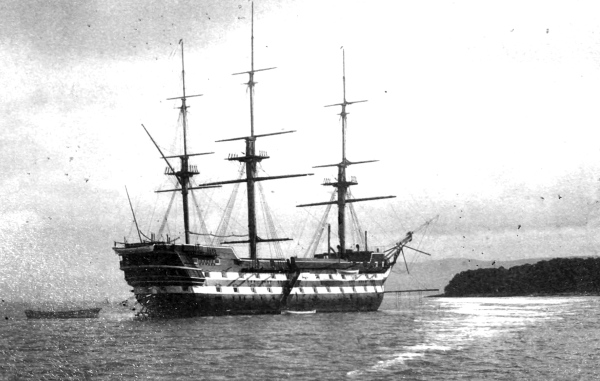
“Just as the moon rose over the bay,
Where, swinging wide at her moorings, lay
The ‘Somerset,’ British man-of-war.”
[Pg 343]
Meanwhile, impatient to mount and ride,
Booted and spurred, with a heavy stride
On the opposite shore walked Paul Revere.
Now he patted his horse’s side,
Now gazed at the landscape far and near,
Then, impetuous, stamped the earth,
And turned and tightened his saddle-girth;
But mostly he watched with eager search
The belfry tower of the Old North Church,
As it rose above the graves on the hill,
Lonely and spectral, and sombre and still.
And lo! as he looks, on the belfry’s height
A glimmer, and then a gleam of light!
He springs to the saddle, the bridle he turns,
But lingers and gazes, till full on his sight
A second lamp in the belfry burns!
A hurry of hoofs in a village street,
A shape in the moonlight, a bulk in the dark,
And beneath, from the pebbles, in passing, a spark
Struck out by a steed flying fearless and fleet;
That was all! And yet, through the gloom and the light,
The fate of a nation was riding that night;
And the spark struck out by that steed in his flight,
Kindled the land into flame with its heat.
He has left the village and mounted the steep,
And beneath him, tranquil and broad and deep,
Is the Mystic, meeting the ocean tides;
And under the alders, that skirt its edge,
Now soft on the sand, now loud on the ledge,
Is heard the tramp of his steed as he rides.
It was twelve by the village clock,
When he crossed the bridge into Medford town.
He heard the crowing of the cock,
And the barking of the farmer’s dog,
And felt the damp of the river fog,
That rises after the sun goes down.
It was one by the village clock,
When he galloped into Lexington.
He saw the gilded weathercock
Swim in the moonlight as he passed,
And the meeting-house windows, blank and bare,
Gaze at him with a spectral glare,
[Pg 344]
As if they already stood aghast
At the bloody work they would look upon.
It was two by the village clock,
When he came to the bridge in Concord town.
He heard the bleating of the flock,
And the twitter of birds among the trees,
And felt the breath of the morning breeze
Blowing over the meadows brown.
And one was safe and asleep in his bed
Who at the bridge would be first to fall,
Who that day would be lying dead,
Pierced by a British musket-ball.
You know the rest. In the books you have read,
How the British Regulars fired and fled,—
How the farmers gave them ball for ball,
From behind each fence and farm-yard wall,
Chasing the red-coats down the lane,
Then crossing the field to emerge again
Under the trees at the turn of the road,
And only pausing to fire and load.
So through the night rode Paul Revere;
And so through the night went his cry of alarm
To every Middlesex village and farm,—
A cry of defiance and not of fear,
A voice in the darkness, a knock at the door,
And a word that shall echo for evermore!
For, borne on the night-wind of the Past,
Through all our history, to the last,
In the hour of darkness and peril and need
The people will waken and listen to hear
The hurrying hoof-beats of that steed,
And the midnight message of Paul Revere.
INTERLUDE.
The Landlord ended thus his tale,
Then rising took down from its nail
The sword that hung there, dim with dust,
And cleaving to its sheath with rust,
And said, “This sword was in the fight.”
The Poet seized it, and exclaimed,
“It is the sword of a good knight,
Though homespun was his coat-of-mail;
What matter if it be not named
Joyeuse, Colada, Durindale,
Excalibar, or Aroundight,
Or other name the books record?
Your ancestor, who bore this sword
As Colonel of the Volunteers,
Mounted upon his old grey mare,
Seen here and there and everywhere,
To me a grander shape appears
Than old Sir William, or what not,
[Pg 345]
Clinking about in foreign lands
With iron gauntlets on his hands,
And on his head an iron pot!”
All laughed; the Landlord’s face grew red
As his escutcheon on the wall;
He could not comprehend at all
The drift of what the Poet said;
For those who had been longest dead
Were always greatest in his eyes;
And he was speechless with surprise
To see Sir William’s plumèd head
Brought to a level with the rest,
And made the subject of a jest.
And this perceiving, to appease
The Landlord’s wrath, the others’ fears,
The Student said, with careless ease,
“The ladies and the cavaliers,
The arms, the loves, the courtesies,
The deeds of high emprise, I sing!
Thus Ariosto says, in words
That have the stately stride and ring
Of armèd knights and clashing swords.
Now listen to the tale I bring;
Listen! though not to me belong
The flowing draperies of his song,
The words that rouse, the voice that charms.
The Landlord’s tale was one of arms,
Only a tale of love is mine,
Blending the human and divine,
A tale of the Decameron, told
In Palmieri’s garden old,
By Fiametta, laurel-crowned,
While her companions lay around,
And heard the intermingled sound
Of airs that on their errands sped,
And wild birds gossiping overhead,
And lisp of leaves and fountain’s fall,
And her own voice more sweet than all,
Telling the tale, which, wanting these,
Perchance may lose its power to please.”
THE STUDENT’S TALE.
THE FALCON OF SER FEDERIGO.
One summer morning when the sun was hot,
Weary with labour in his garden plot,
On a rude bench beneath his cottage eaves,
Ser Federigo sat among the leaves
Of a huge vine, that, with its arms outspread,
Hung its delicious clusters overhead.
Below him, through the lovely valley, flowed
The river Arno, like a winding road,
And from its banks were lifted high in air
The spires and roofs of Florence called the Fair;
To him a marble tomb, that rose above
His wasted fortunes and his buried love.
For there, in banquet and in tournament,
His wealth had lavished been, his substance spent
To woo and lose, since ill his wooing sped,
Monna Giovanna, who his rival wed,
Yet ever in his fancy reigned supreme,
The ideal woman of a young man’s dream.
Then he withdrew, in poverty and pain,
To this small farm, the last of his domain,
[Pg 346]
His only comfort and his only care
To prune his vines, and plant the fig and pear;
His only forester and only guest
His falcon, faithful to him, when the rest,
Whose willing hands had found so light of yore
The brazen knocker of his palace door,
Had now no strength to lift the wooden latch,
That entrance gave beneath a roof of thatch.
Companion of his solitary ways,
Purveyor of his feasts on holidays,
On him this melancholy man bestowed
The love with which his nature overflowed.
And so the empty-handed years went round,
Vacant, though voiceful with prophetic sound;
And so, that summer morn, he sat and mused
With folded, patient hands, as he was used,
And dreamily before his half-closed sight
Floated the vision of his lost delight.
Beside him, motionless, the drowsy bird
Dreamed of the chase, and in his slumber heard
The sudden scythe-like sweep of wings, that dare
The headlong plunge through eddying gulfs of air,
Then, starting broad awake upon his perch,
Tinkled his bells, like mass-bells in a church,
And, looking at his master, seemed to say,
“Ser Federigo, shall we hunt to-day?”
Ser Federigo thought not of the chase;
The tender vision of her lovely face
I will not say he seems to see, he sees
In the leaf-shadows of the trellises,
Herself, yet not herself; a lovely child
With flowing tresses, and eyes wide and wild,
Coming undaunted up the garden walk,
And looking not at him, but at the hawk.
“Beautiful falcon!” said he, “would that I
Might hold thee on my wrist, or see thee fly!”
The voice was hers, and made strange echoes start
Through all the haunted chambers of his heart,
As an Æolian harp through gusty doors
Of some old ruin its wild music pours.
“Who is thy mother, my fair boy?” he said,
His hand laid softly on that shining head.
“Monna Giovanna.—Will you let me stay
A little while, and with your falcon play?
We live there, just beyond your garden wall,
In the great house behind the poplars tall.”
So he spake on; and Federigo heard
As from afar each softly uttered word,
[Pg 347]
And drifted onward through the golden gleams
And shadows of the misty sea of dreams,
As mariners becalmed through vapours drift,
And feel the sea beneath them sink and lift,
And hear far off the mournful breakers roar,
And voices calling faintly from the shore!
Then, waking from his painful reveries,
He took the little boy upon his knees,
And told him stories of his gallant bird,
Till in their friendship he became a third.
Monna Giovanna, widowed in her prime,
Had come with friends to pass the summer time
In her grand villa, half-way up the hill,
O’erlooking Florence, but retired and still;
With iron gates, that opened through long lines
Of sacred ilex and centennial pines,
And terraced gardens, and broad steps of stone,
And sylvan deities, with moss o’ergrown,
And fountains palpitating in the heat,
And all Val d’Arno stretched beneath its feet.
Here in seclusion, as a widow may,
The lovely lady wiled the hours away,
Pacing in sable robes the statued hall,
Herself the stateliest statue among all,
And seeing more and more, with secret joy,
Her husband risen and living in her boy,
Till the lost sense of life returned again,
Not as delight, but as relief from pain.
Meanwhile the boy, rejoicing in his strength,
Stormed down the terraces from length to length;
The screaming peacock chased in hot pursuit,
And climbed the garden trellises for fruit.
But his chief pastime was to watch the flight
Of a gerfalcon, soaring into sight,
Beyond the trees that fringed the garden wall,
Then downward stooping at some distant call;
And as he gazed full often wondered he
Who might the master of the falcon be,
Until that happy morning, when he found
Master and falcon in the cottage ground.
And now a shadow and a terror fell
On the great house, as if a passing-bell
Toiled from the tower, and filled each spacious room
With secret awe, and preternatural gloom.
The petted boy grew ill, and day by day
Pined with mysterious malady away.
[Pg 348]
The mother’s heart would not be comforted;
Her darling seemed to her already dead,
And often, sitting by the sufferer’s side,
“What can I do to comfort thee?” she cried.
At first the silent lips made no reply,
But, moved at length by her importunate cry,
“Give me,” he answered, with imploring tone,
“Ser Federigo’s falcon for my own!”
No answer could the astonished mother make;
How could she ask, e’en for her darling’s sake,
Such favour at a luckless lover’s hand,
Well knowing that to ask was to command?
Well knowing, what all falconers confessed,
In all the land that falcon was the best,
The master’s pride and passion and delight,
And the sole pursuivant of this poor knight.
But yet, for her child’s sake, she could no less
Than give assent, to soothe his restlessness,
So promised, and then promising to keep
Her promise sacred, saw him fall asleep.
The morrow was a bright September morn;
The earth was beautiful as if new-born;
There was that nameless splendour everywhere,
That wild exhilaration in the air,
Which makes the passers in the city street
Congratulate each other as they meet.
Two lovely ladies, clothed in cloak and hood,
Passed through the garden gate into the wood,
Under the lustrous leaves, and through the sheen
Of dewy sunshine showering down between.
The one, close-hooded, had the attractive grace
Which sorrow sometimes lends a woman’s face;
Her dark eyes moistened with the mists that roll
From the gulf-stream of passion in the soul;
The other with her hood thrown back, her hair
Making a golden glory in the air,
Her cheeks suffused with an auroral blush,
Her young heart singing louder than the thrush;
So walked, that morn, through mingled light and shade,
Each by the other’s presence lovelier made,
Monna Giovanna and her bosom friend,
Intent upon their errand and its end.
They found Ser Federigo at his toil,
Like banished Adam, delving in the soil;
And when he looked and these fair women spied,
The garden suddenly was glorified;
[Pg 349]
His long-lost Eden was restored again,
And the strange river winding through the plain
No longer was the Arno to his eyes,
But the Euphrates watering Paradise!
Monna Giovanna raised her stately head,
And with fair words of salutation said:
“Ser Federigo, we come here as friends,
Hoping in this to make some poor amends
For past unkindness. I who ne’er before
Would even cross the threshold of your door,
I who in happier days such pride maintained,
Refused your banquets, and your gifts disdained,
This morning come, a self-invited guest,
To put your generous nature to the test,
And breakfast with you under your own vine.”
To which he answered: “Poor desert of mine,
Not your unkindness call it, for if aught
Is good in me of feeling or of thought,
From you it comes, and this last grace outweighs
All sorrows, all regrets of other days.”
And after further compliment and talk,
Among the dahlias in the garden walk
He left his guests; and to his cottage turned,
And as he entered for a moment yearned
For the lost splendours of the days of old,
The ruby glass, the silver, and the gold,
And felt how piercing is the sting of pride,
By want embittered and intensified.
He looked about him for some means or way
To keep this unexpected holiday;
Searched every cupboard, and then searched again,
Summoned the maid, who came, but came in vain;
“The Signor did not hunt to-day,” she said,
“There’s nothing in the house but wine and bread.”
Then suddenly the drowsy falcon shook
His little bells with that sagacious look,
Which said, as plain as language to the ear,
“If anything is wanting, I am here!”
Yes, everything is wanting, gallant bird!
The master seized thee without further word,
Like thine own lure, he whirled thee round; ah me!
The pomp and flutter of brave falconry,
The bells, the jesses, the bright scarlet hood,
The flight and the pursuit o’er field and wood,
All these for evermore are ended now;
No longer victor, but the victim thou!
[Pg 350]
Then on the board a snow-white cloth he spread,
Laid on its wooden dish the loaf of bread,
Brought purple grapes with autumn sunshine hot,
The fragrant peach, the juicy bergamot;
Then in the midst a flask of wine he placed,
And with autumnal flowers the banquet graced.
Ser Federigo, would not these suffice
Without thy falcon stuffed with cloves and spice?
When all was ready, and the courtly dame
With her companion to the cottage came,
Upon Ser Federigo’s brain there fell
The wild enchantment of a magic spell;
The room they entered, mean and low and small,
Was changed into a sumptuous banquet-hall,
With fanfares by aërial trumpets blown;
The rustic chair she sat on was a throne;
He ate celestial food, and a divine
Flavour was given to his country wine,
And the poor falcon, fragrant with his spice,
A peacock was, or bird of paradise!
When the repast was ended, they arose
And passed again into the garden-close.
Then said the Lady, “Far too well I know,
Remembering still the days of long ago,
Though you betray it not, with what surprise
You see me here in this familiar wise.
You have no children, and you cannot guess
What anguish, what unspeakable distress
A mother feels, whose child is lying ill,
Nor how her heart anticipates his will.
And yet for this you see me lay aside
All womanly reserve and check of pride,
And ask the thing most precious in your sight,
Your falcon, your sole comfort and delight,
Which, if you find it in your heart to give,
My poor, unhappy boy perchance may live.”
Ser Federigo listens, and replies,
With tears of love and pity in his eyes:
“Alas, dear lady! there can be no task
So sweet to me, as giving when you ask.
One little hour ago, if I had known
This wish of yours, it would have been my own.
But thinking in what manner I could best
Do honour to the presence of my guest,
I deemed that nothing worthier could be
Than what most dear and precious was to me,
And so my gallant falcon breathed his last
To furnish forth this morning our repast.”
[Pg 351]
In mute contrition, mingled with dismay,
The gentle lady turned her eyes away,
Grieving that he such sacrifice should make,
And kill his falcon for a woman’s sake,
Yet feeling in her heart a woman’s pride,
That nothing she could ask for was denied;
Then took her leave, and passed out at the gate
With footsteps slow, and soul disconsolate.
Three days went by, and lo! a passing-bell
Tolled from the little chapel in the dell;
Ten strokes Ser Federigo heard, and said,
Breathing a prayer, “Alas! her child is dead!”
Three months went by, and lo! a merrier chime
Rang from the chapel bells at Christmas time;
The cottage was deserted, and no more
Ser Federigo sat beside its door,
But now, with servitors to do his will,
In the grand villa, half-way up the hill,
Sat at the Christmas feast, and at his side
Monna Giovanna, his belovèd bride,
Never so beautiful, so kind, so fair,
Enthroned once more in the old rustic chair,
High-perched upon the back of which there stood
The image of a falcon carved in wood,
And underneath the inscription, with a date,
“All things come round to him who will but wait.”
INTERLUDE.
Soon as the story reached its end,
One, over-eager to commend,
Crowned it with injudicious praise;
And then the voice of blame found vent,
And fanned the embers of dissent
Into a somewhat lively blaze.
The Theologian shook his head;
“These old Italian tales,” he said,
“From the much-praised Decameron down
Through all the rabble of the rest,
Are either trifling, dull, or lewd;
The gossip of a neighbourhood
In some remote provincial town,
A scandalous chronicle at best!
They seem to me a stagnant fen,
Grown rank with rushes and with reeds,
Where a white lily, now and then,
Blooms in the midst of noxious weeds,
And deadly nightshade on its banks.”
To this the Student straight replied:
“For the white lily, many thanks!
One should not say, with too much pride,
Fountain, I will not drink of thee!
Nor were it grateful to forget,
That from these reservoirs and tanks
Even imperial Shakespeare drew
His Moor of Venice and the Jew,
And Romeo and Juliet,
And many a famous comedy.”
Then a long pause; till some one said,
“An angel is flying overhead!”
At these words spake the Spanish Jew,
And murmured with an inward breath:
[Pg 352]
“God grant, if what you say is true,
It may not be the Angel of Death!”
And then another pause; and then,
Stroking his beard, he said again:
“This brings back to my memory
A story in the Talmud told,
That book of gems, that book of gold,
Of wonders many and manifold,
A tale that often comes to me,
And fills my heart, and haunts my brain;
And never wearies nor grows old.”
THE SPANISH JEW’S TALE.
THE LEGEND OF RABBI BEN LEVI.
Rabbi Ben Levi, on the Sabbath, read
A volume of the Law, in which it said,
“No man shall look upon my face and live.”
And as he read, he prayed that God would give
His faithful servant grace with mortal eye
To look upon his face and yet not die.
Then fell a sudden shadow on the page,
And lifting up his eyes, grown dim with age,
He saw the Angel of Death before him stand,
Holding a naked sword in his right hand.
Rabbi Ben Levi was a righteous man,
Yet through his veins a chill of terror ran.
With trembling voice he said, “What wilt thou here?”
The Angel answered, “Lo! the time draws near
When thou must die; yet first, by God’s decree,
Whate’er thou askest shall be granted thee.”
Replied the Rabbi, “Let these living eyes
First look upon my place in Paradise.”
Then said the Angel, “Come with me and look.”
Rabbi Ben Levi closed the sacred book,
And rising, and uplifting his grey head,
“Give me thy sword,” he to the Angel said,
“Lest thou shouldst fall upon me by the way.”
The Angel smiled and hastened to obey,
Then led him forth to the Celestial Town,
And set him on the wall, whence, gazing down,
Rabbi Ben Levi, with his living eyes,
Might look upon his place in Paradise.
Then straight into the city of the Lord
The Rabbi leaped with the Death-Angel’s sword,
And through the streets there swept a sudden breath
Of something there unknown, which men call death.
Meanwhile the Angel stayed without, and cried,
“Come back!” To which the Rabbi’s voice replied,
[Pg 353]
“No! in the name of God, whom I adore,
I swear that hence I will depart no more!”
Then all the Angels cried, “O Holy One,
See what the son of Levi here has done!
The kingdom of Heaven he takes by violence,
And in thy name refuses to go hence!”
The Lord replied, “My Angels, be not wroth;
Did e’er the son of Levi break his oath?
Let him remain; for he with mortal eye
Shall look upon my face and yet not die.”
Beyond the outer wall the Angel of Death
Heard the great voice, and said, with panting breath,
“Give back the sword, and let me go my way.”
Whereat the Rabbi paused, and answered, “Nay!
Anguish enough already has it caused
Among the sons of men.” And while he paused
He heard the awful mandate of the Lord
Resounding through the air, “Give back the sword!”
The Rabbi bowed his head in silent prayer;
Then said he to the dreadful Angel, “Swear,
No human eye shall look on it again;
But when thou takest away the souls of men,
Thyself unseen, and with an unseen sword,
Thou wilt perform the bidding of the Lord.”
The Angel took the sword again, and swore,
And walks on earth unseen for evermore.
INTERLUDE.
He ended: and a kind of spell
Upon the silent listeners fell.
His solemn manner and his words
Had touched the deep, mysterious chords
That vibrate in each human breast
Alike, but not alike confessed.
The spiritual world seemed near;
And close above them, full of fear,
Its awful adumbration passed,
A luminous shadow, vague and vast.
They almost feared to look, lest there,
Embodied from the impalpable air,
They might behold the Angel stand,
Holding the sword in his right hand.
At last, but in a voice subdued,
Not to disturb their dreamy mood,
Said the Sicilian: “While you spoke,
Telling your legend marvellous,
Suddenly in my memory woke
The thought of one, now gone from us,—
An old Abate, meek and mild,
My friend and teacher, when a child,
Who sometimes in those days of old
The legend of an Angel told,
Which ran, if I remember, thus.”
[Pg 354]
THE SICILIAN’S TALE.
KING ROBERT OF SICILY.
Robert of Sicily, brother of Pope Urbane
And Valmond, Emperor of Allemaine,
Apparelled in magnificent attire,
With retinue of many a knight and squire,
On St. John’s Eve, at vespers, proudly sat
And heard the priests chant the Magnificat.
And as he listened, o’er and o’er again
Repeated, like a burden or refrain,
He caught the “Deposuit potentes
De sede, et exaltavit humiles;”
And slowly lifting up his kingly head,
He to a learnèd clerk beside him said,
“What mean these words?” The clerk made answer meet,
“He has put down the mighty from their seat,
And has exalted them of low degree.”
Thereat King Robert muttered scornfully,
“’Tis well that such seditious words are sung
Only by priests and in the Latin tongue:
For unto priests and people be it known,
There is no power can push me from my throne!”
And leaning back, he yawned and fell asleep,
Lulled by the chant monotonous and deep.
When he awoke, it was already night;
The church was empty, and there was no light,
Save where the lamps, that glimmered few and faint
Lighted a little space before some saint.
He started from his seat and gazed around,
But saw no living thing and heard no sound.
He groped towards the door, but it was locked;
He cried aloud, and listened, and then knocked,
And uttered awful threatenings and complaints,
And imprecations upon men and saints.
The sounds re-echoed from the roof and walls,
As if dead priests were laughing in their stalls!
At length the sexton, hearing from without
The tumult of the knocking and the shout,
And thinking thieves were in the house of prayer,
Came with his lantern, asking, “Who is there?”
Half-choked with rage, King Robert fiercely said,
“Open: ’tis I, the King! Art thou afraid?”
The frightened sexton, muttering, with a curse,
“This is some drunken vagabond, or worse!”
Turned the great key and flung the portal wide:
A man rushed by him at a single stride,
[Pg 355]
Haggard, half-naked, without hat or cloak,
Who neither turned, nor looked at him, nor spoke,
But leapt into the blackness of the night,
And vanished like a spectre from his sight.
Robert of Sicily, brother of Pope Urbane
And Valmond, Emperor of Allemaine,
Despoiled of his magnificent attire,
Bare-headed, breathless, and besprent with mire,
With sense of wrong and outrage desperate,
Strode on and thundered at the palace gate;
Rushed through the court-yard, thrusting in his rage
To right and left each seneschal and page,
And hurried up the broad and sounding stair,
His white face ghastly in the torches’ glare.
From hall to hall he passed with breathless speed;
Voices and cries he heard, but did not heed,
Until at last he reached the banquet-room,
Blazing with light, and breathing with perfume.
There on the daïs sat another king,
Wearing his robes, his crown, his signet-ring,
King Robert’s self in features, form, and height,
But all transfigured with angelic light!
It was an Angel; and his presence there
With a divine effulgence filled the air,
An exaltation, piercing the disguise,
Though none the hidden Angel recognise.
A moment speechless, motionless, amazed,
The throneless monarch on the Angel gazed,
Who met his looks of anger and surprise
With the divine compassion of his eyes;
Then said, “Who art thou? and why com’st thou here?”
To which King Robert answered with a sneer,
“I am the King, and come to claim my own
From an impostor, who usurps my throne!”
And suddenly, at these audacious words,
Up sprang the angry guests, and drew their swords;
The Angel answered, with unruffled brow,
“Nay, not the King, but the King’s Jester; thou
Henceforth shalt wear the bells and scalloped cape,
And for thy counsellor shalt lead an ape;
Thou shalt obey my servants when they call,
And wait upon my henchmen in the hall!”
Deaf to King Robert’s threats and cries and prayers,
They thrust him from the hall and down the stairs;
A group of tittering pages ran before,
And as they opened wide the folding-door,
His heart failed, for he heard, with strange alarms,
The boisterous laughter of the men-at-arms,
[Pg 356]
And all the vaulted chamber roar and ring
With the mock plaudits of “Long live the King!”
Next morning, waking with the day’s first beam,
He said within himself, “It was a dream!”
But the straw rustled as he turned his head,
There were the cap and bells beside his bed,
Around him rose the bare, discoloured walls,
Close by, the steeds were champing in their stalls,
And in the corner, a revolting shape,
Shivering and chattering, sat the wretched ape.
It was no dream; the world he loved so much
Had turned to dust and ashes at his touch!
Days came and went; and now returned again
To Sicily the old Saturnian reign;
Under the Angel’s governance benign
The happy island danced with corn and wine,
And deep within the mountain’s burning breast
Enceladus, the giant, was at rest.
Meanwhile King Robert yielded to his fate,
Sullen and silent and disconsolate.
Dressed in the motley garb that Jesters wear,
With looks bewildered and a vacant stare,
Close shaven above the ears, as monks are shorn,
By courtiers mocked, by pages laughed to scorn,
His only friend the ape, his only food
What others left,—he still was unsubdued.
And when the Angel met him on his way,
And half in earnest, half in jest, would say,
Sternly, though tenderly, that he might feel
The velvet scabbard held a sword of steel,
“Art thou the King?” the passion of his woe
Burst from him in resistless overflow,
And, lifting high his forehead, he would fling
The haughty answer back, “I am, I am the King!”
Almost three years were ended; when there came
Ambassadors of great repute and name
From Valmond, Emperor of Allemaine,
Unto King Robert, saying that Pope Urbane
By letter summoned them forthwith to come
On Holy Thursday to his city of Rome.
The Angel with great joy received his guests,
And gave them presents of embroidered vests,
And velvet mantles with rich ermine lined,
And rings and jewels of the rarest kind.
Then he departed with them o’er the sea
Into the lovely land of Italy,
Whose loveliness was more resplendent made
By the mere passing of that cavalcade,
[Pg 357]
With plumes, and cloaks, and housings, and the stir
Of jewelled bridle and of golden spur.
And lo! among the menials, in mock state,
Upon a piebald steed, with shambling gait,
His cloak of foxtails flapping in the wind,
The solemn ape demurely perched behind,
King Robert rode, making huge merriment
In all the country towns through which they went.
The Pope received them with great pomp, and blare
Of bannered trumpets, in Saint Peter’s square,
Giving his benediction and embrace,
Fervent, and full of apostolic grace.
While with congratulations and with prayers
He entertained the Angel unawares,
Robert, the Jester, bursting through the crowd,
Into their presence rushed, and cried aloud,
“I am the King! Look, and behold in me
Robert, your brother, King of Sicily!
This man, who wears my semblance to your eyes,
Is an impostor in a king’s disguise.
Do you not know me? does no voice within
Answer my cry, and say we are akin?”
The Pope in silence, but with troubled mien,
Gazed at the Angel’s countenance serene;
The Emperor, laughing, said, “It is strange sport
To keep a madman for thy Fool at court!”
And the poor, baffled Jester in disgrace
Was hustled back among the populace.
In solemn state the Holy Week went by,
And Easter Sunday gleamed upon the sky;
The presence of the Angel, with its light,
Before the sun rose, made the city bright,
And with new fervour filled the hearts of men,
Who felt that Christ indeed had risen again.
Even the Jester, on his bed of straw,
With haggard eyes the unwonted splendour saw;
He felt within a power unfelt before,
And, kneeling humbly on his chamber floor,
He heard the rushing garments of the Lord
Sweep through the silent air, ascending heavenward.
And now the visit ending, and once more
Valmond returning to the Danube’s shore,
Homeward the Angel journeyed, and again
The land was made resplendent with his train.
Flashing along the towns of Italy
Unto Salerno, and from thence by sea.
[Pg 358]
And when once more within Palermo’s wall,
And, seated on the throne in his great hall,
He heard the Angelus from convent towers,
As if the better world conversed with ours,
He beckoned to King Robert to draw nigher,
And with a gesture bade the rest retire;
And when they were alone, the Angel said,
“Art thou the King?” Then bowing down his head,
King Robert crossed both hands upon his breast,
And meekly answered him: “Thou knowest best!
My sins as scarlet are; let me go hence,
And in some cloister’s school of penitence,
Across those stones, that pave the way to heaven,
Walk barefoot, till my guilty soul is shriven!”
The Angel smiled, and from his radiant face
A holy light illumined all the place,
And through the open window, loud and clear,
They heard the monks chant in the chapel near,
Above the stir and tumult of the street:
“He has put down the mighty from their seat,
And has exalted them of low degree!”
And through the chant a second melody
Rose like the throbbing of a single string:
“I am an Angel, and thou art the King!”
King Robert, who was standing near the throne,
Lifted his eyes, and lo! he was alone!
But all apparelled as in days of old,
With ermined mantle and with cloth of gold;
And when his courtiers came, they found him there
Kneeling upon the floor, absorbed in silent prayer.
INTERLUDE.
And then the blue-eyed Norseman told
A Saga of the days of old.
“There is,” said he, “a wondrous book
Of Legends in the old Norse tongue
Of the dead kings of Norroway,—
Legends that once were told or sung
In many a smoky fireside nook
Of Iceland, in the ancient day,
By wandering Saga-man or Scald;
Heimskringla is the volume called;
And he who looks may find therein
The story that I now begin.”
And in each pause the story made
Upon his violin he played,
As an appropriate interlude,
Fragments of old Norwegian tunes
That bound in one the separate runes,
And held the mind in perfect mood,
Entwining and encircling all
The strange and antiquated rhymes
With melodies of olden times;
As over some half-ruined wall,
Disjointed and about to fall,
Fresh woodbines climb and interlace,
And keep the loosened stones in place.
[Pg 359]
THE MUSICIAN’S TALE.
THE SAGA OF KING OLAF.
I.
THE CHALLENGE OF THOR.
I am the God Thor,
I am the War God,
I am the Thunderer!
Here in my Northland,
My fastness and fortress,
Reign I for ever!
Here amid icebergs
Rule I the nations;
This is my hammer,
Miölner the mighty;
Giants and sorcerers
Cannot withstand it!
These are the gauntlets,
Wherewith I wield it,
And hurl it afar off;
This is my girdle;
Whenever I brace it,
Strength is redoubled!
The light thou beholdest
Stream through the heavens
In flashes of crimson,
Is but my red beard
Blown by the night-wind,
Affrighting the nations!
Jove is my brother;
Mine eyes are the lightning;
The wheels of my chariot
Roll in the thunder,
The blows of my hammer
Ring in the earthquake!
Force rules the world still,
Has ruled it, shall rule it;
Meekness is weakness,
Strength is triumphant,
Over the whole earth
Still is it Thor’s Day!
Thou art a God too,
O Galilean!
And thus single-handed
Unto the combat,
Gauntlet or Gospel,
Here I defy thee!
II.
KING OLAF’S RETURN.
And King Olaf heard the cry,
Saw the red light in the sky,
Laid his hand upon his sword,
As he leaned upon the railing,
And his ship went sailing, sailing
Northward into Drontheim fiord.
There he stood as one who dreamed;
And the red light glanced and gleamed
On the armour that he wore;
And he shouted, as the rifted
Streamers o’er him shook and shifted,
“I accept thy challenge, Thor!”
To avenge his father slain,
And reconquer realm and reign,
Came the youthful Olaf home,
Through the midnight sailing, sailing,
Listening to the wild wind’s wailing,
And the dashing of the foam.
To his thoughts the sacred name
Of his mother Astrid came,
And the tale she oft had told
Of her flight by secret passes
Through the mountains and morasses,
To the home of Hakon old.
[Pg 360]
Then strange memories crowded back
Of Queen Gunhild’s wrath and wrack
And a hurried flight by sea;
Of grim Vikings, and their rapture
In the sea-fight, and the capture,
And the life of slavery.
How a stranger watched his face
In the Esthonian market-place,
Scanned his features one by one,
Saying, “We should know each other;
I am Sigurd, Astrid’s brother,
Thou art Olaf, Astrid’s son!”
Then as Queen Allogia’s page,
Old in honours, young in age,
Chief of all her men-at-arms;
Till vague whispers, and mysterious,
Reached King Valdemar, the imperious,
Filling him with strange alarms.
Then his cruisings o’er the seas,
Westward to the Hebrides,
And to Scilly’s rocky shore;
And the hermit’s cavern dismal,
Christ’s great name and rites baptismal,
In the ocean’s rush and roar.
All these thoughts of love and strife
Glimmered through his lurid life,
As the stars’ intenser light
Through the red flames o’er him trailing,
As his ships went sailing, sailing,
Northward in the summer night.
Trained for either camp or court,
Skilful in each manly sport,
Young and beautiful and tall.
Art of warfare, craft of chases,
Swimming, skating, snow-shoe races,
Excellent alike in all.
When at sea, with all his rowers,
He along the bending oars
Outside of his ship could run.
He the Smalsor Horn ascended,
And his shining shield suspended
On its summit, like a sun.
On the ship-rails he could stand,
Wield his sword with either hand,
And at once two javelins throw;
At all feasts where ale was strongest,
Sat the merry monarch longest,
First to come and last to go.
Norway never yet had seen
One so beautiful of mien,
One so royal in attire,
When in arms completely furnished,
Harness gold-inlaid and burnished,
Mantle like a flame of fire.
Thus came Olaf to his own,
When upon the night-wind blown
Passed that cry along the shore;
And he answered, while the rifted
Streamers o’er him shook and shifted,
“I accept thy challenge, Thor!”
III.
THORA OF RIMOL.
“Thora of Rimol! hide me! hide me!
Danger and shame and death betide me!
For Olaf the King is hunting me down
Through field and forest, through thorp and town!”
Thus cried Jarl Hakon
To Thora, the fairest of women.
“Hakon Jarl! for the love I bear thee,
Neither shall shame nor death come near thee
But the hiding-place wherein thou must lie
Is the cave underneath the swine in the sty.”
Thus to Jarl Hakon
Said Thora, the fairest of women.
[Pg 361]
So Hakon Jarl and his base thrall Karker
Crouched in the cave, than a dungeon darker,
As Olaf came riding, with men in mail,
Through the forest roads into Orkadale,
Demanding Jarl Hakon
Of Thora, the fairest of women.
“Rich and honoured shall be whoever
The head of Hakon Jarl shall dissever!”
Hakon heard him, and Karker the slave,
Through the breathing-holes of the darksome cave.
Alone in her chamber
Wept Thora, the fairest of women.
Said Karker, the crafty, “I will not slay thee!
For all the King’s gold I will never betray thee!”
“Then why dost thou turn so pale, O churl,
And then again black as the earth?” said the Earl.
More pale and more faithful
Was Thora, the fairest of women.
From a dream in the night the thrall started, saying,
“Round my neck a gold ring King Olaf was laying!”
And Hakon answered, “Beware of the king!
He will lay round thy neck a blood-red ring.”
At the ring on her finger
Gazed Thora, the fairest of women.
At daybreak slept Hakon, with sorrows encumbered,
But screamed and drew up his feet as he slumbered;
The thrall in the darkness plunged with his knife,
And the Earl awakened no more in this life.
But wakeful and weeping
Sat Thora, the fairest of women.
At Nidarholm the priests are all singing,
Two ghastly heads on the gibbet are swinging;
One is Jarl Hakon’s and one is his thrall’s,
And the people are shouting from windows and walls;
While alone in her chamber
Swoons Thora, the fairest of women.
IV.
QUEEN SIGRID THE HAUGHTY.
Queen Sigrid the Haughty sat proud and aloft
In her chamber, that looked over meadow and croft.
Heart’s dearest,
Why dost thou sorrow so?
[Pg 362]
The floor with tassels of fir was besprent,
Filling the room with their fragrant scent.
She heard the birds sing, she saw the sun shine,
The air of summer was sweeter than wine.
Like a sword without scabbard the bright river lay
Between her own kingdom and Norroway.
But Olaf the King had sued for her hand,
The sword would be sheathed, the river be spanned.
Her maidens were seated around her knee,
Working bright figures in tapestry.
And one was singing the ancient rune
Of Brynhilda’s love and the wrath of Gudrun.
And through it, and round it, and over it all
Sounded incessant the waterfall.
The Queen in her hand held a ring of gold,
From the door of Ladé’s Temple old.
King Olaf had sent her this wedding gift,
But her thoughts as arrows were keen and swift.
She had given the ring to her goldsmiths twain,
Who smiled as they handed it back again.
And Sigrid the Queen, in her haughty way,
Said, “Why do you smile, my goldsmiths, say?”
And they answered: “O Queen! if the truth must be told,
The ring is of copper, and not of gold!”
The lightning flashed o’er her forehead and cheek,
She only murmured, she did not speak:
“If in his gifts he can faithless be,
There will be no gold in his love to me.”
A footstep was heard on the outer stair,
And in strode King Olaf with royal air.
He kissed the Queen’s hand, and he whispered of love,
And swore to be true as the stars are above.
But she smiled with contempt as she answered: “O King
Will you swear it, as Odin once swore, on the ring?”
And the King: “O speak not of Odin to me,
The wife of King Olaf a Christian must be.”
[Pg 363]
Looking straight at the King, with her level brows,
She said, “I keep true to my faith and my vows.”
Then the face of King Olaf was darkened with gloom,
He rose in his anger and strode through the room.
“Why then should I care to have thee?” he said,—
“A faded old woman, a heathenish jade!”
His zeal was stronger than fear or love,
And he struck the Queen in the face with his glove.
Then forth from the chamber in anger he fled,
And the wooden stairway shook with his tread.
Queen Sigrid the Haughty said under her breath,
“This insult, King Olaf, shall be thy death!”
Heart’s dearest,
Why dost thou sorrow so?
V.
THE SKERRY OF SHRIEKS.
Now from all King Olaf’s farms
His men-at-arms
Gathered on the Eve of Easter;
To his house at Angvalds-ness
Fast they press,
Drinking with the royal feaster.
Loudly through the wide-flung door
Came the roar
Of the sea upon the Skerry;
And its thunder loud and near
Reached the ear,
Mingling with their voices merry.
“Hark!” said Olaf to his Scald,
Halfred the Bald,
“Listen to that song, and learn it!
Half my kingdom would I give,
As I live,
If by such songs you would earn it!
“For of all the runes and rhymes
Of all times,
Best I like the ocean’s dirges,
When the old harper heaves and rocks,
His hoary locks
Mowing and flashing in the surges!”
Halfred answered: “I am called
The Unappalled!
Nothing hinders me or daunts me;
Hearken to me, then, O King,
While I sing
The great Ocean song that haunts me.”
“I will hear your song sublime
Some other time,”
Says the drowsy monarch, yawning,
And retires; each laughing guest
Applauds the jest;
Then they sleep till day is dawning.
Pacing up and down the yard,
King Olaf’s guard
Saw the sea-mist slowly creeping
O’er the sands, and up the hill,
Gathering still
Round the house where they were sleeping.
It was not the fog he saw,
Nor misty flaw,
That above the landscape brooded;
It was Eyvind Kallda’s crew
Of warlocks blue,
With their caps of darkness hooded!
[Pg 364]
Round and round the house they go,
Weaving slow
Magic circles to encumber
And imprison in their ring
Olaf the King,
As he helpless lies in slumber.
Then athwart the vapours dun
The Easter sun
Streamed with one broad track of splendour!
In their real forms appeared
The warlocks weird,
Awful as the Witch of Endor.
Blinded by the light that glared,
They groped and stared
Round about with steps unsteady;
From his window Olaf gazed,
And, amazed,
“Who are these strange people?” said he.
“Eyvind Kallda and his men!”
Answered then
From the yard a sturdy farmer;
While the men-at-arms apace
Filled the place,
Busily buckling on their armour.
From the gates they sallied forth,
South and north,
Scoured the island coasts around them,
Seizing all the warlock band
Foot and hand
On the Skerry’s rocks they bound them.
And at eve the King again
Called his train,
And, with all the candles burning,
Silent sat and heard once more
The sullen roar
Of the ocean tides returning.
Shrieks and cries of wild despair
Filled the air,
Growing fainter as they listened;
Then the bursting surge alone
Sounded on;—
Thus the sorcerers were christened!
“Sing, O Scald, your song sublime,
Your ocean-rhyme,”
Cried King Olaf: “it will cheer me!”
Said the Scald, with pallid cheeks,
“The Skerry of Shrieks
Sings too loud for you to hear me!”
VI.
THE WRAITH OF ODIN.
The guests were loud, the ale was strong,
King Olaf feasted late and long;
The hoary Scalds together sang;
O’erhead the smoky rafters rang.
Dead rides Sir Morten of Fogelsang.
The door swung wide, with creak and din;
A blast of cold night-air came in,
And on the threshold shivering stood
A one-eyed guest, with cloak and hood.
Dead rides Sir Morten of Fogelsang.
The King exclaimed, “O grey-beard pale!
Come warm thee with this cup of ale.”
The foaming draught the old man quaffed,
The noisy guests looked on and laughed.
Dead rides Sir Morten of Fogelsang.
[Pg 365]
Then spake the King: “Be not afraid;
Sit here by me.” The guest obeyed,
And, seated at the table, told
Tales of the sea, and Sagas old.
Dead rides Sir Morten of Fogelsang.
And ever, when the tale was o’er,
The King demanded yet one more;
Till Sigurd the Bishop smiling said,
“’Tis late, O king, and time for bed.”
Dead rides Sir Morten of Fogelsang.
The King retired; the stranger-guest
Followed and entered with the rest;
The lights were out, the pages gone,
But still the garrulous guest spake on.
Dead rides Sir Morten of Fogelsang.
As one who from a volume reads,
He spake of heroes and their deeds,
Of lands and cities he had seen,
And stormy gulfs that tossed between.
Dead rides Sir Morten of Fogelsang.
Then from his lips in music rolled
The Havamal of Odin old,
With sounds mysterious as the roar
Of billows on a distant shore.
Dead rides Sir Morten of Fogelsang.
“Do we not learn from runes and rhymes
Made by the gods in elder times,
And do not still the great Scalds teach
That silence better is than speech?”
Dead rides Sir Morten of Fogelsang.
Smiling at this, the King replied,
“Thy lore is by thy tongue belied;
For never was I so enthralled
Either by Saga-man or Scald.”
Dead rides Sir Morten of Fogelsang.
The Bishop said, “Late hours we keep!
Night wanes, O King! ’tis time for sleep!”
Then slept the King, and when he woke
The guest was gone, the morning broke.
Dead rides Sir Morten of Fogelsang.
They found the doors securely barred,
They found the watch-dog in the yard,
[Pg 366]
There was no footprint in the grass,
And none had seen the stranger pass.
Dead rides Sir Morten of Fogelsang.
King Olaf crossed himself and said:
“I know that Odin the Great is dead;
Sure is the triumph of our Faith,
The one-eyed stranger was his wraith.”
Dead rides Sir Morten of Fogelsang.
VII.
IRON-BEARD.
Olaf the King, one summer morn,
Blew a blast on his bugle-horn,
Sending his signal through the land of Drontheim.
And to the Hus-Ting held at Mere
Gathered the farmers far and near,
With their war weapons ready to confront him.
Ploughing under the morning star,
Old Iron-Beard in Yriar
Heard the summons, chuckling with a low laugh.
He wiped the sweat-drops from his brow,
Unharnessed his horses from the plough,
And clattering came on horseback to King Olaf.
He was the churliest of the churls;
Little he cared for king or earls;
Bitter as home-brewed ale were his foaming passions.
Hodden-grey was the garb he wore,
And by the Hammer of Thor he swore;
He hated the narrow town, and all its fashions.
But he loved the freedom of his farm,
His ale at night, by the fireside warm,
Gudrun his daughter, with her flaxen tresses.
He loved his horses and his herds,
The smell of the earth, and the song of birds,
His well-filled barns, his brook with its watercresses.
Huge and cumbersome was his frame;
His beard, from which he took his name,
Frosty and fierce, like that of Hymer the Giant.
So at the Hus-Ting he appeared,
The farmer of Yriar, Iron-Beard,
On horseback, with an attitude defiant.
[Pg 367]
And to King Olaf he cried aloud,
Out of the middle of the crowd,
That tossed about him like a stormy ocean:
“Such sacrifices shalt thou bring,
To Odin and to Thor, O King,
As other kings have done in their devotion!”
King Olaf answered: “I command
This land to be a Christian land;
Here is my Bishop who the folk baptizes!
“But if you ask me to restore
Your sacrifices, stained with gore,
Then will I offer human sacrifices!
“Not slaves nor peasants shall they be,
But men of note and high degree,
Such men as Orm of Lyra and Kar of Gryting!”
Then to the Temple strode he in,
And loud behind him heard the din
Of his men-at-arms and the peasants fiercely fighting.
There in their Temple, carved in wood,
The image of great Odin stood,
And other gods, with Thor supreme among them.
King Olaf smote them with the blade
Of his huge war-axe, gold inlaid,
And downward shattered to the pavement flung them.
At the same moment rose without,
From the contending crowd, a shout,
A mingled sound of triumph and of wailing.
And there upon the trampled plain
The farmer Iron-Beard lay slain,
Midway between the assailed and the assailing.
King Olaf from the doorway spoke:
“Choose ye between two things, my folk,
To be baptized or given up to slaughter!”
And seeing their leader stark and dead,
The people with a murmur said,
“O King, baptize us with thy holy water!”
So all the Drontheim land became
A Christian land in name and fame,
In the old gods no more believing and trusting.
And as a blood-atonement, soon
King Olaf wed the fair Gudrun;
And thus in peace ended the Drontheim Hus-Ting!
[Pg 368]
VIII.
GUDRUN.
On King Olaf’s bridal night
Shines the moon with tender light,
And across the chamber streams
Its tide of dreams.
At the fatal midnight hour,
When all evil things have power,
In the glimmer of the moon
Stands Gudrun.
Close against her heaving breast,
Something in her hand is pressed;
Like an icicle, its sheen
Is cold and keen.
On the cairn are fixed her eyes
Where her murdered father lies,
And a voice remote and drear
She seems to hear.
What a bridal night is this?
Cold will be the dagger’s kiss;
Laden with the chill of death
Is its breath.
Like the drifting snow she sweeps
To the couch where Olaf sleeps;
Suddenly he wakes and stirs,
His eyes meet hers.
“What is that,” King Olaf said,
“Gleams so bright above thy head?
Wherefore standest thou so white
In pale moonlight?”
“’Tis the bodkin that I wear
When at night I bind my hair;
It woke me falling on the floor;
’Tis nothing more.”
“Forests have ears, and fields have eyes;
Often treachery lurking lies
Underneath the fairest hair!
Gudrun, beware!”
Ere the earliest peep of morn
Blew King Olaf’s bugle-horn;
And for ever sundered ride
Bridegroom and bride!
IX.
THANGBRAND THE PRIEST.
Short of stature, large of limb,
Burly face and russet beard,
All the women stared at him,
When in Iceland he appeared.
“Look!” they said,
With nodding head,
“There goes Thangbrand, Olaf’s Priest.”
All the prayers he knew by rote,
He could preach like Chrysostome,
From the fathers he could quote,
He had even been at Rome.
A learnèd clerk,
A man of mark,
Was this Thangbrand, Olaf’s Priest.
He was quarrelsome and loud,
And impatient of control,
Boisterous in the market crowd,
Boisterous at the wassail-bowl,
Everywhere
Would drink and swear,
Swaggering Thangbrand, Olaf’s Priest.
In his house this malecontent
Could the King no longer bear,
So to Iceland he was sent
To convert the heathen there,
And away
One summer day
Sailed this Thangbrand, Olaf’s Priest.
There in Iceland, o’er their books
Pored the people day and night,
But he did not like their looks,
Nor the songs they used to write.
“All this rhyme
Is waste of time!”
Grumbled Thangbrand, Olaf’s Priest.
[Pg 369]
To the alehouse, where he sat,
Came the Scalds and Saga-men;
Is it to be wondered at,
That they quarrelled now and then,
When o’er his beer
Began to leer
Drunken Thangbrand, Olaf’s Priest?
All the folk in Altafiord
Boasted of their island grand;
Saying in a single word,
“Iceland is the finest land
That the sun
Doth shine upon!”
Loud laughed Thangbrand, Olaf’s Priest.
And he answered: “What’s the use
Of this bragging up and down,
When three women and one goose
Make a market in your town!”
Every Scald
Satires scrawled
On poor Thangbrand, Olaf’s Priest.
Something worse they did than that;
And what vexed him most of all
Was a figure in shovel hat,
Drawn in charcoal on the wall;
With words that go
Sprawling below,
“This is Thangbrand, Olaf’s Priest.”
Hardly knowing what he did,
Then he smote them might and main,
Thorvald Veile and Veterlid
Lay there in the alehouse slain.
“To-day we are gold,
To-morrow mould!”
Muttered Thangbrand, Olaf’s Priest.
Much in fear of axe and rope,
Back to Norway sailed he then.
“O, King Olaf! little hope
Is there of these Iceland men!”
Meekly said,
With bending head,
Pious Thangbrand, Olaf’s Priest.
X.
RAUD THE STRONG.
“All the old gods are dead,
All the wild warlocks fled;
But the white Christ lives and reigns,
And through my wide domains
His Gospel shall be spread!”
On the Evangelists
Thus swore King Olaf.
But still in dreams of the night
Beheld he the crimson light,
And heard the voice that defied
Him who was crucified,
And challenged him to the fight.
To Sigurd the Bishop
King Olaf confessed it.
And Sigurd the Bishop said,
“The old gods are not dead,
For the great Thor still reigns,
And among the Jarls and Thanes
The old witchcraft still is spread.”
Thus to King Olaf
Said Sigurd the Bishop.
“Far north in the Salten Fiord,
By rapine, fire, and sword,
Lives the Viking, Raud the Strong;
All the Godoe Isles belong
To him and his heathen horde.”
Thus went on speaking
Sigurd the Bishop.
“A warlock, a wizard is he,
And lord of the wind and the sea;
And whichever way he sails,
He has ever favouring gales,
By his craft in sorcery.”
Here the sign of the cross made
Devoutly King Olaf.
“With rites that we both abhor,
He worships Odin and Thor;
So it cannot yet be said,
That all the old gods are dead,
And the warlocks are no more,”
Flushing with anger
Said Sigurd the Bishop.
[Pg 370]
Then King Olaf cried aloud:
“I will talk with this mighty Raud,
And along the Salten Fiord
Preach the Gospel with my sword
Or be brought back in my shroud!”
So northward from Drontheim
Sailed King Olaf.
XI.
BISHOP SIGURD AT SALTEN FIORD.
Loud the angry wind was wailing
As King Olaf’s ships came sailing
Northward out of Drontheim haven
To the mouth of Salten Fiord.
Though the flying sea-spray drenches,
Fore and aft, the rowers’ benches,
Not a single heart is craven
Of the champions there on board.
All without the Fiord was quiet,
But within it storm and riot,
Such as on his Viking cruises
Raud the Strong was wont to ride.
And the sea through all its tide-ways
Swept the reeling vessels sideways,
As the leaves are swept through sluices,
When the flood-gates open wide.
“’Tis the warlock! ’tis the demon
Raud!” cried Sigurd to the seamen;
“But the Lord is not affrighted
By the witchcraft of his foes.”
To the ship’s bow he ascended,
By his choristers attended,
Round him were the tapers lighted,
And the sacred incense rose.
On the bow stood Bishop Sigurd,
In his robes, as one transfigured,
And the Crucifix he planted
High amid the rain and mist.
Then with holy water sprinkled
All the ship; the mass-bells tinkled;
Loud the monks around him chanted,
Loud he read the Evangelist.
As into the Fiord they darted,
On each side the water parted;
Down a path like silver molten
Steadily rowed King Olaf’s ships;
Steadily burned all night the tapers,
And the White Christ through the vapours
Gleamed across the Fiord of Salten,
As through John’s Apocalypse,—
Till at last they reached Raud’s dwelling
On the little isle of Gelling;
Not a guard was at the doorway,
Not a glimmer of light was seen.
But at anchor, carved and gilded,
Lay the dragon ship he builded;
’Twas the grandest ship in Norway,
With its crest and scales of green.
Up the stairway, softly creeping,
To the loft where Raud was sleeping,
With their fists they burst asunder
Bolt and bar that held the door.
Drunken with sleep and ale they found him,
Dragged him from his bed and bound him,
While he stared with stupid wonder,
At the look and garb they wore.
Then King Olaf said: “O Sea-King!
Little time have we for speaking,
Choose between the good and evil;
Be baptized, or thou shalt die!”
But in scorn the heathen scoffer
Answered: “I disdain thine offer;
Neither fear I God nor Devil;
Thee and thy Gospel I defy!”
Then between his jaws distended,
When his frantic struggles ended,
Through King Olaf’s horn an adder,
Touched by fire, they forced to glide.
Sharp his tooth was as an arrow,
As he gnawed through bone and marrow;
But without a groan or shudder,
Raud the Strong blaspheming died.
[Pg 371]
Then baptized they all that region,
Swarthy Lap and fair Norwegian,
Far as swims the salmon, leaping,
Up the streams of Salten Fiord.
In their temples Thor and Odin
Lay in dust and ashes trodden,
As King Olaf, onward sweeping,
Preached the Gospel with his sword.
Then he took the carved and gilded
Dragon-ship that Raud had builded,
And the tiller single-handed,
Grasping, steered into the main.
Southward sailed the sea-gulls o’er him,
Southward sailed the ship that bore him,
Till at Drontheim haven landed
Olaf and his crew again.
XII.
KING OLAF’S CHRISTMAS.
At Drontheim, Olaf the King
Heard the bells of Yule-tide ring,
As he sat in his banquet-hall,
Drinking the nut-brown ale,
With his bearded Berserks hale
And tall.
Three days his Yule-tide feasts
He held with Bishops and Priests,
And his horn filled up to the brim,
But the ale was never too strong,
Nor the Saga-man’s tale too long,
For him.
O’er his drinking horn, the sign
He made of the Cross divine,
As he drank, and muttered his prayers;
But the Berserks evermore
Made the sign of the Hammer of Thor
Over theirs.
The gleams of the fire-light dance
Upon helmet and hauberk and lance,
And laugh in the eyes of the King;
And he cries to Halfred the Scald,
Grey-bearded, wrinkled, and bald,
“Sing!
Sing me a song divine,
With a sword in every line,
And this shall be thy reward.”
And he loosened the belt at his waist,
And in front of the singer placed
His sword.
“Quern-biter of Hakon the Good,
Wherewith at a stroke he hewed
The millstone through and through,
And Foot-breadth of Thoralf the Strong,
Were neither so broad nor so long,
Nor so true.”
Then the Scald took his harp and sang,
And loud through the music rang
The sound of that shining word;
And the harp-strings a clangour made,
As if they were struck with the blade
Of a sword.
And the Berserks round about
Broke forth into a shout
That made the rafters ring;
They smote with their fists on the board,
And shouted, “Long live the Sword,
And the King!”
But the King said, “O my son,
I miss the bright word in one
Of thy measures and thy rhymes.”
And Halfred the Scald replied,
“In another ’twas multiplied
Three times.”
Then King Olaf raised the hilt
Of iron, cross-shaped and gilt,
And said, “Do not refuse;
Count well the gain and the loss,
Thor’s hammer or Christ’s cross;
Choose!”
And Halfred the Scald said, “This
In the name of the Lord I kiss,
Who on it was crucified!”
And a shout went round the board,
“In the name of Christ the Lord,
Who died!”
[Pg 372]
Then over the waste of snows
The noonday sun uprose,
Through the driving mists revealed,
Like the lifting of the Host,
By incense-clouds almost
Concealed.
On the shining wall a vast
And shadowy cross was cast
From the hilt of the lifted sword,
And in foaming cups of ale
The Berserks drank “Was-hael!
To the Lord!”
XIII.
THE BUILDING OF THE LONG SERPENT.
Thorberg Skafting, master-builder,
In his ship-yard by the sea,
Whistled, saying, “’Twould bewilder
Any man but Thorberg Skafting,
Any man but me!”
Near him lay the Dragon stranded,
Built of old by Raud the Strong.
And King Olaf had commanded
He should build another Dragon,
Twice as large and long.
Therefore whistled Thorberg Skafting,
As he sat with half-closed eyes,
And his head turned sideways, drafting
That new vessel for King Olaf,
Twice the Dragon’s size.
Round him busily hewed and hammered
Mallet huge and heavy axe;
Workmen laughed and sang and clamoured,
Whirred the wheels that into rigging
Spun the shining flax!
All this tumult heard the master,—
It was music to his ear;
Fancy whispered all the faster,
“Men shall hear of Thorberg Skafting
For a hundred year!”
Workmen sweating at the forges
Fashioned iron bolt and bar,
Like a warlock’s midnight orgies
Smoked and bubbled the black cauldron
With the boiling tar.
Did the warlocks mingle in it,
Thorberg Skafting, any curse?
Could you not be gone a minute
But some mischief must be doing,
Turning bad to worse?
’Twas an ill wind that came wafting
From his homestead words of woe;
To his farm went Thorberg Skafting,
Oft repeating to his workmen,
Build ye thus and so.
After long delays returning,
Came the master back by night;
To his ship-yard longing, yearning,
Hurried he, and did not leave it
Till the morning’s light.
“Come and see my ship, my darling!”
On the morrow said the King;
“Finished now from keel to carling;
Never yet was seen in Norway
Such a wondrous thing!”
In the ship-yard, idly talking,
At the ship the workmen stared:
Some one, all their labour balking,
Down her sides had cut deep gashes,
Not a plank was spared!
“Death be to the evil-doer!”
With an oath King Olaf spoke;
“But rewards to his pursuer!”
And with wrath his face grew redder
Than his scarlet cloak.
Straight the master-builder, smiling,
Answered thus the angry King:
“Cease blaspheming and reviling,
Olaf, it was Thorberg Skafting
Who has done this thing!”
Then he chipped and smoothed the planking,
Till the King, delighted, swore,
With much lauding and much thanking
“Handsomer is now my Dragon
Than she was before!”
[Pg 373]
Seventy ells and four extended
On the grass the vessel’s keel;
High above it, gilt and splendid,
Rose the figure-head ferocious,
With its crest of steel.
Then they launched her from the tressels,
In the ship-yard by the sea;
She was the grandest of all vessels,
Never ship was built in Norway
Half so fine as she!
The Long Serpent was she christened,
’Mid the roar of cheer on cheer!
They who to the Saga listened
Heard the name of Thorberg Skafting
For a hundred year!
XIV.
THE CREW OF THE LONG SERPENT.
Safe at anchor in Drontheim Bay
King Olaf’s fleet assembled lay,
And, striped with white and blue,
Downward fluttered sail and banner,
As alights the screaming lanner;
Lustily cheered, in their wild manner,
The Long Serpent’s crew.
Her forecastle man was Ulf the Red;
Like a wolf’s was his shaggy head,
His teeth as large and white;
His beard of grey and russet blended,
Round as a swallow’s nest descended;
As standard-bearer he defended
Olaf’s flag in the fight.
Near him Kolbiorn had his place,
Like the King in garb and face,
So gallant and so hale;
Every cabin-boy and varlet
Wondered at his cloak of scarlet;
Like a river frozen and star-lit,
Gleamed his coat of mail.
By the bulkhead, tall and dark,
Stood Thrand Rame of Thelemark,
A figure gaunt and grand;
On his hairy arm imprinted
Was an anchor, azure-tinted;
Like Thor’s hammer, huge and dinted
Was his brawny hand.
Einar Tamberskelver, bare
To the winds his golden hair,
By the mainmast stood;
Graceful was his form, and slender,
And his eyes were deep and tender
As a woman’s, in the splendour
Of her maidenhood.
In the fore-hold Biorn and Bork
Watched the sailors at their work:
Heavens! how they swore!
Thirty men they each commanded,
Iron-sinewed, horny-handed,
Shoulders broad and chests expanded,
Tugging at the oar.
These, and many more like these,
With King Olaf sailed the seas,
Till the waters vast
Filled them with a vague devotion,
With the freedom and the motion,
With the roll and roar of ocean
And the sounding blast.
When they landed from the fleet,
How they roared through Drontheim’s street,
Boisterous as the gale!
How they laughed and stamped and pounded,
Till the tavern roof resounded,
And the host looked on astounded
As they drank the ale!
Never saw the wild North Sea
Such a gallant company
Sail its billows blue!
Never, while they cruised and quarrelled,
Old King Gorm, or Blue-Tooth Harald,
Owned a ship so well apparelled,
Boasted such a crew!
[Pg 374]
XV.
A LITTLE BIRD IN THE AIR.
A little bird in the air
Is singing of Thyri the fair,
The sister of Svend the Dane;
And the song of the garrulous bird
In the streets of the town is heard,
And repeated again and again.
Hoist up your sails of silk,
And flee away from each other.
To King Burislaf, it is said,
Was the beautiful Thyri wed,
And a sorrowful bride went she;
And after a week and a day,
She has fled away and away,
From his town by the stormy sea.
Hoist up your sails of silk,
And flee away from each other.
They say that through heat and through cold,
Through weald, they say, and through wold,
By day and by night, they say,
She has fled; and the gossips report
She has come to King Olaf’s court,
And the town is all in dismay.
Hoist up your sails of silk,
And flee away from each other.
It is whispered King Olaf has seen,
Has talked with the beautiful Queen;
And they wonder how it will end;
For surely, if here she remain,
It is war with King Svend the Dane,
And King Burislaf the Vend!
Hoist up your sails of silk,
And flee away from each other.
O, greatest wonder of all!
It is published in hamlet and hall,
It roars like a flame that is fanned!
The King—yes, Olaf the king—
Has wedded her with his ring,
And Thyri is Queen in the land!
Hoist up your sails of silk,
And flee away from each other.
XVI.
QUEEN THYRI AND THE
ANGELICA-STALKS.
Northward over Drontheim
Flew the clamorous sea-gulls,
Sang the lark and linnet
From the meadows green;
Weeping in her chamber,
Lonely and unhappy,
Sat the Drottning Thyri,
Sat King Olaf’s Queen.
In at all the windows
Streamed the pleasant sunshine;
On the roof above her
Softly cooed the dove;
But the sound she heard not,
Nor the sunshine heeded,
For the thoughts of Thyri
Were not thoughts of love.
Then King Olaf entered,
Beautiful as morning,
Like the sun at Easter
Shone his happy face;
In his hand he carried
Angelicas uprooted,
With delicious fragrance
Filling all the place.
Like a rainy midnight
Sat the Drottning Thyri,
Even the smile of Olaf
Could not cheer her gloom;
Nor the stalks he gave her
With a gracious gesture,
And with words as pleasant
As their own perfume.
[Pg 375]
In her hands he placed them,
And her jewelled fingers
Through the green leaves glistened
Like the dews of morn;
But she cast them from her,
Haughty and indignant,
On the floor she threw them
With a look of scorn.
“Richer presents,” said she,
“Gave King Harald Gormson
To the Queen, my mother,
Than such worthless weeds;
“When he ravaged Norway,
Laying waste the kingdom,
Seizing scatt and treasure
For her royal needs.
“But thou darest not venture
Through the Sound to Vendland,
My domains to rescue
From King Burislaf;
“Lest King Svend of Denmark,
Forkèd Beard, my brother,
Scatter all thy vessels
As the wind the chaff.”
Then up sprang King Olaf,
Like a reindeer bounding,
With an oath he answered
Thus the luckless Queen:
“Never yet did Olaf
Fear King Svend of Denmark;
This right hand shall hale him
By his forkèd chin!”
Then he left the chamber,
Thundering through the doorway,
Loud his steps resounded
Down the outer stair.
Smarting with the insult,
Through the streets of Drontheim
Strode he red and wrathful,
With his stately air.
All his ships he gathered,
Summoned all his forces,
Making his war levy
In the region round;
Down the coast of Norway,
Like a flock of sea-gulls,
Sailed the fleet of Olaf
Through the Danish Sound.
With his own hand fearless,
Steered he the Long Serpent,
Strained the creaking cordage,
Bent each boom and gaff;
Till in Vendland landing,
The domains of Thyri
He redeemed and rescued
From King Burislaf.
Then said Olaf, laughing,
“Not ten yoke of oxen
Have the power to draw us
Like a woman’s hair!
“Now will I confess it,
Better things are jewels
Than angelica-stalks are
For a Queen to wear.”
XVII.
KING SVEND OF THE
FORKÈD BEARD.
Loudly the sailors cheered
Svend of the Forkèd Beard,
As with his fleet he steered
Southward to Vendland;
Where with their courses hauled
All were together called,
Under the Isle of Svald,
Near to the mainland.
After Queen Gunhild’s death,
So the old Saga saith,
Plighted King Svend his faith
To Sigrid the Haughty;
And to avenge his bride,
Soothing her wounded pride,
Over the waters wide
King Olaf sought he.
[Pg 376]
Still on her scornful face,
Blushing with deep disgrace,
Bore she the crimson trace
Of Olaf’s gauntlet;
Like a malignant star,
Blazing in heaven afar,
Red shone the angry scar
Under her frontlet.
Oft to King Svend she spake,
“For thine own honour’s sake
Shalt thou swift vengeance take
On the vile coward!”
Until the King at last,
Gusty and overcast,
Like a tempestuous blast
Threatened and lowered.
Soon as the Spring appeared,
Svend of the Forkèd Beard
High his red standard reared,
Eager for battle;
While every warlike Dane,
Seizing his arms again,
Left all unsown the grain,
Unhoused the cattle.
Likewise the Swedish King
Summoned in haste a Thing,
Weapons and men to bring
In aid of Denmark;
Eric the Norseman, too,
As the war-tidings flew,
Sailed with a chosen crew
From Lapland and Finmark.
So upon Easter day
Sailed the three kings away
Out of the sheltered bay,
In the bright season;
With them Earl Sigvald came,
Eager for spoil and fame;
Pity that such a name
Stooped to such treason!
Safe under Svald at last,
Now were their anchors cast,
Safe from the sea and blast,
Plotted the three kings;
While, with a base intent,
Southward Earl Sigvald went,
On a foul errand bent,
Unto the Sea-kings,
Thence to hold on his course,
Unto King Olaf’s force,
Lying within the hoarse
Mouths of Stet-haven;
Him to ensnare and bring
Unto the Danish King,
Who his dead corse would fling
Forth to the raven!
XVIII.
KING OLAF AND EARL SIGVALD.
On the grey sea-sands
King Olaf stands,
Northward and seaward
He points with his hands.
With eddy and whirl
The sea-tides curl,
Washing the sandals
Of Sigvald the Earl.
The mariners shout,
The ships swing about,
The yards are all hoisted,
The sails flutter out.
The war-horns are played,
The anchors are weighed,
Like moths in the distance
The sails flit and fade.
The sea is like lead,
The harbour lies dead,
As a corse on the sea-shore,
Whose spirit has fled!
On that fatal day,
The histories say,
Seventy vessels
Sailed out of the bay
[Pg 377]
But soon scattered wide
O’er the billows they ride,
While Sigvald and Olaf
Sail side by side.
Cried the Earl: “Follow me!
I your pilot will be,
For I know all the channels
Where flows the deep sea!”
So into the strait
Where his foes lie in wait,
Gallant King Olaf
Sails to his fate!
Then the sea-fog veils
The ships and their sails;
Queen Sigrid the Haughty,
Thy vengeance prevails!
XIX.
KING OLAF’S WAR-HORNS.
“Strike the sails!” King Olaf said;
“Never shall men of mine take flight:
Never away from battle I fled,
Never away from my foes!
Let God dispose
Of my life in the fight!”
“Sound the horns!” said Olaf the King;
And suddenly through the drifting brume
The blare of the horns began to ring,
Like the terrible trumpet shock
Of Regnarock,
On the Day of Doom!
Louder and louder the war-horns sang
Over the level floor of the flood;
All the sails came down with a clang,
And there in the mist overhead
The sun hung red
As a drop of blood.
Drifting down on the Danish fleet
Three together the ships were lashed,
So that neither should turn and retreat;
In the midst, but in front of the rest,
The burnished crest
Of the Serpent flashed.
King Olaf stood on the quarter-deck,
With bow of ash and arrows of oak,
His gilded shield was without a fleck,
His helmet inlaid with gold,
And in many a fold
Hung his crimson cloak.
On the forecastle Ulf the Red
Watched the lashing of the ships;
“If the Serpent lie so far ahead,
We shall have hard work of it here,
Said he with a sneer
On his bearded lips.
King Olaf laid an arrow on string,
“Have I a coward on board?” said he.
“Shoot it another way, O King!”
Sullenly answered Ulf,
The old sea-wolf;
“You have need of me!”
In front came Svend, the King of the Danes,
Sweeping down with his fifty rowers;
To the right, the Swedish king with his Thanes;
And on board of the Iron-Beard
Earl Eric steered
On the left with his oars.
“These soft Danes and Swedes,” said the King,
“At home with their wives had better stay,
Than come within reach of my Serpent’s sting;
But where the Norseman leads,
Heroic deeds
Will be done to-day!”
Then as together the vessels crashed,
Eric severed the cables of hide
With which King Olaf’s ships were lashed,
And left them to drive and drift
With the currents swift
Of the outward tide.
Louder the war-horns growl and snarl,
Sharper the dragons bite and sting!
Eric the son of Hakon Jarl
A death-drink salt as the sea
Pledges to thee,
Olaf the King!
[Pg 378]
XX.
EINAR TAMBERSKELVER.
It was Einar Tamberskelver
Stood beside the mast;
From his yew-bow, tipped with silver
Flew the arrows fast;
Aimed at Eric unavailing,
As he sat concealed,
Half behind the quarter-railing,
Half behind his shield.
First an arrow struck the tiller,
Just above his head;
“Sing, O Eyvind Skaldaspiller,”
Then Earl Eric said,
“Sing the song of Hakon dying,
Sing his funeral wail!”
And another arrow flying
Grazed his coat of mail.
Turning to a Lapland yeoman,
As the arrow passed,
Said Earl Eric, “Shoot that bowman
Standing by the mast.”
Sooner than the word was spoken
Flew the yeoman’s shaft;
Einar’s bow in twain was broken,
Einar only laughed.
“What was that?” said Olaf, standing
On the quarter-deck.
“Something heard I like the stranding
Of a shattered wreck.”
Einar then, the arrow taking
From the loosened string,
Answered, “That was Norway breaking
From thy hand, O king!”
“Thou art but a poor diviner,”
Straightway Olaf said;
“Take my bow, and swifter, Einar
Let thy shafts be sped.”
Of his bows the fairest choosing,
Reached he from above;
Einar saw the blood-drops oozing
Through his iron glove.
But the bow was thin and narrow;
At the first assay,
O’er its head he drew the arrow,
Flung the bow away;
Said, with hot and angry temper
Flushing in his cheek,
“Olaf! for so great a Kämper
Are thy bows too weak!”
Then, with smile of joy defiant
On his beardless lip,
Scaled he, light and self-reliant,
Eric’s dragon-ship.
Loose his golden locks were flowing,
Bright his armour gleamed;
Like Saint Michael overthrowing
Lucifer he seemed.
XXI.
KING OLAF’S DEATH-DRINK.
All day has the battle raged,
All day have the ships engaged,
But not yet is assuaged
The vengeance of Eric the Earl.
The decks with blood are red,
The arrows of death are sped,
The ships are filled with the dead,
And the spears the champions hurl.
They drift as wrecks on the tide,
The grappling-irons are plied,
The boarders climb up the side,
The shouts are feeble and few.
Ah! never shall Norway again
See her sailors come back o’er the main;
They all lie wounded or slain
Or asleep in the billows blue!
On the deck stands Olaf the King,
Around him whistle and sing
The spears that the foemen fling,
And the stones they hurl with their hands.
[Pg 379]
In the midst of the stones and the spears,
Kolbiorn, the marshal, appears,
His shield in the air he uprears,
By the side of King Olaf he stands.
Over the slippery wreck
Of the Long Serpent’s deck
Sweeps Eric with hardly a check,
His lips with anger are pale;
He hews with his axe at the mast,
Till it falls, with the sails overcast,
Like a snow-covered pine in the vast
Dim forests of Orkadale.
Seeking King Olaf then,
He rushes aft with his men,
As a hunter into the den
Of the bear, when he stands at bay.
“Remember Jarl Hakon!” he cries;
When lo! on his wondering eyes,
Two kingly figures arise,
Two Olafs in warlike array.
Then Kolbiorn speaks in the ear
Of King Olaf a word of cheer,
In a whisper that none may hear,
With a smile on his tremulous lip;
Two shields raised high in the air,
Two flashes of golden hair,
Two scarlet meteors’ glare,
And both have leapt from the ship.
Earl Eric’s men in the boats
Seize Kolbiorn’s shield as it floats,
And cry, from their hairy throats,
“See! it is Olaf the King!”
While far on the opposite side
Floats another shield on the tide,
Like a jewel set in the wide
Sea-current’s eddying ring.
There is told a wonderful tale,
How the King stripped off his mail,
Like leaves of the brown sea-kale,
As he swam beneath the main;
But the young grew old and grey,
And never, by night or by day,
In his kingdom of Norroway
Was King Olaf seen again!
XXII.
THE NUN OF NIDAROS.
In the convent of Drontheim,
Alone in her chamber
Knelt Astrid, the Abbess,
At midnight, adoring,
Beseeching, entreating
The Virgin and Mother.
She heard in the silence
The voice of one speaking,
Without in the darkness,
In gusts of the night-wind,
Now louder, now nearer,
Now lost in the distance.
The voice of a stranger
It seemed as she listened,
Of some one who answered,
Beseeching, imploring,
A cry from afar off
She could not distinguish.
The voice of Saint John,
The belovèd disciple,
Who wandered and waited
The Master’s appearance,
Alone in the darkness,
Unsheltered and friendless.
“It is accepted,
The angry defiance,
The challenge of battle!
It is accepted,
But not with the weapons
Of war that thou wieldest!
“Cross against corslet,
Love against hatred.
Peace-cry for war-cry!
Patience is powerful;
He that o’ercometh
Hath power o’er the nations!
[Pg 380]
“As torrents in summer,
Half dried in their channels,
Suddenly rise, though the
Sky is still cloudless,
For rain has been falling
Far off at their fountains;
“So hearts that are fainting
Grow full to o’erflowing,
And they that behold it
Marvel, and know not
That God at their fountains
Far off has been raining!
“Stronger than steel
Is the sword of the Spirit;
Swifter than arrows
The light of the truth is;
Greater than anger
Is love, and subdueth!
“Thou art a phantom,
A shape of the sea-mist,
A shape of the brumal
Rain, and the darkness
Fearful and formless;
Day dawns and thou art not!
“The dawn is not distant,
Nor is the night starless;
Love is eternal!
God is still God, and
His faith shall not fail us;
Christ is eternal!”
INTERLUDE.
A strain of music closed the tale,
A low, monotonous, funeral wail,
That with its cadence, wild and sweet,
Made the long Saga more complete.
“Thank God!” the Theologian said,
“The reign of violence is dead,
Or dying surely from the world;
While Love triumphant reigns instead,
And in a brighter sky o’erhead
His blessèd banners are unfurled.
And most of all thank God for this:
The war and waste of clashing creeds
Now end in words, and not in deeds,
And no one suffers loss or bleeds
For thoughts that men call heresies.
“I stand without here in the porch,
I hear the bell’s melodious din,
I hear the organ peal within,
I hear the prayer, with words that scorch
Like sparks from an inverted torch,
I hear the sermon upon sin,
With threatenings of the last account,
And all, translated in the air,
Reach me but as our dear Lord’s Prayer,
And as the Sermon on the Mount.
“Must it be Calvin, and not Christ?
Must it be Athanasian creeds,
Or holy water, books, and beads?
Must struggling souls remain content
With councils and decrees of Trent?
And can it be enough for these
The Christian Church the year embalms
With evergreens and boughs of palms,
And fills the air with litanies?
“I know that yonder Pharisee
Thanks God that he is not like me;
In my humiliation dressed,
I only stand and beat my breast,
And pray for human charity.
“Not to one church alone, but seven,
The voice prophetic spake from heaven;
And unto each the promise came,
Diversified, but still the same;
For him that overcometh are
The new name written on the stone,
The raiment white, the crown, the throne,
And I will give him the Morning Star!
“Ah! to how many Faith has been
No evidence of things unseen,
But a dim shadow, that recasts
The creed of the Phantasiasts,
For whom no Man of Sorrows died,
For whom the Tragedy Divine
Was but a symbol and a sign,
And Christ a phantom crucified!
[Pg 381]
“For others a diviner creed
Is living in the life they lead.
The passing of their beautiful feet
Blesses the pavement of the street,
And all their looks and words repeat
Old Fuller’s saying, wise and sweet,
Not as a vulture, but a dove,
The Holy Ghost came from above.
“And this brings back to me a tale
So sad the hearer well may quail,
And question if such things can be;
Yet in the chronicles of Spain
Down the dark pages runs this stain,
And nought can wash them white again,
So fearful is the tragedy.”
THE THEOLOGIAN’S TALE.
TORQUEMADA.
In the heroic days when Ferdinand
And Isabella ruled the Spanish land,
And Torquemada, with his subtle brain,
Ruled them, as Grand Inquisitor of Spain,
In a great castle near Valladolid,
Moated and high and by fair woodlands hid,
There dwelt, as from the chronicles we learn,
An old Hidalgo, proud and taciturn,
Whose name has perished with his towers of stone,
And all his actions, save this one alone;
This one so terrible, perhaps ’twere best
If it, too, were forgotten with the rest;
Unless, perchance, our eyes can see therein
The martyrdom triumphant o’er the sin;
A double picture, with its gloom and glow,
The splendour overhead, the death below.
This sombre man counted each day as lost
On which his feet no sacred threshold crossed;
And when he chanced the passing Host to meet,
He knelt and prayed devoutly in the street;
Oft he confessed; and with each mutinous thought,
As with wild beasts at Ephesus, he fought.
In deep contrition scourged himself in Lent,
Walked in processions with his head down bent;
At plays of Corpus Christi oft was seen,
And on Palm Sunday bore his bough of green.
His sole diversion was to hunt the boar,
Through tangled thickets of the forest hoar,
Or with his jingling mules to hurry down
To some grand bull-fight in the neighbouring town,
Or in the crowd with lighted taper stand,
When Jews were burned, or banished from the land.
Then stirred within him a tumultuous joy;
The demon whose delight is to destroy
Shook him, and shouted with a trumpet tone,
“Kill! kill! and let the Lord find out his own!”
[Pg 382]
And now, in that old castle in the wood,
His daughters in the dawn of womanhood,
Returning from their convent school, had made
Resplendent with their bloom the forest shade,
Reminding him of their dead mother’s face,
When first she came into that gloomy place,—
A memory in his heart as dim and sweet
As moonlight in a solitary street,
Where the same rays, that lift the sea, are thrown
Lovely but powerless upon walls of stone.
These two fair daughters of a mother dead
Were all the dream had left him as it fled.
A joy at first, and then a growing care,
As if a voice within him cried, “Beware!”
A vague presentiment of impending doom,
Like ghostly footsteps in a vacant room,
Haunted him day and night; a formless fear
That death to some one of his house was near,
With dark surmises of a hidden crime,
Made life itself a death before its time.
Jealous, suspicious, with no sense of shame,
A spy upon his daughters he became;
With velvet slippers, noiseless on the floors,
He glided softly through half-open doors;
Now in the room, and now upon the stair,
He stood beside them ere they were aware;
He listened in the passage when they talked,
He watched them from the casement when they walked;
He saw the gipsy haunt the river’s side,
He saw the monk among the cork-trees glide;
And tortured by the mystery and the doubt
Of some dark secret, past his finding out,
Baffled he paused; then reassured again
Pursued the flying phantom of his brain.
He watched them even when they knelt in church;
And then, descending lower in his search,
Questioned the servants, and with eager eyes
Listened incredulous to their replies;
The gipsy? none had seen her in the wood!
The monk? a mendicant in search of food!
At length the awful revelation came,
Crushing at once his pride of birth and name,
The hopes his yearning bosom forward cast,
And the ancestral glories of the past;
All fell together crumbling in disgrace,
A turret rent from battlement to base.
His daughters talking in the dead of night
In their own chamber, and without a light,
Listening, as he was wont, he overheard,
[Pg 383]
And learned the dreadful secret, word by word;
And hurrying from his castle, with a cry
He raised his hands to the unpitying sky,
Repeating one dread word, till bush and tree
Caught it, and shuddering answered, “Heresy!”
Wrapped in his cloak, his hat drawn o’er his face,
Now hurrying forward, now with lingering pace,
He walked all night the alleys of his park,
With one unseen companion in the dark,
The demon who within him lay in wait,
And by his presence turned his love to hate,
For ever muttering in an undertone,
“Kill! kill! and let the Lord find out his own!”
Upon the morrow, after early Mass,
While yet the dew was glistening on the grass,
And all the woods were musical with birds,
The old Hidalgo, uttering fearful words,
Walked homeward with the priest, and in his room
Summoned his trembling daughters to their doom.
When questioned, with brief answers they replied,
Nor when accused evaded or denied;
Expostulations, passionate appeals,
All that the human heart most fears or feels,
In vain the Priest with earnest voice essayed,
In vain the father threatened, wept, and prayed;
Until at last he said, with haughty mien,
“The Holy Office, then, must intervene!”
And now the Grand Inquisitor of Spain,
With all the fifty horsemen of his train,
His awful name resounding, like the blast
Of funeral trumpets, as he onward passed,
Came to Valladolid, and there began
To harry the rich Jews with fire and ban.
To him the Hidalgo went, and at the gate
Demanded audience on affairs of state,
And in a secret chamber stood before
A venerable grey-beard of fourscore,
Dressed in the hood and habit of a friar;
Out of his eyes flashed a consuming fire,
And in his hand the mystic horn he held,
Which poison and all noxious charms dispelled.
He heard in silence the Hidalgo’s tale,
Then answered in a voice that made him quail:
“Son of the Church! when Abraham of old
To sacrifice his only son was told,
He did not pause to parley nor protest,
But hastened to obey the Lord’s behest.
[Pg 384]
In him it was accounted righteousness;
The Holy Church expects of thee no less!”
A sacred frenzy seized the father’s brain,
And Mercy from that hour implored in vain.
Ah! who will e’er believe the words I say?
His daughters he accused, and the same day
They both were cast into the dungeon’s gloom,
That dismal ante-chamber of the tomb,
Arraigned, condemned, and sentenced to the flame,
The secret torture and the public shame.
Then to the Grand Inquisitor once more
The Hidalgo went, more eager than before,
And said: “When Abraham offered up his son,
He clave the wood wherewith it might be done.
By his example taught, let me too bring
Wood from the forest for my offering!”
And the deep voice, without a pause, replied:
“Son of the Church! by faith now justified,
Complete thy sacrifice, even as thou wilt;
The Church absolves thy conscience from all guilt!”
Then this most wretched father went his way
Into the woods that round his castle lay,
Where once his daughters in their childhood played
With their young mother in the sun and shade.
Now all the leaves had fallen; the branches bare
Made a perpetual moaning in the air,
And screaming from their eyries overhead
The ravens sailed athwart the sky of lead.
With his own hands he lopped the boughs and bound
Faggots, that crackled with foreboding sound,
And on his mules, caparisoned and gay
With bells and tassels, sent them on their way.
Then with his mind on one dark purpose bent,
Again to the Inquisitor he went,
And said: “Behold the faggots I have brought,
And now, lest my atonement be as nought,
Grant me one more request, one last desire,—
With my own hand to light the funeral fire!”
And Torquemada answered from his seat,
“Son of the Church! thine offering is complete;
Her servants through all ages shall not cease
To magnify thy deed. Depart in peace!”
Upon the market-place, builded of stone
The scaffold rose, whereon Death claimed his own.
At the four corners, in stern attitude,
Four statues of the Hebrew Prophets stood,
[Pg 385]
Gazing with calm indifference in their eyes
Upon this place of human sacrifice,
Round which was gathering fast the eager crowd,
With clamour of voices dissonant and loud,
And every roof and window was alive
With restless gazers, swarming like a hive.
The church-bells tolled, the chant of monks drew near,
Loud trumpets stammered forth their notes of fear,
A line of torches smoked along the street,
There was a stir, a rush, a tramp of feet,
And, with its banners floating in the air,
Slowly the long procession crossed the square,
And, to the statues of the Prophets bound,
The victims stood, with faggots piled around.
Then all the air a blast of trumpets shook,
And louder sang the monks with bell and book,
And the Hidalgo, lofty, stern, and proud,
Lifted his torch, and, bursting through the crowd,
Lighted in haste the faggots, and then fled,
Lest those imploring eyes should strike him dead!
O pitiless skies! why did your clouds retain
For peasants’ fields their floods of hoarded rain?
O pitiless earth! why opened no abyss
To bury in its chasm a crime like this?
That night, a mingled column of fire and smoke
From the dark thickets of the forest broke,
And, glaring o’er the landscape leagues away,
Made all the fields and hamlets bright as day.
Wrapped in a sheet of flame the castle blazed,
And as the villagers in terror gazed,
They saw the figure of that cruel knight
Lean from a window in the turret’s height,
His ghastly face illumined with the glare,
His hands upraised above his head in prayer,
Till the floor sank beneath him, and he fell
Down the black hollow of that burning well.
Three centuries and more above his bones
Have piled the oblivious years like funeral stones;
His name has perished with him, and no trace
Remains on earth of his afflicted race;
But Torquemada’s name, with clouds o’ercast,
Looms in the distant landscape of the Past,
Like a burnt tower upon a blackened heath,
Lit by the fires of burning woods beneath!
[Pg 386]
INTERLUDE.
Thus closed the tale of guilt and gloom,
That cast upon each listener’s face
Its shadow, and for some brief space
Unbroken silence filled the room.
The Jew was thoughtful and distressed;
Upon his memory thronged and pressed
The persecution of his race,
Their wrongs and sufferings and disgrace;
His head was sunk upon his breast,
And from his eyes alternate came
Flashes of wrath and tears of shame.
The Student first the silence broke,
As one who long has laid in wait,
With purpose to retaliate,
And thus he dealt the avenging stroke.
“In such a company as this,
A tale so tragic seems amiss,
That by its terrible control
O’ermasters and drags down the soul
Into a fathomless abyss.
The Italian Tales that you disdain,
Some merry Night of Straparole,
Or Machiavelli’s Belphagor,
Would cheer us and delight us more,
Give greater pleasure and less pain
Than your grim tragedies of Spain!”
And here the Poet raised his hand,
With such entreaty and command,
It stopped discussion at its birth,
And said: “The story I shall tell
Has meaning in it, if not mirth;
Listen, and hear what once befell
The merry birds of Killingworth!”
THE POET’S TALE.
THE BIRDS OF KILLINGWORTH.
It was the season, when through all the land
The merle and mavis build, and building sing
Those lovely lyrics, written by his hand,
Whom Saxon Cædmon calls the Blithe-heart King;
When on the boughs the purple buds expand,
The banners of the vanguard of the Spring,
And rivulets, rejoicing, rush and leap,
And wave their fluttering signals from the steep.
The robin and the blue-bird, piping loud,
Filled all the blossoming orchards with their glee;
The sparrows chirped as if they still were proud
Their race in Holy Writ should mentioned be;
And hungry crows assembled in a crowd,
Clamoured their piteous prayer incessantly,
Knowing who hears the ravens cry, and said:
“Give us, O Lord, this day our daily bread!”
Across the Sound the birds of passage sailed,
Speaking some unknown language strange and sweet
Of tropic isle remote, and passing hailed
The village with the cheers of all their fleet;
[Pg 387]
Or, quarrelling together, laughed and railed
Like foreign sailors, landed in the street
Of seaport town, and with outlandish noise
Of oaths and gibberish frightening girls and boys.
Thus came the jocund Spring in Killingworth,
In fabulous days, some hundred years ago;
And thrifty farmers, as they tilled the earth,
Heard with alarm the cawing of the crow,
That mingled with the universal mirth,
Cassandra-like, prognosticating woe;
They shook their heads, and doomed with dreadful words
To swift destruction the whole race of birds.
And a town-meeting was convened straightway
To set a price upon the guilty heads
Of these marauders, who, in lieu of pay,
Levied black-mail upon the garden beds
And corn-fields, and beheld without dismay
The awful scarecrow, with his fluttering shreds;
The skeleton that waited at their feast,
Whereby their sinful pleasure was increased.
Then from his house, a temple painted white,
With fluted columns and a roof of red,
The Squire came forth, august and splendid sight!
Slowly descending, with majestic tread,
Three flights of steps, nor looking left nor right,
Down the long street he walked, as one who said,
“A town that boasts inhabitants like me
Can have no lack of good society!”
The Parson, too, appeared, a man austere,
The instinct of whose nature was to kill;
The wrath of God he preached from year to year,
And read, with fervour, Edwards on the Will;
His favourite pastime was to slay the deer
In Summer on some Adirondac hill;
E’en now, while walking down the rural lane,
He lopped the wayside lilies with his cane.
From the Academy, whose belfry crowned
The hill of Science with its vane of brass,
Came the Preceptor, gazing idly round,
Now at the clouds, and now at the green grass,
And all absorbed in reveries profound
Of fair Almira in the upper class,
Who was, as in a sonnet he had said,
As pure as water, and as good as bread.
[Pg 388]
And next the Deacon issued from his door,
In his voluminous neck-cloth, white as snow;
A suit of sable bombazine he wore;
His form was ponderous, and his step was slow;
There never was so wise a man before;
He seemed the incarnate “Well, I told you so!”
And to perpetuate his great renown,
There was a street named after him in town.
These came together in the new town-hall,
With sundry farmers from the region round.
The Squire presided, dignified and tall,
His air impressive and his reasoning sound.
Ill fared it with the birds, both great and small;
Hardly a friend in all that crowd they found,
But enemies enough, who every one
Charged them with all the crimes beneath the sun.
When they had ended, from his place apart,
Rose the Preceptor, to redress the wrong,
And, trembling like a steed before the start,
Looked round bewildered on the expectant throng;
Then thought of fair Almira, and took heart
To speak out what was in him, clear and strong,
Alike regardless of their smile or frown,
And quite determined not to be laughed down.
“Plato, anticipating the Reviewers,
From his Republic banished without pity
The Poets; in this little town of yours,
You put to death, by means of a Committee,
The ballad-singers and the Troubadours,
The street-musicians of the heavenly city,
The birds, who make sweet music for us all
In our dark hours, as David did for Saul.
“The thrush that carols at the dawn of day
From the green steeples of the piny wood;
The oriole in the elm; the noisy jay,
Jargoning like a foreigner at his food;
The blue-bird balanced on some topmost spray,
Flooding with melody the neighbourhood;
Linnet and meadow-lark, and all the throng
That dwell in nests and have the gift of song.
“You slay them all! and wherefore? for the gain
Of a scant handful more or less of wheat,
Or rye, or barley, or some other grain,
Scratched up at random by industrious feet,
Searching for worm or weevil after rain!
Or a few cherries, that are not so sweet
[Pg 389]
As are the songs these uninvited guests
Sing at their feast with comfortable breasts.
“Do you ne’er think what wondrous beings these?
Do you ne’er think who made them, and who taught
The dialect they speak, where melodies
Alone are the interpreters of thought?
Whose household words are songs in many keys,
Sweeter than instrument of man e’er caught!
Whose habitations in the tree-tops even
Are half-way houses on the road to heaven!
“Think, every morning when the sun peeps through
The dim, leaf-latticed windows of the grove,
How jubilant the happy birds renew
Their old, melodious madrigals of love!
And when you think of this, remember too
’Tis always morning somewhere, and above
The awakening continents, from shore to shore,
Somewhere the birds are singing evermore.
“Think of your woods and orchards without birds!
Of empty nests that cling to boughs and beams
As in an idiot’s brain remembered words
Hang empty ’mid the cobwebs of his dreams!
Will bleat of flocks or bellowing of herds
Make up for the lost music, when your teams
Drag home the stingy harvest, and no more
The feathered gleaners follow to your door?
“What! would you rather see the incessant stir
Of insects in the windrows of the hay,
And hear the locust and the grasshopper
Their melancholy hurdy-gurdies play?
Is this more pleasant to you than the whirr
Of meadow-lark, and her sweet roundelay,
Or twitter of little field-fares, as you take
Your nooning in the shade of bush and brake?
“You call them thieves and pillagers; but know
They are the wingèd wardens of your farms,
Who from the corn-fields drive the insidious foe,
And from your harvests keep a hundred harms;
Even the blackest of them all, the crow,
Renders good service as your man-at-arms,
Crushing the beetle in his coat of mail,
And crying havoc on the slug and snail.
“How can I teach your children gentleness,
And mercy to the weak, and reverence
[Pg 390]
For Life, which, in its weakness or excess,
Is still a gleam of God’s omnipotence,
Or Death, which, seeming darkness, is no less
The selfsame light, although averted hence,
When by your laws, your actions, and your speech,
You contradict the very things I teach?”
With this he closed; and through the audience went
A murmur, like the rustle of dead leaves;
The farmers laughed and nodded, and some bent
Their yellow heads together like their sheaves;
Men have no faith in fine-spun sentiment
Who put their trust in bullocks and in beeves.
The birds were doomed; and, as the record shows,
A bounty offered for the heads of crows.
There was another audience out of reach,
Who had no voice nor vote in making laws,
But in the papers read his little speech,
And crowned his modest temples with applause;
They made him conscious, each one more than each,
He still was victor, vanquished in their cause.
Sweetest of all the applause he won from thee,
O fair Almira, at the Academy!
And so the dreadful massacre began;
O’er fields and orchards, and o’er woodland crests,
The ceaseless fusilade of terror ran,
Dead fell the birds, with blood-stains on their breasts,
Or wounded crept away from sight of man,
While the young died of famine in their nests;
A slaughter to be told in groans, not words,
The very St. Bartholomew of Birds!
The summer came, and all the birds were dead;
The days were like hot coals; the very ground
Was burned to ashes; in the orchards fed
Myriads of caterpillars, and around
The cultivated fields and garden beds
Hosts of devouring insects crawled, and found
No foe to check their march, till they had made
The land a desert without leaf or shade.
Devoured by worms, like Herod, was the town,
Because, like Herod, it had ruthlessly
Slaughtered the Innocents. From the trees spun down
The cankerworms upon the passers-by,
Upon each woman’s bonnet, shawl, and gown,
Who shook them off with just a little cry;
They were the terror of each favourite walk,
The endless theme of all the village talk.
[Pg 391]
The farmers grew impatient, but a few
Confessed their error, and would not complain,
For, after all, the best thing one can do
When it is raining, is to let it rain.
Then they repealed the law, although they knew
It would not call the dead to life again;
As school-boys, finding their mistake too late,
Draw a wet sponge across the accusing slate.
That year in Killingworth the Autumn came
Without the light of his majestic look,
The wonder of the falling tongues of flame,
The illumined pages of his Doomsday-Book.
A few lost leaves blushed crimson with their shame,
And drowned themselves despairing in the brook,
While the wild wind went moaning everywhere,
Lamenting the dead children of the air!
But the next Spring a stranger sight was seen,
A sight that never yet by bard was sung,
As great a wonder as it would have been
If some dumb animal had found a tongue!
A waggon, overarched with evergreen,
Upon whose boughs were wicker cages hung,
All full of singing birds, came down the street,
Filling the air with music wild and sweet.
From all the country round these birds were brought,
By order of the town, with anxious quest,
And, loosened from their wicker prisons, sought
In woods and fields the places they loved best,
Singing loud canticles, which many thought
Were satires to the authorities addressed,
While others, listening in green lanes, averred
Such lovely music never had been heard!
But blither still and louder carolled they
Upon the morrow, for they seemed to know
It was the fair Almira’s wedding-day,
And everywhere, around, above, below,
When the Preceptor bore his bride away,
Their songs burst forth in joyous overflow,
And a new heaven bent over a new earth
Amid the sunny farms of Killingworth.
[Pg 392]
CLOSE OF FIRST DAY.
The hour was late; the fire burned low,
The landlord’s eyes were closed in sleep,
And near the story’s end a deep
Sonorous sound at times was heard,
As when the distant bagpipes blow.
At this all laughed; the Landlord stirred,
As one awakening from a swound,
And, gazing anxiously around,
Protested that he had not slept,
But only shut his eyes, and kept
His ears attentive to each word.
Then all arose, and said “Good Night.”
Alone remained the drowsy Squire
To rake the embers of the fire,
And quench the waning parlour light:
While from the windows, here and there,
The scattered lamps a moment gleamed,
And the illumined hostel seemed
The constellation of the Bear,
Downward, athwart the misty air,
Sinking and setting toward the sun.
Far off the village clock struck one.
THE SECOND DAY.
PRELUDE.
A cold, uninterrupted rain,
That washed each southern window-pane,
And made a river of the road;
A sea of mist that overflowed
The house, the barns, the gilded vane,
And drowned the upland and the plain,
Through which the oak-trees, broad and high,
Like phantom ships went drifting by;
And, hidden behind a watery screen,
The sun unseen, or only seen
As a faint pallor in the sky;—
Thus cold and colourless and grey,
The morn of that autumnal day,
As if reluctant to begin,
Dawned on the silent Sudbury Inn,
And all the guests that in it lay.
Full late they slept. They did not hear
The challenge of Sir Chanticleer,
Who on the empty threshing-floor,
Disdainful of the rain outside,
Was strutting with a martial stride,
As if upon his thigh he wore
The famous broadsword of the Squire,
And said, “Behold me and admire!”
Only the Poet seemed to hear,
In drowse or dream, more near and near,
Across the border-land of sleep,
The blowing of a blithesome horn,
That laughed the dismal day to scorn;
A splash of hoofs and rush of wheels
Through sand and mire like stranding keels,
As from the road with sudden sweep,
The Mail drove up the little steep,
And stopped beside the tavern door;
A moment stopped, and then again,
With crack of whip and bark of dog,
Plunged forward through the sea of fog,
And all was silent as before,—
All silent save the dripping rain.
Then one by one the guests came down,
And greeted with a smile the Squire,
Who sat before the parlour fire,
Reading the paper fresh from town.
First the Sicilian, like a bird,
Before his form appeared, was heard
Whistling and singing down the stair;
Then came the Student, with a look
As placid as a meadow-brook;
[Pg 393]
The Theologian, still perplexed
With thoughts of this world and the next;
The Poet then, as one who seems
Walking in visions and in dreams;
Then the Musician, like a fair
Hyperion from whose golden hair
The radiance of the morning streams;
And last the Aromatic Jew
Of Alicant, who, as he threw
The door wide open, on the air
Breathed round about him a perfume
Of damask roses in full bloom,
Making a garden of the room.
The breakfast ended, each pursued
The promptings of his various mood;
Beside the fire in silence smoked
The taciturn, impassive Jew,
Lost in a pleasant reverie;
While, by his gravity provoked,
His portrait the Sicilian drew,
And wrote beneath it, “Edrehi,
At the Red Horse in Sudbury.”
By far the busiest of them all,
The Theologian in the hall
Was feeding robins in a cage,—
Two corpulent and lazy birds,
Vagrants and pilferers at best,
If one might trust the hostler’s word,
Chief instrument of their arrest;
Two poets of the Golden Age,
Heirs of a boundless heritage
Of fields and orchards, east and west,
And sunshine of long summer days,
Though outlawed now and dispossessed!—
Such was the Theologian’s phrase.
Meanwhile the Student held discourse
With the Musician, on the source
Of all the legendary lore
Among the nations, scattered wide
Like salt and sea-weed by the force
And fluctuation of the tide;
The tale repeated o’er and o’er,
With change of place and change of name,
Disguised, transformed, and yet the same
We’ve heard a hundred times before.
The Poet at the window mused,
And saw, as in a dream confused,
The countenance of the Sun, discrowned,
And haggard with a pale despair,
And saw the cloud-rack trail and drift
Before it, and the trees uplift
Their leafless branches, and the air
Filled with the arrows of the rain,
And heard amid the mist below,
Like voices of distress and pain,
That haunt the thoughts of men insane,
The fateful cawings of the crow.
Then down the road, with mud besprent,
And drenched with rain from head to hoof,
The rain-drops dripping from his mane
And tail as from a pent-house roof,
A jaded horse, his head down bent,
Passed slowly, limping as he went.
The young Sicilian—who had grown
Impatient longer to abide
A prisoner, greatly mortified
To see completely overthrown
His plans for angling in the brook,
And, leaning o’er the bridge of stone,
To watch the speckled trout glide by,
And float through the inverted sky,
Still round and round the baited hook,—
Now paced the room with rapid stride,
And, pausing at the Poet’s side,
Looked forth, and saw the wretched steed,
And said: “Alas for human greed,
That with cold hand and stony eye
Thus turns an old friend out to die,
Or beg his food from gate to gate!
This brings a tale into my mind,
Which, if you are not disinclined
To listen, I will now relate.”
All gave assent; all wished to hear,
Not without many a jest and jeer,
The story of a spavined steed;
And even the Student with the rest
Put in his pleasant little jest
Out of Malherbe, that Pegasus
Is but a horse that with all speed
Bears poets to the hospital;
While the Sicilian, self-possessed,
After a moment’s interval
Began his simple story thus.
[Pg 394]
THE SICILIAN’S TALE.
THE BELL OF ATRI.
At Atri in Abruzzo, a small town
Of ancient Roman date, but scant renown,
One of those little places that have run
Half up the hill, beneath a blazing sun,
And then sat down to rest, as if to say,
“I climb no farther upward, come what may,”—
The Re Giovanni, now unknown to fame,
So many monarchs since have borne the name,
Had a great bell hung in the market-place
Beneath a roof, projecting some small space,
By way of shelter from the sun and rain.
Then rode he through the streets with all his train,
And, with the blast of trumpets loud and long,
Made proclamation, that whenever wrong
Was done to any man, he should but ring
The great bell in the square, and he, the King,
Would cause the Syndic to decide thereon.
Such was the proclamation of King John.
How swift the happy days in Atri sped,
What wrongs were righted, need not here be said.
Suffice it that, as all things must decay,
The hempen rope at length was worn away,
Unravelled at the end, and, strand by strand,
Loosened and wasted in the ringer’s hand,
Till one, who noted this in passing by,
Mended the rope with braids of briony,
So that the leaves and tendrils of the vine
Hung like a votive garland at a shrine.
By chance it happened that in Atri dwelt
A knight, with spur on heel and sword in belt,
Who loved to hunt the wild-boar in the woods,
Who loved his falcons with their crimson hoods,
Who loved his hounds and horses, and all sports
And prodigalities of camps and courts;—
Loved, or had loved them; for at last, grown old,
His only passion was the love of gold.
He sold his horses, sold his hawks and hounds,
Rented his vineyards and his garden-grounds,
Kept but one steed, his favourite steed of all,
To starve and shiver in a naked stall,
And day by day sat brooding in his chair,
Devising plans how best to hoard and spare.
[Pg 395]
At length he said: “What is the use or need
To keep at my own cost this lazy steed,
Eating his head off in my stables here,
When rents are low and provender is dear?
Let him go feed upon the public ways;
I want him only for the holidays.”
So the old steed was turned into the heat
Of the long, lonely, silent, shadeless street
And wandered in suburban lanes forlorn,
Barked at by dogs, and torn by brier and thorn.
One afternoon, as in that sultry clime
It is the custom in the summer time,
With bolted doors and window-shutters closed,
The inhabitants of Atri slept or dozed;
When suddenly upon their senses fell
The loud alarum of the accusing bell!
The Syndic started from his deep repose,
Turned on his couch, and listened, and then rose
And donned his robes, and with reluctant pace
Went panting forth into the market-place,
Where the great bell upon its cross-beam swung,
Reiterating with persistent tongue,
In half-articulate jargon, the old song:
“Some one hath done a wrong, hath done a wrong!”
But ere he reached the belfry’s light arcade
He saw, or thought he saw, beneath its shade,
No shape of human form of woman born,
But a poor steed dejected and forlorn,
Who with uplifted head and eager eye
Was tugging at the vines of briony.
“Domeneddio!” cried the Syndic straight,
“This is the Knight of Atri’s steed of state!
He calls for justice, being sore distressed,
And pleads his cause as loudly as the best.”
Meanwhile from street and lane a noisy crowd
Had rolled together like a summer cloud,
And told the story of the wretched beast
In five-and-twenty different ways at least,
With much gesticulation and appeal
To heathen gods, in their excessive zeal.
The Knight was called and questioned; in reply
Did not confess the fact, did not deny;
Treated the matter as a pleasant jest,
And set at nought the Syndic and the rest,
Maintaining in an angry undertone,
That he should do what pleased him with his own.
And thereupon the Syndic gravely read
The proclamation of the King; then said:
[Pg 396]
“Pride goeth forth on horseback grand and gay,
But cometh back on foot, and begs its way;
Fame is the fragrance of heroic deeds,
Of flowers of chivalry and not of weeds!
These are familiar proverbs; but I fear
They never yet have reached your knightly ear.
What fair renown, what honour, what repute
Can come to you from starving this poor brute?
He who serves well and speaks not, merits more
Than they who clamour loudest at the door.
Therefore the law decrees, that as this steed
Served you in youth, henceforth you shall take heed
To comfort his old age, and to provide
Shelter in stall, and food and field beside.”
The Knight withdrew abashed; the people all
Led home the steed in triumph to his stall.
The King heard and approved, and laughed in glee,
And cried aloud: “Right well it pleaseth me!
Church-bells at best but ring us to the door;
But go not in to mass; my bell doth more:
It cometh into court and pleads the cause
Of creatures dumb and unknown to the laws;
And this shall make, in every Christian clime,
The Bell of Atri famous for all time.”
INTERLUDE.
“Yes, well your story pleads the cause
Of those dumb mouths that have no speech,
Only a cry from each to each
In its own kind, with its own laws;
Something that is beyond the reach
Of human power to learn or teach,—
An inarticulate moan of pain
Like the immeasurable main
Breaking upon an unknown beach.”
Thus spake the Poet with a sigh;
Then added, with impassioned cry,
As one who feels the words he speaks,
The colour flushing in his cheeks,
The fervour burning in his eye:
“Among the noblest in the land,
Though he may count himself the least,
That man I honour and revere
Who without favour, without fear,
In the great city dares to stand
The friend of every friendless beast,
And tames with his unflinching hand
The brutes that wear our form and face,
The were-wolves of the human race!”
Then paused, and waited with a frown,
Like some old champion of romance,
Who, having thrown his gauntlet down,
Expectant leans upon his lance;
But neither Knight nor Squire is found
To raise the gauntlet from the ground,
And try with him the battle’s chance.
“Wake from your dreams, O Edrehi!
Or dreaming speak to us, and make
A feint of being half awake,
And tell us what your dreams may be.
Out of the hazy atmosphere
Of cloud-land deign to reappear
Among us in this Wayside Inn;
[Pg 397]
Tell us what visions and what scenes
Illuminate the dark ravines
In which you grope your way. Begin!”
Thus the Sicilian spake. The Jew
Made no reply, but only smiled,
As men unto a wayward child,
Not knowing what to answer, do.
As from a cavern’s mouth, o’ergrown
With moss and intertangled vines,
A streamlet leaps into the light
And murmurs over root and stone
In a melodious undertone;
Or as amid the noonday night
Of sombre and wind-haunted pines,
There runs a sound as of the sea;
So from his bearded lips there came
A melody without a name,
A song, a tale, a history,
Or whatsoever it may be,
Writ and recorded in these lines.
THE SPANISH JEW’S TALE.
KAMBALU.
Into the city of Kambalu,
By the road that leadeth to Ispahan,
At the head of his dusty caravan,
Laden with treasure from realms afar,
Baldacca and Kelat and Kandahar,
Rode the great captain Alaù.
The Khan from his palace-window gazed:
He saw in the thronging street beneath,
In the light of the setting sun, that blazed
Through the clouds of dust by the caravan raised,
The flash of harness and jewelled sheath,
And the shining scimitars of the guard,
And the weary camels that bared their teeth,
As they passed and passed through the gates unbarred
Into the shade of the palace-yard.
Thus into the city of Kambalu
Rode the great captain Alaù;
And he stood before the Khan, and said:
“The enemies of my lord are dead;
All the Kalifs of all the West
Bow and obey thy least behest;
The plains are dark with the mulberry-trees,
The weavers are busy in Samarcand,
The miners are sifting the golden sand,
The divers plunging for pearls in the seas,
And peace and plenty are in the land.
“Baldacca’s Kalif, and he alone,
Rose in revolt against thy throne:
His treasures are at thy palace-door,
With the swords and the shawls and the jewels he wore:
His body is dust o’er the desert blown.
[Pg 398]
“A mile outside of Baldacca’s gate
I left my forces to lie in wait,
Concealed by forests and hillocks of sand,
And forward dashed with a handful of men,
To lure the old tiger from his den
Into the ambush I had planned.
Ere we reached the town the alarm was spread,
For we heard the sound of gongs from within;
And with clash of cymbals and warlike din
The gates swung wide; and we turned and fled;
And the garrison sallied forth and pursued,
With the grey old Kalif at their head,
And above them the banner of Mohammed:
So we snared them all, and the town was subdued.
“As in at the gate we rode, behold,
A tower that is called the Tower of Gold!
For there the Kalif had hidden his wealth,
Heaped and hoarded and piled on high,
Like sacks of wheat in a granary;
And thither the miser crept by stealth
To feel of the gold that gave him health,
And to gaze and gloat with his hungry eye
On jewels that gleamed like a glow-worm’s spark,
Or the eyes of a panther in the dark.
“I said to the Kalif: ‘Thou art old,
Thou hast no need of so much gold.
Thou shouldst not have heaped and hidden it here,
Till the breath of battle was hot and near,
But have sown through the land these useless hoards
To spring into shining blades of swords,
And keep thine honour sweet and clear.
These grains of gold are not grains of wheat;
These bars of silver thou canst not eat;
These jewels and pearls and precious stones
Cannot cure the aches in thy bones,
Nor keep the feet of Death one hour
From climbing the stairways of thy tower!’
“Then into his dungeon I locked the drone,
And left him to feed there all alone
In the honey-cells of his golden hive:
Never a prayer, nor a cry, nor a groan
Was heard from those massive walls of stone,
Nor again was the Kalif seen alive!
“When at last we unlocked the door,
We found him dead upon the floor;
The rings had dropped from his withered hands,
His teeth were like bones in the desert sands:
[Pg 399]
Still clutching his treasure he had died;
And as he lay there, he appeared
A statue of gold with a silver beard,
His arms outstretched as if crucified.”
This is the story, strange and true,
That the great captain Alaù
Told to his brother the Tartar Khan,
When he rode that day into Kambalu
By the road that leadeth to Ispahan.
INTERLUDE.
“I thought before your tale began,”
The Student murmured, “we should have
Some legend written by Judah Rav
In his Gemara of Babylon;
Or something from the Gulistan,—
The tale of the Cazy of Hamadan,
Or of that King of Khorasan
Who saw in dreams the eyes of one
That had a hundred years been dead
Still moving restless in his head,
Undimmed, and gleaming with the lust
Of power, though all the rest was dust.
“But lo! your glittering caravan
On the road that leadeth to Ispahan
Hath led us farther to the East
Into the regions of Cathay.
Spite of your Kalif and his gold,
Pleasant has been the tale you told,
And full of colour; that at least
No one will question or gainsay.
And yet on such a dismal day
We need a merrier tale to clear
The dark and heavy atmosphere.
So listen, Lordlings, while I tell,
Without a preface, what befell
A simple cobbler, in the year——
No matter; it was long ago;
And that is all we need to know.”
THE STUDENT’S TALE.
THE COBBLER OF HAGENAU.
I trust that somewhere and somehow
You all have heard of Hagenau,
A quiet, quaint, and ancient town
Among the green Alsatian hills,
A place of valleys, streams, and mills,
Where Barbarossa’s castle, brown
With rust of centuries, still looks down
On the broad, drowsy land below,—
On shadowy forests filled with game,
And the blue river winding slow
Through meadows, where the hedges grow
That give this little town its name.
It happened in the good old times,
While yet the Master-singers filled
The noisy workshop and the guild
With various melodies and rhymes,
That here in Hagenau there dwelt
A cobbler,—one who loved debate,
And, arguing from a postulate,
Would say what others only felt;
A man of forecast and of thrift,
And of a shrewd and careful mind
In this world’s business, but inclined
Somewhat to let the next world drift.
Hans Sachs with vast delight he read,
And Regenbogen’s rhymes of love,
For their poetic fame had spread
Even to the town of Hagenau;
And some Quick Melody of the Plough,
[Pg 400]
Or Double Harmony of the Dove,
Was always running in his head.
He kept, moreover, at his side,
Among his leathers and his tools,
Reynard the Fox, the Ship of Fools,
Or Eulenspiegel, open wide;
With these he was much edified:
He thought them wiser than the Schools.
His good wife, full of godly fear,
Liked not these worldly themes to hear;
The Psalter was her book of songs;
The only music to her ear
Was that which to the Church belongs,
When the loud choir on Sunday chanted,
And the two angels carved in wood,
That by the windy organ stood,
Blew on their trumpets loud and clear,
And all the echoes, far and near,
Gibbered as if the church were haunted.
Outside his door, one afternoon,
This humble votary of the Muse
Sat in the narrow strip of shade
By a projecting cornice made,
Mending the Burgomaster’s shoes,
And singing a familiar tune:
“Our ingress into the world
Was naked and bare;
Our progress through the world
Is trouble and care;
Our egress from the world
Will be nobody knows where:
But if we do well here,
We shall do well there;
And I could tell you no more,
Should I preach a whole year!”
Thus sang the cobbler at his work;
And with his gestures marked the time,
Closing together with a jerk
Of his waxed thread the stitch and rhyme.
Meanwhile his quiet little dame
Was leaning o’er the window-sill,
Eager, excited, but mouse-still,
Gazing impatiently to see
What the great throng of folk might be
That onward in procession came,
Along the unfrequented street,
With horns that blew, and drums that beat,
And banners flying, and the flame
Of tapers, and, at times, the sweet
Voices of nuns; and as they sang,
Suddenly all the church-bells rang.
In a gay coach, above the crowd,
There sat a monk in ample hood,
Who with his right hand held aloft
A red and ponderous cross of wood,
To which at times he meekly bowed.
In front three horsemen rode, and oft,
With voice and air importunate,
A boisterous herald cried aloud:
“The grace of God is at your gate!”
So onward to the church they passed.
The cobbler slowly turned his last,
And, wagging his sagacious head,
Unto his kneeling housewife said:
“’Tis the monk Tetzel. I have heard
The cawings of that reverend bird.
Don’t let him cheat you of your gold;
Indulgence is not bought and sold.”
The church of Hagenau, that night,
Was full of people, full of light;
An odour of incense filled the air,
The priest intoned, the organ groaned
Its inarticulate despair;
The candles on the altar blazed,
And full in front of it, upraised,
The red cross stood against the glare.
Below, upon the altar rail,
Indulgences were set to sale,
Like ballads at a country fair.
A heavy strong-box, iron-bound
And carved with many a quaint device,
Received, with a melodious sound,
The coin that purchased Paradise.
Then from the pulpit overhead,
Tetzel the monk, with fiery glow,
Thundered upon the crowd below.
“Good people all, draw near!” he said;
“Purchase these letters, signed and sealed,
By which all sins, though unrevealed
And unrepented, are forgiven!
Count but the gain, count not the loss!
Your gold and silver are but dross,
And yet they pave the way to heaven.
[Pg 401]
I hear your mothers and your sires
Cry from their purgatorial fires,
And will ye not their ransom pay?
O senseless people! when the gate
Of heaven is open, will ye wait?
Will ye not enter in to-day?
To-morrow it will be too late;
I shall be gone upon my way.
Make haste! bring money while ye may!”
The women shuddered and turned pale;
Allured by hope or driven by fear,
With many a sob and many a tear,
All crowded to the altar rail.
Pieces of silver and of gold
Into the tinkling strong-box fell
Like pebbles dropped into a well;
And soon the ballads were all sold.
The cobbler’s wife among the rest
Slipped into the capacious chest
A golden florin; then withdrew,
Hiding the paper in her breast;
And homeward through the darkness went
Comforted, quieted, content;
She did not walk, she rather flew,
A dove that settles to her nest,
When some appalling bird of prey
That scared her has been driven away.
The days went by, the monk was gone,
The summer passed, the winter came;
Though seasons changed, yet still the same
The daily round of life went on;
The daily round of household care,
The narrow life of toil and prayer.
But in her heart the cobbler’s dame
Had now a treasure beyond price,
A secret joy without a name,
The certainty of Paradise.
Alas, alas! Dust unto dust!
Before the winter wore away,
Her body in the churchyard lay,
Her patient soul was with the Just!
After her death, among the things
That even the poor reserve with care,—
Some little trinkets and cheap rings,
A locket with her mother’s hair,
Her wedding gown, the faded flowers
She wore upon her wedding day,—
Among these memories of past hours,
That so much of the heart reveal,
Carefully kept and put away,
The Letter of Indulgence lay
Folded, with signature and seal.
Meanwhile the Priest, aggrieved and pained,
Waited and wondered that no word
Of mass or requiem he heard,
As by the Holy Church ordained:
Then to the Magistrate complained,
That as this woman had been dead
A week or more, and no mass said,
It was rank heresy, or at least
Contempt of Church; thus said the Priest;
And straight the cobbler was arraigned.
He came, confiding in his cause,
But rather doubtful of the laws.
The Justice from his elbow-chair
Gave him a look that seemed to say,
“Thou standest before a Magistrate,
Therefore do not prevaricate!”
Then asked him in a business way,
Kindly but cold: “Is thy wife dead?”
The cobbler meekly bowed his head;
“She is,” came struggling from his throat
Scarce audibly. The Justice wrote
The words down in a book, and then
Continued, as he raised his pen:
“She is: and hath a mass been said
For the salvation of her soul?
Come, speak the truth! confess the whole!”
The cobbler without pause replied:
“Of mass or prayer there was no need;
For at the moment when she died
Her soul was with the glorified!”
And from his pocket with all speed
He drew the priestly title-deed,
And prayed the Justice he would read.
The Justice read, amused, amazed;
And as he read his mirth increased
At times his shaggy brows he raised,
Now wondering at the cobbler gazed,
Now archly at the angry Priest.
“From all excesses, sins, and crimes
Thou hast committed in past times,
Thee I absolve! And furthermore,
[Pg 402]
Purified from all earthly taints,
To the communion of the Saints
And to the sacraments restore!
All stains of weakness, and all trace
Of shame and censure I efface;
Remit the pains thou shouldst endure,
And make thee innocent and pure,
So that in dying, unto thee
The gates of heaven shall open be!
Though long thou livest, yet this grace
Until the moment of thy death
Unchangeable continueth!”
Then said he to the Priest: “I find
This document is truly signed
Brother John Tetzel, his own hand.
At all tribunals in the land
In evidence it may be used;
Therefore acquitted is the accused.”
Then to the cobbler turned: “My friend,
Pray tell me, didst thou ever read
Reynard the Fox?”—“O yes, indeed!”—
“I thought so. Don’t forget the end.”
INTERLUDE.
“What was the end? I am ashamed
Not to remember Reynard’s fate;
I have not read the book of late;
Was he not hanged?” the Poet said.
The Student gravely shook his head,
And answered: “You exaggerate.
There was a tournament proclaimed,
And Reynard fought with Isegrim
The Wolf, and having vanquished him,
Rose to high honour in the State,
And Keeper of the Seals was named!”
At this the gay Sicilian laughed:
“Fight fire with fire, and craft with craft,
Successful cunning seems to be
The moral of your tale,” said he.
“Mine had a better, and the Jew’s
Had none at all, that I could see;
His aim was only to amuse.”
Meanwhile from out its ebon case
His violin the Minstrel drew,
And having tuned its strings anew,
Now held it close in his embrace,
And poising in his outstretched hand
The bow, like a magician’s wand,
He paused, and said, with beaming face:
“Last night my story was too long;
To-day I give you but a song,
An old tradition of the North;
But first, to put you in the mood,
I will a little while prelude,
And from this instrument draw forth
Something by way of overture.”
He played; at first the tones were pure
And tender as a summer night,
The full moon climbing to her height,
The sob and ripple of the seas,
The flapping of an idle sail;
And then by sudden and sharp degrees,
The multiplied, wild harmonies
Freshened and burst into a gale;
A tempest howling through the dark,
A crash as of some shipwrecked bark,
A loud and melancholy wail.
Such was the prelude to the tale
Told by the Minstrel; and at times
He paused amid its varying rhymes,
And at each pause again broke in
The music of his violin,
With tones of sweetness or of fear,
Movements of trouble or of calm,
Creating their own atmosphere;
As sitting in a church we hear
Between the verses of the psalm
The organ playing soft and clear,
Or thundering on the startled ear.
[Pg 403]
THE MUSICIAN’S TALE.
THE BALLAD OF CARMILHAN.
I.
At Stralsund, by the Baltic Sea,
Within the sandy bar,
At sunset of a summer’s day,
Ready for sea, at anchor lay
The good ship Valdemar.
The sunbeams danced upon the waves,
And played along her side;
And through the cabin windows streamed
In ripples of golden light, that seemed
The ripple of the tide.
There sat the captain with his friends,—
Old skippers brown and hale,
Who smoked and grumbled o’er their grog,
And talked of iceberg and of fog,
Of calm and storm and gale.
And one was spinning a sailor’s yarn
About Klaboterman,
The Kobold of the sea; a sprite
Invisible to mortal sight,
Who o’er the rigging ran.
Sometimes he hammered in the hold,
Sometimes upon the mast,
Sometimes abeam, sometimes abaft,
Or at the bows he sang and laughed,
And made all tight and fast.
He helped the sailors at their work,
And toiled with jovial din;
He helped them hoist and reef the sails,
He helped them stow the casks and bales,
And heave the anchor in.
But woe unto the lazy louts,
The idlers of the crew;
Them to torment was his delight,
And worry them by day and night,
And pinch them black and blue.
And woe to him whose mortal eyes
Klaboterman behold.
It is a certain sign of death!—
The cabin-boy here held his breath,
He felt his blood run cold.
II.
The jolly skipper paused awhile,
And then again began;
“There is a Spectre Ship,” quoth he,
“A Ship of the Dead that sails the sea,
And is called the Carmilhan.
“A ghostly ship, with a ghostly crew,
In tempests she appears;
And before the gale, or against the gale,
She sails without a rag of sail,
Without a helmsman steers.
“She haunts the Atlantic north and south,
But mostly the mid-sea,
Where three great rocks rise bleak and bare
Like furnace chimneys in the air,
And are called the Chimneys Three.
“And ill betide the luckless ship
That meets the Carmilhan;
Over her deck the seas will leap,
She must go down into the deep,
And perish mouse and man.”
The captain of the Valdemar
Laughed loud with merry heart.
“I should like to see this ship,” said he;
“I should like to find these Chimneys Three,
That are marked down in the chart.
“I have sailed right over the spot,” he said,
“With a good stiff breeze behind,
When the sea was blue, and the sky was clear,—
You can follow my course by these pinholes here,—
And never a rock could find.”
And then he swore a dreadful oath,
He swore by the Kingdoms Three,
That, should he meet the Carmilhan,
He would run her down, although he ran
Right into Eternity!
[Pg 404]
All this, while passing to and fro,
The cabin-boy had heard;
He lingered at the door to hear,
And drank in all with greedy ear,
And pondered every word.
He was a simple country lad,
But of a roving mind.
“O, it must be like heaven,” thought he,
“Those far-off foreign lands to see,
And fortune seek and find!”
But in the fo’castle, when he heard
The mariners blaspheme,
He thought of home, he thought of God,
And his mother under the churchyard sod,
And wished it were a dream.
One friend on board that ship had he;
’Twas the Klaboterman,
Who saw the Bible in his chest,
And made a sign upon his breast,
All evil things to ban.
III.
The cabin windows have grown blank
As eyeballs of the dead;
No more the glancing sunbeams burn
On the gilt letters of the stern,
But on the figure-head;
On Valdemar Victorious,
Who looketh with disdain
To see his image in the tide
Dismembered float from side to side,
And reunite again.
“It is the wind,” those skippers said,
“That swings the vessel so;
It is the wind; it rises fast,
’Tis time to say farewell at last,
’Tis time for us to go.”
They shook the captain by the hand,
“Good luck! good luck!” they cried;
Each face was like the setting sun,
As, broad and red, they one by one
Went o’er the vessel’s side.
The sun went down, the full moon rose,
Serene o’er field and flood;
And all the winding creeks and bays
And broad sea-meadows seemed ablaze,
The sky was red as blood.
The south-west wind blew fresh and fair,
As fair as wind could be;
Bound for Odessa, o’er the bar,
With all sail set, the Valdemar
Went proudly out to sea.
The lovely moon climbs up the sky
As one who walks in dreams;
A tower of marble in her light,
A wall of black, a wall of white,
The stately vessel seems.
Low down upon the sandy coast
The lights begin to burn;
And now, uplifted high in air,
They kindle with a fiercer glare,
And now drop far astern.
The dawn appears, the land is gone,
The sea is all around;
Then on each hand low hills of sand
Emerge and form another land;
She steereth through the Sound.
Through Kattegat and Skager-rack
She flitteth like a ghost;
By day and night, by night and day,
She bounds, she flies upon her way
Along the English coast.
Cape Finisterre is drawing near,
Cape Finisterre is passed;
Into the open ocean stream
She floats, the vision of a dream
Too beautiful to last.
Suns rise and set, and rise, and yet
There is no land in sight;
The liquid planets overhead
Burn brighter now the moon is dead,
And longer stays the night.
IV.
And now along the horizon’s edge
Mountains of cloud uprose,
Black as with forests underneath,
Above their sharp and jagged teeth
Were white as drifted snows.
[Pg 405]
Unseen behind them sank the sun,
But flushed each snowy peak
A little while with rosy light,
That faded slowly from the sight
As blushes from the cheek.
Black grew the sky,—all black, all black
The clouds were everywhere;
There was a feeling of suspense
In nature, a mysterious sense
Of terror in the air.
And all on board the Valdemar
Was still as still could be;
Save when the dismal ship-bell tolled,
As ever and anon she rolled
And lurched into the sea.
The captain up and down the deck
Went striding to and fro;
Now watched the compass at the wheel,
Now lifted up his hand to feel
Which way the wind might blow.
And now he looked up at the sails,
And now upon the deep;
In every fibre of his frame
He felt the storm before it came,
He had no thought of sleep.
Eight bells! and suddenly abaft,
With a great rush of rain,
Making the ocean white with spume,
In darkness like the day of doom,
On came the hurricane.
The lightning flashed from cloud to cloud,
And rent the sky in two;
A jagged flame, a single jet
Of white fire, like a bayonet,
That pierced the eyeballs through.
Then all around was dark again,
And blacker than before;
But in that single flash of light
He had beheld a fearful sight,
And thought of the oath he swore.
For right ahead lay the Ship of the Dead,
The ghostly Carmilhan!
Her masts were stripped, her yards were bare,
And on her bowsprit, poised in air,
Sat the Klaboterman.
Her crew of ghosts was all on deck,
Or clambering up the shrouds;
The boatswain’s whistle, the captain’s hail,
Were like the piping of the gale,
And thunder in the clouds.
And close behind the Carmilhan
There rose up from the sea,
As from a foundered ship of stone,
Three bare and splintered masts alone;
They were the Chimneys Three!
And onward dashed the Valdemar,
And leaped into the dark;
A denser mist, a colder blast,
A little shudder, and she had passed
Right through the Phantom Bark.
She cleft in twain the shadowy hulk,
But cleft it unaware;
As when, careering to her nest,
The sea-gull severs with her breast
The unresisting air.
Again the lightning flashed; again
They saw the Carmilhan,
Whole as before in hull and spar;
But now on board of the Valdemar
Stood the Klaboterman.
And they all knew their doom was sealed;
They knew that death was near;
Some prayed who never prayed before,
And some they wept, and some they swore,
And some were mute with fear.
Then suddenly there came a shock,
And louder than wind or sea
A cry burst from the crew on deck,
As she dashed and crashed, a hopeless wreck,
Upon the Chimneys Three.
The storm and night were passed, the light
To streak the east began;
The cabin-boy, picked up at sea,
Survived the wreck, and only he,
To tell of the Carmilhan.
[Pg 406]
INTERLUDE.
When the long murmur of applause
That greeted the Musician’s lay
Had slowly buzzed itself away,
And the long talk of Spectre Ships
That followed died upon their lips,
And came unto a natural pause,
“These tales you tell are one and all
Of the Old World,” the Poet said,
“Flowers gathered from a crumbling wall,
Dead leaves that rustle as they fall;
Let me present you in their stead
Something of our New England earth,
A tale which, though of no great worth,
Has still this merit, that it yields
A certain freshness of the fields,
A sweetness as of home-made bread.”
The Student answered: “Be discreet;
For if the flour be fresh and sound,
And if the bread be light and sweet,
Who careth in what mill ’twas ground,
Or of what oven felt the heat,
Unless, as old Cervantes said,
You are looking after better bread
Than any that is made of wheat?
You know that people now-a-days
To what is old give little praise;
All must be new in prose and verse.
They want hot bread, or something worse,
Fresh every morning, and half baked;
The wholesome bread of yesterday,
Too stale for them, is thrown away,
Nor is their thirst with water slaked.”
As oft we see the sky in May
Threaten to rain, and yet not rain,
The Poet’s face, before so gay,
Was clouded with a look of pain,
But suddenly brightened up again;
And without further let or stay
He told his tale of yesterday.
THE POET’S TALE.
LADY WENTWORTH.
One hundred years ago, and something more,
In Queen Street, Portsmouth, at her tavern door,
Neat as a pin, and blooming as a rose,
Stood Mistress Stavers in her furbelows,
Just as her cuckoo-clock was striking nine.
Above her head, resplendent on the sign,
The portrait of the Earl of Halifax,
In scarlet coat and periwig of flax,
Surveyed at leisure all her varied charms,
Her cap, her bodice, her white folded arms,
And half resolved, though he was past his prime,
And rather damaged by the lapse of time,
To fall down at her feet, and to declare
The passion that had driven him to despair.
For from his lofty station he had seen
Stavers, her husband, dressed in bottle-green,
Drive his new Flying Stage-coach, four in hand,
Down the long lane, and out into the land,
And knew that he was far upon the way
To Ipswich and to Boston on the Bay!
[Pg 407]
Just then the meditations of the Earl
Were interrupted by a little girl,
Barefooted, ragged, with neglected hair,
Eyes full of laughter, neck and shoulders bare,
A thin slip of a girl, like a new moon,
Sure to be rounded into beauty soon,
A creature men would worship and adore,
Though now in mean habiliments she bore
A pail of water, dripping, through the street,
And bathing, as she went, her naked feet.
It was a pretty picture, full of grace,—
The slender form, the delicate, thin face;
The swaying motion, as she hurried by;
The shining feet, the laughter in her eye,
That o’er her face in ripples gleamed and glanced,
As in her pail the shifting sunbeam danced:
And with uncommon feelings of delight
The Earl of Halifax beheld the sight.
Not so Dame Stavers, for he heard her say
These words, or thought he did, as plain as day:
“O Martha Hilton! Fie! how dare you go
About the town half dressed, and looking so!”
At which the gipsy laughed, and straight replied:
“No matter how I look; I yet shall ride
In my own chariot, ma’am.” And on the child
The Earl of Halifax benignly smiled,
As with her heavy burden she passed on,
Looked back, then turned the corner, and was gone.
What next, upon that memorable day,
Arrested his attention was a gay
And brilliant equipage, that flashed and spun,
The silver harness glittering in the sun,
Outriders with red jackets, lithe and lank,
Pounding the saddles as they rose and sank,
While all alone within the chariot sat
A portly person with three-cornered hat,
A crimson velvet coat, head high in air,
Gold-headed cane, and nicely powdered hair,
And diamond buckles sparkling at his knees,
Dignified, stately, florid, much at ease.
Onward the pageant swept, and as it passed,
Fair Mistress Stavers courtesied low and fast;
For this was Governor Wentworth, driving down
To Little Harbour, just beyond the town,
Where his Great House stood looking out to sea,
A goodly place, where it was good to be.
It was a pleasant mansion, an abode
Near and yet hidden from the great highroad,
[Pg 408]
Sequestered among trees, a noble pile,
Baronial and colonial in its style;
Gables and dormer-windows everywhere,
And stacks of chimneys rising high in air,—
Pandæan pipes, on which all winds that blew
Made mournful music the whole winter through.
Within, unwonted splendours met the eye,—
Panels, and floors of oak, and tapestry;
Carved chimney-pieces, where on brazen dogs
Revelled and roared the Christmas fires of logs;
Doors opening into darkness unawares,
Mysterious passages, and flights of stairs;
And on the walls, in heavy gilded frames,
The ancestral Wentworths with Old-Scripture names.
Such was the mansion where the great man dwelt,
A widower and childless; and he felt
The loneliness, the uncongenial gloom,
That like a presence haunted every room;
For though not given to weakness, he could feel
The pain of wounds, that ache because they heal.
The years came and the years went,—seven in all,
And passed in cloud and sunshine o’er the Hall;
The dawns their splendour through its chambers shed,
The sunsets flushed its western windows red;
The snow was on its roofs, the wind, the rain;
Its woodlands were in leaf and bare again;
Moons waxed and waned, the lilacs bloomed and died,
In the broad river ebbed and flowed the tide,
Ships went to sea, and ships came home from sea,
And the slow years sailed by and ceased to be.
And all these years had Martha Hilton served
In the Great House, not wholly unobserved:
By day, by night, the silver crescent grew,
Though hidden by clouds, her light still shining through;
A maid of all work, whether coarse or fine,
A servant who made service seem divine!
Through her each room was fair to look upon;
The mirrors glistened, and the brasses shone;
The very knocker on the outer door,
If she but passed, was brighter than before.
And now the ceaseless turning of the mill
Of Time, that never for an hour stands still,
Ground out the Governor’s sixtieth birthday,
And powdered his brown hair with silver-grey.
The robin, the forerunner of the spring,
The blue-bird with his jocund carolling,
[Pg 409]
The restless swallows building in the eaves,
The golden buttercups, the grass, the leaves,
The lilacs tossing in the winds of May,—
All welcomed this majestic holiday!
He gave a splendid banquet, served on plate,
Such as became the Governor of the State,
Who represented England and the King,
And was magnificent in everything.
He had invited all his friends and peers,—
The Pepperels, the Langdons, and the Lears,
The Sparhawks, the Penhallows, and the rest;
For why repeat the name of every guest?
But I must mention one, in bands and gown,
The rector there, the Reverend Arthur Brown
Of the Established Church; with smiling face
He sat beside the Governor and said grace;
And then the feast went on, as others do,
But ended as none other I e’er knew.
When they had drunk the King, with many a cheer
The Governor whispered in a servant’s ear,
Who disappeared, and presently there stood
Within the room, in perfect womanhood,
A maiden, modest and yet self-possessed,
Youthful and beautiful, and simply dressed.
Can this be Martha Hilton? It must be!
Yes, Martha Hilton, and no other she!
Dowered with the beauty of her twenty years,
How ladylike, how queen-like she appears;
The pale, thin crescent of the days gone by
Is Dian now in all her majesty!
Yet scarce a guest perceived that she was there,
Until the Governor, rising from his chair,
Played slightly with his ruffles, then looked down,
And said unto the Reverend Arthur Brown:
“This is my birthday; it shall likewise be
My wedding-day; and you shall marry me!”
The listening guests were greatly mystified,
None more so than the rector, who replied:
“Marry you? Yes, that were a pleasant task,
Your Excellency; but to whom? I ask.”
The Governor answered: “To this lady here;”
And beckoned Martha Hilton to draw near.
She came and stood, all blushes, at his side.
The rector paused. The impatient Governor cried:
“This is the lady; do you hesitate?
Then I command you as Chief Magistrate.”
The rector read the service loud and clear:
“Dearly beloved, we are gathered here,”
[Pg 410]
And so on to the end. At his command,
On the fourth finger of her fair left hand
The Governor placed the ring; and that was all:
Martha was Lady Wentworth of the Hall!
INTERLUDE.
Well pleased the audience heard the tale.
The Theologian said: “Indeed,
To praise you there is little need;
One almost hears the farmer’s flail
Thresh out your wheat, nor does there fail
A certain freshness, as you said,
And sweetness as of home-made bread.
But not less sweet and not less fresh
Are many legends that I know,
Writ by the monks of long ago,
Who loved to mortify the flesh,
So that the soul might purer grow,
And rise to a diviner state;
And one of these—perhaps of all
Most beautiful—I now recall,
And with permission will narrate;
Hoping thereby to make amends
For that grim tragedy of mine,
As strong and black as Spanish wine,
I told last night, and wish almost
It had remained untold, my friends;
For Torquemada’s awful ghost
Came to me in the dreams I dreamed,
And in the darkness glared and gleamed
Like a great lighthouse on the coast.”
The Student laughing said: “Far more
Like to some dismal fire of bale
Flaring portentous on a hill;
Or torches lighted on a shore
By wreckers in a midnight gale.
No matter; be it as you will,
Only go forward with your tale.”
THE THEOLOGIAN’S TALE.
THE LEGEND BEAUTIFUL.
“Hadst thou stayed, I must have fled!”
That is what the Vision said.
In his chamber all alone,
Kneeling on the floor of stone,
Prayed the Monk in deep contrition
For his sins of indecision,
Prayed for greater self-denial
In temptation and in trial;
It was noonday by the dial,
And the Monk was all alone.
Suddenly, as if it lightened,
An unwonted splendour brightened
All within him and without him
In that narrow cell of stone;
And he saw the Blessed Vision
Of our Lord, with light Elysian
Like a vesture wrapped about him,
Like a garment round him thrown.
Not as crucified and slain,
Not in agonies of pain,
Not with bleeding hands and feet,
Did the Monk his Master see;
But as in the village street,
In the house or harvest-field,
Halt and lame and blind he healed,
When he walked in Galilee.
In an attitude imploring,
Hands upon his bosom crossed,
Wondering, worshipping, adoring,
Knelt the Monk in rapture lost.
Lord, he thought, in heaven that reignest,
Who am I, that thus thou deignest
[Pg 411]
To reveal thyself to me?
Who am I, that from the centre
Of thy glory thou shouldst enter
This poor cell, my guest to be?
Then amid his exaltation,
Loud the convent bell appalling,
From its belfry calling, calling,
Rang through court and corridor
With persistent iteration
He had never heard before.
It was now the appointed hour
When alike in shine or shower,
Winter’s cold or summer’s heat,
To the convent portals came
All the blind and halt and lame,
All the beggars of the street,
For their daily dole of food
Dealt them by the brotherhood;
And their almoner was he
Who upon his bended knee,
Rapt in silent ecstasy
Of divinest self-surrender,
Saw the Vision and the Splendour.
Deep distress and hesitation
Mingled with his adoration;
Should he go, or should he stay?
Should he leave the poor to wait
Hungry at the convent gate,
Till the Vision passed away?
Should he slight his radiant guest,
Slight his visitant celestial,
For a crowd of ragged, bestial
Beggars at the convent gate?
Would the Vision there remain?
Would the Vision come again?
Then a voice within his breast
Whispered, audible and clear,
As if to the outward ear:
“Do thy duty; that is best;
Leave unto thy Lord the rest!”
Straightway to his feet he started,
And with longing look intent
On the Blessed Vision bent,
Slowly from his cell departed,
Slowly on his errand went.
At the gate the poor were waiting,
Looking through the iron grating,
With that terror in the eye
That is only seen in those
Who amid their wants and woes
Hear the sound of doors that close,
And of feet that pass them by;
Grown familiar with disfavour,
Grown familiar with the savour
Of the bread by which men die!
But to-day, they knew not why,
Like the gate of Paradise
Seemed the convent gate to rise,
Like a sacrament divine
Seemed to them the bread and wine.
In his heart the Monk was praying,
Thinking of the homeless poor,
What they suffer and endure;
What we see not, what we see;
And the inward voice was saying:
“Whatsoever thing thou doest
To the least of mine and lowest,
That thou doest unto me!”
Unto me! but had the Vision
Come to him in beggar’s clothing,
Come a mendicant imploring,
Would he then have knelt adoring,
Or have listened with derision,
And have turned away with loathing?
Thus his conscience put the question,
Full of troublesome suggestion,
As at length, with hurried pace,
Towards his cell he turned his face,
And beheld the convent bright
With a supernatural light,
Like a luminous cloud expanding
Over floor and wall and ceiling.
But he paused with awe-struck feeling
At the threshold of his door,
For the Vision still was standing
As he left it there before,
When the convent bell appalling,
From its belfry calling, calling,
Summoned him to feed the poor.
Through the long hour intervening
It had waited his return,
And he felt his bosom burn,
Comprehending all the meaning,
When the Blessed Vision said,
“Hadst thou stayed, I must have fled!”
[Pg 412]
INTERLUDE.
All praised the Legend more or less;
Some liked the moral, some the verse;
Some thought it better, and some worse
Than other legends of the past;
Until, with ill-concealed distress
At all their cavilling, at last
The Theologian gravely said:
“The Spanish proverb, then, is right;
Consult your friends on what you do,
And one will say that it is white,
And others say that it is red.”
And “Amen!” quoth the Spanish Jew.
“Six stories told! We must have seven,
A cluster like the Pleiades,
And lo! it happens, as with these,
That one is missing from our heaven.
Where is the Landlord? Bring him here;
Let the Lost Pleiad reappear.”
Thus the Sicilian cried, and went
Forthwith to meet his missing star,
But did not find him in the bar,
A place that landlords most frequent,
Nor yet beside the kitchen fire,
Nor up the stairs, nor in the hall;
It was in vain to ask or call,
There were no tidings of the Squire.
So he came back with downcast head,
Exclaiming: “Well, our bashful host
Hath surely given up the ghost.
Another proverb says the dead
Can tell no tales; and that is true.
It follows, then, that one of you
Must tell a story in his stead.
You must,” he to the Student said,
“Who know so many of the best,
And tell them better than the rest.”
Straight, by these flattering words beguiled,
The Student, happy as a child
When he is called a little man,
Assumed the double task imposed,
And without more ado unclosed
His smiling lips, and thus began.
THE STUDENT’S SECOND TALE.
THE BARON OF ST. CASTINE.
Baron Castine of St. Castine
Has left his chateau in the Pyrenees,
And sailed across the western seas.
When he went away from his fair demesne
The birds were building, the woods were green;
And now the winds of winter blow
Round the turrets of the old chateau,
The birds are silent and unseen,
The leaves lie dead in the ravine,
And the Pyrenees are white with snow.
His father, lonely, old, and grey,
Sits by the fireside day by day,
Thinking ever one thought of care;
Through the southern windows, narrow and tall,
The sun shines into the ancient hall,
And makes a glory round his hair.
The house-dog, stretched beneath his chair,
[Pg 413]
Groans in his sleep as if in pain,
Then wakes, and yawns, and sleeps again,
So silent is it everywhere,—
So silent you can hear the mouse
Run and rummage along the beams
Behind the wainscot of the wall;
And the old man rouses from his dreams,
And wanders restless through the house,
As if he heard strange voices call.
His footsteps echo along the floor
Of a distant passage, and pause awhile;
He is standing by an open door
Looking long, with a sad, sweet smile,
Into the room of his absent son.
There is the bed on which he lay,
There are the pictures bright and gay,
Horses and hounds and sunlit seas;
There are his powder-flask and gun,
And his hunting-knives in shape of a fan;
The chair by the window where he sat,
With the clouded tiger-skin for a mat,
Looking out on the Pyrenees,
Looking out on Mount Maboré
And the Seven Valleys of Lavedan.
Ah me! he turns away and sighs;
There is a mist before his eyes.
At night, whatever the weather be,
Wind or rain or starry heaven,
Just as the clock is striking seven,
Those who look from the windows see
The village Curate, with lantern and maid,
Come through the gateway from the park
And cross the court-yard damp and dark,—
A ring of light in a ring of shade.
And now at the old man’s side he stands,
His voice is cheery, his heart expands,
He gossips pleasantly, by the blaze
Of the fire of faggots, about old days,
And Cardinal Mazarin and the Fronde,
And the Cardinal’s nieces fair and fond,
And what they did, and what they said,
When they heard his Eminence was dead.
And after a pause the old man says,
His mind still coming back again
To the one sad thought that haunts his brain,
“Are there any tidings from over sea?
[Pg 414]
Ah, why has that wild boy gone from me?”
And the Curate answers, looking down,
Harmless and docile as a lamb,
“Young blood! young blood! It must so be!”
And draws from the pocket of his gown
A handkerchief like an oriflamb,
And wipes his spectacles, and they play
Their little game of lansquenet
In silence for an hour or so,
Till the clock at nine strikes loud and clear
From the village lying asleep below,
And across the court-yard, into the dark
Of the winding pathway in the park,
Curate and lantern disappear,
And darkness reigns in the old chateau.
The ship has come back from over sea,
She has been signalled from below,
And into the harbour of Bordeaux
She sails with her gallant company.
But among them is nowhere seen
The brave young Baron of St. Castine;
He hath tarried behind, I ween,
In the beautiful land of Acadie!
And the father paces to and fro
Through the chambers of the old chateau,
Waiting, waiting to hear the hum
Of wheels on the road that runs below,
Of servants hurrying here and there,
The voice in the court-yard, the step on the stair,
Waiting for some one who doth not come!
But letters there are, which the old man reads
To the Curate, when he comes at night,
Word by word, as an acolyte
Repeats his prayers and tells his beads;
Letters full of the rolling sea,
Full of a young man’s joy to be
Abroad in the world, alone and free;
Full of adventures and wonderful scenes
Of hunting the deer through forests vast
In the royal grant of Pierre du Gast;
Of nights in the tents of the Tarratines;
Of Madocawando, the Indian chief,
And his daughters, glorious as queens,
And beautiful beyond belief;
And so soft the tones of their native tongue,
The words are not spoken, they are sung!
And the Curate listens, and smiling says:
“Ah yes, dear friend! in our young days
[Pg 415]
We should have liked to hunt the deer
All day amid those forest scenes,
And to sleep in the tents of the Tarratines;
But now it is better sitting here
Within four walls, and without the fear
Of losing our hearts to Indian queens;
For man is fire and woman is tow,
And the Somebody comes and begins to blow.”
Then a gleam of distrust and vague surmise
Shines in the father’s gentle eyes,
As fire-light on a window-pane
Glimmers and vanishes again;
But naught he answers; he only sighs,
And for a moment bows his head;
Then, as their custom is, they play
Their little game of lansquenet,
And another day is with the dead.
Another day, and many a day
And many a week and month depart,
When a fatal letter wings its way
Across the sea, like a bird of prey,
And strikes and tears the old man’s heart.
Lo! the young Baron of St. Castine,
Swift as the wind is, and as wild,
Has married a dusky Tarratine,
Has married Madocawando’s child!
The letter drops from the father’s hand;
Though the sinews of his heart are wrung,
He utters no cry, he breathes no prayer,
No malediction falls from his tongue;
But his stately figure, erect and grand,
Bends and sinks like a column of sand
In the whirlwind of his great despair.
Dying, yes dying! His latest breath
Of parley at the door of death
Is a blessing on his wayward son.
Lower and lower on his breast
Sinks his grey head; he is at rest;
No longer he waits for any one.
For many a year the old chateau
Lies tenantless and desolate;
Rank grasses in the court-yard grow,
About its gables caws the crow;
Only the porter at the gate
Is left to guard it, and to wait
The coming of the rightful heir;
No other life or sound is there,
[Pg 416]
No more the Curate comes at night,
No more is seen the unsteady light,
Threading the alleys of the park;
The windows of the hall are dark,
The chambers dreary, cold, and bare!
At length, at last, when the winter is past,
And birds are building, and woods are green,
With flying skirts is the Curate seen
Speeding along the woodland way,
Humming gaily, “No day is so long
But it comes at last to vesper-song.”
He stops at the porter’s lodge to say
That at last the Baron of St. Castine
Is coming home with his Indian queen,
Is coming without a week’s delay;
And all the house must be swept and clean,
And all things set in good array!
And the solemn porter shakes his head;
And the answer he makes is: “Lack-a-day!
We will see, as the blind man said!”
Alert since first the day began,
The cock upon the village church
Looks northward from his airy perch,
As if beyond the ken of man,
To see the ships come sailing on
And pass the Isle of Oléron,
And pass the Tower of Cordouan.
In the church below is cold in clay
The heart that would have leaped for joy—
O tender heart of truth and trust!—
To see the coming of that day;
In the church below the lips are dust,
Dust are the hands, and dust the feet,
That would have been so swift to meet
The coming of that wayward boy.
At night the front of the old chateau
Is a blaze of light above and below;
There’s a sound of wheels and hoofs in the street,
A cracking of whips, and scamper of feet,
Bells are ringing, and horns are blown,
And the Baron hath come again to his own.
The Curate is waiting in the hall,
Most eager and alive of all
To welcome the Baron and Baroness;
But his mind is full of vague distress,
For he hath read in Jesuit books
[Pg 417]
Of those children of the wilderness,
And now, good, simple man! he looks
To see a painted savage stride
Into the room with shoulders bare,
And eagle feathers in her hair,
And around her a robe of panther’s hide.
Instead, he beholds with secret shame
A form of beauty undefined,
A loveliness without a name,
Not of degree, but more of kind;
Nor bold nor shy, nor short nor tall,
But a new mingling of them all.
Yes, beautiful beyond belief,
Transfigured and transfused, he sees
The lady of the Pyrenees,
The daughter of the Indian chief.
Beneath the shadow of her hair
The gold-bronze colour of the skin
Seems lighted by a fire within,
As when a burst of sunlight shines
Beneath a sombre grove of pines,—
A dusky splendour in the air.
The two small hands, that now are pressed
In his, seem made to be caressed,
They lie so warm and soft and still,
Like birds half hidden in a nest,
Trustful and innocent of ill.
And ah! he cannot believe his ears
When her melodious voice he hears
Speaking his native Gascon tongue;
The words she utters seem to be
Part of some poem of Goudouli,
They are not spoken, they are sung!
And the Baron smiles, and says, “You see,
I told you but the simple truth;
Ah, you may trust the eyes of youth!”
Down in the village day by day
The people gossip in their way,
And stare to see the Baroness pass
On Sunday morning to early Mass;
And when she kneeleth down to pray,
They wonder, and whisper together, and say,
“Surely this is no heathen lass!”
And in course of time they learn to bless
The Baron and the Baroness.
And in course of time the Curate learns
A secret so dreadful, that by turns
He is ice and fire, he freezes and burns.
[Pg 418]
The Baron at confession hath said,
That though this woman be his wife,
He hath wed her as the Indians wed,
He hath bought her for a gun and a knife!
And the Curate replies: “O profligate,
O Prodigal Son! return once more
To the open arms and the open door
Of the Church, or ever it be too late.
Thank God, thy father did not live
To see what he could not forgive;
On thee, so reckless and perverse,
He left his blessing, not his curse.
But the nearer the dawn the darker the night,
And by going wrong all things come right;
Things have been mended that were worse,
And the worse, the nearer they are to mend.
For the sake of the living and the dead,
Thou shalt be wed as Christians wed,
And all things come to a happy end.“
O sun, that followest the night,
In yon blue sky, serene and pure,
And pourest thine impartial light
Alike on mountain and on moor,
Pause for a moment in thy course,
And bless the bridegroom and the bride!
O Gave, that from thy hidden source
In yon mysterious mountain-side
Pursuest thy wandering way alone,
And leaping down its steps of stone,
Along the meadow-lands demure
Stealest away to the Adour,
Pause for a moment in thy course
To bless the bridegroom and the bride!
The choir is singing the matin song,
The doors of the church are opened wide,
The people crowd, and press, and throng
To see the bridegroom and the bride.
They enter and pass along the nave;
They stand upon the father’s grave;
The bells are ringing soft and slow;
The living above and the dead below
Give their blessing on one and twain;
The warm wind blows from the hills of Spain,
The birds are building, the leaves are green,
The Baron Castine of St. Castine
Hath come at last to his own again.
[Pg 419]
FINALE.
“Nunc plaudite!” the Student cried,
When he had finished; “now applaud,
As Roman actors used to say
At the conclusion of a play;”
And rose, and spread his hands abroad,
And smiling bowed from side to side,
As one who bears the palm away.
And generous was the applause and loud,
But less for him than for the sun,
That even as the tale was done
Burst from its canopy of cloud,
And lit the landscape with the blaze
Of afternoon on autumn days,
And filled the room with light, and made
The fire of logs a painted shade.
A sudden wind from out the west
Blew all its trumpets loud and shrill;
The windows rattled with the blast,
The oak-trees shouted as it passed,
And straight, as if by fear possessed,
The cloud encampment on the hill
Broke up, and fluttering flag and tent
Vanished into the firmament,
And down the valley fled amain
The rear of the retreating rain.
Only far up in the blue sky
A mass of clouds, like drifted snow
Suffused with a faint Alpine glow,
Was heaped together, vast and high,
On which a shattered rainbow hung,
Not rising like the ruined arch
Of some aërial aqueduct,
But like a roseate garland plucked
From an Olympian god, and flung
Aside in his triumphal march.
Like prisoners from their dungeon gloom,
Like birds escaping from a snare,
Like school-boys at the hour of play,
All left at once the pent-up room
And rushed into the open air;
And no more tales were told that day.
SCANDERBEG.
The battle is fought and won
By King Ladislaus the Hun,
In fire of hell and death’s frost,
On the day of Pentecost;
And in rout before his path
From the field of battle red
Flee all that are not dead
Of the army of Amurath.
In the darkness of the night
Iskander, the pride and boast
Of that mighty Othman host,
With his routed Turks, takes flight
From the battle fought and lost
On the day of Pentecost;
Leaving behind him dead
The army of Amurath,
The vanguard as it led,
The rear-guard as it fled,
Mown down in the bloody swath
Of the battle’s aftermath.
But he cared not for Hospodars,
Nor for Baron or Voivode,
As on through the night he rode,
And gazed at the fatal stars
That were shining overhead;
But smote his steed with his staff,
And smiled to himself, and said:
“This is the time to laugh.”
In the middle of the night,
In a halt of the hurrying flight,
There came a Scribe of the King,
Wearing his signet ring,
And said in a voice severe:
“This is the first dark blot
On thy name, George Castriot!
Alas! why art thou here,
And the army of Amurath slain,
And left on the battle plain?”
And Iskander answered and said:
[Pg 420]
“They lie on the bloody sod,
By the hoofs of horses trod;
But this was the decree
Of the watchers overhead;
For the war belongeth to God,
And in battle who are we,
Who are we, that shall withstand
The wind of his uplifted hand?”
Then he bade them bind with chains
This man of books and brains;
And the Scribe said: “What misdeed
Have I done, that without need,
Thou doest to me this thing?”
And Iskander answering
Said unto him: “Not one
Misdeed to me hast thou done;
But for fear that thou shouldst run
And hide thyself from me,
Have I done this unto thee.
“Now write me a writing, O Scribe,
And a blessing be on thy tribe!
A writing sealed with thy ring,
To King Amurath’s Pasha
In the city of Croia,
The city moated and walled,
That he surrender the same
In the name of my master, the King;
For what is writ in his name
Can never be recalled.”
And the Scribe bowed low in dread,
And unto Iskander said:
“Allah is great and just,
We are but ashes and dust!
How shall I do this thing,
When I know that my guilty head
Will be forfeit to the King?”
Then swift as a shooting star
The curved and shining blade
Of Iskander’s scimitar
From its sheath, with jewels bright,
Shot, as he thundered: “Write!”
And the trembling Scribe obeyed,
And wrote in the fitful glare
Of the bivouac fire apart,
With the chill of the midnight air
On his forehead white and bare,
And the chill of death in his heart.
Then again Iskander cried:
“Now follow whither I ride,
For here thou must not stay.
Thou shalt be as my dearest friend,
And honours without end
Shall surround thee on every side,
And attend thee night and day.”
But the sullen Scribe replied:
“Our pathways here divide;
Mine leadeth not thy way.”
And even as he spoke
Fell a sudden scimitar stroke,
When no one else was near;
And the Scribe sank to the ground,
As a stone, pushed from the brink
Of a black pool, might sink
With a sob and disappear;
And no one saw the deed;
And in the stillness around
No sound was heard but the sound
Of the hoofs of Iskander’s steed,
As forward he sprang with a bound.
Then onward he rode and afar,
With scarce three hundred men,
Through river and forest and fen,
O’er the mountains of Argentar;
And his heart was merry within
When he crossed the river Drin,
And saw in the gleam of the morn
The White Castle Ak-Hissar,
The city Croia called,
The city moated and walled,
The city where he was born,—
And above it the morning star.
Then his trumpeters in the van
On their silver bugles blew,
And in crowds about him ran
Albanian and Turkoman,
That the sound together drew.
And he feasted with his friends,
And when they were warm with wine,
He said: “O friends of mine,
Behold what fortune sends,
And what the fates design!
King Amurath commands
That my father’s wide domain,
This city and all its lands,
Shall be given to me again.”
[Pg 421]
Then to the Castle White
He rode in regal state,
And entered in at the gate
In all his arms bedight,
And gave to the Pasha
Who ruled in Croia
The writing of the King,
Sealed with his signet ring.
And the Pasha bowed his head,
And after a silence said:
“Allah is just and great!
I yield to the will divine,
The city and lands are thine;
Who shall contend with fate?”
Anon from the castle walls
The crescent banner falls,
And the crowd beholds instead,
Like a portent in the sky,
Iskander’s banner fly,
The Black Eagle with double head;
And a shout ascends on high,
For men’s souls are tired of the Turks,
And their wicked ways and works,
That have made of Ak-Hissar
A city of the plague;
And the loud, exultant cry
That echoes wide and far
Is: “Long live Scanderbeg!”
It was thus Iskander came
Once more unto his own;
And the tidings, like the flame
Of a conflagration blown
By the winds of summer, ran,
Till the land was in a blaze,
And the cities far and near,
Sayeth Ben Joshua Ben Meir,
In his Book of the Words of the Days,
“Were taken as a man
Would take the tip of his ear.”
THE RHYME OF
SIR CHRISTOPHER.
It was Sir Christopher Gardiner,
Knight of the Holy Sepulchre,
From Merry England over the sea,
Who stepped upon this continent
As if his august presence lent
A glory to the colony.
You should have seen him in the street
Of the little Boston of Winthrop’s time,
His rapier dangling at his feet,
Doublet and hose and boots complete,
Prince Rupert hat with ostrich plume,
Gloves that exhaled a faint perfume,
Luxuriant curls and air sublime,
And superior manners now obsolete!
He had a way of saying things
That made one think of courts and kings,
And lords and ladies of high degree;
So that not having been at court
Seemed something very little short
Of treason or lese-majesty,
Such an accomplished knight was he.
His dwelling was just beyond the town,
At what he called his country seat;
For, careless of Fortune’s smile or frown,
And weary grown of the world and its ways,
He wished to pass the rest of his days
In a private life and a calm retreat.
But a double life was the life he led;
And, while professing to be in search
Of a godly course, and willing, he said,
Nay, anxious to join the Puritan Church,
He made of all this but small account,
And passed his idle hours instead
With roystering Morton of Merry Mount,
That pettifogger from Furnival’s Inn,
Lord of misrule and riot and sin,
Who looked on the wine when it was red.
This country-seat was little more
Than a cabin of logs; but in front of the door
A modest flower-bed thickly sown
With sweet alyssum and columbine
Made those who saw it at once divine
The touch of some other hand than his own.
And first it was whispered, and then it was known,
[Pg 422]
That he in secret was harbouring there
A little lady with golden hair,
Whom he called his cousin, but whom he had wed
In the Italian manner, as men said;
And great was the scandal everywhere.
But worse than this was the vague surmise—
Though none could vouch for it or aver—
That the Knight of the Holy Sepulchre
Was only a Papist in disguise;
And the more to embitter their bitter lives,
And the more to trouble the public mind,
Came letters from England, from two other wives,
Whom he had carelessly left behind;
Both of them letters of such a kind
As made the governor hold his breath;
The one imploring him straight to send
The husband home, that he might amend;
The other asking his instant death,
As the only way to make an end.
The wary governor deemed it right,
When all this wickedness was revealed,
To send his warrant signed and sealed
And take the body of the knight.
Armed with this mighty instrument,
The marshal, mounting his gallant steed,
Rode forth from town at the top of his speed,
And followed by all his bailiffs bold,
As if on high achievement bent,
To storm some castle or stronghold,
Challenge the warders on the wall,
And seize in his ancestral hall
A robber-baron grim and old.
But when through all the dust and heat
He came to Sir Christopher’s country-seat,
No knight he found, nor warder there,
But the little lady with golden hair,
Who was gathering in the bright sunshine
The sweet alyssum and columbine;
While gallant Sir Christopher, all so gay,
Being forewarned, through the postern gate
Of his castle wall had tripped away,
And was keeping a little holiday
In the forests, that bounded his estate.
Then as a trusty squire and true
The marshal searched the castle through,
Not crediting what the lady said;
Searched from cellar to garret in vain,
And, finding no knight, came out again
And arrested the golden damsel instead,
And bore her in triumph into the town,
While from her eyes the tears rolled down
On the sweet alyssum and columbine,
That she held in her fingers white and fine.
The governor’s heart was moved to see
So fair a creature caught within
The snares of Satan and of sin,
And read her a little homily
On the folly and wickedness of the lives
Of women, half cousins and half wives;
But, seeing that naught his words availed,
He sent her away in a ship that sailed
For Merry England over the sea,
To the other two wives in the old countree,
To search her further, since he had failed
To come at the heart of the mystery.
Meanwhile Sir Christopher wandered away
Through pathless woods for a month and a day,
Shooting pigeons, and sleeping at night
With the noble savage, who took delight
In his feathered hat and his velvet vest,
His gun and his rapier and the rest.
But as soon as the noble savage heard
That a bounty was offered for this gay bird,
He wanted to slay him out of hand,
And bring in his beautiful scalp for a show,
Like the glossy head of a kite or crow,
Until he was made to understand
They wanted the bird alive, not dead;
Then he followed him whithersoever he fled,
Through forest and field, and hunted him down,
And brought him prisoner into the town.
Alas! it was a rueful sight.
To see this melancholy knight
In such a dismal and hapless case;
His hat deformed by stain and dent,
His plumage broken, his doublet rent,
[Pg 423]
His beard and flowing locks forlorn,
Matted, dishevelled, and unshorn,
His boots with dust and mire besprent;
But dignified in his disgrace,
And wearing an unblushing face.
And thus before the magistrate
He stood to hear the doom of fate.
In vain he strove with wonted ease
To modify and extenuate
His evil deeds in church and state,
For gone was now his power to please:
And his pompous words had no more weight
Than feathers flying in the breeze.
With suavity equal to his own,
The governor lent a patient ear
To the speech evasive and high-flown,
In which he endeavoured to make clear
That colonial laws were too severe
When applied to a gallant cavalier,
A gentleman born, and so well known,
And accustomed to move in a higher sphere.
All this the Puritan governor heard,
And deigned in answer never a word;
But in summary manner shipped away,
In a vessel that sailed from Salem Bay,
This splendid and famous cavalier,
With his Rupert hat and his Popery,
To Merry England over the sea,
As being unmeet to inhabit here.
Thus endeth the Rhyme of Sir Christopher,
Knight of the Holy Sepulchre,
The first who furnished this barren land
With apples of Sodom and ropes of sand.
CHARLEMAGNE.
Olger the Dane and Desiderio,
King of the Lombards, on a lofty tower
Stood gazing northward o’er the rolling plains,
League after league of harvests, to the foot
Of the snow-crested Alps, and saw approach
A mighty army, thronging all the roads
That led into the city. And the King
Said unto Olger, who had passed his youth
As hostage at the court of France, and knew
The Emperor’s form and face: “Is Charlemagne
Among that host?” And Olger answered: “No.”
And still the innumerable multitude
Flowed onward and increased, until the King
Cried in amazement: “Surely Charlemagne
Is coming in the midst of all these knights!”
And Olger answered slowly: “No, not yet;
He will not come so soon.” Then much disturbed
King Desiderio asked: “What shall we do,
If he approach with a still greater army?”
And Olger answered: “When he shall appear,
You will behold what manner of man he is;
But what will then befall us I know not.”
Then came the guard that never knew repose,
The Paladins of France; and at the sight
[Pg 424]
The Lombard King o’ercome with terror cried:
“This must be Charlemagne!” and as before
Did Olger answer: “No; not yet, not yet.”
And then appeared in panoply complete
The Bishops and the Abbots and the Priests
Of the imperial chapel, and the Counts;
And Desiderio could no more endure
The light of day, nor yet encounter death,
But sobbed aloud and said: “Let us go down
And hide us in the bosom of the earth,
Far from the sight and anger of a foe
So terrible as this!” And Olger said:
“When you behold the harvests in the fields
Shaking with fear, the Po and the Ticino
Lashing the city walls with iron waves,
Then may you know that Charlemagne is come.”
And even as he spake, in the north-west,
Lo! there uprose a black and threatening cloud,
Out of whose bosom flashed the light of arms
Upon the people pent up in the city;
A light more terrible than any darkness:
And Charlemagne appeared—a Man of Iron!
His helmet was of iron, and his gloves
Of iron, and his breastplate and his greaves
And tassets were of iron, and his shield.
In his left hand he held an iron spear,
In his right hand his sword invincible.
The horse he rode on had the strength of iron,
And colour of iron. All who went before him,
Beside him, and behind him, his whole host,
Were armed with iron, and their hearts within them
Were stronger than the armour that they wore.
The fields and all the roads were filled with iron,
And points of iron glistened in the sun,
And shed a terror through the city streets.
This at a single glance Olger the Dane
Saw from the tower, and turning to the King
Exclaimed in haste, “Behold, this is the man
You looked for with such eagerness!” and then
Fell as one dead at Desiderio’s feet.
[Pg 425]
Flower-de-Luce.
1866.
BEAUTIFUL LILY.
Beautiful lily, dwelling by still rivers,
Or solitary mere,
Or where the sluggish meadow-brook delivers
Its water to the weir!
Thou laughest at the mill, the whirr and worry
Of spindle and of loom,
And the great wheel that toils amid the hurry
And rushing of the flume.
Born to the purple, born to joy and pleasance,
Thou dost not toil nor spin,
But makest glad and radiant with thy presence
The meadow and the lin.
The wind blows, and uplifts thy drooping banner,
And round thee throng and run
The rushes, the green yeomen of thy manor,
The outlaws of the sun.
The burnished dragon-fly is thine attendant,
And tilts against the field,
And down the listed sunbeam rides resplendent
With steel-blue mail and shield.
Thou art the Iris, fair among the fairest,
Who, armed with golden rod
And winged with the celestial azure, bearest
The message of some God.
Thou art the Muse, who far from crowded cities
Hauntest the sylvan streams,
Playing on pipes of reed the artless ditties
That come to us as dreams.
O flower-de-luce, bloom on, and let the river
Linger to kiss thy feet!
O flower of song, bloom on, and make for ever
The world more fair and sweet.
[Pg 426]
PALINGENESIS.
I lay upon the headland height, and listened
To the incessant sobbing of the sea
In caverns under me,
And watched the waves, that tossed and fled and glistened,
Until the rolling meadows of amethyst
Melted away in mist.
Then suddenly, as one from sleep, I started;
For round about me all the sunny capes
Seemed peopled with the shapes
Of those whom I had known in days departed,
Apparelled in the loveliness which gleams
On faces seen in dreams.
A moment only, and the light and glory
Faded away, and the disconsolate shore
Stood lonely as before;
And the wild roses of the promontory
Around me shuddered in the wind, and shed
Their petals of pale red.
There was an old belief that in the embers
Of all things their primordial form exists,
And cunning alchemists
Could re-create the rose with all its members
From its own ashes, but without the bloom,
Without the lost perfume.
Ah me! what wonder-working, occult science
Can from the ashes in our hearts once more
The rose of youth restore?
What craft of alchemy can bid defiance
To time and change, and for a single hour
Renew this phantom flower?
“Oh, give me back,” I cried, “the vanished splendours,
The breath of morn, and the exultant strife,
When the swift stream of life
Bounds over its rocky channel, and surrenders
The pond with all its lilies, for the leap
Into the unknown deep!”
And the sea answered, with a lamentation,
Like some old prophet wailing, and it said,
“Alas! thy youth is dead!
It breathes no more, its heart has no pulsation,
In the dark places with the dead of old,
It lies for ever cold!”
[Pg 427]
Then said I, “From its consecrated cerements
I will not drag this sacred dust again,
Only to give me pain;
But, still remembering all the lost endearments,
Go on my way, like one who looks before,
And turns to weep no more.”
Into what land of harvests, what plantations
Bright with autumnal foliage and the glow
Of sunsets burning low;
Beneath what midnight skies, whose constellations
Light up the spacious avenues between
This world and the unseen!
Amid what friendly greetings and caresses,
What households, though not alien, yet not mine,
What bowers of rest divine;
To what temptations in lone wildernesses,
What famine of the heart, what pain and loss,
The bearing of what cross!
I do not know; nor will I vainly question
Those pages of the mystic book which hold
The story still untold,
But without rash conjecture or suggestion
Turn its last leaves in reverence and good heed,
Until “The End” I read.
HAWTHORNE.
May 23, 1864.
How beautiful it was, that one bright day
In the long week of rain!
Though all its splendour could not chase away
The omnipresent pain.
The lovely town was white with apple-blooms,
And the great elms o’erhead,
Dark shadows wove on their aërial looms,
Shot through with golden thread.
Across the meadows, by the grey old manse,
The historic river flowed;—
I was as one who wanders in a trance,
Unconscious of his road.
The faces of familiar friends seemed strange;
Their voices I could hear,
And yet the words they uttered seemed to change
Their meaning to the ear.
[Pg 428]
For the one face I looked for was not there,
The one low voice was mute;
Only an unseen presence filled the air,
And baffled my pursuit.
Now I look back, and meadow, manse, and stream,
Dimly my thought defines;
I only see—a dream within a dream—
The hill-top hearsed with pines.
I only hear above his place of rest
Their tender undertone,
The infinite longings of a troubled breast,
The voice so like his own.
There in seclusion and remote from men
The wizard hand lies cold,
Which at its topmost speed let fall the pen,
And left the tale half told.
Ah! who shall lift that wand of magic power,
And the lost clue regain?
The unfinished window in Aladdin’s tower,
Unfinished must remain!
THE BELLS OF LYNN.
HEARD AT NAHANT.
O curfew of the setting sun! O Bells of Lynn!
O requiem of the dying day! O Bells of Lynn!
From the dark belfries of yon cloud-cathedral wafted,
Your sounds aërial seem to float, O Bells of Lynn!
Borne on the evening wind across the crimson twilight,
O’er land and sea they rise and fall, O Bells of Lynn!
The fisherman in his boat, far out beyond the headland,
Listens, and leisurely rows ashore, O Bells of Lynn!
Over the shining sands the wandering cattle homeward
Follow each other at your call, O Bells of Lynn!
The distant lighthouse hears, and with his flaming signal
Answers you, passing the watchword on, O Bells of Lynn!
And down the darkening coast run the tumultuous surges,
And clap their hands, and shout to you, O Bells of Lynn!
[Pg 429]
Till from the shuddering sea, with your wild incantations,
Ye summon up the spectral moon, O Bells of Lynn!
And startled at the sight, like the weird woman of Endor,
Ye cry aloud, and then are still, O Bells of Lynn!
THE BRIDGE OF CLOUD.
Burn, O evening hearth, and waken
Pleasant visions, as of old!
Though the house by winds be shaken,
Safe I keep this room of gold.
Ah, no longer wizard Fancy
Builds her castles in the air,
Luring me by necromancy
Up the never-ending stair.
But, instead, she builds me bridges
Over many a dark ravine,
Where, beneath the gusty ridges,
Cataracts dash and roar unseen.
And I cross them, little heeding
Blast of wind, or torrent’s roar,
As I follow the receding
Footsteps that have gone before.
Nought avails the imploring gesture,
Nought avails the cry of pain!
When I touch the flying vesture,
’Tis the grey robe of the rain.
Baffled I return, and leaning
O’er the parapets of cloud,
Watch the mist that intervening
Wraps the valley in its shroud.
And the sounds of life ascending
Feebly, vaguely, meet the ear,
Murmur of bells and voices blending
With the rush of waters near.
Well I know what there lies hidden,
Every tower, and town, and farm,
And again the land forbidden
Reassumes its vanished charm.
Well I know the secret places,
And the nests in hedge and tree;
At what doors are friendly faces,
In what hearts a thought of me.
Through the mist and darkness sinking,
Blown by wind, and beaten by shower,
Down I fling the thought I’m thinking,
Down I toss this Alpine flower.
THE WIND OVER THE CHIMNEY.
See, the fire is sinking low,
Dusky red the embers glow,
While above them still I cower,—
While a moment more I linger,
Though the clock, with lifted finger,
Points beyond the midnight hour.
Sings the blackened log a tune
Learned in some forgotten June
From a schoolboy in his play,
When they both were young together,
Heart of youth and summer weather
Making all their holiday.
And the night-wind rising, hark!
How above there in the dark,
In the midnight and the snow,
Ever wilder, fiercer, grander,
Like the trumpets of Iskander,
All the noisy chimneys blow!
Every quivering tongue of flame
Seems to murmur some great name,
Seems to say to me, “Aspire!”
But the night-wind answers,—“Hollow
Are the visions that you follow;
Into darkness sinks your fire!”
[Pg 430]
Then the flicker of the blaze
Gleams on volumes of old days,
Written by masters of the art,
Loud through whose majestic pages
Rolls the melody of ages,
Throb the harp-strings of the heart.
And again the tongues of flame
Start exulting and exclaim,—
“These are prophets, bards, and seers;
In the horoscope of nations,
Like ascendant constellations,
They control the coming years.”
But the night-wind cries,—“Despair!
Those who walk with feet of air
Leave no long-enduring marks;
At God’s forges incandescent
Mighty hammers beat incessant,
These are but the flying sparks.
“Dust are all the hands that wrought;
Books are sepulchres of thought;
The dead laurels of the dead
Rustle for a moment only,
Like the withered leaves in lonely
Churchyards at some passing tread.”
Suddenly the flame sinks down;
Sink the rumours of renown;
And alone the night-wind drear
Clamours louder, wilder, vaguer,
“’Tis the brand of Meleager
Dying on the hearthstone here!”
And I answer: “Though it be,
Why should that discomfort me?
No endeavour is in vain;
Its reward is in the doing,
And the rapture of pursuing
Is the prize the vanquished gain.”
KILLED AT THE FORD.
He is dead, the beautiful youth,
The heart of honour, the tongue of truth,—
He, the life and light of us all,
Whose voice was blithe as a bugle call
Whom all eyes followed with one consent,
The cheer of whose laugh, and whose pleasant word,
Hushed all murmurs of discontent.
Only last night, as we rode along,
Down the dark of the mountain gap,
To visit the picquet-guard at the ford,
Little dreaming of any mishap,
He was humming the words of some old song:
“Two red roses he had on his cap,
And another he bore at the point of his sword.”
Sudden and swift a whistling ball
Came out of the wood, and the voice was still;
Something I heard in the darkness fall,
And for a moment my blood grew chill:
I spake in a whisper, as he who speaks
In a room when some one is lying dead;
But he made no answer to what I said.
[Pg 431]
We lifted him on his saddle again,
And through the mire, and the mist, and the rain
Carried him back to the silent camp,
And laid him as if asleep on his bed;
And I saw, by the light of the surgeon’s lamp,
Two white roses upon his cheeks,
And one just over his heart blood-red!
And I saw in a vision how far and fleet
That fatal bullet went speeding forth,
Till it reached a town in the distant North,
Till it reached a house in a sunny street,
Till it reached a heart that ceased to beat,
Without a murmur, without a cry;
And a bell was tolled in that far-off town,
For one who had passed from cross to crown,—
And the neighbours wondered that she should die.
NOËL
Envoyé à M. Agassiz, la veille de Noël, 1864,
avec un panier de vins divers.
L’Académie en respect,
Nonobstant l’incorrection,
À la faveur du sujet,
Ture-lure,
N’y fera point de rature;
Noël! ture-lure-lure.
Gui-Barôzai.
Quand les astres de Noël
Brillaient, palpitaient au ciel,
Six gaillards, et chacun ivre,
Chantaient gaîment dans le givre,
“Bons amis,
Allons donc chez Agassiz!”
Ces illustres Pélerins
D’Outre Mer, adroits et fins,
Se donnant des airs de prêtre,
A l’envi se vantaient d’être,
“Bons amis,
De Jean Rudolphe Agassiz.”
Œil-de-Perdrix, grand farceur,
Sans reproche et sans pudeur,
Dans son patois de Bourgogne,
Bredouillait comme un ivrogne,
“Bons amis,
J’ai dansé chez Agassiz!”
Verzenay le Champenois,
Bon Français, point New-Yorquois,
Mais des environs d’Avize,
Fredonne, à mainte reprise,
“Bons amis,
J’ai chanté chez Agassiz!”
A côté marchait un vieux
Hidalgo, mais non mousseux;
Dans le temps de Charlemagne,
Fut son père Grand d’Espagne!
“Bons amis,
J’ai diné chez Agassiz!”
Derrière eux un Bordelais,
Gascon, s’il en fût jamais,
Parfumé de poésie
Riait, chantait plein de vie,
“Bons amis,
J’ai soupé chez Agassiz!”
[Pg 432]
Avec ce beau cadet roux,
Bras dessus et bras dessous,
Mine altière et couleur terne,
Vint le Sire de Sauterne;
“Bon amis,
J’ai couché chez Agassiz!”
Mais le dernier de ces preux
Était un pauvre Chartreux,
Qui disait, d’un ton robuste,
“Bénédictions sur le Juste!
Bon amis,
Bénissons Père Agassiz!”
Ils arrivent trois à trois,
Montent l’escalier de bois
Clopin-clopant! quel gendarme
Peut permettre ce vacarme,
Bons amis,
À la porte d’Agassiz!
“Ouvrez donc, mon bon Seigneur,
Ouvrez vite et n’ayez peur;
Ouvrez, ouvrez, car nous sommes
Gens de bien et gentilshommes,
Bons amis,
De la famille Agassiz.”
Chut, ganaches! taisez-vous!
C’en est trop de vos glouglous
Épargnez aux Philosophes
Vos abominables strophes!
Bons amis,
Respectez mon Agassiz!
CHRISTMAS BELLS.
I heard the bells on Christmas Day
Their old, familiar carols play,
And wild and sweet
The words repeat
Of peace on earth, good-will to men!
And thought how, as the day had come,
The belfries of all Christendom
Had rolled along
The unbroken song
Of peace on earth, good-will to men!
Till, ringing, singing on its way,
The world revolved from night to day,
A voice, a chime,
A chant sublime
Of peace on earth, good-will to men!
Then from each black, accursèd mouth
The cannon thundered in the South,
And with the sound
The carols drowned
Of peace on earth, good-will to men!
It was as if an earthquake rent
The hearthstones of a continent,
[Pg 433]
And made forlorn
The households born
Of peace on earth, good-will to men!
And in despair I bowed my head;
“There is no peace on earth,” I said;
“For hate is strong,
And mocks the song
Of peace on earth, good-will to men!”
Then pealed the bells more loud and deep:
“God is not dead! nor doth he sleep!
The Wrong shall fail,
The Right prevail,
With peace on earth, good-will to men!”
AUTUMN.
Thou comest, Autumn, heralded by the rain,
With banners, by great gales incessant fanned,
Brighter than brightest silks of Samarcand,
And stately oxen harnessed to thy wain!
Thou standest, like imperial Charlemagne,
[45]Upon thy bridge of gold; thy royal hand
Outstretched with benedictions o’er the land,
Blessing the farms through all thy vast domain.
Thy shield is the red harvest moon suspended
So long beneath the heaven’s o’erhanging eaves;
Thy steps are by the farmer’s prayers attended;
Like flames upon an altar shine the sheaves;
And, following thee, in thy ovation splendid,
Thine almoner, the wind, scatters the golden leaves!
GIOTTO’S TOWER.
How many lives, made beautiful and sweet
By self-devotion and by self-restraint,
Whose pleasure is to run without complaint
On unknown errands of the Paraclete,
Wanting the reverence of unshodden feet,
Fail of the nimbus which the artists paint
Around the shining forehead of the saint,
And are in their completeness incomplete!
In the old Tuscan town stands Giotto’s tower,
The lily of Florence blossoming in stone,—
A vision, a delight, and a desire,
The builder’s perfect and centennial flower,
That in the night of ages bloomed alone,
But wanting still the glory of the spire.
[Pg 435]
DANTE.
Tuscan, that wanderest through the realms of gloom,
With thoughtful pace, and sad majestic eyes,
Stern thoughts and awful from thy soul arise,
Like Farinata from his fiery tomb.
Thy sacred song is like the trump of doom;
Yet in thy heart what human sympathies,
What soft compassion glows, as in the skies
The tender stars their clouded lamps relume!
Methinks I see thee stand, with pallid cheeks,
By Fra Hilario in his diocese,
As up the convent-walls, in golden streaks,
The ascending sunbeams mark the day’s decrease;
And, as he asks what there the stranger seeks,
Thy voice along the cloisters whispers, “Peace!”
TO-MORROW.
’Tis late at night, and in the realm of sleep
My little lambs are folded like the flocks;
From room to room I hear the wakeful clocks
Challenge the passing hour, like guards that keep
Their solitary watch on tower and steep;
Far off I hear the crowing of the cocks,
And through the opening door that time unlocks
Feel the fresh breathing of To-morrow creep
To-morrow! the mysterious, unknown guest,
Who cries to me: “Remember Barmecide,
And tremble to be happy with the rest.”
And I make answer: “I am satisfied;
I dare not ask; I know not what is best;
God hath already said what shall betide.”
THE EVENING STAR.
Lo! in the painted oriel of the West,
Whose panes the sunken sun incarnadines
Like a fair lady at her casement shines
The Evening Star, the star of love and rest!
And then anon she doth herself divest
Of all her radiant garments, and reclines
Behind the sombre screen of yonder pines,
With slumber and soft dreams of love oppressed.
O my beloved, my sweet Hesperus!
My morning and my evening star of love!
[Pg 436]
My best and gentlest lady! even thus,
As that fair planet in the sky above,
Dost thou retire unto thy rest at night,
And from thy darkened window fades the light.
DIVINA COMMEDIA.
I.
Oft have I seen at some cathedral door
A labourer, pausing in the dust and heat,
Lay down his burden, and with reverent feet
Enter and cross himself, and on the floor
Kneel to repeat his pater-noster o’er;
Far off the noises of the world retreat,
The loud vociferations of the street
Become an undistinguishable roar.
So, as I enter here from day to day,
And leave my burden at this minster gate,
Kneeling in prayer, and not ashamed to pray,
The tumult of the time disconsolate
To inarticulate murmurs dies away,
While the eternal ages watch and wait.
II.
How strange the sculptures that adorn these towers!
This crowd of statues, in whose folded sleeves
Birds build their nests; while canopied with leaves
Parvis and portal bloom like trellised bowers,
And the vast minster seems a cross of flowers!
But fiends and dragons on the gargoyled eaves
Watch the dead Christ between the living thieves,
And, underneath, the traitor Judas lowers!
Ah! from what agonies of heart and brain,
What exultations trampling on despair,
What tenderness, what tears, what hate of wrong,
What passionate outcry of a soul in pain,
Uprose this poem of the earth and air,
This mediæval miracle of song!
III.
I enter, and I see thee in the gloom
Of the long aisles, O poet saturnine!
And strive to make my steps keep pace with thine,
The air is filled with some unknown perfume;
The congregation of the dead make room
For thee to pass; the votive tapers shine;
Like rooks that haunt Ravenna’s groves of pine,
[Pg 437]
The hovering echoes fly from tomb to tomb.
From the confessionals I hear arise
Rehearsals of forgotten tragedies,
And lamentations from the crypts below;
And then a voice celestial, that begins
With the pathetic words, “Although your sins
As scarlet be,” and ends with “as the snow.”
IV.
I lift mine eyes, and all the windows blaze
With forms of saints and holy men who died,
Here martyred and hereafter glorified;
And the great Rose upon its leaves displays
Christ’s Triumph, and the angelic roundelays
With splendour upon splendour multiplied;
And Beatrice again at Dante’s side
No more rebukes, but smiles her words of praise.
And then the organ sounds, and unseen choirs
Sing the old Latin hymns of peace and love,
And benedictions of the Holy Ghost;
And the melodious bells among the spires
O’er all the house-tops and through heaven above
Proclaim the elevation of the Host!
V.
O star of morning and of liberty!
O bringer of the light whose splendour shines
Above the darkness of the Apennines,
Forerunner of the day that is to be!
The voices of the city and the sea,
The voices of the mountains and the pines,
Repeat thy song, till the familiar lines
Are footpaths for the thought of Italy!
Thy fame is blown abroad from all the heights,
Through all the nations, and a sound is heard,
As of a mighty wind, and men devout,
Strangers of Rome, and the new proselytes,
In their own language hear thy wondrous word,
And many are amazed and many doubt.
ON MRS. KEMBLE’S READINGS
FROM SHAKESPEARE.
O precious evenings! all too swiftly sped!
Leaving us heirs to amplest heritages
Of all the best thoughts of the greatest sages,
And giving tongues unto the silent dead!
[Pg 438]
How our hearts glowed and trembled as she read,
Interpreting by tones the wondrous pages
Of the great poet who foreruns the ages,
Anticipating all that shall be said!
O happy Reader! having for thy text
The magic book, whose Sibylline leaves have caught
The rarest essence of all human thought!
O happy Poet! by no critic vexed!
How must thy listening spirit now rejoice
To be interpreted by such a voice!
NATURE.
As a fond mother when the day is o’er,
Leads by the hand her little child to bed,
Half willing, half reluctant to be led,
And leave his broken playthings on the floor,
Still gazing at them through the open door,
Nor wholly reassured and comforted
By promises of others in their stead,
Which, though more splendid, may not please him more;
So Nature deals with us, and takes away
Our playthings one by one, and by the hand
Leads us to rest so gently, that we go,
Scarce knowing if we wished to go or stay,
Being too full of sleep to understand
How far the unknown transcends the what we know.
IN THE CHURCHYARD AT TARRYTOWN.
Here lies the gentle humourist, who died
In the bright Indian summer of his fame!
A simple stone, with but a date and name,
Marks his secluded resting-place beside
The river that he loved and glorified.
Here in the autumn of his days he came,
But the dry leaves of life were all aflame
With tints that brightened and were multiplied.
How sweet a life was his; how sweet a death!
Living, to wing with mirth the weary hours,
Or with romantic tales the heart to cheer;
Dying, to leave a memory like the breath
Of summers full of sunshine and of showers,
A grief and gladness in the atmosphere.
ELIOT’S OAK.
Thou ancient oak! whose myriad leaves are loud
With sounds of unintelligible speech,
Sounds as of surges on a shingly beach,
Or multitudinous murmurs of a crowd;
With some mysterious gift of tongues endowed,
Thou speakest a different dialect to each;
[Pg 439]
To me a language that no man can teach,
Of a lost race, long vanished like a cloud.
For underneath thy shade, in days remote,
Seated like Abraham at eventide
Beneath the oaks of Mamre, the unknown
Apostle of the Indians, Eliot, wrote
His Bible in a language that hath died
And is forgotten, save by thee alone.
THE DESCENT OF THE MUSES.
Nine sisters, beautiful in form and face,
Came from their convent on the shining heights
Of Pierus, the mountain of delights,
To dwell among the people at its base.
Then seemed the world to change. All time and space,
Splendour of cloudless days and starry nights,
And men and manners, and all sounds and sights,
Had a new meaning, a diviner grace.
Proud were these sisters, but were not too proud
To teach in schools of little country towns
Science and song, and all the arts that please;
So that while housewives span, and farmers ploughed,
Their comely daughters, clad in homespun gowns,
Learned the sweet songs of the Pierides.
VENICE.
White swan of cities, slumbering in thy nest
So wonderfully built among the reeds
Of the lagoon, that fences thee and feeds,
As sayeth thy old historian and thy guest!
White water-lily, cradled and caressed
By ocean streams, and from the silt and weeds
Lifting thy golden filaments and seeds,
Thy sun-illumined spires, thy crown and crest!
White phantom city, whose untrodden streets
Are rivers, and whose pavements are the shifting
Shadows of palaces and strips of sky;
I wait to see thee vanish like the fleets
Seen in mirage, or towers of cloud uplifting
In air their unsubstantial masonry.
THE TWO RIVERS.
I.
Slowly the hour-hand of the clock moves round;
So slowly that no human eye hath power
To see it move! Slowly in shine or shower
The painted ship above it, homeward bound,
Sails, but seems motionless, as if aground;
Yet both arrive at last; and in his tower
The slumbrous watchman wakes and strikes the hour,
A mellow, measured, melancholy sound.
Midnight! the outpost of advancing day!
The frontier town and citadel of night!
[Pg 440]
The watershed of Time, from which the streams
Of Yesterday and To-morrow take their way,
One to the land of promise and of light,
One to the land of darkness and of dreams!
II.
O River of Yesterday, with current swift
Through chasms descending, and soon lost to sight,
I do not care to follow in thy flight
The faded leaves, that on thy bosom drift!
O River of To-morrow, I uplift
Mine eyes, and thee I follow, as the night
Wanes into morning, and the dawning light
Broadens, and all the shadows fade and shift!
I follow, follow, where thy waters run
Through unfrequented, unfamiliar fields,
Fragrant with flowers and musical with song;
Still follow, follow; sure to meet the sun,
And confident, that what the future yields
Will be the right, unless myself be wrong.
III.
Yet not in vain, O River of Yesterday,
Through chasms of darkness to the deep descending,
I heard thee sobbing in the rain, and blending
Thy voice with other voices far away.
I called to thee, and yet thou wouldst not stay,
But turbulent, and with thyself contending,
And torrent-like thy force on pebbles spending,
Thou wouldst not listen to a poet’s lay.
Thoughts, like a loud and sudden rush of wings,
Regrets and recollections of things past,
With hints and prophecies of things to be,
And inspirations, which, could they be things,
And stay with us, and we could hold them fast,
Were our good angels,—these I owe to thee.
IV.
And thou, O River of To-morrow, flowing
Between thy narrow adamantine walls,
But beautiful, and white with waterfalls,
And wreaths of mist, like hands the pathway showing;
I hear the trumpets of the morning blowing,
I hear thy mighty voice, that calls and calls,
And see, as Ossian saw in Morven’s halls,
Mysterious phantoms, coming, beckoning, going!
It is the mystery of the unknown
That fascinates us; we are children still,
Wayward and wistful; with one hand we cling
To the familiar things we call our own,
And with the other, resolute of will,
Grope in the dark for what the day will bring.
[Pg 441]
CHAUCER.
An old man in a lodge within a park;
The chamber walls depicted all around
With portraitures of huntsman, hawk, and hound,
And the hurt deer. He listeneth to the lark,
Whose song comes with the sunshine through the dark
Of painted glass in leaden lattice bound;
He listeneth and he laugheth at the sound,
Then writeth in a book like any clerk.
He is the poet of the dawn, who wrote
The Canterbury Tales, and his old age
Made beautiful with song; and as I read
I hear the crowing cock, I hear the note
Of lark and linnet, and from every page
Rise odours of ploughed field or flowery mead.
WOODSTOCK PARK.
Here in a little rustic hermitage
Alfred the Saxon King, Alfred the Great,
Postponed the cares of kingcraft to translate
The Consolations of the Roman sage.
Here Geoffrey Chaucer in his ripe old age
Wrote the unrivalled Tales, which soon or late
The venturous hand that strives to imitate
Vanquished must fall on the unfinished page.
Two kings were they, who ruled by right divine,
And both supreme; one in the realm of Truth,
One in the realm of Fiction and of Song.
What prince hereditary of their line,
Uprising in the strength and flush of youth,
Their glory shall inherit and prolong?
ST. JOHN’S, CAMBRIDGE.
I stand beneath the tree, whose branches shade
Thy western window, Chapel of St. John!
And hear its leaves repeat thy benison
On him, whose hand thy stones memorial laid;
Then I remember one of whom was said
In the world’s darkest hour, “Behold thy son!”
And see him living still, and wandering on
And waiting for the advent long delayed.
Not only tongues of the apostles teach
Lessons of love and light, but these expanding
And sheltering boughs with all their leaves implore,
And say in language clear as human speech,
“The peace of God, that passeth understanding,
Be and abide with you for evermore!”
[Pg 442]
BOSTON.
St. Botolph’s Town! Hither across the plains
And fens of Lincolnshire, in garb austere,
There came a Saxon monk, and founded here
A Priory, pillaged by marauding Danes,
So that thereof no vestige now remains;
Only a name, that, spoken loud and clear,
And echoed in another hemisphere,
Survives the sculptured walls and painted panes.
St. Botolph’s Town! Far over leagues of land
And leagues of sea looks forth its noble tower,
And far around the chiming bells are heard:
So may that sacred name for ever stand
A landmark, and a symbol of the power
That lies concentred in a single word.
THE BURIAL OF THE POET.[46]
April 1879.
In the old churchyard of his native town,
And in the ancestral tomb beside the wall,
We laid him in the sleep that comes to all,
And left him to his rest and his renown.
The snow was falling, as if Heaven dropped down
White flowers of Paradise to strew his pall;—
The dead around him seemed to wake, and call
His name, as worthy of so white a crown.
And now the moon is shining on the scene,
And the broad sheet of snow is written o’er
With shadows cruciform of leafless trees,
As once the winding-sheet of Saladin
With chapters of the Koran; but ah! more
Mysterious and triumphant signs are these.
THE THREE SILENCES OF MOLINOS.
TO JOHN GREENLEAF WHITTIER.
Three Silences there are; the first of speech,
The second of desire, the third of thought;
This is the lore a Spanish monk, distraught
With dreams and visions, was the first to teach.
These Silences, commingling each with each,
Made up the perfect Silence that he sought
And prayed for, and wherein at times he caught
Mysterious sounds from realms beyond our reach.
O thou, whose daily life anticipates
The life to come, and in whose thought and word
The spiritual world preponderates,
Hermit of Amesbury! thou too hast heard
Voices and melodies from beyond the gates,
And speakest only when thy soul is stirred!
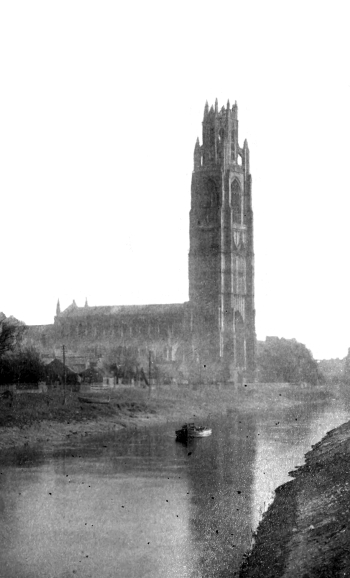
“St. Bodolph’s Town! Far over leagues of land
And leagues of sea looks forth its noble tower,
And far around the charming bells are heard.”
[Pg 443]
MY CATHEDRAL.
Like two cathedral towers these stately pines
Uplift their fretted summits tipped with cones;
The arch beneath them is not built with stones,
Not Art but Nature traced these lovely lines,
And carved this graceful arabesque of vines;
No organ but the wind here sighs and moans,
No sepulchre conceals a martyr’s bones,
No marble bishop on his tomb reclines.
Enter! the pavement carpeted with leaves
Gives back a softened echo to thy tread!
Listen! the choir is singing; all the birds,
In leafy galleries beneath the eaves,
Are singing! Listen ere the sound be fled,
And learn there may be worship without words.
TO THE RIVER RHONE.
Thou Royal River, born of sun and shower
In chambers purple with the Alpine glow,
Wrapped in the spotless ermine of the snow,
And rocked by tempests!—at the appointed hour
Forth, like a steel-clad horseman from a tower,
With clang and clink of harness dost thou go
To meet thy vassal torrents, that below
Rush to receive thee and obey thy power.
And now thou movest in triumphal march,
A king among the rivers! On thy way
A hundred towns await and welcome thee;
Bridges uplift for thee the stately arch,
Vineyards encircle thee with garlands gay,
And fleets attend thy progress to the sea!
WAPENTAKE.
To Alfred Tennyson.
Poet! I come to touch thy lance with mine;
Not as a knight who on the listed field
Of tourney touched his adversary’s shield
In token of defiance, but in sign
Of homage to the mastery, which is thine,
In English song; nor will I keep concealed,
And voiceless as a rivulet frost-congealed.
My admiration for thy verse divine.
Not of the howling dervishes of song,
Who craze the brain with their delirious dance,
Art thou, O sweet historian of the heart!
Therefore to thee the laurel-leaves belong,
To thee our love and our allegiance,
For thy allegiance to the poet’s art.
[Pg 444]
THE BROKEN OAR.
Once upon Iceland’s solitary strand
A poet wandered with his book and pen,
Seeking some final word, some sweet Amen,
Wherewith to close the volume in his hand.
The billows rolled and plunged upon the sand,
The circling sea-gulls swept beyond his ken,
And from the parting cloud-rack now and then
Flashed the red sunset over sea and land.
Then by the billows at his feet was tossed
A broken oar; and carved thereon he read,
“Oft was I weary, when I toiled at thee;”
And like a man who findeth what was lost,
He wrote the words, then lifted up his head,
And flung his useless pen into the sea.
AGASSIZ.
I stand again on the familiar shore,
And hear the waves of the distracted sea
Piteously calling and lamenting thee,
And waiting restless at thy cottage door.
The rocks, the sea-weed on the ocean floor,
The willows in the meadow, and the free
Wild winds of the Atlantic welcome me;
Then why shouldst thou be dead and come no more!
Ah! why shouldst thou be dead when common men
Are busy with their trivial affairs,
Having and holding? Why, when thou hadst read
Nature’s mysterious manuscript, and then
Wast ready to reveal the truth it bears,
Why art thou silent? Why shouldst thou be dead?
[Pg 445]
THE HANGING OF THE CRANE.
1874.
Pendre la Crémaillière, to Hang the Crane, is a French
expression for a house-warming, or the first party given in a new house.
I.
The lights are out, and gone are all the guests
That thronging came with merriment and jests
To celebrate the Hanging of the Crane
In the new house—into the night are gone;
But still the fire upon the hearth burns on,
And I alone remain.
O fortunate, O happy day,
When a new household finds its place
Among the myriad homes of earth,
Like a new star just sprung to birth,
And rolled on its harmonious way
Into the boundless realms of space!
So said the guests in speech and song,
As in the chimney, burning bright,
We hung the iron crane to-night,
And merry was the feast and long.
II.
And now I sit and muse on what may be,
And in my vision see, or seem to see,
Through floating vapours interfused with light,
Shapes indeterminate, that gleam and fade,
As shadows passing into deeper shade
Sink and elude the sight.
For two alone, there in the hall,
Is spread the table, round and small;
Upon the polished silver shine
The evening lamps, but, more divine,
The light of love shines over all;
Of love, that says not mine and thine,
But ours, for ours is thine and mine.
They want no guests, to come between
Their tender glances like a screen,
And tell them tales of land and sea,
And whatsoever may betide
The great, forgotten world outside;
They want no guests; they needs must be
Each other’s own best company.
III.
The picture fades; as at a village fair
A showman’s views, dissolving into air,
Again appear transfigured on the screen,
So in my fancy this; and now once more,
In part transfigured, through the open door
Appears the selfsame scene.
Seated, I see the two again,
But not alone; they entertain
A little angel unaware,
With face as round as is the moon;
A royal guest with flaxen hair,
Who, throned upon his lofty chair,
Drums on the table with his spoon,
Then drops it careless on the floor,
To grasp at things unseen before.
Are these celestial manners? these
The ways that win, the arts that please?
Ah yes; consider well the guest,
And whatsoe’er he does seems best;
He ruleth by the right divine
Of helplessness, so lately born
In purple chambers of the morn,
As sovereign over thee and thine.
He speaketh not; and yet there lies
A conversation in his eyes;
The golden silence of the Greek,
The gravest wisdom of the wise,
Not spoken in language, but in looks
More legible than printed books,
As if he could but would not speak.
And now, O monarch absolute,
Thy power is put to proof; for lo!
Resistless, fathomless, and slow,
The nurse comes rustling like the sea,
And pushes back thy chair and thee,
And so good night to King Canute.
IV.
As one who walking in a forest sees
A lovely landscape through the parted trees,
[Pg 446]
Then sees it not, for boughs that intervene
Or as we see the moon sometimes revealed
Through drifting clouds, and then again concealed,
So I behold the scene.
There are two guests at table now;
The king, deposed and older grown,
No longer occupies the throne,—
The crown is on his sister’s brow;
A Princess from the Fairy Isles,
The very pattern girl of girls,
All covered and embowered in curls,
Rose-tinted from the Isle of Flowers,
And sailing with soft, silken sails
From far-off Dreamland into ours.
Above their bowls with rims of blue
Four azure eyes of deeper hue
Are looking, dreamy with delight;
Limpid as planets that emerge
Above the ocean’s rounded verge,
Soft-shining through the summer night.
Stedfast they gaze, yet nothing see
Beyond the horizon of their bowls;
Nor care they for the world that rolls
With all its freight of troubled souls
Into the days that are to be.
V.
Again the tossing boughs shut out the scene,
Again the drifting vapours intervene,
And the moon’s pallid disk is hidden quite;
And now I see the table wider grown,
As round a pebble into water thrown
Dilates a ring of light.
I see the table wider grown,
I see it garlanded with guests,
As if fair Ariadne’s Crown
Out of the sky had fallen down;
Maidens within whose tender breasts
A thousand restless hopes and fears,
Forth reaching to the coming years,
Flutter a while, then quiet lie,
Like timid birds that fain would fly,
But do not care to leave their nests;—
And youths, who in their strength elate
Challenge the van and front of fate,
Eager as champions to be
In the divine knight-errantry
Of youth, that travels sea and land
Seeking adventures, or pursues,
Through cities and through solitudes
Frequented by the lyric Muse,
The phantom with the beckoning hand,
That still allures and still eludes.
O sweet illusions of the brain!
O sudden thrills of fire and frost!
The world is bright while ye remain,
And dark and dead when ye are lost!
VI.
The meadow-brook, that seemeth to stand still,
Quickens its current as it nears the mill;
And so the stream of Time that lingereth
In level places, and so dull appears,
Runs with a swifter current as it nears
The gloomy mills of Death.
And now, like the magician’s scroll,
That in the owner’s keeping shrinks
With every wish he speaks or thinks,
Till the last wish consumes the whole,
The table dwindles, and again
I see the two alone remain.
The crown of stars is broken in parts;
Its jewels, brighter than the day,
Have one by one been stolen away
To shine in other homes and hearts.
One is a wanderer now afar
In Ceylon or in Zanzibar,
Or sunny regions of Cathay;
And one is in the boisterous camp
Mid clink of arms and horses’ tramp,
And battle’s terrible array.
I see the patient mother read,
With aching heart, of wrecks that float
Disabled on those seas remote,
Or of some great heroic deed
On battle-fields, where thousands bleed
To lift one hero into fame.
Anxious she bends her graceful head
Above these chronicles of pain,
And trembles with a secret dread
Lest there among the drowned or slain
She find the one beloved name.
[Pg 447]
VII.
After a day of cloud and wind and rain
Sometimes the setting sun breaks out again,
And, touching all the darksome woods with light,
Smiles on the fields, until they laugh and sing,
Then like a ruby from the horizon’s ring
Drops down into the night.
What see I now? The night is fair,
The storm of grief, the clouds of care,
The wind, the rain, have passed away;
The lamps are lit, the fires burn bright,
The house is full of life and light:
It is the Golden Wedding-day.
The guests come thronging in once more,
Quick footsteps sound along the floor,
The trooping children crowd the stair,
And in and out and everywhere
Flashes along the corridor
The sunshine of their golden hair.
On the round table in the hall
Another Ariadne’s Crown
Out of the sky hath fallen down;
More than one Monarch of the Moon
Is drumming with his silver spoon;
The light of love shines over all.
O fortunate, O happy day!
The people sing, the people say.
The ancient bridegroom and the bride,
Serenely smiling on the scene,
Behold, well-pleased, on every side
Their forms and features multiplied,
As the reflection of a light
Between two burnished mirrors gleams,
Or lamps upon a bridge at night
Stretch on and on before the sight,
Till the long vista endless seems.
MORITURI SALUTAMUS.
1875.
[This poem was delivered on the occasion of
the 50th anniversary of the Bowdoin College
Class of 1825.]
Tempora labuntur, tacitisque senescimus annis,
Et fugiunt freno non remorante dies.
Ovid, Fastorum, Lib. vi.
“O Cæsar, we who are about to die
Salute you!” was the gladiators’ cry
In the arena, standing face to face
With death and with the Roman populace.
O ye familiar scenes—ye groves of pine,
That once were mine and are no longer mine,—
Thou river, widening through the meadows green
To the vast sea, so near and yet unseen,—
Ye halls, in whose seclusion and repose
Phantoms of fame, like exhalations, rose
And vanished,—we who are about to die
Salute you; earth and air and sea and sky,
And the Imperial Sun that scatters down
His sovereign splendours upon grove and town.
Ye do not answer us! ye do not hear!
We are forgotten; and in your austere
[Pg 448]
And calm indifference, ye little care
Whether we come or go, or whence or where.
What passing generations fill these halls,
What passing voices echo from these walls,
Ye heed not; we are only as the blast,
A moment heard, and then for ever past.
Not so the teachers who in earlier days
Led our bewildered feet through learning’s maze;
They answer us—alas! what have I said?
What greetings come there from the voiceless dead?
What salutation, welcome, or reply?
What pressure from the hands that lifeless lie?
They are no longer here; they all are gone
Into the land of shadows—all save one.
Honour and reverence, and the good repute
That follows faithful service as its fruit,
Be unto him, whom living we salute.
The great Italian poet, when he made
His dreadful journey to the realms of shade,
Met there the old instructor of his youth,
And cried in tones of pity and of ruth:
“O never from the memory of my heart
Your dear paternal image shall depart,
Who while on earth, ere yet by death surprised
Taught me how mortals are immortalized;
How grateful am I for that patient care,
All my life long my language shall declare.”
To-day we make the poet’s words our own,
And utter them in plaintive undertone;
Nor to the living only be they said,
But to the other living, called the dead,
Whose dear, paternal images appear,
Not wrapped in gloom, but robed in sunshine here;
Whose simple lives, complete and without flaw,
Were part and parcel of great Nature’s law;
Who said not to their Lord, as if afraid,
“Here is thy talent in a napkin laid,”
But laboured in their sphere, as those who live
In the delight that work alone can give.
Peace be to them; eternal peace and rest,
And the fulfilment of the great behest:
“Ye have been faithful over a few things,
Over ten cities shall ye reign as kings.”
And ye who fill the places we once filled,
And follow in the furrows that we tilled,
Young men, whose generous hearts are beating high,
We who are old, and are about to die,
Salute you; hail you; take your hands in ours,
And crown you with our welcome as with flowers!
[Pg 449]
How beautiful is youth! how bright it gleams
With its illusions, aspirations, dreams!
Book of Beginnings, Story without End,
Each maid a heroine, and each man a friend!
Aladdin’s Lamp, and Fortunatus’ Purse
That holds the treasure of the universe!
All possibilities are in its hands,
No danger daunts it, and no foe withstands;
In its sublime audacity of faith,
“Be thou removed!” it to the mountain saith
And with ambitious feet, secure and proud,
Ascends the ladder leaning on the cloud!
As ancient Priam at the Scæan gate
Sat on the walls of Troy in regal state
With the old men, too old and weak to fight,
Chirping like grasshoppers in their delight
To see the embattled hosts, with spear and shield,
Of Trojans and Achaians in the field;
So from the snowy summits of our years
We see you in the plain, as each appears,
And question of you; asking, “Who is he
That towers above the others? Which may be
Atreides, Menelaus, Odysseus,
Ajax the great, or bold Idomeneus?”
Let him not boast who puts his armour on
As he who puts it off, the battle done.
Study yourselves; and most of all note well
Wherein kind Nature meant you to excel.
Not every blossom ripens into fruit;
Minerva, the inventress of the flute,
Flung it aside, when she her face surveyed
Distorted in a fountain as she played;
The unlucky Marsyas found it, and his fate
Was one to make the bravest hesitate.
Write on your doors the saying wise and old,
“Be bold! be bold! and everywhere be bold;
Be not too bold!” Yet better the excess
Than the defect; better the more than less;
Better like Hector in the field to die,
Than like the perfumed Paris turn and fly.
And now, my classmates; ye remaining few
That number not the half of those we knew;
Ye, against whose familiar names not yet
The fatal asterisk of death is set,
Ye I salute! The horologe of Time
Strikes the half-century with a solemn chime,
And summons us together once again,
The joy of meeting not unmixed with pain.
Where are the others? Voices from the deep
Caverns of darkness answer me: “They sleep!”
[Pg 450]
I name no names; instinctively I feel
Each at some well-remembered grave will kneel,
And from the inscription wipe the weeds and moss,
For every heart best knoweth its own loss.
I see the scattered grave-stones gleaming white
Through the pale dusk of the impending night.
O’er all alike the impartial sunset throws
Its golden lilies mingled with the rose;
We give to all a tender thought, and pass
Out of the grave-yards with their tangled grass,
Unto these scenes frequented by our feet
When we were young, and life was fresh and sweet.
What shall I say to you? What can I say
Better than silence is? When I survey
This throng of faces turned to meet my own,
Friendly and fair, and yet to me unknown,
Transformed the very landscape seems to be;
It is the same, yet not the same to me.
So many memories crowd upon my brain,
So many ghosts are in the wooded plain,
I fain would steal away with noiseless tread
As from a house where some one lieth dead.
I cannot go;—I pause;—I hesitate;
My feet reluctant linger at the gate;
As one who struggles in a troubled dream
To speak and cannot, to myself I seem.
Vanish the dream! Vanish the idle fears!
Vanish the rolling mists of fifty years!
Whatever time or space may intervene,
I will not be a stranger in this scene.
Here every doubt, all indecision ends;
Hail, my companions, comrades, classmates, friends!
Ah me! the fifty years since last we met
Seem to me fifty folios bound and set
By Time, the great transcriber, on his shelves,
Wherein are written the histories of ourselves.
What tragedies, what comedies, are there;
What joy and grief, what rapture and despair!
What chronicles of triumph and defeat,
Of struggle, and temptation, and retreat!
What records of regrets, and doubts, and fears!
What pages blotted, blistered by our tears!
What lovely landscapes on the margin shine,
What sweet, angelic faces, what divine
And holy images of love and trust,
Undimmed by age, unsoiled by damp or dust!
Whose hand shall dare to open and explore
These volumes, closed and clasped for evermore
Not mine. With reverential feet I pass;
I hear a voice that cries, “Alas! alas!
[Pg 451]
Whatever hath been written shall remain,
Nor be erased nor written o’er again;
The unwritten only still belongs to thee,
Take heed, and ponder well what that shall be.”
As children frightened by a thunder-cloud
Are reassured if some one reads aloud
A tale of wonder, with enchantment fraught,
Or wild adventure, that diverts their thought,
Let me endeavour with a tale to chase
The gathering shadows of the time and place,
And banish what we all too deeply feel
Wholly to say, or wholly to conceal.
In mediæval Rome, I know not where,
There stood an image with its arm in air,
And on its lifted finger, shining clear,
A golden ring with the device, “Strike here!”
Greatly the people wondered, though none guessed
The meaning that these words but half expressed,
Until a learnèd clerk, who at noonday
With downcast eyes was passing on his way,
Paused, and observed the spot, and marked it well,
Whereon the shadow of the finger fell;
And, coming back at midnight, delved, and found
A secret stairway leading underground.
Down this he passed into a spacious hall,
Lit by a flaming jewel on the wall;
And opposite a brazen statue stood
With bow and shaft in threatening attitude;
Upon its forehead, like a coronet,
Were these mysterious words of menace set:
“That which I am, I am; my fatal aim
None can escape, not even yon luminous flame!”
Midway the hall was a fair table placed,
With cloth of gold, and golden cups enchased
With rubies, and the plates and knives were gold,
And gold the bread and viands manifold.
Around it, silent, motionless, and sad,
Were seated gallant knights in armour clad,
And ladies beautiful with plume and zone,
But they were stone, their hearts within were stone;
And the vast hall was filled in every part
With silent crowds, stony in face and heart.
Long at the scene, bewildered and amazed,
The trembling clerk in speechless wonder gazed;
Then from the table, by his greed made bold,
He seized a goblet and a knife of gold,
And suddenly from their seats the guests upsprang,
The vaulted ceiling with loud clamours rang,
The archer sped his arrow, at their call,
Shattering the lambent jewel on the wall,
[Pg 452]
And all was dark around and overhead;—
Stark on the floor the luckless clerk lay dead!
The writer of this legend then records
Its ghostly application in these words:
The image is the Adversary old,
Whose beckoning finger points to realms of gold;
Our lusts and passions are the downward stair
That leads the soul from a diviner air;
The archer, Death; the flaming jewel, Life!
Terrestrial goods, the goblet and the knife;
The knights and ladies, all whose flesh and bone
By avarice have been hardened into stone;
The clerk, the scholar whom the love of pelf
Tempts from his books and from his nobler self.
The scholar and the world! The endless strife,
The discord in the harmonies of life!
The love of learning, the sequestered nooks,
And all the sweet serenity of books;
The market-place, the eager love of gain,
Whose aim is vanity, and whose end is pain.
But why, you ask me, should this tale be told
To men grown old, or who are growing old?
It is too late! Ah, nothing is too late
Till the tired heart shall cease to palpitate.
Cato learned Greek at eighty; Sophocles
Wrote his grand Œdipus, and Simonides
Bore off the prize of verse from his compeers,
When each had numbered more than fourscore years;
And Theophrastus, at fourscore and ten,
Had but begun his Characters of Men.
Chaucer, at Woodstock with the nightingales,
At sixty wrote the Canterbury Tales;
Goethe, at Weimar, toiling to the last,
Completed Faust when eighty years were past.
These are, indeed, exceptions; but they show
How far the gulf-stream of our youth may flow
Into the Arctic regions of our lives,
Where little else than life itself survives.
As the barometer foretells the storm
While still the skies are clear, the weather warm,
So something in us, as old age draws near,
Betrays the pressure of the atmosphere.
The nimble mercury, ere we are aware,
Descends the elastic ladder of the air;
The tell-tale blood in artery and vein
Sinks from its higher levels in the brain;
Whatever poet, orator, or sage
May say of it, old age is still old age.
It is the waning, not the crescent moon;
The dusk of evening, not the blaze of noon:
[Pg 453]
It is not strength, but weakness; not desire,
But its surcease; not the fierce heat of fire,
The burning and consuming element,
But that of ashes and of embers spent,
In which some living sparks we still discern,
Enough to warm, but not enough to burn.
What then? Shall we sit idly down and say
The night hath come; it is no longer day?
The night hath not yet come; we are not quite
Cut off from labour by the failing light;
Something remains for us to do or dare;
Even the oldest tree some fruit may bear;
Not Œdipus Coloneus, or Greek Ode,
Or tales of pilgrims that one morning rode
Out of the gateway of the Tabard Inn,
But other something, would we but begin;
For age is opportunity no less
Than youth itself, though in another dress,
And as the evening twilight fades away
The sky is filled with stars, invisible by day.

Turn, turn, my wheel! Turn round and round
Without a pause, without a sound:
So spins the flying world, away!
This clay, well mixed with marl and sand,
Follows the motion of my hand;
For some must follow, and some command,
Though all are made of clay!
Thus sang the Potter at his task
Beneath the blossoming hawthorn-tree,
While o’er his features, like a mask,
The quilted sunshine and leaf-shade
Moved, as the boughs above him swayed,
And clothed him, till he seemed to be
A figure woven in tapestry,
So sumptuously was he arrayed
In that magnificent attire
Of sable tissue flaked with fire.
Like a magician he appeared,
A conjurer without book or beard;
And while he plied his magic art—
For it was magical to me—
I stood in silence and apart,
And wondered more and more to see
That shapeless, lifeless mass of clay
Rise up to meet the master’s hand,
And now contract and now expand,
And even his slightest touch obey;
While ever in a thoughtful mood
He sang his ditty, and at times
Whistled a tune between the rhymes,
As a melodious interlude.
Turn, turn, my wheel! All things must change
To something new, to something strange;
Nothing that is can pause or stay;
The moon will wax, the moon will wane,
The mist and cloud will turn to rain,
The rain to mist and cloud again,
To-morrow be to-day.
Thus still the Potter sang, and still,
By some unconscious act of will,
The melody and even the words
Were intermingled with my thought,
As bits of coloured thread are caught
And woven into nests of birds.
And thus to regions far remote,
Beyond the ocean’s vast expanse,
This wizard in the motley coat
Transported me on wings of song,
And by the northern shores of France
Bore me with restless speed along.
What land is this that seems to be
A mingling of the land and sea?
This land of sluices, dikes, and dunes?
This water-net, that tesselates
The landscape? this unending maze
Of gardens, through whose latticed gates
The imprisoned pinks and tulips gaze;
Where in long summer afternoons
The sunshine, softened by the haze,
Comes streaming down as through a screen;
Where over fields and pastures green
The painted ships float high in air,
And over all and everywhere
The sails of windmills sink and soar
Like wings of sea-gulls on the shore?
What land is this? Yon pretty town
Is Delft, with all its wares displayed;
The pride, the market-place, the crown
And centre of the Potter’s trade.
[Pg 455]
See! every house and room is bright
With glimmers of reflected light
From plates that on the dresser shine;
Flagons to foam with Flemish beer,
Or sparkle with the Rhenish wine,
And pilgrim flasks with fleur-de-lis,
And ships upon a rolling sea,
And tankards pewter topped, and queer
With comic mask and musketeer!
Each hospitable chimney smiles
A welcome from its painted tiles;
The parlour walls, the chamber floors,
The stairways and the corridors,
The borders of the garden walks,
Are beautiful with fadeless flowers,
That never droop in winds or showers,
And never wither on their stalks.
Turn, turn, my wheel! All life is brief;
What now is bud will soon be leaf,
What now is leaf will soon decay;
The wind blows east, the wind blows west;
The blue eggs in the robin’s nest
Will soon have wings and beak and breast,
And flutter and fly away.
Now southward through the air I glide,
The song my only pursuivant,
And see across the landscape wide
The blue Charente, upon whose tide
The belfries and the spires of Saintes
Ripple and rock from side to side,
As, when an earthquake rends its walls,
A crumbling city reels and falls.
Who is it in the suburbs here,
This Potter, working with such cheer,
In this mean house, this mean attire,
His manly features bronzed with fire,
Whose figulines and rustic wares
Scarce find him bread from day to day?
This madman, as the people say,
Who breaks his tables and his chairs
To feed his furnace fires, nor cares
Who goes unfed if they are fed,
Nor who may live if they are dead?
This alchemist with hollow cheeks
And sunken, searching eyes, who seeks,
By mingled earths and ores combined
With potency of fire, to find
Some new enamel, hard and bright,
His dream, his passion, his delight?
O Palissy! within thy breast
I tamed the hot fever of unrest;
Thine was the prophet’s vision, thine
The exultation, the divine
Insanity of noble minds,
That never falters nor abates,
But labours and endures and waits,
Till all that it foresees it finds,
Or what it cannot find creates!
Turn, turn, my wheel! This earthen jar
A touch can make, a touch can mar;
And shall it to the Potter say,
What makest thou? Thou hast no hand?
As men who think to understand
A world by their Creator planned,
Who wiser is than they.
Still guided by the dreamy song,
As in a trance I float along
Above the Pyrenean chain,
Above the fields and farms of Spain,
Above the bright Majorcan isle,
That lends its softened name to art,—
A spot, a dot upon the chart,
Whose little towns, red-roofed with tile,
Are ruby-lustred with the light
Of blazing furnaces by night,
And crowned by day with wreaths of smoke.
Then eastward, wafted in my flight
On my enchanter’s magic cloak,
I sail across the Tyrrhene Sea
Into the land of Italy,
And o’er the windy Apennines,
Mantled and musical with pines.
The palaces, the princely halls,
The doors of houses, and the walls
Of churches and of belfry towers,
Cloister and castle, street and mart,
Are garlanded and gay with flowers
That blossom in the fields of art.
Here Gubbio’s workshops gleam and glow
With brilliant, iridescent dyes,
[Pg 456]
The dazzling whiteness of the snow,
The cobalt blue of summer skies;
And vase, and scutcheon, cup and plate,
In perfect finish emulate
Faenza, Florence, Pesaro.
Forth from Urbino’s gate there came
A youth with the angelic name
Of Raphael, in form and face
Himself angelic, and divine
In arts of colour and design.
From him Francesco Xanto caught
Something of his transcendent grace,
And into fictile fabrics wrought
Suggestions of the master’s thought.
Nor less Maestro Giorgio shines
With madre-perl and golden lines
Of arabesques, and interweaves
His birds and fruits and flowers and leaves
About some landscape, shaded brown,
With olive tints on rock and town.
Behold this cup within whose bowl,
Upon a ground of deepest blue
With yellow-lustred stars o’erlaid,
Colours of every tint and hue
Mingle in one harmonious whole!
With large blue eyes and steadfast gaze,
Her yellow hair in net and braid,
Necklace and ear-rings all ablaze
With golden lustre o’er the glaze,
A woman’s portrait; on the scroll,
Cana, the beautiful! A name
Forgotten save for such brief fame
As this memorial can bestow,—
A gift some lover long ago
Gave with his heart to this fair dame.
A nobler title to renown
Is thine, O pleasant Tuscan town,
Seated beside the Arno’s stream;
For Lucca della Robbia there
Created forms so wondrous fair,
They made thy sovereignty supreme.
These choristers with lips of stone,
Whose music is not heard, but seen,
Still chant, as from their organ-screen,
Their Maker’s praise; nor these alone,
But the more fragile forms of clay,
Hardly less beautiful than they.
These saints and angels that adorn
The walls of hospitals, and tell
The story of good deeds so well,
That poverty seems less forlorn,
And life more like a holiday.
Here in this old neglected church,
That long eludes the traveller’s search,
Lies the dead bishop on his tomb;
Earth upon earth he slumbering lies,
Life-like and death-like in the gloom;
Garlands of fruit and flowers in bloom
And foliage deck his resting-place;
A shadow in the sightless eyes,
A pallor on the patient face,
Made perfect by the furnace heat;
All earthly passions and desires
Burnt out by purgatorial fires;
Seeming to say, “Our years are fleet,
And to the weary death is sweet.”
But the most wonderful of all
The ornaments on tomb or wall
That grace the fair Ausonian shores
Are those the faithful earth restores,
Near some Apulian town concealed,
In vineyard or in harvest field,—
Vases and urns and bas-reliefs,
Memorials of forgotten griefs,
Or records of heroic deeds
Of demigods and mighty chiefs:
Figures that almost move and speak,
And, buried amid mould and weeds,
Still in their attitudes attest
The presence of the graceful Greek,—
Achilles in his armour dressed,
Alcides with the Cretan bull,
Aphrodite with her boy,
Or lovely Helena of Troy,
Still living and still beautiful.
Turn, turn, my wheel! ’Tis nature’s plan
The child should grow into the man,
The man grow wrinkled, old, and grey;
In youth the heart exults and sings,
The pulses leap, the feet have wings;
In age the cricket chirps, and brings
The harvest home of day.
[Pg 457]
And now the winds that southward blow
And cool the hot Sicilian isle,
Bear me away. I see below
The long line of the Libyan Nile,
Flooding and feeding the parched lands
With annual ebb and overflow,
A fallen palm whose branches lie
Beneath the Abyssinian sky,
Whose roots are in Egyptian sands.
On either bank huge water-wheels,
Belted with jars and dripping weeds,
Send forth their melancholy moans,
As if, in their grey mantles hid,
Dead anchorites of the Thebaid
Knelt on the shore and told their beads,
Beating their breasts with loud appeals
And penitential tears and groans.
This city, walled and thickly set
With glittering mosque and minaret,
Is Cairo, in whose gay bazaars
The dreaming traveller first inhales
The perfume of Arabian gales,
And sees the fabulous earthen jars,
Huge as were those wherein the maid
Morgiana found the Forty Thieves
Concealed in midnight ambuscade;
And seeing, more than half believes
The fascinating tales that run
Through all the Thousand Nights and One,
Told by the fair Scheherezade.
More strange and wonderful than these
Are the Egyptian deities,
Ammon, and Emoth, and the grand
Osiris, holding in his hand
The lotus; Isis, crowned and veiled;
The sacred Ibis, and the Sphinx;
Bracelets with blue enamelled links;
The Scarabee in emerald mailed,
Or spreading wide his funeral wings;
Lamps that perchance their night-watch kept
O’er Cleopatra where she slept,—
All plundered from the tombs of kings.
Turn, turn, my wheel! The human race,
Of every tongue, of every place,
Caucasian, Coptic, or Malay,
All that inhabit this great earth,
Whatever be their rank or worth,
Are kindred and allied by birth,
And made of the same clay.
O’er desert sands, o’er gulf and bay,
O’er Ganges and o’er Himalay,
Bird-like I fly, and flying sing,
To flowery kingdoms of Cathay,
And bird-like poise on balanced wing
Above the town of King-te-tching,
A burning town, or seeming so,—
Three thousand furnaces that glow
Incessantly, and fill the air
With smoke uprising, gyre on gyre,
And painted by the lurid glare
Of jets and flashes of red fire.
As leaves that in the autumn fall,
Spotted and veined with various hues,
Are swept along the avenues,
And lie in heaps by hedge and wall,
So from this grove of chimneys whirled
To all the markets of the world,
These porcelain leaves are wafted on,—
Light yellow leaves with spots and stains
Of violet and of crimson dye,
Or tender azure of a sky
Just washed by gentle April rains,
And beautiful with celadon.
Nor less the coarser household wares,—
The willow pattern, that we knew
In childhood, with its bridge of blue
Leading to unknown thoroughfares;
The solitary man who stares
At the white river flowing through
Its arches, the fantastic trees
And wild perspective of the view;
And intermingled among these
The tiles that in our nurseries
Filled us with wonder and delight,
Or haunted us in dreams at night.
And yonder by Nankin, behold!
The Tower of Porcelain, strange and old,
Uplifting to the astonished skies
Its ninefold painted balconies,
With balustrades of twining leaves,
And roofs of tile, beneath whose eaves
Hang porcelain bells that all the time
[Pg 458]
Ring with a soft, melodious chime;
While the whole fabric is ablaze
With varied tints, all fused in one
Great mass of colour, like a maze
Of flowers illumined by the sun.
Turn, turn, my wheel! What is begun
At daybreak must at dark be done,
To-morrow will be another day,
To-morrow the hot furnace flame
Will search the heart and try the frame,
And stamp with honour or with shame
These vessels made of clay.
Cradled and rocked in Eastern seas
The islands of the Japanese
Beneath me lie; o’er lake and plain
The stork, the heron, and the crane
Through the clear realms of azure drift,
And on the hill-side I can see
The villages of Imari,
Whose thronged and flaming workshops lift
Their twisted columns of smoke on high,
Cloud cloisters that in ruins lie,
With sunshine streaming through each rift,
And broken arches of blue sky.
All the bright flowers that fill the land,
Ripple of waves on rock or sand,
The snow on Fusiyama’s cone.
The midnight heaven so thickly sown
With constellations of bright stars,
The leaves that rustle, the reeds that make
A whisper by each stream and lake,
The saffron dawn, the sunset red,
Are painted on these lovely jars;
Again the skylark sings, again
The stork, the heron, and the crane
Float through the azure overhead,
The counterfeit and counterpart
Of Nature reproduced in Art.
Art is the child of Nature; yes,
Her darling child, in whom we trace
The features of the mother’s face,
Her aspect and her attitude,
All her majestic loveliness
Chastened and softened and subdued
Into a more attractive grace,
And with a human sense imbued.
He is the greatest artist, then,
Whether of pencil or of pen,
Who follows Nature. Never man,
As artist or as artisan,
Pursuing his own fantasies,
Can touch the human heart, or please,
Or satisfy our nobler needs,
As he who sets his willing feet,
In Nature’s footprints, light and fleet,
And follows fearless where she leads.
Thus mused I on that morn in May,
Wrapped in my visions like the Seer,
Whose eyes behold not what is near,
But only what is far away,
When, suddenly sounding peal on peal,
The church-bell from the neighbouring town
Proclaimed the welcome hour of noon.
The Potter heard, and stopped his wheel,
His apron on the grass threw down,
Whistled his quiet little tune,
Not overloud nor overlong,
And ended thus his simple song:
Stop, stop, my wheel! Too soon, too soon
The noon will be the afternoon,
Too soon to-day be yesterday;
Behind us in our path we cast
The broken potsherds of the past,
And all are ground to dust at last,
And trodden into clay!

[Pg 459]
Birds of passage.
1858 TO 1880.
FLIGHT THE FIRST.
... come i gru van cantando lor lai,
Facendo in aer di sè lunga riga.
Dante.
PROMETHEUS;
OR, THE POET’S FORETHOUGHT.
Of Prometheus, how undaunted
On Olympus’ shining bastions
His audacious foot he planted,
Myths are told and songs are chanted,
Full of promptings and suggestions.
Beautiful is the tradition
Of that flight through heavenly portals,
The old classic superstition
Of the theft and the transmission
Of the fire of the Immortals!
First the deed of noble daring,
Born of heavenward aspiration,
Then the fire with mortals sharing,
Then the vulture,—the despairing
Cry of pain on crags Caucasian.
All is but a symbol painted
Of the Poet, Prophet, Seer;
Only those are crowned and sainted
Who with grief have been acquainted,
Making nations nobler, freer.
In their feverish exultations,
In their triumph and their yearning,
In their passionate pulsations,
In their words among the nations,
The Promethean fire is burning.
Shall it, then, be unavailing,
All this toil for human culture?
Through the cloud-rack, dark and trailing
Must they see above them sailing
O’er life’s barren crags the vulture?
Such a fate as this was Dante’s,
By defeat and exile maddened;
Thus were Milton and Cervantes,
Nature’s priests and Corybantes,
By affliction touched and saddened.
But the glories so transcendent
That around their memories cluster,
And, on all their steps attendant,
Make their darkened lives resplendent
With such gleams of inward lustre!
All the melodies mysterious,
Through the dreary darkness chanted;
Thoughts in attitudes imperious,
Voices soft, and deep, and serious,
Words that whispered, songs that haunted!
All the soul in rapt suspension,
All the quivering, palpitating
Chords of life in utmost tension,
With the fervour of invention,
With the rapture of creating!
[Pg 460]
Ah, Prometheus! heaven-scaling!
In such hours of exultation
Even the faintest heart, unquailing,
Might behold the vulture sailing
Round the cloudy crags Caucasian!
Though to all there is not given
Strength for such sublime endeavour,
Thus to scale the walls of heaven,
And to leaven with fiery leaven
All the hearts of men for ever;
Yet all bards, whose hearts unblighted
Honour and believe the presage,
Hold aloft their torches lighted,
Gleaming through the realms benighted,
As they onward bear the message!
THE LADDER OF SAINT AUGUSTINE.
Saint Augustine! well hast thou said,
That of our vices we can frame
A ladder,
[47]
if we will but tread
Beneath our feet each deed of shame!
All common things, each day’s events,
That with the hour begin and end,
Our pleasures and our discontents,
Are rounds by which we may ascend.
The low desire, the base design,
That makes another’s virtues less;
The revel of the ruddy wine,
And all occasions of excess;
The longing for ignoble things;
The strife for triumph more than truth;
The hardening of the heart, that brings
Irreverence for the dreams of youth;
All thoughts of ill; all evil deeds,
That have their roots in thoughts of ill;
Whatever hinders or impedes
The action of the nobler will;—
All these must first be trampled down
Beneath our feet, if we would gain
In the bright fields of fair renown
The right of eminent domain.
We have not wings, we cannot soar;
But we have feet to scale and climb
By slow degrees, by more and more,
The cloudy summits of our time.
The mighty pyramids of stone
That wedge-like cleave the desert airs,
When nearer seen, and better known,
Are but gigantic flights of stairs.
The distant mountains, that uprear
Their solid bastions to the skies,
Are crossed by pathways, that appear
As we to higher levels rise.
The heights by great men reached and kept
Were not attained by sudden flight,
But they, while their companions slept,
Were toiling upward in the night.
Standing on what too long we bore
With shoulders bent and downcast eyes,
We may discern—unseen before—
A path to higher destinies.
Nor deem the irrevocable Past
As wholly wasted, wholly vain,
If, rising on its wrecks, at last
To something nobler we attain.
BIRDS OF PASSAGE.
Black shadows fall
From the lindens tall,
That lift aloft their massive wall
Against the southern sky;
And from the realms
Of the shadowy elms
A tide-like darkness overwhelms
The fields that round us lie.
[Pg 461]
But the night is fair,
And everywhere
A warm, soft vapour fills the air,
And distant sounds seem near;
And above, in the light
Of the star-lit night,
Swift birds of passage wing their flight
Through the dewy atmosphere.
I hear the beat
Of their pinions fleet,
As from the land of snow and sleet
They seek a southern lea.
I hear the cry
Of their voices high
Falling dreamily through the sky,
But their forms I cannot see.
O, say not so!
Those sounds that flow
In murmurs of delight and woe
Come not from wings of birds.
They are the throngs
Of the poet’s songs,
Murmurs of pleasures, and pains, and wrongs,
The sounds of wingèd words.
This is the cry
Of souls, that high
On toiling, beating pinions, fly,
Seeking a warmer clime.
From their distant flight
Through realms of light
It falls into our world of night,
With the murmuring sound of rhyme.
THE PHANTOM SHIP.[48]
In Mather’s Magnalia Christi,
Of the old colonial time,
May be found in prose the legend
That is here set down in rhyme.
A ship sailed from New Haven,
And the keen and frosty airs,
That filled her sails at parting,
Were heavy with good men’s prayers.
“O Lord! if it be thy pleasure”—
Thus prayed the old divine—
“To bury our friends in the ocean,
Take them, for they are thine!”
But Master Lamberton muttered,
And under his breath said he,
“This ship is so crank and walty,
I fear our grave she will be!”
And the ship that came from England,
When the winter months were gone,
Brought no tidings of this vessel,
Nor of Master Lamberton.
This put the people to praying
That the Lord would let them hear
What in his greater wisdom
He had done with friends so dear.
And at last their prayers were answered:—
It was in the month of June,
An hour before the sunset
Of a windy afternoon,
When, steadily steering landward,
A ship was seen below,
And they knew it was Lamberton, Master,
Who sailed so long ago.
On she came, with a cloud of canvas,
Right against the wind that blew,
Until the eye could distinguish
The faces of the crew.
Then fell her straining topmasts,
Hanging tangled in the shrouds,
And her sails were loosened and lifted,
And blown away like clouds.
[Pg 462]
And the masts, with all their rigging,
Fell slowly, one by one,
And the hulk dilated and vanished,
As a sea-mist in the sun!
And the people who saw this marvel
Each said unto his friend,
That this was the mould of their vessel,
And thus her tragic end.
And the pastor of the village
Gave thanks to God in prayer,
That, to quiet their troubled spirits,
He had sent this Ship of Air.
THE WARDEN[49] OF THE CINQUE PORTS.
A mist was driving down the British Channel,
The day was just begun,
And through the window-panes, on floor and panel,
Streamed the red autumn sun.
It glanced on flowing flag and rippling pennon,
And the white sails of ships;
And, from the frowning rampart, the black cannon
Hailed it with feverish lips.
Sandwich and Romney, Hastings, Hithe, and Dover,
Were all alert that day,
To see the French war-steamers speeding over,
When the fog cleared away.
Sullen and silent, and like couchant lions,
Their cannon through the night,
Holding their breath, had watched, in grim defiance,
The sea-coast opposite.
And now they roared at drum-beat from their stations
On every citadel;
Each answering each, with morning salutations,
That all was well.
And down the coast, all taking up the burden,
Replied the distant forts,
As if to summon from his sleep the Warden
And Lord of the Cinque Ports.
Him shall no sunshine from the fields of azure,
No drum-beat from the wall,
No morning gun from the black fort’s embrasure
Awaken with its call!
No more, surveying with an eye impartial
The long line of the coast,
Shall the gaunt figure of the old Field-Marshal
Be seen upon his post!
[Pg 463]
For in the night, unseen, a single warrior,
In sombre harness mailed,
Dreaded of man, and surnamed the Destroyer,
The rampart wall has scaled.
He passed into the chamber of the sleeper,
The dark and silent room,
And as he entered, darker grew, and deeper,
The silence and the gloom.
He did not pause to parley or dissemble,
But smote the Warden hoar;
Ah! what a blow! that made all England tremble,
And groan from shore to shore.
Meanwhile, without, the surly cannon waited,
The sun rose bright o’erhead:
Nothing in Nature’s aspect intimated
That a great man was dead.
HAUNTED HOUSES.
All houses wherein men have lived and died
Are haunted houses. Through the open doors
The harmless phantoms on their errands glide,
With feet that make no sound upon the floors.
We meet them at the doorway, on the stair,
Along the passages they come and go,
Impalpable impressions on the air,
A sense of something moving to and fro.
There are more guests at table than the hosts
Invited; the illuminated hall
Is thronged with quiet, inoffensive ghosts,
As silent as the pictures on the wall.
The stranger at my fireside cannot see
The forms I see, nor hear the sounds I hear;
He but perceives what is; while unto me
All that has been is visible and clear.
We have no title-deeds to house or lands;
Owners and occupants of earlier dates
From graves forgotten stretch their dusty hands,
And hold in mortmain still their old estates.
[Pg 464]
The spirit-world around this world of sense
Floats like an atmosphere, and everywhere
Wafts through these earthly mists and vapours dense
A vital breath of more ethereal air.
Our little lives are kept in equipoise
By opposite attractions and desires;
The struggle of the instinct that enjoys,
And the more noble instinct that aspires.
These perturbations, this perpetual jar
Of earthly wants and aspirations high,
Come from the influence of an unseen star,
An undiscovered planet in our sky.
And as the moon from some dark gate of cloud
Throws o’er the sea a floating bridge of light,
Across whose trembling planks our fancies crowd
Into the realm of mystery and night,—
So from the world of spirits there descends
A bridge of light, connecting it with this,
O’er whose unsteady floor, that sways and bends,
Wander our thoughts above the dark abyss.
THE EMPEROR’S BIRD’S-NEST.
Once the Emperor Charles of Spain
With his swarthy, grave commanders,
I forget in what campaign,
Long besieged, in mud and rain,
Some old frontier town of Flanders.
Up and down the dreary camp,
In great boots of Spanish leather,
Striding with a measured tramp,
These Hidalgos, dull and damp,
Cursed the Frenchmen, cursed the weather.
Thus as to and fro they went,
Over upland and through hollow,
Giving their impatience vent,
Perched upon the Emperor’s tent,
In her nest, they spied a swallow.
Yes, it was a swallow’s nest,
Built, of clay and hair of horses,
Mane or tail, or dragoon’s crest,
Found on hedge-rows east and west,
After skirmish of the forces.
Then an old Hidalgo said,
As he twirled his grey mustachio,
“Sure this swallow overhead
Thinks the Emperor’s tent a shed,
And the Emperor but a Macho!”
[50]
Hearing his imperial name
Coupled with those words of malice,
Half in anger, half in shame,
Forth the great campaigner came
Slowly from his canvas palace.
“Let no hand the bird molest,”
Said he solemnly, “nor hurt her!”
Adding then, by way of jest,
“Golondrina
[51]
is my guest,
’Tis the wife of some deserter!”
[Pg 465]
Swift as bow-string speeds a shaft,
Through the camp was spread the rumour,
And the soldiers, as they quaffed
Flemish beer at dinner, laughed
At the Emperor’s pleasant humour.
So unharmed and unafraid
Sat the swallow still and brooded,
Till the constant cannonade
Through the walls a breach had made,
And the siege was thus concluded.
Then the army, elsewhere bent,
Struck its tents as if disbanding,
Only not the Emperor’s tent,
For he ordered, ere he went,
Very curtly, “Leave it standing.”
So it stood there all alone,
Loosely flapping, torn and tattered,
Till the brood was fledged and flown,
Singing o’er those walls of stone
Which the cannon-shot had shattered.
IN THE CHURCHYARD AT CAMBRIDGE.
In the village churchyard she lies,
Dust is in her beautiful eyes,
No more she breathes, nor feels, nor stirs;
At her feet and at her head
Lies a slave to attend the dead,
But their dust is white as hers.
Was she a lady of high degree,
So much in love with the vanity
And foolish pomp of this world of ours;
Or was it Christian charity,
And lowliness and humility,
The richest and rarest of all dowers?
Who shall tell us? No one speaks;
No colour shoots into those cheeks,
Either of anger or of pride,
At the rude question we have asked;
Nor will the mystery be unmasked
By those who are sleeping at her side.
Hereafter?—And do you think to look
On the terrible pages of that Book
To find her failings, faults, and errors?
Ah, you will then have other cares,
In your own shortcomings and despairs,
In your own secret sins and terrors!
THE TWO ANGELS.[52]
Two angels, one of Life and one of Death,
Passed o’er our village as the morning broke;
The dawn was on their faces, and beneath,
The sombre houses hearsed with plumes of smoke.
Their attitude and aspect were the same,
Alike their features and their robes of white;
But one was crowned with amaranth, as with flame,
And one with asphodels, like flakes of light.
I saw them pause on their celestial way;
Then said I, with deep fear and doubt oppressed,
“Beat not so loud, my heart, lest thou betray
The place where thy belovèd are at rest!”
[Pg 466]
And he who wore the crown of asphodels,
Descending, at my door began to knock,
And my soul sank within me, as in wells
The waters sink before an earthquake’s shock.
I recognised the nameless agony,
The terror and the tremor and the pain,
That oft before had filled or haunted me,
And now returned with threefold strength again.
The door I opened to my heavenly guest,
And listened, for I thought I heard God’s voice;
And, knowing whatsoe’er he sent was best,
Dared neither to lament nor to rejoice.
Then with a smile, that filled the house with light,
“My errand is not Death, but Life,” he said;
And, ere I answered, passing out of sight,
On his celestial embassy he sped.
’Twas at thy door, O friend! and not at mine,
The angel with the amaranthine wreath,
Pausing, descended, and with voice divine,
Whispered a word that had a sound like Death.
Then fell upon the house a sudden gloom,
A shadow on those features, fair and thin;
And softly, from that hushed and darkened room,
Two angels issued, where but one went in.
All is of God! If he but wave his hand,
The mists collect, the rain falls thick and loud,
Till, with a smile of light on sea and land,
Lo! he looks back from the departing cloud.
Angels of Life and Death alike are his;
Without his leave they pass no threshold o’er;
Who, then, would wish or dare, believing this,
Against his messengers to shut the door?
OLIVER BASSELIN.[53]
In the Valley of the Vire
Still is seen an ancient mill,
With its gables quaint and queer,
And beneath the window-sill,
On the stone,
These words alone:
“Oliver Basselin lived here.”
Far above it, on the steep,
Ruined stands the old Château;
Nothing but the donjon-keep
Left for shelter or for show.
Its vacant eyes
Stare at the skies,
Stare at the valley green and deep.
[Pg 467]
Once a convent, old and brown,
Looked, but ah! it looks no more,
From the neighbouring hill-side down
On the rushing and the roar
Of the stream
Whose sunny gleam
Cheers the little Norman town.
In that darksome mill of stone,
To the water’s dash and din,
Careless, humble, and unknown,
Sang the poet Basselin
Songs that fill
That ancient mill
With a splendour of its own.
Never feeling of unrest
Broke the pleasant dream he dreamed;
Only made to be his nest,
All the lovely valley seemed;
No desire
Of soaring higher
Stirred or fluttered in his breast.
True, his songs were not divine;
Were not songs of that high art,
Which, as winds do in the pine,
Find an answer in each heart;
But the mirth
Of this green earth
Laughed and revelled in his line.
From the alehouse and the inn,
Opening on the narrow street,
Came the loud, convivial din,
Singing and applause of feet,
The laughing lays
That in those days
Sang the poet Basselin.
In the castle, cased in steel,
Knights, who fought at Agincourt,
Watched and waited, spur on heel;
But the poet sang for sport
Songs that rang
Another clang,
Songs that lowlier hearts could feel.
In the convent, clad in grey,
Sat the monks in lonely cells,
Paced the cloisters, knelt to pray,
And the poet heard their bells;
But his rhymes
Found other chimes,
Nearer to the earth than they.
Gone are all the barons bold,
Gone are all the knights and squires,
Gone the abbot stern and cold,
And the brotherhood of friars;
Not a name
Remains to fame,
From those mouldering days of old!
But the poet’s memory here
Of the landscape makes a part;
Like the river, swift and clear,
Flows his song through many a heart;
Haunting still
That ancient mill,
In the Valley of the Vire.
THE JEWISH CEMETERY AT NEWPORT.
How strange it seems! These Hebrews in their graves,
Close by the street of this fair seaport town,
Silent beside the never-silent waves,
At rest in all this moving up and down.
The trees are white with dust, that o’er their sleep
Wave their broad curtains in the south wind’s breath,
While underneath these leafy tents they keep
The long mysterious Exodus of Death.
[Pg 468]
And these sepulchral stones, so old and brown,
That pave with level flags their burial-place,
Seem like the tablets of the Law, thrown down
And broken by Moses at the mountain’s base.
The very names recorded here are strange,
Of foreign accent, and of different climes;
Alvares and Rivera interchange
With Abraham and Jacob of old times.
“Blessed be God! for he created Death!”
The mourner said, “and Death is rest and peace;”
Then added, in the certainty of faith,
“And giveth Life that never more shall cease.”
Closed are the portals of their Synagogue,
No Psalms of David now the silence break,
No Rabbi reads the ancient Decalogue
In the grand dialect the Prophets spake.
Gone are the living, but the dead remain,
And not neglected; for a hand unseen,
Scattering its bounty, like a summer-rain,
Still keeps their graves and their remembrance green.
How came they here? What burst of Christian hate,
What persecution, merciless and blind,
Drove o’er the sea—that desert desolate—
These Ishmaels and Hagars of mankind?
They lived in narrow streets and lanes obscure,
Ghetto and Judenstrass, in mirk and mire;
Taught in the school of patience to endure
The life of anguish and the death of fire.
All their lives long, with the unleavened bread
And bitter herbs of exile and its fears,
The wasting famine of the heart they fed,
And slaked its thirst with Marah of their tears.
Anathema maranatha! was the cry
That rang from town to town, from street to street;
At every gate the accursed Mordecai
Was mocked and jeered, and spurned by Christian feet.
Pride and humiliation hand in hand
Walked with them through the world where’er they went,
Trampled and beaten were they as the sand,
And yet unshaken as the continent.
For in the background figures vague and vast
Of patriarchs and of prophets rose sublime,
And all the great traditions of the past
They saw reflected in the coming time.
[Pg 469]
And thus for ever with reverted look
The mystic volume of the world they read,
Spelling it backward, like a Hebrew book,
Till life became a Legend of the Dead.
But ah! what once has been shall be no more!
The groaning earth in travail and in pain
Brings forth its races, but does not restore,
And the dead nations never rise again.
VICTOR GALBRAITH.[54]
Under the walls of Monterey
At daybreak the bugles began to play,
Victor Galbraith!
In the mist of the morning damp and grey,
These were the words they seemed to say:
“Come forth to thy death,
Victor Galbraith!”
Forth he came, with a martial tread;
Firm was his step, erect his head;
Victor Galbraith,
He who so well the bugle played,
Could not mistake the words it said:
“Come forth to thy death,
Victor Galbraith!”
He looked at the earth, he looked at the sky,
He looked at the files of musketry,
Victor Galbraith!
And he said, with a steady voice and eye,
“Take good aim; I am ready to die!”
Thus challenges death
Victor Galbraith.
Twelve fiery tongues flashed straight and red,
Six leaden balls on their errand sped;
Victor Galbraith
Falls to the ground, but he is not dead;
His name was not stamped on those balls of lead,
And they only scath
Victor Galbraith.
Three balls are in his breast and brain,
But he rises out of the dust again,
Victor Galbraith!
[Pg 470]
The water he drinks has a bloody stain;
“O kill me, and put me out of my pain!”
In his agony prayeth
Victor Galbraith.
Forth dart once more those tongues of flame,
And the bugler has died a death of shame,
Victor Galbraith!
His soul has gone back to whence it came,
And no one answers to the name,
When the Sergeant saith,
“Victor Galbraith!”
Under the walls of Monterey
By night a bugle is heard to play,
Victor Galbraith!
Through the mist of the valley damp and grey
The sentinels hear the sound, and say,
“That is the wraith
Of Victor Galbraith!”
DAYLIGHT AND MOONLIGHT.
In broad daylight, and at noon,
Yesterday I saw the moon
Sailing high, but faint and white,
As a schoolboy’s paper kite.
In broad daylight yesterday,
I read a Poet’s mystic lay;
And it seemed to me at most
As a phantom, or a ghost.
But at length the feverish day
Like a passion died away,
And the night, serene and still,
Fell on village, vale, and hill.
Then the moon, in all her pride,
Like a spirit glorified,
Filled and overflowed the night
With revelations of her light.
And the Poet’s song again
Passed like music through my brain;
Night interpreted to me
All its grace and mystery.
MY LOST YOUTH.
Often I think of the beautiful town
That is seated by the sea;
Often in thought go up and down
The pleasant streets of that dear old town,
And my youth comes back to me.
And a verse of a Lapland song
Is haunting my memory still:
“A boy’s will is the wind’s will,
And the thoughts of youth are long, long thoughts.”
[Pg 471]
I can see the shadowy lines of its trees,
And catch, in sudden gleams,
The sheen of the far-surrounding seas,
And islands that were the Hesperides
Of all my boyish dreams.
And the burden of that old song,
It murmurs and whispers still:
“A boy’s will is the wind’s will,
And the thoughts of youth are long, long thoughts.”
I remember the black wharves and the slips,
And the sea-tides tossing free;
And Spanish sailors with bearded lips,
And the beauty and mystery of the ships,
And the magic of the sea.
And the voice of that wayward song
Is singing and saying still:
“A boy’s will is the wind’s will,
And the thoughts of youth are long, long thoughts.”
I remember the bulwarks by the shore,
And the fort upon the hill;
The sunrise gun, with its hollow roar,
The drum-beat repeated o’er and o’er,
And the bugle wild and shrill.
And the music of that old song
Throbs in my memory still:
“A boy’s will is the wind’s will,
And the thoughts of youth are long, long thoughts.”
I remember the sea-fight far away,
[55]How it thundered o’er the tide!
And the dead captains, as they lay
in their graves o’erlooking the tranquil bay,
Where they in battle died.
And the sound of that mournful song
Goes through me with a thrill:
“A boy’s will is the wind’s will,
And the thoughts of youth are long, long thoughts.”
I can see the breezy dome of groves,
The shadows of Deering’s Woods;
And the friendships old and the early loves
Come back with a sabbath sound, as of doves
In quiet neighbourhoods.
And the verse of that sweet old song,
It flutters and murmurs still:
“A boy’s will is the wind’s will,
And the thoughts of youth are long, long thoughts.”
[Pg 472]
I remember the gleams and glooms that dart
Across the schoolboy’s brain;
The song and the silence in the heart,
That in part are prophecies, and in part
Are longings wild and vain.
And the voice of that fitful song
Sings on, and is never still:
“A boy’s will is the wind’s will,
And the thoughts of youth are long, long thoughts.”
There are things of which I may not speak;
There are dreams that cannot die;
There are thoughts that make the strong heart weak,
And bring a pallor into the cheek,
And a mist before the eye.
And the words of that fatal song
Come over me like a chill:
“A boy’s will is the wind’s will,
And the thoughts of youth are long, long thoughts.”
Strange to me now are the forms I meet
When I visit the dear old town;
But the native air is pure and sweet,
And the trees that o’ershadow each well-known street,
As they balance up and down,
Are singing the beautiful song,
Are sighing and whispering still:
“A boy’s will is the wind’s will,
And the thoughts of youth are long, long thoughts.”
And Deering’s Woods are fresh and fair,
And with joy that is almost pain
My heart goes back to wander there,
And among the dreams of the days that were,
I find my lost youth again.
And the strange and beautiful song,
The groves are repeating it still:
“A boy’s will is the wind’s will,
And the thoughts of youth are long, long thoughts.”
THE ROPEWALK.
In that building, long and low,
With its windows all a-row,
Like the port-holes of a hulk,
Human spiders spin and spin,
Backward down their threads so thin
Dropping, each a hempen bulk.
At the end an open door;
Squares of sunshine on the floor
Light the long and dusky lane;
And the whirring of a wheel,
Dull and drowsy, makes me feel
All its spokes are in my brain.
[Pg 473]
As the spinners to the end
Downward go and re-ascend,
Gleam the long threads in the sun;
While within this brain of mine
Cobwebs brighter and more fine
By the busy wheel are spun.
Two fair maidens in a swing,
Like white doves upon the wing,
First before my vision pass;
Laughing, as their gentle hands
Closely clasp the twisted strands,
At their shadow on the grass.
Then a booth of mountebanks,
With its smell of tan and planks,
And a girl poised high in air
On a cord, in spangled dress,
With a faded loveliness,
And a weary look of care.
Then a homestead among farms,
And a woman with bare arms
Drawing water from a well;
As the bucket mounts apace,
With it mounts her own fair face,
As at some magician’s spell.
Then an old man in a tower,
Ringing loud the noontide hour,
While the rope coils round and round,
Like a serpent at his feet,
And again, in swift retreat,
Nearly lifts him from the ground.
Then within a prison-yard,
Faces fixed, and stern, and hard,
Laughter and indecent mirth;
Ah! it is the gallows-tree;
Breath of Christian charity,
Blow, and sweep it from the earth!
Then a schoolboy, with his kite,
Gleaming in a sky of light,
And an eager, upward look;
Steeds pursued through lane and field;
Fowlers with their snares concealed;
And an angler by a brook.
Ships rejoicing in the breeze,
Wrecks that float o’er unknown seas,
Anchors dragged through faithless sand;
Sea-fog drifting overhead,
And, with lessening line and lead,
Sailors feeling for the land.
All these scenes do I behold,
These, and many left untold,
In that building long and low;
While the wheel goes round and round,
With a drowsy, dreamy sound,
And the spinners backward go.
THE GOLDEN MILESTONE.
Leafless are the trees; their purple branches
Spread themselves abroad, like reefs of coral,
Rising silent
In the Red Sea of the Winter sunset.
From the hundred chimneys of the village,
Like the Afreet in the Arabian story,
Smoky columns
Tower aloft into the air of amber.
At the window winks the flickering fire-light;
Here and there the lamps of evening glimmer,
Social watch-fires
Answering one another through the darkness.
[Pg 474]
On the hearth the lighted logs are glowing,
And like Ariel in the cloven pine-tree
For its freedom
Groans and sighs the air imprisoned in them.
By the fireside there are old men seated,
Seeing ruined cities in the ashes,
Asking sadly
Of the Past what it can ne’er restore them.
By the fireside there are youthful dreamers,
Building castles fair, with stately stairways,
Asking blindly
Of the Future what it cannot give them.
By the fireside tragedies are acted
In whose scenes appear two actors only,
Wife and husband,
And above them God the sole spectator.
By the fireside there are peace and comfort,
Wives and children, with fair, thoughtful faces,
Waiting, watching
For a well-known footstep in the passage.
Each man’s chimney is his Golden Milestone,
Is the central point from which he measures
Every distance
Through the gateways of the world around him.
In his farthest wanderings still he sees it;
Hears the talking flame, the answering night-wind,
As he heard them
When he sat with those who were, but are not.
Happy he whom neither wealth nor fashion,
Nor the march of the encroaching city,
Drives an exile
From the hearth of his ancestral homestead.
We may build more splendid habitations,
Fill our rooms with paintings and with sculptures,
But we cannot
Buy with gold the old associations!
CATAWBA WINE.
This song of mine
Is a Song of the Vine,
To be sung by the glowing embers
Of wayside inns,
When the rain begins
To darken the drear Novembers.
[Pg 475]
It is not a song
Of the Scuppernong,
From warm Carolinian valleys,
Nor the Isabel
And the Muscadel
That bask in our garden alleys.
Nor the red Mustang,
Whose clusters hang
O’er the waves of the Colorado,
And the fiery flood
Of whose purple blood
Has a dash of Spanish bravado.
For richest and best
Is the wine of the West,
That grows by the Beautiful River;
Whose sweet perfume
Fills all the room
With a benison on the giver.
And as hollow trees
Are the haunts of bees,
For ever going and coming;
So this crystal hive
Is all alive
With a swarming and buzzing and humming.
Very good in its way
Is the Verzenay,
Or the Sillery soft and creamy;
But Catawba wine
Has a taste more divine,
More dulcet, delicious, and dreamy.
There grows no vine
By the haunted Rhine,
By Danube or Guadalquivir,
Nor on island or cape,
That bears such a grape
As grows by the Beautiful River.
Drugged is their juice
For foreign use,
When shipped o’er the reeling Atlantic,
To rack our brains,
With the fever pains,
That have driven the Old World frantic.
To the sewers and sinks
With all such drinks,
And after them tumble the mixer;
For a poison malign
Is such Borgia wine,
Or at best but a Devil’s Elixir.
While pure as a spring
Is the wine I sing,
And to praise it, one needs but name it;
For Catawba wine
Has need of no sign,
No tavern-bush to proclaim it.
And this Song of the Vine,
This greeting of mine,
The winds and the birds shall deliver
To the Queen of the West,
In her garlands dressed,
On the banks of the Beautiful River.
DAYBREAK.
A wind came up out of the sea,
And said, “O mists, make room for me.”
It hailed the ships, and cried, “Sail on,
Ye mariners, the night is gone.”
And hurried landward far away,
Crying, “Awake! it is the day.”
It said unto the forest, “Shout!
Hang all your leafy banners out!”
It touched the wood-bird’s folded wing,
And said, “O bird, awake and sing.”
And o’er the farms, “O chanticleer,
Your clarion blow; the day is near.”
It whispered to the fields of corn,
“Bow down, and hail the coming morn.”
It shouted through the belfry-tower,
“Awake, O bell! proclaim the hour.”
It crossed the churchyard with a sigh,
And said, “Not yet! in quiet lie.”
[Pg 476]
SANTA FILOMENA.[56]
Whene’er a noble deed is wrought,
Whene’er is spoken a noble thought,
Our hearts, in glad surprise,
To higher levels rise.
The tidal wave of deeper souls
Into our inmost being rolls,
And lifts us unawares
Out of all meaner cares.
Honour to those whose words or deeds
Thus help us in our daily needs,
And by their overflow
Raise us from what is low!
Thus thought I, as by night I read
Of the great army of the dead,
The trenches cold and damp,
The starved and frozen camp,—
The wounded from the battle-plain,
In dreary hospitals of pain,
The cheerless corridors,
The cold and stony floors.
Lo! in that house of misery
A lady with a lamp I see
Pass through the glimmering gloom,
And flit from room to room.
And slow, as in a dream of bliss,
The speechless sufferer turns to kiss
Her shadow, as it falls
Upon the darkening walls.
As if a door in heaven should be
Opened and then closed suddenly,
The vision came and went,
The light shone and was spent.
On England’s annals, through the long
Hereafter of her speech and song,
That light its rays shall cast
From portals of the past.
A Lady with a Lamp shall stand
In the great history of the land,
A noble type of good,
Heroic womanhood.
Nor even shall be wanting here
The palm, the lily, and the spear,
The symbols that of yore
Saint Filomena bore.
THE FIFTIETH BIRTHDAY OF AGASSIZ.
May 28, 1857.
It was fifty years ago,
In the pleasant month of May,
In the beautiful Pays de Vaud,
A child in its cradle lay.
And Nature, the old nurse, took
The child upon her knee,
Saying: “Here is a story-book
Thy Father has written for thee.”
“Come, wander with me,” she said,
“Into regions yet untrod;
And read what is still unread
In the manuscripts of God.”
And he wandered away and away
With Nature, the dear old nurse,
Who sang to him night and day
The rhymes of the universe.
[Pg 477]
And whenever the way seemed long,
Or his heart began to fail,
She would sing a more wonderful song,
Or tell a more marvellous tale.
So she keeps him still a child,
And will not let him go,
Though at times his heart beats wild
For the beautiful Pays de Vaud;
Though at times he hears in his dreams
The Ranz des Vaches of old,
And the rush of mountain streams
From glaciers clear and cold;
And the mother at home says, “Hark!
For his voice I listen and yearn;
It is growing late and dark,
And my boy does not return!”
THE DISCOVERER OF THE NORTH CAPE.
A LEAF FROM KING ALFRED’S OROSIUS.
Othere, the old sea-captain,
Who dwelt in Helgoland,
To King Alfred, the Lover of Truth,
Brought a snow-white walrus-tooth,
Which he held in his brown right hand.
His figure was tall and stately,
Like a boy’s his eye appeared;
His hair was yellow as hay,
But threads of a silvery grey
Gleamed in his tawny beard.
Hearty and hale was Othere,
His cheek had the colour of oak;
With a kind of laugh in his speech,
Like the sea-tide on a beach,
As unto the king he spoke.
And Alfred, King of the Saxons,
Had a book upon his knees,
And wrote down the wondrous tale
Of him who was first to sail
Into the Arctic seas.
“So far I live to the northward,
No man lives north of me;
To the east are wild mountain-chains,
And beyond them meres and plains;
To the westward all is sea.
“So far I live to the northward,
From the harbour of Skeringes-hale,
If you only sailed by day,
With a fair wind all the way,
More than a month would you sail.
“I own six hundred reindeer,
With sheep and swine beside;
I have tribute from the Finns,
Whalebone and reindeer-skins,
And ropes of walrus-hide.
“I ploughed the land with horses,
But my heart was ill at ease,
For the old seafaring men
Came to me now and then,
With their sagas of the seas;—
“Of Iceland and of Greenland,
And the stormy Hebrides,
And the undiscovered deep;—
I could not eat nor sleep
For thinking of those seas.
“To the northward stretched the desert,
How far I fain would know;
So at last I sallied forth,
And three days sailed due north,
As far as the whale-ships go.
“To the west of me was the ocean,
To the right the desolate shore,
But I did not slacken sail
For the walrus or the whale,
Till after three days more.
“The days grew longer and longer,
Till they became as one,
And southward through the haze
I saw the sullen blaze
Of the red midnight sun.
[Pg 478]
“And then uprose before me,
Upon the water’s edge,
The huge and haggard shape
Of that unknown North Cape,
Whose form is like a wedge.
“The sea was rough and stormy,
The tempest howled and wailed,
And the sea-fog, like a ghost,
Haunted that dreary coast,
But onward still I sailed.
“Four days I steered to eastward,
Four days without a night:
Round in a fiery ring
Went the great sun, O King,
With red and lurid light.”
Here Alfred, King of the Saxons,
Ceased writing for a while;
And raised his eyes from his book,
With a strange and puzzled look,
And an incredulous smile.
But Othere, the old sea-captain,
He neither paused nor stirred,
Till the King listened, and then
Once more took up his pen,
And wrote down every word.
“And now the land,” said Othere,
“Bent southward suddenly,
And I followed the curving shore,
And ever southward bore
Into a nameless sea.
“And there we hunted the walrus,
The narwhale, and the seal;
Ha! ’twas a noble game!
And like the lightning’s flame
Flew our harpoons of steel.
“There were six of us all together,
Norsemen of Helgoland;
In two days and no more
We killed of them threescore,
And dragged them to the strand!”
Here Alfred, the Truth-Teller,
Suddenly closed his book,
And lifted his blue eyes,
With doubt and strange surmise
Depicted in their look.
And Othere the old sea-captain
Stared at him wild and weird,
Then smiled, till his shining teeth
Gleamed white from underneath
His tawny, quivering beard.
And to the King of the Saxons,
In witness of the truth,
Raising his noble head,
He stretched his brown hand, and said,
“Behold this walrus-tooth!”
CHILDREN.
Come to me, O ye children!
For I hear you at your play,
And the questions that perplexed me
Have vanished quite away.
Ye open the eastern windows,
That look towards the sun,
Where thoughts are singing swallows,
And the brooks of morning run.
In your hearts are the birds and the sunshine,
In your thoughts the brooklet’s flow,
But in mine is the wind of Autumn,
And the first fall of the snow.
Ah! what would the world be to us,
If the children were no more?
We should dread the desert behind us
Worse than the dark before.
What the leaves are to the forest,
With light and air for food,
Ere their sweet and tender juices
Have been hardened into wood,—
That to the world are children;
Through them it feels the glow
Of a brighter and sunnier climate
Than reaches the trunks below.
[Pg 479]
Come to me, O ye children!
And whisper in my ear
What the birds and the winds are singing
In your sunny atmosphere.
For what are all our contrivings,
And the wisdom of our books,
When compared with your caresses,
And the gladness of your looks?
Ye are better than all the ballads
That ever were sung or said;
For ye are living poems,
And all the rest are dead.
SANDALPHON.
Have you read in the Talmud of old,
In the Legends the Rabbins have told
Of the limitless realms of the air,—
Have you read it,—the marvellous story
Of Sandalphon, the Angel of Glory,
Sandalphon, the Angel of Prayer?
How, erect, at the outermost gates
Of the City Celestial he waits,
With his feet on the ladder of light,
That, crowded with angels unnumbered,
By Jacob was seen, as he slumbered
Alone in the desert at night?
The Angels of Wind and of Fire
Chant only one hymn, and expire
With the song’s irresistible stress;
Expire in their rapture and wonder,
As harp-strings are broken asunder
By music they throb to express.
But serene in the rapturous throng,
Unmoved by the rush of the song,
With eyes unimpassioned and slow,
Among the dead angels, the deathless
Sandalphon stands listening breathless
To sounds that ascend from below;—
From the spirits on earth that adore,
From the souls that entreat and implore
In the fervour and passion of prayer;
From the hearts that are broken with losses,
And weary with dragging the crosses
Too heavy for mortals to bear.
And he gathers the prayers as he stands,
And they change into flowers in his hands,
Into garlands of purple and red;
And beneath the great arch of the portal,
Through the streets of the City Immortal
Is wafted the fragrance they shed.
It is but a legend, I know,—
A fable, a phantom, a show,
Of the ancient Rabbinical lore;
Yet the old mediæval tradition,
The beautiful, strange superstition,
But haunts me and holds me the more.
When I look from window at night,
And the welkin above is all white,
All throbbing and panting with stars,
Among them majestic is standing
Sandalphon the angel, expanding
His pinions in nebulous bars.
And the legend, I feel, is a part
Of the hunger and thirst of the heart,
The frenzy and fire of the brain,
That grasps at the fruitage forbidden,
The golden pomegranates of Eden,
To quiet its fever and pain.
EPIMETHEUS; OR,
THE POET’S AFTERTHOUGHT.
Have I dreamed? or was it real,
What I saw as in a vision,
When to marches hymeneal
In the land of the Ideal
Moved my thought o’er Fields Elysian?
What! are these the guests whose glances
Seemed like sunshine gleaming round me?
These the wild, bewildering fancies,
That with dithyrambic dances,
As with magic circles, bound me?
[Pg 480]
Ah! how cold are their caresses!
Pallid cheeks, and haggard bosoms!
Spectral gleam their snow-white dresses,
And from loose, dishevelled tresses
Fall the hyacinthine blossoms!
O my songs! whose winsome measures
Filled my heart with secret rapture!
Children of my golden leisures!
Must even your delights and pleasures
Fade and perish with the capture?
Fair they seemed, those songs sonorous,
When they came to me unbidden;
Voices single, and in chorus,
Like the wild birds singing o’er us
In the dark of branches hidden.
Disenchantment! Disillusion!
Must each noble aspiration
Come at last to this conclusion,
Jarring discord, wild confusion,
Lassitude, renunciation?
Not with steeper fall nor faster,
From the sun’s serene dominions,
Not through brighter realms nor vaster,
In swift ruin and disaster,
Icarus fell with shattered pinions!
Sweet Pandora! dear Pandora!
Why did mighty Jove create thee
Coy as Thetis, fair as Flora,
Beautiful as young Aurora,
If to win thee is to hate thee?
No, not hate thee! for this feeling
Of unrest and long resistance
Is but passionate appealing,
A prophetic whisper stealing
O’er the chords of our existence.
Him whom thou dost once enamour,
Thou, belovèd, never leavest;
In life’s discord, strife, and clamour,
Still he feels thy spell of glamour;
Him of Hope thou ne’er bereavest.
Weary hearts by thee are lifted,
Struggling souls by thee are strengthened,
Clouds of fear asunder rifted,
Truth from falsehood cleansed and sifted,
Lives, like days in summer, lengthened!
Therefore art thou ever dearer,
O my Sibyl, my deceiver!
For thou makest each mystery clearer,
And the unattained seems nearer,
When thou fillest my heart with fever!
Muse of all the Gifts and Graces!
Though the fields around us wither,
There are ampler realms and spaces,
Where no foot has left its traces:
Let us turn and wander thither!
FLIGHT THE SECOND.
A DAY OF SUNSHINE.
O gift of God! O perfect day:
Whereon shall no man work, but play;
Whereon it is enough for me,
Not to be doing, but to be!
Through every fibre of my brain,
Through every nerve, through every vein,
I feel the electric thrill, the touch
Of life, that seems almost too much.
I hear the wind among the trees
Playing celestial symphonies;
I see the branches downward bent,
Like keys of some great instrument.
And over me unrolls on high
The splendid scenery of the sky,
Where through a sapphire sea the sun
Sails like a golden galleon,
[Pg 481]
Towards yonder cloud-land in the West,
Towards yonder Islands of the Blest,
Whose steep sierra far uplifts
Its craggy summits white with drifts.
Blow, winds! and waft through all the rooms
The snow-flakes of the cherry-blooms!
Blow, winds! and bend within my reach
The fiery blossoms of the peach.
O Life and Love! O happy throng
Of thoughts, whose only speech is song!
O heart of man! canst thou not be
Blithe as the air is, and as free?
THE CHILDREN’S HOUR.
Between the dark and the daylight,
When the night is beginning to lower,
Comes a pause in the day’s occupations
That is known as the Children’s Hour.
I hear in the chamber above me
The patter of little feet,
The sound of a door that is opened,
And voices soft and sweet.
From my study I see in the lamplight,
Descending the broad hall stair,
Grave Alice and laughing Allegra,
And Edith with golden hair.
A whisper and then a silence;
Yet I know by their merry eyes
They are plotting and planning together
To take me by surprise.
A sudden rush from the stairway,
A sudden raid from the hall!
By three doors left unguarded
They enter my castle wall!
They climb up into my turret
O’er the arms and back of my chair;
If I try to escape they surround me;
They seem to be everywhere.
They almost devour me with kisses,
Their arms about me entwine,
Till I think of the Bishop of Bingen
In his Mouse Tower on the Rhine!
Do you think, O blue-eyed banditti,
Because you have scaled the wall,
Such an old moustache as I am
Is not a match for you all!
I have you fast in my fortress,
And will not let you depart,
But put you down into the dungeon
In the round-tower of my heart.
And there will I keep you for ever,
Yes, for ever and a day,
Till the walls shall crumble to ruin,
And moulder in dust away!
ENCELADUS.
Under Mount Etna he lies,
It is slumber, it is not death;
For he struggles at times to arise,
And above him the lurid skies
Are hot with his fiery breath.
The crags are piled on his breast,
The earth is heaped on his head;
But the groans of his wild unrest,
Though smothered and half suppressed,
Are heard, and he is not dead.
And the nations far away
Are watching with eager eyes;
They talk together and say,
“To-morrow, perhaps to-day,
Enceladus will arise!”
And the old gods, the austere
Oppressors in their strength,
Stand aghast and white with fear
At the ominous sounds they hear,
And tremble, and mutter, “At length!”
[Pg 482]
Ah me! for the land that is sown
With the harvest of despair,
Where the burning cinders, blown
From the lips of the overthrown
Enceladus, fill the air.
Where ashes are heaped in drifts
Over vineyard and field and town,
Whenever he starts and lifts
His head through the blackened rifts
Of the crags that keep him down.
See, see! the red light shines!
’Tis the glare of his awful eyes!
And the storm-wind shouts through the pines
Of Alps and of Apennines,
“Enceladus, arise!”
THE CUMBERLAND.
At anchor in Hampton Roads we lay,
On board of the Cumberland, sloop of war;
And at times from the fortress across the bay
The alarum of drums swept past,
Or a bugle blast
From the camp on the shore.
Then far away to the south uprose
A little feather of snow-white smoke,
And we knew that the iron ship of our foe
Was steadily steering its course
To try the force
Of our ribs of oak.
Down upon us heavily runs,
Silent and sullen, the floating fort;
Then comes a puff of smoke from her guns,
And leaps the terrible death,
With fiery breath,
From each open port.
We are not idle, but send her straight
Defiance back in a full broadside!
As hail rebounds from a roof of slate
Rebounds our heavier hail
From each iron scale
Of the monster’s hide.
“Strike your flag!” the rebel cries,
In his arrogant old plantation strain.
“Never!” our gallant Morris replies;
“It is better to sink than to yield!”
And the whole air pealed
With the cheers of our men.
Then, like a kraken huge and black,
She crushed our ribs in her iron grasp!
Down went the Cumberland all a wrack,
[Pg 483]
With a sudden shudder of death,
And the cannon’s breath
For her dying gasp.
Next morn, as the sun rose over the bay,
Still floated our flag at the mainmast head.
Lord, how beautiful was thy day!
Every waft of the air
Was a whisper of prayer,
Or a dirge for the dead.
Ho! brave hearts that went down in the seas!
Ye are at peace in the troubled stream,
Ho! brave land! with hearts like these,
Thy flag, that is rent in twain,
Shall be one again,
And without a seam!
SOMETHING LEFT UNDONE.
Labour with what zeal we will,
Something still remains undone,
Something uncompleted still
Waits the rising of the sun.
By the bedside, on the stair,
At the threshold, near the gates,
With its menace or its prayer,
Like a mendicant it waits;
Waits, and will not go away;
Waits, and will not be gainsaid
By the cares of yesterday
Each to-day is heavier made;
Till at length the burden seems
Greater than our strength can bear;
Heavy as the weight of dreams,
Pressing on us everywhere.
And we stand from day to day,
Like the dwarfs of times gone by,
Who, as Northern legends say,
On their shoulders held the sky.
WEARINESS.
O little feet! that such long years
Must wander on through hopes and fears,
Must ache and bleed beneath your load;
I, nearer to the Wayside Inn
Where toil shall cease and rest begin,
Am weary, thinking of your road!
O little hands! that, weak or strong,
Have still to serve or rule so long,
Have still so long to give or ask;
I, who so much with book and pen
Have toiled among my fellow-men,
Am weary, thinking of your task.
O little hearts! that throb and beat
With such impatient, feverish heat,
Such limitless and strong desires;
Mine that so long has glowed and burned,
With passions into ashes turned,
Now covers and conceals its fires.
O little souls! as pure and white
And crystalline as rays of light
Direct from heaven, their source divine;
Refracted through the mist of years,
How red my setting sun appears,
How lurid looks this soul of mine!
[Pg 484]
SNOW-FLAKES.
Out of the bosom of the Air,
Out of the cloud-folds of her garments shaken,
Over the woodlands brown and bare,
Over the harvest-fields forsaken,
Silent, and soft, and slow
Descends the snow.
Even as our cloudy fancies take
Suddenly shape in some divine expression,
Even as the troubled heart doth make
In the white countenance confession,
The troubled sky reveals
The grief it feels.
This is the poem of the Air,
Slowly in silent syllables recorded;
This is the secret of despair,
Long in its cloudy bosom hoarded,
Now whispered and revealed
To wood and field.
FLIGHT THE THIRD.
1874.
CADENABBIA.
No sound of wheels or hoof-beat breaks
The silence of the summer day,
As by the loveliest of all lakes
I while the idle hours away.
I pace the leafy colonnade,
Where level branches of the plane
Above me weave a roof of shade
Impervious to the sun and rain.
At times a sudden rush of air
Flutters the lazy leaves o’erhead,
And gleams of sunlight toss and flare
Like torches down the path I tread.
By Somariva’s garden gate
I make the marble stairs my seat;
And hear the water, as I wait,
Lapping the steps beneath my feet.
The undulation sinks and swells
Along the stony parapets;
And far away the floating bells
Tinkle upon the fisher’s nets.
Silent and slow, by tower and town,
The freighted barges come and go;
Their pendent shadow gliding down,
By town and tower submerged below.
The hills sweep upward from the shore,
With villas scattered one by one
Upon their wooded spurs, and lower
Bellaggio blazing in the sun.
And dimly seen, a tangled mass
Of walls and woods, of light and shade,
Stands beck’ning up the Stelvio pass
Varenna with its wide cascade.
I ask myself, Is this a dream?
Will it all vanish into air?
Is there a land of such supreme
And perfect beauty anywhere?
Sweet vision! Do not fade away;
Linger until my heart shall take
Into itself the summer day
And all the beauty of the lake.
Linger until upon my brain
Is stamped an image of the scene;
Then fade into the air again,
And be as if thou hadst not been.
[Pg 485]
CHARLES SUMNER.
March 30, 1874.
Garlands upon his grave,
And flowers upon his hearse;
And to the tender heart and brave,
The tribute of this verse.
His was the troubled life,
The conflict and the pain;
The griefs, the bitterness of strife,
The honour without stain.
Like Winkelried, he took
Into his manly breast
The sheaf of hostile spears, and broke
A path for the oppressed;
Then from the fatal field,
Upon a nation’s heart,
Borne like a warrior on his shield!—
So should the brave depart.
Death takes us by surprise,
And stays our hurrying feet;
The great design unfinished lies,
Our lives are incomplete.
But in the dark unknown,
Perfect their circles seem,
Even as a bridge’s arch of stone
Is rounded in the stream.
Alike are life and death
When life in death survives,
And the uninterrupted breath
Inspires a thousand lives.
Were a star quenched on high,
For ages would its light,
Still travelling downward from the sky,
Shine on our mortal sight.
So when a great man dies,
For years beyond our ken,
The light he leaves behind him lies
Upon the paths of men.
MONTE CASSINO.
Beautiful valley, through whose verdant meads
Unheard the Garigliano glides along,—
The Liris, nurse of rushes and of reeds,
The river taciturn of classic song!
The Land of Labour and the Land of Rest,
Where mediæval towns are white on all
The hillsides, and where every mountain crest
Is an Etrurian or a Roman wall!
There is Alagna, there Pope Boniface
Was dragged with contumely from his throne;
Sciarra Colonna, was that day’s disgrace
The Pontiff’s only, or in part thine own?
There is Ceprano, where a renegade
Was each Apulian as great Dante saith,
When Manfred, by his men-at-arms betrayed,
Spurred on to Benevento and to death.
There is Aquinum, the old Volscian town,
Where Juvenal was born, whose lurid light
Still hovers o’er his birthplace, like the crown
Of splendour over cities seen at night.
[Pg 486]
Doubled the splendour is, that in its streets
The angelic Doctor as a schoolboy played,
And dreamed perhaps the dreams that he repeats
In ponderous folios for scholastics made.
And there, uplifted like a passing cloud,
That pauses on a mountain summit high,
Monte Cassino’s convent rears its proud
And venerable walls against the sky.
Well I remember how on foot I climbed
The stony pathway leading to its gate:
Above, the convent bells for vespers chimed;
Below, the darkening town grew desolate.
Well I remember the low arch and dark,
The court-yard with its well, the terrace wide,
From which, far down, diminished to a park,
The valley veiled in mist was dim descried.
The day was dying, and with feeble hands
Caressed the mountain-tops; the vales between
Darkened; the river in the meadow-lands
Sheathed itself as a sword and was not seen.
The silence of the place was like a sleep,
So full of rest it seemed; each passing tread
Was a reverberation from the deep
Recesses of the ages that are dead.
For, more than thirteen centuries ago,
Benedict, fleeing from the gates of Rome,
A youth disgusted with its vice and woe,
Sought in these mountain solitudes a home.
He founded here his Convent and his Rule
Of prayer and work, and counted work as prayer.
His pen became a clarion, and his school
Flamed like a beacon in the midnight air.
What though Boccaccio, in his reckless way
Mocking the lazy brotherhood, deplores
The illuminated manuscripts that lay
Torn and neglected on the dusty floors?
Boccaccio was a novelist, a child
Of fancy and of fiction at the best;
This the urbane librarian said and smiled,
Incredulous as at some idle jest.
Upon such themes as these with one young friar
I sat conversing late into the night,
Till in its cavernous chimney the wood fire
Had burnt its heart out like an anchorite.
[Pg 487]
And then translated, in my convent cell,
Myself yet not myself in dreams I lay;
And, as a monk who hears the matin bell,
Started from sleep; already it was day.
From the high window I beheld the scene
On which Saint Benedict so oft had gazed;
The mountains and the valley in the sheen
Of the bright sun, and stood as one amazed.
Grey mists were rolling, rising, vanishing;
The woodlands glistened with their jewelled crowns.
Far off the mellow bells began to ring
For matins in the half-awakened towns.
The conflict of the Present and the Past,
The ideal and the actual in our life,
As on a field of battle held me fast,
Where this world and the next world were at strife.
For, as the valley from its sleep awoke,
I saw the iron horses of the steam
Toss to the morning air their plumes of smoke,
And woke as one awaketh from a dream.
AMALFI.
Sweet the memory is to me
Of the land beyond the sea,
Where the waves and mountains meet;
Where amid her mulberry-trees
Sits Amalfi in the heat,
Bathing ever her white feet
In the tideless, summer seas.
In the middle of the town,
From its fountains in the hills,
Tumbling through the narrow gorge,
The Canneto rushes down,
Turns the great wheels of the mills,
Lifts the hammers of the forge.
’Tis a stairway, not a street,
That ascends the deep ravine,
Where the torrent leaps between
Rocky walls that almost meet.
Toiling up from stair to stair
Peasant girls their burdens bear;
Sunburnt daughters of the soil,
Stately figures tall and straight;
What inexorable fate
Dooms them to this life of toil?
Lord of vineyards and of lands,
Far above the convent stands,
On its terraced walk aloof
Leans a monk with folded hands,
Placid, satisfied, serene,
Looking down upon the scene
Over wall and red-tiled roof;
Wondering unto what good end
All this toil and traffic tend,
And why all men cannot be
Free from care, and free from pain,
And the sordid love of gain,
And as indolent as he.
Where are now the freighted barks
From the marts of east and west?
Where the knights in iron sarks
Journeying to the Holy Land,
Glove of steel upon the hand,
Cross of crimson on the breast?
Where the pomp of camp and court?
Where the pilgrims with their prayers?
Where the merchants with their wares,
And their gallant brigantines
[Pg 488]
Sailing safely into port,
Chased by corsair Algerines?
Vanished like a fleet of cloud,
Like a passing trumpet-blast,
Are those splendours of the past,
And the commerce and the crowd!
Fathoms deep beneath the seas
Lie the ancient wharves and quays,
Swallowed by the engulfing waves;
Silent streets, and vacant halls,
Ruined roofs and towers and walls;
Hidden from all mortal eyes
Deep the sunken city lies:
Even cities have their graves!
This is an enchanted land!
Round the headlands far away
Sweeps the blue Salernian bay
With its sickle of white sand;
Farther still and farthermost
On the dim discovered coast
Pæstum with its ruins lies,
And its roses all in bloom
Seem to tinge the fatal skies
Of that lonely land of doom.
On his terrace, high in air,
Nothing doth the good monk care
For such worldly themes as these.
From the garden just below
Little puffs of perfume blow,
And a sound is in his ears
Of the murmur of the bees
In the shining chestnut-trees;
Nothing else he heeds or hears.
All the landscape seems to swoon
In the happy afternoon;
Slowly o’er his senses creep
The encroaching waves of sleep
And he sinks as sank the town,
Unresisting, fathoms down
Into caverns cool and deep!
Walled about with drifts of snow,
Hearing the fierce north wind blow,
Seeing all the landscape white,
And the river cased in ice,
Comes this memory of delight,
Comes this vision unto me
Of a long-lost Paradise
In the land beyond the sea.
A DUTCH PICTURE.
Simon Danz has come home again,
From cruising about with his buccaneers;
He has singed the beard of the King of Spain,
And carried away the Dean of Jaen
And sold him in Algiers.
In his house by the Maese, with its roof of tiles
And weathercocks flying aloft in air,
There are silver tankards of antique styles,
Plunder of convent and castle, and piles
Of carpets rich and rare.
In his tulip-garden there by the town,
Overlooking the sluggish stream,
With his Moorish cap and dressing-gown
The old sea-captain, hale and brown,
Walks in a waking dream.
A smile in his grey mustachio lurks
Whenever he thinks of the King of Spain
And the listed tulips look like Turks,
[Pg 489]
And the silent gardener as he works
Is changed to the Dean of Jaen.
The windmills on the outermost
Verge of the landscape in the haze,
To him are towers on the Spanish coast,
With whiskered sentinels at their post,
Though this is the river Maese.
But when the winter rains begin,
He sits and smokes by the blazing brands,
And old seafaring men come in,
Goat-bearded, grey, and with double chin,
And rings upon their hands.
They sit there in the shadow and shine
Of the flickering fire of the winter night;
Figures in colour and design
Like those by Rembrandt of the Rhine,
Half darkness and half light.
And they talk of their ventures lost or won,
And their talk is ever and ever the same,
While they drink the red wine of Tarragon,
From the cellars of some Spanish Don,
Or convent set on flame.
Restless at times, with heavy strides
He paces his parlour to and fro;
He is like a ship that at anchor rides,
And swings with the rising and falling tides
And tugs at her anchor-tow.
Voices mysterious far and near,
Sound of the wind and sound of the sea,
Are calling and whispering in his ear,
“Simon Danz! Why stayest thou here?
Come forth and follow me!”
So he thinks he shall take to the sea again
For one more cruise with his buccaneers,
To singe the beard of the King of Spain,
And capture another Dean of Jaen
And sell him in Algiers.
THE SERMON OF ST. FRANCIS.
Up soared the lark into the air,
A shaft of song, a wingèd prayer,
As if a soul, released from pain,
Were flying back to heaven again.
St. Francis heard; it was to him
An emblem of the Seraphim;
The upward motion of the fire,
The light, the heat, the heart’s desire.
[Pg 490]
Around Assisi’s convent gate
The birds, God’s poor who cannot wait,
From moor and mere and darksome wood
Came flocking for their dole of food.
“O brother birds,” St. Francis said,
“Ye come to me and ask for bread,
But not with bread alone to-day
Shall ye be fed and sent away.
“Ye shall be fed, ye happy birds,
With manna of celestial words;
Not mine, though mine they seem to be,
Not mine, though they be spoken through me.
“O, doubly are ye bound to praise
The great Creator in your lays;
He giveth you your plumes of down,
Your crimson hoods, your cloaks of brown.
“He giveth you your wings to fly
And breathe a purer air on high,
And careth for you everywhere,
Who for yourselves so little care!”
With flutter of swift wings and songs
Together rose the feathered throngs,
And singing scattered far apart;
Deep peace was in St. Francis’ heart.
He knew not if the brotherhood
His homily had understood;
He only knew that to one ear
The meaning of his words was clear.
TRAVELS BY THE FIRESIDE.
The ceaseless rain is falling fast,
And yonder gilded vane,
Immoveable for three days past,
Points to the misty main.
It drives me in upon myself,
And to the fireside gleams,
To pleasant books that crowd my shelf,
And still more pleasant dreams.
I read whatever bards have sung
Of lands beyond the sea,
And the bright days when I was young
Come thronging back to me.
I fancy I can hear again
The Alpine torrent’s roar,
The mule-bells on the hills of Spain,
The sea at Elsinore.
I see the convent’s gleaming wall
Rise from its groves of pine,
And towers of old cathedrals tall,
And castles by the Rhine.
I journey on by park and spire,
Beneath centennial trees,
Through fields with poppies all on fire,
And gleams of distant seas.
I fear no more the dust and heat,
No more I feel fatigue,
While journeying with another’s feet,
O’er many a lengthening league.
Let others traverse sea and land,
And toil through various climes,
I turn the world round with my hand,
Reading these poet’s rhymes.
From them I learn whatever lies
Beneath each changing zone,
And see, when looking with their eyes,
Better than with mine own.

[Pg 491]
FLIGHT THE FOURTH.
THE HERONS OF ELMWOOD.
Warm and still is the summer night,
As here by the river’s brink I wander;
White overhead are the stars, and white
The glimmering lamps on the hill-side yonder.
Silent are all the sounds of day;
Nothing I hear but the chirp of crickets,
And the cry of the herons winging their way
O’er the poet’s
[57]
house in the Elmwood thickets.
Call to him, herons, as slowly you pass
To your roosts in the haunts of the exiled thrushes,
Sing him the song of the green morass,
And the tides that water the reeds and rushes.
Sing him the mystical Song of the Hern,
And the secret that baffles our utmost seeking;
For only a sound of lament we discern,
And cannot interpret the words you are speaking.
Sing of the air, and the wild delight
Of wings that uplift and winds that uphold you,
The joy of freedom, the rapture of flight
Through the drift of the floating mists that infold you;
Of the landscape lying so far below,
With its towns and rivers and desert places;
And the splendour of light above, and the glow
Of the limitless, blue, ethereal spaces.
Ask him if songs of the Troubadours,
Or of Minnesingers in old black-letter,
Sound in his ears more sweet than yours,
And if yours are not sweeter and wilder and better.
Sing to him, say to him, here at his gate,
Where the boughs of the stately elms are meeting,
Some one hath lingered to meditate,
And send him unseen this friendly greeting;
That many another hath done the same,
Though not by a sound was the silence broken;
The surest pledge of a deathless name
Is the silent homage of thoughts unspoken.
VITTORIA COLONNA.
Vittoria Colonna,
on the death of her husband, the Marchese di Pescara, retired to her
castle at Ischia (Inarimé), and there wrote the Ode upon his death,
which gained her the title of Divine.
Once more, once more, Inarimé,
I see thy purple hills!—once more
I hear the billows of the bay
Wash the white pebbles on thy shore.
High o’er the sea-surge and the sands,
Like a great galleon wrecked and cast
Ashore by storms, thy castle stands,
A mouldering landmark of the Past.
Upon its terrace-walk I see
A phantom gliding to and fro;
It is Colonna,—it is she
Who lived and loved so long ago,
Pescara’s beautiful young wife,
The type of perfect womanhood,
Whose life was love, the life of life,
That time and change and death withstood.
[Pg 492]
For death, that breaks the marriage band
In others, only closer pressed
The wedding ring upon her hand,
And closer locked and barred her breast.
She knew the lifelong martyrdom,
The weariness, the endless pain
Of waiting for some one to come
Who never more would come again.
The shadows of the chestnut-trees,
The odour of the orange blooms,
The song of birds, and, more than these,
The silence of deserted rooms;
The respiration of the sea,
The soft caresses of the air,
All things in nature seemed to be
But ministers of her despair;
Till the o’erburdened heart, so long
Imprisoned in itself, found vent
And voice in one impassioned song
Of inconsolable lament.
Then as the sun, though hidden from sight,
Transmutes to gold the leaden mist,
Her life was interfused with light,
From realms that, though unseen, exist.
Inarimé! Inarimé!
Thy castle on the crags above
In dust shall crumble and decay,
But not the memory of her love.
SONG.
Stay, stay at home, my heart, and rest;
Home-keeping hearts are happiest,
For those that wander they know not where
Are full of trouble and full of care;
To stay at home is best.
Weary and homesick and distressed,
They wander east, they wander west,
And are baffled and beaten and blown about
By the winds of the wilderness of doubt;
To stay at home is best.
Then stay at home, my heart, and rest;
The bird is safest in its nest;
O’er all that flutter their wings and fly
A hawk is hovering in the sky;
To stay at home is best.
A BALLAD OF THE FRENCH FLEET.
October 1746.
Mr. Thomas Prince loquitur.
A fleet with flags arrayed
Sailed from the port of Brest,
And the Admiral’s ship displayed
The signal—“Steer south-west.”
For this Admiral D’Anville
Had sworn by cross and crown
To ravage with fire and steel
Our helpless Boston town.
There were rumours in the street,
In the houses there was fear
Of the coming of the fleet,
And the danger hovering near;
And while from mouth to mouth
Spread the tidings of dismay,
I stood in the Old South,
Saying humbly, “Let us pray!
“O Lord! we would not advise;
But if in thy Providence
A tempest should arise,
To drive the French fleet hence,
And scatter it far and wide,
Or sink it in the sea,
We should be satisfied,
And thine the glory be.”
[Pg 493]
This was the prayer I made,
For my soul was all on flame,
And even as I prayed
The answering tempest came.
It came with a mighty power,
Shaking the windows and walls,
And tolling the bell in the tower,
As it tolls at funerals.
The lightning suddenly
Unsheathed its flaming sword,
And I cried, “Stand still, and see
The salvation of the Lord!”
The heavens were black with cloud,
The sea was white with hail,
And ever more fierce and loud
Blew the October gale.
The fleet it overtook,
And the broad sails in the van,
Like the tents of Cushan shook,
Or the curtains of Midian.
Down on the reeling decks
Crashed the o’erwhelming seas;
Ah, never were there wrecks
So pitiful as these!
Like a potter’s vessel broke
The great ships of the line;
They were carried away as a smoke,
Or sank like lead in the brine.
O Lord! before thy path
They vanished and ceased to be,
When thou didst walk in wrath,
With thine horses through the sea.
CASTLES IN SPAIN.
How much of my young heart, O Spain,
Went out to thee in days of yore!
What dreams romantic filled my brain,
And summoned back to life again
The Paladins of Charlemagne,
The Cid Campeador!
And shapes more shadowy than these,
In the dim twilight half revealed:
Phœnician galleys on the seas,
The Roman camps like hives of bees,
The Goth uplifting from his knees
Pelayo on his shield.
It was these memories perchance,
From annals of remotest eld,
That lent the colours of romance
To every trivial circumstance,
And changed the form and countenance
Of all that I beheld.
Old towns, whose history lies hid
In monkish chronicle or rhyme,—
Burgos, the birthplace of the Cid,
Zamora and Valladolid,
Toledo, built and walled amid
The wars of Wamba’s time;
The long straight line of the highway,
The distant town that seems so near,
The peasants in the fields, that stay
Their toil to cross themselves and pray,
When from the belfry at mid-day
The Angelus they hear;
The crosses in the mountain pass,
Mules gay with tassels, the loud din
Of muleteers, the tethered ass
That crops the dusty wayside grass,
And cavaliers with spurs of brass
Alighting at the inn;
White hamlets hidden in fields of wheat,
White cities slumbering by the sea,
White sunshine flooding square and street,
Dark mountain-ranges, at whose feet
The river-beds are dry with heat,
All was a dream to me.
Yet something sombre and severe
O’er the enchanted landscape reigned;
A terror in the atmosphere
As if King Philip listened near,
Or Torquemada, the austere,
His ghostly sway maintained.
The softer Andalusian skies
Dispelled the sadness and the gloom;
There Cadiz by the sea-side lies,
And Seville’s orange-orchards rise,
Making the land a paradise
Of beauty and of bloom.
[Pg 494]
There Córdova is hidden among
The palm, the olive, and the vine;
Gem of the South, by poets sung,
And in whose Mosque Almanzor hung
As lamps the bells that once had rung
At Compostella’s shrine.
But over all the rest supreme,
The star of stars, the cynosure,
The artist’s and the poet’s theme,
The young man’s vision, the old man’s dream,—
Granada by its winding stream,
The city of the Moor!
And there the Alhambra still recalls
Aladdin’s palace of delight:
Allah il Allah! through its halls
Whispers the fountain as it falls;
The Darro darts beneath its walls,
The hills with snow are white.
Ah yes, the hills are white with snow,
And cold with blasts that bite and freeze;
But in the happy vale below
The orange and pomegranate grow,
And wafts of air toss to and fro
The blossoming almond-trees.
The Vega cleft by the Xenil,
The fascination and allure
Of the sweet landscape chain the will.
The traveller lingers on the hill,
His parted lips are breathing still
The last sigh of the Moor.
How like a ruin overgrown
With flowers that hide the rents of time,
Stands now the Past that I have known;
Castles in Spain, not built of stone,
But of white summer cloud, and blown
Into this little mist of rhyme!
THE WHITE CZAR.
Dost thou see on the rampart’s height
That wreath of mist, in the light
Of the midnight moon? O, hist!
It is not a wreath of mist;
It is the Czar, the White Czar,
He has heard, among the dead,
The artillery roll o’erhead;
The drums and the tramp of feet
Of his soldiery in the street;
He is awake! the White Czar,
Batyushka! Gosudar!
He has heard in the grave the cries
Of his people: “Awake! arise!”
He has rent the gold brocade
Whereof his shroud was made;
He is risen! the White Czar,
Batyushka! Gosudar!
From the Volga and the Don
He has led his armies on,
Over river and morass,
Over desert and mountain pass;
The Czar, the Orthodox Czar,
Batyushka! Gosudar!
He looks from the mountain-chain
Toward the seas, that cleave in twain
The continents; his hand
Points southward o’er the land
Of Roumele! O Czar,
Batyushka! Gosudar!
And the words break from his lips:
“I am the builder of ships,
And my ships shall sail these seas
To the Pillars of Hercules!
I say it; the White Czar,
Batyushka! Gosudar!
“The Bosphorus shall be free;
It shall make room for me;
And the gates of its water-streets
Be unbarred before my fleets.
I say it; the White Czar,
Batyushka! Gosudar!
“And the Christian shall no more
Be crushed, as heretofore,
Beneath thine iron rule,
O Sultan of Istamboul!
I swear it! I the Czar,
Batyushka! Gosudar!”
[Pg 495]
THE LEAP OF ROUSHAN BEG.
Mounted on Kyrat strong and fleet,
His chestnut steed with four white feet,
Roushan Beg, called Kurroglou,
Son of the road and bandit chief,
Seeking refuge and relief,
Up the mountain pathway flew.
Such was Kyrat’s wondrous speed,
Never yet could any steed
Reach the dust-cloud in his course.
More than maiden, more than wife,
More than gold, and next to life
Roushan the Robber loved his horse.
In the land that lies beyond
Erzeroum and Trebizond,
Garden-girt his fortress stood;
Plundered khan, or caravan
Journeying north from Koordistan,
Gave him wealth and wine and food.
Seven hundred and fourscore
Men at arms his livery wore,
Did his bidding night and day.
Now, through regions all unknown,
He was wandering, lost, alone,
Seeking without guide his way.
Suddenly the pathway ends,
Sheer the precipice descends,
Loud the torrent roars unseen;
Thirty feet from side to side
Yawns the chasm; on air must ride
He who crosses this ravine.
Following close in his pursuit,
At the precipice’s foot,
Reyhan the Arab, of Orfah,
Halted with his hundred men,
Shouting upward from the glen,
“La il Allah-Allah-la!”
Gently Roushan Beg caressed
Kyrat’s forehead, neck, and breast;
Kissed him upon both his eyes;
Sang to him in his wild way,
As upon the topmost spray
Sings a bird before it flies.
“O my Kyrat, O my steed,
Round and slender as a reed,
Carry me this peril through!
Satin housings shall be thine,
Shoes of gold, O Kyrat mine,
O thou soul of Kurroglou!
“Soft thy skin as silken skein,
Soft as woman’s hair thy mane,
Tender are thine eyes and true;
All thine hoofs like ivory shine,
Polished bright; O, life of mine,
Leap, and rescue Kurroglou!”
Kyrat, then, the strong and fleet,
Drew together his four white feet,
Paused a moment on the verge,
Measured with his eye the space,
And into the air’s embrace
Leaped as leaps the ocean surge.
As the ocean surge o’er silt and sand
Bears a swimmer safe to land,
Kyrat safe his rider bore;
Rattling down the deep abyss
Fragments of the precipice
Rolled like pebbles on a shore.
Roushan’s tasselled cap of red
Trembled not upon his head,
Careless sat he and upright;
Neither hand nor bridle shook,
Nor his head he turned to look,
As he galloped out of sight.
Flash of harness in the air,
Seen a moment like the glare
Of a sword drawn from its sheath;
Thus the phantom horseman passed,
And the shadow that he cast
Leaped the cataract underneath.
Reyhan the Arab held his breath
While this vision of life and death
Passed above him. “Allahu!”
Cried he. “In all Koordistan
Lives there not so brave a man
As this Robber Kurroglou!”
[Pg 496]
HAROUN AL RASCHID.
One day, Haroun Al Raschid read
A book wherein the poet said:—
“Where are the kings, and where the rest
Of those who once the world possessed?
“They’re gone with all their pomp and show,
They’re gone the way that thou shalt go.
“O thou who choosest for thy share
The world, and what the world calls fair,
“Take all that it can give or lend,
But know that death is at the end!
Haroun Al Raschid bowed his head;
Tears fell upon the page he read.
THE THREE KINGS.
Three Kings came riding from far away,
Melchior and Gaspar and Baltasar;
Three Wise Men out of the East were they,
And they travelled by night and they slept by day,
For their guide was a beautiful, wonderful star.
The star was so beautiful, large, and clear,
That all the other stars of the sky
Became a white mist in the atmosphere,
And by this they knew that the coming was near
Of the Prince foretold in the prophecy.
Three caskets they bore on their saddle-bows,
Three caskets of gold with golden keys;
Their robes were of crimson silk with rows
Of bells and pomegranates and furbelows,
Their turbans like blossoming almond-trees.
And so the Three Kings rode into the West,
Through the dusk of night over hills and dells,
And sometimes they nodded with beard on breast,
And sometimes talked, as they paused to rest,
With the people they met at the wayside wells.
“Of the child that is born,” said Baltasar,
“Good people, I pray you, tell us the news;
For we in the East have seen his star,
And have ridden fast, and have ridden far,
To find and worship the King of the Jews.”
And the people answered, “You ask in vain;
We know of no king but Herod the Great!”
They thought the Wise Men were men insane,
As they spurred their horses across the plain,
Like riders in haste who cannot wait.
[Pg 497]
And when they came to Jerusalem,
Herod the Great, who had heard this thing,
Sent for the Wise Men and questioned them;
And said, “Go down unto Bethlehem,
And bring me tidings of this new king.”
So they rode away; and the star stood still,
The only one in the grey of morn;
Yes, it stopped, it stood still of its own free will,
Right over Bethlehem on the hill,
The city of David where Christ was born.
And the Three Kings rode through the gate and the guard,
Through the silent street, till their horses turned
And neighed as they entered the great inn-yard;
But the windows were closed, and the doors were barred,
And only a light in the stable burned.
And cradled there in the scented hay,
In the air made sweet by the breath of kine
The little child in the manger lay,
The Child that would be King one day
Of a kingdom not human but divine.
His mother, Mary of Nazareth,
Sat watching beside his place of rest,
Watching the even flow of his breath,
For the joy of life and the terror of death
Were mingled together in her breast.
They laid their offerings at his feet:
The gold was their tribute to a King,
The frankincense, with its odour sweet,
Was for the Priest, the Paraclete,
The myrrh for the body’s burying.
And the mother wondered and bowed her head,
And sat as still as a statue of stone;
Her heart was troubled yet comforted,
Remembering what the Angel had said
Of an endless reign and of David’s throne.
Then the Kings rode out of the city gate,
With a clatter of hoofs in proud array;
But they went not back to Herod the Great,
For they knew his malice and feared his hate,
And returned to their homes by another way.
[Pg 498]
KING TRISANKU.
Viswamitra the magician,
By his spells and incantations,
Up to Indra’s realms elysian
Raised Trisanku, king of nations.
India and the Gods offended
Hurled him downward, and descending
In the air he hung suspended,
With these equal powers contending.
Thus by aspirations lifted,
By misgivings downward driven.
Human hearts are tossed and drifted
Midway between earth and heaven.
VOX POPULI.
When Mazáran, the magician,
Journeyed westward through Cathay,
Nothing heard he but the praises
Of Badoura on his way.
But the lessening rumour ended
When he came to Khaledan;
There the folks were talking only
Of Prince Camaralzaman.
So it happens with the poets,
Every province hath its own;
Camaralzaman is famous
Where Badoura is unknown.
THE REVENGE OF RAIN-IN-THE-FACE.
In that desolate land and lone,
Where the Big Horn and Yellowstone
Roar down their mountain path,
By their fires the Sioux chiefs
Muttered their woes and griefs,
And the menace of their wrath.
“Revenge!” cried Rain-in-the-Face,
“Revenge upon all the race
Of the White Chief with yellow hair!”
And the mountains dark and high
From their crags re-echoed the cry
Of his anger and despair.
In the meadow, spreading wide
By woodland and river-side
The Indian village stood;
All was silent as a dream,
Save the rushing of the stream
And the blue-jay in the wood.
In his war-paint and his beads,
Like a bison among the reeds,
In ambush the Sitting Bull
Lay with three thousand braves
Crouched in the clefts and caves,
Savage, unmerciful!
Into the fatal snare
The White Chief with yellow hair
And his three hundred men
Dashed headlong, sword in hand;
But of that gallant band
Not one returned again.
The sudden darkness of death
Overwhelmed them, like the breath
And smoke of a furnace fire;
By the river’s bank, and between
The rocks of the ravine
They lay in their bloody attire.
But the foeman fled in the night,
And Rain-in-the-Face, in his flight
Uplifted high in air
As a ghastly trophy, bore
The brave heart that beat no more,
Of the White Chief with yellow hair.
Whose was the right and the wrong?
Sing it, O funeral song,
With a voice that is full of tears,
And say that our broken faith,
Wrought all this ruin and scathe,
In the Year of a Hundred Years!
[Pg 499]
TO THE RIVER YVETTE.
O lovely river of Yvette!
O darling river! like a bride,
Some dimpled, bashful, fair Lisette,
Thou goest to wed the Orge’s tide.
Maincourt, and lordly Dampierre,
See and salute thee on thy way,
And, with a blessing and a prayer,
Ring the sweet bells of St. Forget.
The valley of Chevreuse in vain
Would hold thee in its fond embrace;
Thou glidest from its arms again
And hurriest on with swifter pace.
Thou wilt not stay; with restless feet
Pursuing still thine onward flight,
Thou goest as one in haste to meet
Her sole desire, her heart’s delight.
O lovely river of Yvette!
O darling stream! on balanced wings
The wood-birds sang the chansonnette
That here an unknown poet sings.
THE EMPEROR’S GLOVE.
“Combien faudrait-il de peaux d’Espagne pour
faire un gant de cette grandeur?” A play upon the words gant, a
glove, and Gand, the French for Ghent.
On St. Bavon’s tower, commanding
Half of Flanders, his domain,
Charles the Emperor once was standing,
While beneath him on the landing
Stood Duke Alva and his train.
Like a print in books of fables,
Or a model made for show,
With its pointed roofs and gables,
Dormer windows, scrolls and labels,
Lay the city far below.
Through its squares and streets and alleys
Poured the populace of Ghent;
As a routed army rallies,
Or as rivers run through valleys,
Hurrying to their homes they went.
“Nest of Lutheran misbelievers!”
Cried Duke Alva as he gazed;
“Haunt of traitors and deceivers,
Stronghold of insurgent weavers,
Let it to the ground be razed!”
On the Emperor’s cap the feather
Nods, as laughing he replies:
“How many skins of Spanish leather,
Think you, would, if stitched together,
Make a glove of such a size?”
A WRAITH IN THE MIST.
“Sir, I should build me a fortification if I came to live
here.”
—Boswell’s Johnson.
On the green little isle of Inchkenneth
Who is it that walks by the shore,
So gay with his Highland blue bonnet,
So brave with his targe and claymore?
His form is the form of a giant,
But his face wears an aspect of pain;
Can this be the Laird of Inchkenneth?
Can this be Sir Alan McLean?
Ah, no! It is only the Rambler,
The Idler, who lives in Bolt Court,
And who says, were he Laird of Inchkenneth,
He would wall himself round with a fort.
[Pg 500]
Miscellaneous Poems.
1879 TO 1882.
THE GOLDEN SUNSET.
The golden sea its mirror spread
Beneath the golden skies,
And but a narrow strip between
Of land and shadow lies.
The cloud-like rocks, the rock-like clouds
Dissolved in glory float,
And midway of the radiant flood,
Hangs silently the boat.
The sea is but another sky,
The sky a sea as well,
And which is earth and which is heaven,
The eye can scarcely tell.
So when for us life’s evening hour,
Soft fading shall descend,
May glory, born of earth and heaven,
The earth and heaven blend.
Flooded with peace the spirits float,
With silent rapture glow,
Till where earth ends and heaven begins,
The soul shall scarcely know.
FROM MY ARM-CHAIR.
To the Children of Cambridge, who presented to me,
on my Seventy-second Birthday, February 27, 1879, this Chair, made from the
Wood of the Village Blacksmith’s Chestnut Tree.
Am I a king, that I should call my own
This splendid ebon throne?
Or by what reason, or what right divine,
Can I proclaim it mine?
Only, perhaps, by right divine of song
It may to me belong;
Only because the spreading chestnut tree
Of old was sung by me.
Well I remember it in all its prime,
When in the summer-time
The affluent foliage of its branches made
A cavern of cool shade.
[Pg 501]
There by the blacksmith’s forge beside the street
Its blossom white and sweet
Enticed the bees, until it seemed alive,
And murmured like a hive.
And when the winds of autumn, with a shout,
Tossed its great arms about,
The shining chestnuts, bursting from the sheath,
Dropped to the ground beneath.
And now some fragments of its branches bare,
Shaped as a stately chair,
Have by my hearthstone found a home at last,
And whisper of the Past.
The Danish king could not in all his pride
Repel the ocean tide,
But seated in this chair, I can in rhyme
Roll back the tide of Time.
I see again, as one in vision sees,
The blossoms and the bees,
And hear the children’s voices shout and call,
And the brown chestnuts fall.
I see the smithy with its fires aglow,
I hear the bellows blow,
And the shrill hammers on the anvil beat
The iron white with heat!
And thus, dear children, have ye made for me
This day a jubilee,
And to my more than threescore years and ten
Brought back my youth again.
The heart hath its own memory, like the mind,
And in it are enshrined
The precious keepsakes, into which are wrought
The giver’s loving thought.
Only your love and your remembrance could
Give life to this dead wood,
And make these branches, leafless now so long,
Blossom again in song.
THE CHAMBER OVER THE GATE.
Is it so far from thee
Thou canst no longer see
In the Chamber over the Gate
That old man desolate,
Weeping and wailing sore
For his son who is no more?
O Absalom, my son!
Is it so long ago
That cry of human woe
From the walled city came,
Calling on his dear name,
That it has died away
In the distance of to-day?
O Absalom, my son!
[Pg 502]
There is no far nor near,
There is neither there nor here,
There is neither soon nor late,
In that Chamber over the Gate,
Nor any long ago
To that cry of human woe,
O Absalom, my son!
From the ages that are past
The voice comes like a blast,
Over seas that wreck and drown,
Over tumult of traffic and town;
And from ages yet to be
Come the echoes back to me,
O Absalom, my son!
Somewhere at every hour
The watchman on the tower
Looks forth, and sees the fleet
Approach of the hurrying feet
Of messengers that bear
The tidings of despair.
O Absalom, my son!
He goes forth from the door,
Who shall return no more.
With him our joy departs;
The light goes out in our hearts;
In the Chamber over the Gate
We sit disconsolate.
O Absalom, my son!
That ’tis a common grief
Bringing but slight relief;
Ours is the bitterest loss,
Ours is the heaviest cross;
And for ever the cry will be,
“Would God I had died for thee
O Absalom, my son!”
THE FOUR LAKES OF MADISON.
Four limpid lakes—four Naiades
Or sylvan deities are these,
In flowing robes of azure dressed,
Four lovely handmaids that uphold
Their shining mirrors, rimmed with gold,
To the fair city in the West.
By day the coursers of the Sun
Drink of these waters as they run
Their swift diurnal round on high;
By night the constellations glow
Far down the hollow deeps below,
And glimmer in another sky.
Fair Lakes, serene and full of light,
Fair town, arrayed in robes of white,
How visionary ye appear!
All like a floating landscape seems
In cloud-land or the land of dreams
Bathed in a golden atmosphere.
[Pg 503]
THE SIFTING OF PETER.
A Folk Song.
“Behold, Satan hath desired to have you that he may sift you as wheat.”
—St. Luke xxii. 31.
In St. Luke’s Gospel we are told
How Peter in the days of old
Was sifted;
And now, though ages intervene,
Sin is the same, while time and scene
Are shifted.
Satan desires us, great and small,
As wheat, to sift us, and we all
Are tempted;
Not one, however rich or great,
Is by his station or estate
Exempted.
No house so safely guarded is
But he, by some device of his,
Can enter;
No heart hath armour so complete
But he can pierce with arrows fleet
Its centre.
For all at last the cock will crow
Who hear the warning voice, but go
Unheeding,
Till thrice and more they have denied
The Man of Sorrows, crucified
And bleeding.
One look of that pale suffering face
Will make us feel the deep disgrace
Of weakness;
We shall be sifted till the strength
Of self-conceit be changed at length
To meekness.
Wounds of the soul, though healed, will ache,
The reddening scars remain, and make
Confession;
Lost innocence returns no more;
We are not what we were before
Transgression.
But noble souls, through dust and heat,
Rise from disaster and defeat
The stronger,
And conscious still of the Divine
Within them, he on earth supine
No longer.
HELEN OF TYRE.
What phantom is this, that appears
Through the purple mists of the years
Itself but a mist like these?
A woman of cloud and of fire;
It is she; it is Helen of Tyre,
The town in the midst of the seas!
O Tyre! in thy crowded streets
The phantom appears and retreats,
And the Israelites, that sell
Thy lilies and lions of brass,
Look up as they see her pass,
And murmur “Jezebel!”
Then another phantom is seen
At her side, in a grey gabardine,
With beard that floats to his waist;
It is Simon Magus, the Seer;
He speaks, and she pauses to hear
The words he utters in haste.
He says: “From this evil fame,
From this life of sorrow and shame,
I will lift thee and make thee mine!
Thou hast been Queen Candace,
And Helen of Troy, and shalt be
The Intelligence Divine!”
Oh, sweet as the breath of morn,
To the fallen and forlorn
Are whispered words of praise;
For the famished heart believes
The falsehood that tempts and deceives,
And the promise that betrays.
[Pg 504]
So she follows from land to land
The wizard’s beckoning hand,
As a leaf is blown by the gust,
Till she vanishes into night!
O reader, stoop down and write
With thy finger in the dust.
O town in the midst of the seas,
With thy rafts of cedar trees,
Thy merchandise and thy ships,
Thou, too, art become as nought,
A phantom, a shadow, a thought,
A name upon men’s lips.
THE IRON PEN
MADE FROM A FETTER OF BONNIVARD, THE PRISONER OF
CHILLON; THE HANDLE OF WOOD FROM THE FRIGATE “CONSTITUTION,” AND BOUND
WITH A CIRCLET OF GOLD, INSET WITH THREE PRECIOUS STONES FROM SIBERIA,
CEYLON, AND MAINE.
I thought this Pen would arise
From the casket where it lies—
Of itself would arise, and write
My thanks and my surprise.
When you gave it me under the pines,
I dreamed these gems from the mines
Of Siberia, Ceylon, and Maine
Would glimmer as thoughts in the lines;
That this iron link from the chain
Of Bonnivard might retain
Some verse of the Poet who sang
Of the prisoner and his pain;
That this wood from the frigate’s mast
Might write me a rhyme at last,
As it used to write on the sky
The song of the sea and the blast.
But motionless as I wait,
Like a Bishop lying in state
Lies the Pen, with its mitre of gold,
And its jewels inviolate.
Then I must speak, and say
That the light of that summer day
In the garden under the pines
Shall not fade and pass away.
I shall see you standing there,
Caressed by the fragrant air,
With the shadow on your face,
And the sunshine on your hair.
I shall hear the sweet low tone
Of a voice before unknown,
Saying, “This is from me to you—
From me, and to you alone.”
And in words not idle and vain
I shall answer, and thank you again
For the gift, and the grace of the gift,
O beautiful Helen of Maine!
And for ever this gift will be
As a blessing from you to me,
As a drop of the dew of your youth
On the leaves of an aged tree.
THE POET AND HIS SONGS.
As the birds come in the spring,
We know not from where;
As the stars come at evening
From the depths of the air;
As the rain comes from the cloud,
And the brook from the ground;
As suddenly, low or loud,
Out of silence a sound;
[Pg 505]
As the grape comes to the vine,
The fruit to the tree;
As the wind comes to the pine,
And the tide to the sea;
As come the white sails of ships
O’er the ocean’s verge;
As comes the smile to the lips;
The foam to the surge;
So come to the Poet his songs,
All hitherward blown
From the misty land, that belongs
To the vast Unknown.
His, and not his, are the lays
He sings;—and their fame
Is his, and not his;—and the praise
And the pride of a name.
For voices pursue him by day,
And haunt him by night,
And he listens, and needs must obey,
When the angel says: “Write!”
ROBERT BURNS.
I see amid the fields of Ayr
A ploughman, who in foul or fair
Sings at his task,
So clear we know not if it is
The laverock’s song we hear or his,
Nor care to ask.
For him the ploughing of those fields
A more ethereal harvest yields
Than sheaves of grain:
Songs flush with purple bloom the rye;
The plover’s call, the curlew’s cry,
Sing in his brain.
Touched by his hand, the wayside weed
Becomes a flower; the lowliest reed
Beside the stream
Is clothed with beauty; gorse and grass
And heather, where his footsteps pass,
The brighter seem.
He sings of love, whose flame illumes
The darkness of lone cottage rooms;
He feels the force,
The treacherous under-tow and stress,
Of wayward passions, and no less
The keen remorse.
At moments, wrestling with his fate,
His voice is harsh, but not with hate;
The brushwood hung
Above the tavern door lets fall
Its bitter leaf, its drop of gall,
Upon his tongue.
But still the burden of his song
Is love of right, disdain of wrong;
Its master chords
Are Manhood, Freedom, Brotherhood;
Its discords but an interlude
Between the words.
And then to die so young, and leave
Unfinished what he might achieve!
Yet better sure
Is this than wandering up and down,
An old man, in a country town,
Infirm and poor.
For now he haunts his native land
As an immortal youth; his hand
Guides every plough;
He sits beside each ingle-nook;
His voice is in each rushing brook,
Each rustling bough.
His presence haunts this room to-night,
A form of mingled mist and light,
From that far coast.
Welcome beneath this roof of mine!
Welcome! this vacant chair is thine,
Dear guest and ghost!
[Pg 506]
BAYARD TAYLOR.
Dead he lay among his books!
The peace of God was in his looks.
As the statues in the gloom
Watch o’er Maximilian’s tomb,
So those volumes from their shelves
Watched him silent as themselves.
Ah! his hand will never more
Turn their storied pages o’er,
Never more his lips repeat
Songs of theirs, however sweet.
Let the lifeless body rest!
He is gone who was its guest;
Gone, as travellers haste to leave
An inn, nor tarry until eve.
Traveller! in what realms afar
In what planet, in what star,
In what vast, aërial space
Shines the light upon thy face?
In what gardens of delight
Rest thy weary feet to-night?
Poet! thou whose latest verse
Was a garland on thy hearse;
Thou hast sung, with organ tone,
In Deukalion’s life thine own;
[59]
On the ruins of the past
Blooms the perfect flower at last.
Friend! but yesterday the bells
Rang for thee their loud farewells;
And to-day they toll for thee,
Lying dead beyond the sea;
Lying dead among thy books,
The peace of God in all thy looks!
[Pg 507]
OLD ST. DAVID’S AT RADNOR.
What an image of peace and rest
Is this little church among its graves!
All is so quiet; the troubled breast,
The wounded spirit, the heart oppressed,
Here may find the repose it craves.
See how the ivy climbs and expands
Over this humble hermitage,
And seems to caress with its little hands
The rough grey stones, as a child that stands
Caressing the wrinkled cheeks of age!
You cross the threshold; and dim and small
Is the space that serves for the Shepherd’s Fold;
The narrow aisle, the bare white wall,
The pews, and the pulpit quaint and tall,
Whisper and say, “Alas! we are old.”
Herbert’s Chapel at Bemerton,
Hardly more spacious is than this;
But Poet and Pastor, blent in one,
Clothed with a splendour as of the sun,
That lowly and holy edifice.
It is not the wall of stone without
That makes the building small or great,
But the soul’s light shining round about,
And the faith that overcometh doubt,
And the love that stronger is than hate.
Were I a pilgrim in search of peace,
Were I a pastor of Holy Church,
More than a bishop’s diocese
Should I prize this place of rest and release
From further longing and further search.
Here would I stay, and let the world
With its distant thunder roar and roll;
Storms do not rend the sail that is furled;
Nor like a dead leaf tossed and whirled
In an eddy of wind is the anchored soul.
[Pg 508]
JUGURTHA.
How cold are thy baths, Apollo!
Cried the African monarch the splendid,
As down to his death in the hollow
Dark dungeons of Rome he descended,
Uncrowned, unthroned, unattended;
How cold are thy baths, Apollo!
How cold are thy baths, Apollo!
Cried the Poet, unknown, unbefriended,
As the vision that lured him to follow
With the mist and the darkness blended,
And the dream of his life was ended;
How cold are thy baths, Apollo!
MAIDEN AND WEATHERCOCK.
A Folk Song.
MAIDEN.
O weathercock on the village spire,
With your golden feathers all on fire,
Tell me, what can you see from your perch,
Above there over the towers of the church?
WEATHERCOCK.
I can see the roofs and the streets below,
And the people moving to and fro,
And beyond, without either roof or street,
The great salt sea and the fishermen’s fleet.
I can see a ship come sailing in
Beyond the headlands and harbour of Lynn,
And a young man standing on the deck
With a silken ’kerchief round his neck.
Now he is pressing it to his lips,
And now he is kissing his finger tips,
And now he is lifting and waving his hand,
And blowing the kisses toward the land.
MAIDEN.
Ah, that is the ship from over the sea,
That is bringing my lover back to me;
Bringing my lover so fond and true,
Who does not change with the wind like you.
[Pg 509]
WEATHERCOCK.
If I change with all the winds that blow,
It is only because they made me so;
And people would think it wondrous strange
If I, a weathercock, should not change.
O pretty maiden, so fine and fair,
With your dreamy eyes and your golden hair,
When you and your lover meet to-day,
You will thank me for looking some other way.
THE WINDMILL.
A Folk Song.
Behold! a giant am I!
Aloft here in my tower
With my granite jaws I devour
The maize, and the wheat, and the rye,
And grind them into flour.
I look down over the farms;
In the fields of grain I see
The harvest that is to be;
And I fling to the air my arms,
For I know it is all for me.
I hear the sound of flails,
Far off from the threshing-floors
In barns, with their open doors,
And the wind, the wind in my sails
Louder and louder roars.
I stand here in my place,
With my foot on the rock below,
And whichever way it may blow
I meet it face to face
As a brave man meets his foe.
And while we wrestle and strive,
My master the miller stands
And feeds me with his hands;
For he knows who makes him thrive,
Who makes him lord of lands.
On Sundays I take my rest;
Church-going bells begin
Their low melodious din;
I cross my arms on my breast,
And all is peace within.
[Pg 510]
VIA SOLITARIA.
Alone I walk the peopled city,
Where each seems happy with his own;
Oh! friends, I ask not for your pity—
I walk alone.
No more for me yon lake rejoices,
Though moved by loving airs of June;
Oh! birds, your sweet and piping voices
Are out of tune.
In vain for me the elm tree arches
Its plumes in many a feathery spray;
In vain the evening’s starry marches
And sunlit day.
In vain your beauty, Summer flowers;
Ye cannot greet these cordial eyes;
They gaze on other fields than ours—
On other skies.
The gold is rifled from the coffer,
The blade is stolen from the sheath;
Life has but one more boon to offer,
And that is—Death.
Yet well I know the voice of Duty,
And, therefore, life and health must crave,
Though she who gave the world its beauty
Is in her grave.
I live, O lost one! for the living
Who drew their earliest life from thee,
And wait, until with glad thanksgiving
I shall be free.
For life to me is as a station
Wherein apart a traveller stands—
One absent long from home and nation,
In other lands.
And I, as he who stands and listens,
Amid the twilight’s chill and gloom,
To hear, approaching in the distance,
The train for home.
For death shall bring another mating,
Beyond the shadows of the tomb,
On yonder shores a bride is waiting
Until I come.
In yonder field are children playing,
And there—oh! vision of delight!—
I see the child and mother straying
In robes of white.
Thou, then, the longing heart that breakest,
Stealing the treasures one by one,
I’ll call Thee blessed when thou makest
The parted—one.
[Pg 511]
AUF WIEDERSEHEN.[60]
Until we meet again! That is the meaning
Of the familiar words that men repeat
At parting in the street.
Ah, yes, till then! but when death intervening
Rends us asunder, with what ceaseless pain
We wait for the Again!
The friends who leave us do not feel the sorrow
Of parting as we feel it who must stay
Lamenting day by day,
And knowing, when we wake upon the morrow,
We shall not find in its accustomed place
The one belovèd face.
It were a double grief, if the departed,
Being released from earth, should still retain
A sense of earthly pain;
It were a double grief if the true-hearted
Who loved us here, should on the farther shore
Remember us no more.
Believing, in the midst of our afflictions,
That death is a beginning, not an end,
We cry to them, and send
Farewells, that better might be called predictions,
Being foreshadowings of the future thrown
Into the vast Unknown.
Faith overleaps the confines of our reason,
And if by faith, as in old times was said,
Women received their dead
Raised up to life, then only for a season
Our partings are, nor shall we wait in vain
Until we meet again.
ULTIMA THULE.
TO G. W. G.
With favouring winds, o’er sunlit seas,
We sailed for the Hesperides,
The land where golden apples grow;
But that, ah! that was long ago.
How far since then the ocean streams
Have swept us from the land of dreams.
That land of fiction and of truth,
The lost Atlantis of our youth!
[Pg 512]
Whither, ah, whither? Are not these
The tempest-haunted Hebrides,
Where sea-gulls scream, and breakers roar,
And wreck and sea-weed line the shore?
Ultima Thule! Utmost Isle!
Here in thy harbours for awhile
We lower our sails; awhile we rest
From the unending, endless quest.
HERMES TRISMEGISTUS.
As Seleucus narrates, Hermes described the
principles that rank as wholes in two myriads of books; or, as we are
informed by Manetho, he perfectly unfolded these principles in three
myriads six thousand five hundred and twenty five Volumes.
Our ancestors dedicated the inventions of their
wisdom to this deity, inscribing all their own writings with the name
of Hermes.—Iamblicus.
Still through Egypt’s desert places
Flows the lordly Nile;
From its banks the great stone faces,
Gaze with patient smile;
Still the pyramids imperious
Pierce the cloudless skies,
And the Sphinx stares with mysterious,
Solemn, stony eyes.
But where are the old Egyptian
Demigods and kings?
Nothing left but an inscription
Graven on stones and rings.
Where are Helius and Hephoestus,
Gods of eldest eld?
Where is Hermes Trismegistus,
Who their secrets held?
Where are now the many hundred
Thousand books he wrote?
By the Thaumaturgists plundered,
Lost in lands remote;
In oblivion sunk for ever,
As when o’er the land
Blows a storm-wind, in the river
Sinks the scattered sand.
Something unsubstantial, ghostly,
Seems this Theurgist,
In deep meditation mostly
Wrapped, as in a mist.
Vague, phantasmal, and unreal,
To our thought he seems,
Walking in a world ideal,
In the land of dreams.
Was he one, or many, merging
Name and fame in one,
Like a stream, to which converging
Many streamlets run?
Till, with gathered power proceeding,
Ampler sweep it takes,
Downward the sweet waters leading
From unnumbered lakes.
By the Nile I see him wandering,
Pausing now and then,
On the mystic union pondering
Between gods and men;
Half-believing, wholly feeling,
With supreme delight,
How the gods, themselves concealing,
Lift men to their height.
Or in Thebes, the hundred-gated,
In the thoroughfare
Breathing, as if consecrated,
A diviner air;
And amid discordant noises,
In the jostling throng,
Hearing far, celestial voices
Of Olympian song.
[Pg 513]
Who shall call his dreams fallacious?
Who has searched or sought
All the unexplored and spacious
Universe of thought?
Who, in his own skill confiding,
Shall with rule and line
Mark the border-land dividing
Human and divine?
Trismegistus! three times greatest!
How thy name sublime
Has descended to this latest
Progeny of time!
Happy they whose written pages
Perish with their lives,
If amid the crumbling ages
Still their name survives!
Thine, O priest of Egypt, lately
Found I in the vast,
Weed-encumbered, sombre, stately
Graveyard of the Past;
And a presence moved before me
On that gloomy shore,
As a waft of wind, that o’er me
Breathed, and was no more.
DECORATION DAY.
Sleep, comrades, sleep and rest
On this Field of the Grounded Arms,
Where foes no more molest,
Nor sentry’s shot alarms!
Ye have slept on the ground before,
And started to your feet
At the cannon’s sudden roar,
Or the drum’s redoubling beat.
But in this camp of Death
No sound your slumber breaks;
Here is no fevered breath,
No wound that bleeds and aches.
All is repose and peace,
Untrampled lies the sod;
The shouts of battle cease,
It is the Truce of God!
Rest, comrades, rest and sleep!
The thoughts of men shall be
As sentinels to keep
Your rest from danger free.
Your silent tents of green
We deck with fragrant flowers;
Yours has the suffering been,
The memory shall be ours.
[Pg 514]
MAD RIVER.[61]
In the White Mountains.
TRAVELLER.
Why dost thou wildly rush and roar,
Mad River, O Mad River?
Wilt thou not pause and cease to pour
Thy hurrying, headlong waters o’er
This rocky shelf for ever?
What secret trouble stirs thy breast?
Why all this fret and flurry?
Dost thou not know that what is best
In this too restless world is rest
From over-work and worry?
THE RIVER.
What wouldst thou in these mountains seek,
O stranger from the city?
Is it, perhaps, some foolish freak
Of thine, to put the words I speak
Into a plaintive ditty?
TRAVELLER.
Yes; I would learn of thee thy song,
With all its flowing numbers,
And in a voice as fresh and strong
As thine is, sing it all day long,
And hear it in my slumbers.
THE RIVER.
A brooklet nameless and unknown
Was I at first, resembling
A little child, that all alone
Comes venturing down the stairs of stone,
Irresolute and trembling.
Later, by wayward fancies led,
For the wide world I panted;
Out of the forest dark and dread,
Across the open fields I fled,
Like one pursued and haunted!
I tossed my arms, I sang aloud,
My voice exultant blending
With thunder from the passing cloud,
The wind, the forest bent and bowed,
The rush of rain descending.
[Pg 515]
I heard the distant ocean call,
Imploring and entreating;
Drawn onward, o’er this rocky wall,
I plunged, and the loud waterfall
Made answer to the greeting.
And now, beset with many ills,
A toilsome life I follow;
Compelled to carry from the hills
These logs to the impatient mills,
Below there in the hollow.
Yet something ever cheers and charms
The rudeness of my labours;
Daily I water with these arms
The cattle of a hundred farms,
And have the birds for neighbours.
Men call me Mad, and well they may,
When, full of rage and trouble,
I burst my banks of sand and clay,
And sweep their wooden bridge away,
Like withered reeds and stubble.
Now go and write thy little rhyme
As of thine own creating.
Thou seest the day is past its prime,
I can no longer waste my time;
The mills are tired of waiting.
INSCRIPTION ON THE SHANKLIN FOUNTAIN,
ISLE OF WIGHT.
The following quotation from a private letter, dated “Shanklin, Isle
of Wight, 1st October 1879,” is the authority for ascribing this
inscription to the Poet:—
“Just look at this group of thatched cottages! The one on the right
is a library where we go for books. In the middle is the Crab Inn. Do
you see what looks like a pile of stones to the right of it? That is a
fountain for the use of the public. I read some verses painted there on
a piece of tin, and said to myself: ‘That must be from Longfellow.’ I
found afterward that they were written by him, by request, when he was
here some years ago:
“‘O traveller, stay thy weary feet;
Drink of this fountain, pure and sweet;
It flows for rich and poor the same.
The go thy way, remembering still
The wayside well beneath the hill,
The cup of water in His name.’”
[Pg 516]
THE BELLS OF SAN BLAS.[62]
What say the Bells of San Blas
To the ships that southward pass
From the harbour of Mazatlan?
To them it is nothing more
Than the sound of surf on the shore—
Nothing more to master or man.
But to me, a dreamer of dreams,
To whom what is and what seems
Are often one and the same,—
The Bells of San Blas to me
Have a strange, wild melody,
And are something more than a name.
For bells are the voice of the Church;
They have tones that touch and search
The hearts of young and old;
One sound to all, yet each
Lends a meaning to their speech,
And the meaning is manifold.
They are a voice of the Past,
Of an age that is fading fast,
Of a power austere and grand,
When the flag of Spain unfurled
Its folds o’er this Western world,
And the Priest was lord of the land.
The chapel that once looked down
On the little seaport town
Has crumbled into dust;
And on oaken beams below
The bells swing to and fro,
And are green with mould and rust.
“Is, then, the old faith dead,”
They say, “and in its stead
Is some new faith proclaimed,
That we are forced to remain
Naked to sun and rain,
Unsheltered and ashamed?
“Once in our tower aloof,
We rang over wall and roof
Our warnings and our complaints;
And round about us there,
The white doves filled the air
Like the white souls of the saints.
[Pg 517]
“The saints! ah, have they grown
Forgetful of their own?
Are they asleep or dead,
That open to the sky
Their ruined Missions lie,
No longer tenanted?
“Oh, bring us back once more
The vanished days of yore,
When the world with faith was filled;
Bring back the fervid zeal,
The hearts of fire and steel,
The hands that believe and build!
“Then from our tower again
We will send over land and main
Our voices of command,
Like exiled kings who return
To their thrones, and the people learn
That the Priest is lord of the land.”
O Bells of San Blas, in vain
Ye call back the Past again;
The Past is deaf to your prayer!
Out of the shadows of night
The world rolls into light;
It is daybreak everywhere.
PRESIDENT GARFIELD.
“E venni dal martirio a questa pace.”
These words the poet heard in Paradise,
Uttered by one who, bravely dying here.
In the true faith was living in that sphere
Where the celestial cross of sacrifice
Spread its protecting arms athwart the skies,
And set thereon, like jewels crystal clear,
The souls magnanimous, that knew not fear,
Flashed their efflulgence on his dazzled eyes.
Ah me! how dark the discipline of pain,
Were not the suffering followed by the sense
Of infinite rest and infinite release!
This is our consolation: and again
A great soul cries to us in our suspense,
“I came from martyrdom unto this peace.”
WRITTEN BETWEEN 1824 AND 1826, WHEN THE POET
WAS BETWEEN THE AGES OF EIGHTEEN AND TWENTY. THEY HAVE NOT HITHERTO BEEN
PUBLISHED WITH HIS WORKS.
THANKSGIVING.
When first in ancient time, from Jubal’s tongue
The tuneful anthem filled the morning air,
To sacred hymnings and Elysian song
His music-breathing shell the minstrel woke.
Devotion breathed aloud from every chord:—
The voice of praise was heard in every tone,
And prayer, and thanks to Him the Eternal One,
To him, that with bright inspiration touched
The high and gifted lyre of heavenly song,
And warmed the soul with new vitality.
A stirring energy through nature breathed:—
The voice of adoration from her broke,
Swelling aloud in every breeze, and heard
Long in the sullen waterfall,—what time
Soft Spring or hoary Autumn threw on earth
Its bloom or blighting,—when the Summer smiled,
Or Winter o’er the year’s sepulchre mourned.
The Deity was there!—a nameless spirit
Moved in the breasts of men to do him homage;
And when the morning smiled, or evening pale
Hung weeping o’er the melancholy urn,
They came beneath the broad o’erarching trees,
And in their tremulous shadow worshipped oft,
Where pale the vine clung round their simple altars,
And grey moss mantling hung. Above was heard
The melody of winds, breathed out as the green trees
Bowed to their quivering touch in living beauty,
And birds sang forth their cheerful hymns. Below,
The bright and widely wandering rivulet
Struggled and gushed amongst the tangled roots,
That choked its reedy fountain—and dark rocks
Worn smooth by the constant current. Even there
The listless wave, that stole with mellow voice
[Pg 519]
Where reeds grew rank on the rushy-fringed brink,
And the green sedge bent to the wandering wind,
Sang with a cheerful song of sweet tranquillity.
Men felt the heavenly influence—and it stole
Like balm into their hearts, till all was peace;
And even the air they breathed,—the light they saw,—
Became religion,—for the ethereal spirit
That to soft music wakes the chords of feeling,
And mellows every thing to beauty,—moved
With cheering energy within their breasts,
And made all holy there—for all was love.
The morning stars, that sweetly sang together—
The moon, that hung at night in the mid-sky—
Dayspring—and eventide—and all the fair
And beautiful forms of nature, had a voice
Of eloquent worship. Ocean with its tides
Swelling and deep, where low the infant storm
Hung on his dun, dark cloud, and heavily beat
The pulses of the sea—sent forth a voice
Of awful adoration to the spirit,
That, wrapt in darkness, moved upon its face.
And when the bow of evening arched the east,
Or, in the moonlight pale, the curling wave
Kissed with a sweet embrace the sea-worn beach,
And soft the song of winds came o’er the waters,
The mingled melody of wind and wave
Touched like a heavenly anthem on the ear;
For it arose a tuneful hymn of worship.
And have our hearts grown cold? Are there on earth
No pure reflections caught from heavenly light?—
Have our mute lips no hymn—our souls no song?—
Let him that in the summer-day of youth
Keeps pure the holy fount of youthful feeling,—
And him that in the nightfall of his years
Lies down in his last sleep, and shuts in peace
His dim pale eyes on life’s short wayfaring,
Praise him that rules the destiny of man.
AUTUMNAL NIGHTFALL.
Round Autumn’s mouldering urn,
Loud mourns the chill and cheerless gale,
When nightfall shades the quiet vale,
And stars in beauty burn.
’Tis the year’s eventide.
The wind,—like one that sighs in pain
O’er joys that ne’er will bloom again,
Mourns on the far hill-side.
[Pg 520]
And yet my pensive eye
Rests on the faint blue mountain long,
And for the fairy-land of song,
That lies beyond, I sigh.
The moon unveils her brow;
In the mid-sky her urn glows bright,
And in her sad and mellowing light
The valley sleeps below.
Upon the hazel grey
The lyre of Autumn hangs unstrung,
And o’er its tremulous chords are flung
The fringes of decay.
I stand deep musing here,
Beneath the dark and motionless beech,
Whilst wandering winds of nightfall reach
My melancholy ear.
The air breathes chill and free;
A Spirit, in soft music calls
From Autumn’s grey and moss-grown halls,
And round her withered tree.
The hoar and mantled oak,
With moss and twisted ivy brown,
Bends in its lifeless beauty down
Where weeds the fountain choke.
That fountain’s hollow voice
Echoes the sound of precious things;—
Of early feeling’s tuneful springs
Choked with our blighted joys.
Leaves, that the night-wind bears
To earth’s cold bosom with a sigh,
Are types of our mortality,
And of our fading years.
The tree that shades the plain,
Wasting and hoar as time decays,
Spring shall renew with cheerful days,—
But not my joys again.
ITALIAN SCENERY.
——Night rests in beauty on Mont Alto.
Beneath its shade the beauteous Arno sleeps
In Vallombrosa’s bosom, and dark trees
[Pg 521]
Bend with a calm and quiet shadow down
Upon the beauty of that silent river.
Still in the west, a melancholy smile
Mantles the lips of day, and twilight pale
Moves like a spectre in the dusky sky;
While eve’s sweet star on the fast-fading year
Smiles calmly:—Music steals at intervals
Across the water, with a tremulous swell,
From out the upland dingle of tall firs,
And a faint footfall sounds, where dim and dark
Hangs the grey willow from the river’s brink,
O’ershadowing its current. Slowly there
The lover’s gondola drops down the stream,
Silent,—save when its dipping oar is heard,
Or in its eddy sighs the rippling wave.
Mouldering and moss-grown, through the lapse of years,
In motionless beauty stands the giant oak,
Whilst those, that saw its green and flourishing youth,
Are gone and are forgotten. Soft the fount,
Whose secret springs the star-light pale discloses,
Gushes in hollow music, and beyond
The broader river sweeps its silent way,
Mingling a silver current with that sea,
Whose waters have no tides, coming nor going.
On noiseless wing along that fair blue sea
The halcyon flits,—and where the wearied storm
Left a loud moaning, all is peace again.
A calm is on the deep! The winds that came
O’er the dark sea-surge with a tremulous breathing.
And mourned on the dark cliff where weeds grew rank,
And to the autumnal death-dirge the deep sea
Heaved its long billows,—with a cheerless song
Have passed away to the cold earth again,
Like a wayfaring mourner. Silently
Up from the calm sea’s dim and distant verge,
Full and unveiled the moon’s broad disk emerges.
On Tivoli, and where the fairy hues
Of autumn glow upon Abruzzi’s woods,
The silver light is spreading. Far above,
Encompassed with their thin, cold atmosphere,
The Apennines uplift their snowy brows,
Glowing with colder beauty, where unheard
The eagle screams in the fathomless ether,
And stays his wearied wing. Here let us pause!
The spirit of these solitudes—the soul
That dwells within these steep and difficult places—
Speaks a mysterious language to mine own,
And brings unutterable musings. Earth
Sleeps in the shades of nightfall, and the sea
[Pg 522]
Spreads like a thin blue haze beneath my feet,
Whilst the grey columns and the mouldering tombs
Of the Imperial City, hidden deep
Beneath the mantle of their shadows, rest.
My spirit looks on earth!—A heavenly voice
Comes silently: “Dreamer, is earth thy dwelling!—
Lo! nursed within that fair and fruitful bosom
Which has sustained thy being, and within
The colder breast of Ocean, lie the germs
Of thine own dissolution! E’en the air,
That fans the clear blue sky and gives thee strength—
Up from the sullen lake of mouldering reeds,
And the wide waste of forest, where the osier
Thrives in the damp and motionless atmosphere,—
Shall bring the dire and wasting pestilence
And blight thy cheek. Dream thou of higher things;—
This world is not thy home!” And yet my eye
Rests upon earth again! How beautiful,
Where wild Velino heaves its sullen waves
Down the high cliff of grey and shapeless granite,—
Hung on the curling mist, the moonlight bow
Arches the perilous river. A soft light
Silvers the Albanian mountains, and the haze
That rests upon their summits, mellows down
The austerer features of their beauty. Faint
And dim-discovered glow the Sabine hills,
And listening to the sea’s monotonous shell,
High on the cliffs of Terracina stands
The castle of the royal Goth
[63]
in ruins.
But night is in her wane:—day’s early flush
Glows like a hectic on her fading cheek,
Wasting its beauty. And the opening dawn
With cheerful lustre lights the royal city,
Where, with its proud tiara of dark towers,
It sleeps upon its own romantic bay.
THE LUNATIC GIRL.
Most beautiful, most gentle! Yet how lost
To all that gladdens the fair earth; the eye
That watched her being; the maternal care
That kept and nourished her; and the calm light
That steals from our own thoughts, and softly rests
On youth’s green valleys and smooth-sliding waters.
Alas! few suns of life, and fewer winds,
Had withered or had wasted the fresh rose
That bloomed upon her cheek; but one chill frost
[Pg 523]
Came in that early Autumn, when ripe thought
Is rich and beautiful,—and blighted it;
And the fair stalk grew languid day by day,
And drooped,—and drooped, and shed its many leaves.
’Tis said that some have died of love, and some,
That once from beauty’s high romance had caught
Love’s passionate feelings and heart-wasting cares,
Have spurned life’s threshold with a desperate foot:
And others have gone mad,—and she was one!—
Her lover died at sea; and they had felt
A coldness for each other when they parted;
But love returned again, and to her ear
Came tidings, that the ship which bore her lover
Had suddenly gone down at sea, and all were lost.
I saw her in her native vale, when high
The aspiring lark up from the reedy river
Mounted, on cheerful pinion; and she sat
Casting smooth pebbles into a clear fountain,
And marking how they sank; and oft she sighed
For him that perished thus in the vast deep.
She had a sea-shell, that her lover brought
From the far-distant ocean, and she pressed
Its smooth cold lips unto her ear, and thought
It whispered tidings of the dark blue sea;
And sad, she cried: “The tides are out!—and now
I see his corse upon the stormy beach!”
Around her neck a string of rose-lipped shells,
And coral, and white pearl, was loosely hung,
And close beside her lay a delicate fan,
Made of the halcyon’s blue wing; and when
She looked upon it, it would calm her thoughts
As that bird calms the ocean,—for it gave
Mournful, yet pleasant memory. Once I marked,
When through the mountain hollows and green woods,
That bent beneath its footsteps, the loud wind
Came with a voice as of the restless deep,
She raised her head, and on her pale cold cheek
A beauty of diviner seeming came:
And then she spread her hands, and smiled, as if
She welcomed a long-absent friend,—and then
Shrank timorously back again, and wept.
I turned away: a multitude of thoughts,
Mournful and dark, were crowding on my mind;
And as I left that lost and ruined one,
A living monument that still on earth
There is warm love and deep sincerity,—
She gazed upon the west, where the blue sky
Held, like an ocean, in its wide embrace
Those fairy islands of bright cloud, that lay
So calm and quietly in the thin ether.
[Pg 524]
And then she pointed where, alone and high,
One little cloud sailed onward, like a lost
And wandering bark, and fainter grew, and fainter,
And soon was swallowed up in the blue depths.
And when it sank away, she turned again
With sad despondency and tears to earth.
Three long and weary months,—yet not a whisper
Of stern reproach for that cold parting! Then
She sat no longer by her favourite fountain!—
She was at rest for ever.
THE VENETIAN GONDOLIER.
Here rest the weary oar!—soft airs
Breathe out in the o’erarching sky;
And Night!—sweet Night—serenely wears
A smile of peace;—her noon is nigh.
Where the tall fir in quiet stands,
And waves, embracing the chaste shores,
Move over sea-shells and bright sands,—
Is heard the sound of dipping oars.
Swift o’er the wave the light bark springs,
Love’s midnight hour draws lingering near:
And list!—his tuneful viol strings
The young Venetian Gondolier.
Lo! on the silver-mirrored deep,
On earth, and her embosomed lakes,
And where the silent rivers swept,—
From the thin cloud fair moonlight breaks.
Soft music breathes around, and dies
On the calm bosom of the sea;
Whilst in her cell the novice sighs
Her vespers to her rosary.
At their dim altars bow fair forms,
In tender charity for those,
That, helpless left to life’s rude storms,
Have never found this calm repose.
The bell swings to its midnight chime,
Relieved against the deep blue sky!
Haste!—dip the oar again!—’tis time
To seek Genevra’s balcony.
[Pg 525]
DIRGE OVER A NAMELESS GRAVE.
By yon still river, where the wave
Is winding slow at evening’s close,
The beech, upon a nameless grave,
Its sadly-moving shadow throws.
O’er the fair woods the sun looks down
Upon the many-twinkling leaves,
And twilight’s mellow shades are brown,
Where darkly the green turf upheaves.
The river glides in silence there,
And hardly waves the sapling tree:
Sweet flowers are springing, and the air
Is full of balm,—but where is she!
They bade her wed a son of pride,
And leave the hopes she cherished long:
She loved but one,—and would not hide
A love which knew no wrong.
And months went sadly on,—and years:—
And she was wasting day by day:
At length she died,—and many tears
Were shed, that she should pass away.
Then came a grey old man, and knelt
With bitter weeping by her tomb:—
And others mourned for him, who felt
That he had sealed a daughter’s doom.
The funeral train has long passed on,
And time wiped dry the father’s tear!
Farewell,—lost maiden!—there is one
That mourns thee yet,—and he is here.
A SONG OF SAVOY.
As the dim twilight shrouds
The mountain’s purple crest,
And summer’s white and folded clouds
Are glowing in the west,
Loud shouts come up the rocky dell,
And voices hail the evening-bell.
[Pg 526]
Faint is the goatherd’s song,
And sighing comes the breeze:
The silent river sweeps along,
Amid its bended trees,—
And the full moon shines faintly there,
And music fills the evening air.
Beneath the waving firs
The tinkling cymbals sound;
And as the wind the foliage stirs,
I see the dancers bound
Where the green branches, arched above,
Bend over this fair scene of love.
And he is there, that sought
My young heart long ago!
But he has left me,—though I thought
He ne’er could leave me so.
Ah! lovers’ vows—how frail are they!
And his—were made but yesterday.
Why comes he not? I call
In tears upon him yet;—
’Twere better ne’er to love at all,
Than love and then forget!
Why comes he not? Alas! I should
Reclaim him still, if weeping could.
But see,—he leaves the glade,
And beckons me away:
He comes to seek his mountain maid!—
I cannot chide his stay.
Glad sounds along the valley swell,
And voices hail the evening-bell.
JECKOYVA.
The Indian chief, Jeckoyva, as tradition
says, perished alone on the mountain which now bears his name. Night
overtook him whilst hunting among the cliffs, and he was not heard of
till after a long time, when his corpse was found at the foot of a high
rock, over which he must have fallen. Mount Jeckoyva is near the White Hills.
They made the warrior’s grave beside
The dashing of his native tide:
And there was mourning in the glen—
The strong wail of a thousand men—
O’er him thus fallen in his pride,
Ere mist of age—or blight or blast
Had o’er his mighty spirit past.
[Pg 527]
They made the warrior’s grave beneath
The bending of the wild elm’s wreath,
When the dark hunter’s piercing eye
Had found that mountain rest on high,
Where, scattered by the sharp wind’s breath,
Beneath the rugged cliff were thrown
The strong belt and the mouldering bone.
Where was the warrior’s foot, when first
The red sun on the mountain burst?—
Where—when the sultry noon-time came
On the green vales with scorching flame,
And made the woodlands faint with thirst?
’Twas where the wind is keen and loud,
And the grey eagle breasts the cloud.
Where was the warrior’s foot, when night
Veiled in thick cloud the mountain-height?
None heard the loud and sudden crash,—
None saw the fallen warrior dash
Down the bare rock so high and white!—
But he that drooped not in the chase
Made on the hills his burial-place.
They found him there, when the long day
Of cold desertion passed away,
And traces on that barren cleft
Of struggling hard with death were left—
Deep marks and footprints in the clay!
And they have laid his feathery helm
By the dark river and green elm.
MUSINGS.
I sat by my window one night,
And watched how the stars grew high;
And the earth and skies were a splendid sight
To a sober and musing eye.
From heaven the silver moon shone down
With gentle and mellow ray,
And beneath the crowded roofs of the town
In broad light and shadow lay.
A glory was on the silent sea,
And mainland and island too,
Till a haze came over the lowland lea,
And shrouded that beautiful blue.
[Pg 528]
Bright in the moon the autumn wood
Its crimson scarf unrolled,
And the trees like a splendid army stood
In a panoply of gold!
I saw them waving their banners high,
As their crests to the night wind bowed,
And a distant sound on the air went by,
Like the whispering of a crowd.
Then I watched from my window how fast
The lights all around me fled,
As the wearied man to his slumber passed,
And the sick one to his bed.
All faded save one, that burned
With distant and steady light;
But that, too, went out,—and I turned
Where my own lamp within shone bright!
Thus, thought I, our joys must die,
Yes—the brightest from earth we win:
Till each turns away, with a sigh,
To the lamp that burns brightly within.
SONG.
Where, from the eye of day,
The dark and silent river
Pursues through tangled woods a way
O’er which the tall trees quiver;
The silver mist, that breaks
From out that woodland cover,
Betrays the hidden path it takes
And hangs the current over!
So oft the thoughts that burst
From hidden springs of feeling,
Like silent streams, unseen at first,
From our cold hearts are stealing:
But soon the clouds that veil
The eye of Love, when glowing,
Betray the long unwhispered tale
Of thoughts in darkness flowing.
[Pg 529]
Translations.
TRANSLATIONS FROM THE SPANISH
AND PORTUGUESE.
COPLAS DE MANRIQUE.[64]
O let the soul her slumbers break,
Let thought be quickened, and awake;
Awake to see
How soon this life is past and gone,
And death comes softly stealing on,
How silently!
Swiftly our pleasures glide away,
Our hearts recall the distant day
With many sighs;
The moments that are speeding fast
We heed not, but the past,—the past,—
More highly prize.
Onward its course the present keeps,
Onward the constant current sweeps,
Till life is done;
And, did we judge of time aright,
The past and future in their flight
Would be as one.
Let no one fondly dream again,
That Hope and all her shadowy train
Will not decay;
Fleeting as were the dreams of old,
Remembered like a tale that’s told,
They pass away.
Our lives are rivers, gliding free
To that unfathomed, boundless sea,
The silent grave!
Thither all earthly pomp and boast
Roll, to be swallowed up and lost
In one dark wave.
Thither the mighty torrents stray,
Thither the brook pursues its way,
And tinkling rill.
There all are equal. Side by side
The poor man and the son of pride
Lie calm and still.
I will not here invoke the throng
Of orators and sons of song,
The deathless few;
Fiction entices and deceives,
And, sprinkled o’er her fragrant leaves,
Lies poisonous dew.
To One alone my thoughts arise,
The Eternal Truth,—the Good and Wise,—
To him I cry,
Who shared on earth our common lot,
But the world comprehended not
His Deity.
This world is but the rugged road
Which leads us to the bright abode
Of peace above;
So let us choose that narrow way,
Which leads no traveller’s foot astray
From realms of love.
[Pg 530]
Our Cradle is the starting-place,
Life is the running of the race,
We reach the goal
When, in the mansions of the blest,
Death leaves to its eternal rest
The weary soul.
Did we but use it as we ought,
This world would school each wandering thought
To its high state.
Faith wings the soul beyond the sky,
Up to that better world on high,
For which we wait.
Yes,—the glad messenger of love,
To guide us to our home above,
The Saviour came;
Born amid mortal cares and fears,
He suffered in this vale of tears
A death of shame.
Behold of what delusive worth
The bubbles we pursue on earth,
The shapes we chase;
Amid a world of treachery;
They vanish ere death shuts the eye,
And leave no trace.
Time steals them from us,—chances strange,
Disastrous accidents, and change,
That come to all;
Even in the most exalted state,
Relentless sweeps the stroke of fate;
The strongest fall.
Tell me,—the charms that lovers seek
In the clear eye and blushing cheek,
The hues that play
O’er rosy lip and brow of snow,
When hoary age approaches slow,
Ah, where are they?
The cunning skill, the cunning arts,
The glorious strength that youth imparts
In life’s first stage;
These shall become a heavy weight,
When Time swings wide his outward gate
To weary age.
The noble blood of Gothic name,
Heroes emblazoned high to fame,
In long array;
How, in the onward course of time,
The landmarks of that race sublime
Were swept away!
Some, the degraded slaves of lust,
Prostrate and trampled in the dust,
Shall rise no more;
Others, by guilt and crime, maintain
The scutcheon, that, without a stain,
Their fathers bore.
Wealth and the high estate of pride,
With what untimely speed they glide,
How soon depart!
Bid not the shadowy phantoms stay,
The vassals of a mistress they,
Of fickle heart.
These gifts in Fortune’s hands are found;
Her swift revolving wheel turns round,
And they are gone!
No rest the inconstant goddess knows,
But changing, and without repose,
Still hurries on.
Even could the hand of avarice save
Its gilded baubles, till the grave
Reclaimed its prey,
Let none on such poor hopes rely;
Life, like an empty dream, flits by,
And where are they?
Earthly desires and sensual lust
Are passions springing from the dust,—
They fade and die;
But, in the life beyond the tomb,
They seal the immortal spirit’s doom
Eternally!
The pleasures and delights, which mask
In treacherous smiles life’s serious task,
What are they, all,
But the fleet coursers of the chase,
And death an ambush in the race,
Wherein we fall?
[Pg 531]
No foe, no dangerous pass, we heed,
Brook no delay—but onward speed
With loosened rein;
And, when the fatal snare is near,
We strive to check our mad career,
But strive in vain.
Could we new charms to age impart,
And fashion with a cunning art
The human face,
As we can clothe the soul with light,
And make the glorious spirit bright
With heavenly grace,—
How busily each passing hour
Should we exert that magic power!
What ardour show,
To deck the sensual slave of sin,
Yet leave the freeborn soul within,
In weeds of woe!
Monarchs, the powerful and the strong,
Famous in history and in song
Of olden time,
Saw, by the stern decrees of fate,
Their kingdoms lost, and desolate
Their race sublime.
Who is the champion? who the strong?
Pontiff and priest, and sceptred throng?
On these shall fall
As heavily the hand of Death,
As when it stays the shepherd’s breath
Beside his stall.
I speak not of the Trojan name,
Neither its glory nor its shame
Has met our eyes;
Nor of Rome’s great and glorious dead,
Though we have heard so oft, and read,
Their histories.
Little avails it now to know
Of ages past so long ago,
Nor how they rolled;
Our theme shall be of yesterday,
Which to oblivion sweeps away
Like days of old.
Where is the King, Don Juan? Where
Each royal prince and noble heir
Of Aragon?
Where are the courtly gallantries?
Their deeds of love and high emprise,
In battle done?
Tourney and joust, that charmed the eye,
And scarf, and gorgeous panoply,
And nodding plume,—
What were they but a pageant scene?
What but the garlands, gay and green,
That deck the tomb?
Where are the high-born dames, and where
Their gay attire, and jewelled hair,
And odours sweet?
Where are the gentle knights that came
To kneel and breathe love’s ardent flame,
Low at their feet?
Where is the song of Troubadour?
Where are the lute and gay tambour
They loved of yore?
Where is the mazy dance of old,
The flowing robes, inwrought with gold,
The dancers wore?
And he who next the sceptre swayed,
Henry, whose royal court displayed
Such power and pride;
O, in what winning smiles arrayed,
The world its various pleasures laid
His throne beside!
But O, how false and full of guile
That world which wore so soft a smile,
But to betray!
She, that had been his friend before,
Now from the fated monarch tore
Her charms away.
The countless gifts,—the stately walls,—
The royal palaces, and halls
All filled with gold;
Plate with armorial bearings wrought,
Chambers with ample treasures fraught
Of wealth untold;
The noble steeds and harness bright,
And gallant lord, and stalwart knight,
In rich array,—
Where shall we seek them now? Alas!
Like the bright dew-drops on the grass
They passed away.
[Pg 532]
His brother, too, whose factious zeal
Usurped the sceptre of Castile,
Unskilled to reign;
What a gay, brilliant court had he,
When all the flower of chivalry
Was in his train!
But he was mortal; and the breath,
That flamed from the hot forge of Death,
Blasted his years;
Judgment of God! that flame by thee,
When raging fierce and fearfully,
Was quenched in tears!
Spain’s haughty Constable,—the true
And gallant Master, whom we knew
Most loved of all.
Breathe not a whisper of his pride,—
He on the gloomy scaffold died,
Ignoble fall!
The countless treasures of his care,
His hamlets green and cities fair,
His mighty power,—
What were they all but grief and shame,
Tears and a broken heart, when came
The parting hour?
His other brothers, proud and high,
Masters, who, in prosperity,
Might rival kings;
Who made the bravest and the best
The bondsmen of their high behest,
Their underlings;
What was their prosperous estate,
When high exalted and elate
With power and pride?
What, but a transient gleam of light,
A flame, which, glaring at its height,
Grew dim and died?
So many a duke of royal name,
Marquis and count of spotless fame,
And baron brave,
That might the sword of empire wield,
All these, O Death, hast thou concealed
In the dark grave!
Their deeds of mercy and of arms,
In peaceful days, or war’s alarms,
When thou dost show,
O Death, thy stern and angry face,
One stroke of thy all-powerful mace
Can overthrow.
Unnumbered hosts, that threaten nigh,
Pennon and standard flaunting high,
And flag displayed;
High battlements intrenched around,
Bastion, and moated wall, and mound,
And palisade,
And covered trench, secure and deep,—
All these cannot one victim keep,
O Death, from thee,
When thou dost battle in thy wrath,
And thy strong shafts pursue their path
Unerringly.
O World! so few the years we live,
Would that the life which thou dost give
Were life indeed!
Alas! thy sorrows fall so fast,
Our happiest hour is when at last
The soul is freed.
Our days are covered o’er with grief,
And sorrows neither few nor brief
Veil all in gloom;
Left desolate of real good,
Within this cheerless solitude
No pleasures bloom.
Thy pilgrimage begins in tears,
And ends in bitter doubts and fears,
Or dark despair;
Midway so many toils appear,
That he who lingers longest here
Knows most of care.
Thy goods are bought with many a groan,
By the hot sweat of toil alone,
And weary hearts;
Fleet-footed is the approach of woe,
But with a lingering step and slow
Its form departs.
And he, the good man’s shield and shade,
To whom all hearts their homage paid,
As Virtue’s son,—
Roderic Manrique,
[65]—he
whose name
Is written on the scroll of Fame,
Spain’s champion;
[Pg 533]
His signal deeds and prowess high
Demand no pompous eulogy,—
Ye saw his deeds!
Why should their praise in verse be sung?
The name, that dwells on every tongue,
No minstrel needs.
To friends a friend;—how kind to all
The vassals of this ancient hall
And feudal fief!
To foes how stern a foe was he!
And to the valiant and the free
How brave a chief!
What prudence with the old and wise!
What grace in youthful gaieties!
In all how sage!
Benignant to the serf and slave,
He showed the base and falsely brave
A lion’s rage.
His was Octavian’s prosperous star,
The rush of Cæsar’s conquering car
At battle’s call;
His, Scipio’s virtue; his, the skill
And the indomitable will
Of Hannibal.
His was a Trajan’s goodness,—his
A Titus’ noble charities
And righteous laws;
The arm of Hector, and the might
Of Tully, to maintain the right
In truth’s just cause:
The clemency of Antonine,
Aurelius’ countenance divine,
Firm, gentle, still;
The eloquence of Adrian,
And Theodosius’ love to man,
And generous will:
In tented field and bloody fray,
An Alexander’s vigorous sway
And stern command;
The faith of Constantine; ay, more,
The fervent love Camillus bore
His native land.
He left no well-filled treasury,
He heaped no pile of riches high,
Nor massive plate;
He fought the Moors,—and, in their fall,
City and tower and castle wall
Were his estate.
Upon the hard-fought battle-ground,
Brave steeds and gallant riders found
A common grave;
And there the warrior’s hand did gain
The rents, and the long vassal train,
That conquest gave.
And if of old his halls displayed
The honoured and exalted grade
His worth hath gained,
So, in the dark, disastrous hour,
Brothers and bondsmen of his power
His hand sustained.
After high deeds, not left untold,
In the stern warfare, which of old
’Twas his to share,
Such noble leagues he made, that more
And fairer legions than before,
His guerdon were.
These are the records, half effaced,
Which, with the hand of youth, he traced
On history’s page;
But with fresh victories he drew
Each fading character anew
In his old age.
By his unrivalled skill, by great
And veteran service to the state,
By worth adored,
He stood in his high dignity,
The proudest knight of chivalry,
Knight of the Sword.
He found his cities and domains
Beneath a tyrant’s galling chains
And cruel power;
But by fierce battle and blockade
Soon his own banner was displayed
From every tower.
By the tried valour of his hand,
His monarch and his native land
Were nobly served;—
Let Portugal repeat the story,
And proud Castile, who shared the glory
His arms deserved.
And when so oft, for weal or woe,
His life upon the fatal throw
Had been cast down;
When he had served with patriot zeal
Beneath the banner of Castile,
His sovereign’s crown;
[Pg 534]
And done such deeds of valour strong
That neither history nor song
Can count them all;
Then, on Ocaña’s castled rock,
Death at his portal came to knock,
With sudden call,—
Saying, “Good cavalier, prepare
To leave this world of toil and care
With joyful mien;
Let thy strong heart of steel this day
Put on its armour for the fray,—
The closing scene.
“Since thou hast been in battle-strife,
So prodigal of health and life,
For earthly fame,
Let virtue nerve thy heart again;
Loud on the last stern battle-plain
They call thy name.
“Think not the struggle that draws near
Too terrible for man,—nor fear
To meet the foe;
Nor let thy noble spirit grieve,
Its life of glorious fame to leave
On earth below.
“A life of honour and of worth
Has no eternity on earth,—
’Tis but a name;
And yet its glory far exceeds
That base and sensual life, which leads
To want and shame.
“The eternal life, beyond the sky,
Wealth cannot purchase, nor the high
And proud estate;
The soul in dalliance laid,—the spirit
Corrupt with sin,—shall not inherit
A joy so great.
“But the good monk, in cloistered cell,
Shall gain it by his book and bell,
His prayers and tears;
And the brave knight, whose arm endures
Fierce battle, and against the Moors
His standard rears.
“And thou, brave knight, whose hand has poured
The life-blood of the Pagan horde
O’er all the land,
In heaven shalt thou receive, at length,
The guerdon of thine earthly strength
And dauntless hand.
“Cheered onward by this promise sure,
Strong in the faith entire and pure
Thou dost profess,
Depart,—thy hope is certainty;—
The third—the better life on high,
Shalt thou possess.”
“O Death, no more, no more delay;
My spirit longs to flee away,
And be at rest;
The will of Heaven my will shall be,—
I bow to the divine decree,
To God’s behest.
“My soul is ready to depart,
No thought rebels, the obedient heart
Breathes forth no sigh;
The wish on earth to linger still
Were vain, when ’tis God’s sovereign will
That we shall die.
“O Thou, that for our sins didst take
A human form, and humbly make
Thy home on earth;
Thou, that to thy Divinity
A human nature didst ally
By mortal birth,
“And in that form didst suffer here
Torment, and agony, and fear,
So patiently;
By thy redeeming grace alone,
And not for merits of my own,
O, pardon me!”
As thus the dying warrior prayed,
Without one gathering mist or shade
Upon his mind;
Encircled by his family,
Watched by affection’s gentle eye,
So soft and kind;
His soul to him, who gave it, rose;
God lead it to its long repose,
Its glorious rest!
And though the warrior’s sun has set,
Its light shall linger round us yet,
Bright, radiant, blest.
[Pg 535]
THE GOOD SHEPHERD.
FROM LOPE DE VEGA.
Shepherd! who with thine amorous, sylvan song
Hast broken the slumber that encompassed me,—
That madest thy crook from the accursèd tree,
On which thy powerful arms were stretched so long!
Lead me to mercy’s ever-flowing fountains;
For thou my Shepherd, Guard, and Guide shalt be;
I will obey thy voice, and wait to see
Thy feet all beautiful upon the mountains.
Hear, Shepherd!—thou who for thy flock art dying,
O, wash away these scarlet sins, for thou
Rejoicest at the contrite sinner’s vow.
O, wait!—to thee my weary soul is crying,—
Wait for me!—Yet why ask it when I see,
With feet nailed to the cross, thou’rt waiting still for me!
THE BROOK.
Laugh of the mountain!—lyre of bird and tree!
Pomp of the meadow! mirror of the morn!
The soul of April, unto whom are born
The rose and jessamine, leaps wild in thee!
Although, where’er thy devious current strays,
The lap of earth with gold and silver teems,
To me thy clear proceeding brighter seems
Than golden sands that charm each shepherd’s gaze.
How without guile thy bosom, all transparent
As the pure crystal, lets the curious eye
Thy secrets scan, thy smooth, round pebbles count!
How, without malice murmuring, glides thy current!
O sweet simplicity of days gone by!
Thou shun’st the haunts of man, to dwell in limpid fount!
SANTA TERESA’S BOOK-MARK.
FROM SANTA TERESA.
Let nothing disturb thee,
Nothing affright thee;
All things are passing;
God never changeth;
Patient endurance
Attaineth to all things;
Who God possesseth
In nothing is wanting;
Alone God sufficeth.
[Pg 536]
TO-MORROW.
FROM LOPE DE VEGA.
Lord, what am I, that, with unceasing care,
Thou didst seek after me—that thou didst wait,
Wet with unhealthy dews, before my gate,
And pass the gloomy nights of winter there?
O strange delusion!—that I did not greet
Thy blest approach, and O, to Heaven how lost,
If my ingratitude’s unkindly frost
Has chilled the bleeding wounds upon thy feet.
How oft my guardian angel gently cried,
“Soul, from thy casement look, and thou shalt see
How he persists to knock and wait for thee!”
And O! how often to that voice of sorrow
“To-morrow we will open,” I replied,
And when the morrow came, I answered still, “To-morrow.”
THE NATIVE LAND.
FROM FRANCISCO DE ALDANA.
Clear fount of light! my native land on high,
Bright with a glory that shall never fade!
Mansion of truth! without a veil or shade,
Thy holy quiet meets the spirit’s eye.
There dwells the soul in its ethereal essence,
Gasping no longer for life’s feeble breath;
But, sentinelled in heaven, its glorious presence
With pitying eye beholds, yet fears not death.
Belovèd country! banished from thy shore,
A stranger in this prison-house of clay,
The exiled spirit weeps and sighs for thee!
Heavenward the bright perfections I adore
Direct, and the sure promise cheers the way,
That, whither love aspires, there shall my dwelling be.
THE IMAGE OF GOD.
FROM FRANCISCO DE ALDANA.
O Lord! that seest, from yonder starry height,
Centred in one the future and the past,
Fashioned in thine own image, see how fast
The world obscures in me what once was bright!
[Pg 537]
Eternal Sun! the warmth which thou hast given
To cheer life’s flowery April, fast decays;
Yet, in the hoary winter of my days,
For ever green shall be my trust in Heaven.
Celestial King! O let thy presence pass
Before my spirit, and an image fair
Shall meet that look of mercy from on high,
As the reflected image in a glass
Doth meet the look of him who seeks it there,
And owes its being to the gazer’s eye.
TWO SONNETS FROM FRANCISCO DE MEDRANO.
I.
ART AND NATURE.
The works of human artifice soon tire
The curious eye; the fountain’s sparkling rill,
And gardens, when adorned by human skill,
Reproach the feeble hand, the vain desire.
But, O! the free and wild magnificence
Of Nature, in her lavish hours, doth steal,
In admiration silent and intense,
The soul of him, who hath a soul to feel.
The river moving on its ceaseless way,
The verdant reach of meadows fair and green,
And the blue hills, that bound the sylvan scene,
These speak of grandeur, that defies decay,—
Proclaim the Eternal Architect on high,
Who stamps on all his works his own eternity.
II.
THE TWO HARVESTS.
But yesterday these few and hoary sheaves
Waved in the golden harvest; from the plain
I saw the blade shoot upward, and the grain
Put forth the unripe ear and tender leaves.
Then the glad upland smiled upon the view,
And to the air the broad green leaves unrolled,
A peerless emerald in each silken fold,
And on each palm a pearl of morning dew.
[Pg 538]
And thus sprang up and ripened in brief space
All that beneath the reaper’s sickle died,
All that smiled beauteous in the summer-tide.
And what are we? a copy of that race,
The later harvest of a longer year!
And, O! how many fall before the ripened ear.
TRANSLATIONS FROM THE
ITALIAN.
THE CELESTIAL PILOT.
FROM DANTE. PURGATORIO, II.
And now, behold! as at the approach of morning,
Through the gross vapours, Mars grows fiery red
Down in the west upon the ocean floor,
Appeared to me—may I again behold it!—
A light along the sea, so swiftly coming,
Its motion by no flight of wing is equalled.
And when therefrom I had withdrawn a little
Mine eyes, that I might question my conductor,
Again I saw it brighter grown and larger.
Thereafter, on all sides of it, appeared
I knew not what of white, and underneath,
Little by little, there came forth another.
My master yet had uttered not a word,
While the first brightness into wings unfolded,
But, when he clearly recognised the pilot,
He cried aloud: “Quick, quick, and bow the knee!
Behold the Angel of God! fold up thy hands!
Henceforward shalt thou see such officers!
See how he scorns all human arguments,
So that no oar he wants, nor other sail
Than his own wings, between so distant shores!
See how he holds them, pointed straight to heaven,
Fanning the air with the eternal pinions,
That do not moult themselves like mortal hair!”
And then, as nearer and more near us came
The Bird of Heaven, more glorious he appeared,
So that the eye could not sustain his presence.
But down I cast it; and he came to shore
With a small vessel, gliding swift and light,
So that the water swallowed nought thereof.
[Pg 539]
Upon the stern stood the Celestial Pilot!
Beatitude seemed written in his face!
And more than a hundred spirits sat within.
“In exitu Israel de Ægypto!”
Thus sang they altogether in one voice,
With whatso in that Psalm is after written.
Then made he sign of holy rood upon them,
Whereat all cast themselves upon the shore,
And he departed swiftly as he came.
THE TERRESTRIAL PARADISE.
FROM DANTE. PURGATORIO, XXVIII.
Longing already to search in and round
The heavenly forest, dense and living green,
Which to the eyes tempered the new-born day,
Withouten more delay I left the bank,
Crossing the level country slowly, slowly,
Over the soil, that everywhere breathed fragrance.
A gently-breathing air, that no mutation
Had in itself, smote me upon the forehead,
No heavier blow, than of a pleasant breeze,
Whereat the tremulous branches readily
Did all of them bow downward towards that side
Where its first shadow casts the Holy Mountain;
Yet not from their upright direction bent
So that the little birds upon their tops
Should cease the practice of their tuneful art;
But, with full-throated joy, the hours of prime
Singing received they in the midst of foliage
That made monotonous burden to their rhymes,
Even as from branch to branch it gathering swells,
Through the pine forests on the shore of Chiassi,
When Æolus unlooses the Sirocco.
Already my slow steps had led me on
Into the ancient wood so far, that I
Could see no more the place where I had entered.
And lo! my farther course cut off a river
Which, towards the left hand, with its little waves,
Bent down the grass that on its margin sprang.
All waters that on earth most limpid are,
Would seem to have within themselves some mixture,
Compared with that, which nothing doth conceal,
Although it moves on with a brown, brown current,
Under the shade perpetual, that never
Ray of the sun lets in, nor of the moon.
[Pg 540]
BEATRICE.
FROM DANTE. PURGATORIO, XXX. XXXI.
Even as the Blessèd, at the final summons,
Shall rise up quickened, each one from his grave,
Wearing again the garments of the flesh;
So, upon that celestial chariot,
A hundred rose ad vocem tanti senis,
Ministers and messengers of life eternal.
They all were saying: “Benedictus qui venis,”
And scattering flowers above and round about,
“Manibus o date lilia plenis.”
Oft have I seen, at the approach of day,
The orient sky all stained with roseate hues,
And the other heaven with light serene adorned,
And the sun’s face uprising, overshadowed,
So that, by temperate influence of vapours,
The eye sustained his aspect for long while;
Thus in the bosom of a cloud of flowers,
Which from those hands angelic were thrown up,
And now descended inside and without
With crown of olive o’er a snow-white veil,
Appeared a lady, under a green mantle,
Vested in colours of the living flame.
Even as the snow, among the living rafters
Upon the back of Italy, congeals,
Blown on and beaten by Sclavonian winds,
And then dissolving, filters through itself,
Whene’er the land, that loses shadow, breathes,
Like as a taper melts before a fire,
Even such I was, without a sigh or tear,
Before the song of those who chime for ever
After the chiming of the eternal spheres;
But when I heard in those sweet melodies
Compassion for me, more than they had said,
“O wherefore, lady, dost thou thus consume him?”
The ice that was about my heart congealed,
To air and water changed, and, in my anguish,
Through lips and eyes came gushing from my breast.
Confusion and dismay, together mingled,
Forced such a feeble “Yes!” out of my mouth,
To understand it one had need of sight.
Even as a cross-bow breaks, when ’tis discharged,
Too tensely drawn the bow-string and the bow,
[Pg 541]
And with less force the arrow hits the mark;
So I gave way beneath this heavy burden,
Gushing forth into bitter tears and sighs,
And the voice, fainting, flagged upon its passage.
THREE CANTOS OF DANTE’S PARADISO.
CANTO XXIII.
Dante is with Beatrice in the eighth circle, that
of the fixed stars. She is gazing upwards, watching for the descent of
the Triumph of Christ.
Even as a bird, ’mid the belovèd leaves,
Quiet upon the nest of her sweet brood
Throughout the night, that hideth all things from us,
Who, that she may behold their longed-for looks,
And find the nourishment wherewith to feed them,
In which, to her, grave labours grateful are,
Anticipates the time on open spray,
And with an ardent longing waits the sun,
Gazing intent, as soon as breaks the dawn:
Even thus my Lady standing was, erect
And vigilant, turned round towards the zone
Underneath which the sun displays least haste;
[66]So that beholding her distraught and eager,
Such I became as he is, who desiring
For something yearns, and hoping is appeased.
But brief the space from one When to the other;
From my awaiting, say I, to the seeing
The welkin grow resplendent more and more.
And Beatrice exclaimed: “Behold the hosts
Of the triumphant Christ, and all the fruit
Harvested by the rolling of these spheres!”
[67]It seemed to me her face was all on flame;
And eyes she had so full of ecstasy
That I must needs pass on without describing.
As when in nights serene of the full moon
Smiles Trivia among the nymphs eternal
Who paint the heaven through all its hollow cope,
Saw I, above the myriads of lamps,
A sun that one and all of them enkindled,
E’en as our own does the supernal stars.
[68]And through the living light transparent shone
[Pg 542]
The lucent substance so intensely clear
Into my sight, that I could not sustain it.
O Beatrice, my gentle guide and dear!
She said to me: “That which o’ermasters thee
A virtue is which no one can resist.
There are the wisdom and omnipotence
That oped the thoroughfares ’twixt heaven and earth,
For which there erst had been so long a yearning.”
As fire from out a cloud itself discharges,
Dilating so it finds not room therein,
And down against its nature, falls to earth,
So did my mind among those aliments
Becoming larger, issue from itself,
And what became of it cannot remember.
[69]
“Open thine eyes, and look at what I am:
Thou hast beheld such things, that strong enough
Hast thou become to tolerate my smile.”
I was as one who still retains the feeling
Of a forgotten dream, and who endeavours
In vain to bring it back into his mind,
When I this invitation heard, deserving
Of so much gratitude, it never fades
Out of the book that chronicles the past.
If at this moment sounded all the tongues
That Polyhymnia and her sisters made
Most lubrical with their delicious milk,
To aid me, to a thousandth of the truth
It would not reach, singing the holy smile,
And how the holy aspect it illumined.
And therefore, representing Paradise,
The sacred poem must perforce leap over,
Even as a man who finds his way cut off.
But whoso thinketh of the ponderous theme,
And of the mortal shoulder that sustains it,
Should blame it not, if under this it trembles.
It is no passage for a little boat
This which goes cleaving the audacious prow,
Nor for a pilot who would spare himself.
“Why does my face so much enamour thee,
That to the garden fair thou turnest not,
Which under the rays of Christ is blossoming?
There is the Rose
[70]
in which the Word Divine
Became incarnate; there the lilies are
By whose perfume the good way was selected.”
Thus Beatrice; and I, who to her counsels
Was wholly ready, once again betook me
[Pg 543]
Unto the battle of the feeble brows.
[71]As in a sunbeam, that unbroken passes
Through fractured cloud, ere now a meadow of flowers.
Mine eyes with shadow covered have beheld,
So I beheld the multitudinous splendours
Refulgent from above with burning rays,
Beholding not the source of the effulgence.
O thou benignant power that so imprint’st them!
Thou didst exalt thyself
[72]
to give more scope
There to the eyes, that were not strong enough.
The name of that fair flower I e’er invoke
Morning and evening utterly enthralled
My soul to gaze upon the greater fire.
[73]And when in both mine eyes depicted were
The glory and greatness of the living star
Which conquers there, as here below it conquered,
Athwart the heavens descended a bright sheen
[74]Formed in a circle like a coronal,
And cinctured it, and whirled itself about it.
Whatever melody most sweetly soundeth
On earth, and to itself most draws the soul,
Would seem a cloud that, rent asunder, thunders,
Compared unto the sounding of that lyre
Wherewith was crowned the sapphire beautiful
Wherewith gives the clearest heaven its sapphire hue.
[75]“I am Angelic Love, that circle round
The joy sublime which breathes from out the bosom
That was the hostelry of our Desire:
[76]And I shall circle, Lady of Heaven, while
Thou followest thy Son, and makest diviner
The sphere supreme, because thou enterest it.”
Thus did the circulated melody
Seal itself up; and all the other lights
Were making resonant the name of Mary.
The regal mantle
[77]
of the volumes all
Of that world, which most fervid is and living
With breath of God and with His works and ways,
Extended over us its inner curve,
So very distant, that its outward show,
There where I was, not yet appeared to me.
Therefore mine eyes did not possess the power
[Pg 544]
Of following the incoronated flame,
Which had ascended near to its own seed.
[78]And as a little child, that towards its mother
Extends its arms, when it the milk has taken,
Through impulse kindled into outward flame,
Each of those gleams of light did upward stretch
So with its summit, that the deep affection
They had for Mary was revealed to me.
Thereafter they remained there in my sight,
Regina Cœli
[79]
singing with such sweetness,
That ne’er from me has the delight departed.
Oh, what exuberance is garnered up
In those resplendent coffers, which had been
For sowing here below good husbandmen!
There they enjoy and live upon the treasure
Which was acquired while weeping in the exile
[80]Of Babylon, wherein the gold was left.
There triumpheth beneath the exalted Son
Of God and Mary, in his victory,
Both with the ancient council and the new,
He who doth keep the keys of such a story.
[81]
CANTO XXIV.
“O company elect to the Great Supper
Of the Lamb glorified, who feedeth you,
So that for ever full is your desire,
If by the grace of God this man foretastes
Of whatsover falleth from your table,
Or ever death prescribes to him the time,
Direct your mind to his immense desire,
[82]And him somewhat bedew; ye drinking are
For ever from the fount
[83]
whence comes his thought.”
Thus Beatrice; and those enraptured spirits
Made themselves spheres around their steadfast poles;
Flaming intensely in the guise of comets.
And as the wheels in works of horologes
Revolve so that the first to the beholder
Motionless seems, and the last one to fly,
So in like manner did those carols, dancing
[84]In different measure, by their affluence
Make me esteem them either swift or slow.
[Pg 545]
From that one which I noted of most beauty
Beheld I issue forth a fire so happy
That none is left there of a greater splendour;
And about Beatrice three several times
[85]It whirled itself with so divine a song,
My fantasy repeats it not to me;
Therefore the pen skips, and I write it not,
Since our imagination for such folds,
Much more our speech, is of a tint too glaring.
[86]“O holy sister mine,
[87]
who us implorest
With such devotion, by thine ardent love
Thou dost unbind me from that beautiful sphere.”
Thus, having stopped, the beatific fire
Unto my Lady did direct its breath,
Which spake in fashion as I here have said.
And she: “O light eterne of the great man
To whom our Lord delivered up the keys
He carried down of this miraculous joy,
This one examine on points light and grave,
As good beseemeth thee, about the Faith
By means of which thou on the sea didst walk,
If he loves well, and hopes well, and believes,
Is hid not from thee; for thou hast thy sight
Where everything beholds itself depicted.
[88]But since this kingdom has made citizens
By means of the true Faith, to glorify it
’Tis well he have the chance to speak thereof.”
As baccalaureate arms himself, and speaks not
Until the master doth propose the question,
To argue it and not to terminate it,
So I did arm myself with every reason,
While she was speaking, that I might be ready
For such a questioner and such confession.
“Speak on,
[89]
good Christian; manifest thyself;
Say, what is Faith?” whereat I raised my brow
Unto that light from which this was breathed forth,
Then turned I round to Beatrice, and she
Prompt signals made to me that I should pour
The water forth from my internal fountain.
“May grace, that suffers me to make confession,”
Began I, “to the great Centurion
[90]Cause my conceptions all to be explicit!”
And I continued: “As the truthful pen,
Father, of thy dear brother wrote of it,
Who put with thee Rome into the good way,
[Pg 546]
Faith is the substance of the things we hope for,
And evidence of those that are not seen;
And this appears to me its quiddity.”
[91]Then heard I: “Very rightly thou perceivest,
If well thou understandest why he placed it
With substances and then with evidences.”
And I thereafterward: “The things profound,
That here vouchsafe to me their outward show,
Unto all eyes below are so concealed,
That they exist there only in belief,
Upon the which is founded the high hope,
And therefore takes the nature of a substance.
And it behoveth us from this belief,
To reason without having other views,
And hence it has the nature of evidence.”
Then heard I: “If whatever is acquired
Below as doctrine were thus understood,
No sophist’s subtlety would there find place.”
Thus was breathed forth from that enkindled love;
Then added: “Thoroughly has been gone over
Already of this coin the alloy and weight;
But tell me if thou hast it in thy purse?”
And I: “Yes, both so shining and so round,
That in its stamp there is no peradventure.”
Thereafter issued from the light profound
That there resplendent was: “This precious jewel,
Upon the which is every virtue founded,
Whence hadst thou it?” And I: “The large outpouring
Of the Holy Spirit, which has been diffused
Upon the ancient parchments and the new,
[92]A syllogism is, which demonstrates it
With such acuteness, that, compared therewith,
All demonstration seems to me obtuse.”
And then I heard: “The ancient and the new
Postulates, that to thee are so conclusive,
Why dost thou take them for the word divine?”
And I: “The proofs, which show the truth to me,
Are the works subsequent, whereunto Nature
Ne’er heated iron yet, nor anvil beat.”
’Twas answered me: “Say, who assureth thee
That those works ever were? the thing itself
We wish to prove, nought else to thee affirms it.”
“Were the world to Christianity converted,”
I said, “withouten miracles”, this one
Is such, the rest are not its hundredth part;
For thou didst enter destitute and fasting
[Pg 547]
Into the field to plant there the good plant,
Which was a vine, and has become a thorn!“
This being finished, the high, holy Court
Resounded through the spheres, “One God we praise!”
In melody that there above is chanted.
And then that Baron,
[93]
who from branch to branch,
Examining, had thus conducted me,
Till the remotest leaves we were approaching,
Did recommence once more: “The Grace that lords it
Over thy intellect thy mouth has opened,
Up to this point, as it should opened be,
So that I do approve what forth emerged;
But now thou must express what thou believest.
And whence to thy belief it was presented.”
“O holy father, O thou spirit, who seest
What thou believedst, so that thou o’ercamest,
Towards the sepulchre, more youthful feet,”
[94]Began I, “thou dost wish me to declare
Forthwith the manner of my prompt belief,
And likewise thou the cause thereof demandest,
And I respond: In one God I believe,
Sole and eterne, who all the heaven doth move,
Himself unmoved, with love and with desire;
And of such faith not only have I proofs
Physical and metaphysical, but gives them
Likewise the truth that from this place rains down
Through Moses, through the Prophets, and the Psalms,
Through the Evangel, and through you, who wrote
After the fiery Spirit sanctified you;
[95]In Persons three eterne believe I, and these
One essence I believe, so one and trine,
They bear conjunction both with sunt and est.
With the profound conjunction and divine,
Which now I touch upon, doth stamp my mind
Ofttimes the doctrine evangelical.
This the beginning is, this is the spark
Which afterwards dilates to vivid flame,
And, like a star in heaven, is sparkling in me.”
Even as a lord, who hears what pleases him,
His servant straight embraces, giving thanks
For the good news, as soon as he is silent;
So, giving me its benediction, singing,
Three times encircled me, when I was silent,
The apostolic light at whose command
I spoken had, in speaking I so pleased him.
[Pg 548]
CANTO XXV.
If it e’er happen that the Poem Sacred,
[96]To which both heaven and earth have set their hand
Till it hath made me meagre many a year,
O’ercome the cruelty that bars me out
From the fair sheepfold where a lamb I slumbered,
[97]Obnoxious to the wolves that war upon it,
With other voice henceforth, with other fleece
Will I return as poet, and at my font
[98]Baptismal will I take the laurel crown;
Because into the faith that maketh known
All souls to God there entered I, and then
Peter for her sake so my brow encircled.
Thereafterward towards us moved a light
Out of that band whence issued the first fruits
Which of his vicars Christ behind him left,
And then my Lady, full of ecstasy,
Said unto me: “Look, look! behold the Baron,
[99]For whom below Galicia is frequented.”
In the same way as, when a dove alights
Near his companion, both of them pour forth,
Circling about and murmuring, their affection,
So I beheld one by the other grand
Prince glorified to be with welcome greeted,
Lauding the food that there above is eaten.
But when their gratulations were completed,
Silently coram me each one stood still,
So incandescent it o’ercame my sight.
Smiling thereafterwards, said Beatrice:
“Spirit august, by whom the benefactions
Of our Basilica
[100]
have been described,
Make Hope reverberate in this altitude;
[Pg 549]
Thou knowest as oft thou dost personify it
As Jesus to the three
[101]
gave greater light.”—
“Lift up thy head, and make thyself assured;
For what comes hither from the mortal world
Must needs be ripened in our radiance.”
This exhortation from the second fire
[102]Came; and mine eyes I lifted to the hills,
[103]Which bent them down before with too great weight.
[104]“Since through his grace, our Emperor decrees
Thou shouldst confronted be, before thy death,
In the most secret chamber, with his Counts,
[105]So that, the truth beholding of this court,
Hope, which below there rightly fascinates
In thee, and others may thereby be strengthened;
Say what it is, and how is flowering with it
Thy mind, and say from whence it came to thee;”
Thus did the second light continue still
And the Compassionate,
[106]
who piloted
The plumage of my wings in such high flight,
In the reply did thus anticipate me;
“No child whatever the Church Militant
Of greater hope possesses, as is written
In that Sun
[107]
which irradiates all our band;
Therefore it is conceded him from Egypt
To come into Jerusalem to see,
[108]Or ever yet his warfare is completed.
The other points, that not for knowledge’ sake
Have been demanded,
[109]
but that he report
How much this virtue unto thee is pleasing,
To him I leave; for hard he will not find them,
Nor to be boasted of; them let him answer;
And may the Grace of God in this assist him!”
As a disciple, who obeys his teacher,
Ready and willing, where he is expert,
So that his excellence may be revealed,
“Hope,”
[110]
said I, “is the certain expectation
Of glory in the hereafter, which proceedeth
From grace divine and merit precedent.
From many stars this light comes unto me;
But he instilled it first into my heart,
[Pg 550]
Who was chief singer
[111]
unto the Chief Captain,
Hope they in thee, in the high Theody
He says,
all those who recognise thy name;
[112]And who does not if he my faith possesses?
Thou didst instil me, then, with his instilling
In the Epistle, so that I am full,
And upon others rain again your rain.”
[113]While I was speaking, in the living bosom
Of that effulgence quivered a sharp flash,
Sudden and frequent, in the guise of lightning.
Then breathed: “The love wherewith I am inflamed
Towards the virtue still, which followed me
Unto the palm and issue of the field,
Wills that I whisper thee, thou take delight
In her; and grateful to me is thy saying
Whatever things Hope promises to thee.”
And I: “The ancient Scriptures and the new
The mark establish,
[114]
and this shows it me,
Of all the souls whom God has made His friends,
Isaiah saith, that each one garmented
In his own land shall be with twofold garments,
[115]And his own land is this delicious life.
Thy brother,
[116]
too, far more explicitly,
There where he treateth of the robes of white,
This revelation manifests to us.”
And first, and near the ending of these words,
Sperent in te from over us was heard,
To which responsive answered all the carols.
[117]Thereafterward among them gleamed a light,
[118]So that, if Cancer such a crystal had,
Winter would have a month of one sole day,
[119]And as uprises, goes, and enters the dance
A joyous maiden, only to do honour
To the new bride, and not from any failing,
[120]So saw I the illuminated splendour
Approach the two,
[121]
who in a wheel revolved,
As was beseeming to their ardent love.
It joined itself there in the song and music;
[Pg 551]
And fixed on them my Lady kept her look,
Even as a bride, silent and motionless.
“This is the one who lay upon the breast
Of him
[122]
our Pelican; and this is he
To the great office
[123]
from the cross elected.”
My Lady thus; but therefore none the more
Removed her sight from its fixed contemplation.
Before or afterward, these words of hers.
Even as a man who gazes, and endeavours
To see the eclipsing of the sun a little,
And who, by seeing, sightless doth become,
So I became before that latest fire,
[124]While it was said, “Why dost thou daze thyself
To see a thing which here has no existence?
Earth upon earth my body is,
[125]
and shall be
With all the others there, until our number
With the eternal proposition tallies;
[126]With the two garments
[127]
in the blessed cloister
Are the two lights
[128]
alone that have ascended:
And this shalt thou take back into your world.”
[129]And at this utterance the flaming circle
Grew quiet, with the dulcet intermingling
Of sound that by the trinal
[130]
breath was made,
As to escape from danger or fatigue
The oars that erst were in the water beaten
Are all suspended at a whistle’s sound.
Ah, how much in my mind was I disturbed,
When I turned round to look on Beatrice,
At not beholding her, although I was
Close at her side and in the Happy World.
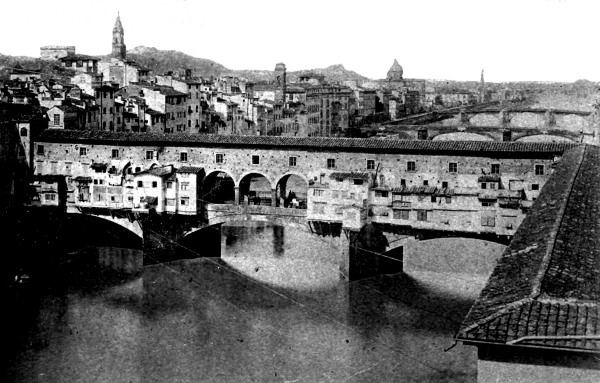
THE OLD BRIDGE AT FLORENCE.
THE OLD BRIDGE AT FLORENCE.
Taddeo Gaddi built me. I am old;
Five centuries old. I plant my foot of stone
Upon the Arno, as St. Michael’s own
Was planted on the dragon. Fold by fold
Beneath me, as it struggles, I behold
Its glistening scales. Twice hath it overthrown
My kindred and companions. Me alone
It moveth not, but is by me controlled.
[Pg 552]
I can remember when the Medici
Were driven from Florence; longer still ago
The final wars of Ghibelline and Guelf.
Florence adorns me with her jewelry;
And when I think that Michael Angelo
Hath leaned on me, I glory in myself.
THE NATURE OF LOVE.
FROM THE ITALIAN.
To noble heart Love doth for shelter fly,
As seeks the bird the forest’s leafy shade;
Love was not felt till noble heart beat high,
Nor before love the noble heart was made.
Soon as the sun’s broad flame
Was formed, so soon the clear light filled the air;
Yet was not till he came:
So love springs up in noble breasts, and there
Has its appointed space,
As heat in the bright flame finds its allotted place.
Kindles in noble heart the fire of love,
As hidden virtue in the precious stone:
This virtue comes not from the stars above,
Till round it the ennobling sun has shone;
But when his powerful blaze
Has drawn forth what was vile, the stars impar
Strange virtue in their rays:
And thus when Nature doth create the heart
Noble and pure and high,
Like virtue from the star, love comes from woman’s eye.
TO ITALY.
FROM FILICAJA.
Italy! Italy! thou who’rt doomed to wear
The fatal gift of beauty, and possess
The dower funest
[131]
of infinite wretchedness,
Written upon thy forehead by despair;
Ah! would that thou wert stronger, or less fair,
That they might fear thee more, or love thee less,
Who in the splendour of thy loveliness
Seem wasting, yet to mortal combat dare!
[Pg 553]
Then from the Alps I should not see descending
Such torrents of armed men, nor Gallic horde
Drinking the wave of Po, distained with gore,
For should I see thee girded with a sword
Not thine, and with the stranger’s arm contending,
Victor or vanquished, slave for evermore.
TRANSLATIONS FROM
THE FRENCH.
SPRING.
FROM CHARLES, DUKE OF ORLEANS.
XV. CENTURY.
Gentle Spring!—in sunshine clad,
Well dost thou thy power display!
For Winter maketh the light heart sad,
And thou,—thou makest the sad heart gay.
He sees thee, and calls to his gloomy train,
The sleet, and the snow, and the wind, and the rain,
And they shrink away, and they flee in fear,
When thy merry step draws near.
Winter giveth the fields and the trees, so old,
Their beards of icicles and snow;
And the rain, it raineth so fast and cold,
We must cower over the embers low;
And, snugly housed from the wind and weather,
Mope like birds that are changing feather.
But the storm retires, and the sky grows clear,
When thy merry step draws near.
Winter maketh the sun in the gloomy sky
Wrap him round with a mantle of cloud;
But, Heaven be praised, thy step is nigh;
Thou tearest away the mournful shroud,
And the earth looks bright, and Winter surly,
Who has toiled for nought both late and early,
Is banished afar by the new-born year,
When thy merry step draws near.
THE CHILD ASLEEP.
Sweet babe! true portrait of thy father’s face,
Sleep on the bosom, that thy lips have pressed!
Sleep, little one; and closely, gently place
Thy drowsy eyelid on thy mother’s breast.
[Pg 554]
Upon that tender eye, my little friend,
Soft sleep shall come, that cometh not to me!
I watch to see thee, nourish thee, defend;—
’Tis sweet to watch for thee, alone for thee!
His arms fall down; sleep sits upon his brow;
His eye is closed; he sleeps, nor dreams of harm.
Wore not his cheek the apple’s ruddy glow,
Would you not say he slept on Death’s cold arm?
Awake, my boy!—I tremble with affright!
Awake, and chase this fatal thought!—Unclose
Thine eye but for one moment on the light!
Even at the price of thine, give me repose!
Sweet error! he but slept, I breathe again;
Come, gentle dreams, the hour of sleep beguile!
O when shall he for whom I sigh in vain,
Beside me watch to see thy waking smile?
RONDEL.
FROM FROISSARD.
Love, love, what wilt thou with this heart of mine?
Nought see I fixed or sure in thee!
I do not know thee,—nor what deeds are thine:
Love, love, what wilt thou with this heart of mine?
Nought see I fixed or sure in thee!
Shall I be mute, or vows with prayers combine?
Ye who are blessed in loving, tell it me:
Love, love, what wilt thou with this heart of mine
Nought see I permanent or sure in thee!
RONDEL.
FROM THE DUKE OF ORLEANS.
Hence away, begone, begone,
Carking care and melancholy!
Think ye thus to govern me
All my life long, as ye have done?
That shall ye not, I promise ye:
Reason shall have the mastery.
So hence away, begone, begone,
Carking care and melancholy!
[Pg 555]
If ever ye return this way,
With your mournful company,
A curse be on ye, and the day
That brings ye moping back to me!
Hence away, begone, I say,
Carking care and melancholy!
RENOUVEAU.
Now Time throws off his cloak again
Of ermined frost, and cold and rain,
And clothes him in the embroidery
Of glittering sun and clear blue sky.
With beast and bird the forest rings,
Each in his jargon cries or sings;
And Time throws off his cloak again
Of ermined frost, and cold and rain.
River, and fount, and tinkling brook
Wear in their dainty livery
Drops of silver jewelry;
In new-made suit they merry look;
And Time throws off his cloak again
Of ermined frost, and cold and rain.
FRIAR LUBIN.
To gallop off to town post-haste
So oft, the times I cannot tell;
To do vile deed, nor feel disgraced,—
Friar Lubin will do it well.
But a sober life to lead,
To honour virtue, and pursue it,
That’s a pious, Christian deed,—
Friar Lubin cannot do it.
To mingle with a knowing smile,
The goods of others with his own,
And leave you without cross or pile,
Friar Lubin stands alone.
To say ’tis yours is all in vain,
If once he lays his finger to it;
For as to giving back again,
Friar Lubin cannot do it.
[Pg 556]
With flattering words and gentle tone,
To woo and win some guileless maid,
Cunning pander need you none,—
Friar Lubin knows the trade.
Loud preacheth he sobriety,
But as for water, doth eschew it;
Your dog may drink it,—but not he;
Friar Lubin cannot do it.
When an evil deed’s to do,
Friar Lubin’s stout and true;
Glimmers a ray of goodness through it,
Friar Lubin cannot do it.
DEATH OF ARCHBISHOP TURPIN.
The archbishop, whom God loved in high degree,
Beheld his wounds all bleeding fresh and free;
And then his cheek more ghastly grew and wan,
And a faint shudder through his members ran.
Upon the battle-field his knee was bent;
Brave Roland saw, and to his succour went,
Straightway his helmet from his brow unlaced,
And tore the shining hauberk from his breast;
Then raising in his arms the man of God,
Gently he laid him on the verdant sod.
“Rest, Sire,” he cried,—“for rest thy suffering needs.”
The priest replied, “Think but of warlike deeds!
The field is ours; well may we boast with strife!
But death steals on,—there is no hope of life;
In Paradise, where the almoners live again,
There are our couches spread,—there shall we rest from pain.”
Sore Roland grieved; nor marvel I, alas!
That thrice he swooned upon the thick, green grass.
When he revived, with a loud voice cried he,
“O Heavenly Father! Holy Saint Marie!
Why lingers death to lay me in my grave?
Beloved France! how have the good and brave
Been torn from thee and left thee weak and poor!”
Then thoughts of Aude, his lady-love, came o’er
His spirit, and he whispered soft and slow,
“My gentle friend!—what parting full of woe!
Never so true a liegeman shalt thou see;—
Whate’er my fate, Christ’s benison on thee;
Christ, who did save from realms of woe beneath
The Hebrew prophets from the second death.”
[Pg 557]
Then to the paladins, whom well he knew,
He went, and one by one unaided drew
To Turpin’s side, well skilled in ghostly lore;—
No heart had he to smile,—but, weeping sore,
He blessed them in God’s name, with faith that he
Would soon vouchsafe to them a glad eternity.
The archbishop, then,—on whom God’s benison rest!—
Exhausted, bowed his head upon his breast;—
His mouth was full of dust and clotted gore,
And many a wound his swollen visage bore.
Slow beats his heart,—his panting bosom heaves,—
Death comes apace, no hope of cure relieves.
Towards heaven he raised his dying hands and prayed
That God, who for our sins was mortal made,—
Born of the Virgin,—scorned and crucified,—
In paradise would place him by his side.
Then Turpin died in service of Charlon,
In battle great and eke great orison;
’Gainst Pagan host alway strong champion;—
God grant to him his holy benison!
TO CARDINAL RICHELIEU.
FROM MALHERBE.
Thou mighty Prince of Church and State,
Richelieu! until the hour of death,
Whatever road man chooses, Fate
Still holds him subject to her breath.
Spun of all silks, our days and nights
Have sorrows woven with delights;
And of this intermingled shade
Our various destiny appears,
Even as one sees the course of years
Of summers and of winters made.
Sometimes the soft, deceitful hours
Let us enjoy the halcyon wave;
Something impending peril lowers
Beyond the seaman’s skill to save.
The Wisdom, infinitely wise,
That gives to human destinies
Their foreordained necessity,
Has made no law more fixed below,
Than the alternate ebb and flow
Of Fortune and Adversity.
[Pg 558]
CONSOLATION.
TO M. DU PERRIER,
GENTLEMAN, OF AIX IN PROVENCE,
ON THE DEATH OF HIS DAUGHTER.
FROM THE FRENCH OF FRANÇOIS DE MALHERBE.
Will then, Du Perrier, thy sorrow be eternal?
And shall the sad discourse
Whispered within thy heart, by tenderness paternal,
Only augment its force?
Thy daughter’s mournful fate, into the tomb descending
By death’s frequented ways,
Has it become to thee a labyrinth never ending,
Where thy lost reason strays?
I know the charms that made her youth a benediction:
Nor should I be content,
As a censorious friend, to solace thine affliction,
By her disparagement.
But she was of the world, which fairest things exposes
To fates the most forlorn;
A rose, she too hath lived as long as live the roses,
The space of one brief morn.
Death hath his rigorous laws, unparalleled, unfeeling;
All prayers to him are vain;
Cruel, he stops his ears, and, deaf to our appealing,
He leaves us to complain.
The poor man in his hut, with only thatch for cover,
Unto these laws must bend;
The sentinel that guards the barriers of the Louvre
Cannot our Kings defend.
To murmur against death, in petulant defiance,
Is never for the best;
To will what God doth will, that is the only science
That gives us any rest.
[Pg 559]
THE ANGEL AND THE CHILD.
FROM THE FRENCH OF JEAN REBOUL.[132]
An angel with a radiant face
Above a cradle bent to look,
Seemed his own image there to trace
As in the waters of a brook.
“Dear child! who me resemblest so,”
It whispered, “come, O come with me!
Happy together let us go,
The earth unworthy is of thee!
“Here none to perfect bliss attain;
The soul in pleasure suffering lies;
Joy hath an undertone of pain,
And even the happiest hours their sighs.
“Fear doth at every portal knock;
Never a day serene and pure
From the o’ershadowing tempest’s shock
Has made the morrow’s dawn secure.
“What, then, shall sorrows and shall fears
Come to disturb so pure a brow?
And with the bitterness of tears
Those eyes of azure troubled grow?
“Ah no! into the fields of space,
Away shalt thou escape with me;
And Providence will grant thee grace
Of all the days that were to be.
“Let no one in thy dwelling cower
In sombre vestments draped and veiled;
But let them welcome thy last hour,
As thy first moments once they hailed.
“Without a cloud be there each brow;
There let the grave no shadow cast;
When one is pure as thou art now,
The fairest day is still the last.”
And waving wide his wings of white,
The angel, at these words, had sped
Towards the eternal realms of light!—
Poor mother! see, thy son is dead.
[Pg 560]
A CHRISTMAS CAROL.
FROM THE NOEL BOURGUIGNON DE
GUI BARÔZAI.
I hear along our street
Pass the minstrel throngs;
Hark! they play so sweet,
On their hautboys, Christmas songs!
Let us by the fire
Ever higher
Sing them till the night expire!
In December ring
Every day the chimes;
Loud the gleemen sing
In the streets their merry rhymes.
Let us by the fire
Ever higher
Sing them till the night expire!
Shepherds at the grange,
Where the Babe was born
Sang, with many a change,
Christmas carols until morn.
Let us by the fire
Ever higher
Sing them till the night expire.
These good people sang
Songs devout and sweet
While the rafters rang,
There they stood with freezing feet.
Let us by the fire
Ever higher
Sing them till the night expire!
Nuns in frigid cells
At this holy tide,
For want of something else,
Christmas songs at times have tried.
Let us by the fire
Ever higher
Sing them till the night expire!
Washerwomen old,
To the sound they beat,
Sing by rivers cold,
With uncovered heads and feet.
Let us by the fire
Ever higher
Sing them till the night expire!
Who by the fireside stands
Stamps his feet and sings;
But he who blows his hands
Not so gay a carol brings.
Let us by the fire
Ever higher
Sing them till the night expire!
THE BLIND GIRL OF CASTÈL-CUILLÈ.
FROM THE GASCON OF JASMIN.
Only the Lowland tongue of Scotland might
Rehearse this little tragedy aright:
Let me attempt it with an English quill:
And take, O reader, for the deed the will.
Jasmin, the author of this beautiful
poem, is to the South of France what Burns is to the South of
Scotland,—the representative of the heart of the people,—one of those
happy bards who are born with their mouths full of birds (la bouco
pleno d’aouzelous). He has written his own biography in a poetic
form, and the simple narrative of his poverty, his struggles and his
triumphs, is very touching. His home was at Agen on the Garonne.
Those who may feel interested in knowing something about “Jasmin,
Coiffeur”—for such is his calling—will find a description of his person
and mode of life in the graphic pages of Béarn and the Pyrenees
(Vol. i. p. 369, et seq.), by Louisa Stuart Costello, whose
charming pen has done so much to illustrate the French provinces and
their literature.
[Pg 561]
I.
At the foot of the mountain height
Where is perched Castèl-Cuillè,
When the apple, the plum, and the almond tree
In the plain below were growing white,
This is the song one might perceive
On a Wednesday morn of Saint Joseph’s Eve:
“The roads should blossom, the roads should bloom,
So fair a bride shall leave her home!
Should blossom and bloom with garlands gay,
So fair a bride shall pass to-day!”
This old Te Deum, rustic rites attending,
Seemed from the clouds descending;
When lo! a merry company
Of rosy village girls, clean as the eye,
Each one with her attendant swain,
Came to the cliff, all singing the same strain:
Resembling there, so near unto the sky,
Rejoicing angels, that kind Heaven has sent
For their delight and our encouragement.
Together blending,
And soon descending
The narrow sweep
Of the hill-side steep,
They wind aslant
Toward Saint Amant
Through leafy alleys
Of verdurous valleys,
With merry sallies,
Singing their chant:
“The roads should blossom, the roads should bloom,
So fair a bride shall leave her home!
Should blossom and bloom with garlands gay,
So fair a bride shall pass to-day!”
It is Baptiste, and his affianced maiden,
With garlands for the bridal laden!
The sky was blue; without one cloud of gloom,
The sun of March was shining brightly,
And to the air the freshening wind gave lightly
Its breathings of perfume.
[Pg 562]
When one beholds the dusky hedges blossom,
A rustic bridal, ah! how sweet it is!
To sounds of joyous melodies,
That touch with tenderness the trembling bosom,
A band of maidens
Gaily frolicking,
A band of youngsters
Wildly rollicking!
Kissing,
Caressing,
With fingers pressing,
Till in the veriest
Madness of mirth, as they dance,
They retreat and advance,
Trying whose laugh shall be loudest and merriest;
While the bride, with roguish eyes,
Sporting with them, now escapes and cries:
“Those who catch me
Married verily
This year shall be!”
And all pursue with eager haste,
And all attain what they pursue,
And touch her pretty apron fresh and new,
And the linen kirtle round her waist.
“Meanwhile, whence comes it that among
These youthful maidens fresh and fair,
So joyous, with such laughing air,
Baptiste stands sighing, with silent tongue?
And yet the bride is fair and young!
Is it Saint Joseph would say to us all,
That love, o’er-hasty, precedeth a fall?
O, no! for a maiden frail, I trow,
Never bore so lofty a brow!
What lovers! they give not a single caress!
To see them so careless and cold to-day,
These are grand people, one would say.
What ails Baptiste? what grief doth him oppress?
It is, that, half way up the hill
In yon cottage, by whose walls
Stand the cart-house and the stalls,
Dwelleth the blind orphan still,
Daughter of a veteran old;
And you must know, one year ago,
That Margaret, the young and tender,
Was the village pride and splendour,
And Baptiste her lover bold.
Love, the deceiver, them ensnared;
For them the altar was prepared;
[Pg 563]
But alas! the summer’s blight,
The dread disease that none can stay,
The pestilence that walks by night,
Took the young bride’s sight away.
All at the father’s stern command was changed;
Their peace was gone, but not their love estranged;
Wearied at home, ere long the lover fled;
Returned but three short days ago,
The golden chain they round him throw,
He is enticed, and onward led
To marry Angela, and yet
Is thinking ever of Margaret.
Then suddenly a maiden cried,
“Anna, Theresa, Mary, Kate!
Here comes the cripple Jane!” And by a fountain’s side
A woman, bent and grey with years,
Under the mulberry-trees appears,
And all towards her run, as fleet
As had they wings upon their feet.
It is that Jane, the cripple Jane,
Is a soothsayer, wary and kind.
She telleth fortunes, and none complain.
She promises one a village swain,
Another a happy wedding-day,
And the bride a lovely boy straightway.
All comes to pass as she avers;
She never deceives, she never errs.
But for this once the village seer
Wears a countenance severe,
And from beneath her eyebrows thin and white
Her two eyes flash like cannons bright
Aimed at the bridegroom in waistcoat blue,
Who, like a statue, stands in view;
Changing colour, as well he might,
When the beldame, wrinkled and grey,
Takes the young bride by the hand,
And, with the tip of her reedy wand,
Making the sign of the cross, doth say:—
“Thoughtless Angela, beware!
Lest, when thou weddest this false bridegroom,
Thou diggest for thyself a tomb!”
And she was silent; and the maidens fair
Saw from each eye escape a swollen tear;
But on a little streamlet silver-clear,
[Pg 564]
What are two drops of turbid rain?
Saddened a moment, the bridal train
Resumed the dance and song again;
The bridegroom only was pale with fear;
And down green alleys
Of verdurous valleys,
With merry sallies,
They sang the refrain:—
“The roads should blossom, the roads should bloom,
So fair a bride shall leave her home!
Should blossom and bloom with garlands gay,
So fair a bride shall pass to-day!”
II.
And by suffering worn and weary,
But beautiful as some fair angel yet,
Thus lamented Margaret,
In her cottage lone and dreary:—
“He has arrived! arrived at last!
Yet Jane has named him not these three days past;
Arrived! yet keeps aloof so far!
And knows that of my night he is the star!
Knows that long months I wait alone, benighted,
And count the moments since he went away!
Come! keep the promise of that happier day,
That I may keep the faith to thee I plighted!
What joy have I without thee? what delight?
Grief wastes my life, and makes it misery;
Day for the others ever, but for me
For ever night! for ever night!
When he is gone ’tis dark! my soul is sad!
I suffer! O my God! come, make me glad.
When he is near, no thoughts of day intrude;
Day has blue heavens, but Baptiste has blue eyes
Within them shines for me a heaven of love,
A heaven all happiness, like that above,
No more of grief! no more of lassitude!
Earth I forget,—and heaven, and all distresses,
When seated by my side my hand he presses;
But when alone, remember all!
Where is Baptiste? he hears not when I call!
A branch of ivy, dying on the ground,
I need some bough to twine around!
In pity come! be to my suffering kind!
True love, they say, in grief doth more abound!
What then, when one is blind?
[Pg 565]
“Who knows? perhaps I am forsaken!
Ah! woe is me! then bear me to my grave!
O God! what thoughts within me waken!
Away! he will return! I do but rave!
He will return! I need not fear!
He swore it by our Saviour dear;
He could not come at his own will;
Is weary, or perhaps is ill!
Perhaps his heart, in this disguise,
Prepares for me some sweet surprise.
But some one comes! Though blind, my heart can see!
And that deceives me not! ’tis he! ’tis he!”
And the door ajar is set,
And poor, confiding Margaret
Rises, with outstretched arms, but sightless eyes;
’Tis only Paul, her brother, who thus cries:—
“Angela the bride has passed!
I saw the wedding guests go by;
Tell me, my sister, why were we not asked?
For all are there but you and I!”
“Angela married! and not send
To tell her secret unto me!
O, speak! who may the bridegroom be?”
“My sister, ’tis Baptiste, thy friend!”
A cry the blind girl gave, but nothing said;
A milky whiteness spreads upon her cheeks;
An icy hand, as heavy as lead,
Descending, as her brother speaks,
Upon her heart, that has ceased to beat,
Suspends awhile its life and heat.
She stands beside the boy, now sore distressed,
A wax Madonna as a peasant dressed.
At length the bridal song again
Brings her back to her sorrow and pain.
“Hark! the joyous airs are ringing!
Sister, dost thou hear them singing?
How merrily they laugh and jest!
Would we were bidden with the rest!
I would don my hose of homespun grey,
And my doublet of linen striped and gay;
Perhaps they will come; for they do not wed
Till to-morrow at seven o’clock, it is said!”
“I know it!” answered Margaret;
Whom the vision, with aspect black as jet,
Mastered again; and its hand of ice
Held her heart crushed, as in a vice!
[Pg 566]
“Paul, be not sad! ’Tis a holiday;
To-morrow put on thy doublet gay!
But leave me now for a while alone.”
Away, with a hop and a jump, went Paul,
And, as he whistled along the hall,
Entered Jane, the crippled crone.
“Holy Virgin! what dreadful heat!
I am faint, and weary, and out of breath!
But thou art cold,—art chill as death!
My little friend! what ails thee, sweet?”
“Nothing! I heard them singing home the bride;
And, as I listened to the song,
I thought my turn would come ere long,
Thou knowest it is at Whitsuntide.
Thy cards forsooth can never lie,
To me such joy they prophesy,
Thy skill shall be vaunted far and wide
When they behold him at my side.
And poor Baptiste, what sayest thou?
It must seem long to him;—methinks I see him now!”
Jane, shuddering, her hand doth press:
“Thy love I cannot all approve;
We must not trust too much to happiness;
Go, pray to God, that thou mayst love him less!”
“The more I pray, the more I love!
It is no sin, for God is on my side!”
It was enough; and Jane no more replied.
Now to all hope her heart is barred and cold;
But to deceive the beldame old
She takes a sweet, contented air;
Speaks of foul weather or of fair,
At every word the maiden smiles.
Thus the beguiler she beguiles;
So that, departing at the evening’s close,
She says, “She may be saved! she nothing knows!”
Poor Jane, the cunning sorceress!
Now that thou wouldst, thou art no prophetess!
This morning, in the fulness of thy heart,
Thou wast so, far beyond thine art!
III.
Now rings the bell, nine times reverberating,
And the white daybreak, stealing up the sky,
Sees in two cottages two maidens waiting,
How differently!
[Pg 567]
Queen of a day, by flatterers caressed,
The one puts on her cross and crown,
Decks with a huge bouquet her breast,
And flaunting, fluttering up and down,
Looks at herself, and cannot rest.
The other, blind, within her little room,
Has neither crown nor flower’s perfume;
But in their stead for something gropes apart
That in a drawer’s recess doth lie,
And, ’neath her bodice of bright scarlet dye,
Convulsive clasps it to her heart.
The one, fantastic, light as air,
’Mid kisses ringing,
And joyous singing,
Forgets to say her morning prayer!
The other, with cold drops upon her brow,
Joins her two hands, and kneels upon the floor,
And whispers, as her brother opes the door,
“O God! forgive me now!”
And then the orphan, young and blind,
Conducted by her brother’s hand,
Towards the church, through paths unscanned,
With tranquil air, her way doth wind.
Odours of laurel, making her faint and pale,
Round her at times exhale,
And in the sky as yet no sunny ray,
But brumal vapours grey.
Near that castle, fair to see,
Crowded with sculptures old, in every part,
Marvels of nature and of art,
And proud of its name of high degree,
A little chapel, almost bare,
At the base of the rock is builded there;
All glorious that it lifts aloof,
Above each jealous cottage roof,
Its sacred summit, swept by autumn gales,
And its blackened steeple high in air,
Round which the osprey screams and sails.
“Paul, lay thy noisy rattle by!”
Thus Margaret said. “Where are we? we ascend!”
“Yes; seest thou not our journey’s end?
Hearest not the osprey from the belfry cry?
The hideous bird, that brings ill luck, we know!
Dost thou remember when our father said,
The night we watched beside his bed,
’O daughter, I am weak and low;
[Pg 568]
Take care of Paul; I feel that I am dying!’
And thou, and he, and I, all fell to crying?
Then on the roof the osprey screamed aloud;
And here they brought our father in his shroud.
There is his grave; there stands the cross we set;
Why dost thou clasp me so, dear Margaret?
Come in! The bride will be here soon:
Thou tremblest! O my God! thou art going to swoon!”
She could no more,—the blind girl, weak and weary!
A voice seemed crying from that grave so dreary,
“What wouldst thou do, my daughter?”—and she started;
And quick recoiled, aghast, faint-hearted;
But Paul, impatient, urges ever more
Her steps towards the open door;
And when, beneath her feet, the unhappy maid
Crushes the laurel near the house immortal,
And with her head, as Paul talks on again,
Touches the crown of filigrane
Suspended from the low-arched portal,
No more restrained, no more afraid,
She walks, as for a feast arrayed,
And in the ancient chapel’s sombre night
They both are lost to sight.
At length the bell,
With booming sound,
Sends forth, resounding round,
Its hymeneal peal o’er rock and down the dell.
It is broad day, with sunshine and with rain;
And yet the guests delay not long,
For soon arrives the bridal train,
And with it brings the village throng.
In sooth, deceit maketh no mortal gay,
For lo! Baptiste on this triumphant day,
Mute as an idiot, sad as yester-morning,
Thinks only of the beldame’s words of warning.
And Angela thinks of her cross, I wis;
To be a bride is all! The pretty lisper
Feels her heart swell to hear all round her whisper,
“How beautiful! how beautiful she is!”
But she must calm that giddy head,
For already the Mass is said;
At the holy table stands the priest;
The wedding ring is blessed; Baptiste receives it;
Ere on the finger of the bride he leaves it,
He must pronounce one word at least!
’Tis spoken; and sudden at the groomsman’s side
“’Tis he!” a well-known voice has cried.
[Pg 569]
And while the wedding-guests all hold their breath,
Opes the confessional, and the blind girl, see!
“Baptiste,” she said, “since thou hast wished my death,
As holy water be my blood for thee!”
And calmly in the air a knife suspended!
Doubtless her guardian angel near attended,
For anguish did its work so well,
That, ere the fatal stroke descended,
Lifeless she fell!
At eve, instead of bridal verse,
The De Profundis filled the air;
Decked with flowers a single hearse
To the churchyard forth they bear;
Village girls in robes of snow
Follow, weeping as they go;
Nowhere was a smile that day,
No, ah no! for each one seemed to say:—
“The roads shall mourn and be veiled in gloom,
So fair a corpse shall leave its home!
Should mourn and should weep, ah, well-away,
So fair a corpse shall pass to-day!”
MY SECRET.
FROM THE FRENCH OF FÉLIX ARVERS.
My soul its secret hath, my life too hath its mystery,
A love eternal in a moment’s space conceived;
Hopeless the evil is, I have not told its history,
And she who was the cause nor knew it nor believed.
Alas! I shall have passed close by her unperceived,
For ever at her side and yet for ever lonely,
I shall unto the end have made life’s journey, only
Daring to ask for nought, and having nought received.
For her, though God hath made her gentle and endearing,
She will go on her way distraught and without hearing
These murmurings of love that round her steps ascend,
Piously faithful still unto her austere duty,
Will say, when she shall read these lines full of her beauty,
“Who can this woman be?” and will not comprehend.
[Pg 570]
BARRÉGES.
FROM THE FRENCH OF
JEAN-JACQUES LEFRANC DE POMPIGNAN.
I leave you, ye cold mountain chains,
Dwelling of warriors stark and frore!
You, may these eyes behold no more,
Save on the horizon of our plains.
Vanish, ye frightful, gloomy views!
Ye rocks that mount up to the clouds!
Of skies, enwrapped in misty shrouds,
Impracticable avenues!
Ye torrents, that with might and main
Break pathways through the rocky walls,
With your terrific waterfalls
Fatigue no more my weary brain!
Arise, ye landscapes full of charms,
Arise, ye pictures of delight!
Ye brooks, that water in your flight
The flowers and harvests of our farms!
You I perceive, ye meadows green,
Where the Garonne the lowland fills,
Not far from that long chain of hills,
With intermingled vales between.
Yon wreath of smoke, that mounts so high,
Methinks from my own hearth must come;
With speed to that belovèd home,
Fly, ye too lazy coursers, fly!
And bear me thither, where the soul
In quiet may itself possess,
Where all things soothe the mind’s distress,
Where all things teach me and console.
ON THE TERRACE OF THE AIGALADES.
FROM THE FRENCH OF J. MÉRY.
From this high portal, where upsprings
The rose to touch our hands in play,
We at a glance behold three things,—
The Sea, the Town, and the Highway.
And the Sea says: My shipwrecks fear;
I drown my best friends in the deep;
And those who braved my tempests, here
Among my sea-weeds lie asleep!
The Town says: I am filled and fraught
With tumult and with smoke and care;
My days with toil are overwrought,
And in my nights I gasp for air.
The Highway says: My wheel-tracks guide
To the pale climates of the North;
Where my last milestone stands abide
The people to their death gone forth.
Here, in the shade, this life of ours,
Full of delicious air, glides by
Amid a multitude of flowers
As countless as the stars on high;
These red-tiled roofs, this fruitful soil,
Bathed with an azure all divine,
Where springs the tree that gives us oil,
The grape that giveth us the wine;
Beneath these mountains stripped of trees,
Whose tops with flowers are covered o’er,
Where springtime of the Hesperides
Begins, but endeth nevermore;
Under these leafy vaults and walls,
That unto gentle sleep persuade
This rainbow of the waterfalls,
Of mingled mist and sunshine made;
Upon these shores, where all invites,
We live our languid life apart;
This air is that of life’s delights,
The festival of sense and heart;
This limpid space of time prolong,
Forget to-morrow in to-day,
And leave unto the passing throng
The Sea, the Town, and the Highway.
[Pg 571]
TRANSLATIONS FROM THE
ANGLO-SAXON.
THE GRAVE.
For thee was a house built
Ere thou wast born,
For thee was a mould meant
Ere thou of mother camest.
But it is not made ready,
Nor its depth measured,
Nor is it seen
How long it shall be.
Now I bring thee
Where thou shalt be;
Now I shall measure thee,
And the mould afterwards.
Thy house is not
Highly timbered,
It is unhigh and low;
When thou art therein,
The heel-ways are low,
The sideways unhigh.
The roof is built
Thy breast full nigh,
So thou shalt in mould
Dwell full cold,
Dimly and dark.
Doorless is that house,
And dark it is within;
There thou art fast detained,
And death hath the key.
Loathsome is that earth-house,
And grim within to dwell.
There thou shalt dwell,
And worms shall divide thee.
Thus thou art laid,
And leavest thy friends;
Thou hast no friend
Who will come to thee,
Who will ever see
How that house pleaseth thee;
Who will ever open
The door for thee,
And descend after thee,
For soon thou art loathsome
And hateful to see.
BEOWULF’S EXPEDITION TO HEORT.
Thus then, much care-worn,
The son of Healfden
Sorrowed evermore,
Nor might the prudent hero
His woes avert.
The war was too hard,
Too loath and longsome,
That on the people came,
Dire wrath and grim,
Of night-woes the worst.
This from home heard
Higelac’s Thane,
Good among the Goths,
Grendel’s deeds.
He was of mankind
In might the strongest,
At that day
Of this life,
Noble and stalwart.
He bade him a sea-ship,
A goodly one, prepare.
Quoth he, the war-king,
Over the swan’s road,
Seek he would
The mighty monarch,
Since he wanted men.
For him that journey
His prudent fellows
Straight made ready,
Those that loved him.
They excited their souls,
The omen they beheld.
[Pg 572]
Had the good-man
Of the Gothic people
Champions chosen,
Of those that keenest
He might find,
Some fifteen men.
The sea-wood sought he,
The warrior showed,
Sea-crafty man!
The landmarks,
And first went forth.
The ship was on the waves,
Boat under the cliffs.
The barons ready
To the prow mounted.
The streams they whirled
The sea against the sands.
The chieftains bore
On the naked breast
Bright ornaments,
War-gear, Goth-like.
The men shoved off,
Men on their willing way,
The bounden wood.
Then went over the sea-waves,
Hurried by the wind,
The ship with foamy neck
Most like a sea-fowl,
Till about one hour
Of the second day
The curved prow
Had passed onward,
So that the sailors
The land saw,
The shore-cliffs shining,
Mountains steep,
And broad sea-noses.
Then was the sea-sailing
Of the earl at an end.
Then up speedily
The Weather people
On the land went,
The sea-bark moored,
Their mail-sarks shook,
Their war-weeds.
God thanked they,
That to them the sea journey
Easy had been.
Then from the wall beheld
The warden of the Scyldings,
He who the sea-cliffs
Had in his keeping,
Bear o’er the balks
The bright shields,
The war-weapons speedily.
Him the doubt disturbed
In his mind’s thought,
What these men might be.
Went then to the shore,
On his steed riding,
The Thane of Hrothgar.
Before the host he shook
His warden’s staff in hand,
In measured words demanded:
“What men are ye
War-gear wearing,
Host in harness,
Who thus the brown keel
Over the water-street
Leading come
Hither over the sea?
I these boundaries
As shore-warden hold;
That in the Land of the Danes
Nothing loathsome
With a ship-crew
Scathe us might....
Ne’er saw I mightier
Earl upon earth
Than is your own,
Hero in harness.
Not seldom this warrior
Is in weapons distinguished;
Never his beauty belies him,
His peerless countenance!
Now would I fain
Your origin know,
Ere ye forth
As false spies
Into the Land of the Danes
Farther fare.
Now, ye dwellers afar off!
Ye sailors of the sea!
Listen to my
One-fold thought.
Quickest is best
To make known
Whence your coming may be.”
[Pg 573]
THE SOUL’S COMPLAINT
AGAINST THE BODY.
Much it behoveth
Each one of mortals,
That he his soul’s journey
In himself ponder,
How deep it may be.
When death cometh,
The bonds he breaketh
By which united
Were body and soul.
Long it is henceforth
Ere the soul taketh
From God himself
Its woe or its weal;
As in the world erst,
Even in its earth-vessel,
It wrought before.
The soul shall come
Wailing with loud voice,
After a sennight,
The soul, to find
The body
That it erst dwelt in;—
Three hundred winters,
Unless ere that worketh
The eternal Lord,
The Almighty God,
The end of the world.
Crieth then, so care-worn,
With cold utterance,
And speaketh grimly,
The ghost to the dust:
“Dry dust! thou dreary one!
How little didst thou labour for me!
In the foulness of earth
Thou all wearest away
Like to the loam!
Little didst thou think
How thy soul’s journey
Would be thereafter,
When from the body
It should be led forth.”
TRANSLATIONS FROM THE
SWEDISH.
FRITHIOF’S HOMESTEAD.
Three miles extended around the fields of the homestead; on three sides
Valleys, and mountains, and hills, but on the fourth side was the ocean.
Birch-woods crowned the summits, but over the down-sloping hillsides
Flourished the golden corn, and man-high was waving the rye-field.
Lakes, full many in number, their mirror held up for the mountains,
Held for the forests up, in whose depths the high-antlered reindeer
Had their kingly walk, and drank of a hundred brooklets.
But in the valleys, full widely around, there fed on the greensward
Herds with sleek, shining sides, and udders that longed for the milk-pail;
’Mid these were scattered, now here and now there, a vast countless number
Of white-wooled sheep, as thou seest the white-looking stray clouds,
Flock-wise, spread o’er the heavenly vault, when it bloweth in springtime.
[Pg 574]
Twice twelve swift-footed coursers, mettlesome, fast-fettered storm-winds,
Stamping stood in the line of stalls, all champing their fodder,
Knotted with red their manes, and their hoofs all whitened with steel shoes.
The banquet-hall, a house by itself, was timbered of hard fir.
Not five hundred men (at ten times twelve to the hundred)
Filled up the roomy hall, when assembled for drinking at Yule-tide.
Thorough the hall, as long as it was, went a table of holm-oak,
Polished and white, as of steel; the columns twain of the high-seat
Stood at the end thereof, two gods carved out of an elm-tree;
Odin with lordly look, and Frey with the sun on his frontlet.
Lately between the two, on a bear-skin (the skin it was coal-black,
Scarlet-red was the throat, but the paws were shodden with silver),
Thorsten sat with his friends, Hospitality sitting with Gladness.
Oft, when the moon among the night-clouds flew, related the old man
Wonders from far-distant lands he had seen, and cruises of Vikings
Far on the Baltic and Sea of the West, and the North Sea.
Hush sat the listening bench, and their glances hung on the gray-beard’s
Lips, as a bee on the rose; but the Skald was thinking of Bragé,
Where, with silver beard, and runes on his tongue, he is seated
Under the leafy beech, and tells a tradition by Mimer’s
Ever-murmuring wave, himself a living tradition.
Midway the floor (with thatch was it strewn), burned for ever the fire-flame
Glad on its stone-built hearth; and through the wide-mouthed smoke-flue
Looked the stars, those heavenly friends, down into the great hall,
But round the walls, upon nails of steel, were hanging in order
Breastplate and helm with each other, and here and there in among them
Downward lightened a sword, as in winter evening a star shoots.
More than helmets and swords, the shields in the banquet-hall glisten,
White as the orb of the sun, or white as the moon’s disc of silver.
Ever and anon went a maid round the board and filled up the drink-horns;
Ever she cast down her eyes and blushed; in the shield her reflection
Blushed too, even as she;—this gladdened the hard-drinking champions.
FRITHIOF’S TEMPTATION.
Spring is coming, birds are twittering, forests leaf, and smiles the sun,
And the loosened torrents downward singing to the ocean run;
Glowing like the cheek of Freya, peeping rosebuds ’gin to ope,
And in human hearts awaken love of life, and joy, and hope.
[Pg 575]
Now will hunt the ancient monarch, and the queen shall join the sport;
Swarming in its gorgeous splendour is assembled all the court;
Bows ring loud, and quivers rattle, stallions paw the ground alway,
And, with hoods upon their eyelids, falcons scream aloud for prey.
See, the queen of the chase advances! Frithiof, gaze not on the sight!
Like a star upon a spring-cloud sits she on her palfrey white,
Half of Freya, half of Rota, yet more beauteous than these two,
And from her light hat of purple wave aloft the feathers blue.
Now the huntsman’s band is ready. Hurrah! over hill and dale!
Morns ring, and the hawks right upward to the hall of Odin sail.
All the dwellers in the forest seek in fear their cavern homes,
But with spear outstretched before her, after them Valkyria comes.
Then threw Frithiof down his mantle, and upon the greensward spread,
And the ancient king so trustful laid on Frithiof’s knees his head;
Slept, as calmly as the hero sleepeth after war’s alarms
On his shield, calm as an infant sleepeth in its mother’s arms.
As he slumbers, hark! there sings a coal-black bird upon a bough:
“Hasten, Frithiof, slay the old man, close your quarrel at a blow;
Take his queen, for she is thine, and once the bridal kiss she gave;
Now no human eye beholds thee; deep and silent is the grave.”
Frithiof listens; hark! there sings a snow-white bird upon the bough:
“Though no human eye beholds thee, Odin’s eye beholds thee now.
Coward, wilt thou murder slumber? a defenceless old man slay?
Whatsoe’er thou winn’st, thou canst not win a hero’s fame this way.”
Thus the two wood-birds did warble; Frithiof took his war-sword good,
With a shudder hurled it from him, far into the gloomy wood.
Coal-black bird flies down to Nastrand; but on light unfolded wings,
Like the tone of harps, the other, sounding towards the sun upsprings.
Straight the ancient king awakens. “Sweet has been my sleep,” he said;
“Pleasantly sleeps one in the shadow, guarded by a brave man’s blade.
But where is thy sword, O stranger? Lightning’s brother, where is he?
Who thus parts you, who should never from each other parted be?”
“It avails not,” Frithiof answered; “in the North are other swords;
Sharp, O monarch, is the sword’s tongue, and it speaks not peaceful words;
Murky spirits dwell in steel blades, spirits from the Niffelhem,
Slumber is not safe before them, silver locks but anger them.”
[Pg 576]
THE CHILDREN OF THE LORD’S SUPPER.
PREFATORY REMARKS.
This poem, from the Swedish of Bishop Tegnér, enjoys no inconsiderable
reputation in the North of Europe. It is an Idyl descriptive of rural life
in Sweden, round which something primeval and picturesque still lingers.
You pass out from the gate of a city, and, as if by magic, the scene
changes to a wild, woodland landscape. Around you are forests of fir,
with their long, fan-like branches; while underfoot is spread a carpet
of yellow leaves. On a wooden bridge you cross a little silver stream:
and anon come forth into a pleasant land of farms. Wooden fences divide
the adjoining fields. The gates are opened by troops of children, and
the peasants take off their hats as you pass. The houses in the village
and smaller towns are built of hewn timber, and are generally painted
red. The floors of the taverns are strewn with the fragrant tips of
fir boughs. In many villages there are no taverns, and the peasants
take turns in receiving travellers. The thrifty housewife shows you
into the best chamber, the walls of which are hung round with rude
pictures from the Bible; and she brings you curdled milk from the
pan, with oaten cakes baked some months before. Meanwhile, the sturdy
husband has brought his horses from the plough, and harnessed them to
your carriage. Solitary travellers come and go in uncouth one-horse
chaises. Most of them are smoking pipes, and have hanging around their
necks in front a leather wallet, in which they carry tobacco, and the
great bank-notes of the country. You meet, also, groups of barefooted
Dalekarlian peasant women, travelling in pursuit of work, carrying in
their hands their shoes, which have high heels under the hollow of the
foot, and soles of birch bark.
Frequent, too, are the village churches, standing by the road-side.
In the churchyard are a few flowers, and much green grass. The
grave-stones are flat, large, low, and perhaps sunken, like the roofs
of old houses; the tenants all sleeping with their heads to the
westward. Each held a lighted taper in his hand when he died; and in
his coffin were placed his little heart-treasures, and a piece of
money for his last journey. Babes that came lifeless into the world
were carried in the arms of grey-haired old men to the only cradle
they ever slept in; and in the shroud of the dead mother were laid the
little garments of the child, that lived and died in her bosom. Near
the churchyard gate stands a poor-box, with a sloping roof over it,
fastened to a post by iron bands, and secured by a padlock. If it be
Sunday, the peasants sit on the church steps and con their psalm-books.
Others are coming down the road, listening to their beloved pastor.
He is their patriarch, and, like Melchizedek, both priest and king,
though he has no other throne than the church pulpit. The women carry
psalm-books in their hands, wrapped in silk handkerchiefs, and listen
devoutly to the good man’s words. But the young men, like Gallio, care
for none of these things. They are busy counting the plaits in the
kirtles of the peasant girls, their number being an indication of the
wearer’s wealth.
I must not forget to speak of the suddenly changing seasons of the
Northern clime. There is no long spring, gradually unfolding leaf and
blossom;—no lingering autumn, pompous with many-coloured leaves. But
winter and summer are wonderful, and pass into each other. The quail
has hardly ceased piping in the corn, when winter from the folds of
trailing clouds sows broad-cast over the land snow, icicles, and
rattling hail. The days wane apace. Ere long the sun hardly rises above
the horizon, or does not rise at all. The moon and the stars shine
through the day; only, at noon, they are pale and wan, and in the
southern sky a red, fiery glow, as of sunset, burns along the horizon,
and then goes out. And pleasantly under the silver moon, and twinkling
stars, ring the steel shoes of the skaters on the frozen sea, and
voices, and the sound of bells.
And now the Northern Lights begin to burn, faintly at first, like
sunbeams playing in the waters of the blue sea. Then a soft crimson
glow tinges the heavens. There is a blush on the cheek of night. The
colours come and go; and change from crimson to gold, from gold to
crimson. The snow is stained with rosy light. Twofold from the zenith,
east and west, flames a fiery sword; and a broad band passes athwart
the heavens, like a summer sunset. Soft purple clouds come sailing over
the sky, and through their vapoury folds the winking stars shine white
as silver. With such pomp as this is Merry Christmas ushered in, though
only a single star heralded the first Christmas. And in memory of that
day the Swedish peasants dance on straw; and the peasant girls throw
straws at the timbered roof of the hall, and for every one that sticks
in a crack shall a groomsman come to their wedding. Merry indeed is
Christmas-time for Swedish peasants; brandy and nut-brown ale in wooden
[Pg 577]
bowls; and the great Yulecake crowned with a cheese, and garlanded with
apples, and upholding a three-armed candlestick over the Christmas feast.
And now leafy mid-summer, full of blossoms and the song of
nightingales, is come. In every village there is a May-pole fifty
feet high, with wreaths and roses and ribands streaming in the wind,
and a noisy weathercock on top. The sun does not set till ten o’clock
at night; and the children are at play in the streets an hour later.
The windows and doors are all open, and you may sit and read till
midnight without a candle. O how beautiful is the summer night, which
is not night, but a sunless yet unclouded day, descending upon earth
with dews, and shadows, and refreshing coolness! How beautiful the
long, mild twilight, which unites to-day with yesterday! How beautiful
the silent hour, when Morning and Evening thus sit together, hand in
hand, beneath the starless sky of midnight! From the church tower in
the public square the bell tolls the hour, with a soft musical chime;
and the watchman, whose watch-tower is the belfry, blows a blast on
his horn, for each stroke of the hammer, and four times, for the four
corners of the heavens, in a sonorous voice he chants,—
“Ho! watchman, ho!
Twelve is the clock!
God keep our town
From fire and brand,
And hostile hand!
Twelve is the clock!”
From his swallow’s nest in the belfry he can see the sun all night
long; and farther north the priest stands at his door in the warm
midnight, and lights his pipe with a common burning-glass.
I trust that these remarks will not be deemed irrelevant to the poem,
but will lead to a clearer understanding of it. The translation is
literal perhaps to a fault. In no instance have I done the author
a wrong, by introducing into his work any supposed improvements or
embellishments of my own. I have preserved even the measure; in which,
it must be confessed, the motions of the English Muse are not unlike
those of a prisoner dancing to the music of his chains; and perhaps, as
Dr. Johnson said of the dancing dog, “the wonder is not that she should
do it so well, but that she should do it at all.”
Esaias Tegnér, the author of this poem, was born in the parish of By,
in Wärmland, in the year 1782. In 1799 he entered the University of
Lund, as a student; and in 1812 was appointed Professor of Greek in
that institution. In 1824 he became Bishop of Wexiö. He is the glory
and boast of Sweden, and stands first among all her poets living or
dead. His principal work is Frithiof’s Saga; one of the most remarkable
poems of the age. Bishop Tegnér is a prophet honoured in his own country,
adding one more to the list of great names that adorn her history.
Pentecost, day of rejoicing, had come. The church of the village
Gleaming stood in the morning’s sheen. On the spire of the belfry,
Decked with a brazen cock, the friendly flames of the Spring-sun
Glanced like the tongues of fire, beheld by Apostles aforetime.
Clear was the heaven and blue, and May, with her cap crowned by roses,
Stood in her holiday dress in the fields, and the wind and the brooklet
Murmured gladness and peace, God’s-peace! with lips rosy-tinted
Whispered the race of the flowers, and merry on balancing branches
Birds were singing their carol, a jubilant hymn to the Highest.
Swept and clean was the churchyard. Adorned like a leaf-woven arbour
Stood its old-fashioned gate; and within upon each cross of iron
Hung was a fragrant garland, new twined by the hands of affection.
Even the dial, that stood on a mound among the departed
(There full a hundred years had it stood), was embellished with blossoms,
Like to the patriarch hoary, the sage of his kith and the hamlet,
Who on his birthday is crowned by children and children’s children,
So stood the ancient prophet, and mute with his pencil of iron
Marked on the tablet of stone, and measured the time and its changes,
[Pg 578]
While all around at his feet an eternity slumbered in quiet.
Also the church within was adorned, for this was the season
When the young, their parents’ hope, and the loved ones of heaven,
Should at the foot of the altar renew the vows of their baptism.
Therefore each nook and corner was swept and cleaned, and the dust was
Blown from the walls and ceiling, and from the oil-painted benches.
There stood the church like a garden; the Feast of the Leafy
Pavilions
[133]Saw we in living presentment. From noble arms on the church wall
Grew forth a cluster of leaves, and the preacher’s pulpit of oak-wood
Budded once more anew, as aforetime the rod before Aaron.
Wreathed thereon was the Bible with leaves, and the dove, washed with silver,
Under its canopy fastened, had on it a necklace of wind-flowers.
But in front of the choir, round the altar-piece painted by
Hörberg,
[134]Crept a garland gigantic; and bright-curling tresses of angels
Peeped, like the sun from a cloud, from out of the shadowy leaf-work.
Likewise the lustre of brass, new polished, blinked from the ceiling,
And for lights there were lilies of Pentecost set in the sockets.
Loud rang the bells already; the thronging crowd was assembled
Far from valleys and hills, to list to the holy preaching.
Hark! then roll forth at once the mighty tones from the organ,
Hover like voices from God, aloft like invisible spirits.
Like as Elias in heaven, when he cast from off him his mantle,
So cast off the soul its garments of earth; and with one voice
Chimed in the congregation, and sang an anthem immortal
Of the sublime Wallín,
[135]
of David’s harp in the Northland
Tuned to the choral of Luther; the song on its mighty pinions
Took every living soul, and lifted it gently to heaven,
And each face did shine like the Holy One’s face upon Tabor.
Lo! there entered then into the church the Reverend Teacher.
Father he hight and he was in the parish; a christianly plainness
Clothed from his head to his feet the old man of seventy winters.
Friendly was he to behold, and glad as the heralding angel
Walked he among the crowds, but still a contemplative grandeur
Lay on his forehead as clear, as on moss-covered grave-stone a sunbeam.
As in his inspiration (an evening twilight that faintly
Gleams in the human soul, even now, from the day of creation)
Th’ Artist, the friend of heaven, imagines Saint John when in Patmos,
Grey, with his eyes uplifted to heaven, so seemed then the old man;
Such was the glance of his eye, and such were his tresses of silver.
All the congregation arose in the pews that were numbered,
But with a cordial look to the right and the left hand, the old man
Nodding all hail and peace, disappeared in the innermost chancel.
[Pg 579]
Simply and solemnly now proceeded the Christian service,
Singing and prayer, and at last an ardent discourse from the old man.
Many a moving word and warning, that out of the heart came,
Fell like the dew of the morning, like manna on those in the desert.
Then, when all was finished, the Teacher re-entered the chancel,
Followed therein by the young. The boys on the right had their places,
Delicate figures, with close-curling hair, and cheeks rosy-blooming.
But on the left of these, there stood the tremulous lilies,
Tinged with the blushing light of the dawn, the diffident maidens,—
Folding their hands in prayer, and their eyes cast down on the pavement.
Now came, with question and answer, the Catechism. In the beginning,
Answered the children with troubled and faltering voice, but the old man’s
Glances of kindness encouraged them soon, and the doctrines eternal
Flowed, like the waters of fountains, so clear from lips unpolluted.
Each time the answer was closed, and as oft as they named the Redeemer,
Lowly louted the boys, and lowly the maidens all courtesied.
Friendly the Teacher stood, like an angel of light there among them,
And to the children explained the holy, the highest in few words,
Thorough, yet simple and clear, for sublimity always is simple,
Both in sermon and song, a child can seize on its meaning.
E’en as the green-growing bud is unfolded when Spring-tide approaches,
Leaf by leaf puts forth, and, warmed by the radiant sunshine,
Blushes with purple and gold, till at last the perfected blossom
Opens its odorous chalice, and rocks with its crown in the breezes,
So was unfolded here the Christian lore of salvation,
Line by line from the soul of childhood. The fathers and mothers
Stood behind them in tears, and were glad at the well-worded answer.
Now went the old man up to the altar;—and straightway transfigured
(So did it seem unto me) was then the affectionate Teacher.
Like the Lord’s Prophet sublime, and awful as Death and as Judgment
Stood he, the God-commissioned, the soul-searcher, earthward descending
Glances, sharp as a sword, into hearts, that to him were transparent
Shot he; his voice was deep, was low like the thunder afar off.
So on a sudden transfigured he stood there, he spake and he questioned.
“This is the faith of the Fathers, the Faith the Apostles delivered,
This is moreover the faith whereunto I baptized you, while still ye
Lay on your mothers’ breasts, and nearer the portals of heaven.
Slumbering received you then the Holy Church in its bosom;
Wakened from sleep are ye now, and the light in its radiant splendour
Downward rains from the heaven,—to-day on the threshold of childhood
Kindly she frees you again, to examine and make your election,
For she knows nought of compulsion, and only conviction desireth.
This is the hour of your trial, the turning-point of existence,
[Pg 580]
Seed for the coming days; without revocation departeth
Now from your lips the confession; Bethink ye, before ye make answer!
Think not, O think not with guile to deceive the questioning Teacher.
Sharp is his eye to-day, and a curse ever rests upon falsehood.
Enter not with a lie on Life’s journey; the multitude hears you,
Brothers and sisters and parents, what dear upon earth is and holy
Standeth before your sight as a witness; the Judge everlasting
Looks from the sun down upon you, and angels in waiting beside him
Grave your confession in letters of fire, upon tablets eternal.
Thus, then,—Believe ye in God, in the Father who this world created?
Him who redeemed it, the Son, and the Spirit where both are united?
Will ye promise me here (a holy promise!), to cherish
God more than all things earthly, and every man as a brother?
Will ye promise me here to confirm your faith by your living,
Th’ heavenly faith of affection! to hope, to forgive, and to suffer,
Be what it may your condition, and walk before God in uprightness?
Will ye promise me this before God and man?”—With a clear voice
Answered the young men Yes! and Yes! with lips softly breathing
Answered the maidens eke. Then dissolved from the brow of the Teacher
Clouds with the thunders therein, and he spake in accents more gentle,
Soft as the evening’s breath, as harps by Babylon’s rivers.
“Hail, then, hail to you all! To the heirdom of heaven be ye welcome;
Children no more from this day, but by covenant brothers and sisters!
Yet,—for what reason not children? Of such is the kingdom of heaven.
Here upon earth an assemblage of children, in heaven one Father,
Ruling them all as his household,—forgiving in turn and chastising,
That is of human life a picture, as Scripture has taught us.
Blest are the pure before God! Upon purity and upon virtue
Resteth the Christian Faith; she herself from on high is descended.
Strong as a man and pure as a child, is the sum of the doctrine,
Which the Divine One taught, and suffered and died on the cross for.
O! as ye wander this day from childhood’s sacred asylum
Downward and ever downward, and deeper in Age’s chill valley,
Oh! how soon will ye come,—too soon!—and long to turn backward
Up to its hill-tops again, to the sun-illumined, where Judgment
Stood like a father before you, and Pardon, clad like a mother,
Gave you her hand to kiss, and the loving heart was forgiven.
Life was a play, and your hands grasped after the roses of heaven!
Seventy years have I lived already; the Father eternal
Gave me gladness and care; but the loveliest hours of existence,
When I have steadfastly gazed in their eyes, I have instantly known them,
Known them all again;—they were my childhood’s acquaintance.
Therefore take from henceforth, as guides in the paths of existence,
Prayer, with her eyes raised to heaven, and Innocence, bride of man’s childhood.
[Pg 581]
Innocence, child beloved, is a guest from the world of the blessed,
Beautiful, and in her hand a lily; on life’s roaring billows
Swings she in safety, she heedeth them not, in the ship she is sleeping.
Calmly she gazes around in the turmoil of men; in the desert
Angels descend and minister unto her; she herself knoweth
Nought of her glorious attendance; but follows faithful and humble,
Follows so long as she may her friend; O do not reject her,
For she cometh from God and she holdeth the keys of the heavens.
Prayer is Innocence’ friend; and willingly flieth incessant
’Twixt the earth and the sky, the carrier-pigeon of heaven.
Son of Eternity, fettered in Time, and an exile, the Spirit
Tugs at his chains evermore, and struggles like flames ever upward.
Still he recalls with emotion his Father’s manifold mansions,
Thinks of the land of his fathers, where blossomed more freshly the flowerets,
Shone a more beautiful sun, and he played with the wingèd angels.
Then grows the earth too narrow, too close; and homesick for heaven
Longs the wanderer again; and the Spirit’s longings are worship;
Worship is called his most beautiful hour, and its tongue is entreaty.
Ah! when the infinite burden of life descendeth upon us,
Crushes to earth our hope, and, under the earth, in the graveyard,—
Then it is good to pray unto God; for His sorrowing children
Turns he ne’er from his door, but he heals and helps and consoles them.
Yet it is better to pray when all things are prosperous with us,
Pray in fortunate days, for Life’s most beautiful Fortune
Kneels before the Eternal’s throne; and, with hands interfolded,
Praises thankful and moved the only Giver of blessings.
Or do ye know, ye children, one blessing that comes not from Heaven?
What has mankind forsooth, the poor! that it has not received?
Therefore, fall in the dust and pray! The seraphs adoring
Cover with pinions six their face in the glory of him who
Hung his masonry pendant on nought, when the world he created.
Earth declareth his might, and the firmament uttereth his glory.
Races blossom and die, and stars fall downward from heaven,
Downward like withered leaves; at the last stroke of midnight, millenniums
Lay themselves down at his feet, and he sees them, but counts them as nothing.
Who shall stand in His presence? The wrath of the Judge is terrific,
Casting the insolent down at a glance. When he speaks in his anger
Hillocks skip like the kid, and mountains leap like the roebuck.
Yet,—why are ye afraid, ye children? This awful avenger,
Ah! is a merciful God! God’s voice was not in the earthquake,
Not in the fire, nor the storm, but it was in the whispering breezes.
Love is the root of creation; God’s essence; worlds without number
Lie in his bosom like children; he made them for this purpose only:
Only to love and be loved again, he breathed forth his spirit
Into the slumbering dust, and upright standing, it laid its
Hand on its heart, and felt it was warm with a flame out of heaven.
[Pg 582]
Quench, O quench not that flame! It is the breath of your being.
Love is life, but hatred is death. Not father nor mother
Loved you, as God has loved you; for ’twas that you may be happy
Gave he his only Son. When he bowed down his head in the death-hour,
Solemnized Love its triumph; the sacrifice then was completed.
Lo! then was rent on a sudden the veil of the temple, dividing
Earth and heaven apart, and the dead from their sepulchres rising,
Whispered with pallid lips and low in the ears of each other
Th’ answer, but dreamed of before, to creation’s enigma,—Atonement!
Depths of Love are Atonement’s depths, for Love is Atonement.
Therefore, child of mortality, love thou the merciful Father;
Wish what the Holy One wishes, and not from fear, but affection;
Fear is the virtue of slaves; but the heart that loveth is willing;
Perfect was before God, and perfect is Love, and Love only.
Lovest thou God as thou oughtest, then lovest thou likewise thy brethren;
One is the sun in heaven, and one, only one, is Love also.
Bears not each human figure the godlike stamp on his forehead?
Readest thou not in his face thine origin? Is he not sailing
Lost like thyself on an ocean unknown, and is he not guided
By the same stars that guide thee? Why shouldst thou hate then thy brother?
Hateth he thee, forgive! For ’tis sweet to stammer one letter
Of the Eternal’s language;—on earth it is callèd Forgiveness!
Knowest thou him, who forgave, with the crown of thorns on his temples?
Earnestly prayed for his foes, for his murderers? Say, dost thou know him?
Ah! thou confesseth his name, so follow likewise his example,
Think of thy brother no ill, but throw a veil over his failings,
Guide the erring aright; for the good, the heavenly Shepherd
Took the lost lamb in his arms, and bore it back to its mother.
This is the fruit of Love, and it is by its fruits that we know it.
Love is the creature’s welfare, with God; but love among mortals
Is but an endless sigh! He longs, and endures, and stands waiting,
Suffers, and yet rejoices, and smiles with tears on his eyelids.
Hope,—so is called upon earth, his recompense,—Hope, the befriending,
Does what she can, for she points evermore up to heaven, and faithful
Plunges her anchor’s peak in the depths of the grave, and beneath it
Paints a more beautiful world, a dim, but a sweet play of shadows!
Races, better than we, have leaned on her wavering promise,
Having nought else but Hope. Then praise we our Father in heaven,
Him, who has given us more! for to us has Hope been transfigured,
Groping no longer in night; she is Faith, she is living assurance.
Faith is enlightened Hope; she is light, is the eye of affection,
Dreams of the longing interprets, and carves their visions in marble.
Faith is the sun of life; and her countenance shines like the Hebrew’s,
For she has looked upon God; the heaven on its stable foundation
Draws she with chains down to earth, and the New Jerusalem sinketh
[Pg 583]
Splendid with portals twelve in golden vapours descending.
There enraptured she wanders, and looks at the figures majestic,
Fears not the wingèd crowd, in the midst of them all is her homestead.
Therefore love and believe; for works will follow spontaneous,
Even as day does the sun; the Right from the Good is an offspring,
Love in a bodily shape; and Christian works are no more than
Animate Love and Faith, as flowers are the animate spring-tide.
Works do follow us all unto God; there stand and bear witness
Not what they seemed,—but what they were only. Blessed is he who
Hears their confession secure; they are mute upon earth until Death’s hand
Opens the mouth of the silent. Ye children, does Death e’er alarm you?
Death is the brother of Love, twin-brother is he, and is only
More austere to behold. With a kiss upon lips that are fading
Takes he the soul and departs, and rocked in the arm of affection,
Places the ransomed child, new born, ’fore the face of its Father.
Sounds of his coming already I hear,—see dimly his pinions,
Swart as the night, but with stars strewn upon them! I fear not before him.
Death is only release, and in mercy is mute. On his bosom
Freer breathes, in its coolness, my breast; and face to face standing,
Look I on God as He is, a sun unpolluted by vapours;
Look on the light of the ages I loved, the spirits majestic,
Nobler, better than I; they stand by the throne all transfigured,
Vested in white, and with harps of gold, and are singing an anthem,
Writ in the climate of heaven, in the language spoken by angels.
You, in like manner, ye children beloved, he one day shall gather,
Never forgets he the weary;—then welcome, ye loved ones, hereafter!
Meanwhile forget not the keeping of vows, forget not the promise,
Wander from holiness onward to holiness; earth shall ye heed not;
Earth is but dust and heaven is light; I have pledged you to heaven.
God of the Universe, hear me; thou fountain of Love everlasting,
Hark to the voice of thy servant! I send up my prayer to thy heaven!
Let me hereafter not miss at thy throne one spirit of all these,
Whom thou hast given me here! I have loved them all like a father.
May they bear witness for me, that I taught them the way of salvation,
Faithful, so far as I knew, of thy word; again may they know me,
Fall on their Teacher’s breast, and before thy face may I place them,
Pure as they now are, but only more tried, and exclaiming with gladness
Father, lo! I am here, and the children, whom thou hast given me!”
Weeping he spake in these words; and now at the beck of the old man,
Knee against knee they knitted a wreath round the altar’s enclosure.
Kneeling he read then the prayers of the consecration, and softly
With him the children read; at the close, with tremulous accents,
Asked he the peace of heaven, a benediction upon them.
Now should have ended his task for the day; the following Sunday
[Pg 584]
Was for the young appointed to eat of the Lord’s holy Supper.
Sudden, as struck from the clouds, stood the Teacher silent, and laid his
Hand on his forehead, and cast his looks upward; while thoughts high and holy
Flew through the midst of his soul, and his eyes glanced with wonderful brightness.
“On the next Sunday, who knows! perhaps I shall rest in the graveyard!
Some one perhaps of yourselves, a lily broken untimely,
Bow down his head to the earth; why delay I? the hour is accomplished.
Warm is the heart;—I will! for to-day grows the harvest of heaven.
What I began accomplish I now; for what failing therein is,
I, the old man, will answer to God and the reverend father.
Say to me only, ye children, ye denizens new-come in heaven,
Are ye ready this day to eat of the bread of Atonement?
What it denoteth, that know ye full well, I have told it you often.
Of the new covenant a symbol it is, of Atonement a token,
’Stablished between earth and heaven. Man by his sins and transgressions
Far has wandered from God, from his essence. ’Twas in the beginning
Fast by the Tree of Knowledge he fell, and it hangs its crown o’er the
Fall to this day; in the Thought is the Fall; in the Heart the Atonement.
Infinite is the Fall, the Atonement infinite likewise.
See! behind me, as far as the old man remembers, and forward,
Far as Hope in her flight can reach with her wearied pinions,
Sin and Atonement incessant go through the lifetime of mortals.
Sin is brought forth full-grown; but Atonement sleeps in our bosoms
Still as the cradled babe; and dreams of heaven and of angels,
Cannot awake to sensation; is like the tones in the harp’s strings,
Spirits imprisoned, that wait evermore the deliverer’s finger.
Therefore, ye children beloved, descended the Prince of Atonement,
Woke the slumberer from sleep, and she stands now with eyes all resplendent,
Bright as the vault of the sky, and battles with Sin and o’ercomes her.
Downward to earth He came and transfigured, thence reascended,
Not from the heart in like wise, for there he still lives in the Spirit,
Loves and atones evermore. So long as Time is, is Atonement.
Therefore with reverence take this day her visible token.
Tokens are dead if the things live not. The light everlasting
Unto the blind is not, but is born of the eye that has vision.
Neither in bread nor in wine, but in the heart that is hallowed
Lieth forgiveness enshrined; the intention alone of amendment
Fruits of the earth ennobles to heavenly things, and removes all
Sin and the guerdon of sin. Only Love with his arm wide extended,
Penitence weeping and praying; the Will that is tried, and whose gold flows
Purified forth from the flames; in a word, mankind by Atonement
Breaketh Atonement’s bread, and drinketh Atonement’s wine-cup.
But he who cometh up hither, unworthy, with hate in his bosom,
Scoffing at men and at God, is guilty of Christ’s blessed body,
[Pg 585]
And the Redeemer’s blood! To himself he eateth and drinketh
Death and doom! And from this, preserve us, thou heavenly Father!
Are ye ready, ye children, to eat of the bread of Atonement?”
Thus with emotion he asked, and together answered the children
“Yes!” with deep sobs interrupted. Then read he the due supplications,
Read the Form of Communion, and in chimed the organ and anthem;
“O! Holy Lamb of God, who takest away our transgressions,
Hear us! give us thy peace! have mercy, have mercy upon us!”
Th’ old man, with trembling hand, and heavenly pearls on his eyelids,
Filled now the chalice and paten, and dealt round the mystical symbols,
O! then seemed it to me, as if God, with the broad eye of mid-day,
Clearer looked in at the windows, and all the trees in the churchyard
Bowed down their summits of green, and the grass on the graves ’gan to shiver.
But in the children (I noted it well; I knew it) there ran a
Tremor of holy rapture along through their icy-cold members.
Decked like an altar before them, there stood the green earth, and above it
Heaven opened itself, as of old before Stephen; they saw there
Radiant in glory the Father, and on his right hand the Redeemer.
Under them hear they the clang of harp-strings, and angels from gold clouds
Beckon to them like brothers, and fan with their pinions of purple.
Closed was the Teacher’s task, and with heaven in their hearts and their faces,
Up rose the children all, and each bowed him, weeping full sorely,
Downward to kiss that reverend hand, but all of them pressed he
Moved to his bosom, and laid, with a prayer, his hands full of blessings,
Now on the holy breast, and now on the innocent tresses.
TRANSLATIONS FROM THE
GERMAN.
THE STATUE OVER THE CATHEDRAL DOOR.
FROM JULIUS MOSEN.
Forms of saints and kings are standing
The cathedral door above;
Yet I saw but one among them
Who hath soothed my soul with love.
[Pg 586]
In his mantle,—wound about him,
As their robes the sowers wind,—
Bore he swallows and their fledglings,
Flowers and weeds of every kind.
And so stands he calm and childlike!
High in wind and tempest wild;
O, were I like him exalted,
I would be like him, a child!
And my songs,—green leaves and blossoms,—
To the doors of heaven would bear,
Calling, even in storm and tempest,
Round me still these birds of air.
THE HEMLOCK-TREE.
O hemlock-tree! O hemlock-tree! how faithful are thy branches!
Green not alone in summer time,
But in the winter’s frost and rime!
O hemlock-tree! O hemlock-tree! how faithful are thy branches!
O maiden fair! O maiden fair! how faithless is thy bosom!
To love me in prosperity,
And leave me in adversity!
O maiden fair! O maiden fair! how faithless is thy bosom!
The nightingale, the nightingale, thou tak’st for thine example!
So long as summer laughs she sings,
But in the autumn spreads her wings!
The nightingale, the nightingale, thou tak’st for thine example!
The meadow brook, the meadow brook, is mirror of thy falsehood!
It flows so long as falls the rain,
In drought its springs soon dry again.
The meadow brook, the meadow brook, is mirror of thy falsehood!
ANNIE OF THARAW.
FROM THE LOW GERMAN OF SIMON DACH.
Annie of Tharaw, my true love of old,
She is my life, and my goods, and my gold.
Annie of Tharaw, her heart once again
To me has surrendered in joy and in pain.
[Pg 587]
Annie of Tharaw, my riches, my good,
Thou, O my soul, my flesh and my blood!
Then come the wild weather, come sleet, or come snow,
We will stand by each other, however it blow.
Oppression, and sickness, and sorrow, and pain,
Shall be to our true love as links to the chain.
As the palm-tree standeth so straight and so tall,
The more the hail beats, and the more the rains fall,—
So love in our hearts shall grow mighty and strong,
Through crosses, through sorrows, through manifold wrong.
Shouldst thou be torn from me to wander alone
In a desolate land where the sun is scarce known,—
Through forests I’ll follow, and where the sea flows,
Through ice and through iron, through armies of foes.
Annie of Tharaw, my light and my sun,
The threads of our two lives are woven in one.
Whate’er I have bidden thee thou hast obeyed,
Whatever forbidden thou hast not gainsaid.
How in the turmoil of life can love stand,
Where there is not one heart, and one mouth, and one hand?
Some seek for dissension, and trouble, and strife;
Like a dog and a cat live such man and wife.
Annie of Tharaw, such is not our love;
Thou art my lambkin, my chick, and my dove.
Whate’er my desire is, in thine may be seen;
I am king of the household, and thou art its queen.
It is this, O my Annie, my heart’s sweetest rest,
That makes of us twain but one soul in one breast.
This turns to a heaven the hut where we dwell;
While wrangling soon changes a home to a hell.
[Pg 588]
THE LEGEND OF THE CROSSBILL.
FROM JULIUS MOSEN.
On the cross the dying Saviour
Heavenward lifts his eyelids calm,
Feels, but scarcely feels, a trembling
In his pierced and bleeding palm.
And by all the world forsaken,
Sees he how with zealous care
At the ruthless nail of iron
A little bird is striving there.
Stained with blood and never tiring,
With its beak it doth not cease,
From the cross ’twould free the Saviour,
Its Creator’s Son release.
And the Saviour speaks in mildness;
“Blest be thou of all the good!
Bear, as token of this moment,
Marks of blood and holy rood!”
And that bird is called the Crossbill;
Covered all with blood so clear.
In the groves of pine it singeth
Songs, like legends, strange to hear.
POETIC APHORISMS.
FROM THE SINNGEDICHTE OF
FRIEDRICH VON LOGAU.
SEVENTEENTH CENTURY.
MONEY.
Whereunto is money good?
Who has it not wants hardihood,
Who has it has much trouble and care
Who once has had it has despair.
THE BEST MEDICINES.
Joy and Temperance and Repose
Slam the door on the doctor’s nose.
[Pg 589]
SIN.
Manlike is it to fall into sin,
Fiend-like is it to dwell therein,
Christ-like is it for sin to grieve,
God-like is it all sin to leave.
LAW OF LIFE.
Live I, so live I,
To my Lord heartily,
To my Prince faithfully,
To my Neighbour honestly,
Die I, so die I.
POVERTY AND BLINDNESS.
A blind man is a poor man, and blind a poor man is;
For the former seeth no man, and the latter no man sees.
CREEDS.
Lutheran, Popish, Calvinistic, all these creeds and doctrines three
Extant are; but still the doubt is, where Christianity may be.
THE RESTLESS HEART.
A millstone and the human heart, are driven ever round;
If they have nothing else to grind, they must themselves be ground.
CHRISTIAN LOVE.
Whilom Love was like a fire, and warmth and comfort it bespoke;
But, alas! it is now quenched, and only bites us, like the smoke.
ART AND TACT.
Intelligence and courtesy not always are combined;
Often in a wooden house a golden room we find.
RETRIBUTION.
Though the mills of God grind slowly, yet they grind exceeding small;
Though with patience he stands waiting, with exactness grinds he all.
TRUTH.
When by night the frogs are croaking, kindle but a torch’s fire,
Ha! how soon they all are silent! Thus Truth silences the liar.
RHYMES.
If perhaps these rhymes of mine should sound not well in strangers’
ears,
They have only to bethink them that it happens so with theirs;
For so long as words, like mortals, call a fatherland their own,
They will be most highly valued where they are best and longest
known.
[Pg 590]
THE SEA HATH ITS PEARLS.
FROM HEINRICH HEINE.
The sea hath its pearls,
The heaven hath its stars;
But my heart, my heart,
My heart hath its love.
Great are the sea and the heaven;
Yet greater is my heart,
And fairer than pearls and stars
Flashes and beams my love.
Thou little, youthful maiden,
Come unto my great heart;
My heart, and the sea, and the heaven,
Are melting away with love!
SONG OF THE SILENT LAND.
FROM SALIS.
Into the Silent Land!
Ah! who shall lead us thither?
Clouds in the evening sky more darkly gather,
And shattered wrecks lie thicker on the strand.
Who leads us with a gentle hand
Thither, O thither,
Into the Silent Land?
Into the Silent Land!
To you, ye boundless regions
Of all perfection! Tender morning-visions
Of beauteous souls! The Future’s pledge and band!
Who in Life’s battle firm doth stand,
Shall bear Hope’s tender blossoms
Into the Silent Land!
O Land! O Land!
For all the broken-hearted
The mildest herald by our faith allotted,
Beckons, and with inverted torch doth stand
To lead us with a gentle hand
Into the land of the great Departed,
Into the Silent Land!
[Pg 591]
BLESSED ARE THE DEAD.
O, how blest are ye whose toils are ended!
Who, through death, have unto God ascended!
Ye have arisen
From the cares which keep us still in prison.
We are still as in a dungeon living,
Still oppressed with sorrow and misgiving;
Our undertakings
Are but toils, and troubles, and heart-breakings.
Ye, meanwhile, are in your chambers sleeping,
Quiet, and set free from all our weeping;
No cross nor trial
Hinders your enjoyments with denial.
Christ has wiped away your tears for ever;
Ye have that for which we still endeavour.
To you are chanted
Songs which yet no mortal ear have haunted.
Ah! who would not, then, depart with gladness,
To inherit heaven for earthly sadness?
Who here would languish
Longer in bewailing and in anguish?
Come, O Christ, and loose the chains that bind us!
Lead us forth, and cast this world behind us!
With thee, the Anointed,
Finds the soul its joy and rest appointed.
THE WAVE.
FROM TIEDGE.
Whither, thou turbid wave?
Whither, with so much haste,
As if a thief wert thou?
“I am the Wave of Life,
Stained with my margin’s dust;
From the struggle and the strife
Of the narrow stream I fly
To the Sea’s immensity,
To wash from me the slime
Of the muddy banks of Time.”
[Pg 592]
THE BIRD AND THE SHIP.
FROM MÜLLER.
“The rivers rush into the sea,
By castle and town they go;
The winds behind them merrily
Their noisy trumpets blow.
“The clouds are passing far and high,
We little birds in them play;
And everything, that can sing and fly,
Goes with us, and far away.
“I greet thee, bonny boat! Whither, or whence,
With thy fluttering golden band?“—
“I greet thee, little bird! To the wide sea
I haste from the narrow land.
“Full and swollen is every sail;
I see no longer a hill,
I have trusted all to the sounding gale,
And it will not let me stand still.
“And wilt thou, little bird, go with us?
Thou mayest stand on the mainmast tall,
For full to sinking is my house
With merry companions all.”—
“I need not and seek not company,
Bonny boat, I can sing all alone;
For the mainmast tall too heavy am I,
Bonny boat, I have wings of my own.
“High over the sails, high over the mast,
Who shall gainsay these joys?
When thy merry companions are still, at last
Thou shalt hear the sound of my voice.
“Who neither may rest, nor listen may,
God bless them every one!
I dart away, in the bright blue day,
And the golden fields of the sun.
“Thus do I sing my weary song,
Wherever the four winds blow;
And this same song, my whole life long,
Neither Poet nor Printer may know.”
[Pg 593]
THE HAPPIEST LAND.
FRAGMENT OF A MODERN GERMAN BALLAD.
There sat one day in quiet,
By an alehouse on the Rhine,
Four hale and hearty fellows,
And drank the precious wine.
The landlord’s daughter filled their cups
Around the rustic board;
Then sat they all so calm and still,
And spake not one rude word.
But, when the maid departed,
A Swabian raised his hand,
And cried, all hot and flushed with wine,
“Long live the Swabian land!
“The greatest kingdom upon earth
Cannot with that compare;
With all the stout and hardy men
And the nut-brown maidens there.”
“Ha!” cried a Saxon, laughing,—
And dashed his beard with wine;
“I had rather live in Lapland,
Than that Swabian land of thine!
“The goodliest land on all this earth,
It is the Saxon land!
There have I as many maidens
As fingers on this hand!”
“Hold your tongues! both Swabian and Saxon!”
A bold Bohemian cries;
“If there’s a heaven upon this earth,
In Bohemia it lies.
“There the tailor blows the flute,
And the cobbler blows the horn,
And the miner blows the bugle,
Over mountain gorge and bourn.”
And then the landlord’s daughter
Up to heaven raised her hand,
And said, “Ye may no more contend,—
There lies the happiest land!”
WHITHER?
FROM MÜLLER.
I heard a brooklet gushing
From its rocky fountain near,
Down into the valley rushing,
So fresh and wondrous clear.
I know not what came o’er me,
Nor who the counsel gave;
But I must hasten downward,
All with my pilgrim-stave.
Downward, and ever farther,
And ever the brook beside;
And ever fresher murmured,
And ever clearer, the tide.
Is this the way I was going?
Whither, O brooklet, say!
Thou hast, with thy soft murmur,
Murmured my senses away.
What do I say of a murmur?
That can no murmur be;
’Tis the water-nymphs that are singing
Their roundelays under me.
Let them sing, my friend, let them murmur,
And wander merrily near;
The wheels of a mill are going
In every brooklet clear.
[Pg 594]
BEWARE!
I know a maiden fair to see,
Take care!
She can both false and friendly be,
Beware! Beware!
Trust her not,
She is fooling thee!
She has two eyes, so soft and brown,
Take care!
She gives a side-glance and looks down,
Beware! Beware!
Trust her not,
She is fooling thee!
And she has hair of a golden hue,
Take care!
And what she says, it is not true,
Beware! Beware!
Trust her not,
She is fooling thee!
She has a bosom as white as snow,
Take care!
She knows how much it is best to show,
Beware! Beware!
Trust her not,
She is fooling thee!
She gives thee a garland woven fair,
Take care!
It is a fool’s-cap for thee to wear,
Beware! Beware!
Trust her not,
She is fooling thee!
SONG OF THE BELL.
Bell! thou soundest merrily,
When the bridal party
To the church doth hie!
Bell! thou soundest solemnly,
When, on Sabbath morning,
Fields deserted lie!
Bell! thou soundest merrily;
Tellest thou at evening,
Bed-time draweth nigh!
Bell! thou soundest mournfully;
Tellest thou the bitter
Parting hath gone by!
Say! how canst thou mourn?
How canst thou rejoice?
Thou art but metal dull!
And yet all our sorrowings,
And all our rejoicings,
Thou dost feel them all!
God hath wonders many,
Which we cannot fathom,
Placed within thy form!
When the heart is sinking,
Thou alone canst raise it,
Trembling in the storm!
THE DEAD.
FROM STOCKMANN.
How they so softly rest,
All, all the holy dead,
Unto whose dwelling-place
Now doth my soul draw near!
How they so softly rest,
All in their silent graves,
Deep to corruption
Slowly down sinking!
And they no longer weep,
Here, where complaint is still!
And they no longer feel,
Here, where all gladness flies!
And by the cypresses
Softly o’ershadowed,
Until the Angel
Calls them, they slumber!
[Pg 595]
THE CASTLE BY THE SEA.
FROM UHLAND.
“Hast thou seen that lordly castle,
That Castle by the Sea?
Golden and red above it
The clouds float gorgeously.
“And fain it would stoop downward
To the mirrored wave below;
And fain it would soar upward
In the evening’s crimson glow.”
“Well have I seen that castle,
That Castle by the Sea,
And the moon above it standing,
And the mist rise solemnly.”
“The winds and the waves of ocean,
Had they a merry chime?
Didst thou hear, from those lofty chambers,
The harp and the minstrel’s rhyme?”
“The winds and the waves of ocean,
They rested quietly;
But I heard on the gale a sound of wail,
And tears came to mine eye.”
“And sawest thou on the turrets
The King and his royal bride!
And the wave of their crimson mantles?
And the golden crown of pride?
“Led they not forth, in rapture,
A beauteous maiden there?
Resplendent as the morning sun,
Beaming with golden hair?”
“Well saw I the ancient parents;
Without the crown of pride;
They were moving slow, in weeds of woe,
No maiden was by their side!”
WANDERER’S NIGHT-SONGS.
FROM GOETHE.
I.
Thou that from the heaven’s art,
Every pain and sorrow stillest,
And the doubly wretched heart
Doubly with refreshment fillest.
I am weary with contending!
Why this rapture and unrest?
Peace descending
Come, ah, come into my breast!
II.
O’er all the hill-tops
Is quiet now,
In all the tree-tops
Hearest thou
Hardly a breath;
The birds are asleep in the trees.
Wait; soon like these
Thou too shalt rest.
THE BLACK KNIGHT.
FROM THE GERMAN OF UHLAND.
’Twas Pentecost, the Feast of Gladness,
When woods and fields put off all sadness,
Thus began the King and spake;
“So from the halls
Of ancient Hofburgh’s walls,
A luxuriant spring shall break.”
Drums and trumpets echo loudly,
Wave the crimson banners proudly.
From balcony the King looked on;
In the play of spears,
Fell all the cavaliers,
Before the monarch’s stalwart son.
[Pg 596]
To the barrier of the fight
Rode at last a sable Knight.
“Sir Knight! your name and scutcheon say!”
“Should I speak it here,
Ye would stand aghast with fear;
I am a Prince of mighty sway!”
When he rode into the lists,
The arch of heaven grew black with mists,
And the castle ’gan to rock.
At the first blow,
Fell the youth from saddle-bow,
Hardly rises from the shock.
Pipe and viol call the dances,
Torch-light through the high hall glances;
Waves a mighty shadow in;
With manner bland
Doth ask the maiden’s hand,
Doth with her the dance begin;
Danced in sable iron sark,
Danced a measure weird and dark,
Coldly clasped her limbs around.
From breast and hair
Down fall from her the fair
Flowerets, faded, to the ground.
To the sumptuous banquet came
Every Knight and every Dame.
’Twixt son and daughter all distraught,
With mournful mind
The ancient King reclined,
Gazed at them in silent thought.
Pale the children both did look,
But the guest a beaker took;
“Golden wine will make you whole!”
The children drank,
Gave many a courteous thank;
“Oh, that draught was very cool!”
Each the father’s breast embraces,
Son and daughter; and their faces
Colourless grow utterly.
Whichever way
Looks the fear-struck father grey,
He beholds his children die.
“Woe! the blessed children both
Takest thou in the joy of youth;
Take me, too, the joyless father!”
Spake the grim Guest,
From his hollow, cavernous breast,
“Roses in the spring I gather!”
SILENT LOVE.
Who love would seek,
Let him love evermore
And seldom speak;
For in love’s domain
Silence must reign;
Or it brings the heart
Smart
And pain.
[Pg 597]
HE LUCK OF EDENHALL.
FROM UHLAND.
[The tradition upon which this ballad is founded, and the “shards
of the Luck of Edenhall,” still exist in England. The goblet is in
the possession of Sir Christopher Musgrave, Bart., of Eden Hall,
Cumberland; and is not so entirely shattered as the ballad leaves it.]
Of Edenhall, the youthful lord
Bids sound the festal trumpet’s call;
He rises at the banquet board,
And cries, ’mid the drunken revellers all,
“Now bring me the Luck of Edenhall!”
The butler hears the words with pain,
The house’s oldest seneschal
Takes slow from its silken cloth again
The drinking glass of crystal tall;
They call it the Luck of Edenhall.
Then said the lord: “This glass to praise,
Fill with red wine from Portugal!”
The grey-beard with trembling hand obeys;
A purple light shines over all,
It beams from the Luck of Edenhall.
Then speaks the lord, and waves it light,
“This glass of flashing crystal tall
Gave to my sires the Fountain-Sprite;
She wrote in it: If this glass doth fall,
Farewell then, O Luck of Edenhall!
“’Twas right a goblet the Fate should be
Of the joyous race of Edenhall!
Deep draughts drink we right willingly;
And willingly ring, with merry call,
Kling! klang! to the Luck of Edenhall!”
First rings it deep, and full, and mild,
Like to the sound of a nightingale;
Then like the roar of a torrent wild;
Then mutters at last like the thunder’s fall,
The glorious Luck of Edenhall.
“For its keeper takes a race of might,
The fragile goblet of crystal tall;
It has lasted longer than is right;
Kling! klang! with a harder blow than all
Will I try the Luck of Edenhall!”
[Pg 598]
As the goblet ringing flies apart,
Suddenly cracks the vaulted hall;
And through the rift, the wild flames start;
The guests in dust are scattered all,
With the breaking Luck of Edenhall!
In storms the foe, with fire and sword;
He in the night had scaled the wall,
Slain by the sword lies the youthful Lord,
But holds in his hand the crystal tall,
The shattered Luck of Edenhall.
On the morrow the butler gropes alone,
The grey-beard in the desert-hall,
He seeks his lord’s burnt skeleton,
He seeks in the dismal ruin’s fall
The shards of the Luck of Edenhall.
“The stone wall,” saith he, “doth fall aside,
Down must the stately columns fall;
Glass is this earth’s Luck and Pride;
In atoms shall fall this earthly ball
One day like the Luck of Edenhall!”
THE TWO LOCKS OF HAIR.
FROM PFIZER.
A youth, light-hearted and content,
I wander through the world:
Here, Arab-like, is pitched my tent,
And straight again is furled.
Yet oft I dream, that once a wife
Close in my heart was locked,
And in the sweet repose of life
A blessed child I rocked.
I wake! Away that dream,—away!
Too long did it remain!
So long, that both by night and day
It ever comes again.
The end lies ever in my thought;
To a grave so cold and deep
The mother beautiful was brought;
Then dropt the child asleep.
But now the dream is wholly o’er,
I bathe mine eyes and see;
And wander through the world once more,
A youth so light and free.
Two locks,—and they are wondrous fair,—
Left me that vision mild;
The brown is from the mother’s hair,
The blonde is from the child.
And when I see that lock of gold,
Pale grows the evening-red;
And when the dark lock I behold,
I wish that I were dead.
[Pg 599]
REMORSE.
FROM GRAF VON PLATEN.
How I started up in the night, in the night,
Drawn on without rest or reprieval,
The streets, with their watchmen, were lost to my sight
As I wandered so light
In the night, in the night,
Through the gate with the arch mediæval.
The mill-brook rushed through the rocky height,
I leaned o’er the bridge in my yearning;
Deep under me watched I the waves in their flight,
As they glided so light
In the night, in the night,
Yet backward not one was returning.
O’erhead were revolving, so countless and bright,
The stars in melodious existence;
And with them the moon, more serenely bedight;—
They sparkled so light
In the night, in the night,
Through the magical measureless distance.
And upward I gazed, in the night, in the night,
And again on the waves in their fleeting;
Ah woe! thou hast wasted thy days in delight,
Now silence thou light
In the night, in the night,
The Remorse in thy heart that is beating.
TRANSLATIONS FROM THE
DANISH.
KING CHRISTIAN.
A NATIONAL SONG OF DENMARK.
—FROM JOHANNES EVALD.
King Christian stood by the lofty mast
In mist and smoke;
His sword was hammering so fast,
Through Gothic helm and brain it passed;
Then sank each hostile hulk and mast,
In mist and smoke.
[Pg 600]
“Fly!” shouted they, “fly, he who can!
Who braves of Denmark’s Christian
The stroke?”
Nils Juel gave heed to the tempest’s roar;
Now is the hour!
He hoisted his blood-red flag once more,
And smote upon the foe full sore,
And shouted loud through the tempest’s roar,
“Now is the hour!”
“Fly!” shouted they, “for shelter fly!
Of Denmark’s Juel who can defy
The power?”
North Sea! a glimpse of Wessel rent
Thy murky sky!
Then champions to thine arms were sent;
Terror and Death glared where he went;
From the waves was heard a wail, that rent
Thy murky sky!
From Denmark, thunders Tordenskiol’,
Let each to Heaven commend his soul,
And fly!
Path of the Dane to fame and might!
Dark-rolling wave!
Receive thy friend, who, scorning flight,
Goes to meet danger with despite,
Proudly as thou the tempest’s might,
Dark-rolling wave!
And amid pleasures and alarms,
And war and victory, be thine arms
My grave!
THE ELECTED KNIGHT.
[The following strange and somewhat mystical ballad is from Nyerup
and Rahbek’s Danske Viser of the Middle Ages. It seems to
refer to the first preaching of Christianity in the North, and to the
institution of Knight-Errantry. The three maidens I suppose to be
Faith, Hope, and Charity. The irregularities of the original have been
carefully preserved in the translation.]
Sir Oluf he rideth over the plain,
Full seven miles broad and seven miles wide,
But never, ah never, can meet with the man
A tilt with him dare ride.
He saw under the hill-side
A Knight full well equipped;
His steed was black, his helm was barred;
He was riding at full speed.
[Pg 601]
He wore upon his spurs
Twelve little golden birds;
Anon he spurred his steed with a clang,
And there sat all the birds and sang.
He wore upon his mail
Twelve little golden wheels;
Anon in eddies the wild wind blew,
And round and round the wheels they flew.
He wore before his breast
A lance that was poised in rest;
And it was sharper than diamond-stone,
It made Sir Oluf’s heart to groan.
He wore upon his helm
A wreath of ruddy gold;
And that gave him the Maidens Three,
The youngest was fair to behold.
Sir Oluf questioned the Knight eftsoon
If he were come from heaven down;
“Art thou Christ of Heaven?” quoth he,
“So will I yield me unto thee.”
“I am not Christ the Great,
Thou shalt not yield thee yet;
I am an Unknown Knight,
Three modest Maidens have me bedight.”
“Art thou a Knight elected,
And have three Maidens thee bedight;
So shalt thou ride a tilt this day,
For all the Maidens’ honour!”
The first tilt they together rode
They put their steeds to the test;
The second tilt they together rode,
They proved their manhood best;
The third tilt they together rode,
Neither of them would yield;
The fourth tilt they together rode,
They both fell on the field.
Now lie the lords upon the plain.
And their blood runs unto death;
Now sit the Maidens in the high tower.
The youngest sorrows till death.
[Pg 602]
CHILDHOOD.
There was a time when I was very small,
When my whole frame was but an ell in height,
Sweetly, as I recall it, tears do fall,
And therefore I recall it with delight.
I sported in my tender mother’s arms,
And rode a-horseback on best father’s knee;
Alike were sorrows, passions, and alarms,
And gold, and Greek, and love, unknown to me.
Then seemed to me this world far less in size,
Likewise it seemed to me less wicked far;
Like points in heaven, I saw the stars arise,
And longed for wings that I might catch a star.
I saw the moon behind the island fade,
And thought, “O, were I on that island there,
I could find out of what the moon is made,
Find out how large it is, how round, how fair!”
Wondering, I saw God’s sun through western skies,
Sink in the ocean’s golden lap at night,
And yet upon the morrow early rise,
And paint the eastern heaven with crimson light;
And thought of God, the gracious Heavenly Father,
Who made me, and that lovely sun on high,
And all those pearls of heaven thick-strung together,
Dropped, clustering, from his hand o’er all the sky.
With childish reverence, my young lips did say
The prayer my pious mother taught to me;
“O Gentle God! O, let me strive alway
Still to be wise, and good, and follow thee!”
So prayed I for my father and my mother,
And for my sister, and for all the town;
The king I knew not, and the beggar-brother,
Who, bent with age, went, sighing, up and down.
They perished, the blithe days of boyhood perished,
And all the gladness, all the peace I knew!
Now have I but their memory, fondly cherished;—
God! may I never, never, lose that too!
[Pg 603]
MISCELLANEOUS TRANSLATIONS.
THE FUGITIVE.
TARTAR SONG,
FROM THE PROSE VERSION OF CHODZKO.
I.
“He is gone to the desert land!
I can see the shining mane
Of his horse on the distant plain,
As he rides with his Kossak band!
“Come back, rebellious one!
Let thy proud heart relent;
Come back to my tall, white tent,
Come back, my only son!
“Thy hand in freedom shall
Cast thy hawks, when morning breaks,
On the swans of the Seven Lakes,
On the lakes of Karajal.
“I will give thee leave to stray
And pasture thy hunting steeds
In the long grass and the reeds
Of the meadows of Karaday.
“I will give thee my coat of mail,
Of softest leather made,
With choicest steel inlaid;
Will not all this prevail?”
II.
“This hand no longer shall
Cast my hawks when morning breaks,
On the swans of the Seven Lakes,
On the lakes of Karajal.
“I will no longer stray
And pasture my hunting steeds
In the long grass and the reeds
Of the meadows of Karaday.
“Though thou give me thy coat of mail,
Of softest leather made,
With choicest steel inlaid,
All this cannot prevail.
“What right hast thou, O Khan,
To me, who am mine own,
Who am slave to God alone,
And not to any man?
“God will appoint the day
When I again shall be
By the blue, shallow sea,
Where the steel-bright sturgeons play.
“God, who doth care for me,
In the barren wilderness,
On unknown hills, no less
Will my companion be.
“When I wander, lonely and lost,
In the wind; when I watch at night
Like a hungry wolf, and am white
And covered with hoar-frost;
“Yea, wheresoever I be,
In the yellow desert sands,
In mountains or unknown lands,
Allah will care for me!”
III.
Then Sobra, the old, old man,—
Three hundred and sixty years
Had he lived in this land of tears,
Bowed down and said, “O Khan!”
“If you bid me, I will speak.
There’s no sap in dry grass,
No marrow in dry bones! Alas,
The mind of old men is weak!
“I am old, I am very old:
I have seen the primeval man,
I have seen the great Gengis Khan
Arrayed in his robes of gold.
[Pg 604]
“What I say to you is the truth;
And I say to you, O Khan,
Pursue not the star-white man,
Pursue not the beautiful youth.
“Him the Almighty made,
And brought him forth of the light,
At the verge and end of the night,
When men on the mountain prayed.
“He was born at the break of day,
When abroad the angels walk;
He hath listened to their talk,
And he knoweth what they say.
“Gifted with Allah’s grace,
Like the moon of Ramazan
When it shines in the skies, O Khan,
Is the light of his beautiful face.
“When first on earth he trod,
The first words that he said
Were these, as he stood and prayed,
There is no God but God!
“And he shall be king of men,
For Allah hath heard his prayer,
And the Archangel in the air,
Gabriel, hath said, Amen!”
TO THE STORK.
ARMENIAN POPULAR SONG,
FROM THE PROSE VERSION OF ALISHAN.
Welcome, O Stork! that dost wing
Thy flight from the far-away!
Thou hast brought us the signs of Spring,
Thou hast made our sad hearts gay.
Descend, O Stork! descend
Upon our roof to rest;
In our ash-tree, O my friend,
My darling, make thy nest.
To thee, O Stork, I complain,
O Stork, to thee I impart
The thousand sorrows, the pain
And aching of my heart.
When thou away didst go,
Away from this tree of ours,
The withering winds did blow,
And dried up all the flowers.
Dark grew the brilliant sky,
Cloudy and dark and drear;
They were breaking the snow on high,
And winter was drawing near.
From Varaca’s rocky wall,
From the rock of Varaca unrolled,
The snow came and covered all,
And the green meadow was cold.
O Stork, our garden with snow
Was hidden away and lost,
And the rose-trees that in it grow
Were withered by snow and frost.
[Pg 605]
THE BOY AND THE BROOK.
ARMENIAN POPULAR SONG,
FROM THE PROSE VERSION OF ALISHAN.
Down from yon distant mountain height
The brooklet flows through the village street;
A boy comes forth to wash his hands,
Washing, yes washing, there he stands,
In the water cool and sweet.
“Brook, from what mountain dost thou come?
O my brooklet cool and sweet!”
“I come from yon mountain high and cold,
Where lieth the new snow on the old,
And melts in the summer heat.”
“Brook, to what river dost thou go?
O my brooklet cool and sweet!”
“I go to the river there below
Where in bunches the violets grow,
And sun and shadow meet.”
“Brook, to what garden dost thou go?
O my brooklet cool and sweet!”
“I go to that garden in the vale
Where all night long the nightingale
Her love-song doth repeat.”
“Brook, to what fountain dost thou go?
O my brooklet cool and sweet!”
“I go to that fountain, at whose brink
The maid that loves thee comes to drink,
And, whenever she looks therein,
I rise to meet her, and kiss her chin,
And my joy is then complete.”
THE SIEGE OF KAZAN.
TARTAR SONG,
FROM THE PROSE VERSION OF CHODZKO.
Black are the moors before Kazan,
And their stagnant waters smell of blood:
I said in my heart, with horse and man,
I will swim across this shallow flood.
[Pg 606]
Under the feet of Argamack,
Like new moons were the shoes he bare,
Silken trappings hung on his back,
In a talisman on his neck, a prayer.
My warriors, thought I, are following me;
But when I looked behind, alas!
Not one of all the band could I see,
All had sunk in the black morass!
Where are our shallow fords? and where
The power of Kazan with its fourfold gates?
From the prison windows our maidens fair
Talk of us still through the iron grates.
We cannot hear them; for horse and man
Lie buried deep in the dark abyss!
Ah! the black day hath come down on Kazan!
Ah! was ever a grief like this?
COLUMBUS.
A TRANSLATION FROM SCHILLER.
The following lines, hitherto unpublished, were written for
Charles Sumner, and were read July 4, at Roseland Park, Woodstock, Connecticut:—
I.
Steer, bold mariner, on! albeit witlings deride thee
And the steersman drop idly his hand at the helm;
Ever, ever to Westward! There must the coast be discovered,
If it but lie distinct, luminous lie in thy mind.
II.
Trust to the God that leads thee, and follow the sea that is silent;
Did it not yet exist, now would it rise from the flood.
Nature with Genius stands united in league everlasting;
What is promised to one, surely the other performs.
Page 31. All the Foresters of Flanders.
The title of Foresters was given to the early governors of Flanders,
appointed by the kings of France. Lyderick du Bucq, in the days of
Clotaire the Second, was the first of them; and Beaudoin Bras-de-Fer,
who stole away the fair Judith, daughter of Charles the Bald, from the
French court, and married her in Bruges, was the last. After him, the
title of Forester was changed to that of Count. Philippe d’Alsace, Guy
de Dampierre, and Louis de Crécy, coming later in the order of time,
were therefore rather Counts than Foresters. Philippe went twice to the
Holy Land as a Crusader, and died of the plague at St. Jean-d’Acre,
shortly after the capture of the city by the Christians. Guy de
Dampierre died in the prison of Compiègne. Louis de Crécy was son and
successor of Robert de Béthune, who strangled his wife, Yolande de
Burgogne, with the bridle of his horse, for having poisoned, at the age
of eleven years, Charles, his son by his first wife, Blanche d’Anjou.
Page 31. Stately dames like queens attended.
When Philippe-le-Bel, king of France, visited Flanders with his queen,
she was so astonished at the magnificence of the dames of Bruges, that
she exclaimed, “Je croyais être seule reine ici, mais il paraît que
ceux de Flandre qui se trouvent dans nos prisons sont tous des princes,
car leurs femmes sont habillées comme des princesses et des reines.”
When the burgomasters of Ghent, Bruges, and Ypres went to Paris to
pay homage to King John, in 1351, they were received with great pomp
and distinction; but, being invited to a festival, they observed that
their seats at table were not furnished with cushions; whereupon, to
make known their displeasure at this want of regard to their dignity,
they folded their richly-embroidered cloaks and seated themselves upon
them. On rising from table, they left their cloaks behind them, and,
being informed of their apparent forgetfulness, Simon van Eertrycke,
burgomaster of Bruges, replied: “We Flemings are not in the habit of
carrying away our cushions after dinner.”
Page 31. Knights who bore the Fleece of Gold.
Philippe de Burgogne, surnamed Le Bon, espoused Isabella of Portugal,
on the 10th of January 1430; and on the same day instituted the famous
order of the Fleece of Gold.
Page 31. I beheld the gentle Mary.
Marie de Valois, Duchess of Burgundy, was left by the death of her
father, Charles-le-Téméraire, at the age of twenty, the richest heiress
of Europe. She came to Bruges, as Countess of Flanders, in 1477, and
in the same year was married by proxy to the Archduke Maximilian.
According to the custom of the time, the Duke of Bavaria, Maximilian’s
substitute, slept with the princess. They were both in complete dress,
[Pg 608]
separated by a naked sword, and attended by four armed guards. Marie
was adored by her subjects for her gentleness and her many other virtues.
Maximilian was the son of the Emperor Frederick the Third, and is the
same person mentioned afterwards in the poem of Nuremberg as the
Kaiser Maximilian, and the hero of Pfinzing’s poem of Teuerdank.
Having been imprisoned by the revolted burghers of Bruges, they refused
to release him, till he consented to kneel in the public square, and to
swear on the Holy Evangelists and the body of Saint Donatus, that he
would not take vengeance upon them for their rebellion.
Page 31. The bloody battle of the Spurs of Gold.
This battle, the most memorable in Flemish history, was fought under
the walls of Courtray, on the 11th of July 1302, between the French and
the Flemings, the former commanded by Robert, Comte d’Artois, and the
latter by Guillaume de Juliers, and Jean, Comte de Namur. The French
army was completely routed, with a loss of twenty thousand infantry and
seven thousand cavalry, among whom were sixty-three princes, dukes, and
counts, seven hundred lords-banneret, and eleven hundred noblemen. The
flower of the French nobility perished on that day; to which history
has given the name of the Journée des Eperons d’Or, from the
great number of golden spurs found on the field of battle. Seven
hundred of them were hung up as a trophy in the church of Notre Dame de
Courtray; and as the cavaliers of that day wore but a single spur each,
these vouched to God for the violent and bloody death of seven hundred
of his creatures.
Page 31. Saw the fight at Minnewater.
When the inhabitants of Bruges were digging a canal at Minnewater
to bring the waters of the Lys from Deynze to their city, they were
attacked and routed by the citizens of Ghent, whose commerce would have
been much injured by the canal. They were led by Jean Lyons, captain of
a military company at Ghent, called the Chaperons Blancs. He had
great sway over the turbulent populace, who, in those prosperous times
of the city, gained an easy livelihood by labouring two or three days
in the week, and had the remaining four or five to devote to public
affairs. The fight at Minnewater was followed by open rebellion against
Louis de Maele, the Count of Flanders and Protector of Bruges. His
superb château of Wondelghem was pillaged and burnt, and the insurgents
forced the gates of Bruges, and entered in triumph, with Lyons mounted
at their head. A few days afterwards he died suddenly, perhaps by poison.
Meanwhile the insurgents received a check at the village of Nevèle;
and two hundred of them perished in the church, which was burnt by the
Count’s orders. One of the chiefs, Jean de Lannoy, took refuge in the
belfry. From the summit of the tower he held forth his purse filled
with gold, and begged for deliverance. It was in vain. His enemies
cried to him from below to save himself as best he might; and, half
suffocated with smoke and flame, he threw himself from the tower, and
perished at their feet. Peace was soon afterwards established, and the
Count retired to faithful Bruges.
Page 35. In the church of sainted Lawrence stands
a pix of sculpture rare.
This pix, or tabernacle for the vessels of the sacrament, is by the
hand of Adam Kraft. It is an exquisite piece of sculpture, in white
stone, and rises to the height of sixty-four feet. It stands in the
choir, whose richly-painted windows cover it with varied colours.
Page 56. As Lope says.
“La cólera
de un Español sentado no se templa,
si no le representan en dos horas
hasta el final juicio desde el Génesis.”
Lope de Vega.
[Pg 609]
Page 58. Abernuncio Satanas.
“Digo, Señora, respondió Sancho, lo que tengo dicho, que de los azotes
abernuncio. Abrenuncio habeis de decir, Sancho, y no como decis, dijo
el Duque.”—Don Quixote, Part ii. c. xxxv.
Page 64. Fray Carillo.
The allusion here is to a Spanish epigram.
“Siempre, Fray Carrillo, estás
cansándonos acá fuera;
quién en tu celda estuviera
para no verte jamás!”
Böhl de Faber. Floresta, No. 611.
Page 64. Padre Francisco.
This is from an Italian popular song.
“‘Padre Francesco,
Padre Francesco!’
—Cosa volete del Padre Francesco—
‘V’è una bella ragazzina
Che si vuole confessar!‘
Fatte l’entrare, fatte l’entrare!
Che la voglio confessare!”
Kopisch. Volksthümliche Poesien aus allen Mundarten
Italiens und seiner Inseln, p. 194.
Page 65. Ave! cujus calcem clare.
From a monkish hymn of the twelfth century, in Sir Alexander Croke’s
Essay on the Origin, Progress, and Decline of Rhyming Latin Verse, p. 109.
Page 73. Asks if his money-bags would rise.
“Y volviéndome á un lado, ví á un Avariento, que estaba preguntando
á otro (que por haber sido embalsamado, y estar léxos sus tripas, no
hablaba porque no habian llegado si habian de resucitar aquel dia todos
los enterrados), si resucitarian unos bolsones suyos?”—El Sueño de
las Calaveras.
Page 74. The river of his thoughts.
This expression is from Dante:—
“Si che chiaro
Per essa scenda della mente il fiume.”
Byron has likewise used the expression; though I do not recollect in
which of his poems. [The Dream.—Editor.]
Page 75. Mari Franca.
“Porque casó Mari Franca
cuatro leguas de Salamanca.”
Page 75. Ay, soft, emerald eyes.
The Spaniards, with good reason, consider this colour of the eye as
beautiful, and celebrate it in song; as, for example, in the well-known
Villancico:—
“Ay ojuelos verdes,
ay los mis ojuelos,
ay hagan los cielos
que de mí te acuerdes!
Tengo confianza
de mis verdes ojos.”
Böhl de Faber. Floresta, No. 255.
[Pg 610]
Dante speaks of Beatrice’s eyes as emeralds. Purgatorio, xxxi.
116. Lami says, in his Annotazioni, “Erano i suoi occhi d’ un
turchino verdiccio, simie a quel del mare.”
Page 76. The Avenging Child.
See the ancient ballads of El Infante Vengador, and
Calaynos.
Page 76. All are sleeping.
From the Spanish. Böhl’s Floresta, No. 282.
Page 85. Good Night!
From the Spanish; as are likewise the songs immediately following, and
that which commences the first scene of Act III.
Page 95. The evil eye.
“In the Gitano language, casting the evil eye is called Querelar
Nasula, which simply means making sick, and which, according to the
common superstition, is accomplished by casting an evil look at people,
especially children, who, from the tenderness of their constitution,
are supposed to be more easily blighted than those of a more mature age.
After receiving the evil glance, they fall sick, and die in a few hours.
“The Spaniards have very little to say respecting the evil eye, though
the belief in it is very prevalent, especially in Andalusia, amongst
the lower orders. A stag’s horn is considered a good safeguard, and
on that account a small horn, tipped with silver, is frequently
attached to the children’s necks by means of a cord braided from
the hair of a black mare’s tail. Should the evil glance be cast, it
is imagined that the horn receives it, and instantly snaps asunder.
Such horns may be purchased in some of the silversmiths’ shops at
Seville.”—Borrow’s Zincali, vol. i. c. ix.
Page 96. On the top of a mountain I stand.
This and the following scraps of song are from Borrow’s Zincali; or,
An Account of the Gipsies in Spain.
Page 103. If thou art sleeping, maiden.
From the Spanish; as is likewise the song of the Contrabandista below.
Page 158.
For these bells have been anointed
And baptized with holy water!
The Consecration and Baptism of Bells is one of the most curious
ceremonies of the Church in the Middle Ages. The Council of Cologne
ordained as follows:—
“Let the bells be blessed, as the trumpets of the Church militant, by
which the people are assembled to hear the word of God; the clergy to
announce his mercy by day, and his truth in their nocturnal vigils:
that by their sound the faithful may be invited to prayers, and
that the spirit of devotion in them may be increased. The fathers
have also maintained that demons affrighted by the sound of bells
calling Christians to prayers, would flee away; and when they fled,
the persons of the faithful would be secure: that the destruction of
lightnings and whirlwinds would be averted, and the spirits of the
storm defeated.”—Edinburgh Encyclopædia, Art. “Bells.” See also
Scheible’s Kloster, vi. 776.
Page 178. It is the malediction of Eve!
“Nec esses plus quam femina, quæ nunc etiam viros transcendis, et
quæ maledictionem Evæ in benedictionem vertisti Mariæ.”—Epistola
Abælardi Heloissæ.
Page 194. To come back to my text.
In giving this sermon of Friar Cuthbert, as a specimen of the Risus
Paschales, or street preaching of the monks at Easter, I have
exaggerated nothing. This very anecdote, offensive as it is, comes
[Pg 611]
from a discourse of Father Barletta, a Dominican friar of the fifteenth
century, whose fame as a popular preacher was so great, that it gave
rise to the proverb—
Nescit predicare
Qui nescit Barettare.
“Among the abuses introduced in this century,” says Tiraboschi, “was
that of exciting from the pulpit the laughter of the hearers; as if
that were the same thing as converting them. We have examples of this
not only in Italy, but also in France, where the sermons of Menot and
Maillard, and of others, who would make a better appearance on the
stage than in the pulpit, are still celebrated for such follies.”
If the reader is curious to see how far the freedom of speech was
carried in these popular sermons, he is referred to Scheible’s
Kloster, vol. i., where he will find extracts from Abraham
à Sancta Clara, Sebastian, Frank, and others; and, in particular,
an anonymous discourse called Der Gräuel der Verwüstung—The
Abomination of Desolation—preached at Ottakring, a village west of
Vienna, November 25, 1782, in which the licence of language is carried
to its utmost limit.
See also Prédicatoriana, ou Révélations singulières et amusantes
sur les Prédicateurs; par G. P. Philomneste. (Menin.) This work
contains extracts from the popular sermons of St. Vincent Ferrier,
Barletta, Menot, Maillard, Marini, Raulin, Valladier, De Besse, Camus,
Père André, Bening, and the most eloquent of all, Jacques Brydaine.
My authority for the spiritual interpretation of bell-ringing, which
follows, is Durandus, Ration. Divin Offic., Lib. i. cap. 4.
Page 197. The Nativity: A Miracle-Play.
The earliest mystery or religious play which has been preserved is
the Christos Paschon of Gregory Nazianzen, written in Greek in
the fourth century. Next to this come the remarkable Latin plays of
Roswitha, the nun of Gandersheim, in the tenth century, which, though
crude, and wanting in artistic construction, are marked by a good deal
of dramatic power and interest. A handsome edition of these plays, with
a French translation, has been lately published, entitled, Théatre
de Rotsvitha, Religieuse Allemande du Xᵉ Siècle. Par Charles
Magnin. Paris, 1845.
The most important collections of English Mysteries and Miracle-Plays
are those known as the Townley, the Chester, and the Coventry plays.
The first of these collections has been published by the Surtees
Society, and the other two by the Shakespeare Society. In his
introduction to the Coventry Mysteries, the editor, Mr. Halliwell,
quotes the following passage from Dugdale’s Antiquities of Warwickshire:—
“Before the suppression of the monasteries, this city was very famous
for the pageants that were played therein, upon Corpus Christi day;
which, occasioning very great confluence of people thither, from
far and near, was of no small benefit thereto; which pageants being
acted with mighty state and reverence by the friars of this house,
had theatres for the several scenes, very large and high, placed
upon wheels, and drawn to all the eminent parts of the city, for the
better advantage of the spectators; and contained the story of the
New Testament, composed into old English Rithme, as appeareth by an
ancient MS., intituled Ludus Corporis Christi, or Ludus
Conventriæ. I have been told by some old people, who in their
younger years were eye-witnesses of these pageants so acted, that the
yearly confluence of people to see that show was extraordinary great,
and yielded no small advantage to this city.”
The representation of religious plays has not yet been wholly
discontinued by the Roman Church. At Ober-Ammergau in the Tyrol, a
grand spectacle of this kind is exhibited once in ten years. A very
graphic description of that which took place in the year 1850 is given
by Miss Anna Mary Howitt, in her Art-Student in Munich, vol. i.
chap. iv. She says:—
“We had come expecting to feel our souls revolt at so material a
representation of Christ, as any representation of him we naturally
imagined must be in a peasant’s Miracle-Play. Yet so far, strange to
[Pg 612]
confess, neither horror, disgust, nor contempt was excited in our
minds. Such an earnest solemnity and simplicity breathed throughout the
whole of the performance, that to me, at least, anything like anger, or
a perception of the ludicrous, would have seemed more irreverent on my
part than was this simple, childlike rendering of the sublime Christian
tragedy. We felt at times as though the figures of Cimabue’s, Giotto’s,
and Perugino’s pictures had become animated, and were moving before us;
there was the same simple arrangement and brilliant colour of drapery;
the same earnest, quiet dignity about the heads, whilst the entire
absence of all theatrical effect wonderfully increased the illusion.
There were scenes and groups so extraordinarily like the early Italian
pictures, that you could have declared they were the works of Giotto
and Perugino, and not living men and women, had not the figures moved
and spoken, and the breeze stirred their richly-coloured drapery, and
the sun cast long, moving shadows behind them on the stage. These
effects of sunshine and shadow, and of drapery fluttered by the wind,
were very striking and beautiful; one could imagine how the Greeks must
have availed themselves of such striking effects in their theatres open
to the sky.”
Mr. Bayard Taylor, in his Eldorado, gives a description of a
Mystery he saw performed at San Lionel, in Mexico. See vol. ii. chap. xi.
“Against the wing-wall of the Hacienda del Mayo, which occupied one end
of the plaza, was raised a platform, on which stood a table covered
with scarlet cloth. A rude bower of cane-leaves, on one end of the
platform, represented the manger of Bethlehem; while a cord, stretched
from its top across the plaza to a hole in the front of the church,
bore a large tinsel star suspended by a hole in its centre. There
was quite a crowd in the plaza, and very soon a procession appeared,
coming up from the lower part of the village. The three kings took the
lead; the Virgin, mounted on an ass that gloried in a gilded saddle
and rose-besprinked mane and tail, followed them, led by the angel;
and several women, with curious masks of paper, brought up the rear.
Two characters of the harlequin sort—one with a dog’s head on his
shoulders, and the other a bald-headed friar, with a huge hat hanging
on his back—played all sorts of antics for the diversion of the
crowd. After making the circuit of the plaza, the Virgin was taken to
the platform, and entered the manger. King Herod took his seat at the
scarlet table, with an attendant in blue coat and red sash, whom I took
to be his Prime Minister. The three kings remained on their horses
in front of the church; but between them and the platform, under the
string on which the star was to slide, walked two men in long white
robes and blue hoods, with parchment folios in their hands. These were
the Wise Men of the East, as one might readily know from their solemn
air, and the mysterious glances which they cast towards all quarters of
the heavens.
“In a little while, a company of women on the platform, concealed
behind a curtain, sang an angelic chorus to the tune of ‘O pescator
dell’ onda.’ At the proper moment, the Magi turned towards the
platform, followed by the star, to which a string was conveniently
attached, that it might be slid along the line. The three kings
followed the star till it reached the manger, when they dismounted, and
inquired for the sovereign whom it had led them to visit. They were
invited upon the platform and introduced to Herod, as the only king;
this did not seem to satisfy them, and, after some conversation, they
retired. By this time the star had receded to the other end of the
line, and commenced moving forward again, they following. The angel
called them into the manger, where, upon their knees, they were shown
a small wooden box, supposed to contain the sacred infant; they then
retired, and the star brought them back no more. After this departure,
King Herod declared himself greatly confused by what he had witnessed,
and was very much afraid this newly-found king would weaken his
power. Upon consultation with his Prime Minister, the Massacre of the
Innocents was decided upon as the only means of security.
“The angel, on hearing this, gave warning to the Virgin, who quickly
got down from the platform, mounted her bespangled donkey, and hurried
off. Herod’s Prime Minister directed all the children to be handed
up for execution. A boy, in a ragged sarape, was caught and thrust
forward; the Minister took him by the heels in spite of his kicking,
and held his head on the table. The little brother and sister of the
boy, thinking he was really to be decapitated, yelled at the top of
their voices in an agony of terror, which threw the crowd into a roar
[Pg 613]
of laughter. King Herod brought down his sword with a whack on the
table, and the Prime Minister, dipping his brush into a pot of white
paint which stood before him, made a flaring cross on the boy’s face.
Several other boys were caught and served likewise; and finally,
the two harlequins, whose kicks and struggles nearly shook down the
platform. The procession then went off up the hill, followed by the
whole population of the village. All the evening there were fandangos
in the méson, bonfires and rockets on the plaza, ringing of bells,
and high mass in the church, with the accompaniment of two guitars,
tinkling to lively polkas.”
In 1852 there was a representation of this kind by Germans in
Boston; and I have now before me the copy of a playbill, announcing
the performance on June 10, 1852, in Cincinnati, of the “Great
Biblico-Historical Drama, the Life of Jesus Christ,” with the
characters and the names of the performers.
Page 211. The Scriptorium.
A most interesting volume might be written on the Calligraphers and
Chrysographers, the transcribers and illuminators of manuscripts in
the Middle Ages. These men were for the most part monks, who laboured
sometimes for pleasure and sometimes for penance, in multiplying copies
of the classics and the Scriptures.
“Of all bodily labours which are proper for us,” says Cassiodorus, the
old Calabrian monk, “that of copying books has always been more to my
taste than any other. The more so, as in this exercise the mind is
instructed by the reading of the Holy Scriptures, and it is a kind of
homily to the others, whom these books may reach. It is preaching with
the hand, by converting the fingers into tongues: it is publishing to
men in silence the words of salvation; in fine, it is fighting against
the demon with pen and ink. As many words as a transcriber writes, so
many wounds the demon receives. In a word, a recluse, seated in his
chair to copy books, travels into different provinces, without moving
from the spot, and the labour of his hands is felt even where he is not.”
Nearly every monastery was provided with its Scriptorium. Nicholas de
Clairvaux, St. Bernard’s secretary, in one of his letters, describes
his cell, which he calls Scriptoriolum, where he copied books. And
Mabillon, in his Études Monastiques, says that in his time were
still to be seen at Citeaux “many of those little cells where the
transcribers and bookbinders worked.”
Silvestre’s Paléographie Universelle contains a vast number
of facsimiles of the most beautiful illuminated manuscripts of
all ages and all countries; and Montfaucon in his Palæographia
Græca gives the names of over three hundred calligraphers. He also
gives an account of the books they copied, and the colophons, with
which, as with a satisfactory flourish of the pen, they closed their
long-continued labours. Many of these are very curious; expressing joy,
humility, remorse; entreating the reader’s prayers and pardon for the
writer’s sins; and sometimes pronouncing a malediction on any one who
should steal the book. A few of these I subjoin:—
“As pilgrims rejoice, beholding their native land, so are transcribers
made glad, beholding the end of a book.”
“Sweet is it to write the end of any book.”
“Ye who read, pray for me, who have written this book, the humble and
sinful Theodulus.”
“As many, therefore, as shall read this book, pardon me, I beseech you,
if aught I have erred in accent acute and grave, in apostrophe, in
breathing soft or aspirate; and may God save you all. Amen.”
“If anything is well, praise the transcriber; if ill, pardon his
unskilfulness.”
“Ye who read, pray for me, the most sinful of all men, for the Lord’s sake.”
“The hand that has written this book shall decay, alas! and become
dust, and go down to the grave, the corrupter of all bodies. But all
ye who are of the portion of Christ, pray that I may obtain the pardon
of my sins. Again and again I beseech you with tears, brothers and
fathers, accept my miserable supplication, O holy choir! I am called
John, woe is me! I am called Hiereus, or Sacerdos, in name only, not in
unction.”
“Whoever shall carry away this book, without permission of the Pope,
may he incur the malediction of the Holy Trinity, of the Holy Mother of
[Pg 614]
God, of Saint John the Baptist, of the one hundred and eighteen holy
Nicene Fathers, and of all the Saints; the fate of Sodom and Gomorrah;
and the halter of Judas; anathema, amen.”
“Keep safe, O Trinity, Father, Son, and Holy Ghost, my three fingers,
with which I have written this book.”
“Mathusalas Machir transcribed this divinest book in toil, infirmity,
and dangers many.”
“Bacchius Barbardorius and Michael Sophianus wrote this book in sport
and laughter, being the guests of their noble and common friend
Vincentius Pinellus, and Petrus Nunnius, a most learned man.”
This last colophon, Montfaucon does not suffer to pass without reproof.
“Other calligraphers,” he remarks, “demand only the prayers of their
readers, and the pardon of their sins; but these glory in their wantonness.”
Page 217. Drink down to your peg.
One of the canons of Archbishop Anselm, promulgated at the beginning of
the twelfth century, ordains “that priests go not to drinking bouts,
nor drink to pegs.” In the times of the hard-drinking Danes, King Edgar
ordained that “pins or nails should be fastened into the drinking-cups
or horns at stated distances, and whosoever shall drink beyond those
marks at one draught should be obnoxious to a severe punishment.”
Sharpe, in his History of the Kings of England, says: “Our
ancestors were formerly famous for compotation; their liquor was
ale, and one method of amusing themselves in this way was with the
peg-tankard. I had lately one of them in my hand. It had on the inside
a row of eight pins, one above another, from top to bottom. It held two
quarts, and was a noble piece of plate, so that there was a gill of
ale, half a pint, Winchester measure, between each peg. The law was,
that every person that drank was to empty the space between pin and
pin, so that the pins were so many measures to make the company all
drink alike, and to swallow the same quantity of liquor. This was a
pretty sure method of making all the company drunk, especially if it be
considered that the rule was, that whosoever drank short of his pin, or
beyond it, was obliged to drink again, and even as deep as to the next pin.”
Page 218. The Convent of St. Gildas de Rhuys.
Abelard, in a letter to his friend Philintus, gives a sad picture
of this monastery. “I live,” he says, “in a barbarous country, the
language of which I do not understand; I have no conversation, but
with the rudest people. My walks are on the inaccessible shore of a
sea, which is perpetually stormy. My monks are only known by their
dissoluteness, and living without any rule or order. Could you see
the abbey, Philintus, you would not call it one. The doors and walls
are without any ornament, except the heads of wild boars and hinds’
feet, which are nailed up against them, and the hides of frightful
animals. The cells are hung with the skins of deer. The monks have not
so much as a bell to wake them, the cocks and dogs supply that defect.
In short, they pass their whole days in hunting: would to Heaven that
were their greatest fault, or that their pleasures terminated there!
I endeavour in vain to recall them to their duty; they all combine
against me, and I only expose myself to continual vexations and
dangers. I imagine I see every moment a naked sword hang over my head.
Sometimes they surround me, and load me with infinite abuses; sometimes
they abandon me, and I am left alone to my own tormenting thoughts. I
make it my endeavour to merit by my sufferings, and to appease an angry
God. Sometimes I grieve for the loss of the house of the Paraclete, and
wish to see it again. Ah, Philintus, does not the love of Heloise still
burn in my heart? I have not yet triumphed over that unhappy passion.
In the midst of my retirement I sigh, I weep, I pine, I speak the dear
name Heloise, and am pleased to hear the sound.”—Letters of the
celebrated Abelard and Heloise. Translated by Mr. John Hughes.
Glasgow, 1751.
Page 232. Were it not for my magic garters and staff.
The method of making the Magic Garters and the Magic Staff is thus laid
[Pg 615]
down in Les Secrets Merveilleux du Petit Albert, a French translation
of Alberti Parvi Lucii Libellus de Mirabilibus Naturæ Arcanis:—
“Gather some of the herb called motherwort, when the sun is entering
the first degree of the sign of Capricorn; let it dry a little in the
shade, and make some garters of the skin of a young hare; that is to
say, having cut the skin of the hare into strips two inches wide,
double them, sew the before-mentioned herb between, and wear them
on your legs. No horse can long keep up with a man on foot who is
furnished with these garters.”—P. 128.
“Gather, on the morrow of All Saints, a strong branch of willow, of
which you will make a staff, fashioned to your liking. Hollow it out,
by removing the pith from within, after having furnished the lower end
with an iron ferrule. Put into the bottom of the staff the two eyes
of a young wolf, the tongue and heart of a dog, three green lizards,
and the hearts of three swallows. These must all be dried in the sun,
between two papers, having been first sprinkled with finely-pulverised
saltpetre. Besides all these, put into the staff seven leaves of
vervain, gathered on the eve of St. John the Baptist, with a stone
of divers colours, which you will find in the nest of the lapwing,
and stop the end of the staff with a pomel of box, or of any other
material you please, and be assured that this staff will guarantee you
from the perils and mishaps which too often befall travellers, either
from robbers, wild beasts, mad dogs, or venomous animals. It will also
procure you the good-will of those with whom you lodge.”—P. 130.
Page 237. Saint Elmo’s stars.
So the Italian sailors call the phosphorescent gleams that sometimes
play about the masts and rigging of ships.
Page 238. The School of Salerno.
For a history of the celebrated schools of Salerno and Monte-Cassino,
the reader is referred to Sir Alexander Croke’s introduction to
the Regimen Sanitatis Salernitanum; and Kurt Sprengel’s
Geschichte der Arzneikunde, i. 463, or Jourdan’s French
translation of it, Histoire de la Médecine, ii. 354.
Page 255. The Song of Hiawatha.
This Indian Edda—if I may so call it—is founded on a tradition
prevalent among the North American Indians, of a personage of
miraculous birth who was sent among them to clear their rivers,
forests, and fishing-grounds, and to teach them the arts of peace. He
was known among different tribes by the several names of Michabou,
Chiabo, Manabozo, Tarenyawagon, and Hiawatha. Mr. Schoolcraft gives an
account of him in his Algic Researches, vol. i. p. 134; and in
his History, Condition, and Prospects of the Indian Tribes of the
United States, Part iii. p. 314, may be found the Iroquois form of
the tradition, derived from the verbal narrations of an Onondaga chief.
Into this old tradition I have woven other curious Indian legends,
drawn chiefly from the various and valuable writings of Mr.
Schoolcraft, to whom the literary world is greatly indebted for his
indefatigable zeal in rescuing from oblivion so much of the legendary
lore of the Indians.
The scene of the poem is among the Ojibways on the southern shore of
Lake Superior, in the region between the Pictured Rocks and the Grand Sable.
VOCABULARY TO THE SONG OF HIAWATHA.
- Adjidau’mo, the red squirrel.
- Ahdeek’, the reindeer.
- Ahmeek’, the beaver.
- Algonquin, Ojibway.
- Annemee’kee, the thunder.
- Apuk’wa, a bulrush.
- Baim-wa’wa, the sound of the thunder.
- Bemah’gut, the grape-vine.
- Bena, the pheasant.
- Big-Sea-Water, Lake Superior.
- Bukadawin, famine.
- Cheemaun’, a birch canoe.
- Chetowaik’, the plover.
- Chibia’bos, a musician; friend of Hiawatha;
- ruler in the Land of Spirits.
- Dahin’da, the bull-frog.
- Dush-kwo-ne’-she, or Kwo-ne’-she, the dragon-fly.
[Pg 616]
- Esa, shame upon you.
- Ewa-yea’, lullaby.
- Gitche Gu’mee, the Big-Sea-Water, Lake Superior.
- Gitche Man’ito, the Great Spirit, the Master of Life.
- Gushkewau’, the darkness.
- Hiawa’tha, the Prophet, the Teacher; son of Mudjekeewis,
- the West-Wind, and Wenonah, daughter of Nokomis.
- Ia’goo, a great boaster and story-teller.
- Inin’ewug, men, or pawns in the Game of the Bowl.
- Ishkoodah’, fire, a comet.
- Jee’bi, a ghost, a spirit.
- Joss’akeed, a prophet.
- Kabibonok’ka, the North-Wind.
- Ka’go, do not.
- Kagh, the Hedgehog.
- Kahgahgee’, the raven.
- Kaw, no.
- Kaween’, no indeed.
- Kayoshk’, the sea-gull.
- Keego, a fish.
- Keeway’din, the North-west wind, the Home-wind.
- Kena’beek, a serpent.
- Keneu’, the great war-eagle.
- Keno’zha, the pickerel.
- Ko’ko-ko’ho, the owl.
- Kuntasoo’, the Game of Plum-stones.
- Kwa’sind, the Strong Man.
- Kwo-ne’-she, or Dush-kwo-ne’-she, the dragon-fly.
- Mahnahbe’zee, the swan.
- Mahng, the loon.
- Mahn-go-tay’see, loon-hearted, brave.
- Mahnomo’nee, wild rice.
- Ma’ma, the woodpecker.
- Maskeno’zha, the pike.
- Me’da, a medicine-man.
- Meenah’ga, the blueberry.
- Megissog’won, the Great Pearl-Feather, a magician, and the Manito
- of Wealth.
- Meshinau’wa, a pipe-bearer.
- Minjekah’wun, Hiawatha’s mittens.
- Minneha’ha, Laughing Water; a waterfall on a stream
- running into the Mississippi, between Fort Snelling
- and the Falls of St. Anthony.
- Minneha’ha, Laughing Water; wife of Hiawatha.
- Minne-wa’wa, a pleasant sound, as of the wind in the trees.
- Mishe-Mo’kwa, the Great Bear.
- Mishe-Nah’ma, the Great Sturgeon.
- Miskodeed’, the Spring-Beauty, the Claytonia Virginica.
- Monda’min, Indian corn.
- Moon of Bright Nights, April.
- Moon of Leaves, May.
- Moon of Strawberries, June.
- Moon of the Falling Leaves, September.
- Moon of Snow-shoes, November.
- Mudjekee’wis, the West-Wind; father of Hiawatha.
- Mudway-aush’ka, sound of waves on a shore.
- Mushkoda’sa, the grouse.
- Nah’ma, the sturgeon.
- Nah’ma-wusk, the spearmint.
- Na’gow Wudjoo’, the Sand Dunes of Lake Superior.
- Nee-ba-naw’-baigs, water-spirits.
- Nenemoo’sha, sweetheart.
- Nepah’win, sleep.
- Noko’mis, a grandmother; mother of Wenonah.
- No’sa, my father.
- Nush’ka, look! look!
- Odah’min, the strawberry.
- Okahah’wis, the fresh-water herring.
- Ome’me, the pigeon.
- Ona’gon, a bowl.
- Onaway’, awake.
- Opechee’, the robin.
- Osse’o, Son of the Evening Star.
- Owais’sa, the blue-bird.
- Oweenee’, wife of Osseo.
- Ozawa’beek, a round piece of brass or copper in the
- Game of the Bowl.
- Pah-puk-kee’-na, the grasshopper.
- Pau’guk, death.
- Pau-Puk-Kee’wis, the handsome Yenadizze, the Storm-Fool.
- Pawwa’ting, Saut Sainte Marie.
- Pe’boan, Winter.
- Pem’ican, meat of the deer or buffalo dried and pounded.
- Pezhekee’, the bison.
- Pishnekuh’, the brant.
- Pone’mah, hereafter.
- Pugasaing, game of the bowl.
- Puggawau’gun, a war-club.
- Puk-Wudj’ies, Puk-Wudj-In-in’ees, little wild men of the
- woods; pigmies.
- Sah-sah-je’-wun, rapids.
- Sah’wa, the perch.
- Segwun’, Spring.
- Sha’da, the pelican.
- Shahbo’min, the gooseberry.
- Shah-shah, long ago.
- Shaugoda’ya, a coward.
- Shawgashee’, the craw-fish.
- Shawonda’see, the South-Wind.
- Shaw-shaw, the swallow.
- Shesh’ebwug, ducks; pieces in the Game of the Bowl.
- Shin’gebis, the diver, or greebe.
- Showain’neme’shin, pity me.
[Pg 617]
- Shuh’shuh’gah, the blue heron.
- Soan-ge-ta’ha, strong-hearted.
- Subbeka’she, the spider.
- Sugge’ma, the mosquito.
- To’tem, family coat of arms.
- Ugh, yes.
- Ugudwash’, the sun-fish.
- Unktahee’, the God of Water.
- Wabas’so, the rabbit; the North.
- Wabe’no, a magician, a juggler.
- Wabe’no-wusk, yarrow.
- Wa’bun, the East-Wind.
- Wa’bun An’nung, the Star of the East, the Morning Star.
- Wahono’min, a cry of lamentation.
- Wah-way-tay’see, the fire-fly.
- Wam’pum, beads of shell.
- Waubewy’on, a white skin wrapper.
- Wa’wa, the wild-goose.
- Waw’beek, a rock.
- Waw-be-wa’wa, the white goose.
- Wawonais’sa, the whippoorwill.
- Way-muk-kwa’na, the caterpillar.
- Weno’nah, the eldest daughter. Hiawatha’s mother;
- daughter of Nokomis.
- Yenadiz’ze, an idler and gambler; an Indian dandy.
Page 255. In the Vale of Tawasentha.
This valley, now called Norman’s Kill, is in Albany County, New York.
Page 256. On the mountains of the Prairie.
Mr. Catlin, in his Letters and Notes on the Manners, Customs, and
Condition of the North American Indians, vol. ii. p. 160, gives
an interesting account of the Côteau des Prairies, and the Red
Pipe-stone Quarry. He says:—
“Here (according to their traditions) happened the mysterious birth
of the red pipe, which has blown its fumes of peace and war to the
remotest corners of the continent; which has visited every warrior,
and passed through its reddened stem the irrevocable oath of war and
desolation. And here, also, the peace-breathing calamet was born, and
fringed with the eagle’s quills, which has shed its thrilling fumes
over the land, and soothed the fury of the relentless savage.
“The Great Spirit at an ancient period here called the Indian Nations
together, and, standing on the precipice of the red pipe-stone rock,
broke from its wall a piece, and made a huge pipe by turning it in his
hand, which he smoked over them, and to the North, the South, the East,
and the West, and told them that this stone was red—that it was their
flesh—that they must use it for their pipes of peace—that it belonged
to them all, and that the war-club and scalping-knife must not be
raised on its ground. At the last whiff of his pipe his head went into
a great cloud, and the whole surface of the rock for several miles was
melted and glazed; two great ovens were opened beneath, and two women
(guardian spirits of the place) entered them in a blaze of fire; and
they are heard there yet (Tso-mec-cos-tee and Tso-me-cos-te-won-dee),
answering to the invocations of the high-priests or medicine men, who
consult them when they are visitors to this sacred place.”
Page 258. Hark you, Bear! you are a coward.
This anecdote is from Heckewelder. In his account of the Indian
Nations, he describes an Indian hunter as addressing a bear in
nearly these words. “I was present,” he says, “at the delivery of
this curious invective; when the hunter had despatched the bear, I
asked him how he thought that poor animal could understand what he
said to it! ‘Oh,’ said he in answer, ‘the bear understood me very
well; did you not observe how ashamed he looked while I was upbraiding
him?’”—Transactions of the American Philosophical Society, vol.
i. p. 240.
Page 262. Hush! the Naked Bear will get thee!
Heckewelder, in a letter published in the Transactions of the
American Philosophical Society, vol. iv. p. 260, speaks of this
tradition as prevalent among the Mohicans and Delawares.
“Their reports,” he says, “run thus: that among all animals that had
been formerly in this country, this was the most ferocious; that it was
[Pg 618]
much larger than the largest of the common bears, and remarkably
long-bodied; all over (except a spot of hair on its back of a white
colour) naked....
“The history of this animal used to be a subject of conversation among
the Indians, especially when in the woods a-hunting. I have also heard
them say to their children when crying: ‘Hush! the naked bear will hear
you, be upon you, and devour you.’”
Page 266. Where the Falls of Minnehaha, etc.
“The scenery about Fort Snelling is rich in beauty. The Falls of St.
Anthony are familiar to travellers, and to readers of Indian sketches.
Between the fort and these falls are the ‘Little Falls,’ forty feet
in height, on a stream that empties into the Mississippi. The Indians
call them Mine-hah-hah, or ‘laughing waters.’”—Mrs. Eastman’s
Dacotah, or Legends of the Sioux, Introd. p. ii.
Page 283. Sand Hills of the Nagow Wudjoo.
A description of the Grand Sable, or great sand-dunes of Lake
Superior, is given in Foster and Witney’s Report on the Geology of
the Lake Superior Land District, Part ii. p. 131.
“The Grand Sable possesses a scenic interest little inferior to that
of the Pictured Rocks. The explorer passes abruptly from a coast of
consolidated sand to one of loose materials; and although in the one
case the cliffs are less precipitous, yet in the other they attain a
higher altitude. He sees before him a long reach of coast, resembling
a vast sand-bank, more than three hundred and fifty feet in height,
without a trace of vegetation. Ascending to the top, rounded hillocks
of blown sand are observed, with occasional clumps of trees, standing
out like oases in the desert.”
Page 284. Onaway! Awake, beloved!
The original of this song may be found in Littell’s Living Age,
vol. XXV. p. 45.
Page 285. Or the Red Swan floating, flying.
The fanciful tradition of the Red Swan may be found in Schoolcraft’s
Algic Researches, vol. ii. p. 9. Three brothers were hunting on
a wager to see who would bring home the first game.
“They were to shoot no other animal,” so the legend says, “but such as
each was in the habit of killing. They set out different ways; Odjibwa,
the youngest, had not gone far before he saw a bear, an animal he was
not to kill by the agreement. He followed him close, and drove an arrow
through him, which brought him to the ground. Although contrary to the
bet, he immediately commenced skinning him, when suddenly something
red tinged all the air around him. He rubbed his eyes, thinking he was
perhaps deceived; but without effect, for the red hue continued. At
length he heard a strange noise at a distance. It first appeared like
a human voice, but after following the sound for some distance, he
reached the shores of a lake, and soon saw the object he was looking
for. At a distance out on the lake sat a most beautiful Red Swan, whose
plumage glittered in the sun, and who would now and then make the same
noise he had heard. He was within long bow-shot, and, pulling the arrow
from the bow-string up to his ear, took deliberate aim and shot. The
arrow took no effect; and he shot and shot again till his quiver was
empty. Still the swan remained, moving round and round, stretching
its long neck and dipping its bill into the water, as if heedless of
the arrows shot at it. Odjibwa ran home, and got all his own and his
brother’s arrows, and shot them all away. He then stood and gazed
at the beautiful bird. While standing, he remembered his brother’s
saying that in their deceased father’s medicine-sack were three magic
arrows. Off he started, his anxiety to kill the swan overcoming all
scruples. At any other time he would have deemed it sacrilege to open
his father’s medicine-sack; but now he hastily seized the three arrows
and ran back, leaving the other contents of the sack scattered over the
lodge. The swan was still there. He shot the first arrow with great
[Pg 619]
precision, and came very near it. The second came still closer; as he
took the last arrow, he felt his arm firmer, and, drawing it up with
vigour, saw it pass through the neck of the swan a little above the
breast. Still it did not prevent the bird from flying off, which it
did, however, at first slowly, flapping its wings and rising gradually
into the air, and then flying off towards the sinking of the sun.”—Pp. 10-12.
Page 288. When I think of my beloved.
The original of this song may be found in Oneóta, p. 15.
Page 289. Sing the mysteries of Mondamin.
The Indians hold the maize, or Indian corn, in great veneration. “They
esteem it so important and divine a grain,” says Schoolcraft, “that
their story-tellers invented various tales, in which this idea is
symbolized under the form of a special gift from the Great Spirit. The
Odjibwa-Algonquins, who called it Mondá-min, that is, the Spirit’s
grain or berry, have a pretty story of this kind, in which the stalk in
full tassel is represented as descending from the sky, under the guise
of a handsome youth, in answer to the prayers of a young man at his
fast of virility, or coming to manhood.
“It is well known that corn-planting, and corn-gathering, at least
among all the still uncolonized tribes, are left entirely to
the females and children, and a few superannuated old men. It is not
generally known, perhaps, that this labour is not compulsory, and that
it is assumed by the females as a just equivalent, in their view, for
the onerous and continuous labour of the other sex, in providing meats,
and skins for clothing, by the chase, and in defending their villages
against their enemies, and keeping intruders off their territories. A
good Indian housewife deems this part of her prerogative, and prides
herself to have a store of corn to exercise her hospitality, or duly
honour her husband’s hospitality in the entertainment of the lodge
guests.”—Oneóta, p. 82.
Page 289. Thus the fields shall be more fruitful.
“A singular proof of this belief, in both sexes, of the mysterious
influence of the steps of a woman on the vegetable and insect creation,
is found in an ancient custom, which was related to me, respecting
corn-planting. It was the practice of the hunter’s wife, when the field
of corn had been planted, to choose the first dark or over-clouded
evening to perform a secret circuit, sans habilement, around the
field. For this purpose she slipped out of the lodge in the evening,
unobserved, to some obscure nook, where she completely disrobed. Then,
taking her matchecota, or principal garment, in one hand, she dragged
it around the field. This was thought to ensure a prolific crop, and
to prevent the assaults of insects and worms upon the grain. It was
supposed they could not creep over the charmed line.”—Oneóta,
p. 83.
Page 290. With his prisoner-string he bound him.
“These cords,” says Mr. Tanner, “are made of the bark of the elm-tree,
by boiling and then immersing it in cold water.... The leader of a war
party commonly carries several fastened about his waist, and if, in
the course of the fight, any one of his young men takes a prisoner, it
is his duty to bring him immediately to the chief, to be tied, and the
latter is responsible for his safe-keeping.”—Narrative of Captivity
and Adventures, p. 412.
Page 291.
Wagemin, the thief of corn-fields.
Paimosaid, the skulking robber.
“If one of the young female huskers finds a red ear of corn, it is
typical of a brave admirer, and is regarded as a fitting present to
some young warrior. But if the ear be crooked, and tapering to
a point, no matter what colour, the whole circle is set in a roar, and
wa-ge-min is the word shouted aloud. It is the symbol of a thief
[Pg 620]
in the corn-field. It is considered as the image of an old man stooping
as he enters the lot. Had the chisel of Praxiteles been employed to
produce this image, it could not more vividly bring to the minds of the
merry group the idea of a pilferer of their favourite mondámin....
“The literal meaning of the term is, a mass, or crooked ear of grain;
but the ear of corn so called, is a conventional type of a little old
man pilfering ears of corn in a corn-field. It is in this manner that a
single word or term, in these curious languages, becomes the fruitful
parent of many ideas. And we can thus perceive why it is that the word
wa-ge-min is alone competent to excite merriment in the husking circle.
“This term is taken as the basis of the cereal chores, or corn-song, as
sung by the Northern Algonquin tribes. It is coupled with the phrase
Paimosaid, a permutative form of the Indian substantive, made
from the verb pimp-o-sa, to walk. Its literal meaning is, he
who walks, or the walker; but the ideas conveyed by it are,
he who walks by night to pilfer corn. It offers, therefore, a kind of
parallelism in expression to the preceding term.”—Oneóta, p. 254.
Page 296. Pugasaing, with thirteen pieces.
This game of the Bowl is the principal game of hazard among the
Northern tribes of Indians. Mr. Schoolcraft gives a particular
account of it in Oneóta, p. 85. “This game,” he says, “is very
fascinating to some portions of the Indians. They stake at it their
ornaments, weapons, clothing, canoes, horses, everything, in fact,
they possess; and have been known, it is said, to set up their wives
and children, and even to forfeit their own liberty. Of such desperate
stakes I have seen no examples, nor do I think the game itself in
common use. It is rather confined to certain persons, who hold the
relative rank of gamblers in Indian society—men who are not noted as
hunters or warriors, or steady providers for their families. Among
these are persons who bear the term of Ienadizze-wug, that is,
wanderers about the country, braggadocios, or fops. It can hardly
be classed with the popular games of amusenent, by which skill and
dexterity are acquired. I have generally found the chiefs and graver
men of the tribes, who encouraged the young men to play ball, and are
sure to be present at the customary sports, to witness, and sanction,
and applaud them, speak lightly and disparagingly of this game of
hazard. Yet it cannot be denied that some of the chiefs, distinguished
in war and the chase, at the West, can be referred to as lending their
example to its fascinating power.”
See also his History, Condition, and Prospects of the Indian
Tribes, Part ii. p. 72.
Page 302. To the Pictured Rocks of Sandstone.
The reader will find a long description of the Pictured Rocks in Foster
and Whitney’s Report on the Geology of the Lake Superior Land
District, Part ii. p. 124. From this I make the following extract:—
“The Pictured Rocks may be described, in general terms, as a series
of sandstone bluffs extending along the shore of Lake Superior for
about five miles, and rising in most places vertically from the
water, without any beach at the base, to a height varying from fifty
to nearly two hundred feet. Were they simply a line of cliffs, they
might not, so far as relates to height or extent, be worthy of a rank
among great natural curiosities, although such an assemblage of rocky
strata, washed by the waves of the great lake, would not, under any
circumstances, be destitute of grandeur. To the voyager coasting along
their base in his frail canoe, they would at all times be an object
of dread; the recoil of the surf, the rock-bound coast, affording for
miles no place of refuge—the lowering sky, the rising wind—all these
would excite his apprehension, and induce him to ply a vigorous oar
until the dreaded wall was passed. But in the Pictured Rocks there are
two features which communicate to the scenery a wonderful and almost
unique character. These are, first, the curious manner in which the
cliffs have been excavated and worn away by the action of the lake,
which for centuries has dashed an ocean-like surf against their base;
and second, the equally curious manner in which large portions of the
surface have been coloured by bands of brilliant hues.
[Pg 621]
“It is from the latter circumstance that the name by which these cliffs
are known to the American traveller is derived; while that applied
to them by the French voyageurs (‘Les Portails’) is derived from the
former, and by far the most striking peculiarity.
“The term Pictured Rocks has been in use for a great length of
time; but when it was first applied, we have been unable to discover.
It would seem that the first travellers were more impressed with the
novel and striking distribution of colours on the surface than with the
astonishing variety of form into which the cliffs themselves have been
worn....
“Our voyageurs had many legends to relate of the pranks of the
Menni-bojou in these caverns, and, in answer to our inquiries,
seemed disposed to fabricate stories without end of the achievements of
this Indian deity.”
Page 311. Towards the sun his hands were lifted.
In this manner, and with such salutations, was Father Marquette
received by the Illinois. See his Voyages et Découvertes, section v.
Page 434. Like imperial Charlemagne.
During his lifetime he did not disdain, says Montesquieu, “to sell the
eggs from the farm-yards of his domains, and the superfluous vegetables
of his gardens; while he distributed among his people the wealth of the
Lombards and the immense treasures of the Huns.”
Page 529. Coplas de Manrique.
Don Jorge Manrique, the author of this poem, flourished in the last
half of the fifteenth century. He followed the profession of arms, and
died on the field of battle. Mariana, in his history of Spain, makes
honourable mention of him, as being present at the siege of Uclès; and
speaks of him as “a youth of estimable qualities, who in this war gave
brilliant proofs of his valour. He died young; and was thus cut off
from long exercising his great virtues, and exhibiting to the world the
light of his genius, which was already known to fame.” He was mortally
wounded in a skirmish near Cañavete, in the year 1479.
The name of Rodrigo Manrique, the father of the poet, Conde de Parades
and Maestre de Santiago, is well known in Spanish history and song. He
died in 1476; according to Mariana, in the town of Uclès; but according
to the poem of his son, in Ocaña. It was his death that called forth
the poem upon which rests the literary reputation of the younger
Manrique. In the language of his historian, “Don Jorge Manrique, in an
elegant Ode, full of poetic beauties, rich embellishments of genius,
and high moral reflections, mourned the death of his father as with a
funeral hymn.” This praise is not exaggerated. The poem is a model in
its kind. Its conception is solemn and beautiful; and, in accordance
with it, the style moves on—calm, dignified, and majestic.
This poem of Manrique is a great favourite in Spain. No less than four
poetic glosses, or running commentaries upon it, have been published,
no one of which, however, possesses great poetic merit. That of the
Carthusian monk, Rodrigo de Valdepenas, is the best. It is known as the
Glosa del Cartujo. There is also a prose Commentary by Luis de Aranda.
The following stanzas of the poem were found in the author’s pocket
after his death on the field of battle:—
“O World! so few the years we live,
Would that the life which thou dost give
Were life indeed!
Alas! thy sorrows fall so fast,
Our happiest hour is when at last
The soul is freed.
[Pg 622]
“Our days are covered o’er with grief,
And sorrows neither few nor brief
Veil all in gloom;
Left desolate of real good,
Within this cheerless solitude
No pleasures bloom.
“Thy pilgrimage begins in tears,
And ends in bitter doubts and fears,
Or dark despair;
Midway so many toils appear,
That he who lingers longest here
Knows most of care.
“Thy goods are bought with many a groan,
By the hot sweat of toil alone,
And weary hearts;
Fleet-footed is the approach of woe,
But with a lingering step and slow
Its form departs.”
Page 546. A Christmas Carol.
The following description of Christmas in Burgundy is from M.
Fertiault’s Coup d’œil sur les Noels en Bourgogne, prefixed
to the Paris edition of Les Noels Bourguignons de la Monnoye
(Gui Barozai), 1842:—
“Every year, at the approach of Advent, people refresh their memories,
clear their throats, and begin preluding, in the long evenings by
the fireside, those carols whose invariable and eternal theme is the
coming of the Messiah. They take from old closets, pamphlets, little
collections begrimed with dust and smoke, to which the press, and
sometimes the pen, has consigned these songs; and as soon as the first
Sunday of Advent sounds, they gossip, they gad about, they sit together
by the fireside, sometimes at one house, sometimes at another, taking
turns in paying for the chestnuts and white wine, but singing with one
common voice the grotesque praises of the Little Jesus. There
are very few villages even, which, during all the evenings of Advent,
do not hear some of these curious canticles shouted in their streets,
to the nasal drone of bagpipes. In this case the minstrel comes as a
reinforcement to the singers at the fireside; he brings and adds his
dose of joy (spontaneous or mercenary, it matters little which) to the
joy which breathes around the hearthstone; and when the voices vibrate
and resound, one voice more is always welcome. There, it is not the
purity of the notes which makes the concert, but the quantity—non
qualitas sed quantitas; then (to finish at once with the
ministrel), when the Saviour has at length been born in the manger, and
the beautiful Christmas-eve is passed, the rustic piper makes his round
among the houses, where every one compliments and thanks him, and,
moreover, gives him in a small coin the price of the shrill notes with
which he has enlivened the evening entertainments.
“More or less, until Christmas-eve, all goes on in this way among our
devout singers, with the difference of some gallons of wine or some
hundreds of chestnuts. But this famous eve once come, the scale is
pitched upon a higher key; the closing evening must be a memorable
one. The toilet is begun at nightfall; then comes the hour of supper,
admonishing divers appetites; and groups, as numerous as possible, are
formed, to take together this comfortable evening repast. The supper
finished, a circle gathers around the hearth, which is arranged and
set in order this evening after a particular fashion, and which at a
later hour of the night is to become the object of special interest to
the children. On the burning brands an enormous log has been placed.
This log assuredly does not change its nature, but it changes its name
during this evening; it is called the Suche (the Yule-log).
‘Look you,’ say they to the children, ‘if you are good this evening,
Noël’ (for with children one must always personify) ‘will rain down
sugar-plums in the night.’ And the children sit demurely, keeping as
quiet as their turbulent little natures will permit. The groups of
older persons, not always as orderly as the children, seize this good
opportunity to surrender themselves with merry hearts and boisterous
[Pg 623]
voices to the chanted worship of the miraculous Noël. For this final
solemnity they have kept the most powerful, the most enthusiastic, the
most electrifying carols. Noël! Noël! Noël! This magic word resounds on
all sides; it seasons every sauce; it is served up with every course.
Of the thousands of canticles which are heard on this famous eve,
ninety-nine in a hundred begin and end with this word; which is, one
may say, their Alpha and Omega, their crown and footstool.”
Page 546. The blind girl of Castèl-Cuillè.
The following description of Jasmin’s person and way of life is taken
from the graphic pages of Béarn and the Pyrenees, by Louisa
Stuart Costello, whose charming pen has done so much to illustrate the
French provinces and their literature:—
“At the entrance of the promenade du Gravier is a row of small
houses—some cafés, others shops, the indication of which is a
painted cloth, placed across the way, with the owner’s name in bright
gold letters, in the manner of the arcades in the streets, and their
announcements. One of the most glaring of these was, we observed, a
bright blue flag, bordered with gold; on which, in large gold letters,
appeared the name of ‘Jasmin, coiffeur.’ We entered, and were welcomed
by a smiling, dark-eyed woman, who informed us that her husband was
busy at that moment, dressing a customer’s hair, but he was desirous to
receive us, and begged we would walk into his parlour at the back of
the shop.
“She exhibited to us a laurel crown of gold, of delicate workmanship,
sent from the city of Clemence Isaure, Toulouse, to the poet; who will
probably one day take his place in the capitoul. Next came a
golden cup, with an inscription in his honour, given by the citizens of
Auch; a gold watch, chain, and seals, sent by the king, Louis Philippe;
an emerald ring, worn and presented by the lamented Duke of Orleans; a
pearl pin, by the graceful Duchess, who, on the poet’s visit to Paris,
accompanied by his son, received him in the words he puts into the
mouth of Henri Quatre:—
‘Brabes Gascous!
A moun amou per bous aou dibes creyre;
Benès! benès! cy plazé de bous beyre;
Aproucha bous!’
A fine service of linen, the offering of the town of Pau, after its
citizens had given fêtes in his honour, and loaded him with caresses
and praises; and nicknacks and jewels of all descriptions, offered
to him by lady-ambassadresses and great lords; English ‘misses’ and
‘miladis;’ and French and foreigners of all nations who did or did not
understand Gascon.
“All this, though startling, was not convincing; Jasmin, the barber,
might only be a fashion, a furore, a caprice, after all; and
it was evident that he knew how to get up a scene well. When we had
become nearly tired of looking over these tributes to his genius, the
door opened, and the poet himself appeared. His manner was free and
unembarrassed, well-bred, and lively; he received our compliments
naturally, and like one accustomed to homage; said he was ill, and
unfortunately too hoarse to read anything to us, or should have been
delighted to do so. He spoke with a broad Gascon accent, and very
rapidly and eloquently; ran over the story of his successes; told us
that his grandfather had been a beggar, and all his family very poor;
that he was now as rich as he wished to be; his son placed in a good
position at Nantes; then showed us his son’s picture, and spoke of his
disposition, to which his brisk little wife added that, though no fool,
he had not his father’s genius, to which truth Jasmin assented as a
matter of course. I told him of having seen mention made of him in an
English review; which he said had been sent him by Lord Durham, who
had paid him a visit: and I then spoke of ‘Mi cal mouri’ as known to
me. This was enough to make him forget his hoarseness and every other
evil: it would never do for me to imagine that that little song was his
best composition; it was merely his first; he must try to read to me a
little of ‘L’Abuglo,’ a few verses of ‘Françonnette.’ ‘You
[Pg 624]
will be charmed,’ said he; ‘but if I were well, and you would give me
the pleasure of your company for some time, if you were not merely
running through Agen, I would kill you with weeping—I would make you
die with distress for my poor Margarido—my pretty Françonnette!’
“He caught up two copies of his book from a pile lying on the table,
and making us sit close to him, he pointed out the French translation
on one side, which he told us to follow, while he read in Gascon.
He began in a rich soft voice, and as he advanced, the surprise of
Hamlet on hearing the player-king recite the disasters of Hecuba was
but a type of ours, to find ourselves carried away by the spell of
his enthusiasm. His eyes swam in tears; he became pale and red; he
trembled; he recovered himself; his face was now joyous, now exulting,
gay, jocose; in fact, he was twenty actors in one; he rang the changes
from Rachel to Bouffé; and he finished by delighting us, besides
beguiling us of our tears, and overwhelming us with astonishment.
“He would have been a treasure on the stage; for he is still, though
his first youth is past, remarkably good-looking and striking; with
black, sparkling eyes of intense expression; a fine ruddy complexion;
a countenance of wondrous mobility; a good figure, and action full of
fire and grace; he has handsome hands, which he uses with infinite
effect; and, on the whole, he is the best actor of the kind I ever
saw. I could now quite understand what a troubadour or jongleur
might be, and I look upon Jasmin as a revived specimen of that extinct
race. Such as he is might have been Gaucelm Faidit, of Avignon, the
friend of Cœur de Lion, who lamented the death of the hero in such
moving strains; such might have been Bernard de Ventadour, who sang the
praises of Queen Elinore’s beauty; such Geoffrey Rudel, of Blaye, on
his own Garonne; such the wild Vidal; certain it is that none of these
troubadours of old could more move, by their singing or reciting, than
Jasmin, in whom all their long-smothered fire and traditional magic
seem re-illumined.
“We found we had stayed hours instead of minutes with the poet; but he
would not hear of any apology—only regretted that his voice was so out
of tune, in consequence of a violent cold, under which he was really
labouring, and hoped to see us again. He told us our countrywomen of
Pau had laden him with kindness and attention, and spoke with such
enthusiasm of the beauty of certain ‘misses,’ that I feared his little
wife would feel somewhat piqued; but, on the contrary, she stood by,
smiling and happy, and enjoying the stories of his triumphs. I remarked
that he had restored the poetry of the troubadours; asked him if he
knew their songs; and said he was worthy to stand at their head. ‘I
am, indeed, a troubadour,’ said he with energy; ‘but I am far beyond
them all; they were but beginners; they never composed a poem like
my Françonnette! there are no poets in France now—there cannot be;
the language does not admit of it; where is the fire, the spirit, the
expression, the tenderness, the force of the Gascon? French is but the
ladder to reach the first floor of Gascon—how can you get up to a
height except by a ladder?’
“I returned by Agen, after an absence in the Pyrenees of some months,
and renewed my acquaintance with Jasmin and his dark-eyed wife. I did
not expect that I should be recognised; but the moment I entered the
little shop I was hailed as an old friend. ‘Ah!’ cried Jasmin, ‘enfin
la violà encore!’ I could not but be flattered by this recollection,
but soon found it was less on my own account that I was thus welcomed,
than because a circumstance had occurred to the poet which he thought
I could perhaps explain. He produced several French newspapers, in
which he pointed out to me an article headed, ‘Jasmin à Londres;’ being
a translation of certain notices of himself, which had appeared in a
leading English literary journal. He had, he said, been informed of the
honour done him by numerous friends, and assured me his fame had been
much spread by this means; and he was so delighted on the occasion,
that he had resolved to learn English, in order that he might judge of
the translations from his works, which, he had been told, were well
done. I enjoyed his surprise, while I informed him I knew who was the
reviewer and translator; and explained the reason for the verses giving
pleasure in an English dress to be the superior simplicity of the
English language over modern French, for which he has a great contempt,
as unfitted for lyrical composition. He inquired of me respecting
[Pg 625]
Burns, to whom he had been likened; and begged me to tell him something
of Moore. The delight of himself and his wife was amusing, at having
discovered a secret which had puzzled them so long.
“He had a thousand things to tell me; in particular, that he had only
the day before received a letter from the Duchess of Orleans, informing
him that she had ordered a medal of her late husband to be struck, the
first of which would be sent to him: she also announced to him the
agreeable news of the king having granted him a pension of a thousand
francs. He smiled and wept by turns, as he told all this; and declared,
much as he was elated at the possession of a sum which made him a rich
man for life, the kindness of the duchess gratified him even more.
“He then made us sit down while he read us two new poems; both charming
and full of grace and naïveté; and one very affecting, being an
address to the king, alluding to the death of his son. As he read, his
wife stood by, and, fearing we did not quite comprehend his language,
she made a remark to that effect: to which he answered, impatiently,
‘Nonsense—don’t you see they are in tears?’ This was unanswerable;
and we were allowed to hear the poem to the end; and I certainly never
listened to anything more feelingly and energetically delivered.
“We had much conversation, for he was anxious to detain us, and, in
the course of it, he told me that he had been by some accused of
vanity. ‘O,’ he rejoined, ‘what would you have? I am a child of nature,
and cannot conceal my feelings; the only difference between me and
a man of refinement is, that he knows how to conceal his vanity and
exultation at success, which I let everybody see.’”—Béarn and the
Pyrenees, i. 369 et seq.
Page 600. Nils Juel.
Nils Juel was a celebrated Danish Admiral, and Peder Wessel a
Vice-Admiral, who for his great prowess received the popular title of
Tordenskiold, or Thundershield. In childhood he was a tailor’s
apprentice, and rose to his higher rank before the age of twenty-eight,
when he was killed in a duel.
[Pg 626]
[Pg 627]
INDEX OF FIRST LINES.
- PAGE
- A blind man is a poor man, 589
- A cold, uninterrupted rain, 392
- A fleet with flags arrayed, 492
- A handful of red sand, from the hot clime, 151
- A little bird in the air, 374
- A millstone and the human heart, 589
- A mist was driving down the British Channel, 462
- A strain of music closed the tale, 380
- A wind came up out of the sea, 475
- A youth, light-hearted and content, 598
- After a day of cloud and wind and rain, 447
- Again the tossing boughs shut out the scene, 446
- Ah Love, 87
- Ah! what pleasant visions haunt me, 148
- All are architects of Fate, 150
- All day has the battle raged, 378
- All houses wherein men have lived and died, 463
- All praised the Legend more or less, 412
- All the old gods are dead, 369
- Am I a king, that I should call my own, 500
- An angel with a radiant face, 559
- An old man in a lodge within a park, 441
- And King Olaf heard the cry, 359
- And now, behold! as at the approach of morning, 538
- And now I sit and muse on what may be, 445
- And then the blue-eyed Norseman told, 358
- And thou, O River of To-morrow, flowing, 440
- Annie of Tharaw, my true love of old, 586
- As a fond mother when the day is o’er, 438
- As one who walking in a forest sees, 445
- As one who, walking in the twilight gloom, 139
- As the birds come in the spring, 504
- As the dim twilight shrouds, 525
- As unto the bow the cord is, 279
- At anchor in Hampton Roads we lay, 482
- At Atri in Abruzzo, a small town, 394
- At Drontheim, Olaf the king, 371
- At Stralsund, by the Baltic Sea, 403
- At the foot of the mountain height, 561
- Baron Castine of St. Castine, 412
- Beautiful lily, dwelling by still rivers, 425
- Beautiful valley through whose verdant meads, 485
- Behold! a giant am I!, 509
- Bell! thou soundest merrily, 594
- Bent like a labouring oar, that toils in the surf of the ocean, 112
- Beside the ungathered rice he lay, 20
- Between the dark and the daylight, 481
- Beware! the Israelite of old, who tore, 23
- Black are the moors before Kazan, 605
- Black shadows fall, 460
- Blind Bartimeus at the gates, 28
- Build me straight, O worthy master, 140
- Burn, O evening hearth, and waken, 429
- But yesterday these few and hoary sheaves, 537
- By his evening fire the artist, 156
- By the shore of Gitche Gumee, 311
- By yon still river, where the wave, 525
- Can it be the sun descending, 285
- Christ to the young man said, “Yet one thing more”, 155
- Clear fount of light, my native land on high, 536
- Come! old friend! sit down and listen, 52
- Come to me, O ye children, 478
- Dark is the morning with mist, 508
- Dead he lay among his books, 506
- Dear child! how radiant on thy mother’s knee, 39
- Dost thou see on the rampart’s height, 494
- Down from yon distant mountain height, 605
- Downward through the evening twilight, 261
- Even as a bird, ’mid the belovèd leaves, 541
- Even as the Blessèd, at the final summons, 540
- Far and wide among the nations, 303
- Far in the West there lies a desert land, where the mountains, 131
- Filled is Life’s goblet to the brim, 28
- For thee was a house built, 571
- Forms of saints and kings are standing, 585
- Forth from the curtain of clouds, from the tent of purple and scarlet, 335
- Forth upon the Gitche Gumee, 273
- Four limpid lakes—four Naiades, 502
- Four times the sun had risen and set; and now on the fifth day, 118
- From this high portal, where upsprings, 570
- Full of wrath was Hiawatha, 299
- Garlands upon his grave, 485
- Gentle Spring!—in sunshine clad, 553
- Give me of your bark, O Birch-Tree, 272
- Gloomy and dark art thou, O chief of the mighty Omahas, 47
- God sent his messenger the rain, 249
- God sent his Singers upon earth, 154
- Good night, good night, beloved, 85
[Pg 628]
- Hadst thou stayed, I must have fled, 410
- Hast thou seen that lordly castle?, 595
- Hasten, hasten, O ye spirits, 157
- Have I dreamed? or was it real, 479
- Have you read in the Talmud of old, 479
- He ended: and a kind of spell, 353
- He is dead, the beautiful youth, 430
- He is gone to the desert land, 603
- Hence away, begone, begone, 554
- Here in a little rustic hermitage, 441
- Here lies the gentle humourist, who died, 438
- Here rest the weary oar!—soft airs, 524
- Honour be to Mudjekeewis!, 258
- How beautiful is the rain!, 44
- How beautiful it was that one bright day, 427
- How cold are thy baths, Apollo!, 508
- How I started up in the night, in the night, 599
- How many lives, made beautiful and sweet, 434
- How much of my young heart, O Spain, 493
- How strange it seems! these Hebrews in their graves, 467
- How strange the sculptures that adorn these towers, 436
- How they so softly rest, 594
- I am the God Thor, 359
- I enter, and I see thee in the gloom, 436
- I have read, in some old marvellous tale, 13
- I hear along our street, 560
- I heard a brooklet gushing, 593
- I heard a voice that cried, 153
- I heard the bells on Christmas Day, 432
- I heard the trailing garments of the night, 8
- I know a maiden fair to see, 594
- I lay upon the headland height, and listened, 426
- I leave you, ye cold mountain chains, 570
- I lift mine eyes, and all the windows blaze, 437
- I like that ancient Saxon phrase, which calls, 27
- I sat by my window one night, 527
- I saw, as in a dream sublime, 43
- I see amidst the fields of Ayr, 505
- I shot an arrow into the air, 50
- I stand again on the familiar shore, 444
- I stand beneath the tree, whose branches shade, 441
- I stood on the bridge at midnight, 45
- I stood upon the hills, when heaven’s wide arch, 3
- I thought before your tale began, 399
- I thought this pen would arise, 504
- I trust that somewhere and somehow, 399
- If it e’er happen that the Poem Sacred, 548
- If perhaps these rhymes of mine, 589
- If thou art sleeping, maiden, 103
- In broad daylight, and at noon, 470
- In dark fens of the Dismal Swamp, 21
- In his chamber, weak and dying, 38
- In his lodge beside a river, 308
- In Mather’s Magnalia Christi, 461
- In Ocean’s wide domains, 23
- In St. Luke’s Gospel we are told, 503
- In that building, long and low, 472
- In that delightful land which is washed by the Delaware’s waters, 135
- In the Acadian land, on the shores of the Basin of Minas, 107
- In the ancient town of Bruges, 30
- In the convent of Drontheim, 379
- In the heroic days when Ferdinand, 381
- In the market-place of Bruges stands the belfry old and brown, 30
- In the old churchyard of his native town, 500
- In the Old Colony days, in Plymouth the land of the Pilgrims, 314
- In the valley of the Pegintz, where across broad meadow-lands, 35
- In the Valley of the Vire, 466
- In the village churchyard she lies, 465
- In those days, said Hiawatha, 291
- In those days the Evil Spirits, 293
- Intelligence and courtesy are not always combined, 589
- Into the city of Kambalu, 397
- Into the darkness and the hush of night, 442
- Into the open air John Alden, perplexed, 322
- Into the Silent Land, 590
- Is it so far from thee, 501
- It was Einar Tamberskelver, 378
- It was fifty years ago, 476
- It was Sir Christopher Gardiner, 421
- It was the month of May. Far down the beautiful River, 123
- It was the schooner Hesperus, 17
- It was the season, when through all the land, 386
- Italy! Italy! thou who’rt doomed to wear, 552
- Joy and Temperance and Repose, 588
- Just above yon sandy bar, 149
- Just in the grey of the dawn as the mists uprose from the meadows, 325
- King Christian stood by the lofty mast, 599
- Labour with what zeal we will, 483
- Laugh of the mountain!—lyre of bird and tree!, 535
- Leafless are the trees; their purple branches, 473
- Let nothing disturb thee, 535
- Like two cathedral towers these stately pines, 443
- Listen, my children, and you shall hear, 341
- Live I, so live I, 589
- Lo! in the painted oriel of the West, 435
- Longing already to search in and round, 539
- Lord, what am I, that with unceasing care, 536
- Loud he sang the Psalm of David, 24
- Loud the angry wind was wailing, 370
- Loudly the sailors cheered, 375
- Love, love, what wilt thou with this heart of mine, 554
- Lutheran, Popish, Calvinistic, 589
- Maiden! with the meek, brown eyes, 32
- Manlike is it to fall into sin, 589
- Many a weary year had passed since the burning of Grand-Pré, 122
- Meanwhile the stalwart Miles Standish was marching steadily northward, 331
- Month after month passed away, and in Autumn the ships of the merchants, 333
- Most beautiful, most gentle! Yet how lost, 522
- Mounted on Kyrat strong and fleet, 495
- Much it behoveth, 573
- My soul its secret hath, my life too hath its mystery, 569
- My way is on the bright blue sea, 29
[Pg 629]
- Near to the bank of the river, o’ershadowed by oaks, from whose branches, 126
- Never stoops the soaring vulture, 304
- Night rests in beauty on Mont Alto, 520
- Nine sisters, beautiful in form and face, 439
- No sound of wheels or hoof-beat breaks, 484
- Northward over Drontheim, 374
- Nothing was heard in the room but the hurrying pen of the stripling, 316
- Now from all King Olaf’s farms, 363
- Now had the season returned, when the nights grow colder and longer, 110
- Now Time throws off his cloak again, 555
- “Nunc plaudite” the Student cried, 419
- O Cæsar, we who are about to die, 447
- O company elect to the Great Supper, 544
- O curfew of the setting Sun! O Bells of Lynn, 428
- O gift of God! O perfect day, 480
- O hemlock-tree! O hemlock-tree! how faithful are thy branches, 586
- O, how blest are ye whose toils are ended, 591
- O let the soul her slumbers break, 529
- O little feet! that such long years, 483
- O Lord! that seest, from yonder starry height, 536
- O lovely river of Yvette!, 498
- O precious evenings! all too swiftly sped, 437
- O River of Yesterday, with current swift, 440
- O star of morning and of liberty, 437
- O the long and dreary Winter!, 306
- O traveller, stay thy weary feet, 515
- O weathercock on the village spire, 508
- O’er all the hill-tops, 595
- Of Edenhall the youthful lord, 597
- Of Prometheus, how undaunted, 459
- Oft have I seen at some cathedral door, 436
- Often I think of the beautiful town, 470
- Olaf the King, one summer morn, 366
- Olger the Dane and Desiderio, 423
- On King Olaf’s bridal night, 368
- On St. Bavon’s tower, commanding, 499
- On sunny slope and beechen swell, 5
- On the cross the dying Saviour, 588
- On the green little isle of Inchkenneth, 499
- On the grey sea-sands, 376
- On the Mountains of the Prairie, 256
- On the shores of Gitche Gumee, 276
- Once into a quiet village, 152
- Once more, once more, Inarimé, 491
- Once the Emperor Charles of Spain, 464
- Once upon Iceland’s solitary strand, 444
- One Autumn night, in Sudbury town, 338
- One day, Haroun Al Raschid read, 496
- One hundred years ago, and something more, 406
- One summer morning when the sun was hot, 345
- Only the Lowland tongue of Scotland might, 560
- Othere, the old sea-captain, 477
- Our God a tower of strength is he, 251
- Out of childhood into manhood, 264
- Out of the bosom of the Air, 484
- Pentecost, day of rejoicing, had come, 577
- Pleasant it was, when woods were green, 7
- Pleasantly rose next morn the sun on the village of Grand-Pré, 115
- Poet! I come to touch thy lance with mine, 443
- Quand les astres de Noël, 431
- Queen Sigrid the Haughty sat proud and aloft, 361
- Rabbi Ben Levi, on the Sabbath, read, 352
- River! that in silence windest, 27
- Robert of Sicily, brother of Pope Urbane, 254
- Round Autumn’s mouldering urn, 519
- Safe at anchor in Drontheim Bay, 373
- Saint Augustine! well hast thou said, 460
- St. Botolph’s Town! Hither across the plains, 442
- See, the fire is sinking low, 429
- She dwells by great Kenhawa’s side, 21
- Shepherd! who with thine amorous, sylvan song, 535
- Short of stature, large of limb, 368
- Should you ask me, whence these stories?, 255
- Simon Danz has come home again, 488
- Sing! O song of Hiawatha, 289
- Sir Oluf he rideth over the plain, 600
- Sleep, comrades, sleep and rest, 513
- Slowly the hour-hand of the clock moves round, 439
- So the strong will prevailed, and Alden went on his errand, 318
- Solemnly, mournfully, 48
- Somewhat back from the village street, 53
- Soon as the story reached its end, 351
- Southward with fleet of ice, 147
- Spake full well, in language quaint and olden, 11
- Speak! speak! thou fearful guest, 15
- Spring is coming, birds are twittering, 574
- Stars of the summer night, 59
- Stay, stay at home, my heart, and rest, 492
- Steer, bold mariner, on! albeit witlings deride thee, 606
- Still through Egypt’s desert places, 512
- “Strike the sails!” King Olaf said, 377
- Sweet babe! true portrait of thy father’s face, 553
- Sweet the memory is to me, 487
- Taddeo Gaddi built me. I am old, 551
- Take them, O Death! and bear away, 155
- Tell me not, in mournful numbers, 9
- The Ages come and go, 253
- The archbishop, whom God loved in high degree, 556
- The battle is fought and won, 419
- The ceaseless rain is falling fast, 490
- The day is cold, and dark, and dreary, 25
- The day is done, and the darkness, 51
- The day is ending, 54
- The guests were loud, the ale was strong, 364
- The hour was late; the fire burned low, 392
- The Landlord ended thus his tale, 344
- The lights are out, and gone are all the guests, 445
- The meadow-brook, that seemeth to stand still, 446
- The night is come, but not too soon, 11
- The old house by the lindens, 155
- The pages of thy book I read, 20
- The picture fades; as at a village fair, 445
- The rising moon has hid the stars, 26
- The rivers rush into the sea, 592
- The rocky ledge runs far into the sea, 146
[Pg 630]
- The sea hath its pearls, 590
- The shades of night were falling fast, 46
- The Slaver in the broad lagoon, 22
- The sun is bright, the air is clear, 25
- The tide rises, the tide falls, 511
- The twilight is sad and cloudy, 145
- The works of human artifice soon tire, 537
- There is a quiet spirit in these woods, 5
- There is a Reaper, whose name is Death, 10
- There is no flock, however watched and tended, 149
- There sat one day in quiet, 593
- There was a time when I was very small, 602
- These words the poet heard in Paradise, 517
- They made the warrior’s grave beside, 526
- This is the Arsenal. From floor to ceiling, 33
- This is the forest primeval. The murmuring pines and the hemlocks, 106
- This is the place. Stand still, my steed, 34
- This song of mine, 474
- Thora of Rimol! hide me! hide me, 360
- Thorberg Skafting, master-builder, 372
- Thou ancient oak! whose myriad leaves are loud, 438
- Thou comest, Autumn, heralded by the rain, 434
- Thou mighty Prince of Church and State, 557
- Thou Royal River, born of sun and shower, 443
- Thou that from the heaven’s art, 595
- Though the mills of God grind slowly, 589
- Three Kings came riding from far away, 496
- Three miles extended around the fields of the homestead; on three sides, 573
- Three Silences there are; the first of speech, 442
- Thus closed the tale of guilt and gloom, 386
- Thus for a while he stood, and mused by the shore of the ocean, 328
- Thus sang the Potter at his task, 454
- Thus then, much care-worn, 571
- ’Tis late at night, and in the realm of sleep, 435
- To gallop off to town post-haste, 555
- To noble heart Love doth for shelter fly, 552
- Turn, turn, my wheel! Turn round and round, 454
- Tuscan, that wanderest through the realms of gloom, 435
- ’Twas Pentecost, the Feast of Gladness, 595
- Two angels, one of Life and one of Death, 465
- Two good friends had Hiawatha, 270
- Under a spreading chestnut-tree, 26
- Under Mount Etna he lies, 481
- Under the walls of Monterey, 469
- Until we meet again! That is the meaning, 510
- Up soared the lark into the air, 489
- Viswamitra the magician, 496
- Vogelweid the Minnesinger, 50
- Warm and still is the summer night, 491
- We sat within the farm-house old, 145
- Welcome, my old friend, 49
- Welcome, O Stork! that dost wing, 604
- Well pleased the audience heard the tale, 410
- What an image of peace and rest, 507
- What phantom is this, that appears, 503
- What say the Bells of San Blas, 516
- What was the end? I am ashamed, 402
- When by night the frogs are croaking, 589
- When descends on the Atlantic, 51
- When first in ancient time from Jubal’s tongue, 518
- When Mazáran, the magician, 498
- When the dying flame of day, 4
- When the hours of Day are numbered, 9
- When the long murmur of applause, 406
- When the summer harvest was gathered in, 37
- When the warm sun, that brings, 1
- When winter winds are piercing chill, 4
- Whene’er a noble deed is wrought, 476
- Where, from the eye of day, 528
- Whereunto is money good?, 588
- Whilom Love was like a fire, 589
- White swan of cities, slumbering in thy nest, 439
- Whither, thou turbid wave, 591
- Who love would seek, 596
- Why dost thou wildly rush and roar, 514
- Will then, du Perrier, thy sorrow be eternal, 558
- With favouring winds, o’er sunlit seas, 511
- With what a glory comes and goes the year, 2
- Witlaf, a king of the Saxons, 153
- Ye voices, that arose, 14
- Yes, the Year is growing old, 13
- Yes, well your story pleads the cause, 396
- Yet not in vain. O River of Yesterday, 440
- You shall hear how Hiawatha, 267
- You shall hear how Pau-Puk-Keewis, 282, 296
- You were not at the play to-night, Don Carlos, 55
THE END.
MORRISON AND GIBB, EDINBURGH,
PRINTERS TO HER MAJESTY’S STATIONERY OFFICE.