Title: The load of chips
Author: Madeline Leslie
Release date: April 30, 2026 [eBook #78578]
Language: English
Original publication: Boston: Andrew F. Graves, 1870
Other information and formats: www.gutenberg.org/ebooks/78578
Transcriber's notes: Unusual and inconsistent spelling is as printed.
New original cover art included with this eBook is granted to the public domain.
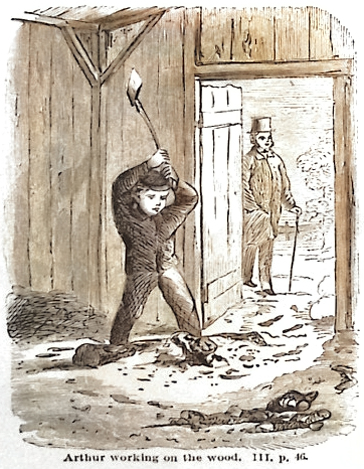
Arthur working on the wood.

THE SUN-SHINE SERIES.
BY
H. N. W. B.
[Harriette Newell Woods Baker]
"The fear of the Lord is the beginning of wisdom."
SOLOMON.
BOSTON:
ANDREW F. GRAVES.
Entered according to Act of Congress, in the year 1870,
BY ANDREW F. GRAVES,
In the Office of the Librarian of Congress, at Washington.
DEDICATION.
To the children of my beloved niece,
Mrs. MARY S. STEVENS, I inscribe these
small volumes, with the love of their
AUNT.
VOLUMES OF THIS SERIES.
—————
VOL. I. HONEYSUCKLE COTTAGE.
II. THE LITTLE FLORENTINE.
III. THE LOAD OF CHIPS.
IV. TONY AND HIS HARP.
V. TIMMY TOP-BOOTS.
VI. SOPHIA AND THE GIPSIES.
CONTENTS.
————
JOSEPH HICKIE
ARTHUR THOMPSON
THE SICK WIDOW
THE LOAD OF CHIPS
LEARNING TO WORK
IDLENESS AND WANT
RED-HAIRED JOHNNY
THE OLMSTEADS
THE NEW BROOM
THE BROKEN LEG
IN JAIL
THE COUNTERFEIT BILL
THE TWO CLERKS
LIGHT IN THE OFFICE
TEN THOUSAND DOLLARS
ARTHUR'S LETTER
WILLIE'S CONFESSION
THE LOAD OF CHIPS.
—————
JOSEPH HICKIE.
"PLEASE, mum, daddy's dead, mammy's blind; will you give me a sixpence to buy a loaf of bread? 'Cause we're most starved, we is."
Mrs. Irvington was just entering her own door, when she was accosted in this manner. The speaker was a boy apparently less than ten years of age, dressed in torn pants which had evidently belonged to a person much older than himself. These were rolled up at the bottom and fastened over the shoulder by one twine suspender. A loose jacket without means of fastening in front, and a worn, felt hat completed his attire.
The lady gazed searchingly in his face, before she replied. He was neither thin nor pale; and she thought his tone had the heartless ring of a professed beggar. At last, she inquired:
"Why do you beg when you seem well able to work and earn bread?"
"I can't get work, mum," he answered with a whine.
"I will give you work. At the end of an hour, you shall have some breakfast; and if you work well till night, I will give you a shilling."
The boy did not look very much pleased with this flattering proposal, but did not know how to get off. So, he asked rather sullenly:
"What kind of work is it?"
"I will show you. Go to the lower door, and wait till I meet you."
Back of the house there was a large yard paved with brick that had an opening upon a back street, and through this opening, a load of chips from the ship-yard had been tipped up. There they lay close to the back gate, and she wished to have them removed to the cellar while the dry weather continued.
To this pile Mrs. Irvington introduced the young beggar, saying in a cheerful tone, "If you work smart, you can carry them in before night. I can assure you that bread which is earned by one's own labor is much sweeter than the bread of charity."
Joseph Hickie, for that was the boy's name, stared at the pile of oak chips in dismay. Indeed, his distress was so apparent, that the lady was obliged to turn her face away to conceal a smile.
"I don't think I can do it, mum," Jo complained, whining, "they are too big."
"How old are you?"
"I'm turned nine."
"Well, I have a little son not much past eight, and he carried the last load. I think if you try, you can carry this with perfect ease. Wait a minute, I will let you take his cart. That will make the work seem like play."
Jo's face brightened, as she drew from the cellar a nicely painted wagon or truck, and held the handle out to him. The house was set up high, the kitchen being in the basement. The cellar door opened out upon the paved yard, and was on a level with it.
"Fill the cart full," said the lady in a cheerful tone, "and then empty the load into the corner where you see the other chips. In one hour I will come and see how much you have done, and give you some breakfast."
Mrs. Irvington was a lady who watched for opportunities to do good. Not only was her husband rich, but she had money in her own right. And had she chosen to do so, she might have sat in a rocking-chair all the morning with servants to wait upon her, and have rode in her carriage all the afternoon. But she did not choose thus to waste her life. She read in her Bible that Jesus Christ the Lord of glory left his seat at his Father's right hand, came to earth, healed the sick, cured the blind, suffered from hunger, and thirst and cold, and at last gave up his life for the good of others. And she, trying to imitate his example, was glad to give up her own comfort if she might do good to some poor suffering creature.
She was the head manager or directress of an orphan asylum, not far from her own home; and she had a district or ward, which she regularly visited to find out who was suffering for want of the necessaries of life.
Long ago she had learned that those who talk the most of their poverty, are not the greatest sufferers. There are those who for want of work or for want of the strength to labor, will pinch and turn this way and that, and almost starve before they will make known their wants.
Mr. Irvington was a ship-builder and ship-owner. He had a large yard where many men were employed in hewing huge timbers, of which the keels and rudders and frames of the great vessels were built. There were men too whose work it was to cart off the large, hard-wood chips to the houses of those who had bought them. Mr. Irvington was in full sympathy with his wife in all her plans for doing good; and many a dollar had he lost by the men or boys she had sent to him for employment.
"It would be money in my pocket, to give these beggars a dollar and send them off," he used to say with a laugh; "but it's a whim of my wife to make beggars work. One in a hundred perhaps will continue to labor; but most of them find it easier to beg their food than to earn it."
ARTHUR THOMPSON.
FROM her chamber in the third story Mrs. Irvington could watch all the operations of her little workman without being herself seen. For a time, he took hold in earnest, filling the wagon with the long splinters and wheeling them away to the cellar. But before the hour was at an end, he grew quite weary, was longer and longer between every load and at last ceased altogether.
There was one part of the high board fence which looked out upon the front street, between Mr. Irvington's house and the next block, and in this fence there was a knot-hole. There Joseph stood with his eye against the aperture when one of his companions went by.
Glancing quickly around him to be sure that he was not seen, Jo tapped on the fence, calling at the same time in a suppressed voice,—
"Arty! Arty Thompson! Look here!"
A little fellow very poorly clad, with a white, peaked face, stopped suddenly on hearing his name called, but after looking in every direction and seeing no one likely to speak to him was turning to walk on, when he heard the voice again.
"Arty, look here! It's me, Jo Hickey, behind the fence. Come up here, and I'll let you look in!"
"What are you doing in there?"
"I've got a job; and it's fun, I tell you. I'm to have a stunning breakfast, chops and hot coffee and toast: and when I've carried in those chips, I'm to have a load of money."
"Oh! Oh! I wish I could get a job! How did you manage it, Jo?"
"How did I? Why I went to the door, you see it there close by you; and I rang the bell and offered to let myself by the day. The lady was glad enough to get me."
"I wonder whether any body else has chips to move," said poor Arthur, "I'd like a job so much; I'm awfully hungry, and then if I got money, I could buy an orange for mother; she's awful sick to-day."
"Seeing it's you, I'll let you have half of my job; that is, if the lady will let you in. You can give me three pence, and then you'll have a heap left. You go right up to the door and pull the bell, and say,—
"'Will you please, mum, give me some work? I want to earn some bread for my sick mother.'"
From her window, which was open, though the blind was not, Mrs. Irvington had heard every word of this conversation. She was shocked at the ready falsehoods of Jo. But then she recollected that he had probably never received any instruction and did not know how displeasing such conduct was to a holy God.
It was now within a few minutes of the time when she had promised to go down, and examine his work. And she was on her way to the cellar when she met a servant coming to call her to see Arty.
"Will you please, mum, give me a job?" began the poor child, fixing his hungry eyes on her face.
"What can you do, my little fellow?"
"I can carry chips," he answered, his face crimsoning, for Jo had charged him to say nothing of their interview.
"How do you know I have any chips to carry?" she inquired, wishing to see whether he would acknowledge the truth.
He dropped his eyes at once, but presently murmured,—
"I saw them through the hole in your fence."
"Do you like to work?"
"Oh, yes, mum! I'd rather work than beg, but I can't often get a job. Sometimes I holds a hoss for a gentleman while he goes into a house; and then I get some chances to run errands, but there's a good many days I don't. And then I has to go awful hungry, 'less I beg—and mother allus cries when I has to do that."
"What is your name?"
"Arthur Thompson, mum."
"Well, I will give you a job. But first you shall have some breakfast because you have told me the truth. Come in," opening the door.
She ordered the cook to set out two plates with cold meat and bread. And then she went to the cellar to see how far Joseph had advanced with his job.
On hearing her step, the boy began to load the wagon, working till his face looked quite red.
But she noticed he did not look up and meet her eye.
"Why, Joseph, are these all you have brought in?" she asked in surprise.
"I've worked hard every minute, mum," was his ready answer.
"Stop! Stop!" she exclaimed. "Did no one ever teach you how wicked it is to tell a lie? You have wasted more than half your time."
He began to insist that he had not, when she added: "I watched you from the window; and I heard you talking to Arthur through the knot-hole. You told him many things which were untrue. So many that I cannot believe what you said about your father being dead and your mother blind."
"I didn't see you anywhere," muttered Jo sullenly.
"No, I knew you did not; but I was sewing near the window. You did not see your Father in heaven, but he too was watching you, and listening to every word you uttered. Do you know whom I mean?"
"No, mum, I don't know nothing what you are talking about. If you aren't going to pay me, I want to go. I aren't used to being watched every minute, and I don't like it."
"Come in now, and have some breakfast, afterwards I will talk more with you."
While the boys were enjoying the first hearty meal they had eaten for many a day, Mrs. Irvington went up to her husband's office, a small room at the end of the hall, and seated herself by his desk to reflect upon the character of the two boys, and resolve what to do with them.
"I was sure," she afterwards told her husband, "that Joseph and Arthur, though companions in poverty, had been differently trained at home. Joseph, as near as I could judge, was a lazy beggar, untruthful and impudent, while Arthur was his exact opposite. But I said to myself, 'If Joseph is bad, there is so much the more reason that I should try to do him good. I will keep him to-day at any rate; and I will keep them both at work.'"
Returning to the kitchen, she found the boys had cleared the plates, and the cook was washing them. Arthur had a large piece of bread in his hand, and walking toward the lady asked eagerly,—
"May I have this, mum, to carry home? I'm not hungry now, but mother is, and she's sick too."
"Yes, Arthur, you may have the bread. But did not I hear you saying you would like to buy her an orange?"
"Yes, mum, if I could get a job, and earn some money, I'd buy her an orange, 'cause she says the juice would taste so good."
"Where does your mother live?"
"In Alcott Street, mum, up three flights."
After a moment's reflection, the lady said, "I will go with you. Now, Joseph, you may return to your work."
THE SICK WIDOW.
"HE'S a bad boy, ma'am," urged the cook following her mistress into the hall. "I stepped out a moment, and I heard him say to the other one:
"'You wouldn't have got such a nice breakfast if I hadn't called you. I sha'n't work, though. I sarsed her well when she tried to make me, so you'd better believe I'm not going to be her slave.'"
"What did Arthur reply to this, Jane?"
"Not a word, ma'am. The two are as different as our two cats; one is all white, and the other is all black."
"Well, we shall see," replied the lady.
Quickly placing some food in a small basket, she arrayed herself in a street dress, and joined Arthur at the door. On her way, she passed a grocer's, and added a couple of fine oranges to her store.
"Are those for mother?" inquired the boy, his large, blue eyes filling with tears of delight.
"Yes, do you think she will relish them?"
"And will you please tell her, mum, that I didn't beg, and that you're going to give me a job?"
"Yes, I will tell her."
When they came to the house, Arthur merely opened the outer door and ran up the crooked, creaking stairs as nimbly as a cat. But suddenly recollecting that Mrs. Irvington was a stranger, he returned, and preceded her slowly to the room.
On a stool close by the low window, for the room was poorly lighted, a woman, bent and feeble, was trying to draw her needle through a coarse meal-bag, a pile of which lay on the floor by her side. She was greatly emaciated, and to the visitor appeared to be in the last stages of consumption.
She tried to rise and receive the lady, but almost fell to the floor, gasping for breath.
"Mother! Mother! See what the lady has brought for you. I didn't have to beg to-day. She is going to let me work. Aren't you glad?"
"Eat this orange at once," urged Mrs. Irvington, hastily peeling it.
Mrs. Thompson almost snatched at it and devoured several pieces without speaking. Then, with a glance at the lady, held out the remainder to her son.
"No, mother, eat it all; and I saved a piece of my bread for you. I've had ever so much breakfast."
"Thank God!" came feebly from the white lips.
She ate the bread Arthur had brought in his hand, and then, with a grateful glance, said:
"God will reward you, ma'am, I cannot. I was starving. Not a mouthful have I eaten for two days."
"You are too ill to work," said Mrs. Irvington. "Have you had a doctor?"
"I went to the dispensary once; but the doctor told me medicine could not help me." She sighed repeatedly, as she said this, fixing her eyes tenderly on her boy.
"Is there no one here who could take care of you? I don't think you are well enough to be left alone."
"There is a tailoress in the room opposite who is very kind. She has gone now to take home her work."
"I belong to a society who wish to help those who are really in need," explained Mrs. Irvington. "Your son has told me that you are unwilling he should beg, so I intend to give him work. When he is a little stronger, he can earn half a dollar a day."
The sick woman clasped her hands joyfully to her breast.
"In the meantime," the visitor added, "I will gladly pay the tailoress to remain with you. All this work must be taken away; it is entirely too hard for you. I have brought you some food for to-night; and to-morrow, I will come again."
She rose to go; and at that moment a slight figure passed the door, and went into the room opposite.
"There's Matilda," said Arthur.
"Will you ask her to come here a minute?"
In a few words, Mrs. Irvington explained her wishes, and then asked, "How much can you make in a day, by sewing?"
"From two to three shillings. It is slop-work. My rent is five dollars a month; but when I am well, I can do admirably."
"My advice is that you move your bed in here, and give up your room. I will pay you four dollars a week, while Mrs. Thompson needs your care, which with your board will be better than what you now get."
"Come, Arthur, we must go."
"I cannot say what I feel," gasped Mrs. Thompson, seizing her visitor's hand. "I'm almost home; and for myself I have no anxiety, but for your kindness to my boy—I've prayed that I might have faith to give him up, and now the answer has come."
As my story is more of Arthur than of his mother, I will only say here that by the kindness of Mrs. Irvington, the widow was provided with every thing necessary for her comfort. She lived, however, but a few weeks, and died rejoicing in the assurance that the God of the widow and the fatherless would protect her boy.
THE LOAD OF CHIPS.
WHEN Mrs. Irvington returned to her house, she accompanied Arthur to the cellar and explained what was to be done. During her absence, Joseph had accomplished but little. And she foresaw that if she depended on him, her chips would remain un-housed for some time. Still, as her object was rather to do good to the little fellow than to be herself accommodated she resolved to allow them to go on.
"Look, Arthur," she said, "you may put your chips here at this end of the cellar, then you and Joseph may try who will have the largest pile at night.
"Joseph, you have had the cart all the morning. Arthur may take it now; and I will give you a basket."
She smiled encouragingly upon them and left them. When her husband came home to dinner, she gave him an animated account of her protégés, and he laughingly predicted they would turn out as nine-tenths of her protégés did,—that they would soon tire of labor, and prefer their old business of begging from door to door.
"I am sure of Arthur," she urged warmly. "He has a good mother. As for Joseph, I cannot believe a word he tells me."
When the boys were alone, Jo threw himself down on the clean, cemented floor of the cellar, and cried out with a yawn:
"It's harder than begging. I'm a fool to stay here."
"You told me through the knot-hole it was fun."
"Oh, that was when I had just begun!"
By this time Arthur was out in the yard loading his cart. He began to throw in some large splinters, but finding they filled it too soon, he tried another way. He first picked up the small pieces which Joseph had scattered about, and then, when the body of the cart was full, stuck up some long pieces edgeways, making an enclosure into which he could throw as many more.
He looked very happy as he surveyed his work, and as he commenced to draw his load into the cellar, he could not restrain a shout of joy.
"Look! Look!" he exclaimed. "See how many I have got. I like to work ever so much."
"So did I at first," muttered Jo. "But whew! How did you get so many?"
After a while, the lazy boy rose from his seat on the floor, and began to fill his basket.
"I must do enough to earn a shilling for old Meg, or she will give me a whaling," he explained grumbling; "but I never was made to work. Wouldn't Tim Scott laugh if he could see us now?"
"I don't care who laughs," answered Arthur, working while he talked. "I'm so glad to have a job. I wish Mrs. Irvington would have chips brought every day."
"Oh! What a greeny you are," shouted Jo, laughing boisterously.
Toward night, Mrs. Irvington again visited the cellar. Arthur, unused to labor, and feeble for want of regular food, looked paler than in the morning, but his eyes shone with satisfaction as he pointed to the large pile he had packed as closely as possible in the corner.
Joseph's pile was little larger than at noon, and the chips were scattered about from the door to the bin in the corner.
"You have worked well," the lady said to Arthur, and she gave him a shilling.
"I am sorry you have not been more industrious," she added, addressing the lazy boy. "You have not earned sixpence. Will you come to-morrow, and try to do better?"
"Yes, mum, I have worked to-day: but I ain't used to it; and mammy thinks it hurts me."
"Has he a mother, Arthur?" demanded Mrs. Irvington.
"Yes, mum."
"Is she blind?"
"Oh, no, mum! She can see very well. She beats Jo every day when he does not get enough by begging."
"Poor child. I was afraid he had not been well taught. Well, Joseph, I will give you a sixpence. And if you will come every day, I will find something for you to do, something much better than begging."
"May I come, too, mum?" entreated Arthur anxiously.
"Certainly, I will have something else ready, when the chips are carried in."
The next morning when Mrs. Irvington was dressing, she heard a boy whistling in the back yard. Looking from the window, she saw Arthur piling wood into the cart.
"You had better send another load of chips," she said to her husband. "It will help me to keep my little fellow at work."
"I hope you give him good wages," was his laughing reply. "He will be tired long before night, if he goes on at that rate. Just see him tug at that big piece. There, he has run a splinter into his finger. He has hard work to keep from crying. I wish Willie were at home to see how bravely he bears the pain."
"I will get it out for him," said the lady hurriedly arranging her collar, "and he shall have a good breakfast. Dear child, I have loved him ever since I saw him saving a piece of bread for his sick mother."
The morning passed away, but Joseph did not make his appearance.
In the afternoon Mrs. Irvington was passing through one of the main streets when she saw two boys sitting on the steps belonging to a church. They were laughing and chatting merrily, but as soon as they saw her, one of them darted down the steps and commenced a piteous cry.
"What is the trouble, child?" inquired a lady, in front of Mrs. Irvington.
"I've lost my shilling, mum, and daddy 'll beat me awful. Boo! Hoo, hoo!"
The lady was opening her purse when Mrs. Irvington touched her.
"Excuse me," she said, "but I think the boy is imposing on you. Joseph," she added, sternly addressing the boy, "you,—"
But he waited to hear no more. With an oath, he darted down a side street, and was presently out of sight.
"I saw the whole game," explained the lady, "and was unwilling you should give to an unworthy object."
"Thank you. It is dreadful to think so young a child has learned to lie and swear."
"Joseph has been in a hard school. He is bright, but vicious. If he were to be taken away from the city, I think he might be saved."
LEARNING TO WORK.
WHEN the first load of chips was nicely stored in the cellar, Mr. Irvington sent a second, still larger. And at this Arthur worked until the Sabbath. It had now become his habit to eat his breakfast, dinner and supper in the neat kitchen, and after he had done his work, he received a shilling and a basket of food sufficient to last his mother and Matilda till the next evening.
On Sunday morning, Mrs. Irvington bid him come to her house and accompany her to the Sunday school. She was glad to see that his face and hands were as clean as soap and water could make them; and that the clothes she had sent to Matilda to make over for the boy, fitted him neatly.
On their way to the school the following conversation took place.
"Can you read, Arthur?"
"Oh, yes, mum!"
"Can you say the ten commandments?"
"I don't think I can say quite all the long ones. Mother taught me the others when I was a little boy; but I only said: 'Remember the Sabbath day to keep it holy.' I can't remember all the rest of it."
"I think I will take you into my class."
"Thank you, mum. I should like to go there, I'd try not to trouble you."
From this time, Arthur Thompson became a regular attendant at the Sabbath school. He was always respectful and attentive, and well prepared in his lesson. Perhaps no scholar in the room appreciated the privilege more than he did. In after life, and when himself a teacher, he often alluded to the hours passed in Mrs. Irvington's class as among the happiest and most profitable of his early years.
In less than a month from the time when Joseph Hickie first called him through the knot-hole, he was an orphan, his mother having been called to her heavenly home.
During Mrs. Irvington's frequent visits to the sick woman, she found Matilda so devoted and tender as a nurse, that after the death of Mrs. Thompson, the lady gave her the offer of becoming nurse in the children's asylum, with a salary sufficient to support her in comfort. The offer was accepted with tears of gratitude.
"I am so fond of children," she said, "I can think of nothing that would please me more."
For Arthur's sake, however, the kind lady did not wish to break up his home too suddenly. She had, by this time, become greatly interested in the boy, and therefore, at her own expense hired the room for another month, and engaged Matilda to make the orphan a suit of stout winter clothes.
During the day, Arthur was regularly employed in the ship-yard, sometimes sweeping the office, again running errands, or raking chips into piles ready to be carted away. With nourishing food and healthy employment, Arthur had gained both in flesh and strength. He was, indeed, often weary with work, and his arms ached with lifting the heavy rake, but he was contented and happy. In his nightly prayer, he often thanked God that he had had a pious mother, so that he was early taught that it was right to work and not to idle away his time like Joseph Hickie.
Mrs. Irvington's interest in Arthur led her to keep a constant watch over him. She had promised the dying mother that she would be a friend to the motherless boy; and she was not a woman to break her word. She cautioned him to keep clear of Joseph, and then, knowing that a child must have companions, she allowed him to come to the house on Wednesday and Saturday afternoons to play with her son, Willie.
At first, she was careful to be present when the children were together. But perceiving that Arthur was not only amiable in disposition, but that even in his plays, he exhibited a firmness of principle remarkable in one so young, she allowed the poor orphan to become the intimate friend of her more impulsive Willie.
One afternoon when the two boys were playing post-office in the library, Mrs. Irvington sat writing at the desk in her husband's office. When she had sealed her letter, her attention was arrested by the stillness in the adjoining room, for Willie's merry laugh and rather boisterous voice generally announced his presence in the house. Presently, she heard Arthur's gentle tones say:
"Do you like to hear stories?"
"Yes, I think they are first-rate."
"Well, I will tell you one I read in a book Matilda lent me."
IDLENESS AND WANT.
THERE was once a great big man who lived in a hovel with his wife and five children. They were very poor, indeed,—as poor as they could be; and their hovel was tumbling down over their heads. The father's name was Tom; people used to call him lazy Tom, because he was always lolling on the top of the fence or against the side of a barn instead of doing his work.
Tom's wife was just as lazy as he. Her long hair was flying all over her head, because it was too much bother to comb it, unless she was going to a fair; then she tied it up with all the ribbons she could get.
From morning till night, the beds were never made up; but then they were not real beds. They were bags of straw thrown in the corners. But these might have looked much better than they did, if the covering had been spread on quite straight and smooth.
Once in a while Tom brought home a few potatoes or a little meal, or a piece of pork; and then, his wife, Lyddy, cooked the food. Generally she had nothing to cook with. It never entered her mind that she might earn something herself.
Back of Tom's hovel there was a pretty little brook. The water used to go singing and dancing over the stones; and the fish hopped up and down to get a glimpse of the sunlight. Many a nice meal Tom and his family might have had, if he had but industry and patience to fish in the brook. But, as his wife said about keeping her hair smooth, he said about the fish, it was such a bother to catch them.
It was not a nice home at all; but then, Jim and Phebe, and red-headed Johnny, and Molly and the baby Gloryanne, had never lived in a better; so they knew no other way than to be contented in the midst of confusion and filth.
One day Johnny, who was the best natured of the lot, was swinging on the old broken gate in front of the hovel when a horse going by in a carryall lost a shoe. The lady who was driving did not notice the loss, but Johnny did, and darting into the street picked it up, and ran with all his might after the carriage, shouting as he went.
The lady heard the noise, and was afraid it would frighten her horse, so she drove faster than ever. Johnny never could have caught up with her if a wagoner had not been coming the other way and seeing the little fellow running and motioning in a frantic manner, he called the lady to stop till he could see what it all meant.
The wagoner then got out of his wagon and took the iron shoe from little Johnny, and called him a smart little chap for bringing it to the lady. Then he held up the horse's foot, and told her she must not travel far until the shoe was put on, for the foot was very tender, and the sharp stones would make him lame. He directed her to a blacksmith who lived down a lane; and Johnny said at once that he would run on beside the buggy, and show her the way.
The lady's name was Marsh. She looked at the dirty, ragged clothes which covered poor Johnny, then she gazed in his face and saw a pair of bright brown eyes twinkling with fun, heavy locks of auburn hair falling in curls over his forehead, and a set of white, even teeth shining through his red lips; she liked him notwithstanding his rags and dirt.
She walked the horse all the way to the blacksmith's, talking with Johnny, and becoming more interested in him every minute.
He told her all about his home, about his brother and sisters. When she asked him what he did, he said:
"I do nothing."
"What, idle from morning till night?"
"Yes'um."
"Would you like to work?"
He scratched his head. "Yes'um, I think I should, 'cause I git awful tired of swinging on the gate."
"I am going on a mile or two," the lady said; "but I want to see you again: if you will be here at noon, I will have something for you to pay you for your trouble."
When she came back, he was there waiting; he had not been home. She took him into the buggy, and asked him whether he would like to go home with her and learn to work in her garden. She told him if he would try to be a good boy, she would be a friend to him, and help him grow up to be a useful man.
Tom and Lyddy and all the children rushed to the door of the hovel when the buggy stopped before the old, broken gate, and were so much surprised when they saw Johnny get out laughing, that they couldn't say a word. They were glad enough to get rid of Johnny; there would be one less mouth to feed, lazy Tom said, and so they bid him good-bye without a tear.
Johnny had been at his new home one week when the lady asked him whether he would like to go back and live with his mother.
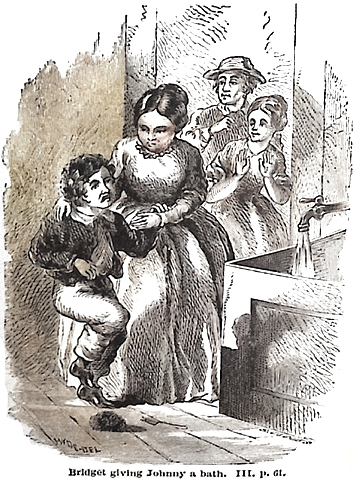
Bridget giving Johnny a bath.
RED-HAIRED JOHNNY.
JOHNNY was neither dirty nor ragged now. He had a new suit from top to bottom. Bridget, Mrs. Marsh's girl, had given him a bath and then burned his old clothes up. His pretty auburn hair was nicely parted and curled in heavy locks close to his head. He said, "No, ma'am, I don't want to go back ever." And then he burst out crying.
For a good while, he couldn't tell what was the matter, but at last he said,—
"Oh if my father and mother knew how to work and make the house look clean, and mend the fence, and buy beds, I should be so happy!"
Mrs. Marsh was very glad he felt so. She had taken one look into the hovel and that was enough to enlighten her as to the cause of their poverty. She told Johnny he must learn to write as fast as he could, and then he might send a letter home, and tell his mother all that was in his heart.
In a good many months, he wrote a letter, but it was of no use. Tom his father was lazier than ever, and besides he had begun to spend what little he earned on rum and bad whiskey.
Johnny grew very fast and worked so hard that the lady had to stop him.
Every body in his new home liked him, he was so good-natured and industrious and cheerful. It was only when any one mentioned his parents that he grew sad and began to cry.
Willie Irvington sat very quiet all this time, but now he began to grow restless. And Arthur thought it time to draw his story to a close.
"And so Johnny went on growing good daily," he said smiling, "and learning to read and write till he came to be a man; and every body called him Sir, just as they do your father, you know."
"That's tip-top," exclaimed Willie, "now let's play again."
"I'm going to try to be just like him," added Arthur, his voice expressing deep seriousness. "Every day I pray God to help me; and mother used to say he likes to help boys do right and become respectable men."
"Hollo! Here comes the postman!" shouted Willie. "Run and take the letters."
At the end of the month, Mrs. Irvington introduced Matilda to the asylum as the scene of her new duties. Her plans for Arthur were by this time matured. He was to reside with an elderly couple where he would be required to make a fire in the library, sift ashes, scour knives and run errands, all of which services he could render out of school hours: in return for which he was provided with a comfortable home.
Arthur could scarcely realize his good fortune when told he was to attend school.
"Oh," he exclaimed, clasping his hands, "how glad, how very glad I am! Mrs. Irvington, if Joseph had been a good boy, and not told lies, wouldn't you have let him go to school too?"
"I think it probable if he had shown a desire for learning, I should have gratified him. Why do you ask?"
"Because I met him yesterday, and I knew you wouldn't like me to associate with him, but I asked him to leave off begging, and I told him how wicked it was to tell people his mother was blind when she's only cross. I told him, if he'd try to be good, I'd ask you to let him into your Sabbath school."
"What did Joseph say?"
"At first he only laughed and called me names. But when I told him if he was a beggar now, and didn't try to be anything else, he'd be always a beggar, he grew very angry, and tried to make me fight. So when I found it was of no use, I came away; but I am so sorry he wont try. I lie awake sometimes, and think how he called me, 'Arty! Arty!' through the knot-hole, and I can't help crying, because if he hadn't called me, perhaps I never should have seen you and Willie—and—and be here going to school now and learning to work."
"You can pray for him, Arthur, and when you have an opportunity you can do him a kindness. God is able to turn his heart. You understand the reason I do not wish you to be in his company. He is a bad boy and, at present does not seem to wish to be better. His associates are the very vilest; and he prefers not to change them. A child who is well able to work but chooses to beg his living from others, becomes every day more mean and contemptible. But whenever you see an opportunity to do him good, remember you have my best wishes for your success."
"He is good-natured, ma'am, and he used to be kind to me," urged Arthur in a sad tone. "I always think he did not have a good mother as I did."
THE OLMSTEADS.
MR. and Mrs. Olmstead were quiet, home people, who went regularly to church and in pleasant weather to one evening service in a week. But beside this, they seldom ventured into public meetings, and, except through newspapers, knew little of what was going on in the world.
In early life, Mr. Olmstead had been a mechanic. Then by means of industry and economy, he earned the wherewithal to set up for himself in the lumber business, purchasing for that purpose a wharf and store for a very reasonable sum. By the time he was sixty years old, the price of his land had increased tenfold. A severe sickness which occurred soon after, led him to consent to his wife's proposition, that he should retire from active business, sell his wharf, and live quietly on the interest of his money.
This he accomplished at length to his entire satisfaction. He sold a quarter of the land, and with the avails erected large warehouses on the remainder. These he let on long leases with good security for the rent. He owned also the house in which he had lived for forty years, and two others in the same block. These were in a part of the city now nearly given up to business, and, had he chosen to convert them into stores or offices, his rents from them would have been more than trebled.
But he had enough, he said, and as their only child, a son, had died in his twelfth year, he did not care to burden himself in order to lay up money.
Both Mr. and Mrs. Olmstead were nearly as regular in their habits as the rising and falling of the tide. For years, except in time of sickness, they had not failed to sit down to breakfast at seven in summer, and eight in winter, to eat their dinner at one, and their supper at six.
After breakfast and family prayers, the old gentleman went out to market, and with his own hands brought home the purchases he had made. If it was pleasant, he extended his walk down to the wharf, and watched the unloading of vessels into his great storehouses.
From this time till dinner, he read the morning paper to his wife if she were at liberty to sit at her sewing, and the same from dinner till the afternoon paper was left at his door. Mrs. Olmstead, meantime, employed herself in those nameless household duties which every matron can understand. Twice a week she went shopping, not for herself, but for the asylum of which Mrs. Irvington was first directress. She also paid frequent visits to the asylum which was her favorite object of charity; and never once since she had undertaken the office of treasurer had the purse been empty.
"It makes no difference," she used to say laughing, "whether I give my part in that way or another. The little motherless creatures shall never go without warm flannels and mittens as long as I have a plenty and to spare."
The family consisted of the master, mistress, and two servants. The cook was a middle-aged woman who had lived in the same place for thirty years, and who considered the whole establishment as much her home as if she held the right and title to it in her own hands. She was a conscientious, warm-hearted Christian, who esteemed it both a privilege and a duty to aid her mistress in regard to the poor orphans, or in any other charity, to the utmost of her power.
To tell the whole truth, Hepsah was naturally hasty in temper and with a strong love for rule. If her mistress had not been yielding, and willing for the sake of her many redeeming qualities to overlook this, they would have parted within the first year.
Beside Hepsah, there was a younger girl who waited on table, and did the chamber-work. In Hepsah's time, there had been near a score of girls, some of whom had remained quietly for years, fitting themselves, while serving well, to have a house of their own. These had been married from the house, receiving a handsome wedding portion from their generous employers, and with it much good advice.
But by far, the greater number had speedily become dissatisfied under Hepsah's vigorous, and, it must be confessed, rather tyrannical rule. Gentle remonstrances from their mistress, with an exhortation to patience and they would soon learn to understand that Hepsah's bark was far worse than her bite, would in some cases prevail on them to remain, but a year was generally the extent of their service.
Such was the family into which Mrs. Irvington had at length introduced her protégé, and both Mr. and Mrs. Olmstead soon became as much interested in Arthur as she had predicted. They were very fond of children, and as he was a lovable boy, near the age of their own deceased son, Mrs. Irvington hoped the relation to the orphan might prove as pleasant to them as profitable to him. The only trouble to be anticipated was with Hepsah.
Mrs. Olmstead would have been a poor scholar indeed had she not in thirty years learned how to manage her servant. She therefore made a confidant of her, describing first Arthur's character as she had heard it from her friend, and then dwelling on his desolate condition.
"It is a pity some one does not take him and educate him," she added. "If I were as young as I was once—"
"That would never do," interrupted Hepsah in a decided tone. "I never could endure a child round under my feet, tracking dirt all over the floors, and carrying off the silver forks to sell for filthy tobacco. No, that would never do."
"Mrs. Irvington would take him herself," Mrs. Olmstead interposed, "if she had not a boy near Arthur's age. She saw his mother die; and she says it was a privilege to witness such a scene. Mrs. Irvington certainly will have her reward. What is it that the Bible says about those who befriend the widow and the fatherless?"
"Why don't she send the boy where a body can see him? I can't advise till I set eyes on him. But I know just how he looks. He was a street beggar, you say. Well, he's one of those red-headed, pug-nosed, saucy-looking fellows that you always see at such business. Then he's sly too, and ten to one, he's squint-eyed. I never could stand such a boy round, never!"
So saying, Hepsah whipped away at her eggs with a vengeance. Mrs. Olmstead left the kitchen with a smile which, however, she took care, Hepsah should not see, and, for a week nothing more was said on the subject.
THE NEW BROOM.
ONE afternoon, Hepsah was sitting at her work, with a dozen blue-checked long-sleeved aprons fresh from her scissors, when there was a gentle ring at the back door.
"Will you please give this note to Miss Hepsah Lunt?"
The woman took the tiny envelope, turning it over and over while she fixed her keen glance on the boy's sweet face. "He had such a wistful, appealing look," she said afterwards, "that I felt a thrill all over me."
Then she took her scissors, cut open the end of the envelope and read:
"MY DEAR HEPSAH:
"I have lost the recipe you gave me of your delicious muffins. Will you
please copy it once more, and oblige your sincere friend,—
"ADA IRVINGTON."
"Are you Mrs. Irvington's little boy?" asked Hepsah of the messenger.
"Yes, mum, I suppose so," was the smiling reply. "She calls me her errand boy."
"Is your name Irvington?"
"Oh, no, indeed! I'm only Arthur Thompson, mum."
"Hem! Well I never was so beat!" This was said to herself.
Then turning to the boy:
"Take a chair and sit right down. I'll get my recipe-book and write it off in a minute."
But, instead of this, she sat down, herself, and kept her eyes fixed on his face.
He had turned to the window, and was smiling to himself. At last, seeing her still looking at him, he said:
"How pretty that ivy looks, running up the window. My mother had a piece once, and it was ever so green."
"Wait a minute, Arthur," she exclaimed, leaving the room to find Mrs. Olmstead.
"There's a boy down-stairs," she said, resting her hands on her hips, "that I want you to take, and give him a home. You've enough to do with, and it's a duty to give to the poor. If you agree to do your part, I'll do mine. You'd better have him come right off."
"But Hepsah—"
"There's no 'but Hepsah' about it, Mrs. Olmstead. The Bible says, 'He that watereth shall be watered himself.' I know just as certain as I stand here that if you take that child down-stairs, you'll never regret it."
"I'll go and see your boy, Hepsah, and if—"
"Yes, he is my boy; I'm not obligated to leave my bank-book to any one, and if you don't take Arthur, I will. I'm not afraid to leave forks nor spoons either where he is."
When the recipe went back to Mrs. Irvington, a note from Mrs. Olmstead accompanied it, saying:
"Hepsah has concluded to take Arthur. He may come to-night.
"In haste,
"PHEBE OLMSTEAD."
Mrs. Irvington had presented the orphan with a new suit of clothes which Matilda had cut and made for him. During his visits to her son Willie, she had given him some necessary lessons concerning the care of his person, such as keeping his face, hands and nails perfectly clean, his hair smooth, so that from the first, his friends had nothing to complain of.
He came in the evening of the day he had brought the note, was introduced to his room by Mrs. Olmstead, who told him Hepsah would explain his duties to him the next morning.
He was waiting just inside his own door, therefore, when she went down and stepping as softly as possible, followed her into the kitchen.
After washing his face and hands and scrubbing them with the crash towel, he went into the shed and taking out the nice pocket-comb Willie Irvington had given him, smoothed his brown hair as well as he was able.
By this time Hepsah had a rousing fire and was rolling up her sleeves to wash her hands.
"You're so kind, I want to kiss you, just as I used to kiss mother," he said timidly approaching her.
Without a word, the woman caught him in her strong arms, and pressed her lips to his cheeks, brow, and lips.
"You're the blessedest child that ever lived," she exclaimed, choking down a sob, "and as long as I can earn a penny, you shall never want a friend."
Poor Hepsah! How her woman's heart throbbed and swelled. For the first time in her life, her motherly instincts were satisfied. The great craving every human being feels for some one to love, was answered when the timid voice pled, "I want to kiss you as I used to kiss my mother."
"Set on another plate, Ann," she said to the chamber-girl. "You'll find a small napkin in the farther corner of the drawer."
"I thought he'd eat with us," was the wondering reply.
"Well, you thought wrong, for once in your life."
When she heard her mistress in the breakfast room, she went up to see her.
"That child will bring a blessing on this house," she began, her cheeks crimson with excitement. "He's more like your own Sammy, who's been in heaven this twenty years, than any boy I ever saw. I told Ann to set on a plate for him. 'Twill brighten you and Mr. Olmstead up wonderfully to hear his pleasant 'thank you', though I'll confess it's a sacrifice to me not to keep him in the kitchen."
"I'm willing to try it so," was the placid reply.
At half-past eight, Arthur, wholly unconscious of the emotions he had aroused in Hepsah's heart, had finished all his morning work and was ready to start for Mrs. Irvington's to accompany Willie to the public school. He had blacked Mr. Olmstead's boots, run to the grocer's for fresh eggs, scoured the knives, and helped Hepsah water her plants.
"Ask the teacher for a list of the books you will need," said Mrs. Olmstead, "and I will get them for you."
"And run right home to be in season for dinner," added the lady, passing her hand softly over his brown hair.
"I love to stay here, dearly," timidly answered the boy, glancing in her face with a grateful smile.
She kissed his cheek, saying "I'm very glad."
And then he ran to the kitchen to bid Hepsah and Ann good-bye.
"Don't be long away," said Hepsah. And then she sat down laughing and crying to herself at the change that had come over her in a single day.
"It's one thing to work for orphans in general and make up pinafores and petticoats by the dozen," she said to Ann, "and it's quite another to work for one in particular. Now, I'd wear my fingers to the bone for that boy, and think myself well-paid by one of his pretty 'thank you's.'"
"You'll spoil him if you go on so," remarked the practical Ann. "'New brooms sweep clean,' I've heard you say a hundred times."
"I'll give you my word for it, all the petting in the world wouldn't harm this boy. He isn't that kind, 'twould only make him more grateful. Why, I heard him saying his prayers last night, and thanking God for giving him such a beautiful home, and praying for help to be a good boy. That's the kind of a broom that grows better by age, and not worse as you tell about. I wouldn't be as suspicious as some folks are, no—not for a kingdom."
Ann had by this time washed her silver and placed it on the tray to carry to the china-closet, but she set it down to indulge in a hearty laugh. "Me to be accused of suspicion! Me!!" she exclaimed.
"Well," retorted Hepsah, beginning herself, to laugh, "then you needn't accuse me of spoiling Arthur Thompson."
THE BROKEN LEG.
A NEW life now dawned on our little hero,—a life so peaceful and pleasant, so free from care, so abounding in love that the days glided into weeks and the weeks into months almost without notice.
For Hepsah, also, a new life had begun. If it was true that she ruled the house, it was also true, that Arthur ruled her, not by fear but by love. The first time she indulged in anger in his presence, his mild eyes were fixed upon her with such astonishment and sorrow, it brought her to her senses like a flash of lightning.
She felt ashamed, and, for a day or two, watched her boy shyly to see whether she had lost his respect. But he treated her even more affectionately than before, trying to anticipate her wishes and prevent any return of such a state.
"How bright the house seems, with a child in it," remarked Mr. Olmstead one evening when Arthur had retired. "Our boy has such a pleasant voice, and he seems so happy with us."
"I told Mrs. Irvington as we walked home from the asylum," said Mrs. Olmstead, "that we never could thank her enough for sending Arthur here, that he seemed cut out and made up in one sense expressly for us,—so orderly and neat that even Hepsah can't complain—so thankful for the least kindness, and so merry withal. Did I tell you what Hepsah says now?"
"No, my dear."
"I found her making some gingerbread horses for his lunch, and when I laughed at their immense tails, she burst out:
"'Oh, Mrs. Olmstead! Didn't I tell you right? Didn't I say you'd regret it if you didn't open your heart to the orphan child? It's my opinion the house wouldn't be worth much to live in if he wasn't in it.'"
"Pretty well for Hepsah."
Arthur was now a well-dressed boy, going to school every morning in company with Willie Irvington, with his satchel under his arm. If it were not for his memories of his mother, he would have cast the early days of his childhood, with their poverty and want behind him, as an ugly dream.
But there were some whom he occasionally met connected with the past. One was Matilda, so changed and improved by a life congenial in every respect, as to be scarcely recognizable. Once in a month, he accompanied Mrs. Olmstead to the asylum where Matilda had been promoted from nurse to matron, and well did she fulfil her duties. At recess, the children hung around her, holding her hand or begging for caresses as if she were their mother.
Another whom Arthur regarded with a kind of affection, was Joseph Hickie, who was still at his old business of begging. Arthur met him once on his way to school, and could not resist the desire to plead with him to abandon this contemptible life.
Joseph replied by whining out the complaint that he was hungry and no one could be good when his stomach was empty.
Arthur hastily searched his pockets for a sixpence left of his spending money, and gave it to his old companion.
"How smart we are!" cried Jo, suddenly changing his tone. "Such a gent with money in his pocket."
"You might have money too, if you would work and earn it. Oh, Joseph, you used to like me! Why can't you leave off swearing and telling lies and try to be good? You know God sees you all the time; and he is angry with people who break his commands. If you would only go to Sabbath school, you would learn all about it, and oh, you would be so much happier!"
Jo began to laugh, putting his thumb to the side of his nose, but seeing Arthur's eyes fill with tears, he exclaimed:
"Don't be a parson, Arty, and don't yer feel quite so stuck up, 'cause, you'd ha' been nothing but a beggar if I hadn't given you a lift."
"I know it, Jo, I've never forgotten that; I pray for you most every day."
At this moment, a lady came toward them, and the beggar instantly assumed his most disconsolate face.
As Arthur walked away, his heart ached as he listened to the familiar whine:
"Daddy's dead, mammy's blind, I'm most starved; I is."
"I wish, Hepsah, there was more work for me to do," Arthur said one day, as he came into the kitchen with an old broom. "I've brushed the snow all off the steps and the top of the shed, so you can hang out the clothes without wetting your feet."
"La! You blessed child, you've done enough for one morning. Holidays are made for boys to play in."
"But I shall have the whole day; and I want to help you now."
The woman glanced around the kitchen. "I don't think of anything," she said, "unless you chop those apples I've put in the tray, and have 'em ready for the mince pies. Most boys would think sifting ashes and chopping kindling was work enough, but you aren't like other boys."
One morning, Mr. Olmstead was going to market, when he slipped on the ice and broke his leg. The first his family knew of the accident—a carriage drove up to the door, and the driver, assisted by another man brought the aged sufferer into the house.
When Arthur returned from school, every thing was in confusion.
A gentleman, a stranger to the boy, was directing Hepsah and Ann about the making of a bed which had been brought from the chamber to the library. Mr. Olmstead, looking very white and still, was lying on the lounge, while his wife bent over him, occasionally kissing his forehead.
"What is it?" whispered Arthur, pulling Hepsah's dress to attract attention. "Is he going to die?"
The child's words were overheard by the stranger who was the family physician. And seeing by the blanched cheeks that the boy was really suffering, he answered in a cheerful tone,—
"Oh, no, sonny! Not this time. Mr. Olmstead has broken his leg; he will be better presently when we get it splintered up."
Arthur started forward, and, kneeling by the couch, pressed his lips on the wrinkled hand, murmuring repeatedly,—
"I'm sorry! I'm so sorry! I wish it had been my leg. But I'll run every where for you."
"Good child!" was the low-spoken reply. These were his first words since he was brought home.
IN JAIL.
"WHAT can this mean, husband? I can't understand a word of it," exclaimed Mrs. Olmstead one day, about a month after the accident described in the last chapter, as she held a soiled piece of paper before her, trying to decipher its meaning. "Just listen. It begins:
"'Dear Mrs. Olmstead, my very kind friend.' Then at the bottom it says,
'from Arthur Thompson.'
"Now what can he be writing to me for? If 'twas the first of April, I should say 'twas an April fool, though our boy wouldn't be guilty of such nonsense."
"Is that all the letter contains?"
"No, indeed, husband; but it's written so scrawly and with a pencil, on this dirty, crumpled paper, I can't make it out. I wish I'd kept the boy who left it at the door, and asked him where it came from. I know Arthur wouldn't write on such paper when I gave him a writing-desk full of nice sheets at Christmas."
"You'd better call Hepsah, and let her spell it out. The child may be in trouble."
Hepsah soon appeared and seizing the paper began to read:
"DEAR MRS. OLMSTEAD,
"My very kind friend. Something dreadful has happened to me, but I hope
you will not think I did it. I am in prison, and I have cried until I
can't see very well. I told a man who locked me in that I didn't know
anything about the money being bad; and he promised to send his boy
with this letter. I have been praying to God, and now I feel better.
Perhaps he will take me out of prison as he did the Bible Joseph. If
he does not, I must stay here and be tried in the court room. I am not
afraid to let God look into my heart. He knows I didn't mean to do
wrong, only to be obliging.
"From ARTHUR THOMPSON."
"Poor little, abused lamb," ejaculated Hepsah throwing up her hands. "We'll soon have you out, dear, though I can't understand what you're in for."
She left the room in a hurry, but soon returned with her bonnet and cloak on, and with an air of determination about her which showed that the prison doors would have to be very strong which kept her from her darling.
"I'm going straight to Mr. Irvington's wharf," she said; "and I shall get him to go with me. I shall not come home without my boy; but Ann can get tea and help you with the care of Mr. Olmstead."
"Tell Arthur we are sure he has done nothing for which he ought to be put into prison," urged the old gentleman. "Have you money enough, Hepsah? Wife will give you her purse, and don't be afraid to spend it to bring our boy home."
The hours lagged heavily. The streets began to be dark. Then the lamps were lighted, but still Hepsah did not return. And at last Mrs. Olmstead grew so impatient that she told Ann to run round to the next street and ask whether Mr. Irvington was at home.
While she was getting ready to go, the bell rang and the gentleman made his appearance.
"Where's Hepsah?" they both inquired.
"In jail," was the smiling reply. "I left her sitting upon an iron stool with Arthur's head in her lap. I was really afraid, at one time, that she'd be obliged to stay in jail on her own account for contempt of court, as the lawyers say."
"What does it mean? What has Arthur done?"
"The little fellow cried so I could scarcely make it out. But it seems he was on his way to school when he met a boy by the name of Joseph Hickie, my wife knows him well, who put a fifty-dollar bill into his hand, and asked him to go into a shop and change it. They were near an apothecary's store, and Arthur anxious to oblige the boy, who was once his friend, went up to the counter, procured the change and gave the bills to Joseph, who was waiting around the corner, and who immediately ran off.
"Arthur walked on toward schoolhouse, but had not reached it, when a man ran after him, seized him roughly and led him back to the store. The bill was a well executed counterfeit, and Arthur was charged with wilfully putting it into circulation."
"Oh dear! I dare say the poor creature didn't know a counterfeit from a good bill," cried Mrs. Olmstead. "I hope you told them how it happened."
"Arthur had told them; and the police were already on the watch for Joseph, whom they knew well as a street beggar. If they find him, Arthur may possibly be let off without a trial. I used all my influence to procure his release to-night, but I could not do it, and so Hepsah staid to comfort him."
"She said she should not come back without him," urged the old lady wiping her eyes.
Then the aged couple descanted to Mr. Irvington in praise of the orphan child. What a comfort he had been through Mr. Olmstead's confinement, and indeed ever since he came to the house, how ready to run here and there to relieve Mrs. Olmstead from trouble. He had been regularly to market, and had carried the bills for rent to their tenants, that even his step was as soft as a girl's, and his voice sweeter to them than music.
"I liked him ever after I saw him go to work on the chips with a will," answered the gentleman warmly. "If I had no son, I should have asked my wife to adopt him, and I think she would have consented. He would be a comfort to any parents."
Mrs. Olmstead looked in her husband's face; and he returned the glance.
"We never thought we might do that," she murmured.
"We will do it," decided the sick man.
"Your lawyer will inform you in what manner to make the adoption legal," suggested Mr. Irvington. "I have always thought it cruel to educate a child with expectations that never were to be realized. I mean in regard to property."
"If I live till to-morrow, I will see to that," said Mr. Olmstead.
It was nearly ten when the visitor arose to leave. He was just promising to go to the jail early in the morning, when there was a loud ring at the front door. And presently Hepsah walked in leading poor Arthur.
The child looked as though rising from a bed of sickness. Before Hepsah reached him, he had cried until his tears were dry. His face was colorless with an expression of suffering on every feature.
On his entrance, Mrs. Olmstead went forward and caught him in her arms.
"Poor child," she said, tears streaming down her cheeks.
Mr. Irvington noticed that the boy staggered, and advised that he bid Mrs. Olmstead good-night, and go directly to bed.
The next morning, when the doctor called to see his patient in the library, Hepsah was waiting to accompany him to Arthur's room. The surprise and shock of the preceding day had set the poor boy into a fever.
THE COUNTERFEIT BILL.
FOR several hours, Arthur was delirious, and imagined himself back in the gloomy cell. It was deeply affecting to those who watched by his side to hear him pour out his prayers to God for help in his trouble.
"Dear, 'dear' Father in heaven," he murmured again and again, "help me
to get out of this dreadful place. I know Thou canst do it, for Thou
canst do every thing, and Thou knowest I did not mean evil."
Then he imagined that Joseph was by his side, and he cried out:
"Oh, Joseph Hickie! How could you treat me so? You used to be kind to me; and I've prayed for you almost every day. Don't you know God sees you all the time?"
It was not till afternoon, when the medicine prescribed by the physician had taken effect and the boy lay in a quiet sleep, that Hepsah would leave him long enough to explain to Mrs. Olmstead how she had so soon obtained his release.
"I had made up my mind," she began, "that there was no help for it, and we must stay all night. I meant to stay with Arthur; and they found 'twas no use to try and get me out. I told the jailor, or turnkey, or whatever you call him, that the child was as innocent as a babe unborn—that he didn't know anything about counterfeit bills; and they ought to be ashamed to keep him shut up a minute. I told 'em Arthur had friends, rich ones too, who wouldn't see him abused by any body, law or no law. I believe I frightened them at last," she added, with a grim smile, "for the jailor sent a man with an iron stool, and told me I might as well sit as stand all night. I pushed it up against the wall, and then held Arthur's head until he fell into a troubled sleep, his nerves twitching all the while.
"In the cell next to the one where we were, a prisoner was very noisy. The oaths he uttered made my blood chill in my veins. The jailer came, at last, and took away his bed. I saw it on the iron railing as I passed his door. Then all was still for a while. At last I heard some loud voices and a child crying angrily. They came nearer and nearer until they stopped at our cell. Then a flash of light from a lantern showed me the figures of two stout men with the police officers' medals on their breasts. They pushed a child forward.
"'There is the young villain,' exclaimed one of the men. 'Is this the boy, sonny, who gave you the bill to change?'
"The noise had started Arthur, and he sprang wildly to his feet, pressing his hand to his head. He seemed bewildered at first, but in an instant he seized Joseph's hand, and begged him to tell the policeman that he had given the bill.
"Joseph was sullen at first, and wouldn't answer a word. But after a smart cuff on his ears from one of the men, he began to cry again,—
"'Let me alone, and I'll confess. There was a man offered to give me an X if I'd change the fifty-dollar bill, but I couldn't, 'cause, nobody 'd take it. They said I'd stole it, so I got Arthur to go in. I didn't know 'twas any hurt.'
"'Oh!' sneered the officer, 'you aren't quite so green as you pretend. I know you well for a liar and a street nuisance. Now you may occupy this young gent's room: but you ought to ask his pardon on your knees for giving him so much trouble.'
"The moment I found I could take Arthur away, I didn't tarry long for compliments, I assure you. I told the officer, I'd thank him to accompany me home, for I wasn't in the habit of being out alone at this late hour. And then wishing the jailor much joy in his reflections that he had abused a poor orphan child, I came away."
For a week Arthur's fever ran high. Then he began to mend, and at the end of a fortnight was able to make his way down to the library, where Mr. Olmstead was by this time sitting up in a chair. Mrs. Olmstead and Hepsah helped him to the lounge and propped his head with pillows, so that he could look around him.
Ann came from the kitchen with a dropped egg on a piece of crisp toast, and wished him a welcome down-stairs. Indeed every one seemed so kind that the dear child could only repeat the words: "Thank you, thank you," every moment.
When he had eaten the toast, and Hepsah had held the wet napkin for him to wipe his mouth, her mistress motioned her to a seat. She herself pulled a chair close to the lounge and took Arthur's thin hand in hers.
"Would you like a new mother?" she asked tenderly.
He gazed in her face with a smile.
This was the time Mr. Olmstead had chosen to tell Arthur that they had resolved to adopt him for a son, and that legal instruments had been drawn up making him their heir.
At first, the dear child could not comprehend their meaning. But presently, a little flush came into his pale cheek, and he suddenly covered his face with his hands, the tears coursing through his fingers.
"So, you see, I'm your mother now," added the old lady bending over the lounge to kiss his forehead.
He put his arms round her neck and whispered something in her ear.
Only Hepsah heard him. "I'll ask God to make me a good son. I'll be just like your Sammy, if I can."
Then he covered his eyes again, and remained quiet so long they thought he was asleep.
But he was not, his heart was too full for sleep. He was thinking how the good Lord had led him to this pleasant home and now had prepared the hearts of these kind friends to love him,—and how thankful he ought to be. Nor in this hour of joy, too deep for words, did he forget poor guilty Joseph. He had always known that Jo could not remain a mere beggar. He would either see the folly of his course and turn from it, or he would grow worse.
But the good child had never conceived of so sudden a downfall. Mr. Irvington had visited him in his chamber one day, and explained to him the business of counterfeiters, with the heavy punishment the law threatened for their crime. He told Arthur also that on Joseph's trial, he had confessed who the men were that employed him to put these bad bills into circulation, and they had been arrested, and were now waiting their trial. Joseph was still in jail, but on account of his youth, it had been recommended that he be sent to the Farm School for juvenile offenders.
THE TWO CLERKS.
IF Arthur's very dutiful conduct could have increased, it did so after his adoption. Mrs. Olmstead in her fondness would have had him give up the tasks which had formerly occupied his mornings, but Hepsah's good sense took alarm.
"Don't spoil the dear lamb," she urged. "The work he does, gives him strength, and he enjoys it. Let that go on as before, but you can take all the comfort out of his warm, affectionate heart that you please."
Mrs. Irvington's opinion strongly coincided with Hepsah's. "I consider it an important part of Willie's education," she said, "that he learn to work. It gives him muscle and vigor, and makes him far happier to be useful than if he spent all his leisure hours in play."
From the time of Mr. Olmstead's accident, he never ventured far from his own house: and gradually Arthur was able to relieve him of the necessity. After he learned to write, his was the task of making out the bills for rent, etc., and carrying them to the tenants. He also went to market, having taken pains to study with Hepsah the different and most desirable pieces of meat for roasts, stews, steaks, etc. He became quite expert in telling the difference between an old fowl and a young one by the flexibility of their legs. Of course, all this required time, care and pains, each of which Arthur was willing to bestow.
When he was fifteen years old, he left school and went to Mr. Irvington's wharf where he had been engaged as a clerk to assist in paying off the men and keeping the accounts. There was another clerk, older than he, a man who was trusted by his employers, but to whom Arthur from the first had taken a great dislike.
This place in the office had been reserved for Willie Irvington, but very suddenly Willie disappeared, and when questioned concerning him, his father gravely answered that he had left the city to attend school.
Mr. Munger, the elder clerk, was a jovial, joking sort of a man, who won many friends by his gaiety and apparent lightness of heart. He was exceedingly kind to Arthur from the first day he entered the office; and the boy could not explain, even to himself, the reason of his dislike. There was something indefinable about the man, which made his companion fear he was not true.
After being together a few weeks, Arthur often espied Mr. Munger's eyes fixed stealthily on his face. When the gaze was noticed, he withdrew it. To no one, not even to his confidential friend, Hepsah, did the boy mention his feelings, or suspicions.
One day, after two or three months, it happened that the two clerks were alone together in the office when Munger said suddenly,—
"This is dull work. The day is as hot as blazes; and I, for one, can't endure it a moment longer." He began to throw off his linen blouse, but changed his mind suddenly, and asked, "What do you say to a glass of soda water? I'll stand cost for two, if you'll come along."
"Agreed," answered Arthur, who was also suffering from the heat.
Putting the key of the office in his pocket, they adjourned to a neighboring saloon where Arthur's taste was consulted, and he chose raspberry as the flavor he liked best.
While he was drinking, he noticed that something stronger was poured out for his companion; and he then recollected having detected the smell of wine in Munger's breath.
On their return, Munger put his arm confidentially within Arthur's, and began in an insinuating tone to talk of the dullness of their life as clerks, declaring it a necessity of his being to have some amusement.
"Do you never go to the theatre?" at length he asked.
Arthur shook his head.
"Suppose you go with me to-night. There is a play advertised that I'm crazy to see."
"I'm sure my parents would not consent!"
"You can tell them, you are obliged to return to the office to help me settle up accounts," urged Munger with an unpleasant laugh. "They would believe such a likely excuse, hey?"
"They certainly would believe whatever I told them," answered Arthur in a serious tone, "because I have never deceived them in the least particular. Perhaps you do not know that I was a poor orphan about to starve, when Mrs. Irvington took compassion on me, and found me a place in my present home. Do you think I would return the kindness of my adopted parents by deceiving them, and going to places which they disapprove? You have quite mistaken my character if you have thought that."
"I'll bet on you any day," exclaimed Munger, bursting into a loud laugh, and slapping Arthur on the shoulder, though looking very red in the face. "I only proposed it to try you. If you'd consented, I should have enlightened you as to my real sentiments. I never go to such places."
A few nights later, as Arthur, accompanied by Hepsah, was returning from the evening service which they were in the habit of attending, they passed the theatre. The gay company were pouring out and coming down the steps. Among them Arthur distinctly recognized his fellow-clerk.
His surprise was so great, he could not help exclaiming,—
"Why there is Munger!"
On their way home, he confided to Hepsah what had occurred.
"Be careful of that man," was her indignant rejoinder. "Be careful; avoid him as you would a mad dog. Shall you tell Mr. Irvington?" she asked presently.
"Oh, no! I feel sure he does not approve of theatres or of drinking liquor of any kind; but he would say perhaps that he has no authority over his clerk out of office hours. I believe Munger is a good accountant, and he does his work very quickly."
Weeks passed on, without any event worthy of notice except that Arthur, after consultation with his parents, offered himself as a candidate for admission to the church. His pastor seemed satisfied that he knew by experience the joys of pardoned sin; and he was soon numbered with the people of God.
Mr. Olmstead's eyes were failing, and therefore every moment of Arthur's leisure was devoted to reading aloud the daily journals, so regularly left at the house. In the evening, he had for a year past given Ann a lesson in writing. She was now quite elated at the thought of being able to write a letter home, as she called her dear, swate Ireland.
LIGHT IN THE OFFICE.
"I am getting on finely," said Arthur, coming in from the ship-yard one evening with a flush of pride on his cheek. "Mr. Munger says he could trust me to do the whole business of the office. To-day I carried out bills and collected the money on them to the amount of thirty thousand dollars. We are settling up for our great vessel, the 'Alphonso.'"
"I thought," remarked his father, "that Munger had that part of the business."
"Yes, sir, it belongs to him; but he received a letter which had been sent in haste for him to attend a funeral of some near relative. And there was no time to ask Mr. Irvington or Mr. Ross, so he gave over the business to me, and he says to-night that everything is exactly correct. It was very complimentary."
"It is too great a responsibility for one so young as you," said his father anxiously, "but it will not probably be necessary again."
"I suppose not," added Arthur, rather mortified at the view his father took of the case.
After tea, he went down-stairs to find Hepsah. She was in the pantry opening from the kitchen, and he followed her in there, closing the door.
"Hepsah," he began with some embarrassment, "is it common to have wine at funerals?"
"It used to be among wine-drinking people; but I think it is done away with. What on earth makes you ask such a question?"
"Because," answered Arthur, lowering his voice, "Munger came home top-heavy with wine or some kind of liquor; and he had been gone all day to a funeral. Strange, isn't it? He was very kind to me though, and praised me up—"
"Oh, dear!" screamed Hepsah, bursting open the pantry door. "My bread is burning. I forgot I'd left it in the oven."
The next morning when Arthur entered the office, Munger was there, which was an unusual event of late. Indeed, the young clerk had gradually been persuaded by kindness and flattery to assume a much larger share of the business than belonged to him, so that Munger could indulge in an extra morning nap without the knowledge of the firm or detriment to the business.
This morning he was in excellent humor. "You fancied my necktie the other day, Arthur," he said, "I have taken the liberty to buy you one."
"Thank you." The tone was constrained. Ever since the glass of soda at Munger's expense, Arthur had avoided accepting any favor which would place him under an obligation to his fellow-clerk.
Presently he added, "If you will tell me the price, I had rather pay for this, Munger," holding it up in his hand. "I meant to get a new one," and he took out his purse.
Munger assumed a grieved expression. "I thought you liked me well enough," he said, "to accept so trifling a token as that."
But as Arthur insisted that it was a rule not to accept presents unless he could make a return, Munger named the price and received the pay.
"I thank you just as much," exclaimed Arthur cordially.
"Well then, I'll ask a favor of you. Don't mention to the firm that I was called away yesterday. It would only bother them about the bills, which were all right, you know."
"I'm sure Mr. Irvington would not object to your going to a funeral," was the grave reply. "I never should have thought of mentioning it; but I don't like the idea of keeping any thing from our employers. I supposed you would tell them the first thing."
"Well, I suppose that will be best," was the careless reply.
But Arthur saw that he was very angry.
During the remainder of the day, and indeed for several days, there was little conversation between the clerks. Arthur, conscious that he was in the right in refusing to be a party to deception of any sort with either of his kind employers, went on calmly with his business as if nothing had occurred.
Munger, on the contrary, seemed to be in a constant excitement. His usually pale face was flushed, and on several occasions, his companion at the desk noticed that his hand trembled.
They were standing together at the end of the fourth day after the funeral when Munger threw down his pen and exclaimed,—
"This is intolerable. I can't endure it another minute. I've been provoked with you, Arthur, because I fancied you didn't trust me. Will you forgive and forget my rudeness these last days?"
"With all my heart," was the cordial reply, and Arthur extended his hand.
"Now I can go to work with a will," added his companion turning back to the accounts, from which he did not look up till the hour struck for them to close the office.
But though all had been made right between him and Munger, Arthur walked home with a grave, troubled face.
He was not quite happy; and yet he could give no reason for being otherwise. For a week or two, Mr. Irvington had seemed worried about something. He had happened in at the office at unusual hours, for generally he and Mr. Ross were engaged at different places in the ship-yard, consulting with the owners, or directing about the building of the ships.
Once, when Arthur with a familiarity which the gentleman's unvaried kindness had encouraged, asked:
"How is Willie, sir?"
The father turned suddenly upon him, with a frowning brow, with the wise question,—
"Do you know anything about Willie?" And turned his back upon the astonished youth.
Mr. Ross, too, had once or twice questioned him in a disagreeable tone about the accounts. If he were sure such and such a bill were correct. If he was particular about dates, &c. At the time, Arthur thought the manner of making the inquiries rather insulting, but now reflecting upon it, and upon his own endeavors to be faithful to their interests, he could not believe they had intended to wound him.
"No," he said to himself, "Mr. Irvington must be worried about Willie, and did not realize how sharply he addressed me."
"Are you well, Arthur?" enquired his mother one night, as they sat at tea, and the gas-light shone full on his face.
"Perfectly well."
"You have scarcely spoken since you came in."
Arthur laughed as he replied, "And I am usually so great a talker, you take my silence for illness. No, mother, I was only thinking, and my thoughts were not very pleasant ones. Something strange happened to-night, and I don't exactly know what to do or whether to do anything."
"Perhaps I can advise you," said his father.
"I came away from the office as usual," the youth went on, "but remembered when half way down the street that I had left my umbrella, and went back for it. To my surprise, I saw a light, for I had just locked the door and had the key in my pocket. Looking in at the side of the curtain, there stood Willie Irvington beside the desk just taking some bills from Munger, and putting them into his wallet. I coughed to show that I was near. Instantly, the light was extinguished, and all was perfectly still. Now," he continued, after a moment's silence, "what ought I to do?"
"Go and tell Mr. Irvington what you saw."
"Perhaps it was by his direction that Munger was giving him money. If it was, he will consider me officious. Besides Mr. Irvington is away this evening."
"Call at his house then and inquire for Willie. Tell his mother you saw him at the store this evening; and would like to see him again. If it is all right, your call upon your old companion will be only natural, and if any thing is wrong, she will ask you to describe your meeting with him. You can be guided by circumstances as to how much you tell her. I approve of perfect frankness, you know."
TEN THOUSAND DOLLARS.
ARTHUR was soon at Mr. Irvington's door, and was ushered by the servant into the gentleman's office at the end of the hall. He had been in the habit of going there often to do business. From the library adjoining, he heard sobs and a stern voice.
"You promised to retrieve your character if I would forgive you: now you have disgraced yourself and your parents forever."
"And sinned against God," added the mother's trembling voice.
"I am sorry, father. You may send me back to the Farm School or you may give me up to the police; but oh, if you could forgive me and try me once more."
"On condition you confess every thing—mind, I say 'every thing.'"
"I will! I will! Only give me time."
Poor Arthur stood with his cap in his hand, trembling from head to foot. "My errand is useless, they know all," was his reflection. "I must not hear this; but how can I go?"
At last, resolved not to hear another word, he went softly down the stairs and knocking at the kitchen door asked the cook, his old friend, to say that his business was not pressing and as they were engaged, he would go home.
"Or," he added, "you need say nothing about my call."
The next morning, Munger appeared muffled in a thick scarf, scarcely able to speak from a hoarse cold.
"I made an effort to come," he whispered, "there is so much to do; but I'm afraid I can't stay."
"Tell me what to do and I'll try to get through with it."
"Dixon will be in to pay his note of ten thousand dollars, due to-day, and it must be deposited in the bank, and there is a whole roll of bills to be cashed."
"You do look sick," remarked Arthur, "you had better go home and keep your bed."
Munger's apparent illness alone prevented his fellow-clerk from demanding an explanation of the scene of the night before.
The note of ten thousand dollars was paid. And Arthur locking the office was carrying it to the bank. For the sake of haste, he turned off the main street, and ran down by a shorter cut to the place. He was passing an alley, his thoughts intent on Willie Irvington, when a youth, with an old felt hat pulled far down his face, rushed forward and snatched the bank-book containing the bills, giving him, at the same time, a stunning blow on his head, and saying with sudden surprise,—
"Is it you, Arthur? Well, I told you I'd be revenged."
For a moment he was blinded, and staggered against the wall. Then he ran back into the alley, pounding at the only door opening into it. Finding this useless, he rushed back into the street and called loudly for a policeman. Two or three stout officers answered his summons. They burst open the door in the alley and went all over a house which seemed to be deserted. Arthur had recognised the voice as belonging to Joseph Hickie, and he eagerly related to the officers his former acquaintance with the beggar.
"What shall I do? Oh, how can I tell Mr. Irvington?" exclaimed Arthur, bursting into tears.
"Come, come," said the man; "it's no use to take on so. We'll go back with you and take the number of the bills, and if the thieves go to change them, we'll nab them there."
"Who has the number of the bills?" enquired Arthur, his heart beating painfully. "Mr. Dixon paid the money to me and I promised the clerk who was sick to deposit them in the bank. He said nothing to me about taking the numbers; but probably Mr. Dixon has them."
When he returned to the office with the policeman, Arthur looked years older than when he went out. There were deep lines of suffering on his features; but it was all occasioned by his sorrow for the loss his employers had sustained. Not one idea of being suspected as a party to the enormous theft had entered his mind, no, not even that they might consider him careless. As he turned the key, he started back. There sat Munger at his desk and speaking as if no cold had ever broken his voice.
"The money is gone," gasped Arthur, pressing his hands to his head.
"What money?"
"Dixon's ten thousand dollars. I was carrying it to the bank and a thief snatched it from me and ran. The police are after him now. I know who the thief is."
Arthur's voice was thick, and he gasped out the words as if he could scarcely breathe.
Munger started from his stool, his face white and quivering, but noticing that the eyes of the officer were fixed upon him, he exclaimed, "That 'is' a go!" and sank back into his seat.
Messrs. Irvington and Ross, for whom Arthur had sent, came hurrying in, and by this time, Munger had regained self-control.
"A likely story," he said with a sneer. "I was absent from the office at my dinner when Dixon came in, paid the money, and Arthur without waiting for me, or even numbering the notes, hurried off with them to the bank."
Arthur threw up his arms with a shriek of horror. Like a flash it, came upon him that Munger was throwing suspicion on his honesty. Then he sat down on his stool and buried his face in his hands.
"What do you say, Arthur?" inquired Mr. Irvington, trying to control his anger.
The young clerk looked up, fixed his eyes full on the gentleman's face, and repeated the account of the day's transactions, beginning with Munger's hoarseness, Mr. Ross meanwhile glancing keenly at the head clerk, who did not notice him.
There was an incredulous smile on the man's face, but as Arthur went on in a truthful voice relating every particular, his employer saw Munger's chin twitch convulsively and his mouth turn ashy pale.
Half an hour later, Arthur walked slowly home, more wretched than he had ever been in his life. Yes, the jail was nothing to this, for he was not then a professor of the religion of Jesus, and therefore suspicions of his theft could not dishonor the cause he loved.
Munger also had left him with a muttered curse, detectives were scouring the city in search of Joseph Hickie, and the partners sat alone in the office.
They sat silent for some moments, and then Mr. Irvington striking his hand on the desk, exclaimed, "This is our reward for forbearance. If we had dismissed the young hypocrite when we at first found our accounts tampered with, we should have saved Dixon's note."
"It's a terrible loss," returned his partner; "but I'm not sure that Arthur is not right, and that the money was not stolen from him. I have watched him closely, and I've watched Munger too."
"Munger? You don't suspect him?"
"I'm certain he drinks wine, and frequents the theatre. Such luxuries are expensive, to say the least. I kept my eye on him, while Arthur was telling his story, and I don't like his agitation."
"I don't see that we can do anything till the detectives report," was the excited reply. "The sums we have missed, and the change in the books must come up then."
"Did you write this?" inquired Mr. Irvington, a few days later, touching Arthur, as with a pale, but calm face, he sat writing at his desk.
The young man took the sheet, and with a deep blush answered, "Yes, sir."
"Jane says you called at my house."
"I overheard you talking to Willie, sir, and I went out. I couldn't stay when you didn't know I was there. I went to—to let you know that I had seen him—but if you have read the letter, you know all I do, sir."
The father walked back and forth through the office, trying to control his agitation. At length, he turned to the youth and with quivering lips exclaimed:
"I have read it. Willie gave it to me, and of his own accord confessed his wrong-doing. Munger, whom I trusted like a son, has led him on. Munger has proved a curse. Did you know that he has left the city?"
"No, sir, no indeed! When was that?"
"Last night. Can you forgive my suspicion of you, Arthur?"
He held out his hand, and the youth pressed his lips upon it. He had no voice to reply to such a question.
"I was blind," the gentleman went on, "not to suspect him instead of you—a man who had never given me reason to suppose he was governed by religious principle. Your letter to my poor Willie brought me to my senses."
ARTHUR'S LETTER.
THE letter to which Mr. Irvington referred, was one Arthur wrote immediately on his return home after overhearing Willie's talk with his father. It was this:
"DEAR WILLIE:
"If you were not in trouble, I should not take the liberty to write
you. But since I saw you to-night in the office with Mr. Munger, when
the gas shone for a minute full on your pale, anxious face, I have not
been able to forget you, no, not for a moment.
"Dear Willie, I am only a poor child whom your dear mother saved from
the streets, and perhaps you will turn away from these few lines; but
I have promised my Saviour I would follow his example, and do all the
good I could, especially to people in trouble, as you are. I do not ask
what is the cause of your sorrow and of your parents' grief. I have
seen your mother growing more pale, and your father's lip quivering,
when your name was mentioned. But oh, dear Willie, I do ask and beg of
you to have no concealment from them. Who can feel such an interest in
you, as your dear father and mother? And Willie, why will you not go to
God with your troubles?
"If you have yielded to temptation, and done what you ought not,
confess it to Him. When he sees your sorrow of heart, he will forgive
you. I have only one word more to say, and it gives me pain to say it.
Do not trust much to Mr. Munger, I fear he is not a good man. I cannot
tell you what I know of him, but do be careful, and for your mother's
sake, who was so good to me, forgive me for writing this.
"ARTHUR THOMPSON."
The thief who secured the ten thousand dollars, for several months escaped detection. At last, a notice came from one of the banks that a young man had made an effort to change a five-hundred-dollar bill, one of the numbers which had been stolen. These numbers had been fortunately obtained from Dixon and lodged at the different banks of the city. The cashier had managed, under plea of not having that amount of small bills, to detain the young man and begged that some one from Mr. Irvington's office would come and identify him.
It was with mixed feelings of joy and sorrow that Arthur accompanied Mr. Ross to the bank. As they entered, a youth dressed out in gaudy colors pulled down his hat and tried to escape from the room, but he fell into the hands of an officer whom Mr. Ross had stationed at the door.
It was indeed Joseph, but so changed in three months that his old companion was obliged to scrutinize him closely before he recognized him. His face was haggard and his eyes sunken from dissipation, his own hair was cut close to his head and over it he wore a flaxen-colored wig. When he found his crime was known, he gave up all but four hundred dollars of the ten thousand he had stolen; the remainder being in such large bills, he had not ventured to change them.
He scowled darkly at Arthur and with his clenched fist muttered, "I hate you," as the policeman led him away to jail.
WILLIE'S CONFESSION.
BEFORE I close my little book, I must tell you, my young reader, what effect Arthur's letter had on his old friend, Willie Irvington. We have seen where idleness and lying had led Joseph Hickie, a child of poverty, and in the history of Willie we have seen that the children of the rich as well as of the poor are liable to be led into ruin by bad companions.
It was a sad, sad story which the sobbing youth told his parents the day following Munger's sudden departure. Before this, though he greatly desired it, fear of this wicked man had withheld him from telling his parents how deeply he had been led into sin.
At first he had only sought Munger, because he was amused by his ready wit; then he was persuaded to accompany his tempter to the theatre and the gambling-saloon. This he knew was contrary to his parents' wishes, and though conscience at first tormented him with reproaches, the specious arguments of Munger soon taught him to disregard the silent monitor.
He was now entirely in the power of the clerk, and cruelly did the tyrant rule his poor trembling subject.
"I tried to think I was happy," Willie said with tears and sobs, laying his aching head on his mother's knee. "I used to laugh at the plays at the theatre. And when Munger praised me for being smart, and compared me with Arthur whom he called a sneaking saint, I tried to feel pleased. But all the time I knew Arthur was doing right, and that daring to refuse to yield to Manger's temptations was much braver than to be cheating my dear parents and stealing away from the house when they were in bed, as I did.
"One evening, long after office hours, I was down at the wharf, and under the curtain I saw a light in father's counting-room. I was curious to know who was there, and went cautiously to the window, standing on a pile of boards to look in. Munger was at the safe with his back to me. I saw him take out a roll of bills, count them carefully, then go back to the day-book on the desk, run his finger up and down the columns, take his knife and erase some figures putting others in their place.
"If I had only been like Arthur I should have gone to the door and told him what I had seen, demanding that he put back the money, and then have denounced him as a thief. I longed to do this, I hated him and began to see just where my own sins would lead me. While I was hesitating, he locked the door and came out. When he found me, he raved like a wild animal. He declared that if I did not promise never to reveal what I had seen, he would kill me on the spot. Oh dear, what a wretched, miserable night that was! The next day, I dared not look you in the face. I started with terror at every sound as if I had been the thief.
"The next morning Munger was so cordial and pleasant that I almost believed I had dreamed a bad dream, and had not really seen him in the office. He met me in the street and made me a present of a beautiful gold watch. I had always longed for a watch you know, mother; but I could not endure the sight of that. I told him I would rather not take it; but he insisted, and I dared not refuse.
"Afterward, he gave me money several times which I used for purposes, I knew you would disapprove, until you found me out and sent me away. Oh, I wish I had never come back! I was beginning to try and do better, and when I went to bed, I used to pray God to forgive me. Then his letters came telling me of the gay times he was having, and how much he missed me. At last, he proposed to me to run away, and come home. He was sure you would forgive all I had done.
"When I promised you I would be a good boy, I really wanted to be, and I meant to try. But I was restless unless I saw Manger and knew what was going on among the fellows. And then he persuaded me to do everything that he wished. The night Arthur saw me taking money from him, I had got into debt by gambling. He scolded me and said we should be found out, and then he asked me whether I could write my father's name to look like his penmanship. I didn't know what he meant.
"'If you go on much longer, you'll have to learn,' he said. He meant that I should have to forge your note to get money. The neat day, when I got Arthur's letter, I was so ashamed of my bad conduct, and so sorry on account of the grief I had caused you that it made me quite sick. When I showed you the note, I longed to throw myself at your feet, and confess everything; but I was afraid of my life. You can't imagine how happy I was when you told he was gone and never would dare to return."
From this time, Willie's conduct was changed. But he felt his own weakness, and pleaded so earnestly that his father would send him to the country to work on a farm where he should be away from all the temptations of the city, that at last, his request was granted. A place was secured for him in the family of a good Christian farmer, and he entered on his labors with the hope that, by the help of God, he might lead a new life.
At the request of Mr. Irvington, Arthur wrote him, and many good counsels did these letters contain.
Joseph Hickie served out his term in prison; but even this long confinement did not improve his morals. No sooner was he free than he joined a company of burglars, and made what he called successful strokes of fortune. But in one of these robberies, he was seized by a detective who had been watching him, and at his trial was condemned to hard labor for the rest of his life.
Arthur Thompson, in the meantime, grew every year in favor with God, and man. By his noble Christian integrity, his diligence in business, and his amiable disposition, he endeared himself to a large circle of friends. To his adopted parents, he exhibited all the love and confidence of a dutiful child, causing them to their dying day to bless the hour when he was brought under their roof.
By the decease of his father, Mrs. Olmstead having died a few months previous, he was left heir to a large and increasingly valuable property. Soon after he became of age, he was taken as partner into the firm of Irvington and Ross, where he continued to labor with the same diligence as during his clerkship. He remained in the same house, with Hepsah for his companion and housekeeper, until his twenty-third year, when he married a lovely Christian girl, and at her desire removed to a beautiful country-seat in the suburbs. The city house, with others that he owned in the block was converted into stores and let for a handsome sum.
In the midst of his prosperity, Arthur never forgot the low state from which by the blessing of God, on the kindness of Mrs. Irvington, he had been saved. The welfare of poor children, and providing them with suitable employment became a favorite mode of benevolence, and large sums were given by him for that purpose.